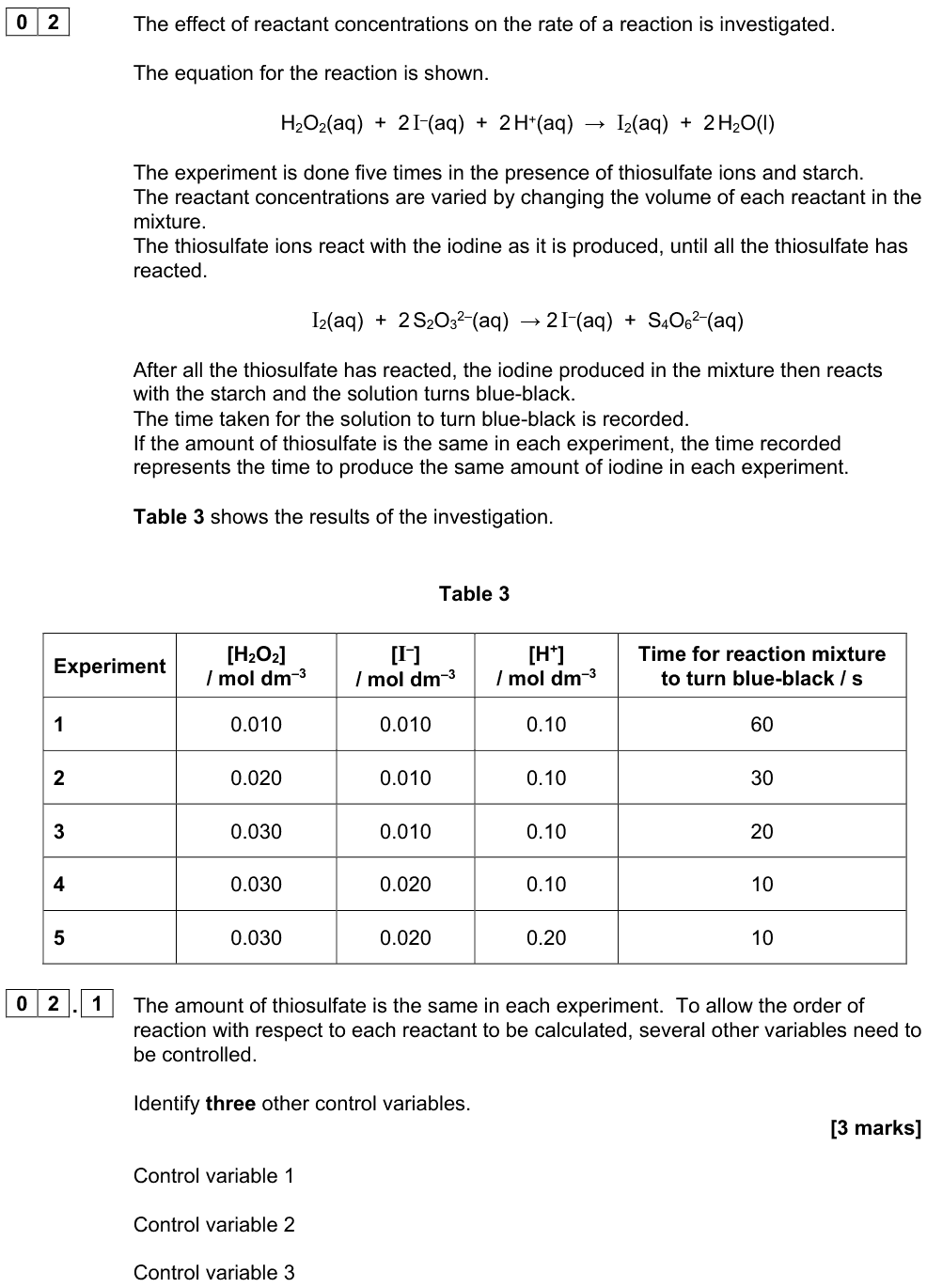
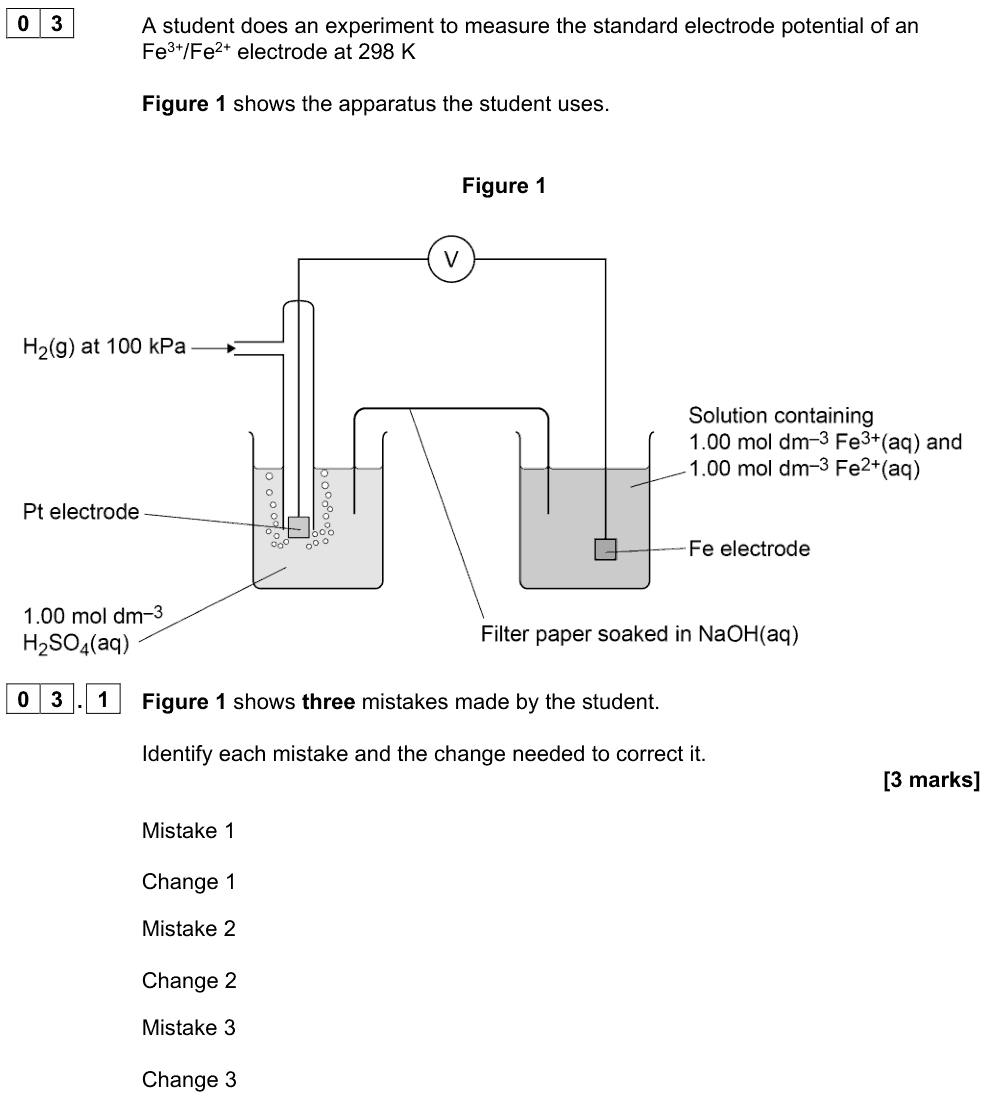
Short-answer questions

The state, give, name, identify and suggest questions that make up much of every paper. 463 questions.

Other types: Multiple-choice questions · Calculation questions · Equation questions · Mechanism questions · Structure and diagram questions · Explanation questions · Six-mark level of response questions · Practical questions

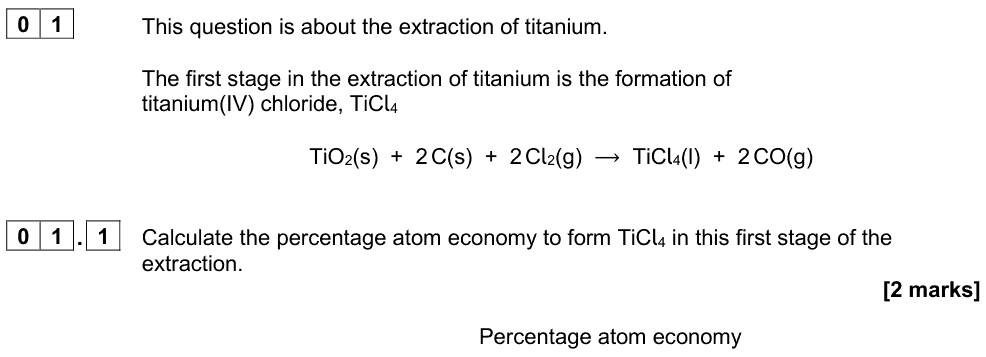
June 2025 · AS Paper 1 · Q01.2 1 mark AO3=1 Short answer amount of substance
Earlier part of question 01 that this part usesEarlier part of June 2025 Paper 1 question 01
Suggest one economic advantage of using a process with a
high percentage atom economy.
[1 mark]
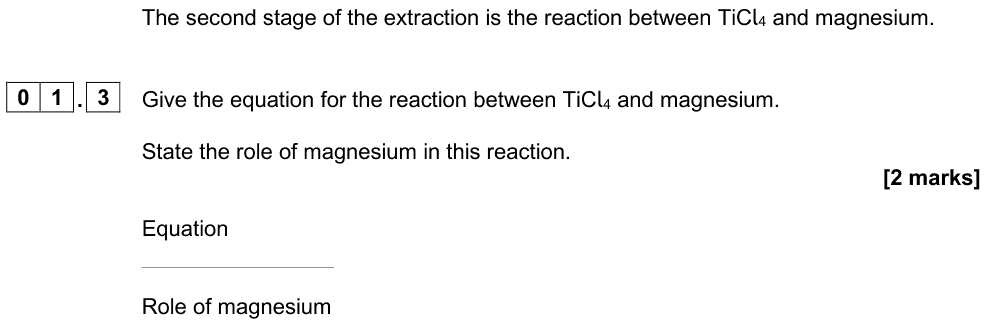
June 2025 · AS Paper 1 · Q01.4 1 mark AO3=1 Short answer group 2
Earlier parts of question 01 that this part usesEarlier part of June 2025 Paper 1 question 01Earlier part of June 2025 Paper 1 question 01
Titanium is an expensive metal because its extraction process uses magnesium.
Suggest why magnesium is expensive.
[1 mark]
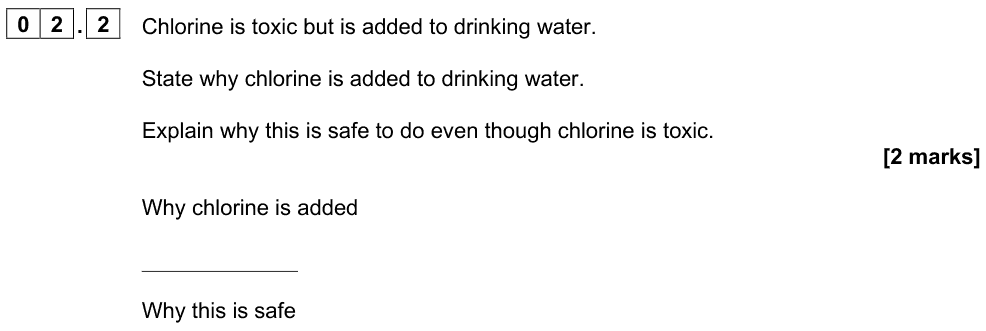
June 2025 · AS Paper 1 · Q02.2 2 marks AO1=2 Short answer group 7 the halogens
Earlier part of question 02 that this part usesEarlier part of June 2025 Paper 1 question 02
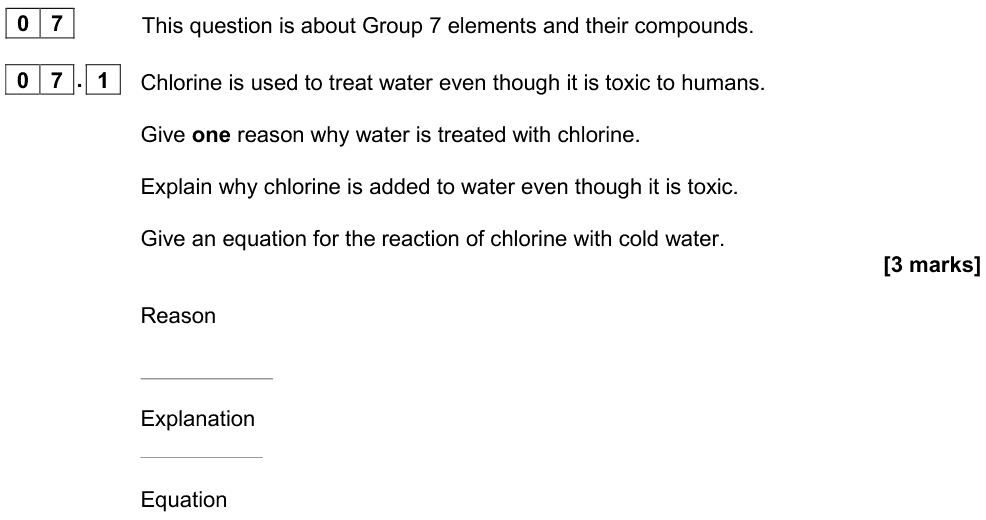
Chlorine is toxic but is added to drinking water.
State why chlorine is added to drinking water.
Explain why this is safe to do even though chlorine is toxic.
[2 marks]
Why chlorine is added
Why this is safe
June 2025 · AS Paper 1 · Q03.1 1 mark AO1=1 Short answer atomic structure
This question is about atomic structure and time of flight (TOF) mass spectrometry.
Give the full electron configuration of a fluoride ion (F–).
[1 mark]
June 2025 · AS Paper 1 · Q03.2 1 mark AO2=1 Short answer atomic structure
Earlier part of question 03 that this part usesEarlier part of June 2025 Paper 1 question 03
The Q2+ ion has electron configuration 1s2 2s2 2p6 3s2 3p6 3d5
Identify Q.
[1 mark]
June 2025 · AS Paper 1 · Q03.3 2 marks AO1=2 Short answer amount of substance
Earlier part of question 03 that this part usesEarlier part of June 2025 Paper 1 question 03
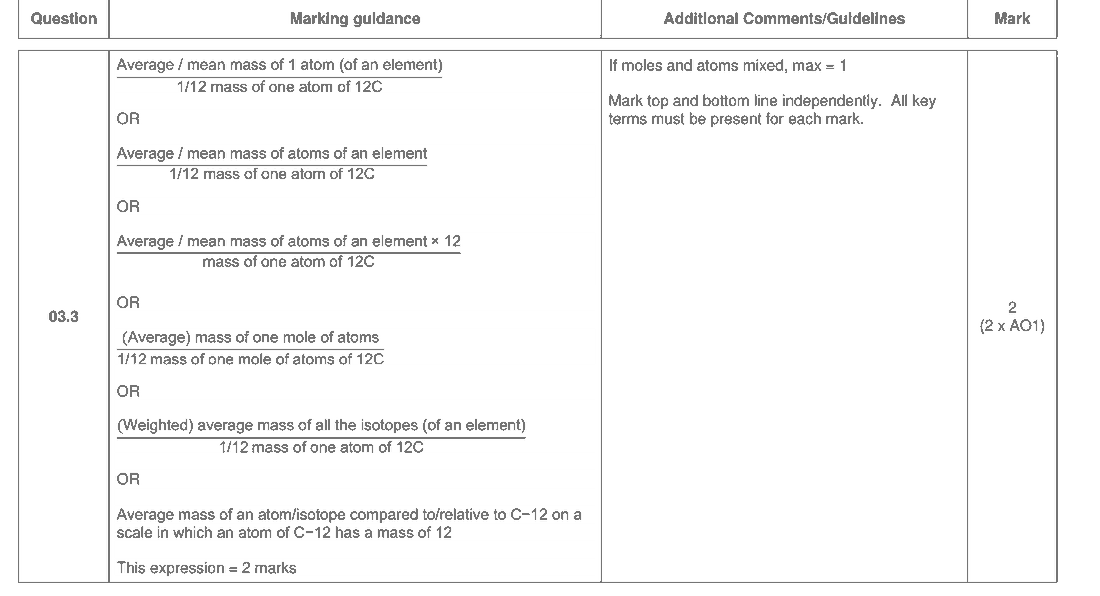
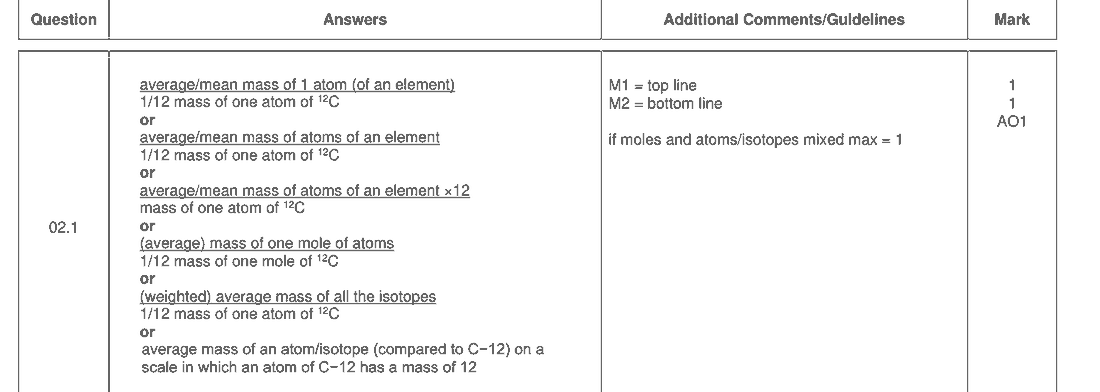
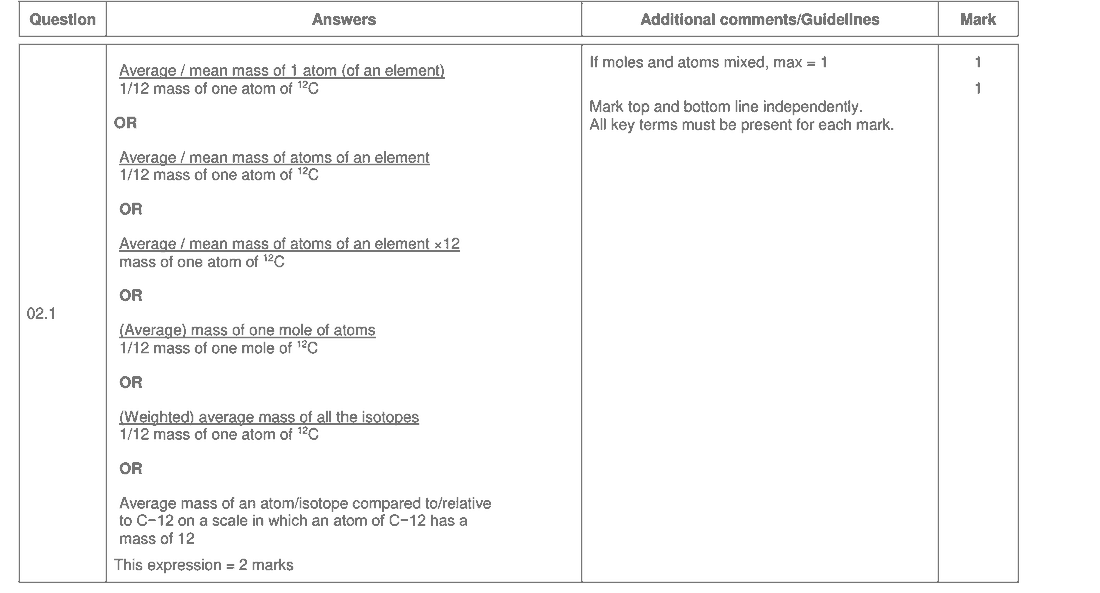
Give the meaning of the term relative atomic mass.
[2 marks]
June 2025 · AS Paper 1 · Q03.4 3 marks AO1=3 Short answer atomic structure
Earlier part of question 03 that this part usesEarlier part of June 2025 Paper 1 question 03
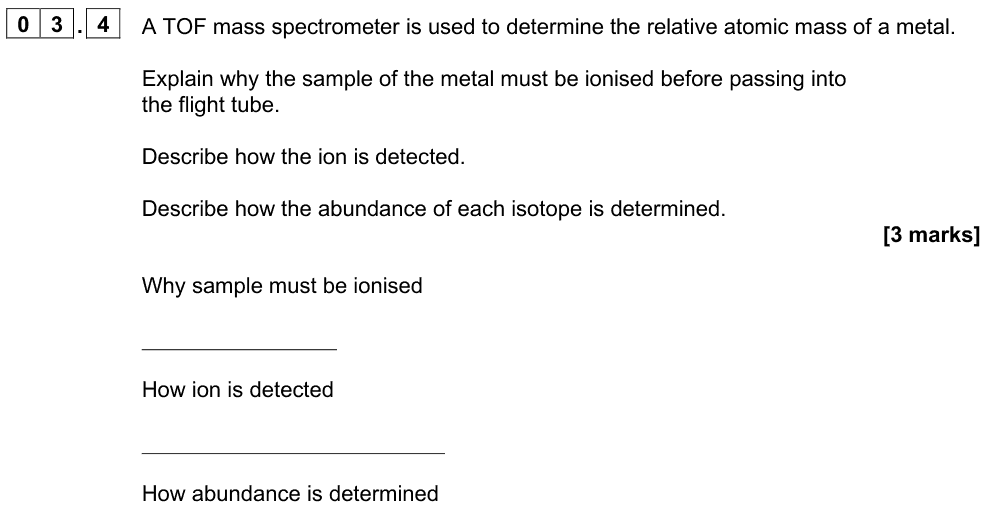
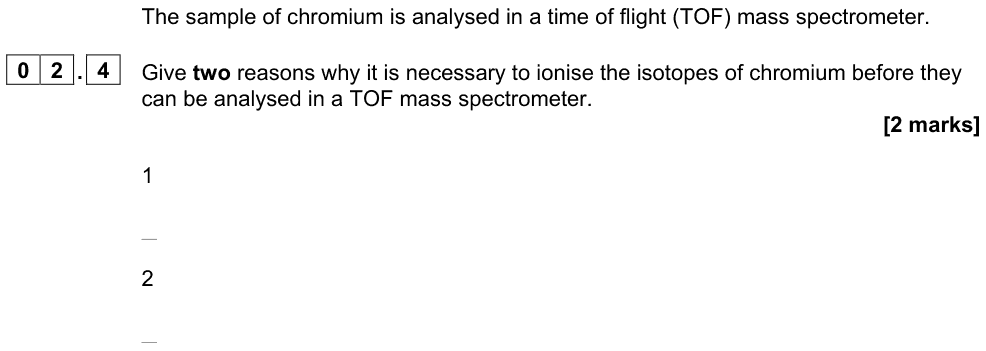
A TOF mass spectrometer is used to determine the relative atomic mass of a metal.
Explain why the sample of the metal must be ionised before passing into
the flight tube.
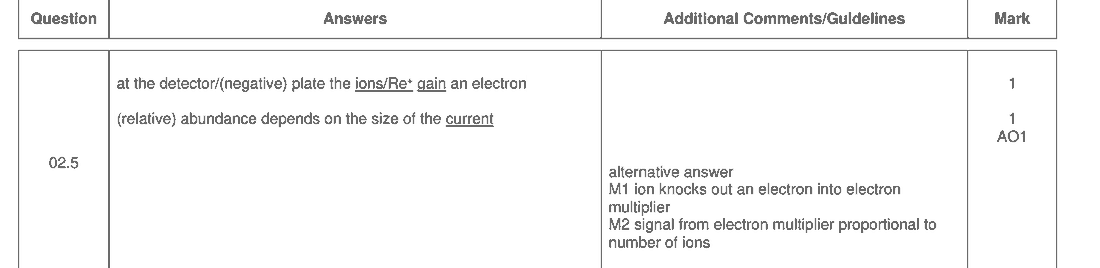
Describe how the ion is detected.
Describe how the abundance of each isotope is determined.
[3 marks]
Why sample must be ionised
How ion is detected
How abundance is determined
June 2025 · AS Paper 1 · Q03.5 1 mark AO3=1 Short answer atomic structure
Earlier part of question 03 that this part usesEarlier part of June 2025 Paper 1 question 03
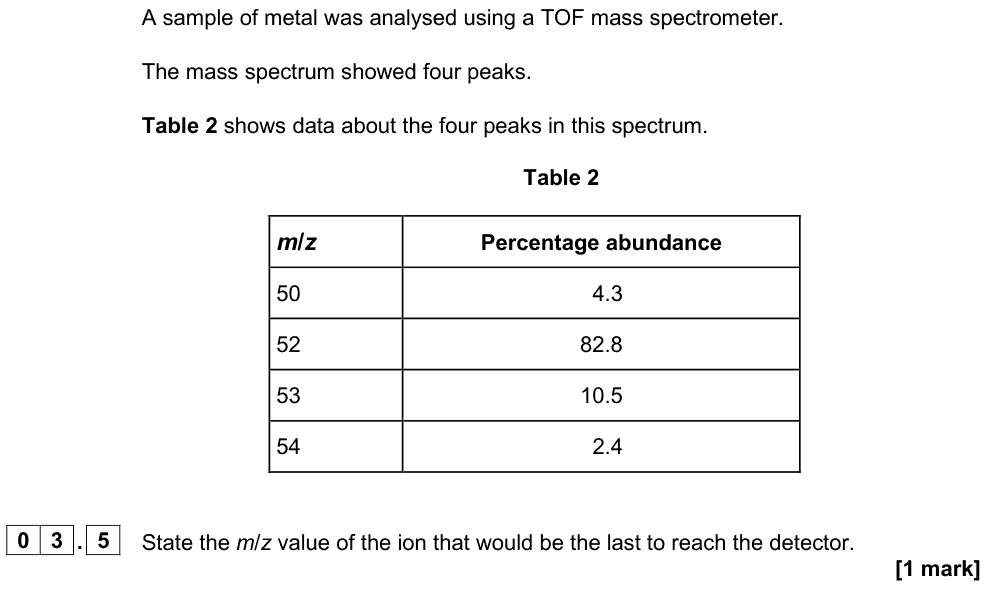
A sample of metal was analysed using a TOF mass spectrometer.
The mass spectrum showed four peaks.
Table 2 shows data about the four peaks in this spectrum.
Table 2
m/z
Percentage abundance
50
4.3
52
82.8
53
10.5
54
2.4
State the m/z value of the ion that would be the last to reach the detector.
[1 mark]
June 2025 · AS Paper 1 · Q04.2 1 mark AO1=1 Short answer group 2
Earlier part of question 04 that this part usesEarlier part of June 2025 Paper 1 question 04
The atomic radius increases down Group 2 from Mg to Ba
Give a reason for this trend.
[1 mark]
June 2025 · AS Paper 1 · Q04.5 1 mark AO1=1 Short answer group 2atomic structure
Earlier part of question 04 that this part usesEarlier part of June 2025 Paper 1 question 04
Identify the Group 2 metal with the lowest second ionisation energy.
[1 mark]
June 2025 · AS Paper 2 · Q01.3 1 mark AO1=1 Short answer halogenoalkanes
Earlier part of question 01 that this part usesEarlier part of June 2025 Paper 2 question 01
2-Bromobutane reacts with KOH to give a mixture of products.
Identify the solvent that should be used to ensure that butan-2-ol is the
main organic product when 2-brombutane reacts with KOH
[1 mark]
June 2025 · AS Paper 2 · Q01.5 1 mark AO3=1 Short answer bonding
Earlier part of question 01 that this part usesEarlier part of June 2025 Paper 2 question 01
The carbocation (CH3)3C+ is formed as an intermediate in the reaction of
2-bromo-2-methylpropane with KCN
Suggest the value of the bond angle around the central C atom in the
(CH3)3C+ carbocation.
[1 mark]
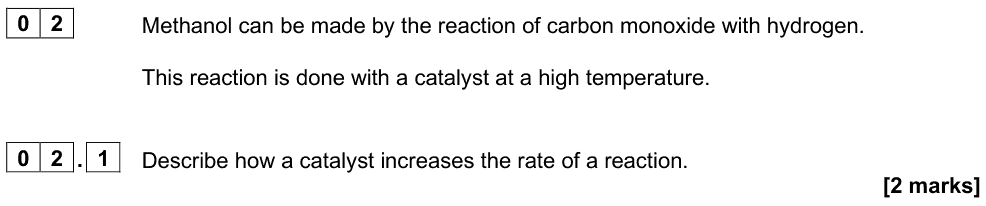
June 2025 · AS Paper 2 · Q02.1 2 marks AO1=2 Short answer kinetics
Methanol can be made by the reaction of carbon monoxide with hydrogen.
This reaction is done with a catalyst at a high temperature.
Describe how a catalyst increases the rate of a reaction.
[2 marks]
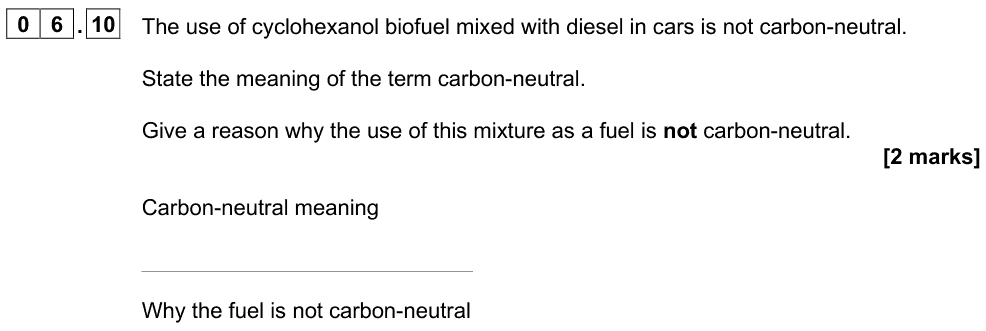
June 2025 · AS Paper 2 · Q06.10 2 marks AO1=1, AO2=1 Short answer alcohols
Earlier parts of question 06 that this part usesEarlier part of June 2025 Paper 2 question 06Earlier part of June 2025 Paper 2 question 06
The use of cyclohexanol biofuel mixed with diesel in cars is not carbon-neutral.
State the meaning of the term carbon-neutral.
Give a reason why the use of this mixture as a fuel is not carbon-neutral.
[2 marks]
Carbon-neutral meaning
Why the fuel is not carbon-neutral
June 2025 · AS Paper 2 · Q06.8 1 mark AO1=1 Short answer alcohols
Earlier part of question 06 that this part usesEarlier part of June 2025 Paper 2 question 06
The cyclohexanol can be dehydrated to re-form cyclohexene by heating with
concentrated phosphoric acid.
Name the mechanism for this reaction.
[1 mark]
June 2025 · AS Paper 2 · Q07.1 1 mark AO1=1 Short answer energetics
This question is about enthalpies of combustion.
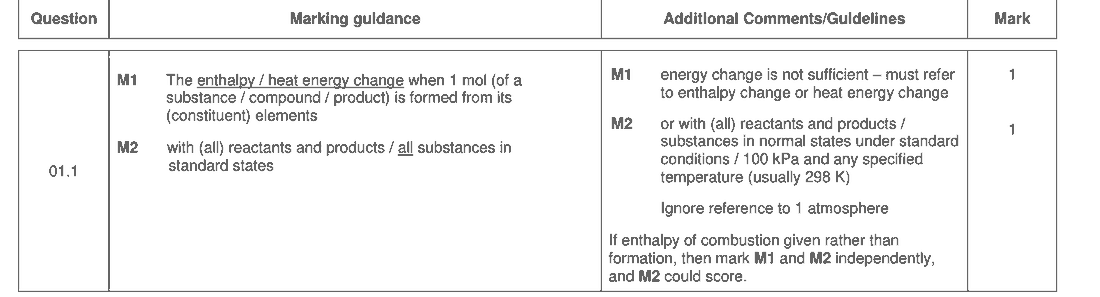
Define enthalpy change.
[1 mark]
June 2025 · Paper 1 · Q01.2 2 marks AO1=2 Short answer group 2
Earlier part of question 01 that this part usesEarlier part of June 2025 Paper 1 question 01
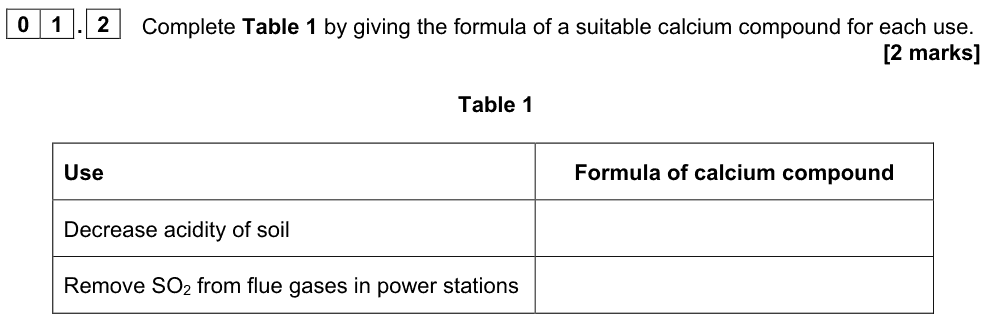
Complete Table 1 by giving the formula of a suitable calcium compound for each use.
[2 marks]
Table 1
Use
Formula of calcium compound
Decrease acidity of soil
Remove SO2 from flue gases in power stations
June 2025 · Paper 1 · Q01.3 1 mark AO3=1 Short answer group 2
Earlier part of question 01 that this part usesEarlier part of June 2025 Paper 1 question 01
Magnesium hydroxide is used to relieve the symptoms of indigestion by neutralising
stomach acid.
Suggest why magnesium hydroxide is safer than sodium hydroxide as a treatment for
indigestion.
[1 mark]
June 2025 · Paper 1 · Q01.6 1 mark AO1=1 Short answer group 2
Earlier parts of question 01 that this part usesEarlier part of June 2025 Paper 1 question 01Earlier part of June 2025 Paper 1 question 01
Give one property of barium sulfate that makes it useful in hospitals.
[1 mark]
June 2025 · Paper 1 · Q02.3 1 mark AO3=1 Short answer Hard atomic structure
Earlier part of question 02 that this part usesEarlier part of June 2025 Paper 1 question 02
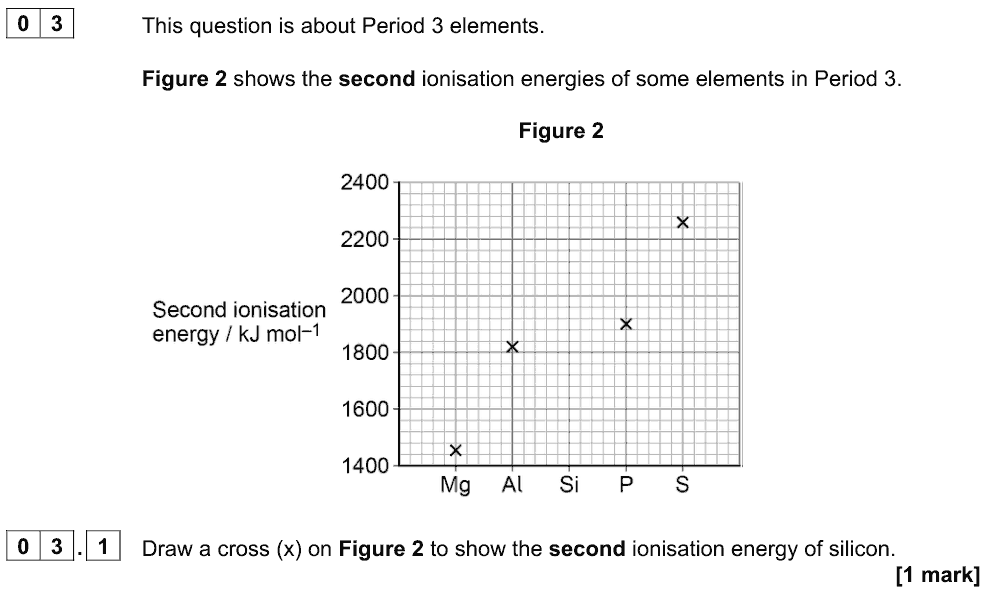
Predict which element in Period 3 has the lowest second ionisation energy.
[1 mark]
June 2025 · Paper 1 · Q03.1 1 mark AO3=1 Short answer Easy atomic structure
This question is about the chemistry of copper.
Deduce the number of unpaired electrons in a Cu2+ ion.
[1 mark]
June 2025 · Paper 1 · Q03.2 1 mark AO1=1 Short answer transition metals
Earlier part of question 03 that this part usesEarlier part of June 2025 Paper 1 question 03
Describe how water acts as a ligand in the formation of [Cu(H2O)6]2+
[1 mark]
June 2025 · Paper 1 · Q04.1 1 mark AO1=1 Short answer energetics
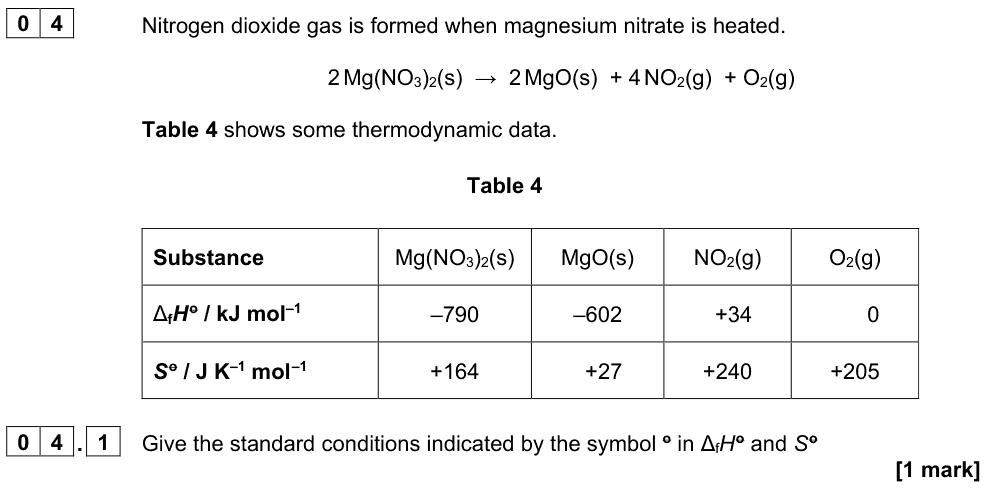
Nitrogen dioxide gas is formed when magnesium nitrate is heated.
2 Mg(NO3)2(s)  →  2 MgO(s)  + 4 NO2(g)  + O2(g)
Table 4 shows some thermodynamic data.
Table 4
Substance
Mg(NO3)2(s)
MgO(s)
NO2(g)
O2(g)
ΔfH o / kJ mol–1
–790
–602
+34
0
S o / J K–1 mol –1
+164
+27
+240
+205
Give the standard conditions indicated by the symbol o in ΔfH o and S o
[1 mark]
June 2025 · Paper 1 · Q04.4 1 mark AO1=1 Short answer transition metals
Earlier parts of question 04 that this part usesEarlier part of June 2025 Paper 1 question 04Earlier part of June 2025 Paper 1 question 04
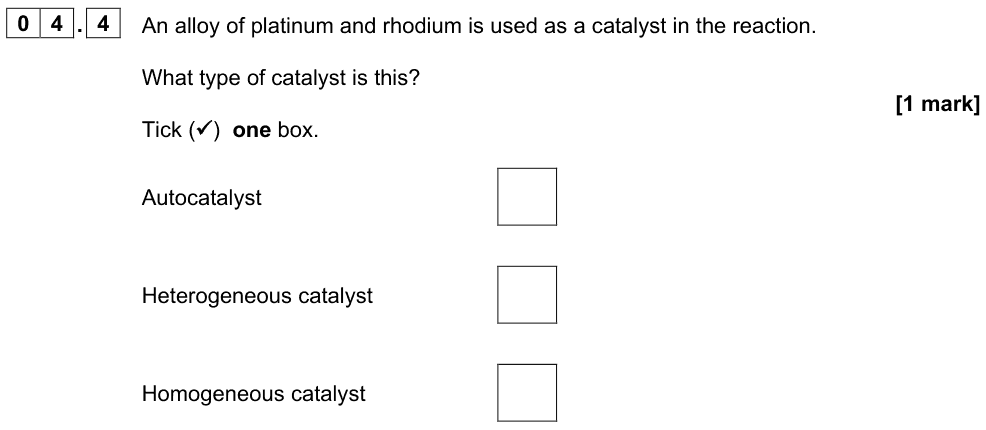
An alloy of platinum and rhodium is used as a catalyst in the reaction.
What type of catalyst is this?
[1 mark]
Tick ( )  one box.
Autocatalyst
Heterogeneous catalyst
Homogeneous catalyst
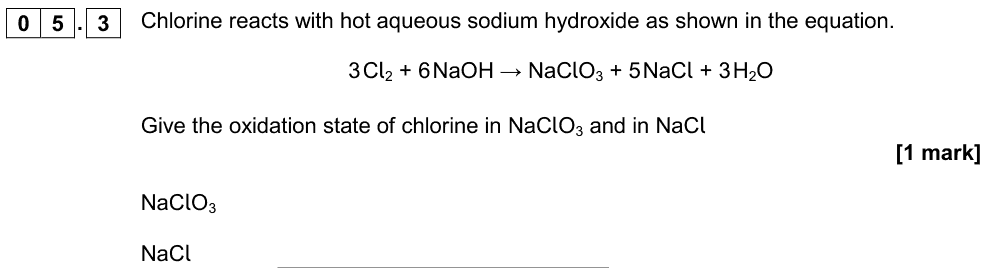
June 2025 · Paper 1 · Q05.2 1 mark AO3=1 Short answer redox
Earlier part of question 05 that this part usesEarlier part of June 2025 Paper 1 question 05
Bromine reacts with fluorine to form BrF3
Determine the oxidation state of bromine and of fluorine in BrF3
[1 mark]
Oxidation state of Br
Oxidation state of F
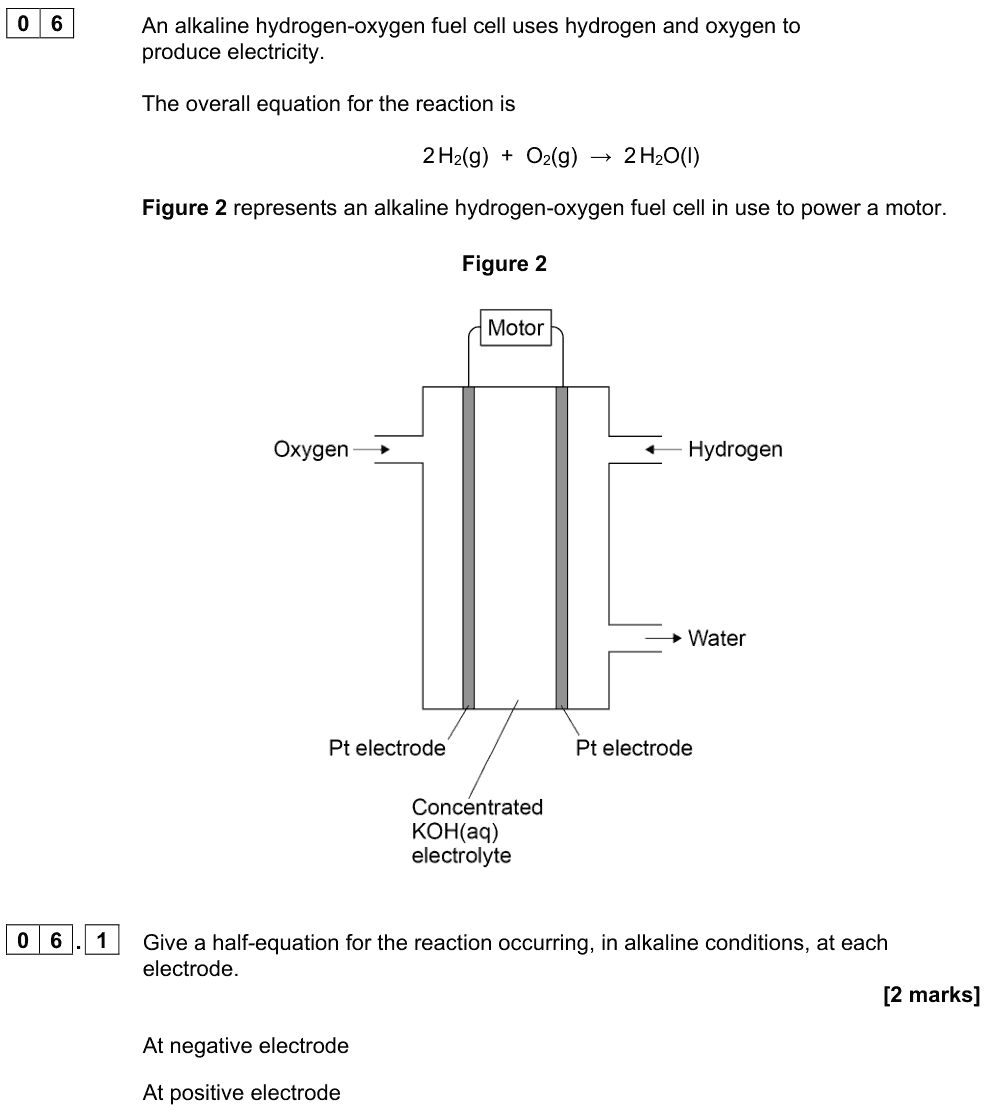
June 2025 · Paper 1 · Q06.2 1 mark AO2=1 Short answer electrode potentials and cells
Earlier part of question 06 that this part usesEarlier part of June 2025 Paper 1 question 06
Suggest why it is not necessary to replace the KOH electrolyte during the operation of
this fuel cell.
[1 mark]
June 2025 · Paper 1 · Q06.4 1 mark AO3=1 Short answer Hard electrode potentials and cells
Earlier part of question 06 that this part usesEarlier part of June 2025 Paper 1 question 06
This fuel cell uses pure oxygen, rather than air, as an oxidising agent.
Suggest the identity of the gas in air that would react with the KOH and affect the
efficient operation of the cell.
[1 mark]
June 2025 · Paper 1 · Q06.5 1 mark AO2=1 Short answer electrode potentials and cells
Earlier part of question 06 that this part usesEarlier part of June 2025 Paper 1 question 06
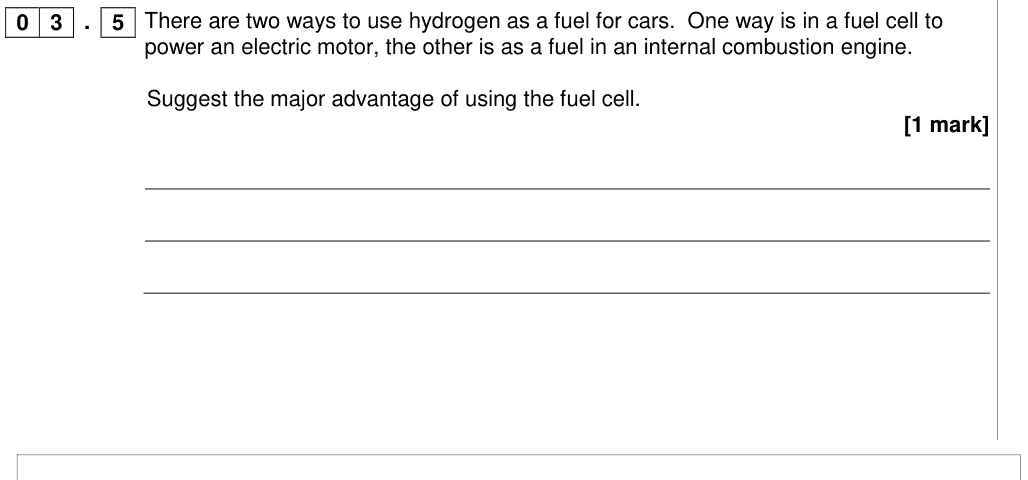
When an alkaline hydrogen-oxygen fuel cell is used to power the motor in a car, the
hydrogen can be stored as a liquid.
Suggest an advantage of storing hydrogen as a liquid.
[1 mark]
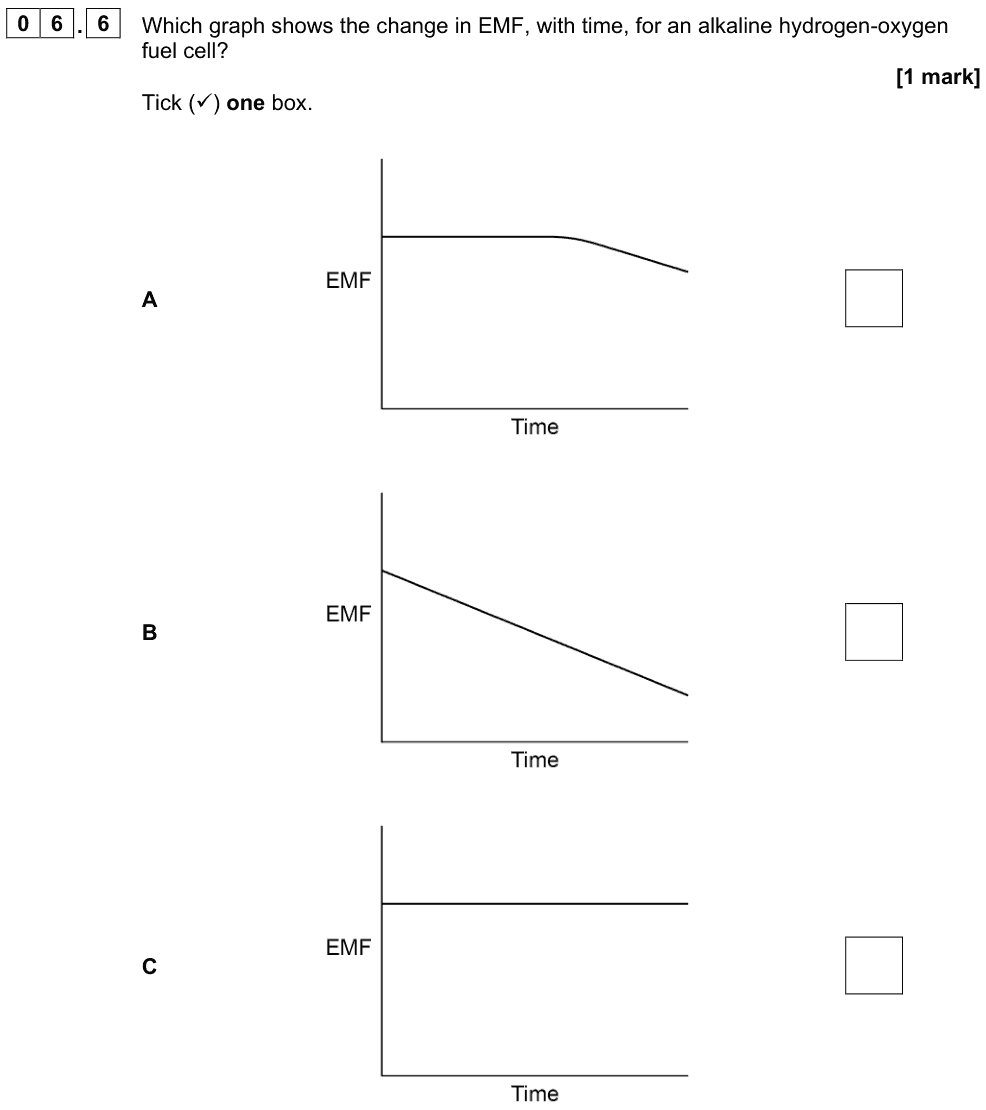
June 2025 · Paper 1 · Q06.6 1 mark AO1=1 Short answer electrode potentials and cells
Earlier part of question 06 that this part usesEarlier part of June 2025 Paper 1 question 06
Which graph shows the change in EMF, with time, for an alkaline hydrogen-oxygen
fuel cell?
[1 mark]
Tick () one box.
A
B
C
June 2025 · Paper 1 · Q06.7 1 mark AO1=1 Short answer electrode potentials and cells
Earlier part of question 06 that this part usesEarlier part of June 2025 Paper 1 question 06
An acidic hydrogen-oxygen fuel cell has different reactions at the electrodes.
Suggest why the EMF of the acidic hydrogen-oxygen fuel cell is the same as that of
the alkaline hydrogen-oxygen fuel cell.
[1 mark]
June 2025 · Paper 1 · Q07.1 1 mark AO1=1 Short answer periodicity
This question is about vanadium and some of its compounds.
State the block in the Periodic Table that contains vanadium.
[1 mark]
June 2025 · Paper 1 · Q07.2 1 mark AO1=1 Short answer bonding
Earlier part of question 07 that this part usesEarlier part of June 2025 Paper 1 question 07
Suggest why vanadium can be pulled into thin wires.
[1 mark]
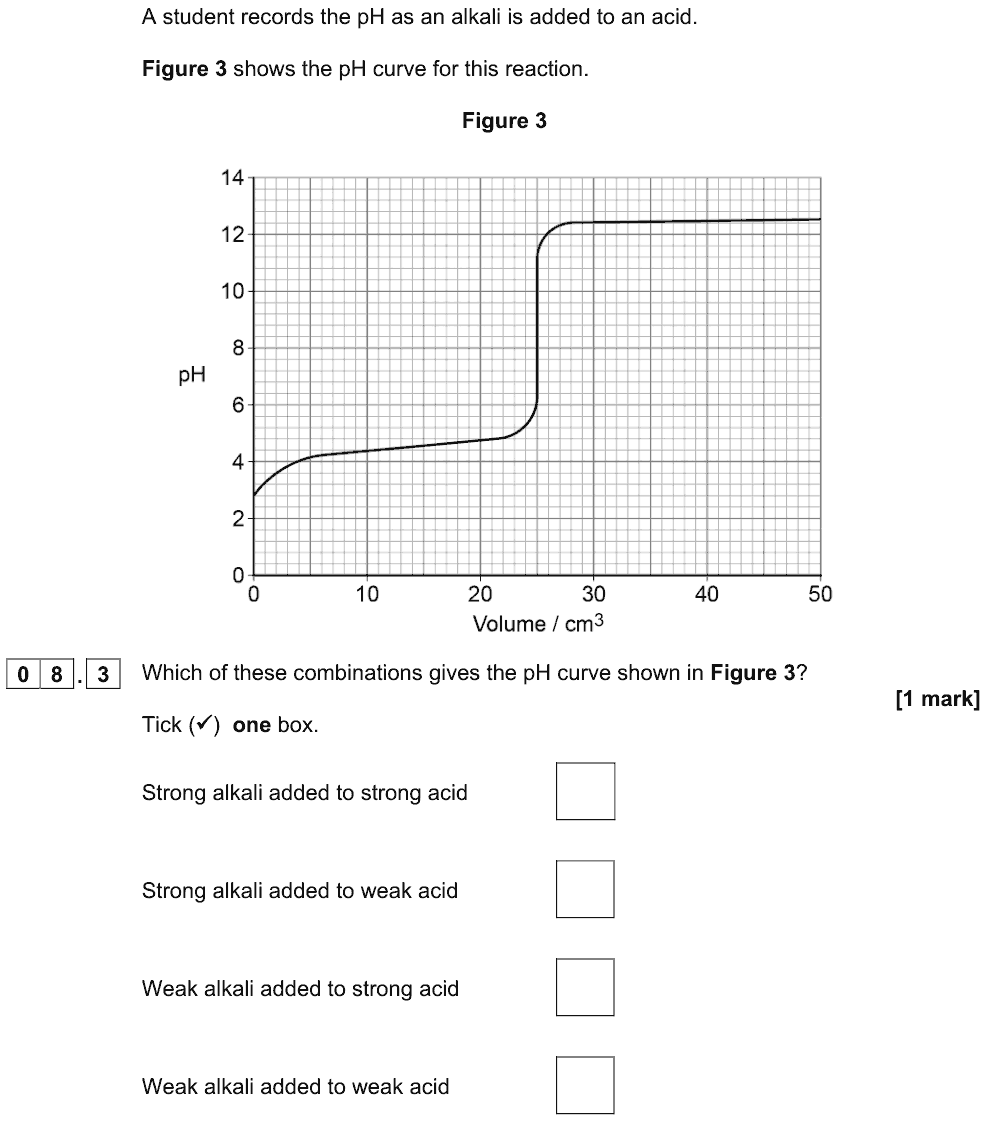
June 2025 · Paper 1 · Q08.3 1 mark AO2=1 Short answer acids and bases
Earlier part of question 08 that this part usesEarlier part of June 2025 Paper 1 question 08
A student records the pH as an alkali is added to an acid.
Figure 3 shows the pH curve for this reaction.
Figure 3
Which of these combinations gives the pH curve shown in Figure 3?
[1 mark]
Tick ( )  one box.
Strong alkali added to strong acid
Strong alkali added to weak acid
Weak alkali added to strong acid
Weak alkali added to weak acid
June 2025 · Paper 1 · Q08.4 1 mark AO3=1 Short answer acids and bases
Earlier parts of question 08 that this part usesEarlier part of June 2025 Paper 1 question 08Earlier part of June 2025 Paper 1 question 08
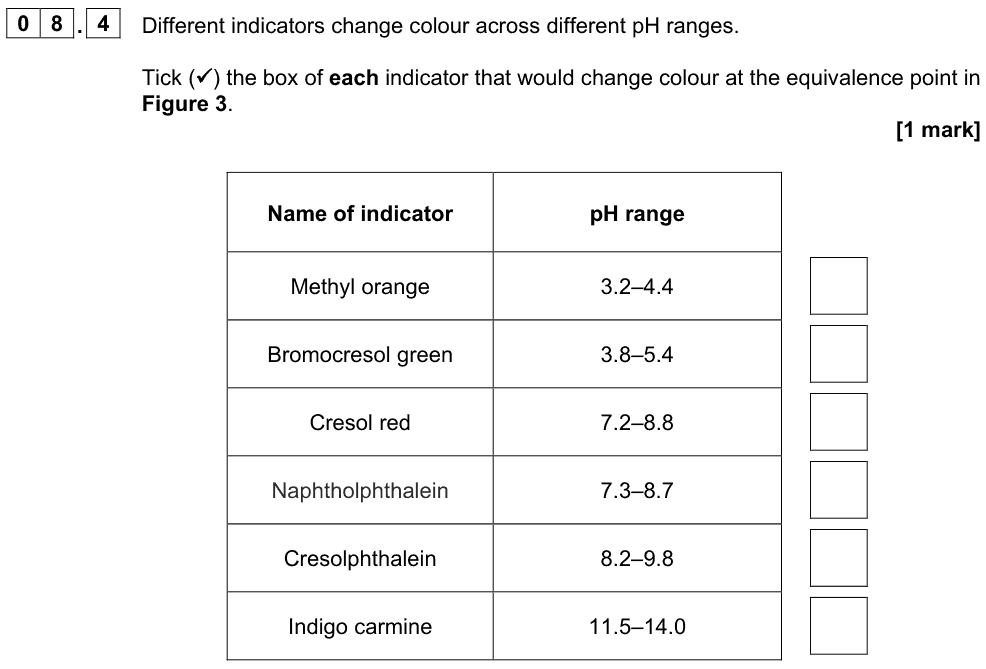
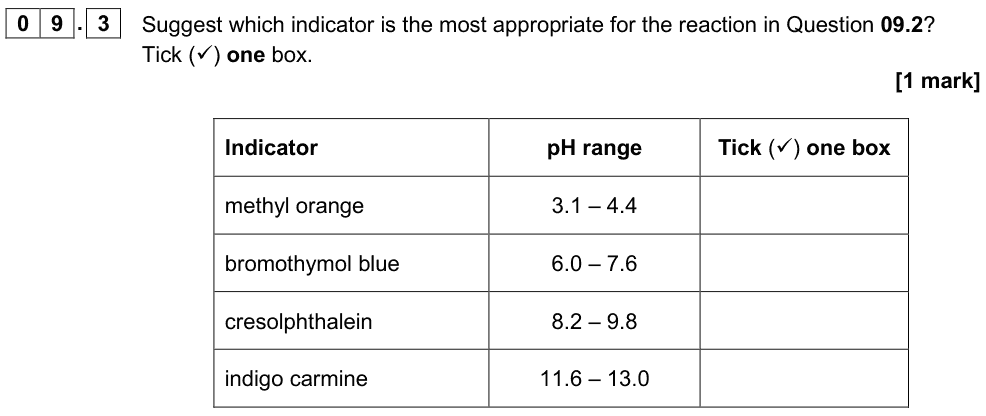
Different indicators change colour across different pH ranges.
Tick ( ) the box of each indicator that would change colour at the equivalence point in
Figure 3.
[1 mark]
Name of indicator
pH range
Methyl orange
3.2–4.4
Bromocresol green
3.8–5.4
Cresol red
7.2–8.8
Naphtholphthalein
7.3–8.7
Cresolphthalein
8.2–9.8
Indigo carmine
11.5–14.0
June 2025 · Paper 2 · Q01.1 2 marks AO1=2 Short answer alkanes
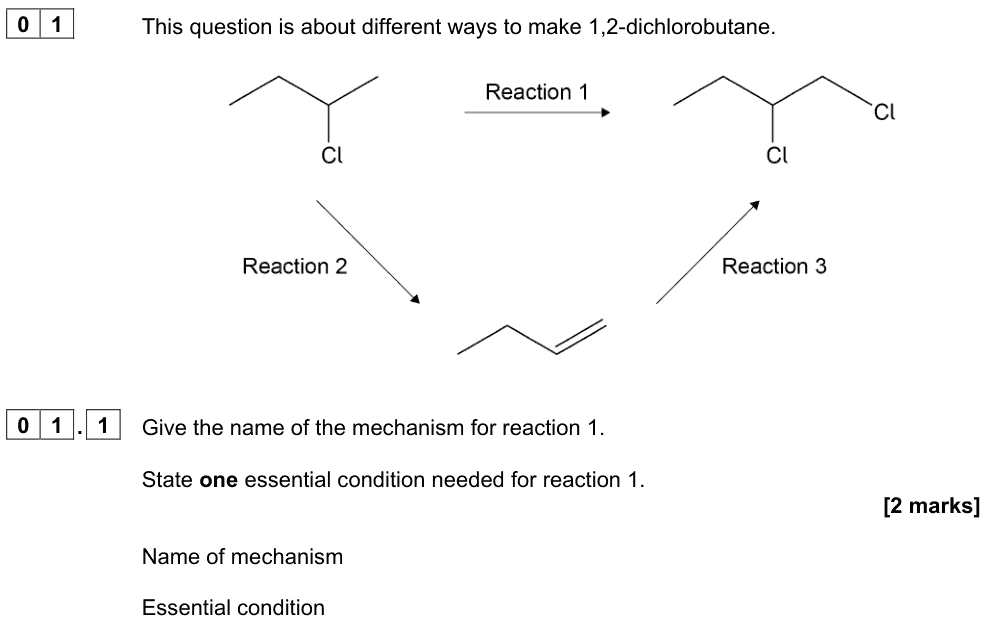
This question is about different ways to make 1,2-dichlorobutane.
Give the name of the mechanism for reaction 1.
State one essential condition needed for reaction 1.
[2 marks]
Name of mechanism
Essential condition
June 2025 · Paper 2 · Q01.3 2 marks AO1=2 Short answer alkanes
Earlier part of question 01 that this part usesEarlier part of June 2025 Paper 2 question 01
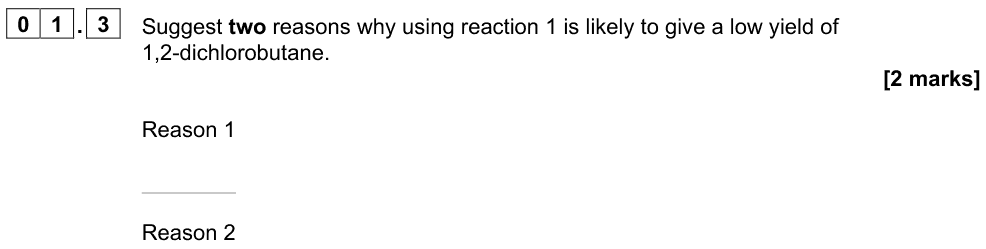
Suggest two reasons why using reaction 1 is likely to give a low yield of

1,2-dichlorobutane.
[2 marks]
Reason 1
Reason 2
June 2025 · Paper 2 · Q01.4 2 marks AO1=1, AO2=1 Short answer halogenoalkanes
Earlier part of question 01 that this part usesEarlier part of June 2025 Paper 2 question 01
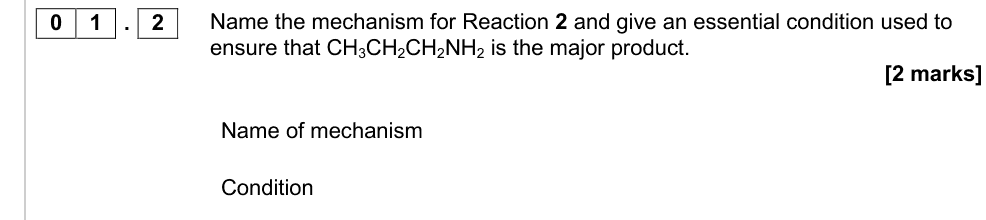
Give a suitable reagent and conditions needed for reaction 2.
[2 marks]
Reagent
Conditions
June 2025 · Paper 2 · Q01.5 2 marks AO3=2 Short answer alkenes
Earlier part of question 01 that this part usesEarlier part of June 2025 Paper 2 question 01
Identify the reagent and name the mechanism for reaction 3.
[2 marks]
Reagent
Name of mechanism
June 2025 · Paper 2 · Q03.1 2 marks AO1=2 Short answer alkenes
This question is about polymers.
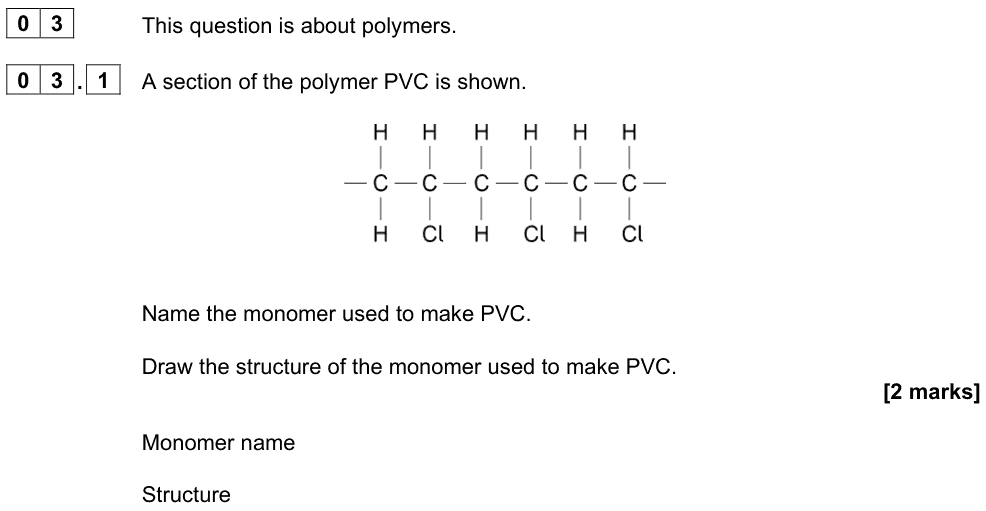
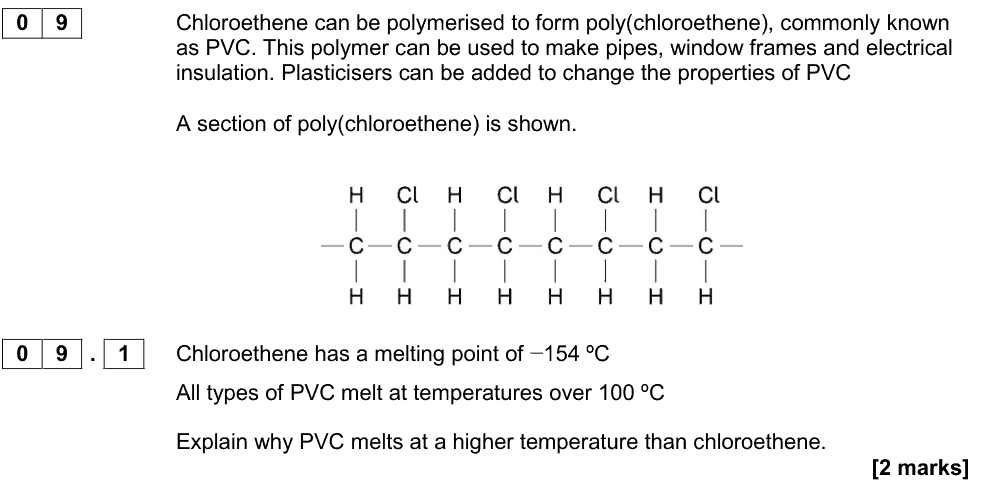
A section of the polymer PVC is shown.
Name the monomer used to make PVC.
Draw the structure of the monomer used to make PVC.
[2 marks]
Monomer name
Structure
June 2025 · Paper 2 · Q03.2 1 mark AO2=1 Short answer polymersalkenes
Earlier part of question 03 that this part usesEarlier part of June 2025 Paper 2 question 03
State why PVC is not biodegradable.
[1 mark]
June 2025 · Paper 2 · Q03.3 1 mark AO1=1 Short answer alkenes
Earlier part of question 03 that this part usesEarlier part of June 2025 Paper 2 question 03
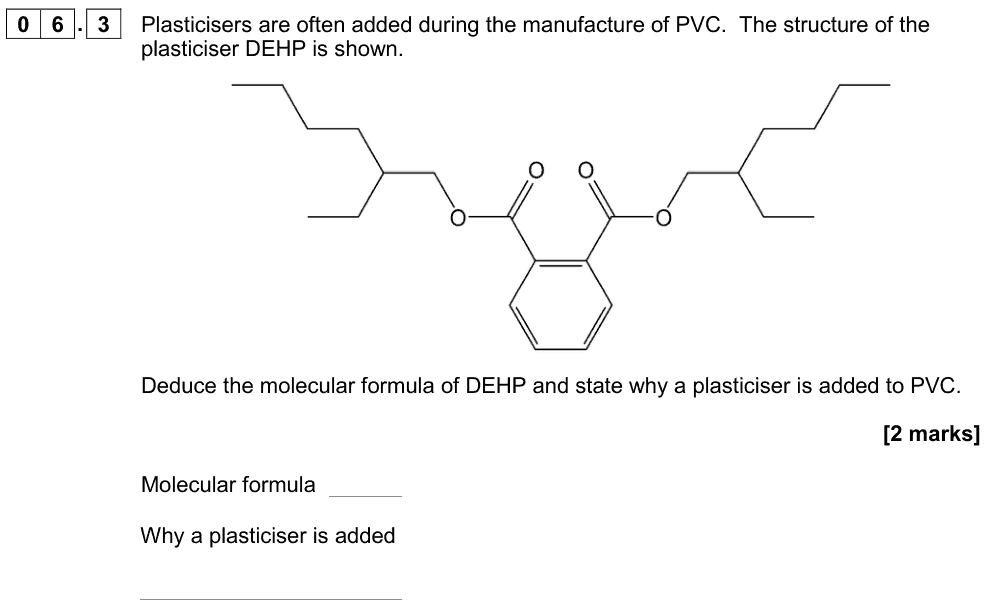
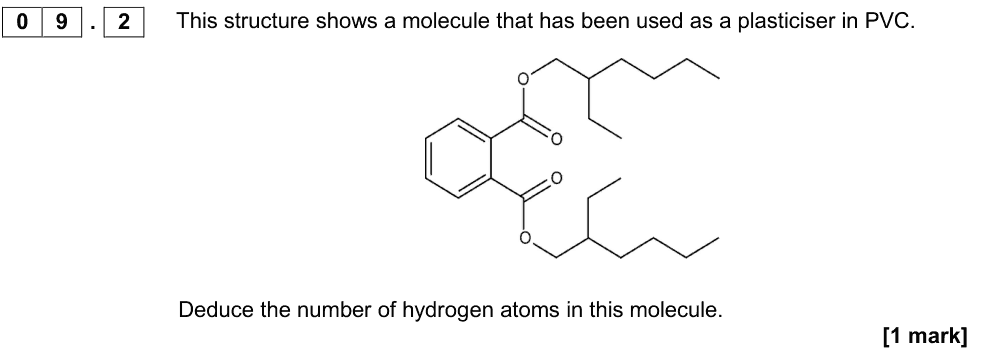
Diisobutyl phthalate (DIBP) is a plasticiser added to PVC to modify its properties.
State how the properties of PVC are modified by the addition of DIBP.
[1 mark]
June 2025 · Paper 2 · Q03.5 1 mark AO2=1 Short answer carboxylic acids and derivativesintroduction to organic chemistry
Earlier part of question 03 that this part usesEarlier part of June 2025 Paper 2 question 03
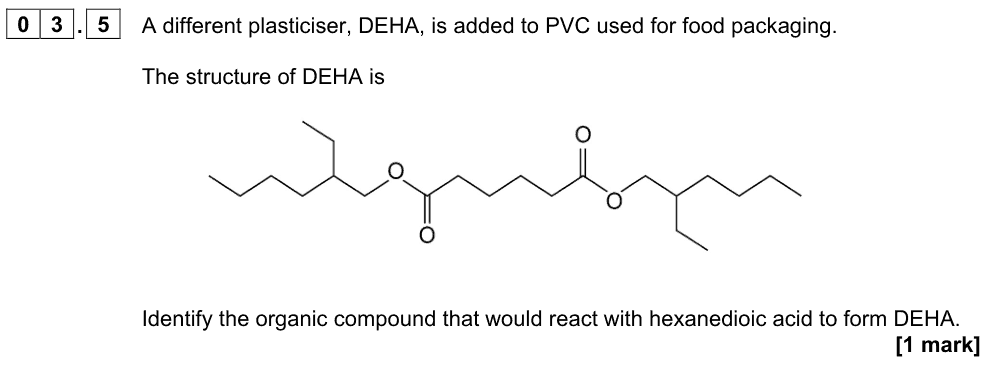
A different plasticiser, DEHA, is added to PVC used for food packaging.
The structure of DEHA is
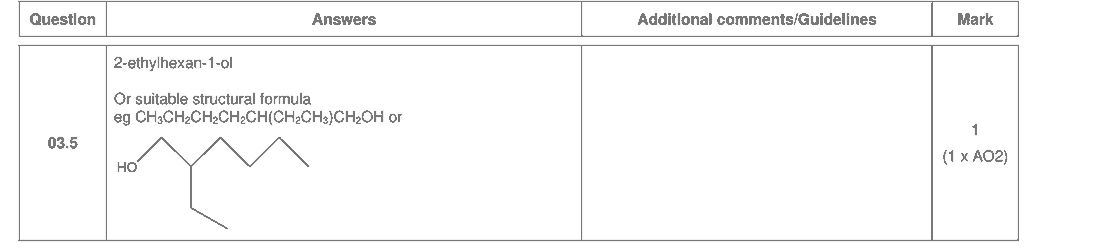
Identify the organic compound that would react with hexanedioic acid to form DEHA.
[1 mark]
June 2025 · Paper 2 · Q04.2 1 mark AO2=1 Short answer alcohols
Earlier part of question 04 that this part usesEarlier part of June 2025 Paper 2 question 04
Deduce the role of the concentrated nitric acid in the reaction.
[1 mark]
June 2025 · Paper 2 · Q04.6 2 marks AO3=2 Short answer organic synthesis
Earlier part of question 04 that this part usesEarlier part of June 2025 Paper 2 question 04
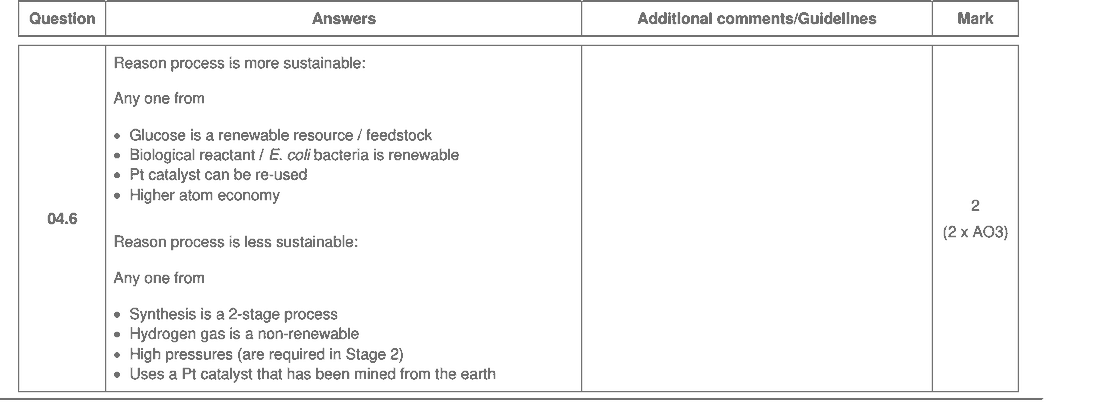
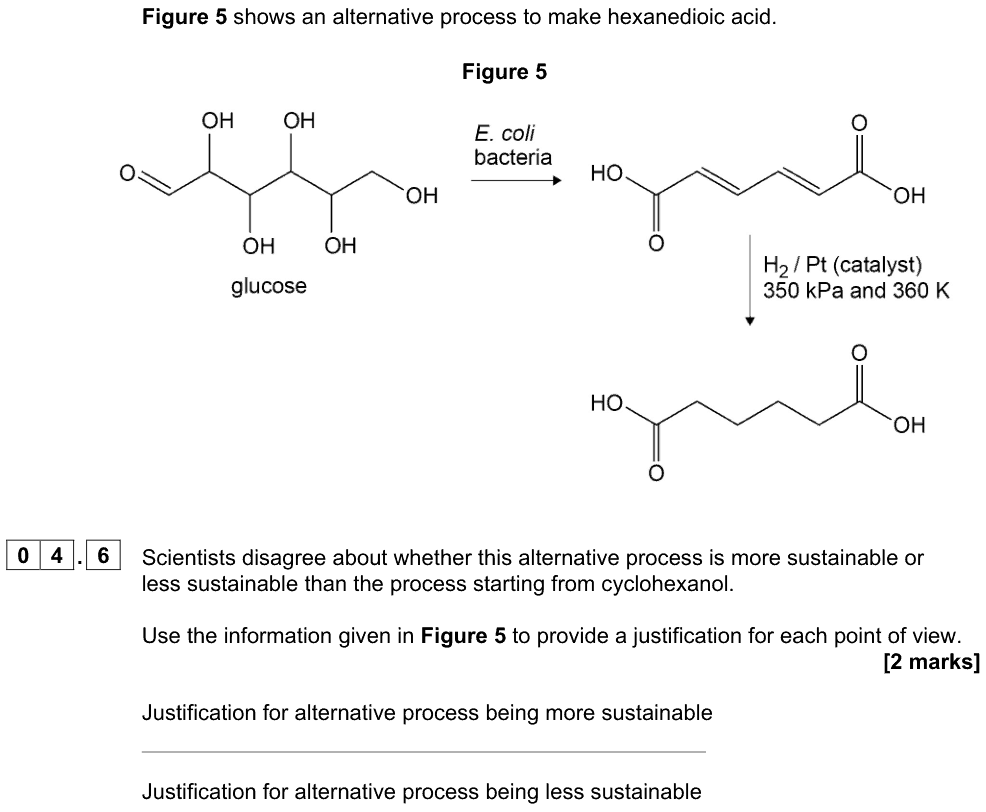
Figure 5 shows an alternative process to make hexanedioic acid.
Figure 5
Scientists disagree about whether this alternative process is more sustainable or
less sustainable than the process starting from cyclohexanol.
Use the information given in Figure 5 to provide a justification for each point of view.
[2 marks]
Justification for alternative process being more sustainable
Justification for alternative process being less sustainable
June 2025 · Paper 2 · Q06.1 2 marks AO2=2 Short answer nmr spectroscopy
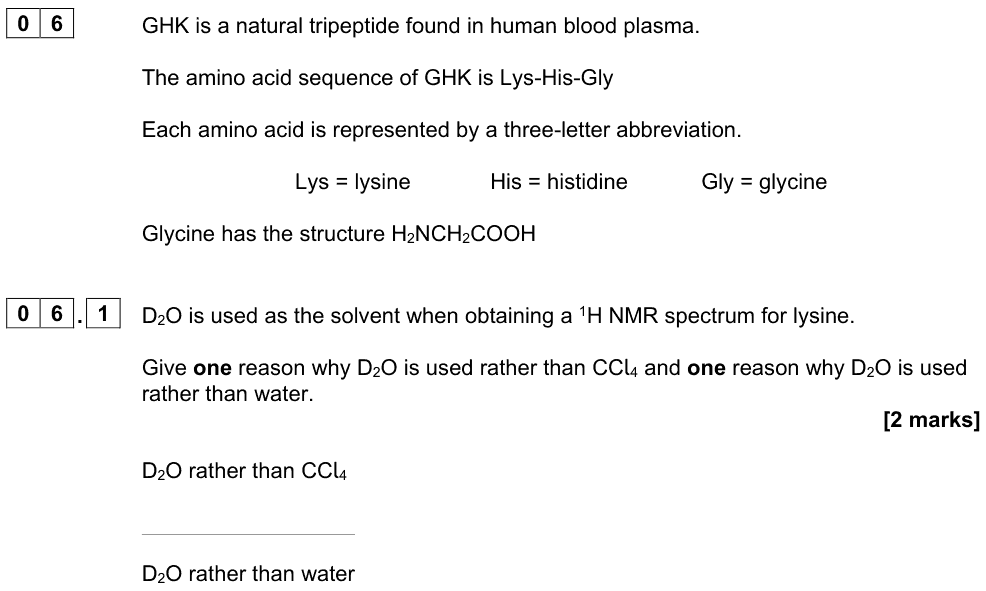
GHK is a natural tripeptide found in human blood plasma.
The amino acid sequence of GHK is Lys-His-Gly
Each amino acid is represented by a three-letter abbreviation.
Lys = lysine             His = histidine            Gly = glycine
Glycine has the structure H2NCH2COOH
D2O is used as the solvent when obtaining a 1H NMR spectrum for lysine.
Give one reason why D2O is used rather than CCl4 and one reason why D2O is used
rather than water.
[2 marks]
D2O rather than CCl4
D2O rather than water
June 2025 · Paper 2 · Q06.3 2 marks AO1=2 Short answer amino acids proteins and dna
Earlier part of question 06 that this part usesEarlier part of June 2025 Paper 2 question 06
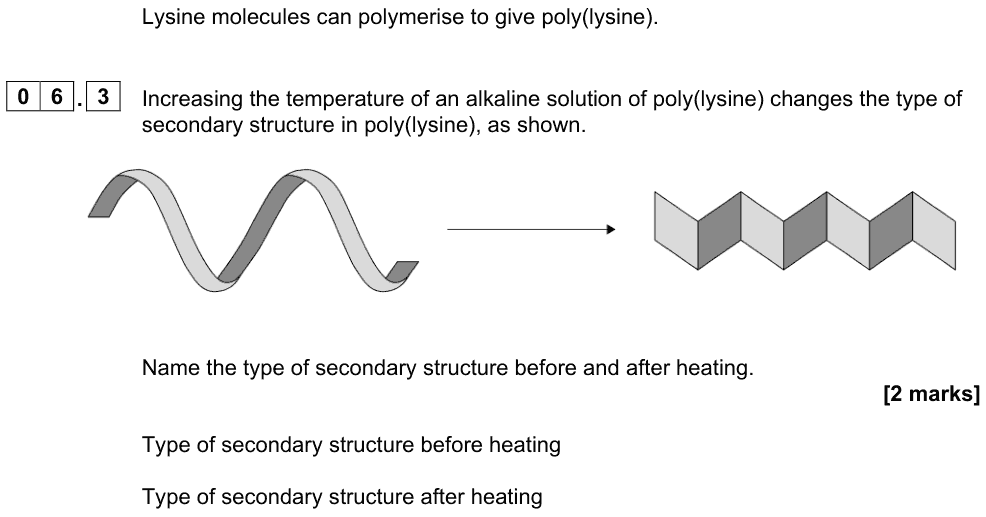
Lysine molecules can polymerise to give poly(lysine).
Increasing the temperature of an alkaline solution of poly(lysine) changes the type of
secondary structure in poly(lysine), as shown.
Name the type of secondary structure before and after heating.
[2 marks]
Type of secondary structure before heating
Type of secondary structure after heating
June 2025 · Paper 2 · Q09.1 1 mark AO1=1 Short answer group 7 the halogens
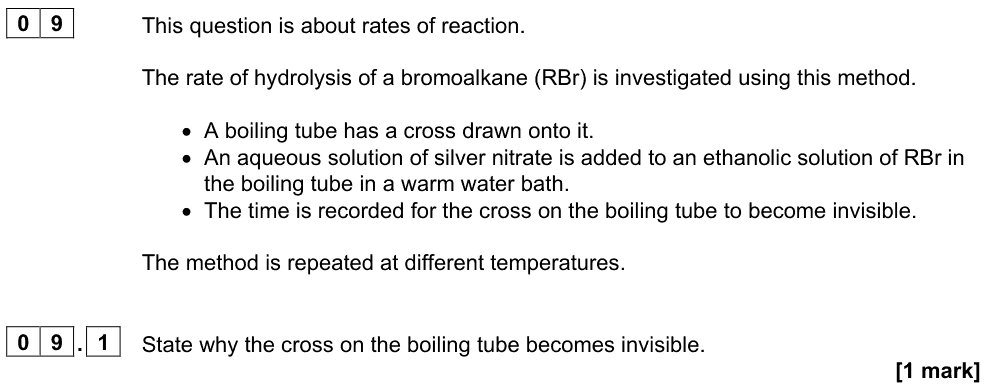
This question is about rates of reaction.
The rate of hydrolysis of a bromoalkane (RBr) is investigated using this method.
• A boiling tube has a cross drawn onto it.
• An aqueous solution of silver nitrate is added to an ethanolic solution of RBr in
the boiling tube in a warm water bath.
• The time is recorded for the cross on the boiling tube to become invisible.
The method is repeated at different temperatures.
State why the cross on the boiling tube becomes invisible.
[1 mark]
June 2025 · Paper 2 · Q09.5 1 mark AO1=1 Short answer rate equations
Earlier part of question 09 that this part usesEarlier part of June 2025 Paper 2 question 09
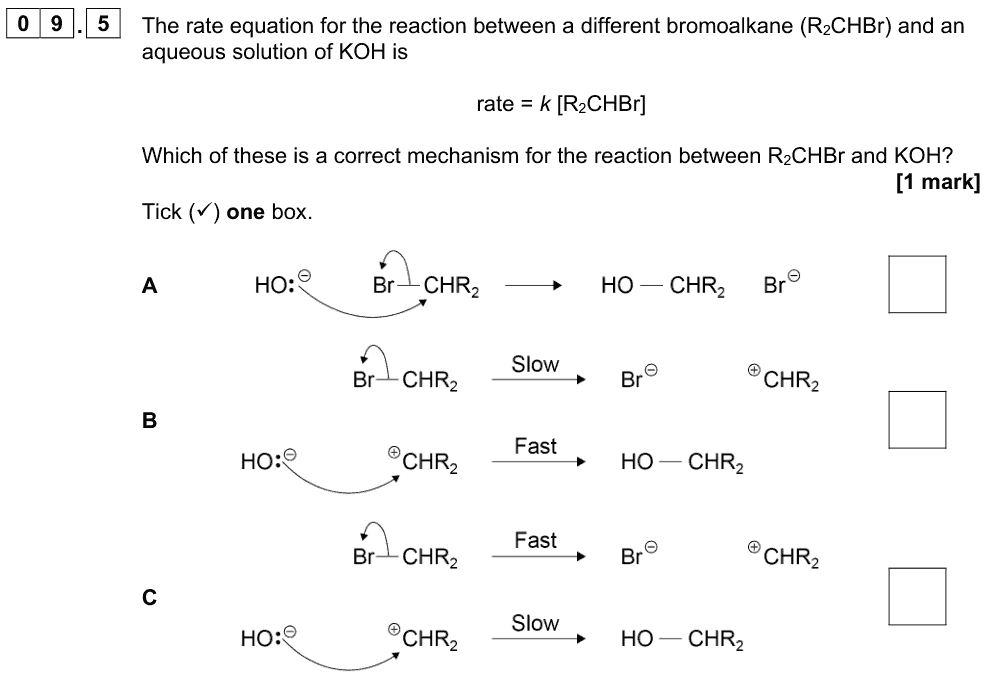
The rate equation for the reaction between a different bromoalkane (R2CHBr) and an
aqueous solution of KOH is
rate = k [R2CHBr]
Which of these is a correct mechanism for the reaction between R2CHBr and KOH?
[1 mark]
Tick () one box.
A
B
C
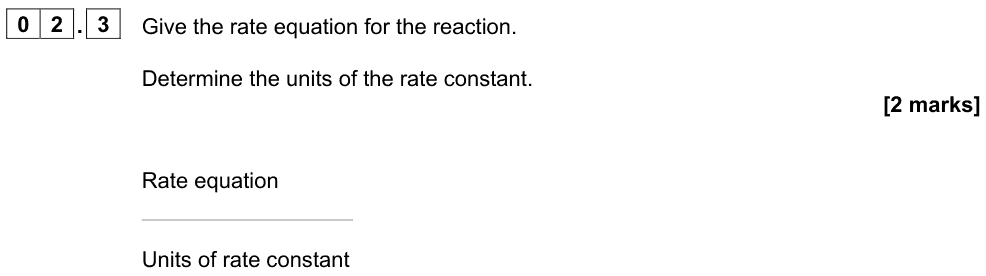
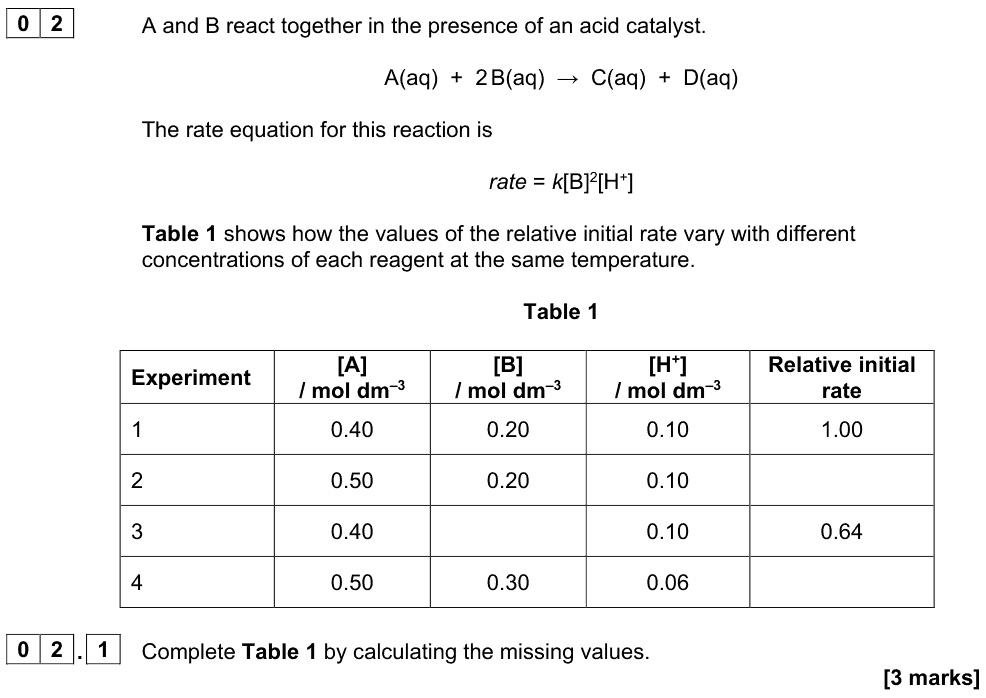
June 2025 · Paper 3 · Q02.3 2 marks AO2=2 Short answer rate equations
Earlier part of question 02 that this part usesEarlier part of June 2025 Paper 3 question 02
Give the rate equation for the reaction.
Determine the units of the rate constant.
[2 marks]
Rate equation
Units of rate constant
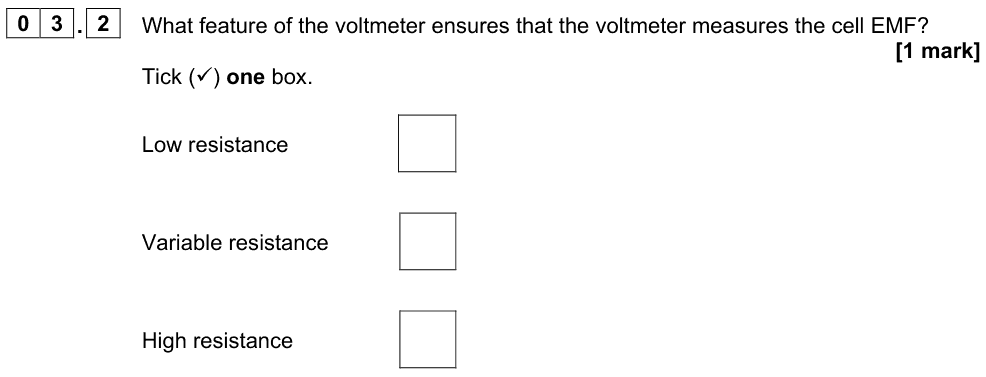
June 2025 · Paper 3 · Q03.2 1 mark AO1=1 Short answer electrode potentials and cells
Earlier part of question 03 that this part usesEarlier part of June 2025 Paper 3 question 03
What feature of the voltmeter ensures that the voltmeter measures the cell EMF?
[1 mark]
Tick () one box.
Low resistance
Variable resistance
High resistance
June 2025 · Paper 3 · Q04.1 1 mark AO2=1 Short answer Easy chemical equilibria and kc
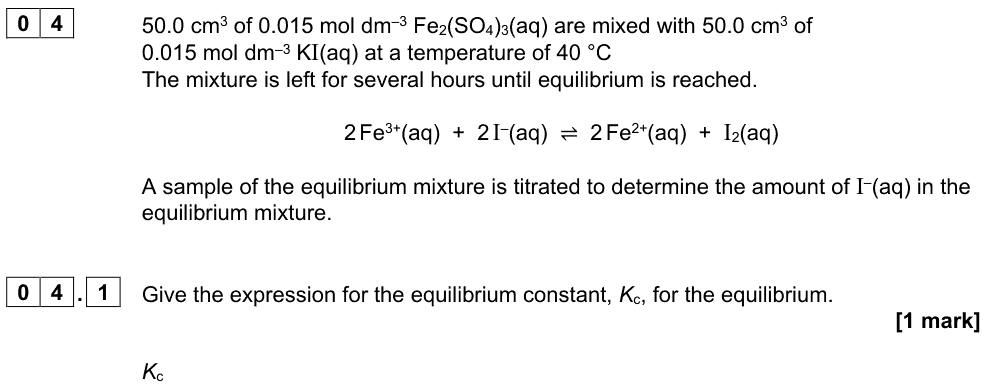
50.0 cm3 of 0.015 mol dm–3 Fe2(SO4)3(aq) are mixed with 50.0 cm3 of
0.015 mol dm–3 KI(aq) at a temperature of 40 °C
The mixture is left for several hours until equilibrium is reached.
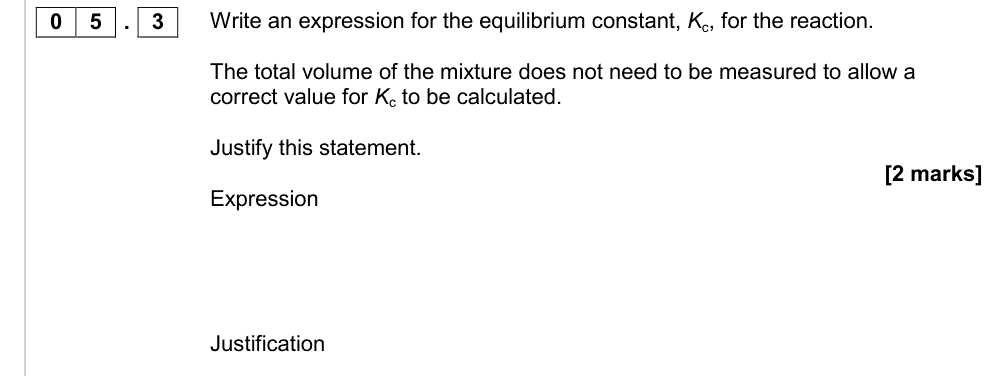
2 Fe3+(aq)  +  2 I–(aq)  ⇌  2 Fe2+(aq)  +  I2(aq)
A sample of the equilibrium mixture is titrated to determine the amount of I–(aq) in the
equilibrium mixture.
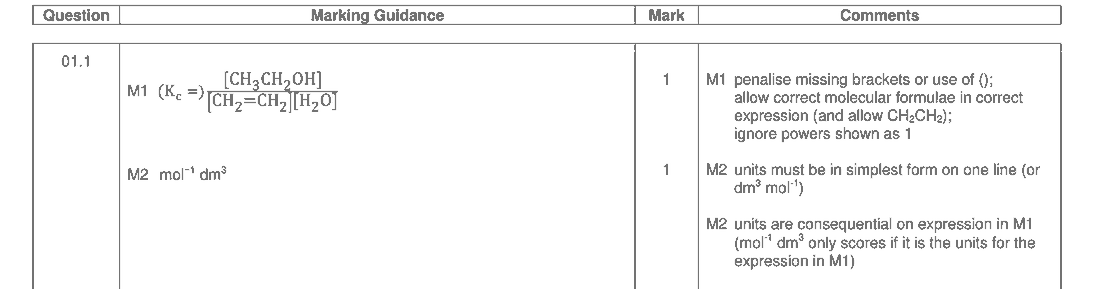
Give the expression for the equilibrium constant, Kc, for the equilibrium.
[1 mark]
Kc
June 2025 · Paper 3 · Q06.1 1 mark AO1=1 Short answer Easy introduction to organic chemistry
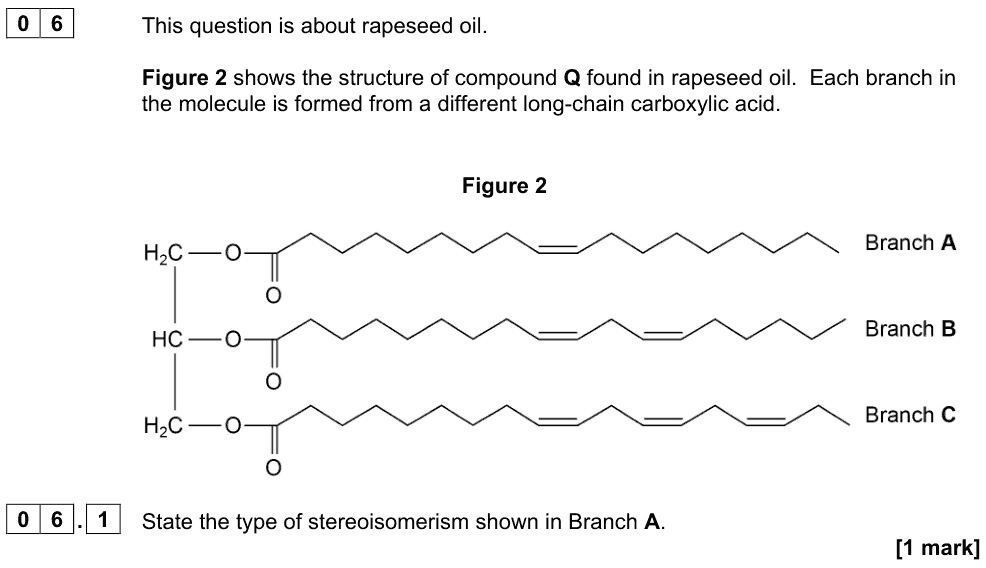
This question is about rapeseed oil.
Figure 2 shows the structure of compound Q found in rapeseed oil.  Each branch in
the molecule is formed from a different long-chain carboxylic acid.
Figure 2
State the type of stereoisomerism shown in Branch A.
[1 mark]
June 2025 · Paper 3 · Q06.2 3 marks AO1=1, AO3=2 Short answer carboxylic acids and derivativesintroduction to organic chemistry
Earlier part of question 06 that this part usesEarlier part of June 2025 Paper 3 question 06
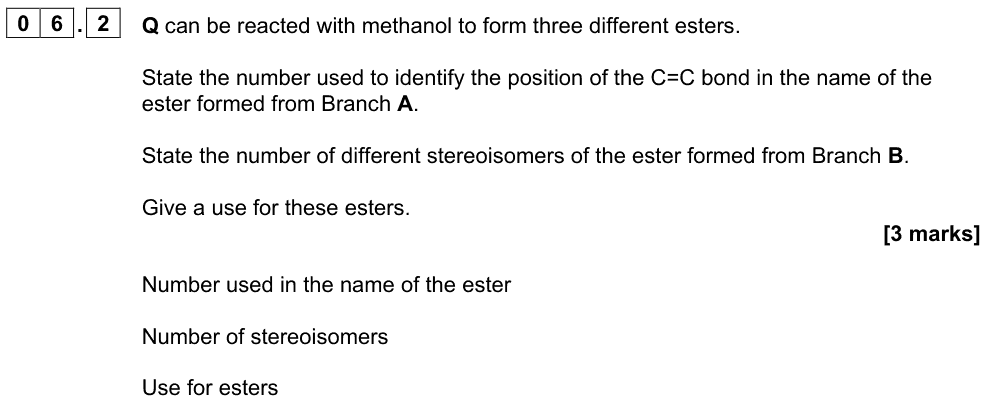
Q can be reacted with methanol to form three different esters.
State the number used to identify the position of the C=C bond in the name of the
ester formed from Branch A.
State the number of different stereoisomers of the ester formed from Branch B.
Give a use for these esters.
[3 marks]
Number used in the name of the ester
Number of stereoisomers
Use for esters
June 2025 · Paper 3 · Q06.3 2 marks AO1=1, AO2=1 Short answer Hard carboxylic acids and derivatives
Earlier part of question 06 that this part usesEarlier part of June 2025 Paper 3 question 06
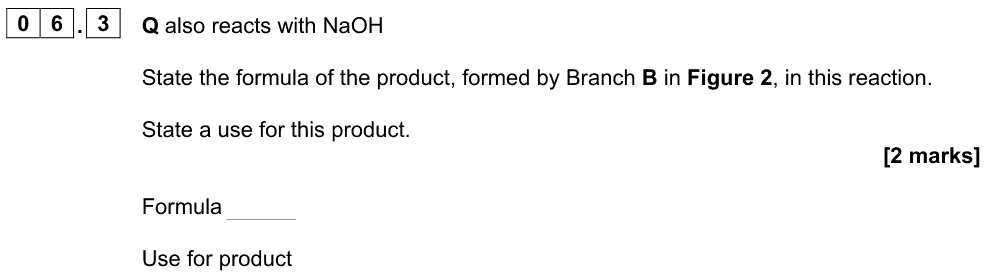
Q also reacts with NaOH
State the formula of the product, formed by Branch B in Figure 2, in this reaction.
State a use for this product.
[2 marks]
Formula
Use for product
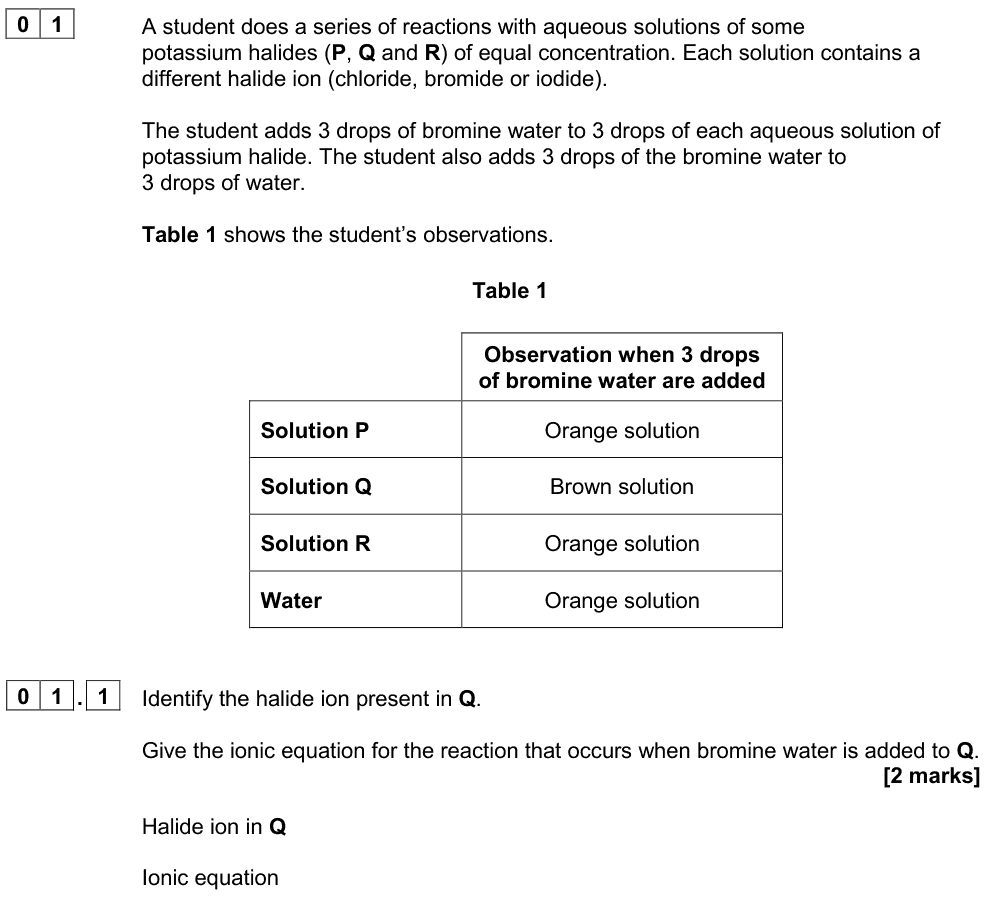
June 2024 · AS Paper 1 · Q01.1 2 marks AO3=2 Short answer Hard group 7 the halogensamount of substance
A student does a series of reactions with aqueous solutions of some
potassium halides (P, Q and R) of equal concentration. Each solution contains a
different halide ion (chloride, bromide or iodide).
The student adds 3 drops of bromine water to 3 drops of each aqueous solution of
potassium halide. The student also adds 3 drops of the bromine water to
3 drops of water.
Table 1 shows the student’s observations.
Table 1
Observation when 3 drops
of bromine water are added
Solution P
Orange solution
Solution Q
Brown solution
Solution R
Orange solution
Water
Orange solution
Identify the halide ion present in Q.
Give the ionic equation for the reaction that occurs when bromine water is added to Q.
[2 marks]
Halide ion in Q
Ionic equation
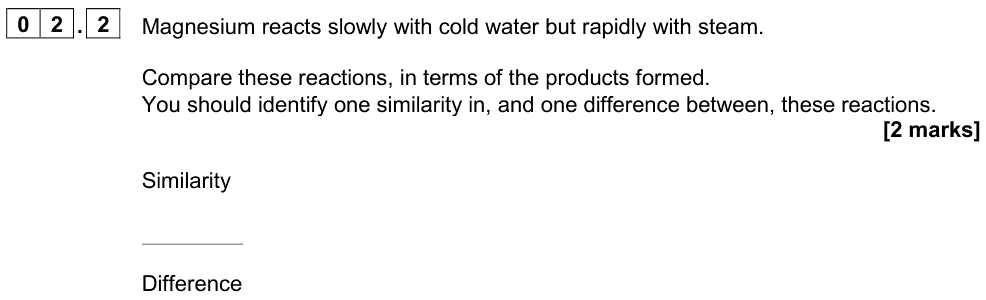
June 2024 · AS Paper 1 · Q02.2 2 marks AO1=2 Short answer group 2
Earlier part of question 02 that this part usesEarlier part of June 2024 Paper 1 question 02
Magnesium reacts slowly with cold water but rapidly with steam.
Compare these reactions, in terms of the products formed.
You should identify one similarity in, and one difference between, these reactions.
[2 marks]
Similarity
Difference
June 2024 · AS Paper 1 · Q03.1 1 mark AO1=1 Short answer bonding
This question is about structure and bonding.
Define electronegativity.
[1 mark]
June 2024 · AS Paper 1 · Q06.1 1 mark AO1=1 Short answer atomic structure
This question is about atomic structure and mass spectrometry.
Give the full electron configuration for Br
[1 mark]
June 2024 · AS Paper 1 · Q06.4 1 mark AO1=1 Short answer atomic structure
Earlier part of question 06 that this part usesEarlier part of June 2024 Paper 1 question 06
State how the detector enables the relative abundance of each ion to be determined.
[1 mark]
June 2024 · AS Paper 1 · Q08.1 2 marks AO1=2 Short answer Hard energetics
This question is about silver nitrate.
Define standard enthalpy of formation.
[2 marks]
June 2024 · AS Paper 1 · Q09.1 1 mark AO1=1 Short answer Easy redox
This question is about redox reactions.
State, in terms of electrons, the meaning of the term oxidising agent.
[1 mark]
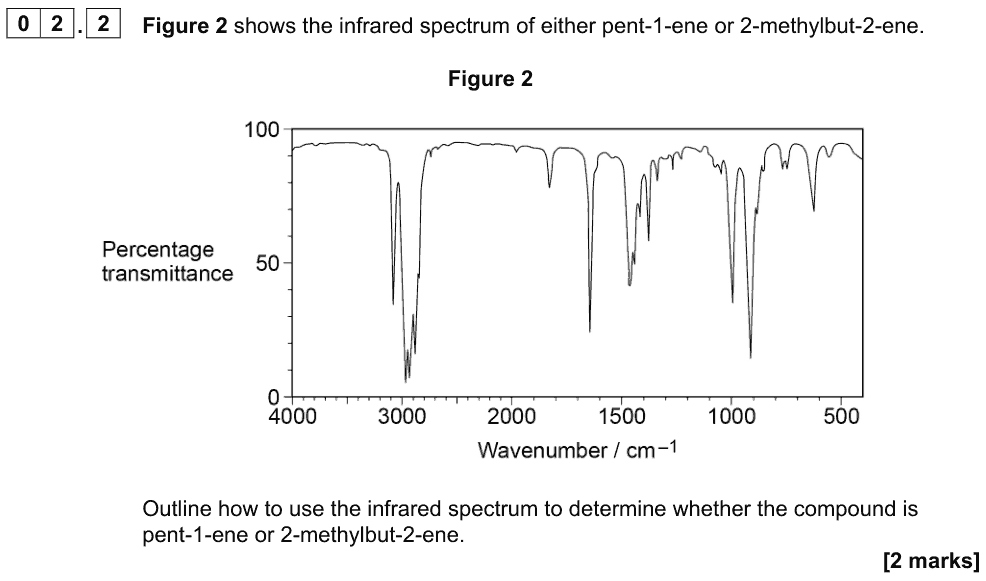
June 2024 · AS Paper 2 · Q02.2 2 marks AO1=2 Short answer organic analysis
Earlier part of question 02 that this part usesEarlier part of June 2024 Paper 2 question 02
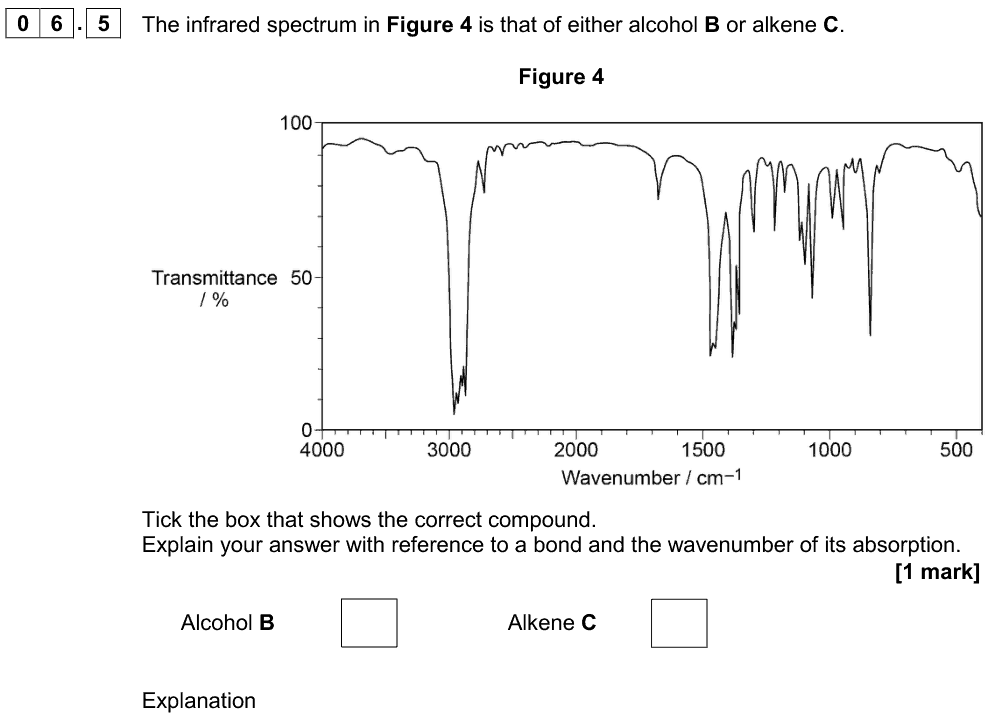
Figure 2 shows the infrared spectrum of either pent-1-ene or 2-methylbut-2-ene.
Figure 2
Outline how to use the infrared spectrum to determine whether the compound is
pent-1-ene or 2-methylbut-2-ene.
[2 marks]
June 2024 · AS Paper 2 · Q02.3 1 mark AO1=1 Short answer organic analysis
Earlier part of question 02 that this part usesEarlier part of June 2024 Paper 2 question 02
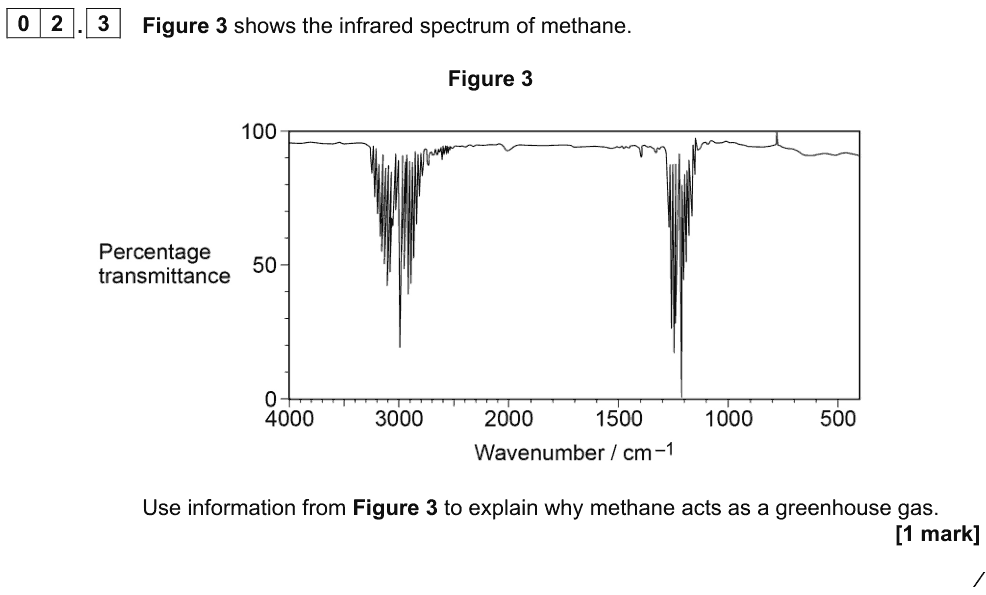
Figure 3 shows the infrared spectrum of methane.
Figure 3
Use information from Figure 3 to explain why methane acts as a greenhouse gas.
[1 mark]
June 2024 · AS Paper 2 · Q03.1 1 mark AO1=1 Short answer introduction to organic chemistry
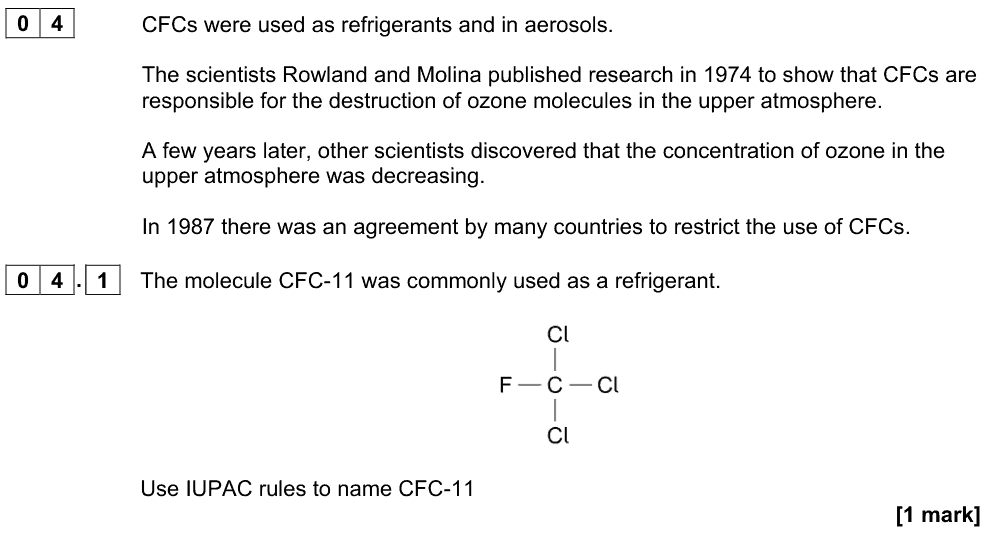
This question is about CFCl3
CFCl3 used to be the propellant in most aerosol cans.
Use IUPAC rules to name CFCl3
[1 mark]
June 2024 · AS Paper 2 · Q03.5 1 mark AO1=1 Short answer halogenoalkanes
Earlier part of question 03 that this part usesEarlier part of June 2024 Paper 2 question 03
The production and use of CFCs have been banned in many countries because they
decrease the amount of ozone in the upper atmosphere.
State why ozone in the upper atmosphere is important for life on Earth.
[1 mark]
June 2024 · AS Paper 2 · Q06.1 1 mark AO2=1 Short answer group 7 the halogens
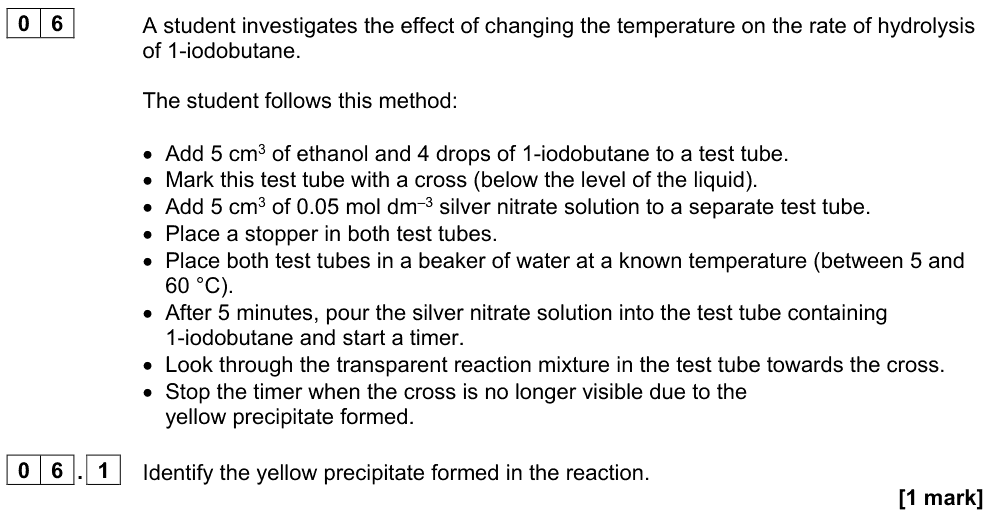
A student investigates the effect of changing the temperature on the rate of hydrolysis
of 1-iodobutane.
The student follows this method:
• Add 5 cm3 of ethanol and 4 drops of 1-iodobutane to a test tube.
• Mark this test tube with a cross (below the level of the liquid).
• Add 5 cm3 of 0.05 mol dm–3 silver nitrate solution to a separate test tube.
• Place a stopper in both test tubes.
• Place both test tubes in a beaker of water at a known temperature (between 5 and
60 °C).
• After 5 minutes, pour the silver nitrate solution into the test tube containing
1-iodobutane and start a timer.
• Look through the transparent reaction mixture in the test tube towards the cross.
• Stop the timer when the cross is no longer visible due to the
yellow precipitate formed.
Identify the yellow precipitate formed in the reaction.
[1 mark]
June 2024 · AS Paper 2 · Q07.1 1 mark AO1=1 Short answer alcohols
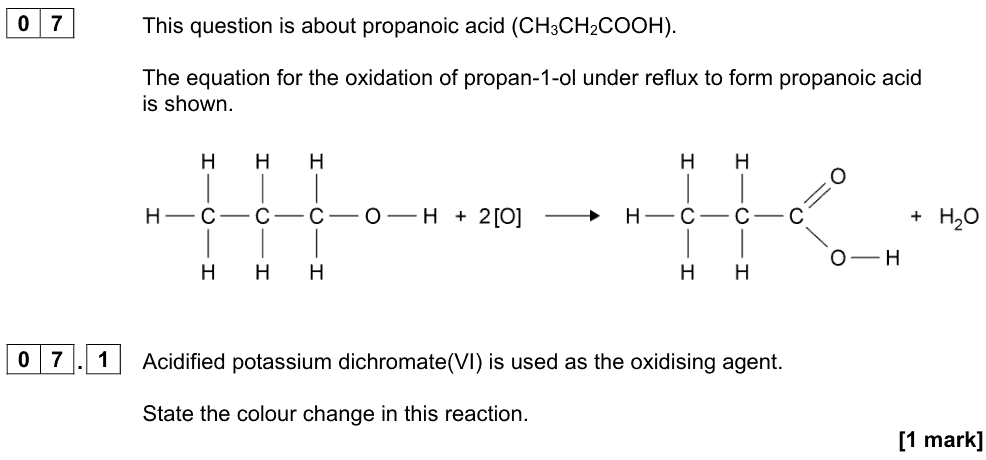
This question is about propanoic acid (CH3CH2COOH).
The equation for the oxidation of propan-1-ol under reflux to form propanoic acid
is shown.
Acidified potassium dichromate(VI) is used as the oxidising agent.
State the colour change in this reaction.
[1 mark]
June 2024 · AS Paper 2 · Q07.2 1 mark AO2=1 Short answer alcohols
Earlier part of question 07 that this part usesEarlier part of June 2024 Paper 2 question 07
A second organic product, X, is formed in small quantities.
The boiling point of X is 49 °C
Identify X.
[1 mark]
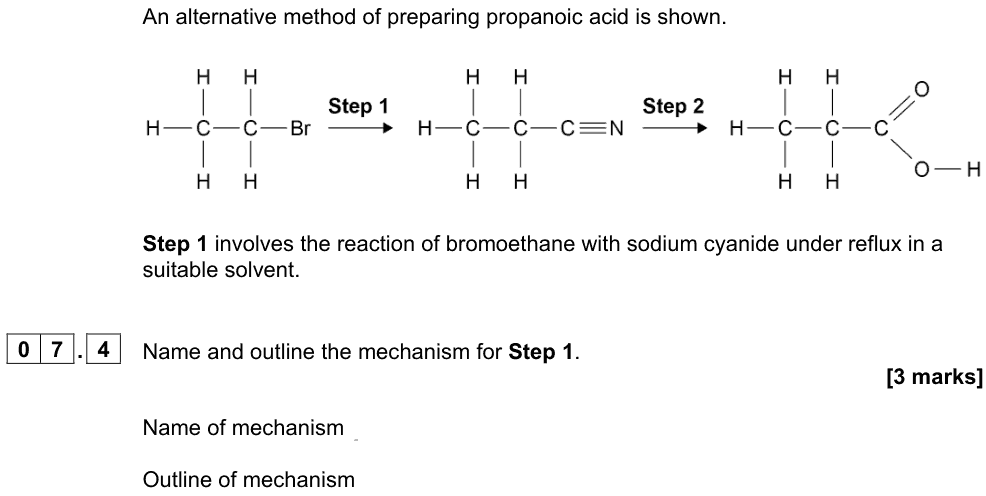
June 2024 · AS Paper 2 · Q07.5 1 mark AO3=1 Short answer halogenoalkanes
Earlier parts of question 07 that this part usesEarlier part of June 2024 Paper 2 question 07Earlier part of June 2024 Paper 2 question 07
Suggest one reason why water is not a suitable solvent for Step 1.
[1 mark]
June 2024 · AS Paper 2 · Q07.6 1 mark AO2=1 Short answer chemical equilibria and kc
Earlier parts of question 07 that this part usesEarlier part of June 2024 Paper 2 question 07Earlier part of June 2024 Paper 2 question 07
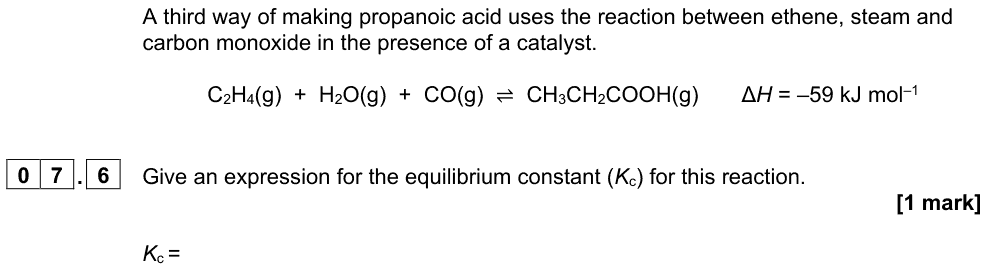
A third way of making propanoic acid uses the reaction between ethene, steam and
carbon monoxide in the presence of a catalyst.
C2H4(g)  +  H2O(g)  +  CO(g)  ⇌  CH3CH2COOH(g)       ΔH = –59 kJ mol–1
Give an expression for the equilibrium constant (Kc) for this reaction.
[1 mark]
Kc =
June 2024 · Paper 1 · Q01.1 3 marks AO1=3 Short answer atomic structure
This question is about atomic structure.
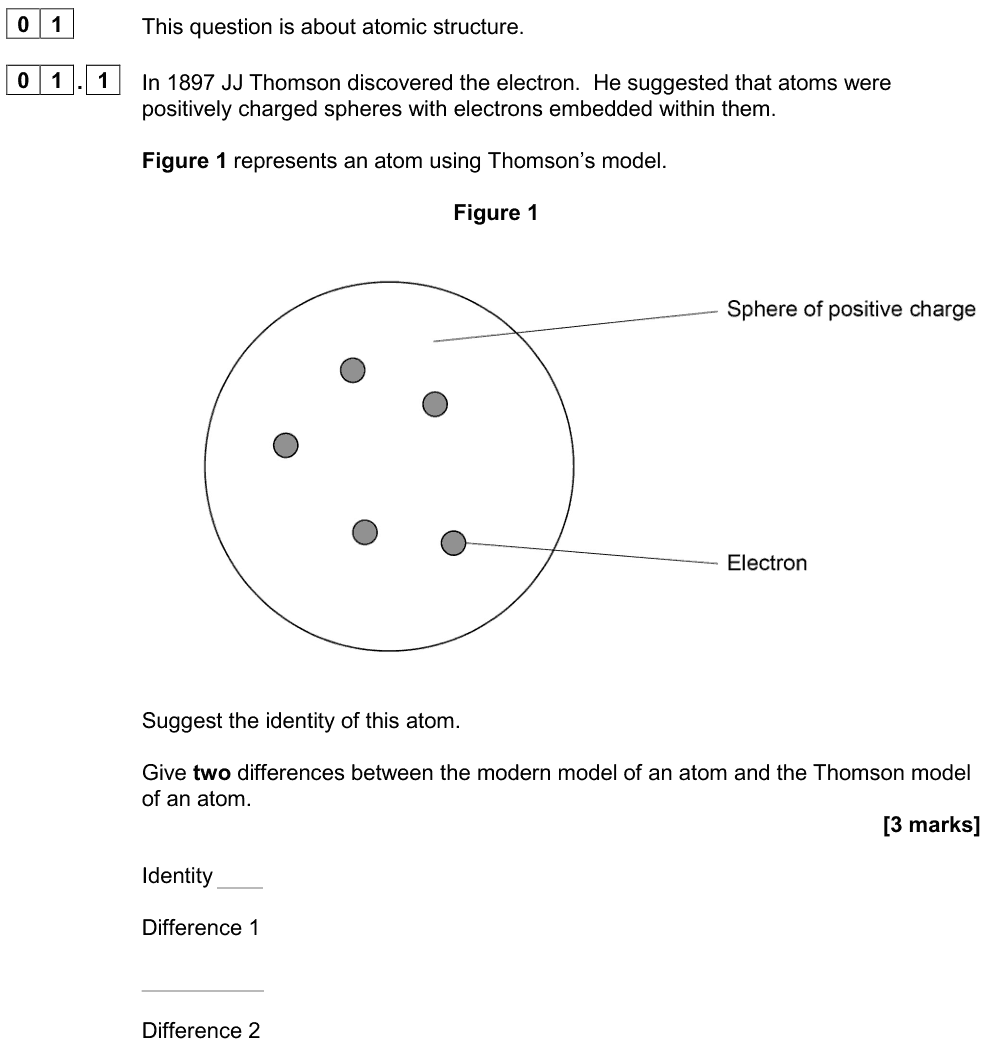
In 1897 JJ Thomson discovered the electron.  He suggested that atoms were
positively charged spheres with electrons embedded within them.
Figure 1 represents an atom using Thomson’s model.
Figure 1
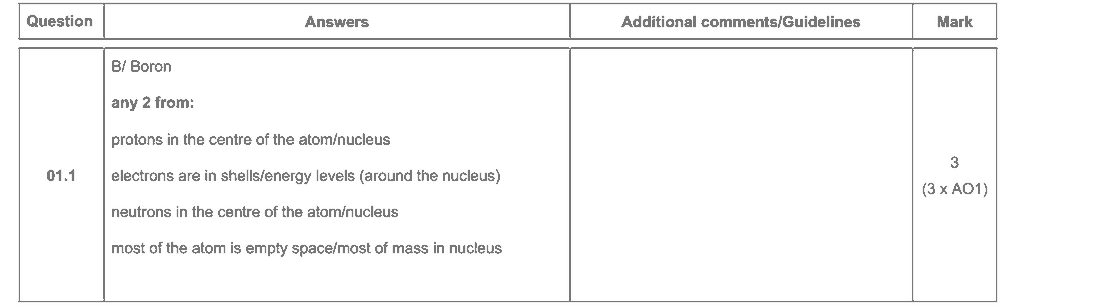
Suggest the identity of this atom.
Give two differences between the modern model of an atom and the Thomson model
of an atom.
[3 marks]
Identity
Difference 1
Difference 2
June 2024 · Paper 1 · Q01.2 3 marks AO1=2, AO3=1 Short answer amount of substanceatomic structure
Earlier part of question 01 that this part usesEarlier part of June 2024 Paper 1 question 01
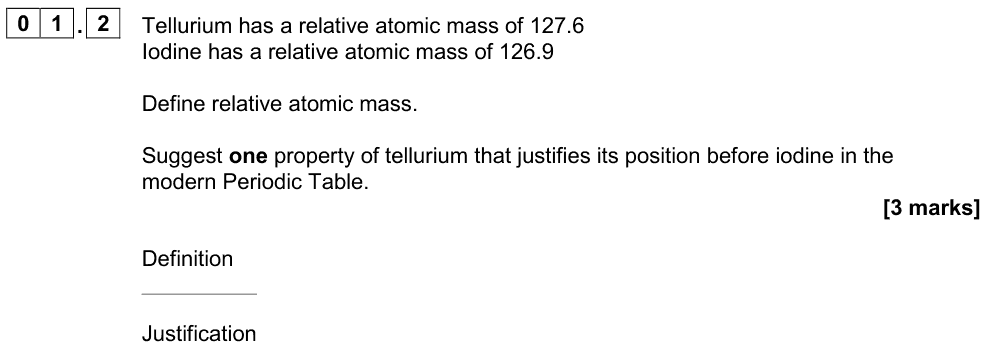
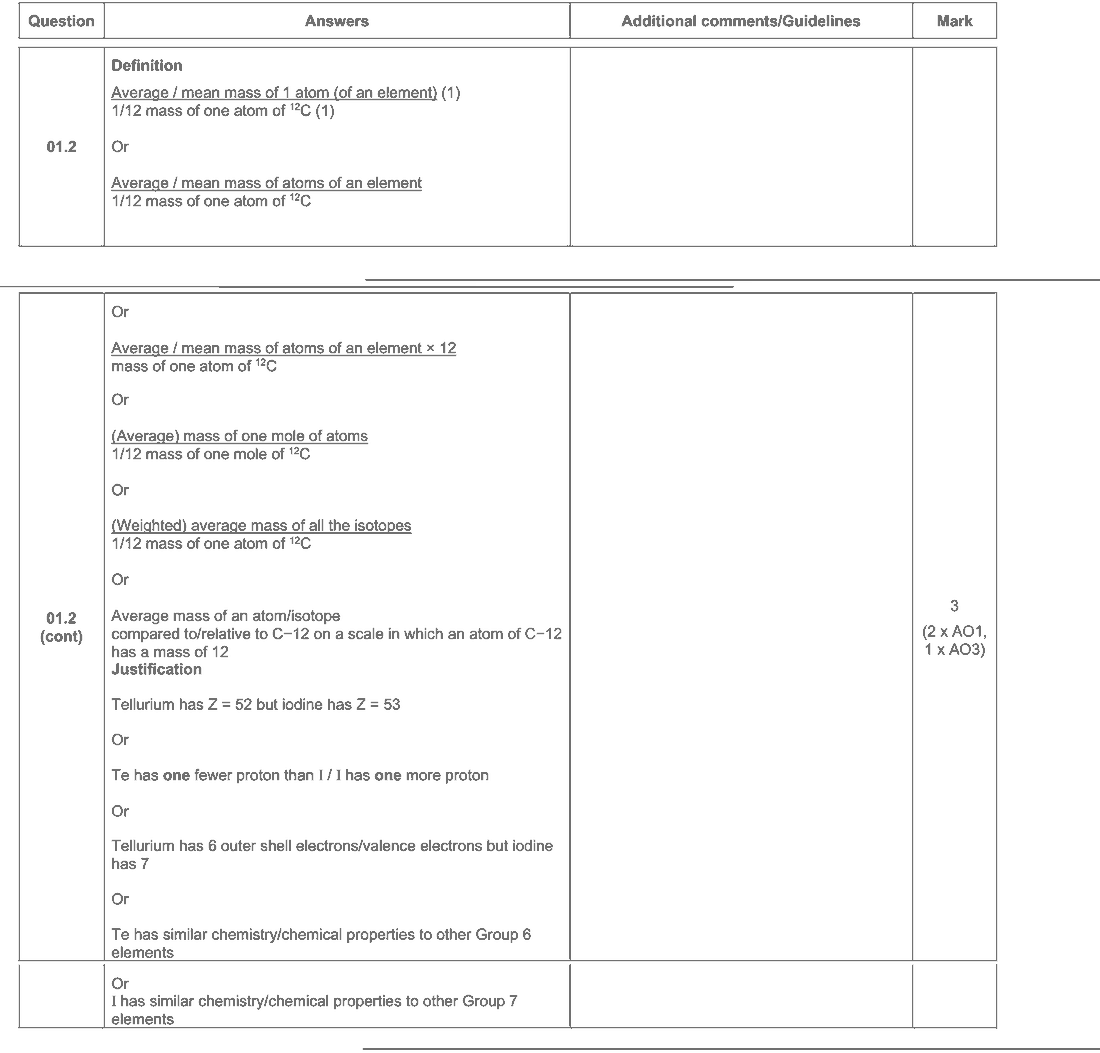
Tellurium has a relative atomic mass of 127.6
Iodine has a relative atomic mass of 126.9
Define relative atomic mass.
Suggest one property of tellurium that justifies its position before iodine in the
modern Periodic Table.
[3 marks]
Definition
Justification
June 2024 · Paper 1 · Q01.5 1 mark AO1=1 Short answer atomic structure
Earlier part of question 01 that this part usesEarlier part of June 2024 Paper 1 question 01
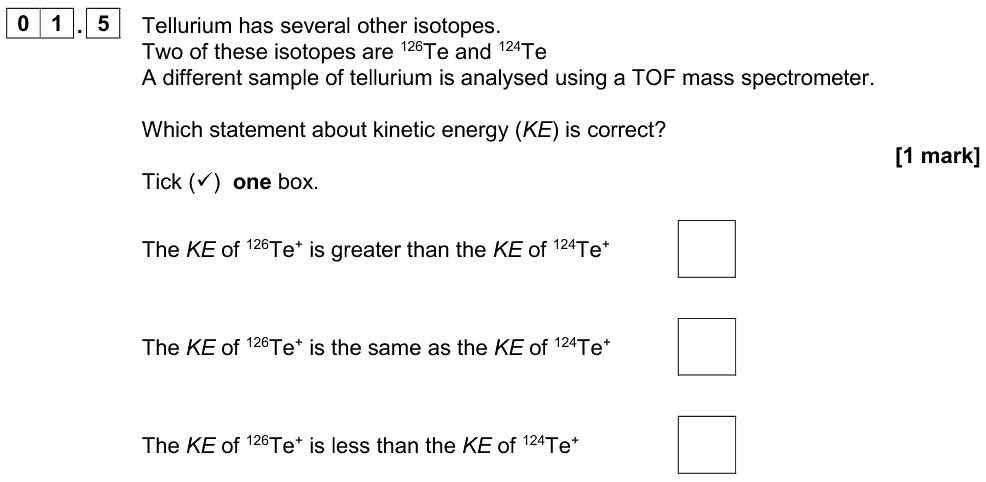
Tellurium has several other isotopes.
Two of these isotopes are 126Te and 124Te
A different sample of tellurium is analysed using a TOF mass spectrometer.
Which statement about kinetic energy (KE) is correct?
[1 mark]
Tick ()  one box.
The KE of 126Te+ is greater than the KE of 124Te+
The KE of 126Te+ is the same as the KE of 124Te+
The KE of 126Te+ is less than the KE of 124Te+
June 2024 · Paper 1 · Q03.4 1 mark AO2=1 Short answer reactions of ions in aqueous solution
Earlier part of question 03 that this part usesEarlier part of June 2024 Paper 1 question 03
A student adds dilute ammonia solution to a solution containing [Fe(H2O)6]2+ ions.
Give the formula of the precipitate that forms.
[1 mark]
June 2024 · Paper 1 · Q04.2 1 mark AO1=1 Short answer equilibrium constant kp
Earlier part of question 04 that this part usesEarlier part of June 2024 Paper 1 question 04
State why the equilibrium constant (Kp) for this reaction has no units.
[1 mark]
June 2024 · Paper 1 · Q04.3 1 mark AO1=1 Short answer chemical equilibria and kcequilibrium constant kp
Earlier part of question 04 that this part usesEarlier part of June 2024 Paper 1 question 04
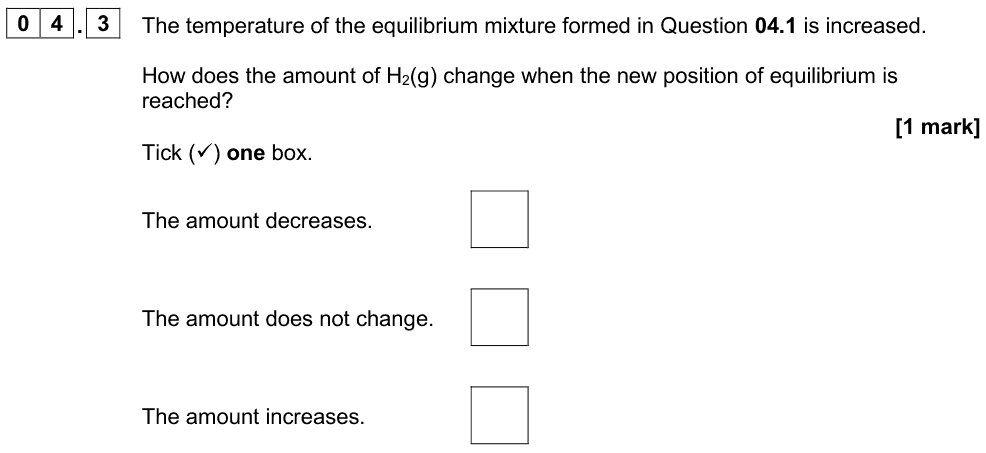
The temperature of the equilibrium mixture formed in Question 04.1 is increased.
How does the amount of H2(g) change when the new position of equilibrium is
reached?
[1 mark]
Tick () one box.
The amount decreases.
The amount does not change.
The amount increases.
June 2024 · Paper 1 · Q04.5 1 mark AO1=1 Short answer Easy equilibrium constant kp
Earlier parts of question 04 that this part usesEarlier part of June 2024 Paper 1 question 04Earlier part of June 2024 Paper 1 question 04
State the effect, if any, of an increase in volume of the container on the value of Kp for
this reaction at a constant temperature.
[1 mark]
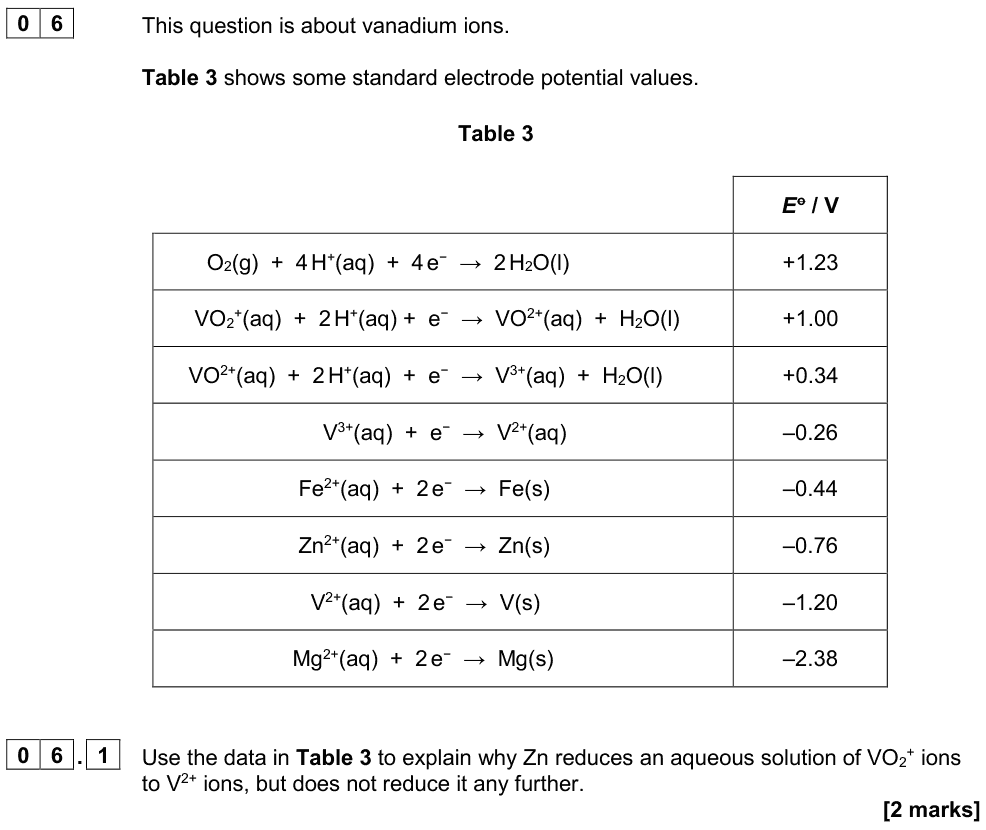
June 2024 · Paper 1 · Q06.2 1 mark AO3=1 Short answer electrode potentials and cells
Earlier part of question 06 that this part usesEarlier part of June 2024 Paper 1 question 06
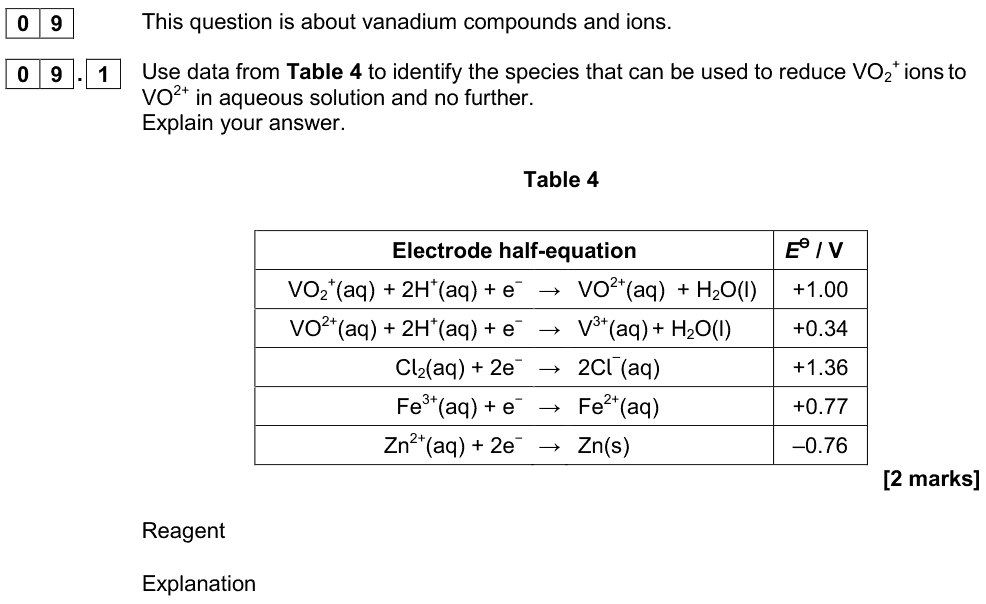
Identify the species in Table 3 that can reduce an aqueous solution of VO2+ to V
[1 mark]
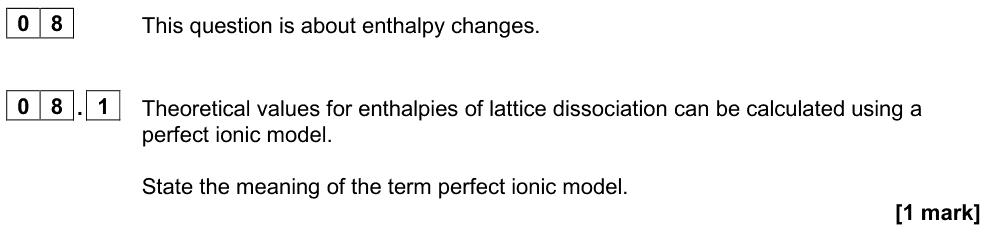
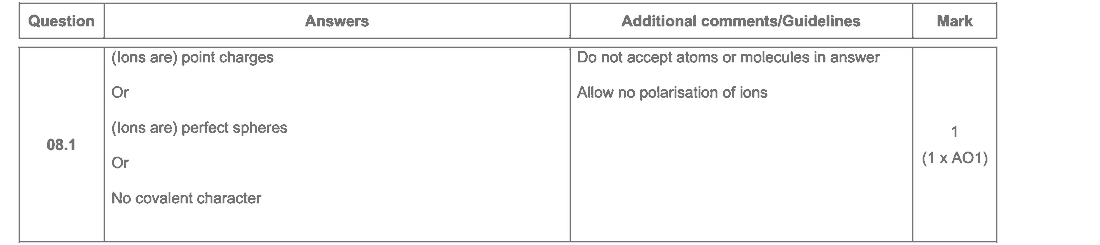
June 2024 · Paper 1 · Q08.1 1 mark AO1=1 Short answer thermodynamics
This question is about enthalpy changes.
Theoretical values for enthalpies of lattice dissociation can be calculated using a
perfect ionic model.
State the meaning of the term perfect ionic model.
[1 mark]
June 2024 · Paper 1 · Q08.7 1 mark AO3=1 Short answer period 3 elements and oxides
Earlier part of question 08 that this part usesEarlier part of June 2024 Paper 1 question 08
Give a reason why data books do not contain a value for the enthalpy of solution of
sodium oxide.
[1 mark]
June 2024 · Paper 1 · Q09.1 1 mark AO3=1 Short answer group 2
This question is about metals and their compounds.
State why the atomic radius of calcium is greater than the atomic radius of
magnesium.
[1 mark]
June 2024 · Paper 1 · Q09.8 1 mark AO1=1 Short answer electrode potentials and cells
Earlier part of question 09 that this part usesEarlier part of June 2024 Paper 1 question 09
Commercial electrochemical cells can be rechargeable or non-rechargeable.
State why lithium cells can be recharged.
[1 mark]
June 2024 · Paper 2 · Q01.4 1 mark AO2=1 Short answer rate equations
Earlier part of question 01 that this part usesEarlier part of June 2024 Paper 2 question 01
Use evidence from the rate equation to explain why Step 1 is the
rate determining step.
[1 mark]
June 2024 · Paper 2 · Q03.2 1 mark AO3=1 Short answer nmr spectroscopy
Earlier part of question 03 that this part usesEarlier part of June 2024 Paper 2 question 03
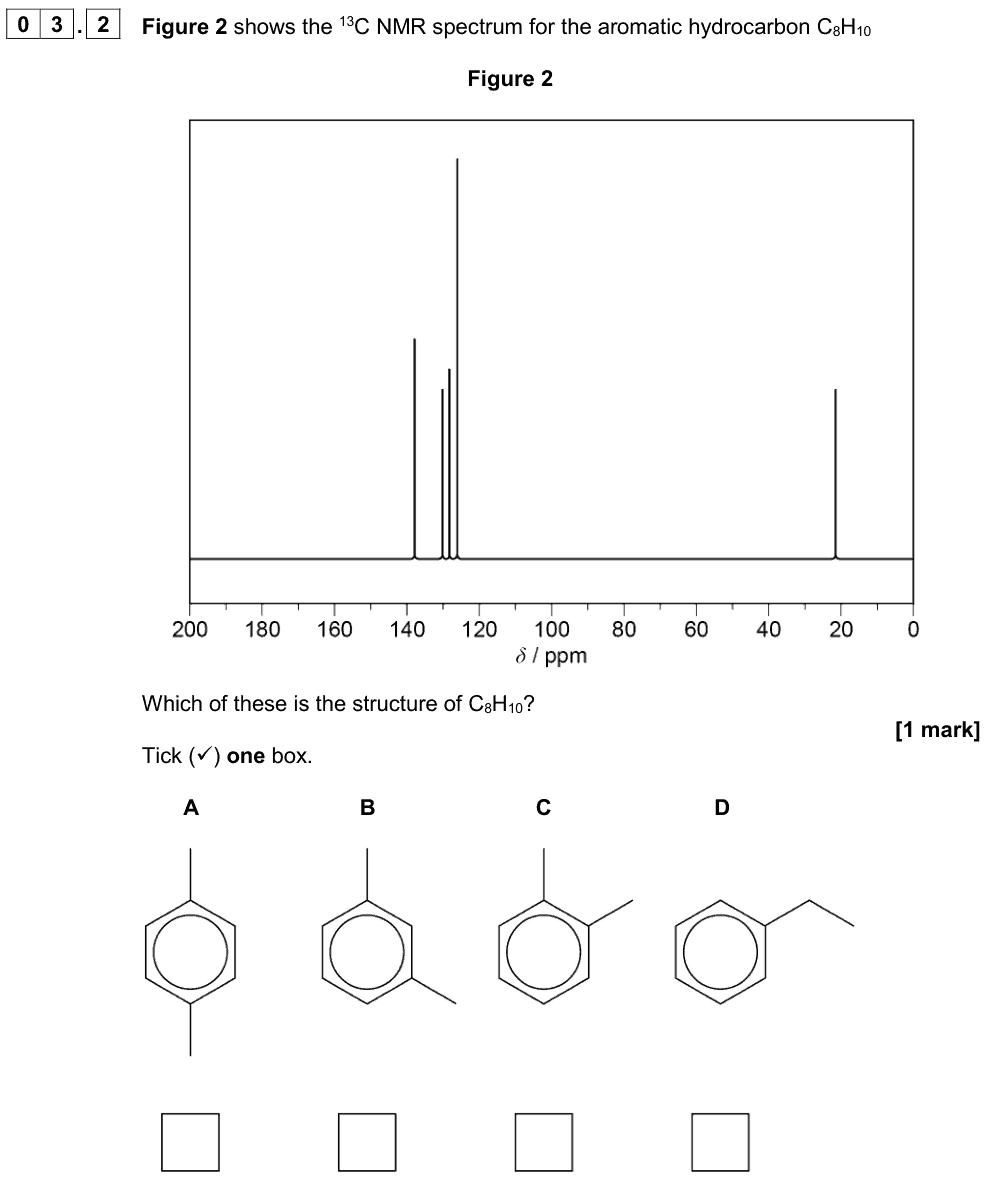
Figure 2 shows the 13C NMR spectrum for the aromatic hydrocarbon C8H10
Figure 2
Which of these is the structure of C8H10?
[1 mark]
Tick () one box.
A
B
C
D
June 2024 · Paper 2 · Q03.3 1 mark AO1=1 Short answer Easy alkanes
Earlier part of question 03 that this part usesEarlier part of June 2024 Paper 2 question 03
Cracking can also be done without a catalyst, using a temperature of 1200 K and a
pressure of 7000 kPa
State the type of product that is formed in high percentage in this type of cracking.
[1 mark]
June 2024 · Paper 2 · Q03.5 2 marks AO1=2 Short answer alkanes
Earlier part of question 03 that this part usesEarlier part of June 2024 Paper 2 question 03
Natural gas is used in power stations to produce electricity.
Natural gas contains sulfur impurities.  Sulfur dioxide forms when these impurities are
burned.
State an environmental problem caused by sulfur dioxide.
Give the formula of a compound that is used to help remove sulfur dioxide from the
combustion products.
[2 marks]
Environmental problem
Formula of compound
June 2024 · Paper 2 · Q04.4 1 mark AO1=1 Short answer carboxylic acids and derivatives
Earlier parts of question 04 that this part usesEarlier part of June 2024 Paper 2 question 04Earlier part of June 2024 Paper 2 question 04
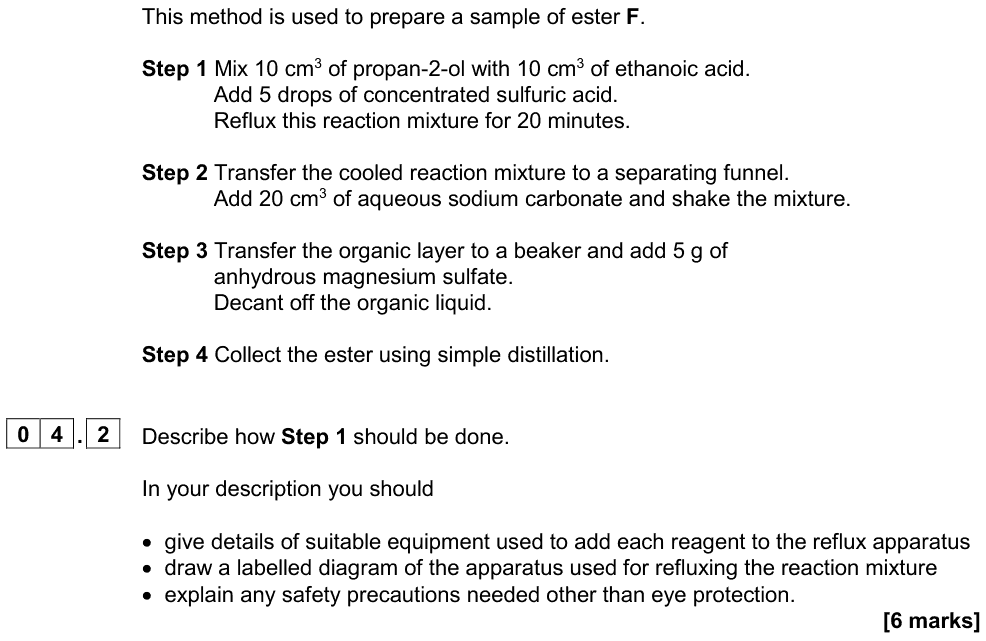
Give the reason for the use of anhydrous magnesium sulfate in Step 3.
[1 mark]
June 2024 · Paper 2 · Q04.5 1 mark AO1=1 Short answer Hard carboxylic acids and derivatives
Earlier parts of question 04 that this part usesEarlier part of June 2024 Paper 2 question 04Earlier part of June 2024 Paper 2 question 04
Suggest how the purity of the ester can be confirmed during the distillation in Step 4.
[1 mark]
June 2024 · Paper 2 · Q08.1 2 marks AO1=2 Short answer Easy alkenes
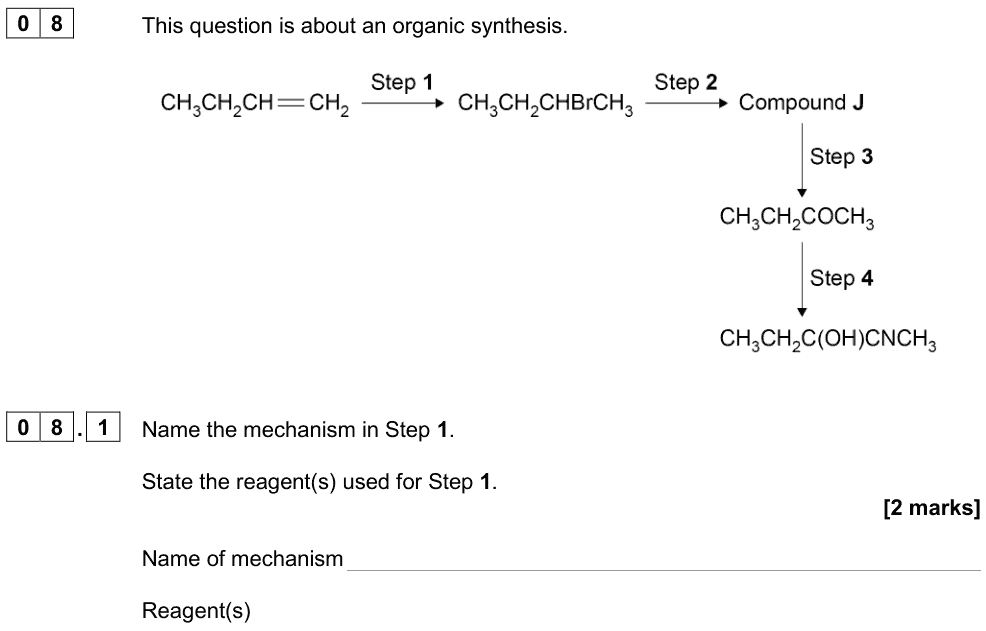
This question is about an organic synthesis.
Name the mechanism in Step 1.
State the reagent(s) used for Step 1.
[2 marks]
Name of mechanism
Reagent(s)
June 2024 · Paper 2 · Q08.2 2 marks AO1=1, AO2=1 Short answer halogenoalkanesorganic synthesis
Earlier part of question 08 that this part usesEarlier part of June 2024 Paper 2 question 08
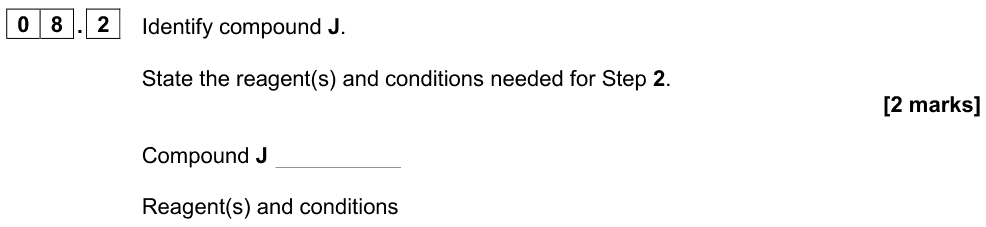
Identify compound J.
State the reagent(s) and conditions needed for Step 2.
[2 marks]
Compound J
Reagent(s) and conditions
June 2024 · Paper 2 · Q09.1 2 marks AO1=1, AO2=1 Short answer aminesintroduction to organic chemistry
This question is about amines.
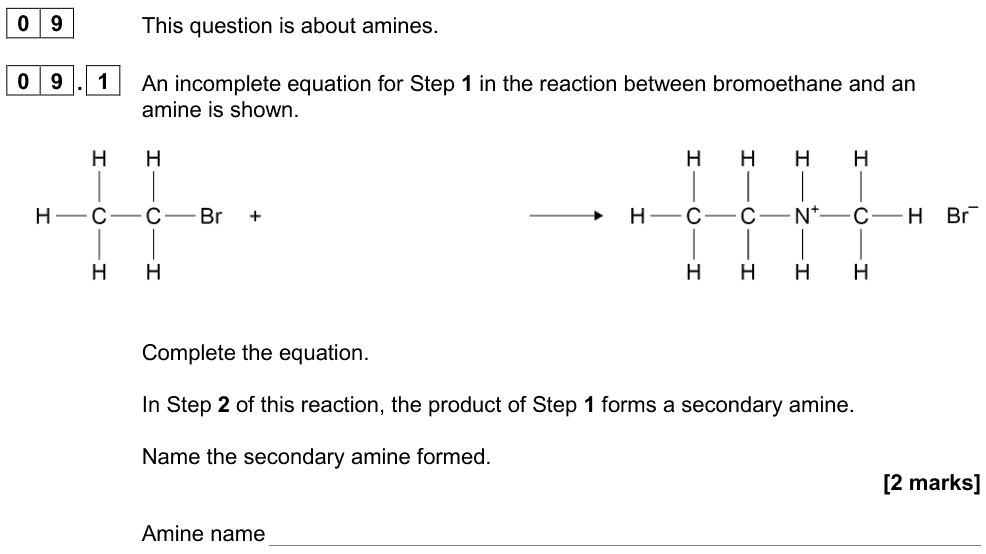
An incomplete equation for Step 1 in the reaction between bromoethane and an
amine is shown.
Complete the equation.
In Step 2 of this reaction, the product of Step 1 forms a secondary amine.
Name the secondary amine formed.
[2 marks]
Amine name
June 2024 · Paper 2 · Q10.4 1 mark AO1=1 Short answer amines
Earlier parts of question 10 that this part usesEarlier part of June 2024 Paper 2 question 10Earlier part of June 2024 Paper 2 question 10
State the reagent(s) needed for Step 2.
[1 mark]
June 2024 · Paper 2 · Q10.5 1 mark AO1=1 Short answer Hard amines
Earlier parts of question 10 that this part usesEarlier part of June 2024 Paper 2 question 10Earlier part of June 2024 Paper 2 question 10
State a possible use for the amine formed in Step 2.
[1 mark]
June 2024 · Paper 3 · Q01.2 1 mark AO1=1 Short answer carboxylic acids and derivatives
Earlier part of question 01 that this part usesEarlier part of June 2024 Paper 3 question 01
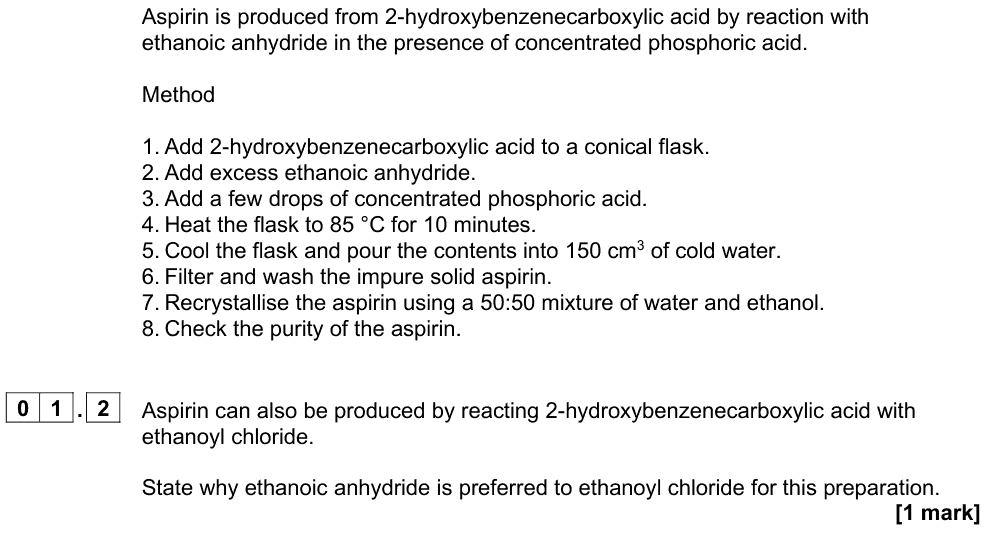
Aspirin is produced from 2-hydroxybenzenecarboxylic acid by reaction with
ethanoic anhydride in the presence of concentrated phosphoric acid.
Method
1. Add 2-hydroxybenzenecarboxylic acid to a conical flask.
2. Add excess ethanoic anhydride.
3. Add a few drops of concentrated phosphoric acid.
4. Heat the flask to 85 °C for 10 minutes.
5. Cool the flask and pour the contents into 150 cm3 of cold water.
6. Filter and wash the impure solid aspirin.
7. Recrystallise the aspirin using a 50:50 mixture of water and ethanol.
8. Check the purity of the aspirin.
Aspirin can also be produced by reacting 2-hydroxybenzenecarboxylic acid with
ethanoyl chloride.
State why ethanoic anhydride is preferred to ethanoyl chloride for this preparation.
[1 mark]
June 2024 · Paper 3 · Q01.3 1 mark AO1=1 Short answer carboxylic acids and derivatives
Earlier parts of question 01 that this part usesEarlier part of June 2024 Paper 3 question 01Earlier part of June 2024 Paper 3 question 01
Give the name of the mechanism for the reaction of
2-hydroxybenzenecarboxylic acid with ethanoic anhydride.
[1 mark]
June 2024 · Paper 3 · Q01.4 1 mark AO3=1 Short answer kinetics
Earlier parts of question 01 that this part usesEarlier part of June 2024 Paper 3 question 01Earlier part of June 2024 Paper 3 question 01
Suggest the role of the concentrated phosphoric acid.
[1 mark]
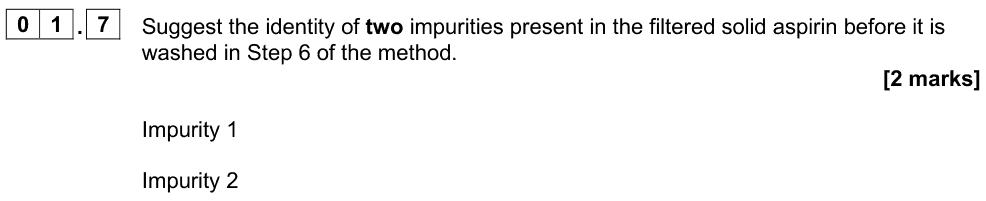
June 2024 · Paper 3 · Q01.7 2 marks AO3=2 Short answer carboxylic acids and derivatives
Earlier parts of question 01 that this part usesEarlier part of June 2024 Paper 3 question 01Earlier part of June 2024 Paper 3 question 01
Suggest the identity of two impurities present in the filtered solid aspirin before it is
washed in Step 6 of the method.
[2 marks]
Impurity 1
Impurity 2
June 2024 · Paper 3 · Q02.5 1 mark AO3=1 Short answer rate equations
Earlier parts of question 02 that this part usesEarlier part of June 2024 Paper 3 question 02Earlier part of June 2024 Paper 3 question 02
State how the graph in Figure 2 confirms that the rate equation for this reaction is
Rate = k[HCl]
[1 mark]
June 2024 · Paper 3 · Q03.2 2 marks AO1=2 Short answer rate equations
Earlier part of question 03 that this part usesEarlier part of June 2024 Paper 3 question 03
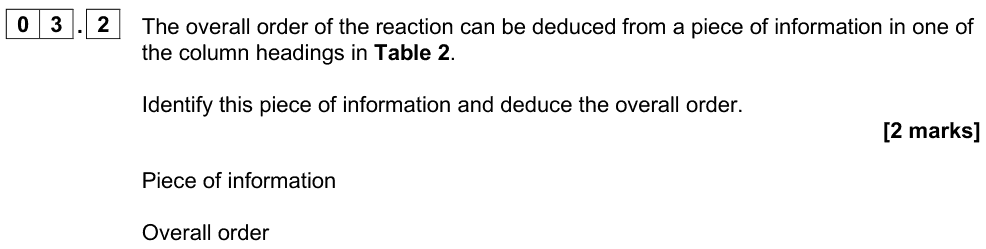
The overall order of the reaction can be deduced from a piece of information in one of
the column headings in Table 2.
Identify this piece of information and deduce the overall order.
[2 marks]
Piece of information
Overall order
June 2024 · Paper 3 · Q03.5 2 marks AO2=2 Short answer introduction to organic chemistryaldehydes and ketones
Earlier part of question 03 that this part usesEarlier part of June 2024 Paper 3 question 03
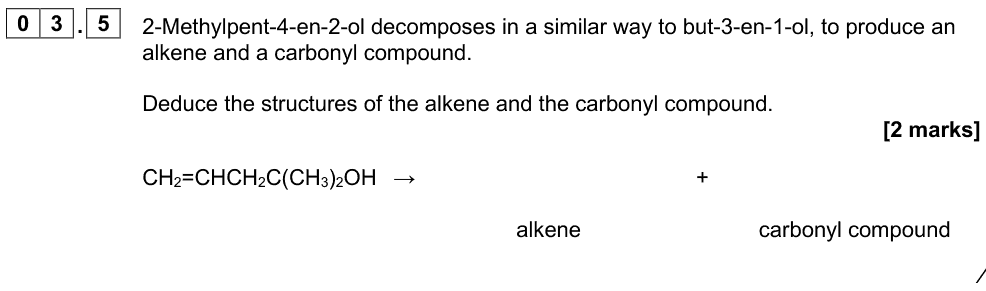
2-Methylpent-4-en-2-ol decomposes in a similar way to but-3-en-1-ol, to produce an
alkene and a carbonyl compound.
Deduce the structures of the alkene and the carbonyl compound.
[2 marks]
CH2=CHCH2C(CH3)2OH →
+
alkene
carbonyl compound
June 2024 · Paper 3 · Q04.1 1 mark AO1=1 Short answer Easy acids and bases
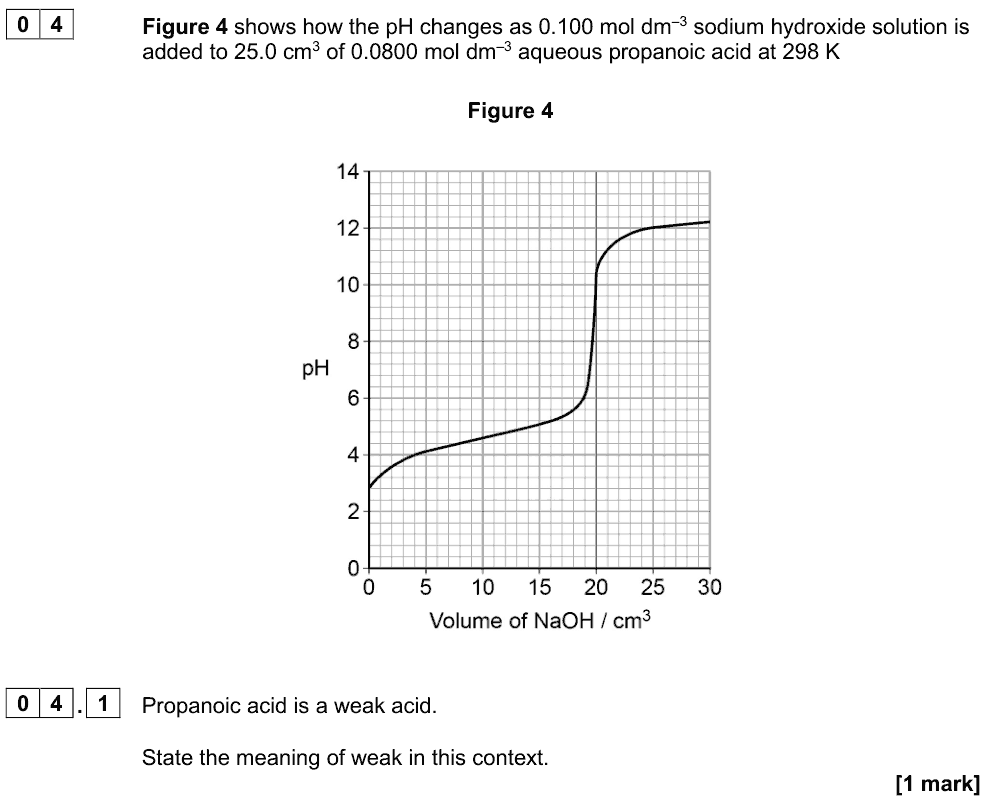
Figure 4 shows how the pH changes as 0.100 mol dm–3 sodium hydroxide solution is
added to 25.0 cm3 of 0.0800 mol dm–3 aqueous propanoic acid at 298 K
Figure 4
Propanoic acid is a weak acid.
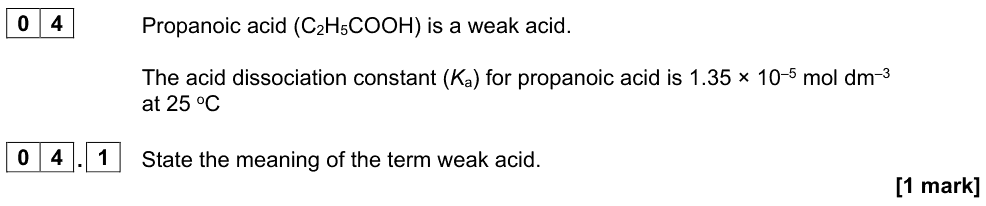
State the meaning of weak in this context.
[1 mark]
June 2024 · Paper 3 · Q04.6 2 marks AO3=2 Short answer acids and bases
Earlier part of question 04 that this part usesEarlier part of June 2024 Paper 3 question 04
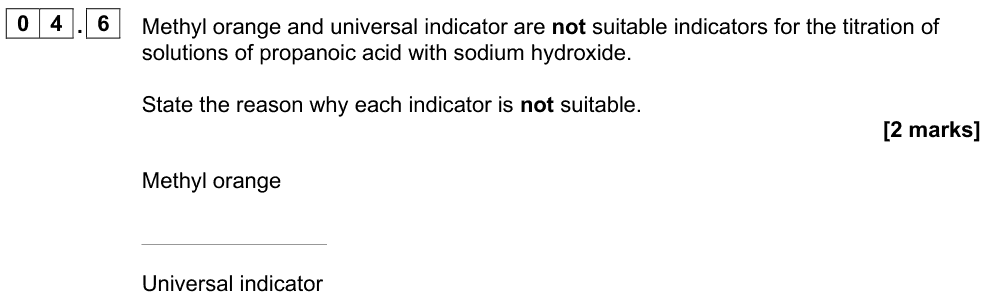
Methyl orange and universal indicator are not suitable indicators for the titration of
solutions of propanoic acid with sodium hydroxide.
State the reason why each indicator is not suitable.
[2 marks]
Methyl orange
Universal indicator
June 2023 · AS Paper 1 · Q01.1 1 mark AO1=1 Short answer atomic structureperiodicity
This question is about the elements in Period 3.
Give the full electron configuration of the element in Period 3 with the highest
first ionisation energy.
[1 mark]
June 2023 · AS Paper 1 · Q02.1 2 marks AO1=2 Short answer bonding
This question is about the elements in Group 2.
Describe the structure and bonding in magnesium.
[2 marks]
June 2023 · AS Paper 1 · Q02.2 2 marks AO1=2 Short answer group 2
Earlier part of question 02 that this part usesEarlier part of June 2023 Paper 1 question 02
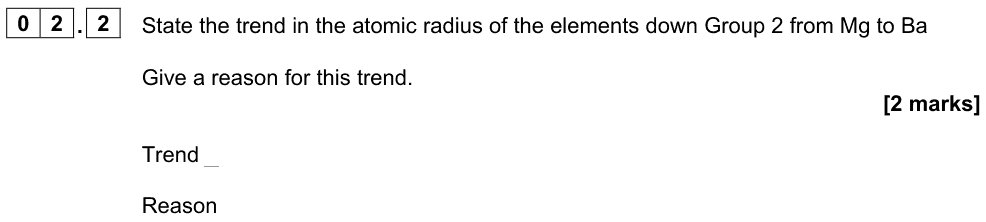
State the trend in the atomic radius of the elements down Group 2 from Mg to Ba
Give a reason for this trend.
[2 marks]
Trend
Reason
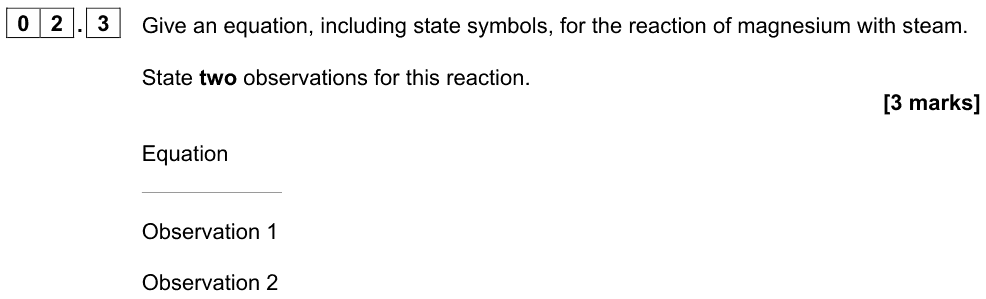
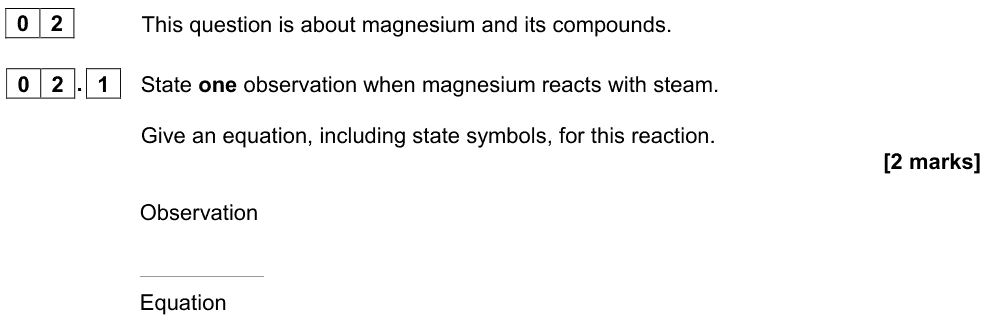
June 2023 · AS Paper 1 · Q02.3 3 marks AO1=1, AO2=2 Short answer group 2
Earlier part of question 02 that this part usesEarlier part of June 2023 Paper 1 question 02
Give an equation, including state symbols, for the reaction of magnesium with steam.
State two observations for this reaction.
[3 marks]
Equation
Observation 1
Observation 2
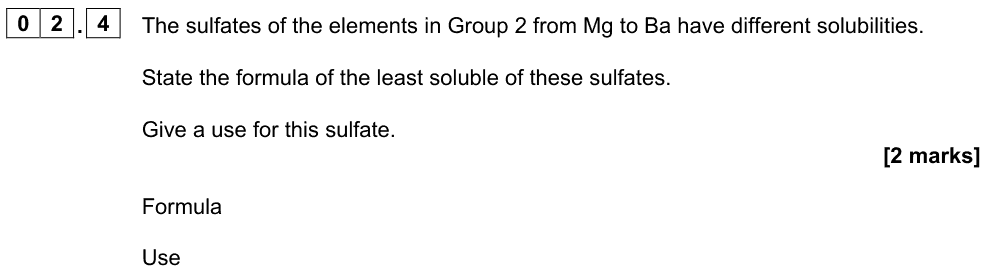
June 2023 · AS Paper 1 · Q02.4 2 marks AO1=2 Short answer group 2
Earlier part of question 02 that this part usesEarlier part of June 2023 Paper 1 question 02
The sulfates of the elements in Group 2 from Mg to Ba have different solubilities.
State the formula of the least soluble of these sulfates.
Give a use for this sulfate.
[2 marks]
Formula
Use
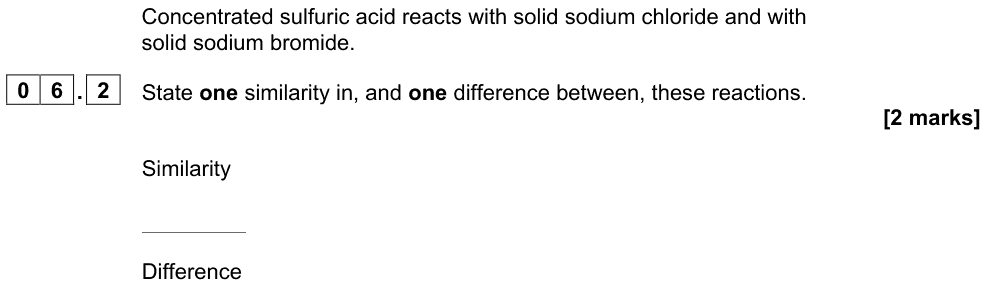
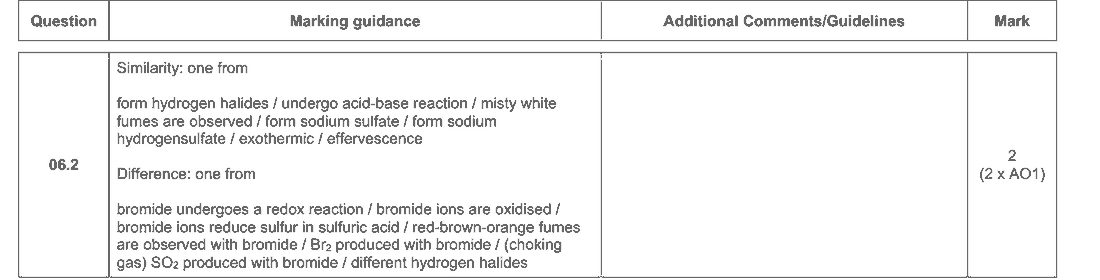
June 2023 · AS Paper 1 · Q06.2 2 marks AO1=2 Short answer group 7 the halogens
Earlier part of question 06 that this part usesEarlier part of June 2023 Paper 1 question 06
Concentrated sulfuric acid reacts with solid sodium chloride and with
solid sodium bromide.
State one similarity in, and one difference between, these reactions.
[2 marks]
Similarity
Difference
June 2023 · AS Paper 1 · Q07.2 1 mark AO1=1 Short answer atomic structure
Earlier part of question 07 that this part usesEarlier part of June 2023 Paper 1 question 07
A mixture of gases is analysed using TOF mass spectrometry.
The mixture contains argon, carbon dioxide, nitrogen and oxygen.
The mixture is ionised by electron impact.
State the meaning of the term electron impact ionisation.
[1 mark]
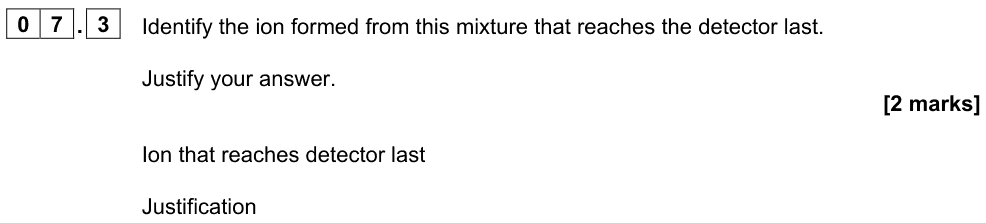
June 2023 · AS Paper 1 · Q07.3 2 marks AO3=2 Short answer atomic structure
Earlier part of question 07 that this part usesEarlier part of June 2023 Paper 1 question 07
Identify the ion formed from this mixture that reaches the detector last.
Justify your answer.
[2 marks]
Ion that reaches detector last
Justification
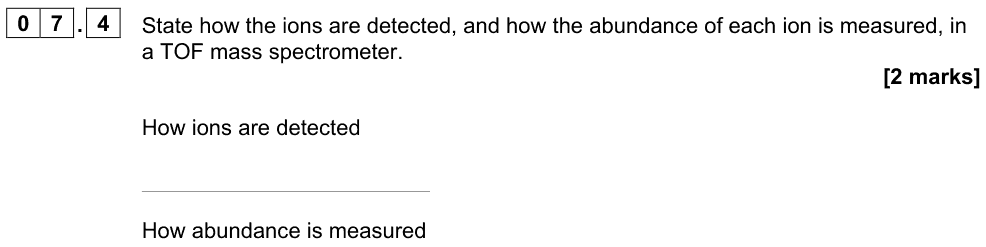
June 2023 · AS Paper 1 · Q07.4 2 marks AO1=2 Short answer atomic structure
Earlier part of question 07 that this part usesEarlier part of June 2023 Paper 1 question 07
State how the ions are detected, and how the abundance of each ion is measured, in
a TOF mass spectrometer.
[2 marks]
How ions are detected
How abundance is measured
June 2023 · AS Paper 1 · Q08.2 1 mark AO1=1 Short answer chemical equilibria and kc
Earlier part of question 08 that this part usesEarlier part of June 2023 Paper 1 question 08
Give an expression for the equilibrium constant (Kc) for this reaction.
[1 mark]
Kc
June 2023 · AS Paper 2 · Q02.1 1 mark AO1=1 Short answer alkanes
This question is about fuels.
Crude oil is separated into fractions by fractional distillation.
State the meaning of the term ‘fraction’ in this context.
[1 mark]
June 2023 · AS Paper 2 · Q02.2 1 mark AO1=1 Short answer alkanes
Earlier part of question 02 that this part usesEarlier part of June 2023 Paper 2 question 02
Petrol for cars contains branched and cyclic alkanes produced by catalytic cracking.
Identify the catalyst used in this process.
[1 mark]
June 2023 · AS Paper 2 · Q02.5 1 mark AO1=1 Short answer organic analysis
Earlier part of question 02 that this part usesEarlier part of June 2023 Paper 2 question 02
Carbon dioxide is a product from the combustion of petrol in cars.  Carbon dioxide
acts as a greenhouse gas when it absorbs infrared radiation.
Give one reason why carbon dioxide absorbs infrared radiation.
[1 mark]
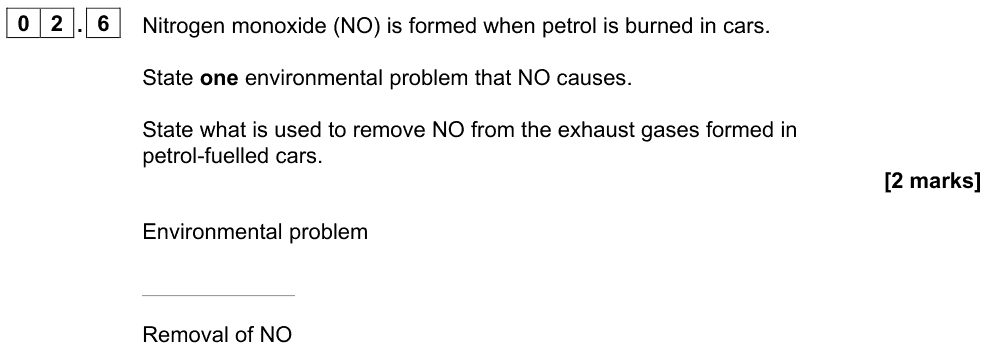
June 2023 · AS Paper 2 · Q02.6 2 marks AO1=2 Short answer alkanes
Earlier part of question 02 that this part usesEarlier part of June 2023 Paper 2 question 02
Nitrogen monoxide (NO) is formed when petrol is burned in cars.
State one environmental problem that NO causes.
State what is used to remove NO from the exhaust gases formed in
petrol-fuelled cars.
[2 marks]
Environmental problem
Removal of NO
June 2023 · AS Paper 2 · Q02.7 1 mark AO1=1 Short answer alcohols
Earlier part of question 02 that this part usesEarlier part of June 2023 Paper 2 question 02
Petrol sold in the UK contains 10% bioethanol.  Bioethanol is ethanol made from crops
by fermentation and is considered to be carbon-neutral.
State what is meant by the term ‘carbon-neutral’.
[1 mark]
June 2023 · AS Paper 2 · Q03.2 2 marks AO2=2 Short answer Hard halogenoalkanes
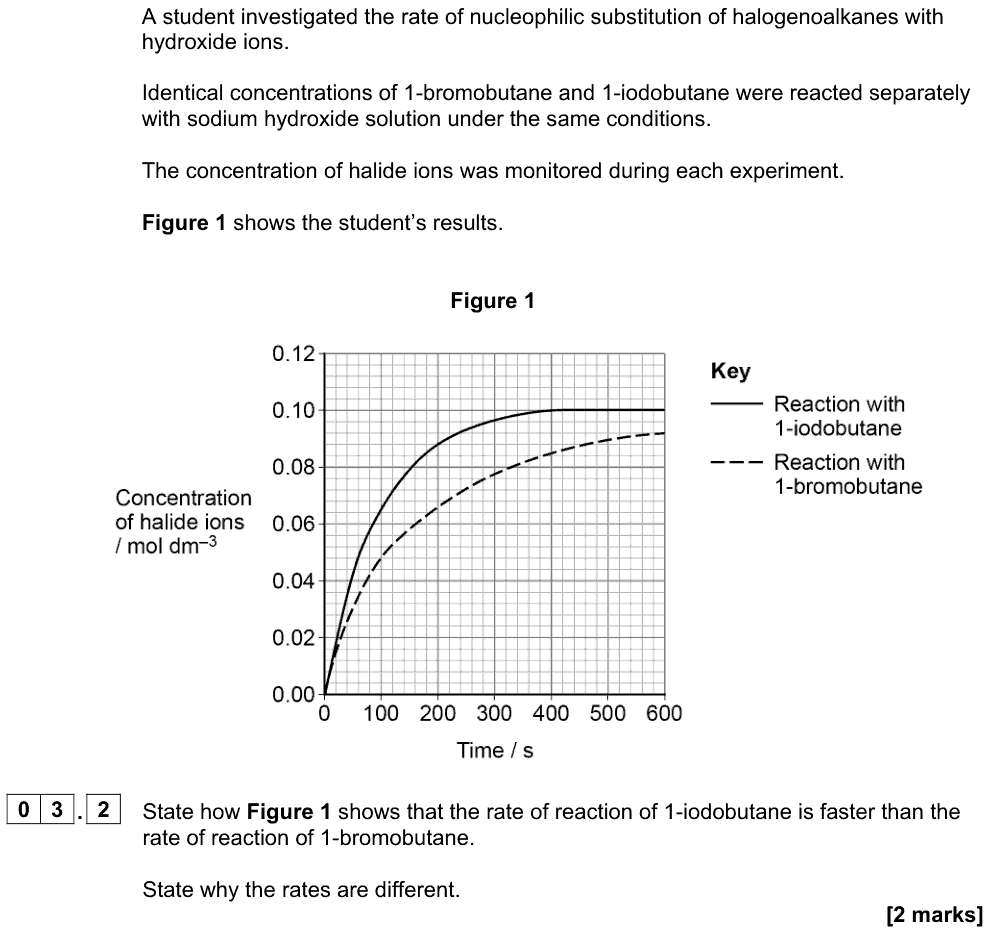
Earlier part of question 03 that this part usesEarlier part of June 2023 Paper 2 question 03
A student investigated the rate of nucleophilic substitution of halogenoalkanes with
hydroxide ions.
Identical concentrations of 1-bromobutane and 1-iodobutane were reacted separately
with sodium hydroxide solution under the same conditions.
The concentration of halide ions was monitored during each experiment.
Figure 1 shows the student’s results.
Figure 1
State how Figure 1 shows that the rate of reaction of 1-iodobutane is faster than the
rate of reaction of 1-bromobutane.
State why the rates are different.
[2 marks]
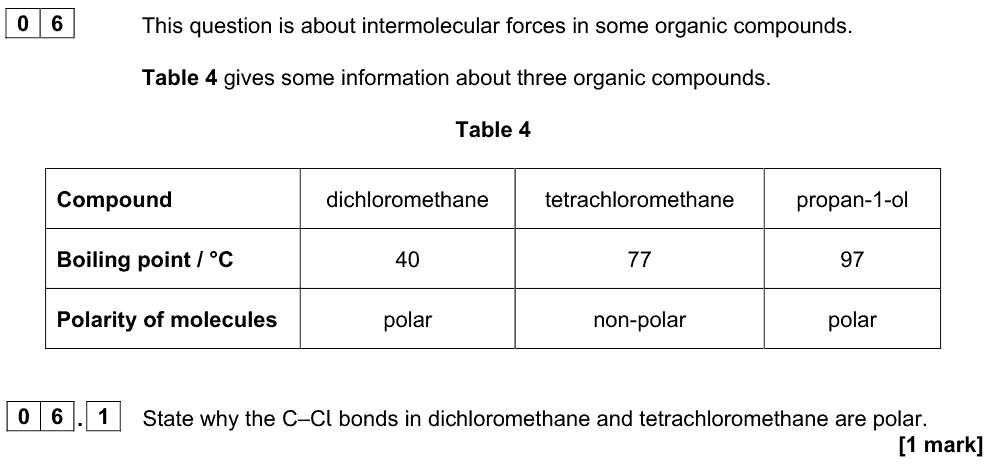
June 2023 · AS Paper 2 · Q06.1 1 mark AO1=1 Short answer bonding
This question is about intermolecular forces in some organic compounds.
Table 4 gives some information about three organic compounds.
Table 4
Compound
dichloromethane
tetrachloromethane
propan-1-ol
Boiling point / °C
40
77
97
Polarity of molecules
polar
non-polar
polar
State why the C–Cl bonds in dichloromethane and tetrachloromethane are polar.
[1 mark]
June 2023 · AS Paper 2 · Q06.2 1 mark AO3=1 Short answer bonding
Earlier part of question 06 that this part usesEarlier part of June 2023 Paper 2 question 06
Suggest why tetrachloromethane molecules are non-polar.
[1 mark]
June 2023 · AS Paper 2 · Q06.4 2 marks AO1=2 Short answer bonding
Earlier part of question 06 that this part usesEarlier part of June 2023 Paper 2 question 06
Propan-1-ol has a higher boiling point than the other two compounds because of
hydrogen bonding.
Describe the hydrogen bonding in propan-1-ol.
[2 marks]
June 2023 · Paper 1 · Q01.1 1 mark AO1=1 Short answer transition metals
This question is about complexes of the transition metal chromium.
State the meaning of the term transition metal complex.
[1 mark]
June 2023 · Paper 1 · Q01.3 1 mark AO3=1 Short answer redox
Earlier part of question 01 that this part usesEarlier part of June 2023 Paper 1 question 01
Suggest why the oxidation state of chromium is zero in Cr(PF3)6
[1 mark]
June 2023 · Paper 1 · Q01.4 1 mark AO3=1 Short answer redox
Earlier parts of question 01 that this part usesEarlier part of June 2023 Paper 1 question 01Earlier part of June 2023 Paper 1 question 01
The compound [Cr(NH3)4Cl2]Cl contains ammonia molecules.
Deduce the oxidation state of chromium in [Cr(NH3)4Cl2]Cl
[1 mark]
June 2023 · Paper 1 · Q01.5 1 mark AO3=1 Short answer bonding
Earlier part of question 01 that this part usesEarlier part of June 2023 Paper 1 question 01
Name the type of bond between N and H in ammonia.
[1 mark]
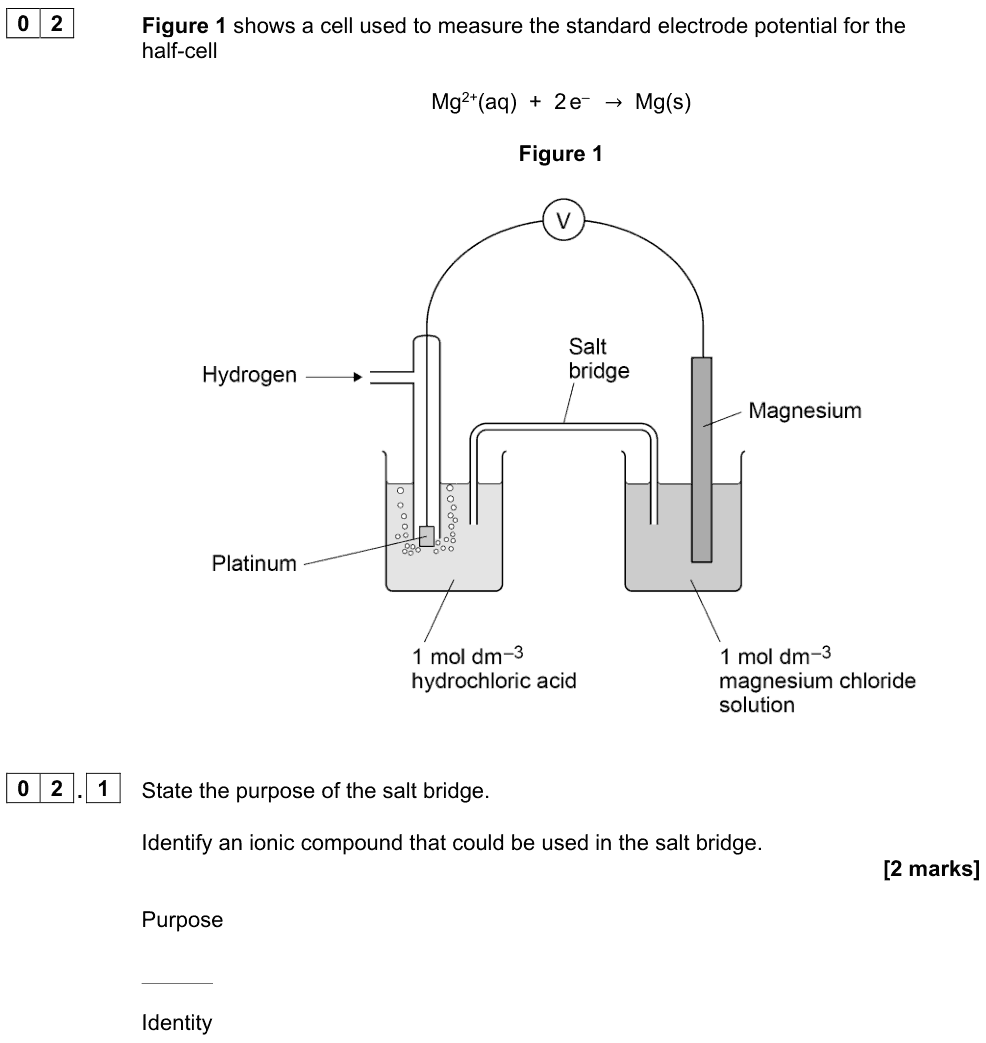
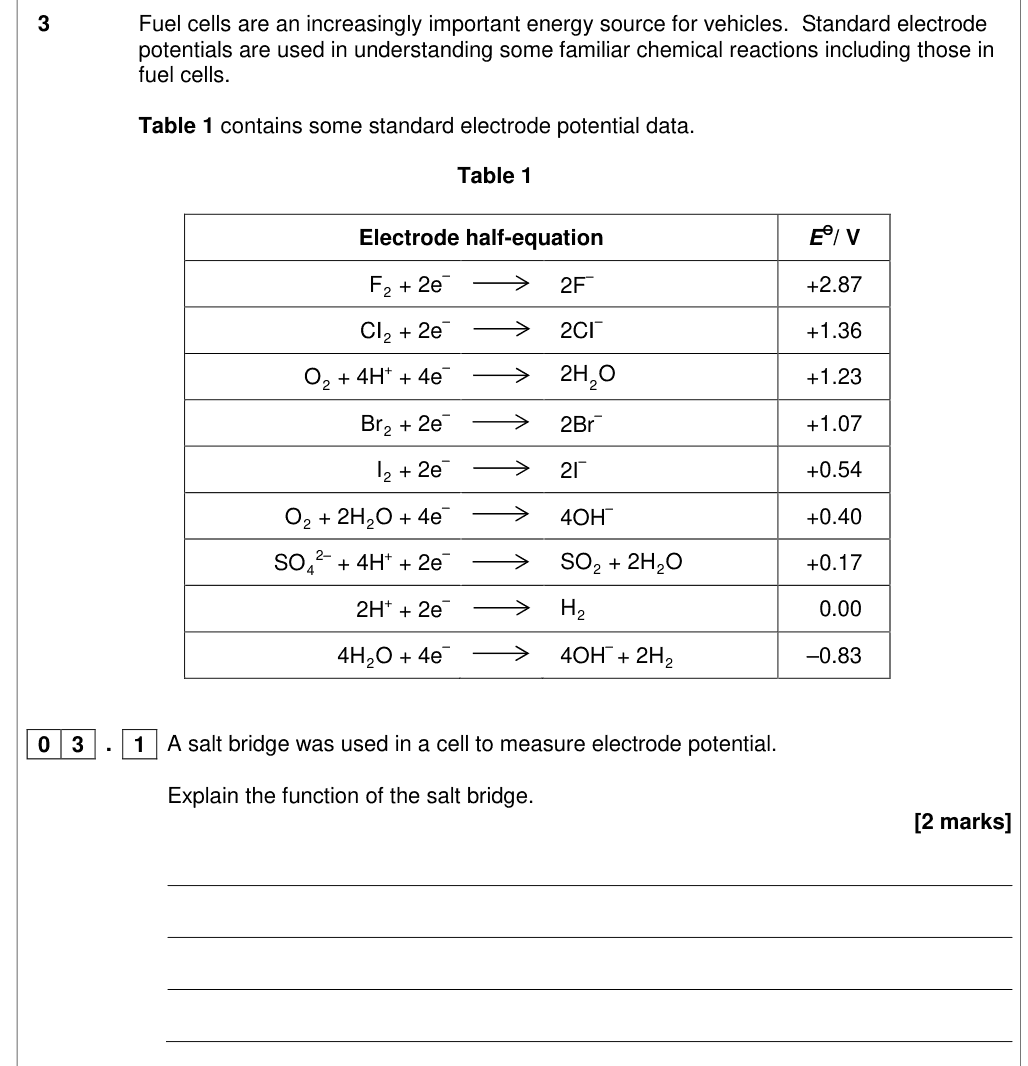
June 2023 · Paper 1 · Q02.1 2 marks AO1=2 Short answer electrode potentials and cells
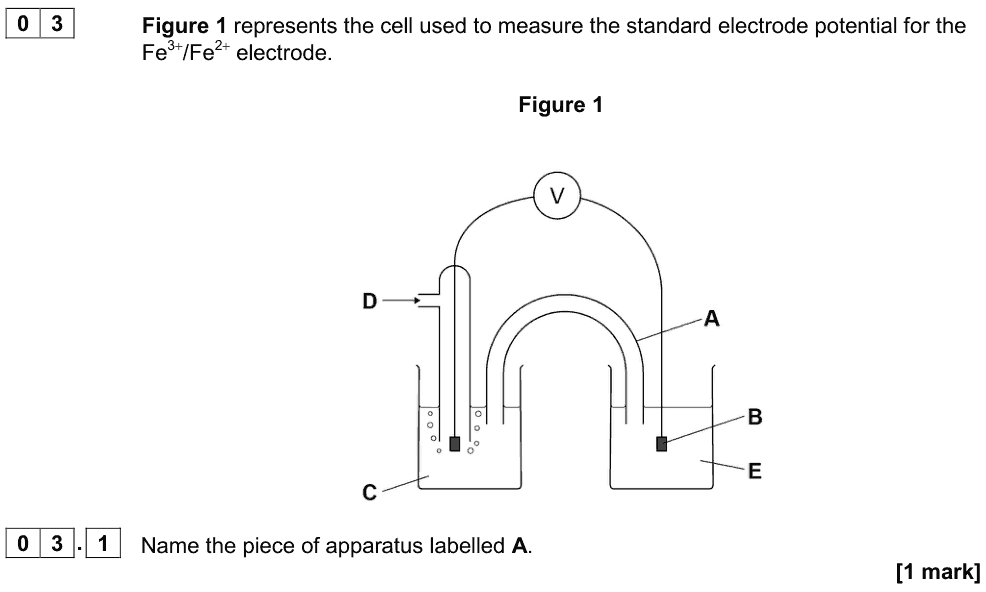
Figure 1 shows a cell used to measure the standard electrode potential for the
half-cell
Mg2+(aq)  +  2 e–   →  Mg(s)
Figure 1
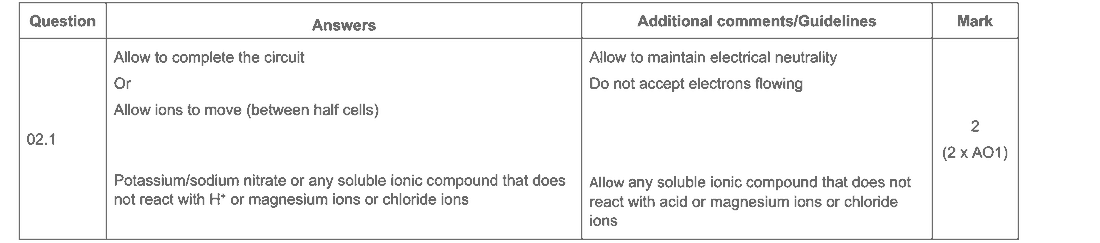
State the purpose of the salt bridge.
Identify an ionic compound that could be used in the salt bridge.
[2 marks]
Purpose
Identity
June 2023 · Paper 1 · Q02.2 1 mark AO1=1 Short answer electrode potentials and cells
Earlier part of question 02 that this part usesEarlier part of June 2023 Paper 1 question 02
State how, if at all, the EMF of this cell will change if the surface area of the platinum
electrode is increased.
[1 mark]
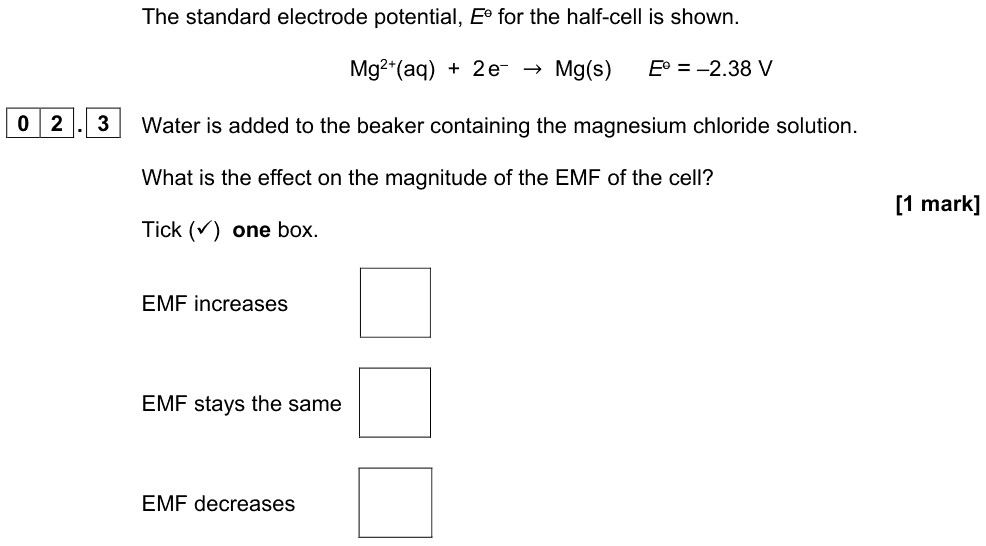
June 2023 · Paper 1 · Q02.3 1 mark AO3=1 Short answer electrode potentials and cells
Earlier part of question 02 that this part usesEarlier part of June 2023 Paper 1 question 02
The standard electrode potential, Eo for the half-cell is shown.
Mg2+(aq)  +  2 e–   →  Mg(s)      Eo = –2.38 V
Water is added to the beaker containing the magnesium chloride solution.
What is the effect on the magnitude of the EMF of the cell?
[1 mark]
Tick ()  one box.
EMF increases
EMF stays the same
EMF decreases
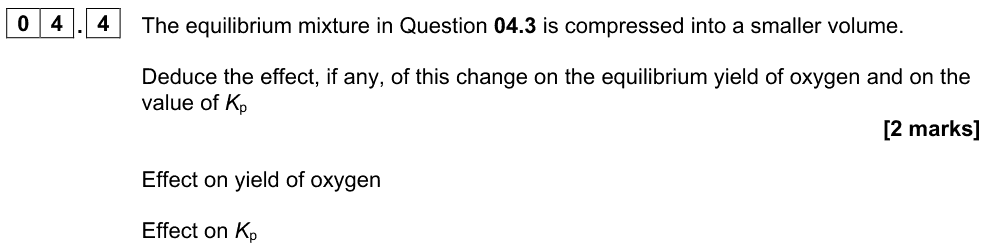
June 2023 · Paper 1 · Q04.4 2 marks AO1=1, AO3=1 Short answer equilibrium constant kp
Earlier part of question 04 that this part usesEarlier part of June 2023 Paper 1 question 04
The equilibrium mixture in Question 04.3 is compressed into a smaller volume.
Deduce the effect, if any, of this change on the equilibrium yield of oxygen and on the

value of Kp
[2 marks]
Effect on yield of oxygen

Effect on Kp
June 2023 · Paper 1 · Q05.2 1 mark AO3=1 Short answer energetics
Earlier part of question 05 that this part usesEarlier part of June 2023 Paper 1 question 05
Use your answer to Question 05.1 to deduce how the temperature changes when
calcium chloride dissolves in water.
[1 mark]
June 2023 · Paper 1 · Q05.6 1 mark AO3=1 Short answer atomic structure
Earlier part of question 05 that this part usesEarlier part of June 2023 Paper 1 question 05
Explain why the second ionisation energy of calcium is greater than the
first ionisation energy of calcium.
[1 mark]
June 2023 · Paper 1 · Q07.1 1 mark AO1=1 Short answer atomic structure
This question is about complexes containing the aluminium ion.
Give the electron configuration of the Al3+ ion.
[1 mark]
June 2023 · Paper 1 · Q07.4 1 mark AO3=1 Short answer transition metals
Earlier part of question 07 that this part usesEarlier part of June 2023 Paper 1 question 07
State why the concentration of aluminium sulfate solution can not be determined by
colorimetry.
[1 mark]
June 2023 · Paper 1 · Q07.6 1 mark AO3=1 Short answer reactions of ions in aqueous solution
Earlier part of question 07 that this part usesEarlier part of June 2023 Paper 1 question 07
An excess of dilute sulfuric acid is added to the products of the reaction in
Question 07.5
Identify the aluminium species produced.
[1 mark]
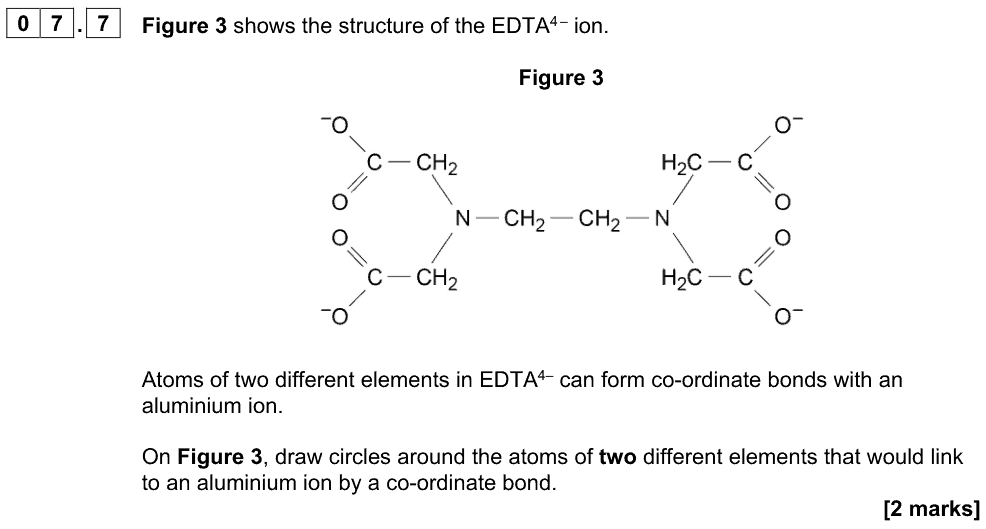
June 2023 · Paper 1 · Q07.7 2 marks AO1=2 Short answer transition metals
Earlier part of question 07 that this part usesEarlier part of June 2023 Paper 1 question 07
Figure 3 shows the structure of the EDTA4 – ion.
Figure 3
Atoms of two different elements in EDTA4– can form co-ordinate bonds with an
aluminium ion.
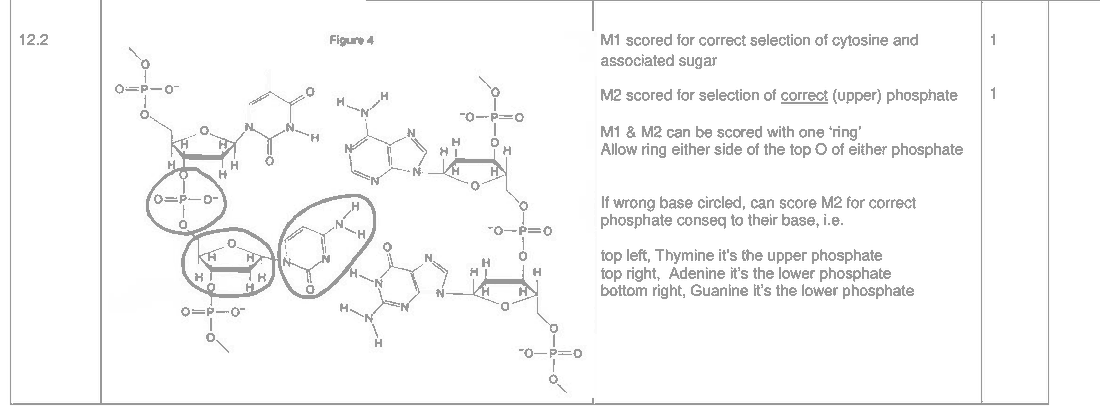
On Figure 3, draw circles around the atoms of two different elements that would link
to an aluminium ion by a co-ordinate bond.
[2 marks]
June 2023 · Paper 1 · Q08.4 1 mark AO1=1 Short answer electrode potentials and cells
Earlier part of question 08 that this part usesEarlier part of June 2023 Paper 1 question 08
State why a fuel cell does not need to be electrically recharged.
[1 mark]
June 2023 · Paper 1 · Q08.5 1 mark AO2=1 Short answer electrode potentials and cells
Earlier part of question 08 that this part usesEarlier part of June 2023 Paper 1 question 08
Suggest one advantage of using methanol, rather than hydrogen, in a fuel cell for use
in cars.
[1 mark]
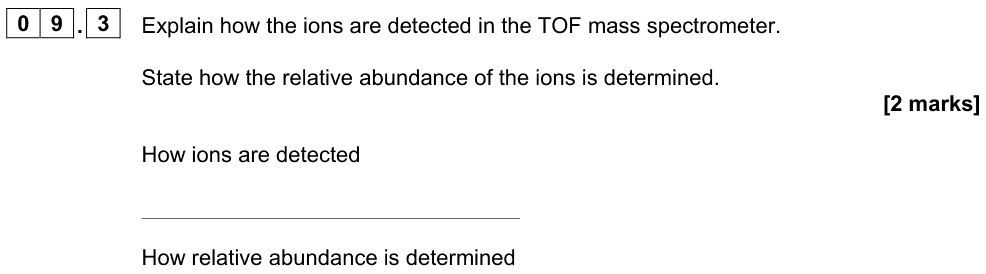
June 2023 · Paper 1 · Q09.3 2 marks AO1=2 Short answer atomic structure
Earlier part of question 09 that this part usesEarlier part of June 2023 Paper 1 question 09
Explain how the ions are detected in the TOF mass spectrometer.
State how the relative abundance of the ions is determined.
[2 marks]
How ions are detected
How relative abundance is determined
June 2023 · Paper 1 · Q09.5 1 mark AO3=1 Short answer atomic structure
Earlier part of question 09 that this part usesEarlier part of June 2023 Paper 1 question 09
Electrospray ionisation is used instead of electron impact for the ionisation of a protein
in a mass spectrometry experiment.
Suggest why.
[1 mark]
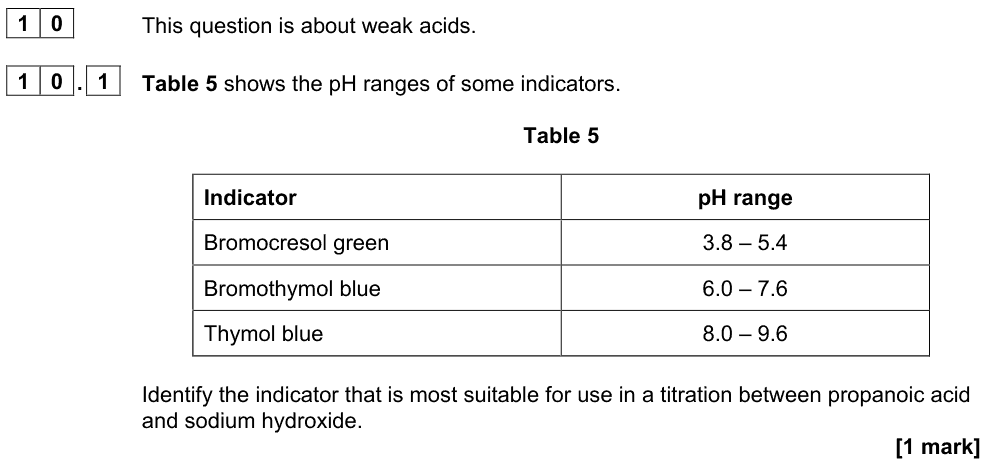
June 2023 · Paper 1 · Q10.1 1 mark AO3=1 Short answer acids and bases
This question is about weak acids.
Table 5 shows the pH ranges of some indicators.
Table 5
Indicator
pH range
Bromocresol green
3.8 – 5.4
Bromothymol blue
6.0 – 7.6
Thymol blue
8.0 – 9.6
Identify the indicator that is most suitable for use in a titration between propanoic acid
and sodium hydroxide.
[1 mark]
June 2023 · Paper 1 · Q10.2 1 mark AO1=1 Short answer acids and bases
Earlier part of question 10 that this part usesEarlier part of June 2023 Paper 1 question 10
Give the expression for the acid dissociation constant (Ka) for propanoic acid
(CH3CH2COOH).
[1 mark]
Ka
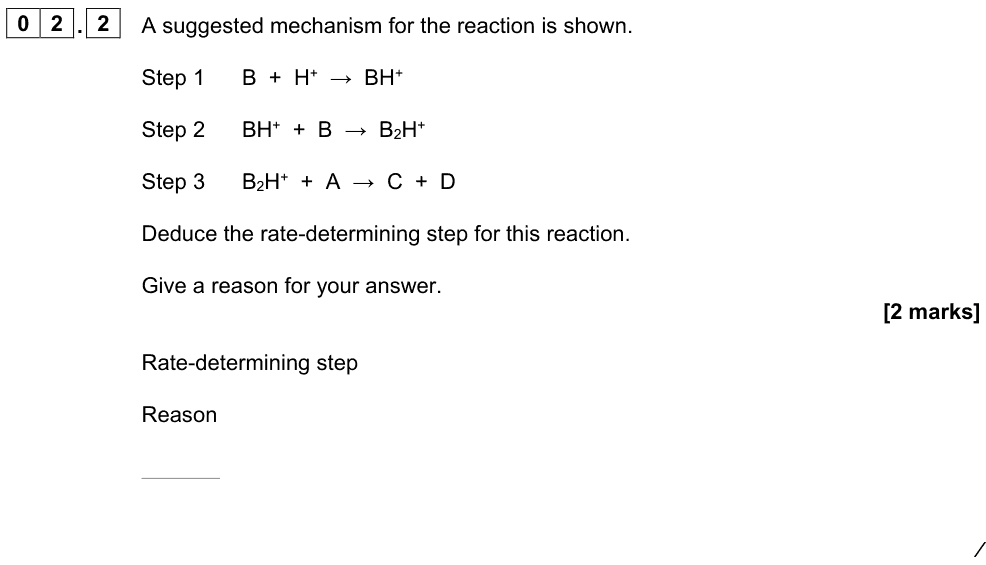
June 2023 · Paper 2 · Q02.2 2 marks AO2=2 Short answer rate equations
Earlier part of question 02 that this part usesEarlier part of June 2023 Paper 2 question 02
A suggested mechanism for the reaction is shown.
Step 1      B  +  H+  →  BH+
Step 2      BH+  +  B  →  B2H+
Step 3      B2H+  +  A  →  C  +  D
Deduce the rate-determining step for this reaction.
Give a reason for your answer.
[2 marks]
Rate-determining step
Reason
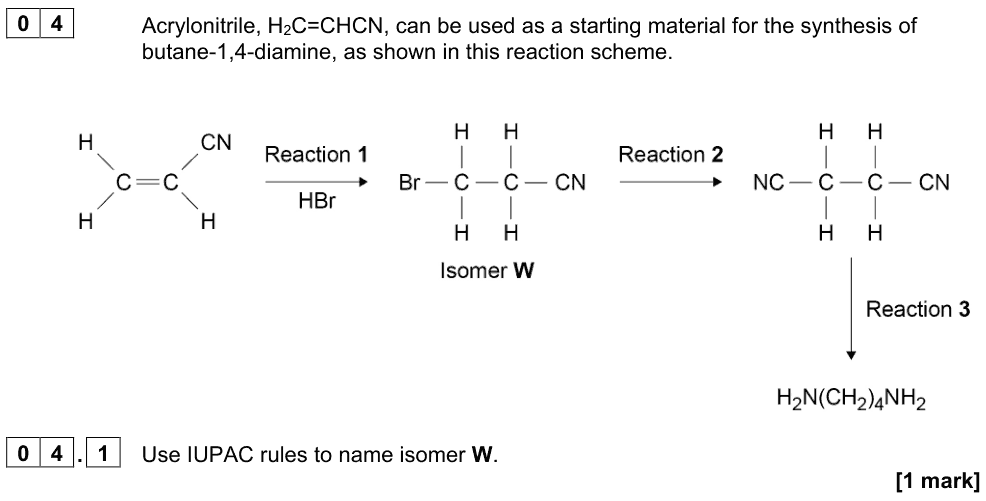
June 2023 · Paper 2 · Q04.1 1 mark AO1=1 Short answer introduction to organic chemistry
Acrylonitrile, H2C=CHCN, can be used as a starting material for the synthesis of
butane-1,4-diamine, as shown in this reaction scheme.
Use IUPAC rules to name isomer W.
[1 mark]
June 2023 · Paper 2 · Q04.3 2 marks AO1=2 Short answer halogenoalkanes
Earlier part of question 04 that this part usesEarlier part of June 2023 Paper 2 question 04
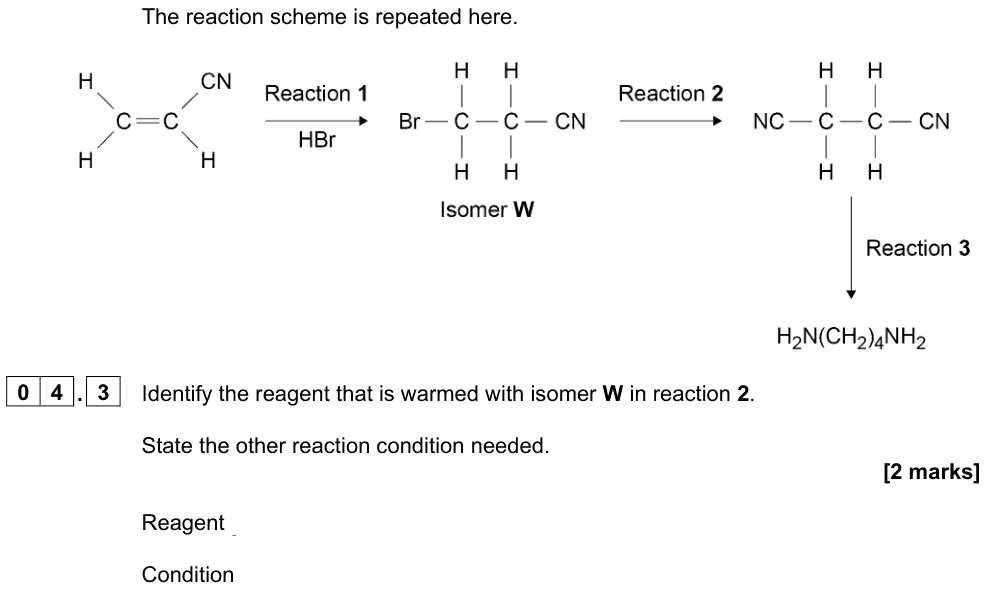
The reaction scheme is repeated here.
Identify the reagent that is warmed with isomer W in reaction 2.
State the other reaction condition needed.
[2 marks]
Reagent
Condition
June 2023 · Paper 2 · Q04.5 2 marks AO1=2 Short answer polymers
Earlier parts of question 04 that this part usesEarlier part of June 2023 Paper 2 question 04Earlier part of June 2023 Paper 2 question 04
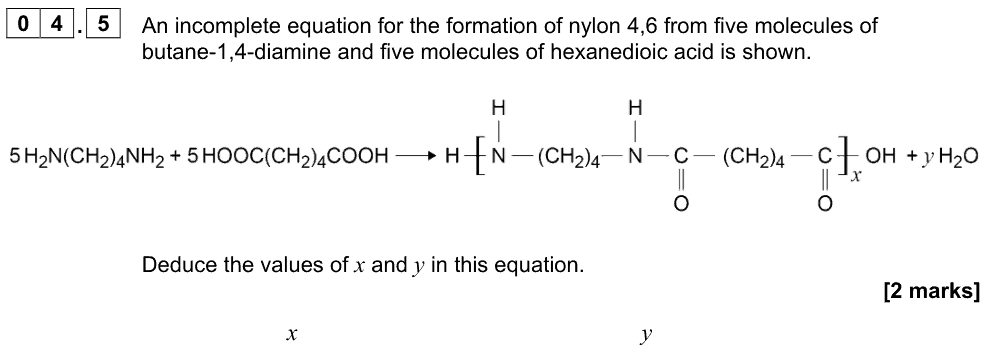
An incomplete equation for the formation of nylon 4,6 from five molecules of
butane-1,4-diamine and five molecules of hexanedioic acid is shown.
Deduce the values of x and y in this equation.
[2 marks]
x
y
June 2023 · Paper 2 · Q05.1 1 mark AO1=1 Short answer organic analysis
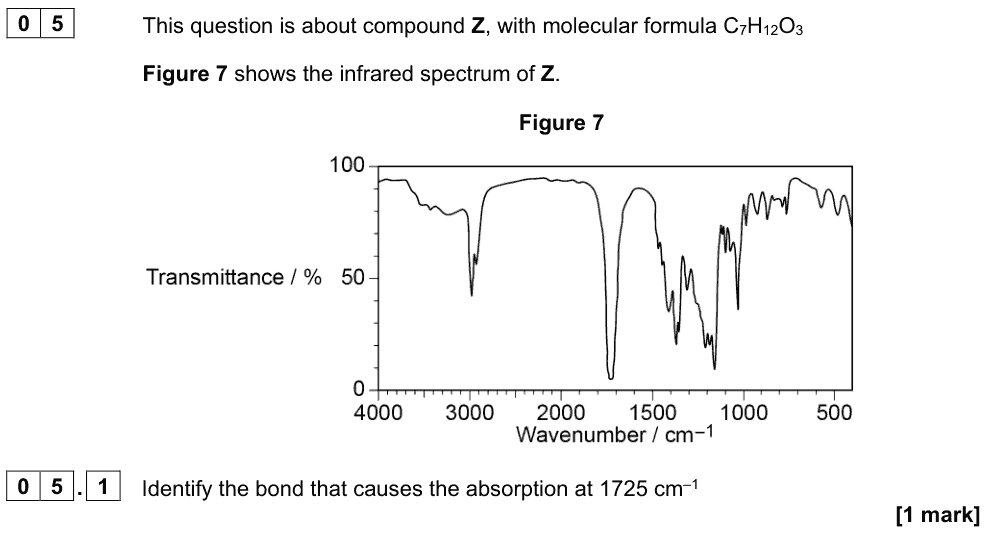
This question is about compound Z, with molecular formula C7H12O3
Figure 7 shows the infrared spectrum of Z.
Figure 7
Identify the bond that causes the absorption at 1725 cm–1
[1 mark]
June 2023 · Paper 2 · Q05.2 1 mark AO1=1 Short answer Easy nmr spectroscopy
Earlier part of question 05 that this part usesEarlier part of June 2023 Paper 2 question 05
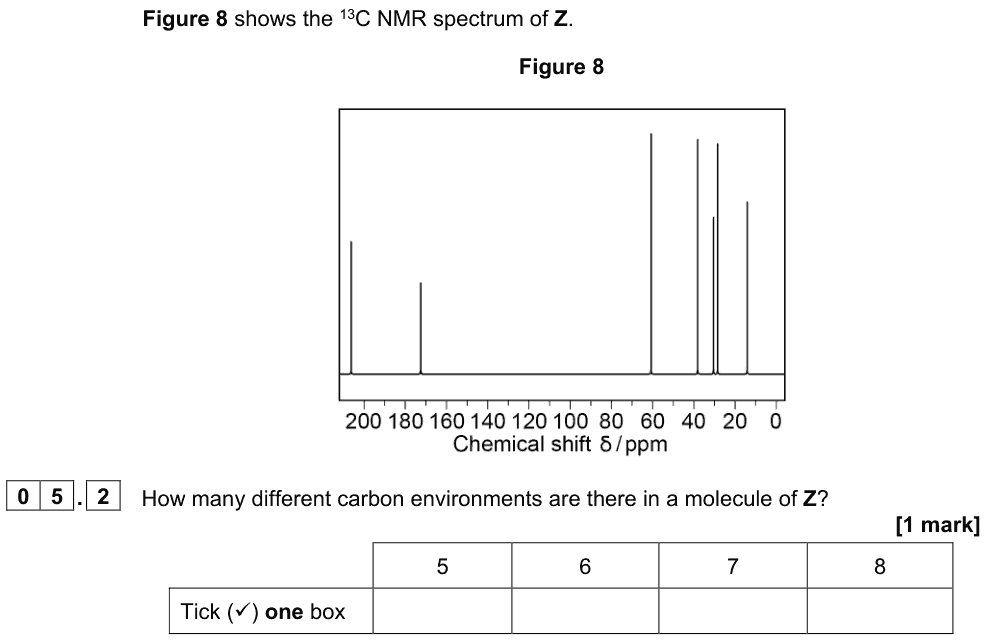
Figure 8 shows the 13C NMR spectrum of Z.
Figure 8
How many different carbon environments are there in a molecule of Z?
[1 mark]
5
6
7
8
Tick () one box
June 2023 · Paper 2 · Q05.3 1 mark AO1=1 Short answer nmr spectroscopy
Earlier parts of question 05 that this part usesEarlier part of June 2023 Paper 2 question 05Earlier part of June 2023 Paper 2 question 05
State the type of carbon environment that causes the peak at ẟ = 174 ppm
Use Table C in the Data Booklet to help you answer this question.
[1 mark]
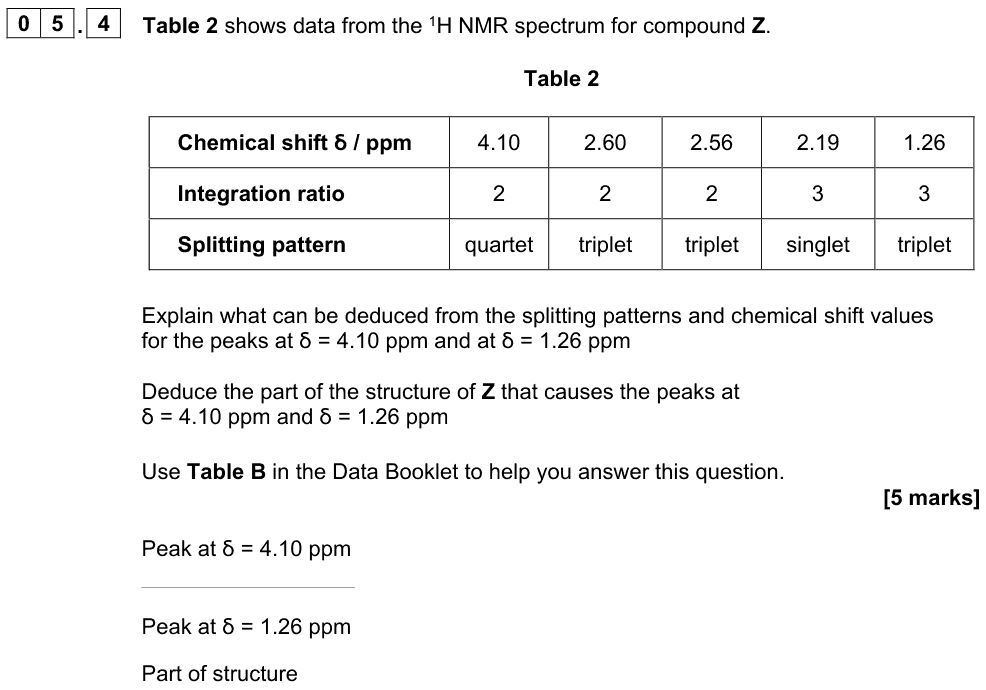
June 2023 · Paper 2 · Q05.6 1 mark AO3=1 Short answer nmr spectroscopy
Earlier parts of question 05 that this part usesEarlier part of June 2023 Paper 2 question 05Earlier part of June 2023 Paper 2 question 05Earlier part of June 2023 Paper 2 question 05
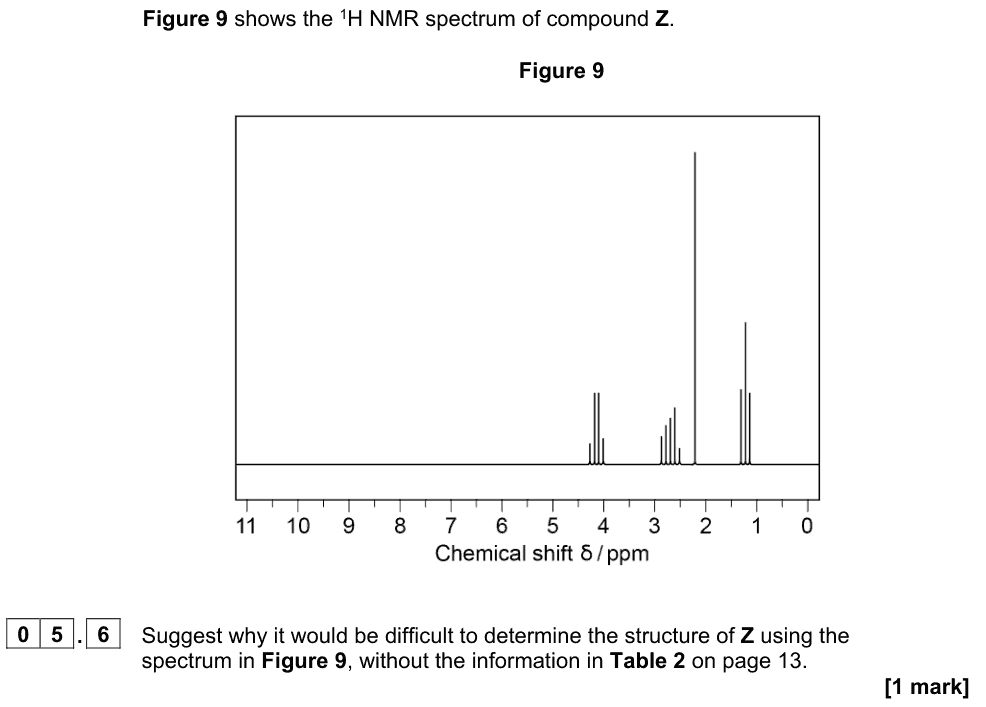
Figure 9 shows the 1H NMR spectrum of compound Z.
Figure 9
Suggest why it would be difficult to determine the structure of Z using the
spectrum in Figure 9, without the information in Table 2 on page 13.
[1 mark]
June 2023 · Paper 2 · Q08.5 2 marks AO3=2 Short answer alkanes
Earlier parts of question 08 that this part usesEarlier part of June 2023 Paper 2 question 08Earlier part of June 2023 Paper 2 question 08
Complete combustion of the biofuel made from sewage sludge produces the
greenhouse gas carbon dioxide.
Suggest one other possible environmental problem with the complete combustion of
this biofuel.
State the formula of the pollutant responsible for this problem.
[2 marks]
Environmental problem
Formula
June 2023 · Paper 2 · Q09.1 1 mark AO2=1 Short answer introduction to organic chemistry
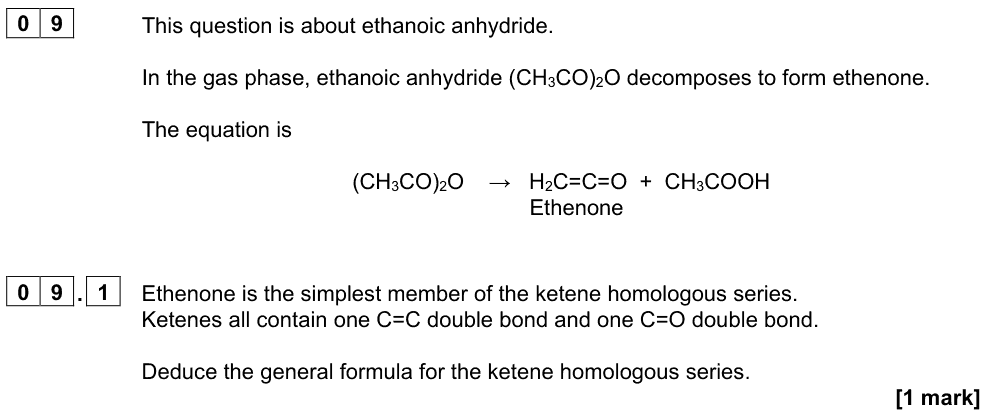
This question is about ethanoic anhydride.
In the gas phase, ethanoic anhydride (CH3CO)2O decomposes to form ethenone.
The equation is
(CH3CO)2O    →   H2C=C=O  +  CH3COOH
Ethenone
Ethenone is the simplest member of the ketene homologous series.
Ketenes all contain one C=C double bond and one C=O double bond.
Deduce the general formula for the ketene homologous series.
[1 mark]
June 2023 · Paper 3 · Q01.1 1 mark Short answer Easy carboxylic acids and derivatives
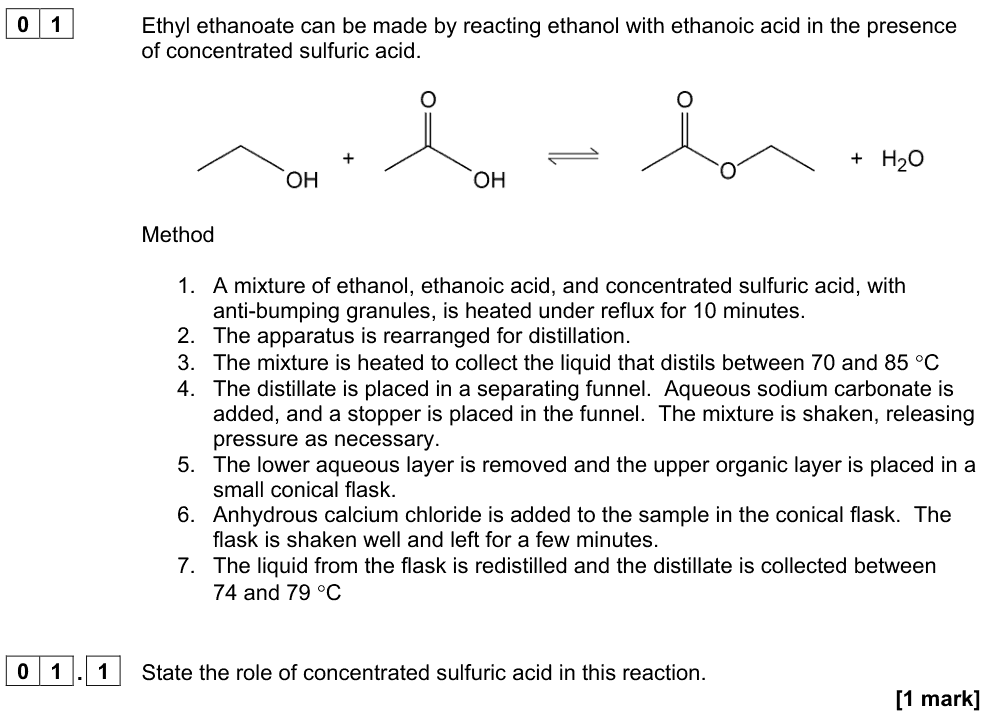
Ethyl ethanoate can be made by reacting ethanol with ethanoic acid in the presence
of concentrated sulfuric acid.
Method
1. A mixture of ethanol, ethanoic acid, and concentrated sulfuric acid, with
anti-bumping granules, is heated under reflux for 10 minutes.
2. The apparatus is rearranged for distillation.
3. The mixture is heated to collect the liquid that distils between 70 and 85 °C
4. The distillate is placed in a separating funnel.  Aqueous sodium carbonate is
added, and a stopper is placed in the funnel.  The mixture is shaken, releasing
pressure as necessary.
5. The lower aqueous layer is removed and the upper organic layer is placed in a
small conical flask.
6. Anhydrous calcium chloride is added to the sample in the conical flask.  The
flask is shaken well and left for a few minutes.
7. The liquid from the flask is redistilled and the distillate is collected between
74 and 79 °C
State the role of concentrated sulfuric acid in this reaction.
[1 mark]
June 2023 · Paper 3 · Q01.8 1 mark Short answer Easy chemical equilibria and kccarboxylic acids and derivatives
Earlier part of question 01 that this part usesEarlier part of June 2023 Paper 3 question 01
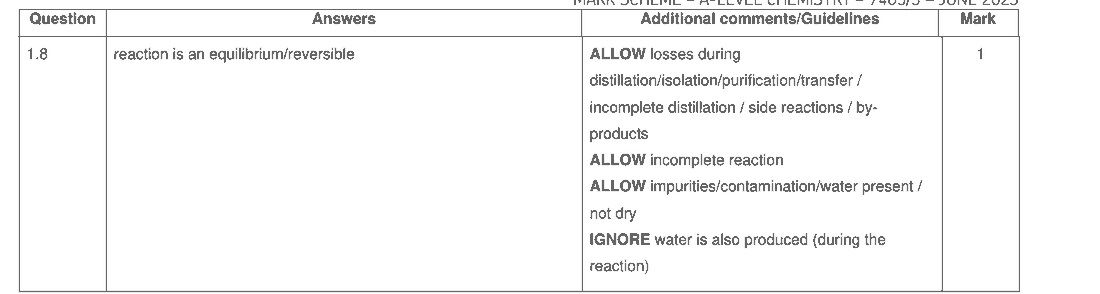
Suggest a reason why the percentage yield is not 100%.
[1 mark]
June 2023 · Paper 3 · Q03.3 2 marks Short answer amino acids proteins and dna
Earlier part of question 03 that this part usesEarlier part of June 2023 Paper 3 question 03
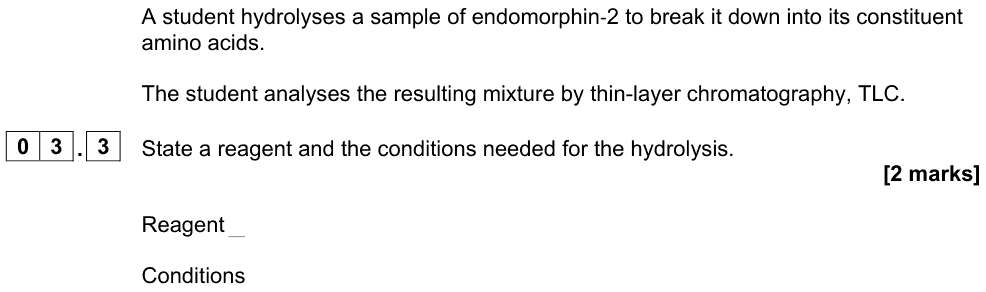
A student hydrolyses a sample of endomorphin-2 to break it down into its constituent
amino acids.
The student analyses the resulting mixture by thin-layer chromatography, TLC.
State a reagent and the conditions needed for the hydrolysis.
[2 marks]
Reagent
Conditions
June 2023 · Paper 3 · Q03.5 1 mark Short answer chromatography
Earlier part of question 03 that this part usesEarlier part of June 2023 Paper 3 question 03
State why the amino acids separate on the TLC plate.
[1 mark]
June 2022 · AS Paper 1 · Q04.2 1 mark AO1=1 Short answer bonding
Earlier part of question 04 that this part usesEarlier part of June 2022 Paper 1 question 04
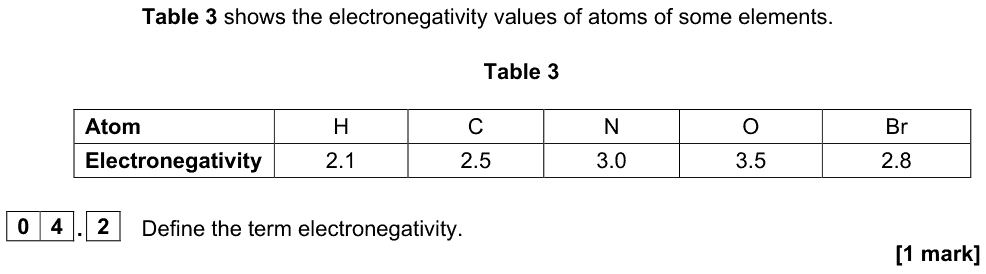
Table 3 shows the electronegativity values of atoms of some elements.
Table 3
Atom
H
C
N
O
Br
Electronegativity
2.1
2.5
3.0
3.5
2.8
Define the term electronegativity.
[1 mark]
June 2022 · AS Paper 1 · Q04.3 1 mark AO2=1 Short answer bonding
Earlier parts of question 04 that this part usesEarlier part of June 2022 Paper 1 question 04Earlier part of June 2022 Paper 1 question 04
Deduce the two atoms from Table 3 that will form the most polar bond.
[1 mark]
June 2022 · AS Paper 1 · Q06.1 1 mark AO1=1 Short answer redox
Iodide ions can be oxidised to iodine using oxidising agents such as
iodate(V) ions (IO3–) and concentrated sulfuric acid.
State, in terms of electrons, the meaning of the term oxidising agent.
[1 mark]
June 2022 · AS Paper 1 · Q07.3 1 mark AO1=1 Short answer Hard chemical equilibria and kc
Earlier part of question 07 that this part usesEarlier part of June 2022 Paper 1 question 07
Explain why using a catalyst has no effect on the percentage yield.
[1 mark]
June 2022 · AS Paper 2 · Q04.3 1 mark AO1=1 Short answer amount of substance
Earlier part of question 04 that this part usesEarlier part of June 2022 Paper 2 question 04
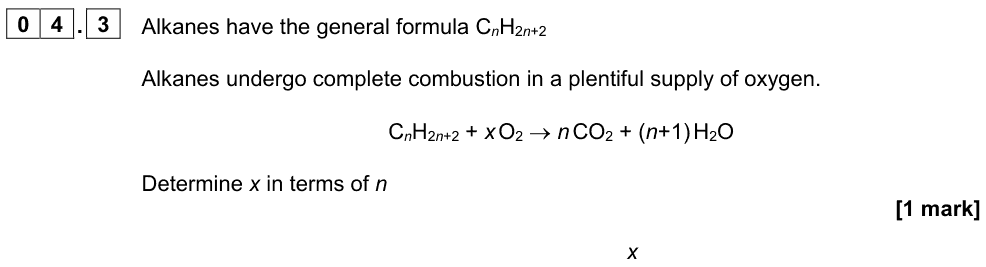
Alkanes have the general formula CnH2n+2
Alkanes undergo complete combustion in a plentiful supply of oxygen.
CnH2n+2 + x O2 → n CO2 + (n+1) H2O
Determine x in terms of n
[1 mark]
x
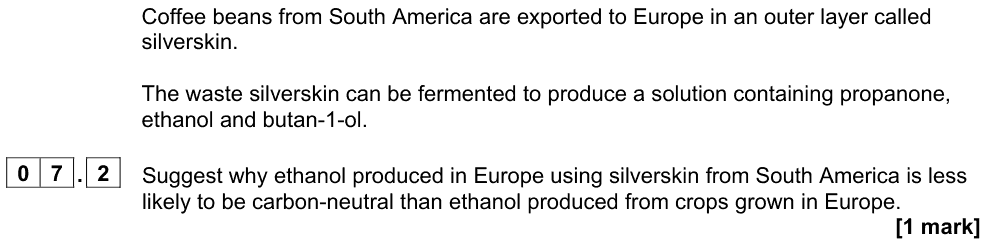
June 2022 · AS Paper 2 · Q07.2 1 mark AO3=1 Short answer alcohols
Earlier part of question 07 that this part usesEarlier part of June 2022 Paper 2 question 07
Coffee beans from South America are exported to Europe in an outer layer called
silverskin.
The waste silverskin can be fermented to produce a solution containing propanone,
ethanol and butan-1-ol.
Suggest why ethanol produced in Europe using silverskin from South America is less
likely to be carbon-neutral than ethanol produced from crops grown in Europe.
[1 mark]
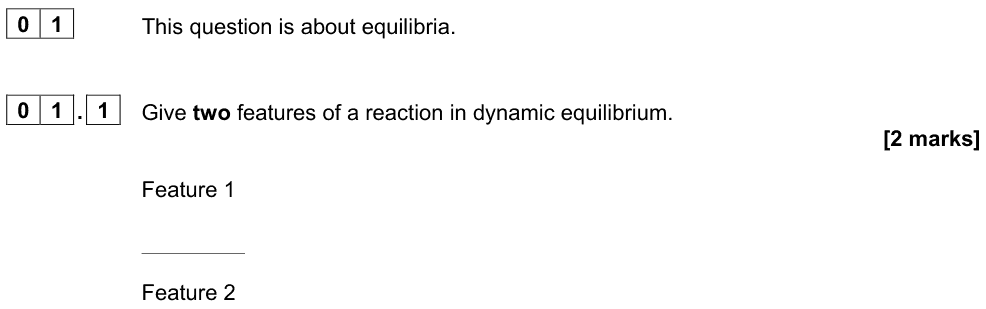
June 2022 · Paper 1 · Q01.1 2 marks AO1=2 Short answer Hard chemical equilibria and kc
This question is about equilibria.
Give two features of a reaction in dynamic equilibrium.
[2 marks]
Feature 1
Feature 2
June 2022 · Paper 1 · Q01.2 1 mark AO3=1 Short answer chemical equilibria and kcequilibrium constant kp
Earlier part of question 01 that this part usesEarlier part of June 2022 Paper 1 question 01
A gas-phase reaction is at equilibrium.
When the pressure is increased the yield of product decreases.
State what can be deduced about the chemical equation for this equilibrium.

[1 mark]
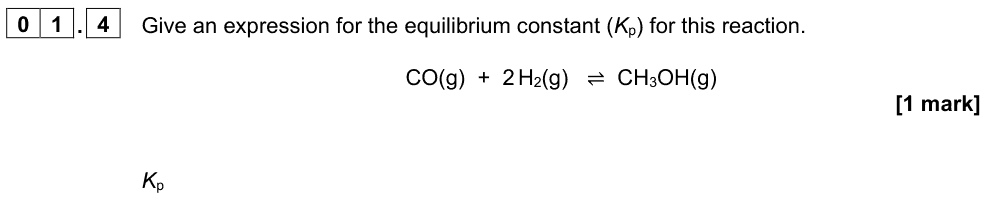
June 2022 · Paper 1 · Q01.4 1 mark AO1=1 Short answer equilibrium constant kp
Earlier part of question 01 that this part usesEarlier part of June 2022 Paper 1 question 01
Give an expression for the equilibrium constant (Kp) for this reaction.
CO(g)  +  2 H2(g)   ⇌  CH3OH(g)
[1 mark]
Kp
June 2022 · Paper 1 · Q02.1 2 marks AO1=2 Short answer Hard amount of substance
Rhenium has an atomic number of 75
Define the term relative atomic mass.
[2 marks]
June 2022 · Paper 1 · Q02.3 1 mark AO1=1 Short answer atomic structure
Earlier part of question 02 that this part usesEarlier part of June 2022 Paper 1 question 02
State why the isotopes of rhenium have the same chemical properties.
[1 mark]
June 2022 · Paper 1 · Q02.5 2 marks AO1=2 Short answer Hard atomic structure
Earlier part of question 02 that this part usesEarlier part of June 2022 Paper 1 question 02
State how the relative abundance of 185Re+ is determined in a TOF mass
spectrometer.
[2 marks]
June 2022 · Paper 1 · Q03.2 1 mark AO1=1 Short answer transition metals
Earlier part of question 03 that this part usesEarlier part of June 2022 Paper 1 question 03
State why an indicator is not added in this titration.
[1 mark]
June 2022 · Paper 1 · Q03.3 1 mark AO2=1 Short answer redox
Earlier part of question 03 that this part usesEarlier part of June 2022 Paper 1 question 03
Give the oxidation state of oxygen in hydrogen peroxide.
[1 mark]
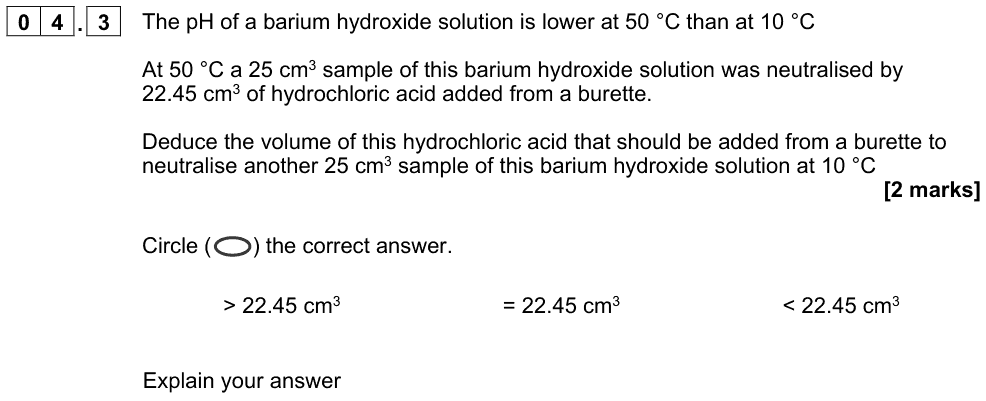
June 2022 · Paper 1 · Q04.3 2 marks AO3=2 Short answer acids and bases
Earlier part of question 04 that this part usesEarlier part of June 2022 Paper 1 question 04
The pH of a barium hydroxide solution is lower at 50 °C than at 10 °C
At 50 °C a 25 cm3 sample of this barium hydroxide solution was neutralised by
22.45 cm3 of hydrochloric acid added from a burette.
Deduce the volume of this hydrochloric acid that should be added from a burette to

neutralise another 25 cm3 sample of this barium hydroxide solution at 10 °C
[2 marks]
Circle (       ) the correct answer.
˃ 22.45 cm3
= 22.45 cm3
˂ 22.45 cm3
Explain your answer
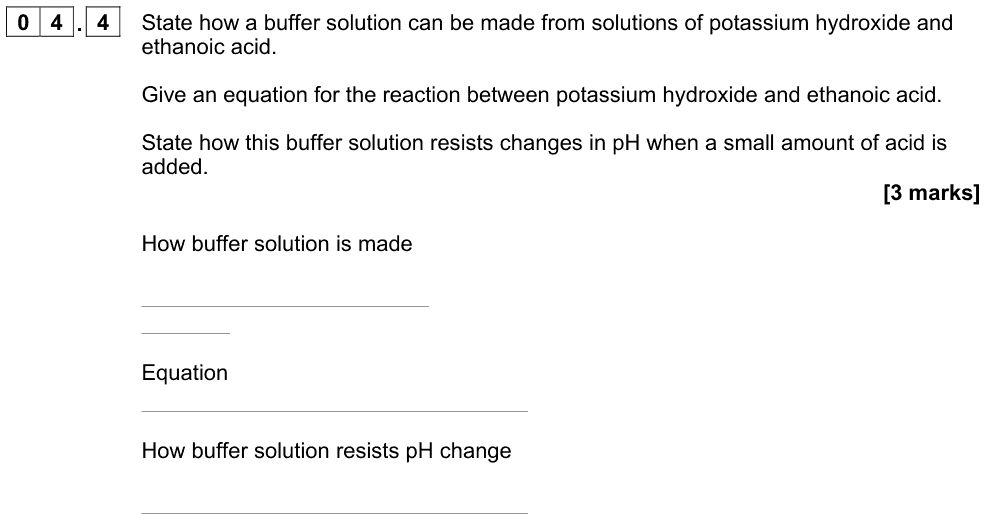
June 2022 · Paper 1 · Q04.4 3 marks AO3=3 Short answer Hard acids and bases
Earlier part of question 04 that this part usesEarlier part of June 2022 Paper 1 question 04
State how a buffer solution can be made from solutions of potassium hydroxide and
ethanoic acid.
Give an equation for the reaction between potassium hydroxide and ethanoic acid.
State how this buffer solution resists changes in pH when a small amount of acid is
added.
[3 marks]
How buffer solution is made
Equation
How buffer solution resists pH change
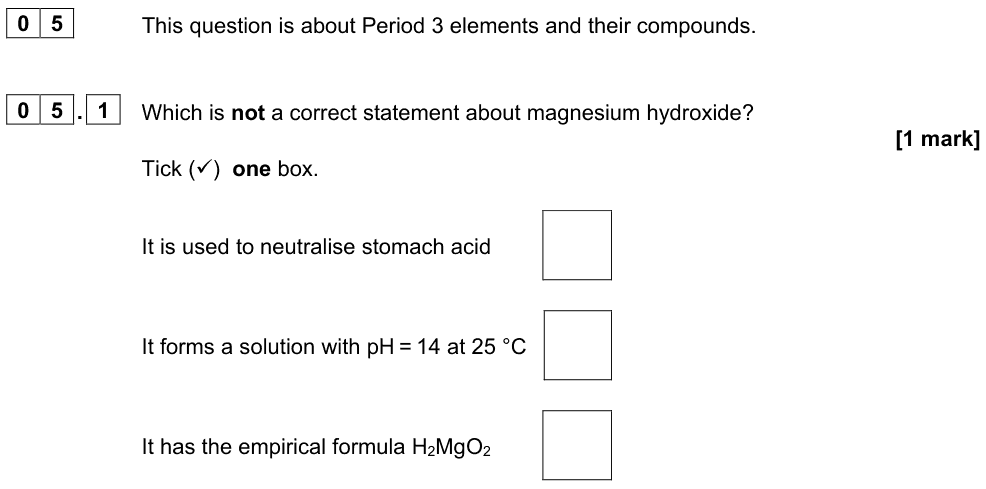
June 2022 · Paper 1 · Q05.1 1 mark AO1=1 Short answer group 2
This question is about Period 3 elements and their compounds.
Which is not a correct statement about magnesium hydroxide?
[1 mark]
Tick ()  one box.
It is used to neutralise stomach acid
It forms a solution with pH = 14 at 25 °C
It has the empirical formula H2MgO2
June 2022 · Paper 1 · Q05.4 2 marks AO3=2 Short answer atomic structure
Earlier part of question 05 that this part usesEarlier part of June 2022 Paper 1 question 05
The mass spectrum of the element phosphorus has a peak at
m
z = 124
Give the formula of the species responsible for this peak.
[2 marks]
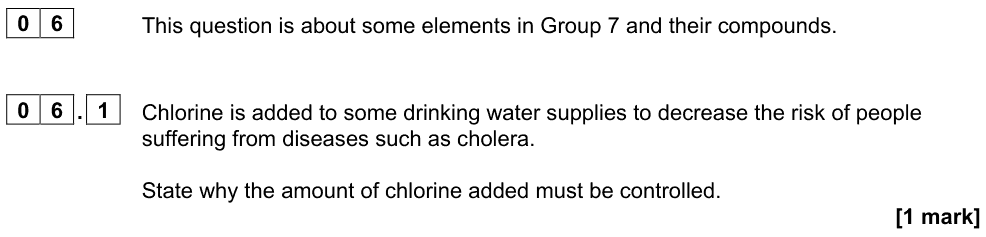
June 2022 · Paper 1 · Q06.1 1 mark AO1=1 Short answer group 7 the halogens
This question is about some elements in Group 7 and their compounds.
Chlorine is added to some drinking water supplies to decrease the risk of people
suffering from diseases such as cholera.
State why the amount of chlorine added must be controlled.
[1 mark]
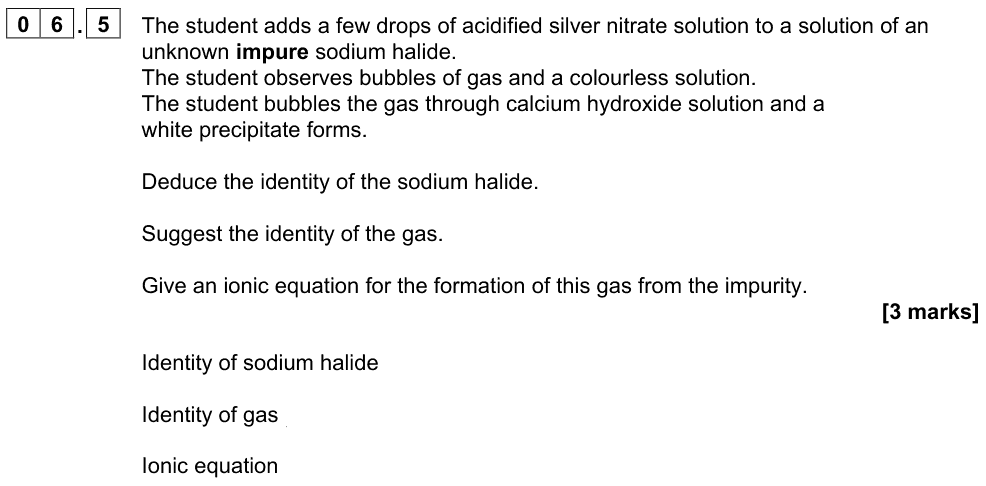
June 2022 · Paper 1 · Q06.5 3 marks Short answer Hard group 7 the halogens
Earlier part of question 06 that this part usesEarlier part of June 2022 Paper 1 question 06
The student adds a few drops of acidified silver nitrate solution to a solution of an
unknown impure sodium halide.
The student observes bubbles of gas and a colourless solution.
The student bubbles the gas through calcium hydroxide solution and a
white precipitate forms.
Deduce the identity of the sodium halide.
Suggest the identity of the gas.
Give an ionic equation for the formation of this gas from the impurity.
[3 marks]
Identity of sodium halide
Identity of gas
Ionic equation
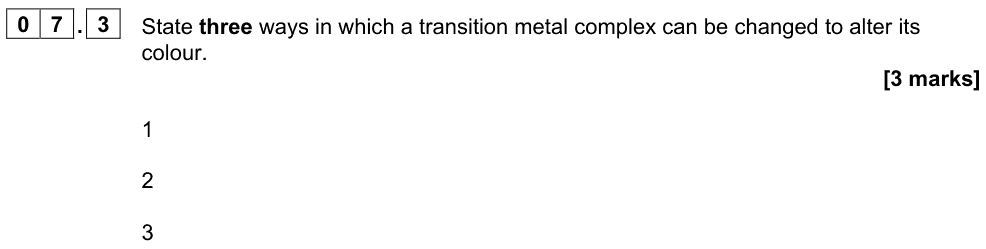
June 2022 · Paper 1 · Q07.3 3 marks AO1=3 Short answer transition metals
Earlier part of question 07 that this part usesEarlier part of June 2022 Paper 1 question 07
State three ways in which a transition metal complex can be changed to alter its
colour.
[3 marks]
1
2
3
June 2022 · Paper 1 · Q07.4 1 mark AO3=1 Short answer transition metals
Earlier part of question 07 that this part usesEarlier part of June 2022 Paper 1 question 07
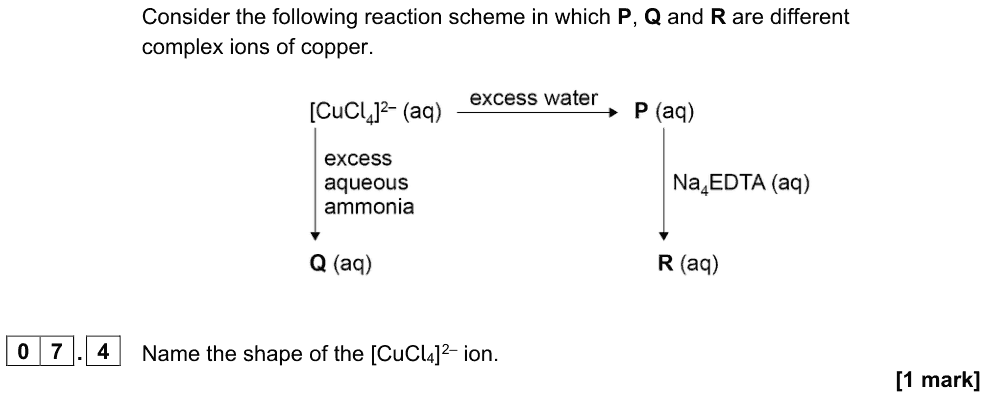
Consider the following reaction scheme in which P, Q and R are different
complex ions of copper.
Name the shape of the [CuCl4] 2– ion.
[1 mark]
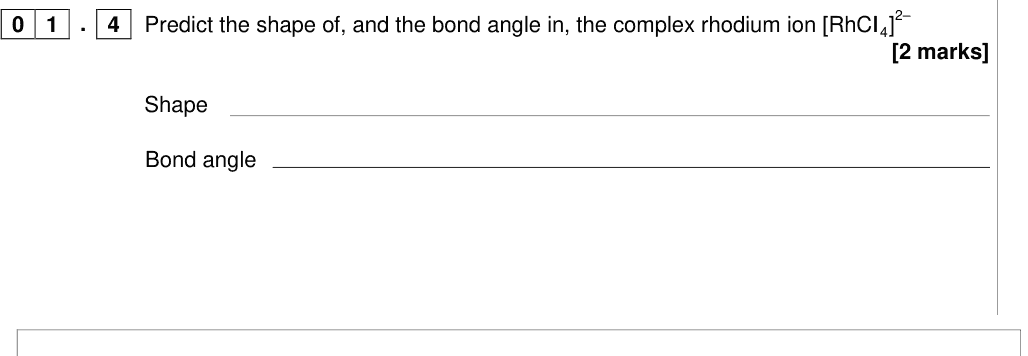
June 2022 · Paper 1 · Q07.7 1 mark AO3=1 Short answer transition metals
Earlier parts of question 07 that this part usesEarlier part of June 2022 Paper 1 question 07Earlier part of June 2022 Paper 1 question 07
Identify complex ion R.
[1 mark]
June 2022 · Paper 1 · Q08.1 1 mark AO2=1 Short answer electrode potentials and cells
This question is about cells.
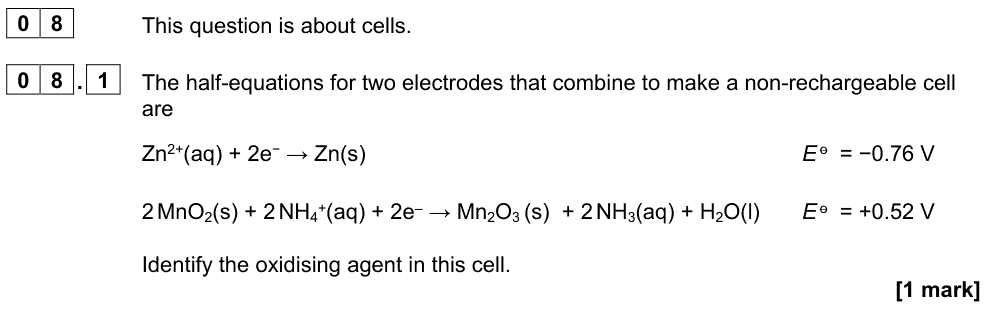
The half-equations for two electrodes that combine to make a non-rechargeable cell
are
Zn2+(aq) + 2e− → Zn(s)
E o  = −0.76 V
2 MnO2(s) + 2 NH4+(aq) + 2e– → Mn2O3 (s)  + 2 NH3(aq) + H2O(l)
E o  = +0.52 V
Identify the oxidising agent in this cell.
[1 mark]
June 2022 · Paper 1 · Q08.2 1 mark AO1=1 Short answer electrode potentials and cells
Earlier part of question 08 that this part usesEarlier part of June 2022 Paper 1 question 08
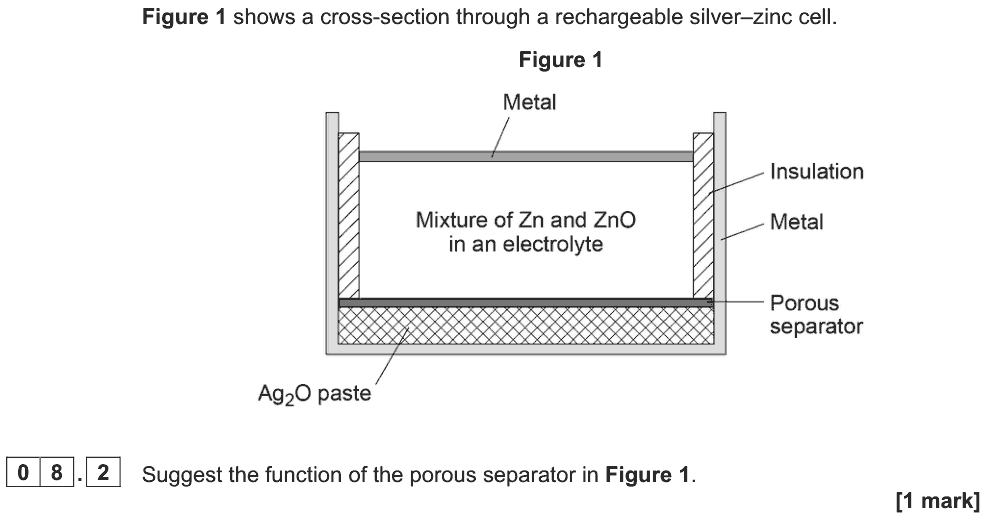
Figure 1 shows a cross-section through a rechargeable silver–zinc cell.
Figure 1
Suggest the function of the porous separator in Figure 1.
[1 mark]
June 2022 · Paper 1 · Q08.5 1 mark AO2=1 Short answer electrode potentials and cells
Earlier parts of question 08 that this part usesEarlier part of June 2022 Paper 1 question 08Earlier part of June 2022 Paper 1 question 08
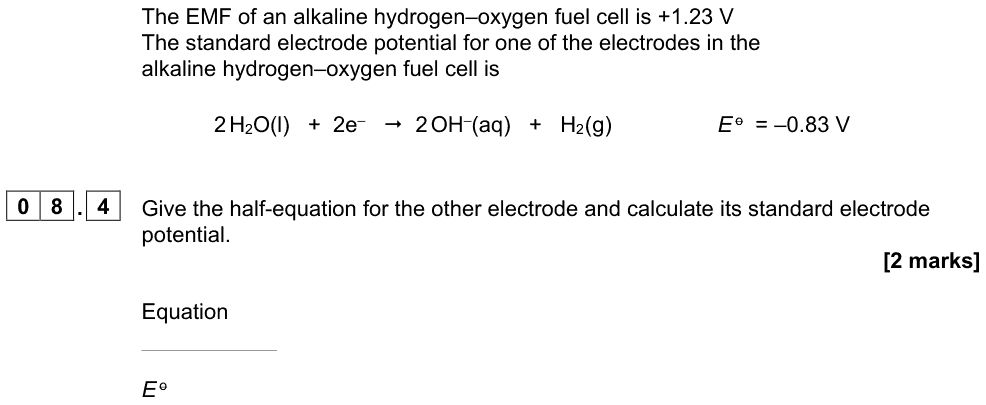
Suggest why the EMF values of the acidic and alkaline hydrogen–oxygen fuel cells
are the same.
[1 mark]
June 2022 · Paper 2 · Q02.2 1 mark AO2=1 Short answer chemical equilibria and kc
Earlier part of question 02 that this part usesEarlier part of June 2022 Paper 2 question 02
Give an expression for Kc for this equilibrium.
[1 mark]
Kc
June 2022 · Paper 2 · Q02.5 2 marks AO1=2 Short answer halogenoalkanes
Earlier part of question 02 that this part usesEarlier part of June 2022 Paper 2 question 02
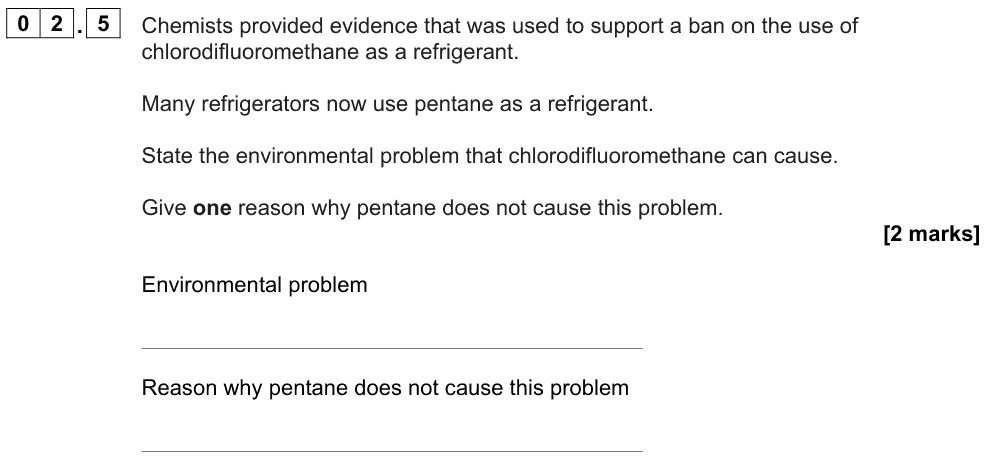
Chemists provided evidence that was used to support a ban on the use of
chlorodifluoromethane as a refrigerant.
Many refrigerators now use pentane as a refrigerant.
State the environmental problem that chlorodifluoromethane can cause.
Give one reason why pentane does not cause this problem.
[2 marks]
Environmental problem
Reason why pentane does not cause this problem
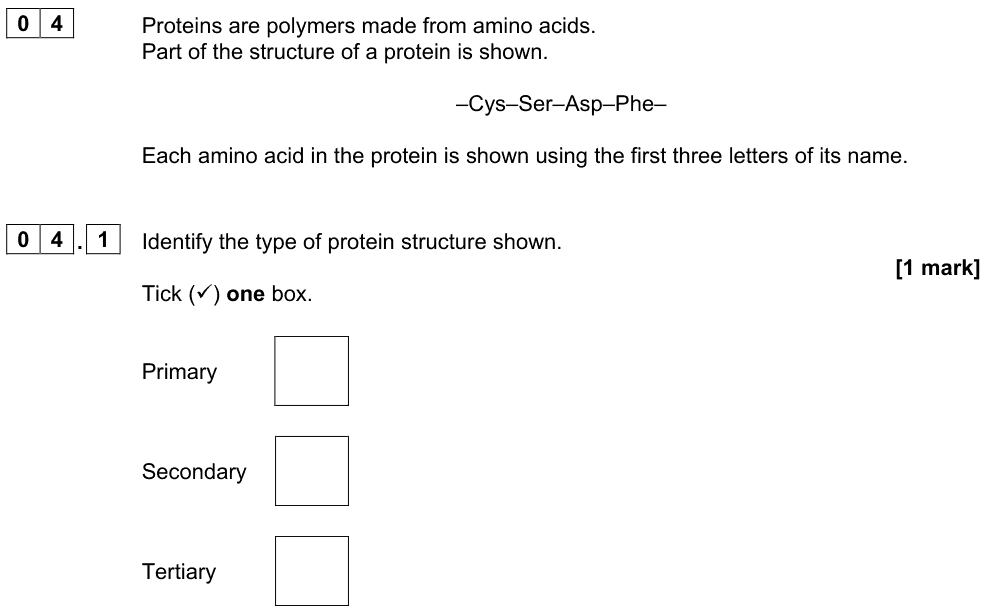
June 2022 · Paper 2 · Q04.1 1 mark AO1=1 Short answer amino acids proteins and dna
Proteins are polymers made from amino acids.
Part of the structure of a protein is shown.
–Cys–Ser–Asp–Phe–
Each amino acid in the protein is shown using the first three letters of its name.
Identify the type of protein structure shown.
[1 mark]
Tick () one box.
Primary
Secondary
Tertiary
June 2022 · Paper 2 · Q04.3 1 mark AO1=1 Short answer amino acids proteins and dna
Earlier part of question 04 that this part usesEarlier part of June 2022 Paper 2 question 04
Name the other substance formed when two amino acids react together to form part
of a protein chain.
[1 mark]
June 2022 · Paper 2 · Q04.5 1 mark AO3=1 Short answer amino acids proteins and dna
Earlier parts of question 04 that this part usesEarlier part of June 2022 Paper 2 question 04Earlier part of June 2022 Paper 2 question 04
Deduce the type of interaction that occurs between a lysine R group and an
aspartic acid R group.
[1 mark]
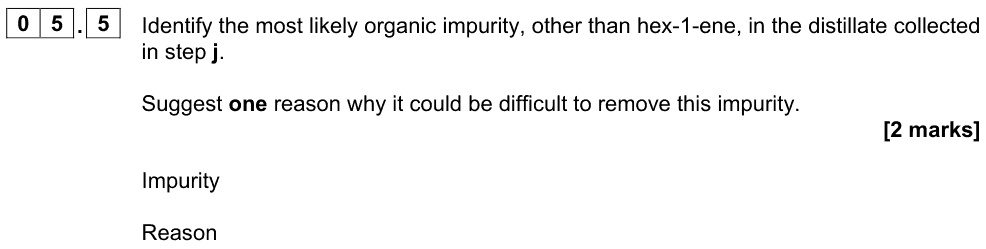
June 2022 · Paper 2 · Q05.5 2 marks AO2=2 Short answer alkenesalcohols
Earlier part of question 05 that this part usesEarlier part of June 2022 Paper 2 question 05
Identify the most likely organic impurity, other than hex-1-ene, in the distillate collected
in step j.
Suggest one reason why it could be difficult to remove this impurity.
[2 marks]
Impurity
Reason
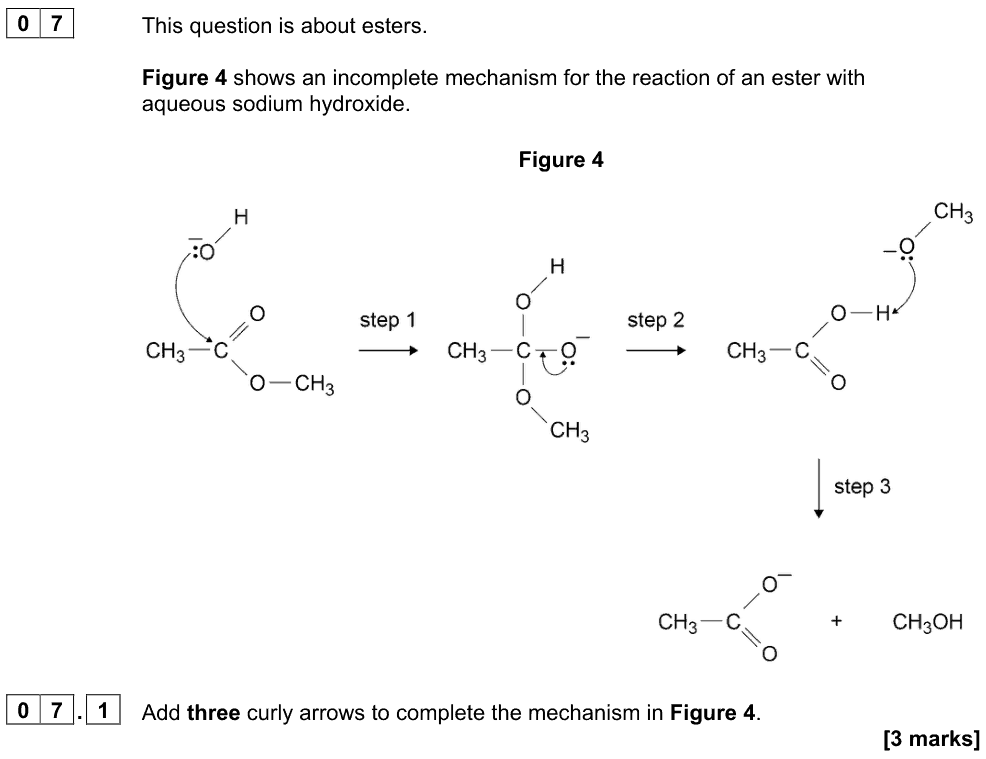
June 2022 · Paper 2 · Q07.2 1 mark AO1=1 Short answer carboxylic acids and derivatives
Earlier part of question 07 that this part usesEarlier part of June 2022 Paper 2 question 07
Name the type of reaction shown in Figure 4.
[1 mark]
June 2022 · Paper 2 · Q07.3 1 mark AO1=1 Short answer carboxylic acids and derivatives
Earlier part of question 07 that this part usesEarlier part of June 2022 Paper 2 question 07
Deduce the role of the CH3O− ion in step 3 shown in Figure 4.
[1 mark]
June 2022 · Paper 2 · Q07.4 1 mark AO1=1 Short answer carboxylic acids and derivatives
Earlier part of question 07 that this part usesEarlier part of June 2022 Paper 2 question 07
A triester in vegetable oil reacts with sodium hydroxide in a similar way.
Give a use for a product of this reaction.
[1 mark]
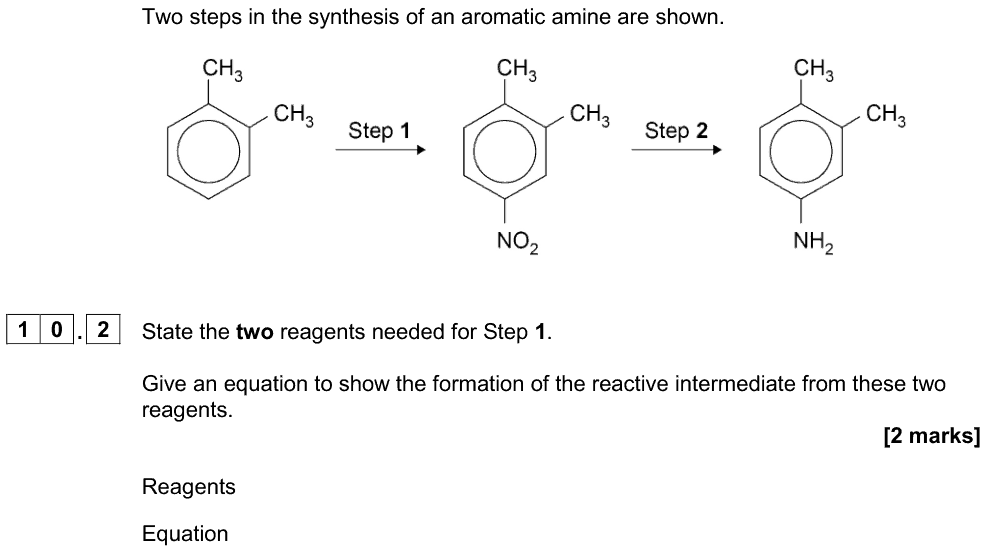
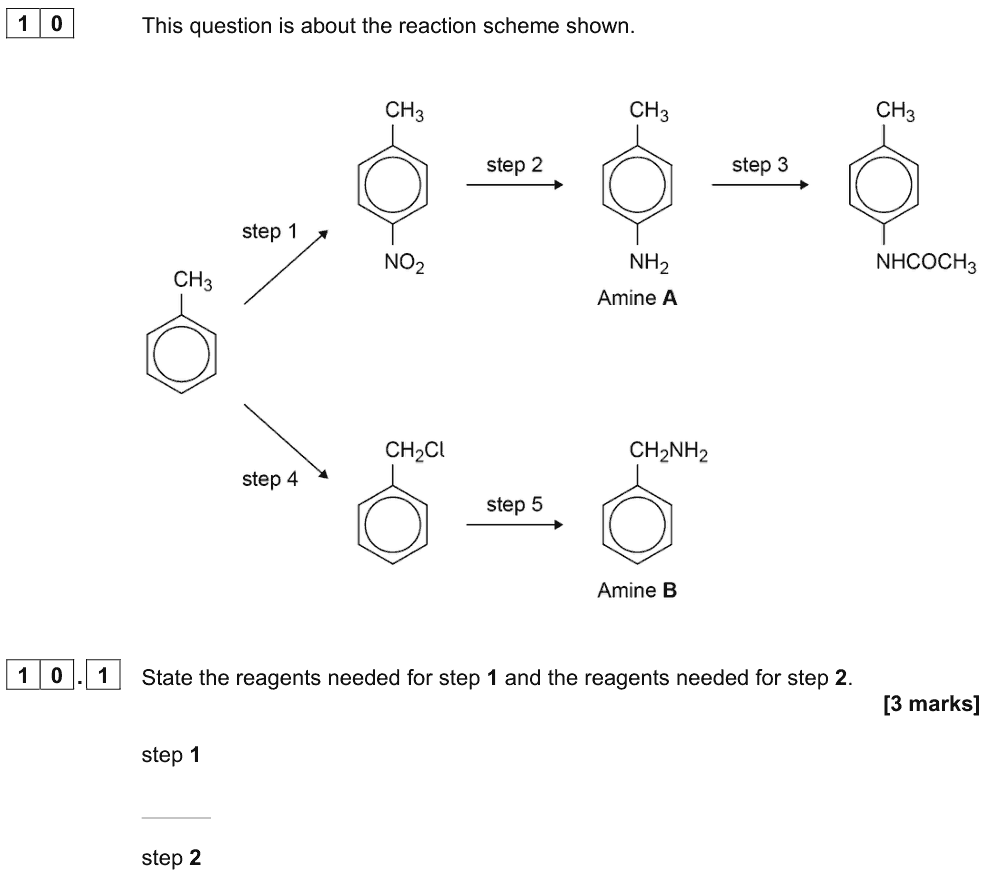
June 2022 · Paper 2 · Q10.1 3 marks AO1=3 Short answer aromatic chemistryamines
This question is about the reaction scheme shown.
State the reagents needed for step 1 and the reagents needed for step 2.
[3 marks]
step 1
step 2
June 2022 · Paper 2 · Q10.2 1 mark AO1=1 Short answer amines
Earlier part of question 10 that this part usesEarlier part of June 2022 Paper 2 question 10
Give the name of the mechanism for the reaction in step 3.
[1 mark]
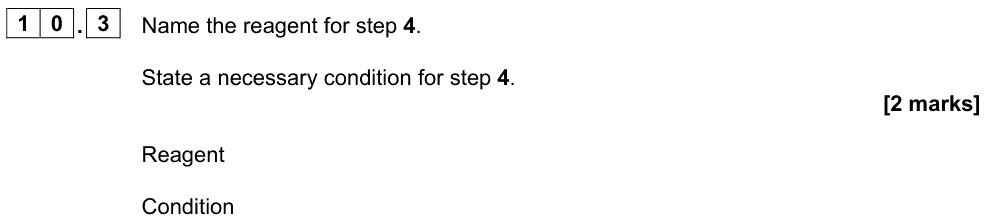
June 2022 · Paper 2 · Q10.3 2 marks AO1=2 Short answer alkanes
Earlier part of question 10 that this part usesEarlier part of June 2022 Paper 2 question 10
Name the reagent for step 4.
State a necessary condition for step 4.
[2 marks]
Reagent
Condition
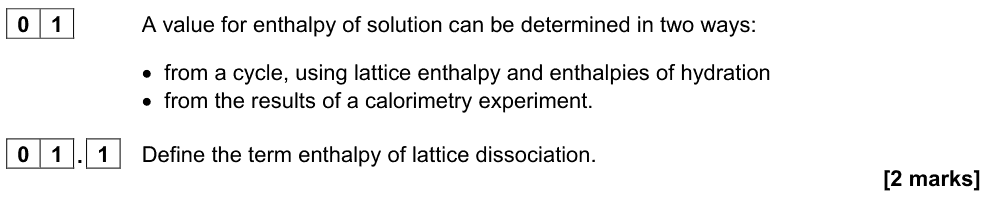
June 2022 · Paper 3 · Q01.1 2 marks AO1=2 Short answer thermodynamics
A value for enthalpy of solution can be determined in two ways:
• from a cycle, using lattice enthalpy and enthalpies of hydration
• from the results of a calorimetry experiment.
Define the term enthalpy of lattice dissociation.
[2 marks]
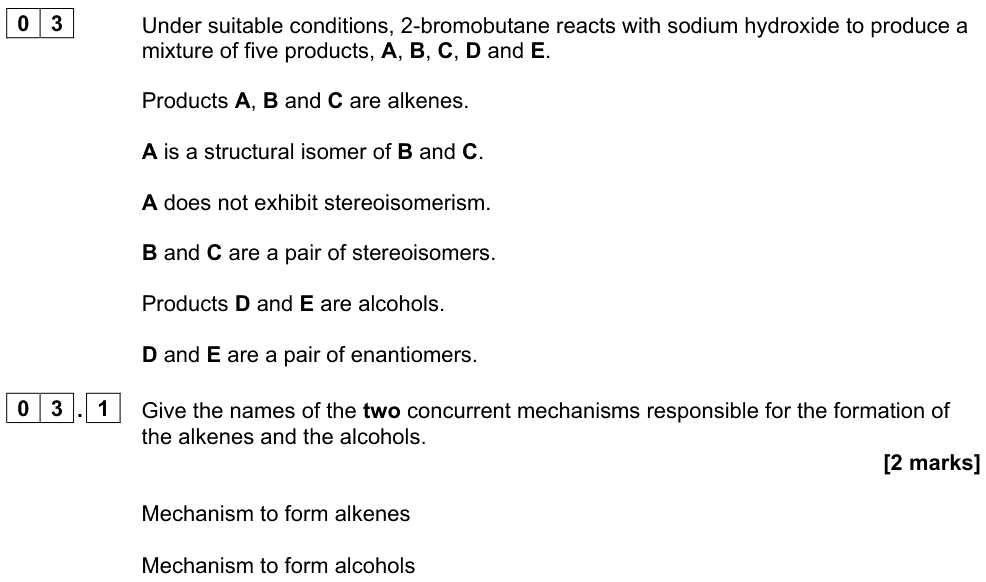
June 2022 · Paper 3 · Q03.1 2 marks AO1=2 Short answer halogenoalkanes
Under suitable conditions, 2-bromobutane reacts with sodium hydroxide to produce a
mixture of five products, A, B, C, D and E.
Products A, B and C are alkenes.
A is a structural isomer of B and C.
A does not exhibit stereoisomerism.
B and C are a pair of stereoisomers.
Products D and E are alcohols.
D and E are a pair of enantiomers.
Give the names of the two concurrent mechanisms responsible for the formation of
the alkenes and the alcohols.
[2 marks]
Mechanism to form alkenes
Mechanism to form alcohols
June 2022 · Paper 3 · Q03.2 2 marks AO1=2 Short answer introduction to organic chemistry
Earlier part of question 03 that this part usesEarlier part of June 2022 Paper 3 question 03
Define the term stereoisomers.
[2 marks]
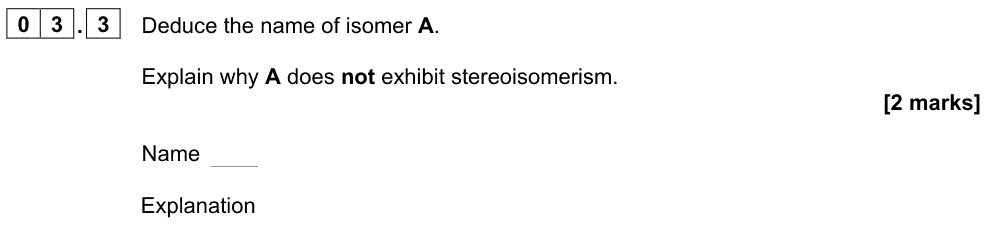
June 2022 · Paper 3 · Q03.3 2 marks AO1=1, AO3=1 Short answer introduction to organic chemistry
Earlier part of question 03 that this part usesEarlier part of June 2022 Paper 3 question 03
Deduce the name of isomer A.
Explain why A does not exhibit stereoisomerism.
[2 marks]
Name
Explanation
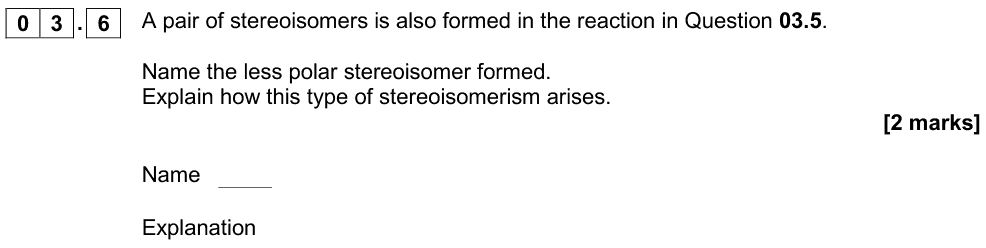
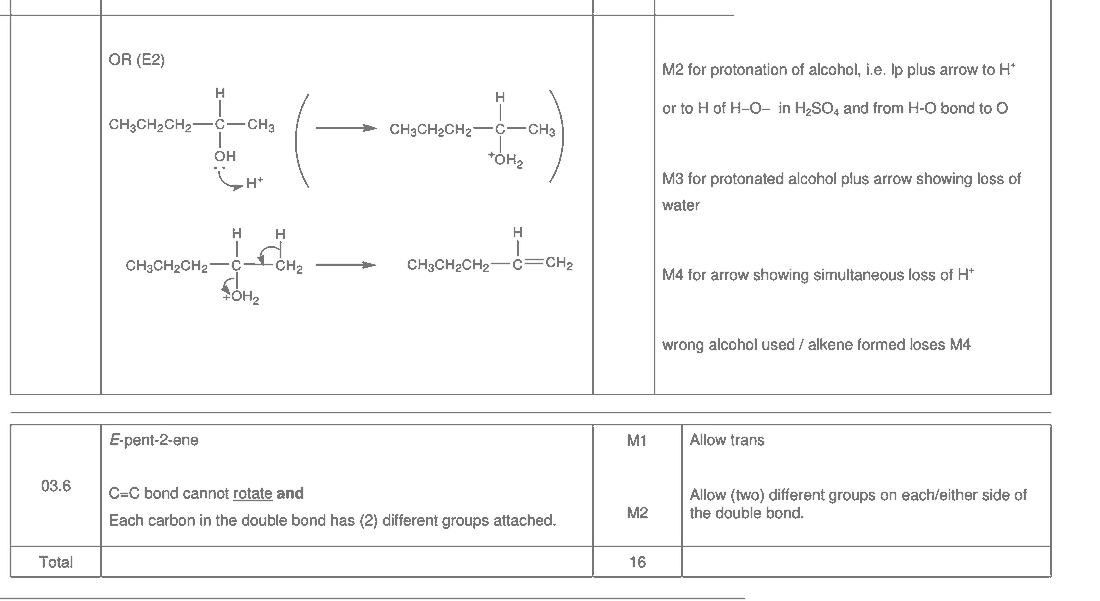
June 2022 · Paper 3 · Q03.5 2 marks AO1=1, AO3=1 Short answer introduction to organic chemistry
Earlier part of question 03 that this part usesEarlier part of June 2022 Paper 3 question 03
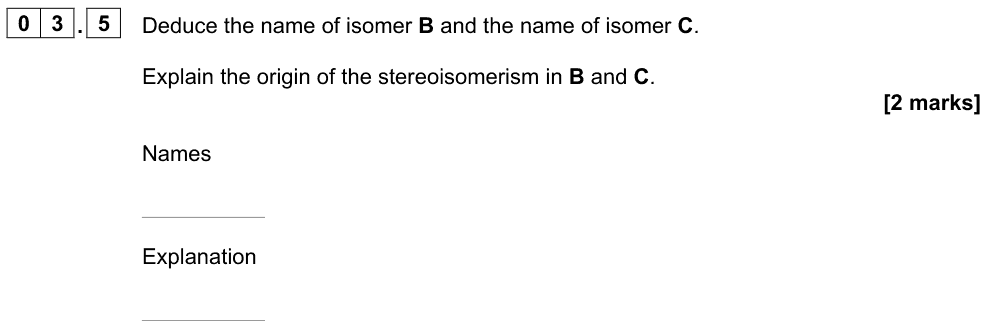
Deduce the name of isomer B and the name of isomer C.
Explain the origin of the stereoisomerism in B and C.
[2 marks]
Names
Explanation
June 2022 · Paper 3 · Q04.5 2 marks AO3=2 Short answer rate equations
Earlier parts of question 04 that this part usesEarlier part of June 2022 Paper 3 question 04Earlier part of June 2022 Paper 3 question 04
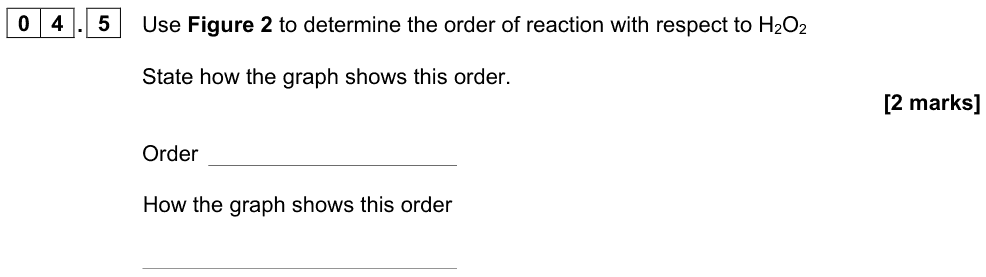
Use Figure 2 to determine the order of reaction with respect to H2O2
State how the graph shows this order.
[2 marks]
Order
How the graph shows this order
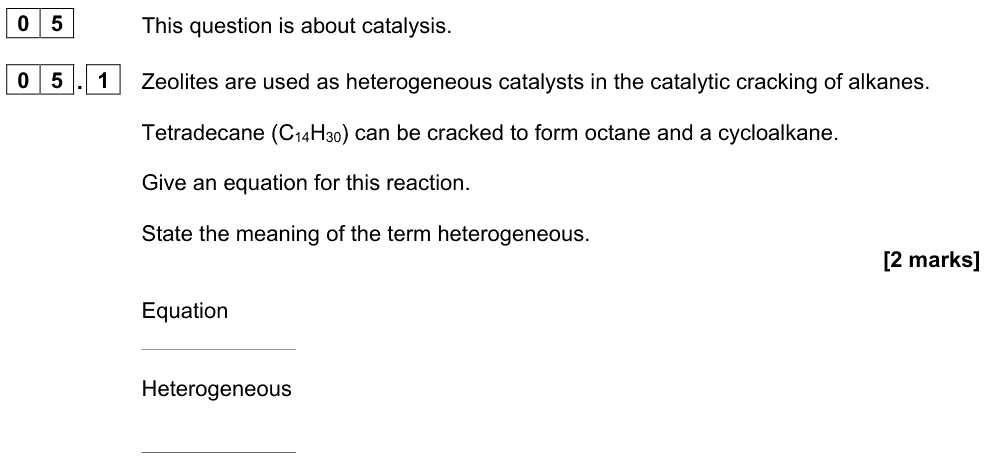
June 2022 · Paper 3 · Q05.1 2 marks AO1=1, AO2=1 Short answer alkanestransition metals
This question is about catalysis.
Zeolites are used as heterogeneous catalysts in the catalytic cracking of alkanes.
Tetradecane (C14H30) can be cracked to form octane and a cycloalkane.
Give an equation for this reaction.
State the meaning of the term heterogeneous.
[2 marks]
Equation
Heterogeneous
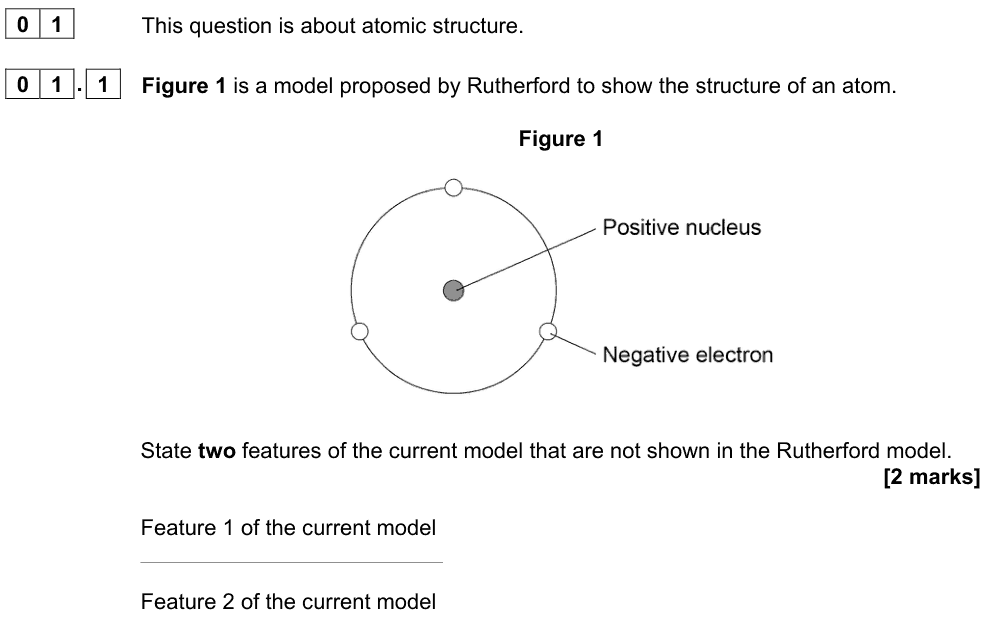
November 2021 · AS Paper 1 · Q01.1 2 marks Short answer atomic structure
This question is about atomic structure.
Figure 1 is a model proposed by Rutherford to show the structure of an atom.
Figure 1
State two features of the current model that are not shown in the Rutherford model.
[2 marks]
Feature 1 of the current model
Feature 2 of the current model
November 2021 · AS Paper 1 · Q02.2 2 marks Short answer bonding
Earlier part of question 02 that this part usesEarlier part of November 2021 Paper 1 question 02
Describe the bonding in magnesium.
[2 marks]
November 2021 · AS Paper 1 · Q02.4 1 mark Short answer group 2
Earlier part of question 02 that this part usesEarlier part of November 2021 Paper 1 question 02
Give one medical use for magnesium hydroxide.
[1 mark]
November 2021 · AS Paper 1 · Q03.1 1 mark Short answer redox
This question is about redox reactions.
State, in terms of electrons, the meaning of the term oxidising agent.
[1 mark]
November 2021 · AS Paper 1 · Q07.1 2 marks Short answer energetics
This question is about combustion.
State the meaning of the term standard enthalpy of combustion.
[2 marks]
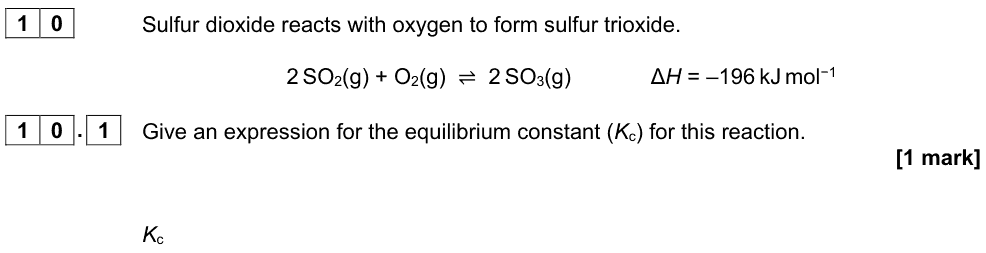
November 2021 · AS Paper 1 · Q10.1 1 mark Short answer chemical equilibria and kc
Sulfur dioxide reacts with oxygen to form sulfur trioxide.
2 SO2(g) + O2(g)  ⇌  2 SO3(g)             ΔH = –196 kJ mol−1
Give an expression for the equilibrium constant (Kc) for this reaction.
[1 mark]
Kc
November 2021 · AS Paper 2 · Q01.1 1 mark Short answer kinetics
Figure 1 shows the Maxwell–Boltzmann distribution of molecular energies in a
sample of gas.
Figure 1
Label the y-axis on Figure 1.
[1 mark]
November 2021 · AS Paper 2 · Q01.2 1 mark Short answer kinetics
Earlier part of question 01 that this part usesEarlier part of November 2021 Paper 2 question 01
State why the curve starts at the origin.
[1 mark]
November 2021 · AS Paper 2 · Q01.3 1 mark Short answer kinetics
Earlier part of question 01 that this part usesEarlier part of November 2021 Paper 2 question 01
State what X indicates on Figure 1.
[1 mark]
X indicates
November 2021 · AS Paper 2 · Q03.3 2 marks Short answer bonding
Earlier parts of question 03 that this part usesEarlier part of November 2021 Paper 2 question 03Earlier part of November 2021 Paper 2 question 03
Molecules of propan-2-ol and propanone each contain three carbon atoms.
Complete Table 1 to suggest the shape and a bond angle around the central C atom
in a molecule of each compound.
[2 marks]
Table 1
Compound
propan-2-ol
CH3CH(OH)CH3
propanone
CH3COCH3
Shape around
central C atom
Bond angle around
central C atom
November 2021 · AS Paper 2 · Q04.1 1 mark Short answer introduction to organic chemistry
CFCs were used as refrigerants and in aerosols.
The scientists Rowland and Molina published research in 1974 to show that CFCs are
responsible for the destruction of ozone molecules in the upper atmosphere.
A few years later, other scientists discovered that the concentration of ozone in the
upper atmosphere was decreasing.
In 1987 there was an agreement by many countries to restrict the use of CFCs.
The molecule CFC-11 was commonly used as a refrigerant.
Use IUPAC rules to name CFC-11
[1 mark]
November 2021 · AS Paper 2 · Q04.4 1 mark Short answer halogenoalkanes
Earlier part of question 04 that this part usesEarlier part of November 2021 Paper 2 question 04
State the benefit to life on Earth of ozone in the upper atmosphere.
[1 mark]
November 2021 · AS Paper 2 · Q04.5 1 mark Short answer halogenoalkanes
Earlier part of question 04 that this part usesEarlier part of November 2021 Paper 2 question 04
Suggest one reason why the use of CFCs was not restricted until several years
after Rowland and Molina published their research.
[1 mark]
November 2021 · AS Paper 2 · Q05.1 6 marks Short answer alkanesalkenes
This question is about poly(propene).
The three key steps in the manufacture of poly(propene) from crude oil are shown.
Naphtha is a mixture of alkanes with 6 to 12 carbon atoms per molecule.
For each step, name the process and state briefly the purpose of the process that
leads to the formation of poly(propene).
[6 marks]
Step 1
Name
Purpose
Step 2
Name
Purpose
Step 3
Name
Purpose
November 2021 · AS Paper 2 · Q05.2 1 mark Short answer alkenes
Earlier part of question 05 that this part usesEarlier part of November 2021 Paper 2 question 05
Poly(propene) is not biodegradable because it is unreactive.
Explain why poly(propene) is unreactive.
[1 mark]
November 2021 · AS Paper 2 · Q05.3 1 mark Short answer alkenes
Earlier part of question 05 that this part usesEarlier part of November 2021 Paper 2 question 05
Scientists are developing new polymers, including some that are biodegradable.
Suggest why it is beneficial for some polymers to be biodegradable.
[1 mark]
November 2021 · AS Paper 2 · Q07.1 1 mark Short answer halogenoalkanes
Prop-2-en-1-ol is a natural chemical found in garlic.  It is also used in the production of
plasticisers.
Prop-2-en-1-ol can be prepared by reacting 3-chloroprop-1-ene with
dilute aqueous sodium hydroxide.
Name the mechanism for this reaction.
[1 mark]
November 2021 · AS Paper 2 · Q08.1 1 mark Short answer energetics
This question is about enthalpy changes.
Define the term enthalpy change.
[1 mark]
November 2021 · AS Paper 2 · Q08.3 1 mark Short answer energetics
Earlier part of question 08 that this part usesEarlier part of November 2021 Paper 2 question 08
Explain why the value given for the O=O bond enthalpy in Question 08.2 is not a
mean value.
[1 mark]
November 2021 · Paper 1 · Q01.1 1 mark Short answer energetics
This question is about enthalpy changes for calcium chloride and
magnesium chloride.
State the meaning of the term enthalpy change.
[1 mark]
November 2021 · Paper 1 · Q02.1 1 mark Short answer atomic structure
This question is about atomic structure.
Define the mass number of an atom.
[1 mark]
November 2021 · Paper 1 · Q02.2 2 marks Short answer atomic structure
Earlier part of question 02 that this part usesEarlier part of November 2021 Paper 1 question 02
Complete Table 3 to show the numbers of neutrons and electrons in the species
shown.
[2 marks]
Table 3
Number of
protons
Number of
neutrons
Number of
electrons
46Ti
22
49Ti2+
22
November 2021 · Paper 1 · Q03.5 1 mark Short answer group 2
Earlier part of question 03 that this part usesEarlier part of November 2021 Paper 1 question 03
Give the formula of a hydroxide of an element in Period 3 used in medicine.
[1 mark]
November 2021 · Paper 1 · Q03.6 1 mark Short answer periodicity
Earlier part of question 03 that this part usesEarlier part of November 2021 Paper 1 question 03
Identify the element in Period 3, from sodium to chlorine, that has the
largest atomic radius.
[1 mark]
November 2021 · Paper 1 · Q04.3 1 mark Short answer transition metals
Earlier part of question 04 that this part usesEarlier part of November 2021 Paper 1 question 04
Give a reason why Zn2+ ions do not catalyse the reaction in Question 04.2.
[1 mark]
November 2021 · Paper 1 · Q04.5 2 marks Short answer reactions of ions in aqueous solution
Earlier part of question 04 that this part usesEarlier part of November 2021 Paper 1 question 04
Figure 2 shows some reactions of iron ions in aqueous solution.
Figure 2
Identify A and state its colour.
[2 marks]
Identity
Colour
November 2021 · Paper 1 · Q05.4 1 mark Short answer equilibrium constant kp
Earlier part of question 05 that this part usesEarlier part of November 2021 Paper 1 question 05
What is the effect on the value of Kp if the pressure of this equilibrium mixture is
increased at a constant temperature?
2 SO2(g) + O2(g) ⇌ 2 SO3(g)
[1 mark]
Tick ()  one box.
The value of Kp
increases.
stays the same.
decreases.
November 2021 · Paper 1 · Q06.1 1 mark Short answer acids and bases
This question is about pH.
Pure water dissociates slightly.
H2O(I)  ⇌  H+(aq)  +  OH–(aq)                 ΔH = +57 kJ mol–1
The equilibrium constant, Kc  = [H+][OH−]
[H2O]
The ionic product of water, Kw = [H+][OH−]
Explain why [H2O] is not shown in the Kw expression.
[1 mark]
November 2021 · Paper 1 · Q06.7 1 mark Short answer acids and bases
Earlier parts of question 06 that this part usesEarlier part of November 2021 Paper 1 question 06Earlier part of November 2021 Paper 1 question 06
Figure 4 shows the pH curve for a titration of hydrochloric acid with
sodium hydroxide solution.
Figure 4
Table 6 shows data about some indicators.
Table 6
Indicator
pH range
Colour at low pH
Colour at high pH
Bromocresol green
3.8 – 5.4
yellow
blue
Phenol red
6.8 – 8.4
yellow
red
Thymolphthalein
9.3 – 10.5
colourless
blue
The student plans to do the titration again using one of the indicators in Table 6 to
determine the end point.
State why all three of the indicators in Table 6 are suitable for this titration.
[1 mark]
November 2021 · Paper 1 · Q07.1 1 mark Short answer thermodynamics
This question is about thermodynamics.
Consider the reaction shown.
2 Al2O3(s) + 3 C(s) → 4 Al(s) + 3 CO2(g)
Table 7 shows some thermodynamic data.
Table 7
Substance
Al2O3(s)
Al(s)
C(s)
CO2(g)
ΔfHϴ/ kJ mol–1
–1669
0
0
–394
Sϴ/ J K–1 mol–1
51
28
6
214
Explain why the standard entropy value for carbon dioxide is greater than that for
carbon.
[1 mark]
November 2021 · Paper 1 · Q07.2 1 mark Short answer thermodynamics
Earlier part of question 07 that this part usesEarlier part of November 2021 Paper 1 question 07
State the temperature at which the standard entropy of aluminium is 0 J K–1 mol–1
[1 mark]
November 2021 · Paper 1 · Q08.1 1 mark Short answer electrode potentials and cells
This question is about electrode potentials and electrochemical cells.
State the meaning of the term electrochemical series.
[1 mark]
November 2021 · Paper 1 · Q08.2 1 mark Short answer electrode potentials and cells
Earlier part of question 08 that this part usesEarlier part of November 2021 Paper 1 question 08
Table 8 shows some electrode potentials.
Table 8
E o / V
[Fe(H2O)6]2+(aq) + 2 e–  →  Fe(s) + 6 H2O(l)
–0.44
H+(aq) + e–  →
1
2  H2(g)
0.00
[Co(NH3)6]3+(aq) + e–  →  [Co(NH3)6]2+(aq)
+0.11
[Fe(H2O)6]3+(aq) + e–  →  [Fe(H2O)6]2+(aq)
+0.77
VO2+(aq) + 2 H+(aq) + e–  →  VO2+(aq) + H2O(l)
+1.00
[Co(H2O)6]3+(aq) + e–  →  [Co(H2O)6]2+(aq)
+1.81
State two conditions needed for the following half-cell to have E o = 0.00 V
H+(aq) + e–  →
1
2
H2(g)
[1 mark]
November 2021 · Paper 1 · Q08.3 1 mark Short answer electrode potentials and cells
Earlier parts of question 08 that this part usesEarlier part of November 2021 Paper 1 question 08Earlier part of November 2021 Paper 1 question 08
Identify the weakest reducing agent in Table 8.
[1 mark]
November 2021 · Paper 1 · Q08.6 1 mark Short answer transition metals
Earlier parts of question 08 that this part usesEarlier part of November 2021 Paper 1 question 08Earlier part of November 2021 Paper 1 question 08
Suggest why the two cobalt(III) complex ions in Table 8 have different electrode
potentials.
[1 mark]
November 2021 · Paper 1 · Q09.3 1 mark Short answer electrode potentials and cells
Earlier part of question 09 that this part usesEarlier part of November 2021 Paper 1 question 09
An EMF value for a commercial lithium-iodine cell is 2.80 V
Suggest why this value is different from the value calculated in Question 09.2.
[1 mark]
November 2021 · Paper 1 · Q09.4 1 mark Short answer redox
Earlier part of question 09 that this part usesEarlier part of November 2021 Paper 1 question 09
In some lithium cells, lithium perchlorate (LiClO4) is used as the electrolyte.
Deduce the oxidation state of chlorine in LiClO4
[1 mark]
November 2021 · Paper 2 · Q01.1 3 marks Short answer carboxylic acids and derivatives
Coconut oil contains a triester with three identical R groups.
This triester reacts with potassium hydroxide.
Complete the equation by drawing the structure of the other product of this reaction in
the box.
Name the type of compound shown by the formula RCOOK
Give one use for this type of compound.
[3 marks]
Type of compound
Use
November 2021 · Paper 2 · Q02.1 1 mark Short answer alkanes
This question is about fuels.
The petrol fraction obtained from crude oil can be used as fuel in cars.
State the meaning of fraction, as used in the term petrol fraction.
[1 mark]
November 2021 · Paper 2 · Q02.3 1 mark Short answer organic analysis
Earlier part of question 02 that this part usesEarlier part of November 2021 Paper 2 question 02
Carbon dioxide is formed when petrol is burned.
Carbon dioxide acts as a greenhouse gas when it absorbs infrared radiation.
Give a reason why carbon dioxide absorbs infrared radiation.
[1 mark]
November 2021 · Paper 2 · Q04.2 1 mark Short answer aromatic chemistry
Earlier part of question 04 that this part usesEarlier part of November 2021 Paper 2 question 04
Explain, in terms of structure and bonding, why
is more thermodynamically stable than
[1 mark]
November 2021 · Paper 2 · Q05.1 3 marks Short answer chemical equilibria and kc
This question is about equilibrium.
1 mol of a diester with molecular formula C7H12O4 is added to 1 mol of water in the
presence of a small amount of catalyst.
The mixture is left to reach equilibrium at a constant temperature.
C7H12O4(l)  +  2 H2O(l)  ⇌  2 CH3COOH(l)  +  HO(CH2)3OH(l)
At equilibrium, 𝒳𝒳 mol of ethanoic acid are present in the mixture.
Complete Table 2 by deducing the amounts, in terms of  𝒳𝒳,
of the diester, water and diol present in the equilibrium mixture.
[3 marks]
Table 2
Amount in the mixture / mol
Diester
Water
Acid
Diol
At the start
1
1
0
0
At equilibrium
𝒳𝒳
November 2021 · Paper 2 · Q06.2 2 marks Short answer optical isomerism
Earlier part of question 06 that this part usesEarlier part of November 2021 Paper 2 question 06
Describe how you distinguish between separate samples of the two enantiomers of
the branched chain aldehyde C5H10O
[2 marks]
November 2021 · Paper 2 · Q07.1 1 mark Short answer Easy organic analysis
This question is about spectroscopy.
Compound K has molecular formula C4H8O
Figure 5 shows the infrared spectrum of K.
Figure 5
Which functional group does K contain?
Tick () one box.
[1 mark]
Functional Group
alcohol
alkene
amine
carbonyl
nitrile
November 2021 · Paper 2 · Q07.2 3 marks Short answer organic analysisamines
Earlier part of question 07 that this part usesEarlier part of November 2021 Paper 2 question 07
Compound L has molecular formula C4H7NO
Figure 6 shows the infrared spectrum of L.
Figure 6
L reacts with H2 in the presence of a nickel catalyst to give compound M.
Suggest three ways in which the infrared spectrum of M is different from the infrared
spectrum of L.
[3 marks]
1
2
3
November 2021 · Paper 2 · Q08.1 2 marks Short answer alcohols
This question is about making a diester from cyclohexanol.
State the type of reaction in step 1.
Give the name of the reagent needed for step 1.
[2 marks]
Type of reaction
Reagent
November 2021 · Paper 2 · Q08.4 2 marks Short answer organic synthesisamount of substance
Earlier part of question 08 that this part usesEarlier part of November 2021 Paper 2 question 08
Suggest why chemists usually aim to design production methods
• with fewer steps
• with a high percentage atom economy.
[2 marks]
Fewer steps
High percentage atom economy
November 2021 · Paper 2 · Q09.1 1 mark Short answer halogenoalkanes
This question is about the ozone layer in the upper atmosphere.
State why the ozone layer is beneficial for living organisms.
[1 mark]
November 2021 · Paper 2 · Q09.2 1 mark Short answer halogenoalkanes
Earlier part of question 09 that this part usesEarlier part of November 2021 Paper 2 question 09
State how chlorofluorocarbons (CFCs) form chlorine atoms in the
upper atmosphere.
[1 mark]
November 2021 · Paper 3 · Q02.2 1 mark Short answer amino acids proteins and dna
Earlier part of question 02 that this part usesEarlier part of November 2021 Paper 3 question 02
The amino acids cannot be seen as they move during the experiment.
State how the amino acids can be made visible at the end of the experiment.
[1 mark]
November 2021 · Paper 3 · Q02.3 1 mark Short answer chromatography
Earlier part of question 02 that this part usesEarlier part of November 2021 Paper 3 question 02
State why each amino acid has a different Rf value.
[1 mark]
November 2021 · Paper 3 · Q03.2 2 marks Short answer aldehydes and ketones
Earlier part of question 03 that this part usesEarlier part of November 2021 Paper 3 question 03
Propanone (CH3COCH3) reacts with the weak acid HCN to form a hydroxynitrile.
This hydroxynitrile is usually made by reaction of propanone with KCN followed by
dilute acid, instead of with HCN
State the hazard associated with the use of KCN
Suggest a reason, other than safety, why KCN is used instead of HCN.
[2 marks]
Hazard
Why KCN is used
November 2021 · Paper 3 · Q06.2 1 mark Short answer alcohols
Earlier part of question 06 that this part usesEarlier part of November 2021 Paper 3 question 06
Give one additional reagent that is needed to form any propanoic acid.
[1 mark]
November 2020 · AS Paper 1 · Q03.1 2 marks Short answer amount of substance
This question is about time of flight (TOF) mass spectrometry.
Define the term relative atomic mass.
[2 marks]
November 2020 · AS Paper 1 · Q04.1 1 mark Short answer energetics
This question is about enthalpy changes.
State the meaning of the term enthalpy change as applied to a chemical reaction.
[1 mark]
November 2020 · AS Paper 1 · Q05.3 2 marks Short answer group 2
Earlier part of question 05 that this part usesEarlier part of November 2020 Paper 1 question 05
State what is observed when dilute aqueous sodium hydroxide is added to separate
solutions of magnesium chloride and barium chloride.
[2 marks]
Observation with magnesium chloride
Observation with barium chloride
November 2020 · AS Paper 1 · Q07.1 3 marks Short answer group 7 the halogens
This question is about Group 7 elements and their compounds.
Chlorine is used to treat water even though it is toxic to humans.
Give one reason why water is treated with chlorine.
Explain why chlorine is added to water even though it is toxic.
Give an equation for the reaction of chlorine with cold water.
[3 marks]
Reason
Explanation
Equation
November 2020 · AS Paper 2 · Q01.1 2 marks Short answer energetics
This question is about 1-chloropropane.
Define the term standard enthalpy of formation.
[2 marks]
November 2020 · AS Paper 2 · Q01.4 1 mark Short answer bonding
Earlier part of question 01 that this part usesEarlier part of November 2020 Paper 2 question 01
The C–Cl bond in 1-chloropropane is polar because carbon and chlorine have
different electronegativities.
Define the term electronegativity.
[1 mark]
November 2020 · AS Paper 2 · Q06.3 2 marks Short answer introduction to organic chemistryalkenes
Earlier part of question 06 that this part usesEarlier part of November 2020 Paper 2 question 06
Plasticisers are often added during the manufacture of PVC.  The structure of the
plasticiser DEHP is shown.
Deduce the molecular formula of DEHP and state why a plasticiser is added to PVC.
[2 marks]
Molecular formula
Why a plasticiser is added
November 2020 · AS Paper 2 · Q07.2 2 marks Short answer alcohols
Earlier part of question 07 that this part usesEarlier part of November 2020 Paper 2 question 07
Ethanedioic acid is formed by the oxidation of ethane-1,2-diol (HOCH2CH2OH).
State suitable reagent(s) and a condition for this reaction.
[2 marks]
Reagent(s)
Condition
November 2020 · AS Paper 2 · Q08.1 2 marks Short answer chemical equilibria and kc
Hydrogen gas can be made by reacting ethanol with steam in the presence of a
catalyst.
C2H5OH(g) + H2O(g)  ⇌  2 CO(g) + 4 H2(g)
Give an expression for Kc for this equilibrium.
State its units.
[2 marks]
Kc
Units of Kc
November 2020 · Paper 1 · Q01.2 1 mark Short answer thermodynamicsbonding
Earlier part of question 01 that this part usesEarlier part of November 2020 Paper 1 question 01
Draw a line from each substance to the enthalpy of lattice formation of that substance.
[1 mark]
Substance
Enthalpy of lattice
formation / kJ mol–1
MgCl2
–2018
MgO
–2493
BaCl2
–3889
November 2020 · Paper 1 · Q01.3 1 mark Short answer thermodynamics
Earlier part of question 01 that this part usesEarlier part of November 2020 Paper 1 question 01
Table 2 shows the theoretical lattice enthalpy, based on a perfect ionic model, and an
experimental value for the enthalpy of lattice formation of silver chloride.
Table 2
Theoretical
Experimental
Enthalpy of lattice formation / kJ mol–1
–770
–905
State why there is a difference between the theoretical and experimental values.
[1 mark]
November 2020 · Paper 1 · Q02.1 2 marks Short answer amount of substance
This question is about the isotopes of chromium.
Give the meaning of the term relative atomic mass.
[2 marks]
November 2020 · Paper 1 · Q02.3 2 marks Short answer atomic structure
Earlier part of question 02 that this part usesEarlier part of November 2020 Paper 1 question 02
State, in terms of the numbers of fundamental particles, one similarity and one
difference between atoms of 50Cr and 53Cr
[2 marks]
Similarity
Difference
November 2020 · Paper 1 · Q02.4 2 marks Short answer atomic structure
Earlier part of question 02 that this part usesEarlier part of November 2020 Paper 1 question 02
The sample of chromium is analysed in a time of flight (TOF) mass spectrometer.
Give two reasons why it is necessary to ionise the isotopes of chromium before they
can be analysed in a TOF mass spectrometer.
[2 marks]
1
2
November 2020 · Paper 1 · Q03.4 1 mark Short answer bonding
Earlier part of question 03 that this part usesEarlier part of November 2020 Paper 1 question 03
Identify the element in Period 3, from sodium to chlorine, that has the highest
electronegativity.
[1 mark]
November 2020 · Paper 1 · Q04.1 1 mark Short answer acids and bases
Propanoic acid (C2H5COOH) is a weak acid.
The acid dissociation constant (Ka) for propanoic acid is 1.35 × 10⁻⁵ mol dm–3
at 25 oC
State the meaning of the term weak acid.
[1 mark]
November 2020 · Paper 1 · Q04.2 1 mark Short answer acids and bases
Earlier part of question 04 that this part usesEarlier part of November 2020 Paper 1 question 04
Give an expression for the acid dissociation constant for propanoic acid.
[1 mark]
Ka
November 2020 · Paper 1 · Q05.3 1 mark Short answer transition metals
Earlier part of question 05 that this part usesEarlier part of November 2020 Paper 1 question 05
Deduce the formula of the complex ion A.
[1 mark]
November 2020 · Paper 1 · Q06.3 2 marks Short answer equilibrium constant kp
Earlier part of question 06 that this part usesEarlier part of November 2020 Paper 1 question 06
Give an expression for the equilibrium constant (Kp) for this reaction.
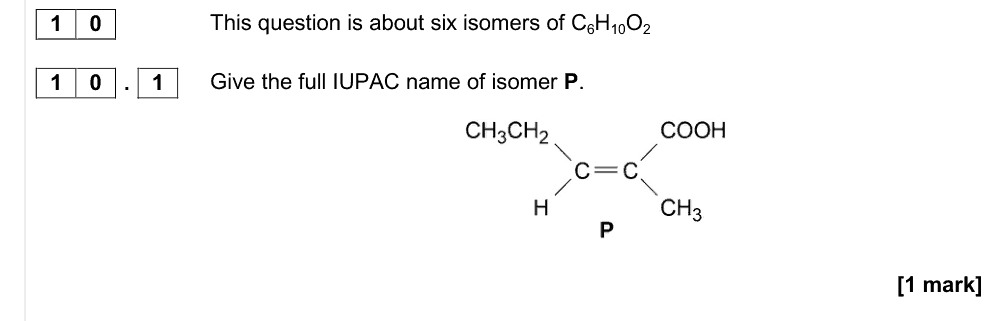
State the units.
[2 marks]
Kp
Units
November 2020 · Paper 1 · Q06.4 2 marks Short answer equilibrium constant kpchemical equilibria and kc
Earlier part of question 06 that this part usesEarlier part of November 2020 Paper 1 question 06
Some more carbon monoxide is added to the mixture in Question 06.2.  The
new mixture is allowed to reach equilibrium at temperature T.
State the effect, if any, on the partial pressure of methanol and on the value of Kp
[2 marks]
Effect on partial pressure of methanol
Effect on value of Kp
November 2020 · Paper 1 · Q09.1 1 mark Short answer group 7 the halogens
This question is about sodium halides.
State what is observed when silver nitrate solution is added to sodium fluoride
solution.
[1 mark]
November 2020 · Paper 1 · Q10.3 1 mark Short answer thermodynamics
Earlier parts of question 10 that this part usesEarlier part of November 2020 Paper 1 question 10Earlier part of November 2020 Paper 1 question 10
State what Figure 4 shows about the feasibility of the reaction.
[1 mark]
November 2020 · Paper 1 · Q11.4 2 marks Short answer electrode potentials and cells
Earlier part of question 11 that this part usesEarlier part of November 2020 Paper 1 question 11
The negative electrode is made of carbon and the positive electrode is made of
platinum.
Give the conventional representation for the glucose–oxygen fuel cell.
[2 marks]
November 2020 · Paper 1 · Q11.5 1 mark Short answer electrode potentials and cells
Earlier part of question 11 that this part usesEarlier part of November 2020 Paper 1 question 11
State what must be done to maintain the EMF of this fuel cell when in use.
[1 mark]
November 2020 · Paper 2 · Q01.2 2 marks Short answer rate equations
Earlier part of question 01 that this part usesEarlier part of November 2020 Paper 2 question 01
Another student reacted different initial concentrations of phosphinate ions with an
excess of hydroxide ions.  The student measured the time (t) taken to collect

15 cm3 of hydrogen gas.  Each experiment was carried out at the same temperature.
Table 1 shows the results.
Table 1
Initial [H2PO2–] / mol dm–3
t / s
0.25
64
0.35
32
0.50
16
1.00
4
State the relationship between the initial concentration of phosphinate and time (t).
Deduce the order of the reaction with respect to phosphinate.
[2 marks]
Relationship
Order
November 2020 · Paper 2 · Q01.4 1 mark Short answer rate equations
Earlier part of question 01 that this part usesEarlier part of November 2020 Paper 2 question 01
The rate equation for a different reaction is
rate = k [L] [M]2
Deduce the overall effect on the rate of reaction when the concentrations of both
L and M are halved.
[1 mark]
November 2020 · Paper 2 · Q01.6 1 mark Short answer rate equations
Earlier part of question 01 that this part usesEarlier part of November 2020 Paper 2 question 01
Define the term overall order of reaction.
[1 mark]
November 2020 · Paper 2 · Q02.1 1 mark Short answer optical isomerism
Prilocaine is used as an anaesthetic in dentistry.
Figure 3 shows the structure of prilocaine.
Figure 3
Draw a circle around any chiral centre(s) in Figure 3.
[1 mark]
November 2020 · Paper 2 · Q02.2 1 mark Short answer carboxylic acids and derivativesamines
Earlier part of question 02 that this part usesEarlier part of November 2020 Paper 2 question 02
Identify the functional group(s) in the prilocaine molecule.
[1 mark]
Tick () the box(es) corresponding to the functional group(s).
Amide
Amine
Ester
Ketone
November 2020 · Paper 2 · Q03.4 1 mark Short answer introduction to organic chemistry
Earlier part of question 03 that this part usesEarlier part of November 2020 Paper 2 question 03
State the type of structural isomerism shown by isomers P, Q, R and S.
[1 mark]
November 2020 · Paper 2 · Q03.6 1 mark Short answer organic analysisatomic structure
Earlier part of question 03 that this part usesEarlier part of November 2020 Paper 2 question 03
State why mass spectrometry using electrospray ionisation is not a suitable method to
distinguish between the isomers.
[1 mark]
November 2020 · Paper 2 · Q05.1 3 marks Short answer bondinghalogenoalkanes
This question is about 2-bromopropane.
Define the term electronegativity.
Explain the polarity of the C–Br bond in 2-bromopropane.
[3 marks]
Electronegativity
Explanation
November 2020 · Paper 2 · Q06.1 3 marks Short answer aromatic chemistry
Polystyrene can be made from benzene in the series of steps shown.
State the type of reaction in step 1.
Identify the reagent(s) and conditions needed for step 1.
[3 marks]
Type of reaction
Reagent(s)
Conditions
November 2020 · Paper 2 · Q06.2 3 marks Short answer aldehydes and ketonesintroduction to organic chemistry
Earlier part of question 06 that this part usesEarlier part of November 2020 Paper 2 question 06
State the name of the mechanism for the reaction in step 2.
Identify the inorganic reagent needed for step 2.
Name the organic product of step 2.
[3 marks]
Name of mechanism
Inorganic reagent
Name of organic product
November 2020 · Paper 2 · Q07.2 3 marks Short answer nmr spectroscopy
Earlier part of question 07 that this part usesEarlier part of November 2020 Paper 2 question 07
Deduce the splitting pattern for each of the peaks given by the H atoms labelled
x, y and z in the 1H NMR spectrum of the compound shown.
[3 marks]
x
y
z
November 2020 · Paper 2 · Q07.3 1 mark Short answer nmr spectroscopy
Earlier part of question 07 that this part usesEarlier part of November 2020 Paper 2 question 07
Suggest why it is difficult to use Table B in the Data Booklet to predict the
chemical shift (δ value) for the peak given by the H atom labelled y.
[1 mark]
November 2020 · Paper 2 · Q08.3 1 mark Short answer introduction to organic chemistry
Earlier part of question 08 that this part usesEarlier part of November 2020 Paper 2 question 08
Figure 5 shows the structure of H3Y
Figure 5
Complete this IUPAC name for H3Y
[1 mark]
propane-1, 2, 3-tricarboxylic acid
November 2020 · Paper 2 · Q08.4 1 mark Short answer nmr spectroscopy
Earlier parts of question 08 that this part usesEarlier part of November 2020 Paper 2 question 08Earlier part of November 2020 Paper 2 question 08
State the number of peaks you would expect in the 13C NMR spectrum for H3Y
[1 mark]
November 2020 · Paper 2 · Q09.3 1 mark Short answer Hard chemical equilibria and kc
Earlier part of question 09 that this part usesEarlier part of November 2020 Paper 2 question 09
When an excess of water is added to chloroethanal, an equilibrium mixture is formed.
ClCH2CHO(aq) +  H2O(l)  ⇌  ClCH2CH(OH)2(aq)
An expression for an equilibrium constant (K) for the reaction under these
conditions is
K =
[ClCH2CH(OH)2]
[ClCH2CHO]
Suggest why an expression for K can be written without the concentration of water.
[1 mark]
November 2020 · Paper 3 · Q01.2 1 mark Short answer alkanes
Earlier part of question 01 that this part usesEarlier part of November 2020 Paper 3 question 01
State why it is desirable to decrease emissions of oxides of nitrogen from vehicles.
[1 mark]
November 2020 · Paper 3 · Q01.4 2 marks Short answer Hard transition metalskinetics
Earlier part of question 01 that this part usesEarlier part of November 2020 Paper 3 question 01
Petrol vehicles have a catalytic converter which decreases emissions of oxides of
nitrogen.
Platinum in the catalytic converter acts as a heterogeneous catalyst.
State the meaning of the term heterogeneous catalyst.
[2 marks]
November 2020 · Paper 3 · Q01.5 1 mark Short answer alkanes
Earlier part of question 01 that this part usesEarlier part of November 2020 Paper 3 question 01
Some carbon particulates are also formed in both diesel and petrol vehicles.
Explain why carbon particulates are formed.
[1 mark]
November 2020 · Paper 3 · Q04.1 1 mark Short answer amino acids proteins and dna
Cisplatin, [Pt(NH3)2Cl2], is used as an anti-cancer drug.
Cisplatin works by causing the death of rapidly dividing cells.
Name the process that is prevented by cisplatin during cell division.
[1 mark]
November 2020 · Paper 3 · Q05.3 1 mark Short answer energetics
Earlier part of question 05 that this part usesEarlier part of November 2020 Paper 3 question 05
State why the heat change calculated from the bomb calorimeter experiment is not an
enthalpy change.
[1 mark]
November 2020 · Paper 3 · Q06.1 3 marks Short answer electrode potentials and cells
Standard electrode potentials are measured by comparison with the
standard hydrogen electrode.
State the substances and conditions needed in a standard hydrogen electrode.
[3 marks]
June 2019 · AS Paper 1 · Q01.3 2 marks Short answer bonding
Earlier part of question 01 that this part usesEarlier part of June 2019 Paper 1 question 01
The ion H2F+ is formed when hydrogen fluoride gains a proton as shown in the
equation
HF + H+ → H2F+
Name the type of bond formed when HF reacts with H+
Explain how this bond is formed.
[2 marks]
Type of bond
Explanation
June 2019 · AS Paper 1 · Q02.1 3 marks Short answer atomic structure
Time of flight (TOF) mass spectrometry is an important analytical technique.
A mixture of three compounds is analysed using a TOF mass spectrometer.
The mixture is ionised using electrospray ionisation.
The three compounds are known to have the molecular formulas:
C3H5O2N
C3H7O3N
C3H7O2NS
Describe how the molecules are ionised using electrospray ionisation.
[3 marks]
June 2019 · AS Paper 1 · Q02.2 1 mark Short answer atomic structure
Earlier part of question 02 that this part usesEarlier part of June 2019 Paper 1 question 02
Give the formula of the ion that reaches the detector first in the TOF mass
spectrometer.
[1 mark]
June 2019 · AS Paper 1 · Q03.1 1 mark Short answer atomic structure
This question is about chromium and its compounds.
Complete the full electron configuration of a chromium atom.
[1 mark]
1s2
June 2019 · AS Paper 1 · Q03.2 1 mark Short answer atomic structure
Earlier part of question 03 that this part usesEarlier part of June 2019 Paper 1 question 03
An atom has 2 more protons and 3 more neutrons than an atom of 52Cr.
Deduce the symbol, including the mass number and the atomic number, for this atom.
[1 mark]
June 2019 · AS Paper 1 · Q03.4 1 mark Short answer redox
Earlier part of question 03 that this part usesEarlier part of June 2019 Paper 1 question 03
Deduce the oxidation state of chromium in the Cr2O7
2– ion.
[1 mark]
June 2019 · AS Paper 1 · Q05.2 1 mark Short answer Easy chemical equilibria and kc
Earlier part of question 05 that this part usesEarlier part of June 2019 Paper 1 question 05
Give the expression for the equilibrium constant, Kc, for the reaction between
nitrogen monoxide and chlorine to form nitrosyl chloride.
[1 mark]
Kc =
June 2019 · AS Paper 2 · Q02.2 1 mark Short answer introduction to organic chemistry
Earlier part of question 02 that this part usesEarlier part of June 2019 Paper 2 question 02
Give the IUPAC name of D.
[1 mark]
June 2019 · AS Paper 2 · Q05.2 1 mark Short answer bonding
Earlier part of question 05 that this part usesEarlier part of June 2019 Paper 2 question 05
The bond angle around the oxygen atom in methanol is slightly smaller than the
regular tetrahedral angle of 109.5°
Explain why this bond angle is smaller than 109.5°
[1 mark]
June 2019 · Paper 1 · Q01.3 1 mark Short answer thermodynamics
Earlier part of question 01 that this part usesEarlier part of June 2019 Paper 1 question 01
The enthalpy of lattice formation for caesium iodide in Table 1 is a value obtained
by experiment.
The value obtained by calculation using the perfect ionic model is –582 kJ mol–1
Deduce what these values indicate about the bonding in caesium iodide.
[1 mark]
June 2019 · Paper 1 · Q02.2 1 mark Short answer atomic structure
Earlier part of question 02 that this part usesEarlier part of June 2019 Paper 1 question 02
What is the relative molecular mass of P?
Tick () one box.
[1 mark]
555
556
557
June 2019 · Paper 1 · Q03.1 1 mark Short answer periodicity
This question is about periodicity, the Period 4 elements and their compounds.
State the meaning of the term periodicity.
[1 mark]
June 2019 · Paper 1 · Q03.2 1 mark Short answer bonding
Earlier part of question 03 that this part usesEarlier part of June 2019 Paper 1 question 03
Identify the element in Period 4 with the highest electronegativity value.
[1 mark]
June 2019 · Paper 1 · Q03.4 1 mark Short answer reactions of ions in aqueous solution
Earlier part of question 03 that this part usesEarlier part of June 2019 Paper 1 question 03
The equations for two reactions of arsenic(III) oxide are shown.
As2O3 + 6 HCl → 2 AsCl3 + 3 H2O
As2O3 + 6 NaOH → 2 Na3AsO3 + 3 H2O
Name the property of arsenic(III) oxide that describes its ability to react in these two
ways.
[1 mark]
June 2019 · Paper 1 · Q04.1 3 marks Short answer reactions of ions in aqueous solution
Figure 3 shows some reactions of aqueous iron ions.
Figure 3
Give the formula of Precipitate J and state its colour.
Give an equation for Reaction 1.
[3 marks]
Formula of J
Colour
Equation
June 2019 · Paper 1 · Q04.3 1 mark Short answer transition metalsredox
Earlier part of question 04 that this part usesEarlier part of June 2019 Paper 1 question 04
Suggest a reagent for Reaction 3.
[1 mark]
June 2019 · Paper 1 · Q04.4 2 marks Short answer reactions of ions in aqueous solution
Earlier part of question 04 that this part usesEarlier part of June 2019 Paper 1 question 04
Give the formula of Precipitate M and state its colour.
[2 marks]
Formula of M
Colour
June 2019 · Paper 1 · Q05.3 1 mark Short answer Easy redox
Earlier part of question 05 that this part usesEarlier part of June 2019 Paper 1 question 05
Chlorine reacts with hot aqueous sodium hydroxide as shown in the equation.
3 Cl2 + 6 NaOH → NaClO3 + 5 NaCl + 3 H2O
Give the oxidation state of chlorine in NaClO3 and in NaCl
[1 mark]
NaClO3
NaCl
June 2019 · Paper 1 · Q05.4 1 mark Short answer redox
Earlier part of question 05 that this part usesEarlier part of June 2019 Paper 1 question 05
State, in terms of redox, what happens to chlorine in the reaction in Question 05.3.
[1 mark]
June 2019 · Paper 1 · Q05.5 6 marks Short answer group 7 the halogens
Earlier part of question 05 that this part usesEarlier part of June 2019 Paper 1 question 05
Solution Y contains two different negative ions.
To a sample of solution Y in a test tube a student adds
• silver nitrate solution
• then an excess of dilute nitric acid
• finally an excess of concentrated ammonia solution.
The observations after each addition are recorded in Table 3.
Table 3
Reagent added to solution Y
Observation
silver nitrate solution
cream precipitate containing compound D
and compound E
excess dilute nitric acid
cream precipitate D and bubbles of gas F
excess concentrated ammonia solution
colourless solution containing complex ion G
Give the formulas of D, E and F.
Give an ionic equation to show the formation of E.
Give an equation to show the conversion of D into G.
[6 marks]
Formula of D
Formula of E
Formula of F
Ionic equation to form E
Equation to show the conversion of D into G
June 2019 · Paper 1 · Q06.3 1 mark Short answer redox
Earlier part of question 06 that this part usesEarlier part of June 2019 Paper 1 question 06
State the role of iodine in the reaction with sodium thiosulfate.
[1 mark]
June 2019 · Paper 1 · Q06.4 1 mark Short answer atomic structure
Earlier part of question 06 that this part usesEarlier part of June 2019 Paper 1 question 06
Give the full electron configuration of a copper(II) ion.
[1 mark]
June 2019 · Paper 1 · Q09.3 1 mark Short answer acids and bases
Earlier part of question 09 that this part usesEarlier part of June 2019 Paper 1 question 09
Suggest which indicator is the most appropriate for the reaction in Question 09.2?
Tick () one box.
[1 mark]
Indicator
pH range
Tick () one box
methyl orange
3.1 – 4.4
bromothymol blue
6.0 – 7.6
cresolphthalein
8.2 – 9.8
indigo carmine
11.6 – 13.0
June 2019 · Paper 1 · Q09.5 1 mark Short answer acids and bases
Earlier part of question 09 that this part usesEarlier part of June 2019 Paper 1 question 09
A buffer solution has a constant pH even when diluted.
Use a mathematical expression to explain this.
[1 mark]
June 2019 · Paper 2 · Q01.3 3 marks Short answer organic synthesisamineshalogenoalkanes
Earlier part of question 01 that this part usesEarlier part of June 2019 Paper 2 question 01
1,6-Diaminohexane can also be formed in a two-stage synthesis starting from
1,4-dibromobutane.
Suggest the reagent and a condition for each stage in this alternative synthesis.
[3 marks]
Stage 1 reagent and condition
Stage 2 reagent and condition
June 2019 · Paper 2 · Q01.5 1 mark Short answer optical isomerism
Earlier part of question 01 that this part usesEarlier part of June 2019 Paper 2 question 01
Justify the statement that there are no chiral centres in 3-aminopentane.
[1 mark]
June 2019 · Paper 2 · Q03.4 1 mark Short answer polymersalkenes
Earlier part of question 03 that this part usesEarlier part of June 2019 Paper 2 question 03
Golf balls recovered from lakes and ponds can be used again even after being in
water for several years.
Explain why these golf balls do not biodegrade.
[1 mark]
June 2019 · Paper 2 · Q04.2 2 marks Short answer rate equations
Earlier part of question 04 that this part usesEarlier part of June 2019 Paper 2 question 04
Determine the order of reaction with respect to P and the order of reaction
with respect to Q.
[2 marks]
Order with respect to P
Order with respect to Q
June 2019 · Paper 2 · Q06.4 1 mark Short answer organic analysis
Earlier part of question 06 that this part usesEarlier part of June 2019 Paper 2 question 06
Compounds E, F, and G are isomers.
Figure 1 shows the infrared spectra of these isomers, but not necessarily in the same
order.
Label each spectrum with the correct letter E, F or G in the box.
[1 mark]
Figure 1
June 2019 · Paper 2 · Q07.1 1 mark Short answer introduction to organic chemistry
Isomers X and Y have the molecular formula C5H8O
Give the IUPAC name for isomer X.
[1 mark]
June 2019 · Paper 2 · Q08.1 1 mark Short answer aromatic chemistry
Paracetamol is a medicine commonly used to relieve mild pain.
Traditionally, paracetamol has been made industrially in a three-step synthesis from
phenol.
Name the mechanism of the reaction in Step 1.
[1 mark]
June 2019 · Paper 2 · Q08.4 1 mark Short answer carboxylic acids and derivatives
Earlier part of question 08 that this part usesEarlier part of June 2019 Paper 2 question 08
In practice, ethanoic anhydride is used in the industrial synthesis rather than
ethanoyl chloride.
Give one reason why ethanoyl chloride is not used in the industrial synthesis.
[1 mark]
June 2019 · Paper 2 · Q09.1 1 mark Short answer amino acids proteins and dna
This question is about thin-layer chromatography (TLC).
• A protein was hydrolysed to form a mixture of amino acids.
• A spot of this mixture was added to a TLC plate and the plate placed vertically in a
small volume of solvent 1.
• When the solvent front reached nearly to the top of the plate, the plate was
removed and allowed to dry.
• The plate was turned anticlockwise through 90° and placed vertically in a small
volume of solvent 2.
• When the solvent front reached nearly to the top of the plate, the plate was again
removed and allowed to dry.
• Figure 2 shows the final TLC plate.
Figure 2
Suggest a suitable reagent for the hydrolysis of a protein.
[1 mark]
June 2019 · Paper 2 · Q10.1 3 marks Short answer Easy carboxylic acids and derivativesamount of substance
Some compounds with different molecular formulas have the same relative molecular
mass to the nearest whole number.
A dicarboxylic acid has a relative molecular mass of 118, to the nearest whole
number.
Deduce the molecular formula of the acid.
[3 marks]
Molecular formula
June 2019 · Paper 2 · Q10.3 1 mark Short answer Easy nmr spectroscopy
Earlier part of question 10 that this part usesEarlier part of June 2019 Paper 2 question 10
Compounds with molecular formula C6H14O2 also have a relative molecular mass of
118 to the nearest whole number.  These include the diol shown.
Deduce the number of peaks in the 1H NMR spectrum of this diol.
[1 mark]
June 2019 · Paper 2 · Q10.5 1 mark Short answer organic analysis
Earlier part of question 10 that this part usesEarlier part of June 2019 Paper 2 question 10
The dicarboxylic acid in question 10.1 and the  isomers of C6H14O2 in Questions
10.3 and 10.4 all have a relative molecular mass of 118
State why the dicarboxylic acid can be distinguished from the two diols by
high resolution mass spectrometry using electrospray ionisation.
[1 mark]
June 2019 · Paper 2 · Q11.5 1 mark Short answer organic analysis
Earlier part of question 11 that this part usesEarlier part of June 2019 Paper 2 question 11
Combustion of biodiesel produces greenhouse gases such as carbon dioxide that
cause global warming.
Part of the infrared spectrum of carbon dioxide is shown in Figure 3.
Figure 3
State how the infrared spectrum of carbon dioxide in Figure 3 is not what you might
predict from the data provided in Table A in the Data Booklet.
[1 mark]
June 2019 · Paper 2 · Q12.2 2 marks Short answer amino acids proteins and dna
Earlier part of question 12 that this part usesEarlier part of June 2019 Paper 2 question 12
Draw a ring around each of the component parts that make up the cytosine nucleotide
in the section of DNA shown in Figure 4.
[2 marks]
June 2019 · Paper 2 · Q12.3 1 mark Short answer amino acids proteins and dna
Earlier part of question 12 that this part usesEarlier part of June 2019 Paper 2 question 12
State the meaning of the term complementary when it is used to refer to
DNA strands.
[1 mark]
June 2019 · Paper 3 · Q03.1 1 mark Short answer electrode potentials and cells
Figure 1 represents the cell used to measure the standard electrode potential for the
Fe3+/Fe2+ electrode.
Figure 1
Name the piece of apparatus labelled A.
[1 mark]
June 2019 · Paper 3 · Q03.2 1 mark Short answer electrode potentials and cells
Earlier part of question 03 that this part usesEarlier part of June 2019 Paper 3 question 03
State the purpose of A.
[1 mark]
June 2019 · Paper 3 · Q03.3 1 mark Short answer electrode potentials and cells
Earlier part of question 03 that this part usesEarlier part of June 2019 Paper 3 question 03
Name the substance used as electrode B in Figure 1.
[1 mark]
June 2019 · Paper 3 · Q03.4 4 marks Short answer electrode potentials and cells
Earlier part of question 03 that this part usesEarlier part of June 2019 Paper 3 question 03
Complete Table 1 to identify C, D and E from Figure 1.
Include the essential conditions for each.
[4 marks]
Table 1
Identity
Conditions
C
D
E
June 2019 · Paper 3 · Q04.1 1 mark Short answer aldehydes and ketones
Ethanal reacts with potassium cyanide, followed by dilute acid, to form
2-hydroxypropanenitrile.
Name the mechanism for the reaction between potassium cyanide and ethanal.
[1 mark]
June 2019 · Paper 3 · Q04.3 2 marks Short answer alcohols
Earlier part of question 04 that this part usesEarlier part of June 2019 Paper 3 question 04
2-Hydroxypropanenitrile can be used in the synthesis of the monomer,
acrylonitrile, CH2=CHCN
Suggest a suitable reagent and conditions for the conversion of
2-hydroxypropanenitrile into acrylonitrile.
[2 marks]
Reagent
Conditions
June 2018 · AS Paper 1 · Q01.1 2 marks Short answer atomic structure
This question is about atomic structure.
In the nineteenth century JJ Thomson discovered the electron.  He suggested that
negative electrons were found throughout an atom like ‘plums in a pudding of positive
charge’.
Figure 1 shows an atom of element R using the ‘plum pudding’ model.
An atom of R contains seven electrons.
Figure 1
State two differences between the ‘plum pudding’ model and the model of atomic
structure used today.
[2 marks]
1
2
June 2018 · AS Paper 1 · Q01.2 1 mark Short answer Easy atomic structure
Earlier part of question 01 that this part usesEarlier part of June 2018 Paper 1 question 01
Deduce the full electron configuration of an atom of element R.
[1 mark]
June 2018 · AS Paper 1 · Q01.3 1 mark Short answer bonding
Earlier part of question 01 that this part usesEarlier part of June 2018 Paper 1 question 01
Identify R and deduce the formula of the compound formed when R reacts with the
Group 2 metal in the same period as R.
[1 mark]
June 2018 · AS Paper 1 · Q05.1 2 marks Short answer chemical equilibria and kc
This question is about equilibrium.
Sulfur trioxide decomposes to form sulfur dioxide and oxygen at temperature T1
according to the equilibrium shown.
2SO3(g)  ⇌  2SO2(g)  +  O2(g)               ∆H = +196 kJ mol–1
The graph in Figure 4 shows the concentrations of sulfur trioxide and of oxygen over
a period of 6 minutes at temperature T1
Figure 4
State the time, to the nearest minute, when equilibrium is first established.
Explain your answer.
[2 marks]
Time
minutes
Explanation
June 2018 · AS Paper 1 · Q07.1 1 mark Short answer Easy redox
Chlorine is used to decrease the numbers of microorganisms in water.
When chlorine is added to water, there is a redox reaction, as shown by the equation
Cl2 + H2O  ⇌   HClO + HCl
Deduce the oxidation state of chlorine in HClO and the oxidation state of chlorine in
HCl
[1 mark]
Oxidation state of chlorine in HClO
Oxidation state of chlorine in HCl
June 2018 · AS Paper 2 · Q04.1 2 marks Short answer introduction to organic chemistryalkanes
The alkanes nonane and 2,4-dimethylheptane are structural isomers with the
molecular formula C9H20
They are found in crude oil and can be separated by fractional distillation.
Both can be used in fuels or cracked to form other products.
nonane
2,4-dimethylheptane
boiling point 151 °C
boiling point 134 °C
State the general formula of an alkane containing n carbon atoms.
Deduce an expression for the relative molecular mass (Mr) of an alkane in terms of n.
[2 marks]
General formula
Expression
June 2018 · AS Paper 2 · Q04.5 1 mark Short answer Easy alkanes
Earlier part of question 04 that this part usesEarlier part of June 2018 Paper 2 question 04
Nonane can be cracked to form large quantities of propene.
Name the type of cracking used.
[1 mark]
June 2018 · AS Paper 2 · Q06.1 1 mark Short answer introduction to organic chemistry
Compound A is a halogenoalkane.
Compound A
Name Compound A.
[1 mark]
June 2018 · AS Paper 2 · Q06.5 1 mark Short answer organic analysis
Earlier part of question 06 that this part usesEarlier part of June 2018 Paper 2 question 06
The infrared spectrum in Figure 4 is that of either alcohol B or alkene C.
Figure 4
Tick the box that shows the correct compound.
Explain your answer with reference to a bond and the wavenumber of its absorption.
[1 mark]
Alcohol B                                      Alkene C
Explanation
June 2018 · AS Paper 2 · Q06.6 1 mark Short answer Hard halogenoalkanes
Earlier part of question 06 that this part usesEarlier part of June 2018 Paper 2 question 06
Compound D reacts with dilute aqueous sodium hydroxide in a similar way to A to
form alcohol B.
Compound A                                               Compound D
Explain why D reacts more quickly than A with dilute aqueous sodium hydroxide at
the same temperature.
[1 mark]
June 2018 · AS Paper 2 · Q08.2 1 mark Short answer Easy chemical equilibria and kc
Earlier part of question 08 that this part usesEarlier part of June 2018 Paper 2 question 08
Give an expression for the equilibrium constant (Kc) for this reaction.
[1 mark]
June 2018 · Paper 1 · Q02.2 1 mark Short answer Easy equilibrium constant kp
Earlier part of question 02 that this part usesEarlier part of June 2018 Paper 1 question 02
Give an expression for the equilibrium constant (Kp) for this reaction.

[1 mark]
Kp
June 2018 · Paper 1 · Q03.5 1 mark Short answer Easy redox
Earlier part of question 03 that this part usesEarlier part of June 2018 Paper 1 question 03
Deduce the change in oxidation state of nitrogen, when NH3 is oxidised to NO
[1 mark]
June 2018 · Paper 1 · Q04.1 1 mark Short answer Easy atomic structure
This question is about s-block metals.
Give the full electron configuration for the calcium ion, Ca2+
[1 mark]
June 2018 · Paper 1 · Q04.3 1 mark Short answer atomic structure
Earlier part of question 04 that this part usesEarlier part of June 2018 Paper 1 question 04
Identify the s-block metal that has the highest first ionisation energy.
[1 mark]
June 2018 · Paper 1 · Q04.4 1 mark Short answer Easy group 2
Earlier part of question 04 that this part usesEarlier part of June 2018 Paper 1 question 04
Give the formula of the hydroxide of the element in Group 2, from Mg to Ba, that is
least soluble in water.
[1 mark]
June 2018 · Paper 1 · Q04.7 1 mark Short answer Hard atomic structure
Earlier part of question 04 that this part usesEarlier part of June 2018 Paper 1 question 04
A time of flight (TOF) mass spectrum was obtained for a sample of barium that
contains the isotopes 136Ba, 137Ba and 138Ba
The sample of barium was ionised by electron impact.
Identify the ion with the longest time of flight.
[1 mark]
June 2018 · Paper 1 · Q05.1 1 mark Short answer Easy acids and bases
Hydrochloric acid is a strong acid and ethanoic acid is a weak acid.
State the meaning of the term strong acid.
[1 mark]
June 2018 · Paper 1 · Q05.3 1 mark Short answer Easy acids and bases
Earlier part of question 05 that this part usesEarlier part of June 2018 Paper 1 question 05
The pH of water at 30 °C is 6.92
Give the reason why water is neutral at this temperature.
[1 mark]
June 2018 · Paper 1 · Q05.4 1 mark Short answer Easy period 3 elements and oxides
Earlier part of question 05 that this part usesEarlier part of June 2018 Paper 1 question 05
Identify the oxide that could react with water to form a solution with pH = 2
Tick () one box.
[1 mark]
Al2O3
Na2O
SiO2
SO2
June 2018 · Paper 1 · Q05.5 1 mark Short answer Easy acids and bases
Earlier part of question 05 that this part usesEarlier part of June 2018 Paper 1 question 05
Give the expression for the acid dissociation constant (Ka) for ethanoic acid
(CH3COOH).
[1 mark]
Ka
June 2018 · Paper 1 · Q06.3 1 mark Short answer Hard electrode potentials and cells
Earlier part of question 06 that this part usesEarlier part of June 2018 Paper 1 question 06
Both electrodes contain a strip of copper metal in a solution of aqueous Cu2+ ions.
State why the left-hand electrode does not have an electrode potential of +0.34 V
[1 mark]
June 2018 · Paper 1 · Q06.4 1 mark Short answer electrode potentials and cells
Earlier part of question 06 that this part usesEarlier part of June 2018 Paper 1 question 06
Give the conventional representation for the cell in Figure 2.
Include all state symbols.
[1 mark]
June 2018 · Paper 1 · Q06.5 2 marks Short answer Hard electrode potentials and cells
Earlier part of question 06 that this part usesEarlier part of June 2018 Paper 1 question 06
When the voltmeter is replaced by a bulb, the EMF of the cell in Figure 2 decreases
over time to 0 V
Suggest how the concentration of copper(II) ions in the left-hand electrode changes
when the bulb is alight.
Give one reason why the EMF of the cell decreases to 0 V
[2 marks]
Change in concentration of copper(II) ions in the left-hand electrode
Reason why the EMF decreases to 0 V
June 2018 · Paper 1 · Q09.2 1 mark Short answer Easy redox
Earlier part of question 09 that this part usesEarlier part of June 2018 Paper 1 question 09
Give the oxidation state of vanadium in [VO(H2O)5]2+
[1 mark]
June 2018 · Paper 2 · Q01.2 3 marks Short answer alkanes
Earlier part of question 01 that this part usesEarlier part of June 2018 Paper 2 question 01
Heptane can be obtained from the catalytic cracking of hexadecane (C16H34) at a high
temperature.
Identify a suitable catalyst for this process.
Give one condition other than high temperature.
Give an equation for the catalytic cracking of one molecule of hexadecane to produce
one molecule of heptane, one molecule of cyclohexane and one other product.
[3 marks]
Catalyst
Condition
Equation
June 2018 · Paper 2 · Q02.1 1 mark Short answer introduction to organic chemistry
Halogenoalkanes are useful compounds in synthesis.  A reaction pathway is shown.
CH2(OH)CH(CH3)CH2Br
Reaction 1
NaOH
CH2(OH)CH(CH3)CH2OH
Reaction 2
Compound Z
Reaction 3
Compound Y
C4H6O2
Give the IUPAC name for CH2(OH)CH(CH3)CH2Br
[1 mark]
June 2018 · Paper 2 · Q03.6 2 marks Short answer introduction to organic chemistry
Earlier part of question 03 that this part usesEarlier part of June 2018 Paper 2 question 03
A pair of stereoisomers is also formed in the reaction in Question 03.5.
Name the less polar stereoisomer formed.
Explain how this type of stereoisomerism arises.
[2 marks]
Name
Explanation
June 2018 · Paper 2 · Q04.2 2 marks Short answer Easy chemical equilibria and kc
Earlier part of question 04 that this part usesEarlier part of June 2018 Paper 2 question 04
Give the expression for the equilibrium constant (Kc) for this equilibrium and its units.
[2 marks]
Kc
Units
June 2018 · Paper 2 · Q07.2 3 marks Short answer aldehydes and ketonesintroduction to organic chemistry
Earlier part of question 07 that this part usesEarlier part of June 2018 Paper 2 question 07
The organic product in Question 07.1 can be converted into the alcohol shown.
Give the IUPAC name of the alcohol.
Give the reagent needed for this reaction and name the mechanism.
[3 marks]
IUPAC name
Reagent
Name of mechanism
June 2018 · Paper 2 · Q07.3 3 marks Short answer carboxylic acids and derivatives
Earlier part of question 07 that this part usesEarlier part of June 2018 Paper 2 question 07
The alcohol shown in Question 07.2 reacts with ethanoyl chloride to form an ester.
Describe what would be observed when the alcohol reacts with ethanoyl chloride.
Name the mechanism for the reaction to form the ester.
Draw the structure of the ester.
[3 marks]
Observation
Name of mechanism
Structure of ester
June 2018 · Paper 2 · Q08.3 1 mark Short answer Easy amino acids proteins and dna
Earlier part of question 08 that this part usesEarlier part of June 2018 Paper 2 question 08
The type of bond in Question 08.2 between two polypeptide chains influences the
three-dimensional structure of the protein.
Name this type of protein structure.
[1 mark]
June 2018 · Paper 2 · Q09.1 1 mark Short answer Easy amino acids proteins and dna
Use the Data Booklet to help you answer this question about DNA.
Figure 2 shows a fragment of a DNA double helix.
The letters A, C, G and T represent the four bases in one strand.
The numbers 1, 2, 3, 4 and 5 represent the bases in the complementary strand.
Figure 2
Complete Table 4 to show the correct sequence of bases in the complementary
strand represented by the numbers 1 to 5
[1 mark]
Table 4
1
2
3
4
5
June 2018 · Paper 2 · Q09.2 1 mark Short answer Easy amino acids proteins and dna
Earlier part of question 09 that this part usesEarlier part of June 2018 Paper 2 question 09
Deduce the total number of hydrogen bonds formed between the five bases in each
strand.
Tick () one box.
[1 mark]
10
12
13
15
June 2018 · Paper 2 · Q10.1 1 mark Short answer Easy organic analysis
This question is about amines.
The infrared spectra A, B and C are those of a primary amine, a tertiary amine and a
nitrile, but not necessarily in that order.
Give the letter of each compound in the correct box.
[1 mark]
primary amine
tertiary amine
nitrile
June 2018 · Paper 2 · Q11.1 3 marks Short answer nmr spectroscopy
There are several isomers with the molecular formula C6H16N2
One isomer is shown.
Give the number of peaks in the 13C NMR spectrum of this isomer.
State and explain the splitting pattern of the peak for the hydrogens labelled a in its
1H NMR spectrum.
[3 marks]
Number of 13C peaks
Splitting pattern
Explanation
June 2018 · Paper 3 · Q03.3 1 mark Short answer carboxylic acids and derivatives
Earlier part of question 03 that this part usesEarlier part of June 2018 Paper 3 question 03
Suggest why sodium carbonate solution was used to wash the distillate.
[1 mark]
June 2018 · Paper 3 · Q03.4 1 mark Short answer carboxylic acids and derivatives
Earlier part of question 03 that this part usesEarlier part of June 2018 Paper 3 question 03
Explain why it is important to open the tap of the separating funnel periodically.
[1 mark]
June 2018 · Paper 3 · Q03.5 1 mark Short answer Hard carboxylic acids and derivatives
Earlier part of question 03 that this part usesEarlier part of June 2018 Paper 3 question 03
Give a property of anhydrous calcium chloride, other than its ability to absorb water,
that makes it suitable as a drying agent in this preparation.
[1 mark]
June 2018 · Paper 3 · Q03.8 1 mark Short answer organic analysis
Earlier part of question 03 that this part usesEarlier part of June 2018 Paper 3 question 03
Explain how an infrared spectrum would confirm that the cyclohexene obtained from
the chromatography column did not contain any cyclohexanol.
[1 mark]
June 2017 · AS Paper 1 · Q01.1 2 marks Short answer atomic structure
This question is about atomic structure.
Write the full electron configuration for each of the following species.
[2 marks]
Cl−
Fe2+
June 2017 · AS Paper 1 · Q02.4 1 mark Short answer energetics
Earlier part of question 02 that this part usesEarlier part of June 2017 Paper 1 question 02
Give one reason why the bond enthalpy that you calculated in Question 2.3 is
different from the mean bond enthalpy quoted in a data book (388 kJ mol−1).
[1 mark]
June 2017 · AS Paper 1 · Q04.1 1 mark Short answer chemical equilibria and kc
When substances P and Q react together to form substance R an equilibrium is
established according to the equation
P(g)  +  Q(g)  ⇌  2R(g)
The equilibrium constant expression is Kc = [ ]
[ ][ ]
Q
P
R 2
1.0 mol of P and 1.0 mol of Q were mixed in a container with volume 1.0 dm3
At equilibrium, x mol of P had reacted.
The amount, in moles, of each of P and Q at equilibrium is (1− x).
Deduce in terms of x the amount, in moles, of R in the equilibrium mixture.
[1 mark]
June 2017 · AS Paper 1 · Q05.1 1 mark Short answer bonding
This question is about intermolecular forces.
Give the meaning of the term electronegativity.
[1 mark]
June 2017 · AS Paper 1 · Q05.3 4 marks Short answer bonding
Earlier part of question 05 that this part usesEarlier part of June 2017 Paper 1 question 05
Complete Table 4 by naming the shape of each molecule.
Place a tick () in the final column if the molecule has a permanent dipole.
[4 marks]
Table 4
Molecule
Name of shape
Tick () if molecule has
a permanent dipole
SiH4
PH3
BeCl2
CH3Cl
June 2017 · AS Paper 1 · Q06.2 2 marks Short answer alkanesamount of substance
Earlier part of question 06 that this part usesEarlier part of June 2017 Paper 1 question 06
Suggest two reasons why the sulfur dioxide by-product of this process is removed
from the exhaust gases.
[2 marks]
Reason 1
Reason 2
June 2017 · AS Paper 1 · Q08.1 2 marks Short answer Easy redox
When an acidified solution of sodium nitrite (NaNO2) is added to aqueous
potassium iodide, iodine and nitrogen monoxide (NO) are formed.
Give the oxidation state of nitrogen in the following species.
[2 marks]
NO2
−
NO
June 2017 · AS Paper 1 · Q08.5 1 mark Short answer redox
Earlier part of question 08 that this part usesEarlier part of June 2017 Paper 1 question 08
State the role of NO2
− in the reaction with I−
[1 mark]
June 2017 · AS Paper 2 · Q01.1 1 mark Short answer kinetics
Figure 1 shows the Maxwell−Boltzmann distribution of molecular energies in a
sample of gas at a fixed temperature.
Figure 1
Label the horizontal axis in Figure 1.
[1 mark]
June 2017 · AS Paper 2 · Q04.3 1 mark Short answer energetics
Earlier part of question 04 that this part usesEarlier part of June 2017 Paper 2 question 04
Suggest one reason, other than the use of mean bond enthalpies, why a value for
the enthalpy of combustion of a liquid alkane is different from the value obtained
using the expression in Question 4.2
[1 mark]
June 2017 · AS Paper 2 · Q06.3 2 marks Short answer halogenoalkanesintroduction to organic chemistry
Earlier part of question 06 that this part usesEarlier part of June 2017 Paper 2 question 06
When 1-bromo-2-methylpropane reacts with hot, concentrated ethanolic
potassium hydroxide rather than dilute aqueous sodium hydroxide, a different
product is formed.
Name this organic product and name the mechanism for this reaction.
[2 marks]
Name of organic product
Name of mechanism
June 2017 · AS Paper 2 · Q09.2 1 mark Short answer introduction to organic chemistry
Earlier part of question 09 that this part usesEarlier part of June 2017 Paper 2 question 09
This structure shows a molecule that has been used as a plasticiser in PVC.
Deduce the number of hydrogen atoms in this molecule.
[1 mark]
June 2017 · AS Paper 2 · Q09.3 1 mark Short answer alkenes
Earlier part of question 09 that this part usesEarlier part of June 2017 Paper 2 question 09
Use your understanding of the properties of PVC to explain whether you would
expect to find a plasticiser in the PVC used to insulate electrical cables.
[1 mark]
June 2017 · Paper 1 · Q01.1 2 marks Short answer thermodynamics
This question is about silver iodide.
Define the term enthalpy of lattice formation.
[2 marks]
June 2017 · Paper 1 · Q01.4 2 marks Short answer group 7 the halogens
Earlier part of question 01 that this part usesEarlier part of June 2017 Paper 1 question 01
Identify a reagent that could be used to indicate the presence of iodide ions in
an aqueous solution and describe the observation made.
[2 marks]
Reagent
Observation
June 2017 · Paper 1 · Q03.1 1 mark Short answer Easy acids and bases
The ionic product of water, Kw = 2.93 × 10⁻¹⁵ mol2  dm−6 at 10 °C
Which is the correct expression for Kw?
Tick () one box.
[1 mark]
A Kw =
]
][OH
[H
O]
[H2
−
+
B Kw = [H+][H2O]
C Kw = [H+][OH−]
D Kw =
O]
[H
]
][OH
[H
2
−
+
June 2017 · Paper 1 · Q03.3 1 mark Short answer acids and bases
Earlier part of question 03 that this part usesEarlier part of June 2017 Paper 1 question 03
Suggest why this pure water at 10 °C is not alkaline.
[1 mark]
June 2017 · Paper 1 · Q06.3 2 marks Short answer period 3 elements and oxidesbonding
Earlier part of question 06 that this part usesEarlier part of June 2017 Paper 1 question 06
State the type of crystal structure shown in silicon dioxide and in sulfur trioxide.
[2 marks]
Silicon dioxide
Sulfur trioxide
June 2017 · Paper 1 · Q07.1 1 mark Short answer Easy bonding
Solution A contains the compound [Cu(H2O)6]Cl2
State the type of bonding between the oxygen and hydrogen in this compound.
[1 mark]
June 2017 · Paper 1 · Q07.2 1 mark Short answer Easy transition metals
Earlier part of question 07 that this part usesEarlier part of June 2017 Paper 1 question 07
State why the chloride ions in this compound are not considered to be ligands.
[1 mark]
June 2017 · Paper 1 · Q07.4 1 mark Short answer Easy reactions of ions in aqueous solution
Earlier part of question 07 that this part usesEarlier part of June 2017 Paper 1 question 07
Aqueous sodium carbonate was added to another sample of solution A to form
a blue-green solid C.
Identify the blue-green solid C.
[1 mark]
June 2017 · Paper 1 · Q10.1 2 marks Short answer Easy redox
Table 4 shows some electrode half-equations and their standard electrode
potentials.
Table 4
Electrode half-equation
Eο / V
Cl2(g) + 2e− → 2Cl− (aq)
+1.36
NO3
−(aq) + 4H+(aq) + 3e− → NO(aq) + 2H2O(aq)
+0.96
Fe3+(aq) + e−→ Fe3+(aq)
+0.77
Cu2+(aq) + 2e− → Cu(s)
+0.34
SO4
2−(aq) + 4H+(aq) + 2e−  → SO2(g) + 2H2O(aq)
+0.17
2H+(aq) + 2e− → H2(g)
0.00
Fe2+(aq) + 2e− → Fe(s)
–0.44
Deduce the oxidation state of nitrogen in NO3
− and in NO
[2 marks]
Nitrogen in NO3
−
Nitrogen in NO
June 2017 · Paper 1 · Q10.2 1 mark Short answer electrode potentials and cellsredox
Earlier part of question 10 that this part usesEarlier part of June 2017 Paper 1 question 10
State the weakest reducing agent in Table 4.
[1 mark]
June 2017 · Paper 1 · Q10.3 2 marks Short answer electrode potentials and cells
Earlier part of question 10 that this part usesEarlier part of June 2017 Paper 1 question 10
Write the conventional representation of the cell that has an EMF of +0.43 V
[2 marks]
June 2017 · Paper 1 · Q11.4 1 mark Short answer transition metals
Earlier part of question 11 that this part usesEarlier part of June 2017 Paper 1 question 11
Ethanedioate ions are poisonous because they react with iron ions in the body.
Ethanedioate ions are present in foods such as broccoli and spinach.
Suggest one reason why people who eat these foods do not suffer from
poisoning.
[1 mark]
June 2017 · Paper 2 · Q01.2 2 marks Short answer halogenoalkanesamines
Earlier part of question 01 that this part usesEarlier part of June 2017 Paper 2 question 01
Name the mechanism for Reaction 2 and give an essential condition used to
ensure that CH3CH2CH2NH2 is the major product.
[2 marks]
Name of mechanism
Condition
June 2017 · Paper 2 · Q01.5 1 mark Short answer halogenoalkanes
Earlier part of question 01 that this part usesEarlier part of June 2017 Paper 2 question 01
Identify the reagent and conditions used in Reaction 3.
[1 mark]
June 2017 · Paper 2 · Q04.1 1 mark Short answer introduction to organic chemistry
The aldehyde CH3CH2CH2CH2CHO reacts with KCN followed by dilute acid to
form a racemic mixture of the two stereoisomers of CH3CH2CH2CH2CH(OH)CN
Give the IUPAC name of CH3CH2CH2CH2CH(OH)CN
[1 mark]
June 2017 · Paper 2 · Q04.2 2 marks Short answer optical isomerism
Earlier part of question 04 that this part usesEarlier part of June 2017 Paper 2 question 04
Describe how you would distinguish between separate samples of the two
stereoisomers of CH3CH2CH2CH2CH(OH)CN
[2 marks]
June 2017 · Paper 2 · Q05.3 2 marks Short answer chemical equilibria and kc
Earlier part of question 05 that this part usesEarlier part of June 2017 Paper 2 question 05
Write an expression for the equilibrium constant, Kc, for the reaction.
The total volume of the mixture does not need to be measured to allow a
correct value for Kc to be calculated.
Justify this statement.
[2 marks]
Expression
Justification
June 2017 · Paper 2 · Q08.4 1 mark Short answer chromatography
Earlier part of question 08 that this part usesEarlier part of June 2017 Paper 2 question 08
State in general terms what determines the distance travelled by a spot in TLC.
[1 mark]
June 2017 · Paper 2 · Q09.1 2 marks Short answer amino acids proteins and dna
Use the Data Booklet to help you answer these questions.
DNA exists as two strands of nucleotides in the form of a double helix with
hydrogen bonding between the two strands.
A deoxyribose molecule in a strand of DNA is shown.
Name the types of group attached to 2-deoxyribose at positions X and Y.
[2 marks]
X
Y
June 2017 · Paper 2 · Q10.1 1 mark Short answer Hard introduction to organic chemistry
This question is about six isomers of C6H10O2
Give the full IUPAC name of isomer P.
[1 mark]
June 2017 · Paper 2 · Q11.2 5 marks Short answer organic synthesisamineshalogenoalkanes
Earlier part of question 11 that this part usesEarlier part of June 2017 Paper 2 question 11
Amine F can be prepared in a three-step synthesis starting from
methylbenzene.
Suggest the structures of the two intermediate compounds.
For each step, give reagents and conditions only.  Equations and mechanisms
are not required.
[5 marks]
June 2017 · Paper 3 · Q02.1 1 mark Short answer Easy alkenes
Concentrated sulfuric acid reacts with alkenes, alcohols and sodium halides.
Name the mechanism for the reaction of concentrated sulfuric acid with an alkene.
[1 mark]
June 2017 · Paper 3 · Q02.6 3 marks Short answer alcoholsredox
Earlier part of question 02 that this part usesEarlier part of June 2017 Paper 3 question 02
A by-product of the reaction of butan-2-ol with concentrated sulfuric acid has the
molecular formula C4H8O
Name this by-product, identify the role of the sulfuric acid in its formation and suggest
the name of a method that could be used to separate the products of this reaction.
[3 marks]
By-product
Role of sulfuric acid
Name of separation method
June 2017 · Paper 3 · Q02.7 2 marks Short answer group 7 the halogens
Earlier part of question 02 that this part usesEarlier part of June 2017 Paper 3 question 02
Concentrated sulfuric acid reacts with solid sodium chloride.
Give the observation you would make in this reaction.
State the role of the sulfuric acid.
[2 marks]
Observation with sodium chloride
Role of sulfuric acid
June 2017 · Paper 3 · Q02.8 3 marks Short answer group 7 the halogens
Earlier part of question 02 that this part usesEarlier part of June 2017 Paper 3 question 02
Concentrated sulfuric acid reacts with solid sodium iodide, to produce several
products.
Observations made during this reaction include the formation of a black solid, a yellow
solid and a gas with the smell of bad eggs.
Identify the product responsible for each observation.
[3 marks]
Black solid
Yellow solid
Gas
June 2017 · Paper 3 · Q04.1 1 mark Short answer acids and bases
A 0.100 mol dm−3 solution of sodium hydroxide was gradually added to 25.0 cm3 of a
solution of a weak acid, HX, in the presence of a suitable indicator.
A graph was plotted of pH against the volume of sodium hydroxide solution, as shown
in Figure 1.
The first pH reading was taken after 20.0 cm3 of sodium hydroxide solution had been
added.
The acid dissociation constant of HX, Ka, = 2.62 × 10⁻⁵ mol dm−3
Figure 1
The pH range of an indicator is the range over which it changes colour.
Suggest the pH range of a suitable indicator for this titration.
[1 mark]
June 2017 · Paper 3 · Q04.2 1 mark Short answer Easy acids and bases
Earlier part of question 04 that this part usesEarlier part of June 2017 Paper 3 question 04
Give the expression for the acid dissociation constant of HX.
[1 mark]
Ka =
June 2016 · AS Paper 1 · Q01.1 2 marks Short answer atomic structure
This question is about electron configuration.
Give the full electron configuration of an Al atom and of a Cr3+ ion.
[2 marks]
Al atom
Cr3+ ion
June 2016 · AS Paper 1 · Q01.2 1 mark Short answer atomic structure
Earlier part of question 01 that this part usesEarlier part of June 2016 Paper 1 question 01
Deduce the formula of the ion that has a charge of 2+ with the same electron
configuration as krypton.
[1 mark]
June 2016 · AS Paper 1 · Q01.3 1 mark Short answer bondingatomic structure
Earlier part of question 01 that this part usesEarlier part of June 2016 Paper 1 question 01
Deduce the formula of the compound that contains 2+ ions and 3− ions that both
have the same electron configuration as argon.
[1 mark]
June 2016 · AS Paper 1 · Q07.2 2 marks Short answer bonding
Earlier part of question 07 that this part usesEarlier part of June 2016 Paper 1 question 07
Name the type of bond formed between N and Al in H3NAlCl3 and explain how
this bond is formed.
[2 marks]
Type of bond
Explanation
June 2016 · AS Paper 2 · Q01.1 2 marks Short answer chemical equilibria and kc
Ethene reacts with steam in the presence of an acid catalyst to form ethanol.
Write an expression for the equilibrium constant Kc for this equilibrium.
Deduce the units of Kc.
[2 marks]
Expression
Units
June 2016 · AS Paper 2 · Q03.1 1 mark Short answer introduction to organic chemistry
Octane and isooctane are structural isomers with the molecular formula C8H18
The displayed formulas and boiling points of octane and isooctane are shown in
Figure 2.
Figure 2
Give the IUPAC name for isooctane.
[1 mark]
June 2016 · AS Paper 2 · Q04.2 2 marks Short answer organic analysis
Earlier part of question 04 that this part usesEarlier part of June 2016 Paper 2 question 04
The infrared spectrum of one of these three compounds is shown in Figure 4.
Figure 4
Use the spectrum to identify the compound.
State the bond that you used to identify the compound and give its wavenumber
range. You should only consider absorptions with wavenumbers greater than
1500 cm−1.
[2 marks]
Compound
Bond used to identify compound
Wavenumber /cm−1
Transmittance
/%
June 2016 · AS Paper 2 · Q05.3 1 mark Short answer halogenoalkanes
Earlier part of question 05 that this part usesEarlier part of June 2016 Paper 2 question 05
,1,1-trifluoroethane (CF3CH3) is one of the molecules that has been used as a
refrigerant in place of CFCs.
Explain why 1,1,1-trifluoroethane does not lead to the depletion of the ozone in
the upper atmosphere.
[1 mark]
June 2016 · AS Paper 2 · Q05.6 1 mark Short answer organic analysis
Earlier part of question 05 that this part usesEarlier part of June 2016 Paper 2 question 05
There are growing concerns about the use of 1,1,1-trifluoroethane as a refrigerant
as it is a greenhouse gas that absorbs some of Earth’s infrared radiation.
Give one reason why bonds in molecules such as carbon dioxide and
1,1,1-trifluoroethane absorb infrared radiation.
[1 mark]
Specimen · Paper 1 · Q01.2 1 mark AO1=1 Short answer atomic structure
Earlier part of question 01 that this part usesEarlier part of Specimen Paper 1 question 01
State the full electron configuration of a cobalt(II) ion.
[1 mark]
Specimen · Paper 1 · Q01.3 1 mark AO3=1 Short answer bonding
Earlier part of question 01 that this part usesEarlier part of Specimen Paper 1 question 01
Suggest one reason why electron pair repulsion theory cannot be used to predict the
shape of the [CoCl4]
2– ion.
[1 mark]
Specimen · Paper 1 · Q01.4 2 marks Short answer transition metals
Earlier part of question 01 that this part usesEarlier part of Specimen Paper 1 question 01
Predict the shape of, and the bond angle in, the complex rhodium ion [RhCl4]
2–
[2 marks]
Shape
Bond angle
Specimen · Paper 1 · Q03.2 1 mark AO3=1 Short answer electrode potentials and cells
Earlier part of question 03 that this part usesEarlier part of Specimen Paper 1 question 03
Use data from Table 1 to deduce the halide ion that is the weakest reducing agent.
[1 mark]
Specimen · Paper 1 · Q03.3 1 mark AO3=1 Short answer electrode potentials and cells
Earlier part of question 03 that this part usesEarlier part of Specimen Paper 1 question 03
Use data from Table 1 to justify why sulfate ions should not be capable of oxidising
bromide ions.
[1 mark]
Specimen · Paper 1 · Q03.5 1 mark AO3=1 Short answer electrode potentials and cells
Earlier part of question 03 that this part usesEarlier part of Specimen Paper 1 question 03
There are two ways to use hydrogen as a fuel for cars.  One way is in a fuel cell to
power an electric motor, the other is as a fuel in an internal combustion engine.
Suggest the major advantage of using the fuel cell.
[1 mark]
Specimen · Paper 1 · Q04.2 1 mark AO1=1 Short answer energetics
Earlier part of question 04 that this part usesEarlier part of Specimen Paper 1 question 04
A data book value for the H–H bond enthalpy is 436 kJ mol
–1.
Suggest one reason why this value is different from your answer to Question 4.1.
[1 mark]
Specimen · Paper 1 · Q04.3 1 mark AO3=1 Short answer alcohols
Earlier part of question 04 that this part usesEarlier part of Specimen Paper 1 question 04
Suggest one environmental advantage of manufacturing methanol fuel by this
reaction.
[1 mark]
Specimen · Paper 1 · Q04.5 1 mark AO1=1 Short answer transition metals
Earlier part of question 04 that this part usesEarlier part of Specimen Paper 1 question 04
Suggest why the catalyst used in this process may become less efficient if the
carbon dioxide and hydrogen contain impurities.
[1 mark]
Specimen · Paper 1 · Q07.1 1 mark AO3=1 Short answer atomic structure
Table 4 shows some successive ionisation energy data for atoms of three different
elements X, Y and Z.
Elements X, Y and Z are Ca, Sc and V but not in that order.
Table 4
First
Second
Third
Fourth
Fifth
Sixth
X
648
1370
2870
4600
6280
12 400
Y
590
1150
4940
6480
8120
10 496
Z
632
1240
2390
7110
8870
10 720
For questions 7.1 and 7.2, only one answer per question is allowed.
For each answer, completely fill in the circle alongside the appropriate answer.
If you want to change your answer you must cross out your original answer as shown.
If you wish to return to an answer previously crossed out, ring the answer you now wish to select
as shown.
Which element is calcium?
[1 mark]
X
Y
Z
CORRECT METHOD
WRONG METHODS
Specimen · Paper 1 · Q07.2 1 mark AO3=1 Short answer atomic structure
Earlier part of question 07 that this part usesEarlier part of Specimen Paper 1 question 07
Which element is vanadium?
[1 mark]
X
Y
Z
Specimen · Paper 1 · Q07.3 1 mark AO2=1 Short answer atomic structure
Earlier part of question 07 that this part usesEarlier part of Specimen Paper 1 question 07
Justify your choice of vanadium in Question 7.2
[1 mark]
Specimen · Paper 2 · Q03.1 1 mark AO1=1 Short answer introduction to organic chemistry
Isooctane (C8H18) is the common name for the branched-chain hydrocarbon that
burns smoothly in car engines.   The skeletal formula of isooctane is shown in
Figure 2.
Figure 2
Give the IUPAC name for isooctane.
[1 mark]
Specimen · Paper 2 · Q03.2 1 mark AO2=1 Short answer nmr spectroscopy
Earlier part of question 03 that this part usesEarlier part of Specimen Paper 2 question 03
Deduce the number of peaks in the 13C NMR spectrum of isooctane.
[1 mark]
Only one answer is allowed.
Completely fill in the circle alongside the appropriate answer.
If you want to change your answer you must cross out your original answer as shown.
If you wish to return to an answer previously crossed out, ring the answer you now wish to
select as shown.
5
6
7
8
CORRECT METHOD
WRONG METHODS
Specimen · Paper 2 · Q03.4 1 mark AO1=1 Short answer alkanes
Earlier part of question 03 that this part usesEarlier part of Specimen Paper 2 question 03
How do the products of the reaction in Question 3.3 show that the reaction is an
example of thermal cracking?
[1 mark]
Specimen · Paper 2 · Q04.1 1 mark AO1=1 Short answer introduction to organic chemistry
Alcohol A (CH3)2CHCH(OH)CH3 undergoes reactions separately with acidified
potassium dichromate(VI) and with concentrated sulfuric acid.
Deduce the IUPAC name for alcohol A.
[1 mark]
Specimen · Paper 2 · Q04.3 1 mark AO1=1 Short answer alcohols
Earlier part of question 04 that this part usesEarlier part of Specimen Paper 2 question 04
Two isomeric alkenes, C and D, are formed when A is dehydrated in the reaction
with concentrated sulfuric acid.
Name the mechanism for this dehydration reaction.
[1 mark]
Specimen · Paper 2 · Q04.5 1 mark AO1=1 Short answer introduction to organic chemistry
Earlier part of question 04 that this part usesEarlier part of Specimen Paper 2 question 04
Name the type of structural isomerism shown by C and D.
[1 mark]
Specimen · Paper 2 · Q04.6 1 mark AO3=1 Short answer bonding
Earlier part of question 04 that this part usesEarlier part of Specimen Paper 2 question 04
List alcohol A, product B and isomer C in order of increasing boiling point.
[1 mark]
Specimen · Paper 2 · Q05.1 1 mark AO1=1 Short answer amino acids proteins and dna
Figure 3 shows a simplified representation of the arrangement of some amino
acids in a portion of a protein structure in the form of an α-helix.
Figure 3
Name the type of protein structure in Figure 3.
[1 mark]
Specimen · Paper 2 · Q06.1 1 mark AO2=1 Short answer optical isomerism
The tripeptide shown in Figure 4 is formed from the amino acids glycine, threonine
and lysine.
Figure 4
H2N
C
H
H
C
O
N
H
C
CHOH
H
C
CH3
O
N
H
C
(CH2)4
H
COOH
NH2
glycine
threonine
lysine
Draw a separate circle around each of the asymmetric carbon atoms in the
tripeptide in Figure 4.
[1 mark]
Specimen · Paper 2 · Q06.4 1 mark AO2=1 Short answer introduction to organic chemistry
Earlier part of question 06 that this part usesEarlier part of Specimen Paper 2 question 06
Deduce the IUPAC name of threonine.
[1 mark]
Specimen · Paper 2 · Q08.1 1 mark AO1=1 Short answer amino acids proteins and dna
The anticancer drug cisplatin operates by reacting with the guanine in DNA.
Figure 6 shows a small part of a single strand of DNA.  Some lone pairs are
shown.
Figure 6
O
N
N
N
N
O
N
O
P
O
O
O
O
P
O
O
O
guanine
X
Y
H
H
H
The DNA chain continues with bonds at X and Y.
State the name of the sugar molecule that is attached to the bond at X.
[1 mark]
Specimen · Paper 2 · Q08.3 1 mark AO2=1 Short answer amino acids proteins and dna
Earlier part of question 08 that this part usesEarlier part of Specimen Paper 2 question 08
Cisplatin works because one of the atoms on guanine can form a co-ordinate bond
with platinum, replacing one of the ammonia or chloride ligands.  Another atom on
another guanine can also form a co-ordinate bond with the same platinum by
replacing another ligand.
On Figure 6, draw a ring round an atom in guanine that is likely to bond
to platinum.
[1 mark]
Specimen · Paper 2 · Q08.4 1 mark AO2=1 Short answer amino acids proteins and dna
Earlier part of question 08 that this part usesEarlier part of Specimen Paper 2 question 08
An adverse effect of cisplatin is that it also prevents normal healthy cells from
replicating.
Suggest one way in which cisplatin can be administered so that this side effect is
minimised.
[1 mark]
Specimen · Paper 2 · Q09.6 1 mark AO1=1 Short answer aromatic chemistry
Earlier parts of question 09 that this part usesEarlier part of Specimen Paper 2 question 09Earlier part of Specimen Paper 2 question 09
Name a mechanism for the reaction in step 2.
[1 mark]
Specimen · Paper 2 · Q09.7 1 mark AO3=1 Short answer polymers
Earlier parts of question 09 that this part usesEarlier part of Specimen Paper 2 question 09Earlier part of Specimen Paper 2 question 09
Suggest the type of reaction occurring in step 3.
[1 mark]
Specimen · Paper 2 · Q09.8 1 mark AO1=1 Short answer amines
Earlier parts of question 09 that this part usesEarlier part of Specimen Paper 2 question 09Earlier part of Specimen Paper 2 question 09
Identify the reagents used in step 4.
[1 mark]
Specimen · Paper 2 · Q12.1 1 mark AO1=1 Short answer alkenes
But-1-ene reacts with a reagent of the form HY to form a saturated compound.
Suggest a reagent of the form HY which reacts with but-1-ene.
[1 mark]
Specimen · Paper 3 · Q02.4 1 mark Short answer acids and bases
Earlier parts of question 02 that this part usesEarlier part of Specimen Paper 3 question 02Earlier part of Specimen Paper 3 question 02
The pH ranges of three indicators are shown in Table 3.
Table 3
Indicator
pH range
Bromocresol green
3.8–5.4
Bromothymol blue
6.0–7.6
Thymol blue
8.0–9.6
Select from Table 3 a suitable indicator for the titration of ethanoic acid with
sodium hydroxide.
[1 mark]
Specimen · Paper 3 · Q05.1 2 marks Short answer carboxylic acids and derivativesatomic structure
A sample of ethanedioic acid was treated with an excess of an unknown alcohol in the
presence of a strong acid catalyst. The products of the reaction were separated and
analysed in a time of flight (TOF) mass spectrometer. Two peaks were observed at
m/z = 104 and 118.
Identify the species responsible for the two peaks.
[2 marks]

Work with an A-level chemistry tutor

Dropping marks on calculations, mechanisms or the required practicals? Book a trial session with a specialist A-level chemistry tutor.

Prefer email? Send an enquiry

If you are under 18, please include a parent's contact details. Enquiries go to enquiries@chemistryaleveltutor.com and are deleted once handled. All tutoring is online.