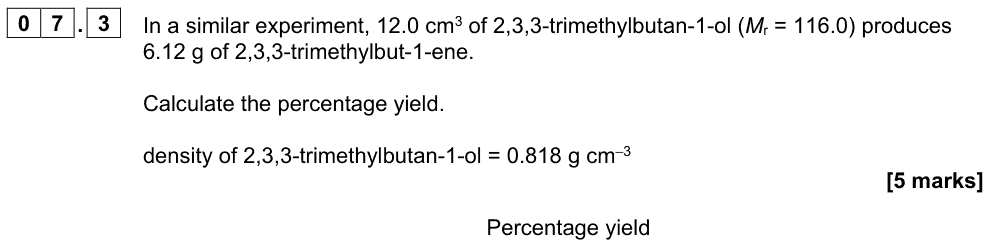
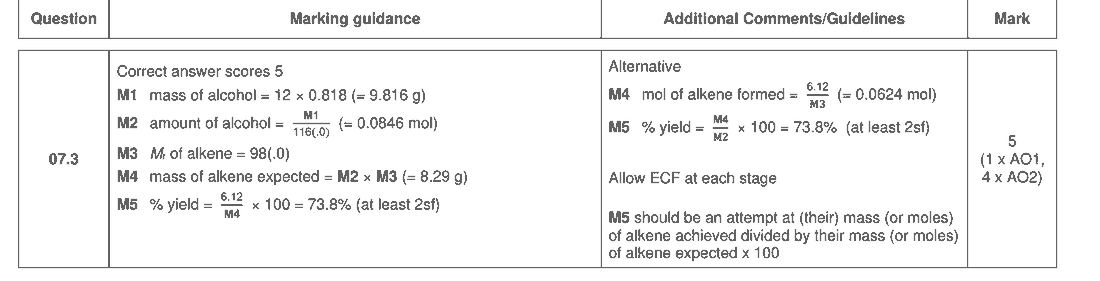
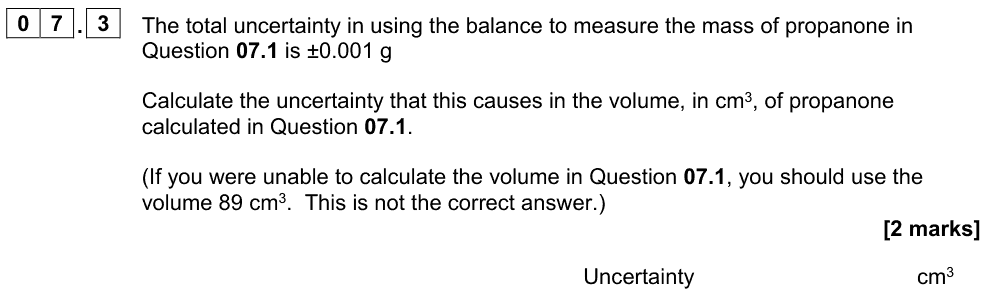
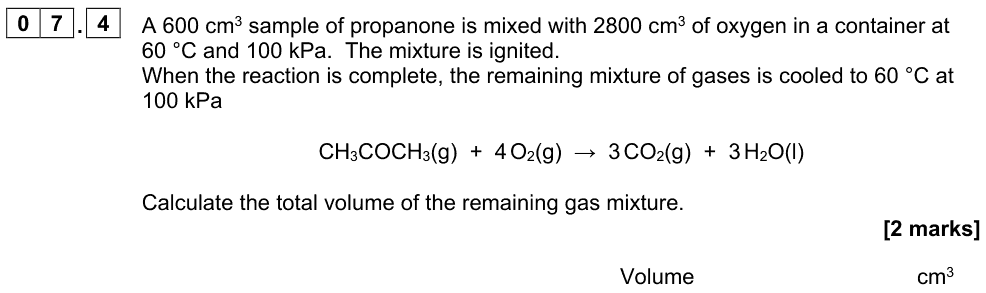
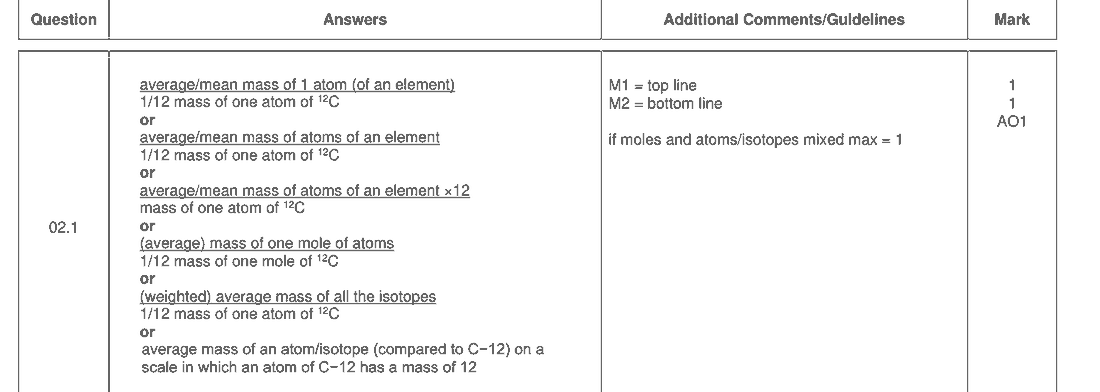
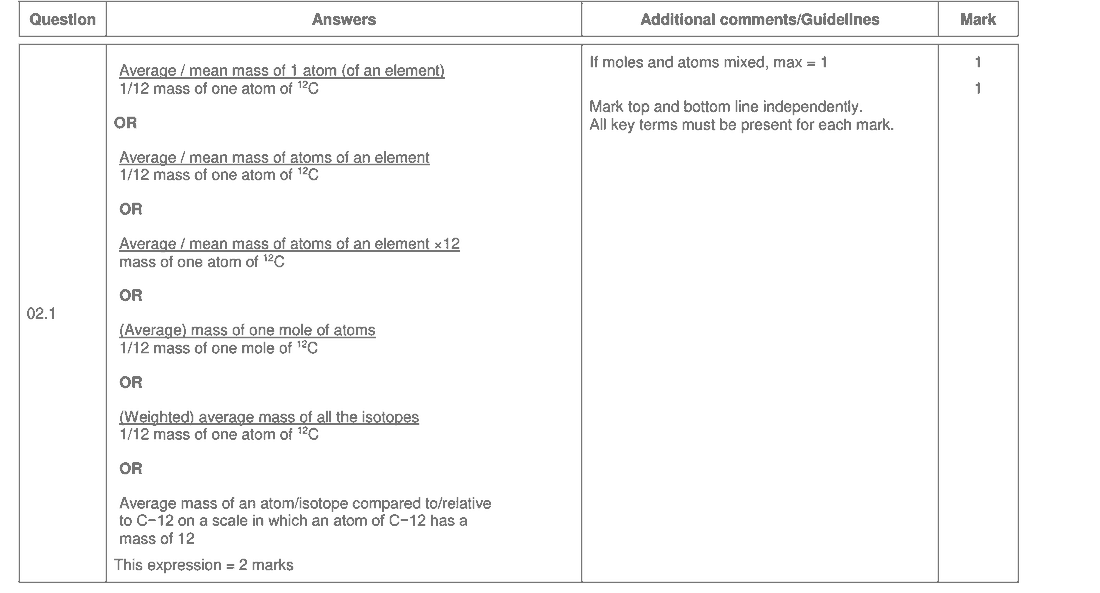
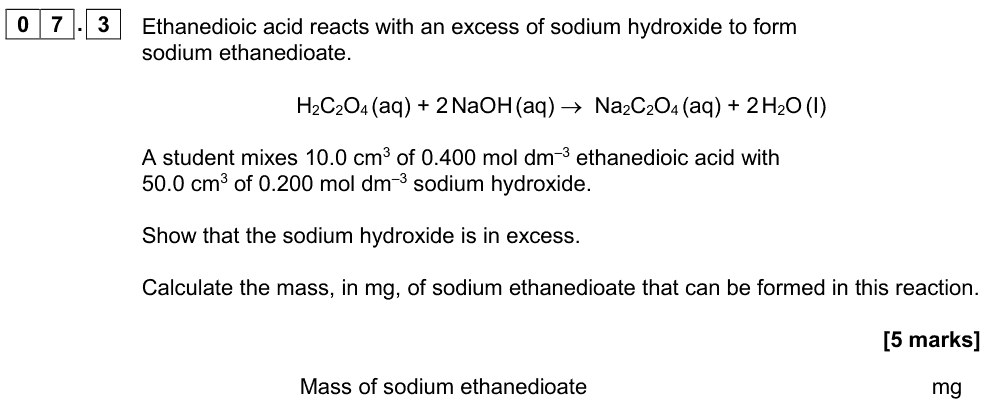
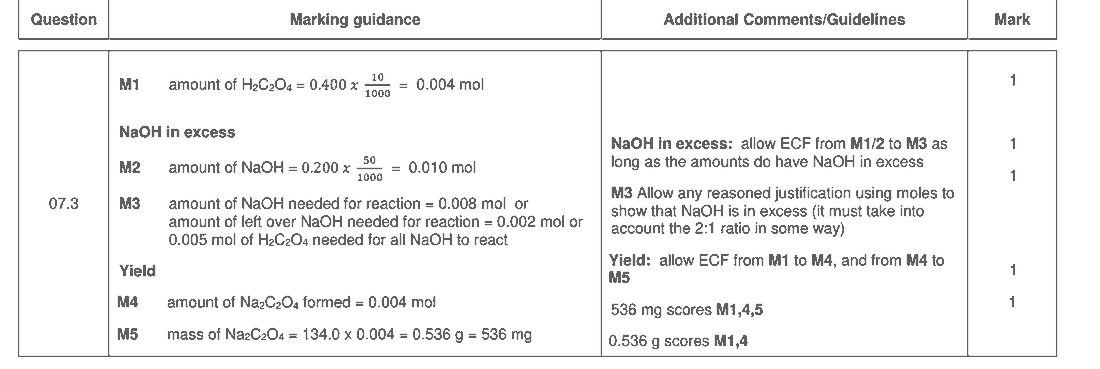
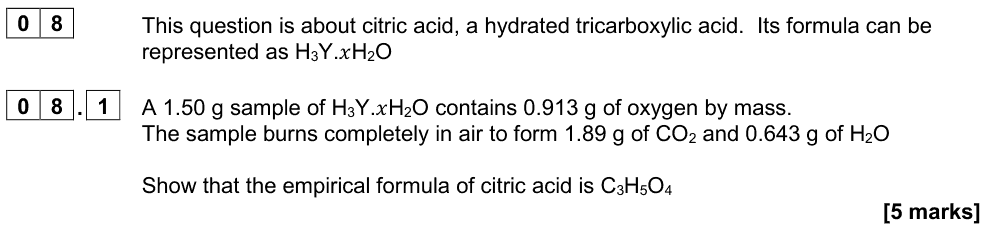
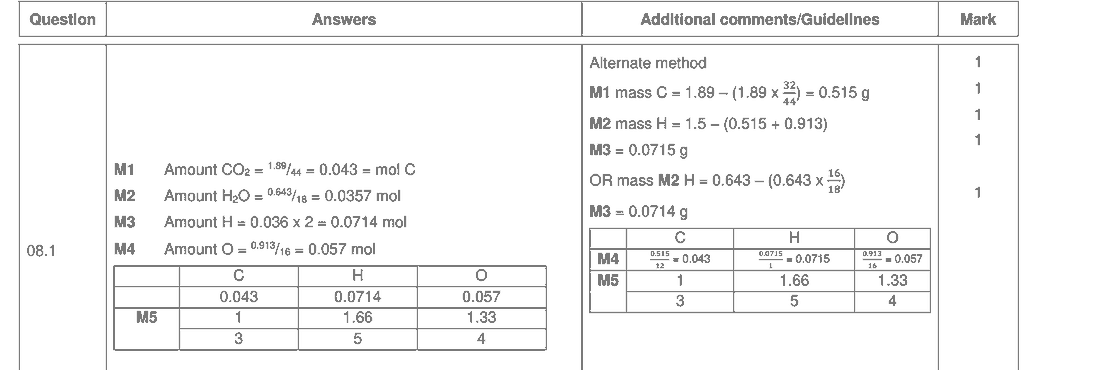
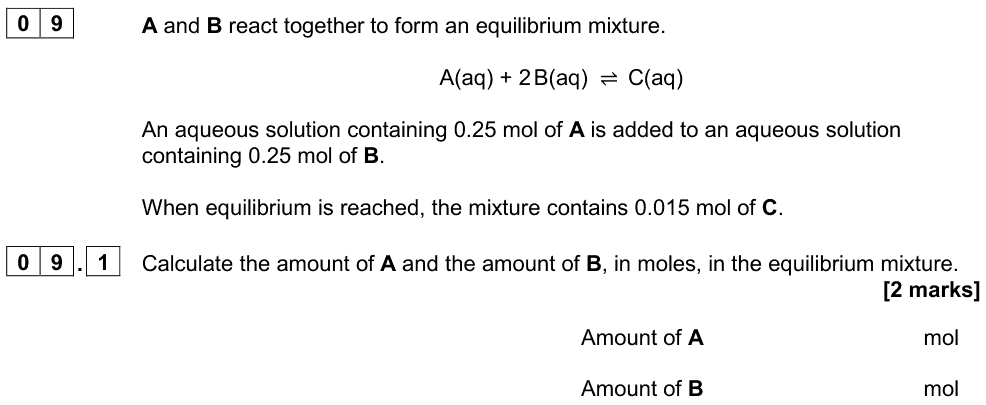
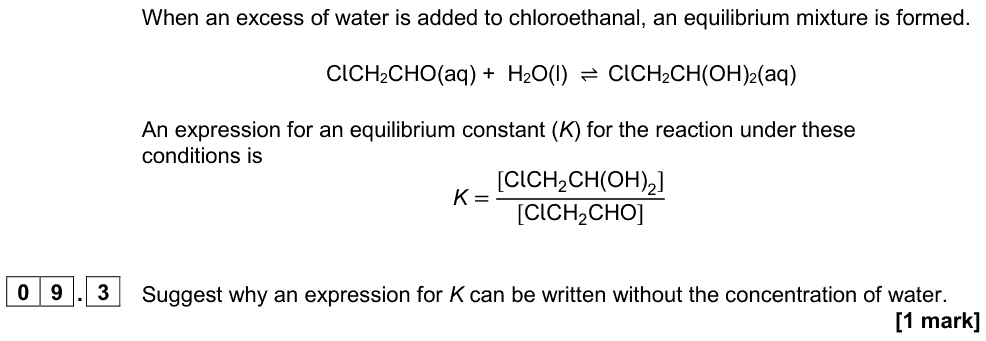
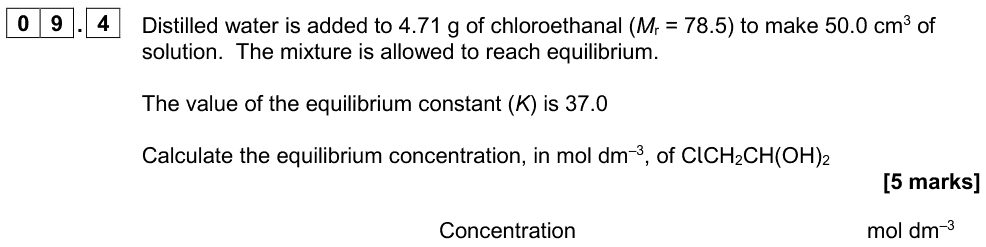
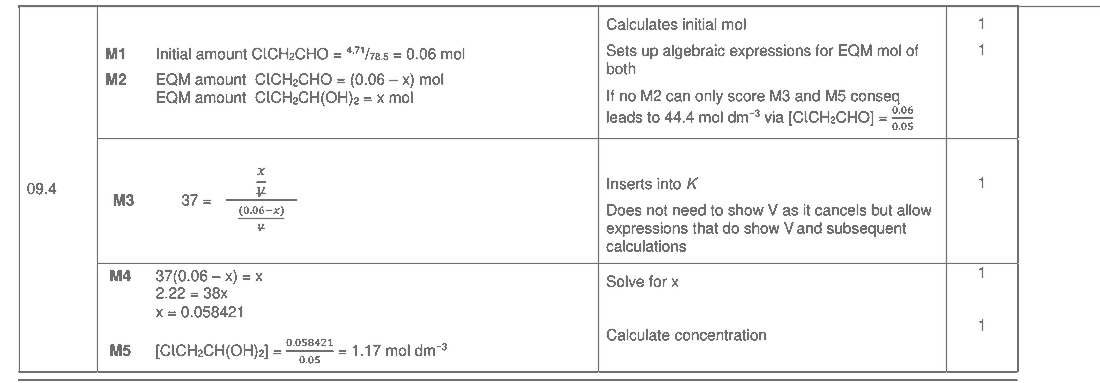
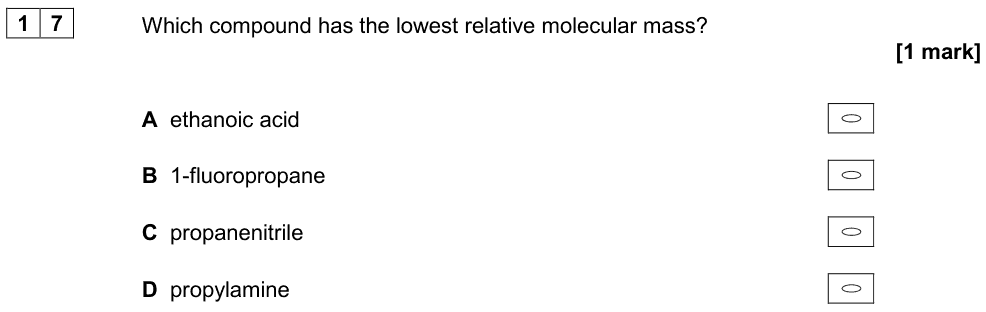
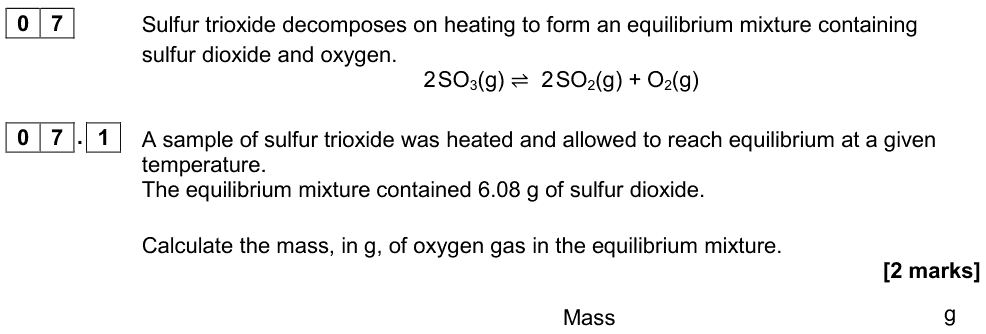
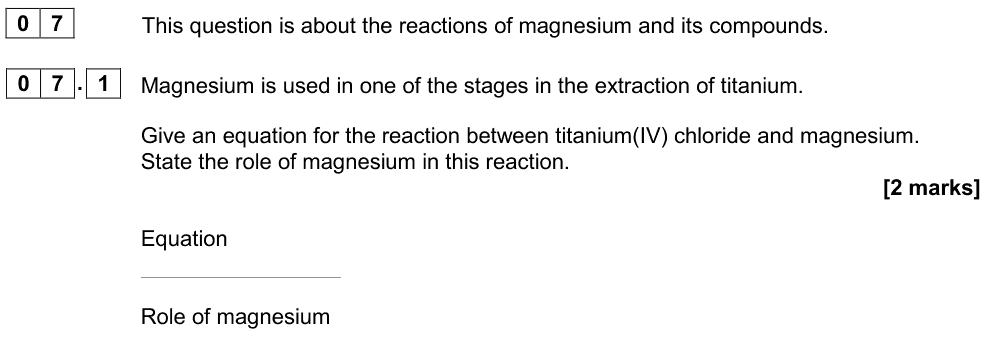
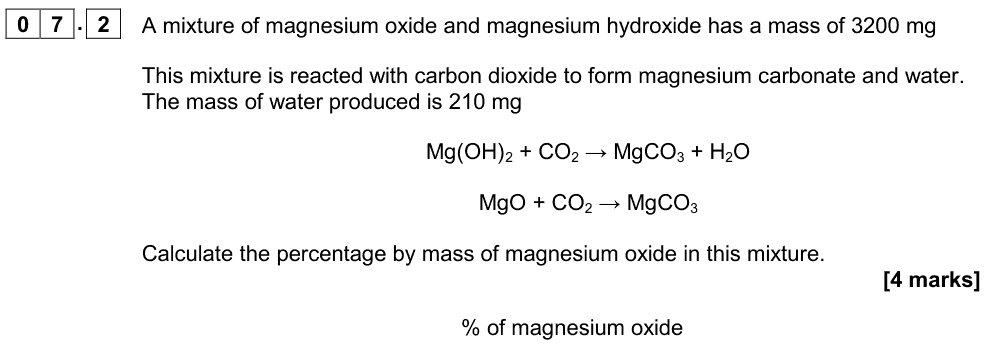
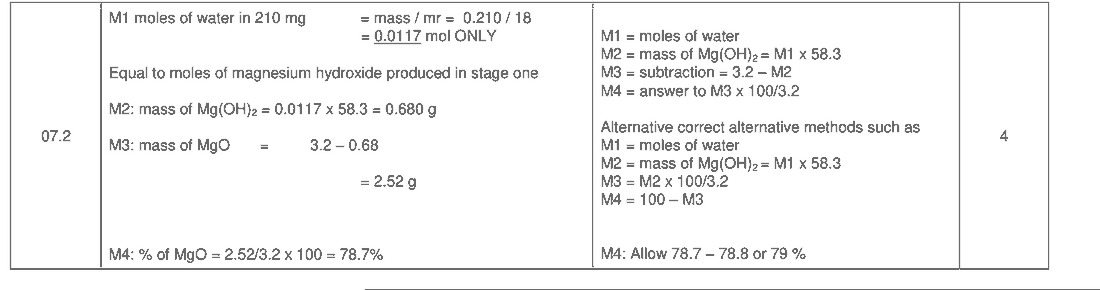
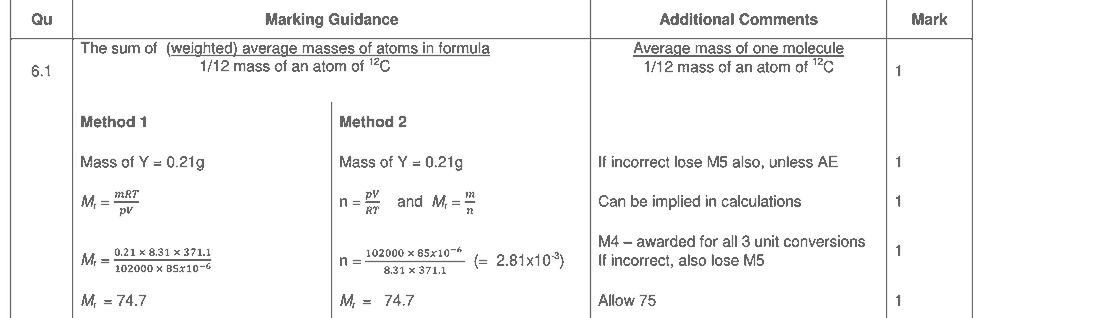
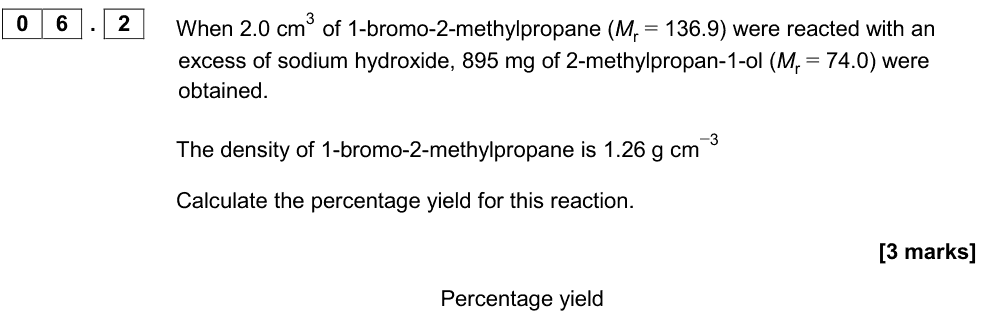
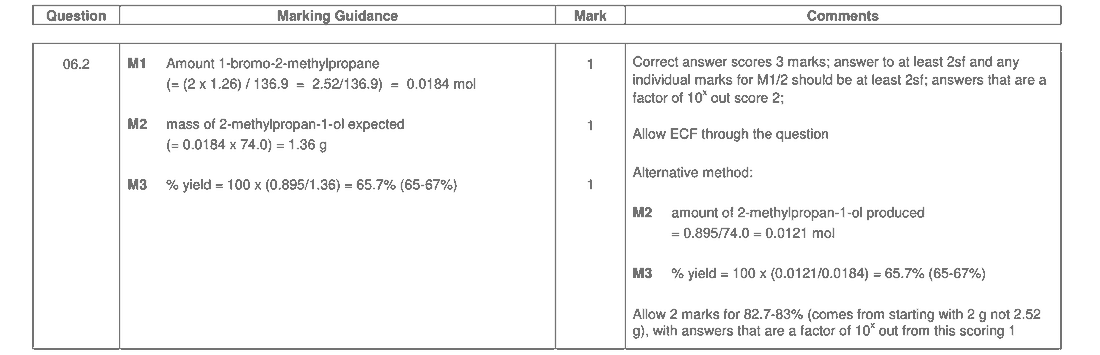
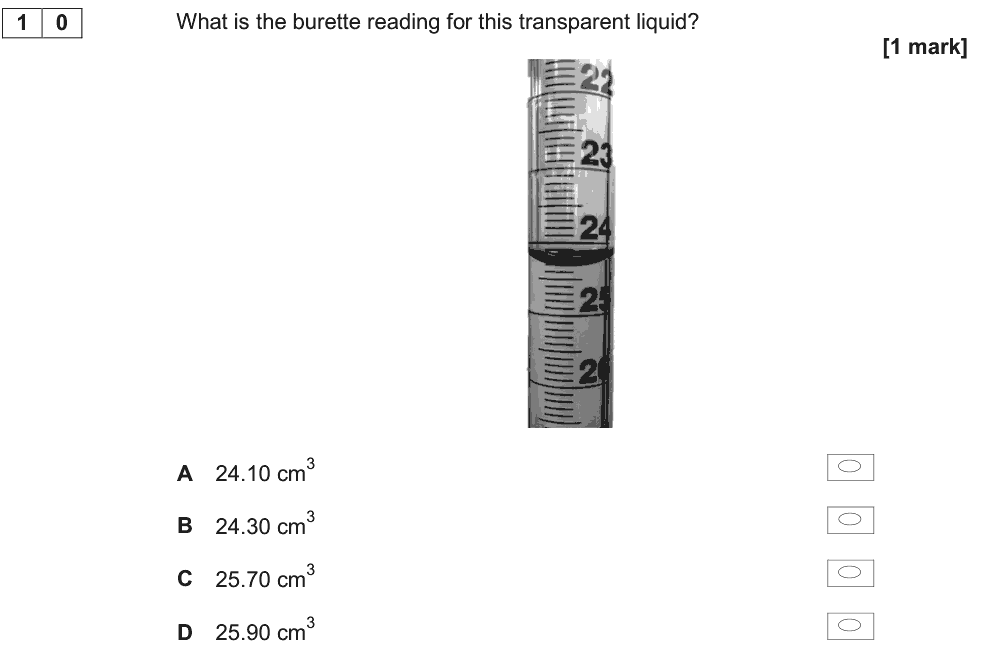
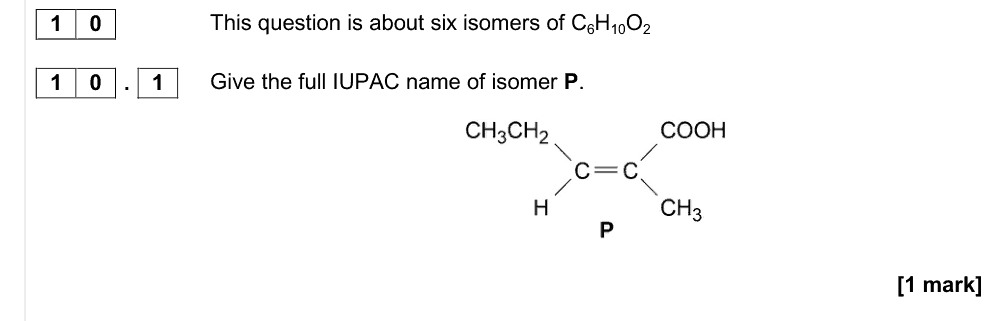
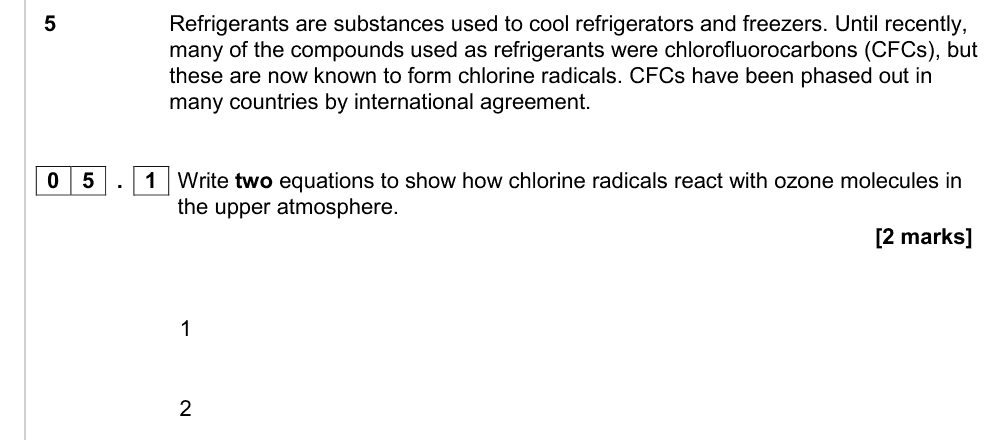
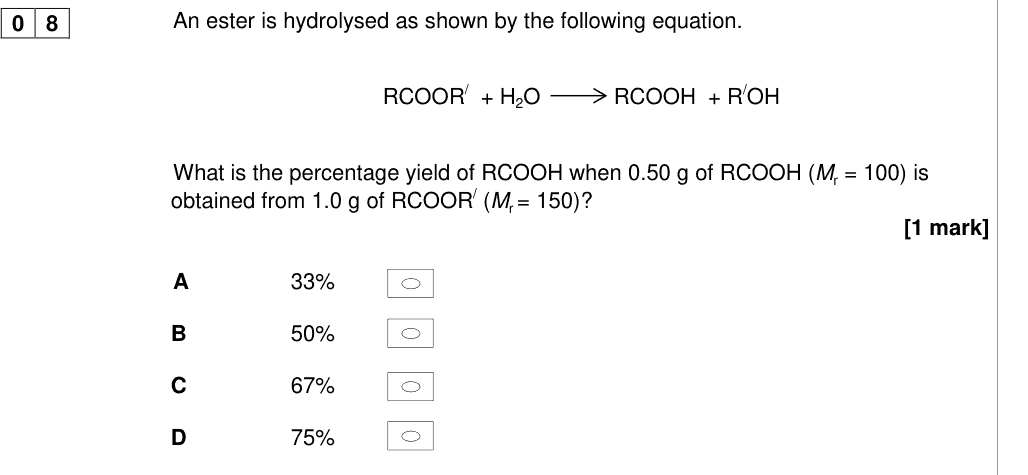
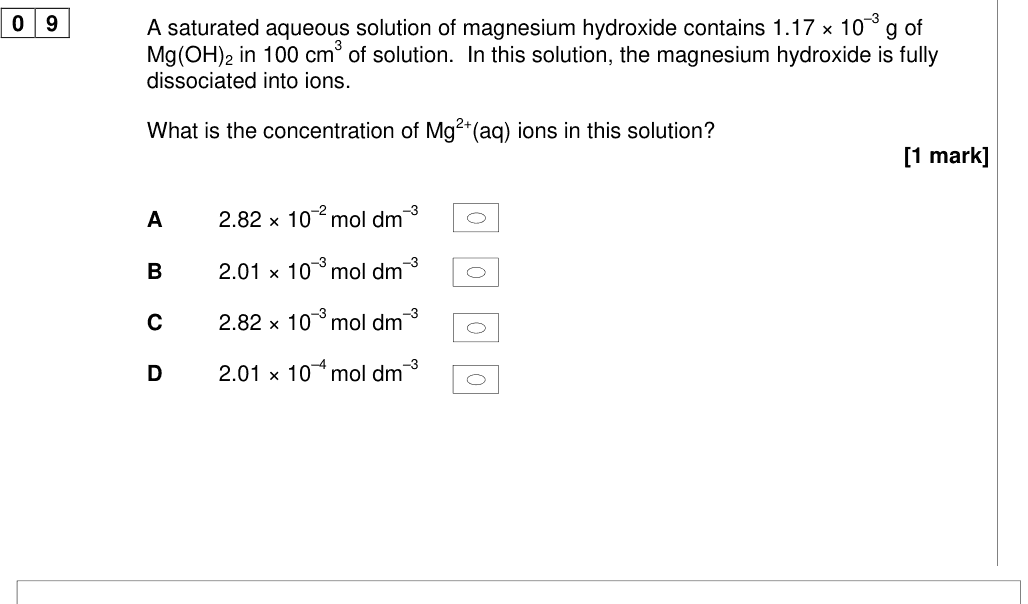
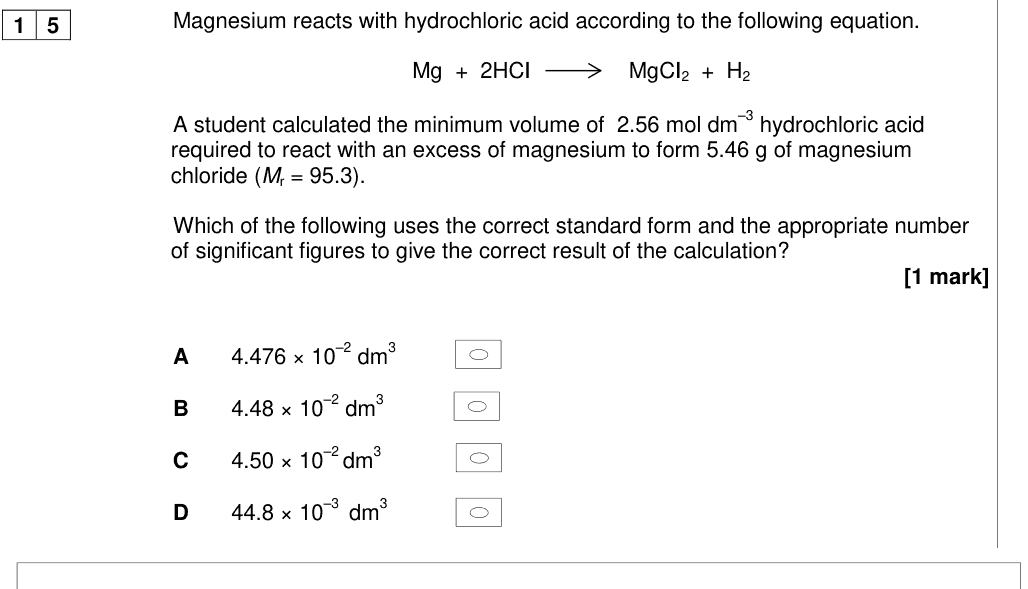
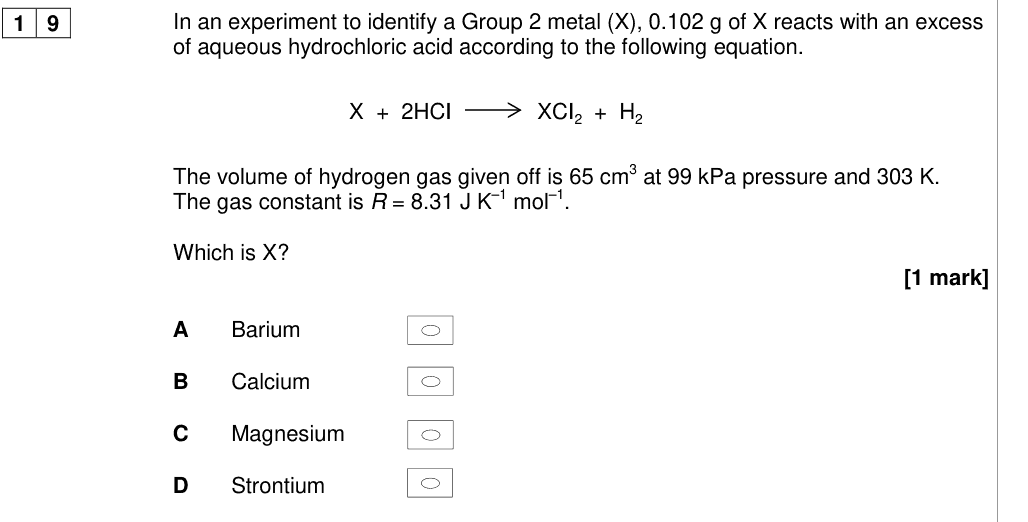
3.1.2.1-01 Relative atomic mass and relative molecular mass in terms of 12C.
3.1.2.1-02 The term relative formula mass will be used for ionic compounds.
3.1.2.1-03 Students should be able to: • define relative atomic mass (Ar) • define relative molecular mass (Mr).
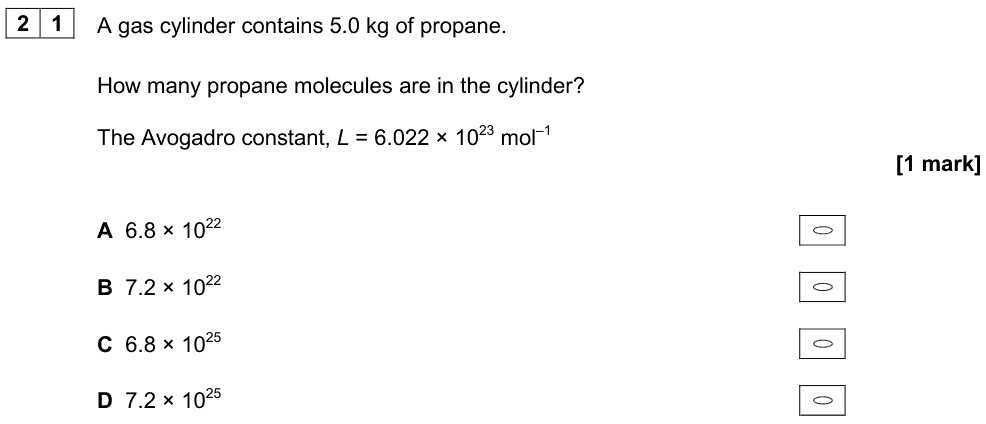
3.1.2.2-01 The Avogadro constant as the number of particles in a mole.
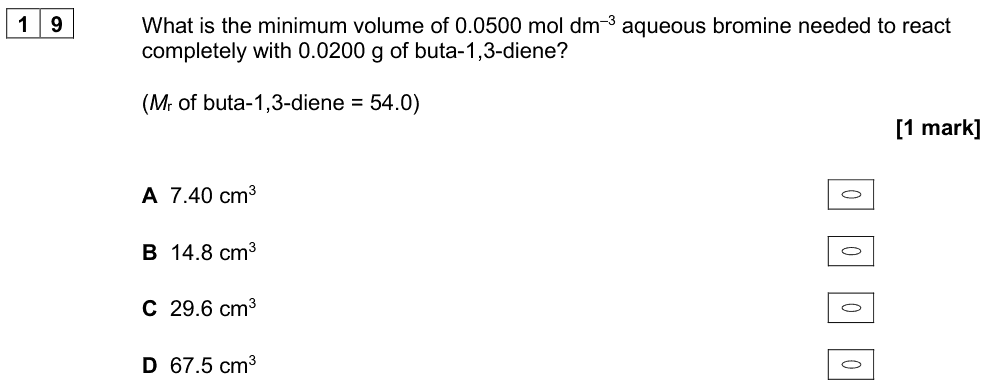
3.1.2.2-02 The mole as applied to electrons, atoms, molecules, ions, formulas and equations.
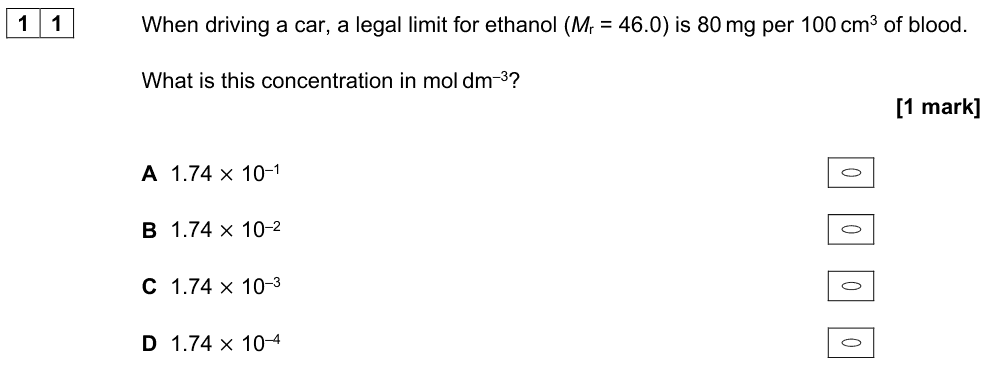
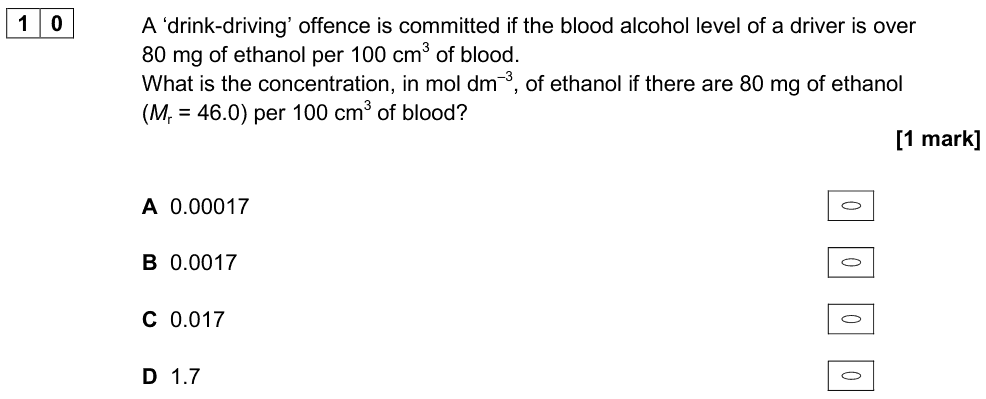
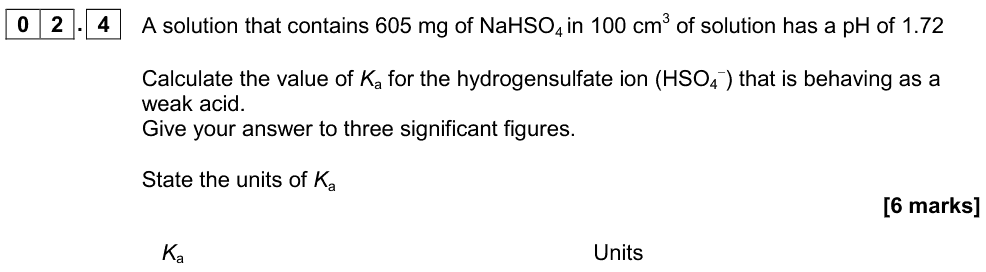
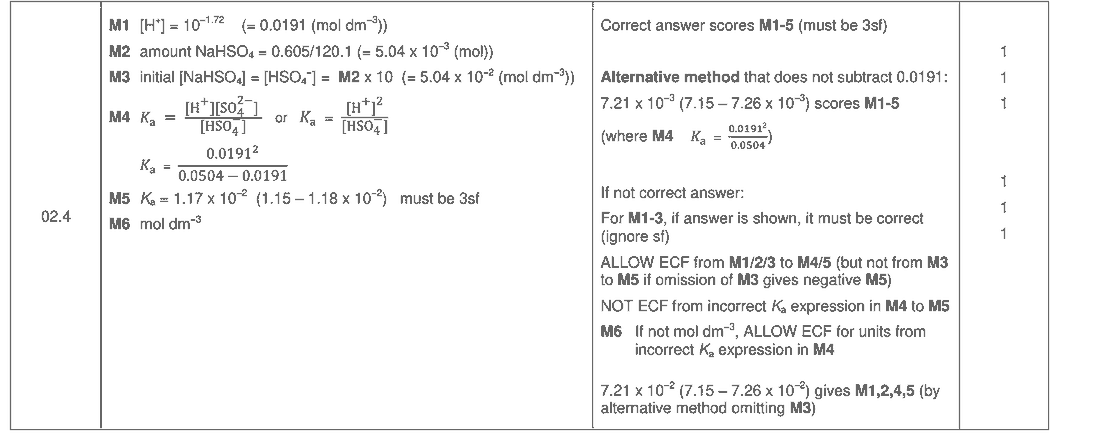
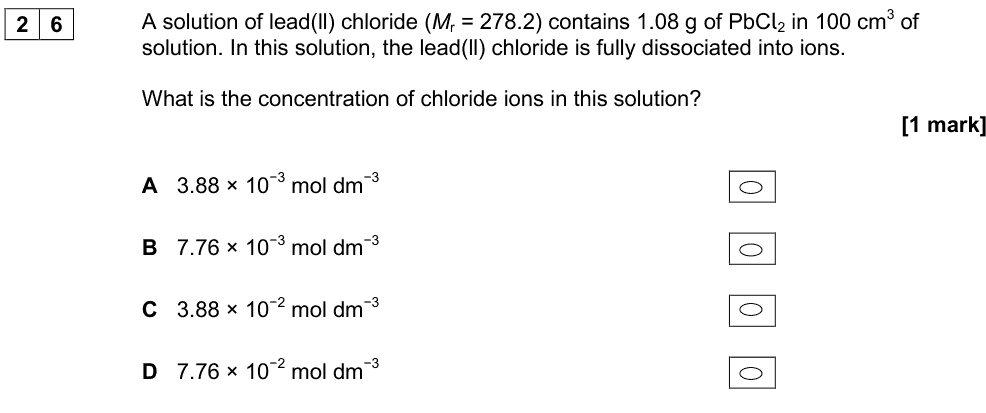
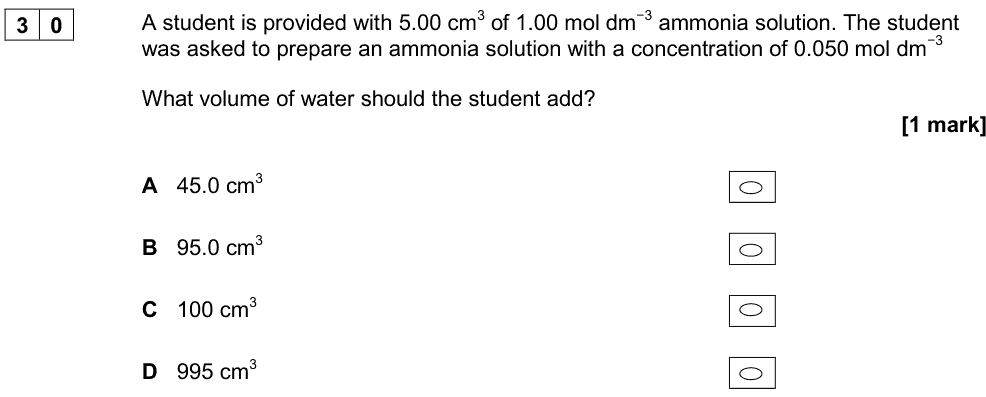
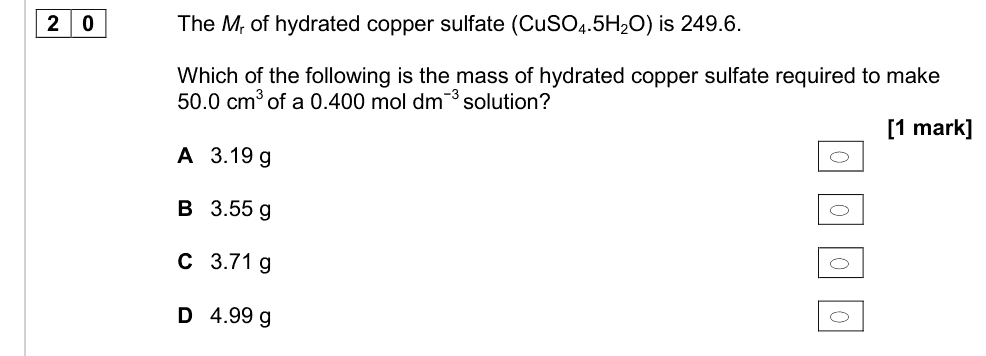
3.1.2.2-03 The concentration of a substance in solution, measured in mol dm–3.
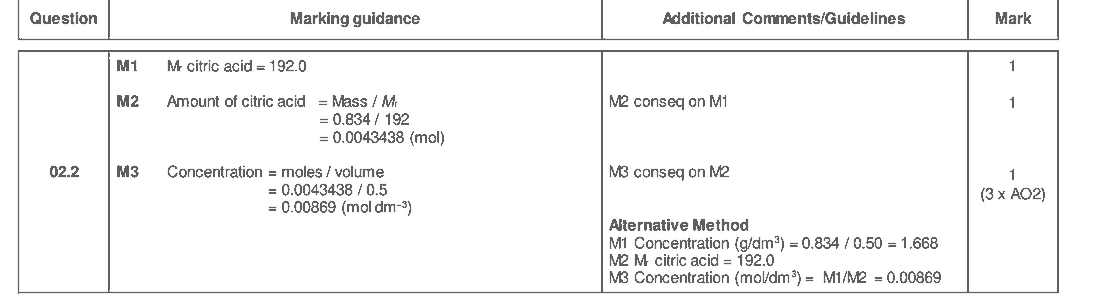
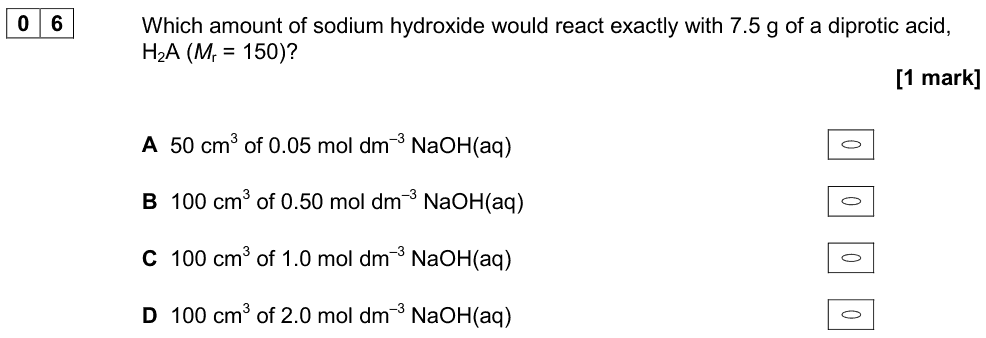
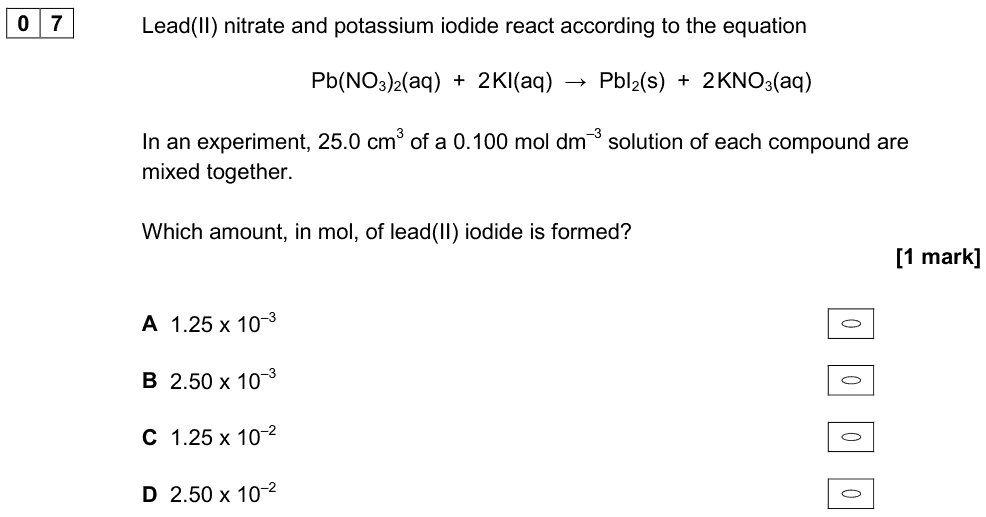
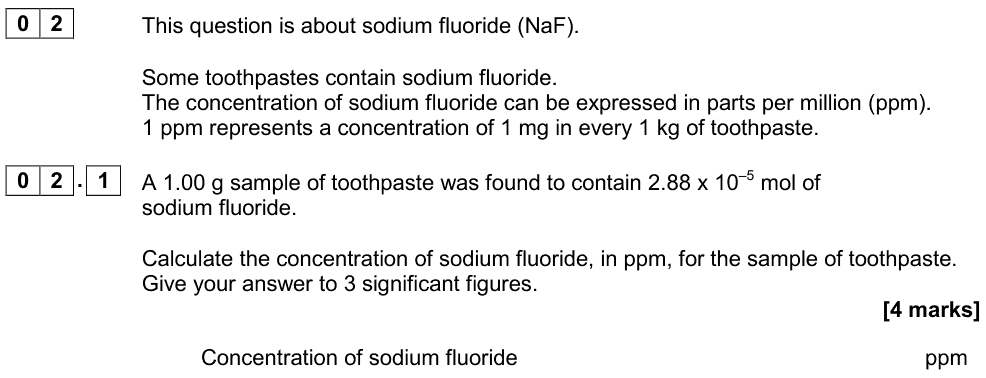
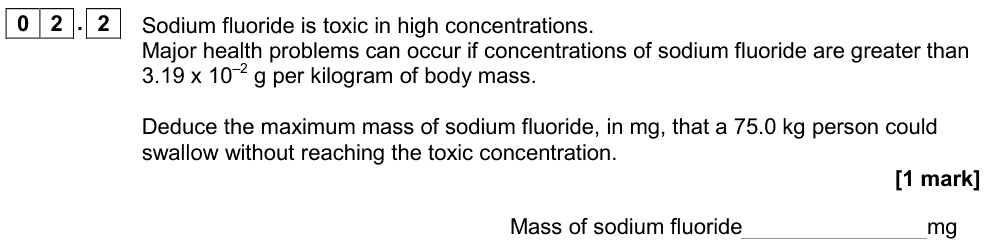
3.1.2.2-04 Students should be able to carry out calculations: • using the Avogadro constant • using mass of substance, Mr, and amount in moles • using concentration, volume and amount of substance in a solution.
3.1.2.2-05 Students will not be expected to recall the value of the Avogadro constant.
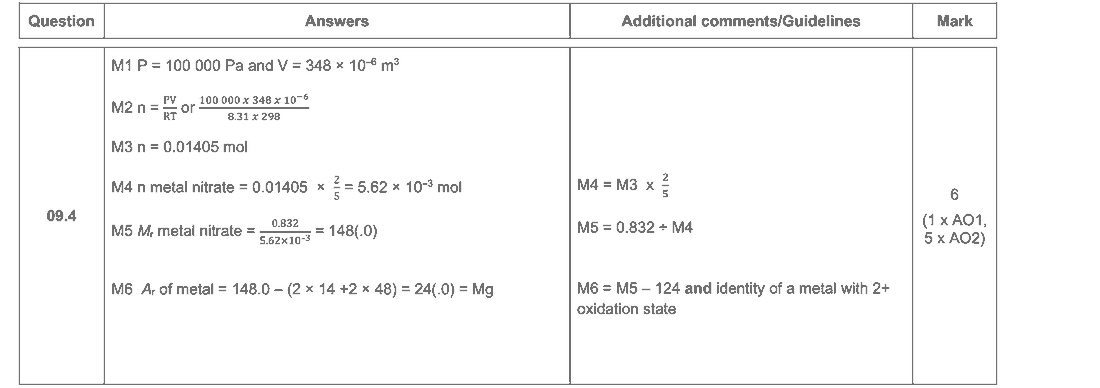
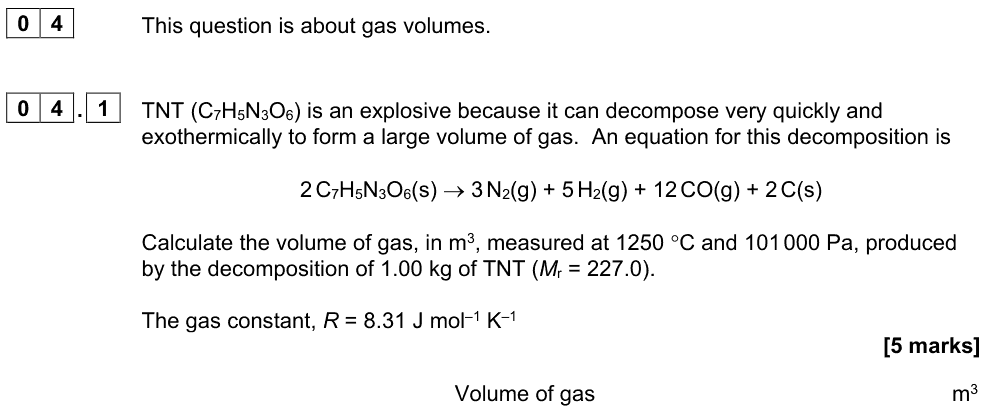
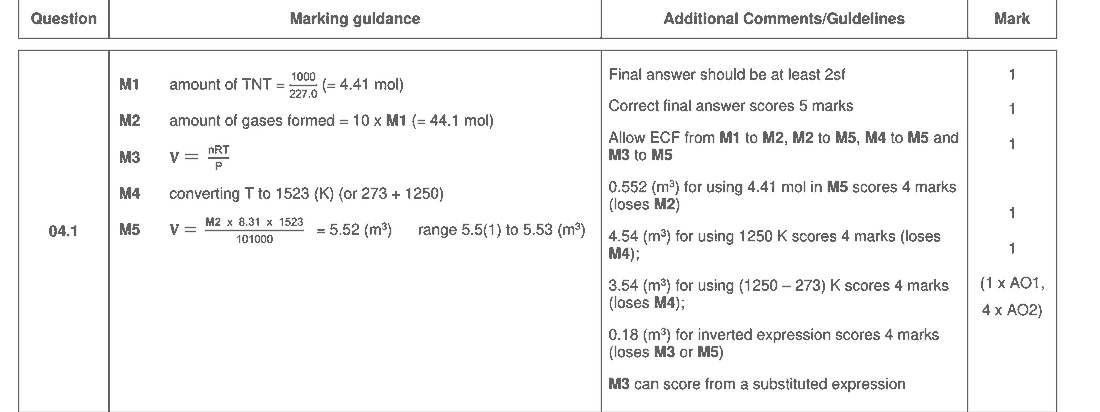
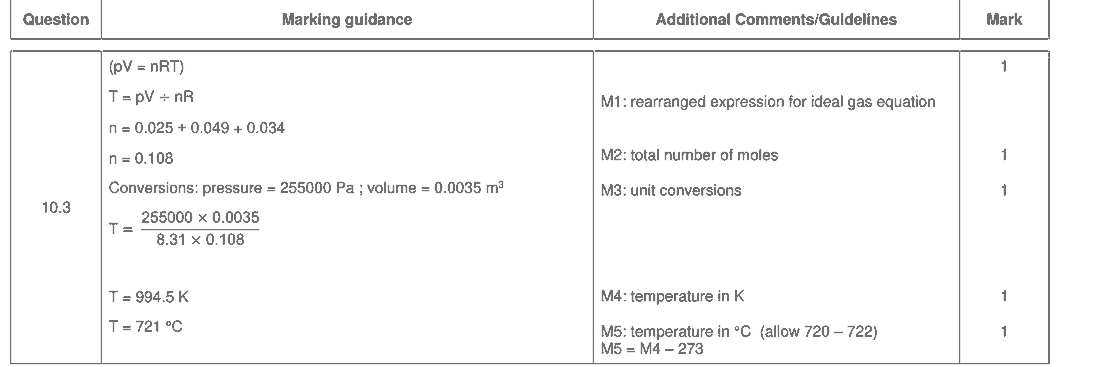
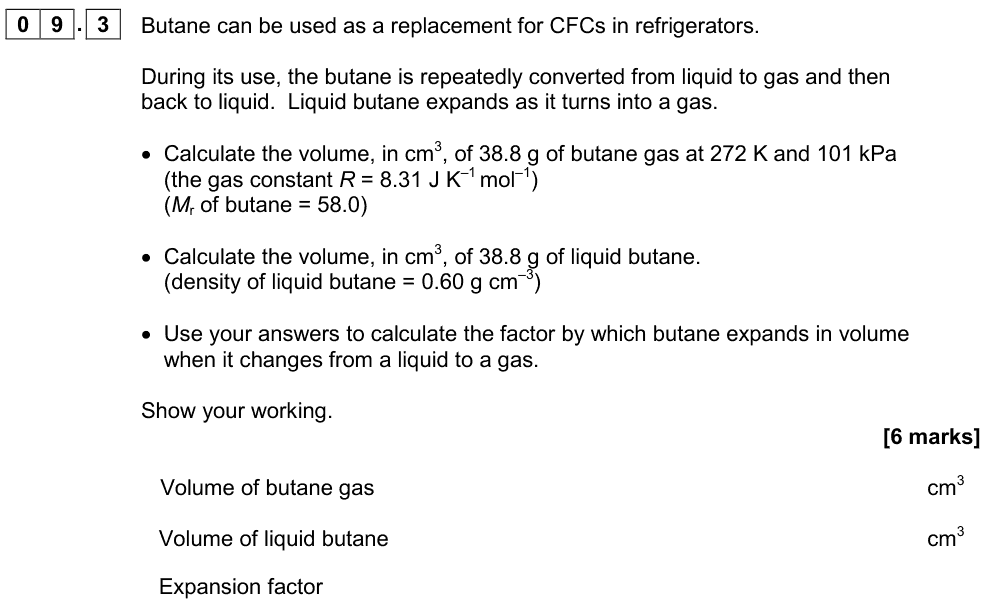
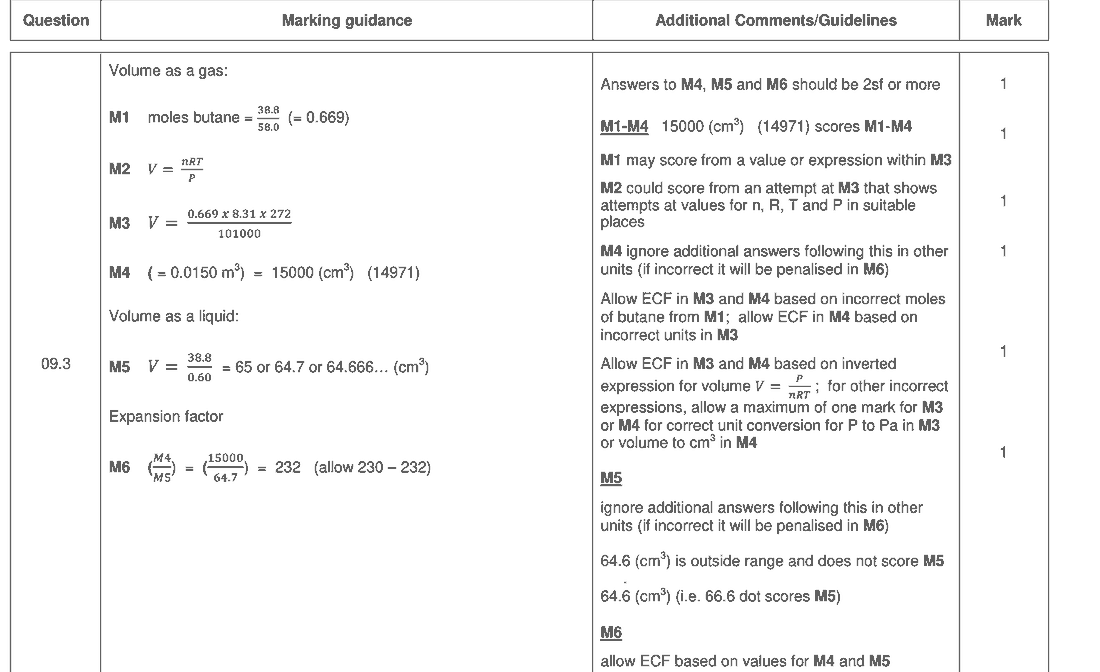
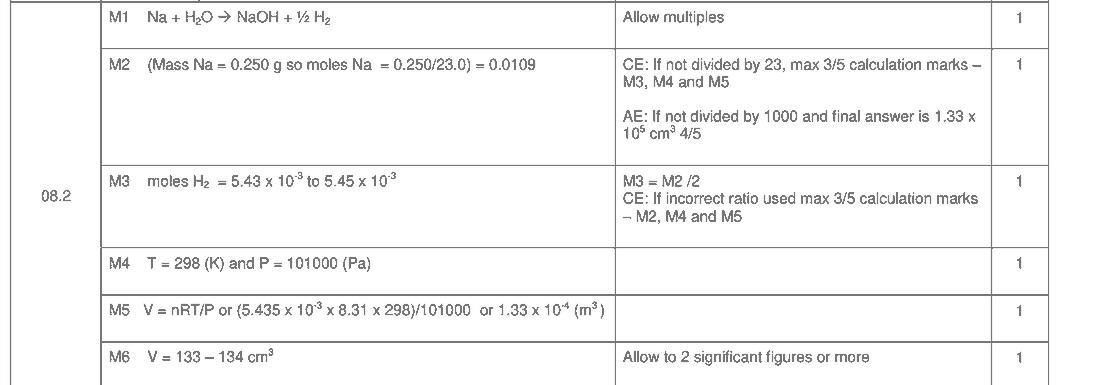
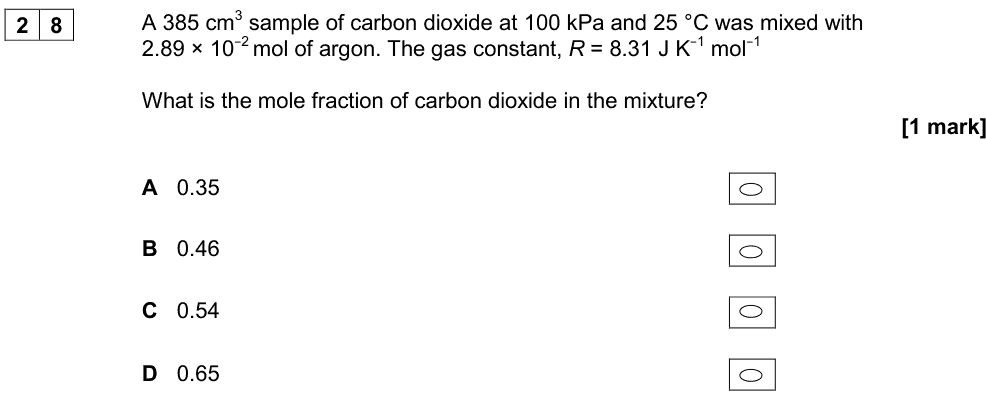
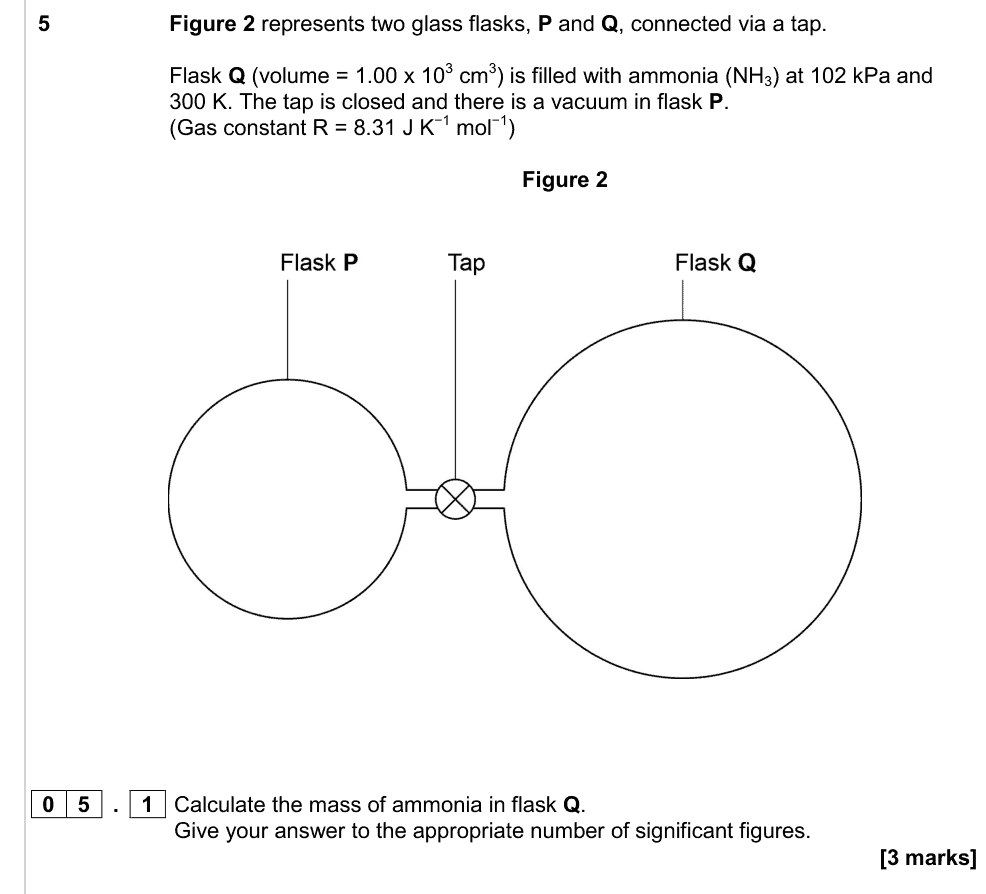
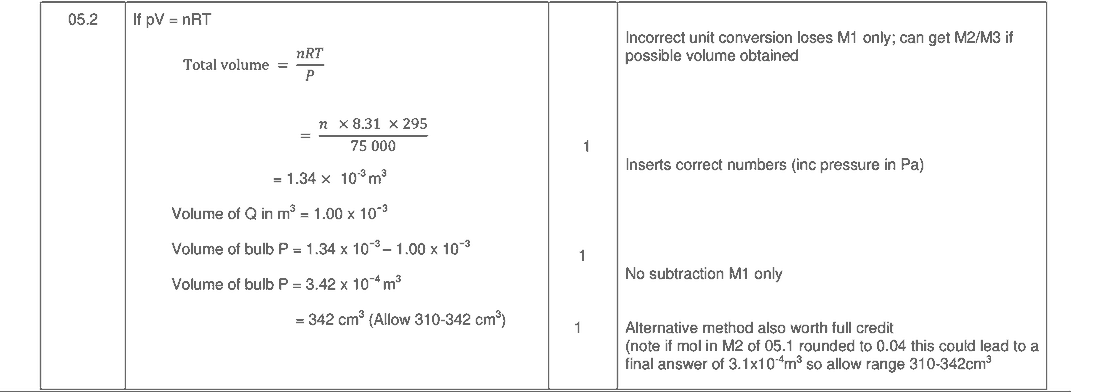
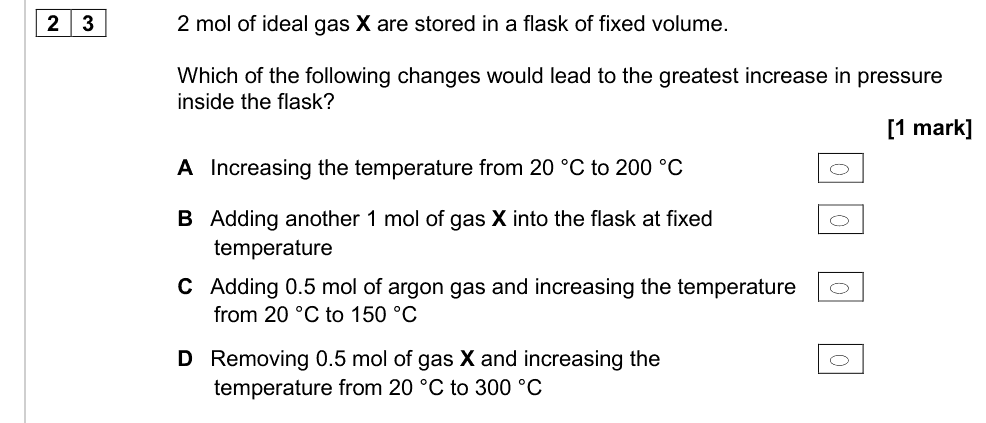
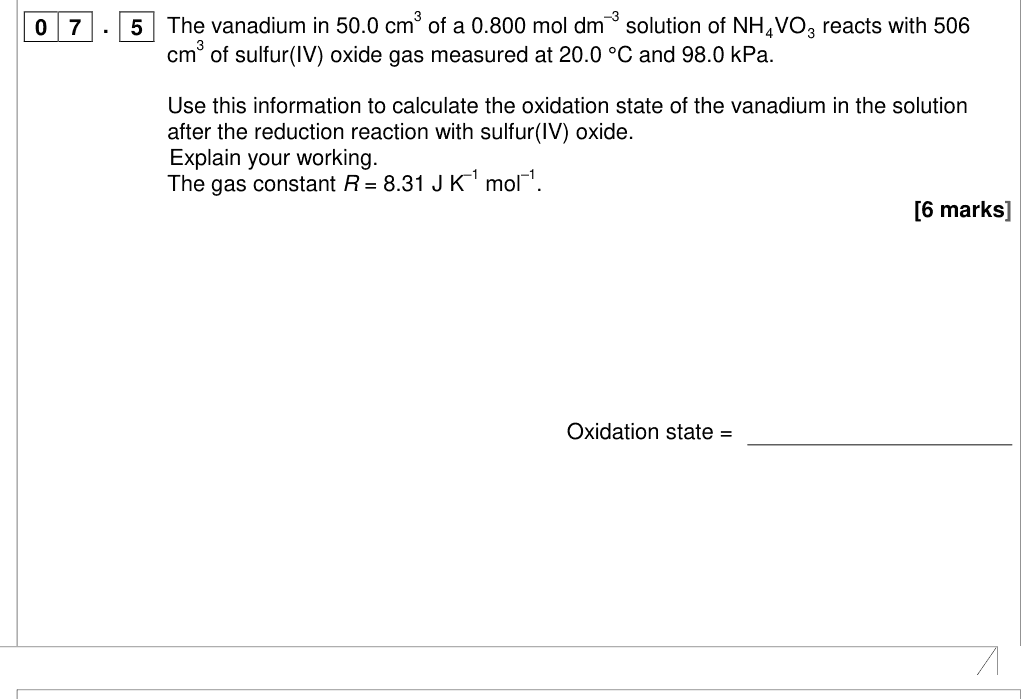
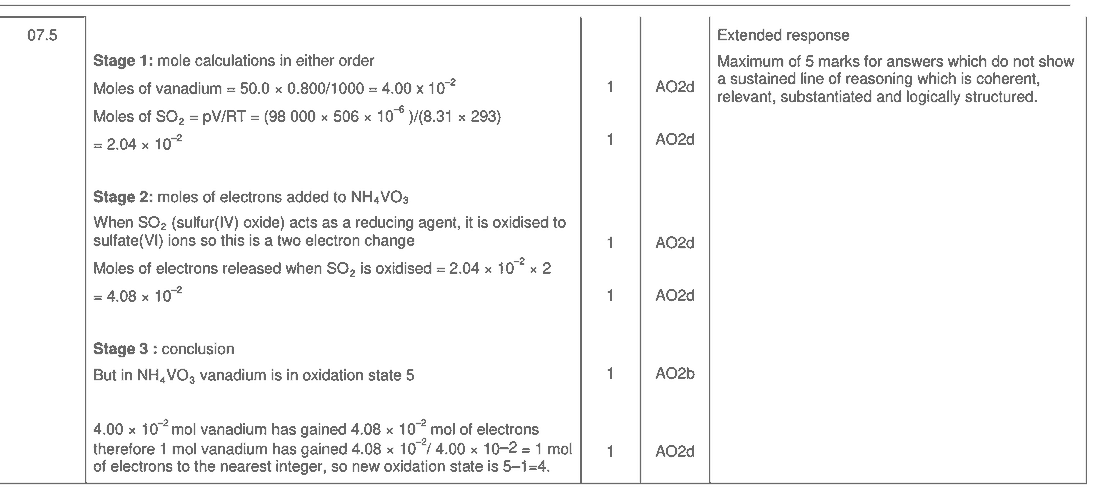
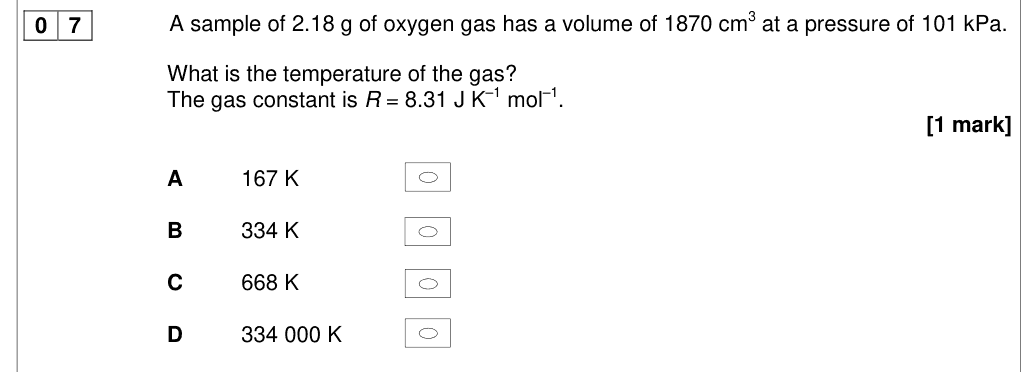
3.1.2.3-01 The ideal gas equation pV = nRT with the variables in SI units.
3.1.2.3-02 Students should be able to: • use the equation in calculations.
3.1.2.3-03 Students will not be expected to recall the value of the gas constant, R.
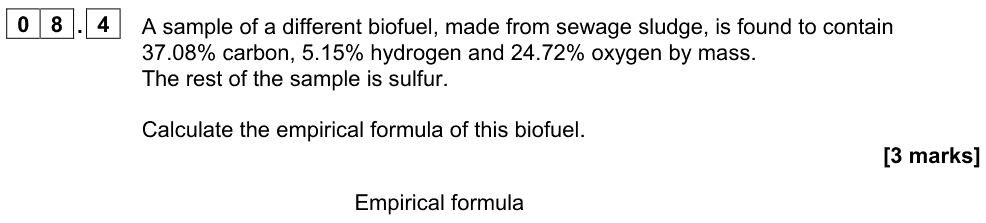
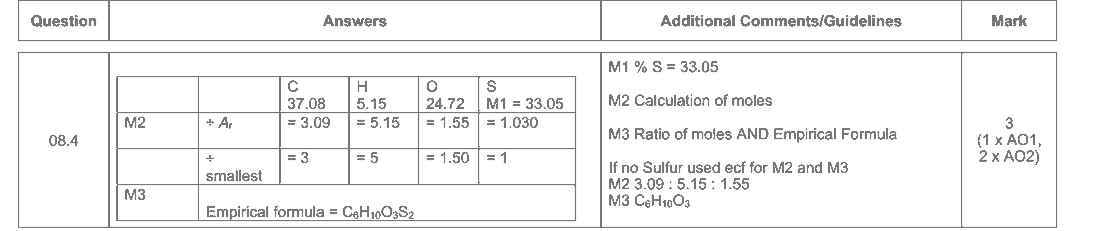
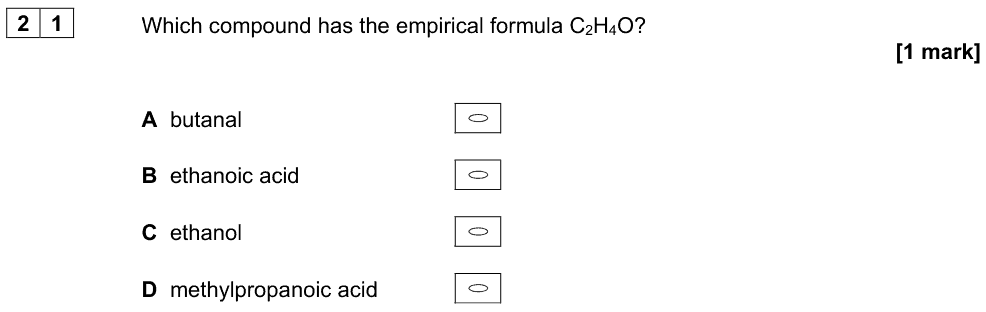
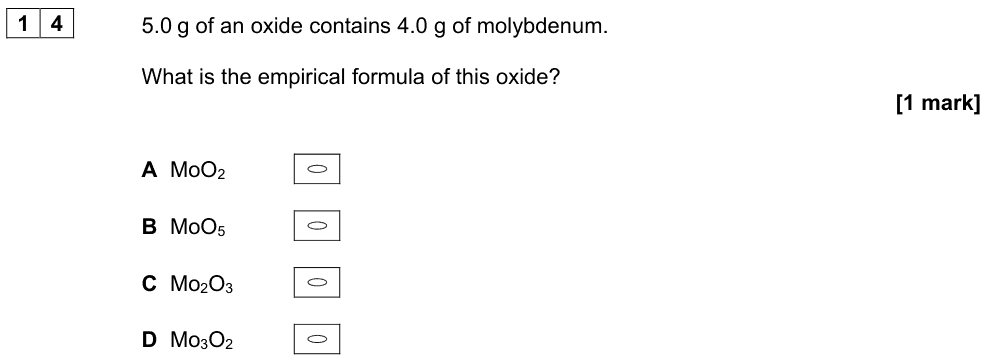
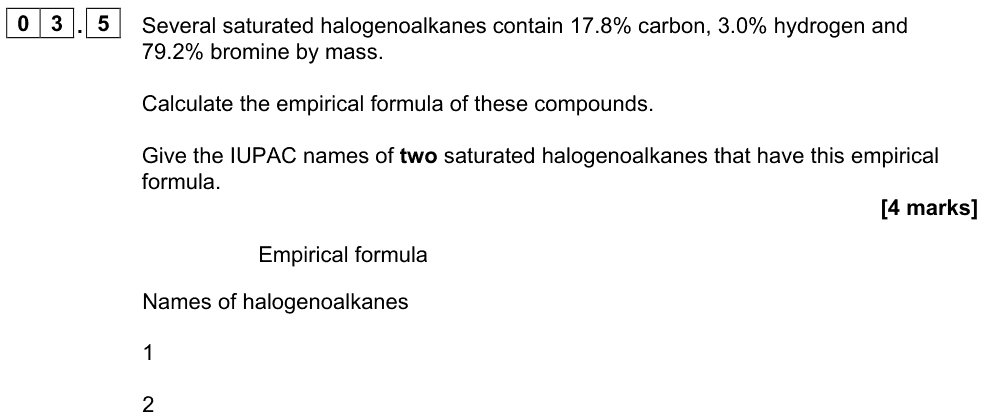
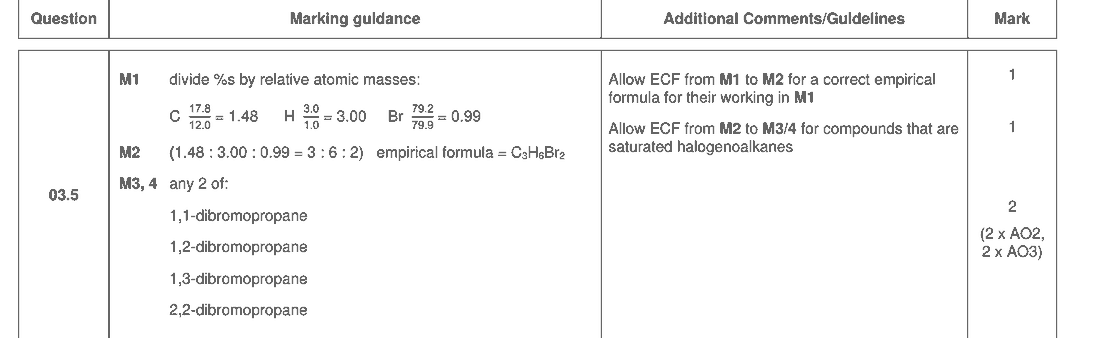
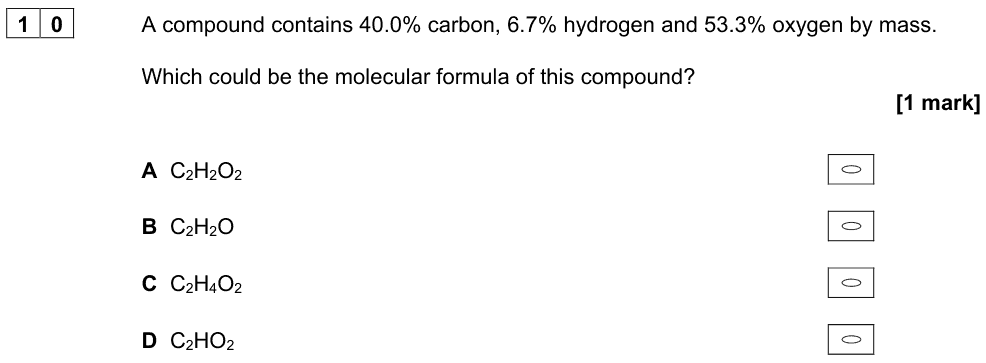
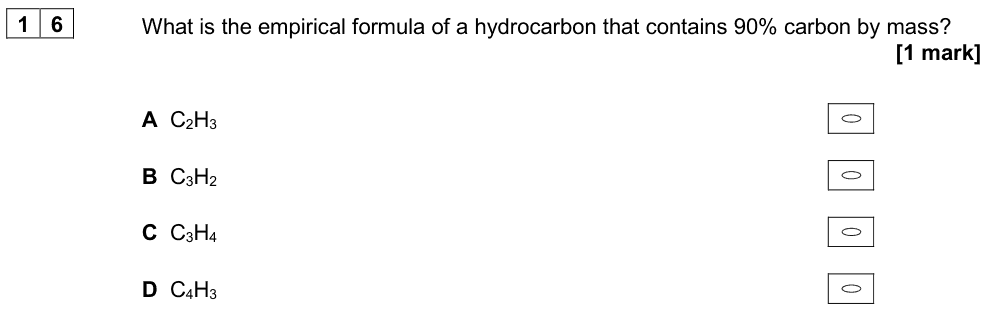
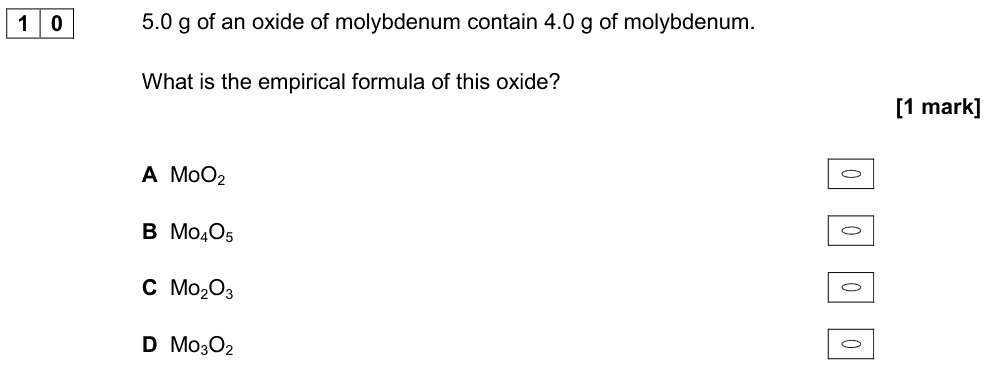
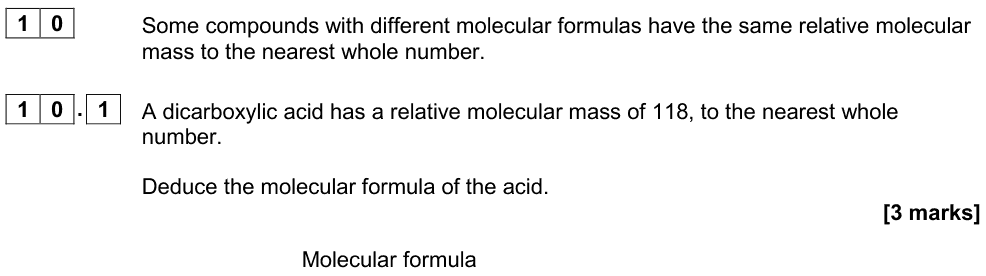
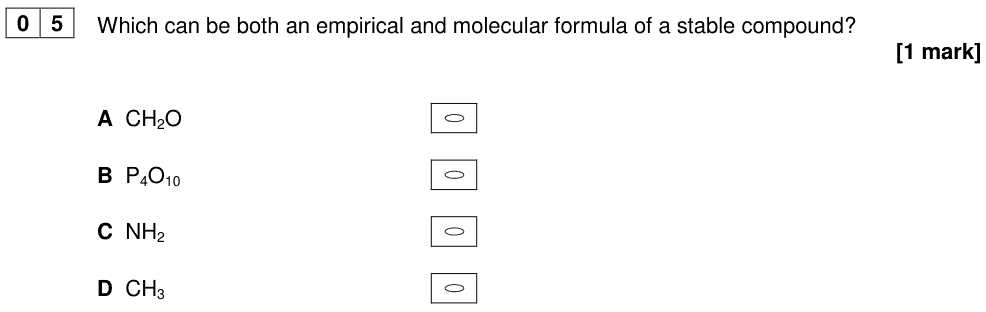
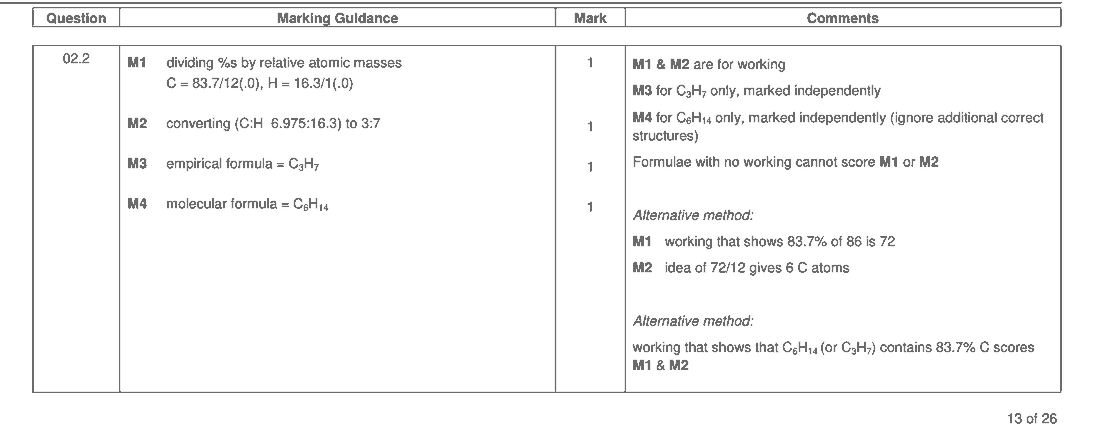
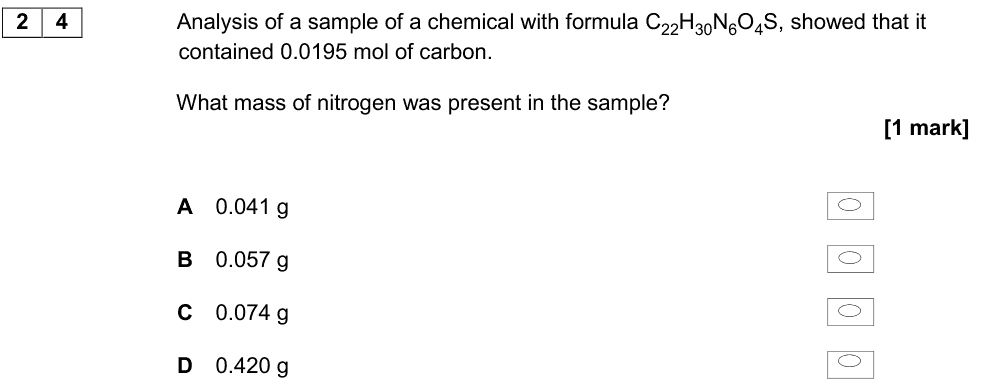
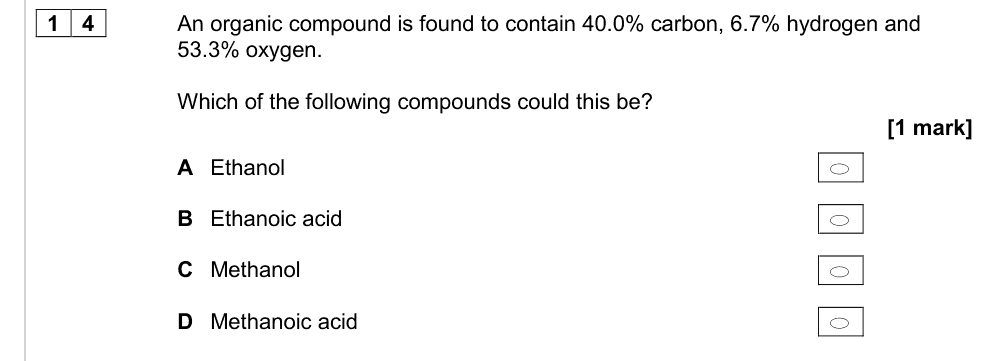
3.1.2.4-01 Empirical formula is the simplest whole number ratio of atoms of each element in a compound.
3.1.2.4-02 Molecular formula is the actual number of atoms of each element in a compound.
3.1.2.4-03 The relationship between empirical formula and molecular formula.
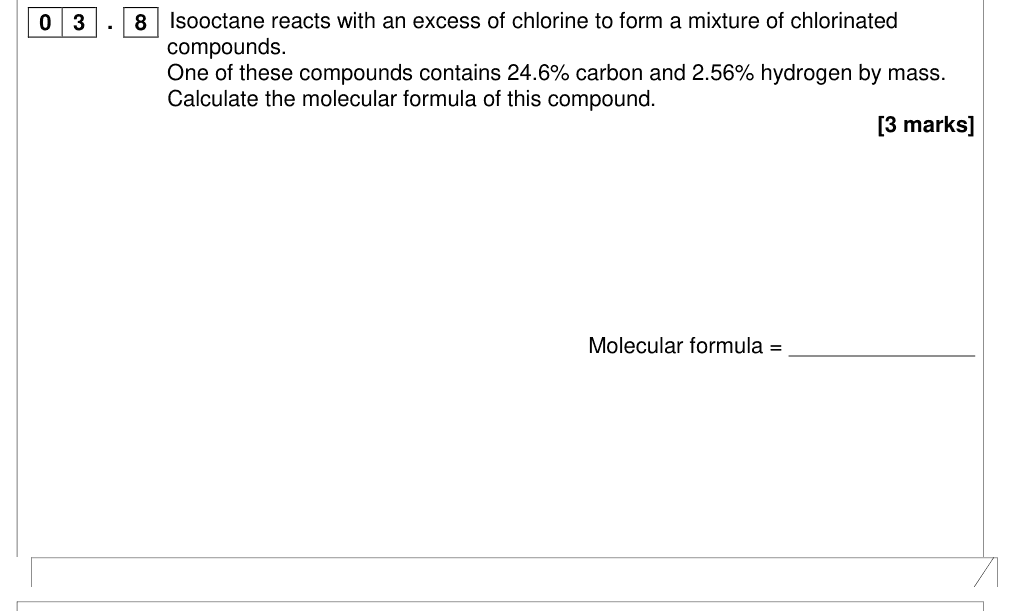
3.1.2.4-04 Students should be able to: • calculate empirical formula from data giving composition by mass or percentage by mass • calculate molecular formula from the empirical formula and relative molecular mass.
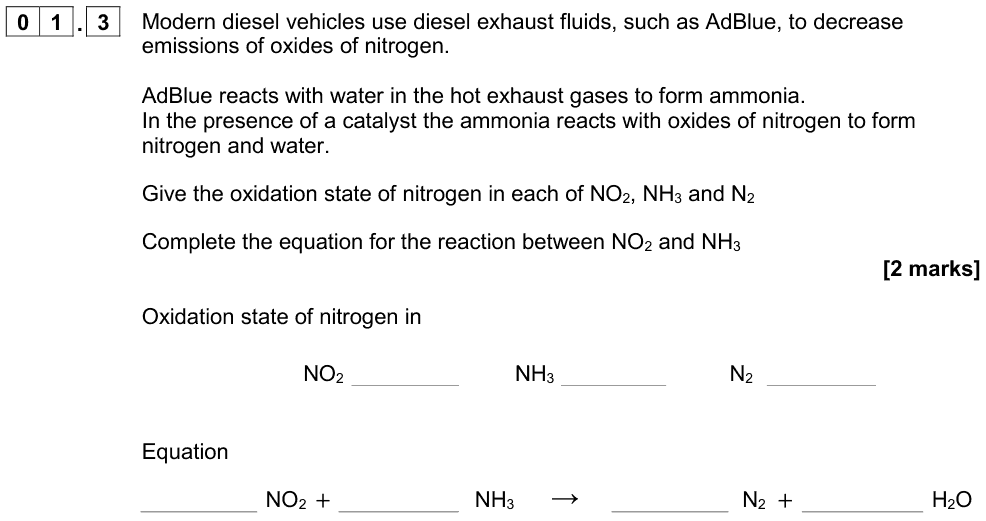
3.1.2.5-01 Equations (full and ionic).
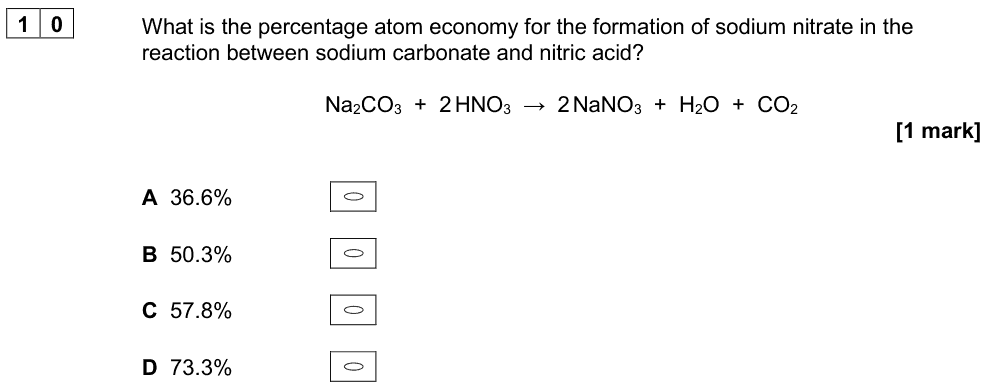
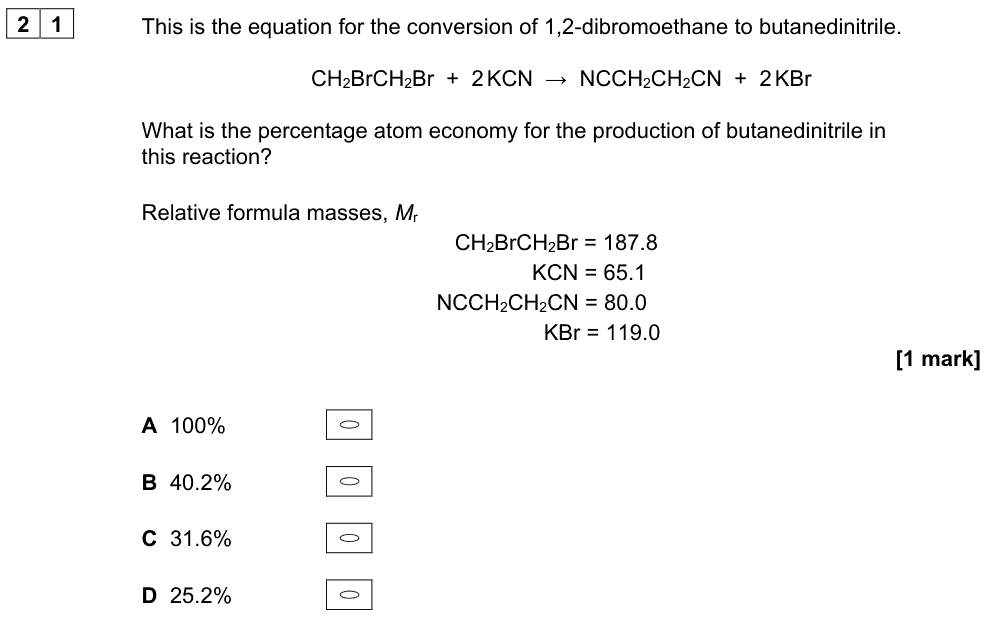
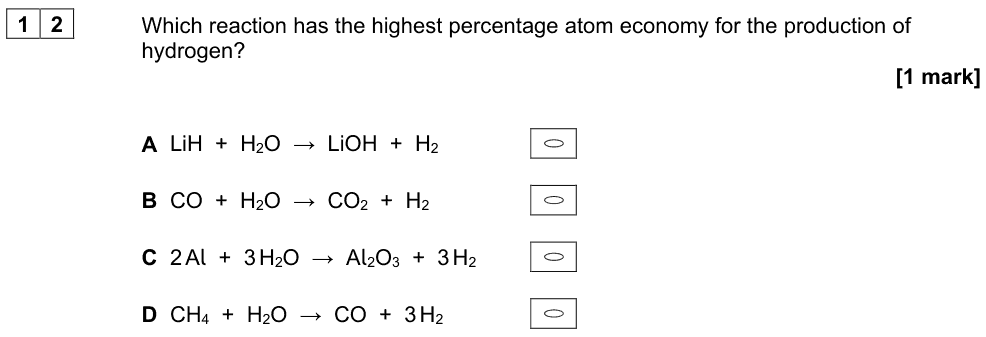
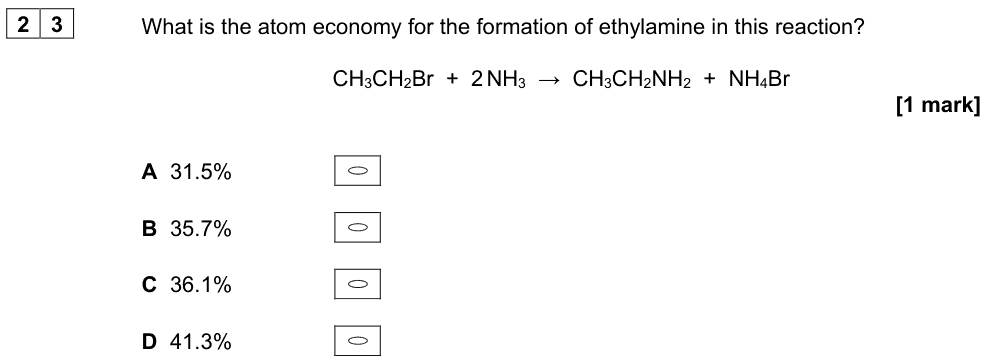
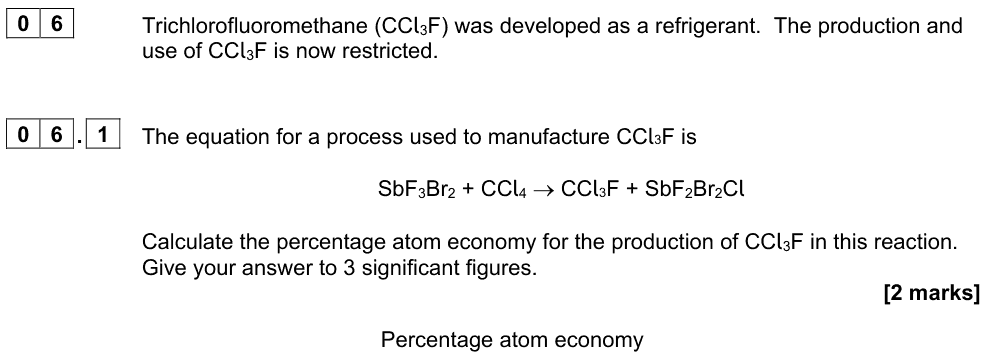
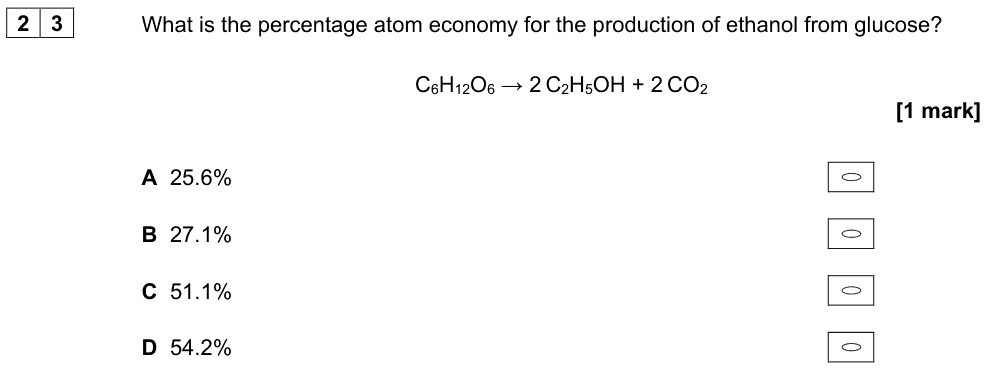
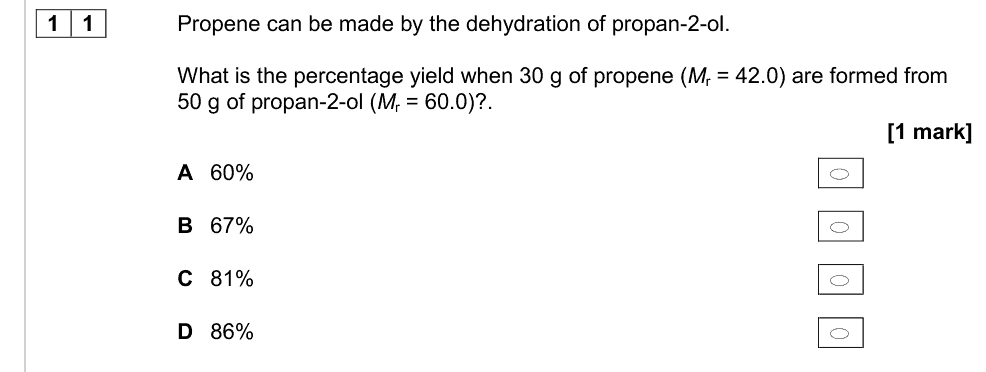
3.1.2.5-02 Percentage atom economy is: (molecular mass of desired product ÷ sum of molecular masses of all reactants) × 100
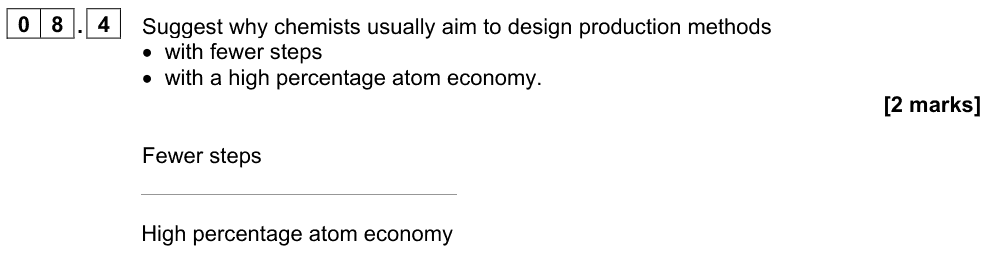
3.1.2.5-03 Economic, ethical and environmental advantages for society and for industry of developing chemical processes with a high atom economy.
3.1.2.5-04 Students should be able to: • write balanced equations for reactions studied • balance equations for unfamiliar reactions when reactants and products are specified.
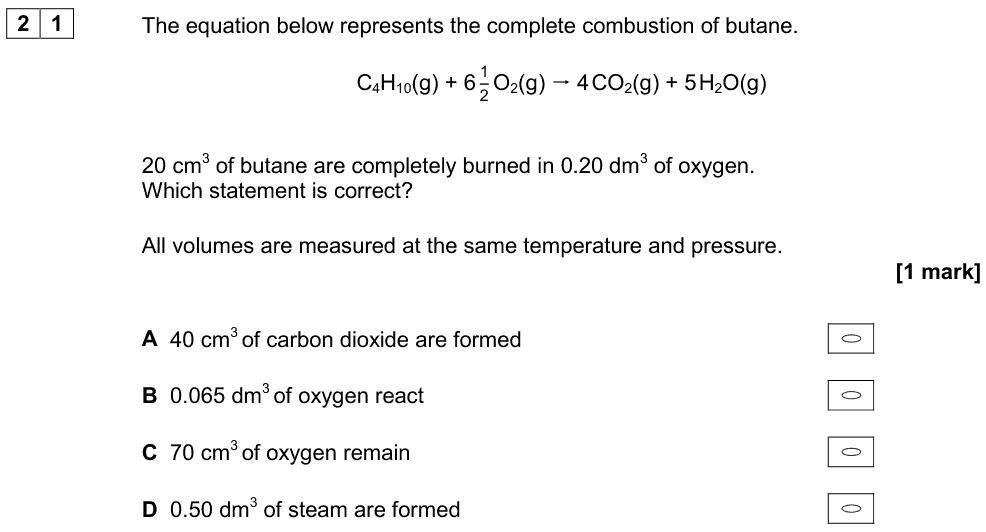
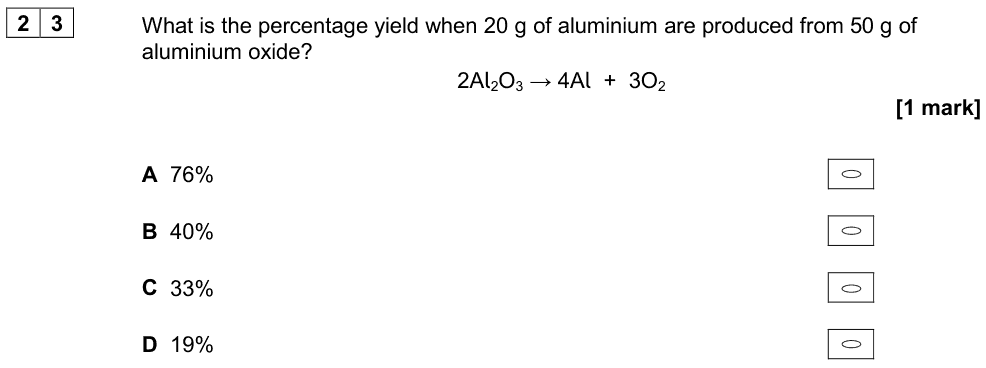
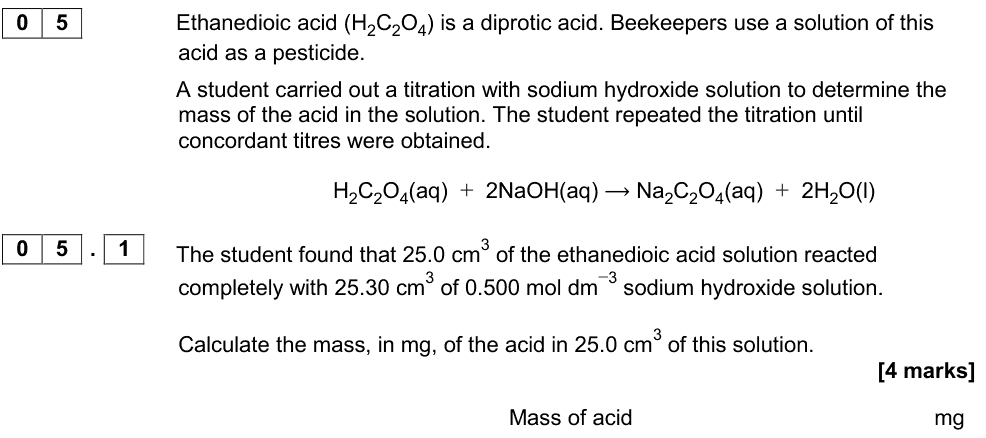
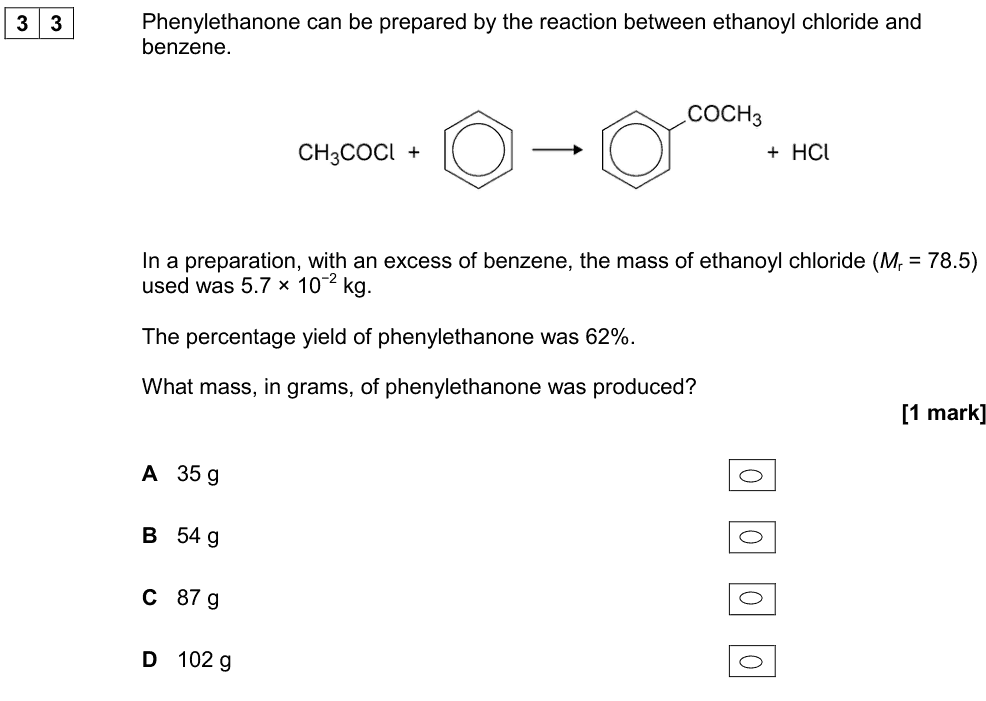
3.1.2.5-05 Students should be able to use balanced equations to calculate: • masses • volumes of gases • percentage yields • percentage atom economies • concentrations and volumes for reactions in solutions.
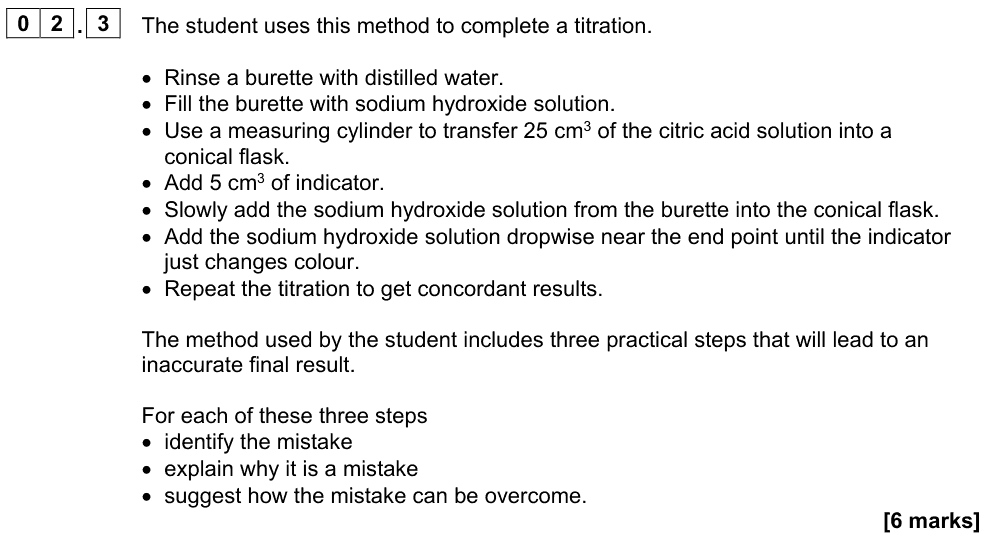
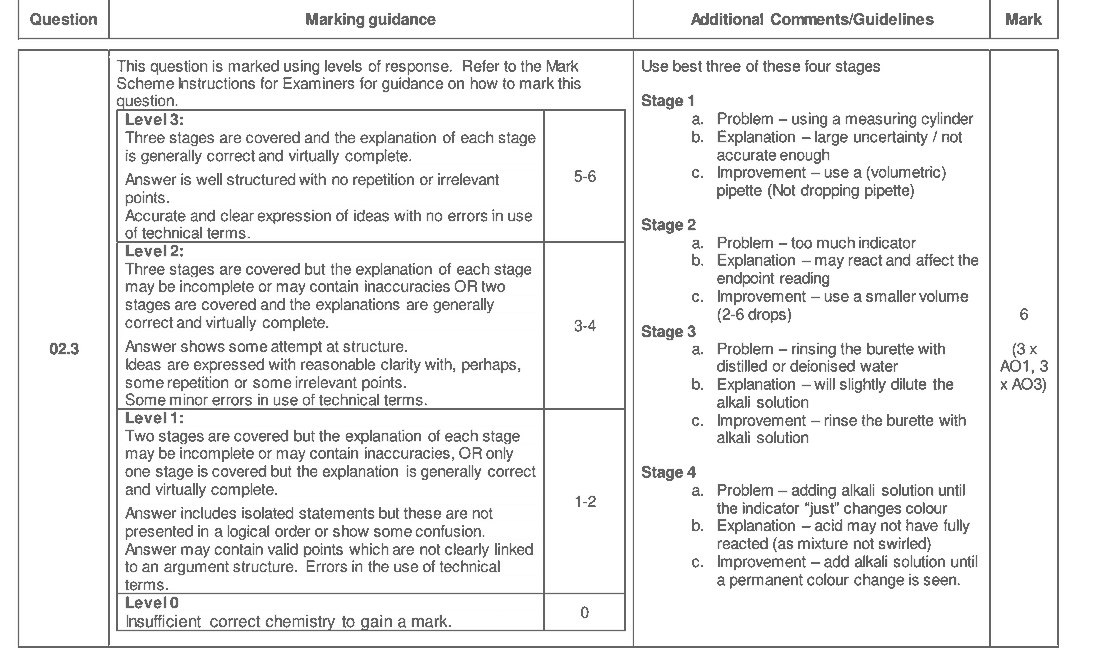
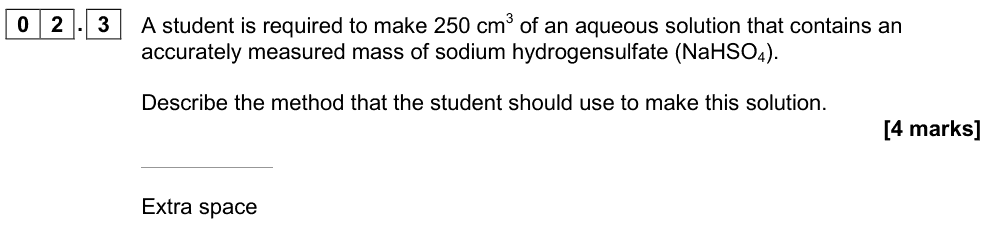
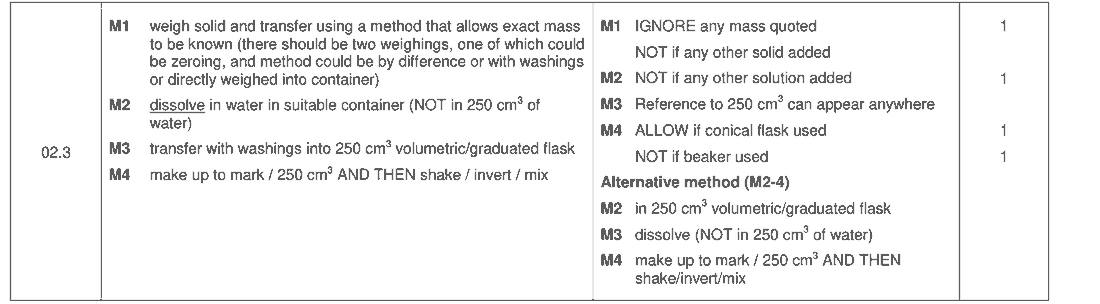
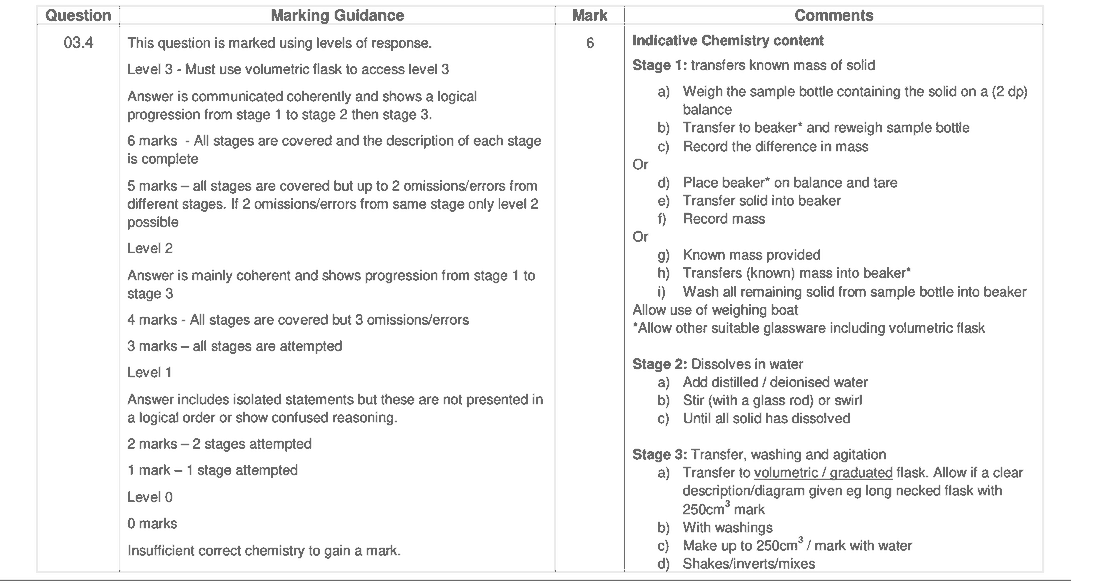
3.1.2.5-06 Required practical 1 Make up a volumetric solution and carry out a simple acid–base titration.
Six-mark level of response questions on this topic
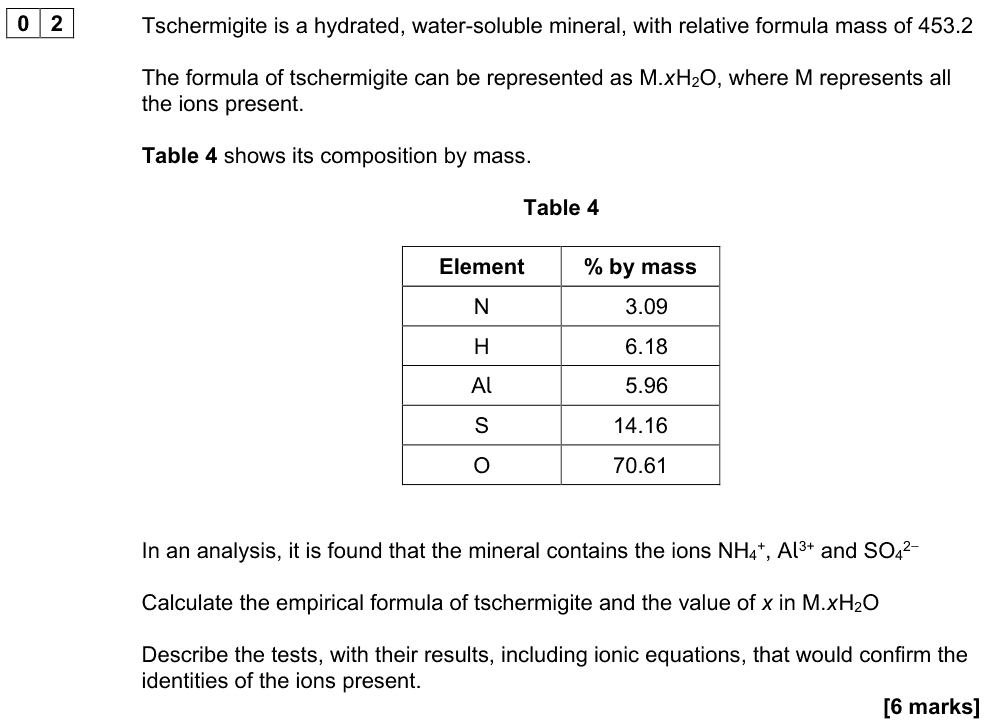
the empirical formula of tschermigite and the value of x in M.x H2O Describe the tests, with their results, including ionic equations, that would confirm the
Tap a question to zoom it. Where a part needs a figure, table or structure from earlier in the question, that part folds out above it; the mark scheme and examiner's comment open underneath. Have AQA's Data Booklet (the Periodic Table and the spectroscopy tables) beside you.
June 2025 · AS Paper 1 · Q01.12 marksAO1=2Calculation
Mark scheme
Examiner's comment
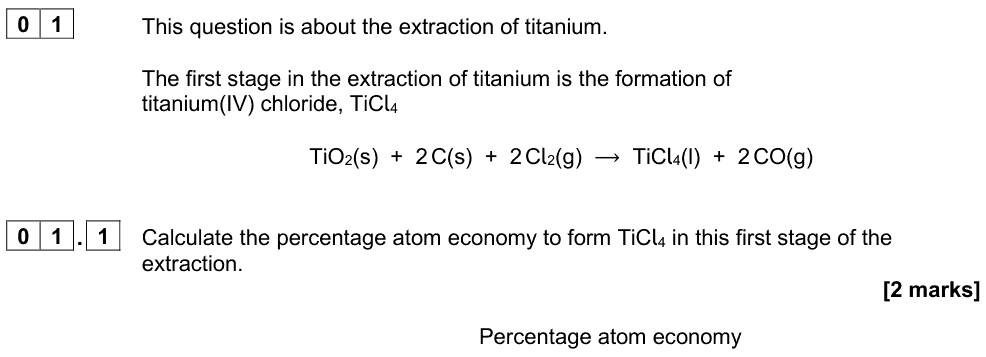
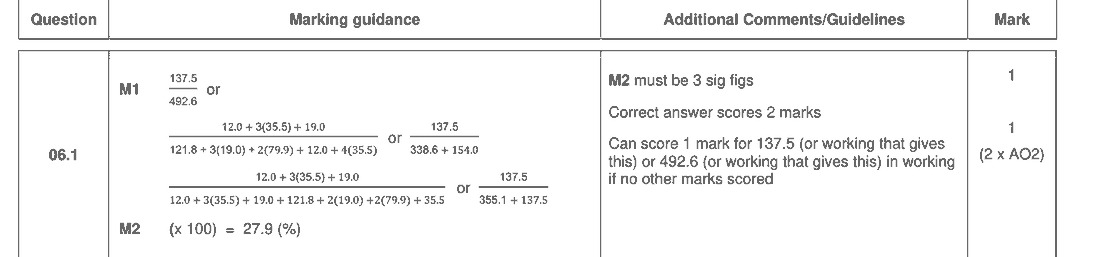
1.1 The majority of students performed well on this question and were able to calculate the percentage atom economy in the reaction to form titanium(IV) chloride. Students who struggled with this calculation either did not use Ar values when calculating Mrs or did not use the stoichiometric coefficients.
Notes from the mark scheme and report
Answer: 77.2%. Mr(TiCl4) = 189.9
total Mr of reactants = 79.9 + 2(12.0) + 2(71.0) = 245.9
(189.9 ÷ 245.9) × 100. Errors: not using Ar values to find Mr, or ignoring the stoichiometric coefficients
Skills: MS0.2 Use ratios, fractions and percentages
June 2025 · AS Paper 1 · Q01.21 markAO3=1Short answer
Earlier part of question 01 that this part uses
Mark scheme
Examiner's comment
1.2 Students did not explore the economic advantages of using a process with a high atom economy and instead gave answers focussed on yield.
Notes from the mark scheme and report
More of the mass of the reactants / atoms ends up in the useful product, or less waste / by-product to dispose of. Ignore yield and energy
'costs less' needs qualifying. Many wrote about yield
June 2025 · AS Paper 1 · Q01.32 marksAO1=2Equation writing
Earlier part of question 01 that this part uses
Mark scheme
Examiner's comment
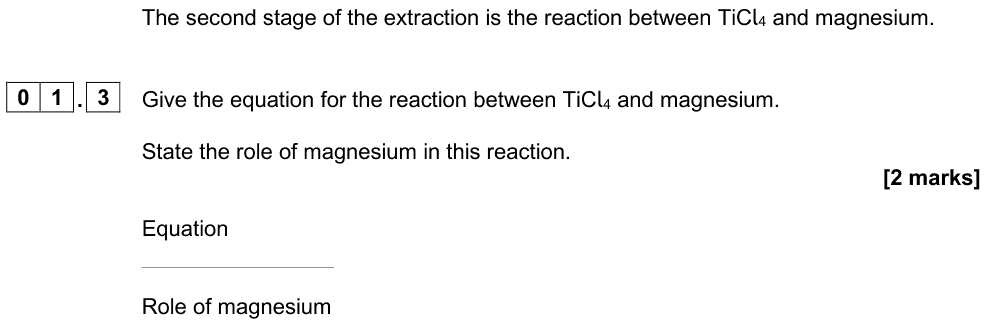
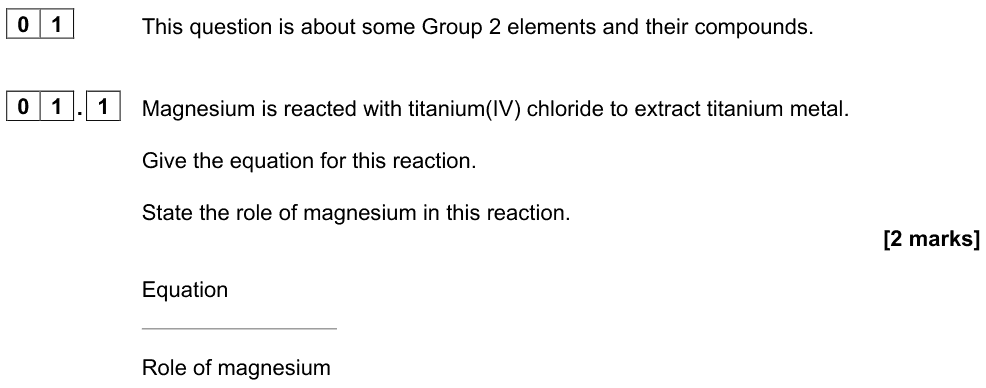
1.3 The majority of students were able to give a correct chemical equation for the reaction between titanium (IV) chloride and magnesium. However, the role of magnesium was often incorrectly stated as an oxidising agent rather than a reducing agent.
Notes from the mark scheme and report
TiCl4 + 2Mg → 2MgCl2 + Ti
magnesium is the reducing agent / electron donor. Role often wrongly given as oxidising agent
June 2025 · Paper 1 · Q01.42 marksAO3=2Equation writing
Earlier part of question 01 that this part uses
Mark scheme
Examiner's comment
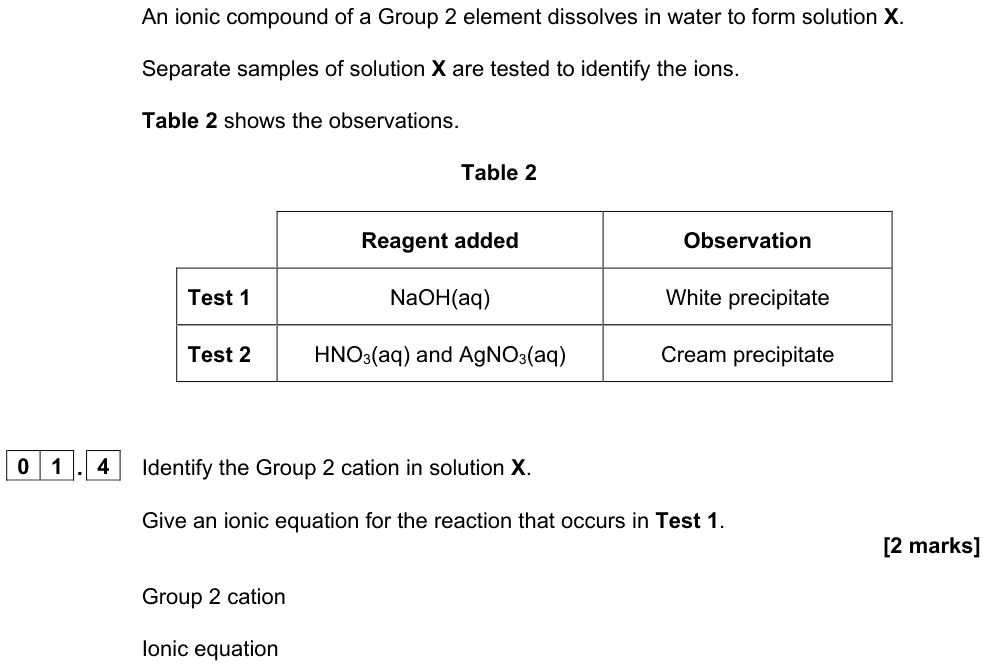
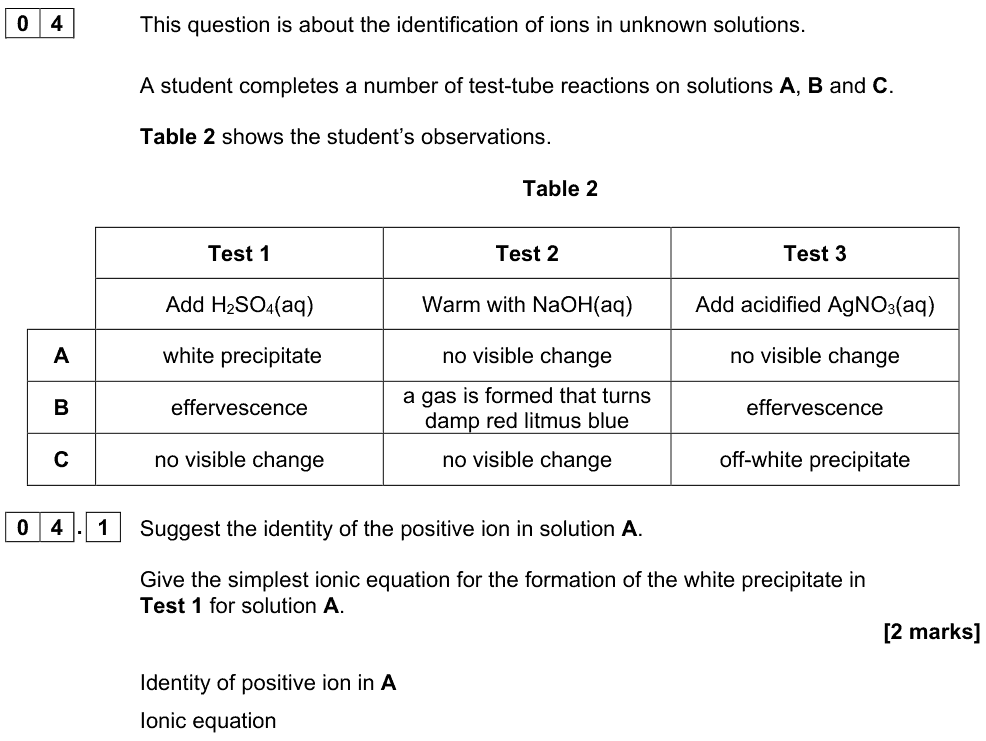
Fewer than half the students scored both marks in part 4; some students did not attempt an ionic equation and used NaOH as their reagent.
Notes from the mark scheme and report
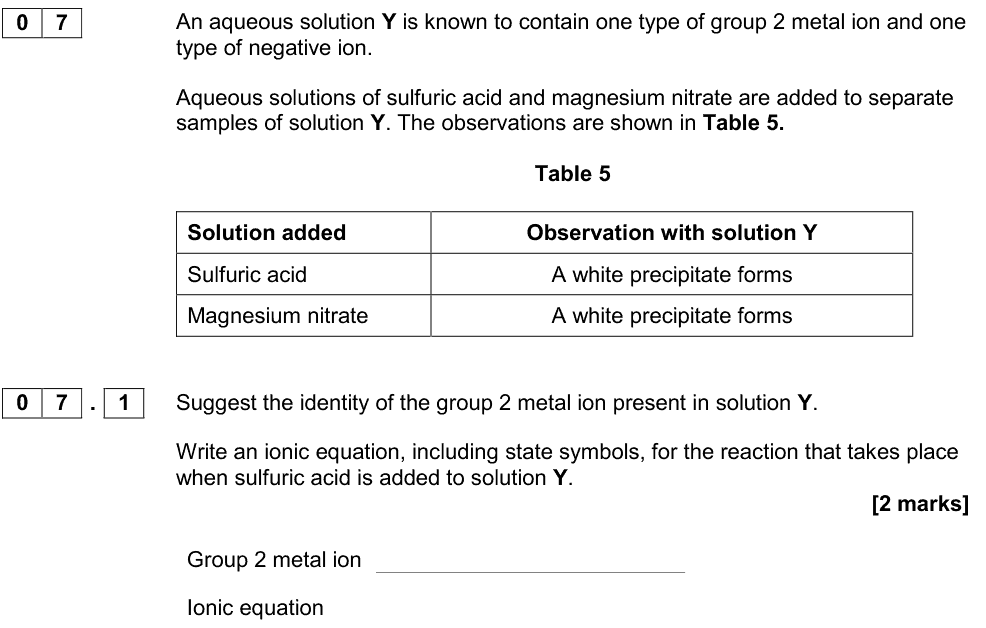
Mg2+
Mg2+ + 2OH– → Mg(OH)2 (Ca2+ also allowed with a matching equation). Must be an ionic equation: many used NaOH as the reagent or did not attempt it
Skills: PS1.2 Apply scientific knowledge to practical contexts; RP4 Carry out simple test-tube reactions to identify: cations – Group 2, NH4+; anions – Group 7 (halide ions), OH–, CO32–, SO42–
June 2025 · Paper 1 · Q01.53 marksAO2=1, AO3=2Equation writing
Earlier parts of question 01 that this part uses
Mark scheme
Examiner's comment
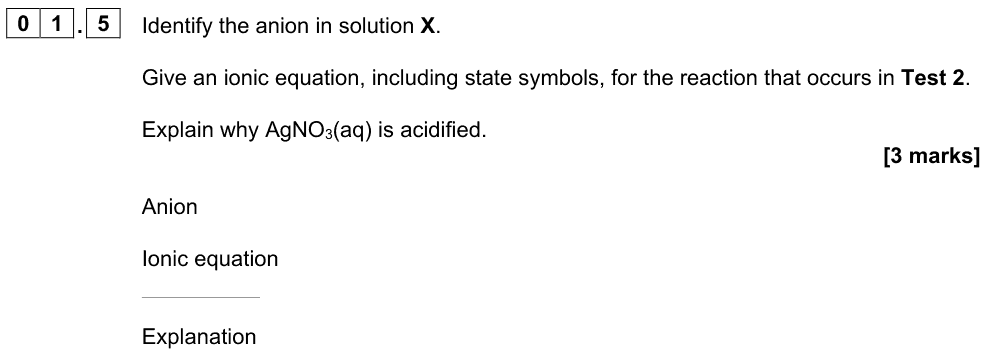
The bromide was well known in part 5, but many students did not write an ionic equation or omitted the state symbols in their equation.
The most common answer for the explanation of acidification was to remove carbonate ions.
Occasionally, students answered in terms of false positive results but failed to mention the ions involved.
Notes from the mark scheme and report
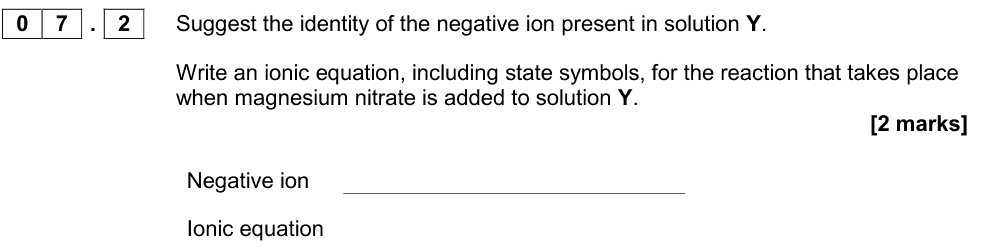
Bromide (cream precipitate)
Ag+(aq) + Br–(aq) → AgBr(s)
acidified to remove carbonate ions (or other ions that would give a precipitate with silver nitrate). Errors: full rather than ionic equation
state symbols omitted
'false positives' without naming the ions. Uses Table 2 from 01.4
Skills: PS1.2 Apply scientific knowledge to practical contexts; RP4 Carry out simple test-tube reactions to identify: cations – Group 2, NH4+; anions – Group 7 (halide ions), OH–, CO32–, SO42–
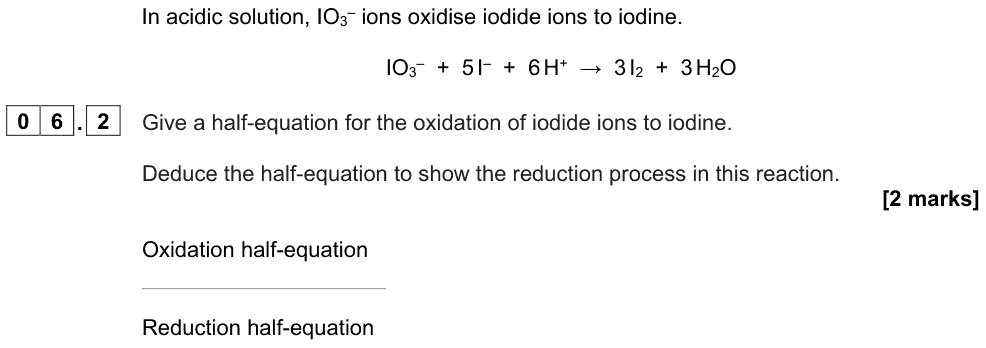
June 2025 · AS Paper 1 · Q02.52 marksAO2=2Equation writing
Earlier part of question 02 that this part uses
Mark scheme
Examiner's comment
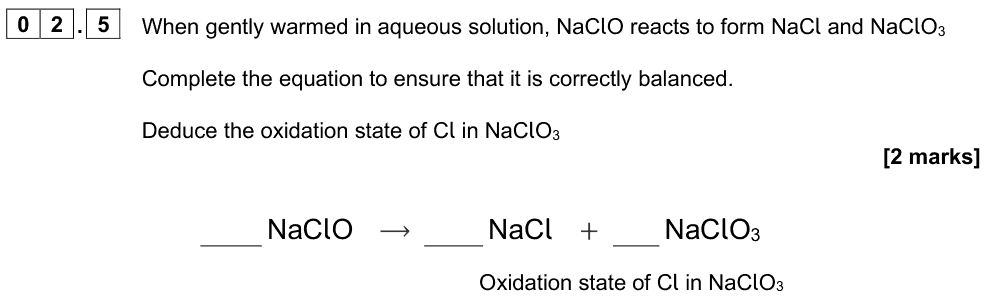
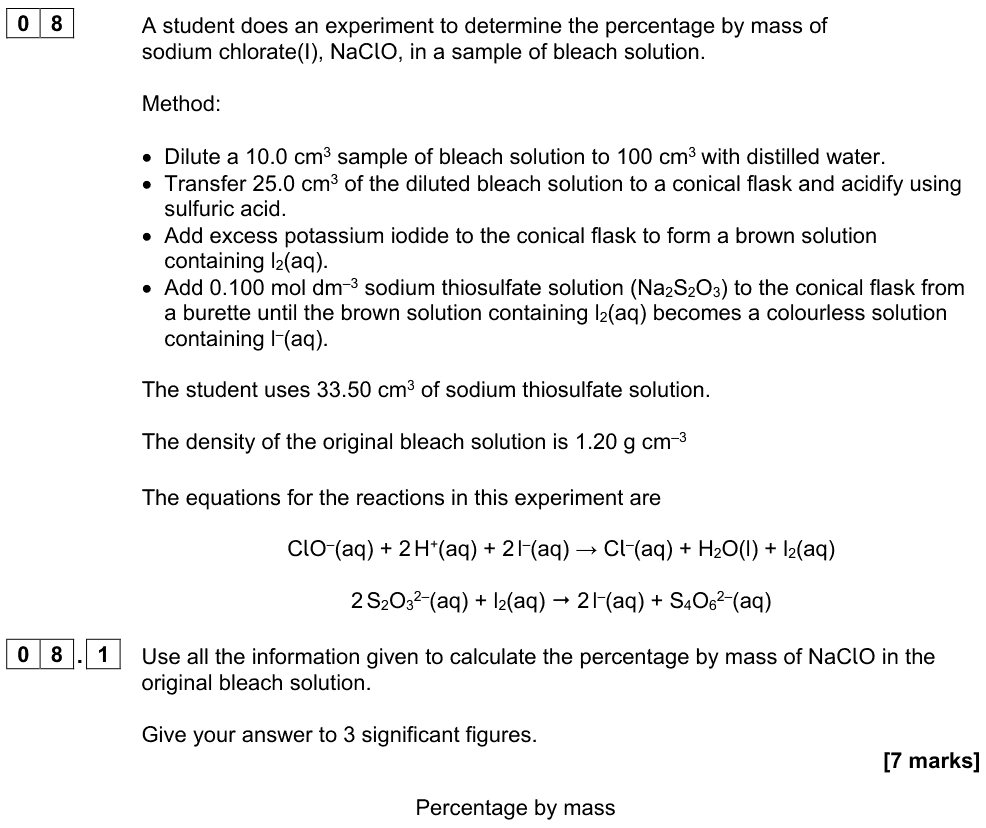
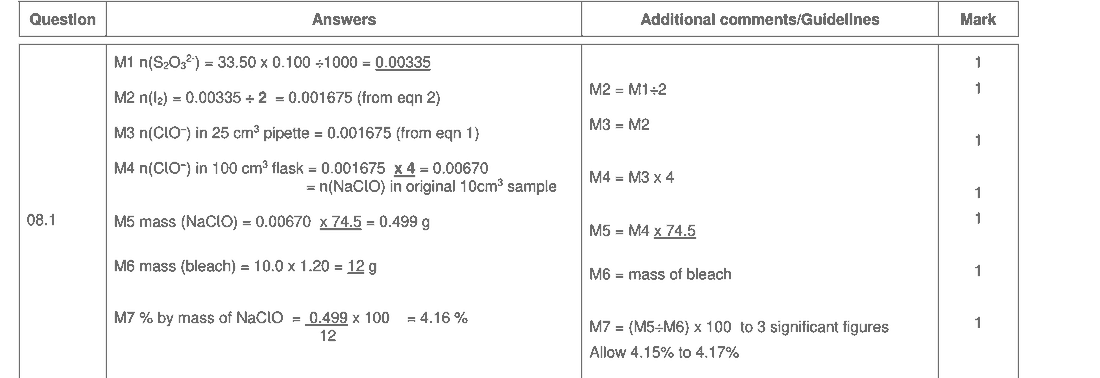
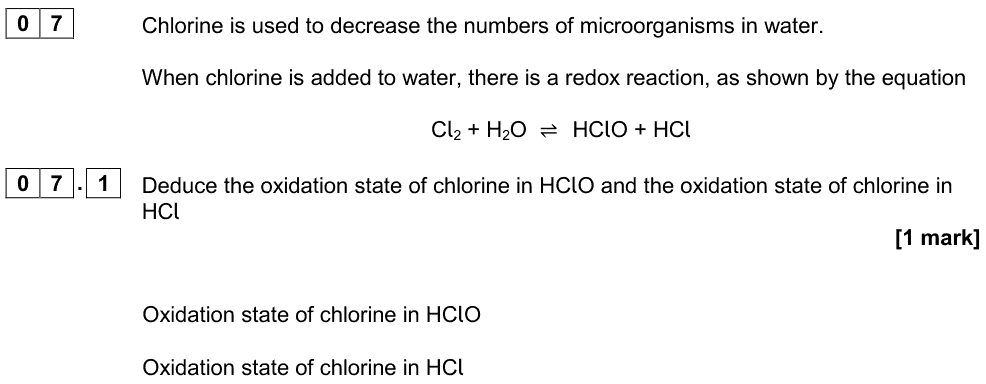
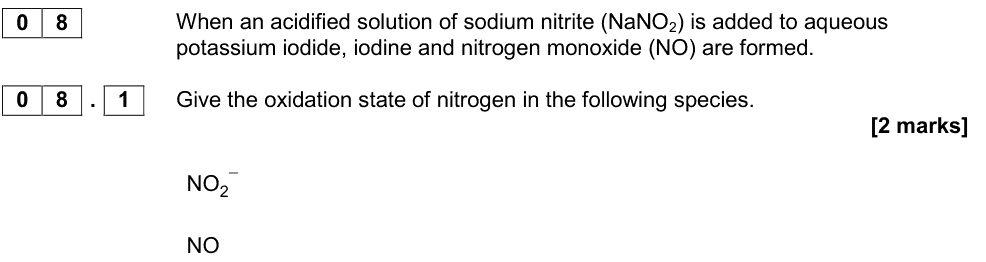
2.5 Most students were able to balanced the equation correctly but fewer were able to deduce the oxidation state of chlorine in NaClO3
Notes from the mark scheme and report
3NaClO → 2NaCl + NaClO3 (allow multiples)
oxidation state of Cl in NaClO3 = +5. The balancing was done better than the oxidation state
June 2025 · AS Paper 1 · Q03.32 marksAO1=2Short answer
Earlier part of question 03 that this part uses
Mark scheme
Examiner's comment
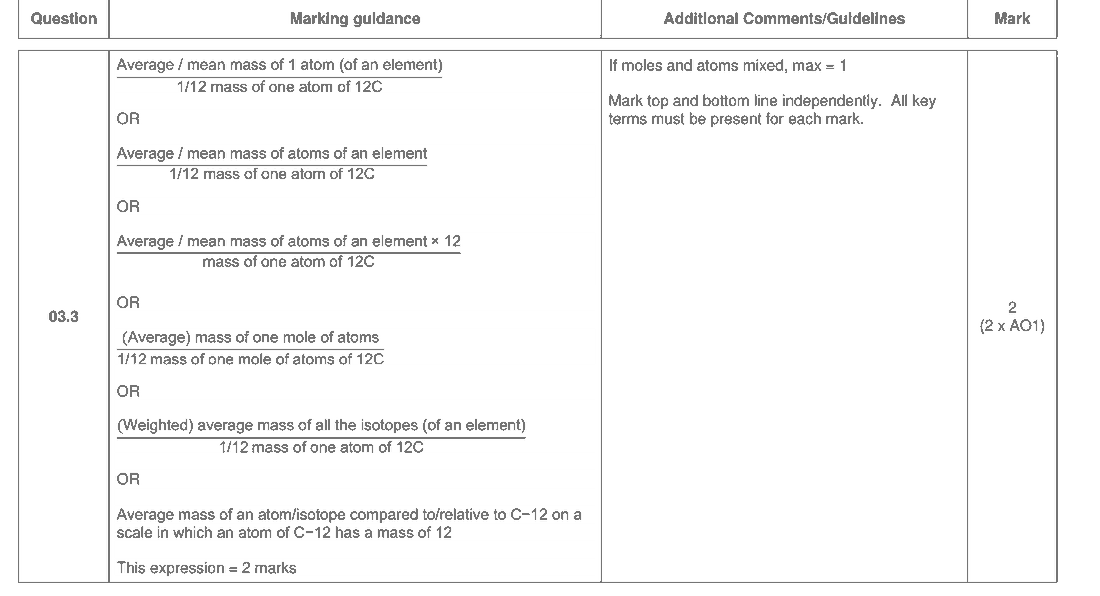
3.3 Students were able to give the meaning of the term relative atomic mass although a good number did not state that the scale is relative to the mass of one atom of 12C
Notes from the mark scheme and report
Mean (average) mass of an atom of an element divided by 1/12 of the mass of one atom of 12C (or compared with 1/12 of the mass of a 12C atom, on a scale where 12C is 12). Top and bottom lines marked independently
mixing moles and atoms is max 1. Many omitted 'one atom of 12C'
June 2025 · AS Paper 1 · Q03.73 marksAO2=3Calculation
Earlier part of question 03 that this part uses
Mark scheme
Examiner's comment
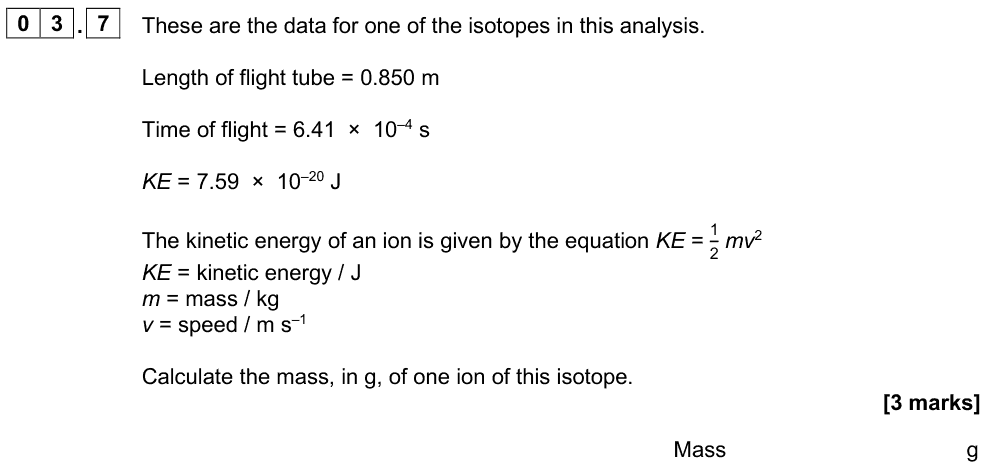
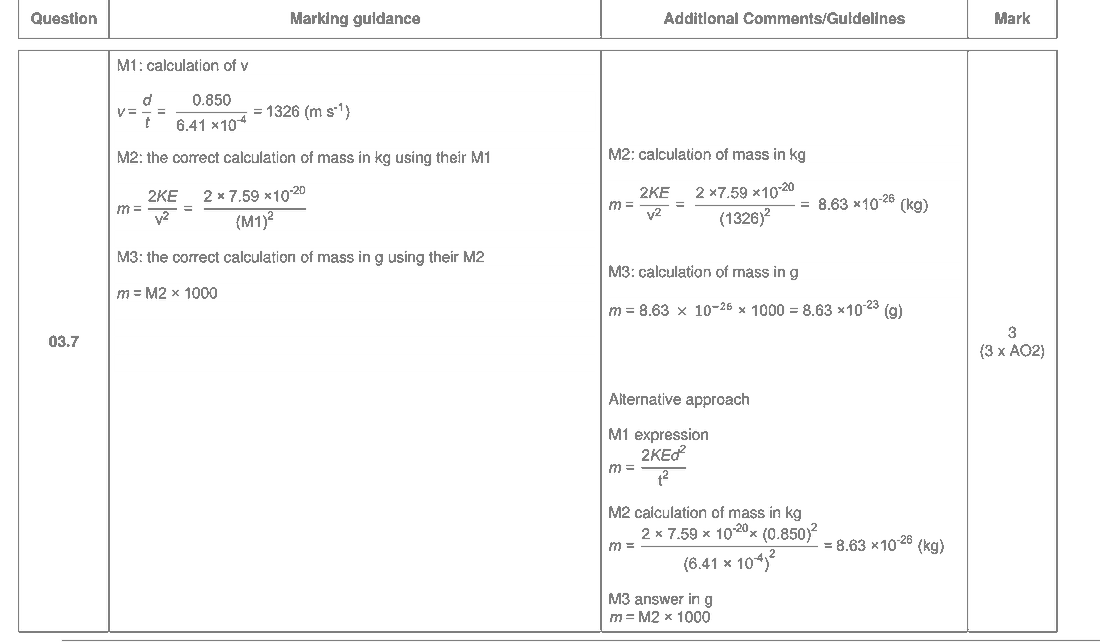
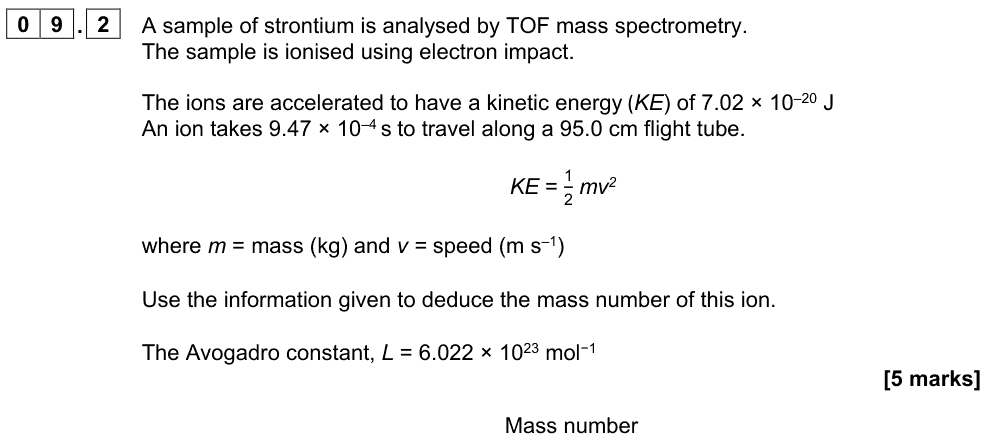
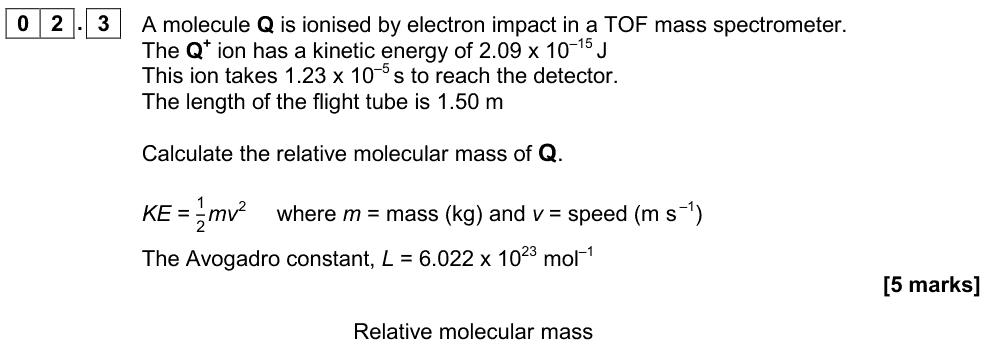
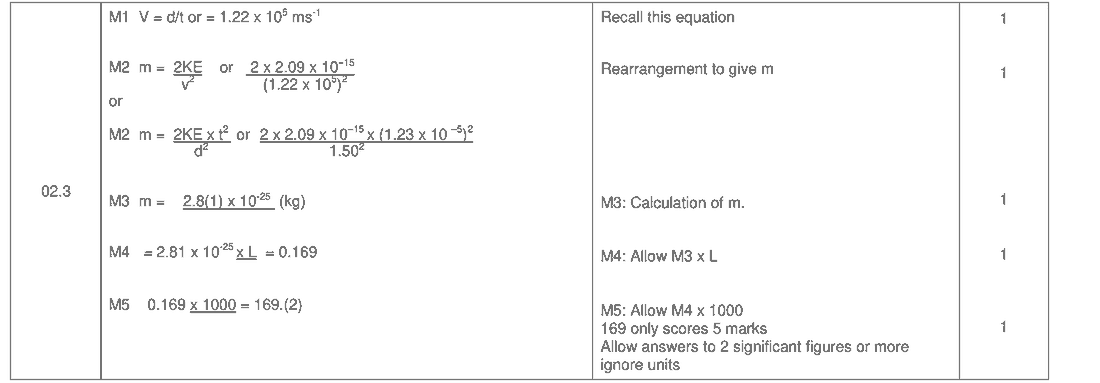
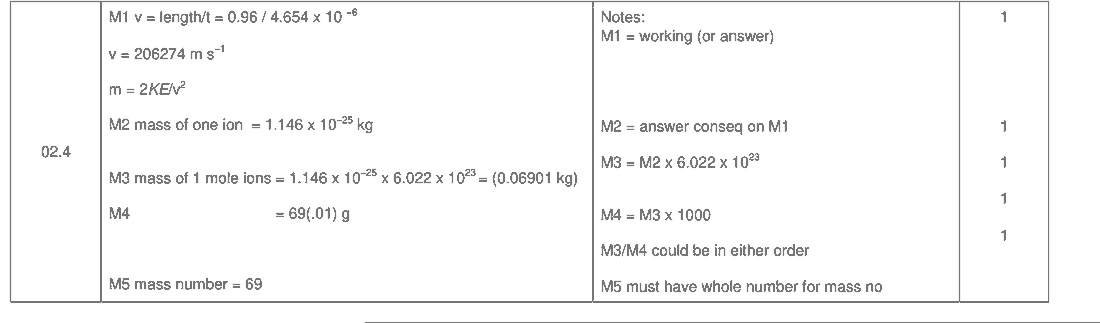
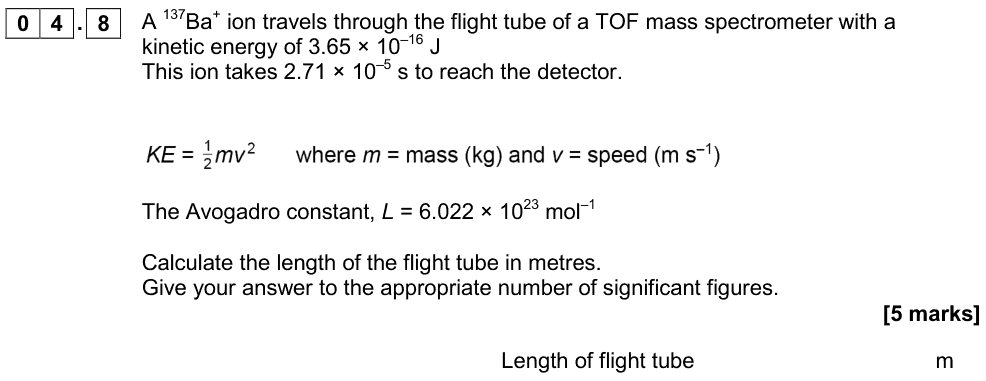
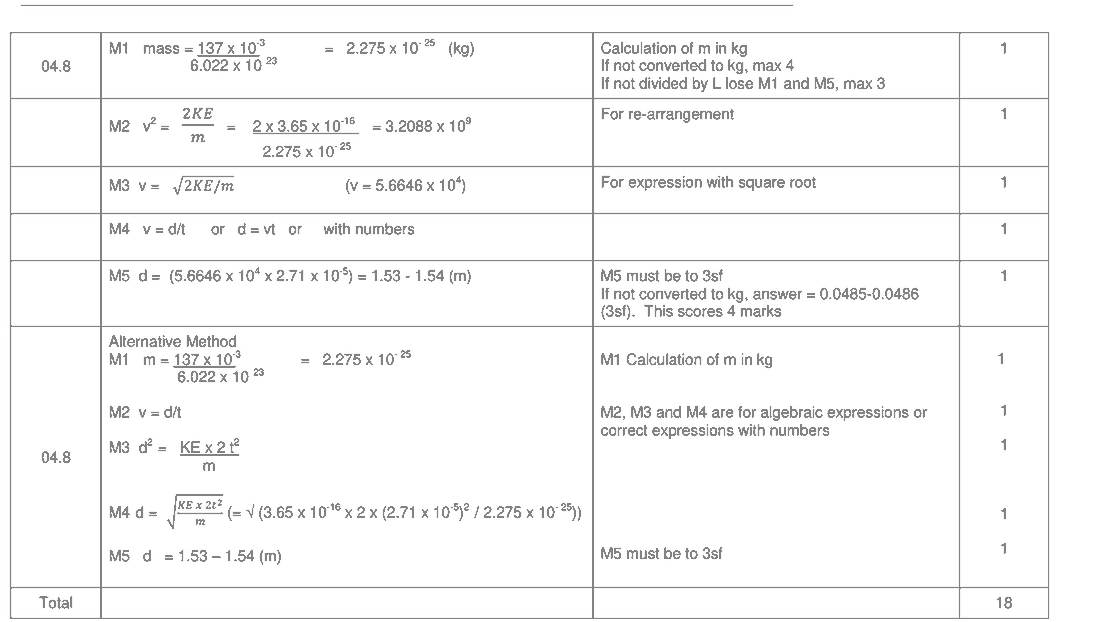
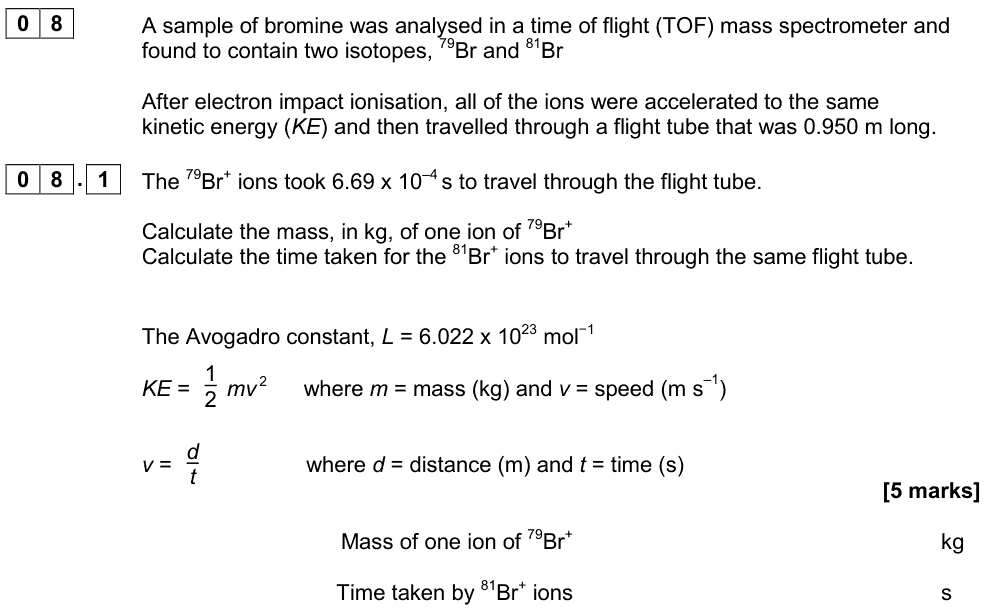
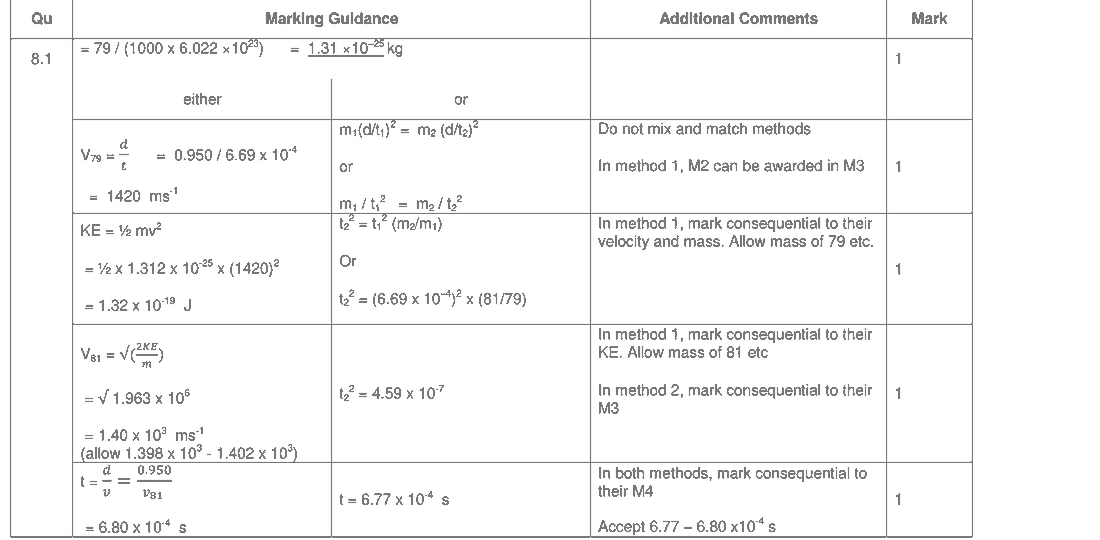
3.7 Students were asked to calculate the mas of one ion of an isotope using some data from time of flight mass spectrometry. The majority of students made good progress with this more challenging calculation. However, some students did not square their velocity whilst others did not convert the mass generated from using the expression KE = ½ mv2 into grams.
Notes from the mark scheme and report
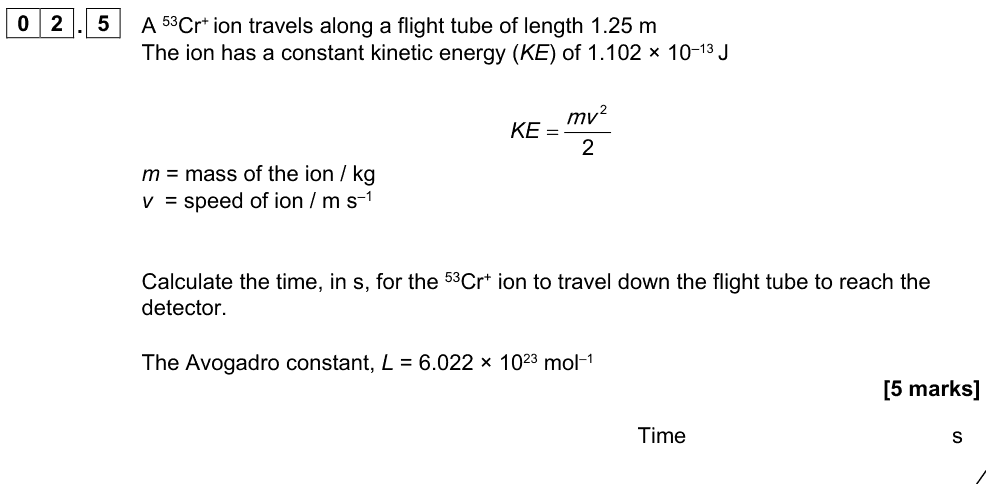
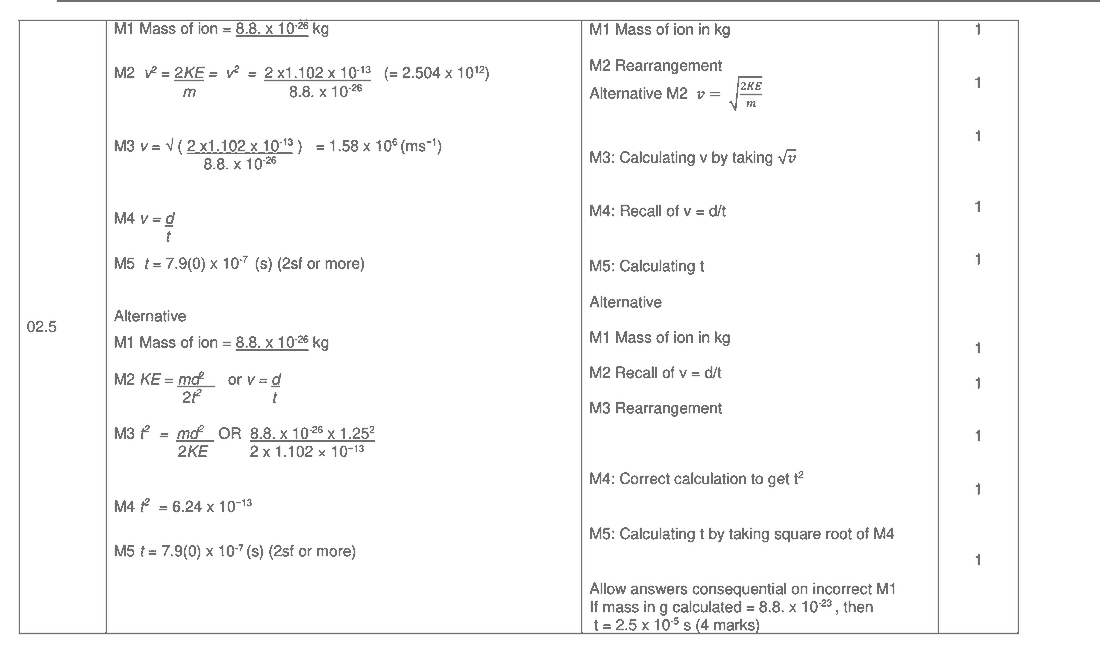
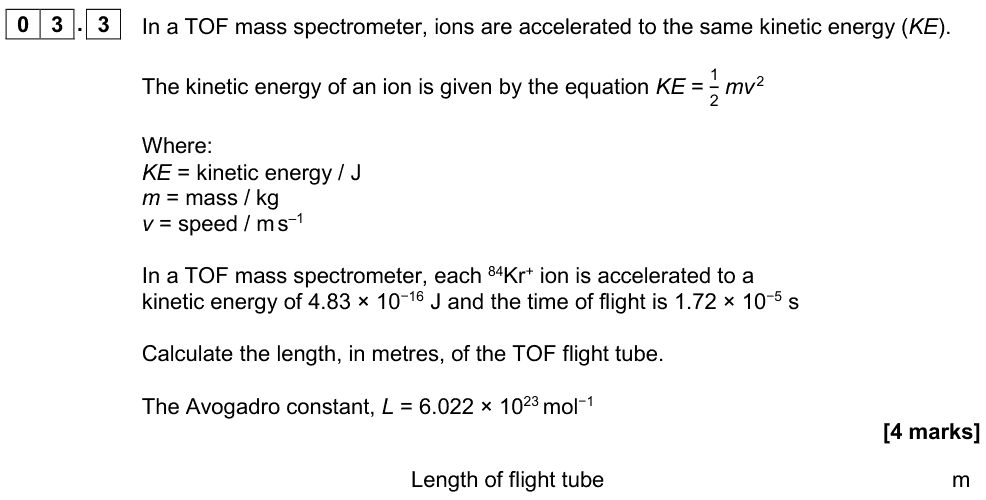
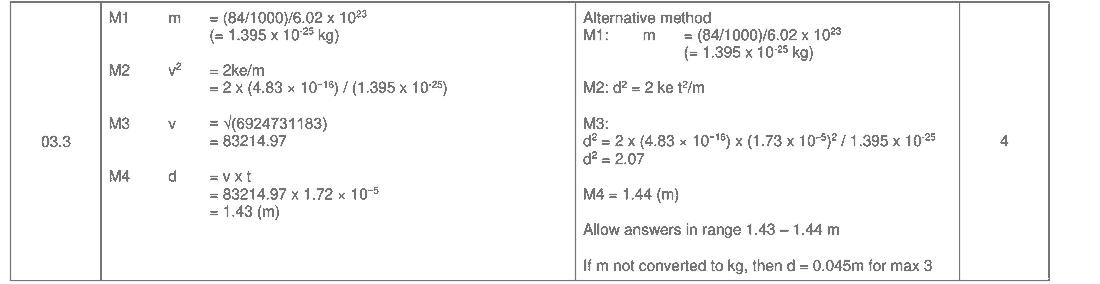
Answer: 8.63 × 10^–23 g. v = d ÷ t = 0.850 ÷ (6.41 × 10^–4) = 1326 m s–1
m = 2KE ÷ v² = 8.63 × 10^–26 kg
× 1000. Errors: not squaring the velocity
leaving the mass in kg
Skills: MS0.0 Recognise and make use of appropriate units in calculation; MS0.1 Recognise and use expressions in decimal and ordinary form; MS2.2 Change the subject of an equation; MS2.3 Substitute numerical values into algebraic equations using appropriate units for physical quantities
June 2025 · Paper 1 · Q03.87 marksAO2=5, AO3=2Calculation
Earlier parts of question 03 that this part uses
Mark scheme
Examiner's comment
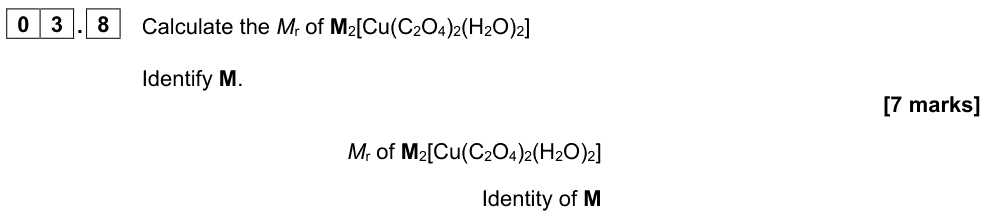
Just over 60% of students answered part 1 correctly. In part 2 many students lost this mark by not identifying the electron pair/lone pair was donated from oxygen to copper. Many incorrect observations were seen in part 3. The students who started with CO32– usually gave a correct equation; ions with incorrect formula CO3– were common. In part 4 most students gave the correct shapes; the most common error was square planar instead of tetrahedral. Some students did not refer to ligand size and instead gave ideas based on electron pair repulsion theory; some referred to chlorine atoms/molecules rather than chloride ions. Some students did not refer to d orbital splitting.
Many students referred to light being absorbed but did not identify the light as visible or white. Many students knew that the colour seen was light that had not been absorbed. Few students were able to write about the energy gap and what was responsible for the change in the energy gap, although some did reference the equation ∆E = h𝜈𝜈. Fewer than 20% scored both marks in part 5. Many students gave an incorrect observation. Students found the equation challenging; chlorine was often given as a product, some students had 2 mol of ammonia and 4 mol of water instead of the other way round and the copper complex often lacked a charge.
In part 6 many students could not give a balanced equation; H+ ions were often omitted from the left-hand side and water from the right-hand side. In part 7 most students gave the correct answer; a common error was to average three of the four titres instead of the two that were concordant. The calculation in part 7 proved challenging; most students were able to score the first three marks but then failed to divide by 2 and were not able to make progress. Some students used 25.0 cm3 for their titre. Students who had calculated an Mr greater than 275 usually divided this by 2 to get an Ar but often did not assign this to a metal with a +1 oxidation state. Students found part 9 challenging; common errors were to have a 4- coordinate copper or to bond the copper to a C2O42– ion via 1 coordinate bond. Many students did not specifically draw the coordinate bonds originating from the O atom of the water.
Notes from the mark scheme and report
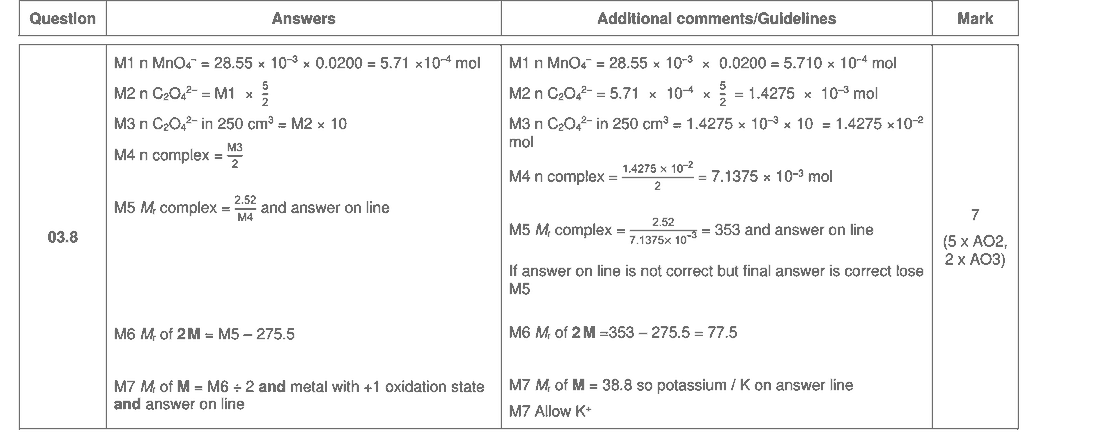
Answer: Mr = 353
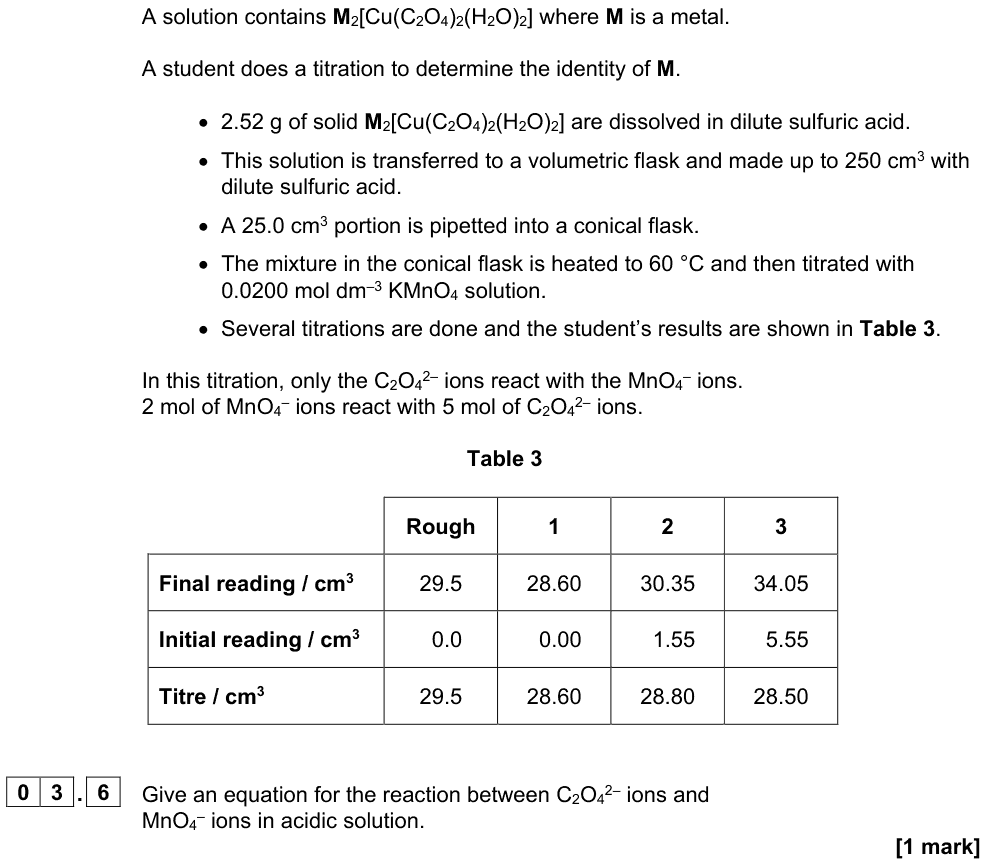
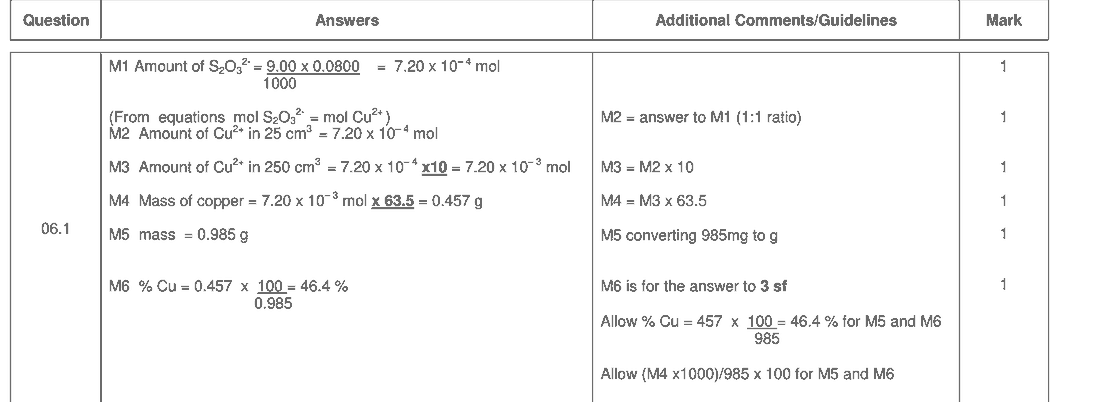
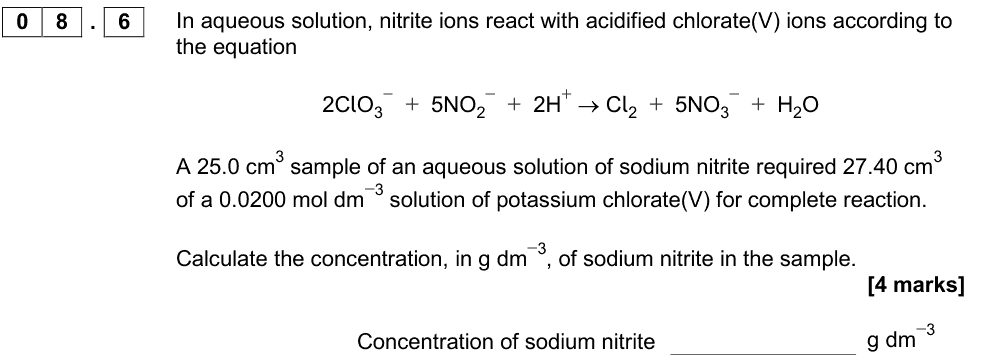
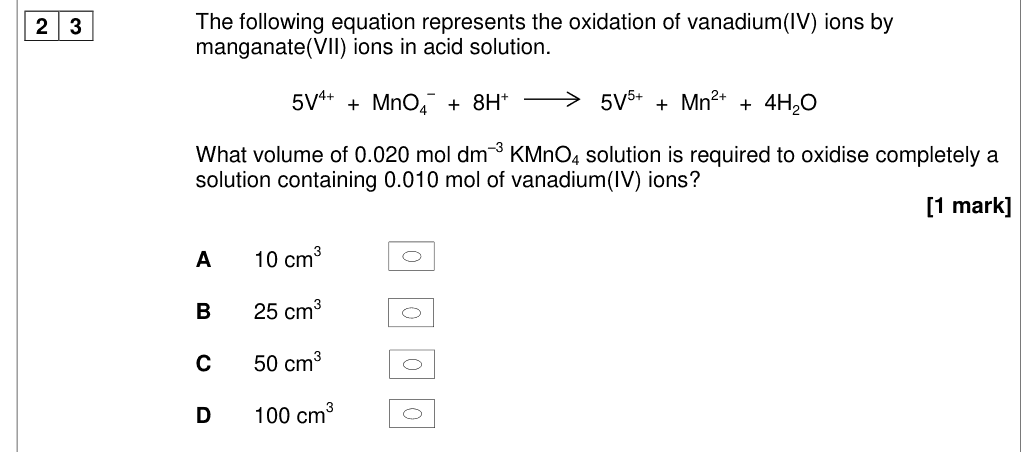
M is potassium. n(MnO4–) = 28.55 × 10^–3 × 0.0200 = 5.71 × 10^–4 mol
n(C2O4 2–) = × 5/2 = 1.4275 × 10^–3 mol
× 10 = 1.4275 × 10^–2 mol in 250 cm3
n(complex) = ÷ 2 = 7.1375 × 10^–3 mol
Mr = 2.52 ÷ 7.1375 × 10^–3 = 353
353 – 275.5 = 77.5 for 2M
Ar = 38.8. Errors: not dividing by 2 for two ethanedioates per complex
using 25.0 cm3 as the titre
not choosing a metal with a +1 oxidation state. Uses the method and Table 3 from 03.6
Skills: MS0.0 Recognise and make use of appropriate units in calculation; MS0.2 Use ratios, fractions and percentages; MS2.2 Change the subject of an equation
June 2025 · AS Paper 1 · Q04.31 markAO1=1Equation writing
Earlier part of question 04 that this part uses
Mark scheme
Examiner's comment
4.3 Students did not often include state symbols in their equation. Students also gave equations that formed BaO rather than Ba(OH)2
Notes from the mark scheme and report
Ba(s) + 2H2O(l) → Ba(OH)2(aq) + H2(g). State symbols essential. Errors: no state symbols
BaO as the product
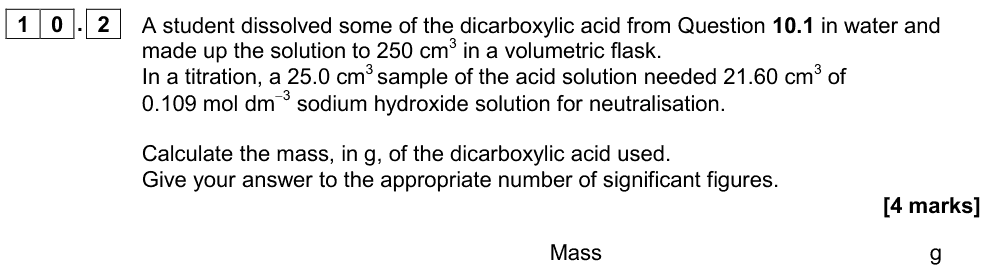
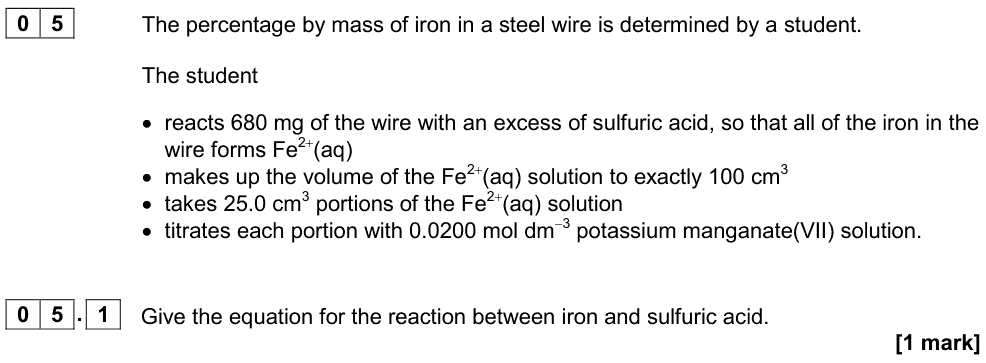
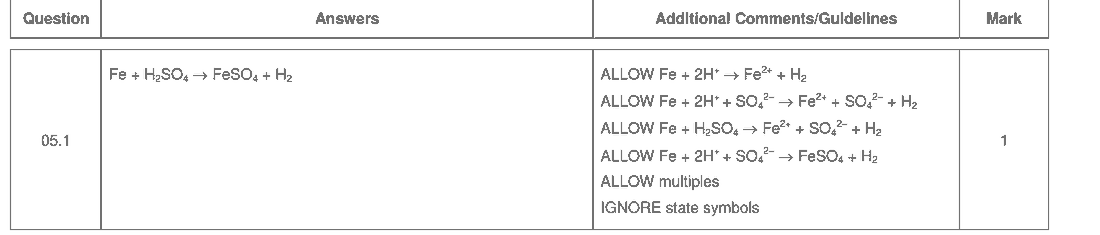
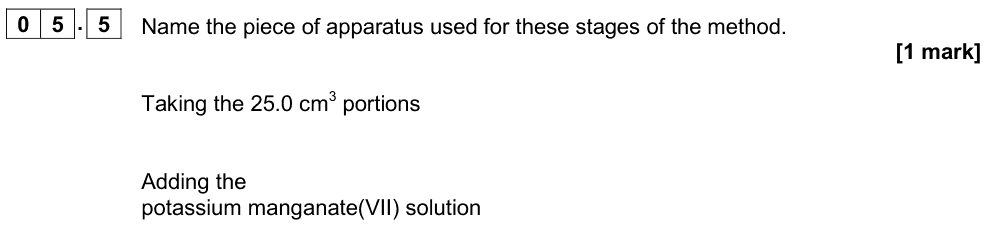
June 2025 · AS Paper 1 · Q05.15 marksAO2=4, AO3=1Calculation
Mark scheme
Examiner's comment
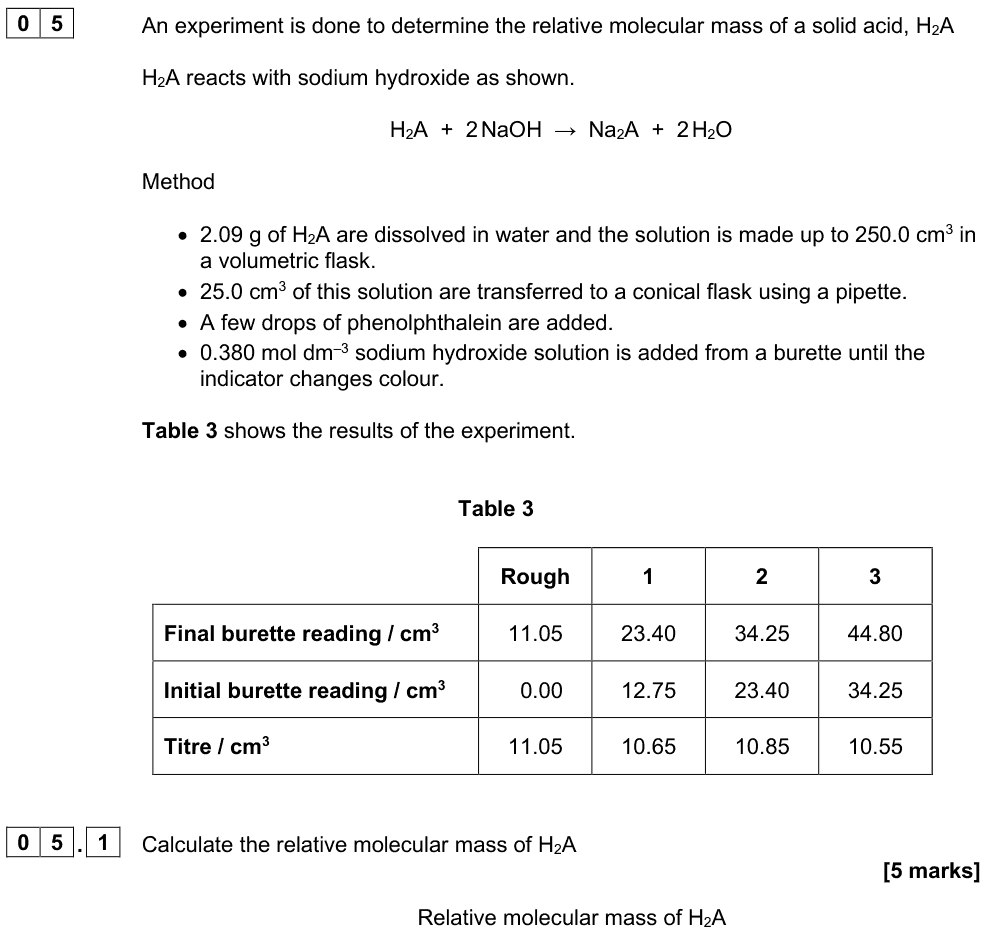
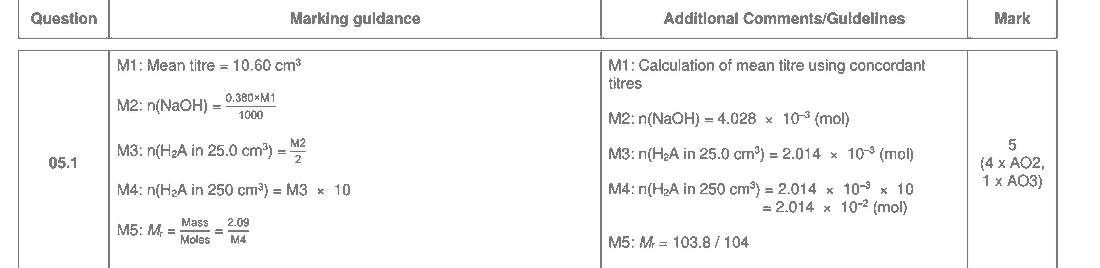
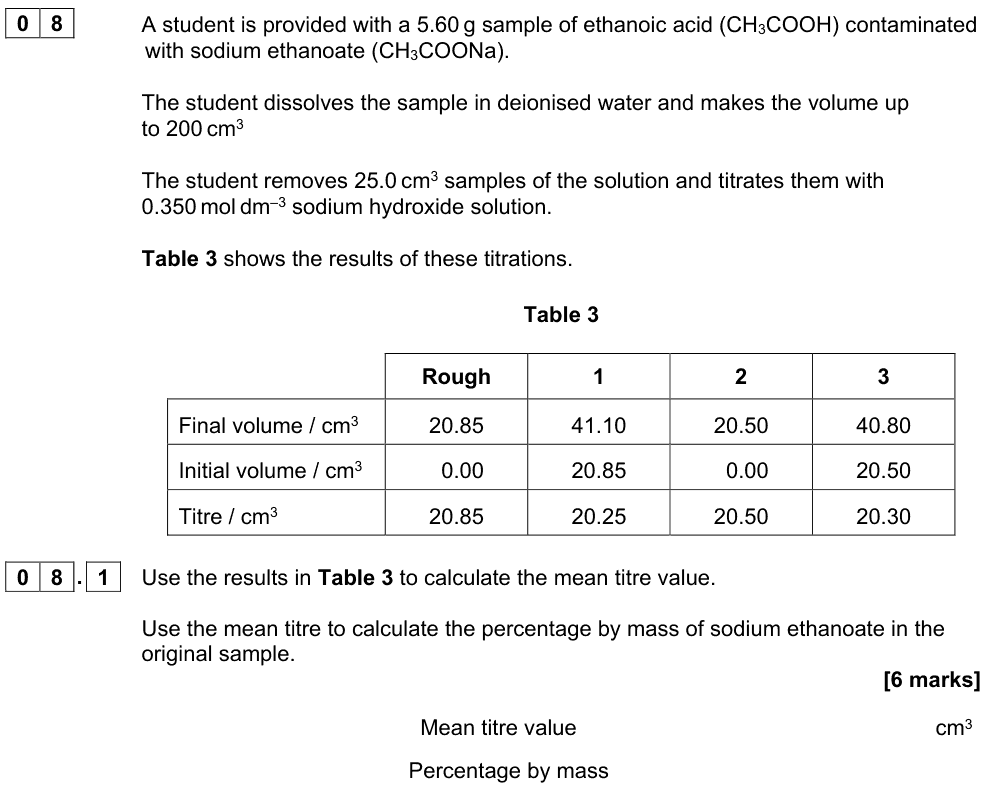
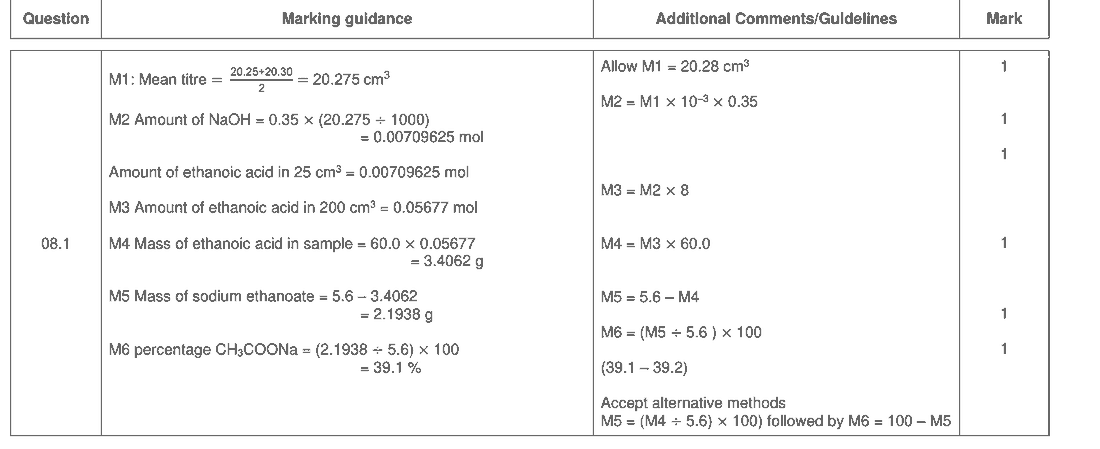
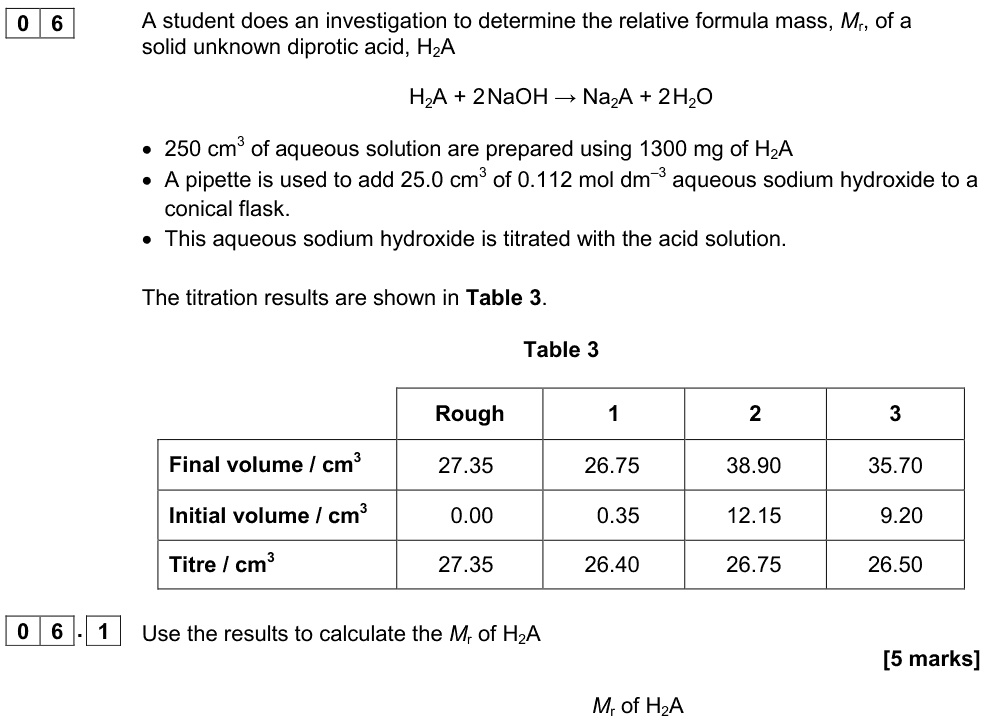
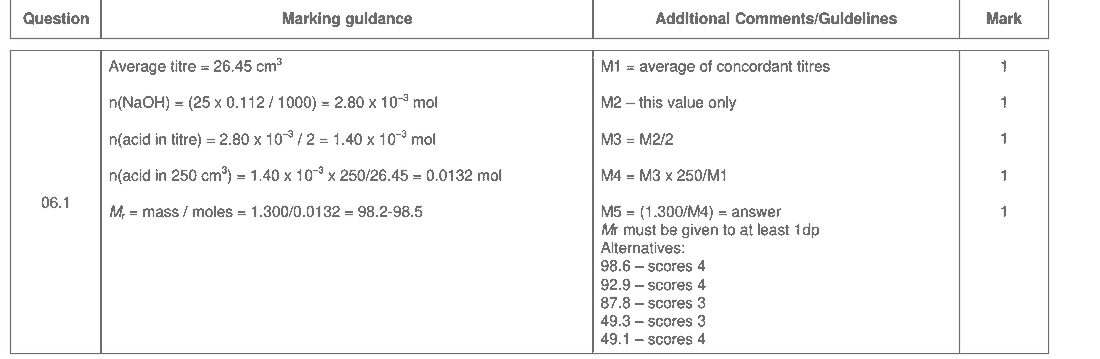
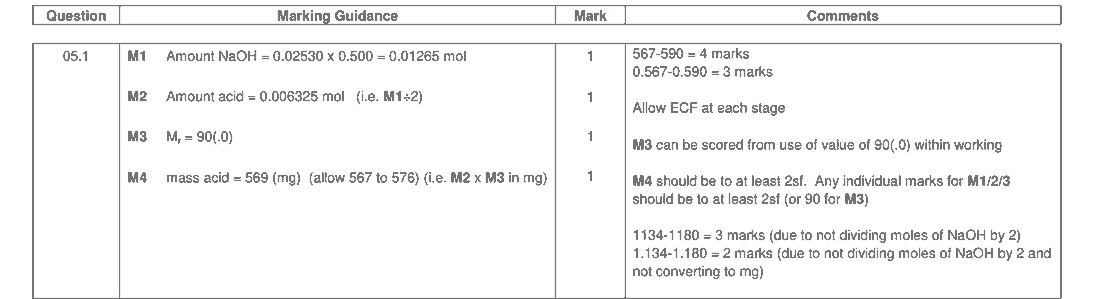
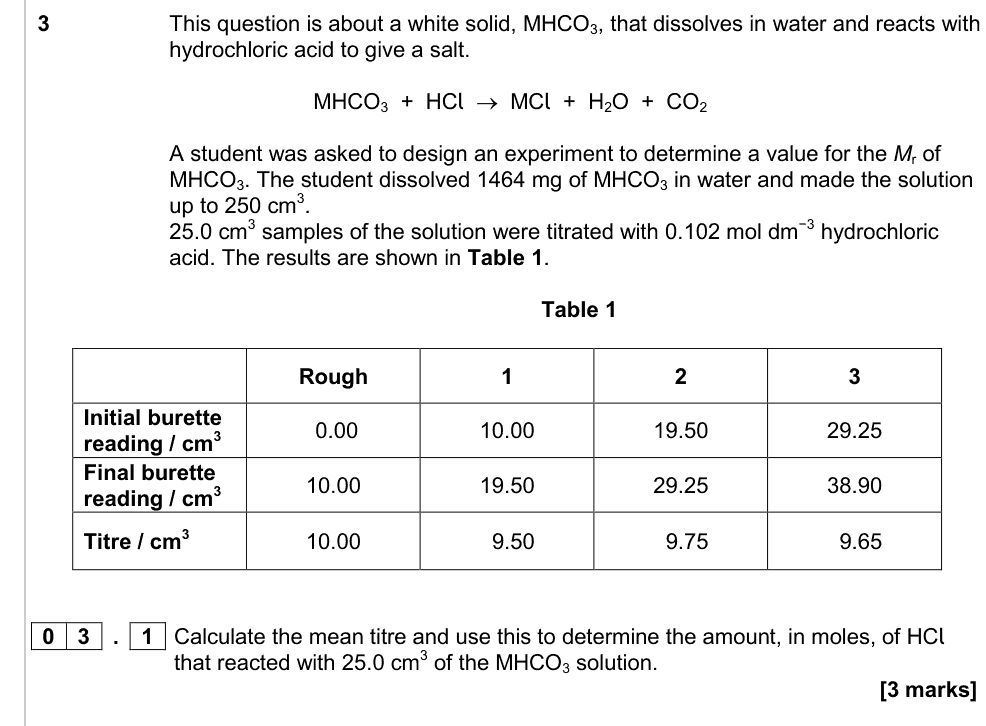
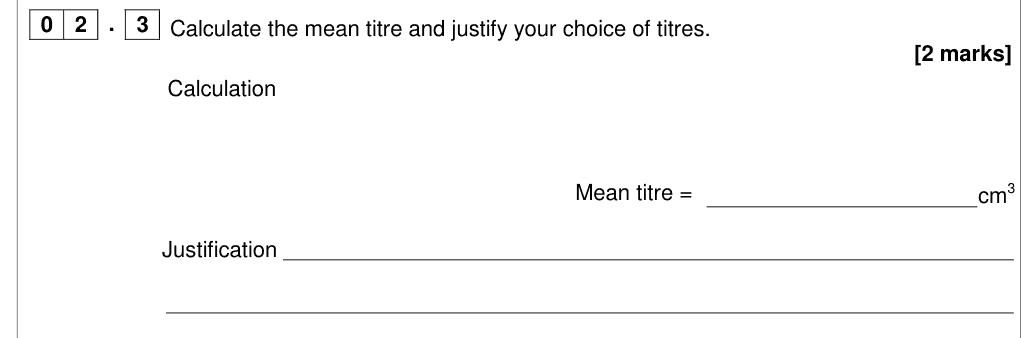
5.1 This calculation was well completed by students with most of them calculating correctly the relative formula mass of the acid. Students should take care to lay out their calculations in a stepwise manner with a clear statement of what each line of working represents. Students often present extended calculations as a jumbled set of numbers that do not always clearly follow on from each other. In this question, students did not always calculate the mean titre correctly and should only use concordant results. In addition, students did not always appreciate that a 25.0 cm3 sample of the acid solution was used in the titration.
Notes from the mark scheme and report
Answer: Mr = 104 (103.8). Mean titre from the concordant titres 10.65 and 10.55 = 10.60 cm3
forgetting that only 25.0 cm3 of the 250 cm3 was titrated
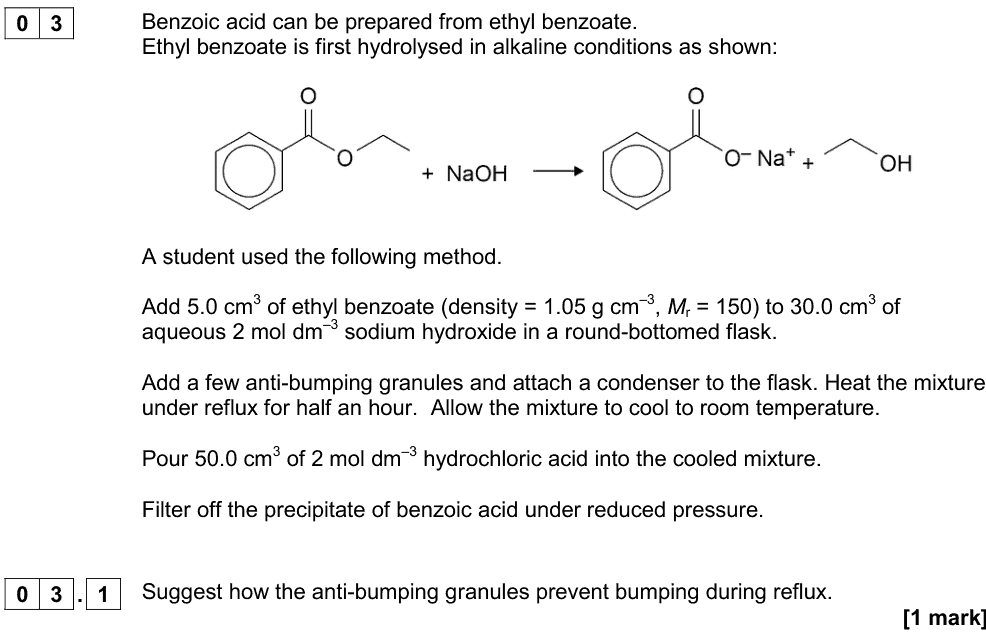
Skills: MS0.2 Use ratios, fractions and percentages; MS1.2 Find arithmetic means; PS3.2 Process and analyse data using appropriate mathematical skills as exemplified in the mathematical appendix for each science; ATd Use laboratory apparatus for a variety of experimental techniques including: titration, using burette and pipette; distillation and heating under reflux, including setting up glassware using retort stand and clamps; qualitative tests for ions and organic functional groups; filtration, including use of fluted filter paper, or filtration under reduced pressure; RP1 Make up a volumetric solution and carry out a simple acid–base titration
June 2025 · AS Paper 1 · Q05.21 markAO2=1Practical and data analysis
Earlier part of question 05 that this part uses
Mark scheme
Examiner's comment
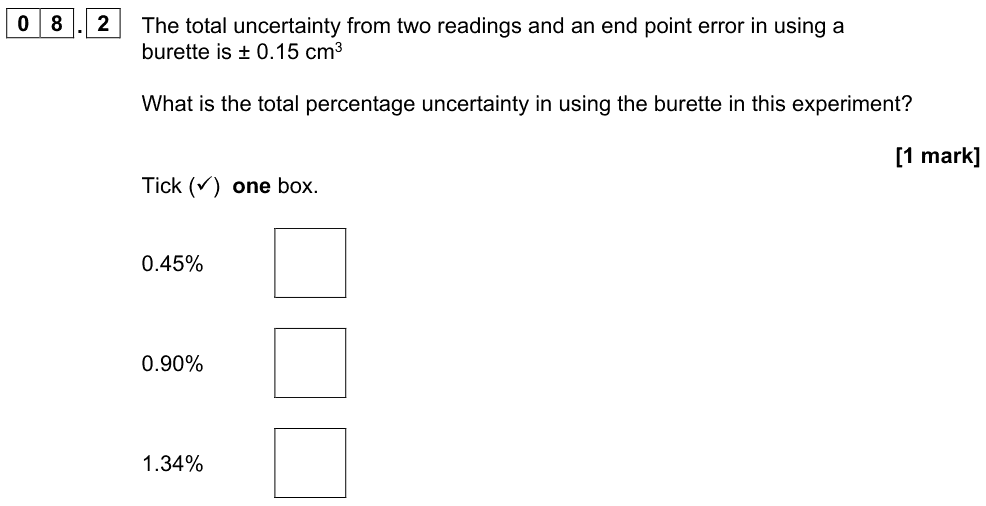
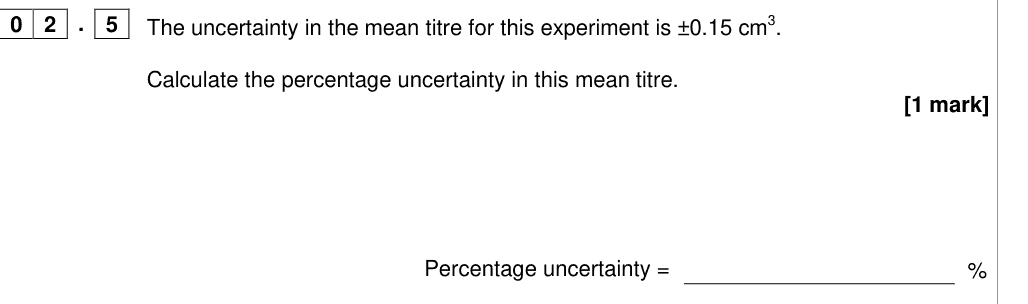
5.2 Students found this challenging and often doubled the total uncertainty value when calculating the percentage uncertainty in titration 1.
Notes from the mark scheme and report
Answer: 1.4% (1.41%). (0.15 ÷ 10.65) × 100. The ±0.15 cm3 is already the total uncertainty for the titre
many doubled it
Skills: MS1.3 Identify uncertainties in measurements and use simple techniques to determine uncertainty when data are combined; MS0.2 Use ratios, fractions and percentages; PS3.3 Consider margins of error, accuracy and precision of data; RP1 Make up a volumetric solution and carry out a simple acid–base titration
June 2025 · AS Paper 1 · Q05.32 marksAO3=2Practical and data analysis
Earlier part of question 05 that this part uses
Mark scheme
Examiner's comment
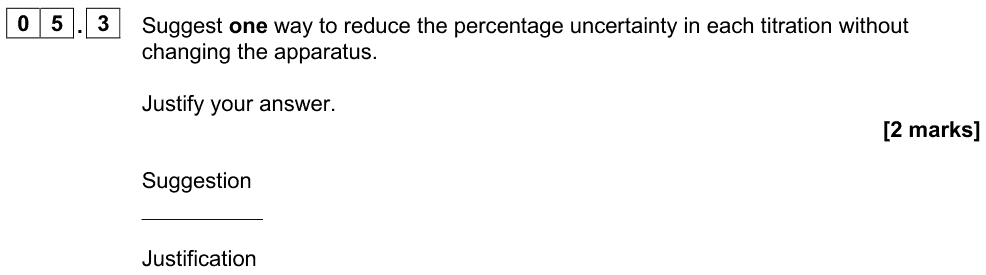
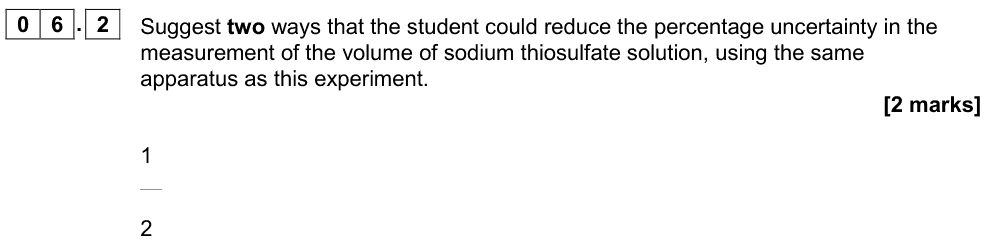
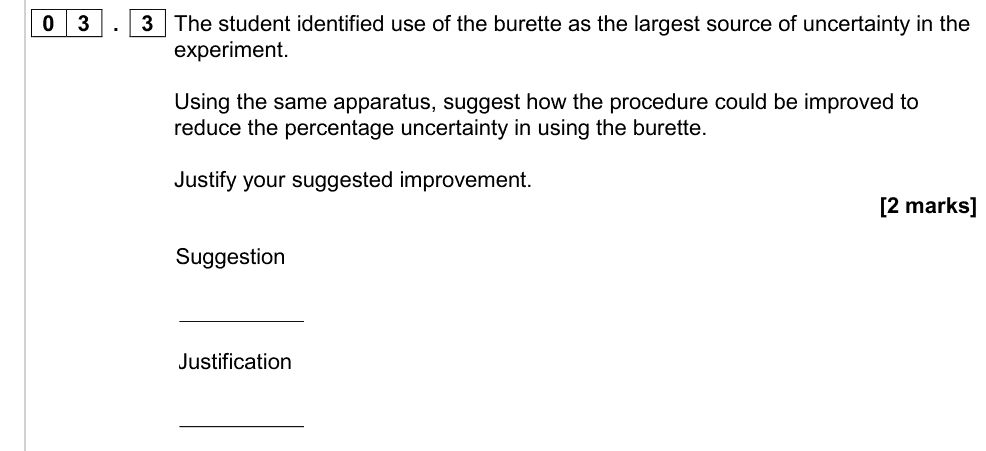
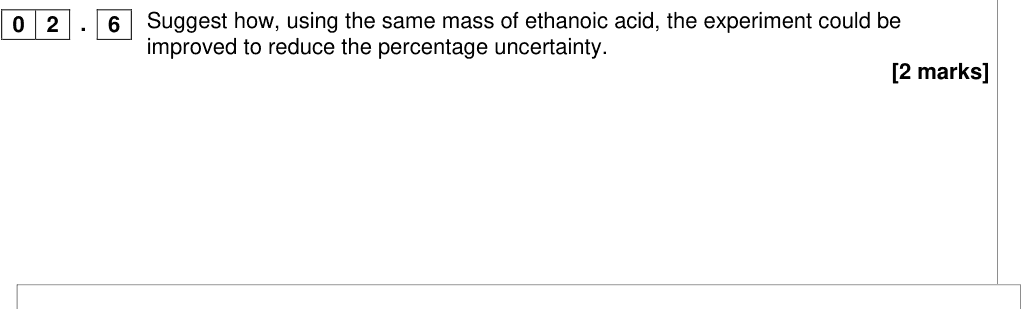
5.3 Students found this question challenging and did not always appreciate that to reduce the percentage uncertainty in a titration they would need to suggest a change that would lead to a higher titre value.
Notes from the mark scheme and report
Use more dilute NaOH, or a larger mass / higher concentration of H2A
this gives a larger titre (a larger volume of NaOH), so the same absolute uncertainty is a smaller percentage. Many did not see that a larger titre was needed
Skills: PS2.1 Comment on experimental design and evaluate scientific methods; PS3.3 Consider margins of error, accuracy and precision of data; MS1.3 Identify uncertainties in measurements and use simple techniques to determine uncertainty when data are combined; RP1 Make up a volumetric solution and carry out a simple acid–base titration
June 2025 · Paper 1 · Q05.51 markAO2=1Equation writing
Earlier part of question 05 that this part uses
Mark scheme
Examiner's comment
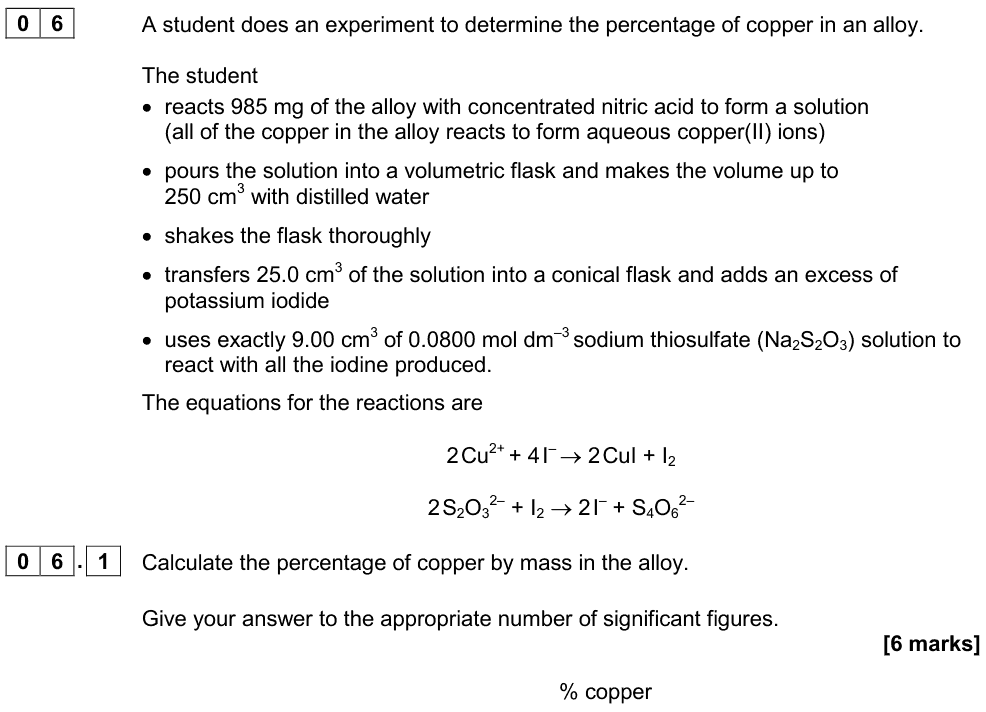
In part 5 very few students gave an equation to form copper(I) iodide.
Notes from the mark scheme and report
2Cu2+ + 4I– → 2CuI + I2. Very few gave an equation forming copper(I) iodide
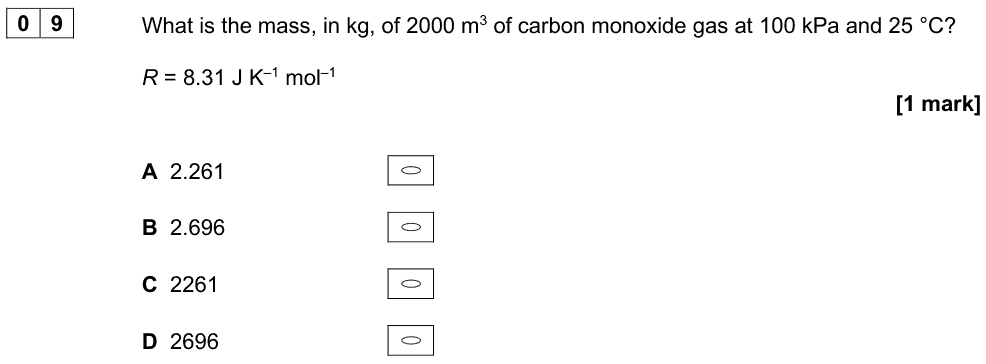
June 2025 · AS Paper 1 · Q091 markAO2=1Multiple choice
Answer
C
Mark scheme
Examiner's comment
This was answered correctly by a majority of students.
Notes from the mark scheme and report
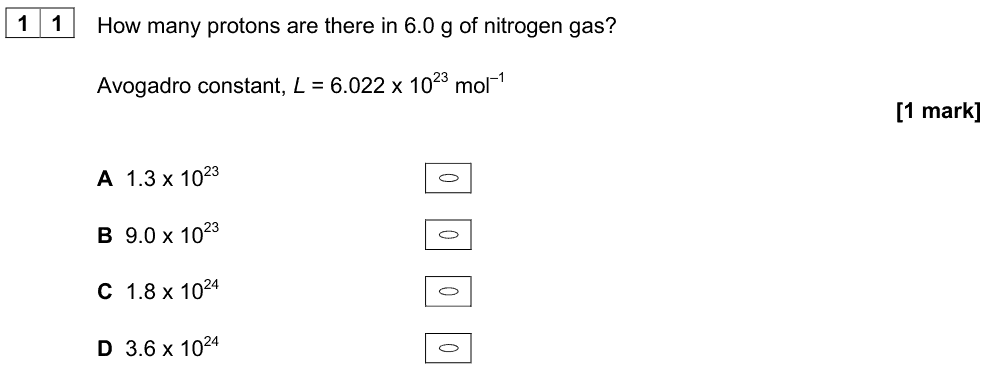
Answer: C. n = pV ÷ RT = (100 000 × 2000) ÷ (8.31 × 298) = 80 760 mol
× 28.0 g mol–1 = 2.261 × 10^6 g = 2261 kg
Skills: MS0.0 Recognise and make use of appropriate units in calculation; MS2.2 Change the subject of an equation; MS2.3 Substitute numerical values into algebraic equations using appropriate units for physical quantities
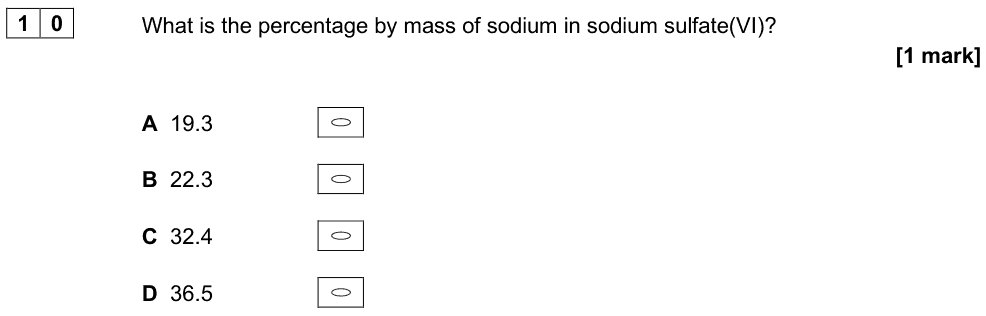
June 2025 · AS Paper 1 · Q101 markAO2=1Multiple choice
Answer
C
Mark scheme
Examiner's comment
The correct answer was the most common answer, although many students had used an incorrect formula of sodium sulphate (VI) in their calculation.
Notes from the mark scheme and report
Answer: C. Na2SO4: (2 × 23.0) ÷ 142.1 × 100 = 32.4%. Many used an incorrect formula for sodium sulfate
Skills: MS0.2 Use ratios, fractions and percentages
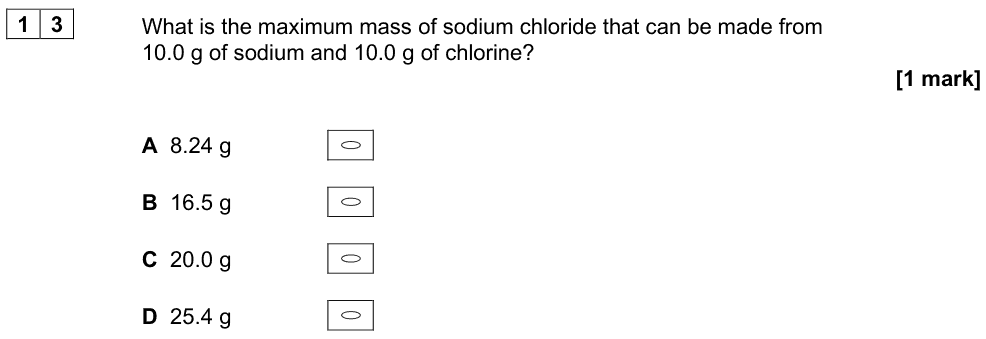
June 2025 · AS Paper 1 · Q131 markAO2=1Multiple choice
Answer
B
Mark scheme
Examiner's comment
About half of the students were able to correctly calculate the maximum mass of sodium chloride formed from 10.0g of sodium and 10.0g of chlorine.
Notes from the mark scheme and report
Answer: B. 2Na + Cl2 → 2NaCl
n(Na) = 0.435 mol, n(Cl2) = 10.0 ÷ 71.0 = 0.141 mol, so chlorine is limiting
n(NaCl) = 0.282 mol × 58.5 = 16.5 g. About half were correct
Skills: MS0.2 Use ratios, fractions and percentages
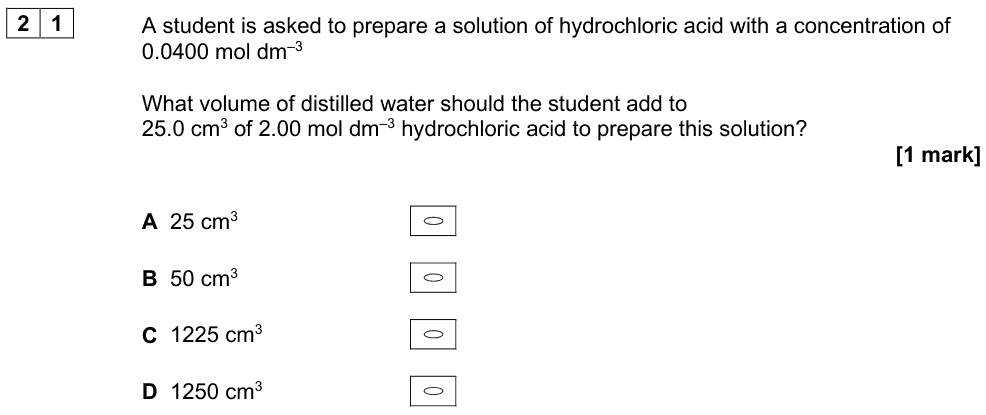
June 2025 · AS Paper 1 · Q211 markAO3=1Multiple choice
Answer
C
Mark scheme
Examiner's comment
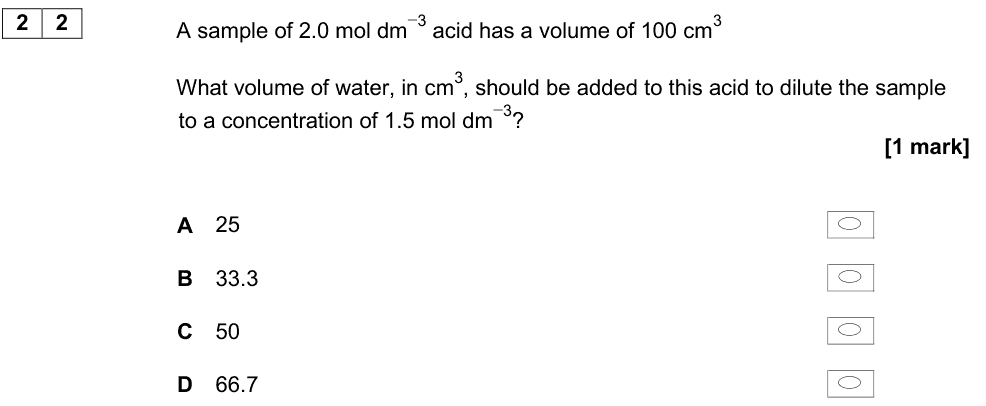
Students found this challenging and many gave the total volume of the solution rather than calculating the volume of water that needs to be added to a solution to dilute it to give a solution with concentration of 0.0400 mol dm–3
water added = 1250 – 25 = 1225 cm3. Many gave the total volume (D)
Skills: MS0.2 Use ratios, fractions and percentages; MS2.2 Change the subject of an equation; ATe Use volumetric flask, including accurate technique for making up a standard solution
June 2025 · AS Paper 1 · Q221 markAO2=1Multiple choiceHard
Answer
D
Mark scheme
Examiner's comment
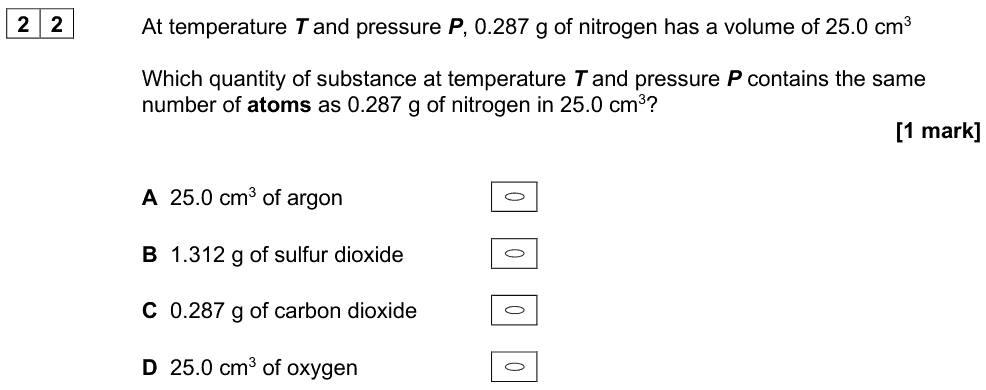
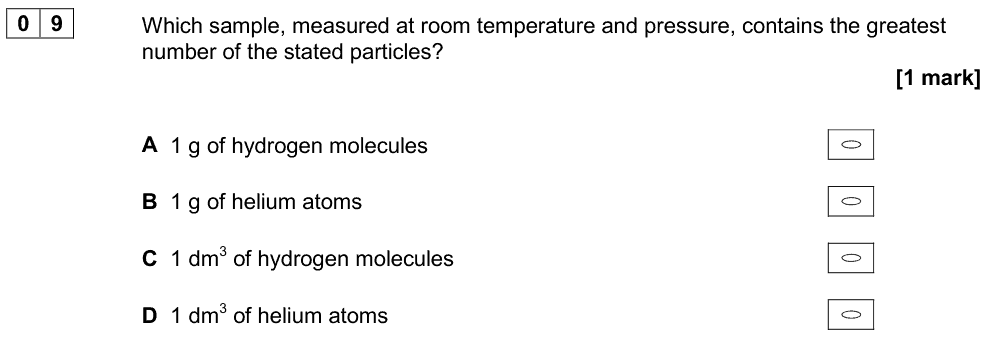
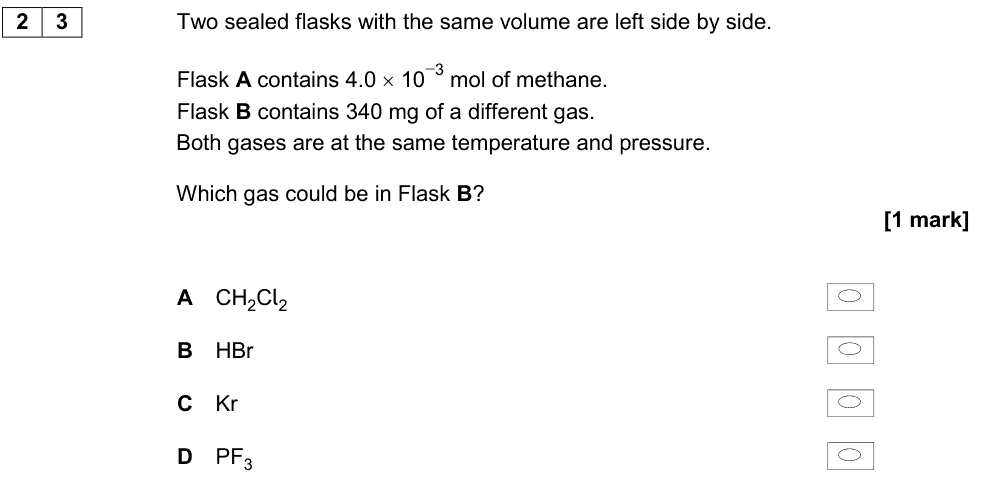
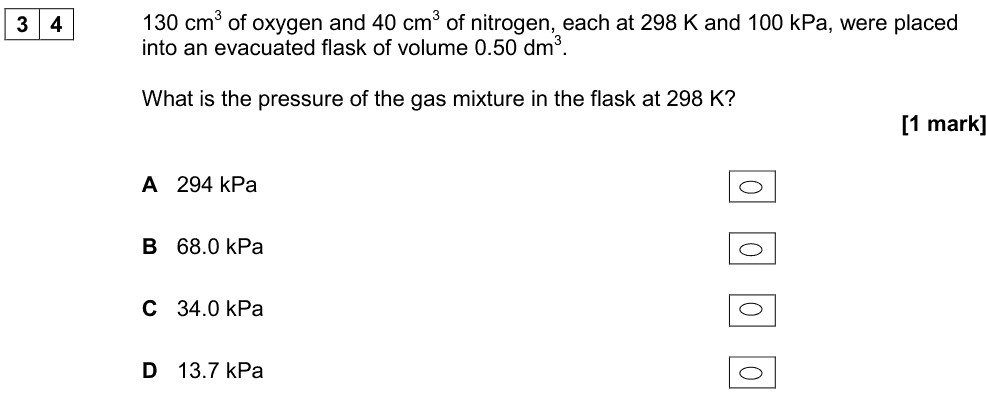
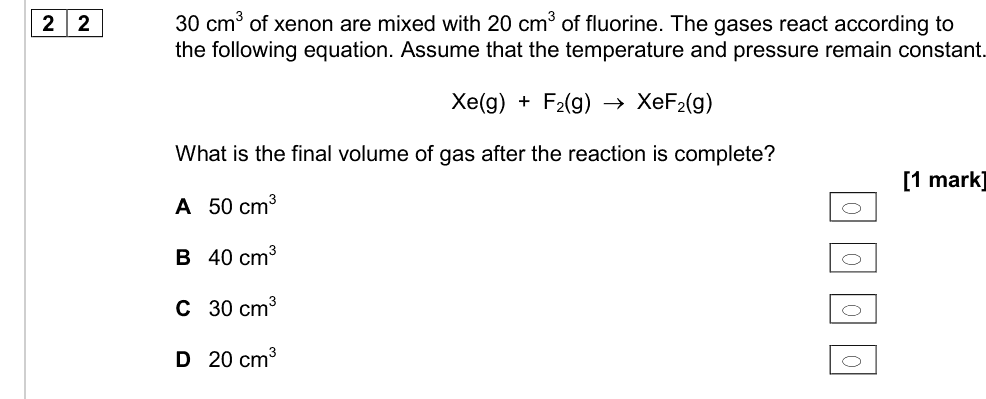
Students found this challenging with only about a quarter of students being able to identify which sample contained the same number of atoms as in 0.287 g of nitrogen at 25.0 cm3
Notes from the mark scheme and report
Answer: D. Equal volumes of gases at the same T and P contain equal numbers of molecules
O2 and N2 are both diatomic, so the same number of atoms. Argon is monatomic (half as many)
1.312 g SO2 and 0.287 g CO2 give different numbers of atoms
Skills: MS0.2 Use ratios, fractions and percentages
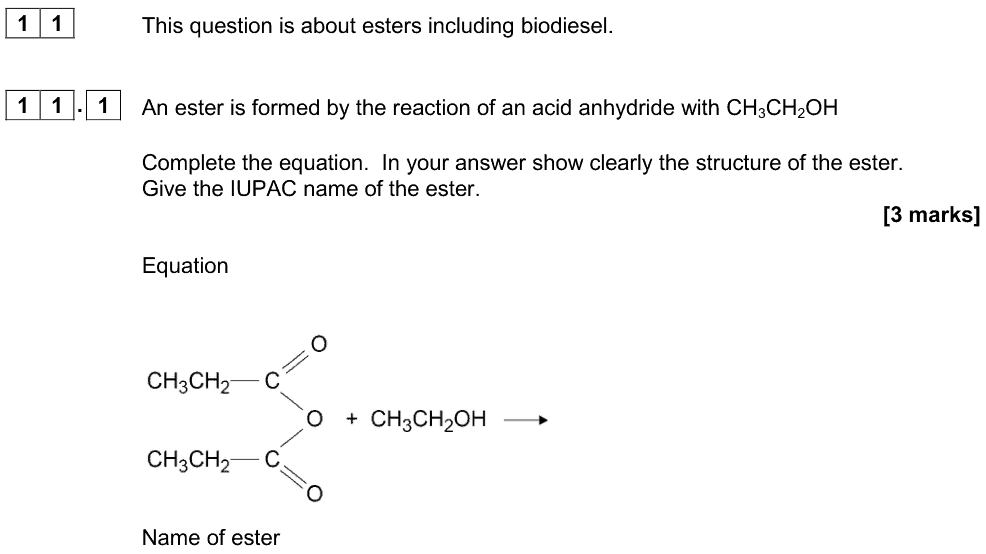
June 2025 · Paper 2 · Q03.44 marksAO1=1, AO2=3Equation writing
Earlier part of question 03 that this part uses
Mark scheme
Examiner's comment
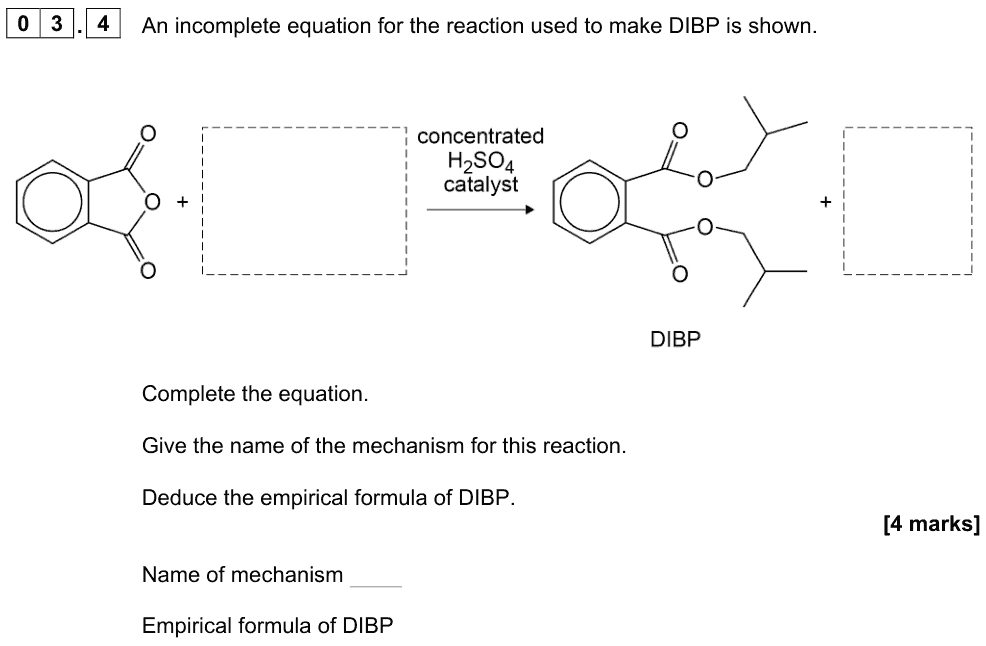
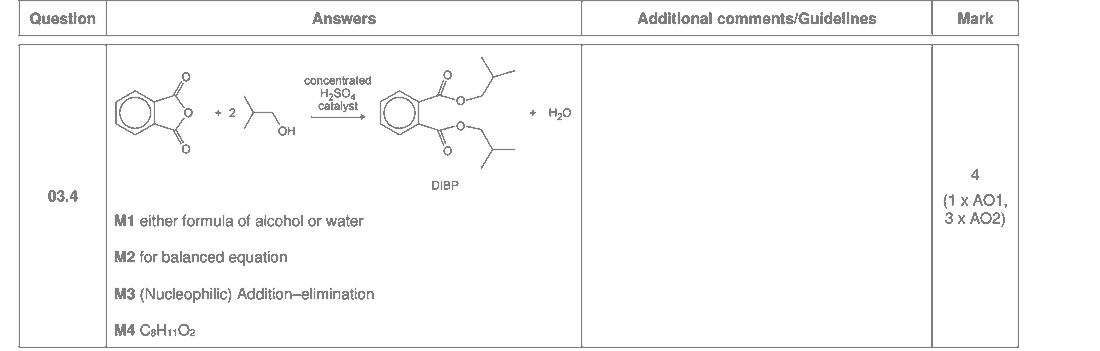
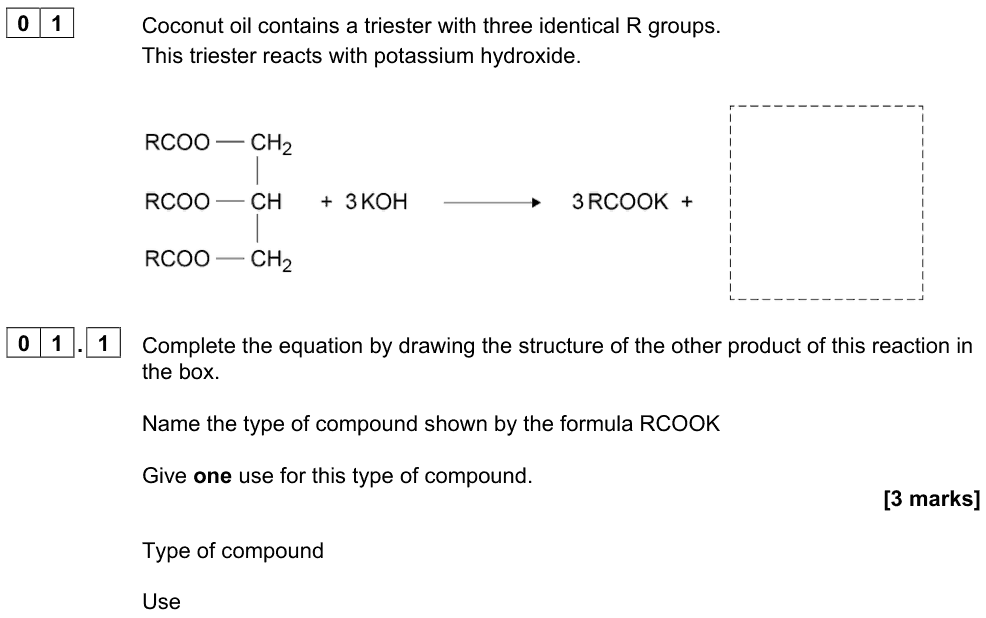
3.4 In this challenging question students were required to complete an equation by deducing the structure of an alcohol that reacts with the anhydride given to form a diester. Many students scored a mark for deducing that water was formed as the other product but far fewer could deduce the alcohol required. The name of the mechanism was well known but the empirical formula proved tricky to work out from the skeletal structure given for lots of students.
Notes from the mark scheme and report
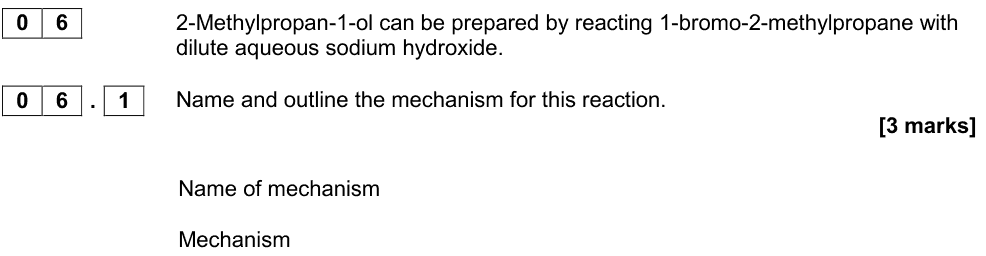
The anhydride reacts with 2 mol of 2-methylpropan-1-ol, (CH3)2CHCH2OH, giving DIBP + H2O (M1 for the alcohol or water, M2 for balancing). (Nucleophilic) addition–elimination. Empirical formula C8H11O2 (molecular formula C16H22O4). The alcohol and the empirical formula were the hard marks
June 2025 · Paper 2 · Q05.12 marksAO1=2Equation writing
Mark scheme
Examiner's comment
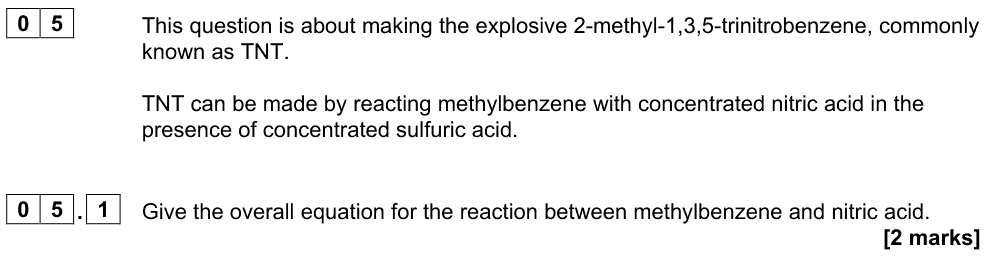
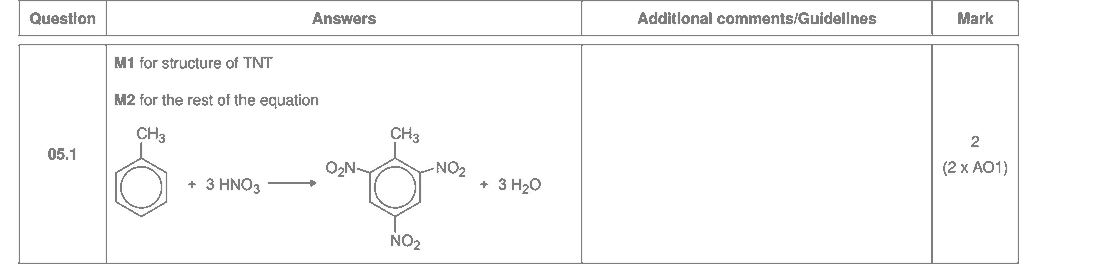
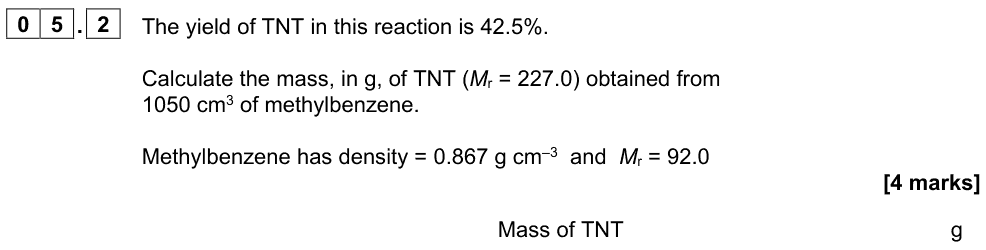
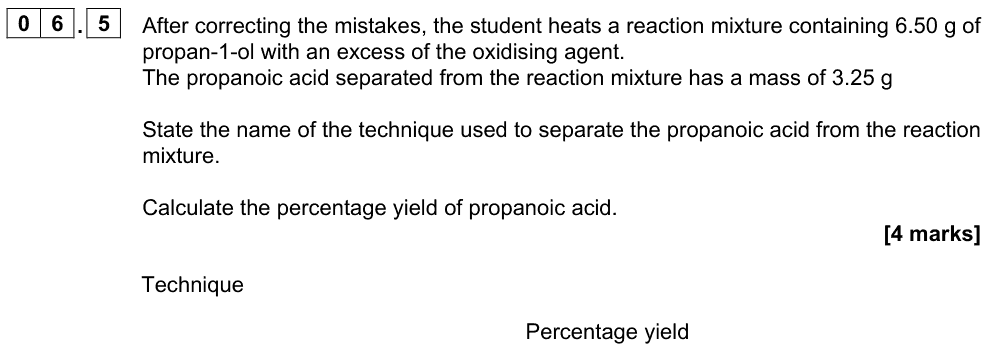
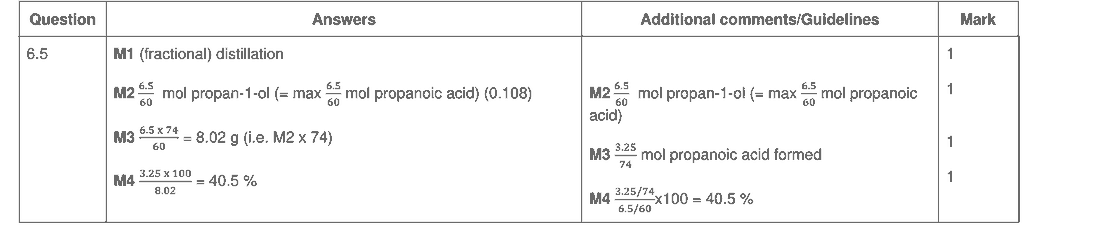
5.1 Students were quite good at showing the formula of TNT having been given its IUPAC name but far fewer could balance the equation with 3HNO3 on the reactants side and 3H2O on the products side.
Notes from the mark scheme and report
C6H5CH3 + 3HNO3 → C6H2(CH3)(NO2)3 + 3H2O, with the structure of TNT (methyl at position 2, nitro groups at 1, 3 and 5) for M1. Many did not balance with 3HNO3 and 3H2O
June 2025 · AS Paper 2 · Q05.25 marksAO1=1, AO3=4Calculation
Earlier part of question 05 that this part uses
Mark scheme
Examiner's comment
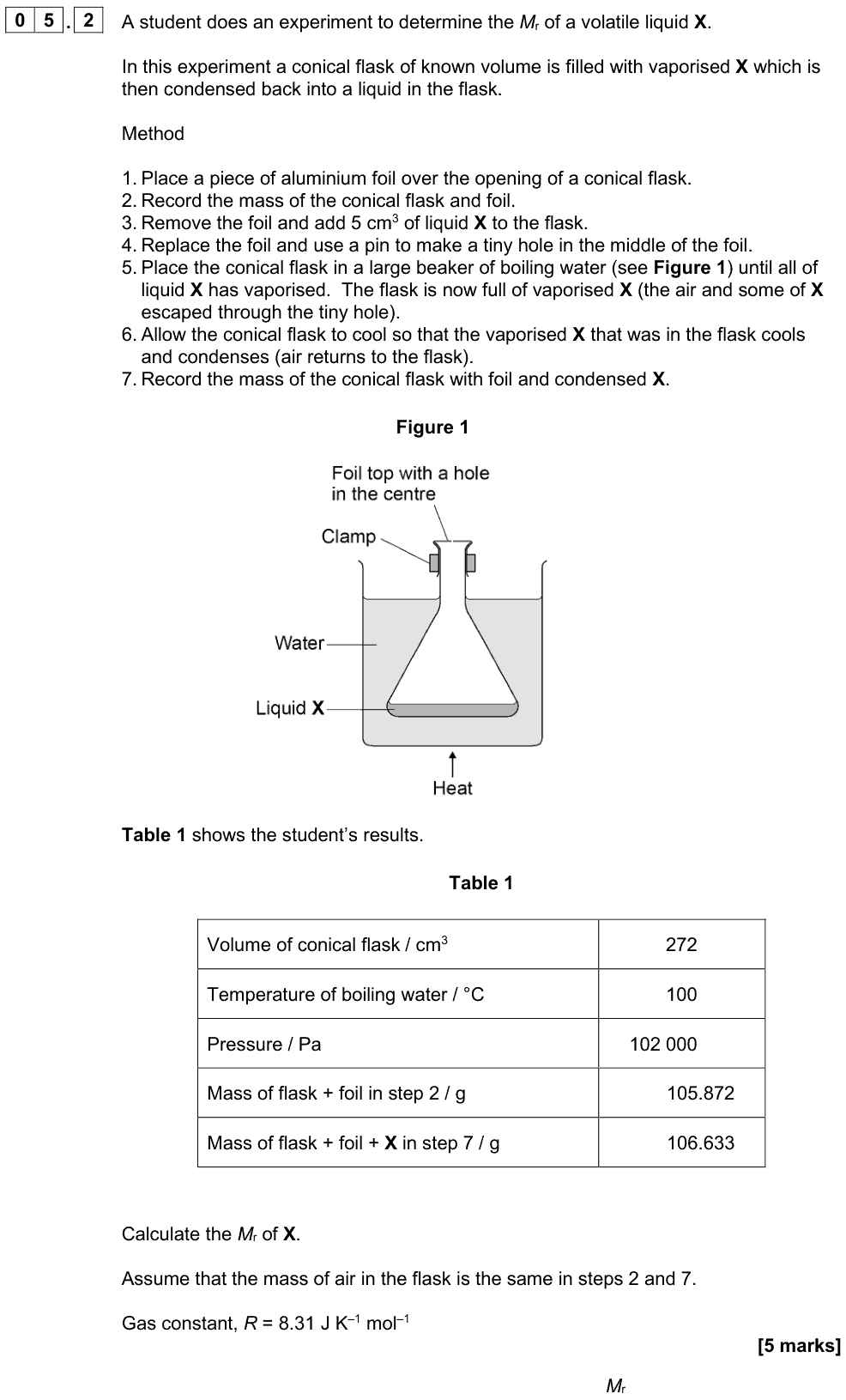
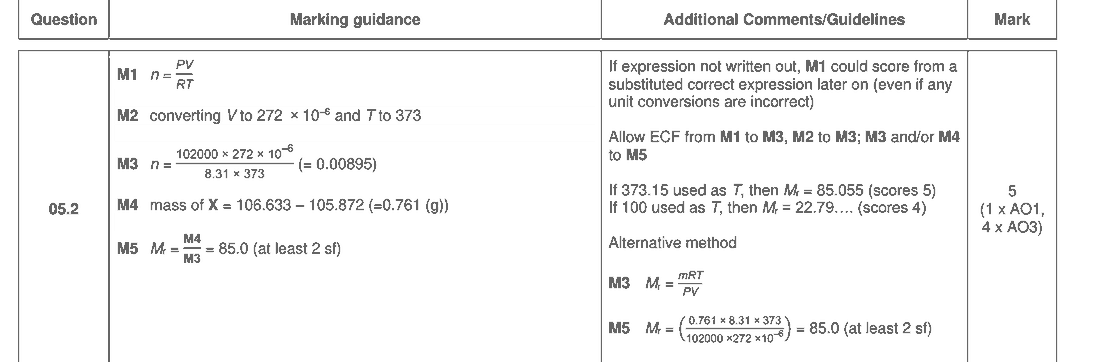
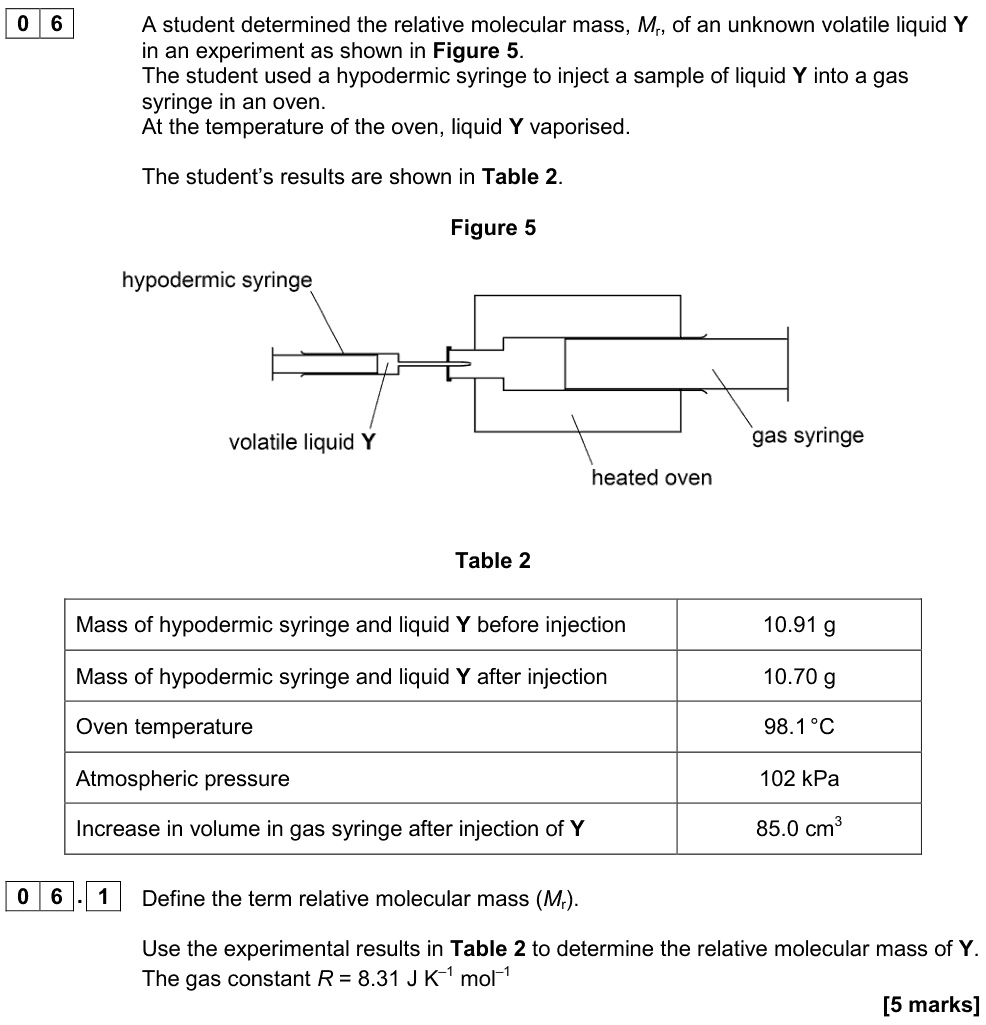
5.2 This question contained an experimental method that was unfamiliar to students. However, many managed to work out the correct answer. Common errors stemmed from conversion of volume / pressure / temperature into SI units.
Mr = 0.761 ÷ 0.00895. Using 100 for T gives 22.8 (4 marks). Common errors: unit conversions for volume and temperature
Skills: MS0.0 Recognise and make use of appropriate units in calculation; MS2.2 Change the subject of an equation; MS2.3 Substitute numerical values into algebraic equations using appropriate units for physical quantities; PS3.2 Process and analyse data using appropriate mathematical skills as exemplified in the mathematical appendix for each science; ATa Use appropriate apparatus to record a range of measurements (to include mass, time, volume of liquids and gases, temperature)
June 2025 · Paper 2 · Q05.24 marksAO2=4Calculation
Earlier part of question 05 that this part uses
Mark scheme
Examiner's comment
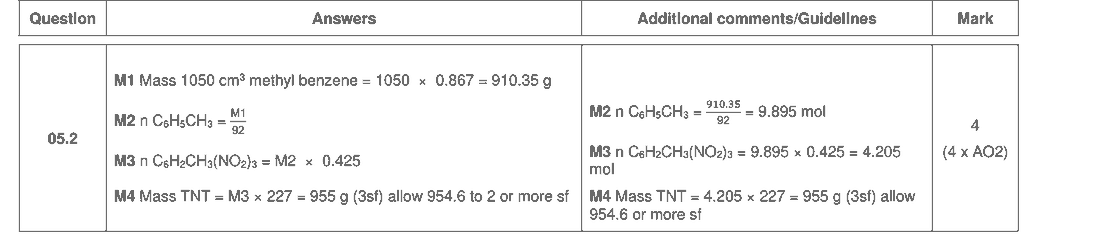
5.2 This question asked for a calculation of the mass of TNT produced from a given volume of methylbenzene along with density and yield information. Many students were able to tackle this problem effectively scoring high marks. Those who failed to score well often presented workings that lacked ‘narrative’ and structure.
Notes from the mark scheme and report
Answer: 955 g. Mass of methylbenzene = 1050 × 0.867 = 910.35 g
÷ 92.0 = 9.895 mol
× 0.425 = 4.205 mol
× 227.0. Set the working out with a clear narrative
Skills: MS0.2 Use ratios, fractions and percentages; MS2.3 Substitute numerical values into algebraic equations using appropriate units for physical quantities
June 2025 · AS Paper 2 · Q06.32 marksAO2=2Calculation
Earlier part of question 06 that this part uses
Mark scheme
Examiner's comment
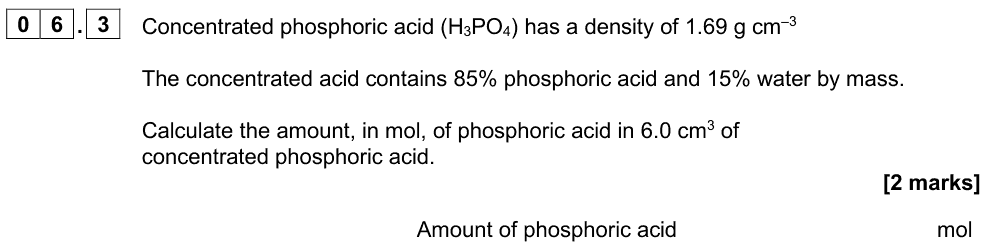
6.3 This was an unusual calculation to find the amount of phosphoric acid in a volume of 85% acid. Many students managed this well but a common error was to forget to take into account the fact it was 85% rather than 100% acid.
Notes from the mark scheme and report
Answer: 0.0879 mol. Mass of concentrated acid = 6.0 × 1.69 = 10.14 g
× 0.85 = 8.62 g of H3PO4
÷ 98.0. Not using 85% gives 0.103 (1 mark)
Skills: MS0.0 Recognise and make use of appropriate units in calculation; MS0.2 Use ratios, fractions and percentages
June 2025 · AS Paper 2 · Q06.91 markAO2=1Equation writing
Earlier part of question 06 that this part uses
Mark scheme
Examiner's comment
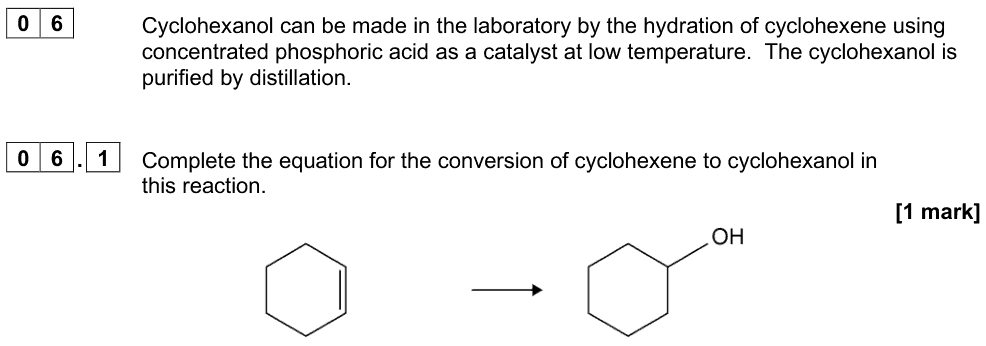
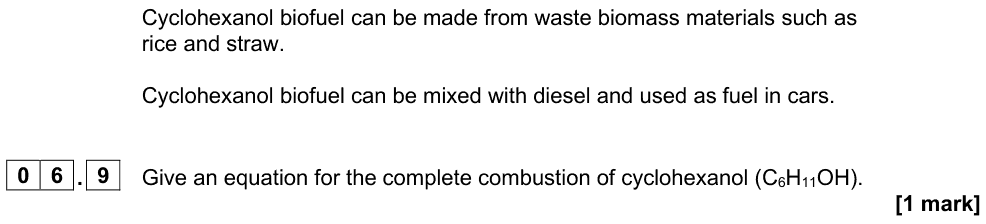
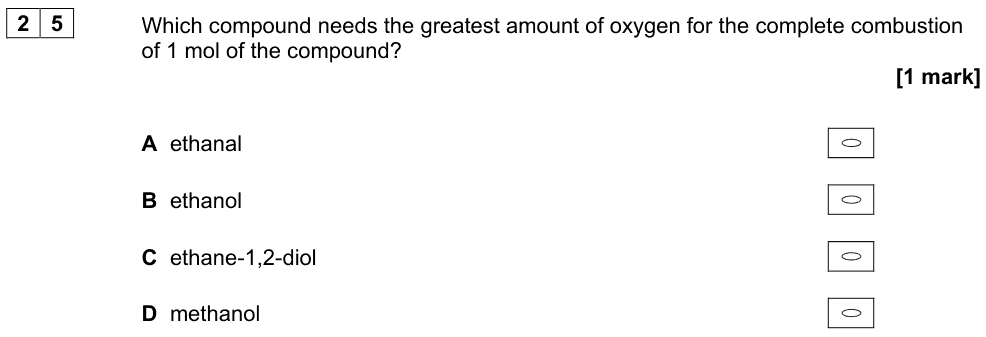
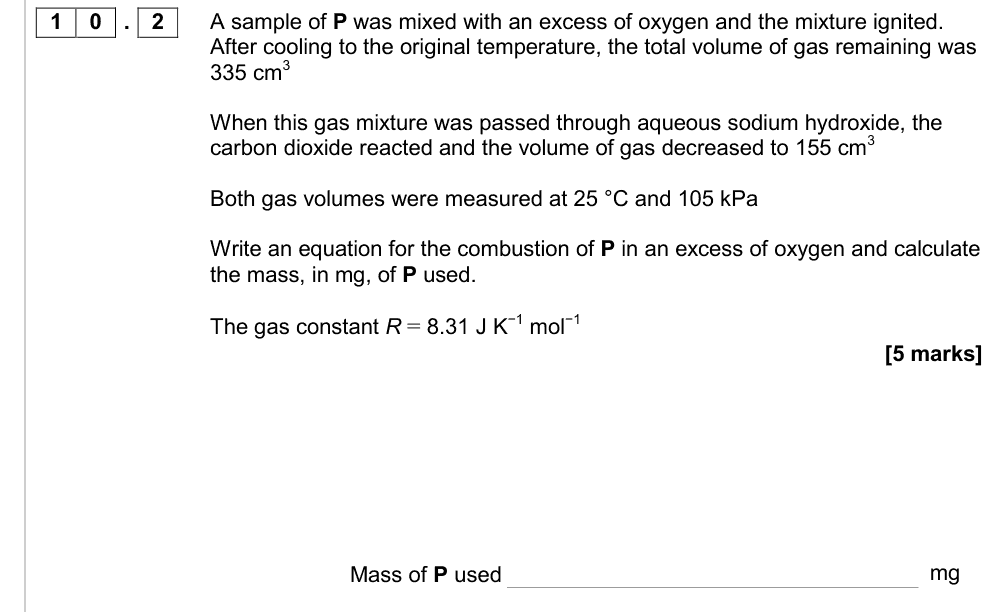
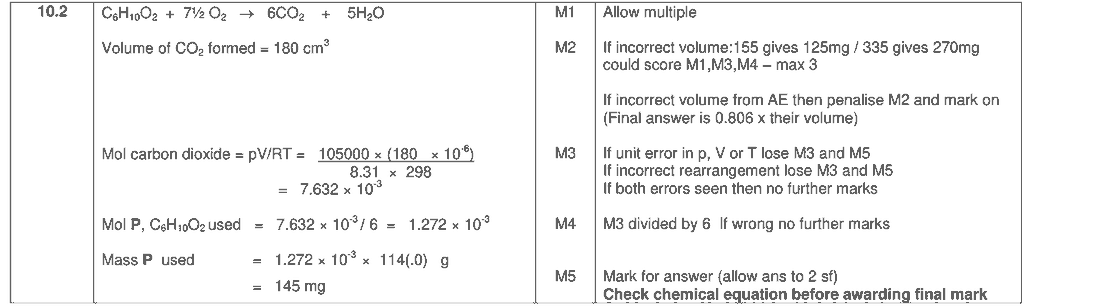
6.9 Many students could write an equation for the complete combustion of cyclohexanol.
Notes from the mark scheme and report
C6H11OH + 8½O2 → 6CO2 + 6H2O (multiples allowed)
June 2025 · Paper 2 · Q08.15 marksAO2=5Calculation
Mark scheme
Examiner's comment
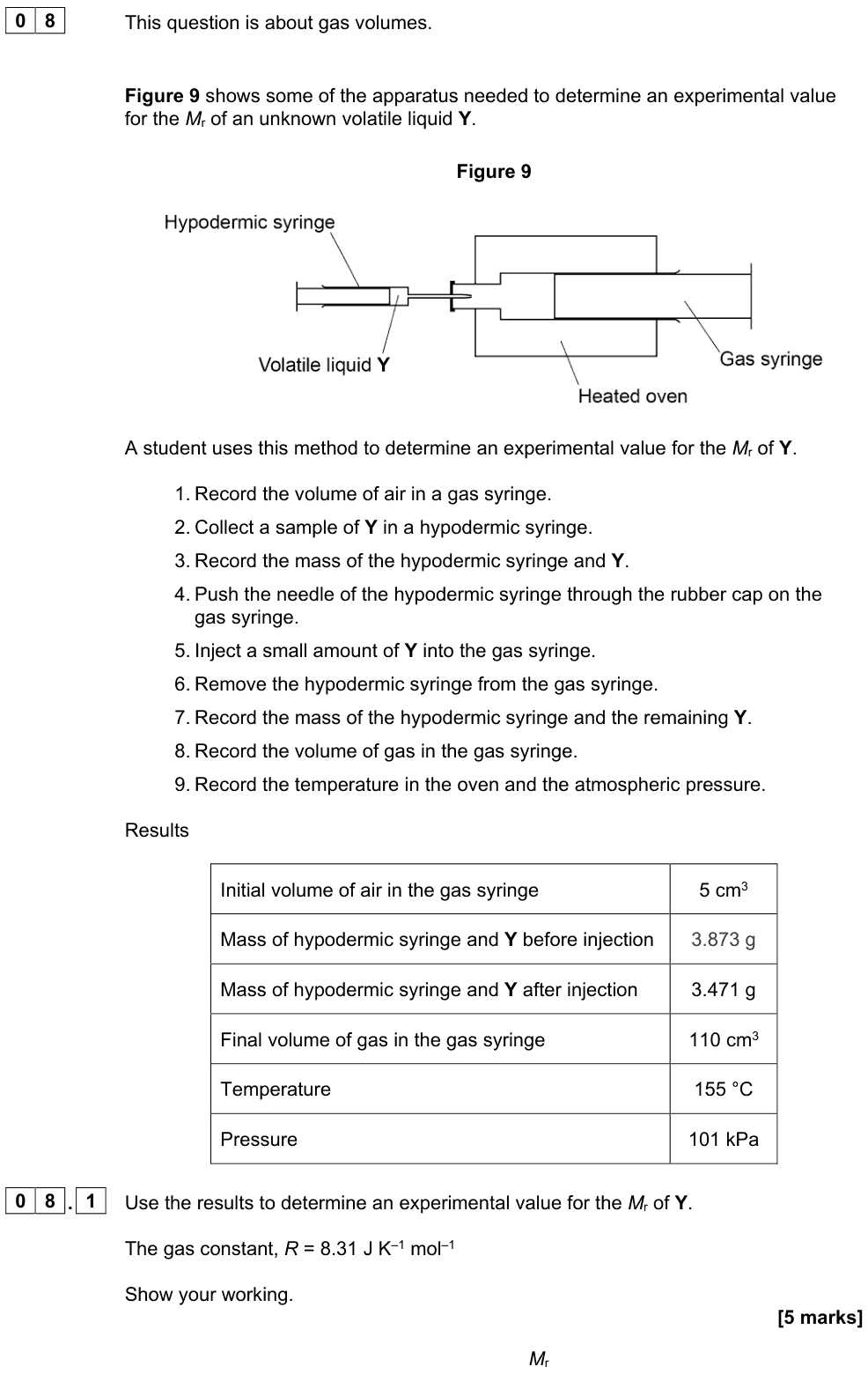
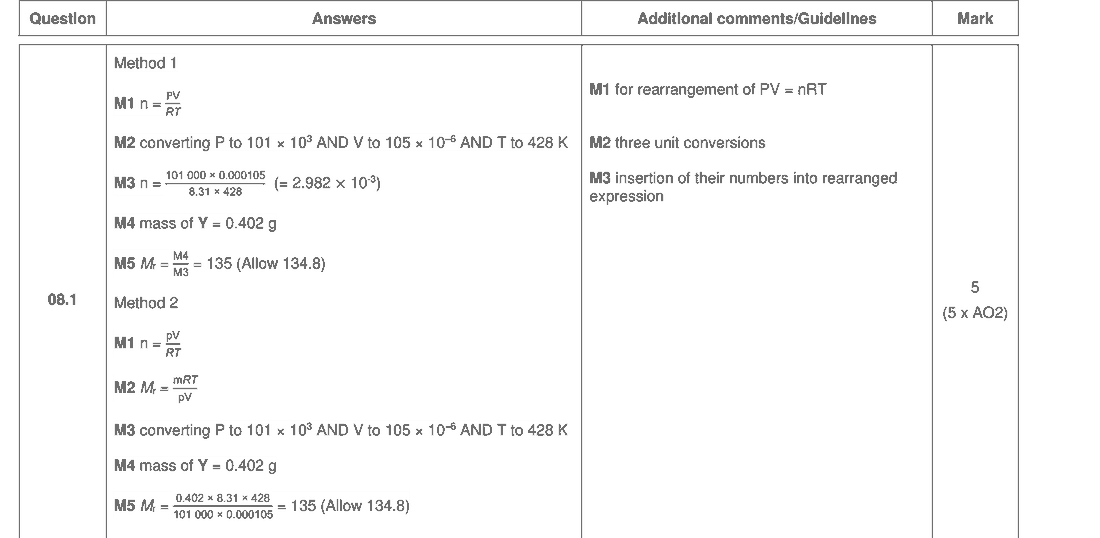
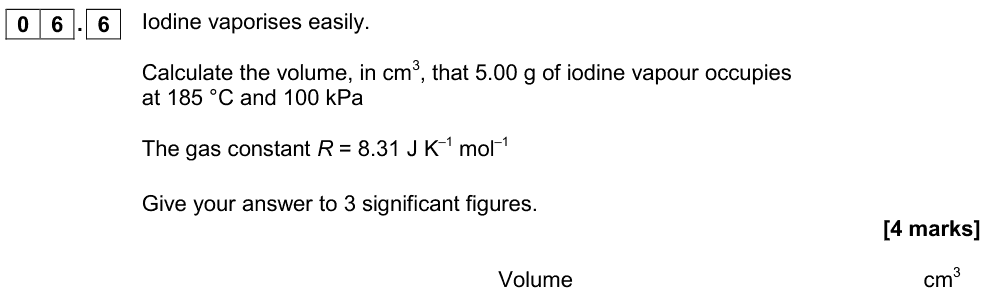
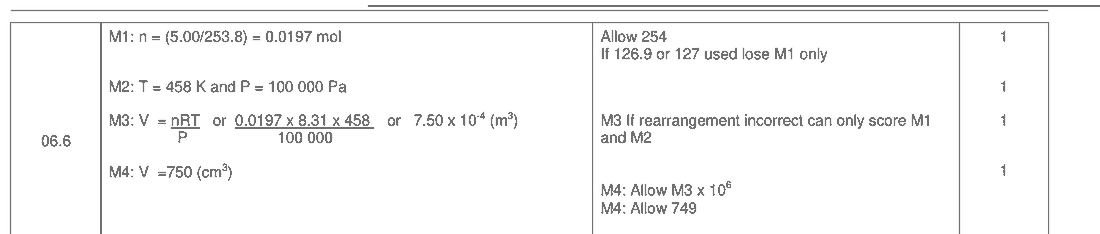
8.1 This routine ideal gas equation calculation was well done by many students.
Skills: MS0.0 Recognise and make use of appropriate units in calculation; MS2.2 Change the subject of an equation; MS2.3 Substitute numerical values into algebraic equations using appropriate units for physical quantities; ATa Use appropriate apparatus to record a range of measurements (to include mass, time, volume of liquids and gases, temperature); PS3.2 Process and analyse data using appropriate mathematical skills as exemplified in the mathematical appendix for each science
June 2025 · Paper 2 · Q08.23 marksAO3=3Practical and data analysis
Earlier part of question 08 that this part uses
Mark scheme
Examiner's comment
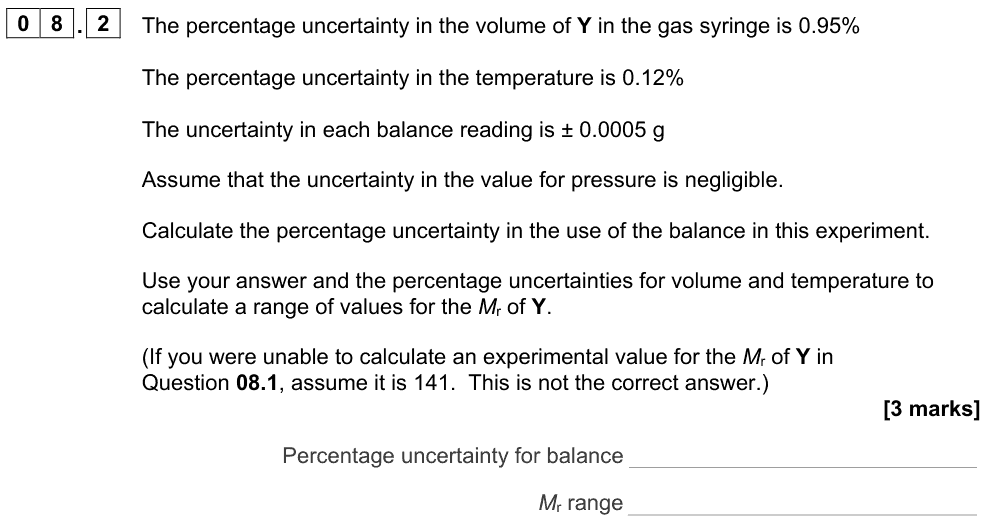
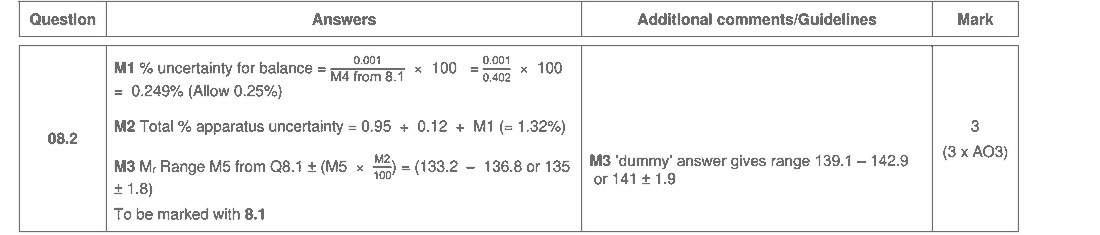
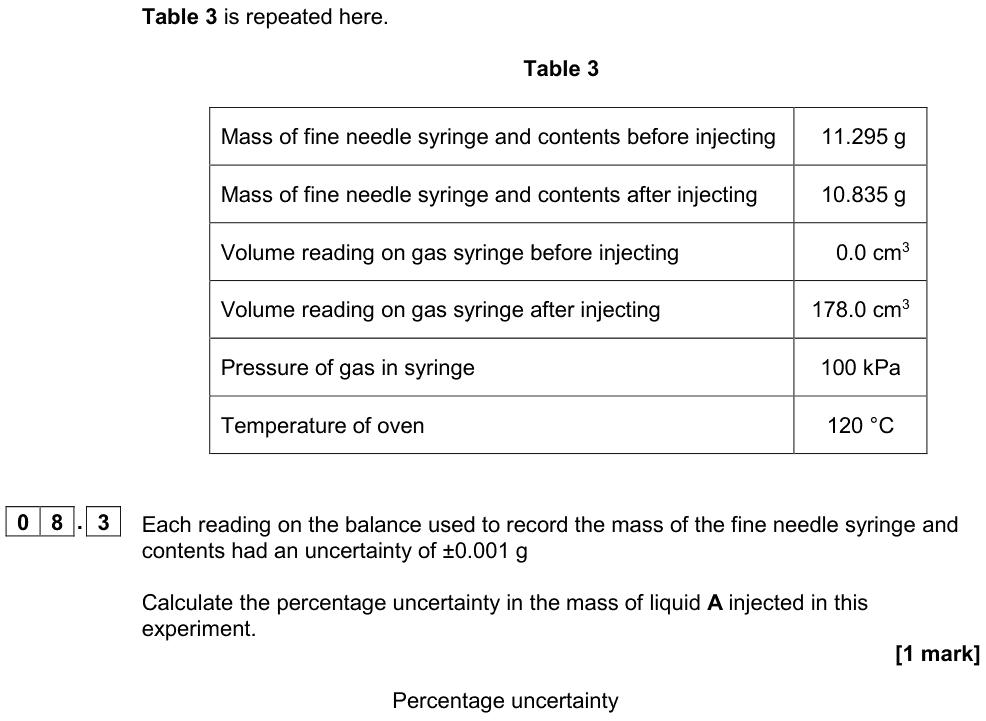
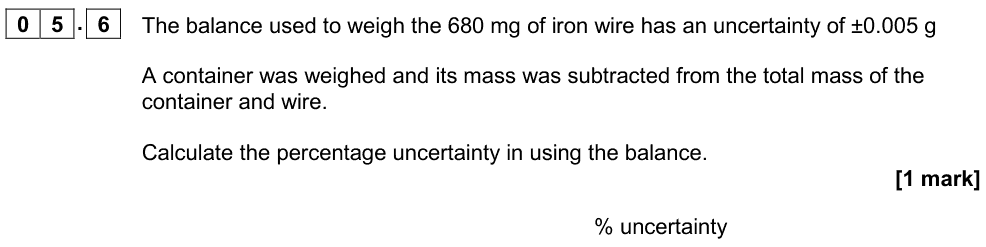
8.2 Students were required to calculate the percentage uncertainty in the use of the balance. Many did not appreciate that the balance was used twice to determine the
Notes from the mark scheme and report
Balance: two readings, so (2 × 0.0005) ÷ 0.402 × 100 = 0.249%. Total = 0.95 + 0.12 + 0.249 = 1.32%. Range: 135 ± 1.8, ie 133.2 to 136.8 (139.1 to 142.9 from 141). Many forgot that the balance is used twice
Skills: MS1.3 Identify uncertainties in measurements and use simple techniques to determine uncertainty when data are combined; MS0.2 Use ratios, fractions and percentages; PS2.3 Evaluate results and draw conclusions with reference to measurement uncertainties and errors; PS3.3 Consider margins of error, accuracy and precision of data
June 2025 · Paper 2 · Q08.31 markAO3=1Practical and data analysis
Earlier part of question 08 that this part uses
Mark scheme
Examiner's comment
8.3 This question was well answered and students were often able to give prevention of loss of volatile liquid as a the reason a cap on the hypodermic syringe will improve the experiment.
Notes from the mark scheme and report
The seal prevents evaporation / loss of the volatile liquid Y, so the recorded mass is more accurate (or covers the sharp needle, making it safer)
Skills: PS2.1 Comment on experimental design and evaluate scientific methods; ATk Safely and carefully handle solids and liquids, including corrosive, irritant, flammable and toxic substances
June 2025 · Paper 2 · Q08.44 marksAO2=4Calculation
Earlier part of question 08 that this part uses
Mark scheme
Examiner's comment
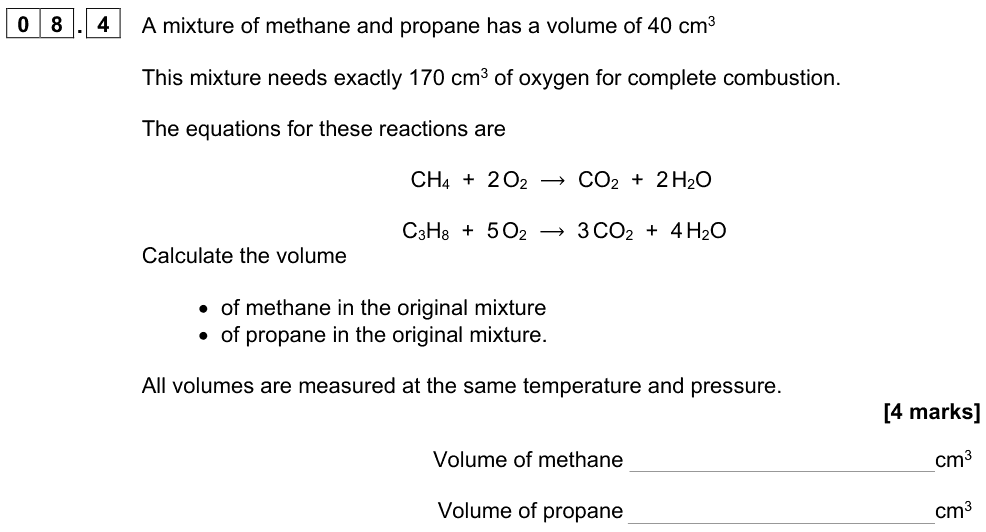
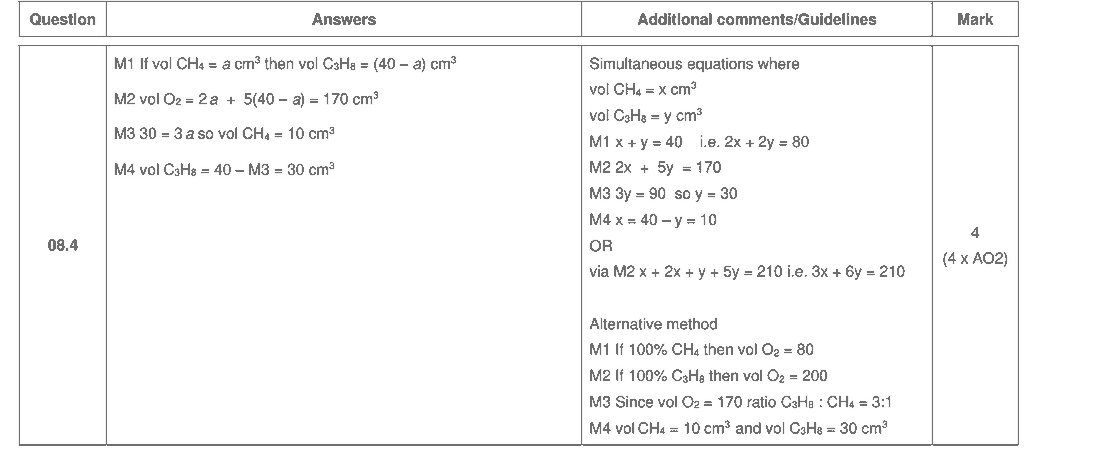
8.4 This proved to be a challenging question that few students were able to see a way into. The best students set up simultaneous equations to determine the volume of each hydrocarbon in the mixture. Those who got started here usually went on to score all the marks. Other approaches were possible but rarely seen. For those who made an incorrect attempt the final mark for two volumes that added up to 40 cm3 was often the only mark scored.
Notes from the mark scheme and report
Answer: methane 10 cm3, propane 30 cm3. Let methane = a: 2a + 5(40 – a) = 170, so 3a = 30. Few found a way in
simultaneous equations worked best
Skills: MS0.2 Use ratios, fractions and percentages; MS2.4 Solve algebraic equations
June 2025 · AS Paper 2 · Q201 markAO3=1Multiple choice
Answer
C
Mark scheme
Examiner's comment
Students found this hard although the correct answer was the most common response. Students struggled to appreciate the impact of limiting reagents on the volume of gas formed.
Notes from the mark scheme and report
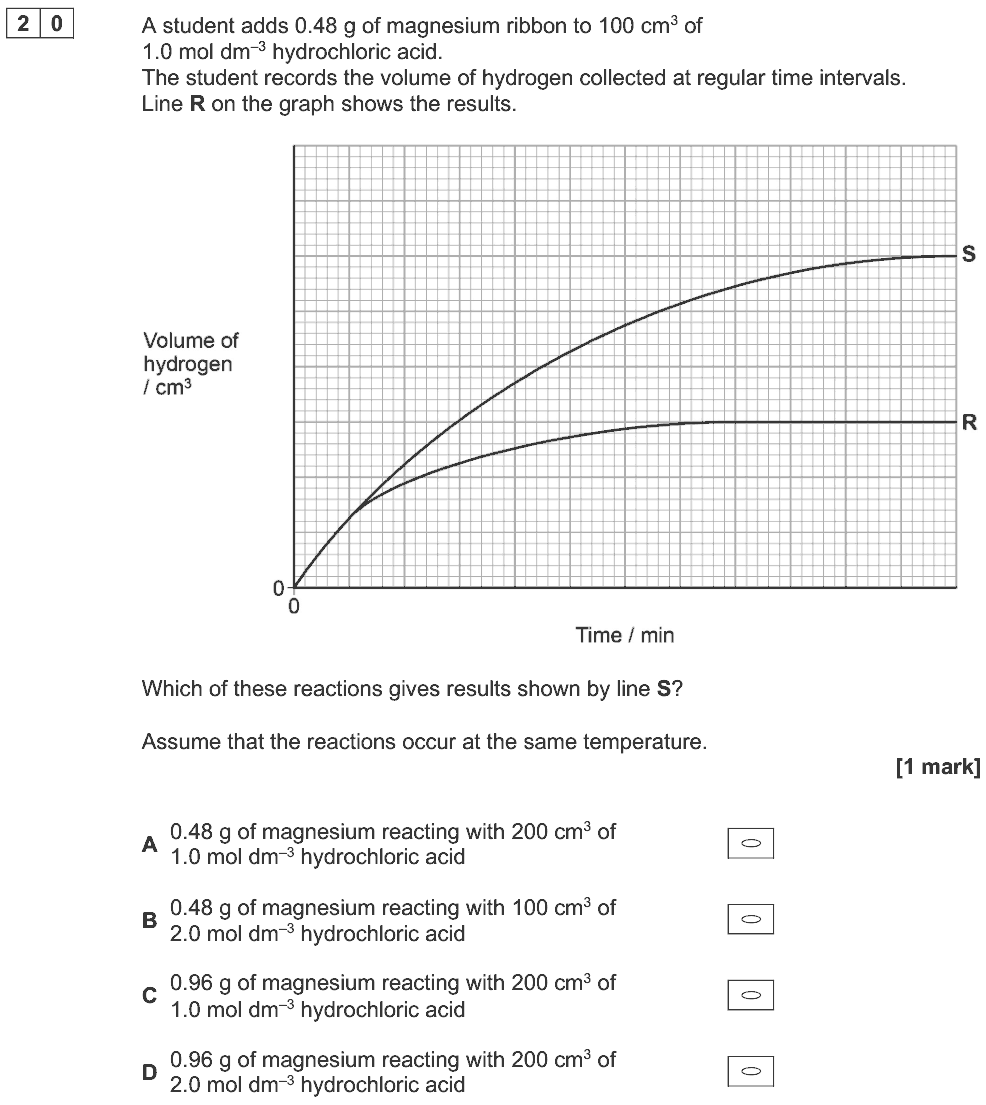
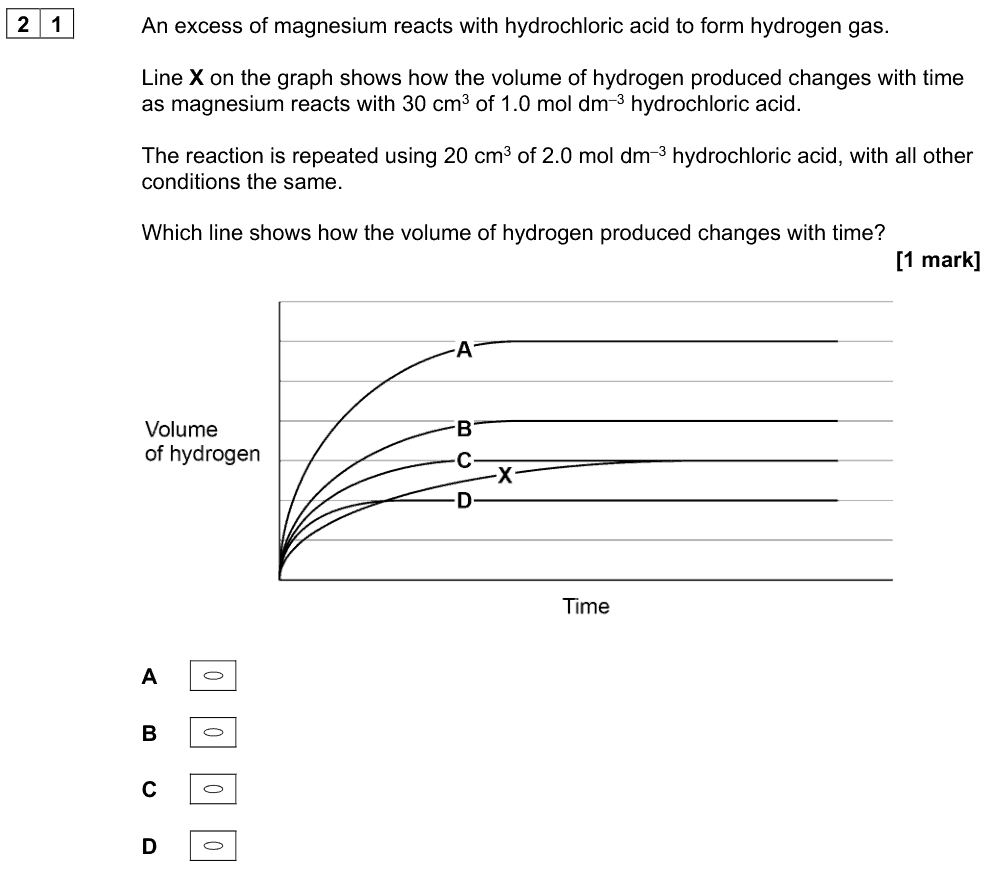
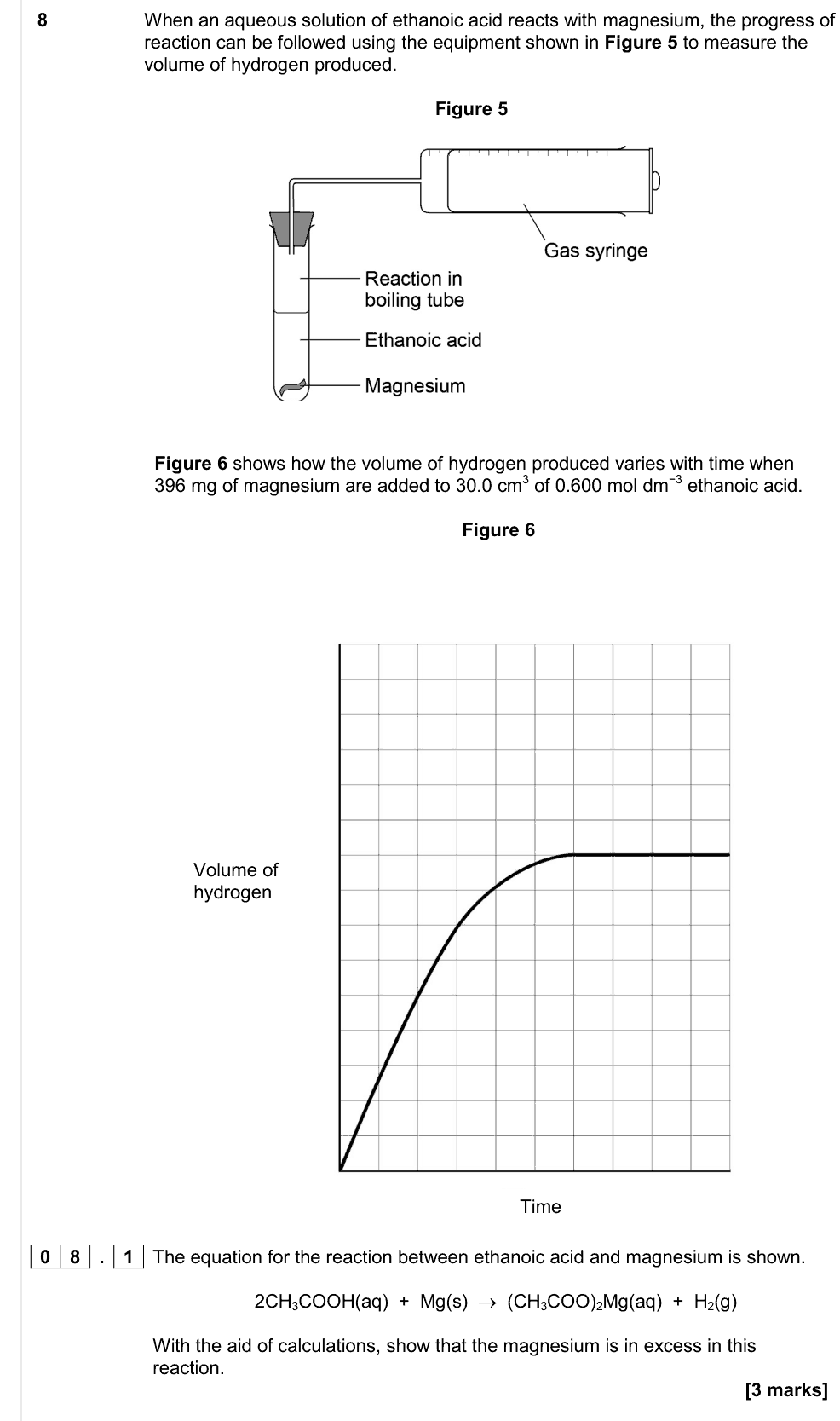
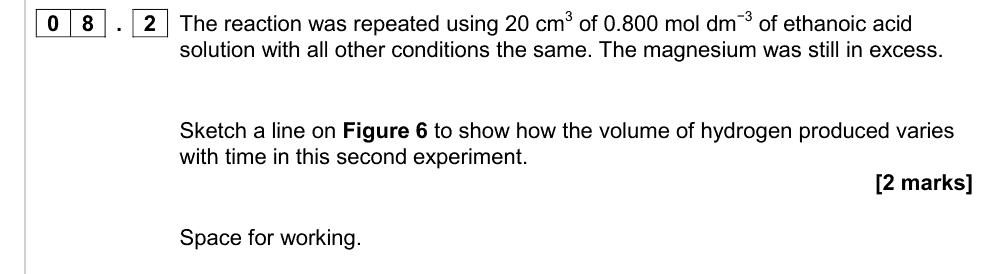
Answer: C. S has the same initial rate as R (same acid concentration) but twice the final volume: twice the mass of magnesium (the limiting reagent) with the acid still in excess (0.040 mol Mg needs 0.080 mol HCl
0.20 mol present). Students struggled with limiting reagents
Skills: MS3.1 Translate information between graphical, numerical and algebraic forms; MS0.2 Use ratios, fractions and percentages
June 2025 · Paper 3 · Q01.25 marksAO2=4, AO3=1Calculation
Earlier part of question 01 that this part uses
Mark scheme
Examiner's comment
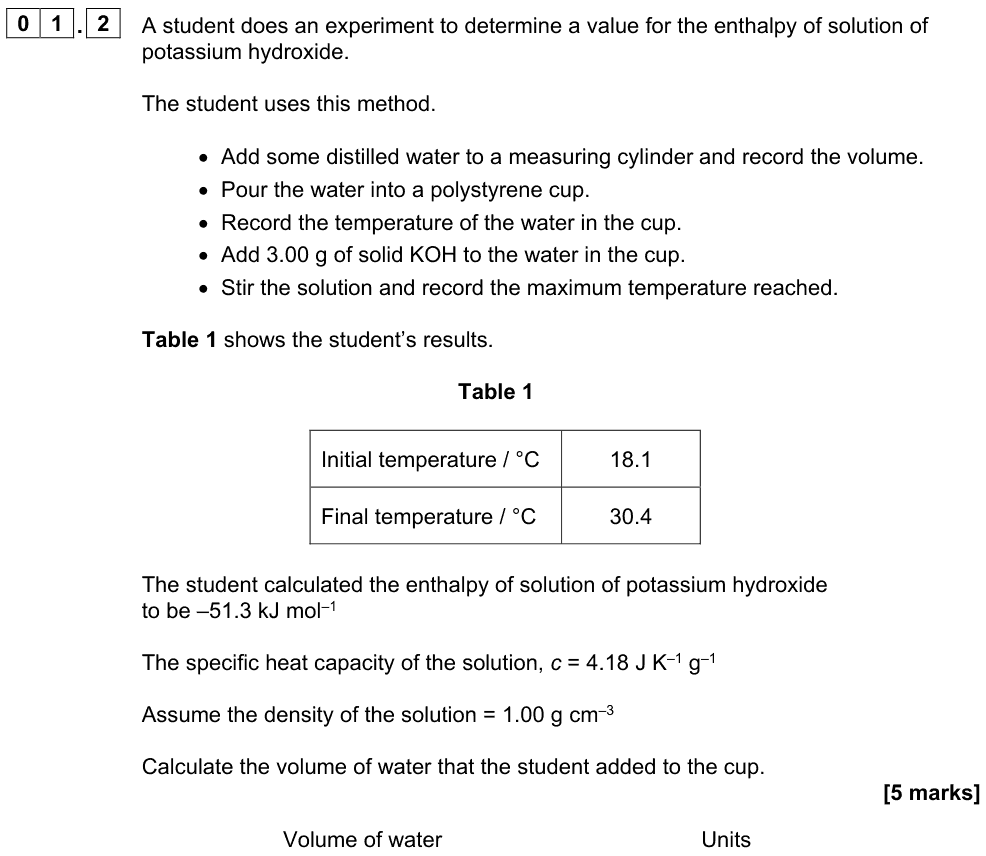
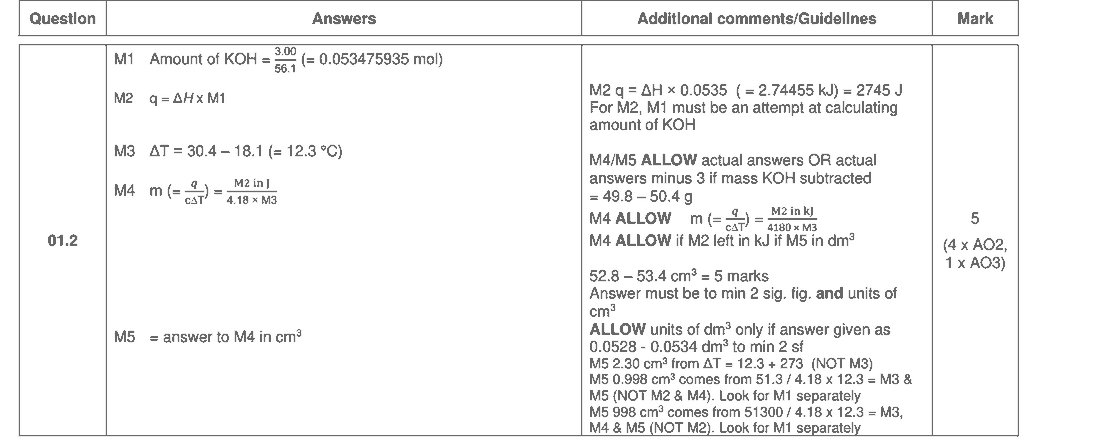
1.2 This calculation discriminated very well with more than 50% achieving full marks and less than 5% failing to score. Typical mistakes included omitting to use the amount of KOH and the enthalpy of solution to calculate q, with many students assuming that the enthalpy of solution was equal to q. A second mistake was seen in the work of those students who calculated the temperature change and then converted 12.3 into Kelvin by adding 273. Because this is a temperature change it can be calculated as either the difference between 30.4 and 18.1 or the difference between 303.4 and 291.1 – in both cases an answer of 12.3 is obtained. As in any question, ECF was possible from incorrect calculations of amount of KOH, of q and of ∆T – but, as mentioned above, this is only possible when the working is clear.
Notes from the mark scheme and report
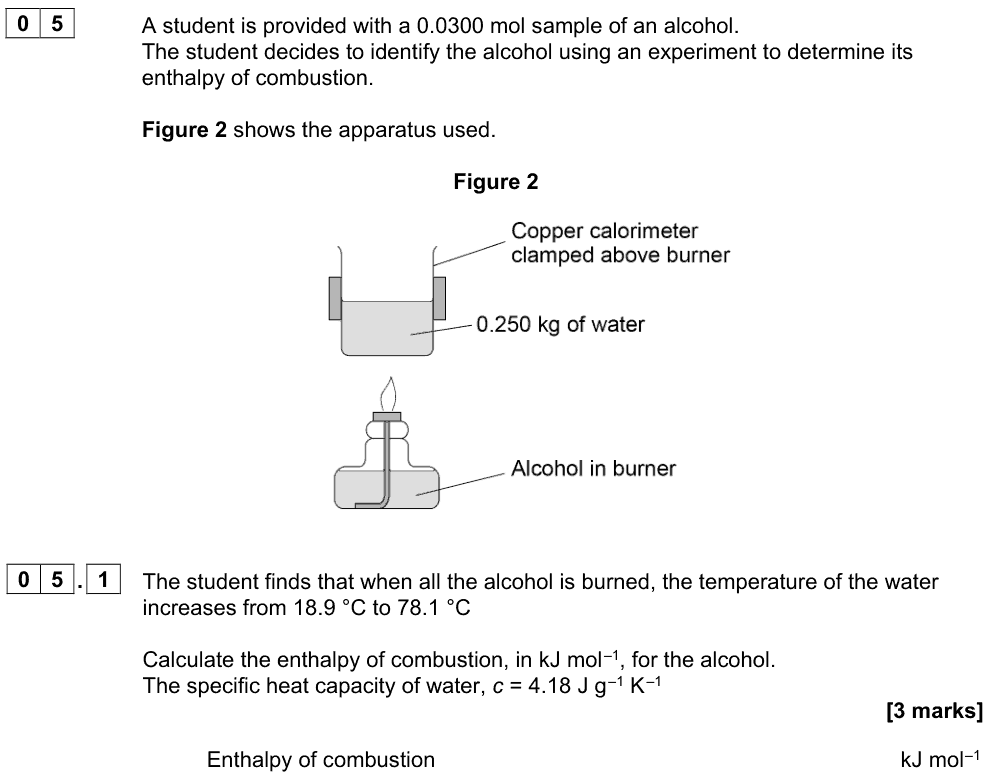
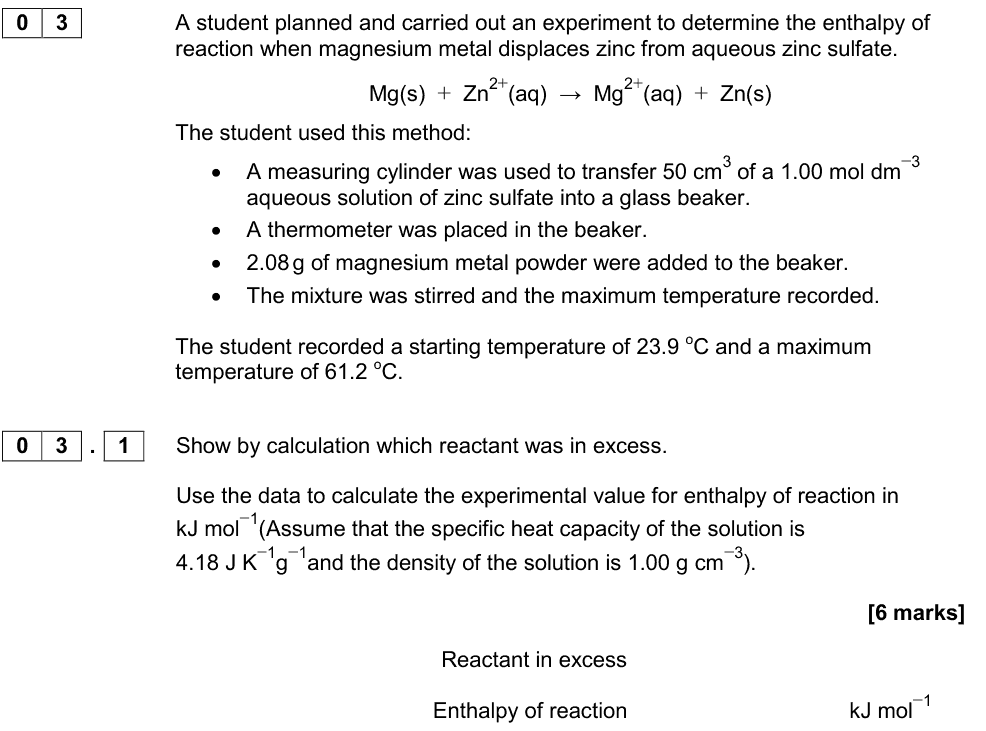
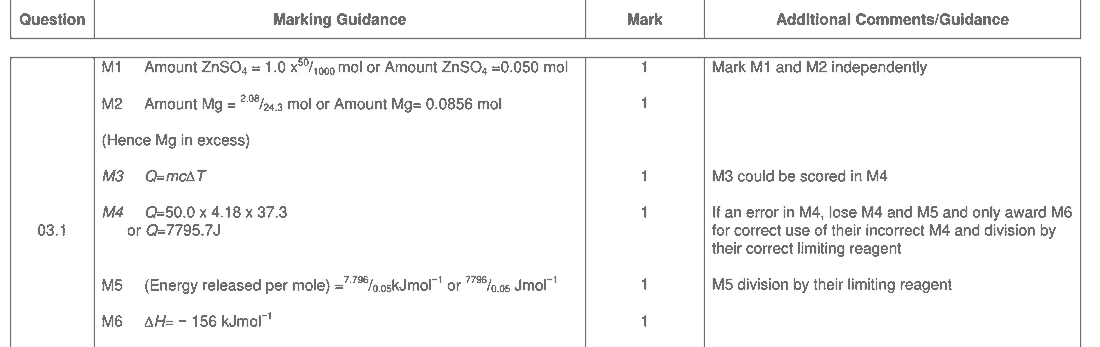
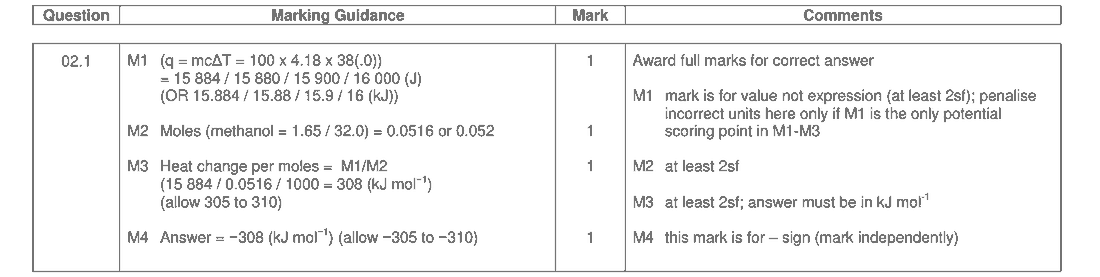
Answer: 53.4 cm3 (allow 52.8 to 53.4, or 49.8 to 50.4 if the mass of KOH is subtracted). n(KOH) = 3.00 ÷ 56.1 = 0.0535 mol
q = 51.3 × 0.0535 = 2.745 kJ = 2745 J
∆T = 12.3 °C
m = q ÷ (c∆T) = 2745 ÷ (4.18 × 12.3) g. Units cm3 needed. Errors: taking q to equal the molar enthalpy of solution (998 cm3)
adding 273 to the temperature change. Under 5% scored 0
Skills: MS0.0 Recognise and make use of appropriate units in calculation; MS2.2 Change the subject of an equation; MS2.3 Substitute numerical values into algebraic equations using appropriate units for physical quantities; RP2 Measurement of an enthalpy change
June 2025 · Paper 3 · Q02.43 marksAO2=3Calculation
Earlier part of question 02 that this part uses
Mark scheme
Examiner's comment
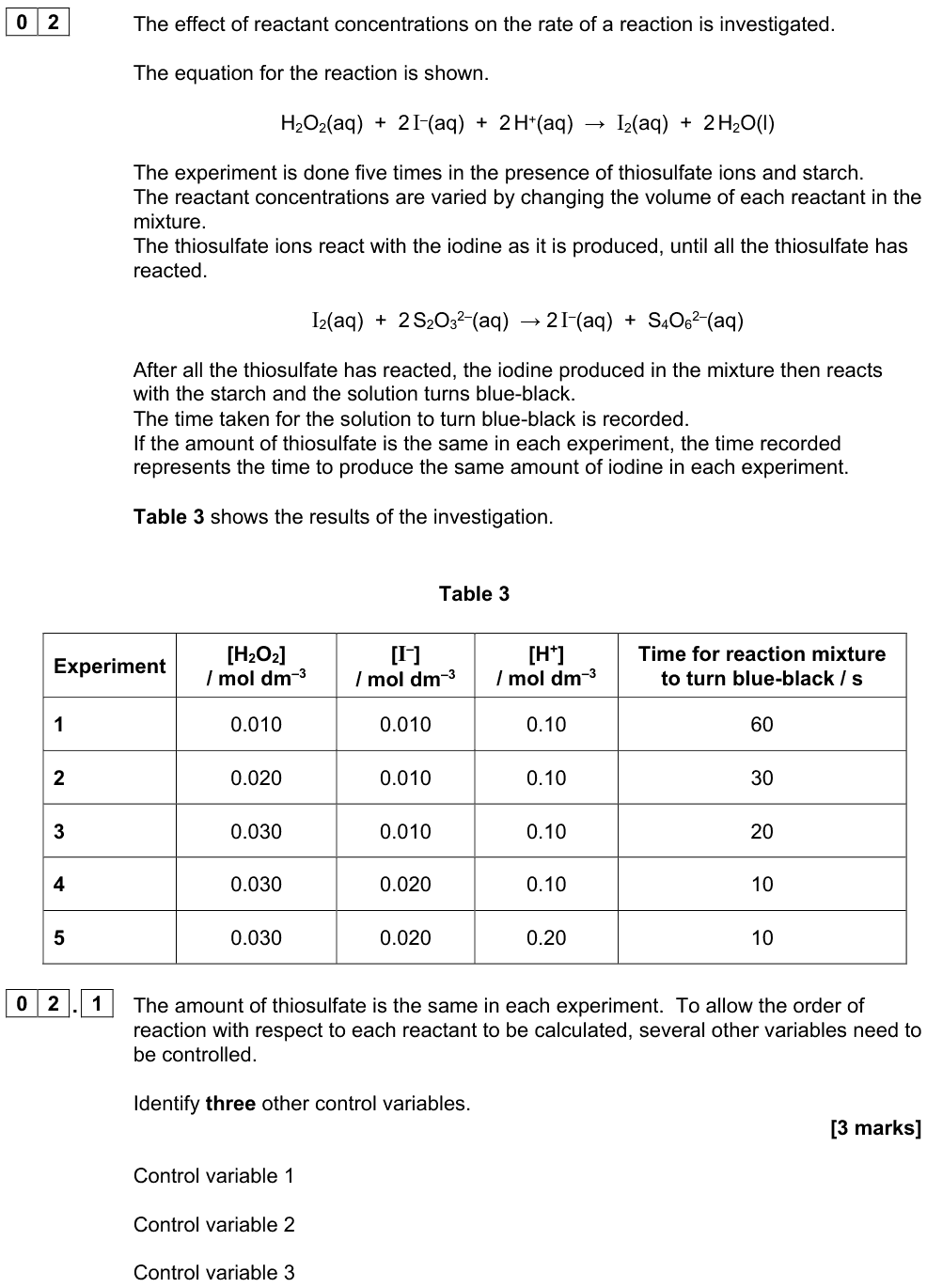
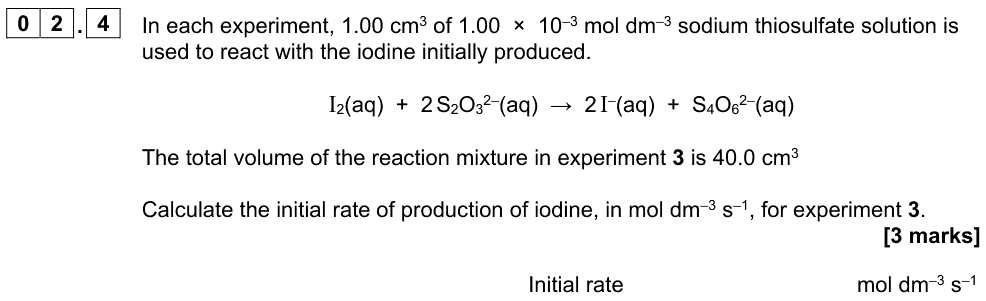
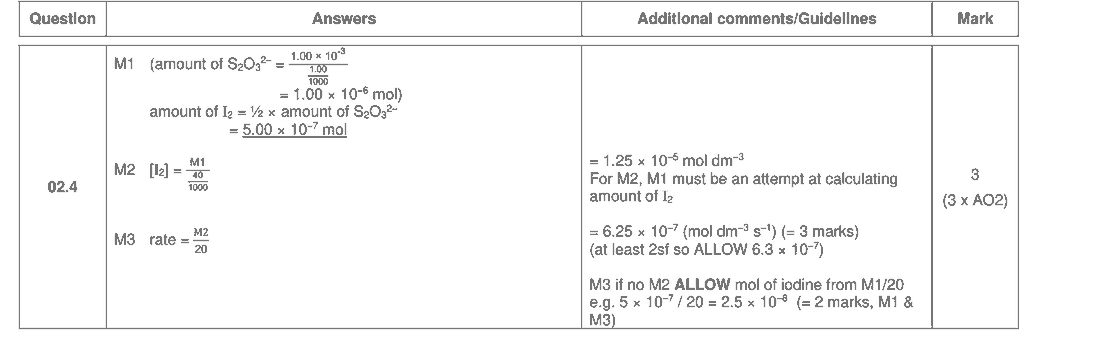
2.4 The surprise in this question was the number of students who demonstrated confusion between iodine (I2) and iodide (I–). Students were asked to determine the rate of production of iodine, but many attempted calculations based on the amount and concentration of iodide rather than the amount and concentration of iodine. As mentioned in the general comments, this was a question where many students would have benefitted from clearer explanation of their working. For example, ECF from M1 could be applied if it was clear that students thought they had calculated the amount of iodine in the first step – but many did not make this clear.
÷ 20 s (time for experiment 3, from Table 3). Errors: confusing iodine I2 with iodide I–
unlabelled working
Skills: MS0.0 Recognise and make use of appropriate units in calculation; MS0.1 Recognise and use expressions in decimal and ordinary form; MS0.2 Use ratios, fractions and percentages; RP7 Measuring the rate of reaction: by an initial rate method; by a continuous monitoring method
June 2025 · Paper 3 · Q04.36 marksAO2=6Calculation
Earlier part of question 04 that this part uses
Mark scheme
Examiner's comment
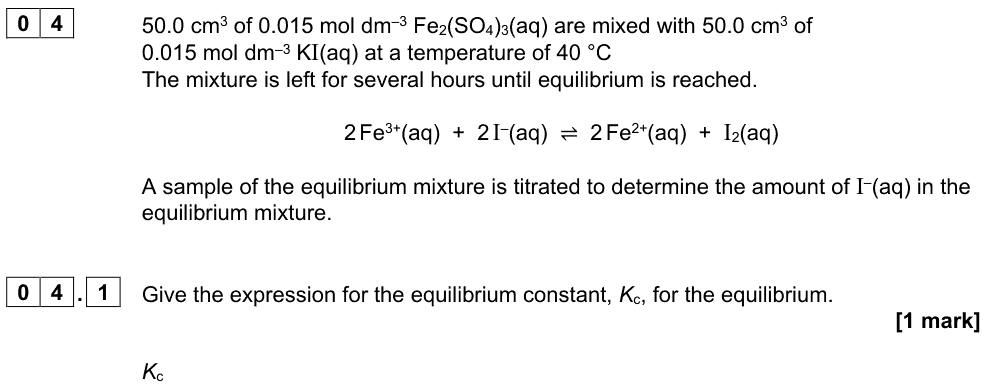
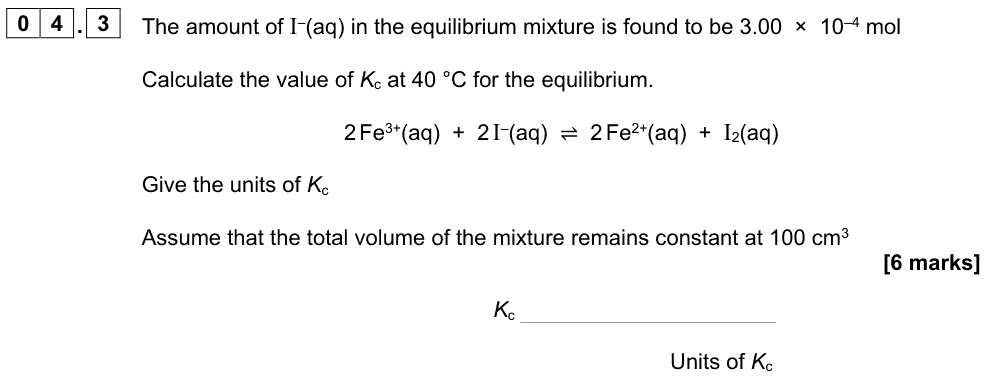
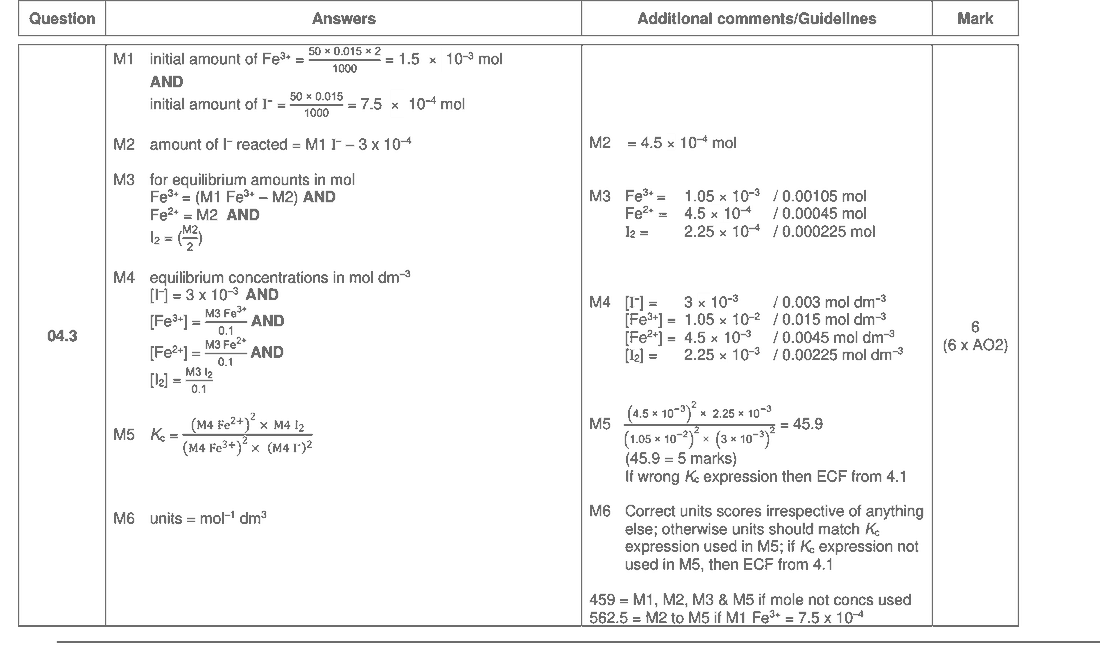
4.3 Students are strongly recommended to use an ICE chart to organise the working for this type of calculation – and to spread it across the page to give room for clear working, e.g.
Kc = (4.5 × 10^–3)² × 2.25 × 10^–3 ÷ [(1.05 × 10^–2)² × (3.0 × 10^–3)²]. 459 if moles are used instead of concentrations (4 marks)
562.5 if the 2 Fe3+ per Fe2(SO4)3 is missed. An ICE table is recommended
Skills: MS0.0 Recognise and make use of appropriate units in calculation; MS0.2 Use ratios, fractions and percentages; MS2.3 Substitute numerical values into algebraic equations using appropriate units for physical quantities
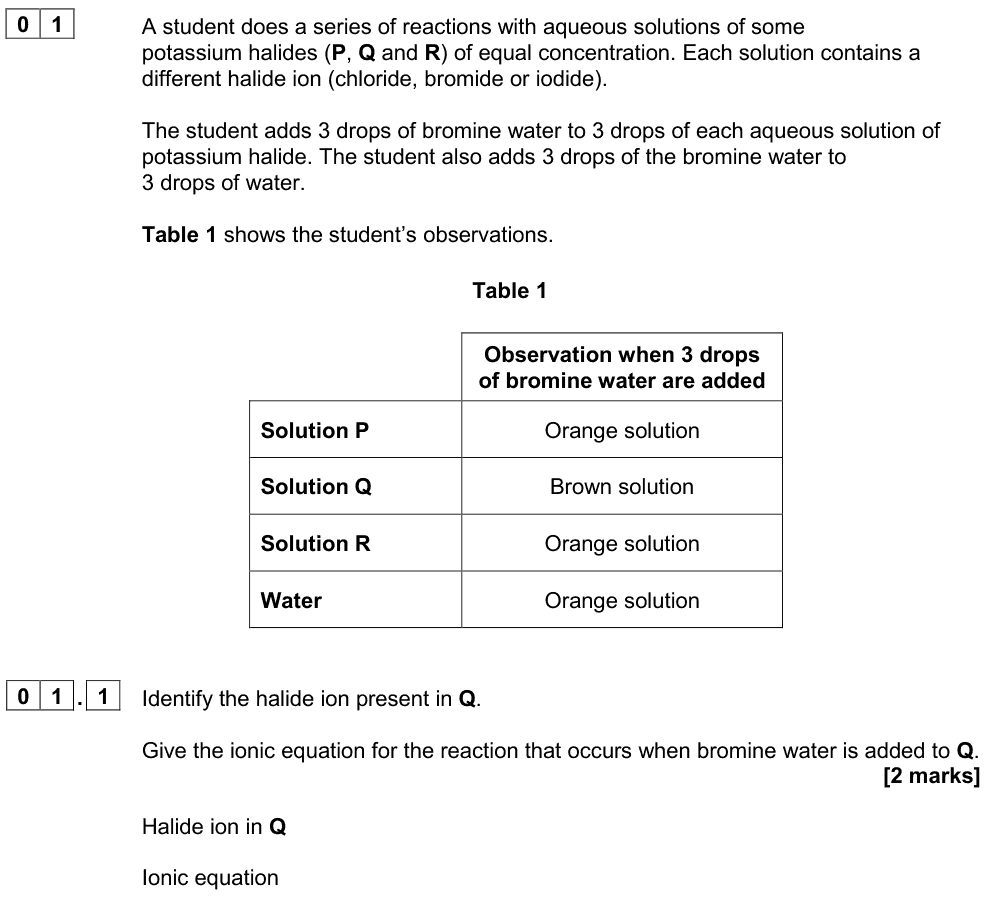
June 2024 · AS Paper 1 · Q01.12 marksAO3=2Short answerHard
Mark scheme
Examiner's comment
01.1 Many students were able to identify the halide ion present in Q as iodide, but only about a quarter of students were able to give the correct ionic equation for the reaction of these ions with bromine. Common incorrect answers gave equations that included the spectator ions and also half equations that showed the reduction of iodide ions.
Notes from the mark scheme and report
Iodide ion, I– (not iodine, I or I2). Br2 + 2I– → I2 + 2Br– (allow Br2 + 3I– → I3– + 2Br–). Errors: including K+ spectator ions
half-equations only
Skills: PS1.2 Apply scientific knowledge to practical contexts; ATd Use laboratory apparatus for a variety of experimental techniques including: titration, using burette and pipette; distillation and heating under reflux, including setting up glassware using retort stand and clamps; qualitative tests for ions and organic functional groups; filtration, including use of fluted filter paper, or filtration under reduced pressure
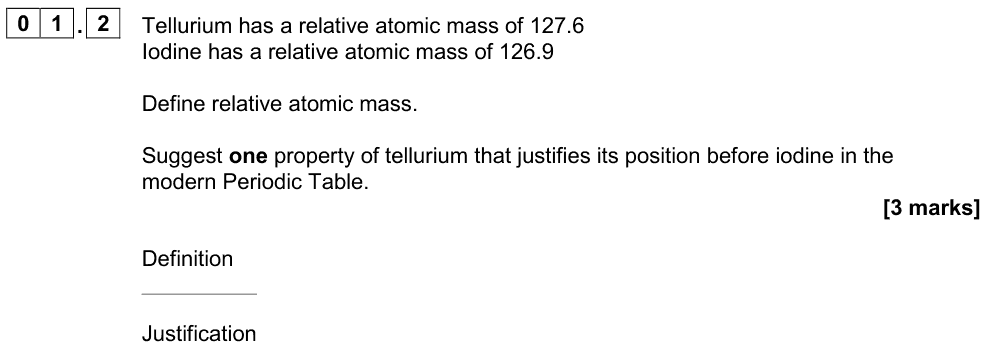
June 2024 · Paper 1 · Q01.23 marksAO1=2, AO3=1Short answer
Earlier part of question 01 that this part uses
Mark scheme
Examiner's comment
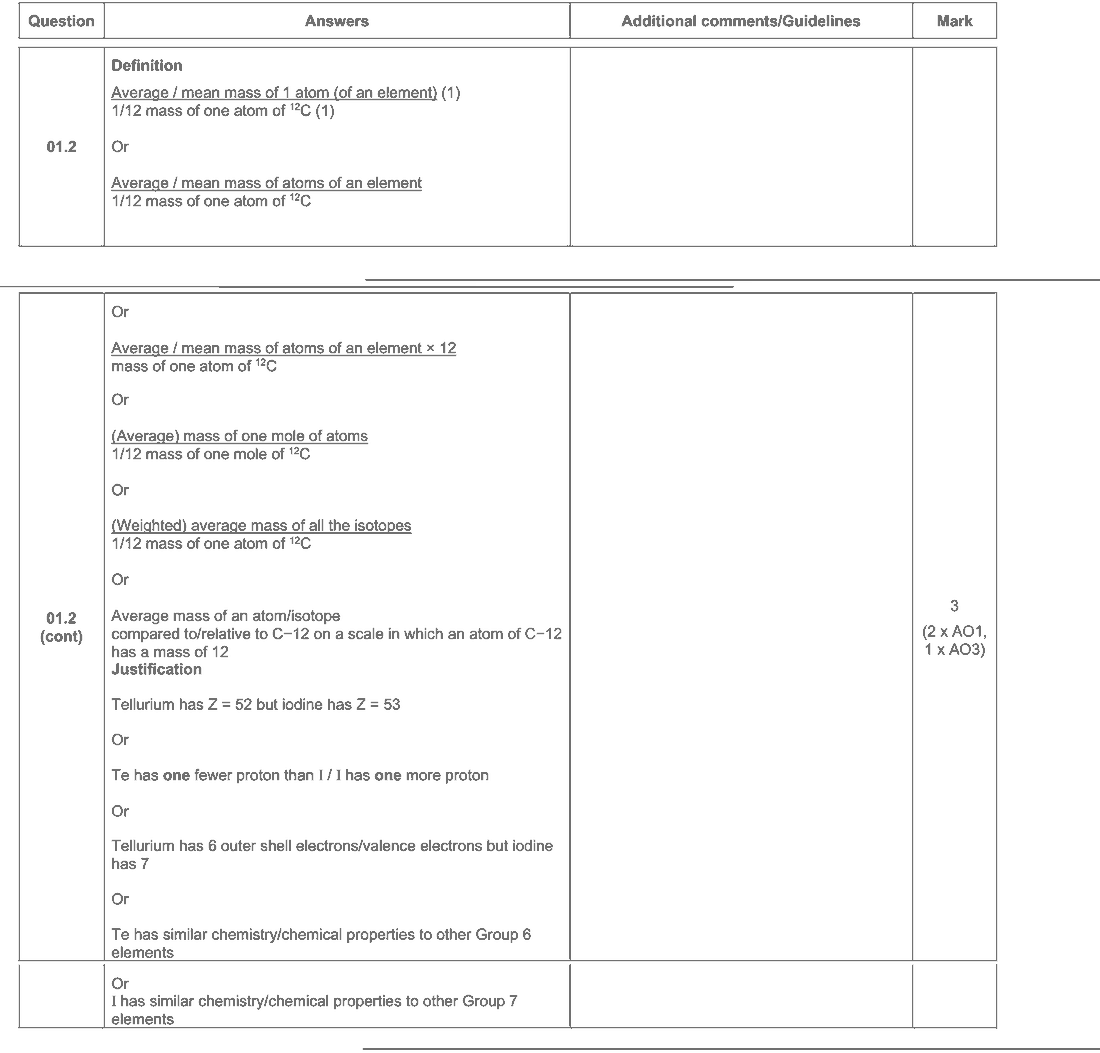
Few students scored both marks for the definition in part 2: mean (mass), mass or atom of 12C were often crucially missed out.
In the justification students failed to gain the mark by not being specific: Te has fewer protons was an insufficient answer.
Notes from the mark scheme and report
Definition: mean mass of an atom of an element divided by 1/12 of the mass of one atom of 12C. Justification: Te has Z = 52 and I has Z = 53 (one fewer proton). 'Mean' and 'atom of 12C' were often missed
'fewer protons' was not specific enough
June 2024 · Paper 1 · Q01.45 marksAO2=4, AO3=1CalculationHard
Earlier part of question 01 that this part uses
Mark scheme
Examiner's comment
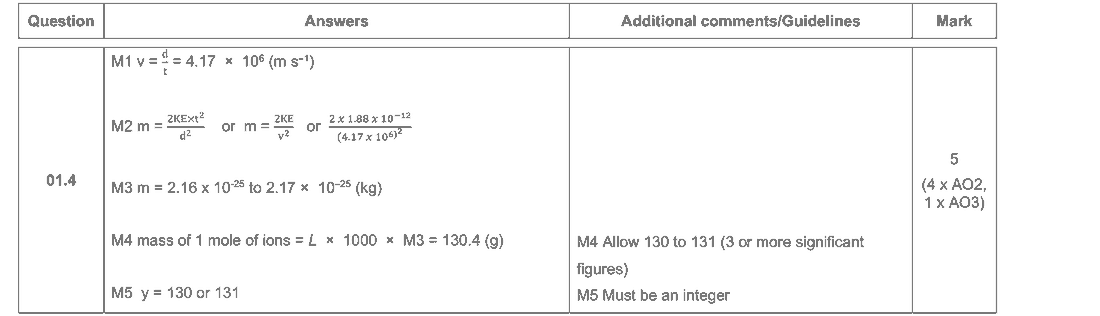
The calculation in part 4 discriminated well: 18% of students scored all the marks and over 85% of students scored at least 2 marks.
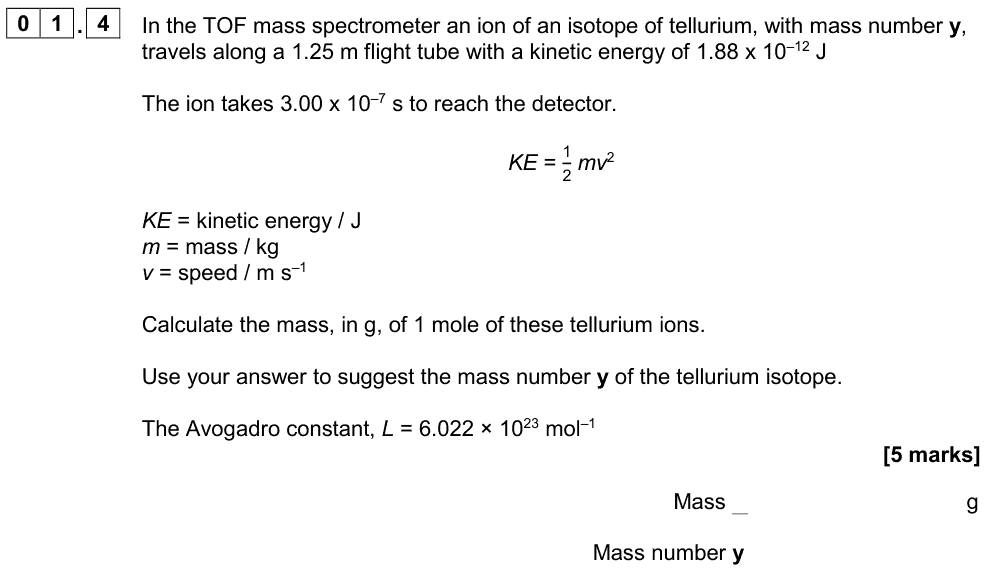
Common errors included giving the mass of 1 atom rather than the mass of one mole on the answer line and not realising that the mass number should be an integer.
Notes from the mark scheme and report
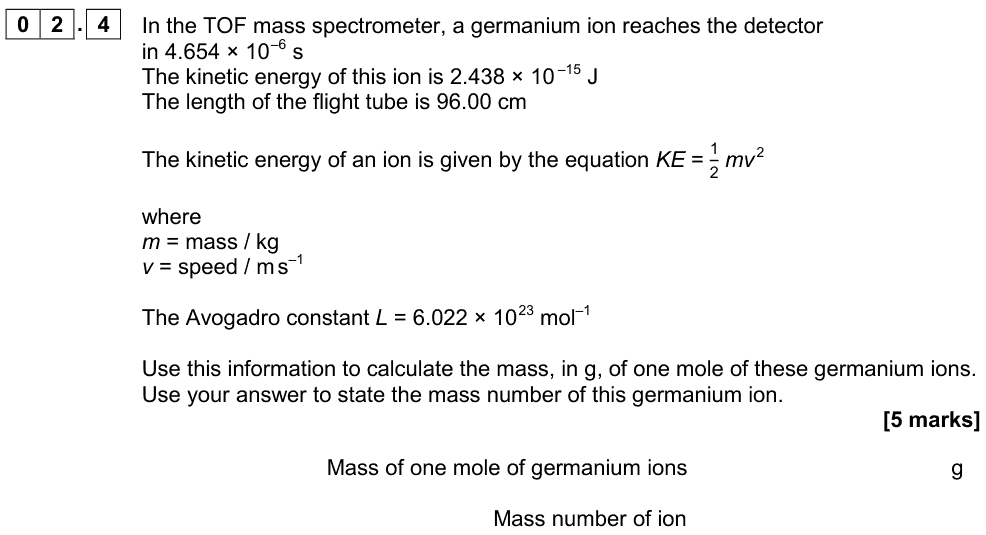
Answer: 130.4 g (allow 130 to 131)
y = 130 or 131. v = d/t = 4.17 × 10^6 m s–1
m = 2KE/v² = 2.16 × 10^–25 kg
× L × 1000. Common errors: mass of one atom on the answer line
y not an integer
Skills: MS0.0 Recognise and make use of appropriate units in calculation; MS0.1 Recognise and use expressions in decimal and ordinary form; MS2.2 Change the subject of an equation; MS2.3 Substitute numerical values into algebraic equations using appropriate units for physical quantities
June 2024 · Paper 1 · Q02.11 markAO3=1Practical and data analysis
Mark scheme
Examiner's comment
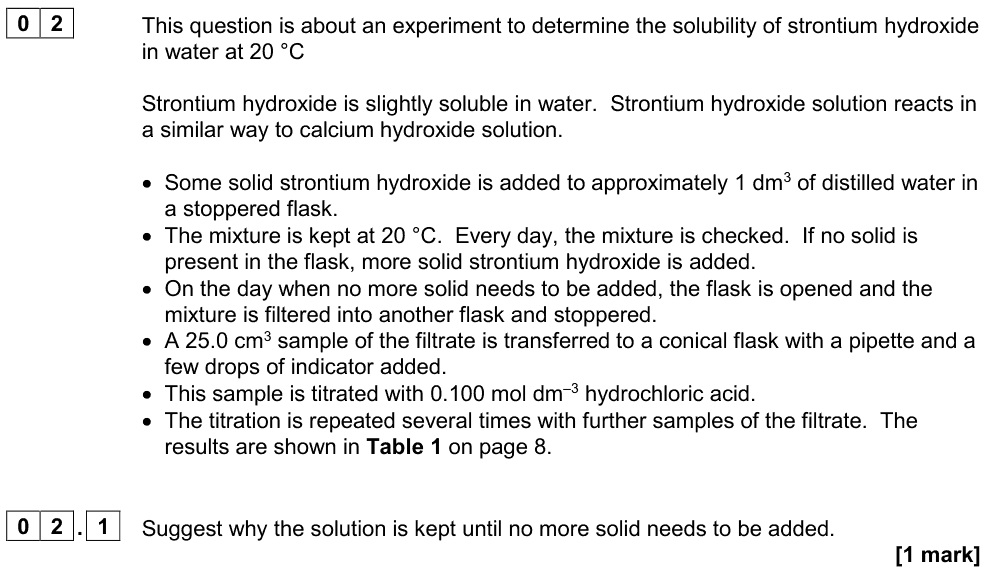
Students found parts 1, 2 and 3 challenging; fewer than 40% were successful on each of these parts.
In part 1 many students suggested that the strontium hydroxide had fully dissolved or was in excess, not realising that a saturated solution was needed.
Notes from the mark scheme and report
So that the maximum amount dissolves / the solution is saturated. Not 'reacted', 'fully dissolved' or 'in excess'
Skills: PS1.1 Solve problems set in practical contexts; PS2.1 Comment on experimental design and evaluate scientific methods; RP1 Make up a volumetric solution and carry out a simple acid–base titration
June 2024 · Paper 1 · Q02.21 markAO3=1Practical and data analysis
Earlier part of question 02 that this part uses
Mark scheme
Examiner's comment
Students found parts 1, 2 and 3 challenging; fewer than 40% were successful on each of these parts.
Common insufficient answers in part 2 included removing the undissolved strontium hydroxide so it didn’t affect the titre, but students did not state that the titre would be larger.
Notes from the mark scheme and report
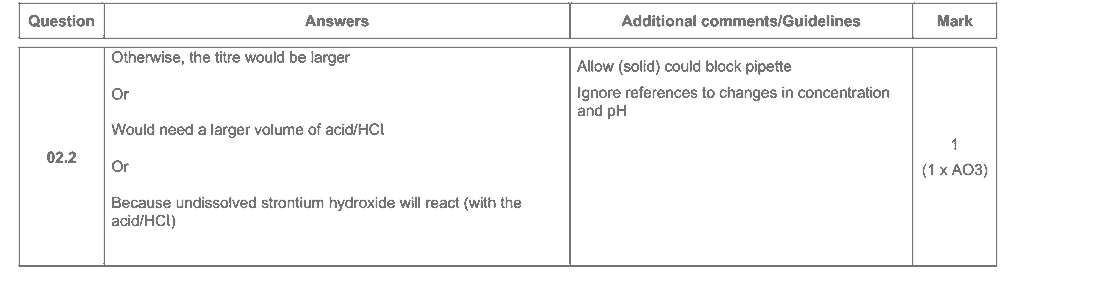
Undissolved strontium hydroxide would react with the acid, so the titre would be larger. 'It would affect the titre' was not enough
Skills: PS2.1 Comment on experimental design and evaluate scientific methods; ATd Use laboratory apparatus for a variety of experimental techniques including: titration, using burette and pipette; distillation and heating under reflux, including setting up glassware using retort stand and clamps; qualitative tests for ions and organic functional groups; filtration, including use of fluted filter paper, or filtration under reduced pressure; RP1 Make up a volumetric solution and carry out a simple acid–base titration
June 2024 · Paper 1 · Q02.31 markAO2=1Practical and data analysis
Earlier part of question 02 that this part uses
Mark scheme
Examiner's comment
Students found parts 1, 2 and 3 challenging; fewer than 40% were successful on each of these parts.
In part 3, very few answers referred to the solution reacting with carbon dioxide in the air; common incorrect answers stated that the solution would react with oxygen/air.
Evaporation of the strontium hydroxide (solution) was accepted in the mark scheme and seen quite regularly as an answer.
Notes from the mark scheme and report
To prevent reaction with carbon dioxide in the air (or evaporation of water). Common wrong answer: reaction with oxygen or air
Skills: PS1.2 Apply scientific knowledge to practical contexts; RP1 Make up a volumetric solution and carry out a simple acid–base titration
June 2024 · Paper 1 · Q02.41 markAO3=1Practical and data analysis
Earlier part of question 02 that this part uses
Mark scheme
Examiner's comment
Answers to part 4 were very good.
Notes from the mark scheme and report
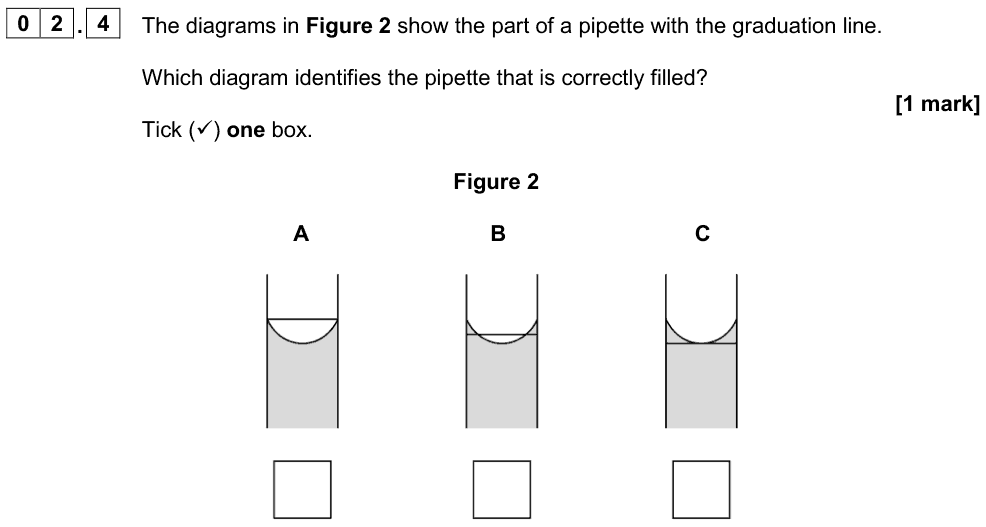
Answer: C (bottom of the meniscus on the graduation line)
Skills: ATd Use laboratory apparatus for a variety of experimental techniques including: titration, using burette and pipette; distillation and heating under reflux, including setting up glassware using retort stand and clamps; qualitative tests for ions and organic functional groups; filtration, including use of fluted filter paper, or filtration under reduced pressure; PS4.1 Know and understand how to use a wide range of experimental and practical instruments, equipment and techniques appropriate to the knowledge and understanding included in the specification; RP1 Make up a volumetric solution and carry out a simple acid–base titration
June 2024 · Paper 1 · Q02.56 marksAO2=6CalculationHard
Earlier part of question 02 that this part uses
Mark scheme
Examiner's comment
33% of students gained all the marks in part 5: the question discriminated extremely well.
Most students calculated the average titre: some used 3 or 4 values rather than the two concordant values.
Other common errors included multiplying by 2, using an incorrect Mr and failing to multiply by 4.
Notes from the mark scheme and report
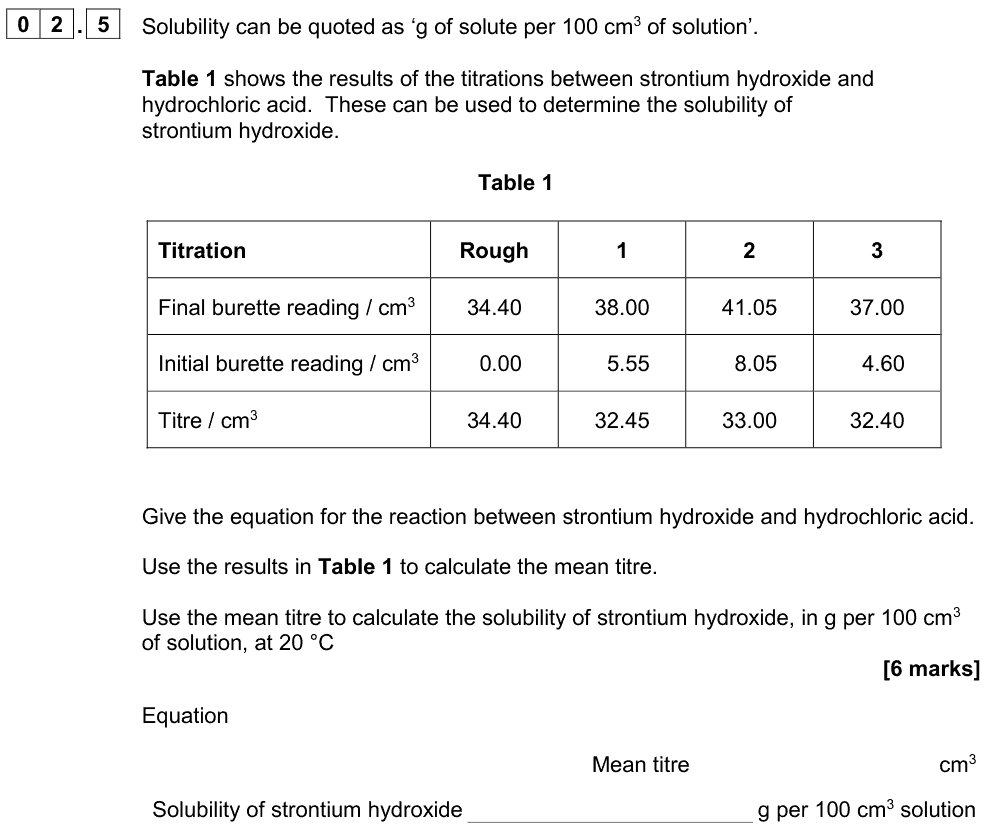
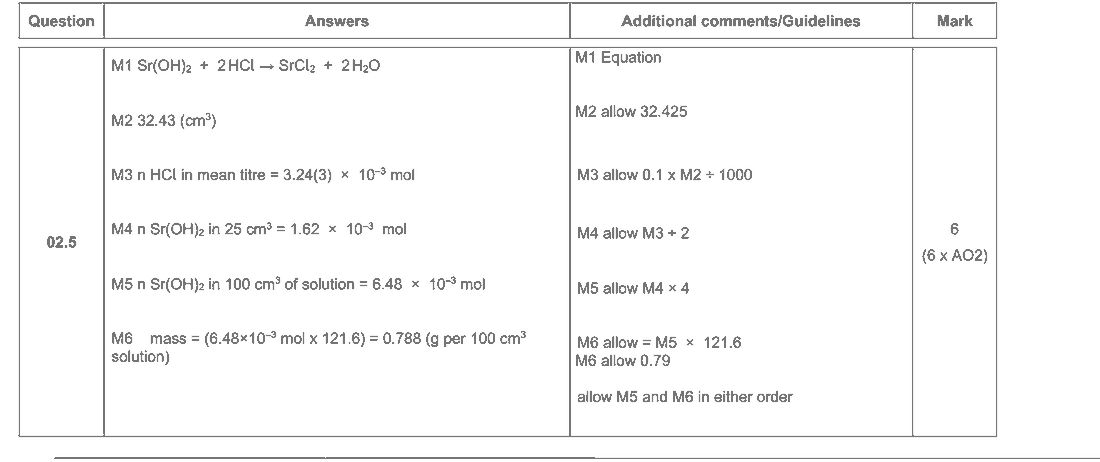
Answer: 0.788 g per 100 cm3. Sr(OH)2 + 2HCl → SrCl2 + 2H2O
mean titre 32.43 cm3 (the two concordant titres only)
n(HCl) = 3.243 × 10^–3 mol
÷ 2
× 4
× 121.6. Errors: averaging three or four titres, multiplying by 2, wrong Mr, not multiplying by 4
Skills: MS0.0 Recognise and make use of appropriate units in calculation; MS0.2 Use ratios, fractions and percentages; MS1.2 Find arithmetic means; PS3.2 Process and analyse data using appropriate mathematical skills as exemplified in the mathematical appendix for each science; ATd Use laboratory apparatus for a variety of experimental techniques including: titration, using burette and pipette; distillation and heating under reflux, including setting up glassware using retort stand and clamps; qualitative tests for ions and organic functional groups; filtration, including use of fluted filter paper, or filtration under reduced pressure; RP1 Make up a volumetric solution and carry out a simple acid–base titration
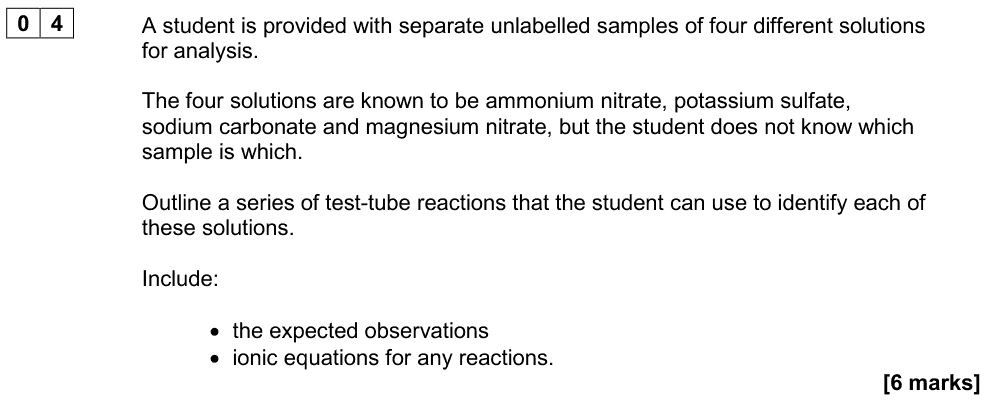
June 2024 · AS Paper 1 · Q046 marksAO2=2, AO3=46-mark level of response
Mark scheme, with the levels and indicative content
Examiner's comment
04 Only a few students scored all the marks on this question. Inorganic ion tests were not well described. In particular, many students did not show that the test for ammonium ions requires the use of sodium hydroxide as well as placing damp red litmus paper at the top/mouth of the tube. Students did not always provide any equations for these tests and when these were provided, they were often not ionic equations.
Notes from the mark scheme and report
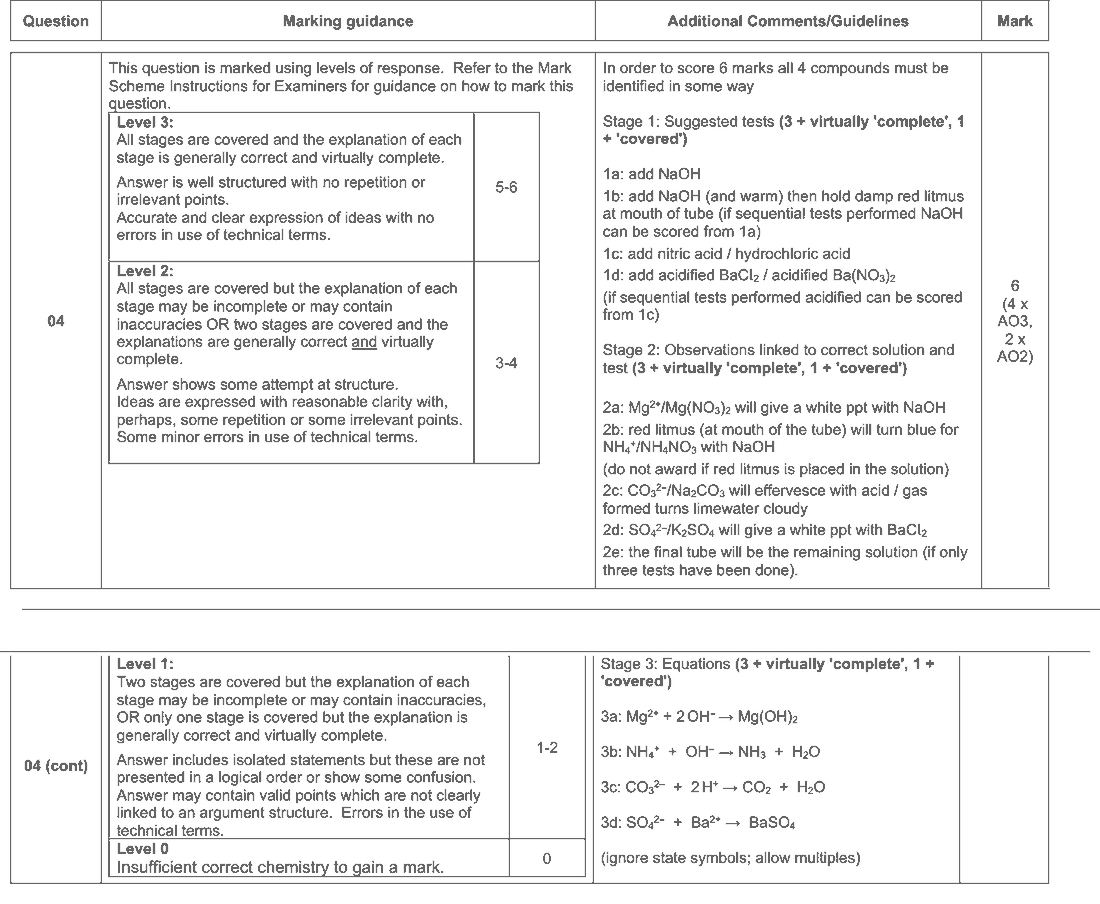
Levels of response, three stages. Tests: add NaOH
add NaOH, warm and hold damp red litmus at the mouth of the tube
add dilute nitric or hydrochloric acid
add acidified BaCl2. Observations: Mg(NO3)2 gives a white precipitate with NaOH
NH4NO3 turns the damp red litmus blue
Na2CO3 effervesces with acid
K2SO4 gives a white precipitate with BaCl2. Ionic equations: Mg2+ + 2OH– → Mg(OH)2
NH4+ + OH– → NH3 + H2O
CO3 2– + 2H+ → CO2 + H2O
Ba2+ + SO4 2– → BaSO4. All four solutions must be identified for 6. Errors: litmus dipped in the solution, no NaOH for the ammonium test, equations not ionic
Skills: ATd Use laboratory apparatus for a variety of experimental techniques including: titration, using burette and pipette; distillation and heating under reflux, including setting up glassware using retort stand and clamps; qualitative tests for ions and organic functional groups; filtration, including use of fluted filter paper, or filtration under reduced pressure; PS1.1 Solve problems set in practical contexts; PS4.1 Know and understand how to use a wide range of experimental and practical instruments, equipment and techniques appropriate to the knowledge and understanding included in the specification; RP4 Carry out simple test-tube reactions to identify: cations – Group 2, NH4+; anions – Group 7 (halide ions), OH–, CO32–, SO42–
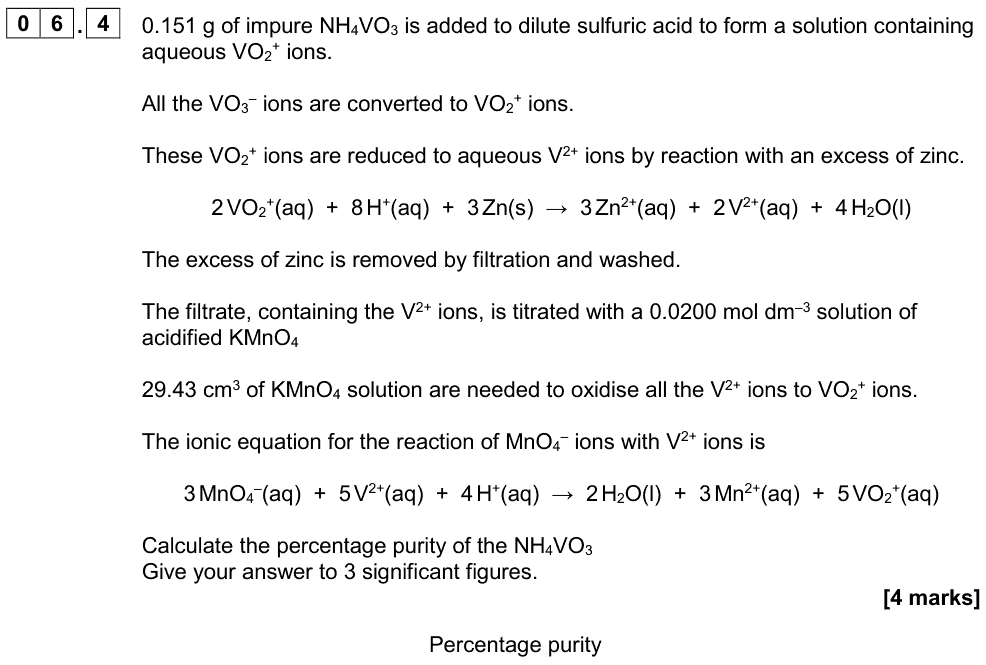
June 2024 · Paper 1 · Q06.44 marksAO2=4CalculationHard
Earlier part of question 06 that this part uses
Mark scheme
Examiner's comment
The calculation in part 4 proved challenging but 34% of students managed to score all the marks.
Many students used the reacting ratio correctly but then went on to use a second reacting ratio to calculate the amount, in moles, of vanadate(V) and lost the second mark.
Some students used an incorrect Mr in the calculation.
Notes from the mark scheme and report
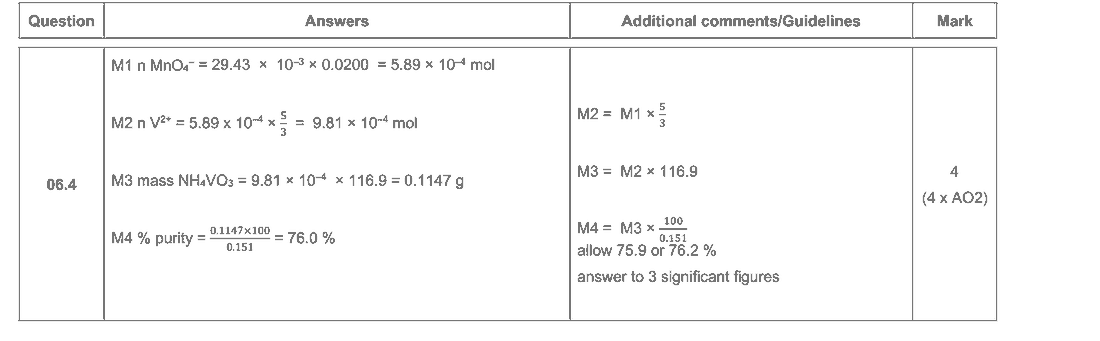
Answer: 76.0%. n(MnO4–) = 5.89 × 10^–4 mol
n(V2+) = × 5/3 = 9.81 × 10^–4 mol
mass of NH4VO3 = × 116.9 = 0.1147 g. Errors: applying a second mole ratio for the vanadate(V)
wrong Mr
Skills: MS0.0 Recognise and make use of appropriate units in calculation; MS0.2 Use ratios, fractions and percentages; MS1.1 Use an appropriate number of significant figures
June 2024 · AS Paper 1 · Q07.11 markAO1=1CalculationHard
Mark scheme
Examiner's comment
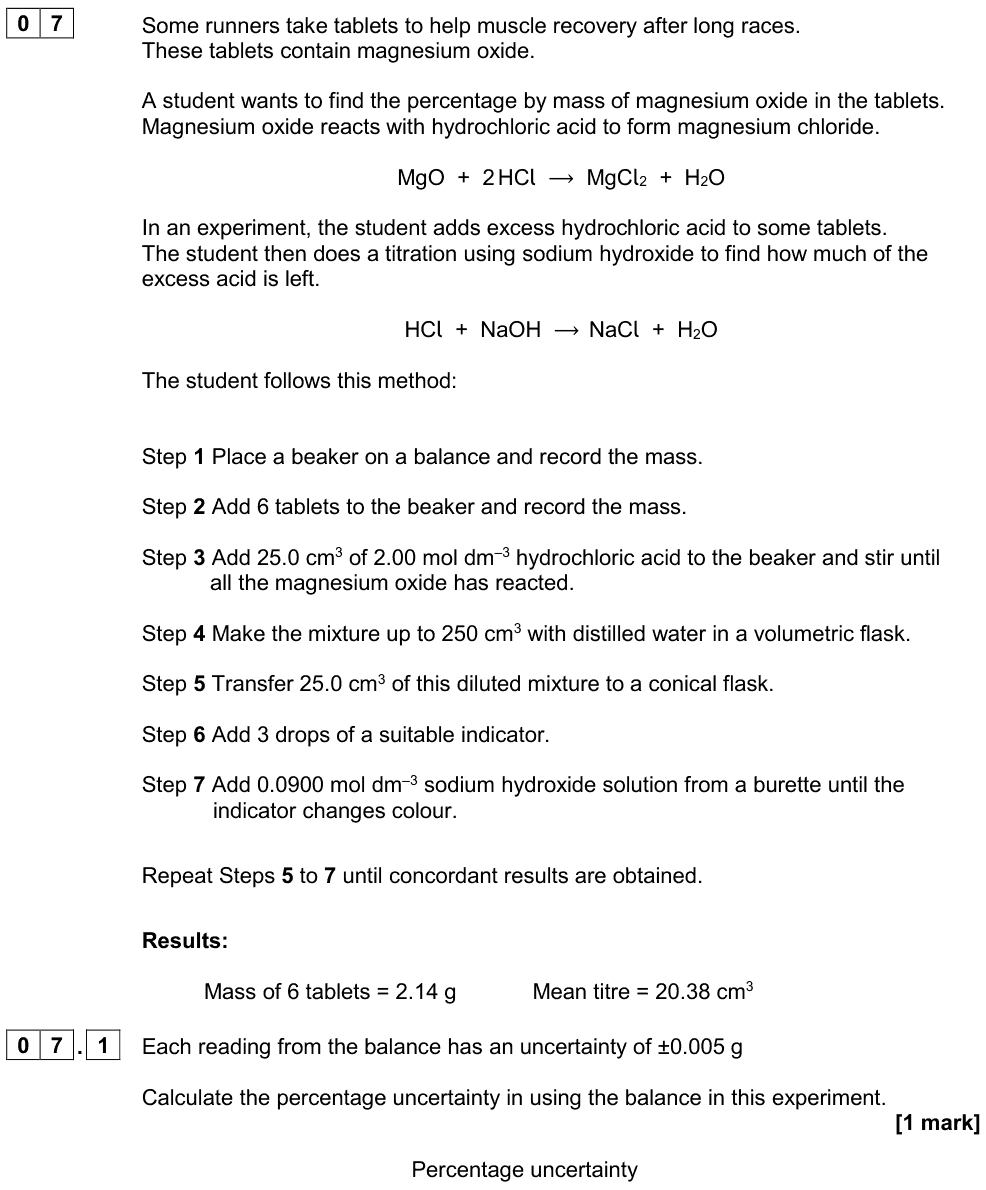
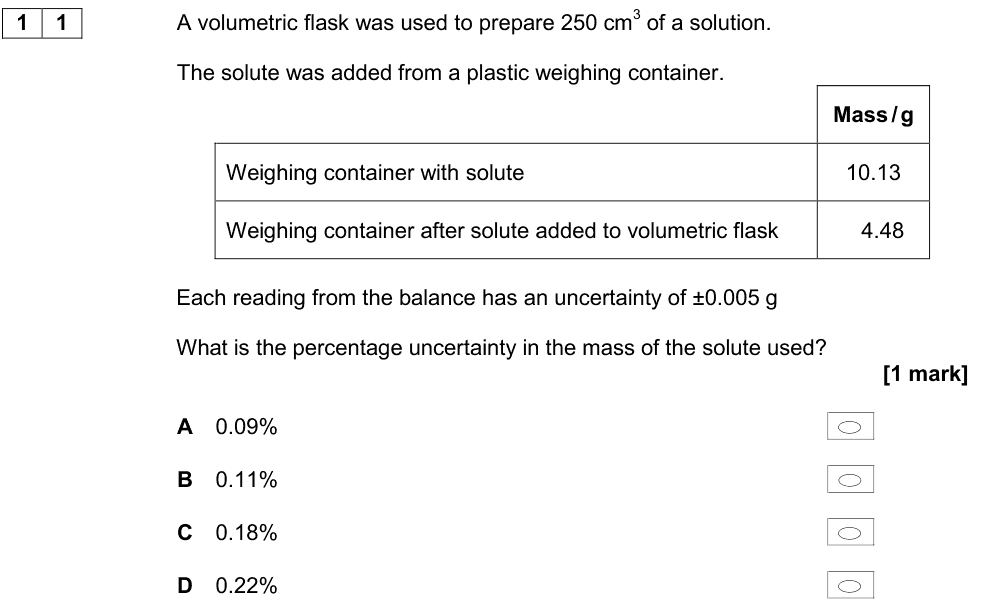
07.1 About one third of students realised that the mass of the tablets was determined by taking two readings on the balance and so the uncertainty in the mass should be doubled.
Notes from the mark scheme and report
Answer: 0.467% (2 sf or more). Two balance readings are taken, so (2 × 0.005 ÷ 2.14) × 100. Most did not double the uncertainty
Skills: MS1.3 Identify uncertainties in measurements and use simple techniques to determine uncertainty when data are combined; MS0.2 Use ratios, fractions and percentages; PS2.3 Evaluate results and draw conclusions with reference to measurement uncertainties and errors; ATa Use appropriate apparatus to record a range of measurements (to include mass, time, volume of liquids and gases, temperature); RP1 Make up a volumetric solution and carry out a simple acid–base titration
June 2024 · AS Paper 1 · Q07.21 markAO2=1Calculation
Earlier part of question 07 that this part uses
Mark scheme
Examiner's comment
07.2 Very few students appreciated that appropriate precision in this answer would be three significant figures because the data provided is all given to three significant figures.
Notes from the mark scheme and report
Answer: 0.0500 mol (must be 3 sf). 25.0 × 10^–3 × 2.00. Very few gave three significant figures
Skills: MS1.1 Use an appropriate number of significant figures; MS0.0 Recognise and make use of appropriate units in calculation; RP1 Make up a volumetric solution and carry out a simple acid–base titration
June 2024 · AS Paper 1 · Q07.36 marksAO2=6CalculationHard
Earlier part of question 07 that this part uses
Mark scheme
Examiner's comment
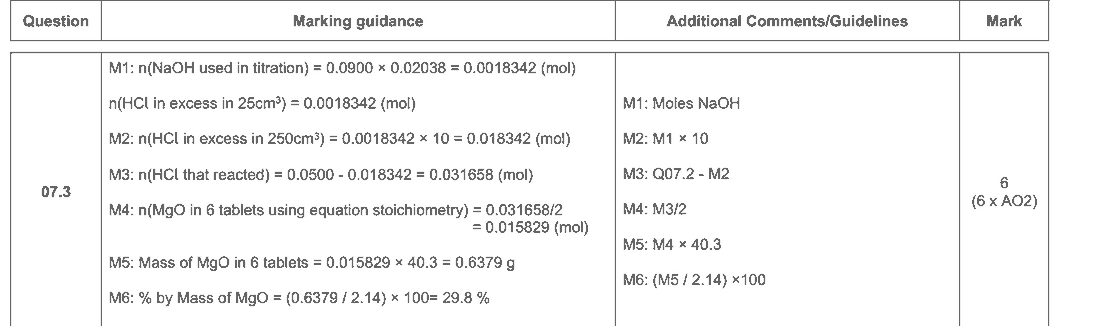
07.3 This was a challenging calculation with only about a quarter of students scoring all the marks. Students did not realise that excess hydrochloric acid was used in the reaction with the tablets and so they needed to calculate the amount, in moles, of hydrochloric acid that reacted with the tablets by subtracting the amount, in moles, of hydrochloric acid that was neutralised by the sodium hydroxide solution from the initial amount, in moles, of the hydrochloric acid used. Also, students did not always appreciate that two moles of hydrochloric acid react with one mole of magnesium oxide because they did not apply the stoichiometry of the equation to the calculation.
÷ 2.14 × 100. Errors: no subtraction for the excess acid
ignoring the 2:1 ratio
Skills: MS0.0 Recognise and make use of appropriate units in calculation; MS0.2 Use ratios, fractions and percentages; PS3.2 Process and analyse data using appropriate mathematical skills as exemplified in the mathematical appendix for each science; RP1 Make up a volumetric solution and carry out a simple acid–base titration
June 2024 · Paper 1 · Q09.46 marksAO1=1, AO2=5Calculation
Earlier part of question 09 that this part uses
Mark scheme
Examiner's comment
38% of students scored all the marks in the calculation in part 4 and most students gained a few marks.
Errors included incorrect rearrangement of the equation and not using the correct mole ratio.
An answer of 59 was common using a 1:1 ratio but this meant that 124 could not be subtracted and the metal could not be identified.
Skills: MS0.0 Recognise and make use of appropriate units in calculation; MS0.2 Use ratios, fractions and percentages; MS2.2 Change the subject of an equation; MS2.3 Substitute numerical values into algebraic equations using appropriate units for physical quantities
June 2024 · Paper 1 · Q09.53 marksAO2=2, AO3=1Explanation
Earlier part of question 09 that this part uses
Mark scheme
Examiner's comment
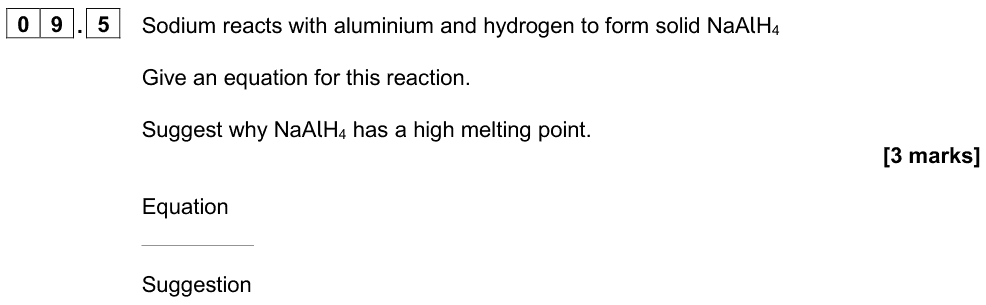
The equation in part 5 was generally correct: errors included using H instead of H2.
Very few students realised that there was ionic bonding in the compound and described metallic bonding or intermolecular forces.
Notes from the mark scheme and report
Na + Al + 2H2 → NaAlH4
it contains Na+ and AlH4– ions with strong attraction between the oppositely charged ions. Errors: H instead of H2
metallic bonding or intermolecular forces described
June 2024 · AS Paper 1 · Q101 markAO2=1Multiple choiceEasy
Answer
D
Mark scheme
Examiner's comment
Atom Economy About two-thirds of students (65%) were able to correctly calculate the atom economy for the reaction.
Skills: MS0.2 Use ratios, fractions and percentages
June 2024 · AS Paper 1 · Q121 markAO2=1Multiple choiceEasy
Answer
A
Mark scheme
Examiner's comment
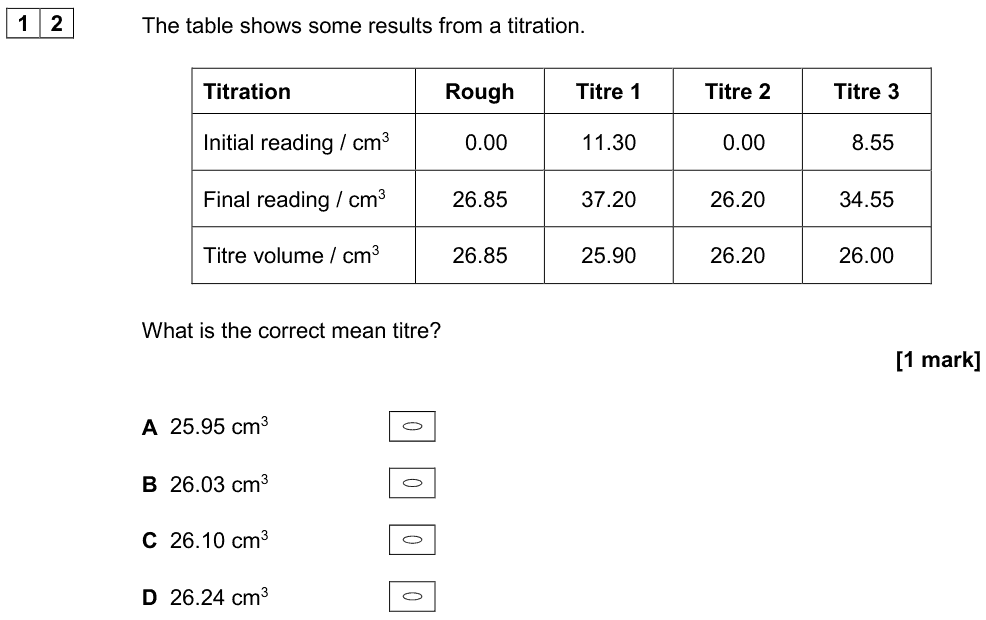
Mean titre The majority of students (80%) were able to calculate correctly the mean titre using the data from the table – ignoring the non-concordant titres.
Notes from the mark scheme and report
Answer: A. Use only the concordant titres 25.90 and 26.00: mean 25.95 cm3
Skills: MS1.2 Find arithmetic means; PS3.2 Process and analyse data using appropriate mathematical skills as exemplified in the mathematical appendix for each science; ATd Use laboratory apparatus for a variety of experimental techniques including: titration, using burette and pipette; distillation and heating under reflux, including setting up glassware using retort stand and clamps; qualitative tests for ions and organic functional groups; filtration, including use of fluted filter paper, or filtration under reduced pressure; RP1 Make up a volumetric solution and carry out a simple acid–base titration
June 2024 · AS Paper 1 · Q171 markAO1=1Multiple choiceEasy
Answer
C
Mark scheme
Examiner's comment
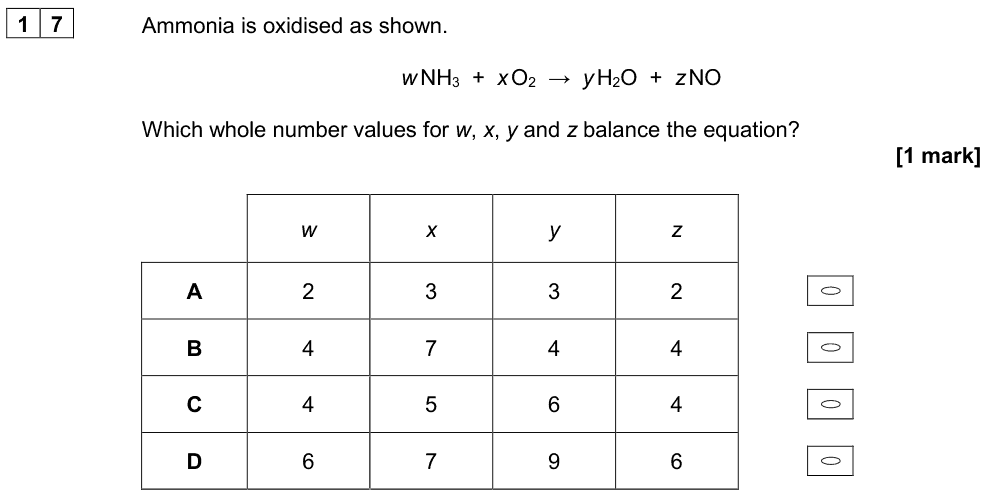
Stoichiometry The majority of students (85%) correctly balanced the equation.
Notes from the mark scheme and report
Answer: C. 4NH3 + 5O2 → 6H2O + 4NO
Skills: MS0.2 Use ratios, fractions and percentages
June 2024 · AS Paper 1 · Q181 markAO1=1Multiple choiceEasy
Answer
B
Mark scheme
Examiner's comment
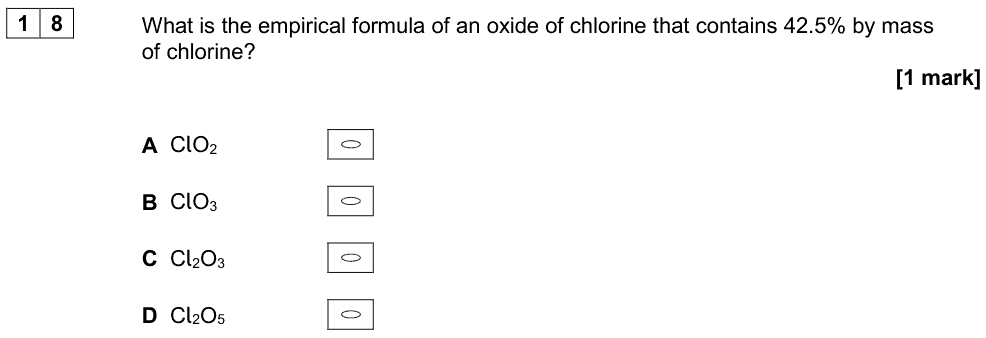
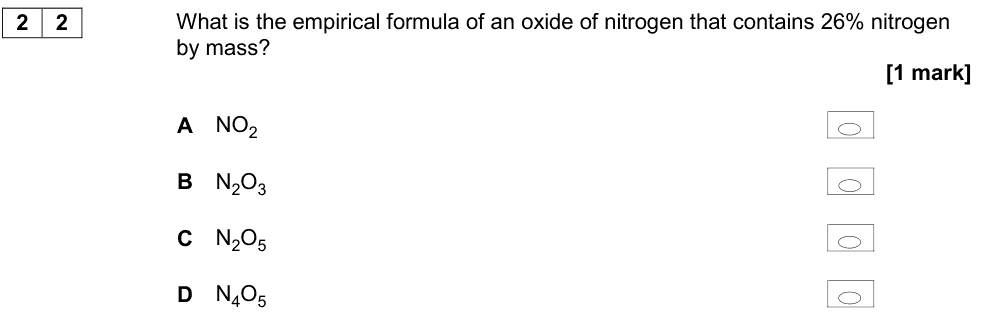
Empirical Formula This was well answered with about three-quarters of students able to determine which oxide of chlorine contains 42.5% by mass of chlorine.
Notes from the mark scheme and report
Answer: B. Cl 42.5 ÷ 35.5 = 1.20
O 57.5 ÷ 16.0 = 3.59
ratio 1 : 3
Skills: MS0.2 Use ratios, fractions and percentages
June 2024 · AS Paper 1 · Q231 markAO2=1Multiple choiceEasy
Answer
B
Mark scheme
Examiner's comment
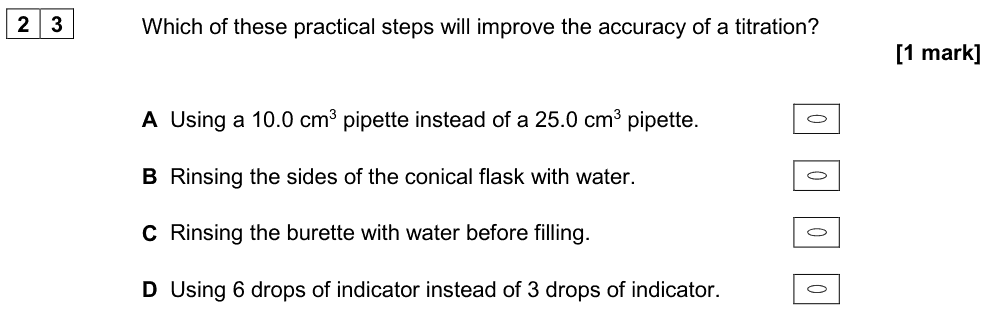
Titration accuracy A good number of students (about 60%) were able to identify the step that would improve the accuracy of a titration.
Notes from the mark scheme and report
Answer: B. Rinsing the sides of the flask with water washes all the reagent into the mixture without changing the moles present. A smaller pipette raises percentage uncertainty
water in the burette dilutes the solution
extra indicator can affect the titre
Skills: ATd Use laboratory apparatus for a variety of experimental techniques including: titration, using burette and pipette; distillation and heating under reflux, including setting up glassware using retort stand and clamps; qualitative tests for ions and organic functional groups; filtration, including use of fluted filter paper, or filtration under reduced pressure; PS2.1 Comment on experimental design and evaluate scientific methods; RP1 Make up a volumetric solution and carry out a simple acid–base titration
June 2024 · AS Paper 2 · Q01.23 marksAO3=3Calculation
Earlier part of question 01 that this part uses
Mark scheme
Examiner's comment
1.2 This question required students to determine the empirical formula of a compound from data. Some students struggled to convert the amount in moles of each element into the simplest whole number ratio.
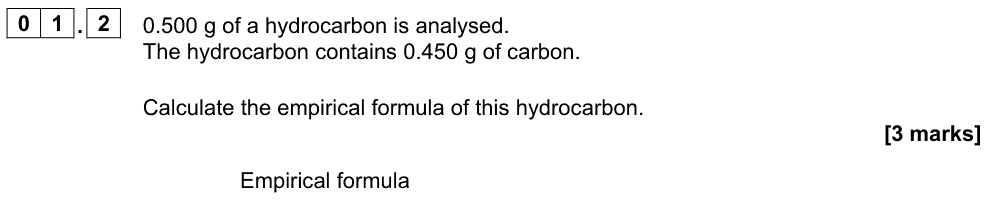
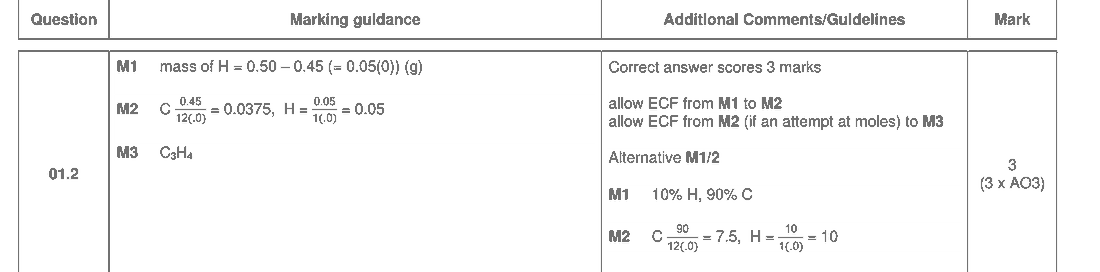
Notes from the mark scheme and report
Answer: C3H4. Mass of H = 0.500 – 0.450 = 0.050 g
C 0.450 ÷ 12.0 = 0.0375 mol, H 0.050 ÷ 1.0 = 0.050 mol
ratio 1 : 1.33 = 3 : 4. Some could not convert the mole ratio to whole numbers
Skills: MS0.2 Use ratios, fractions and percentages
June 2024 · Paper 2 · Q02.12 marksAO2=2CalculationEasy
Mark scheme
Examiner's comment
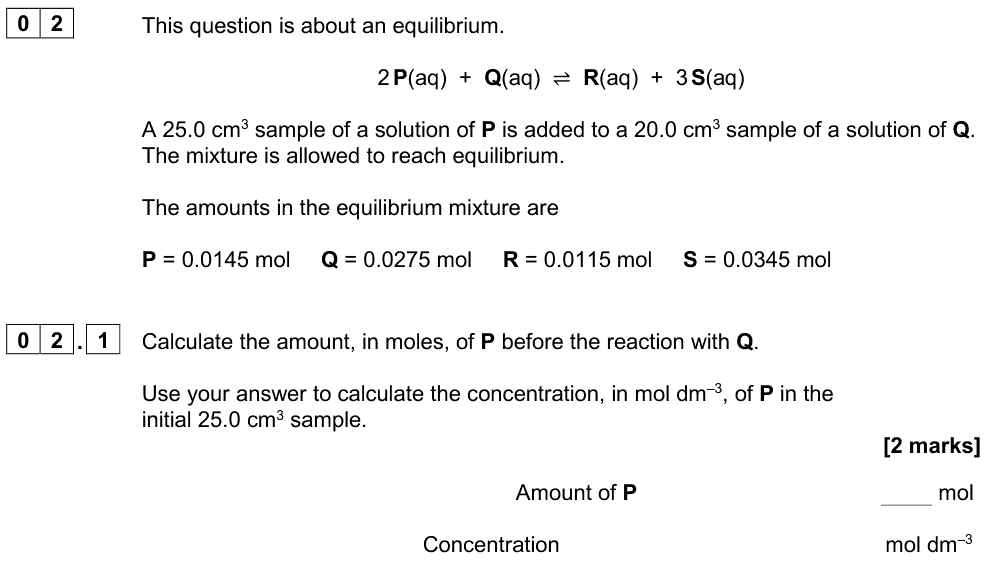
2.1 Over 60% of students scored both of these marks. Those who got the amount of P wrong were able to score a consequential mark for converting their amount into a concentration.
Notes from the mark scheme and report
Answer: 0.0375 mol
1.50 mol dm–3. Initial P = 0.0145 + (2 × 0.0115)
÷ 0.0250 dm3. ECF for the concentration from a wrong amount
Skills: MS0.0 Recognise and make use of appropriate units in calculation; MS0.2 Use ratios, fractions and percentages
June 2024 · Paper 2 · Q03.12 marksAO1=2Equation writing
Mark scheme
Examiner's comment
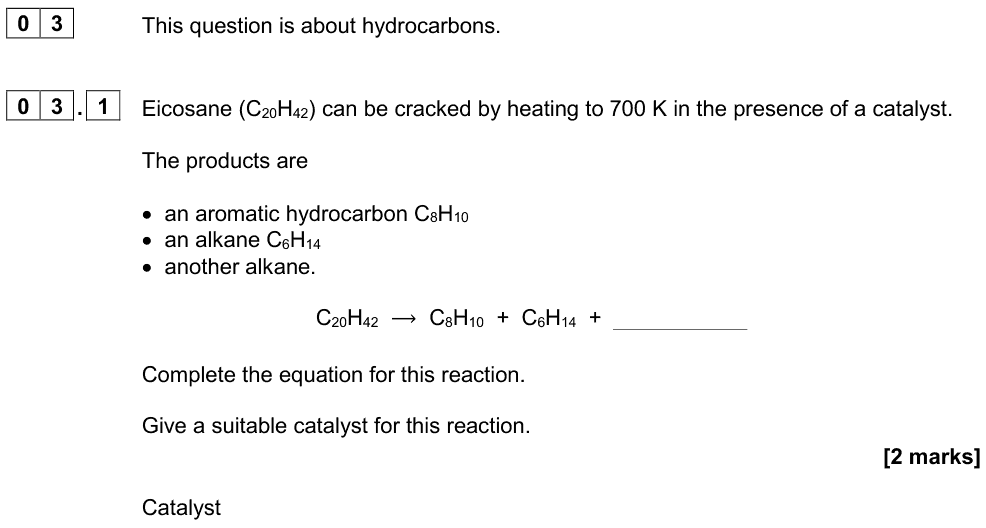
3.1 A surprising number of students gave C6H18 as their answer for M1 when the correct answer was 3C2H6. Clearly those students had simply deduced the number of carbon and hydrogen atoms needed to balance the equation, without considering if their answer was a viable compound. The second mark was well known.
Notes from the mark scheme and report
+ 3C2H6
catalyst: zeolite (aluminosilicate / aluminium oxide). C6H18 was a common wrong answer: it balances but is not a possible alkane
June 2024 · Paper 2 · Q03.44 marksAO2=4Calculation
Earlier part of question 03 that this part uses
Mark scheme
Examiner's comment
3.4 The calculation of gas volume proved challenging, and few were able to access the top marks here. Relating the mole ratio in the balanced equation to a gas volume ratio was unfamiliar to many students. M1 was often the only mark scored. Some attempted to use the ideal gas equation despite not being given explicit temperature and pressure values. This approach could score the marks, but it was a far more difficult route to take and those who did often made mistakes.
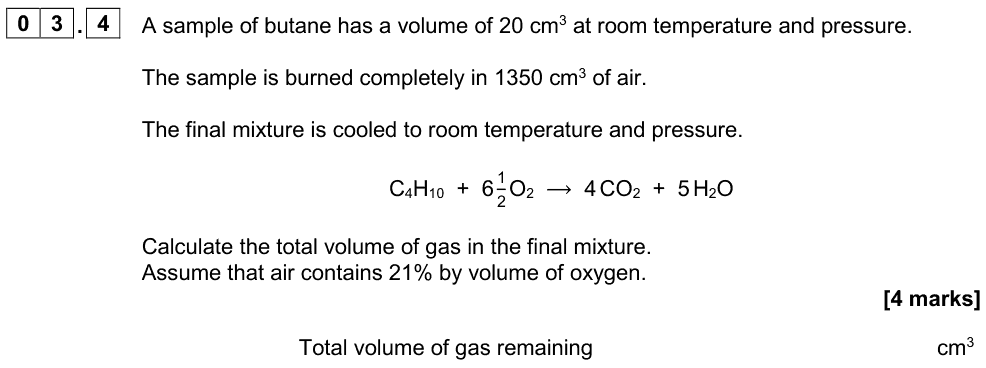
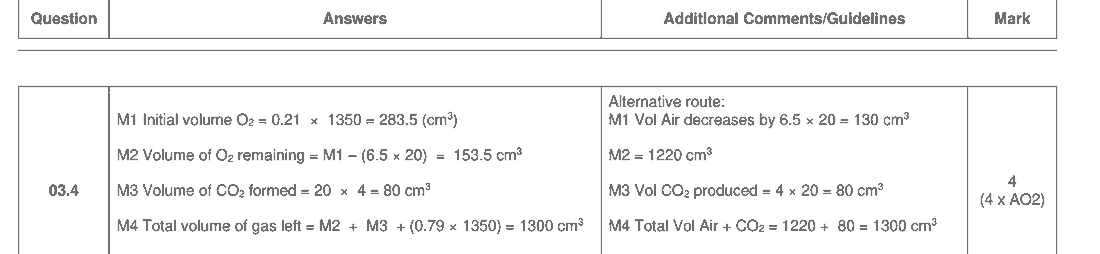
total 153.5 + 80 + 1066.5 (water is liquid). Short cut: 1350 – 130 + 80. Often only M1 scored
gas volume ratios from the equation were unfamiliar
Skills: MS0.2 Use ratios, fractions and percentages
June 2024 · AS Paper 2 · Q05.17 marksAO1=2, AO2=5Calculation
Mark scheme
Examiner's comment
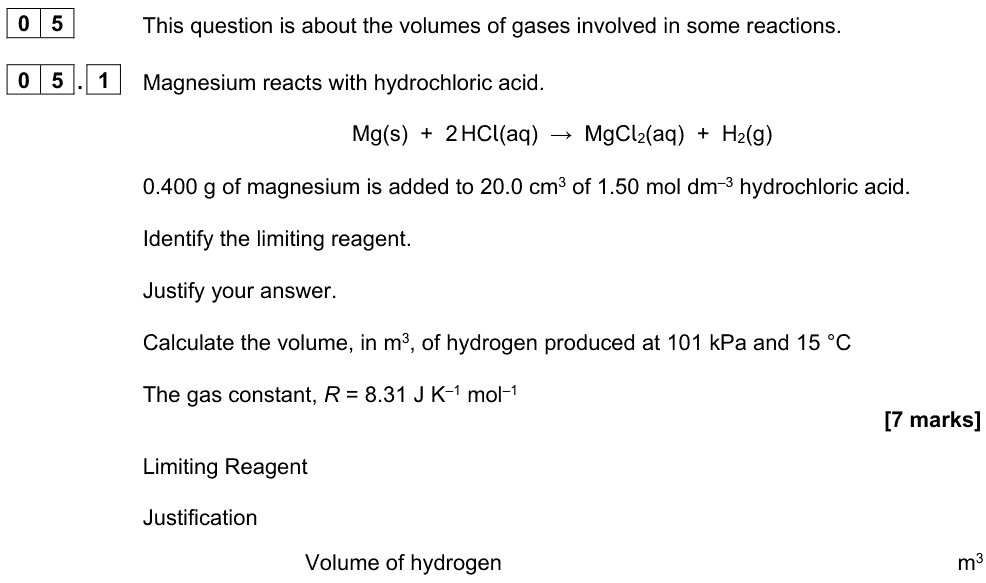
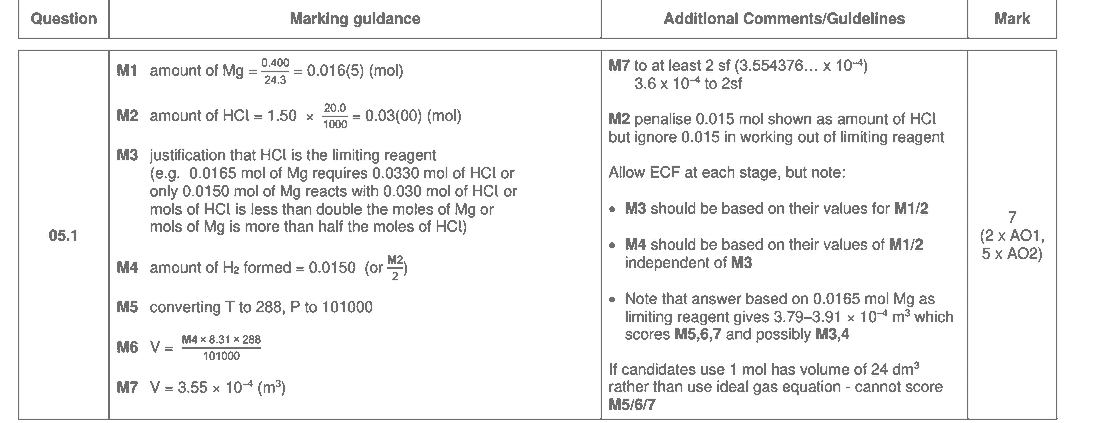
5.1 This question discriminated well. At the start of the question, students had to work out the amount in moles of two substances, one from a mass and one from the volume of a solution. Some students incorrectly divided their amount in moles by the stoichiometric coefficient in the balanced equation. They then had to determine and justify the limiting reagent and many struggled to justify this, some using these incorrect amounts. The second part of the question that
n(HCl) = 1.50 × 20.0 ÷ 1000 = 0.0300 mol, less than the 0.0330 mol needed
n(H2) = 0.0150 mol
V = nRT ÷ p = 0.0150 × 8.31 × 288 ÷ 101 000. Using 24 dm3 per mole loses the last three marks. Errors: dividing the moles by the coefficient before comparing
weak justification
Skills: MS0.0 Recognise and make use of appropriate units in calculation; MS0.2 Use ratios, fractions and percentages; MS2.2 Change the subject of an equation; MS2.3 Substitute numerical values into algebraic equations using appropriate units for physical quantities
June 2024 · AS Paper 2 · Q05.22 marksAO2=2Calculation
Earlier part of question 05 that this part uses
Mark scheme
Examiner's comment
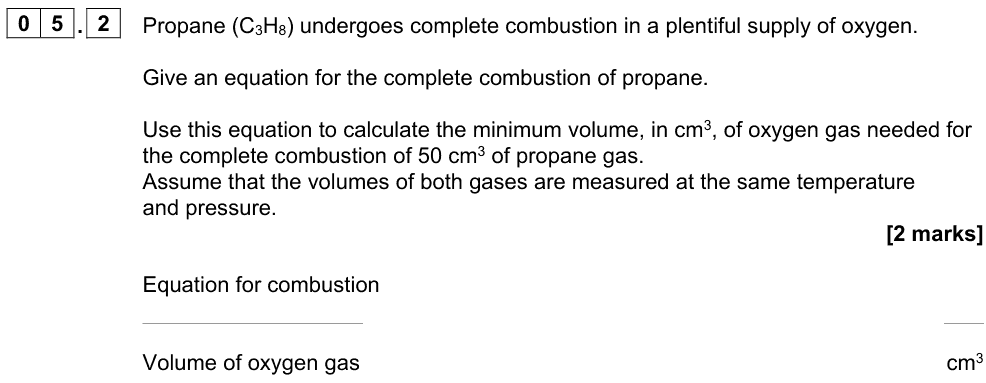
5.2 Students did well on this question. Most could write the balanced equation for the complete combustion of propane, and most could then use this to find the volume of oxygen reacting.
Notes from the mark scheme and report
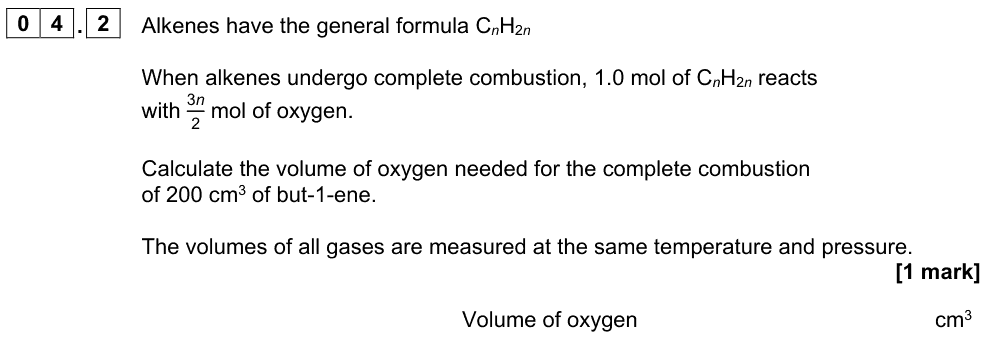
Answer: 250 cm3. C3H8 + 5O2 → 3CO2 + 4H2O
gas volumes are in the same ratio as moles, so 5 × 50 cm3
Skills: MS0.2 Use ratios, fractions and percentages
June 2024 · Paper 2 · Q074 marksAO2=4Calculation
Mark scheme
Examiner's comment
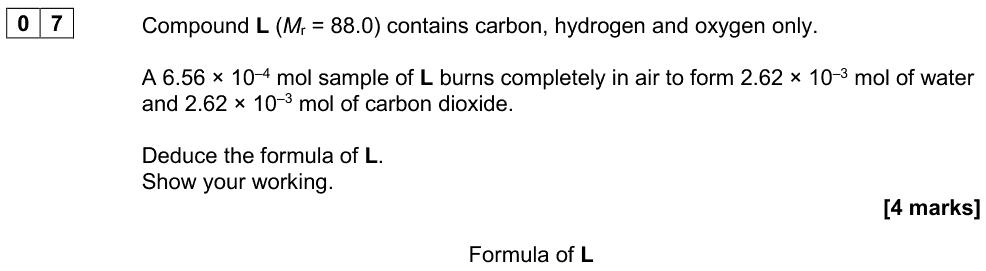
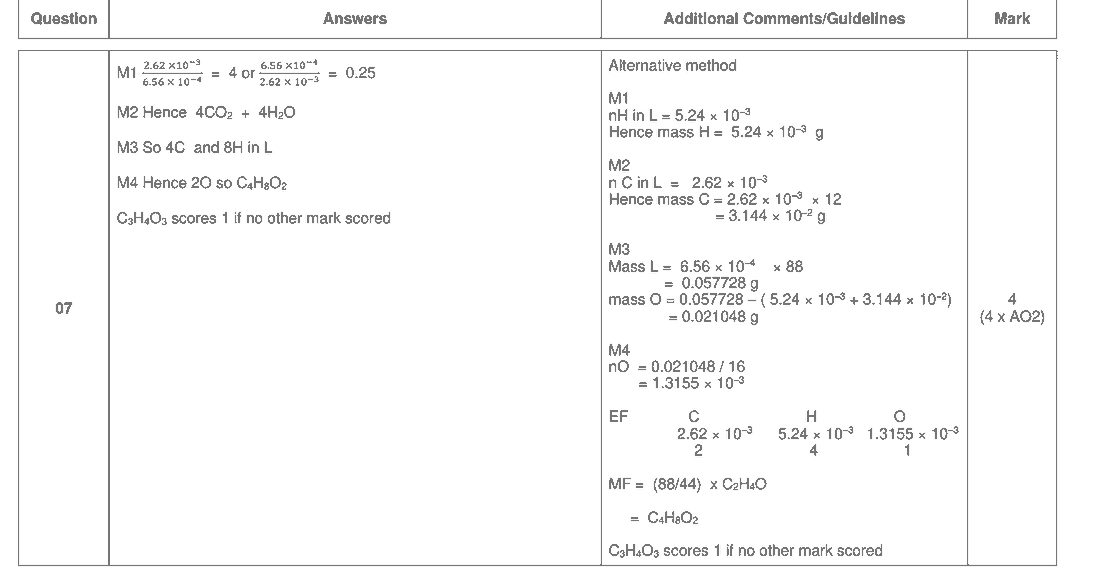
7 Despite being unfamiliar, this calculation was reasonably well answered with nearly 40% gaining all four marks. A variety of methods could be used to get to the final formula and any valid working could gain full credit. Those who didn’t score the marks often worked out the mass of water and carbon dioxide formed. This could have gained credit if they went on to relate this to the mass of carbon and hydrogen in L, but students who went down this route didn’t often make this link. The best students used the mole ratio to work out how many C and H atoms there were in L. Going down this route usually led to the correct final answer although there were marks awarded for those who only got part way through.
Notes from the mark scheme and report
Answer: C4H8O2. 2.62 × 10^–3 ÷ 6.56 × 10^–4 = 4, so each mole of L gives 4CO2 and 4H2O: 4 C and 8 H = 56
88 – 56 = 32, so 2 O. Mass route also allowed. C3H4O3 scores 1 if nothing else scores. Students who found masses of CO2 and H2O rarely linked them to C and H in L
Skills: MS0.1 Recognise and use expressions in decimal and ordinary form; MS0.2 Use ratios, fractions and percentages
June 2024 · AS Paper 2 · Q081 markAO2=1Multiple choice
Answer
A
Mark scheme
Examiner's comment
Percentage yield
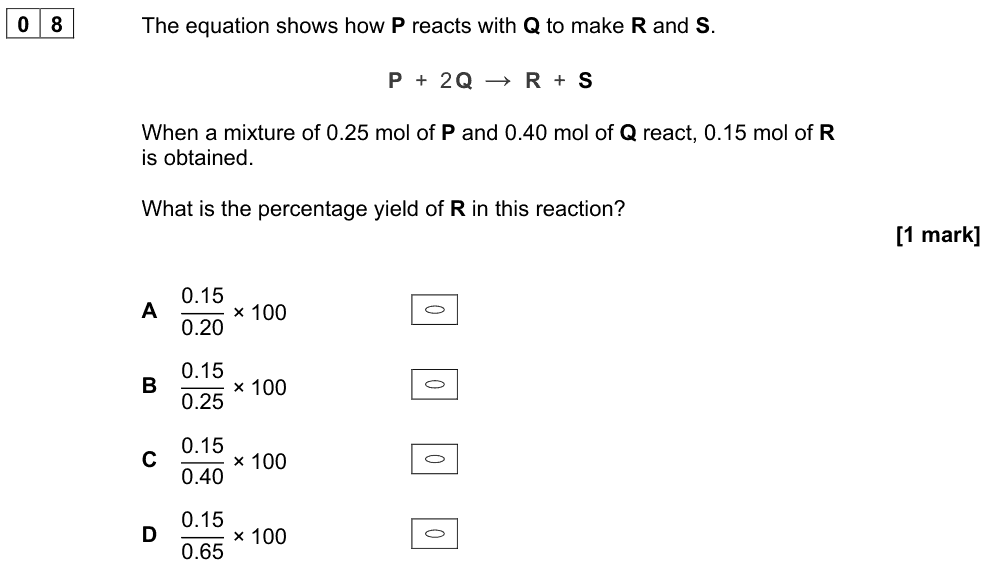
Students struggled with this question with few students understanding percentage yield in a reaction. Many incorrectly believe it is the mass of product formed divided by the mass of reactant(s) as a percentage, rather than mass of product formed divided by the expected mass of product as a percentage.
Notes from the mark scheme and report
Answer: A. Q is limiting (0.40 mol reacts with 0.20 mol of P), so the maximum amount of R is 0.20 mol
yield = 0.15 ÷ 0.20 × 100. Many divided by an amount of reactant
Skills: MS0.2 Use ratios, fractions and percentages
June 2024 · AS Paper 2 · Q091 markAO1=1Multiple choiceEasy
Answer
B
Mark scheme
Examiner's comment
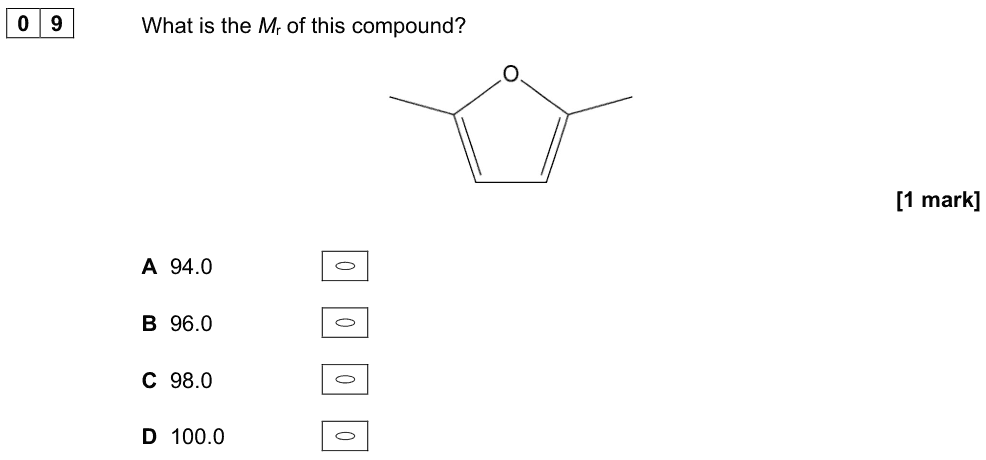
Mr from a skeletal structure
This was answered correctly by a majority (73.4%) of students.
Notes from the mark scheme and report
Answer: B. The skeletal formula is 2,5-dimethylfuran, C6H8O: 6(12.0) + 8(1.0) + 16.0 = 96.0
June 2024 · AS Paper 2 · Q141 markAO1=1Multiple choice
Answer
B
Mark scheme
Examiner's comment
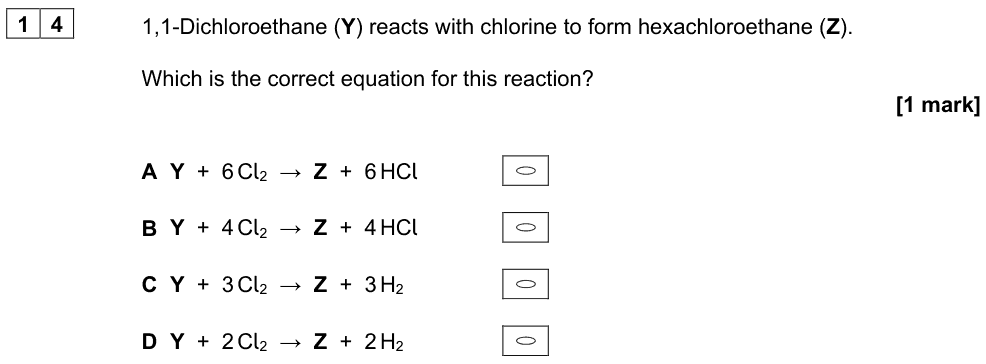
Students found this question difficult, with confusion about whether H2 or HCl is a by-product.
Notes from the mark scheme and report
Answer: B. CH3CHCl2 has four H atoms
each is substituted by Cl with one HCl formed per Cl2 used: C2H4Cl2 + 4Cl2 → C2Cl6 + 4HCl. Confusion over H2 or HCl as the by-product
June 2024 · AS Paper 2 · Q161 markAO2=1Multiple choiceEasy
Answer
B
Mark scheme
Examiner's comment
This was answered correctly by a majority (74.2%) of students.
Notes from the mark scheme and report
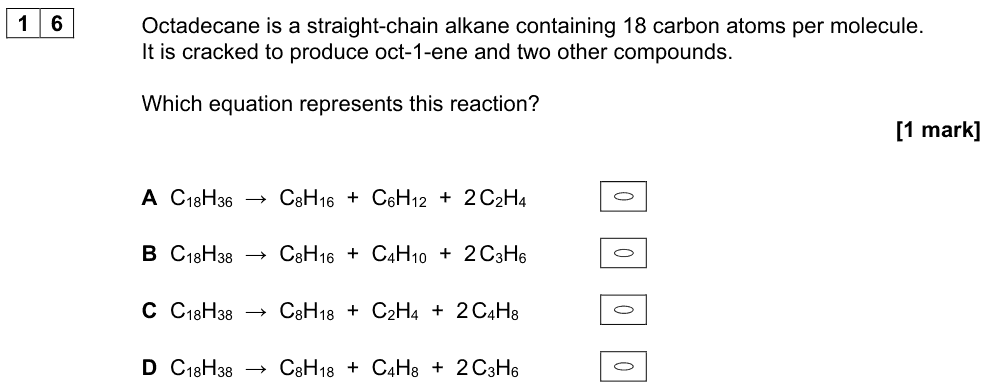
Answer: B. Octadecane is C18H38 and oct-1-ene is C8H16
C8H16 + C4H10 + 2C3H6 balances. A starts from C18H36
C and D give octane, C8H18
June 2024 · AS Paper 2 · Q211 markAO2=1Multiple choiceEasy
Answer
D
Mark scheme
Examiner's comment
This was answered correctly by a majority (67.8%) of students.
Skills: MS0.2 Use ratios, fractions and percentages
June 2024 · AS Paper 2 · Q221 markAO1=1Multiple choice
Answer
A
Mark scheme
Examiner's comment
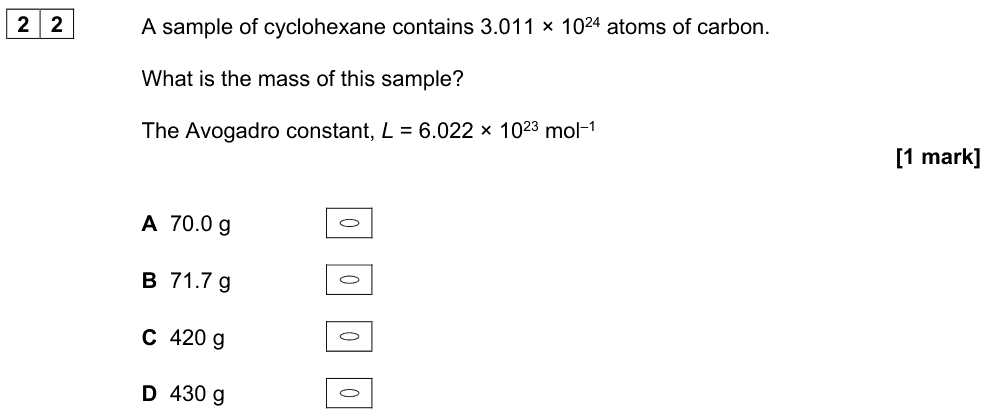
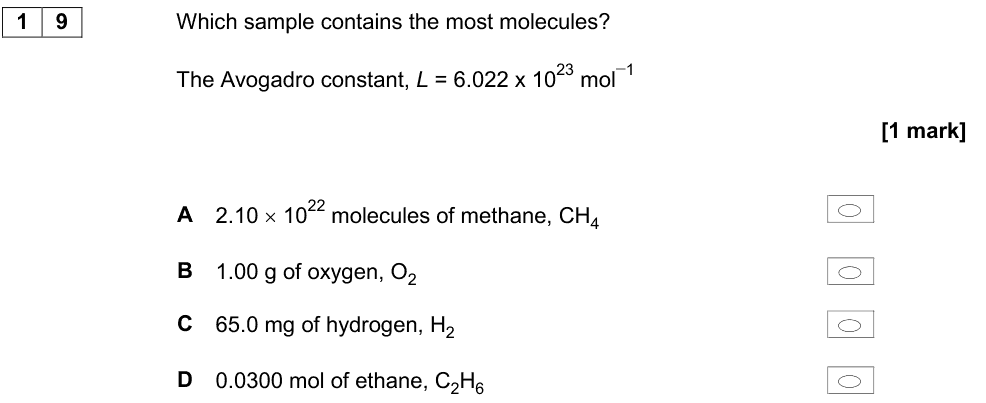
Students found this question difficult, possibly due to it involving the Avogadro constant and/or not taking into account that data in the question gave the number of C atoms rather than the number of molecules.
Notes from the mark scheme and report
Answer: A. 3.011 × 10^24 ÷ 6.022 × 10^23 = 5.00 mol of C atoms
cyclohexane is C6H12, so 5.00 ÷ 6 = 0.833 mol
× 84.0 = 70.0 g. Found difficult: the data give atoms of carbon, not molecules
Skills: MS0.1 Recognise and use expressions in decimal and ordinary form; MS0.2 Use ratios, fractions and percentages
June 2024 · Paper 3 · Q02.32 marksAO2=2Explanation
Earlier part of question 02 that this part uses
Mark scheme
Examiner's comment
02.3 also proved very tricky.
This question depended on interpreting the data provided within the question and there were two possible routes to the answer.
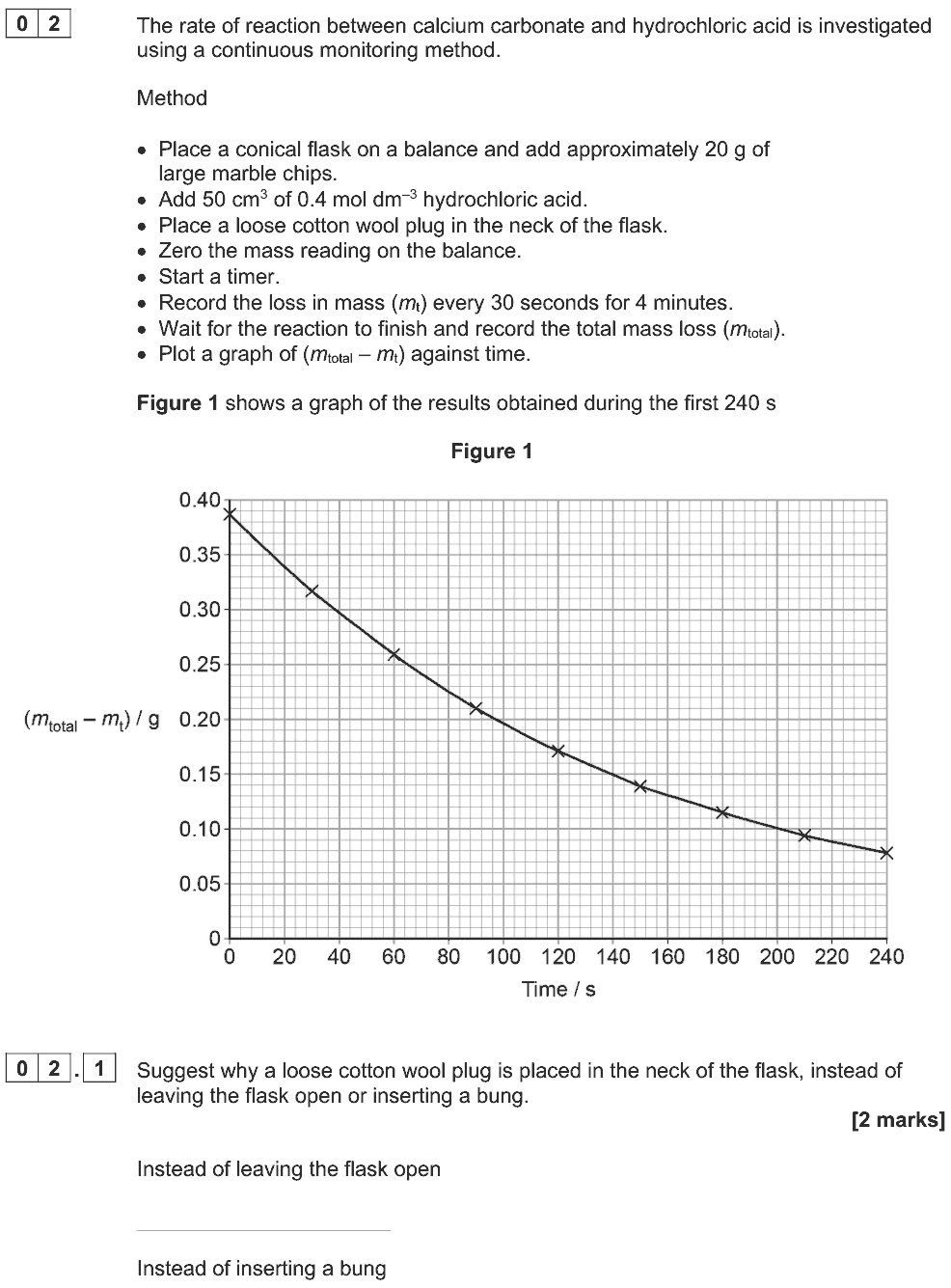
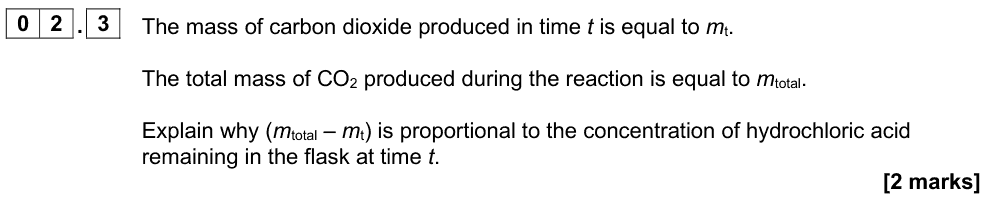
The first route required students to recognise that mt / mass of CO2 produced in time t would represent the hydrochloric acid that had reacted up to that time, while mtotal / total mass of CO2 produced represents the total hydrochloric acid that reacts (which, as the calcium carbonate is in excess, is also a measure of the initial amount/concentration of the acid).
The expression (mtotal – mt) is therefore proportional to ([HCl]initial – [HCl]t) and thus represents the remaining concentration of hydrochloric acid.
Alternatively students could recognise that (mtotal – mt) corresponds to total CO2 produced – CO2 produced up to time t and therefore represents the mass of CO2 yet to be produced which will, in turn, depend on the remaining hydrochloric acid.
Correct references to proportionality were not insisted upon and references to ‘being equal to’ or representing, etc, were accepted as were various references to volumes, masses and concentrations or amounts.
This was a question where many students failed to score as a result of them repeating the relationship they were asked to explain.
Notes from the mark scheme and report
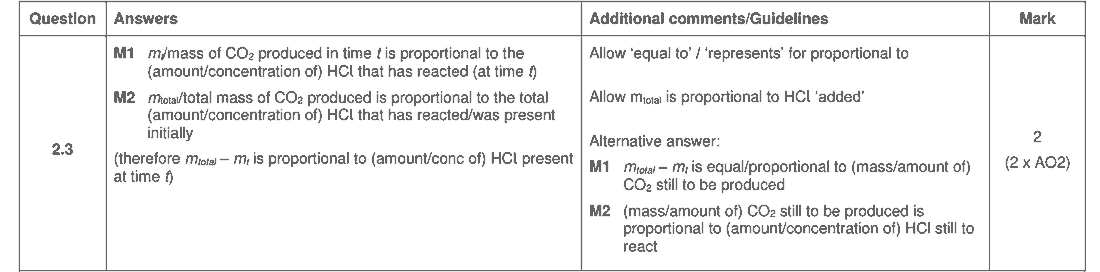
mt (mass of CO2 formed by time t) is proportional to the HCl that has reacted
mtotal is proportional to the total HCl that reacts (the amount present initially)
so the difference is proportional to the HCl remaining. Alternative: (mtotal – mt) is the CO2 still to be produced, which is proportional to the HCl still to react. Many simply repeated the statement
Skills: PS3.2 Process and analyse data using appropriate mathematical skills as exemplified in the mathematical appendix for each science; MS0.2 Use ratios, fractions and percentages; RP7 Measuring the rate of reaction: by an initial rate method; by a continuous monitoring method
June 2024 · Paper 3 · Q081 markAO2=1Multiple choice
Answer
A
Mark scheme
Notes from the mark scheme and report
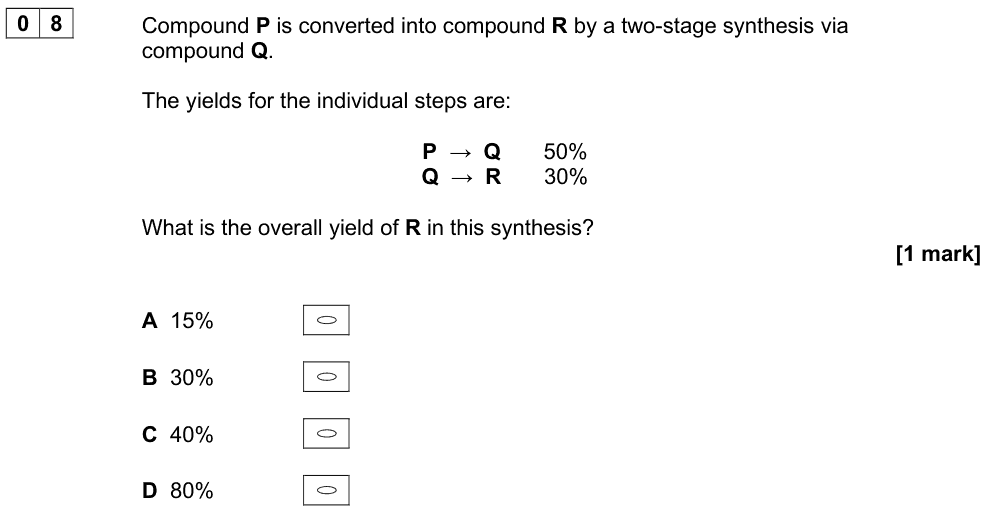
Answer: A. 0.50 × 0.30 = 0.15, so 15%
Skills: MS0.2 Use ratios, fractions and percentages
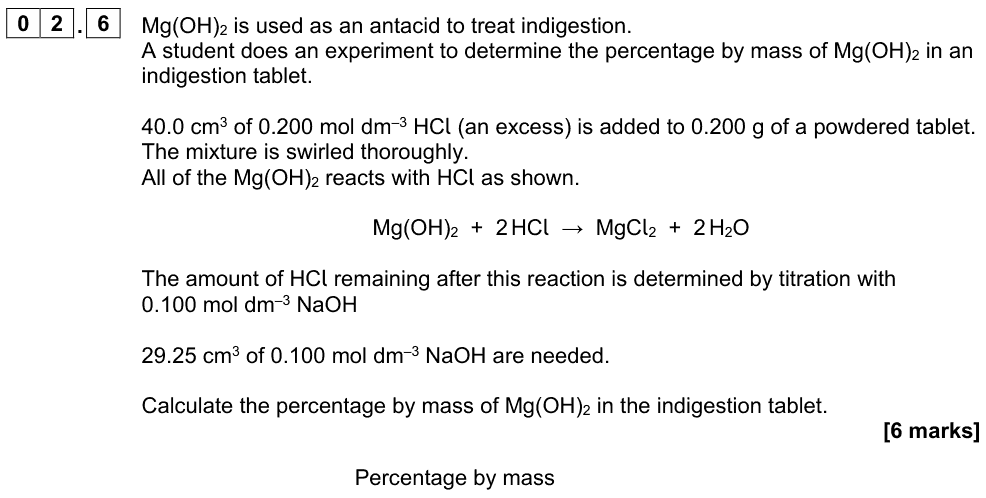
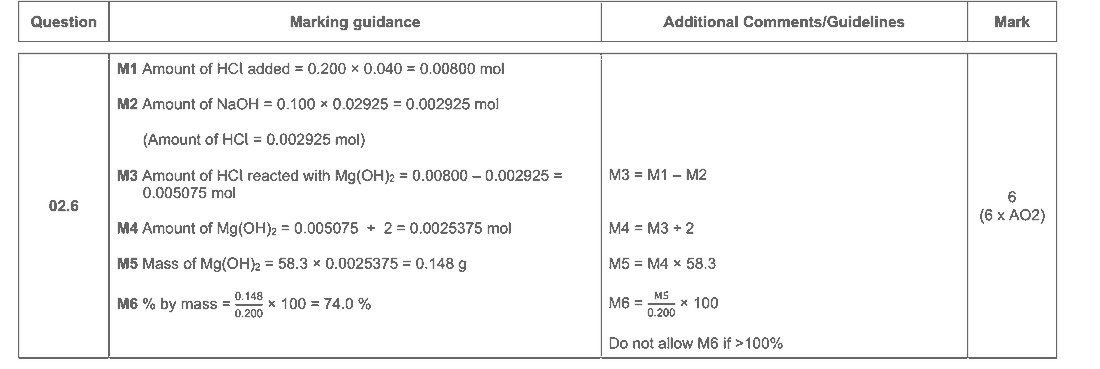
June 2023 · AS Paper 1 · Q02.66 marksAO2=6CalculationHard
Earlier part of question 02 that this part uses
Mark scheme
Examiner's comment
02.6 This was a challenging calculation with only about a third of students scoring all the marks. Students did not always apply the stoichiometry of the equation and used incorrect Mr values for Mg(OH)2. They also did not always appreciate that it was the excess of hydrochloric acid that reacted with the sodium hydroxide and that they could use this to determine the amount of hydrochloric acid that reacted with the Mg(OH)2 in the tablets by subtraction.
Notes from the mark scheme and report
Answer: 74.0%. n(HCl) added = 0.00800 mol
n(NaOH) = n(HCl) left = 0.002925 mol
HCl reacted = 0.005075 mol
÷ 2 = 0.0025375 mol Mg(OH)2
× 58.3 = 0.148 g
÷ 0.200 × 100. Errors: ignoring the 1:2 ratio
wrong Mr
not using the subtraction (back titration). An answer above 100% loses M6
Skills: MS0.0 Recognise and make use of appropriate units in calculation; MS0.2 Use ratios, fractions and percentages; MS2.3 Substitute numerical values into algebraic equations using appropriate units for physical quantities; RP1 Make up a volumetric solution and carry out a simple acid–base titration
June 2023 · AS Paper 1 · Q03.13 marksAO3=3Practical and data analysis
Mark scheme
Examiner's comment
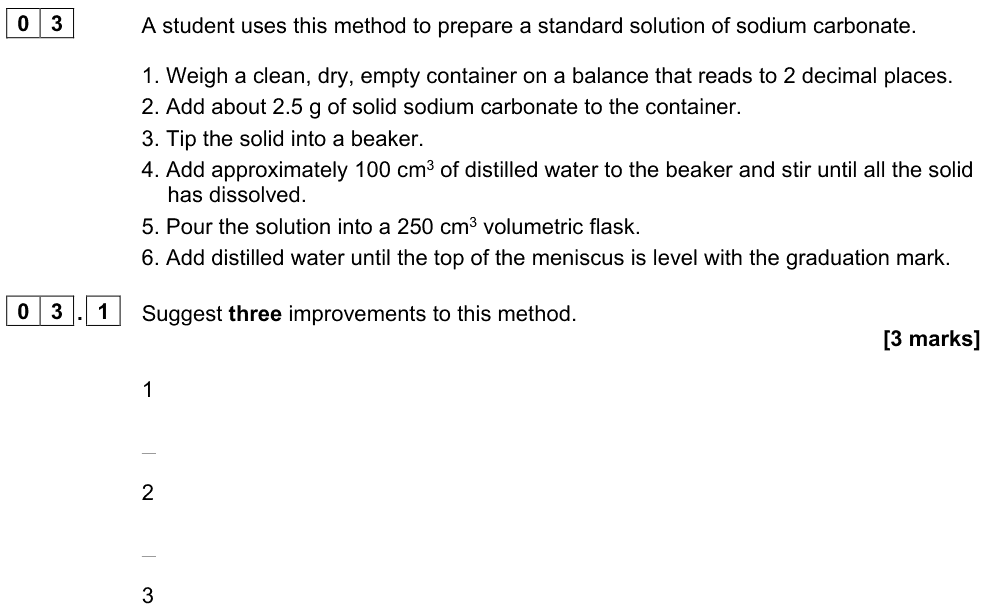
03.1 This was a challenging question. Some students mentioned changes to the apparatus rather than changes to the method used. Students were not always clear with their improvements to the method. Any discussion of washing should include an indication of where the washings were going. Most students understood that it is the bottom of the meniscus that should be level with the graduation mark rather than the top of the meniscus.
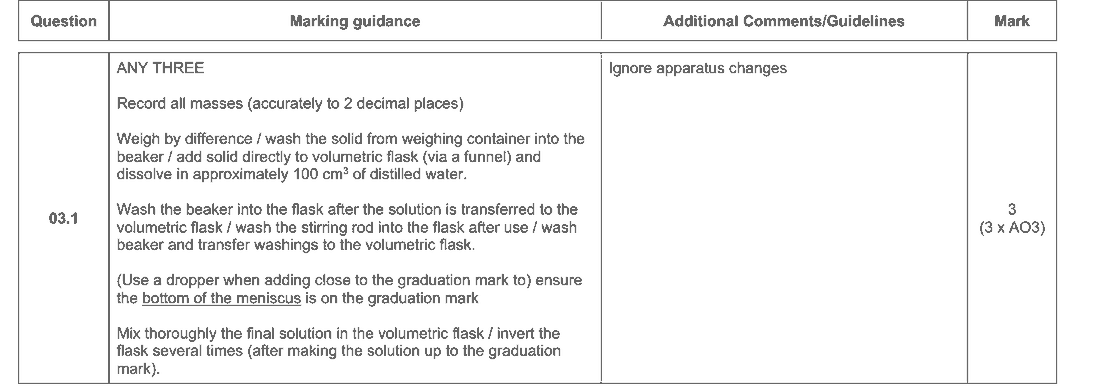
Notes from the mark scheme and report
Any three: record all masses (to 2 d.p.)
weigh by difference or wash the solid from the container into the beaker
wash the beaker/stirring rod and add the washings to the volumetric flask
make up so the bottom of the meniscus is on the mark (using a dropper near the mark)
invert the flask several times to mix. Changes of apparatus are ignored
say where the washings go
Skills: ATe Use volumetric flask, including accurate technique for making up a standard solution; ATa Use appropriate apparatus to record a range of measurements (to include mass, time, volume of liquids and gases, temperature); PS2.1 Comment on experimental design and evaluate scientific methods; PS4.1 Know and understand how to use a wide range of experimental and practical instruments, equipment and techniques appropriate to the knowledge and understanding included in the specification; RP1 Make up a volumetric solution and carry out a simple acid–base titration
June 2023 · AS Paper 1 · Q03.21 markAO2=1Practical and data analysisEasy
Earlier part of question 03 that this part uses
Mark scheme
Examiner's comment
03.2 This was well answered by students with about three-quarters scoring the mark. Doubling the uncertainty was the most common error.
Notes from the mark scheme and report
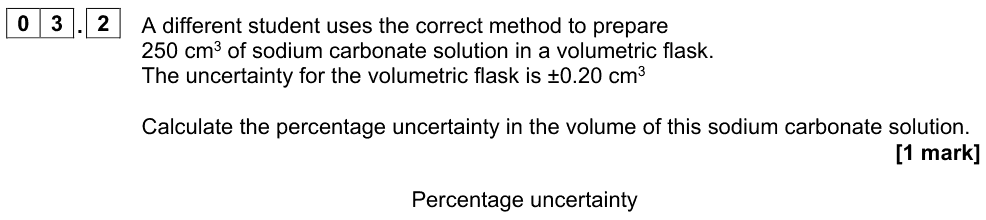
Answer: 0.080%. (0.20 ÷ 250) × 100. Most common error: doubling the uncertainty
Skills: MS1.3 Identify uncertainties in measurements and use simple techniques to determine uncertainty when data are combined; MS0.2 Use ratios, fractions and percentages; PS2.3 Evaluate results and draw conclusions with reference to measurement uncertainties and errors; RP1 Make up a volumetric solution and carry out a simple acid–base titration
June 2023 · AS Paper 1 · Q045 marksAO2=4, AO3=1Calculation
Mark scheme
Examiner's comment
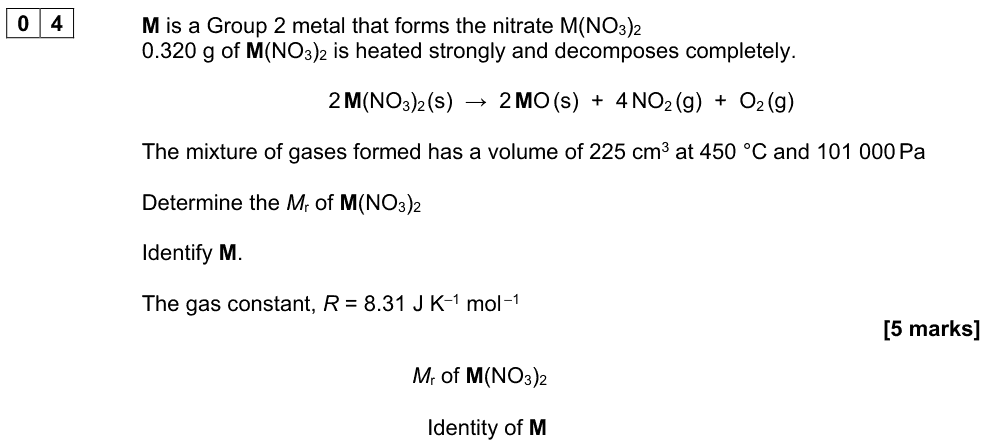
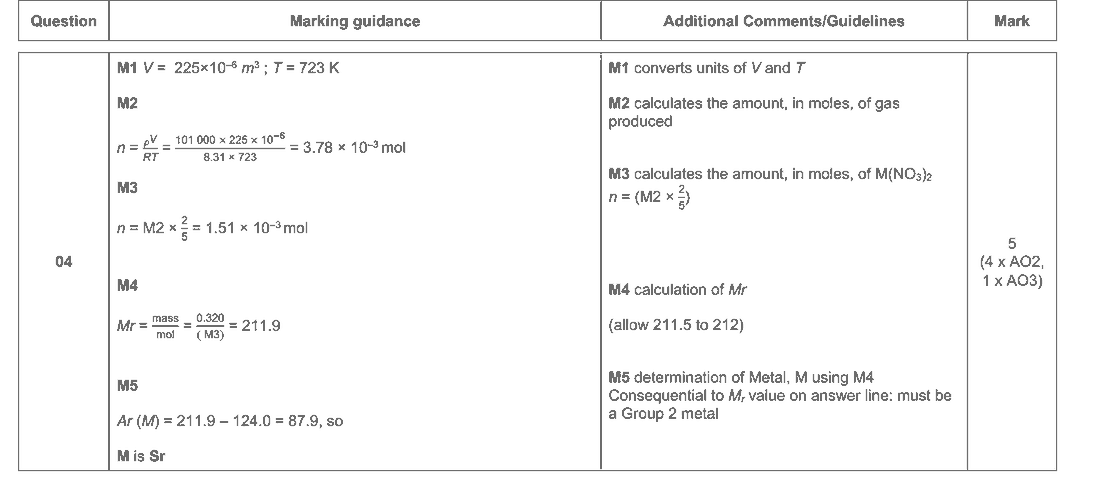
04 Students should be encouraged to set out working with a clear explanation of each step in a calculation rather than just writing down a set of different numerical expressions. There were a number of incorrect rearrangements of the ideal gas equation and incorrect unit conversions. Also, a good number of students did not use the equation stoichiometry.
Notes from the mark scheme and report
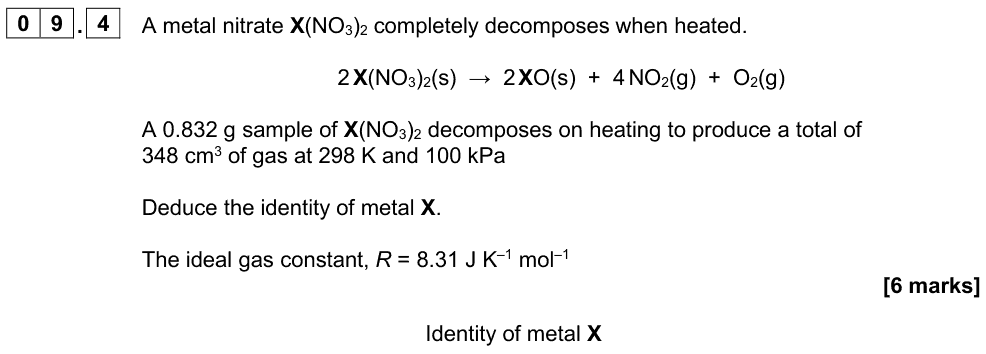
Answer: Mr = 211.9 (allow 211.5 to 212)
M = Sr. V = 225 × 10^–6 m3, T = 723 K
n(gas) = pV/RT = 3.78 × 10^–3 mol
× 2/5 = 1.51 × 10^–3 mol of nitrate
Mr = 0.320 ÷ 1.51 × 10^–3
Ar = 211.9 – 124.0 = 87.9. M must be a Group 2 metal. Errors: wrong rearrangement, wrong unit conversions, ignoring the 2:5 ratio
Skills: MS0.0 Recognise and make use of appropriate units in calculation; MS0.2 Use ratios, fractions and percentages; MS2.2 Change the subject of an equation; MS2.3 Substitute numerical values into algebraic equations using appropriate units for physical quantities
June 2023 · Paper 1 · Q06.11 markAO2=1Calculation
Mark scheme
Examiner's comment
Answers to 06.1 were generally good; a common error was omitting to convert the volume from cm3 to dm3.
Notes from the mark scheme and report
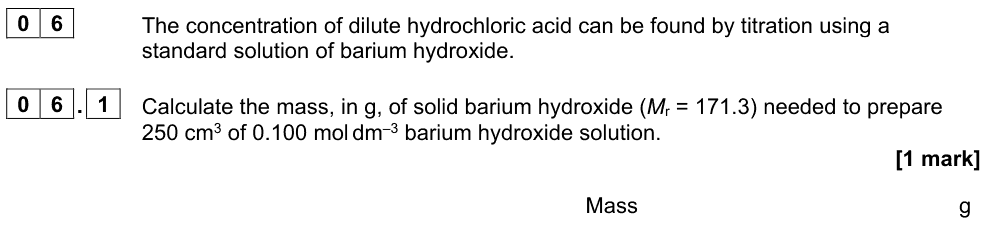
Answer: 4.28 g (0.100 × 0.250 × 171.3
allow 4.3). Common error: volume not converted to dm3
Skills: MS0.0 Recognise and make use of appropriate units in calculation; RP1 Make up a volumetric solution and carry out a simple acid–base titration
June 2023 · Paper 1 · Q06.23 marksAO2=3Practical and data analysis
Earlier part of question 06 that this part uses
Mark scheme
Examiner's comment
Many students found the description in 06.2 challenging.
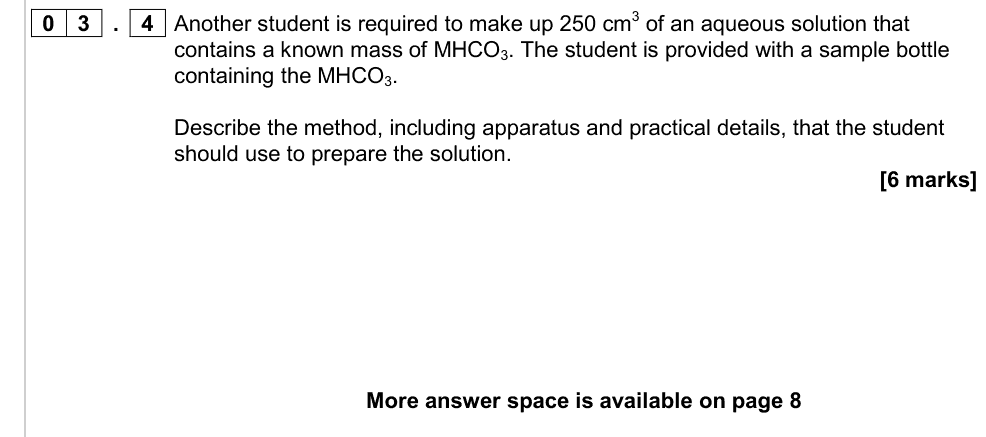
Many students did not transfer the solution from the beaker to a volumetric flask and made the solution up to 250 cm3 in the original beaker; some transferred the solution to a conical flask.
Many students did not state that the beaker and stirring rod should be washed with distilled water and the washings transferred to the flask before making the solution up to the 250 cm3 mark.
Several students forgot to invert the flask to ensure thorough mixing.
Notes from the mark scheme and report
Transfer the solution to a 250 cm3 volumetric (graduated) flask
rinse the beaker (and rod) with distilled water and add the washings, then make up to the mark
stopper and invert several times to mix. Errors: making up to 250 cm3 in the beaker or a conical flask
no washings
no mixing
Skills: ATe Use volumetric flask, including accurate technique for making up a standard solution; ATk Safely and carefully handle solids and liquids, including corrosive, irritant, flammable and toxic substances; PS4.1 Know and understand how to use a wide range of experimental and practical instruments, equipment and techniques appropriate to the knowledge and understanding included in the specification; RP1 Make up a volumetric solution and carry out a simple acid–base titration
June 2023 · Paper 1 · Q06.31 markAO3=1Practical and data analysis
Earlier part of question 06 that this part uses
Mark scheme
Examiner's comment
Answers to 06.3 were good.
Notes from the mark scheme and report
So that water left in the pipette does not dilute the solution / the barium hydroxide delivered has the known concentration
Skills: ATd Use laboratory apparatus for a variety of experimental techniques including: titration, using burette and pipette; distillation and heating under reflux, including setting up glassware using retort stand and clamps; qualitative tests for ions and organic functional groups; filtration, including use of fluted filter paper, or filtration under reduced pressure; PS2.1 Comment on experimental design and evaluate scientific methods; RP1 Make up a volumetric solution and carry out a simple acid–base titration
June 2023 · Paper 1 · Q06.41 markAO1=1Practical and data analysis
Earlier part of question 06 that this part uses
Mark scheme
Examiner's comment
In 06.4, most students realised that acid could continue to drip into the burette, thus affecting the titre; some students thought the titre would increase, and some thought the stem of the funnel would alter the volume by displacing acid at the top of the burette.
Notes from the mark scheme and report
Drops of acid could fall from the funnel into the burette, giving a lower titre. 'Changes the titre' is ignored
'increases the titre' is wrong
Skills: ATd Use laboratory apparatus for a variety of experimental techniques including: titration, using burette and pipette; distillation and heating under reflux, including setting up glassware using retort stand and clamps; qualitative tests for ions and organic functional groups; filtration, including use of fluted filter paper, or filtration under reduced pressure; PS2.1 Comment on experimental design and evaluate scientific methods; RP1 Make up a volumetric solution and carry out a simple acid–base titration
June 2023 · Paper 1 · Q06.53 marksAO2=3CalculationHard
Earlier part of question 06 that this part uses
Mark scheme
Examiner's comment
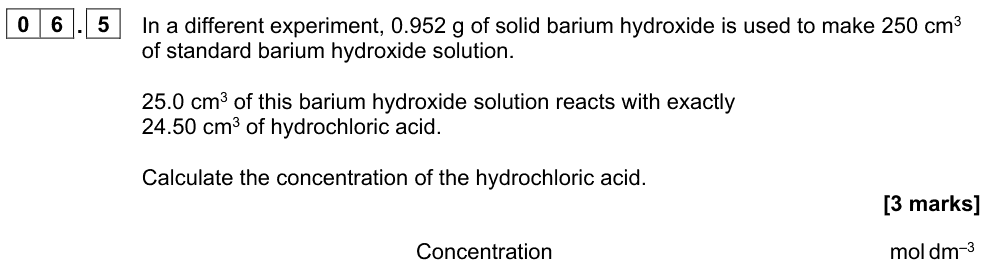
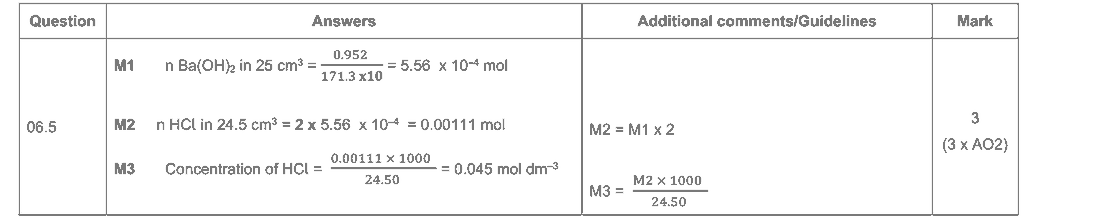
In 06.5, 30% of students gained all the marks; common errors included using the wrong Mr of barium hydroxide, not calculating the amount in moles of barium hydroxide in 25 cm3, not realising there was a 2:1 ratio and dividing by the wrong volume to calculate the concentration.
÷ 0.02450 dm3. Errors: wrong Mr, not scaling to 25 cm3, missing the 2:1 ratio, dividing by the wrong volume
Skills: MS0.0 Recognise and make use of appropriate units in calculation; MS0.2 Use ratios, fractions and percentages; RP1 Make up a volumetric solution and carry out a simple acid–base titration
June 2023 · Paper 1 · Q06.61 markAO2=1Practical and data analysis
Earlier part of question 06 that this part uses
Mark scheme
Examiner's comment
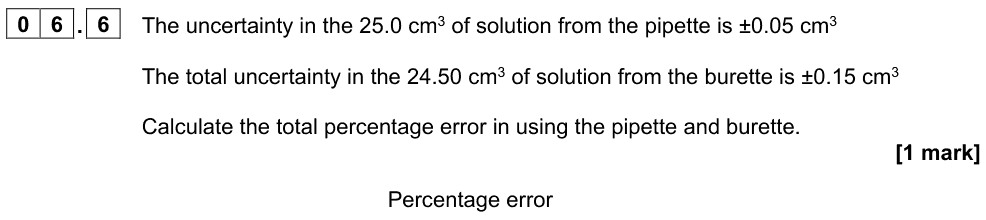
Answers to 06.6 were generally poor; many students added together the uncertainty in the pipette and the uncertainty in the burette and then divided by the total volume of both.
Notes from the mark scheme and report
Answer: 0.81% (accept 0.8). (0.15 ÷ 24.50 × 100) + (0.05 ÷ 25.0 × 100). Common error: adding the two uncertainties and dividing by the total volume
Skills: MS1.3 Identify uncertainties in measurements and use simple techniques to determine uncertainty when data are combined; PS3.3 Consider margins of error, accuracy and precision of data; RP1 Make up a volumetric solution and carry out a simple acid–base titration
June 2023 · AS Paper 1 · Q07.15 marksAO2=4, AO3=1Calculation
Mark scheme
Notes from the mark scheme and report
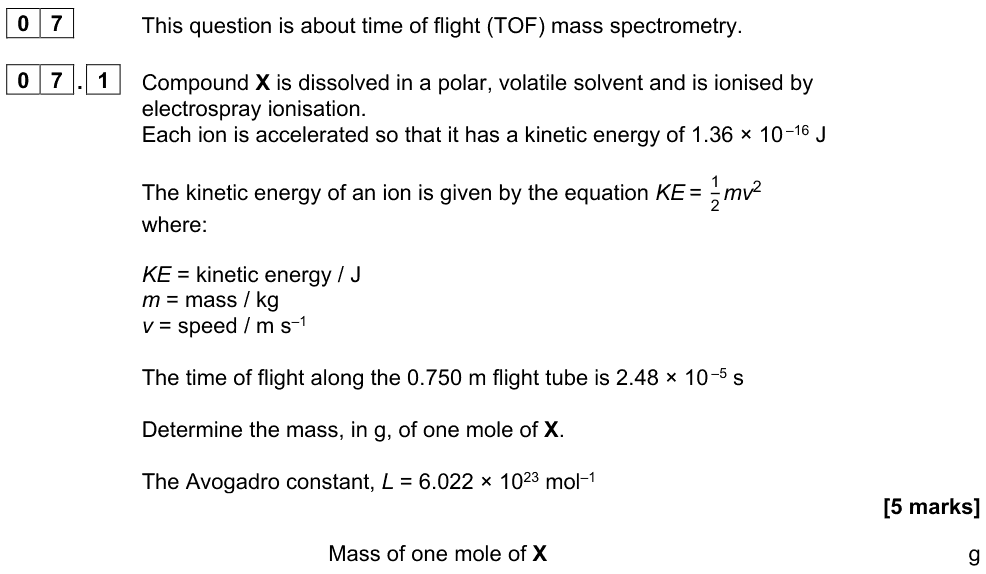
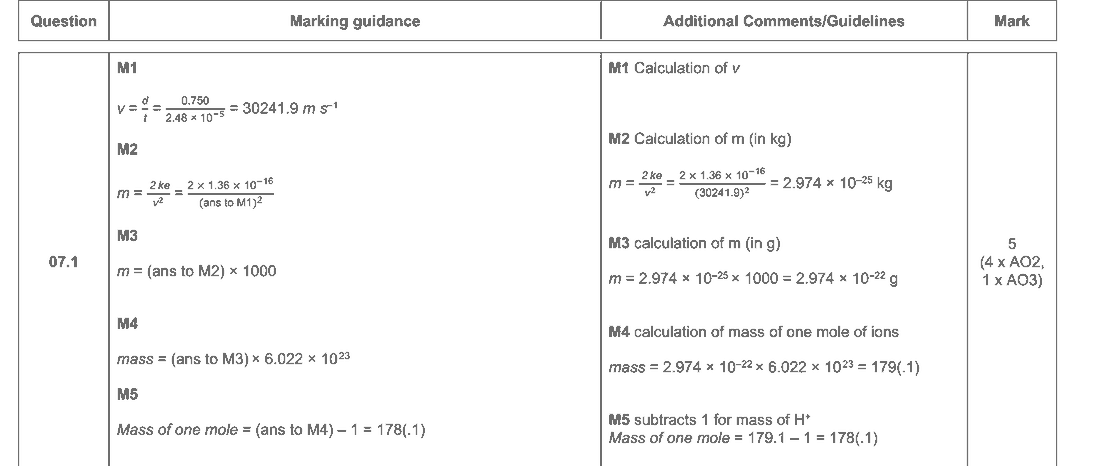
Answer: 178 g. v = d/t = 0.750 ÷ 2.48 × 10^–5 = 30 242 m s–1
m = 2KE/v² = 2.974 × 10^–25 kg
× 1000 for g
× L = 179.1
subtract 1 for the H+ gained in electrospray ionisation
Skills: MS0.0 Recognise and make use of appropriate units in calculation; MS0.1 Recognise and use expressions in decimal and ordinary form; MS2.2 Change the subject of an equation; MS2.3 Substitute numerical values into algebraic equations using appropriate units for physical quantities
June 2023 · Paper 1 · Q07.21 markAO1=1Equation writing
Earlier part of question 07 that this part uses
Mark scheme
Examiner's comment
In 07.2, the correct equation was given by 35% of students; common errors included 6 waters on the LHS of the equation and missing the 2– charge on SO42–.
Notes from the mark scheme and report
Al2(SO4)3 + 12H2O → 2[Al(H2O)6]3+ + 3SO4 2–. Errors: 6H2O on the left
charge missing on sulfate (35% correct)
June 2023 · Paper 1 · Q07.87 marksAO2=7Calculation
Earlier part of question 07 that this part uses
Mark scheme
Examiner's comment
Question 07.8 discriminated very well.
Most students could calculate the amount, in moles, of Zn2+ and EDTA4– and many then subtracted correctly to get M3; common errors in answers included not multiplying by 10, not dividing by 2 and not giving the answer as an integer.
Some students incorrectly calculated the Mr of Al2(SO4)3 even though this value was given in the question.
Notes from the mark scheme and report
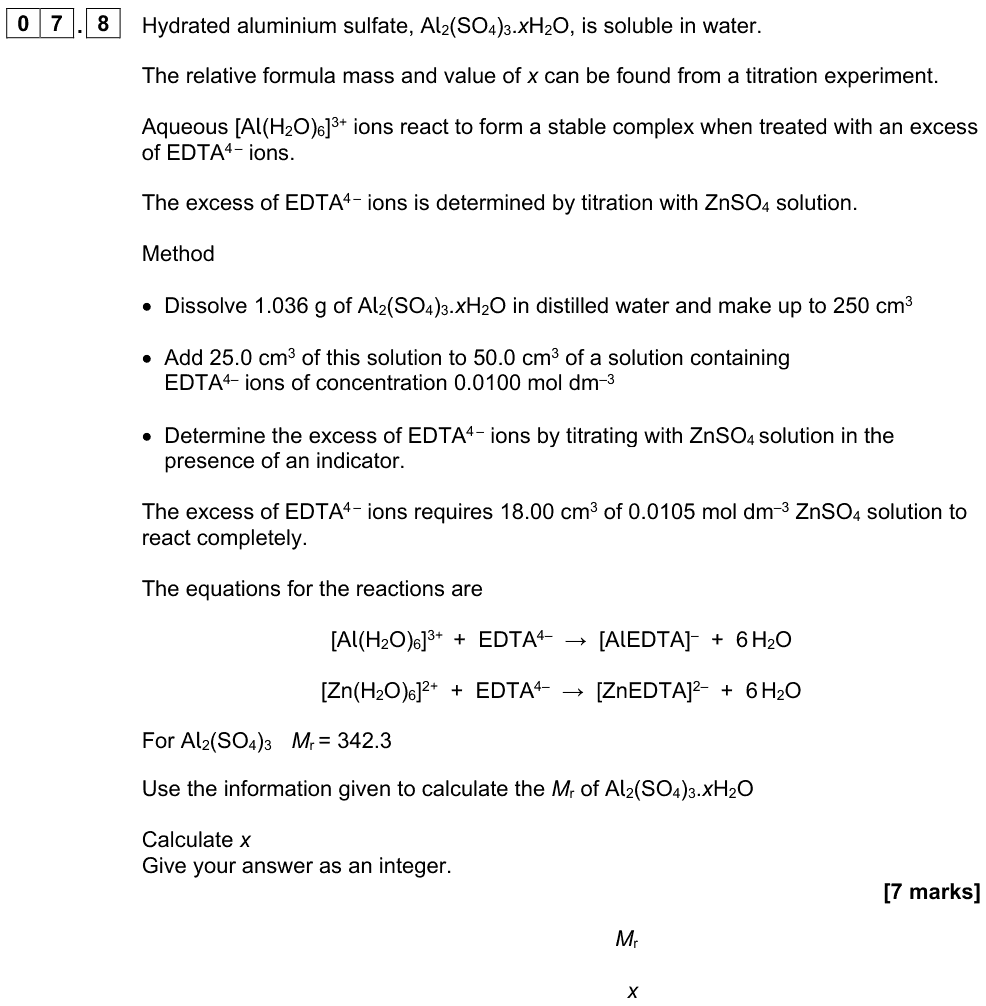
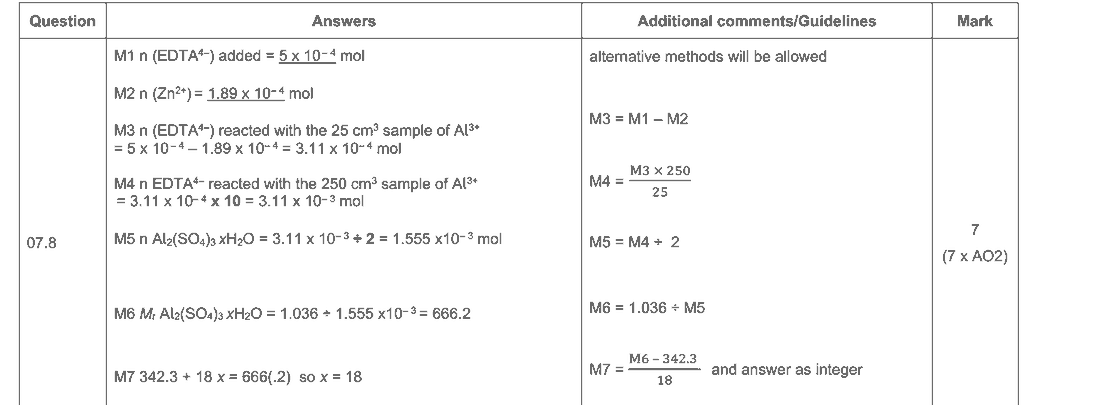
Answer: Mr = 666 (666.2)
x = 18. n(EDTA4–) added = 5.00 × 10^–4 mol
n(Zn2+) = excess EDTA = 1.89 × 10^–4 mol
EDTA reacted with Al3+ in 25.0 cm3 = 3.11 × 10^–4 mol
× 10 = 3.11 × 10^–3 mol Al3+ in 250 cm3
÷ 2 = 1.555 × 10^–3 mol of salt
Mr = 1.036 ÷ 1.555 × 10^–3
x = (666.2 – 342.3) ÷ 18. Errors: not multiplying by 10, not dividing by 2, x not an integer
Skills: MS0.0 Recognise and make use of appropriate units in calculation; MS0.2 Use ratios, fractions and percentages; MS2.2 Change the subject of an equation
June 2023 · Paper 1 · Q09.25 marksAO1=1, AO2=4Calculation
Earlier part of question 09 that this part uses
Mark scheme
Examiner's comment
In 09.2, 36% of students gained all of the marks.
Common errors included rearranging the equation incorrectly, not converting cm to m, not converting kg to g, incorrect use of the Avogadro constant and not giving the mass number as an integer.
Notes from the mark scheme and report
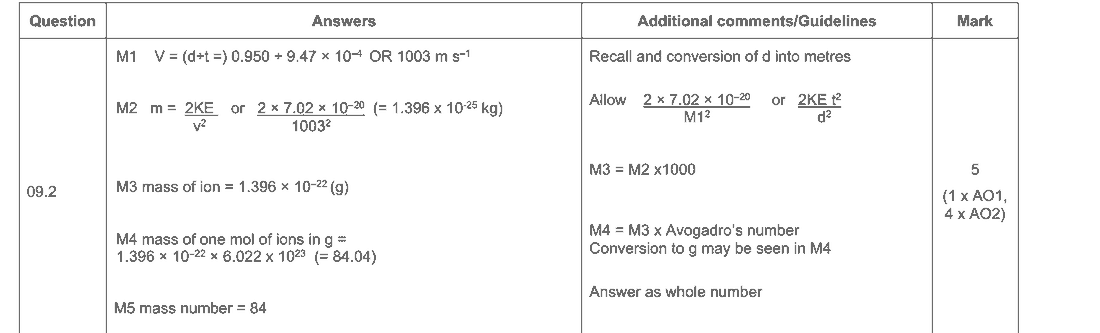
Answer: 84. v = d/t = 0.950 ÷ 9.47 × 10^–4 = 1003 m s–1
m = 2KE/v² = 1.396 × 10^–25 kg = 1.396 × 10^–22 g
× 6.022 × 10^23 = 84.04. Errors: wrong rearrangement, cm not converted to m, kg not converted to g, misuse of L, answer not an integer (36% scored all 5)
Skills: MS0.0 Recognise and make use of appropriate units in calculation; MS0.1 Recognise and use expressions in decimal and ordinary form; MS2.2 Change the subject of an equation; MS2.3 Substitute numerical values into algebraic equations using appropriate units for physical quantities
June 2023 · AS Paper 1 · Q101 markAO3=1Multiple choice
Answer
C
Mark scheme
Notes from the mark scheme and report
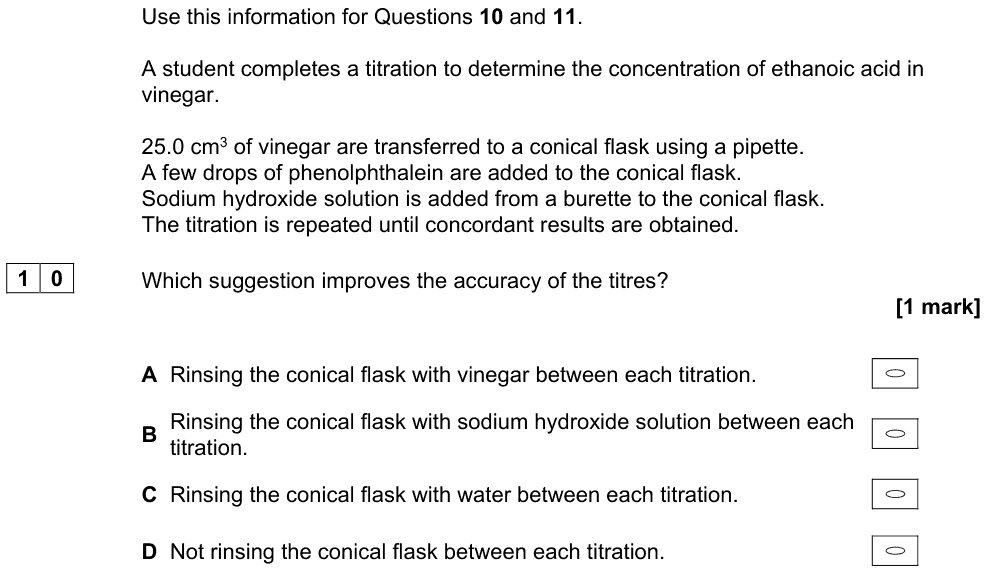
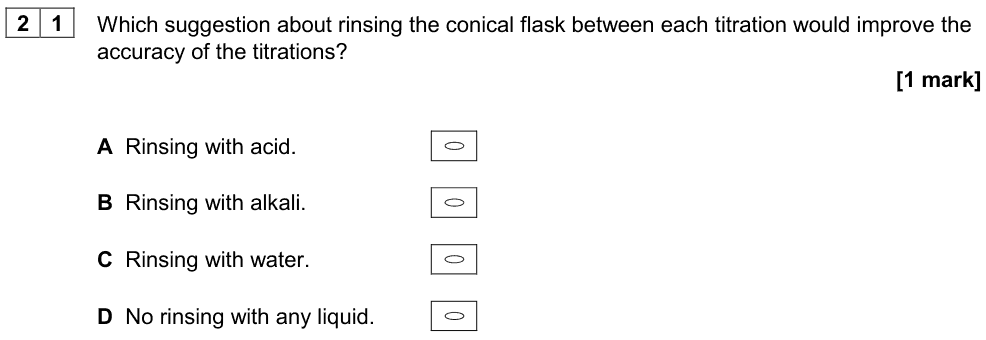
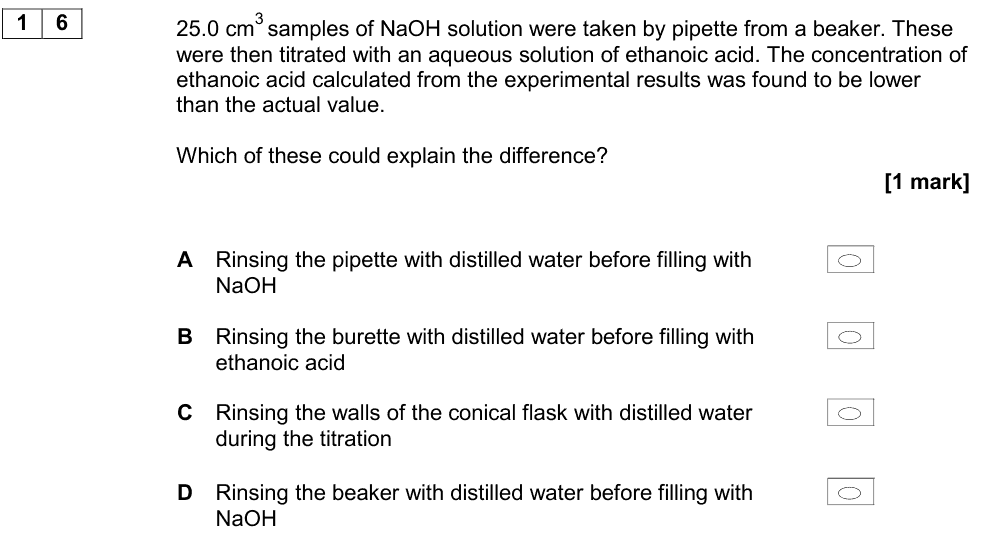
Answer: C. Rinsing with water removes the previous mixture without changing the amount of acid or alkali in the flask
rinsing with vinegar or NaOH would add reagent. Common wrong answer: A
Skills: ATd Use laboratory apparatus for a variety of experimental techniques including: titration, using burette and pipette; distillation and heating under reflux, including setting up glassware using retort stand and clamps; qualitative tests for ions and organic functional groups; filtration, including use of fluted filter paper, or filtration under reduced pressure; PS2.1 Comment on experimental design and evaluate scientific methods; RP1 Make up a volumetric solution and carry out a simple acid–base titration
June 2023 · AS Paper 1 · Q111 markAO3=1Multiple choice
Earlier part of question 11 that this part uses
Answer
A
Mark scheme
Notes from the mark scheme and report
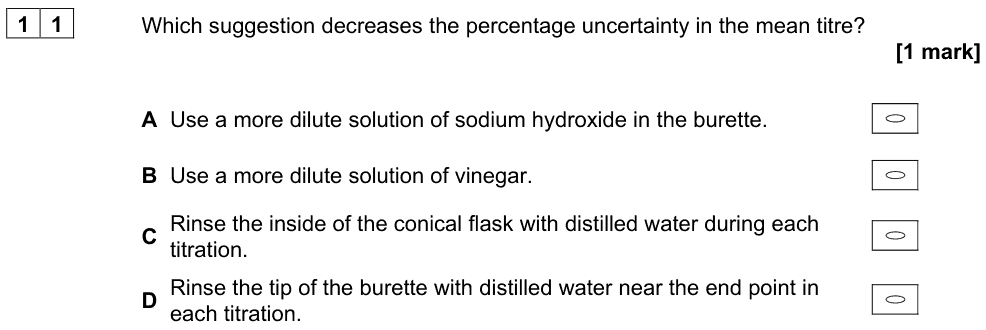
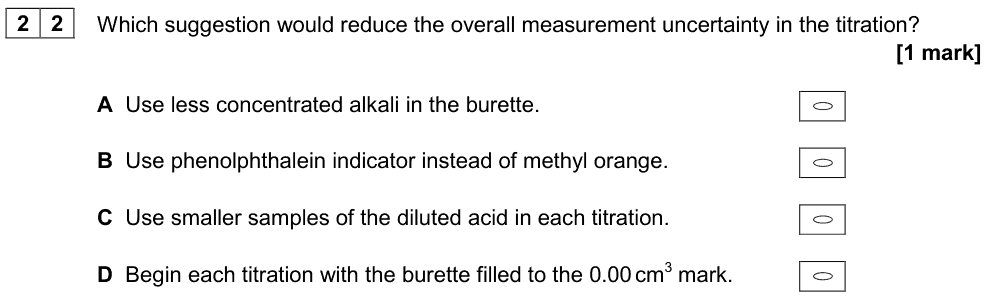
Answer: A. More dilute NaOH gives a larger titre, so the same burette uncertainty is a smaller percentage. Common wrong answer: rinsing with distilled water
Skills: ATd Use laboratory apparatus for a variety of experimental techniques including: titration, using burette and pipette; distillation and heating under reflux, including setting up glassware using retort stand and clamps; qualitative tests for ions and organic functional groups; filtration, including use of fluted filter paper, or filtration under reduced pressure; MS1.3 Identify uncertainties in measurements and use simple techniques to determine uncertainty when data are combined; PS2.3 Evaluate results and draw conclusions with reference to measurement uncertainties and errors; RP1 Make up a volumetric solution and carry out a simple acid–base titration
June 2023 · AS Paper 1 · Q121 markAO1=1Multiple choiceEasy
Answer
D
Mark scheme
Examiner's comment
The majority of students (68%) were able to deduce which equation had the highest atom economy for the production of hydrogen.
Notes from the mark scheme and report
Answer: D. 6.0 ÷ 34.0 = 17.6%, the largest fraction of the reactant mass ending up as H2
Skills: MS0.2 Use ratios, fractions and percentages
June 2023 · AS Paper 2 · Q02.42 marksAO1=2Equation writing
Earlier part of question 02 that this part uses
Mark scheme
Examiner's comment
02.4 Students determined the molecular formula of a compound from its name / skeletal formula and then wrote a balanced equation for its complete combustion. Many students struggled to determine the correct molecular formula but could write a balanced equation for the complete combustion using their formula.
Notes from the mark scheme and report
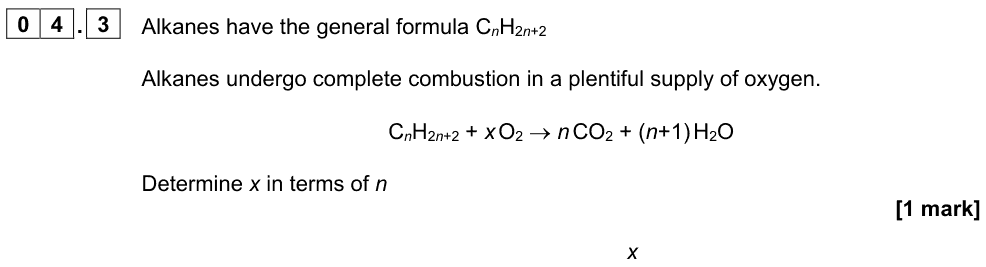
C9H20 + 14O2 → 9CO2 + 10H2O. One mark for the molecular formula C9H20, one for the balanced equation (error carried forward from a wrong hydrocarbon formula). Many got the molecular formula wrong
June 2023 · AS Paper 2 · Q05.42 marksAO2=2Calculation
Earlier part of question 05 that this part uses
Mark scheme
Examiner's comment
05.4 Students found this question challenging. The key was to use the units to determine the route to the final answer.
Notes from the mark scheme and report
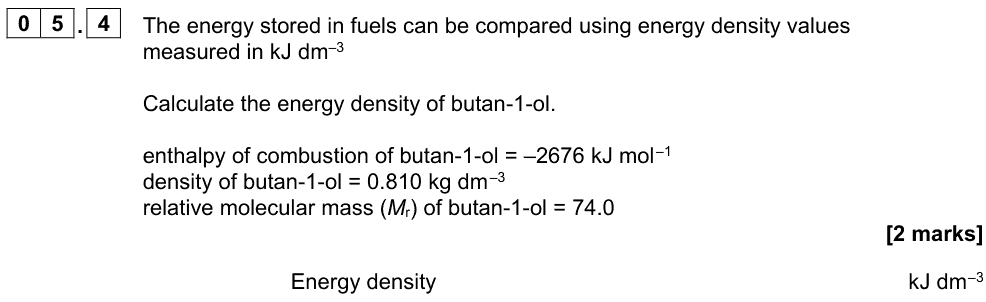
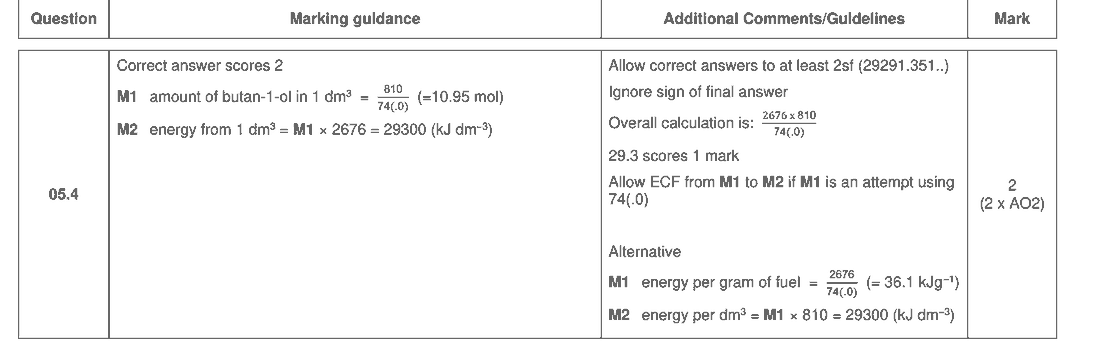
Answer: 29 300 kJ dm–3. 1 dm3 has mass 810 g = 810 ÷ 74.0 = 10.95 mol
× 2676. 29.3 scores 1 (kg not converted to g). Use the units to plan the route
Skills: MS0.0 Recognise and make use of appropriate units in calculation; MS0.2 Use ratios, fractions and percentages
June 2023 · Paper 2 · Q07.14 marksAO2=4CalculationEasy
Mark scheme
Examiner's comment
07.1 This question was very well answered despite the unfamiliar context and around 75% scored all four marks. Common mistakes included a failure to convert the temperature and pressure into the appropriate units for use in the ideal gas equation. Some students were also unable to convert their calculated volume into a value in cm3.
Notes from the mark scheme and report
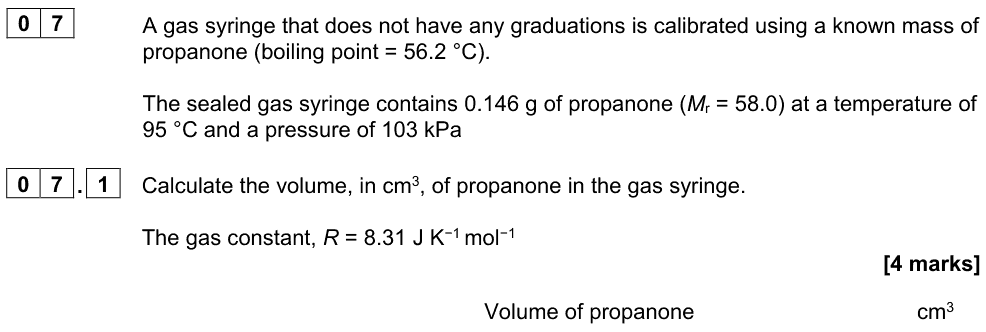
Answer: 75 cm3 (allow 74 to 75). n = 0.146 ÷ 58.0 = 2.52 × 10^–3 mol
T = 368 K
p = 103 000 Pa
V = nRT ÷ p = 7.47 × 10^–5 m3
× 10^6. Errors: T or p not converted
m3 not converted to cm3
Skills: MS0.0 Recognise and make use of appropriate units in calculation; MS2.2 Change the subject of an equation; MS2.3 Substitute numerical values into algebraic equations using appropriate units for physical quantities
June 2023 · Paper 2 · Q07.22 marksAO2=2Calculation
Earlier part of question 07 that this part uses
Mark scheme
Examiner's comment
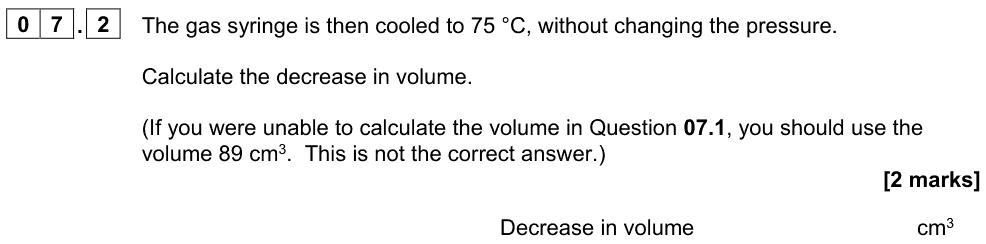
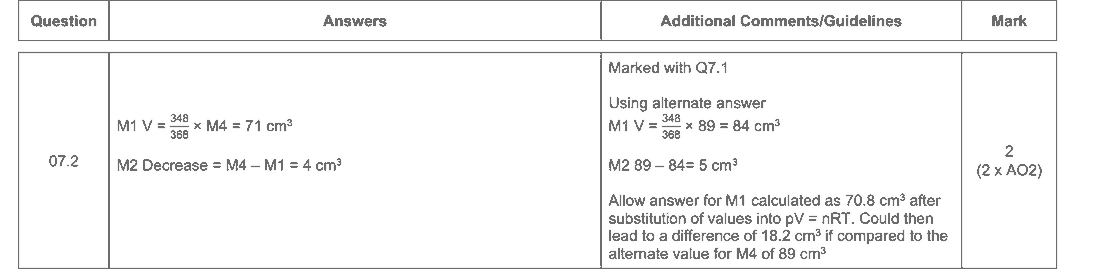
07.2 This question was also well answered but most took the less efficient route to the answer by using pV = nRT again rather than applying the temperature ratio to their answer in Question 7.1.
Notes from the mark scheme and report
Answer: 4 cm3. At constant pressure V is proportional to T: 75 × 348 ÷ 368 = 71 cm3
75 – 71. With the alternative 89 cm3 the answer is 5 cm3. Most re-used pV = nRT, which is slower
Skills: MS0.2 Use ratios, fractions and percentages; MS2.3 Substitute numerical values into algebraic equations using appropriate units for physical quantities
June 2023 · AS Paper 2 · Q07.35 marksAO1=1, AO2=4Calculation
Earlier part of question 07 that this part uses
Mark scheme
Examiner's comment
07.3 Students made good progress with determining the percentage yield in this organic preparation. However, many incorrectly believed that the yield is the mass of the product over the mass of the reactant.
Notes from the mark scheme and report
Answer: 73.8%. Mass of alcohol = 12.0 × 0.818 = 9.816 g
÷ 116.0 = 0.0846 mol
Mr of alkene (C7H14) = 98.0
expected mass = 8.29 g
6.12 ÷ 8.29 × 100. Common error: mass of product ÷ mass of reactant
Skills: MS0.0 Recognise and make use of appropriate units in calculation; MS0.2 Use ratios, fractions and percentages; RP5 Distillation of a product from a reaction
June 2023 · Paper 2 · Q07.32 marksAO2=2Calculation
Earlier part of question 07 that this part uses
Mark scheme
Examiner's comment
07.3 This question proved to be more demanding than similar questions in the past because students were required to work out not only the percentage uncertainty in the mass but then to apply this to find the resulting uncertainty in the volume calculated.
Notes from the mark scheme and report
Answer: 0.5 cm3. Percentage uncertainty in mass = 0.001 ÷ 0.146 × 100 = 0.685%
0.685% of 75 cm3 (0.6 cm3 if 89 cm3 used). Harder than usual because the percentage has to be applied to the volume
Skills: MS0.2 Use ratios, fractions and percentages; MS1.3 Identify uncertainties in measurements and use simple techniques to determine uncertainty when data are combined; PS3.3 Consider margins of error, accuracy and precision of data
June 2023 · Paper 2 · Q07.42 marksAO2=2Calculation
Earlier part of question 07 that this part uses
Mark scheme
Examiner's comment
07.4 This question was poorly answered and few took the correct approach, using the gas molar/volume ratios from the stoichiometry in the equation, to deduce the volume of CO2 produced and the volume of O2 left. Large numbers tried to use pV = nRT again and, although this approach could have worked, it was likely that errors would be made because of the number of steps required.
Notes from the mark scheme and report
Answer: 2200 cm3. Volume ratios follow the equation: 600 cm3 of propanone uses 2400 cm3 of O2 (400 cm3 left) and forms 1800 cm3 of CO2
the water is liquid
1800 + 400. Poorly answered: most tried pV = nRT instead of gas volume ratios
Skills: MS0.2 Use ratios, fractions and percentages
June 2023 · Paper 2 · Q08.25 marksAO2=5Calculation
Earlier part of question 08 that this part uses
Mark scheme
Examiner's comment
08.2 Weaker students were often able to get started with this extended but familiar style of calculation based on a calorimetry experiment. That said, the question had a high discrimination index showing that only the better students were able to score full marks. A common mistake was to use the mass of the acid in the Q = mcΔT step in the calculation, rather than the mass of water. Some lost the final mark either for failing to give the answer to 3 significant figures or failing to show that it was exothermic by including a negative sign for their final answer.
Notes from the mark scheme and report
Answer: –5640 kJ mol–1. Mr = 256.0
n = 0.387 ÷ 256.0 = 1.51 × 10^–3 mol
q = 150 × 4.18 × 13.6 = 8527 J
∆H = –8.527 ÷ 1.51 × 10^–3. Must be negative and to 3 significant figures. Errors: using the mass of the acid instead of the water in q = mc∆T
no sign
wrong significant figures
Skills: MS0.0 Recognise and make use of appropriate units in calculation; MS1.1 Use an appropriate number of significant figures; MS2.3 Substitute numerical values into algebraic equations using appropriate units for physical quantities; RP2 Measurement of an enthalpy change
June 2023 · Paper 2 · Q08.43 marksAO1=1, AO2=2Calculation
Earlier part of question 08 that this part uses
Mark scheme
Examiner's comment
08.4 A surprisingly significant number of students missed the fact that they were required to calculate the percentage of sulfur present in the substance before calculation of the empirical
Notes from the mark scheme and report
Answer: C6H10O3S2. S = 100 – 66.95 = 33.05%
moles C 3.09, H 5.15, O 1.55 (1.545), S 1.03
÷ smallest gives 3 : 5 : 1.5 : 1
double. Many forgot to find the percentage of sulfur first (C6H10O3 scores 2)
Skills: MS0.2 Use ratios, fractions and percentages
June 2023 · AS Paper 2 · Q171 markAO3=1Multiple choice
Answer
D
Mark scheme
Examiner's comment
Students found this question difficult, possibly due to having to determine the molar reacting ratio first.
Notes from the mark scheme and report
Answer: D. CH4 + 2O2 → CO2 + 2H2O needs 2 dm3 of oxygen
air is 20% oxygen, so 2 ÷ 0.20 = 10 dm3
Skills: MS0.2 Use ratios, fractions and percentages
June 2023 · AS Paper 2 · Q191 markAO2=1Multiple choice
Answer
C
Mark scheme
Examiner's comment
This was answered correctly by a majority (51%) of students.
Notes from the mark scheme and report
Answer: C. Moles of acid rise from 0.025 to 0.0375, so the final volume of hydrogen is 1.5 times that of X
the acid is three times as concentrated, so the initial rate is faster (steeper line)
Skills: MS0.2 Use ratios, fractions and percentages; MS3.1 Translate information between graphical, numerical and algebraic forms
June 2023 · AS Paper 2 · Q211 markAO1=1Multiple choice
Answer
D
Mark scheme
Examiner's comment
Students found this question difficult, possibly due to it requiring two steps to determine the molecular formula from the name and then the empirical formula.
Notes from the mark scheme and report
Answer: D. Methylpropanoic acid is C4H8O2, which simplifies to C2H4O. Butanal is C4H8O
ethanoic acid is CH2O
ethanol is C2H6O
June 2023 · AS Paper 2 · Q231 markAO1=1Multiple choiceEasy
Answer
A
Mark scheme
Examiner's comment
This was answered correctly by a clear majority (65%) of students.
Notes from the mark scheme and report
Answer: A. Mr of ethylamine 45.0 ÷ (108.9 + 2 × 17.0) × 100 = 31.5%
Skills: MS0.2 Use ratios, fractions and percentages
June 2023 · Paper 3 · Q01.75 marksCalculation
Earlier part of question 01 that this part uses
Mark scheme
Examiner's comment
In 01.7, nearly 90% of students scored 3 or more marks, with 55% scoring 5/5.
Some answers gave the impression that the phrase ‘limiting reagent’ is less familiar to students than the idea of ‘excess’, but most were able to complete the first part of the calculation.
The biggest source of error in the second stage related to various incorrect methods of calculating the ‘theoretical yield’ including adding together the masses or amounts of starting materials.
Notes from the mark scheme and report
Answer: ethanoic acid is the limiting reagent
yield = 71.0% (allow 70.6 to 71.1). Mass of ethanol = 10.0 × 0.790 = 7.90 g, n = 7.90 ÷ 46.0 = 0.172 mol
n(ethanoic acid) = 5.25 ÷ 60.0 = 0.0875 mol
maximum mass of ester = 0.0875 × 88.0 = 7.70 g
5.47 ÷ 7.70 × 100. Main error: wrong theoretical yield, for example adding the masses or amounts of the reactants. 55% scored 5 out of 5
Skills: MS0.0 Recognise and make use of appropriate units in calculation; MS0.2 Use ratios, fractions and percentages; RP10 Preparation of: a pure organic solid and test of its purity; a pure organic liquid
June 2023 · Paper 3 · Q05.13 marksCalculation
Mark scheme
Examiner's comment
05.1 was reasonably well answered by most students, although there was some confusion about the mass of water to use in the calculation with some using 397 g instead of 103 g.
Notes from the mark scheme and report
Answer: +41.9 kJ mol–1 (allow 41.9 to 42.1
negative loses M3). Energy supplied = 2.4 kJ s–1 × 100 s = 240 kJ
n(water vaporised) = 103 ÷ 18.0 = 5.72 mol
240 ÷ 5.72. Common error: using 397 g (the water left) instead of 103 g
Skills: MS0.0 Recognise and make use of appropriate units in calculation; MS0.2 Use ratios, fractions and percentages; PS3.2 Process and analyse data using appropriate mathematical skills as exemplified in the mathematical appendix for each science
June 2023 · Paper 3 · Q06.12 marksCalculation
Mark scheme
Examiner's comment
In 06.1, the most common reason for a lost mark was a lack of clarity in explaining that 0.005 mol was the required amount of Ca(OH)2 needed to react with the 0.01 mol of HCl.
M2 was not awarded just for seeing 0.01/2 unless it was clear why this was done.
Notes from the mark scheme and report
n(HCl) = 0.100 × 0.100 = 0.0100 mol
n(Ca(OH)2) = 0.600 ÷ 74.1 = 0.00810 mol
0.0100 mol of HCl needs only 0.00500 mol of Ca(OH)2 (or 0.00810 mol would need 0.0162 mol of HCl), so Ca(OH)2 is in excess. It must be stated that 0.005 mol is the amount of Ca(OH)2 needed: 0.01 ÷ 2 alone does not score
Skills: MS0.0 Recognise and make use of appropriate units in calculation; MS0.2 Use ratios, fractions and percentages
June 2023 · Paper 3 · Q081 markAO2=1Multiple choice
Answer
B
Mark scheme
Notes from the mark scheme and report
Answer: B. HOOC–C6H4–COOH is C8H6O4: 8(12.0) + 6(1.0) + 4(16.0) = 166.0
June 2023 · Paper 3 · Q281 markAO2=1Multiple choice
Answer
A
Mark scheme
Notes from the mark scheme and report
Answer: A. 1 mol of butane with 6.5 mol of oxygen: mole fraction = 1 ÷ 7.5 = 0.133
Skills: MS0.2 Use ratios, fractions and percentages
June 2022 · AS Paper 1 · Q02.12 marksAO1=2Practical and data analysis
Mark scheme
Examiner's comment
02.1 A high number of students were able to describe accurately how to weigh out an accurate mass of solid into a beaker, although students often went on to describe how to make up a standard solution. Answers which just stated “weigh by difference” were not sufficient without a description of how this can be achieved.
Notes from the mark scheme and report
Weigh the weighing boat plus solid, tip the solid into the beaker, reweigh the boat and subtract. Or zero the balance with the boat on it, add solid, transfer and wash the boat's washings into the beaker. Or tare/weigh the empty beaker and add the solid. 'Weigh by difference' alone is not enough
Skills: ATa Use appropriate apparatus to record a range of measurements (to include mass, time, volume of liquids and gases, temperature); ATe Use volumetric flask, including accurate technique for making up a standard solution; PS4.1 Know and understand how to use a wide range of experimental and practical instruments, equipment and techniques appropriate to the knowledge and understanding included in the specification; RP1 Make up a volumetric solution and carry out a simple acid–base titration
June 2022 · Paper 1 · Q02.12 marksAO1=2Short answerHard
Mark scheme
Examiner's comment
A third of the students scored both marks in the definition; common errors included failing to mention average mass of atoms and missing atom or mass of 12C. Question 02.2 was answered well by most students; the most common error was using 100 as the denominator. Answers to 02.3 were good; some students unnecessarily added that the number of protons was the same and a few students did not refer to electrons and stated that chemical properties depend on the number of neutrons. In 02.4 many students scored full marks; the main errors were calculating the mass of the Re+ ion in kg, omitting to take a square root and incorrect rearrangement of the equation. Answers to 02.5 were generally poor; only 21% of students scored both marks. Many students did not refer to the ion gaining an electron at the detector and many simply stated that the number of ions reaching the detector gave the abundance of the ion without any reference to the current produced.
Notes from the mark scheme and report
Mean (average) mass of an atom of an element divided by 1/12 of the mass of one atom of 12C (top line and bottom line are one mark each). Mixing moles and atoms is max 1. Errors: no mention of average mass of atoms
'atom' or 'mass of 12C' missing
June 2022 · AS Paper 1 · Q02.23 marksAO2=3Calculation
Earlier part of question 02 that this part uses
Mark scheme
Examiner's comment
02.2 The calculation of the concentration of a solution was completed well. Common errors in this calculation included the use of an incorrect Mr value or incorrect rearrangement of the relationship between moles, volume and concentration.
Notes from the mark scheme and report
Answer: 0.00869 mol dm–3. Mr of citric acid = 192.0
n = 0.834 ÷ 192.0 = 4.34 × 10^–3 mol
÷ 0.500 dm3. Errors: wrong Mr
wrong rearrangement of n = cV
Skills: MS0.0 Recognise and make use of appropriate units in calculation; MS2.3 Substitute numerical values into algebraic equations using appropriate units for physical quantities; RP1 Make up a volumetric solution and carry out a simple acid–base titration
June 2022 · AS Paper 1 · Q02.36 marksAO1=3, AO3=36-mark level of response
Earlier part of question 02 that this part uses
Mark scheme, with the levels and indicative content
Examiner's comment
02.3 Students did not always identify mistakes in the method given, but when these were identified students were usually able to suggest an improvement. However, they did not always appreciate why the mistake that had been identified affected the titration result. Answers were, more often than not, well-structured and articulated.
Notes from the mark scheme and report
Levels of response: best three of four stages, each = mistake, why, improvement. 1 Measuring cylinder: large uncertainty
use a volumetric pipette. 2 Too much indicator (5 cm3): it may react and affect the end point
use a few drops. 3 Burette rinsed with water: dilutes the alkali
rinse with the alkali solution. 4 Stopping when the indicator 'just' changes: acid may not have fully reacted (not swirled)
add until the colour change is permanent. Students often found the mistake and the fix but could not say why it affects the titre
Skills: ATd Use laboratory apparatus for a variety of experimental techniques including: titration, using burette and pipette; distillation and heating under reflux, including setting up glassware using retort stand and clamps; qualitative tests for ions and organic functional groups; filtration, including use of fluted filter paper, or filtration under reduced pressure; ATe Use volumetric flask, including accurate technique for making up a standard solution; ATf Use acid–base indicators in titrations of weak/strong acids with weak/strong alkalis; PS2.1 Comment on experimental design and evaluate scientific methods; PS2.3 Evaluate results and draw conclusions with reference to measurement uncertainties and errors; RP1 Make up a volumetric solution and carry out a simple acid–base titration
June 2022 · AS Paper 1 · Q02.42 marksAO1=2Practical and data analysis
Earlier part of question 02 that this part uses
Mark scheme
Examiner's comment
02.4 Students did not always calculate the titres to 2 decimal places and were not always aware that only concordant titres should be used when calculating the mean titre.
Notes from the mark scheme and report
Answer: mean titre 22.93 cm3 (allow 22.925). Titres: Run 1 22.95, Run 2 23.10, Run 3 22.90
mean of the concordant titres only (22.95 and 22.90). Errors: titres not to 2 decimal places
averaging all the titres
Skills: MS1.2 Find arithmetic means; PS3.2 Process and analyse data using appropriate mathematical skills as exemplified in the mathematical appendix for each science; ATd Use laboratory apparatus for a variety of experimental techniques including: titration, using burette and pipette; distillation and heating under reflux, including setting up glassware using retort stand and clamps; qualitative tests for ions and organic functional groups; filtration, including use of fluted filter paper, or filtration under reduced pressure; RP1 Make up a volumetric solution and carry out a simple acid–base titration
June 2022 · Paper 1 · Q02.45 marksCalculation
Earlier part of question 02 that this part uses
Mark scheme
Examiner's comment
In 02.4 many students scored full marks; the main errors were calculating the mass of the Re+ ion in kg, omitting to take a square root and incorrect rearrangement of the equation.
Notes from the mark scheme and report
Answer: 1.67 × 10^–6 s (allow 1.67 to 1.68). m = 185 ÷ (6.022 × 10^23 × 1000) = 3.072 × 10^–25 kg
v = √(2KE ÷ m) = 8.66 × 10^5 m s–1
t = d ÷ v = 1.450 ÷ v. Errors: mass of the ion in kg, no square root, wrong rearrangement
Skills: MS0.0 Recognise and make use of appropriate units in calculation; MS0.1 Recognise and use expressions in decimal and ordinary form; MS2.2 Change the subject of an equation; MS2.3 Substitute numerical values into algebraic equations using appropriate units for physical quantities
June 2022 · AS Paper 1 · Q02.51 markAO1=1Calculation
Earlier parts of question 02 that this part uses
Mark scheme
Examiner's comment
02.5 This was well answered, although some students calculated the % uncertainty in their mean titre.
Notes from the mark scheme and report
Answer: 0.65%. (0.15 ÷ 22.95) × 100, using the Run 1 titre from Table 1 in 02.4. Some used the mean titre instead
Skills: MS1.3 Identify uncertainties in measurements and use simple techniques to determine uncertainty when data are combined; PS3.3 Consider margins of error, accuracy and precision of data; RP1 Make up a volumetric solution and carry out a simple acid–base titration
June 2022 · Paper 1 · Q03.45 marksCalculation
Earlier part of question 03 that this part uses
Mark scheme
Examiner's comment
In 03.4, 41% of students gave a correct equation and then carried on to score all the marks.
Many students did not score the final mark as they did not use the factor of 2.
Some students did not convert the volume correctly and some rearranged the equation incorrectly.
× 2. Errors: no factor of 2, volume not converted to m3, wrong rearrangement. 41% scored all 5 marks
Skills: MS0.0 Recognise and make use of appropriate units in calculation; MS2.2 Change the subject of an equation; MS2.3 Substitute numerical values into algebraic equations using appropriate units for physical quantities
June 2022 · AS Paper 1 · Q055 marksAO2=5Calculation
Mark scheme
Examiner's comment
This was generally done well by students, although they should be encouraged to set out working with a clear explanation of each step in a calculation rather than just writing down a set of different numerical expressions. A common error was not converting the mass in grams to the mass in kilograms. There were a number of incorrect rearrangements of the expression involving kinetic energy and students appeared to be less comfortable when working on values in standard form.
Notes from the mark scheme and report
Answer: mass 2.009 × 10^–25 kg
time 5.98 × 10^–4 s. m = 121 ÷ (1000 × 6.022 × 10^23)
v = 1.05 ÷ 5.93 × 10^–4 = 1771 m s–1
KE = ½mv² = 3.149 × 10^–19 J
v(123) = √(2KE ÷ 2.0425 × 10^–25) = 1756 m s–1
t = d ÷ v. Short cut: t(123) = t(121) × √(123/121). Errors: mass left in grams
wrong rearrangement of KE = ½mv²
Skills: MS0.0 Recognise and make use of appropriate units in calculation; MS0.1 Recognise and use expressions in decimal and ordinary form; MS2.2 Change the subject of an equation; MS2.3 Substitute numerical values into algebraic equations using appropriate units for physical quantities
June 2022 · AS Paper 1 · Q06.32 marksAO1=2Equation writing
Earlier parts of question 06 that this part uses
Mark scheme
Examiner's comment
06.3 A high number of students were able to identify correctly the foul-smelling gas but only a few students provided an equation to produce S. Many equations showed the formation of sulfur dioxide instead.
Notes from the mark scheme and report
6I– + 6H+ + H2SO4 → S + 3I2 + 4H2O (allow 6HI + H2SO4, or 6I– + 8H+ + SO4 2–). Gas: hydrogen sulfide, H2S. Many gave the equation that forms SO2 instead of S
June 2022 · AS Paper 1 · Q141 markAO2=1Multiple choiceEasy
Answer
C
Mark scheme
Examiner's comment
Empirical formula The majority of students (65%) were correctly able to determine an empirical formula.
Notes from the mark scheme and report
Answer: C. Mo 4.0 ÷ 96.0 = 0.0417 mol
O 1.0 ÷ 16.0 = 0.0625 mol
ratio 2 : 3, so Mo2O3
Skills: MS0.2 Use ratios, fractions and percentages
June 2022 · AS Paper 2 · Q03.54 marksAO2=2, AO3=2Calculation
Earlier part of question 03 that this part uses
Mark scheme
Examiner's comment
3.5 This question required students to find an empirical formula and then suggest two compounds that it could be. The empirical formula was well answered, but students struggled more to suggest the correct names of the compounds.
Notes from the mark scheme and report
Answer: C3H6Br2. C 17.8 ÷ 12.0 = 1.48
H 3.0 ÷ 1.0 = 3.00
Br 79.2 ÷ 79.9 = 0.99
ratio 3:6:2. Any two of 1,1-, 1,2-, 1,3- or 2,2-dibromopropane. The names were the harder part
Skills: MS0.2 Use ratios, fractions and percentages
June 2022 · AS Paper 2 · Q04.15 marksAO1=1, AO2=4Calculation
Mark scheme
Examiner's comment
4.1 This question required students to use the ideal gas equation. The use of the ideal gas equation, including unit conversions, was generally good. Students struggled to use the equation to work out the amount, in moles, of gas which was a combination of nitrogen, hydrogen and carbon dioxide. A number of students did not appreciate that the final answer will be a volume in m3 and so used factors such as 103 or 106 in an attempt to put the volume into m3.
2 mol TNT gives 20 mol of gas, so n(gas) = 44.1 mol
T = 1523 K
V = nRT/p. 0.552 (4.41 mol used) and 4.54 (1250 K used) score 4. Errors: mole ratio for the gases
multiplying by 10^3 or 10^6
Skills: MS0.0 Recognise and make use of appropriate units in calculation; MS0.2 Use ratios, fractions and percentages; MS2.2 Change the subject of an equation; MS2.3 Substitute numerical values into algebraic equations using appropriate units for physical quantities
June 2022 · AS Paper 2 · Q04.21 markAO1=1Calculation
Earlier part of question 04 that this part uses
Mark scheme
Examiner's comment
4.2 This question used algebra to work out a gas volume. Many students struggled with this, possibly by being unable to work out the amount in moles of CO2 in terms of n from the general formula of an alkene, CnH2n.
Notes from the mark scheme and report
Answer: 1200 cm3. n = 4, so 3n/2 = 6 volumes of oxygen per volume of but-1-ene
200 × 6
Skills: MS0.2 Use ratios, fractions and percentages; MS2.3 Substitute numerical values into algebraic equations using appropriate units for physical quantities
June 2022 · AS Paper 2 · Q04.31 markAO1=1Short answer
Earlier part of question 04 that this part uses
Mark scheme
Examiner's comment
4.3 This question required students to use algebra to balance an equation. Some students could do this, but it was too challenging for most.
Notes from the mark scheme and report
Answer: x = (3n + 1) ÷ 2 (1.5n + 0.5), from balancing the oxygen atoms: 2x = 2n + (n + 1). Too challenging for most
Skills: MS2.2 Change the subject of an equation
June 2022 · AS Paper 2 · Q05.22 marksAO2=2Calculation
Earlier part of question 05 that this part uses
Mark scheme
Examiner's comment
5.2 This question required students to use the Avogadro constant to work out the number of molecules in a liquid. Many could do this, but some struggled to work out the mass via the volume and density, or the amount in moles from the mass or how to use the Avogadro constant.
Notes from the mark scheme and report
Answer: 3.10 × 10^22 molecules. Mass = 5.0 × 1.75 = 8.75 g
÷ 169.9 = 0.0515 mol
× 6.022 × 10^23. Must be in standard form, at least 2 sf
Skills: MS0.1 Recognise and use expressions in decimal and ordinary form; MS2.3 Substitute numerical values into algebraic equations using appropriate units for physical quantities
June 2022 · AS Paper 2 · Q05.32 marksAO2=2Calculation
Earlier part of question 05 that this part uses
Mark scheme
Examiner's comment
5.3 This question required students to work out a percentage yield. Many could do this.
Skills: MS0.2 Use ratios, fractions and percentages
June 2022 · Paper 2 · Q05.64 marksAO2=4Calculation
Earlier part of question 05 that this part uses
Mark scheme
Examiner's comment
05.6 Most students were able to get started on this relatively straightforward calculation but large numbers failed to follow the instruction in the question to give the final answer to 1 decimal place. The question had a high discrimination index.
Notes from the mark scheme and report
Answer: 2.8 g (2.8 or 2.9 only). Mass of hex-1-ene = 11.0 × 0.678 = 7.46 g
n = 7.46 ÷ 84.0 = 0.0888 mol
× 0.310 × 102.0. Many did not give 1 decimal place
Skills: MS0.0 Recognise and make use of appropriate units in calculation; MS0.2 Use ratios, fractions and percentages; MS1.1 Use an appropriate number of significant figures; RP10 Preparation of: a pure organic solid and test of its purity; a pure organic liquid
June 2022 · AS Paper 2 · Q06.12 marksAO2=2Calculation
Mark scheme
Examiner's comment
6.1 This question required students to calculate an atom economy. This was answered well.
Notes from the mark scheme and report
Answer: 27.9% (3 sf). 137.5 ÷ 492.6 × 100, where 492.6 is the total Mr of the reactants (338.6 + 154.0)
Skills: MS0.2 Use ratios, fractions and percentages; MS1.1 Use an appropriate number of significant figures
June 2022 · Paper 2 · Q09.12 marksAO3=2Practical and data analysis
Mark scheme
Examiner's comment
09.1 The first mark was very rarely scored here. Students weren’t able to suggest that a smaller target titre would lead to a larger percentage uncertainty. The second mark for calculating the amount of bromine was scored by the vast majority of students.
Notes from the mark scheme and report
A smaller titre has a larger percentage uncertainty. Amount of Br2 = 0.025 × 30.0 ÷ 1000 = 7.5 × 10^–4 mol. The justification mark was very rarely scored
Skills: MS1.3 Identify uncertainties in measurements and use simple techniques to determine uncertainty when data are combined; MS0.0 Recognise and make use of appropriate units in calculation; PS3.3 Consider margins of error, accuracy and precision of data; RP1 Make up a volumetric solution and carry out a simple acid–base titration
June 2022 · Paper 2 · Q09.25 marksAO2=3, AO3=2Calculation
Earlier part of question 09 that this part uses
Mark scheme
Examiner's comment
09.2 The discrimination index for this question was high and only the best students scored full marks. The most common error was to fail to appreciate that Y would react with bromine in a 1:5 ratio. Weaker students also found it hard to gross up the mass of Y to give the mass of oil at the end and many did the opposite by calculating 85% of their mass of Y. Consequential marking meant that, despite these common mistakes, several other marks were still possible and most scored at least two marks.
Notes from the mark scheme and report
Answer: 1.55 g (1.29 g from the given 6.25 × 10^–4 mol). Y has five C=C so Y : Br2 = 1 : 5
taking 85% of the mass instead of dividing by 0.85
Skills: MS0.0 Recognise and make use of appropriate units in calculation; MS0.2 Use ratios, fractions and percentages; PS3.2 Process and analyse data using appropriate mathematical skills as exemplified in the mathematical appendix for each science; RP1 Make up a volumetric solution and carry out a simple acid–base titration
June 2022 · Paper 2 · Q09.32 marksAO3=2Practical and data analysis
Earlier part of question 09 that this part uses
Mark scheme
Examiner's comment
09.3 This practical procedure question was quite well answered despite the slightly novel context of weighing a liquid rather than the more familiar solid.
Notes from the mark scheme and report
Reweigh the weighing bottle after transferring the oil (and record the mass), because not all of the oil is transferred / to find the exact mass added. OR rinse the bottle with solvent and add the washings to the flask, so that all the oil is transferred. M2 depends on M1
Skills: ATe Use volumetric flask, including accurate technique for making up a standard solution; ATa Use appropriate apparatus to record a range of measurements (to include mass, time, volume of liquids and gases, temperature); PS2.1 Comment on experimental design and evaluate scientific methods; RP1 Make up a volumetric solution and carry out a simple acid–base titration
June 2022 · Paper 2 · Q09.41 markAO3=1Practical and data analysis
Earlier part of question 09 that this part uses
Mark scheme
Examiner's comment
09.4 This question was quite well answered with a good proportion of students able to suggest that the volumetric flask is inverted to make sure the mixture is homogeneous.
Notes from the mark scheme and report
To make sure the solution is homogeneous / evenly mixed
Skills: ATe Use volumetric flask, including accurate technique for making up a standard solution; RP1 Make up a volumetric solution and carry out a simple acid–base titration
June 2022 · Paper 2 · Q09.52 marksAO2=2Calculation
Earlier parts of question 09 that this part uses
Mark scheme
Examiner's comment
09.5 The question demanded that students show their working. Whilst it was well answered overall, many failed to score both marks. The first mark required students to show that the Mr was one less than 345, but this was often omitted despite the question stating that each molecule gains a hydrogen ion (H+) during electrospray ionisation.
Notes from the mark scheme and report
Answer: C20H40O4. Mr = 345 – 1 = 344 (the ion is MH+)
empirical formula mass of C5H10O = 86.0
344 ÷ 86 = 4. Working must be shown for both marks
subtracting 1 was often omitted
Skills: MS0.2 Use ratios, fractions and percentages
June 2022 · AS Paper 2 · Q171 markAO1=1Multiple choiceEasy
Answer
C
Mark scheme
Examiner's comment
This was answered correctly by a majority of students (67.2%).
Notes from the mark scheme and report
Answer: C. C3H8 cannot be simplified (butane C4H10 gives C2H5
the alkenes give CH2)
June 2022 · AS Paper 2 · Q191 markAO2=1Multiple choice
Earlier part of question 19 that this part uses
Answer
B
Mark scheme
Examiner's comment
Students found it difficult to work out the amount, in moles, of the substances in an equilibrium mixture.
Notes from the mark scheme and report
Answer: B. CO = 2.0 – 0.6 = 1.4 mol
H2 = 3.0 – 1.2 = 1.8 mol
CH3OH = 0.6 mol
total 3.8 mol
Skills: MS0.2 Use ratios, fractions and percentages
June 2022 · Paper 3 · Q026 marksAO2=2, AO3=46-mark level of response
Mark scheme, with the levels and indicative content
Examiner's comment
This levels of response question was expected to be more accessible than some in the past but a lack of accuracy in describing the tests for the anions meant that Level 3 was rarely attained. The need to warm after adding NaOH when testing for NH4+ was often missing as was the need to acidify the BaCl2 when testing for sulfate. Many students also stopped their description of the test for Al3+ at the stage of forming a white precipitate and failed to mention that it redissolves in excess NaOH.
The equations for the test for Al3+ should preferably have been those with the hydrated ion but the simpler versions were allowed from the point of view of indicative content. The equation for the redissolving of the solid was often shown as Al(H2O)3(OH)3 + OH– → Al(OH)4– + 3 H2O which implies a combination of ligand replacement and acid-base behaviour, but the product anion should be shown with two water ligands still present in this case.
In stage 1 the empirical formula of NH28AlS2O20 was sometimes not actually shown even though the calculation was done. Some students seemed confused that, in this case, the empirical formula mass is equal to the relative formula mass and they thought that meant that x = 0. It was hoped that students would recognise that 1 × N meant one NH4+ and 2 × S meant two SO42– ions – from which the number of waters could be found.
Notes from the mark scheme and report
Levels of response, three stages. Formula: divide % by Ar (N 0.221, H 6.18, Al 0.221, S 0.441, O 4.41)
divide by the smallest to get NH28AlS2O20
this is NH4Al(SO4)2.12H2O, so x = 12. Tests: add NaOH and warm, gas turns damp red litmus blue (NH4+)
acidified BaCl2 gives a white precipitate (SO4 2–)
NaOH added dropwise gives a white precipitate that dissolves in excess (Al3+). Equations: NH4+ + OH– → NH3 + H2O
Ba2+ + SO4 2– → BaSO4
[Al(H2O)6]3+ + 3OH– → [Al(H2O)3(OH)3] + 3H2O
[Al(H2O)3(OH)3] + OH– → [Al(H2O)2(OH)4]– + H2O. Common gaps: no warming, BaCl2 not acidified, precipitate not redissolved. Level 3 was rarely reached
Skills: MS0.2 Use ratios, fractions and percentages; ATd Use laboratory apparatus for a variety of experimental techniques including: titration, using burette and pipette; distillation and heating under reflux, including setting up glassware using retort stand and clamps; qualitative tests for ions and organic functional groups; filtration, including use of fluted filter paper, or filtration under reduced pressure; PS1.1 Solve problems set in practical contexts; RP4 Carry out simple test-tube reactions to identify: cations – Group 2, NH4+; anions – Group 7 (halide ions), OH–, CO32–, SO42–
June 2022 · Paper 3 · Q071 markAO3=1Multiple choice
Answer
C
Mark scheme
Notes from the mark scheme and report
Answer: C. 0.0200 mol CO2 from 0.0100 mol means two carbon atoms
0.0200 mol NaOH per 0.0100 mol acid means two COOH groups: HOOCCOOH (report: report lists question 7 as particularly challenging)
Skills: MS0.2 Use ratios, fractions and percentages
June 2022 · Paper 3 · Q211 markAO2=1Multiple choice
Answer
C
Mark scheme
Notes from the mark scheme and report
Answer: C. n(MnO4–) = 0.10 ÷ 5 = 0.020 mol
volume = 0.020 ÷ 0.020 = 1.0 dm3
Skills: MS0.2 Use ratios, fractions and percentages
November 2021 · AS Paper 1 · Q04.12 marksEquation writing
Mark scheme
Notes from the mark scheme and report
Ba2+
Ba2+(aq) + SO4 2–(aq) → BaSO4(s). Ca2+, Sr2+ or Pb2+ also accepted with a matching equation
state symbols ignored
Skills: PS1.2 Apply scientific knowledge to practical contexts; RP4 Carry out simple test-tube reactions to identify: cations – Group 2, NH4+; anions – Group 7 (halide ions), OH–, CO32–, SO42–
November 2021 · AS Paper 1 · Q04.22 marksEquation writing
Earlier part of question 04 that this part uses
Mark scheme
Notes from the mark scheme and report
Test 1 gas: CO2 (from a carbonate with acid
SO2 allowed). Test 2 gas: NH3. Both gases needed for the first mark. NH4+ + OH– → NH3 + H2O
Skills: PS1.2 Apply scientific knowledge to practical contexts; RP4 Carry out simple test-tube reactions to identify: cations – Group 2, NH4+; anions – Group 7 (halide ions), OH–, CO32–, SO42–
November 2021 · Paper 1 · Q04.46 marksCalculation
Earlier part of question 04 that this part uses
Mark scheme
Examiner's comment
Some students completed the calculation well in question 04.4; common errors included identifying the limiting reagent as iron and then using the amount of iron (in moles) in the calculation, or stating that hydrochloric acid was the limiting reagent but not realising that this then controlled the amount of hydrogen produced.
Some students converted the temperature and pressure incorrectly.
n(HCl) = 0.0300 mol, so HCl is the limiting reagent
n(H2) = 0.0150 mol
V = nRT/p with T = 303 K and p = 100 000 Pa. Errors: iron taken as limiting
wrong conversions of temperature or pressure
Skills: MS0.0 Recognise and make use of appropriate units in calculation; MS0.2 Use ratios, fractions and percentages; MS1.1 Use an appropriate number of significant figures; MS2.2 Change the subject of an equation; MS2.3 Substitute numerical values into algebraic equations using appropriate units for physical quantities
November 2021 · AS Paper 1 · Q065 marksCalculation
Mark scheme
Notes from the mark scheme and report
Answer: 6.18 g. n(CaS) = 2.50 ÷ 72.2 = 0.0346 mol
n(CaSO4) = 9.85 ÷ 136.2 = 0.0723 mol
0.0346 mol of CaS would need 3 × 0.0346 = 0.104 mol of CaSO4, which is more than is present, so CaSO4 is limiting
n(SO2) = 0.0723 × 4/3 = 0.0964 mol
× 64.1. If CaS is used as the limiting reagent, the last two marks are still available as error carried forward
Skills: MS0.2 Use ratios, fractions and percentages; MS2.1 Understand and use the symbols: =, <, <<, >>, >, ∝, ~, equilibrium sign
November 2021 · AS Paper 1 · Q08.16 marksCalculation
Mark scheme
Notes from the mark scheme and report
Answer: mean titre 20.28 cm3 (20.275)
39.1% (allow 39.1 to 39.2). Mean of concordant titres 20.25 and 20.30 only
Skills: MS0.2 Use ratios, fractions and percentages; MS1.2 Find arithmetic means; PS3.2 Process and analyse data using appropriate mathematical skills as exemplified in the mathematical appendix for each science; ATd Use laboratory apparatus for a variety of experimental techniques including: titration, using burette and pipette; distillation and heating under reflux, including setting up glassware using retort stand and clamps; qualitative tests for ions and organic functional groups; filtration, including use of fluted filter paper, or filtration under reduced pressure; RP1 Make up a volumetric solution and carry out a simple acid–base titration
November 2021 · AS Paper 1 · Q08.22 marksPractical and data analysis
Earlier part of question 08 that this part uses
Mark scheme
Notes from the mark scheme and report
The titre would increase, because the water left in the burette makes the sodium hydroxide solution more dilute
Skills: PS2.1 Comment on experimental design and evaluate scientific methods; ATd Use laboratory apparatus for a variety of experimental techniques including: titration, using burette and pipette; distillation and heating under reflux, including setting up glassware using retort stand and clamps; qualitative tests for ions and organic functional groups; filtration, including use of fluted filter paper, or filtration under reduced pressure; RP1 Make up a volumetric solution and carry out a simple acid–base titration
November 2021 · AS Paper 1 · Q10.35 marksCalculation
Earlier part of question 10 that this part uses
Mark scheme
Notes from the mark scheme and report
Answer: 721 °C (allow 720 to 722). Total n = 0.025 + 0.049 + 0.034 = 0.108 mol
p = 255 000 Pa
V = 0.0035 m3
T = pV ÷ nR = 994.5 K
subtract 273
Skills: MS0.0 Recognise and make use of appropriate units in calculation; MS2.2 Change the subject of an equation; MS2.3 Substitute numerical values into algebraic equations using appropriate units for physical quantities
November 2021 · Paper 2 · Q01.36 marksCalculationHard
Earlier part of question 01 that this part uses
Mark scheme
Examiner's comment
The extended calculation in question 01.3 attracted good responses with a third of the students gaining full marks and the majority able to access at least 1 or 2 marks.
A common mistake was to assume that the oil was pure triester.
Notes from the mark scheme and report
Answer: 87.1% (allow 87.0 to 87.1). Back titration: n(HCl) = 0.100 × 0.01565 = 1.565 × 10^–3 mol = KOH left over
initial n(KOH) = 0.421 ÷ 56.1 = 7.50 × 10^–3 mol
KOH used = 5.94 × 10^–3 mol
÷ 3 = 1.98 × 10^–3 mol of triester
× 638.0 = 1.263 g
÷ 1.450 × 100. Common mistake: assuming the oil was pure triester
Skills: MS0.0 Recognise and make use of appropriate units in calculation; MS0.2 Use ratios, fractions and percentages
November 2021 · Paper 2 · Q02.23 marksEquation writing
Earlier part of question 02 that this part uses
Mark scheme
Examiner's comment
In this question a surprisingly small proportion of students were able to state the meaning of the term fraction. In addition, very few were able to explain why C=O bonds in carbon dioxide absorb infrared radiation. A good range of answers was seen for the extended response question about the environmental impact of bioethanol as a fuel, but a significant number of students were unable to get started here.
Notes from the mark scheme and report
C16H34 → C6H14 + 2C5H10 (one mark for the formulas, one for balancing)
catalyst: zeolite (allow aluminosilicate or aluminium oxide)
November 2021 · AS Paper 2 · Q03.24 marksCalculation
Earlier part of question 03 that this part uses
Mark scheme
Notes from the mark scheme and report
Answer: 63% (2 sf only). Mass of propan-2-ol = 2.0 × 0.786 = 1.572 g
n = 1.572 ÷ 60.0 = 0.0262 mol
expected propanone = 0.0262 × 58.0 = 1.52 g
0.954 ÷ 1.52 × 100
Skills: MS0.0 Recognise and make use of appropriate units in calculation; MS0.2 Use ratios, fractions and percentages; MS1.1 Use an appropriate number of significant figures; RP5 Distillation of a product from a reaction
November 2021 · AS Paper 2 · Q04.32 marksCalculation
Earlier part of question 04 that this part uses
Mark scheme
Notes from the mark scheme and report
Answer: 2.19 × 10^29 (allow 2 × 10^29 to 2.20 × 10^29). n = 500 ÷ 137.5 = 3.64 mol
× 6.022 × 10^23 × 100 000
Skills: MS0.0 Recognise and make use of appropriate units in calculation; MS0.1 Recognise and use expressions in decimal and ordinary form; MS0.3 Estimate results
November 2021 · AS Paper 2 · Q06.15 marksCalculation
Mr = 0.717 g ÷ 0.00996. Working is required: 72.0 with no working scores 0. Convert kPa to Pa, cm3 to m3 and mg to g
Skills: MS0.0 Recognise and make use of appropriate units in calculation; MS2.2 Change the subject of an equation; MS2.3 Substitute numerical values into algebraic equations using appropriate units for physical quantities; PS3.2 Process and analyse data using appropriate mathematical skills as exemplified in the mathematical appendix for each science
November 2021 · AS Paper 2 · Q06.22 marksCalculation
Earlier part of question 06 that this part uses
Mark scheme
Notes from the mark scheme and report
Answer: 0.0155 mol. CO2 formed = 8 × 0.0010 = 0.0080 mol
O2 used = 12.5 × 0.0010 = 0.0125, so 0.0075 mol O2 left
water is liquid so not counted
Skills: MS0.2 Use ratios, fractions and percentages
November 2021 · Paper 2 · Q08.42 marksShort answer
Earlier part of question 08 that this part uses
Mark scheme
Examiner's comment
Few students scored 3 or more marks on question 08.2. Both the reagents and equations proved very challenging, with over 50% either failing to score or not attempting this question. A very good range of marks was seen for question 08.3 and the question discriminated very well.
Notes from the mark scheme and report
Fewer steps: better overall yield / less energy used (fewer practical losses, simpler plant). High atom economy: less waste / less pollution, more of the raw materials end up in the useful product, saving resources
November 2021 · AS Paper 2 · Q101 markMultiple choice
Answer
C
Mark scheme
Notes from the mark scheme and report
Answer: C. 40.0/12 : 6.7/1 : 53.3/16 = 3.33 : 6.7 : 3.33 = 1 : 2 : 1, empirical formula CH2O, so C2H4O2 fits
Skills: MS0.2 Use ratios, fractions and percentages
November 2021 · AS Paper 2 · Q111 markMultiple choice
Answer
B
Mark scheme
Notes from the mark scheme and report
Answer: B. 0.080 g ÷ 46.0 = 1.74 × 10^–3 mol in 0.100 dm3 = 1.74 × 10^–2 mol dm–3
Skills: MS0.0 Recognise and make use of appropriate units in calculation; MS0.1 Recognise and use expressions in decimal and ordinary form
November 2021 · AS Paper 2 · Q211 markMultiple choice
Answer
B
Mark scheme
Notes from the mark scheme and report
Answer: B. The acid is the limiting reagent: 0.040 mol HCl instead of 0.030 mol gives 4/3 of the hydrogen volume, and the higher concentration gives a steeper initial slope
Skills: MS3.1 Translate information between graphical, numerical and algebraic forms
November 2021 · AS Paper 2 · Q231 markMultiple choice
Answer
C
Mark scheme
Notes from the mark scheme and report
Answer: C. (2 × 46.0) ÷ 180.0 × 100 = 51.1%
Skills: MS0.2 Use ratios, fractions and percentages
November 2021 · Paper 3 · Q01.41 markPractical and data analysisEasy
Earlier part of question 01 that this part uses
Mark scheme
Examiner's comment
Questions 01.4 to 01.7 revealed weaknesses in awareness of practical ideas although it was surprising that nearly a quarter of students were unable to draw the meniscus in the right place on the diagram of a pipette.
Notes from the mark scheme and report
A curved meniscus with the bottom of the curve on the graduation mark
Skills: ATd Use laboratory apparatus for a variety of experimental techniques including: titration, using burette and pipette; distillation and heating under reflux, including setting up glassware using retort stand and clamps; qualitative tests for ions and organic functional groups; filtration, including use of fluted filter paper, or filtration under reduced pressure; PS4.1 Know and understand how to use a wide range of experimental and practical instruments, equipment and techniques appropriate to the knowledge and understanding included in the specification; RP1 Make up a volumetric solution and carry out a simple acid–base titration
November 2021 · Paper 3 · Q01.52 marksPractical and data analysis
Earlier part of question 01 that this part uses
Mark scheme
Examiner's comment
Questions 01.4 to 01.7 revealed weaknesses in awareness of practical ideas although it was surprising that nearly a quarter of students were unable to draw the meniscus in the right place on the diagram of a pipette.
Notes from the mark scheme and report
Burette: fill it below / at eye level. Dissolving the toxic solid: wear gloves (allow wash hands after any spillage). Not a fume cupboard
lab coat, funnel and 'tap closed' are ignored
Skills: ATk Safely and carefully handle solids and liquids, including corrosive, irritant, flammable and toxic substances; ATd Use laboratory apparatus for a variety of experimental techniques including: titration, using burette and pipette; distillation and heating under reflux, including setting up glassware using retort stand and clamps; qualitative tests for ions and organic functional groups; filtration, including use of fluted filter paper, or filtration under reduced pressure; PS1.2 Apply scientific knowledge to practical contexts; RP1 Make up a volumetric solution and carry out a simple acid–base titration
November 2021 · Paper 3 · Q01.72 marksPractical and data analysis
Earlier part of question 01 that this part uses
Mark scheme
Examiner's comment
Questions 01.4 to 01.7 revealed weaknesses in awareness of practical ideas although it was surprising that nearly a quarter of students were unable to draw the meniscus in the right place on the diagram of a pipette.
Notes from the mark scheme and report
Remove the funnel
make sure the jet below the tap is filled / has no air bubbles (run some solution through the tap)
Skills: ATd Use laboratory apparatus for a variety of experimental techniques including: titration, using burette and pipette; distillation and heating under reflux, including setting up glassware using retort stand and clamps; qualitative tests for ions and organic functional groups; filtration, including use of fluted filter paper, or filtration under reduced pressure; PS4.1 Know and understand how to use a wide range of experimental and practical instruments, equipment and techniques appropriate to the knowledge and understanding included in the specification; RP1 Make up a volumetric solution and carry out a simple acid–base titration
November 2021 · Paper 3 · Q04.12 marksEquation writing
Mark scheme
Examiner's comment
The equation in 04.1 was not correctly given by many students.
The recommendation for this type of situation is not to try and memorise the overall equation but to remember the key aspects such as ‘bromide is oxidised to bromine’ and ‘sulfate is reduced to SO2’.
The overall equation can then be constructed from the appropriate half-equations.
orange/brown fumes. Not a yellow solid, bad-egg smell or white precipitate. Build the equation from half-equations: bromide oxidised to bromine, sulfuric acid reduced to SO2
November 2021 · Paper 3 · Q055 marksCalculation
Mark scheme
Examiner's comment
Most students were able to make a start on this calculation and many earned two marks for simply converting pH to [H+] and pKa to Ka even if they could not get any further. There was evidence of confusion between ‘concentration’ and ‘amount’ with a significant number of students converting the given concentration of methanoic acid into an amount and then trying to substitute that amount into the expression for Ka instead of using the given concentration.
Notes from the mark scheme and report
Answer: 0.34 g (0.339). Ka = 10^–3.75 = 1.78 × 10^–4
[H+] = 10^–4.05 = 8.91 × 10^–5
[HCOO–] = Ka × 0.100 ÷ [H+] = 0.200 mol dm–3
× 0.0250 dm3 = 5.00 × 10^–3 mol
× 68.0. Common error: putting an amount of acid, not its concentration, into the Ka expression
Skills: MS0.0 Recognise and make use of appropriate units in calculation; MS2.2 Change the subject of an equation; MS2.5 Use logarithms in relation to quantities that range over several orders of magnitude
November 2021 · Paper 3 · Q06.54 marksCalculation
Earlier part of question 06 that this part uses
Mark scheme
Examiner's comment
Practical weaknesses and insufficient precision in answers let many students down here.
Question 06.1 specifically asked for safety concerns related to the apparatus diagram, with the hope that students would recognise that the bung should not be present (as it would mean a sealed apparatus is being heated) and that the flask is not clamped. Vague references to ‘the clamp being in the wrong place’ were not sufficient because a more specific response was needed.
Many students referred to the direction of the water flow being wrong because it should enter at the bottom of the condenser – but this is not a safety concern so could not be credited here. However, if it was mentioned in 06.1 but not then mentioned in 06.3, credit was still allowed for 06.3.
In question 06.3 many students failed to recognise that the thermometer is not needed at all and got confused with distillation by suggesting that the thermometer needed to be higher up in the apparatus.
Skills: MS0.2 Use ratios, fractions and percentages; ATd Use laboratory apparatus for a variety of experimental techniques including: titration, using burette and pipette; distillation and heating under reflux, including setting up glassware using retort stand and clamps; qualitative tests for ions and organic functional groups; filtration, including use of fluted filter paper, or filtration under reduced pressure; RP5 Distillation of a product from a reaction
November 2021 · Paper 3 · Q091 markMultiple choice
Answer
B
Mark scheme
Notes from the mark scheme and report
Answer: B. 0.010 mol of solute and 0.60 mol of solvent: 0.010 ÷ 0.610 = 1.6 × 10^–2
Skills: MS0.2 Use ratios, fractions and percentages
November 2021 · Paper 3 · Q251 markMultiple choice
Answer
B
Mark scheme
Notes from the mark scheme and report
Answer: B. Ethanol needs 3 mol O2
ethanal and ethane-1,2-diol need 2.5 mol and methanol 1.5 mol (report: one of five items answered correctly by fewer than 40%)
Skills: MS0.2 Use ratios, fractions and percentages
November 2021 · Paper 3 · Q291 markMultiple choice
Answer
C
Mark scheme
Notes from the mark scheme and report
Answer: C. 1.70 ÷ 136.0 = 0.0125 mol
× 181.0 = 2.26 g
× 0.650 = 1.47 g
Skills: MS0.2 Use ratios, fractions and percentages
November 2020 · AS Paper 1 · Q02.15 marksCalculation
Mark scheme
Notes from the mark scheme and report
Answer: 1.88 g. Mean titre from the concordant titres 19.60 and 19.55 = 19.575 cm3
Skills: MS0.0 Recognise and make use of appropriate units in calculation; MS0.2 Use ratios, fractions and percentages; MS1.2 Find arithmetic means; PS3.2 Process and analyse data using appropriate mathematical skills as exemplified in the mathematical appendix for each science; ATd Use laboratory apparatus for a variety of experimental techniques including: titration, using burette and pipette; distillation and heating under reflux, including setting up glassware using retort stand and clamps; qualitative tests for ions and organic functional groups; filtration, including use of fluted filter paper, or filtration under reduced pressure; RP1 Make up a volumetric solution and carry out a simple acid–base titration
November 2020 · Paper 1 · Q02.12 marksShort answer
Mark scheme
Examiner's comment
02.1 was not well answered; common incorrect answers often omitted reference to the average mass of an atom.
Notes from the mark scheme and report
Mean (average) mass of an atom of an element
divided by 1/12 of the mass of one atom of 12C. Each line marked independently
all key terms needed
max 1 if moles and atoms are mixed. 'Average mass of an atom' was often left out
November 2020 · AS Paper 1 · Q02.21 markPractical and data analysis
Earlier part of question 02 that this part uses
Mark scheme
Notes from the mark scheme and report
Drops of acid could fall from the funnel into the burette during the titration (so the titre recorded would be lower than the true value). Must imply solution from the funnel drips into the burette
Skills: ATd Use laboratory apparatus for a variety of experimental techniques including: titration, using burette and pipette; distillation and heating under reflux, including setting up glassware using retort stand and clamps; qualitative tests for ions and organic functional groups; filtration, including use of fluted filter paper, or filtration under reduced pressure; PS2.1 Comment on experimental design and evaluate scientific methods; RP1 Make up a volumetric solution and carry out a simple acid–base titration
November 2020 · AS Paper 1 · Q02.31 markPractical and data analysis
Earlier part of question 02 that this part uses
Mark scheme
Notes from the mark scheme and report
Less chance of losing solution by splashing when swirling (allow easier to swirl)
Skills: ATd Use laboratory apparatus for a variety of experimental techniques including: titration, using burette and pipette; distillation and heating under reflux, including setting up glassware using retort stand and clamps; qualitative tests for ions and organic functional groups; filtration, including use of fluted filter paper, or filtration under reduced pressure; PS4.1 Know and understand how to use a wide range of experimental and practical instruments, equipment and techniques appropriate to the knowledge and understanding included in the specification; RP1 Make up a volumetric solution and carry out a simple acid–base titration
November 2020 · Paper 1 · Q02.55 marksCalculation
Earlier part of question 02 that this part uses
Mark scheme
Examiner's comment
Although many students scored full marks in 02.5, common errors included a failure to calculate the mass of the ion in kg or a failure to use the Avogadro number correctly.
The kinetic energy was often transcribed incorrectly.
Notes from the mark scheme and report
Answer: 7.90 × 10^–7 s (2 sf or more). m = 53 ÷ (6.022 × 10^23 × 1000) = 8.80 × 10^–26 kg
v = √(2KE ÷ m) = 1.58 × 10^6 m s–1
t = d ÷ v = 1.25 ÷ v. Mass left in g gives 2.5 × 10^–5 s (4 marks). Errors: mass not in kg
misuse of L
KE copied wrongly
Skills: MS0.0 Recognise and make use of appropriate units in calculation; MS0.1 Recognise and use expressions in decimal and ordinary form; MS2.2 Change the subject of an equation; MS2.3 Substitute numerical values into algebraic equations using appropriate units for physical quantities
November 2020 · AS Paper 1 · Q03.12 marksShort answer
Mark scheme
Notes from the mark scheme and report
The (weighted) average mass of an atom of an element, compared to 1/12 of the mass of an atom of carbon-12
November 2020 · AS Paper 1 · Q03.34 marksCalculation
Earlier part of question 03 that this part uses
Mark scheme
Notes from the mark scheme and report
Answer: 1.43 m (allow 1.43 to 1.44). m = (84 ÷ 1000) ÷ 6.022 × 10^23 = 1.395 × 10^–25 kg
v² = 2KE/m
v = 8.32 × 10^4 m s–1
d = v × t. If mass is not converted to kg, d = 0.045 m scores max 3
Skills: MS0.0 Recognise and make use of appropriate units in calculation; MS0.1 Recognise and use expressions in decimal and ordinary form; MS2.2 Change the subject of an equation; MS2.3 Substitute numerical values into algebraic equations using appropriate units for physical quantities
November 2020 · Paper 1 · Q04.46 marksCalculation
Earlier part of question 04 that this part uses
Mark scheme
Examiner's comment
Some students scored full marks in 04.4 but for many the question presented several challenges.
Most students correctly calculated the concentration of H+ ions but then could not rearrange the expression to calculate the concentration of propanoate ions.
Some students failed to notice that only 500 cm3 of the buffer solution was used and a few did not use the correct Mr for sodium propanoate.
Notes from the mark scheme and report
Answer: x = 5.13 g (allow 5.09 to 5.14). [H+] = 10^–4.50 = 3.16 × 10^–5
[C2H5COO–] = Ka × 0.250 ÷ [H+] = 0.1068 mol dm–3
× 0.500 dm3 = 0.0534 mol
× Mr 96.0. 10.25 g (not halved) scores 4. Henderson–Hasselbalch allowed. Errors: rearranging Ka
ignoring the 500 cm3
wrong Mr
Skills: MS0.4 Use calculators to find and use power, exponential and logarithmic functions; MS2.2 Change the subject of an equation; MS2.5 Use logarithms in relation to quantities that range over several orders of magnitude
November 2020 · AS Paper 1 · Q07.41 markCalculation
Earlier parts of question 07 that this part uses
Mark scheme
Notes from the mark scheme and report
Answer: 1.34 × 10^–3 mol (0.315 ÷ 234.8). Uses the 315 mg of silver iodide given in the method
Skills: MS0.0 Recognise and make use of appropriate units in calculation
November 2020 · AS Paper 1 · Q07.51 markCalculation
Mr = 0.460 ÷ 5.45 × 10^–3. M2 is for all three unit conversions
Skills: MS0.0 Recognise and make use of appropriate units in calculation; MS1.1 Use an appropriate number of significant figures; MS2.2 Change the subject of an equation; MS2.3 Substitute numerical values into algebraic equations using appropriate units for physical quantities; PS3.2 Process and analyse data using appropriate mathematical skills as exemplified in the mathematical appendix for each science; ATa Use appropriate apparatus to record a range of measurements (to include mass, time, volume of liquids and gases, temperature)
November 2020 · Paper 1 · Q08.17 marksCalculation
Mark scheme
Examiner's comment
Many students scored full marks in 08.1 but for some the question proved challenging.
Most students calculated the amount in moles of thiosulphate correctly and many then went on to calculate the amount in moles of iodine; some introduced incorrect ratios to determine the amount of chlorate(I).
Many students assumed that the volume of the diluted solution was 250 cm3 and not 100 cm3, as stated in the question, and multiplied by the wrong factor.
Some students used the Mr of ClO– rather than NaClO and some were unable to use the density to work out the mass of the original sample.
mass of bleach = 10.0 × 1.20 = 12.0 g. Errors: scaling as if the flask were 250 cm3
Mr of ClO– instead of NaClO
not using the density
Skills: MS0.0 Recognise and make use of appropriate units in calculation; MS0.2 Use ratios, fractions and percentages; MS1.1 Use an appropriate number of significant figures; ATd Use laboratory apparatus for a variety of experimental techniques including: titration, using burette and pipette; distillation and heating under reflux, including setting up glassware using retort stand and clamps; qualitative tests for ions and organic functional groups; filtration, including use of fluted filter paper, or filtration under reduced pressure; PS3.2 Process and analyse data using appropriate mathematical skills as exemplified in the mathematical appendix for each science
November 2020 · AS Paper 1 · Q08.22 marksPractical and data analysis
Earlier part of question 08 that this part uses
Mark scheme
Notes from the mark scheme and report
The calculated Mr would be greater than the true value: a lower volume is recorded (the mass that vaporised is less than the mass recorded), so fewer moles are calculated and mass ÷ moles is larger. M2 depends on M1
Skills: PS2.3 Evaluate results and draw conclusions with reference to measurement uncertainties and errors
November 2020 · Paper 1 · Q08.21 markPractical and data analysis
Earlier part of question 08 that this part uses
Mark scheme
Examiner's comment
Many students correctly answered 08.2.
Notes from the mark scheme and report
Answer: 0.45% (0.15 ÷ 33.50 × 100, using the titre given in the question opening)
Skills: MS1.3 Identify uncertainties in measurements and use simple techniques to determine uncertainty when data are combined; PS3.3 Consider margins of error, accuracy and precision of data; RP1 Make up a volumetric solution and carry out a simple acid–base titration
November 2020 · AS Paper 1 · Q08.31 markPractical and data analysis
Earlier part of question 08 that this part uses
Mark scheme
Notes from the mark scheme and report
Answer: 0.435%. Two balance readings, so (2 × 0.001) ÷ 0.460 × 100
Skills: MS1.3 Identify uncertainties in measurements and use simple techniques to determine uncertainty when data are combined; PS3.3 Consider margins of error, accuracy and precision of data; ATa Use appropriate apparatus to record a range of measurements (to include mass, time, volume of liquids and gases, temperature)
November 2020 · AS Paper 2 · Q036 marksCalculation
Mark scheme
Notes from the mark scheme and report
Answer: yield 88.9% (89%)
atom economy 66.7%. Yield: 1.00 ÷ 116.0 = 0.00862 mol of reactant
0.552 ÷ 72.0 = 0.00767 mol of product
0.00767 ÷ 0.00862 × 100. Importance of yield: shows how efficiently reactants are converted to product (as much product as possible). Atom economy: 72.0 ÷ (74.0 + 34.0) × 100. Importance of atom economy: maximises the mass of reactants that ends up in the desired product / minimises by-products (waste)
Skills: MS0.0 Recognise and make use of appropriate units in calculation; MS0.2 Use ratios, fractions and percentages
mass of aspirin = 0.0436 × 0.841 × 180.0. Must show and state which is in excess
Skills: MS0.0 Recognise and make use of appropriate units in calculation; MS0.2 Use ratios, fractions and percentages; RP10 Preparation of: a pure organic solid and test of its purity; a pure organic liquid
November 2020 · AS Paper 2 · Q07.35 marksCalculation
0.00400 mol of acid needs 0.00800 mol of NaOH, so 0.00200 mol is left over (excess)
n(Na2C2O4) = 0.00400 mol
× 134.0 = 0.536 g. The justification must use the 2 : 1 ratio
0.536 g loses the last mark
Skills: MS0.0 Recognise and make use of appropriate units in calculation; MS0.2 Use ratios, fractions and percentages; MS2.1 Understand and use the symbols: =, <, <<, >>, >, ∝, ~, equilibrium sign
November 2020 · Paper 2 · Q08.15 marksCalculationHard
Mark scheme
Examiner's comment
Fewer than 10% of students scored 4 or 5 marks for the calculation in 08.1, but the first three marks proved much more accessible.
Students were often unable to link the amount in moles of CO2 produced in combustion to the amount of carbon in the original sample.
Even fewer were able to do this to determine the amount in moles of hydrogen from the amount of water produced.
ratio 1 : 1.66 : 1.33 = 3 : 5 : 4. Alternative via masses of C (0.515 g) and H (0.0715 g). Students struggled to link moles of CO2 and H2O to moles of C and H
Skills: MS0.2 Use ratios, fractions and percentages
November 2020 · Paper 2 · Q08.22 marksCalculation
Earlier part of question 08 that this part uses
Mark scheme
Examiner's comment
08.2 proved more accessible and many students scored both marks, with a variety of methods used.
Notes from the mark scheme and report
Mass of water lost = 3.00 – 2.74 = 0.26 g = 0.014 mol
Skills: MS0.2 Use ratios, fractions and percentages
November 2020 · Paper 2 · Q09.45 marksCalculation
Earlier parts of question 09 that this part uses
Mark scheme
Examiner's comment
09.4 was another calculation where many students got started but few were able to access the highest marks.
Only the very best identified that an algebraic approach was needed to calculate the required equilibrium concentration.
× 55.8 = 0.0650 g. One of the easiest questions on the paper
Skills: MS0.0 Recognise and make use of appropriate units in calculation; MS0.1 Recognise and use expressions in decimal and ordinary form
November 2020 · Paper 3 · Q04.22 marksEquation writing
Earlier part of question 04 that this part uses
Mark scheme
Examiner's comment
Students were expected to answer 04.2 by following the description in the question of a chloride ligand being replaced by a water molecule.
In many cases students failed to appreciate that replacement of a negative chloride ion by a neutral water molecule would result in a net charge (of 1+) on the resulting complex.
Notes from the mark scheme and report
[Pt(NH3)2Cl2] + H2O → [Pt(NH3)2Cl(H2O)]+ + Cl–. M1 formula and 1+ charge of B
M2 balanced with charges. Many missed that replacing Cl– by neutral water leaves a 1+ complex
November 2020 · Paper 3 · Q071 markMultiple choice
× 2/3 = 1.99 × 10^–3 mol of KClO3 (report: success rate under 40% (listed among the hardest))
Skills: MS0.0 Recognise and make use of appropriate units in calculation; MS0.2 Use ratios, fractions and percentages; MS2.2 Change the subject of an equation
November 2020 · Paper 3 · Q361 markMultiple choice
Answer
D
Mark scheme
Notes from the mark scheme and report
Answer: D. Water left in the burette dilutes the acid, so a larger volume is needed. Water in the conical flask does not change the moles of alkali
a wet pipette would dilute the alkali and give a smaller titre
Skills: ATd Use laboratory apparatus for a variety of experimental techniques including: titration, using burette and pipette; distillation and heating under reflux, including setting up glassware using retort stand and clamps; qualitative tests for ions and organic functional groups; filtration, including use of fluted filter paper, or filtration under reduced pressure; PS2.3 Evaluate results and draw conclusions with reference to measurement uncertainties and errors; RP1 Make up a volumetric solution and carry out a simple acid–base titration
June 2019 · Paper 1 · Q02.35 marksCalculation
Earlier part of question 02 that this part uses
Mark scheme
Examiner's comment
2.3 About half the students scored all the marks in part 3. Common errors included dividing by Avogadro’s number or dividing by 1000; some students could not rearrange the equation to find the mass of an ion, and some had difficulty in calculating the speed of the ion from the distance and time.
Notes from the mark scheme and report
Answer: 169. v = d/t = 1.50 ÷ 1.23 × 10^–5 = 1.22 × 10^5 m s–1
m = 2KE/v² = 2.81 × 10^–25 kg
× 6.022 × 10^23 = 0.169 kg mol–1
× 1000. Errors: dividing by the Avogadro constant or by 1000
wrong rearrangement
wrong speed. About half scored all 5
Skills: MS0.1 Recognise and use expressions in decimal and ordinary form; MS2.2 Change the subject of an equation; MS2.3 Substitute numerical values into algebraic equations using appropriate units for physical quantities
June 2019 · AS Paper 1 · Q02.45 marksCalculation
Earlier part of question 02 that this part uses
Mark scheme
Examiner's comment
02.4 This question proved challenging for students. The velocity was frequently calculated well, although a number of students did not convert the length of the flight tube into metres. Similarly, students were not always able to rearrange the expression for kinetic energy correctly to make mass the subject. Many students realised the need to convert the mass into grams by multiplying by 1000, but a good number were not able to use Avogadro’s constant correctly to determine the mass of one mole of ions; it appeared that the mass of a mole was not well understood by students. Most students who reached the end of the calculation realised that the mass number should be a whole number.
Notes from the mark scheme and report
Answer: 69.0 g
mass number 69. v = 0.9600 ÷ 4.654 × 10^–6 = 2.063 × 10^5 m s–1
m = 2KE/v² = 1.146 × 10^–25 kg
× 6.022 × 10^23 = 0.0690 kg
× 1000. Mass number must be a whole number. Errors: flight tube not converted to metres
KE equation rearranged wrongly
Avogadro constant not used correctly
Skills: MS0.0 Recognise and make use of appropriate units in calculation; MS0.1 Recognise and use expressions in decimal and ordinary form; MS2.2 Change the subject of an equation; MS2.3 Substitute numerical values into algebraic equations using appropriate units for physical quantities
June 2019 · Paper 1 · Q03.51 markEquation writingHard
Earlier part of question 03 that this part uses
Mark scheme
Examiner's comment
3.5 Only about 25% of students could balance this equation.
Notes from the mark scheme and report
As2O3 + 6Zn + 12HNO3 → 2AsH3 + 6Zn(NO3)2 + 3H2O
Skills: MS0.2 Use ratios, fractions and percentages
June 2019 · AS Paper 1 · Q06.15 marksCalculation
Mark scheme
Examiner's comment
06.1 A pleasing number of students scored well on this question, with almost all students making some progress through the calculation. Many students correctly calculated the mean titre, although there were a good number of students who used all three values to calculate the mean without discarding the non-concordant results. Students generally appreciated that this was not a 1:1 reaction, but a good number mixed up the two volumes and so calculated an incorrect number of moles of sodium hydroxide, and used the wrong scaling factor.
Notes from the mark scheme and report
Answer: Mr = 98.2 to 98.5 (at least 1 dp). Mean of concordant titres (26.40 and 26.50) = 26.45 cm3
n(NaOH) = 25.0 × 0.112 ÷ 1000 = 2.80 × 10^–3 mol
n(H2A) in titre = 1.40 × 10^–3 mol
in 250 cm3 = × 250/26.45 = 0.0132 mol
Mr = 1.300 ÷ 0.0132. Errors: averaging all three titres (98.6 scores 4)
swapping the two volumes
wrong scaling factor
Skills: MS0.0 Recognise and make use of appropriate units in calculation; MS0.2 Use ratios, fractions and percentages; MS1.2 Find arithmetic means; PS3.2 Process and analyse data using appropriate mathematical skills as exemplified in the mathematical appendix for each science; ATd Use laboratory apparatus for a variety of experimental techniques including: titration, using burette and pipette; distillation and heating under reflux, including setting up glassware using retort stand and clamps; qualitative tests for ions and organic functional groups; filtration, including use of fluted filter paper, or filtration under reduced pressure; RP1 Make up a volumetric solution and carry out a simple acid–base titration
June 2019 · Paper 1 · Q06.16 marksCalculation
Mark scheme
Examiner's comment
6.1 More able students, who were able to transfer mole ratios between the two equations, generally performed well and gained full marks. The most common error was a lack of understanding of the stoichiometric ratio, with many students incorrectly assuming that the amount in moles of Cu2+ was either half or double the amount of S2O3
÷ 0.985 g × 100. Common error: taking Cu2+ as half or double the thiosulfate
Skills: MS0.0 Recognise and make use of appropriate units in calculation; MS0.2 Use ratios, fractions and percentages; MS1.1 Use an appropriate number of significant figures
June 2019 · AS Paper 1 · Q06.21 markPractical and data analysis
Earlier part of question 06 that this part uses
Mark scheme
Examiner's comment
06.2 Students generally fared well on this question, although some used their average titre value rather than the pipette volume for their calculation. Some students had doubled the uncertainty in their calculations. Examples of where this doubling would be appropriate can be found in the practical handbook. A surprising number of students did not attempt this question, suggesting they were unfamiliar with this practical context.
Notes from the mark scheme and report
Answer: 0.24%. 0.06 ÷ 25.0 × 100. Errors: using the mean titre instead of the pipette volume
doubling the uncertainty (a pipette is read once)
Skills: MS1.3 Identify uncertainties in measurements and use simple techniques to determine uncertainty when data are combined; PS3.3 Consider margins of error, accuracy and precision of data; RP1 Make up a volumetric solution and carry out a simple acid–base titration
June 2019 · Paper 1 · Q06.22 marksPractical and data analysis
Earlier part of question 06 that this part uses
Mark scheme
Examiner's comment
6.2 Many students failed to score in part 2, with responses suggesting changes to apparatus. Some students stated that the volume of thiosulphate should be larger without explaining how this was to be achieved, and some suggested that the concentration of the solution should be smaller but did not specify which concentration should be changed.
Notes from the mark scheme and report
Use a larger mass of alloy
use a lower concentration of sodium thiosulfate solution (both give a larger titre). Changing the apparatus does not score
say how the larger volume is achieved and which concentration is lowered
Skills: MS1.3 Identify uncertainties in measurements and use simple techniques to determine uncertainty when data are combined; PS2.3 Evaluate results and draw conclusions with reference to measurement uncertainties and errors; PS3.3 Consider margins of error, accuracy and precision of data; RP1 Make up a volumetric solution and carry out a simple acid–base titration
June 2019 · AS Paper 1 · Q06.31 markPractical and data analysis
Earlier part of question 06 that this part uses
Mark scheme
Examiner's comment
06.3 and 06.4 Students found these questions on practical techniques challenging. Students need to appreciate the reasons for aspects of practical procedures in the required practical activities. In 06.3, the idea that acid solution will have filled the jet space but had not been released into the conical flask was not well understood, whilst in 06.4 students often made references to there being no change in concentration of the solutions in the flask. This showed the importance of students understanding why they are doing what they are doing in a practical procedure rather than just following instructions.
Notes from the mark scheme and report
Some of the acid solution fills the space below the tap (replaces the air bubble) instead of going into the flask. 'The final reading is higher than the volume added' is not enough. Poorly understood
Skills: PS2.3 Evaluate results and draw conclusions with reference to measurement uncertainties and errors; ATd Use laboratory apparatus for a variety of experimental techniques including: titration, using burette and pipette; distillation and heating under reflux, including setting up glassware using retort stand and clamps; qualitative tests for ions and organic functional groups; filtration, including use of fluted filter paper, or filtration under reduced pressure; RP1 Make up a volumetric solution and carry out a simple acid–base titration
June 2019 · AS Paper 1 · Q06.41 markPractical and data analysis
Earlier part of question 06 that this part uses
Mark scheme
Examiner's comment
06.3 and 06.4 Students found these questions on practical techniques challenging. Students need to appreciate the reasons for aspects of practical procedures in the required practical activities. In 06.3, the idea that acid solution will have filled the jet space but had not been released into the conical flask was not well understood, whilst in 06.4 students often made references to there being no change in concentration of the solutions in the flask. This showed the importance of students understanding why they are doing what they are doing in a practical procedure rather than just following instructions.
Notes from the mark scheme and report
Water does not react with the alkali / does not change the number of moles of alkali in the flask. Common weak answer: 'the concentration does not change'
Skills: PS2.1 Comment on experimental design and evaluate scientific methods; ATd Use laboratory apparatus for a variety of experimental techniques including: titration, using burette and pipette; distillation and heating under reflux, including setting up glassware using retort stand and clamps; qualitative tests for ions and organic functional groups; filtration, including use of fluted filter paper, or filtration under reduced pressure; RP1 Make up a volumetric solution and carry out a simple acid–base titration
June 2019 · Paper 1 · Q06.64 marksCalculation
Earlier part of question 06 that this part uses
Mark scheme
Examiner's comment
6.6 Just over one-third of students scored all the marks. Most students used the ideal gas equation correctly but many used the Ar of iodine atoms (126.9) rather than the Mr of I2 (253.8). Another common error was in the conversion of m3 to cm3 by using a conversion factor of 1 x 10³ rather than 1 x 10⁶.
× 10^6. Errors: using Ar 126.9 instead of Mr of I2
converting m3 to cm3 with 10^3. Just over one-third scored all 4
Skills: MS0.0 Recognise and make use of appropriate units in calculation; MS1.1 Use an appropriate number of significant figures; MS2.2 Change the subject of an equation; MS2.3 Substitute numerical values into algebraic equations using appropriate units for physical quantities
June 2019 · Paper 1 · Q07.12 marksCalculation
Mark scheme
Examiner's comment
7.1 Many students failed to use the 2:1 ratio for sulfur dioxide:oxygen; some then failed to multiply by the Mr of oxygen and used the Ar of oxygen instead.
Notes from the mark scheme and report
Answer: 1.52 g. n(SO2) = 6.08 ÷ 64.1 = 0.0949 mol
n(O2) = half = 0.0474 mol
× 32.0. Errors: missing the 2:1 ratio
using Ar of oxygen (16.0)
Skills: MS0.2 Use ratios, fractions and percentages
June 2019 · AS Paper 1 · Q07.24 marksCalculation
Earlier part of question 07 that this part uses
Mark scheme
Examiner's comment
07.2 This question proved challenging for many students, with a high proportion (over 10%) not even attempting the calculation. Many students did not appreciate that the water collected was only formed from the reaction of the hydroxide with carbon dioxide, and many had assumed that the moles of water was the same as the moles of the oxide.
Notes from the mark scheme and report
Answer: 78.7% (allow 78.7 to 78.8 or 79). n(H2O) = 0.210 ÷ 18.0 = 0.0117 mol = n(Mg(OH)2)
mass of Mg(OH)2 = 0.0117 × 58.3 = 0.680 g
mass of MgO = 3.200 – 0.680 = 2.52 g
÷ 3.200 × 100. Errors: taking moles of water as moles of MgO
over 10% did not attempt it
Skills: MS0.0 Recognise and make use of appropriate units in calculation; MS0.2 Use ratios, fractions and percentages
June 2019 · AS Paper 1 · Q091 markMultiple choice
Answer
A
Mark scheme
Examiner's comment
Just over a third of students were able to deduce which sample contained the greatest number of particles. However, many did not appreciate that there were more hydrogen molecules in 1 g than there are in 1 dm3 (measured at room temperature and pressure).
Notes from the mark scheme and report
Answer: A. 1 g of H2 is 0.5 mol of molecules
1 g of He is 0.25 mol
1 dm3 of any gas at room temperature and pressure is only about 0.04 mol (report: just over a third chose the correct answer)
Skills: MS0.2 Use ratios, fractions and percentages
June 2019 · AS Paper 1 · Q101 markMultiple choice
Answer
C
Mark scheme
Examiner's comment
Just over half of students were correctly able to deduce the empirical formula of the oxide.
Notes from the mark scheme and report
Answer: C. Mo 4.0 ÷ 95.9 = 0.0417 mol
O 1.0 ÷ 16.0 = 0.0625 mol
ratio 1 : 1.5 = 2 : 3
Skills: MS0.2 Use ratios, fractions and percentages
June 2019 · AS Paper 1 · Q211 markMultiple choiceHard
Answer
C
Mark scheme
Examiner's comment
Only just over one-third of students were able to select the correct statement about the volume of gas in this reaction. Other answers were approximately equally likely to be chosen.
Notes from the mark scheme and report
Answer: C. 20 cm3 of butane needs 6.5 × 20 = 130 cm3 of O2, leaving 200 – 130 = 70 cm3
CO2 formed is 80 cm3 and steam 100 cm3
Skills: MS0.0 Recognise and make use of appropriate units in calculation; MS0.2 Use ratios, fractions and percentages
June 2019 · AS Paper 1 · Q231 markMultiple choice
Answer
A
Mark scheme
Examiner's comment
The most common answer (B) was incorrect as students did not appreciate that 50g of aluminium oxide do not product 50g of aluminium.
Notes from the mark scheme and report
Answer: A. n(Al2O3) = 50 ÷ 102 = 0.490 mol gives 0.980 mol Al = 26.5 g
20 ÷ 26.5 = 76%. Most common wrong answer: B (20 ÷ 50)
Skills: MS0.2 Use ratios, fractions and percentages
June 2019 · Paper 2 · Q01.12 marksEquation writing
Mark scheme
Examiner's comment
01.1 This question was found to be quite demanding and relatively few students were able to balance the equation correctly. Common errors were to use molecular formulae and to give HBr as the second product.
2.3 Students did very well calculating the atom economy for the reaction and giving the answer to the appropriate number of significant figures.
Notes from the mark scheme and report
Answer: 31.6% (3 sf). Mr of CH3CH2CN = 55.0
reactants 108.9 + 65.1 = 174.0
55.0 ÷ 174.0 × 100. 32 scores 1
Skills: MS0.2 Use ratios, fractions and percentages; MS1.1 Use an appropriate number of significant figures
June 2019 · Paper 2 · Q02.45 marksCalculation
Earlier part of question 02 that this part uses
Mark scheme
Examiner's comment
02.4 The calculation was answered well and over half of the students scored full marks. Others confused mass and volume or could not correctly rearrange the expression
0.0410 ÷ 0.144 × 100. Errors: confusing mass and volume
rearranging density wrongly. Over half scored full marks
Skills: MS0.2 Use ratios, fractions and percentages; MS1.1 Use an appropriate number of significant figures; MS2.2 Change the subject of an equation; RP5 Distillation of a product from a reaction
June 2019 · Paper 2 · Q03.14 marksCalculation
Mark scheme
Examiner's comment
03.1 The calculation was generally well done and most students gained at least the first two marks. A common error thereafter was to convert the 1:1.6 ratio into 2:3 which meant that no further marks were gained. Those who deduced the correct whole number ratio as 5:8 usually drew a correct branched structure, although some failed to gain this final mark by drawing a non-branched diene.
Notes from the mark scheme and report
Answer: C5H8, for example CH2=C(CH3)CH=CH2 (must be branched and non-cyclic
(CH3)2CHC≡CH allowed). C 88.2 ÷ 12.0 = 7.35
H 11.8 ÷ 1.0 = 11.8
ratio 1 : 1.61 = 5 : 8. Common error: rounding 1 : 1.6 to 2 : 3
some drew an unbranched diene
Skills: MS0.2 Use ratios, fractions and percentages
June 2019 · AS Paper 2 · Q04.11 markEquation writing
Mark scheme
Examiner's comment
4.1 Most students could write the equation for the complete combustion of octane.
Notes from the mark scheme and report
C8H18 + 12½O2 → 8CO2 + 9H2O (multiples allowed)
June 2019 · AS Paper 2 · Q04.32 marksCalculation
Earlier part of question 04 that this part uses
Mark scheme
Examiner's comment
4.3 Students handled this question quite well, but most errors came from incorrectly converting tonnes to grams and grams to kilograms. Some students did not give their answer in standard form as required.
Notes from the mark scheme and report
Answer: 5.68 × 10^9 kg (allow 5.6 to 5.7 × 10^9
must be in standard form). n(SO2) = 6.49 × 10^12 g ÷ 64.1 = 1.012 × 10^11 mol
× 56.1 ÷ 1000. Or 6.49 × 56.1 ÷ 64.1 = 5.68 million tonnes. Errors: tonne/gram/kilogram conversions
not standard form (1 mark)
Skills: MS0.0 Recognise and make use of appropriate units in calculation; MS0.1 Recognise and use expressions in decimal and ordinary form; MS0.2 Use ratios, fractions and percentages
June 2019 · AS Paper 2 · Q07.26 marksPractical and data analysis
Earlier part of question 07 that this part uses
Mark scheme
Examiner's comment
7.2 This question asked students to describe how to prepare a standard solution. Many gave methods where they would not know the mass that they had dissolved. There are different ways in which the mass can be found, but many found the mass of an empty weighing boat and the mass of the weighing boat with sample, but did not either wash all of the solid into the solution or re-weigh the weighing boat after adding it. Other incorrect procedures were described by students who did not use a volumetric flask, those who added 250 cm3 before dissolving, those who did not state that they would dissolve the solid and those who did not invert the flask after making up the solution.
Notes from the mark scheme and report
Weigh the solid in a weighing boat / bottle
transfer to a beaker and wash the boat's contents in (or reweigh the boat)
dissolve in distilled water (less than 250 cm3)
transfer to a 250 cm3 volumetric flask with washings
make up to the mark
stopper and invert to mix (must come at the end). Max 4 if anything other than water is added. Common faults: mass actually transferred not known
no volumetric flask
adding 250 cm3 of water first
no final inversion
Skills: ATa Use appropriate apparatus to record a range of measurements (to include mass, time, volume of liquids and gases, temperature); ATe Use volumetric flask, including accurate technique for making up a standard solution; ATk Safely and carefully handle solids and liquids, including corrosive, irritant, flammable and toxic substances; PS4.1 Know and understand how to use a wide range of experimental and practical instruments, equipment and techniques appropriate to the knowledge and understanding included in the specification; RP1 Make up a volumetric solution and carry out a simple acid–base titration
June 2019 · AS Paper 2 · Q07.32 marksCalculation
Earlier part of question 07 that this part uses
Mark scheme
Examiner's comment
7.3 Students did well calculating the mass of propanedioic acid needed to prepare the solution, including converting g to mg.
Skills: MS0.0 Recognise and make use of appropriate units in calculation; MS2.3 Substitute numerical values into algebraic equations using appropriate units for physical quantities; RP1 Make up a volumetric solution and carry out a simple acid–base titration
June 2019 · AS Paper 2 · Q08.13 marksCalculation
Mark scheme
Examiner's comment
8.1 This calculation was handled well by students, including finding the mass from the volume and density of a liquid. However, some gave 66.6 cm3 as an answer where they had incorrectly rounded 66.666666….. cm3. This may stem from poor understanding of the 66.6 dot seen on a calculator.
Notes from the mark scheme and report
Answer: 67 cm3 (allow 66.67 to 68). Mass = 6.0 × 0.80 = 4.8 g
Skills: MS0.0 Recognise and make use of appropriate units in calculation; MS0.2 Use ratios, fractions and percentages; MS1.1 Use an appropriate number of significant figures
June 2019 · Paper 2 · Q08.21 markEquation writingHard
Earlier part of question 08 that this part uses
Mark scheme
Examiner's comment
08.2 Only a third of students gained this mark. Many failed to balance the equation correctly whilst others were unable to identify either the other reactant which could have been given as 6[H] or 3H2, or the other product as water.
08.6 Many students could not deduce the formula of ammonium ethanoate, often giving the formula of ethanamide instead. Sadly, of those who did write CH3COONH4 correctly, some then failed to balance the equation with 2H2O.
Notes from the mark scheme and report
Hydroquinone + CH3COONH4 → paracetamol + 2H2O. Errors: ethanamide written instead of ammonium ethanoate
H2O not doubled
June 2019 · Paper 2 · Q08.73 marksCalculation
Earlier part of question 08 that this part uses
Mark scheme
Examiner's comment
08.7 The relatively straightforward calculation in this part was done well by the majority of students. A surprising number were unable to calculate the correct Mr of paracetamol from its structural formula, but they could gain credit consequentially for calculating a mass of hydroquinone.
Notes from the mark scheme and report
Answer: 182 kg. Mr of paracetamol (C8H9NO2) = 151.0
1:1 ratio, so 250 × 110.0 ÷ 151.0. A surprising number could not find the Mr of paracetamol from its structure (shown in the question opening)
Skills: MS0.0 Recognise and make use of appropriate units in calculation; MS0.2 Use ratios, fractions and percentages
June 2019 · AS Paper 2 · Q09.36 marksCalculation
Earlier part of question 09 that this part uses
Mark scheme
Examiner's comment
9.3 Students did well on this question. Most mistakes stemmed from incorrect unit conversions to find the gas volume in cm3. A lot of students who had made errors finding the gas volume divided the liquid volume by the gas volume rather than vice versa.
Notes from the mark scheme and report
Answer: gas 15 000 cm3 (14 971)
liquid 64.7 cm3
expansion factor 232 (allow 230 to 232). n = 38.8 ÷ 58.0 = 0.669 mol
V = nRT ÷ p = 0.669 × 8.31 × 272 ÷ 101 000 = 0.0150 m3
liquid V = 38.8 ÷ 0.60
factor = gas ÷ liquid. Errors: unit conversions to cm3
dividing liquid by gas
Skills: MS0.0 Recognise and make use of appropriate units in calculation; MS0.2 Use ratios, fractions and percentages; MS2.2 Change the subject of an equation; MS2.3 Substitute numerical values into algebraic equations using appropriate units for physical quantities
June 2019 · AS Paper 2 · Q101 markMultiple choice
Answer
C
Mark scheme
Examiner's comment
This calculation was done correctly by the majority of students.
Notes from the mark scheme and report
Answer: C. 0.080 g ÷ 46.0 = 1.74 × 10^–3 mol in 0.100 dm3, so 0.017 mol dm–3
Skills: MS0.0 Recognise and make use of appropriate units in calculation; MS0.2 Use ratios, fractions and percentages
June 2019 · Paper 2 · Q10.13 marksShort answerEasy
Mark scheme
Examiner's comment
10.1 Approximately 60% of students deduced a correct molecular formula in part 1. The most common error was leaving the answer as a structural formula, so failing to gain the final mark.
Notes from the mark scheme and report
Answer: C4H6O4. Two COOH groups = C2H2O4 = 90
118 – 90 = 28 = C2H4. Must be a molecular formula: a structural formula such as HOOCCH2CH2COOH scores 2 only (the commonest error)
June 2019 · Paper 2 · Q10.24 marksCalculationHard
Earlier part of question 10 that this part uses
Mark scheme
Examiner's comment
10.2 The question in part 2 was fairly accessible, with about a third of students gaining full marks. The most common error was using the wrong ratio (usually either 1:1 or 1:2 the wrong way round), thereby failing to gain a mark. Only a few failed to give the answer to three significant figures.
× 118. Commonest error: 1:1 ratio or the 1:2 ratio the wrong way round
Skills: MS0.2 Use ratios, fractions and percentages; MS1.1 Use an appropriate number of significant figures; PS3.2 Process and analyse data using appropriate mathematical skills as exemplified in the mathematical appendix for each science; ATd Use laboratory apparatus for a variety of experimental techniques including: titration, using burette and pipette; distillation and heating under reflux, including setting up glassware using retort stand and clamps; qualitative tests for ions and organic functional groups; filtration, including use of fluted filter paper, or filtration under reduced pressure; RP1 Make up a volumetric solution and carry out a simple acid–base titration
June 2019 · Paper 2 · Q11.41 markEquation writing
Earlier part of question 11 that this part uses
Mark scheme
Examiner's comment
11.4 The non-integral moles of oxygen, coupled with the fact that there are two oxygen atoms in the structure of the ester, made this question a good discriminator. The main error was to write 27½ mol of oxygen, forgetting the two oxygen atoms in the ester molecule.
Notes from the mark scheme and report
C19H34O2 + 26½O2 → 19CO2 + 17H2O (allow doubled). Main error: 27½O2, forgetting the two oxygen atoms in the ester
June 2019 · AS Paper 2 · Q241 markMultiple choice
Answer
A
Mark scheme
Examiner's comment
Students found dealing with units and the Avogadro constant to be challenging.
Notes from the mark scheme and report
Answer: A. 29.8 kJ × 46.0 = 1371 kJ per mole = 1.371 × 10^6 J
÷ 6.022 × 10^23 = 2.28 × 10^–18 J. Units and the Avogadro constant caused difficulty
Skills: MS0.0 Recognise and make use of appropriate units in calculation; MS0.1 Recognise and use expressions in decimal and ordinary form
June 2019 · Paper 3 · Q01.11 markEquation writing
Mark scheme
Examiner's comment
1.1 This proved to be a tougher start than anticipated. Many students were unable to translate this GCSE skill into this less familiar context, with a common incorrect equation being:
Notes from the mark scheme and report
S2O3 2– + 2H+ → SO2 + S + H2O. No spectator ions and no multiples. Found harder than expected
June 2019 · Paper 3 · Q02.34 marksPractical and data analysisHard
Earlier part of question 02 that this part uses
Mark scheme
Examiner's comment
2.3 With only around 23% of students scoring full marks on this description of a familiar procedure, it was a lack of detail and clarity that let down many. Descriptions of ‘weighing by difference’ were many and varied, with some students ending up contradicting themselves by adding washings from the weighing boat (which is a possible method) but then also re-weighing (which would not then be valid as there would be water in the weighing boat at this point). Weighing straight into a beaker is a valid approach, as is weighing directly into the volumetric flask but, in either case, an initial weighing (or tare) needs to be described.
Notes from the mark scheme and report
Weigh the solid so the exact mass transferred is known (by difference, with washings, or directly into the container after taring)
dissolve in water in a beaker (not in 250 cm3)
transfer with washings to a 250 cm3 volumetric flask
make up to the mark and then invert/shake to mix. Marks lost for lack of detail, eg adding washings and also re-weighing the boat
Skills: ATa Use appropriate apparatus to record a range of measurements (to include mass, time, volume of liquids and gases, temperature); ATe Use volumetric flask, including accurate technique for making up a standard solution; PS4.1 Know and understand how to use a wide range of experimental and practical instruments, equipment and techniques appropriate to the knowledge and understanding included in the specification; RP1 Make up a volumetric solution and carry out a simple acid–base titration
June 2019 · Paper 3 · Q02.46 marksCalculation
Earlier part of question 02 that this part uses
Mark scheme
Examiner's comment
2.4 Hardly any students scored full marks for this question. Very few students seemed to appreciate that, when calculating pH using an expression of the form Ka = [H+]2/(c-x), the value of ‘x’ must be much smaller than the value of ‘c’ if it is to be ignored. In this case, the [H+] can be calculated from the pH and it is equal to x, the concentration of sulfate ions. The equilibrium concentration of hydrogensulfate ions can be calculated by subtracting x from the initial [HSO4
Notes from the mark scheme and report
Answer: Ka = 1.17 × 10^–2 mol dm–3 (1.15 to 1.18, 3 sf). [H+] = 10^–1.72 = 0.0191
n(NaHSO4) = 0.605 ÷ 120.1 = 5.04 × 10^–3 mol
initial [HSO4–] = 0.0504 mol dm–3
Ka = 0.0191² ÷ (0.0504 – 0.0191). 7.21 × 10^–3 (no subtraction) scores M1 to M5. Hardly any scored full marks
Skills: MS0.0 Recognise and make use of appropriate units in calculation; MS1.1 Use an appropriate number of significant figures; MS2.3 Substitute numerical values into algebraic equations using appropriate units for physical quantities; MS2.5 Use logarithms in relation to quantities that range over several orders of magnitude
June 2019 · Paper 3 · Q05.11 markEquation writing
Mark scheme
Examiner's comment
5.1 This was another question that required a balanced equation to be produced and another question that was much less well answered than expected.
Notes from the mark scheme and report
Fe + H2SO4 → FeSO4 + H2 (or Fe + 2H+ → Fe2+ + H2). Less well answered than expected
June 2019 · Paper 3 · Q05.51 markPractical and data analysis
Earlier part of question 05 that this part uses
Mark scheme
Examiner's comment
5.5 Most students knew both these pieces of measuring apparatus.
Notes from the mark scheme and report
Pipette for the 25.0 cm3 portions
burette for the potassium manganate(VII). Both needed
not a dropping pipette
Skills: ATd Use laboratory apparatus for a variety of experimental techniques including: titration, using burette and pipette; distillation and heating under reflux, including setting up glassware using retort stand and clamps; qualitative tests for ions and organic functional groups; filtration, including use of fluted filter paper, or filtration under reduced pressure; PS4.1 Know and understand how to use a wide range of experimental and practical instruments, equipment and techniques appropriate to the knowledge and understanding included in the specification; RP1 Make up a volumetric solution and carry out a simple acid–base titration
June 2019 · Paper 3 · Q05.61 markPractical and data analysis
Earlier part of question 05 that this part uses
Mark scheme
Examiner's comment
5.6 As was the case last year, when a question about using a thermometer was posed, many students failed to recognise the need to double the apparatus uncertainty as two readings are being taken.
Notes from the mark scheme and report
Answer: 1.47% (allow 1.5%). Two balance readings: (2 × 0.005) ÷ 0.680 × 100. Many did not double the uncertainty
Skills: MS1.3 Identify uncertainties in measurements and use simple techniques to determine uncertainty when data are combined; MS0.2 Use ratios, fractions and percentages; PS2.3 Evaluate results and draw conclusions with reference to measurement uncertainties and errors; RP1 Make up a volumetric solution and carry out a simple acid–base titration
June 2019 · Paper 3 · Q061 markMultiple choice
Answer
C
Mark scheme
Notes from the mark scheme and report
Answer: C. n(H2A) = 7.5 ÷ 150 = 0.050 mol, which needs 0.10 mol NaOH = 100 cm3 of 1.0 mol dm–3
Skills: MS0.2 Use ratios, fractions and percentages
June 2019 · Paper 3 · Q071 markMultiple choice
Answer
A
Mark scheme
Notes from the mark scheme and report
Answer: A. 2.50 × 10^–3 mol of each
KI is limiting (2:1), giving 1.25 × 10^–3 mol PbI2
Skills: MS0.2 Use ratios, fractions and percentages
June 2018 · AS Paper 1 · Q02.14 marksCalculation
Mark scheme
Examiner's comment
02.1 Almost all students were able to give the correct Mr for sodium fluoride but many became confused by the different units involved in this question. Students should be advised that they should explain their working for each step in a calculation. When only numbers were provided in an answer, it was not clear what students were calculating in each step.
Notes from the mark scheme and report
Answer: 1210 ppm. Mr NaF = 42.0
mass in 1 g = 2.88 × 10^–5 × 42.0 = 1.21 × 10^–3 g
× 1000 = 1.21 g per kg = 1210 mg per kg. A wrong Mr loses M1 and M4. Many were confused by the units
explain each step of working
Skills: MS0.0 Recognise and make use of appropriate units in calculation; MS0.1 Recognise and use expressions in decimal and ordinary form; MS0.2 Use ratios, fractions and percentages; MS1.1 Use an appropriate number of significant figures
June 2018 · AS Paper 1 · Q02.21 markCalculation
Earlier part of question 02 that this part uses
Mark scheme
Examiner's comment
02.2 A good number of students (39.9%) were able to determine the maximum mass of sodium fluoride that a 75.0 kg person could swallow without reaching a toxic concentration, although a few struggled with the conversion to mg.
Notes from the mark scheme and report
Answer: 2390 mg (3.19 × 10^–2 × 75.0 × 1000
allow 2393). Some struggled to convert g to mg
Skills: MS0.0 Recognise and make use of appropriate units in calculation; MS0.1 Recognise and use expressions in decimal and ordinary form
June 2018 · AS Paper 1 · Q02.31 markCalculation
Earlier part of question 02 that this part uses
Mark scheme
Examiner's comment
02.3 Many students completed this calculation with the figures upside-down and so were unable to score. A surprisingly high proportion of students (16%) made no attempt whatsoever at this question.
Notes from the mark scheme and report
Answer: 0.854 kg (2390 ÷ 2800
allow 0.85 to 0.86
consequential on 02.2). Common error: dividing the wrong way round
16% made no attempt
Skills: MS0.0 Recognise and make use of appropriate units in calculation; MS0.2 Use ratios, fractions and percentages
June 2018 · AS Paper 1 · Q03.15 marksCalculation
Mark scheme
Examiner's comment
03.1 Most students that were successful in this question completed it using the first method. A good number, however, were unable to determine the mass of water lost during the reaction whilst many also got the masses the wrong way around. A number of students did not quote their answer to two decimal places as asked for in the question.
Notes from the mark scheme and report
Answer: x = 5.68 (allow 5.67 to 5.74). Mass Na2CO3 = 0.57 g and mass H2O = 0.55 g
moles 0.57 ÷ 106 = 0.0054 and 0.55 ÷ 18 = 0.0306
divide by the smaller. Alternative: Mr of hydrate = 1.12 ÷ 5.377 × 10^–3 = 208.3, so xH2O = 102.3. Errors: mass of water not found, masses the wrong way round, not 2 decimal places
Skills: MS0.2 Use ratios, fractions and percentages; MS1.1 Use an appropriate number of significant figures; PS3.2 Process and analyse data using appropriate mathematical skills as exemplified in the mathematical appendix for each science; ATa Use appropriate apparatus to record a range of measurements (to include mass, time, volume of liquids and gases, temperature)
June 2018 · AS Paper 1 · Q03.21 markPractical and data analysis
Earlier part of question 03 that this part uses
Mark scheme
Examiner's comment
03.2 This was answered reasonably well (46.3% of students gained the mark) but a common misconception was the idea that there would have been heat loss during the process. Additionally, some students just listed reasons why an answer may not be correct in a practical without considering the specific context of this procedure.
Notes from the mark scheme and report
Not all the water was driven off / not heated for long enough / not heated to constant mass. 'Incomplete reaction' is ignored. Misconception: heat loss
Skills: PS2.3 Evaluate results and draw conclusions with reference to measurement uncertainties and errors; PS2.1 Comment on experimental design and evaluate scientific methods
June 2018 · AS Paper 1 · Q03.32 marksPractical and data analysis
Earlier part of question 03 that this part uses
Mark scheme
Examiner's comment
03.3 This question was also completed well with many students (40.1%) scoring both marks and explaining how the experiment could be improved. A few students attempted to refer to changing the apparatus which was prohibited by the question.
Notes from the mark scheme and report
Heat to constant mass (or heat for longer, or use a smaller mass), so that you can be sure all / more of the water has been driven off. M2 depends on M1. Changing the apparatus is not allowed by the question
Skills: PS2.1 Comment on experimental design and evaluate scientific methods; ATa Use appropriate apparatus to record a range of measurements (to include mass, time, volume of liquids and gases, temperature)
June 2018 · Paper 1 · Q03.61 markEquation writing
Earlier part of question 03 that this part uses
Mark scheme
Examiner's comment
03.6 Many students gave hydrogen as the other product or failed to balance an equation in which water was the other product.
Notes from the mark scheme and report
2NH3 + 2O2 → N2O + 3H2O. Errors: hydrogen as the other product
not balanced
June 2018 · AS Paper 1 · Q04.16 marks6-mark level of response
Mark scheme, with the levels and indicative content
Examiner's comment
04.1 Students found this challenging and did not always express their ideas clearly. Many approached this question as if they already knew which compound was which. A good number did not appreciate that the compounds were solids and so they should make them into solutions. The best students realised that acid should be added first to identify the sodium carbonate and that this solid can then be discarded from further tests. A large number of students realised that silver nitrate would be the best reagent that could be used to determine which solid was sodium chloride and which was sodium fluoride. Additional use of ammonia solution was not necessary in this case. Equations were well written, although did not often include state symbols as required. A high number of students felt that concentrated sulfuric could be used to determine which solid was which despite the fact that all three solids would give very similar observations. The question discriminated particularly well.
Notes from the mark scheme and report
Levels of response, three stages. Tests: add a named acid (eg HNO3) to all three
make solutions in water
add AgNO3. Observations: Na2CO3 fizzes with acid
NaCl gives a white precipitate with AgNO3
NaF shows no visible change. Equations with state symbols: Na2CO3 + 2HNO3 → 2NaNO3 + CO2 + H2O
AgNO3 + NaCl → AgCl + NaNO3 (or ionic). Using HCl before AgNO3, or testing an already identified sample, limits the mark within a level
isolated tests on named compounds are max level 2. Errors: treating the samples as already known, not dissolving the solids, concentrated H2SO4 (all three look similar), state symbols missing
Skills: ATd Use laboratory apparatus for a variety of experimental techniques including: titration, using burette and pipette; distillation and heating under reflux, including setting up glassware using retort stand and clamps; qualitative tests for ions and organic functional groups; filtration, including use of fluted filter paper, or filtration under reduced pressure; PS1.1 Solve problems set in practical contexts; PS4.1 Know and understand how to use a wide range of experimental and practical instruments, equipment and techniques appropriate to the knowledge and understanding included in the specification; RP4 Carry out simple test-tube reactions to identify: cations – Group 2, NH4+; anions – Group 7 (halide ions), OH–, CO32–, SO42–
June 2018 · Paper 1 · Q04.53 marksCalculationHard
Earlier part of question 04 that this part uses
Mark scheme
Examiner's comment
04.5 The ionic equation was generally correct and many students could also calculate that barium chloride was in excess. Just under a third of students managed to score all three marks.
Notes from the mark scheme and report
Ba2+ + SO4 2– → BaSO4
n(BaCl2) = 1.5 × 10^–3 mol and n(Na2SO4) = 1.2 × 10^–3 mol, so barium chloride is in excess (working required)
total volume of sodium sulfate needed = 10 cm3
Skills: MS0.0 Recognise and make use of appropriate units in calculation; MS0.2 Use ratios, fractions and percentages
June 2018 · Paper 1 · Q04.85 marksCalculation
Earlier part of question 04 that this part uses
Mark scheme
Examiner's comment
04.8 Some students answered this part very well (with 36.6% scoring full marks), but most students scored partial marks or no marks; common errors included failure to use the Avogadro constant, not converting mass to kg, and incorrect rearrangement of expressions.
Notes from the mark scheme and report
Answer: 1.53 m (1.53 to 1.54, must be 3 sf). m = 137 × 10^–3 ÷ L = 2.275 × 10^–25 kg
v = √(2KE/m) = 5.66 × 10^4 m s–1
d = vt. Errors: not dividing by L, mass not in kg (0.0485 scores 4), wrong rearrangement
Skills: MS0.0 Recognise and make use of appropriate units in calculation; MS0.1 Recognise and use expressions in decimal and ordinary form; MS1.1 Use an appropriate number of significant figures; MS2.2 Change the subject of an equation; MS2.3 Substitute numerical values into algebraic equations using appropriate units for physical quantities
June 2018 · AS Paper 1 · Q05.22 marksDiagram or structure
Earlier part of question 05 that this part uses
Mark scheme
Examiner's comment
05.2 Many students were able to sketch accurate curves although they didn’t always appreciate that the SO2 and O2 concentrations would be in the ratio 2:1.
Notes from the mark scheme and report
Curve starts at the origin and rises until 3 minutes, then is level at 0.30 mol dm–3 (twice the O2 concentration, mole ratio 2SO2 : 1O2). Many missed the 2:1 ratio
Skills: MS3.1 Translate information between graphical, numerical and algebraic forms; MS0.2 Use ratios, fractions and percentages
June 2018 · AS Paper 1 · Q06.15 marksCalculation
Mark scheme
Examiner's comment
06.1 Most students were able to calculate the Mr of the unknown volatile liquid correctly. Many students, however, did not give a correct definition for relative molecular mass or confused this with the definition for relative atomic mass; a good number did not convert the data to take account of the different units. Pleasingly, 59.4% of students scored at least four marks.
Notes from the mark scheme and report
Answer: Mr = 74.7 (allow 75). Definition: average mass of one molecule ÷ 1/12 of the mass of one atom of 12C. Mass of Y = 0.21 g
Mr = m/n. M4 needs all three unit conversions (Pa, m3, K). Errors: definition confused with relative atomic mass
units not converted
Skills: MS0.0 Recognise and make use of appropriate units in calculation; MS2.2 Change the subject of an equation; MS2.3 Substitute numerical values into algebraic equations using appropriate units for physical quantities; PS3.2 Process and analyse data using appropriate mathematical skills as exemplified in the mathematical appendix for each science; ATa Use appropriate apparatus to record a range of measurements (to include mass, time, volume of liquids and gases, temperature)
June 2018 · AS Paper 1 · Q06.22 marksPractical and data analysis
Earlier part of question 06 that this part uses
Mark scheme
Examiner's comment
06.2 This proved to be demanding for many students with well over half of them failing to score; many felt that that the calculated Mr would have been less than the actual Mr. Only a few students considered the impact that a lower volume of gas (using pV=nRT) would have on the calculation of the measured amount of moles.
Notes from the mark scheme and report
A lower volume of gas is recorded (or the mass that evaporated is less than the 0.21 g recorded), so fewer moles are calculated and the Mr would be greater than the true value. Well over half scored zero
many said Mr would be lower
Skills: PS2.3 Evaluate results and draw conclusions with reference to measurement uncertainties and errors; PS2.1 Comment on experimental design and evaluate scientific methods
June 2018 · Paper 1 · Q07.11 markEquation writing
Mark scheme
Examiner's comment
07.1 Just over half of the students (50.2%) could give the correct equation; common errors included giving chlorine as a product, incorrect balancing and sometimes an incorrect formula for aluminium chloride.
Notes from the mark scheme and report
AlCl3 + 6H2O → [Al(H2O)6]3+ + 3Cl–. Errors: chlorine as a product
not balanced
wrong formula for aluminium chloride
June 2018 · AS Paper 1 · Q07.44 marksCalculation
Earlier part of question 07 that this part uses
Mark scheme
Examiner's comment
07.4 Some students successfully calculated the mass of potassium iodide. However, many did not appreciate that this reaction was not 1:1 and so used the incorrect reacting ratio in their calculations. Many students stated incorrectly that the iodine formed would be observed as purple fumes or as a purple solution. This question discriminated particularly well.
× 166.0 = 0.0724 g. Observation: colourless solution turns brown, or a black solid forms. Not purple, not red, not a brown precipitate. Errors: 1:1 ratio used
purple fumes or purple solution
Skills: MS0.0 Recognise and make use of appropriate units in calculation; MS0.2 Use ratios, fractions and percentages; MS1.1 Use an appropriate number of significant figures
June 2018 · AS Paper 1 · Q07.52 marksCalculation
Earlier part of question 07 that this part uses
Mark scheme
Examiner's comment
07.5 Most students were able both to write the correct equation and calculate the enthalpy change. Only 8.4% of students were unable to score at least one mark.
Notes from the mark scheme and report
Answer: –2 kJ mol–1. KClO4 → KCl + 2O2
∆H = –436 – (–434)
the sign must be negative (∆fH of O2 is zero). Only 8.4% scored neither mark
Skills: MS2.4 Solve algebraic equations
June 2018 · AS Paper 1 · Q08.15 marksCalculation
Mark scheme
Examiner's comment
08.1 This question proved demanding for most students. A good number were able to calculate the mass of the 79Br+ ion. Very few students realised that most of the quantities cancelled down during the calculation and took time to calculate the velocity of the 79Br+ ion in order to then work out the kinetic energy. This velocity was frequently calculated well but the remaining marks then proved a challenge for students. Some completed numerous calculation steps only to give a time for the 81Br+ ion that was the same as the time for the 79Br+ ion.
Notes from the mark scheme and report
Answer: mass = 1.31 × 10^–25 kg
time = 6.77 × 10^–4 s (accept 6.77 to 6.80 × 10^–4). m = 79 ÷ (1000 × 6.022 × 10^23). Short method: same KE so t2² = t1² × (81/79). Long method: v = d/t = 1420 m s–1
KE = ½mv² = 1.32 × 10^–19 J
v(81) = √(2KE/m) = 1.40 × 10^3 m s–1
t = d/v. Few saw that most quantities cancel
some gave the same time for both ions
Skills: MS0.0 Recognise and make use of appropriate units in calculation; MS0.1 Recognise and use expressions in decimal and ordinary form; MS2.2 Change the subject of an equation; MS2.3 Substitute numerical values into algebraic equations using appropriate units for physical quantities
June 2018 · Paper 1 · Q08.26 marksCalculationHard
Earlier part of question 08 that this part uses
Mark scheme
Examiner's comment
08.2 Unfortunately, the equation was often seen with sodium oxide as the product rather than sodium hydroxide. In the calculation, many students did not use the 2:1 ratio from the equation, leading to an answer of 267 cm3. However, this part of the question also discriminated well, with over 25% of students gaining full marks; most students scored some marks and less than 3% scored zero.
Notes from the mark scheme and report
Answer: 133 cm3 (133 to 134). Na + H2O → NaOH + ½H2
n(Na) = 0.250 ÷ 23.0 = 0.0109 mol
n(H2) = 5.43 × 10^–3 mol
V = nRT/p with T = 298 K and p = 101 000 Pa = 1.33 × 10^–4 m3. Errors: Na2O as the product
ignoring the 2:1 ratio (267 cm3)
Skills: MS0.0 Recognise and make use of appropriate units in calculation; MS0.2 Use ratios, fractions and percentages; MS2.2 Change the subject of an equation; MS2.3 Substitute numerical values into algebraic equations using appropriate units for physical quantities
June 2018 · Paper 1 · Q08.31 markCalculation
Earlier part of question 08 that this part uses
Mark scheme
Examiner's comment
08.3 Just under half of the students (48.5%) gave a correct answer; the commonest error was to multiply the amount, in moles, by volume rather than dividing by volume.
Notes from the mark scheme and report
Answer: 0.0217 mol dm–3 (0.0109 ÷ 0.500
allow 0.022). Common error: multiplying moles by volume
Skills: MS0.0 Recognise and make use of appropriate units in calculation
June 2018 · Paper 1 · Q09.41 markEquation writing
Earlier part of question 09 that this part uses
Mark scheme
Examiner's comment
09.4 This was poorly answered, with only just over a third of students giving the correct equation.
Notes from the mark scheme and report
2NH4VO3 → V2O5 + H2O + 2NH3 (report: just over a third gave the correct equation)
June 2018 · Paper 1 · Q10.17 marksCalculationHard
Mark scheme
Examiner's comment
10.1 This challenging question discriminated very well, with 16.6% of students scoring all of the marks and 20% scoring zero marks; 5.7% did not attempt this question. Many students calculated the amount, in moles, of hydrochloric acid added and the amount of sodium hydroxide used in the titration. Many did not then multiply the amount of sodium hydroxide by 10 to calculate the total amount, in moles, of hydrochloric acid remaining and fewer students still were able to calculate the original amount of sodium carbonate. Many students could convert mg to g. Only the best students could continue to the end and calculate that x = 1.
Notes from the mark scheme and report
Answer: x = 1. n(HCl) added = 0.0500 mol
n(NaOH) per titre = 3.99 × 10^–3 mol, × 10 = 0.0399 mol excess HCl
HCl reacted = 0.0101 mol
÷ 2 = 5.05 × 10^–3 mol carbonate
Mr = 0.627 ÷ 5.05 × 10^–3 = 124.2
124.2 – 106.0 = 18. Errors: not scaling the titre by 10
mg not converted to g
Skills: MS0.0 Recognise and make use of appropriate units in calculation; MS0.2 Use ratios, fractions and percentages; MS2.3 Substitute numerical values into algebraic equations using appropriate units for physical quantities; RP1 Make up a volumetric solution and carry out a simple acid–base titration
June 2018 · AS Paper 1 · Q111 markMultiple choice
Answer
C
Mark scheme
Examiner's comment
The most common answer (D) was incorrect and was the value that was twice the correct answer.
Notes from the mark scheme and report
Answer: C. 6.0 ÷ 28.0 = 0.214 mol of N2
each molecule has 14 protons
0.214 × 14 × 6.022 × 10^23 = 1.8 × 10^24. Most common wrong answer D (twice the answer)
Skills: MS0.1 Recognise and use expressions in decimal and ordinary form
June 2018 · AS Paper 1 · Q131 markMultiple choiceHard
Answer
D
Mark scheme
Examiner's comment
The most common answer (C) was incorrect. Most students believed that the total volume of gas in the mixture at the end of the reaction was 40 cm3, and did not realise that there would have been 10cm3 of unreacted gas. Only 16% of students were successful here.
Notes from the mark scheme and report
Answer: D. Fluorine is limiting: 60 cm3 F2 reacts with 20 cm3 N2 to give 40 cm3 NF3
10 cm3 N2 is left over
total 50 cm3. Most common wrong answer C (unreacted nitrogen ignored)
Skills: MS0.2 Use ratios, fractions and percentages
June 2018 · AS Paper 1 · Q191 markMultiple choiceEasy
Answer
D
Mark scheme
Examiner's comment
The majority of students (67.5%) answered this question correctly.
Notes from the mark scheme and report
Answer: D. 150 ÷ 17.0 = 8.82 mol in 0.500 dm3 = 17.6 mol dm–3
Skills: MS0.0 Recognise and make use of appropriate units in calculation
June 2018 · AS Paper 1 · Q201 markMultiple choice
Answer
A
Mark scheme
Examiner's comment
Only a minority of students (38.3%) answered this question correctly; many felt that washing the pipette with water between each titration helped to improve concordancy.
Notes from the mark scheme and report
Answer: A. Inverting the volumetric flask mixes the diluted acid so every 25.0 cm3 sample has the same concentration. Common wrong answer: B (washing the pipette with water)
Skills: ATe Use volumetric flask, including accurate technique for making up a standard solution; PS2.1 Comment on experimental design and evaluate scientific methods; RP1 Make up a volumetric solution and carry out a simple acid–base titration
June 2018 · AS Paper 1 · Q211 markMultiple choiceEasy
Earlier part of question 21 that this part uses
Answer
C
Mark scheme
Examiner's comment
The majority of students (64.5%) appreciated that the conical flask should be rinsed with water between titrations.
Notes from the mark scheme and report
Answer: C. Water removes the previous mixture without changing the amount of acid delivered by the pipette
Skills: ATd Use laboratory apparatus for a variety of experimental techniques including: titration, using burette and pipette; distillation and heating under reflux, including setting up glassware using retort stand and clamps; qualitative tests for ions and organic functional groups; filtration, including use of fluted filter paper, or filtration under reduced pressure; PS2.1 Comment on experimental design and evaluate scientific methods; RP1 Make up a volumetric solution and carry out a simple acid–base titration
June 2018 · AS Paper 1 · Q221 markMultiple choiceHard
Earlier part of question 22 that this part uses
Answer
A
Mark scheme
Examiner's comment
Only 30.5% of students gained this mark, thus most students did not appreciate that a higher burette reading would lead to a lower uncertainty so less concentrated alkali should be used. Instead, the majority of students felt that the most appropriate way to reduce uncertainty was to fill the burette to the 0.00 cm3 mark.
Notes from the mark scheme and report
Answer: A. Less concentrated alkali gives a larger titre, so the percentage uncertainty in the burette reading is smaller. Most chose D
Skills: MS1.3 Identify uncertainties in measurements and use simple techniques to determine uncertainty when data are combined; PS3.3 Consider margins of error, accuracy and precision of data; ATd Use laboratory apparatus for a variety of experimental techniques including: titration, using burette and pipette; distillation and heating under reflux, including setting up glassware using retort stand and clamps; qualitative tests for ions and organic functional groups; filtration, including use of fluted filter paper, or filtration under reduced pressure; RP1 Make up a volumetric solution and carry out a simple acid–base titration
June 2018 · AS Paper 1 · Q231 markMultiple choiceEasy
Earlier part of question 23 that this part uses
Answer
B
Mark scheme
Examiner's comment
The majority of students (76%) were able to suggest the most appropriate safety precaution.
Notes from the mark scheme and report
Answer: B. Battery acid is concentrated and corrosive, so gloves are needed when measuring it out
Skills: ATk Safely and carefully handle solids and liquids, including corrosive, irritant, flammable and toxic substances; PS4.1 Know and understand how to use a wide range of experimental and practical instruments, equipment and techniques appropriate to the knowledge and understanding included in the specification; RP1 Make up a volumetric solution and carry out a simple acid–base titration
June 2018 · AS Paper 1 · Q241 markMultiple choiceHard
Earlier part of question 24 that this part uses
Answer
B
Mark scheme
Examiner's comment
The majority of students felt that the end point when using methyl orange would be red to yellow rather than red to orange. Just under a third of students gave the correct answer.
Notes from the mark scheme and report
Answer: B. The acid with methyl orange starts red
the end point is the first permanent orange. Most chose red to yellow
Skills: ATf Use acid–base indicators in titrations of weak/strong acids with weak/strong alkalis; ATd Use laboratory apparatus for a variety of experimental techniques including: titration, using burette and pipette; distillation and heating under reflux, including setting up glassware using retort stand and clamps; qualitative tests for ions and organic functional groups; filtration, including use of fluted filter paper, or filtration under reduced pressure; RP1 Make up a volumetric solution and carry out a simple acid–base titration
June 2018 · Paper 2 · Q01.11 markEquation writingEasy
Mark scheme
Examiner's comment
01.1 The equation was an easy starter and 90.1% of the students gained the mark.
Notes from the mark scheme and report
C7H16 + 11O2 → 7CO2 + 8H2O
June 2018 · AS Paper 2 · Q02.11 markPractical and data analysis
Mark scheme
Examiner's comment
02.1 Only a minority of students (42.3%) could explain why the final rinse of a burette in a titration should be done with the solution going into the burette rather than with water. This showed the importance of students understanding why they are doing what they are doing in a practical procedure rather than just following instructions.
Notes from the mark scheme and report
Water left in the burette would dilute the sodium hydroxide / change its concentration (so the titre would be larger). 'Contaminate' or 'water down' is ignored
Skills: PS2.1 Comment on experimental design and evaluate scientific methods; ATd Use laboratory apparatus for a variety of experimental techniques including: titration, using burette and pipette; distillation and heating under reflux, including setting up glassware using retort stand and clamps; qualitative tests for ions and organic functional groups; filtration, including use of fluted filter paper, or filtration under reduced pressure; RP1 Make up a volumetric solution and carry out a simple acid–base titration
June 2018 · AS Paper 2 · Q02.21 markPractical and data analysisHard
Earlier part of question 02 that this part uses
Mark scheme
Examiner's comment
02.2 Very few students (only 15%) could give the volumes in each titration to the appropriate precision, for example writing 23.9 instead of 23.90 cm3.
Notes from the mark scheme and report
Rough 25.2
titration 1 = 23.90
2 = 23.70
3 = 24.00 cm3. All four needed, the rough to 1 decimal place and the others to 2 decimal places. Common error: 23.9 instead of 23.90
Skills: PS2.2 Present data in appropriate ways; ATd Use laboratory apparatus for a variety of experimental techniques including: titration, using burette and pipette; distillation and heating under reflux, including setting up glassware using retort stand and clamps; qualitative tests for ions and organic functional groups; filtration, including use of fluted filter paper, or filtration under reduced pressure; RP1 Make up a volumetric solution and carry out a simple acid–base titration
June 2018 · AS Paper 2 · Q02.32 marksCalculation
Earlier parts of question 02 that this part uses
Mark scheme
Examiner's comment
02.3 Many students could identify the concordant titres to use to find the mean, although many did not, but few students quoted the mean to the appropriate precision.
Notes from the mark scheme and report
Answer: 23.95 cm3. Mean of titrations 1 and 3 only (23.90 and 24.00), to 2 decimal places. 24.0 or 23.86 (all three titres) scores 1
23.9 scores 0. Uses Table 2 from 02.2
Skills: MS1.1 Use an appropriate number of significant figures; MS1.2 Find arithmetic means; PS3.2 Process and analyse data using appropriate mathematical skills as exemplified in the mathematical appendix for each science; RP1 Make up a volumetric solution and carry out a simple acid–base titration
June 2018 · AS Paper 2 · Q02.41 markCalculation
Earlier parts of question 02 that this part uses
Mark scheme
Examiner's comment
02.4 The calculation of the uncertainty in the use of the burette in the titration was answered well, but a significant number of students did double the uncertainty perhaps because they did not appreciate the origins of the ±0.15 cm3 uncertainty.
Notes from the mark scheme and report
Answer: 0.63%. 0.15 ÷ 23.95 × 100. The ±0.15 cm3 is already the total uncertainty, so it must not be doubled (a common error)
Skills: MS0.2 Use ratios, fractions and percentages; MS1.3 Identify uncertainties in measurements and use simple techniques to determine uncertainty when data are combined; PS3.3 Consider margins of error, accuracy and precision of data; RP1 Make up a volumetric solution and carry out a simple acid–base titration
June 2018 · AS Paper 2 · Q02.53 marksCalculation
Earlier parts of question 02 that this part uses
Mark scheme
Examiner's comment
02.5 This calculation was done well, but some students used the wrong volume of alkali, using the volume of the acid instead. The conversion of g to mg was done well. This question discriminated particularly well.
02.5. Worryingly, just over 20% of students made no attempt at all at this question.
× 192.0 = 0.766 g. Answer in grams scores 2. Error: using 25.0 cm3 as the volume of NaOH (800 mg, max 2). Just over 20% did not attempt it
Skills: MS0.0 Recognise and make use of appropriate units in calculation; MS0.2 Use ratios, fractions and percentages; RP1 Make up a volumetric solution and carry out a simple acid–base titration
June 2018 · AS Paper 2 · Q02.61 markCalculation
Earlier parts of question 02 that this part uses
Mark scheme
Examiner's comment
02.6 Nearly half of students could find the percentage purity based on their answer to question
Notes from the mark scheme and report
Answer: 97.7% (or 97.8%). 766 ÷ 784 × 100
error carried forward from 02.5 is allowed
Skills: MS0.2 Use ratios, fractions and percentages; RP1 Make up a volumetric solution and carry out a simple acid–base titration
June 2018 · AS Paper 2 · Q03.14 marksCalculation
Mark scheme
Examiner's comment
03.1 Many students struggled with this question, though it did discriminate well. The main problem stemmed from an inability to find the heat released using the enthalpy change (per mole) and the amount in moles of the acid or alkali reacting. Many believed that q was the same as the enthalpy change. Some students also incorrectly thought that amount in moles reacting’ was the amount in moles of acid + moles of alkali.
Notes from the mark scheme and report
Answer: 13.4 °C. n = 25 ÷ 1000 × 2.0 = 0.050 mol
heat released = 0.050 × 56.1 = 2.805 kJ = 2805 J
∆T = q ÷ mc = 2805 ÷ (50 × 4.18). 26.8 °C (moles of acid and alkali added together, or 25 g used) scores 3
0.0134 °C (kJ not converted) scores 3. Common error: taking q as the molar enthalpy change itself
Skills: MS0.0 Recognise and make use of appropriate units in calculation; MS2.2 Change the subject of an equation; MS2.3 Substitute numerical values into algebraic equations using appropriate units for physical quantities
June 2018 · AS Paper 2 · Q04.31 markEquation writingEasy
Earlier part of question 04 that this part uses
Mark scheme
Examiner's comment
04.3 Nearly all students (82.8%) could write the balanced equation for the complete combustion of nonane.
Notes from the mark scheme and report
C9H20 + 14O2 → 9CO2 + 10H2O
June 2018 · AS Paper 2 · Q05.16 marksCalculation
Mark scheme
Examiner's comment
05.1 Some students could not convert the ratio 7.3 : 13.2 to a whole number ratio, but the question was answered well on the whole and discriminated well.
Notes from the mark scheme and report
Answer: empirical formula C3H5
molecular formula C6H10. C 87.8 ÷ 12.0 = 7.3
H 12.2 ÷ 1.0 = 12.2
ratio 1 : 1.67 = 3 : 5
C3H5 = 41.0 so × 2. Two structures of C6H10 (2 marks): for example cyclohexene, a methylcyclopentene, any hexadiene or a hexyne. Reaction type: (electrophilic) addition
nucleophilic addition is penalised. Some could not convert 7.3 : 12.2 to a whole-number ratio
Skills: MS0.2 Use ratios, fractions and percentages
June 2018 · AS Paper 2 · Q091 markMultiple choice
Answer
B
Mark scheme
Examiner's comment
Diluting a solution
The most common answer, C, was incorrect. Students believed that 500 cm3 of water should be added to the 10 cm3 of solution, rather than adding 490 cm3 to make the total volume 500 cm3.
Notes from the mark scheme and report
Answer: B. Diluting by a factor of 50 needs a total volume of 500 cm3, so add 490 cm3 to the 10 cm3. Most common wrong answer: C
Skills: MS0.1 Recognise and use expressions in decimal and ordinary form; MS0.2 Use ratios, fractions and percentages
June 2018 · AS Paper 2 · Q171 markMultiple choice
Answer
B
Mark scheme
Examiner's comment
A good number of students (37.2%) could work out the percentage yield, but the many incorrect answers suggest that many students do not understand how to calculate percentage yield.
Notes from the mark scheme and report
Answer: B. 1440 ÷ 180.0 = 8.00 mol of glucose gives 16.0 mol of ethanol = 736 g
268 ÷ 736 = 36.4%
Skills: MS0.0 Recognise and make use of appropriate units in calculation; MS0.2 Use ratios, fractions and percentages
June 2018 · AS Paper 2 · Q211 markMultiple choiceEasy
Answer
C
Mark scheme
Examiner's comment
Most students (70.6%) could correctly find the number of molecules in a sample of propane. The most common incorrect answer used C3H6 rather than C3H8 as the formula of propane.
Notes from the mark scheme and report
Answer: C. 5000 g ÷ 44.0 = 113.6 mol
× 6.022 × 10^23 = 6.8 × 10^25. Most common error: using C3H6 for propane
Skills: MS0.0 Recognise and make use of appropriate units in calculation; MS0.1 Recognise and use expressions in decimal and ordinary form
June 2018 · AS Paper 2 · Q221 markMultiple choice
Answer
C
Mark scheme
Examiner's comment
Most students (55.6%) could correctly find the liquid that had the greatest volume from its mass and density.
Notes from the mark scheme and report
Answer: C. Volume = mass ÷ density with masses in grams: A 0.79, B 0.81, C 0.90, D 0.88 cm3
Skills: MS0.0 Recognise and make use of appropriate units in calculation; MS2.2 Change the subject of an equation
June 2018 · Paper 3 · Q03.13 marksCalculation
Mark scheme
Examiner's comment
03.1 Most students coped with the need to convert volume to mass and gave 9.6 g of cyclohexanol at the start, but too many then assumed that this meant the maximum possible yield of cyclohexene would be 9.6 g and so divided 5.97 by this. 47.5% of students completed the calculation successfully.
Notes from the mark scheme and report
Answer: 76% (75.8 to 76). Mass of cyclohexanol = 10 × 0.96 = 9.6 g
n = 9.6 ÷ 100.0 = 0.096 mol
maximum cyclohexene = 0.096 × 82.0 = 7.87 g
5.97 ÷ 7.87 × 100. 62.2% (dividing 5.97 by 9.6) scores 1 and was the common error
Skills: MS0.0 Recognise and make use of appropriate units in calculation; MS0.2 Use ratios, fractions and percentages; RP5 Distillation of a product from a reaction
June 2018 · Paper 3 · Q04.55 marksCalculationHard
Earlier part of question 04 that this part uses
Mark scheme
Examiner's comment
04.5 Despite the formula and name being given in the question, many students failed to recognise that ethanedioic acid is diprotic, which affected their equation and subsequent calculation. In the calculation, most were able to calculate the initial amounts of each reactant, but many then failed to recognise the idea that one is present in excess so that the other would be the limiting reagent and so determine the amount of water formed. Calculations involving adding 0.02 to 0.045, or subtracting 0.02 from 0.045, were frequently seen, although it was not always clear what students thought they were calculating when they did so, due to poor layout of calculations. There were also a lot of variations seen in the mass used for the mcΔT calculation. In any enthalpy change or calorimetry experiment of this type, it is the solution that is increasing in temperature, so it is the mass of solution that needs to be used (100 g here as 25 cm3 of one solution was added to 75 cm3 of another and all have a density of 1.00 g cm−3). This calculation discriminated extremely well between students of different abilities; 21.2% scored maximum marks and only 6.4% failed to score anything.
n(acid) = 0.020, n(KOH) = 0.045, so KOH is in excess and water formed = 0.040 mol
∆H = –1.344 ÷ 0.040. Errors: acid treated as monoprotic
limiting reagent not identified (–67 scores 3 of 4)
wrong mass in mc∆T
positive sign
Skills: MS0.0 Recognise and make use of appropriate units in calculation; MS0.2 Use ratios, fractions and percentages; MS2.3 Substitute numerical values into algebraic equations using appropriate units for physical quantities; PS3.2 Process and analyse data using appropriate mathematical skills as exemplified in the mathematical appendix for each science; RP2 Measurement of an enthalpy change
June 2018 · Paper 3 · Q051 markMultiple choice
Answer
A
Mark scheme
Notes from the mark scheme and report
Answer: A. CH2O is methanal, a stable compound whose formula cannot be simplified
P4O10 simplifies to P2O5
NH2 and CH3 are not stable compounds
June 2017 · AS Paper 1 · Q02.11 markEquation writingHard
Mark scheme
Examiner's comment
02.1 This was poorly answered, with many students missing state symbols and balancing the equation incorrectly. Only the best students (24.6%) gained the mark here.
Notes from the mark scheme and report
2Fe(s) + 3/2 O2(g) → Fe2O3(s) only: one mole of Fe2O3 formed, so no multiples
state symbols must be shown. Errors: missing state symbols and incorrect balancing
June 2017 · AS Paper 1 · Q03.16 marksCalculation
Mark scheme
Examiner's comment
03.1 In this extended calculation the correct limiting reagent had to be used to gain full marks. This proved difficult for many students. The less able students were expected to be able to calculate the numbers of moles of the two reagents and/or state that q = mc∆T, but this was not always the case.
divide by 0.050 mol (the limiting reagent) and give a negative sign. Using the wrong limiting reagent was the main difficulty
Skills: MS0.0 Recognise and make use of appropriate units in calculation; MS2.3 Substitute numerical values into algebraic equations using appropriate units for physical quantities; PS3.2 Process and analyse data using appropriate mathematical skills as exemplified in the mathematical appendix for each science; RP2 Measurement of an enthalpy change
June 2017 · Paper 1 · Q04.31 markCalculation
Earlier part of question 04 that this part uses
Mark scheme
Examiner's comment
04.3 The most common error was a failure to convert from grams into kilograms.
Notes from the mark scheme and report
Answer: 8.14 × 10^–26 kg (49 ÷ 6.022 × 10^23 ÷ 1000). Most common error: not converting g to kg
Skills: MS0.0 Recognise and make use of appropriate units in calculation; MS0.1 Recognise and use expressions in decimal and ordinary form
June 2017 · AS Paper 1 · Q06.12 marksEquation writingHard
Mark scheme
Examiner's comment
06.1 The first equation proved very challenging, but the second one was answered better, with only 20.8% of students gaining both marks.
Notes from the mark scheme and report
4CuFeS2 + 9½O2 + 4SiO2 → Cu2S + Cu2O + 7SO2 + 4FeSiO3 (allow multiples) and Cu2S + 2Cu2O → 6Cu + SO2. The first equation was very challenging.
June 2017 · AS Paper 1 · Q06.22 marksShort answer
Earlier part of question 06 that this part uses
Mark scheme
Examiner's comment
06.2 The reasons for removal of sulphur dioxide were quite well known despite the unfamiliar context; 86.3% of students picked up at least one mark on this question.
Notes from the mark scheme and report
Any two: prevents acid rain
SO2 is toxic / causes breathing problems
reduces waste or makes use of it, for example to make sulfuric acid (improves atom economy, less sulfur mining). 86.3% gained at least one mark
June 2017 · AS Paper 1 · Q06.34 marksCalculation
Earlier part of question 06 that this part uses
Mark scheme
Examiner's comment
06.3 This question was very poorly answered and very few students scored full marks. The unfamiliarity of the context and the changes of units that were required led to 53.3% of students failing to score any marks at all.
convert to tonnes. Alternative: Cu is 34.6% of CuFeS2, so 0.4325% of the rock. 53.3% scored no marks
unit changes caused problems
Skills: MS0.0 Recognise and make use of appropriate units in calculation; MS0.1 Recognise and use expressions in decimal and ordinary form; MS0.2 Use ratios, fractions and percentages
June 2017 · AS Paper 1 · Q06.42 marksCalculation
Earlier part of question 06 that this part uses
Mark scheme
Examiner's comment
06.4 This question proved much easier than the previous one. A much more familiar calculation meant that over half of students scored at least one mark here.
Notes from the mark scheme and report
Answer: 74.3% (must be 3 significant figures). (2 × 63.5) ÷ 171 × 100, where 171 = 2(79.5) + 12.0
Skills: MS0.2 Use ratios, fractions and percentages; MS1.1 Use an appropriate number of significant figures
June 2017 · AS Paper 1 · Q07.12 marksEquation writing
Mark scheme
Examiner's comment
07.1 The correct ion was identified quite often but the equation was much less well answered.
Notes from the mark scheme and report
Ba2+ (or Sr2+)
Ba2+(aq) + SO4 2–(aq) → BaSO4(s), state symbols required. The ion was often identified but the ionic equation was much less well done
Skills: PS1.1 Solve problems set in practical contexts; RP4 Carry out simple test-tube reactions to identify: cations – Group 2, NH4+; anions – Group 7 (halide ions), OH–, CO32–, SO42–
June 2017 · AS Paper 1 · Q07.22 marksEquation writing
Earlier part of question 07 that this part uses
Mark scheme
Examiner's comment
07.2 Even good students struggled with this question. The context of the ion test was the reverse of the common way of asking the question and, as such, poorly understood.
Notes from the mark scheme and report
OH–
Mg2+(aq) + 2OH–(aq) → Mg(OH)2(s), state symbols required (magnesium hydroxide is sparingly soluble). Poorly answered because the ion test was approached in reverse
Skills: PS1.1 Solve problems set in practical contexts; RP4 Carry out simple test-tube reactions to identify: cations – Group 2, NH4+; anions – Group 7 (halide ions), OH–, CO32–, SO42–
June 2017 · AS Paper 1 · Q08.64 marksCalculation
Earlier part of question 08 that this part uses
Mark scheme
Examiner's comment
08.6 Despite the challenging mole ratio, this question was answered better than question 06.3. The more familiar context of the question requiring manipulation of concentrations and volumes proved to be more accessible. The final answer required unfamiliar units and failure to grasp that aspect often limited students to three marks.
× 69.0 (Mr of NaNO2). Many stopped at mol dm–3 and scored 3
Skills: MS0.0 Recognise and make use of appropriate units in calculation; MS0.2 Use ratios, fractions and percentages
June 2017 · Paper 1 · Q11.18 marksCalculation
Mark scheme
Examiner's comment
11.1 Only the best students got to the end of the calculation. Many students scored the first four marks, and some of these then realised that they needed to multiply by ten because of the dilution used. Very few students appreciated that the amount in moles of ethanedioic acid had to be taken away from the total amount in moles of ethanedioate ions to find the amount in moles of sodium ethanedioate. Those students who did, usually went on to get the right answer.
Notes from the mark scheme and report
Answer: 56.6% (allow 56.5 to 56.8
3 sf). n(MnO4–) = 5.30 × 10^–4
total n(C2O4 2–) in 25 cm3 = × 5/2 = 1.325 × 10^–3
÷ 1.90 × 100. No subtraction: max 5. Very few subtracted the acid from the total ethanedioate
some forgot the × 10
Skills: MS0.0 Recognise and make use of appropriate units in calculation; MS0.2 Use ratios, fractions and percentages; MS1.1 Use an appropriate number of significant figures
June 2017 · AS Paper 1 · Q141 markMultiple choice
Answer
B
Mark scheme
Examiner's comment
38.1% of students were successful. The most popular answer was C which shows that an incorrect formula (NaSO4) must have been used by these students.
Notes from the mark scheme and report
Answer: B. Mr(Na2SO4) = 142.1
4.85 ÷ 142.1 = 0.0341 mol
÷ 0.250 dm3 = 0.137 mol dm–3. C comes from the wrong formula NaSO4 (38.1% correct)
Skills: MS0.0 Recognise and make use of appropriate units in calculation
June 2017 · AS Paper 1 · Q151 markMultiple choice
Answer
D
Mark scheme
Examiner's comment
Although 47.7% of students gained this mark, all three distractors attracted significant numbers of students.
Notes from the mark scheme and report
Answer: D. Moles of atoms: I2 5.0 × 10^–4 × 2 = 1.0 × 10^–3
P 0.154 ÷ 31.0 = 4.97 × 10^–3
CO2 1.84 × 10^–3 × 3 = 5.5 × 10^–3
NH3 0.0100 × 4 = 0.040 (47.7% correct)
Skills: MS0.0 Recognise and make use of appropriate units in calculation; MS0.1 Recognise and use expressions in decimal and ordinary form
June 2017 · AS Paper 1 · Q161 markMultiple choice
Answer
B
Mark scheme
Examiner's comment
42.3% of students selected the correct answer. Most of the other students chose C – rinsing the walls of the conical flask with water. This is a common misconception and is clearly not well understood.
Notes from the mark scheme and report
Answer: B. Water left in the burette dilutes the ethanoic acid, so a larger titre is needed and the calculated concentration is lower. Water in the conical flask (C, the popular wrong answer) does not change the moles of NaOH (42.3% correct)
Skills: PS2.1 Comment on experimental design and evaluate scientific methods; PS2.3 Evaluate results and draw conclusions with reference to measurement uncertainties and errors; ATd Use laboratory apparatus for a variety of experimental techniques including: titration, using burette and pipette; distillation and heating under reflux, including setting up glassware using retort stand and clamps; qualitative tests for ions and organic functional groups; filtration, including use of fluted filter paper, or filtration under reduced pressure; RP1 Make up a volumetric solution and carry out a simple acid–base titration
June 2017 · AS Paper 1 · Q171 markMultiple choiceEasy
Answer
B
Mark scheme
Examiner's comment
A pleasing 66% of students could perform this relatively tricky calculation.
× 59.0. 18.9 scores 1 for the 75% step. Main errors: wrong Mr values
Skills: MS0.2 Use ratios, fractions and percentages; MS1.1 Use an appropriate number of significant figures
June 2017 · AS Paper 2 · Q02.15 marksCalculation
Mark scheme
Examiner's comment
02.1 Most students made some progress with this calculation to find the Mr of a volatile hydrocarbon, but few scored full marks. Key problems were incorrect rearrangement of the ideal gas equation, incorrect unit conversions for volume (from cm3 to m3), pressure (from kPa to Pa) and mass (from mg to g). In this question, working was required and each step in the calculation was marked separately. This meant that students who got the correct
Mr = 0.194 ÷ 0.00237. Each step of working is marked
the correct answer with no working scores 2. Errors: wrong rearrangement
cm3 to m3, kPa to Pa and mg to g conversions
Skills: MS0.0 Recognise and make use of appropriate units in calculation; MS1.1 Use an appropriate number of significant figures; MS2.2 Change the subject of an equation; MS2.3 Substitute numerical values into algebraic equations using appropriate units for physical quantities; PS3.2 Process and analyse data using appropriate mathematical skills as exemplified in the mathematical appendix for each science
June 2017 · AS Paper 2 · Q02.24 marksCalculation
Earlier part of question 02 that this part uses
Mark scheme
Examiner's comment
02.2 Most students started this question correctly but struggled to convert the ratio 6.975:16.3 to 3:7, with 7:16 and 1:2 being common errors, and so failed to deduce the empirical formula. Some students still managed to deduce the molecular formula using the Mr alone. Again, students could not score full marks on this question without showing full working.
Notes from the mark scheme and report
Empirical formula C3H7
molecular formula C6H14. C 83.7 ÷ 12.0 = 6.975, H 16.3 ÷ 1.0 = 16.3
ratio 1 : 2.34 = 3 : 7
C3H7 = 43.0 and 86.0 ÷ 43.0 = 2. Working needed for M1 and M2. Common wrong ratios: 7:16 and 1:2
Skills: MS0.2 Use ratios, fractions and percentages
June 2017 · AS Paper 2 · Q04.11 markEquation writing
Mark scheme
Examiner's comment
04.1 Most students could write the equation for the complete combustion of propane.
Notes from the mark scheme and report
C3H8 + 5O2 → 3CO2 + 4H2O
June 2017 · AS Paper 2 · Q05.14 marksCalculation
Mark scheme
Examiner's comment
05.1 Most students made good progress with the calculation to find the mass (in mg) of ethanedioic acid dissolved.
mass = 0.569 g. Not dividing by 2 gives 1134 to 1180 (3 marks)
Skills: MS0.0 Recognise and make use of appropriate units in calculation; MS0.2 Use ratios, fractions and percentages; RP1 Make up a volumetric solution and carry out a simple acid–base titration
June 2017 · AS Paper 2 · Q05.21 markPractical and data analysis
Earlier part of question 05 that this part uses
Mark scheme
Examiner's comment
05.2 This question highlighted the need for students to understand the practical procedures they carry out. Only a minority could explain that the walls of the conical flask are washed down to ensure all the reactants are washed into the reaction mixture.
Notes from the mark scheme and report
It washes any acid or alkali on the sides of the flask into the mixture, so all the reactants are in the solution and react. Only a minority could explain this
Skills: ATd Use laboratory apparatus for a variety of experimental techniques including: titration, using burette and pipette; distillation and heating under reflux, including setting up glassware using retort stand and clamps; qualitative tests for ions and organic functional groups; filtration, including use of fluted filter paper, or filtration under reduced pressure; PS2.1 Comment on experimental design and evaluate scientific methods; RP1 Make up a volumetric solution and carry out a simple acid–base titration
June 2017 · AS Paper 2 · Q05.31 markPractical and data analysis
Earlier part of question 05 that this part uses
Mark scheme
Examiner's comment
05.3 The meaning of the term concordant titres was reasonably well known, but only a minority of students knew that titres should be within 0.1 cm3 of each other.
Notes from the mark scheme and report
Titres within 0.1 cm3 of each other (units needed
allow 0.05 to 0.15 cm3). Not 'identical results'
Skills: PS3.3 Consider margins of error, accuracy and precision of data; ATd Use laboratory apparatus for a variety of experimental techniques including: titration, using burette and pipette; distillation and heating under reflux, including setting up glassware using retort stand and clamps; qualitative tests for ions and organic functional groups; filtration, including use of fluted filter paper, or filtration under reduced pressure; RP1 Make up a volumetric solution and carry out a simple acid–base titration
June 2017 · AS Paper 2 · Q06.23 marksCalculation
Earlier part of question 06 that this part uses
Mark scheme
Examiner's comment
06.2 This yield calculation proved to be challenging, with the combined use of the volume and density of the starting material proving to be beyond many students.
Notes from the mark scheme and report
Answer: 65.7% (allow 65 to 67). Mass of bromoalkane = 2.0 × 1.26 = 2.52 g
n = 2.52 ÷ 136.9 = 0.0184 mol
expected mass of alcohol = 0.0184 × 74.0 = 1.36 g
0.895 ÷ 1.36 × 100. Starting from 2 g gives 82.7 to 83% (2 marks)
Skills: MS0.0 Recognise and make use of appropriate units in calculation; MS0.2 Use ratios, fractions and percentages
June 2017 · AS Paper 2 · Q101 markMultiple choiceEasy
Answer
B
Mark scheme
Examiner's comment
Most students (77%) read the burette correctly, but a significant number read the scale upside- down to get 25.70 cm3 rather than 24.30 cm3.
Notes from the mark scheme and report
Answer: B. Read the bottom of the meniscus on a scale that increases downwards: 24.30 cm3. Reading the scale upside down gives 25.70
Skills: ATd Use laboratory apparatus for a variety of experimental techniques including: titration, using burette and pipette; distillation and heating under reflux, including setting up glassware using retort stand and clamps; qualitative tests for ions and organic functional groups; filtration, including use of fluted filter paper, or filtration under reduced pressure; PS4.1 Know and understand how to use a wide range of experimental and practical instruments, equipment and techniques appropriate to the knowledge and understanding included in the specification; RP1 Make up a volumetric solution and carry out a simple acid–base titration
June 2017 · Paper 2 · Q10.25 marksCalculation
Earlier part of question 10 that this part uses
Mark scheme
Examiner's comment
10.2 This extended response question was a good discriminator. An appreciable number of students failed to write an equation and, of those who did, many students forgot that P contains two oxygen atoms so used too much oxygen in their answer. It was expected that the volume of oxygen used (180 cm3) would be deduced directly, and the amount of oxygen in moles calculated from this. Some answers contained calculation of the amount in moles of gas at the start and at the end and subtraction at this later stage. The main errors were in rearranging pV = nRT, in failing to convert the volume units to m3, and then, most commonly, failing to divide the amount of oxygen by 6 to obtain the amount in moles of P. Sadly a number of students got this far but then gave their answer in g rather than mg.
Skills: MS0.0 Recognise and make use of appropriate units in calculation; MS0.2 Use ratios, fractions and percentages; MS2.2 Change the subject of an equation; MS2.3 Substitute numerical values into algebraic equations using appropriate units for physical quantities
June 2017 · AS Paper 2 · Q111 markMultiple choiceHard
Answer
C
Mark scheme
Examiner's comment
Students struggled with this question (30.2% correct). Many did not appreciate that there are two uncertainties as two readings of the balance are taken to find a change in mass. Many did not realise that the uncertainty is with the mass of the solute itself.
Notes from the mark scheme and report
Answer: C. Mass of solute = 10.13 – 4.48 = 5.65 g
two balance readings, so 2 × 0.005 ÷ 5.65 × 100 = 0.18%. Many used one uncertainty or the wrong mass
Skills: MS1.3 Identify uncertainties in measurements and use simple techniques to determine uncertainty when data are combined; PS3.3 Consider margins of error, accuracy and precision of data; ATa Use appropriate apparatus to record a range of measurements (to include mass, time, volume of liquids and gases, temperature); RP1 Make up a volumetric solution and carry out a simple acid–base titration
June 2017 · AS Paper 2 · Q191 markMultiple choice
Answer
A
Mark scheme
Examiner's comment
Students found this question challenging (38.8% correct), possibly from a lack of familiarity with using the Avogadro constant.
Notes from the mark scheme and report
Answer: A. 2.10 × 10^22 molecules
B = 1.00 ÷ 32.0 mol = 1.88 × 10^22
C = 0.0650 ÷ 2.0 mol = 1.96 × 10^22
D = 1.81 × 10^22
Skills: MS0.1 Recognise and use expressions in decimal and ordinary form
June 2017 · AS Paper 2 · Q221 markMultiple choice
Answer
B
Mark scheme
Examiner's comment
Nearly half of the students (44.8%) could do this, but many could not work out how much water to add to a solution to dilute it by a specific factor.
Notes from the mark scheme and report
Answer: B. Moles = 0.200
new volume = 0.200 ÷ 1.5 = 133.3 cm3, so add 33.3 cm3
Skills: MS0.2 Use ratios, fractions and percentages
June 2017 · AS Paper 2 · Q231 markMultiple choice
Answer
A
Mark scheme
Examiner's comment
A good proportion of students (43.8%) could do this, but many may not have appreciated that the two identical flasks at the same temperature and pressure will contain the same number of gaseous molecules.
Notes from the mark scheme and report
Answer: A. Same V, T and p means the same amount of gas, 4.0 × 10^–3 mol
Mr = 0.340 ÷ 4.0 × 10^–3 = 85, which is CH2Cl2 (84.9)
June 2017 · AS Paper 2 · Q241 markMultiple choice
Answer
C
Mark scheme
Examiner's comment
There was no evidence that students were short of time on this calculation at the end of the paper and a good number (41.8%) completed it successfully.
Notes from the mark scheme and report
Answer: C. n(compound) = 0.0195 ÷ 22
n(N) = × 6 = 5.32 × 10^–3 mol
× 14.0 = 0.074 g
Skills: MS0.2 Use ratios, fractions and percentages
June 2017 · Paper 3 · Q03.22 marksCalculation
Earlier part of question 03 that this part uses
Mark scheme
Examiner's comment
03.2 This proved to be an easy question for most, although there were issues with the layout of the calculation; it was not always clear which calculation related to which reactant.
Notes from the mark scheme and report
Mass of ester = 5.0 × 1.05 = 5.25 g
n(ester) = 5.25 ÷ 150 = 0.0350 mol
n(NaOH) = 30.0 × 2 ÷ 1000 = 0.060 mol, which is more than 0.0350 (1 : 1 reaction). Make clear which calculation belongs to which reactant
Skills: MS0.0 Recognise and make use of appropriate units in calculation; MS0.2 Use ratios, fractions and percentages; RP10 Preparation of: a pure organic solid and test of its purity; a pure organic liquid
June 2017 · Paper 3 · Q03.61 markEquation writing
Earlier part of question 03 that this part uses
Mark scheme
Examiner's comment
03.6 This was answered best by students who used structural or partial skeletal formulas. Many students, who attempted to use molecular formulas, often miscounted the number of hydrogens or carbons. Care was needed to avoid any suggestion that there is an O−Na bond in sodium benzoate.
Notes from the mark scheme and report
C6H5COONa + HCl → C6H5COOH + NaCl (ionic equation allowed). Structural or skeletal formulas were safer than molecular formulas
do not show a covalent O–Na bond
June 2017 · Paper 3 · Q03.93 marksCalculationHard
Earlier part of question 03 that this part uses
Mark scheme
Examiner's comment
03.9 This was another tricky question, with only 10% of students earning full marks. It seemed that many were thrown by the realisation that the answer was over 100%, with many students responding by doing the percentage calculation the wrong way round, because they seemed to feel that the answer must be less than 100%. Relative molecular masses were often calculated incorrectly despite that for ethyl benzoate being given in the stem. The Mr of ethyl benzoate was sometimes used in place of the Mr of benzoic acid.
÷ 0.040 × 100. The yield is above 100% because the product was not dry / contained impurities (this mark needs a yield over 100%). Errors: inverting the calculation to get under 100%
using the Mr of ethyl benzoate
Skills: MS0.2 Use ratios, fractions and percentages; PS2.3 Evaluate results and draw conclusions with reference to measurement uncertainties and errors; RP10 Preparation of: a pure organic solid and test of its purity; a pure organic liquid
June 2017 · Paper 3 · Q111 markMultiple choice
Answer
C
Mark scheme
Notes from the mark scheme and report
Answer: C. 3.0 × 10^–3 mol of propene gives 9.0 × 10^–3 mol of C
× 12.0 = 0.108 g = 108 mg
Skills: MS0.0 Recognise and make use of appropriate units in calculation; MS0.1 Recognise and use expressions in decimal and ordinary form; MS0.2 Use ratios, fractions and percentages
June 2017 · Paper 3 · Q191 markMultiple choice
Answer
C
Mark scheme
Notes from the mark scheme and report
Answer: C. n(HCl) = 0.0500 × 1.68 = 0.0840 mol
n(Zn) = 0.0420 mol
× 65.4 = 2.75 g = 2.75 × 10^3 mg
Skills: MS0.0 Recognise and make use of appropriate units in calculation; MS0.2 Use ratios, fractions and percentages
June 2017 · Paper 3 · Q261 markMultiple choice
Answer
D
Mark scheme
Notes from the mark scheme and report
Answer: D. 1.08 ÷ 278.2 = 3.88 × 10^–3 mol in 0.100 dm3 = 3.88 × 10^–2 mol dm–3 of PbCl2
× 2 for chloride ions
Skills: MS0.0 Recognise and make use of appropriate units in calculation; MS0.2 Use ratios, fractions and percentages
Skills: MS0.0 Recognise and make use of appropriate units in calculation; MS0.2 Use ratios, fractions and percentages; MS2.2 Change the subject of an equation
June 2017 · Paper 3 · Q301 markMultiple choice
Answer
B
Mark scheme
Notes from the mark scheme and report
Answer: B. A 20-fold dilution needs a total volume of 100 cm3, so add 95.0 cm3 of water to the 5.00 cm3
Skills: MS0.2 Use ratios, fractions and percentages
June 2017 · Paper 3 · Q331 markMultiple choice
Answer
B
Mark scheme
Notes from the mark scheme and report
Answer: B. 57 g ÷ 78.5 = 0.726 mol
× 120.0 = 87.1 g of phenylethanone at 100%
× 0.62 = 54 g
Skills: MS0.0 Recognise and make use of appropriate units in calculation; MS0.2 Use ratios, fractions and percentages
June 2017 · Paper 3 · Q341 markMultiple choice
Answer
C
Mark scheme
Notes from the mark scheme and report
Answer: C. Total 170 cm3 of gas at 100 kPa expands into 500 cm3 at the same temperature: 100 × 170 ÷ 500 = 34.0 kPa
Skills: MS0.2 Use ratios, fractions and percentages; MS2.2 Change the subject of an equation
June 2016 · AS Paper 1 · Q03.13 marksCalculation
Mark scheme
Examiner's comment
It was noted that many students selected incorrect titres in Q3.1 limiting them to 1 mark out of 3.
Notes from the mark scheme and report
Answer: 9.89 × 10^–4 mol. Use only the concordant titres 9.75 and 9.65: mean 9.70 cm3
n(HCl) = 0.102 × 9.70 ÷ 1000. Using three or four titres scores 1 only (9.83 × 10^–4 or 9.92 × 10^–4)
many chose the wrong titres
Skills: MS1.2 Find arithmetic means; MS0.0 Recognise and make use of appropriate units in calculation; PS3.2 Process and analyse data using appropriate mathematical skills as exemplified in the mathematical appendix for each science; RP1 Make up a volumetric solution and carry out a simple acid–base titration
June 2016 · AS Paper 1 · Q03.23 marksCalculation
Earlier part of question 03 that this part uses
Mark scheme
Examiner's comment
Consequential marking allowed students to score full marks for Q3.2 but Q3.3 was answered poorly showing a lack of practical experience.
Mr = 1.464 g ÷ 9.89 × 10^–3. 1464 mg must be converted to g
error carried forward from 03.1 is allowed
Skills: MS0.0 Recognise and make use of appropriate units in calculation; MS0.2 Use ratios, fractions and percentages; MS1.1 Use an appropriate number of significant figures; RP1 Make up a volumetric solution and carry out a simple acid–base titration
June 2016 · AS Paper 1 · Q03.32 marksPractical and data analysis
Earlier part of question 03 that this part uses
Mark scheme
Examiner's comment
Consequential marking allowed students to score full marks for Q3.2 but Q3.3 was answered poorly showing a lack of practical experience.
Notes from the mark scheme and report
Suggestion: use a larger mass of MHCO3 / a more concentrated MHCO3 solution, or a more dilute HCl solution. Justification: a larger titre (volume of HCl) is needed, so the percentage uncertainty is smaller. Justification mark only if the suggestion is correct. Poorly answered
Skills: MS1.3 Identify uncertainties in measurements and use simple techniques to determine uncertainty when data are combined; PS2.3 Evaluate results and draw conclusions with reference to measurement uncertainties and errors; PS3.3 Consider margins of error, accuracy and precision of data; ATd Use laboratory apparatus for a variety of experimental techniques including: titration, using burette and pipette; distillation and heating under reflux, including setting up glassware using retort stand and clamps; qualitative tests for ions and organic functional groups; filtration, including use of fluted filter paper, or filtration under reduced pressure; RP1 Make up a volumetric solution and carry out a simple acid–base titration
June 2016 · AS Paper 1 · Q03.46 marks6-mark level of response
Earlier part of question 03 that this part uses
Mark scheme, with the levels and indicative content
Examiner's comment
Question 3.4 was marked using a levels of response mark scheme that tested students’ ability to give a logical description of a common practical technique.
Many students were able to access at least 3 marks but few scored the full 6.
It was not uncommon to see some students describe the titration technique itself and in so doing fail to address the question asked.
Notes from the mark scheme and report
Levels of response, three stages. Stage 1 (known mass): weigh the sample bottle, tip the solid into a beaker, reweigh and record the difference (or tare a beaker and weigh in). Stage 2 (dissolve): add distilled water, stir or swirl until all the solid has dissolved. Stage 3 (transfer): pour into a 250 cm3 volumetric flask with washings, make up to the mark with water, stopper and invert to mix. A volumetric flask is needed for level 3. Some wrongly described the titration instead
Skills: ATa Use appropriate apparatus to record a range of measurements (to include mass, time, volume of liquids and gases, temperature); ATe Use volumetric flask, including accurate technique for making up a standard solution; ATk Safely and carefully handle solids and liquids, including corrosive, irritant, flammable and toxic substances; PS4.1 Know and understand how to use a wide range of experimental and practical instruments, equipment and techniques appropriate to the knowledge and understanding included in the specification; RP1 Make up a volumetric solution and carry out a simple acid–base titration
June 2016 · AS Paper 1 · Q05.13 marksCalculation
Mark scheme
Examiner's comment
Perhaps because it was similar to questions asked in the previous specification, Question 5.1 was quite well answered but a common mistake was to use values with incorrect units for the variables in the pV=nRT calculation.
Skills: MS0.0 Recognise and make use of appropriate units in calculation; MS1.1 Use an appropriate number of significant figures; MS2.2 Change the subject of an equation; MS2.3 Substitute numerical values into algebraic equations using appropriate units for physical quantities
June 2016 · AS Paper 1 · Q05.23 marksCalculation
Earlier part of question 05 that this part uses
Mark scheme
Examiner's comment
Question 5.2 was much less well answered with many studentss calculating the total volume of the two flasks but failing to answer the question and give the volume of flask P in cm3.
Notes from the mark scheme and report
Answer: 342 cm3 on the mark scheme (allow 310 to 342
unrounded working gives 337). Total V = nRT/p = (0.0409 × 8.31 × 295) ÷ 75 000 = 1.34 × 10^–3 m3
subtract flask Q (1.00 × 10^–3 m3)
convert to cm3. Many gave the total volume and did not subtract (1 mark only)
Skills: MS0.0 Recognise and make use of appropriate units in calculation; MS2.2 Change the subject of an equation; MS2.3 Substitute numerical values into algebraic equations using appropriate units for physical quantities
June 2016 · AS Paper 1 · Q06.21 markCalculation
Earlier part of question 06 that this part uses
Mark scheme
Examiner's comment
Questions 6.2 and 6.3 proved mathematically difficult for many although consequential marking allowed large numbers to score on 6.3.
Notes from the mark scheme and report
Answer: 8.64 × 10^–26 kg. (52 ÷ 1000) ÷ 6.022 × 10^23. Forgetting to convert g to kg gives 8.6 × 10^–23
Skills: MS0.0 Recognise and make use of appropriate units in calculation; MS0.1 Recognise and use expressions in decimal and ordinary form
June 2016 · AS Paper 1 · Q09.14 marksCalculation
Mark scheme
Examiner's comment
This question was very poorly answered with few getting to the correct overall answer. The unstructured nature of this calculation proved too difficult for most especially following the requirement to identify correctly BaSO4 as the precipitate formed. Only the very best students scored well here.
Notes from the mark scheme and report
Answer: 35.4% (allow 33.7 to 35.5). Precipitate is BaSO4
Skills: MS0.2 Use ratios, fractions and percentages
June 2016 · AS Paper 1 · Q121 markMultiple choice
Answer
B
Mark scheme
Notes from the mark scheme and report
Answer: B. Mass = 392 × 197.0 = 77.2 kg
volume = 4000 cm3 = 4 dm3
77.2 ÷ 4 = 19.3 kg dm–3
Skills: MS0.0 Recognise and make use of appropriate units in calculation; MS0.2 Use ratios, fractions and percentages
June 2016 · AS Paper 1 · Q161 markMultiple choice
Answer
C
Mark scheme
Notes from the mark scheme and report
Answer: C. Balanced: K2Cr2O7 + 3H2C2O4 + 4H2SO4 → Cr2(SO4)3 + 7H2O + 6CO2 + K2SO4, so 4 : 7. The equation is printed before question 16
Skills: MS0.2 Use ratios, fractions and percentages
June 2016 · AS Paper 1 · Q211 markMultiple choice
Answer
C
Mark scheme
Notes from the mark scheme and report
Answer: C. C3H8 has Mr 44 with 36 from carbon: 36/44 = 9/11
Skills: MS0.2 Use ratios, fractions and percentages
June 2016 · AS Paper 1 · Q221 markMultiple choice
Answer
C
Mark scheme
Examiner's comment
Questions 10-24 Multiple choice From this section of the paper items 10,11,15 and 18 were usually answered correctly. It was surprising to see that item 17 was answered poorly but it did give further evidence that redox ideas are not well understood by large numbers of students at this level. Item 20 proved difficult showing that the overall dipole possessed by a molecule clearly isn’t a well understood concept. Item 22 was also not answered correctly by most; this idea has not been tested often in the previous specification so students may not have had much prior experience of the type of question.
Notes from the mark scheme and report
Answer: C. 20 cm3 of F2 reacts with 20 cm3 of Xe to give 20 cm3 of XeF2
10 cm3 of Xe is left over
total 30 cm3 (report: report says item 22 was not answered correctly by most)
Skills: MS0.2 Use ratios, fractions and percentages
June 2016 · AS Paper 1 · Q231 markMultiple choice
Answer
D
Mark scheme
Notes from the mark scheme and report
Answer: D. 0.0500 mol H2SO4 needs 0.0500 mol Ba(OH)2 (1:1) = 50.0 cm3 of 1.00 mol dm–3
KOH would need 0.100 mol
Skills: MS0.2 Use ratios, fractions and percentages
June 2016 · AS Paper 1 · Q241 markMultiple choice
Answer
B
Mark scheme
Notes from the mark scheme and report
Answer: B. 2.00 mol NaN3 gives 3.00 mol N2 and 2.00 mol Na
2.00 mol Na gives 0.200 mol N2
3.20 × 6.022 × 10^23 = 1.93 × 10^24
Skills: MS0.1 Recognise and use expressions in decimal and ordinary form; MS0.2 Use ratios, fractions and percentages
June 2016 · AS Paper 2 · Q02.14 marksCalculation
Mark scheme
Examiner's comment
Enthalpy of combustion & calorimetry
In the calculation of the enthalpy of combustion from the experimental data, many students used the mass of the fuel (rather than the water) when using q = mc∆T. Others incorrectly added 273 to the temperature rise. When finding the moles of methanol burned, some students rounded this to 1 significant figure which gave inaccurate answers. Some students failed to include the minus sign on their final answer to show that the reaction is exothermic. In Q2.2 many students referred to the problems already stated in the question rather than an additional one. Many students suggested mistakes made during the experiment rather than design features. Many students scored the mark for Q2.3 but many others did not know where to start. The calculation of apparatus percentage uncertainties should be an important and routine part of practical work. Few students realised that Q2.4 related to the size of the uncertainty in the temperature rise compared to the actual temperature rise and/or heat loss in the experiment. Many students were uncertain how to start the calculation in Q2.5, namely by using the density to find the mass of the ethanol. Others struggled to convert the volume in dm3 to cm3.
mass of methanol burned = 214.02 – 212.37 = 1.65 g
n = 1.65 ÷ 32.0 = 0.0516 mol
15.884 ÷ 0.0516
minus sign is a separate mark. Errors: using the mass of fuel in q = mc∆T, adding 273 to the temperature rise, rounding moles to 1 significant figure, no minus sign
Skills: MS0.0 Recognise and make use of appropriate units in calculation; MS2.3 Substitute numerical values into algebraic equations using appropriate units for physical quantities; PS3.2 Process and analyse data using appropriate mathematical skills as exemplified in the mathematical appendix for each science; ATa Use appropriate apparatus to record a range of measurements (to include mass, time, volume of liquids and gases, temperature); RP2 Measurement of an enthalpy change
June 2016 · AS Paper 2 · Q02.53 marksCalculation
Earlier part of question 02 that this part uses
Mark scheme
Examiner's comment
Many students were uncertain how to start the calculation in Q2.5, namely by using the density to find the mass of the ethanol.
Others struggled to convert the volume in dm3 to cm3.
Notes from the mark scheme and report
Answer: 11 800 kJ (3 significant figures). Mass = 500 cm3 × 0.789 = 394.5 g
n = 394.5 ÷ 46.0 = 8.58 mol
× 1371. Errors: not using density to find the mass
dm3 not converted to cm3.
Skills: MS0.0 Recognise and make use of appropriate units in calculation; MS1.1 Use an appropriate number of significant figures; MS2.3 Substitute numerical values into algebraic equations using appropriate units for physical quantities
June 2016 · AS Paper 2 · Q03.31 markEquation writing
Earlier part of question 03 that this part uses
Mark scheme
Examiner's comment
Q3.3 was well answered, although 8½O2 was seen often stemming from students not appreciating that there were two oxygen atoms in each CO2 molecule.
Students found Q5.5- the calculation for the number of molecules- challenging.
Some had little idea where to start while many others failed to convert kg to g and/or give their final answer to the correct number of significant figures.
Notes from the mark scheme and report
Answer: 1.01 × 10^25 molecules (3 significant figures only). n = 1410 g ÷ 84.0 = 16.8 mol
× 6.022 × 10^23. Errors: kg not converted to g
wrong number of significant figures
Skills: MS0.0 Recognise and make use of appropriate units in calculation; MS0.1 Recognise and use expressions in decimal and ordinary form; MS1.1 Use an appropriate number of significant figures
June 2016 · AS Paper 2 · Q08.13 marksCalculation
Mark scheme
Examiner's comment
The best students knew in Q8.1 that the magnesium was in excess by calculation, but other students were confused.
Some failed to convert mg to g.
Many students wrote numbers with no explanation of what they represented.
Many statements were seen of the type: ‘0.6 x 0.03 = 0.018/2 = 0.009’, which is an incorrect mathematical statement.
To score full marks, students had to explain how their calculation showed the magnesium was in excess.
Notes from the mark scheme and report
n(Mg) = 0.396 ÷ 24.3 = 0.0163 mol
n(CH3COOH) = 0.600 × 30.0 ÷ 1000 = 0.0180 mol, which reacts with only 0.0090 mol of Mg (2:1 ratio), so 0.0073 mol of Mg is left over. A statement of how the numbers show the excess is required. Errors: mg not converted to g
unexplained strings of numbers
Skills: MS0.0 Recognise and make use of appropriate units in calculation; MS0.2 Use ratios, fractions and percentages
June 2016 · AS Paper 2 · Q08.22 marksDiagram or structure
Earlier part of question 08 that this part uses
Mark scheme
Examiner's comment
Many students realised in Q8.2 that the second reaction was faster than the first and drew their line steeper, but few could determine that 8/9ths of the volume of hydrogen would be formed.
Notes from the mark scheme and report
Line starts at the origin and is steeper (higher concentration, faster reaction)
it levels off lower, on the 8th grid line instead of the 9th, because n(CH3COOH) = 0.800 × 20 ÷ 1000 = 0.016 mol, 8/9 of the original 0.018 mol. Many drew a steeper line but few worked out the 8/9 final volume
Skills: MS0.2 Use ratios, fractions and percentages; MS3.1 Translate information between graphical, numerical and algebraic forms
June 2016 · AS Paper 2 · Q111 markMultiple choice
Answer
D
Mark scheme
Notes from the mark scheme and report
Answer: D. n(propan-2-ol) = 50 ÷ 60.0 = 0.833 mol
n(propene) = 30 ÷ 42.0 = 0.714 mol
0.714 ÷ 0.833 = 86%. Dividing the masses (30 ÷ 50 = 60%) is the common error
Skills: MS0.2 Use ratios, fractions and percentages
June 2016 · AS Paper 2 · Q141 markMultiple choice
Answer
B
Mark scheme
Notes from the mark scheme and report
Answer: B. C 40.0 ÷ 12.0 = 3.33
H 6.7 ÷ 1.0 = 6.7
O 53.3 ÷ 16.0 = 3.33, so the empirical formula is CH2O
ethanoic acid is C2H4O2
Skills: MS0.2 Use ratios, fractions and percentages
June 2016 · AS Paper 2 · Q171 markMultiple choice
Answer
A
Mark scheme
Notes from the mark scheme and report
Answer: A. It gives hexane (C6H14) plus three more molecules and balances: C 6 + 4 + 4 = 14, H 14 + 8 + 8 = 30. B gives only two more molecules, C has no hexane, D does not balance for hydrogen
June 2016 · AS Paper 2 · Q201 markMultiple choice
Answer
D
Mark scheme
Notes from the mark scheme and report
Answer: D. n = 0.0500 dm3 × 0.400 = 0.0200 mol
× 249.6 = 4.99 g.
Skills: MS0.0 Recognise and make use of appropriate units in calculation
June 2016 · AS Paper 2 · Q231 markMultiple choice
Answer
C
Mark scheme
Notes from the mark scheme and report
Answer: C. At fixed volume p is proportional to nT with T in kelvin. Ratio of new to old nT: A 473 ÷ 293 = 1.61
B 3 ÷ 2 = 1.50
C (2.5 × 423) ÷ (2 × 293) = 1.80
D (1.5 × 573) ÷ (2 × 293) = 1.47. The hardest multiple-choice question on the paper
errors came from not using kelvin
Skills: MS0.0 Recognise and make use of appropriate units in calculation; MS0.2 Use ratios, fractions and percentages
Specimen · Paper 1 · Q07.56 marksCalculation
Earlier part of question 07 that this part uses
Mark scheme
Notes from the mark scheme and report
Answer: +4. n(V) = 50.0 × 0.800 ÷ 1000 = 4.00 × 10^–2 mol. n(SO2) = pV/RT = (98 000 × 506 × 10^–6) ÷ (8.31 × 293) = 2.04 × 10^–2 mol. SO2 is oxidised to sulfate(VI), a two-electron change, so electrons released = 4.08 × 10^–2 mol. Each V(V) gains 4.08 ÷ 4.00 = 1 electron, so 5 – 1 = 4. Six point marks
max 5 without a sustained line of reasoning
Skills: MS0.0 Recognise and make use of appropriate units in calculation; MS0.2 Use ratios, fractions and percentages; MS2.2 Change the subject of an equation; MS2.3 Substitute numerical values into algebraic equations using appropriate units for physical quantities
Specimen · Paper 2 · Q03.31 markAO2=1Equation writing
Earlier part of question 03 that this part uses
Mark scheme
Notes from the mark scheme and report
C20H42 → C8H18 + 2C3H6 + 3C2H4
Specimen · Paper 2 · Q03.83 marksCalculation
Earlier part of question 03 that this part uses
Mark scheme
Notes from the mark scheme and report
Answer: C8H10Cl8. Cl = 72.8%
C 24.6 ÷ 12 = 2.05, H 2.56 ÷ 1 = 2.56, Cl 72.8 ÷ 35.5 = 2.05
ratio 1 : 1.25 : 1 = 4 : 5 : 4
isooctane has 8 carbons, so C8H10Cl8
Skills: MS0.2 Use ratios, fractions and percentages
Specimen · Paper 2 · Q09.43 marksCalculation
Earlier part of question 09 that this part uses
Mark scheme
Notes from the mark scheme and report
Answer: 65.8% (must be to this precision). Mr of product C6H5NHCOCH3 = 135.0
expected mass = 5.05 × 135.0 ÷ 93.0 = 7.33 g
4.82 ÷ 7.33 × 100
Skills: MS0.2 Use ratios, fractions and percentages; MS1.1 Use an appropriate number of significant figures; RP10 Preparation of: a pure organic solid and test of its purity; a pure organic liquid
Kc = (6.40 × 10^–2)² ÷ (1.60 × 10^–2 × 5.60 × 10^–2). Six point marks
Skills: MS0.2 Use ratios, fractions and percentages; MS1.1 Use an appropriate number of significant figures; MS2.3 Substitute numerical values into algebraic equations using appropriate units for physical quantities; RP1 Make up a volumetric solution and carry out a simple acid–base titration
Specimen · Paper 3 · Q02.21 markPractical and data analysis
Earlier part of question 02 that this part uses
Mark scheme
Notes from the mark scheme and report
Titres: rough 4.50, then 4.00, 4.20, 3.95 cm3 (all to 2 decimal places)
Skills: ATd Use laboratory apparatus for a variety of experimental techniques including: titration, using burette and pipette; distillation and heating under reflux, including setting up glassware using retort stand and clamps; qualitative tests for ions and organic functional groups; filtration, including use of fluted filter paper, or filtration under reduced pressure; PS2.2 Present data in appropriate ways; PS3.2 Process and analyse data using appropriate mathematical skills as exemplified in the mathematical appendix for each science; RP1 Make up a volumetric solution and carry out a simple acid–base titration
Specimen · Paper 3 · Q02.32 marksPractical and data analysis
Earlier part of question 02 that this part uses
Mark scheme
Notes from the mark scheme and report
Answer: 3.98 cm3 (allow 3.975). Mean of titres 1 and 3 (4.00 and 3.95), which are concordant
titre 2 is not concordant
Skills: MS1.2 Find arithmetic means; PS3.2 Process and analyse data using appropriate mathematical skills as exemplified in the mathematical appendix for each science; PS3.3 Consider margins of error, accuracy and precision of data; RP1 Make up a volumetric solution and carry out a simple acid–base titration
Specimen · Paper 3 · Q02.51 markCalculation
Earlier parts of question 02 that this part uses
Mark scheme
Notes from the mark scheme and report
Answer: 3.77%. 0.15 ÷ 3.98 × 100. Consequential on the mean titre from 02.3
Skills: MS1.3 Identify uncertainties in measurements and use simple techniques to determine uncertainty when data are combined; MS0.2 Use ratios, fractions and percentages; PS2.3 Evaluate results and draw conclusions with reference to measurement uncertainties and errors; RP1 Make up a volumetric solution and carry out a simple acid–base titration
Specimen · Paper 3 · Q02.62 marksPractical and data analysis
Earlier parts of question 02 that this part uses
Mark scheme
Notes from the mark scheme and report
Use a lower concentration of sodium hydroxide, so that a larger titre is needed (smaller percentage uncertainty in the titre)
Skills: MS1.3 Identify uncertainties in measurements and use simple techniques to determine uncertainty when data are combined; PS2.1 Comment on experimental design and evaluate scientific methods; PS2.3 Evaluate results and draw conclusions with reference to measurement uncertainties and errors; RP1 Make up a volumetric solution and carry out a simple acid–base titration
Specimen · Paper 3 · Q071 markAO2=1Multiple choice
Answer
B
Mark scheme
Notes from the mark scheme and report
Answer: B. n = 2.18 ÷ 32.0 = 0.0681 mol
T = pV/nR = (101 000 × 1.870 × 10^–3) ÷ (0.0681 × 8.31) = 334 K
Skills: MS0.0 Recognise and make use of appropriate units in calculation; MS2.2 Change the subject of an equation
Specimen · Paper 3 · Q081 markAO2=1Multiple choice
Answer
D
Mark scheme
Notes from the mark scheme and report
Answer: D. 1.0 g ester = 6.67 × 10^–3 mol, so maximum acid = 0.667 g
0.50 ÷ 0.667 = 75%
Skills: MS0.2 Use ratios, fractions and percentages
Specimen · Paper 3 · Q091 markAO2=1Multiple choice