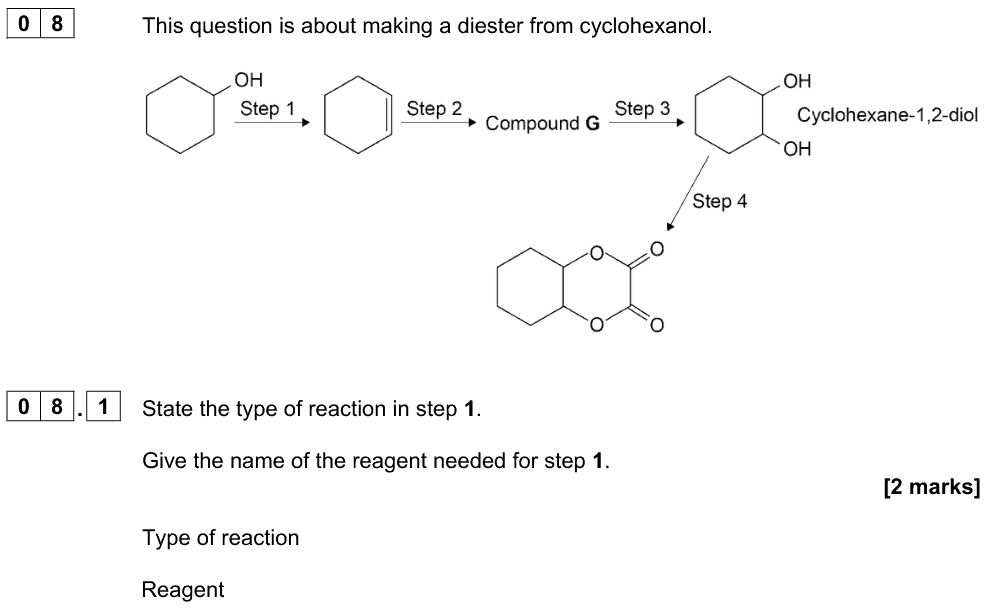
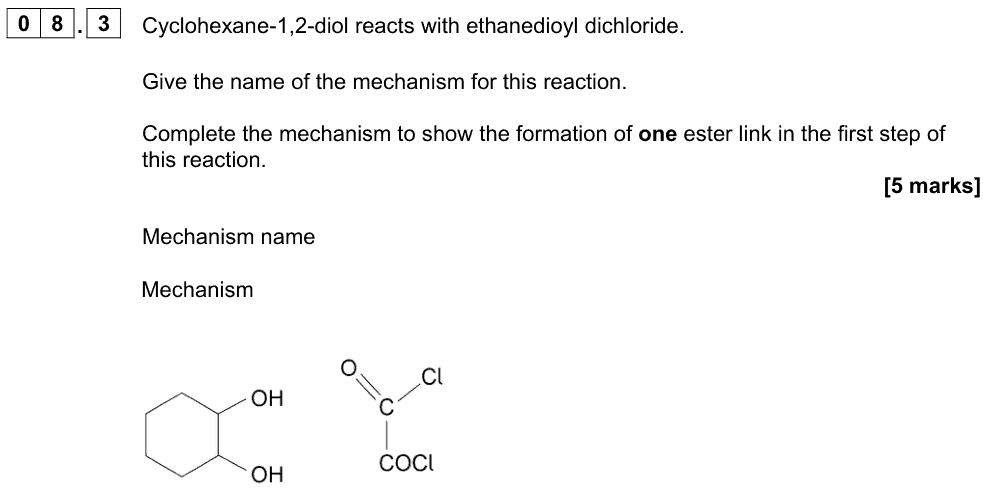
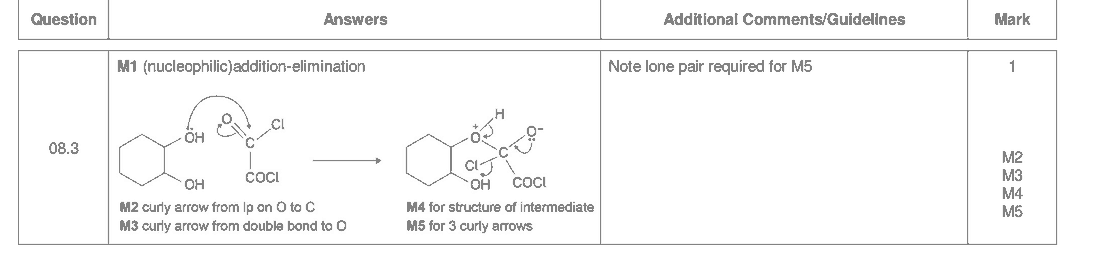
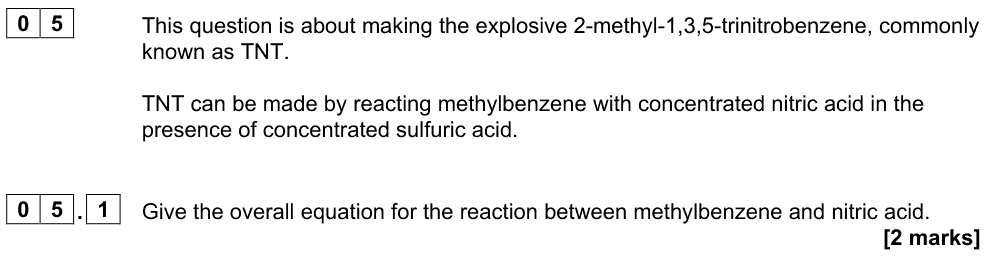
58 past-paper questions that ask you to name, outline or complete a mechanism, by topic, each with the mark scheme's own mechanism behind the button. A curly arrow shows the movement of a pair of electrons: it must start at a bond or a lone pair and finish at the atom or bond where the electrons go. Most of the marks lost here are for arrows that start or end in the wrong place, and for missing lone pairs and charges.
Methane or another alkane with chlorine in UV light. Initiation (the chlorine molecule splits into two radicals), two propagation steps, and termination. Radicals are shown with a dot; curly arrows are not required. Write a balanced equation for each step.
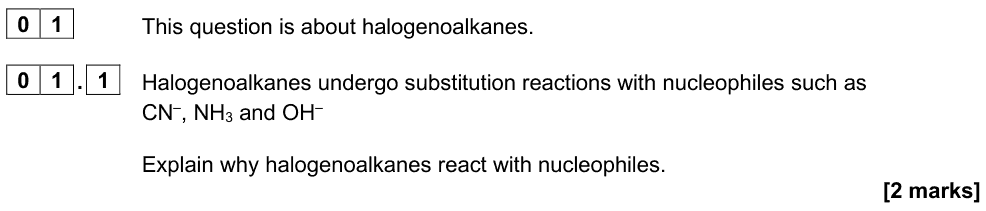
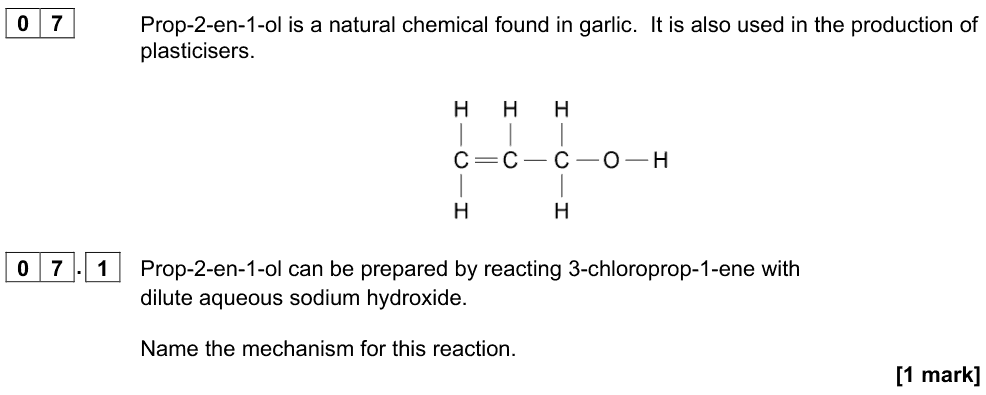
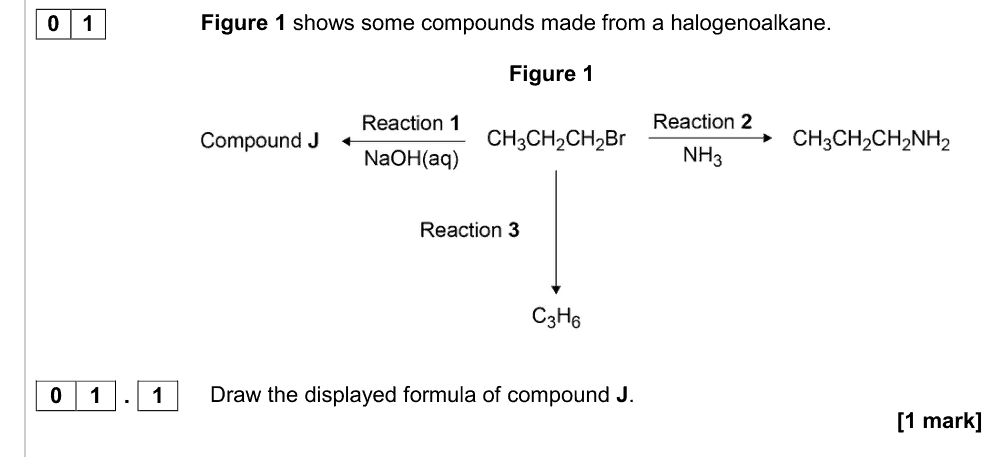
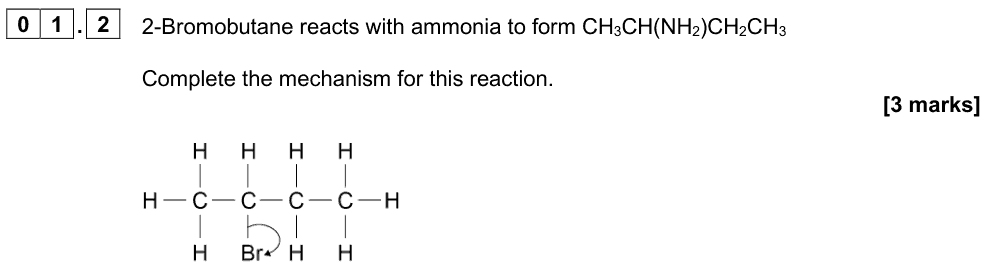
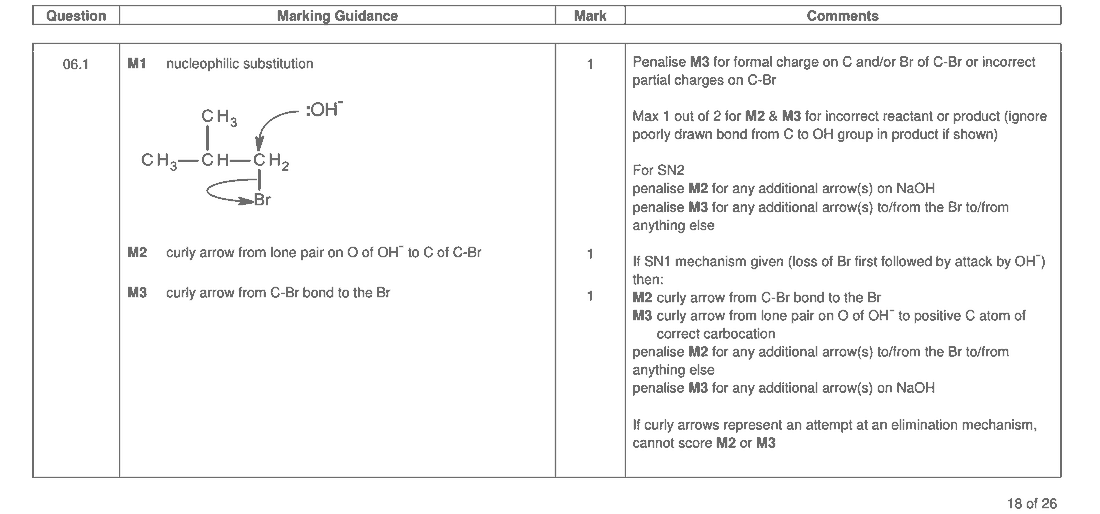
Halogenoalkane with OH⁻, CN⁻ or NH₃. Arrow from the lone pair on the nucleophile to the δ+ carbon, and an arrow from the C–X bond to the halogen. With ammonia a second molecule removes H⁺ from the intermediate. The rate depends on carbon–halogen bond enthalpy: C–I is fastest.
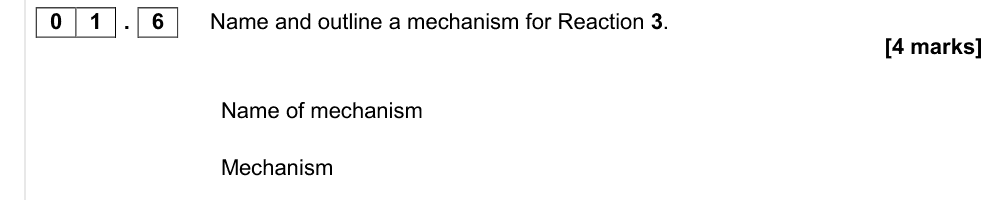
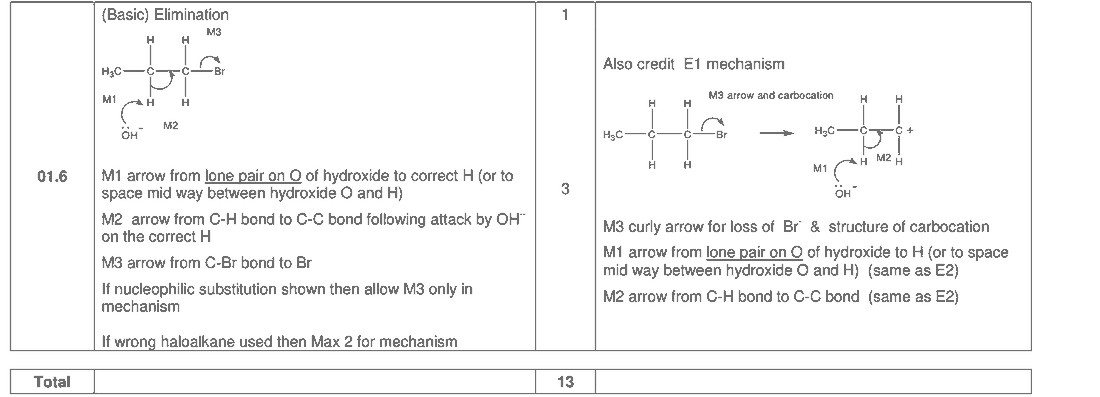
Halogenoalkane with hot ethanolic KOH. The hydroxide ion acts as a base: arrow from its lone pair to an H on the carbon next to the C–X carbon, arrow from that C–H bond to form the C=C, and arrow from the C–X bond to the halogen.
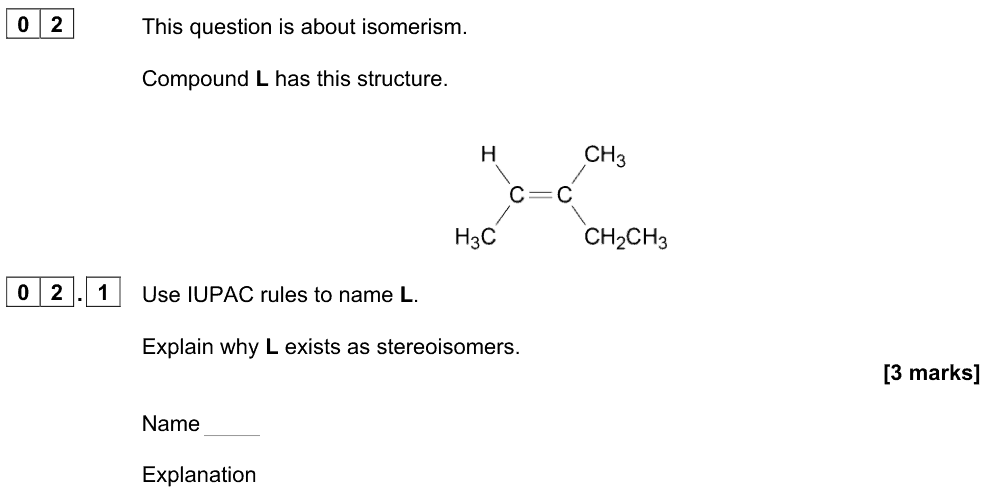
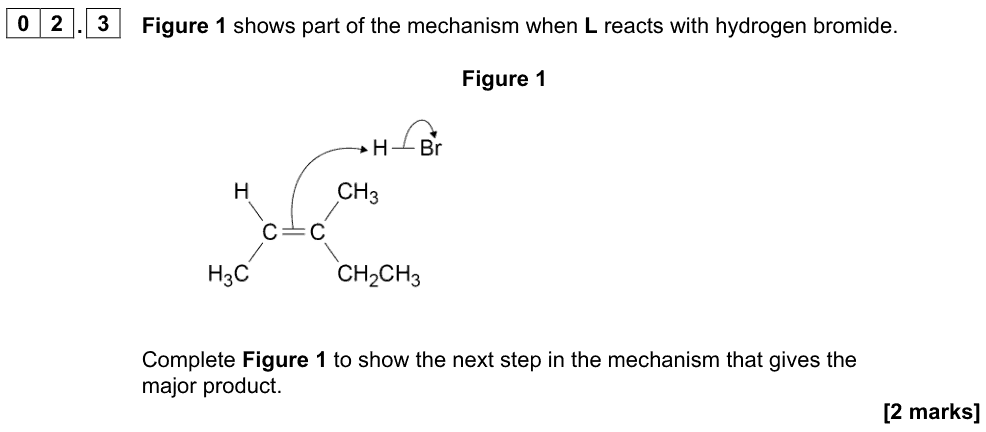
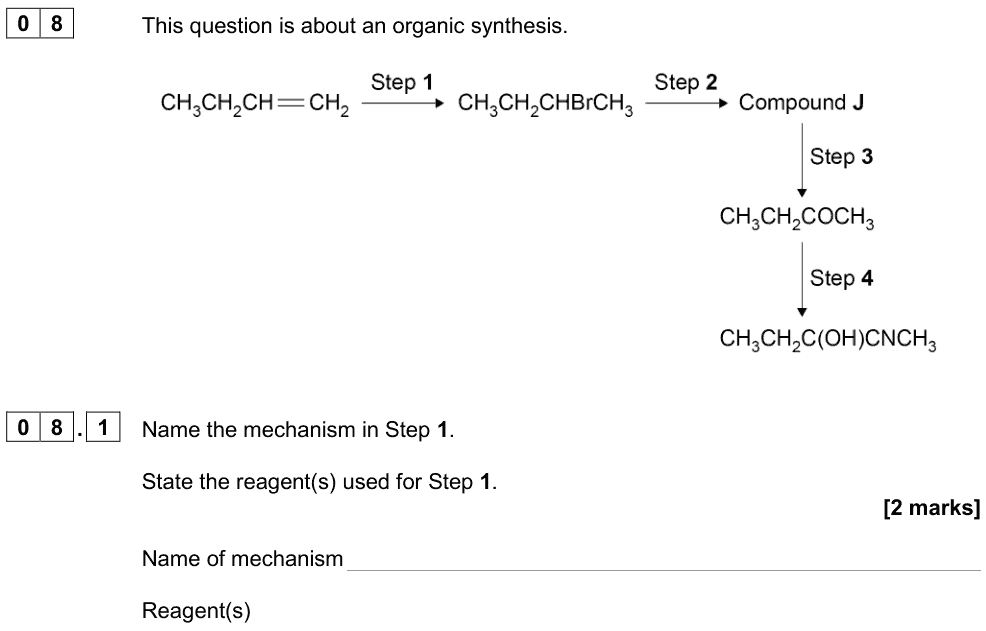
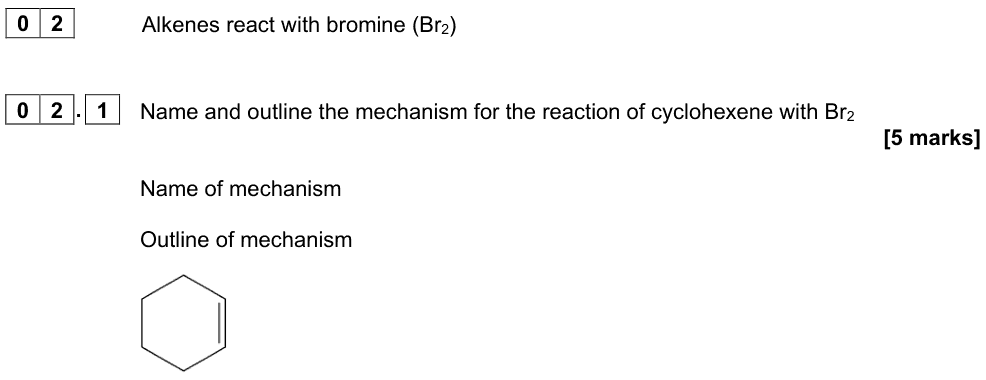
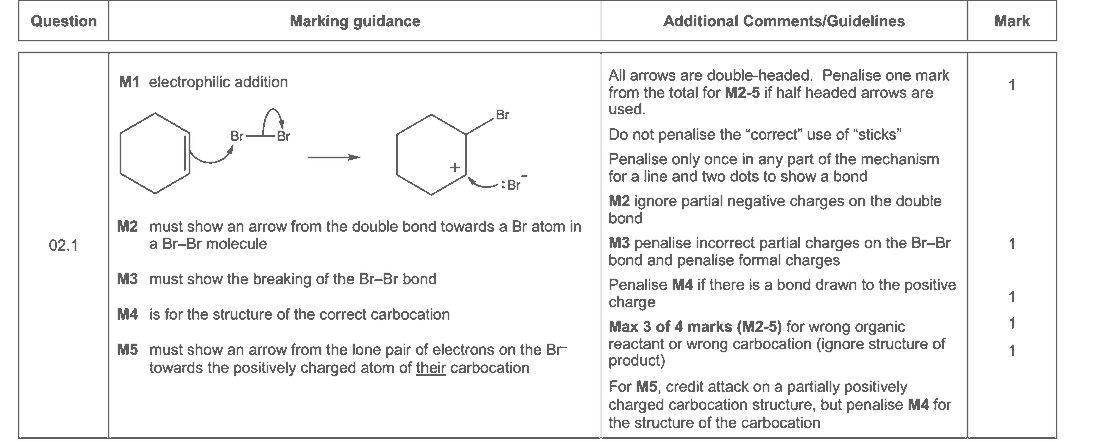
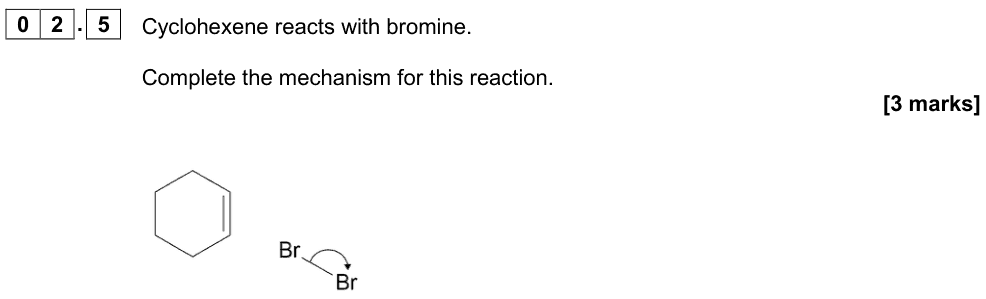
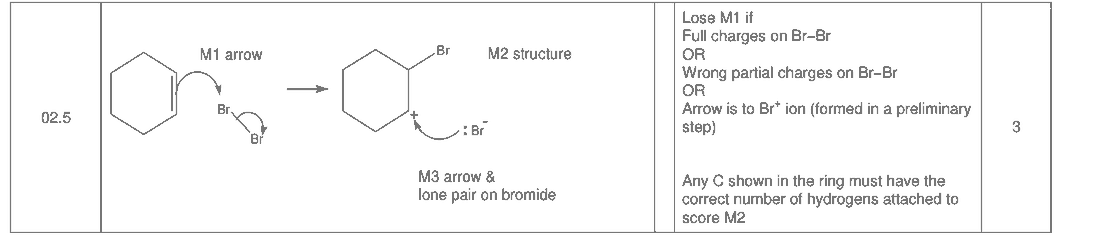
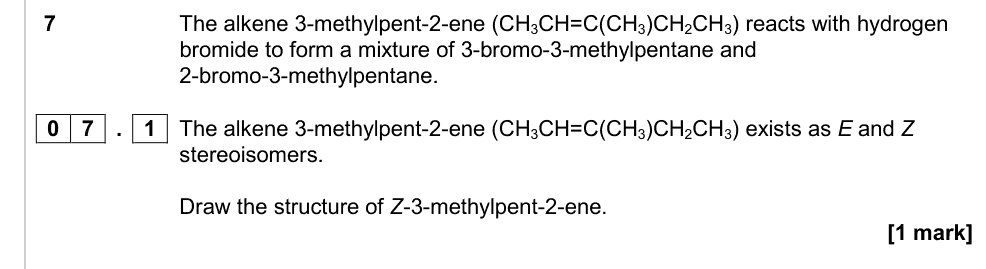
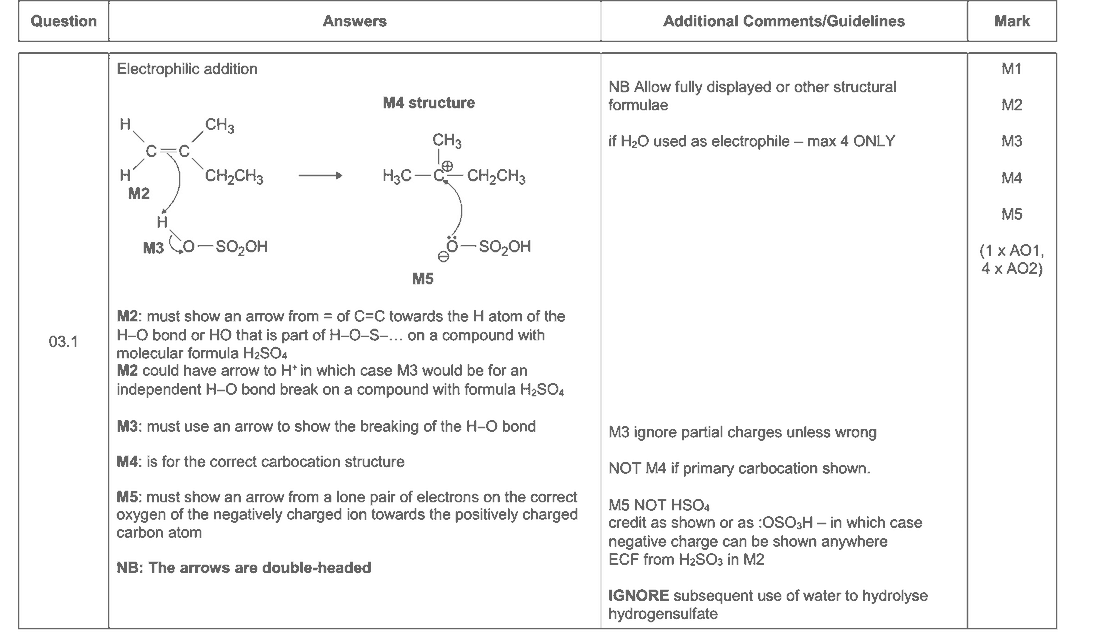
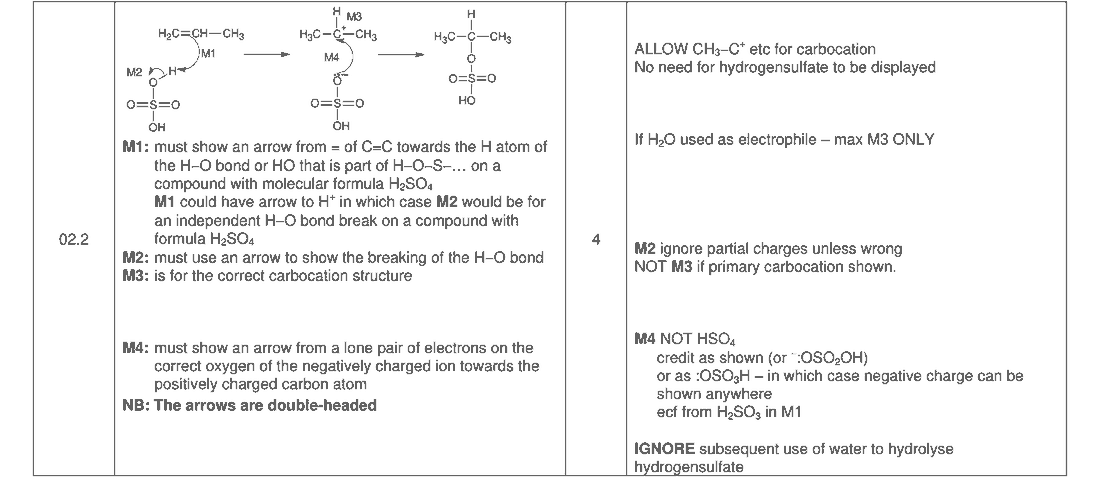
Alkene with HBr, H₂SO₄ or Br₂. Arrow from the C=C bond to the electrophile, arrow from the H–Br (or Br–Br) bond to the atom that leaves, the carbocation, then an arrow from the lone pair on the anion to C⁺. The major product comes from the more stable carbocation (tertiary > secondary > primary).
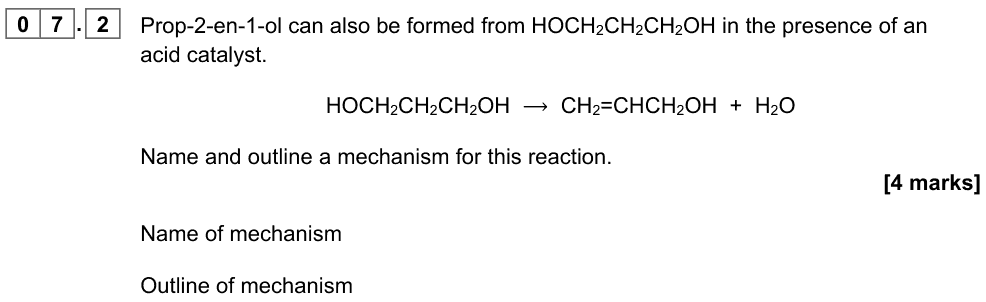
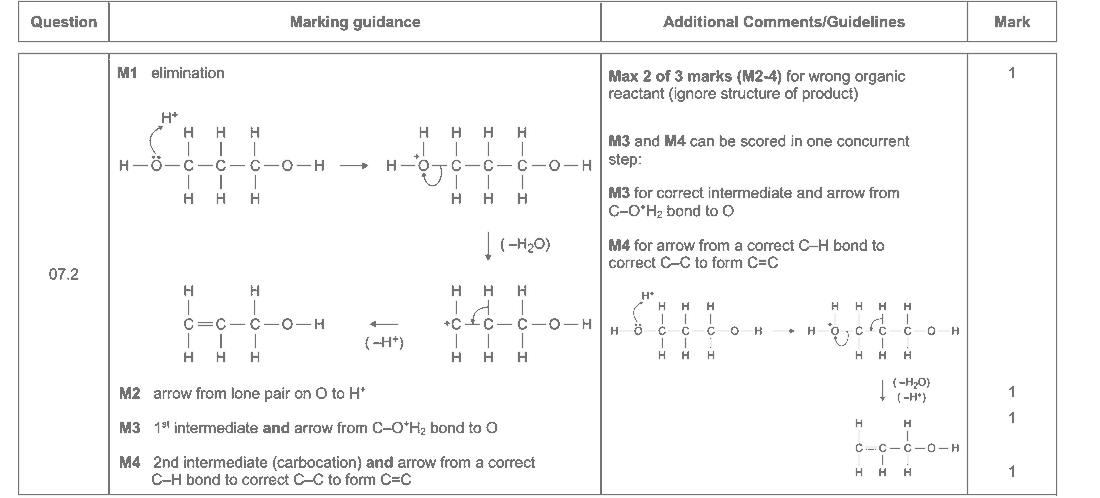
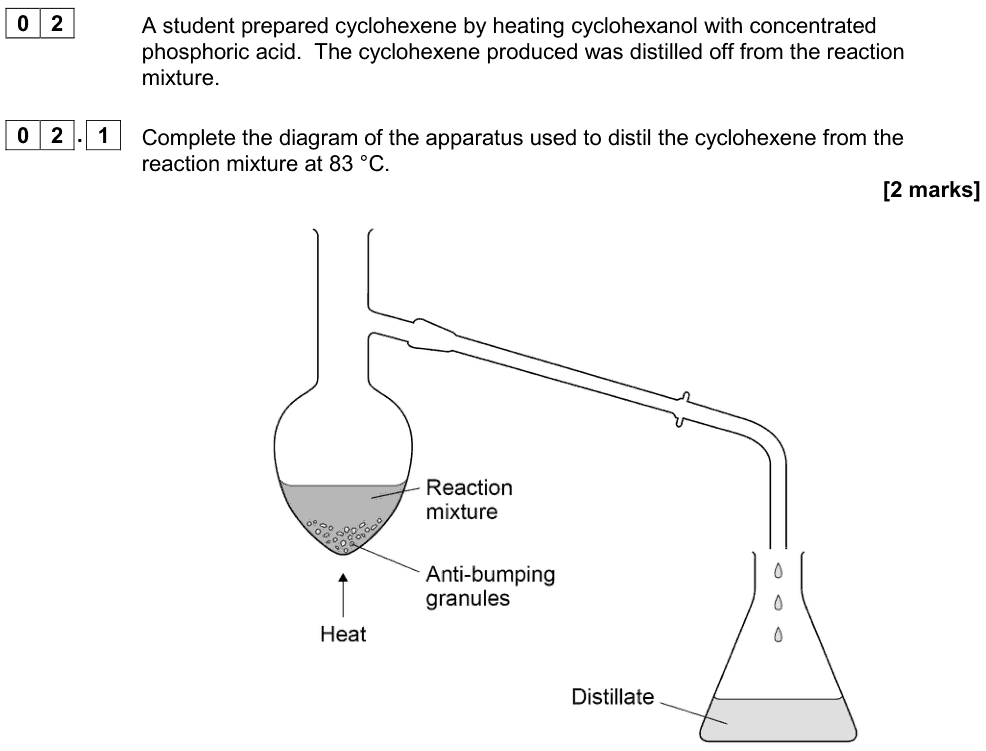
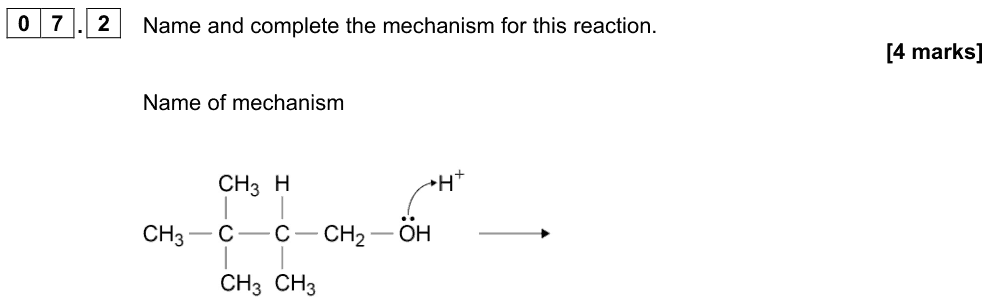
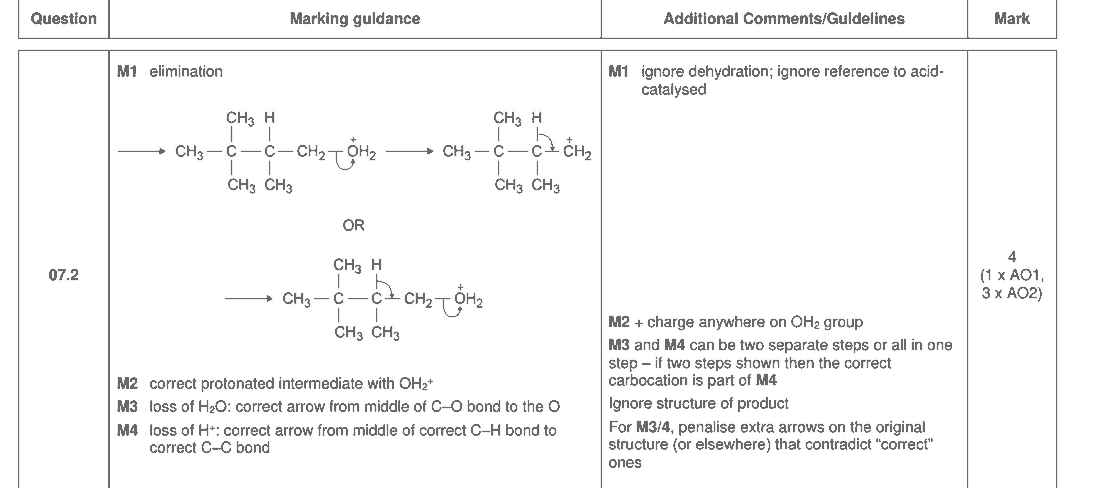
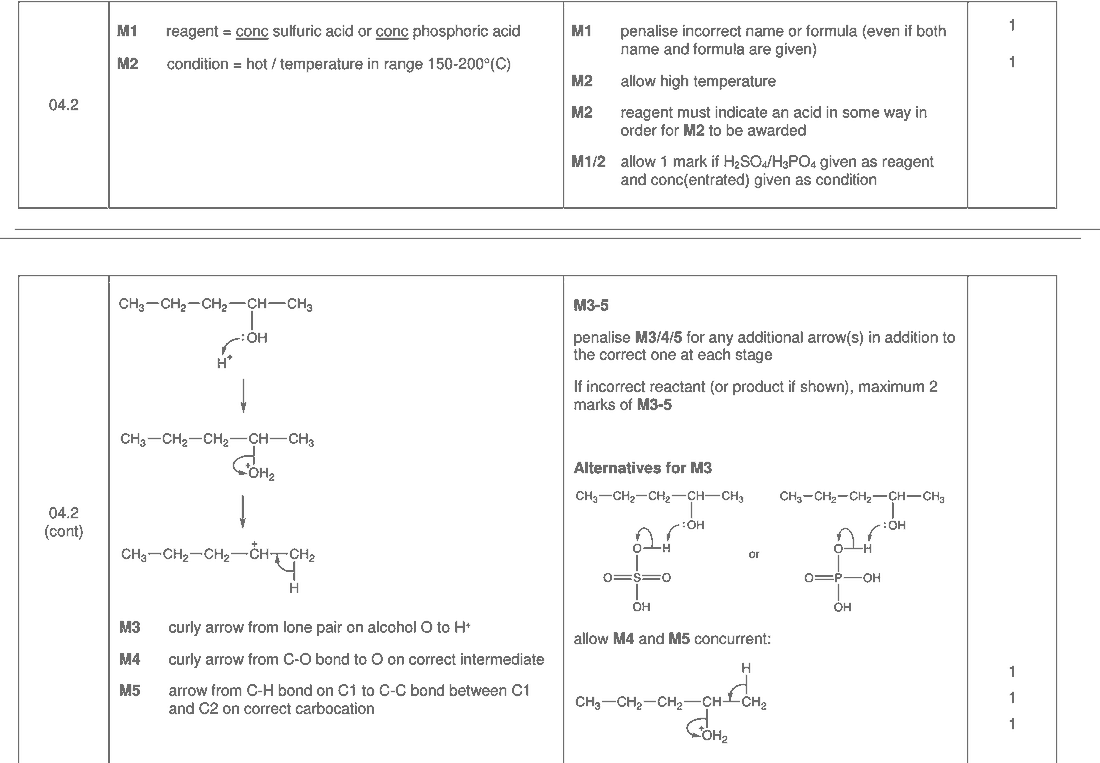
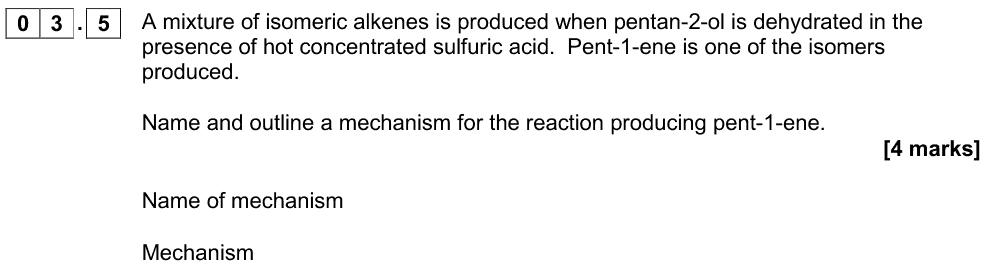
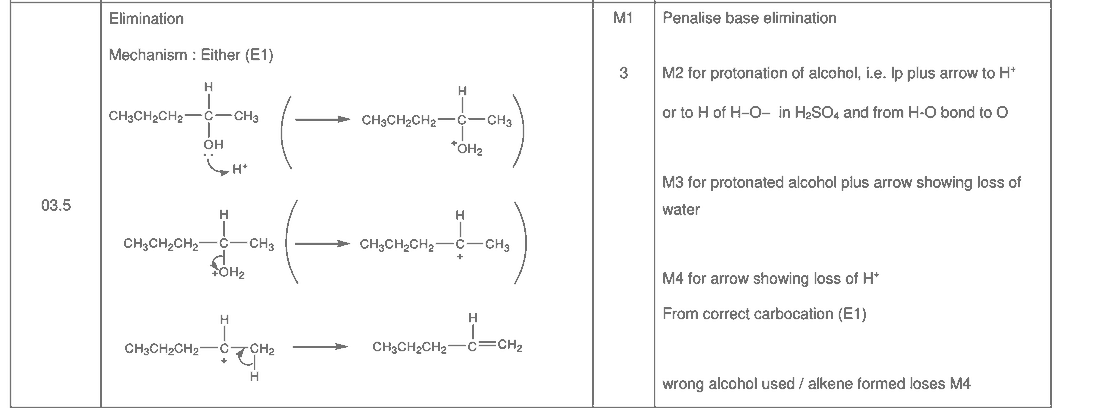
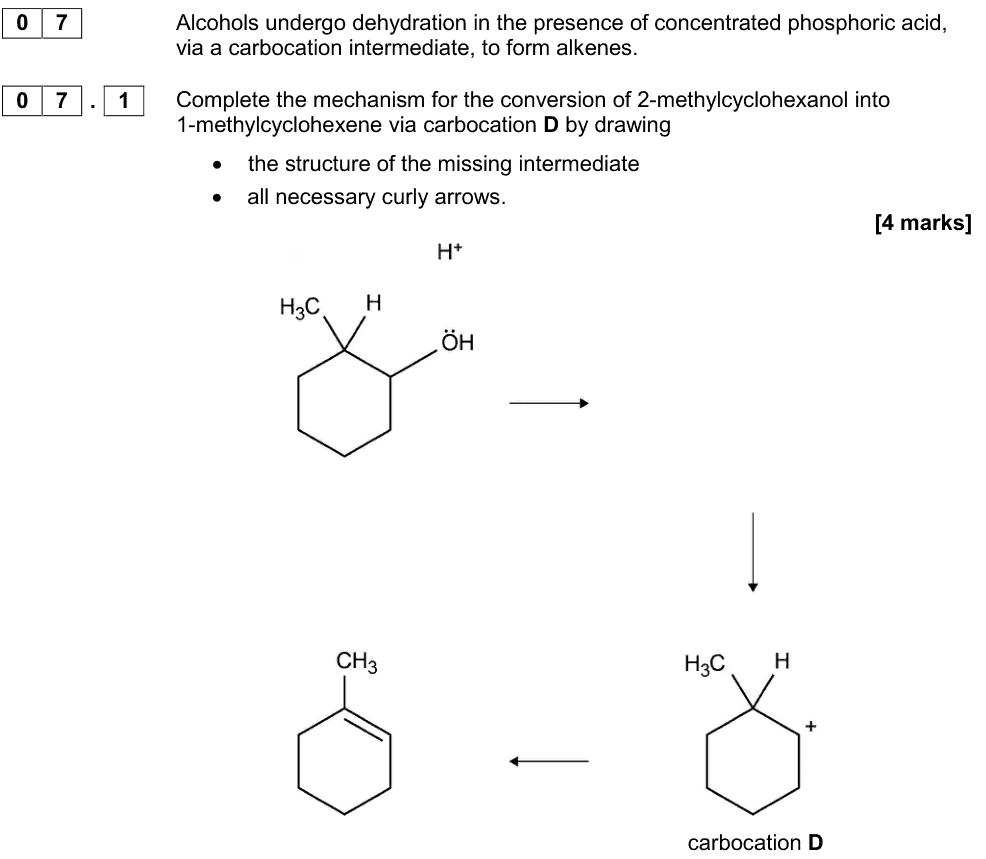
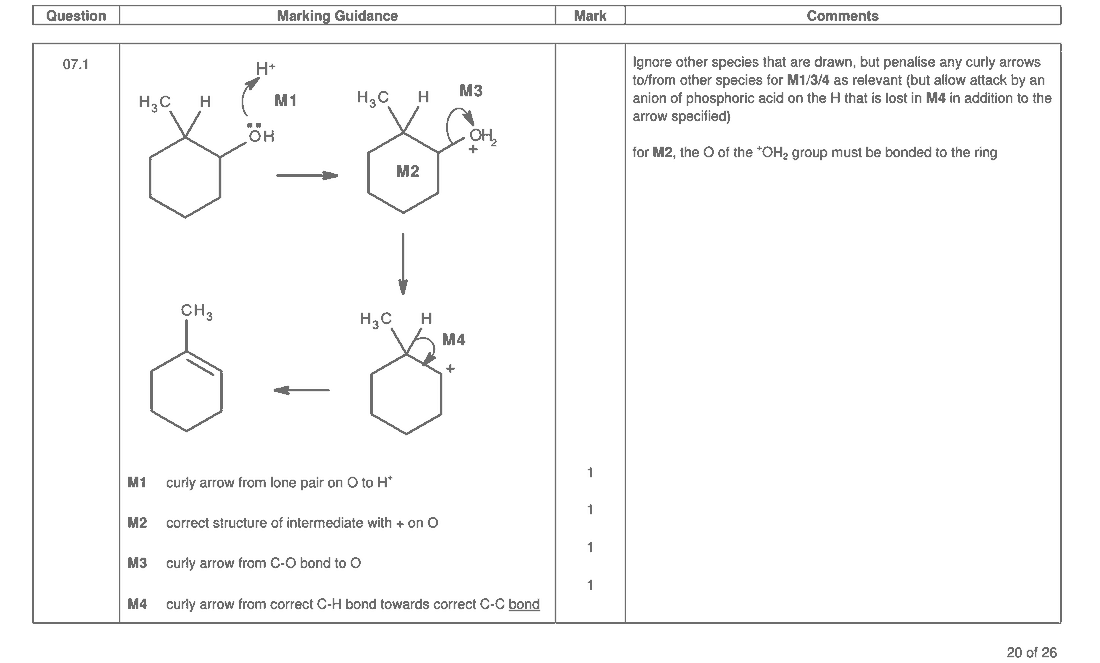
Acid-catalysed dehydration with concentrated H₂SO₄ or H₃PO₄. The lone pair on the oxygen takes H⁺, water leaves to give a carbocation, and loss of H⁺ from the next carbon forms the C=C.
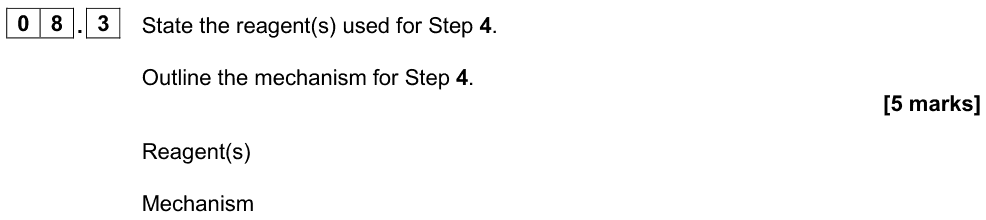
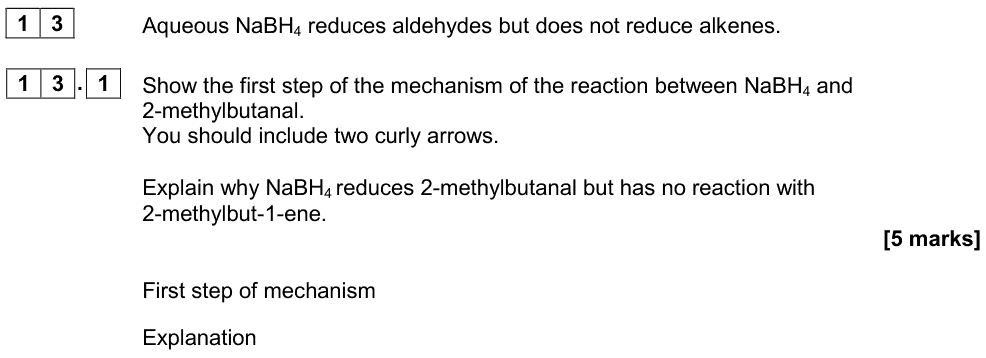
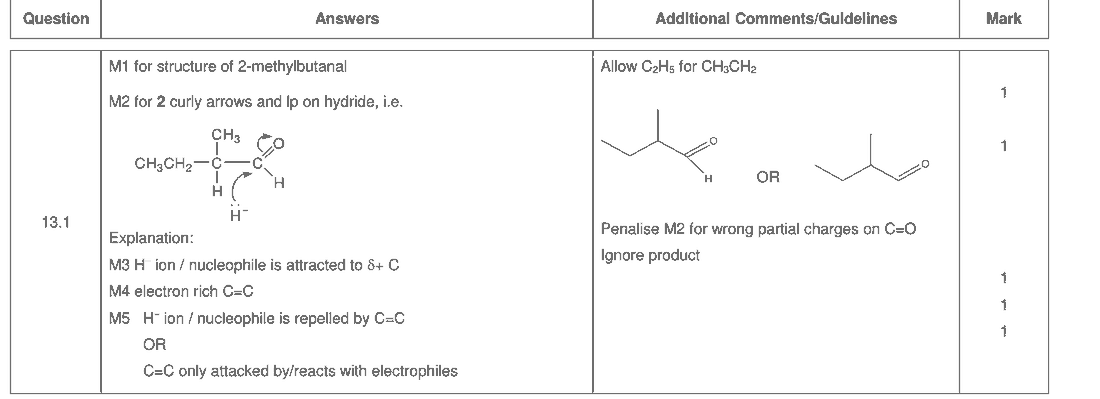
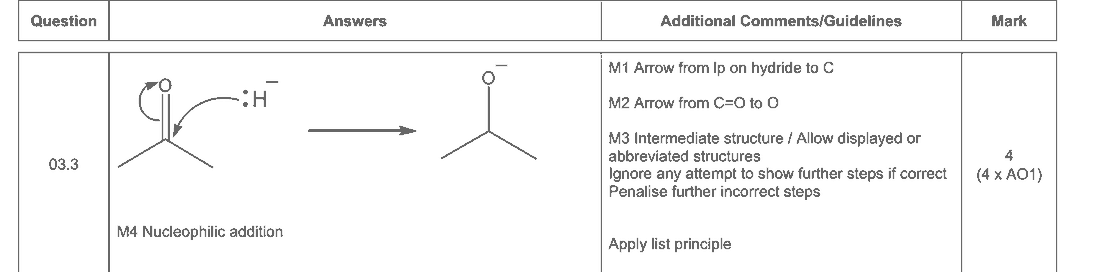
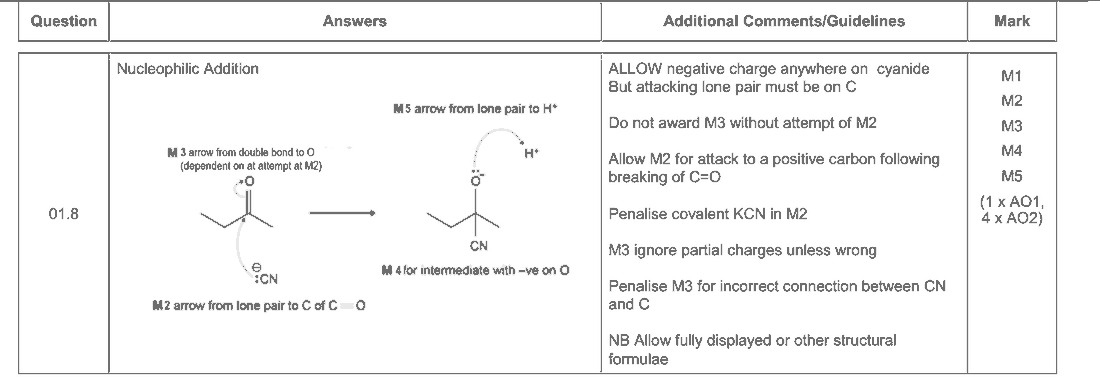
Aldehyde or ketone with NaBH₄ (the nucleophile shown as H⁻) or with KCN followed by dilute acid. Arrow from the lone pair on the nucleophile to the δ+ carbon, arrow from the C=O bond to O, then the O⁻ takes H⁺. Attack from either side of the planar C=O gives a racemic mixture.
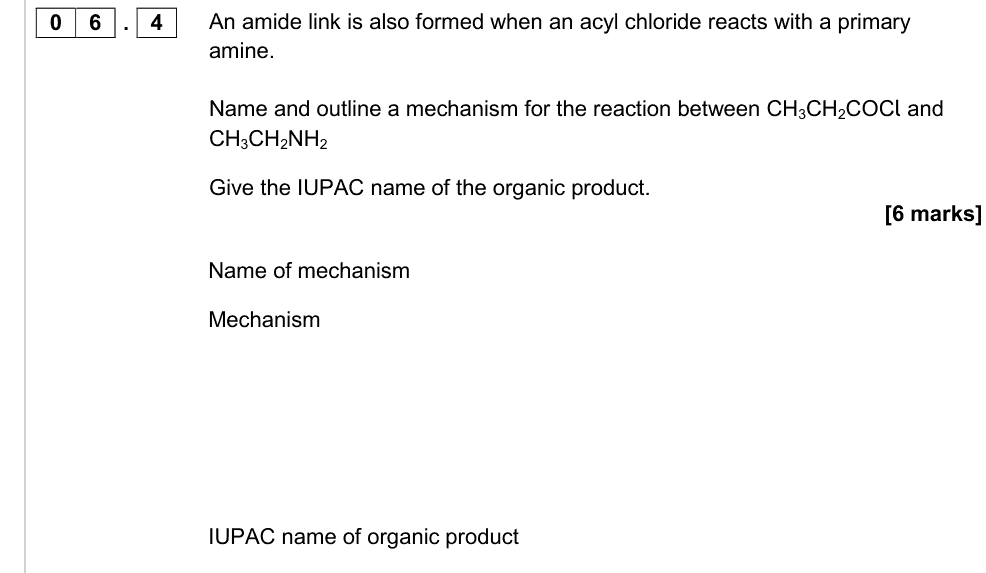
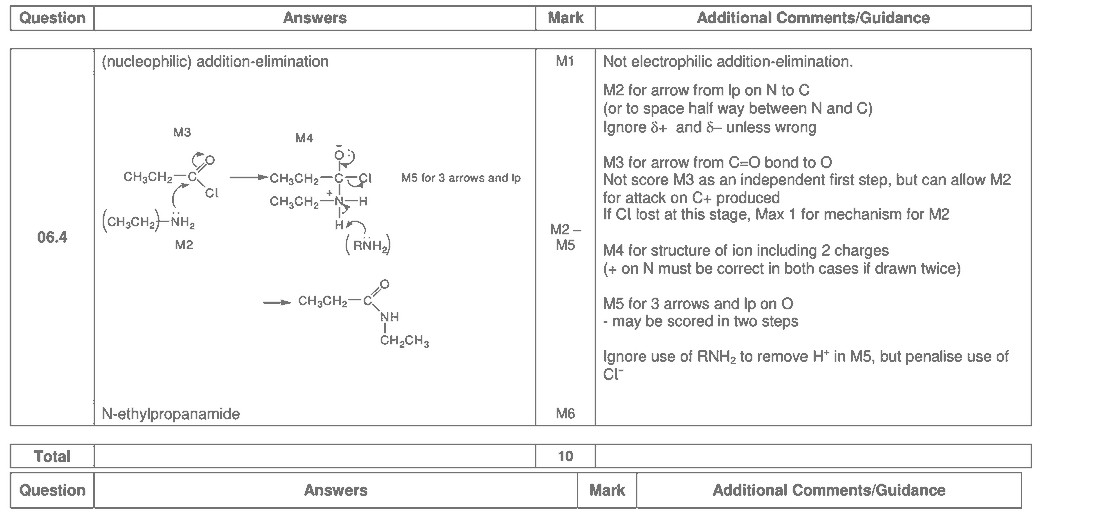
Acyl chloride with water, an alcohol, ammonia or a primary amine. Addition: arrow from the lone pair on the nucleophile to the carbonyl carbon and from C=O to O. Elimination: the C=O reforms, Cl⁻ leaves and H⁺ is lost.
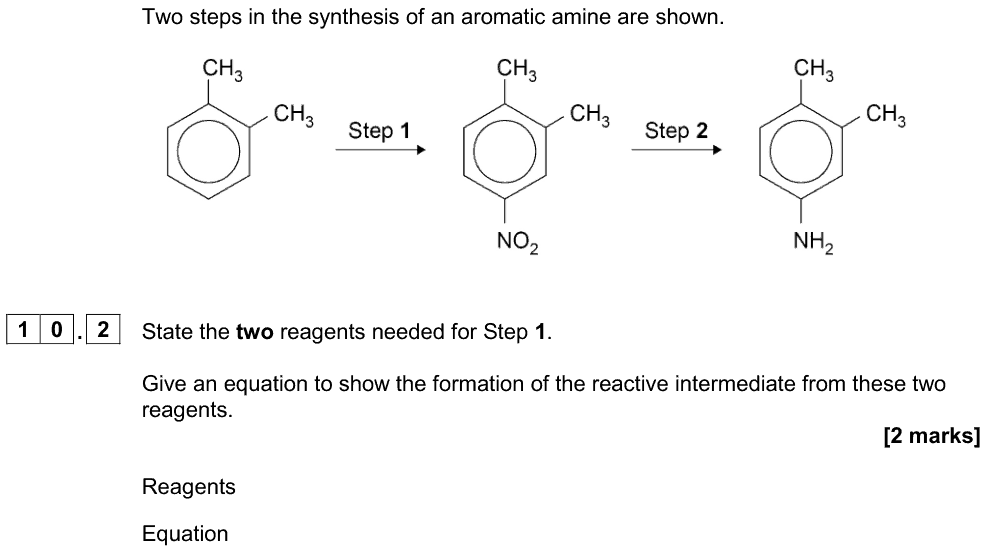
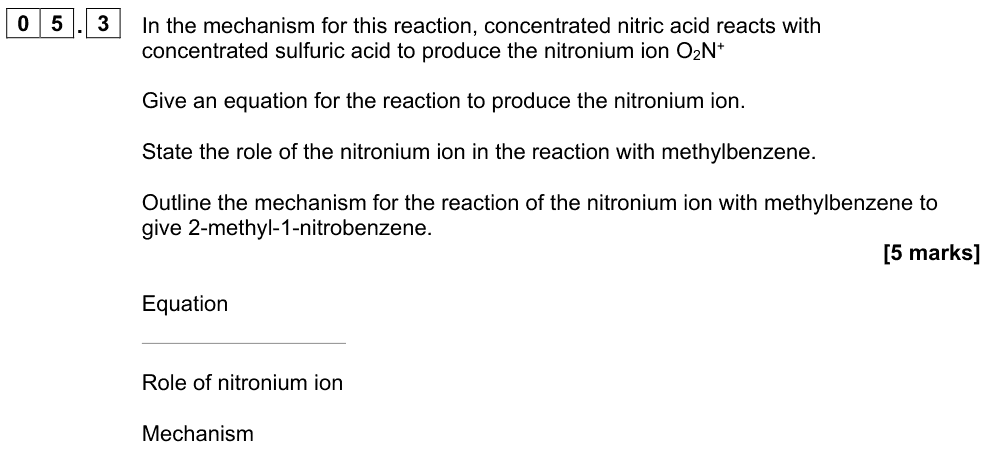
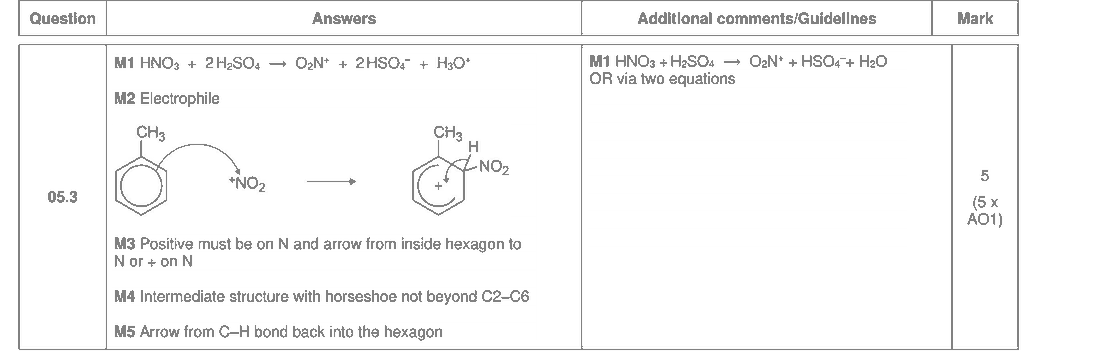
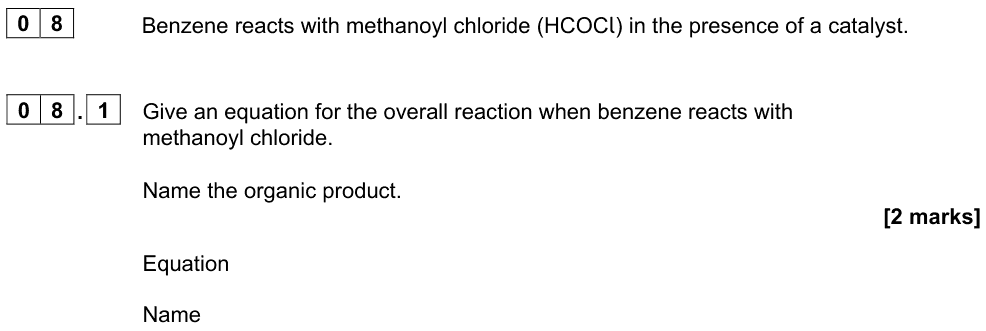
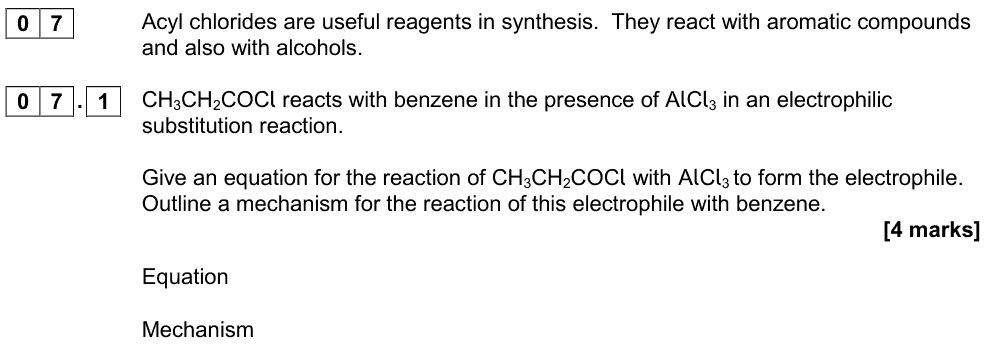
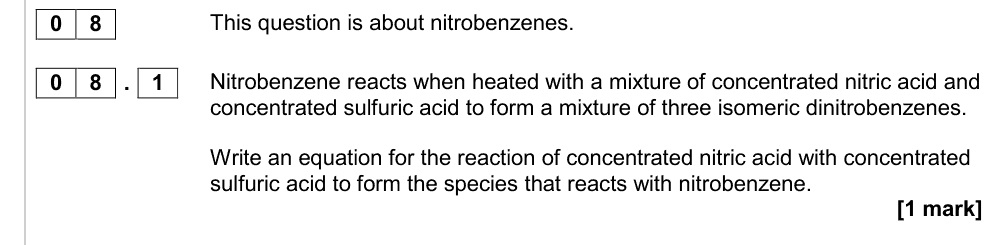
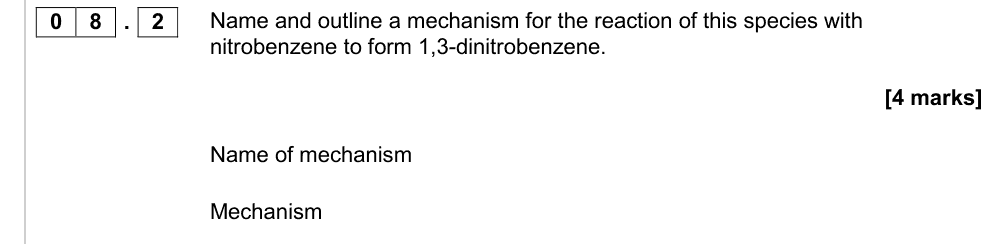
Benzene: nitration (NO₂⁺ generated from concentrated HNO₃ and H₂SO₄) and Friedel–Crafts acylation with AlCl₃ as catalyst. Arrow from the ring to the electrophile, the intermediate with a broken ring (horseshoe over the other five carbons, + charge), then an arrow from the C–H bond back into the ring as H⁺ is lost. Include the equations that make the electrophile.
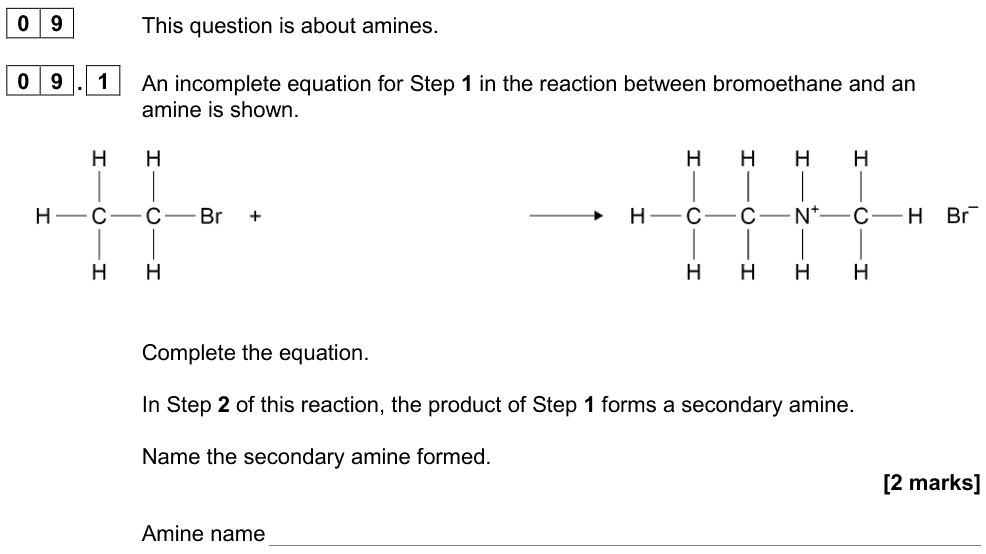
Ammonia or an amine with a halogenoalkane, and the further substitution that gives secondary and tertiary amines and quaternary ammonium salts. The same arrows as nucleophilic substitution, with the lone pair on nitrogen as the nucleophile.
Mechanisms are not required for cracking, the oxidation of alcohols or the formation of esters and polymers, but the papers do ask you to complete or deduce unfamiliar mechanisms by analogy: the same rules for arrows, lone pairs and charges apply. Written by the site from the specification and the mark schemes; being checked by our tutor.
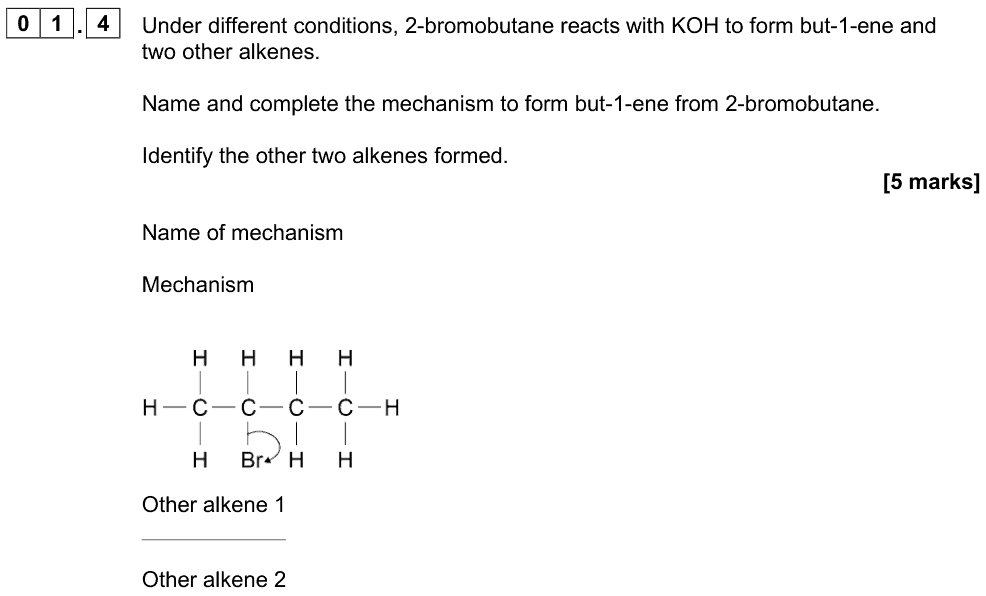
June 2025 · AS Paper 2 · Q01.45 marksAO1=1, AO2=2, AO3=2Mechanism
Earlier parts of question 01 that this part uses
Mark scheme
Examiner's comment
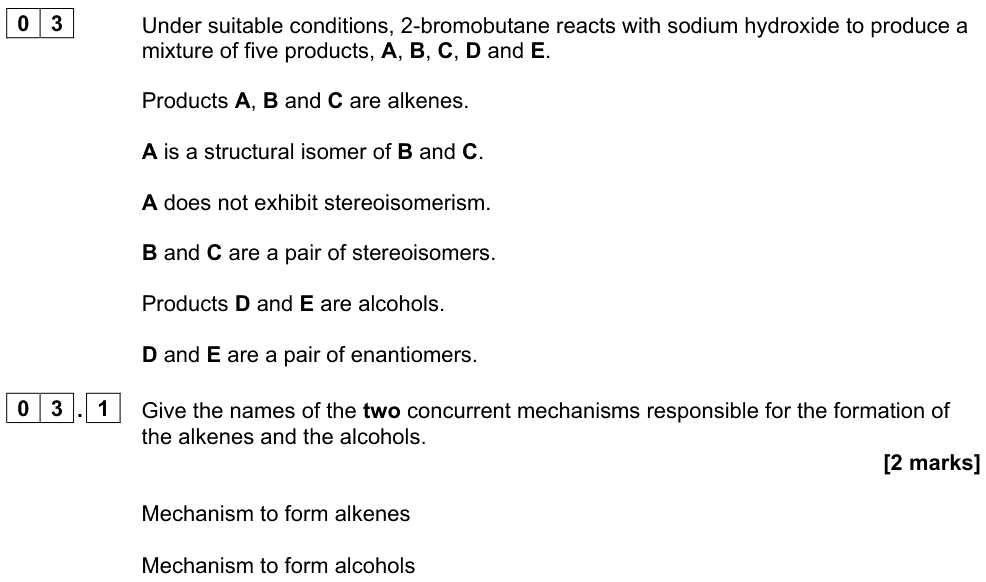
1.4 Students had to complete an elimination mechanism. Many did this well although some gave the mechanism to form but-2-ene rather than but-1-ene as required. Few students appreciated that the two other alkenes were E-but-2-ene and Z-but-2-ene with most going for but-2-ene and some other compound that was commonly not even an alkene.
Notes from the mark scheme and report
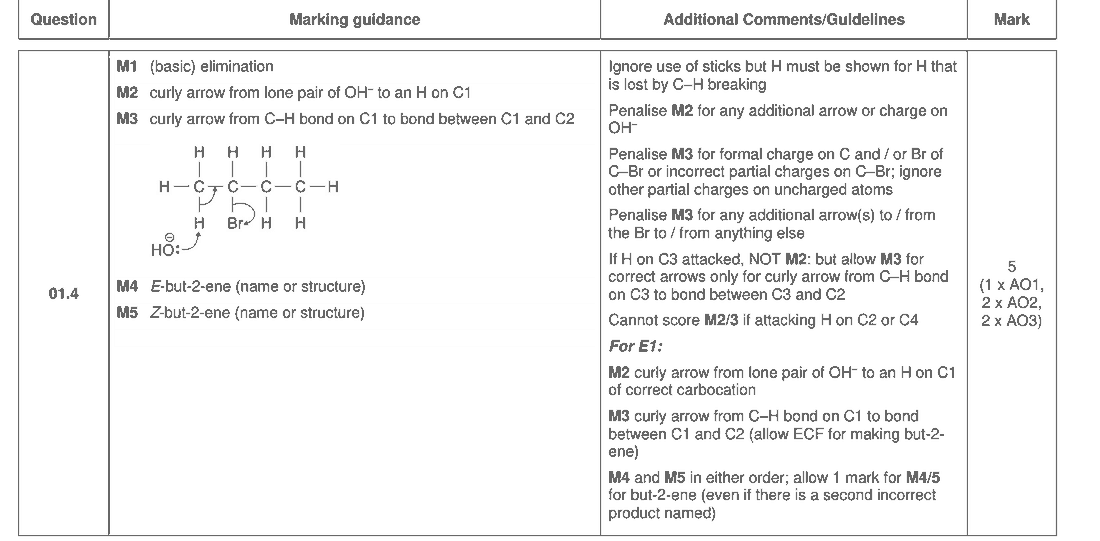
(Base) elimination. Curly arrow from the lone pair on OH– to an H on C1
curly arrow from that C–H bond to the C1–C2 bond (the C–Br arrow is already printed). Other alkenes: E-but-2-ene and Z-but-2-ene
'but-2-ene' alone scores 1 of the 2. Errors: attacking an H on C3 (gives but-2-ene)
second alkene not an alkene
June 2025 · Paper 2 · Q02.32 marksAO2=2Mechanism
Earlier part of question 02 that this part uses
Mark scheme
Examiner's comment
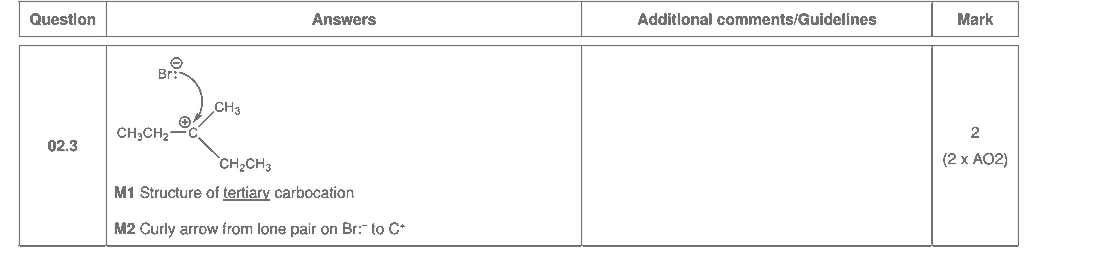
2.3 Students were asked to complete an electrophilic addition mechanism with an unsymmetrical alkene. This proved straight forward for many. Those who lost marks often did so because that drew a secondary carbocation intermediate rather than the tertiary one that would lead to the major product.
Notes from the mark scheme and report
The tertiary carbocation CH3CH2–C+(CH3)–CH2CH3, with a curly arrow from a lone pair on Br– to the C+. Common error: drawing the secondary carbocation
June 2025 · Paper 2 · Q03.84 marksAO2=4Mechanism
Earlier part of question 03 that this part uses
Mark scheme
Examiner's comment
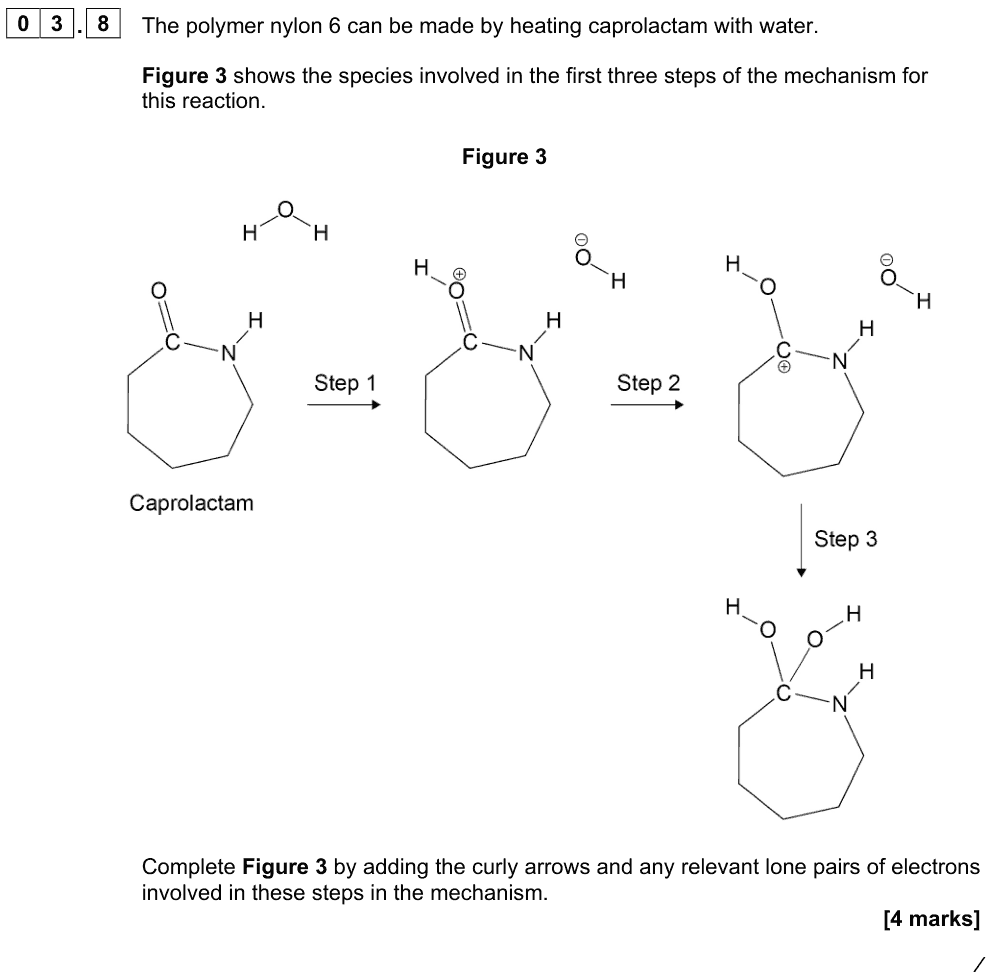
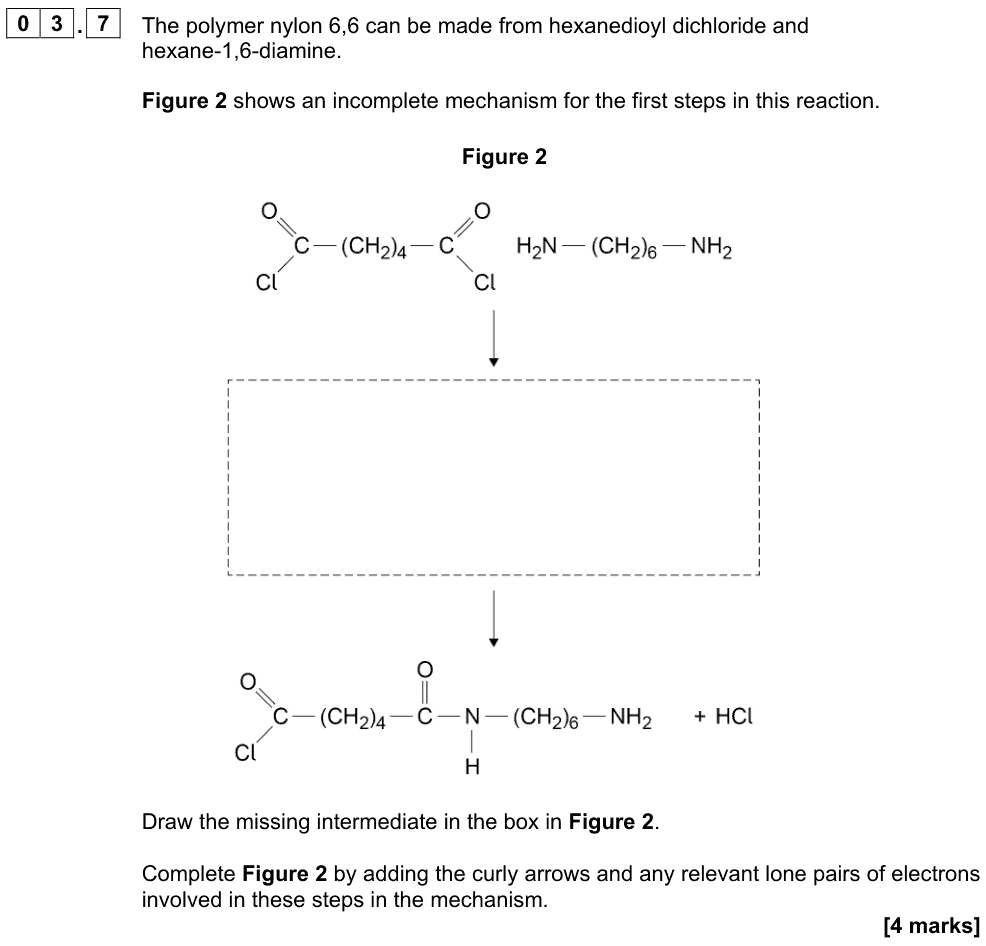
3.8 Students were given the first steps in an unfamiliar mechanism and asked to deduce the curly arrows and relevant lone pairs of electrons to complete the scheme. This was well answered by many showing a good understanding of mechanistic ideas covered elsewhere in the course.
Notes from the mark scheme and report
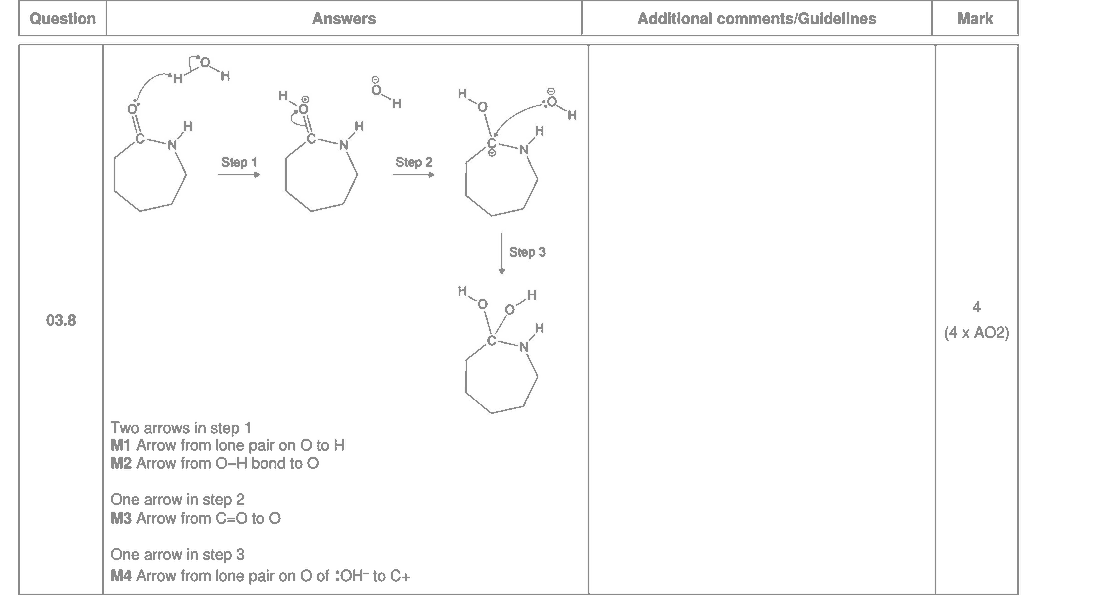
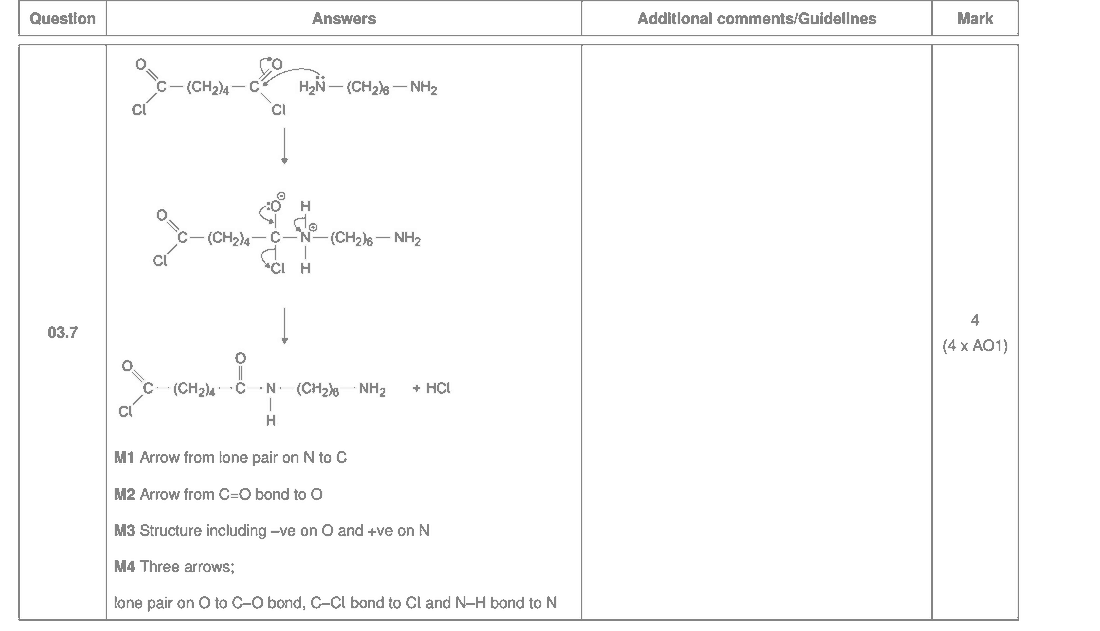
Step 1: arrow from a lone pair on the carbonyl O to an H of water and arrow from that O–H bond to the O of water. Step 2: arrow from the C=O bond to O (giving C+). Step 3: arrow from a lone pair on O of OH– to the C+. Unfamiliar mechanism, generally well done
June 2024 · AS Paper 2 · Q04.25 marksAO1=1, AO2=4Mechanism
Earlier part of question 04 that this part uses
Mark scheme
Examiner's comment
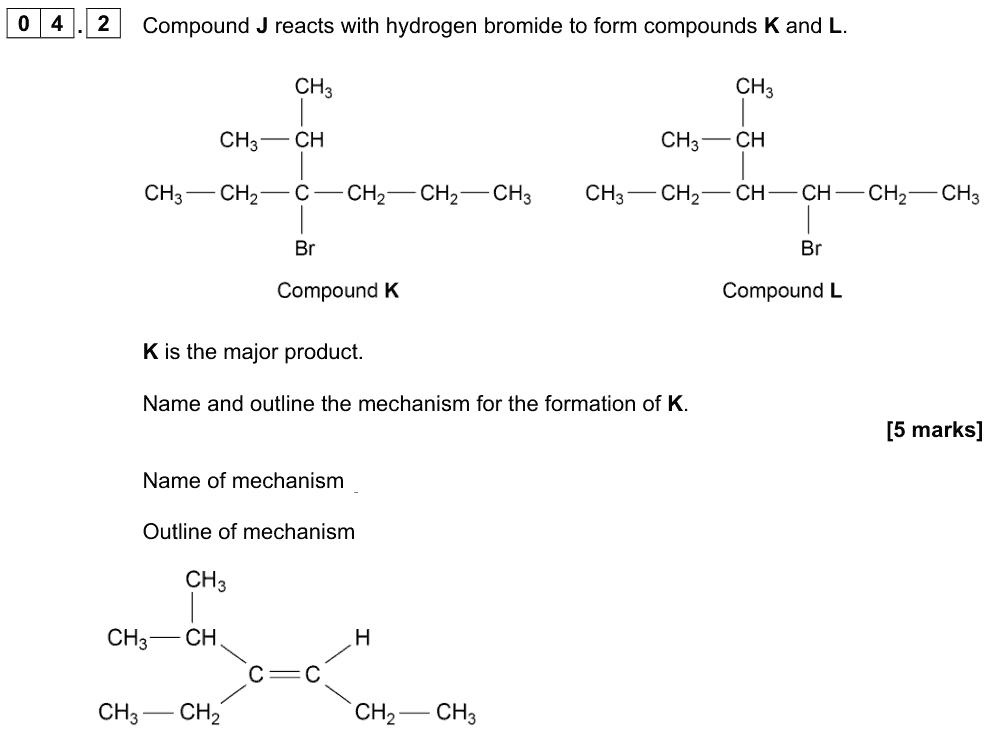
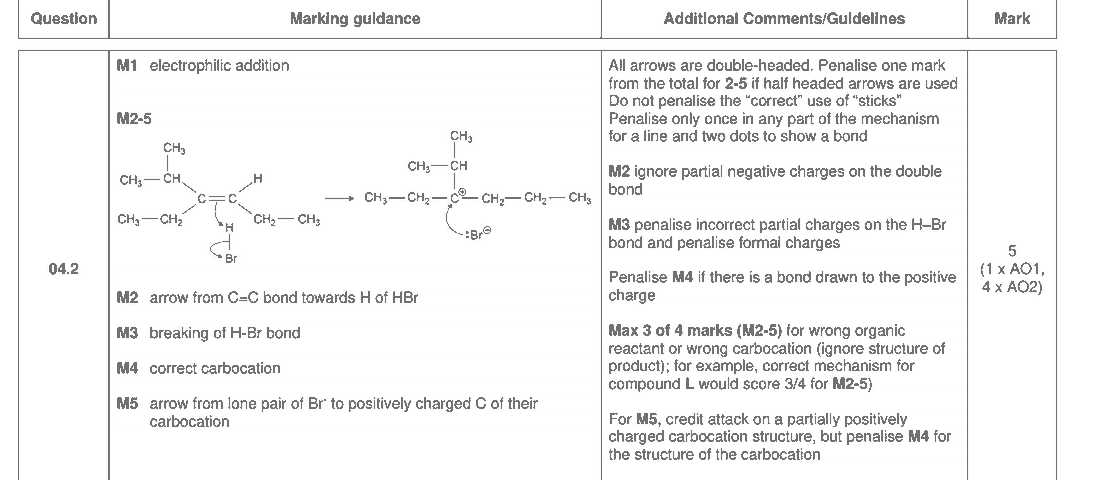
4.2 Students had to show the mechanism for the formation of the major halogenoalkane product from electrophilic addition to an alkene. This was generally very well done.
Notes from the mark scheme and report
Electrophilic addition. Curly arrow from the C=C to the H of H–Br
arrow from the H–Br bond to Br
tertiary carbocation with the positive charge on the carbon carrying the (CH3)2CH and CH3CH2 groups (H has added to the CH carbon)
arrow from a lone pair on Br– to the C+. Mechanism for L (secondary carbocation) scores max 3 of the 4 mechanism marks.
June 2024 · AS Paper 2 · Q07.43 marksAO1=1, AO2=2Mechanism
Earlier part of question 07 that this part uses
Mark scheme
Examiner's comment
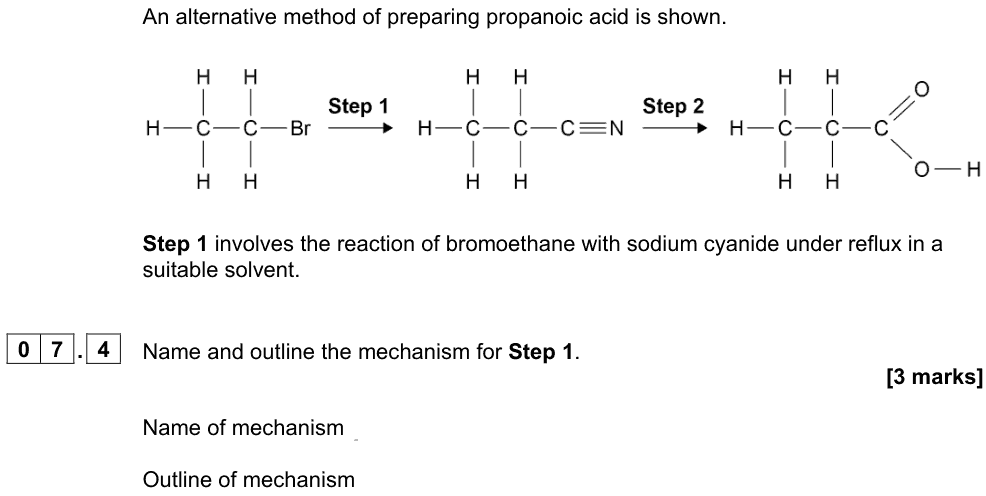
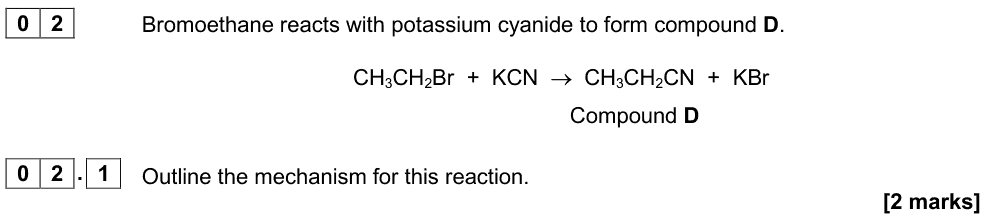
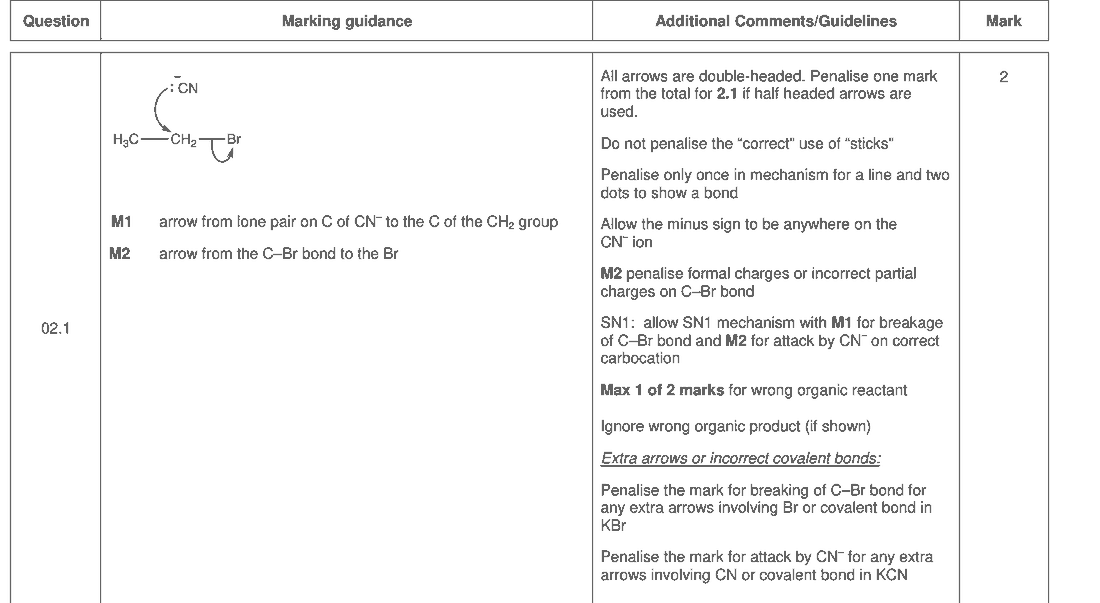
7.4 In this question students were required to show the mechanism for the reaction of sodium cyanide with bromoethane. Many students failed to show the CN– correctly attacking the bromoethane.
Notes from the mark scheme and report
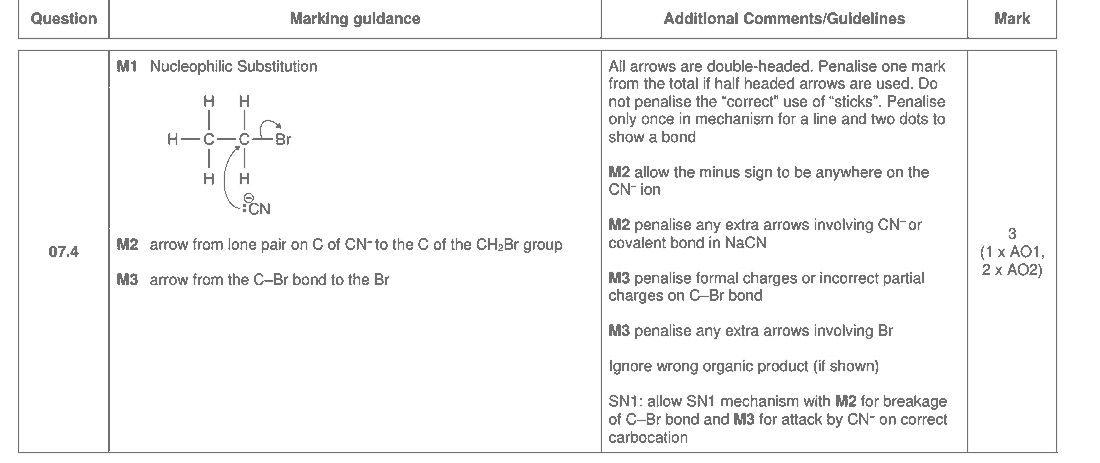
Nucleophilic substitution. Curly arrow from the lone pair on the C of :CN– to the carbon of the CH2Br group
curly arrow from the C–Br bond to Br. No extra arrows
no formal charges on the C–Br bond. Many did not show CN– attacking correctly
June 2024 · Paper 2 · Q01.34 marksAO2=4Mechanism
Earlier part of question 01 that this part uses
Mark scheme
Examiner's comment
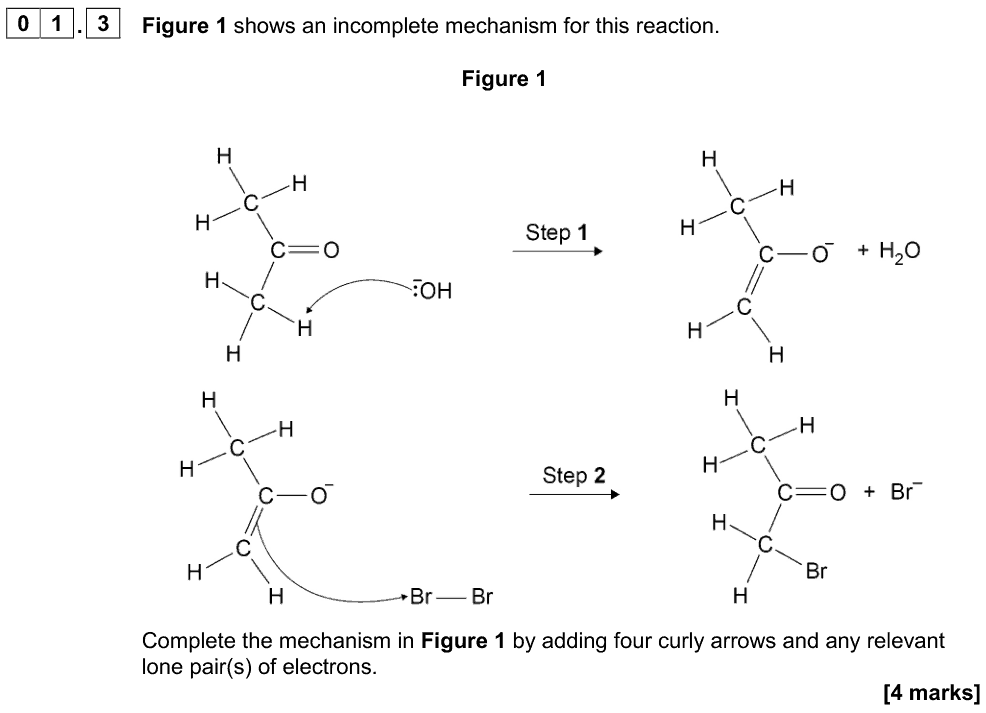
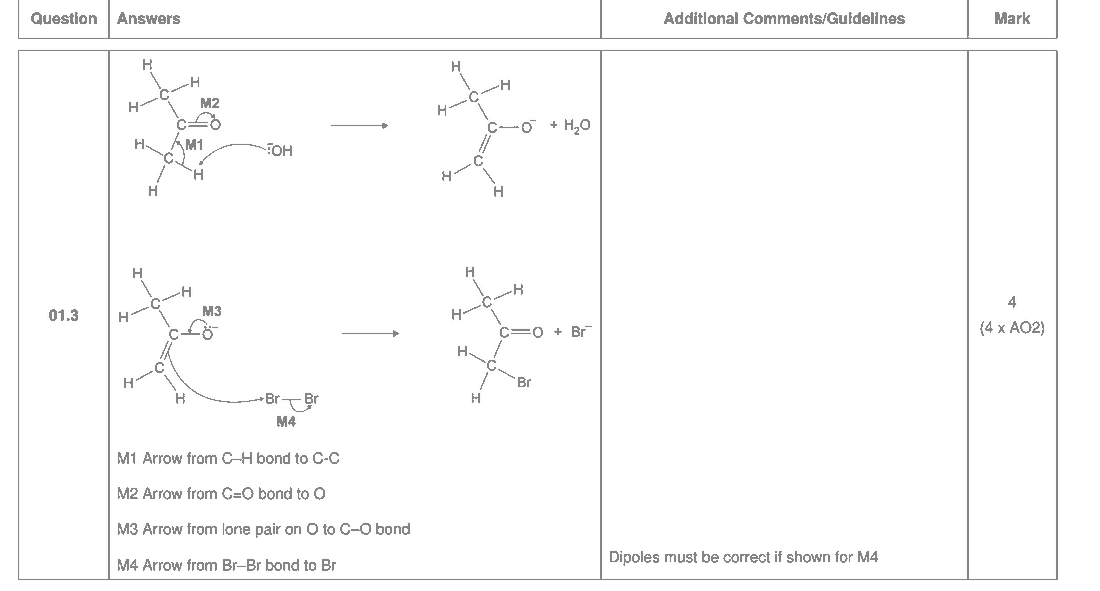
1.3 This unfamiliar mechanism question was well answered and discriminated well. The best students were able to deduce the correct curly arrows from the information given.
Notes from the mark scheme and report
Step 1 (the :OH– to H arrow is given): arrow from the C–H bond to the C–C bond
arrow from the C=O bond to O. Step 2 (the C=C to Br arrow is given): arrow from a lone pair on O– to the C–O bond
arrow from the Br–Br bond to Br. Dipoles must be correct if shown. The best students deduced the arrows from the structures given
June 2024 · Paper 2 · Q08.35 marksAO1=1, AO2=4Mechanism
Earlier part of question 08 that this part uses
Mark scheme
Examiner's comment
8.3 This fairly standard mechanism was well answered but also differentiated very effectively, with a discrimination index of 0.67.
Notes from the mark scheme and report
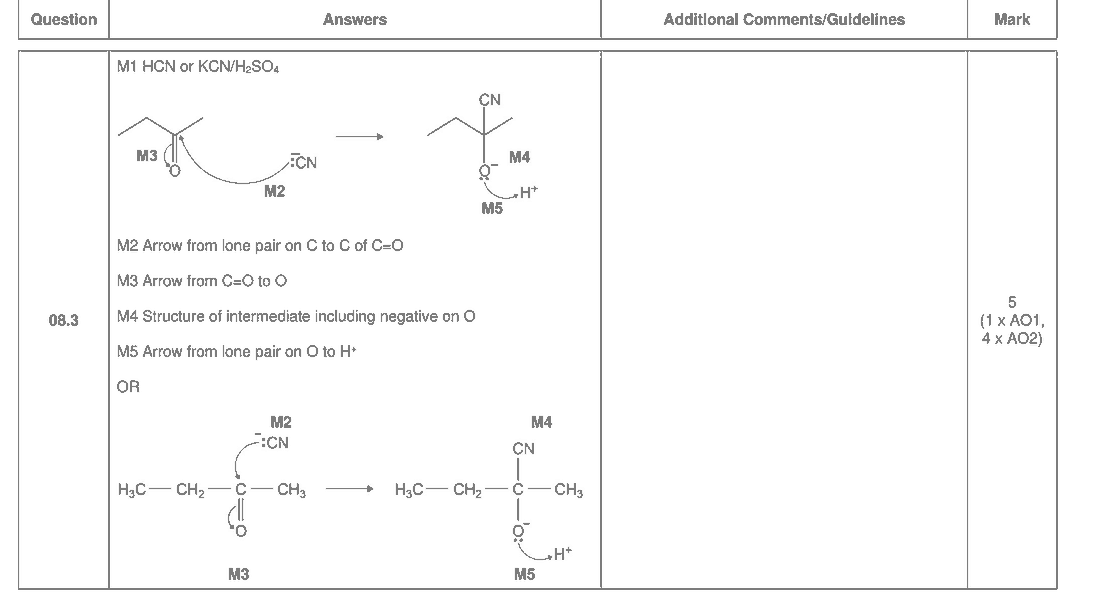
KCN followed by dilute acid (HCN or KCN/H2SO4). Nucleophilic addition: arrow from the lone pair on C of :CN– to the C of C=O
arrow from the C=O bond to O
intermediate with O–
arrow from a lone pair on O– to H+
June 2024 · Paper 2 · Q09.33 marksAO2=3Mechanism
Earlier part of question 09 that this part uses
Mark scheme
Examiner's comment
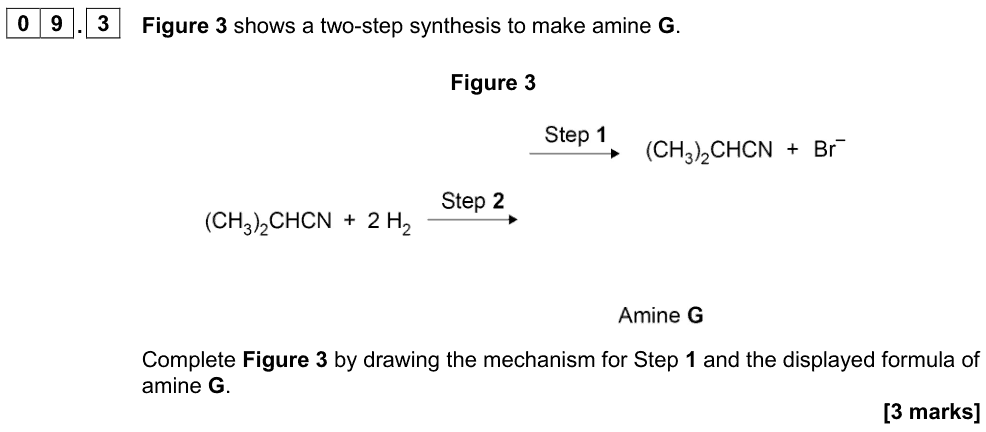
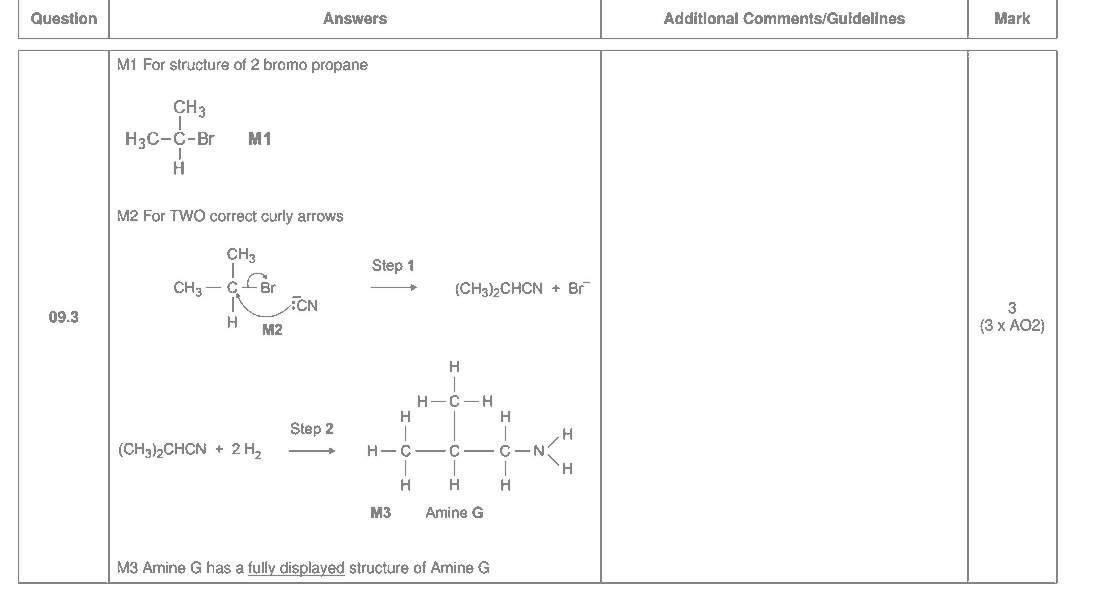
9.3 Most students got at least 2 of the 3 marks here. The final mark was often the one lost and drawing a fully displayed amine formed from a nitrile proved difficult for many. Common mistakes included having too few carbon atoms, and missing hydrogen atoms despite being given the balanced left-hand side of the equation.
Notes from the mark scheme and report
2-Bromopropane, (CH3)2CHBr, drawn as the reactant
two curly arrows: from the lone pair on C of :CN– to the C bearing Br, and from the C–Br bond to Br
amine G fully displayed: (CH3)2CHCH2NH2, 2-methylpropan-1-amine, with every bond shown. The displayed amine was the mark most often lost (too few C atoms or missing H atoms)
June 2024 · Paper 2 · Q10.33 marksAO1=3MechanismHard
Earlier parts of question 10 that this part uses
Mark scheme
Examiner's comment
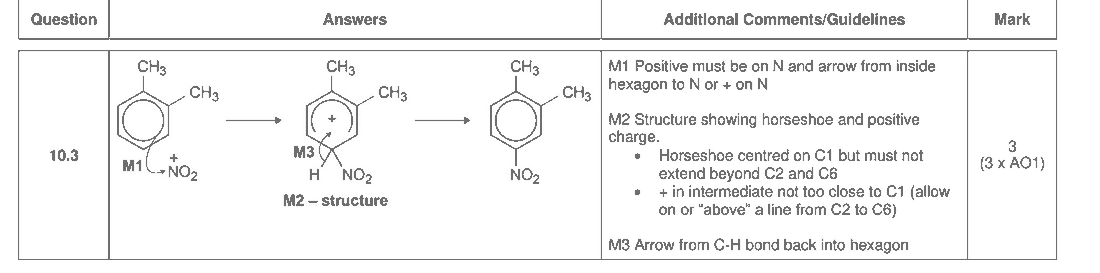
10.3 This familiar mechanism allowed over 80% of students to score at least 1 mark but only 32% scored all 3. Common mistakes in drawing the intermediate have been covered many times in reports on past papers so it was surprising to see so many students making the same errors.
Notes from the mark scheme and report
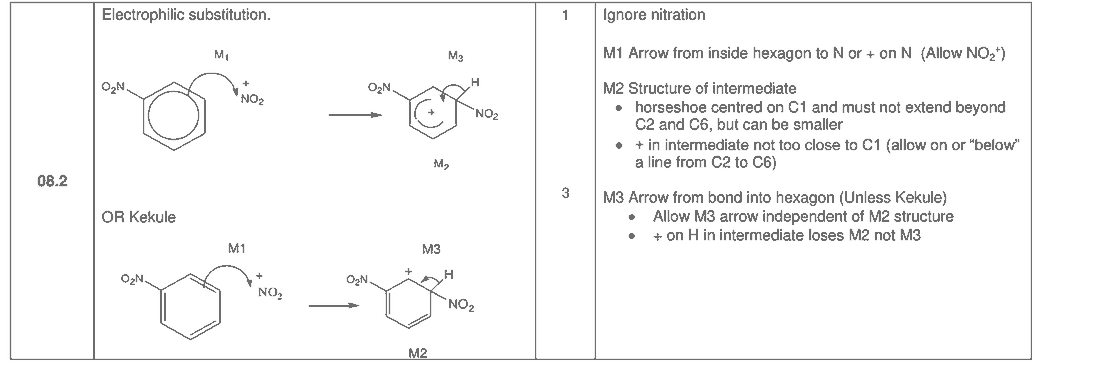
Electrophilic substitution: arrow from inside the ring to N of +NO2
intermediate with a horseshoe centred on C1 that does not extend beyond C2 and C6, with + inside it and both H and NO2 on the carbon attacked
arrow from the C–H bond back into the ring. Over 80% scored at least 1
the usual errors were in drawing the intermediate
June 2023 · Paper 2 · Q09.23 marksAO2=3Mechanism
Earlier part of question 09 that this part uses
Mark scheme
Examiner's comment
09.2 This question discriminated well and the best students were able to apply the ideas understood from more familiar mechanisms to the structures given.
Notes from the mark scheme and report
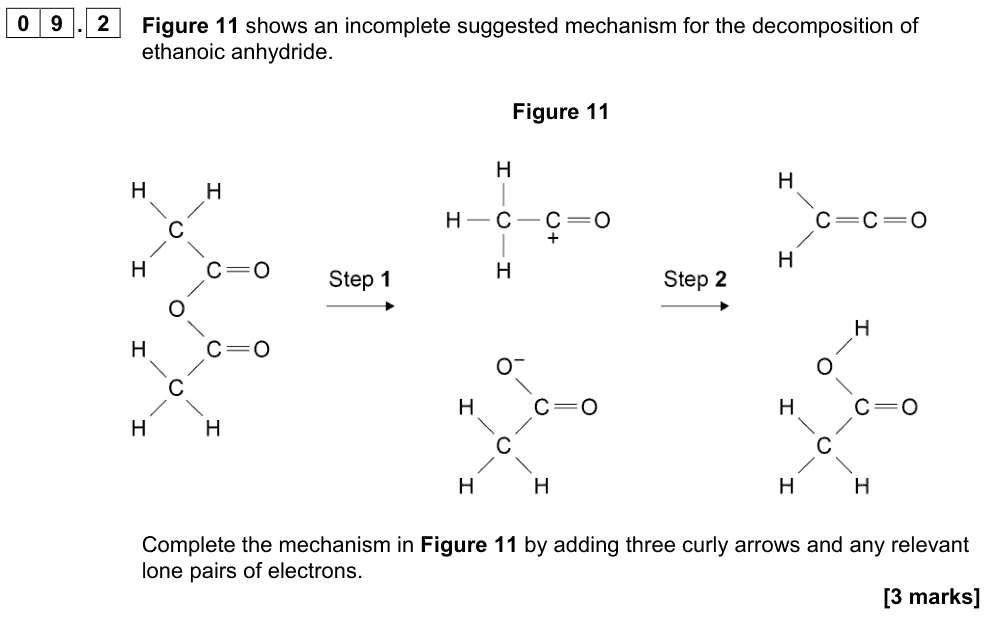
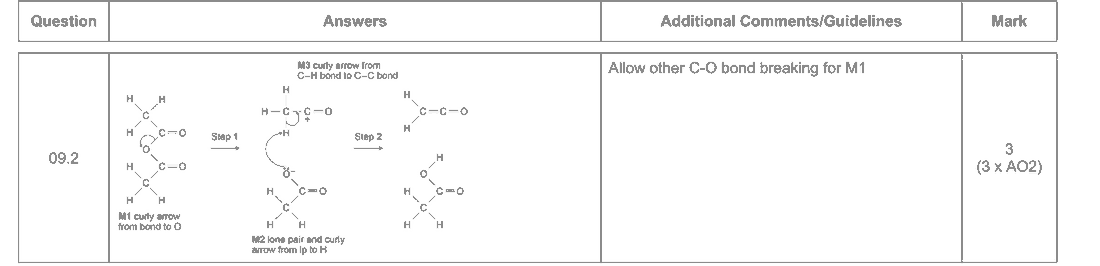
Step 1: curly arrow from one C–O bond of the anhydride to the central O (giving CH3C+=O and CH3COO–). Step 2: lone pair on O– with a curly arrow to an H of the CH3 group of the cation
curly arrow from that C–H bond to the C–C bond (forming C=C). Either C–O bond may be broken
June 2023 · Paper 3 · Q02.53 marksMechanism
Earlier part of question 02 that this part uses
Mark scheme
Examiner's comment
50% of students scored 3 marks in 02.5 and students are again reminded of the importance of being precise when drawing curly arrows in terms of where they start and where they finish.
A curly arrow in any mechanism must always start either from the line representing a covalent bond or from a lone pair drawn on an atom.
In this case, both arrows should have started from an existing bond in order to represent the breaking of that bond.
Notes from the mark scheme and report
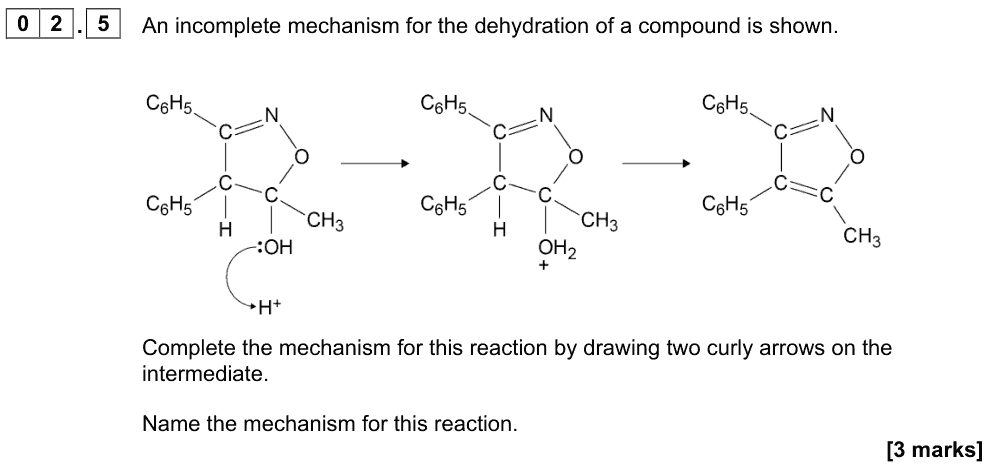
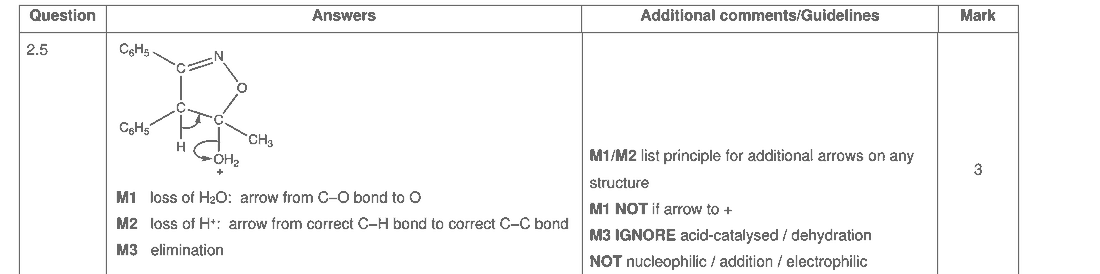
On the protonated intermediate: curly arrow from the C–O bond to the O of the OH2+ group (water leaves
not an arrow to the + sign)
curly arrow from the C–H bond on the adjacent ring carbon to the C–C bond between the two ring carbons (H+ lost, C=C forms). Name: elimination (ignore acid-catalysed / dehydration
not nucleophilic, electrophilic or addition). Both arrows must start at a bond. 50% scored 3 marks
June 2022 · AS Paper 2 · Q05.15 marksAO1=5Mechanism
Mark scheme
Examiner's comment
5.1 This question required students to name and outline a mechanism. This was done well. One common issue was students thinking that ammonia is negatively charged in their mechanism.
Notes from the mark scheme and report
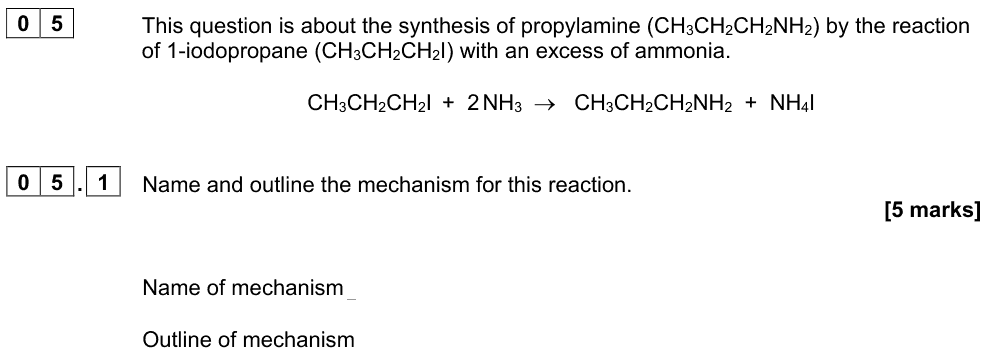
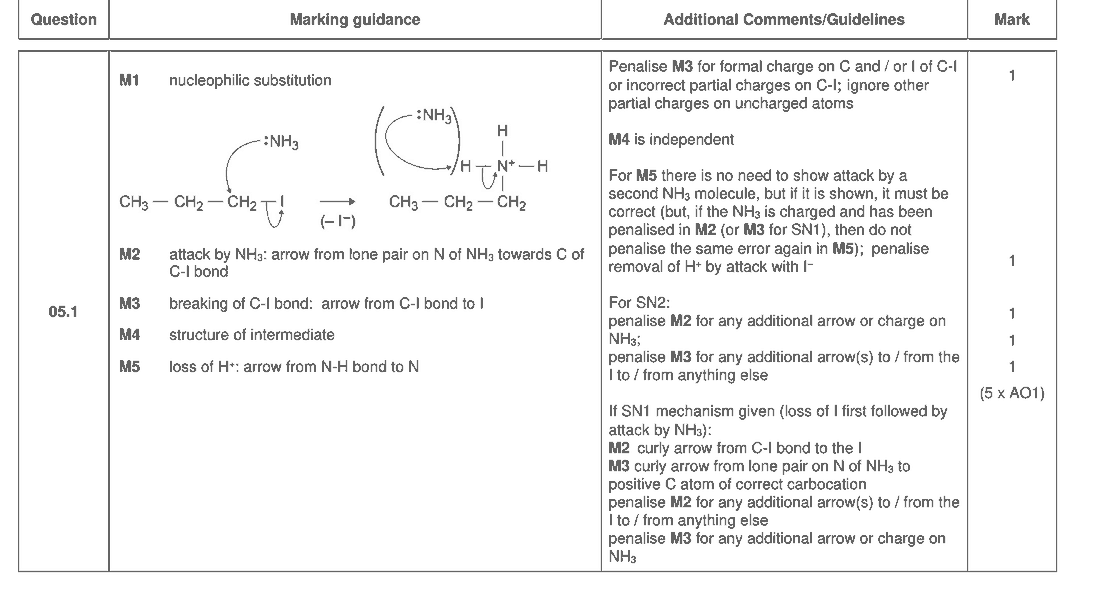
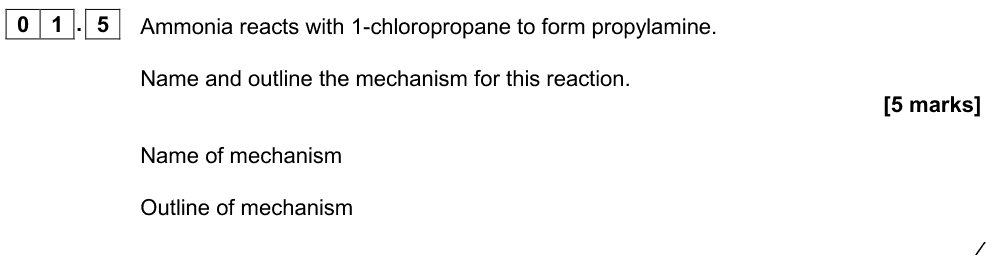
Nucleophilic substitution. Arrow from the lone pair on N of NH3 to the C of C–I
arrow from the C–I bond to I
intermediate CH3CH2CH2NH3+
arrow from an N–H bond to N+ (loss of H+, eg to a second NH3
not removed by I–). Common error: showing ammonia with a negative charge
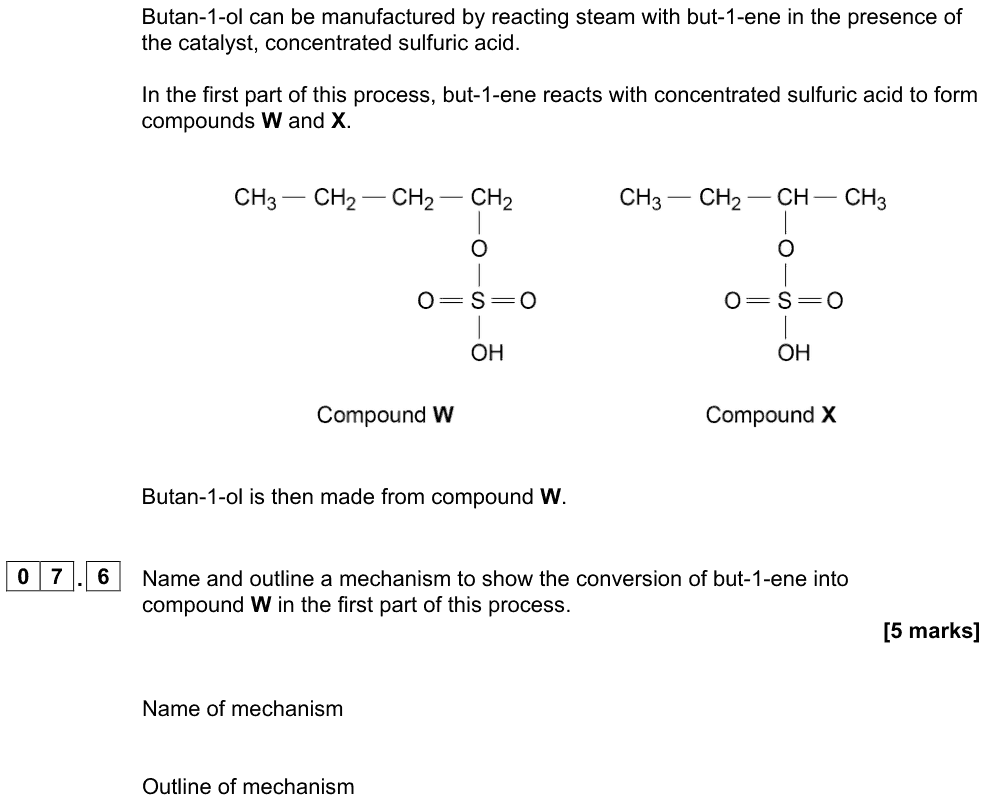
June 2022 · AS Paper 2 · Q07.65 marksAO1=1, AO2=4Mechanism
Earlier part of question 07 that this part uses
Mark scheme
Examiner's comment
7.6 This question required students to name and outline a mechanism. This was done well. One common issue was students not putting the negative charge on the HSO4– as it attacked the carbocation in the final step.
Notes from the mark scheme and report
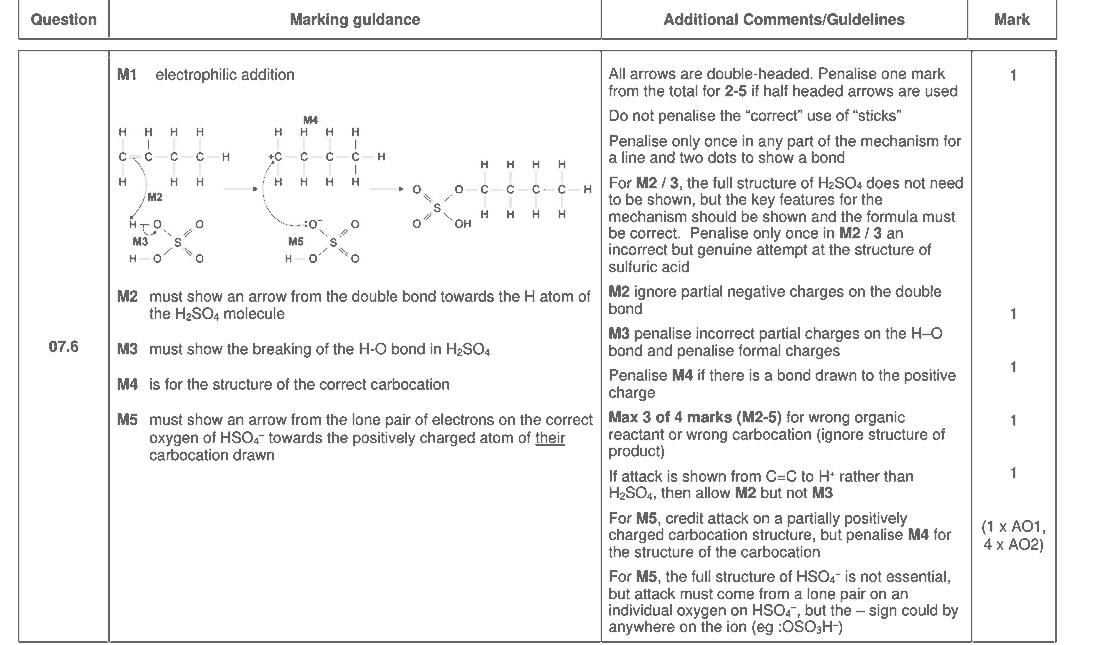
Electrophilic addition. Arrow from the C=C towards the H of H2SO4
arrow from the H–O bond to O
the primary carbocation CH3CH2CH2CH2+ (leading to W)
arrow from a lone pair on an O of HSO4– to the C+. Wrong carbocation: max 3 of the 4 mechanism marks. Common error: no negative charge on HSO4–
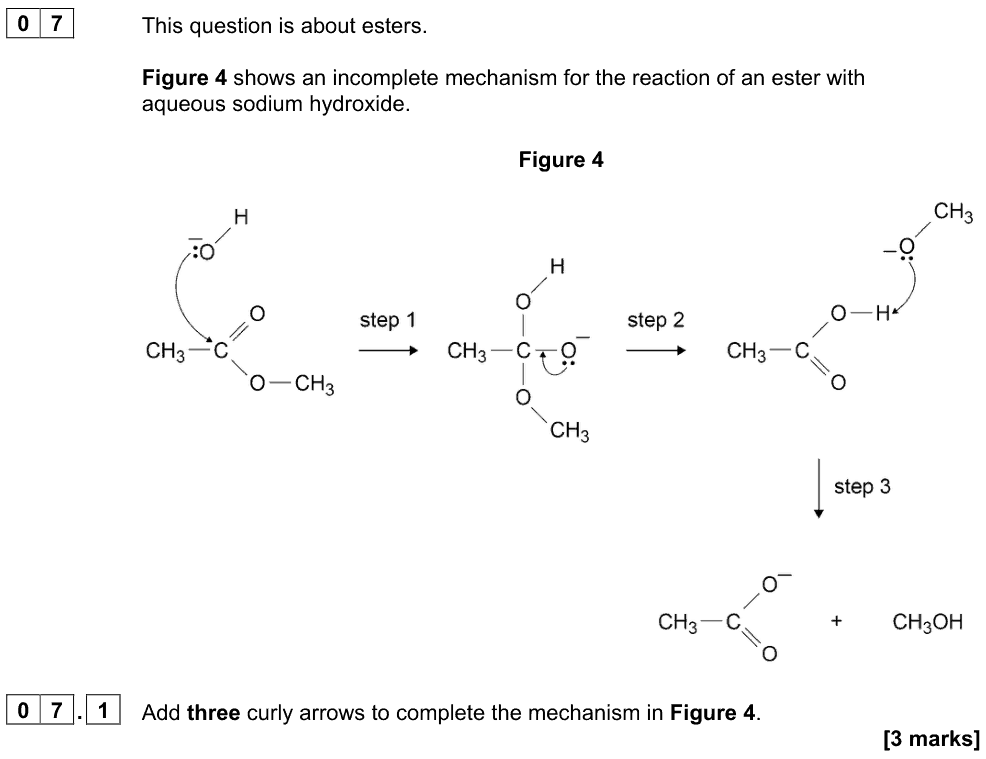
June 2022 · Paper 2 · Q07.13 marksAO3=3Mechanism
Mark scheme
Examiner's comment
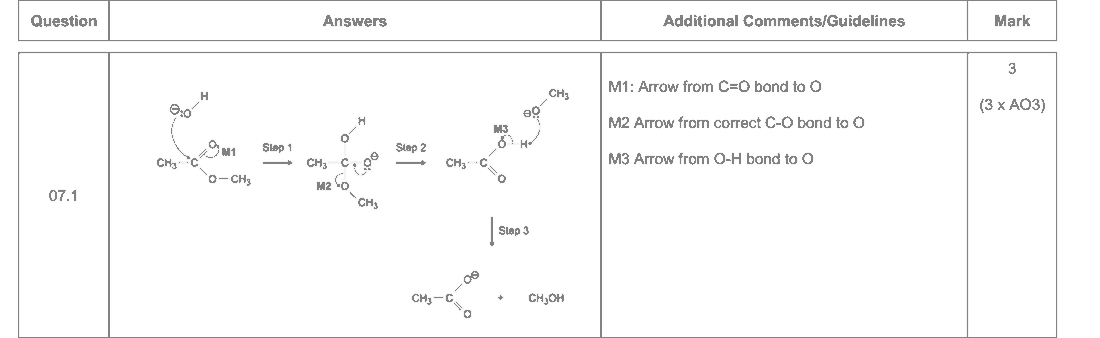
07.1 This question required students to deduce and add three curly arrows to an unfamiliar incomplete mechanism. As with similar questions in the past, this discriminated well between the most able and weaker students.
Notes from the mark scheme and report
Step 1: curly arrow from the C=O bond to O. Step 2: curly arrow from the C–OCH3 bond to that O (CH3O– leaves). Step 3: curly arrow from the O–H bond of the acid to O (the arrow from CH3O– to H is already printed)
November 2021 · AS Paper 2 · Q02.15 marksMechanism
Mark scheme
Notes from the mark scheme and report
Electrophilic addition. Arrow from the C=C to a Br of Br–Br
arrow from the Br–Br bond to the other Br
carbocation with Br on the adjacent ring carbon
arrow from a lone pair on Br– to the C+. Max 3 of 4 for the wrong reactant or carbocation
no bond drawn to the + charge
formal or wrong partial charges on Br–Br penalised
November 2021 · AS Paper 2 · Q07.24 marksMechanism
Earlier part of question 07 that this part uses
Mark scheme
Notes from the mark scheme and report
Elimination. Arrow from a lone pair on O of one OH to H+
protonated alcohol with arrow from the C–O+H2 bond to O (water leaves)
carbocation, then arrow from the adjacent C–H bond to the C–C bond to form C=C (loss of H+). The last two steps may be shown as one concerted step. Max 2 of 3 for the wrong reactant
November 2021 · Paper 2 · Q02.44 marksMechanism
Earlier part of question 02 that this part uses
Mark scheme
Examiner's comment
In this question a surprisingly small proportion of students were able to state the meaning of the term fraction. In addition, very few were able to explain why C=O bonds in carbon dioxide absorb infrared radiation. A good range of answers was seen for the extended response question about the environmental impact of bioethanol as a fuel, but a significant number of students were unable to get started here.
Notes from the mark scheme and report
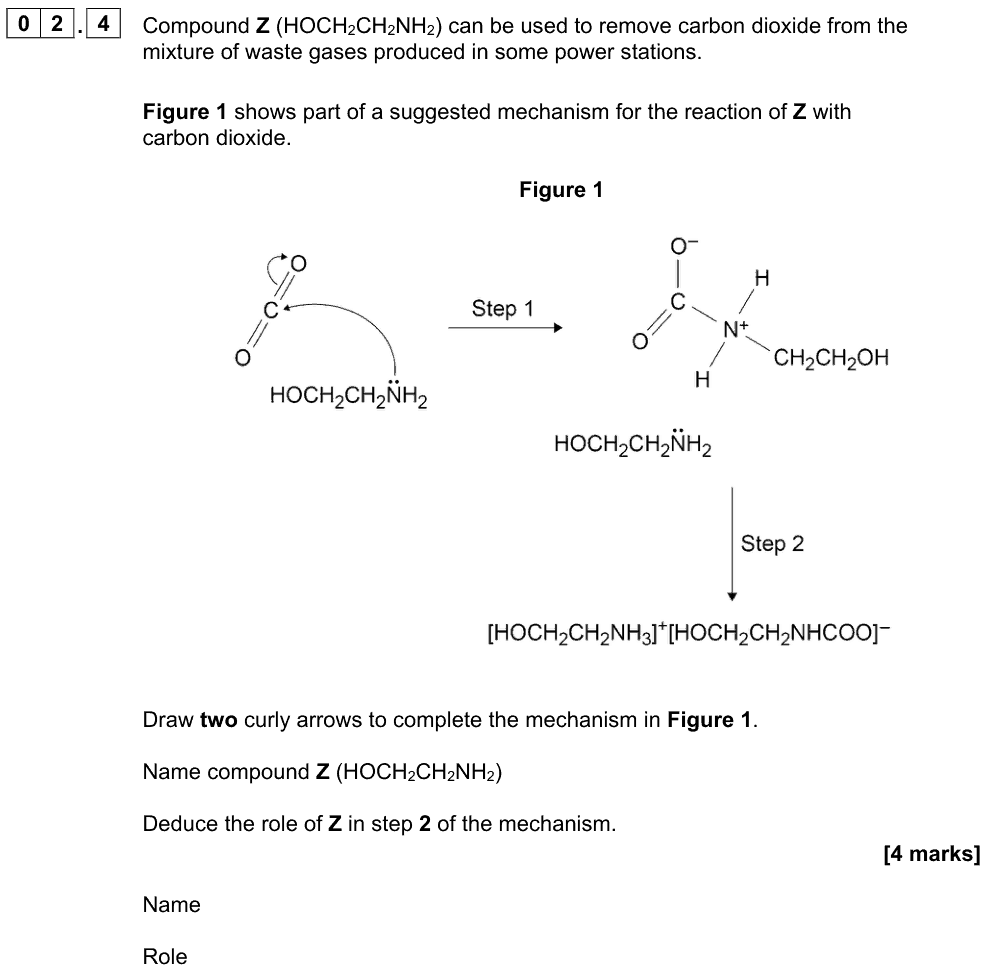
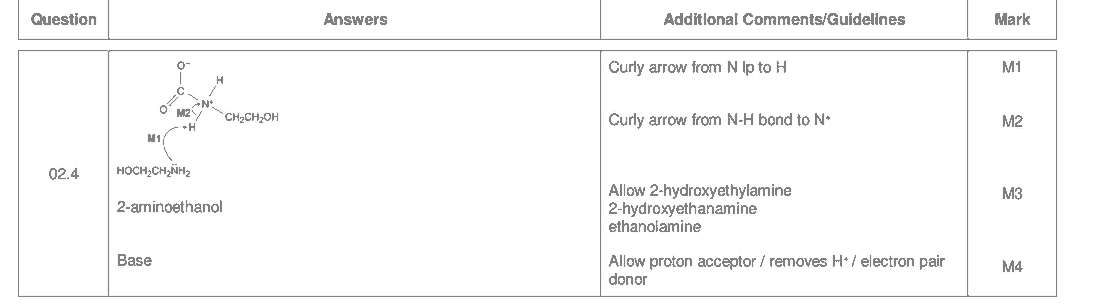
Two curly arrows for step 2: from the lone pair on N of the second HOCH2CH2NH2 to an H on the N+, and from that N–H bond to the N+. Name: 2-aminoethanol (allow ethanolamine, 2-hydroxyethylamine). Role in step 2: base / proton acceptor (electron pair donor)
November 2021 · Paper 2 · Q04.35 marksMechanism
Earlier part of question 04 that this part uses
Mark scheme
Examiner's comment
Question 04.3 required students to apply mechanistic ideas to structures that were provided.
The vast majority of students were able to score some marks on this question and it also proved to be a very good discriminator.
Notes from the mark scheme and report
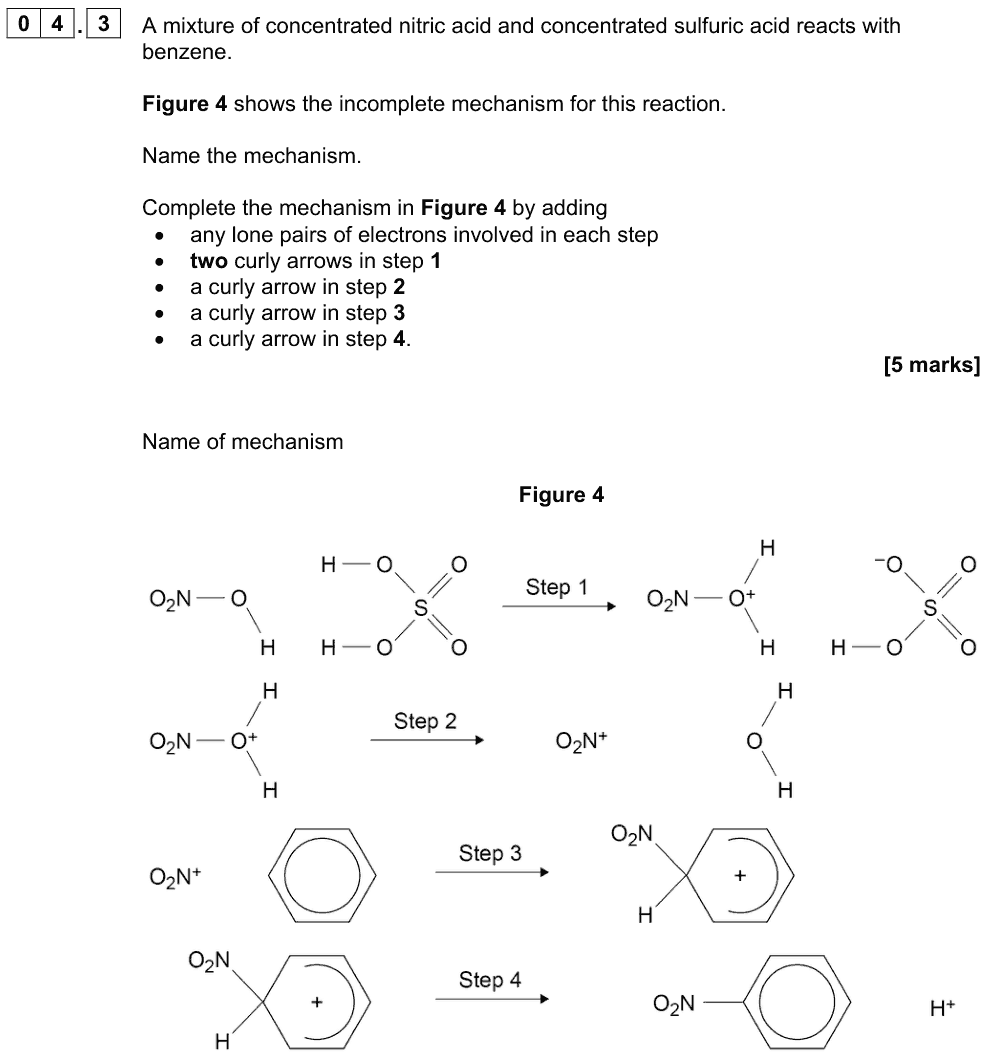
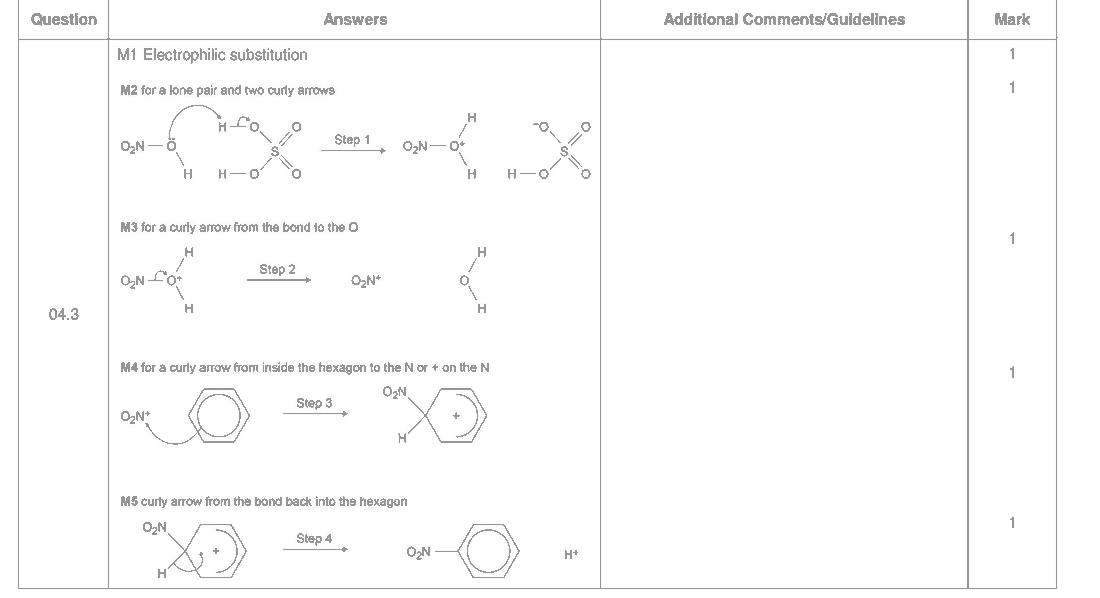
Electrophilic substitution. Step 1: lone pair on the O of the OH in HNO3, arrow from it to an H of H2SO4 and arrow from that H–O bond to the O of H2SO4. Step 2: arrow from the N–O+ bond to the O+ (water leaves, giving NO2+). Step 3: arrow from the ring of delocalised electrons to the N of NO2+. Step 4: arrow from the C–H bond back into the ring (H+ lost). Lone pairs must be shown where they are used. A very good discriminator
November 2021 · Paper 3 · Q03.34 marksMechanismHard
Earlier part of question 03 that this part uses
Mark scheme
Examiner's comment
The mechanism in question 03.3 was known quite well with a third of students scoring full marks here.
Notes from the mark scheme and report
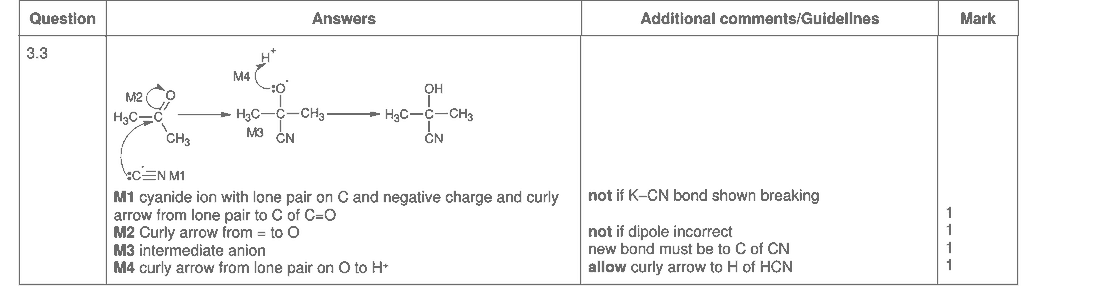
Nucleophilic addition: arrow from the lone pair on C of :CN– to the C of C=O
arrow from the C=O bond to O
intermediate (CH3)2C(CN)O–
arrow from a lone pair on O– to H+ (or the H of HCN). The new bond must be to the C of CN
no K–CN bond breaking
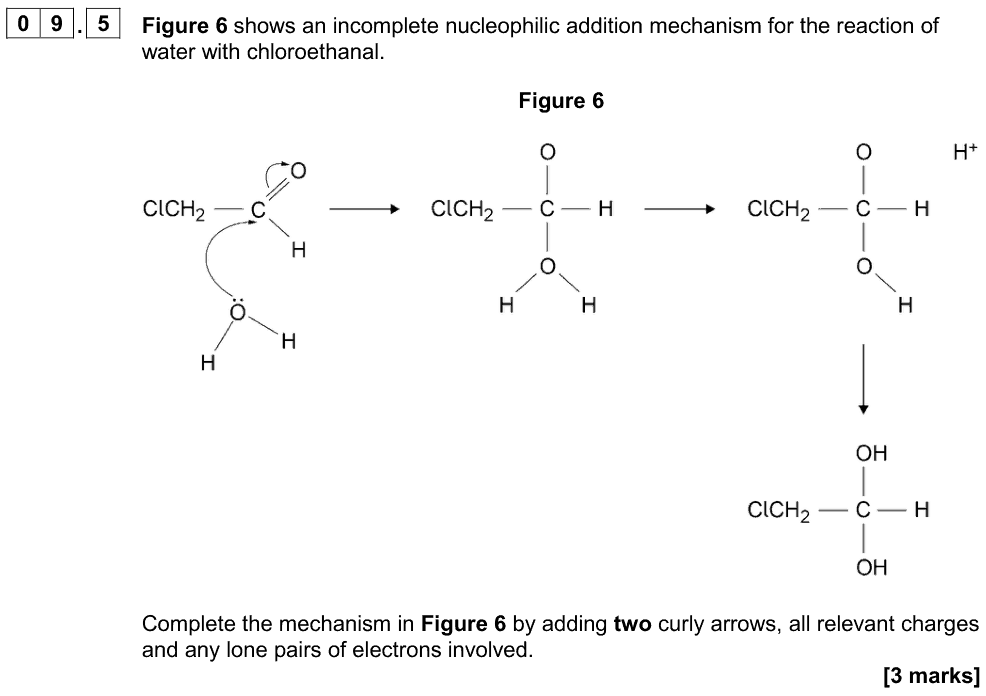
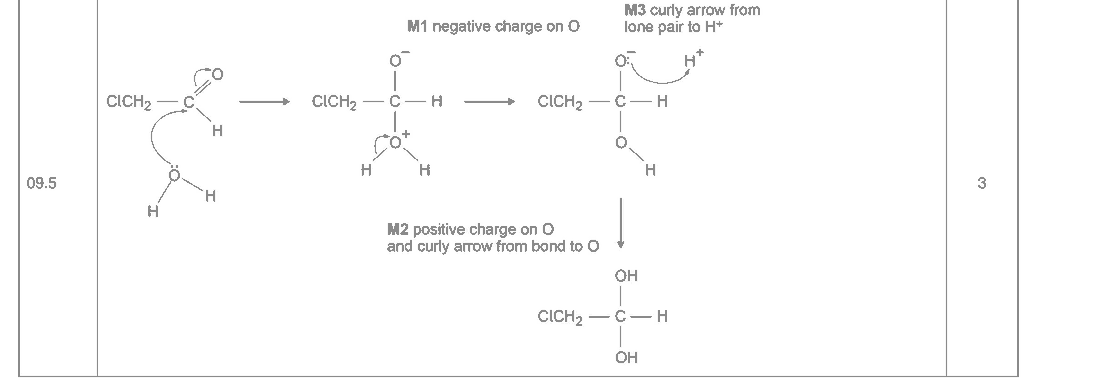
November 2020 · Paper 2 · Q09.53 marksMechanism
Earlier parts of question 09 that this part uses
Mark scheme
Examiner's comment
09.5 required students to apply their understanding of standard mechanistic ideas to a novel mechanism.
Most students were able to score at least some of the marks and a good number (44.3%) scored all three marks.
Notes from the mark scheme and report
First intermediate: negative charge on the O that came from C=O, positive charge on the O of the attached water, and a curly arrow from an O–H bond of that –OH2+ to the O+ (loss of H+). Second intermediate: lone pair on O– and a curly arrow from it to H+. Most scored some marks
44.3% scored all 3
June 2019 · AS Paper 2 · Q02.12 marksMechanism
Mark scheme
Examiner's comment
2.1 The mechanism was done very well in the main. The most common error was to omit the negative charge from the cyanide ion.
Notes from the mark scheme and report
Nucleophilic substitution: M1 arrow from the lone pair on C of :CN– to the C of CH2
M2 arrow from the C–Br bond to Br. Lone pair and negative charge needed on cyanide
SN1 route allowed. Most common error: negative charge left off the cyanide ion
June 2019 · AS Paper 2 · Q06.15 marksMechanism
Mark scheme
Examiner's comment
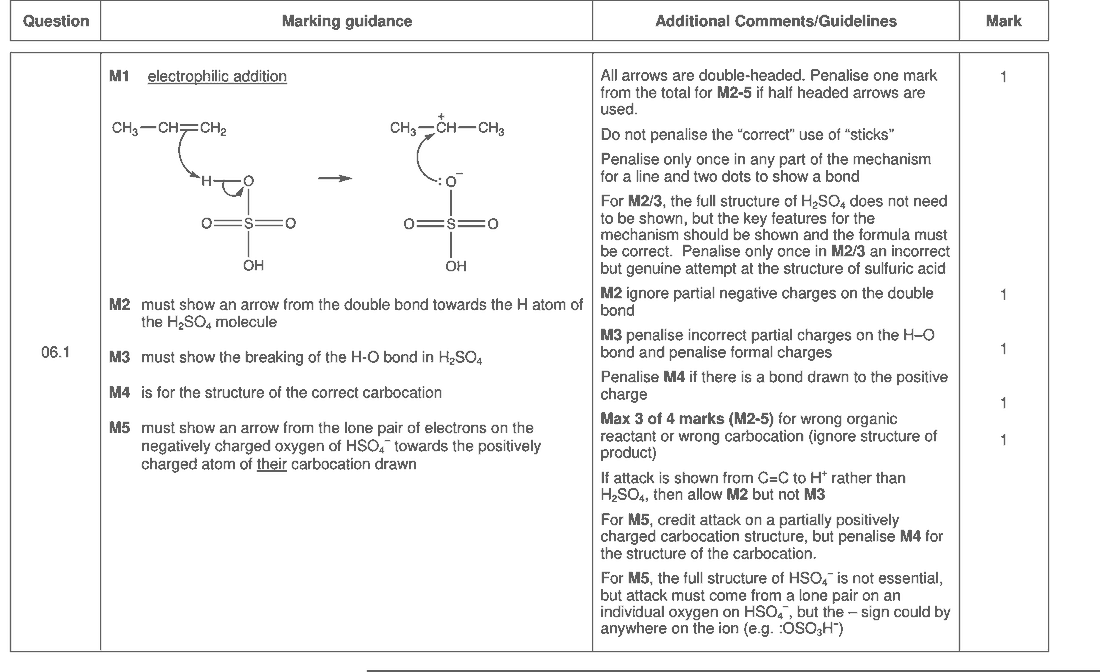
6.1 The mechanism was done quite well. The most common error was omitting the negative charge on the hydrogensulfate ion.
Notes from the mark scheme and report
Electrophilic addition. Arrow from the C=C to the H of H–O in H2SO4
arrow from the H–O bond to O
the secondary carbocation CH3CH+CH3
arrow from a lone pair on the O– of HSO4– to the C+. Most common error: negative charge left off the hydrogensulfate ion
June 2019 · Paper 2 · Q02.53 marksMechanism
Earlier part of question 02 that this part uses
Mark scheme
Examiner's comment
02.5 The mechanism was usually answered well although the cyclic nature of the alkene confused several students who wrongly drew a substitution mechanism instead of electrophilic addition.
The intermediate carbocation in part five should not be written as structure A below.
Correct possibilities are structure B (preferred) or structure C.
Once a carbon atom is labelled as such, it must have the correct bonding as in C but not A.
Notes from the mark scheme and report
Electrophilic addition: curly arrow from the C=C to the nearer Br of Br–Br (the Br–Br arrow is printed)
carbocation intermediate, a ring with Br on one carbon and + on the adjacent carbon
arrow from a lone pair on :Br– to the C+. M1 lost for full or wrong partial charges on Br2. Do not mix skeletal and structural formulas at one carbon: a carbon written as C must show its H. Some drew a substitution mechanism
June 2017 · Paper 2 · Q01.64 marksMechanism
Earlier part of question 01 that this part uses
Mark scheme
Examiner's comment
01.6 This was a high scoring question for many. For others, the main errors were missing the negative sign or the lone pair on the hydroxide ion, or showing attack on the wrong hydrogen atom.
Notes from the mark scheme and report
(Base) elimination. Arrow from the lone pair on O of OH– to an H on carbon 2
arrow from that C–H bond to the C1–C2 bond
arrow from the C–Br bond to Br. E1 also credited. Nucleophilic substitution scores M3 only. Errors: no negative charge or lone pair on hydroxide
attack on the wrong H
June 2017 · Paper 2 · Q06.46 marksMechanismHard
Earlier part of question 06 that this part uses
Mark scheme
Examiner's comment
06.4 This question was well answered and 25% of students scored all six marks. The name of the organic product was the most common mark lost, closely followed by slips in the third or fourth marks in the mechanism.
Notes from the mark scheme and report
(Nucleophilic) addition–elimination. Arrow from the lone pair on N of CH3CH2NH2 to the C of C=O
arrow from C=O bond to O
intermediate with O– and N+
then lone pair on O– reforms C=O, C–Cl bond breaks to Cl and N–H bond breaks to N+. Product: N-ethylpropanamide. The name was the mark most often lost
June 2016 · AS Paper 2 · Q07.27 marksMechanism
Earlier part of question 07 that this part uses
Mark scheme
Examiner's comment
Many students did well on Q7.2, but a significant number attempted to describe the curly
Notes from the mark scheme and report
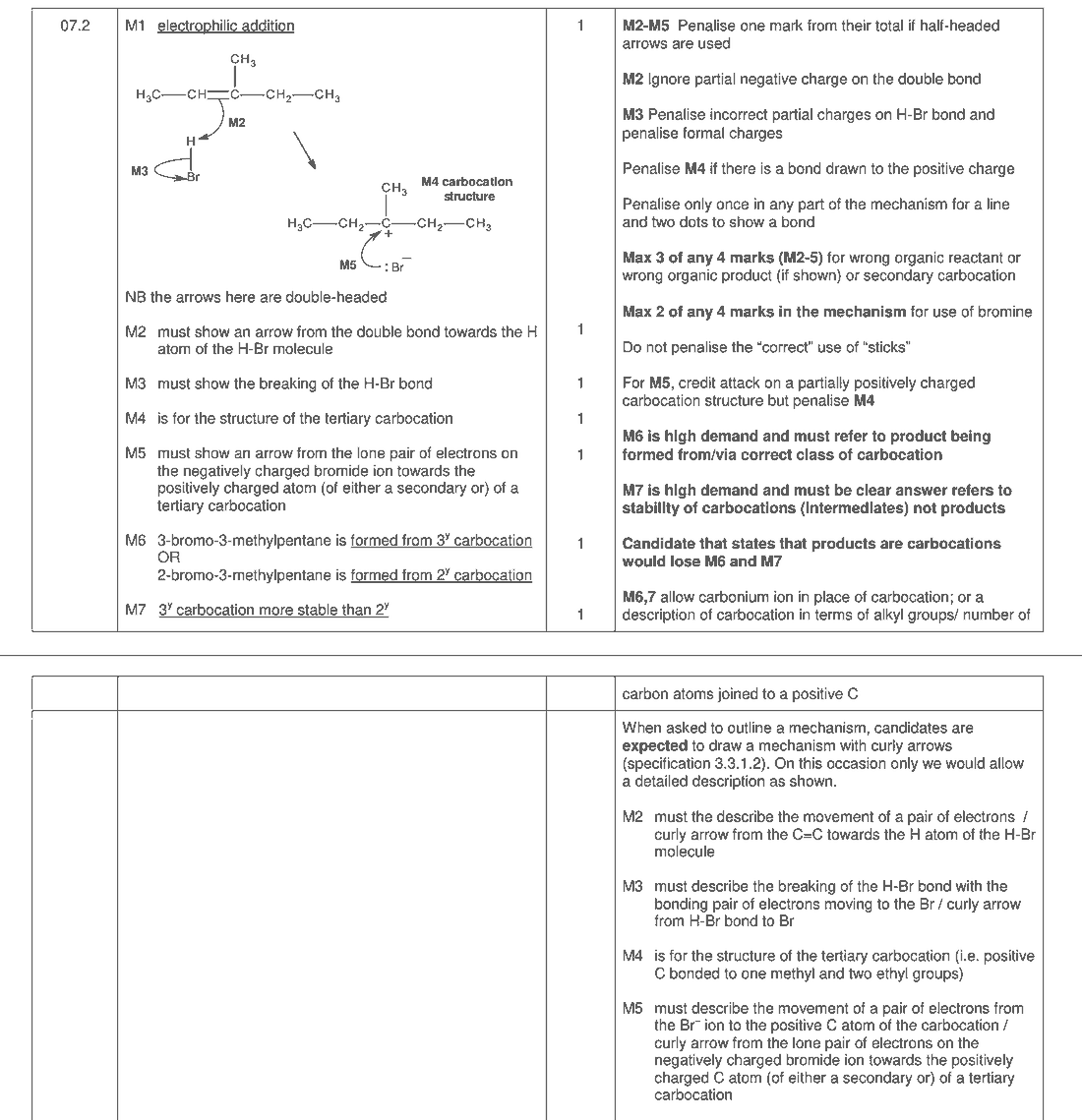
Electrophilic addition. Curly arrow from the C=C to the H of H–Br
arrow from the H–Br bond to Br
tertiary carbocation CH3CH2C+(CH3)CH2CH3
arrow from a lone pair on Br– to the C+. 3-bromo-3-methylpentane is formed via the tertiary carbocation (the 2-bromo isomer via a secondary one), and the tertiary carbocation is more stable than the secondary. The explanation must be about the stability of carbocations, not products.
June 2025 · AS Paper 2 · Q01.23 marksAO1=1, AO2=2Mechanism
Earlier part of question 01 that this part uses
Mark scheme
Examiner's comment
1.2 Students had to complete a nucleophilic substitution mechanism. Many did it well including a few who did an SN1 rather than SN2 mechanism. Common errors were putting a minus charge on NH3 or showing incorrect breaking of the N-H bond in the last step.
Notes from the mark scheme and report
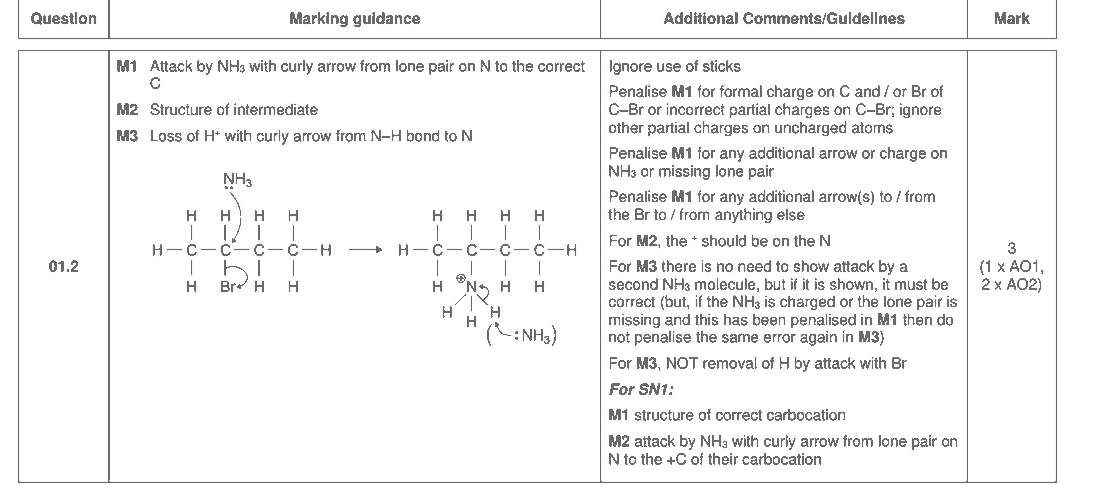
M1 curly arrow from the lone pair on N of NH3 to the C bonded to Br
M2 intermediate CH3CH(NH3+)CH2CH3 with + on N
M3 curly arrow from an N–H bond to N+ (loss of H+, a second NH3 may remove it). Not removal of H by Br–
no charge on NH3. An SN1 route via the correct carbocation is also credited. Errors: NH3 given a minus charge
N–H bond broken the wrong way
June 2025 · AS Paper 2 · Q01.45 marksAO1=1, AO2=2, AO3=2Mechanism
Earlier parts of question 01 that this part uses
Mark scheme
Examiner's comment
1.4 Students had to complete an elimination mechanism. Many did this well although some gave the mechanism to form but-2-ene rather than but-1-ene as required. Few students appreciated that the two other alkenes were E-but-2-ene and Z-but-2-ene with most going for but-2-ene and some other compound that was commonly not even an alkene.
Notes from the mark scheme and report
(Base) elimination. Curly arrow from the lone pair on OH– to an H on C1
curly arrow from that C–H bond to the C1–C2 bond (the C–Br arrow is already printed). Other alkenes: E-but-2-ene and Z-but-2-ene
'but-2-ene' alone scores 1 of the 2. Errors: attacking an H on C3 (gives but-2-ene)
second alkene not an alkene
June 2024 · AS Paper 2 · Q07.43 marksAO1=1, AO2=2Mechanism
Earlier part of question 07 that this part uses
Mark scheme
Examiner's comment
7.4 In this question students were required to show the mechanism for the reaction of sodium cyanide with bromoethane. Many students failed to show the CN– correctly attacking the bromoethane.
Notes from the mark scheme and report
Nucleophilic substitution. Curly arrow from the lone pair on the C of :CN– to the carbon of the CH2Br group
curly arrow from the C–Br bond to Br. No extra arrows
no formal charges on the C–Br bond. Many did not show CN– attacking correctly
June 2024 · Paper 2 · Q09.33 marksAO2=3Mechanism
Earlier part of question 09 that this part uses
Mark scheme
Examiner's comment
9.3 Most students got at least 2 of the 3 marks here. The final mark was often the one lost and drawing a fully displayed amine formed from a nitrile proved difficult for many. Common mistakes included having too few carbon atoms, and missing hydrogen atoms despite being given the balanced left-hand side of the equation.
Notes from the mark scheme and report
2-Bromopropane, (CH3)2CHBr, drawn as the reactant
two curly arrows: from the lone pair on C of :CN– to the C bearing Br, and from the C–Br bond to Br
amine G fully displayed: (CH3)2CHCH2NH2, 2-methylpropan-1-amine, with every bond shown. The displayed amine was the mark most often lost (too few C atoms or missing H atoms)
June 2023 · AS Paper 2 · Q03.12 marksAO2=2Mechanism
Mark scheme
Examiner's comment
03.1 This mechanism was drawn well by students.
Notes from the mark scheme and report
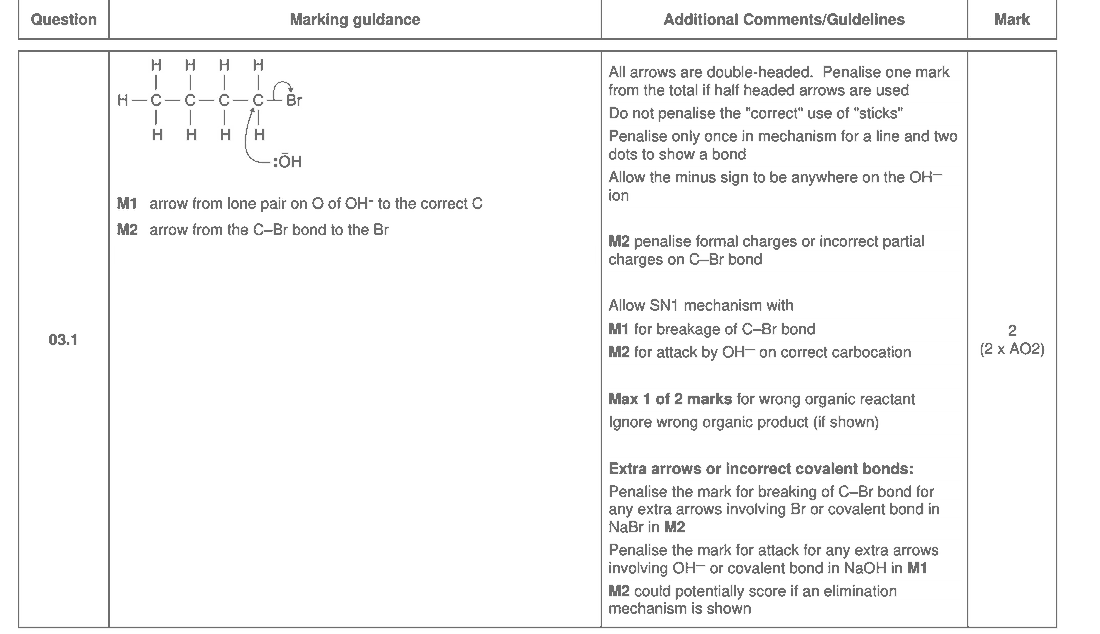
Curly arrow from the lone pair on the O of OH– to the C bonded to Br
curly arrow from the C–Br bond to Br. No formal or wrong partial charges on C–Br
wrong organic reactant max 1
June 2022 · AS Paper 2 · Q05.15 marksAO1=5Mechanism
Mark scheme
Examiner's comment
5.1 This question required students to name and outline a mechanism. This was done well. One common issue was students thinking that ammonia is negatively charged in their mechanism.
Notes from the mark scheme and report
Nucleophilic substitution. Arrow from the lone pair on N of NH3 to the C of C–I
arrow from the C–I bond to I
intermediate CH3CH2CH2NH3+
arrow from an N–H bond to N+ (loss of H+, eg to a second NH3
not removed by I–). Common error: showing ammonia with a negative charge
June 2022 · Paper 3 · Q03.43 marksAO2=3Mechanism
Earlier part of question 03 that this part uses
Mark scheme
Examiner's comment
In 03.4 ‘error carried forward’ was applied for any student who had mistakenly identified the product as but-2-ene in 03.3, so full marks were still available to those students for the mechanism.
It is recommended that students should draw clearly displayed structures and draw them a bit larger than if just showing the structure – this allows more space so that the positioning of curly arrows is clear.
Notes from the mark scheme and report
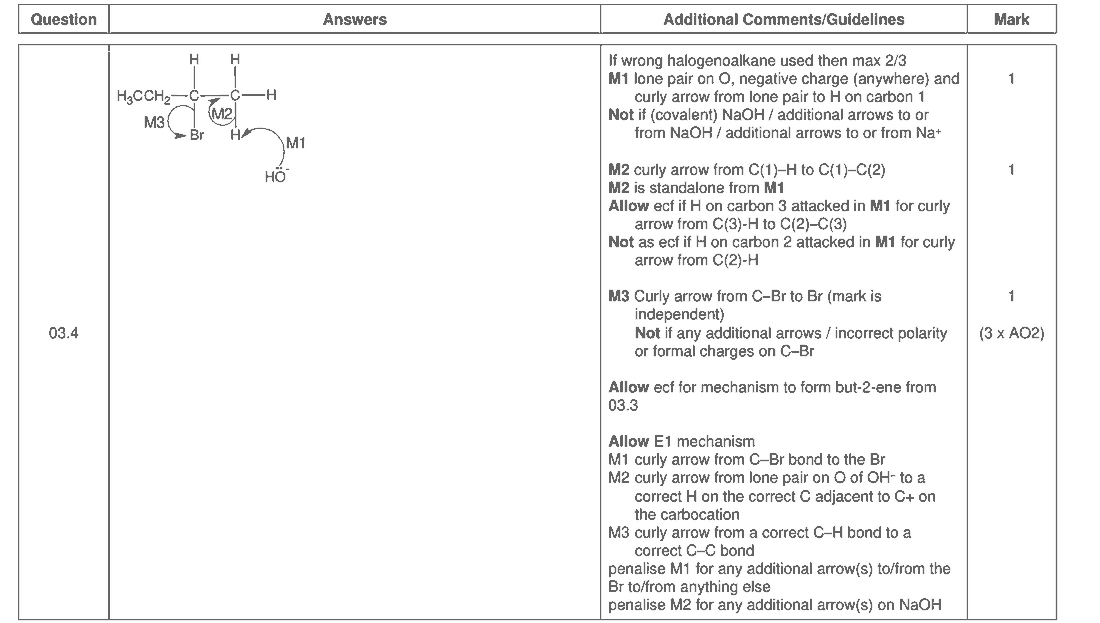
Elimination: curly arrow from a lone pair on the O of OH– (with its negative charge) to an H on C1
curly arrow from that C–H bond into the C1–C2 bond
curly arrow from the C–Br bond to Br. Covalent NaOH or extra arrows lose marks
wrong halogenoalkane max 2. E1 allowed
error carried forward if but-2-ene was named in 03.3
November 2020 · AS Paper 2 · Q01.55 marksMechanism
Earlier part of question 01 that this part uses
Mark scheme
Notes from the mark scheme and report
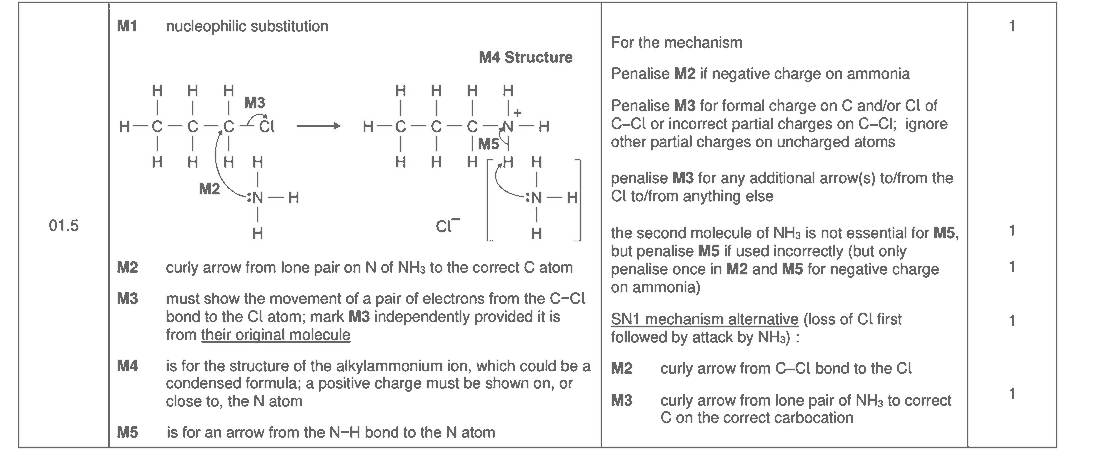
Nucleophilic substitution. Curly arrow from the lone pair on N of NH3 to the C bonded to Cl
curly arrow from the C–Cl bond to Cl
intermediate CH3CH2CH2NH3+ with the positive charge on N
curly arrow from an N–H bond to N (a second NH3 removing the H+ is not essential but must be correct if shown). No negative charge on ammonia
a formal charge on C or Cl of C–Cl loses the bond-breaking arrow mark
November 2020 · Paper 2 · Q05.24 marksMechanism
Earlier part of question 05 that this part uses
Mark scheme
Examiner's comment
Around half the students scored all the marks for the mechanism in 05.2 and over 70% got at least 3 of the 4 marks.
Notes from the mark scheme and report
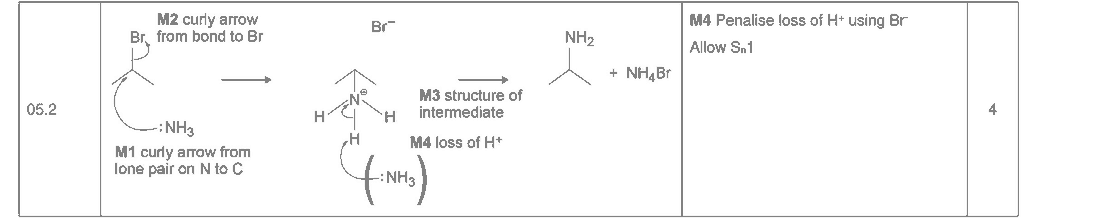
Nucleophilic substitution. Curly arrow from the lone pair on N of NH3 to the C bonded to Br
curly arrow from the C–Br bond to Br
intermediate (CH3)2CH–NH3+ with the + on N
curly arrow from an N–H bond to N, with a second NH3 removing H+, giving (CH3)2CHNH2 + NH4Br. Loss of H+ using Br– is penalised
SN1 allowed. Around half scored all 4
over 70% scored at least 3
June 2019 · AS Paper 2 · Q02.12 marksMechanism
Mark scheme
Examiner's comment
2.1 The mechanism was done very well in the main. The most common error was to omit the negative charge from the cyanide ion.
Notes from the mark scheme and report
Nucleophilic substitution: M1 arrow from the lone pair on C of :CN– to the C of CH2
M2 arrow from the C–Br bond to Br. Lone pair and negative charge needed on cyanide
SN1 route allowed. Most common error: negative charge left off the cyanide ion
June 2019 · Paper 2 · Q01.24 marksMechanism
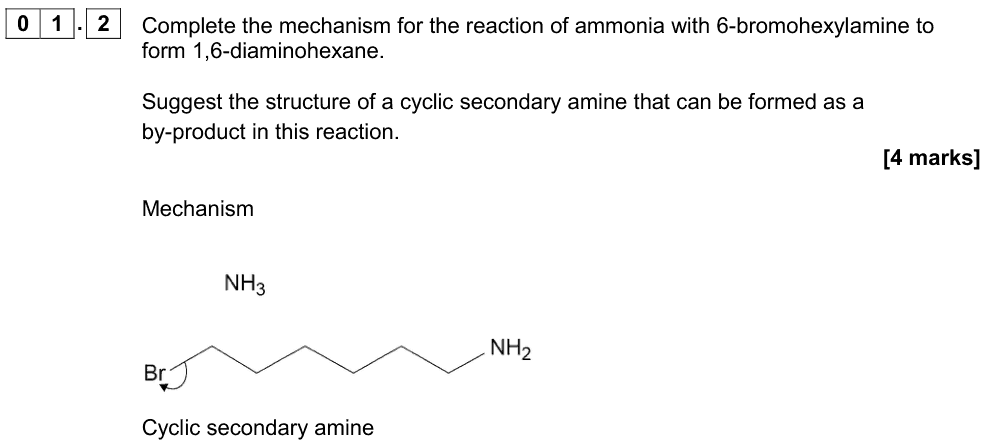
Earlier part of question 01 that this part uses
Mark scheme
Examiner's comment
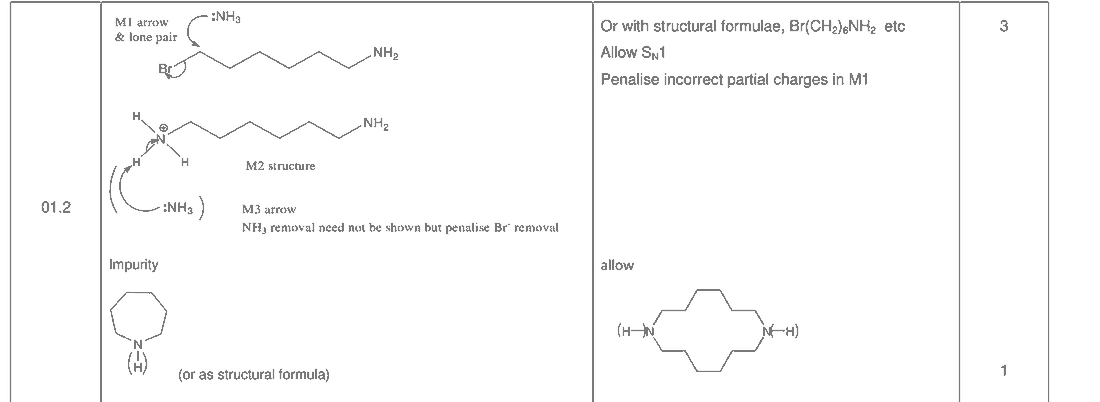
01.2 The mechanism was answered well although some students drew an intermediate with too few carbons. The structure of a cyclic secondary amine proved difficult for some to deduce and many incorrect hexagons or primary amine structures were drawn.
Notes from the mark scheme and report
Nucleophilic substitution: curly arrow from the lone pair on N of NH3 to the carbon bonded to Br (the C–Br arrow is printed)
intermediate H3N+–(CH2)6–NH2
arrow from an N–H bond to N+ as a second NH3 removes H+ (do not use Br– for this). Cyclic by-product: a seven-membered ring of six CH2 groups and one N–H (the amine end of the molecule attacks its own C–Br carbon). Errors: intermediate with too few carbons
hexagons or primary amines for the cyclic amine
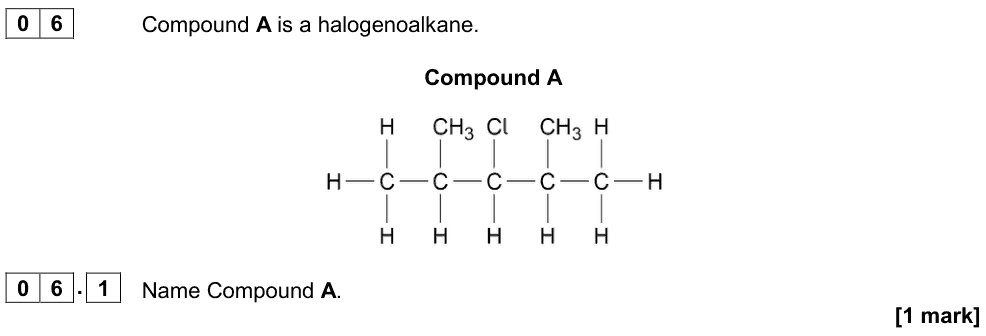
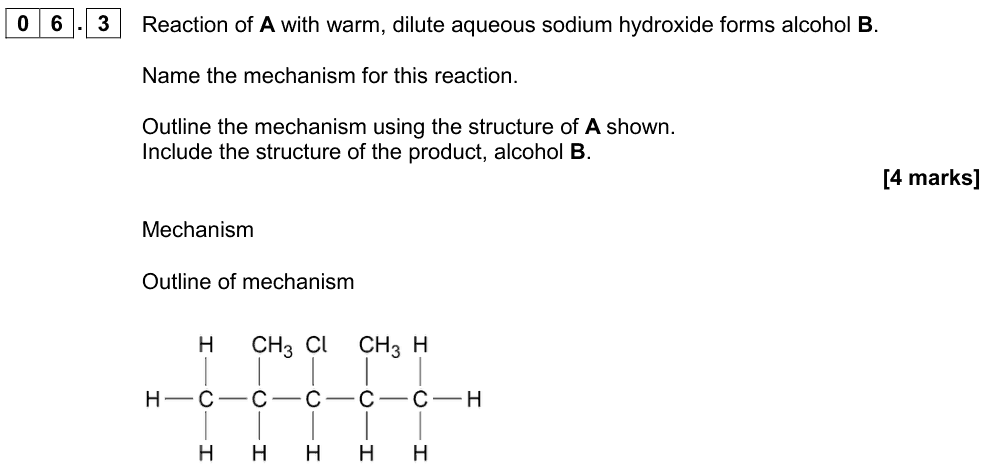
June 2018 · AS Paper 2 · Q06.34 marksMechanism
Earlier part of question 06 that this part uses
Mark scheme
Examiner's comment
06.3 The nucleophilic substitution mechanism was well-answered; 45.6% of students scored full marks here.
Notes from the mark scheme and report
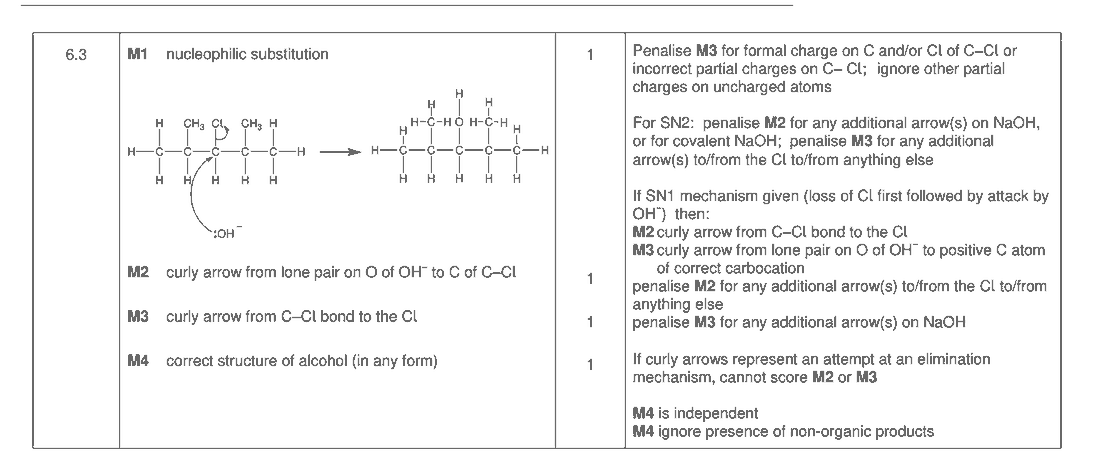
Nucleophilic substitution. Curly arrow from the lone pair on O of OH– to the C of C–Cl
curly arrow from the C–Cl bond to Cl
product 2,4-dimethylpentan-3-ol. No extra arrows on NaOH and no covalent Na–OH
a formal charge on the C or Cl of C–Cl loses the bond-breaking arrow mark. The structure of A to use is printed under 'Outline of mechanism'
June 2018 · AS Paper 2 · Q06.46 marksMechanism
Earlier part of question 06 that this part uses
Mark scheme
Examiner's comment
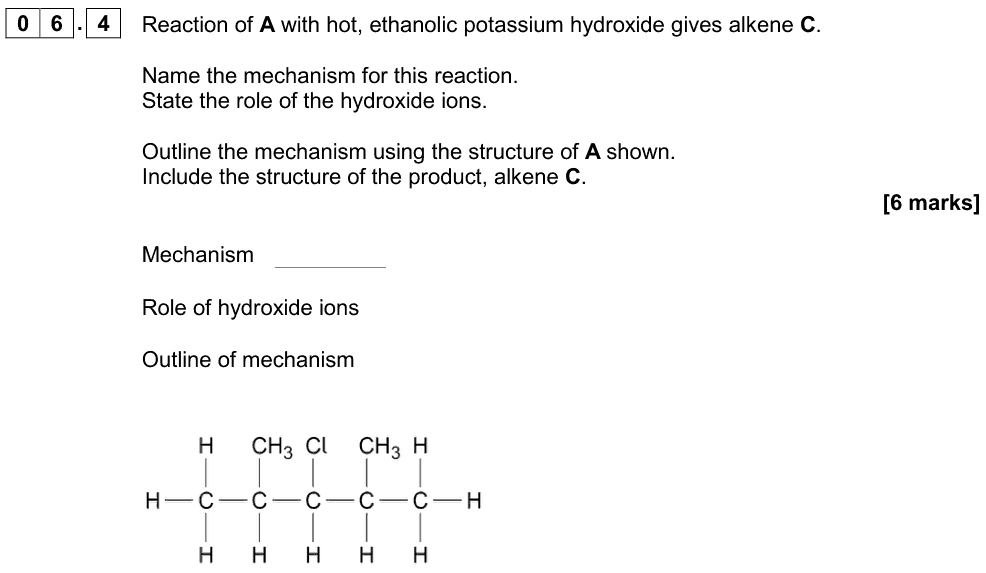
06.4 The elimination mechanism was more challenging, and many students did not know the role of the hydroxide ion. This question discriminated particularly well.
Notes from the mark scheme and report
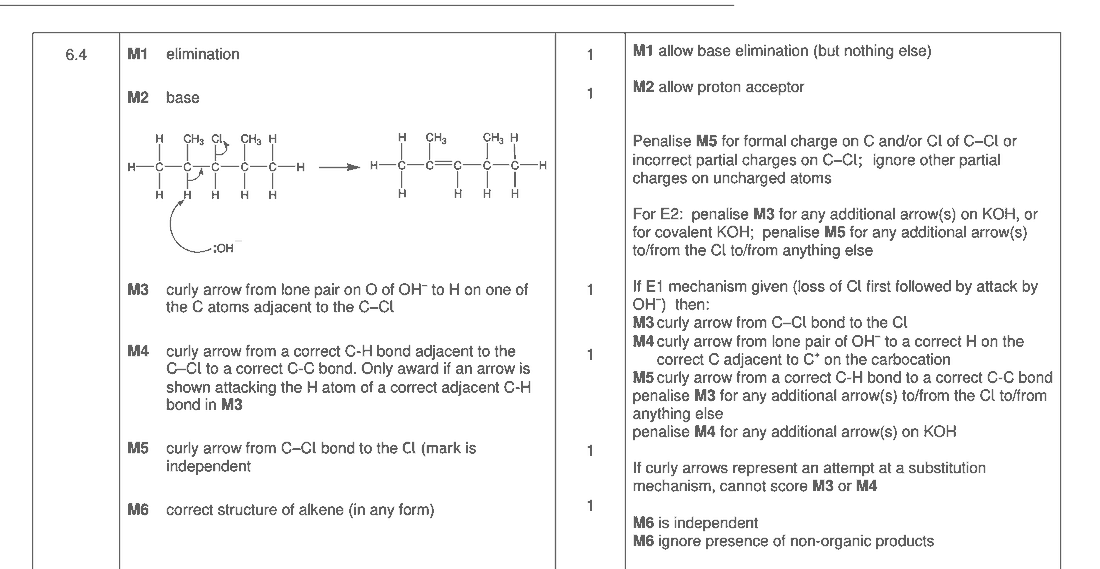
Elimination
hydroxide acts as a base (proton acceptor). Curly arrow from the lone pair on O of OH– to an H on a carbon next to the C–Cl
curly arrow from that C–H bond to the C–C bond between the two carbons
curly arrow from the C–Cl bond to Cl
product 2,4-dimethylpent-2-ene. Many did not know the role of the hydroxide ion
June 2017 · AS Paper 2 · Q06.13 marksMechanism
Mark scheme
Examiner's comment
06.1 This straightforward nucleophilic substitution mechanism was well known and well drawn in general.
Notes from the mark scheme and report
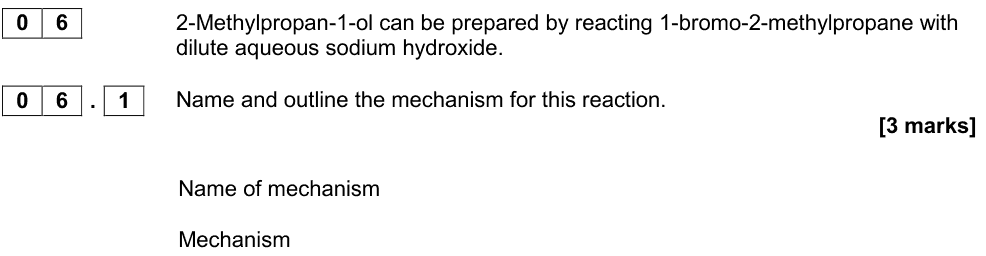
Nucleophilic substitution. Curly arrow from the lone pair on O of :OH– to the C of C–Br
curly arrow from the C–Br bond to Br. No formal charges on the C or Br of C–Br
no extra arrows on NaOH. An elimination attempt scores no mechanism marks
June 2017 · Paper 2 · Q01.64 marksMechanism
Earlier part of question 01 that this part uses
Mark scheme
Examiner's comment
01.6 This was a high scoring question for many. For others, the main errors were missing the negative sign or the lone pair on the hydroxide ion, or showing attack on the wrong hydrogen atom.
Notes from the mark scheme and report
(Base) elimination. Arrow from the lone pair on O of OH– to an H on carbon 2
arrow from that C–H bond to the C1–C2 bond
arrow from the C–Br bond to Br. E1 also credited. Nucleophilic substitution scores M3 only. Errors: no negative charge or lone pair on hydroxide
2.3 Students were asked to complete an electrophilic addition mechanism with an unsymmetrical alkene. This proved straight forward for many. Those who lost marks often did so because that drew a secondary carbocation intermediate rather than the tertiary one that would lead to the major product.
Notes from the mark scheme and report
The tertiary carbocation CH3CH2–C+(CH3)–CH2CH3, with a curly arrow from a lone pair on Br– to the C+. Common error: drawing the secondary carbocation
June 2024 · AS Paper 2 · Q04.25 marksAO1=1, AO2=4Mechanism
Earlier part of question 04 that this part uses
Mark scheme
Examiner's comment
4.2 Students had to show the mechanism for the formation of the major halogenoalkane product from electrophilic addition to an alkene. This was generally very well done.
Notes from the mark scheme and report
Electrophilic addition. Curly arrow from the C=C to the H of H–Br
arrow from the H–Br bond to Br
tertiary carbocation with the positive charge on the carbon carrying the (CH3)2CH and CH3CH2 groups (H has added to the CH carbon)
arrow from a lone pair on Br– to the C+. Mechanism for L (secondary carbocation) scores max 3 of the 4 mechanism marks.
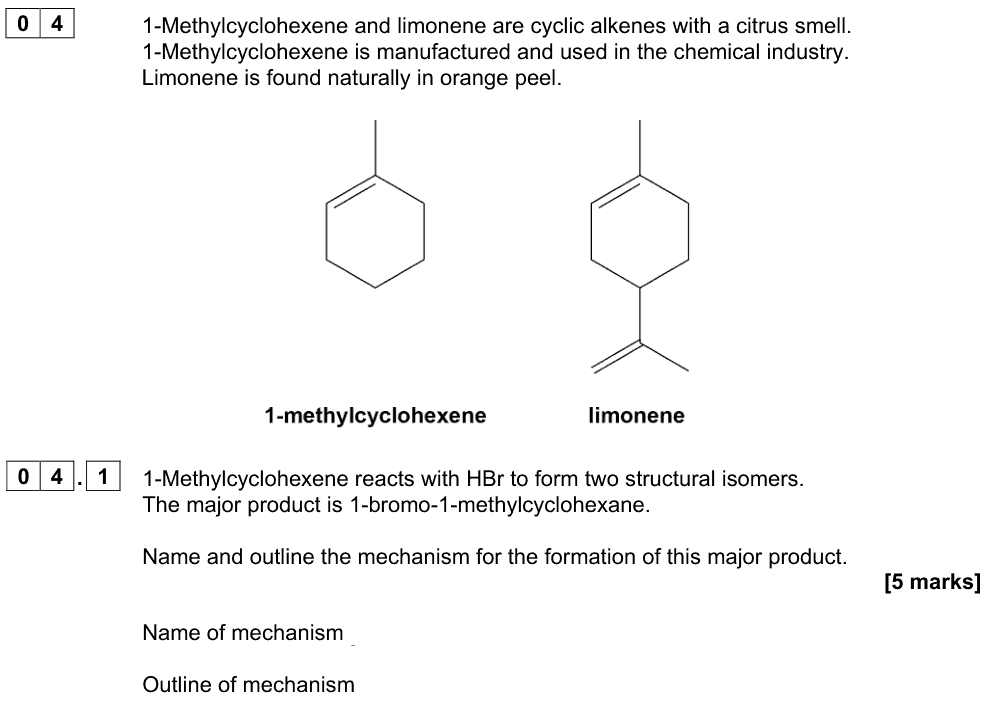
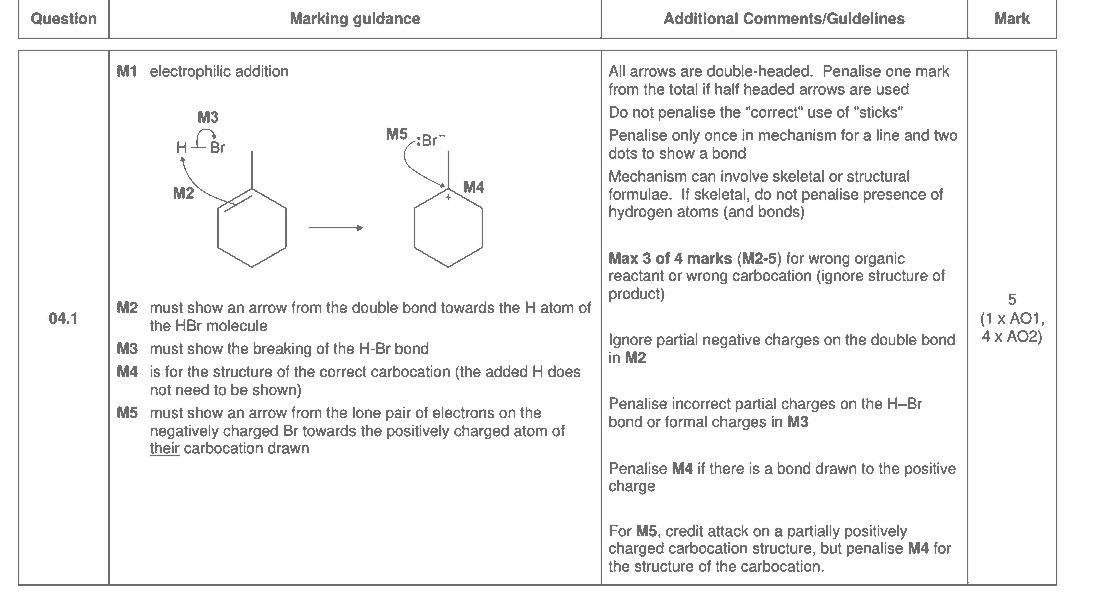
June 2023 · AS Paper 2 · Q04.15 marksAO1=1, AO2=4Mechanism
Mark scheme
Examiner's comment
04.1 This skeletal mechanism was done relatively well by students, despite involving an unusual structure.
Notes from the mark scheme and report
Electrophilic addition. Curly arrow from the C=C to the H of H–Br
arrow from the H–Br bond to Br
tertiary carbocation with + on the ring carbon carrying the methyl group
arrow from the lone pair on Br– to the C+. Wrong reactant or wrong carbocation max 3 of the 4 mechanism marks
June 2022 · AS Paper 2 · Q07.65 marksAO1=1, AO2=4Mechanism
Earlier part of question 07 that this part uses
Mark scheme
Examiner's comment
7.6 This question required students to name and outline a mechanism. This was done well. One common issue was students not putting the negative charge on the HSO4– as it attacked the carbocation in the final step.
Notes from the mark scheme and report
Electrophilic addition. Arrow from the C=C towards the H of H2SO4
arrow from the H–O bond to O
the primary carbocation CH3CH2CH2CH2+ (leading to W)
arrow from a lone pair on an O of HSO4– to the C+. Wrong carbocation: max 3 of the 4 mechanism marks. Common error: no negative charge on HSO4–
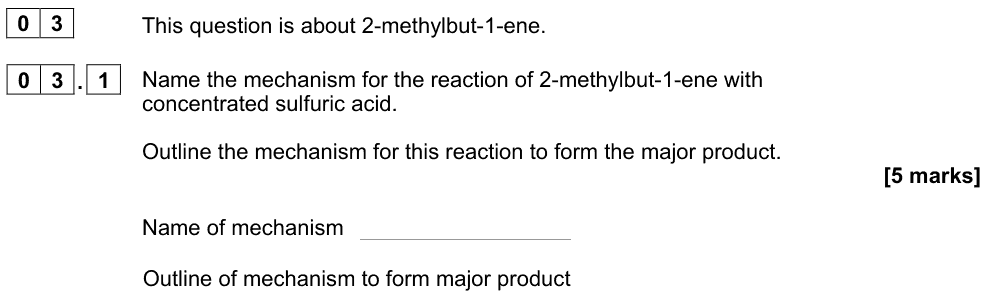
June 2022 · Paper 2 · Q03.15 marksAO1=1, AO2=4Mechanism
Mark scheme
Examiner's comment
03.1 The second mechanism on the paper also had a high discrimination index and the best students were able to score full marks here. Most students were able to get started but mistakes in the structure of the tertiary carbocation intermediate were quite common, as were errors in representation of the sulfuric acid, and subsequent attack on the carbocation by the hydrogensulfate ion.
Notes from the mark scheme and report
Electrophilic addition. Curly arrow from the C=C to the H of H–O in H2SO4
curly arrow from the H–O bond to O
tertiary carbocation (CH3)2C+CH2CH3
curly arrow from a lone pair on O of –OSO3H (negative ion) to the C+. Product (CH3)2C(OSO3H)CH2CH3. A primary carbocation loses M4
using H2O as the electrophile is max 4. Errors: carbocation structure, representation of H2SO4, attack by HSO4–
November 2021 · AS Paper 2 · Q02.15 marksMechanism
Mark scheme
Notes from the mark scheme and report
Electrophilic addition. Arrow from the C=C to a Br of Br–Br
arrow from the Br–Br bond to the other Br
carbocation with Br on the adjacent ring carbon
arrow from a lone pair on Br– to the C+. Max 3 of 4 for the wrong reactant or carbocation
no bond drawn to the + charge
formal or wrong partial charges on Br–Br penalised
June 2019 · AS Paper 2 · Q06.15 marksMechanism
Mark scheme
Examiner's comment
6.1 The mechanism was done quite well. The most common error was omitting the negative charge on the hydrogensulfate ion.
Notes from the mark scheme and report
Electrophilic addition. Arrow from the C=C to the H of H–O in H2SO4
arrow from the H–O bond to O
the secondary carbocation CH3CH+CH3
arrow from a lone pair on the O– of HSO4– to the C+. Most common error: negative charge left off the hydrogensulfate ion
June 2019 · Paper 2 · Q02.53 marksMechanism
Earlier part of question 02 that this part uses
Mark scheme
Examiner's comment
02.5 The mechanism was usually answered well although the cyclic nature of the alkene confused several students who wrongly drew a substitution mechanism instead of electrophilic addition.
The intermediate carbocation in part five should not be written as structure A below.
Correct possibilities are structure B (preferred) or structure C.
Once a carbon atom is labelled as such, it must have the correct bonding as in C but not A.
Notes from the mark scheme and report
Electrophilic addition: curly arrow from the C=C to the nearer Br of Br–Br (the Br–Br arrow is printed)
carbocation intermediate, a ring with Br on one carbon and + on the adjacent carbon
arrow from a lone pair on :Br– to the C+. M1 lost for full or wrong partial charges on Br2. Do not mix skeletal and structural formulas at one carbon: a carbon written as C must show its H. Some drew a substitution mechanism
June 2019 · Paper 2 · Q13.15 marksMechanism
Mark scheme
Examiner's comment
13.1 This question discriminated well. It was surprising to see how many students were unable to draw the correct structure of 2-methylbutanal. Many placed the methyl group on carbon 3. Most students were familiar with the mechanism and drew the
curly arrow from the lone pair on :H– to the C of C=O and curly arrow from the C=O bond to O. Explanation: the H– nucleophile is attracted to the δ+ carbon of the polar C=O
the C=C is electron rich, so it repels H– / is attacked only by electrophiles. Many drew the methyl group on carbon 3
June 2017 · Paper 3 · Q02.24 marksMechanism
Earlier part of question 02 that this part uses
Mark scheme
Examiner's comment
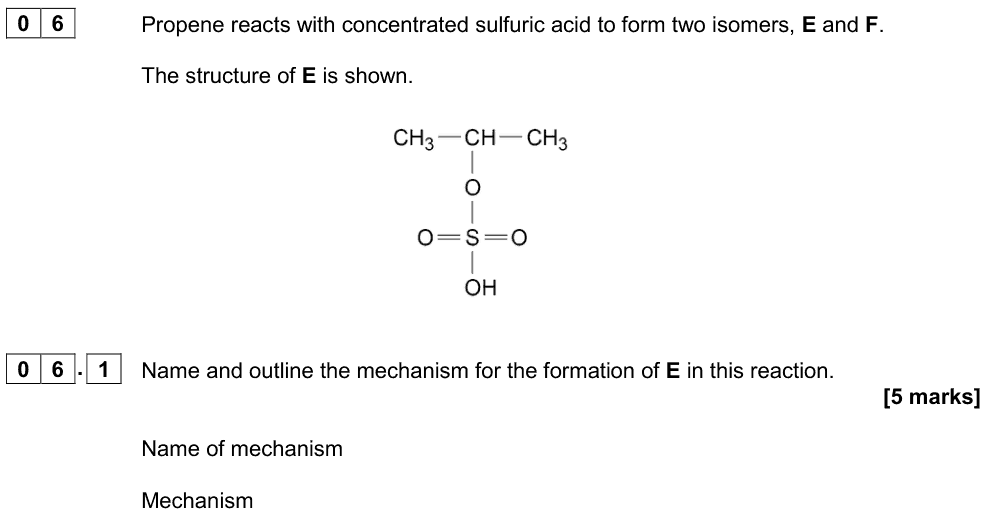
02.2 With nearly 40% of students scoring full marks, this question illustrated that the skill of representing mechanisms is good. When confusion arose it generally involved attempts to show mechanisms involving water and producing the alcohol, when the final product in this case should be propyl hydrogensulfate. The most common omissions were the curly arrow to show breaking of the H-O bond in H2SO4 and/or the negative charge on the HSO4
Notes from the mark scheme and report
Curly arrow from the C=C bond of propene to the H of an O–H in H2SO4
curly arrow from that H–O bond to O
secondary carbocation CH3C+HCH3
curly arrow from a lone pair on an O of –OSO3H (hydrogensulfate ion, with its negative charge) to C+. Product CH3CH(OSO3H)CH3. A primary carbocation loses M3
using water as the electrophile is max 1. Common omissions: the arrow breaking the H–O bond
the negative charge on HSO4–
drawing the alcohol as product
June 2016 · AS Paper 2 · Q07.27 marksMechanism
Earlier part of question 07 that this part uses
Mark scheme
Examiner's comment
Many students did well on Q7.2, but a significant number attempted to describe the curly
Notes from the mark scheme and report
Electrophilic addition. Curly arrow from the C=C to the H of H–Br
arrow from the H–Br bond to Br
tertiary carbocation CH3CH2C+(CH3)CH2CH3
arrow from a lone pair on Br– to the C+. 3-bromo-3-methylpentane is formed via the tertiary carbocation (the 2-bromo isomer via a secondary one), and the tertiary carbocation is more stable than the secondary. The explanation must be about the stability of carbocations, not products.
Specimen · Paper 2 · Q12.25 marksMechanism
Earlier part of question 12 that this part uses
Mark scheme
Notes from the mark scheme and report
Electrophilic addition. M1 curly arrow from the C=C to the H of H–Br
M2 curly arrow from the H–Br bond to Br
M3 secondary carbocation CH3C+HCH2CH3
M4 curly arrow from the lone pair on Br– to C+. Product CH3CHBrCH2CH3. Consequential on the acid chosen in 12.1
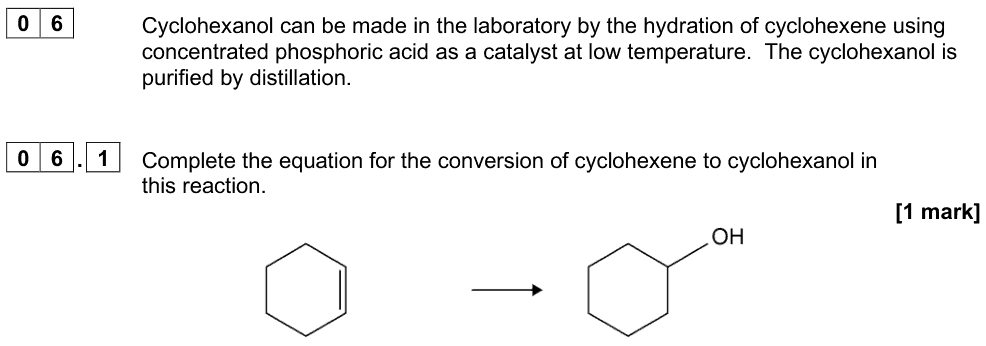
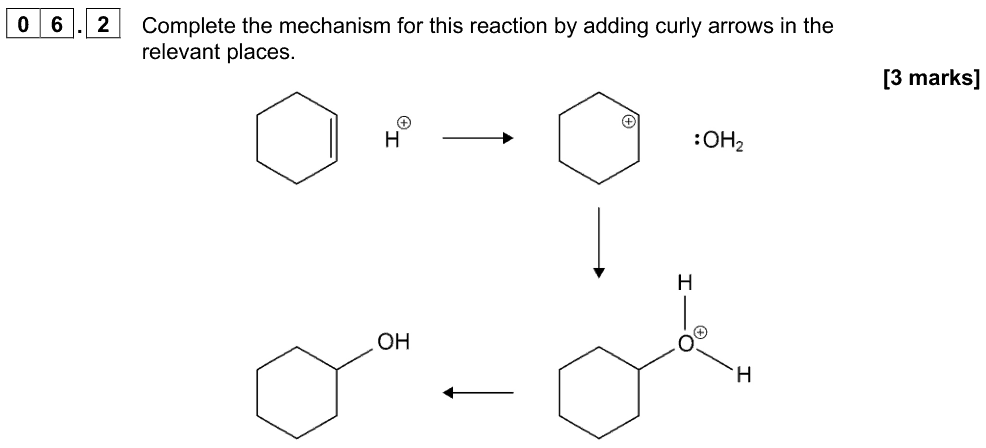
June 2025 · AS Paper 2 · Q06.23 marksAO2=3Mechanism
Earlier part of question 06 that this part uses
Mark scheme
Examiner's comment
6.2 Students had to complete a partial mechanism by adding 3 arrows. It was answered quite well but the final arrow for breaking the O-H bond was often incorrect.
Notes from the mark scheme and report
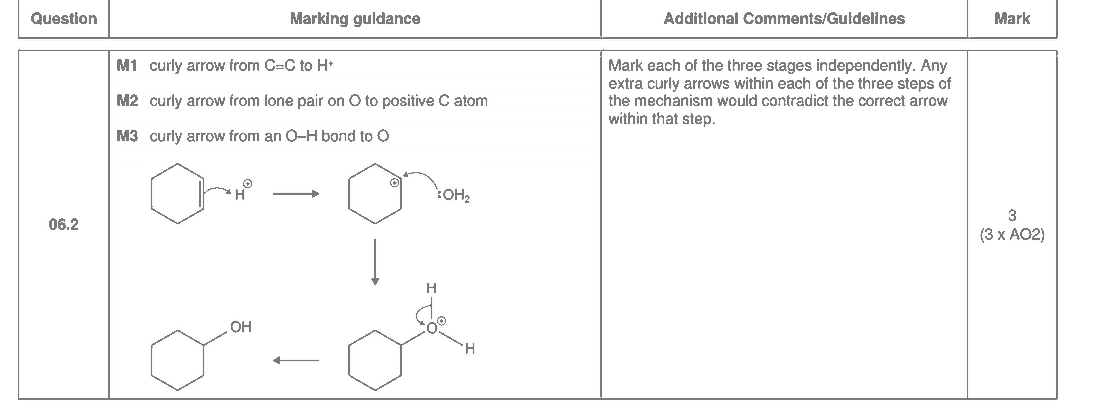
Three curly arrows: from the C=C to H+
from the lone pair on O of :OH2 to the positive carbon of the carbocation
from an O–H bond of the –OH2+ group to the O. Each step marked independently
an extra arrow in a step cancels that mark. The last arrow was most often wrong
June 2023 · AS Paper 2 · Q07.24 marksAO1=1, AO2=3MechanismHard
Earlier part of question 07 that this part uses
Mark scheme
Examiner's comment
07.2 Students found this elimination mechanism challenging; just under a quarter of students achieved full marks here.
Notes from the mark scheme and report
Elimination (dehydration ignored). Protonated alcohol drawn with –OH2+
curly arrow from the C–O bond to the O (loss of H2O), giving the primary carbocation
curly arrow from the C–H bond on the adjacent carbon into the C–C bond (loss of H+). Loss of water and H+ may be shown in one step
June 2023 · Paper 3 · Q02.53 marksMechanism
Earlier part of question 02 that this part uses
Mark scheme
Examiner's comment
50% of students scored 3 marks in 02.5 and students are again reminded of the importance of being precise when drawing curly arrows in terms of where they start and where they finish.
A curly arrow in any mechanism must always start either from the line representing a covalent bond or from a lone pair drawn on an atom.
In this case, both arrows should have started from an existing bond in order to represent the breaking of that bond.
Notes from the mark scheme and report
On the protonated intermediate: curly arrow from the C–O bond to the O of the OH2+ group (water leaves
not an arrow to the + sign)
curly arrow from the C–H bond on the adjacent ring carbon to the C–C bond between the two ring carbons (H+ lost, C=C forms). Name: elimination (ignore acid-catalysed / dehydration
not nucleophilic, electrophilic or addition). Both arrows must start at a bond. 50% scored 3 marks
November 2021 · AS Paper 2 · Q07.24 marksMechanism
Earlier part of question 07 that this part uses
Mark scheme
Notes from the mark scheme and report
Elimination. Arrow from a lone pair on O of one OH to H+
protonated alcohol with arrow from the C–O+H2 bond to O (water leaves)
carbocation, then arrow from the adjacent C–H bond to the C–C bond to form C=C (loss of H+). The last two steps may be shown as one concerted step. Max 2 of 3 for the wrong reactant
November 2020 · AS Paper 2 · Q04.25 marksMechanism
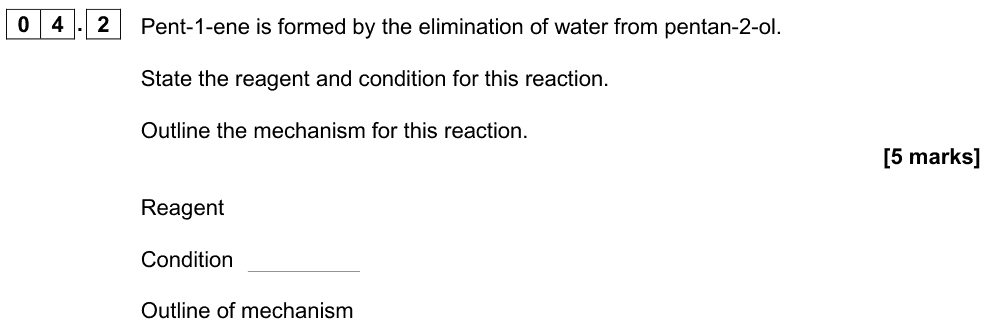
condition: hot (150–200 °C). Mechanism: curly arrow from a lone pair on the alcohol O to H+
curly arrow from the C–O bond to the O of the protonated alcohol (–OH2+), losing water to give the secondary carbocation CH3CH2CH2C+HCH3
curly arrow from a C–H bond on C1 to the C1–C2 bond, giving pent-1-ene. Loss of water and loss of H+ may be shown as one concerted step. Extra arrows are penalised at each stage
November 2020 · Paper 2 · Q06.33 marksMechanism
Earlier part of question 06 that this part uses
Mark scheme
Examiner's comment
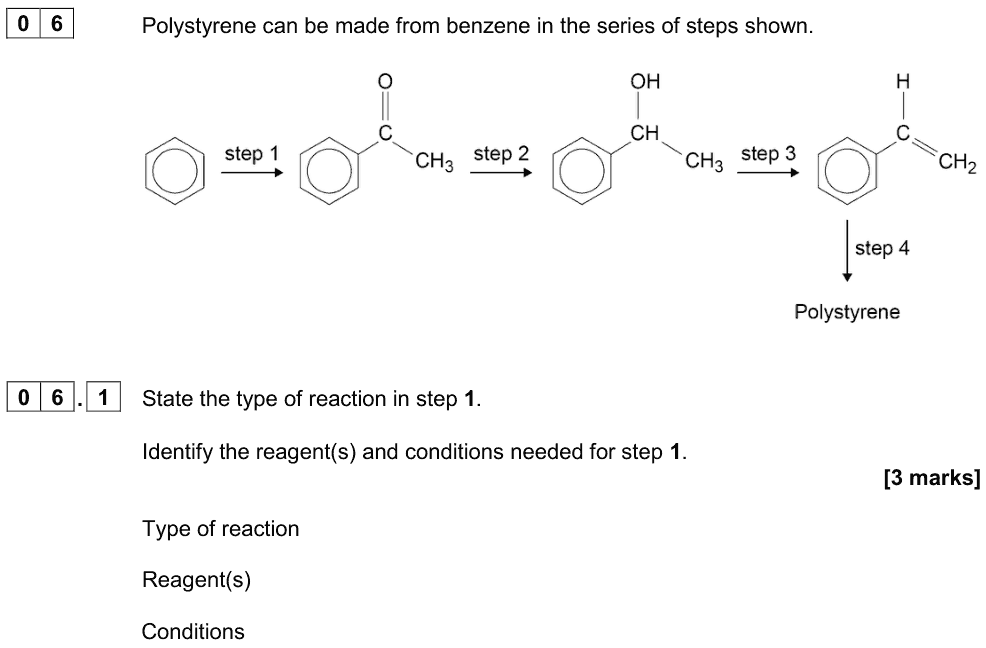
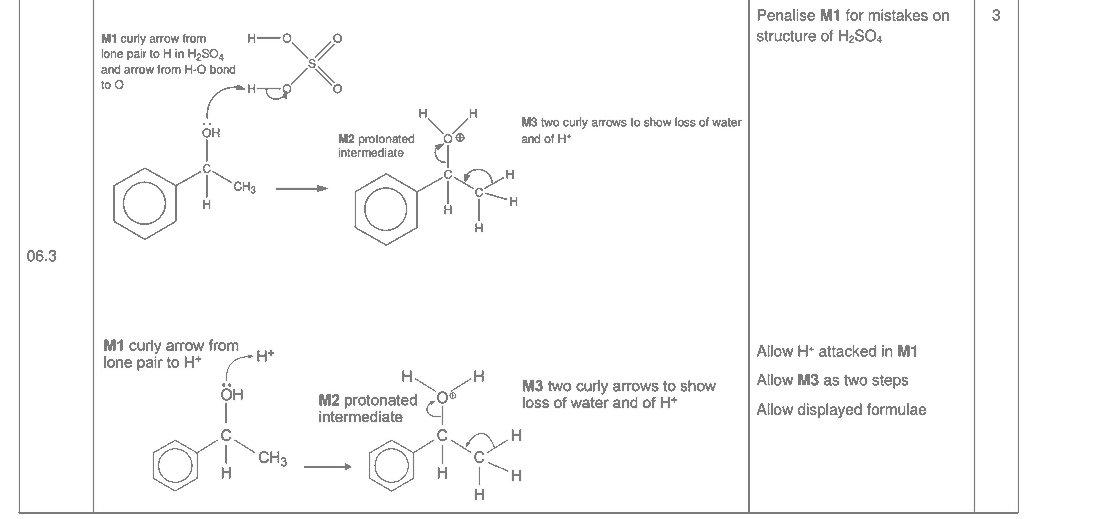
The dehydration mechanism in 06.3 was poorly answered compared to other mechanism questions in the paper.
Notes from the mark scheme and report
Elimination (dehydration). Curly arrow from a lone pair on the alcohol O to H of H2SO4 (or to H+), with an arrow from the H–O bond to O of the acid
protonated intermediate with –OH2+
then curly arrows from the C–O bond to O+ (loss of water) and from a C–H bond of the CH3 group into the C–C bond (loss of H+), giving phenylethene. Loss of water and H+ may be two steps. Mistakes in the H2SO4 structure lose the first mark. Poorly answered
June 2018 · Paper 2 · Q03.54 marksMechanismHard
Earlier part of question 03 that this part uses
Mark scheme
Examiner's comment
03.5 The major errors in the answers to this acid-catalysed elimination of water were where students confused this mechanism with the elimination of HX from a halogenoalkane using a base. However, just under a third of students scored full marks in a correct mechanism, either via the formation of a carbocation or by showing the simultaneous loss of water and H+ from a protonated alcohol.
Notes from the mark scheme and report
Elimination. Lone pair on the O of pentan-2-ol attacks H+ (protonation, giving –OH2+)
curly arrow from the C–O bond to O+ (loss of water)
curly arrow from a C–H bond of the CH3 group into the C–C bond (loss of H+) giving CH2=CHCH2CH2CH3. Either stepwise through the secondary carbocation or with water and H+ lost together. Base elimination (as for halogenoalkanes) is penalised
June 2017 · AS Paper 2 · Q07.14 marksMechanism
Mark scheme
Examiner's comment
07.1 The first use of a mechanism with skeletal structures proved to be challenging for many students, even with the framework provided.
Notes from the mark scheme and report
M1 curly arrow from the lone pair on O to H+
M2 intermediate with –OH2+ bonded to the ring (+ on O)
M3 curly arrow from the C–O bond to O
M4 curly arrow from the correct C–H bond (on the carbon bearing CH3) to the C–C bond that becomes C=C. Arrows to or from other species are penalised
3.7 This fairly routine nucleophilic addition elimination mechanism was well answered by students who had learned the standard curly arrows and were able to apply them in the context given. Some lost marks for drawing curly arrows in the wrong direction; in particular for the proton loss from the intermediate. Others added charges to the starting materials.
Notes from the mark scheme and report
Arrow from the lone pair on N of the amine to the C of C=O
arrow from the C=O bond to O
intermediate with O– on the oxygen and + on N (N bonded to C with two H)
then three arrows: lone pair on O– reforming C=O, C–Cl bond to Cl, N–H bond to N+. Errors: arrows in the wrong direction for the loss of H+
charges added to the reactants
June 2024 · Paper 2 · Q09.33 marksAO2=3Mechanism
Earlier part of question 09 that this part uses
Mark scheme
Examiner's comment
9.3 Most students got at least 2 of the 3 marks here. The final mark was often the one lost and drawing a fully displayed amine formed from a nitrile proved difficult for many. Common mistakes included having too few carbon atoms, and missing hydrogen atoms despite being given the balanced left-hand side of the equation.
Notes from the mark scheme and report
2-Bromopropane, (CH3)2CHBr, drawn as the reactant
two curly arrows: from the lone pair on C of :CN– to the C bearing Br, and from the C–Br bond to Br
amine G fully displayed: (CH3)2CHCH2NH2, 2-methylpropan-1-amine, with every bond shown. The displayed amine was the mark most often lost (too few C atoms or missing H atoms)
November 2021 · Paper 2 · Q02.44 marksMechanism
Earlier part of question 02 that this part uses
Mark scheme
Examiner's comment
In this question a surprisingly small proportion of students were able to state the meaning of the term fraction. In addition, very few were able to explain why C=O bonds in carbon dioxide absorb infrared radiation. A good range of answers was seen for the extended response question about the environmental impact of bioethanol as a fuel, but a significant number of students were unable to get started here.
Notes from the mark scheme and report
Two curly arrows for step 2: from the lone pair on N of the second HOCH2CH2NH2 to an H on the N+, and from that N–H bond to the N+. Name: 2-aminoethanol (allow ethanolamine, 2-hydroxyethylamine). Role in step 2: base / proton acceptor (electron pair donor)
November 2020 · Paper 2 · Q05.24 marksMechanism
Earlier part of question 05 that this part uses
Mark scheme
Examiner's comment
Around half the students scored all the marks for the mechanism in 05.2 and over 70% got at least 3 of the 4 marks.
Notes from the mark scheme and report
Nucleophilic substitution. Curly arrow from the lone pair on N of NH3 to the C bonded to Br
curly arrow from the C–Br bond to Br
intermediate (CH3)2CH–NH3+ with the + on N
curly arrow from an N–H bond to N, with a second NH3 removing H+, giving (CH3)2CHNH2 + NH4Br. Loss of H+ using Br– is penalised
SN1 allowed. Around half scored all 4
over 70% scored at least 3
June 2019 · Paper 2 · Q01.24 marksMechanism
Earlier part of question 01 that this part uses
Mark scheme
Examiner's comment
01.2 The mechanism was answered well although some students drew an intermediate with too few carbons. The structure of a cyclic secondary amine proved difficult for some to deduce and many incorrect hexagons or primary amine structures were drawn.
Notes from the mark scheme and report
Nucleophilic substitution: curly arrow from the lone pair on N of NH3 to the carbon bonded to Br (the C–Br arrow is printed)
intermediate H3N+–(CH2)6–NH2
arrow from an N–H bond to N+ as a second NH3 removes H+ (do not use Br– for this). Cyclic by-product: a seven-membered ring of six CH2 groups and one N–H (the amine end of the molecule attacks its own C–Br carbon). Errors: intermediate with too few carbons
hexagons or primary amines for the cyclic amine
June 2019 · Paper 2 · Q08.32 marksMechanism
Earlier part of question 08 that this part uses
Mark scheme
Examiner's comment
08.3 This part was generally answered well and many students scored both marks. Some, however, failed to gain the second mark because of careless drawing of curly arrows or for showing a chloride ion removing a proton from the intermediate.
Notes from the mark scheme and report
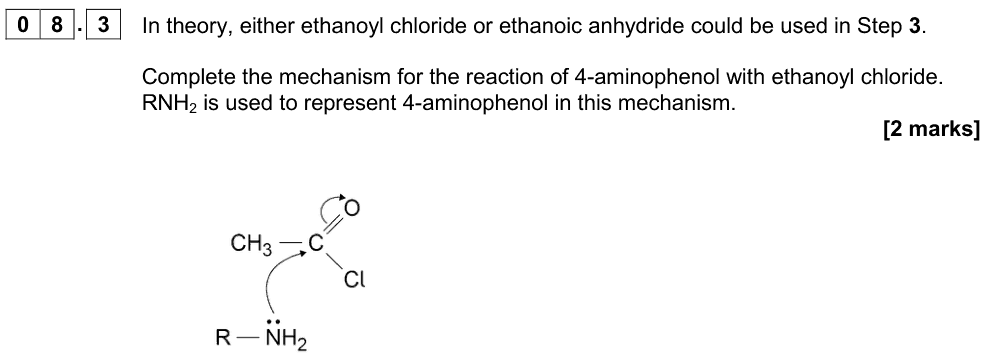
Nucleophilic addition–elimination. M1: tetrahedral intermediate CH3C(O–)(Cl)–N+H2R with both charges. M2: three curly arrows with a lone pair on O–: lone pair on O– reforms C=O, C–Cl bond breaks to Cl, and N–H bond breaks to N+ (loss of H+), giving CH3CONHR. Do not show Cl– removing the proton. Careless arrows lost the second mark
June 2017 · Paper 2 · Q06.46 marksMechanismHard
Earlier part of question 06 that this part uses
Mark scheme
Examiner's comment
06.4 This question was well answered and 25% of students scored all six marks. The name of the organic product was the most common mark lost, closely followed by slips in the third or fourth marks in the mechanism.
Notes from the mark scheme and report
(Nucleophilic) addition–elimination. Arrow from the lone pair on N of CH3CH2NH2 to the C of C=O
arrow from C=O bond to O
intermediate with O– and N+
then lone pair on O– reforms C=O, C–Cl bond breaks to Cl and N–H bond breaks to N+. Product: N-ethylpropanamide. The name was the mark most often lost
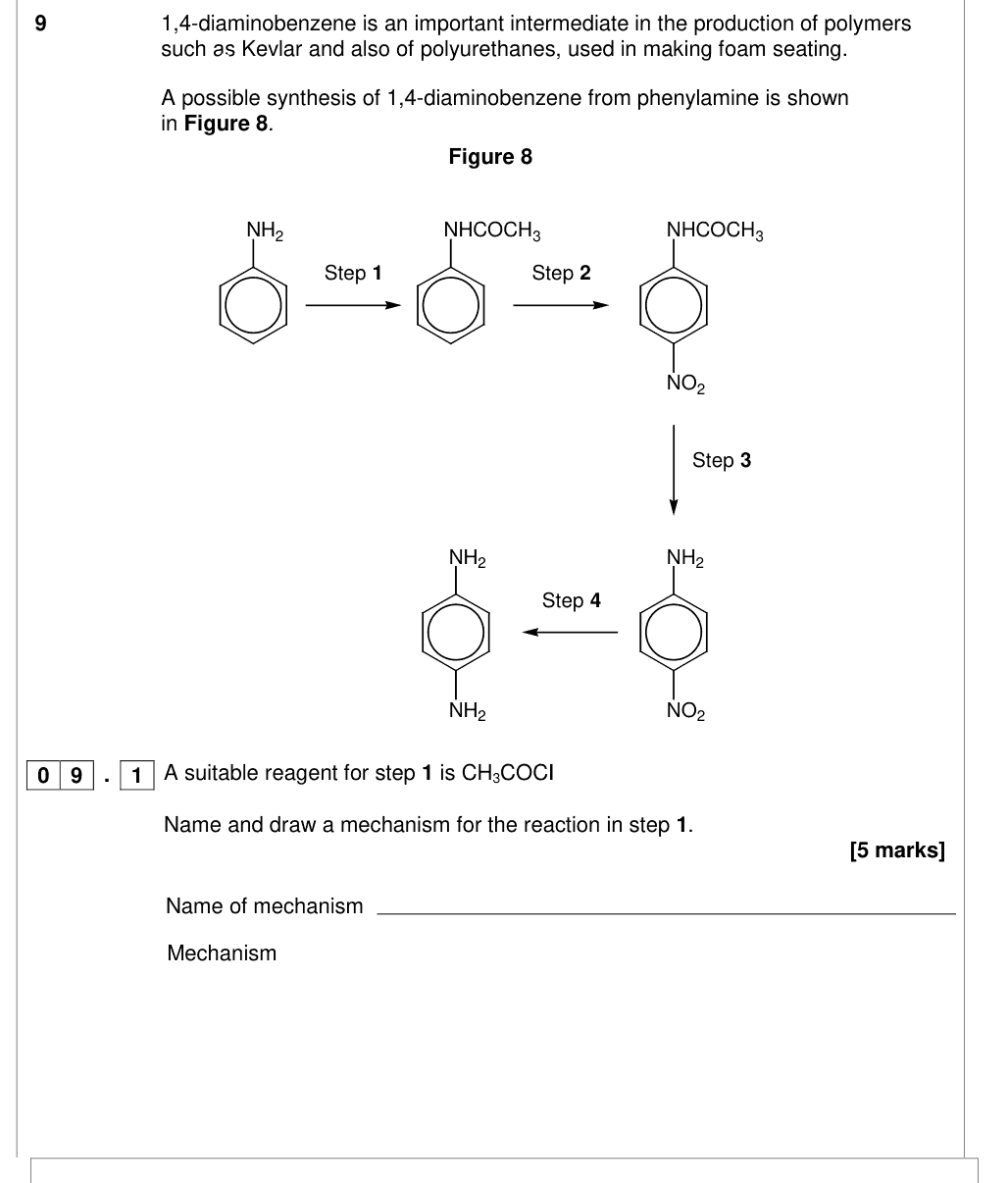
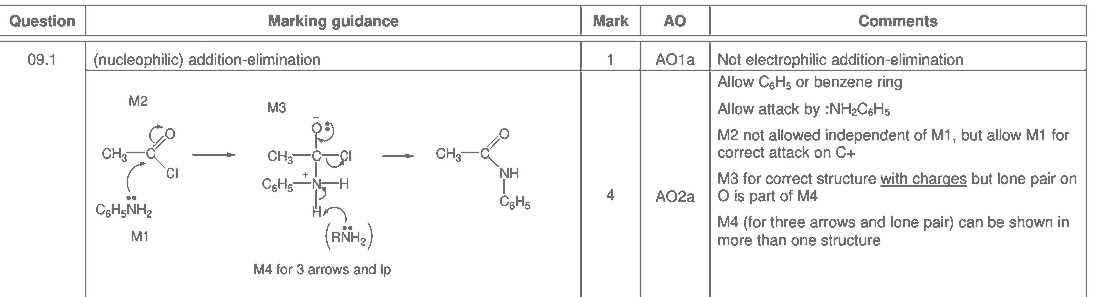
Specimen · Paper 2 · Q09.15 marksAO1=1, AO2=4Mechanism
Mark scheme
Notes from the mark scheme and report
(Nucleophilic) addition–elimination
not electrophilic. M1 curly arrow from the lone pair on N of C6H5NH2 to the C of C=O
M2 arrow from the C=O bond to O
M3 intermediate with O– and N+ (C6H5NH2+)
M4 three arrows and the lone pair: lone pair on O– re-forming C=O, C–Cl bond to Cl, and N–H bond to N+ (H removed). Product CH3CONHC6H5.
3.7 This fairly routine nucleophilic addition elimination mechanism was well answered by students who had learned the standard curly arrows and were able to apply them in the context given. Some lost marks for drawing curly arrows in the wrong direction; in particular for the proton loss from the intermediate. Others added charges to the starting materials.
Notes from the mark scheme and report
Arrow from the lone pair on N of the amine to the C of C=O
arrow from the C=O bond to O
intermediate with O– on the oxygen and + on N (N bonded to C with two H)
then three arrows: lone pair on O– reforming C=O, C–Cl bond to Cl, N–H bond to N+. Errors: arrows in the wrong direction for the loss of H+
charges added to the reactants
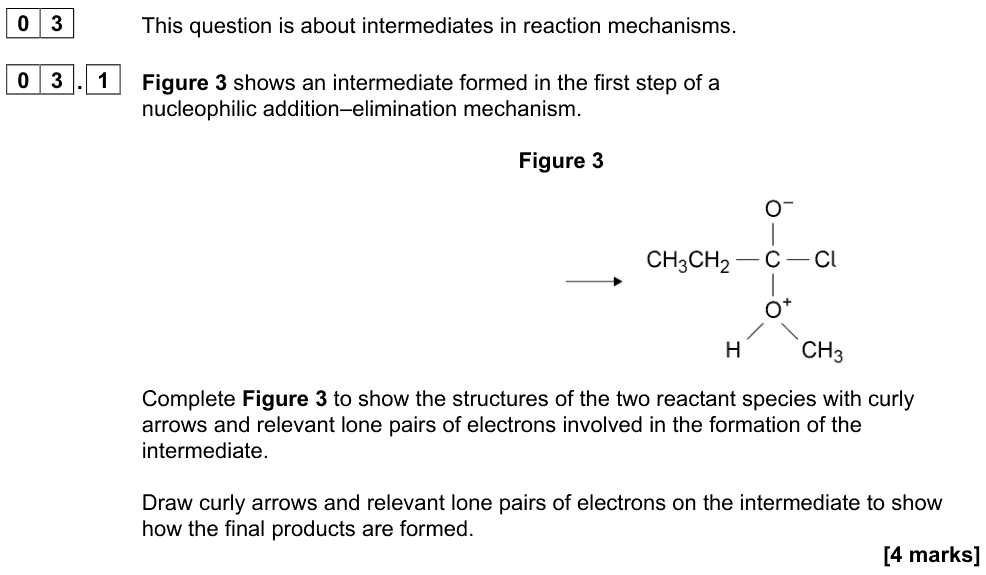
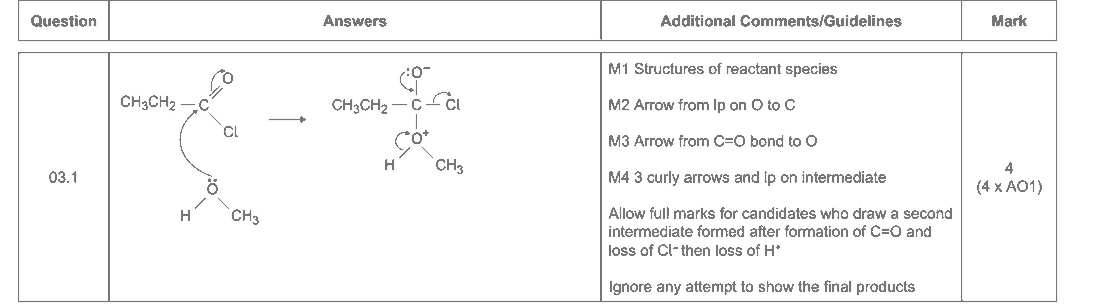
June 2023 · Paper 2 · Q03.14 marksAO1=4Mechanism
Mark scheme
Examiner's comment
03.1 As with the other two parts of this question, the discrimination index of more than 0.65 showed that this type of question discriminates very well. Able students often scored all four marks for this familiar mechanism despite the unusual way the question demanded that students work backwards from the given intermediate for the first three marks.
Notes from the mark scheme and report
Reactants: propanoyl chloride CH3CH2COCl and methanol CH3OH. Curly arrow from a lone pair on the O of methanol to the carbonyl C
curly arrow from the C=O bond to O. On the intermediate: lone pair on O– with arrow re-forming C=O, arrow from the C–Cl bond to Cl, and arrow from the O–H bond to O+ (three arrows and the lone pair for M4). Working backwards from the intermediate was unusual
June 2022 · Paper 2 · Q07.13 marksAO3=3Mechanism
Mark scheme
Examiner's comment
07.1 This question required students to deduce and add three curly arrows to an unfamiliar incomplete mechanism. As with similar questions in the past, this discriminated well between the most able and weaker students.
Notes from the mark scheme and report
Step 1: curly arrow from the C=O bond to O. Step 2: curly arrow from the C–OCH3 bond to that O (CH3O– leaves). Step 3: curly arrow from the O–H bond of the acid to O (the arrow from CH3O– to H is already printed)
November 2021 · Paper 2 · Q08.35 marksMechanism
Earlier part of question 08 that this part uses
Mark scheme
Examiner's comment
A very good range of marks was seen for question 08.3 and the question discriminated very well.
Notes from the mark scheme and report
(Nucleophilic) addition–elimination. Curly arrow from a lone pair on an O–H oxygen of the diol to the C of a COCl group
arrow from the C=O bond to O
intermediate with O+–H on the diol oxygen, C–O– and C–Cl
then three arrows: lone pair on O– reforms C=O, the C–Cl bond breaks to Cl, and the O–H bond breaks to O+ (lone pair on O– required)
June 2019 · Paper 2 · Q08.32 marksMechanism
Earlier part of question 08 that this part uses
Mark scheme
Examiner's comment
08.3 This part was generally answered well and many students scored both marks. Some, however, failed to gain the second mark because of careless drawing of curly arrows or for showing a chloride ion removing a proton from the intermediate.
Notes from the mark scheme and report
Nucleophilic addition–elimination. M1: tetrahedral intermediate CH3C(O–)(Cl)–N+H2R with both charges. M2: three curly arrows with a lone pair on O–: lone pair on O– reforms C=O, C–Cl bond breaks to Cl, and N–H bond breaks to N+ (loss of H+), giving CH3CONHR. Do not show Cl– removing the proton. Careless arrows lost the second mark
June 2017 · Paper 2 · Q06.46 marksMechanismHard
Earlier part of question 06 that this part uses
Mark scheme
Examiner's comment
06.4 This question was well answered and 25% of students scored all six marks. The name of the organic product was the most common mark lost, closely followed by slips in the third or fourth marks in the mechanism.
Notes from the mark scheme and report
(Nucleophilic) addition–elimination. Arrow from the lone pair on N of CH3CH2NH2 to the C of C=O
arrow from C=O bond to O
intermediate with O– and N+
then lone pair on O– reforms C=O, C–Cl bond breaks to Cl and N–H bond breaks to N+. Product: N-ethylpropanamide. The name was the mark most often lost
Specimen · Paper 2 · Q09.15 marksAO1=1, AO2=4Mechanism
Mark scheme
Notes from the mark scheme and report
(Nucleophilic) addition–elimination
not electrophilic. M1 curly arrow from the lone pair on N of C6H5NH2 to the C of C=O
M2 arrow from the C=O bond to O
M3 intermediate with O– and N+ (C6H5NH2+)
M4 three arrows and the lone pair: lone pair on O– re-forming C=O, C–Cl bond to Cl, and N–H bond to N+ (H removed). Product CH3CONHC6H5.
5.3 The mechanism for nitration was well known. Despite being given the formula of the nitronium ion as O2N+ in the question significant numbers of students lost the first mark in the mechanism for not showing the + on the N.
arrow from inside the ring to the N of +NO2 (the + must be on N)
intermediate with a horseshoe not extending beyond C2–C6 and the + inside, with H and NO2 on the carbon next to the CH3
arrow from the C–H bond back into the ring. Common error: + not shown on N
June 2024 · Paper 2 · Q10.33 marksAO1=3MechanismHard
Earlier parts of question 10 that this part uses
Mark scheme
Examiner's comment
10.3 This familiar mechanism allowed over 80% of students to score at least 1 mark but only 32% scored all 3. Common mistakes in drawing the intermediate have been covered many times in reports on past papers so it was surprising to see so many students making the same errors.
Notes from the mark scheme and report
Electrophilic substitution: arrow from inside the ring to N of +NO2
intermediate with a horseshoe centred on C1 that does not extend beyond C2 and C6, with + inside it and both H and NO2 on the carbon attacked
arrow from the C–H bond back into the ring. Over 80% scored at least 1
the usual errors were in drawing the intermediate
June 2023 · Paper 2 · Q03.24 marksAO1=4Mechanism
Earlier part of question 03 that this part uses
Mark scheme
Examiner's comment
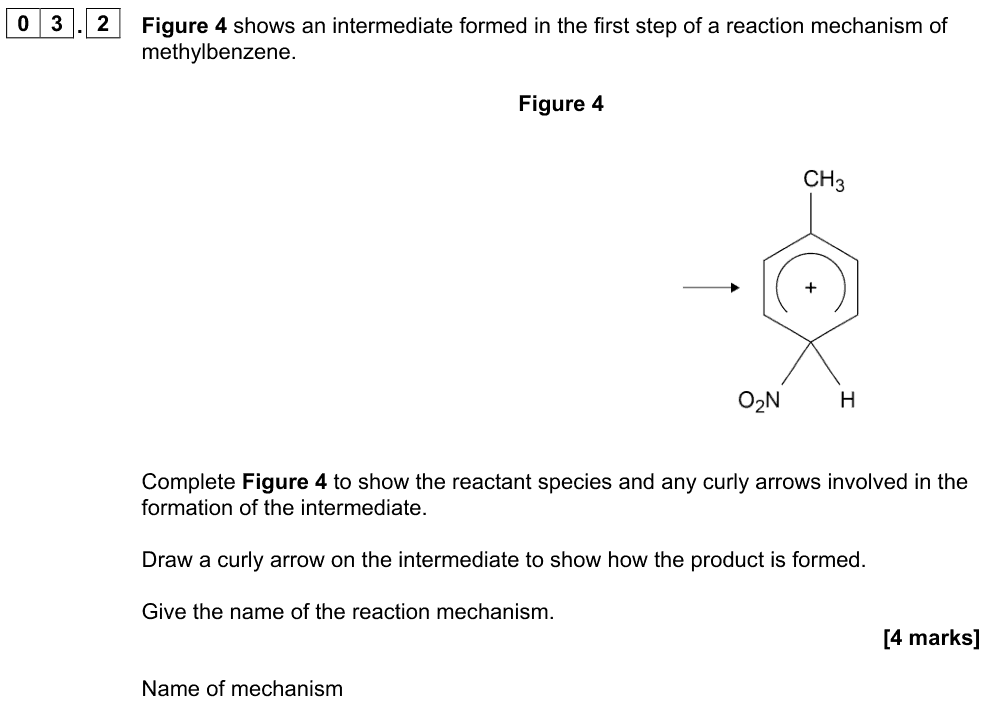
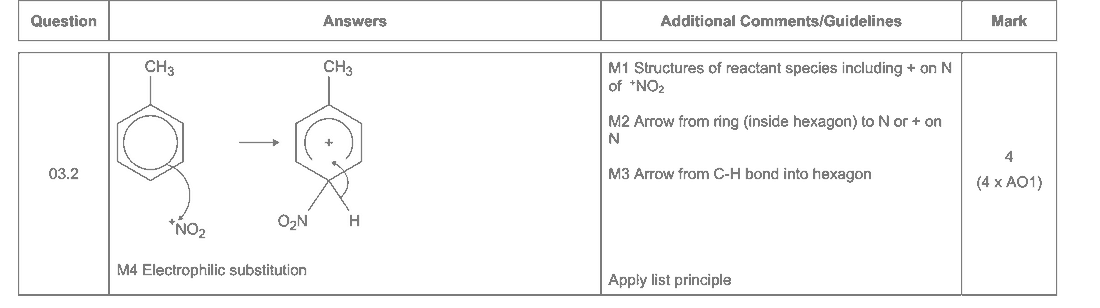
03.2 Fewer students scored full marks here than with the other two parts of Question 3. Curly arrows were often poorly drawn and failed to show the formation of a bond between a C in the methylbenzene and the N in the electrophile +NO2.
Notes from the mark scheme and report
Electrophilic substitution. Reactants: methylbenzene and the nitronium ion +NO2 (with + on N)
curly arrow from inside the ring to the N of +NO2
on the intermediate, curly arrow from the C–H bond back into the ring. Arrows were often poorly drawn and did not show a bond forming between a ring C and N
fewest full marks of the three parts
June 2022 · Paper 2 · Q08.33 marksAO2=3Mechanism
Earlier part of question 08 that this part uses
Mark scheme
Examiner's comment
08.3 A good proportion of students scored all 3 marks for this familiar mechanism and most were able to score some marks here.
Notes from the mark scheme and report
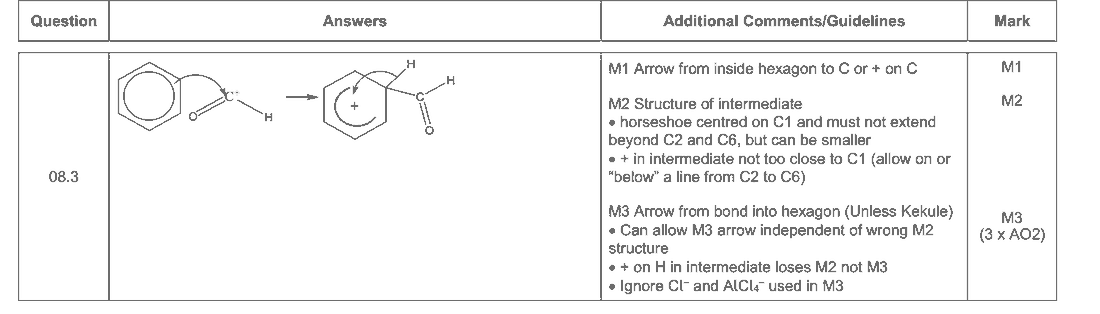
Curly arrow from inside the ring to the C of [HCO]+
intermediate with H and CHO on the same ring carbon, a horseshoe not extending beyond C2 and C6 and a + inside it
curly arrow from the C–H bond back into the ring (loss of H+). + drawn on H loses M2 only
November 2021 · Paper 2 · Q04.35 marksMechanism
Earlier part of question 04 that this part uses
Mark scheme
Examiner's comment
Question 04.3 required students to apply mechanistic ideas to structures that were provided.
The vast majority of students were able to score some marks on this question and it also proved to be a very good discriminator.
Notes from the mark scheme and report
Electrophilic substitution. Step 1: lone pair on the O of the OH in HNO3, arrow from it to an H of H2SO4 and arrow from that H–O bond to the O of H2SO4. Step 2: arrow from the N–O+ bond to the O+ (water leaves, giving NO2+). Step 3: arrow from the ring of delocalised electrons to the N of NO2+. Step 4: arrow from the C–H bond back into the ring (H+ lost). Lone pairs must be shown where they are used. A very good discriminator
June 2018 · Paper 2 · Q07.14 marksMechanism
Mark scheme
Examiner's comment
07.1 This was a straightforward question on a familiar topic and many good students (46.5%) scored full marks. However, some drew structures, such as the horseshoe in the mechanism, with insufficient care and consequently failed to gain marks. Others omitted charges on the ions in the equation (especially on AlCl4
Notes from the mark scheme and report
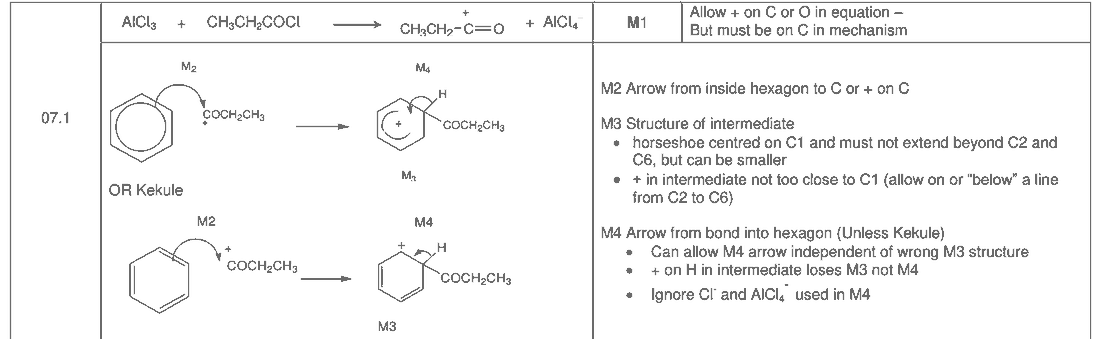
CH3CH2COCl + AlCl3 → CH3CH2CO+ + AlCl4–. Mechanism: curly arrow from the benzene ring to the C+ of the acylium ion
intermediate with a broken-ring 'horseshoe' (not extending beyond C2 and C6) and + inside, with H and COCH2CH3 on the same carbon
curly arrow from the C–H bond back into the ring. Errors: careless horseshoe
missing charges on the ions. 46.5% scored all 4
June 2017 · Paper 2 · Q08.24 marksMechanism
Earlier part of question 08 that this part uses
Mark scheme
Examiner's comment
08.2 This was also well known and 35% of students scored full marks. In the mechanism, some students incorrectly showed a lone pair on the electrophile, or the horseshoe was sometimes drawn in an incorrect orientation relative to C1. Some students started from benzene and formed nitrobenzene first.
Notes from the mark scheme and report
Electrophilic substitution. Arrow from inside the ring of nitrobenzene to N of NO2+
intermediate with a horseshoe centred on C1 not extending beyond C2 and C6, + inside, H and NO2 on the 3-position carbon
arrow from the C–H bond back into the ring. Errors: lone pair on the electrophile
June 2024 · Paper 2 · Q08.35 marksAO1=1, AO2=4Mechanism
Earlier part of question 08 that this part uses
Mark scheme
Examiner's comment
8.3 This fairly standard mechanism was well answered but also differentiated very effectively, with a discrimination index of 0.67.
Notes from the mark scheme and report
KCN followed by dilute acid (HCN or KCN/H2SO4). Nucleophilic addition: arrow from the lone pair on C of :CN– to the C of C=O
arrow from the C=O bond to O
intermediate with O–
arrow from a lone pair on O– to H+
June 2023 · Paper 2 · Q03.34 marksAO1=4Mechanism
Earlier part of question 03 that this part uses
Mark scheme
Examiner's comment
03.3 Despite the less familiar use of a skeletal formula for propanone, this question was well answered with around 48% of students scoring all four marks.
Notes from the mark scheme and report
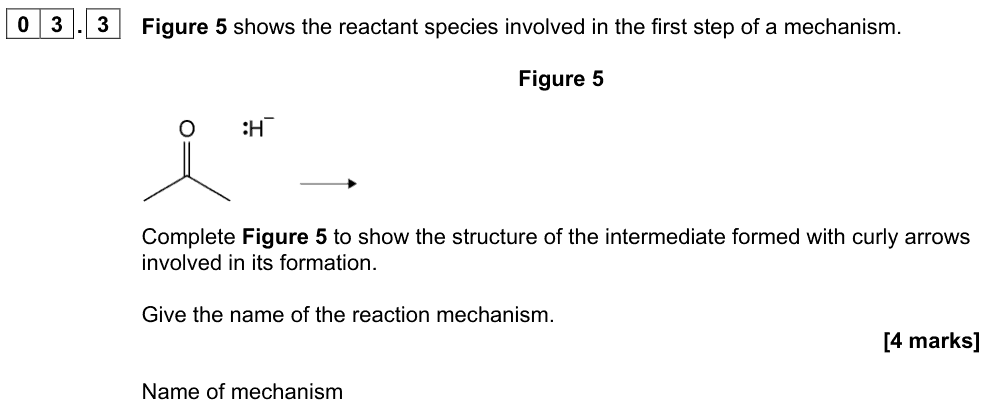
Nucleophilic addition. Curly arrow from the lone pair on H– to the carbonyl C of propanone
curly arrow from the C=O bond to O
intermediate (CH3)2CH–O– with the negative charge on O. Further incorrect steps are penalised
June 2022 · Paper 2 · Q01.85 marksAO1=1, AO2=4Mechanism
Earlier parts of question 01 that this part uses
Mark scheme
Examiner's comment
01.8 This question had a very high discrimination index and the best students were able to score full marks. Common errors included poor drawing of curly arrows and mistakes in the structure of the intermediate.
Notes from the mark scheme and report
Nucleophilic addition. Curly arrow from the lone pair on C of :CN– to the C of C=O
curly arrow from the C=O bond to O
intermediate CH3CH2C(CH3)(CN)O– with the negative charge on O
curly arrow from the lone pair on O– to H+. The attacking lone pair must be on C
KCN must not be shown as covalent. Errors: poor curly arrows
wrong intermediate
November 2021 · Paper 3 · Q03.34 marksMechanismHard
Earlier part of question 03 that this part uses
Mark scheme
Examiner's comment
The mechanism in question 03.3 was known quite well with a third of students scoring full marks here.
Notes from the mark scheme and report
Nucleophilic addition: arrow from the lone pair on C of :CN– to the C of C=O
arrow from the C=O bond to O
intermediate (CH3)2C(CN)O–
arrow from a lone pair on O– to H+ (or the H of HCN). The new bond must be to the C of CN
no K–CN bond breaking
November 2020 · Paper 2 · Q09.53 marksMechanism
Earlier parts of question 09 that this part uses
Mark scheme
Examiner's comment
09.5 required students to apply their understanding of standard mechanistic ideas to a novel mechanism.
Most students were able to score at least some of the marks and a good number (44.3%) scored all three marks.
Notes from the mark scheme and report
First intermediate: negative charge on the O that came from C=O, positive charge on the O of the attached water, and a curly arrow from an O–H bond of that –OH2+ to the O+ (loss of H+). Second intermediate: lone pair on O– and a curly arrow from it to H+. Most scored some marks
44.3% scored all 3
June 2019 · Paper 2 · Q13.15 marksMechanism
Mark scheme
Examiner's comment
13.1 This question discriminated well. It was surprising to see how many students were unable to draw the correct structure of 2-methylbutanal. Many placed the methyl group on carbon 3. Most students were familiar with the mechanism and drew the
curly arrow from the lone pair on :H– to the C of C=O and curly arrow from the C=O bond to O. Explanation: the H– nucleophile is attracted to the δ+ carbon of the polar C=O
the C=C is electron rich, so it repels H– / is attacked only by electrophiles. Many drew the methyl group on carbon 3
Work with an A-level chemistry tutor
Curly arrows starting in the wrong place? It is one of the quickest things a tutor can put right.