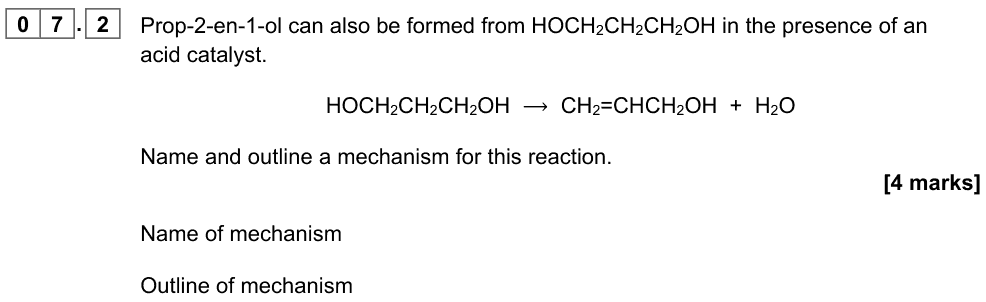
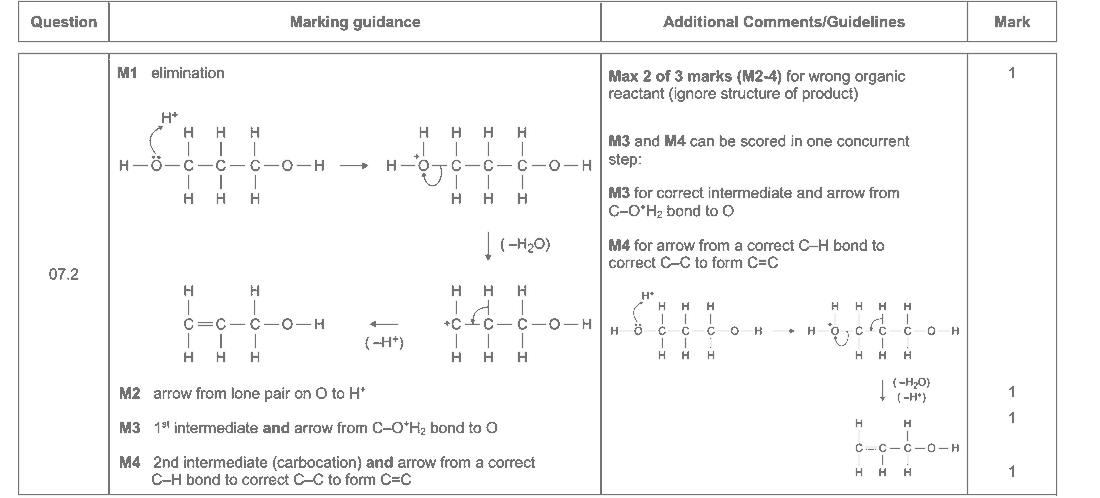
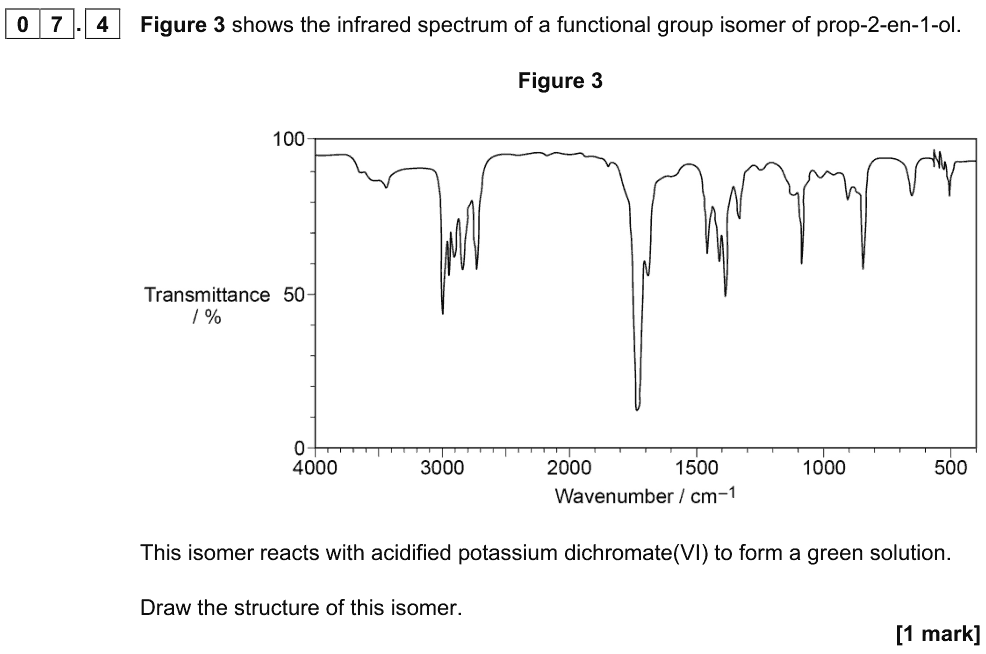
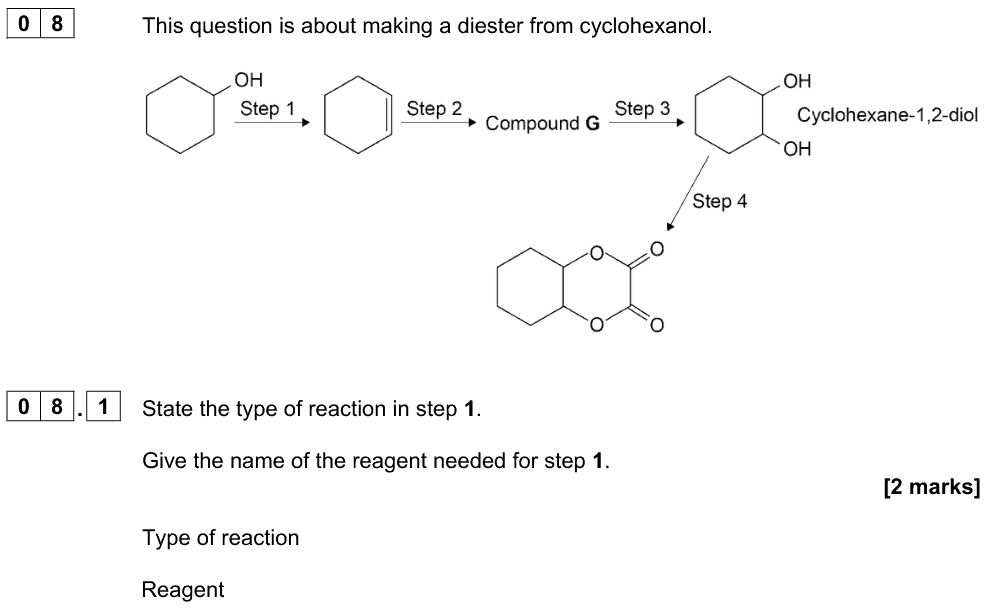
Notes and key-term cards for this topic are being written by our tutors. The past-paper questions below are ready now.
Specification statements
Show the 14 statements from the specification
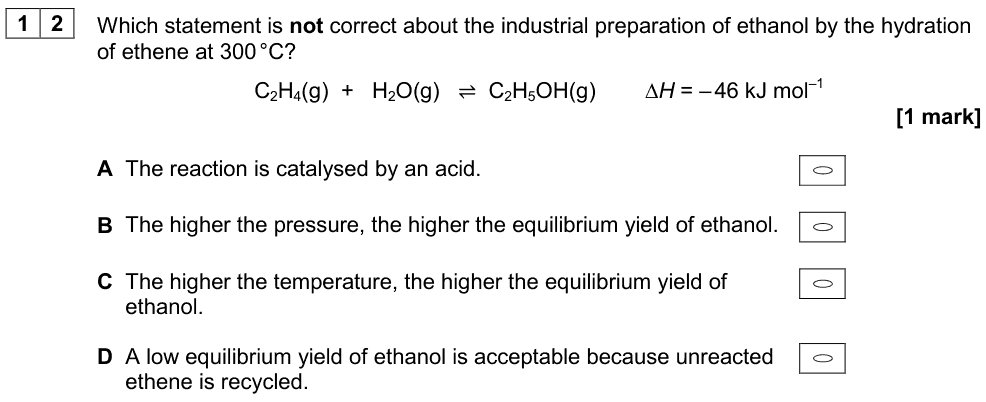
3.3.5.1-01 Alcohols are produced industrially by hydration of alkenes in the presence of an acid catalyst.
3.3.5.1-02 Ethanol is produced industrially by fermentation of glucose. The conditions for this process.
3.3.5.1-03 Ethanol produced industrially by fermentation is separated by fractional distillation and can then be used as a biofuel.
3.3.5.1-04 Students should be able to: • explain the meaning of the term biofuel • justify the conditions used in the production of ethanol by fermentation of glucose • write equations to support the statement that ethanol produced by fermentation is a carbon neutral fuel and give reasons why this statement is not valid • outline the mechanism for the formation of an alcohol by the reaction of an alkene with steam in the presence of an acid catalyst • discuss the environmental (including ethical) issues linked to decision making about biofuel use.
3.3.5.2-01 Alcohols are classified as primary, secondary and tertiary.
3.3.5.2-02 Primary alcohols can be oxidised to aldehydes which can be further oxidised to carboxylic acids.
3.3.5.2-03 Secondary alcohols can be oxidised to ketones.
3.3.5.2-04 Tertiary alcohols are not easily oxidised.
3.3.5.2-05 Acidified potassium dichromate(VI) is a suitable oxidising agent.
3.3.5.2-06 Students should be able to: • write equations for these oxidation reactions (equations showing [O] as oxidant are acceptable) • explain how the method used to oxidise a primary alcohol determines whether an aldehyde or carboxylic acid is obtained • use chemical tests to distinguish between aldehydes and ketones including Fehling’s solution and Tollens’ reagent.
3.3.5.3-01 Alkenes can be formed from alcohols by acid-catalysed elimination reactions.
3.3.5.3-02 Alkenes produced by this method can be used to produce addition polymers without using monomers derived from crude oil.
3.3.5.3-03 Students should be able to: • outline the mechanism for the elimination of water from alcohols.
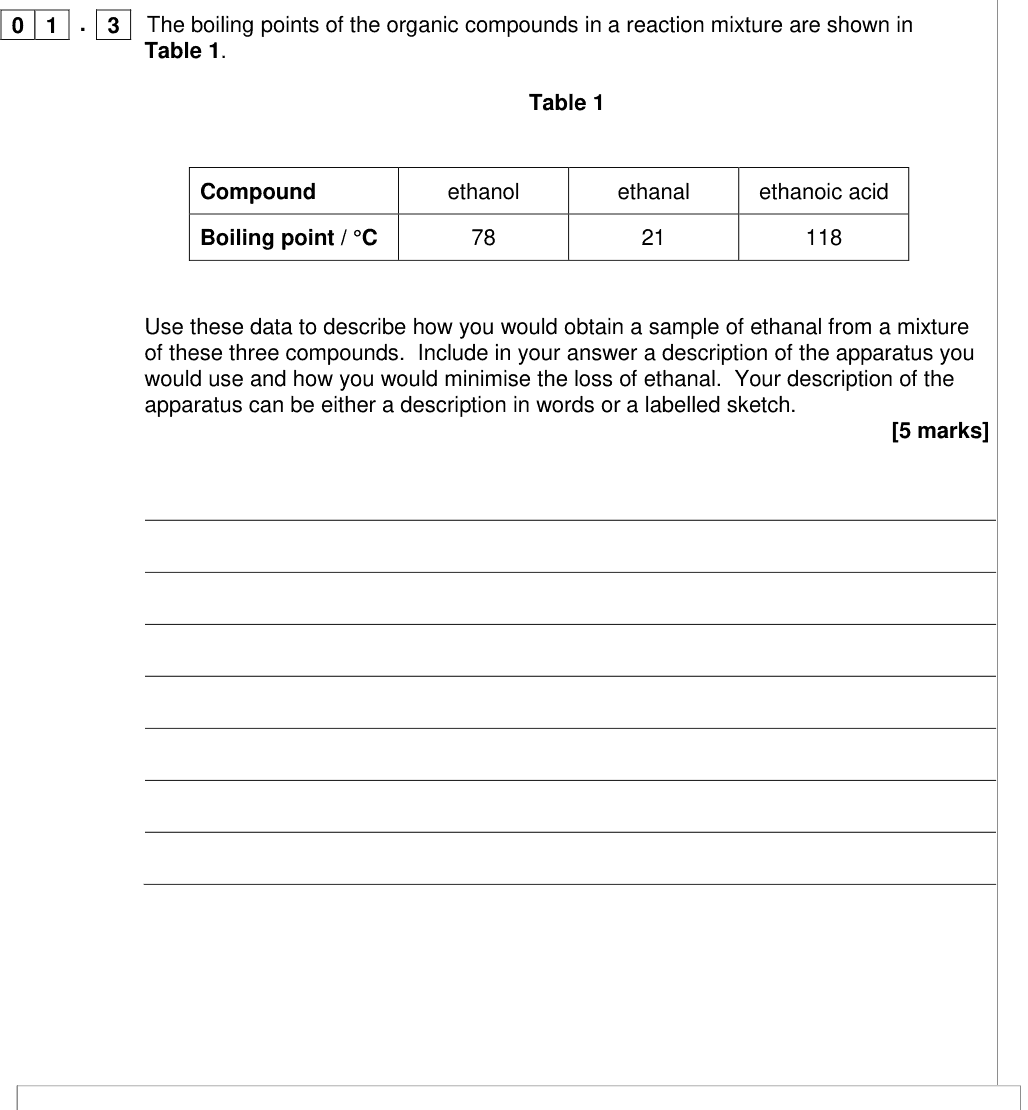
3.3.5.3-04 Required practical 5 Distillation of a product from a reaction.
Six-mark level of response questions on this topic
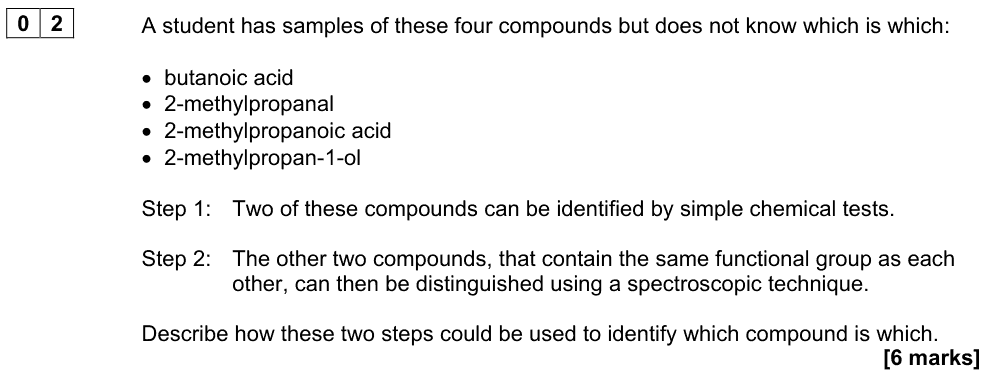
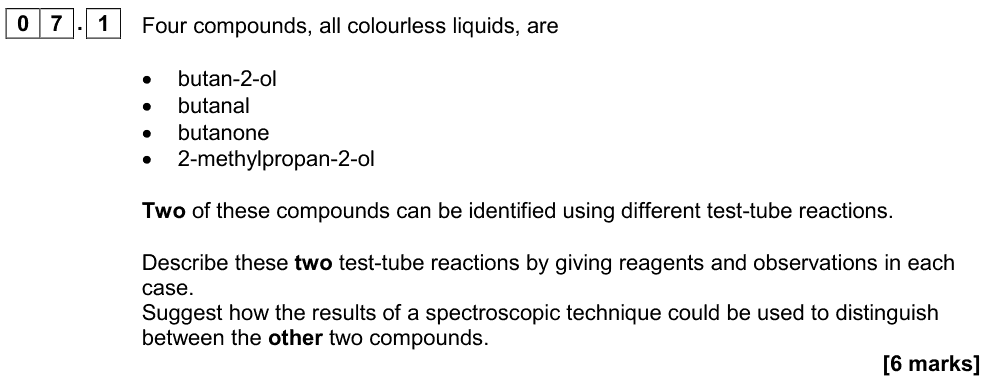
these two test-tube reactions by giving reagents and observations in each Suggest how the results of a spectroscopic technique could be used to distinguish
Tap a question to zoom it. Where a part needs a figure, table or structure from earlier in the question, that part folds out above it; the mark scheme and examiner's comment open underneath. Have AQA's Data Booklet (the Periodic Table and the spectroscopy tables) beside you.
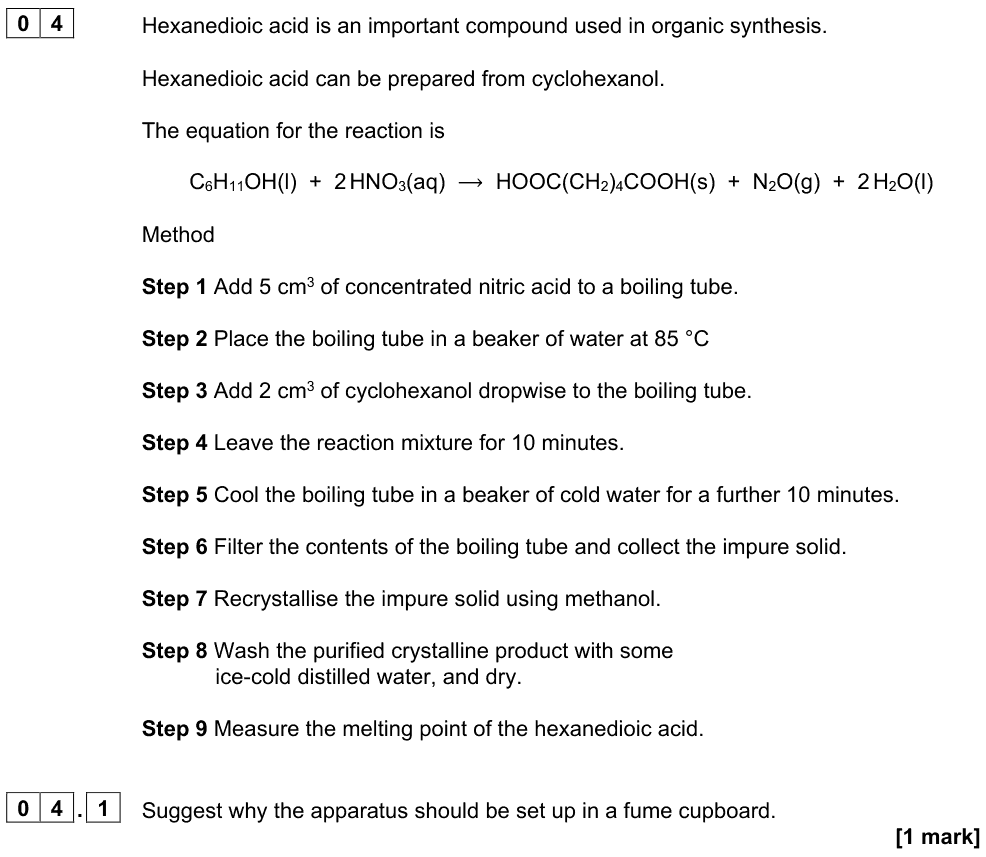
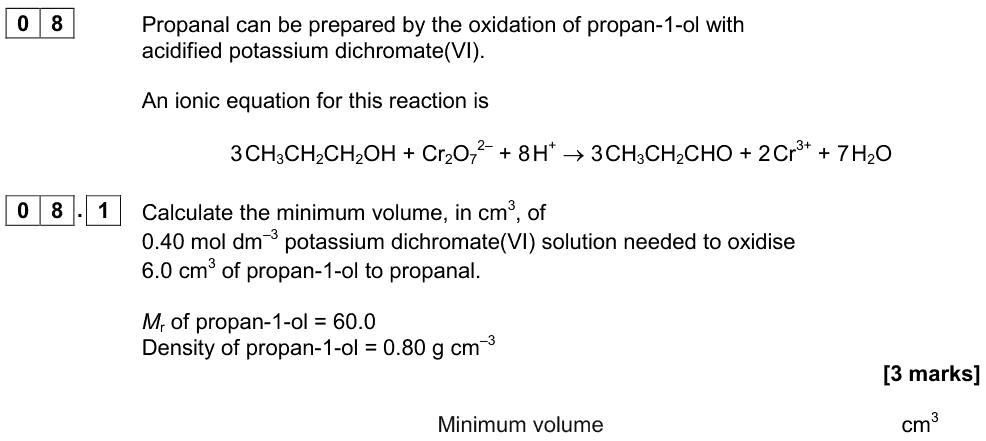
June 2025 · Paper 2 · Q04.21 markAO2=1Short answer
Earlier part of question 04 that this part uses
Mark scheme
Examiner's comment
4.2 Students struggled to identify the role of the concentrated nitric acid as an oxidizing agent, clearly failing to recognize that HNO3 had been reduced to N2O in the reaction equation given.
Notes from the mark scheme and report
Oxidising agent (HNO3 is reduced to N2O while the alcohol is oxidised to the acid). Poorly answered
Skills: RP10 Preparation of: a pure organic solid and test of its purity; a pure organic liquid
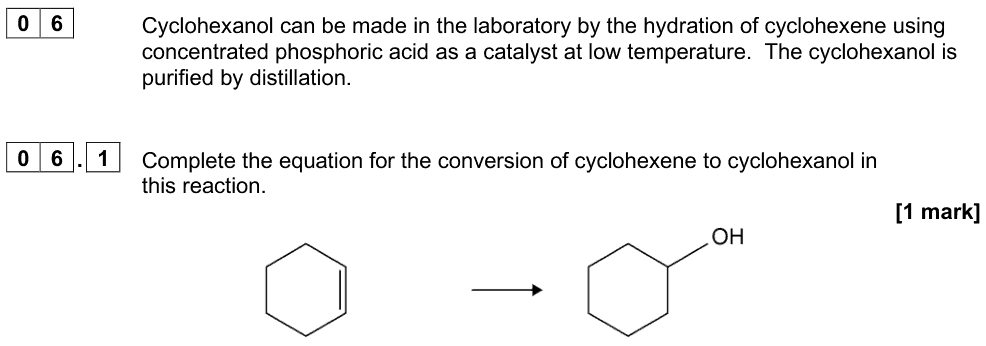
June 2025 · AS Paper 2 · Q06.11 markAO2=1Equation writing
Mark scheme
Examiner's comment
6.1 Students were required to complete an equation to balance it. Good students found this straightforward but many struggled. Many included the catalyst on both sides of the equation which did not score the mark.
Notes from the mark scheme and report
Cyclohexene + H2O → cyclohexanol (H2O added on the left only). Not H3PO4 or H+ on both sides
acid written over the arrow is ignored
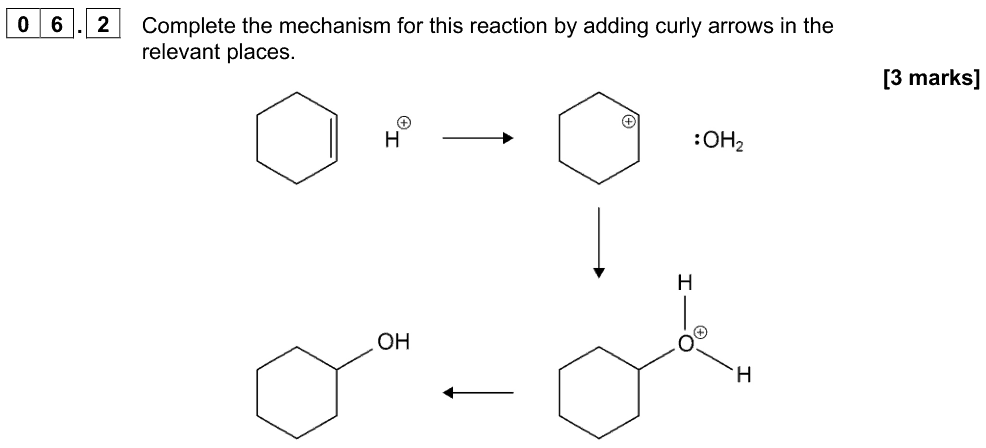
June 2025 · AS Paper 2 · Q06.23 marksAO2=3Mechanism
Earlier part of question 06 that this part uses
Mark scheme
Examiner's comment
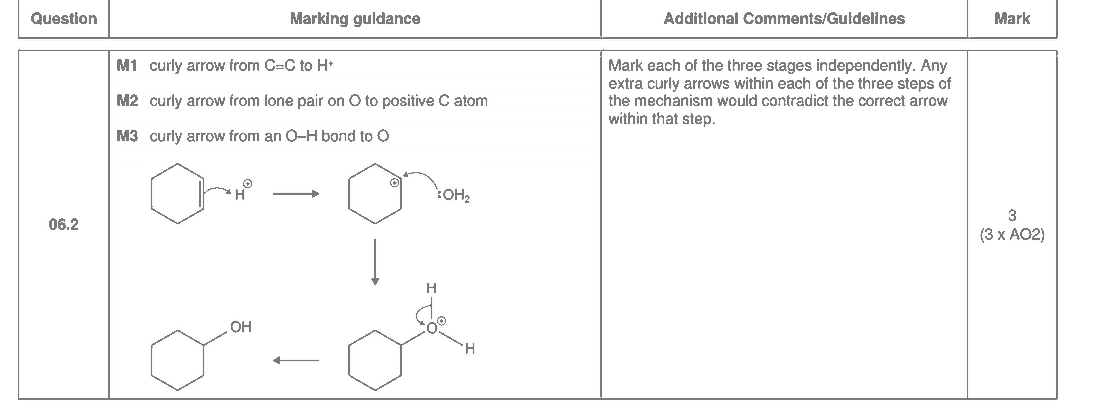
6.2 Students had to complete a partial mechanism by adding 3 arrows. It was answered quite well but the final arrow for breaking the O-H bond was often incorrect.
Notes from the mark scheme and report
Three curly arrows: from the C=C to H+
from the lone pair on O of :OH2 to the positive carbon of the carbocation
from an O–H bond of the –OH2+ group to the O. Each step marked independently
an extra arrow in a step cancels that mark. The last arrow was most often wrong
June 2025 · AS Paper 2 · Q06.42 marksAO1=2Practical and data analysis
Earlier part of question 06 that this part uses
Mark scheme
Examiner's comment
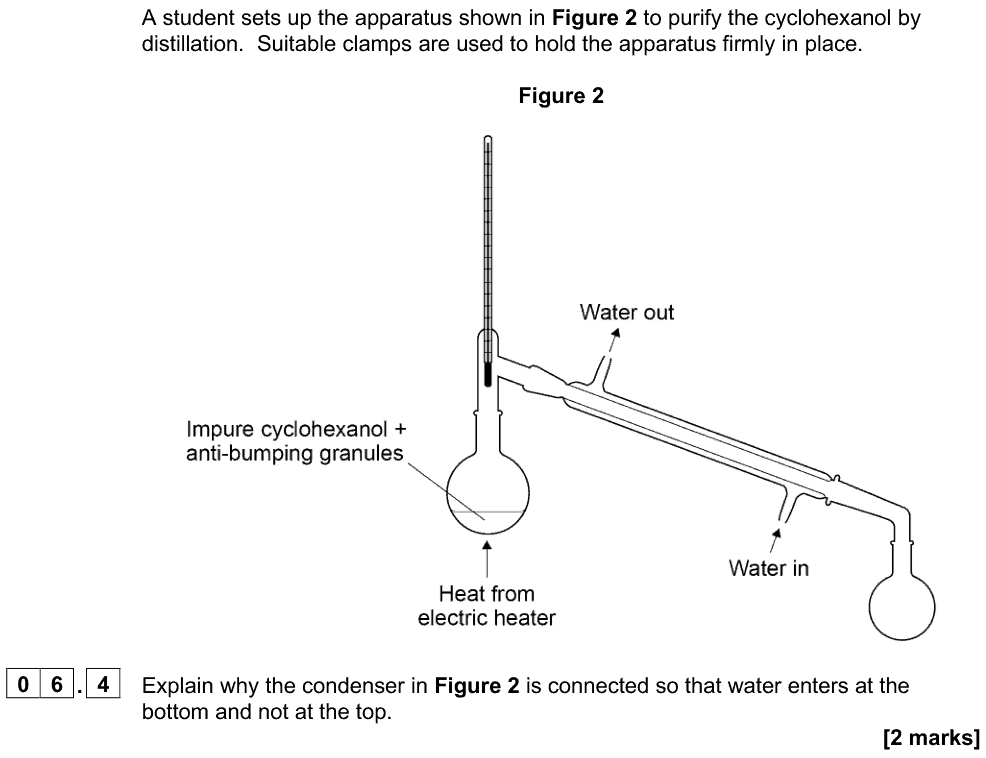
6.4 Students needed to explain why water should enter the bottom rather than the top of the condenser. Responses were mixed but better students could explain it was to ensure the whole condenser filled with water so making it colder to enable better condensing of the vapour.
Notes from the mark scheme and report
So that the condenser fills completely with water (no air bubbles)
this keeps it cool so more of the vapour condenses. Not 'water vapour'
Skills: ATd Use laboratory apparatus for a variety of experimental techniques including: titration, using burette and pipette; distillation and heating under reflux, including setting up glassware using retort stand and clamps; qualitative tests for ions and organic functional groups; filtration, including use of fluted filter paper, or filtration under reduced pressure; PS4.1 Know and understand how to use a wide range of experimental and practical instruments, equipment and techniques appropriate to the knowledge and understanding included in the specification; RP5 Distillation of a product from a reaction
June 2025 · AS Paper 2 · Q06.51 markAO1=1Practical and data analysis
Earlier parts of question 06 that this part uses
Mark scheme
Examiner's comment
6.5 Many students could explain why anti-bumping granules are used.
Notes from the mark scheme and report
To form smaller bubbles / prevent large bubbles forming (smoother boiling)
Skills: ATd Use laboratory apparatus for a variety of experimental techniques including: titration, using burette and pipette; distillation and heating under reflux, including setting up glassware using retort stand and clamps; qualitative tests for ions and organic functional groups; filtration, including use of fluted filter paper, or filtration under reduced pressure; PS4.1 Know and understand how to use a wide range of experimental and practical instruments, equipment and techniques appropriate to the knowledge and understanding included in the specification; RP5 Distillation of a product from a reaction
June 2025 · AS Paper 2 · Q06.61 markAO3=1Practical and data analysis
Earlier parts of question 06 that this part uses
Mark scheme
Examiner's comment
6.6 This distillation is heated with an electric heater rather than a Bunsen burner because the alcohol is flammable. However, many students thought that it was to control the temperature, but this can be done effectively with a Bunsen burner and the actual reason was due to the flammability of the alcohol.
Notes from the mark scheme and report
The mixture / cyclohexanol is flammable. 'To control the temperature' is ignored and was the common answer
Skills: ATb Use water bath or electric heater or sand bath for heating; ATk Safely and carefully handle solids and liquids, including corrosive, irritant, flammable and toxic substances; RP5 Distillation of a product from a reaction
June 2025 · AS Paper 2 · Q06.72 marksAO3=2Practical and data analysis
Earlier parts of question 06 that this part uses
Mark scheme
Examiner's comment
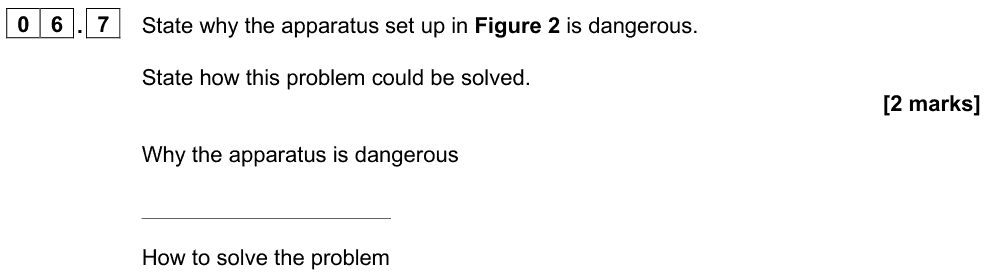
6.7 The apparatus as shown was dangerous as the system was sealed. Some students thought the opposite and that the system needed sealing. Some appreciated there needed to be an opening but thought it should be before the condenser not appreciating that the product would escape before it condenses. The best students could explain about having the system open in some way near the end of the condenser when the distillate is collected.
Notes from the mark scheme and report
The apparatus is a closed (sealed) system, so pressure builds up
solve it with a vent or opening at or near the collection flask. An opening before the condenser would let the product escape
some wrongly said the system should be sealed
Skills: PS2.1 Comment on experimental design and evaluate scientific methods; ATd Use laboratory apparatus for a variety of experimental techniques including: titration, using burette and pipette; distillation and heating under reflux, including setting up glassware using retort stand and clamps; qualitative tests for ions and organic functional groups; filtration, including use of fluted filter paper, or filtration under reduced pressure; RP5 Distillation of a product from a reaction
June 2025 · AS Paper 2 · Q06.81 markAO1=1Short answer
Earlier part of question 06 that this part uses
Mark scheme
Examiner's comment
6.8 Most students could name the elimination mechanism. Dehydration is the reaction type but not the name of the mechanism.
Notes from the mark scheme and report
Elimination (allow acid-catalysed elimination). 'Dehydration' is the reaction type, not the mechanism
not 'acid-base elimination'
June 2025 · AS Paper 2 · Q06.102 marksAO1=1, AO2=1Short answer
Earlier parts of question 06 that this part uses
Mark scheme
Examiner's comment
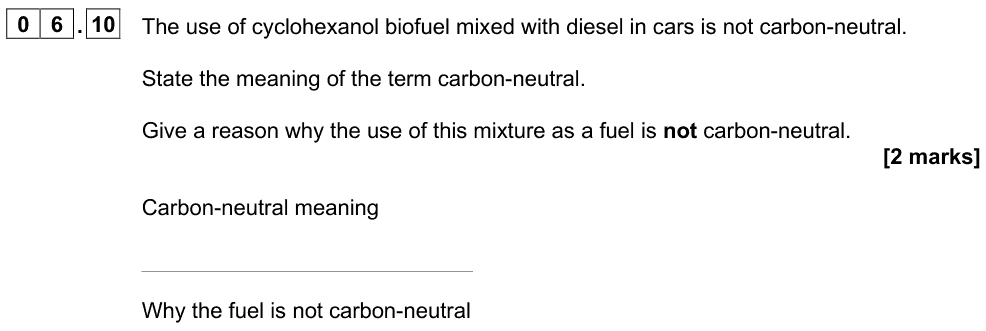
6.10 Students appear to think that carbon-neutral refers to the release of carbon rather than carbon dioxide into the atmosphere. The specific description of no net emissions of carbon dioxide to the atmosphere was not well known. In terms of explaining why the fuel was not carbon-neutral, many stated that it was because it releases carbon dioxide when it burns, but carbon-neutral biofuels do release carbon dioxide (but no net increase to carbon dioxide levels from its use). Some students referred to use of transportation in its manufacture but did not specify the use of fossil fuels for that transport.
Notes from the mark scheme and report
Carbon-neutral: no net emission of carbon dioxide to the atmosphere. Not carbon-neutral because fossil fuels are used in processing or transport, or because the mixture contains diesel, a fossil fuel. Errors: 'carbon' rather than carbon dioxide
'it releases CO2 when burned'
transport mentioned without fossil fuels
June 2025 · AS Paper 2 · Q111 markAO3=1Multiple choice
Answer
D
Mark scheme
Examiner's comment
This was answered correctly by a majority of students.
Notes from the mark scheme and report
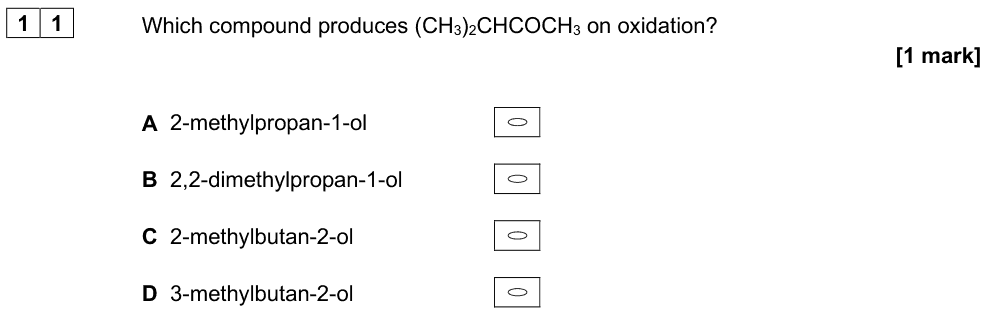
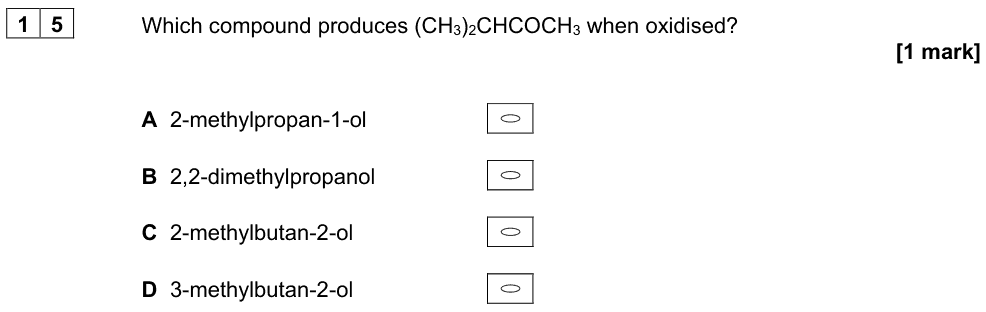
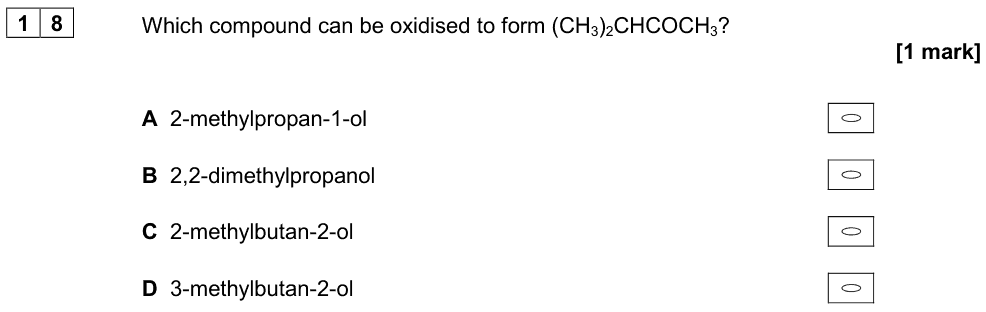
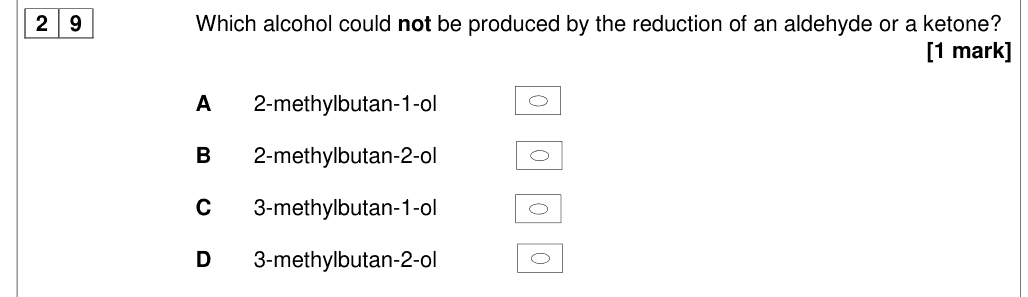
Answer: D. The ketone 3-methylbutan-2-one comes from the secondary alcohol 3-methylbutan-2-ol
June 2025 · AS Paper 2 · Q131 markAO3=1Multiple choice
Answer
C
Mark scheme
Examiner's comment
The correct answer was the most common answer, but it appears that students found it hard to deal with the different oxidations of the three alcohol groups.
Notes from the mark scheme and report
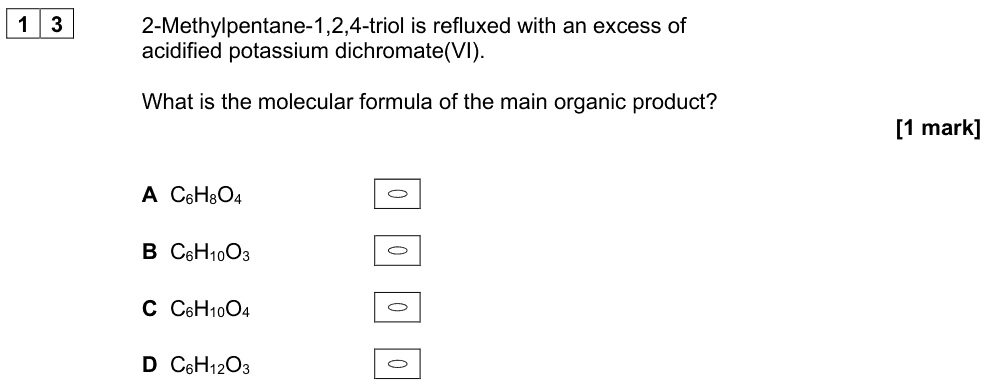
Answer: C. C6H14O3: the primary OH is oxidised to COOH, the secondary OH to C=O and the tertiary OH is unchanged, giving C6H10O4
June 2025 · Paper 3 · Q05.16 marksAO3=66-mark level of responseHard
Mark scheme, with the levels and indicative content
Examiner's comment
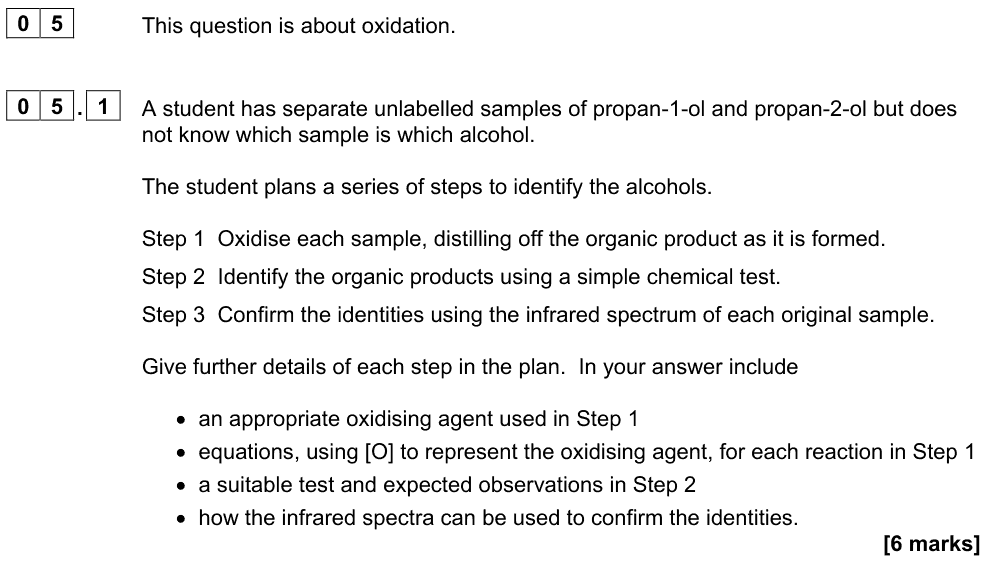
5.1 This is the Levels of Response question and almost 25% of students were able to access level 3 while around 65% accessed Level 2 or above. Students were strong on stage 2, with most including all three pieces of indicative content in that stage. However, in stage 1 many students found it tricky to produce properly balanced equations for oxidation of the alcohols with [O] and many forgot water as the second product. In stage 3, as mentioned above, many students failed to read the question carefully enough and produced an answer that discussed the IR spectra of the carbonyls instead of the IR spectra of the original alcohols. 3b and 3c were still accessible in such cases for a clear description of how to use the fingerprint region.
Notes from the mark scheme and report
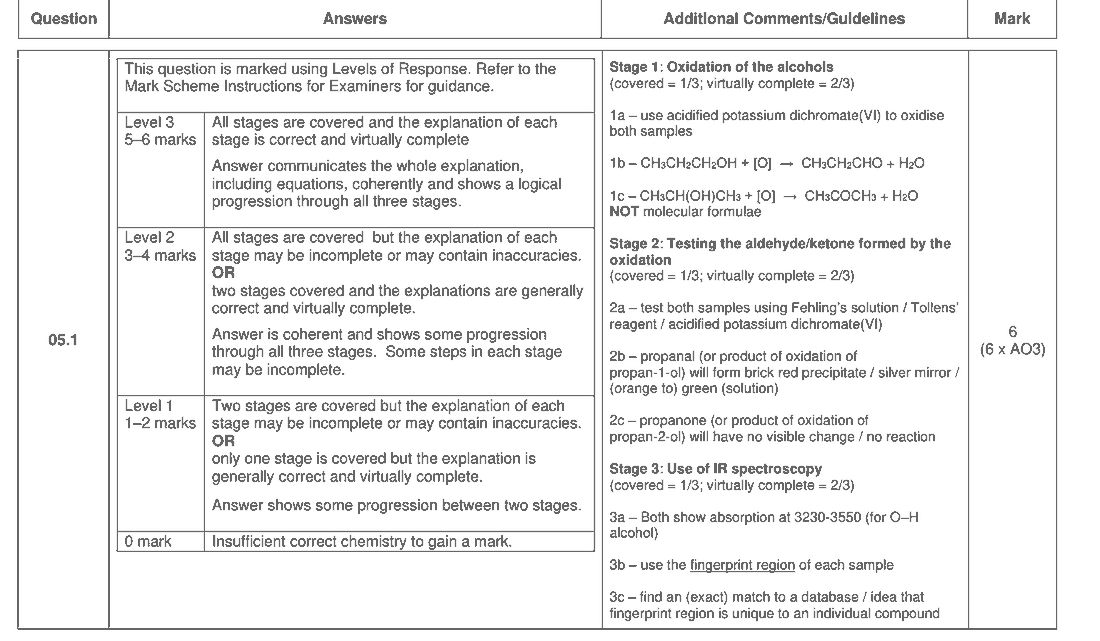
Levels of response, three stages. Oxidation: acidified potassium dichromate(VI)
CH3CH2CH2OH + [O] → CH3CH2CHO + H2O
CH3CH(OH)CH3 + [O] → CH3COCH3 + H2O (structural, not molecular, formulas). Test: Fehling's solution or Tollens' reagent on both distillates
propanal (from propan-1-ol) gives a brick-red precipitate / silver mirror
propanone gives no visible change. Infrared: both alcohols show O–H at 3230–3550 cm–1, so compare the fingerprint region of each original sample with a database for an exact match. Errors: unbalanced [O] equations or water left out
discussing the spectra of the carbonyl products instead of the original alcohols. About 65% reached level 2 or above
Skills: PS1.1 Solve problems set in practical contexts; PS4.1 Know and understand how to use a wide range of experimental and practical instruments, equipment and techniques appropriate to the knowledge and understanding included in the specification; RP6 Tests for alcohol, aldehyde, alkene and carboxylic acid
June 2025 · Paper 3 · Q05.23 marksAO1=1, AO3=2Diagram or structure
Earlier part of question 05 that this part uses
Mark scheme
Examiner's comment
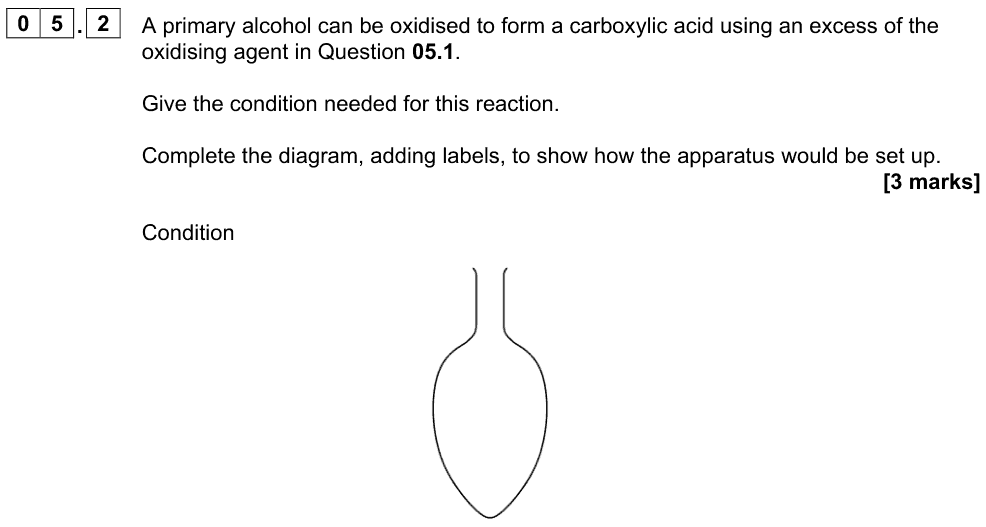
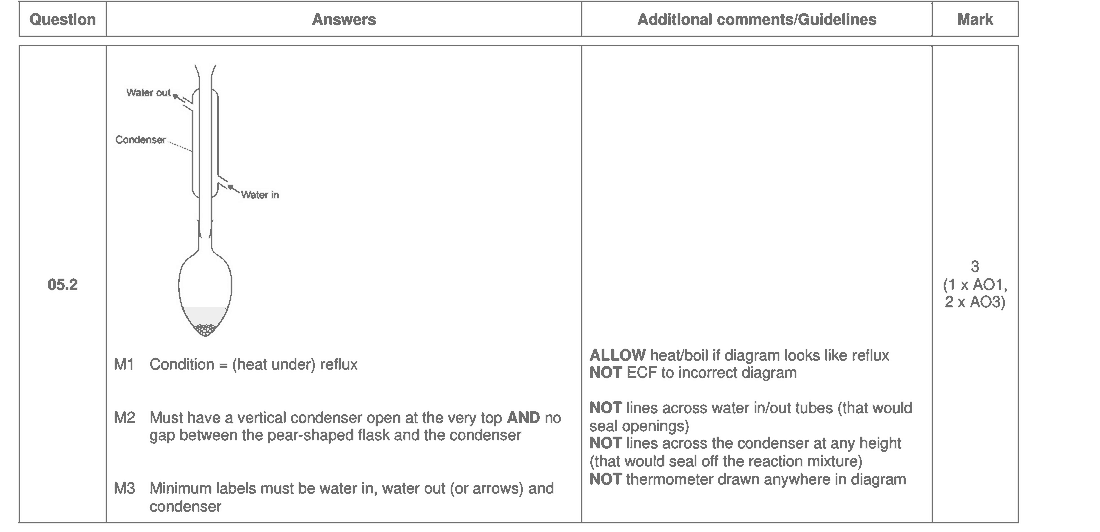
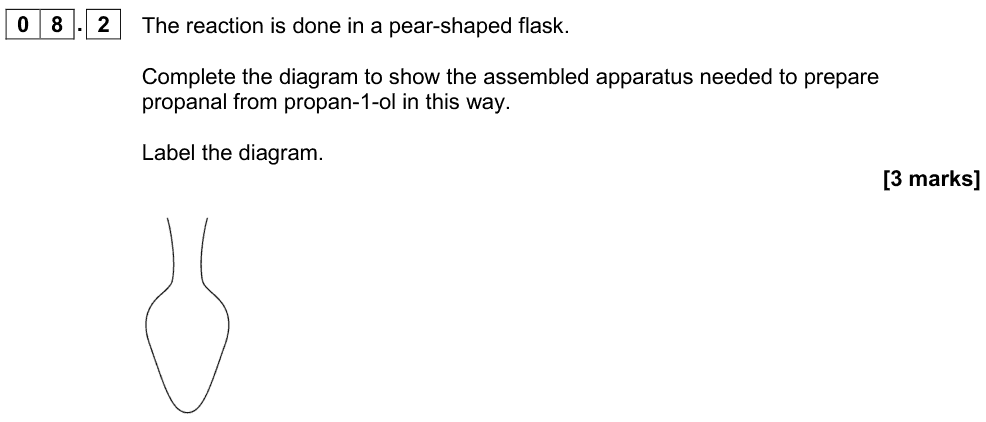
5.2 The drawing of apparatus diagrams continues to be a skill that needs more practice although most students did attempt a cross-sectional line diagram. The inclusion of a thermometer is a mistake in a reflux apparatus, and this cost many students M2.
Notes from the mark scheme and report
Condition: heat under reflux. Diagram: a vertical condenser fitted directly into the flask with no gap and open at the top
labelled condenser, water in (at the bottom) and water out (at the top). No thermometer, no stopper and no lines sealing the condenser or the water tubes. Including a thermometer cost many the diagram mark
Skills: ATb Use water bath or electric heater or sand bath for heating; PS4.1 Know and understand how to use a wide range of experimental and practical instruments, equipment and techniques appropriate to the knowledge and understanding included in the specification
June 2025 · Paper 3 · Q05.31 markAO1=1Practical and data analysisEasy
Earlier part of question 05 that this part uses
Mark scheme
Examiner's comment
5.3 Over 60% of students attained this mark which now seems to be a more familiar answer.
Notes from the mark scheme and report
To give smooth boiling: they produce small bubbles / prevent large bubbles forming. 'To prevent bumping' alone is ignored
Skills: ATb Use water bath or electric heater or sand bath for heating; PS4.1 Know and understand how to use a wide range of experimental and practical instruments, equipment and techniques appropriate to the knowledge and understanding included in the specification; RP5 Distillation of a product from a reaction
June 2025 · Paper 3 · Q131 markAO2=1Multiple choice
Answer
D
Mark scheme
Notes from the mark scheme and report
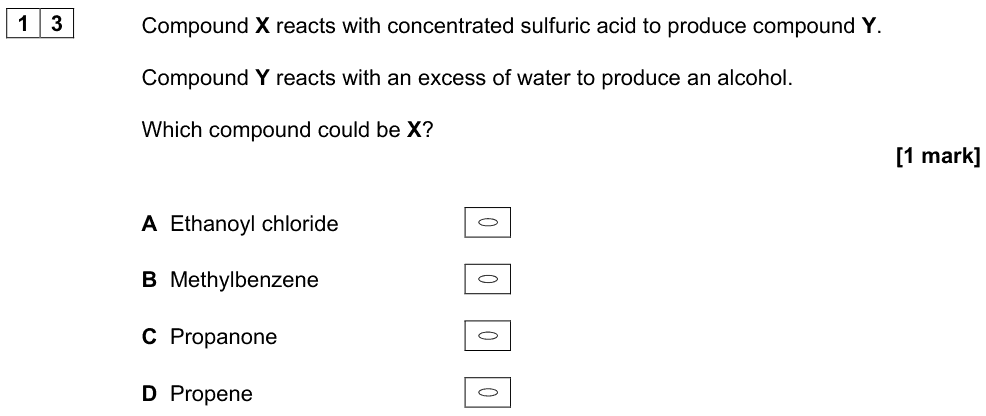
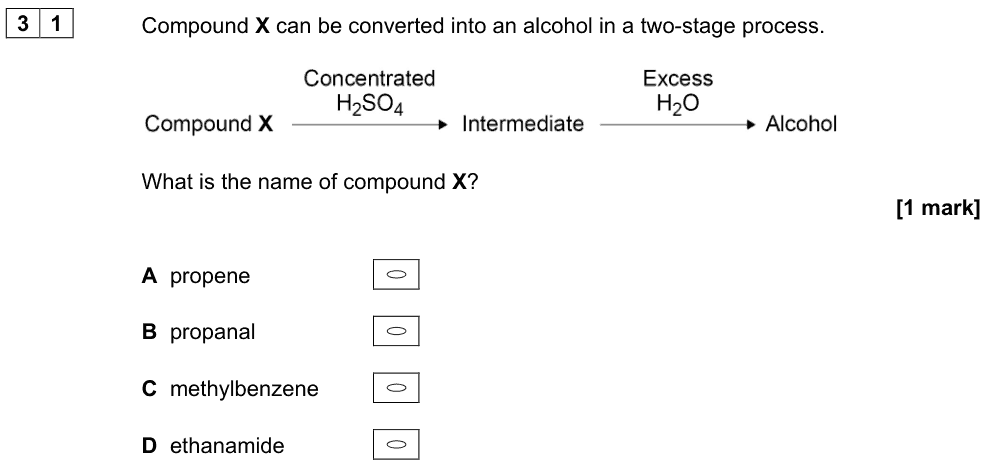
Answer: D. Propene adds concentrated H2SO4 to give an alkyl hydrogensulfate, which is hydrolysed by water to an alcohol
June 2025 · Paper 3 · Q241 markAO1=1Multiple choice
Answer
D
Mark scheme
Notes from the mark scheme and report
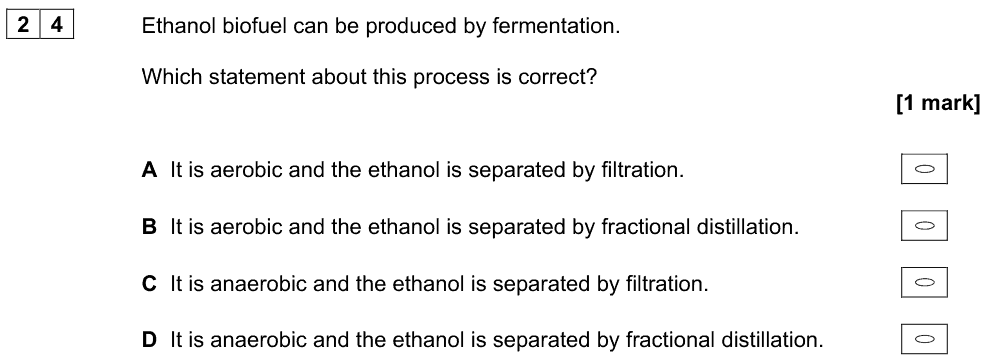
Answer: D. Fermentation by yeast is anaerobic and the ethanol is separated by fractional distillation
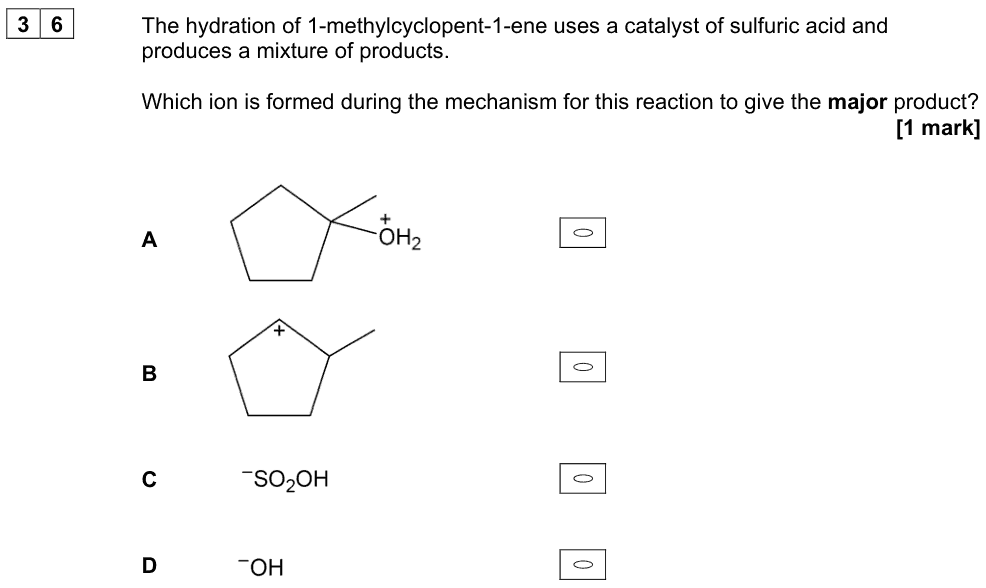
June 2025 · Paper 3 · Q361 markAO2=1Multiple choice
Answer
A
Mark scheme
Notes from the mark scheme and report
Answer: A. H+ adds to give the more stable tertiary carbocation
water then bonds to it, giving the protonated tertiary alcohol (–OH2+ on the carbon carrying the methyl group). B is the secondary carbocation leading to the minor product. One of the least well answered questions (under 55% correct)
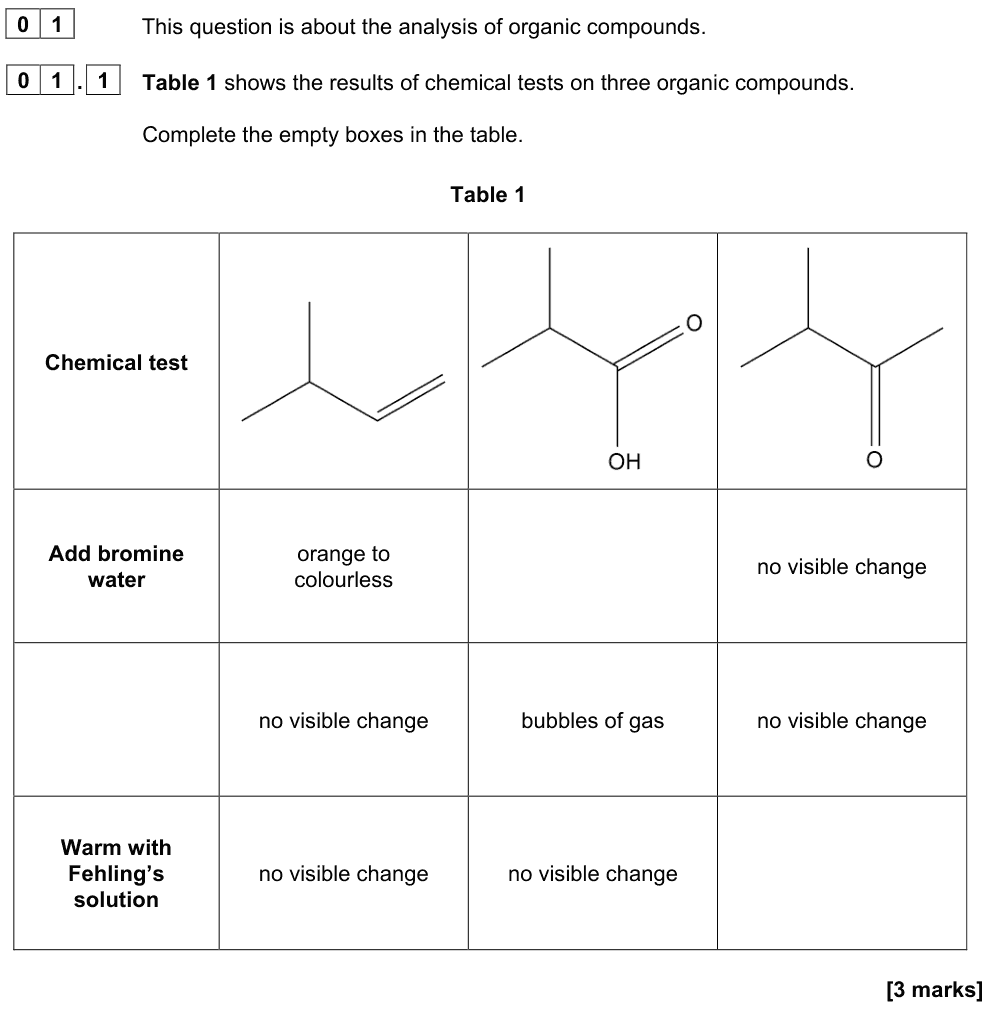
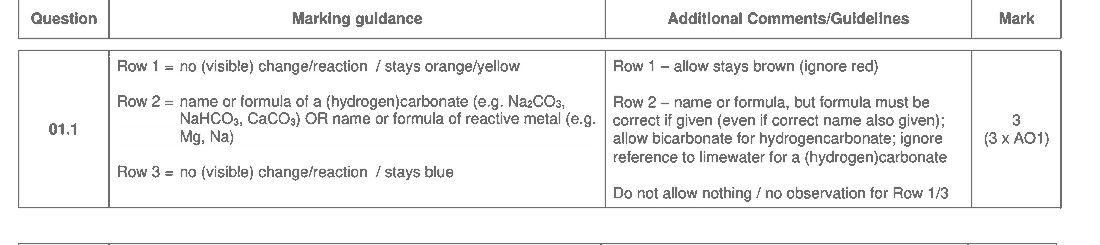
June 2024 · AS Paper 2 · Q01.13 marksAO1=3Practical and data analysis
Mark scheme
Examiner's comment
1.1 This question looked at chemical tests for common organic functional groups. Students answered this quite well, but some confused the test for aldehydes using Fehling’s solution with the Tollens’ test.
Notes from the mark scheme and report
Carboxylic acid with bromine water: no visible change (stays orange). Missing test giving bubbles only with the acid: add a named carbonate or hydrogencarbonate, for example Na2CO3 or NaHCO3 (or a reactive metal such as Mg). Ketone warmed with Fehling's solution: no visible change (stays blue). 'Nothing' or 'no observation' is not accepted
a formula must be correct. Some confused Fehling's with Tollens'
Skills: ATd Use laboratory apparatus for a variety of experimental techniques including: titration, using burette and pipette; distillation and heating under reflux, including setting up glassware using retort stand and clamps; qualitative tests for ions and organic functional groups; filtration, including use of fluted filter paper, or filtration under reduced pressure; PS4.1 Know and understand how to use a wide range of experimental and practical instruments, equipment and techniques appropriate to the knowledge and understanding included in the specification; RP6 Tests for alcohol, aldehyde, alkene and carboxylic acid
June 2024 · Paper 2 · Q05.23 marksAO3=3Practical and data analysis
Earlier part of question 05 that this part uses
Mark scheme
Examiner's comment
5.2 This was much better answered than Q5.1 and most students scored at least 2 of the 3 marks.
Notes from the mark scheme and report
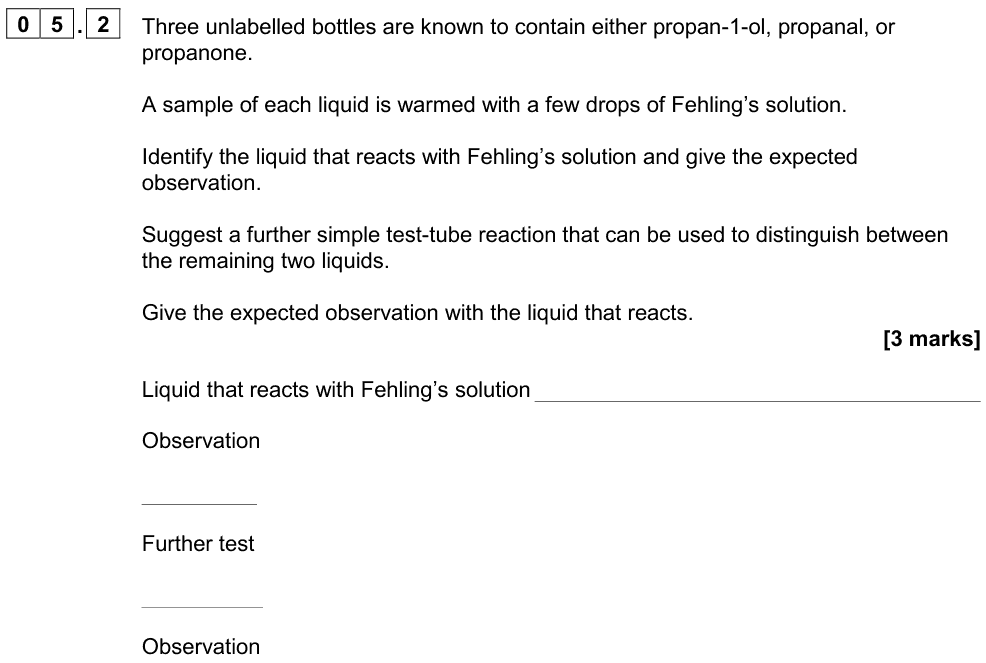
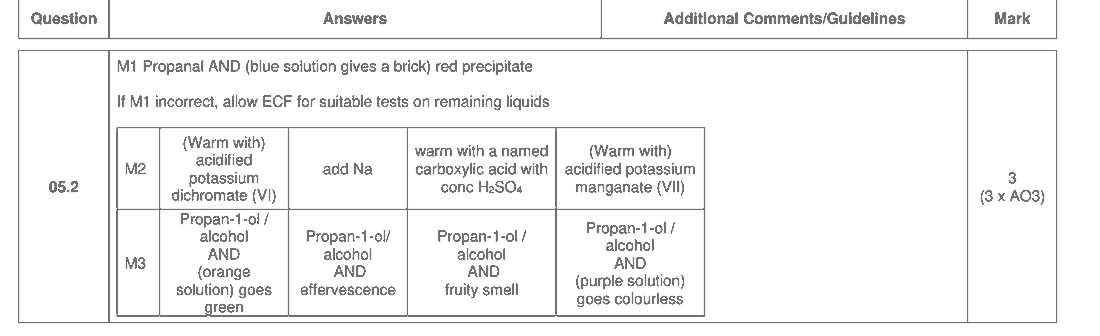
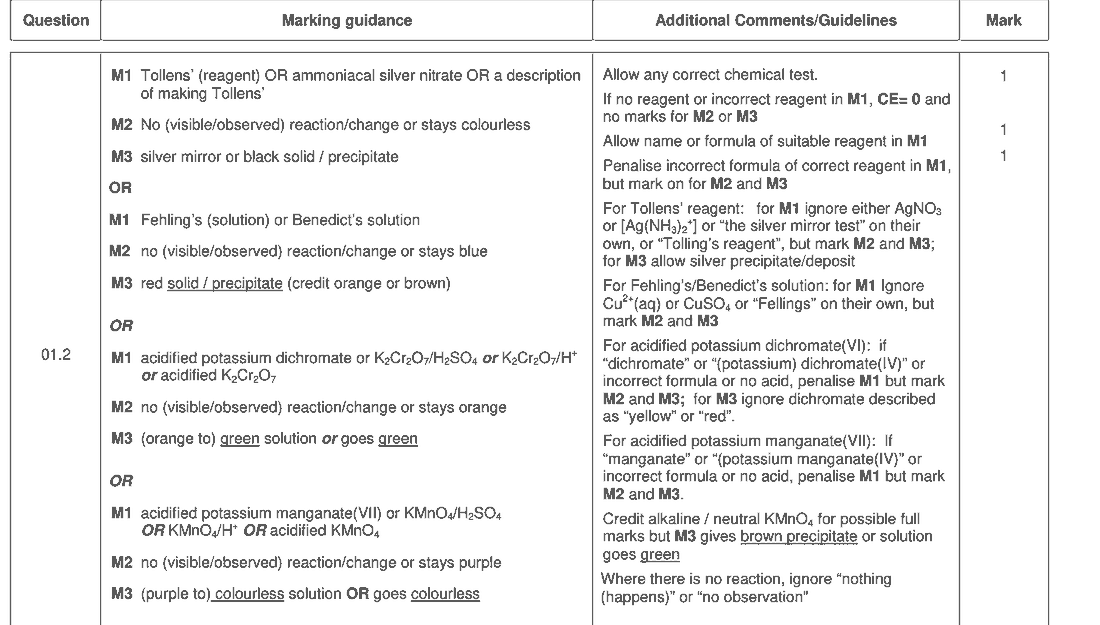
Propanal: blue solution gives a brick-red precipitate. Further test: warm with acidified potassium dichromate(VI): propan-1-ol turns it from orange to green (propanone does not). Alternatives: sodium (effervescence with the alcohol)
carboxylic acid with concentrated H2SO4 (fruity smell)
acidified KMnO4 (purple to colourless)
Skills: ATd Use laboratory apparatus for a variety of experimental techniques including: titration, using burette and pipette; distillation and heating under reflux, including setting up glassware using retort stand and clamps; qualitative tests for ions and organic functional groups; filtration, including use of fluted filter paper, or filtration under reduced pressure; PS1.1 Solve problems set in practical contexts; RP6 Tests for alcohol, aldehyde, alkene and carboxylic acid
June 2024 · AS Paper 2 · Q07.11 markAO1=1Short answer
Mark scheme
Examiner's comment
7.1 Most students could state the colour change when propan-1-ol is oxidised by acidified potassium dichromate(VI). Some only gave the final colour rather than the colour change.
Notes from the mark scheme and report
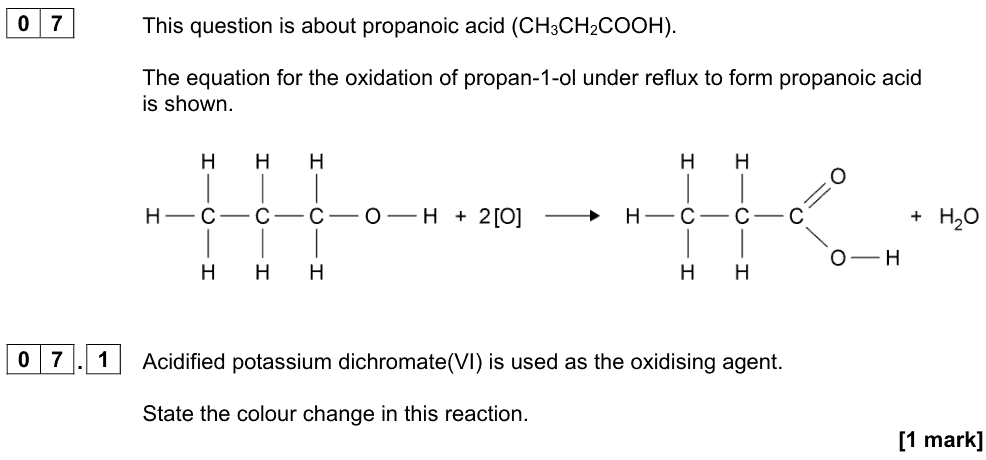
Orange to green. Both colours needed
some gave only the final colour
June 2024 · AS Paper 2 · Q07.21 markAO2=1Short answer
Earlier part of question 07 that this part uses
Mark scheme
Examiner's comment
7.2 Most students could identify propanal as a second organic product.
Notes from the mark scheme and report
Propanal, CH3CH2CHO (the aldehyde from partial oxidation
low boiling point, 49 °C)
June 2024 · AS Paper 2 · Q131 markAO1=1Multiple choice
Answer
B
Mark scheme
Notes from the mark scheme and report
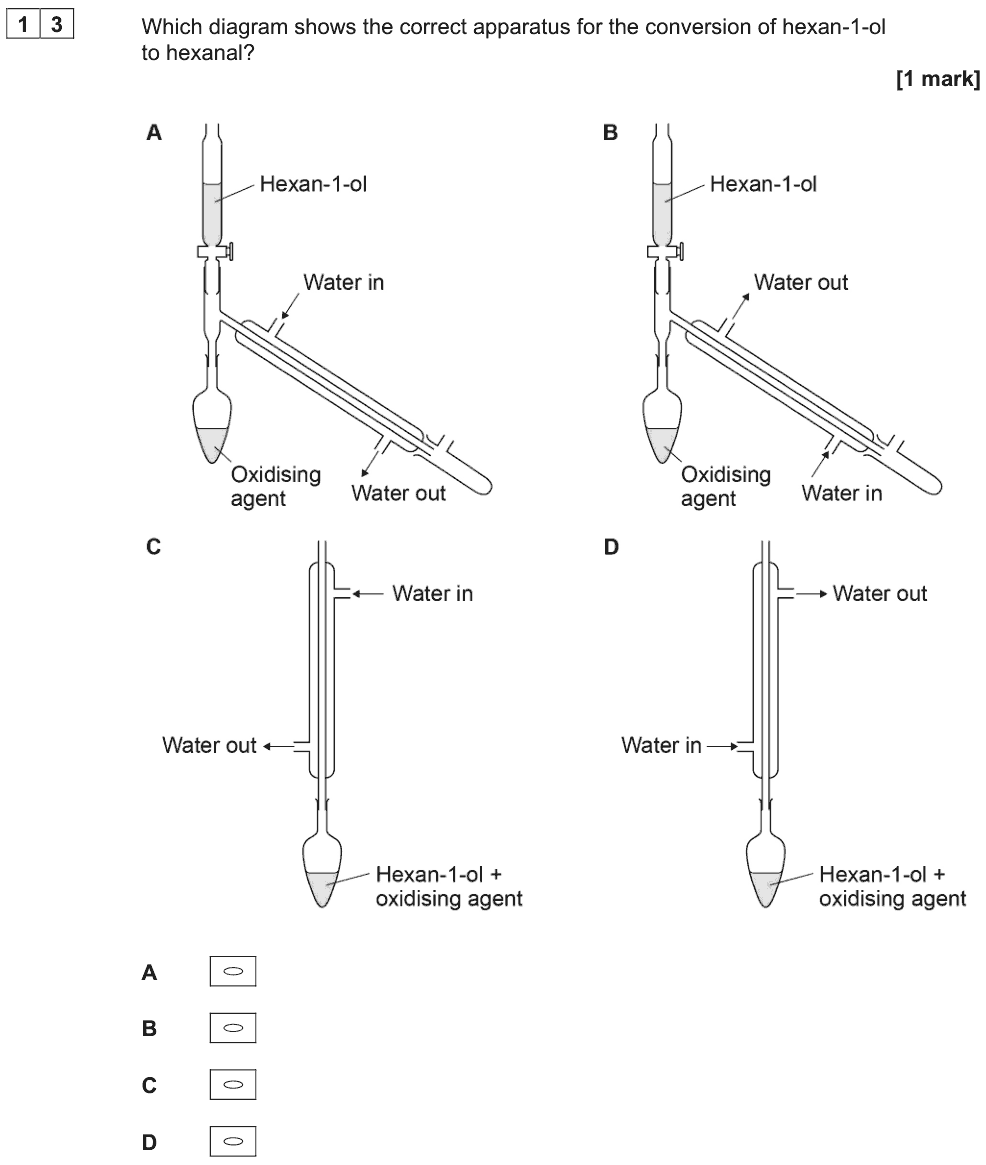
Answer: B. To stop at the aldehyde the alcohol is added to the oxidising agent and the hexanal distilled off as it forms
water enters the condenser at the lower end. A has the water flow reversed
C and D are reflux, which gives the carboxylic acid
Skills: ATd Use laboratory apparatus for a variety of experimental techniques including: titration, using burette and pipette; distillation and heating under reflux, including setting up glassware using retort stand and clamps; qualitative tests for ions and organic functional groups; filtration, including use of fluted filter paper, or filtration under reduced pressure; PS4.1 Know and understand how to use a wide range of experimental and practical instruments, equipment and techniques appropriate to the knowledge and understanding included in the specification; RP5 Distillation of a product from a reaction
June 2023 · AS Paper 2 · Q01.13 marksAO3=3Practical and data analysis
Mark scheme
Examiner's comment
01.1 This question looked for a chemical test to distinguish between an aldehyde and a secondary alcohol. Many students scored well but the use of acidified potassium dichromate(VI), which would gave the same result with both compounds, was a common incorrect answer.
Notes from the mark scheme and report
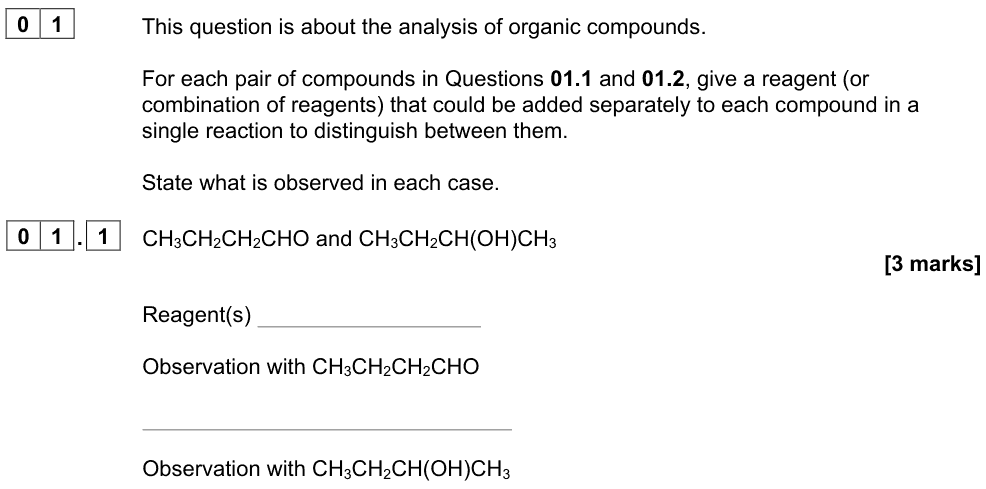
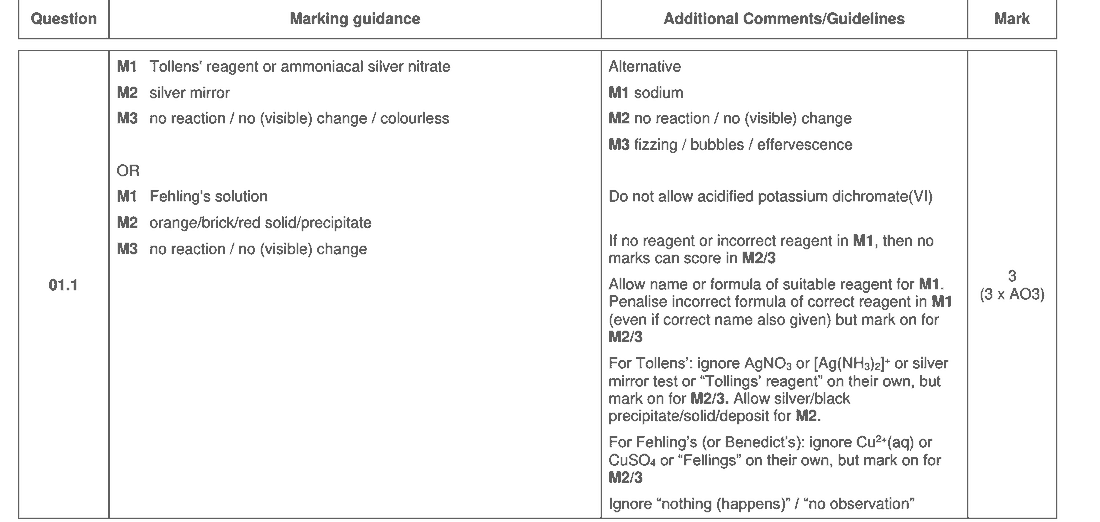
Tollens' reagent (ammoniacal silver nitrate): silver mirror with the aldehyde, no visible change with the alcohol. Or Fehling's solution: brick-red precipitate with the aldehyde, no change with the alcohol. Or sodium: no change with the aldehyde, effervescence with the alcohol. Acidified potassium dichromate(VI) is not allowed (both turn it green)
no observation marks without a correct reagent
Skills: ATd Use laboratory apparatus for a variety of experimental techniques including: titration, using burette and pipette; distillation and heating under reflux, including setting up glassware using retort stand and clamps; qualitative tests for ions and organic functional groups; filtration, including use of fluted filter paper, or filtration under reduced pressure; PS1.1 Solve problems set in practical contexts; PS4.1 Know and understand how to use a wide range of experimental and practical instruments, equipment and techniques appropriate to the knowledge and understanding included in the specification; RP6 Tests for alcohol, aldehyde, alkene and carboxylic acid
June 2023 · AS Paper 2 · Q02.71 markAO1=1Short answer
Earlier part of question 02 that this part uses
Mark scheme
Examiner's comment
02.7 Students struggled to define the term ‘carbon-neutral’. Many referred to carbon rather than carbon dioxide and few referred to the atmosphere in their answer.
Notes from the mark scheme and report
No net emission of carbon dioxide to the atmosphere (the CO2 released equals the CO2 taken in by the crop). Must say carbon dioxide, not just carbon
many also omitted the atmosphere
June 2023 · Paper 2 · Q06.11 markAO1=1Practical and data analysisEasy
Mark scheme
Examiner's comment
06.1 Around 69% of students scored here, showing that the requirement to acidify potassium dichromate(VI) with sulfuric acid was well known.
Notes from the mark scheme and report
Sulfuric acid (dilute H2SO4
HCl or H3PO4 allowed) to acidify the potassium dichromate(VI)
Skills: PS4.1 Know and understand how to use a wide range of experimental and practical instruments, equipment and techniques appropriate to the knowledge and understanding included in the specification; RP6 Tests for alcohol, aldehyde, alkene and carboxylic acid
June 2023 · Paper 2 · Q06.38 marksAO3=8Practical and data analysis
Earlier part of question 06 that this part uses
Mark scheme
Examiner's comment
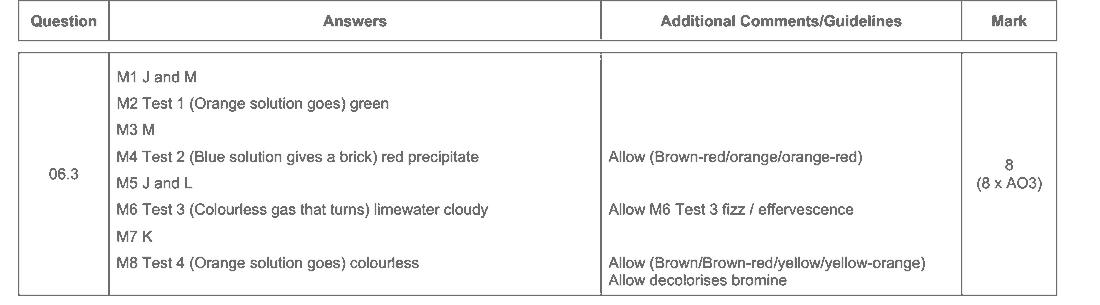
06.3 This question on familiar organic tests was answered quite well with around 80% able to score at least half marks. The observations for M2, M4, M6 and M8 were very well known, but the substances that would react in each test were less well understood. The question had a high discrimination index.
Notes from the mark scheme and report
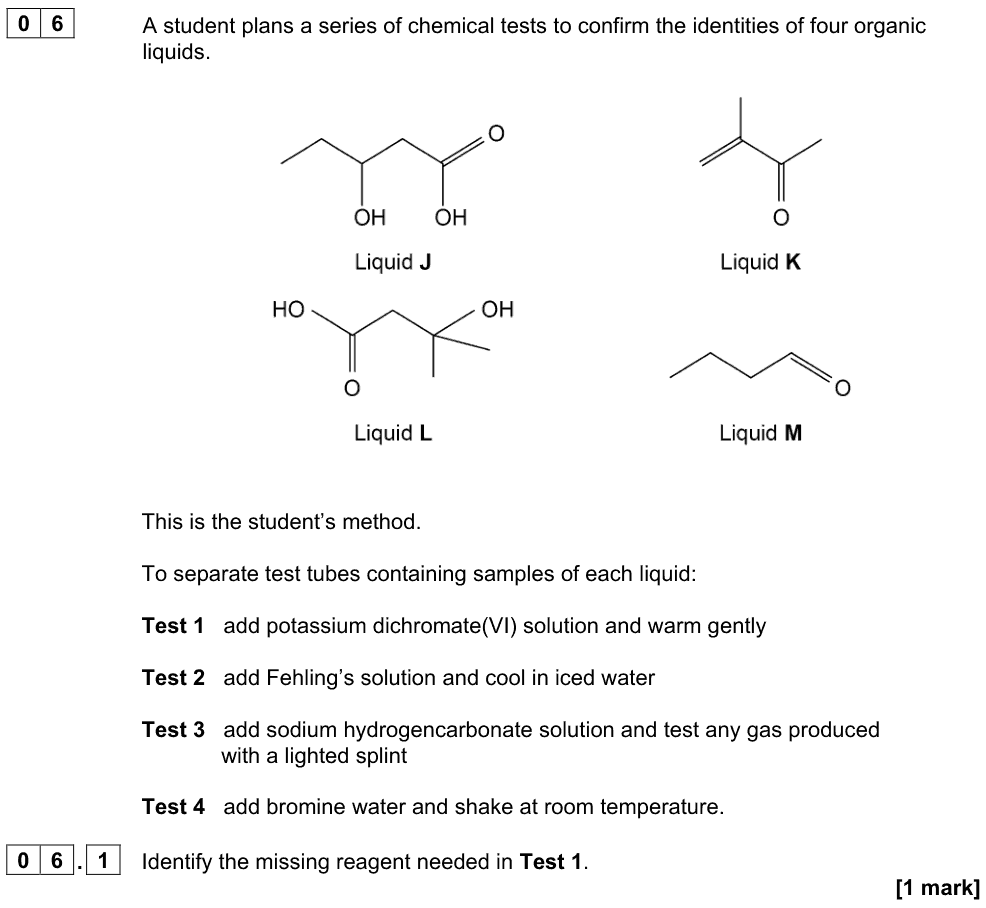
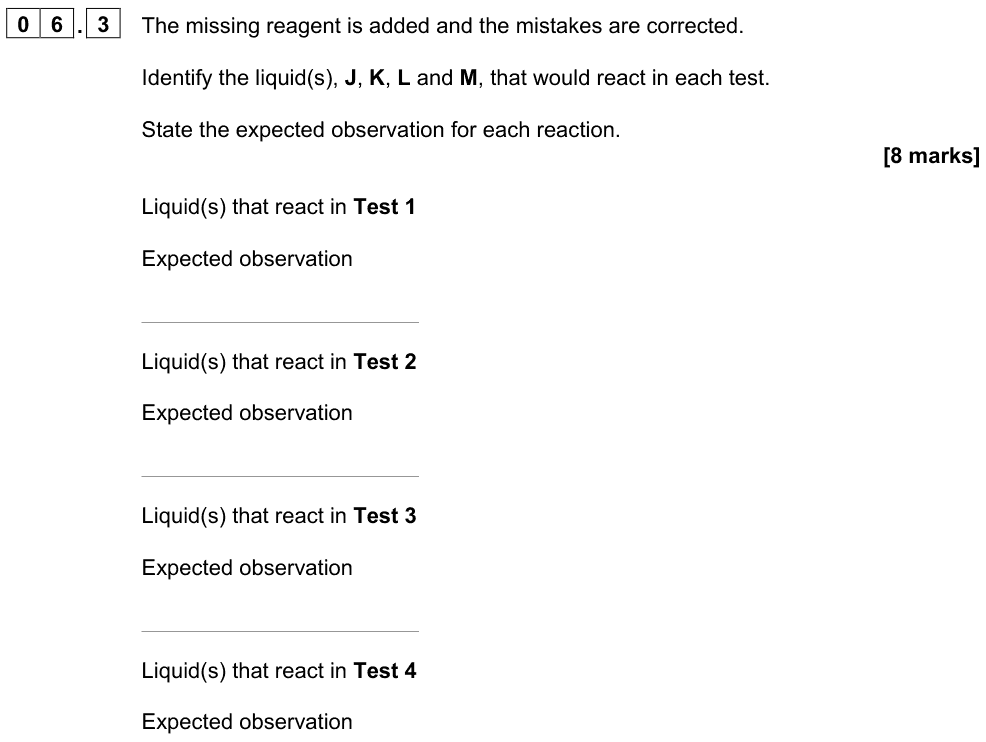
Test 1: J and M (secondary alcohol and aldehyde)
orange solution turns green. Test 2: M only (aldehyde)
blue solution gives a brick-red precipitate. Test 3: J and L (carboxylic acids)
effervescence, gas turns limewater cloudy. Test 4: K only (C=C)
orange bromine water is decolourised. L's alcohol is tertiary so it is not oxidised
K is a ketone. Observations were well known
which liquids react was less well understood. About 80% scored at least half marks
Skills: PS1.2 Apply scientific knowledge to practical contexts; RP6 Tests for alcohol, aldehyde, alkene and carboxylic acid
June 2023 · Paper 2 · Q06.43 marksAO3=3Practical and data analysis
Earlier part of question 06 that this part uses
Mark scheme
Examiner's comment
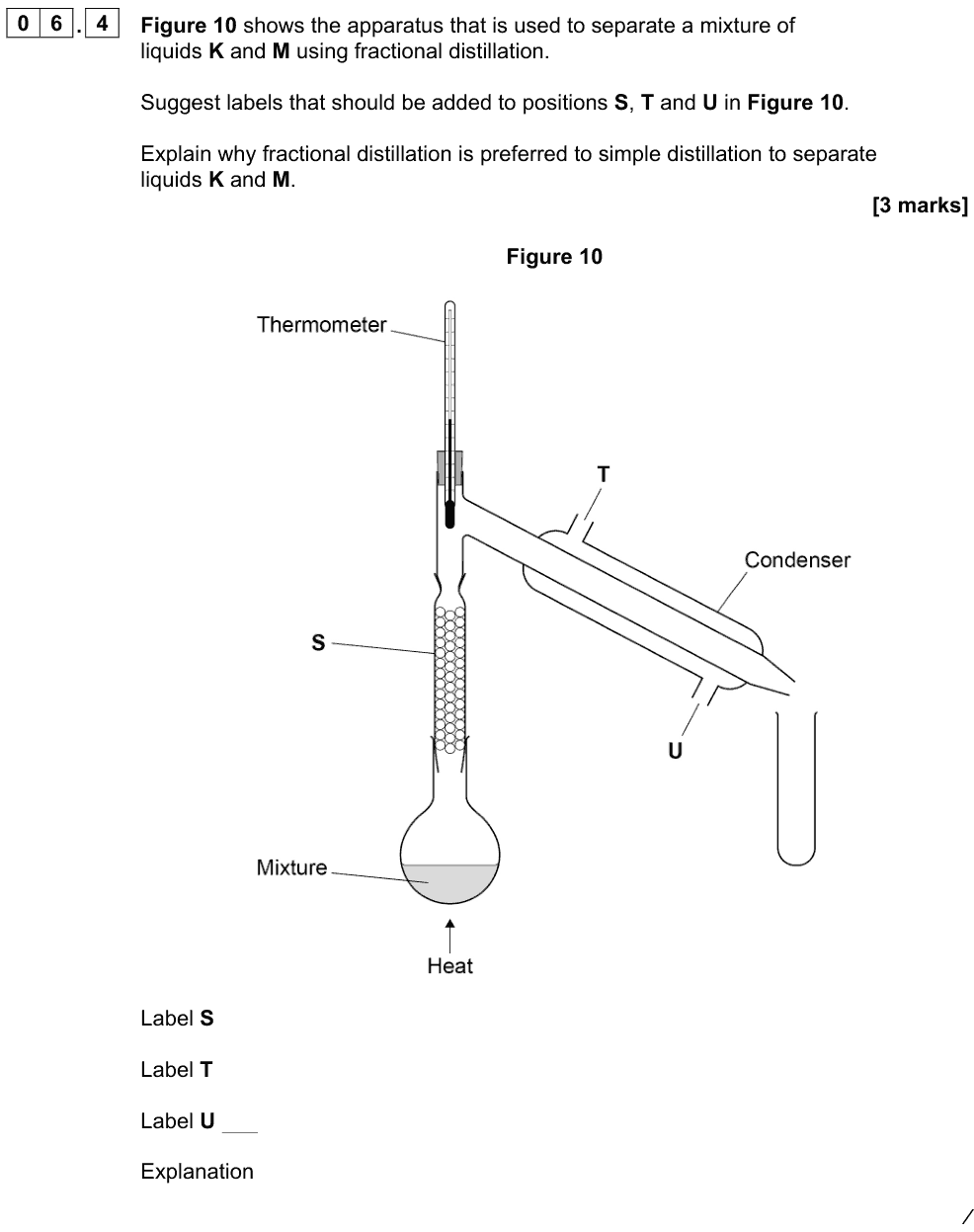
06.4 Relatively few students were able to identify S in the diagram as a fractionating column. The direction of flow for the water in the condenser was much better known. The explanation that fractional distillation is preferred to simple distillation in this case because liquids K and M were likely to have similar boiling points was not well answered.
Notes from the mark scheme and report
S: fractionating column (allow glass beads). T: water out, and U: water in (both needed for one mark). Fractional distillation is used because K and M have similar boiling points. Few named the fractionating column or gave the boiling-point reason
Skills: PS4.1 Know and understand how to use a wide range of experimental and practical instruments, equipment and techniques appropriate to the knowledge and understanding included in the specification; ATd Use laboratory apparatus for a variety of experimental techniques including: titration, using burette and pipette; distillation and heating under reflux, including setting up glassware using retort stand and clamps; qualitative tests for ions and organic functional groups; filtration, including use of fluted filter paper, or filtration under reduced pressure; RP5 Distillation of a product from a reaction
June 2023 · AS Paper 2 · Q07.12 marksAO3=2Practical and data analysis
Mark scheme
Examiner's comment
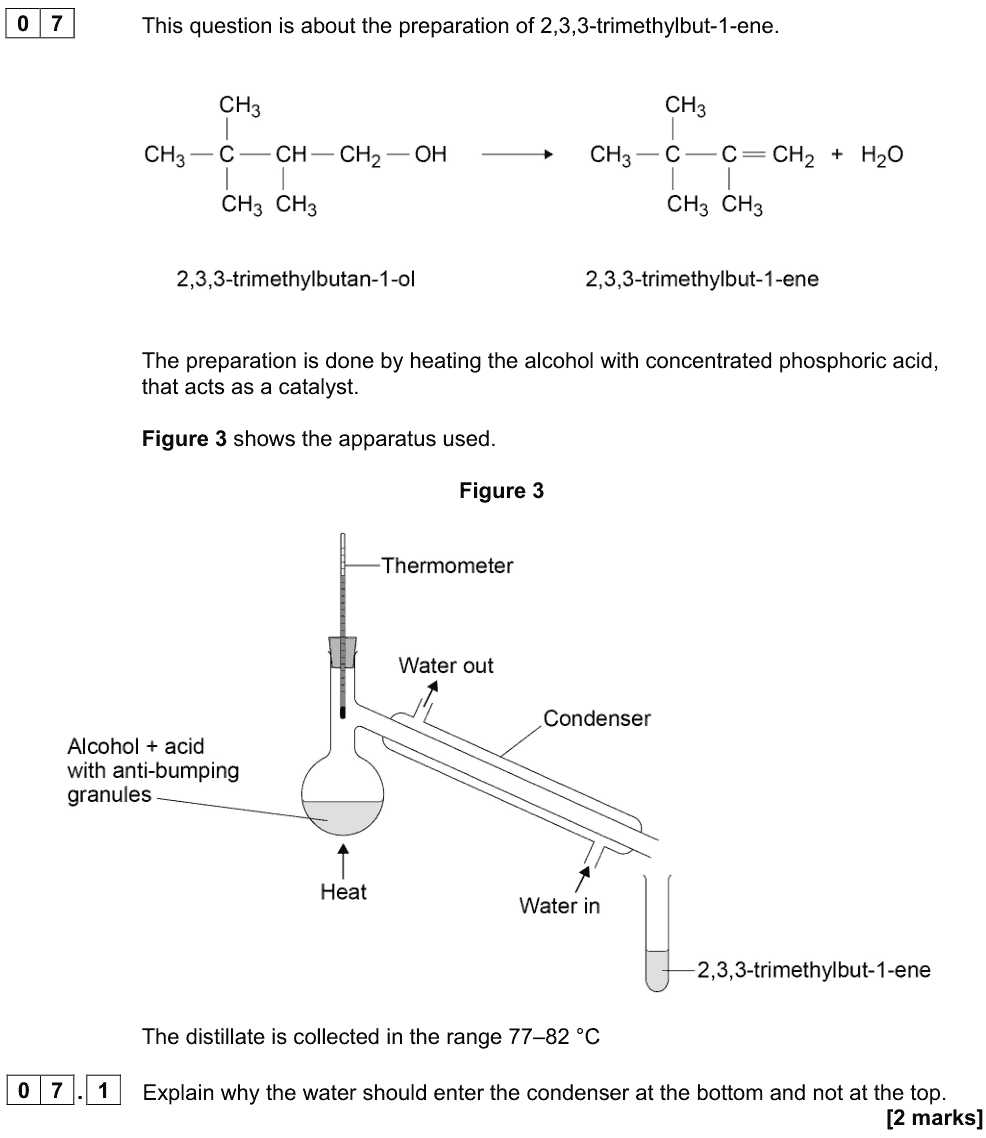
07.1 Many students were confused about the purpose of a condenser in a distillation experiment and how it worked. This was revealed by misconceptions in their explanation of why the water should enter the condenser at the bottom.
Notes from the mark scheme and report
So that the condenser fills completely with water (no air pockets), which keeps the condenser cool so that (more of) the vapour condenses. Many misunderstood how a condenser works
Skills: ATd Use laboratory apparatus for a variety of experimental techniques including: titration, using burette and pipette; distillation and heating under reflux, including setting up glassware using retort stand and clamps; qualitative tests for ions and organic functional groups; filtration, including use of fluted filter paper, or filtration under reduced pressure; PS4.1 Know and understand how to use a wide range of experimental and practical instruments, equipment and techniques appropriate to the knowledge and understanding included in the specification; RP5 Distillation of a product from a reaction
June 2023 · AS Paper 2 · Q07.24 marksAO1=1, AO2=3MechanismHard
Earlier part of question 07 that this part uses
Mark scheme
Examiner's comment
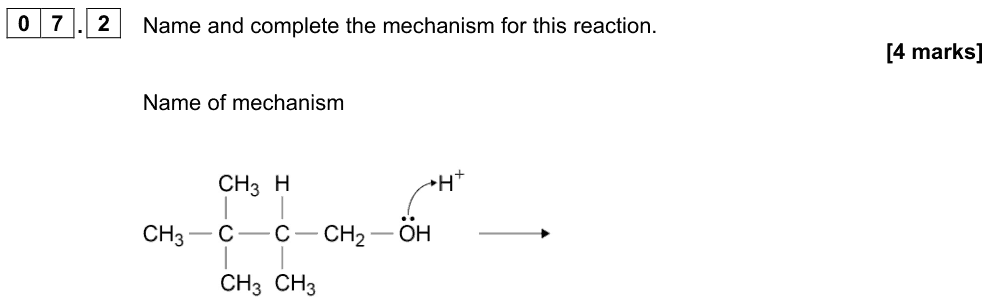
07.2 Students found this elimination mechanism challenging; just under a quarter of students achieved full marks here.
Notes from the mark scheme and report
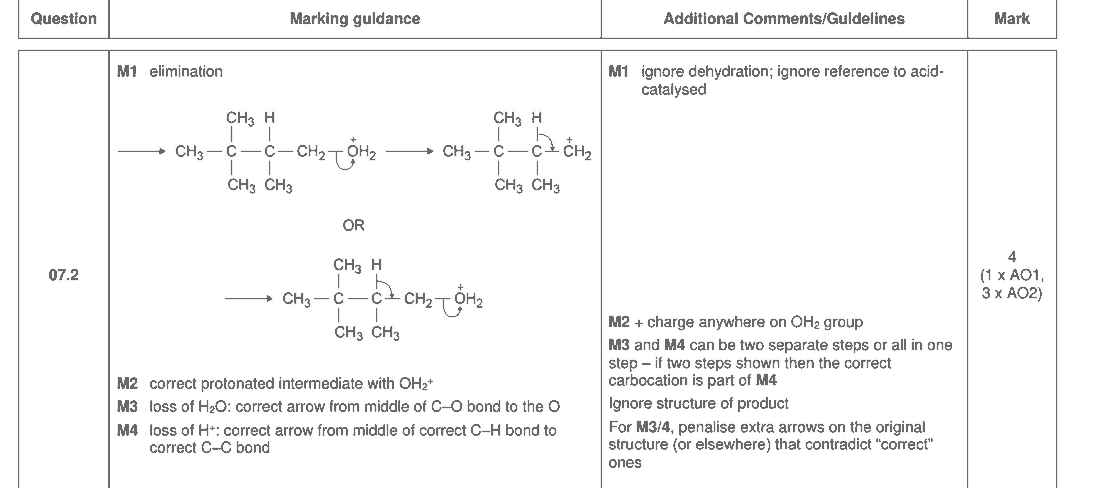
Elimination (dehydration ignored). Protonated alcohol drawn with –OH2+
curly arrow from the C–O bond to the O (loss of H2O), giving the primary carbocation
curly arrow from the C–H bond on the adjacent carbon into the C–C bond (loss of H+). Loss of water and H+ may be shown in one step
June 2023 · AS Paper 2 · Q221 markAO1=1Multiple choice
Answer
B
Mark scheme
Examiner's comment
This was answered correctly by a majority (53%) of students.
Notes from the mark scheme and report
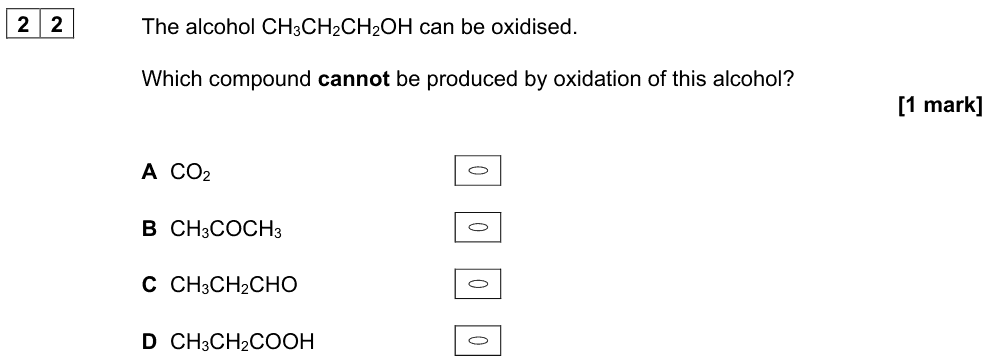
Answer: B. Propan-1-ol is a primary alcohol: it gives propanal, then propanoic acid (and CO2 on combustion). Propanone would need the secondary alcohol propan-2-ol
June 2023 · Paper 3 · Q02.11 markDiagram or structure
Mark scheme
Examiner's comment
In 02.1, a displayed formula for pentan-1-ol was required (but only 36% of students correctly gave this answer) and the commonest reasons for the mark not being awarded were that the OH group was not displayed or that pentan-3-ol was suggested.
Notes from the mark scheme and report
Displayed formula of pentan-1-ol with every bond shown, including the O–H bond. Not pentan-3-ol. Common reasons for losing the mark: OH not displayed
pentan-3-ol. 36% correct
June 2023 · Paper 3 · Q02.21 markDiagram or structure
Earlier part of question 02 that this part uses
Mark scheme
Examiner's comment
02.2 was answered better and it was pleasing to see an increased facility with which students were able to represent structures using skeletal formulae – but note that, in this case, the OH group must NOT be displayed.
Notes from the mark scheme and report
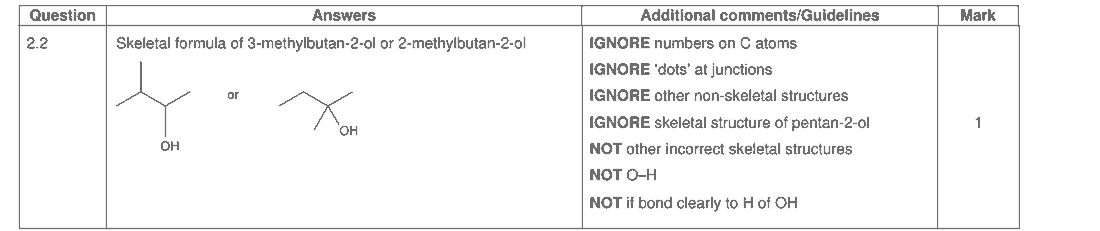
Skeletal formula of 3-methylbutan-2-ol or 2-methylbutan-2-ol (branched chain
H can be lost from two different adjacent carbons). In a skeletal formula the OH is written as OH, not displayed, and the bond goes to the O
June 2023 · Paper 3 · Q02.41 markDiagram or structureHard
Earlier part of question 02 that this part uses
Mark scheme
Examiner's comment
02.4 proved one of the trickier questions on the paper with only 16% of students scoring here.
The commonest error was to offer a tertiary alcohol as the answer – this suggested confusion about which alcohols cannot be oxidised rather than which cannot be dehydrated.
Notes from the mark scheme and report
2,2-dimethylpropan-1-ol, (CH3)3CCH2OH: the carbon next to the C–OH carbon has no hydrogen, so water cannot be eliminated. Commonest error: a tertiary alcohol (confusing 'cannot be oxidised' with 'cannot be dehydrated')
June 2023 · Paper 3 · Q02.53 marksMechanism
Earlier part of question 02 that this part uses
Mark scheme
Examiner's comment
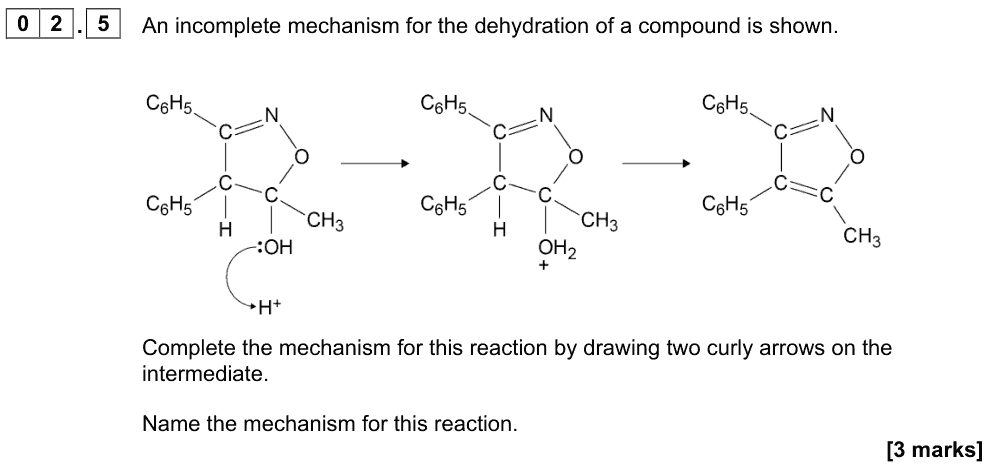
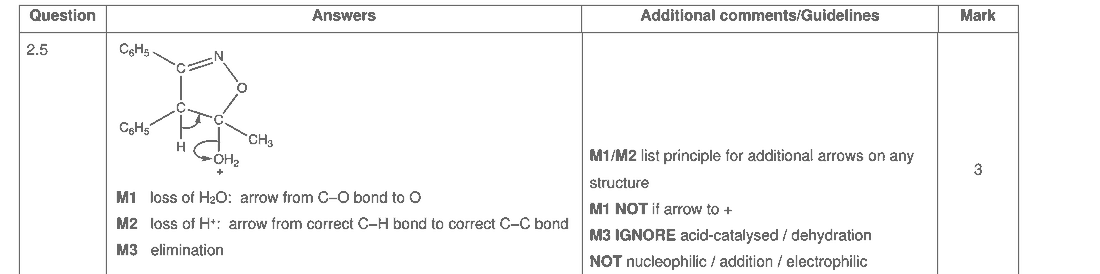
50% of students scored 3 marks in 02.5 and students are again reminded of the importance of being precise when drawing curly arrows in terms of where they start and where they finish.
A curly arrow in any mechanism must always start either from the line representing a covalent bond or from a lone pair drawn on an atom.
In this case, both arrows should have started from an existing bond in order to represent the breaking of that bond.
Notes from the mark scheme and report
On the protonated intermediate: curly arrow from the C–O bond to the O of the OH2+ group (water leaves
not an arrow to the + sign)
curly arrow from the C–H bond on the adjacent ring carbon to the C–C bond between the two ring carbons (H+ lost, C=C forms). Name: elimination (ignore acid-catalysed / dehydration
not nucleophilic, electrophilic or addition). Both arrows must start at a bond. 50% scored 3 marks
June 2023 · Paper 3 · Q02.61 markDiagram or structureHard
Earlier part of question 02 that this part uses
Mark scheme
Examiner's comment
02.6 was a test of the understanding that dehydration involves the loss of the OH along with a H atom from an adjacent carbon.
Only 30% of students could give the correct structure.
Notes from the mark scheme and report
The H is lost from the CH3 group instead: the same ring with an exocyclic C=CH2 on the carbon that carried the OH, the other ring carbon keeping its H and C6H5. Needs the structures printed in 02.5
June 2023 · Paper 3 · Q311 markAO2=1Multiple choice
Answer
A
Mark scheme
Notes from the mark scheme and report
Answer: A. Propene undergoes electrophilic addition with concentrated H2SO4 to give an alkyl hydrogensulfate, which is hydrolysed by water to an alcohol (report: listed among the trickiest questions, 40% or fewer correct)
June 2023 · Paper 3 · Q321 markAO1=1Multiple choice
Answer
D
Mark scheme
Notes from the mark scheme and report
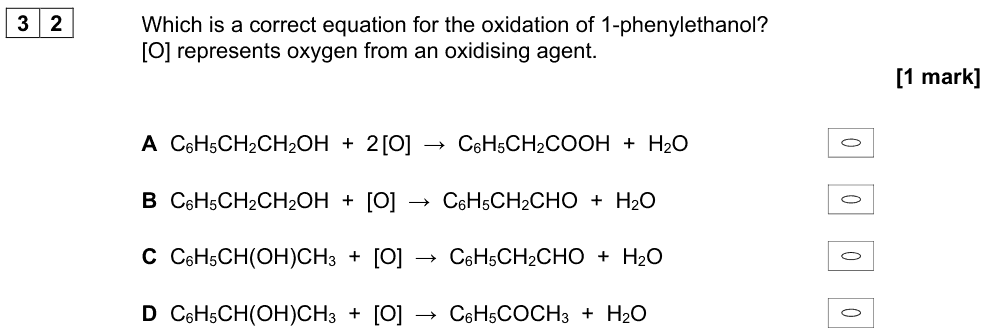
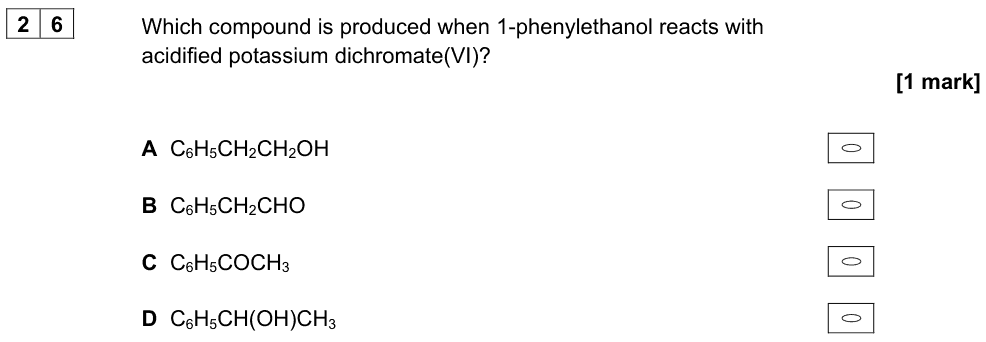
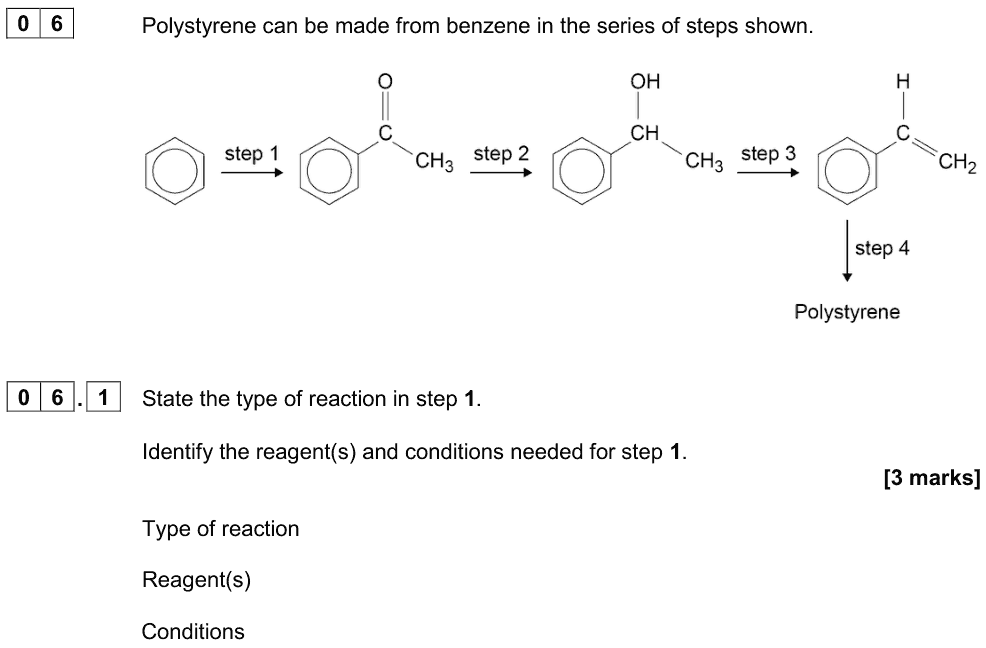
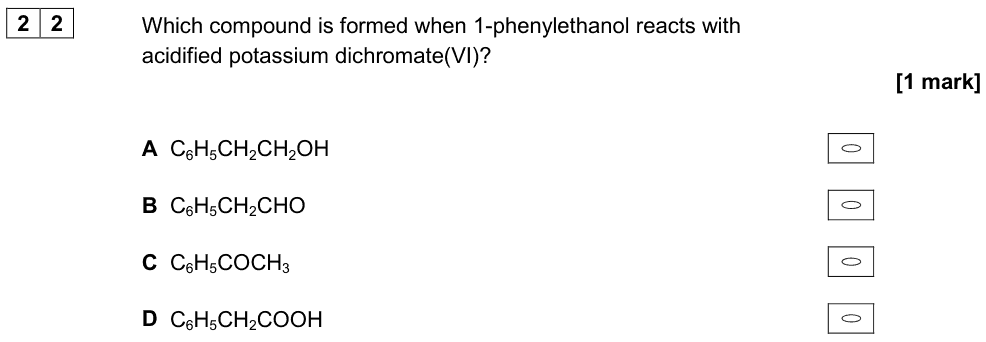
Answer: D. 1-phenylethanol is the secondary alcohol C6H5CH(OH)CH3, oxidised to the ketone C6H5COCH3 with one [O]. A and B start from 2-phenylethanol
June 2022 · AS Paper 2 · Q026 marksAO1=4, AO3=26-mark level of response
Mark scheme, with the levels and indicative content
Examiner's comment
Distinguishing organic compounds
This question looked for chemical tests and then the use of spectroscopy to distinguish four organic compounds. Some students did not read the question carefully enough and did chemical tests for the carboxylic acids which was not necessary. Other students did not appreciate that both the aldehyde and the alcohol would turn acidified potassium dichromate(VI) from orange to green. Some students mixed up IR spectroscopy and mass spectrometry, while others did not appreciate that the two acids had the same formula mass which negated the way they suggested using mass spectrometry.
Notes from the mark scheme and report
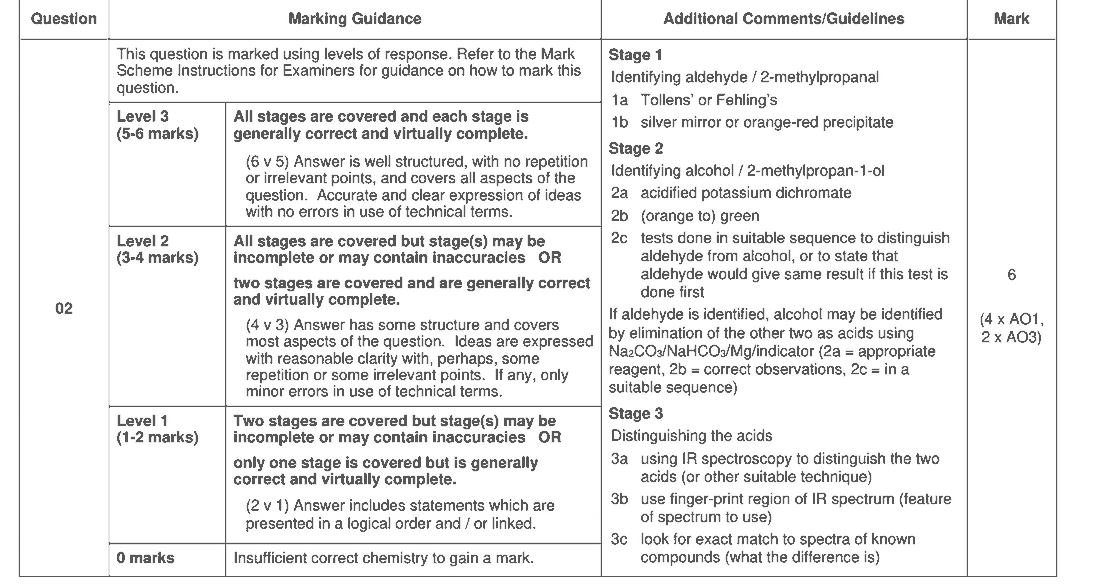
Levels of response, three stages. Stage 1 aldehyde (2-methylpropanal): Tollens' reagent gives a silver mirror or Fehling's solution gives an orange-red precipitate. Stage 2 alcohol (2-methylpropan-1-ol): acidified potassium dichromate turns orange to green, done in a sequence that separates it from the aldehyde (which gives the same result)
or by eliminating the two acids with Na2CO3/NaHCO3/Mg/indicator. Stage 3 the two acids: infrared spectroscopy, using the fingerprint region and looking for an exact match with spectra of known compounds. Errors: forgetting that both aldehyde and alcohol reduce dichromate
using mass spectrometry although the acids have the same Mr
Skills: PS1.1 Solve problems set in practical contexts; PS2.1 Comment on experimental design and evaluate scientific methods; RP6 Tests for alcohol, aldehyde, alkene and carboxylic acid
June 2022 · Paper 2 · Q05.52 marksAO2=2Short answer
Earlier part of question 05 that this part uses
Mark scheme
Examiner's comment
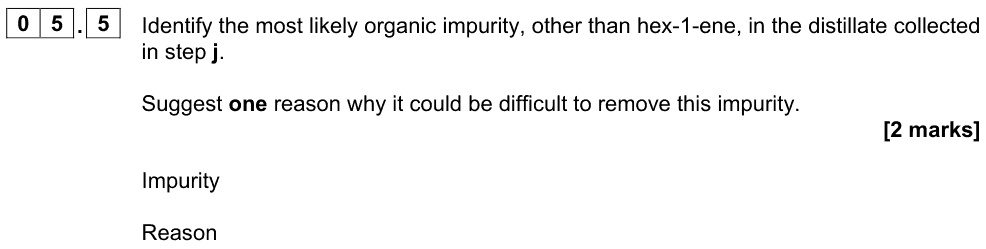
05.5 Identifying hexan-1-ol as the most likely impurity was not well answered and few scored this and the explanation in terms of the two alcohols having similar boiling points.
Notes from the mark scheme and report
Impurity: hexan-1-ol (the minor product of hydration). Reason: it is likely to have a boiling point similar to hexan-2-ol. Few identified it
Skills: RP10 Preparation of: a pure organic solid and test of its purity; a pure organic liquid
June 2022 · AS Paper 2 · Q07.14 marksAO1=3, AO3=1Explanation
Mark scheme
Examiner's comment
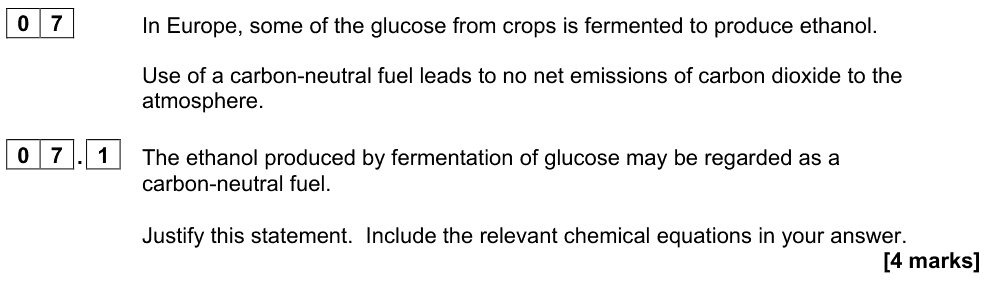
7.1 This question required students to justify that bioethanol use is carbon-neutral using equations. Few students could give the equations for photosynthesis, fermentation and combustion (of ethanol) needed to justify their answer. Overall this question was not answered well.
Notes from the mark scheme and report
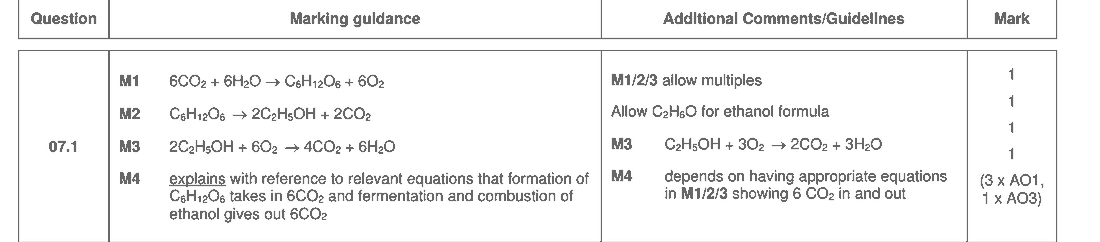
6CO2 + 6H2O → C6H12O6 + 6O2
C6H12O6 → 2C2H5OH + 2CO2
2C2H5OH + 6O2 → 4CO2 + 6H2O
photosynthesis takes in 6 mol of CO2 and fermentation plus combustion give out 6 mol (M4 needs the equations). Few could give all three equations
June 2022 · AS Paper 2 · Q07.21 markAO3=1Short answer
Earlier part of question 07 that this part uses
Mark scheme
Examiner's comment
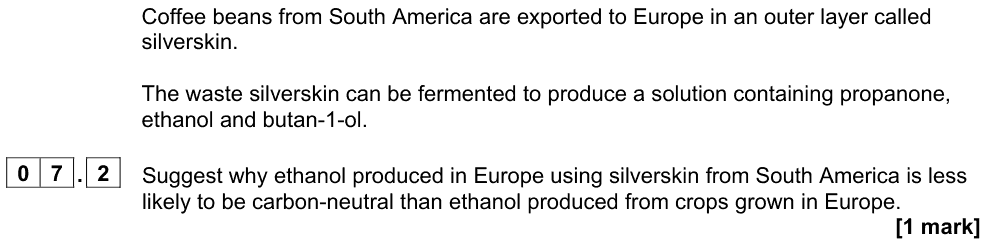
7.2 This question required students to justify why moving a product across the world is less likely to be carbon-neutral than using local materials. Many students could explain that the transport produced more CO2 emissions.
Notes from the mark scheme and report
Transport from South America to Europe (or separating the ethanol from propanone and butan-1-ol) produces CO2
June 2022 · AS Paper 2 · Q121 markAO3=1Multiple choiceEasy
Answer
D
Mark scheme
Examiner's comment
This was answered correctly by a majority of students (69.2%).
Notes from the mark scheme and report
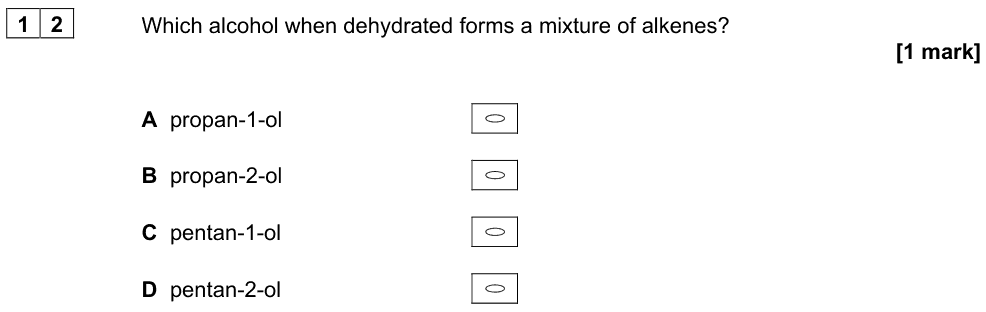
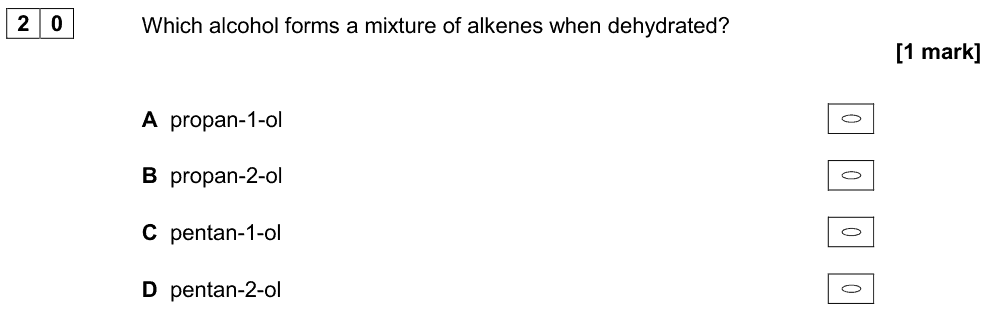
Answer: D. Pentan-2-ol can lose water in two directions to give pent-1-ene and (E and Z) pent-2-ene
June 2022 · AS Paper 2 · Q151 markAO1=1Multiple choice
Answer
D
Mark scheme
Examiner's comment
Many students struggled to work out which alcohol is oxidised to a given ketone.
Notes from the mark scheme and report
Answer: D. 3-methylbutan-2-ol, (CH3)2CHCH(OH)CH3, is the secondary alcohol that oxidises to the ketone (CH3)2CHCOCH3
June 2022 · Paper 3 · Q241 markAO1=1Multiple choice
Answer
A
Mark scheme
Notes from the mark scheme and report
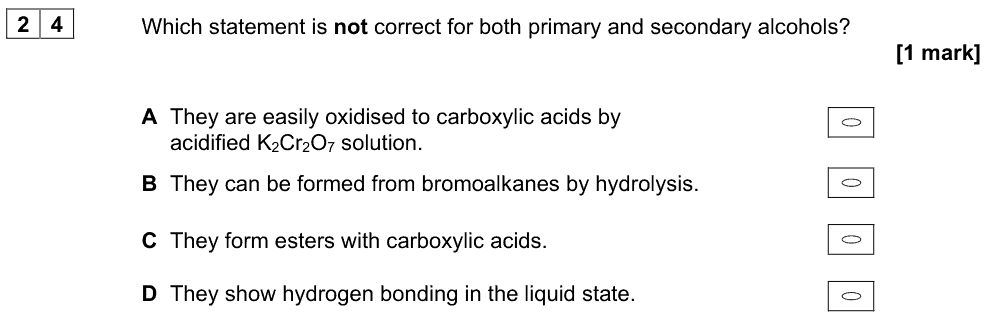
Answer: A. Secondary alcohols are oxidised only to ketones, not to carboxylic acids
June 2022 · Paper 3 · Q341 markAO1=1Multiple choice
Answer
C
Mark scheme
Notes from the mark scheme and report
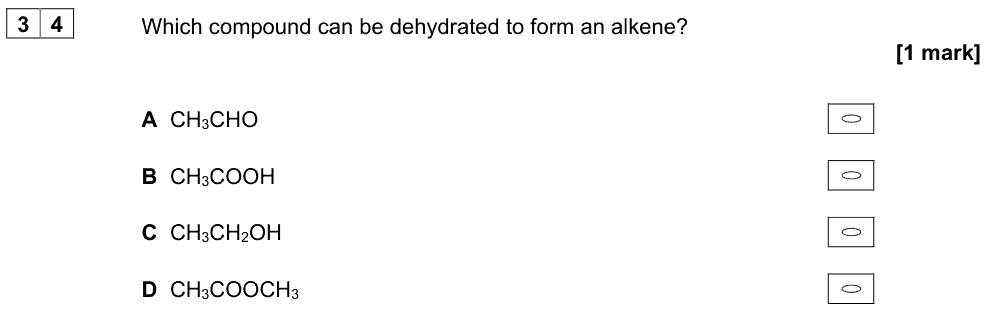
Answer: C. Ethanol loses water (acid-catalysed elimination) to form ethene
November 2021 · Paper 2 · Q02.66 marks6-mark level of response
Earlier part of question 02 that this part uses
Mark scheme, with the levels and indicative content
Examiner's comment
In this question a surprisingly small proportion of students were able to state the meaning of the term fraction. In addition, very few were able to explain why C=O bonds in carbon dioxide absorb infrared radiation. A good range of answers was seen for the extended response question about the environmental impact of bioethanol as a fuel, but a significant number of students were unable to get started here.
Notes from the mark scheme and report
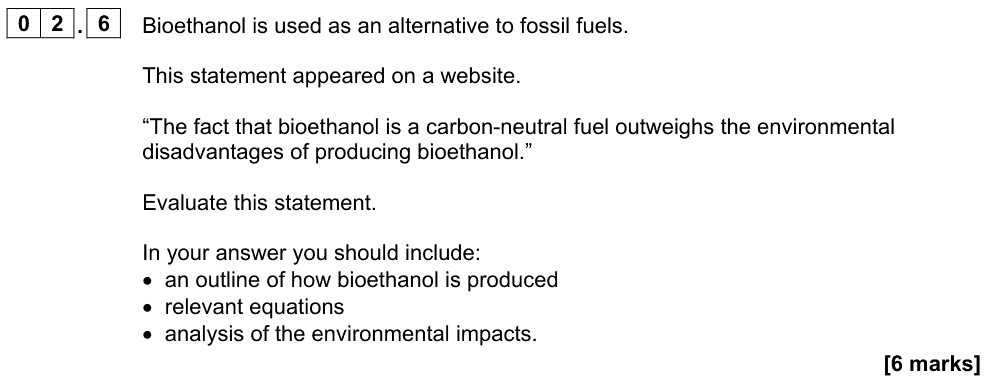
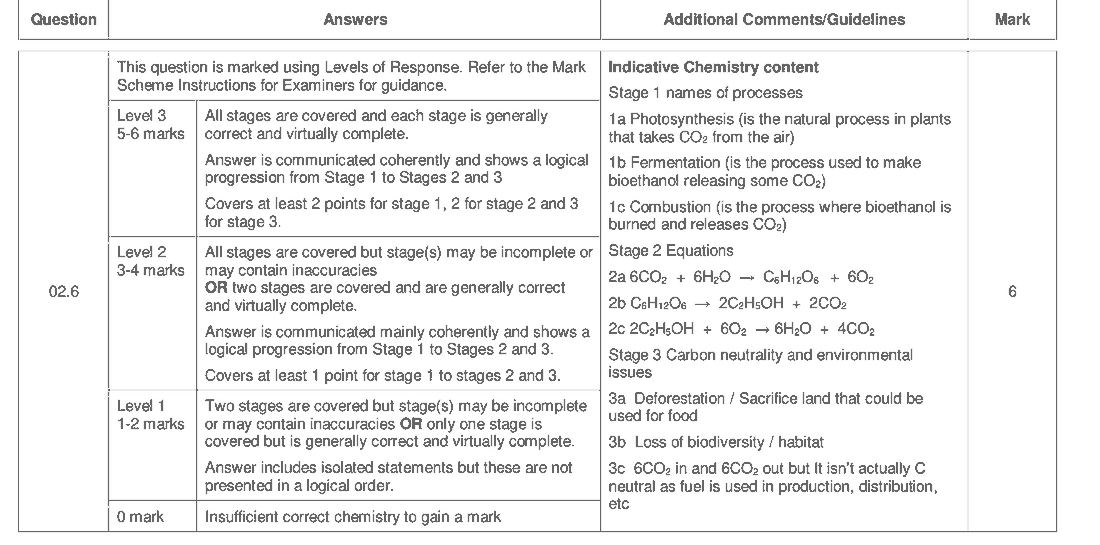
Levels of response, three stages. Stage 1 processes: photosynthesis takes in CO2 as the crop grows
fermentation of glucose makes the ethanol and releases some CO2
combustion of the ethanol releases CO2. Stage 2 equations: 6CO2 + 6H2O → C6H12O6 + 6O2
C6H12O6 → 2C2H5OH + 2CO2
2C2H5OH + 6O2 → 4CO2 + 6H2O. Stage 3 evaluation: 6CO2 taken in and 6CO2 given out, but not truly carbon neutral because fuel is used in production and distribution
deforestation / land that could grow food
loss of habitat and biodiversity. A significant number could not get started
November 2021 · AS Paper 2 · Q03.16 marks6-mark level of response
Mark scheme, with the levels and indicative content
Notes from the mark scheme and report
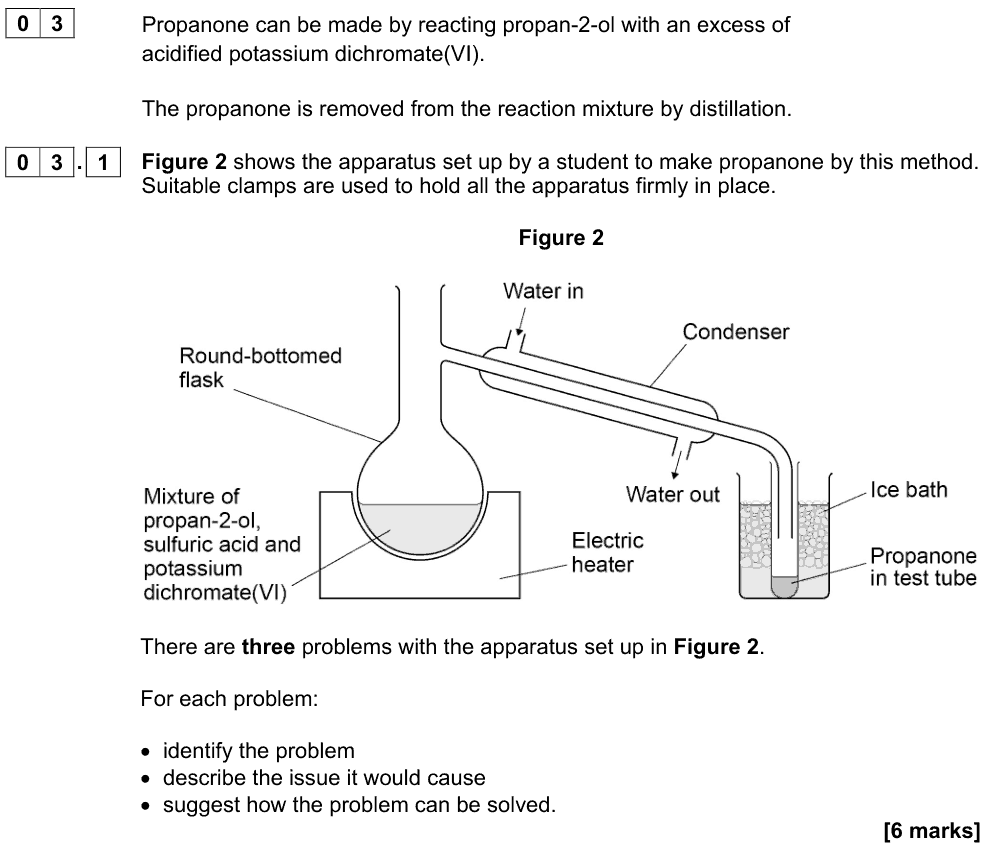
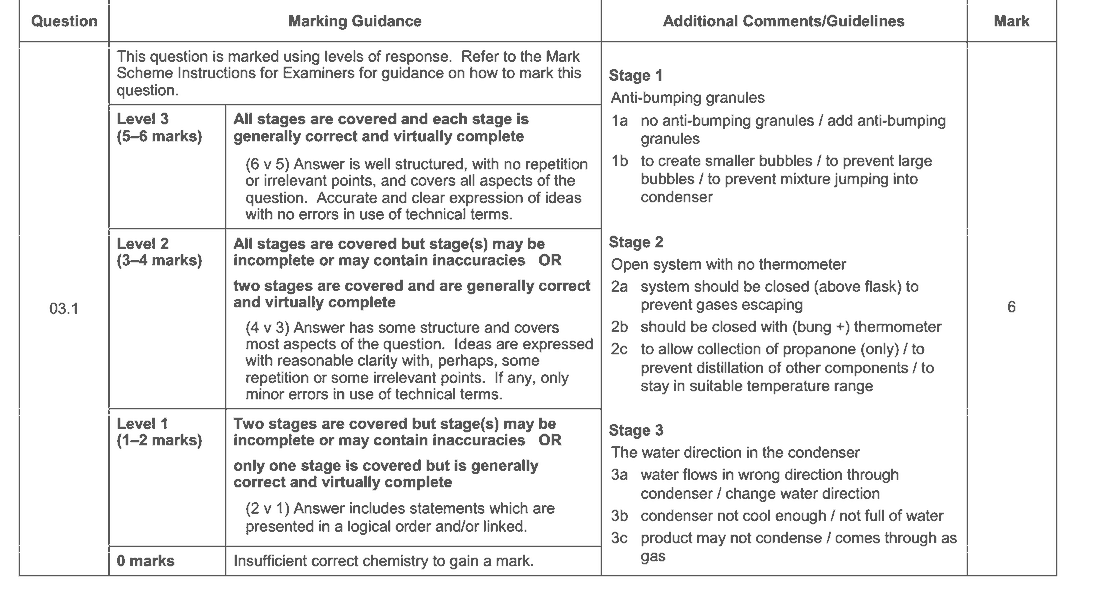
Levels of response, three stages. 1 No anti-bumping granules: large bubbles / mixture may jump into the condenser
add granules. 2 Open top of the flask with no thermometer: vapour escapes and the distillation temperature cannot be controlled
close with a bung and thermometer so only propanone is collected. 3 Water enters the condenser at the top: the jacket does not fill so it is not cool enough and product may not condense
reverse the flow (water in at the bottom)
Skills: ATb Use water bath or electric heater or sand bath for heating; ATd Use laboratory apparatus for a variety of experimental techniques including: titration, using burette and pipette; distillation and heating under reflux, including setting up glassware using retort stand and clamps; qualitative tests for ions and organic functional groups; filtration, including use of fluted filter paper, or filtration under reduced pressure; PS2.1 Comment on experimental design and evaluate scientific methods; PS4.1 Know and understand how to use a wide range of experimental and practical instruments, equipment and techniques appropriate to the knowledge and understanding included in the specification; RP5 Distillation of a product from a reaction
November 2021 · AS Paper 2 · Q07.24 marksMechanism
Earlier part of question 07 that this part uses
Mark scheme
Notes from the mark scheme and report
Elimination. Arrow from a lone pair on O of one OH to H+
protonated alcohol with arrow from the C–O+H2 bond to O (water leaves)
carbocation, then arrow from the adjacent C–H bond to the C–C bond to form C=C (loss of H+). The last two steps may be shown as one concerted step. Max 2 of 3 for the wrong reactant
November 2021 · AS Paper 2 · Q07.41 markDiagram or structure
Earlier part of question 07 that this part uses
Mark scheme
Notes from the mark scheme and report
Propanal, CH3CH2CHO. The spectrum has a strong C=O absorption near 1700 cm–1 and no O–H absorption, and the isomer is oxidised by acidified dichromate, so it is an aldehyde (not propanone)
Skills: MS3.1 Translate information between graphical, numerical and algebraic forms
November 2021 · Paper 2 · Q08.12 marksShort answer
Mark scheme
Examiner's comment
Few students scored 3 or more marks on question 08.2. Both the reagents and equations proved very challenging, with over 50% either failing to score or not attempting this question. A very good range of marks was seen for question 08.3 and the question discriminated very well.
November 2021 · Paper 3 · Q06.12 marksPractical and data analysis
Mark scheme
Examiner's comment
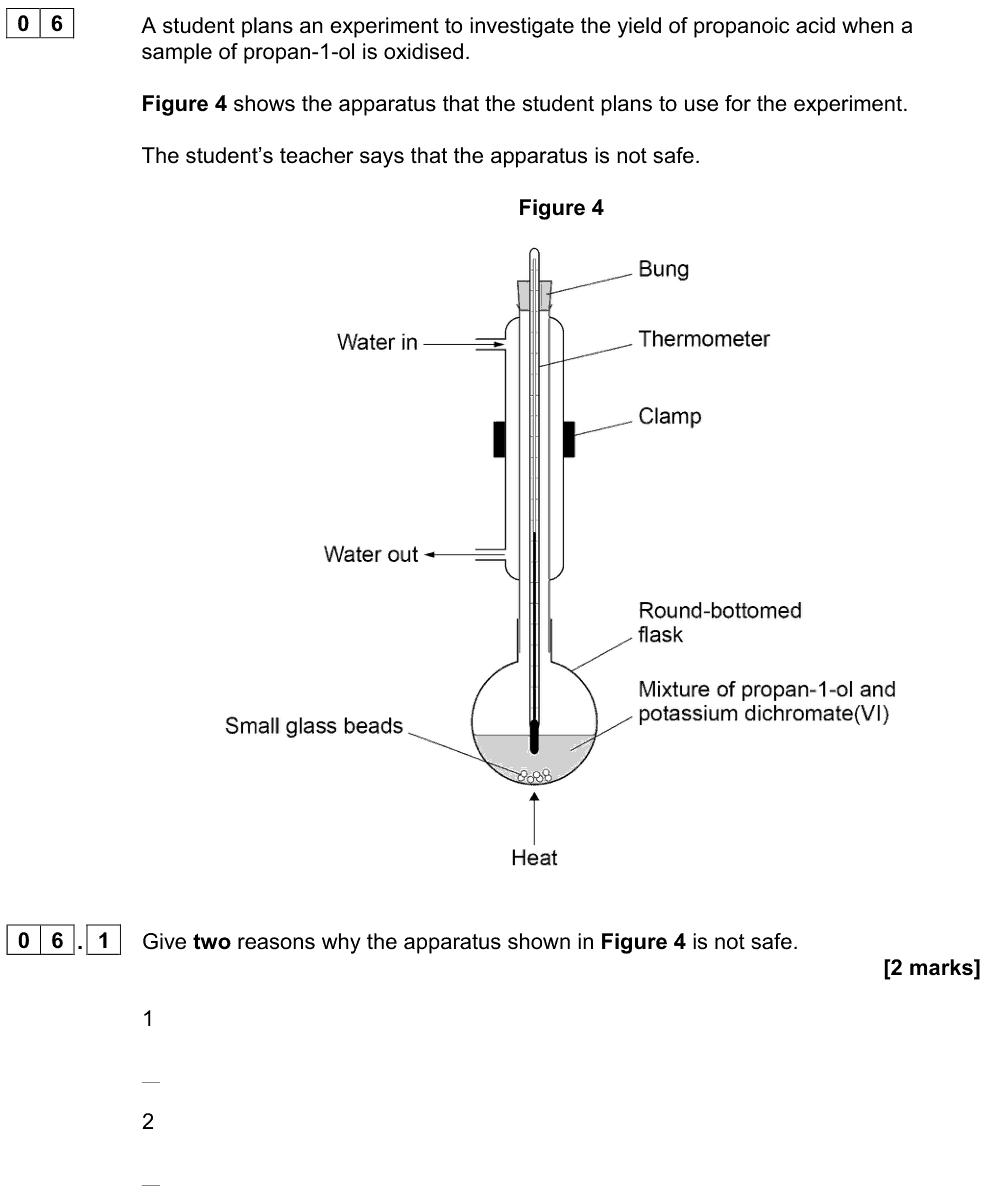
Question 06.1 specifically asked for safety concerns related to the apparatus diagram, with the hope that students would recognise that the bung should not be present (as it would mean a sealed apparatus is being heated) and that the flask is not clamped.
Vague references to ‘the clamp being in the wrong place’ were not sufficient because a more specific response was needed.
However, if it was mentioned in 06.1 but not then mentioned in 06.3, credit was still allowed for 06.3.
Notes from the mark scheme and report
The flask is not clamped (only the condenser is)
the bung in the top of the condenser makes a sealed system, so pressure builds up on heating. Water direction is not a safety point
'clamp in the wrong place' is too vague
Skills: ATd Use laboratory apparatus for a variety of experimental techniques including: titration, using burette and pipette; distillation and heating under reflux, including setting up glassware using retort stand and clamps; qualitative tests for ions and organic functional groups; filtration, including use of fluted filter paper, or filtration under reduced pressure; ATk Safely and carefully handle solids and liquids, including corrosive, irritant, flammable and toxic substances; PS2.1 Comment on experimental design and evaluate scientific methods
November 2021 · Paper 3 · Q06.21 markShort answer
Earlier part of question 06 that this part uses
Mark scheme
Examiner's comment
Practical weaknesses and insufficient precision in answers let many students down here.
Question 06.1 specifically asked for safety concerns related to the apparatus diagram, with the hope that students would recognise that the bung should not be present (as it would mean a sealed apparatus is being heated) and that the flask is not clamped. Vague references to ‘the clamp being in the wrong place’ were not sufficient because a more specific response was needed.
Many students referred to the direction of the water flow being wrong because it should enter at the bottom of the condenser – but this is not a safety concern so could not be credited here. However, if it was mentioned in 06.1 but not then mentioned in 06.3, credit was still allowed for 06.3.
In question 06.3 many students failed to recognise that the thermometer is not needed at all and got confused with distillation by suggesting that the thermometer needed to be higher up in the apparatus.
Notes from the mark scheme and report
Sulfuric acid (to acidify the potassium dichromate(VI))
allow hydrochloric, nitric or phosphoric acid
not just 'acid' or H+
November 2021 · Paper 3 · Q06.32 marksPractical and data analysis
Earlier part of question 06 that this part uses
Mark scheme
Examiner's comment
However, if it was mentioned in 06.1 but not then mentioned in 06.3, credit was still allowed for 06.3.
In question 06.3 many students failed to recognise that the thermometer is not needed at all and got confused with distillation by suggesting that the thermometer needed to be higher up in the apparatus.
Notes from the mark scheme and report
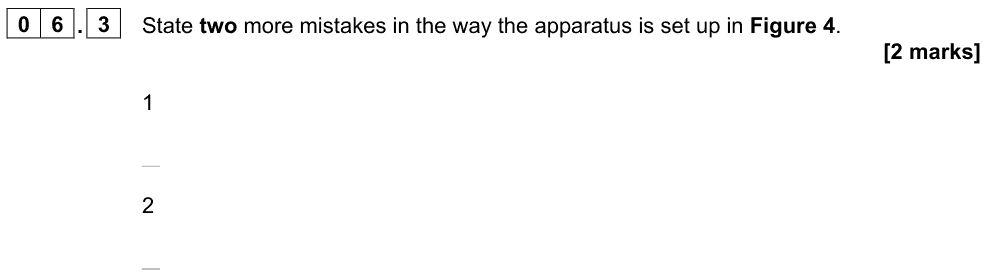
The water flows through the condenser in the wrong direction (it should enter at the bottom)
the thermometer is not needed for reflux. The position of the thermometer is ignored: many confused this with distillation
Skills: ATd Use laboratory apparatus for a variety of experimental techniques including: titration, using burette and pipette; distillation and heating under reflux, including setting up glassware using retort stand and clamps; qualitative tests for ions and organic functional groups; filtration, including use of fluted filter paper, or filtration under reduced pressure; PS2.1 Comment on experimental design and evaluate scientific methods; PS4.1 Know and understand how to use a wide range of experimental and practical instruments, equipment and techniques appropriate to the knowledge and understanding included in the specification
November 2021 · Paper 3 · Q06.41 markPractical and data analysis
Earlier part of question 06 that this part uses
Mark scheme
Examiner's comment
Practical weaknesses and insufficient precision in answers let many students down here.
Question 06.1 specifically asked for safety concerns related to the apparatus diagram, with the hope that students would recognise that the bung should not be present (as it would mean a sealed apparatus is being heated) and that the flask is not clamped. Vague references to ‘the clamp being in the wrong place’ were not sufficient because a more specific response was needed.
Many students referred to the direction of the water flow being wrong because it should enter at the bottom of the condenser – but this is not a safety concern so could not be credited here. However, if it was mentioned in 06.1 but not then mentioned in 06.3, credit was still allowed for 06.3.
In question 06.3 many students failed to recognise that the thermometer is not needed at all and got confused with distillation by suggesting that the thermometer needed to be higher up in the apparatus.
Notes from the mark scheme and report
To prevent 'bumping' (they give small bubbles / smooth boiling). Not 'increases the rate'
Skills: ATd Use laboratory apparatus for a variety of experimental techniques including: titration, using burette and pipette; distillation and heating under reflux, including setting up glassware using retort stand and clamps; qualitative tests for ions and organic functional groups; filtration, including use of fluted filter paper, or filtration under reduced pressure; PS4.1 Know and understand how to use a wide range of experimental and practical instruments, equipment and techniques appropriate to the knowledge and understanding included in the specification
November 2021 · Paper 3 · Q06.54 marksCalculation
Earlier part of question 06 that this part uses
Mark scheme
Examiner's comment
Practical weaknesses and insufficient precision in answers let many students down here.
Question 06.1 specifically asked for safety concerns related to the apparatus diagram, with the hope that students would recognise that the bung should not be present (as it would mean a sealed apparatus is being heated) and that the flask is not clamped. Vague references to ‘the clamp being in the wrong place’ were not sufficient because a more specific response was needed.
Many students referred to the direction of the water flow being wrong because it should enter at the bottom of the condenser – but this is not a safety concern so could not be credited here. However, if it was mentioned in 06.1 but not then mentioned in 06.3, credit was still allowed for 06.3.
In question 06.3 many students failed to recognise that the thermometer is not needed at all and got confused with distillation by suggesting that the thermometer needed to be higher up in the apparatus.
Skills: MS0.2 Use ratios, fractions and percentages; ATd Use laboratory apparatus for a variety of experimental techniques including: titration, using burette and pipette; distillation and heating under reflux, including setting up glassware using retort stand and clamps; qualitative tests for ions and organic functional groups; filtration, including use of fluted filter paper, or filtration under reduced pressure; RP5 Distillation of a product from a reaction
November 2021 · Paper 3 · Q261 markMultiple choice
Answer
C
Mark scheme
Notes from the mark scheme and report
Answer: C. 1-phenylethanol, C6H5CH(OH)CH3, is a secondary alcohol and is oxidised to the ketone C6H5COCH3 (report: one of five items answered correctly by fewer than 40%)
November 2020 · Paper 2 · Q03.12 marksPractical and data analysis
Mark scheme
Examiner's comment
The expected observations for test tube reactions in 03.1 and 03.2 were well known.
Notes from the mark scheme and report
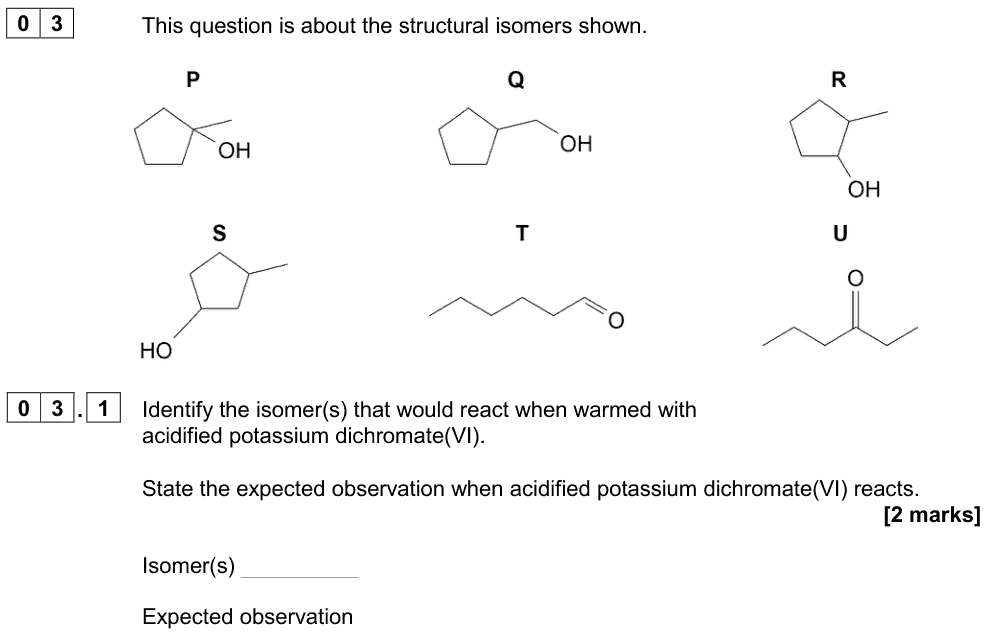
Q, R, S and T (primary alcohol, two secondary alcohols and the aldehyde
P is a tertiary alcohol and U a ketone). Orange solution turns green. Marks independent
Skills: ATd Use laboratory apparatus for a variety of experimental techniques including: titration, using burette and pipette; distillation and heating under reflux, including setting up glassware using retort stand and clamps; qualitative tests for ions and organic functional groups; filtration, including use of fluted filter paper, or filtration under reduced pressure; PS1.1 Solve problems set in practical contexts; RP6 Tests for alcohol, aldehyde, alkene and carboxylic acid
November 2020 · AS Paper 2 · Q04.25 marksMechanism
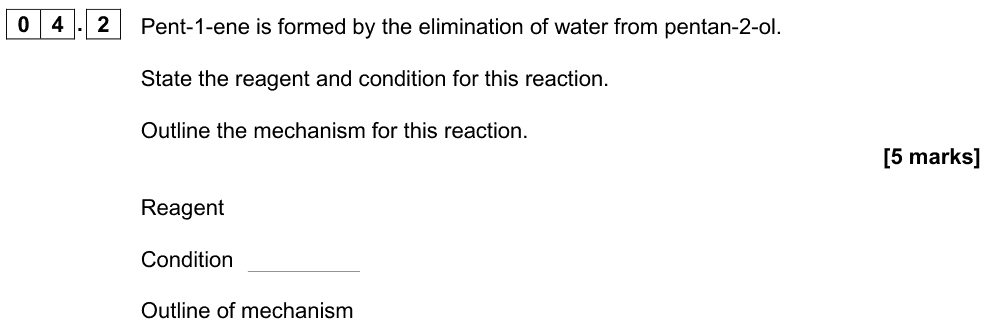
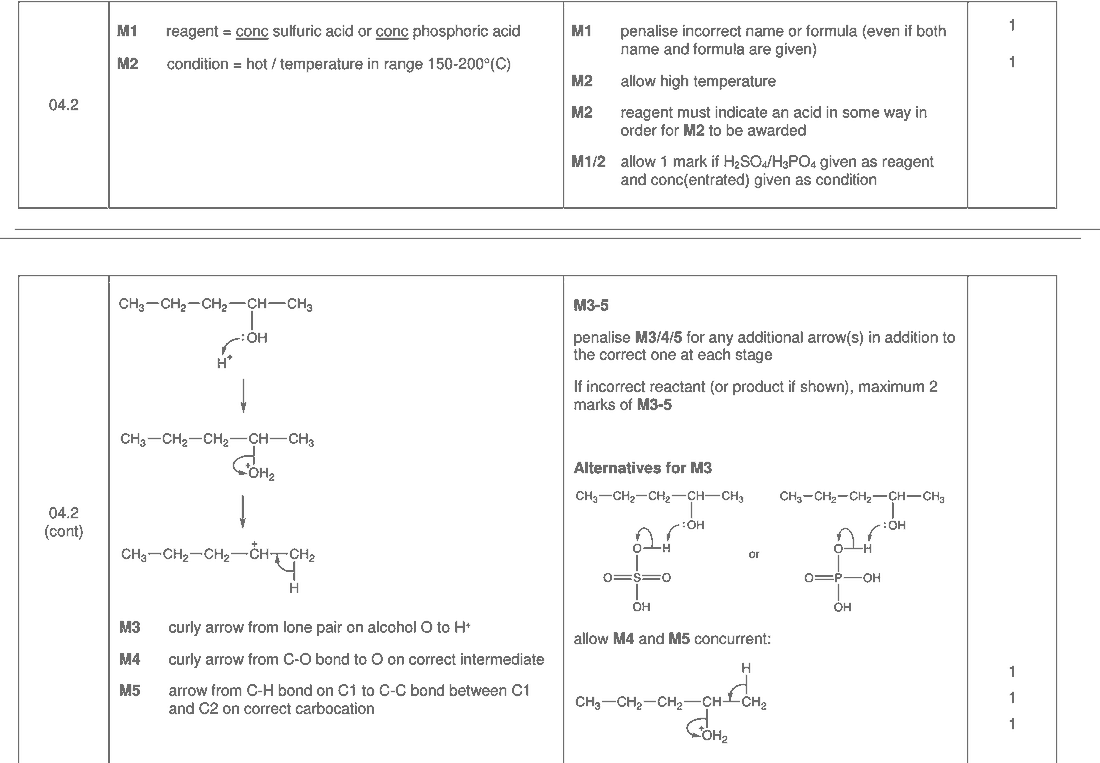
condition: hot (150–200 °C). Mechanism: curly arrow from a lone pair on the alcohol O to H+
curly arrow from the C–O bond to the O of the protonated alcohol (–OH2+), losing water to give the secondary carbocation CH3CH2CH2C+HCH3
curly arrow from a C–H bond on C1 to the C1–C2 bond, giving pent-1-ene. Loss of water and loss of H+ may be shown as one concerted step. Extra arrows are penalised at each stage
November 2020 · Paper 2 · Q06.33 marksMechanism
Earlier part of question 06 that this part uses
Mark scheme
Examiner's comment
The dehydration mechanism in 06.3 was poorly answered compared to other mechanism questions in the paper.
Notes from the mark scheme and report
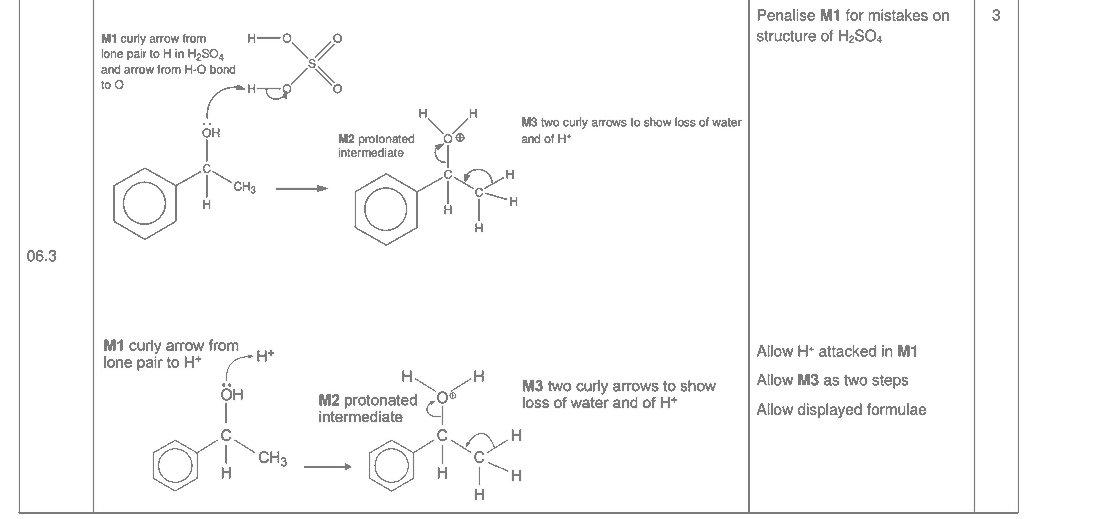
Elimination (dehydration). Curly arrow from a lone pair on the alcohol O to H of H2SO4 (or to H+), with an arrow from the H–O bond to O of the acid
protonated intermediate with –OH2+
then curly arrows from the C–O bond to O+ (loss of water) and from a C–H bond of the CH3 group into the C–C bond (loss of H+), giving phenylethene. Loss of water and H+ may be two steps. Mistakes in the H2SO4 structure lose the first mark. Poorly answered
November 2020 · AS Paper 2 · Q07.22 marksShort answer
Earlier part of question 07 that this part uses
Mark scheme
Notes from the mark scheme and report
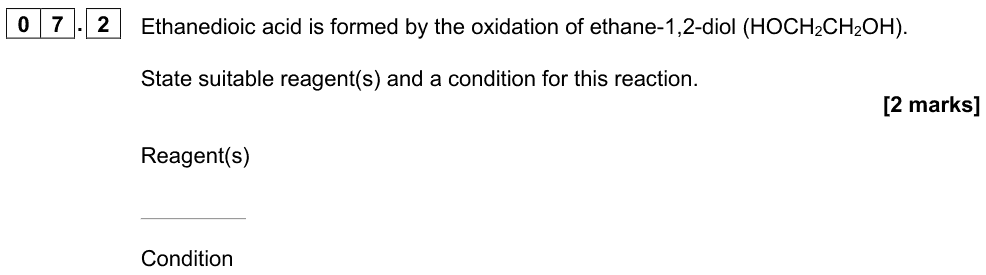
Acidified potassium dichromate(VI) (K2Cr2O7 with H2SO4)
heat under reflux. If an oxidation state is given it must be correct
the condition mark needs an attempt at an oxidising agent
November 2020 · AS Paper 2 · Q181 markMultiple choice
Answer
B
Mark scheme
Notes from the mark scheme and report
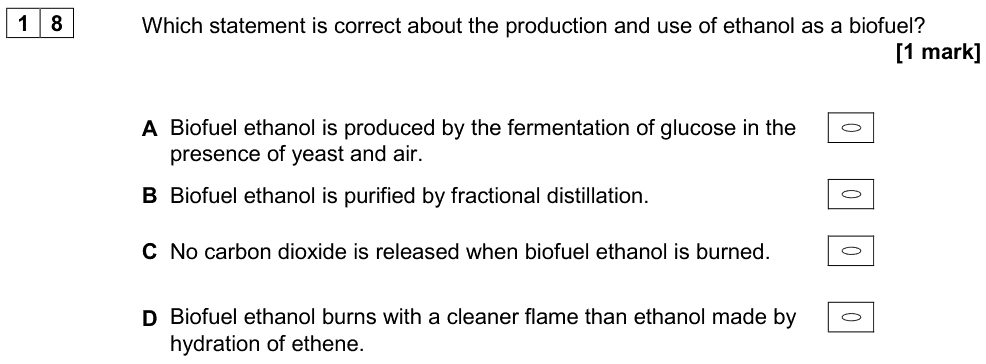
Answer: B. Fermentation is anaerobic (no air), burning ethanol does release CO2, and ethanol is the same compound however it is made
November 2020 · Paper 3 · Q251 markMultiple choice
Answer
B
Mark scheme
Notes from the mark scheme and report
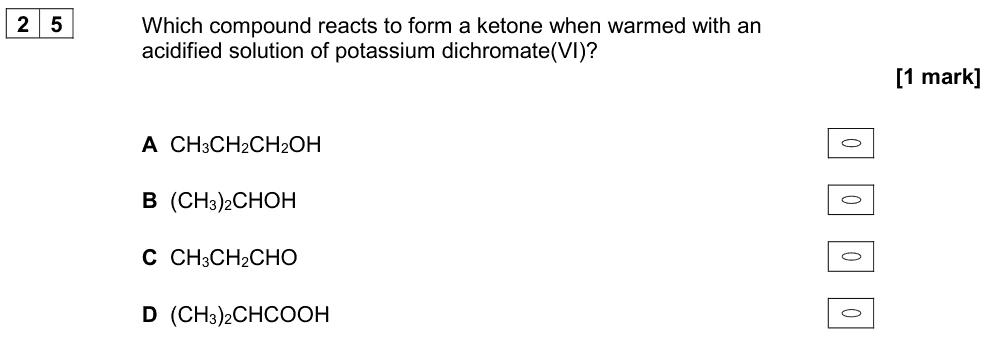
Answer: B. Propan-2-ol is a secondary alcohol, oxidised to propanone
A gives an aldehyde / acid, C gives an acid, D is not oxidised
June 2019 · AS Paper 2 · Q01.23 marksPractical and data analysis
Earlier part of question 01 that this part uses
Mark scheme
Examiner's comment
1.2 This question looked for a test to distinguish a ketone from an aldehyde. This was answered well, but many who used Fehling’s solution referred to a colour change and did not include the idea that a precipitate was formed.
Notes from the mark scheme and report
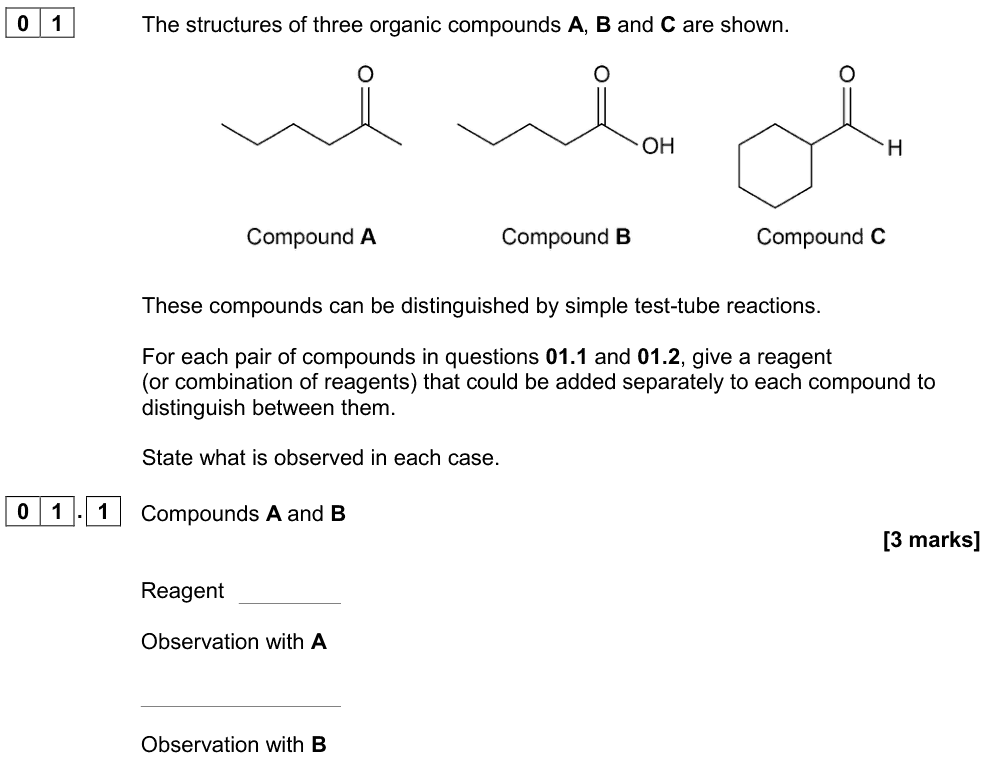
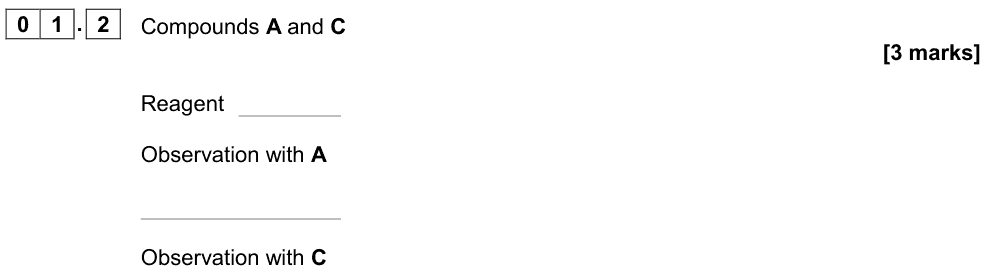
Ketone (A) v aldehyde (C). Tollens' reagent: A no visible change
C silver mirror. Or Fehling's solution: A stays blue
C red precipitate. Or acidified potassium dichromate(VI): A stays orange
C goes green. Wrong reagent = 0. With Fehling's, many gave a colour change without saying a precipitate forms
Skills: ATd Use laboratory apparatus for a variety of experimental techniques including: titration, using burette and pipette; distillation and heating under reflux, including setting up glassware using retort stand and clamps; qualitative tests for ions and organic functional groups; filtration, including use of fluted filter paper, or filtration under reduced pressure; PS1.1 Solve problems set in practical contexts; RP6 Tests for alcohol, aldehyde, alkene and carboxylic acid
June 2019 · Paper 2 · Q02.12 marksDiagram or structure
Mark scheme
Examiner's comment
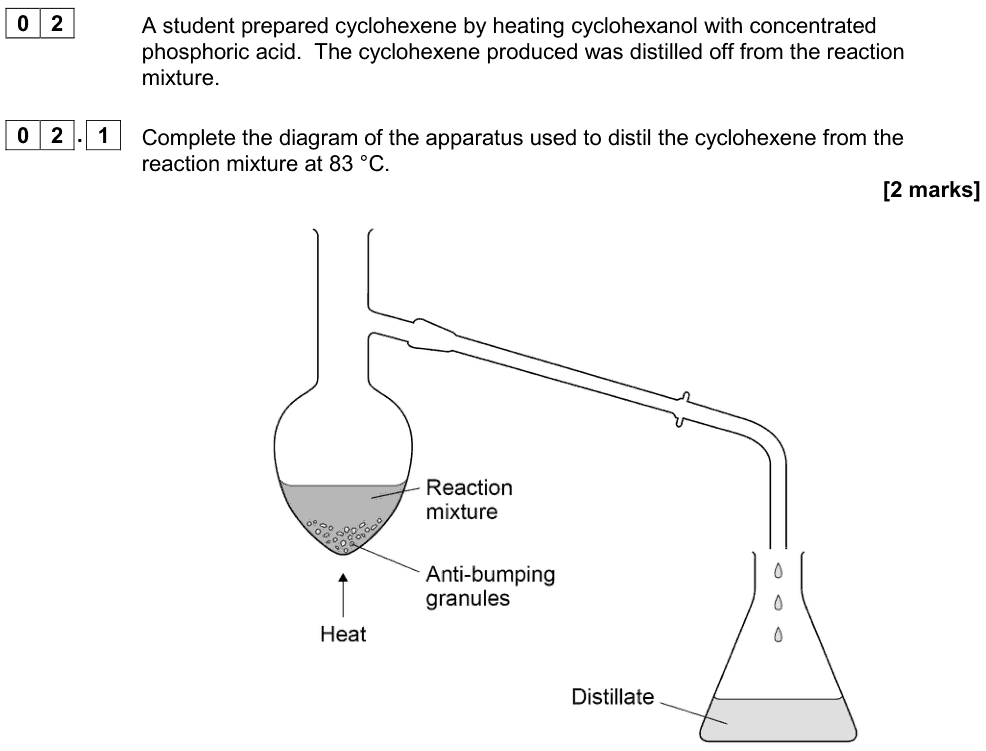
02.1 Most of this question was based on Required Practical Activity 5 example (a), from the Practical Handbook. Sadly, this experimental procedure did not seem familiar to many students and few completed the diagram correctly.
Notes from the mark scheme and report
Thermometer in a bung in the neck of the flask with its bulb level with the side arm
condenser water jacket drawn round the sloping tube with water in at the bottom and out at the top. Cross-section diagram, no gaps at joints. Few completed it correctly
Skills: ATd Use laboratory apparatus for a variety of experimental techniques including: titration, using burette and pipette; distillation and heating under reflux, including setting up glassware using retort stand and clamps; qualitative tests for ions and organic functional groups; filtration, including use of fluted filter paper, or filtration under reduced pressure; ATb Use water bath or electric heater or sand bath for heating; PS4.1 Know and understand how to use a wide range of experimental and practical instruments, equipment and techniques appropriate to the knowledge and understanding included in the specification; RP5 Distillation of a product from a reaction
June 2019 · Paper 2 · Q02.21 markPractical and data analysis
Earlier part of question 02 that this part uses
Mark scheme
Examiner's comment
02.2 & 3
Notes from the mark scheme and report
Cyclohexene and the aqueous solution are immiscible (do not mix, form two layers). Ignore density. Only the more able knew this
Skills: ATg Purify: a solid product by recrystallisation; a liquid product, including use of separating funnel; PS4.1 Know and understand how to use a wide range of experimental and practical instruments, equipment and techniques appropriate to the knowledge and understanding included in the specification; RP5 Distillation of a product from a reaction
June 2019 · Paper 2 · Q02.31 markPractical and data analysis
Earlier part of question 02 that this part uses
Mark scheme
Examiner's comment
02.1 Most of this question was based on Required Practical Activity 5 example (a), from the Practical Handbook. Sadly, this experimental procedure did not seem familiar to many students and few completed the diagram correctly.
02.2 & 3
Only the more able students knew that cyclohexene is immiscible with water and is a clear liquid when dry.
02.4 The calculation was answered well and over half of the students scored full marks. Others confused mass and volume or could not correctly rearrange the expression
for density.
02.5 The mechanism was usually answered well although the cyclic nature of the alkene confused several students who wrongly drew a substitution mechanism instead of electrophilic addition.
Students should be advised not to mix skeletal and structural formula types at a carbon. The intermediate carbocation in part five should not be written as structure A below. Correct possibilities are structure B (preferred) or structure C. Once a carbon atom is labelled as such, it must have the correct bonding as in C but not A.
A B C
C+
Br
Br
+
C+
Br
H
Notes from the mark scheme and report
The liquid goes clear (is no longer cloudy). 'Colourless' is ignored
Skills: ATg Purify: a solid product by recrystallisation; a liquid product, including use of separating funnel; PS4.1 Know and understand how to use a wide range of experimental and practical instruments, equipment and techniques appropriate to the knowledge and understanding included in the specification; RP5 Distillation of a product from a reaction
June 2019 · Paper 2 · Q06.13 marksPractical and data analysis
Mark scheme
Examiner's comment
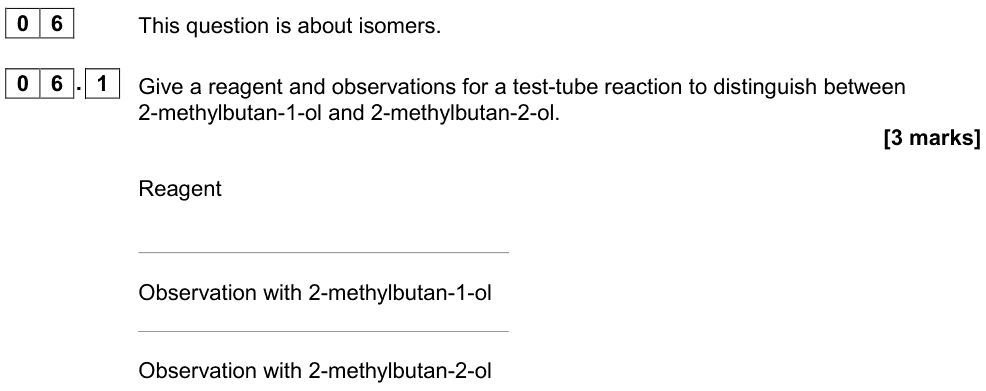
06.1 The first part of this question was well answered. Acidified potassium dichromate was the usual oxidising agent, although the ‘acidified’ was sometimes omitted so that the first mark was not gained. The question asked for ‘a test-tube reaction’ − singular − so that students who used two reagents, often Tollens’ after the acidified
Notes from the mark scheme and report
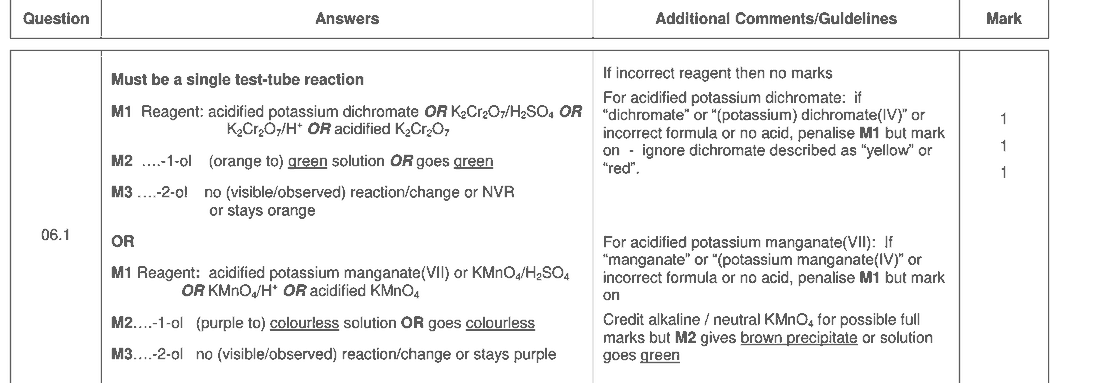
Acidified potassium dichromate(VI): 2-methylbutan-1-ol (primary) turns it from orange to green
2-methylbutan-2-ol (tertiary) gives no visible change (stays orange). Or acidified KMnO4: purple to colourless / stays purple. Must be a single test-tube reaction
'acidified' omitted loses M1
a wrong reagent scores 0. Some used two reagents (for example Tollens' afterwards)
Skills: ATd Use laboratory apparatus for a variety of experimental techniques including: titration, using burette and pipette; distillation and heating under reflux, including setting up glassware using retort stand and clamps; qualitative tests for ions and organic functional groups; filtration, including use of fluted filter paper, or filtration under reduced pressure; PS4.1 Know and understand how to use a wide range of experimental and practical instruments, equipment and techniques appropriate to the knowledge and understanding included in the specification; RP6 Tests for alcohol, aldehyde, alkene and carboxylic acid
June 2019 · AS Paper 2 · Q08.23 marksPractical and data analysis
Earlier part of question 08 that this part uses
Mark scheme
Examiner's comment
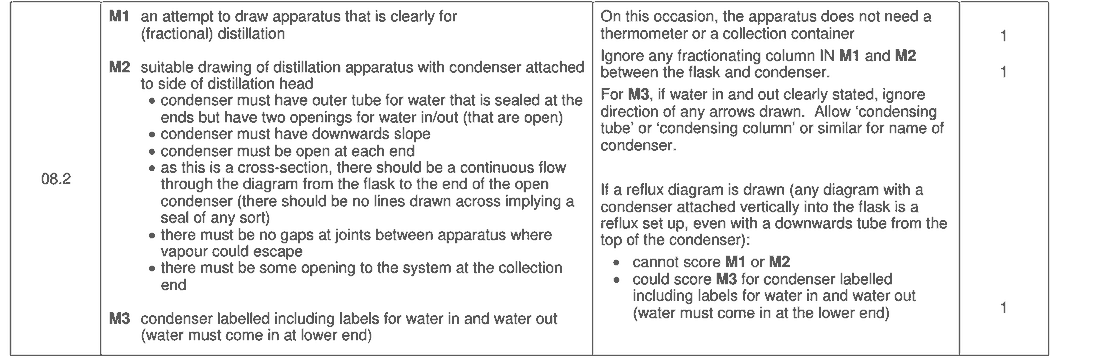
8.2 Many drew a reflux apparatus rather than a distillation apparatus, but even those who did draw a distillation gave inaccurate drawings. Diagrams must be in cross-section and so, in this example, there is a continuous flow through the apparatus from the flask to the receiver- container. The openings for water in the condenser should also be open and not closed as it is a cross-section. The water should enter the condenser at the bottom and not the top.
Notes from the mark scheme and report
Distillation, not reflux: still head with a condenser attached to the side and sloping downwards
water jacket sealed at the ends with open inlet and outlet
no gaps at the joints and a clear, open path from flask to the open end of the condenser
condenser labelled with water in at the lower end and water out at the top. Thermometer and receiver not needed. Many drew reflux, or blocked the path / closed the system
Skills: ATd Use laboratory apparatus for a variety of experimental techniques including: titration, using burette and pipette; distillation and heating under reflux, including setting up glassware using retort stand and clamps; qualitative tests for ions and organic functional groups; filtration, including use of fluted filter paper, or filtration under reduced pressure; PS4.1 Know and understand how to use a wide range of experimental and practical instruments, equipment and techniques appropriate to the knowledge and understanding included in the specification; RP5 Distillation of a product from a reaction
June 2019 · AS Paper 2 · Q181 markMultiple choice
Answer
D
Mark scheme
Examiner's comment
Students found this question more challenging. It would help students if they drew structures.
Notes from the mark scheme and report
Answer: D. The ketone 3-methylbutan-2-one comes from the secondary alcohol 3-methylbutan-2-ol
A and B are primary, C is tertiary. Drawing the structures helps
June 2019 · AS Paper 2 · Q201 markMultiple choice
Answer
D
Mark scheme
Examiner's comment
This was answered correctly by a good majority of students.
Notes from the mark scheme and report
Answer: D. Pentan-2-ol can lose H from C1 or C3, giving pent-1-ene and pent-2-ene (E and Z)
the others give one alkene
June 2019 · Paper 3 · Q04.32 marksShort answer
Earlier part of question 04 that this part uses
Mark scheme
Examiner's comment
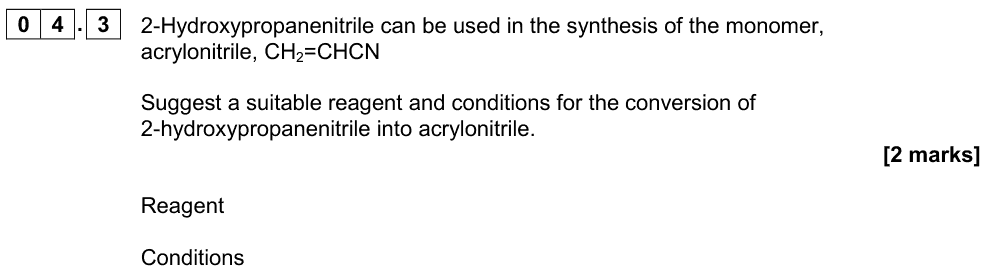
4.3 It was clear from the structures drawn in 04.2 that most students knew the structure of 2-hydroxypropanenitrile but, despite that, many here failed to recognise that this involved the dehydration of an alcohol to an alkene. Some students seemed to confuse the reaction with the elimination reaction that converts a halogenoalkane to an alkene.
Notes from the mark scheme and report
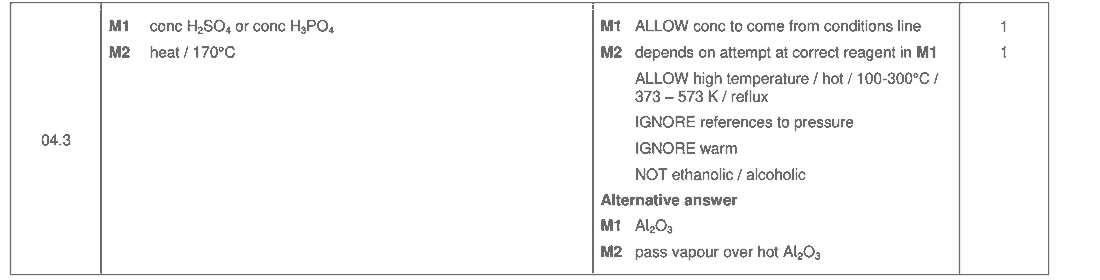
Concentrated H2SO4 (or concentrated H3PO4)
heat (about 170 °C). Alternative: pass the vapour over hot Al2O3. It is dehydration of an alcohol
not ethanolic conditions (confusion with elimination from a halogenoalkane)
June 2019 · Paper 3 · Q221 markMultiple choice
Answer
C
Mark scheme
Notes from the mark scheme and report
Answer: C. 1-phenylethanol, C6H5CH(OH)CH3, is a secondary alcohol, so it is oxidised to the ketone C6H5COCH3
June 2019 · Paper 3 · Q321 markMultiple choice
Answer
A
Mark scheme
Notes from the mark scheme and report
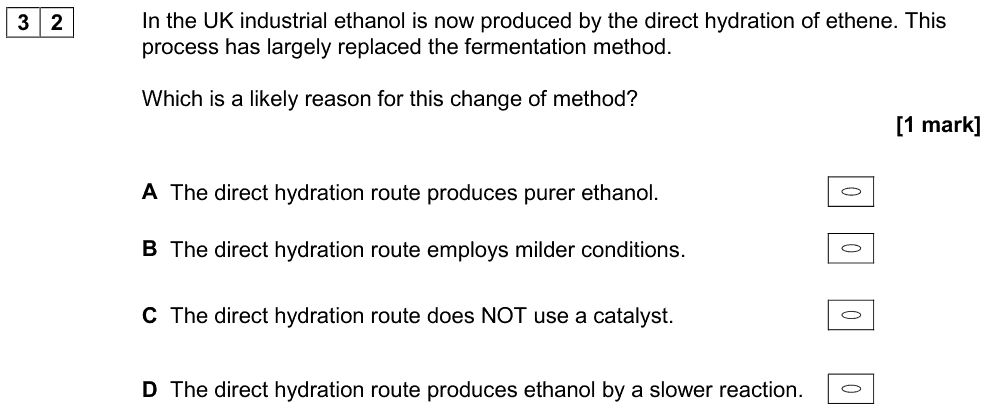
Answer: A. Hydration of ethene gives purer ethanol
it needs harsher conditions, uses a catalyst and is faster
June 2018 · Paper 2 · Q02.31 markDiagram or structure
Earlier part of question 02 that this part uses
Mark scheme
Examiner's comment
02.3 This question was answered correctly by 39.4% of the students. Others identified the correct molecule but did not draw it as a displayed formula; −CH3 was the most common error here. Some students drew an −OH group and a −C=O group in the same molecule, rather than two aldehyde groups; another common mistake was to draw butanedial.
Notes from the mark scheme and report
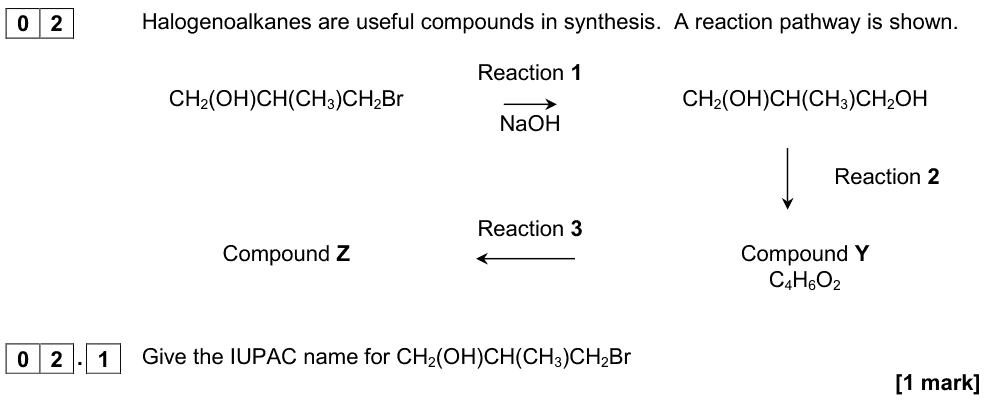
Y is methylpropanedial, OHC–CH(CH3)–CHO, drawn fully displayed with every bond shown (both CH2OH groups oxidised to CHO
C=O absorbs at 1680 to 1750 cm–1). Errors: –CH3 not displayed
one OH and one C=O
butanedial
June 2018 · Paper 2 · Q03.22 marksPractical and data analysisHard
Earlier part of question 03 that this part uses
Mark scheme
Examiner's comment
03.2 Very few students (4%) scored both marks in this question and only 39.2% scored at least one mark, despite the question being based on one of the required practical activities.
Notes from the mark scheme and report
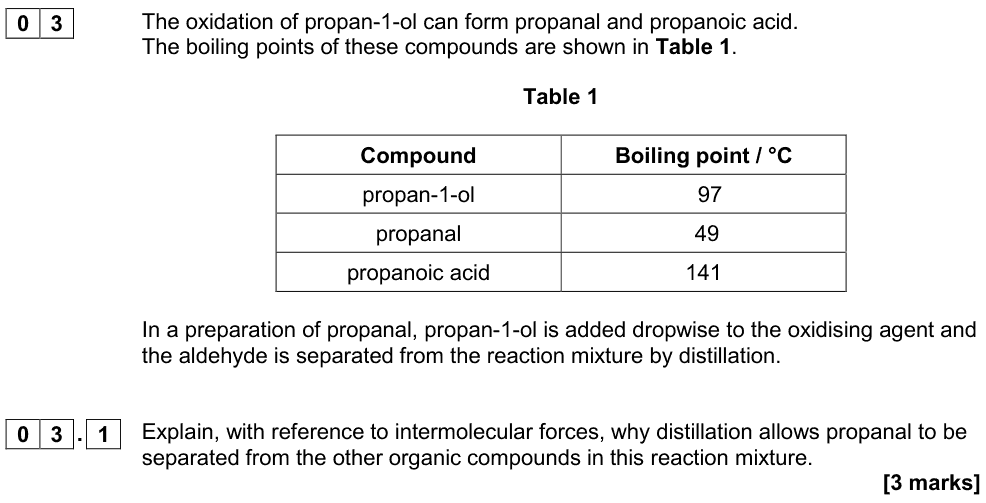
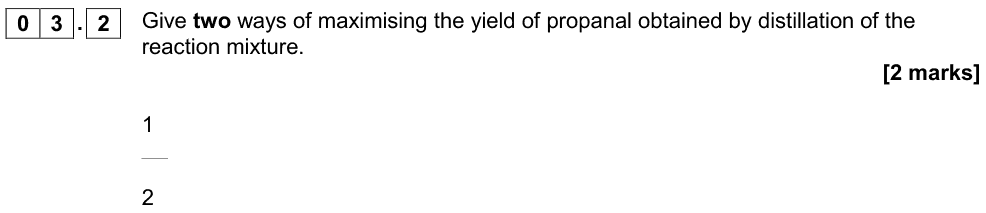
Keep the temperature of the reaction mixture below the boiling point of propan-1-ol (between 49 and 96 °C)
cool the distillate / collecting vessel (eg in ice). A lid or sealed container is penalised
Skills: ATd Use laboratory apparatus for a variety of experimental techniques including: titration, using burette and pipette; distillation and heating under reflux, including setting up glassware using retort stand and clamps; qualitative tests for ions and organic functional groups; filtration, including use of fluted filter paper, or filtration under reduced pressure; PS4.1 Know and understand how to use a wide range of experimental and practical instruments, equipment and techniques appropriate to the knowledge and understanding included in the specification; PS2.1 Comment on experimental design and evaluate scientific methods; RP5 Distillation of a product from a reaction
June 2018 · Paper 2 · Q03.54 marksMechanismHard
Earlier part of question 03 that this part uses
Mark scheme
Examiner's comment
03.5 The major errors in the answers to this acid-catalysed elimination of water were where students confused this mechanism with the elimination of HX from a halogenoalkane using a base. However, just under a third of students scored full marks in a correct mechanism, either via the formation of a carbocation or by showing the simultaneous loss of water and H+ from a protonated alcohol.
Notes from the mark scheme and report
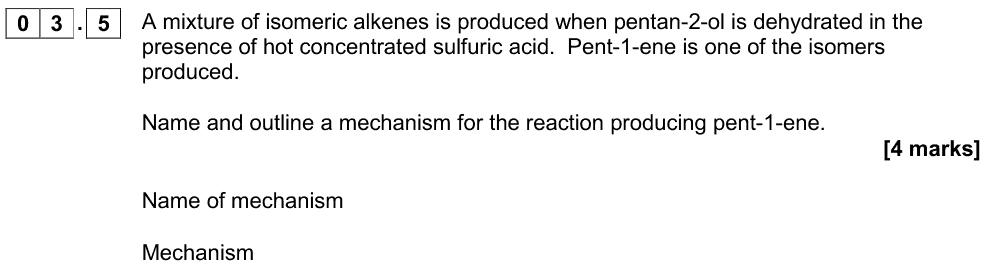
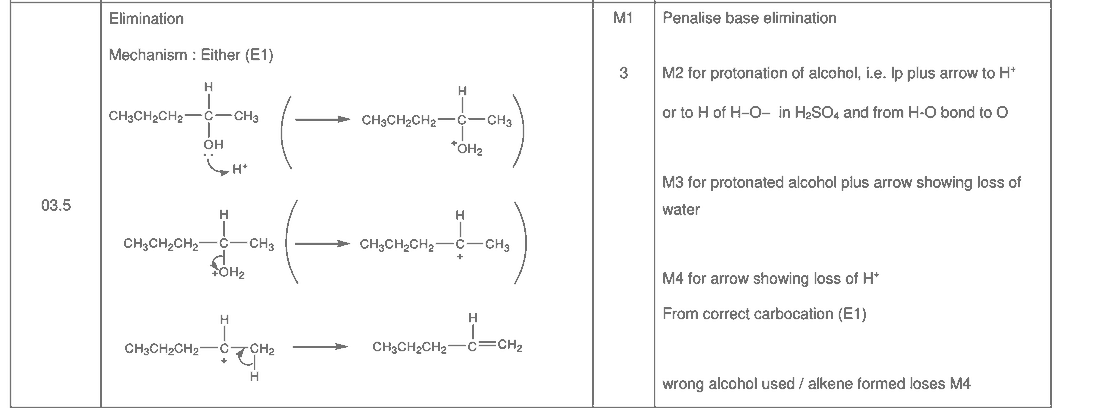
Elimination. Lone pair on the O of pentan-2-ol attacks H+ (protonation, giving –OH2+)
curly arrow from the C–O bond to O+ (loss of water)
curly arrow from a C–H bond of the CH3 group into the C–C bond (loss of H+) giving CH2=CHCH2CH2CH3. Either stepwise through the secondary carbocation or with water and H+ lost together. Base elimination (as for halogenoalkanes) is penalised
June 2018 · AS Paper 2 · Q07.16 marks6-mark level of response
Mark scheme, with the levels and indicative content
Examiner's comment
07.1 Many students approached this question as if they already knew which compound was which. They did not appreciate the need to carry out the first test with all four compounds to start to work out which is which. Many used the test with acidified potassium dichromate(VI) but did not realise that butanal as well as butan-2-ol would react. Few successfully identified two compounds using two test tube reactions, leaving the other two compounds to be distinguished by IR spectroscopy or mass spectrometry. Many did not explain how one of these spectroscopic methods could actually be used to distinguish the final two compounds. Overall, though, the question discriminated well.
Notes from the mark scheme and report
Levels of response, three stages
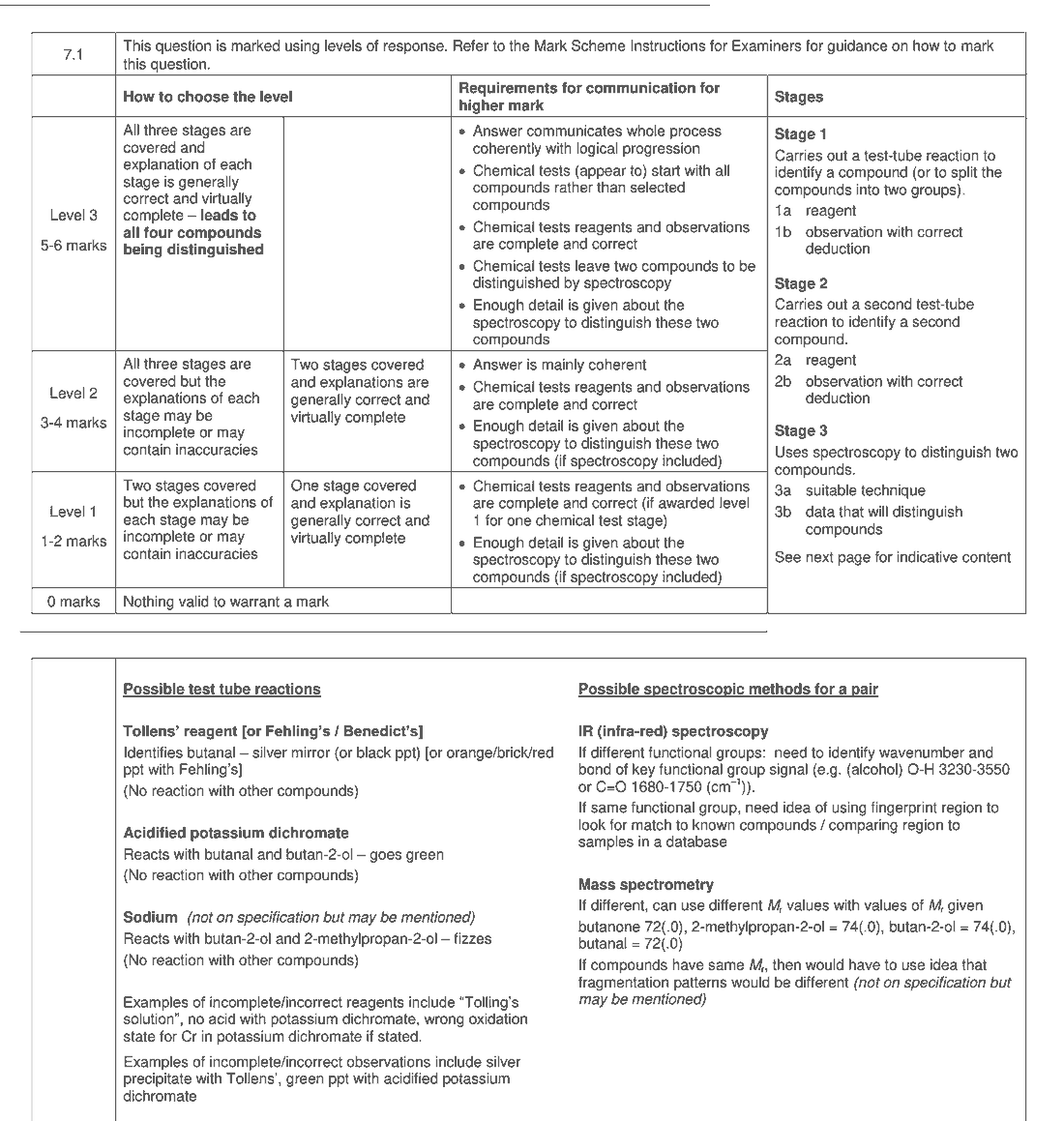
test all four liquids each time. Test 1: warm with Tollens' reagent (or Fehling's): only butanal gives a silver mirror (or brick-red precipitate). Test 2: warm with acidified potassium dichromate(VI): butanal and butan-2-ol turn it from orange to green, so butan-2-ol is the one that goes green but gave no silver mirror. Spectroscopy for butanone and 2-methylpropan-2-ol: infrared, C=O at 1680–1750 cm–1 for butanone and O–H at 3230–3550 cm–1 for the alcohol
or mass spectrometry, Mr 72 against 74. Errors: treating the compounds as already known
forgetting butanal also reacts with dichromate
'silver precipitate'
no acid with the dichromate
naming a technique without the data that distinguishes
Skills: PS1.1 Solve problems set in practical contexts; PS4.1 Know and understand how to use a wide range of experimental and practical instruments, equipment and techniques appropriate to the knowledge and understanding included in the specification; RP6 Tests for alcohol, aldehyde, alkene and carboxylic acid
June 2018 · AS Paper 2 · Q121 markMultiple choiceEasy
Answer
C
Mark scheme
Examiner's comment
Most students (60.1%) could use Le Chatelier’s principle to deduce which statement was correct.
Notes from the mark scheme and report
Answer: C. The forward reaction is exothermic, so a higher temperature shifts the equilibrium to the left and lowers the yield
June 2017 · AS Paper 2 · Q07.14 marksMechanism
Mark scheme
Examiner's comment
07.1 The first use of a mechanism with skeletal structures proved to be challenging for many students, even with the framework provided.
Notes from the mark scheme and report
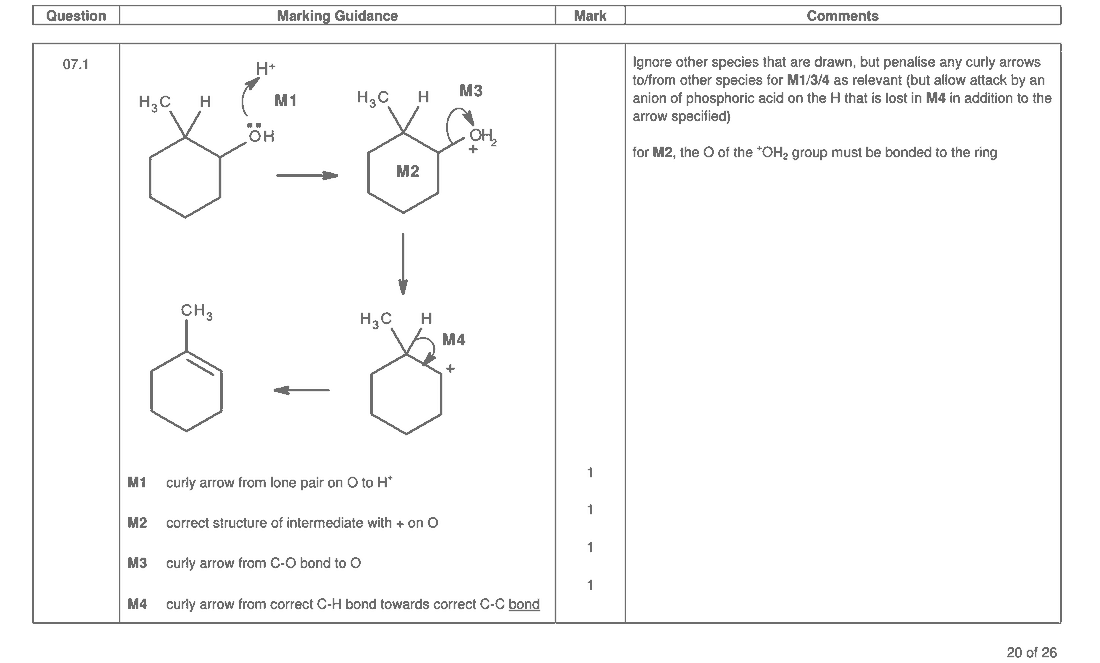
M1 curly arrow from the lone pair on O to H+
M2 intermediate with –OH2+ bonded to the ring (+ on O)
M3 curly arrow from the C–O bond to O
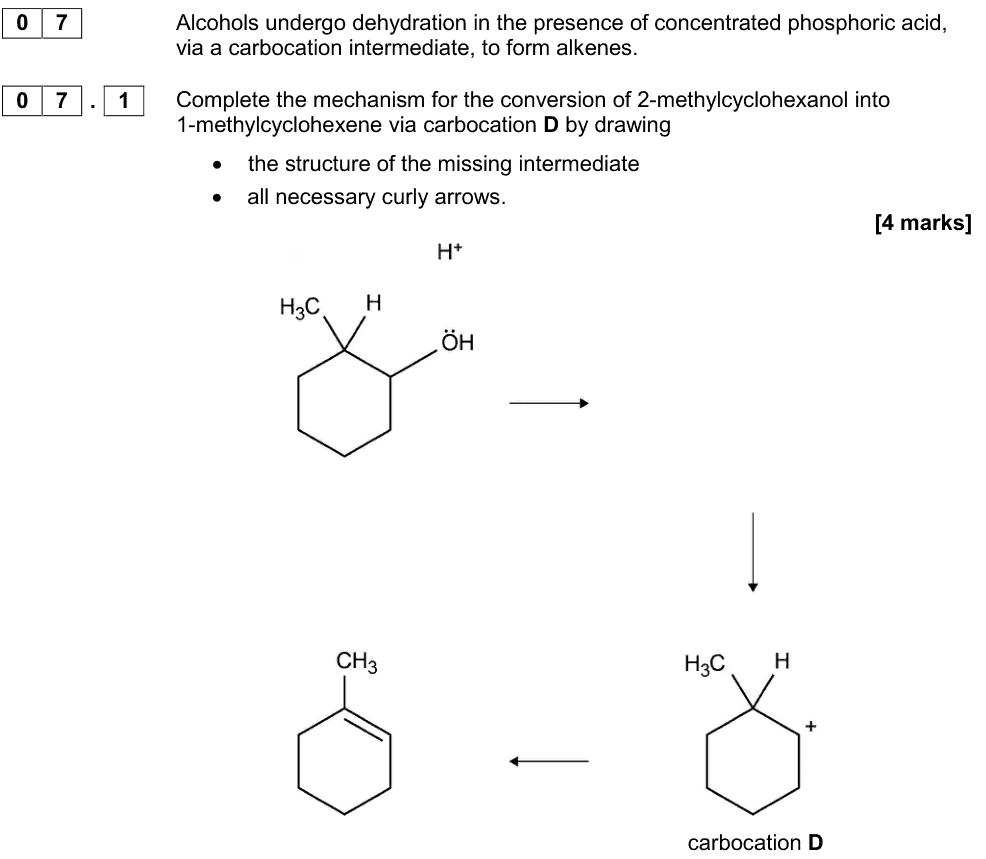
M4 curly arrow from the correct C–H bond (on the carbon bearing CH3) to the C–C bond that becomes C=C. Arrows to or from other species are penalised
June 2017 · AS Paper 2 · Q07.21 markDiagram or structure
Earlier part of question 07 that this part uses
Mark scheme
Examiner's comment
07.2 While this was challenging, many students could work out the structure of the alternative product.
Notes from the mark scheme and report
3-Methylcyclohexene (the double bond forms on the other side of the positive carbon, away from the CH3 carbon). Any correct structural representation
June 2017 · AS Paper 2 · Q07.41 markDiagram or structure
Earlier part of question 07 that this part uses
Mark scheme
Examiner's comment
07.4 This was a very challenging question and only the best students could deduce the structure.
Notes from the mark scheme and report
Methylenecyclohexane (a ring with an exocyclic C=CH2), formed by losing H+ from the CH3 group of carbocation E. Only the best students deduced it
June 2017 · AS Paper 2 · Q171 markMultiple choice
Answer
B
Mark scheme
Examiner's comment
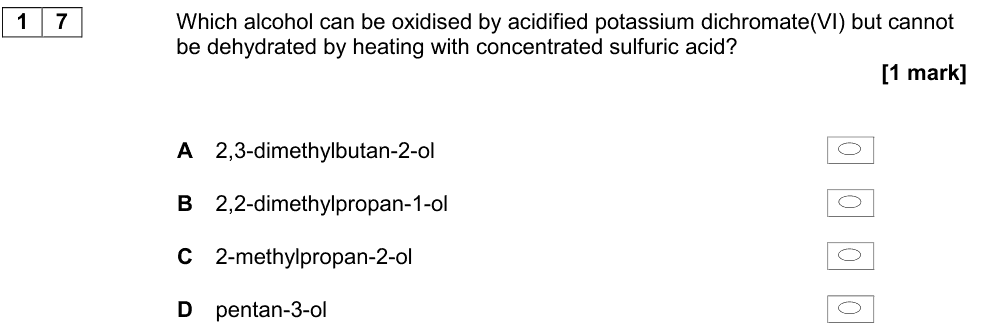
A good number of students (41.3%) could work out which alcohol could be oxidised but not dehydrated, but many could not – possibly due to a lack of appreciation of the need for the presence of a hydrogen atom on the carbon atom adjacent to the carbon with the alcohol group.
Notes from the mark scheme and report
Answer: B. 2,2-Dimethylpropan-1-ol is primary, so it can be oxidised, but the carbon next to the C–OH carbon has no hydrogen, so water cannot be eliminated. A and C are tertiary (not oxidised)
June 2017 · Paper 3 · Q02.53 marksDiagram or structure
Earlier part of question 02 that this part uses
Mark scheme
Examiner's comment
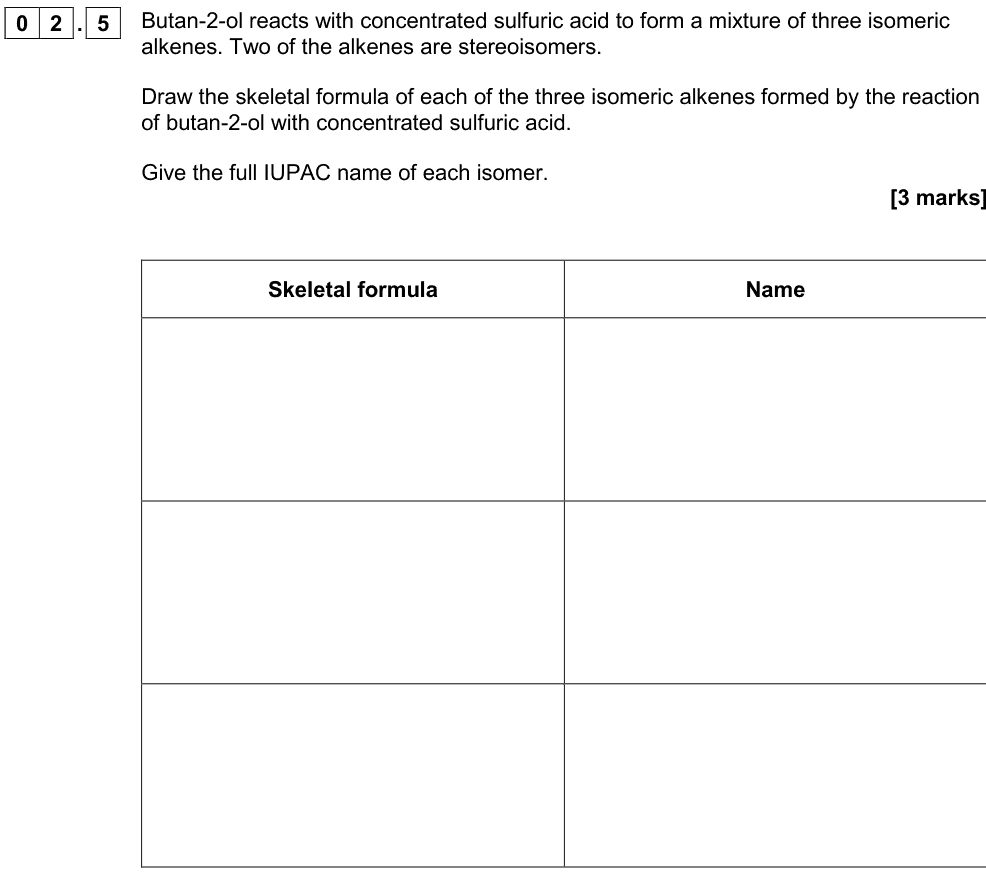
02.5 This was another question that proved trickier than expected, with a roughly even split between 0, 1, 2 and 3 marks. ‘Butan’ or ‘bute’ were often seen as incorrect stems of names and a very common error was for the same isomer of but-2-ene to be drawn twice, with one named as Z-but-2-ene and the other as E-but-2-ene.
Notes from the mark scheme and report
But-1-ene
E-but-2-ene
Z-but-2-ene: each skeletal formula with its matching name scores 1. cis / trans scores 1 of the 2 marks for the but-2-enes. Errors: the same but-2-ene drawn twice with different labels
wrong stems ('butan', 'bute')
Skills: MS4.2 Visualise and represent 2D and 3D forms including two-dimensional representations of 3D objects
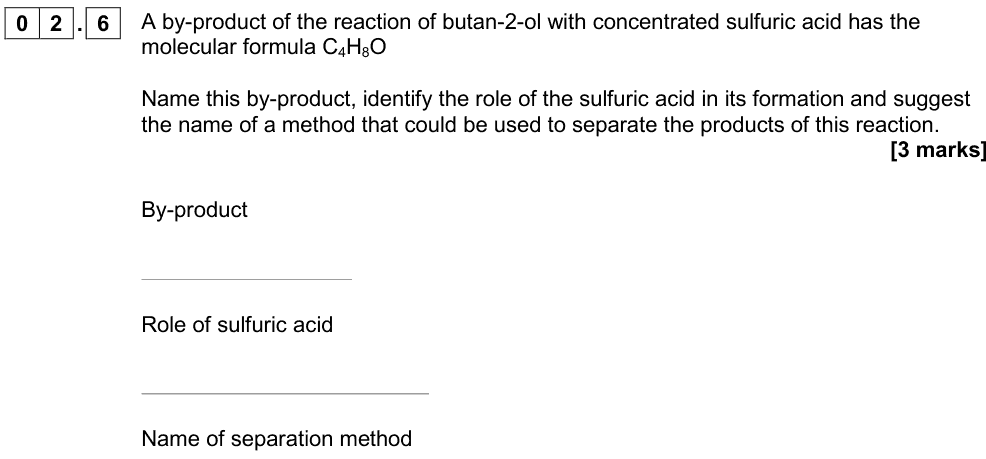
June 2017 · Paper 3 · Q02.63 marksShort answer
Earlier part of question 02 that this part uses
Mark scheme
Examiner's comment
02.6 Butanal was a common wrong answer for the by-product and the fact that sulfuric acid acts as an oxidising agent was not well recognised.
Notes from the mark scheme and report
Butanone
sulfuric acid acts as an oxidising agent (electron acceptor)
(fractional) distillation. Common wrong answers: butanal (a secondary alcohol gives a ketone)
reflux named as a separation method
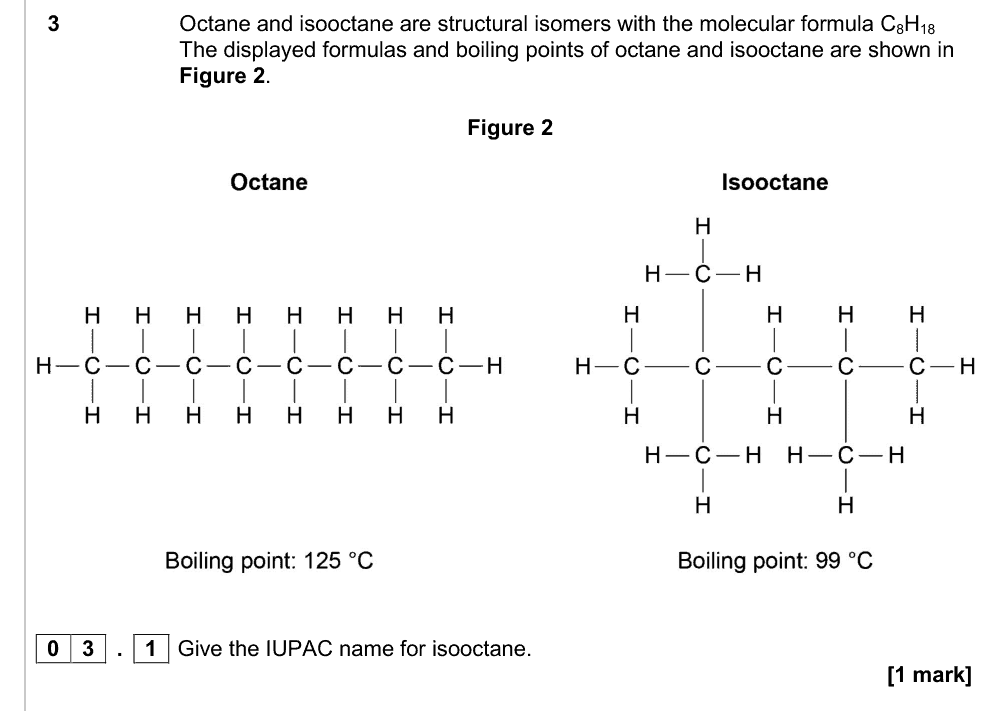
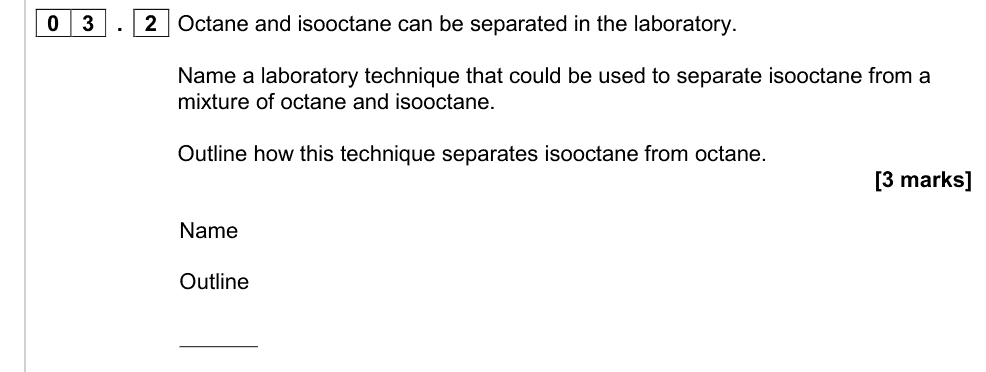
June 2016 · AS Paper 2 · Q03.23 marksPractical and data analysis
Earlier part of question 03 that this part uses
Mark scheme
Examiner's comment
Most students realised that simple or fractional distillation could be used in Q3.2.
However, many referred to the industrial fractional distillation process where the entire mixture is vaporised and then fed into a fractional column with a temperature gradient and collection trays, rather than referring to an apparatus that would be used in the laboratory.
This may suggest a lack of familiarity with carrying this out in the laboratory.
Notes from the mark scheme and report
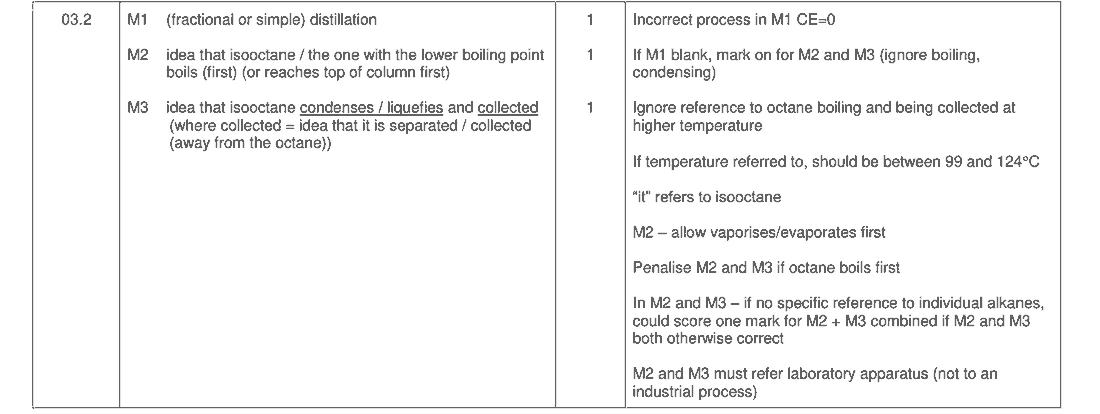
(Fractional or simple) distillation
isooctane has the lower boiling point (99 °C) so it boils / vaporises first
its vapour is condensed and collected separately from the octane. A wrong technique is CE = 0. Must describe laboratory apparatus: many described the industrial fractionating column instead
Skills: ATd Use laboratory apparatus for a variety of experimental techniques including: titration, using burette and pipette; distillation and heating under reflux, including setting up glassware using retort stand and clamps; qualitative tests for ions and organic functional groups; filtration, including use of fluted filter paper, or filtration under reduced pressure; PS4.1 Know and understand how to use a wide range of experimental and practical instruments, equipment and techniques appropriate to the knowledge and understanding included in the specification; PS1.2 Apply scientific knowledge to practical contexts; RP5 Distillation of a product from a reaction
June 2016 · AS Paper 2 · Q06.22 marksEquation writing
Earlier part of question 06 that this part uses
Mark scheme
Examiner's comment
Q6.2 question proved to be very challenging with few students appreciating that both alcohol groups would be oxidised, and very few of those being able to balance the equation.
Notes from the mark scheme and report
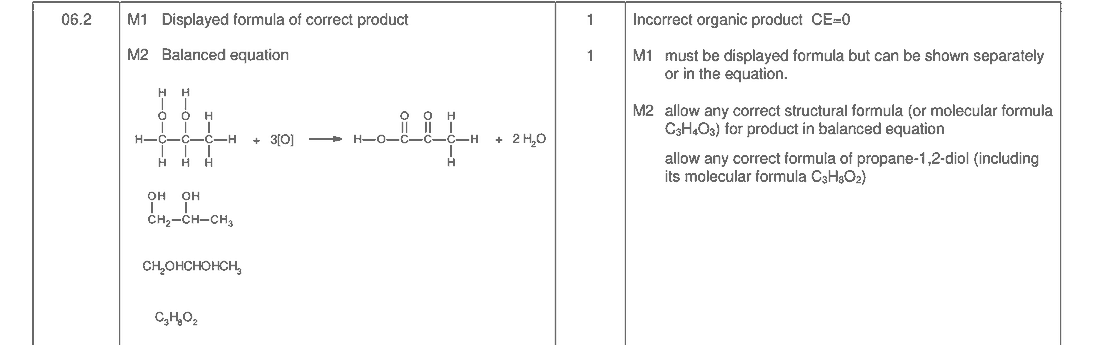
Both alcohol groups are oxidised: CH2(OH)CH(OH)CH3 + 3[O] → CH3COCOOH + 2H2O. Product is 2-oxopropanoic acid, displayed with the ketone C=O on carbon 2 and the COOH group fully drawn out. A wrong organic product is CE = 0. Very few oxidised both groups or balanced the equation
June 2016 · AS Paper 2 · Q06.32 marksDiagram or structure
Earlier part of question 06 that this part uses
Mark scheme
Examiner's comment
The quality of the diagrams in Q6.3 was very poor and this is an area for students to work on.
Many did not appear to know what refluxing was in the first place.
Those that did often sealed the reflux condenser in some way, often with a bung.
Openings were rarely shown for the water to enter and leave the condenser.
Diagrams were also poorly labelled.
Students are not expected to produce a work of art.
Rough sketches can score but they must allow a way for chemicals to move through the apparatus.
Very few students answered
Notes from the mark scheme and report
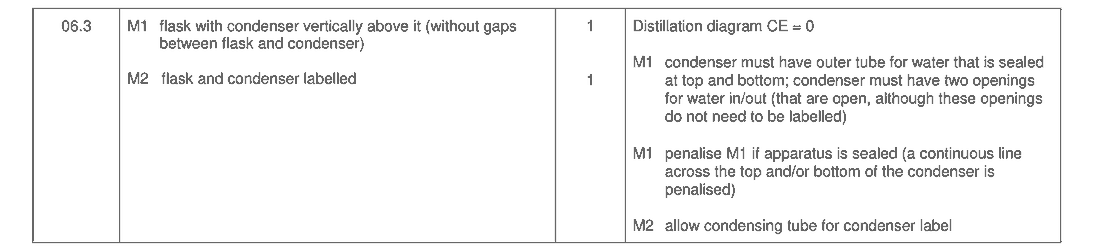
Flask with a condenser fitted vertically above it, no gaps at the joint
condenser has a water jacket with two openings (water in and out)
apparatus open at the top (a bung or sealing line loses M1)
flask and condenser labelled. A distillation diagram is CE = 0. Diagrams were very poor: sealed apparatus and missing water connections were common
Skills: ATb Use water bath or electric heater or sand bath for heating; ATd Use laboratory apparatus for a variety of experimental techniques including: titration, using burette and pipette; distillation and heating under reflux, including setting up glassware using retort stand and clamps; qualitative tests for ions and organic functional groups; filtration, including use of fluted filter paper, or filtration under reduced pressure; PS4.1 Know and understand how to use a wide range of experimental and practical instruments, equipment and techniques appropriate to the knowledge and understanding included in the specification
June 2016 · AS Paper 2 · Q06.41 markPractical and data analysis
Earlier part of question 06 that this part uses
Mark scheme
Examiner's comment
Q6.4 by stating that anti-bumping granules lead to smaller bubbles, even though this question has appeared on previous EMPA/ISA papers and even though students should have used them in practical work.
This question again showed the importance of students doing and understanding practical work.
Notes from the mark scheme and report
They cause small(er) bubbles to form / prevent large bubbles forming, so the liquid boils smoothly. Very few gave this
Skills: ATd Use laboratory apparatus for a variety of experimental techniques including: titration, using burette and pipette; distillation and heating under reflux, including setting up glassware using retort stand and clamps; qualitative tests for ions and organic functional groups; filtration, including use of fluted filter paper, or filtration under reduced pressure; ATk Safely and carefully handle solids and liquids, including corrosive, irritant, flammable and toxic substances; PS4.1 Know and understand how to use a wide range of experimental and practical instruments, equipment and techniques appropriate to the knowledge and understanding included in the specification
June 2016 · AS Paper 2 · Q06.51 markDiagram or structure
Earlier part of question 06 that this part uses
Mark scheme
Examiner's comment
Q6.5 was answered better with a reasonable number of students drawing a correct oxidation product.
Notes from the mark scheme and report
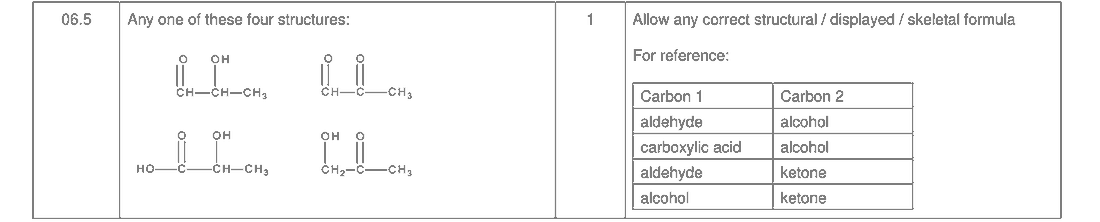
Any one partial oxidation product: CH3CH(OH)CHO, CH3CH(OH)COOH, CH3COCH2OH or CH3COCHO (carbon 1 to an aldehyde or acid and/or carbon 2 to a ketone, but not the fully oxidised product of 06.2).
June 2016 · AS Paper 2 · Q091 markMultiple choice
Answer
C
Mark scheme
Examiner's comment
Students generally did well on Q11 but many gave answers that demonstrated a lack of understanding about how to calculate percentage yield by dividing the mass of the product by the mass of the starting material. Students found Q19 challenging suggesting that this is a skill that they need to practise more, ultimately to have success in extended questions on calculating equilibrium constants. Many students were distracted by incorrect responses to Q21 due to a misunderstanding of the factors that affect the value of the equilibrium constant. Q22 involved several steps and many went wrong as they effectively used ∆H = [Sum bond enthalpies products] – [Sum bond enthalpies reactants] instead of ∆H = [Sum bond enthalpies reactants] – [Sum bond enthalpies products]. Q23 proved to be the most challenging multiple choice question. Errors may have stemmed from some students running short of time and/or not using SI units in the calculations.
Notes from the mark scheme and report
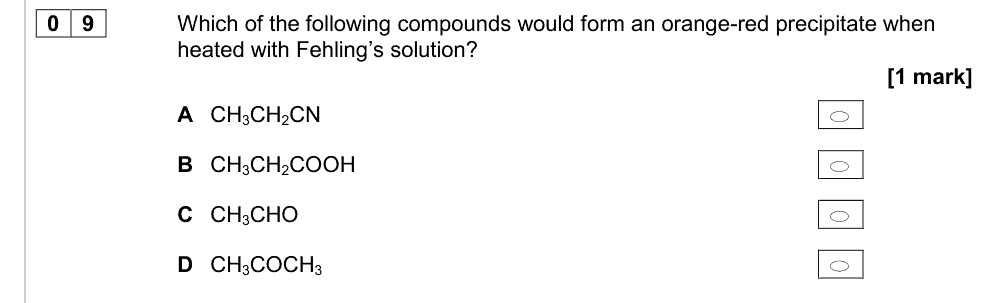
Answer: C. Ethanal is an aldehyde and reduces Fehling's solution to an orange-red precipitate (copper(I) oxide)
nitriles, carboxylic acids and ketones do not
Skills: RP6 Tests for alcohol, aldehyde, alkene and carboxylic acid
Specimen · Paper 1 · Q04.31 markAO3=1Short answer
Earlier part of question 04 that this part uses
Mark scheme
Notes from the mark scheme and report
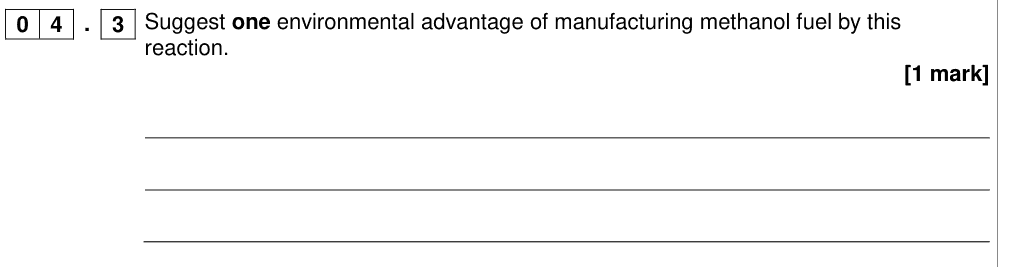
The carbon dioxide released when the methanol is burned is the carbon dioxide used up in making it (no net CO2 emission)
Specimen · Paper 2 · Q04.21 markAO2=1Diagram or structure
Earlier part of question 04 that this part uses
Mark scheme
Notes from the mark scheme and report
(CH3)2CHCOCH3 (3-methylbutan-2-one): the secondary alcohol is oxidised to a ketone
Specimen · Paper 2 · Q04.31 markAO1=1Short answer
Earlier part of question 04 that this part uses
Mark scheme
Notes from the mark scheme and report
Elimination
Specimen · Paper 2 · Q04.42 marksAO2=2Diagram or structure
Earlier part of question 04 that this part uses
Mark scheme
Notes from the mark scheme and report
(CH3)2C=CHCH3 (2-methylbut-2-ene) and (CH3)2CHCH=CH2 (3-methylbut-1-ene), one mark each
Specimen · Paper 2 · Q04.71 markAO2=1Diagram or structure
Earlier part of question 04 that this part uses
Mark scheme
Notes from the mark scheme and report
(CH3)2C(OH)CH2CH3 (2-methylbutan-2-ol, the tertiary alcohol)
Specimen · Paper 2 · Q04.81 markAO2=1Diagram or structure
Earlier part of question 04 that this part uses
Mark scheme
Notes from the mark scheme and report
(CH3)3CCH2OH (2,2-dimethylpropan-1-ol): the carbon next to the C–OH carbon has no hydrogen
Specimen · Paper 3 · Q01.13 marksPractical and data analysis
Mark scheme
Notes from the mark scheme and report
Reflux: the mixture of liquids is heated at its boiling point for a prolonged time
the vapour that forms is condensed and returns to the reaction mixture
so any ethanal (and ethanol) that evaporates is returned and can be oxidised further to ethanoic acid
Skills: ATd Use laboratory apparatus for a variety of experimental techniques including: titration, using burette and pipette; distillation and heating under reflux, including setting up glassware using retort stand and clamps; qualitative tests for ions and organic functional groups; filtration, including use of fluted filter paper, or filtration under reduced pressure; PS4.1 Know and understand how to use a wide range of experimental and practical instruments, equipment and techniques appropriate to the knowledge and understanding included in the specification
Specimen · Paper 3 · Q01.35 marksPractical and data analysis
Earlier part of question 01 that this part uses
Mark scheme
Notes from the mark scheme and report
(Fractional) distillation: heat the mixture in a suitable flask
still head fitted with a thermometer
water-cooled condenser connected to the still head, leading to a collecting vessel
collect the fraction that distils at the boiling point of ethanal (21 °C)
cool the collecting vessel (eg in ice) to reduce evaporation of ethanal. A labelled sketch showing these points scores
Skills: ATd Use laboratory apparatus for a variety of experimental techniques including: titration, using burette and pipette; distillation and heating under reflux, including setting up glassware using retort stand and clamps; qualitative tests for ions and organic functional groups; filtration, including use of fluted filter paper, or filtration under reduced pressure; ATb Use water bath or electric heater or sand bath for heating; PS4.1 Know and understand how to use a wide range of experimental and practical instruments, equipment and techniques appropriate to the knowledge and understanding included in the specification; RP5 Distillation of a product from a reaction
Specimen · Paper 3 · Q291 markAO3=1Multiple choice
Answer
B
Mark scheme
Notes from the mark scheme and report
Answer: B. 2-Methylbutan-2-ol is a tertiary alcohol
reduction of aldehydes gives primary alcohols and of ketones gives secondary alcohols
Work with an A-level chemistry tutor
Dropping marks on calculations, mechanisms or the required practicals? Book a trial session with a specialist A-level chemistry tutor.