3.3.9.2-02 The nucleophilic addition–elimination reactions of water, alcohols, ammonia and primary amines with acyl chlorides and acid anhydrides.
3.3.9.2-03 The industrial advantages of ethanoic anhydride over ethanoyl chloride in the manufacture of the drug aspirin.
3.3.9.2-04 Students should be able to outline the mechanism of nucleophilic addition–elimination reactions of acyl chlorides with water, alcohols, ammonia and primary amines.
3.3.9.2-05 Required practical 10 Preparation of: • a pure organic solid and test of its purity • a pure organic liquid.
Six-mark level of response questions on this topic
Tap a question to zoom it. Where a part needs a figure, table or structure from earlier in the question, that part folds out above it; the mark scheme and examiner's comment open underneath. Have AQA's Data Booklet (the Periodic Table and the spectroscopy tables) beside you.
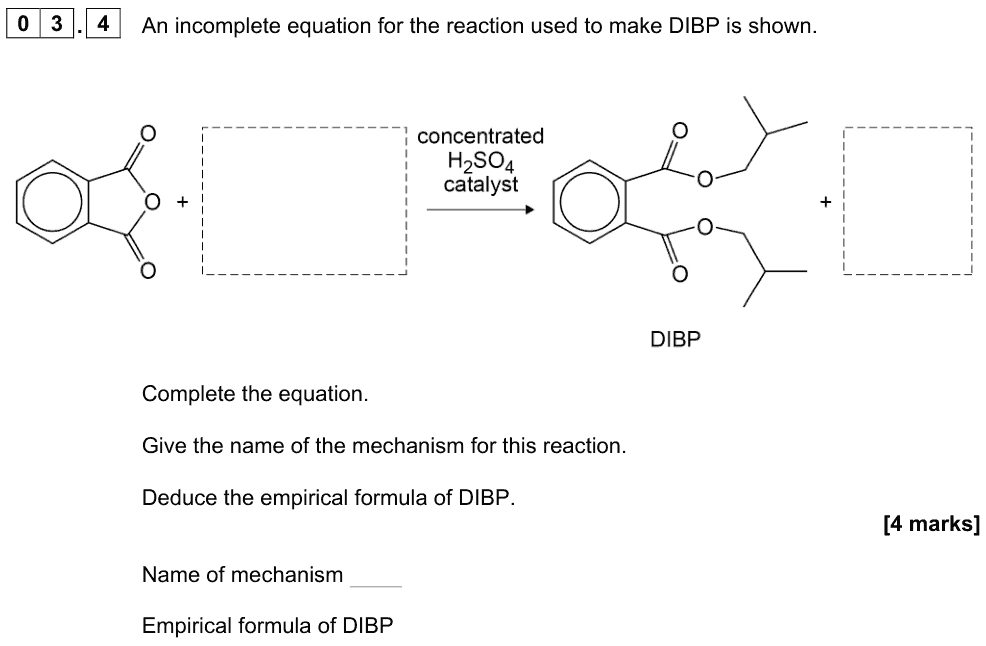
June 2025 · Paper 2 · Q03.44 marksAO1=1, AO2=3Equation writing
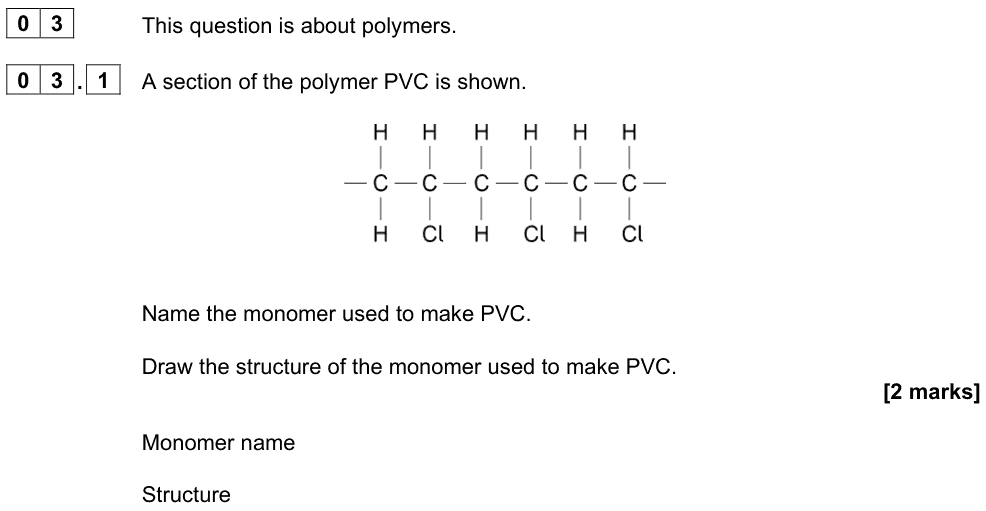
Earlier part of question 03 that this part uses
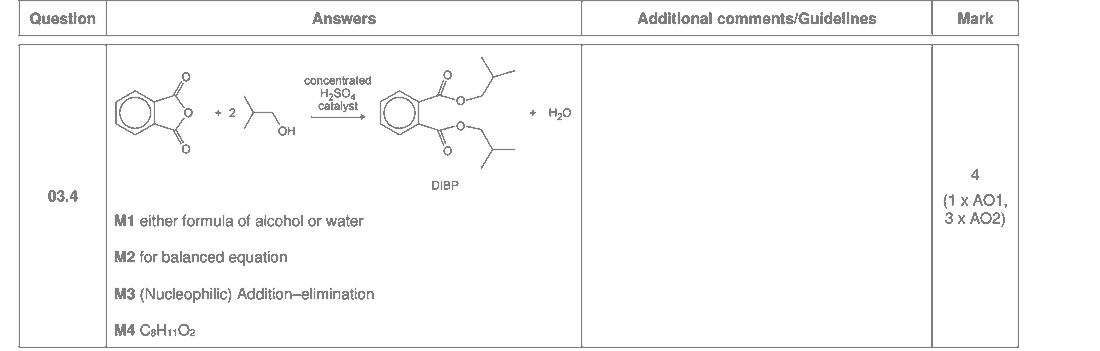
Mark scheme
Examiner's comment
3.4 In this challenging question students were required to complete an equation by deducing the structure of an alcohol that reacts with the anhydride given to form a diester. Many students scored a mark for deducing that water was formed as the other product but far fewer could deduce the alcohol required. The name of the mechanism was well known but the empirical formula proved tricky to work out from the skeletal structure given for lots of students.
Notes from the mark scheme and report
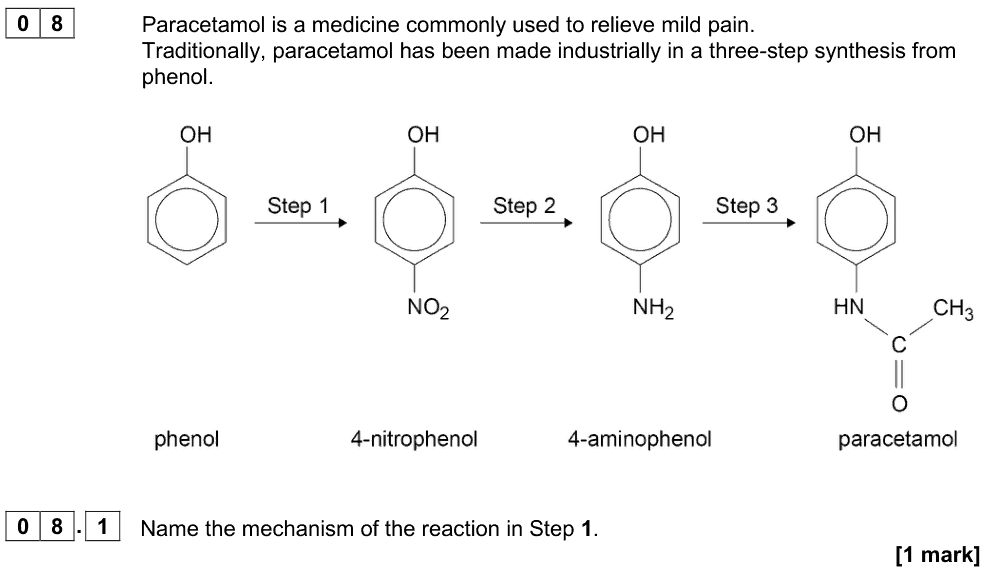
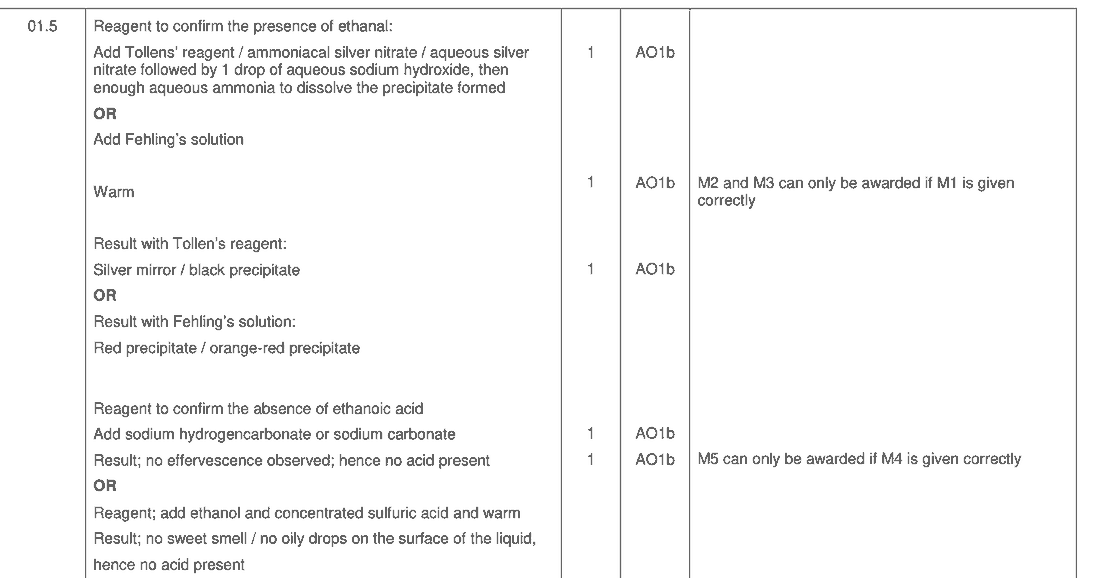
The anhydride reacts with 2 mol of 2-methylpropan-1-ol, (CH3)2CHCH2OH, giving DIBP + H2O (M1 for the alcohol or water, M2 for balancing). (Nucleophilic) addition–elimination. Empirical formula C8H11O2 (molecular formula C16H22O4). The alcohol and the empirical formula were the hard marks
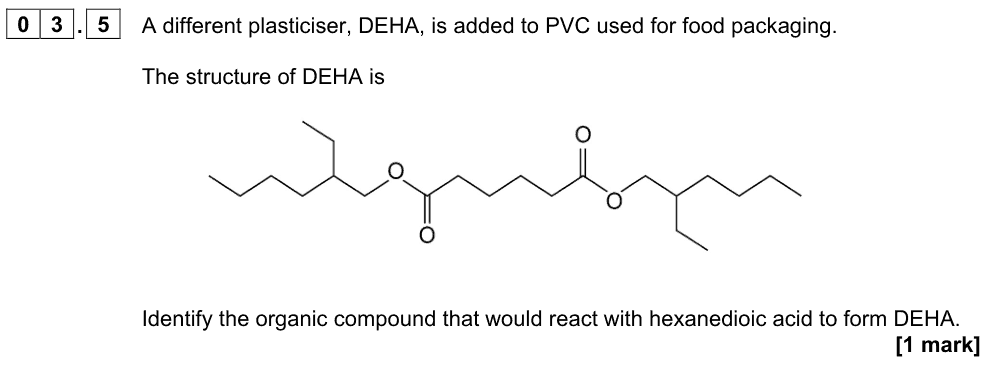
June 2025 · Paper 2 · Q03.51 markAO2=1Short answer
Earlier part of question 03 that this part uses
Mark scheme
Examiner's comment
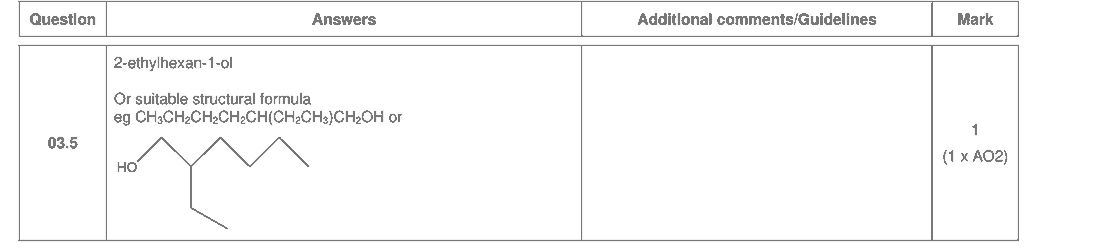
3.5 Here students were asked to identify an alcohol that would react with hexanedioic acid to form another diester used as a plasticiser. This was quite well answered with students scoring for either a correct name or structure.
Notes from the mark scheme and report
2-ethylhexan-1-ol, CH3CH2CH2CH2CH(CH2CH3)CH2OH
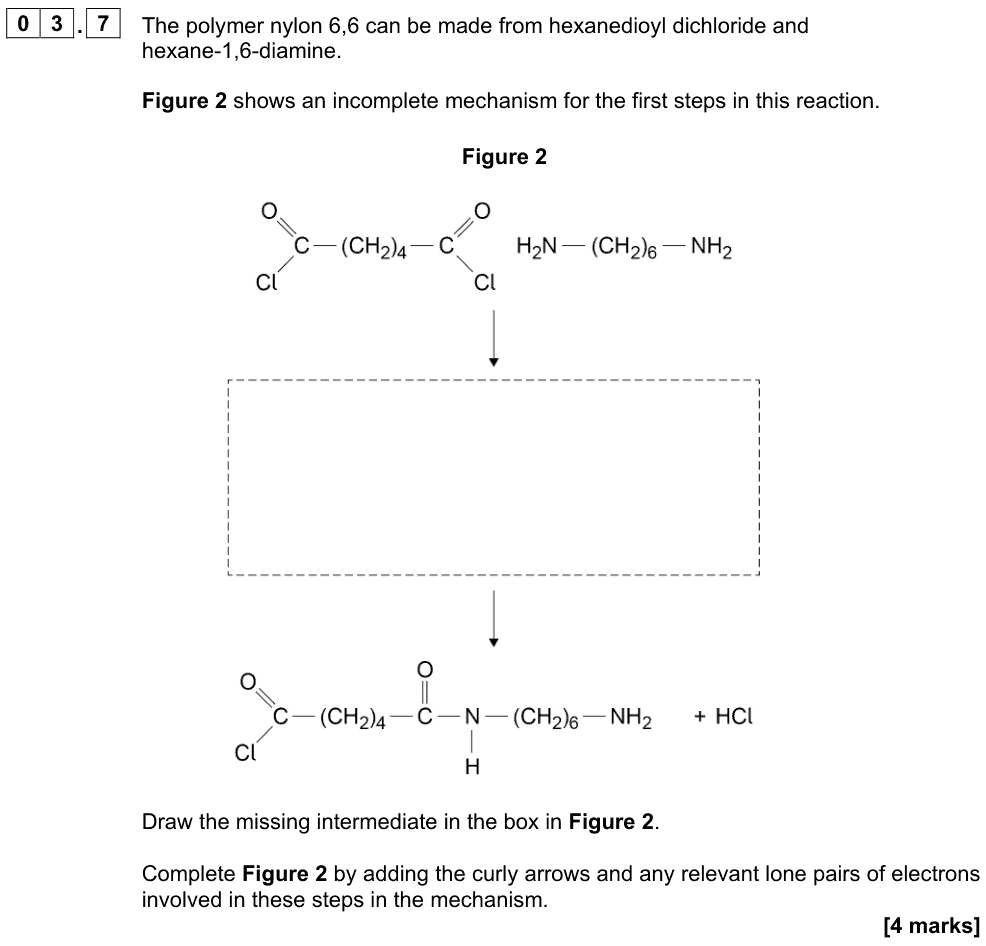
June 2025 · Paper 2 · Q03.74 marksAO1=4Mechanism
Earlier part of question 03 that this part uses
Mark scheme
Examiner's comment
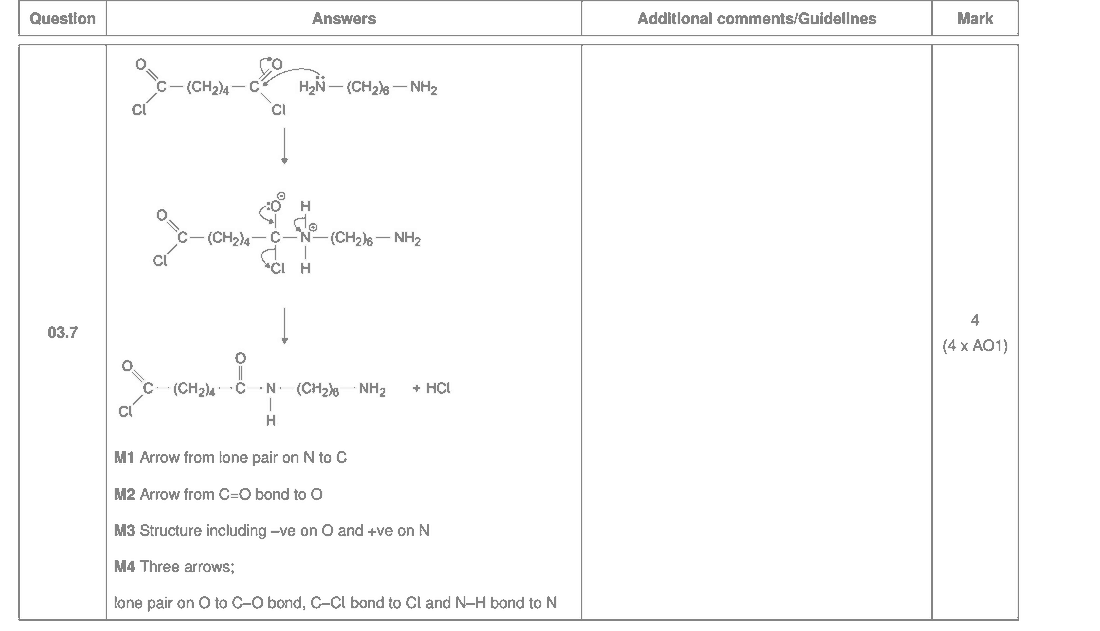
3.7 This fairly routine nucleophilic addition elimination mechanism was well answered by students who had learned the standard curly arrows and were able to apply them in the context given. Some lost marks for drawing curly arrows in the wrong direction; in particular for the proton loss from the intermediate. Others added charges to the starting materials.
Notes from the mark scheme and report
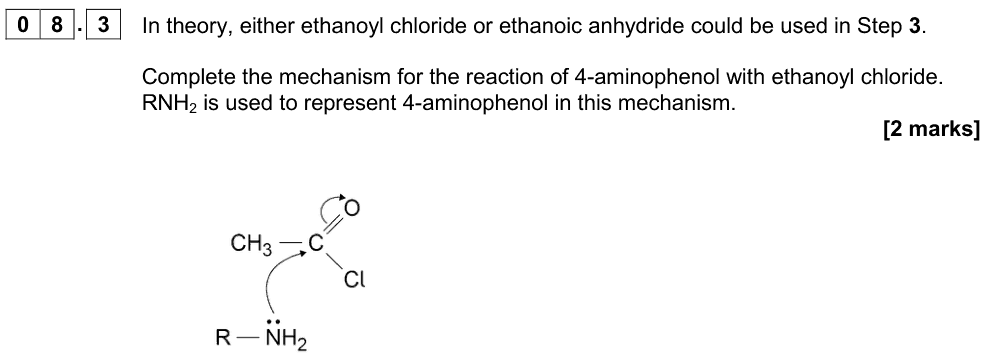
Arrow from the lone pair on N of the amine to the C of C=O
arrow from the C=O bond to O
intermediate with O– on the oxygen and + on N (N bonded to C with two H)
then three arrows: lone pair on O– reforming C=O, C–Cl bond to Cl, N–H bond to N+. Errors: arrows in the wrong direction for the loss of H+
charges added to the reactants
June 2025 · Paper 2 · Q04.11 markAO3=1Practical and data analysis
Mark scheme
Examiner's comment
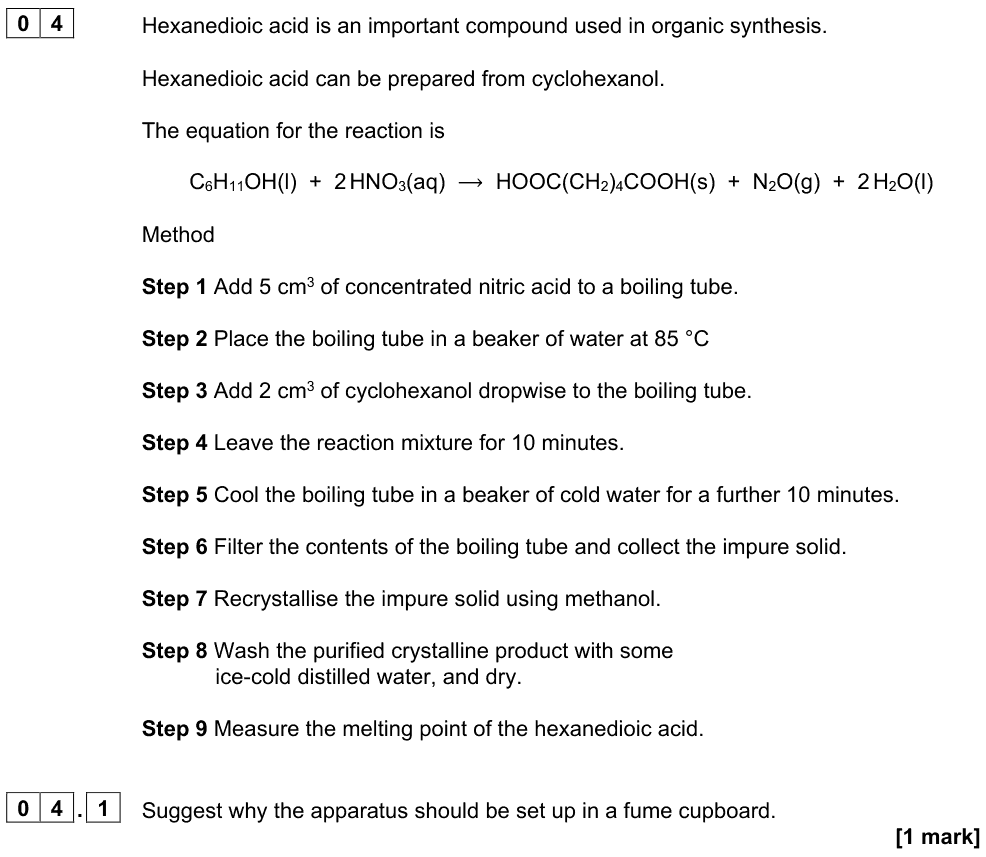
4.1 Students showed good understanding of risk assessment here by identifying reasons for carrying out the method in a fume cupboard .
Notes from the mark scheme and report
N2O (or cyclohexanol / methanol / nitric acid) is harmful, toxic or an irritant (N2O should be treated as toxic)
Skills: ATk Safely and carefully handle solids and liquids, including corrosive, irritant, flammable and toxic substances; PS1.2 Apply scientific knowledge to practical contexts; RP10 Preparation of: a pure organic solid and test of its purity; a pure organic liquid
June 2025 · Paper 2 · Q04.35 marksAO3=5Practical and data analysis
Earlier part of question 04 that this part uses
Mark scheme
Examiner's comment
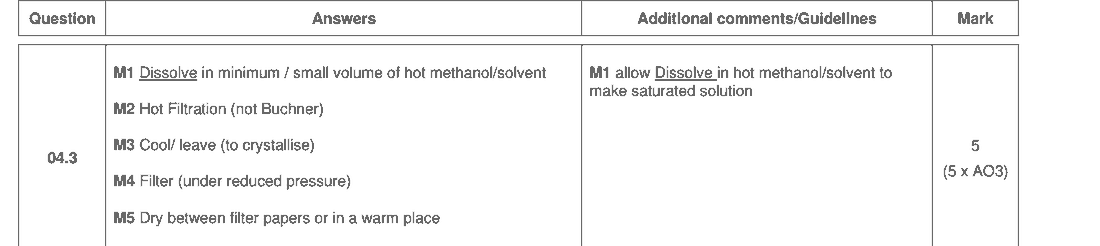
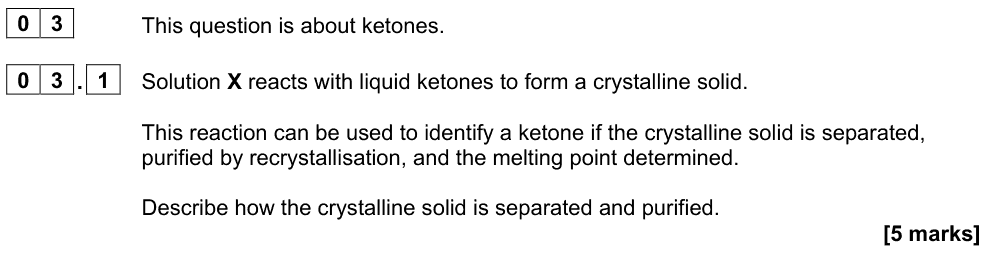
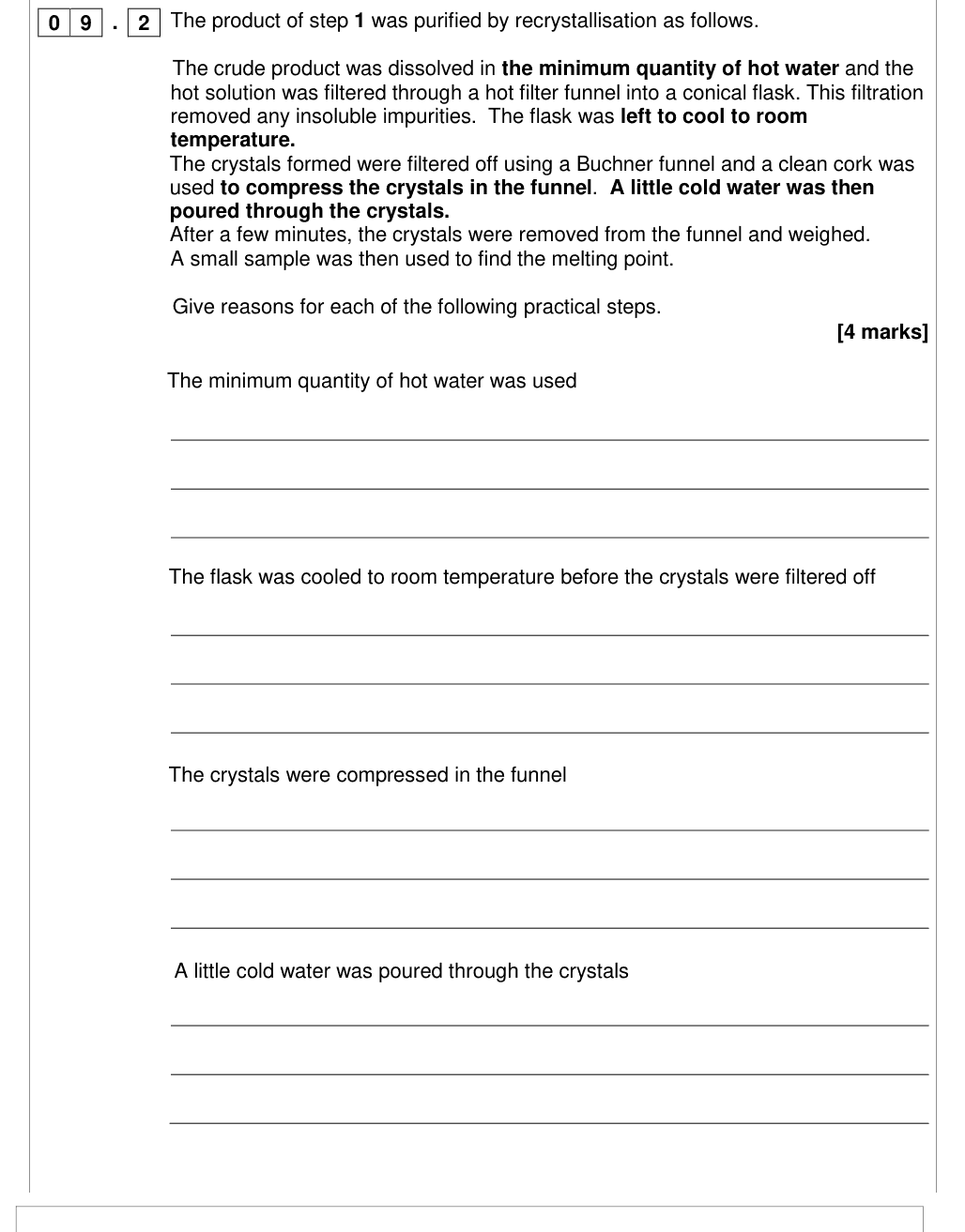
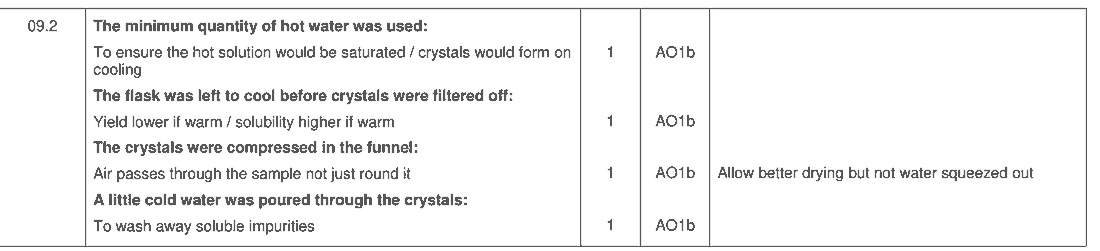
4.3 Students were required to outline the details of how to carry out a recrystallisation. Those who had learned this required practical were able to score high marks. Common errors included lack of details like the use of a ‘minimum volume of hot solvent to dissolve’ the crude product. Hot filtration was often missed and some did not answer the final part of the question by failing to say how the crystals would be dried.
Notes from the mark scheme and report
Dissolve in the minimum volume of hot methanol
filter hot (not Buchner) to remove insoluble impurities
cool / leave to crystallise
filter under reduced pressure (then wash with ice-cold water)
dry between filter papers or in a warm place. Often missed: 'minimum volume of hot solvent', the hot filtration and how the crystals are dried
Skills: ATg Purify: a solid product by recrystallisation; a liquid product, including use of separating funnel; PS4.1 Know and understand how to use a wide range of experimental and practical instruments, equipment and techniques appropriate to the knowledge and understanding included in the specification; RP10 Preparation of: a pure organic solid and test of its purity; a pure organic liquid
June 2025 · Paper 2 · Q04.41 markAO2=1Practical and data analysis
Earlier part of question 04 that this part uses
Mark scheme
Examiner's comment
4.4 The majority of students were not able to suggest that water at room temperature could dissolve some of the solid product leading to a reduced yield.
Notes from the mark scheme and report
Water at room temperature dissolves some of the product (ice-cold water reduces the amount that dissolves). Most could not suggest this
Skills: ATg Purify: a solid product by recrystallisation; a liquid product, including use of separating funnel; PS1.2 Apply scientific knowledge to practical contexts; RP10 Preparation of: a pure organic solid and test of its purity; a pure organic liquid
June 2025 · Paper 2 · Q04.54 marksAO3=4Practical and data analysis
Earlier part of question 04 that this part uses
Mark scheme
Examiner's comment
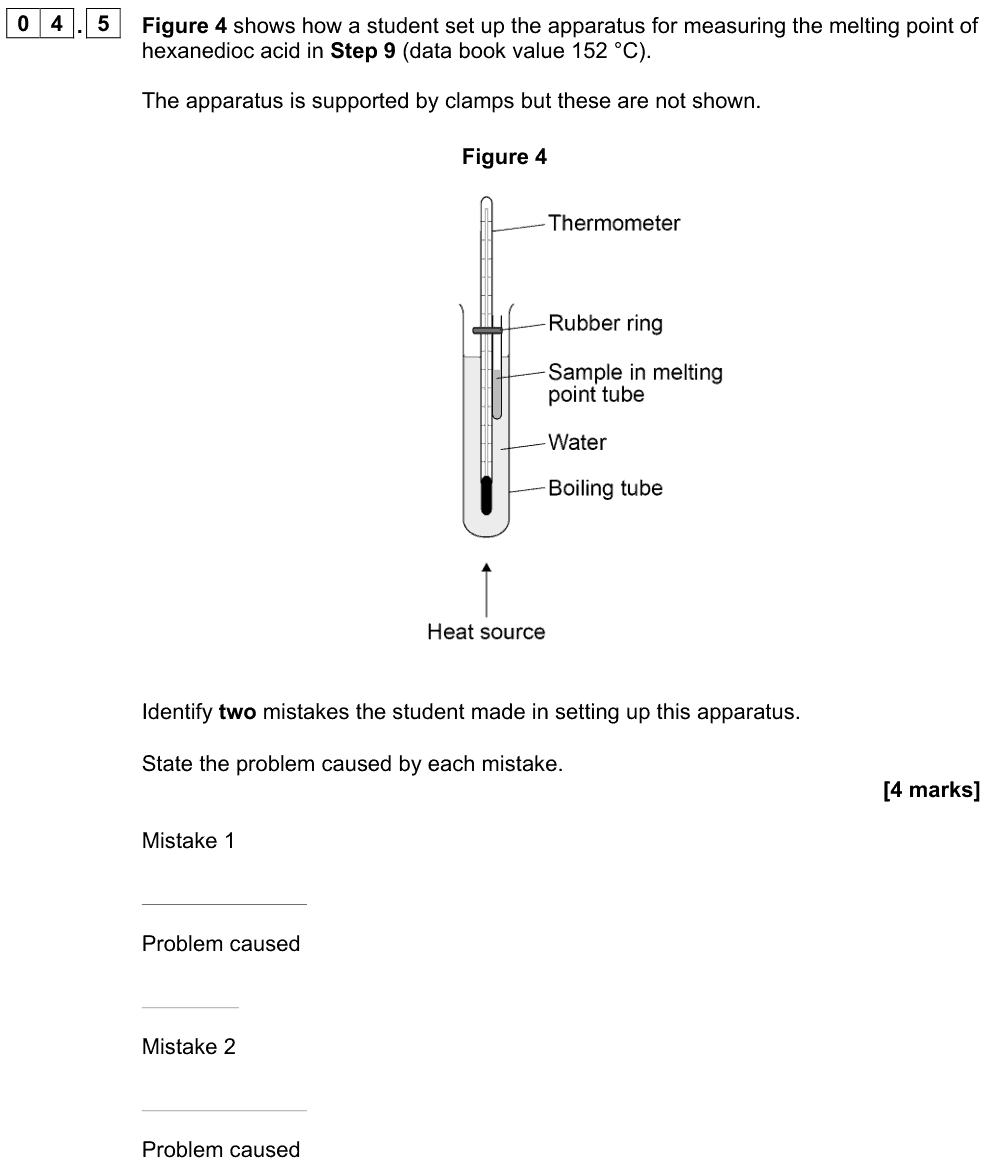
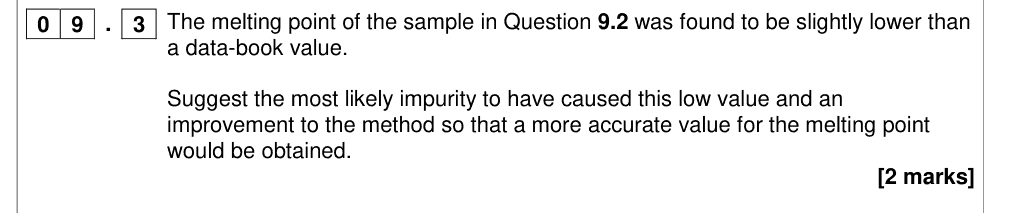
4.5 Students were given a diagram of a flawed method used to determine a melting point. Many were able to see that the sample and thermometer bulb were not at the same level so the thermometer temperature reading would be different from the temperature of the sample. Far fewer noted that water boils at a temperature below that of the solid and should be replaced by oil. Some showed good knowledge of the improvement a D tube (Thiele tube) would make in place of the boiling tube given. Common errors suggested by students included those who said that the thermometer should be in the melting point tube, or that the rubber ring would melt or prevent the thermometer reading being taken. Others said that a bung should be added to the boiling tube.
Notes from the mark scheme and report
Two of: water used as the heating liquid, so the temperature cannot reach the melting point of 152 °C
the sample is much higher than the thermometer bulb, so its temperature differs from the reading
no stirrer / a boiling tube instead of a Thiele tube, so the temperature is uneven. Wrong ideas: thermometer in the melting point tube
rubber ring melting
adding a bung
Skills: ATh Use melting point apparatus; PS2.1 Comment on experimental design and evaluate scientific methods; PS4.1 Know and understand how to use a wide range of experimental and practical instruments, equipment and techniques appropriate to the knowledge and understanding included in the specification; RP10 Preparation of: a pure organic solid and test of its purity; a pure organic liquid
June 2025 · Paper 3 · Q06.23 marksAO1=1, AO3=2Short answer
Earlier part of question 06 that this part uses
Mark scheme
Examiner's comment
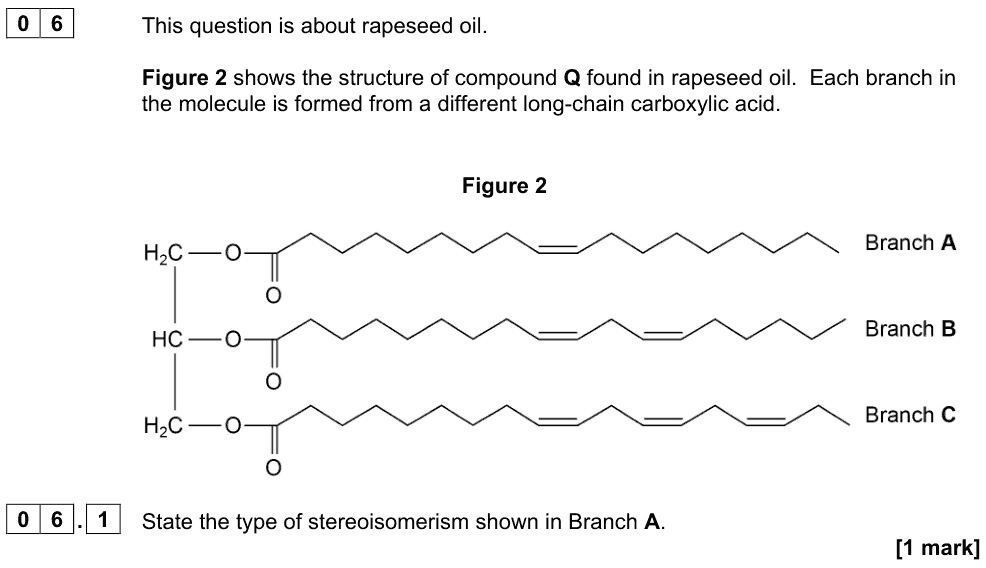
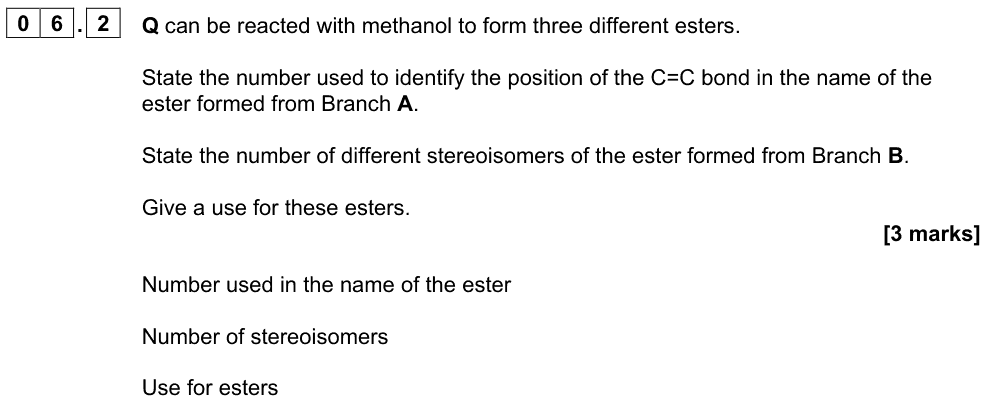
6.2 Close to 60% of students scored at least 2/3 but many failed to recall a suitable use.
Notes from the mark scheme and report
9 (counting from the ester C=O carbon as C1, the C=C starts at C9)
four stereoisomers (two C=C bonds, each E or Z)
use as biodiesel. Many could not recall a use
June 2025 · Paper 3 · Q06.32 marksAO1=1, AO2=1Short answerHard
Earlier part of question 06 that this part uses
Mark scheme
Examiner's comment
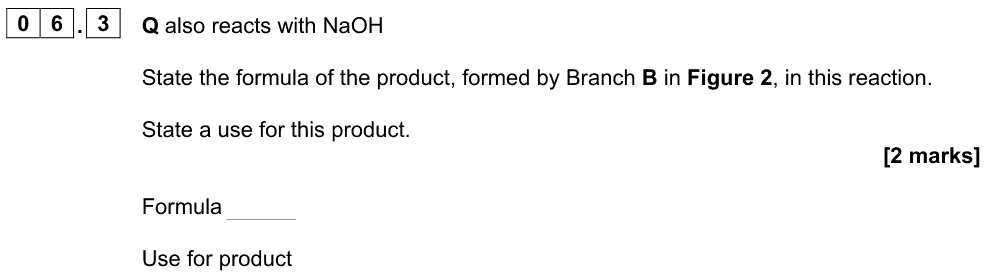
6.3 Only 25% of students scored full marks here with lots of slips in presenting the formula.
Notes from the mark scheme and report
C17H31COONa (C18H31O2Na
the carboxylate ion is allowed)
used as soap. Do not draw a covalent O–Na bond
not a cationic surfactant or detergent. Many slips in the formula
June 2024 · Paper 2 · Q04.12 marksAO1=1, AO2=1Equation writing
Mark scheme
Examiner's comment
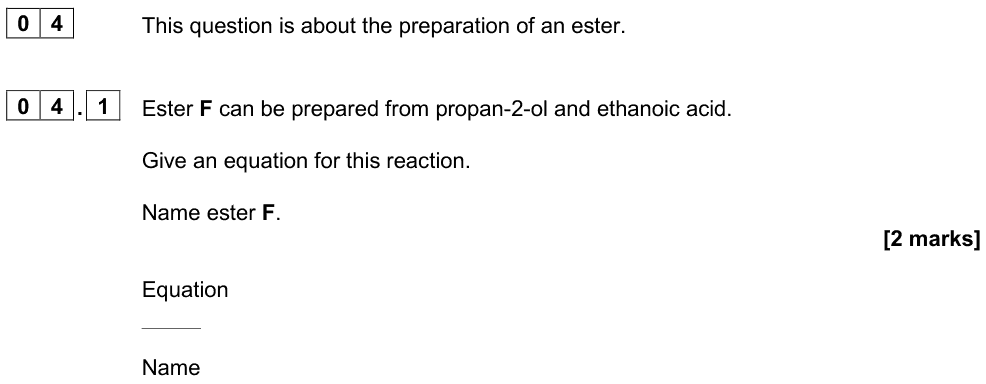
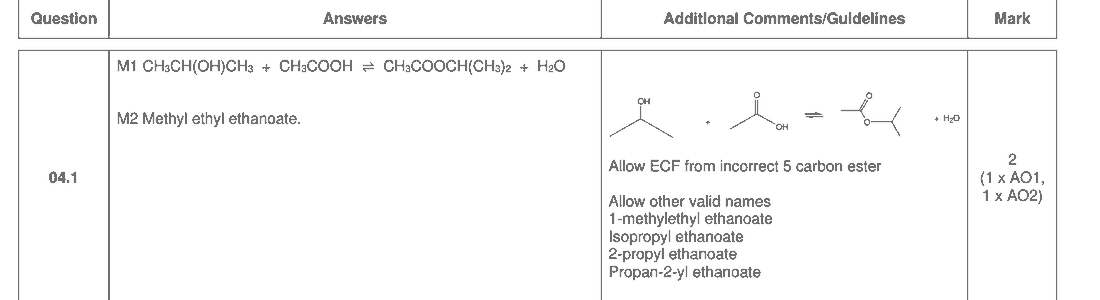
4.1 The esterification equation proved difficult, especially the structure of the ester itself. Those who got the ester wrong were able to access M2, consequentially, if they had drawn an ester with 5 carbon atoms.
Notes from the mark scheme and report
CH3CH(OH)CH3 + CH3COOH ⇌ CH3COOCH(CH3)2 + H2O
1-methylethyl ethanoate (propan-2-yl ethanoate, isopropyl ethanoate). Name allowed as ECF from a wrong five-carbon ester. The ester structure was the difficulty
June 2024 · Paper 2 · Q04.26 marksAO3=66-mark level of response
Earlier part of question 04 that this part uses
Mark scheme, with the levels and indicative content
Examiner's comment
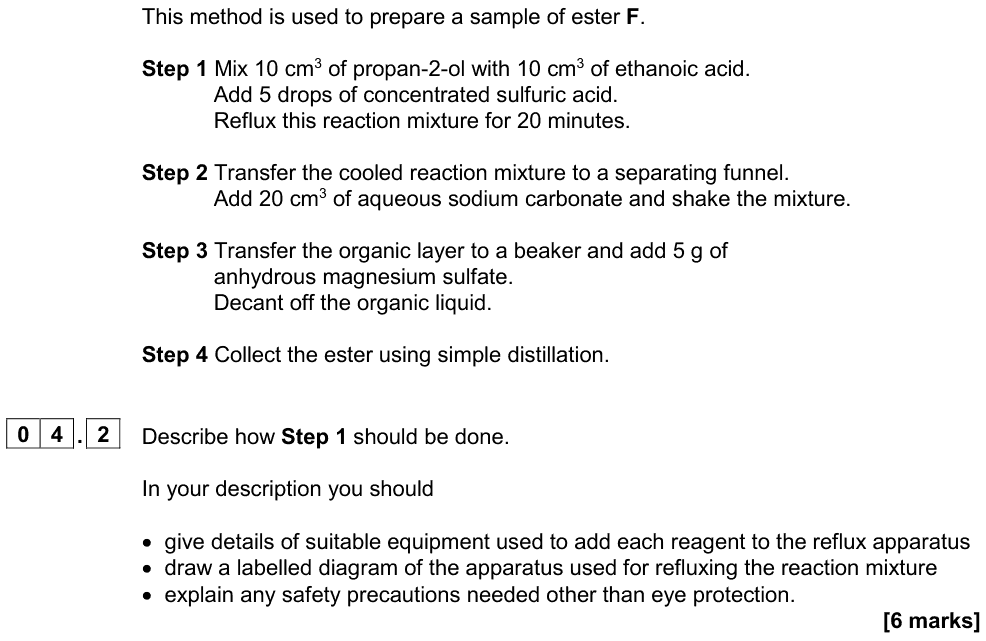
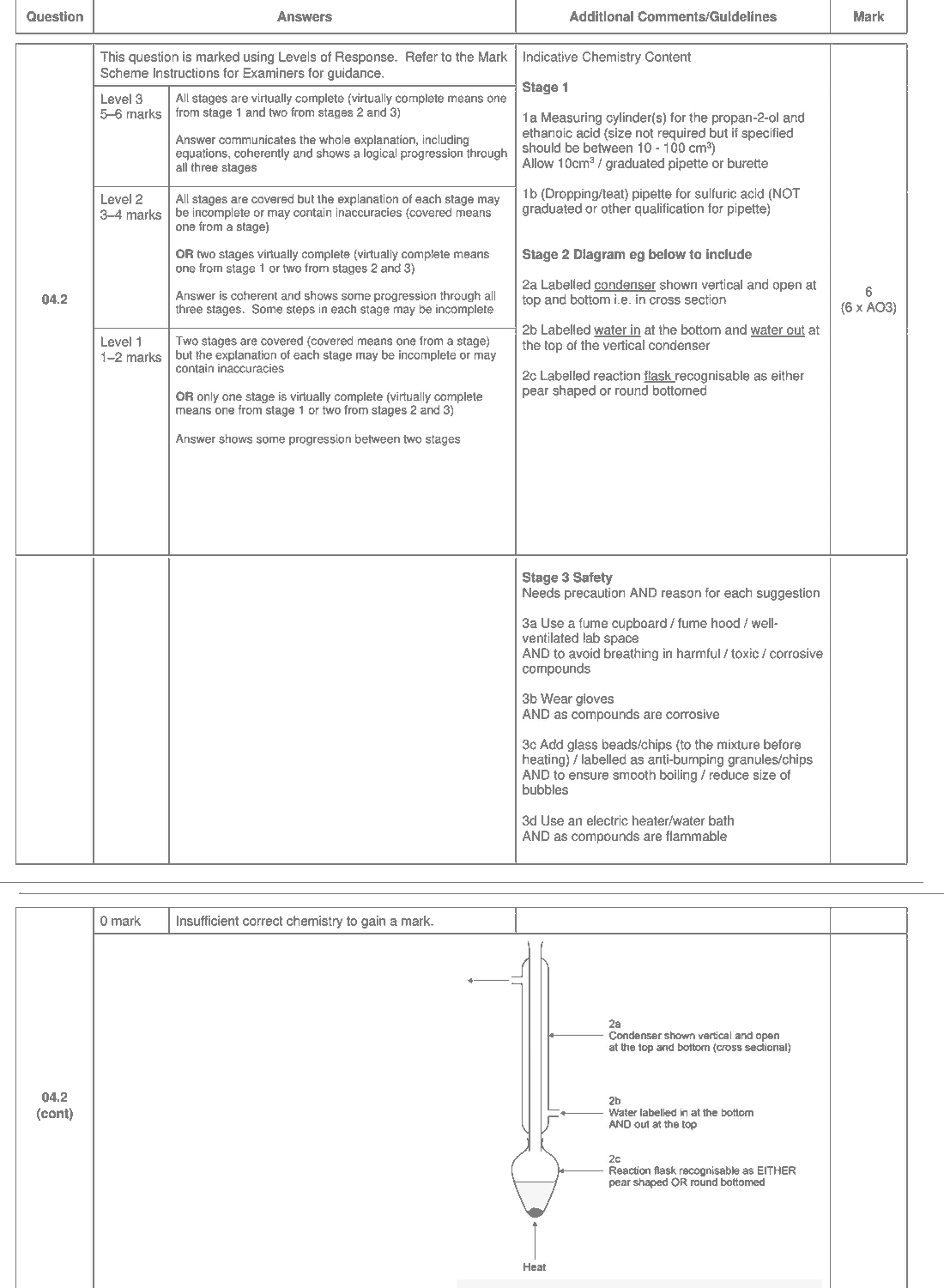
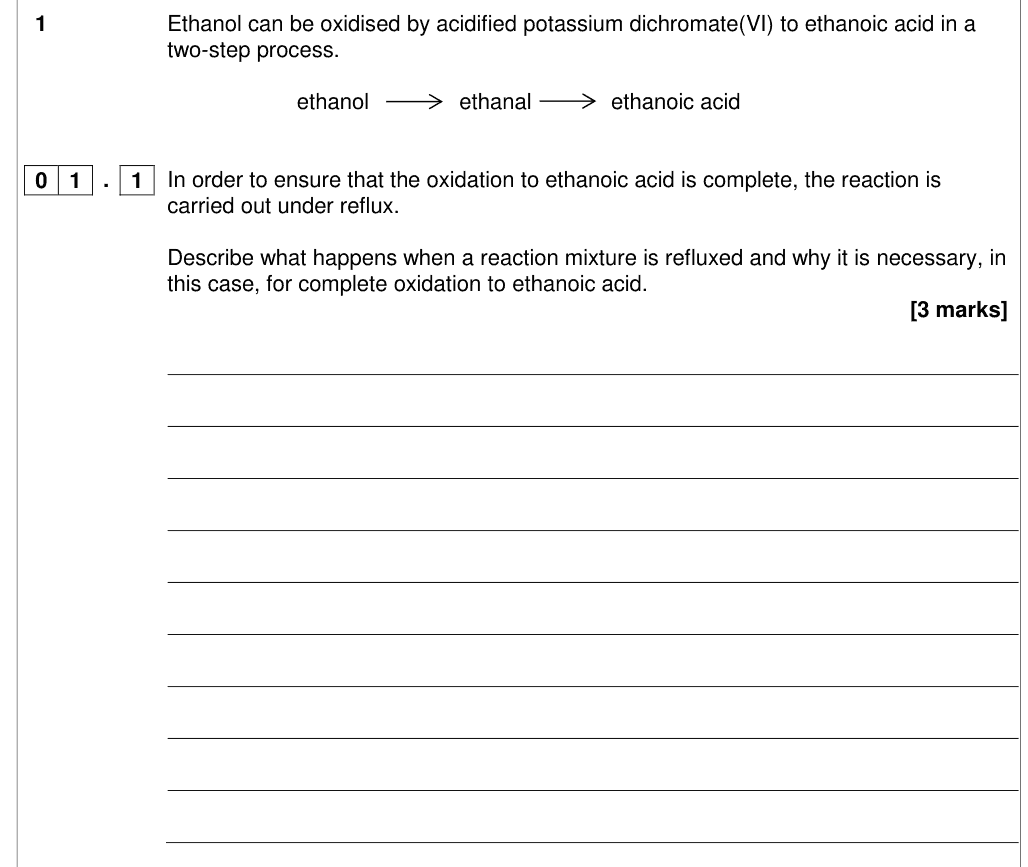
4.2 This question required students to describe the reflux technique. It was quite well answered but also discriminated very well with an index of 0.61 showing that only the best were able to access level three. Diagrams were better than in some recent papers although many students didn’t show equipment as clearly cross-sectional. Safety precautions were well known but some didn’t gain credit because they didn’t explain why the precaution suggested was appropriate.
Notes from the mark scheme and report
Levels of response, three stages. 1 Equipment: measuring cylinders (or 10 cm3 graduated pipette / burette) for propan-2-ol and ethanoic acid
dropping (teat) pipette for the sulfuric acid. 2 Diagram: labelled pear-shaped or round-bottomed flask
vertical condenser drawn in cross-section, open at the top
water in at the bottom and out at the top. 3 Safety, each with its reason: fume cupboard (harmful / corrosive vapours)
gloves (corrosive acids)
anti-bumping granules (smooth boiling)
electric heater or water bath (flammable liquids). Diagrams often not clearly cross-sectional
precautions given without reasons
Skills: ATa Use appropriate apparatus to record a range of measurements (to include mass, time, volume of liquids and gases, temperature); ATb Use water bath or electric heater or sand bath for heating; ATd Use laboratory apparatus for a variety of experimental techniques including: titration, using burette and pipette; distillation and heating under reflux, including setting up glassware using retort stand and clamps; qualitative tests for ions and organic functional groups; filtration, including use of fluted filter paper, or filtration under reduced pressure; ATk Safely and carefully handle solids and liquids, including corrosive, irritant, flammable and toxic substances; PS4.1 Know and understand how to use a wide range of experimental and practical instruments, equipment and techniques appropriate to the knowledge and understanding included in the specification; RP10 Preparation of: a pure organic solid and test of its purity; a pure organic liquid
June 2024 · Paper 2 · Q04.33 marksAO1=1, AO3=2Practical and data analysis
Earlier parts of question 04 that this part uses
Mark scheme
Examiner's comment
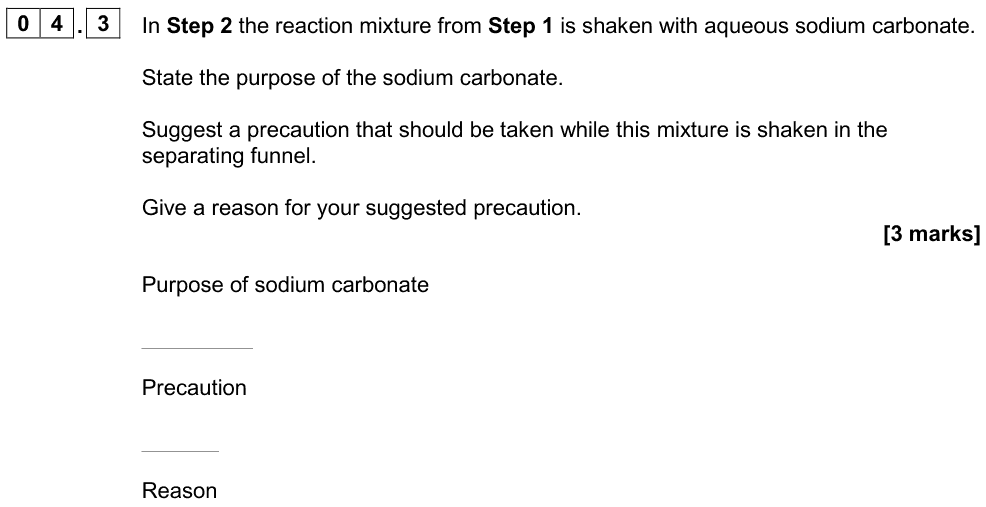
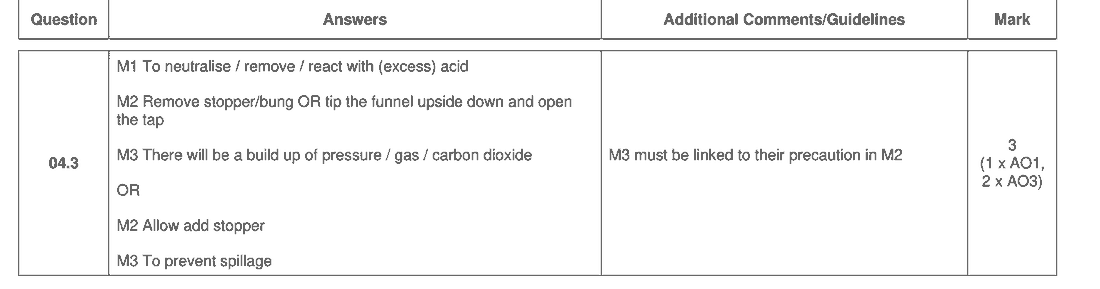
4.3 Most were able to score at least 1 mark here, but few scored all 3 marks.
Notes from the mark scheme and report
To neutralise / remove the (excess) acid
open the tap with the funnel inverted (or remove the stopper) from time to time
because carbon dioxide is produced and pressure builds up. (Allow: add a stopper, to prevent spillage.) The reason must match the precaution. Few scored all 3. Refers to Step 2 of the method printed with 04.2
Skills: ATg Purify: a solid product by recrystallisation; a liquid product, including use of separating funnel; ATk Safely and carefully handle solids and liquids, including corrosive, irritant, flammable and toxic substances; PS1.2 Apply scientific knowledge to practical contexts; RP10 Preparation of: a pure organic solid and test of its purity; a pure organic liquid
June 2024 · Paper 2 · Q04.41 markAO1=1Short answer
Earlier parts of question 04 that this part uses
Mark scheme
Examiner's comment
4.4 Around 57% of students scored the mark for knowing that magnesium sulfate is a drying agent.
Notes from the mark scheme and report
Drying agent / to remove water. Not 'dehydrating agent'
Skills: ATg Purify: a solid product by recrystallisation; a liquid product, including use of separating funnel; PS4.1 Know and understand how to use a wide range of experimental and practical instruments, equipment and techniques appropriate to the knowledge and understanding included in the specification; RP10 Preparation of: a pure organic solid and test of its purity; a pure organic liquid
June 2024 · Paper 2 · Q04.51 markAO1=1Short answerHard
Earlier parts of question 04 that this part uses
Mark scheme
Examiner's comment
4.5 It was surprising that only around 30% of students knew that purity is linked to a sharp boiling point that is close to the known value from a data source. Either of these points would have gained the mark.
Notes from the mark scheme and report
It distils at a sharp boiling point / over a narrow temperature range, which matches the data-book value
Skills: ATd Use laboratory apparatus for a variety of experimental techniques including: titration, using burette and pipette; distillation and heating under reflux, including setting up glassware using retort stand and clamps; qualitative tests for ions and organic functional groups; filtration, including use of fluted filter paper, or filtration under reduced pressure; PS4.1 Know and understand how to use a wide range of experimental and practical instruments, equipment and techniques appropriate to the knowledge and understanding included in the specification; RP10 Preparation of: a pure organic solid and test of its purity; a pure organic liquid
June 2024 · Paper 2 · Q05.12 marksAO3=2Practical and data analysis
Mark scheme
Examiner's comment
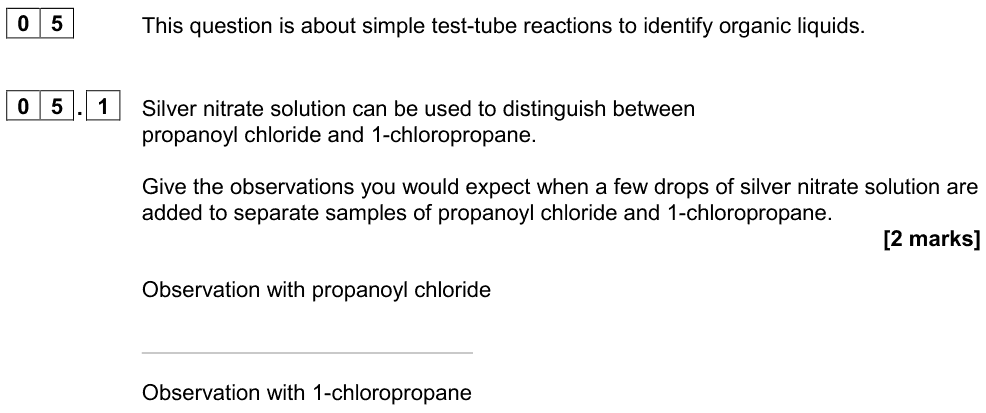
5.1 The marks for this question were lower than expected. Students did not know that an acid chloride will produce misty fumes of HCl and give an immediate white precipitate of AgCl on addition of silver nitrate solution. More knew that there would be no immediate visible reaction with the 1-chloropropane, followed by the slow formation of a white precipitate. Either of these would have gained the second mark.
Notes from the mark scheme and report
Propanoyl chloride: misty / steamy white fumes (of HCl), or an immediate white precipitate. 1-Chloropropane: no visible change (or a white precipitate forms slowly). Few knew that acyl chlorides react at once with the water present
Skills: ATd Use laboratory apparatus for a variety of experimental techniques including: titration, using burette and pipette; distillation and heating under reflux, including setting up glassware using retort stand and clamps; qualitative tests for ions and organic functional groups; filtration, including use of fluted filter paper, or filtration under reduced pressure; PS1.2 Apply scientific knowledge to practical contexts
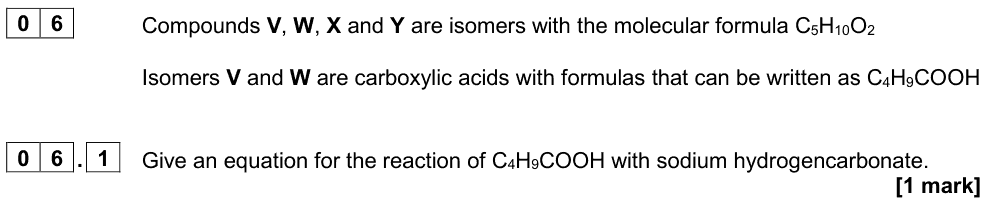
June 2024 · Paper 2 · Q06.11 markAO1=1Equation writing
Mark scheme
Examiner's comment
6.1 This equation was quite well answered but also differentiated well.
Notes from the mark scheme and report
C4H9COOH + NaHCO3 → C4H9COONa + CO2 + H2O
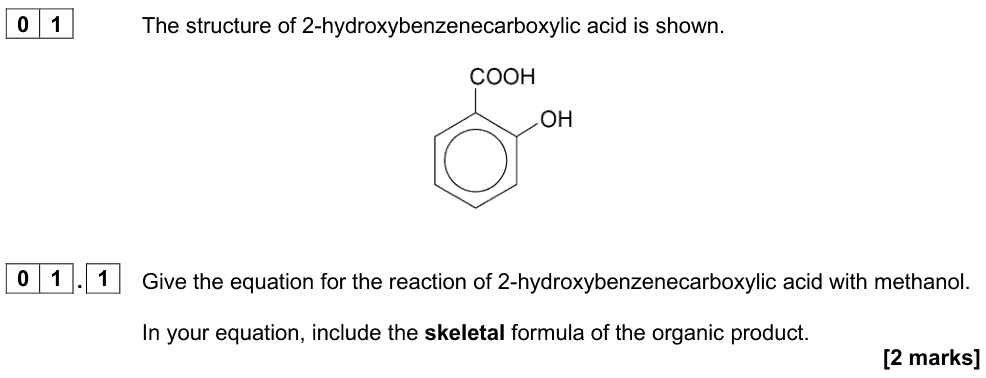
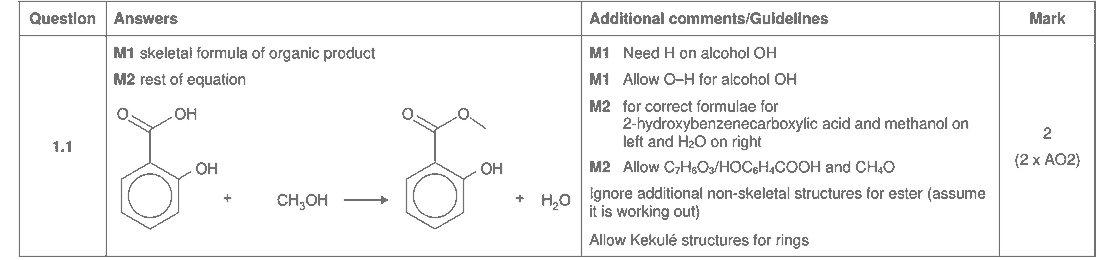
June 2024 · Paper 3 · Q01.12 marksAO2=2Equation writing
Mark scheme
Examiner's comment
Part 01.1 was designed to be an easier start than it turned out to be as it was expected that this esterification would be relatively familiar to students.
Many failed to show the organic product in a skeletal format.
Notes from the mark scheme and report
2-HOC6H4COOH + CH3OH → methyl 2-hydroxybenzoate + H2O. M1 skeletal formula of the ester (benzene ring with OH, H shown on the O, and COOCH3 drawn skeletally on the adjacent carbon)
M2 rest of the equation with H2O. Many did not draw the product in skeletal form
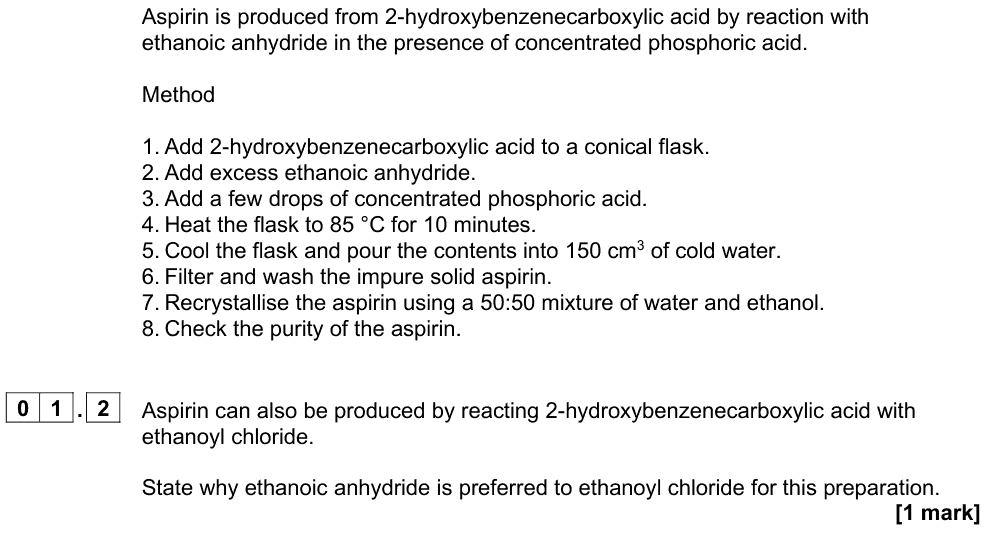
June 2024 · Paper 3 · Q01.21 markAO1=1Short answer
Earlier part of question 01 that this part uses
Mark scheme
Examiner's comment
In 01.2 over 50% of students achieved the mark but many answers were too vague.
When a question asks for a reason in this sort of situation, something more specific than ‘it is harmful’ is needed in the answer.
Notes from the mark scheme and report
Ethanoic anhydride is less corrosive / does not form HCl (forms only weak ethanoic acid) / is less easily hydrolysed. Cost, 'safer', 'less harmful' and 'less vigorous' are ignored
many answers were too vague
Skills: RP10 Preparation of: a pure organic solid and test of its purity; a pure organic liquid
June 2024 · Paper 3 · Q01.31 markAO1=1Short answer
Earlier parts of question 01 that this part uses
Mark scheme
Examiner's comment
01.3 Most students recognised this mechanism as addition-elimination.
Notes from the mark scheme and report
(Nucleophilic) addition–elimination. 'Esterification' or 'acylation' ignored
June 2024 · Paper 3 · Q01.51 markAO3=1Practical and data analysisHard
Earlier parts of question 01 that this part uses
Mark scheme
Examiner's comment
01.5 seemed to cause more problems than expected, with only 20% of students earning this mark.
The context is slightly unusual as it is perhaps more common to ask why reflux is needed for a reaction than to ask, as here, why it is not.
A clear reference to the boiling points of the reagents being above 85 °C was needed.
Notes from the mark scheme and report
The boiling points of the reactants and products are above 85 °C, so nothing boils off. 'Would not evaporate' is ignored
Skills: ATd Use laboratory apparatus for a variety of experimental techniques including: titration, using burette and pipette; distillation and heating under reflux, including setting up glassware using retort stand and clamps; qualitative tests for ions and organic functional groups; filtration, including use of fluted filter paper, or filtration under reduced pressure; ATb Use water bath or electric heater or sand bath for heating; PS1.2 Apply scientific knowledge to practical contexts; RP10 Preparation of: a pure organic solid and test of its purity; a pure organic liquid
June 2024 · Paper 3 · Q01.62 marksAO3=2Diagram or structure
Earlier parts of question 01 that this part uses
Mark scheme
Examiner's comment
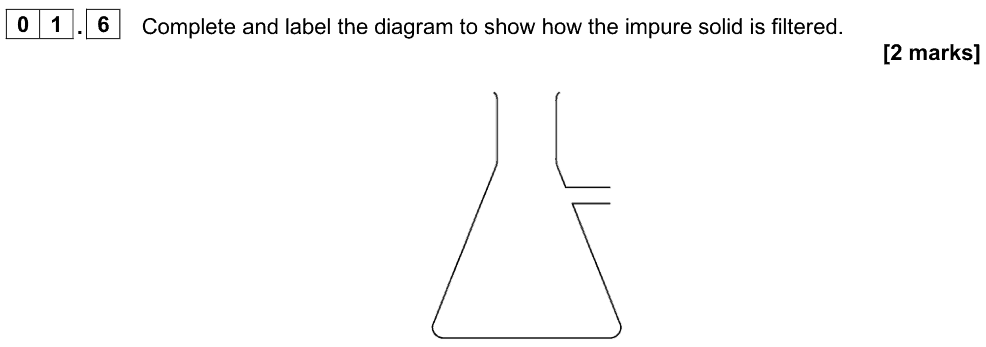
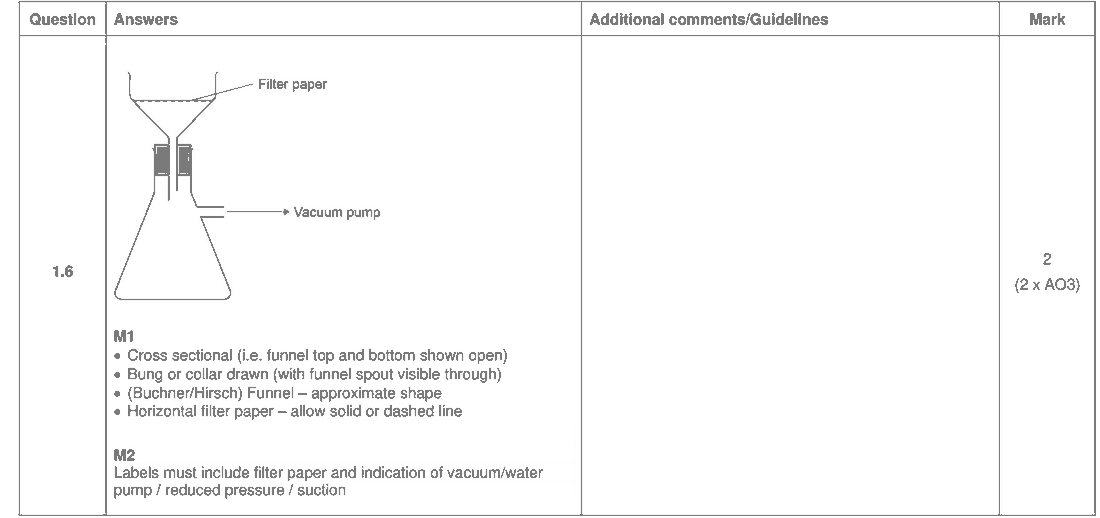
In 01.6, there were significant weaknesses revealed in students’ abilities to draw apparatus diagrams.
They should realise that a cross-sectional line diagram is needed and, in particular, that a glass tube passing through a bung needs to be drawn clearly as open at both ends.
When representing a Buchner funnel the filter paper must be drawn horizontal.
Notes from the mark scheme and report
M1 cross-section drawing: Buchner (or Hirsch) funnel open at top and bottom, held in a bung or collar with the spout visible through it, and horizontal filter paper. M2 labels: filter paper and vacuum / water pump / reduced pressure at the side arm. Errors: not a cross-section
tube through the bung not open
filter paper not horizontal
Skills: ATd Use laboratory apparatus for a variety of experimental techniques including: titration, using burette and pipette; distillation and heating under reflux, including setting up glassware using retort stand and clamps; qualitative tests for ions and organic functional groups; filtration, including use of fluted filter paper, or filtration under reduced pressure; PS4.1 Know and understand how to use a wide range of experimental and practical instruments, equipment and techniques appropriate to the knowledge and understanding included in the specification; RP10 Preparation of: a pure organic solid and test of its purity; a pure organic liquid
June 2024 · Paper 3 · Q01.72 marksAO3=2Short answer
Earlier parts of question 01 that this part uses
Mark scheme
Examiner's comment
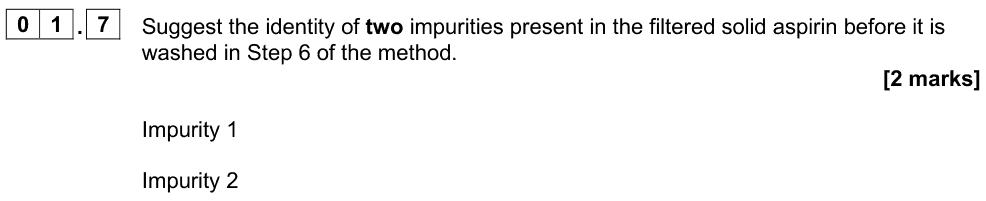
In 01.7, 75% of students correctly suggested at least one impurity.
Notes from the mark scheme and report
Any two of: ethanoic acid, phosphoric acid, 2-hydroxybenzenecarboxylic acid, ethanoic anhydride, water. 'Catalyst' or 'unreacted reactants' unnamed are ignored. 75% named at least one
Skills: PS1.2 Apply scientific knowledge to practical contexts; RP10 Preparation of: a pure organic solid and test of its purity; a pure organic liquid
June 2024 · Paper 3 · Q01.86 marksAO1=6Practical and data analysis
Earlier parts of question 01 that this part uses
Mark scheme
Examiner's comment
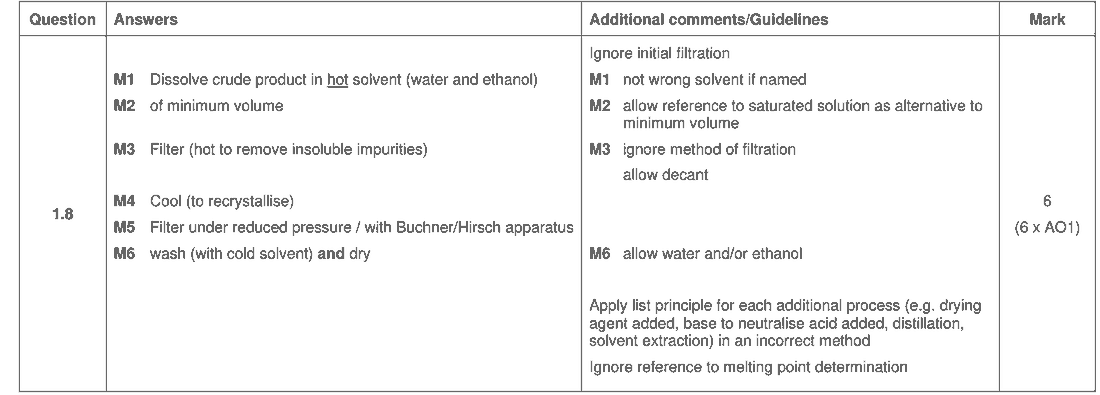
01.8 This was the first question to require an extended answer on this paper and dealt with what should be a familiar scenario. 43% of students were able to score 4 or more marks. However, many answers were confused and lacked a sensible sequence. Students need to be clear about the distinction between residue and filtrate when describing filtration – especially as the first filtration step here retains the filtrate but the second retains the residue. It was hoped that all students would realise that a reference to recrystallisation indicates that the product is solid, but some tried to describe distillation or solvent extraction processes.
Notes from the mark scheme and report
Six points: dissolve the crude product in hot solvent (water and ethanol)
use the minimum volume
filter hot (to remove insoluble impurities)
cool so crystals form
filter under reduced pressure with a Buchner funnel
wash with cold solvent and dry. Extra wrong processes (drying agent, distillation, solvent extraction) lose marks. Be clear whether the residue or the filtrate is kept at each filtration. 43% scored 4 or more
Skills: ATg Purify: a solid product by recrystallisation; a liquid product, including use of separating funnel; ATd Use laboratory apparatus for a variety of experimental techniques including: titration, using burette and pipette; distillation and heating under reflux, including setting up glassware using retort stand and clamps; qualitative tests for ions and organic functional groups; filtration, including use of fluted filter paper, or filtration under reduced pressure; ATb Use water bath or electric heater or sand bath for heating; PS4.1 Know and understand how to use a wide range of experimental and practical instruments, equipment and techniques appropriate to the knowledge and understanding included in the specification; RP10 Preparation of: a pure organic solid and test of its purity; a pure organic liquid
June 2024 · Paper 3 · Q01.93 marksAO1=3Practical and data analysis
Earlier parts of question 01 that this part uses
Mark scheme
Examiner's comment
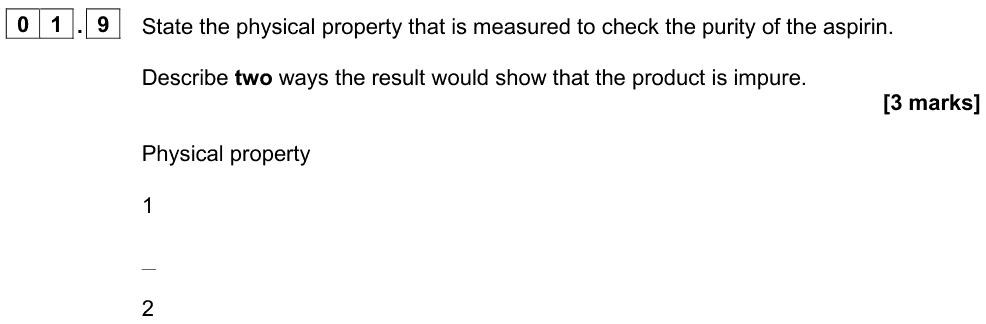
01.9 This question provided further evidence that some students thought that the aspirin was a liquid because ‘boiling point’ was often suggested as the physical property that is measured.
Notes from the mark scheme and report
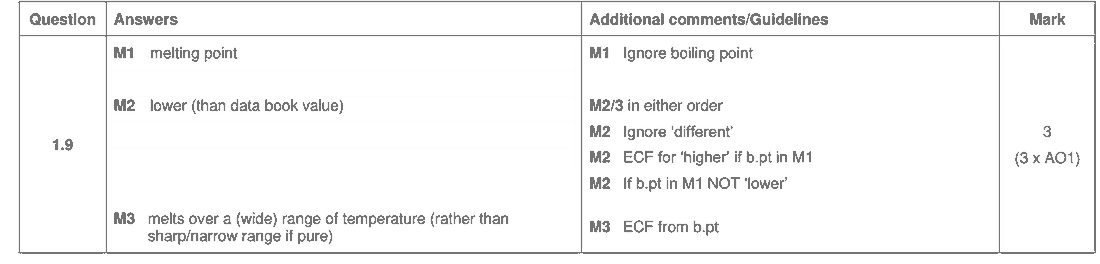
Melting point
an impure sample melts at a lower temperature than the data-book value and melts over a (wide) range of temperature. 'Different' is not enough
boiling point was a common wrong answer
Skills: ATh Use melting point apparatus; PS2.3 Evaluate results and draw conclusions with reference to measurement uncertainties and errors; RP10 Preparation of: a pure organic solid and test of its purity; a pure organic liquid
June 2024 · Paper 3 · Q301 markAO2=1Multiple choice
Answer
D
Mark scheme
Notes from the mark scheme and report
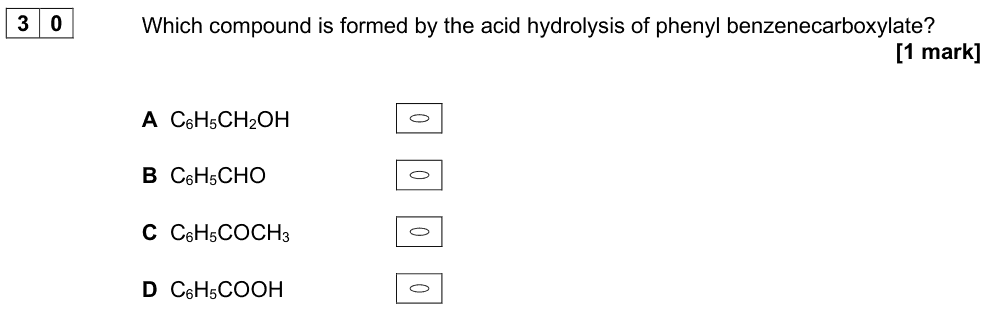
Answer: D. C6H5COOC6H5 + H2O → C6H5COOH + C6H5OH (phenol is not among the options)
June 2023 · Paper 2 · Q01.33 marksAO3=3Explanation
Earlier parts of question 01 that this part uses
Mark scheme
Examiner's comment
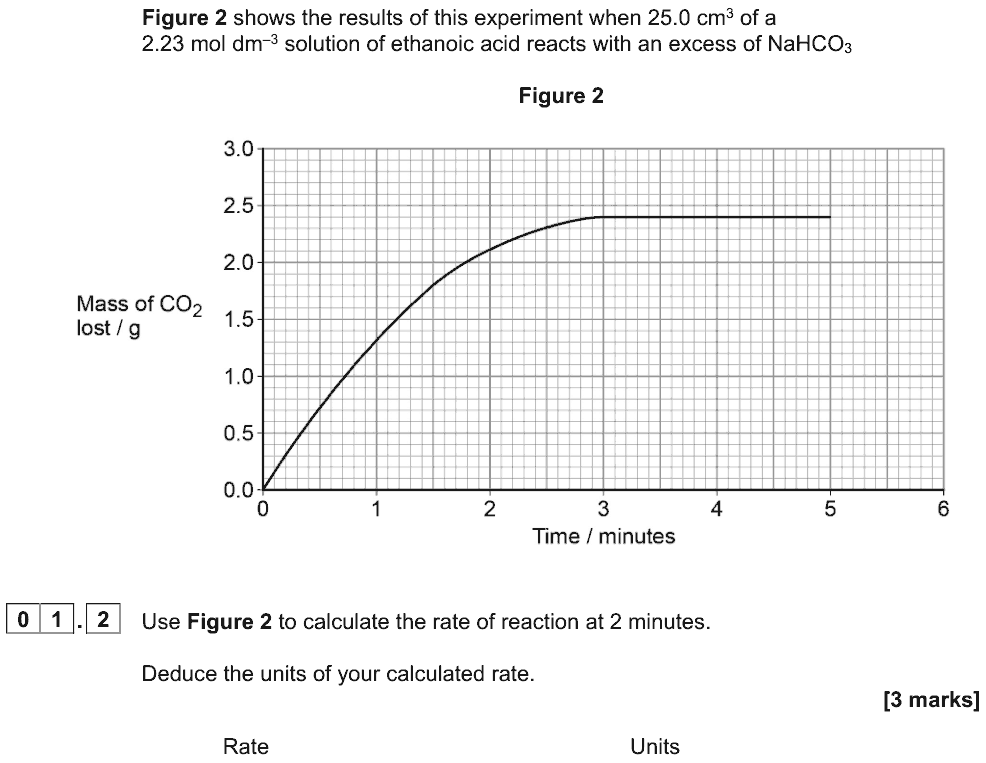
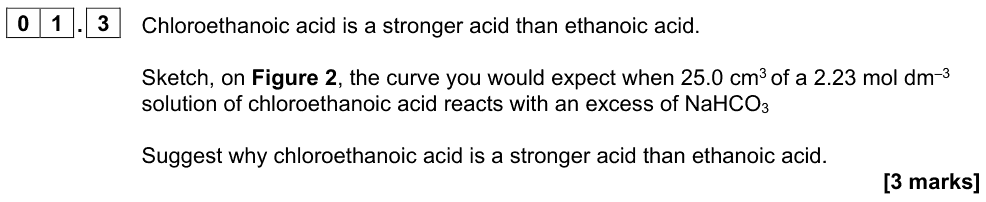
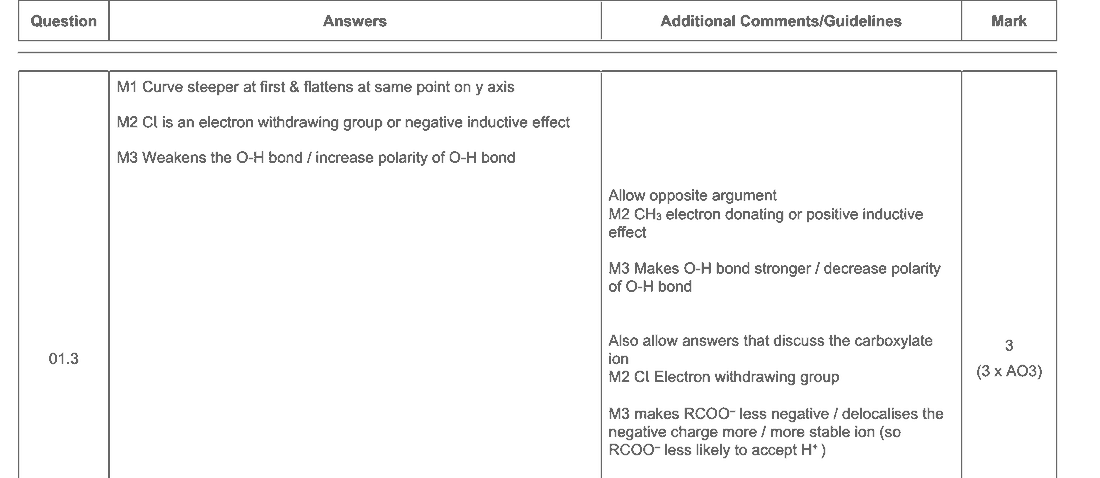
01.3 The question required students to sketch a curve and most did this well. Marks 2 and 3 proved much more difficult and many students were unable to identify clearly the electron withdrawing effect of the -CH2Cl group and the way this weakens the O-H bond.
Notes from the mark scheme and report
Curve starts steeper and levels off at the same mass of CO2 (2.4 g), since the amount of acid is the same. Cl is an electron-withdrawing group (negative inductive effect)
this weakens / increases the polarity of the O–H bond (or stabilises the carboxylate ion by spreading its negative charge). Most drew the curve but few explained the electron-withdrawing effect. Figure 2 is in the 01.2 crop
Skills: MS3.1 Translate information between graphical, numerical and algebraic forms
June 2023 · Paper 2 · Q03.14 marksAO1=4Mechanism
Mark scheme
Examiner's comment
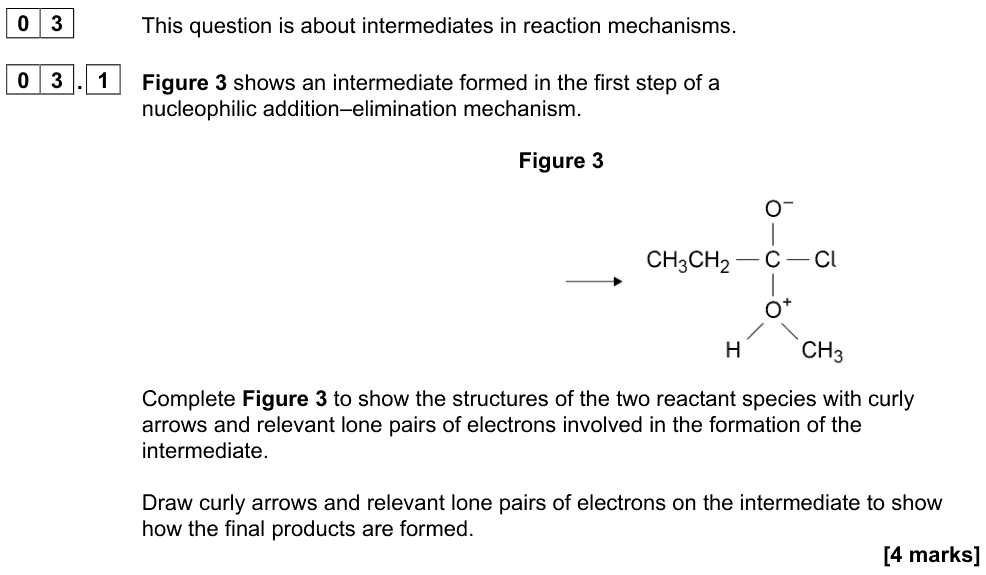
03.1 As with the other two parts of this question, the discrimination index of more than 0.65 showed that this type of question discriminates very well. Able students often scored all four marks for this familiar mechanism despite the unusual way the question demanded that students work backwards from the given intermediate for the first three marks.
Notes from the mark scheme and report
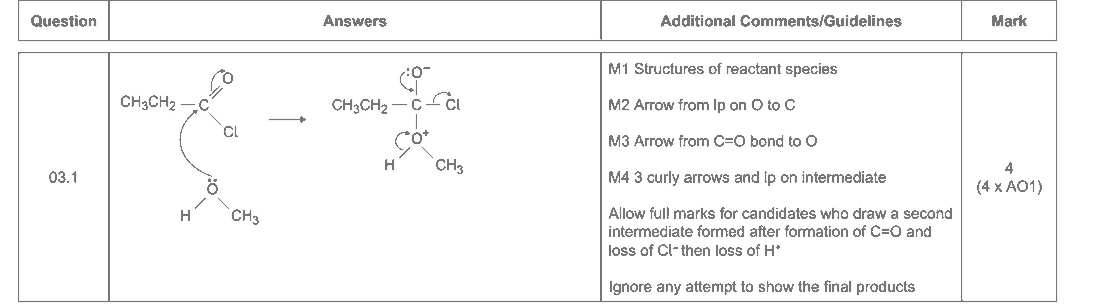
Reactants: propanoyl chloride CH3CH2COCl and methanol CH3OH. Curly arrow from a lone pair on the O of methanol to the carbonyl C
curly arrow from the C=O bond to O. On the intermediate: lone pair on O– with arrow re-forming C=O, arrow from the C–Cl bond to Cl, and arrow from the O–H bond to O+ (three arrows and the lone pair for M4). Working backwards from the intermediate was unusual
June 2023 · Paper 2 · Q06.38 marksAO3=8Practical and data analysis
Earlier part of question 06 that this part uses
Mark scheme
Examiner's comment
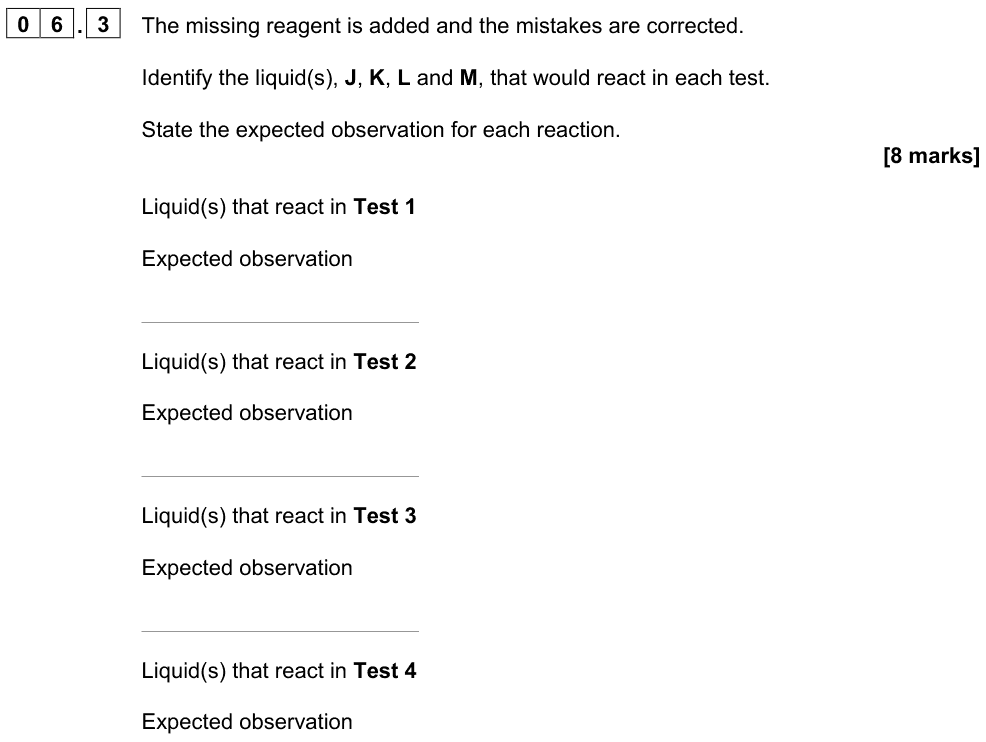
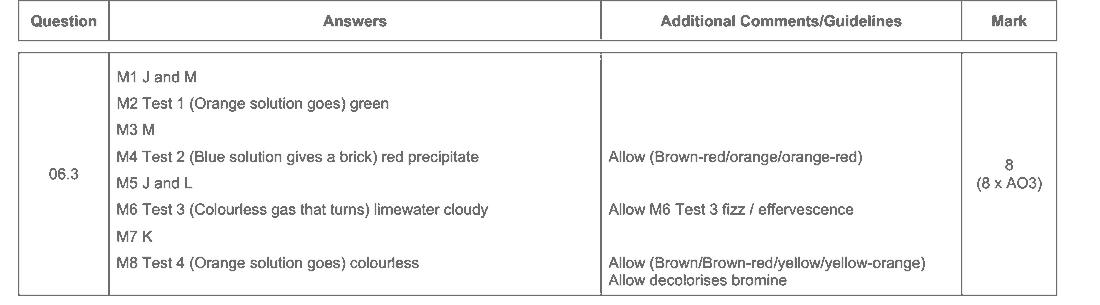
06.3 This question on familiar organic tests was answered quite well with around 80% able to score at least half marks. The observations for M2, M4, M6 and M8 were very well known, but the substances that would react in each test were less well understood. The question had a high discrimination index.
Notes from the mark scheme and report
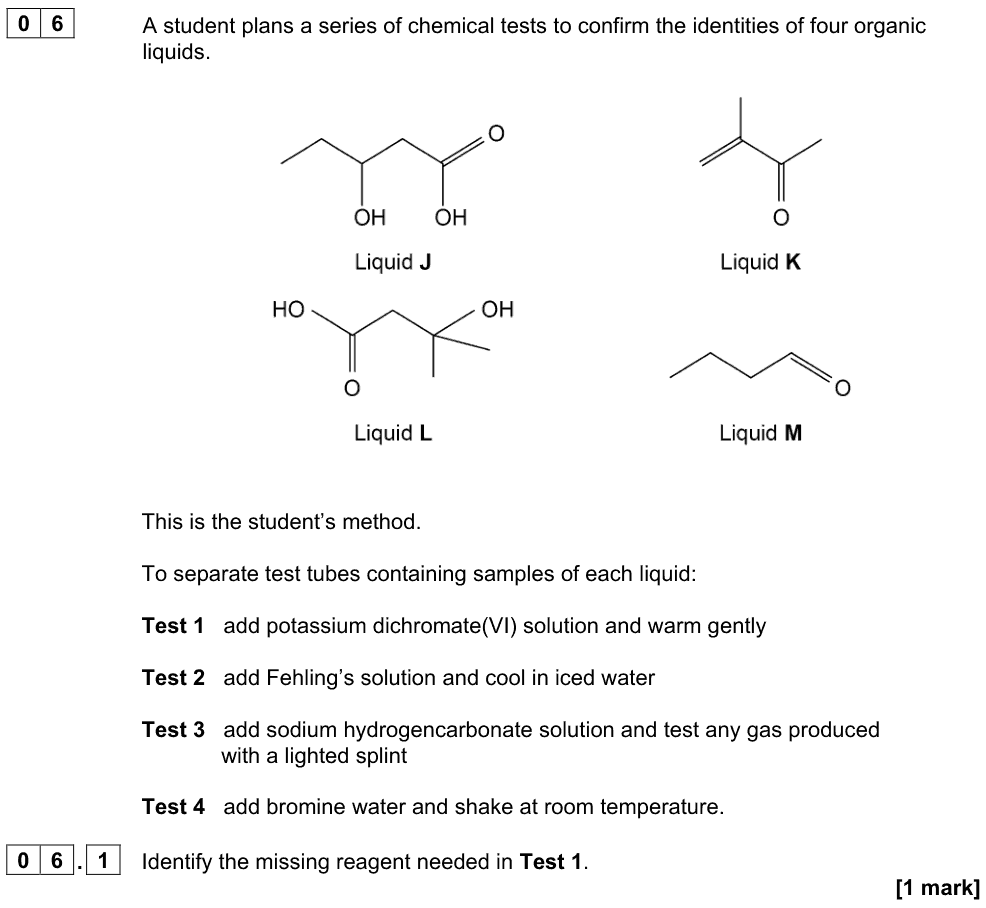
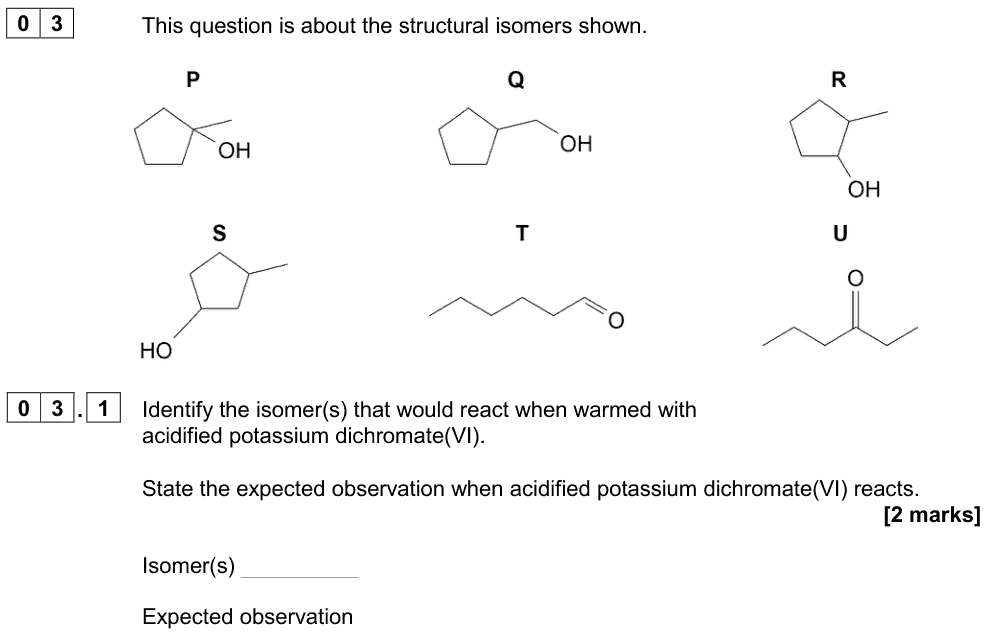
Test 1: J and M (secondary alcohol and aldehyde)
orange solution turns green. Test 2: M only (aldehyde)
blue solution gives a brick-red precipitate. Test 3: J and L (carboxylic acids)
effervescence, gas turns limewater cloudy. Test 4: K only (C=C)
orange bromine water is decolourised. L's alcohol is tertiary so it is not oxidised
K is a ketone. Observations were well known
which liquids react was less well understood. About 80% scored at least half marks
Skills: PS1.2 Apply scientific knowledge to practical contexts; RP6 Tests for alcohol, aldehyde, alkene and carboxylic acid
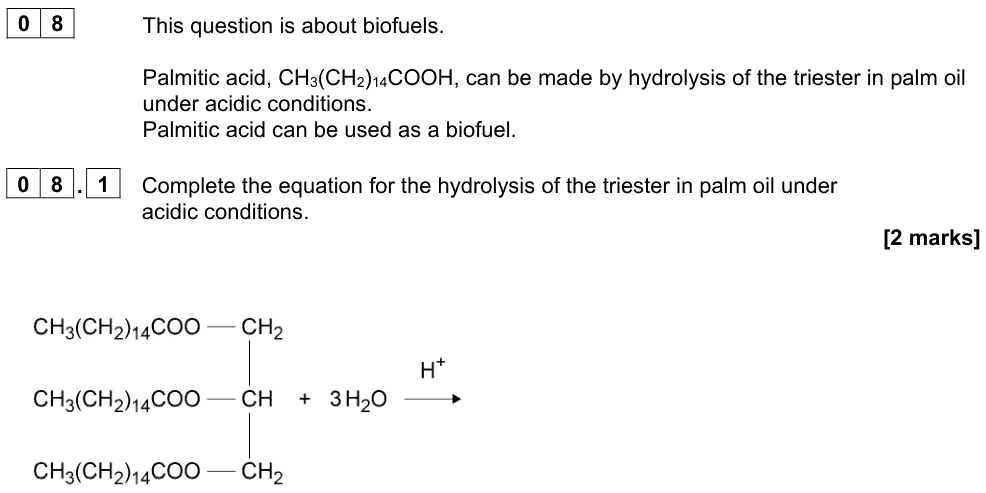
June 2023 · Paper 2 · Q08.12 marksAO2=2Equation writing
Mark scheme
Examiner's comment
08.1 This question was reasonably well answered with many scoring for the structure of glycerol but far fewer gaining the mark for deducing that 3 mol of carboxylic acid would be needed to balance the equation.
Notes from the mark scheme and report
Products: 3CH3(CH2)14COOH and CH2(OH)CH(OH)CH2OH (propane-1,2,3-triol). Many gave glycerol but forgot the 3 in front of the acid
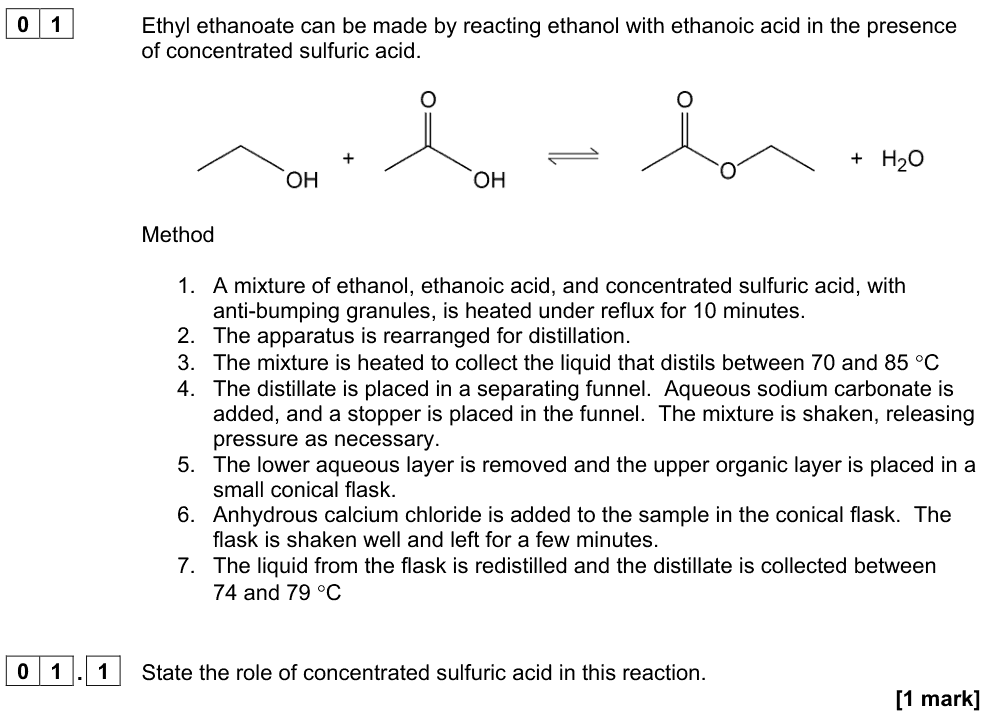
June 2023 · Paper 3 · Q01.11 markShort answerEasy
Mark scheme
Examiner's comment
Question 01.1 provided a reasonably straightforward start, with 67% of students correctly referring to ‘catalyst’.
A wide variety of incorrect answers was also seen, however, including oxidising agent and reducing agent.
‘Proton donor’ was not allowed because, although the mode of catalytic action does involve proton donation, the proton is accepted back in a later stage of the mechanism.
Notes from the mark scheme and report
Catalyst (allow 'lowers the activation energy'). Proton donor, dehydrating agent and 'speeds up the reaction' are ignored
oxidising or reducing agent is wrong
Skills: RP10 Preparation of: a pure organic solid and test of its purity; a pure organic liquid
June 2023 · Paper 3 · Q01.21 markPractical and data analysisEasy
Earlier part of question 01 that this part uses
Mark scheme
Examiner's comment
In 01.2, the first sentence of the stem gave a clue to the answer by stating that the reaction mixture is flammable and 86% of students responded to this clue by suggesting an answer such as ‘water bath’ or ‘electric heater’.
Note that a positive answer is needed so ‘not with a Bunsen burner’ did not score.
Notes from the mark scheme and report
Use an electric heater / heating mantle or a (hot) water bath (allow sand bath, oil bath, hot plate). A positive method is needed: 'not with a Bunsen burner' does not score
no direct naked flame
Skills: ATb Use water bath or electric heater or sand bath for heating; ATk Safely and carefully handle solids and liquids, including corrosive, irritant, flammable and toxic substances; PS4.1 Know and understand how to use a wide range of experimental and practical instruments, equipment and techniques appropriate to the knowledge and understanding included in the specification; RP10 Preparation of: a pure organic solid and test of its purity; a pure organic liquid
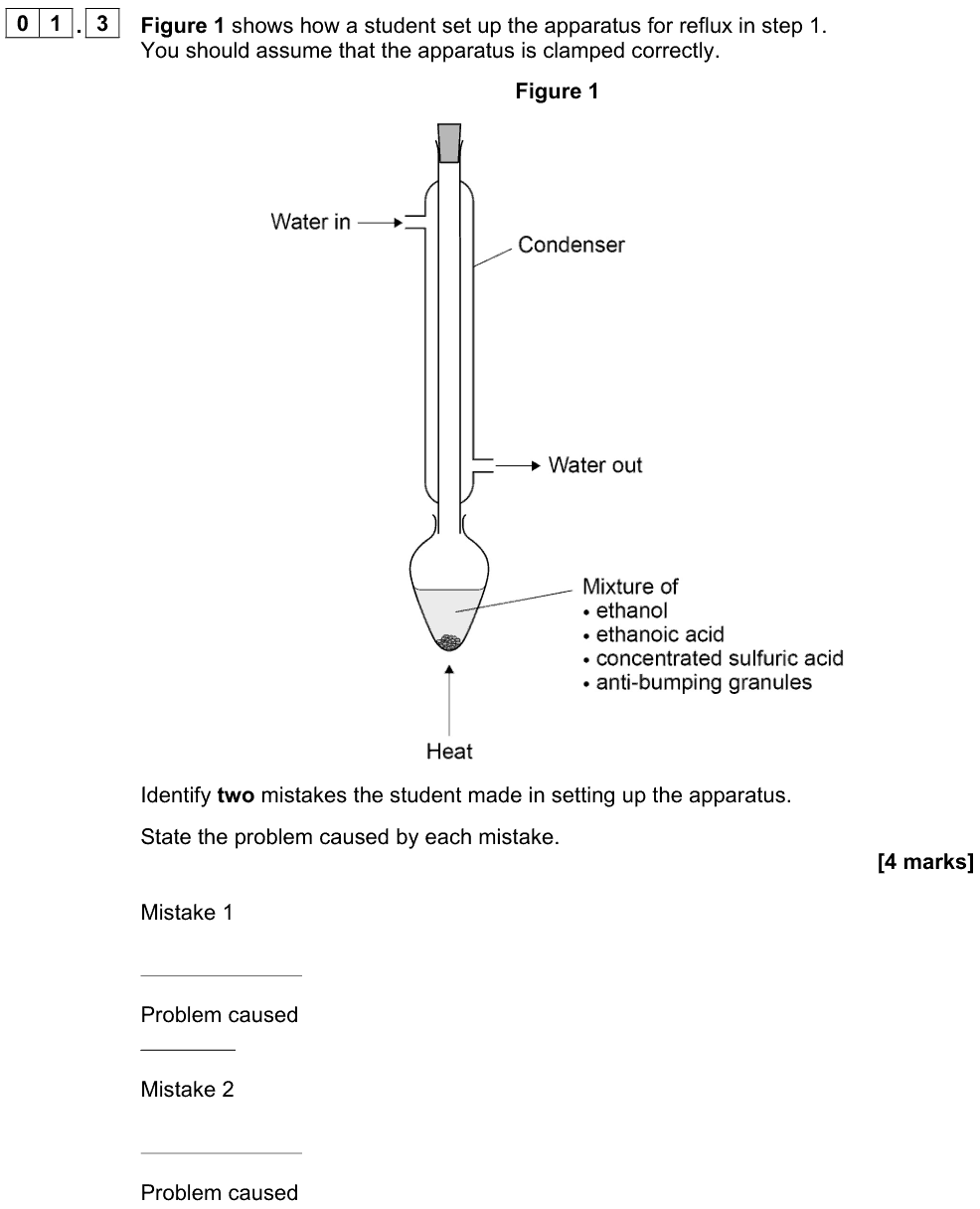
June 2023 · Paper 3 · Q01.34 marksPractical and data analysis
Earlier part of question 01 that this part uses
Mark scheme
Examiner's comment
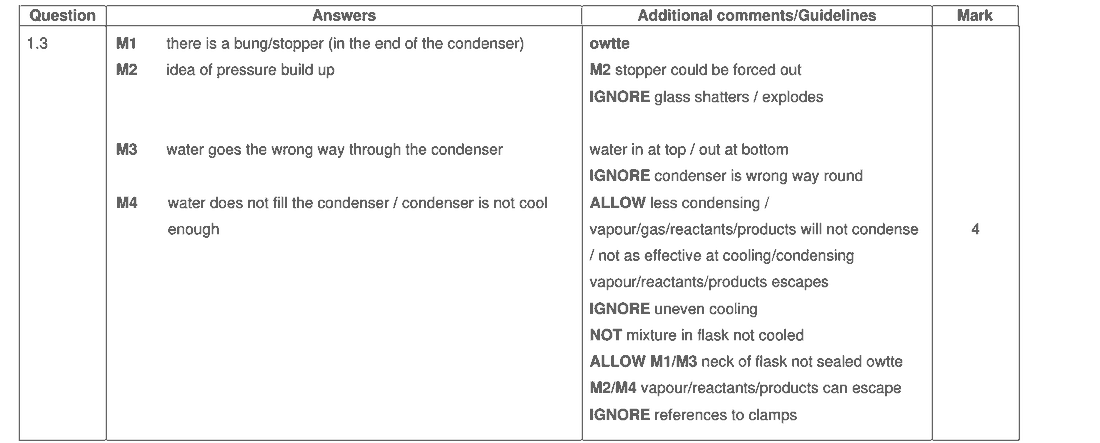
01.3 The mark scheme had an additional possible answer added because the diagram printed had a gap between the neck of the flask and the condenser. Reference to this gap and the possibility of vapour escaping was allowed, in addition to the expected answers referring to the bung causing pressure build-up or the incorrect direction of flow of water causing inefficient condensing. 45% of students obtained full marks here. Some students referred to a mistake being the absence of clamps – but the second sentence of the stem stated that it should be assumed that the apparatus is clamped correctly! Some students also got confused between reflux and distillation and suggested incorrectly that the condenser should be horizontal rather than vertical to avoid the vapour falling back into the reaction flask.
Notes from the mark scheme and report
Mistake: a bung in the top of the condenser
problem: pressure builds up (the bung could be forced out). Mistake: water goes the wrong way through the condenser (in at the top, out at the bottom)
problem: the jacket does not fill / the condenser is not cool enough, so vapour escapes without condensing. Also allowed (the printed diagram showed a gap): flask neck not sealed, so vapour can escape. Clamps are not a mistake (the stem says so)
the condenser should not be horizontal. 45% scored full marks
Skills: ATd Use laboratory apparatus for a variety of experimental techniques including: titration, using burette and pipette; distillation and heating under reflux, including setting up glassware using retort stand and clamps; qualitative tests for ions and organic functional groups; filtration, including use of fluted filter paper, or filtration under reduced pressure; PS2.1 Comment on experimental design and evaluate scientific methods; PS4.1 Know and understand how to use a wide range of experimental and practical instruments, equipment and techniques appropriate to the knowledge and understanding included in the specification; RP10 Preparation of: a pure organic solid and test of its purity; a pure organic liquid
June 2023 · Paper 3 · Q01.42 marksPractical and data analysis
Earlier part of question 01 that this part uses
Mark scheme
Examiner's comment
01.4 was a question where a lack of precision in answers meant that only 44% of students scored full marks.
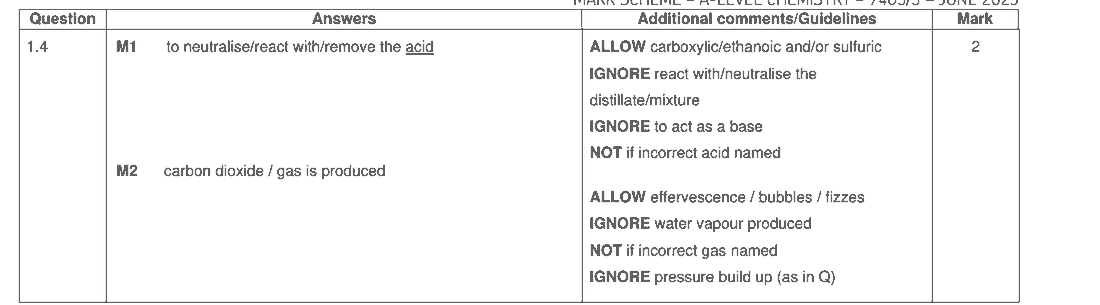
A clear reference to the fact that the sodium carbonate was added to neutralise acid was needed, together with recognition that this reaction produces carbon dioxide gas.
carbon dioxide gas is produced, which builds up the pressure. 'Neutralises the mixture' is not enough. 44% scored both marks
Skills: ATg Purify: a solid product by recrystallisation; a liquid product, including use of separating funnel; PS1.2 Apply scientific knowledge to practical contexts; RP10 Preparation of: a pure organic solid and test of its purity; a pure organic liquid
June 2023 · Paper 3 · Q01.52 marksPractical and data analysisHard
Earlier part of question 01 that this part uses
Mark scheme
Examiner's comment
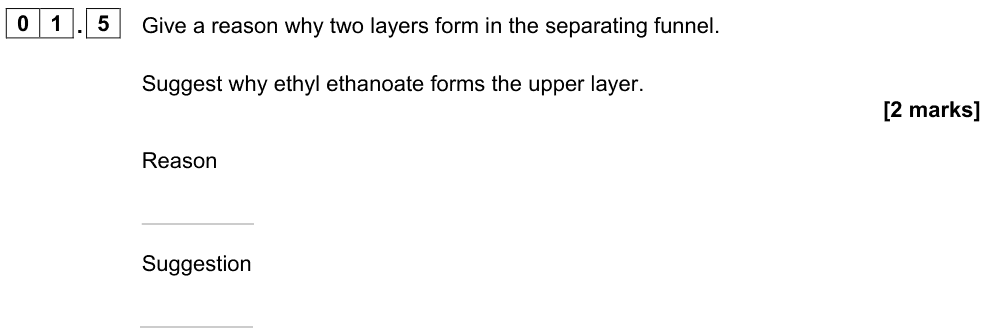
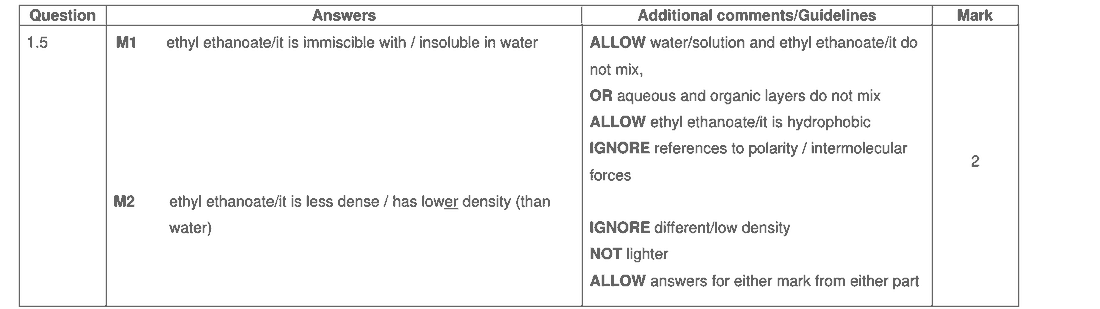
Answers to 01.5 also often lacked clarity and precision (such that only 24% of students scored both marks), with many students thinking that a difference in density alone accounts for the formation of two layers.
The key factor is that the organic and aqueous materials are immiscible.
The fact that the ethyl ethanoate forms the upper layer is then explained in terms that it is less dense (NOT lighter) than the aqueous layer.
Notes from the mark scheme and report
Two layers form because ethyl ethanoate is immiscible with (insoluble in) water / the organic and aqueous layers do not mix
it is the upper layer because it is less dense than the aqueous layer. 'Lighter' and 'different density' do not score
many thought density alone explains the two layers
Skills: ATg Purify: a solid product by recrystallisation; a liquid product, including use of separating funnel; PS1.2 Apply scientific knowledge to practical contexts; RP10 Preparation of: a pure organic solid and test of its purity; a pure organic liquid
June 2023 · Paper 3 · Q01.61 markPractical and data analysisEasy
Earlier part of question 01 that this part uses
Mark scheme
Examiner's comment
In 01.6, 64% of students correctly recognised that the anhydrous calcium chloride is added as a drying agent although a significant minority referred to ‘dehydration’ which is not an acceptable answer due to the alternate meanings of that term in Chemistry.
Notes from the mark scheme and report
To remove (absorb) water: it is a drying agent. 'Dehydrates' is not accepted
not 'to dry the reactants'
Skills: ATg Purify: a solid product by recrystallisation; a liquid product, including use of separating funnel; PS4.1 Know and understand how to use a wide range of experimental and practical instruments, equipment and techniques appropriate to the knowledge and understanding included in the specification; RP10 Preparation of: a pure organic solid and test of its purity; a pure organic liquid
June 2023 · Paper 3 · Q01.81 markShort answerEasy
Earlier part of question 01 that this part uses
Mark scheme
Examiner's comment
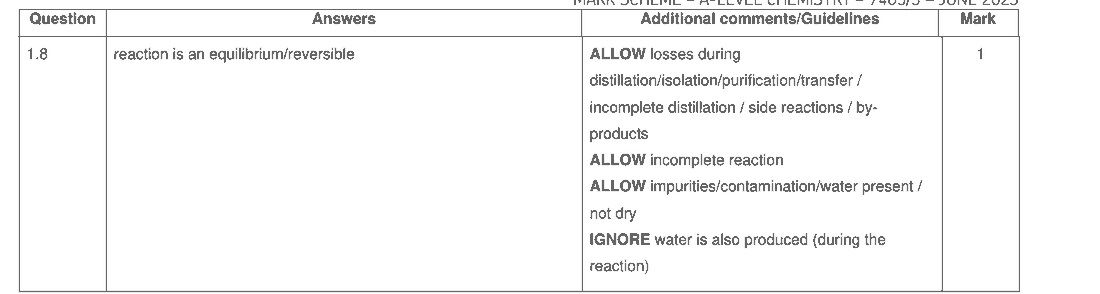
72% of students were able to correctly answer 01.8.
Notes from the mark scheme and report
The reaction is reversible / reaches equilibrium (allow incomplete reaction, losses during distillation, purification or transfer, side reactions). 'Water is also produced' is ignored
Skills: PS2.3 Evaluate results and draw conclusions with reference to measurement uncertainties and errors; RP10 Preparation of: a pure organic solid and test of its purity; a pure organic liquid
June 2022 · Paper 2 · Q05.12 marksAO3=2Practical and data analysis
Mark scheme
Examiner's comment
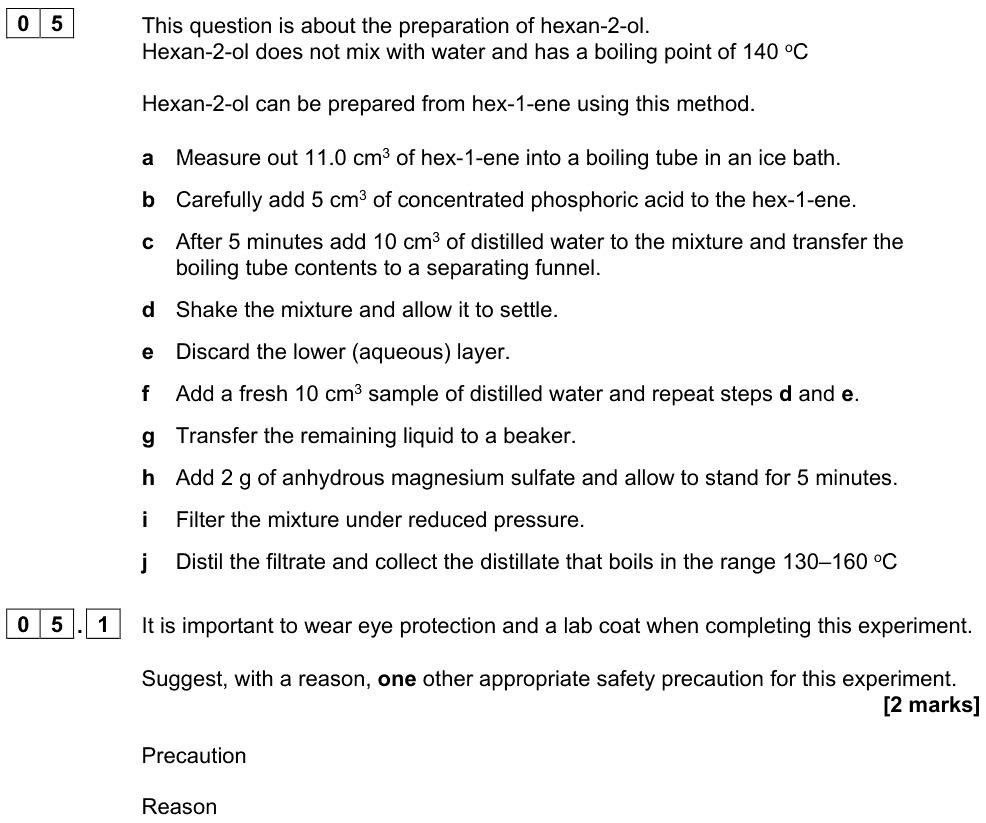
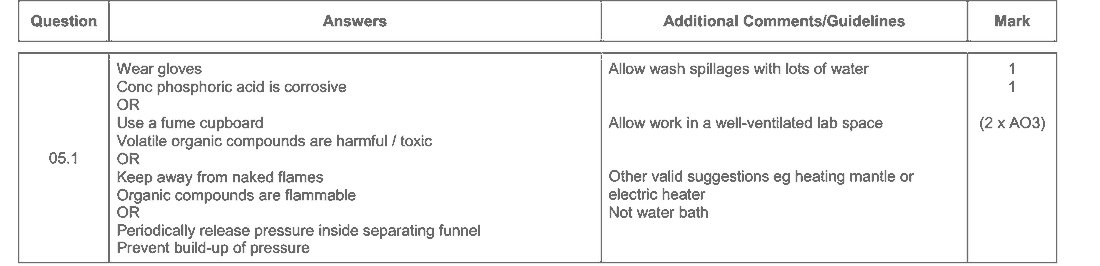
05.1 This question was well answered and students were able to suggest one of a range of appropriate safety precautions.
Notes from the mark scheme and report
One precaution with its reason: wear gloves, concentrated phosphoric acid is corrosive
or use a fume cupboard, volatile organic compounds are harmful
or keep away from naked flames (use an electric heater), organic compounds are flammable
or release the pressure in the separating funnel, to prevent a build-up of pressure. Not a water bath
Skills: ATk Safely and carefully handle solids and liquids, including corrosive, irritant, flammable and toxic substances; PS4.1 Know and understand how to use a wide range of experimental and practical instruments, equipment and techniques appropriate to the knowledge and understanding included in the specification; RP10 Preparation of: a pure organic solid and test of its purity; a pure organic liquid
June 2022 · Paper 2 · Q05.21 markAO2=1Practical and data analysis
Earlier part of question 05 that this part uses
Mark scheme
Examiner's comment
05.2 Removal of water-soluble impurities as the correct reason for adding distilled water was less well known.
Notes from the mark scheme and report
To remove water-soluble impurities (allow: to remove excess acid)
Skills: ATg Purify: a solid product by recrystallisation; a liquid product, including use of separating funnel; PS4.1 Know and understand how to use a wide range of experimental and practical instruments, equipment and techniques appropriate to the knowledge and understanding included in the specification; RP10 Preparation of: a pure organic solid and test of its purity; a pure organic liquid
June 2022 · Paper 2 · Q05.31 markAO2=1Practical and data analysis
Earlier part of question 05 that this part uses
Mark scheme
Examiner's comment
05.3 The use of MgSO4 to dry the liquid product was better known.
Notes from the mark scheme and report
To remove water / dry the organic liquid (drying agent)
Skills: ATg Purify: a solid product by recrystallisation; a liquid product, including use of separating funnel; PS4.1 Know and understand how to use a wide range of experimental and practical instruments, equipment and techniques appropriate to the knowledge and understanding included in the specification; RP10 Preparation of: a pure organic solid and test of its purity; a pure organic liquid
June 2022 · Paper 2 · Q05.42 marksAO2=2Diagram or structure
Earlier part of question 05 that this part uses
Mark scheme
Examiner's comment
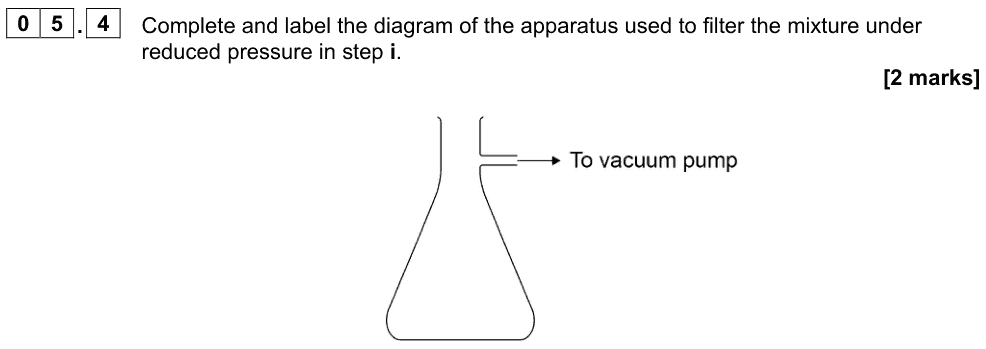
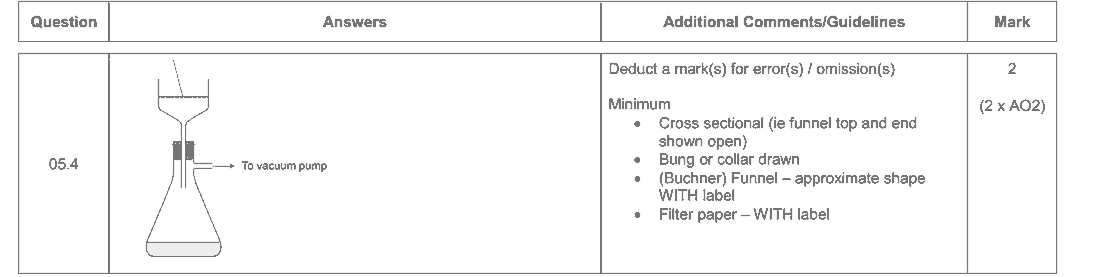
05.4 Diagrams for reduced pressure filtration were generally poor and few scored full marks. The most common errors were apparatus not shown in cross section and the absence of a collar or bung between the flask and (Buchner) funnel.
Notes from the mark scheme and report
Cross-section diagram with a Buchner funnel (labelled) sitting in a bung or collar in the neck of the flask, and filter paper (labelled) flat in the funnel
the funnel top and stem are open. Errors: not drawn in cross-section
no bung or collar
Skills: ATd Use laboratory apparatus for a variety of experimental techniques including: titration, using burette and pipette; distillation and heating under reflux, including setting up glassware using retort stand and clamps; qualitative tests for ions and organic functional groups; filtration, including use of fluted filter paper, or filtration under reduced pressure; PS4.1 Know and understand how to use a wide range of experimental and practical instruments, equipment and techniques appropriate to the knowledge and understanding included in the specification; RP10 Preparation of: a pure organic solid and test of its purity; a pure organic liquid
June 2022 · Paper 2 · Q07.13 marksAO3=3Mechanism
Mark scheme
Examiner's comment
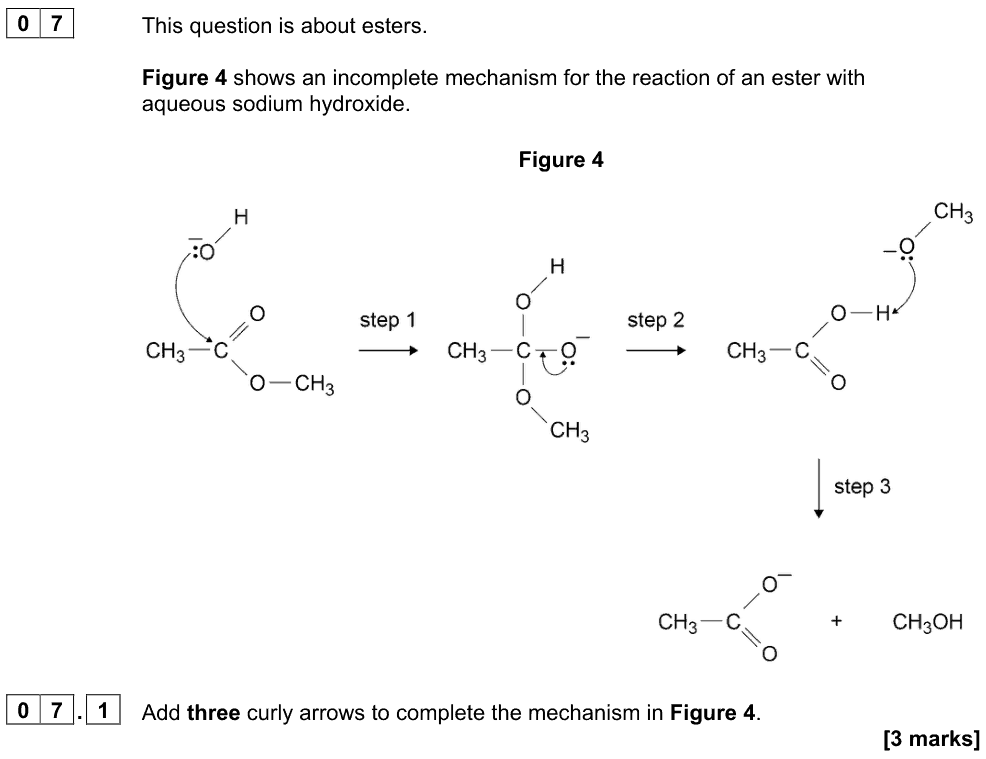
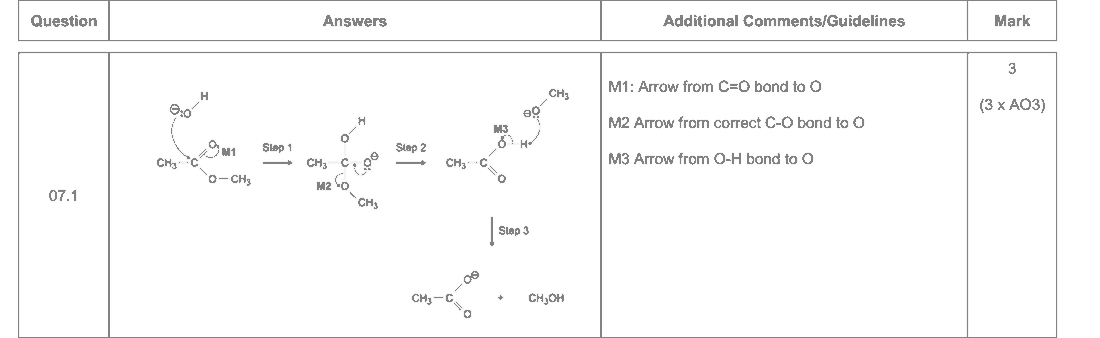
07.1 This question required students to deduce and add three curly arrows to an unfamiliar incomplete mechanism. As with similar questions in the past, this discriminated well between the most able and weaker students.
Notes from the mark scheme and report
Step 1: curly arrow from the C=O bond to O. Step 2: curly arrow from the C–OCH3 bond to that O (CH3O– leaves). Step 3: curly arrow from the O–H bond of the acid to O (the arrow from CH3O– to H is already printed)
June 2022 · Paper 2 · Q07.21 markAO1=1Short answer
Earlier part of question 07 that this part uses
Mark scheme
Examiner's comment
07.2 Despite being a term taken directly from the specification, hydrolysis was not well known and few students scored this mark.
Notes from the mark scheme and report
(Alkaline / base) hydrolysis. Few scored
June 2022 · Paper 2 · Q07.31 markAO1=1Short answer
Earlier part of question 07 that this part uses
Mark scheme
Examiner's comment
07.3 The specific role of the methoxide ion as a base/ proton acceptor was better answered than Question 07.2.
Notes from the mark scheme and report
Base / proton acceptor
June 2022 · Paper 2 · Q07.41 markAO1=1Short answer
Earlier part of question 07 that this part uses
Mark scheme
Examiner's comment
07.4 Almost half the students knew that soap was the use of the product when vegetable oil is hydrolysed with sodium hydroxide.
Notes from the mark scheme and report
Soap (only)
June 2022 · Paper 3 · Q261 markAO1=1Multiple choice
Answer
B
Mark scheme
Notes from the mark scheme and report
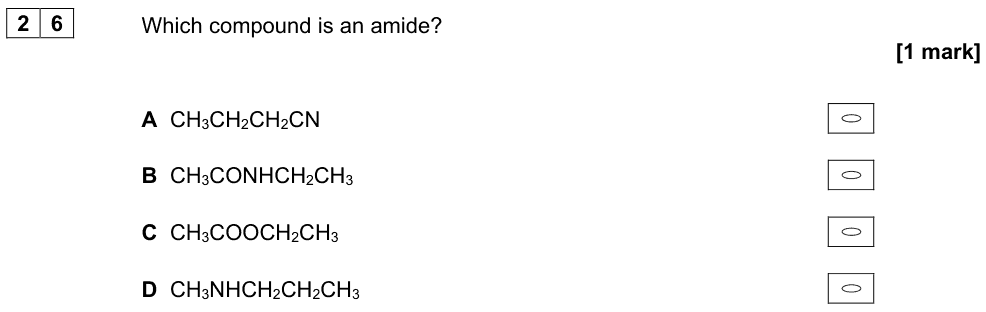
Answer: B. CH3CONHCH2CH3 contains the –CONH– group (N-substituted amide)
A is a nitrile, C an ester, D a secondary amine
June 2022 · Paper 3 · Q311 markAO2=1Multiple choice
Answer
B
Mark scheme
Notes from the mark scheme and report
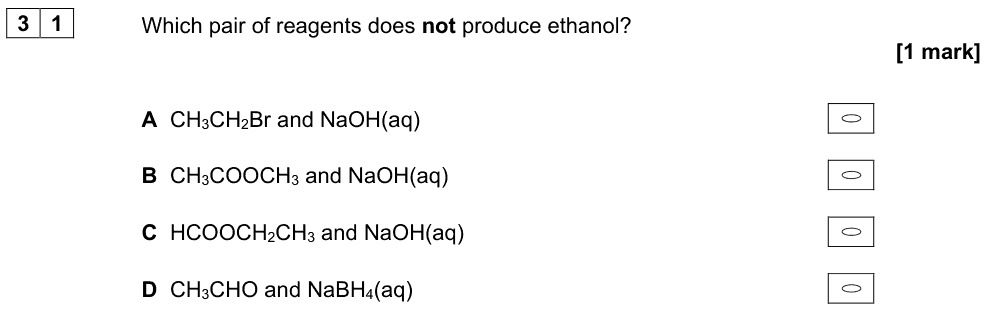
Answer: B. Methyl ethanoate hydrolyses to methanol and sodium ethanoate. Bromoethane with NaOH(aq), ethyl methanoate with NaOH and ethanal with NaBH4 all give ethanol
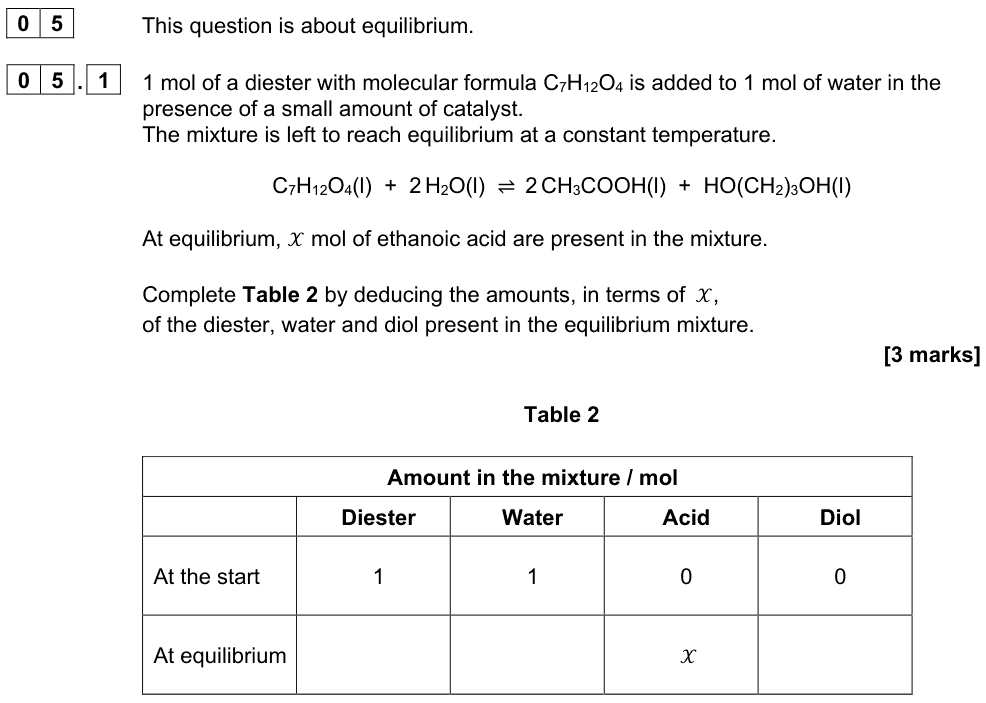
November 2021 · Paper 2 · Q01.13 marksShort answer
Mark scheme
Examiner's comment
All aspects of this question differentiated very well. The extended calculation in question 01.3 attracted good responses with a third of the students gaining full marks and the majority able to access at least 1 or 2 marks. A common mistake was to assume that the oil was pure triester. In question 01.4 very few students appreciated that aqueous ethanol was used as a mutual solvent for both the oil and the potassium hydroxide.
Notes from the mark scheme and report
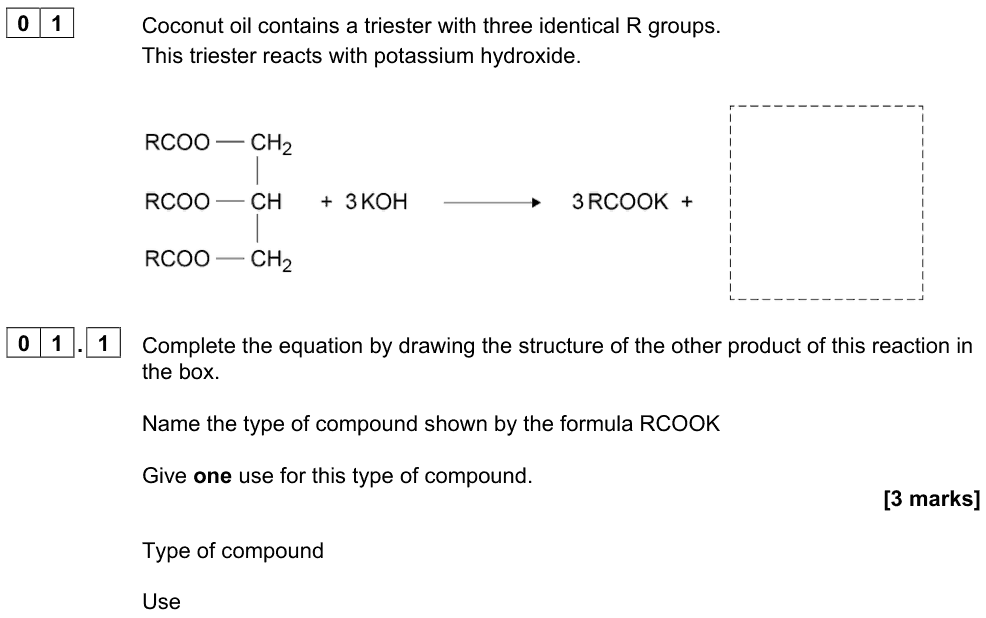
Other product: propane-1,2,3-triol (glycerol), CH2(OH)CH(OH)CH2OH. RCOOK is a (potassium) carboxylate salt / salt of a carboxylic acid (fatty acid). Use: soap (allow detergent / surfactant)
November 2021 · Paper 2 · Q01.23 marksCalculation
Earlier part of question 01 that this part uses
Mark scheme
Examiner's comment
All aspects of this question differentiated very well. The extended calculation in question 01.3 attracted good responses with a third of the students gaining full marks and the majority able to access at least 1 or 2 marks. A common mistake was to assume that the oil was pure triester. In question 01.4 very few students appreciated that aqueous ethanol was used as a mutual solvent for both the oil and the potassium hydroxide.
Notes from the mark scheme and report
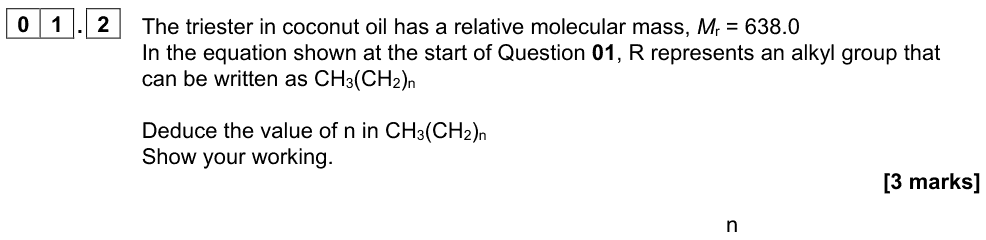
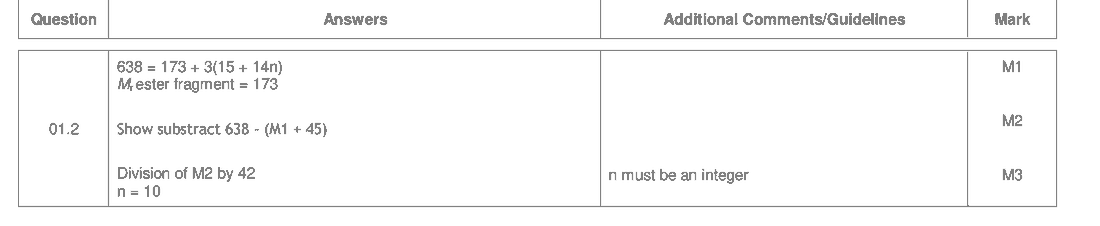
Answer: n = 10. Mr of the triester framework without the three R groups (C6H5O6) = 173
638 = 173 + 3(15 + 14n)
638 – 173 – 45 = 420
420 ÷ 42 = 10. n must be an integer
Skills: MS2.4 Solve algebraic equations
November 2021 · Paper 2 · Q01.43 marksPractical and data analysis
Earlier part of question 01 that this part uses
Mark scheme
Examiner's comment
In question 01.4 very few students appreciated that aqueous ethanol was used as a mutual solvent for both the oil and the potassium hydroxide.
Notes from the mark scheme and report
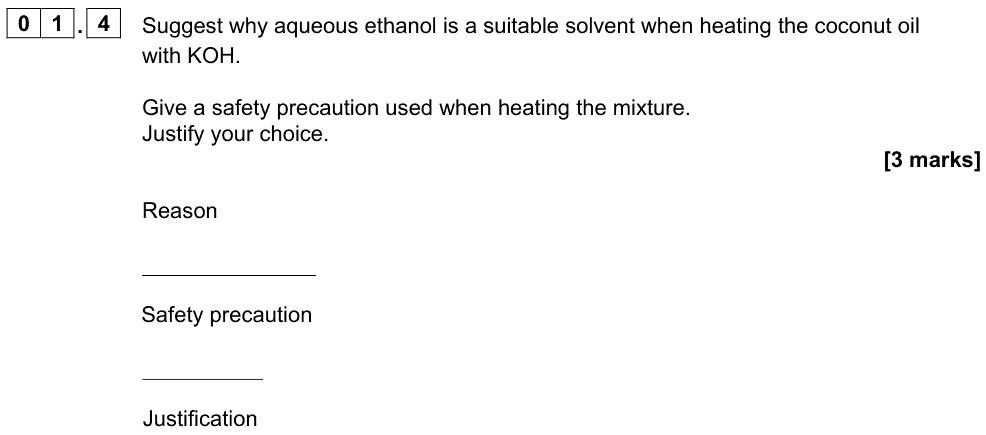
Aqueous ethanol dissolves both the oil and the KOH (a mutual solvent, so the reactants mix). Precaution linked to heating: use a water bath (or electric heater / mantle / sand bath) rather than a flame, because ethanol is flammable. Alternative matched pair: eye protection because KOH is corrosive. Very few saw the mutual-solvent point
Skills: ATb Use water bath or electric heater or sand bath for heating; ATk Safely and carefully handle solids and liquids, including corrosive, irritant, flammable and toxic substances; PS1.2 Apply scientific knowledge to practical contexts; PS4.1 Know and understand how to use a wide range of experimental and practical instruments, equipment and techniques appropriate to the knowledge and understanding included in the specification
November 2021 · Paper 2 · Q05.21 markDiagram or structure
Earlier part of question 05 that this part uses
Mark scheme
Examiner's comment
The structure of the diester in question 05.2 was very poorly answered, but the familiar Kc calculation in question 05.3 proved very accessible and around two thirds of students scored all three marks.
Notes from the mark scheme and report
CH3COOCH2CH2CH2OOCCH3 (propane-1,3-diyl diethanoate: hydrolysis gives two ethanoic acid molecules and propane-1,3-diol). Very poorly answered. Needs the equation printed in 05.1
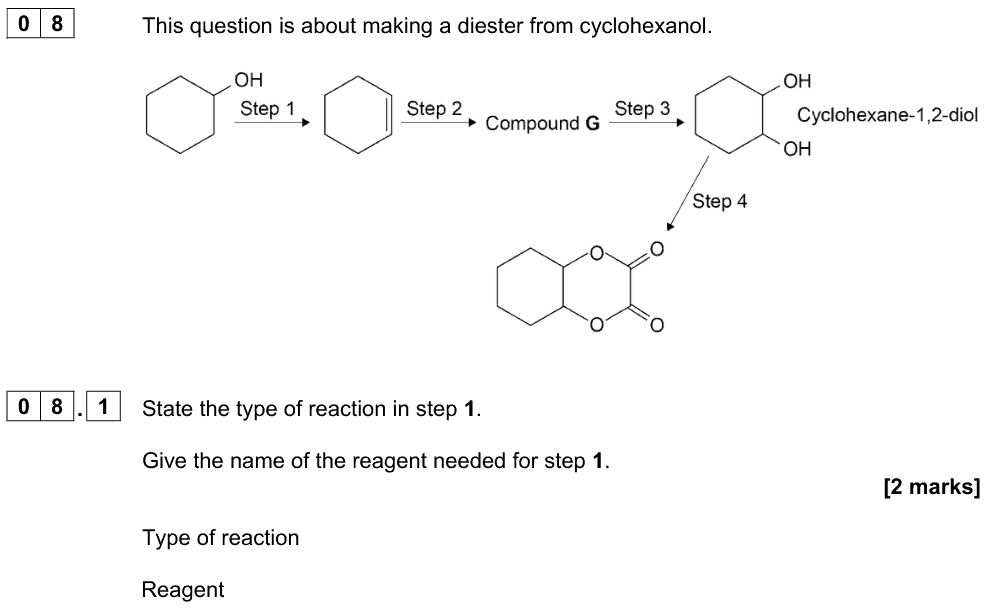
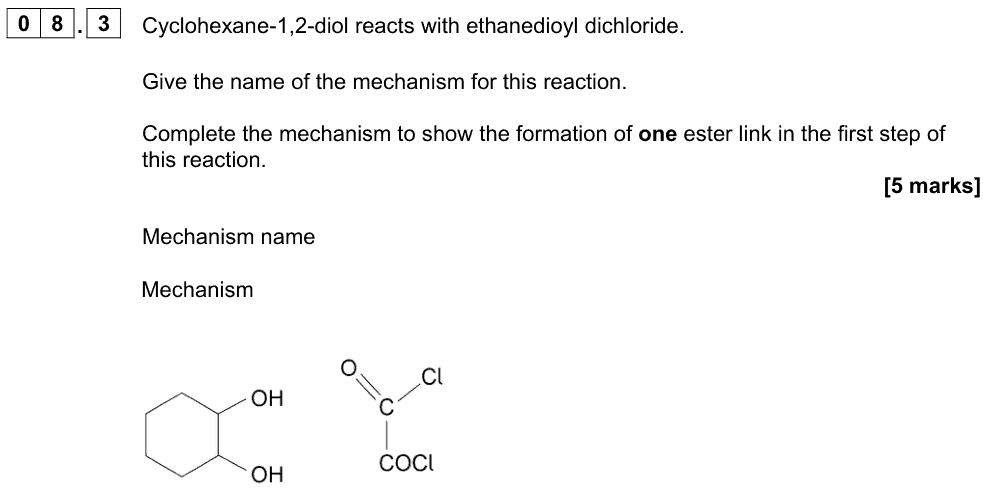
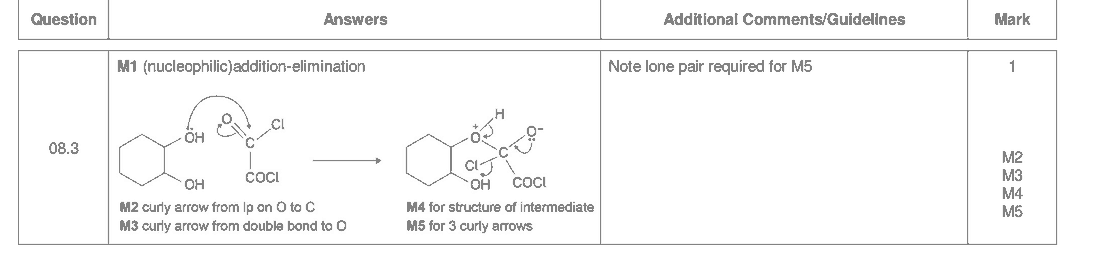
November 2021 · Paper 2 · Q08.35 marksMechanism
Earlier part of question 08 that this part uses
Mark scheme
Examiner's comment
A very good range of marks was seen for question 08.3 and the question discriminated very well.
Notes from the mark scheme and report
(Nucleophilic) addition–elimination. Curly arrow from a lone pair on an O–H oxygen of the diol to the C of a COCl group
arrow from the C=O bond to O
intermediate with O+–H on the diol oxygen, C–O– and C–Cl
then three arrows: lone pair on O– reforms C=O, the C–Cl bond breaks to Cl, and the O–H bond breaks to O+ (lone pair on O– required)
November 2021 · Paper 3 · Q03.15 marksPractical and data analysisHard
Mark scheme
Examiner's comment
Two-thirds of students failed to score more than one mark in 03.1 with many very confused answers muddling up ideas of crystallisation with those of distillation and even solvent extraction.
Students who were able to give a description of recrystallisation as the method of purifying the solid often overlooked the need to separate it from the reaction mixture first.
Notes from the mark scheme and report
Filter (or decant) to separate the solid
dissolve it in the minimum volume of hot solvent
cool / leave to crystallise
filter (under reduced pressure)
wash with cold solvent and dry (method given). 'Warm' solvent is not enough. Many muddled recrystallisation with distillation or solvent extraction, or forgot the first separation
Skills: ATg Purify: a solid product by recrystallisation; a liquid product, including use of separating funnel; ATd Use laboratory apparatus for a variety of experimental techniques including: titration, using burette and pipette; distillation and heating under reflux, including setting up glassware using retort stand and clamps; qualitative tests for ions and organic functional groups; filtration, including use of fluted filter paper, or filtration under reduced pressure; PS4.1 Know and understand how to use a wide range of experimental and practical instruments, equipment and techniques appropriate to the knowledge and understanding included in the specification; RP10 Preparation of: a pure organic solid and test of its purity; a pure organic liquid
November 2021 · Paper 3 · Q06.63 marksPractical and data analysis
Earlier part of question 06 that this part uses
Mark scheme
Examiner's comment
Practical weaknesses and insufficient precision in answers let many students down here.
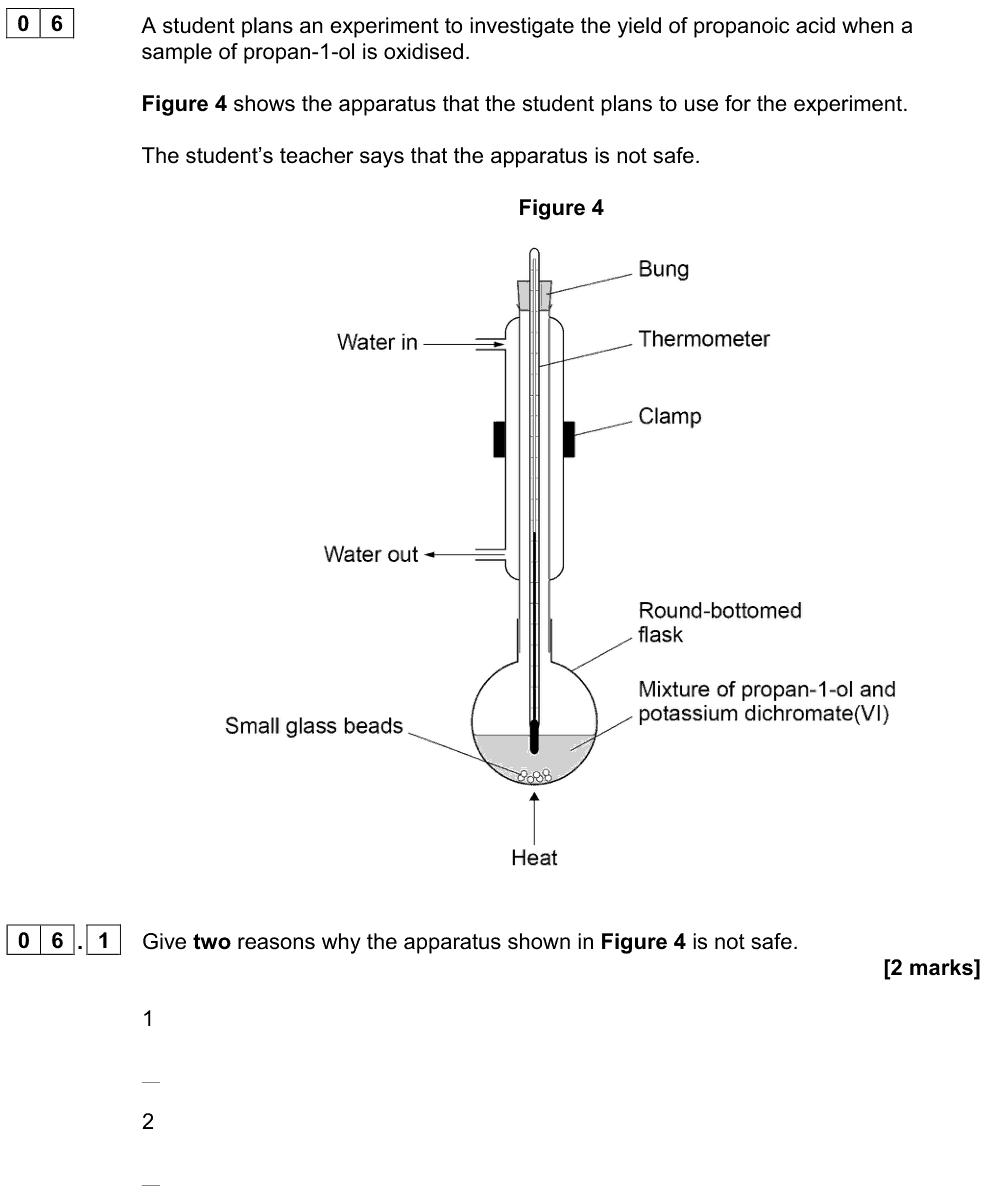
Question 06.1 specifically asked for safety concerns related to the apparatus diagram, with the hope that students would recognise that the bung should not be present (as it would mean a sealed apparatus is being heated) and that the flask is not clamped. Vague references to ‘the clamp being in the wrong place’ were not sufficient because a more specific response was needed.
Many students referred to the direction of the water flow being wrong because it should enter at the bottom of the condenser – but this is not a safety concern so could not be credited here. However, if it was mentioned in 06.1 but not then mentioned in 06.3, credit was still allowed for 06.3.
In question 06.3 many students failed to recognise that the thermometer is not needed at all and got confused with distillation by suggesting that the thermometer needed to be higher up in the apparatus.
Notes from the mark scheme and report
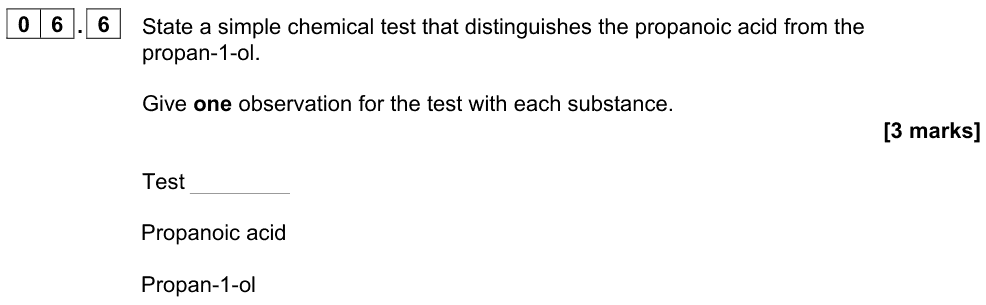
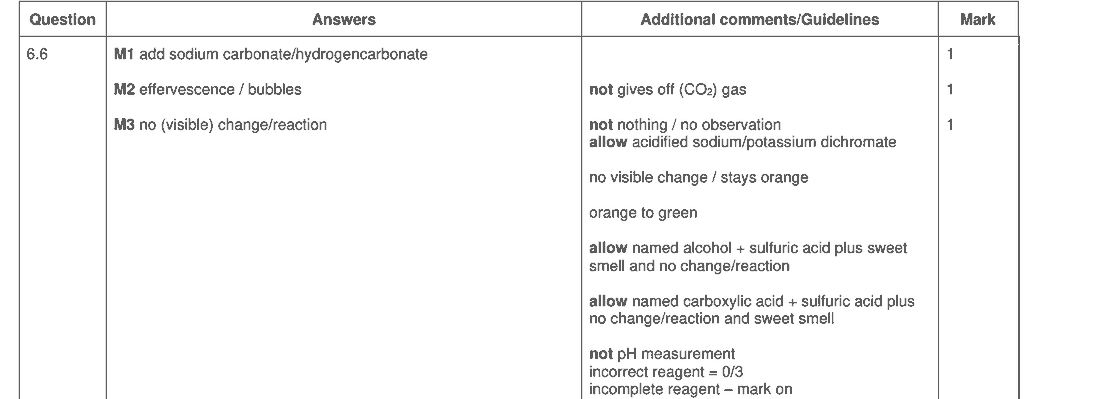
Add sodium carbonate or sodium hydrogencarbonate: effervescence with propanoic acid, no visible change with propan-1-ol. Or acidified potassium dichromate: stays orange with the acid, orange to green with the alcohol. 'Gives off CO2' and 'nothing' are not observations
pH measurement is not accepted
wrong reagent scores 0
Skills: PS1.1 Solve problems set in practical contexts; RP6 Tests for alcohol, aldehyde, alkene and carboxylic acid
November 2021 · Paper 3 · Q171 markMultiple choice
Answer
B
Mark scheme
Notes from the mark scheme and report
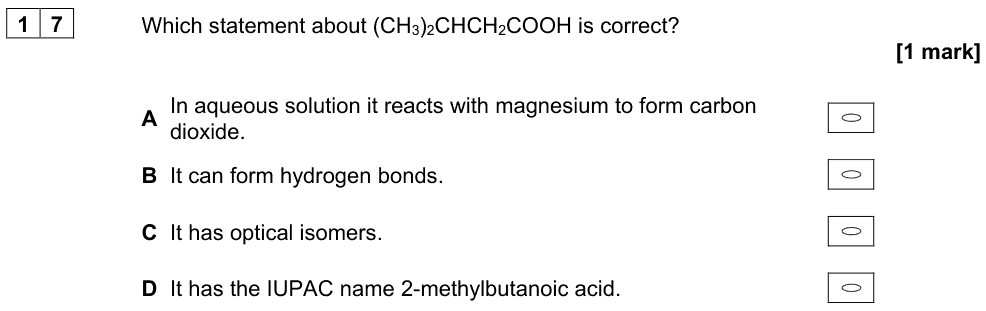
Answer: B. The –COOH group can hydrogen bond
with magnesium it gives hydrogen, it has no chiral carbon and its name is 3-methylbutanoic acid
November 2021 · Paper 3 · Q281 markMultiple choice
Answer
D
Mark scheme
Notes from the mark scheme and report
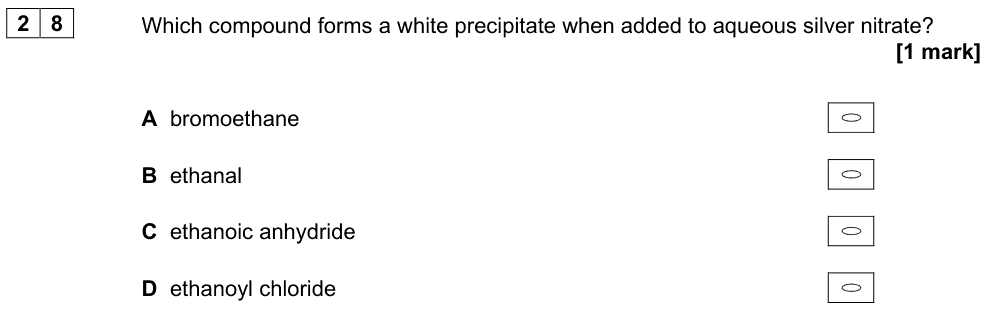
Answer: D. Ethanoyl chloride is hydrolysed rapidly by the water, releasing chloride ions that give white AgCl (bromoethane would give a cream precipitate, slowly)
November 2021 · Paper 3 · Q311 markMultiple choice
Answer
D
Mark scheme
Notes from the mark scheme and report
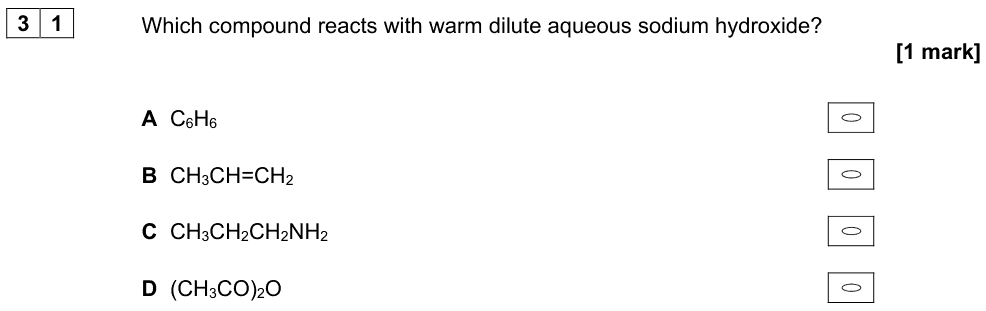
Answer: D. Ethanoic anhydride is hydrolysed (to ethanoate ions)
benzene, propene and the amine do not react with aqueous alkali (report: one of five items answered correctly by fewer than 40%)
November 2020 · Paper 2 · Q02.21 markShort answer
Earlier part of question 02 that this part uses
Mark scheme
Examiner's comment
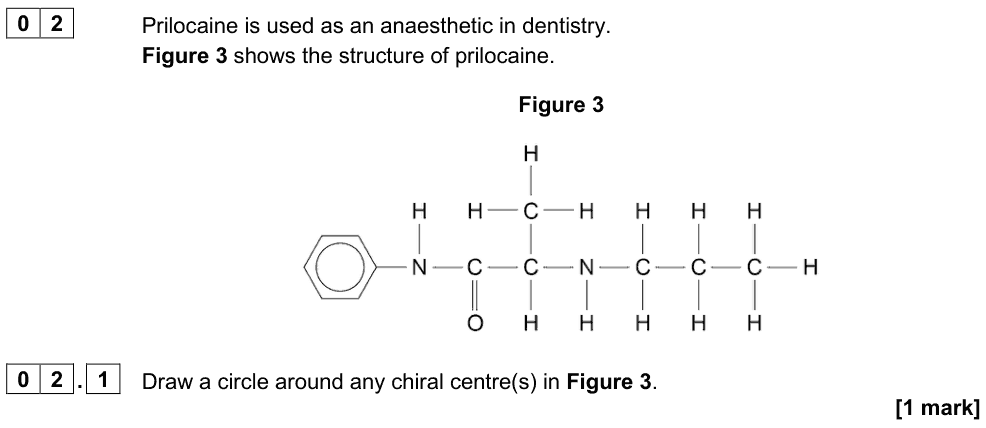
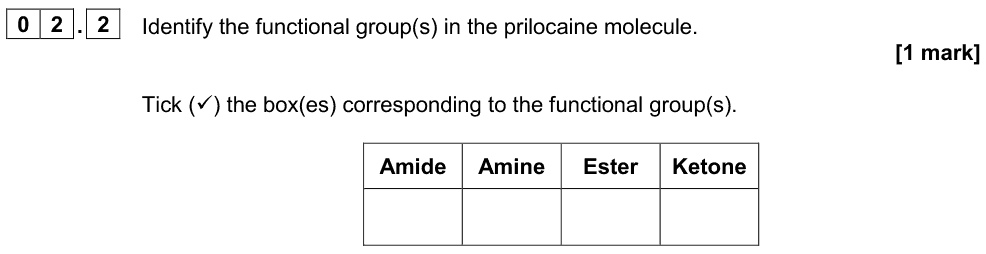
The chiral centre in 02.1 proved very accessible to students but a surprising number were unable, in 02.2, to identify the functional groups present.
The most common wrong answers showed that students thought that the molecule had a ketone functional group.
Others failed to recognise that the prilocaine contained an amine functional group.
Notes from the mark scheme and report
Answer: amide and amine (two ticks only). Common wrong tick: ketone
the amine was often missed. The tick boxes are in the 02.3 crop
November 2020 · Paper 2 · Q02.33 marksDiagram or structure
Earlier part of question 02 that this part uses
Mark scheme
Examiner's comment
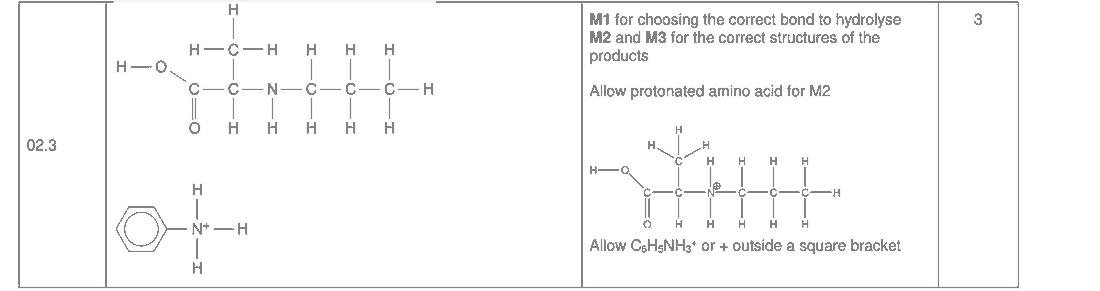
02.3 proved very challenging and many students struggled to access these marks, with many unable to identify the amide link as the site where hydrolysis would take place.
Notes from the mark scheme and report
Hydrolyse the amide C–N bond. Products: CH3CH(NHCH2CH2CH3)COOH (the amine N may be shown protonated) and phenylammonium ion C6H5NH3+ (acid conditions). One mark for the correct bond broken, one for each structure. Many did not see the amide link as the site of hydrolysis
November 2020 · Paper 2 · Q03.33 marksPractical and data analysis
Earlier part of question 03 that this part uses
Mark scheme
Examiner's comment
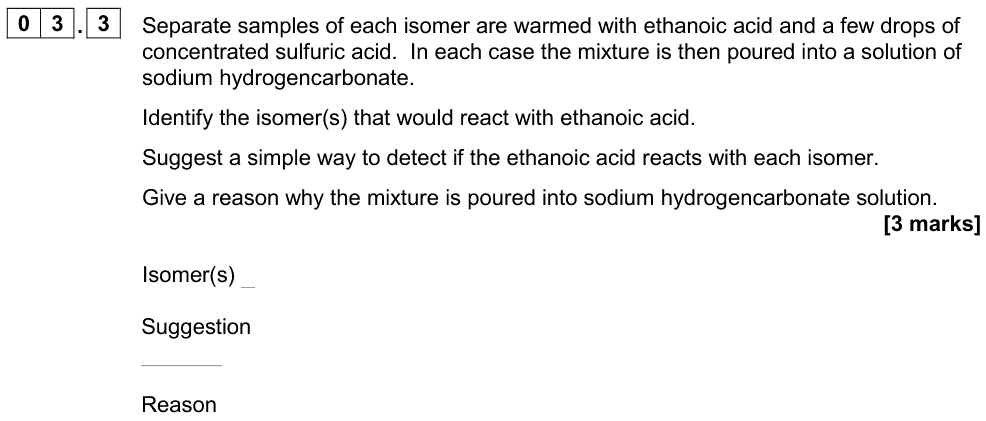
03.3 proved more difficult with students finding it hard to identify neutralisation of excess acid as the reason why the esterification reaction mixture was poured into NaHCO3 solution.
Notes from the mark scheme and report
P, Q, R and S (the four alcohols). A sweet (fruity) smell shows an ester has formed. Sodium hydrogencarbonate reacts with / neutralises the excess acid (so the smell is easier to detect). The reason was found hard
Skills: ATd Use laboratory apparatus for a variety of experimental techniques including: titration, using burette and pipette; distillation and heating under reflux, including setting up glassware using retort stand and clamps; qualitative tests for ions and organic functional groups; filtration, including use of fluted filter paper, or filtration under reduced pressure; PS1.2 Apply scientific knowledge to practical contexts
November 2020 · Paper 2 · Q04.12 marksPractical and data analysis
Mark scheme
Examiner's comment
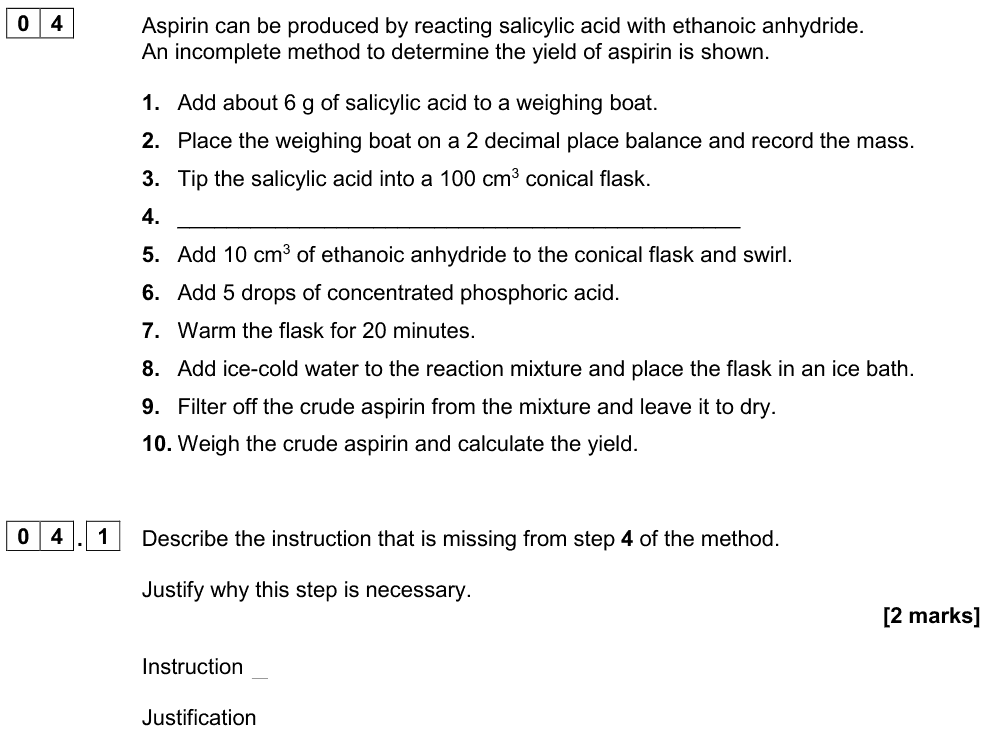
This question covered the skills learned in completing required practical 10 but a surprising number of students were unable to suggest re-weighing the weighing boat as the missing step in the method for 04.1.
Notes from the mark scheme and report
Reweigh the (empty) weighing boat, so that the exact mass of salicylic acid added to the flask can be calculated (mass by difference)
Skills: ATa Use appropriate apparatus to record a range of measurements (to include mass, time, volume of liquids and gases, temperature); PS2.1 Comment on experimental design and evaluate scientific methods; PS4.1 Know and understand how to use a wide range of experimental and practical instruments, equipment and techniques appropriate to the knowledge and understanding included in the specification; RP10 Preparation of: a pure organic solid and test of its purity; a pure organic liquid
November 2020 · Paper 2 · Q04.21 markPractical and data analysis
Earlier part of question 04 that this part uses
Mark scheme
Examiner's comment
Few students appreciated the need to state an appropriate size for the apparatus to be used to measure out the ethanoic anhydride in 04.2.
Notes from the mark scheme and report
10 cm3 measuring cylinder (10 to 50 cm3), or 10 cm3 pipette, burette, graduated pipette or 10 cm3 syringe. Few gave an appropriate size
Skills: ATa Use appropriate apparatus to record a range of measurements (to include mass, time, volume of liquids and gases, temperature); PS4.1 Know and understand how to use a wide range of experimental and practical instruments, equipment and techniques appropriate to the knowledge and understanding included in the specification; RP10 Preparation of: a pure organic solid and test of its purity; a pure organic liquid
November 2020 · Paper 2 · Q04.31 markPractical and data analysis
Earlier part of question 04 that this part uses
Mark scheme
Examiner's comment
This question covered the skills learned in completing required practical 10 but a surprising number of students were unable to suggest re-weighing the weighing boat as the missing step in the method for 04.1. Few students appreciated the need to state an appropriate size for the apparatus to be used to measure out the ethanoic anhydride in 04.2. The calculation in 04.5 was very well answered. Students were often able to identify that impurities lower the melting point of a sample in 04.6 but far fewer appreciated that impurities also broaden the range of temperatures over which the impure sample melts. In 04.7, many students were able to suggest keeping the mixture away from naked flames but far fewer identified that keeping the mixture below the boiling point of ethanol would also be an appropriate precaution to take. 04.8 proved difficult and only the best students explained that washing the aspirin with cold ethanol would be done to remove soluble impurities. 04.9 was well answered.
Notes from the mark scheme and report
Corrosive (causes skin burns / eye damage). Irritant and toxic are ignored
Skills: ATk Safely and carefully handle solids and liquids, including corrosive, irritant, flammable and toxic substances; RP10 Preparation of: a pure organic solid and test of its purity; a pure organic liquid
November 2020 · Paper 2 · Q04.41 markEquation writing
Earlier part of question 04 that this part uses
Mark scheme
Examiner's comment
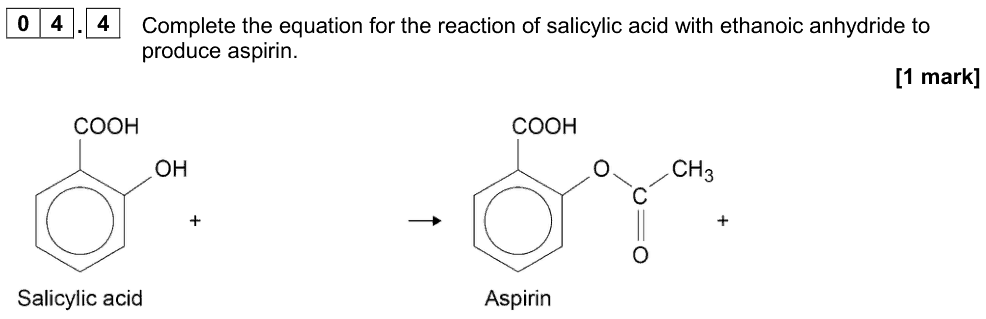
This question covered the skills learned in completing required practical 10 but a surprising number of students were unable to suggest re-weighing the weighing boat as the missing step in the method for 04.1. Few students appreciated the need to state an appropriate size for the apparatus to be used to measure out the ethanoic anhydride in 04.2. The calculation in 04.5 was very well answered. Students were often able to identify that impurities lower the melting point of a sample in 04.6 but far fewer appreciated that impurities also broaden the range of temperatures over which the impure sample melts. In 04.7, many students were able to suggest keeping the mixture away from naked flames but far fewer identified that keeping the mixture below the boiling point of ethanol would also be an appropriate precaution to take. 04.8 proved difficult and only the best students explained that washing the aspirin with cold ethanol would be done to remove soluble impurities. 04.9 was well answered.
Notes from the mark scheme and report
Left side: + (CH3CO)2O
right side: + CH3COOH
November 2020 · Paper 2 · Q04.62 marksPractical and data analysis
Earlier part of question 04 that this part uses
Mark scheme
Examiner's comment
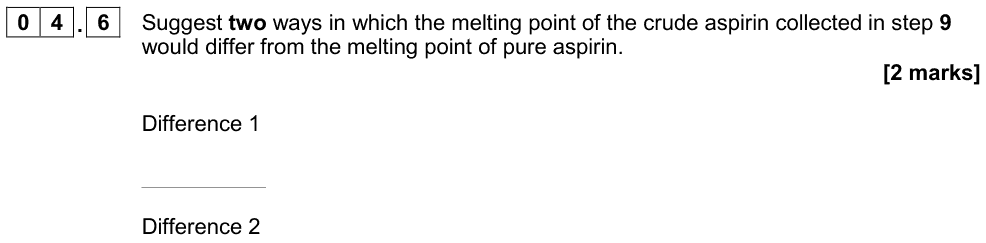
Students were often able to identify that impurities lower the melting point of a sample in 04.6 but far fewer appreciated that impurities also broaden the range of temperatures over which the impure sample melts.
Notes from the mark scheme and report
The melting point is lower, and the sample melts over a range of temperatures (not sharp). The broader range was often missed.
Skills: ATh Use melting point apparatus; PS2.3 Evaluate results and draw conclusions with reference to measurement uncertainties and errors; RP10 Preparation of: a pure organic solid and test of its purity; a pure organic liquid
November 2020 · Paper 2 · Q04.72 marksPractical and data analysis
Earlier part of question 04 that this part uses
Mark scheme
Examiner's comment
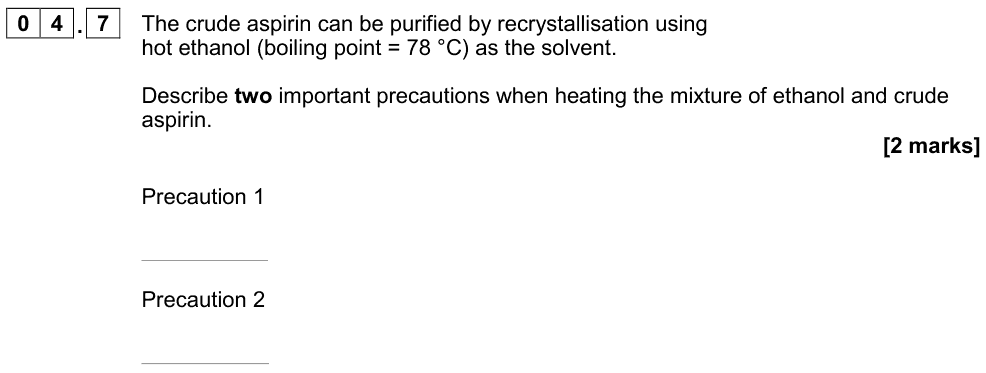
In 04.7, many students were able to suggest keeping the mixture away from naked flames but far fewer identified that keeping the mixture below the boiling point of ethanol would also be an appropriate precaution to take.
Notes from the mark scheme and report
Ethanol is flammable, so heat with a water bath (or electric heater), not a Bunsen flame
keep the temperature below the boiling point of ethanol (78 °C) so that it does not boil away. A practical step is needed, not just the hazard
minimum volume of solvent allowed
Skills: ATb Use water bath or electric heater or sand bath for heating; ATg Purify: a solid product by recrystallisation; a liquid product, including use of separating funnel; ATk Safely and carefully handle solids and liquids, including corrosive, irritant, flammable and toxic substances; PS4.1 Know and understand how to use a wide range of experimental and practical instruments, equipment and techniques appropriate to the knowledge and understanding included in the specification; RP10 Preparation of: a pure organic solid and test of its purity; a pure organic liquid
November 2020 · Paper 2 · Q04.81 markPractical and data analysis
Earlier part of question 04 that this part uses
Mark scheme
Examiner's comment
04.8 proved difficult and only the best students explained that washing the aspirin with cold ethanol would be done to remove soluble impurities.
Notes from the mark scheme and report
To wash away soluble impurities (the remaining solution on the crystals)
cold and a small amount so that little aspirin dissolves. Found difficult
Skills: ATd Use laboratory apparatus for a variety of experimental techniques including: titration, using burette and pipette; distillation and heating under reflux, including setting up glassware using retort stand and clamps; qualitative tests for ions and organic functional groups; filtration, including use of fluted filter paper, or filtration under reduced pressure; ATg Purify: a solid product by recrystallisation; a liquid product, including use of separating funnel; PS4.1 Know and understand how to use a wide range of experimental and practical instruments, equipment and techniques appropriate to the knowledge and understanding included in the specification; RP10 Preparation of: a pure organic solid and test of its purity; a pure organic liquid
November 2020 · Paper 2 · Q04.91 markPractical and data analysis
Earlier part of question 04 that this part uses
Mark scheme
Examiner's comment
04.9 was well answered.
Notes from the mark scheme and report
The pure aspirin has larger / needle-like crystals or is whiter (lighter, shinier, less powdery)
the statement must be tied to the pure or the crude sample
Skills: ATg Purify: a solid product by recrystallisation; a liquid product, including use of separating funnel; PS2.3 Evaluate results and draw conclusions with reference to measurement uncertainties and errors; RP10 Preparation of: a pure organic solid and test of its purity; a pure organic liquid
November 2020 · Paper 3 · Q271 markMultiple choice
Answer
B
Mark scheme
Notes from the mark scheme and report
Answer: B. An acyl chloride with an –OH compound is nucleophilic addition–elimination
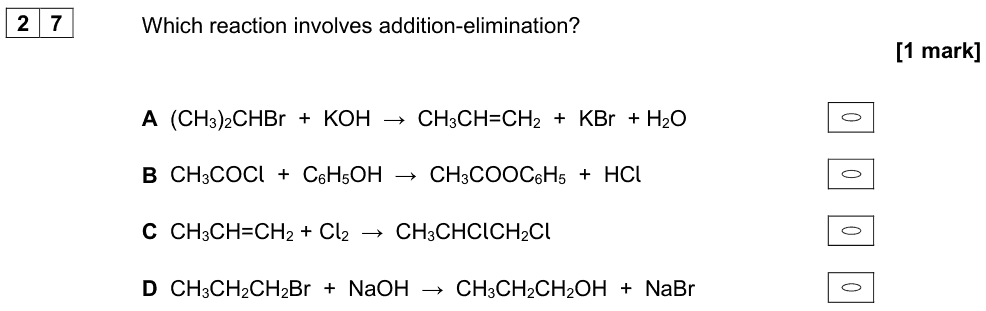
A is elimination, C electrophilic addition, D nucleophilic substitution
November 2020 · Paper 3 · Q351 markMultiple choice
Answer
D
Mark scheme
Notes from the mark scheme and report
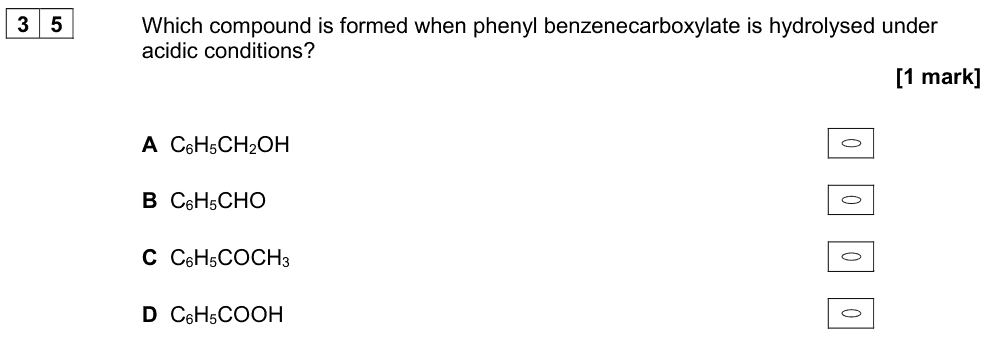
Answer: D. C6H5COOC6H5 + H2O gives benzenecarboxylic acid, C6H5COOH, and phenol
June 2019 · Paper 2 · Q08.32 marksMechanism
Earlier part of question 08 that this part uses
Mark scheme
Examiner's comment
08.3 This part was generally answered well and many students scored both marks. Some, however, failed to gain the second mark because of careless drawing of curly arrows or for showing a chloride ion removing a proton from the intermediate.
Notes from the mark scheme and report
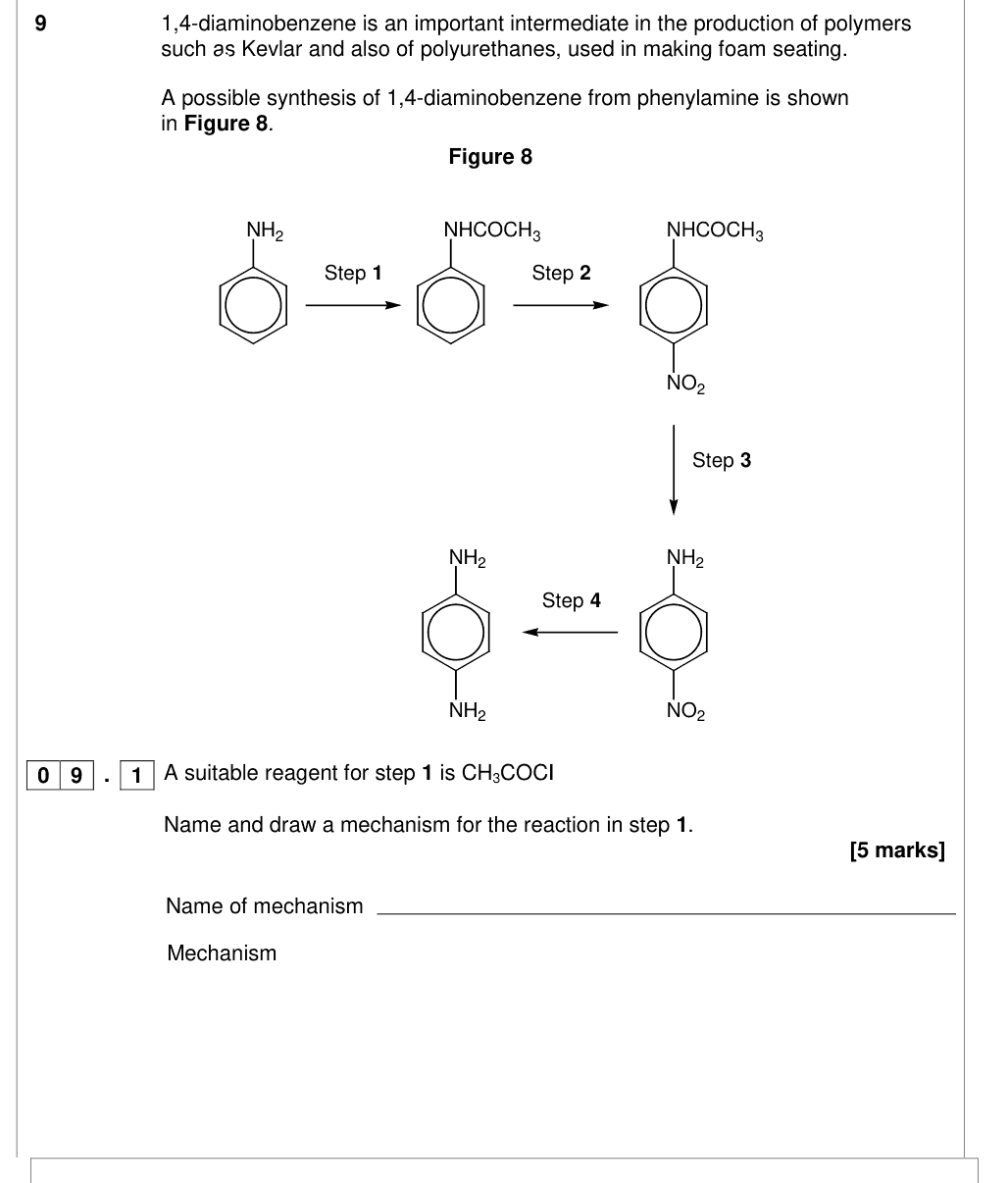
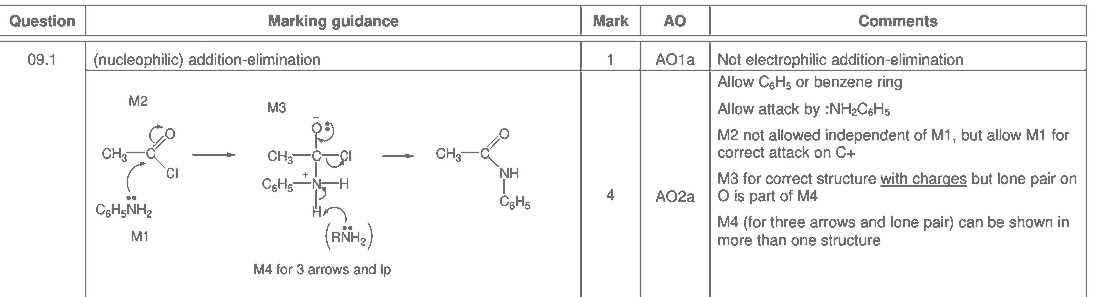
Nucleophilic addition–elimination. M1: tetrahedral intermediate CH3C(O–)(Cl)–N+H2R with both charges. M2: three curly arrows with a lone pair on O–: lone pair on O– reforms C=O, C–Cl bond breaks to Cl, and N–H bond breaks to N+ (loss of H+), giving CH3CONHR. Do not show Cl– removing the proton. Careless arrows lost the second mark
June 2019 · Paper 2 · Q08.41 markShort answer
Earlier part of question 08 that this part uses
Mark scheme
Examiner's comment
08.4 This part was well answered.
Notes from the mark scheme and report
Ethanoyl chloride is corrosive / forms HCl (strong acid) fumes / is easily hydrolysed / reacts violently / is more expensive. Ignore toxic, harmful, hazardous
June 2019 · Paper 2 · Q08.51 markDiagram or structure
Earlier part of question 08 that this part uses
Mark scheme
Examiner's comment
08.5 This part proved to be difficult and few gained the mark here, including about a fifth of the students who made no attempt whatsoever.
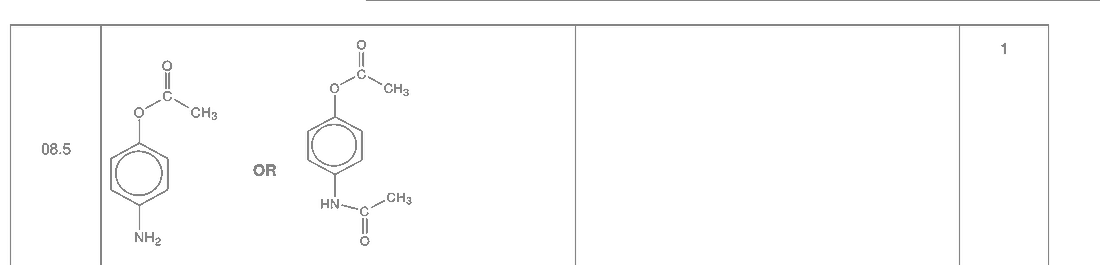
Notes from the mark scheme and report
The phenol OH can also be acylated: the ester 4-aminophenyl ethanoate (H2N–C6H4–OCOCH3), or the product acylated on both N and O (CH3CONH–C6H4–OCOCH3). Found difficult
about a fifth made no attempt
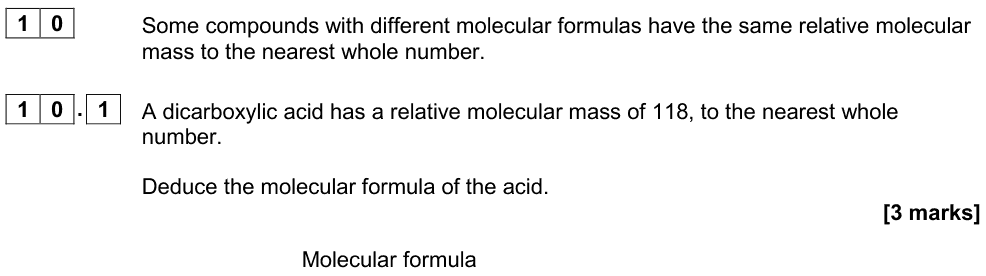
June 2019 · Paper 2 · Q10.13 marksShort answerEasy
Mark scheme
Examiner's comment
10.1 Approximately 60% of students deduced a correct molecular formula in part 1. The most common error was leaving the answer as a structural formula, so failing to gain the final mark.
Notes from the mark scheme and report
Answer: C4H6O4. Two COOH groups = C2H2O4 = 90
118 – 90 = 28 = C2H4. Must be a molecular formula: a structural formula such as HOOCCH2CH2COOH scores 2 only (the commonest error)
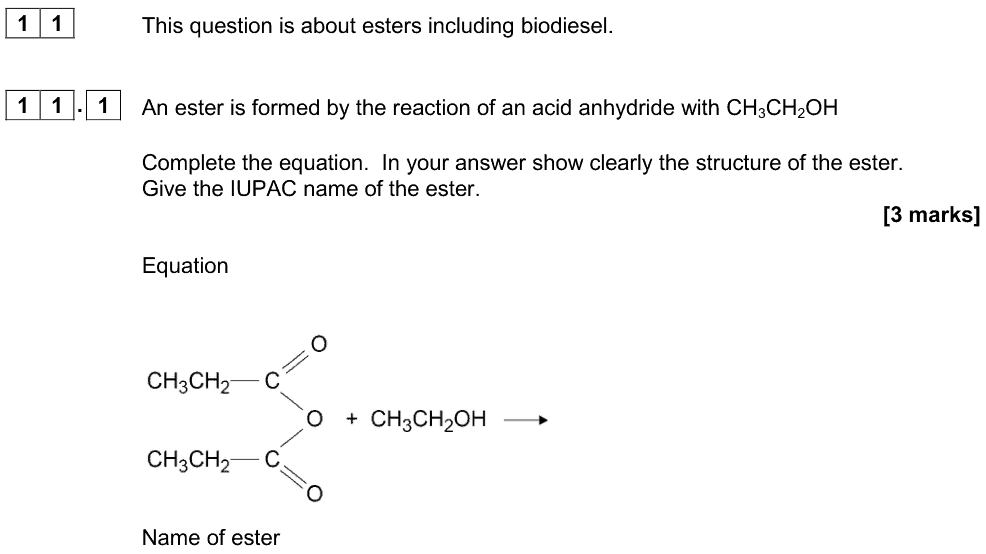
June 2019 · Paper 2 · Q11.13 marksEquation writing
Mark scheme
Examiner's comment
11.1 The first part of this question was fairly well answered. The structure of the ester was usually correct but the other product, propanoic acid, was often missing or given as ethanoic acid or water. Ethyl ethanoate was a common wrong answer for the name of the ester.
ethyl propanoate (this name only). Errors: second product missing or given as ethanoic acid or water
'ethyl ethanoate'
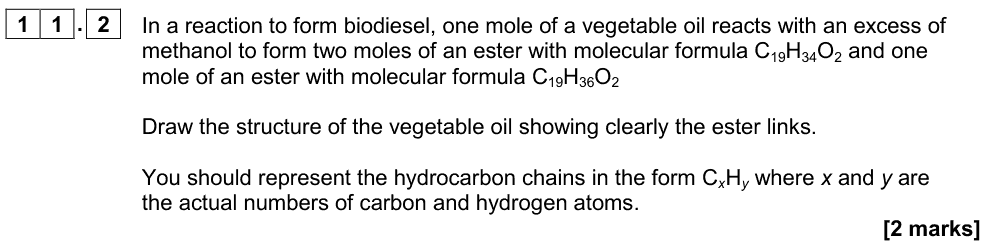
June 2019 · Paper 2 · Q11.22 marksDiagram or structure
Earlier part of question 11 that this part uses
Mark scheme
Examiner's comment
11.2 Part 2 was challenging and almost a quarter of students made no attempt to answer the question. The left hand (glycerol) part of the molecule was better known. Some students miscounted the carbon atoms in the acid part by including the methyl group of the biodiesel in the oil. Another common mistake was to draw the COO linkage the wrong way round.
Notes from the mark scheme and report
Triester of propane-1,2,3-triol: CH2–O–CO–R, CH–O–CO–R, CH2–O–CO–R with two C17H31 chains and one C17H33 chain in any order. M1 for the glycerol backbone with three correctly orientated ester links
M2 for the chains. Errors: counting the methyl carbon of the biodiesel into the chains
ester link reversed. Almost a quarter made no attempt
June 2019 · Paper 3 · Q241 markMultiple choice
Answer
A
Mark scheme
Notes from the mark scheme and report
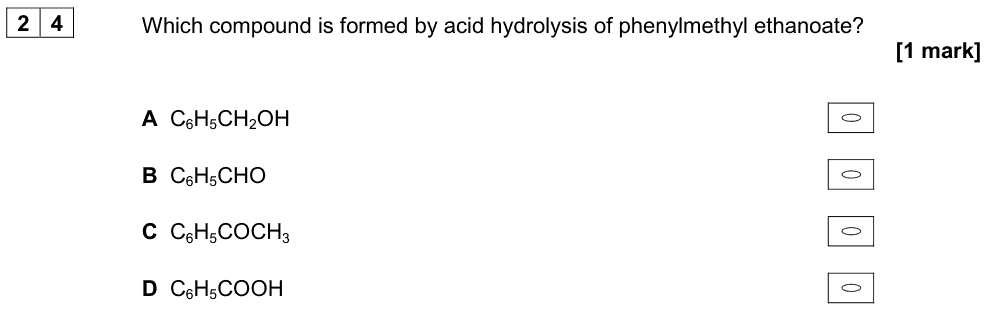
Answer: A. CH3COOCH2C6H5 hydrolyses to ethanoic acid and phenylmethanol, C6H5CH2OH
June 2019 · Paper 3 · Q251 markMultiple choice
Answer
B
Mark scheme
Notes from the mark scheme and report
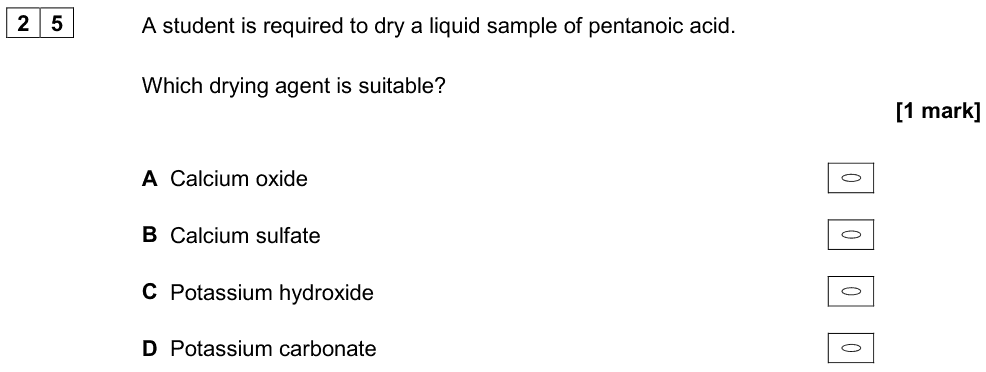
Answer: B. Calcium sulfate is a neutral drying agent
the other three are bases that would react with the carboxylic acid
Skills: ATg Purify: a solid product by recrystallisation; a liquid product, including use of separating funnel; RP10 Preparation of: a pure organic solid and test of its purity; a pure organic liquid
June 2019 · Paper 3 · Q341 markMultiple choice
Answer
D
Mark scheme
Notes from the mark scheme and report
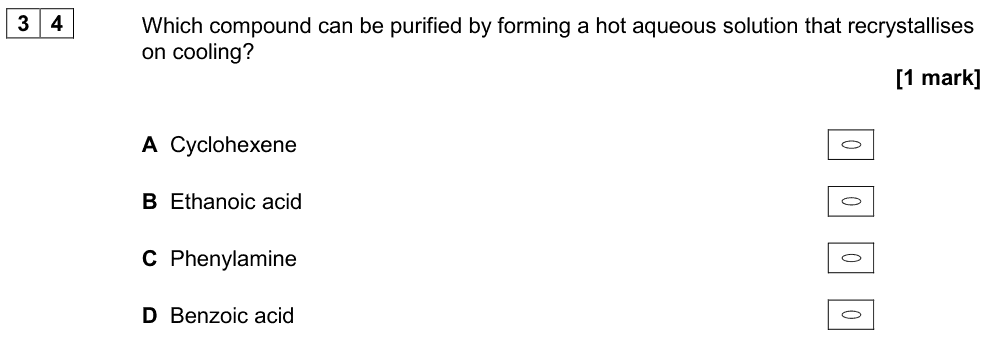
Answer: D. Benzoic acid is a solid that is much more soluble in hot water than in cold
the others are liquids at room temperature
Skills: ATg Purify: a solid product by recrystallisation; a liquid product, including use of separating funnel; RP10 Preparation of: a pure organic solid and test of its purity; a pure organic liquid
June 2018 · Paper 2 · Q03.32 marksPractical and data analysisEasy
Earlier part of question 03 that this part uses
Mark scheme
Examiner's comment
03.3 This part was answered well by nearly two-thirds of the students. The main error was to test for the aldehyde rather than the acid.
Notes from the mark scheme and report
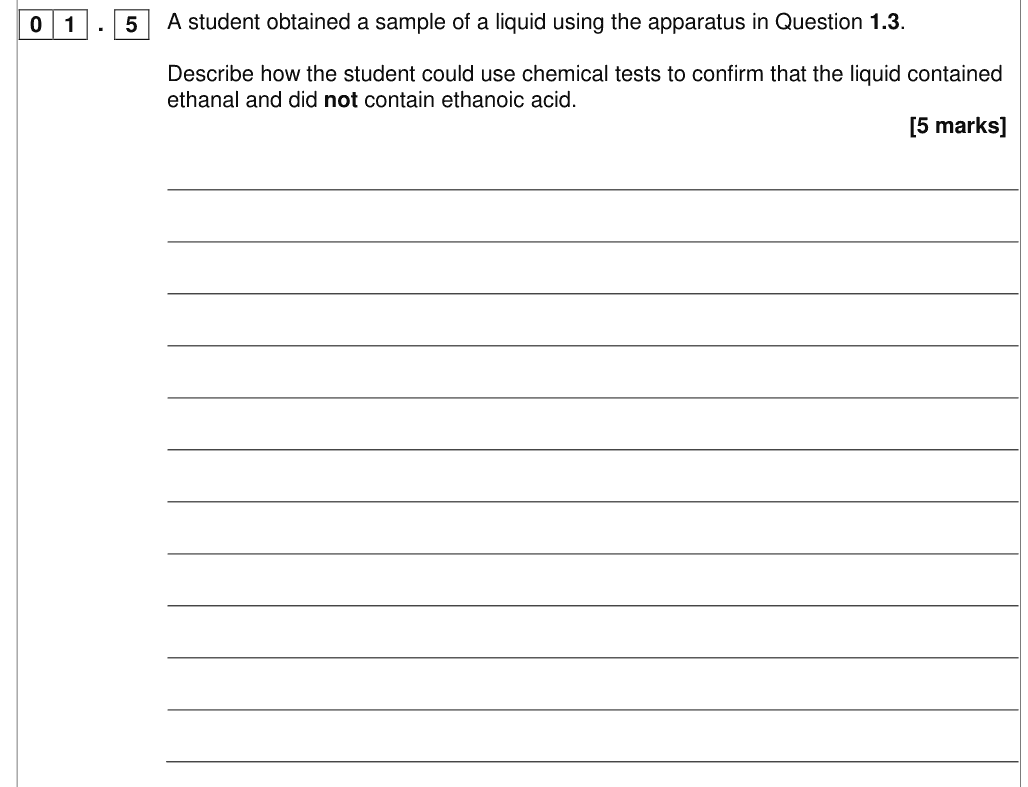
Add a named carbonate or hydrogencarbonate (eg NaHCO3), or magnesium, to a sample of the distillate
no effervescence shows that no acid is present (bubbles would confirm acid). Blue litmus staying blue also allowed. Common error: testing for the aldehyde instead
Skills: ATd Use laboratory apparatus for a variety of experimental techniques including: titration, using burette and pipette; distillation and heating under reflux, including setting up glassware using retort stand and clamps; qualitative tests for ions and organic functional groups; filtration, including use of fluted filter paper, or filtration under reduced pressure; PS4.1 Know and understand how to use a wide range of experimental and practical instruments, equipment and techniques appropriate to the knowledge and understanding included in the specification; RP6 Tests for alcohol, aldehyde, alkene and carboxylic acid
June 2018 · Paper 2 · Q07.33 marksShort answer
Earlier part of question 07 that this part uses
Mark scheme
Examiner's comment
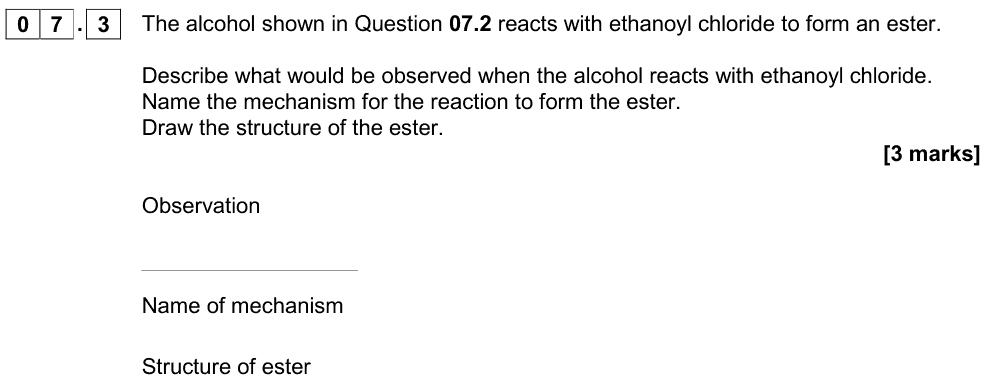
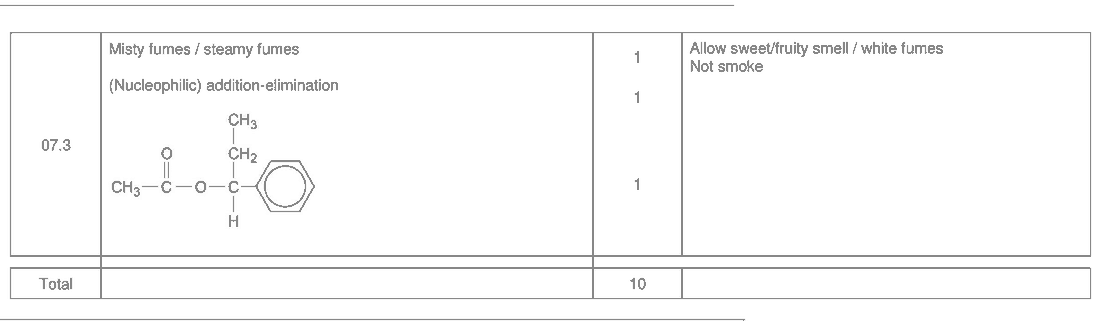
07.3 This question was generally answered well, especially the name of the mechanism and the structure of the ester. A common error was to give the name of the product, i.e. ‘HCl gas’, rather than an observation as required, or alternatively to describe this as a ‘white precipitate’.
Notes from the mark scheme and report
Misty / steamy fumes (of HCl)
(nucleophilic) addition–elimination
ester CH3COOCH(CH2CH3)C6H5. An observation is needed, not 'HCl gas'
not 'white precipitate' or smoke
June 2018 · Paper 3 · Q02.53 marksPractical and data analysis
Earlier part of question 02 that this part uses
Mark scheme
Examiner's comment
02.5 This was answered quite well, although some answers were spoiled by reference to a water bath and many students failed to mention the need to heat slowly (near the melting point). More surprising at this level were those students who confused melting and boiling or who suggested dissolving the solid in water before starting to heat it.
Notes from the mark scheme and report
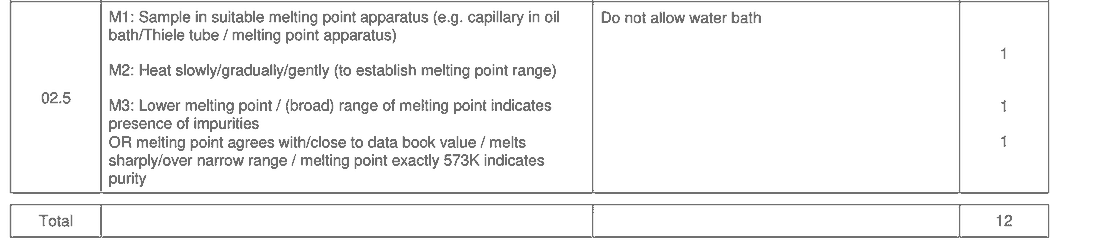
Put the sample in a capillary tube in melting point apparatus (or an oil bath / Thiele tube
not a water bath)
heat slowly near the melting point
a sharp melting point that matches the data-book value (573 K) shows it is pure, while a lower or broad melting range shows impurities. Many forgot to heat slowly
Skills: ATh Use melting point apparatus; ATb Use water bath or electric heater or sand bath for heating; PS4.1 Know and understand how to use a wide range of experimental and practical instruments, equipment and techniques appropriate to the knowledge and understanding included in the specification; RP10 Preparation of: a pure organic solid and test of its purity; a pure organic liquid
June 2018 · Paper 3 · Q03.31 markShort answer
Earlier part of question 03 that this part uses
Mark scheme
Examiner's comment
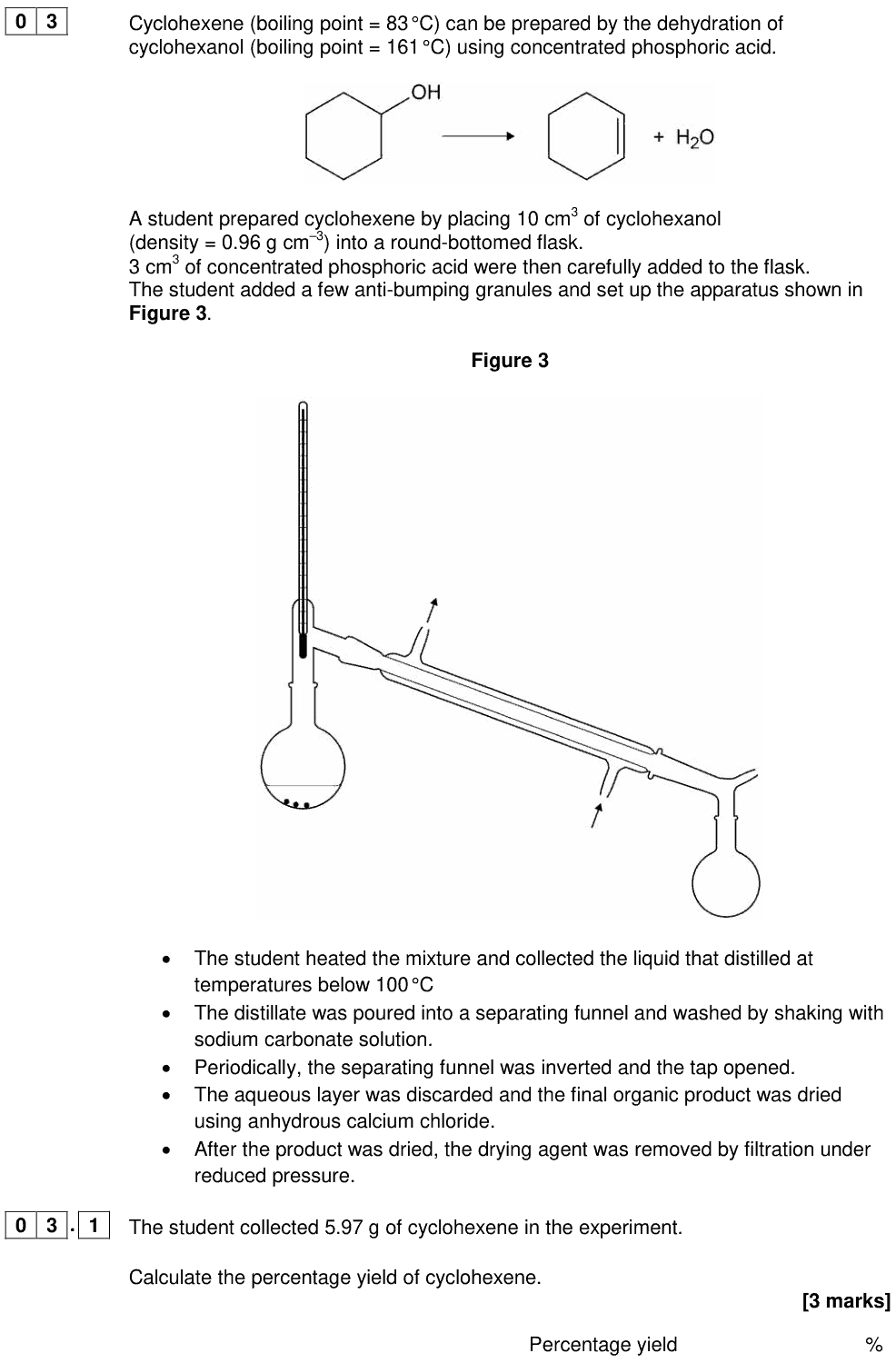
03.3 This was not answered as well as expected (42% correct), with many vague references to ‘removing impurities’ or ‘separating the layers’.
Notes from the mark scheme and report
To neutralise / remove the (phosphoric) acid. 'Removes impurities' was too vague
Skills: ATg Purify: a solid product by recrystallisation; a liquid product, including use of separating funnel; PS1.2 Apply scientific knowledge to practical contexts; RP10 Preparation of: a pure organic solid and test of its purity; a pure organic liquid
June 2018 · Paper 3 · Q03.41 markShort answer
Earlier part of question 03 that this part uses
Mark scheme
Examiner's comment
03.4 The key to questions like this about understanding the method of a practical is to relate the answer to the position of the process in the overall method. The reference to periodic opening of the tap preceded the actual separation of the layers in the method, yet many answers referred to opening the tap to run off one of the layers. It was interesting that more students (57.4% correct) were able to suggest that this was to release pressure of CO2 (due to reaction with acid) than were able to suggest, in 03.3, that the carbonate had been added in order to react with acid.
Notes from the mark scheme and report
To release the pressure caused by carbon dioxide formed (from carbonate and acid). Not running off a layer
an incorrectly named gas loses the mark
Skills: ATg Purify: a solid product by recrystallisation; a liquid product, including use of separating funnel; ATk Safely and carefully handle solids and liquids, including corrosive, irritant, flammable and toxic substances; PS1.2 Apply scientific knowledge to practical contexts; RP10 Preparation of: a pure organic solid and test of its purity; a pure organic liquid
June 2018 · Paper 3 · Q03.51 markShort answerHard
Earlier part of question 03 that this part uses
Mark scheme
Examiner's comment
03.5 The low success rate in this question (28.2% correct) is explained by a lack of specificity in students’ answers; the mark required a reference to a lack of reactivity with, or solubility in, cyclohexene.
Notes from the mark scheme and report
It does not react with, or dissolve in, cyclohexene (it stays as a solid in the organic product). 'Insoluble' or 'unreactive' alone, without reference to the cyclohexene, did not score
Skills: ATg Purify: a solid product by recrystallisation; a liquid product, including use of separating funnel; PS1.2 Apply scientific knowledge to practical contexts; RP10 Preparation of: a pure organic solid and test of its purity; a pure organic liquid
June 2018 · Paper 3 · Q03.62 marksPractical and data analysisHard
Earlier part of question 03 that this part uses
Mark scheme
Examiner's comment
03.6 Most students chose to draw a diagram rather than write a description; the former is the recommended approach. However, clear, simple cross-sectional line diagrams of a Buchner funnel and filter paper on top of a Buchner flask (with side-arm attached to a vacuum pump) were seldom seen. Tubes were often shown as sealed, bungs and side- arms were missing and the side-arm was often drawn on the funnel rather than the flask. Only 28.7% of students gained both marks; 37.1% failed to score.
Notes from the mark scheme and report
Buchner (flat-bottomed) funnel containing filter paper
on a Buchner / side-arm flask connected to a vacuum pump, with an airtight seal between funnel and flask so the apparatus would work. Not an ordinary Y-shaped funnel. Diagrams often had sealed tubes, missing bungs or the side-arm on the funnel
37.1% scored 0
Skills: ATd Use laboratory apparatus for a variety of experimental techniques including: titration, using burette and pipette; distillation and heating under reflux, including setting up glassware using retort stand and clamps; qualitative tests for ions and organic functional groups; filtration, including use of fluted filter paper, or filtration under reduced pressure; PS4.1 Know and understand how to use a wide range of experimental and practical instruments, equipment and techniques appropriate to the knowledge and understanding included in the specification; RP10 Preparation of: a pure organic solid and test of its purity; a pure organic liquid
June 2018 · Paper 3 · Q111 markMultiple choice
Answer
A
Mark scheme
Examiner's comment
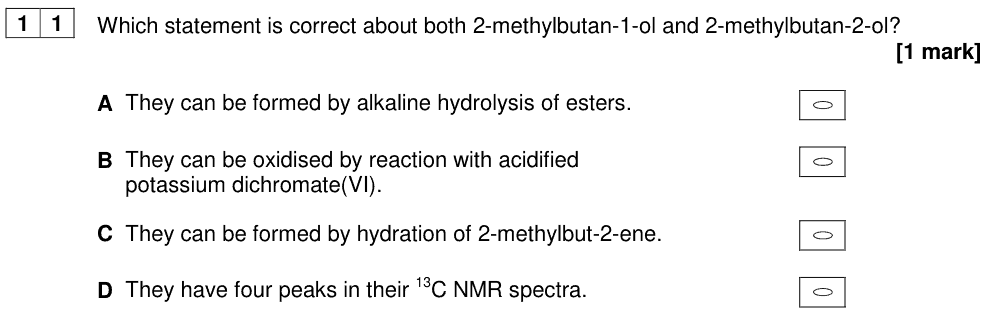
11 This was one of the few questions answered incorrectly more often than correctly (41.7% success rate) – C was the commonest incorrect response. If students draw the structures as their rough working, it should be clear that –OH will not add in position 1 of 2-methylbut-2-ene.
Notes from the mark scheme and report
Answer: A. Any alcohol can be released by hydrolysing a suitable ester. The tertiary alcohol is not oxidised
hydration of 2-methylbut-2-ene cannot put OH on C1
2-methylbutan-1-ol has five 13C peaks. Commonest wrong answer C
June 2017 · Paper 2 · Q05.11 markDiagram or structureEasy
Mark scheme
Examiner's comment
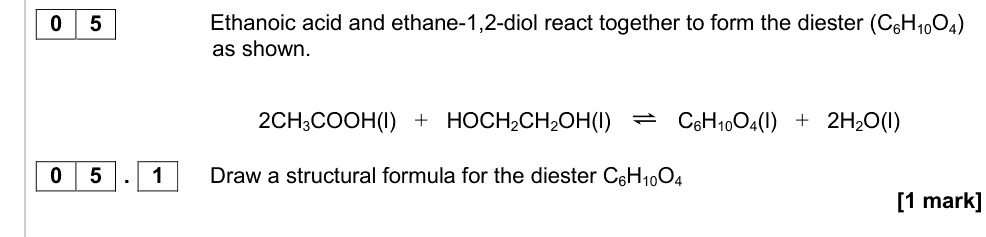
05.1 The diester was drawn well and 61% of students gained the mark.
Notes from the mark scheme and report
CH3COOCH2CH2OOCCH3
June 2017 · Paper 2 · Q06.46 marksMechanismHard
Earlier part of question 06 that this part uses
Mark scheme
Examiner's comment
06.4 This question was well answered and 25% of students scored all six marks. The name of the organic product was the most common mark lost, closely followed by slips in the third or fourth marks in the mechanism.
Notes from the mark scheme and report
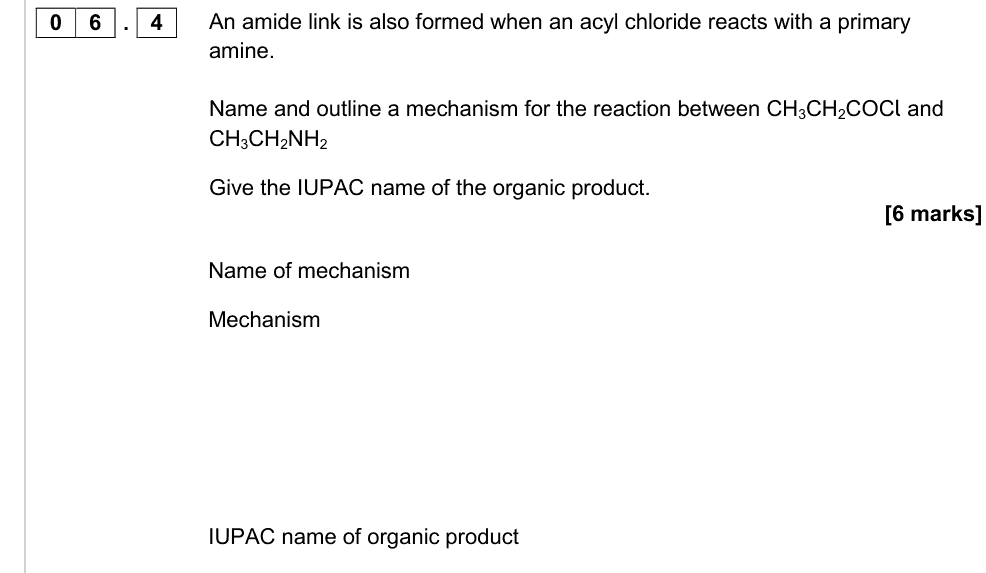
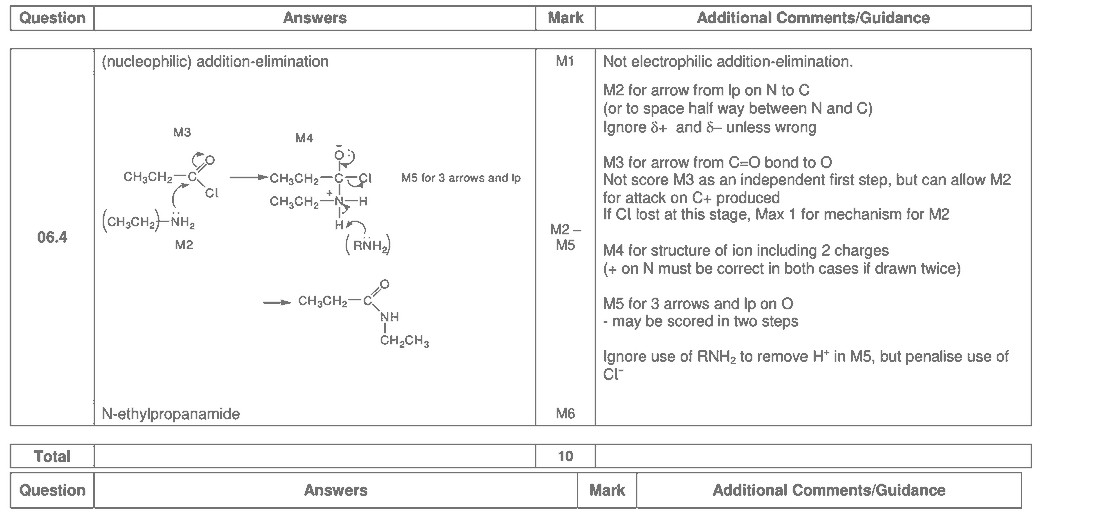
(Nucleophilic) addition–elimination. Arrow from the lone pair on N of CH3CH2NH2 to the C of C=O
arrow from C=O bond to O
intermediate with O– and N+
then lone pair on O– reforms C=O, C–Cl bond breaks to Cl and N–H bond breaks to N+. Product: N-ethylpropanamide. The name was the mark most often lost
June 2017 · Paper 2 · Q07.16 marks6-mark level of responseHard
Mark scheme, with the levels and indicative content
Examiner's comment
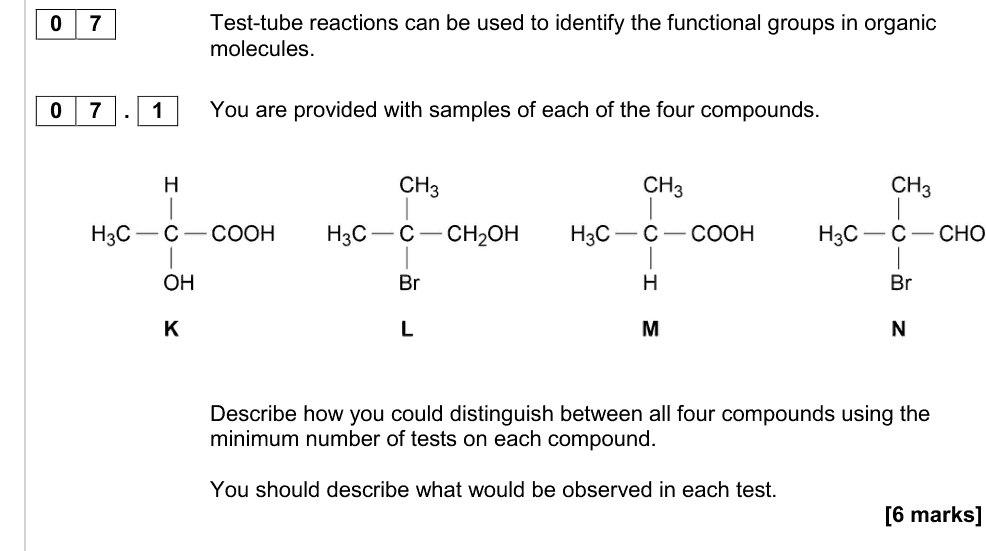
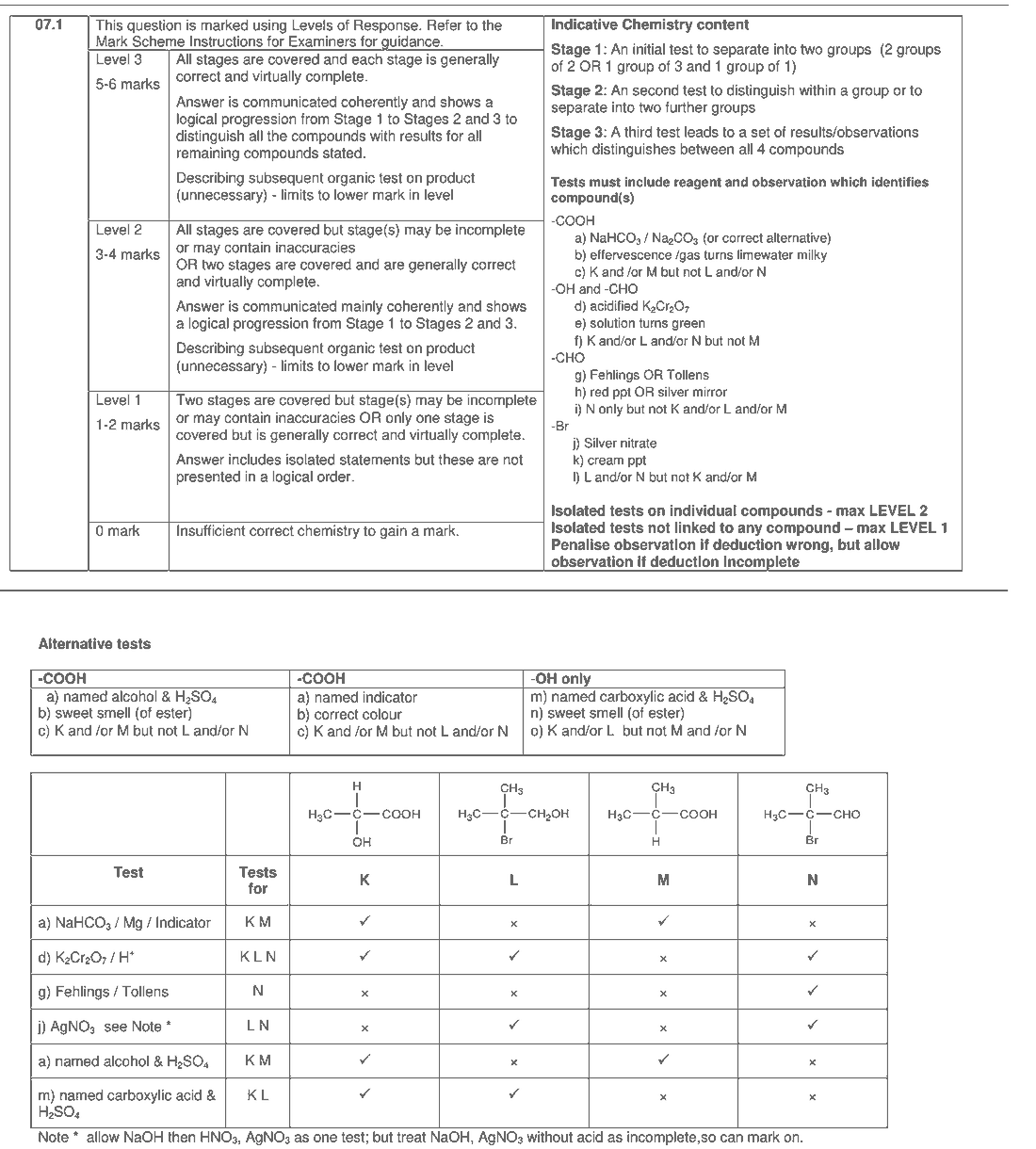
07.1 There were some very good answers to this question and nearly a fifth of the students scored full marks. The best answers followed a ‘stage approach’, in which a first test divided the four compounds into two groups. Subsequent tests were then made on each group.
Notes from the mark scheme and report
Levels of response: a first test splits the four into two groups, later tests separate within the groups, each with reagent, observation and which compounds respond. NaHCO3/Na2CO3: effervescence with the acids K and M only. Acidified K2Cr2O7: turns green with K, L and N but not M. Fehling's (red precipitate) or Tollens' (silver mirror): N only. Silver nitrate (after NaOH then HNO3): cream precipitate with L and N. Isolated tests not linked to a compound are limited to level 1
Skills: PS1.1 Solve problems set in practical contexts; PS2.1 Comment on experimental design and evaluate scientific methods; RP6 Tests for alcohol, aldehyde, alkene and carboxylic acid
June 2017 · Paper 2 · Q10.63 marksDiagram or structure
Earlier part of question 10 that this part uses
Mark scheme
Examiner's comment
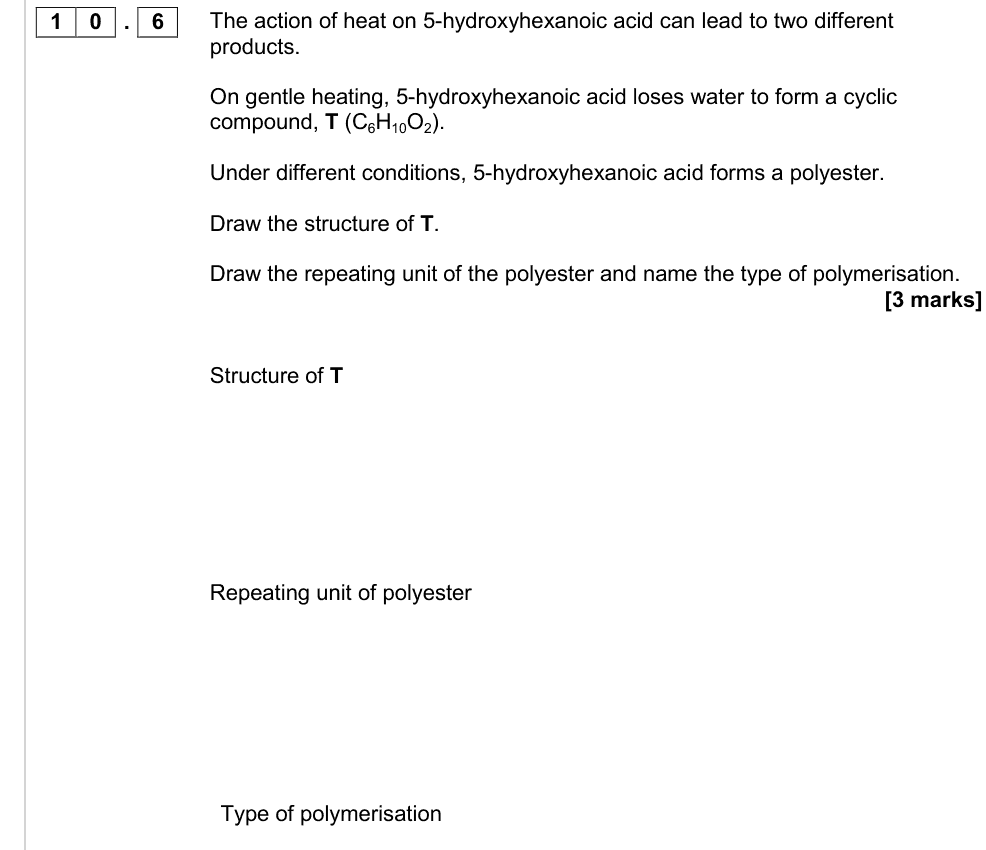
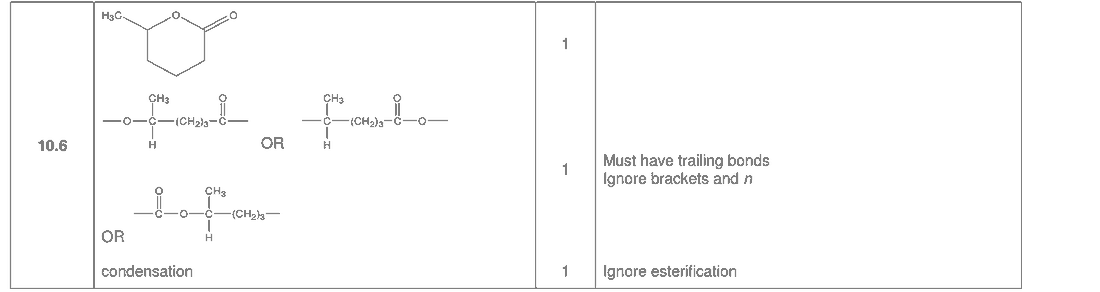
10.6 The two structures were found difficult, particularly that of T, and the polyester repeating unit was often shown as a double unit. The type of polymerisation, however, was well known.
Notes from the mark scheme and report
T is the cyclic ester: a six-membered ring containing one O next to a C=O, with a CH3 on the ring carbon attached to the ring O. Repeating unit –O–CH(CH3)–(CH2)3–CO– with trailing bonds (a single unit, not doubled). Condensation polymerisation ('esterification' is ignored)
June 2017 · Paper 3 · Q03.11 markPractical and data analysisHard
Mark scheme
Examiner's comment
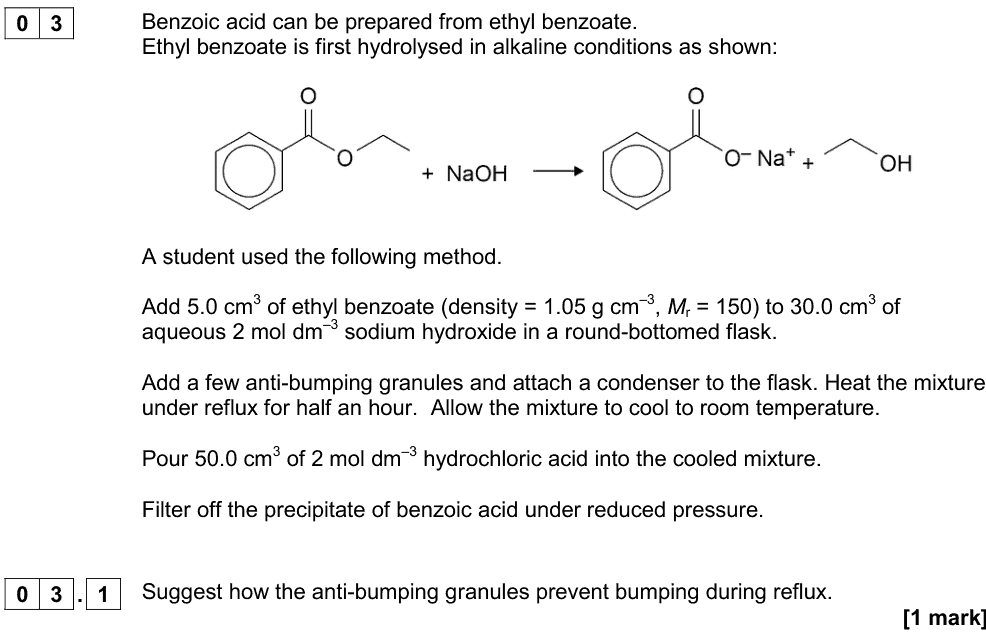
03.1 This question, and others in question 3, illustrate the importance of students paying attention to why certain techniques and processes are used during practicals. The role of anti-bumping granules was not as well understood as expected, with only 30% of students gaining this mark. Incorrect suggestions included that they slow the reaction down by preventing the reactant particles from bumping into each other.
Notes from the mark scheme and report
They allow small bubbles to form (provide a large surface for bubbles to form on), preventing very large bubbles. Not 'prevent bubbles forming'. Wrong idea seen: they stop the reactant particles bumping into each other
Skills: ATb Use water bath or electric heater or sand bath for heating; PS4.1 Know and understand how to use a wide range of experimental and practical instruments, equipment and techniques appropriate to the knowledge and understanding included in the specification; RP10 Preparation of: a pure organic solid and test of its purity; a pure organic liquid
June 2017 · Paper 3 · Q03.31 markPractical and data analysis
Earlier part of question 03 that this part uses
Mark scheme
Examiner's comment
03.3 Nearly 60% of students gained this mark but a lack of specific clarity cost many dearly. Many students apparently did not retain an awareness of the context of a question as they worked through the stages. They did not appear to recall, from the stem of the question, that the reaction was between NaOH and ethyl benzoate. This recall should have enabled students to make the specific statement that the excess of sodium hydroxide was to ensure that all the ethyl benzoate would react.
Notes from the mark scheme and report
To make sure all the ethyl benzoate (ester) reacts / is completely hydrolysed. Be specific about which reagent
do not waste space repeating the question
Skills: PS1.2 Apply scientific knowledge to practical contexts; RP10 Preparation of: a pure organic solid and test of its purity; a pure organic liquid
June 2017 · Paper 3 · Q03.41 markPractical and data analysis
Earlier part of question 03 that this part uses
Mark scheme
Examiner's comment
03.4 Answers here often incorrectly referred to the ‘control’ of the temperature rather than recognising the risk of flammability of organic reagents. Clarity is again key, because any suggestion that NaOH is flammable is incorrect.
Notes from the mark scheme and report
The ester / ethanol (organic compounds) are flammable, so a naked flame is avoided. Not 'better temperature control'
NaOH is not flammable
Skills: ATb Use water bath or electric heater or sand bath for heating; ATk Safely and carefully handle solids and liquids, including corrosive, irritant, flammable and toxic substances; PS1.2 Apply scientific knowledge to practical contexts; RP10 Preparation of: a pure organic solid and test of its purity; a pure organic liquid
June 2017 · Paper 3 · Q03.51 markPractical and data analysis
Earlier part of question 03 that this part uses
Mark scheme
Examiner's comment
03.5 As was also evident in question 02.6, some students thought that reflux is a separation method. A specific answer was again the key here, with a need to mention the fact that reactant/organic vapours are returned to the reaction mixture. Suggestions that reflux prevents vapour forming were incorrect.
Notes from the mark scheme and report
Reflux returns reactant vapours (volatile organic compounds) to the reaction mixture, so none escapes during prolonged heating. It does not stop vapour forming and is not a separation method
Skills: ATb Use water bath or electric heater or sand bath for heating; PS4.1 Know and understand how to use a wide range of experimental and practical instruments, equipment and techniques appropriate to the knowledge and understanding included in the specification; RP10 Preparation of: a pure organic solid and test of its purity; a pure organic liquid
June 2017 · Paper 3 · Q03.61 markEquation writing
Earlier part of question 03 that this part uses
Mark scheme
Examiner's comment
03.6 This was answered best by students who used structural or partial skeletal formulas. Many students, who attempted to use molecular formulas, often miscounted the number of hydrogens or carbons. Care was needed to avoid any suggestion that there is an O−Na bond in sodium benzoate.
Notes from the mark scheme and report
C6H5COONa + HCl → C6H5COOH + NaCl (ionic equation allowed). Structural or skeletal formulas were safer than molecular formulas
do not show a covalent O–Na bond
June 2017 · Paper 3 · Q03.86 marksPractical and data analysisHard
Earlier part of question 03 that this part uses
Mark scheme
Examiner's comment
03.8 About a third of students earned 4 or more marks here, but about the same number failed to score. Despite a statement in the stem that benzoic acid is a solid, many answers referred incorrectly to methods based on distillation and/or solvent extraction. Some answers implied that a solid would be expected to run through the tap of a separating funnel! For those students who correctly recognised that recrystallization was the correct method, there was often confusion in the order of the steps, which prevented potentially good answers gaining full marks. An example seen quite often was the suggestion that the solid obtained after cooling/crystallisation should be washed before filtering. The steps most often missing were the need for hot filtration after dissolving the impure solid in hot solvent, and the final wash and dry after Buchner filtration.
Notes from the mark scheme and report
Recrystallisation, six marks in order: dissolve the crude solid in hot solvent (water)
using the minimum volume
filter hot to remove insoluble impurities
cool so crystals form
filter under reduced pressure (Buchner funnel)
wash with cold solvent and dry. Without the dissolving step max 4. Errors: distillation or separating-funnel methods for a solid
steps in the wrong order (washing before filtering)
leaving out the hot filtration or the final wash and dry. About a third scored 0
Skills: ATb Use water bath or electric heater or sand bath for heating; ATg Purify: a solid product by recrystallisation; a liquid product, including use of separating funnel; ATk Safely and carefully handle solids and liquids, including corrosive, irritant, flammable and toxic substances; PS4.1 Know and understand how to use a wide range of experimental and practical instruments, equipment and techniques appropriate to the knowledge and understanding included in the specification; RP10 Preparation of: a pure organic solid and test of its purity; a pure organic liquid
Specimen · Paper 2 · Q09.15 marksAO1=1, AO2=4Mechanism
Mark scheme
Notes from the mark scheme and report
(Nucleophilic) addition–elimination
not electrophilic. M1 curly arrow from the lone pair on N of C6H5NH2 to the C of C=O
M2 arrow from the C=O bond to O
M3 intermediate with O– and N+ (C6H5NH2+)
M4 three arrows and the lone pair: lone pair on O– re-forming C=O, C–Cl bond to Cl, and N–H bond to N+ (H removed). Product CH3CONHC6H5.
Specimen · Paper 2 · Q09.24 marksPractical and data analysis
Earlier part of question 09 that this part uses
Mark scheme
Notes from the mark scheme and report
Minimum hot water: so the hot solution is saturated / crystals form on cooling. Cooled before filtering: yield would be lower if warm, as solubility is higher. Crystals compressed: so air passes through the sample, not round it (better drying
not 'water squeezed out'). Cold water wash: to wash away soluble impurities
Skills: ATg Purify: a solid product by recrystallisation; a liquid product, including use of separating funnel; ATd Use laboratory apparatus for a variety of experimental techniques including: titration, using burette and pipette; distillation and heating under reflux, including setting up glassware using retort stand and clamps; qualitative tests for ions and organic functional groups; filtration, including use of fluted filter paper, or filtration under reduced pressure; PS4.1 Know and understand how to use a wide range of experimental and practical instruments, equipment and techniques appropriate to the knowledge and understanding included in the specification; RP10 Preparation of: a pure organic solid and test of its purity; a pure organic liquid
Specimen · Paper 2 · Q09.32 marksPractical and data analysis
Earlier part of question 09 that this part uses
Mark scheme
Notes from the mark scheme and report
Impurity: water (not unreacted reagents). Improvement: press the crystals between filter papers / leave the sample to dry in air
Skills: ATh Use melting point apparatus; ATg Purify: a solid product by recrystallisation; a liquid product, including use of separating funnel; PS2.1 Comment on experimental design and evaluate scientific methods; RP10 Preparation of: a pure organic solid and test of its purity; a pure organic liquid
Specimen · Paper 3 · Q01.55 marksPractical and data analysis
or Fehling's solution and warm, red (orange-red) precipitate. No ethanoic acid: add sodium carbonate or hydrogencarbonate, no effervescence
or warm with ethanol and concentrated H2SO4, no sweet smell. Observation marks need the correct reagent
Skills: ATd Use laboratory apparatus for a variety of experimental techniques including: titration, using burette and pipette; distillation and heating under reflux, including setting up glassware using retort stand and clamps; qualitative tests for ions and organic functional groups; filtration, including use of fluted filter paper, or filtration under reduced pressure; PS4.1 Know and understand how to use a wide range of experimental and practical instruments, equipment and techniques appropriate to the knowledge and understanding included in the specification; PS2.3 Evaluate results and draw conclusions with reference to measurement uncertainties and errors; RP6 Tests for alcohol, aldehyde, alkene and carboxylic acid
Specimen · Paper 3 · Q05.12 marksShort answer
Mark scheme
Notes from the mark scheme and report
m/z 104: [CH3OOC–COOH]+ (the mono-methyl ester)
m/z 118: [CH3OOC–COOCH3]+ (dimethyl ethanedioate), so the alcohol is methanol. Names allowed
molecular formulae are not
Work with an A-level chemistry tutor
Dropping marks on calculations, mechanisms or the required practicals? Book a trial session with a specialist A-level chemistry tutor.