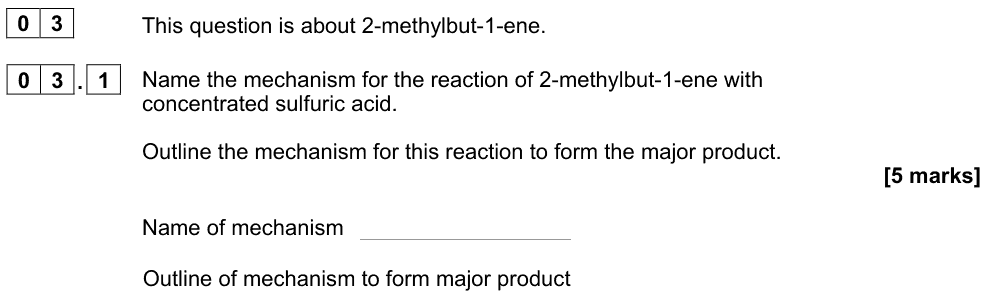
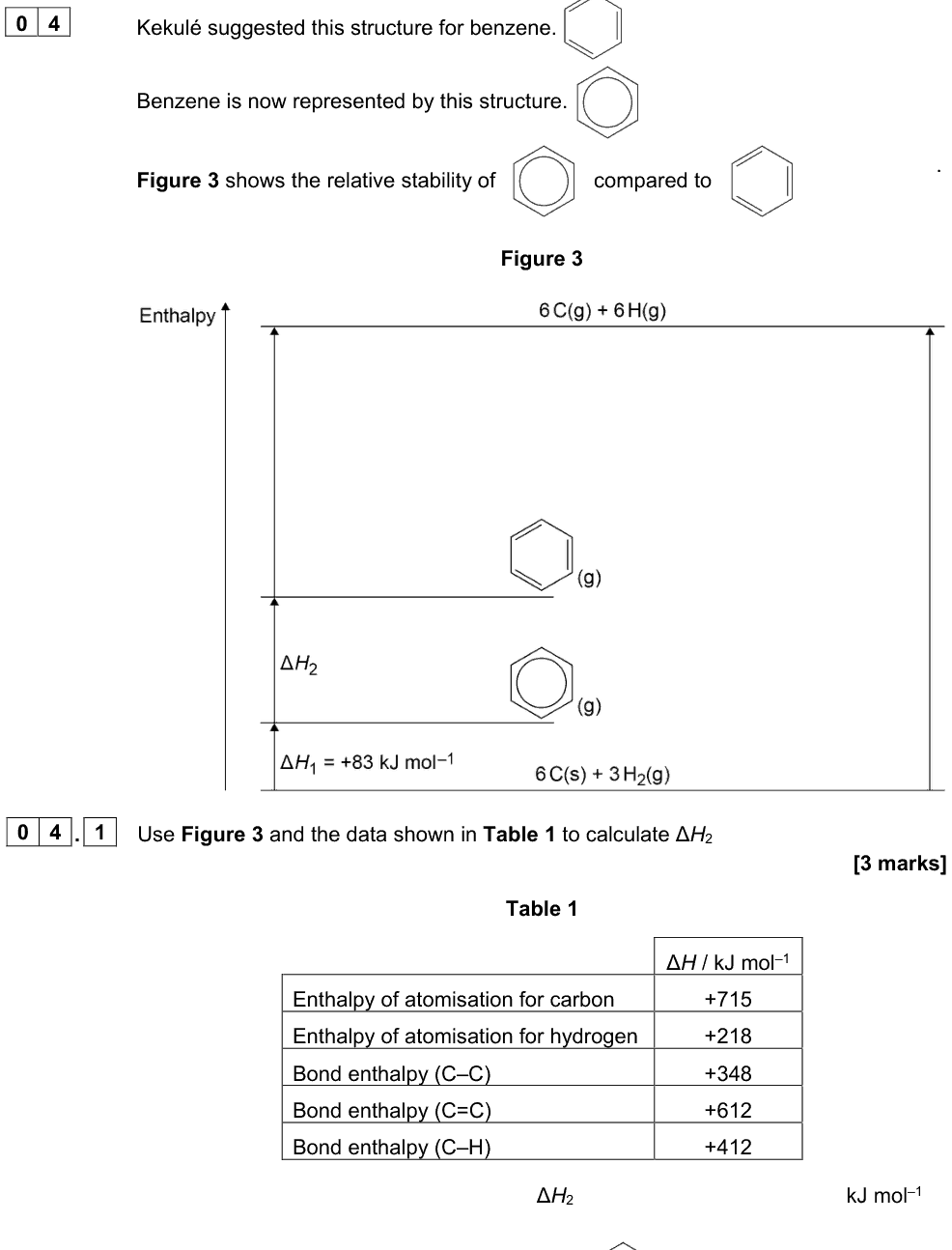
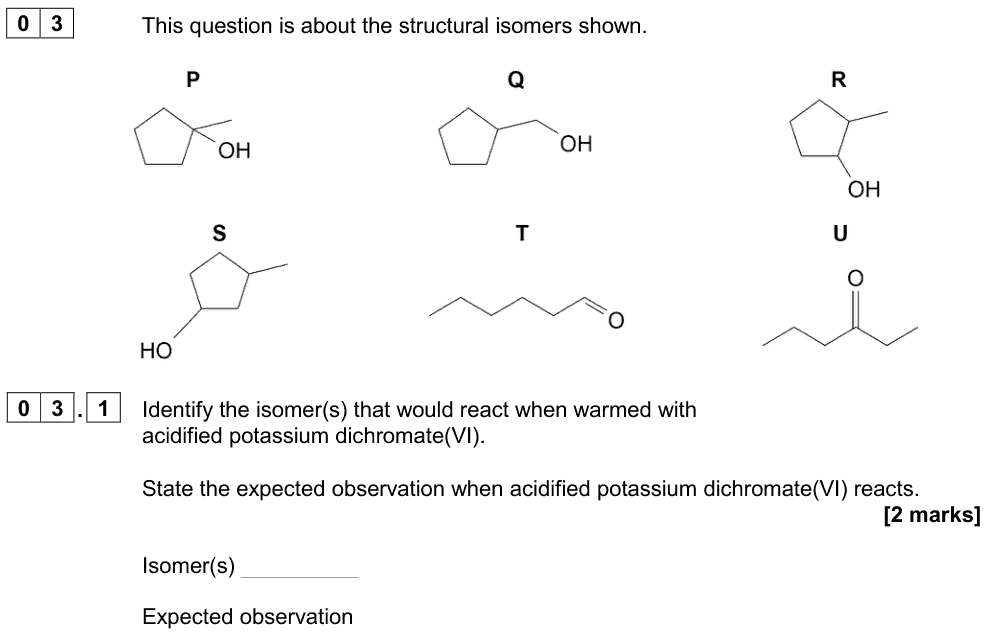
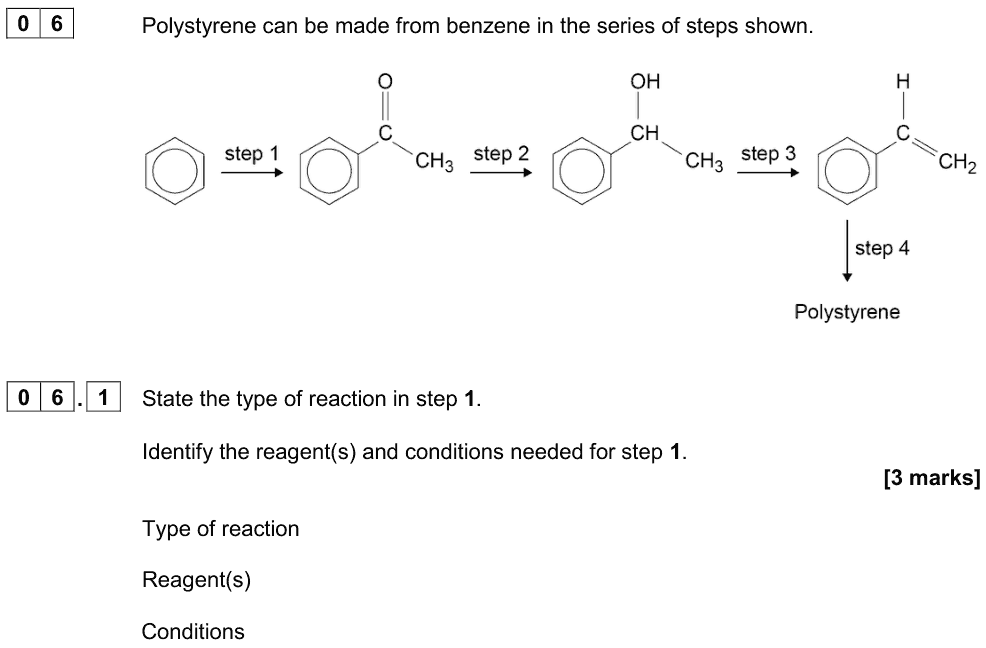
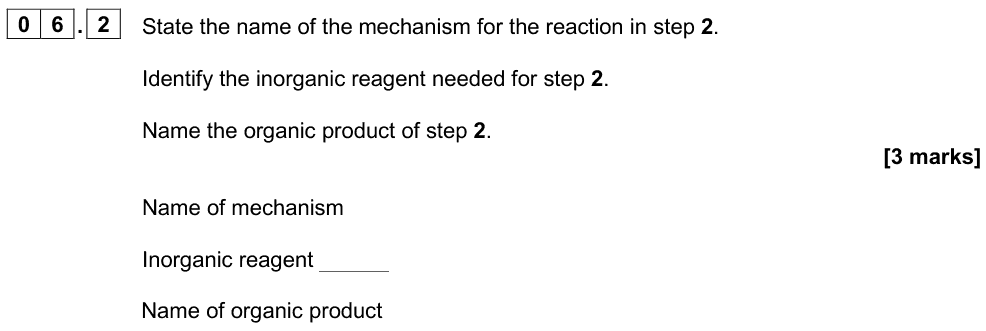
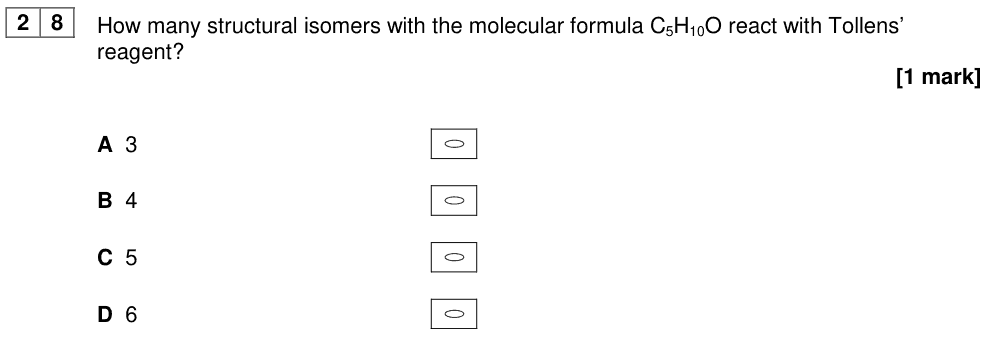
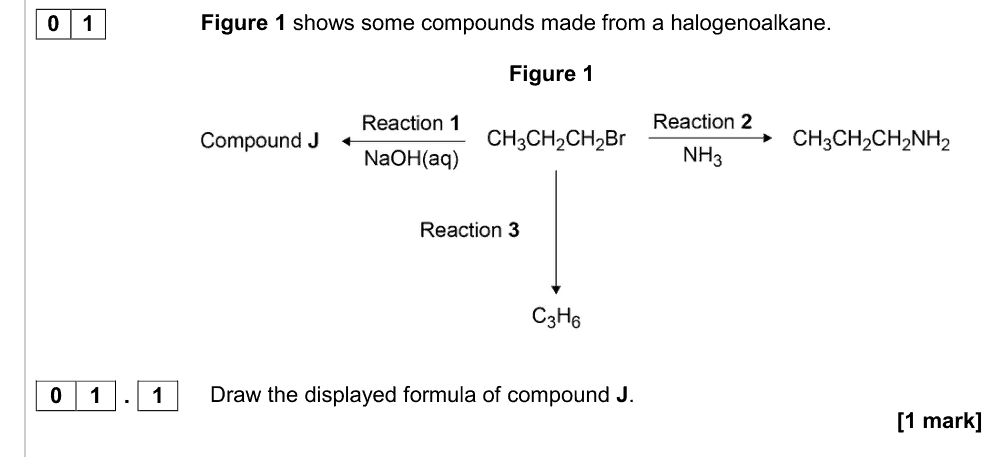
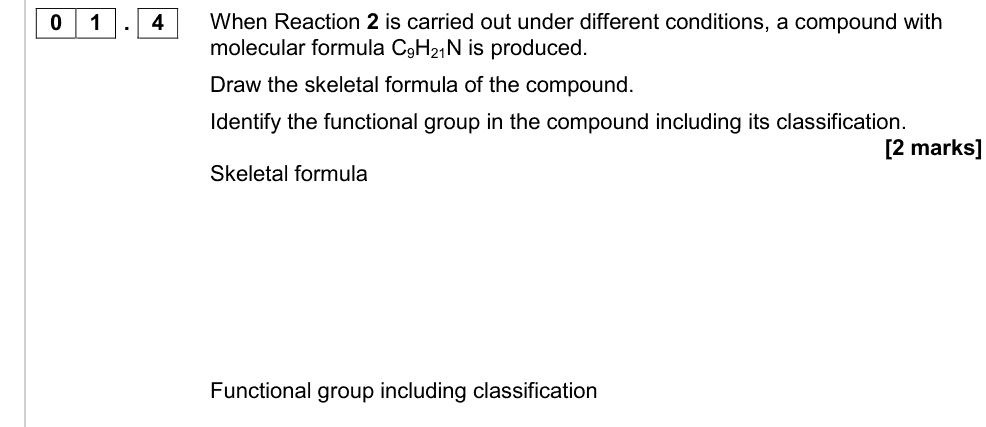
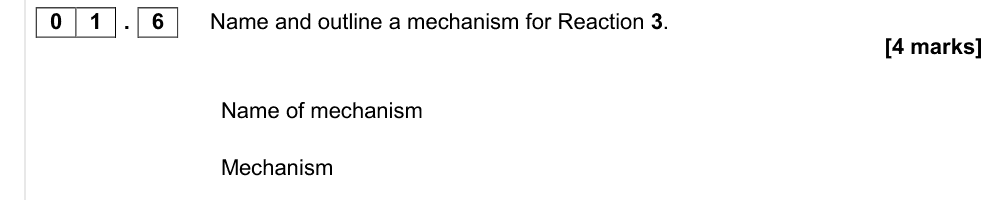
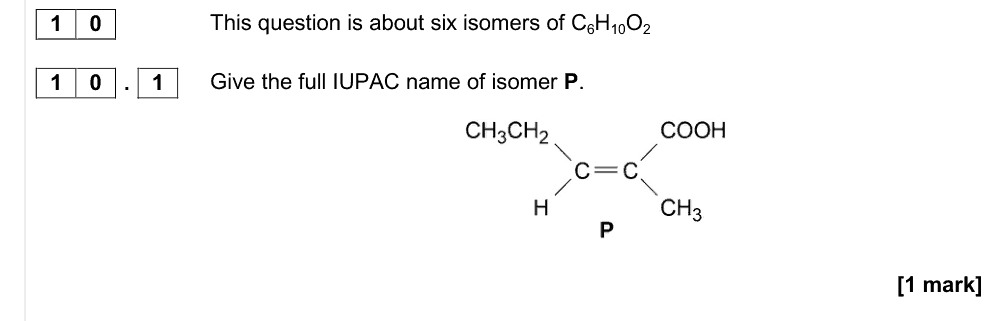
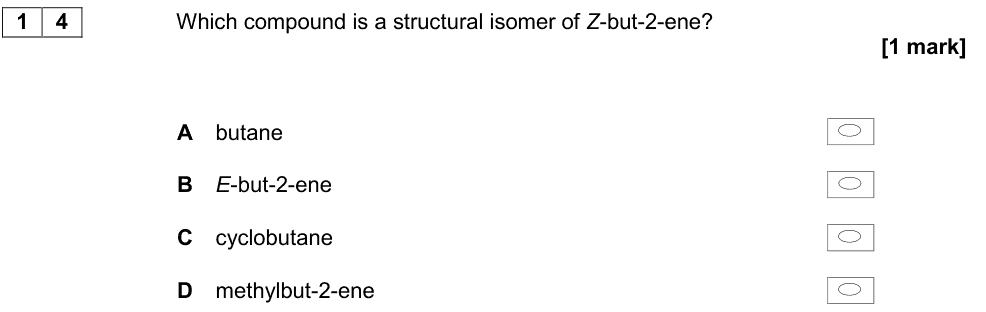
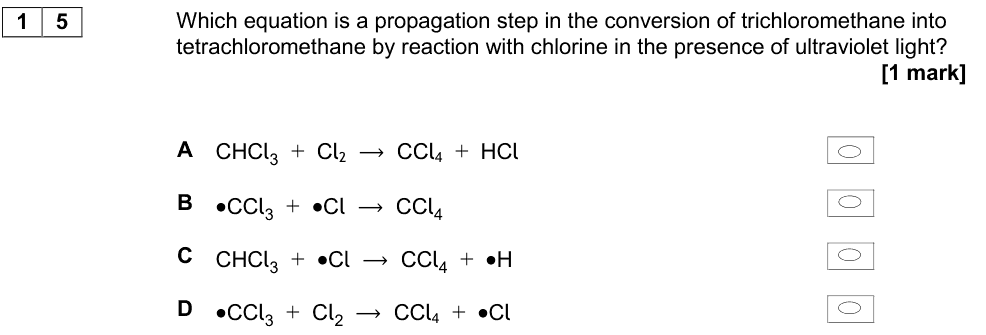
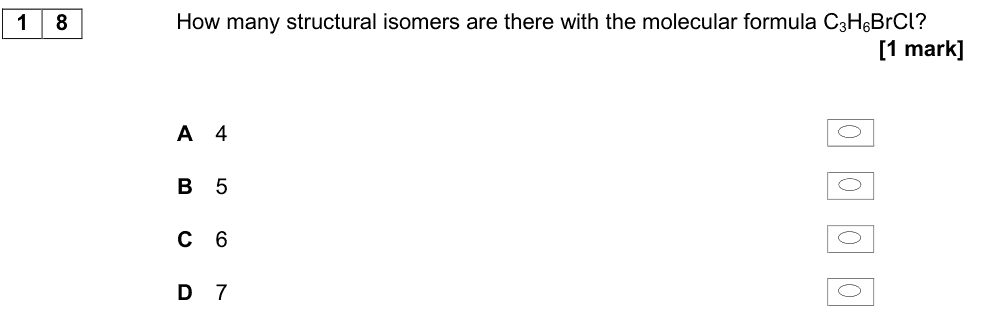
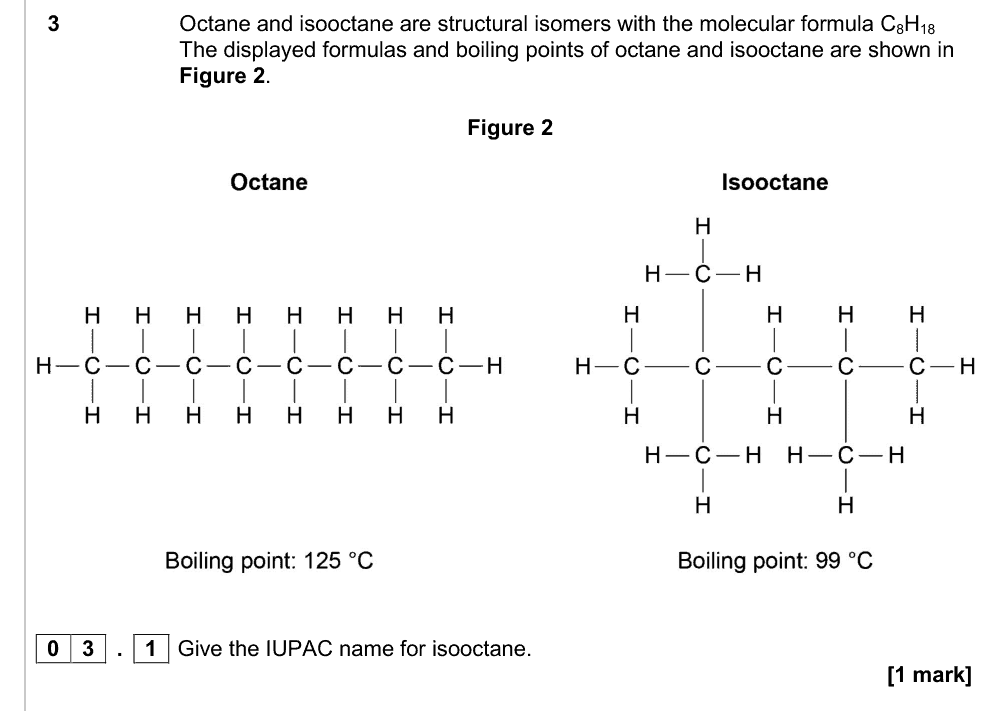
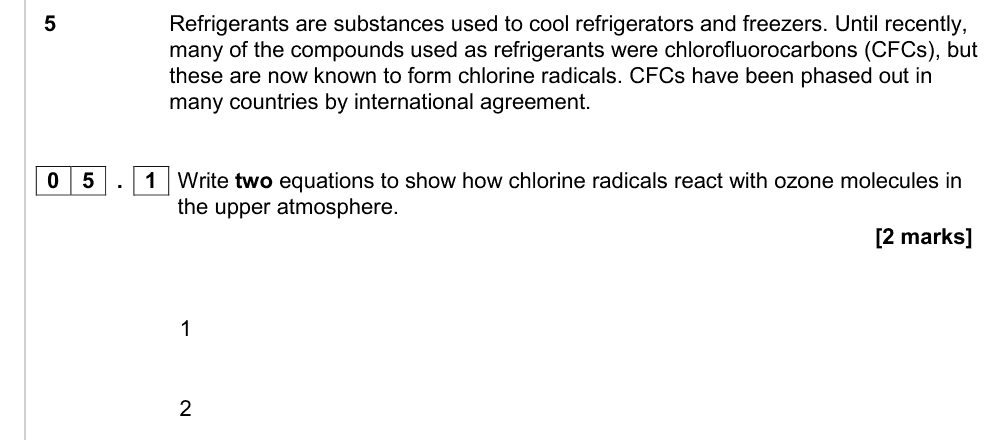
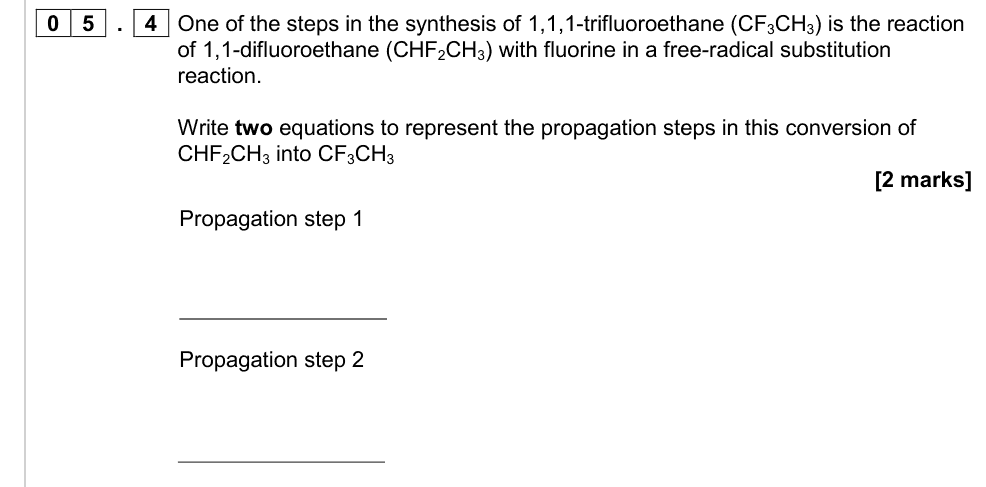
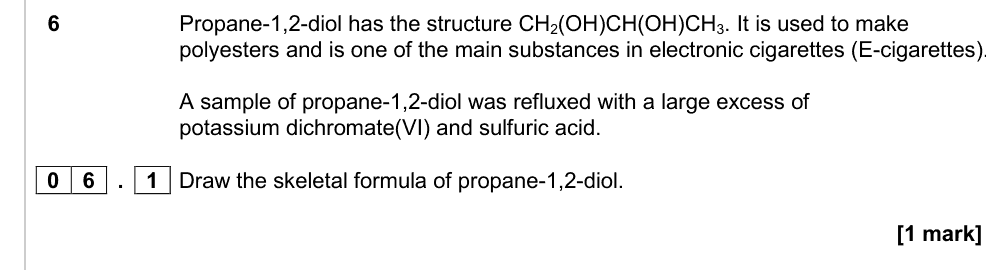
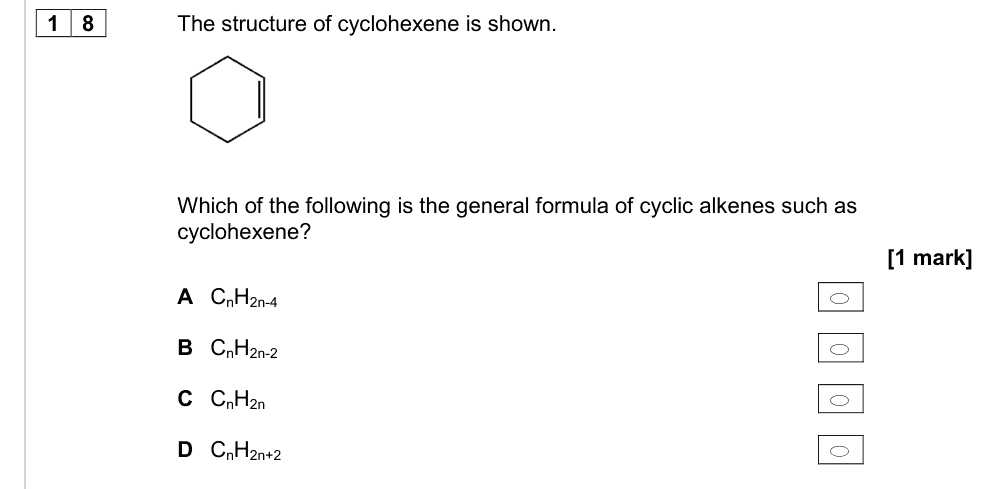
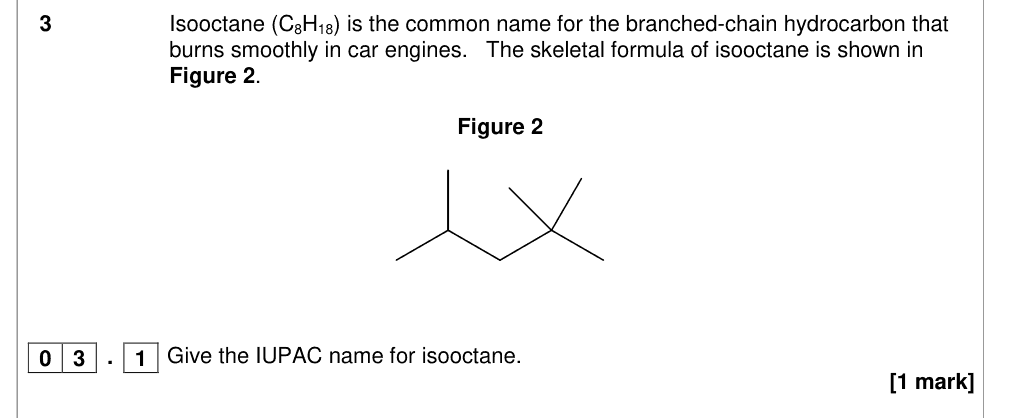
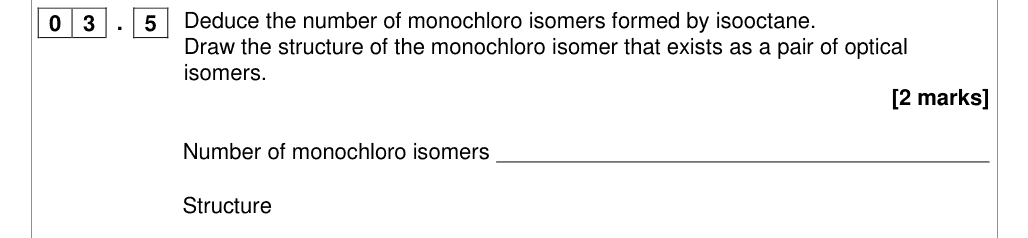
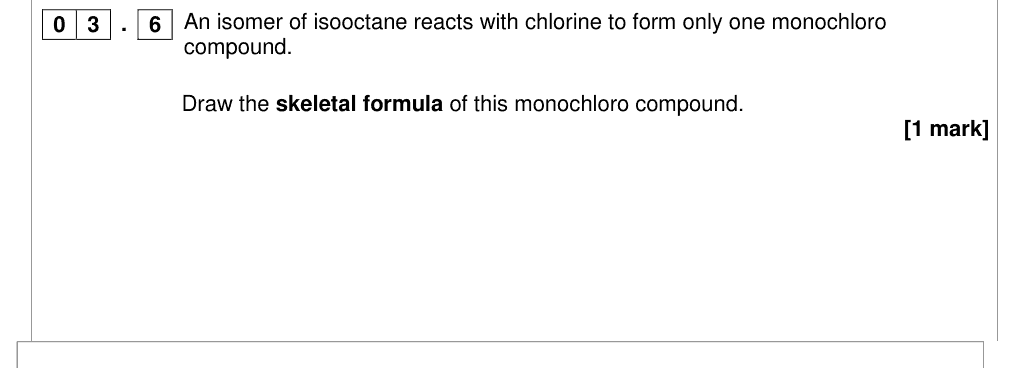
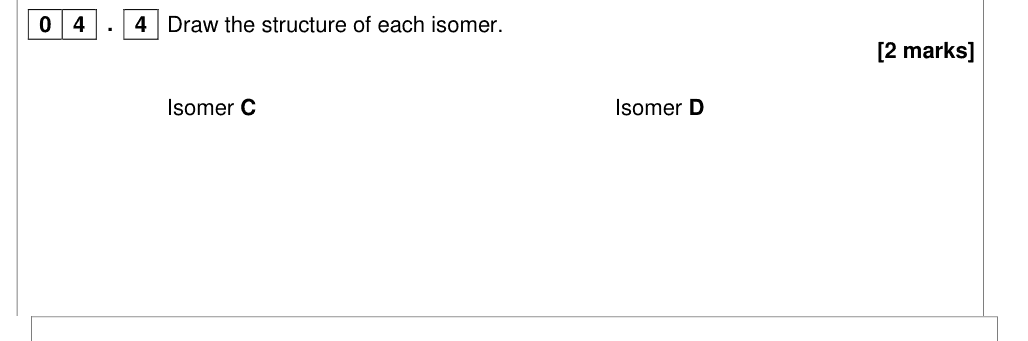
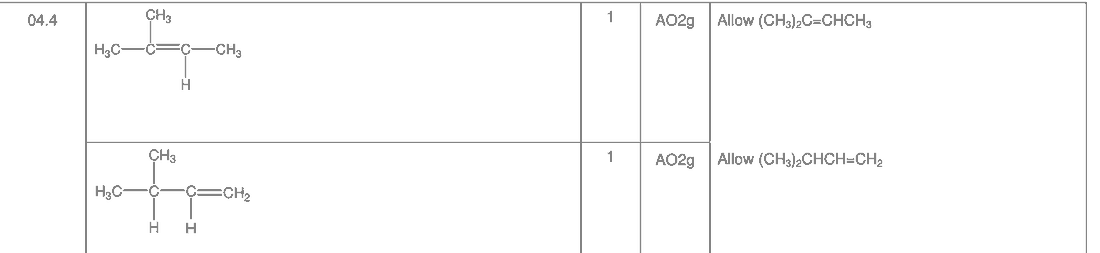
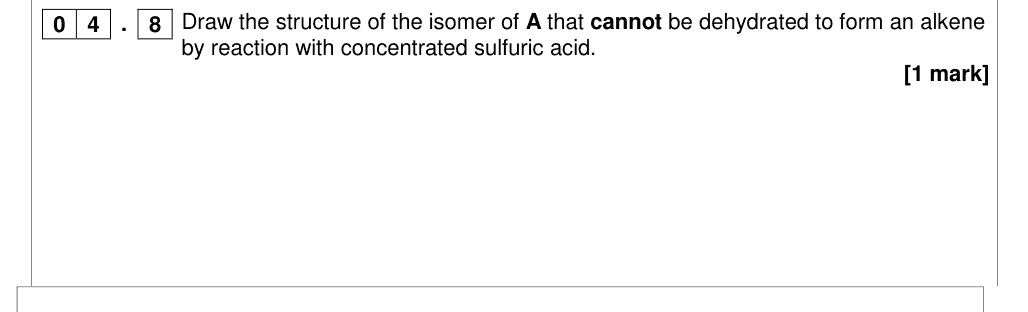
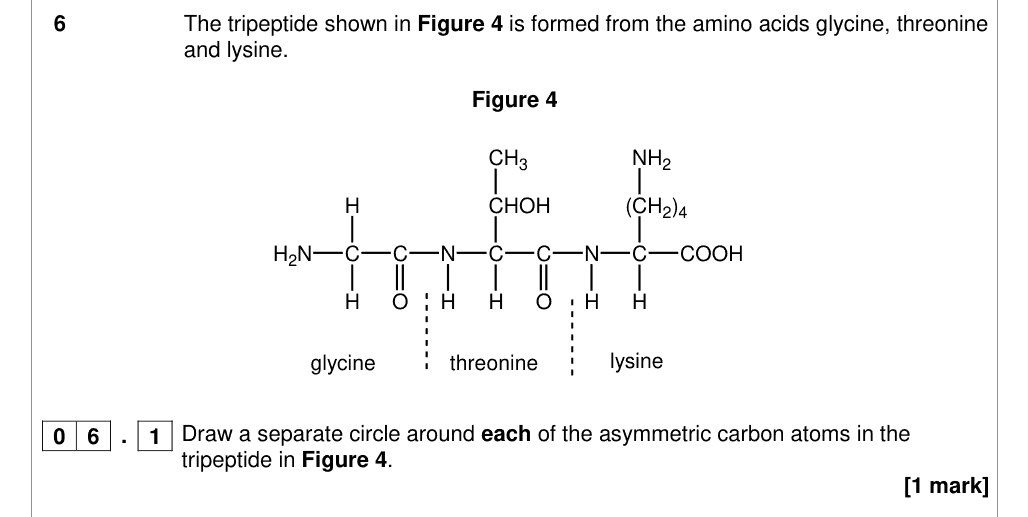
Notes and key-term cards for this topic are being written by our tutors. The past-paper questions below are ready now.
Specification statements
Show the 14 statements from the specification
3.3.1.1-01 Organic compounds can be represented by: • empirical formula • molecular formula • general formula • structural formula • displayed formula • skeletal formula.
3.3.1.1-02 The characteristics of a homologous series, a series of compounds containing the same functional group.
3.3.1.1-03 IUPAC rules for nomenclature.
3.3.1.1-04 Students should be able to: • draw structural, displayed and skeletal formulas for given organic compounds • apply IUPAC rules for nomenclature to name organic compounds limited to chains and rings with up to six carbon atoms each • apply IUPAC rules for nomenclature to draw the structure of an organic compound from the IUPAC name limited to chains and rings with up to six carbon atoms each.
3.3.1.2-01 Reactions of organic compounds can be explained using mechanisms.
3.3.1.2-02 Free-radical mechanisms: • the unpaired electron in a radical is represented by a dot • the use of curly arrows is not required for radical mechanisms.
3.3.1.2-03 Students should be able to: • write balanced equations for the steps in a free- radical mechanism.
3.3.1.2-04 Other mechanisms: • the formation of a covalent bond is shown by a curly arrow that starts from a lone electron pair or from another covalent bond • the breaking of a covalent bond is shown by a curly arrow starting from the bond.
3.3.1.2-05 Students should be able to: • outline mechanisms by drawing the structures of the species involved and curly arrows to represent the movement of electron pairs.
3.3.1.3-01 Structural isomerism.
3.3.1.3-02 Stereoisomerism.
3.3.1.3-03 E–Z isomerism is a form of stereoisomerism and occurs as a result of restricted rotation about the planar carbon– carbon double bond.
3.3.1.3-05 Students should be able to: • define the term structural isomer • draw the structures of chain, position and functional group isomers • define the term stereoisomer • draw the structural formulas of E and Z isomers • apply the CIP priority rules to E and Z isomers.
Six-mark level of response questions on this topic
Tap a question to zoom it. Where a part needs a figure, table or structure from earlier in the question, that part folds out above it; the mark scheme and examiner's comment open underneath. Have AQA's Data Booklet (the Periodic Table and the spectroscopy tables) beside you.
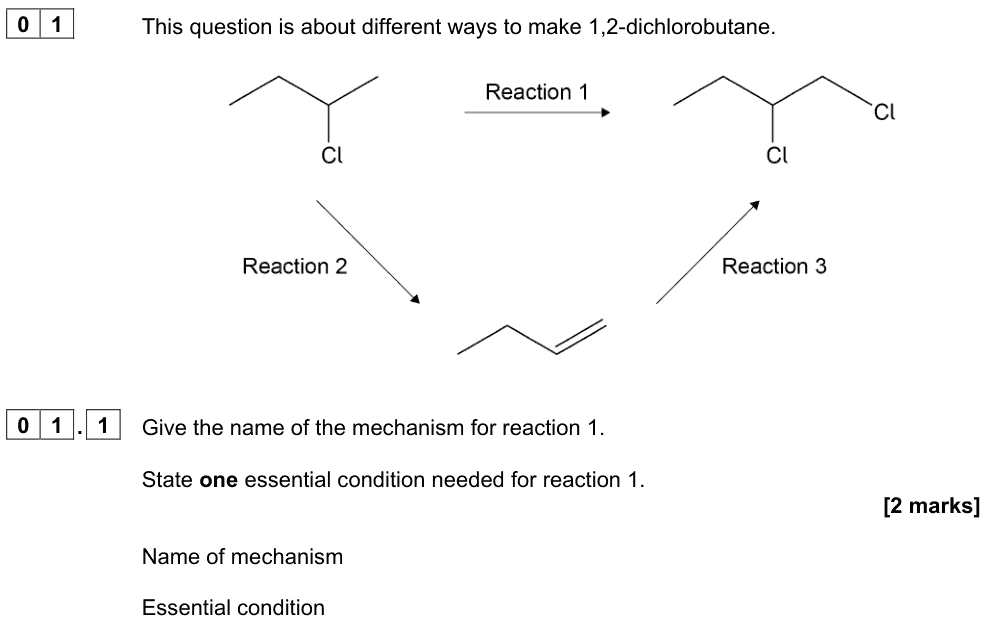
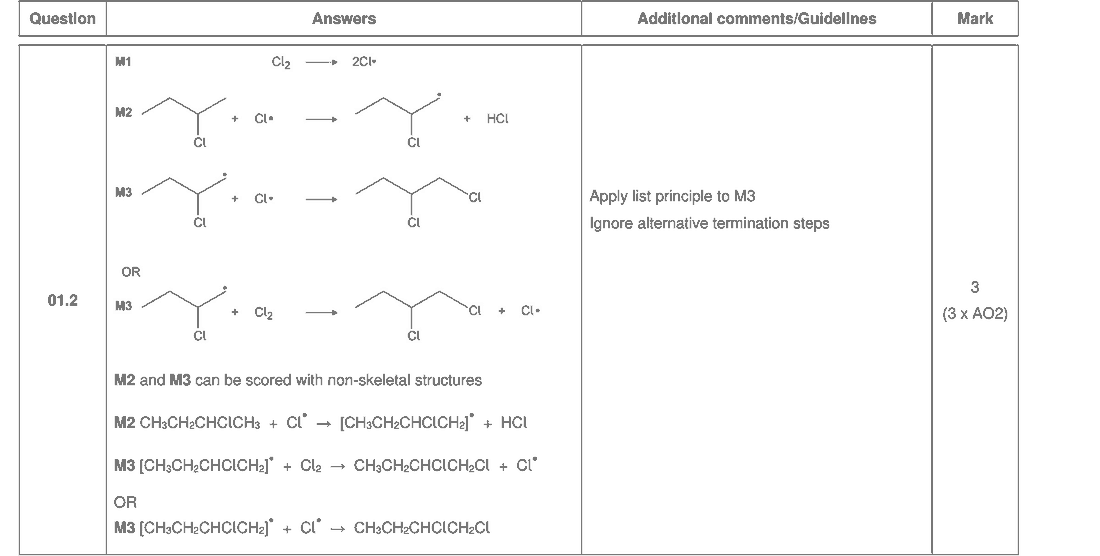
June 2025 · Paper 2 · Q01.23 marksAO2=3Equation writing
Earlier part of question 01 that this part uses
Mark scheme
Examiner's comment
1.2 Students had to complete a radical substitution mechanism. Many did it well but few used the skeletal formulae expected. Students clearly prefer to translate skeletal structures into fully displayed or abbreviated structures. The most common error was to use molecular formulae which are ambiguous in terms of the position of substitution.
Notes from the mark scheme and report
Cl2 → 2Cl•
CH3CH2CHClCH3 + Cl• → CH3CH2CHClCH2• + HCl
CH3CH2CHClCH2• + Cl2 → CH3CH2CHClCH2Cl + Cl• (or termination with Cl•). Structural or skeletal formulas showing where substitution occurs are needed: molecular formulas are ambiguous
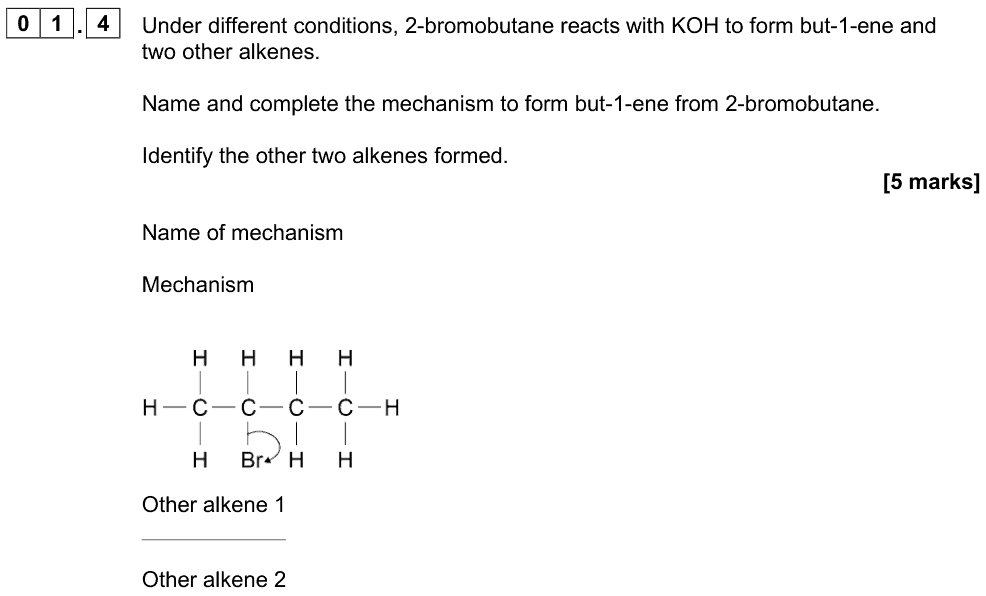
June 2025 · AS Paper 2 · Q01.45 marksAO1=1, AO2=2, AO3=2Mechanism
Earlier parts of question 01 that this part uses
Mark scheme
Examiner's comment
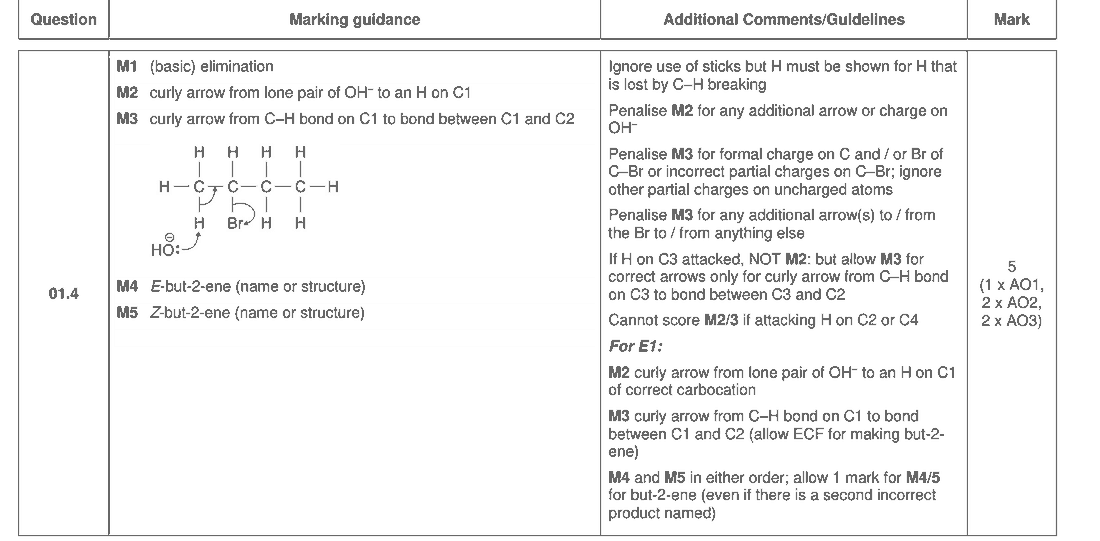
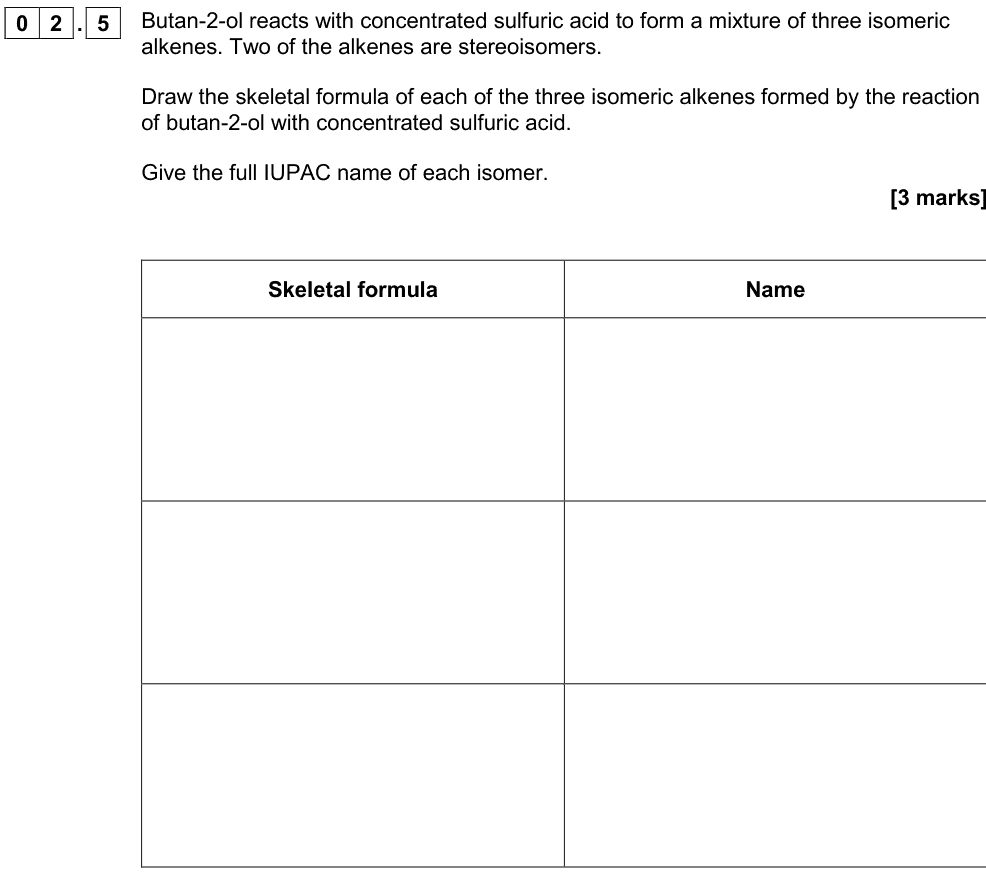
1.4 Students had to complete an elimination mechanism. Many did this well although some gave the mechanism to form but-2-ene rather than but-1-ene as required. Few students appreciated that the two other alkenes were E-but-2-ene and Z-but-2-ene with most going for but-2-ene and some other compound that was commonly not even an alkene.
Notes from the mark scheme and report
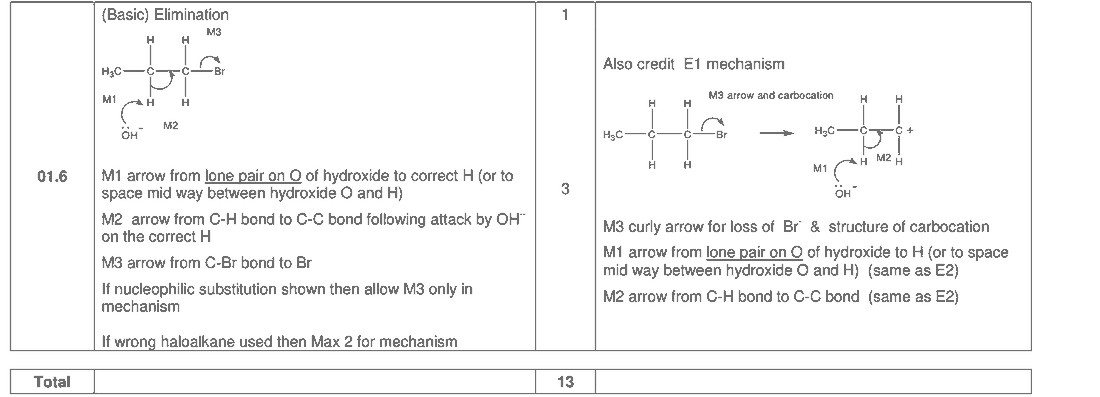
(Base) elimination. Curly arrow from the lone pair on OH– to an H on C1
curly arrow from that C–H bond to the C1–C2 bond (the C–Br arrow is already printed). Other alkenes: E-but-2-ene and Z-but-2-ene
'but-2-ene' alone scores 1 of the 2. Errors: attacking an H on C3 (gives but-2-ene)
second alkene not an alkene
June 2025 · Paper 2 · Q02.13 marksAO1=2, AO2=1Explanation
Mark scheme
Examiner's comment
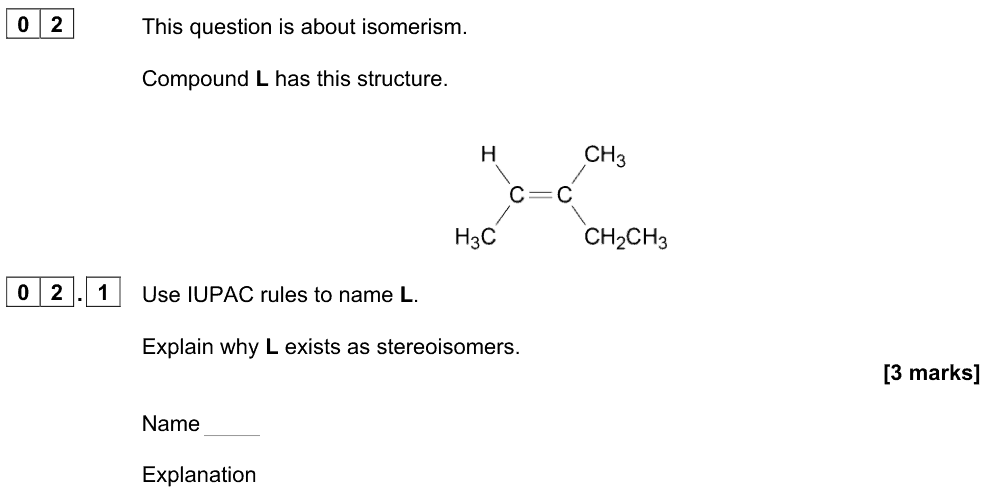
2.1 The requirement to include Z- before the rest of the name of the geometric isomer given was often missed, but students were much better at explaining the reason why geometric isomers exist. Students who did not score the final mark were often imprecise in their use of language to describe the requirement for both carbon atoms in the C=C double bond to be attached to two different groups.
Notes from the mark scheme and report
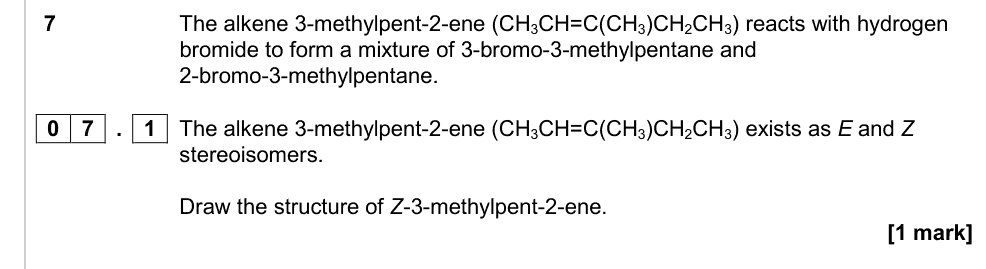
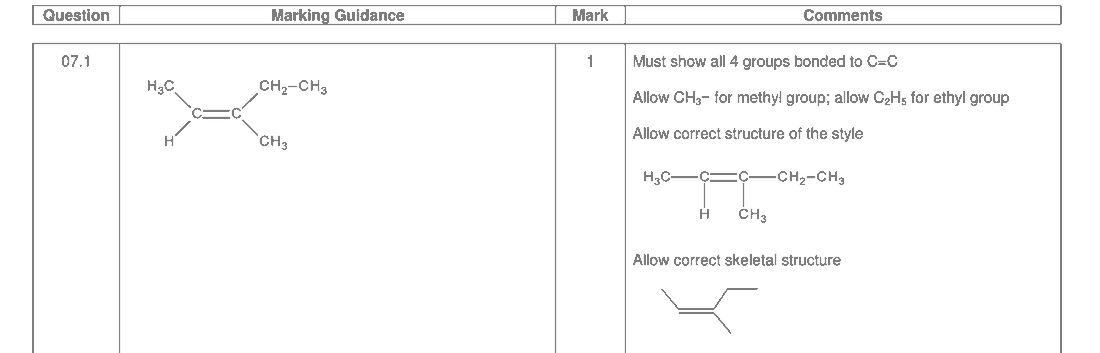
Z-3-methylpent-2-ene
there is no (restricted) rotation about the C=C bond
each carbon of the C=C has two different groups attached. The Z was often missed
June 2025 · Paper 2 · Q02.22 marksAO2=2Diagram or structure
Earlier part of question 02 that this part uses
Mark scheme
Examiner's comment
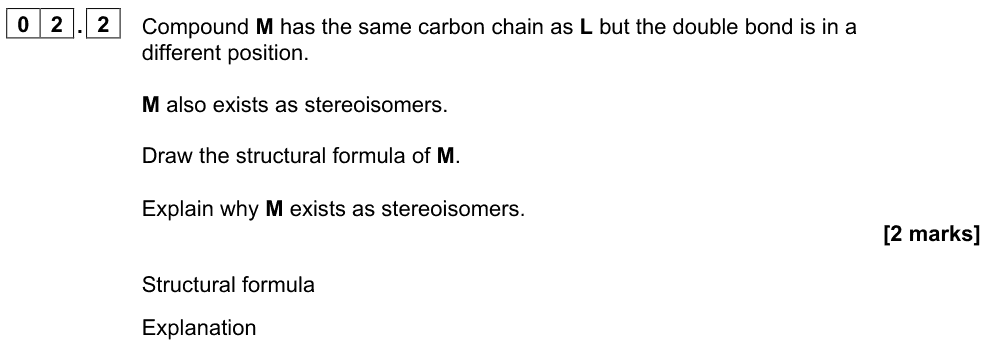
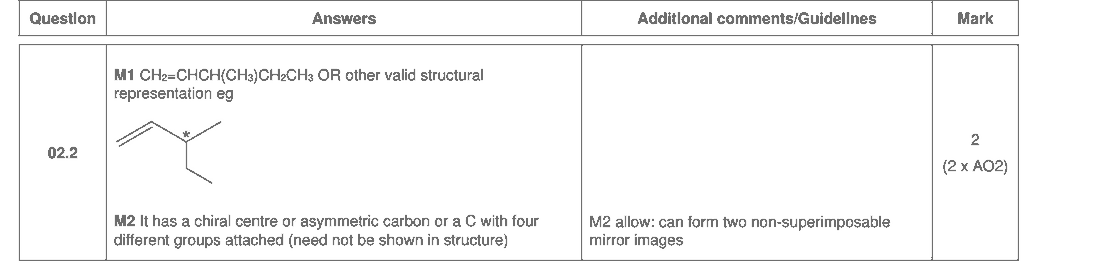
2.2 This question required students to move the C=C double bond but keep the carbon skeleton the same to deduce that compound M existed as stereoisomers because it has a chiral centre. This proved very challenging and fewer than expected were able to get started here.
Notes from the mark scheme and report
M is 3-methylpent-1-ene, CH2=CHCH(CH3)CH2CH3
it has a chiral centre (a carbon with four different groups attached), so it forms non-superimposable mirror images. Found very challenging
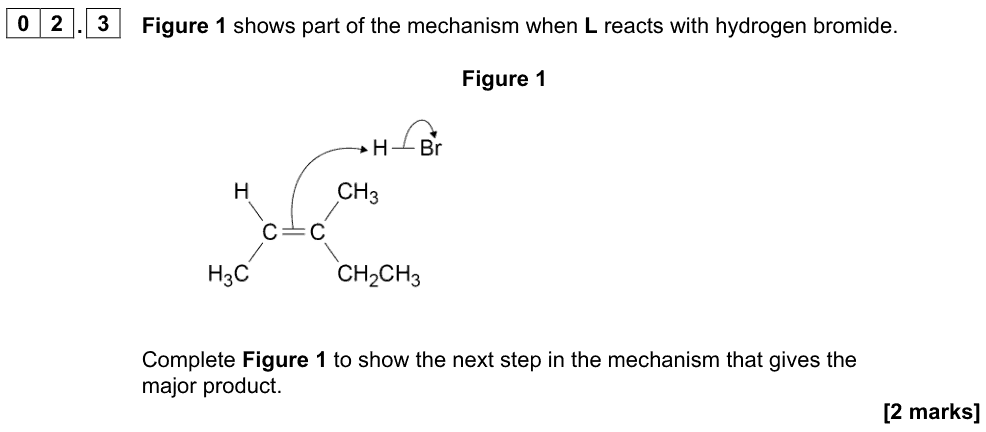
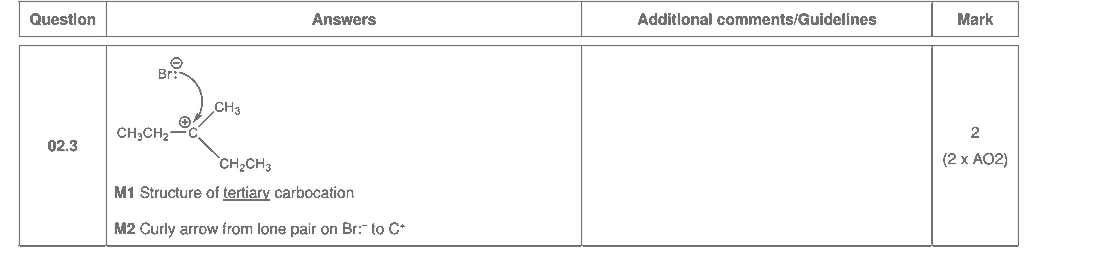
June 2025 · Paper 2 · Q02.32 marksAO2=2Mechanism
Earlier part of question 02 that this part uses
Mark scheme
Examiner's comment
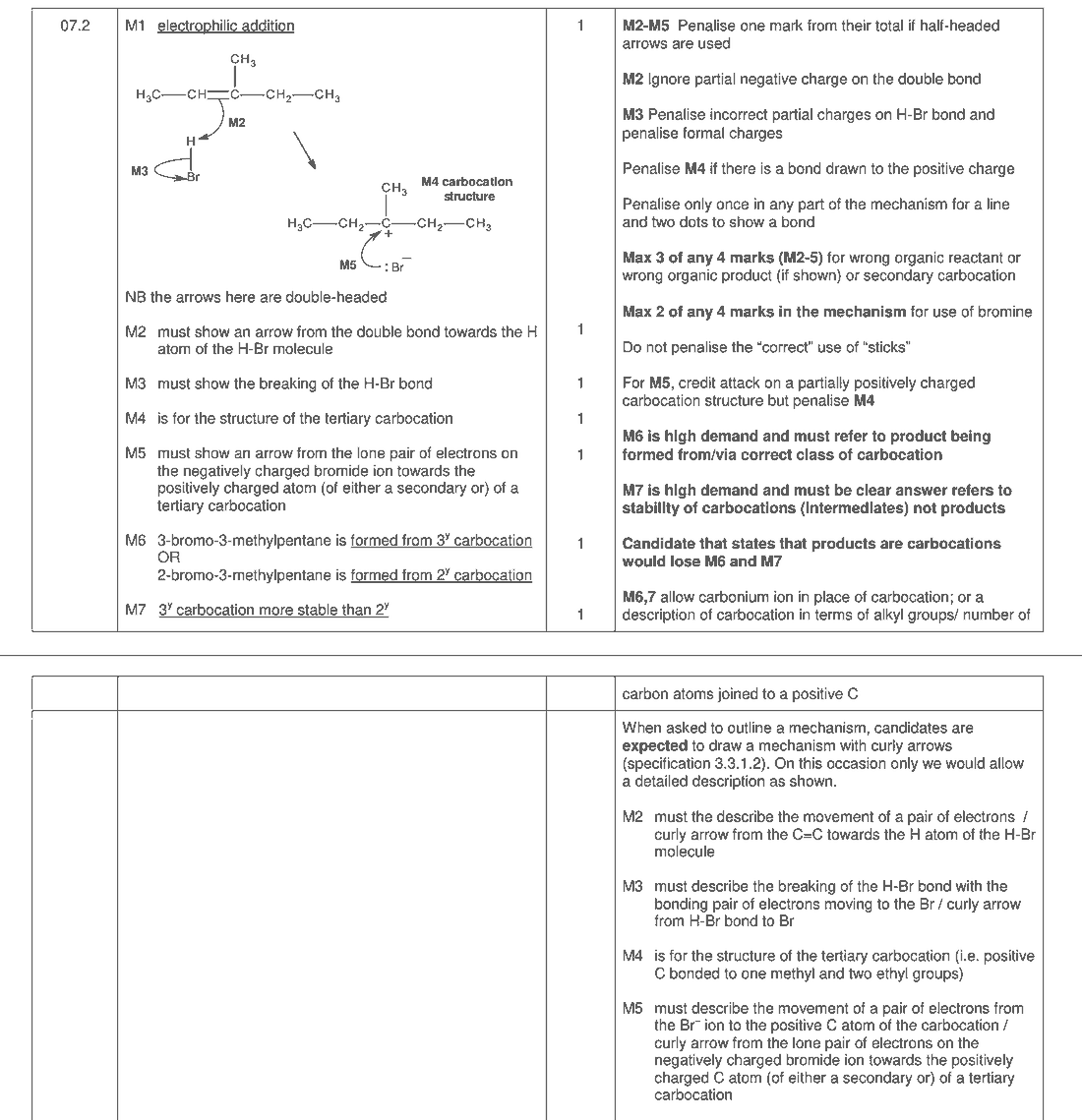
2.3 Students were asked to complete an electrophilic addition mechanism with an unsymmetrical alkene. This proved straight forward for many. Those who lost marks often did so because that drew a secondary carbocation intermediate rather than the tertiary one that would lead to the major product.
Notes from the mark scheme and report
The tertiary carbocation CH3CH2–C+(CH3)–CH2CH3, with a curly arrow from a lone pair on Br– to the C+. Common error: drawing the secondary carbocation
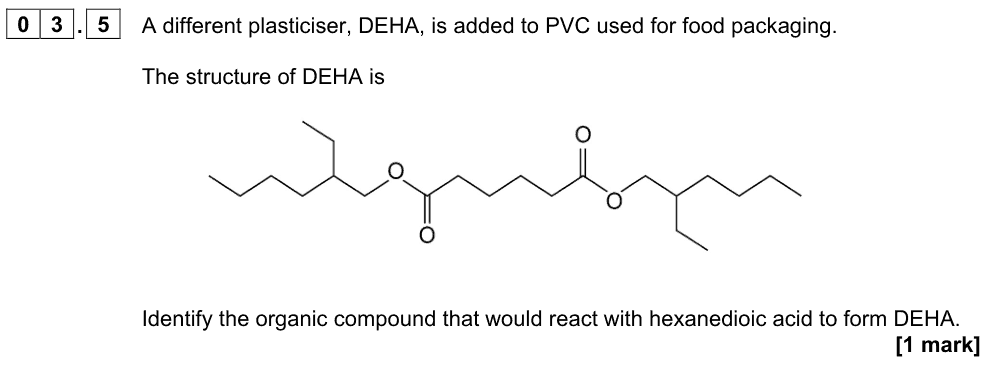
June 2025 · Paper 2 · Q03.51 markAO2=1Short answer
Earlier part of question 03 that this part uses
Mark scheme
Examiner's comment
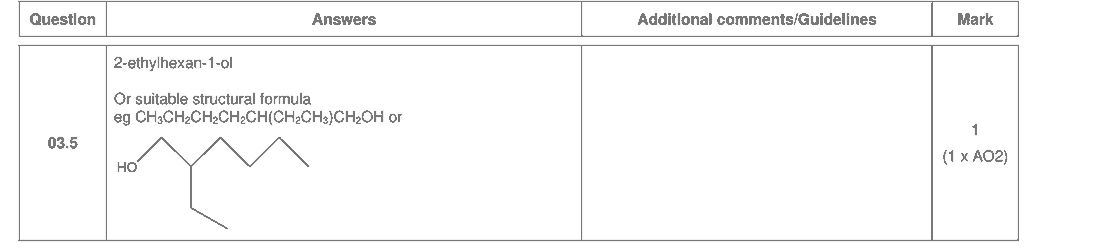
3.5 Here students were asked to identify an alcohol that would react with hexanedioic acid to form another diester used as a plasticiser. This was quite well answered with students scoring for either a correct name or structure.
Notes from the mark scheme and report
2-ethylhexan-1-ol, CH3CH2CH2CH2CH(CH2CH3)CH2OH
June 2025 · Paper 2 · Q03.84 marksAO2=4Mechanism
Earlier part of question 03 that this part uses
Mark scheme
Examiner's comment
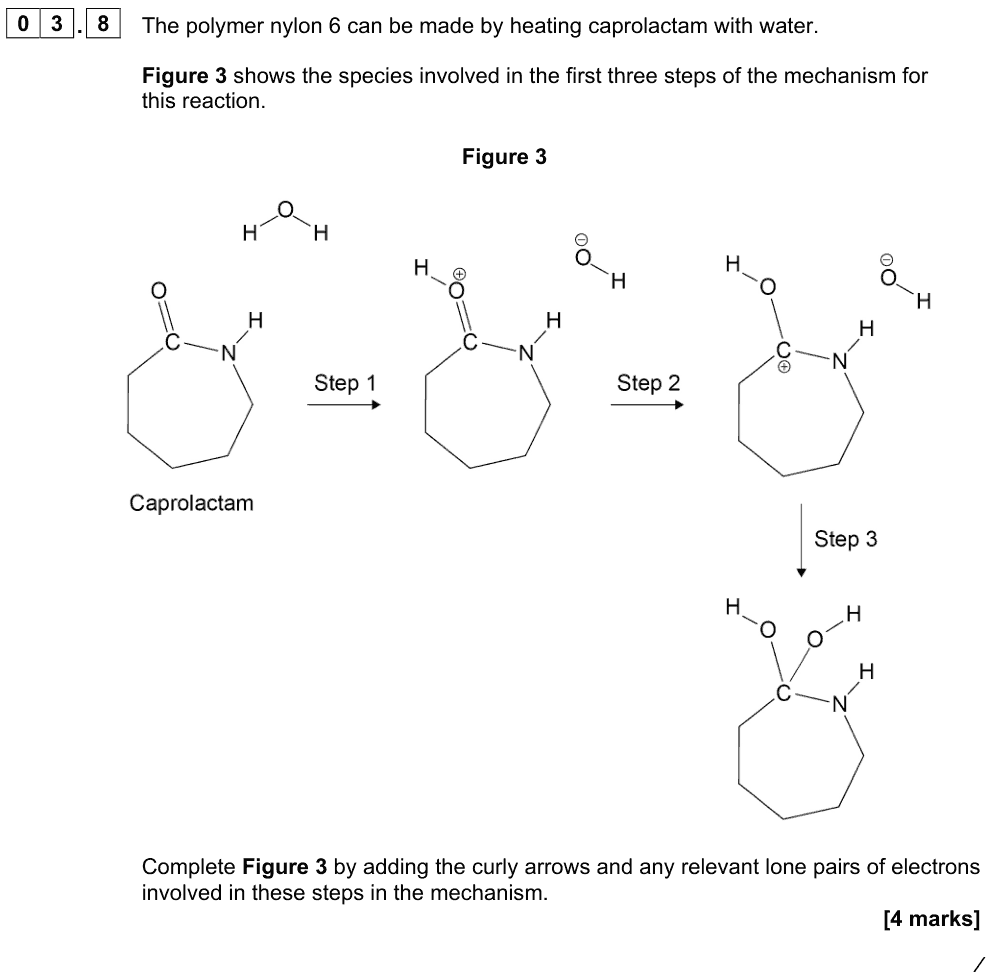
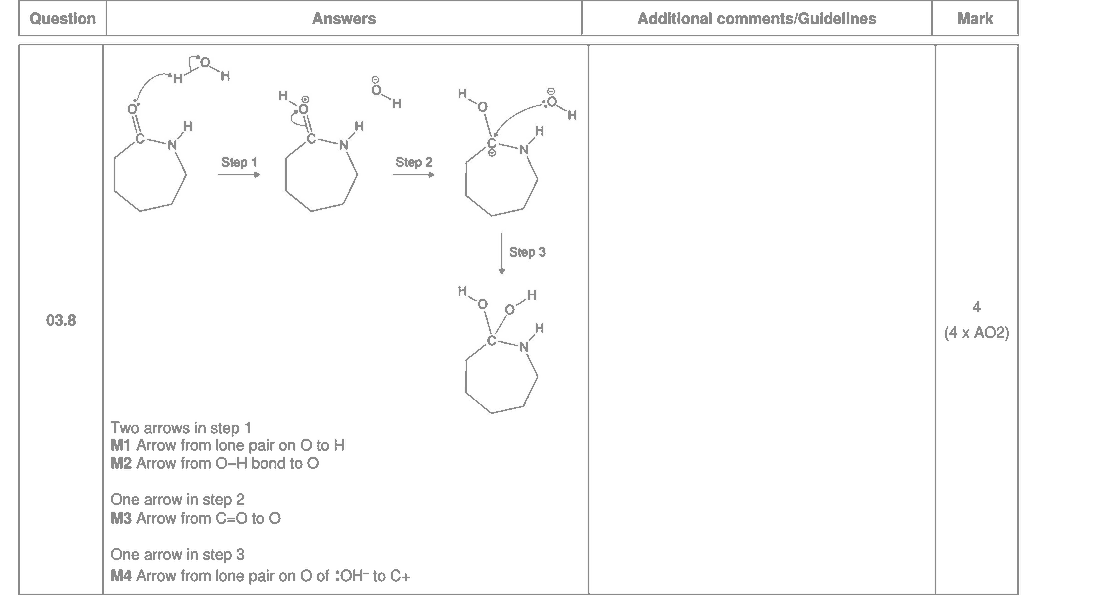
3.8 Students were given the first steps in an unfamiliar mechanism and asked to deduce the curly arrows and relevant lone pairs of electrons to complete the scheme. This was well answered by many showing a good understanding of mechanistic ideas covered elsewhere in the course.
Notes from the mark scheme and report
Step 1: arrow from a lone pair on the carbonyl O to an H of water and arrow from that O–H bond to the O of water. Step 2: arrow from the C=O bond to O (giving C+). Step 3: arrow from a lone pair on O of OH– to the C+. Unfamiliar mechanism, generally well done
June 2025 · AS Paper 2 · Q04.12 marksAO3=2Diagram or structure
Mark scheme
Examiner's comment
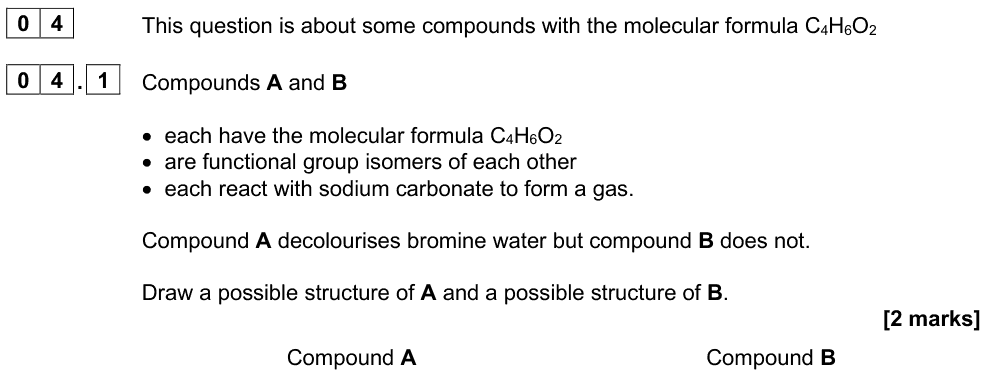
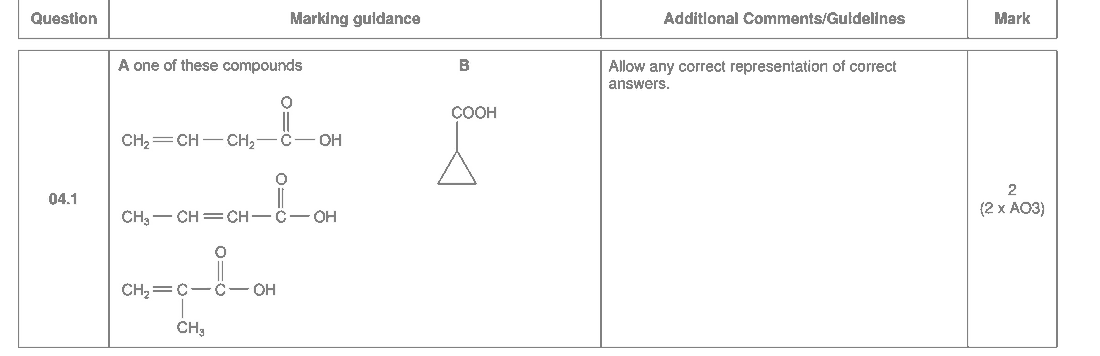
4.1 Students struggled to identify these two compounds, with many not appreciating that they were both carboxylic acids.
Notes from the mark scheme and report
Both are carboxylic acids (react with Na2CO3 to give CO2). A is an unsaturated acid: CH2=CHCH2COOH, CH3CH=CHCOOH or CH2=C(CH3)COOH. B is cyclopropanecarboxylic acid (a cyclopropane ring with COOH). Many did not see that both were carboxylic acids
June 2025 · AS Paper 2 · Q07.43 marksAO3=3Calculation
Earlier parts of question 07 that this part uses
Mark scheme
Examiner's comment
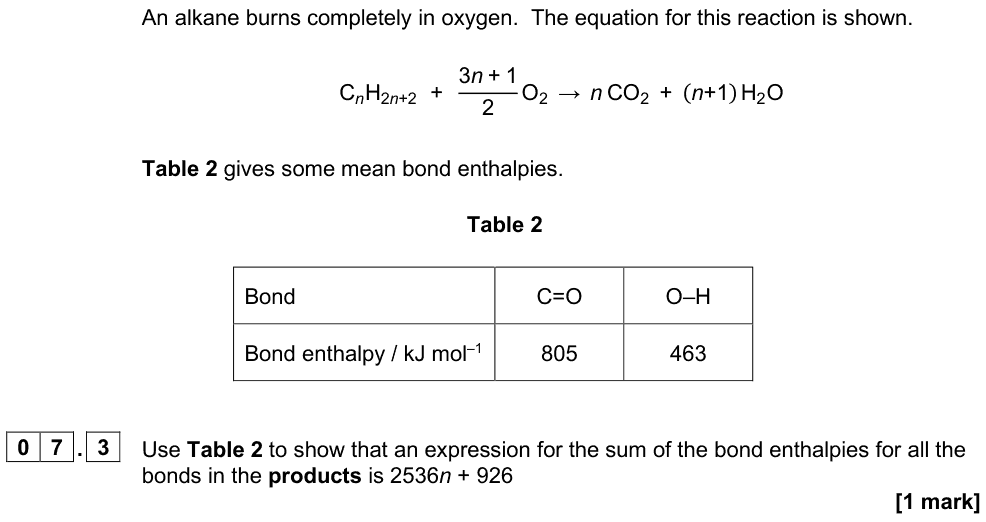
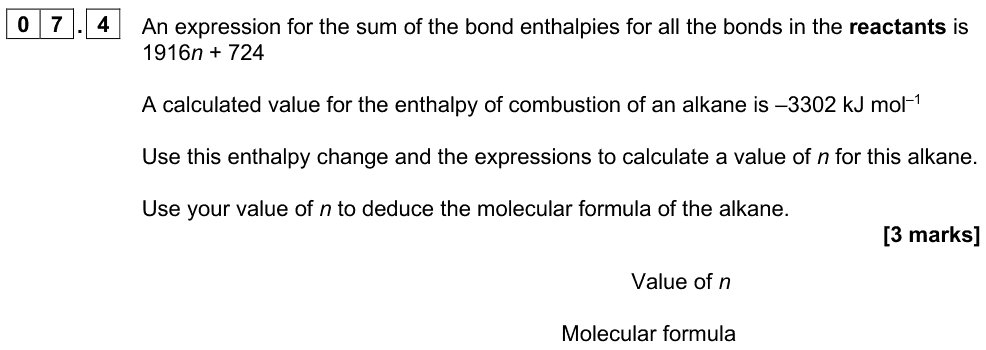
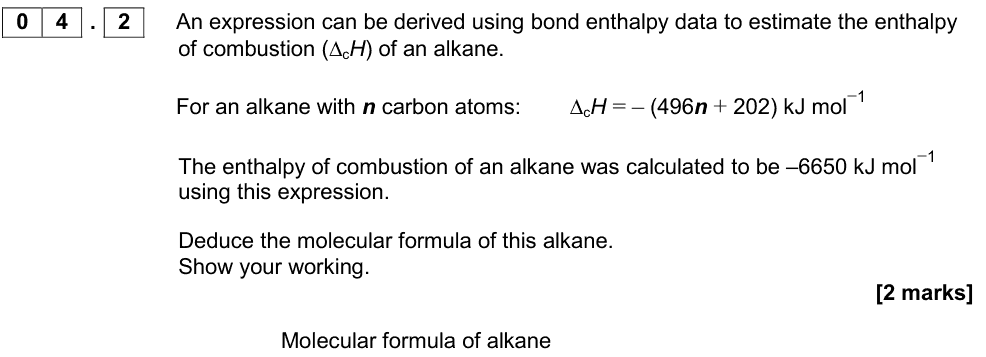
7.4 Students had to determine a value of n in an alkane and its formula using expressions for the sum of the bond enthalpies in both the reactants and products. A common error was to only use the sum for the products or the reactants and not both, or to have sum the wrong way round where it would equal +3302 not –3302.
Notes from the mark scheme and report
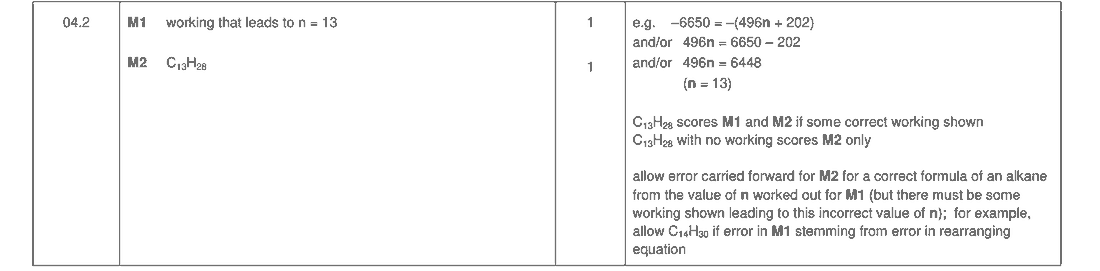
Answer: n = 5
C5H12. ∆H = bonds broken – bonds formed: –3302 = (1916n + 724) – (2536n + 926), so 620n = 3100. n must be an integer. Errors: using only one expression
subtracting the wrong way round (+3302)
Skills: MS2.2 Change the subject of an equation; MS2.4 Solve algebraic equations
June 2025 · AS Paper 2 · Q081 markAO2=1Multiple choice
Answer
B
Mark scheme
Examiner's comment
Organic nomenclature
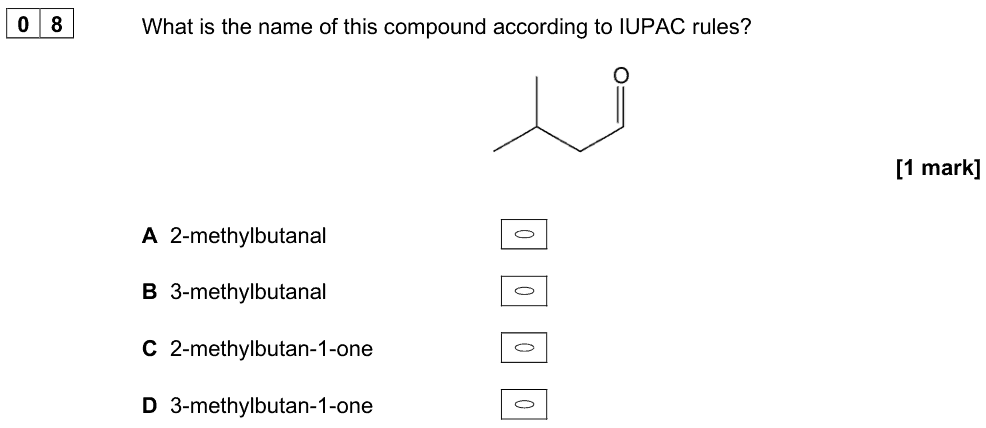
This was answered correctly by a majority of students but many thought it was a ketone rather than an aldehyde or did not appreciate that the aldehyde group was C-1 and so the methyl group was on C-3 not C-2.
Notes from the mark scheme and report
Answer: B. An aldehyde (C=O at the end of the chain, which is C1) with a methyl group on C3: 3-methylbutanal. Errors: named as a ketone
methyl placed on C2
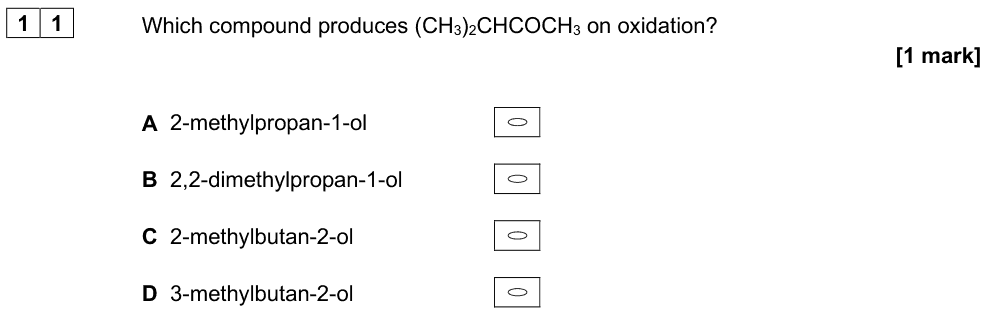
June 2025 · AS Paper 2 · Q111 markAO3=1Multiple choice
Answer
D
Mark scheme
Examiner's comment
This was answered correctly by a majority of students.
Notes from the mark scheme and report
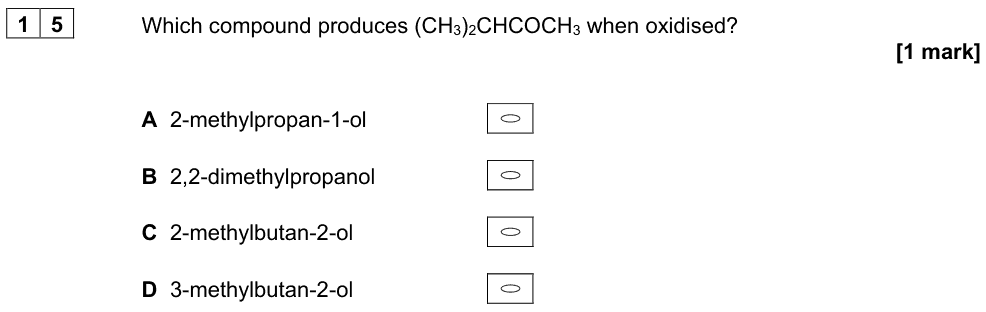
Answer: D. The ketone 3-methylbutan-2-one comes from the secondary alcohol 3-methylbutan-2-ol
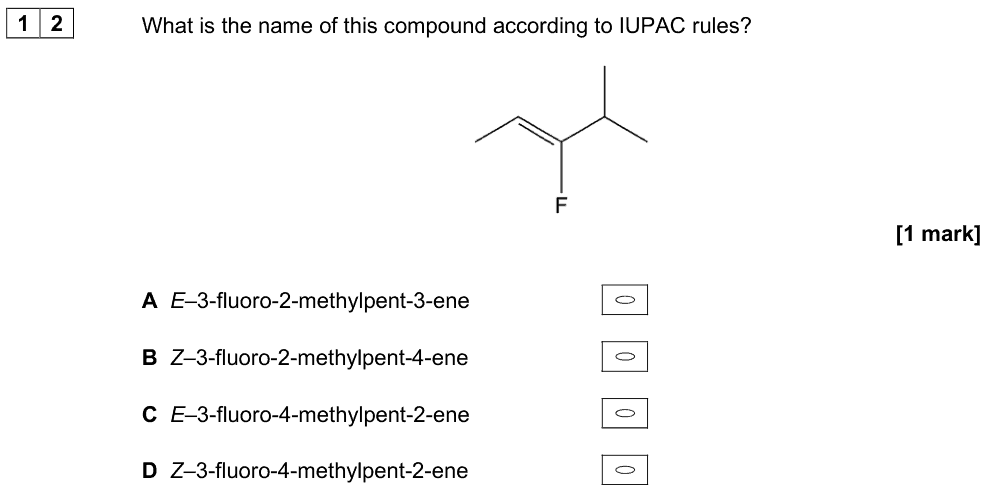
June 2025 · AS Paper 2 · Q121 markAO3=1Multiple choice
Answer
D
Mark scheme
Examiner's comment
The correct answer was the most common answer, but many thought the compound was E not Z possibly as they looked at the relative mass of the whole group attached to the C of C=C rather than the relative mass of the first atom attached.
Notes from the mark scheme and report
Answer: D. CH3CH=CF–CH(CH3)2 is 3-fluoro-4-methylpent-2-ene
higher priority groups (CH3 on C2, F on C3) are on the same side, so Z. Priority uses the atomic number of the first atom attached, not the mass of the whole group
many chose E
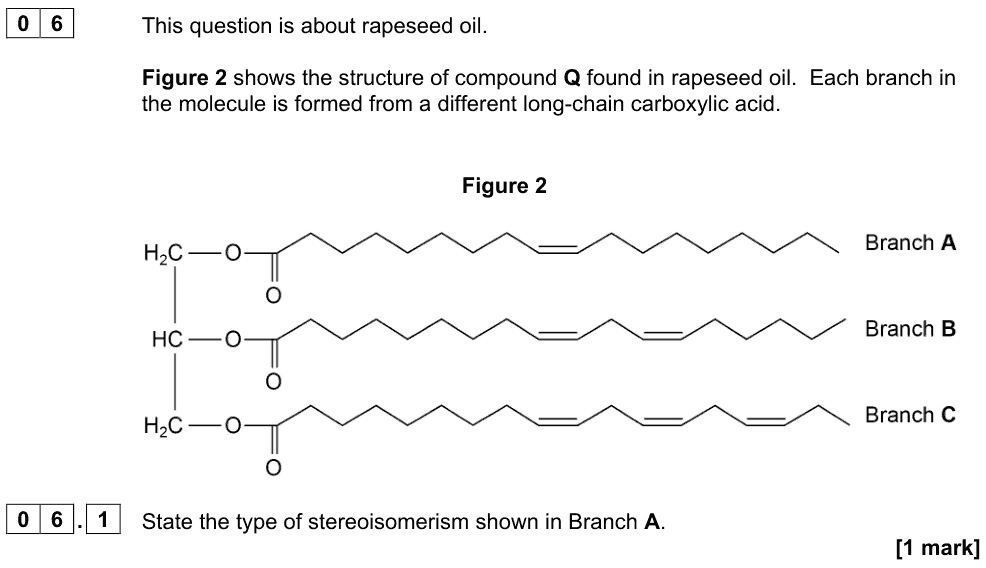
June 2025 · Paper 3 · Q06.11 markAO1=1Short answerEasy
Mark scheme
Examiner's comment
6.1 Although alternative options such as ‘geometric isomerism’ or ‘cis-trans isomerism’ were allowed on the mark scheme, it was surprising how often these answers were seen given that the specification does not use that terminology as it has been replaced by the idea of E–Z isomerism. Including the alternative answers, however, nearly 80% of students achieved this mark.
Notes from the mark scheme and report
E–Z isomerism (branch A is drawn as the Z form). 'Geometric' and 'cis–trans' were allowed but are not the specification terms
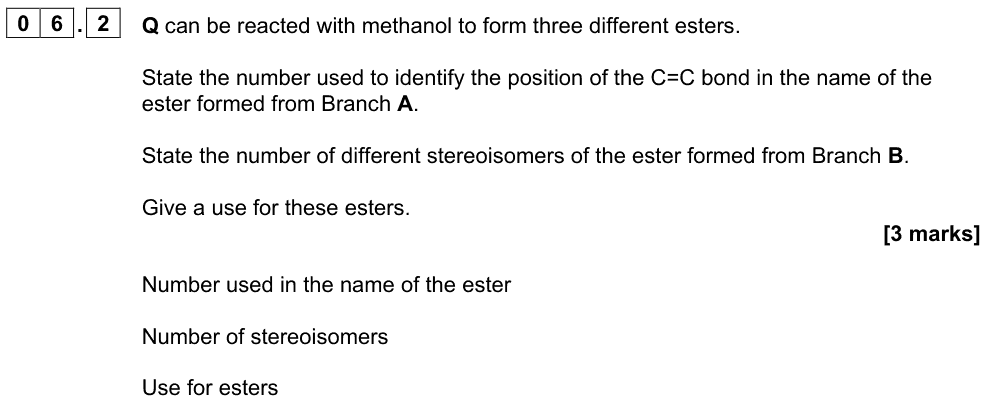
June 2025 · Paper 3 · Q06.23 marksAO1=1, AO3=2Short answer
Earlier part of question 06 that this part uses
Mark scheme
Examiner's comment
6.2 Close to 60% of students scored at least 2/3 but many failed to recall a suitable use.
Notes from the mark scheme and report
9 (counting from the ester C=O carbon as C1, the C=C starts at C9)
four stereoisomers (two C=C bonds, each E or Z)
use as biodiesel. Many could not recall a use
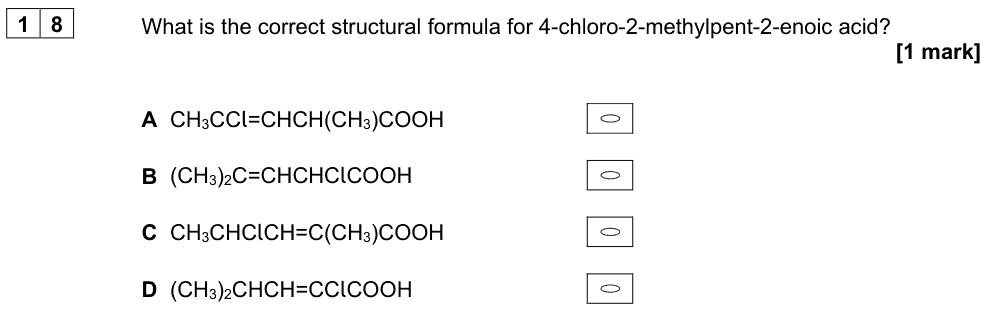
June 2025 · Paper 3 · Q181 markAO1=1Multiple choice
Answer
C
Mark scheme
Notes from the mark scheme and report
Answer: C. COOH carbon is C1
methyl on C2
C=C between C2 and C3
Cl on C4
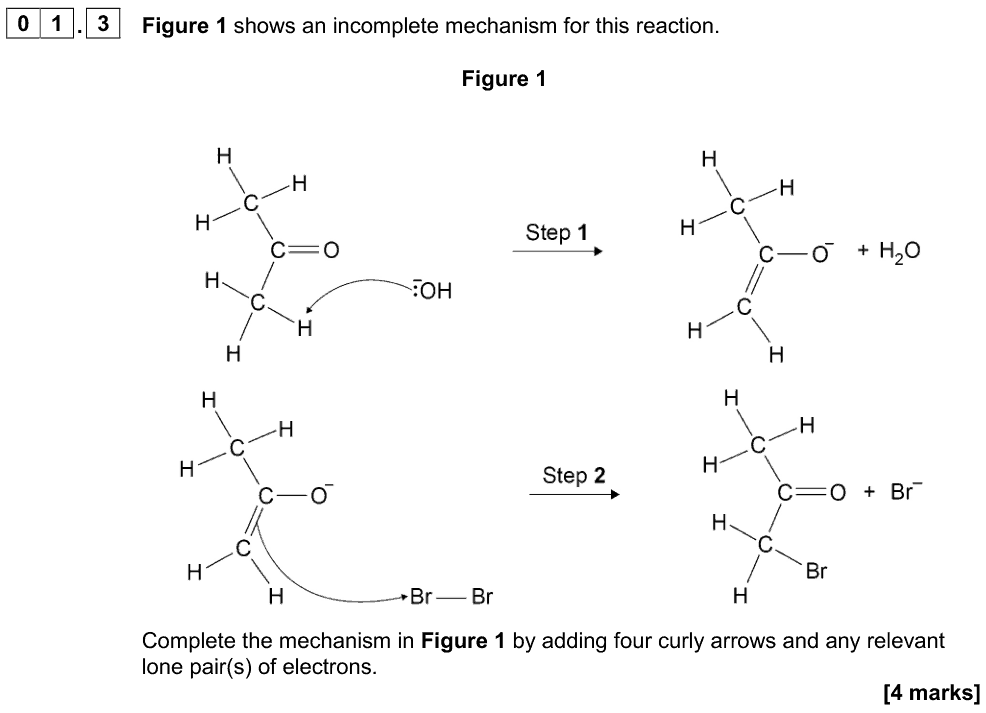
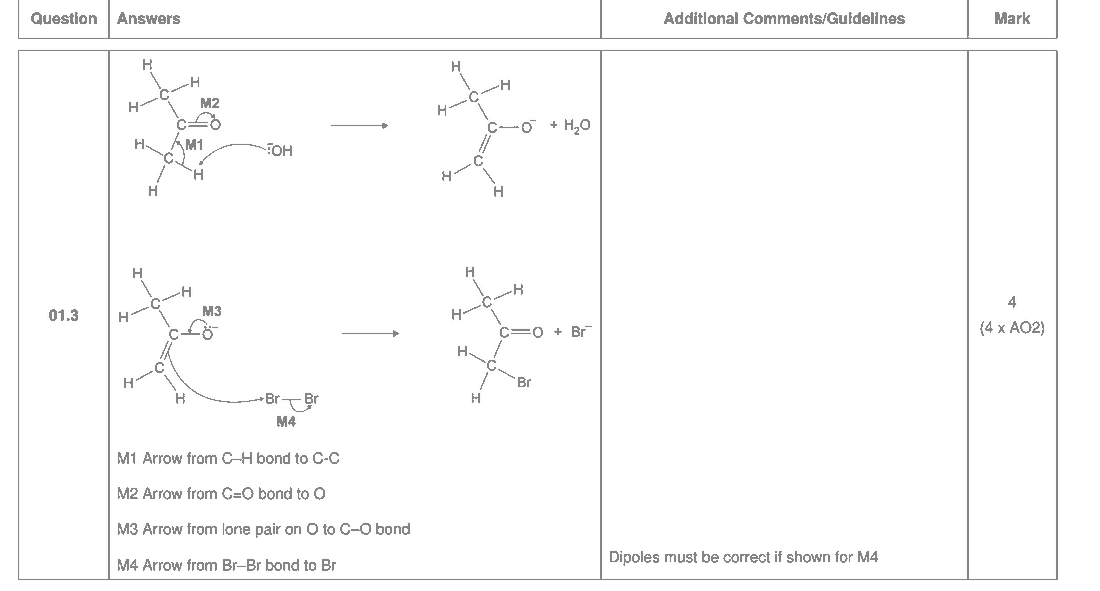
June 2024 · Paper 2 · Q01.34 marksAO2=4Mechanism
Earlier part of question 01 that this part uses
Mark scheme
Examiner's comment
1.3 This unfamiliar mechanism question was well answered and discriminated well. The best students were able to deduce the correct curly arrows from the information given.
Notes from the mark scheme and report
Step 1 (the :OH– to H arrow is given): arrow from the C–H bond to the C–C bond
arrow from the C=O bond to O. Step 2 (the C=C to Br arrow is given): arrow from a lone pair on O– to the C–O bond
arrow from the Br–Br bond to Br. Dipoles must be correct if shown. The best students deduced the arrows from the structures given
June 2024 · AS Paper 2 · Q02.12 marksAO3=2Diagram or structure
Mark scheme
Examiner's comment
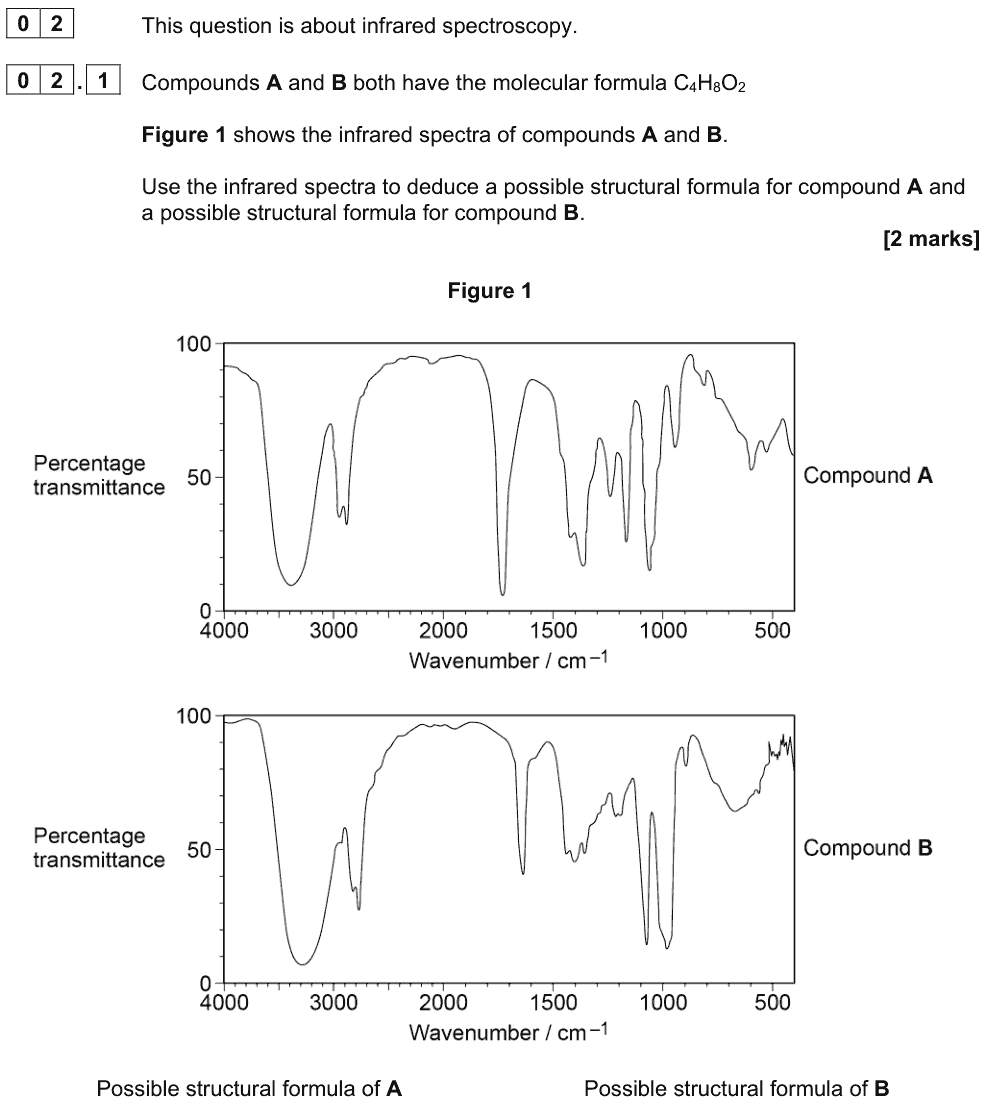
2.1 Students struggled with this question which required them to identify functional groups from IR spectra and then suggest the structure of two compounds. Some confused the alcohol O-H signal with the carboxylic acid O-H peak, and some confused the C=O and C=C peaks. Also, some students did not appreciate that there are several ways to represent the structural formula of a compound. Many tried to write condensed formulas (e.g. HOCH2CH=CHCH2OH) but sometimes
Notes from the mark scheme and report
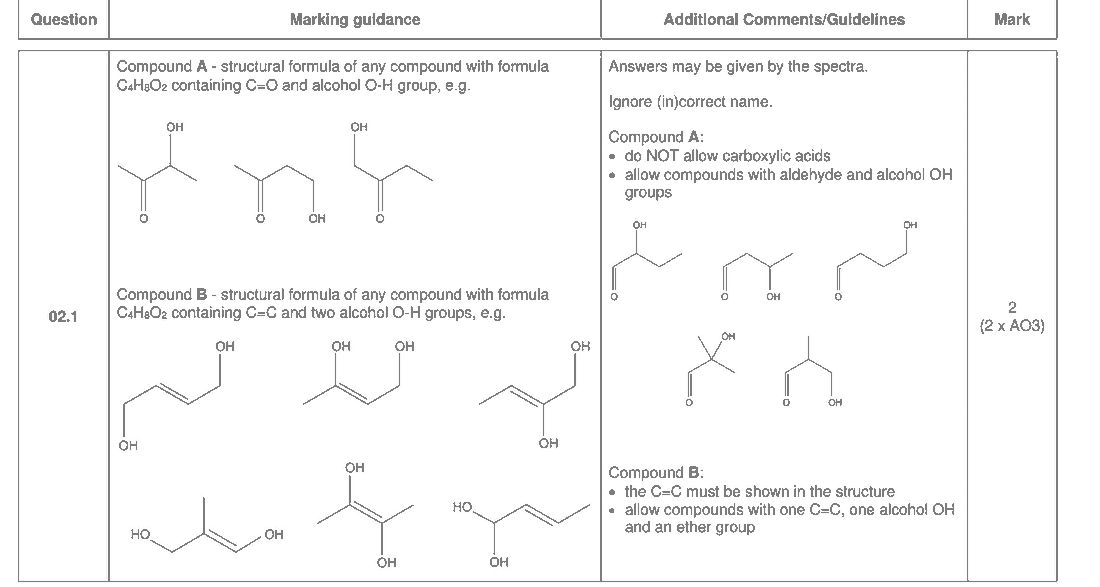
A shows alcohol O–H (3230–3550 cm–1) and C=O (1680–1750 cm–1): any C4H8O2 structure with a C=O and an alcohol OH, for example CH3COCH2CH2OH or CH3CH(OH)COCH3 (hydroxy-aldehydes allowed
not a carboxylic acid). B shows alcohol O–H and C=C (1620–1680 cm–1) with no C=O: for example HOCH2CH=CHCH2OH (C=C must be shown). Errors: alcohol O–H confused with the acid O–H
C=O confused with C=C
faulty condensed formulas
Skills: MS3.1 Translate information between graphical, numerical and algebraic forms
June 2024 · AS Paper 2 · Q03.11 markAO1=1Short answer
Mark scheme
Examiner's comment
3.1 Many students struggled to name the CFC according to IUPAC rules. The most common errors were with the spelling of fluoro-.
Notes from the mark scheme and report
Trichlorofluoromethane (no other name: substituents in alphabetical order). The most common error was the spelling of fluoro
June 2024 · AS Paper 2 · Q03.22 marksAO2=2Equation writing
Earlier part of question 03 that this part uses
Mark scheme
Examiner's comment
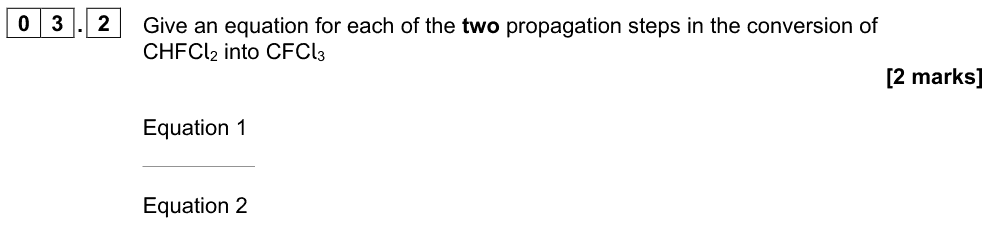
3.2 Students did this question quite well, showing two propagation steps in the production of CFCl3 by free radical substitution.
Notes from the mark scheme and report
CHFCl2 + Cl• → •CFCl2 + HCl, then •CFCl2 + Cl2 → CFCl3 + Cl•. Two otherwise correct equations without dots score 1
June 2024 · AS Paper 2 · Q03.31 markAO2=1Equation writing
Earlier part of question 03 that this part uses
Mark scheme
Examiner's comment
3.3 This question required one equation to show the breakdown of a CFC to form Cl free radicals. Many students did appreciate that the breakdown formed two free radicals.
Notes from the mark scheme and report
CFCl3 → •CFCl2 + Cl• (the C–Cl bond breaks, giving two radicals)
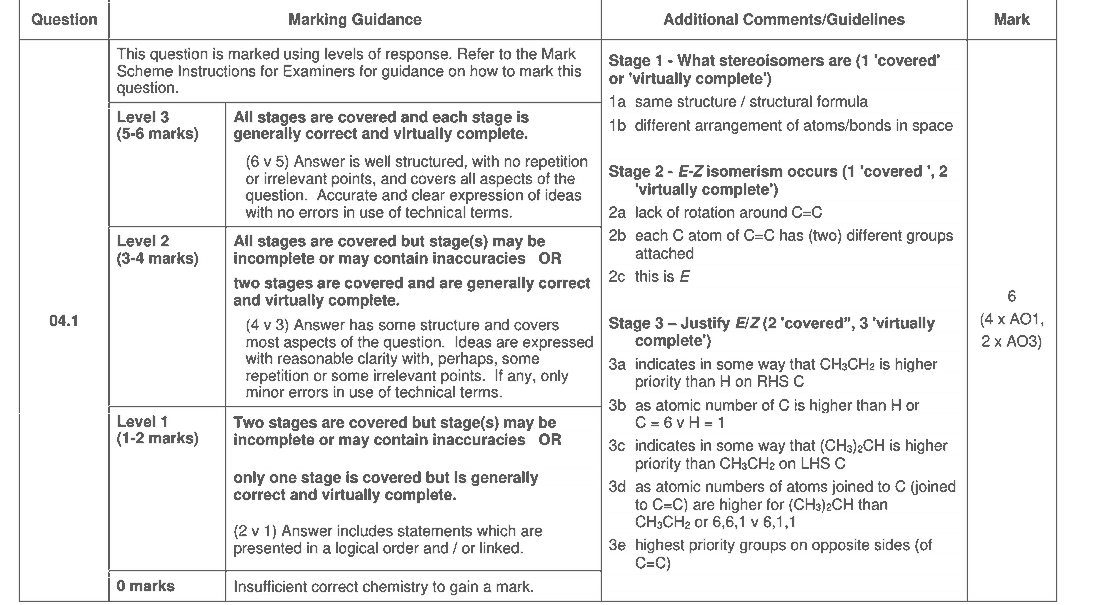
June 2024 · AS Paper 2 · Q04.16 marksAO1=4, AO3=26-mark level of response
Mark scheme, with the levels and indicative content
Examiner's comment
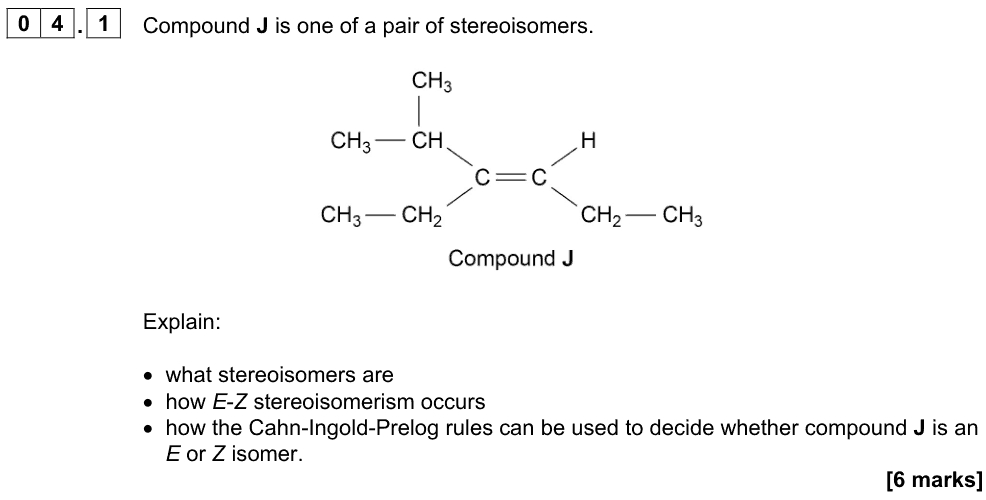
4.1 This question showed that students have poor understanding of what stereoisomers are in general. It also showed that very few students knew how the Cahn-Ingold-Prelog priority rules work. These rules are based on the atomic number of the atoms joined to C=C and not to the relative atomic mass of these atoms nor the “Mr” of the groups attached.
Notes from the mark scheme and report
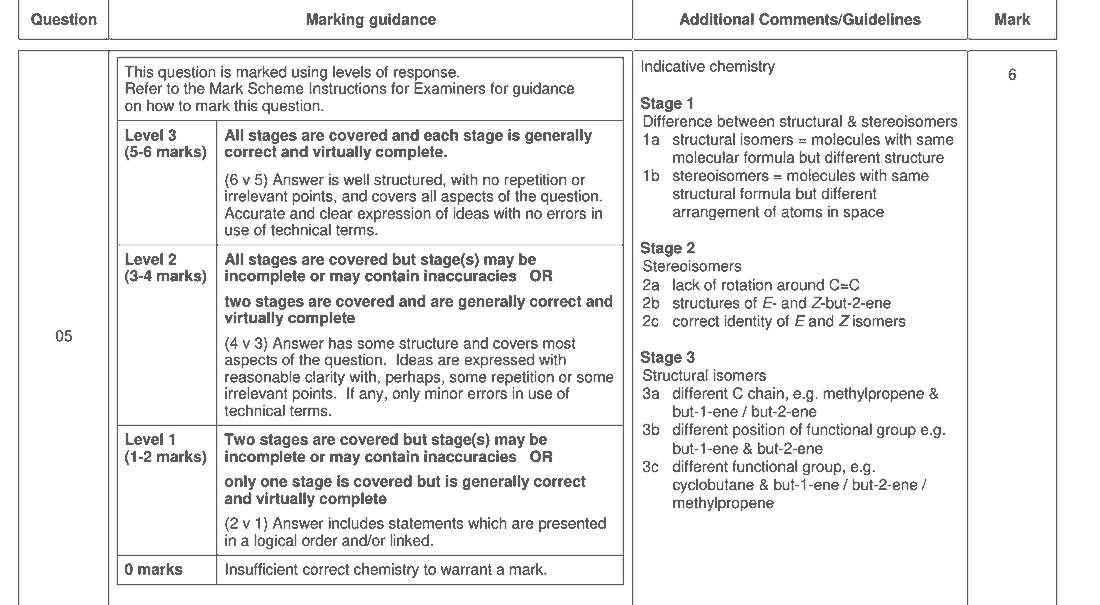
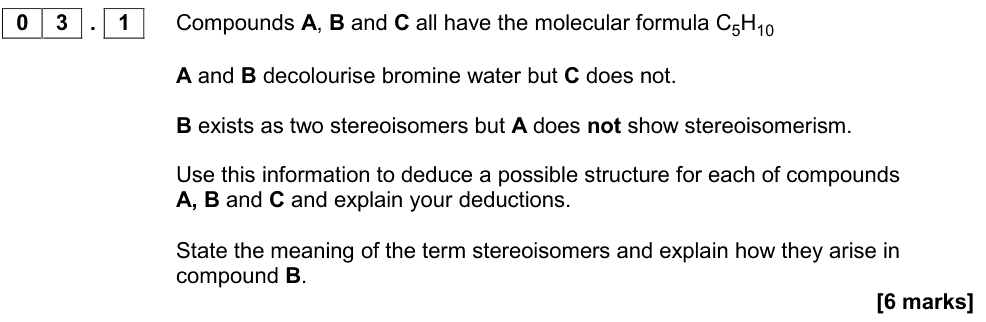
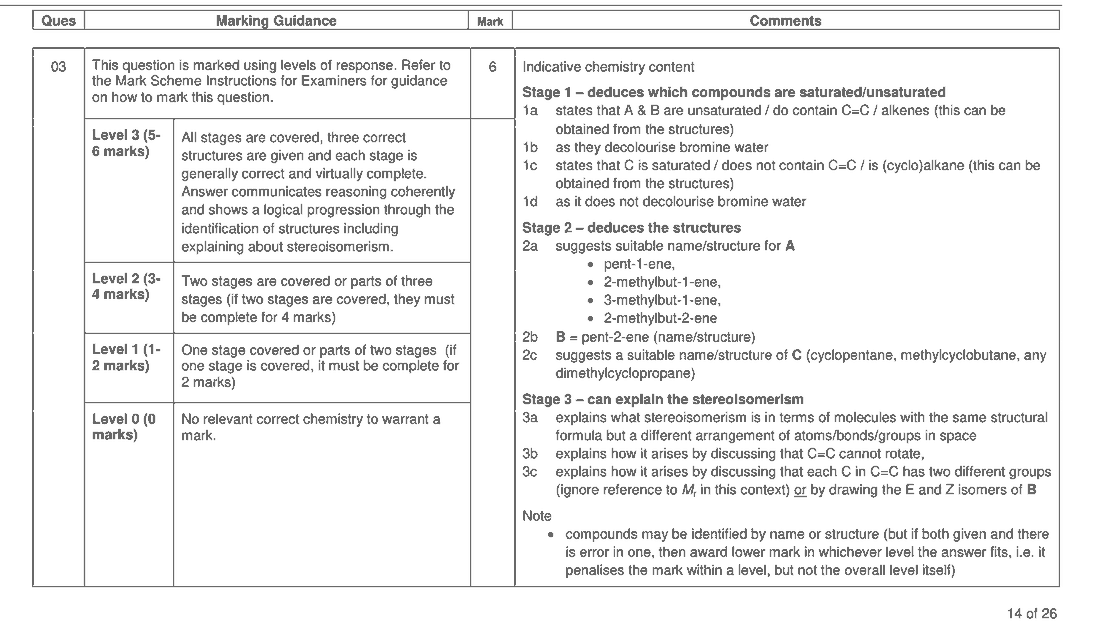
Levels of response, three stages. Stage 1: stereoisomers have the same structural formula but a different arrangement of atoms / bonds in space. Stage 2: E–Z isomerism arises from the lack of rotation about the C=C when each carbon of the C=C has two different groups attached
J is the E isomer. Stage 3 (CIP): on the right-hand carbon CH3CH2 has priority over H because C has a higher atomic number (6 against 1)
on the left-hand carbon (CH3)2CH has priority over CH3CH2 because the atoms attached to the first carbon are (C, C, H) against (C, H, H)
the two highest-priority groups are on opposite sides, so E. Priority is by atomic number, not by Ar or the Mr of the group
Skills: MS4.2 Visualise and represent 2D and 3D forms including two-dimensional representations of 3D objects
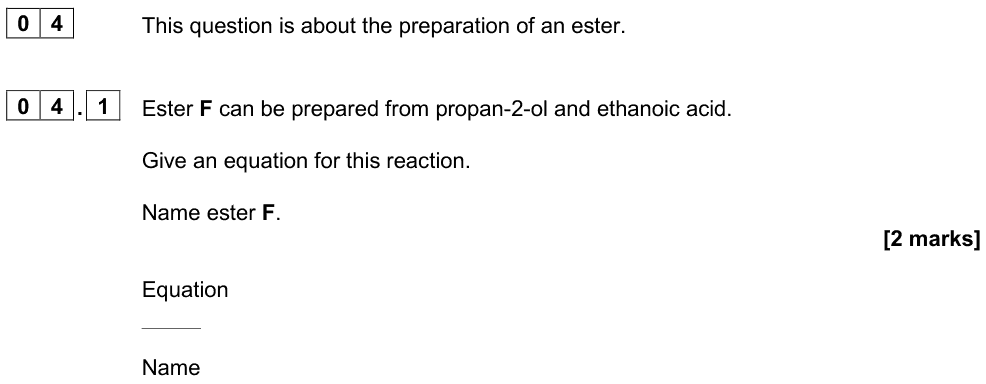
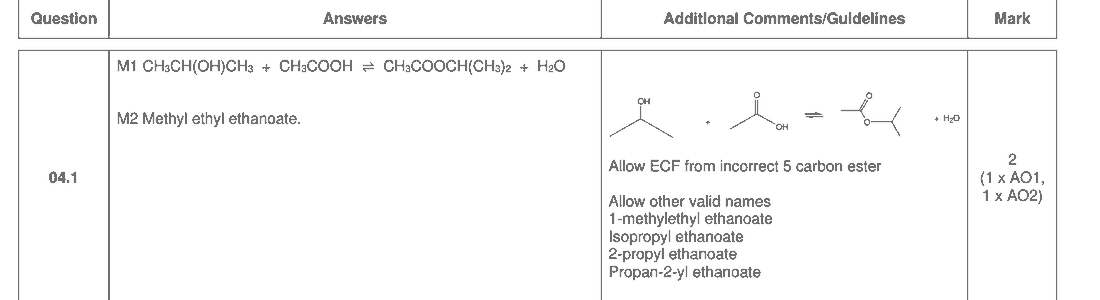
June 2024 · Paper 2 · Q04.12 marksAO1=1, AO2=1Equation writing
Mark scheme
Examiner's comment
4.1 The esterification equation proved difficult, especially the structure of the ester itself. Those who got the ester wrong were able to access M2, consequentially, if they had drawn an ester with 5 carbon atoms.
Notes from the mark scheme and report
CH3CH(OH)CH3 + CH3COOH ⇌ CH3COOCH(CH3)2 + H2O
1-methylethyl ethanoate (propan-2-yl ethanoate, isopropyl ethanoate). Name allowed as ECF from a wrong five-carbon ester. The ester structure was the difficulty
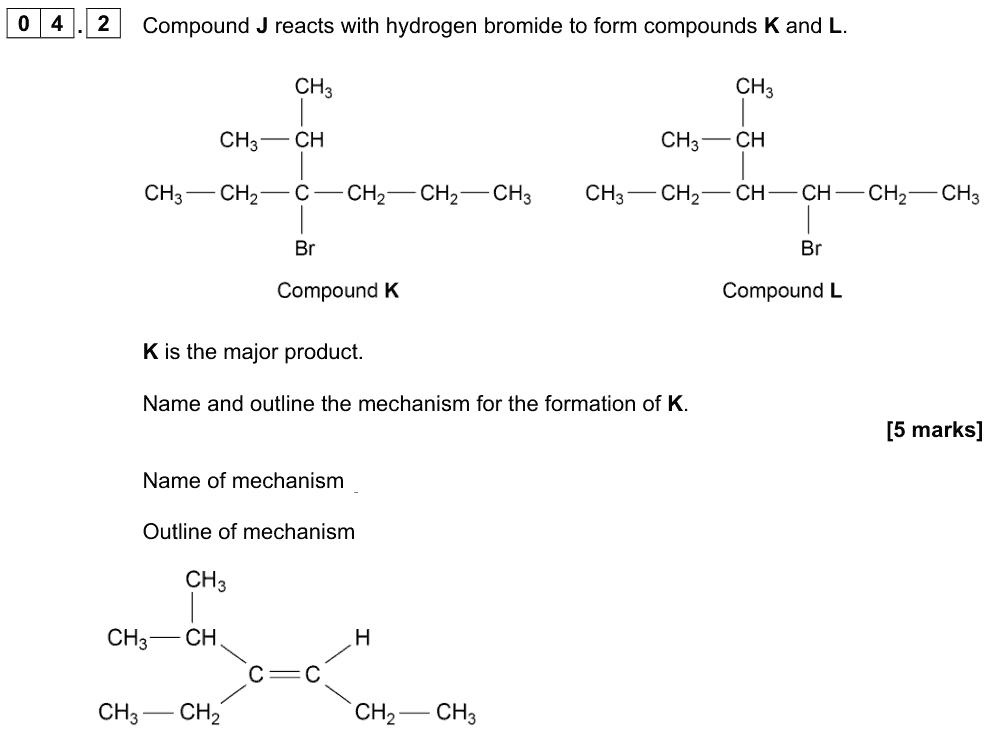
June 2024 · AS Paper 2 · Q04.25 marksAO1=1, AO2=4Mechanism
Earlier part of question 04 that this part uses
Mark scheme
Examiner's comment
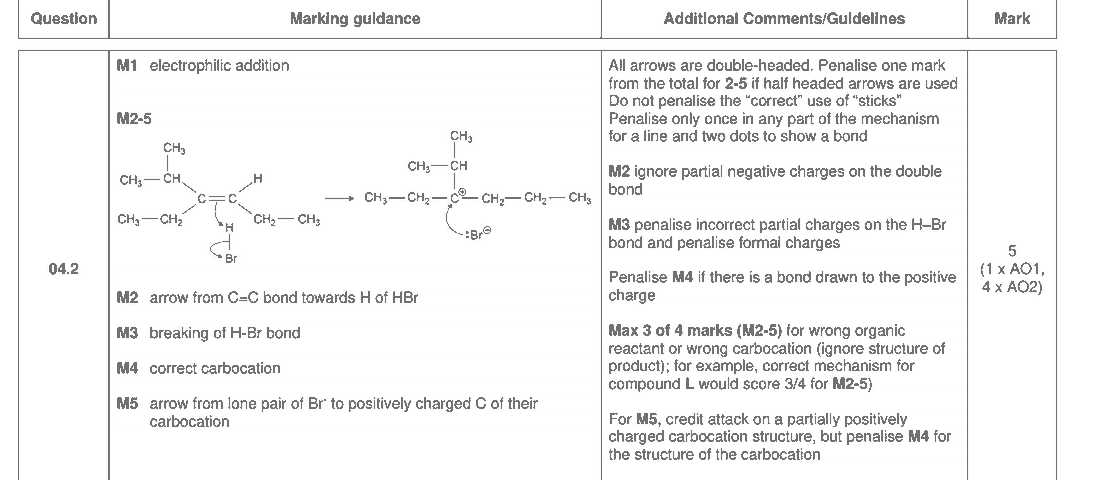
4.2 Students had to show the mechanism for the formation of the major halogenoalkane product from electrophilic addition to an alkene. This was generally very well done.
Notes from the mark scheme and report
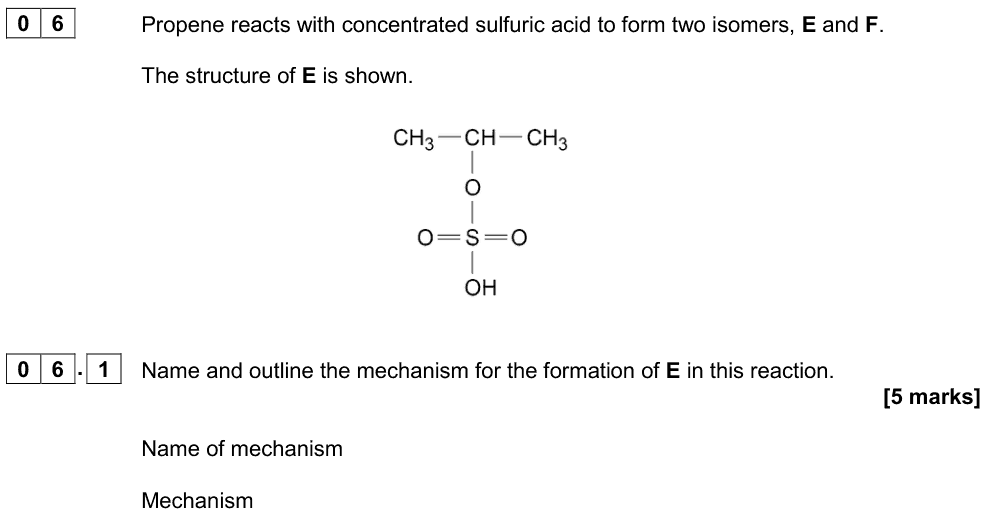
Electrophilic addition. Curly arrow from the C=C to the H of H–Br
arrow from the H–Br bond to Br
tertiary carbocation with the positive charge on the carbon carrying the (CH3)2CH and CH3CH2 groups (H has added to the CH carbon)
arrow from a lone pair on Br– to the C+. Mechanism for L (secondary carbocation) scores max 3 of the 4 mechanism marks.
June 2024 · Paper 2 · Q06.21 markAO2=1Diagram or structure
Earlier part of question 06 that this part uses
Mark scheme
Examiner's comment
6.2 Again this was quite well answered with nearly 50% gaining the mark for a structure with an asymmetric carbon atom.
Notes from the mark scheme and report
CH3CH2CH(CH3)COOH (2-methylbutanoic acid): C2 carries four different groups
June 2024 · AS Paper 2 · Q07.43 marksAO1=1, AO2=2Mechanism
Earlier part of question 07 that this part uses
Mark scheme
Examiner's comment
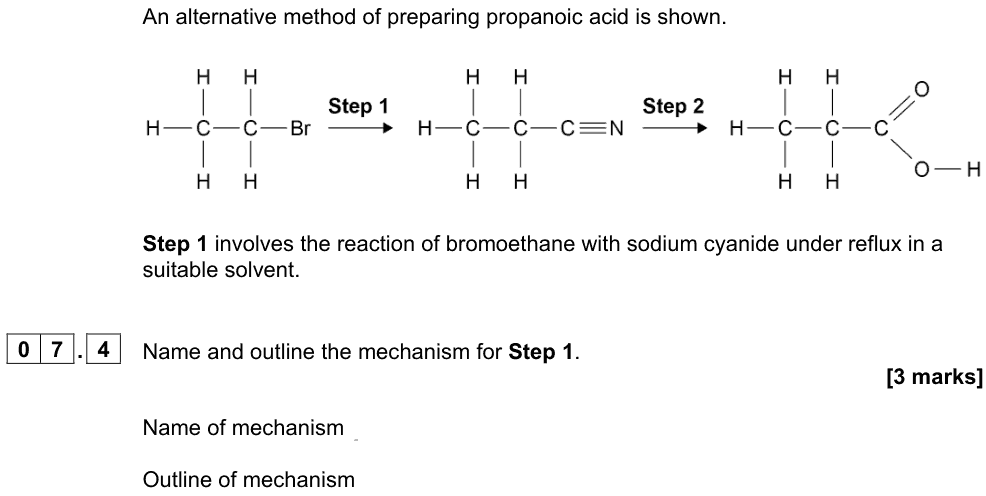
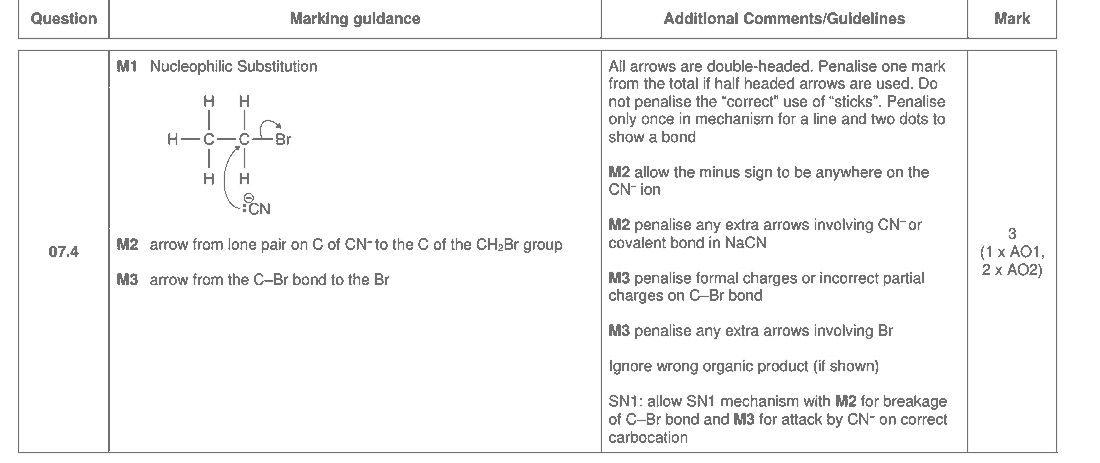
7.4 In this question students were required to show the mechanism for the reaction of sodium cyanide with bromoethane. Many students failed to show the CN– correctly attacking the bromoethane.
Notes from the mark scheme and report
Nucleophilic substitution. Curly arrow from the lone pair on the C of :CN– to the carbon of the CH2Br group
curly arrow from the C–Br bond to Br. No extra arrows
no formal charges on the C–Br bond. Many did not show CN– attacking correctly
June 2024 · Paper 2 · Q08.35 marksAO1=1, AO2=4Mechanism
Earlier part of question 08 that this part uses
Mark scheme
Examiner's comment
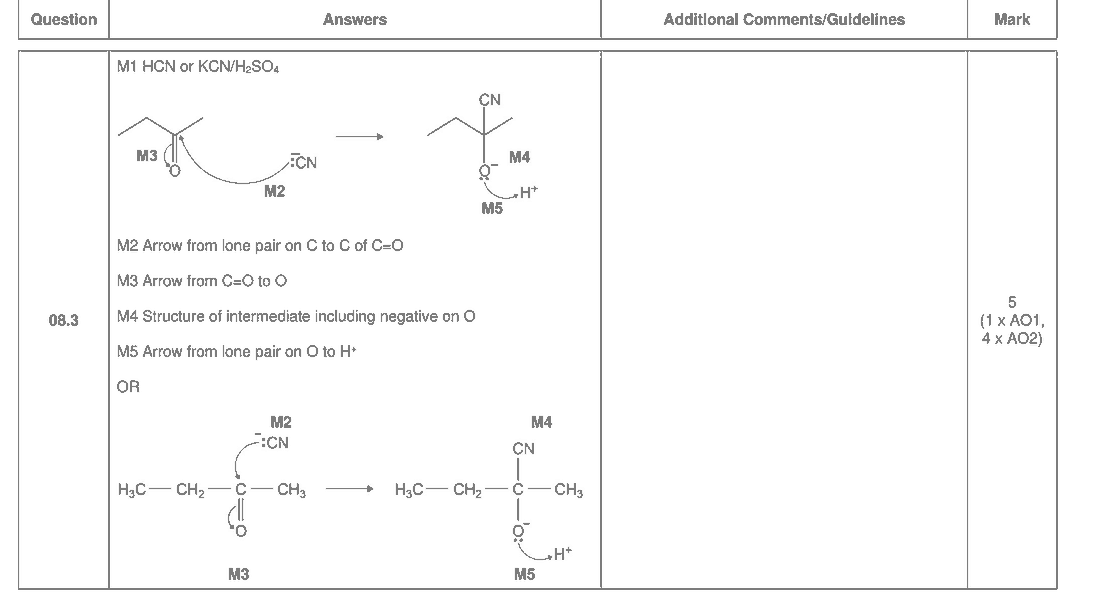
8.3 This fairly standard mechanism was well answered but also differentiated very effectively, with a discrimination index of 0.67.
Notes from the mark scheme and report
KCN followed by dilute acid (HCN or KCN/H2SO4). Nucleophilic addition: arrow from the lone pair on C of :CN– to the C of C=O
arrow from the C=O bond to O
intermediate with O–
arrow from a lone pair on O– to H+
June 2024 · AS Paper 2 · Q091 markAO1=1Multiple choiceEasy
Answer
B
Mark scheme
Examiner's comment
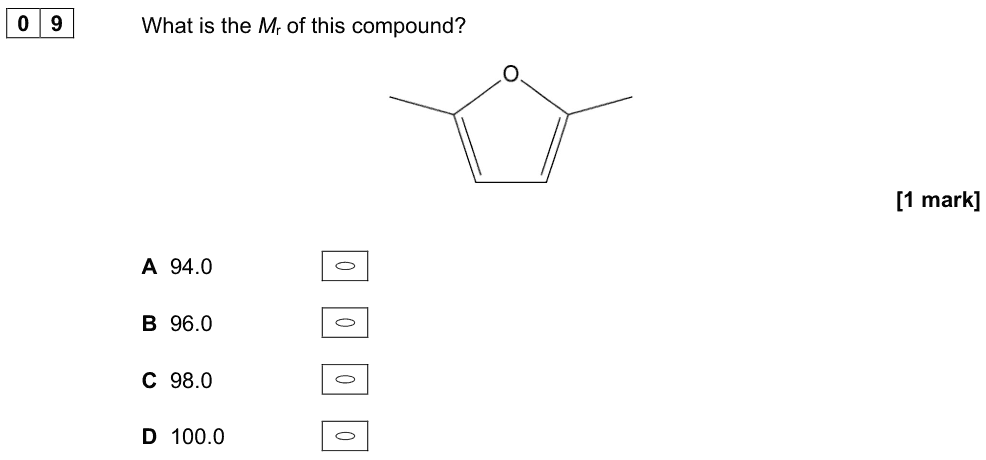
Mr from a skeletal structure
This was answered correctly by a majority (73.4%) of students.
Notes from the mark scheme and report
Answer: B. The skeletal formula is 2,5-dimethylfuran, C6H8O: 6(12.0) + 8(1.0) + 16.0 = 96.0
June 2024 · Paper 2 · Q09.12 marksAO1=1, AO2=1Short answer
Mark scheme
Examiner's comment
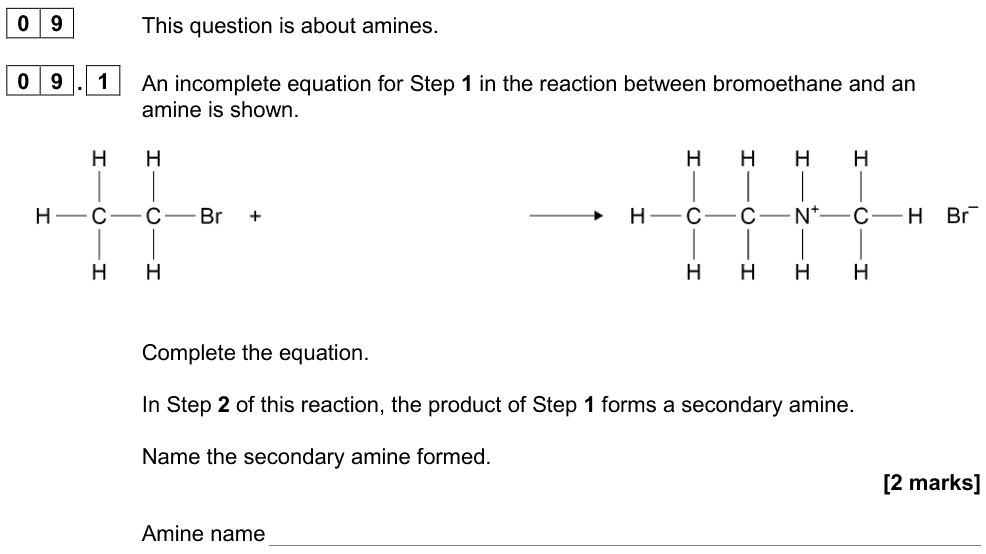
9.1 Most were able to score at least 1 mark for giving a correct methylamine structure to balance the equation. A variety of amine naming approaches are valid and so the mark scheme reflected this by allowing several variations. Despite this approach, the second mark was seen far less frequently.
Notes from the mark scheme and report
The missing reactant is methylamine, CH3NH2 (displayed or structural)
the secondary amine is N-methylethanamine (N-methylethylamine, ethylmethylamine). The name was much less often correct
June 2024 · Paper 2 · Q09.22 marksAO2=2Diagram or structure
Earlier part of question 09 that this part uses
Mark scheme
Examiner's comment
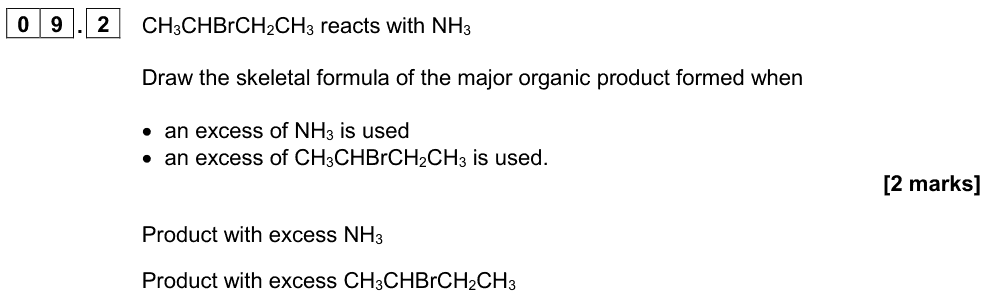
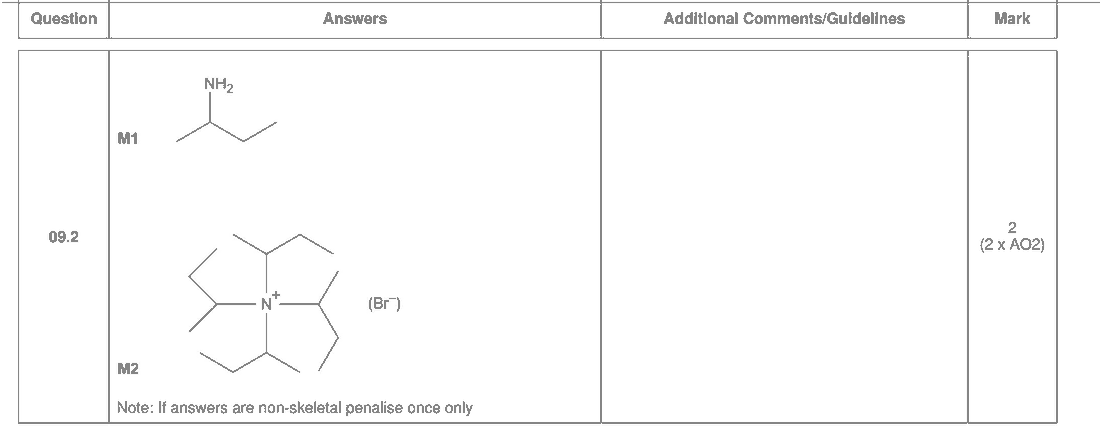
9.2 Over half the students got at least 1 mark and the skeletal structures seen were much better attempted than in some past papers.
Notes from the mark scheme and report
Excess NH3: skeletal butan-2-amine (NH2 on C2 of a four-carbon chain), the primary amine. Excess halogenoalkane: the quaternary ammonium ion, N+ bonded to four butan-2-yl groups (Br– counter-ion). Non-skeletal penalised once only
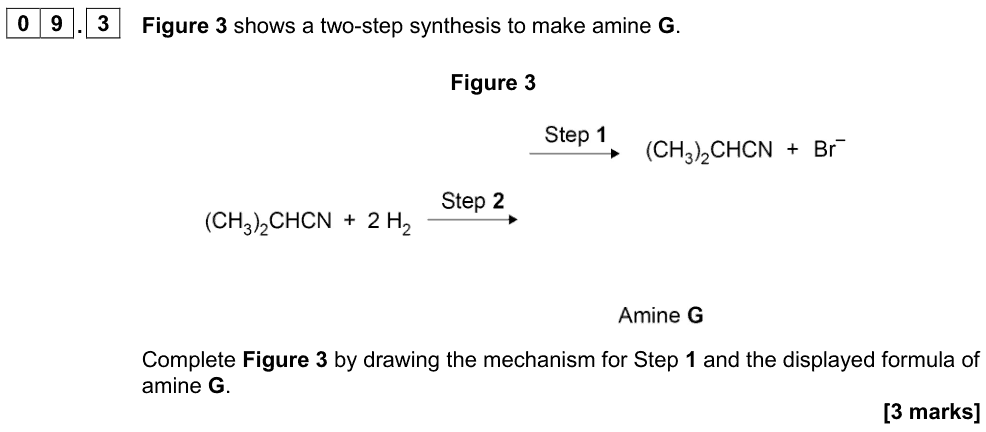
June 2024 · Paper 2 · Q09.33 marksAO2=3Mechanism
Earlier part of question 09 that this part uses
Mark scheme
Examiner's comment
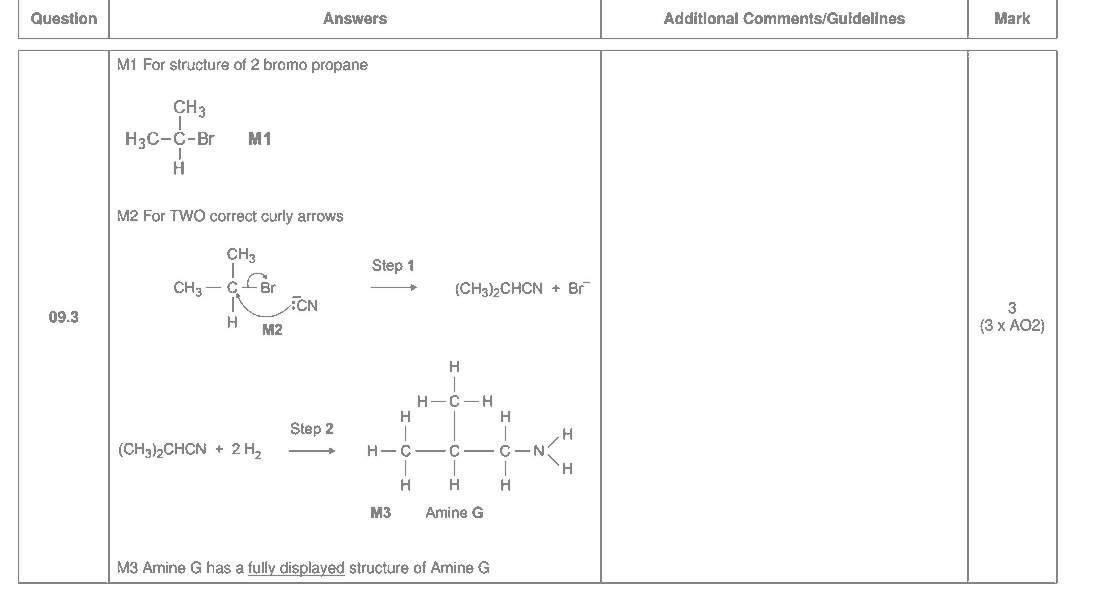
9.3 Most students got at least 2 of the 3 marks here. The final mark was often the one lost and drawing a fully displayed amine formed from a nitrile proved difficult for many. Common mistakes included having too few carbon atoms, and missing hydrogen atoms despite being given the balanced left-hand side of the equation.
Notes from the mark scheme and report
2-Bromopropane, (CH3)2CHBr, drawn as the reactant
two curly arrows: from the lone pair on C of :CN– to the C bearing Br, and from the C–Br bond to Br
amine G fully displayed: (CH3)2CHCH2NH2, 2-methylpropan-1-amine, with every bond shown. The displayed amine was the mark most often lost (too few C atoms or missing H atoms)
June 2024 · Paper 2 · Q10.33 marksAO1=3MechanismHard
Earlier parts of question 10 that this part uses
Mark scheme
Examiner's comment
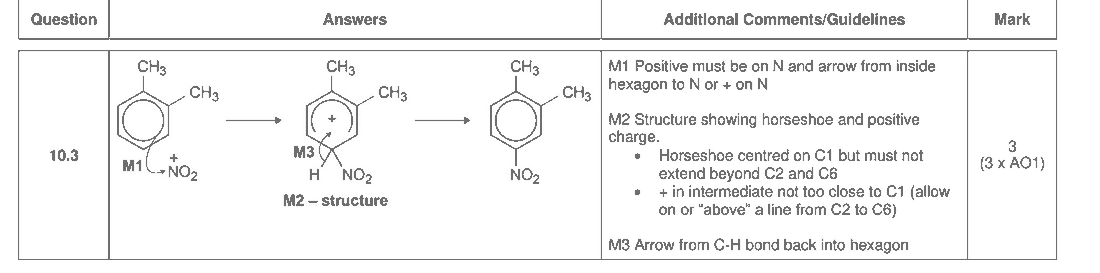
10.3 This familiar mechanism allowed over 80% of students to score at least 1 mark but only 32% scored all 3. Common mistakes in drawing the intermediate have been covered many times in reports on past papers so it was surprising to see so many students making the same errors.
Notes from the mark scheme and report
Electrophilic substitution: arrow from inside the ring to N of +NO2
intermediate with a horseshoe centred on C1 that does not extend beyond C2 and C6, with + inside it and both H and NO2 on the carbon attacked
arrow from the C–H bond back into the ring. Over 80% scored at least 1
the usual errors were in drawing the intermediate
June 2024 · AS Paper 2 · Q111 markAO3=1Multiple choice
Answer
D
Mark scheme
Notes from the mark scheme and report
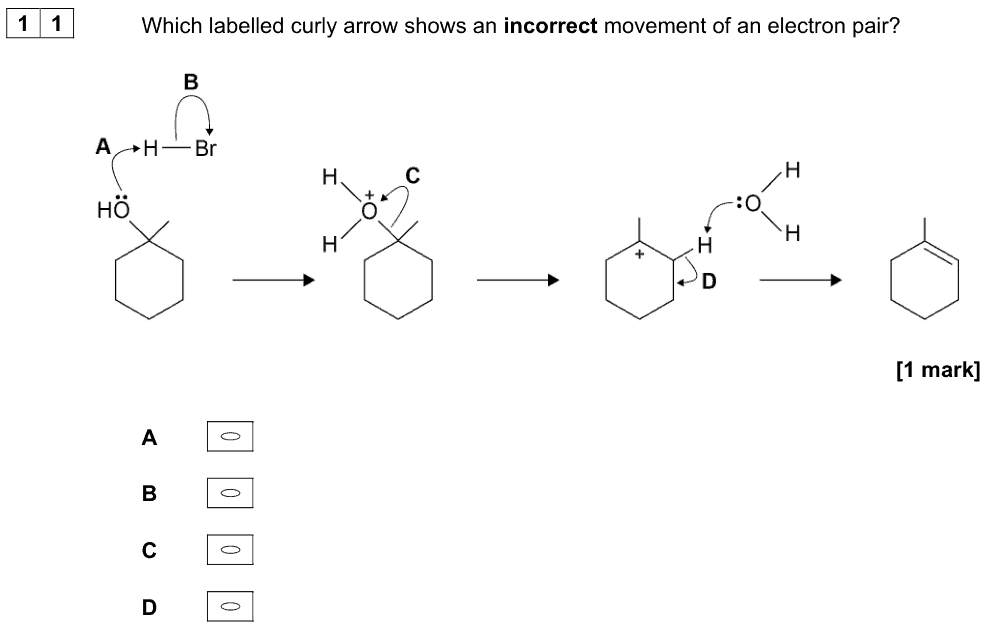
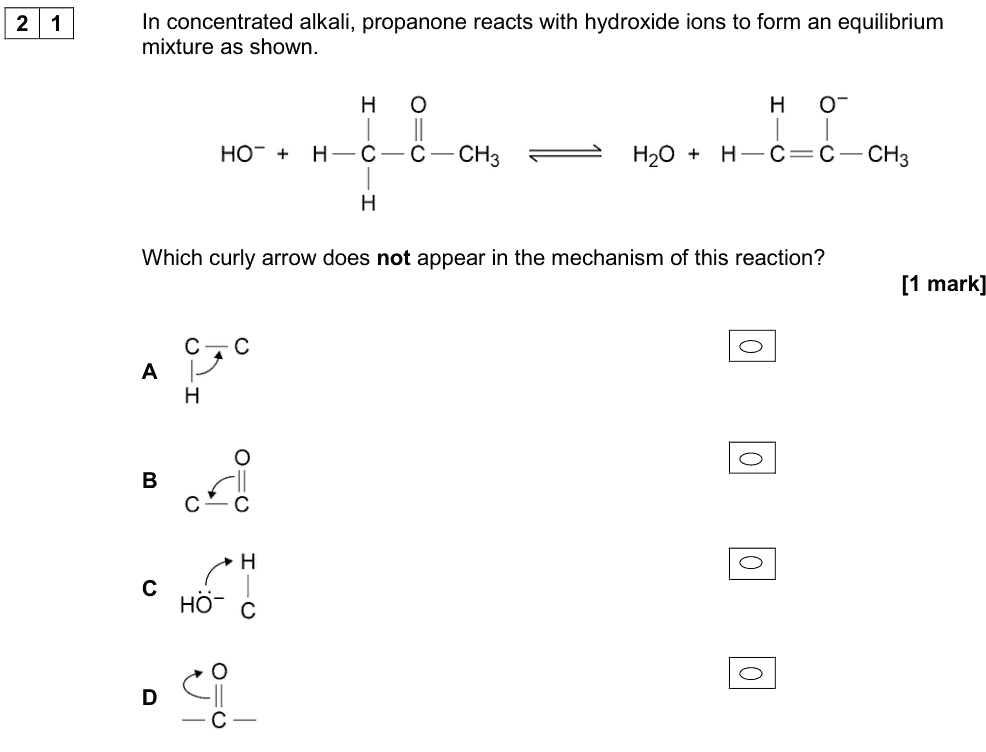
Answer: D. In the last step the arrow should start at the C–H bond and form the C=C
arrow D is drawn the wrong way (from the positive carbon towards the H). A, B and C correctly start at a lone pair or a bond
June 2024 · AS Paper 2 · Q121 markAO3=1Multiple choice
Answer
C
Mark scheme
Examiner's comment
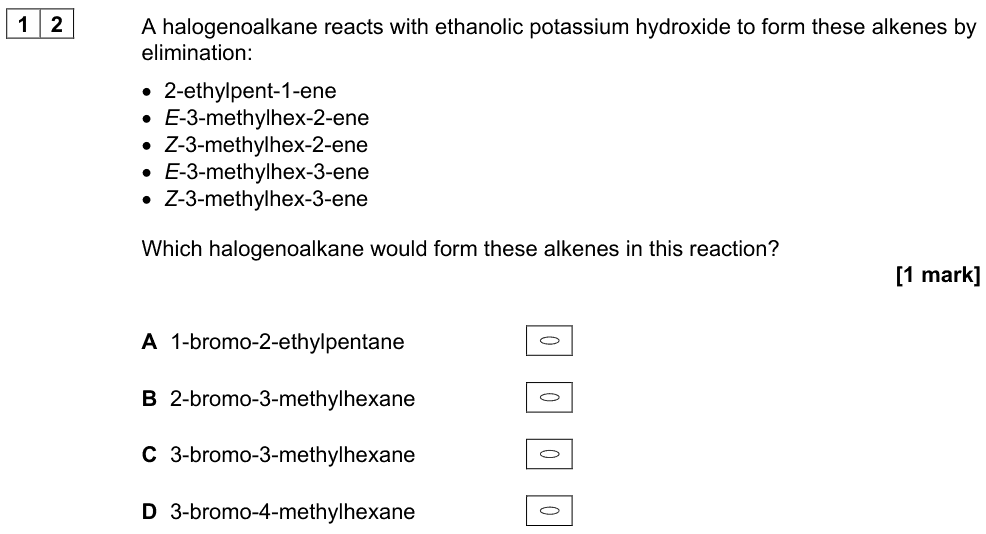
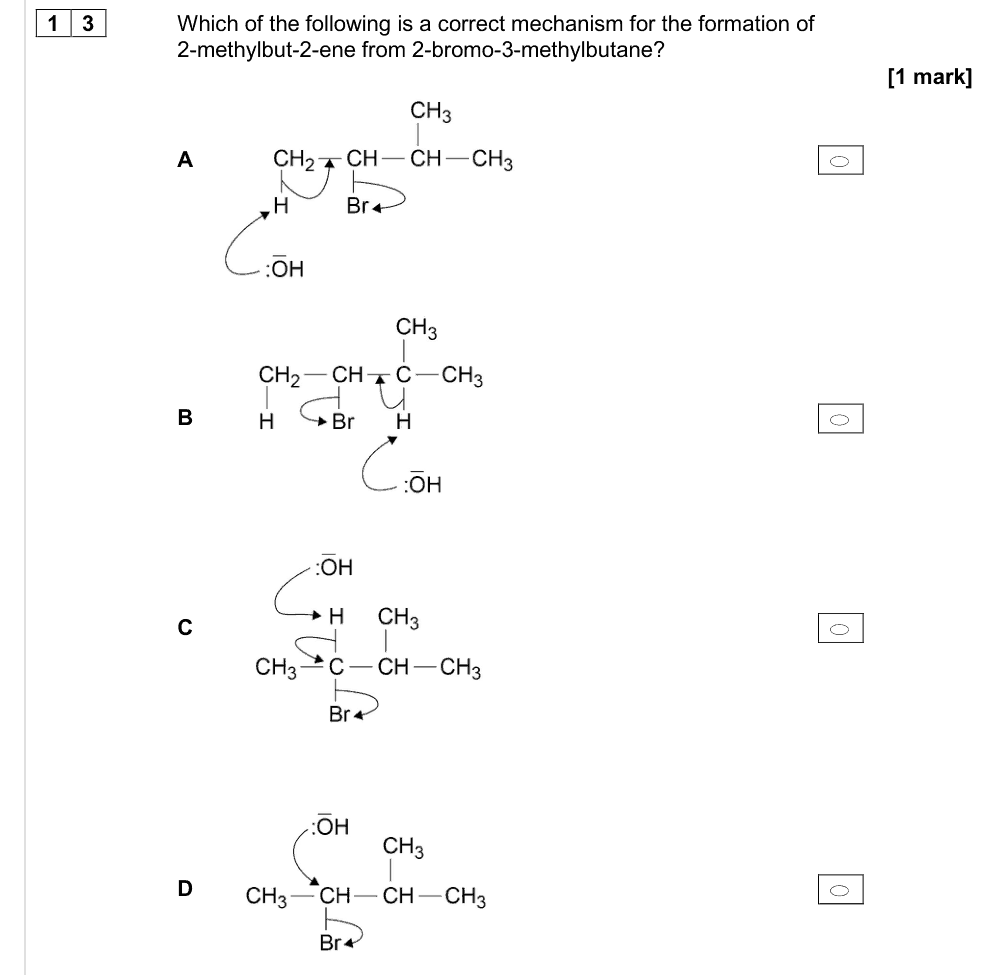
Students struggled to deduce which alkene could be formed by elimination of HBr from a halogenoalkane.
Q13 Apparatus for production of an aldehyde from an alcohol
This was answered correctly by a majority (65.6%) of students.
Notes from the mark scheme and report
Answer: C. In 3-bromo-3-methylhexane H can be lost from the methyl branch (2-ethylpent-1-ene), from carbon 2 (E and Z 3-methylhex-2-ene) or from carbon 4 (E and Z 3-methylhex-3-ene). Students struggled with this
June 2024 · Paper 3 · Q01.12 marksAO2=2Equation writing
Mark scheme
Examiner's comment
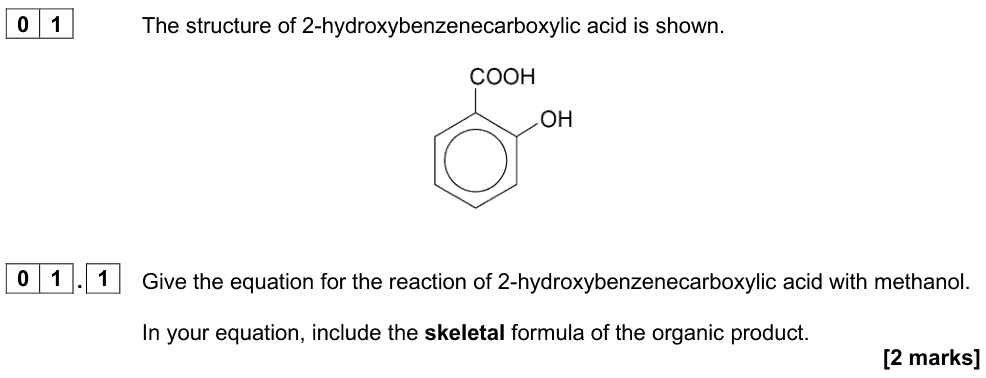
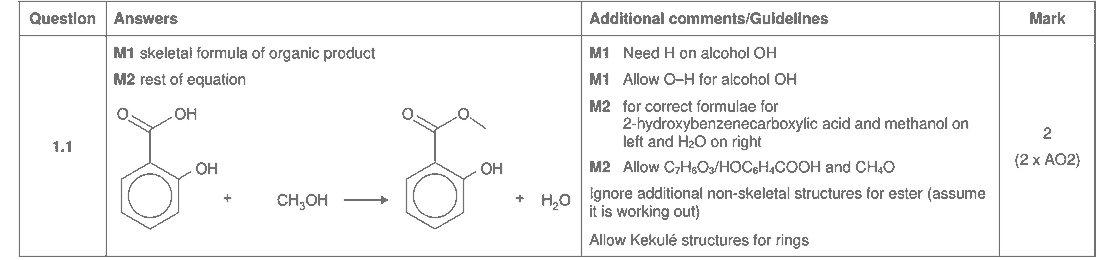
Part 01.1 was designed to be an easier start than it turned out to be as it was expected that this esterification would be relatively familiar to students.
Many failed to show the organic product in a skeletal format.
Notes from the mark scheme and report
2-HOC6H4COOH + CH3OH → methyl 2-hydroxybenzoate + H2O. M1 skeletal formula of the ester (benzene ring with OH, H shown on the O, and COOCH3 drawn skeletally on the adjacent carbon)
M2 rest of the equation with H2O. Many did not draw the product in skeletal form
June 2024 · Paper 3 · Q03.52 marksAO2=2Short answer
Earlier part of question 03 that this part uses
Mark scheme
Examiner's comment
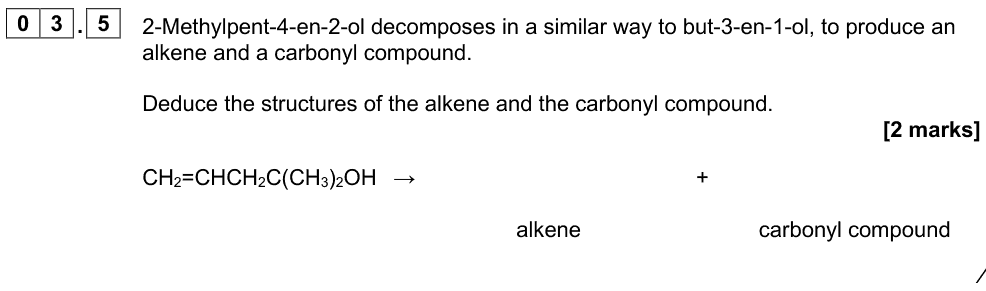
03.5 tested the ability to apply information from the start of the question where the equation for the thermal decomposition of but-3-en-1-ol was given and to apply it to a different compound.
Many students failed to respond to the need for a carbonyl as one of the products and suggested alcohols or acids instead.
Notes from the mark scheme and report
Alkene: CH2=CHCH3 (propene)
carbonyl compound: (CH3)2CO (propanone), by analogy with but-3-en-1-ol → propene + methanal. The two the wrong way round scores 1. Many gave alcohols or acids instead of a carbonyl
June 2024 · Paper 3 · Q231 markAO2=1Multiple choice
Answer
C
Mark scheme
Notes from the mark scheme and report
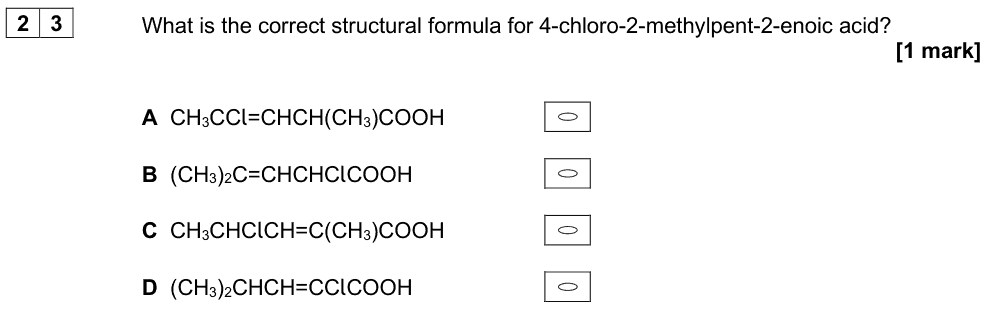
Answer: C. Numbering from the COOH carbon: C=C between C2 and C3, methyl on C2, Cl on C4: CH3CHClCH=C(CH3)COOH
June 2024 · Paper 3 · Q251 markAO2=1Multiple choice
Answer
D
Mark scheme
Notes from the mark scheme and report
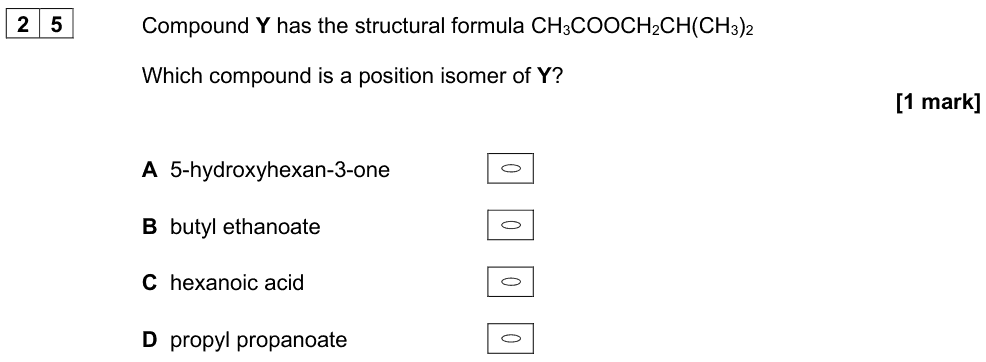
Answer: D. Y (2-methylpropyl ethanoate) is the ester C6H12O2
propyl propanoate has the same ester functional group in a different position in the chain
June 2024 · Paper 3 · Q261 markAO2=1Multiple choice
Answer
D
Mark scheme
Notes from the mark scheme and report
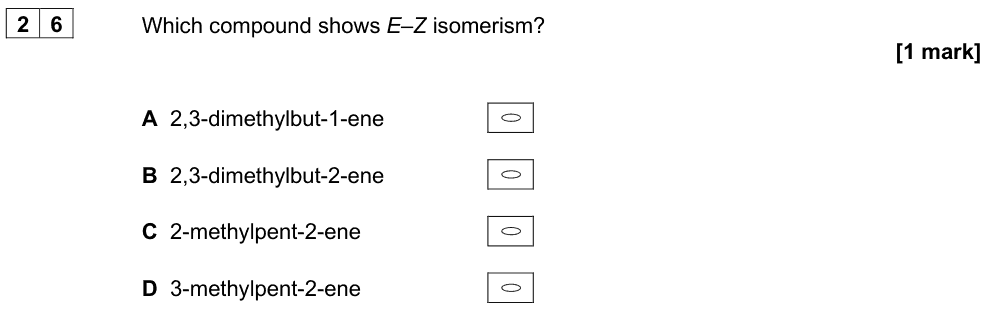
Answer: D. In CH3CH=C(CH3)CH2CH3 each C=C carbon has two different groups
in the others one C=C carbon has two identical groups
June 2024 · Paper 3 · Q271 markAO3=1Multiple choice
Answer
A
Mark scheme
Notes from the mark scheme and report
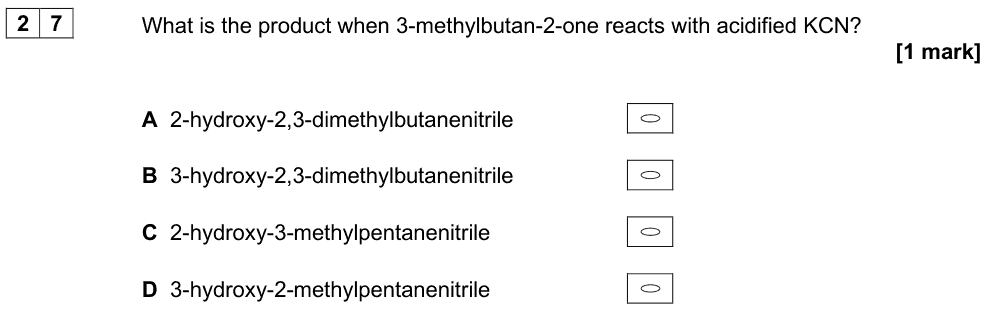
Answer: A. CN adds to the carbonyl carbon: (CH3)2CH–C(OH)(CN)–CH3. The nitrile carbon is C1, so 2-hydroxy-2,3-dimethylbutanenitrile
June 2023 · AS Paper 2 · Q02.31 markAO1=1Diagram or structure
Earlier part of question 02 that this part uses
Mark scheme
Examiner's comment
02.3 The drawing of the skeletal formula of a stated organic compound was done well.
Notes from the mark scheme and report
Skeletal formula: six-carbon zig-zag chain with an ethyl branch on C3 and a methyl branch on C4. Must be skeletal
Skills: MS4.2 Visualise and represent 2D and 3D forms including two-dimensional representations of 3D objects
June 2023 · AS Paper 2 · Q02.42 marksAO1=2Equation writing
Earlier part of question 02 that this part uses
Mark scheme
Examiner's comment
02.4 Students determined the molecular formula of a compound from its name / skeletal formula and then wrote a balanced equation for its complete combustion. Many students struggled to determine the correct molecular formula but could write a balanced equation for the complete combustion using their formula.
Notes from the mark scheme and report
C9H20 + 14O2 → 9CO2 + 10H2O. One mark for the molecular formula C9H20, one for the balanced equation (error carried forward from a wrong hydrocarbon formula). Many got the molecular formula wrong
June 2023 · Paper 2 · Q04.11 markAO1=1Short answer
Mark scheme
Examiner's comment
04.1 This nomenclature question was quite well answered with almost half scoring the mark. Since this was an IUPAC name, key spelling errors were penalised; eg, the e in 3-bromopropanenitrile was essential.
Notes from the mark scheme and report
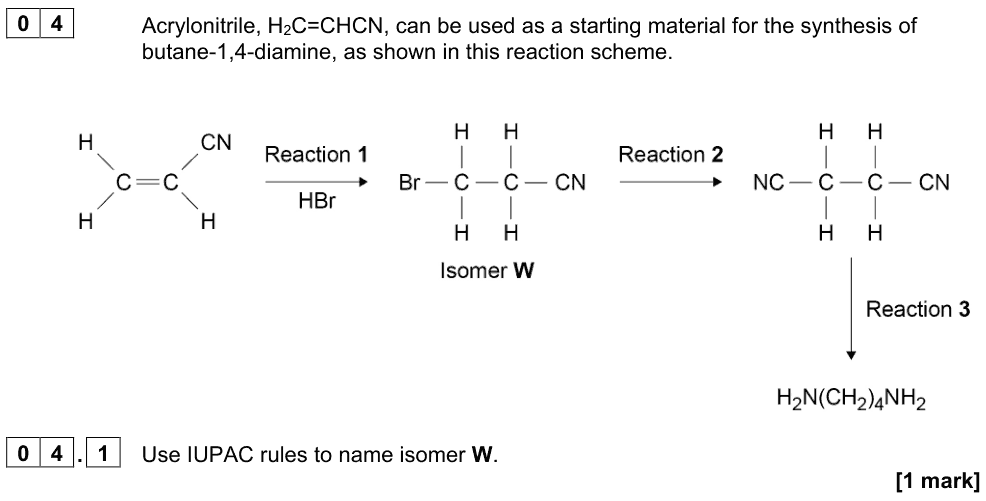
3-bromopropanenitrile (the nitrile carbon is C1
the 'e' in propanenitrile is essential)
June 2023 · Paper 2 · Q09.11 markAO2=1Short answer
Mark scheme
Examiner's comment
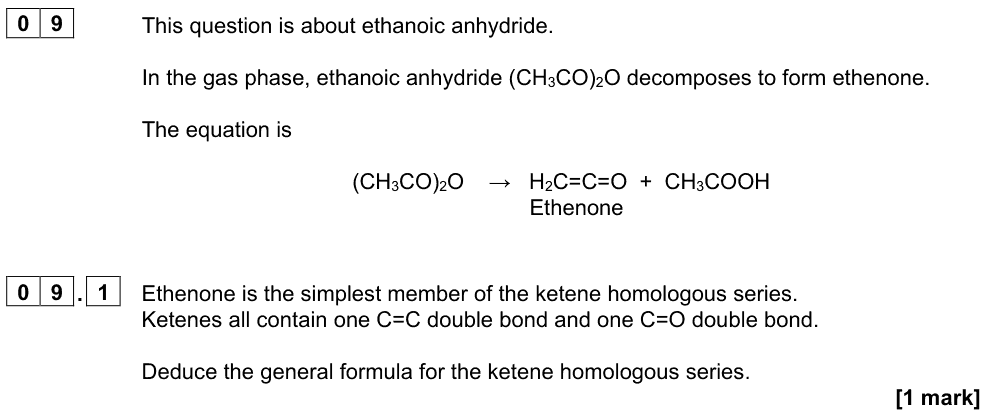
09.1 This was a very unfamiliar homologous series and few students were able to deduce a valid general formula.
Notes from the mark scheme and report
CnH2n–2O (ethenone is C2H2O). Few could deduce it
June 2023 · Paper 2 · Q09.23 marksAO2=3Mechanism
Earlier part of question 09 that this part uses
Mark scheme
Examiner's comment
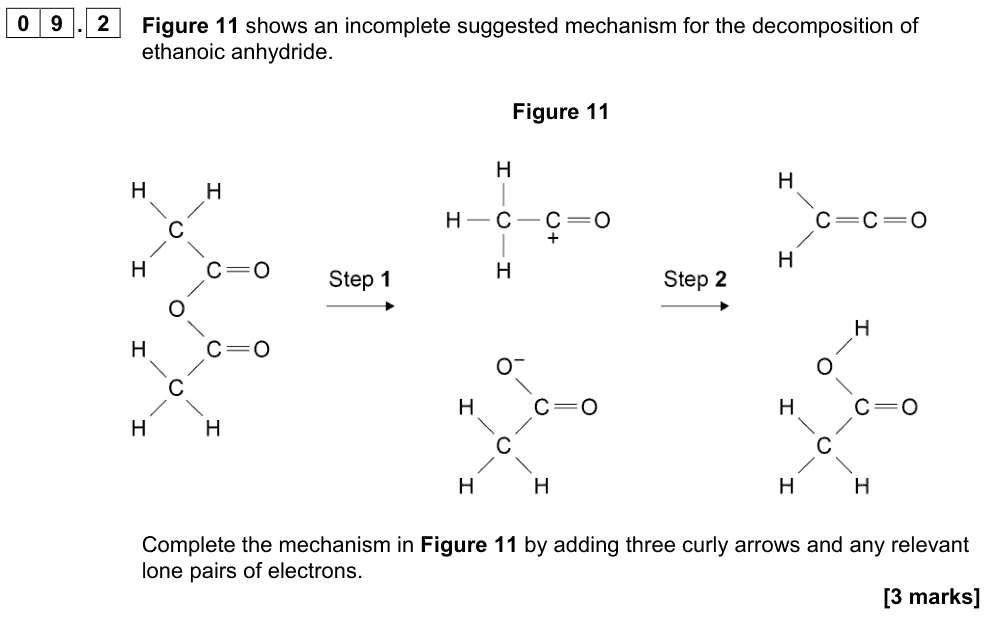
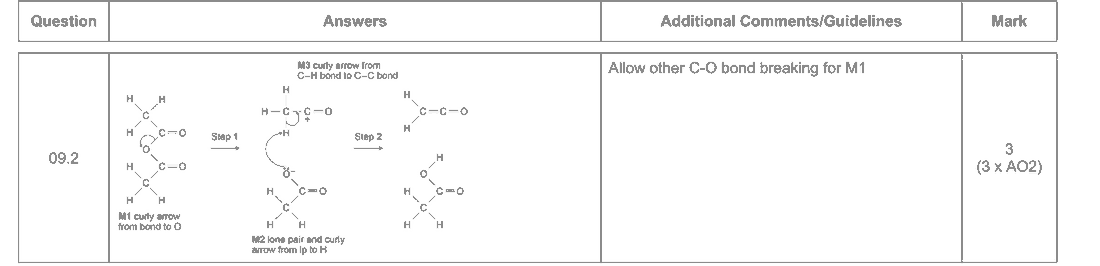
09.2 This question discriminated well and the best students were able to apply the ideas understood from more familiar mechanisms to the structures given.
Notes from the mark scheme and report
Step 1: curly arrow from one C–O bond of the anhydride to the central O (giving CH3C+=O and CH3COO–). Step 2: lone pair on O– with a curly arrow to an H of the CH3 group of the cation
curly arrow from that C–H bond to the C–C bond (forming C=C). Either C–O bond may be broken
June 2023 · AS Paper 2 · Q101 markAO1=1Multiple choiceEasy
Answer
C
Mark scheme
Examiner's comment
This was answered correctly by the vast majority (84%) of students.
Notes from the mark scheme and report
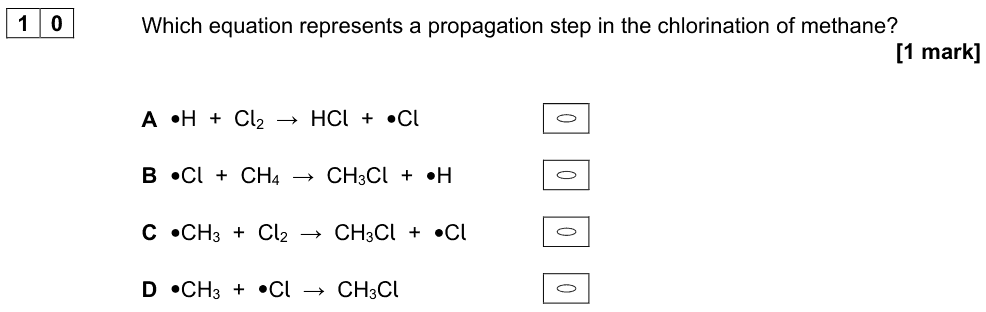
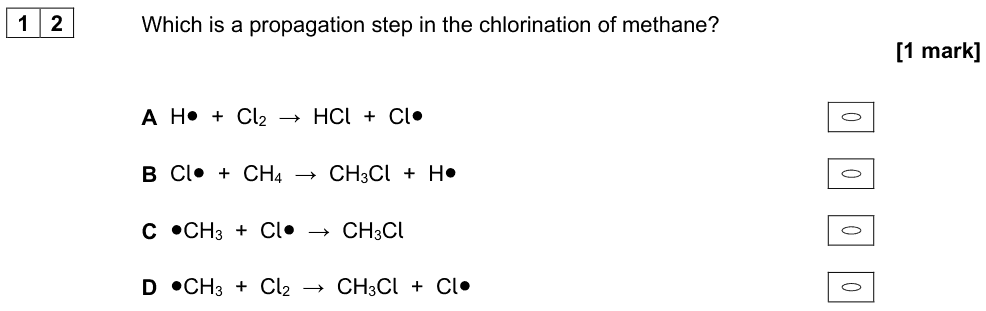
Answer: C. •CH3 + Cl2 → CH3Cl + •Cl uses one radical and makes another
D is termination
hydrogen radicals are not formed
June 2023 · AS Paper 2 · Q181 markAO2=1Multiple choice
Answer
A
Mark scheme
Examiner's comment
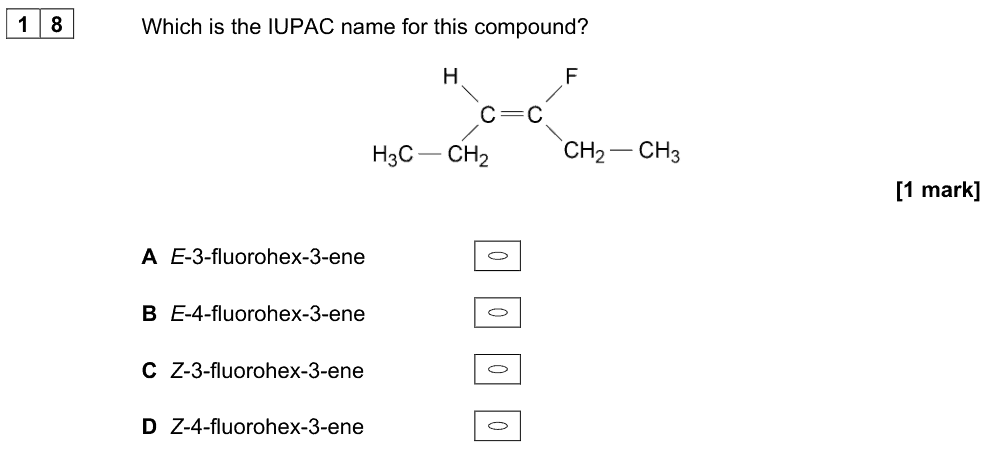
Students struggled with this question, with many believing it was the Z, not the E, stereoisomer. This was possibly due to a misunderstanding of how the Cahn-Ingold prelog priority rules apply when there is an ethyl group on each C of the C=C bond.
Notes from the mark scheme and report
Answer: A. Number from the end nearer the F, so 3-fluoro. Priorities: F beats ethyl on one carbon, ethyl beats H on the other
the two higher-priority groups are on opposite sides, so E. Many chose Z
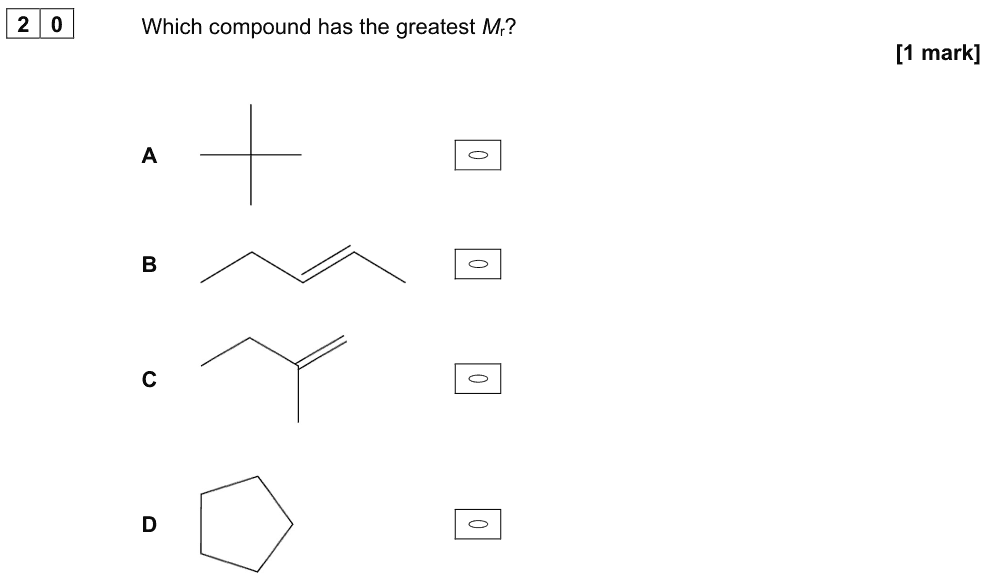
June 2023 · AS Paper 2 · Q201 markAO1=1Multiple choice
Answer
A
Mark scheme
Examiner's comment
This was answered correctly by a majority (59%) of students.
Notes from the mark scheme and report
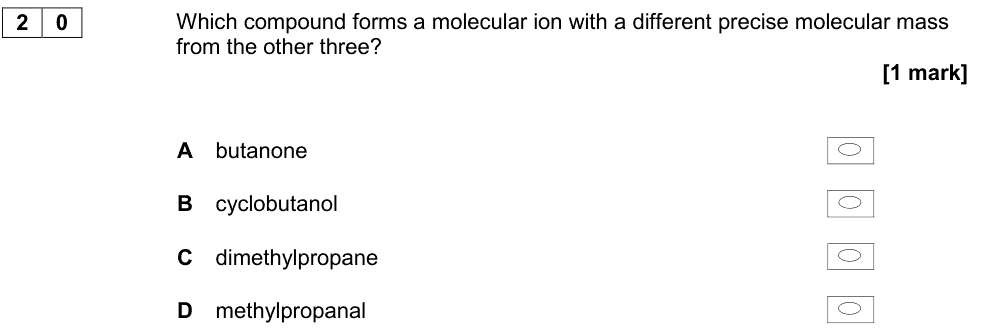
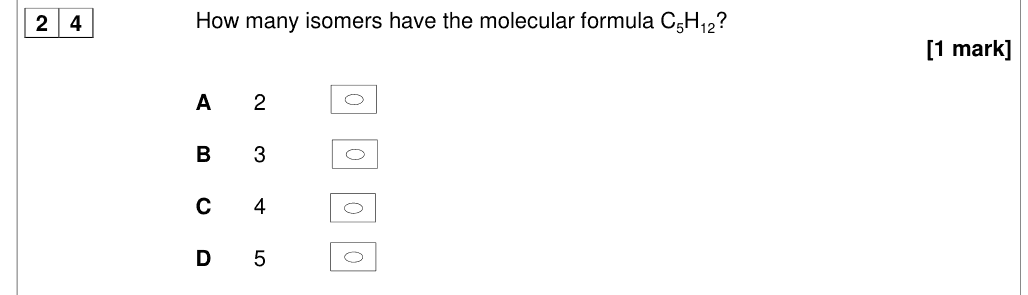
Answer: A. A is 2,2-dimethylpropane, C5H12 (Mr 72.0)
B, C and D are all C5H10 (Mr 70.0)
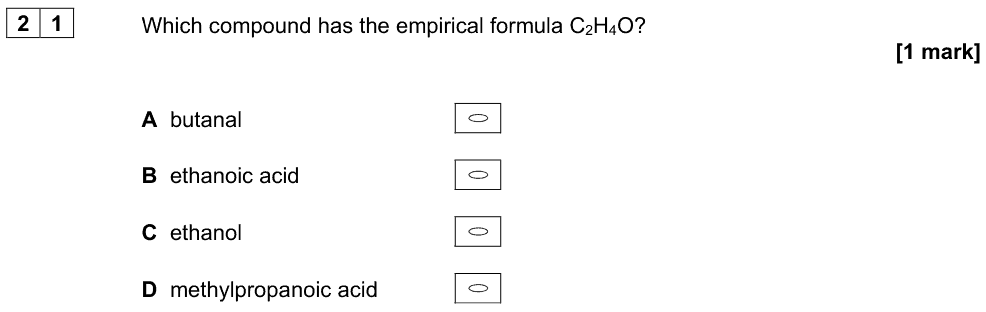
June 2023 · AS Paper 2 · Q211 markAO1=1Multiple choice
Answer
D
Mark scheme
Examiner's comment
Students found this question difficult, possibly due to it requiring two steps to determine the molecular formula from the name and then the empirical formula.
Notes from the mark scheme and report
Answer: D. Methylpropanoic acid is C4H8O2, which simplifies to C2H4O. Butanal is C4H8O
ethanoic acid is CH2O
ethanol is C2H6O
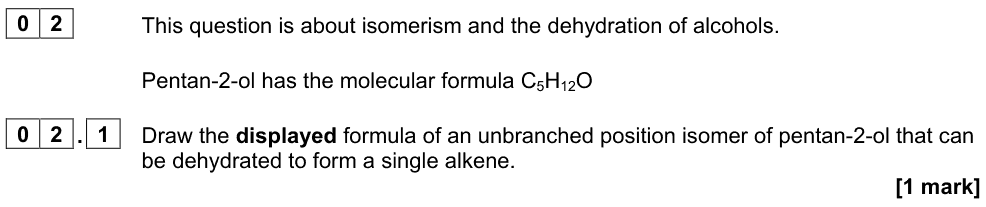
June 2023 · Paper 3 · Q02.11 markDiagram or structure
Mark scheme
Examiner's comment
In 02.1, a displayed formula for pentan-1-ol was required (but only 36% of students correctly gave this answer) and the commonest reasons for the mark not being awarded were that the OH group was not displayed or that pentan-3-ol was suggested.
Notes from the mark scheme and report
Displayed formula of pentan-1-ol with every bond shown, including the O–H bond. Not pentan-3-ol. Common reasons for losing the mark: OH not displayed
pentan-3-ol. 36% correct
June 2023 · Paper 3 · Q02.21 markDiagram or structure
Earlier part of question 02 that this part uses
Mark scheme
Examiner's comment
02.2 was answered better and it was pleasing to see an increased facility with which students were able to represent structures using skeletal formulae – but note that, in this case, the OH group must NOT be displayed.
Notes from the mark scheme and report
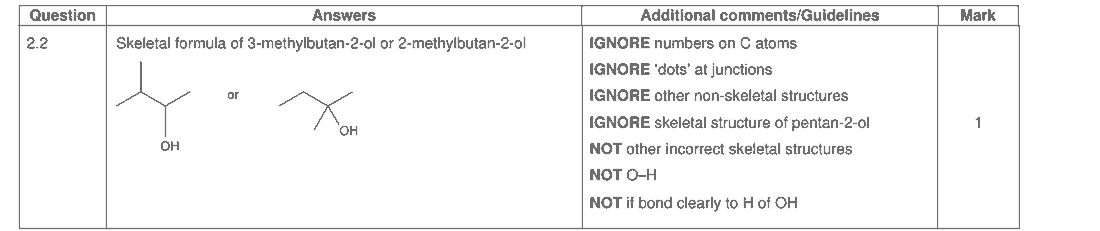
Skeletal formula of 3-methylbutan-2-ol or 2-methylbutan-2-ol (branched chain
H can be lost from two different adjacent carbons). In a skeletal formula the OH is written as OH, not displayed, and the bond goes to the O
June 2023 · Paper 3 · Q02.31 markDiagram or structure
Earlier part of question 02 that this part uses
Mark scheme
Examiner's comment
Despite students not being very familiar with ethers, a majority of students were able to score in question 02.3.
Notes from the mark scheme and report
An unbranched ether C5H12O: CH3OCH2CH2CH2CH3 (1-methoxybutane) or CH3CH2OCH2CH2CH3 (1-ethoxypropane). Any structural representation. A majority scored
June 2023 · Paper 3 · Q02.41 markDiagram or structureHard
Earlier part of question 02 that this part uses
Mark scheme
Examiner's comment
02.4 proved one of the trickier questions on the paper with only 16% of students scoring here.
The commonest error was to offer a tertiary alcohol as the answer – this suggested confusion about which alcohols cannot be oxidised rather than which cannot be dehydrated.
Notes from the mark scheme and report
2,2-dimethylpropan-1-ol, (CH3)3CCH2OH: the carbon next to the C–OH carbon has no hydrogen, so water cannot be eliminated. Commonest error: a tertiary alcohol (confusing 'cannot be oxidised' with 'cannot be dehydrated')
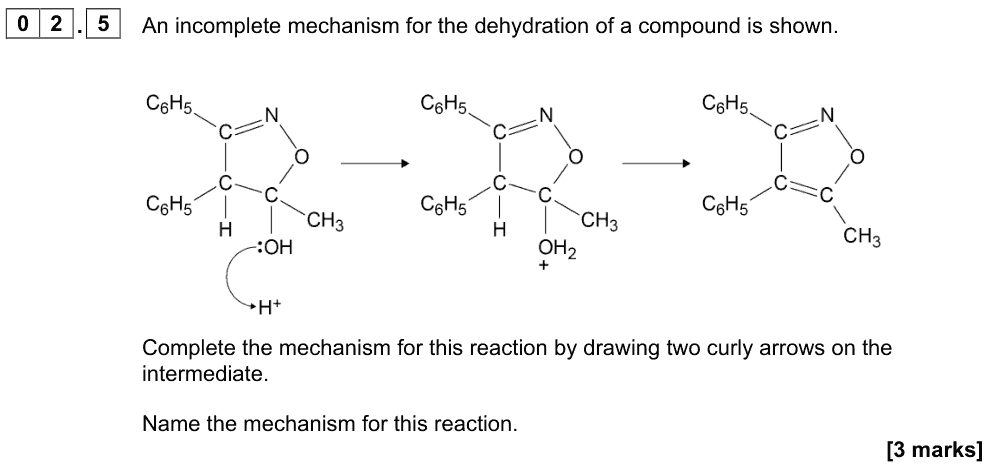
June 2023 · Paper 3 · Q02.53 marksMechanism
Earlier part of question 02 that this part uses
Mark scheme
Examiner's comment
50% of students scored 3 marks in 02.5 and students are again reminded of the importance of being precise when drawing curly arrows in terms of where they start and where they finish.
A curly arrow in any mechanism must always start either from the line representing a covalent bond or from a lone pair drawn on an atom.
In this case, both arrows should have started from an existing bond in order to represent the breaking of that bond.
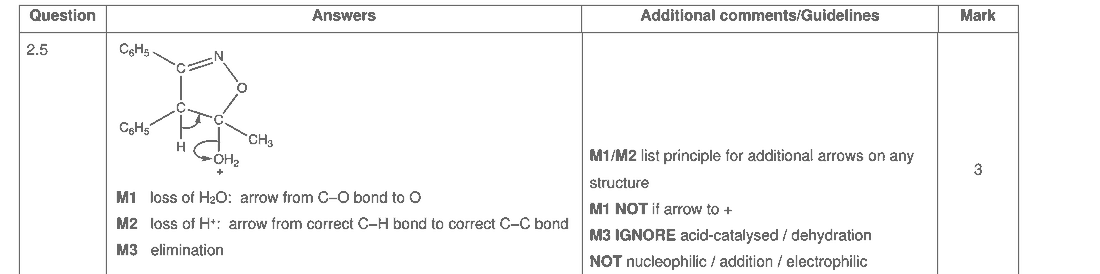
Notes from the mark scheme and report
On the protonated intermediate: curly arrow from the C–O bond to the O of the OH2+ group (water leaves
not an arrow to the + sign)
curly arrow from the C–H bond on the adjacent ring carbon to the C–C bond between the two ring carbons (H+ lost, C=C forms). Name: elimination (ignore acid-catalysed / dehydration
not nucleophilic, electrophilic or addition). Both arrows must start at a bond. 50% scored 3 marks
June 2023 · Paper 3 · Q02.61 markDiagram or structureHard
Earlier part of question 02 that this part uses
Mark scheme
Examiner's comment
02.6 was a test of the understanding that dehydration involves the loss of the OH along with a H atom from an adjacent carbon.
Only 30% of students could give the correct structure.
Notes from the mark scheme and report
The H is lost from the CH3 group instead: the same ring with an exocyclic C=CH2 on the carbon that carried the OH, the other ring carbon keeping its H and C6H5. Needs the structures printed in 02.5
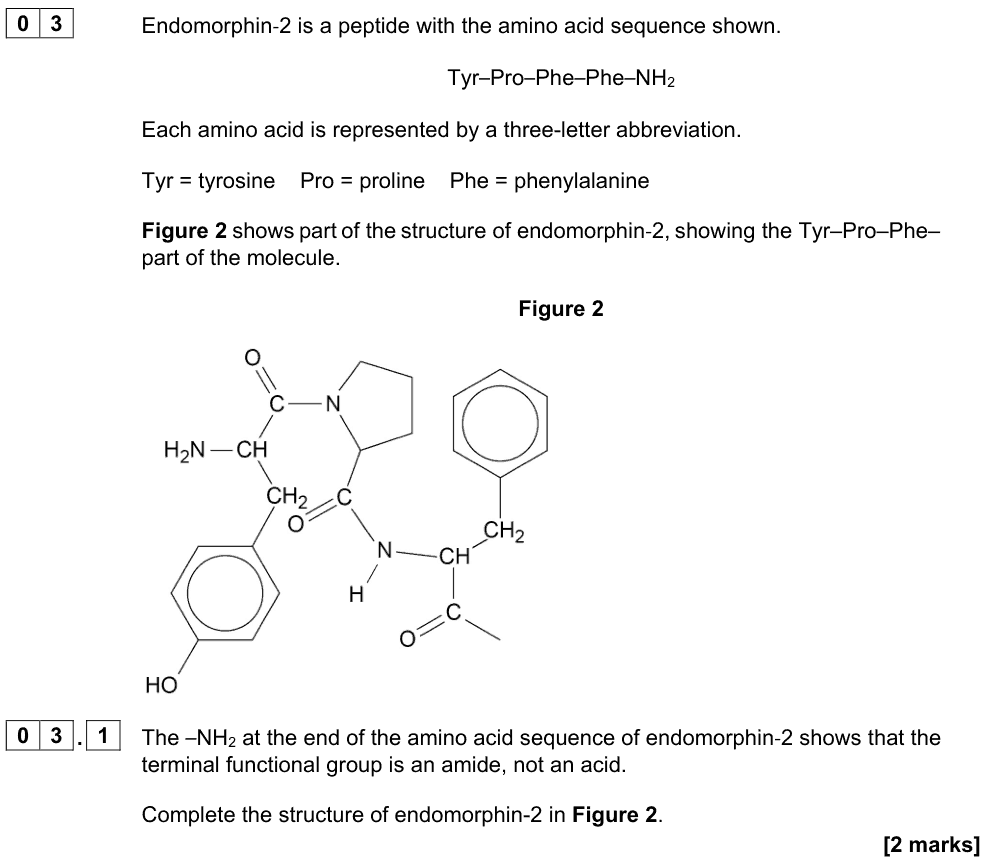
June 2023 · Paper 3 · Q03.21 markDiagram or structureHard
Earlier part of question 03 that this part uses
Mark scheme
Examiner's comment
03.2 required students to deduce the structure of proline by working out what would remain from hydrolysing the peptide groups either side of proline in the partial structure given.
27% of students were able to do this.
The commonest error was, as expected, to show an NH2 group instead of NH.
Notes from the mark scheme and report
Proline: a five-membered ring of four carbons and one N–H, with COOH on the carbon next to the nitrogen (allow the zwitterion). The ring nitrogen is NH, not NH2 (the commonest error)
June 2023 · Paper 3 · Q081 markAO2=1Multiple choice
Answer
B
Mark scheme
Notes from the mark scheme and report
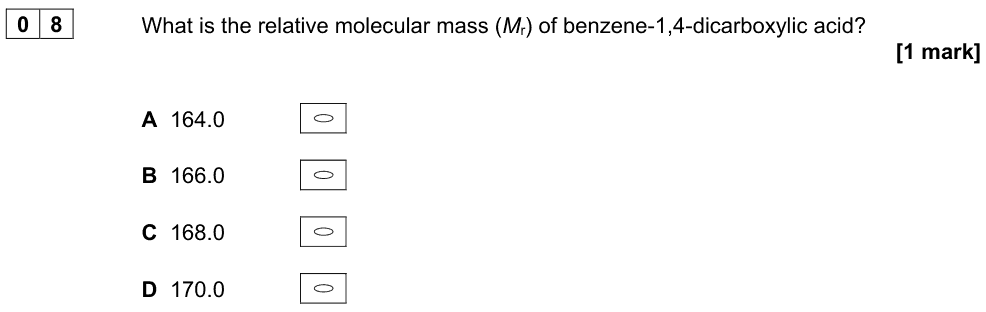
Answer: B. HOOC–C6H4–COOH is C8H6O4: 8(12.0) + 6(1.0) + 4(16.0) = 166.0
June 2022 · Paper 2 · Q01.12 marksAO1=2Diagram or structure
Mark scheme
Examiner's comment
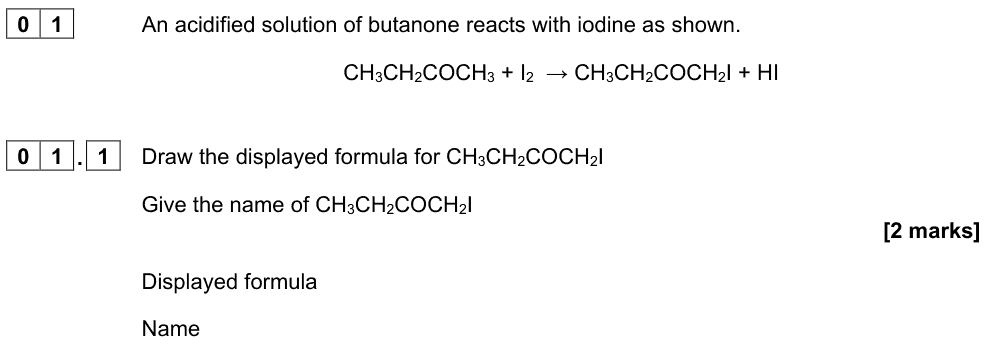
01.1 Most students scored for the structure but some failed to use a number prefix for the iodo substituent on carbon 1.
Notes from the mark scheme and report
Displayed formula of CH3CH2COCH2I with every bond shown, including C=O and C–I
name 1-iodobutan-2-one (allow 1-iodobutanone). Some left out the number for the iodo group
June 2022 · AS Paper 2 · Q03.11 markAO2=1Diagram or structure
Mark scheme
Examiner's comment
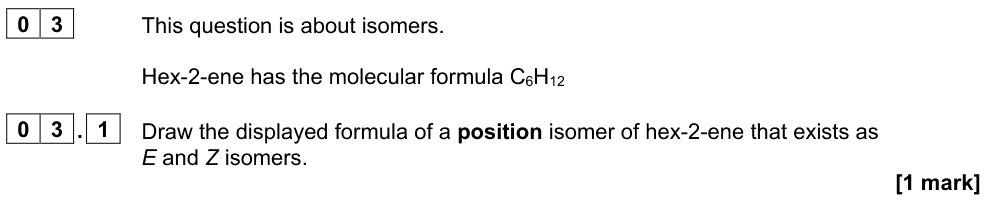
3.1 This question looked for the displayed formula of a position isomer. This was answered reasonably well.
Notes from the mark scheme and report
Displayed formula of hex-3-ene (E or Z), showing every bond. A correct compound not drawn as a displayed formula is only credited once across 03.1 and 03.2
June 2022 · AS Paper 2 · Q03.21 markAO2=1Diagram or structure
Earlier part of question 03 that this part uses
Mark scheme
Examiner's comment
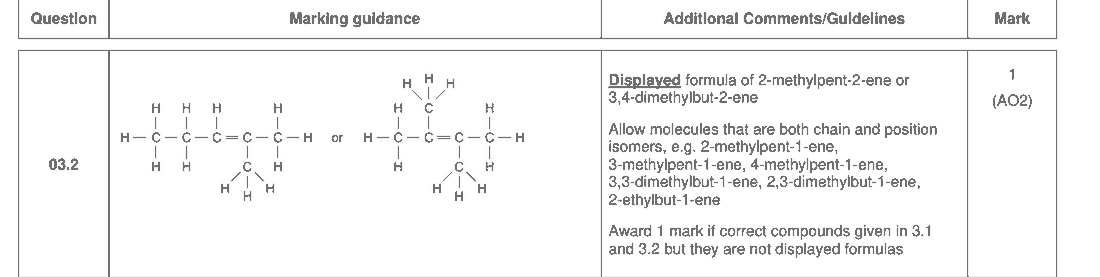
3.2 This question looked for the displayed formula of a chain isomer. Students found this more challenging to do than question 3.1.
Notes from the mark scheme and report
Displayed formula of 2-methylpent-2-ene or 2,3-dimethylbut-2-ene (the mark scheme prints the latter as '3,4-dimethylbut-2-ene'). Branched alk-1-enes such as 2-methylpent-1-ene or 3,3-dimethylbut-1-ene are also allowed. Found harder than 03.1
June 2022 · AS Paper 2 · Q03.31 markAO2=1Diagram or structure
Earlier part of question 03 that this part uses
Mark scheme
Examiner's comment
3.3 This question looked for the skeletal formula of a functional group isomer using IR data. This was answered reasonably well.
Notes from the mark scheme and report
Skeletal formula of butanone (C=O absorption at 1680–1750 cm–1
a ketone is the functional group isomer of the aldehyde)
June 2022 · Paper 2 · Q03.31 markAO1=1Diagram or structure
Earlier part of question 03 that this part uses
Mark scheme
Examiner's comment
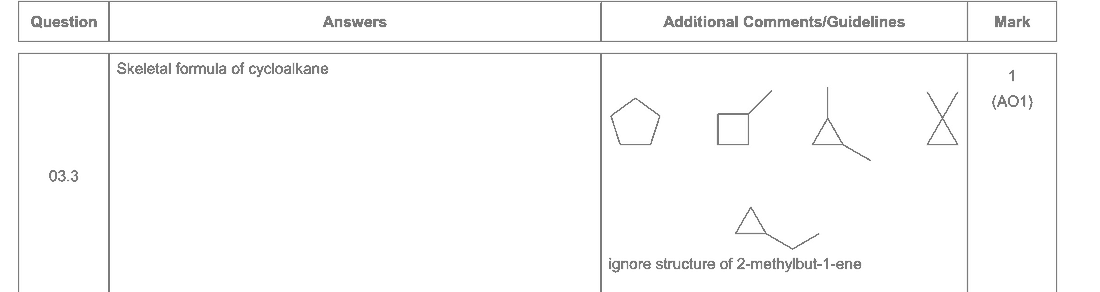
03.3 Fewer than half the students scored here. Mistakes included not drawing the structure skeletally as demanded by the question and failing to recognize that the functional group isomer of the alkene would be a cycloalkane.
Notes from the mark scheme and report
Skeletal formula of a C5H10 cycloalkane (cyclopentane, methylcyclobutane or a dimethyl- or ethyl-cyclopropane). Errors: not skeletal
not recognising the functional group isomer is a cycloalkane. Fewer than half scored
June 2022 · AS Paper 2 · Q03.41 markAO3=1Diagram or structure
Earlier parts of question 03 that this part uses
Mark scheme
Examiner's comment
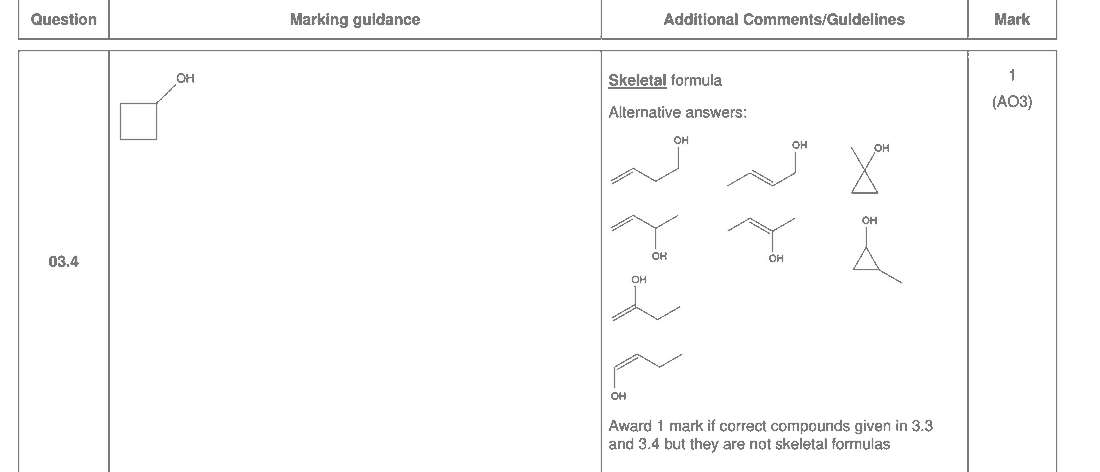
3.4 This question looked for the skeletal formula of a structural isomer using IR data. Students found this more challenging to do than question 3.3.
Notes from the mark scheme and report
Skeletal formula of a C4H8O alcohol (O–H absorption at 3230–3550 cm–1): cyclobutanol, or alternatives such as but-3-en-1-ol, but-2-en-1-ol, but-3-en-2-ol, cyclopropylmethanol or a methylcyclopropanol. Found harder than 03.3
June 2022 · AS Paper 2 · Q03.54 marksAO2=2, AO3=2Calculation
Earlier part of question 03 that this part uses
Mark scheme
Examiner's comment
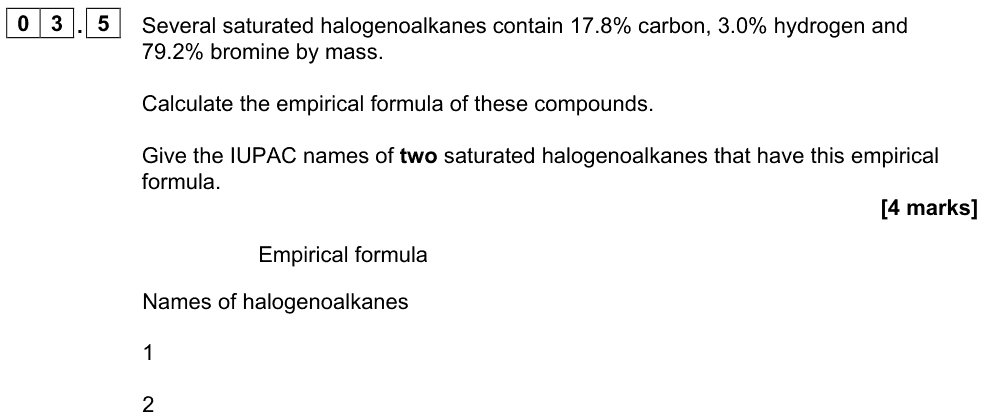
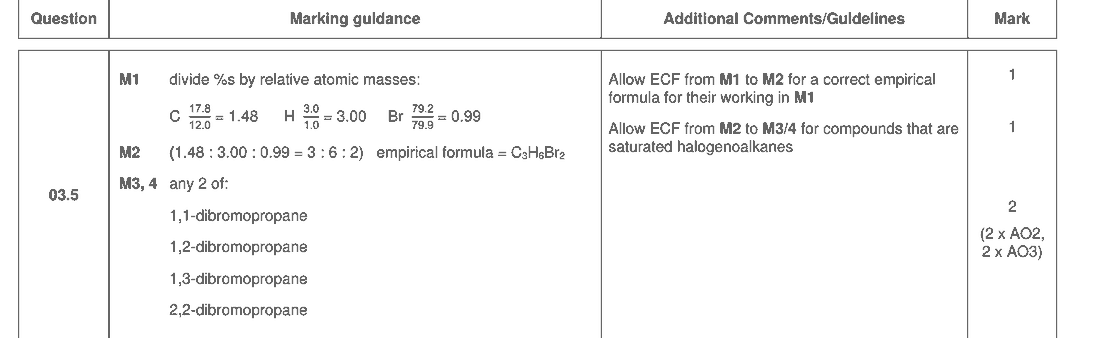
3.5 This question required students to find an empirical formula and then suggest two compounds that it could be. The empirical formula was well answered, but students struggled more to suggest the correct names of the compounds.
Notes from the mark scheme and report
Answer: C3H6Br2. C 17.8 ÷ 12.0 = 1.48
H 3.0 ÷ 1.0 = 3.00
Br 79.2 ÷ 79.9 = 0.99
ratio 3:6:2. Any two of 1,1-, 1,2-, 1,3- or 2,2-dibromopropane. The names were the harder part
Skills: MS0.2 Use ratios, fractions and percentages
June 2022 · AS Paper 2 · Q05.15 marksAO1=5Mechanism
Mark scheme
Examiner's comment
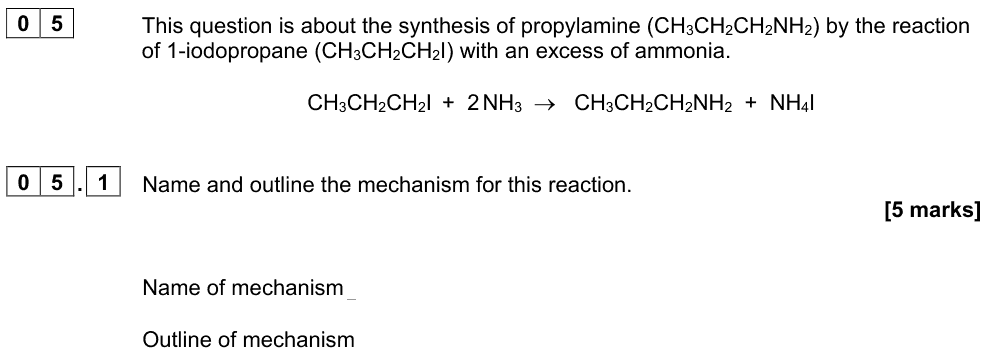
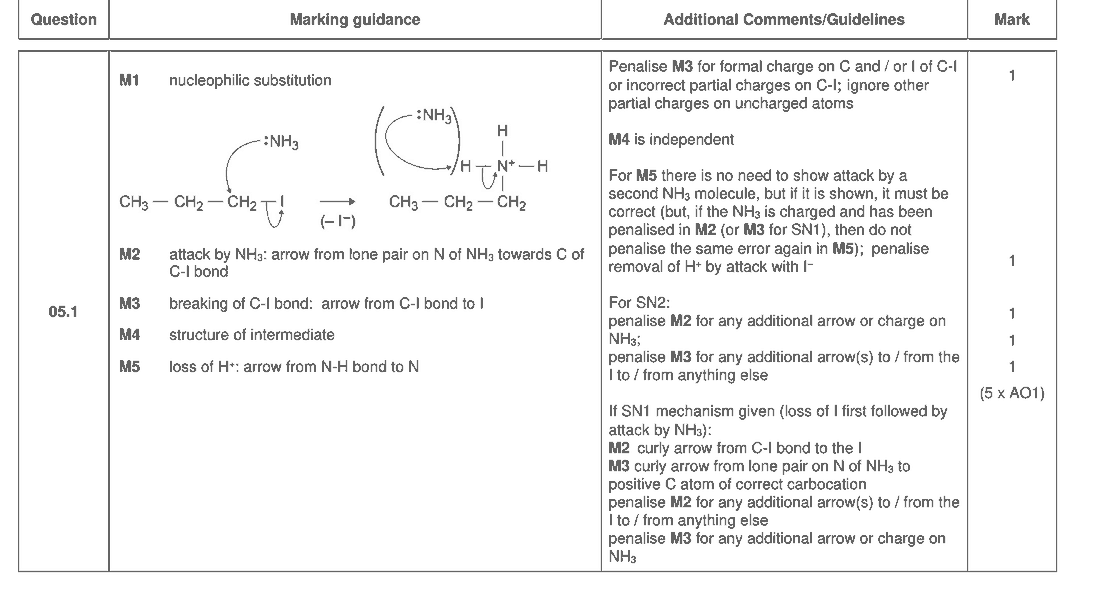
5.1 This question required students to name and outline a mechanism. This was done well. One common issue was students thinking that ammonia is negatively charged in their mechanism.
Notes from the mark scheme and report
Nucleophilic substitution. Arrow from the lone pair on N of NH3 to the C of C–I
arrow from the C–I bond to I
intermediate CH3CH2CH2NH3+
arrow from an N–H bond to N+ (loss of H+, eg to a second NH3
not removed by I–). Common error: showing ammonia with a negative charge
June 2022 · AS Paper 2 · Q06.22 marksAO2=2Equation writing
Earlier part of question 06 that this part uses
Mark scheme
Examiner's comment
6.2 This question required students to write a pair of propagation steps. Many could do this but a significant number did not appreciate the underlying principles of these pairs of propagation steps where the first step uses a free radical that is then reformed in the second step.
Notes from the mark scheme and report
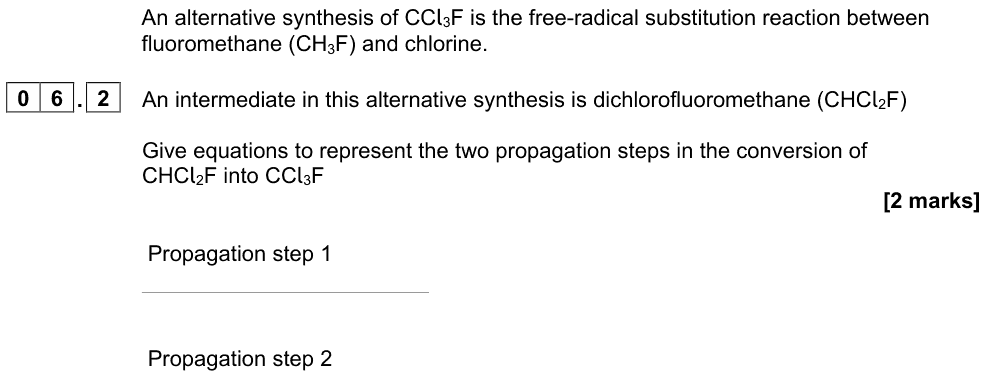
CHCl2F + •Cl → •CCl2F + HCl
•CCl2F + Cl2 → CCl3F + •Cl. Missing radical dots penalised once. Many did not see that the radical used in the first step is re-formed in the second
June 2022 · AS Paper 2 · Q06.31 markAO3=1Equation writing
Earlier parts of question 06 that this part uses
Mark scheme
Examiner's comment
6.3 This question required students to write an equation for a termination step. Students found this challenging and many did not give the structural formula of the product as required by the question.
Notes from the mark scheme and report
2 •CCl2F → CCl2FCCl2F. The structural formula of the product must be shown
many gave only a molecular formula
June 2022 · Paper 2 · Q07.13 marksAO3=3Mechanism
Mark scheme
Examiner's comment
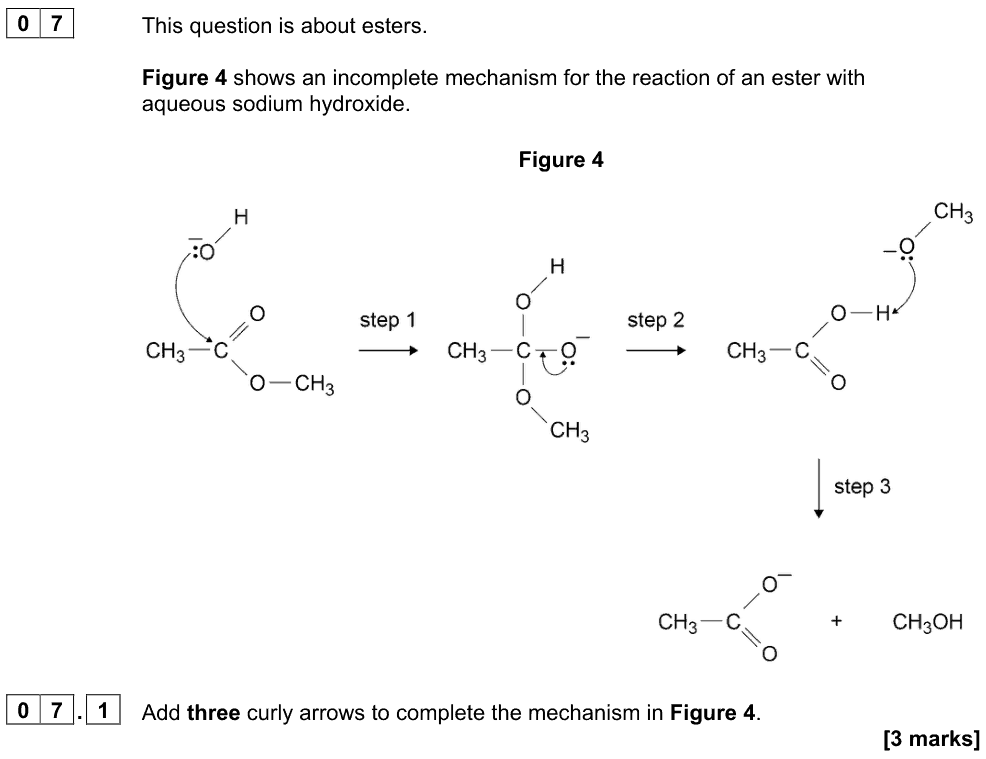
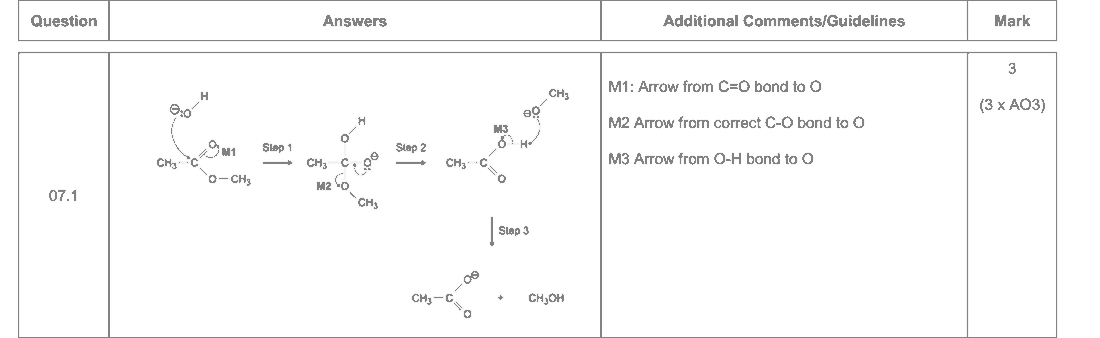
07.1 This question required students to deduce and add three curly arrows to an unfamiliar incomplete mechanism. As with similar questions in the past, this discriminated well between the most able and weaker students.
Notes from the mark scheme and report
Step 1: curly arrow from the C=O bond to O. Step 2: curly arrow from the C–OCH3 bond to that O (CH3O– leaves). Step 3: curly arrow from the O–H bond of the acid to O (the arrow from CH3O– to H is already printed)
June 2022 · AS Paper 2 · Q07.65 marksAO1=1, AO2=4Mechanism
Earlier part of question 07 that this part uses
Mark scheme
Examiner's comment
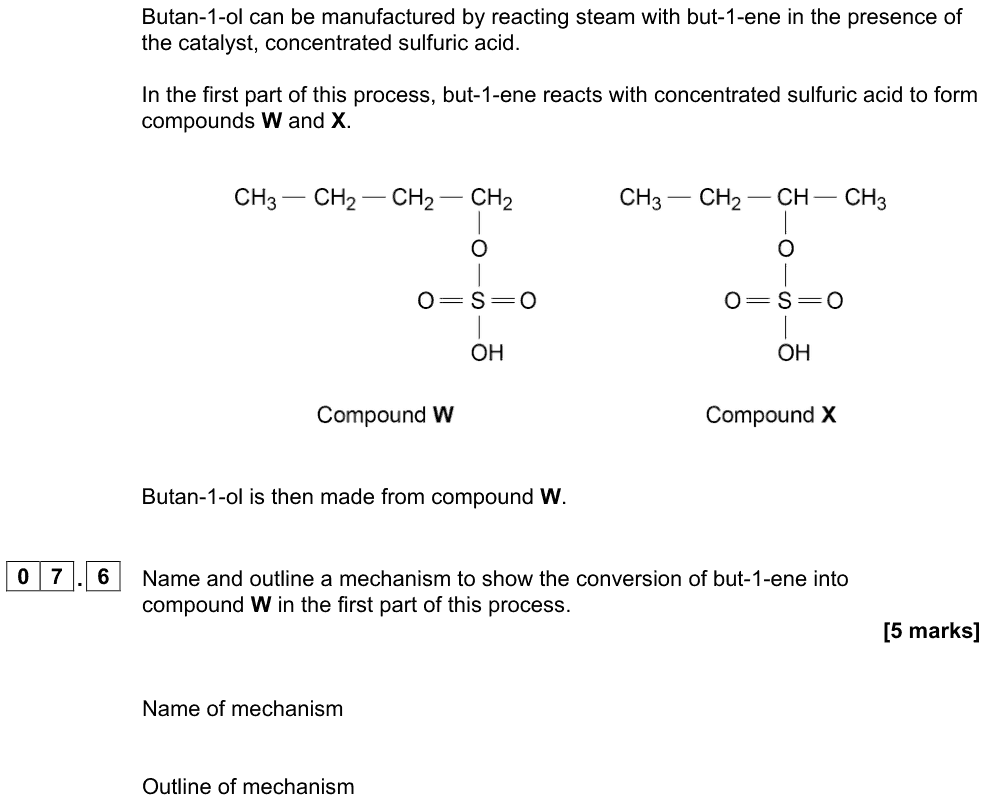
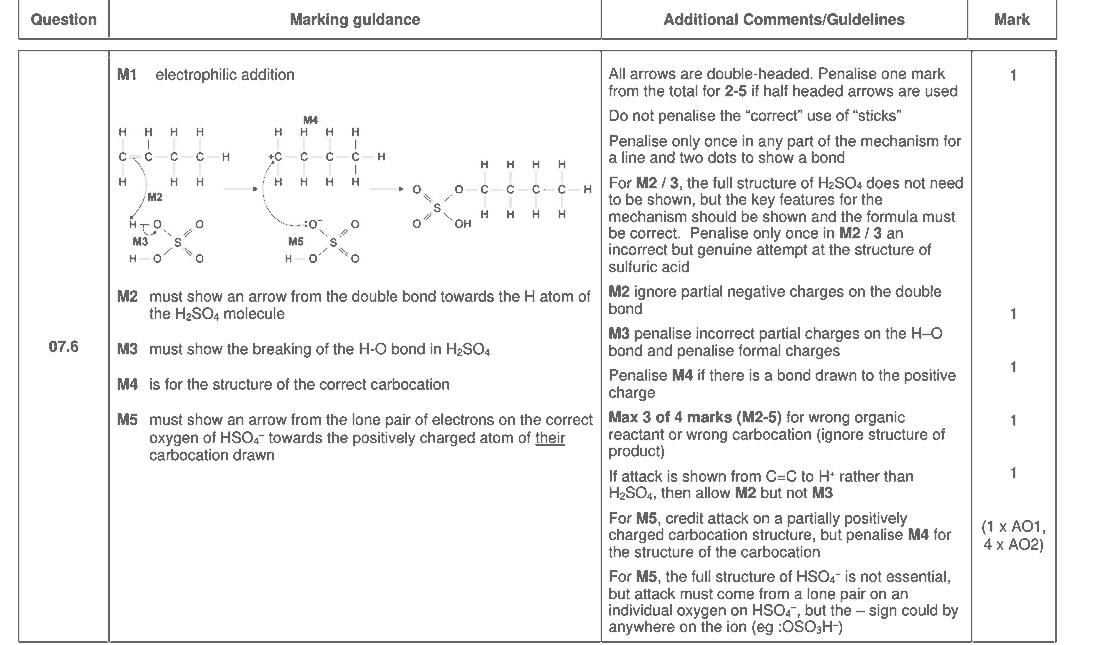
7.6 This question required students to name and outline a mechanism. This was done well. One common issue was students not putting the negative charge on the HSO4– as it attacked the carbocation in the final step.
Notes from the mark scheme and report
Electrophilic addition. Arrow from the C=C towards the H of H2SO4
arrow from the H–O bond to O
the primary carbocation CH3CH2CH2CH2+ (leading to W)
arrow from a lone pair on an O of HSO4– to the C+. Wrong carbocation: max 3 of the 4 mechanism marks. Common error: no negative charge on HSO4–
June 2022 · Paper 2 · Q08.12 marksAO2=2Equation writing
Mark scheme
Examiner's comment
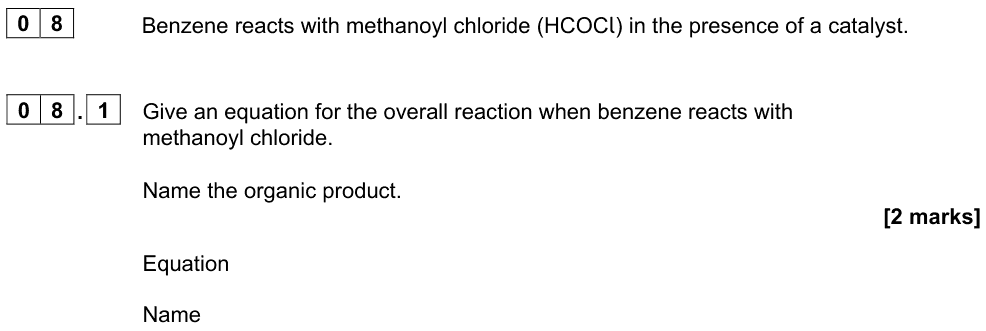
08.1 Whilst this question concerned a familiar electrophilic substitution reaction, a disappointing number of students were able to write the equation for the reaction and to name the organic product.
June 2022 · AS Paper 2 · Q111 markAO3=1Multiple choice
Answer
A
Mark scheme
Examiner's comment
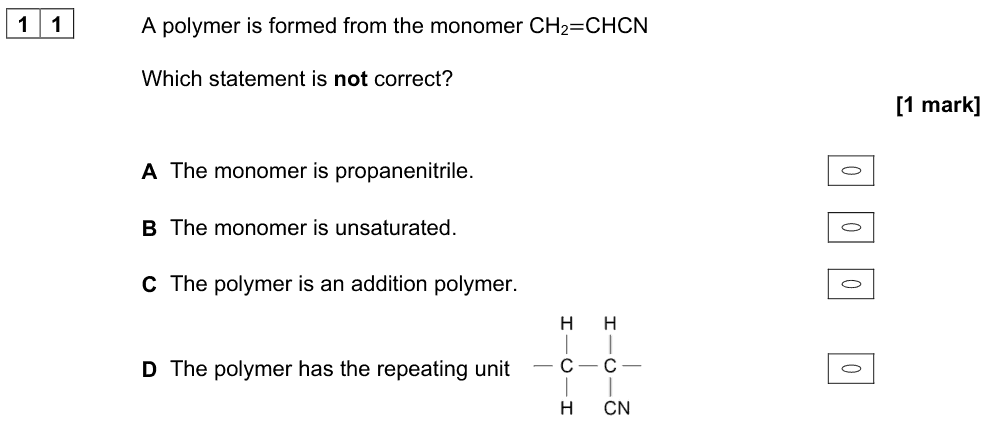
Students struggled with this question, with many believing that the polymer is unsaturated.
Notes from the mark scheme and report
Answer: A. The monomer CH2=CHCN is propenenitrile, not propanenitrile
the other statements are true. Many thought the polymer is unsaturated
June 2022 · AS Paper 2 · Q121 markAO3=1Multiple choiceEasy
Answer
D
Mark scheme
Examiner's comment
This was answered correctly by a majority of students (69.2%).
Notes from the mark scheme and report
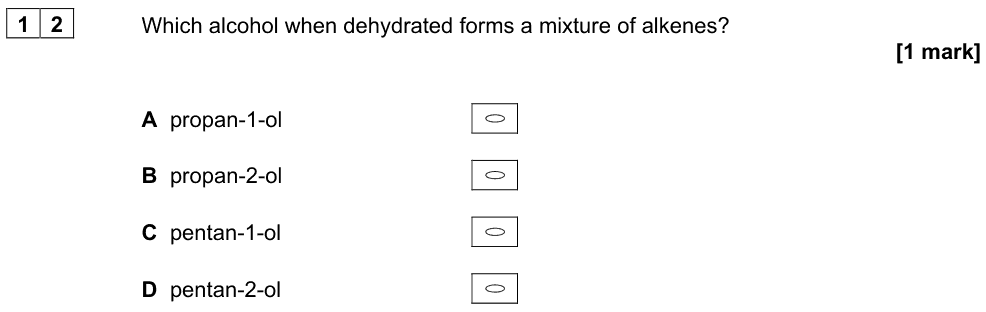
Answer: D. Pentan-2-ol can lose water in two directions to give pent-1-ene and (E and Z) pent-2-ene
June 2022 · AS Paper 2 · Q151 markAO1=1Multiple choice
Answer
D
Mark scheme
Examiner's comment
Many students struggled to work out which alcohol is oxidised to a given ketone.
Notes from the mark scheme and report
Answer: D. 3-methylbutan-2-ol, (CH3)2CHCH(OH)CH3, is the secondary alcohol that oxidises to the ketone (CH3)2CHCOCH3
June 2022 · AS Paper 2 · Q211 markAO2=1Multiple choice
Answer
A
Mark scheme
Notes from the mark scheme and report
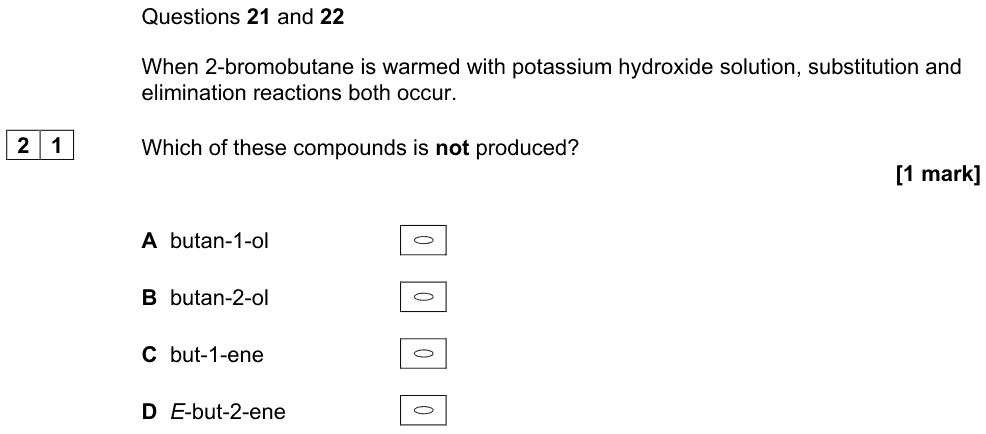
Answer: A. Substitution gives butan-2-ol
elimination gives but-1-ene and E/Z-but-2-ene
the OH cannot end up on carbon 1
June 2022 · Paper 3 · Q03.22 marksAO1=2Short answer
Earlier part of question 03 that this part uses
Mark scheme
Examiner's comment
Clarity of description was again somewhat lacking in 03.2 – which is a definition best learnt by rote as “molecules with the same structural formula but a different spatial arrangement of atoms”.
‘Molecular’ was often substituted for ‘structural’ and the phrase ‘different spatial arrangement’ often lacked a reference to atoms (or bonds or groups).
Notes from the mark scheme and report
Compounds with the same structural formula but a different spatial arrangement of atoms (bonds / groups). 'Same molecular formula' alone is not enough
must mention atoms or groups
June 2022 · Paper 3 · Q03.32 marksAO1=1, AO3=1Short answer
Earlier part of question 03 that this part uses
Mark scheme
Examiner's comment
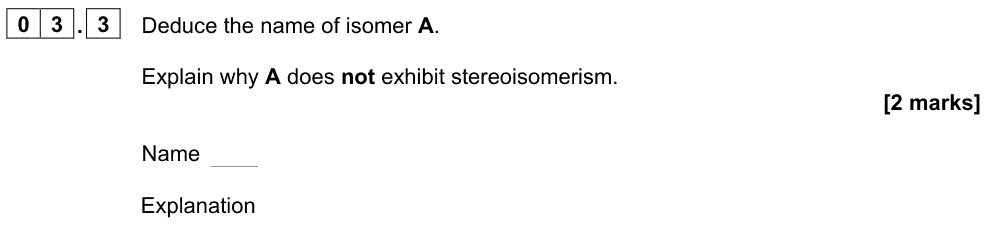
In 03.3 most students were able to correctly name but-1-ene but explanations for its lack of stereoisomerism were often unclear.
It is not enough to refer to ‘two Hs on the same side of the C=C’ as the word ‘side’ is ambiguous here.
The best way to be clear is to refer to the fact that one of the C atoms involved in the double bond has two atoms the same bonded to it.
In 03.4 ‘error carried forward’ was applied for any student who had mistakenly identified the product as but-2-ene in 03.3, so full marks were still available to those students for the mechanism.
It is recommended that students should draw clearly displayed structures and draw them a bit larger than if just showing the structure – this allows more space so that the positioning of curly arrows is clear.
Notes from the mark scheme and report
But-1-ene (not 'butene'). One of the C=C carbons has two identical atoms (two H) attached. 'Two H on the same side' is ambiguous and not accepted
June 2022 · Paper 3 · Q03.52 marksAO1=1, AO3=1Short answer
Earlier part of question 03 that this part uses
Mark scheme
Examiner's comment
03.5 was well answered.
Notes from the mark scheme and report
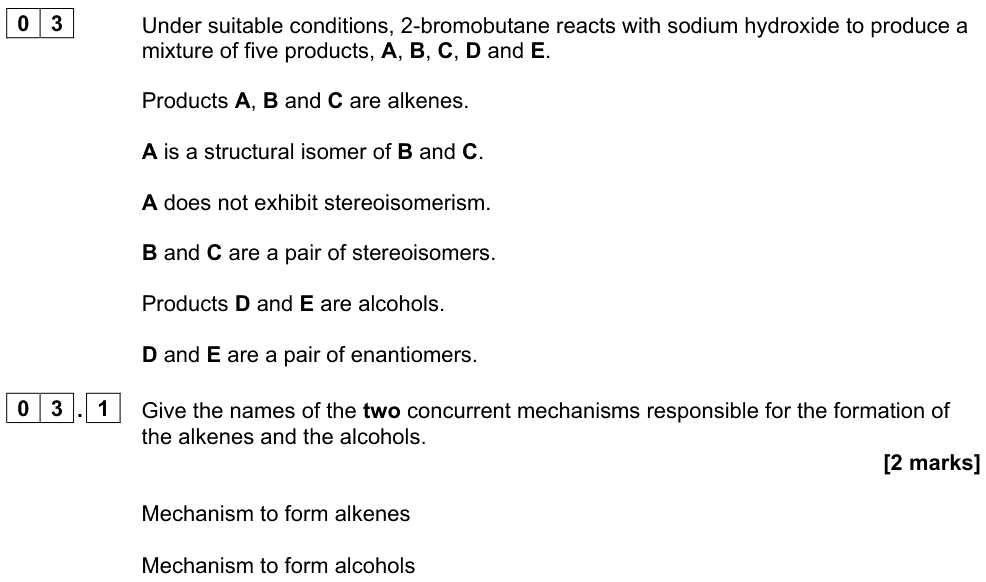
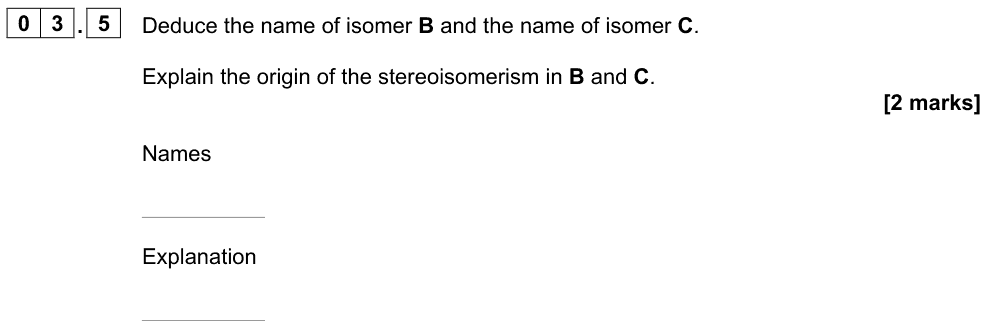
E-but-2-ene and Z-but-2-ene (either way round
cis/trans allowed). There is restricted (no) rotation about the C=C double bond
June 2022 · Paper 3 · Q251 markAO1=1Multiple choice
Answer
B
Mark scheme
Notes from the mark scheme and report
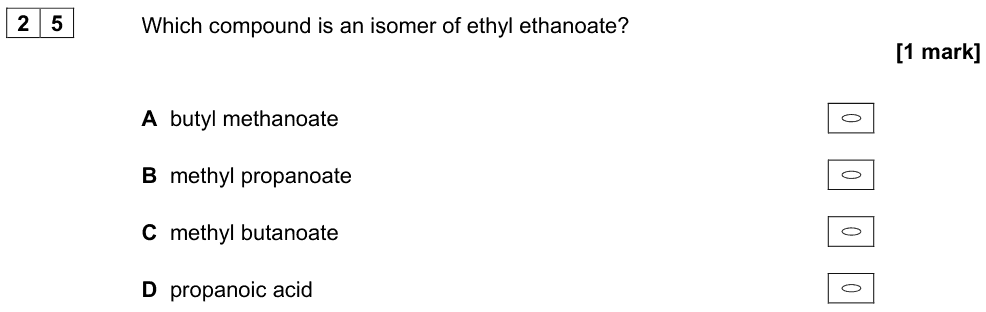
Answer: B. Ethyl ethanoate is C4H8O2
methyl propanoate is also C4H8O2. Butyl methanoate and methyl butanoate are C5H10O2
propanoic acid is C3H6O2
June 2022 · Paper 3 · Q351 markAO3=1Multiple choice
Answer
B
Mark scheme
Notes from the mark scheme and report
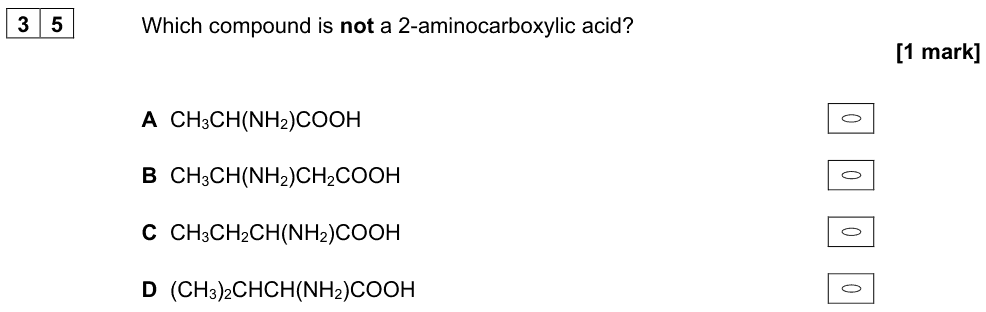
Answer: B. In CH3CH(NH2)CH2COOH the NH2 is on carbon 3 (3-aminobutanoic acid)
in the others it is on carbon 2, next to COOH
November 2021 · Paper 2 · Q01.23 marksCalculation
Earlier part of question 01 that this part uses
Mark scheme
Examiner's comment
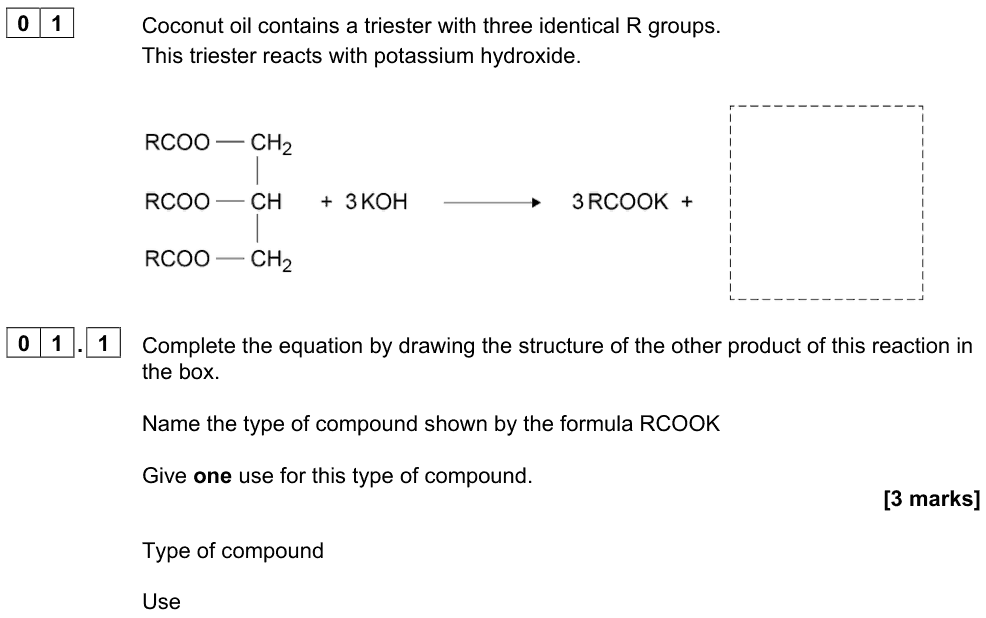
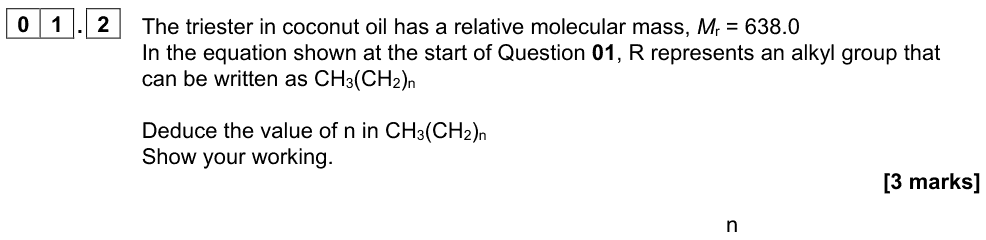
All aspects of this question differentiated very well. The extended calculation in question 01.3 attracted good responses with a third of the students gaining full marks and the majority able to access at least 1 or 2 marks. A common mistake was to assume that the oil was pure triester. In question 01.4 very few students appreciated that aqueous ethanol was used as a mutual solvent for both the oil and the potassium hydroxide.
Notes from the mark scheme and report
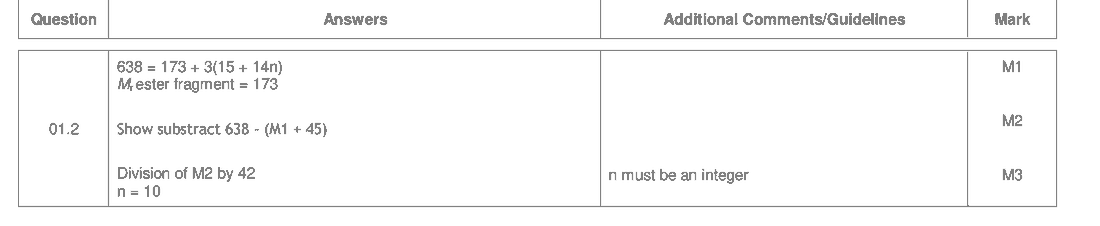
Answer: n = 10. Mr of the triester framework without the three R groups (C6H5O6) = 173
638 = 173 + 3(15 + 14n)
638 – 173 – 45 = 420
420 ÷ 42 = 10. n must be an integer
Skills: MS2.4 Solve algebraic equations
November 2021 · AS Paper 2 · Q02.15 marksMechanism
Mark scheme
Notes from the mark scheme and report
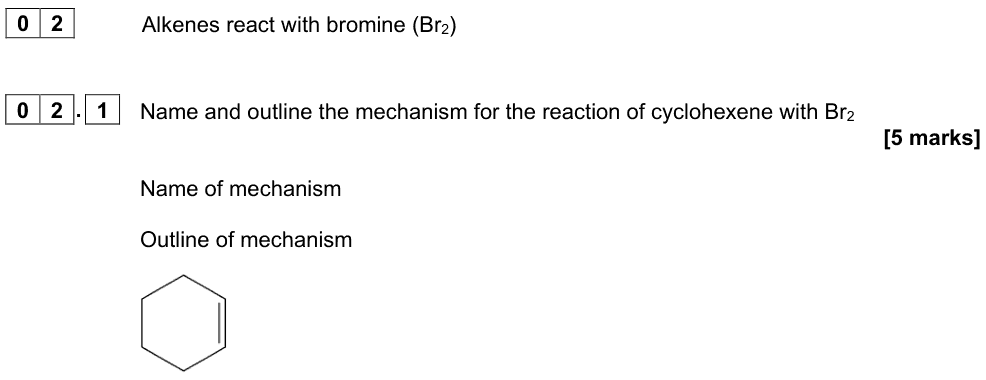
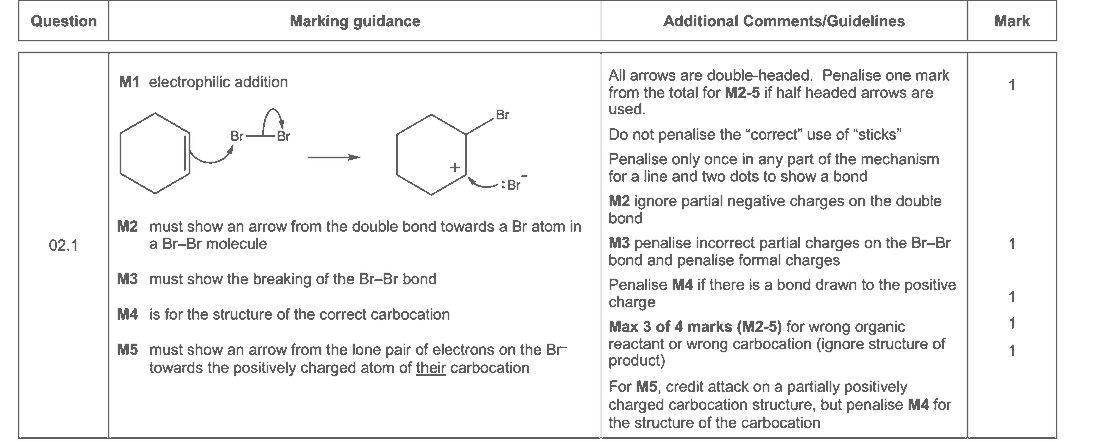
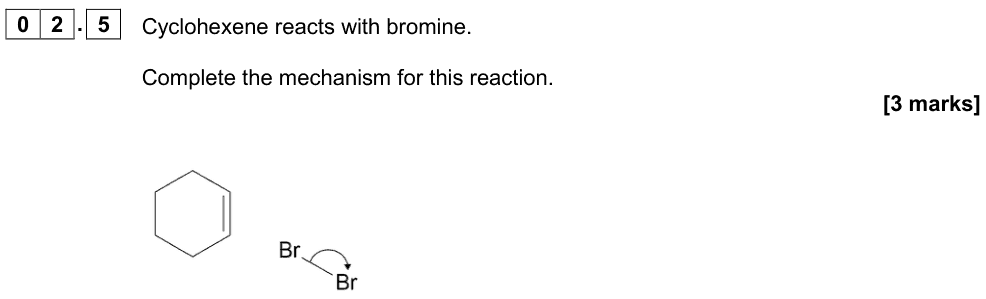
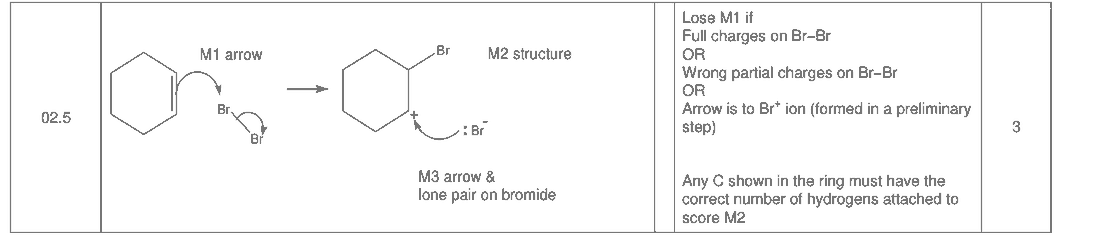
Electrophilic addition. Arrow from the C=C to a Br of Br–Br
arrow from the Br–Br bond to the other Br
carbocation with Br on the adjacent ring carbon
arrow from a lone pair on Br– to the C+. Max 3 of 4 for the wrong reactant or carbocation
no bond drawn to the + charge
formal or wrong partial charges on Br–Br penalised
November 2021 · AS Paper 2 · Q02.31 markDiagram or structure
Earlier part of question 02 that this part uses
Mark scheme
Notes from the mark scheme and report
Skeletal formula of 1,2,3,4-tetrabromobutane: four-carbon zig-zag with a Br on every carbon (both C=C add Br2). Must be skeletal
November 2021 · Paper 2 · Q02.44 marksMechanism
Earlier part of question 02 that this part uses
Mark scheme
Examiner's comment
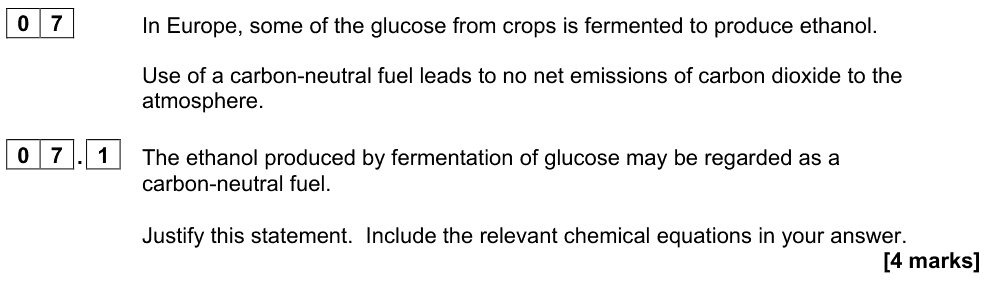
In this question a surprisingly small proportion of students were able to state the meaning of the term fraction. In addition, very few were able to explain why C=O bonds in carbon dioxide absorb infrared radiation. A good range of answers was seen for the extended response question about the environmental impact of bioethanol as a fuel, but a significant number of students were unable to get started here.
Notes from the mark scheme and report
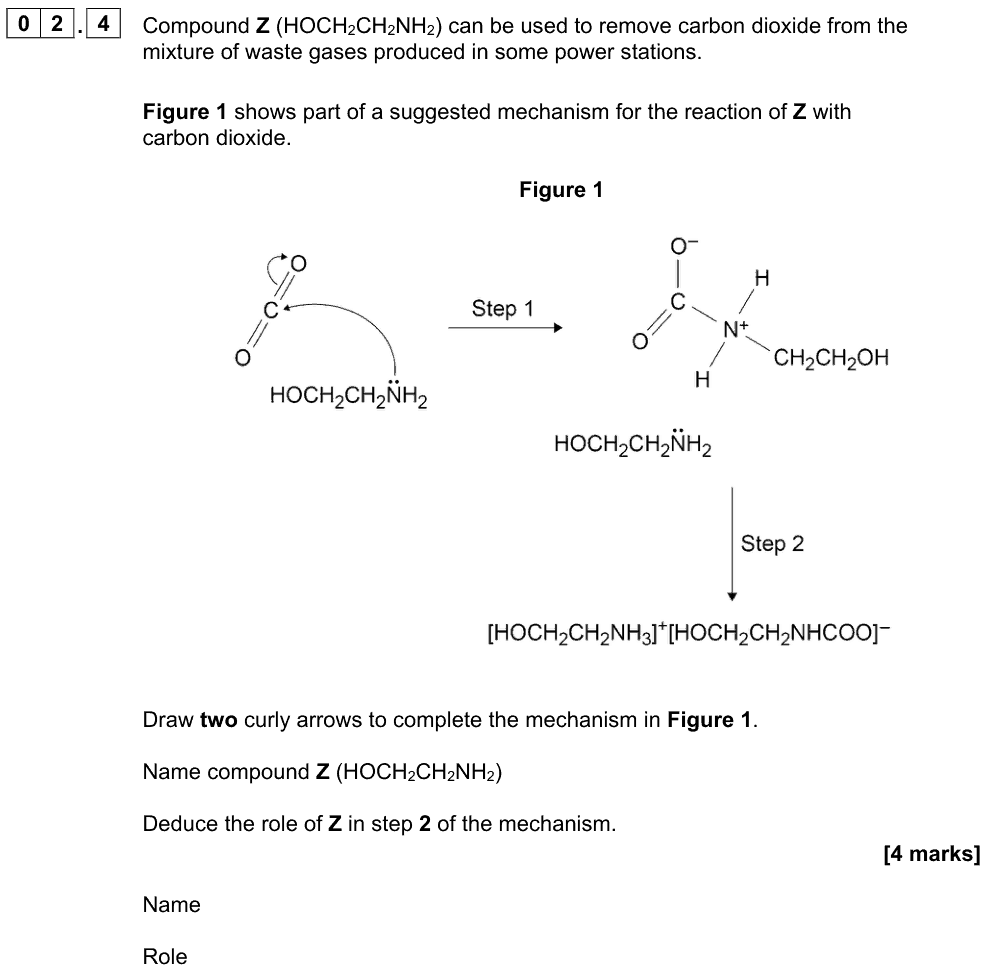
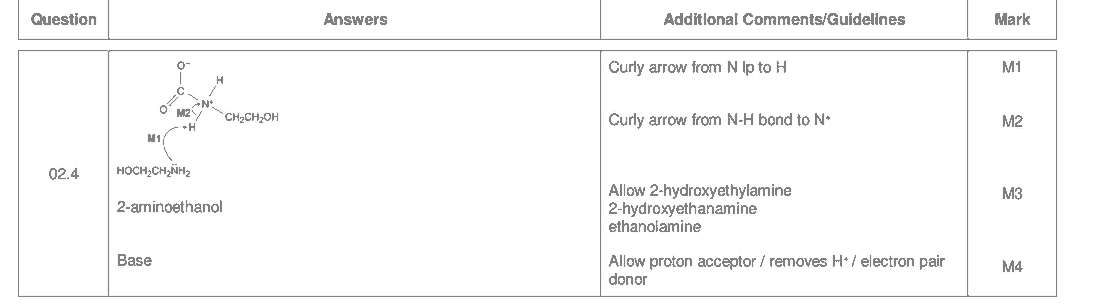
Two curly arrows for step 2: from the lone pair on N of the second HOCH2CH2NH2 to an H on the N+, and from that N–H bond to the N+. Name: 2-aminoethanol (allow ethanolamine, 2-hydroxyethylamine). Role in step 2: base / proton acceptor (electron pair donor)
November 2021 · AS Paper 2 · Q04.11 markShort answer
Mark scheme
Notes from the mark scheme and report
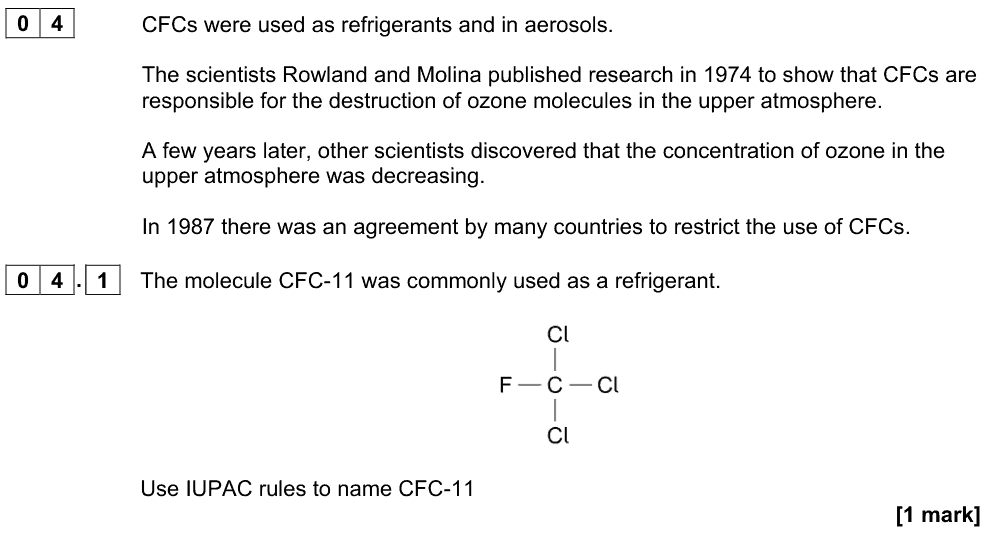
Answer: trichlorofluoromethane
November 2021 · Paper 2 · Q04.35 marksMechanism
Earlier part of question 04 that this part uses
Mark scheme
Examiner's comment
Question 04.3 required students to apply mechanistic ideas to structures that were provided.
The vast majority of students were able to score some marks on this question and it also proved to be a very good discriminator.
Notes from the mark scheme and report
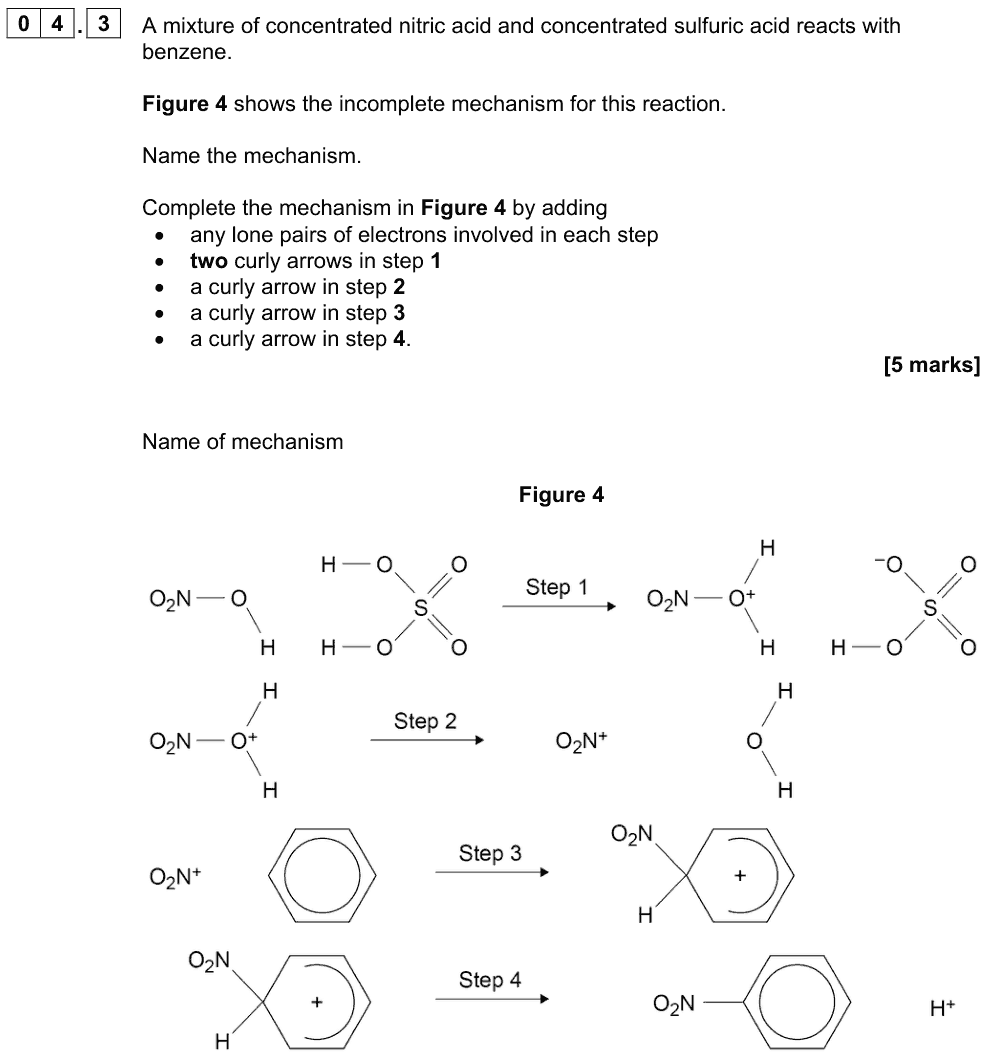
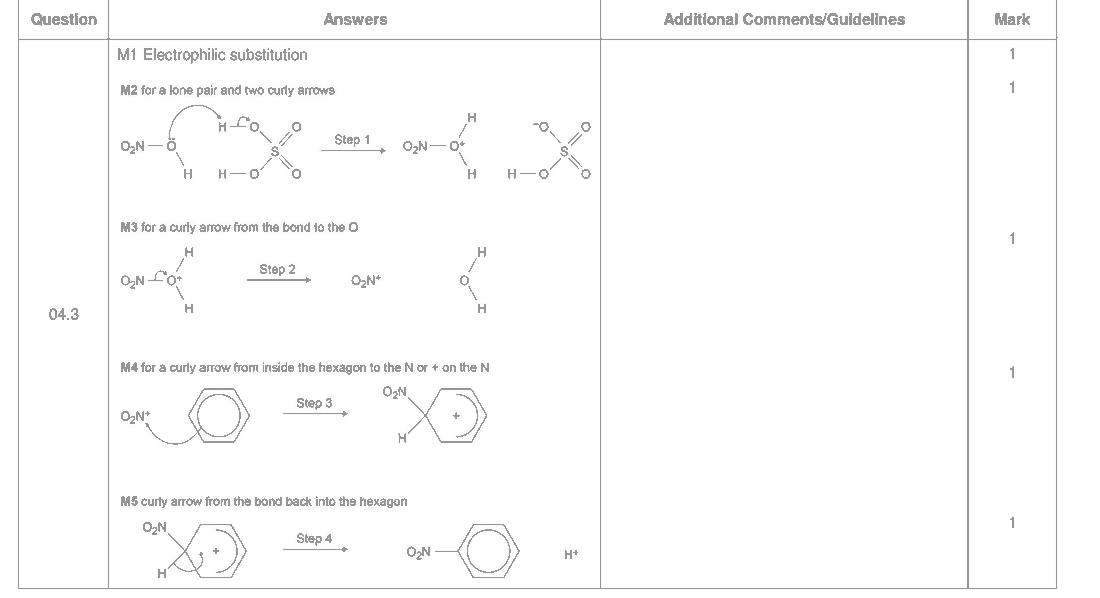
Electrophilic substitution. Step 1: lone pair on the O of the OH in HNO3, arrow from it to an H of H2SO4 and arrow from that H–O bond to the O of H2SO4. Step 2: arrow from the N–O+ bond to the O+ (water leaves, giving NO2+). Step 3: arrow from the ring of delocalised electrons to the N of NO2+. Step 4: arrow from the C–H bond back into the ring (H+ lost). Lone pairs must be shown where they are used. A very good discriminator
November 2021 · Paper 2 · Q06.11 markDiagram or structure
Mark scheme
Examiner's comment
Answers to question 06.3 about the E and Z forms of a structure that shows both geometric and optical isomerism were very poor and over 70% of students failed to score either mark. Questions 06.2 and 06.4 proved more accessible.
Notes from the mark scheme and report
Skeletal formula of 2-methylbutanal, CH3CH2CH(CH3)CHO: the carbon next to the CHO group carries H, CH3, C2H5 and CHO, so it is a chiral centre
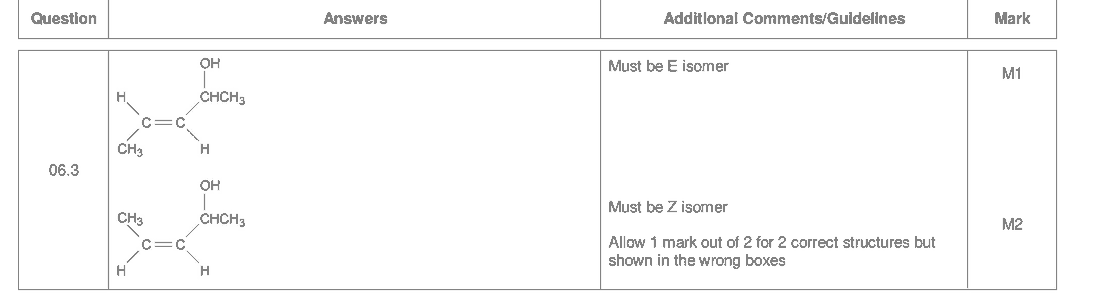
November 2021 · Paper 2 · Q06.32 marksDiagram or structureHard
Earlier part of question 06 that this part uses
Mark scheme
Examiner's comment
Answers to question 06.3 about the E and Z forms of a structure that shows both geometric and optical isomerism were very poor and over 70% of students failed to score either mark.
Notes from the mark scheme and report
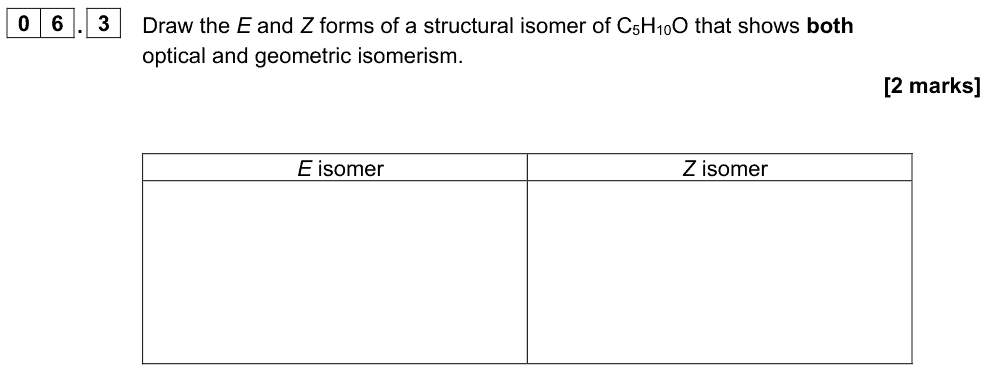
Pent-3-en-2-ol, CH3CH=CHCH(OH)CH3 (C=C with different groups on each carbon plus a chiral C–OH carbon). E isomer: CH3 and CH(OH)CH3 on opposite sides of the C=C
Z isomer: on the same side. Two correct structures in the wrong boxes score 1
Skills: MS4.2 Visualise and represent 2D and 3D forms including two-dimensional representations of 3D objects
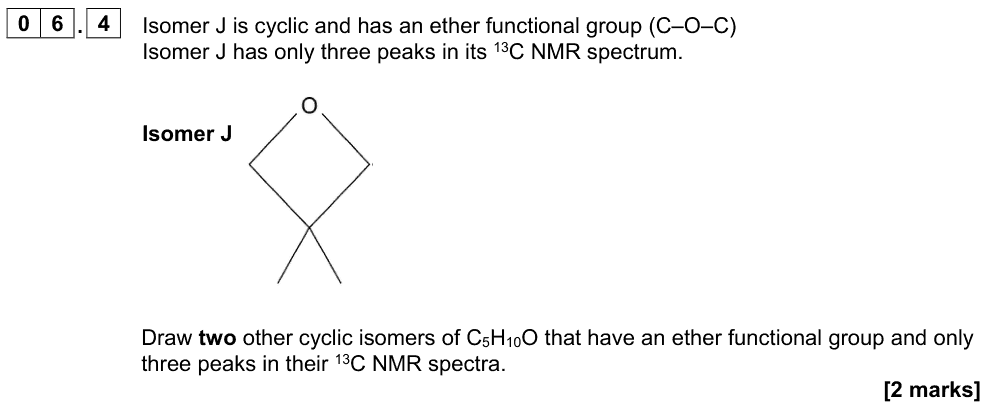
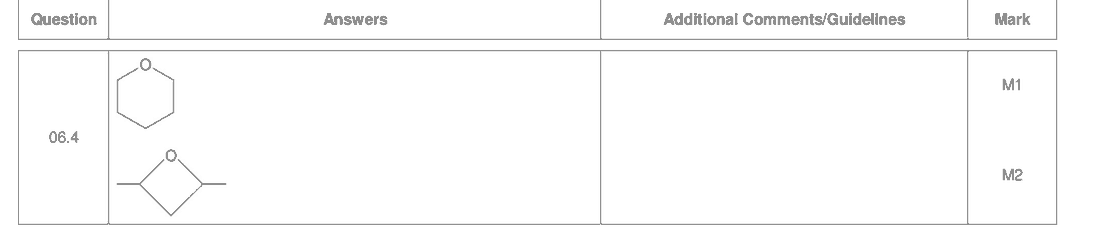
November 2021 · Paper 2 · Q06.42 marksDiagram or structure
Earlier part of question 06 that this part uses
Mark scheme
Examiner's comment
Questions 06.2 and 06.4 proved more accessible.
Notes from the mark scheme and report
A six-membered ring with one O (tetrahydropyran, oxane) and 2,4-dimethyloxetane (four-membered ring with O, a CH3 on each carbon next to the O)
each has three carbon environments.
Skills: MS4.3 Understand the symmetry of 2D and 3D shapes
November 2021 · AS Paper 2 · Q07.24 marksMechanism
Earlier part of question 07 that this part uses
Mark scheme
Notes from the mark scheme and report
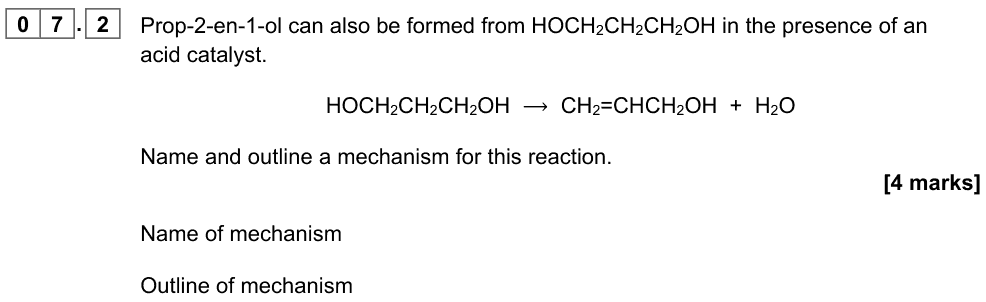
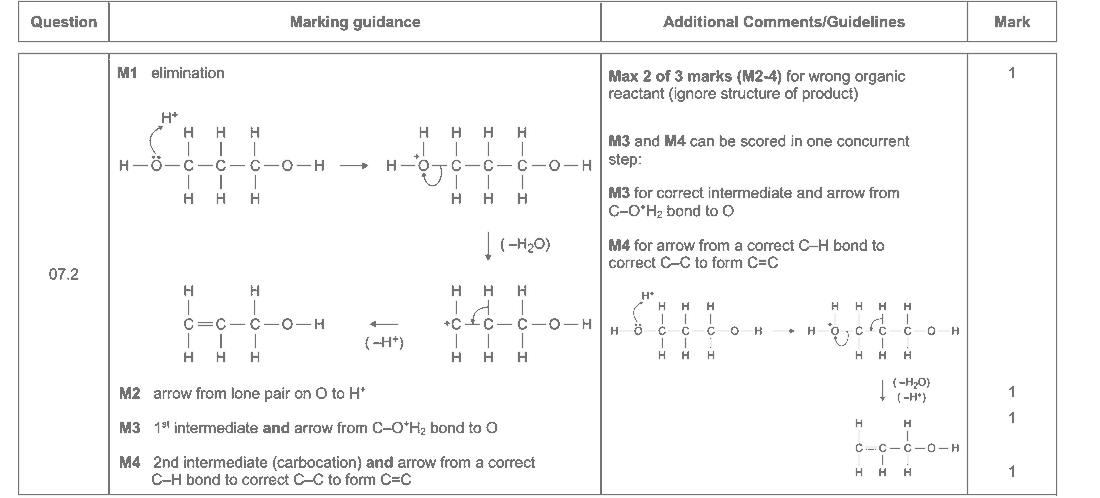
Elimination. Arrow from a lone pair on O of one OH to H+
protonated alcohol with arrow from the C–O+H2 bond to O (water leaves)
carbocation, then arrow from the adjacent C–H bond to the C–C bond to form C=C (loss of H+). The last two steps may be shown as one concerted step. Max 2 of 3 for the wrong reactant
November 2021 · AS Paper 2 · Q07.41 markDiagram or structure
Earlier part of question 07 that this part uses
Mark scheme
Notes from the mark scheme and report
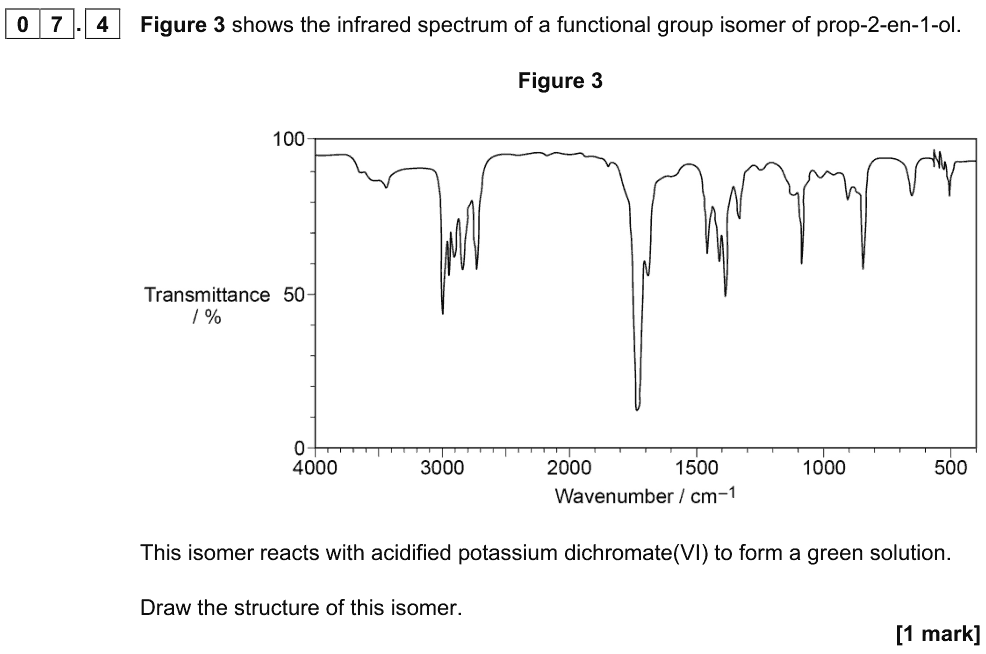
Propanal, CH3CH2CHO. The spectrum has a strong C=O absorption near 1700 cm–1 and no O–H absorption, and the isomer is oxidised by acidified dichromate, so it is an aldehyde (not propanone)
Skills: MS3.1 Translate information between graphical, numerical and algebraic forms
November 2021 · AS Paper 2 · Q091 markMultiple choice
Answer
B
Mark scheme
Notes from the mark scheme and report
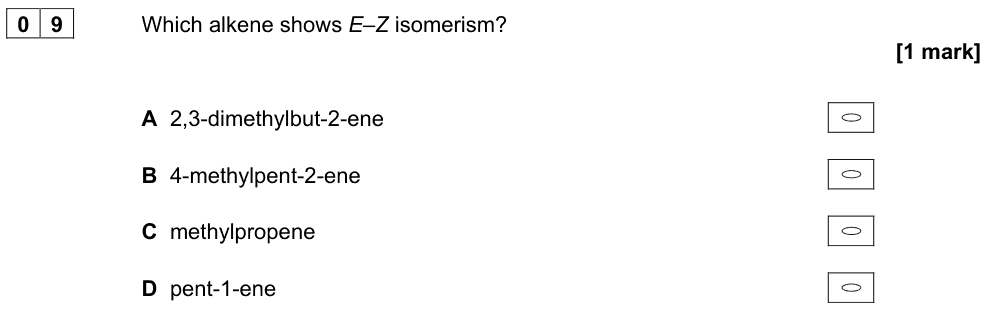
Answer: B. CH3CH=CHCH(CH3)2 has two different groups on each carbon of the C=C
in the others one C=C carbon carries two identical groups
November 2021 · Paper 2 · Q09.43 marksEquation writing
Earlier part of question 09 that this part uses
Mark scheme
Examiner's comment
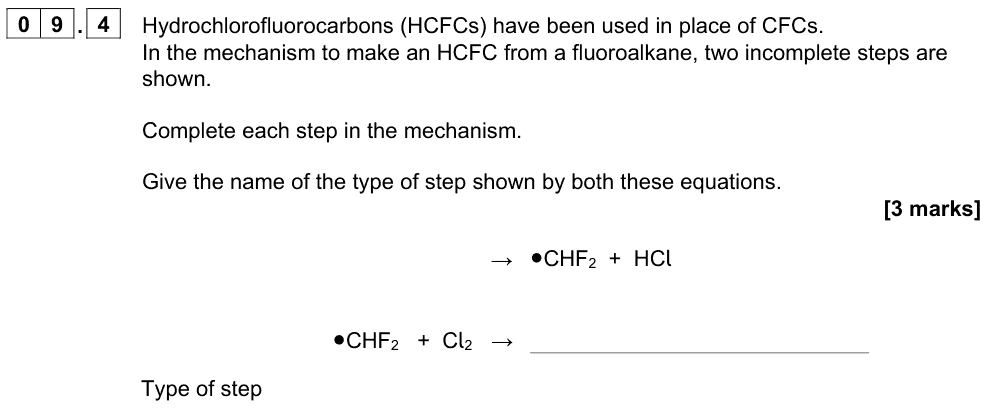
Many also scored good marks on question 09.4 by being able to derive equations for novel propagation steps.
Notes from the mark scheme and report
Cl• + CH2F2 → •CHF2 + HCl
•CHF2 + Cl2 → CHClF2 + Cl•
both are propagation steps. A missing dot is penalised once only
November 2021 · AS Paper 2 · Q121 markMultiple choice
Answer
D
Mark scheme
Notes from the mark scheme and report
Answer: D. •CH3 + Cl2 → CH3Cl + Cl• uses one radical and regenerates another
H• is not formed in this mechanism and C is termination
November 2021 · AS Paper 2 · Q151 markMultiple choice
Earlier part of question 15 that this part uses
Answer
B
Mark scheme
Notes from the mark scheme and report
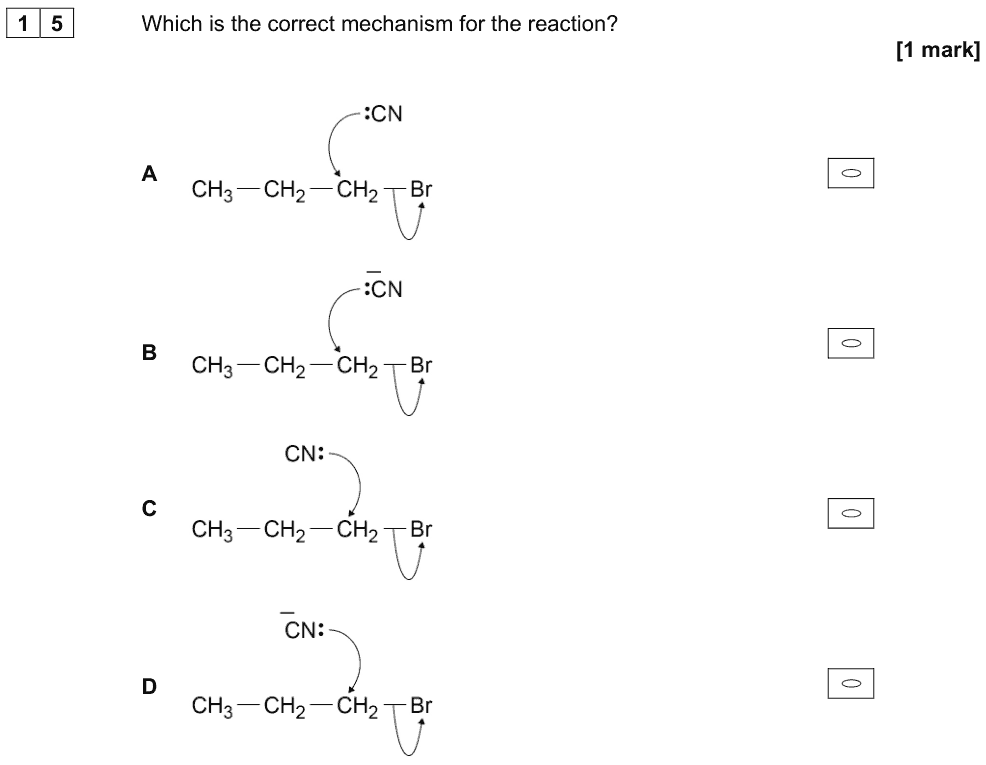
Answer: B. The arrow starts from the lone pair on the carbon of the negatively charged :CN– ion and goes to the CH2 carbon, with a second arrow from the C–Br bond to Br
A and C lack the charge, D attacks from nitrogen
November 2021 · AS Paper 2 · Q171 markMultiple choice
Answer
A
Mark scheme
Notes from the mark scheme and report
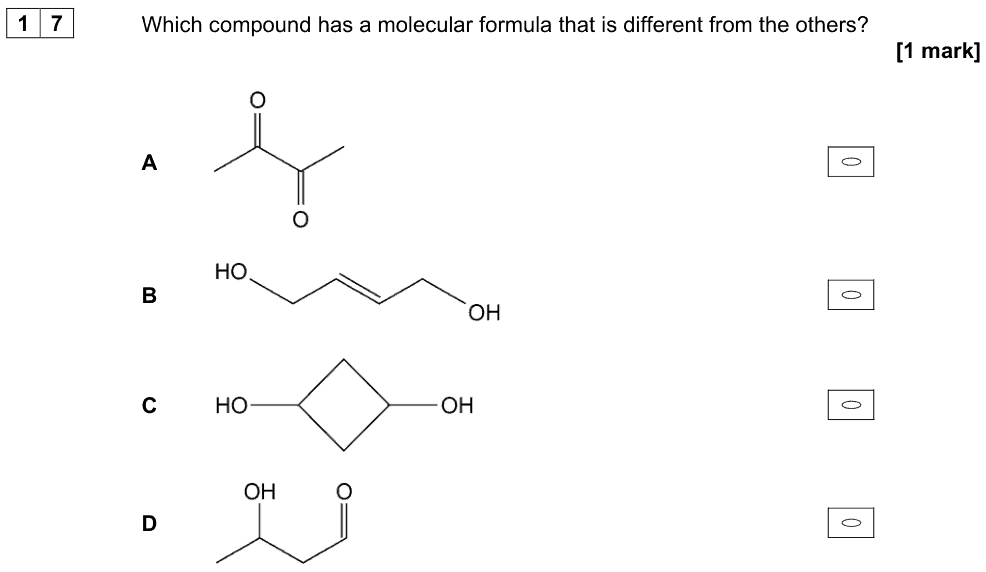
Answer: A. Butane-2,3-dione is C4H6O2
B, C and D (an unsaturated diol, a cyclic diol and a hydroxyaldehyde) are all C4H8O2
November 2021 · Paper 3 · Q03.34 marksMechanismHard
Earlier part of question 03 that this part uses
Mark scheme
Examiner's comment
The mechanism in question 03.3 was known quite well with a third of students scoring full marks here.
Notes from the mark scheme and report
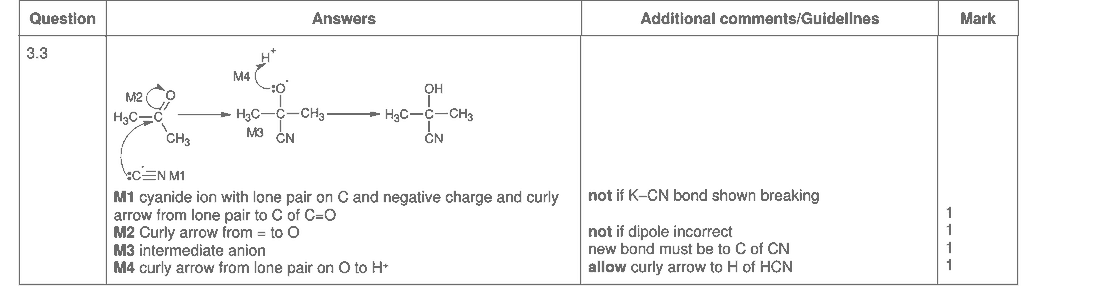
Nucleophilic addition: arrow from the lone pair on C of :CN– to the C of C=O
arrow from the C=O bond to O
intermediate (CH3)2C(CN)O–
arrow from a lone pair on O– to H+ (or the H of HCN). The new bond must be to the C of CN
no K–CN bond breaking
November 2021 · Paper 3 · Q231 markMultiple choice
Answer
C
Mark scheme
Notes from the mark scheme and report
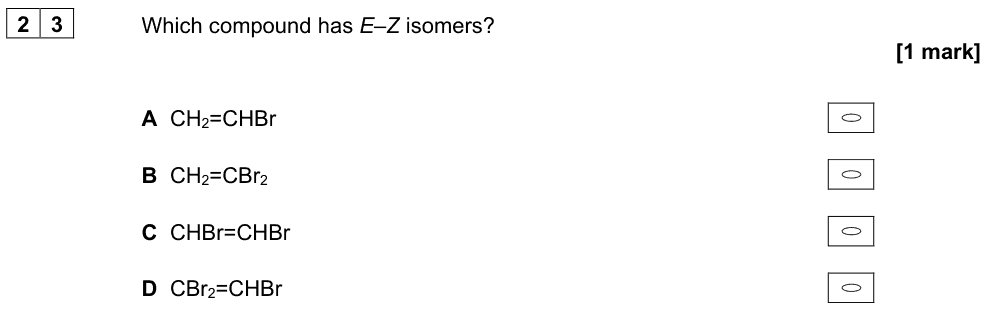
Answer: C. In CHBr=CHBr each carbon of the C=C has two different groups (H and Br)
November 2021 · Paper 3 · Q261 markMultiple choice
Answer
C
Mark scheme
Notes from the mark scheme and report
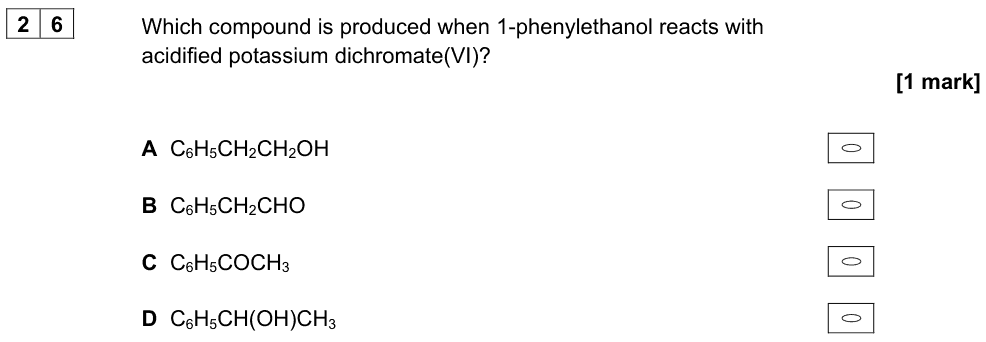
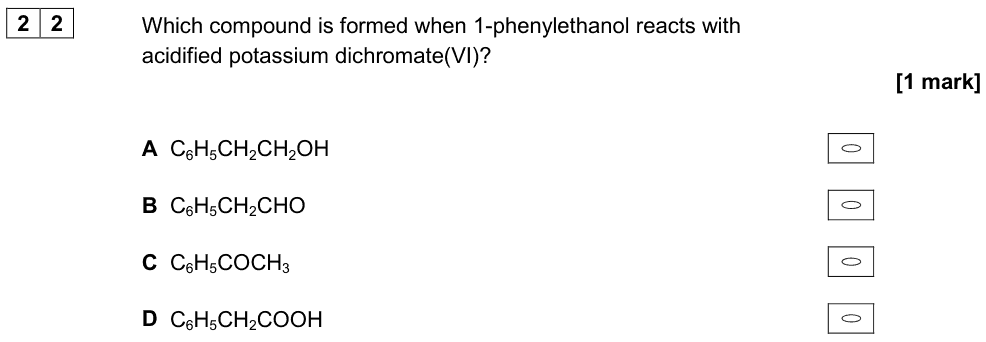
Answer: C. 1-phenylethanol, C6H5CH(OH)CH3, is a secondary alcohol and is oxidised to the ketone C6H5COCH3 (report: one of five items answered correctly by fewer than 40%)
November 2021 · Paper 3 · Q271 markMultiple choice
Answer
A
Mark scheme
Notes from the mark scheme and report
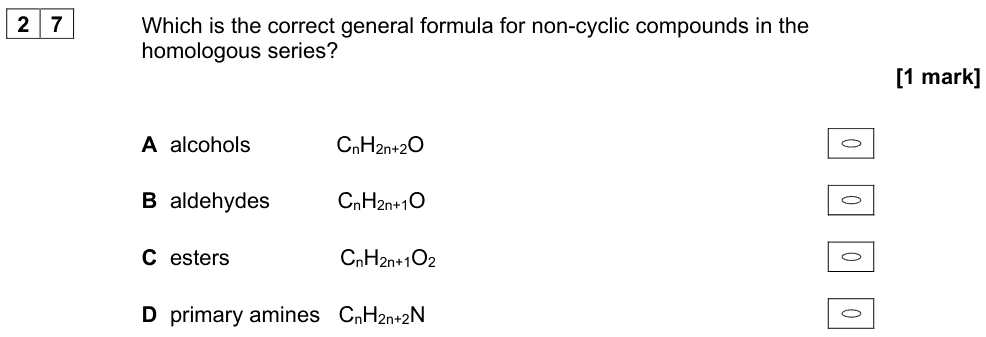
Answer: A. Alcohols are CnH2n+2O
aldehydes are CnH2nO, esters CnH2nO2 and primary amines CnH2n+3N
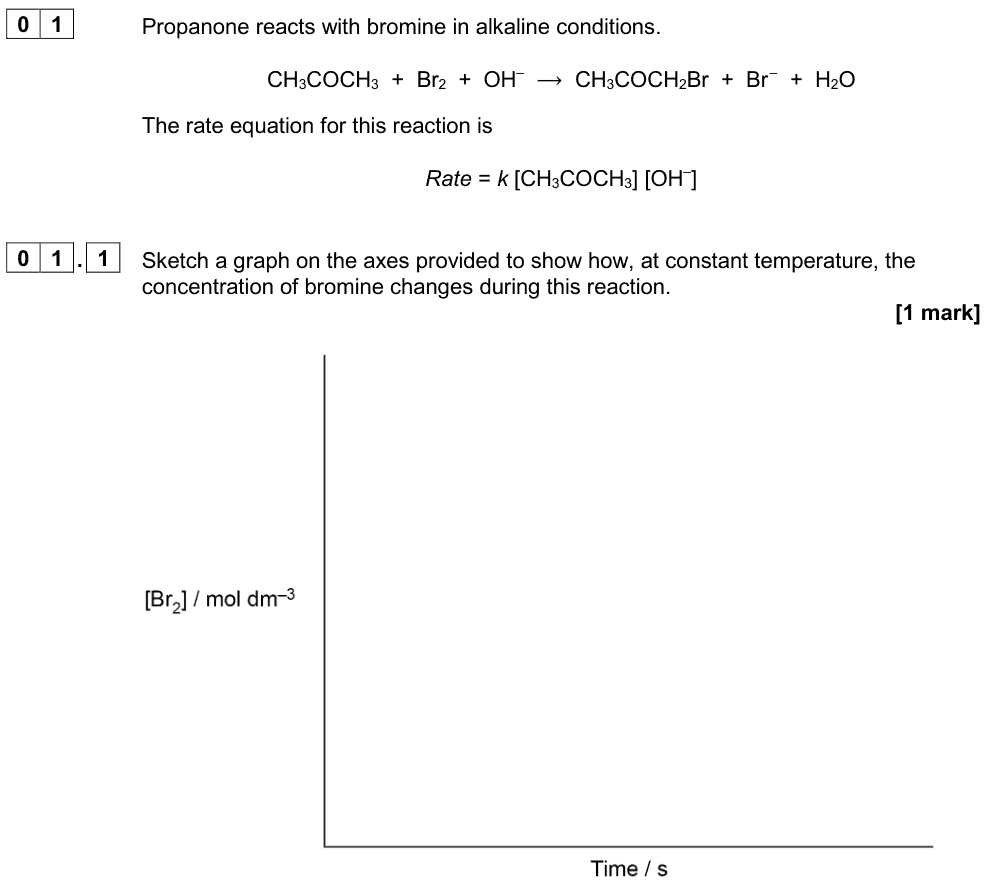
November 2020 · AS Paper 2 · Q01.33 marksEquation writing
Earlier part of question 01 that this part uses
Mark scheme
Notes from the mark scheme and report
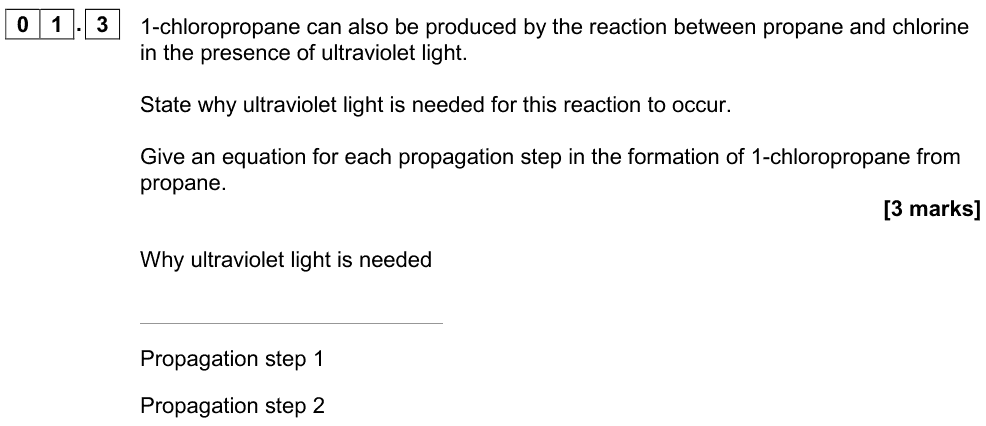
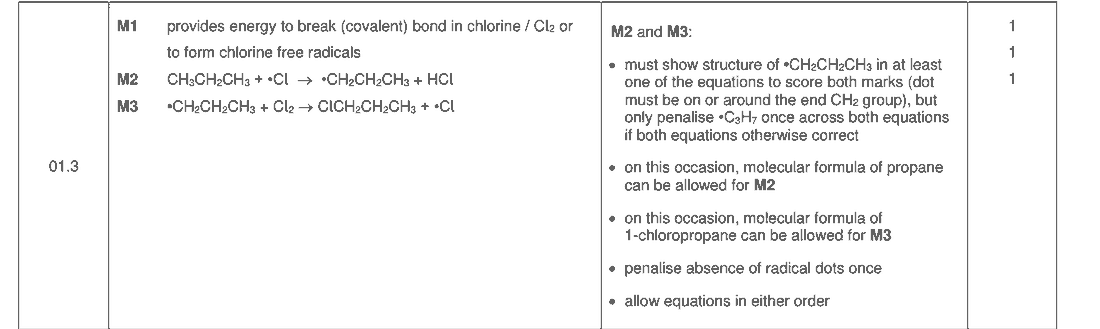
UV light provides the energy to break the Cl–Cl bond / form chlorine radicals. CH3CH2CH3 + •Cl → •CH2CH2CH3 + HCl
•CH2CH2CH3 + Cl2 → ClCH2CH2CH3 + •Cl. The radical must be shown as •CH2CH2CH3 (dot on the end carbon), not •C3H7
missing radical dots penalised once
November 2020 · Paper 2 · Q03.41 markShort answer
Earlier part of question 03 that this part uses
Mark scheme
Examiner's comment
03.4 was very well known.
Notes from the mark scheme and report
Position (positional) isomerism
November 2020 · AS Paper 2 · Q056 marks6-mark level of response
Mark scheme, with the levels and indicative content
Notes from the mark scheme and report
Levels of response, three stages. Definitions: structural isomers have the same molecular formula but different structures
stereoisomers have the same structural formula but a different arrangement of atoms in space. Stereoisomerism: no rotation about the C=C bond
draw E-but-2-ene (methyl groups on opposite sides) and Z-but-2-ene (same side), correctly labelled. Structural isomerism: chain, for example methylpropene and but-1-ene
position, but-1-ene and but-2-ene
functional group, cyclobutane (or methylcyclopropane) and any of the alkenes
November 2020 · Paper 2 · Q06.23 marksShort answer
Earlier part of question 06 that this part uses
Mark scheme
Examiner's comment
06.2 also proved to be quite a low scoring question despite the familiarity of this reaction in many previous exams.
Notes from the mark scheme and report
Nucleophilic addition
NaBH4 (allow LiAlH4)
1-phenylethanol (1-phenylethan-1-ol). H2/Ni scores reagent and product but the mechanism mark would need 'catalytic addition'
November 2020 · AS Paper 2 · Q06.32 marksShort answer
Earlier part of question 06 that this part uses
Mark scheme
Notes from the mark scheme and report
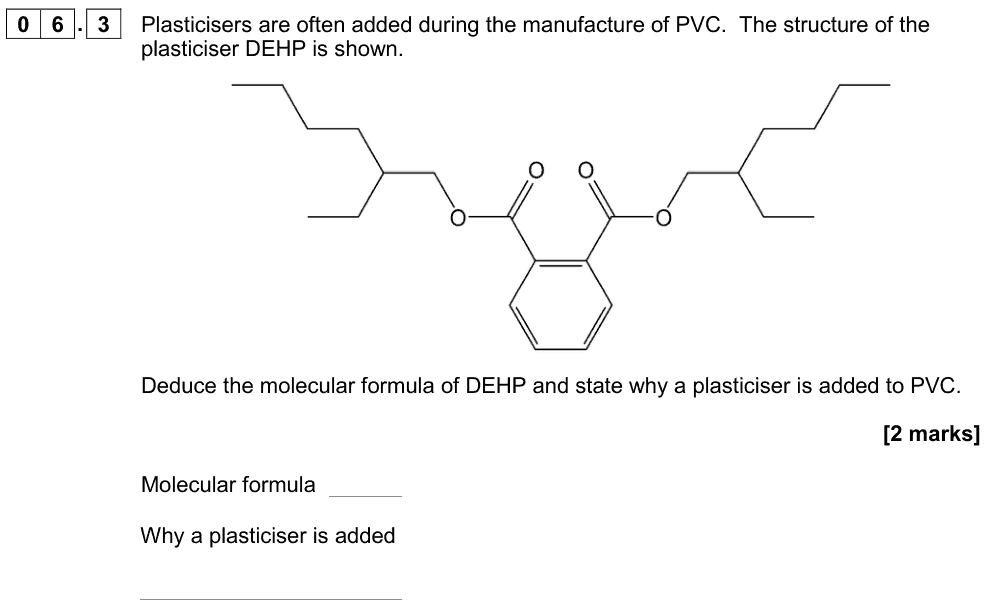
C24H38O4
a plasticiser makes PVC more flexible (less brittle). 'More elastic' is ignored
November 2020 · AS Paper 2 · Q07.11 markDiagram or structure
Mark scheme
Notes from the mark scheme and report
Two carbons shown only as the ends of a single line, each with a C=O double bond and an –OH group: HO–C(=O)–C(=O)–OH in skeletal form. The H atoms of the OH groups must be shown and C atoms must not be written
November 2020 · Paper 2 · Q07.42 marksDiagram or structure
Earlier part of question 07 that this part uses
Mark scheme
Examiner's comment
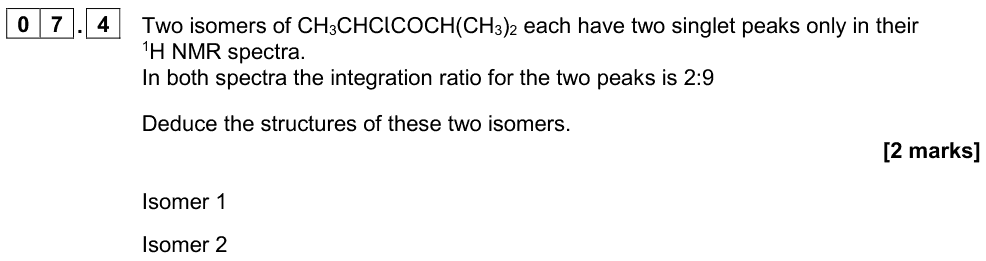
07.4 required students to deduce structures for isomers based on the number of singlet peaks and integration ratios in the 1H NMR spectra, but responses often failed to fit with these requirements.
Notes from the mark scheme and report
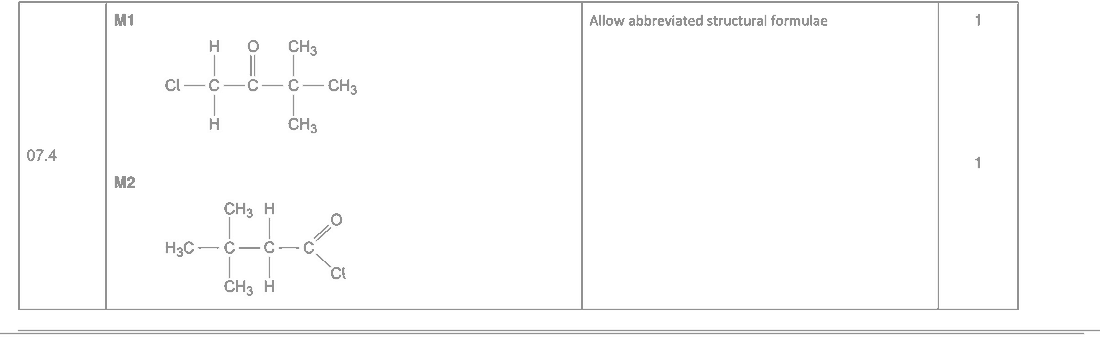
ClCH2COC(CH3)3 and (CH3)3CCH2COCl: each has a CH2 singlet (2H) and a C(CH3)3 singlet (9H). Abbreviated structural formulae allowed. Answers often did not fit both the singlets and the 2:9 ratio
Skills: MS4.3 Understand the symmetry of 2D and 3D shapes
November 2020 · Paper 2 · Q08.31 markShort answer
Earlier part of question 08 that this part uses
Mark scheme
Examiner's comment
08.3 was well answered but 08.4 was only scored by around 40% of students.
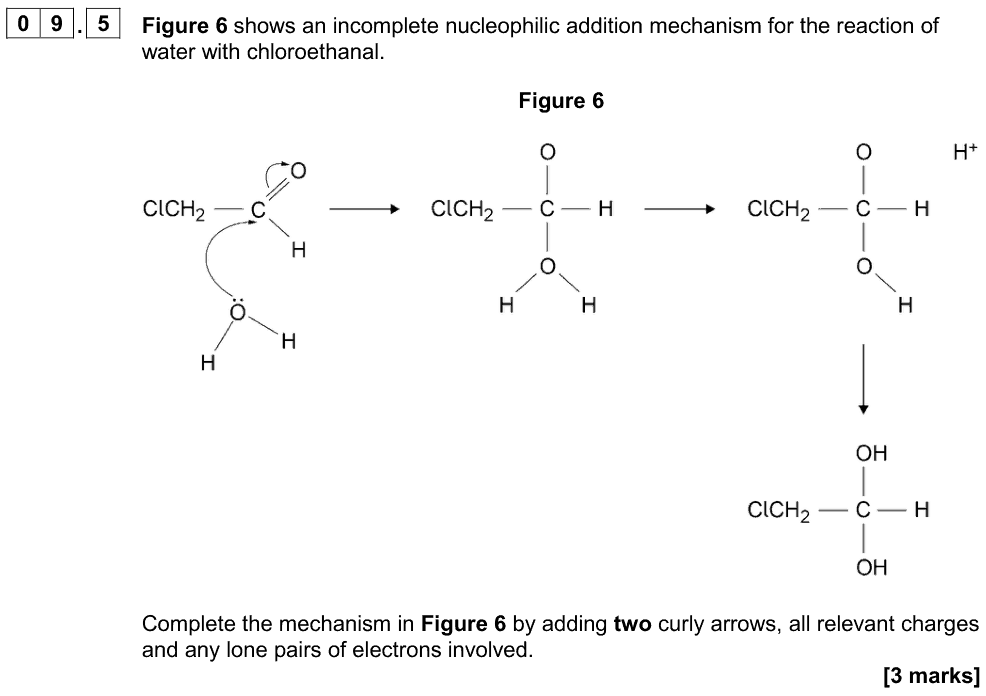
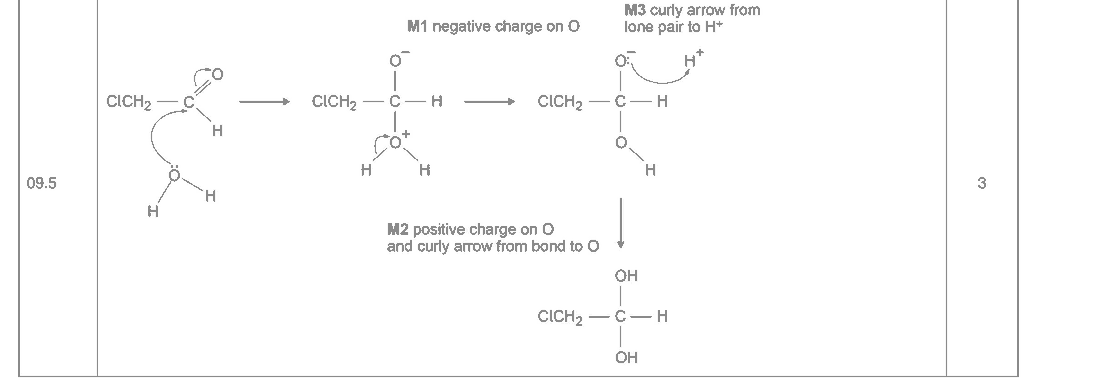
09.5 required students to apply their understanding of standard mechanistic ideas to a novel mechanism.
Most students were able to score at least some of the marks and a good number (44.3%) scored all three marks.
Notes from the mark scheme and report
First intermediate: negative charge on the O that came from C=O, positive charge on the O of the attached water, and a curly arrow from an O–H bond of that –OH2+ to the O+ (loss of H+). Second intermediate: lone pair on O– and a curly arrow from it to H+. Most scored some marks
44.3% scored all 3
November 2020 · AS Paper 2 · Q111 markMultiple choice
Answer
C
Mark scheme
Notes from the mark scheme and report
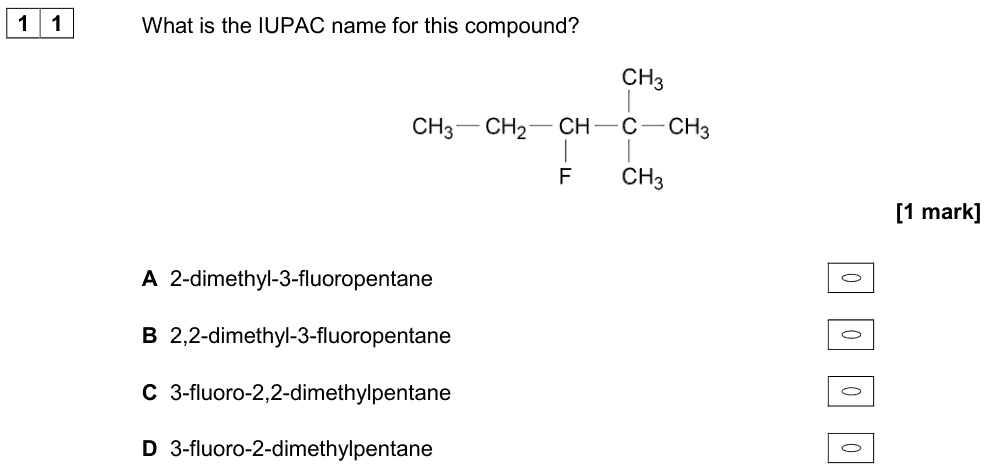
Answer: C. Five-carbon chain numbered to give the lowest numbers
substituents in alphabetical order (fluoro before methyl) and both methyl positions given: 3-fluoro-2,2-dimethylpentane
November 2020 · AS Paper 2 · Q121 markMultiple choice
Answer
D
Mark scheme
Notes from the mark scheme and report
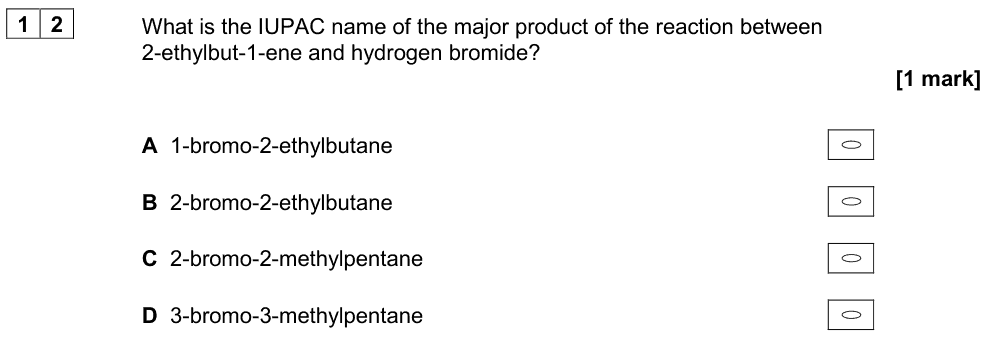
Answer: D. H adds to the CH2 to give the more stable tertiary carbocation
Br– bonds to the tertiary carbon, giving CH3CH2CBr(CH3)CH2CH3, whose longest chain has five carbons
November 2020 · AS Paper 2 · Q171 markMultiple choice
Answer
C
Mark scheme
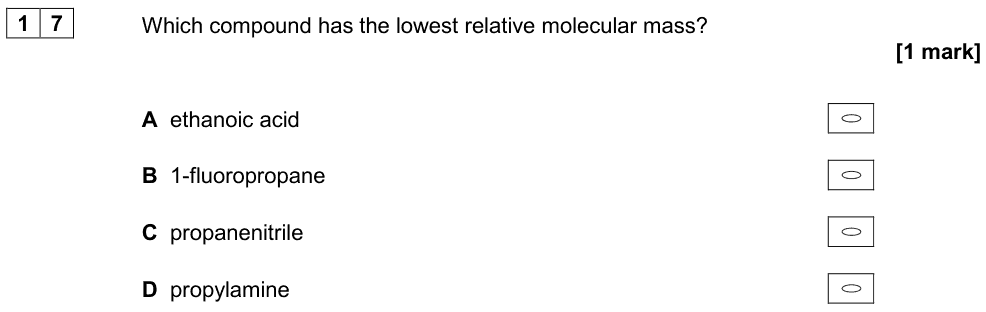
Notes from the mark scheme and report
Answer: C. Propanenitrile CH3CH2CN = 55.0
propylamine CH3CH2CH2NH2 = 59.0
ethanoic acid CH3COOH = 60.0
1-fluoropropane CH3CH2CH2F = 62.0
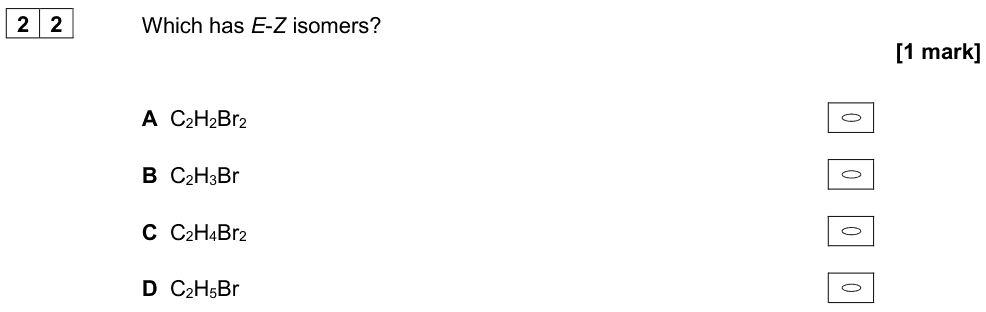
November 2020 · Paper 3 · Q221 markMultiple choice
Answer
A
Mark scheme
Notes from the mark scheme and report
Answer: A. C2H2Br2 can be CHBr=CHBr, with two different groups on each carbon of the C=C
B has a CH2= end and C and D are saturated
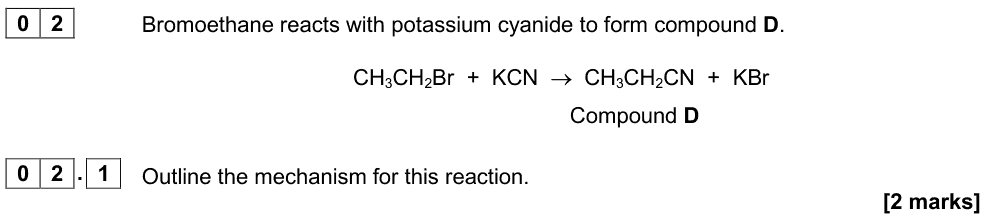
June 2019 · AS Paper 2 · Q02.12 marksMechanism
Mark scheme
Examiner's comment
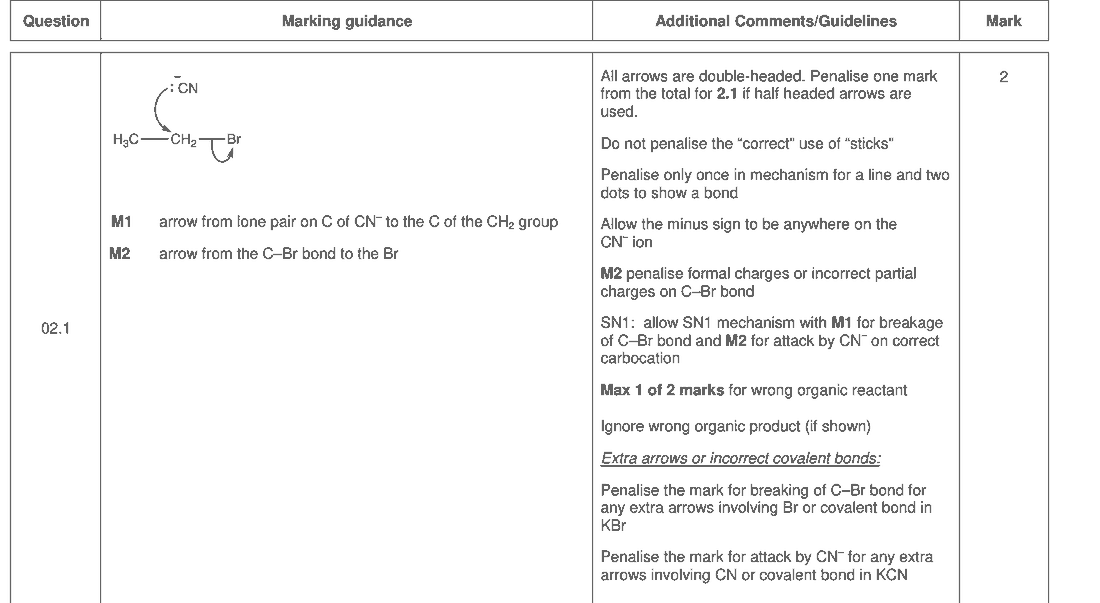
2.1 The mechanism was done very well in the main. The most common error was to omit the negative charge from the cyanide ion.
Notes from the mark scheme and report
Nucleophilic substitution: M1 arrow from the lone pair on C of :CN– to the C of CH2
M2 arrow from the C–Br bond to Br. Lone pair and negative charge needed on cyanide
SN1 route allowed. Most common error: negative charge left off the cyanide ion
June 2019 · AS Paper 2 · Q02.21 markShort answer
Earlier part of question 02 that this part uses
Mark scheme
Examiner's comment
2.2 Students struggled to name the propanenitrile formed. It seemed that few knew how to name nitriles.
Notes from the mark scheme and report
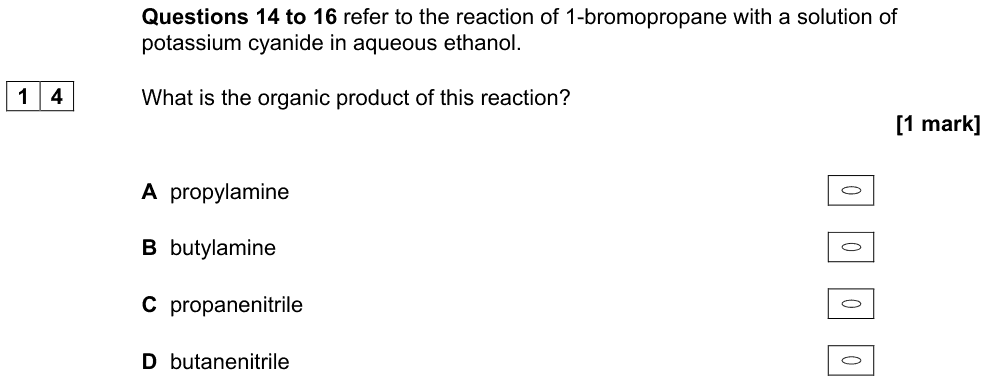
Answer: propanenitrile (the nitrile carbon counts in the chain). Few knew how to name nitriles
June 2019 · Paper 2 · Q02.53 marksMechanism
Earlier part of question 02 that this part uses
Mark scheme
Examiner's comment
02.5 The mechanism was usually answered well although the cyclic nature of the alkene confused several students who wrongly drew a substitution mechanism instead of electrophilic addition.
The intermediate carbocation in part five should not be written as structure A below.
Correct possibilities are structure B (preferred) or structure C.
Once a carbon atom is labelled as such, it must have the correct bonding as in C but not A.
Notes from the mark scheme and report
Electrophilic addition: curly arrow from the C=C to the nearer Br of Br–Br (the Br–Br arrow is printed)
carbocation intermediate, a ring with Br on one carbon and + on the adjacent carbon
arrow from a lone pair on :Br– to the C+. M1 lost for full or wrong partial charges on Br2. Do not mix skeletal and structural formulas at one carbon: a carbon written as C must show its H. Some drew a substitution mechanism
June 2019 · Paper 2 · Q03.14 marksCalculation
Mark scheme
Examiner's comment
03.1 The calculation was generally well done and most students gained at least the first two marks. A common error thereafter was to convert the 1:1.6 ratio into 2:3 which meant that no further marks were gained. Those who deduced the correct whole number ratio as 5:8 usually drew a correct branched structure, although some failed to gain this final mark by drawing a non-branched diene.
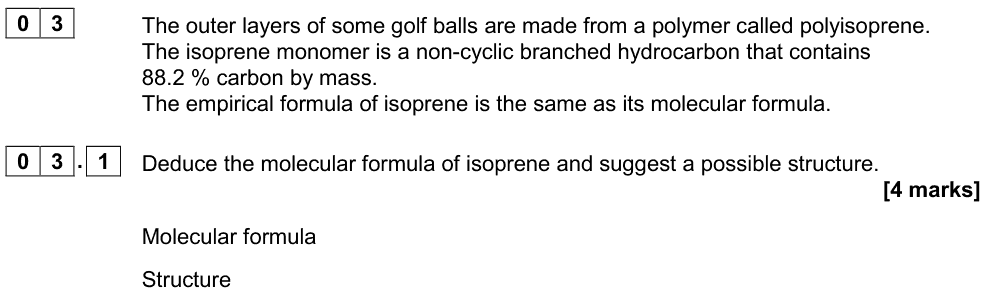
Notes from the mark scheme and report
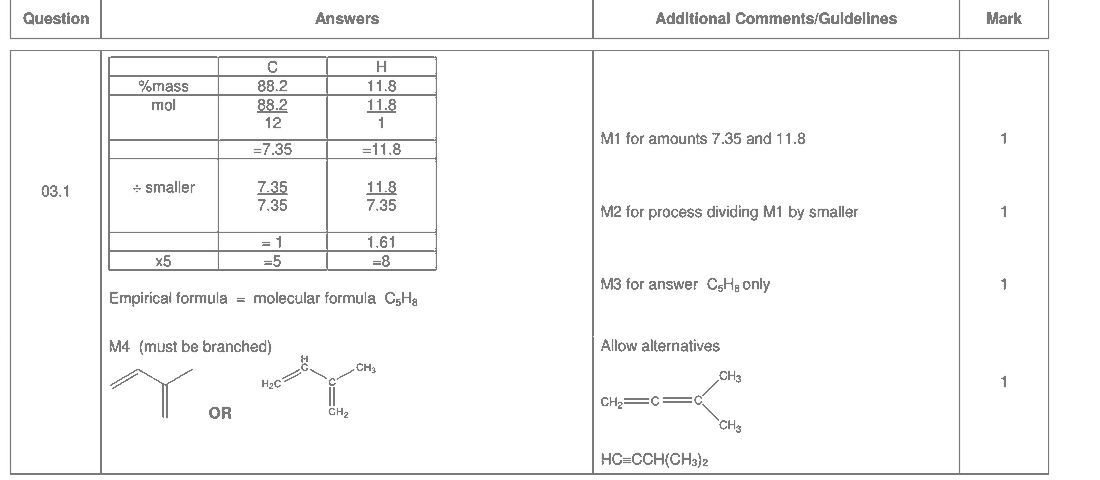
Answer: C5H8, for example CH2=C(CH3)CH=CH2 (must be branched and non-cyclic
(CH3)2CHC≡CH allowed). C 88.2 ÷ 12.0 = 7.35
H 11.8 ÷ 1.0 = 11.8
ratio 1 : 1.61 = 5 : 8. Common error: rounding 1 : 1.6 to 2 : 3
some drew an unbranched diene
Skills: MS0.2 Use ratios, fractions and percentages
June 2019 · Paper 2 · Q03.22 marksDiagram or structure
Earlier part of question 03 that this part uses
Mark scheme
Examiner's comment
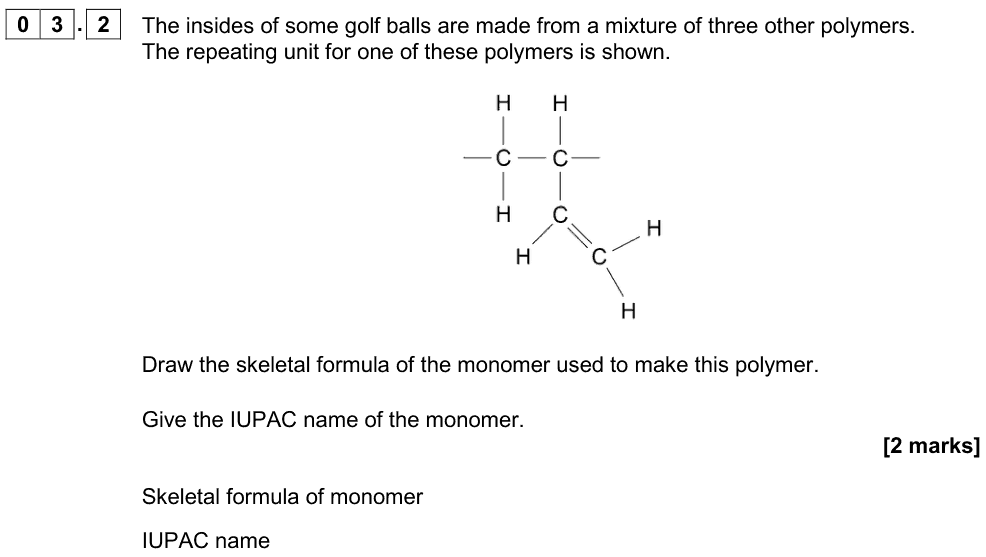
03.2 Over half the students drew a correct structure but only a very small number could give its correct IUPAC name as buta-1,3-diene.
Notes from the mark scheme and report
Skeletal formula of CH2=CH–CH=CH2 (a zigzag of four carbons with a double bond at each end)
buta-1,3-diene (this name only, marked independently). Over half drew the structure but very few gave the name.
June 2019 · Paper 2 · Q03.32 marksDiagram or structure
Earlier part of question 03 that this part uses
Mark scheme
Examiner's comment
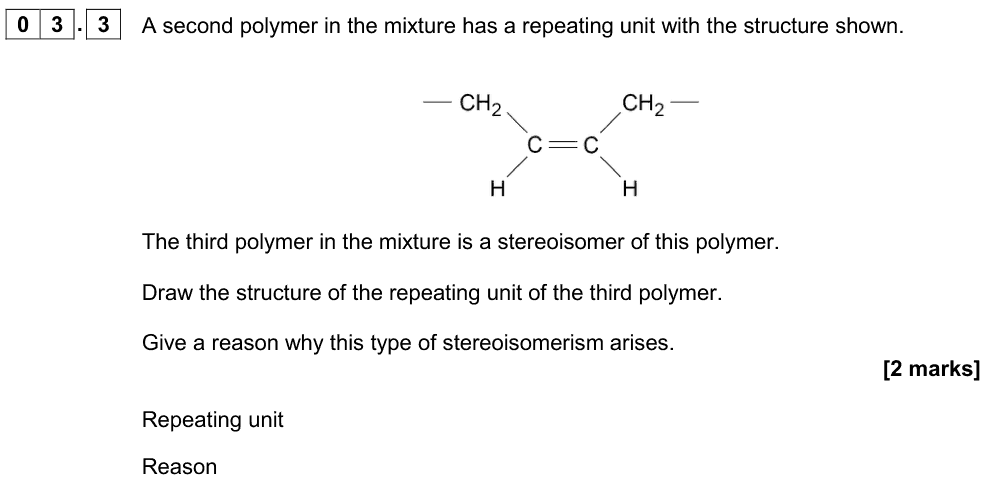
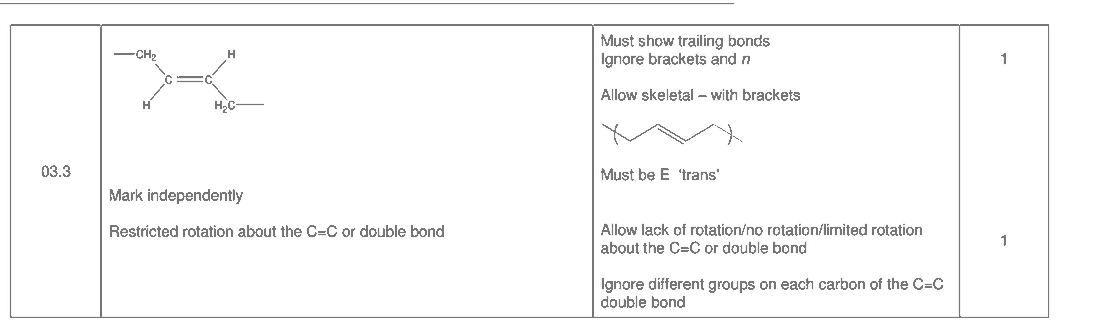
03.3 Despite the unfamiliarity of this polymer, students answered part 3 well, especially the explanation. The most common mistakes in the structure were to show trailing bonds from the H atoms or to omit trailing bonds altogether.
Notes from the mark scheme and report
The E (trans) repeating unit: –CH2–CH=CH–CH2– with the two CH2 groups on opposite sides of the C=C and trailing bonds from the CH2 groups. Reason: restricted (no) rotation about the C=C double bond. Errors: trailing bonds drawn from the H atoms or left out
Skills: MS4.2 Visualise and represent 2D and 3D forms including two-dimensional representations of 3D objects
June 2019 · AS Paper 2 · Q06.15 marksMechanism
Mark scheme
Examiner's comment
6.1 The mechanism was done quite well. The most common error was omitting the negative charge on the hydrogensulfate ion.
Notes from the mark scheme and report
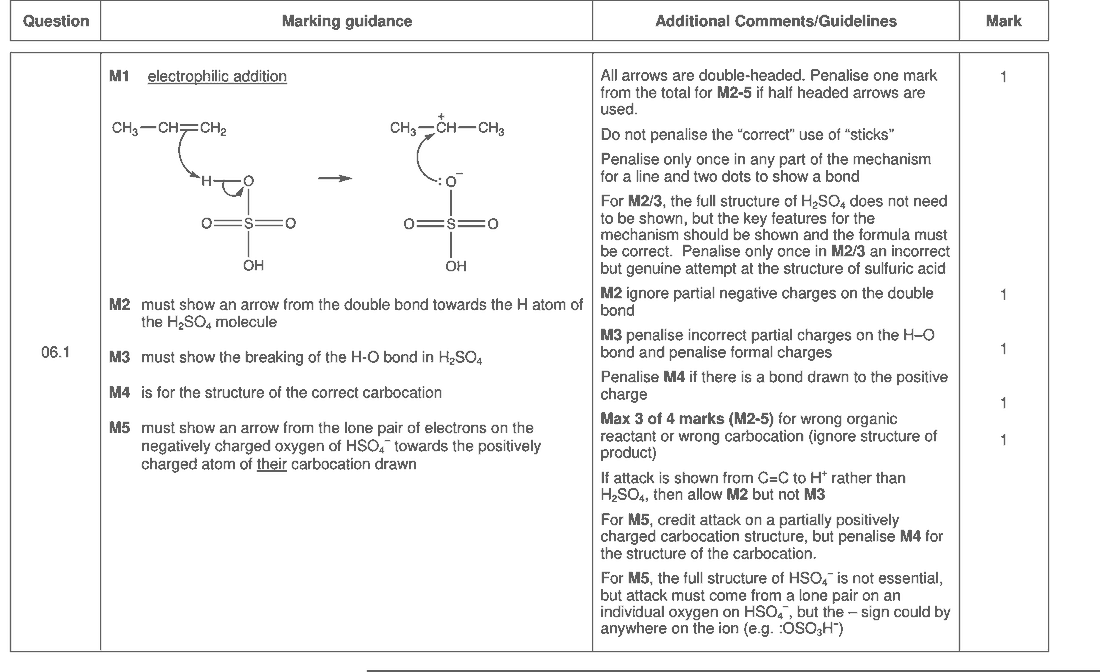
Electrophilic addition. Arrow from the C=C to the H of H–O in H2SO4
arrow from the H–O bond to O
the secondary carbocation CH3CH+CH3
arrow from a lone pair on the O– of HSO4– to the C+. Most common error: negative charge left off the hydrogensulfate ion
June 2019 · AS Paper 2 · Q06.21 markDiagram or structure
Earlier part of question 06 that this part uses
Mark scheme
Examiner's comment
6.2 Most students could draw the structure of the minor product.
Notes from the mark scheme and report
CH3CH2CH2OSO3H (the hydrogensulfate group joined through O to the end carbon): the minor product
June 2019 · Paper 2 · Q06.22 marksDiagram or structure
Earlier part of question 06 that this part uses
Mark scheme
Examiner's comment
06.2 Structure A was found easier to deduce than the branched structure B and only the more able students gained both marks.
Notes from the mark scheme and report
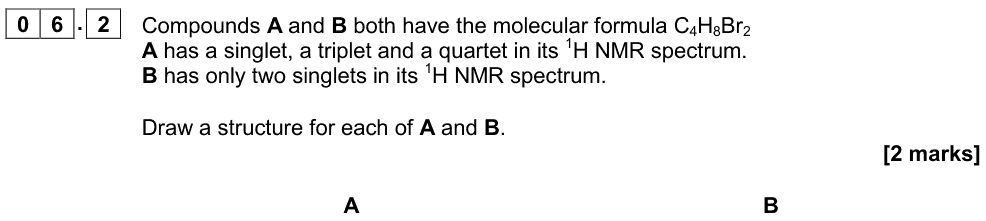
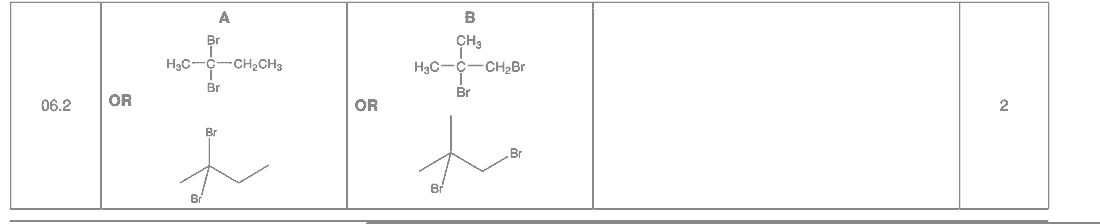
A is CH3CBr2CH2CH3 (2,2-dibromobutane: CH3 singlet, CH2 quartet, CH3 triplet). B is (CH3)2CBrCH2Br (1,2-dibromo-2-methylpropane: two singlets). A was found easier than the branched B
June 2019 · AS Paper 2 · Q07.11 markDiagram or structure
Mark scheme
Examiner's comment
7.1 Most students could draw the skeletal formula, but a significant number did struggle.
Notes from the mark scheme and report
Skeletal HOOC–CH2–COOH: three-carbon zig-zag with =O and –OH on each end carbon
the H atoms of the OH groups must be shown
June 2019 · Paper 2 · Q07.11 markShort answer
Mark scheme
Examiner's comment
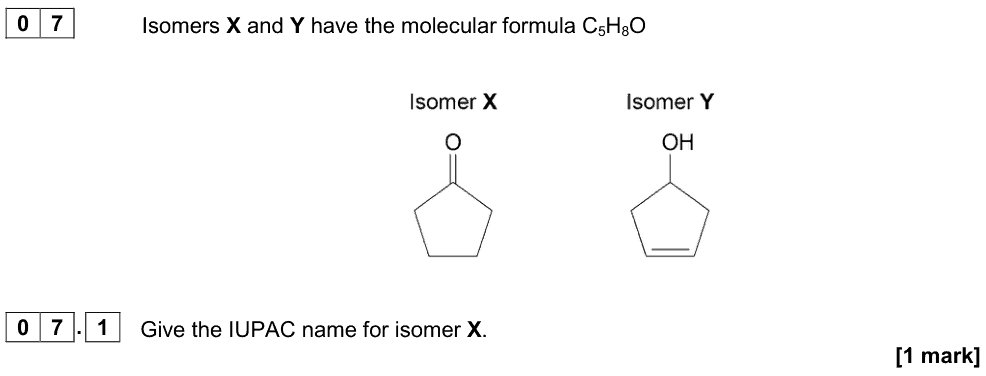
07.1 Many students struggled to name organic compounds in this paper correctly and the first part of this question was no exception. The incorrect naming of X indicated a general failure to observe the IUPAC rules for naming ketones and/or the cyclic nature of the compound.
Notes from the mark scheme and report
Cyclopentanone (allow cyclopentan-1-one
no other numbers). Naming was weak: ketone and ring rules not followed
June 2019 · Paper 2 · Q10.41 markDiagram or structureHard
Earlier part of question 10 that this part uses
Mark scheme
Examiner's comment
10.4 Only a third of the students were able to draw the correct structure for the diol.
Notes from the mark scheme and report
(CH3)2C(OH)C(OH)(CH3)2, 2,3-dimethylbutane-2,3-diol: twelve equivalent CH3 protons and two equivalent OH protons, with no H on adjacent carbons, so two singlets
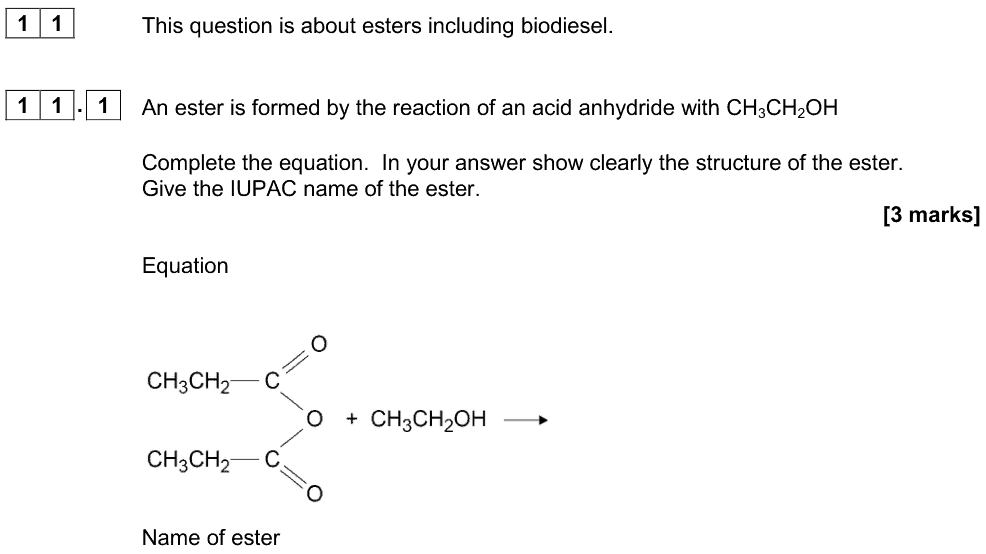
June 2019 · Paper 2 · Q11.13 marksEquation writing
Mark scheme
Examiner's comment
11.1 The first part of this question was fairly well answered. The structure of the ester was usually correct but the other product, propanoic acid, was often missing or given as ethanoic acid or water. Ethyl ethanoate was a common wrong answer for the name of the ester.
ethyl propanoate (this name only). Errors: second product missing or given as ethanoic acid or water
'ethyl ethanoate'
June 2019 · Paper 2 · Q11.32 marksDiagram or structureHard
Earlier part of question 11 that this part uses
Mark scheme
Examiner's comment
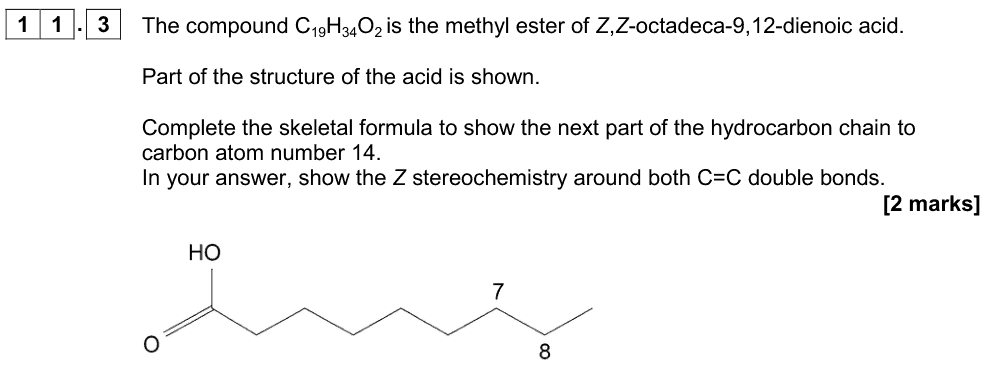
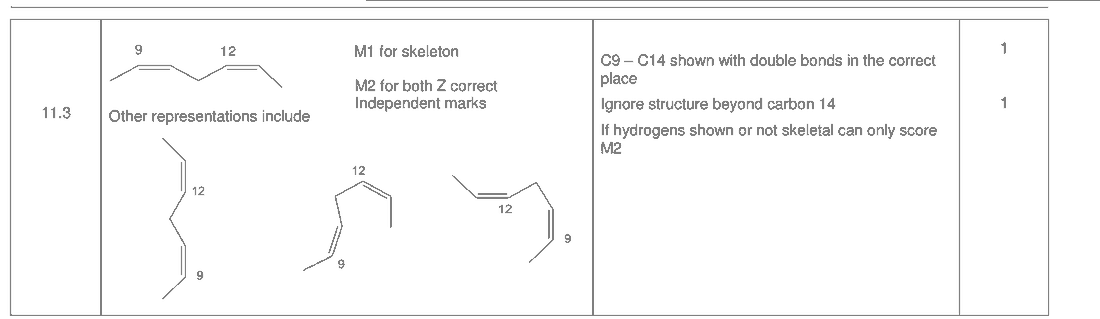
11.3 Part 3 was also found difficult; just over a sixth of students made no attempt and fewer than that number scored two marks. The position of the double bonds in the skeleton was more often correct than the Z stereochemistry. Sadly, a few students failed to gain a mark by showing H atoms in their otherwise skeletal formula.
Notes from the mark scheme and report
Continue the skeletal chain with C=C between carbons 9 and 10 and between carbons 12 and 13, single bonds 10–11–12 and 13–14, each double bond drawn Z (the chain continues on the same side at both ends of each C=C). M1 skeleton with double bonds in the right places
M2 both Z. Showing H atoms loses M1
Skills: MS4.2 Visualise and represent 2D and 3D forms including two-dimensional representations of 3D objects
June 2019 · AS Paper 2 · Q131 markMultiple choice
Answer
D
Mark scheme
Examiner's comment
Only about half the students could do this. This may stem from poor understanding of the number of H atoms in a skeletal structure.
Notes from the mark scheme and report
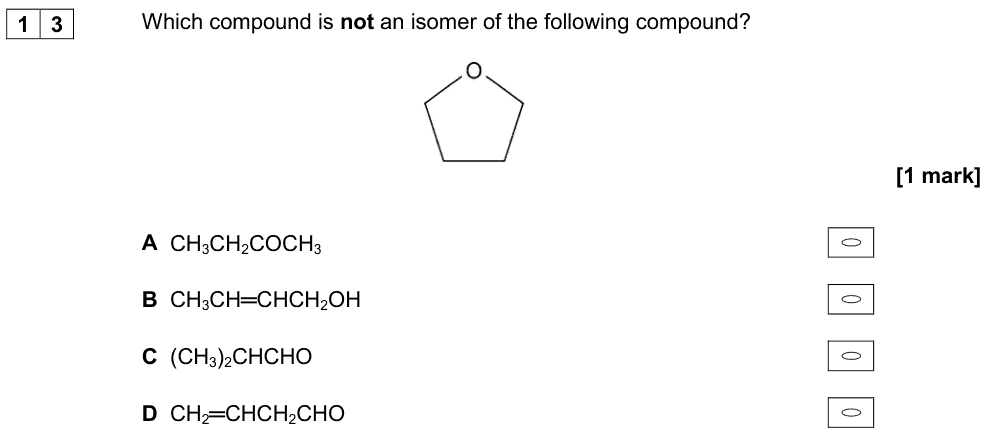
Answer: D. The cyclic ether shown is C4H8O
A, B and C are C4H8O but D, CH2=CHCH2CHO, is C4H6O. Count the H atoms on the skeletal structure
June 2019 · AS Paper 2 · Q141 markMultiple choice
Answer
C
Mark scheme
Examiner's comment
Few students got this correct, with most missing one or more isomers.
Notes from the mark scheme and report
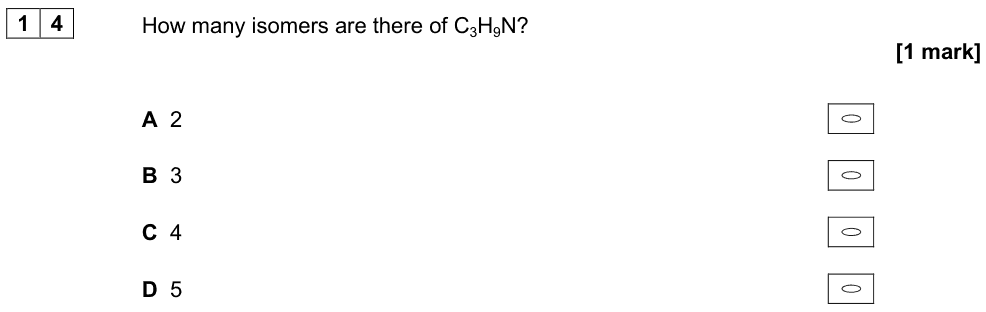
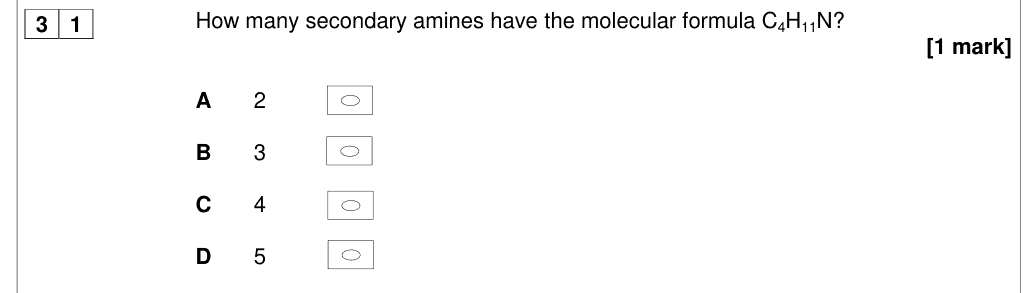
Answer: C. Four: propan-1-amine, propan-2-amine, N-methylethanamine and trimethylamine. Most missed at least one
June 2019 · AS Paper 2 · Q151 markMultiple choice
Answer
D
Mark scheme
Examiner's comment
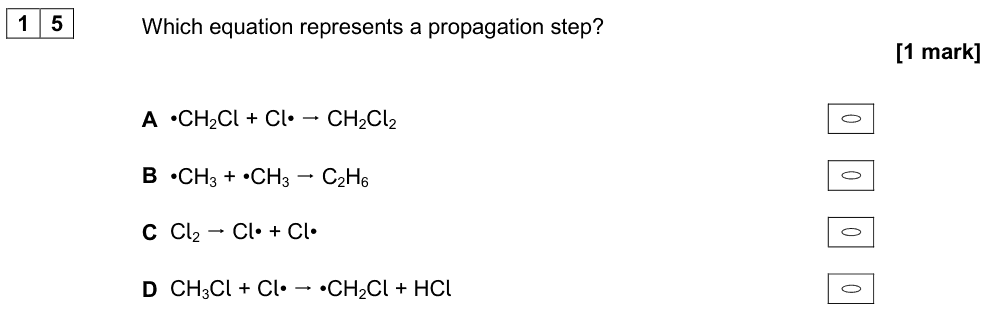
Most students could identify a propagation step from the options.
Notes from the mark scheme and report
Answer: D. A radical reacts with a molecule to give a new radical
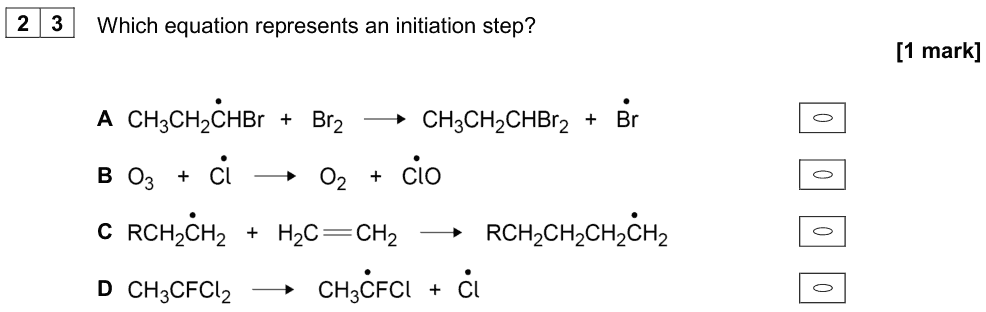
A and B are termination, C is initiation
June 2019 · AS Paper 2 · Q171 markMultiple choice
Answer
A
Mark scheme
Examiner's comment
This was answered correctly by a good majority of students.
Notes from the mark scheme and report
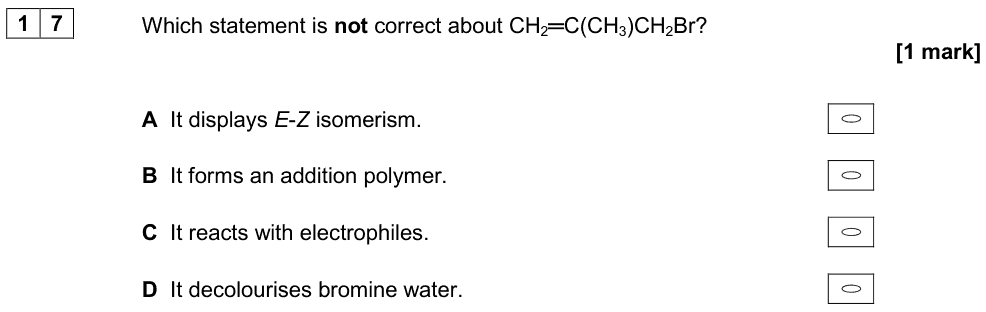
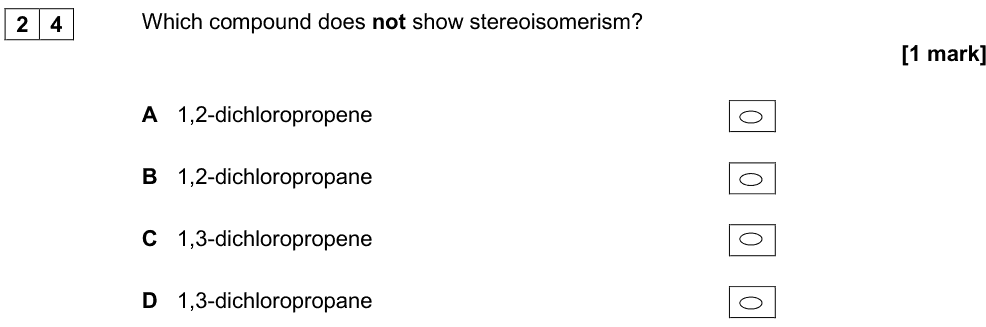
Answer: A. One carbon of the C=C carries two H atoms, so there is no E–Z isomerism
as an alkene it polymerises, reacts with electrophiles and decolourises bromine water
June 2019 · AS Paper 2 · Q181 markMultiple choice
Answer
D
Mark scheme
Examiner's comment
Students found this question more challenging. It would help students if they drew structures.
Notes from the mark scheme and report
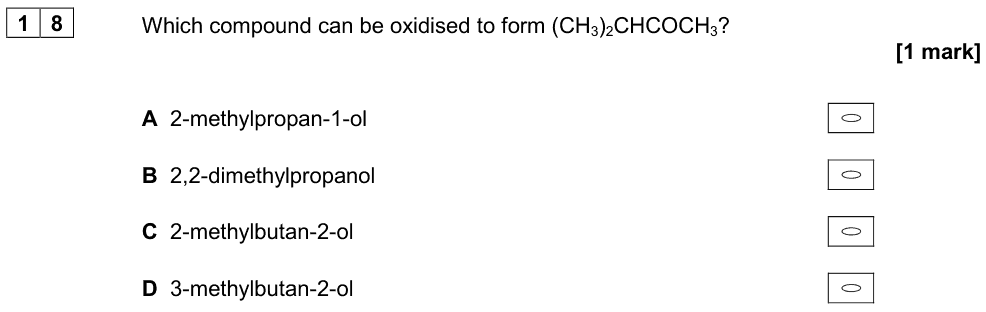
Answer: D. The ketone 3-methylbutan-2-one comes from the secondary alcohol 3-methylbutan-2-ol
A and B are primary, C is tertiary. Drawing the structures helps
June 2019 · AS Paper 2 · Q201 markMultiple choice
Answer
D
Mark scheme
Examiner's comment
This was answered correctly by a good majority of students.
Notes from the mark scheme and report
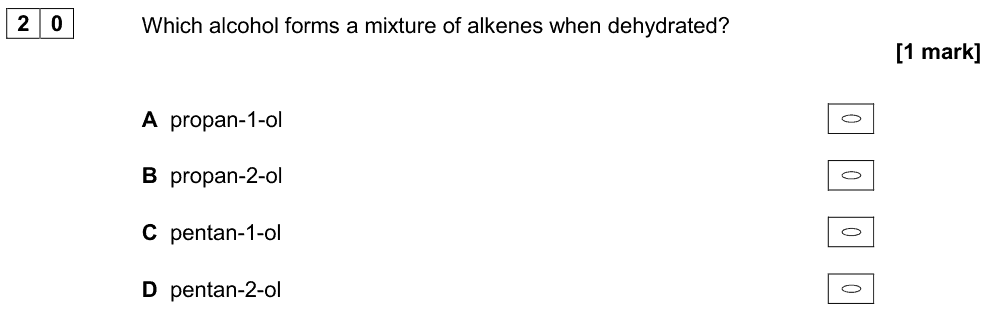
Answer: D. Pentan-2-ol can lose H from C1 or C3, giving pent-1-ene and pent-2-ene (E and Z)
the others give one alkene
June 2019 · Paper 3 · Q221 markMultiple choice
Answer
C
Mark scheme
Notes from the mark scheme and report
Answer: C. 1-phenylethanol, C6H5CH(OH)CH3, is a secondary alcohol, so it is oxidised to the ketone C6H5COCH3
June 2018 · Paper 2 · Q01.32 marksEquation writing
Earlier part of question 01 that this part uses
Mark scheme
Examiner's comment
01.3 Only the better students scored both marks, but nearly two-thirds of the students scored one out of two. Common errors were to give the ambiguous radical, C4H9
Notes from the mark scheme and report
Cl• + CH3CH2CH2CH3 → CH3CH2•CHCH3 + HCl
CH3CH2•CHCH3 + Cl2 → CH3CH2CHClCH3 + Cl•. The radical dot must be on the second carbon
the ambiguous radical C4H9• loses the first mark
June 2018 · Paper 2 · Q02.11 markShort answer
Mark scheme
Examiner's comment
02.1 Most students correctly identified the main chain and the prefixes. However, only 40% gained the mark because of frequent errors in applying IUPAC rules in the numbering and alphabetical order of prefixes.
Notes from the mark scheme and report
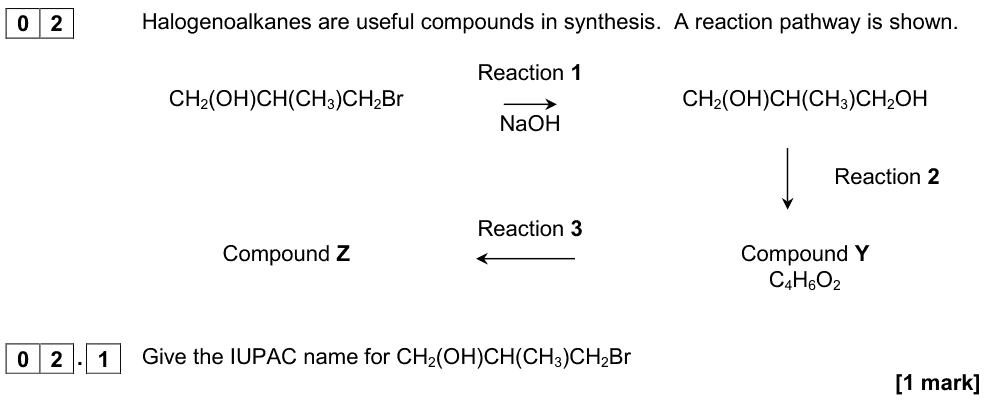
3-bromo-2-methylpropan-1-ol (the 3 and the 1 are essential). Errors in numbering and alphabetical order of prefixes
40% correct
June 2018 · Paper 2 · Q02.31 markDiagram or structure
Earlier part of question 02 that this part uses
Mark scheme
Examiner's comment
02.3 This question was answered correctly by 39.4% of the students. Others identified the correct molecule but did not draw it as a displayed formula; −CH3 was the most common error here. Some students drew an −OH group and a −C=O group in the same molecule, rather than two aldehyde groups; another common mistake was to draw butanedial.
Notes from the mark scheme and report
Y is methylpropanedial, OHC–CH(CH3)–CHO, drawn fully displayed with every bond shown (both CH2OH groups oxidised to CHO
C=O absorbs at 1680 to 1750 cm–1). Errors: –CH3 not displayed
one OH and one C=O
butanedial
June 2018 · Paper 2 · Q03.62 marksShort answer
Earlier part of question 03 that this part uses
Mark scheme
Examiner's comment
03.6 This part was challenging and a surprising proportion of students (8%) made no attempt. A large number scored no marks as they discussed the formation of different alkenes, rather than why pent-2-ene shows E-Z isomerism. Sadly, some of those who did gain the first mark failed to gain the second as this required two statements, not only that the C=C bond cannot rotate, but also that each carbon in the double bond has two different groups attached to it.
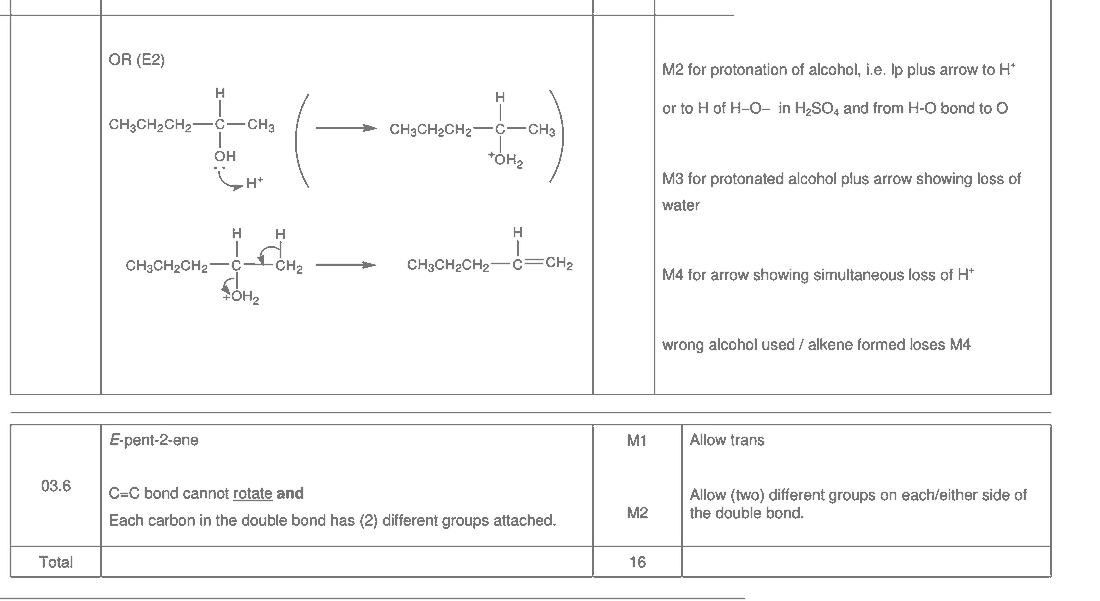
Notes from the mark scheme and report
E-pent-2-ene (allow trans). The C=C bond cannot rotate AND each carbon of the double bond has two different groups attached (both statements for the mark). Many wrote about different alkenes forming instead
June 2018 · AS Paper 2 · Q04.12 marksShort answer
Mark scheme
Examiner's comment
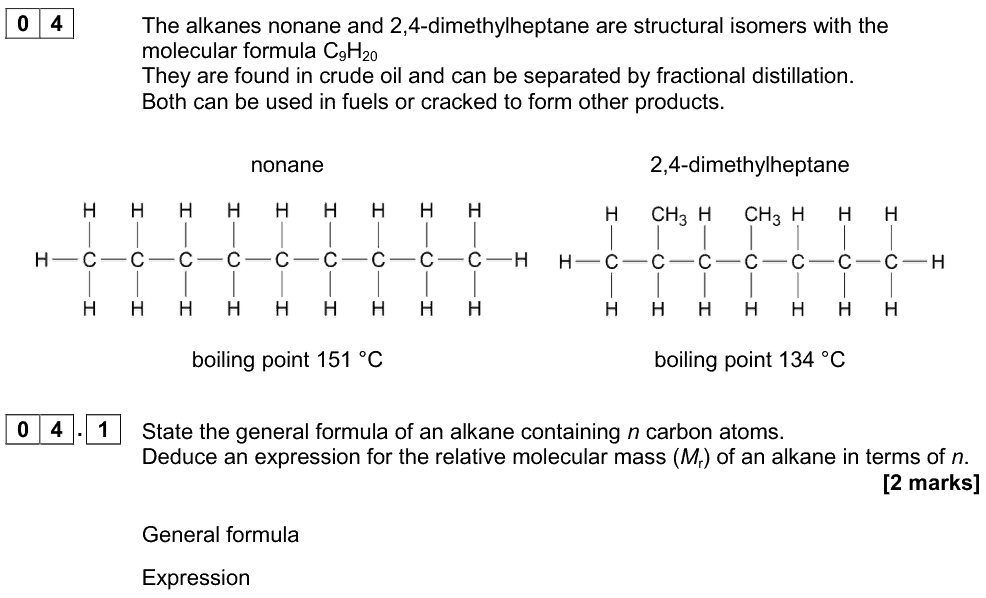
04.1 Most students knew the general formula of alkanes and many could also deduce the Mr in terms of n, where n is the number of C atoms.
Notes from the mark scheme and report
CnH2n+2
Mr = 14n + 2 (12n + 2n + 2)
Skills: MS2.1 Understand and use the symbols: =, <, <<, >>, >, ∝, ~, equilibrium sign
June 2018 · AS Paper 2 · Q05.16 marksCalculation
Mark scheme
Examiner's comment
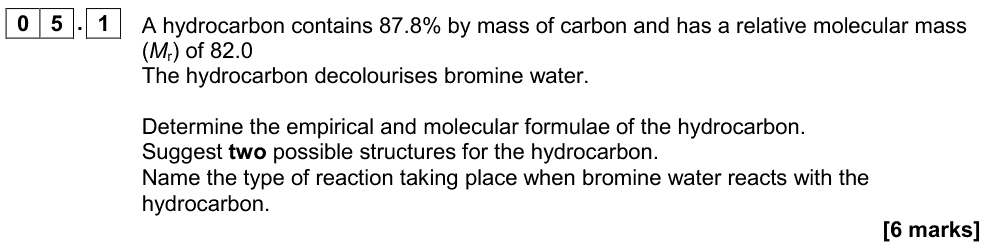
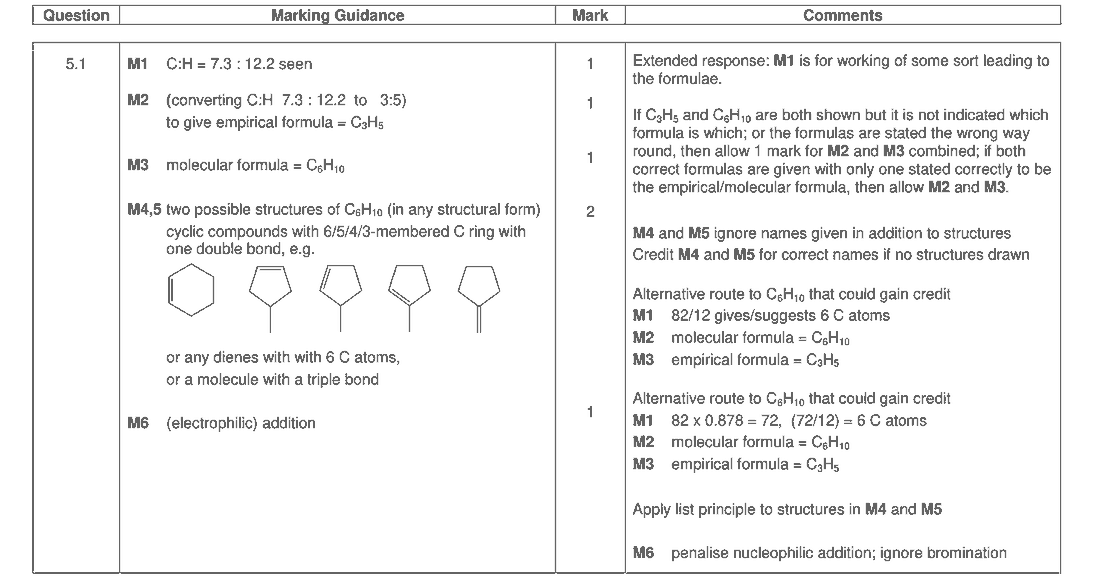
05.1 Some students could not convert the ratio 7.3 : 13.2 to a whole number ratio, but the question was answered well on the whole and discriminated well.
Notes from the mark scheme and report
Answer: empirical formula C3H5
molecular formula C6H10. C 87.8 ÷ 12.0 = 7.3
H 12.2 ÷ 1.0 = 12.2
ratio 1 : 1.67 = 3 : 5
C3H5 = 41.0 so × 2. Two structures of C6H10 (2 marks): for example cyclohexene, a methylcyclopentene, any hexadiene or a hexyne. Reaction type: (electrophilic) addition
nucleophilic addition is penalised. Some could not convert 7.3 : 12.2 to a whole-number ratio
Skills: MS0.2 Use ratios, fractions and percentages
June 2018 · AS Paper 2 · Q06.11 markShort answer
Mark scheme
Examiner's comment
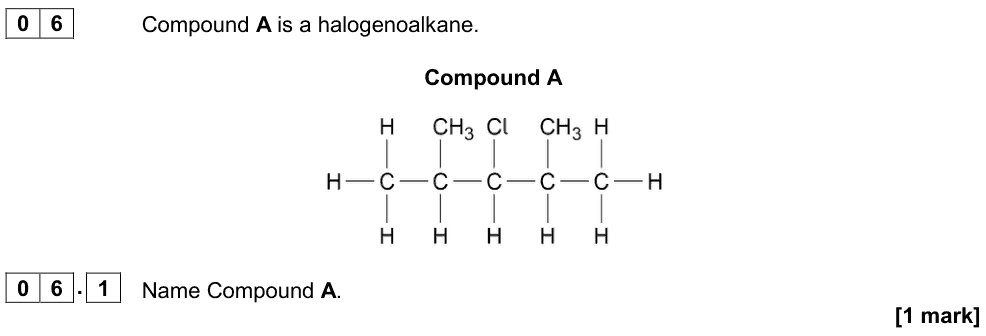
06.1 Most students (56.1%) could name compound A correctly.
Notes from the mark scheme and report
3-chloro-2,4-dimethylpentane (this name only)
June 2018 · Paper 2 · Q07.23 marksShort answer
Earlier part of question 07 that this part uses
Mark scheme
Examiner's comment
07.2 In this question, although some students struggled with the name, a number failed to gain the mark due to a failure to label 1-phenyl in an otherwise correct name. Most identified a correct reagent but “electrophilic addition” and “reduction” were frequent wrong answers for the name of the mechanism.
Notes from the mark scheme and report
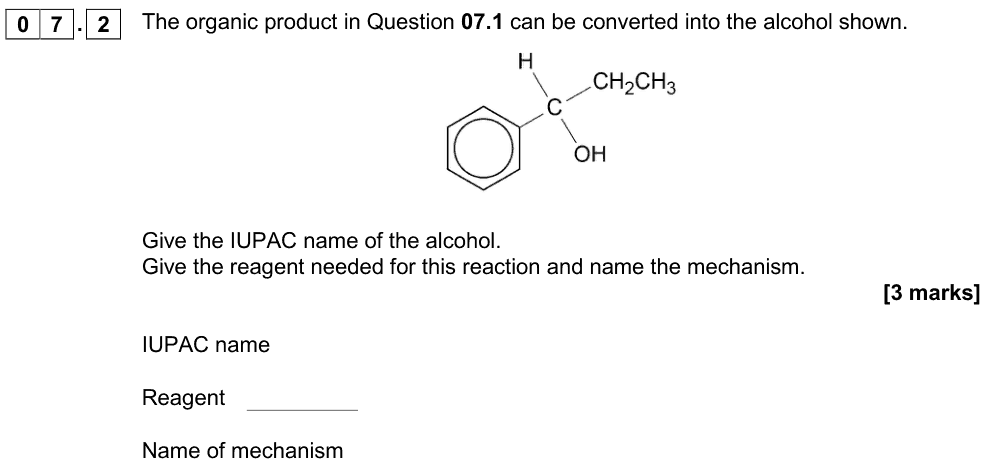
1-phenylpropan-1-ol (both numbers needed)
NaBH4 (or LiAlH4)
nucleophilic addition. Alternative: H2 with Ni, addition / hydrogenation. 'Reduction' and 'electrophilic addition' are not the mechanism name
June 2018 · Paper 2 · Q10.22 marksDiagram or structure
Earlier part of question 10 that this part uses
Mark scheme
Examiner's comment
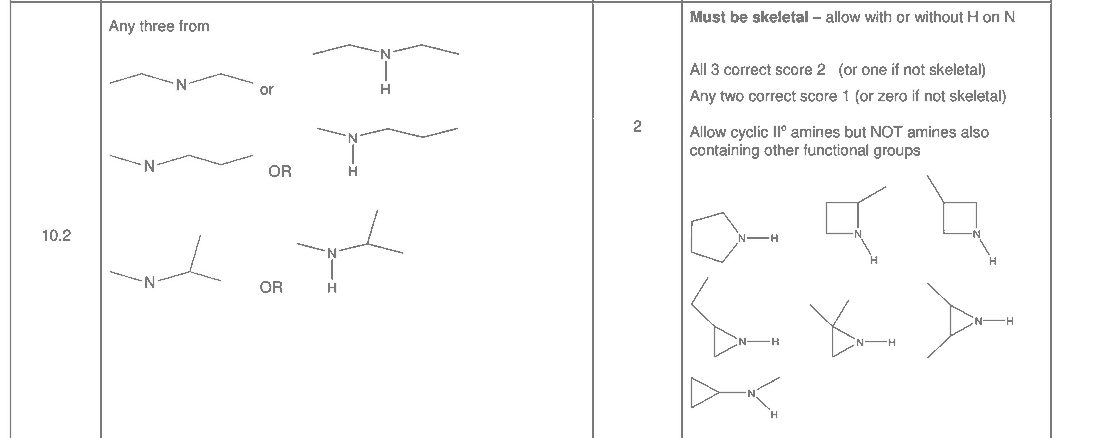
10.2 This question discriminated well and the best students drew three correct skeletal formulas. Cyclic secondary amines were accepted as long as there was no other functional group present, and one cyclic amine was sometimes included in place of the isomer with the branched propyl group. A common error was to draw primary amines based on branched alkyl groups.
Notes from the mark scheme and report
Skeletal formulas of diethylamine (N-ethylethanamine), N-methylpropan-1-amine and N-methylpropan-2-amine. All three for 2 marks, two for 1 (one less if not skeletal). Cyclic secondary amines allowed. Common error: branched primary amines
June 2018 · Paper 2 · Q10.41 markDiagram or structure
Earlier part of question 10 that this part uses
Mark scheme
Examiner's comment
10.4 This was answered well although 12.4% of the students did not attempt the question.
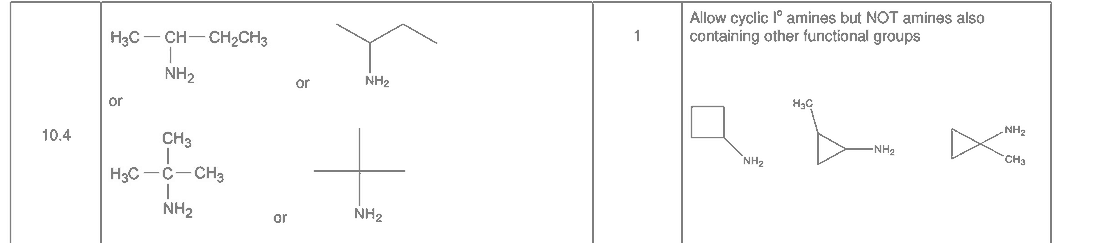
Notes from the mark scheme and report
Butan-2-amine, CH3CH(NH2)CH2CH3, or 2-methylpropan-2-amine, (CH3)3CNH2: the N is not on a CH2 group, so it cannot come from reducing a nitrile. Cyclic primary amines allowed
June 2018 · Paper 2 · Q11.31 markDiagram or structureHard
Earlier part of question 11 that this part uses
Mark scheme
Examiner's comment
11.3 Although this isomer was found to be the most difficult of the three, 32% of the students answered correctly. Others suggested cyclic structures that contained two primary amine groups and produced only two 13C NMR peaks, but sadly contained too few hydrogen atoms to be isomers of C6H16N2. As with the previous part, there were many students, 15.6%, who did not attempt to answer this question.
Notes from the mark scheme and report
H2N–C(CH3)2–C(CH3)2–NH2 (2,3-dimethylbutane-2,3-diamine). Cyclic suggestions had too few hydrogens to be isomers
Skills: MS4.3 Understand the symmetry of 2D and 3D shapes
June 2018 · Paper 2 · Q11.41 markDiagram or structure
Earlier part of question 11 that this part uses
Mark scheme
Examiner's comment
11.4 This isomer was drawn correctly by just over 40% of the students, but the question was also not attempted by 20.7%.
Notes from the mark scheme and report
(CH3)2N–CH2CH2–N(CH3)2 (not –C2H4–). Just over 40% correct
20.7% did not attempt it
Skills: MS4.3 Understand the symmetry of 2D and 3D shapes
June 2018 · AS Paper 2 · Q151 markMultiple choiceHard
Answer
C
Mark scheme
Examiner's comment
Few students (28.7%) got this correct, with most believing there are fewer isomers than there actually are.
Notes from the mark scheme and report
Answer: C. Dibromobutanes: 1,1-, 1,2-, 1,3-, 1,4-, 2,2- and 2,3-. Most thought there were fewer
June 2018 · AS Paper 2 · Q181 markMultiple choice
Answer
C
Mark scheme
Examiner's comment
Many students (46.8%) got this question correct but many others thought that NH4
+ could act as a nucleophile, possibly due to confusion with NH3.
Notes from the mark scheme and report
Answer: C. A nucleophile needs a lone pair to donate
PH3 has one on phosphorus. NH4+ has no lone pair (a common wrong choice, confused with NH3)
June 2018 · AS Paper 2 · Q231 markMultiple choiceEasy
Answer
D
Mark scheme
Examiner's comment
A high proportion of students (73.9%) could identify the initiation reaction, but many thought that the propagation step from the decomposition of ozone was an initiation reaction.
Notes from the mark scheme and report
Answer: D. Initiation forms radicals from a molecule with none: the C–Cl bond breaks to give two radicals. A, B and C each start and end with a radical (propagation). Many chose B, the ozone propagation step
June 2018 · Paper 3 · Q091 markMultiple choice
Answer
D
Mark scheme
Notes from the mark scheme and report
Answer: D. Two radicals combine to give a molecule (CH3C•FCl + Cl• → CH3CFCl2)
A, B and C each produce a new radical (propagation)
June 2018 · Paper 3 · Q281 markMultiple choice
Answer
B
Mark scheme
Examiner's comment
28 A was the commonest incorrect response to this question which had a 47% success rate. This suggests there were many students who recognised that the answer is an aldehyde, but who then missed a possible isomer. Drawing out possible structures in a logical sequence is the key here. Students are advised to start with a 5C chain, then 4C and find
Notes from the mark scheme and report
Answer: B. Only aldehydes react: pentanal, 2-methylbutanal, 3-methylbutanal and 2,2-dimethylpropanal. Work through 5-carbon, 4-carbon then 3-carbon chains
A (one missed) was the common wrong answer
June 2017 · Paper 2 · Q01.11 markDiagram or structure
Mark scheme
Examiner's comment
01.1 Although most students identified compound J as propan-1-ol, a surprising number failed to show the O−H bond as is necessary in a displayed formula.
Notes from the mark scheme and report
Displayed formula of propan-1-ol, CH3CH2CH2OH, showing every bond including O–H. Many did not draw the O–H bond
June 2017 · Paper 2 · Q01.42 marksDiagram or structureHard
Earlier part of question 01 that this part uses
Mark scheme
Examiner's comment
01.4 Only 30% of students scored both marks here. Others drew a primary amine or a non- skeletal structure.
Notes from the mark scheme and report
Skeletal formula of tripropylamine, N(CH2CH2CH3)3
tertiary amine (only credited if a tertiary amine is drawn). Errors: a primary amine
a non-skeletal structure
June 2017 · Paper 2 · Q01.64 marksMechanism
Earlier part of question 01 that this part uses
Mark scheme
Examiner's comment
01.6 This was a high scoring question for many. For others, the main errors were missing the negative sign or the lone pair on the hydroxide ion, or showing attack on the wrong hydrogen atom.
Notes from the mark scheme and report
(Base) elimination. Arrow from the lone pair on O of OH– to an H on carbon 2
arrow from that C–H bond to the C1–C2 bond
arrow from the C–Br bond to Br. E1 also credited. Nucleophilic substitution scores M3 only. Errors: no negative charge or lone pair on hydroxide
attack on the wrong H
June 2017 · AS Paper 2 · Q03.16 marks6-mark level of response
Mark scheme, with the levels and indicative content
Examiner's comment
03.1 Most students made good progress with this question, with many identifying one or more of the three compounds. However, few scored full marks as they did not explain how they deduced the structures. Many did not explain the significance of the results of the tests with bromine water. The meaning of the term stereoisomers was not well known, and often confused with structural isomers; few referred to the restricted rotation around the C=C bond leading to stereoisomers in molecules where both of the C atoms in the C=C bond have two different groups attached. Some students incorrectly suggested that alkenes that do not have stereoisomers have free rotation around the C=C bond.
Notes from the mark scheme and report
Levels of response, three stages. Saturated or unsaturated: A and B are alkenes (contain C=C) because they decolourise bromine water
C is saturated (a cycloalkane) because it does not. Structures: A = pent-1-ene, 2-methylbut-1-ene, 3-methylbut-1-ene or 2-methylbut-2-ene
B = pent-2-ene
C = cyclopentane, methylcyclobutane or a dimethylcyclopropane. Stereoisomerism: same structural formula but a different arrangement of atoms in space
arises because the C=C cannot rotate and each C of the C=C has two different groups (or draw E and Z pent-2-ene). Errors: deductions not explained
stereoisomers confused with structural isomers
restricted rotation not mentioned
June 2017 · Paper 2 · Q04.11 markShort answer
Mark scheme
Examiner's comment
04.1 As usual, naming nitriles proved difficult for some, but 56% of students gave the correct answer.
Notes from the mark scheme and report
2-hydroxyhexanenitrile (the nitrile carbon is carbon 1)
June 2017 · AS Paper 2 · Q04.22 marksCalculation
Earlier part of question 04 that this part uses
Mark scheme
Examiner's comment
04.2 This question required students to rearrange a mathematical expression, but many could not do this because they made errors with minus signs on rearrangement.
Notes from the mark scheme and report
Answer: C13H28. –6650 = –(496n + 202), so 496n = 6448 and n = 13. C13H28 without working scores 1. Common error: minus signs when rearranging
Skills: MS2.2 Change the subject of an equation; MS2.4 Solve algebraic equations
June 2017 · AS Paper 2 · Q06.32 marksShort answer
Earlier part of question 06 that this part uses
Mark scheme
Examiner's comment
06.3 Most students knew that an elimination reaction took place, but few could give the correct name for the product, methylpropene.
Notes from the mark scheme and report
Methylpropene (allow 2-methylpropene
no name with a number for the double bond position)
elimination (allow base elimination). Few named the product correctly
June 2017 · Paper 2 · Q06.46 marksMechanismHard
Earlier part of question 06 that this part uses
Mark scheme
Examiner's comment
06.4 This question was well answered and 25% of students scored all six marks. The name of the organic product was the most common mark lost, closely followed by slips in the third or fourth marks in the mechanism.
Notes from the mark scheme and report
(Nucleophilic) addition–elimination. Arrow from the lone pair on N of CH3CH2NH2 to the C of C=O
arrow from C=O bond to O
intermediate with O– and N+
then lone pair on O– reforms C=O, C–Cl bond breaks to Cl and N–H bond breaks to N+. Product: N-ethylpropanamide. The name was the mark most often lost
June 2017 · AS Paper 2 · Q08.11 markDiagram or structure
Mark scheme
Examiner's comment
08.1 This straightforward question was not answered well. Many students drew 2-methylbutanal rather than 3-methylbutanal, not appreciating that the C atom in the aldehyde group is carbon-1.
Notes from the mark scheme and report
Skeletal formula of (CH3)2CHCH2CHO: a four-carbon chain ending in C=O (the aldehyde carbon is C1) with a methyl branch on C3. Must be skeletal. Common error: 2-methylbutanal
June 2017 · AS Paper 2 · Q08.21 markDiagram or structure
Earlier part of question 08 that this part uses
Mark scheme
Examiner's comment
08.2 Many students drew the displayed structure of the correct product, thereby demonstrating their understanding of the identity of the major product of this addition reaction of hydrogen bromide to the alkene.
Notes from the mark scheme and report
Displayed formula of 2-bromo-2-methylbutane, CH3C(CH3)BrCH2CH3, with every bond shown (Br on the carbon that gives the tertiary carbocation)
June 2017 · AS Paper 2 · Q09.21 markShort answer
Earlier part of question 09 that this part uses
Mark scheme
Examiner's comment
09.2 This question required students to know how many hydrogen atoms were on each carbon atom in a skeletal structure, but many struggled to count them correctly.
Notes from the mark scheme and report
Answer: 38 (C24H38O4: 4 H on the benzene ring and 17 H in each of the two C8H17 groups). Many miscounted H atoms on the skeletal structure
June 2017 · Paper 2 · Q10.11 markShort answerHard
Mark scheme
Examiner's comment
10.1 The full IUPAC name of isomer P includes the letter Z to indicate its stereochemistry. Only 10% of students answered this difficult question correctly.
Notes from the mark scheme and report
Z-2-methylpent-2-enoic acid (the CH3CH2 and COOH priority groups are on the same side of the C=C). The Z was usually missing
June 2017 · AS Paper 2 · Q141 markMultiple choice
Answer
C
Mark scheme
Examiner's comment
Many students (48%) got this correct, but many incorrectly thought that E-but-2-ene is a structural isomer of Z-but-2-ene.
Notes from the mark scheme and report
Answer: C. Cyclobutane is C4H8 with a different structural formula
E-but-2-ene is a stereoisomer, not a structural isomer
June 2017 · AS Paper 2 · Q151 markMultiple choiceEasy
Answer
D
Mark scheme
Examiner's comment
This was answered well with a high proportion of the students (68.8%) scoring the mark.
Notes from the mark scheme and report
Answer: D. Propagation: a radical reacts and a new radical forms: •CCl3 + Cl2 → CCl4 + •Cl (B is termination)
June 2017 · AS Paper 2 · Q181 markMultiple choiceHard
Answer
B
Mark scheme
Examiner's comment
A minority of students (31.9%) scored this mark, with many incorrectly thinking there were one more or one fewer isomers than there actually were. Students are encouraged to take a systematic approach to deducing all possible structures.
Notes from the mark scheme and report
Answer: B. Five: 1-bromo-1-chloropropane, 1-bromo-2-chloropropane, 2-bromo-1-chloropropane, 1-bromo-3-chloropropane, 2-bromo-2-chloropropane. Work systematically
June 2017 · AS Paper 2 · Q201 markMultiple choice
Answer
C
Mark scheme
Examiner's comment
Students also found this question challenging (41.8% correct), with many failing to appreciate that only one molecule did not contain any oxygen and so must have a different value from the others.
Notes from the mark scheme and report
Answer: C. Butanone, cyclobutanol and methylpropanal are all C4H8O
dimethylpropane is C5H12, which has a different precise mass (same integer mass, 72)
June 2017 · Paper 3 · Q02.31 markDiagram or structure
Earlier part of question 02 that this part uses
Mark scheme
Examiner's comment
02.3 Most students who showed a secondary carbocation structure in question 02.2, were able correctly to show the structure of a primary carbocation here. If a primary ion structure had been shown in 02.2, ‘ecf’ was allowed for those (relatively few) students.
Notes from the mark scheme and report
CH3CH2CH2OSO3H (propyl hydrogensulfate, from the primary carbocation). Error carried forward from 02.2 is allowed
June 2017 · Paper 3 · Q02.53 marksDiagram or structure
Earlier part of question 02 that this part uses
Mark scheme
Examiner's comment
02.5 This was another question that proved trickier than expected, with a roughly even split between 0, 1, 2 and 3 marks. ‘Butan’ or ‘bute’ were often seen as incorrect stems of names and a very common error was for the same isomer of but-2-ene to be drawn twice, with one named as Z-but-2-ene and the other as E-but-2-ene.
Notes from the mark scheme and report
But-1-ene
E-but-2-ene
Z-but-2-ene: each skeletal formula with its matching name scores 1. cis / trans scores 1 of the 2 marks for the but-2-enes. Errors: the same but-2-ene drawn twice with different labels
wrong stems ('butan', 'bute')
Skills: MS4.2 Visualise and represent 2D and 3D forms including two-dimensional representations of 3D objects
June 2017 · Paper 3 · Q211 markMultiple choice
Answer
B
Mark scheme
Notes from the mark scheme and report
Answer: B. Hydroxide removes an H from the CH3 group (C), the C–H bond pair forms the C=C bond (A) and the C=O pi bond pair moves on to oxygen (D)
no arrow goes from the C=O bond to the C–C bond
June 2017 · Paper 3 · Q241 markMultiple choice
Answer
D
Mark scheme
Notes from the mark scheme and report
Answer: D. 1,3-dichloropropane has no C=C bond and no chiral carbon. The two dichloropropenes show E–Z isomerism and 1,2-dichloropropane has a chiral centre
June 2016 · AS Paper 2 · Q03.11 markShort answer
Mark scheme
Examiner's comment
The naming of the molecule, in Q3.1 was answered correctly by many students.
Notes from the mark scheme and report
2,2,4-trimethylpentane (this answer only
ignore punctuation)
June 2016 · AS Paper 2 · Q05.21 markDiagram or structure
Earlier part of question 05 that this part uses
Mark scheme
Examiner's comment
In Q5.1the two equations showing how chlorine radicals destroy ozone were quite well known.Many students in Q5.2 could draw the correct displayed formula of chloropentafluoroethane.
Notes from the mark scheme and report
Displayed formula of CF3CF2Cl: two carbons joined by a single bond, one carbon with three F atoms and the other with two F atoms and one Cl atom, every bond drawn
June 2016 · AS Paper 2 · Q05.42 marksEquation writing
Earlier part of question 05 that this part uses
Mark scheme
Examiner's comment
Students in Q5.4 found the two propagation steps to convert CHF2CH3 into CF3CH3 more challenging, but a pleasing number could do this.
The most common mistake was to remove a Hydrogen atom from the wrong Carbon atom in the first step.
Notes from the mark scheme and report
CHF2CH3 + F• → •CF2CH3 + HF, then •CF2CH3 + F2 → CF3CH3 + F•. Most common error: removing the hydrogen atom from the wrong carbon (the CH3 group)
June 2016 · AS Paper 2 · Q06.11 markDiagram or structure
Mark scheme
Examiner's comment
Q6.1 was generally well done except for students who showed bonds going to the H of the OH group rather than the O.
Notes from the mark scheme and report
Skeletal formula: three-carbon zigzag with an OH on an end carbon and an OH on the middle carbon. Bonds must go to the O of each OH, not to the H
June 2016 · AS Paper 2 · Q07.11 markDiagram or structure
Mark scheme
Examiner's comment
7.1 Many students could draw the correct structure of the Z isomer in Q7.1.
Notes from the mark scheme and report
Z isomer: the higher-priority groups, CH3 on carbon 2 (over H) and CH2CH3 on carbon 3 (over CH3), are on the same side of the C=C. All four groups on the C=C must be shown
Skills: MS4.2 Visualise and represent 2D and 3D forms including two-dimensional representations of 3D objects
June 2016 · AS Paper 2 · Q07.27 marksMechanism
Earlier part of question 07 that this part uses
Mark scheme
Examiner's comment
Many students did well on Q7.2, but a significant number attempted to describe the curly
Notes from the mark scheme and report
Electrophilic addition. Curly arrow from the C=C to the H of H–Br
arrow from the H–Br bond to Br
tertiary carbocation CH3CH2C+(CH3)CH2CH3
arrow from a lone pair on Br– to the C+. 3-bromo-3-methylpentane is formed via the tertiary carbocation (the 2-bromo isomer via a secondary one), and the tertiary carbocation is more stable than the secondary. The explanation must be about the stability of carbocations, not products.
June 2016 · AS Paper 2 · Q131 markMultiple choice
Answer
B
Mark scheme
Notes from the mark scheme and report
Answer: B. Elimination: the lone pair on :OH– takes the H from carbon 3 (the carbon carrying the CH3 branch), the C–H bond pair forms the C=C between carbons 2 and 3, and the C–Br bond breaks to give Br–. A removes H from carbon 1 (gives 3-methylbut-1-ene)
C and D show the wrong atoms attacked
June 2016 · AS Paper 2 · Q181 markMultiple choice
Answer
B
Mark scheme
Notes from the mark scheme and report
Answer: B. Cyclohexene is C6H10: a ring and a C=C each remove two hydrogens from CnH2n+2, giving CnH2n–2
Specimen · Paper 2 · Q03.11 markAO1=1Short answer
Mark scheme
Notes from the mark scheme and report
2,2,4-trimethylpentane.
Specimen · Paper 2 · Q03.52 marksDiagram or structure
Earlier part of question 03 that this part uses
Mark scheme
Notes from the mark scheme and report
4 monochloro isomers. The optically active one shown in the scheme is (CH3)2CH–CHCl–C(CH3)3 (3-chloro-2,2,4-trimethylpentane): the CHCl carbon has four different groups
Specimen · Paper 2 · Q03.61 markAO2=1Diagram or structure
Earlier part of question 03 that this part uses
Mark scheme
Notes from the mark scheme and report
Skeletal formula of 1-chloro-2,2,3,3-tetramethylbutane (from 2,2,3,3-tetramethylbutane, in which all 18 H are equivalent)
Specimen · Paper 2 · Q04.11 markAO1=1Short answer
Mark scheme
Notes from the mark scheme and report
3-methylbutan-2-ol.
Specimen · Paper 2 · Q04.42 marksAO2=2Diagram or structure
Earlier part of question 04 that this part uses
Mark scheme
Notes from the mark scheme and report
(CH3)2C=CHCH3 (2-methylbut-2-ene) and (CH3)2CHCH=CH2 (3-methylbut-1-ene), one mark each
Specimen · Paper 2 · Q04.51 markAO1=1Short answer
Earlier part of question 04 that this part uses
Mark scheme
Notes from the mark scheme and report
Position (isomerism)
Specimen · Paper 2 · Q04.71 markAO2=1Diagram or structure
Earlier part of question 04 that this part uses
Mark scheme
Notes from the mark scheme and report
(CH3)2C(OH)CH2CH3 (2-methylbutan-2-ol, the tertiary alcohol)
Specimen · Paper 2 · Q04.81 markAO2=1Diagram or structure
Earlier part of question 04 that this part uses
Mark scheme
Notes from the mark scheme and report
(CH3)3CCH2OH (2,2-dimethylpropan-1-ol): the carbon next to the C–OH carbon has no hydrogen
Specimen · Paper 2 · Q06.41 markAO2=1Short answer
Earlier part of question 06 that this part uses
Mark scheme
Notes from the mark scheme and report
2-amino-3-hydroxybutanoic acid
Specimen · Paper 3 · Q241 markAO1=1Multiple choice
Answer
B
Mark scheme
Notes from the mark scheme and report
Answer: B. Pentane, 2-methylbutane and 2,2-dimethylpropane
Specimen · Paper 3 · Q261 markAO1=1Multiple choice
Answer
C
Mark scheme
Notes from the mark scheme and report
Answer: C. 1-bromobutane, 2-bromobutane, 1-bromo-2-methylpropane and 2-bromo-2-methylpropane
Specimen · Paper 3 · Q311 markAO1=1Multiple choice
Answer
B
Mark scheme
Notes from the mark scheme and report
Answer: B. Diethylamine, N-methylpropan-1-amine and N-methylpropan-2-amine
Work with an A-level chemistry tutor
Dropping marks on calculations, mechanisms or the required practicals? Book a trial session with a specialist A-level chemistry tutor.