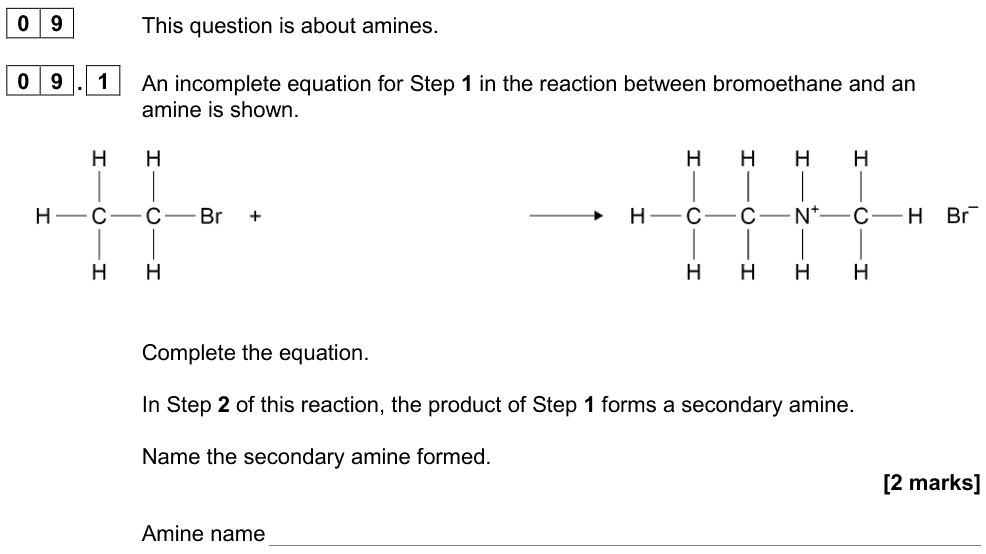
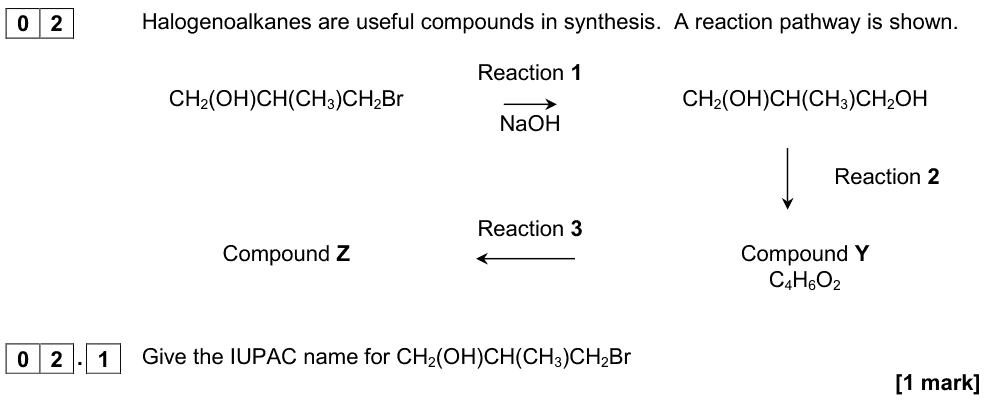
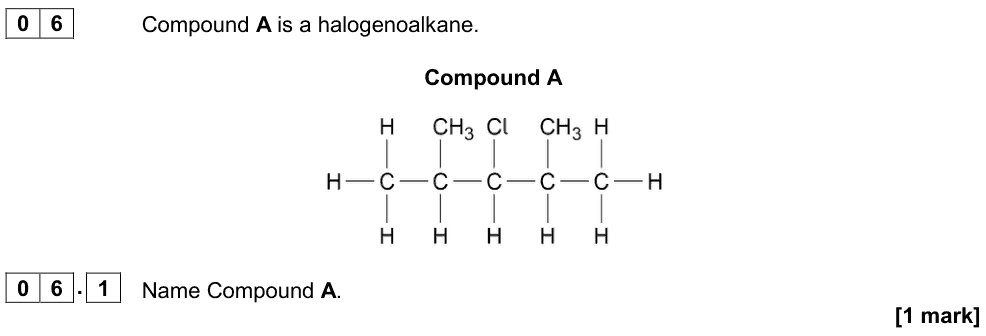
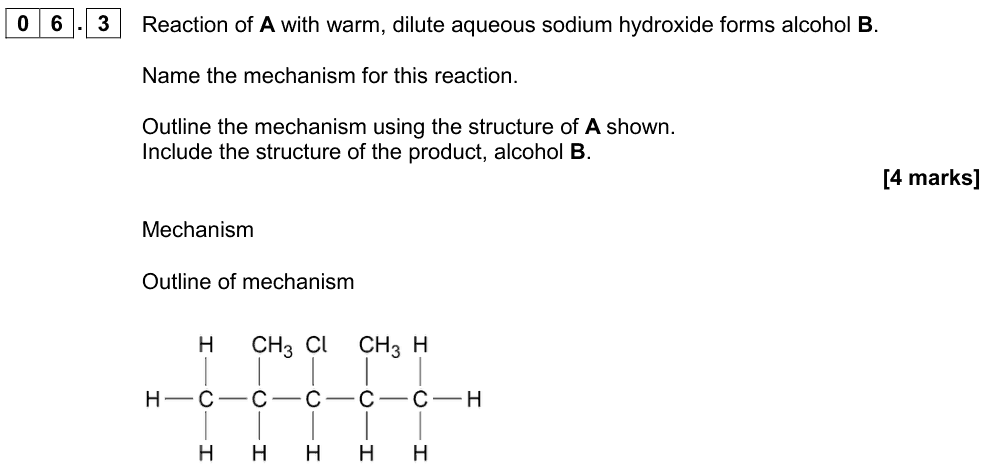
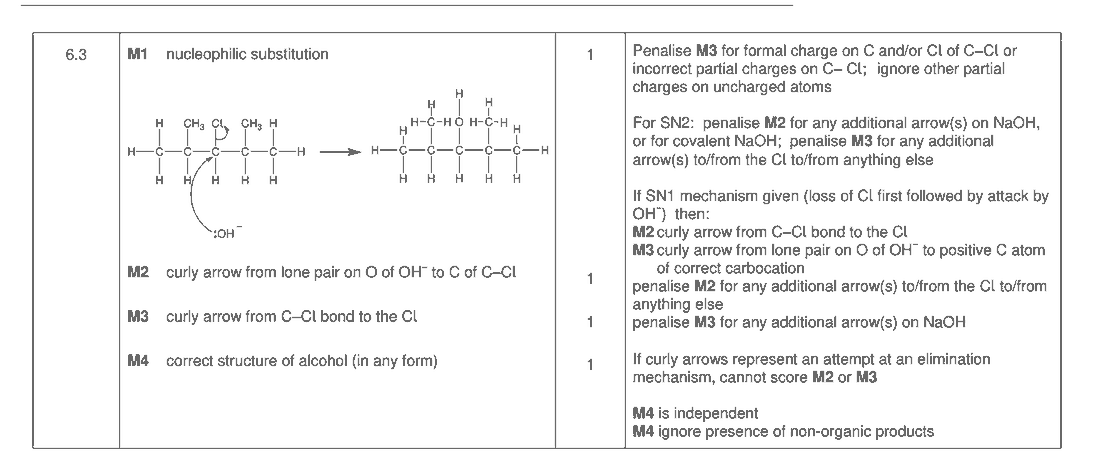
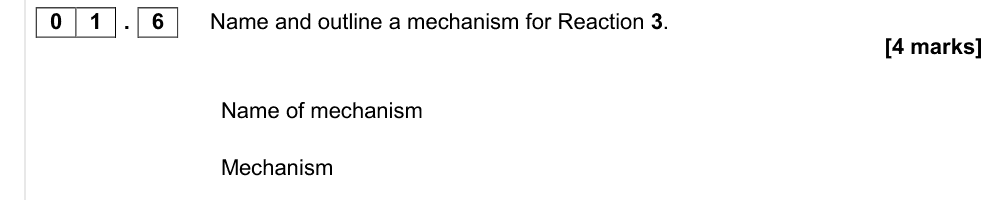
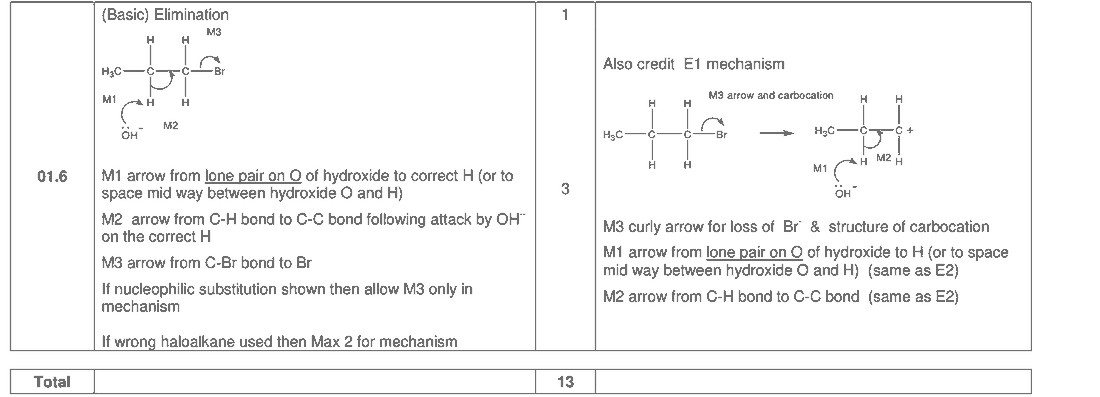
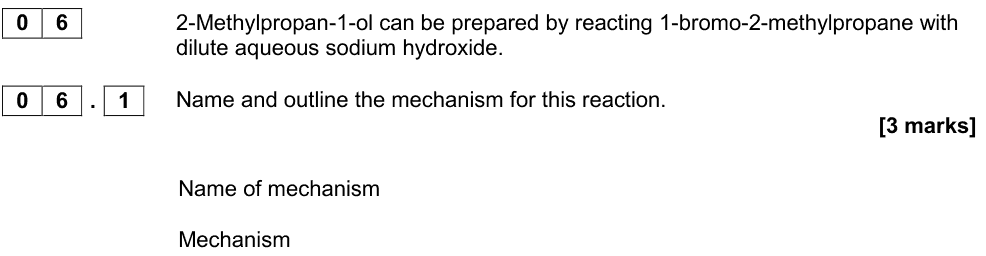
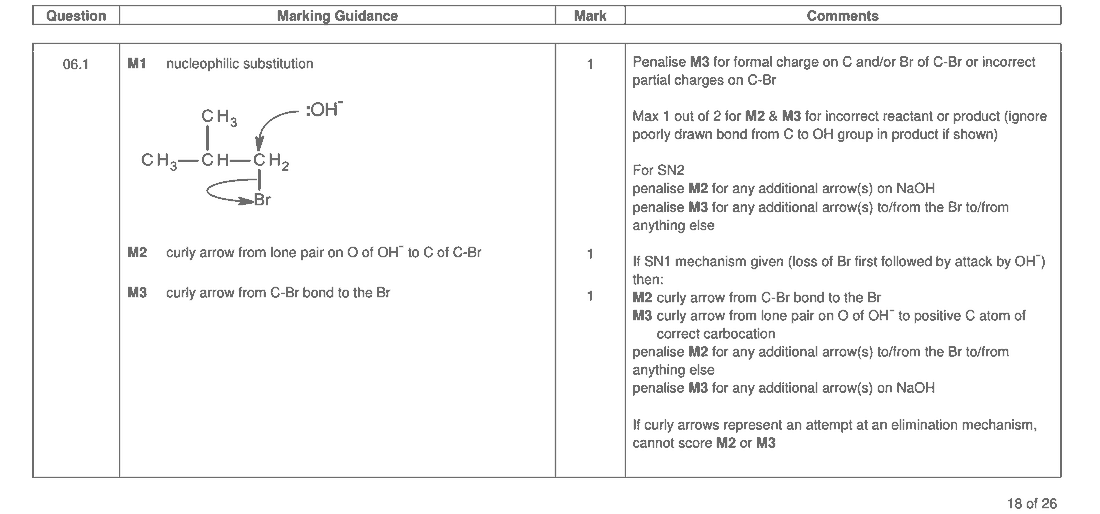
Notes and key-term cards for this topic are being written by our tutors. The past-paper questions below are ready now.
Specification statements
Show the 10 statements from the specification
3.3.3.1-01 Halogenoalkanes contain polar bonds.
3.3.3.1-02 Halogenoalkanes undergo substitution reactions with the nucleophiles OH–, CN– and NH3
3.3.3.1-03 Students should be able to: • outline the nucleophilic substitution mechanisms of these reactions • explain why the carbon–halogen bond enthalpy influences the rate of reaction.
3.3.3.2-01 The concurrent substitution and elimination reactions of a halogenoalkane (eg 2-bromopropane with potassium hydroxide).
3.3.3.2-02 Students should be able to: • explain the role of the reagent as both nucleophile and base • outline the mechanisms of these reactions.
3.3.3.3-01 Ozone, formed naturally in the upper atmosphere, is beneficial because it absorbs ultraviolet radiation.
3.3.3.3-02 Chlorine atoms are formed in the upper atmosphere when ultraviolet radiation causes C–Cl bonds in chlorofluorocarbons (CFCs) to break.
3.3.3.3-03 Chlorine atoms catalyse the decomposition of ozone and contribute to the hole in the ozone layer.
3.3.3.3-04 Appreciate that results of research by different groups in the scientific community provided evidence for legislation to ban the use of CFCs as solvents and refrigerants. Chemists have now developed alternative chlorine-free compounds.
3.3.3.3-05 Students should be able to: • use equations, such as the following, to explain how chlorine atoms catalyse decomposition of ozone: Cl• + O3 → ClO• + O2 and ClO• + O3 → 2O2 + Cl•
Tap a question to zoom it. Where a part needs a figure, table or structure from earlier in the question, that part folds out above it; the mark scheme and examiner's comment open underneath. Have AQA's Data Booklet (the Periodic Table and the spectroscopy tables) beside you.
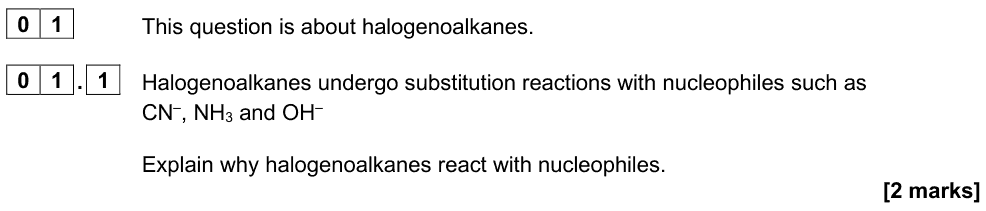
June 2025 · AS Paper 2 · Q01.12 marksAO1=2Explanation
Mark scheme
Examiner's comment
1.1 This question looked at why halogenoalkanes react with nucleophiles. Few students referred to the C of the C-halogen bond being δ+ with many just stating that the bond was polar. Many students failed to mention that nucleophiles have a lone pair of electrons and that this is attracted to the δ+ C atom in the C-halogen bond.
Notes from the mark scheme and report
The C of the C–halogen bond is δ+ (halogen more electronegative)
the lone pair on the nucleophile is attracted to / attacks this carbon. 'The bond is polar' alone was not enough
many did not mention the lone pair
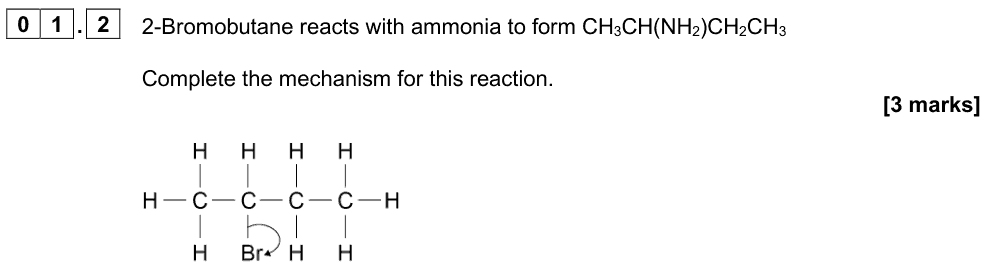
June 2025 · AS Paper 2 · Q01.23 marksAO1=1, AO2=2Mechanism
Earlier part of question 01 that this part uses
Mark scheme
Examiner's comment
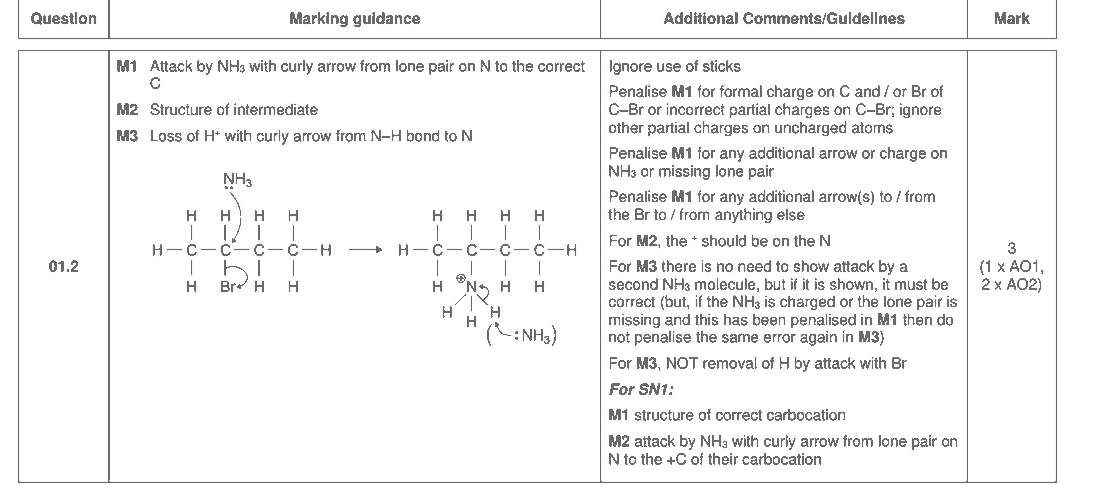
1.2 Students had to complete a nucleophilic substitution mechanism. Many did it well including a few who did an SN1 rather than SN2 mechanism. Common errors were putting a minus charge on NH3 or showing incorrect breaking of the N-H bond in the last step.
Notes from the mark scheme and report
M1 curly arrow from the lone pair on N of NH3 to the C bonded to Br
M2 intermediate CH3CH(NH3+)CH2CH3 with + on N
M3 curly arrow from an N–H bond to N+ (loss of H+, a second NH3 may remove it). Not removal of H by Br–
no charge on NH3. An SN1 route via the correct carbocation is also credited. Errors: NH3 given a minus charge
N–H bond broken the wrong way
June 2025 · AS Paper 2 · Q01.31 markAO1=1Short answer
Earlier part of question 01 that this part uses
Mark scheme
Examiner's comment
1.3 Students were asked to identify the solvent that is used in order for a substitution reaction to occur. A minority gave the correct answer water, with many stating alcohol/ethanol with many others giving reagents (rather than solvents) that would lead to other reactions. Many students did not seem to understand how changing the solvent affects the reaction with hydroxide ions.
Notes from the mark scheme and report
Water / aqueous. Not ethanol or alcohol. Many gave ethanol or named other reagents
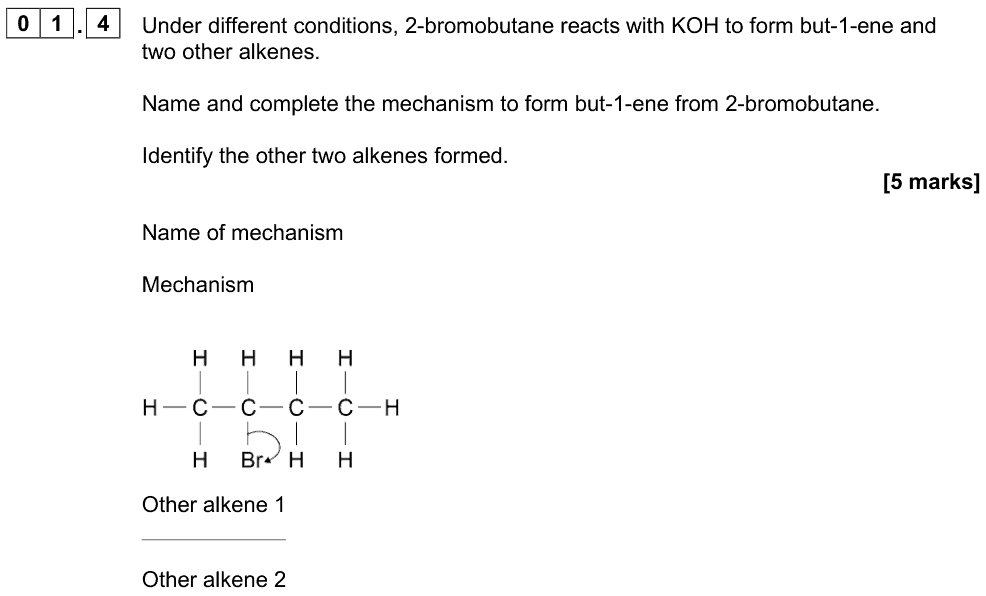
June 2025 · AS Paper 2 · Q01.45 marksAO1=1, AO2=2, AO3=2Mechanism
Earlier parts of question 01 that this part uses
Mark scheme
Examiner's comment
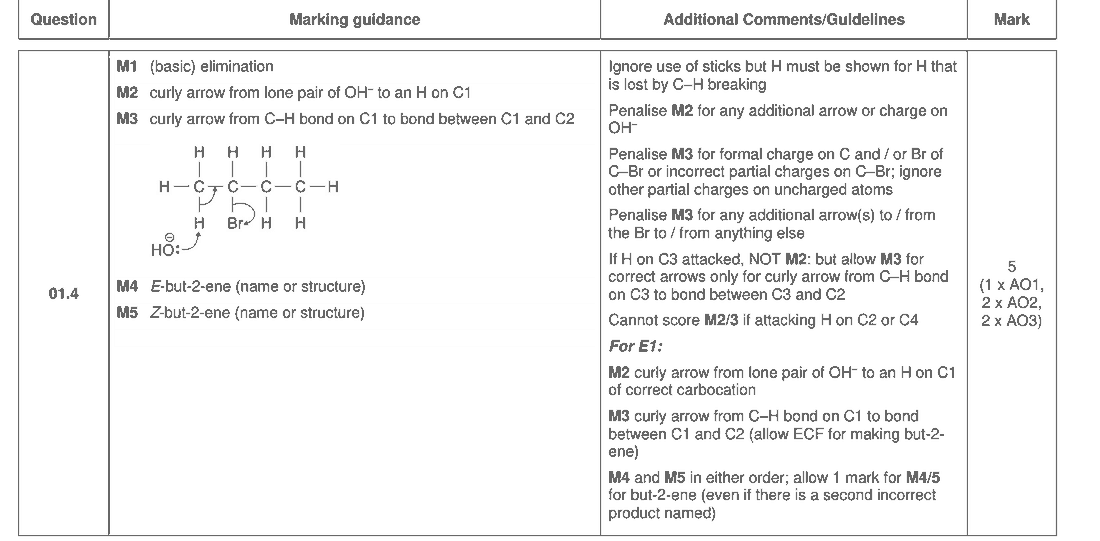
1.4 Students had to complete an elimination mechanism. Many did this well although some gave the mechanism to form but-2-ene rather than but-1-ene as required. Few students appreciated that the two other alkenes were E-but-2-ene and Z-but-2-ene with most going for but-2-ene and some other compound that was commonly not even an alkene.
Notes from the mark scheme and report
(Base) elimination. Curly arrow from the lone pair on OH– to an H on C1
curly arrow from that C–H bond to the C1–C2 bond (the C–Br arrow is already printed). Other alkenes: E-but-2-ene and Z-but-2-ene
'but-2-ene' alone scores 1 of the 2. Errors: attacking an H on C3 (gives but-2-ene)
second alkene not an alkene
June 2025 · Paper 2 · Q01.42 marksAO1=1, AO2=1Short answer
Earlier part of question 01 that this part uses
Mark scheme
Examiner's comment
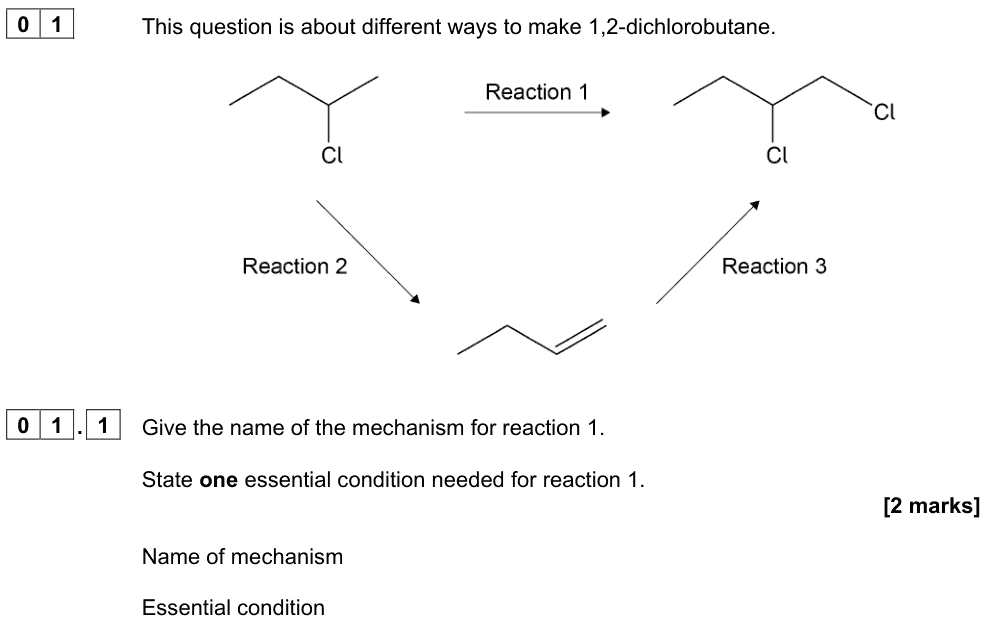
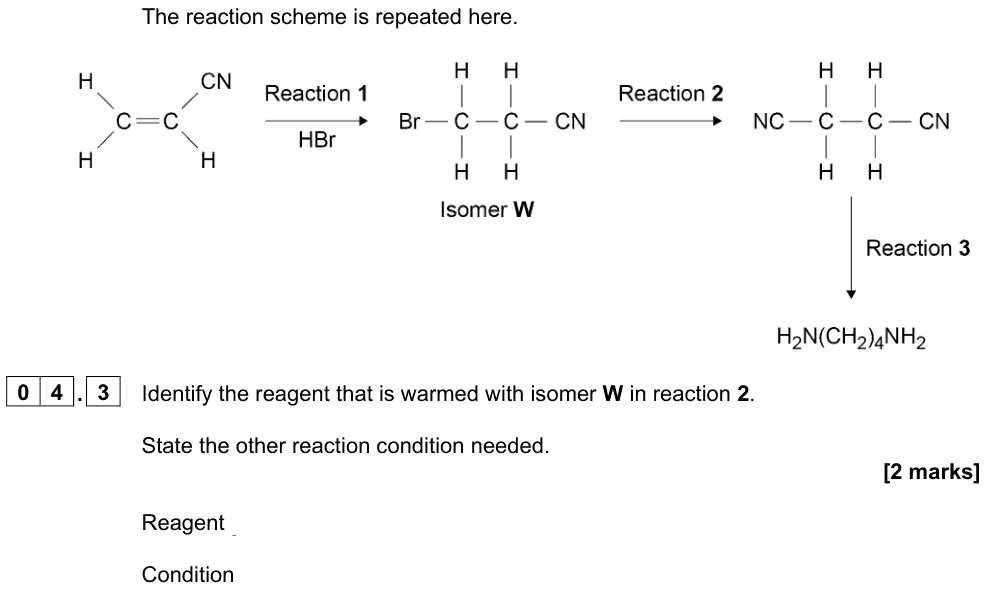
1.4 Students had to recognize that reaction 2 was an elimination reaction and give a suitable reagent and condition for this. Lots were able to suggest a strong alkali and give hot ethanolic as the conditions. The most common errors were in suggesting aqueous conditions.
Notes from the mark scheme and report
KOH or NaOH
hot / reflux / ethanolic. Most common error: aqueous conditions
June 2025 · Paper 2 · Q01.61 markAO3=1Diagram or structure
Earlier part of question 01 that this part uses
Mark scheme
Examiner's comment
1.6 The question required students to see that reaction 2 also gives but-2-ene as a product and this would go on to give 2,3-dichlorobutane in reaction 3. It proved difficult for many and quite a high number did not attempt the question.
Notes from the mark scheme and report
2,3-dichlorobutane, CH3CHClCHClCH3 (elimination also gives but-2-ene, which then adds chlorine). Chloro-alcohols such as CH3CH(OH)CHClCH3 are allowed (chlorine water). Many did not attempt it
June 2025 · Paper 2 · Q09.62 marksAO2=2Explanation
Earlier part of question 09 that this part uses
Mark scheme
Examiner's comment
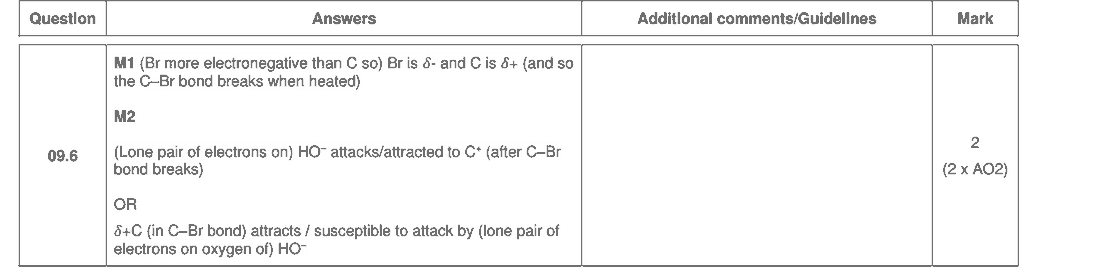
9.6 Students were asked to explain in terms of bond polarity why the bromoalkane and KOH react. Many scored at least 1 of the two marks for stating the correct polarity of the C-Br bond but some lost the mark because they just focused on the electronegativity difference without actually starting that carbon is delta positive and bromine is delta negative. The second mark was for explaining why the OH- ion is attracted either to the delta positive carbon or to the C+ formed in the mechanism in Q09.5. A common error here was to miss the negative sign in the formula of OH-
Notes from the mark scheme and report
Bromine is more electronegative than carbon, so C is δ+ and Br is δ–
the lone pair on HO– is attracted to / attacks the δ+ carbon (or the C+ formed). State the partial charges, not just the electronegativity difference
OH– needs its negative charge
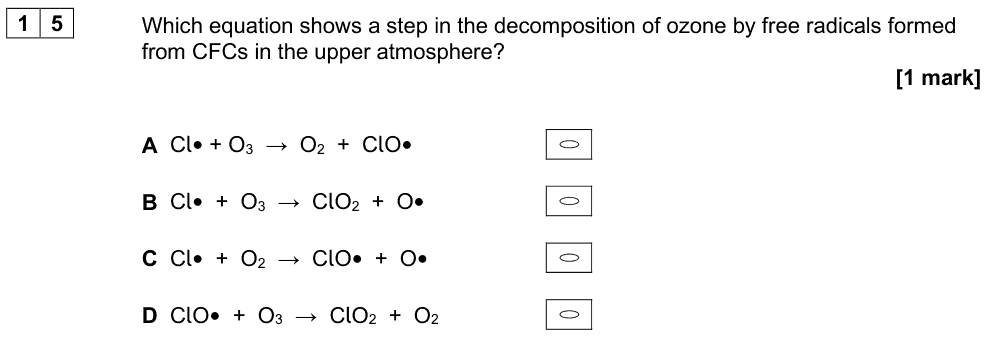
June 2025 · AS Paper 2 · Q151 markAO1=1Multiple choice
Answer
A
Mark scheme
Examiner's comment
This was answered correctly by a majority of students.
Q16 Fractional distillation of crude oil
This was answered correctly by a majority of students.
Notes from the mark scheme and report
Answer: A. Cl• + O3 → ClO• + O2
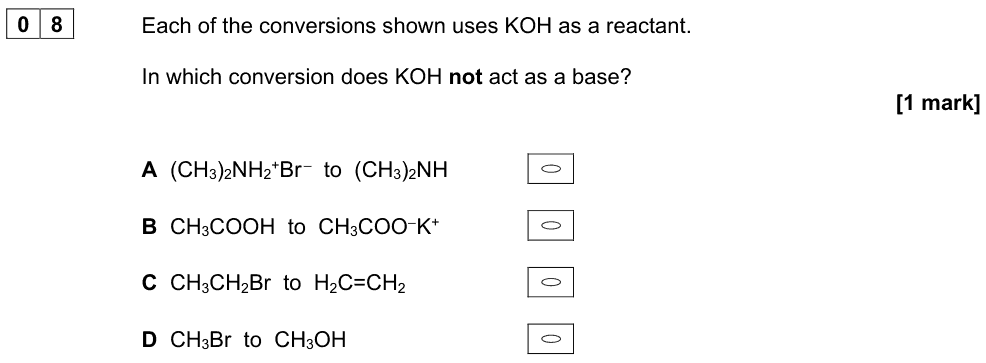
June 2025 · Paper 3 · Q081 markAO3=1Multiple choice
Answer
D
Mark scheme
Notes from the mark scheme and report
Answer: D. In CH3Br to CH3OH hydroxide is a nucleophile (substitution)
in A, B and C it removes a proton. One of the least well answered questions (under 55% correct)
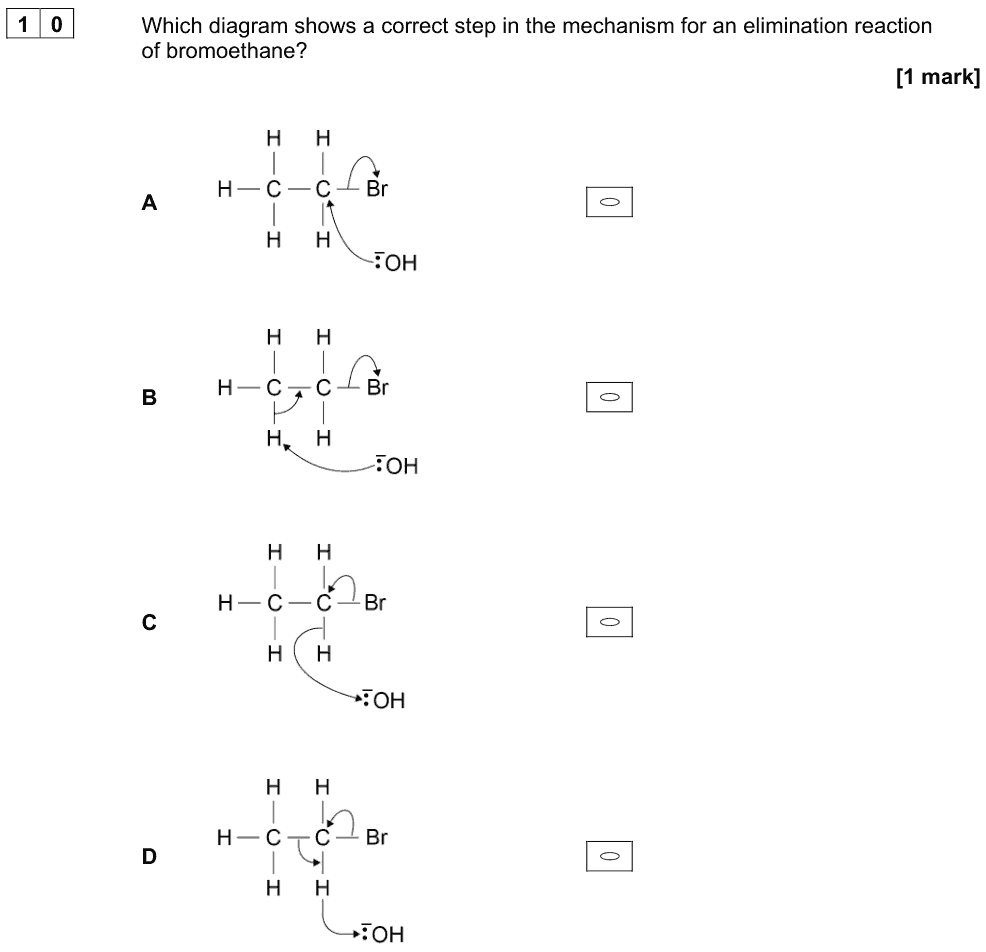
June 2025 · Paper 3 · Q101 markAO1=1Multiple choiceEasy
Answer
B
Mark scheme
Examiner's comment
The most accessible items (answered correctly by more than 80% of students) were questions 10, 15, 18 and 25. The least accessible questions (< 55% success rate) were 8, 12, 14, 21, 31, 35 and 36.
Notes from the mark scheme and report
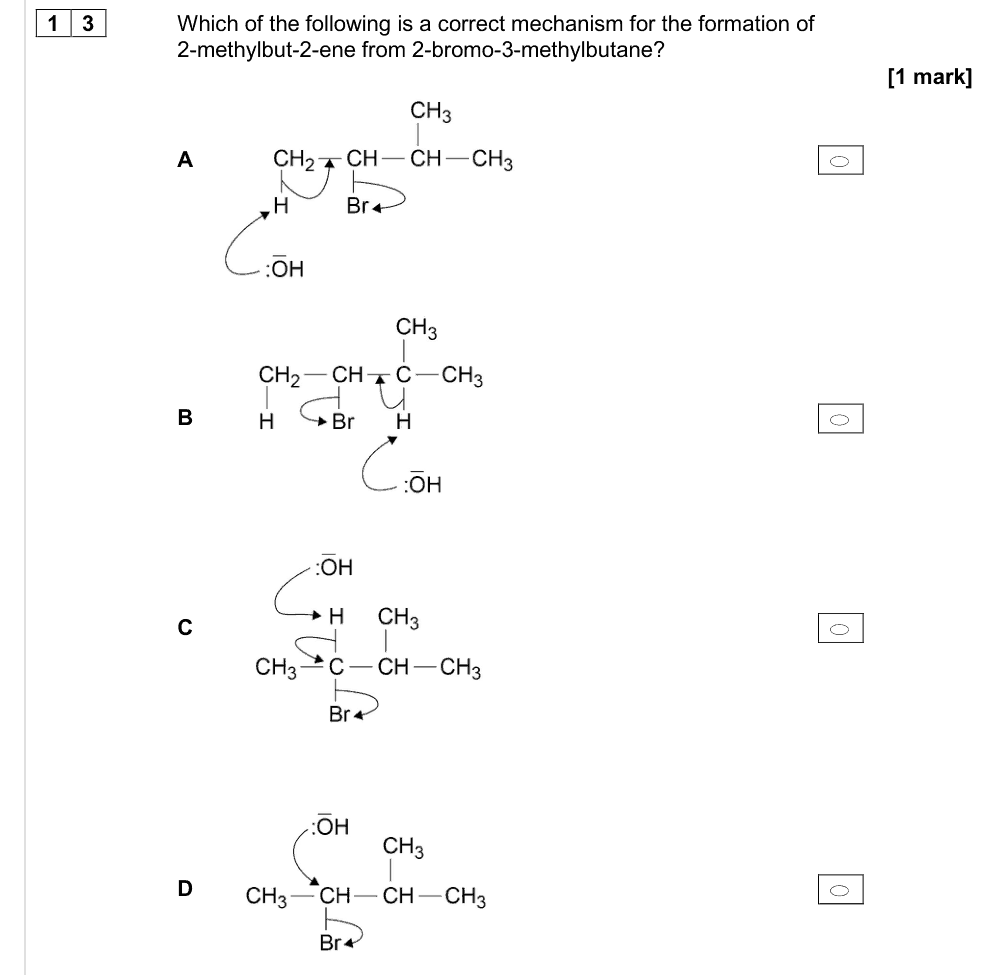
Answer: B. The lone pair on OH– attacks an H on the carbon next to C–Br, the C–H bond pair forms the C=C bond and the C–Br bond pair moves on to Br
June 2024 · AS Paper 2 · Q03.31 markAO2=1Equation writing
Earlier part of question 03 that this part uses
Mark scheme
Examiner's comment
3.3 This question required one equation to show the breakdown of a CFC to form Cl free radicals. Many students did appreciate that the breakdown formed two free radicals.
Notes from the mark scheme and report
CFCl3 → •CFCl2 + Cl• (the C–Cl bond breaks, giving two radicals)
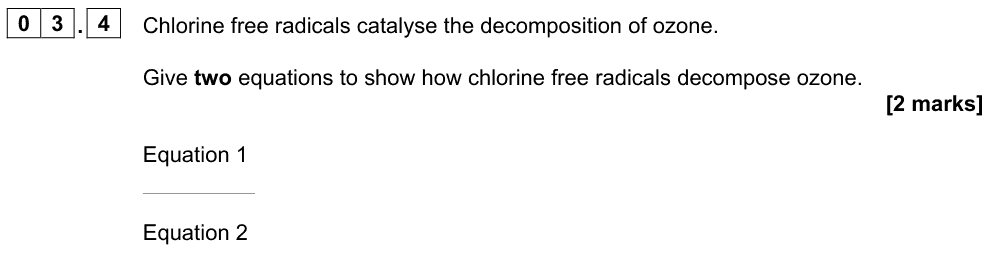
June 2024 · AS Paper 2 · Q03.42 marksAO1=2Equation writing
Earlier part of question 03 that this part uses
Mark scheme
Examiner's comment
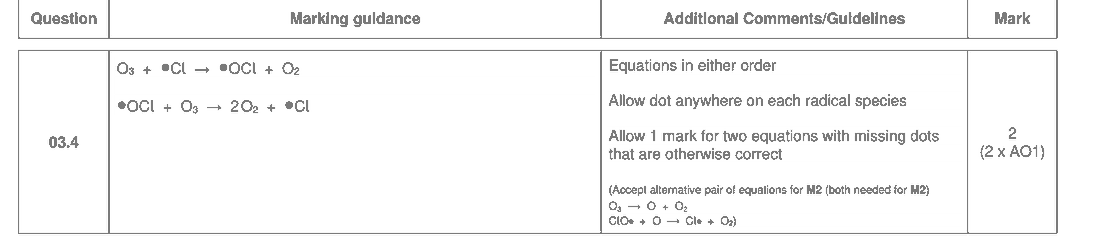
3.4 This question asked for the two equations for the breakdown of ozone by chlorine free radicals. It was generally well done but a significant number did not know these equations despite being given in the specification.
Notes from the mark scheme and report
Cl• + O3 → ClO• + O2 and ClO• + O3 → 2O2 + Cl•. Missing dots: max 1. A significant number did not know these specification equations
June 2024 · AS Paper 2 · Q03.51 markAO1=1Short answer
Earlier part of question 03 that this part uses
Mark scheme
Examiner's comment
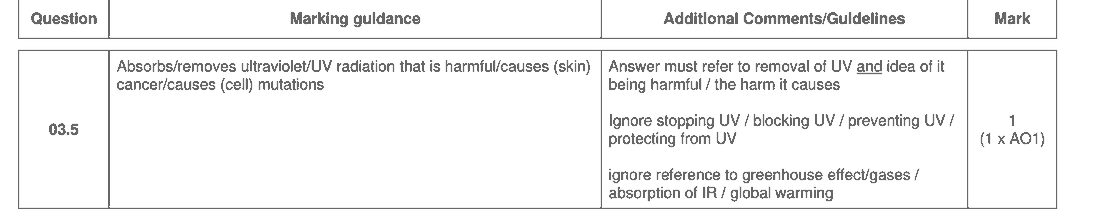
3.5 Students had to explain why ozone in the upper atmosphere is important to life on Earth. Answers showed much confusion about ozone and many answers related to global warming rather than the absorption of harmful UV light.
Notes from the mark scheme and report
Ozone absorbs ultraviolet radiation that is harmful (causes skin cancer / mutations). Both the absorption of UV and the harm are needed
'blocks' or 'protects from' UV is ignored. Many wrote about global warming
June 2024 · Paper 2 · Q05.12 marksAO3=2Practical and data analysis
Mark scheme
Examiner's comment
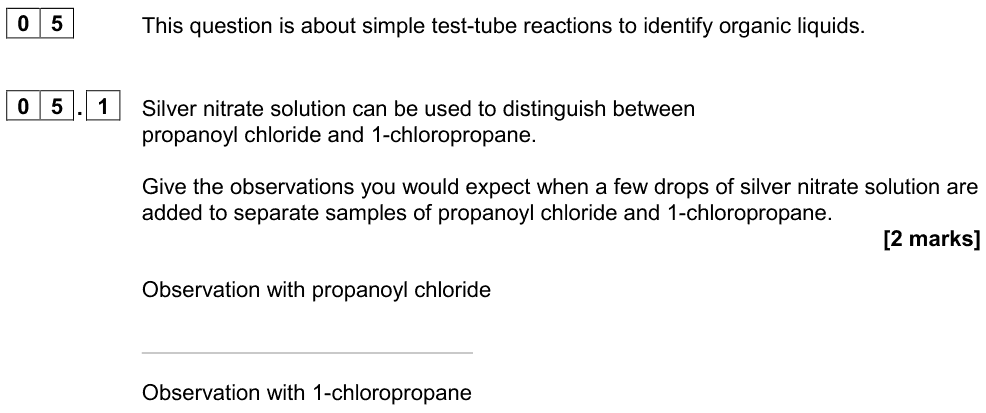
5.1 The marks for this question were lower than expected. Students did not know that an acid chloride will produce misty fumes of HCl and give an immediate white precipitate of AgCl on addition of silver nitrate solution. More knew that there would be no immediate visible reaction with the 1-chloropropane, followed by the slow formation of a white precipitate. Either of these would have gained the second mark.
Notes from the mark scheme and report
Propanoyl chloride: misty / steamy white fumes (of HCl), or an immediate white precipitate. 1-Chloropropane: no visible change (or a white precipitate forms slowly). Few knew that acyl chlorides react at once with the water present
Skills: ATd Use laboratory apparatus for a variety of experimental techniques including: titration, using burette and pipette; distillation and heating under reflux, including setting up glassware using retort stand and clamps; qualitative tests for ions and organic functional groups; filtration, including use of fluted filter paper, or filtration under reduced pressure; PS1.2 Apply scientific knowledge to practical contexts
June 2024 · AS Paper 2 · Q06.33 marksAO3=3Explanation
Earlier parts of question 06 that this part uses
Mark scheme
Examiner's comment
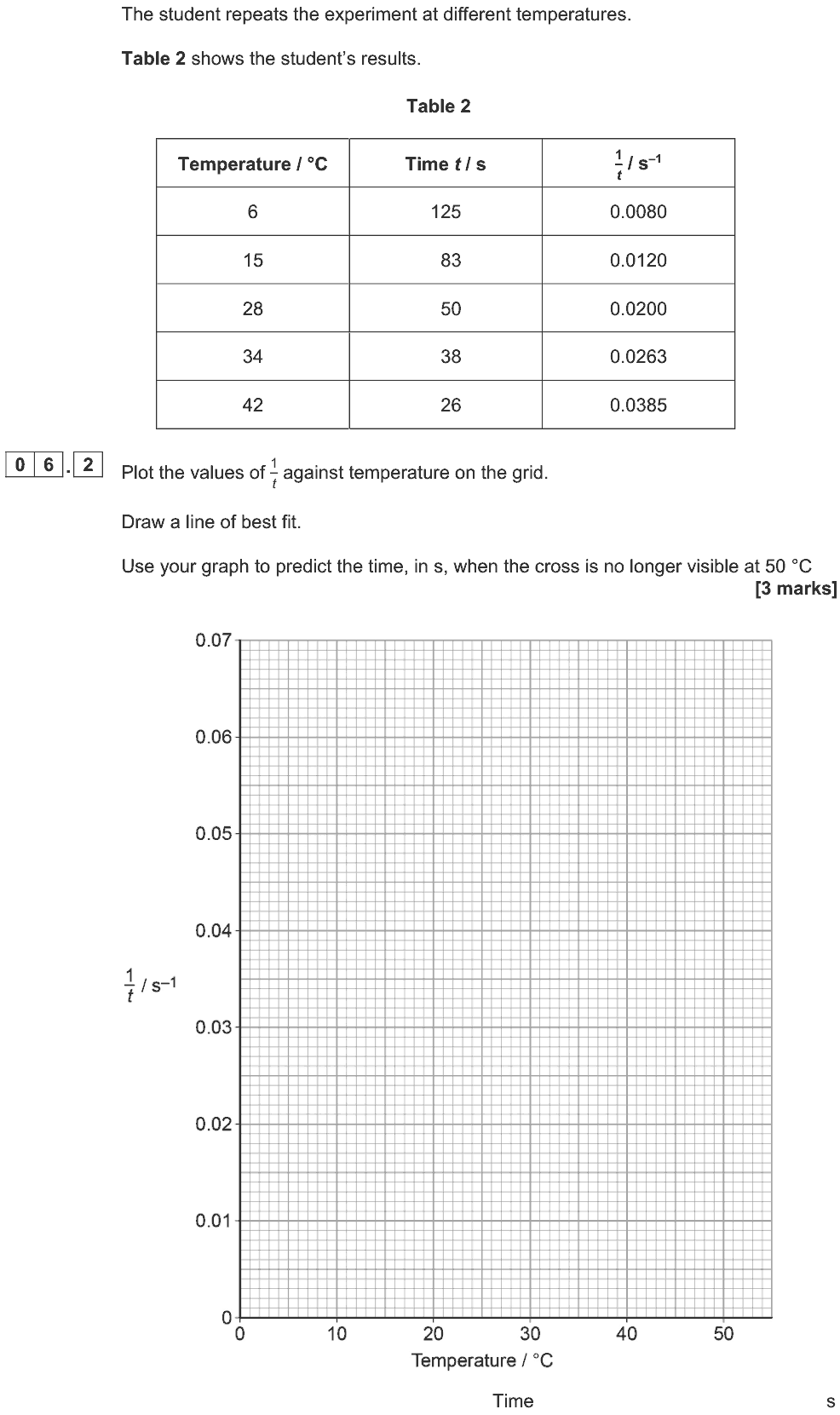
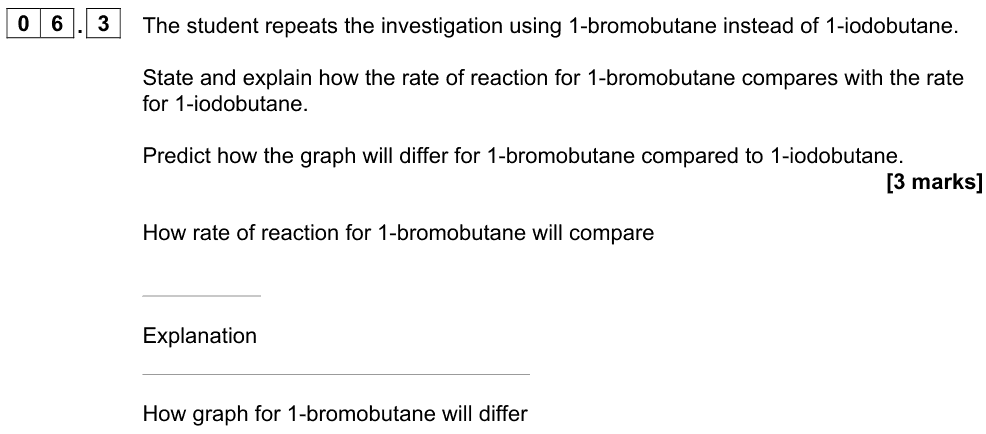
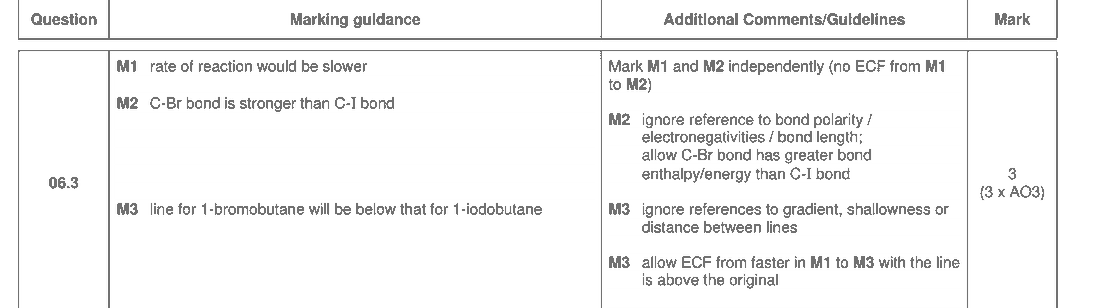
6.3 Most students knew that bromoalkanes react slower than iodoalkanes. Fewer students could explain why by comparing the strength of the C-Br and C-I bonds. The final part of the question was very demanding, and few students could predict that the line on the graph would be lower than the original line.
Notes from the mark scheme and report
The rate is slower for 1-bromobutane, because the C–Br bond is stronger (greater bond enthalpy) than the C–I bond
the line for 1-bromobutane lies below the 1-iodobutane line. Ignore bond polarity and electronegativity. Few predicted the lower line
Skills: PS1.2 Apply scientific knowledge to practical contexts; PS3.1 Plot and interpret graphs; RP3 Investigation of how the rate of a reaction changes with temperature
June 2024 · AS Paper 2 · Q07.43 marksAO1=1, AO2=2Mechanism
Earlier part of question 07 that this part uses
Mark scheme
Examiner's comment
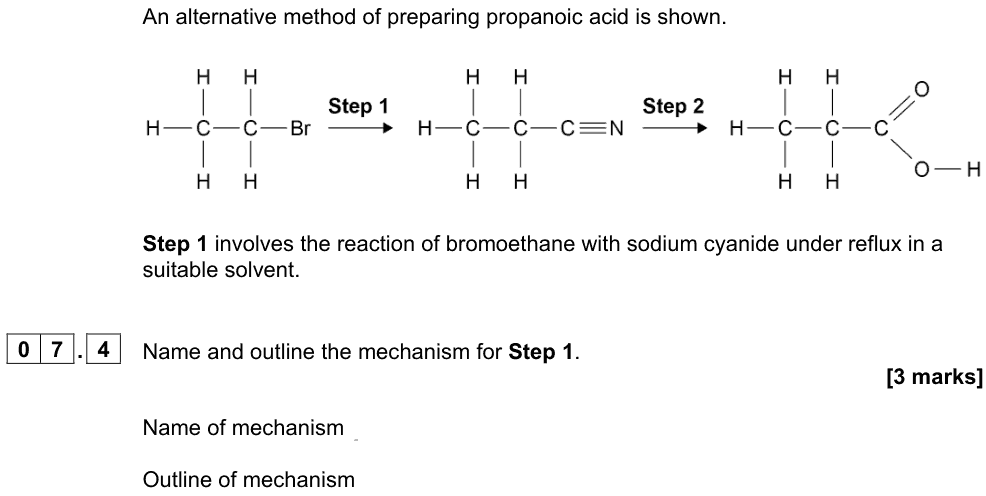
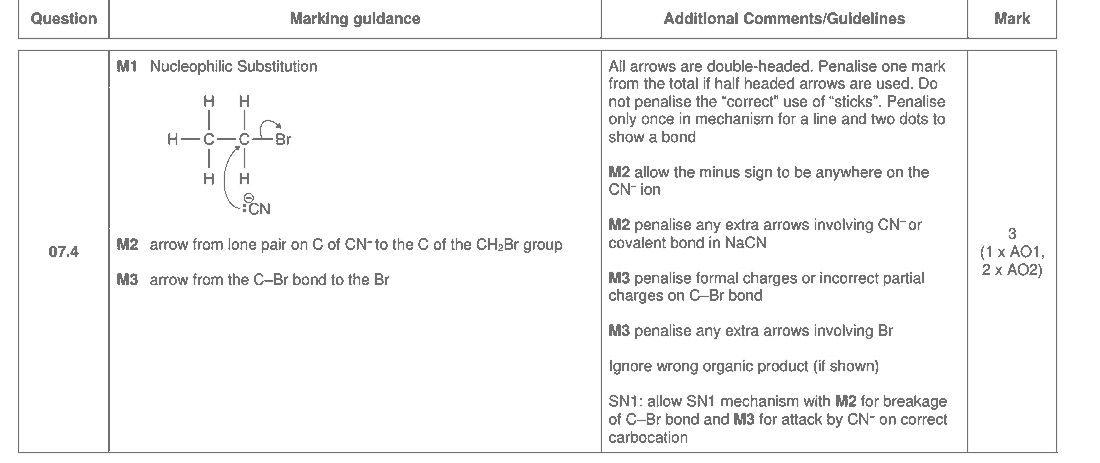
7.4 In this question students were required to show the mechanism for the reaction of sodium cyanide with bromoethane. Many students failed to show the CN– correctly attacking the bromoethane.
Notes from the mark scheme and report
Nucleophilic substitution. Curly arrow from the lone pair on the C of :CN– to the carbon of the CH2Br group
curly arrow from the C–Br bond to Br. No extra arrows
no formal charges on the C–Br bond. Many did not show CN– attacking correctly
June 2024 · AS Paper 2 · Q07.51 markAO3=1Short answer
Earlier parts of question 07 that this part uses
Mark scheme
Examiner's comment
7.5 Some students could explain why water was not a suitable solvent, although some incorrectly stated that NaCN was insoluble in water.
Notes from the mark scheme and report
Water (or hydroxide ions) would act as the nucleophile, so an alcohol (ethanol) would form
or bromoethane is insoluble in water. 'NaCN is insoluble in water' is rejected
June 2024 · Paper 2 · Q08.22 marksAO1=1, AO2=1Short answer
Earlier part of question 08 that this part uses
Mark scheme
Examiner's comment
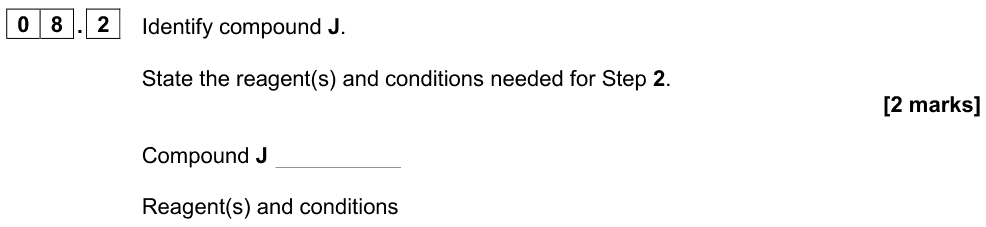
8.2 Students often scored for the reagent but not the conditions here.
Notes from the mark scheme and report
J is butan-2-ol, CH3CH(OH)CH2CH3
NaOH, aqueous and warm. The reagent was often given without the conditions
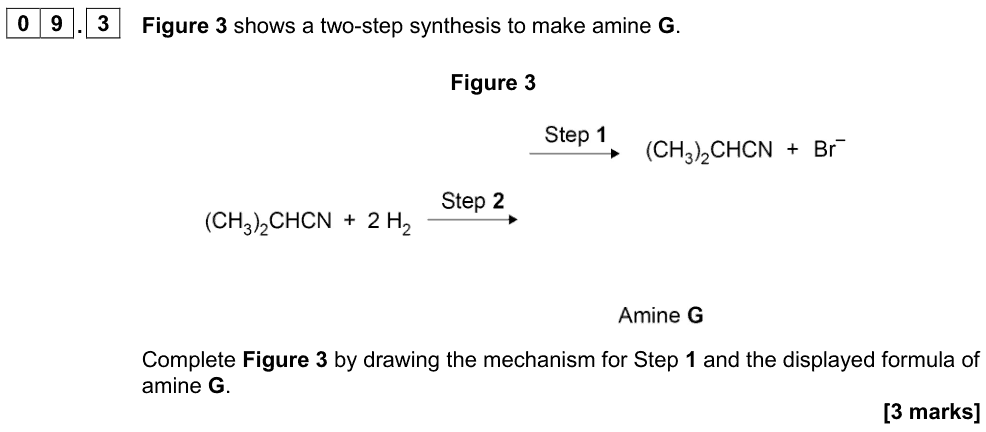
June 2024 · Paper 2 · Q09.33 marksAO2=3Mechanism
Earlier part of question 09 that this part uses
Mark scheme
Examiner's comment
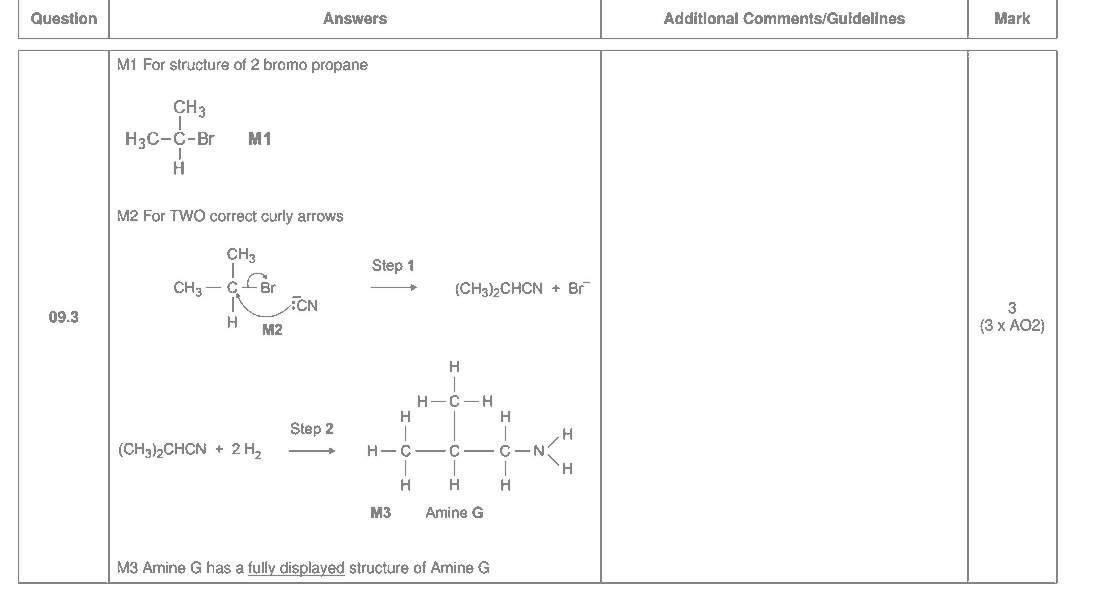
9.3 Most students got at least 2 of the 3 marks here. The final mark was often the one lost and drawing a fully displayed amine formed from a nitrile proved difficult for many. Common mistakes included having too few carbon atoms, and missing hydrogen atoms despite being given the balanced left-hand side of the equation.
Notes from the mark scheme and report
2-Bromopropane, (CH3)2CHBr, drawn as the reactant
two curly arrows: from the lone pair on C of :CN– to the C bearing Br, and from the C–Br bond to Br
amine G fully displayed: (CH3)2CHCH2NH2, 2-methylpropan-1-amine, with every bond shown. The displayed amine was the mark most often lost (too few C atoms or missing H atoms)
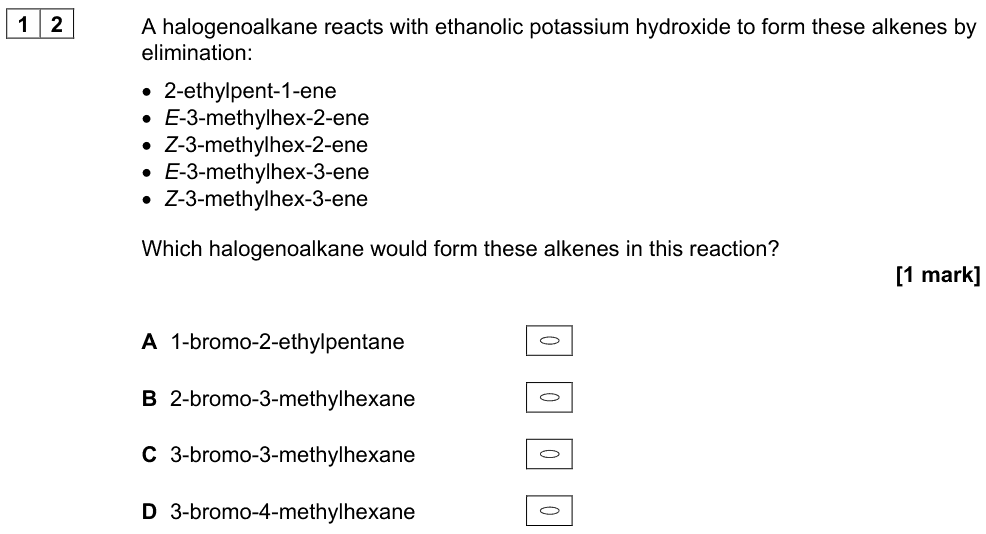
June 2024 · AS Paper 2 · Q121 markAO3=1Multiple choice
Answer
C
Mark scheme
Examiner's comment
Students struggled to deduce which alkene could be formed by elimination of HBr from a halogenoalkane.
Q13 Apparatus for production of an aldehyde from an alcohol
This was answered correctly by a majority (65.6%) of students.
Notes from the mark scheme and report
Answer: C. In 3-bromo-3-methylhexane H can be lost from the methyl branch (2-ethylpent-1-ene), from carbon 2 (E and Z 3-methylhex-2-ene) or from carbon 4 (E and Z 3-methylhex-3-ene). Students struggled with this
June 2023 · AS Paper 2 · Q03.12 marksAO2=2Mechanism
Mark scheme
Examiner's comment
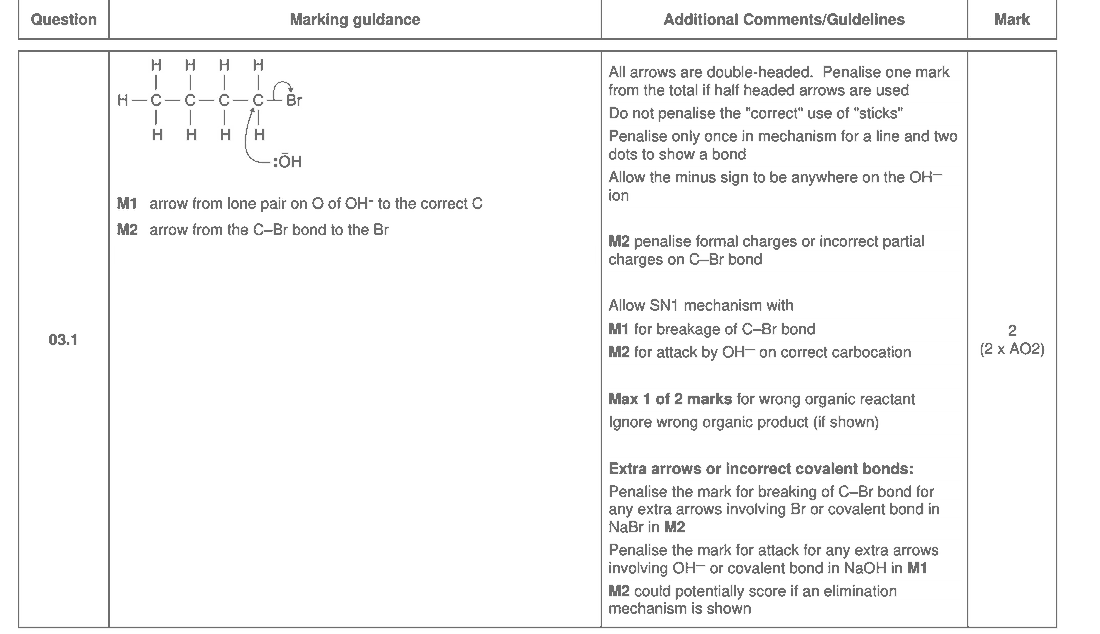
03.1 This mechanism was drawn well by students.
Notes from the mark scheme and report
Curly arrow from the lone pair on the O of OH– to the C bonded to Br
curly arrow from the C–Br bond to Br. No formal or wrong partial charges on C–Br
wrong organic reactant max 1
June 2023 · AS Paper 2 · Q03.22 marksAO2=2Short answerHard
Earlier part of question 03 that this part uses
Mark scheme
Examiner's comment
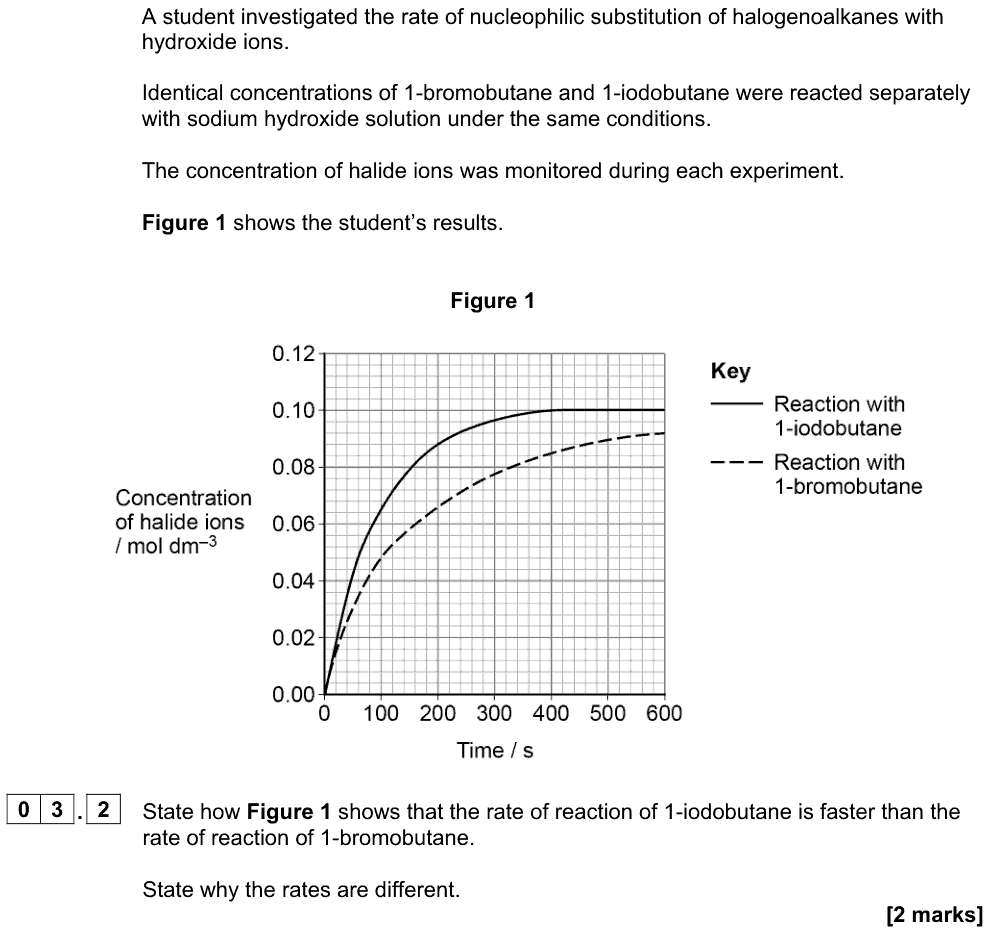
03.2 Students struggled to explain how the graph showed the relative rate of reaction of two halogenoalkanes. Fewer than one fifth of students scored both marks.
Notes from the mark scheme and report
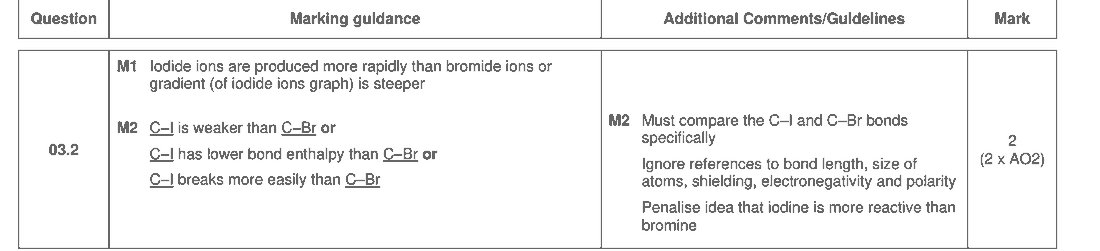
The iodide line is steeper (iodide ions are produced more quickly than bromide ions). The C–I bond is weaker (lower bond enthalpy) than the C–Br bond. Must compare the two bonds
ignore polarity, electronegativity and atom size
'iodine is more reactive' is penalised
Skills: MS3.1 Translate information between graphical, numerical and algebraic forms; PS3.1 Plot and interpret graphs
June 2023 · Paper 2 · Q04.32 marksAO1=2Short answer
Earlier part of question 04 that this part uses
Mark scheme
Examiner's comment
04.3 Despite being set on several occasions in the past, the use of aqueous ethanol as the solvent condition for this reaction was not well known and few students scored M2 here.
Notes from the mark scheme and report
KCN (or NaCN)
aqueous ethanol as solvent. Acid with the cyanide is penalised. Few knew the aqueous-and-alcoholic condition
June 2023 · AS Paper 2 · Q121 markAO1=1Multiple choiceEasy
Answer
A
Mark scheme
Examiner's comment
This was answered correctly by a great majority (79%) of students.
Notes from the mark scheme and report
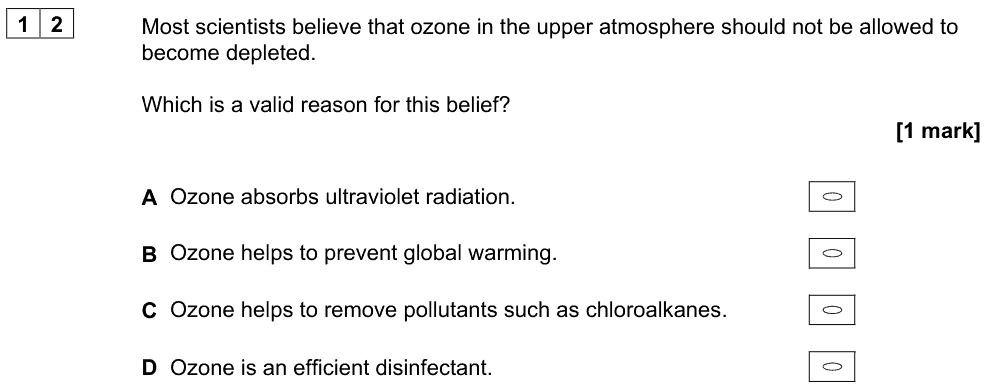
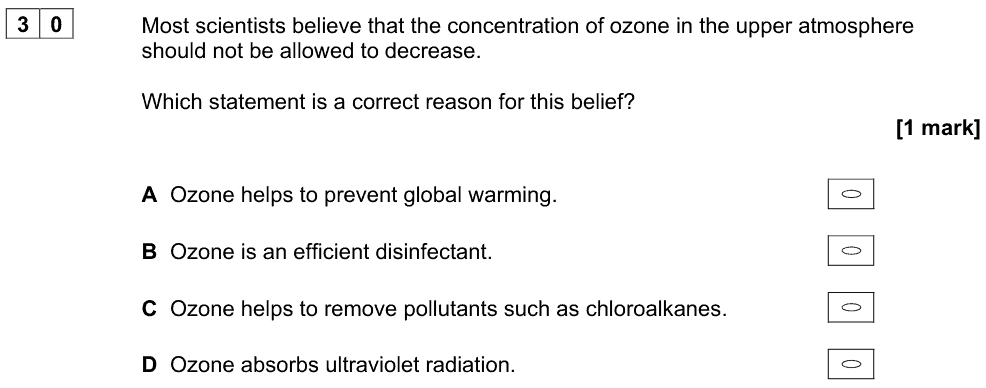
Answer: A. Ozone in the upper atmosphere absorbs harmful ultraviolet radiation
June 2023 · AS Paper 2 · Q131 markAO2=1Multiple choiceEasy
Answer
B
Mark scheme
Examiner's comment
This was answered correctly by a great majority (78%) of students.
Notes from the mark scheme and report
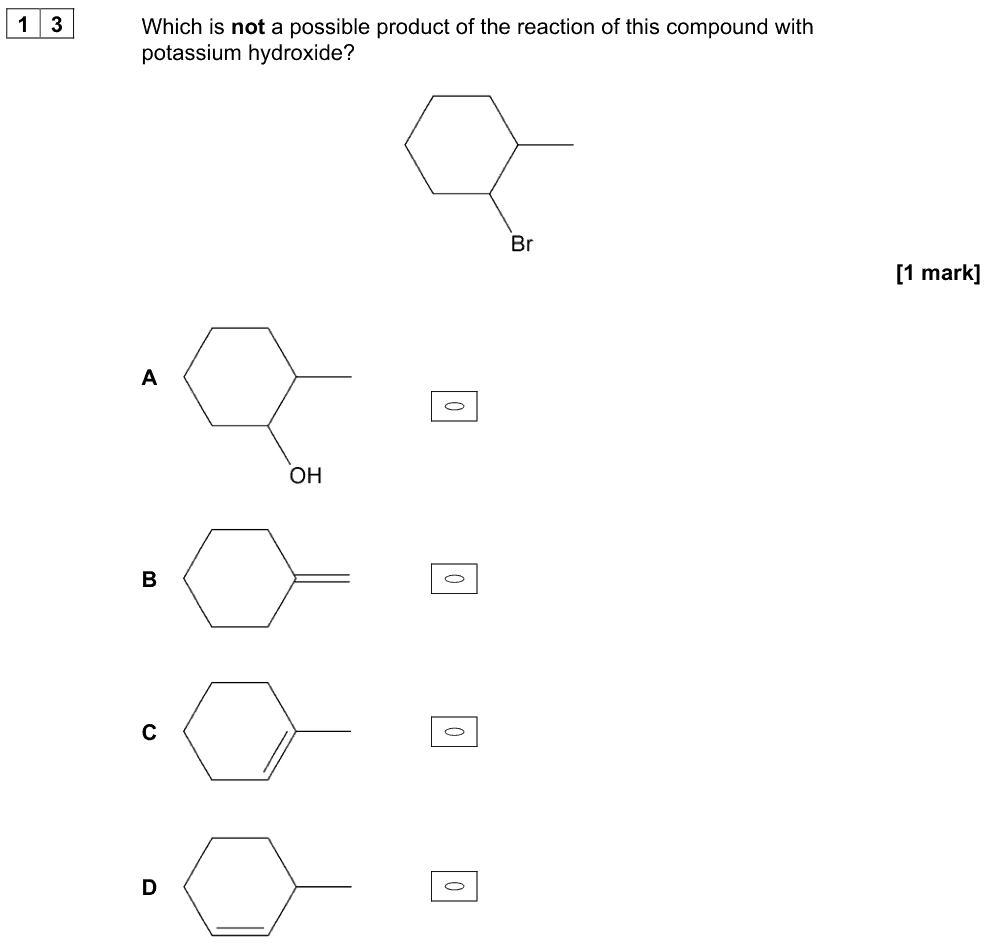
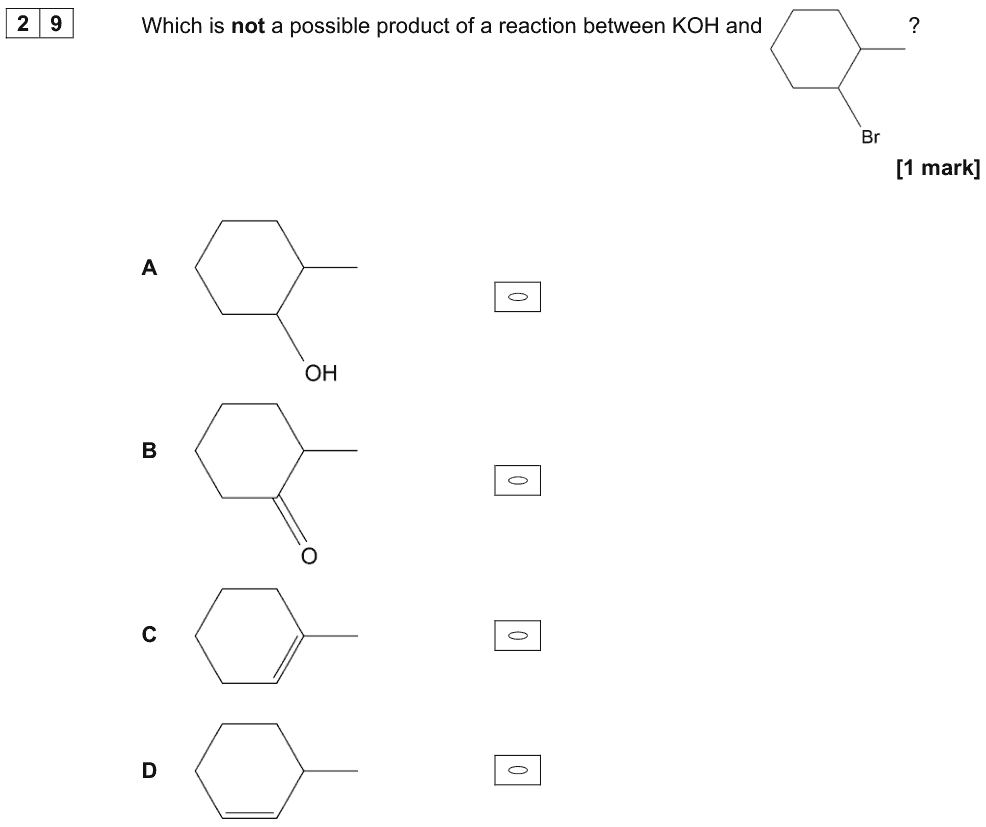
Answer: B. 1-Bromo-2-methylcyclohexane gives the alcohol by substitution (A) or a ring C=C by elimination of H from either neighbouring ring carbon (C and D)
a C=CH2 outside the ring (B) cannot form because the methyl carbon is not next to the C–Br
June 2023 · Paper 3 · Q271 markAO1=1Multiple choice
Answer
C
Mark scheme
Notes from the mark scheme and report
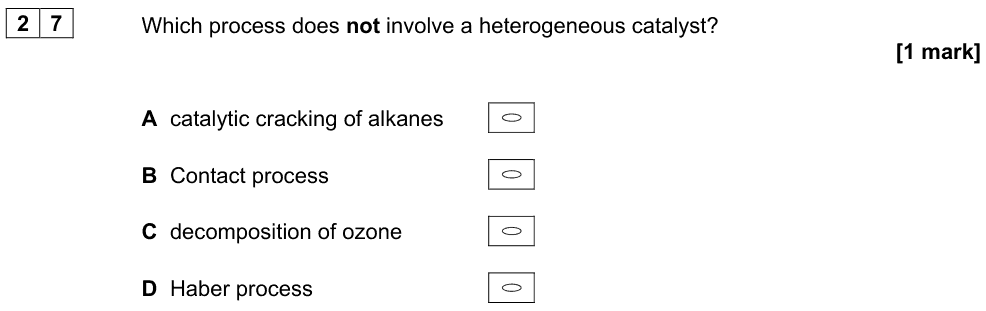
Answer: C. Chlorine atoms and ozone are both gases, so that catalysis is homogeneous
zeolite (cracking), V2O5 (Contact) and Fe (Haber) are solid catalysts for gas reactions
June 2023 · Paper 3 · Q291 markAO3=1Multiple choice
Answer
B
Mark scheme
Notes from the mark scheme and report
Answer: B. KOH gives substitution (the alcohol, A) or elimination (the two alkenes, C and D)
it cannot oxidise the compound to the ketone B
June 2023 · Paper 3 · Q301 markAO1=1Multiple choice
Answer
D
Mark scheme
Notes from the mark scheme and report
Answer: D. Ozone in the upper atmosphere absorbs (harmful) ultraviolet radiation
June 2022 · Paper 2 · Q02.52 marksAO1=2Short answer
Earlier part of question 02 that this part uses
Mark scheme
Examiner's comment
02.5 This question required students to recognise the role of chlorine radicals in the decomposition of ozone. It was surprisingly poorly answered.
Notes from the mark scheme and report
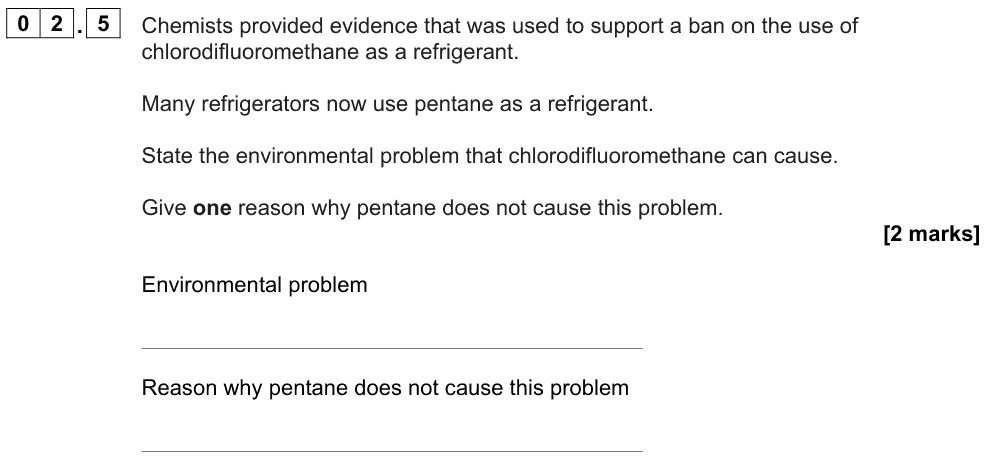
Ozone depletion (hole in the ozone layer). Pentane has no C–Cl bonds, so does not produce chlorine radicals. Surprisingly poorly answered
June 2022 · AS Paper 2 · Q05.15 marksAO1=5Mechanism
Mark scheme
Examiner's comment
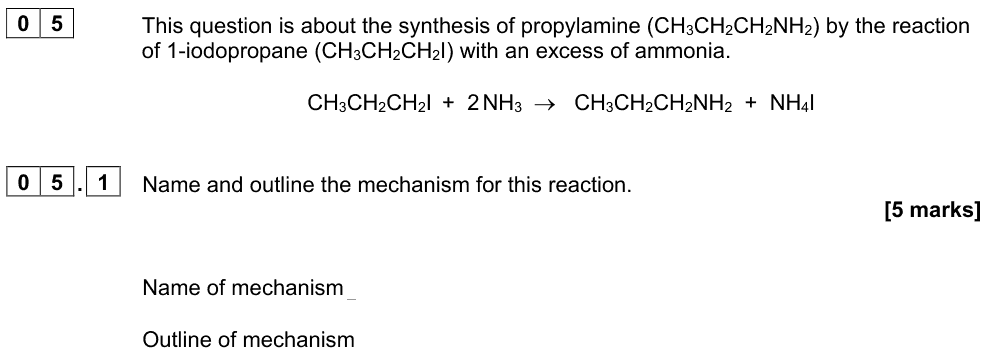
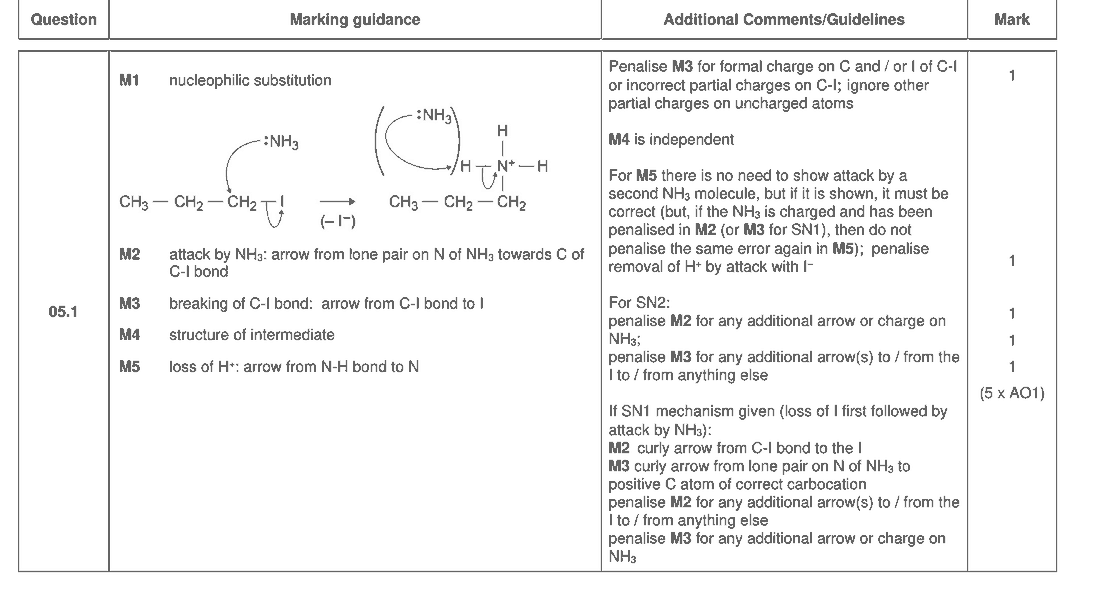
5.1 This question required students to name and outline a mechanism. This was done well. One common issue was students thinking that ammonia is negatively charged in their mechanism.
Notes from the mark scheme and report
Nucleophilic substitution. Arrow from the lone pair on N of NH3 to the C of C–I
arrow from the C–I bond to I
intermediate CH3CH2CH2NH3+
arrow from an N–H bond to N+ (loss of H+, eg to a second NH3
not removed by I–). Common error: showing ammonia with a negative charge
June 2022 · AS Paper 2 · Q211 markAO2=1Multiple choice
Answer
A
Mark scheme
Notes from the mark scheme and report
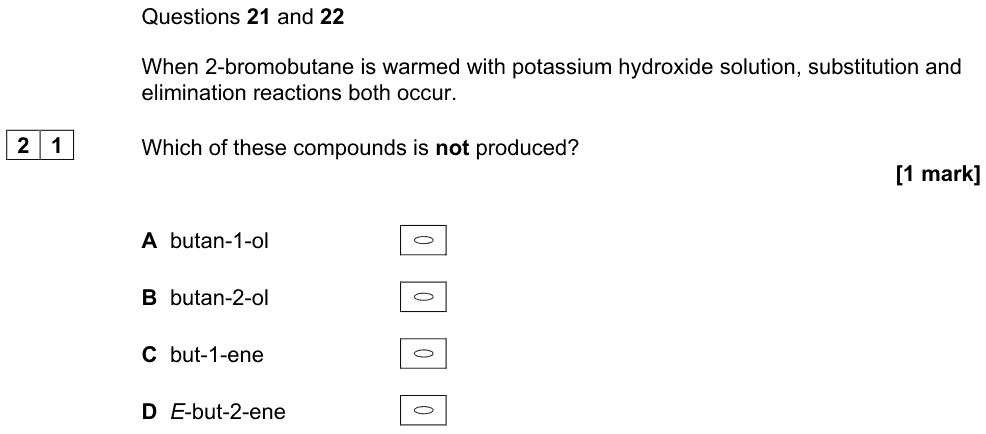
Answer: A. Substitution gives butan-2-ol
elimination gives but-1-ene and E/Z-but-2-ene
the OH cannot end up on carbon 1
June 2022 · AS Paper 2 · Q221 markAO1=1Multiple choice
Earlier part of question 22 that this part uses
Answer
A
Mark scheme
Notes from the mark scheme and report
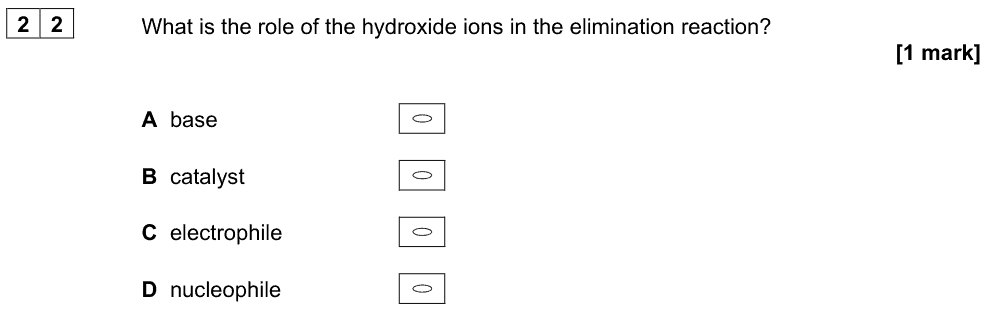
Answer: A. In elimination the hydroxide ion acts as a base, removing H+ from the carbon next to the C–Br
June 2022 · Paper 3 · Q03.12 marksAO1=2Short answer
Mark scheme
Examiner's comment
03.1 was recalled by most students although ‘nucleophilic elimination’ was incorrectly suggested by some for the mechanism to form the alkenes.
Notes from the mark scheme and report
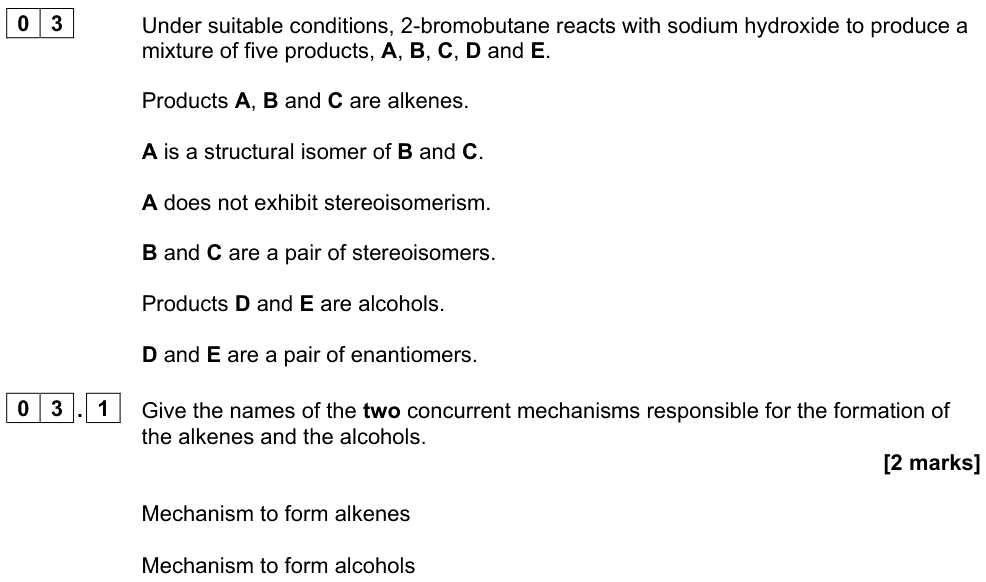
Alkenes: (base) elimination. Alcohols: nucleophilic substitution. Not 'nucleophilic elimination'
June 2022 · Paper 3 · Q03.43 marksAO2=3Mechanism
Earlier part of question 03 that this part uses
Mark scheme
Examiner's comment
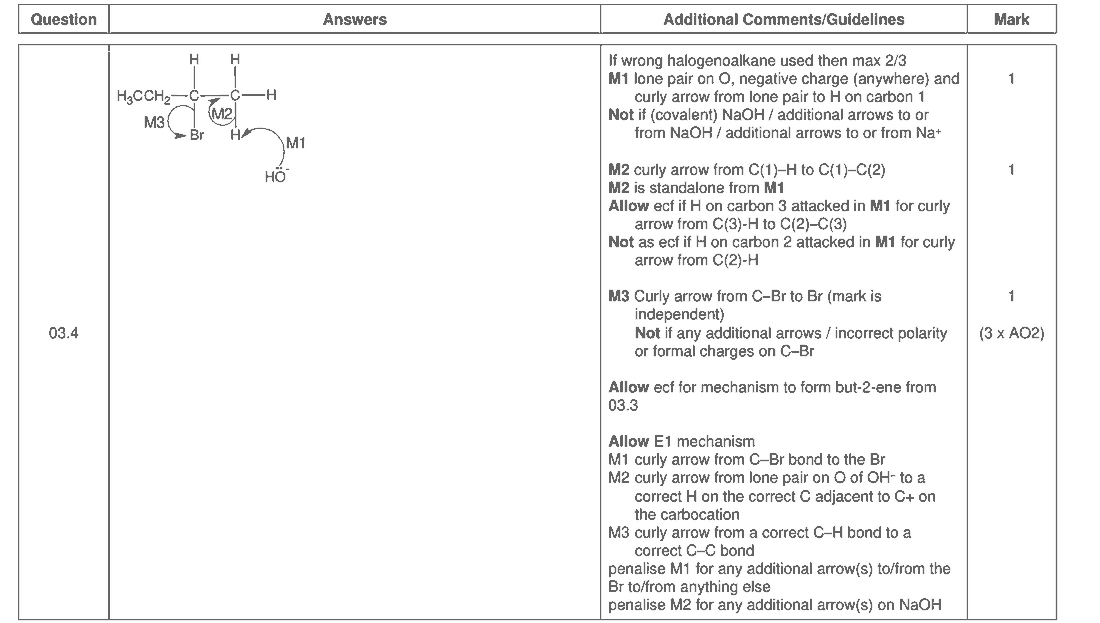
In 03.4 ‘error carried forward’ was applied for any student who had mistakenly identified the product as but-2-ene in 03.3, so full marks were still available to those students for the mechanism.
It is recommended that students should draw clearly displayed structures and draw them a bit larger than if just showing the structure – this allows more space so that the positioning of curly arrows is clear.
Notes from the mark scheme and report
Elimination: curly arrow from a lone pair on the O of OH– (with its negative charge) to an H on C1
curly arrow from that C–H bond into the C1–C2 bond
curly arrow from the C–Br bond to Br. Covalent NaOH or extra arrows lose marks
wrong halogenoalkane max 2. E1 allowed
error carried forward if but-2-ene was named in 03.3
June 2022 · Paper 3 · Q03.72 marksAO3=2Explanation
Earlier part of question 03 that this part uses
Mark scheme
Examiner's comment
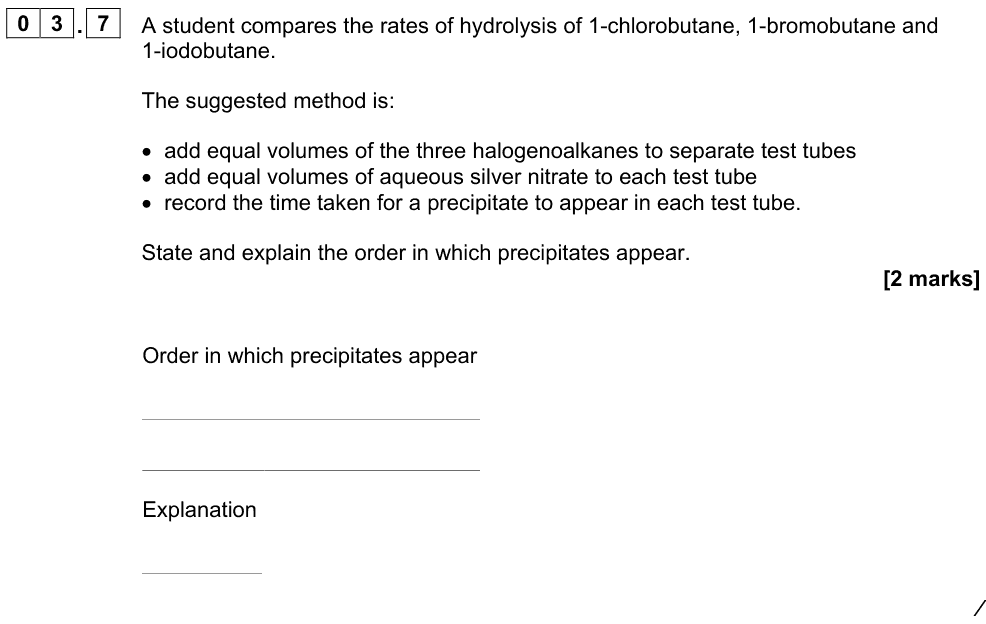
There was a wide variety of misconceptions evident in the answers to 03.7 with various references to halide ions in the halogenoalkane molecules, to sizes of ions or atoms and to electronegativity.
As stated in the specification, all that is needed to explain the relative rates of hydrolysis is to refer to the relative bond strengths of C–I, C–Br and C–Cl.
Notes from the mark scheme and report
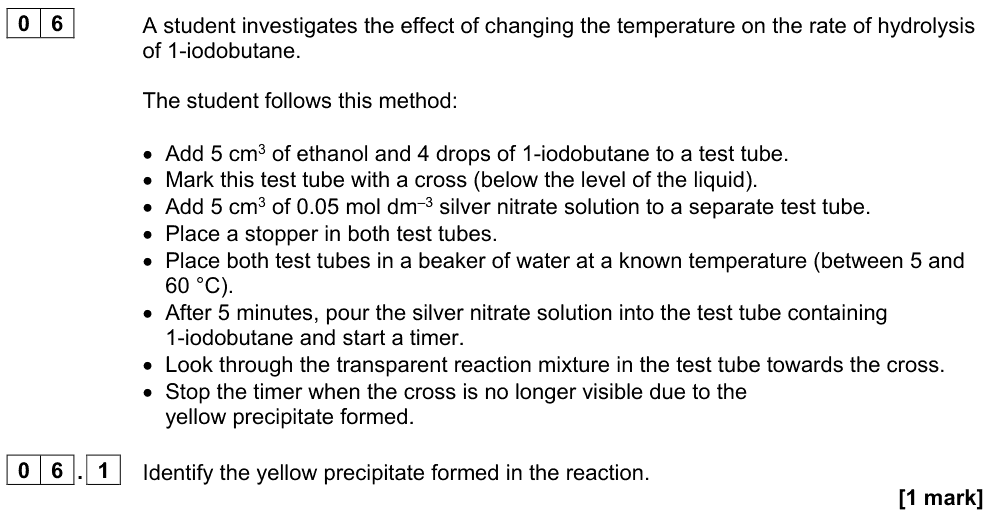
Silver iodide (yellow) first, then silver bromide (cream), then silver chloride (white). Bond strength C–I < C–Br < C–Cl (the weakest bond breaks most easily). Only bond enthalpy is needed
ion size, electronegativity or 'halide ions in the molecule' are misconceptions
Skills: ATd Use laboratory apparatus for a variety of experimental techniques including: titration, using burette and pipette; distillation and heating under reflux, including setting up glassware using retort stand and clamps; qualitative tests for ions and organic functional groups; filtration, including use of fluted filter paper, or filtration under reduced pressure; PS1.2 Apply scientific knowledge to practical contexts
June 2022 · Paper 3 · Q231 markAO2=1Multiple choice
Answer
B
Mark scheme
Notes from the mark scheme and report
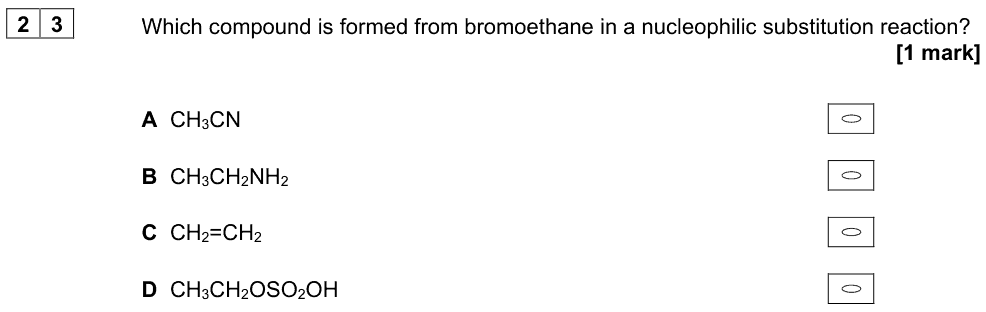
Answer: B. NH3 substitutes Br to give CH3CH2NH2. Substitution with CN– would give CH3CH2CN, not CH3CN
ethene is the elimination product
November 2021 · AS Paper 2 · Q04.21 markEquation writing
Earlier part of question 04 that this part uses
Mark scheme
Notes from the mark scheme and report
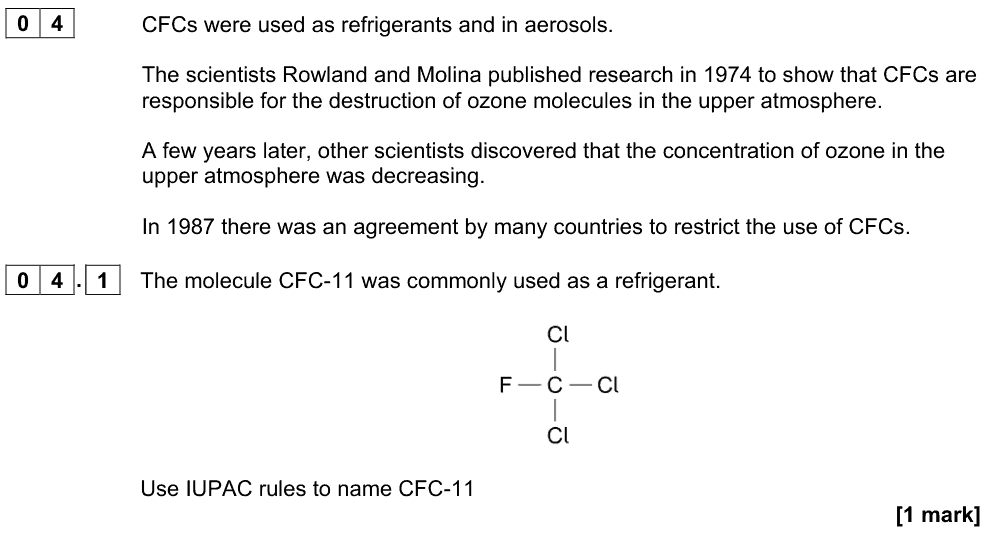
CCl3F → •CCl2F + Cl• (radical dot needed on each radical)
November 2021 · AS Paper 2 · Q04.41 markShort answer
Earlier part of question 04 that this part uses
Mark scheme
Notes from the mark scheme and report
It absorbs (harmful) ultraviolet radiation
November 2021 · AS Paper 2 · Q04.51 markShort answer
Earlier part of question 04 that this part uses
Mark scheme
Notes from the mark scheme and report
Any one: no evidence yet that ozone was actually being depleted
no alternatives to CFCs
commercial interests in continuing to use CFCs
difficulty of getting international agreement
November 2021 · AS Paper 2 · Q07.11 markShort answer
Mark scheme
Notes from the mark scheme and report
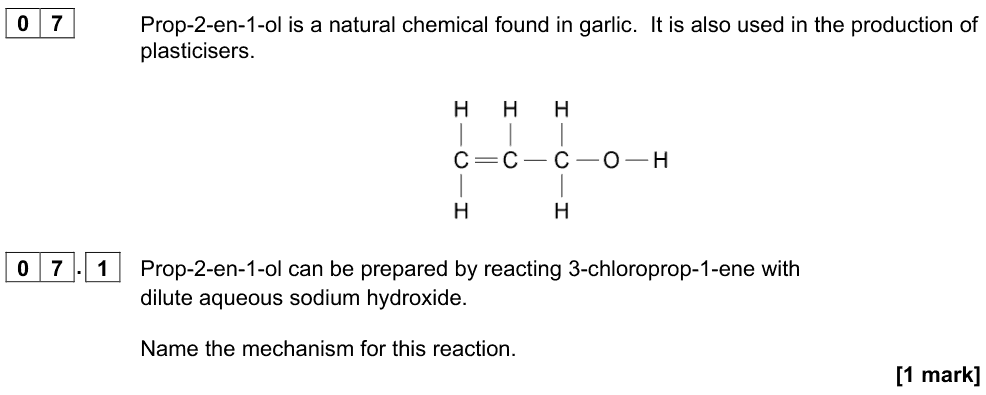
Answer: nucleophilic substitution
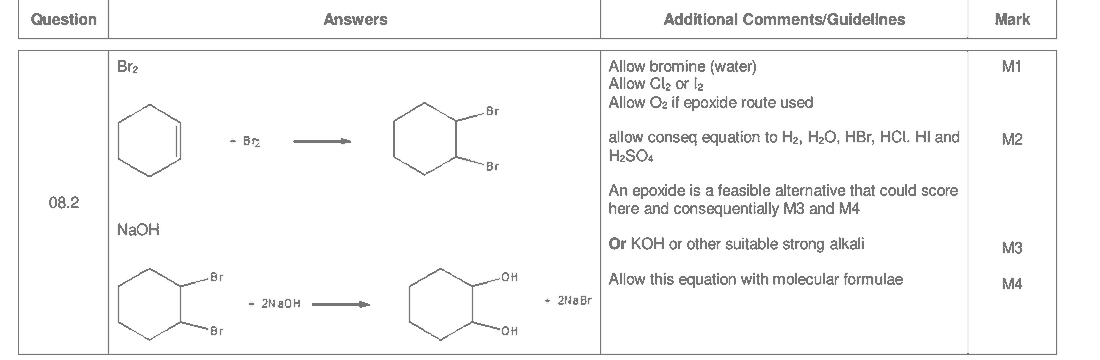
November 2021 · Paper 2 · Q08.24 marksEquation writing
Earlier part of question 08 that this part uses
Mark scheme
Examiner's comment
Few students scored 3 or more marks on question 08.2.
Both the reagents and equations proved very challenging, with over 50% either failing to score or not attempting this question.
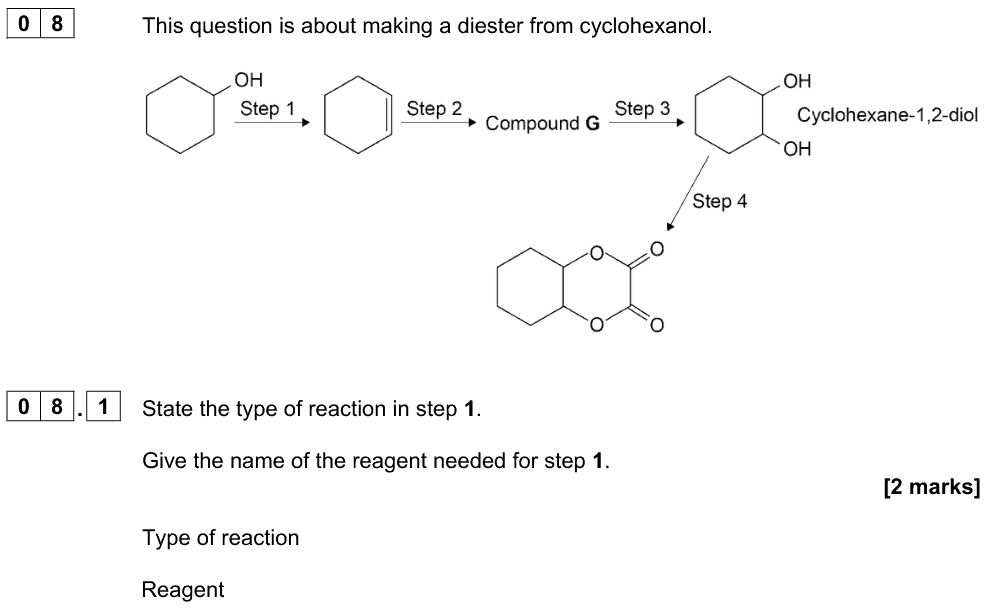
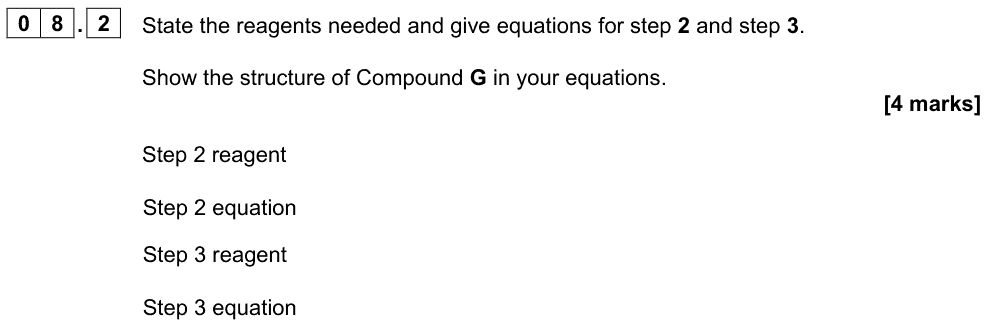
G + 2NaOH → cyclohexane-1,2-diol + 2NaBr. Cl2 or I2 allowed
an epoxide route with O2 is also accepted. Over 50% scored nothing or did not attempt it
November 2021 · Paper 2 · Q09.11 markShort answer
Mark scheme
Examiner's comment
Students scored poorly on question 09.2 and few appreciated that the breakage of the C-Cl bond was the key point. A high proportion of students scored well on question 09.3 about catalytic ozone decomposition. Many also scored good marks on question 09.4 by being able to derive equations for novel propagation steps.
Notes from the mark scheme and report
It absorbs harmful ultraviolet radiation (reducing the risk of skin cancer)
November 2021 · Paper 2 · Q09.21 markShort answer
Earlier part of question 09 that this part uses
Mark scheme
Examiner's comment
Students scored poorly on question 09.2 and few appreciated that the breakage of the C-Cl bond was the key point.
may be shown by an equation. Few saw that breaking the C–Cl bond was the key point
November 2021 · Paper 2 · Q09.32 marksEquation writing
Earlier part of question 09 that this part uses
Mark scheme
Examiner's comment
A high proportion of students scored well on question 09.3 about catalytic ozone decomposition.
Notes from the mark scheme and report
Cl• + O3 → ClO• + O2 and ClO• + O3 → Cl• + 2O2
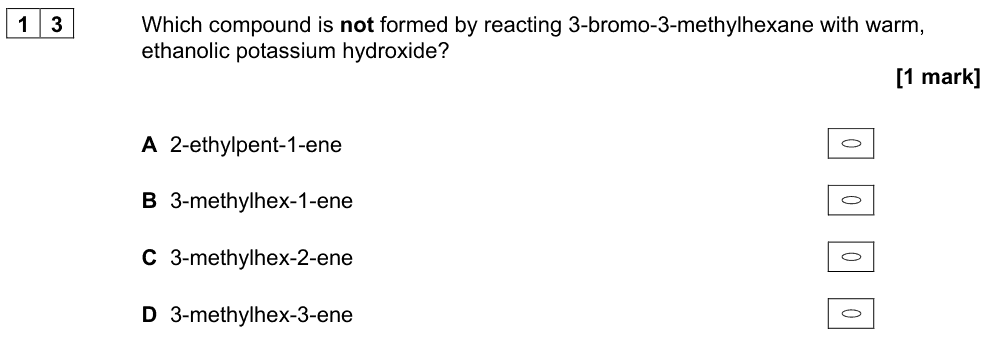
November 2021 · AS Paper 2 · Q131 markMultiple choice
Answer
B
Mark scheme
Notes from the mark scheme and report
Answer: B. Elimination removes H from a carbon next to C3 (C2, C4 or the methyl branch), giving 3-methylhex-2-ene, 3-methylhex-3-ene or 2-ethylpent-1-ene
a C1=C2 double bond cannot form
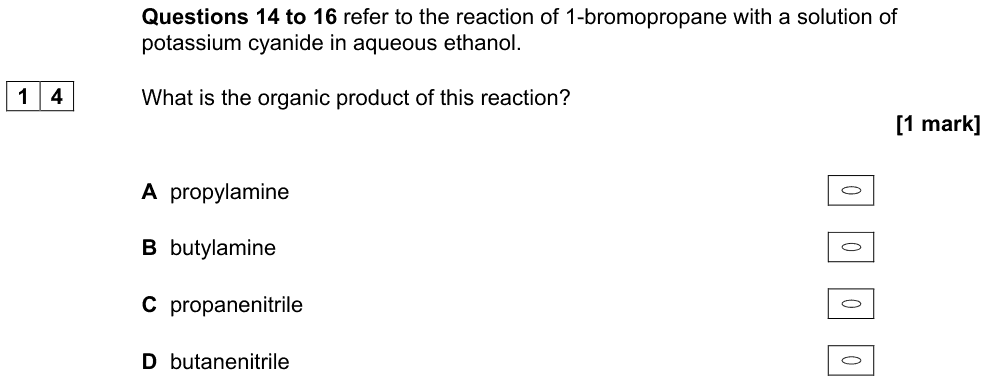
November 2021 · AS Paper 2 · Q141 markMultiple choice
Answer
D
Mark scheme
Notes from the mark scheme and report
Answer: D. CN– replaces Br in 1-bromopropane, adding a carbon to the chain: CH3CH2CH2CN, butanenitrile. Refers to the reaction described in the lead-in above question 14
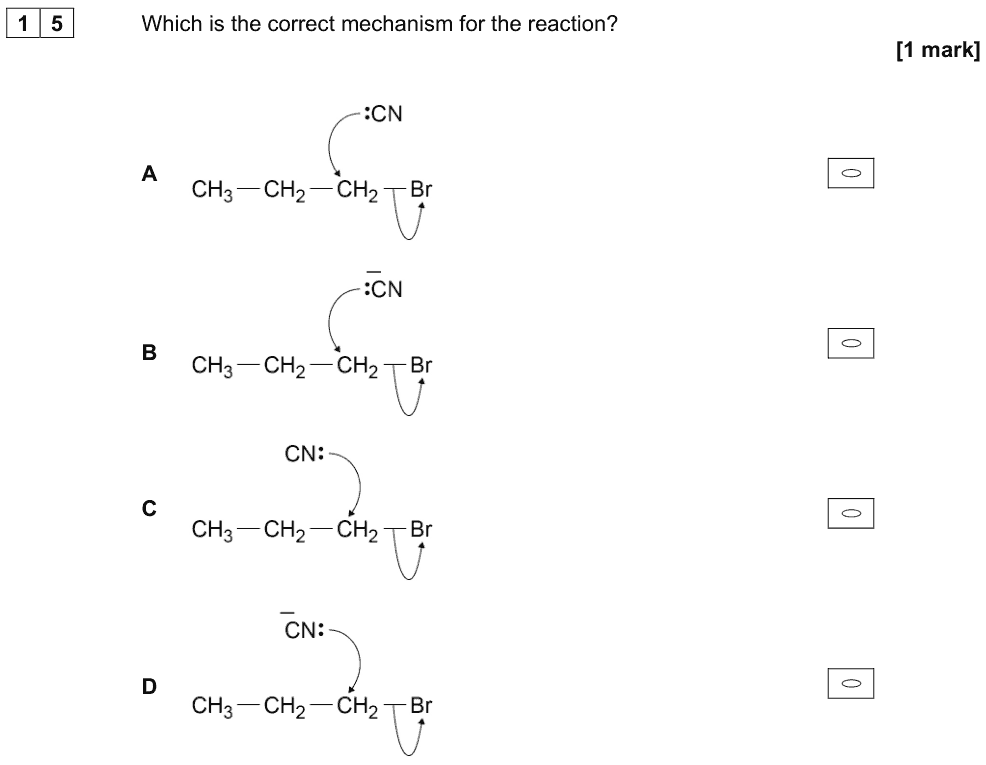
November 2021 · AS Paper 2 · Q151 markMultiple choice
Earlier part of question 15 that this part uses
Answer
B
Mark scheme
Notes from the mark scheme and report
Answer: B. The arrow starts from the lone pair on the carbon of the negatively charged :CN– ion and goes to the CH2 carbon, with a second arrow from the C–Br bond to Br
A and C lack the charge, D attacks from nitrogen
November 2021 · AS Paper 2 · Q161 markMultiple choice
Earlier part of question 16 that this part uses
Answer
A
Mark scheme
Notes from the mark scheme and report
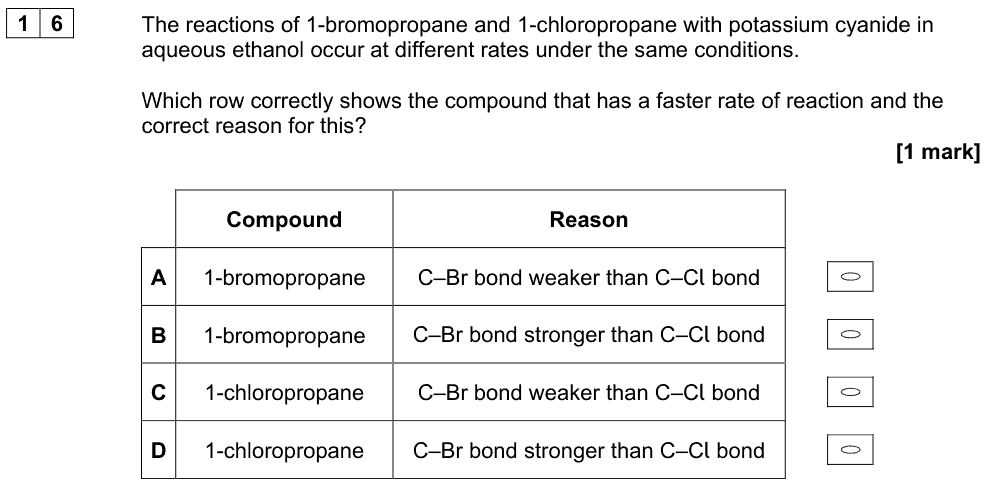
Answer: A. The C–Br bond is weaker than the C–Cl bond, so it breaks more easily and 1-bromopropane reacts faster
November 2021 · Paper 3 · Q301 markMultiple choice
Answer
B
Mark scheme
Notes from the mark scheme and report
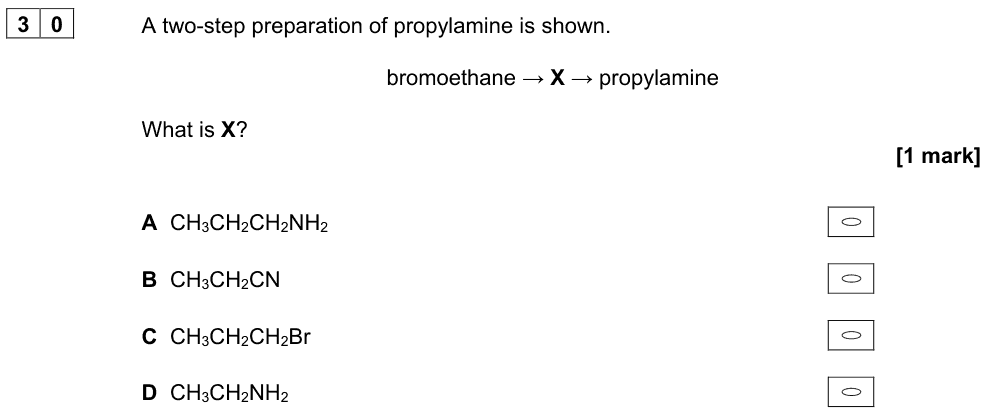
Answer: B. Bromoethane with KCN gives propanenitrile (one more carbon), which is reduced to propylamine
November 2020 · AS Paper 2 · Q01.55 marksMechanism
Earlier part of question 01 that this part uses
Mark scheme
Notes from the mark scheme and report
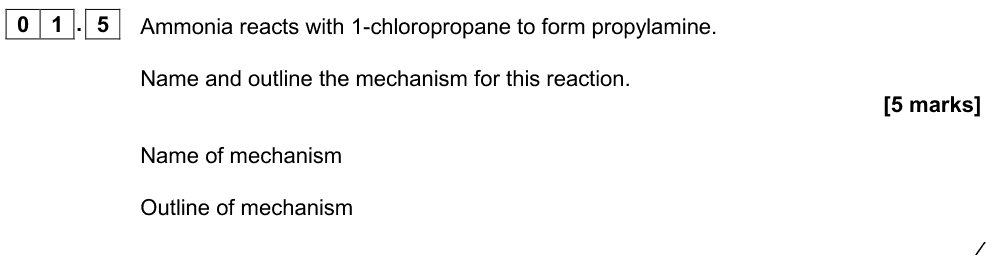
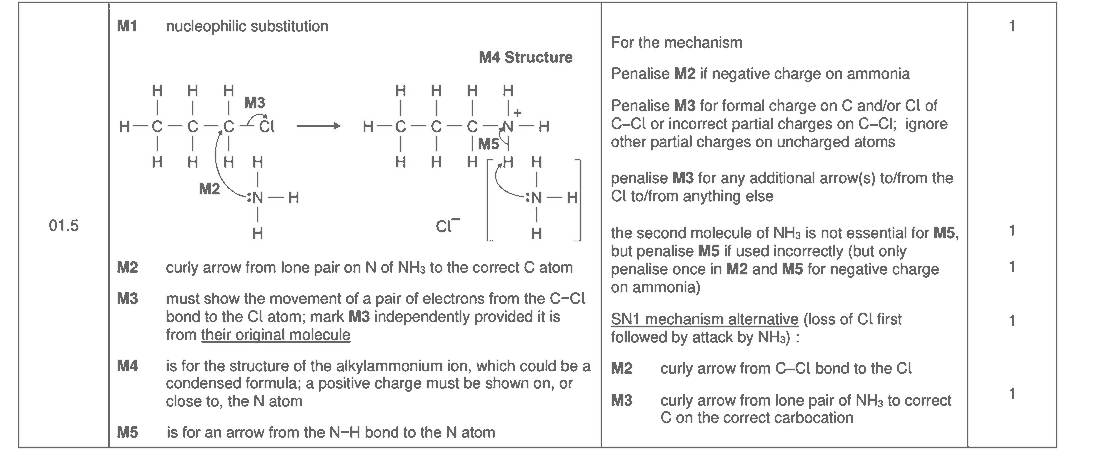
Nucleophilic substitution. Curly arrow from the lone pair on N of NH3 to the C bonded to Cl
curly arrow from the C–Cl bond to Cl
intermediate CH3CH2CH2NH3+ with the positive charge on N
curly arrow from an N–H bond to N (a second NH3 removing the H+ is not essential but must be correct if shown). No negative charge on ammonia
a formal charge on C or Cl of C–Cl loses the bond-breaking arrow mark
November 2020 · Paper 2 · Q05.13 marksShort answer
Mark scheme
Examiner's comment
05.1 was well known and the majority of students gave good answers.
Notes from the mark scheme and report
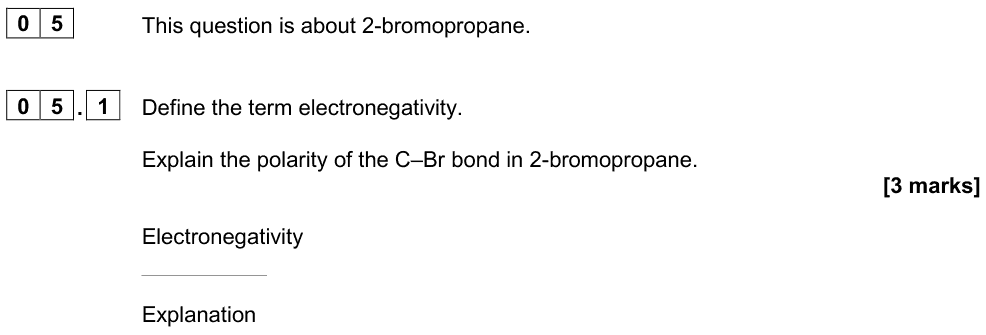
The (relative) tendency of an atom to attract the pair of electrons in a covalent bond. Br is more electronegative than C, so Br is δ– and C is δ+
November 2020 · Paper 2 · Q05.24 marksMechanism
Earlier part of question 05 that this part uses
Mark scheme
Examiner's comment
Around half the students scored all the marks for the mechanism in 05.2 and over 70% got at least 3 of the 4 marks.
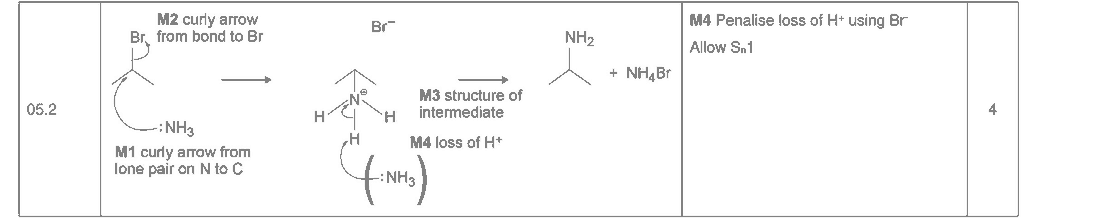
Notes from the mark scheme and report
Nucleophilic substitution. Curly arrow from the lone pair on N of NH3 to the C bonded to Br
curly arrow from the C–Br bond to Br
intermediate (CH3)2CH–NH3+ with the + on N
curly arrow from an N–H bond to N, with a second NH3 removing H+, giving (CH3)2CHNH2 + NH4Br. Loss of H+ using Br– is penalised
SN1 allowed. Around half scored all 4
over 70% scored at least 3
November 2020 · AS Paper 2 · Q101 markMultiple choice
Answer
C
Mark scheme
Notes from the mark scheme and report
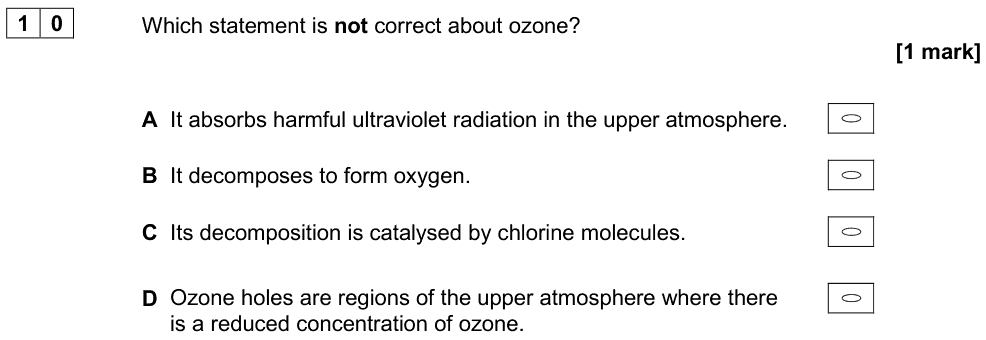
Answer: C. Ozone decomposition is catalysed by chlorine atoms (radicals) formed from CFCs, not by chlorine molecules
June 2019 · Paper 2 · Q01.24 marksMechanism
Earlier part of question 01 that this part uses
Mark scheme
Examiner's comment
01.2 The mechanism was answered well although some students drew an intermediate with too few carbons. The structure of a cyclic secondary amine proved difficult for some to deduce and many incorrect hexagons or primary amine structures were drawn.
Notes from the mark scheme and report
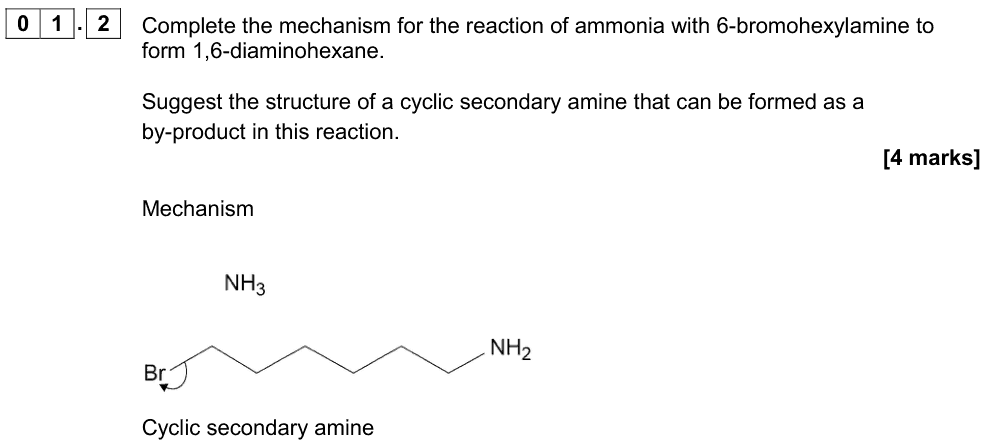
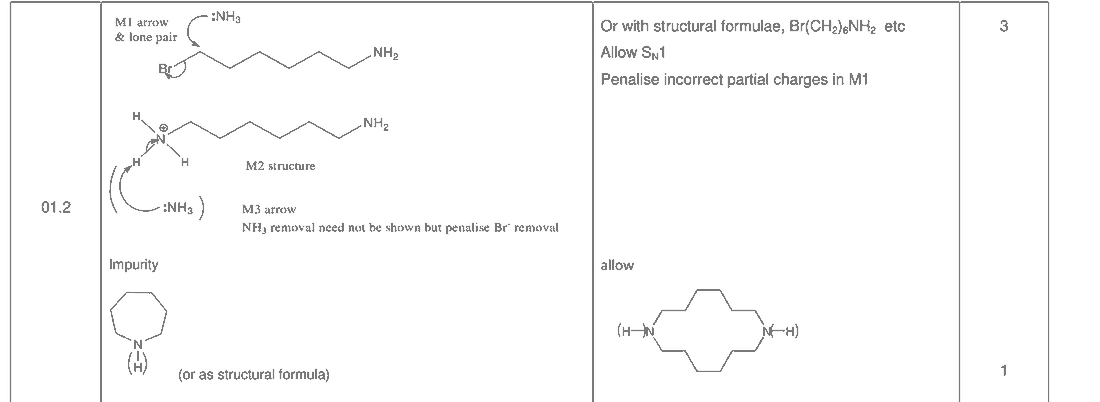
Nucleophilic substitution: curly arrow from the lone pair on N of NH3 to the carbon bonded to Br (the C–Br arrow is printed)
intermediate H3N+–(CH2)6–NH2
arrow from an N–H bond to N+ as a second NH3 removes H+ (do not use Br– for this). Cyclic by-product: a seven-membered ring of six CH2 groups and one N–H (the amine end of the molecule attacks its own C–Br carbon). Errors: intermediate with too few carbons
hexagons or primary amines for the cyclic amine
June 2019 · Paper 2 · Q01.33 marksShort answer
Earlier part of question 01 that this part uses
Mark scheme
Examiner's comment
01.3 KCN was usually given but the correct aqueous-alcoholic conditions were rarely seen. The mark for hydrogen and nickel was gained by most.
Notes from the mark scheme and report
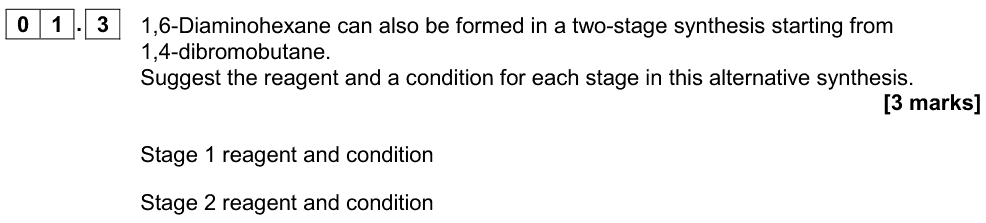
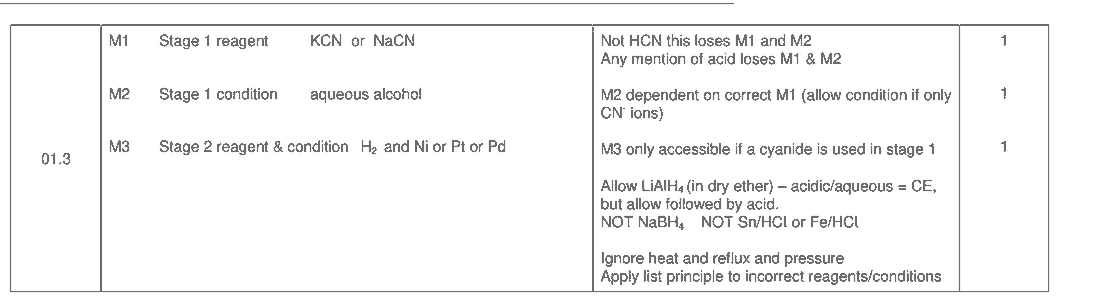
Stage 1: KCN (or NaCN) in aqueous alcohol, giving NC(CH2)4CN. Stage 2: H2 with Ni (or Pt / Pd) catalyst (allow LiAlH4 in dry ether) to reduce the dinitrile. HCN or any acid in stage 1 loses M1 and M2
not NaBH4, not Sn/HCl. The aqueous-alcoholic condition was rarely given.
June 2019 · AS Paper 2 · Q02.12 marksMechanism
Mark scheme
Examiner's comment
2.1 The mechanism was done very well in the main. The most common error was to omit the negative charge from the cyanide ion.
Notes from the mark scheme and report
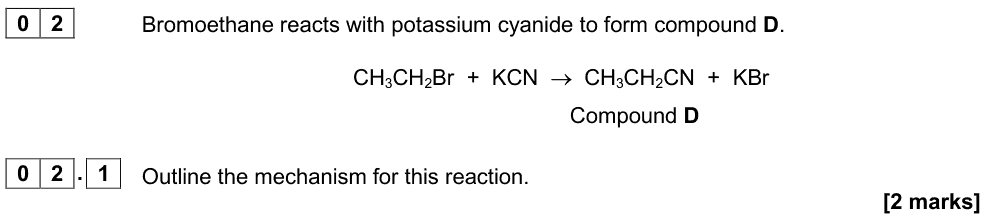
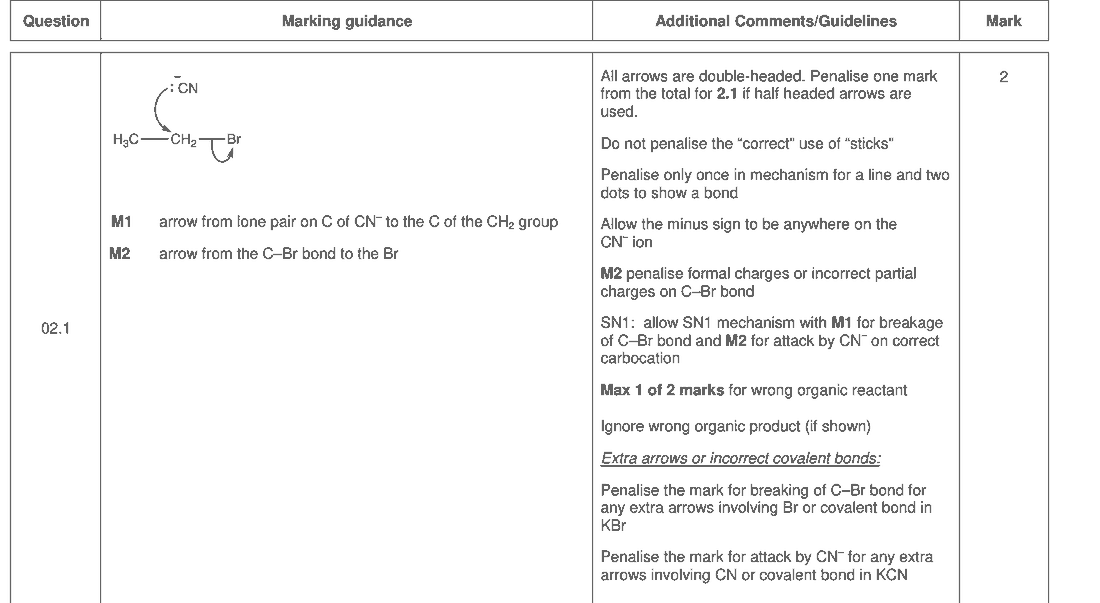
Nucleophilic substitution: M1 arrow from the lone pair on C of :CN– to the C of CH2
M2 arrow from the C–Br bond to Br. Lone pair and negative charge needed on cyanide
SN1 route allowed. Most common error: negative charge left off the cyanide ion
June 2019 · AS Paper 2 · Q09.11 markEquation writing
Mark scheme
Examiner's comment
9.1 Many students could write an equation that gave chlorine radicals, but many missed a radical dot on one or both of the products.
Notes from the mark scheme and report
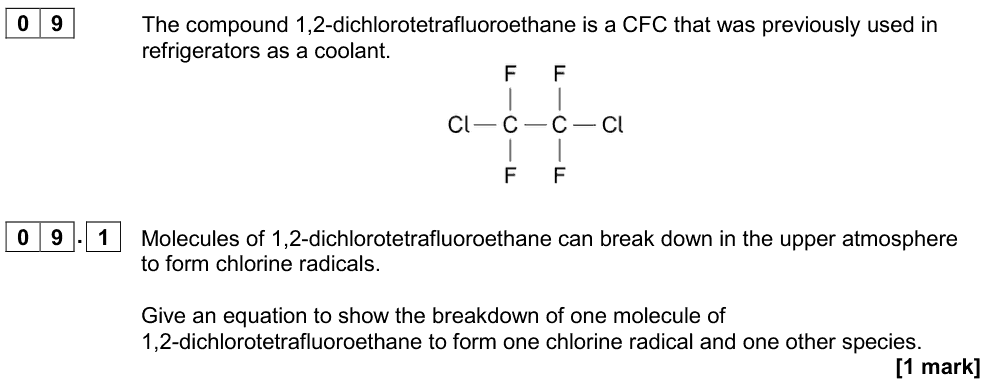
CF2ClCF2Cl → •CF2CF2Cl + Cl• (C–Cl bond broken by UV). Radical dot needed on both products
many missed one
June 2019 · AS Paper 2 · Q09.22 marksEquation writing
Earlier part of question 09 that this part uses
Mark scheme
Examiner's comment
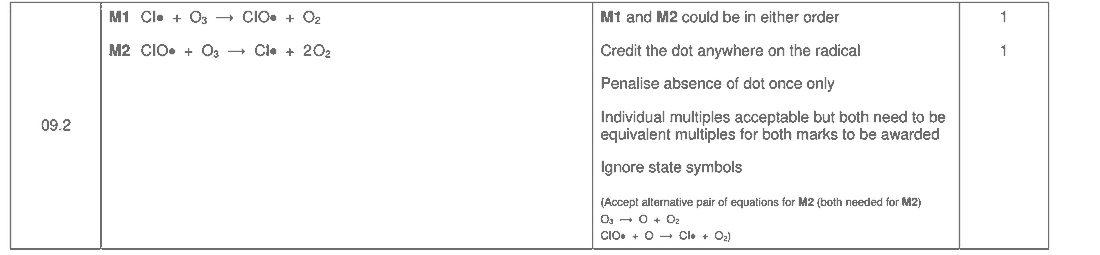
9.2 Most students could write one or both of the equations for the decomposition of ozone by chlorine radicals. However, even though these two equations are in the specification, many did not score both marks.
This was answered correctly by a good majority of students.
Notes from the mark scheme and report
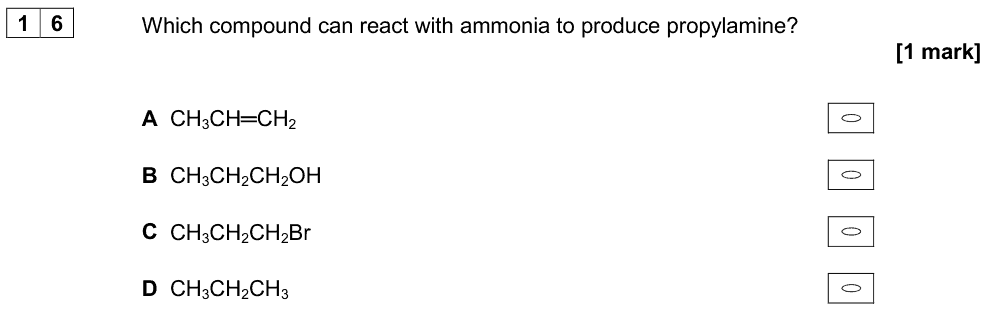
Answer: C. Nucleophilic substitution of 1-bromopropane by NH3 gives propylamine
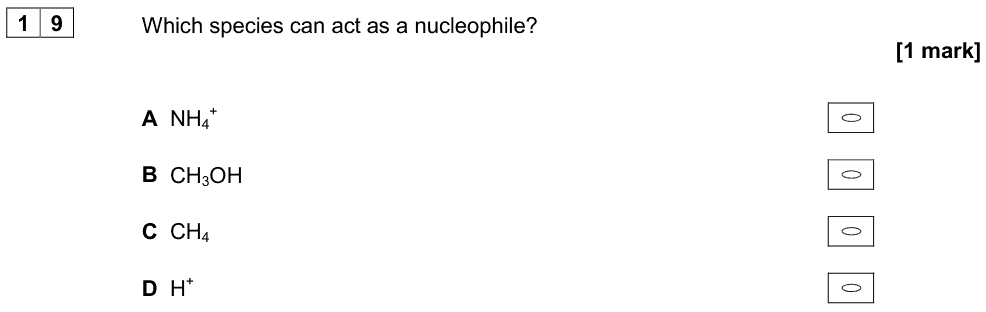
June 2019 · AS Paper 2 · Q191 markMultiple choice
Answer
B
Mark scheme
Examiner's comment
This question was not as well answered as expected. There was only one species with a lone pair, but only about half the students could identify this as the nucleophile.
Notes from the mark scheme and report
Answer: B. Only CH3OH has a lone pair (on O) to donate
NH4+, CH4 and H+ have none
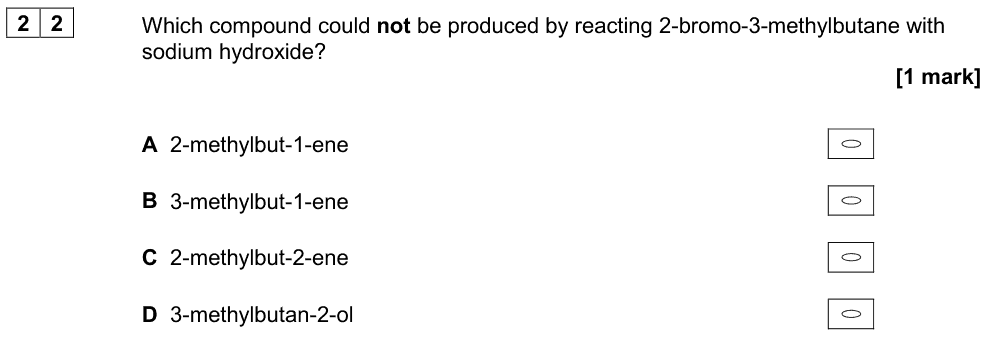
June 2019 · AS Paper 2 · Q221 markMultiple choice
Answer
A
Mark scheme
Examiner's comment
Students found this question more challenging. It would be helpful to draw structures.
Notes from the mark scheme and report
Answer: A. CH3CHBrCH(CH3)2: elimination gives 3-methylbut-1-ene or 2-methylbut-2-ene, substitution gives 3-methylbutan-2-ol
a C=C between C1 and C2 of a 2-methyl chain cannot form. Drawing the structures helps
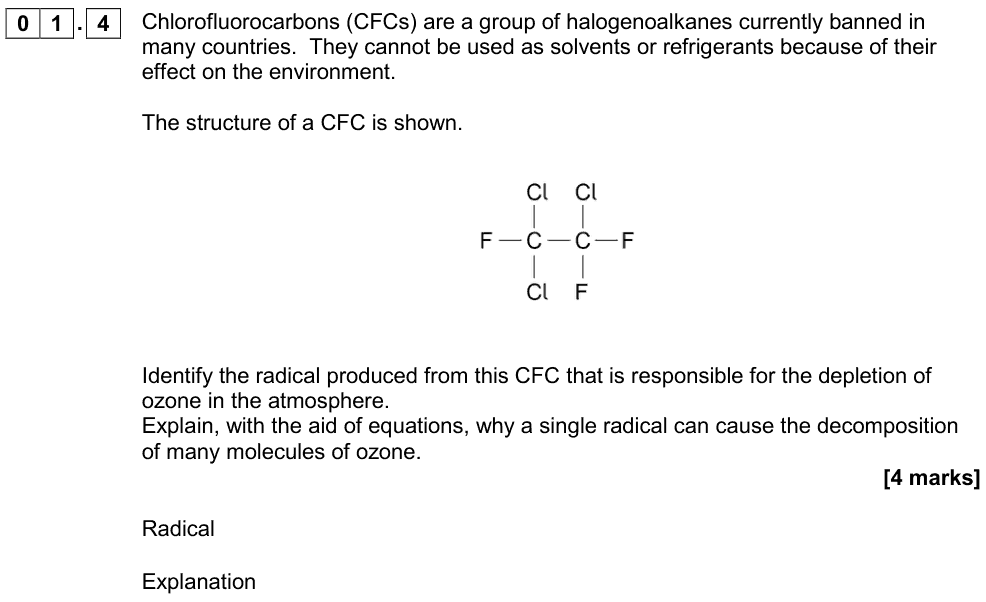
June 2018 · Paper 2 · Q01.44 marksExplanation
Earlier part of question 01 that this part uses
Mark scheme
Examiner's comment
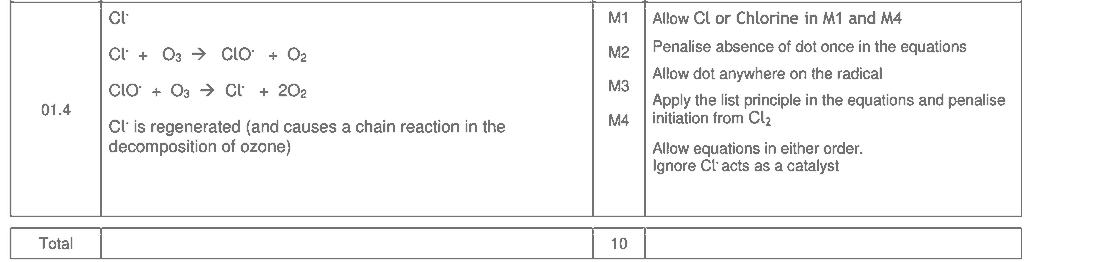
01.4 This four mark question was answered well and 40.2% of candidates gained full marks. The chlorine radical was well known although F. and other radicals from the CFC were seen. A few students thought that Cl. came from Cl2 rather than from the CFC and this was penalised. There were a few missing dots in the equations. Mark point 4 was usually gained, although some candidates wrote about Cl. acting as a catalyst and not being used up, without stating that it was regenerated/reformed.
Notes from the mark scheme and report
Cl• (chlorine radical). Cl• + O3 → ClO• + O2
ClO• + O3 → Cl• + 2O2. The Cl• is regenerated, so it goes on to decompose more ozone (chain reaction). Cl• must come from the CFC, not from Cl2
'acts as a catalyst' alone does not gain the last mark. 40.2% scored all 4
June 2018 · Paper 2 · Q02.23 marksExplanation
Earlier part of question 02 that this part uses
Mark scheme
Examiner's comment
02.2 The polarity of the bond between the bromine and the carbon, with the result that the carbon was slightly positive, was well known, although many struggled to explain this by a comparison of electronegativities. Some students failed to gain mark point 3 as they referred to nucleophiles as electron donors rather than electron pair donors, or simply stated that the nucleophile was attracted to the slightly positive carbon atom.
Notes from the mark scheme and report
Bromine is more electronegative than carbon
so the carbon is partially positive (electron deficient)
the lone pair on the nucleophile is donated to (attacks) the δ+ carbon. Nucleophiles are electron pair donors, not 'electron donors'
June 2018 · AS Paper 2 · Q06.34 marksMechanism
Earlier part of question 06 that this part uses
Mark scheme
Examiner's comment
06.3 The nucleophilic substitution mechanism was well-answered; 45.6% of students scored full marks here.
Notes from the mark scheme and report
Nucleophilic substitution. Curly arrow from the lone pair on O of OH– to the C of C–Cl
curly arrow from the C–Cl bond to Cl
product 2,4-dimethylpentan-3-ol. No extra arrows on NaOH and no covalent Na–OH
a formal charge on the C or Cl of C–Cl loses the bond-breaking arrow mark. The structure of A to use is printed under 'Outline of mechanism'
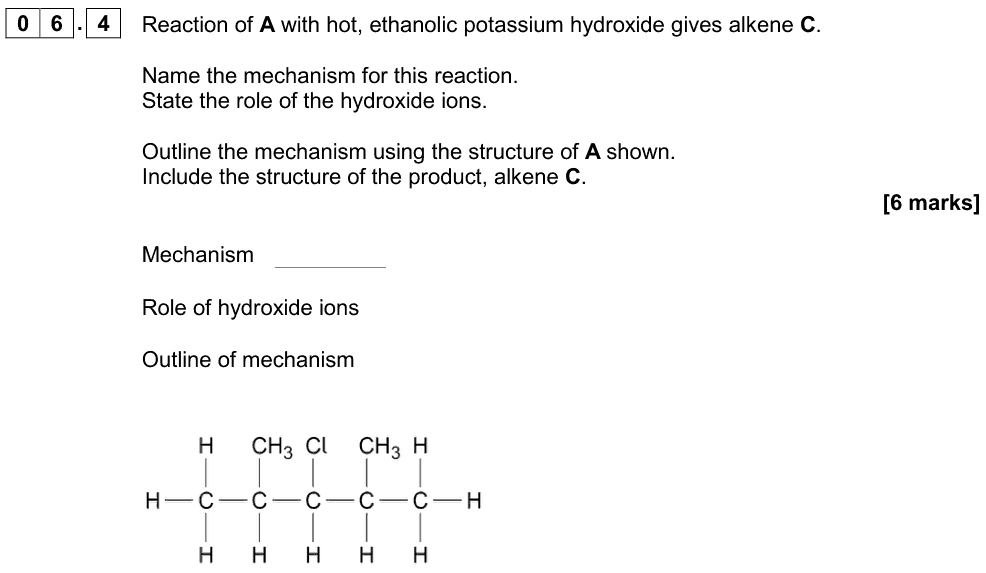
June 2018 · AS Paper 2 · Q06.46 marksMechanism
Earlier part of question 06 that this part uses
Mark scheme
Examiner's comment
06.4 The elimination mechanism was more challenging, and many students did not know the role of the hydroxide ion. This question discriminated particularly well.
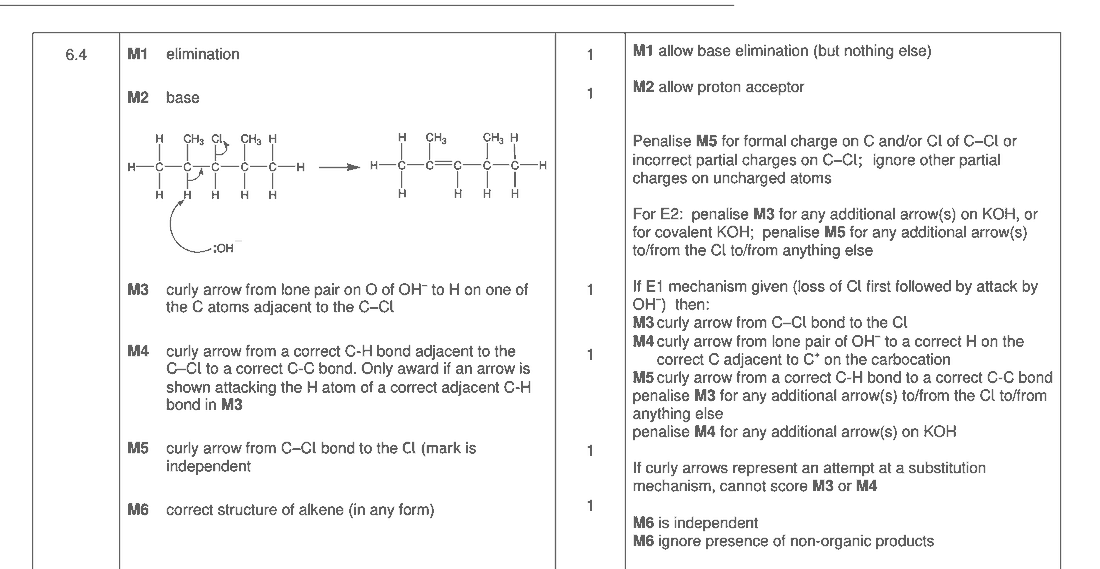
Notes from the mark scheme and report
Elimination
hydroxide acts as a base (proton acceptor). Curly arrow from the lone pair on O of OH– to an H on a carbon next to the C–Cl
curly arrow from that C–H bond to the C–C bond between the two carbons
curly arrow from the C–Cl bond to Cl
product 2,4-dimethylpent-2-ene. Many did not know the role of the hydroxide ion
June 2018 · AS Paper 2 · Q06.61 markShort answerHard
Earlier part of question 06 that this part uses
Mark scheme
Examiner's comment
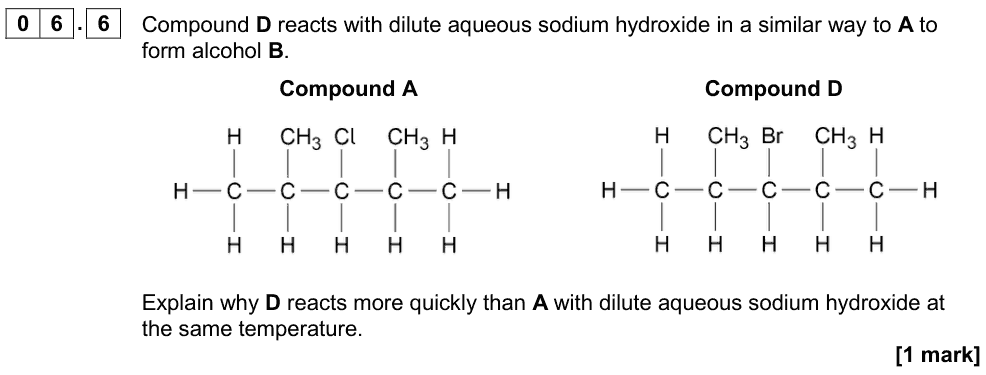
06.6 Students struggled to explain the relative rates of reaction of the halogenoalkanes. The most common answer incorrectly referred to the reactivity of the elements bromine and chlorine, rather than looking at the C-Br and C-Cl bond strengths. Only 28.6% of students gained this mark.
Notes from the mark scheme and report
The C–Br bond is weaker (lower bond enthalpy) than the C–Cl bond, so it breaks more easily. Must compare the two bonds
electronegativity and polarity are ignored. Most common error: 'bromine is more reactive than chlorine'
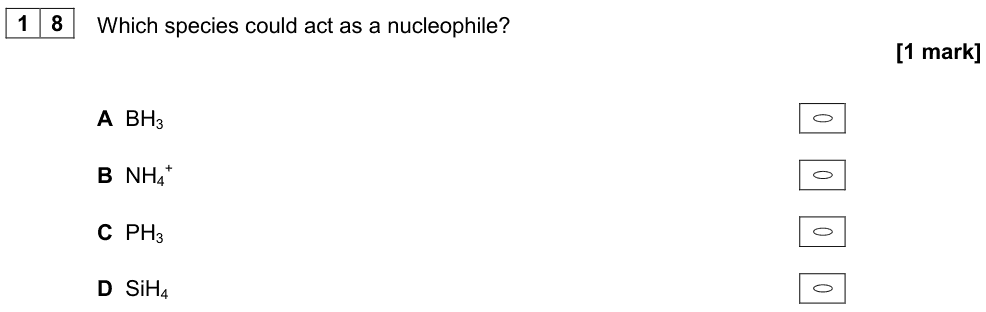
June 2018 · AS Paper 2 · Q181 markMultiple choice
Answer
C
Mark scheme
Examiner's comment
Many students (46.8%) got this question correct but many others thought that NH4
+ could act as a nucleophile, possibly due to confusion with NH3.
Notes from the mark scheme and report
Answer: C. A nucleophile needs a lone pair to donate
PH3 has one on phosphorus. NH4+ has no lone pair (a common wrong choice, confused with NH3)
June 2018 · AS Paper 2 · Q231 markMultiple choiceEasy
Answer
D
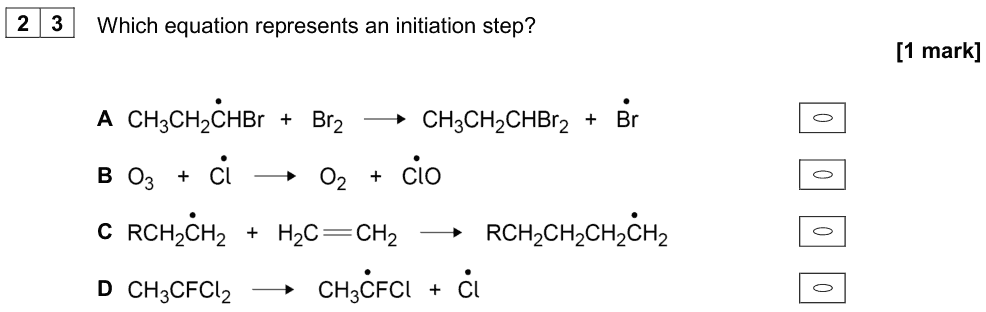
Mark scheme
Examiner's comment
A high proportion of students (73.9%) could identify the initiation reaction, but many thought that the propagation step from the decomposition of ozone was an initiation reaction.
Notes from the mark scheme and report
Answer: D. Initiation forms radicals from a molecule with none: the C–Cl bond breaks to give two radicals. A, B and C each start and end with a radical (propagation). Many chose B, the ozone propagation step
June 2018 · Paper 3 · Q101 markMultiple choice
Answer
D
Mark scheme
Examiner's comment
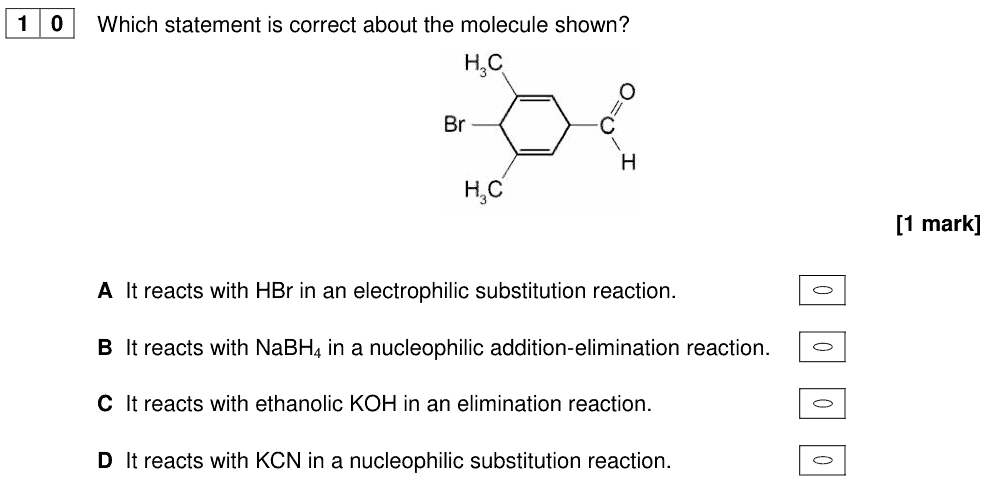
10 B was the commonest incorrect response suggesting confusion about the name of the mechanism of aldehyde reduction. 54.4% of students chose the correct response.
Notes from the mark scheme and report
Answer: D. The Br is on a saturated ring carbon, so the halogenoalkane group undergoes nucleophilic substitution with CN–. HBr would add to C=C (electrophilic addition)
NaBH4 reduces the aldehyde by nucleophilic addition
the carbons next to C–Br have no H so elimination is not possible. Commonest wrong answer B
June 2017 · Paper 2 · Q01.11 markDiagram or structure
Mark scheme
Examiner's comment
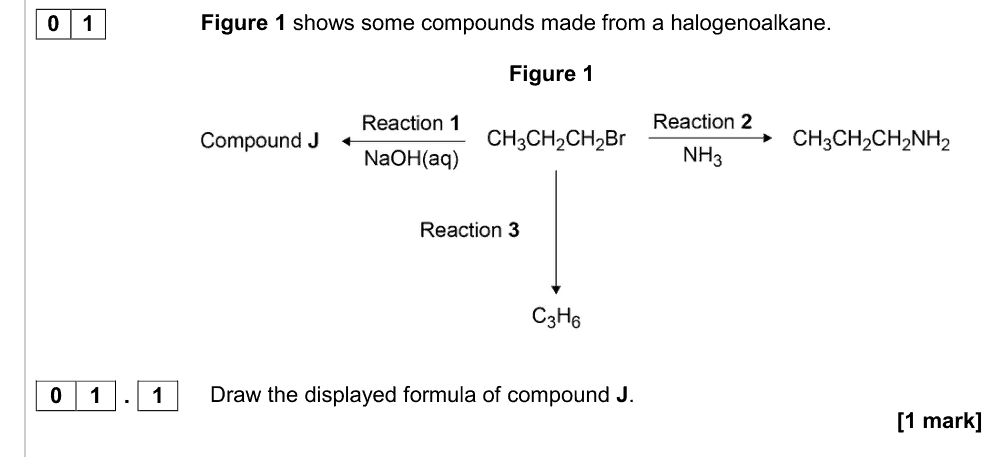
01.1 Although most students identified compound J as propan-1-ol, a surprising number failed to show the O−H bond as is necessary in a displayed formula.
Notes from the mark scheme and report
Displayed formula of propan-1-ol, CH3CH2CH2OH, showing every bond including O–H. Many did not draw the O–H bond
June 2017 · Paper 2 · Q01.22 marksShort answer
Earlier part of question 01 that this part uses
Mark scheme
Examiner's comment
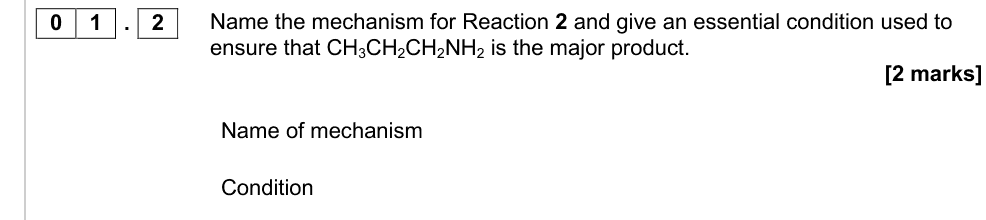
01.2 Most students could name the mechanism, but the condition proved more difficult.
Notes from the mark scheme and report
Nucleophilic substitution
excess ammonia (so the primary amine does not react further). Aqueous, alcoholic, heat and pressure are ignored. The condition was the harder mark
June 2017 · Paper 2 · Q01.51 markShort answer
Earlier part of question 01 that this part uses
Mark scheme
Examiner's comment
01.5 Both the reagent (which must be a complete compound) and a condition were needed to score the mark; several omitted the condition.
Notes from the mark scheme and report
NaOH or KOH dissolved in ethanol (alcoholic): reagent and condition both required
not aqueous. Several omitted the condition
June 2017 · Paper 2 · Q01.64 marksMechanism
Earlier part of question 01 that this part uses
Mark scheme
Examiner's comment
01.6 This was a high scoring question for many. For others, the main errors were missing the negative sign or the lone pair on the hydroxide ion, or showing attack on the wrong hydrogen atom.
Notes from the mark scheme and report
(Base) elimination. Arrow from the lone pair on O of OH– to an H on carbon 2
arrow from that C–H bond to the C1–C2 bond
arrow from the C–Br bond to Br. E1 also credited. Nucleophilic substitution scores M3 only. Errors: no negative charge or lone pair on hydroxide
attack on the wrong H
June 2017 · AS Paper 2 · Q06.13 marksMechanism
Mark scheme
Examiner's comment
06.1 This straightforward nucleophilic substitution mechanism was well known and well drawn in general.
Notes from the mark scheme and report
Nucleophilic substitution. Curly arrow from the lone pair on O of :OH– to the C of C–Br
curly arrow from the C–Br bond to Br. No formal charges on the C or Br of C–Br
no extra arrows on NaOH. An elimination attempt scores no mechanism marks
June 2017 · AS Paper 2 · Q06.32 marksShort answer
Earlier part of question 06 that this part uses
Mark scheme
Examiner's comment
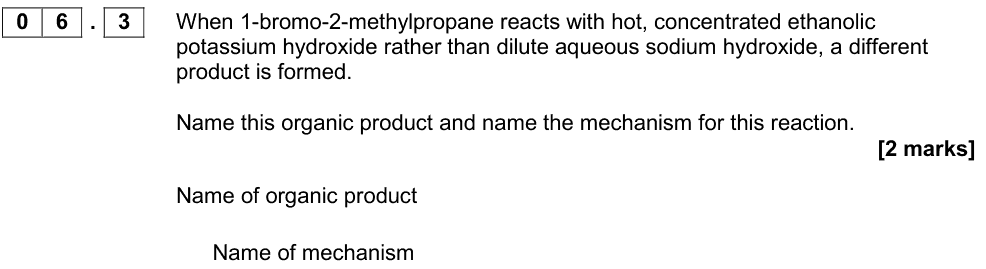
06.3 Most students knew that an elimination reaction took place, but few could give the correct name for the product, methylpropene.
Notes from the mark scheme and report
Methylpropene (allow 2-methylpropene
no name with a number for the double bond position)
elimination (allow base elimination). Few named the product correctly
June 2017 · Paper 2 · Q11.25 marksShort answer
Earlier part of question 11 that this part uses
Mark scheme
Examiner's comment
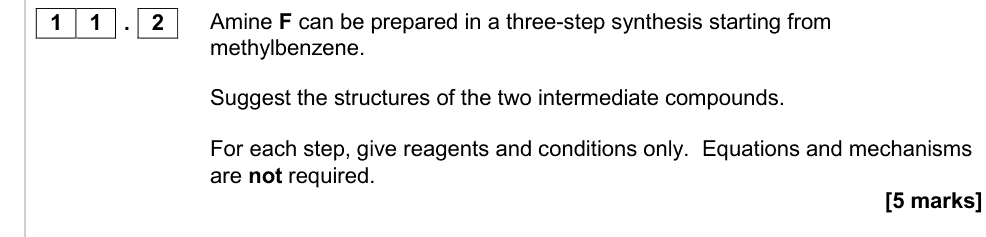
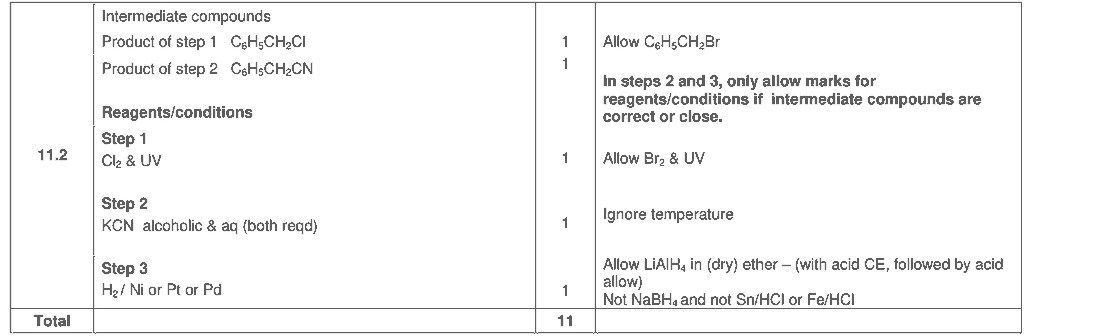
11.2 Some excellent answers were seen, but overall this was not answered well. The fact that about 8% of students made no attempt at this part of the question perhaps indicated that a small number of students were short of time. Some students, confused by the presence of a benzene ring, started with nitration. This rarely led to any marks. For those who chose the correct route, the two intermediates were often correctly identified. The use of chlorine or bromine in UV in the first step was usually well known but use of the reagent KCN in a mixed aqueous/alcoholic solvent was less often correct in the next step. The expected reducing agent/condition for the final step was hydrogen with a nickel or platinum catalyst. LiAlH4 in dry ether is not required knowledge for this specification, but was an acceptable answer.
Notes from the mark scheme and report
Intermediates: C6H5CH2Cl (or the bromide), then C6H5CH2CN. Step 1: Cl2 (or Br2) and UV light. Step 2: KCN in aqueous alcohol (both needed). Step 3: H2 with a Ni (or Pt/Pd) catalyst
LiAlH4 in dry ether allowed
not NaBH4, Sn/HCl or Fe/HCl. Reagent marks for steps 2 and 3 need correct intermediates. Common error: starting with nitration
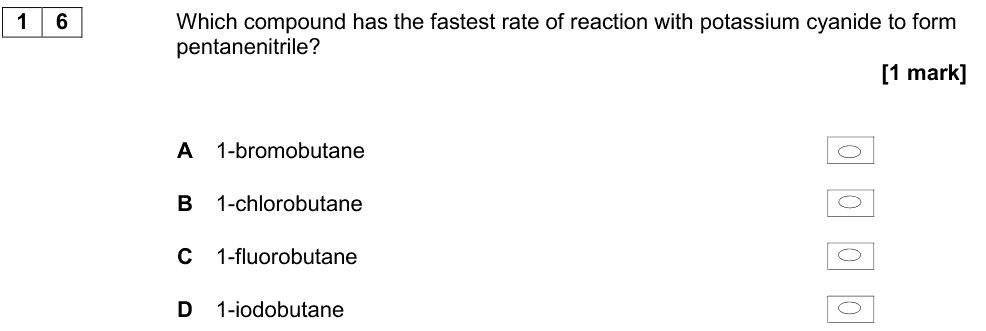
June 2017 · AS Paper 2 · Q161 markMultiple choice
Answer
D
Mark scheme
Examiner's comment
Many students (58.4%) got this question correct but many incorrectly believed that the fluoroalkane would react fastest.
Notes from the mark scheme and report
Answer: D. The C–I bond has the lowest bond enthalpy, so it breaks most easily. Common wrong answer: the fluoroalkane
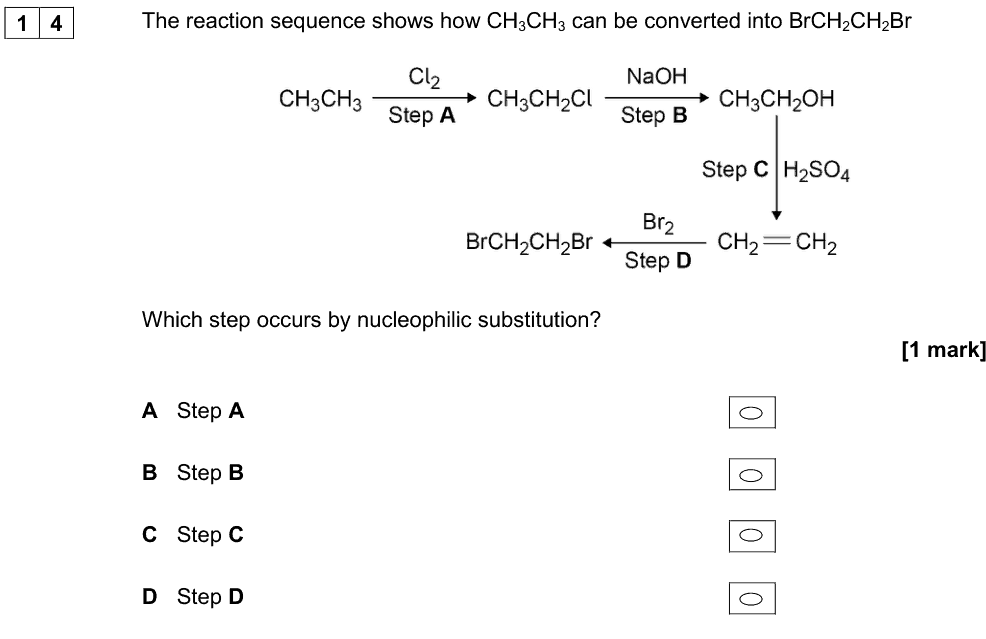
June 2017 · Paper 3 · Q141 markMultiple choice
Answer
B
Mark scheme
Notes from the mark scheme and report
Answer: B. Chloroethane with NaOH: OH– replaces Cl. Step A is free-radical substitution, C is elimination and D is electrophilic addition
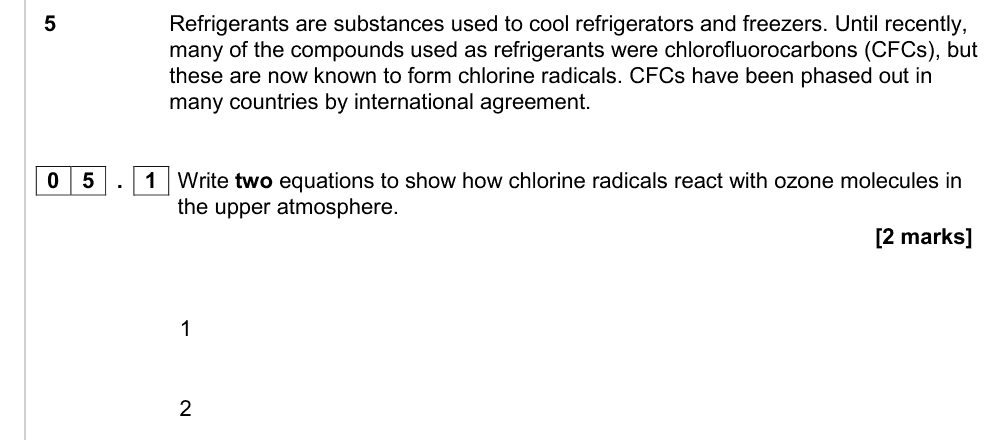
June 2016 · AS Paper 2 · Q05.12 marksEquation writing
Mark scheme
Examiner's comment
In Q5.1the two equations showing how chlorine radicals destroy ozone were quite well known.Many students in Q5.2 could draw the correct displayed formula of chloropentafluoroethane.
Notes from the mark scheme and report
Cl• + O3 → ClO• + O2 and ClO• + O3 → 2O2 + Cl•. Missing radical dot penalised once
June 2016 · AS Paper 2 · Q05.31 markShort answer
Earlier part of question 05 that this part uses
Mark scheme
Examiner's comment
Many students in Q5.3 could explain why 1,1,1-trifluoroethane did not lead to ozone depletion.
The simplest answer was that it contains no chlorine, but credit was given for students who stated that the C-F bonds were strong and so fluorine radicals were not released.
Notes from the mark scheme and report
It contains no chlorine / no C–Cl bonds, so no chlorine radicals are released (or the C–F bonds are too strong to break)
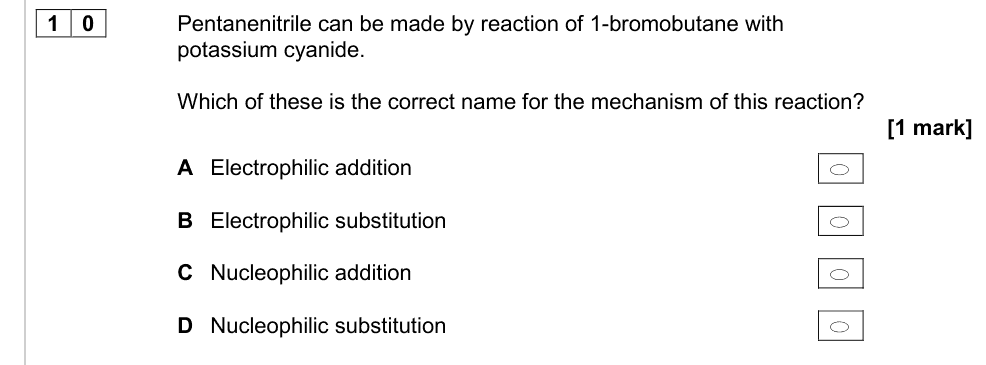
June 2016 · AS Paper 2 · Q101 markMultiple choice
Answer
D
Mark scheme
Notes from the mark scheme and report
Answer: D. CN– is a nucleophile and replaces Br in a halogenoalkane: nucleophilic substitution
June 2016 · AS Paper 2 · Q131 markMultiple choice
Answer
B
Mark scheme
Notes from the mark scheme and report
Answer: B. Elimination: the lone pair on :OH– takes the H from carbon 3 (the carbon carrying the CH3 branch), the C–H bond pair forms the C=C between carbons 2 and 3, and the C–Br bond breaks to give Br–. A removes H from carbon 1 (gives 3-methylbut-1-ene)
C and D show the wrong atoms attacked
Specimen · Paper 3 · Q281 markAO1=1Multiple choice
Answer
D
Mark scheme
Notes from the mark scheme and report
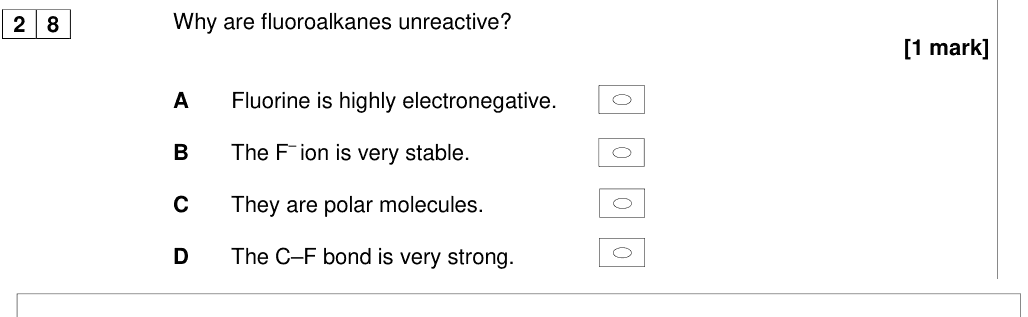
Answer: D. The C–F bond is very strong (high bond enthalpy), so it is hard to break
Work with an A-level chemistry tutor
Dropping marks on calculations, mechanisms or the required practicals? Book a trial session with a specialist A-level chemistry tutor.