Notes and key-term cards for this topic are being written by our tutors. The past-paper questions below are ready now.
Specification statements
Show the 7 statements from the specification
3.3.10.1-01 The nature of the bonding in a benzene ring, limited to planar structure and bond length intermediate between single and double.
3.3.10.1-02 Delocalisation of p electrons makes benzene more stable than the theoretical molecule cyclohexa-1,3,5-triene.
3.3.10.1-03 Students should be able to: • use thermochemical evidence from enthalpies of hydrogenation to account for this extra stability • explain why substitution reactions occur in preference to addition reactions.
3.3.10.2-01 Electrophilic attack on benzene rings results in substitution, limited to monosubstitutions.
3.3.10.2-02 Nitration is an important step in synthesis, including the manufacture of explosives and formation of amines.
3.3.10.2-03 Friedel–Crafts acylation reactions are also important steps in synthesis.
3.3.10.2-04 Students should be able to outline the electrophilic substitution mechanisms of: • nitration, including the generation of the nitronium ion • acylation using AlCl3 as a catalyst.
Six-mark level of response questions on this topic
Tap a question to zoom it. Where a part needs a figure, table or structure from earlier in the question, that part folds out above it; the mark scheme and examiner's comment open underneath. Have AQA's Data Booklet (the Periodic Table and the spectroscopy tables) beside you.
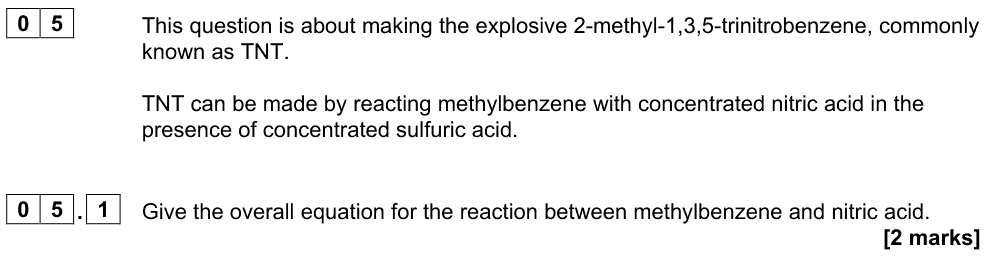
June 2025 · Paper 2 · Q05.12 marksAO1=2Equation writing
Mark scheme
Examiner's comment
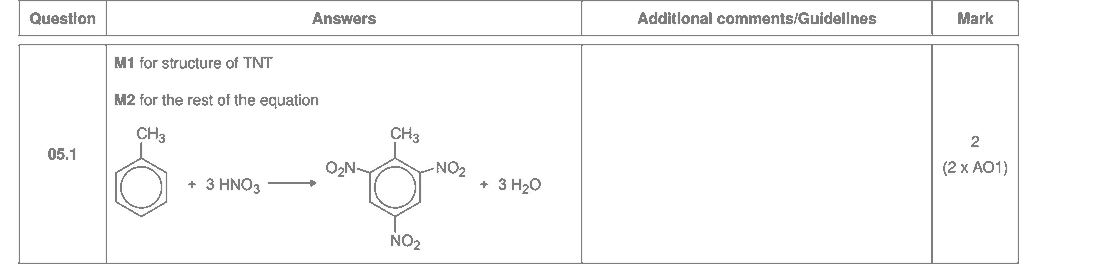
5.1 Students were quite good at showing the formula of TNT having been given its IUPAC name but far fewer could balance the equation with 3HNO3 on the reactants side and 3H2O on the products side.
Notes from the mark scheme and report
C6H5CH3 + 3HNO3 → C6H2(CH3)(NO2)3 + 3H2O, with the structure of TNT (methyl at position 2, nitro groups at 1, 3 and 5) for M1. Many did not balance with 3HNO3 and 3H2O
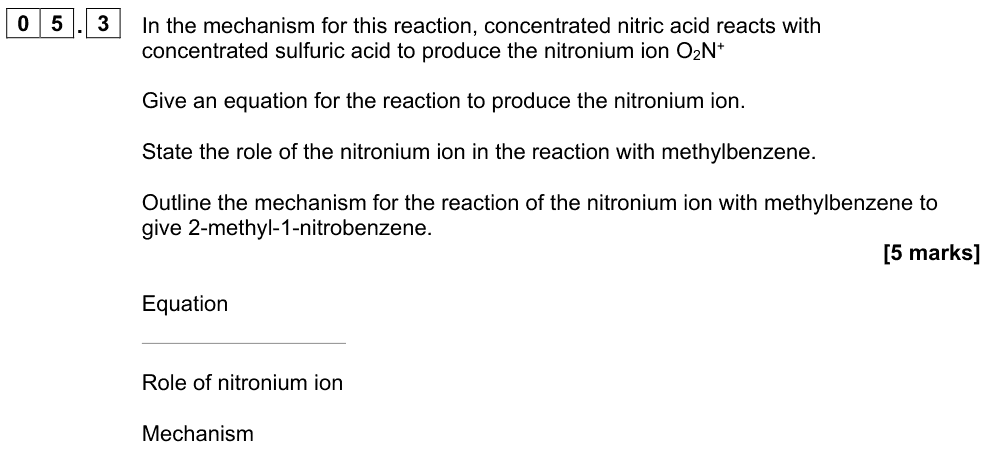
June 2025 · Paper 2 · Q05.35 marksAO1=5Mechanism
Earlier part of question 05 that this part uses
Mark scheme
Examiner's comment
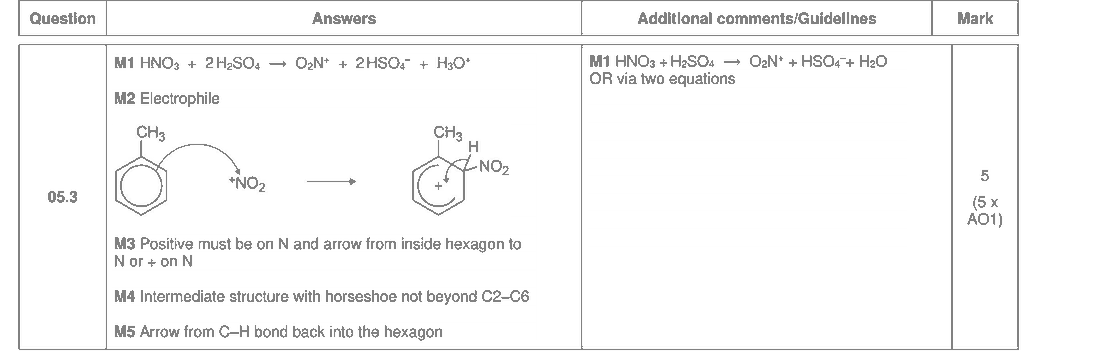
5.3 The mechanism for nitration was well known. Despite being given the formula of the nitronium ion as O2N+ in the question significant numbers of students lost the first mark in the mechanism for not showing the + on the N.
arrow from inside the ring to the N of +NO2 (the + must be on N)
intermediate with a horseshoe not extending beyond C2–C6 and the + inside, with H and NO2 on the carbon next to the CH3
arrow from the C–H bond back into the ring. Common error: + not shown on N
June 2024 · Paper 2 · Q10.15 marksAO1=2, AO3=3Explanation
Mark scheme
Examiner's comment
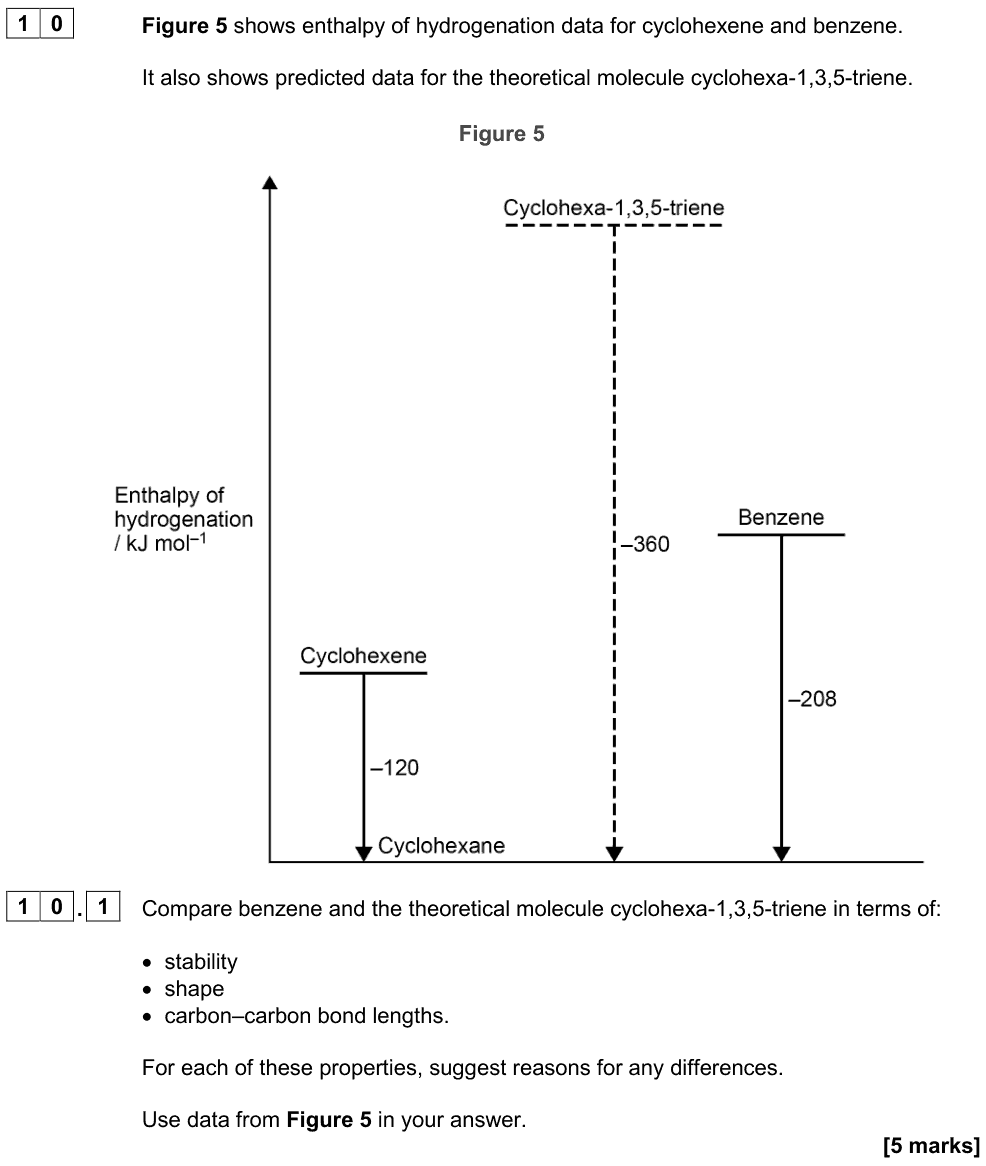
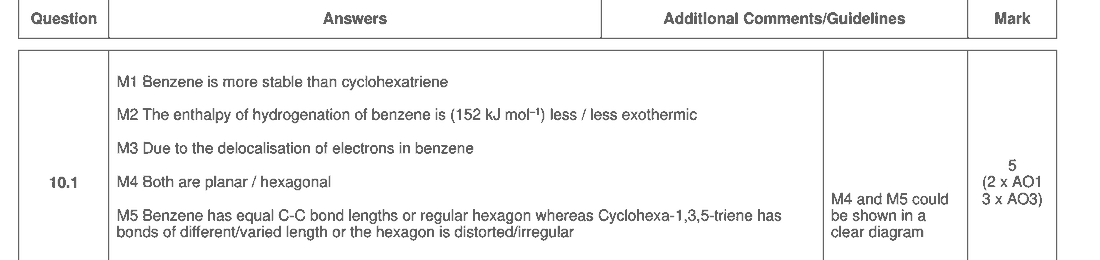
10.1 This extended response question on the structure and bonding in benzene had a mean mark of almost 3 out of 5. Virtually all of the students were able to score some of the marks, and almost 40% gained at least 4 marks.
Notes from the mark scheme and report
Benzene is more stable than cyclohexa-1,3,5-triene
its enthalpy of hydrogenation (–208) is 152 kJ mol–1 less exothermic than the predicted –360 (3 × –120)
because the p electrons are delocalised
both are planar hexagons
in benzene all the C–C bonds are the same length (regular hexagon), in the triene the C=C and C–C bonds differ (distorted hexagon). Mean mark almost 3
almost 40% gained 4 or more
Skills: MS3.1 Translate information between graphical, numerical and algebraic forms
June 2024 · Paper 2 · Q10.22 marksAO1=1, AO2=1Equation writing
Earlier part of question 10 that this part uses
Mark scheme
Examiner's comment
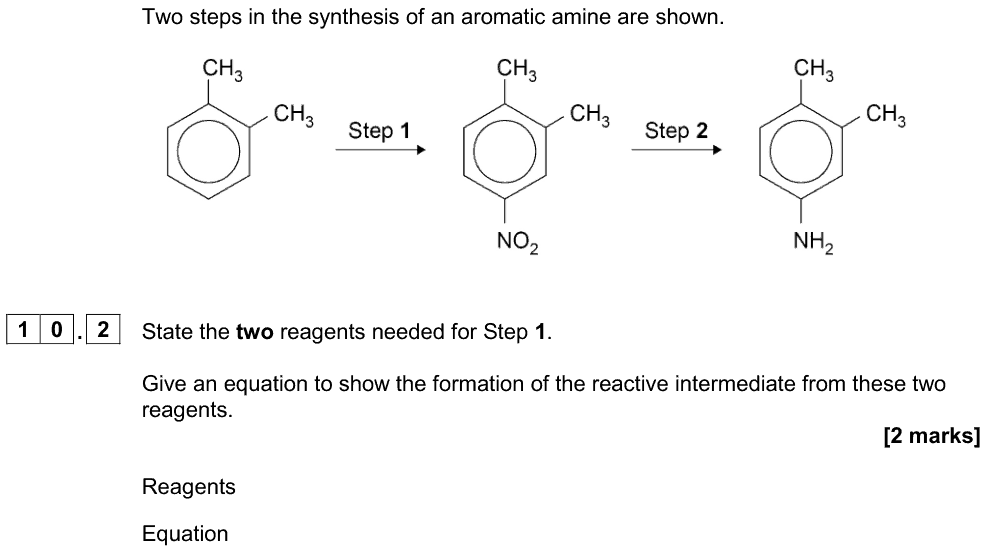
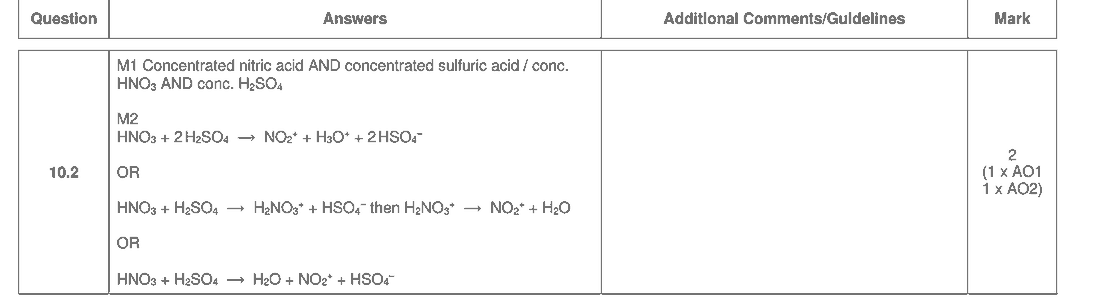
10.2 The reagents were well known but equations often had errors, despite this question being set on several occasions in the past.
Notes from the mark scheme and report
Concentrated nitric acid and concentrated sulfuric acid
June 2024 · Paper 2 · Q10.33 marksAO1=3MechanismHard
Earlier parts of question 10 that this part uses
Mark scheme
Examiner's comment
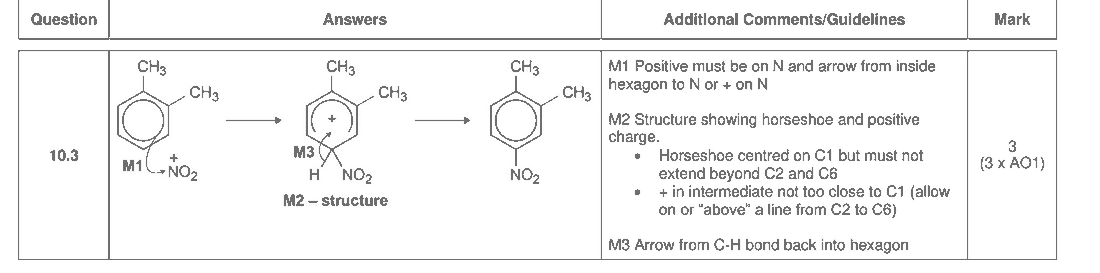
10.3 This familiar mechanism allowed over 80% of students to score at least 1 mark but only 32% scored all 3. Common mistakes in drawing the intermediate have been covered many times in reports on past papers so it was surprising to see so many students making the same errors.
Notes from the mark scheme and report
Electrophilic substitution: arrow from inside the ring to N of +NO2
intermediate with a horseshoe centred on C1 that does not extend beyond C2 and C6, with + inside it and both H and NO2 on the carbon attacked
arrow from the C–H bond back into the ring. Over 80% scored at least 1
the usual errors were in drawing the intermediate
June 2023 · Paper 2 · Q03.24 marksAO1=4Mechanism
Earlier part of question 03 that this part uses
Mark scheme
Examiner's comment
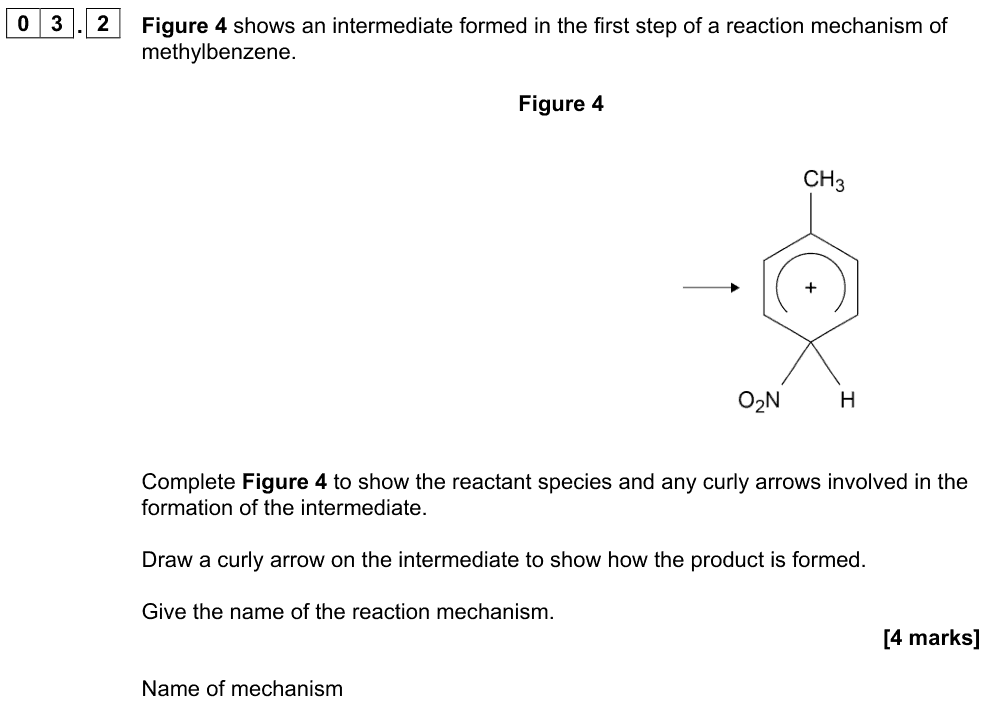
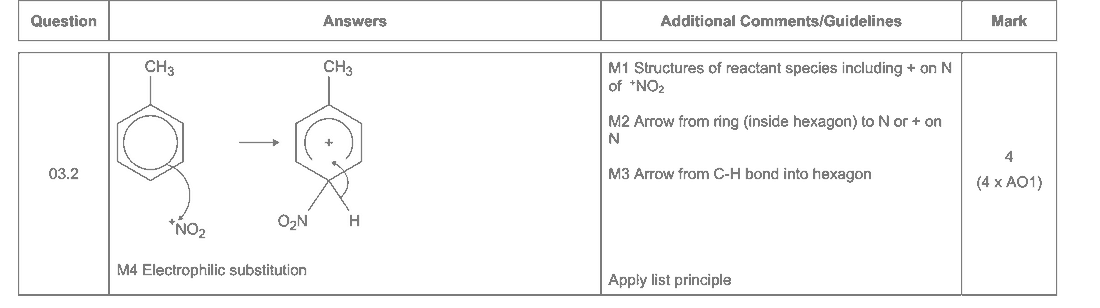
03.2 Fewer students scored full marks here than with the other two parts of Question 3. Curly arrows were often poorly drawn and failed to show the formation of a bond between a C in the methylbenzene and the N in the electrophile +NO2.
Notes from the mark scheme and report
Electrophilic substitution. Reactants: methylbenzene and the nitronium ion +NO2 (with + on N)
curly arrow from inside the ring to the N of +NO2
on the intermediate, curly arrow from the C–H bond back into the ring. Arrows were often poorly drawn and did not show a bond forming between a ring C and N
fewest full marks of the three parts
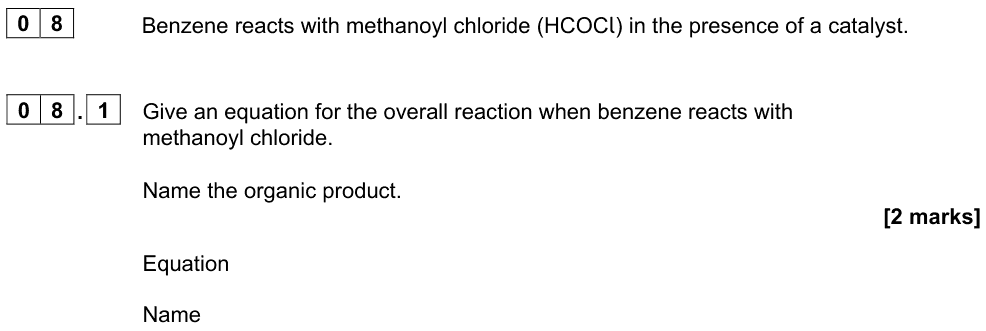
June 2022 · Paper 2 · Q08.12 marksAO2=2Equation writing
Mark scheme
Examiner's comment
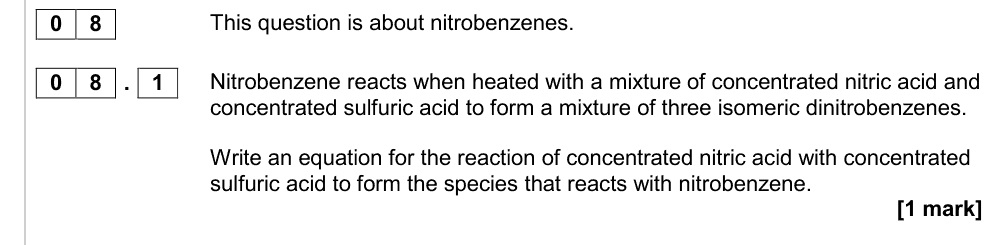
08.1 Whilst this question concerned a familiar electrophilic substitution reaction, a disappointing number of students were able to write the equation for the reaction and to name the organic product.
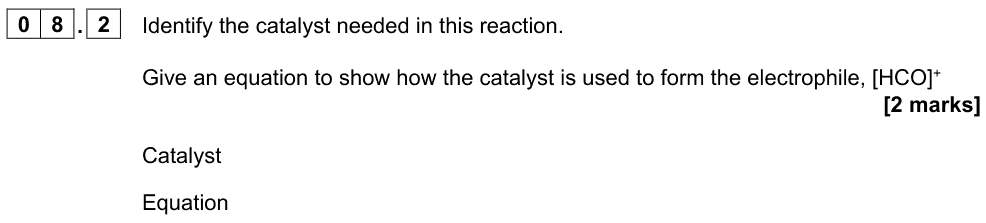
June 2022 · Paper 2 · Q08.22 marksAO1=1, AO2=1Equation writing
Earlier part of question 08 that this part uses
Mark scheme
Examiner's comment
08.2 Students did better with this question and the majority scored both marks when asked to identify the catalyst used and to write an equation to show the generation of the given electrophile.
Notes from the mark scheme and report
AlCl3 (allow FeCl3)
HCOCl + AlCl3 → [HCO]+ + [AlCl4]–
June 2022 · Paper 2 · Q08.33 marksAO2=3Mechanism
Earlier part of question 08 that this part uses
Mark scheme
Examiner's comment
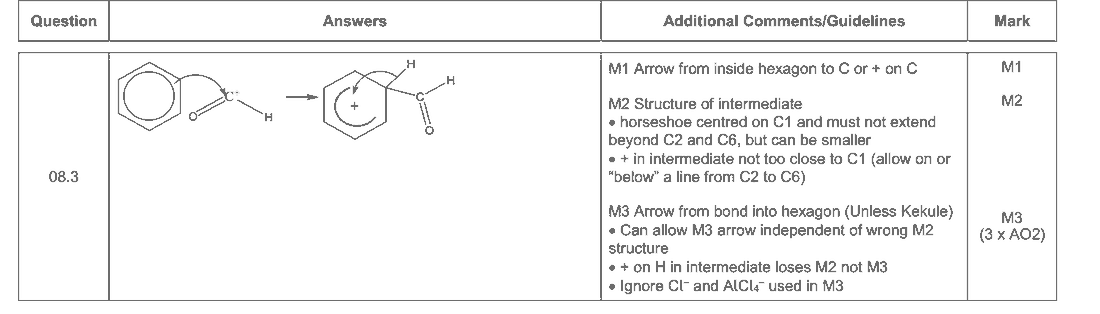
08.3 A good proportion of students scored all 3 marks for this familiar mechanism and most were able to score some marks here.
Notes from the mark scheme and report
Curly arrow from inside the ring to the C of [HCO]+
intermediate with H and CHO on the same ring carbon, a horseshoe not extending beyond C2 and C6 and a + inside it
curly arrow from the C–H bond back into the ring (loss of H+). + drawn on H loses M2 only
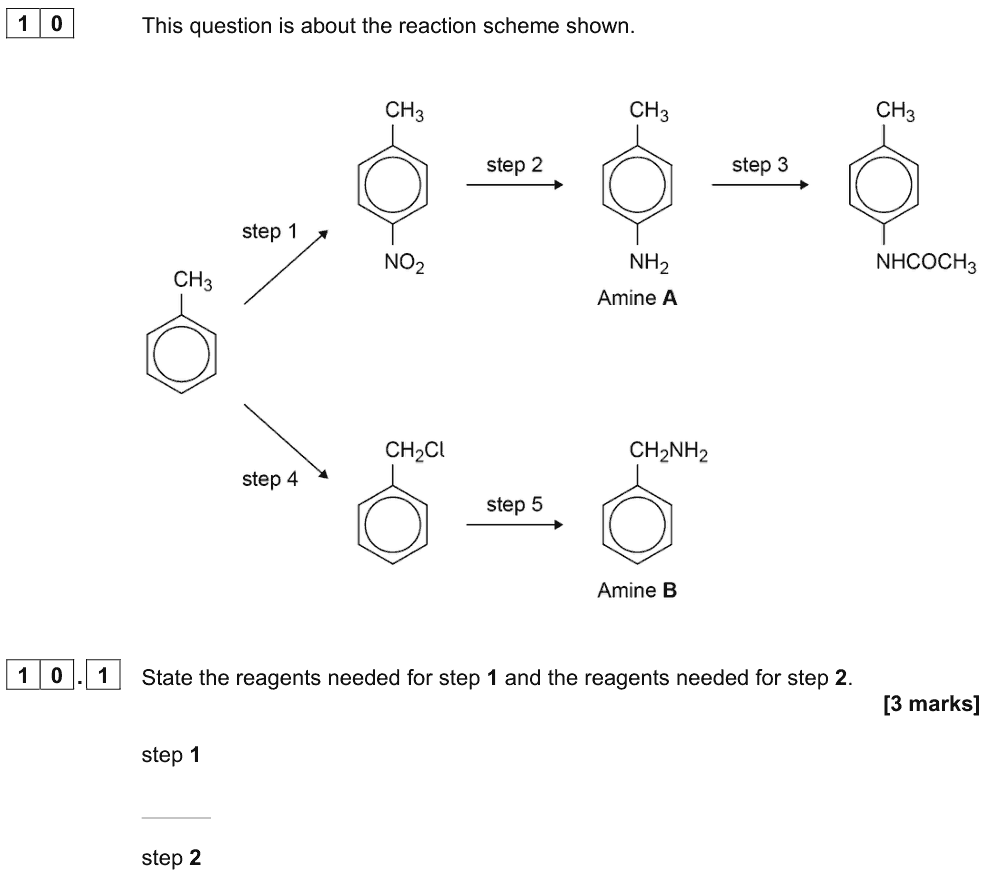
June 2022 · Paper 2 · Q10.13 marksAO1=3Short answer
Mark scheme
Examiner's comment
10.1 Few students scored all three marks despite the reactions being very common in previous papers.
Notes from the mark scheme and report
Step 1: concentrated HNO3 and concentrated H2SO4 (one mark each). Step 2: Sn and HCl (allow Fe and HCl, or H2 and Ni). If 'concentrated' is missing from both acids, 1 mark for the pair. Few scored all three
June 2022 · Paper 3 · Q081 markAO1=1Multiple choice
Answer
C
Mark scheme
Notes from the mark scheme and report
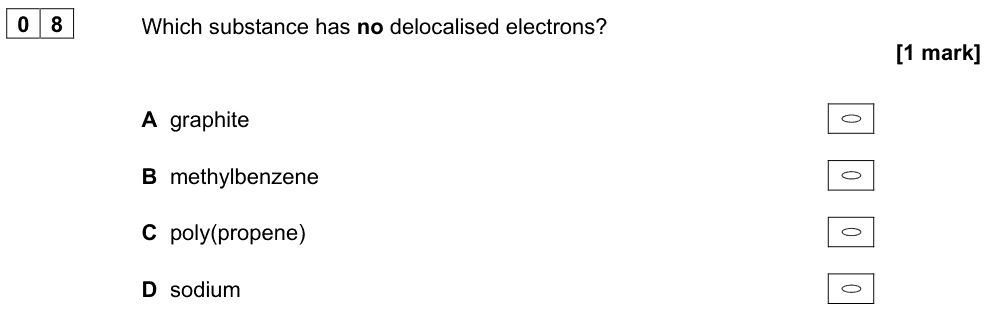
Answer: C. Poly(propene) has only localised single bonds
graphite, the benzene ring in methylbenzene and metallic sodium all have delocalised electrons
June 2022 · Paper 3 · Q301 markAO3=1Multiple choice
Answer
B
Mark scheme
Notes from the mark scheme and report
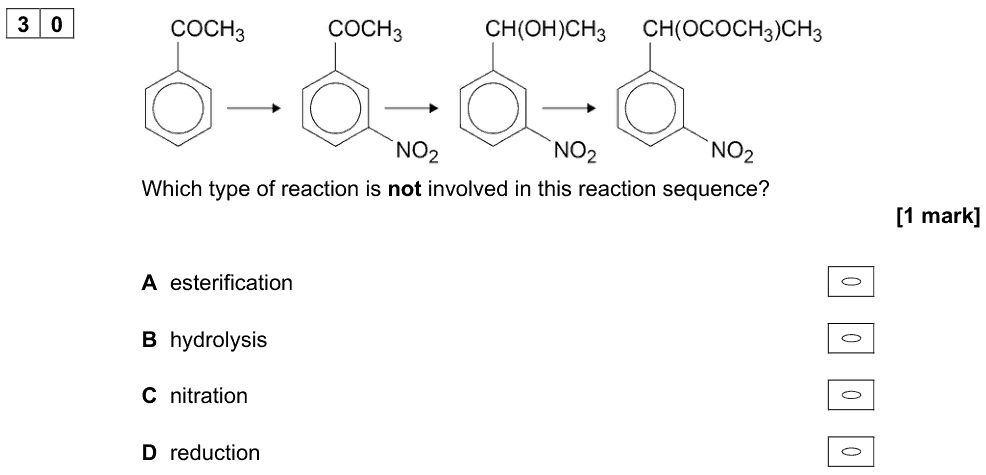
Answer: B. The steps are nitration of the ring, reduction of C=O to CH(OH), then esterification of the OH
no hydrolysis
November 2021 · Paper 2 · Q04.13 marksCalculationHard
Mark scheme
Examiner's comment
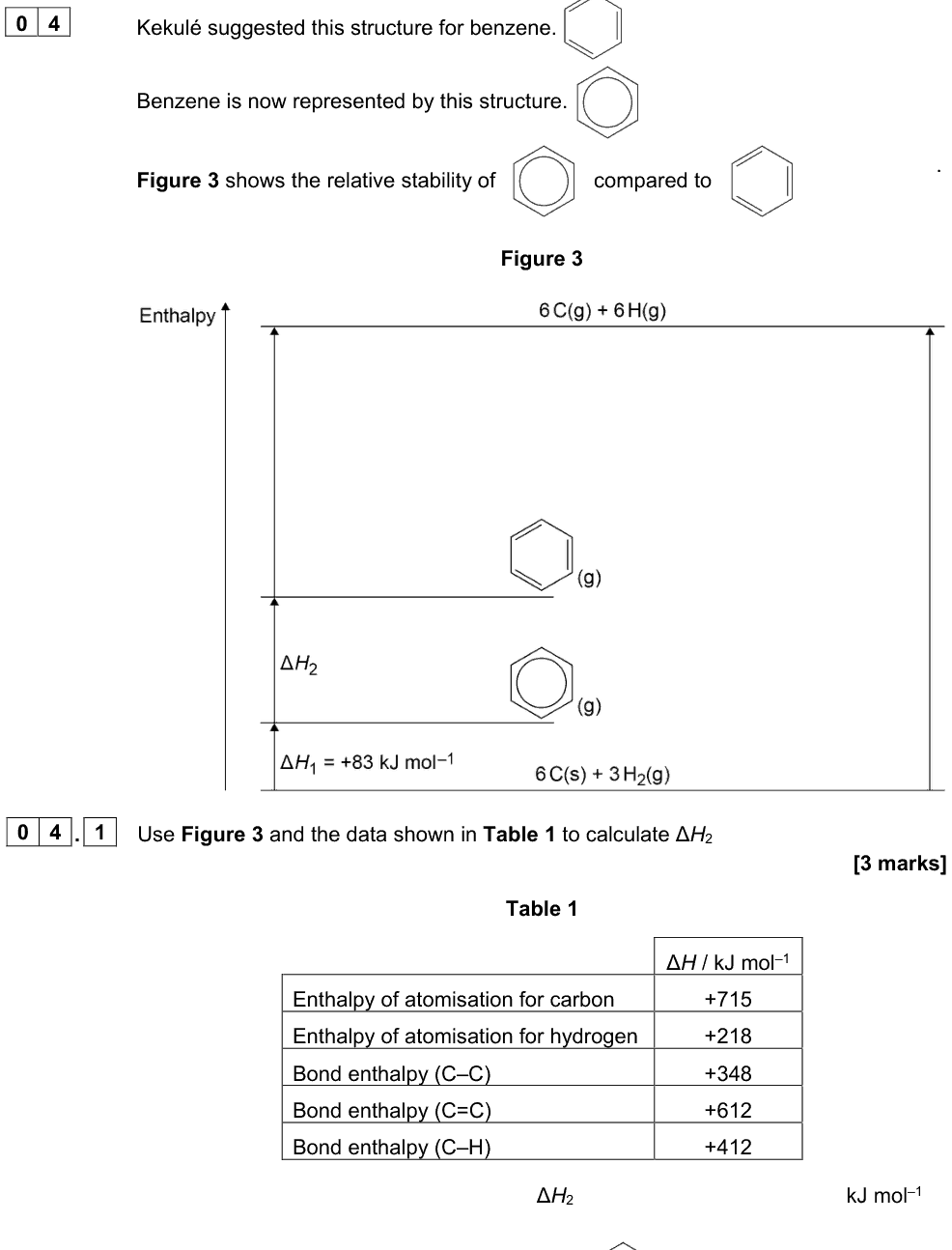
Question 04.1 gave a good range of scores and a third of students were able to score at least 2 marks.
The common errors included multiplying the value of enthalpy of atomisation for hydrogen by 3 rather than 6.
atomisation of the elements: (6 × 715) + (6 × 218) = 5598
∆H2 = 5598 – 5352 – 83. Common error: multiplying the atomisation enthalpy of hydrogen by 3 instead of 6
Skills: MS2.4 Solve algebraic equations; MS3.1 Translate information between graphical, numerical and algebraic forms
November 2021 · Paper 2 · Q04.21 markShort answer
Earlier part of question 04 that this part uses
Mark scheme
Examiner's comment
Question 04.1 gave a good range of scores and a third of students were able to score at least 2 marks. The common errors included multiplying the value of enthalpy of atomisation for hydrogen by 3 rather than 6. Question 04.3 required students to apply mechanistic ideas to structures that were provided. The vast majority of students were able to score some marks on this question and it also proved to be a very good discriminator.
Notes from the mark scheme and report
The (p / π) electrons are delocalised round the ring
November 2021 · Paper 2 · Q04.35 marksMechanism
Earlier part of question 04 that this part uses
Mark scheme
Examiner's comment
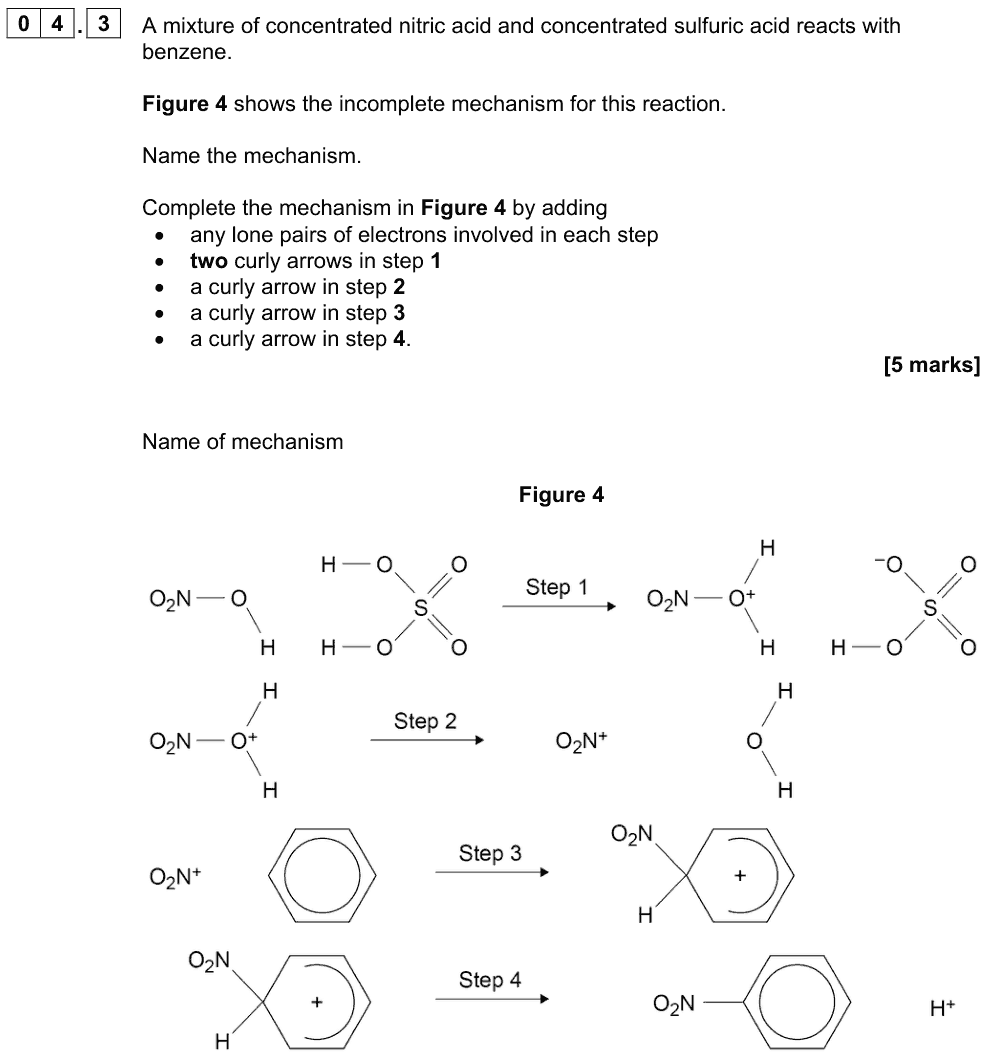
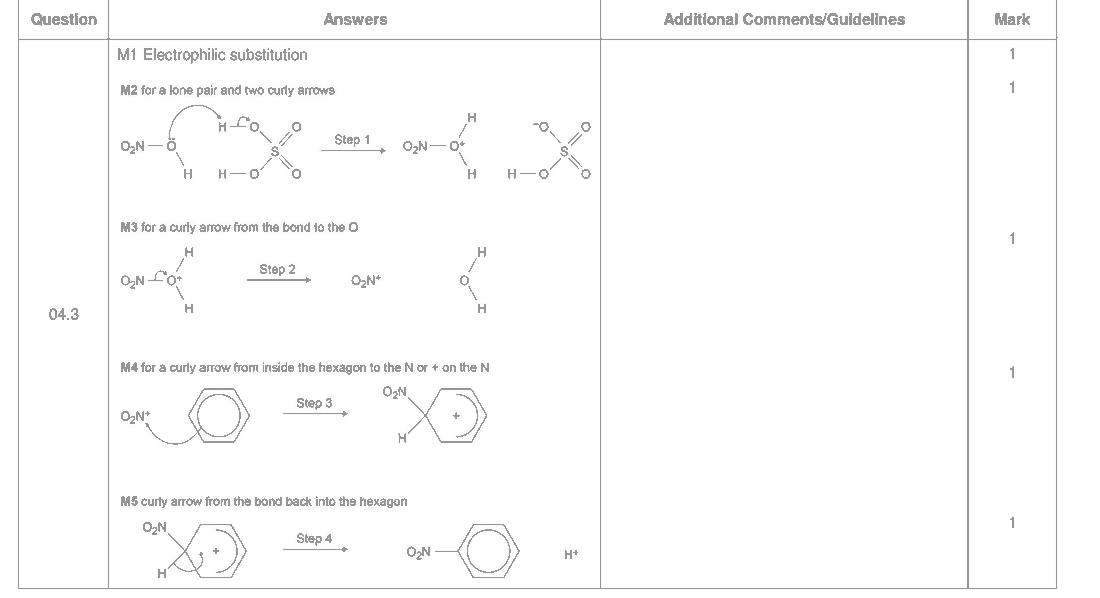
Question 04.3 required students to apply mechanistic ideas to structures that were provided.
The vast majority of students were able to score some marks on this question and it also proved to be a very good discriminator.
Notes from the mark scheme and report
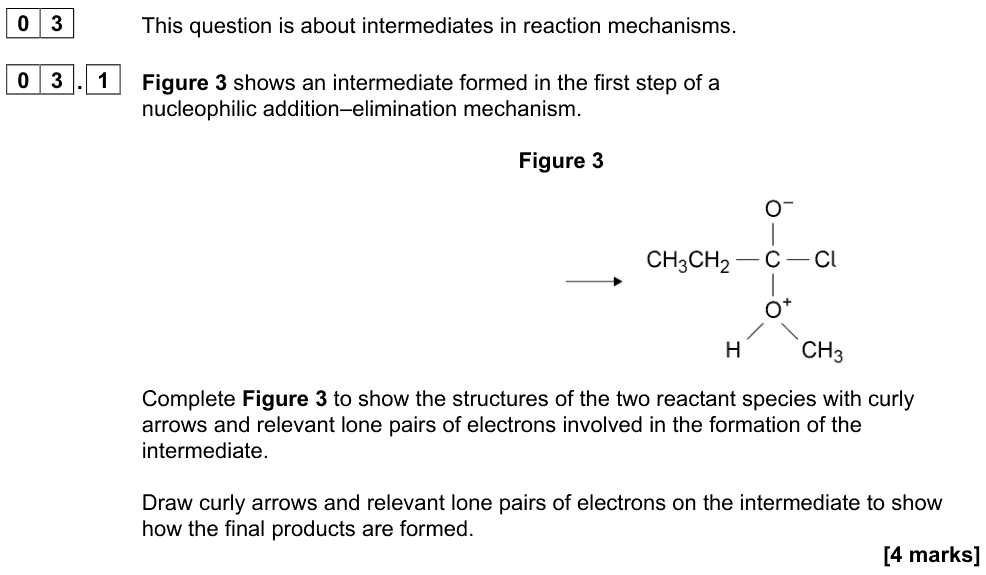
Electrophilic substitution. Step 1: lone pair on the O of the OH in HNO3, arrow from it to an H of H2SO4 and arrow from that H–O bond to the O of H2SO4. Step 2: arrow from the N–O+ bond to the O+ (water leaves, giving NO2+). Step 3: arrow from the ring of delocalised electrons to the N of NO2+. Step 4: arrow from the C–H bond back into the ring (H+ lost). Lone pairs must be shown where they are used. A very good discriminator
November 2021 · Paper 3 · Q151 markMultiple choice
Answer
C
Mark scheme
Notes from the mark scheme and report
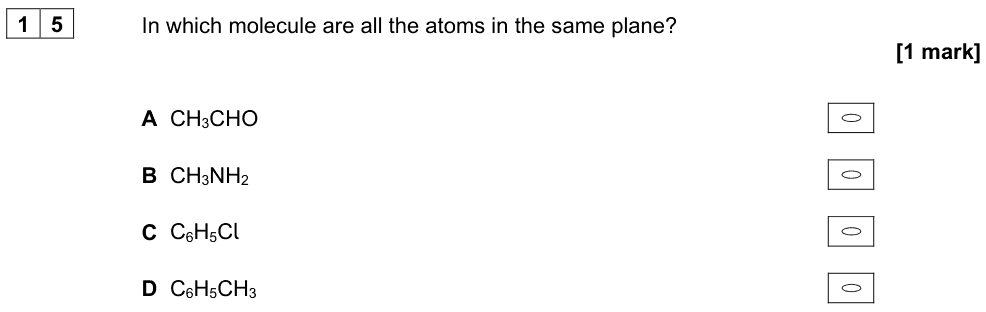
Answer: C. Chlorobenzene: the planar ring with Cl in the same plane
the others contain a tetrahedral CH3 group or a pyramidal nitrogen (report: one of five items answered correctly by fewer than 40%)
Skills: MS4.1 Use angles and shapes in regular 2D and 3D structures
November 2020 · Paper 2 · Q06.13 marksShort answer
Mark scheme
Examiner's comment
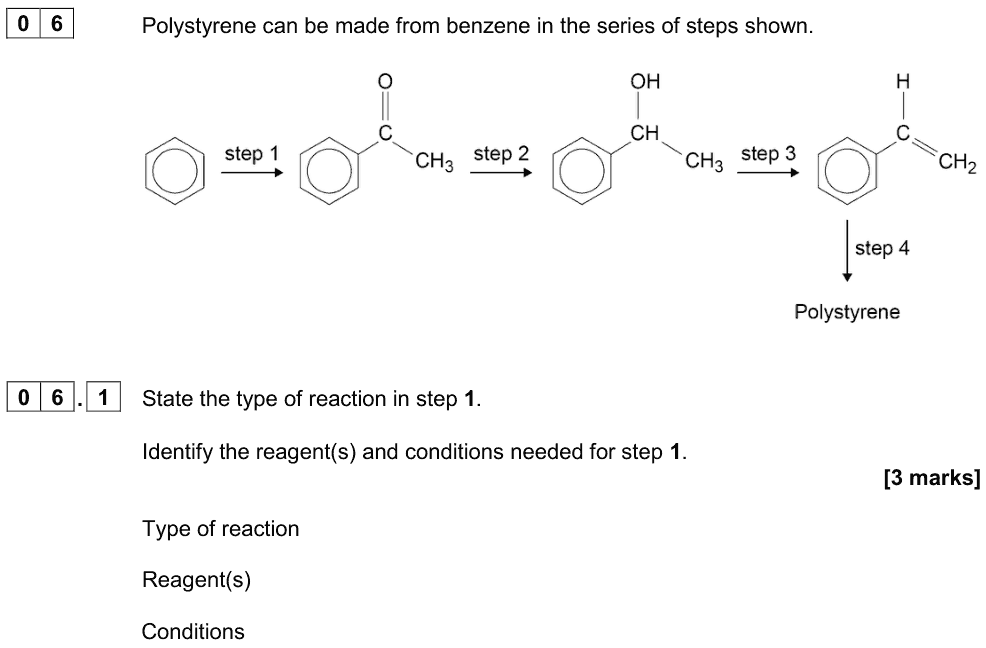
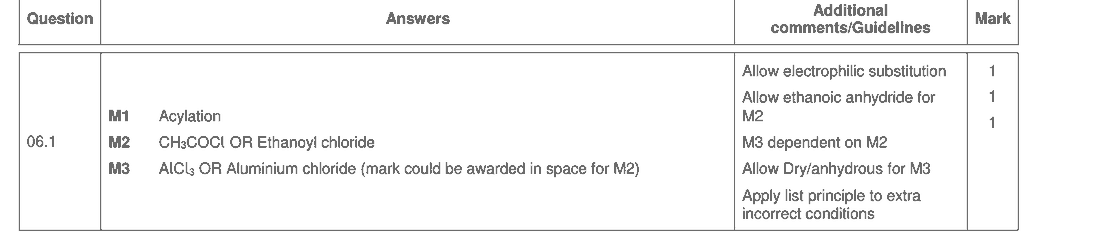
06.1 was reasonably well answered but few students were able to identify suitable conditions for this acylation reaction.
AlCl3 catalyst (anhydrous). Conditions mark depends on the reagent
few gave suitable conditions
June 2019 · Paper 2 · Q08.11 markShort answer
Mark scheme
Examiner's comment
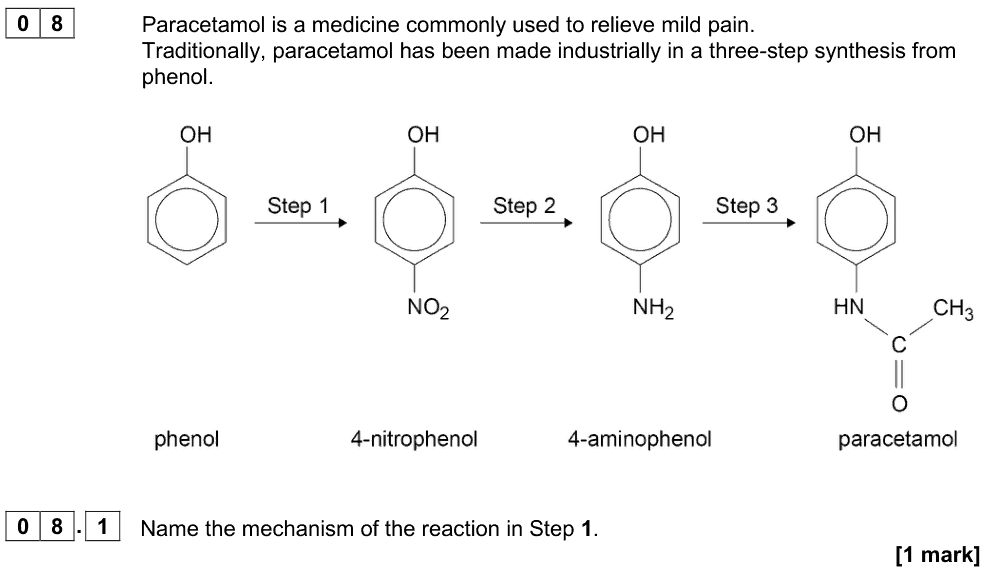
08.1 The mechanism in part 1 was well known.
Notes from the mark scheme and report
Electrophilic substitution (both words needed
'nitration' is ignored)
June 2019 · Paper 3 · Q201 markMultiple choice
Answer
B
Mark scheme
Notes from the mark scheme and report
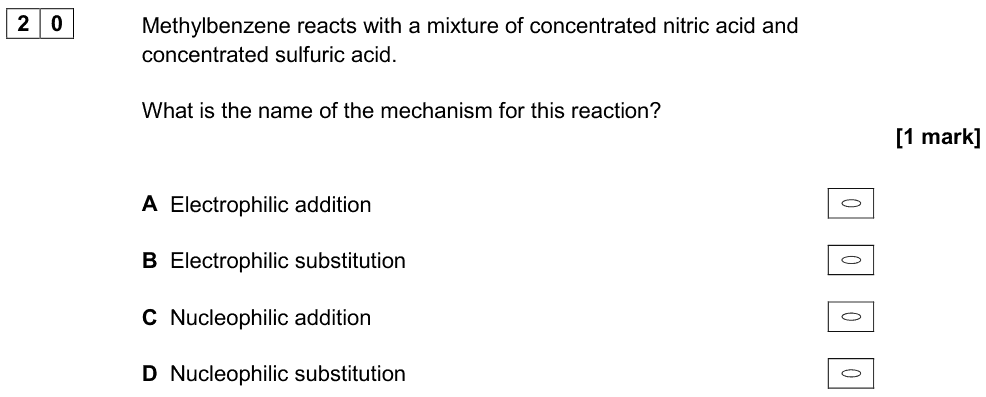
Answer: B. Nitration of the ring by NO2+ is electrophilic substitution
June 2019 · Paper 3 · Q261 markMultiple choice
Answer
C
Mark scheme
Notes from the mark scheme and report
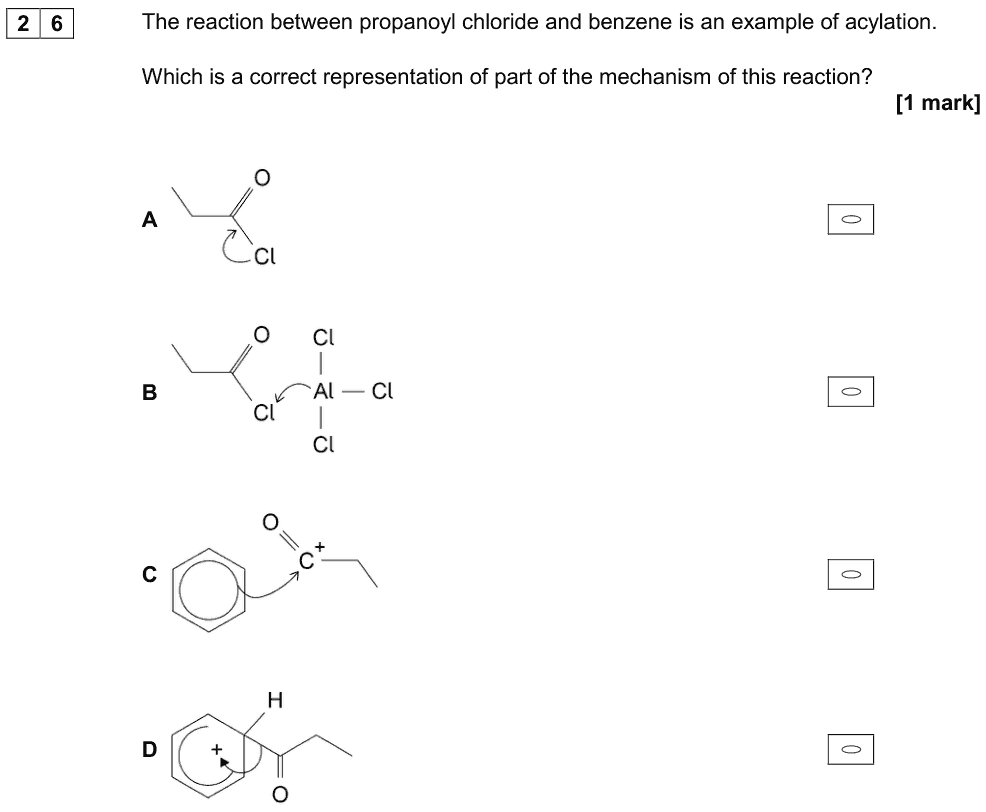
Answer: C. The benzene ring's electrons attack the positive carbon of the acylium ion CH3CH2CO+
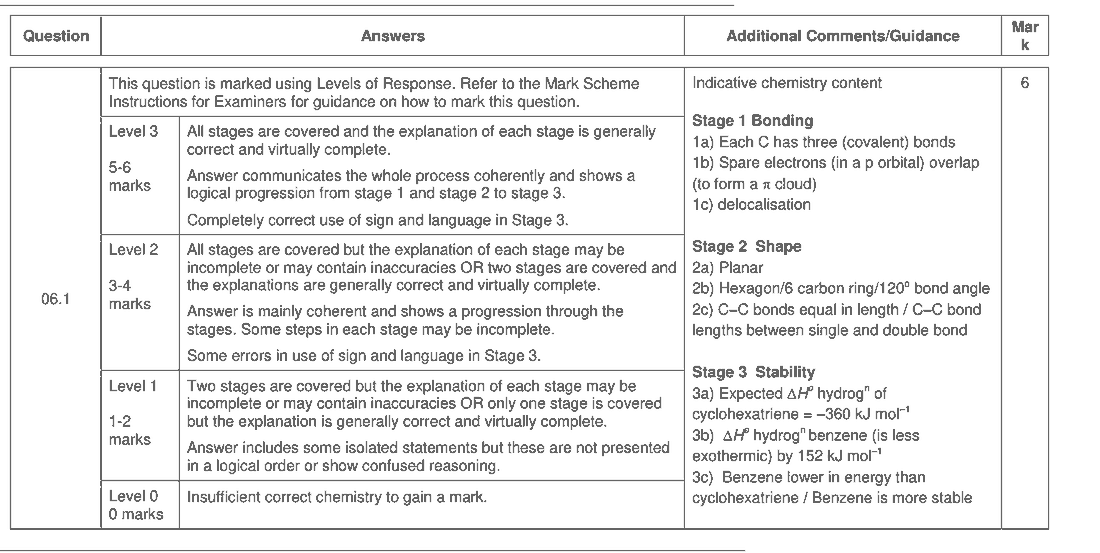
June 2018 · Paper 2 · Q06.16 marks6-mark level of responseHard
Mark scheme, with the levels and indicative content
Examiner's comment
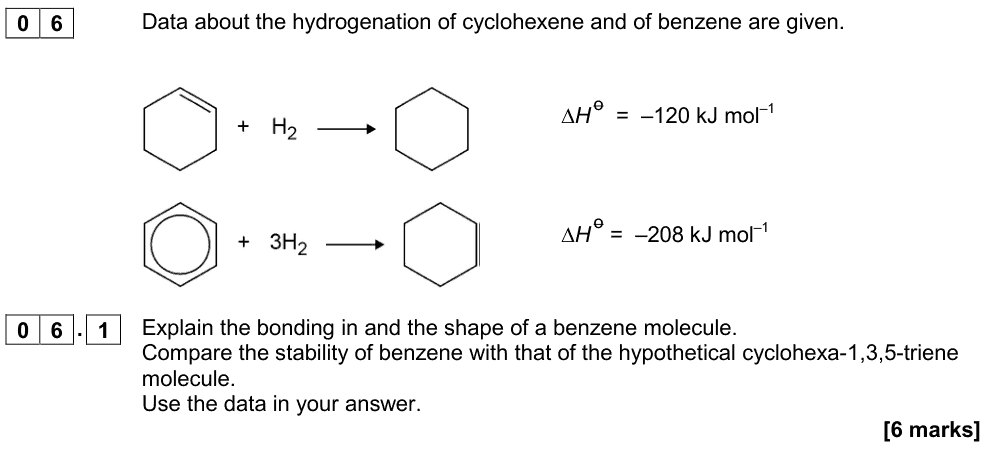
06.1 All but the weakest students were able to calculate the expected enthalpy of hydrogenation of –360 kJ mol–1 and the consequent 152 kJ mol–1 extra stability of benzene and explain this in terms of electron delocalisation. Most students knew that carbon formed three bonds but only a few were able to discuss that the extra outer shell p electrons overlap to form the pi cloud. Shape was less commonly discussed, although many noted that the molecule was planar. Sadly, although Level 3 answers were provided by 15.3% of the students, only a third of these gained full marks as their explanations often contained errors such as “hydration” for hydrogenation, or unclear discussion about bond breaking during the addition of hydrogen.
Notes from the mark scheme and report
Levels of response, three stages. Bonding: each C forms three covalent (sigma) bonds
the spare electron in a p orbital on each C overlaps to form a ring of delocalised electrons. Shape: planar, hexagonal, 120° bond angles, all C–C bonds equal in length (between single and double). Stability: expected ∆H for cyclohexa-1,3,5-triene = 3 × –120 = –360 kJ mol–1
benzene is –208, less exothermic by 152 kJ mol–1, so benzene is lower in energy / more stable. Errors: 'hydration' for hydrogenation
p-orbital overlap rarely described
Skills: MS4.1 Use angles and shapes in regular 2D and 3D structures
June 2018 · Paper 2 · Q06.23 marksExplanationHard
Earlier part of question 06 that this part uses
Mark scheme
Examiner's comment
06.2 This question proved challenging. Some students gave a wrong value that was more exothermic than –240 kJ mol−1. Of those who gave a suitable value, many were unable to explain it in terms of some extra stability due to delocalisation. Only 8.7% of students were able to justify this in terms of alternate single and double bonds forming a conjugated system and so gain full marks.
Notes from the mark scheme and report
Any value between –239 and –121 kJ mol–1 (less exothermic than –240)
the two double bonds are separated by one single bond (alternating / conjugated), which allows some delocalisation (overlap of p orbitals) and extra stability. A value outside the range scores 0
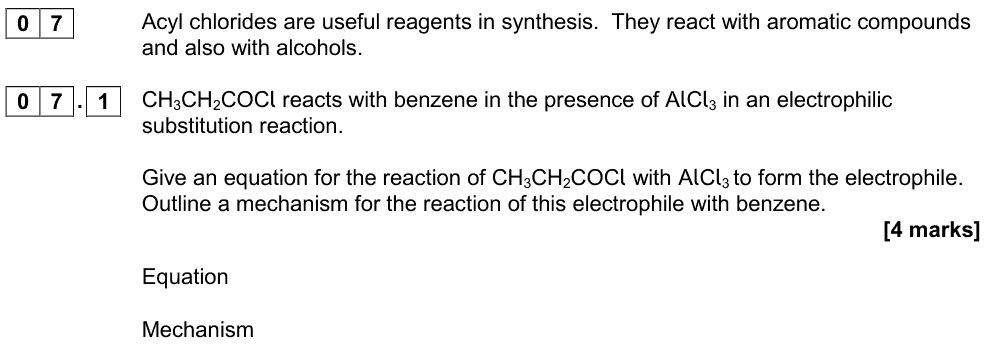
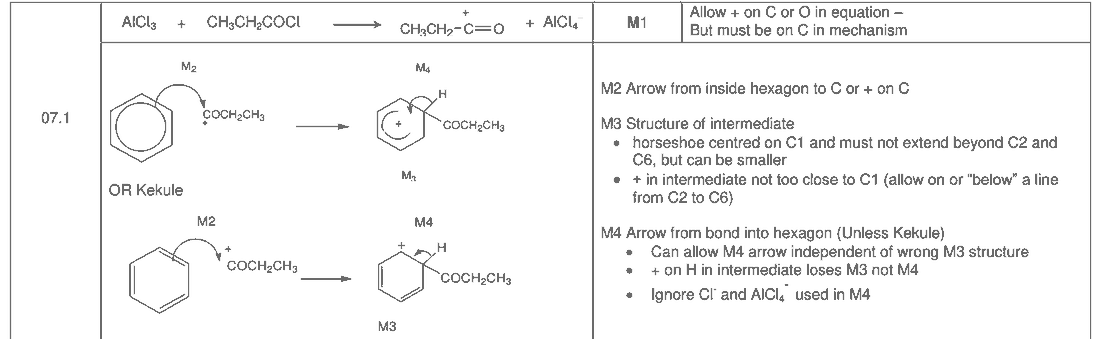
June 2018 · Paper 2 · Q07.14 marksMechanism
Mark scheme
Examiner's comment
07.1 This was a straightforward question on a familiar topic and many good students (46.5%) scored full marks. However, some drew structures, such as the horseshoe in the mechanism, with insufficient care and consequently failed to gain marks. Others omitted charges on the ions in the equation (especially on AlCl4
Notes from the mark scheme and report
CH3CH2COCl + AlCl3 → CH3CH2CO+ + AlCl4–. Mechanism: curly arrow from the benzene ring to the C+ of the acylium ion
intermediate with a broken-ring 'horseshoe' (not extending beyond C2 and C6) and + inside, with H and COCH2CH3 on the same carbon
curly arrow from the C–H bond back into the ring. Errors: careless horseshoe
missing charges on the ions. 46.5% scored all 4
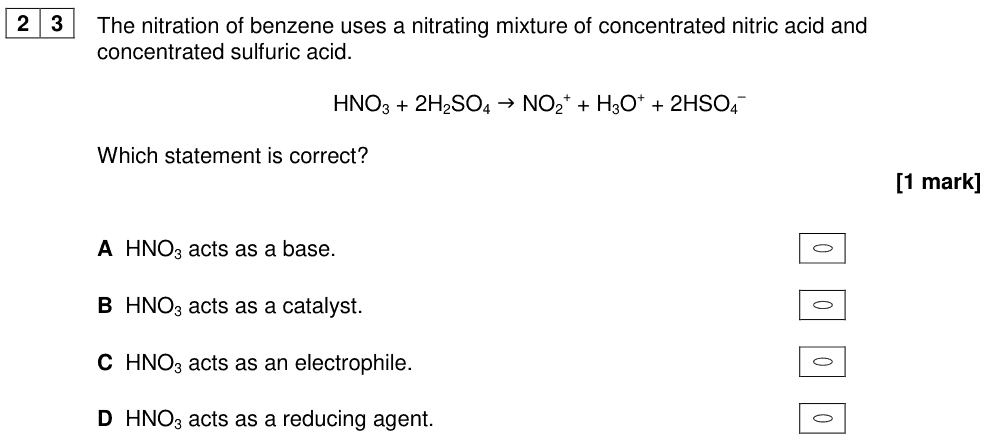
June 2018 · Paper 3 · Q231 markMultiple choice
Answer
A
Mark scheme
Examiner's comment
23 46% of students scored here. Three-quarters of the incorrect responses were D, but there are no changes of oxidation state in this reaction, so it is not a redox reaction. The H2SO4 transfers a proton to the HNO3 so the HNO3 acts as a base.
Notes from the mark scheme and report
Answer: A. HNO3 accepts a proton from H2SO4 (then loses water to give NO2+), so it acts as a base
no oxidation states change, so it is not a redox reaction (D was the main wrong answer)
June 2017 · Paper 2 · Q08.11 markEquation writing
Mark scheme
Examiner's comment
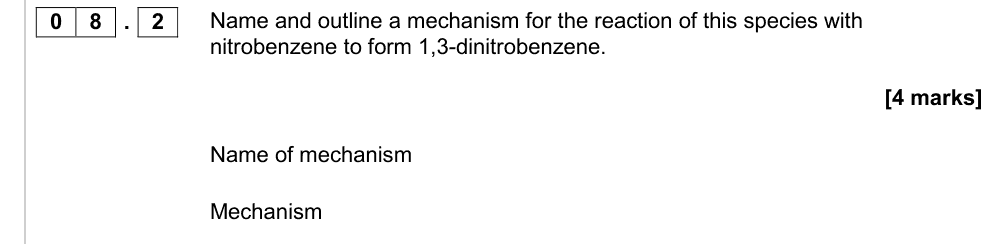
08.1 This was well known; most students gave an equation for a 1:1 mole ratio, although a 1:2 ratio and a two-step process were also seen and credited.
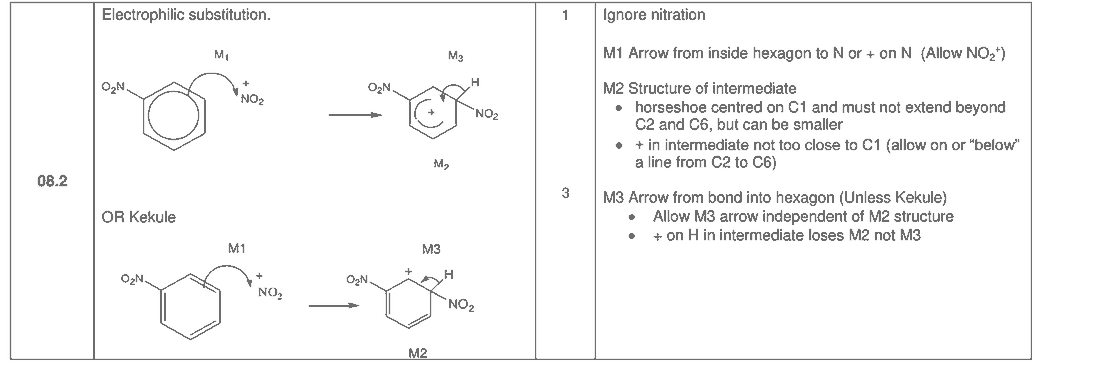
08.2 This was also well known and 35% of students scored full marks. In the mechanism, some students incorrectly showed a lone pair on the electrophile, or the horseshoe was sometimes drawn in an incorrect orientation relative to C1. Some students started from benzene and formed nitrobenzene first.
Notes from the mark scheme and report
Electrophilic substitution. Arrow from inside the ring of nitrobenzene to N of NO2+
intermediate with a horseshoe centred on C1 not extending beyond C2 and C6, + inside, H and NO2 on the 3-position carbon
arrow from the C–H bond back into the ring. Errors: lone pair on the electrophile
horseshoe wrongly oriented
starting from benzene
Specimen · Paper 2 · Q09.51 markAO2=1Equation writing
Earlier parts of question 09 that this part uses
Mark scheme
Notes from the mark scheme and report
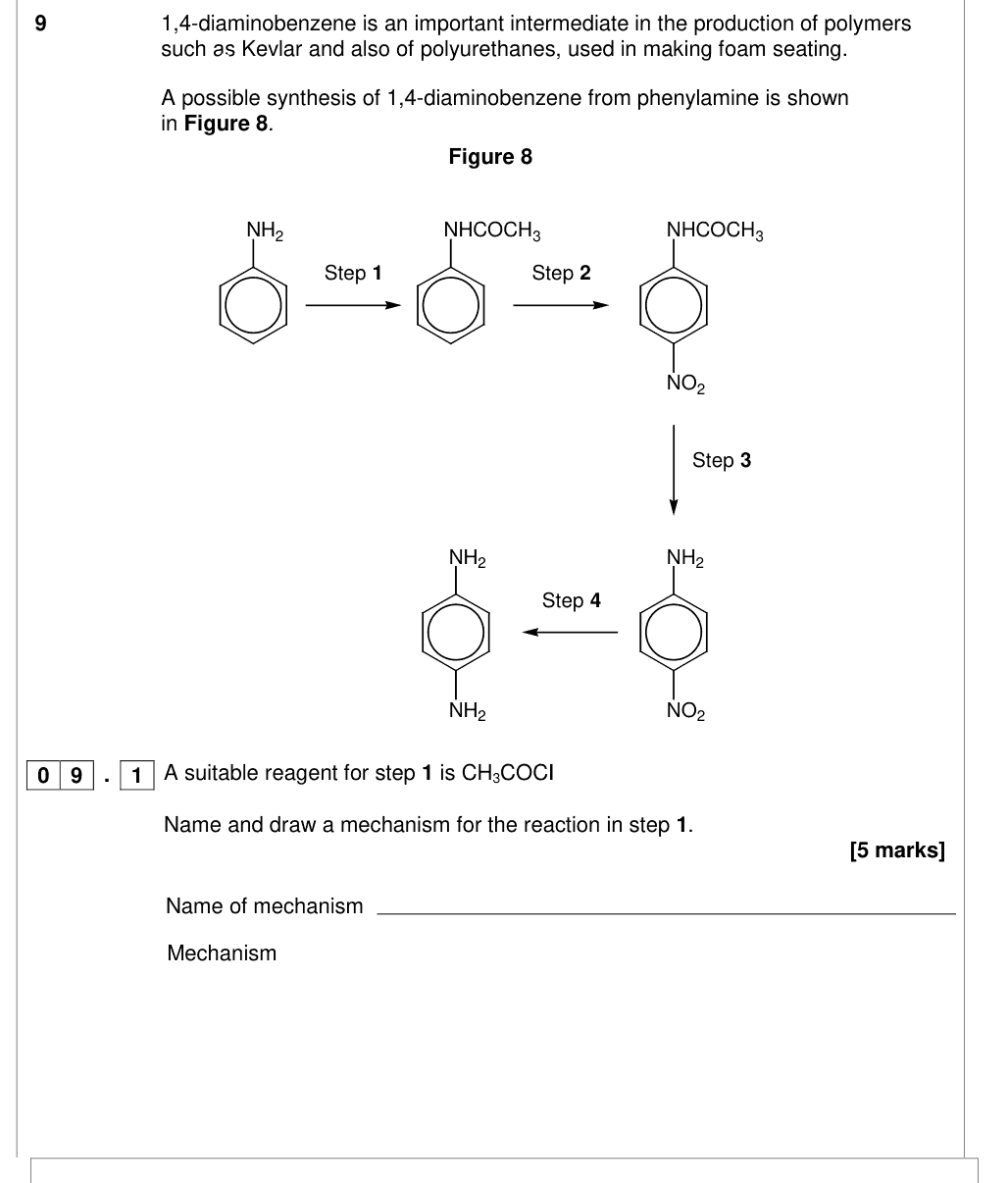
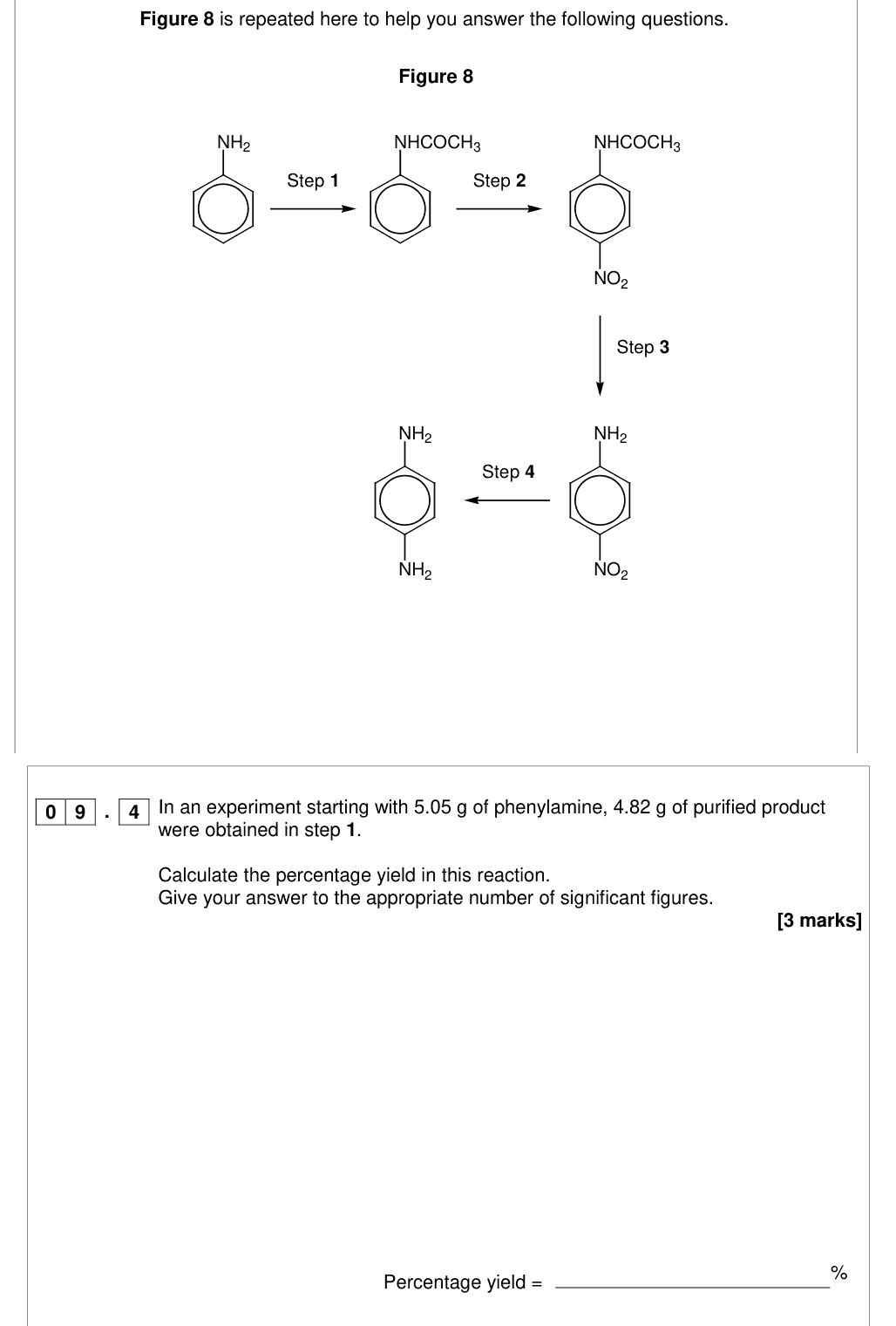
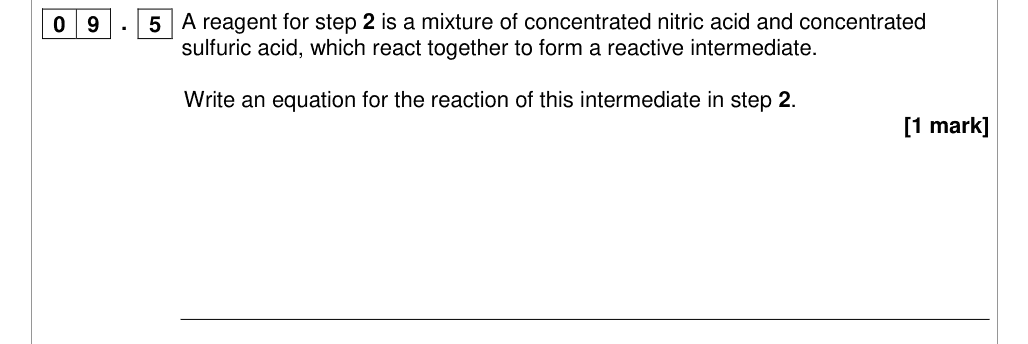
C6H5NHCOCH3 + NO2+ → C6H4(NHCOCH3)NO2 + H+ (NO2 at the 4-position)
Specimen · Paper 2 · Q09.61 markAO1=1Short answer
Earlier parts of question 09 that this part uses
Mark scheme
Notes from the mark scheme and report
Electrophilic substitution
Work with an A-level chemistry tutor
Dropping marks on calculations, mechanisms or the required practicals? Book a trial session with a specialist A-level chemistry tutor.