Notes and key-term cards for this topic are being written by our tutors. The past-paper questions below are ready now.
Specification statements
Show the 10 statements from the specification
3.3.11.1-01 Primary aliphatic amines can be prepared by the reaction of ammonia with halogenoalkanes and by the reduction of nitriles.
3.3.11.1-02 Aromatic amines, prepared by the reduction of nitro compounds, are used in the manufacture of dyes.
3.3.11.2-01 Amines are weak bases.
3.3.11.2-02 The difference in base strength between ammonia, primary aliphatic and primary aromatic amines.
3.3.11.2-03 Students should be able to: • explain the difference in base strength in terms of the availability of the lone pair of electrons on the N atom.
3.3.11.3-01 Amines are nucleophiles.
3.3.11.3-02 The nucleophilic substitution reactions of ammonia and amines with halogenoalkanes to form primary, secondary, tertiary amines and quaternary ammonium salts.
3.3.11.3-03 The use of quaternary ammonium salts as cationic surfactants.
3.3.11.3-04 The nucleophilic addition–elimination reactions of ammonia and primary amines with acyl chlorides and acid anhydrides.
3.3.11.3-05 Students should be able to outline the mechanisms of: • these nucleophilic substitution reactions • the nucleophilic addition–elimination reactions of ammonia and primary amines with acyl chlorides.
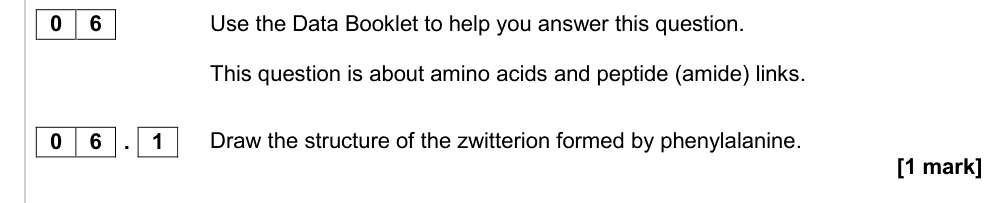
Tap a question to zoom it. Where a part needs a figure, table or structure from earlier in the question, that part folds out above it; the mark scheme and examiner's comment open underneath. Have AQA's Data Booklet (the Periodic Table and the spectroscopy tables) beside you.
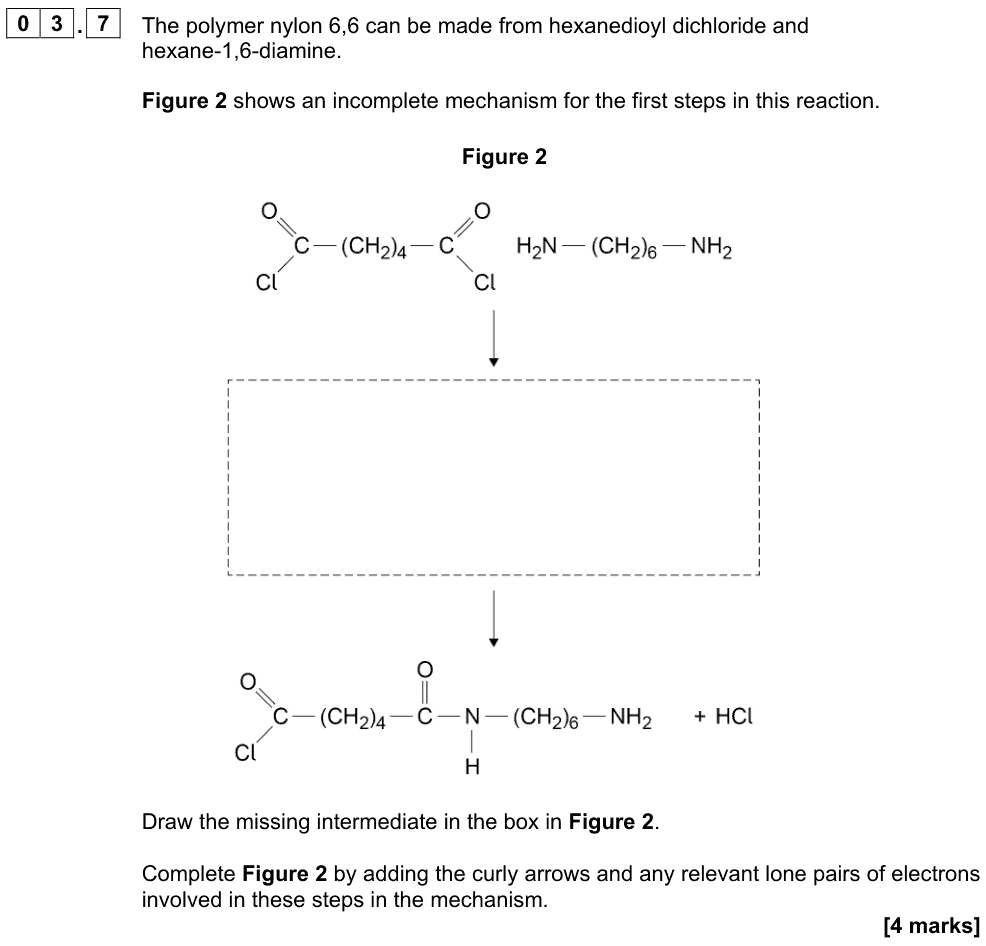
June 2025 · Paper 2 · Q03.74 marksAO1=4Mechanism
Earlier part of question 03 that this part uses
Mark scheme
Examiner's comment
3.7 This fairly routine nucleophilic addition elimination mechanism was well answered by students who had learned the standard curly arrows and were able to apply them in the context given. Some lost marks for drawing curly arrows in the wrong direction; in particular for the proton loss from the intermediate. Others added charges to the starting materials.
Notes from the mark scheme and report
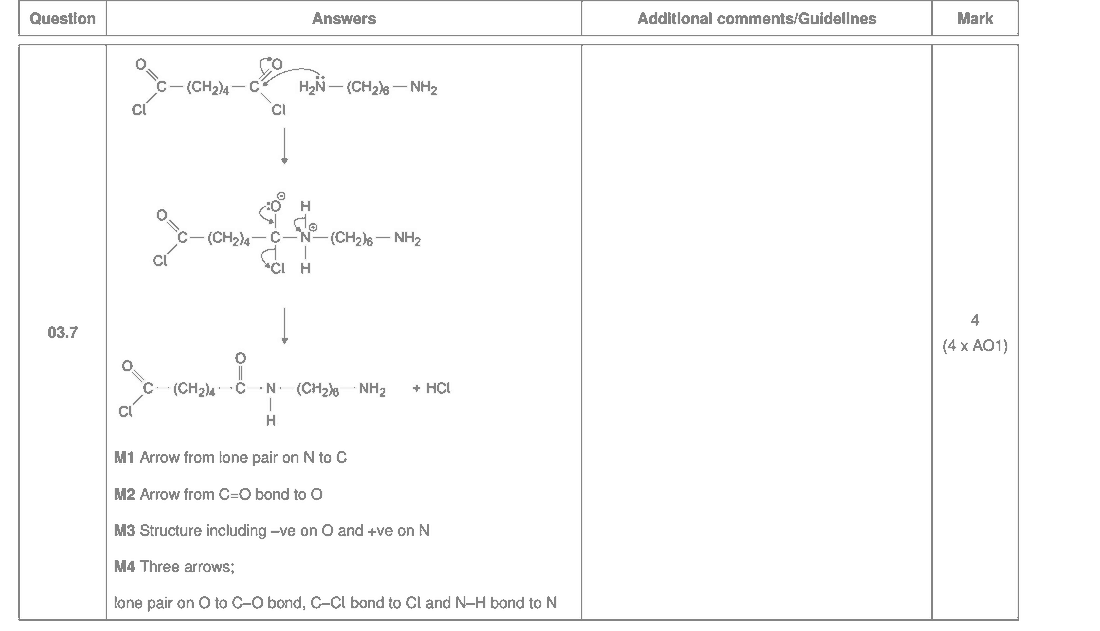
Arrow from the lone pair on N of the amine to the C of C=O
arrow from the C=O bond to O
intermediate with O– on the oxygen and + on N (N bonded to C with two H)
then three arrows: lone pair on O– reforming C=O, C–Cl bond to Cl, N–H bond to N+. Errors: arrows in the wrong direction for the loss of H+
charges added to the reactants
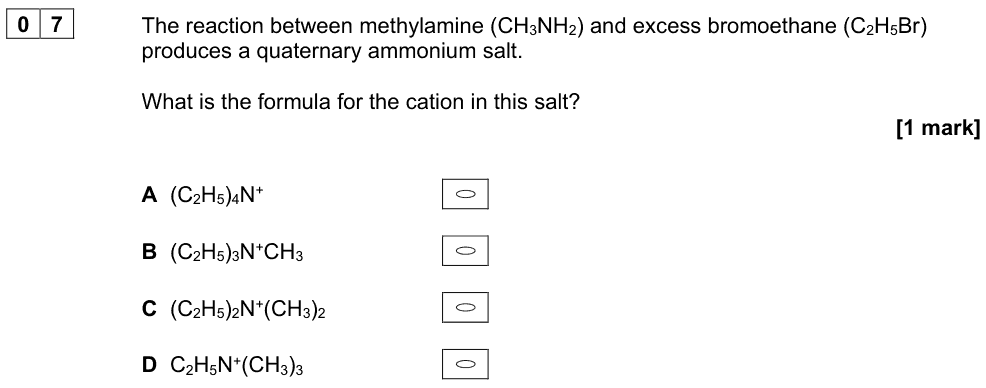
June 2025 · Paper 3 · Q071 markAO2=1Multiple choice
Answer
B
Mark scheme
Notes from the mark scheme and report
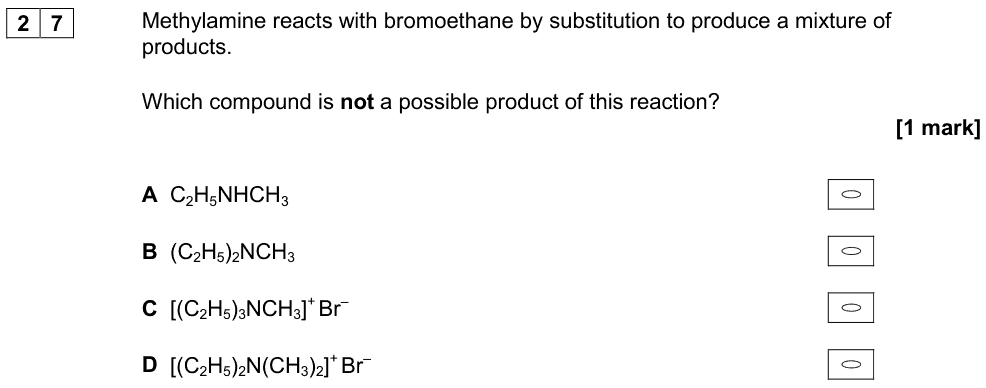
Answer: B. The methyl group stays on nitrogen and three ethyl groups replace the two N–H hydrogens and use the lone pair: (C2H5)3N+CH3
June 2025 · Paper 3 · Q351 markAO1=1Multiple choice
Answer
A
Mark scheme
Notes from the mark scheme and report
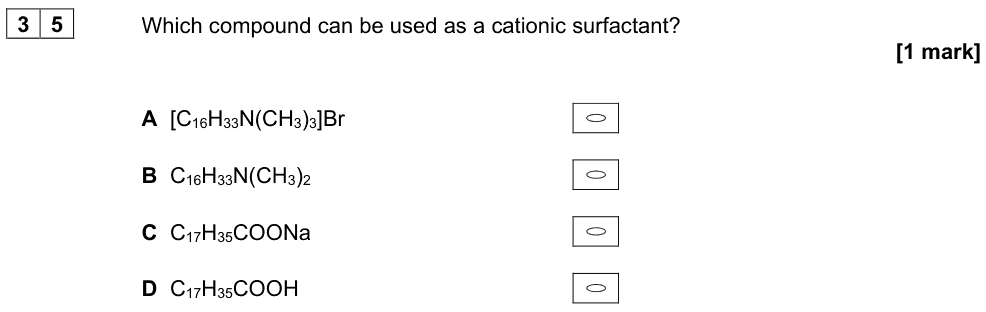
Answer: A. A quaternary ammonium salt with a long hydrocarbon chain
C is a soap (anionic). One of the least well answered questions (under 55% correct)
June 2024 · Paper 2 · Q09.12 marksAO1=1, AO2=1Short answer
Mark scheme
Examiner's comment
9.1 Most were able to score at least 1 mark for giving a correct methylamine structure to balance the equation. A variety of amine naming approaches are valid and so the mark scheme reflected this by allowing several variations. Despite this approach, the second mark was seen far less frequently.
Notes from the mark scheme and report
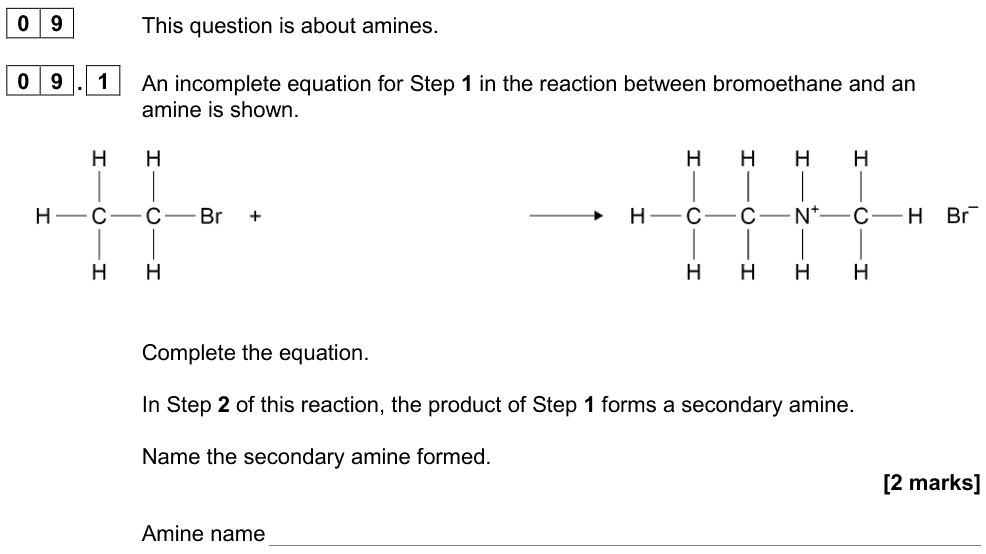
The missing reactant is methylamine, CH3NH2 (displayed or structural)
the secondary amine is N-methylethanamine (N-methylethylamine, ethylmethylamine). The name was much less often correct
June 2024 · Paper 2 · Q09.22 marksAO2=2Diagram or structure
Earlier part of question 09 that this part uses
Mark scheme
Examiner's comment
9.2 Over half the students got at least 1 mark and the skeletal structures seen were much better attempted than in some past papers.
Notes from the mark scheme and report
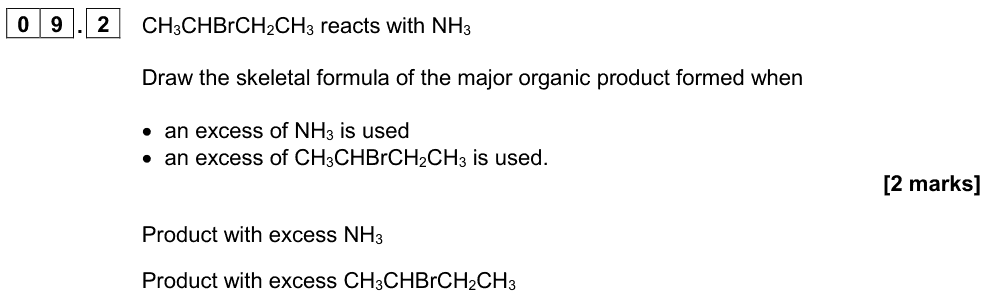
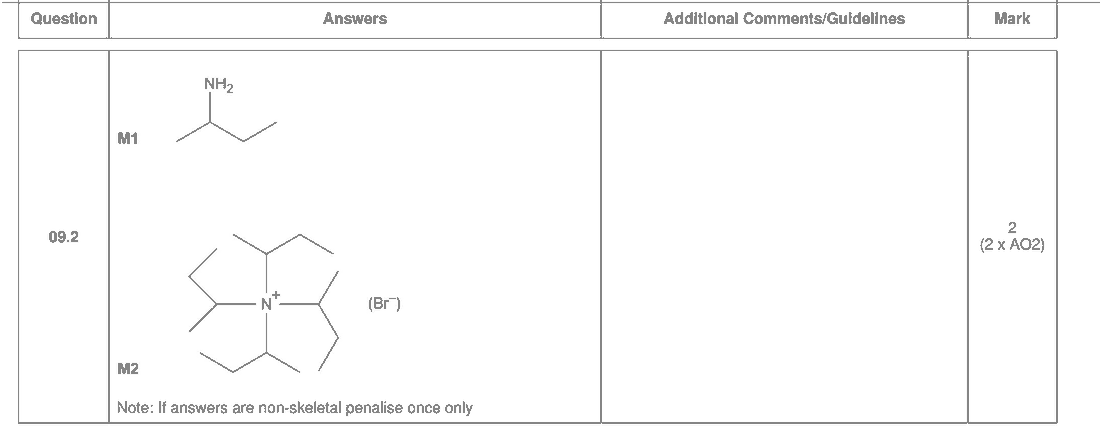
Excess NH3: skeletal butan-2-amine (NH2 on C2 of a four-carbon chain), the primary amine. Excess halogenoalkane: the quaternary ammonium ion, N+ bonded to four butan-2-yl groups (Br– counter-ion). Non-skeletal penalised once only
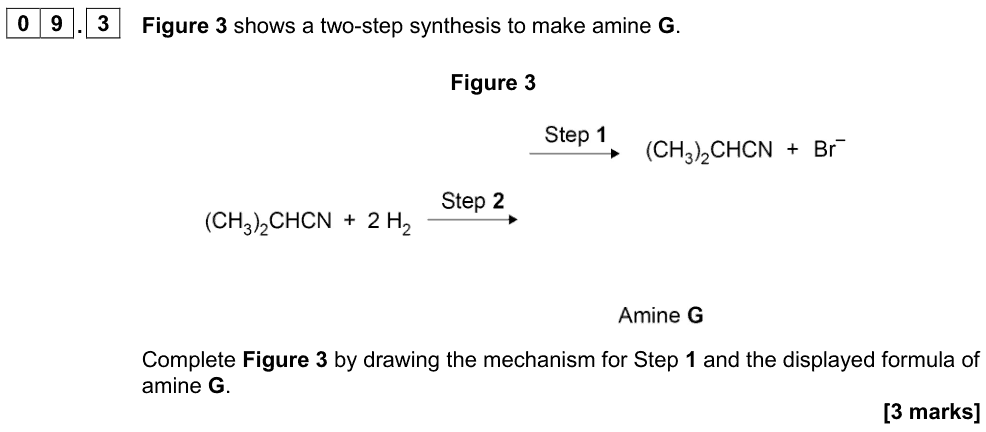
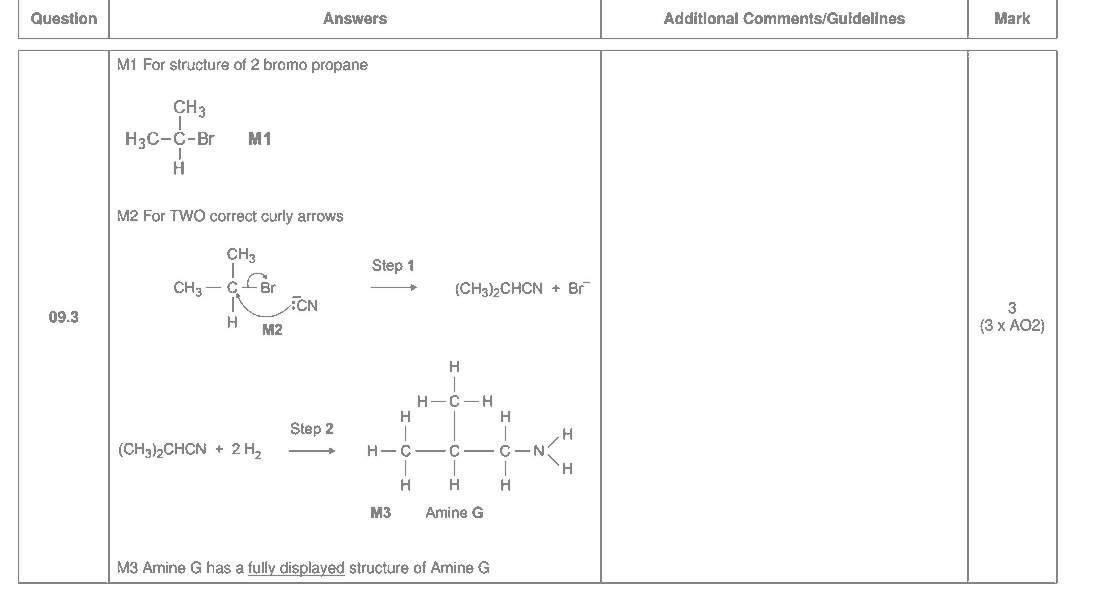
June 2024 · Paper 2 · Q09.33 marksAO2=3Mechanism
Earlier part of question 09 that this part uses
Mark scheme
Examiner's comment
9.3 Most students got at least 2 of the 3 marks here. The final mark was often the one lost and drawing a fully displayed amine formed from a nitrile proved difficult for many. Common mistakes included having too few carbon atoms, and missing hydrogen atoms despite being given the balanced left-hand side of the equation.
Notes from the mark scheme and report
2-Bromopropane, (CH3)2CHBr, drawn as the reactant
two curly arrows: from the lone pair on C of :CN– to the C bearing Br, and from the C–Br bond to Br
amine G fully displayed: (CH3)2CHCH2NH2, 2-methylpropan-1-amine, with every bond shown. The displayed amine was the mark most often lost (too few C atoms or missing H atoms)
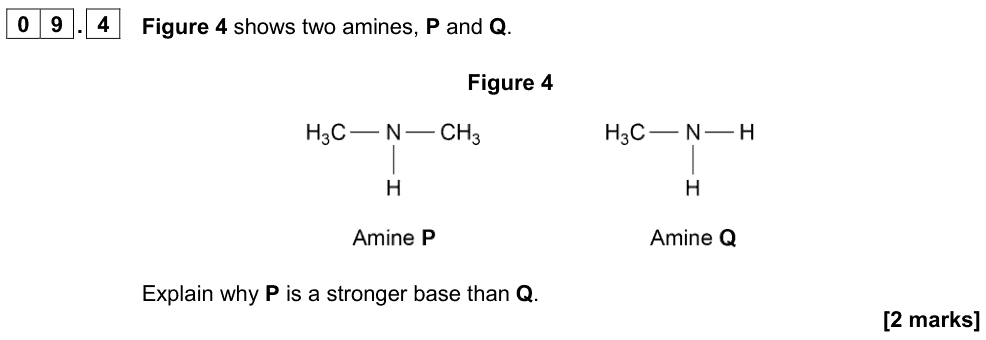
June 2024 · Paper 2 · Q09.42 marksAO1=2Explanation
Earlier part of question 09 that this part uses
Mark scheme
Examiner's comment
9.4 This question required students to explain amine base strength. Many students got started, but the care needed in use of language meant that the question differentiated very well.
Notes from the mark scheme and report
The lone pair on N in P is more available / better able to accept a proton
because P has two electron-releasing alkyl groups (greater positive inductive effect) compared with one in Q
June 2024 · Paper 2 · Q10.41 markAO1=1Short answer
Earlier parts of question 10 that this part uses
Mark scheme
Examiner's comment
10.4 The reagents required for the reduction of a nitro- compound to form an aromatic amine were quite well known and around 50% scored this mark.
Notes from the mark scheme and report
Tin and hydrochloric acid, Sn/HCl (allow Fe/HCl, or H2 with Ni or Pt). NaOH used at the same time is penalised
June 2024 · Paper 2 · Q10.51 markAO1=1Short answerHard
Earlier parts of question 10 that this part uses
Mark scheme
Examiner's comment
10.5 The specification states that aromatic amines are used to manufacture dyes. Many students stated that the amines themselves are used as dyes and so failed to gain this mark. Less than 10% scored the mark here.
Notes from the mark scheme and report
To manufacture dyes (the amine is used to make dyes
it is not itself the dye)
June 2023 · Paper 2 · Q04.42 marksAO1=1, AO2=1Equation writingHard
Earlier parts of question 04 that this part uses
Mark scheme
Examiner's comment
04.4 The reagent and condition mark was scored by large numbers of students but the equation proved far more difficult and only just over a quarter scored full marks here. The question had a high discrimination index and identified the best students.
Notes from the mark scheme and report
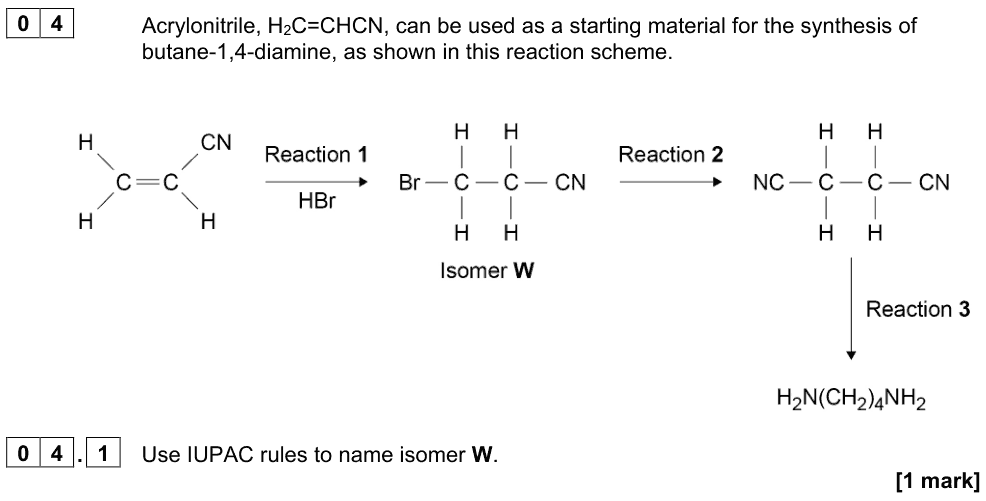
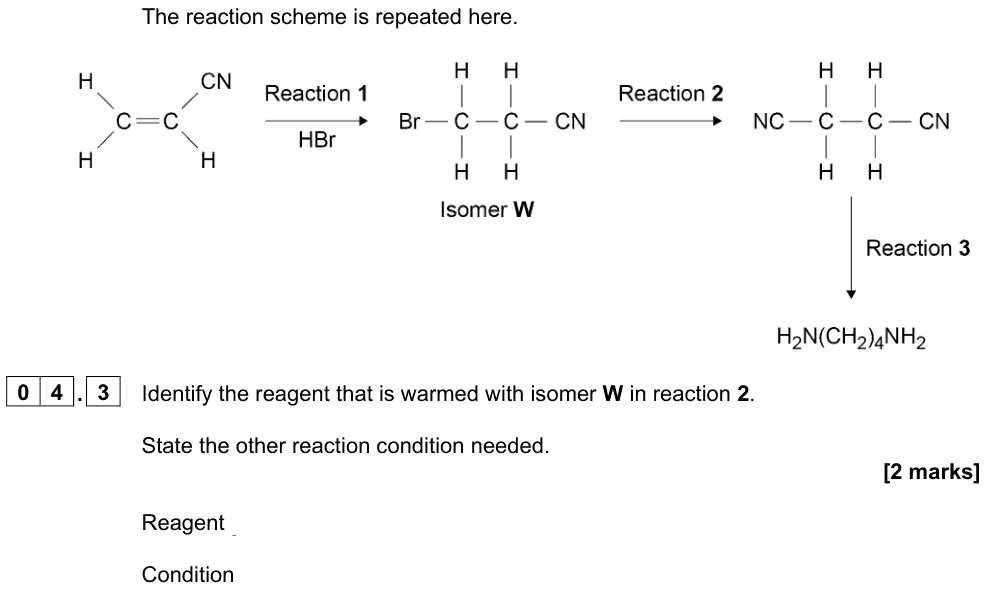
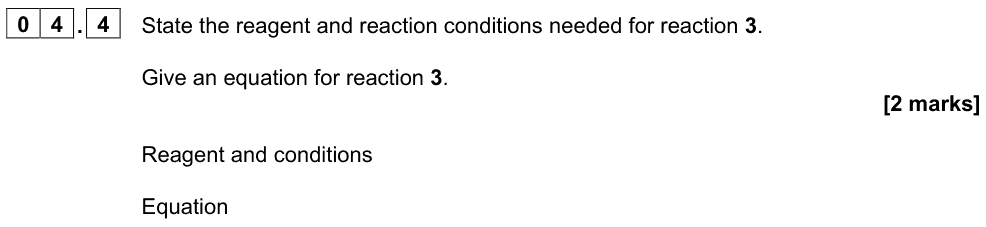
H2 with a nickel (or Pt / Pd) catalyst (or LiAlH4 in dry ether
not NaBH4)
NCCH2CH2CN + 4H2 → H2N(CH2)4NH2 (or with 8[H]). The equation was much harder than the reagent
June 2023 · Paper 3 · Q341 markAO1=1Multiple choice
Answer
A
Mark scheme
Notes from the mark scheme and report
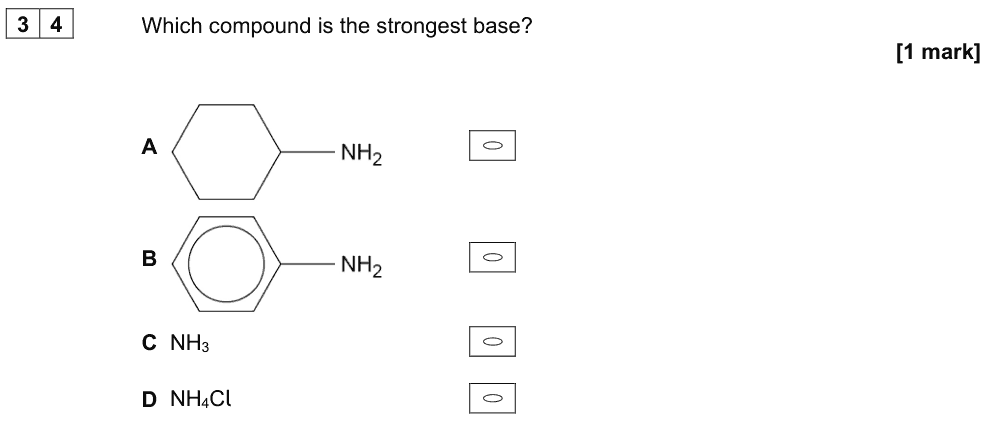
Answer: A. Cyclohexylamine is a primary aliphatic amine: the alkyl group pushes electrons to N, making the lone pair more available than in NH3
in phenylamine the lone pair is delocalised into the ring
NH4Cl is not a base
June 2022 · Paper 2 · Q10.13 marksAO1=3Short answer
Mark scheme
Examiner's comment
10.1 Few students scored all three marks despite the reactions being very common in previous papers.
Notes from the mark scheme and report
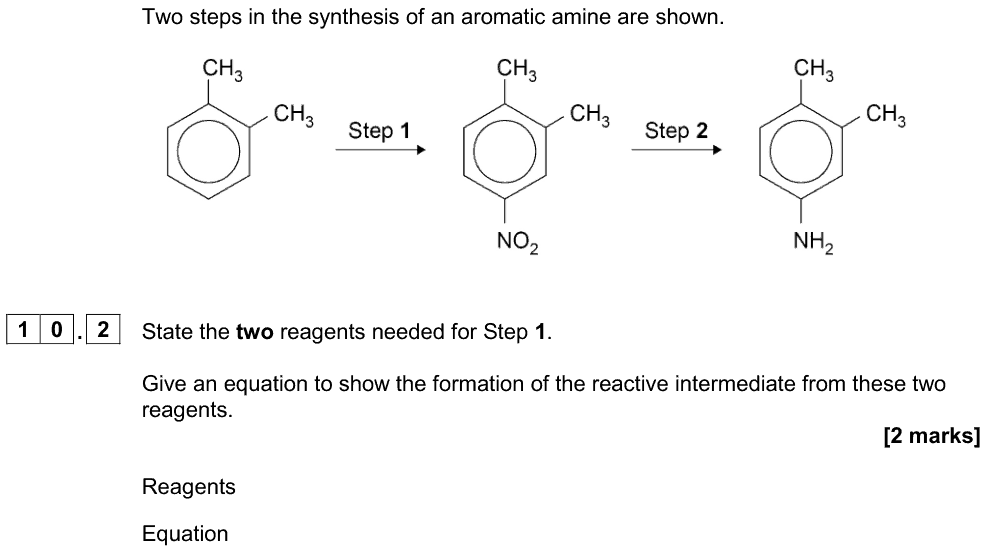
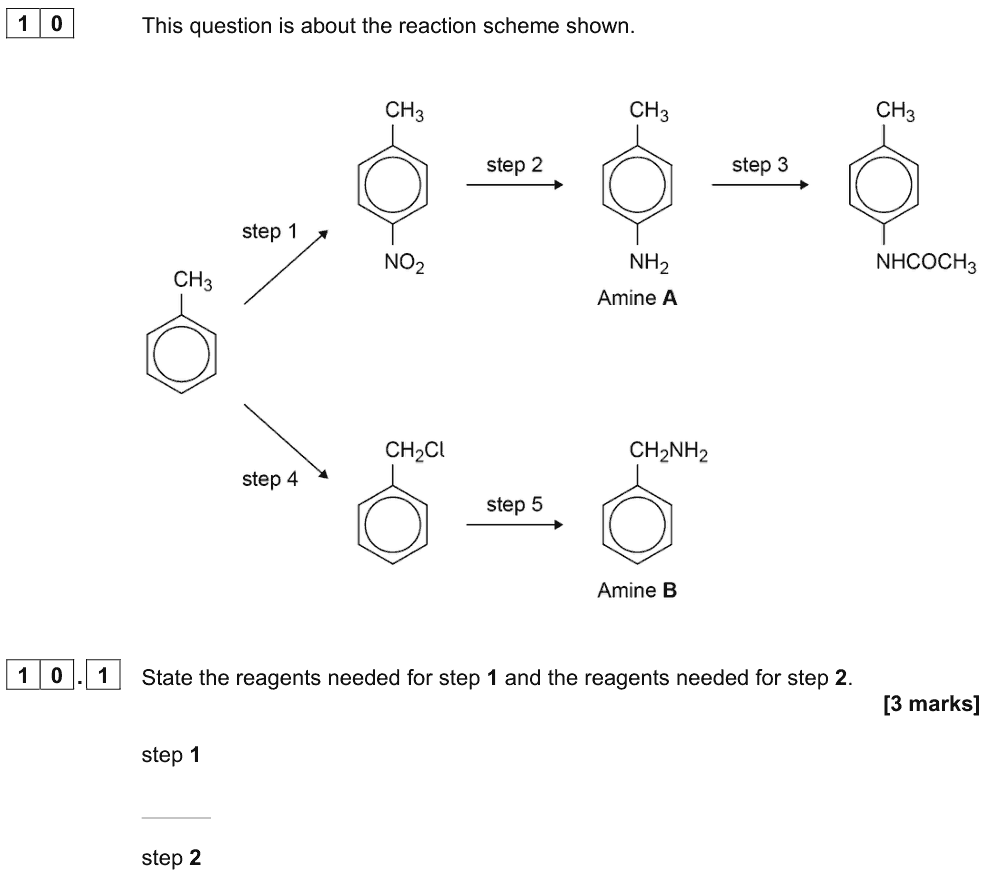
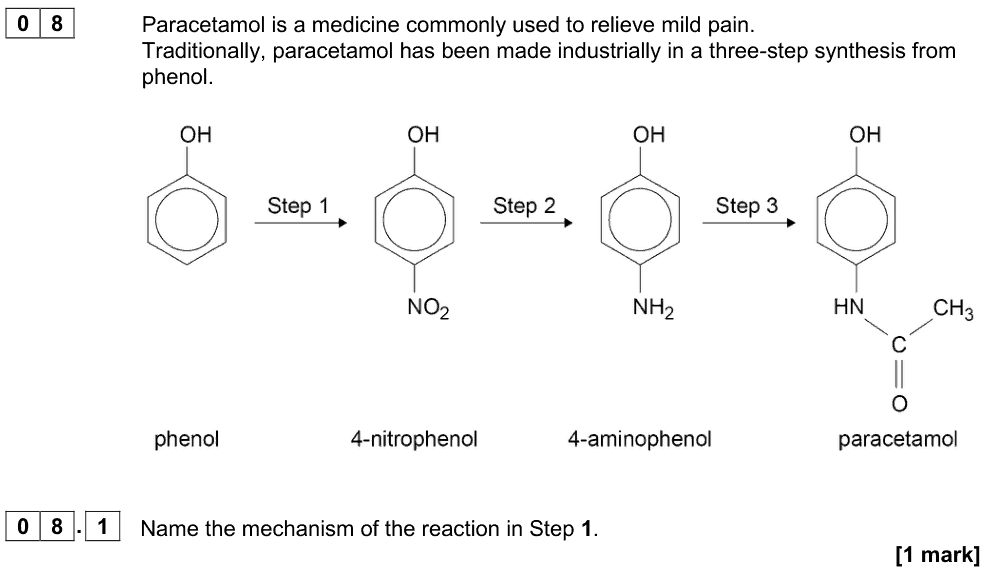
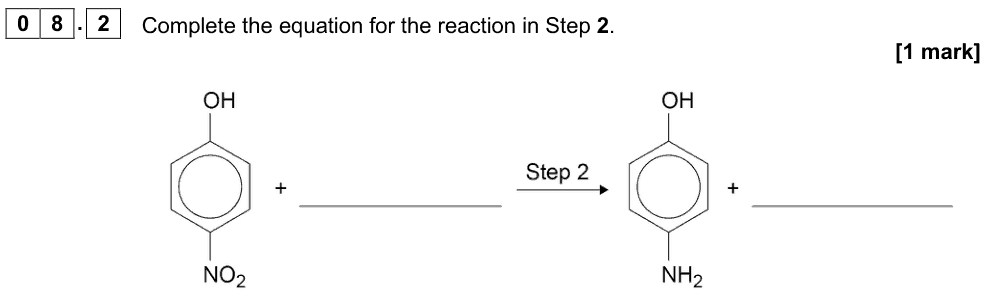
Step 1: concentrated HNO3 and concentrated H2SO4 (one mark each). Step 2: Sn and HCl (allow Fe and HCl, or H2 and Ni). If 'concentrated' is missing from both acids, 1 mark for the pair. Few scored all three
June 2022 · Paper 2 · Q10.21 markAO1=1Short answer
Earlier part of question 10 that this part uses
Mark scheme
Examiner's comment
10.2 Despite being tested on a large number of past papers, fewer than expected were able to name the mechanism in step 3 as (nucleophilic) addition elimination.
Notes from the mark scheme and report
(Nucleophilic) addition–elimination
June 2022 · Paper 2 · Q10.42 marksAO3=2Explanation
Earlier part of question 10 that this part uses
Mark scheme
Examiner's comment
10.4 This question was poorly answered and only a small proportion were able to score full marks by explaining that amine B can go on to react further and form other amines, while amine A is the only organic product in step 2.
Notes from the mark scheme and report
In step 5 the amine formed is a nucleophile and reacts further with the halogenoalkane (further substitution), giving secondary and tertiary amines and a quaternary salt
in step 2 only one amine can form. Poorly answered
June 2022 · Paper 2 · Q10.52 marksAO2=2Explanation
Earlier part of question 10 that this part uses
Mark scheme
Examiner's comment
10.5 The explanation of base strength in terms of the availability of a lone pair of electrons on the nitrogen has been asked numerous times but this question still discriminated well.
Notes from the mark scheme and report
In B the alkyl (CH2) group is electron-releasing (positive inductive effect), so the lone pair on N is more available to accept a proton
in A the lone pair on N is partly delocalised into the benzene ring, so it is less available
November 2021 · Paper 2 · Q02.44 marksMechanism
Earlier part of question 02 that this part uses
Mark scheme
Examiner's comment
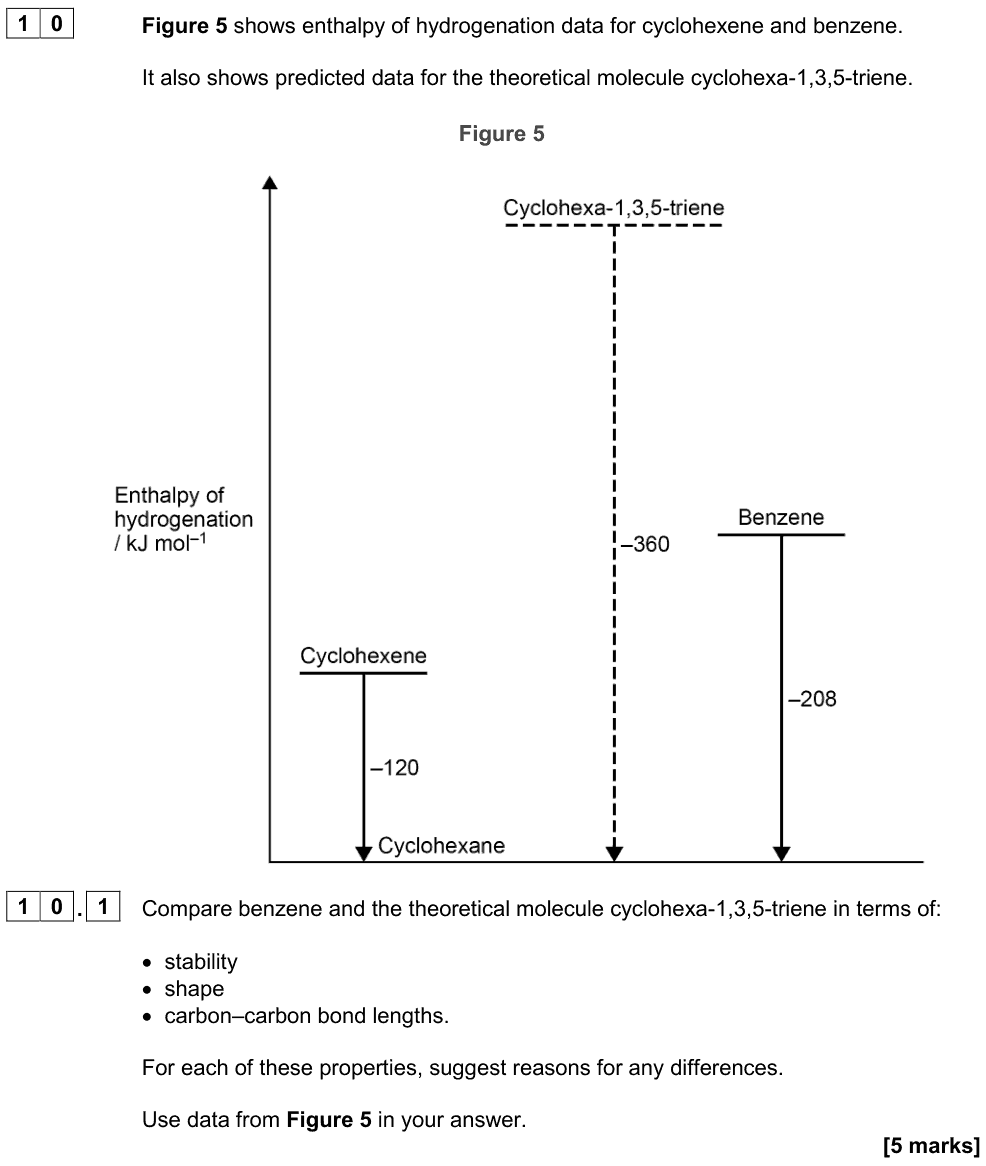
In this question a surprisingly small proportion of students were able to state the meaning of the term fraction. In addition, very few were able to explain why C=O bonds in carbon dioxide absorb infrared radiation. A good range of answers was seen for the extended response question about the environmental impact of bioethanol as a fuel, but a significant number of students were unable to get started here.
Notes from the mark scheme and report
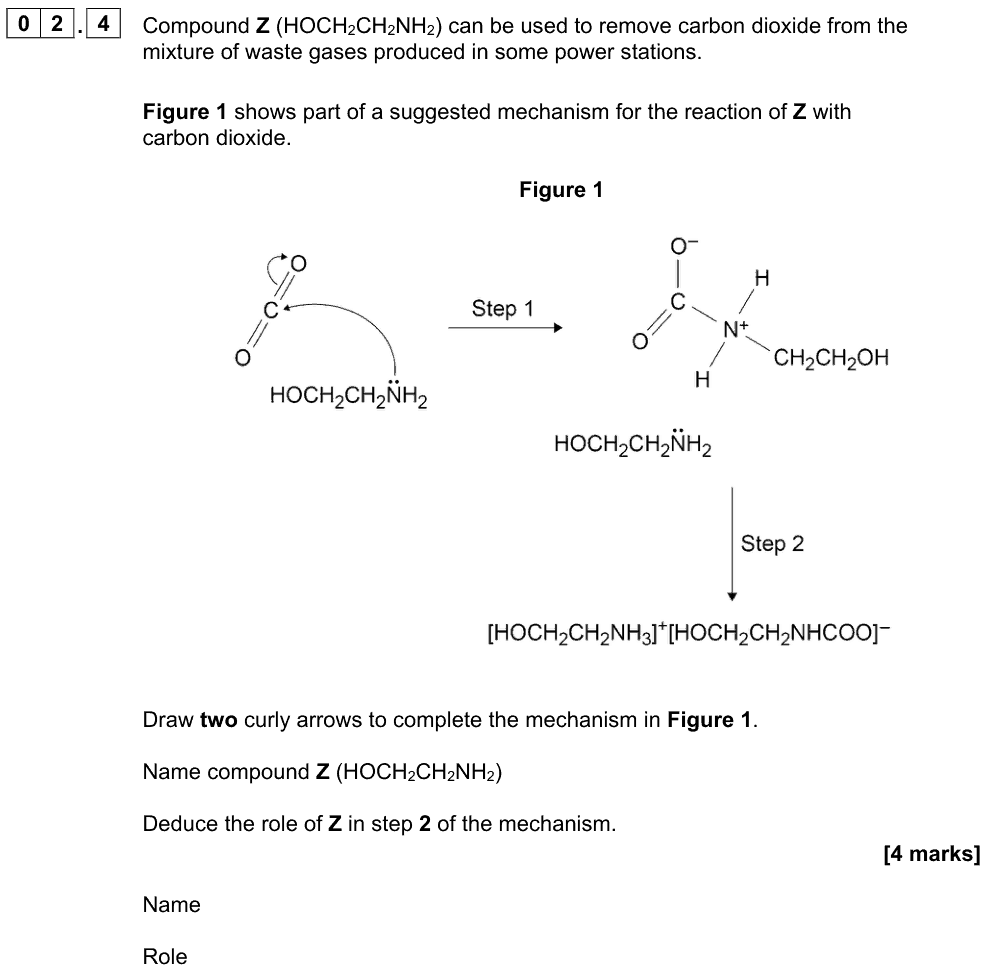
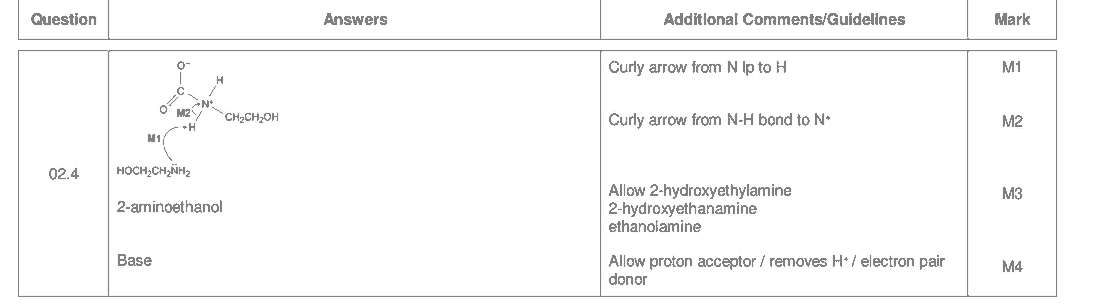
Two curly arrows for step 2: from the lone pair on N of the second HOCH2CH2NH2 to an H on the N+, and from that N–H bond to the N+. Name: 2-aminoethanol (allow ethanolamine, 2-hydroxyethylamine). Role in step 2: base / proton acceptor (electron pair donor)
November 2021 · Paper 2 · Q07.23 marksShort answer
Earlier part of question 07 that this part uses
Mark scheme
Examiner's comment
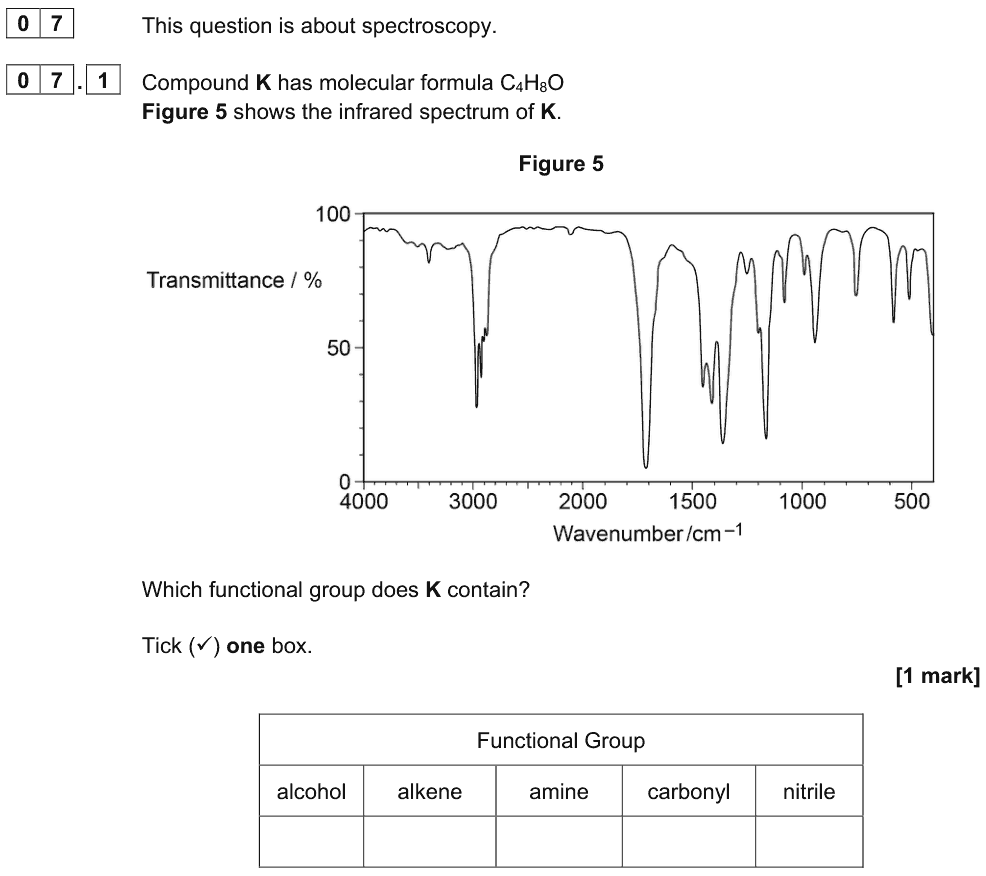
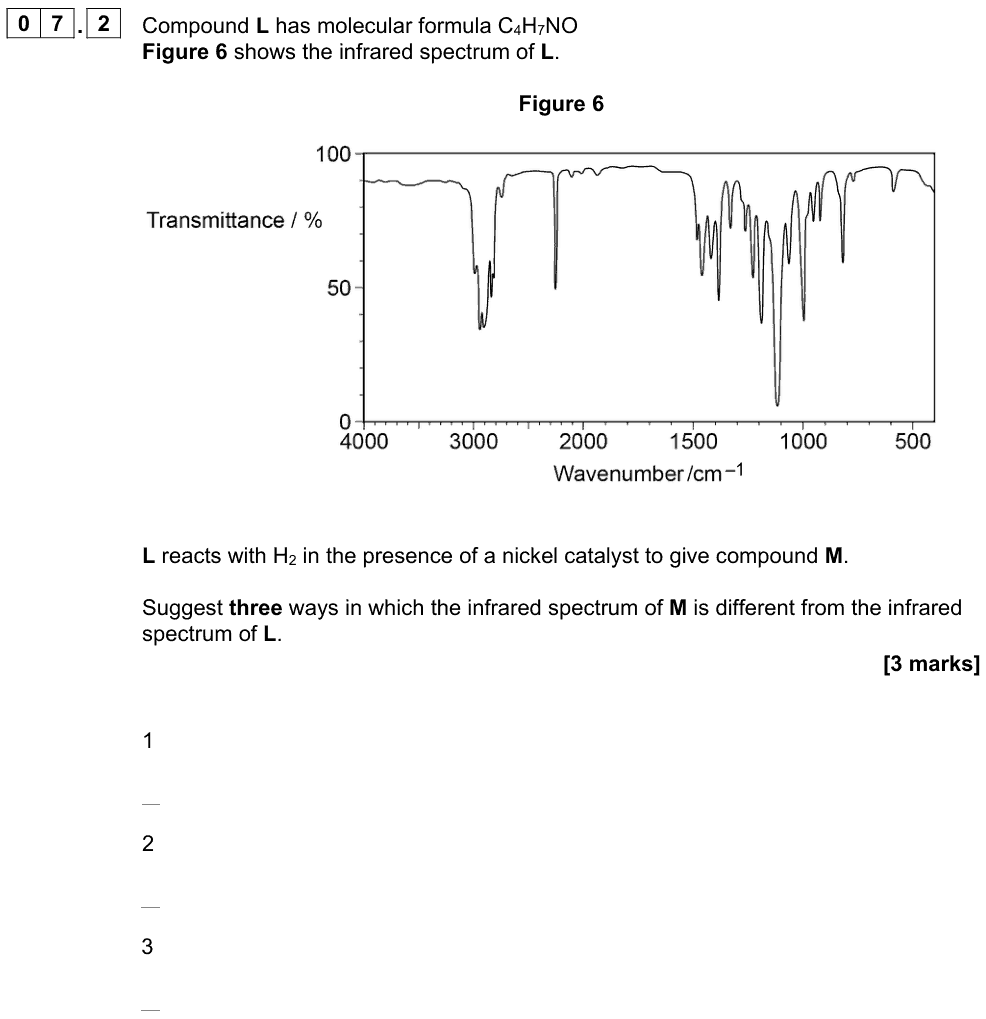
Over 75% of students scored the mark for question 07.1 and there was a good range of marks seen for question 07.2, with many able to score at least 1 mark here.
Notes from the mark scheme and report
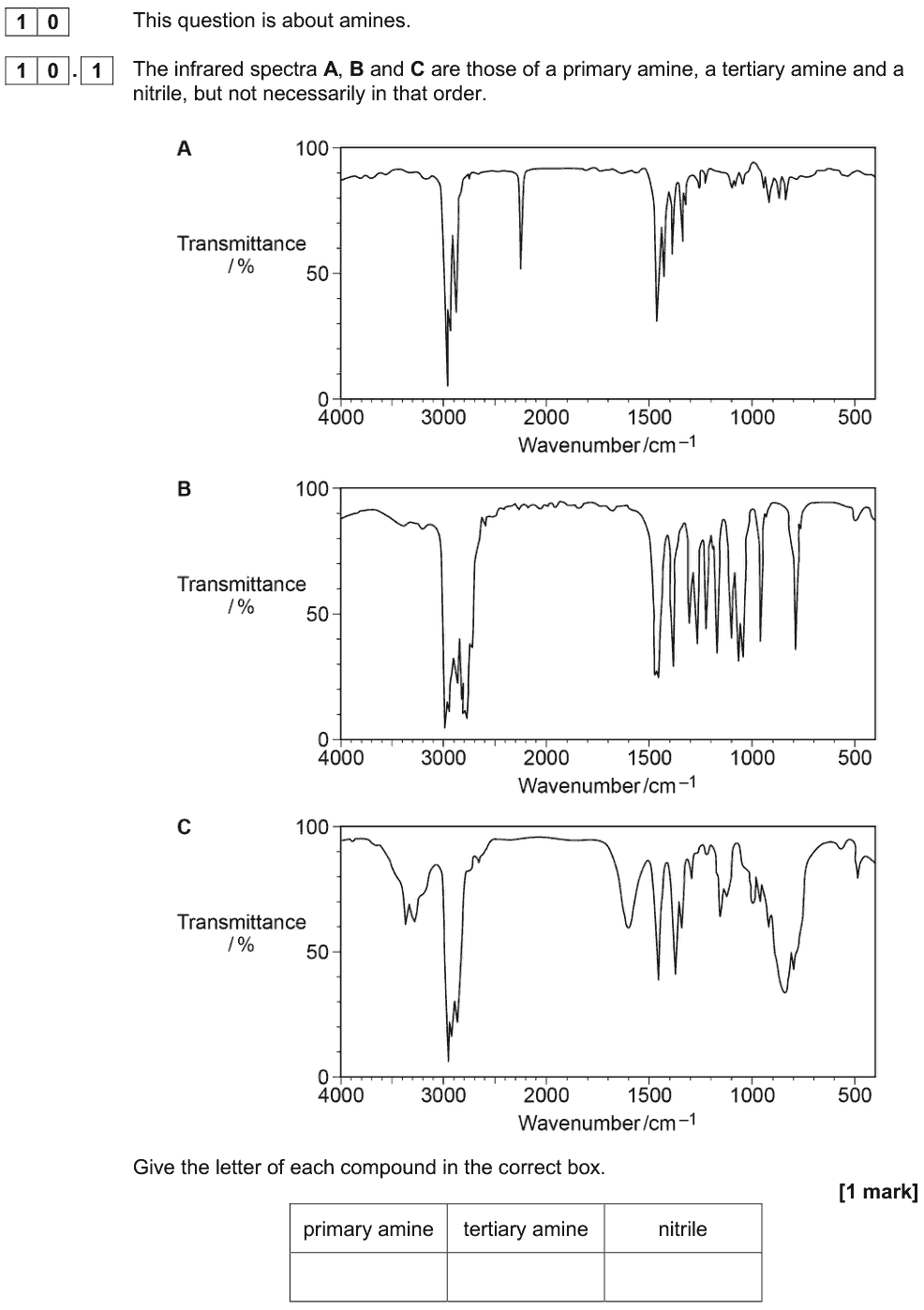
The C≡N absorption at 2220–2260 cm–1 disappears
an N–H absorption at 3300–3500 cm–1 appears (the nitrile is reduced to a primary amine)
the fingerprint region is different. Both changes stated without wavenumbers score 1 in total
Skills: MS3.1 Translate information between graphical, numerical and algebraic forms
November 2021 · Paper 3 · Q301 markMultiple choice
Answer
B
Mark scheme
Notes from the mark scheme and report
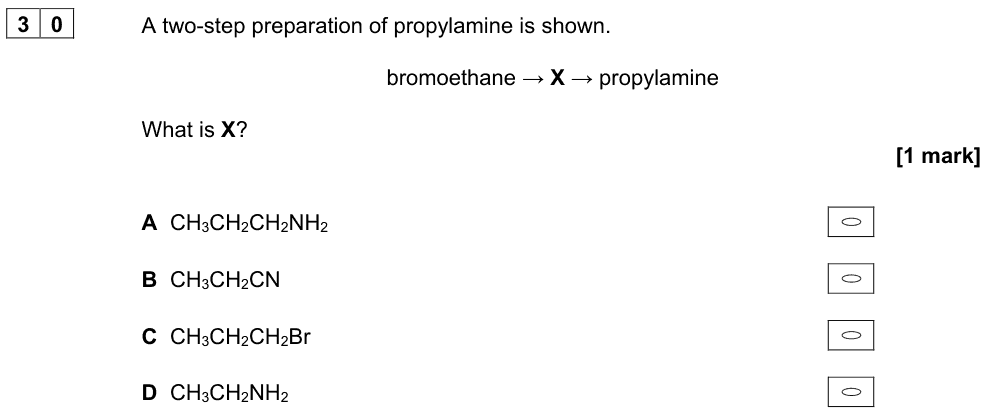
Answer: B. Bromoethane with KCN gives propanenitrile (one more carbon), which is reduced to propylamine
November 2021 · Paper 3 · Q321 markMultiple choice
Answer
C
Mark scheme
Notes from the mark scheme and report
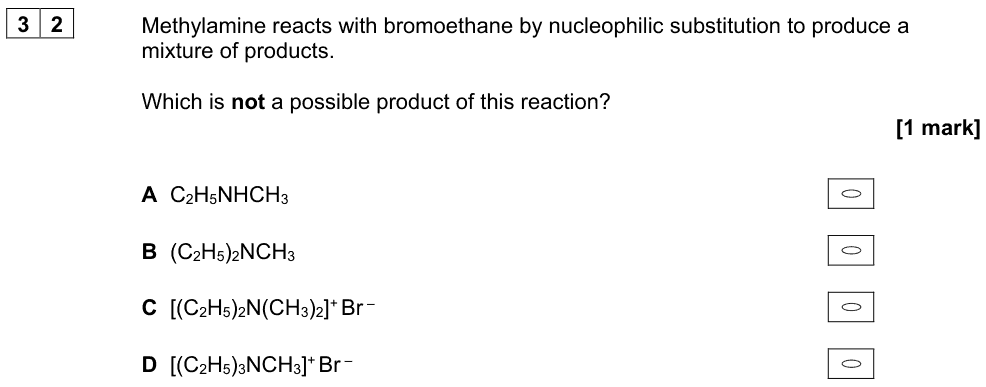
Answer: C. Bromoethane only adds ethyl groups, so the nitrogen cannot gain a second methyl group
November 2020 · Paper 2 · Q02.21 markShort answer
Earlier part of question 02 that this part uses
Mark scheme
Examiner's comment
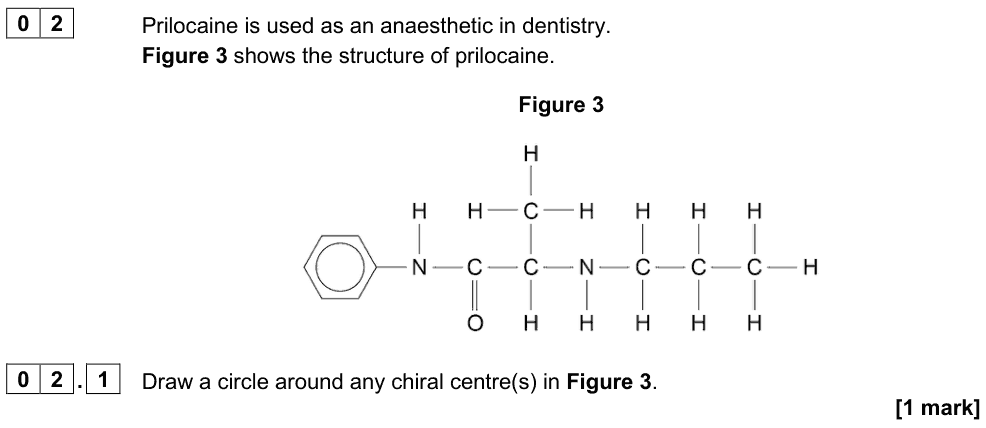
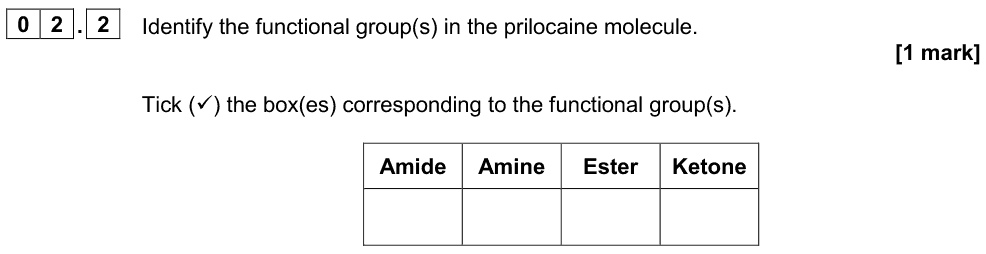
The chiral centre in 02.1 proved very accessible to students but a surprising number were unable, in 02.2, to identify the functional groups present.
The most common wrong answers showed that students thought that the molecule had a ketone functional group.
Others failed to recognise that the prilocaine contained an amine functional group.
Notes from the mark scheme and report
Answer: amide and amine (two ticks only). Common wrong tick: ketone
the amine was often missed. The tick boxes are in the 02.3 crop
November 2020 · Paper 2 · Q05.24 marksMechanism
Earlier part of question 05 that this part uses
Mark scheme
Examiner's comment
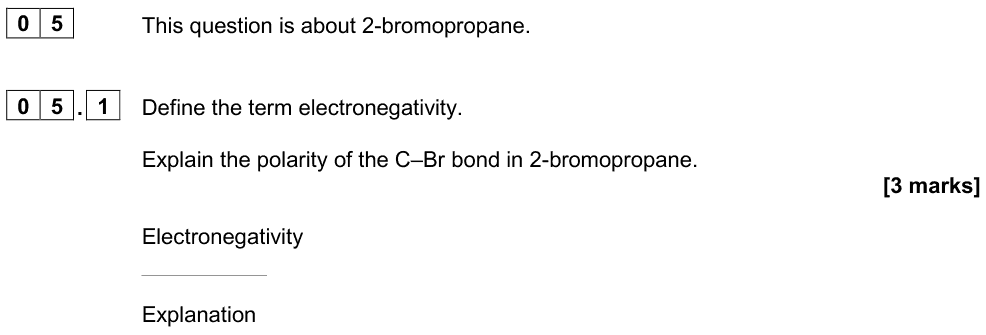
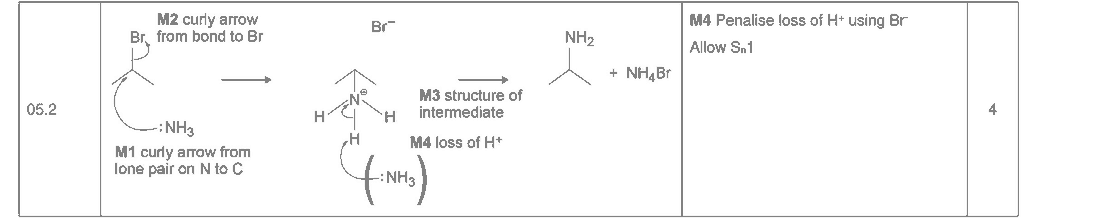
Around half the students scored all the marks for the mechanism in 05.2 and over 70% got at least 3 of the 4 marks.
Notes from the mark scheme and report
Nucleophilic substitution. Curly arrow from the lone pair on N of NH3 to the C bonded to Br
curly arrow from the C–Br bond to Br
intermediate (CH3)2CH–NH3+ with the + on N
curly arrow from an N–H bond to N, with a second NH3 removing H+, giving (CH3)2CHNH2 + NH4Br. Loss of H+ using Br– is penalised
SN1 allowed. Around half scored all 4
over 70% scored at least 3
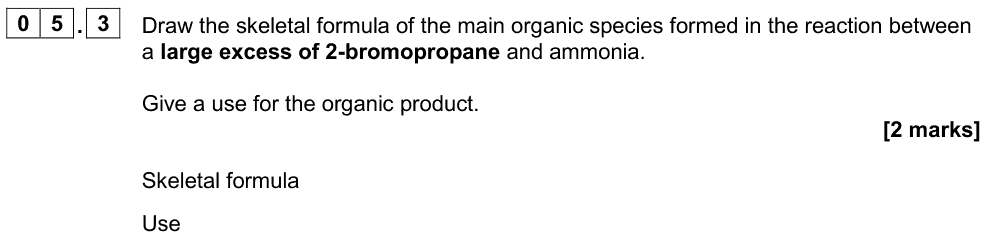
November 2020 · Paper 2 · Q05.32 marksDiagram or structureHard
Earlier part of question 05 that this part uses
Mark scheme
Examiner's comment
However, 05.3 proved much more difficult and less than 10% of students scored both marks here.
The significance of the halogenoalkane being in large excess was poorly understood.
Notes from the mark scheme and report
Skeletal formula of the quaternary ammonium ion: N+ bonded to four propan-2-yl groups, [(CH3)2CH]4N+ (bromide salt). Use: cationic surfactant (hair conditioner, fabric softener, disinfectant). The effect of a large excess of the halogenoalkane was poorly understood
June 2019 · Paper 2 · Q01.12 marksEquation writing
Mark scheme
Examiner's comment
01.1 This question was found to be quite demanding and relatively few students were able to balance the equation correctly. Common errors were to use molecular formulae and to give HBr as the second product.
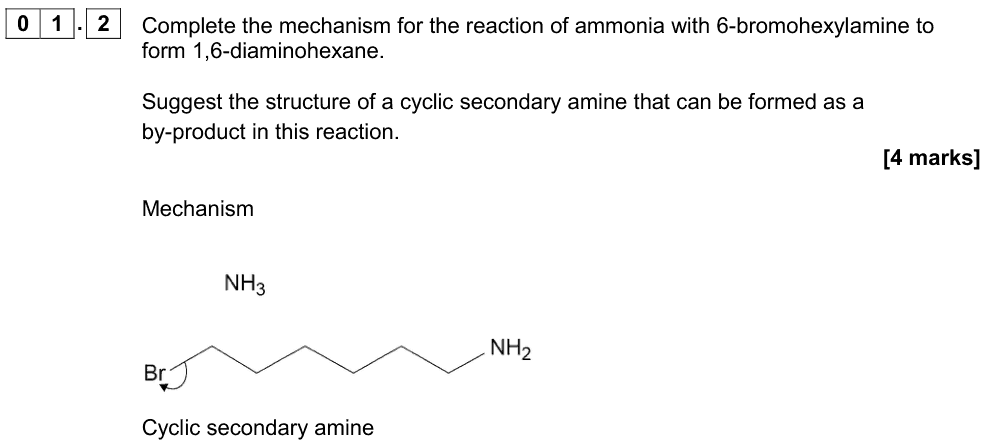
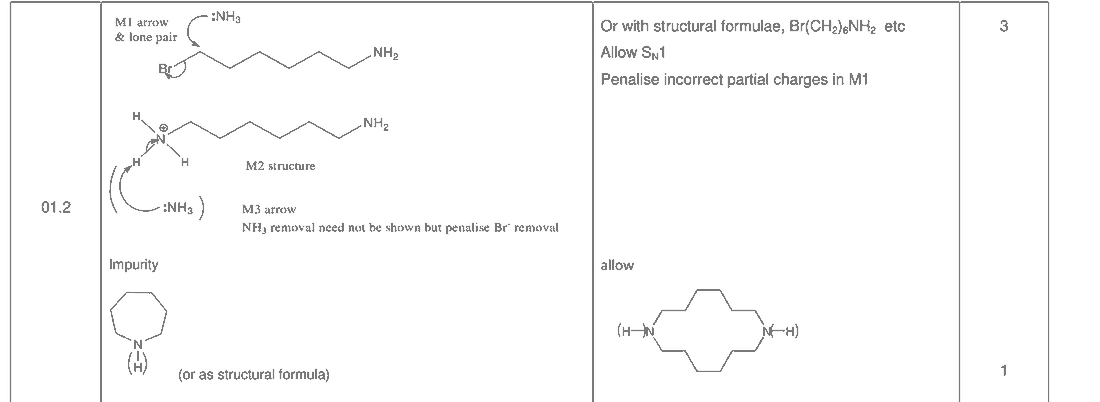
01.2 The mechanism was answered well although some students drew an intermediate with too few carbons. The structure of a cyclic secondary amine proved difficult for some to deduce and many incorrect hexagons or primary amine structures were drawn.
Notes from the mark scheme and report
Nucleophilic substitution: curly arrow from the lone pair on N of NH3 to the carbon bonded to Br (the C–Br arrow is printed)
intermediate H3N+–(CH2)6–NH2
arrow from an N–H bond to N+ as a second NH3 removes H+ (do not use Br– for this). Cyclic by-product: a seven-membered ring of six CH2 groups and one N–H (the amine end of the molecule attacks its own C–Br carbon). Errors: intermediate with too few carbons
hexagons or primary amines for the cyclic amine
June 2019 · Paper 2 · Q01.33 marksShort answer
Earlier part of question 01 that this part uses
Mark scheme
Examiner's comment
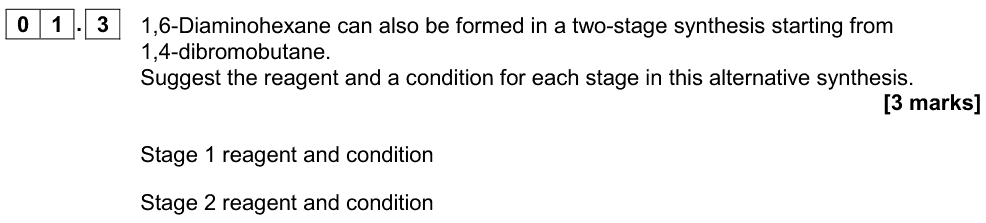
01.3 KCN was usually given but the correct aqueous-alcoholic conditions were rarely seen. The mark for hydrogen and nickel was gained by most.
Notes from the mark scheme and report
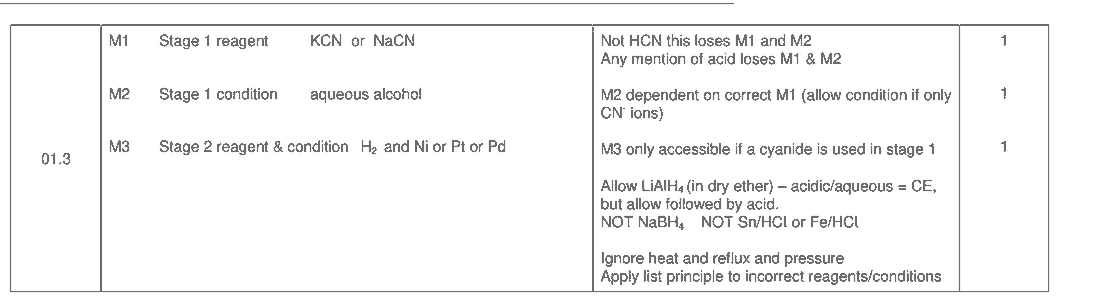
Stage 1: KCN (or NaCN) in aqueous alcohol, giving NC(CH2)4CN. Stage 2: H2 with Ni (or Pt / Pd) catalyst (allow LiAlH4 in dry ether) to reduce the dinitrile. HCN or any acid in stage 1 loses M1 and M2
not NaBH4, not Sn/HCl. The aqueous-alcoholic condition was rarely given.
June 2019 · Paper 2 · Q01.42 marksExplanationHard
Earlier part of question 01 that this part uses
Mark scheme
Examiner's comment
01.4 A third of the students gained both marks. The inductive effect was well known and expressed accurately, but fewer referred to the lone pair of electrons on the nitrogen atom correctly.
Notes from the mark scheme and report
The alkyl groups release electrons (positive inductive effect), so the lone pair on N is more available to accept a proton (H+). The two marks are independent. The lone pair on nitrogen was mentioned less often than the inductive effect
June 2019 · Paper 2 · Q08.21 markEquation writingHard
Earlier part of question 08 that this part uses
Mark scheme
Examiner's comment
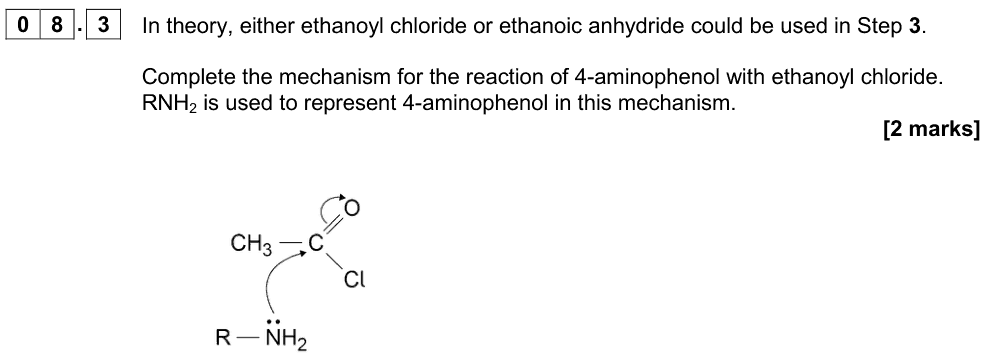
08.2 Only a third of students gained this mark. Many failed to balance the equation correctly whilst others were unable to identify either the other reactant which could have been given as 6[H] or 3H2, or the other product as water.
08.3 This part was generally answered well and many students scored both marks. Some, however, failed to gain the second mark because of careless drawing of curly arrows or for showing a chloride ion removing a proton from the intermediate.
Notes from the mark scheme and report
Nucleophilic addition–elimination. M1: tetrahedral intermediate CH3C(O–)(Cl)–N+H2R with both charges. M2: three curly arrows with a lone pair on O–: lone pair on O– reforms C=O, C–Cl bond breaks to Cl, and N–H bond breaks to N+ (loss of H+), giving CH3CONHR. Do not show Cl– removing the proton. Careless arrows lost the second mark
June 2019 · Paper 2 · Q08.51 markDiagram or structure
Earlier part of question 08 that this part uses
Mark scheme
Examiner's comment
08.5 This part proved to be difficult and few gained the mark here, including about a fifth of the students who made no attempt whatsoever.
Notes from the mark scheme and report
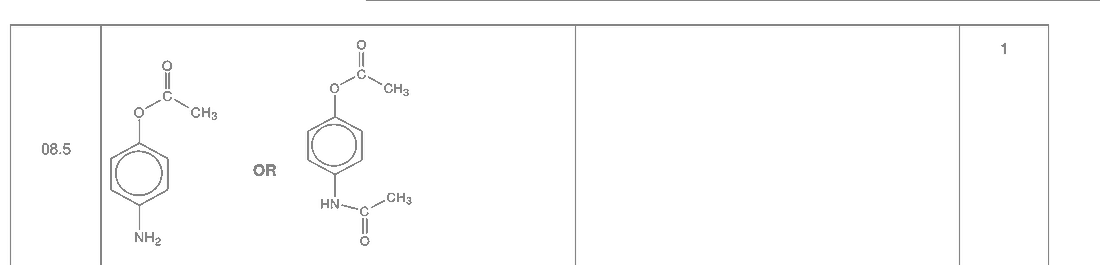
The phenol OH can also be acylated: the ester 4-aminophenyl ethanoate (H2N–C6H4–OCOCH3), or the product acylated on both N and O (CH3CONH–C6H4–OCOCH3). Found difficult
about a fifth made no attempt
June 2019 · Paper 3 · Q271 markMultiple choice
Answer
D
Mark scheme
Notes from the mark scheme and report
Answer: D. Bromoethane can only add ethyl groups, so the nitrogen keeps just one methyl group
D has two
June 2018 · Paper 2 · Q10.32 marksExplanationHard
Earlier part of question 10 that this part uses
Mark scheme
Examiner's comment
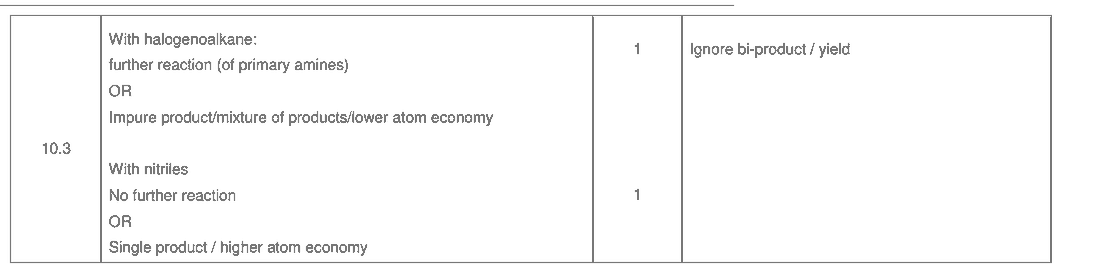
10.3 Both marks were gained by the 28.9% of the students who stated that further substitution reactions would occur following the formation of a primary amine from a halogenoalkane, and also that no further reaction would occur when primary amines were formed from nitriles. The second mark was less often gained, sometimes because students made no comment about nitriles at all.
Notes from the mark scheme and report
With a halogenoalkane the primary amine reacts further (further substitution), giving a mixture of products / impure product / lower atom economy
from a nitrile there is no further reaction, so a single product. Many made no comment about nitriles
June 2018 · Paper 2 · Q10.41 markDiagram or structure
Earlier part of question 10 that this part uses
Mark scheme
Examiner's comment
10.4 This was answered well although 12.4% of the students did not attempt the question.
Notes from the mark scheme and report
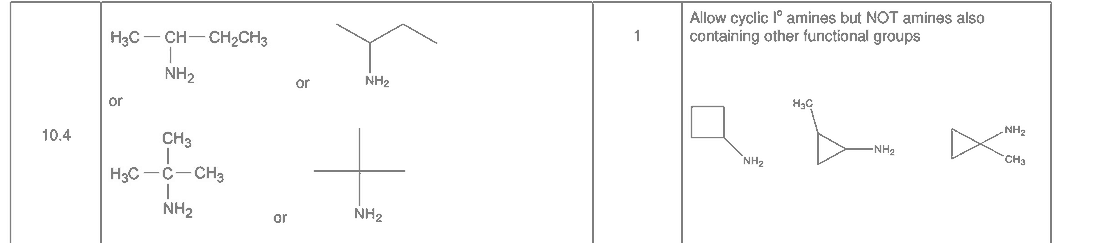
Butan-2-amine, CH3CH(NH2)CH2CH3, or 2-methylpropan-2-amine, (CH3)3CNH2: the N is not on a CH2 group, so it cannot come from reducing a nitrile. Cyclic primary amines allowed
June 2018 · Paper 2 · Q10.52 marksEquation writing
Earlier part of question 10 that this part uses
Mark scheme
Examiner's comment
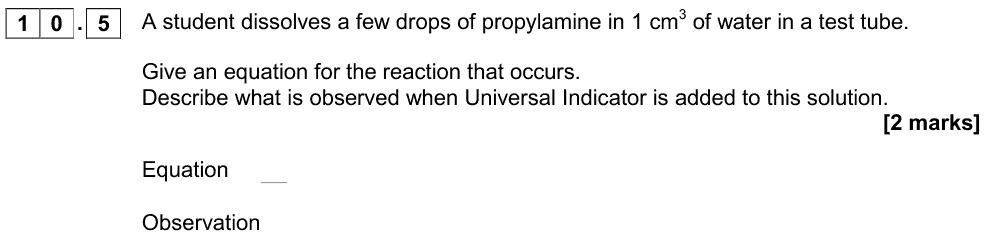
10.5 Many students were able to write a correct equation for the reaction between propylamine and water. However, some incorrectly suggested that the weak base would turn the indicator purple. Examiners noted that the use of litmus was sometimes described instead of Universal Indicator. The frequency with which this occurred suggests that some students do not necessarily make a distinction between U. I. and litmus.
Skills: ATc Measure pH using pH charts, or pH meter, or pH probe on a data logger
June 2018 · Paper 2 · Q10.62 marksEquation writingHard
Earlier part of question 10 that this part uses
Mark scheme
Examiner's comment
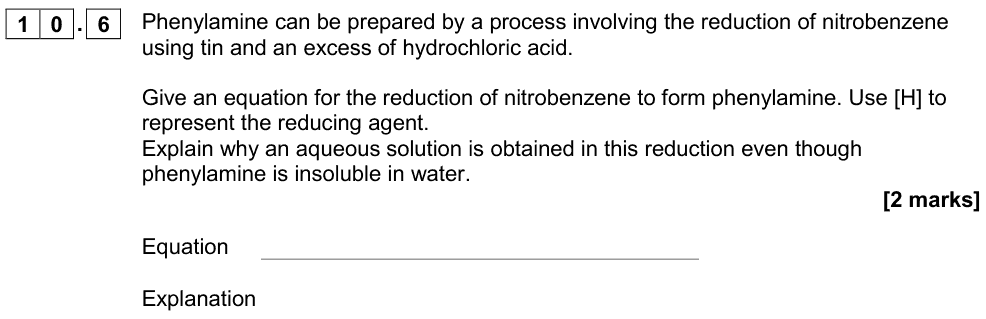
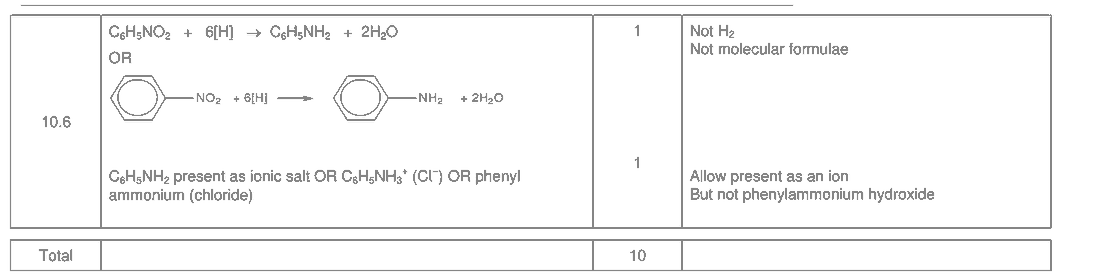
10.6 A good proportion of students gained the first mark for a correct equation. Only 7.7% could describe the formation of the phenylammonium ion and so explain the solubility of phenylamine in the aqueous acidic solution.
Notes from the mark scheme and report
C6H5NO2 + 6[H] → C6H5NH2 + 2H2O (not H2
not molecular formulae). In excess acid the phenylamine is present as the ionic salt C6H5NH3+ Cl– (phenylammonium chloride), which is soluble
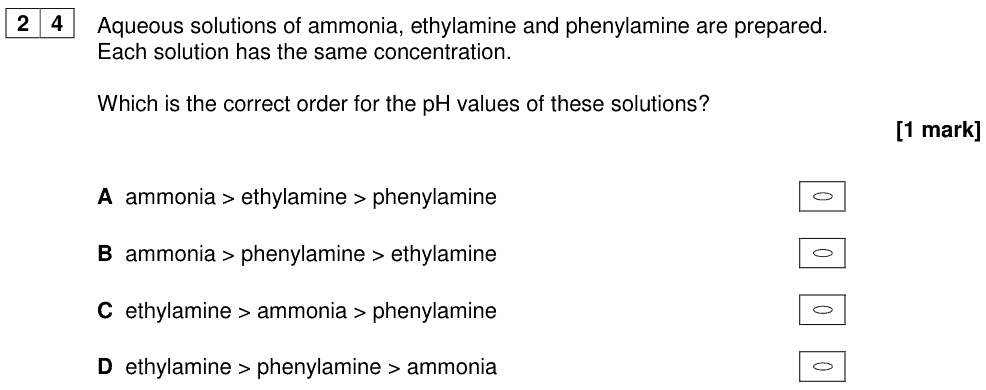
June 2018 · Paper 3 · Q241 markMultiple choice
Answer
C
Mark scheme
Examiner's comment
24 A was the commonest incorrect response. 58.3% of students realised that electron- releasing alkyl groups increase the availability of the lone pair on N, making amines more basic than ammonia (D).
Notes from the mark scheme and report
Answer: C. The electron-releasing ethyl group makes the lone pair on N more available than in ammonia
in phenylamine the lone pair is delocalised into the ring and is less available. Stronger base, higher pH
June 2017 · Paper 2 · Q01.22 marksShort answer
Earlier part of question 01 that this part uses
Mark scheme
Examiner's comment
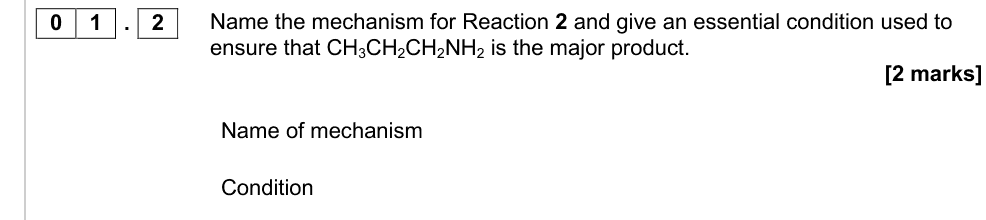
01.2 Most students could name the mechanism, but the condition proved more difficult.
Notes from the mark scheme and report
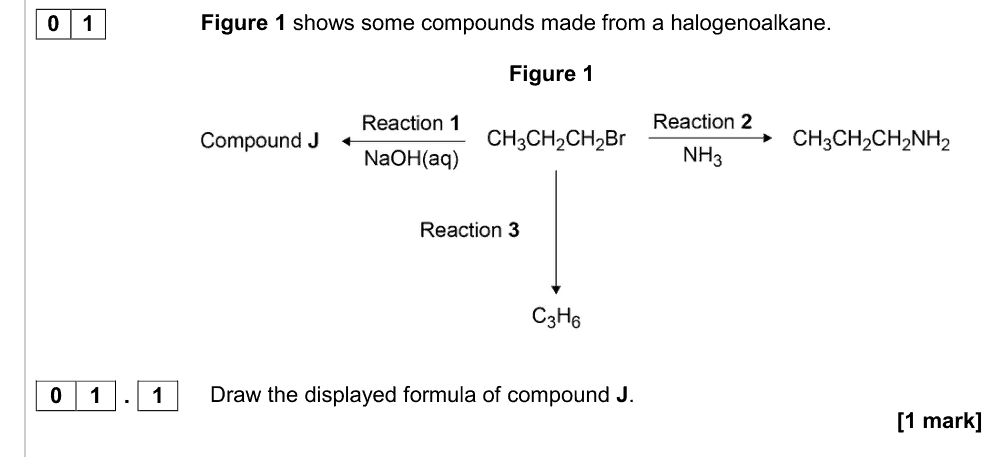
Nucleophilic substitution
excess ammonia (so the primary amine does not react further). Aqueous, alcoholic, heat and pressure are ignored. The condition was the harder mark
June 2017 · Paper 2 · Q01.42 marksDiagram or structureHard
Earlier part of question 01 that this part uses
Mark scheme
Examiner's comment
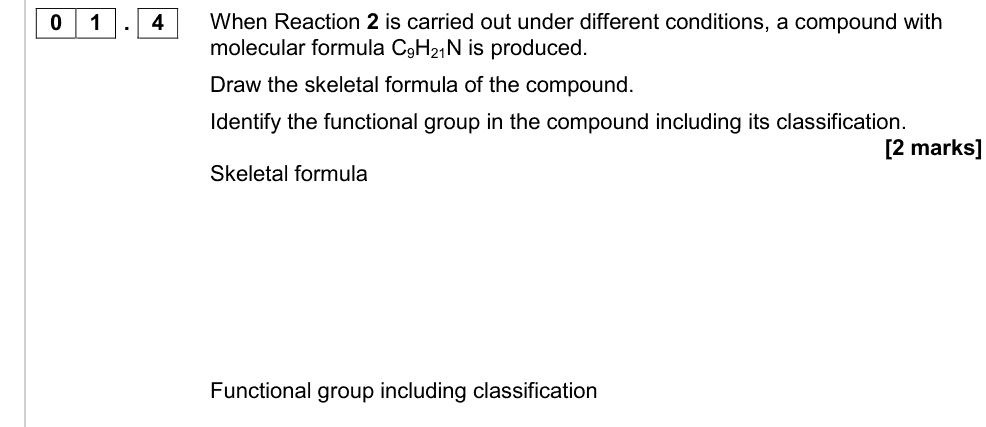
01.4 Only 30% of students scored both marks here. Others drew a primary amine or a non- skeletal structure.
Notes from the mark scheme and report
Skeletal formula of tripropylamine, N(CH2CH2CH3)3
tertiary amine (only credited if a tertiary amine is drawn). Errors: a primary amine
a non-skeletal structure
June 2017 · Paper 2 · Q06.46 marksMechanismHard
Earlier part of question 06 that this part uses
Mark scheme
Examiner's comment
06.4 This question was well answered and 25% of students scored all six marks. The name of the organic product was the most common mark lost, closely followed by slips in the third or fourth marks in the mechanism.
Notes from the mark scheme and report
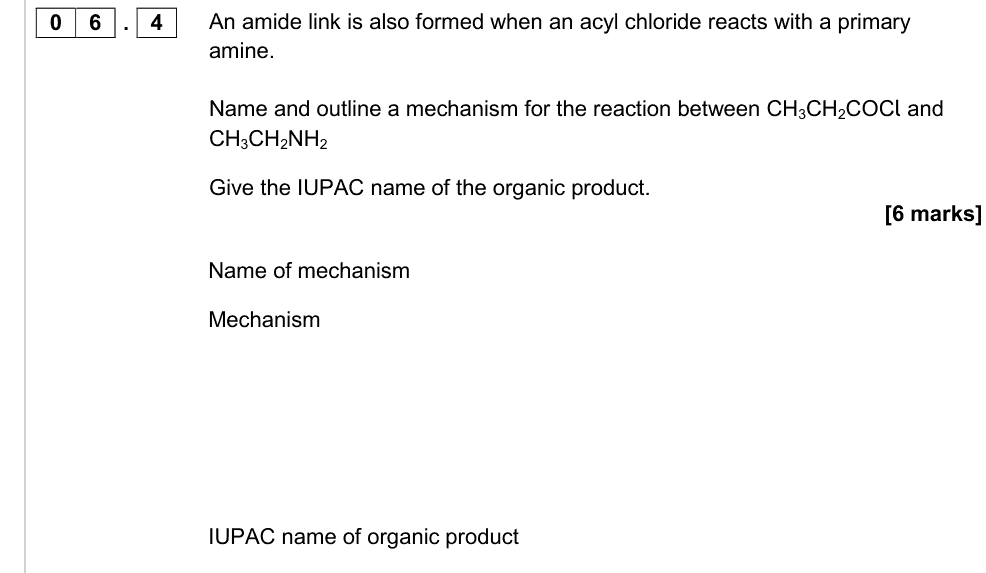
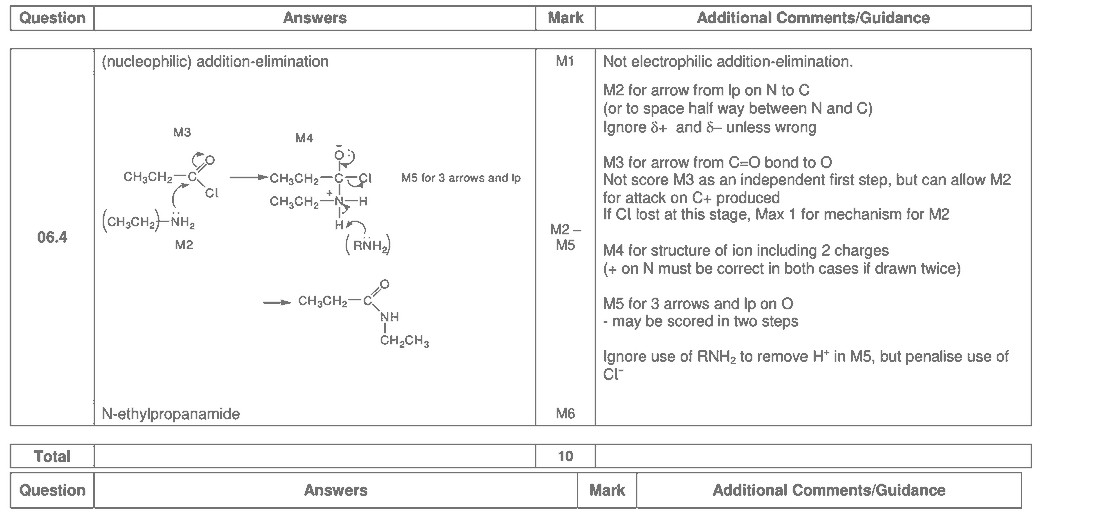
(Nucleophilic) addition–elimination. Arrow from the lone pair on N of CH3CH2NH2 to the C of C=O
arrow from C=O bond to O
intermediate with O– and N+
then lone pair on O– reforms C=O, C–Cl bond breaks to Cl and N–H bond breaks to N+. Product: N-ethylpropanamide. The name was the mark most often lost
June 2017 · Paper 2 · Q11.16 marksExplanation
Mark scheme
Examiner's comment
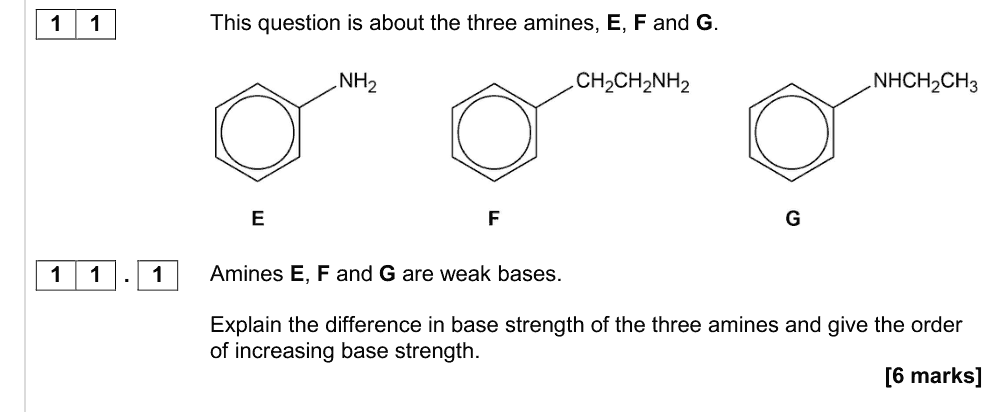
11.1 The full range of marks was seen and included some excellent answers. Other responses did not contain accurate descriptions of the effect of the attached groups on the availability of the lone pair on the nitrogen atom. The idea that, for nitrogen atoms directly attached to the benzene ring, the lone pair was delocalised into the ring was often poorly explained. The (positive) inductive effect of alkyl groups was much better described.
Notes from the mark scheme and report
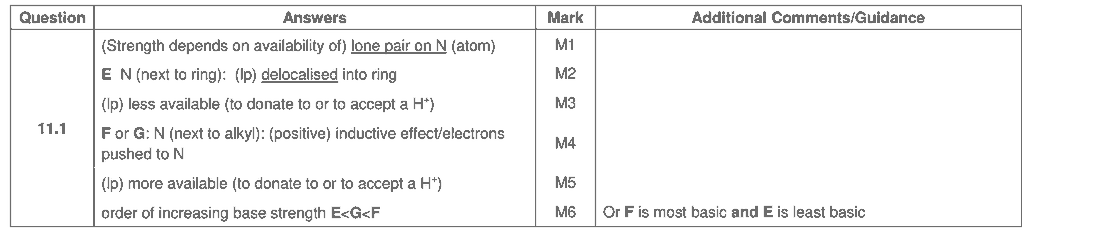
Base strength depends on the availability of the lone pair on N. E: N is attached to the ring, the lone pair is delocalised into the ring, so less available to accept H+. F (and G): N attached to an alkyl group, positive inductive effect pushes electrons towards N, lone pair more available. Order of increasing strength: E < G < F. Delocalisation into the ring was often poorly explained
June 2017 · Paper 2 · Q11.25 marksShort answer
Earlier part of question 11 that this part uses
Mark scheme
Examiner's comment
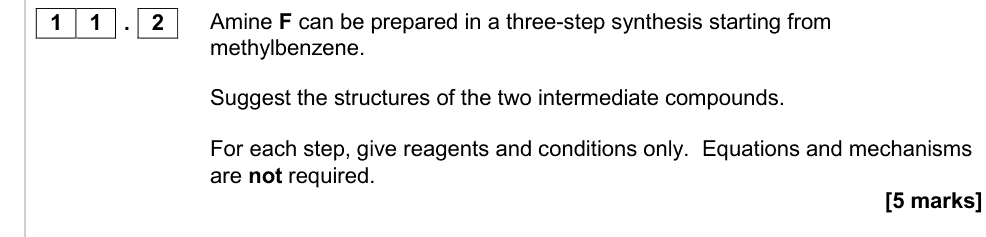
11.2 Some excellent answers were seen, but overall this was not answered well. The fact that about 8% of students made no attempt at this part of the question perhaps indicated that a small number of students were short of time. Some students, confused by the presence of a benzene ring, started with nitration. This rarely led to any marks. For those who chose the correct route, the two intermediates were often correctly identified. The use of chlorine or bromine in UV in the first step was usually well known but use of the reagent KCN in a mixed aqueous/alcoholic solvent was less often correct in the next step. The expected reducing agent/condition for the final step was hydrogen with a nickel or platinum catalyst. LiAlH4 in dry ether is not required knowledge for this specification, but was an acceptable answer.
Notes from the mark scheme and report
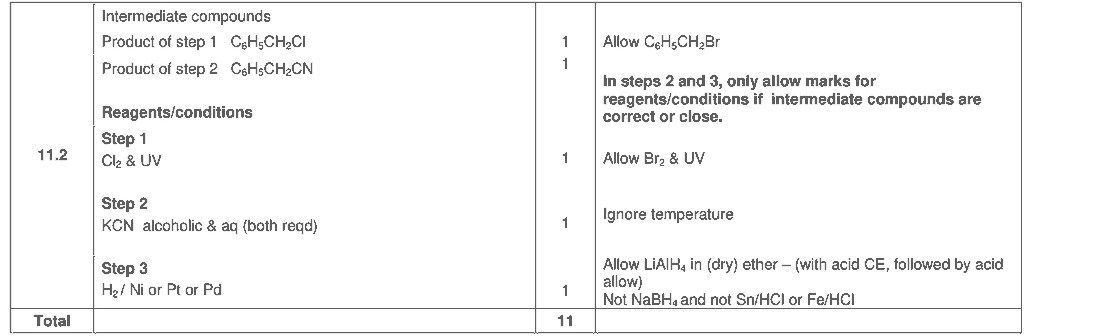
Intermediates: C6H5CH2Cl (or the bromide), then C6H5CH2CN. Step 1: Cl2 (or Br2) and UV light. Step 2: KCN in aqueous alcohol (both needed). Step 3: H2 with a Ni (or Pt/Pd) catalyst
LiAlH4 in dry ether allowed
not NaBH4, Sn/HCl or Fe/HCl. Reagent marks for steps 2 and 3 need correct intermediates. Common error: starting with nitration
Specimen · Paper 2 · Q06.31 markAO2=1Diagram or structure
Earlier part of question 06 that this part uses
Mark scheme
Notes from the mark scheme and report
(CH3)3N+–CH2–COOH (Br–): the quaternary ammonium ion formed by repeated nucleophilic substitution
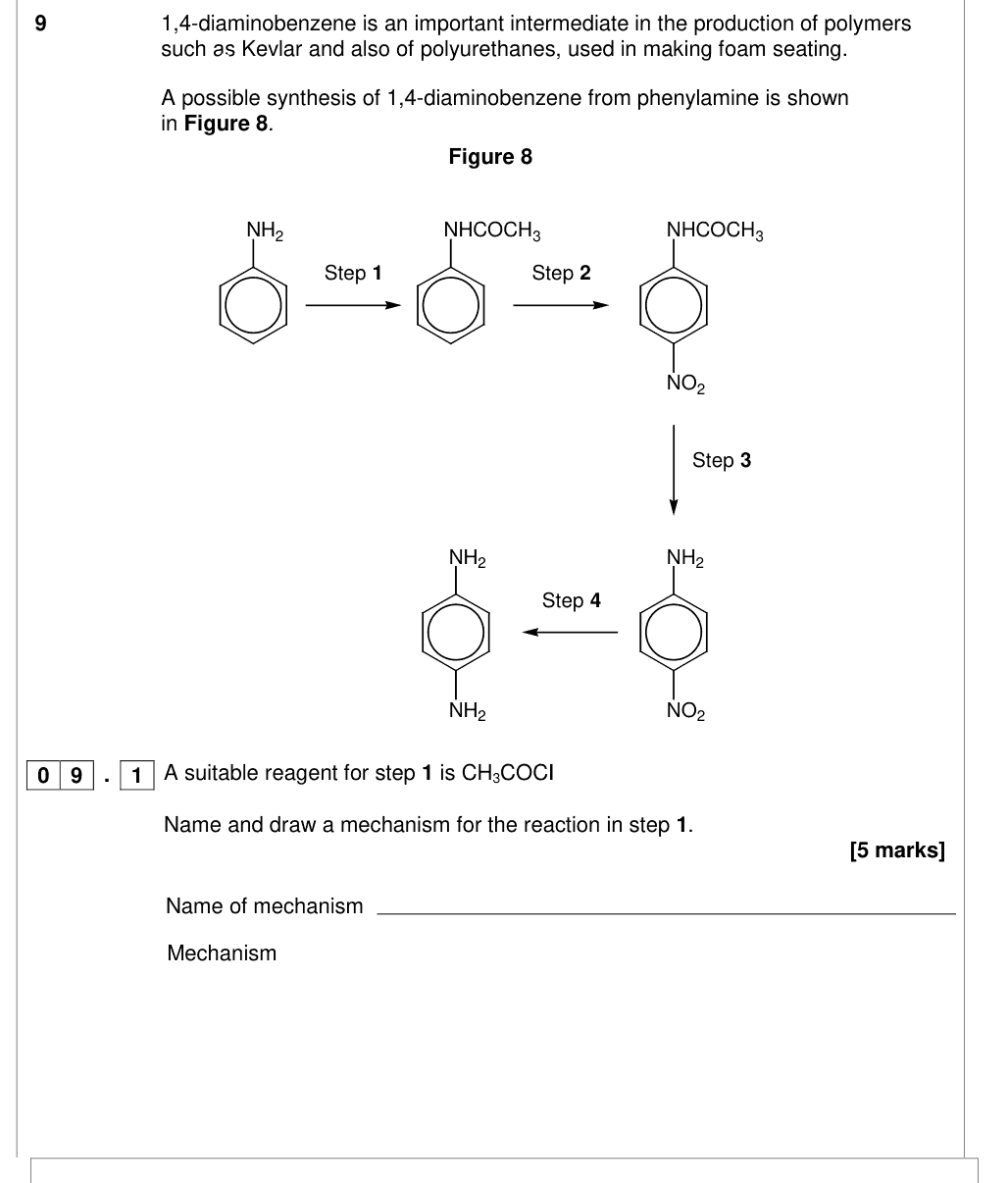
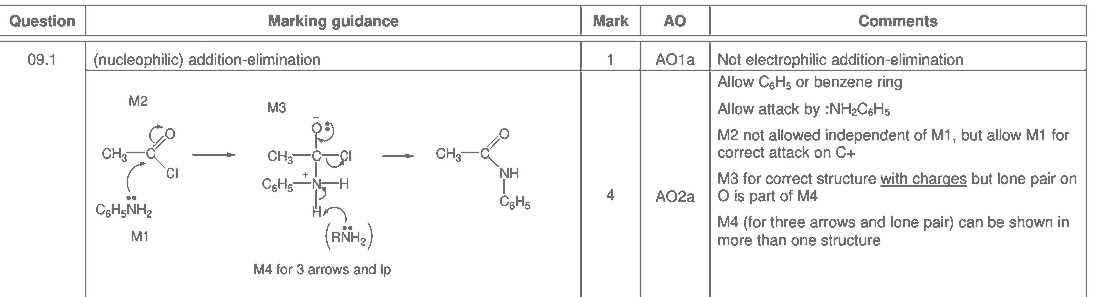
Specimen · Paper 2 · Q09.15 marksAO1=1, AO2=4Mechanism
Mark scheme
Notes from the mark scheme and report
(Nucleophilic) addition–elimination
not electrophilic. M1 curly arrow from the lone pair on N of C6H5NH2 to the C of C=O
M2 arrow from the C=O bond to O
M3 intermediate with O– and N+ (C6H5NH2+)
M4 three arrows and the lone pair: lone pair on O– re-forming C=O, C–Cl bond to Cl, and N–H bond to N+ (H removed). Product CH3CONHC6H5.
Specimen · Paper 2 · Q09.81 markAO1=1Short answer
Earlier parts of question 09 that this part uses
Mark scheme
Notes from the mark scheme and report
Sn / HCl (allow Fe / HCl
acid concentration ignored)
Work with an A-level chemistry tutor
Dropping marks on calculations, mechanisms or the required practicals? Book a trial session with a specialist A-level chemistry tutor.