Notes and key-term cards for this topic are being written by our tutors. The past-paper questions below are ready now.
Specification statements
Show the 13 statements from the specification
3.3.4.1-01 Alkenes are unsaturated hydrocarbons.
3.3.4.1-02 Bonding in alkenes involves a double covalent bond, a centre of high electron density.
3.3.4.2-01 Electrophilic addition reactions of alkenes with HBr, H2SO4 and Br2
3.3.4.2-02 The use of bromine to test for unsaturation.
3.3.4.2-03 The formation of major and minor products in addition reactions of unsymmetrical alkenes.
3.3.4.2-04 Students should be able to: • outline the mechanisms for these reactions • explain the formation of major and minor products by reference to the relative stabilities of primary, secondary and tertiary carbocation intermediates.
3.3.4.3-01 Addition polymers are formed from alkenes and substituted alkenes.
3.3.4.3-02 The repeating unit of addition polymers.
3.3.4.3-03 IUPAC rules for naming addition polymers.
3.3.4.3-04 Addition polymers are unreactive.
3.3.4.3-05 Appreciate that knowledge and understanding of the production and properties of polymers has developed over time.
3.3.4.3-06 Typical uses of poly(chloroethene), commonly known as PVC, and how its properties can be modified using a plasticiser.
3.3.4.3-07 Students should be able to: • draw the repeating unit from a monomer structure • draw the repeating unit from a section of the polymer chain • draw the structure of the monomer from a section of the polymer • explain why addition polymers are unreactive • explain the nature of intermolecular forces between molecules of polyalkenes.
Six-mark level of response questions on this topic
Tap a question to zoom it. Where a part needs a figure, table or structure from earlier in the question, that part folds out above it; the mark scheme and examiner's comment open underneath. Have AQA's Data Booklet (the Periodic Table and the spectroscopy tables) beside you.
June 2025 · Paper 2 · Q01.52 marksAO3=2Short answer
Earlier part of question 01 that this part uses
Mark scheme
Examiner's comment
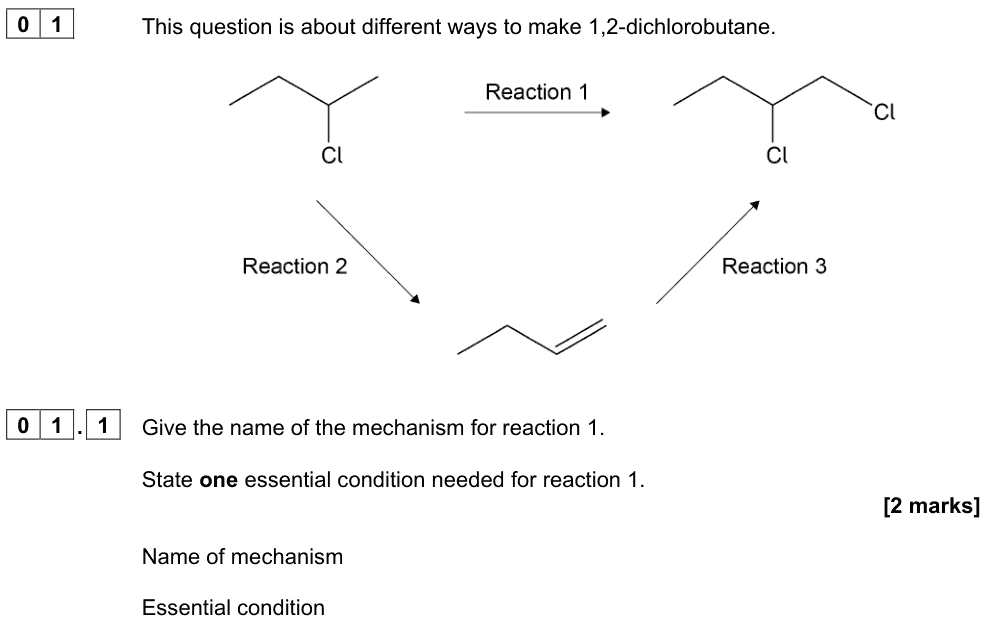
1.5 Students were asked to deduce that chlorine would be required to convert but-1-ene into 1,2-dichlorobutane via electrophilic addition. It was generally well answered but some thought that HCl could be used as the reagent.
Notes from the mark scheme and report
Chlorine, Cl2
electrophilic addition. Common error: HCl as the reagent
June 2025 · Paper 2 · Q01.61 markAO3=1Diagram or structure
Earlier part of question 01 that this part uses
Mark scheme
Examiner's comment
1.6 The question required students to see that reaction 2 also gives but-2-ene as a product and this would go on to give 2,3-dichlorobutane in reaction 3. It proved difficult for many and quite a high number did not attempt the question.
Notes from the mark scheme and report
2,3-dichlorobutane, CH3CHClCHClCH3 (elimination also gives but-2-ene, which then adds chlorine). Chloro-alcohols such as CH3CH(OH)CHClCH3 are allowed (chlorine water). Many did not attempt it
June 2025 · Paper 2 · Q02.32 marksAO2=2Mechanism
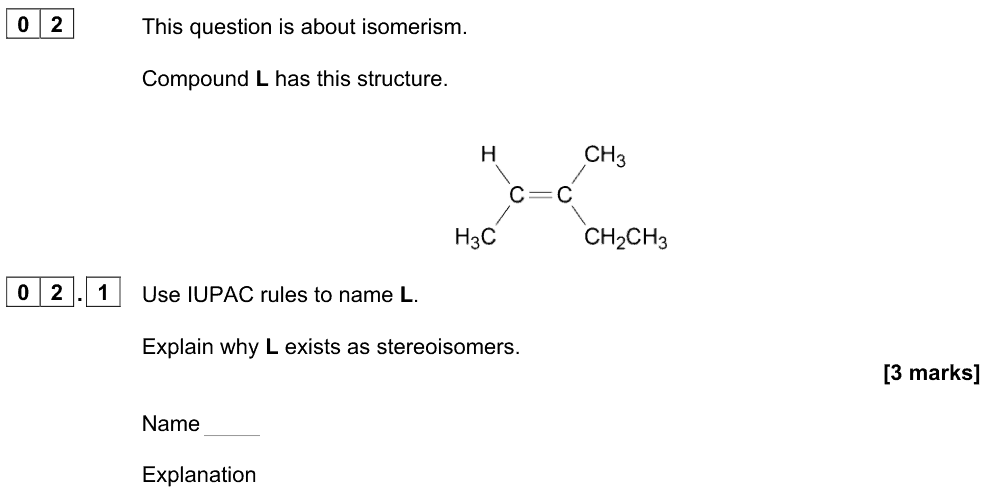
Earlier part of question 02 that this part uses
Mark scheme
Examiner's comment
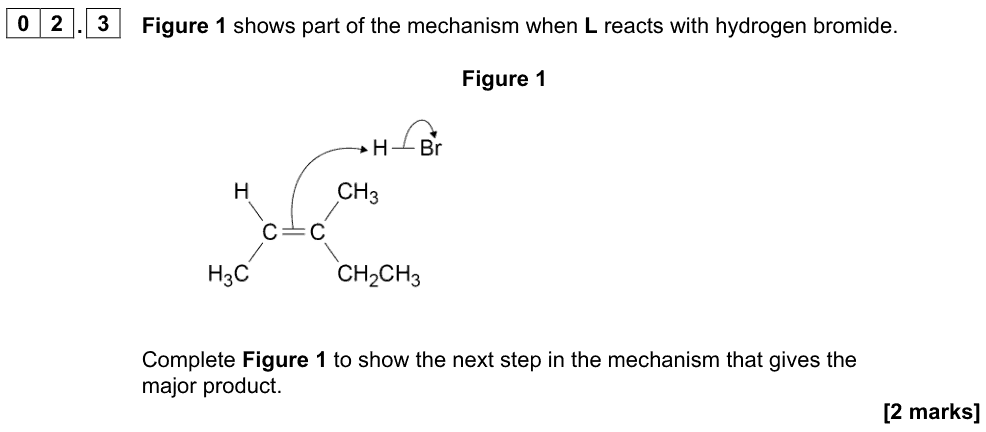
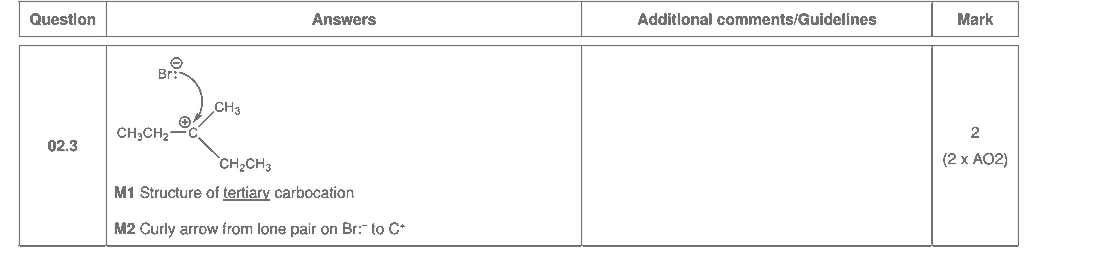
2.3 Students were asked to complete an electrophilic addition mechanism with an unsymmetrical alkene. This proved straight forward for many. Those who lost marks often did so because that drew a secondary carbocation intermediate rather than the tertiary one that would lead to the major product.
Notes from the mark scheme and report
The tertiary carbocation CH3CH2–C+(CH3)–CH2CH3, with a curly arrow from a lone pair on Br– to the C+. Common error: drawing the secondary carbocation
June 2025 · Paper 2 · Q03.12 marksAO1=2Short answer
Mark scheme
Examiner's comment
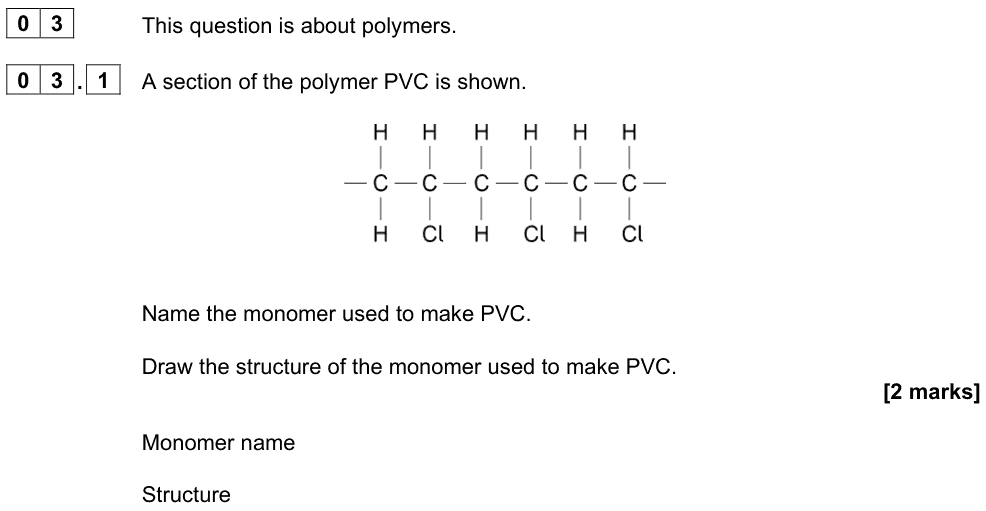
3.1 Students were asked to deduce the structure and name of the monomer used from a section of the structure of PVC. This proved straight forward for many.
Notes from the mark scheme and report
Chloroethene (allow vinyl chloride)
CH2=CHCl
June 2025 · Paper 2 · Q03.21 markAO2=1Short answer
Earlier part of question 03 that this part uses
Mark scheme
Examiner's comment
3.2 Students were asked to state why PVC is not biodegradable. Many were able to identify the strong non-polar C-C bonds as the reason but significant numbers were unable to see this and suggested incorrectly that strong C-H or C-Cl bonds were responsible.
Notes from the mark scheme and report
The chain is made of C–C bonds, which are non-polar / strong, so they are not attacked by nucleophiles and cannot be hydrolysed. Common error: strong C–H or C–Cl bonds
June 2025 · Paper 2 · Q03.31 markAO1=1Short answer
Earlier part of question 03 that this part uses
Mark scheme
Examiner's comment
3.3 Students were asked how a plasticiser modified the properties of a polymer. Despite not being asked in recent papers, this was well known. Those who did not score sometimes tried to describe how the plasticiser works rather than answering the question directly.
Notes from the mark scheme and report
Makes the PVC softer / more flexible (comparative needed). Describing how the plasticiser works does not answer the question
June 2025 · AS Paper 2 · Q04.31 markAO1=1Diagram or structure
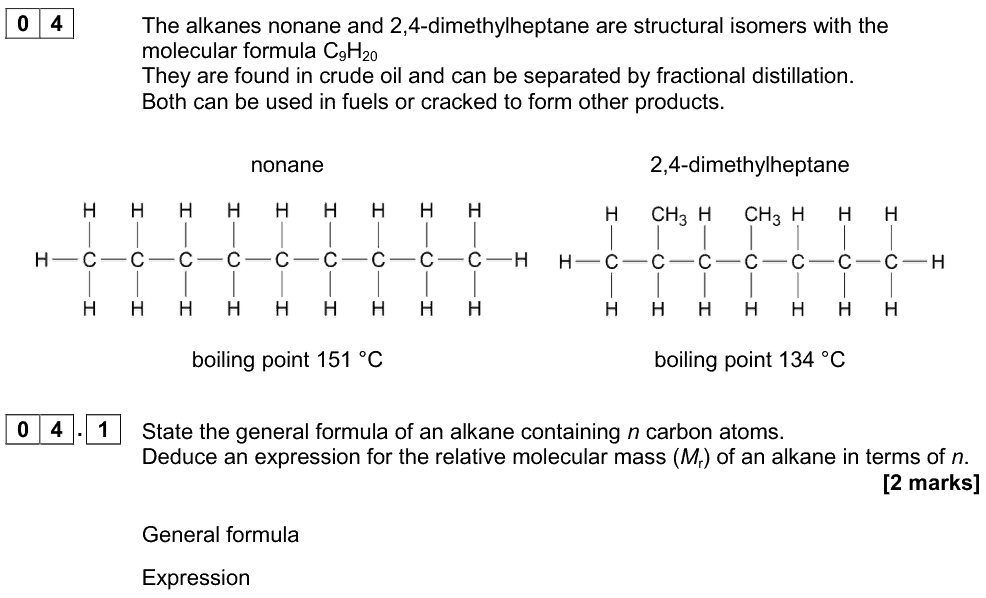
Earlier part of question 04 that this part uses
Mark scheme
Examiner's comment
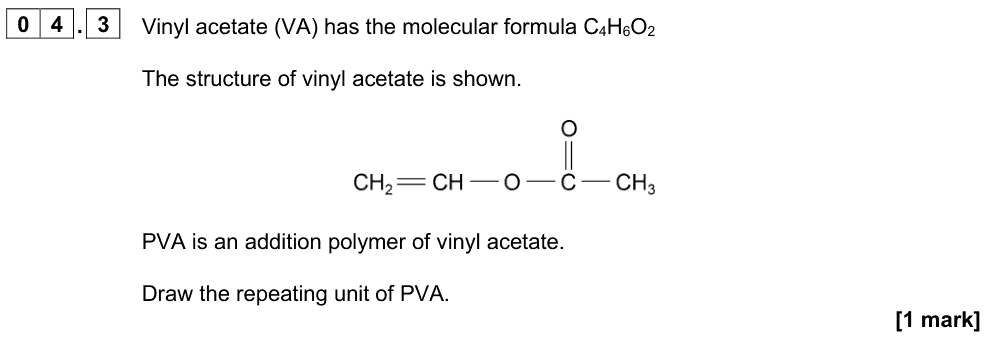
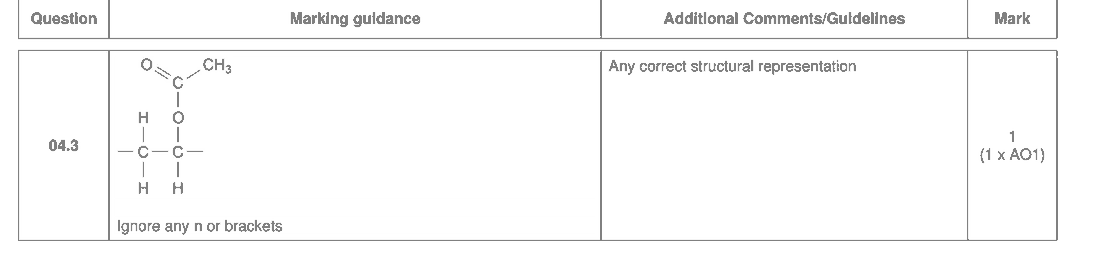
4.3 Students were required to draw the repeating unit of an addition polymer from its monomer. Good students could do this but many could not.
Notes from the mark scheme and report
–CH2–CH(OCOCH3)– with a trailing bond at each end (the C=C becomes C–C
the ester group is a side group). n and brackets ignored
June 2025 · Paper 3 · Q131 markAO2=1Multiple choice
Answer
D
Mark scheme
Notes from the mark scheme and report
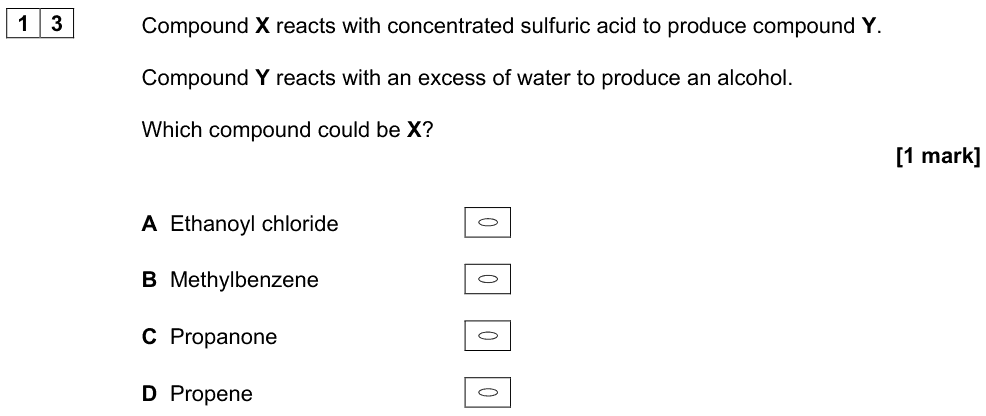
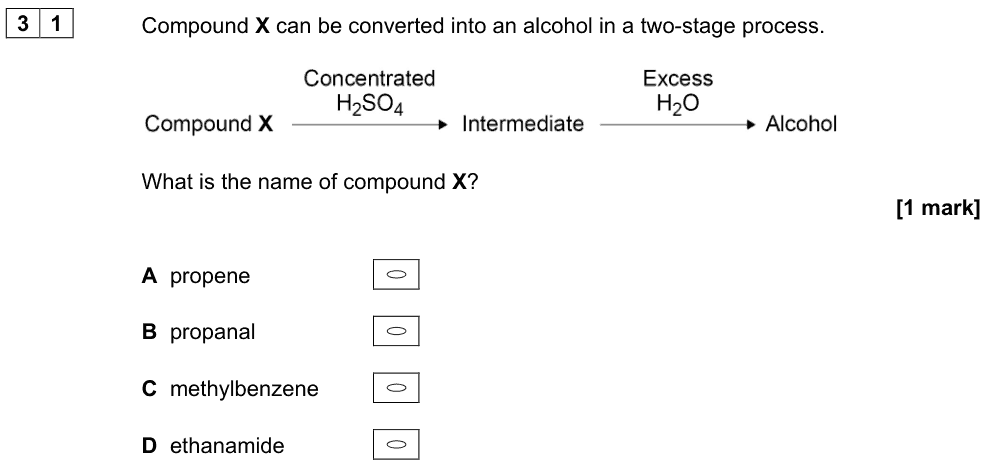
Answer: D. Propene adds concentrated H2SO4 to give an alkyl hydrogensulfate, which is hydrolysed by water to an alcohol
June 2025 · Paper 3 · Q361 markAO2=1Multiple choice
Answer
A
Mark scheme
Notes from the mark scheme and report
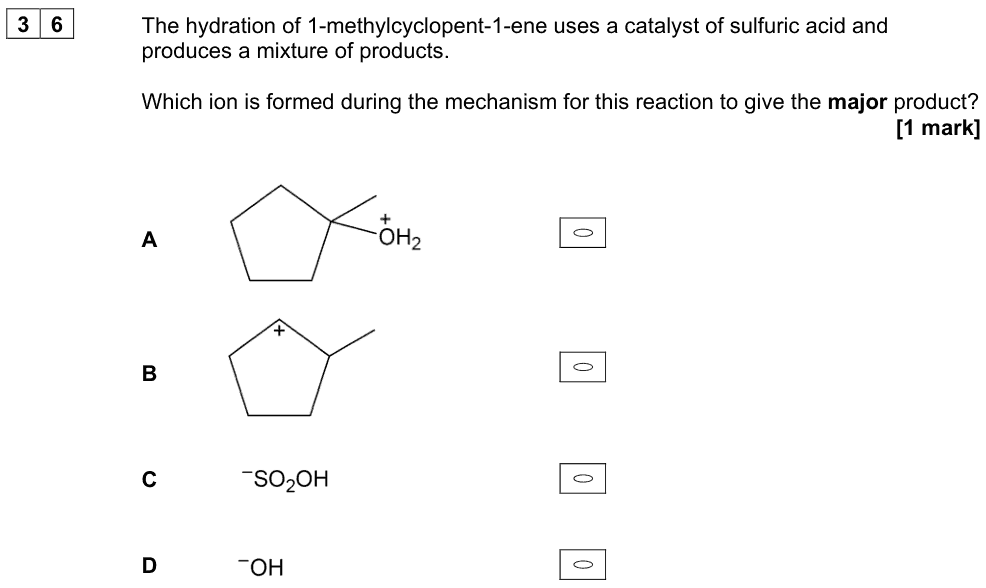
Answer: A. H+ adds to give the more stable tertiary carbocation
water then bonds to it, giving the protonated tertiary alcohol (–OH2+ on the carbon carrying the methyl group). B is the secondary carbocation leading to the minor product. One of the least well answered questions (under 55% correct)
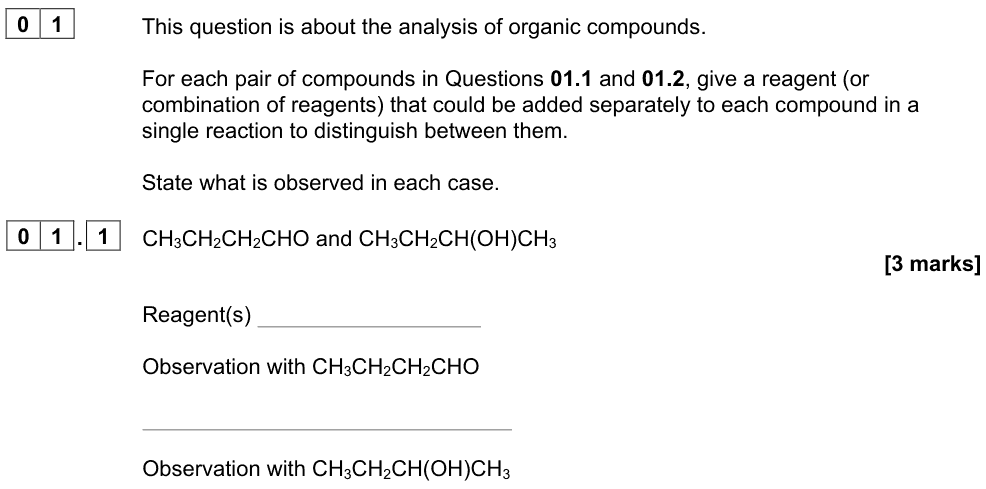
June 2024 · AS Paper 2 · Q01.13 marksAO1=3Practical and data analysis
Mark scheme
Examiner's comment
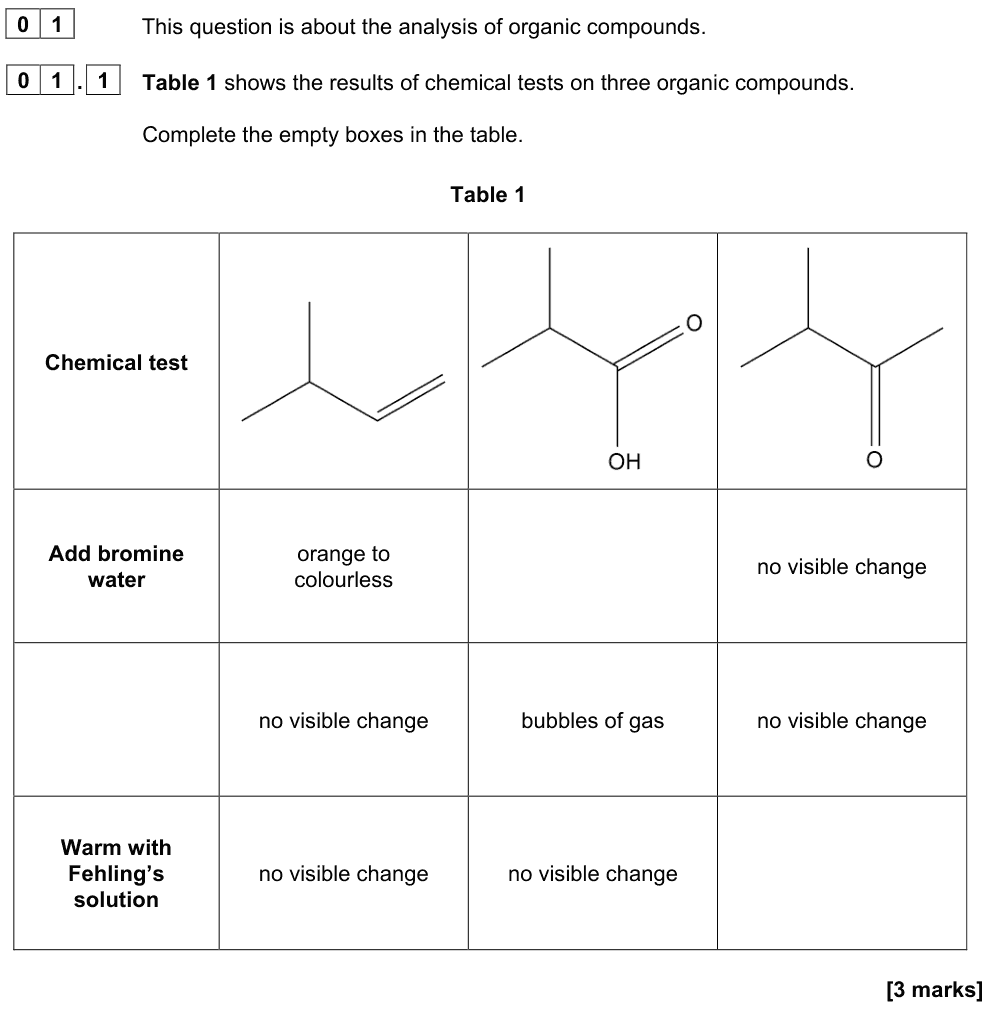
1.1 This question looked at chemical tests for common organic functional groups. Students answered this quite well, but some confused the test for aldehydes using Fehling’s solution with the Tollens’ test.
Notes from the mark scheme and report
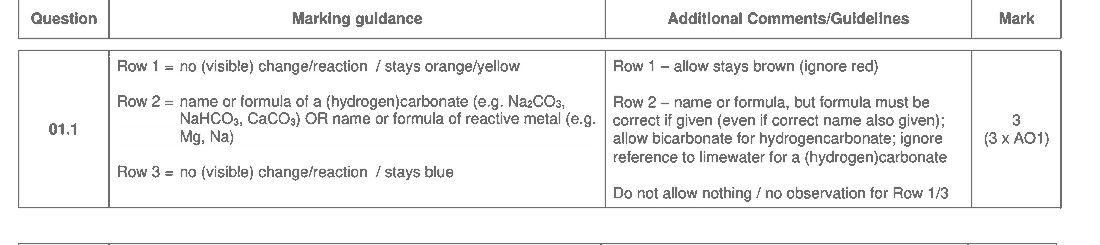
Carboxylic acid with bromine water: no visible change (stays orange). Missing test giving bubbles only with the acid: add a named carbonate or hydrogencarbonate, for example Na2CO3 or NaHCO3 (or a reactive metal such as Mg). Ketone warmed with Fehling's solution: no visible change (stays blue). 'Nothing' or 'no observation' is not accepted
a formula must be correct. Some confused Fehling's with Tollens'
Skills: ATd Use laboratory apparatus for a variety of experimental techniques including: titration, using burette and pipette; distillation and heating under reflux, including setting up glassware using retort stand and clamps; qualitative tests for ions and organic functional groups; filtration, including use of fluted filter paper, or filtration under reduced pressure; PS4.1 Know and understand how to use a wide range of experimental and practical instruments, equipment and techniques appropriate to the knowledge and understanding included in the specification; RP6 Tests for alcohol, aldehyde, alkene and carboxylic acid
June 2024 · AS Paper 2 · Q04.25 marksAO1=1, AO2=4Mechanism
Earlier part of question 04 that this part uses
Mark scheme
Examiner's comment
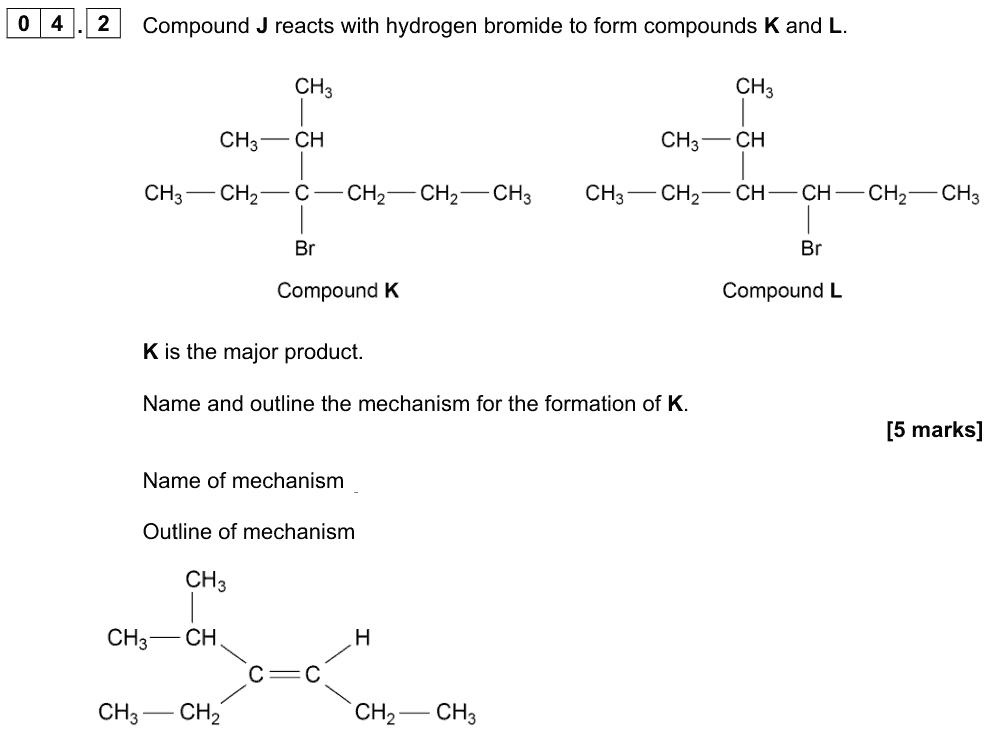
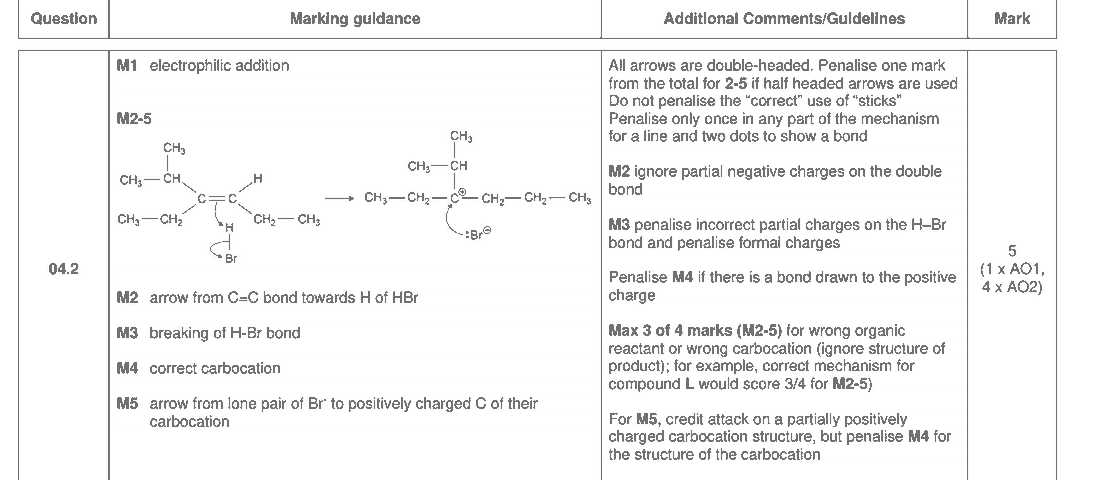
4.2 Students had to show the mechanism for the formation of the major halogenoalkane product from electrophilic addition to an alkene. This was generally very well done.
Notes from the mark scheme and report
Electrophilic addition. Curly arrow from the C=C to the H of H–Br
arrow from the H–Br bond to Br
tertiary carbocation with the positive charge on the carbon carrying the (CH3)2CH and CH3CH2 groups (H has added to the CH carbon)
arrow from a lone pair on Br– to the C+. Mechanism for L (secondary carbocation) scores max 3 of the 4 mechanism marks.
June 2024 · AS Paper 2 · Q04.33 marksAO3=3Explanation
Earlier parts of question 04 that this part uses
Mark scheme
Examiner's comment
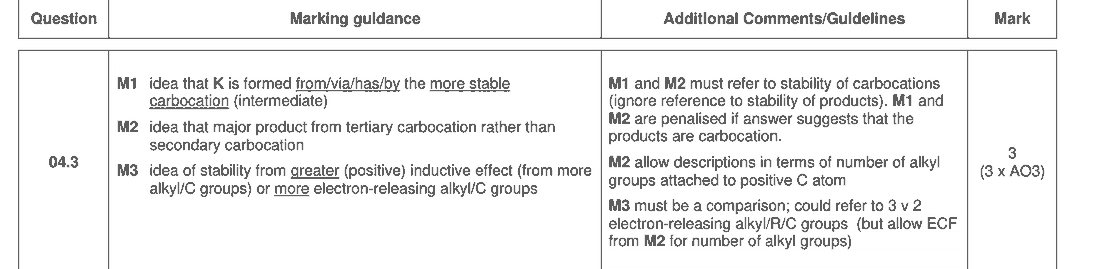
4.3 In this question students had to explain why more of one product was formed than the other in the electrophilic addition reaction. Students showed much confusion. Many students referred incorrectly to the stability of the products rather than the carbocation intermediates, while many think that the products are themselves carbocations.
Notes from the mark scheme and report
K is formed via the more stable carbocation
K comes from a tertiary carbocation and L from a secondary one
the tertiary carbocation is more stable because it has more electron-releasing alkyl groups (greater positive inductive effect). Must be about the stability of the carbocation intermediates: many wrote about the stability of the products or called the products carbocations
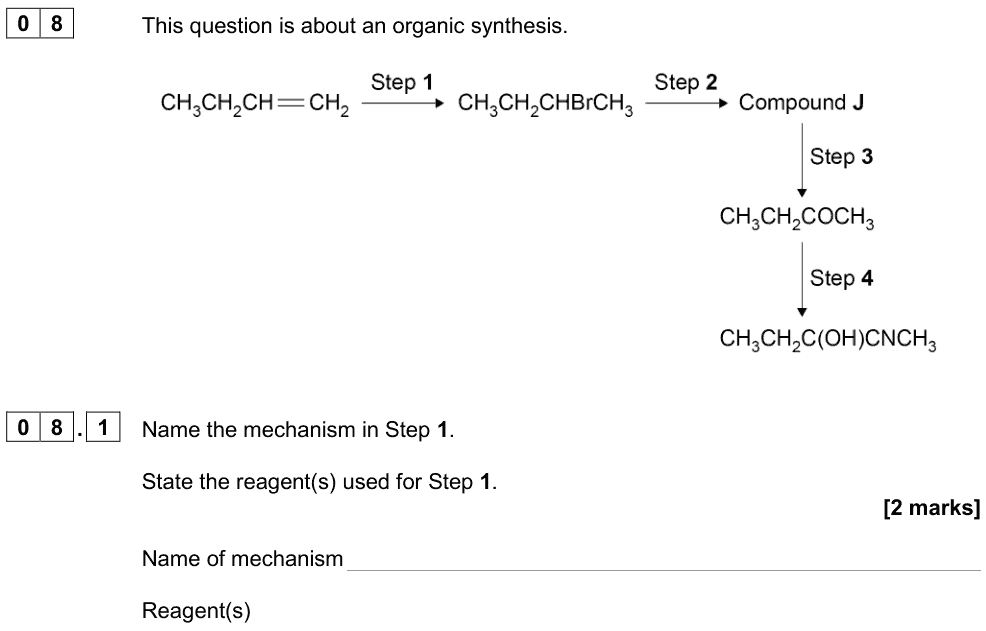
June 2024 · Paper 2 · Q08.12 marksAO1=2Short answerEasy
Mark scheme
Examiner's comment
8.1 Nearly 70% of students scored both marks showing that the reaction between an alkene and HBr was very well known.
Notes from the mark scheme and report
Electrophilic addition
HBr
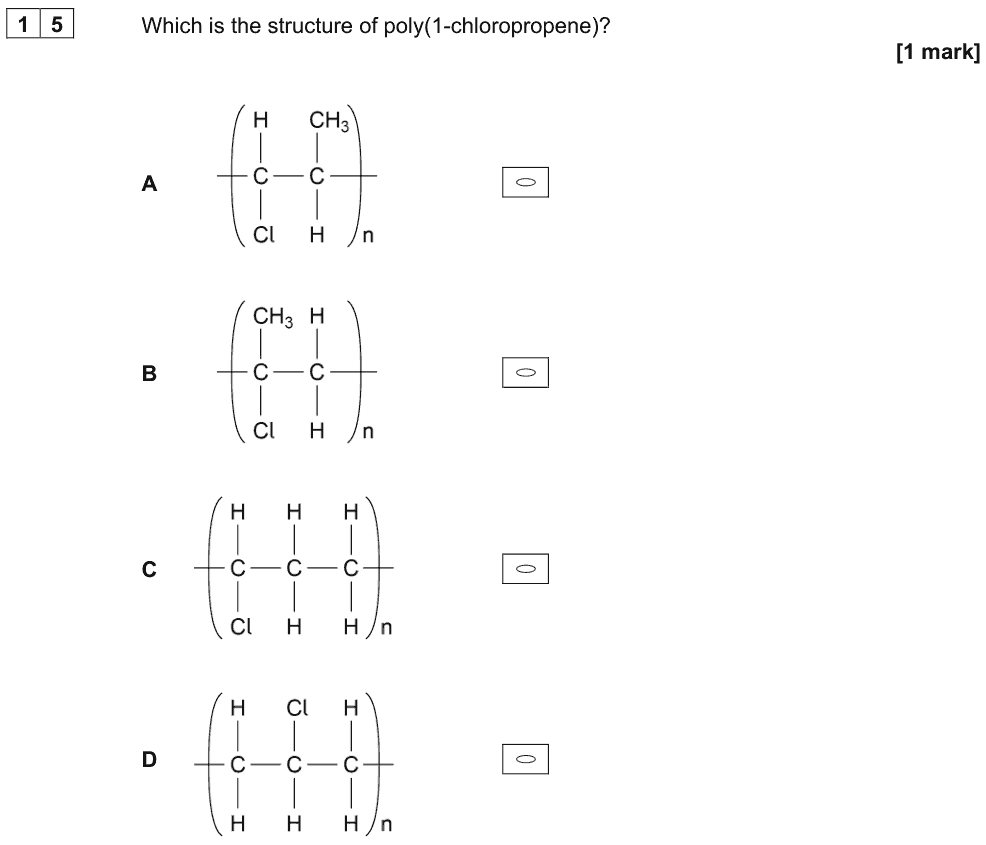
June 2024 · AS Paper 2 · Q151 markAO2=1Multiple choiceEasy
Answer
A
Mark scheme
Examiner's comment
This was answered correctly by a majority (66.9%) of students.
Notes from the mark scheme and report
Answer: A. 1-chloropropene is CHCl=CHCH3, so the repeating unit has Cl on one backbone carbon and CH3 on the other, with only two carbons in the chain
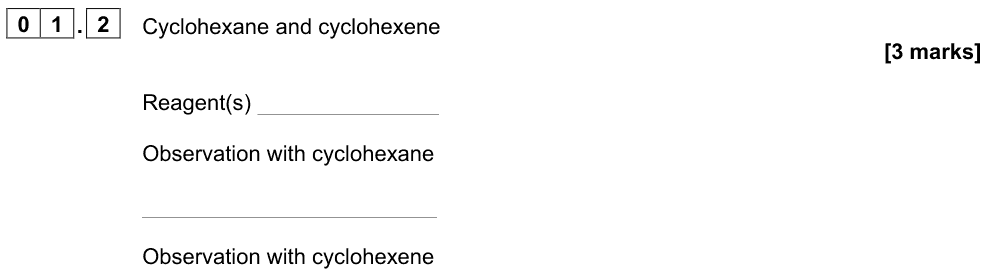
June 2023 · AS Paper 2 · Q01.23 marksAO3=3Practical and data analysisEasy
Earlier part of question 01 that this part uses
Mark scheme
Examiner's comment
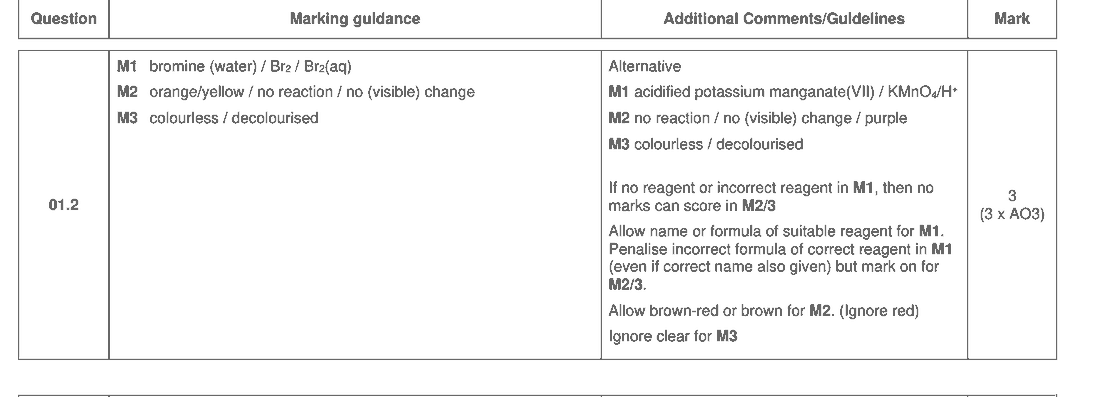
01.2 This question looked for a chemical test to distinguish between a cycloalkane and a cycloalkene. Students did this well, with nearly three-quarters scoring full marks.
Notes from the mark scheme and report
Bromine water: stays orange / no visible change with cyclohexane
decolourised (orange to colourless) with cyclohexene. Alternative: acidified KMnO4, stays purple then decolourised. 'Clear' is ignored
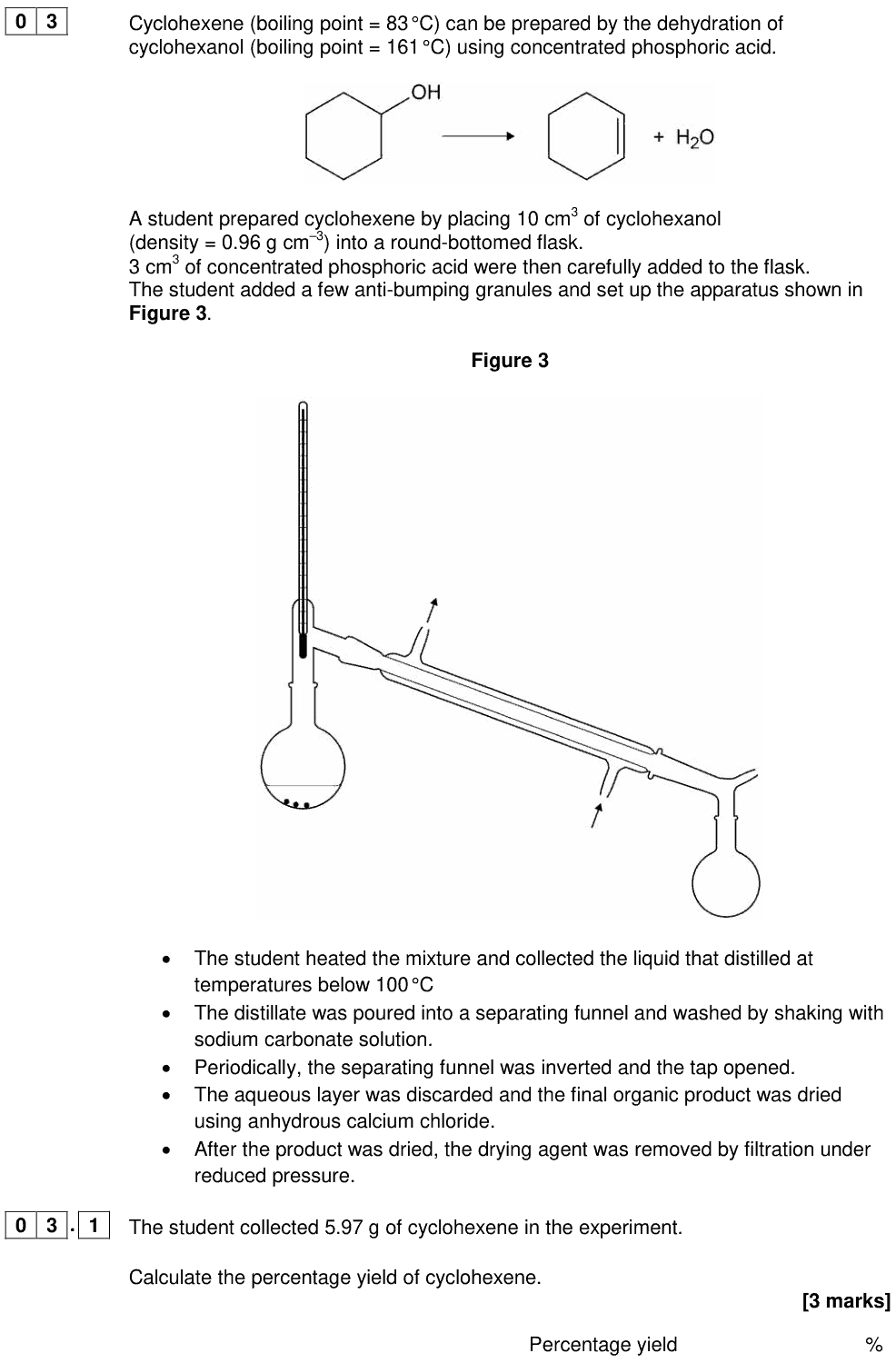
Skills: ATd Use laboratory apparatus for a variety of experimental techniques including: titration, using burette and pipette; distillation and heating under reflux, including setting up glassware using retort stand and clamps; qualitative tests for ions and organic functional groups; filtration, including use of fluted filter paper, or filtration under reduced pressure; PS1.1 Solve problems set in practical contexts; PS4.1 Know and understand how to use a wide range of experimental and practical instruments, equipment and techniques appropriate to the knowledge and understanding included in the specification; RP6 Tests for alcohol, aldehyde, alkene and carboxylic acid
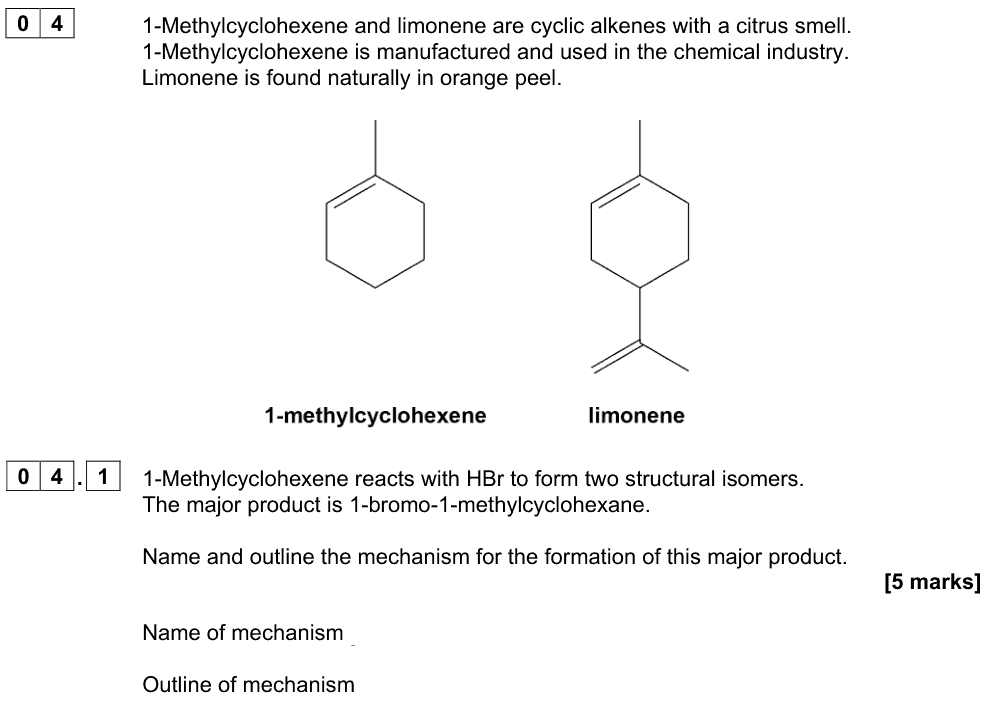
June 2023 · AS Paper 2 · Q04.15 marksAO1=1, AO2=4Mechanism
Mark scheme
Examiner's comment
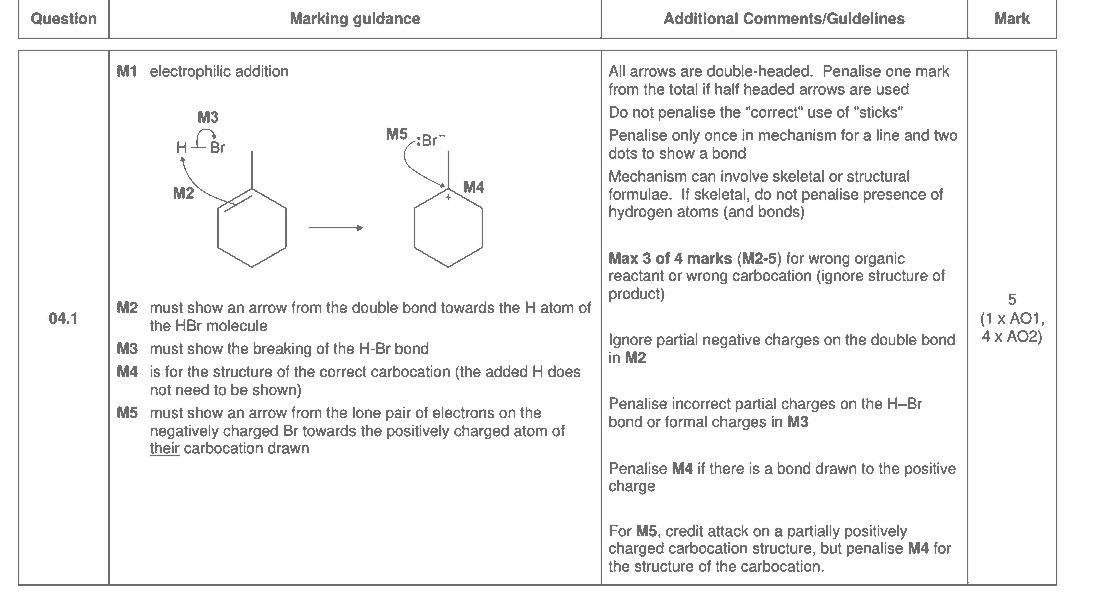
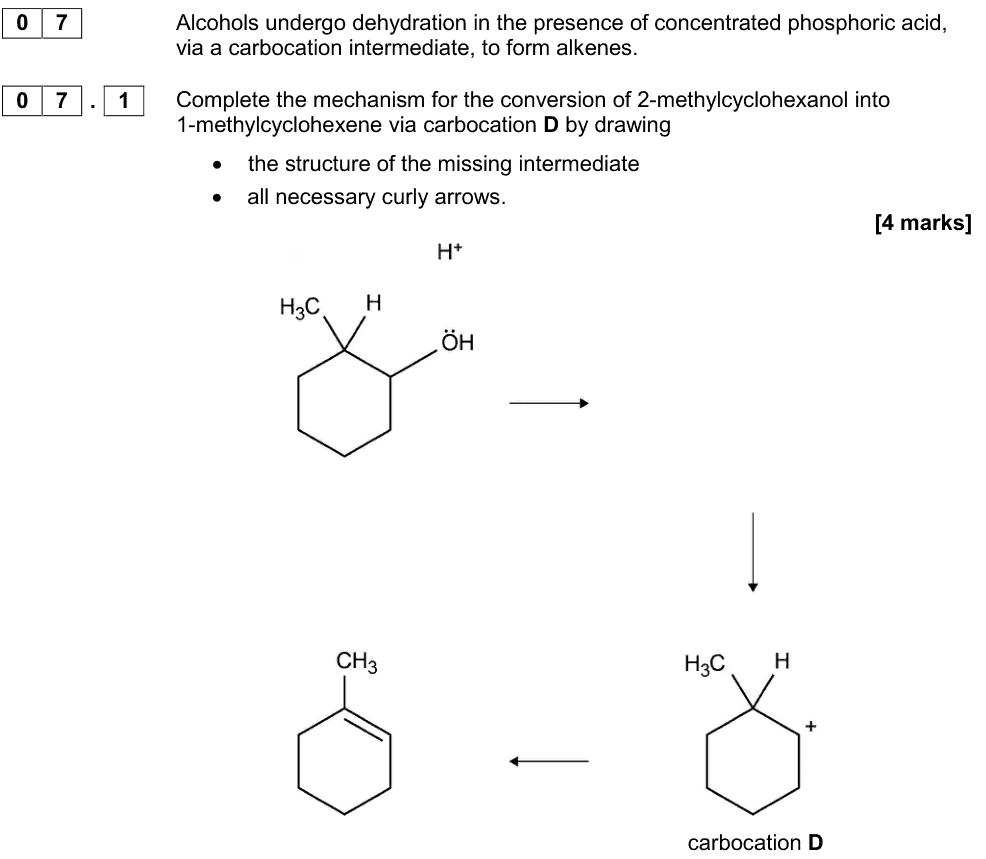
04.1 This skeletal mechanism was done relatively well by students, despite involving an unusual structure.
Notes from the mark scheme and report
Electrophilic addition. Curly arrow from the C=C to the H of H–Br
arrow from the H–Br bond to Br
tertiary carbocation with + on the ring carbon carrying the methyl group
arrow from the lone pair on Br– to the C+. Wrong reactant or wrong carbocation max 3 of the 4 mechanism marks
June 2023 · AS Paper 2 · Q04.24 marksAO2=3, AO3=1Explanation
Earlier part of question 04 that this part uses
Mark scheme
Examiner's comment
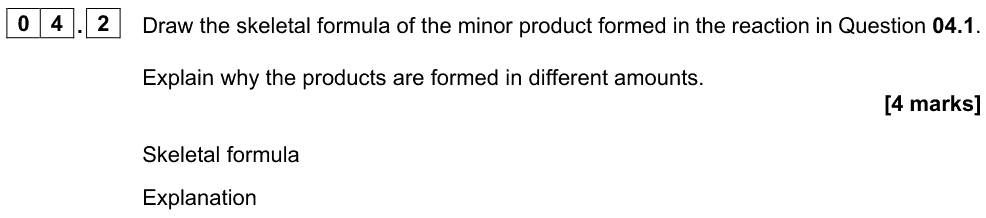
04.2 Many students could explain why products are formed in different amounts, but some did not appreciate that this depends on the stability of the carbocation intermediates rather than the stability of the products. Some thought that the products were carbocations. Many students did not refer to the inductive effect of alkyl groups to explain the relative stability of the carbocations.
Notes from the mark scheme and report
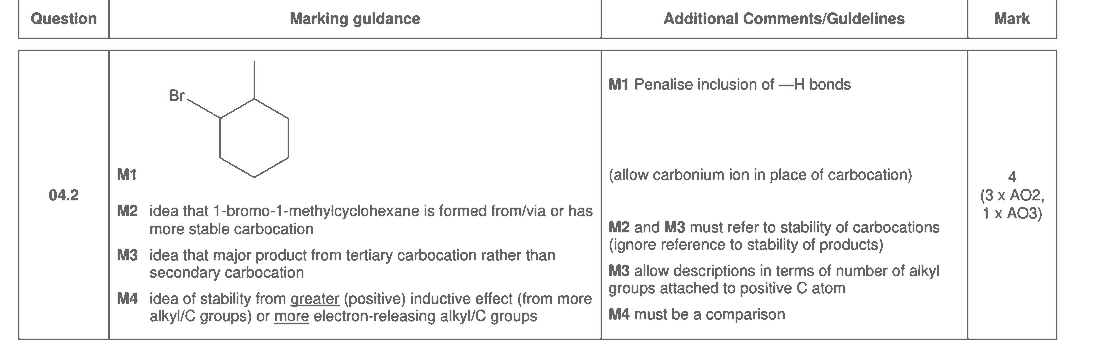
Minor product: 1-bromo-2-methylcyclohexane (skeletal: Br on the ring carbon next to the one with the methyl group). The major product forms via the more stable carbocation
it is tertiary rather than secondary
more alkyl groups give a greater (positive) inductive effect / are more electron-releasing. Must refer to stability of the carbocations, not the products.
June 2023 · Paper 2 · Q04.26 marksAO1=3, AO3=36-mark level of response
Earlier part of question 04 that this part uses
Mark scheme, with the levels and indicative content
Examiner's comment
04.2 This was the levels of response question and the vast majority of students were able to get started, and access levels 1 or 2 by showing good knowledge of the electrophilic addition mechanism. Some students struggled because they did not show the mechanistic steps using curly arrows. The indicative content did allow for this and students could describe aspects of the mechanism in words, but it was much easier to do this via diagrams showing structures. Level 3 proved much more difficult, with many failing to recognise that optical isomers were possible as a result of attack on the planar secondary carbocation from above or below the plane.
Notes from the mark scheme and report
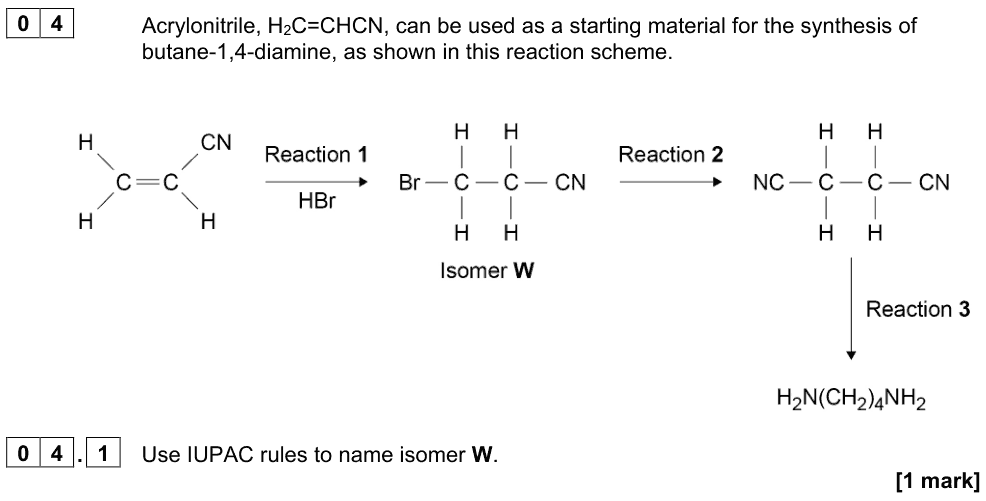
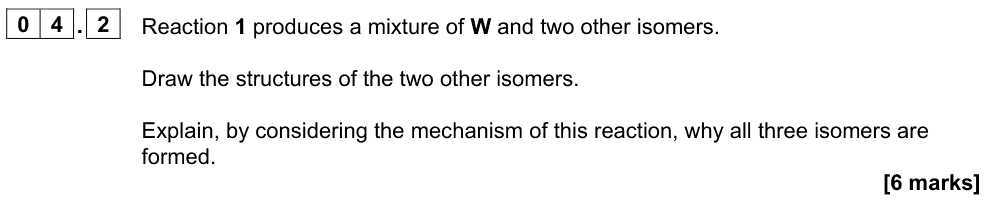
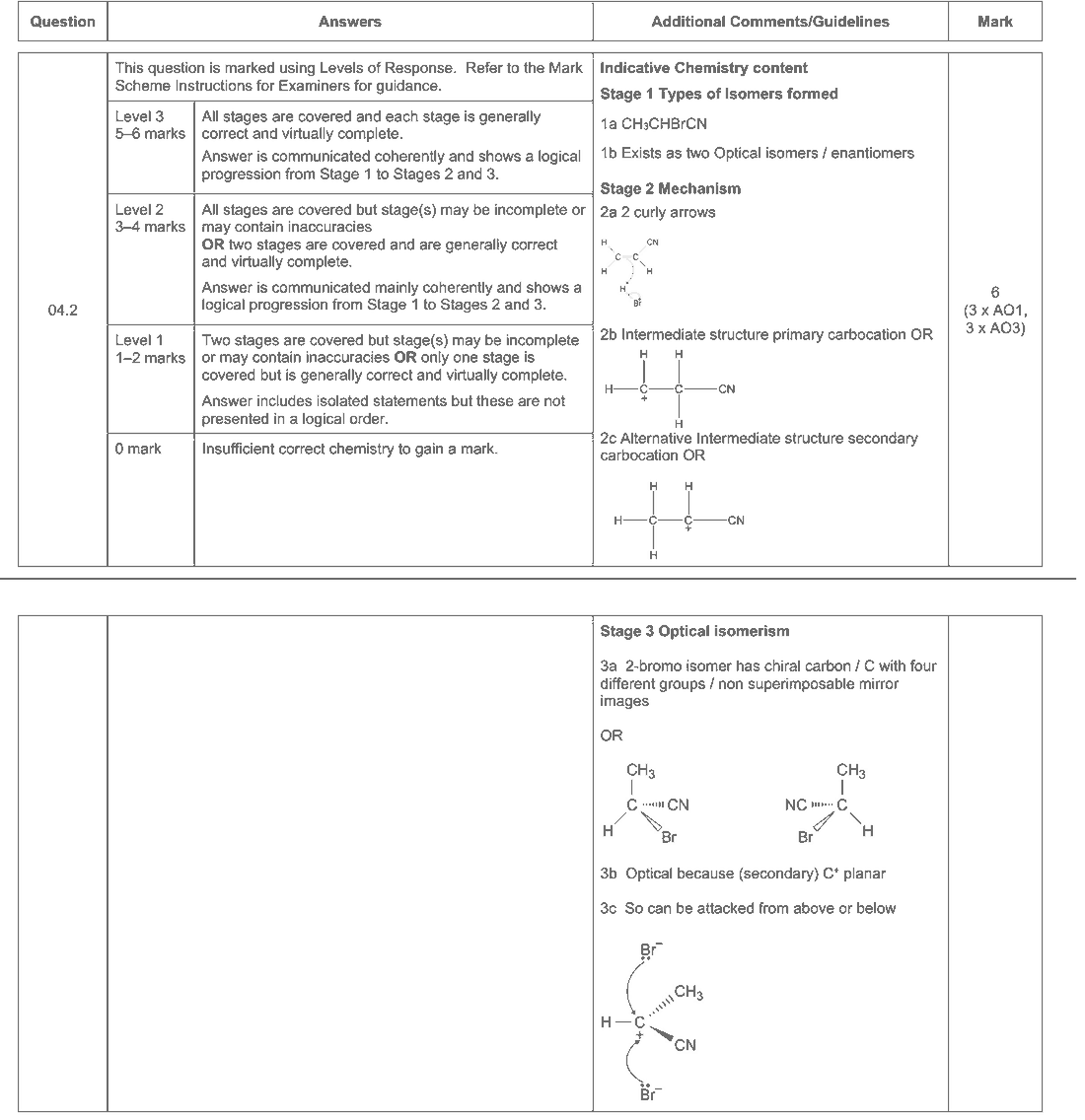
Levels of response, three stages. Isomers: CH3CHBrCN (2-bromopropanenitrile), which exists as two optical isomers (enantiomers). Mechanism (electrophilic addition): curly arrow from the C=C bond to H of H–Br and from the H–Br bond to Br
the primary carbocation +CH2CH2CN leads to W and the secondary carbocation CH3C+HCN leads to the 2-bromo isomer. Optical isomerism: the 2-bromo isomer has a chiral carbon with four different groups
the secondary carbocation is planar, so Br– can attack from above or below, giving both enantiomers. Most reached level 1 or 2
level 3 needed the planar carbocation argument. Mechanisms are easier to credit when drawn with curly arrows
June 2023 · AS Paper 2 · Q04.31 markAO3=1Diagram or structure
Earlier part of question 04 that this part uses
Mark scheme
Examiner's comment
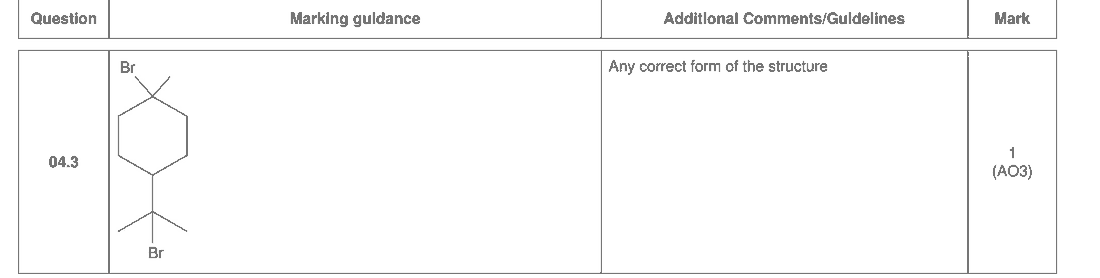
04.3 Students were asked to draw the structure of the major product of a reaction of an alkene containing two C=C bonds with hydrogen bromide. The more complex nature of dealing with two C=C bonds made this challenging to many.
Notes from the mark scheme and report
Both C=C bonds add HBr by Markovnikov addition: Br on the ring carbon that carries the methyl group and Br on the central carbon of the side chain, giving 1-bromo-4-(2-bromopropan-2-yl)-1-methylcyclohexane. Any correct form of structure. Two C=C bonds made this hard
June 2023 · AS Paper 2 · Q091 markAO3=1Multiple choiceEasy
Answer
D
Mark scheme
Examiner's comment
Polymers
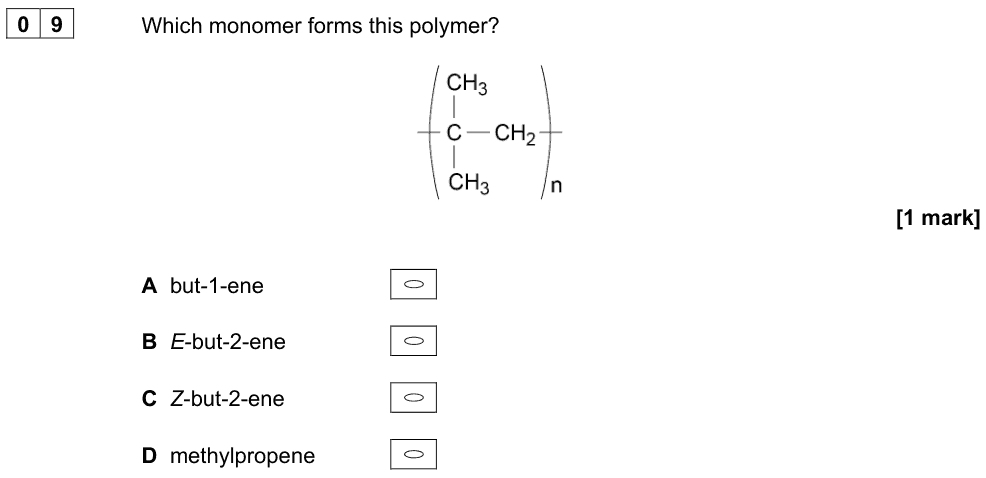
This was answered correctly by a majority (73%) of students.
Notes from the mark scheme and report
Answer: D. The repeating unit –C(CH3)2–CH2– comes from CH2=C(CH3)2, methylpropene
June 2023 · AS Paper 2 · Q151 markAO3=1Multiple choice
Answer
B
Mark scheme
Examiner's comment
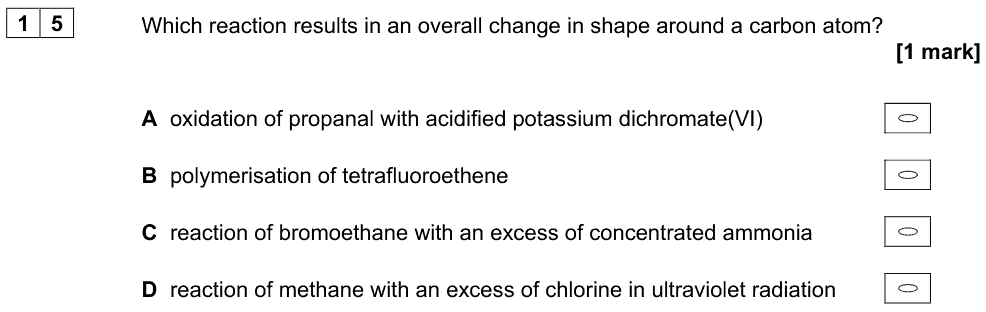
There was much to consider in this question and a range of answers was given by students. Just over 40% of students gave the correct answer.
Notes from the mark scheme and report
Answer: B. In CF2=CF2 each carbon is trigonal planar
in the polymer each carbon is tetrahedral. In the other reactions the carbon keeps its shape (planar C=O or tetrahedral)
Skills: MS4.1 Use angles and shapes in regular 2D and 3D structures
June 2023 · Paper 3 · Q261 markAO3=1Multiple choice
Answer
D
Mark scheme
Notes from the mark scheme and report
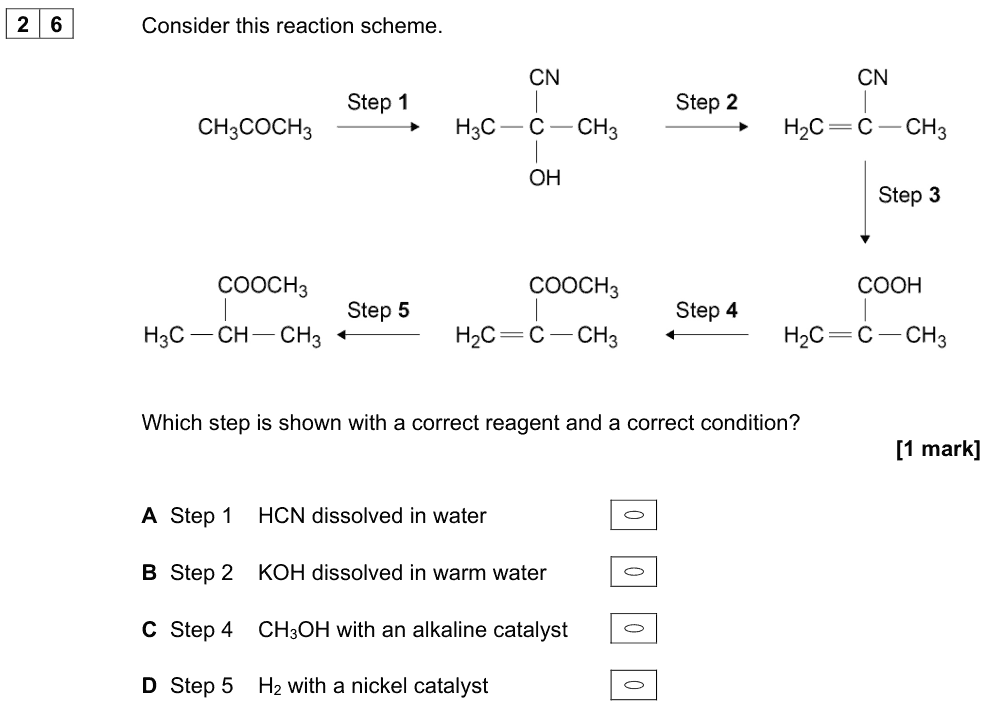
Answer: D. Step 5 adds H2 across the C=C with a nickel catalyst. Step 1 needs KCN followed by dilute acid
step 2 is dehydration of an alcohol (concentrated acid, not KOH)
step 4 esterification needs an acid catalyst
June 2023 · Paper 3 · Q311 markAO2=1Multiple choice
Answer
A
Mark scheme
Notes from the mark scheme and report
Answer: A. Propene undergoes electrophilic addition with concentrated H2SO4 to give an alkyl hydrogensulfate, which is hydrolysed by water to an alcohol (report: listed among the trickiest questions, 40% or fewer correct)
June 2022 · Paper 2 · Q03.15 marksAO1=1, AO2=4Mechanism
Mark scheme
Examiner's comment
03.1 The second mechanism on the paper also had a high discrimination index and the best students were able to score full marks here. Most students were able to get started but mistakes in the structure of the tertiary carbocation intermediate were quite common, as were errors in representation of the sulfuric acid, and subsequent attack on the carbocation by the hydrogensulfate ion.
Notes from the mark scheme and report
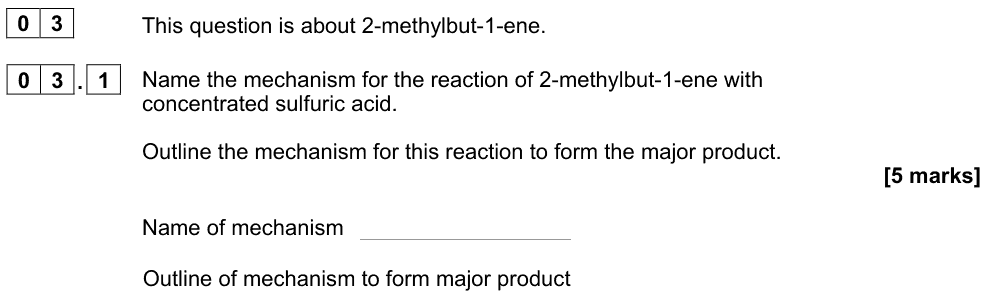
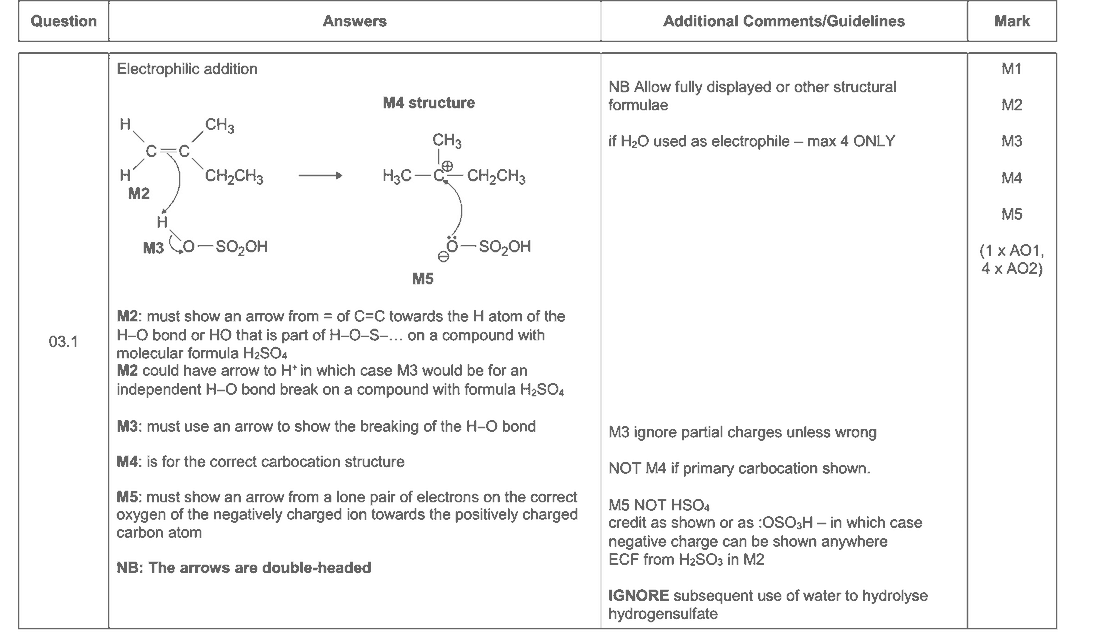
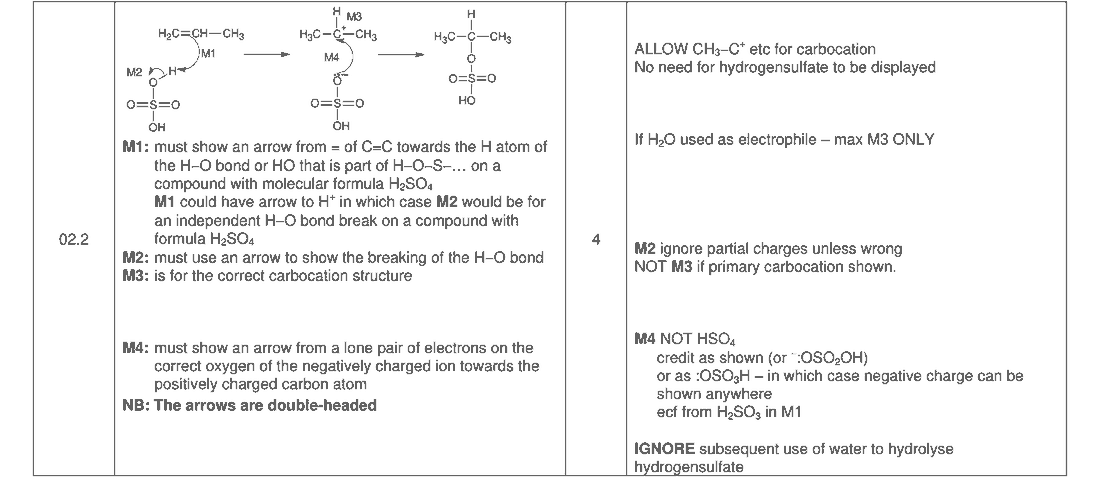
Electrophilic addition. Curly arrow from the C=C to the H of H–O in H2SO4
curly arrow from the H–O bond to O
tertiary carbocation (CH3)2C+CH2CH3
curly arrow from a lone pair on O of –OSO3H (negative ion) to the C+. Product (CH3)2C(OSO3H)CH2CH3. A primary carbocation loses M4
using H2O as the electrophile is max 4. Errors: carbocation structure, representation of H2SO4, attack by HSO4–
June 2022 · Paper 2 · Q03.23 marksAO2=3Explanation
Earlier part of question 03 that this part uses
Mark scheme
Examiner's comment
03.2 The final mark for this question proved to be very demanding with few students being precise enough about the number of electron donating alkyl groups in the dominant tertiary carbocation.
Notes from the mark scheme and report
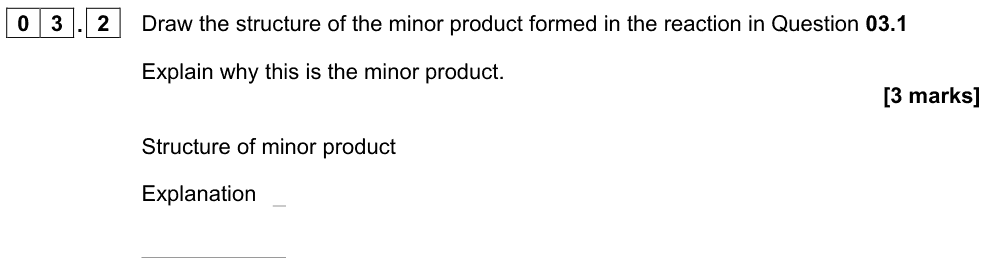
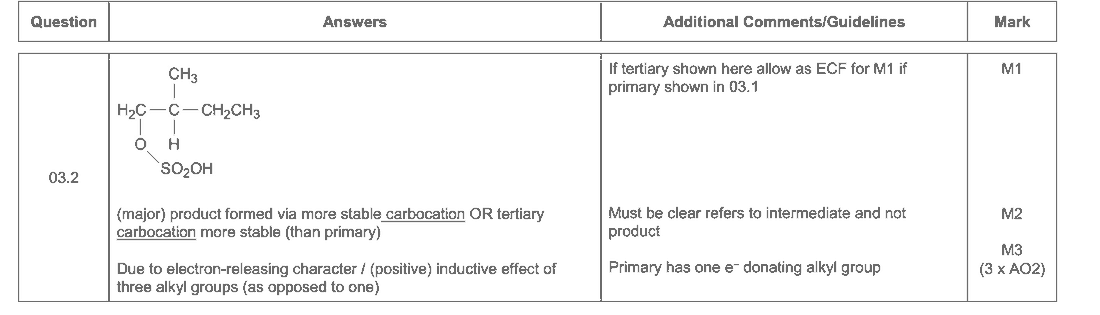
Minor product: HO3SO–CH2–CH(CH3)–CH2CH3 (OSO3H on C1). The major product forms via the more stable tertiary carbocation (minor via primary)
tertiary has three electron-releasing alkyl groups (positive inductive effect), primary only one. Must refer to the carbocation intermediate, not the product
the number of alkyl groups was rarely stated
June 2022 · Paper 2 · Q03.42 marksAO1=1, AO2=1Diagram or structure
Earlier part of question 03 that this part uses
Mark scheme
Examiner's comment
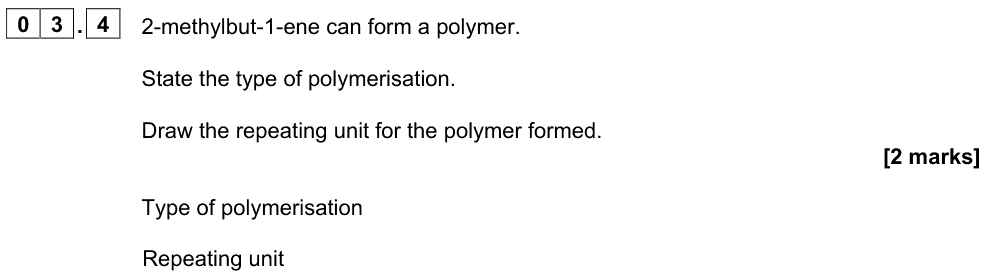
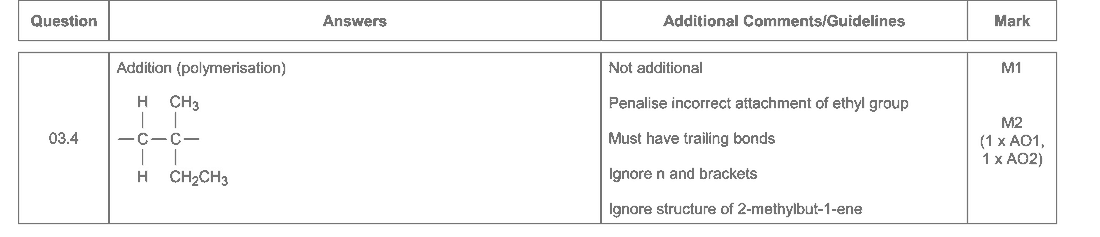
03.4 This very straightforward question wasn’t as well answered as expected. Both the type of polymerisation and the repeating unit were sources of mistakes but the better students were able to score, as shown by a high discrimination index.
Notes from the mark scheme and report
Addition (not 'additional'). Repeating unit –CH2–C(CH3)(CH2CH3)– with trailing bonds
the ethyl group must be attached through its CH2. n and brackets ignored
June 2022 · Paper 2 · Q05.52 marksAO2=2Short answer
Earlier part of question 05 that this part uses
Mark scheme
Examiner's comment
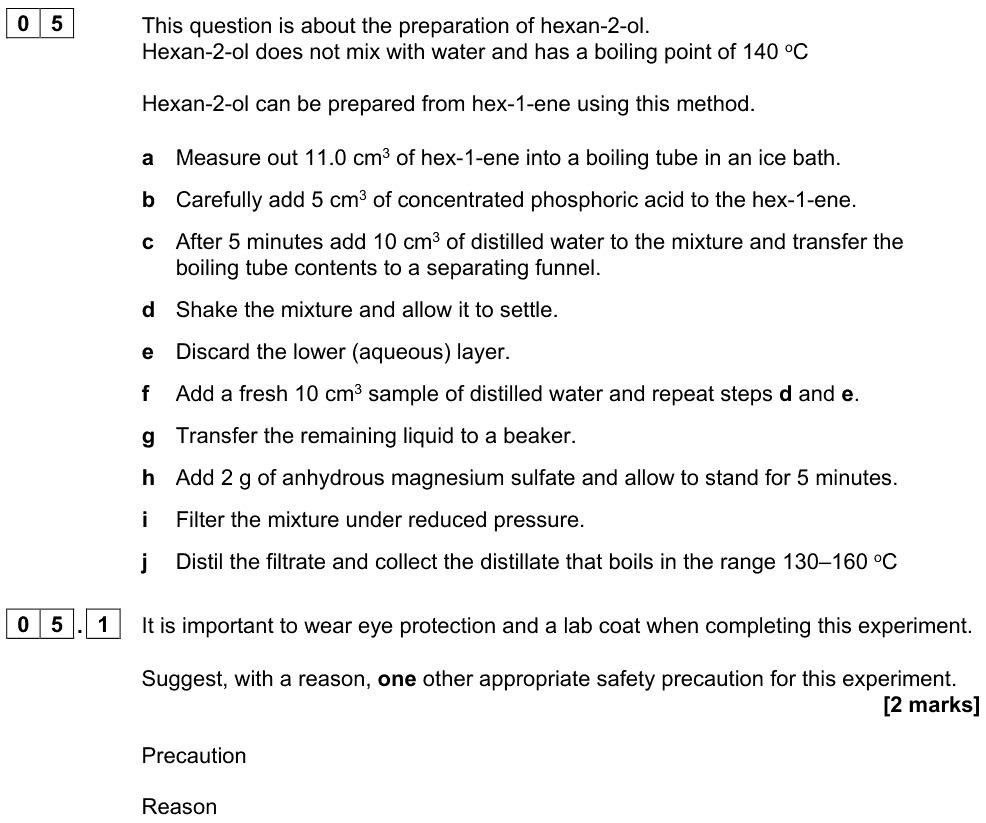
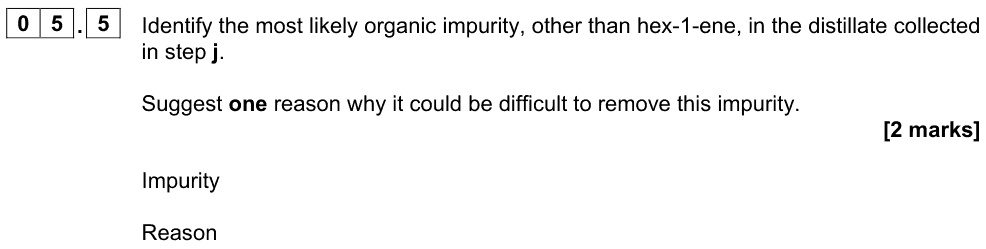
05.5 Identifying hexan-1-ol as the most likely impurity was not well answered and few scored this and the explanation in terms of the two alcohols having similar boiling points.
Notes from the mark scheme and report
Impurity: hexan-1-ol (the minor product of hydration). Reason: it is likely to have a boiling point similar to hexan-2-ol. Few identified it
Skills: RP10 Preparation of: a pure organic solid and test of its purity; a pure organic liquid
June 2022 · AS Paper 2 · Q07.65 marksAO1=1, AO2=4Mechanism
Earlier part of question 07 that this part uses
Mark scheme
Examiner's comment
7.6 This question required students to name and outline a mechanism. This was done well. One common issue was students not putting the negative charge on the HSO4– as it attacked the carbocation in the final step.
Notes from the mark scheme and report
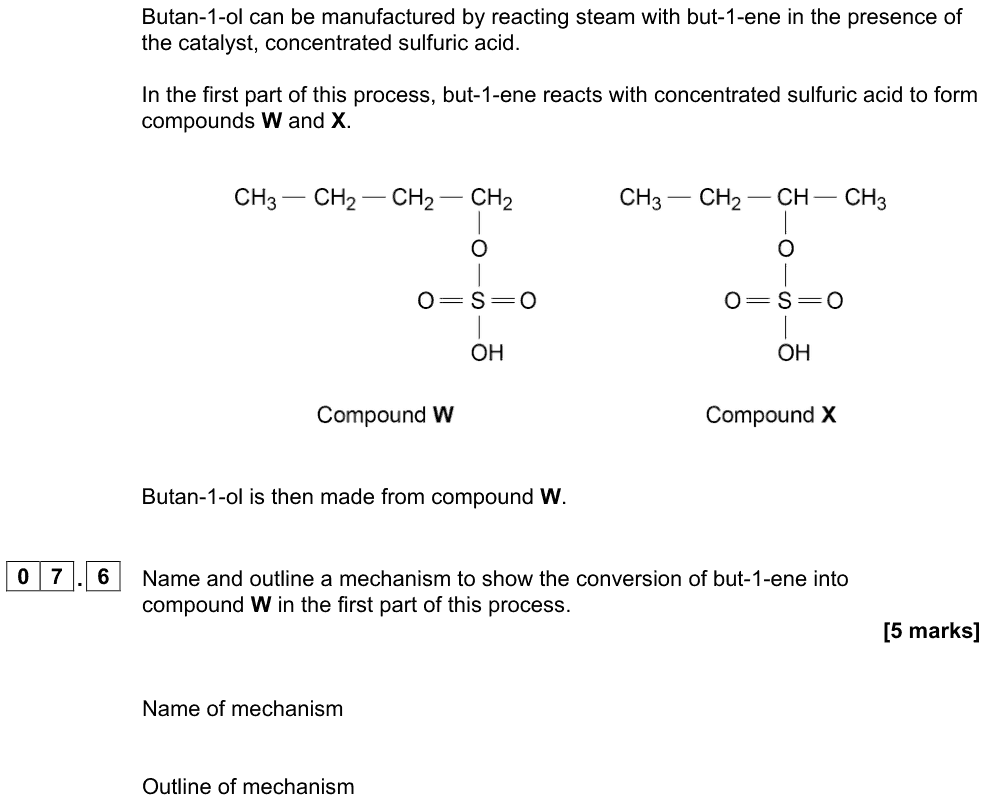
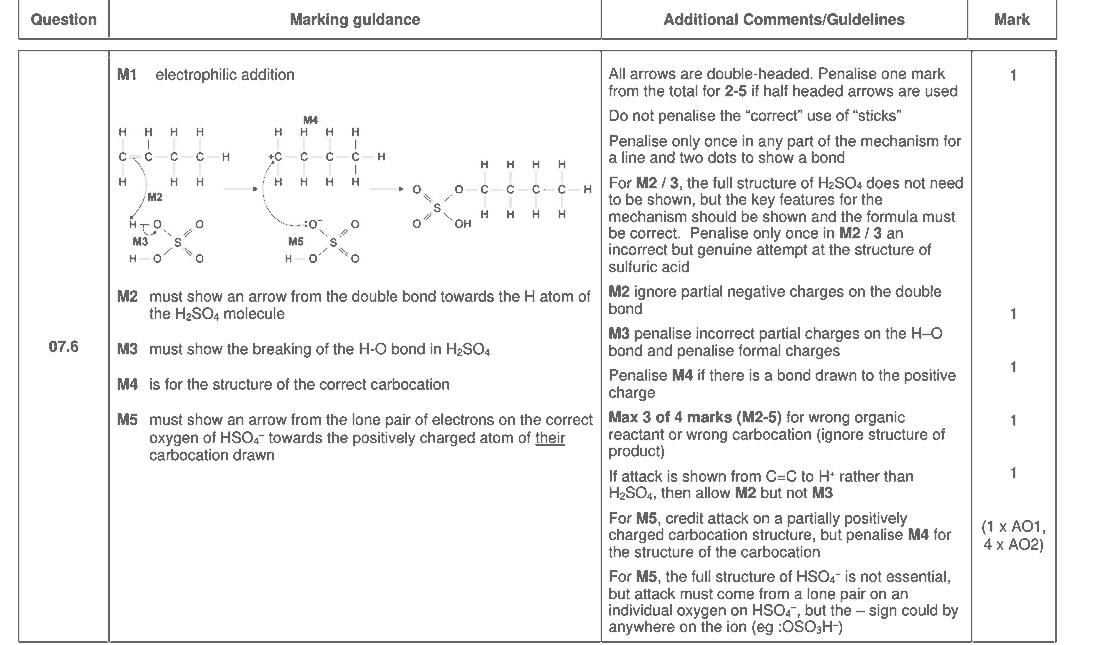
Electrophilic addition. Arrow from the C=C towards the H of H2SO4
arrow from the H–O bond to O
the primary carbocation CH3CH2CH2CH2+ (leading to W)
arrow from a lone pair on an O of HSO4– to the C+. Wrong carbocation: max 3 of the 4 mechanism marks. Common error: no negative charge on HSO4–
June 2022 · AS Paper 2 · Q07.72 marksAO1=1, AO3=1Explanation
Earlier parts of question 07 that this part uses
Mark scheme
Examiner's comment
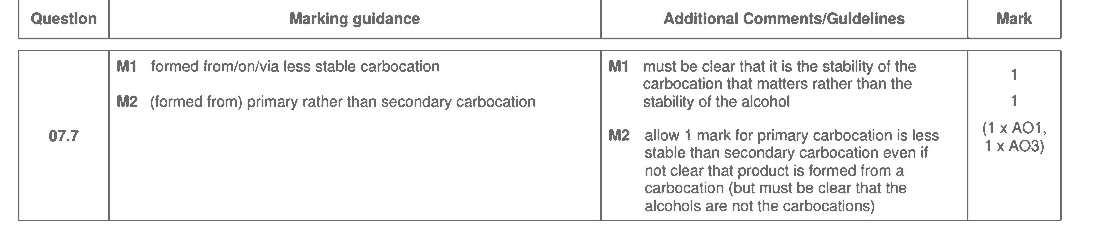
7.7 This question required students to explain why there are major and minor products in the electrophilic addition. Students struggled to explain this clearly. Students were not clear whether the relevant carbocations were intermediates or the products themselves.
Notes from the mark scheme and report
Butan-1-ol (via W) is formed from the less stable carbocation: a primary rather than a secondary carbocation. It must be the stability of the carbocation intermediate, not of the alcohol
June 2022 · Paper 2 · Q09.25 marksAO2=3, AO3=2Calculation
Earlier part of question 09 that this part uses
Mark scheme
Examiner's comment
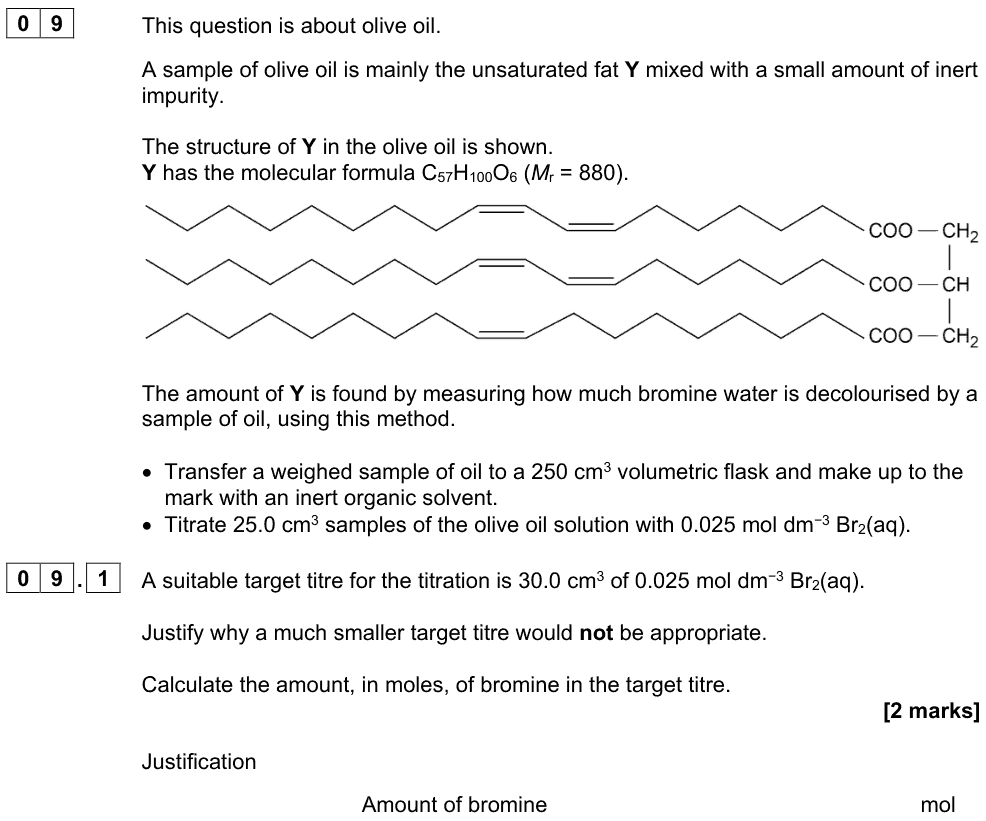
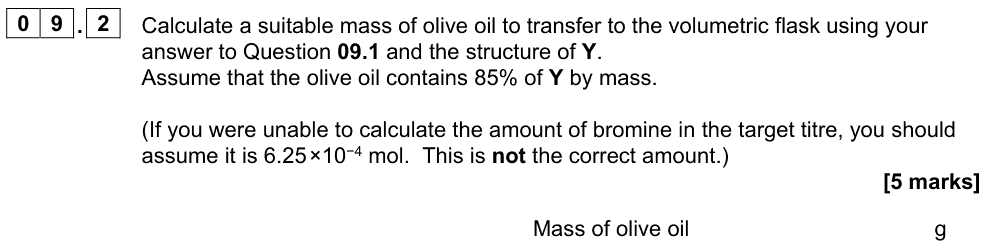
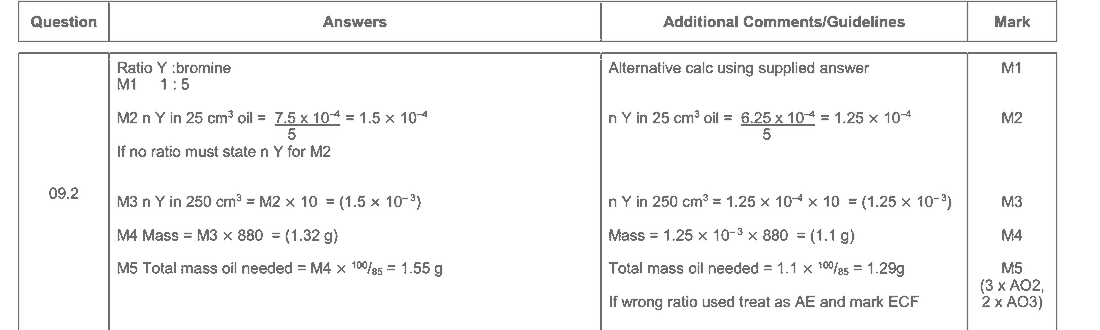
09.2 The discrimination index for this question was high and only the best students scored full marks. The most common error was to fail to appreciate that Y would react with bromine in a 1:5 ratio. Weaker students also found it hard to gross up the mass of Y to give the mass of oil at the end and many did the opposite by calculating 85% of their mass of Y. Consequential marking meant that, despite these common mistakes, several other marks were still possible and most scored at least two marks.
Notes from the mark scheme and report
Answer: 1.55 g (1.29 g from the given 6.25 × 10^–4 mol). Y has five C=C so Y : Br2 = 1 : 5
taking 85% of the mass instead of dividing by 0.85
Skills: MS0.0 Recognise and make use of appropriate units in calculation; MS0.2 Use ratios, fractions and percentages; PS3.2 Process and analyse data using appropriate mathematical skills as exemplified in the mathematical appendix for each science; RP1 Make up a volumetric solution and carry out a simple acid–base titration
June 2022 · AS Paper 2 · Q101 markAO1=1Multiple choiceEasy
Answer
C
Mark scheme
Examiner's comment
This was answered correctly by a majority of students (66.7%).
Notes from the mark scheme and report
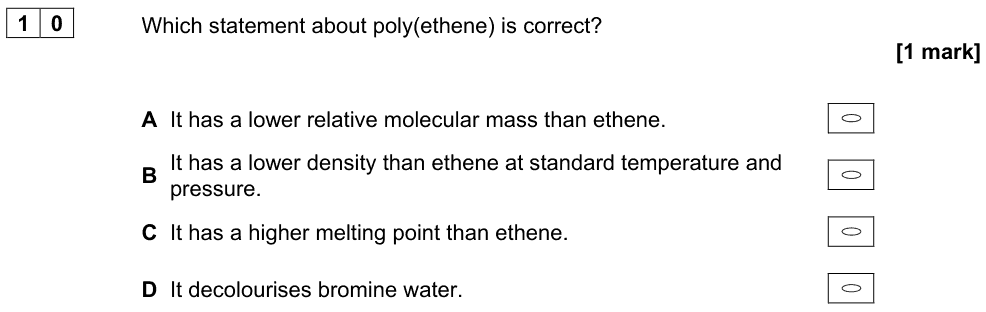
Answer: C. Poly(ethene) molecules are much larger, with stronger van der Waals forces between them, so it is a solid
it is saturated so does not decolourise bromine water
June 2022 · AS Paper 2 · Q111 markAO3=1Multiple choice
Answer
A
Mark scheme
Examiner's comment
Students struggled with this question, with many believing that the polymer is unsaturated.
Notes from the mark scheme and report
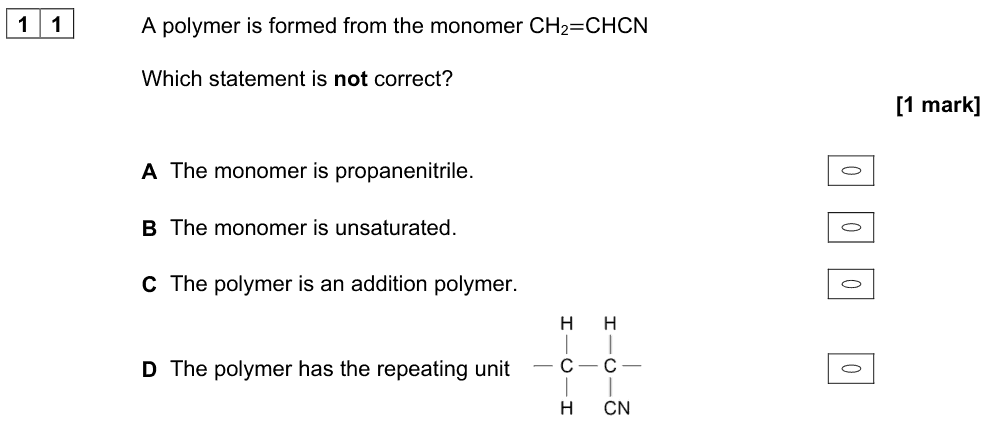
Answer: A. The monomer CH2=CHCN is propenenitrile, not propanenitrile
the other statements are true. Many thought the polymer is unsaturated
November 2021 · AS Paper 2 · Q02.15 marksMechanism
Mark scheme
Notes from the mark scheme and report
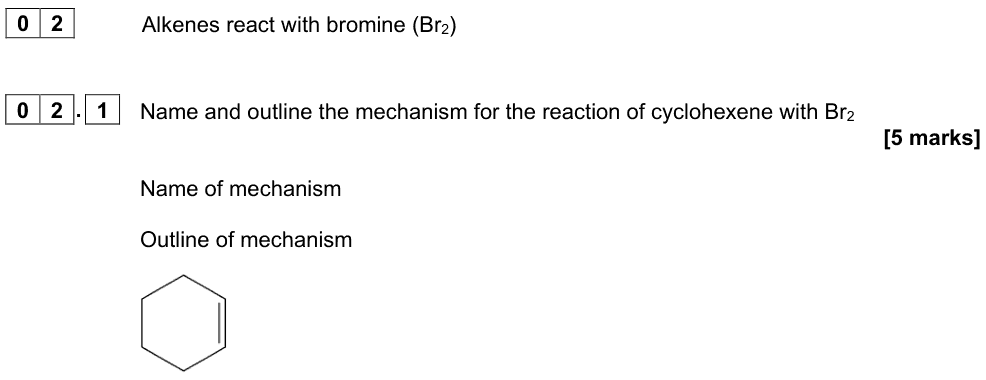
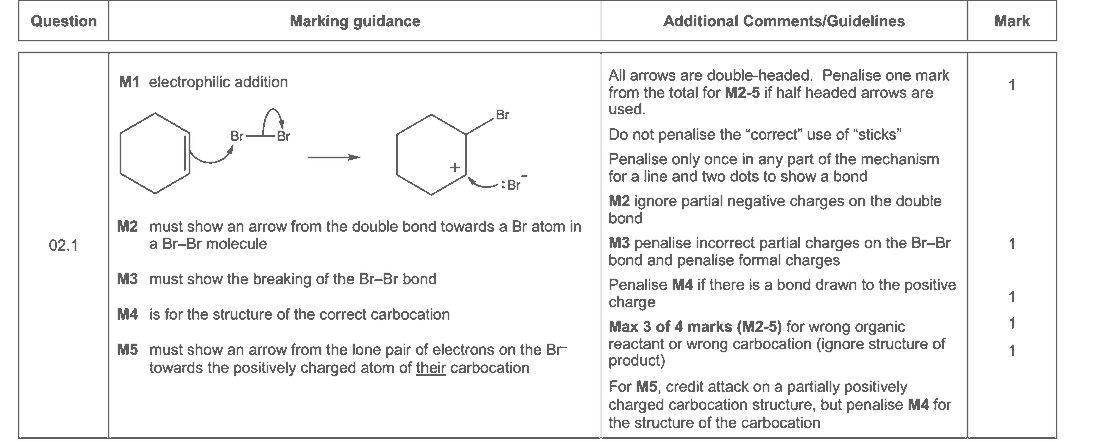
Electrophilic addition. Arrow from the C=C to a Br of Br–Br
arrow from the Br–Br bond to the other Br
carbocation with Br on the adjacent ring carbon
arrow from a lone pair on Br– to the C+. Max 3 of 4 for the wrong reactant or carbocation
no bond drawn to the + charge
formal or wrong partial charges on Br–Br penalised
November 2021 · AS Paper 2 · Q02.23 marksExplanation
Earlier part of question 02 that this part uses
Mark scheme
Notes from the mark scheme and report
The C=C is electron rich / a region of high electron density
it polarises (induces a dipole in) the Br–Br bond
the δ+ Br is attracted to the C=C. 'C=C is negative' or 'electronegative' is ignored
November 2021 · AS Paper 2 · Q02.31 markDiagram or structure
Earlier part of question 02 that this part uses
Mark scheme
Notes from the mark scheme and report
Skeletal formula of 1,2,3,4-tetrabromobutane: four-carbon zig-zag with a Br on every carbon (both C=C add Br2). Must be skeletal
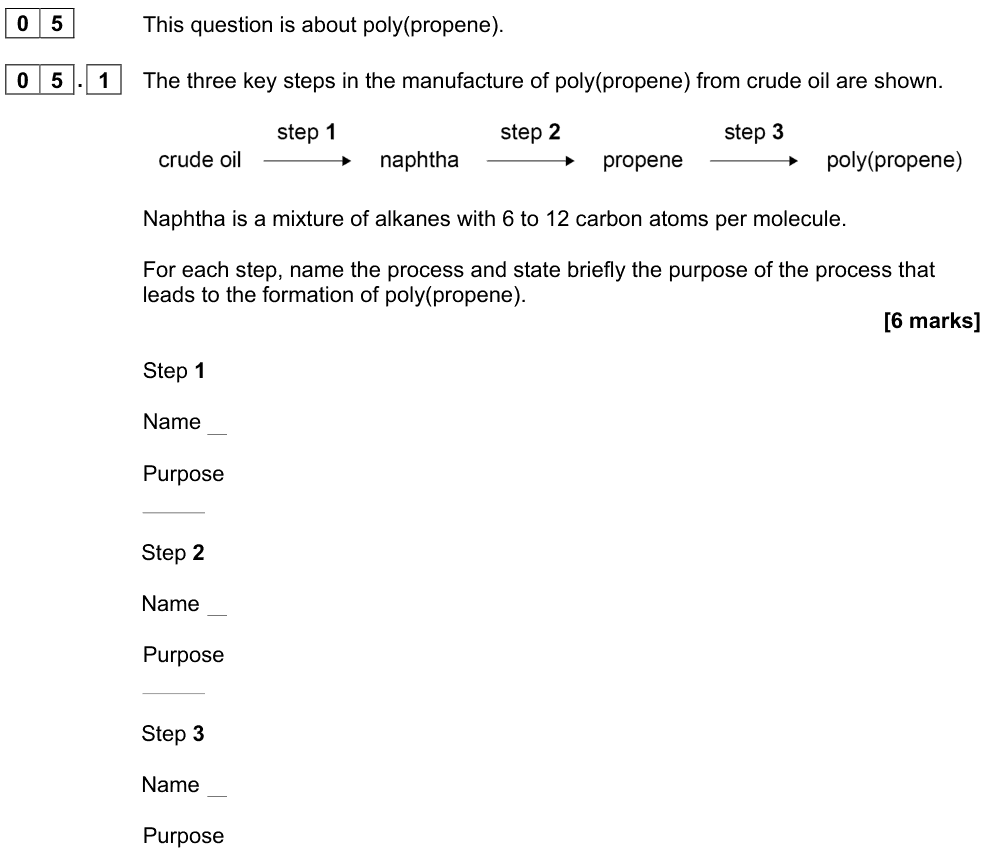
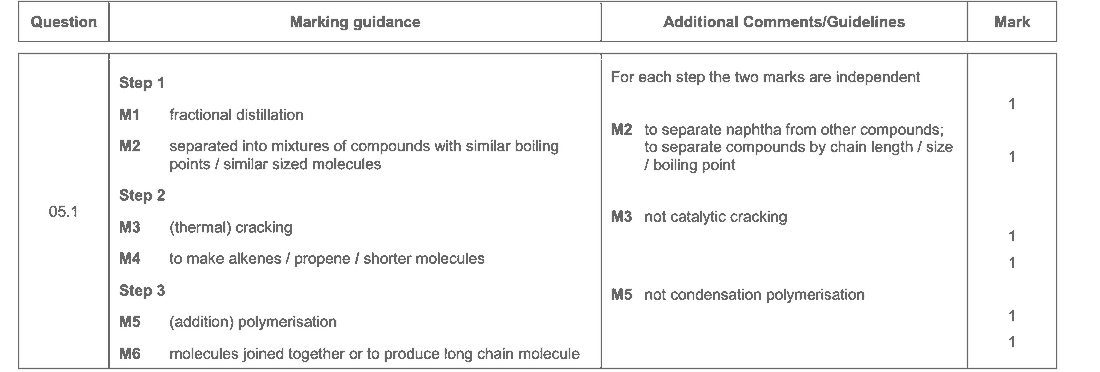
November 2021 · AS Paper 2 · Q05.16 marksShort answer
Mark scheme
Notes from the mark scheme and report
Step 1 fractional distillation: separates crude oil into fractions of similar boiling point / chain length (to obtain naphtha). Step 2 (thermal) cracking, not catalytic: makes alkenes / propene / shorter molecules. Step 3 (addition) polymerisation, not condensation: joins propene molecules into long chains. Name and purpose marked independently
November 2021 · AS Paper 2 · Q05.21 markShort answer
Earlier part of question 05 that this part uses
Mark scheme
Notes from the mark scheme and report
The polymer chain has no polar bonds / is non-polar (strong C–C and C–H bonds). Not credited if only C–H bonds are called non-polar
November 2021 · AS Paper 2 · Q05.31 markShort answer
Earlier part of question 05 that this part uses
Mark scheme
Notes from the mark scheme and report
To prevent the build-up of waste (in landfill) / they can be broken down by natural processes
November 2021 · AS Paper 2 · Q07.31 markDiagram or structure
Earlier part of question 07 that this part uses
Mark scheme
Notes from the mark scheme and report
–CH2–CH(CH2OH)– with a trailing bond at each end (brackets and n ignored)
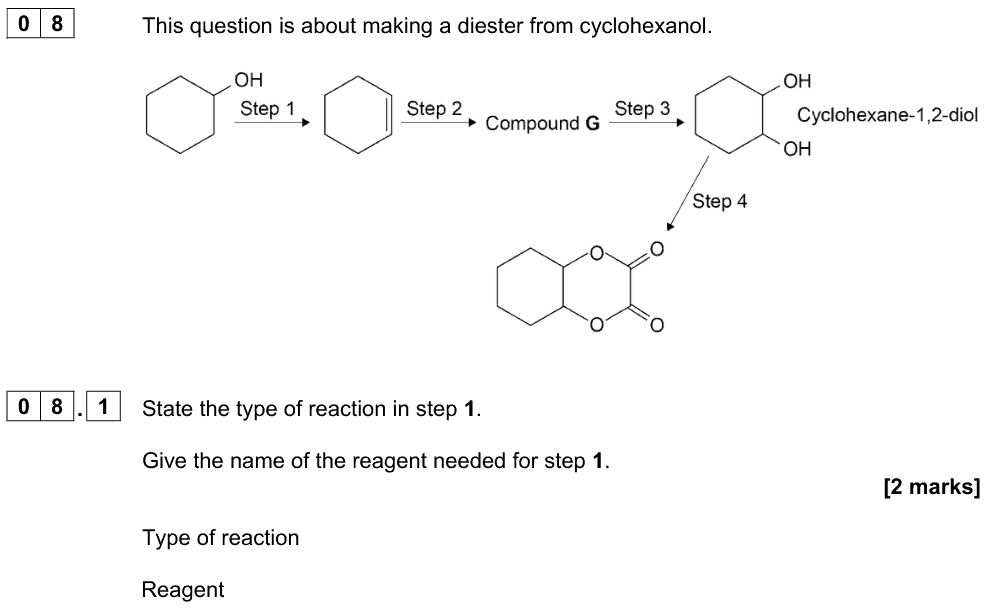
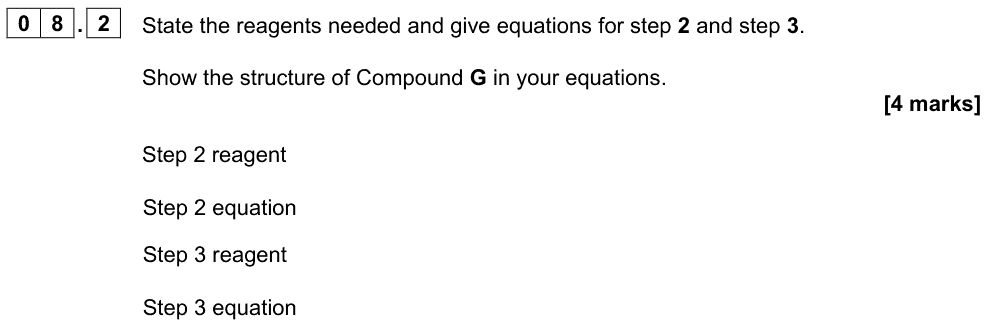
November 2021 · Paper 2 · Q08.24 marksEquation writing
Earlier part of question 08 that this part uses
Mark scheme
Examiner's comment
Few students scored 3 or more marks on question 08.2.
Both the reagents and equations proved very challenging, with over 50% either failing to score or not attempting this question.
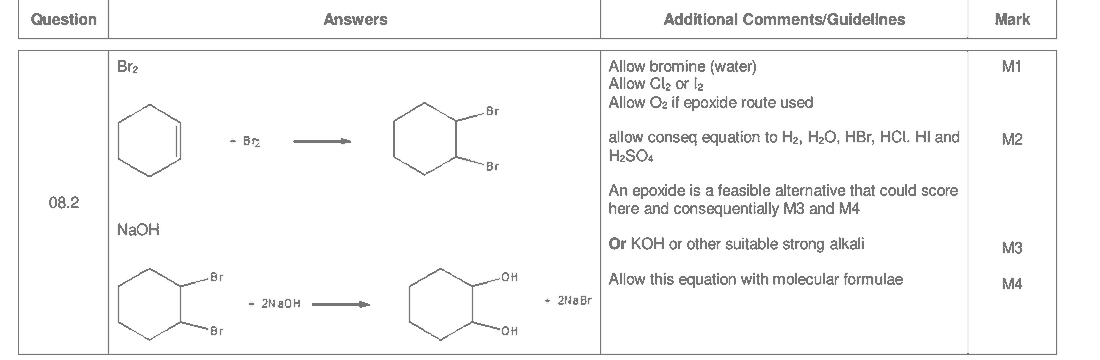
G + 2NaOH → cyclohexane-1,2-diol + 2NaBr. Cl2 or I2 allowed
an epoxide route with O2 is also accepted. Over 50% scored nothing or did not attempt it
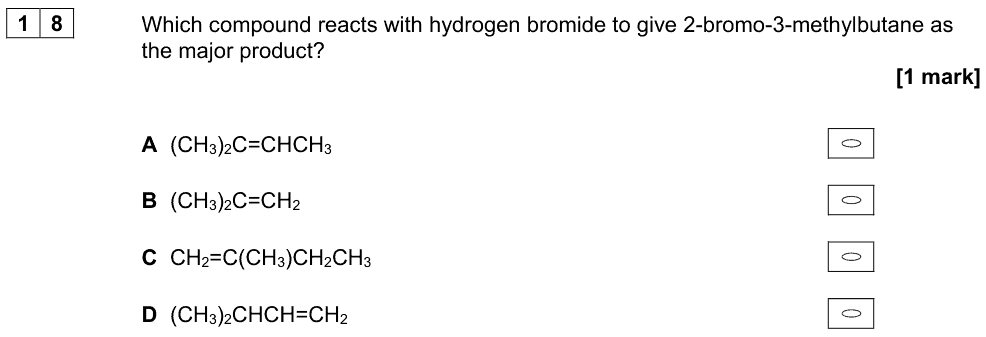
November 2021 · AS Paper 2 · Q181 markMultiple choice
Answer
D
Mark scheme
Notes from the mark scheme and report
Answer: D. (CH3)2CHCH=CH2 adds H to C1 via the secondary carbocation on C2, giving CH3CHBrCH(CH3)2. A gives mainly 2-bromo-2-methylbutane via a tertiary carbocation
November 2020 · AS Paper 2 · Q06.13 marksEquation writing
Mark scheme
Notes from the mark scheme and report
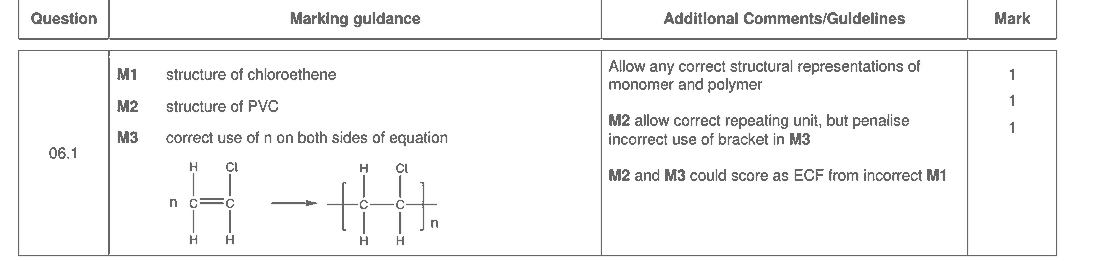
n CH2=CHCl → –[CH2–CHCl]n– : structure of chloroethene
structure of the polymer repeating unit with bonds through the brackets
n used correctly on both sides
November 2020 · AS Paper 2 · Q06.22 marksExplanation
Earlier part of question 06 that this part uses
Mark scheme
Notes from the mark scheme and report
No reaction / the bromine water stays yellow-orange
the polymer is saturated (contains no C=C double bonds). 'Nothing' and 'no observation' are ignored
November 2020 · AS Paper 2 · Q06.32 marksShort answer
Earlier part of question 06 that this part uses
Mark scheme
Notes from the mark scheme and report
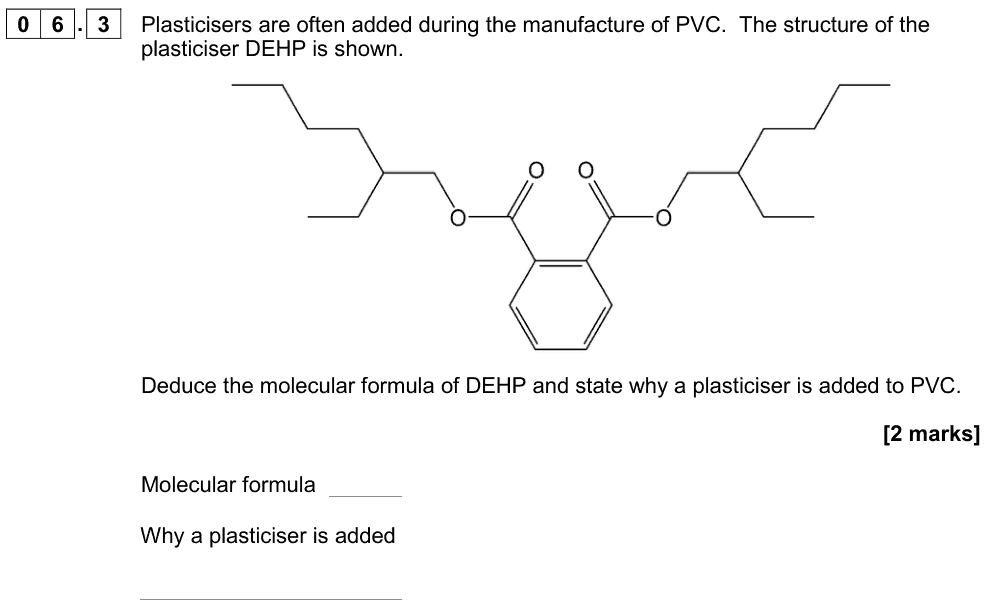
C24H38O4
a plasticiser makes PVC more flexible (less brittle). 'More elastic' is ignored
November 2020 · Paper 2 · Q06.41 markDiagram or structure
Earlier part of question 06 that this part uses
Mark scheme
Examiner's comment
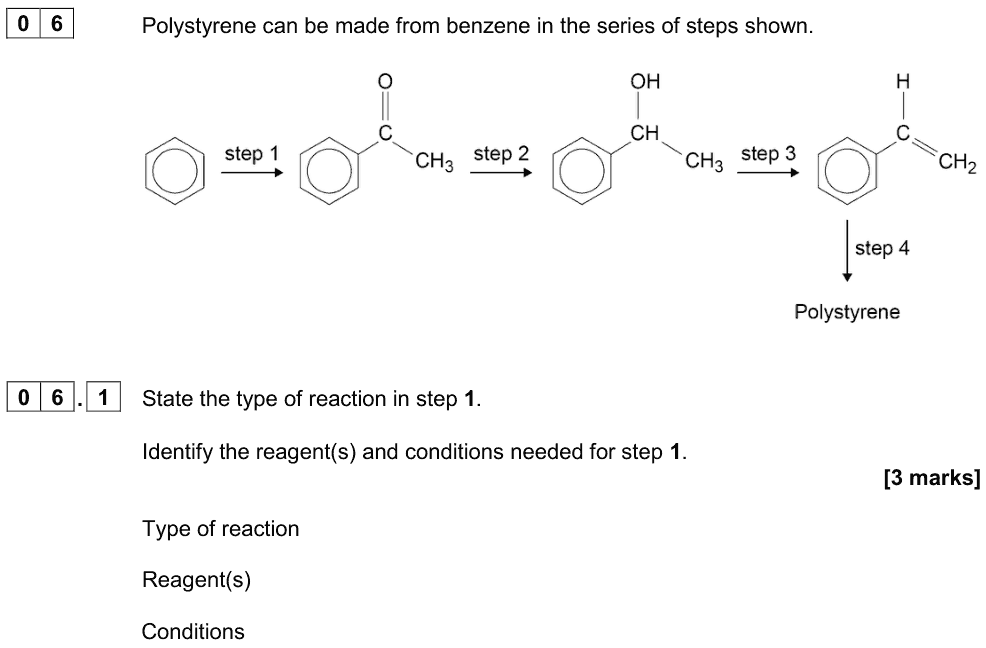
06.1 was reasonably well answered but few students were able to identify suitable conditions for this acylation reaction. 06.2 also proved to be quite a low scoring question despite the familiarity of this reaction in many previous exams. The dehydration mechanism in 06.3 was poorly answered compared to other mechanism questions in the paper.
Notes from the mark scheme and report
–CH(C6H5)–CH2– with trailing bonds at both ends. Brackets and n are ignored
November 2020 · AS Paper 2 · Q121 markMultiple choice
Answer
D
Mark scheme
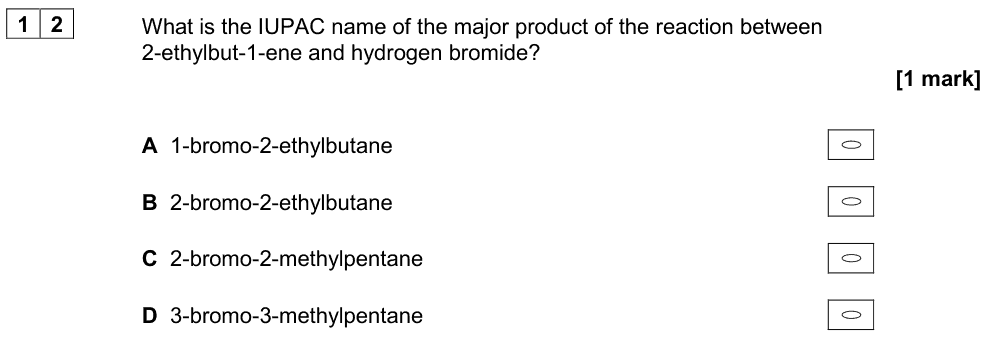
Notes from the mark scheme and report
Answer: D. H adds to the CH2 to give the more stable tertiary carbocation
Br– bonds to the tertiary carbon, giving CH3CH2CBr(CH3)CH2CH3, whose longest chain has five carbons
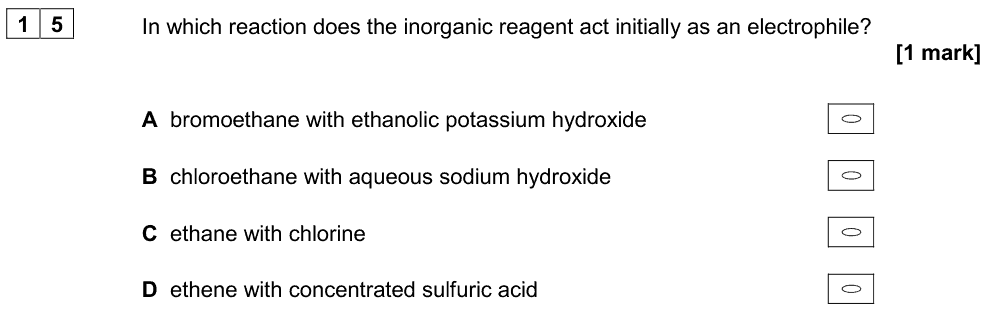
November 2020 · AS Paper 2 · Q151 markMultiple choice
Answer
D
Mark scheme
Notes from the mark scheme and report
Answer: D. The δ+ H of H2SO4 accepts an electron pair from the C=C bond. Hydroxide acts as a base in A and a nucleophile in B
C is a free-radical reaction
November 2020 · AS Paper 2 · Q191 markMultiple choice
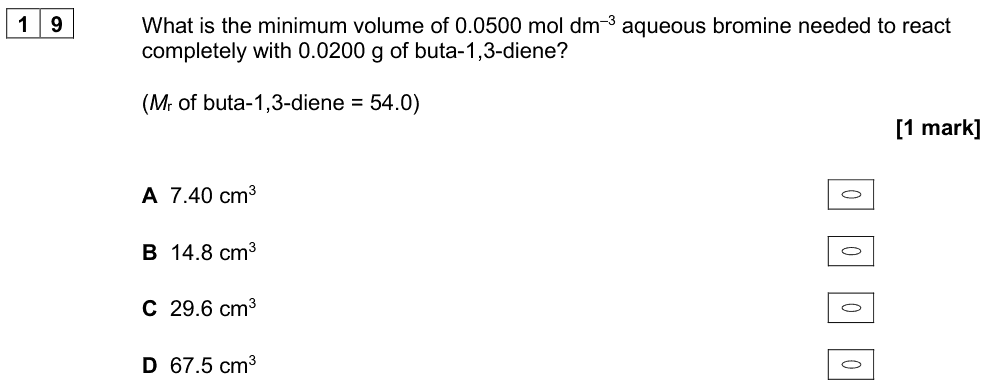
Skills: MS0.0 Recognise and make use of appropriate units in calculation; MS0.2 Use ratios, fractions and percentages
November 2020 · Paper 3 · Q241 markMultiple choice
Answer
D
Mark scheme
Notes from the mark scheme and report
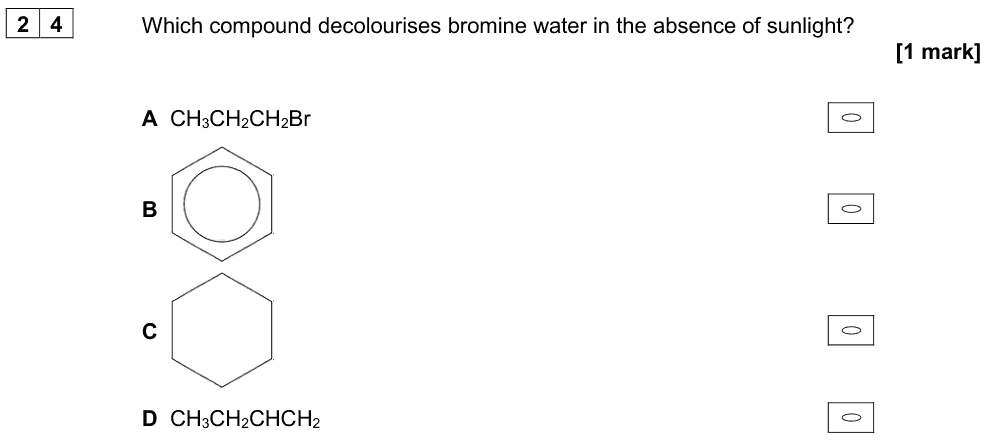
Answer: D. But-1-ene, CH3CH2CH=CH2, adds bromine at its C=C
benzene (B) does not add bromine, and cyclohexane (C) and 1-bromopropane need UV light for substitution
November 2020 · Paper 3 · Q281 markMultiple choice
Answer
D
Mark scheme
Notes from the mark scheme and report
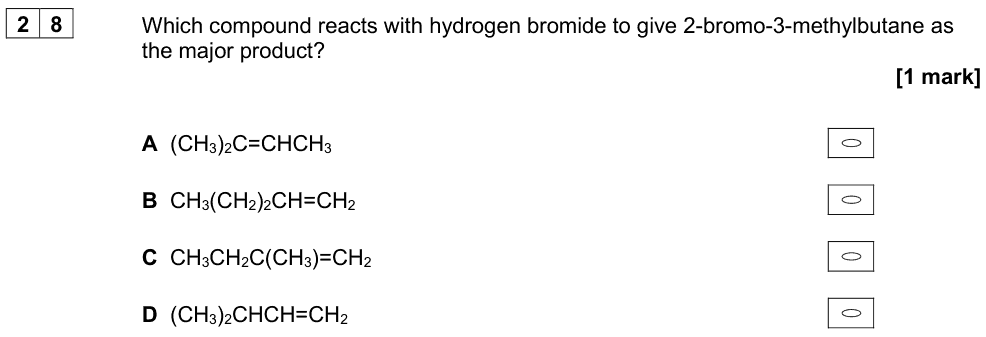
Answer: D. (CH3)2CHCH=CH2 gives the secondary carbocation on C2, so Br adds there: CH3CHBrCH(CH3)2. A gives mainly 2-bromo-2-methylbutane via a tertiary carbocation (report: success rate under 40% (listed among the hardest))
June 2019 · Paper 2 · Q02.53 marksMechanism
Earlier part of question 02 that this part uses
Mark scheme
Examiner's comment
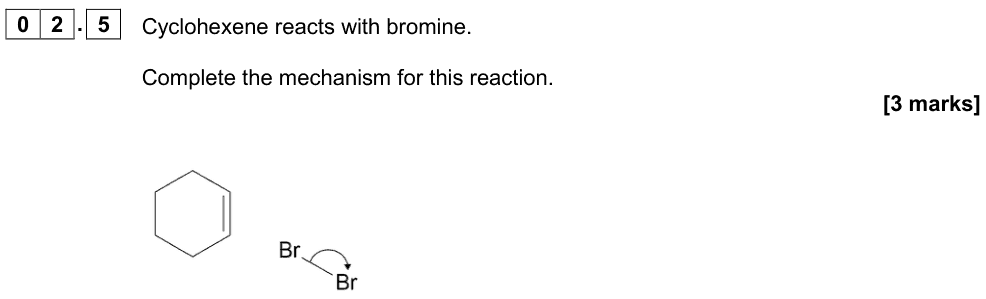
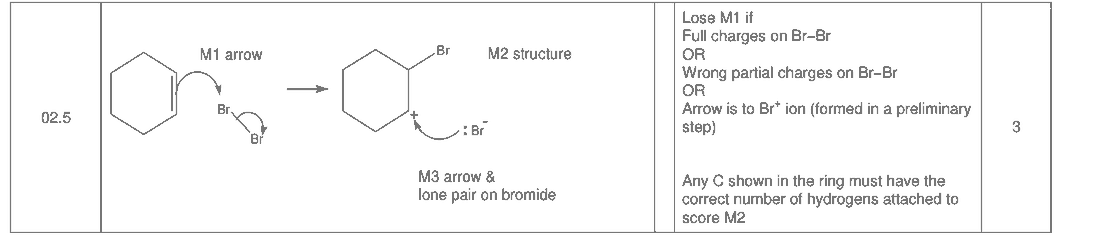
02.5 The mechanism was usually answered well although the cyclic nature of the alkene confused several students who wrongly drew a substitution mechanism instead of electrophilic addition.
The intermediate carbocation in part five should not be written as structure A below.
Correct possibilities are structure B (preferred) or structure C.
Once a carbon atom is labelled as such, it must have the correct bonding as in C but not A.
Notes from the mark scheme and report
Electrophilic addition: curly arrow from the C=C to the nearer Br of Br–Br (the Br–Br arrow is printed)
carbocation intermediate, a ring with Br on one carbon and + on the adjacent carbon
arrow from a lone pair on :Br– to the C+. M1 lost for full or wrong partial charges on Br2. Do not mix skeletal and structural formulas at one carbon: a carbon written as C must show its H. Some drew a substitution mechanism
June 2019 · Paper 2 · Q03.22 marksDiagram or structure
Earlier part of question 03 that this part uses
Mark scheme
Examiner's comment
03.2 Over half the students drew a correct structure but only a very small number could give its correct IUPAC name as buta-1,3-diene.
Notes from the mark scheme and report
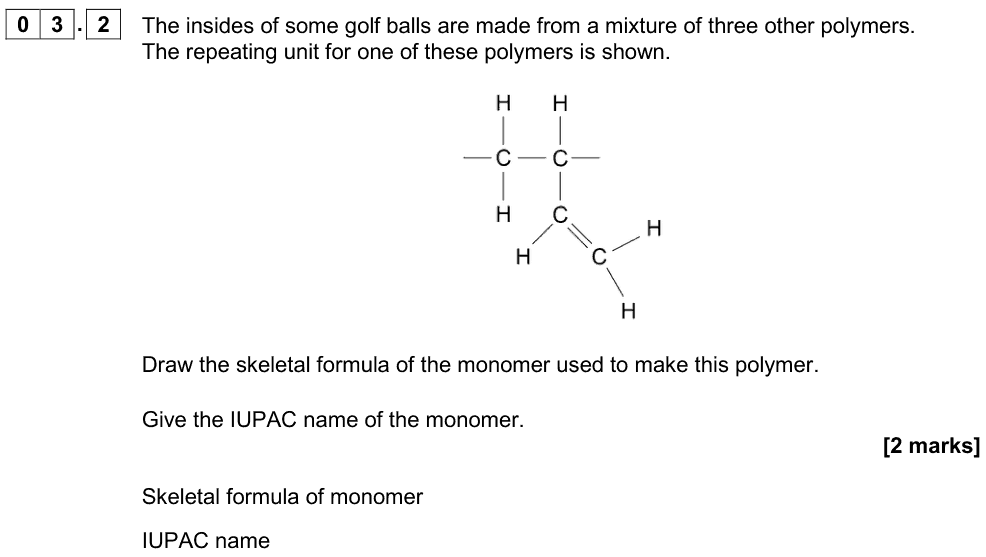
Skeletal formula of CH2=CH–CH=CH2 (a zigzag of four carbons with a double bond at each end)
buta-1,3-diene (this name only, marked independently). Over half drew the structure but very few gave the name.
June 2019 · Paper 2 · Q03.32 marksDiagram or structure
Earlier part of question 03 that this part uses
Mark scheme
Examiner's comment
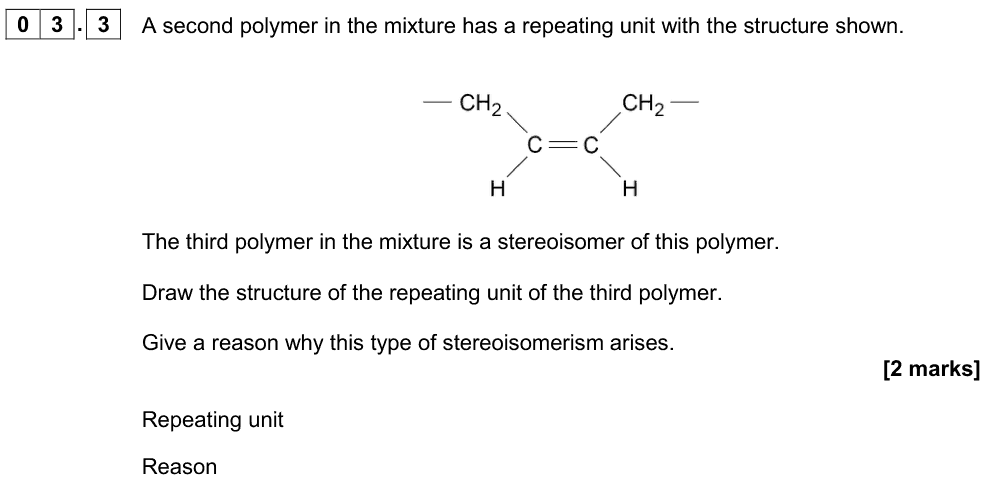
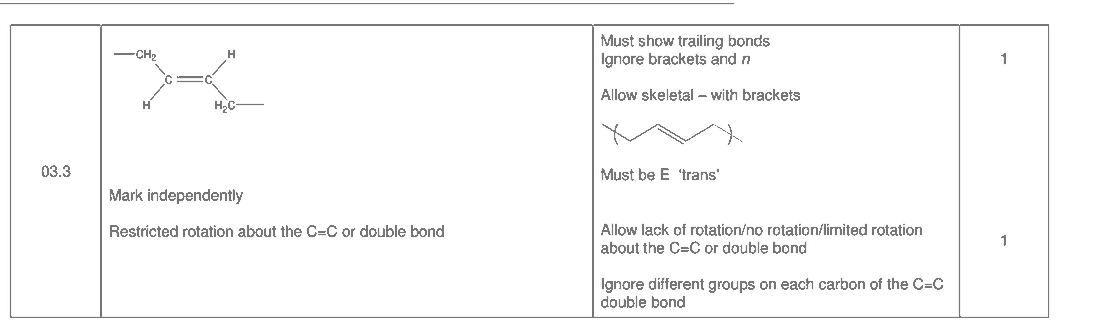
03.3 Despite the unfamiliarity of this polymer, students answered part 3 well, especially the explanation. The most common mistakes in the structure were to show trailing bonds from the H atoms or to omit trailing bonds altogether.
Notes from the mark scheme and report
The E (trans) repeating unit: –CH2–CH=CH–CH2– with the two CH2 groups on opposite sides of the C=C and trailing bonds from the CH2 groups. Reason: restricted (no) rotation about the C=C double bond. Errors: trailing bonds drawn from the H atoms or left out
Skills: MS4.2 Visualise and represent 2D and 3D forms including two-dimensional representations of 3D objects
June 2019 · Paper 2 · Q03.41 markShort answer
Earlier part of question 03 that this part uses
Mark scheme
Examiner's comment
03.4 Although there were many successful answers to this final part, a large proportion of the other attempts were too general to score and did not specify that it was the C−C bonds that were non-polar or too strong to be hydrolysed.
Notes from the mark scheme and report
The polymer chains contain only C–C bonds, which are non-polar / too strong and so are not attacked by nucleophiles and cannot be hydrolysed. Answers must specify the carbon–carbon bonds
many were too general
June 2019 · AS Paper 2 · Q06.15 marksMechanism
Mark scheme
Examiner's comment
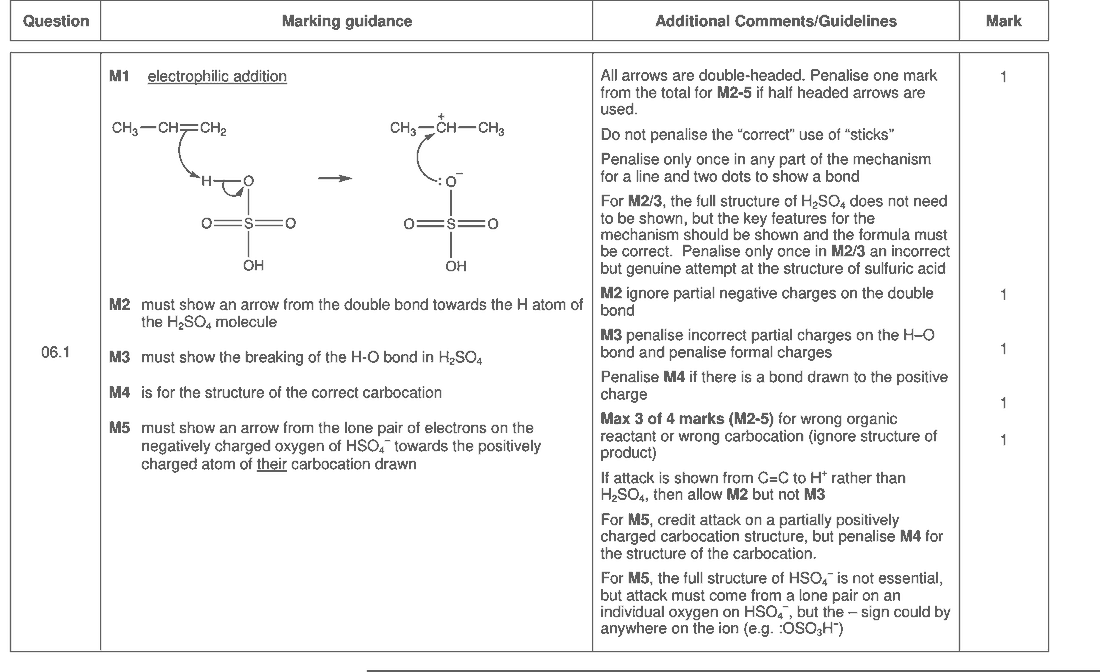
6.1 The mechanism was done quite well. The most common error was omitting the negative charge on the hydrogensulfate ion.
Notes from the mark scheme and report
Electrophilic addition. Arrow from the C=C to the H of H–O in H2SO4
arrow from the H–O bond to O
the secondary carbocation CH3CH+CH3
arrow from a lone pair on the O– of HSO4– to the C+. Most common error: negative charge left off the hydrogensulfate ion
June 2019 · AS Paper 2 · Q06.21 markDiagram or structure
Earlier part of question 06 that this part uses
Mark scheme
Examiner's comment
6.2 Most students could draw the structure of the minor product.
Notes from the mark scheme and report
CH3CH2CH2OSO3H (the hydrogensulfate group joined through O to the end carbon): the minor product
June 2019 · AS Paper 2 · Q06.32 marksExplanation
Earlier part of question 06 that this part uses
Mark scheme
Examiner's comment
6.3 Students struggled to explain why the major product was formed. Many students referred to the structure of the product and its stability, rather than that of the carbocation intermediate from which it was formed. Some students clearly thought, incorrectly, that the products were carbocations.
Notes from the mark scheme and report
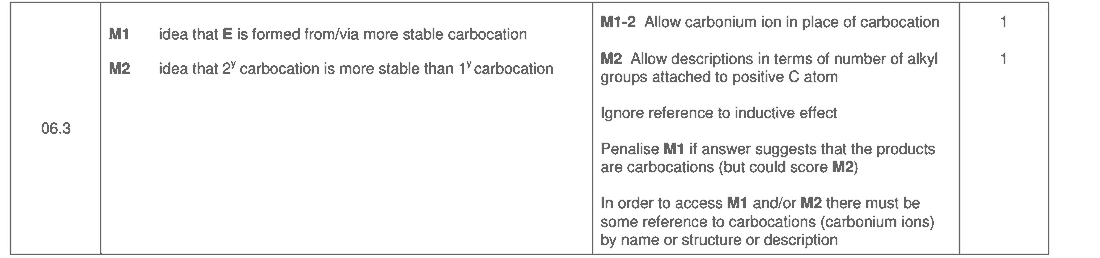
E is formed via the more stable carbocation
a secondary carbocation is more stable than a primary carbocation (more alkyl groups on the C+). Must refer to carbocations
many wrote about the stability of the product, or thought the products were carbocations
June 2019 · Paper 2 · Q13.15 marksMechanism
Mark scheme
Examiner's comment
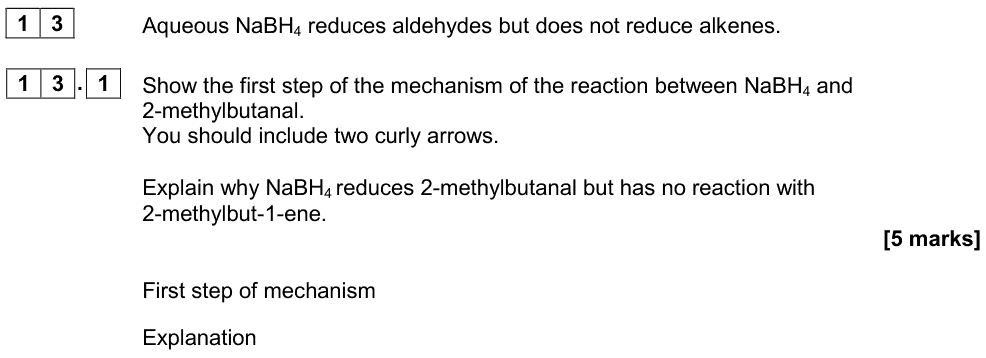
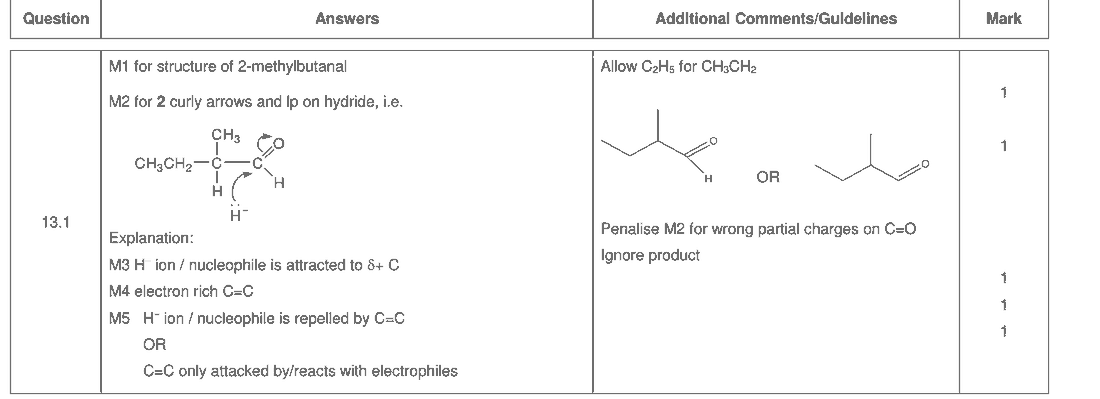
13.1 This question discriminated well. It was surprising to see how many students were unable to draw the correct structure of 2-methylbutanal. Many placed the methyl group on carbon 3. Most students were familiar with the mechanism and drew the
curly arrow from the lone pair on :H– to the C of C=O and curly arrow from the C=O bond to O. Explanation: the H– nucleophile is attracted to the δ+ carbon of the polar C=O
the C=C is electron rich, so it repels H– / is attacked only by electrophiles. Many drew the methyl group on carbon 3
June 2019 · Paper 3 · Q04.41 markDiagram or structure
Earlier part of question 04 that this part uses
Mark scheme
Examiner's comment
4.4 Most students were able to draw this fragment of the polymer although there was some carelessness with the positioning of the bond to the CN group.
Notes from the mark scheme and report
–CH2–CH(CN)–CH2–CH(CN)–CH2–CH(CN)– with trailing bonds at both ends
the bond must go to the C of CN
June 2019 · Paper 3 · Q331 markMultiple choice
Answer
D
Mark scheme
Notes from the mark scheme and report
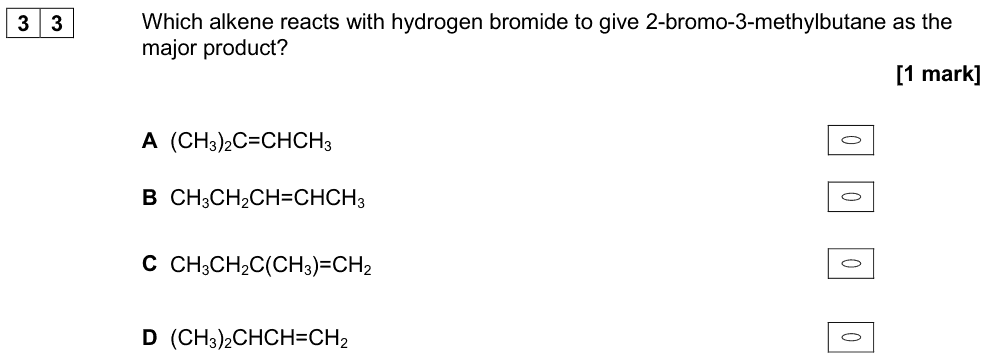
Answer: D. 3-methylbut-1-ene adds H to the CH2 to give the more stable secondary carbocation on carbon 2, so Br ends up on carbon 2
June 2018 · AS Paper 2 · Q04.61 markDiagram or structureHard
Earlier part of question 04 that this part uses
Mark scheme
Examiner's comment
04.6 Few students (30.9%) could draw the repeating unit of poly(propene) correctly.
Notes from the mark scheme and report
–CH2–CH(CH3)– with a trailing bond at each end (two carbons in the chain, methyl as a side group). Brackets and n ignored
June 2018 · AS Paper 2 · Q05.16 marksCalculation
Mark scheme
Examiner's comment
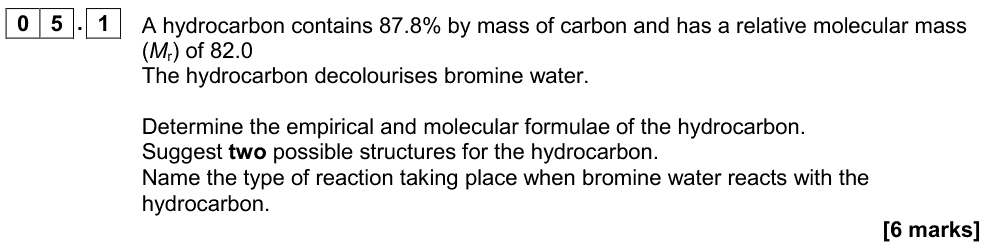
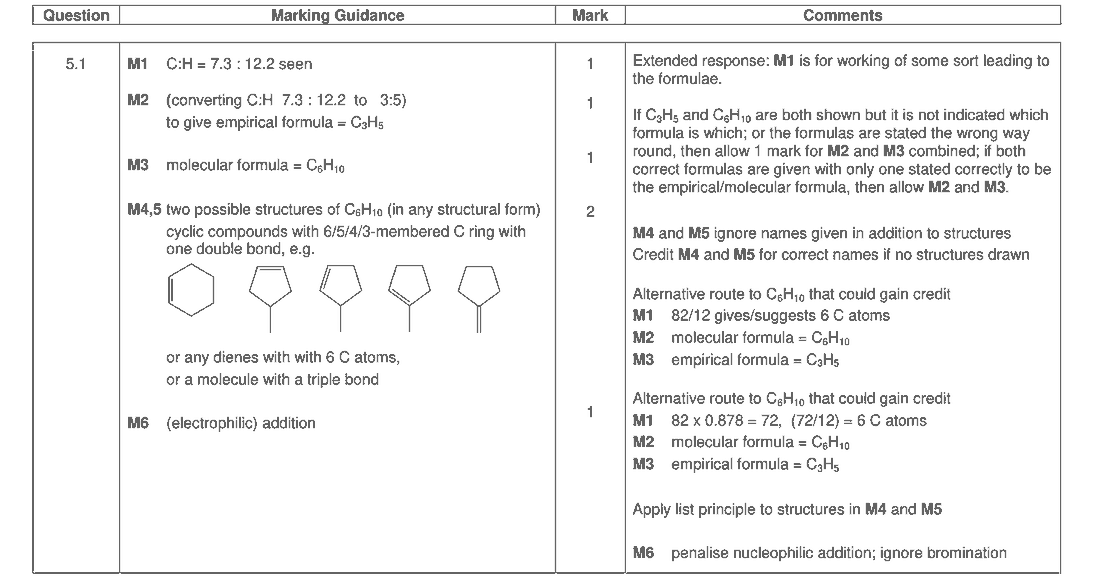
05.1 Some students could not convert the ratio 7.3 : 13.2 to a whole number ratio, but the question was answered well on the whole and discriminated well.
Notes from the mark scheme and report
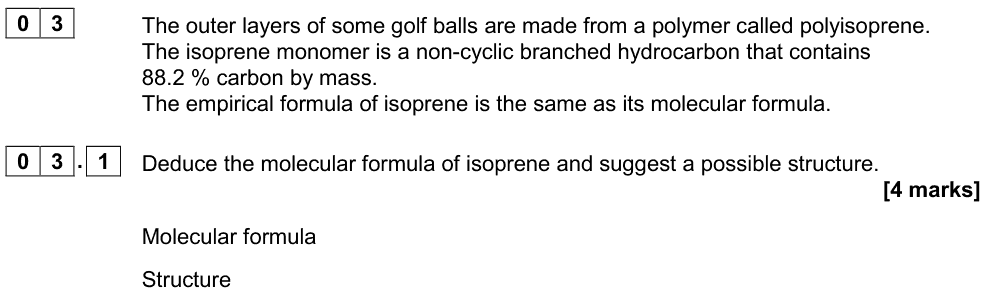
Answer: empirical formula C3H5
molecular formula C6H10. C 87.8 ÷ 12.0 = 7.3
H 12.2 ÷ 1.0 = 12.2
ratio 1 : 1.67 = 3 : 5
C3H5 = 41.0 so × 2. Two structures of C6H10 (2 marks): for example cyclohexene, a methylcyclopentene, any hexadiene or a hexyne. Reaction type: (electrophilic) addition
nucleophilic addition is penalised. Some could not convert 7.3 : 12.2 to a whole-number ratio
Skills: MS0.2 Use ratios, fractions and percentages
June 2018 · AS Paper 2 · Q111 markMultiple choice
Answer
C
Mark scheme
Examiner's comment
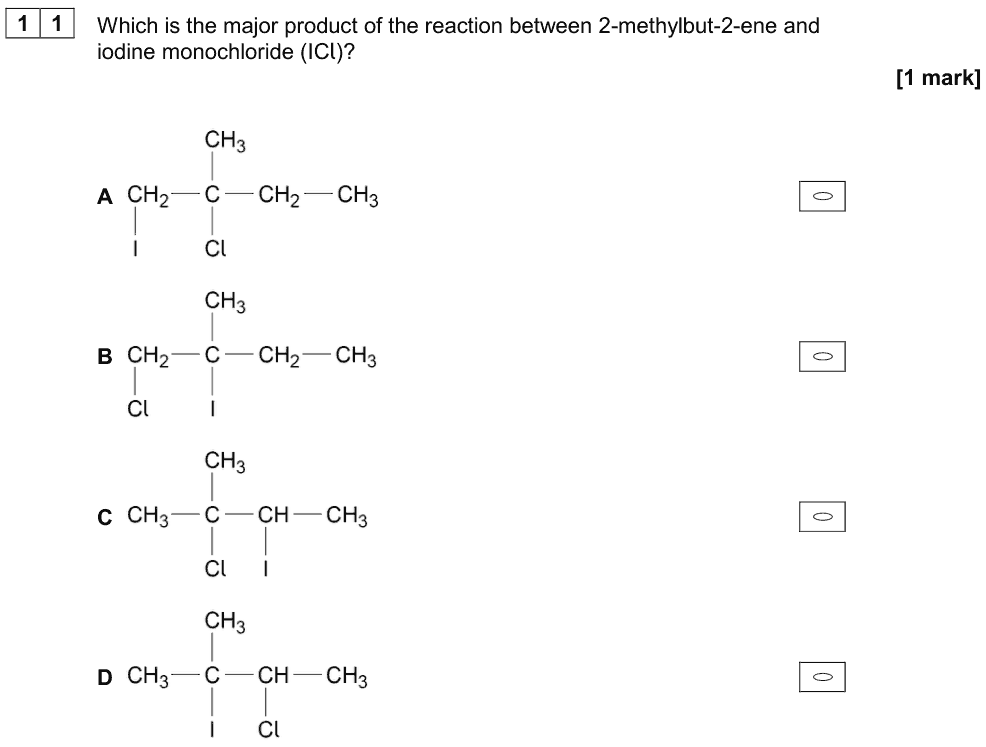
This question was challenging. The most common incorrect answer added the iodine and chlorine onto the two C atoms, but could not use the bond polarity in iodine monochloride to determine which way round they added. Pleasingly, though, 47.9% of students gained the mark.
Notes from the mark scheme and report
Answer: C. In I–Cl iodine is δ+ and is the electrophile
it adds to the CH carbon to give the more stable tertiary carbocation, and Cl– then bonds to the tertiary carbon. Most common wrong answer had I and Cl the other way round
June 2018 · AS Paper 2 · Q191 markMultiple choice
Answer
C
Mark scheme
Examiner's comment
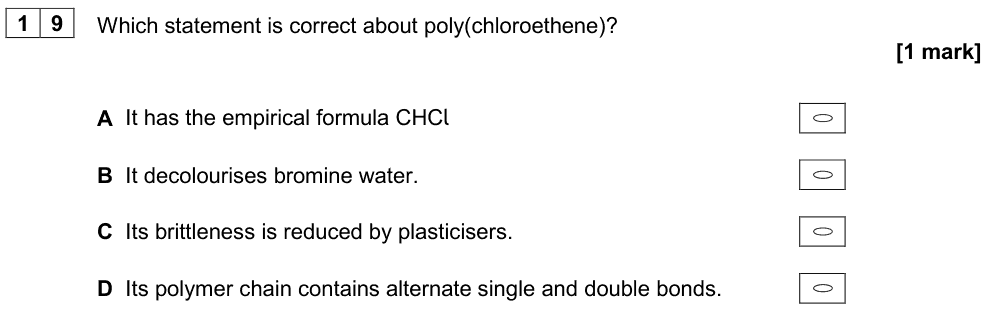
Many students (52.2%) got this question correct but many others incorrectly thought that the polymer contained a C=C bond and would decolourise bromine water.
Notes from the mark scheme and report
Answer: C. Plasticisers make PVC more flexible
the polymer chain is saturated so does not decolourise bromine water, and its empirical formula is C2H3Cl
June 2018 · Paper 3 · Q03.22 marksPractical and data analysisEasy
Earlier part of question 03 that this part uses
Mark scheme
Examiner's comment
03.2 Most students (70.2%) were able to suggest the use of bromine water, with only very few getting the colour change the wrong way round. The most common wrong answer was the suggestion of a test for the absence of alcohol rather than a positive test for the presence of an alkene.
Notes from the mark scheme and report
Add bromine water
it turns from orange to colourless (decolourised). Not 'discolours'
'clear' is ignored. Common wrong approach: testing for the absence of the alcohol
Skills: ATd Use laboratory apparatus for a variety of experimental techniques including: titration, using burette and pipette; distillation and heating under reflux, including setting up glassware using retort stand and clamps; qualitative tests for ions and organic functional groups; filtration, including use of fluted filter paper, or filtration under reduced pressure; PS1.1 Solve problems set in practical contexts; RP6 Tests for alcohol, aldehyde, alkene and carboxylic acid
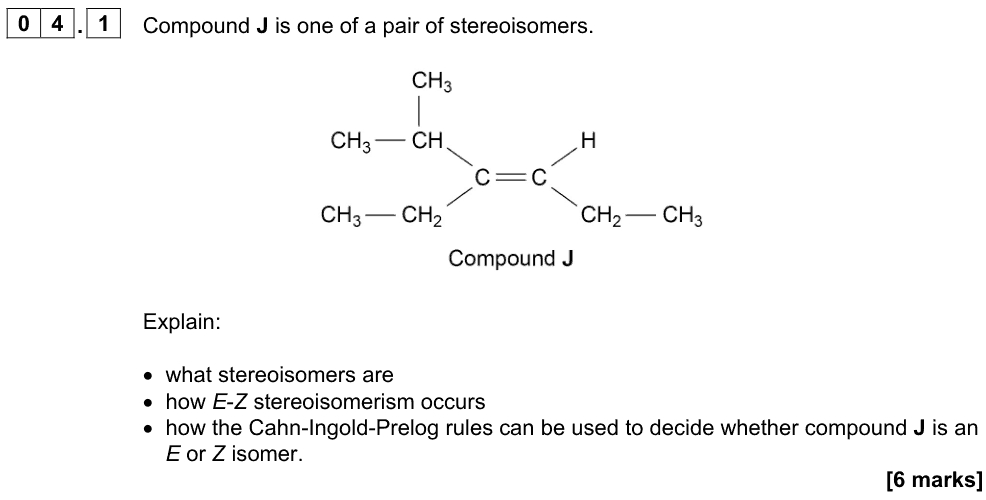
June 2017 · AS Paper 2 · Q03.16 marks6-mark level of response
Mark scheme, with the levels and indicative content
Examiner's comment
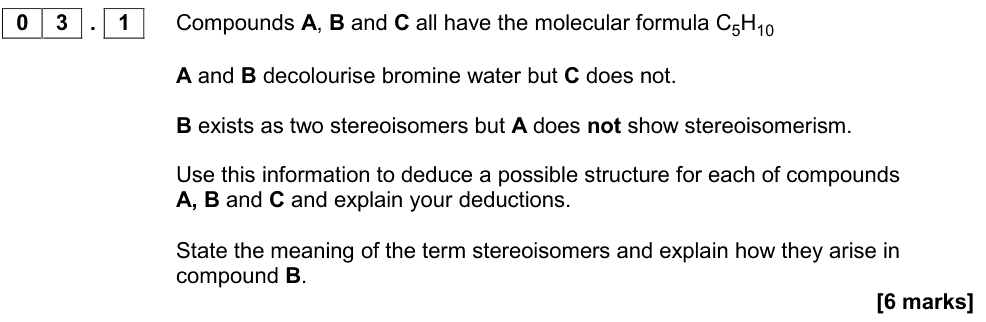
03.1 Most students made good progress with this question, with many identifying one or more of the three compounds. However, few scored full marks as they did not explain how they deduced the structures. Many did not explain the significance of the results of the tests with bromine water. The meaning of the term stereoisomers was not well known, and often confused with structural isomers; few referred to the restricted rotation around the C=C bond leading to stereoisomers in molecules where both of the C atoms in the C=C bond have two different groups attached. Some students incorrectly suggested that alkenes that do not have stereoisomers have free rotation around the C=C bond.
Notes from the mark scheme and report
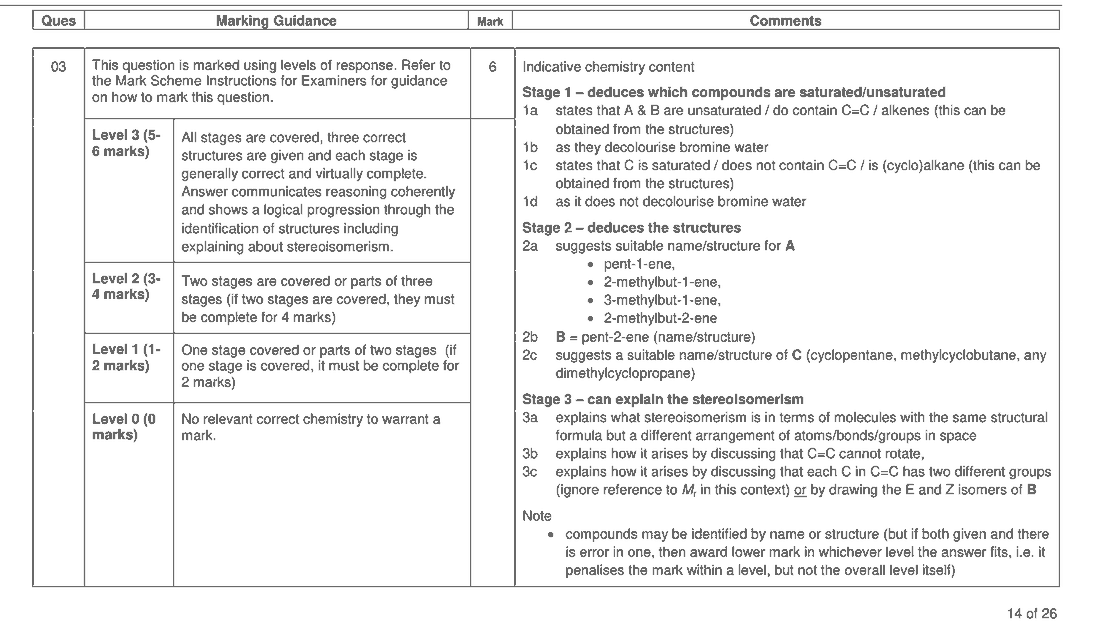
Levels of response, three stages. Saturated or unsaturated: A and B are alkenes (contain C=C) because they decolourise bromine water
C is saturated (a cycloalkane) because it does not. Structures: A = pent-1-ene, 2-methylbut-1-ene, 3-methylbut-1-ene or 2-methylbut-2-ene
B = pent-2-ene
C = cyclopentane, methylcyclobutane or a dimethylcyclopropane. Stereoisomerism: same structural formula but a different arrangement of atoms in space
arises because the C=C cannot rotate and each C of the C=C has two different groups (or draw E and Z pent-2-ene). Errors: deductions not explained
stereoisomers confused with structural isomers
restricted rotation not mentioned
June 2017 · AS Paper 2 · Q07.32 marksExplanation
Earlier part of question 07 that this part uses
Mark scheme
Examiner's comment
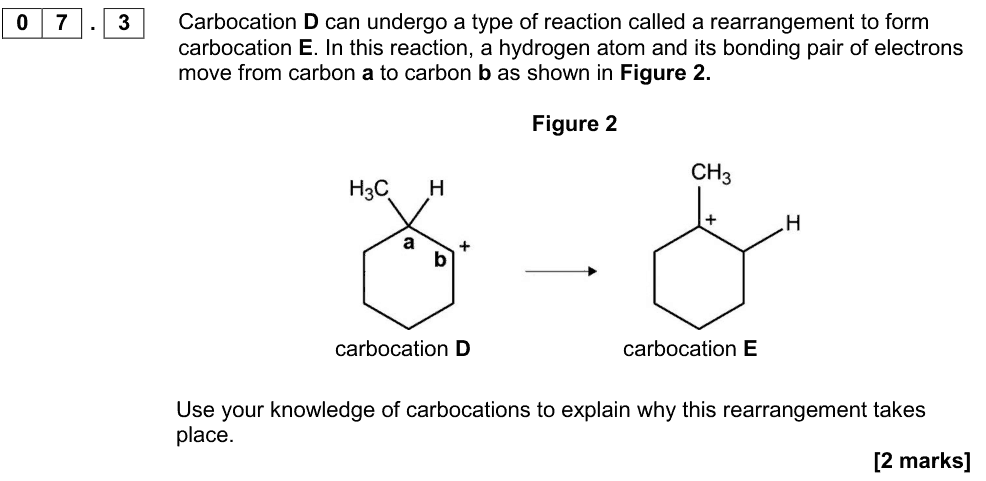
07.3 Many students realised that this question referred to the relative stability of carbocations, with the best students referring to the extra stability of tertiary carbocation E relative to secondary carbocation D. Students’ explanations were often confused and it was not always clear to which carbocation they were referring.
Notes from the mark scheme and report
Carbocation E is more stable because it is tertiary and D is secondary (allow: more alkyl groups, so greater inductive effect). 'More stable product' is penalised
make clear which carbocation is meant
June 2017 · AS Paper 2 · Q08.21 markDiagram or structure
Earlier part of question 08 that this part uses
Mark scheme
Examiner's comment
08.2 Many students drew the displayed structure of the correct product, thereby demonstrating their understanding of the identity of the major product of this addition reaction of hydrogen bromide to the alkene.
Notes from the mark scheme and report
Displayed formula of 2-bromo-2-methylbutane, CH3C(CH3)BrCH2CH3, with every bond shown (Br on the carbon that gives the tertiary carbocation)
June 2017 · AS Paper 2 · Q08.31 markDiagram or structure
Earlier part of question 08 that this part uses
Mark scheme
Examiner's comment
08.3 Most students realised that thermal cracking produced an alkene.
Notes from the mark scheme and report
Any alkene with four carbon atoms: but-1-ene, but-2-ene or methylpropene (allow butadiene)
June 2017 · AS Paper 2 · Q09.12 marksExplanation
Mark scheme
Examiner's comment
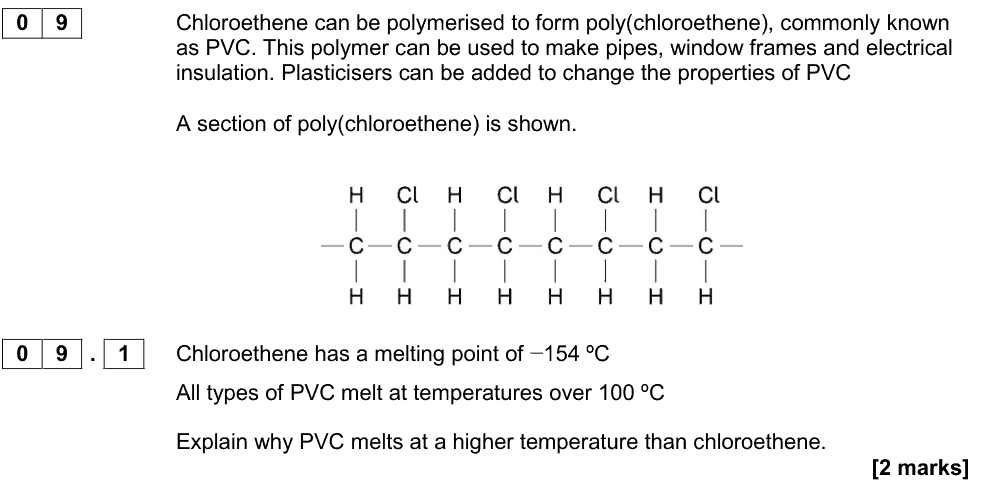
09.1 Many students believed incorrectly that covalent bonds break when PVC melts and failed to score on this question.
Notes from the mark scheme and report
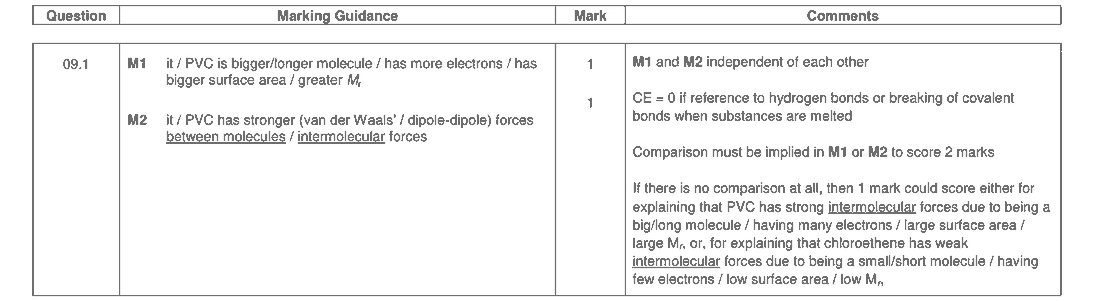
PVC molecules are much larger (more electrons / bigger surface area / greater Mr), so there are stronger intermolecular (van der Waals / dipole–dipole) forces between molecules. A comparison is needed for 2 marks. Hydrogen bonds or breaking covalent bonds on melting = chemical error, scores 0
many made the covalent bond error
June 2017 · AS Paper 2 · Q09.31 markShort answer
Earlier part of question 09 that this part uses
Mark scheme
Examiner's comment
09.3 Very few students appeared to know why plasticisers are added to some polymers. This is new content for this specification.
Notes from the mark scheme and report
Yes, a plasticiser is present, because the PVC needs to be flexible. Both ideas needed. Very few knew why plasticisers are added
June 2017 · AS Paper 2 · Q09.41 markDiagram or structure
Earlier part of question 09 that this part uses
Mark scheme
Examiner's comment
09.4 This question required students to draw the displayed structure of a repeating unit and proved to be challenging.
Notes from the mark scheme and report
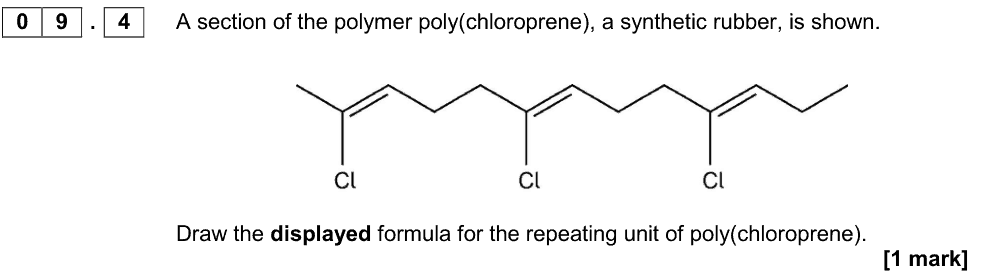
Displayed –CH2–CCl=CH–CH2– with all bonds shown and a trailing bond at each end (four carbons, one C=C, Cl on a C=C carbon). Brackets and n ignored
June 2017 · Paper 2 · Q10.73 marksDiagram or structure
Earlier part of question 10 that this part uses
Mark scheme
Examiner's comment
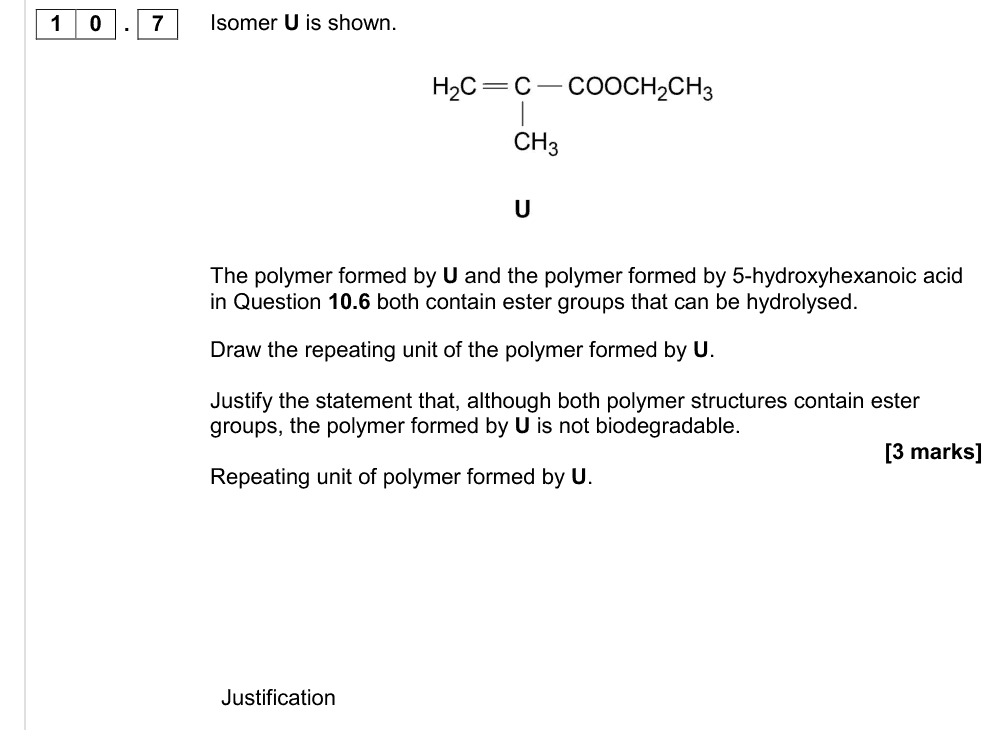
10.7 The question was not attempted by 7% of the students. Of those who did answer, only the best scored all three marks. Many answers were vague and missed the required comparison of the position of the ester group. Large numbers either only gained the first mark or alternatively did not score, because their repeating unit was incorrect.
Notes from the mark scheme and report
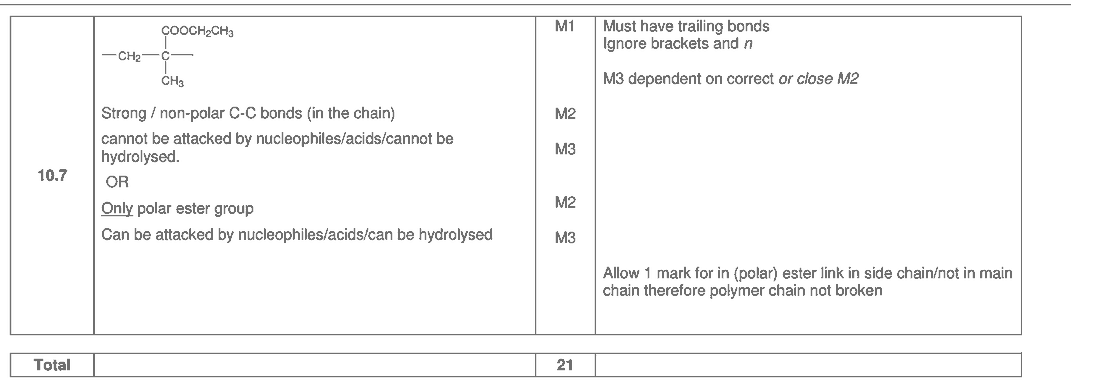
Repeating unit –CH2–C(CH3)(COOCH2CH3)– with trailing bonds. The polymer chain is made of strong non-polar C–C bonds that cannot be attacked by nucleophiles / hydrolysed
the polar ester group is in the side chain, not in the main chain, so hydrolysis does not break the chain. Many answers missed the position of the ester group
June 2017 · Paper 3 · Q02.11 markShort answerEasy
Mark scheme
Examiner's comment
02.1 78% of students gained this mark.
Notes from the mark scheme and report
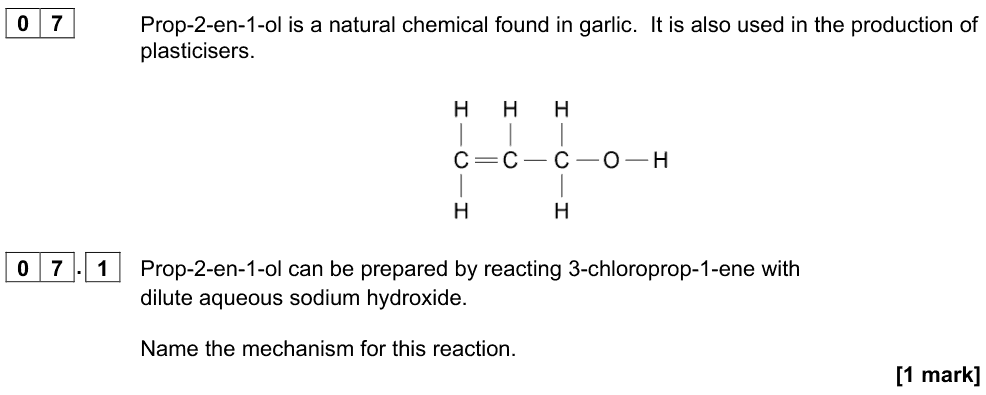
Electrophilic addition
June 2017 · Paper 3 · Q02.24 marksMechanism
Earlier part of question 02 that this part uses
Mark scheme
Examiner's comment
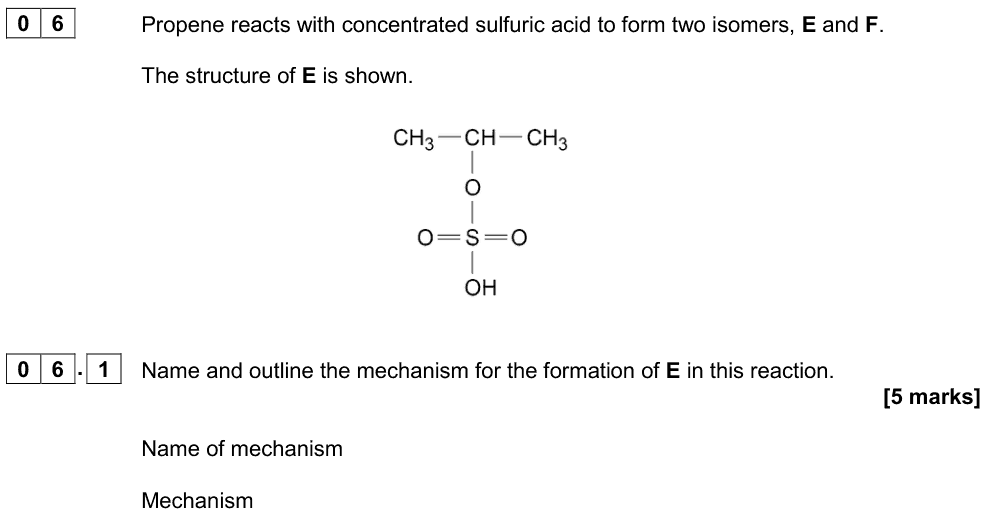
02.2 With nearly 40% of students scoring full marks, this question illustrated that the skill of representing mechanisms is good. When confusion arose it generally involved attempts to show mechanisms involving water and producing the alcohol, when the final product in this case should be propyl hydrogensulfate. The most common omissions were the curly arrow to show breaking of the H-O bond in H2SO4 and/or the negative charge on the HSO4
Notes from the mark scheme and report
Curly arrow from the C=C bond of propene to the H of an O–H in H2SO4
curly arrow from that H–O bond to O
secondary carbocation CH3C+HCH3
curly arrow from a lone pair on an O of –OSO3H (hydrogensulfate ion, with its negative charge) to C+. Product CH3CH(OSO3H)CH3. A primary carbocation loses M3
using water as the electrophile is max 1. Common omissions: the arrow breaking the H–O bond
the negative charge on HSO4–
drawing the alcohol as product
June 2017 · Paper 3 · Q02.31 markDiagram or structure
Earlier part of question 02 that this part uses
Mark scheme
Examiner's comment
02.3 Most students who showed a secondary carbocation structure in question 02.2, were able correctly to show the structure of a primary carbocation here. If a primary ion structure had been shown in 02.2, ‘ecf’ was allowed for those (relatively few) students.
Notes from the mark scheme and report
CH3CH2CH2OSO3H (propyl hydrogensulfate, from the primary carbocation). Error carried forward from 02.2 is allowed
June 2017 · Paper 3 · Q02.42 marksExplanationHard
Earlier part of question 02 that this part uses
Mark scheme
Examiner's comment
02.4 Most students gained the first mark here, but only 17% achieved full marks. A simple statement that a secondary carbocation is more stable than a primary was sufficient for the first mark (although many students mistakenly referred to the greater stability of the final product instead). For the second mark, the explanation needed to make clear that the positive inductive effect was greater in the secondary carbocation due to it having more alkyl groups attached to the C+.
Notes from the mark scheme and report
The major product forms via the more stable (secondary) carbocation
which is stabilised by the electron-releasing (positive inductive) effect of two alkyl groups rather than one. Refer to the stability of the carbocation, not of the final product
June 2017 · Paper 3 · Q181 markMultiple choice
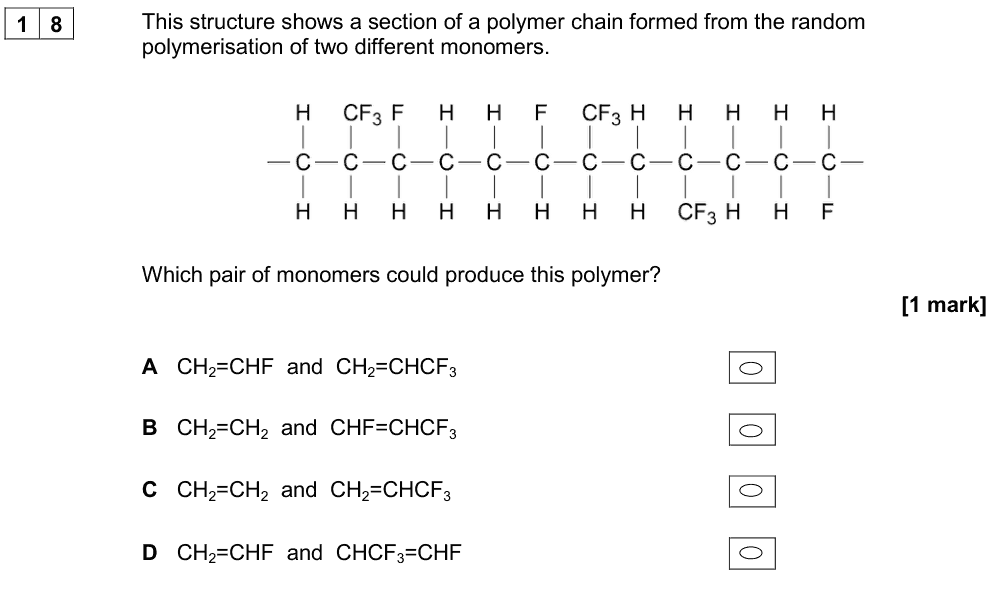
Answer
A
Mark scheme
Notes from the mark scheme and report
Answer: A. Splitting the chain into two-carbon units gives –CH2–CH(CF3)– and –CH2–CHF– units only
June 2016 · AS Paper 2 · Q03.72 marksPractical and data analysis
Earlier part of question 03 that this part uses
Mark scheme
Examiner's comment
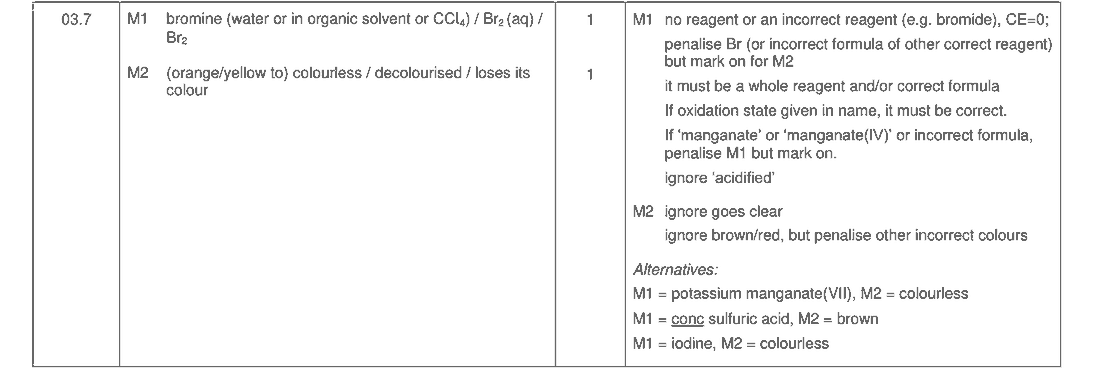
Many students in Q3.7 knew the use of bromine (water) to show that a compound is unsaturated, but some referred to the mixture going from orange to clear rather than colourless.
Notes from the mark scheme and report
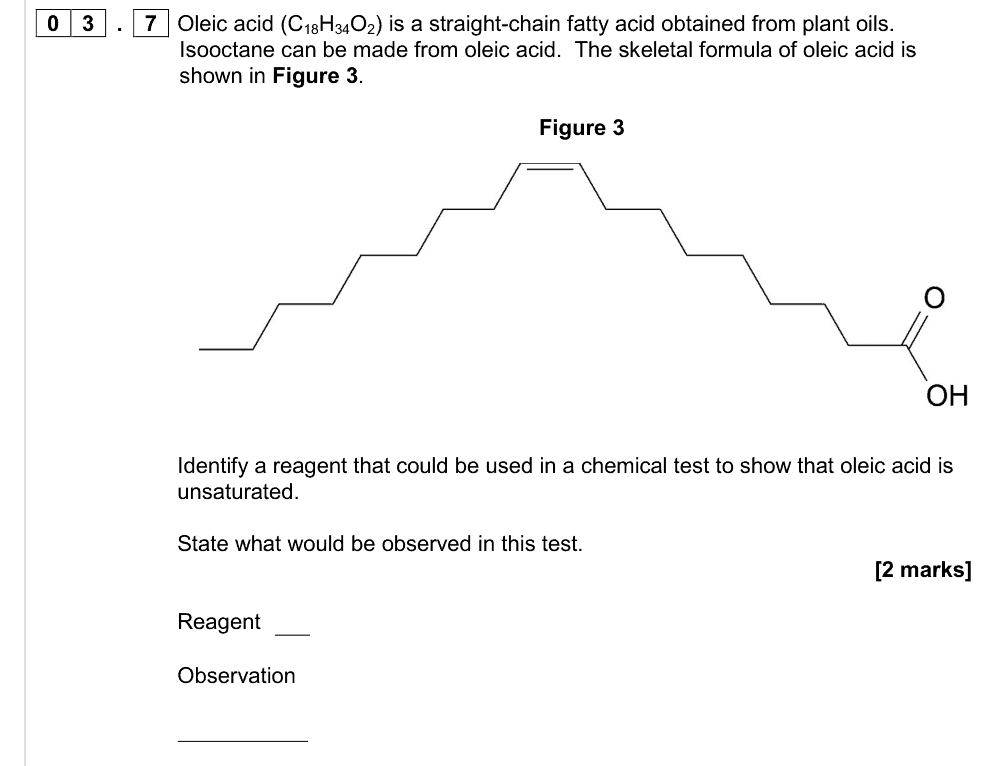
Bromine (water)
the orange / yellow solution is decolourised (turns colourless). 'Goes clear' is ignored and does not score
'bromide' or Br as the reagent is wrong. Alternative: acidified potassium manganate(VII), purple to colourless.
Skills: ATd Use laboratory apparatus for a variety of experimental techniques including: titration, using burette and pipette; distillation and heating under reflux, including setting up glassware using retort stand and clamps; qualitative tests for ions and organic functional groups; filtration, including use of fluted filter paper, or filtration under reduced pressure; PS4.1 Know and understand how to use a wide range of experimental and practical instruments, equipment and techniques appropriate to the knowledge and understanding included in the specification; RP6 Tests for alcohol, aldehyde, alkene and carboxylic acid
June 2016 · AS Paper 2 · Q07.27 marksMechanism
Earlier part of question 07 that this part uses
Mark scheme
Examiner's comment
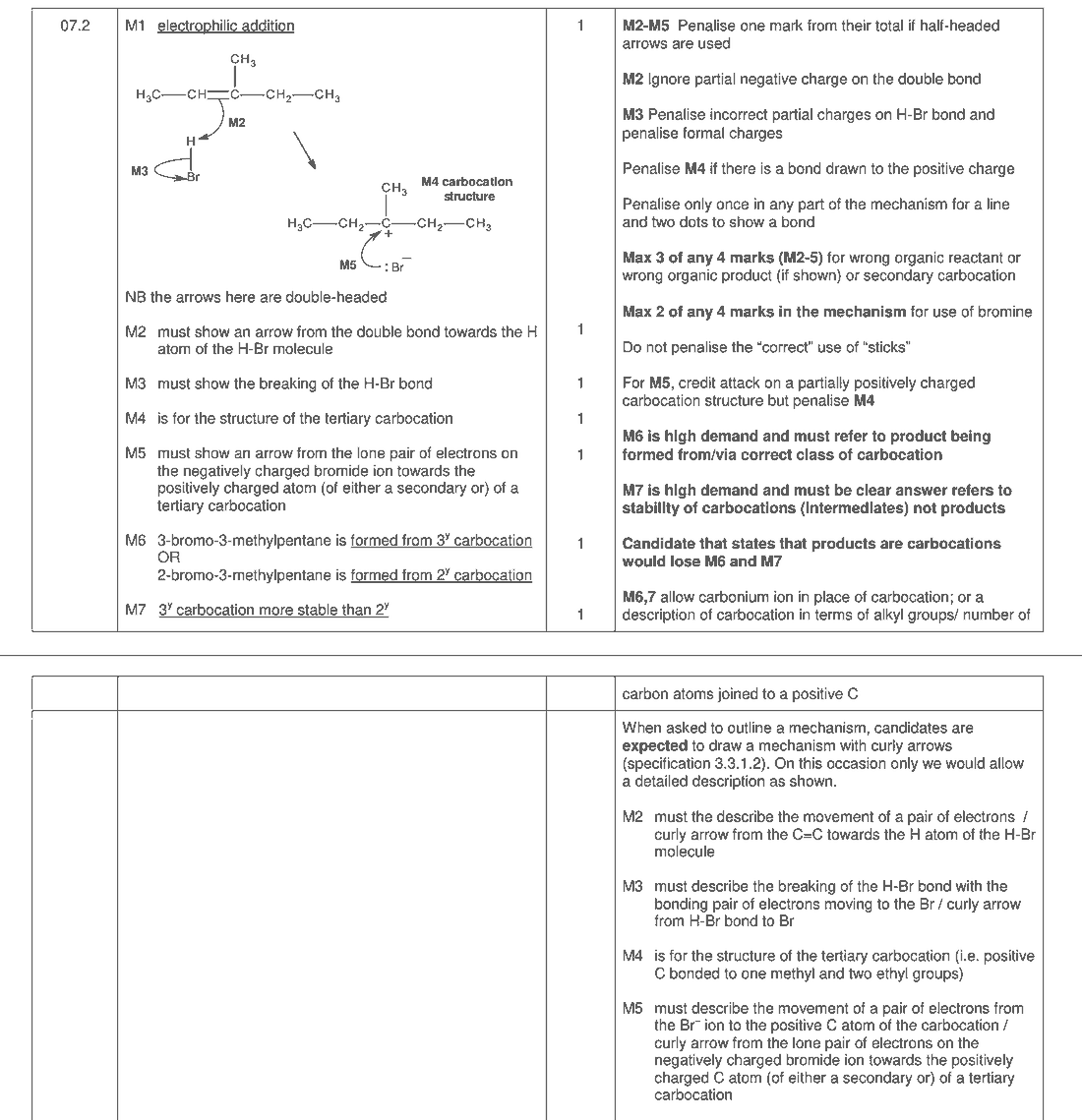
Many students did well on Q7.2, but a significant number attempted to describe the curly
Notes from the mark scheme and report
Electrophilic addition. Curly arrow from the C=C to the H of H–Br
arrow from the H–Br bond to Br
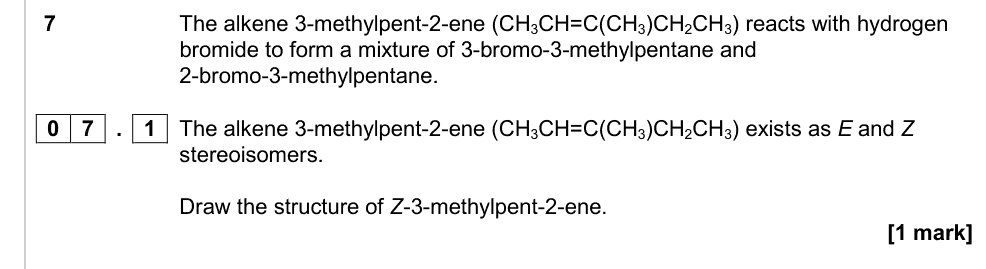
tertiary carbocation CH3CH2C+(CH3)CH2CH3
arrow from a lone pair on Br– to the C+. 3-bromo-3-methylpentane is formed via the tertiary carbocation (the 2-bromo isomer via a secondary one), and the tertiary carbocation is more stable than the secondary. The explanation must be about the stability of carbocations, not products.
June 2016 · AS Paper 2 · Q151 markMultiple choice
Answer
D
Mark scheme
Notes from the mark scheme and report
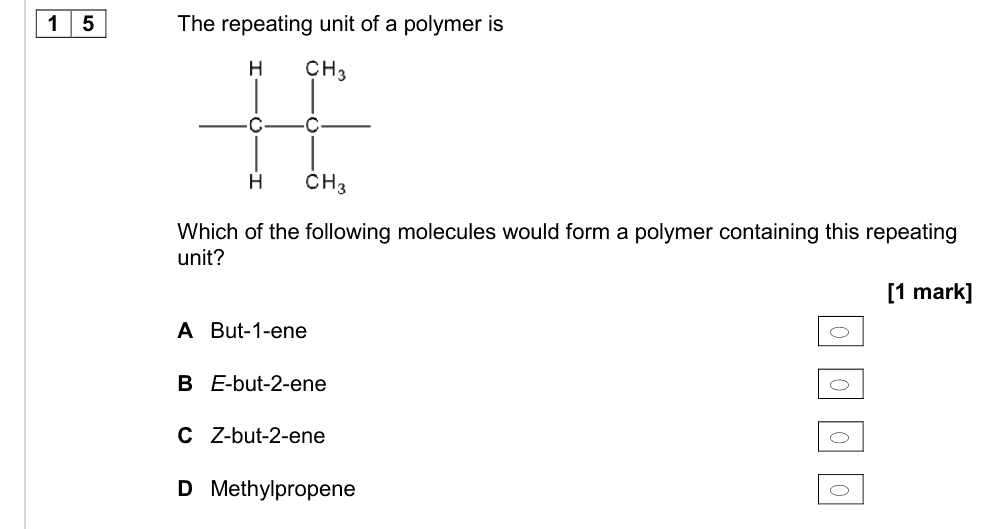
Answer: D. The repeating unit –CH2–C(CH3)2– has both methyl groups on the same carbon, so the monomer is CH2=C(CH3)2, methylpropene. But-2-ene would give one CH3 on each carbon
Specimen · Paper 2 · Q07.12 marksDiagram or structure
Mark scheme
Notes from the mark scheme and report
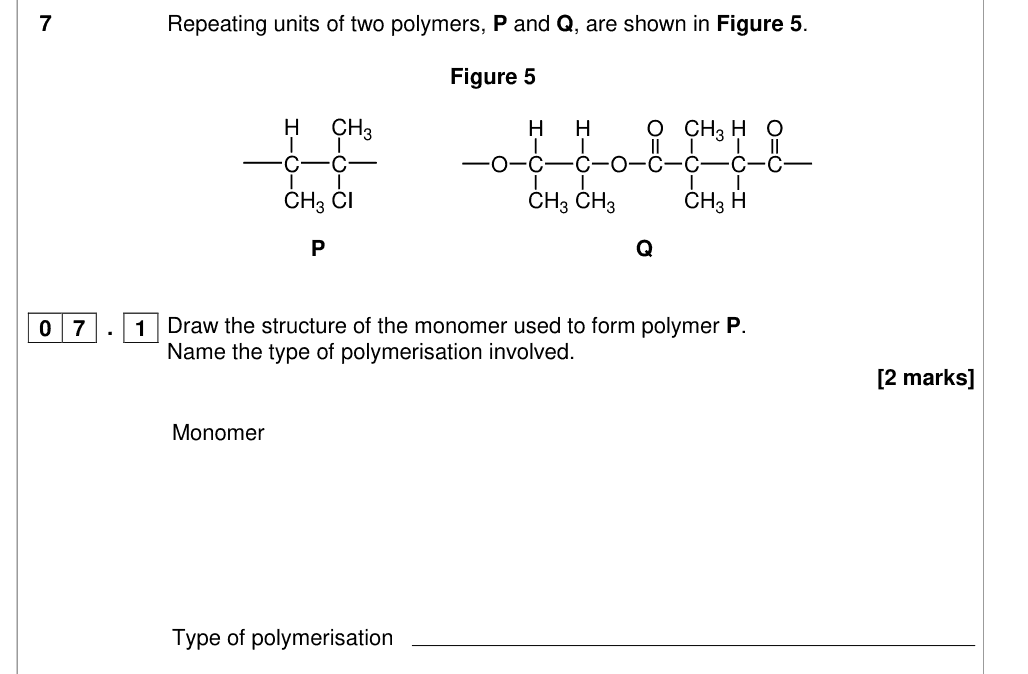
CH3CH=C(CH3)Cl (2-chlorobut-2-ene)
addition polymerisation.
Specimen · Paper 2 · Q12.11 markAO1=1Short answer
Mark scheme
Notes from the mark scheme and report
HBr (or HCl or H2SO4
allow HI)
Specimen · Paper 2 · Q12.25 marksMechanism
Earlier part of question 12 that this part uses
Mark scheme
Notes from the mark scheme and report
Electrophilic addition. M1 curly arrow from the C=C to the H of H–Br
M2 curly arrow from the H–Br bond to Br
M3 secondary carbocation CH3C+HCH2CH3
M4 curly arrow from the lone pair on Br– to C+. Product CH3CHBrCH2CH3. Consequential on the acid chosen in 12.1
Specimen · Paper 2 · Q12.33 marksExplanation
Earlier part of question 12 that this part uses
Mark scheme
Notes from the mark scheme and report
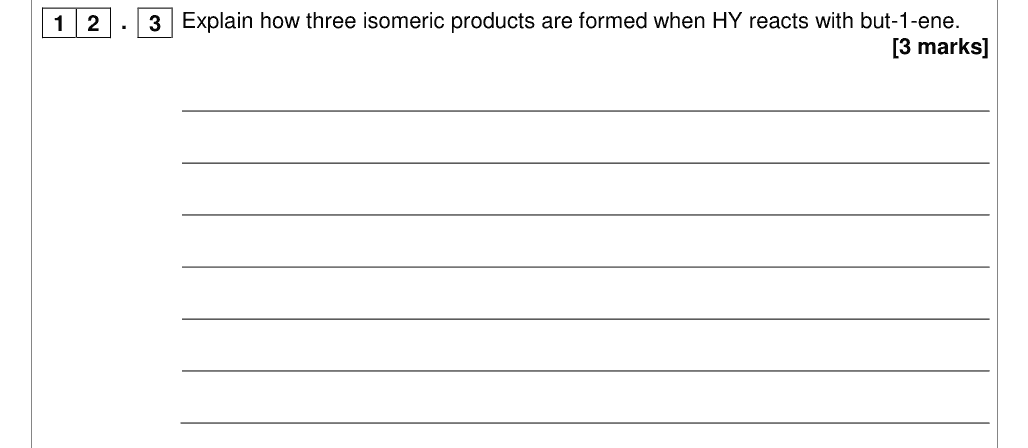
The major product (2-bromobutane) is chiral and exists as a pair of enantiomers
the third isomer is 1-bromobutane, the minor product, because it forms via the less stable primary carbocation
Specimen · Paper 3 · Q271 markAO3=1Multiple choice
Answer
C
Mark scheme
Notes from the mark scheme and report
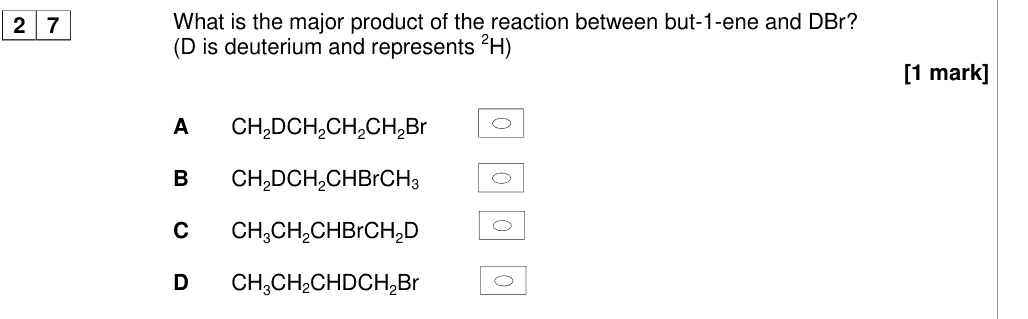
Answer: C. D+ adds to the CH2 end to give the more stable secondary carbocation
Br– then adds to C2: CH3CH2CHBrCH2D
Work with an A-level chemistry tutor
Dropping marks on calculations, mechanisms or the required practicals? Book a trial session with a specialist A-level chemistry tutor.