Notes and key-term cards for this topic are being written by our tutors. The past-paper questions below are ready now.
Specification statements
Show the 14 statements from the specification
3.3.2.1-01 Alkanes are saturated hydrocarbons.
3.3.2.1-02 Petroleum is a mixture consisting mainly of alkane hydrocarbons that can be separated by fractional distillation.
3.3.2.2-01 Cracking involves breaking C–C bonds in alkanes.
3.3.2.2-02 Thermal cracking takes place at high pressure and high temperature and produces a high percentage of alkenes (mechanism not required).
3.3.2.2-03 Catalytic cracking takes place at a slight pressure, high temperature and in the presence of a zeolite catalyst and is used mainly to produce motor fuels and aromatic hydrocarbons (mechanism not required).
3.3.2.2-04 Students should be able to: • explain the economic reasons for cracking alkanes.
3.3.2.3-01 Alkanes are used as fuels.
3.3.2.3-02 Combustion of alkanes and other organic compounds can be complete or incomplete.
3.3.2.3-03 The internal combustion engine produces a number of pollutants including NOx, CO, carbon and unburned hydrocarbons.
3.3.2.3-04 These gaseous pollutants from internal combustion engines can be removed using catalytic converters.
3.3.2.3-05 Combustion of hydrocarbons containing sulfur leads to sulfur dioxide that causes air pollution.
3.3.2.3-06 Students should be able to: • explain why sulfur dioxide can be removed from flue gases using calcium oxide or calcium carbonate.
3.3.2.4-01 The reaction of methane with chlorine.
3.3.2.4-02 Students should be able to: • explain this reaction as a free-radical substitution mechanism involving initiation, propagation and termination steps.
Tap a question to zoom it. Where a part needs a figure, table or structure from earlier in the question, that part folds out above it; the mark scheme and examiner's comment open underneath. Have AQA's Data Booklet (the Periodic Table and the spectroscopy tables) beside you.
June 2025 · Paper 2 · Q01.12 marksAO1=2Short answer
Mark scheme
Examiner's comment
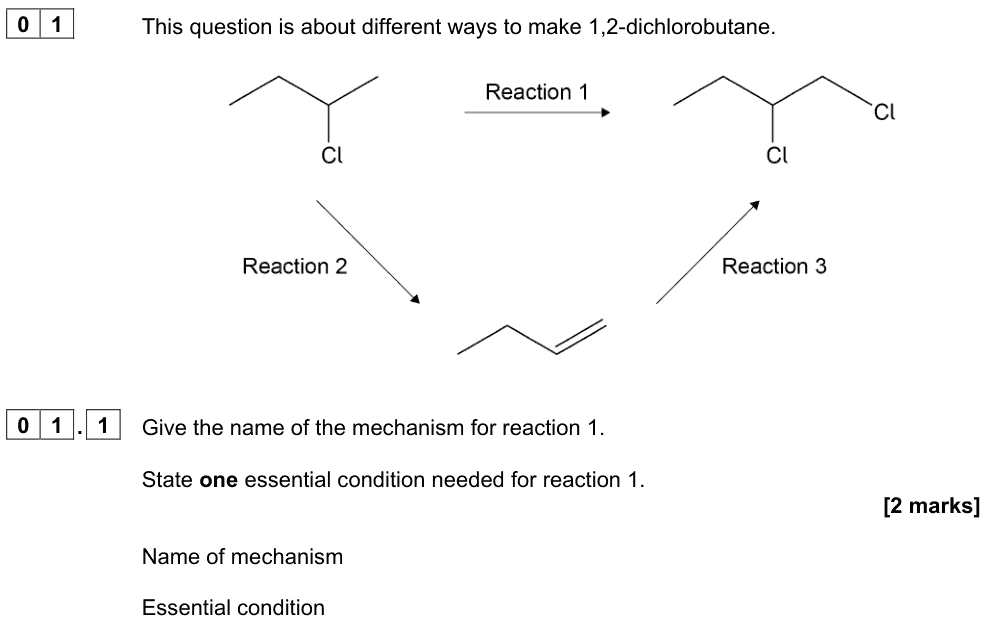
1.1 This question required students to recognize that free radical substitution was involved and requires UV light as the condition. It was well answered but those who failed to score often confused the reaction with nucleophilic substitution.
Notes from the mark scheme and report
(Free-)radical substitution
UV light (allow high temperature
heat/warm ignored). Common error: nucleophilic substitution
June 2025 · Paper 2 · Q01.23 marksAO2=3Equation writing
Earlier part of question 01 that this part uses
Mark scheme
Examiner's comment
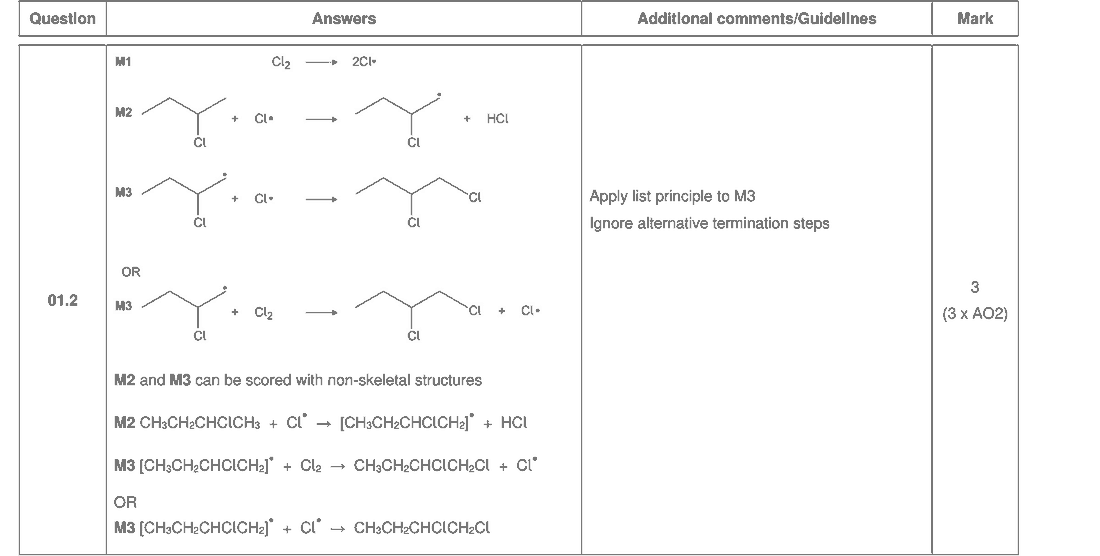
1.2 Students had to complete a radical substitution mechanism. Many did it well but few used the skeletal formulae expected. Students clearly prefer to translate skeletal structures into fully displayed or abbreviated structures. The most common error was to use molecular formulae which are ambiguous in terms of the position of substitution.
Notes from the mark scheme and report
Cl2 → 2Cl•
CH3CH2CHClCH3 + Cl• → CH3CH2CHClCH2• + HCl
CH3CH2CHClCH2• + Cl2 → CH3CH2CHClCH2Cl + Cl• (or termination with Cl•). Structural or skeletal formulas showing where substitution occurs are needed: molecular formulas are ambiguous
June 2025 · Paper 2 · Q01.32 marksAO1=2Short answer
Earlier part of question 01 that this part uses
Mark scheme
Examiner's comment
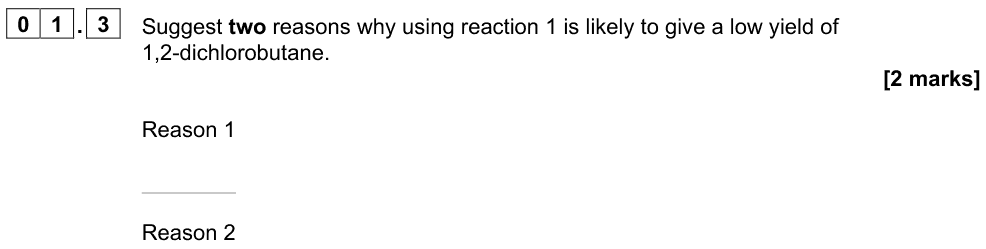
1.3 Students were asked to suggest why the yield from the radical substitution would be low. Good numbers recognized polysubstitution and the possibility of positional isomers. Those who did not score were often too vague referring to other products rather than giving specific types or examples.
Notes from the mark scheme and report
Any two: further substitution (polysubstitution)
substitution at other positions giving other isomers
radicals combining to give longer-chain products. 'Other products' alone is too vague
June 2025 · AS Paper 2 · Q06.91 markAO2=1Equation writing
Earlier part of question 06 that this part uses
Mark scheme
Examiner's comment
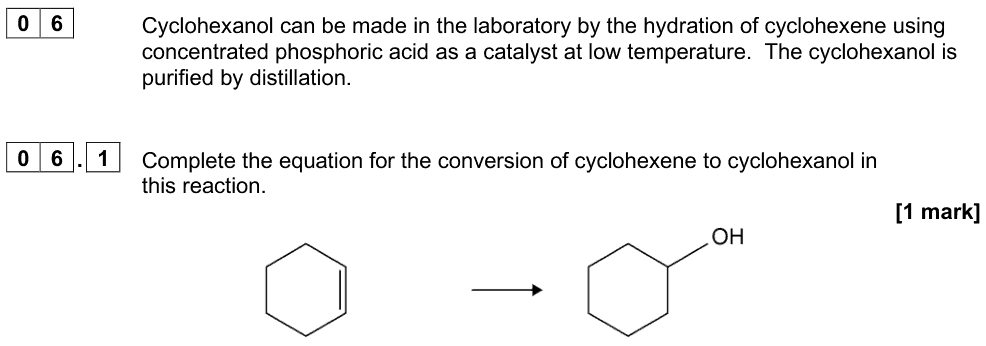
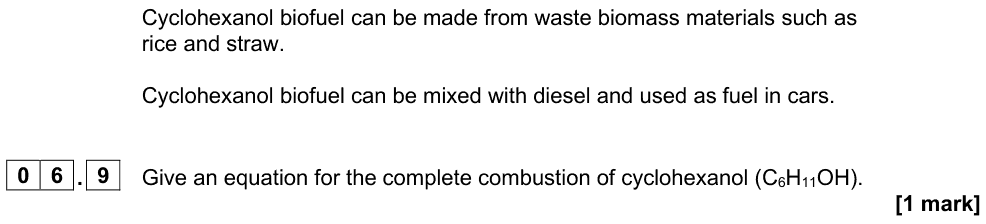
6.9 Many students could write an equation for the complete combustion of cyclohexanol.
Notes from the mark scheme and report
C6H11OH + 8½O2 → 6CO2 + 6H2O (multiples allowed)
June 2025 · AS Paper 2 · Q091 markAO1=1Multiple choice
Answer
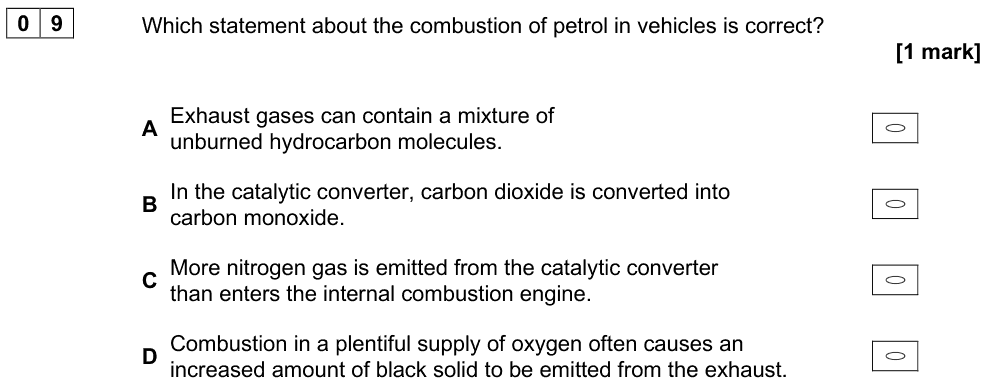
A
Mark scheme
Examiner's comment
Catalytic converters
This was answered correctly by a majority of students.
Notes from the mark scheme and report
Answer: A. Unburned hydrocarbons are among the pollutants in exhaust gases
converters turn CO into CO2 and NO into N2, and carbon (soot) comes from a limited oxygen supply
June 2025 · AS Paper 2 · Q101 markAO1=1Multiple choice
Answer
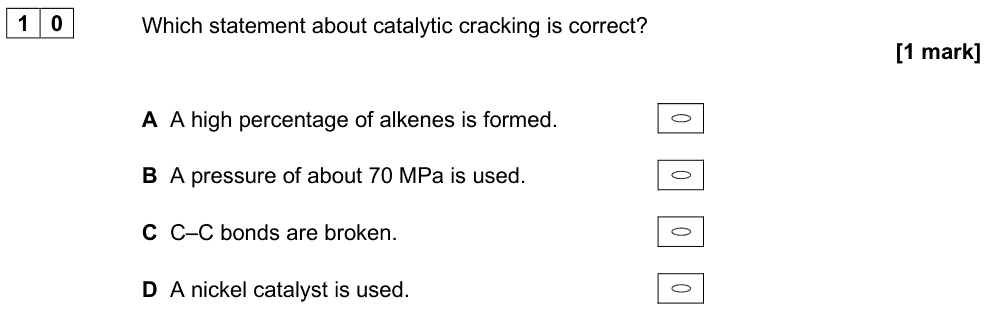
C
Mark scheme
Examiner's comment
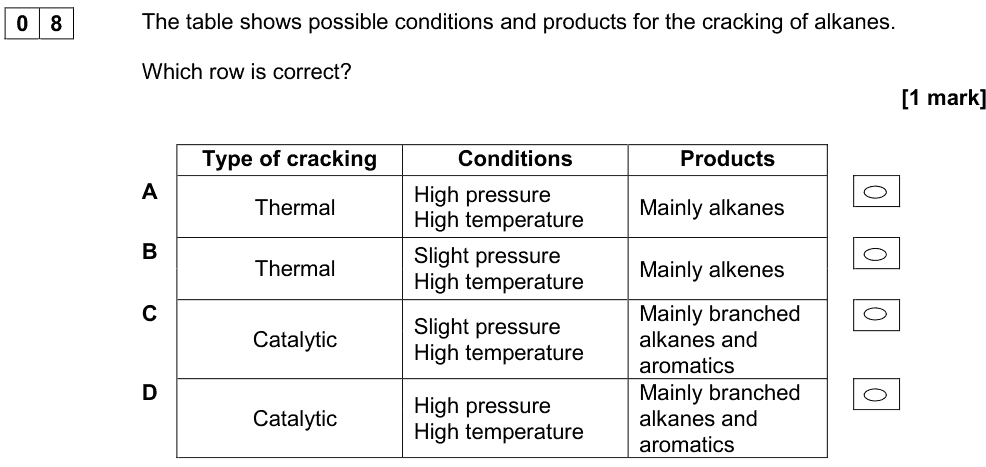
This was answered correctly by a majority of students, but many did mix up aspects with thermal cracking.
Notes from the mark scheme and report
Answer: C. All cracking breaks C–C bonds
a high percentage of alkenes and high pressure describe thermal cracking, and the catalyst is a zeolite
June 2025 · AS Paper 2 · Q161 markAO1=1Multiple choice
Answer
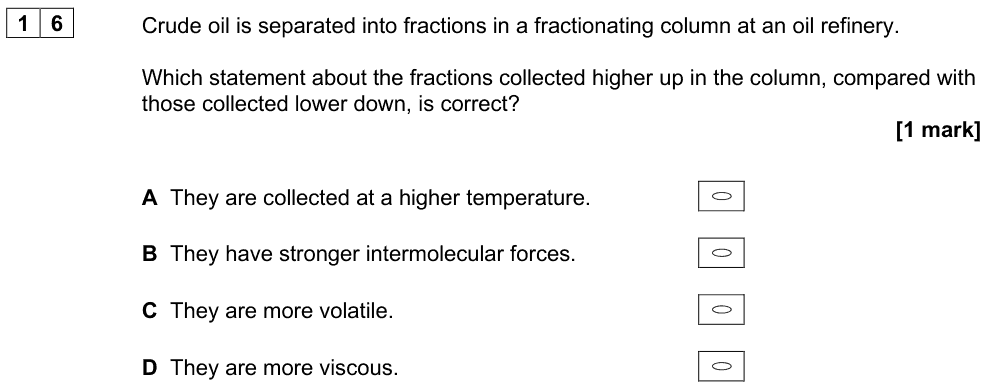
C
Mark scheme
Notes from the mark scheme and report
Answer: C. Fractions collected higher up have smaller molecules with weaker intermolecular forces and lower boiling points, so they are more volatile
June 2025 · AS Paper 2 · Q211 markAO2=1Multiple choice
Answer
B
Mark scheme
Examiner's comment
This was answered correctly by a majority of students.
Notes from the mark scheme and report
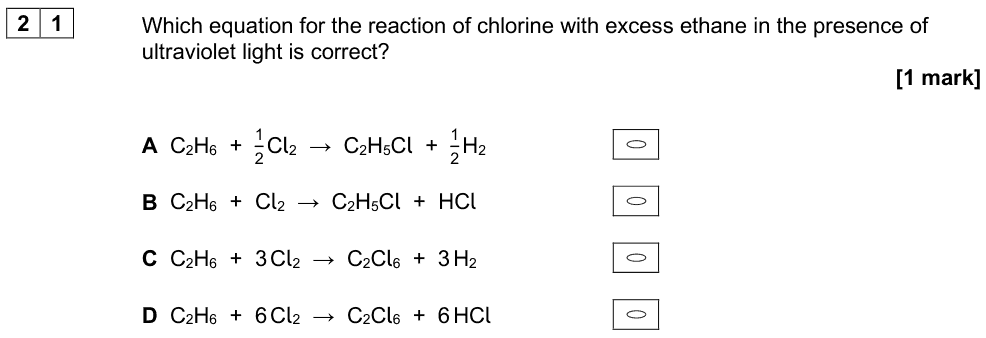
Answer: B. With excess ethane, substitution of one H: C2H6 + Cl2 → C2H5Cl + HCl
June 2025 · Paper 3 · Q281 markAO1=1Multiple choice
Answer
A
Mark scheme
Notes from the mark scheme and report
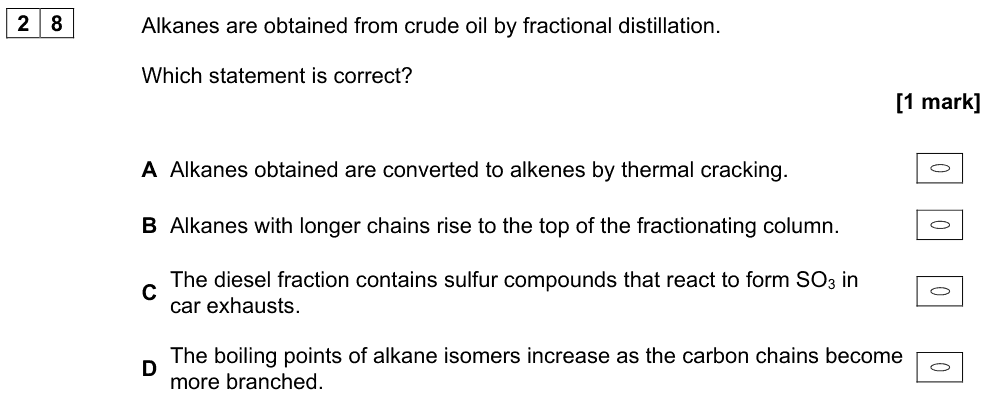
Answer: A. Thermal cracking gives a high proportion of alkenes. Longer chains stay lower in the column, sulfur burns to SO2, and branching lowers boiling points
June 2024 · Paper 2 · Q03.12 marksAO1=2Equation writing
Mark scheme
Examiner's comment
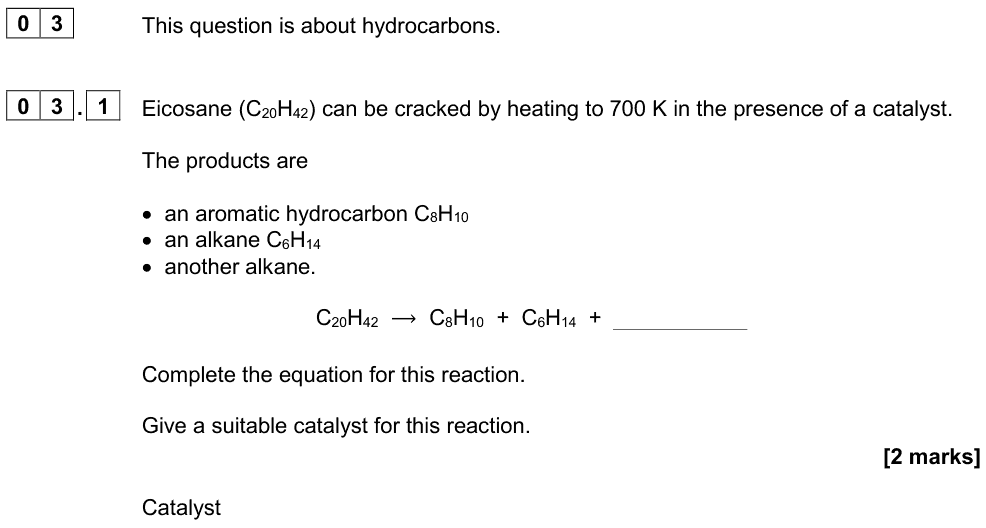
3.1 A surprising number of students gave C6H18 as their answer for M1 when the correct answer was 3C2H6. Clearly those students had simply deduced the number of carbon and hydrogen atoms needed to balance the equation, without considering if their answer was a viable compound. The second mark was well known.
Notes from the mark scheme and report
+ 3C2H6
catalyst: zeolite (aluminosilicate / aluminium oxide). C6H18 was a common wrong answer: it balances but is not a possible alkane
June 2024 · AS Paper 2 · Q03.22 marksAO2=2Equation writing
Earlier part of question 03 that this part uses
Mark scheme
Examiner's comment
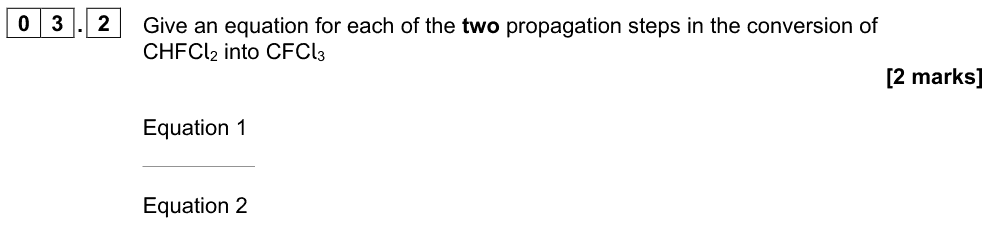
3.2 Students did this question quite well, showing two propagation steps in the production of CFCl3 by free radical substitution.
Notes from the mark scheme and report
CHFCl2 + Cl• → •CFCl2 + HCl, then •CFCl2 + Cl2 → CFCl3 + Cl•. Two otherwise correct equations without dots score 1
June 2024 · Paper 2 · Q03.31 markAO1=1Short answerEasy
Earlier part of question 03 that this part uses
Mark scheme
Examiner's comment
3.3 This was well known and over 70% scored the mark for alkenes.
Notes from the mark scheme and report
Answer: alkenes (thermal cracking)
June 2024 · Paper 2 · Q03.52 marksAO1=2Short answer
Earlier part of question 03 that this part uses
Mark scheme
Examiner's comment
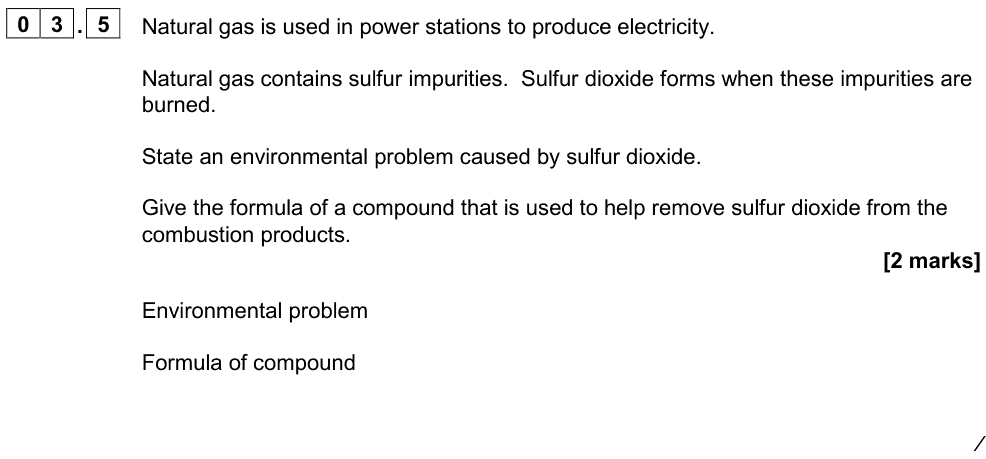
3.5 The vast majority scored at least 1 of these two marks. Acid rain was very well known.
Notes from the mark scheme and report
Acid rain (allow damage to limestone buildings, death of aquatic life)
CaO or CaCO3
June 2024 · AS Paper 2 · Q05.22 marksAO2=2Calculation
Earlier part of question 05 that this part uses
Mark scheme
Examiner's comment
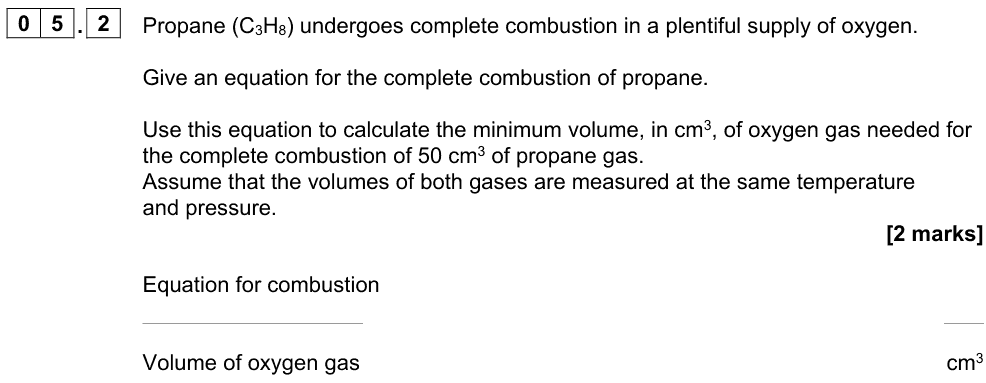
5.2 Students did well on this question. Most could write the balanced equation for the complete combustion of propane, and most could then use this to find the volume of oxygen reacting.
Notes from the mark scheme and report
Answer: 250 cm3. C3H8 + 5O2 → 3CO2 + 4H2O
gas volumes are in the same ratio as moles, so 5 × 50 cm3
Skills: MS0.2 Use ratios, fractions and percentages
June 2024 · AS Paper 2 · Q141 markAO1=1Multiple choice
Answer
B
Mark scheme
Examiner's comment
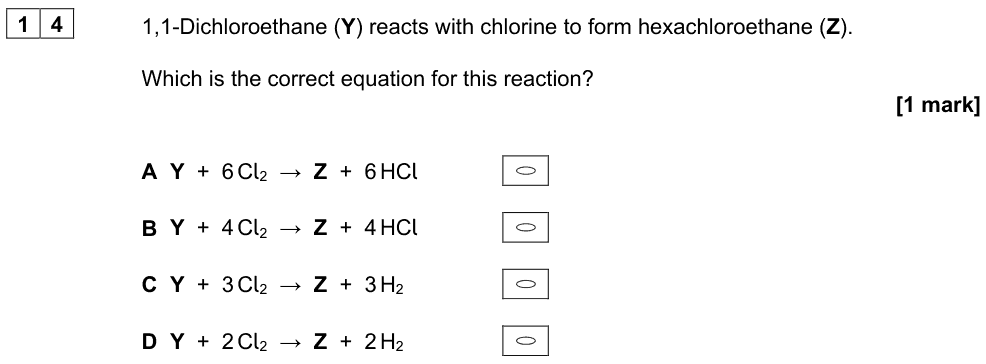
Students found this question difficult, with confusion about whether H2 or HCl is a by-product.
Notes from the mark scheme and report
Answer: B. CH3CHCl2 has four H atoms
each is substituted by Cl with one HCl formed per Cl2 used: C2H4Cl2 + 4Cl2 → C2Cl6 + 4HCl. Confusion over H2 or HCl as the by-product
June 2024 · AS Paper 2 · Q161 markAO2=1Multiple choiceEasy
Answer
B
Mark scheme
Examiner's comment
This was answered correctly by a majority (74.2%) of students.
Notes from the mark scheme and report
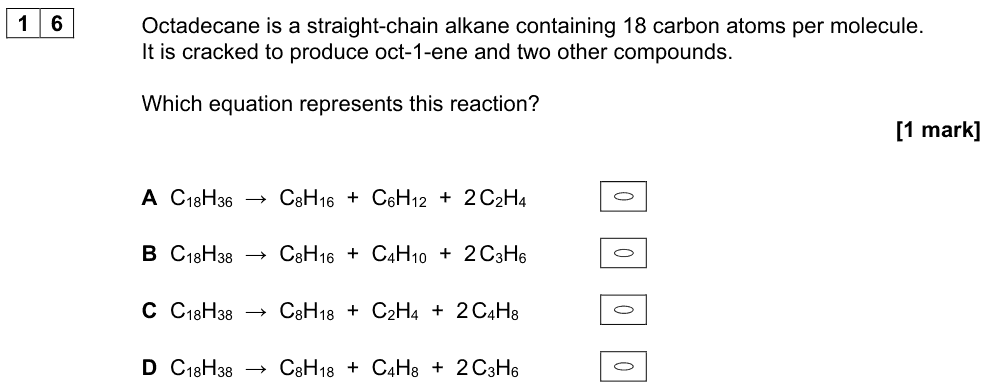
Answer: B. Octadecane is C18H38 and oct-1-ene is C8H16
C8H16 + C4H10 + 2C3H6 balances. A starts from C18H36
C and D give octane, C8H18
June 2023 · AS Paper 2 · Q02.11 markAO1=1Short answer
Mark scheme
Examiner's comment
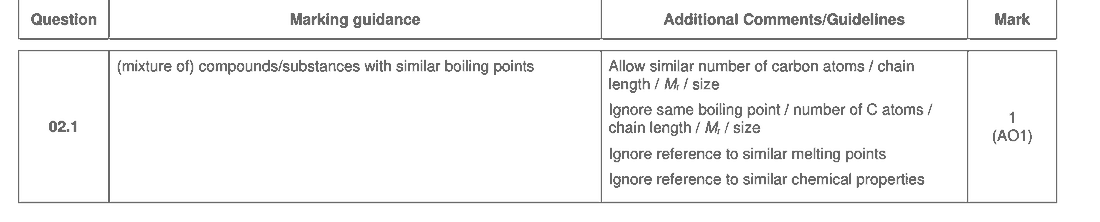
02.1 Students struggled to define the term ‘fraction’.
Notes from the mark scheme and report
A mixture of compounds with similar boiling points (allow similar chain length / number of carbon atoms / Mr). 'Same' boiling point is ignored. Poorly defined by students
June 2023 · AS Paper 2 · Q02.21 markAO1=1Short answer
Earlier part of question 02 that this part uses
Mark scheme
Examiner's comment
02.2 The catalyst used in catalytic cracking was well known.
Notes from the mark scheme and report
Zeolite (aluminosilicate). Aluminium oxide is ignored
June 2023 · AS Paper 2 · Q02.42 marksAO1=2Equation writing
Earlier part of question 02 that this part uses
Mark scheme
Examiner's comment
02.4 Students determined the molecular formula of a compound from its name / skeletal formula and then wrote a balanced equation for its complete combustion. Many students struggled to determine the correct molecular formula but could write a balanced equation for the complete combustion using their formula.
Notes from the mark scheme and report
C9H20 + 14O2 → 9CO2 + 10H2O. One mark for the molecular formula C9H20, one for the balanced equation (error carried forward from a wrong hydrocarbon formula). Many got the molecular formula wrong
June 2023 · AS Paper 2 · Q02.62 marksAO1=2Short answer
Earlier part of question 02 that this part uses
Mark scheme
Examiner's comment
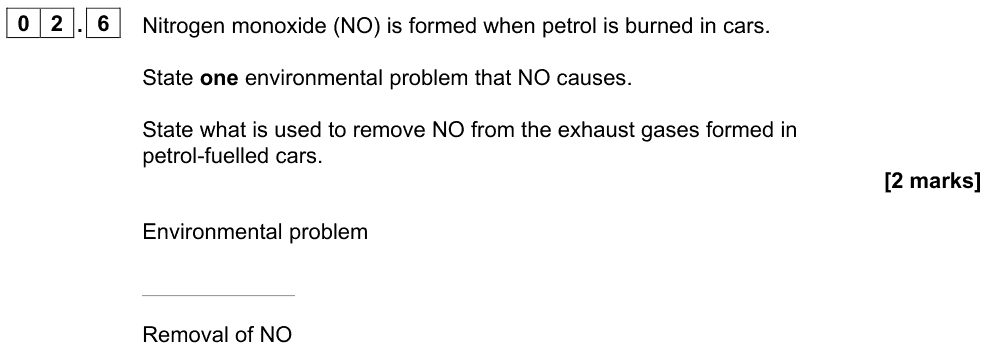
02.6 Students knew well the problem caused by NO pollution and how NO is removed from the exhaust gases of petrol-fuelled cars.
June 2023 · Paper 2 · Q08.52 marksAO3=2Short answer
Earlier parts of question 08 that this part uses
Mark scheme
Examiner's comment
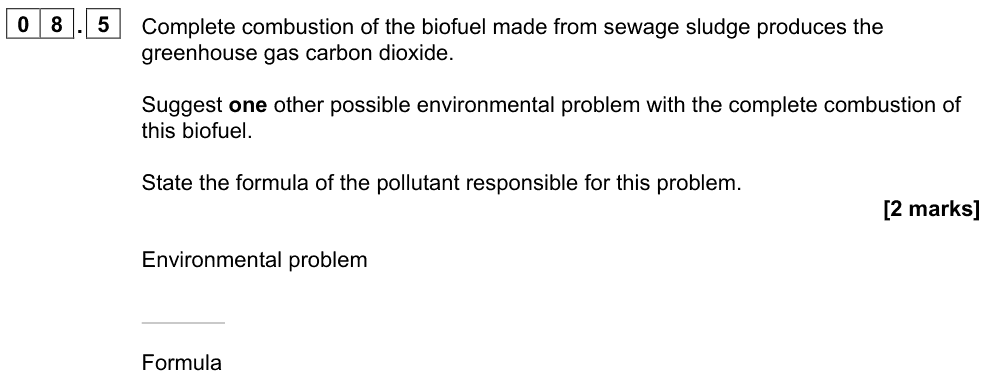
08.5 Acid rain and SO2 were well known and a large number of students scored both marks here.
Notes from the mark scheme and report
Acid rain
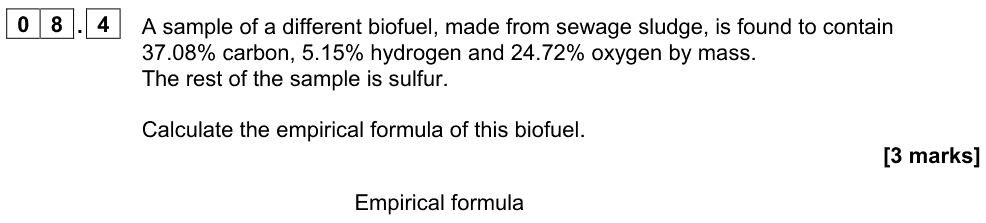
SO2 (the biofuel contains sulfur). Smog and NOx also allowed. Uses the composition given in 08.4
June 2023 · AS Paper 2 · Q101 markAO1=1Multiple choiceEasy
Answer
C
Mark scheme
Examiner's comment
This was answered correctly by the vast majority (84%) of students.
Notes from the mark scheme and report
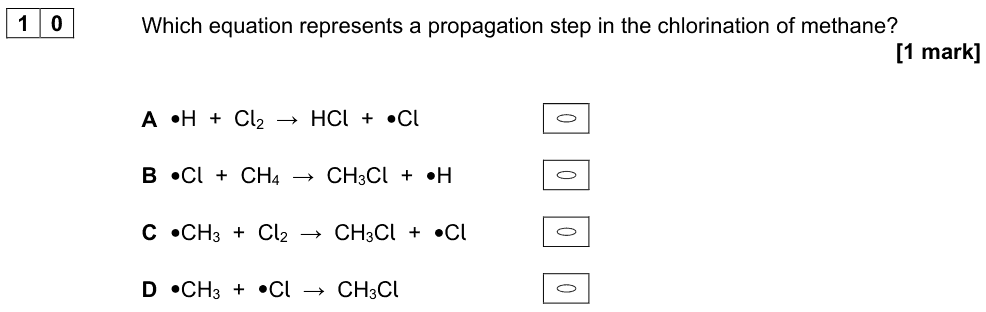
Answer: C. •CH3 + Cl2 → CH3Cl + •Cl uses one radical and makes another
D is termination
hydrogen radicals are not formed
June 2023 · AS Paper 2 · Q111 markAO1=1Multiple choice
Answer
C
Mark scheme
Examiner's comment
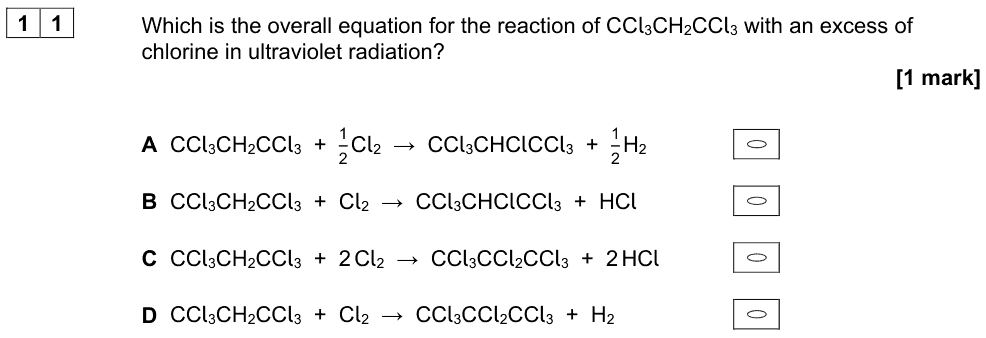
Students struggled with this question, with many believing that hydrogen is a product.
Notes from the mark scheme and report
Answer: C. Excess chlorine substitutes both hydrogens and each substitution releases HCl (not H2): 2Cl2 gives CCl3CCl2CCl3 + 2HCl. Many thought hydrogen was a product
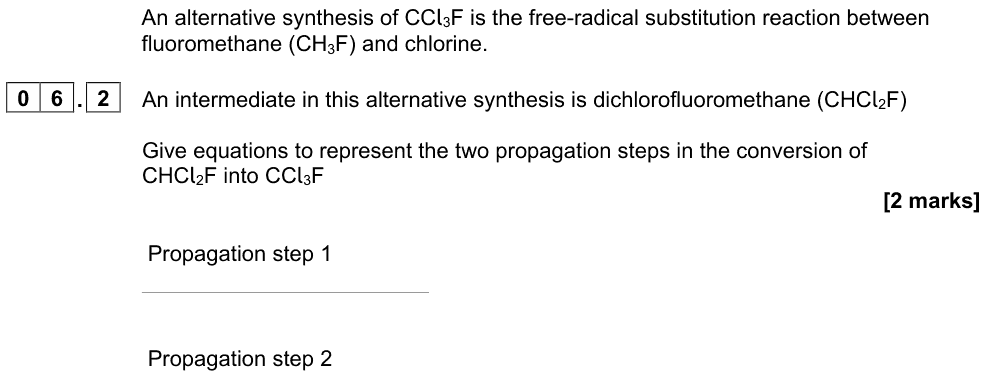
June 2022 · AS Paper 2 · Q06.22 marksAO2=2Equation writing
Earlier part of question 06 that this part uses
Mark scheme
Examiner's comment
6.2 This question required students to write a pair of propagation steps. Many could do this but a significant number did not appreciate the underlying principles of these pairs of propagation steps where the first step uses a free radical that is then reformed in the second step.
Notes from the mark scheme and report
CHCl2F + •Cl → •CCl2F + HCl
•CCl2F + Cl2 → CCl3F + •Cl. Missing radical dots penalised once. Many did not see that the radical used in the first step is re-formed in the second
June 2022 · AS Paper 2 · Q06.31 markAO3=1Equation writing
Earlier parts of question 06 that this part uses
Mark scheme
Examiner's comment
6.3 This question required students to write an equation for a termination step. Students found this challenging and many did not give the structural formula of the product as required by the question.
Notes from the mark scheme and report
2 •CCl2F → CCl2FCCl2F. The structural formula of the product must be shown
many gave only a molecular formula
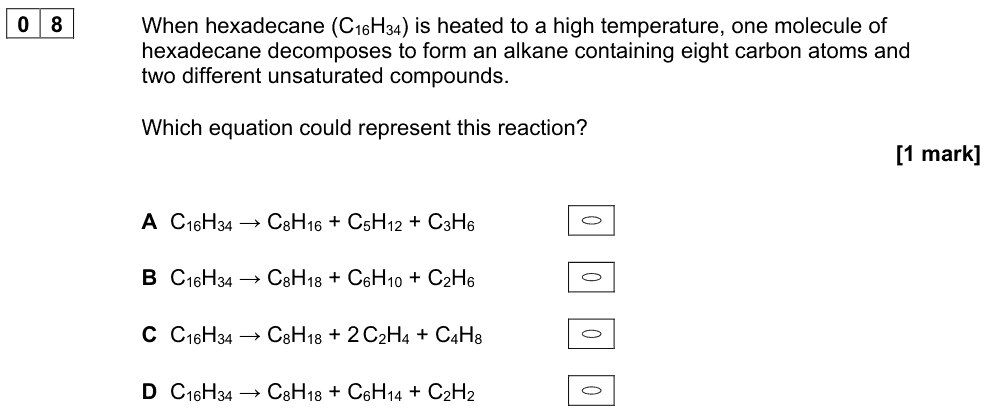
June 2022 · AS Paper 2 · Q081 markAO2=1Multiple choiceEasy
Answer
C
Mark scheme
Examiner's comment
Cracking
This was answered correctly by a majority of students (68.9%).
Notes from the mark scheme and report
Answer: C. C8H18 is the alkane with eight carbons and C2H4 and C4H8 are two different alkenes
the atoms balance
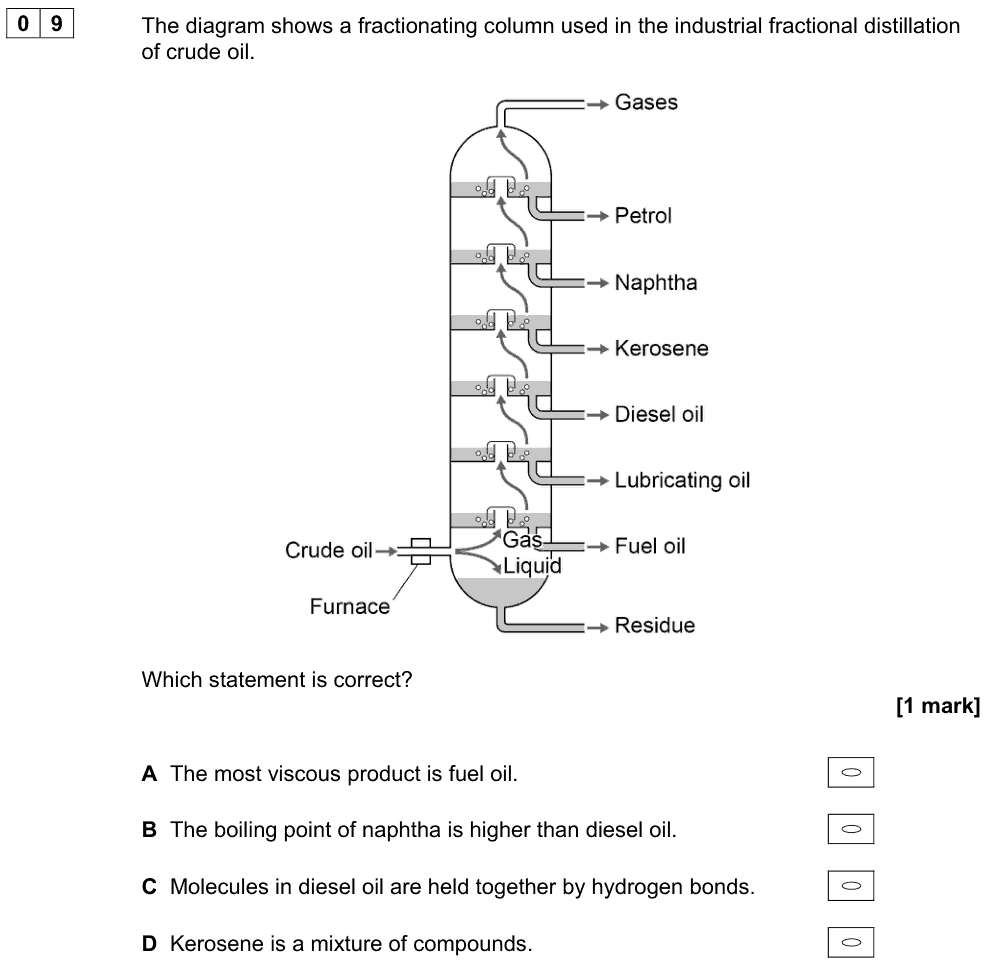
June 2022 · AS Paper 2 · Q091 markAO1=1Multiple choice
Answer
D
Mark scheme
Examiner's comment
Fractional distillation
Many students incorrectly thought that the fuel oil was more viscous than the residue, or perhaps did not realise there was any residue. Only 36.5% of students gained the mark.
Notes from the mark scheme and report
Answer: D. Each fraction is a mixture of compounds with similar boiling points. Many chose fuel oil as the most viscous product, overlooking the residue
June 2022 · Paper 2 · Q10.32 marksAO1=2Short answer
Earlier part of question 10 that this part uses
Mark scheme
Examiner's comment
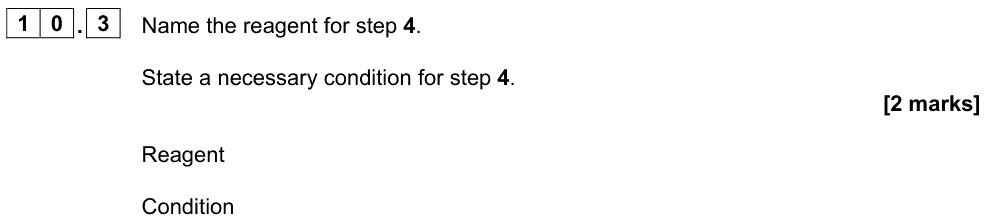
10.3 Most students scored at least one mark but ultraviolet light as a necessary condition was often incorrect or omitted.
Notes from the mark scheme and report
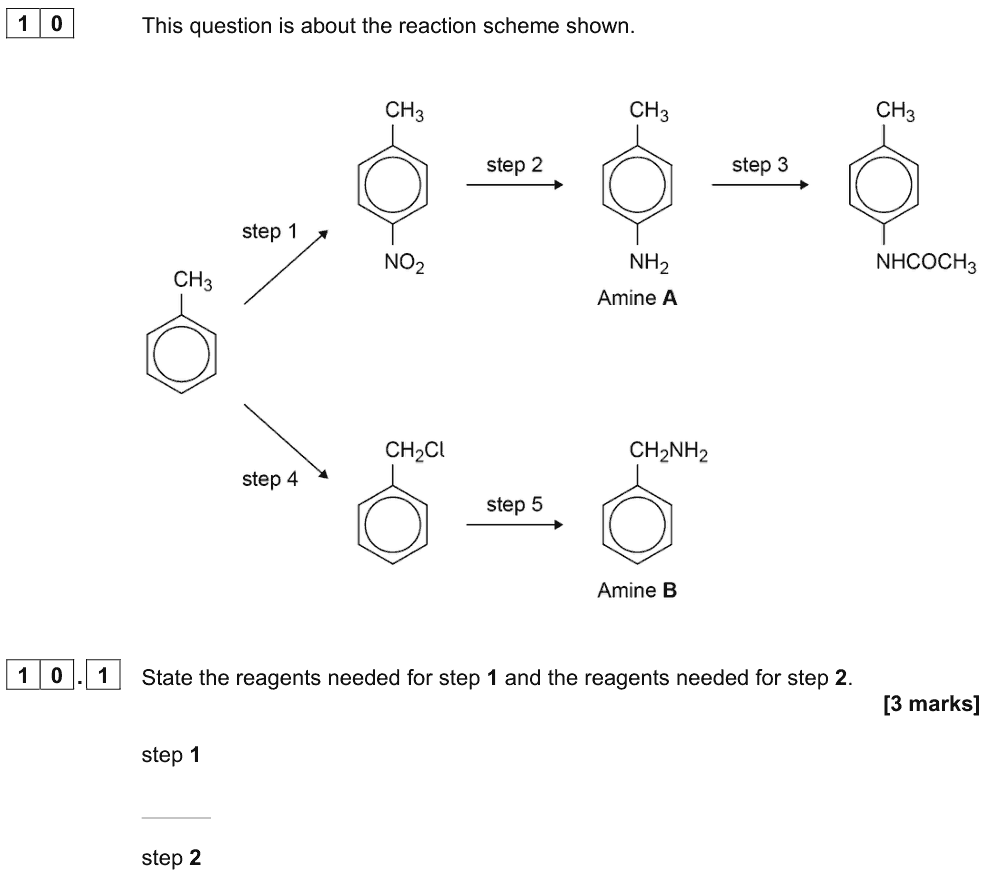
Reagent: chlorine. Condition: ultraviolet light (allow sunlight or high temperature). UV was often wrong or missing
June 2022 · Paper 3 · Q05.12 marksAO1=1, AO2=1Short answer
Mark scheme
Examiner's comment
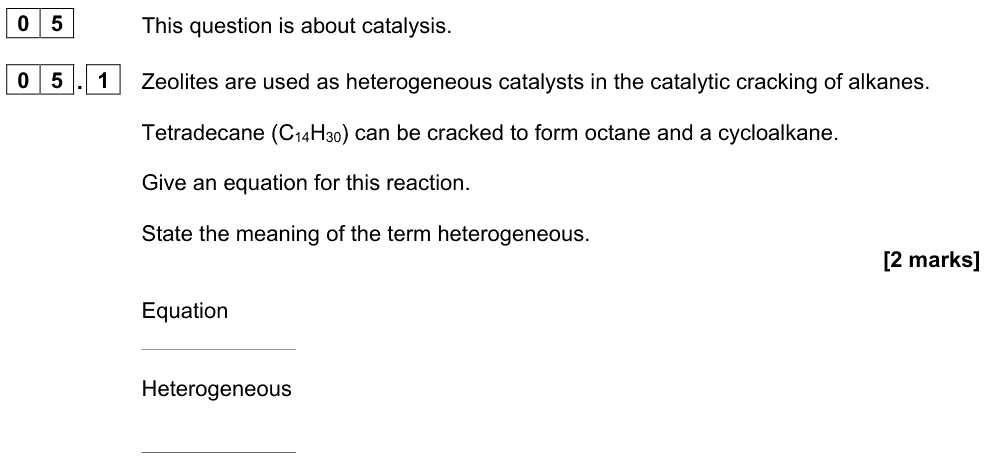
05.1 was well answered by most students.
Notes from the mark scheme and report
C14H30 → C8H18 + C6H12 (or C8H18 + 2C3H6). Heterogeneous: the catalyst is in a different phase (state) from the reactants
June 2022 · Paper 3 · Q221 markAO2=1Multiple choice
Answer
C
Mark scheme
Notes from the mark scheme and report
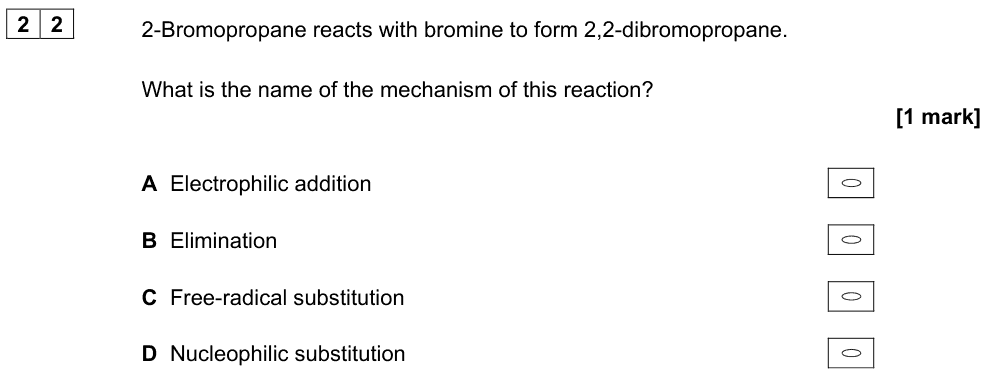
Answer: C. An H on a saturated carbon is replaced by Br (as in the halogenation of alkanes), so free-radical substitution
November 2021 · Paper 2 · Q02.11 markShort answer
Mark scheme
Examiner's comment
In this question a surprisingly small proportion of students were able to state the meaning of the term fraction. In addition, very few were able to explain why C=O bonds in carbon dioxide absorb infrared radiation. A good range of answers was seen for the extended response question about the environmental impact of bioethanol as a fuel, but a significant number of students were unable to get started here.
Notes from the mark scheme and report
A group of hydrocarbons (compounds) with similar boiling points / that boil over a similar temperature range (or of similar chain length, C5 to C12). A surprisingly small proportion could state this
November 2021 · Paper 2 · Q02.23 marksEquation writing
Earlier part of question 02 that this part uses
Mark scheme
Examiner's comment
In this question a surprisingly small proportion of students were able to state the meaning of the term fraction. In addition, very few were able to explain why C=O bonds in carbon dioxide absorb infrared radiation. A good range of answers was seen for the extended response question about the environmental impact of bioethanol as a fuel, but a significant number of students were unable to get started here.
Notes from the mark scheme and report
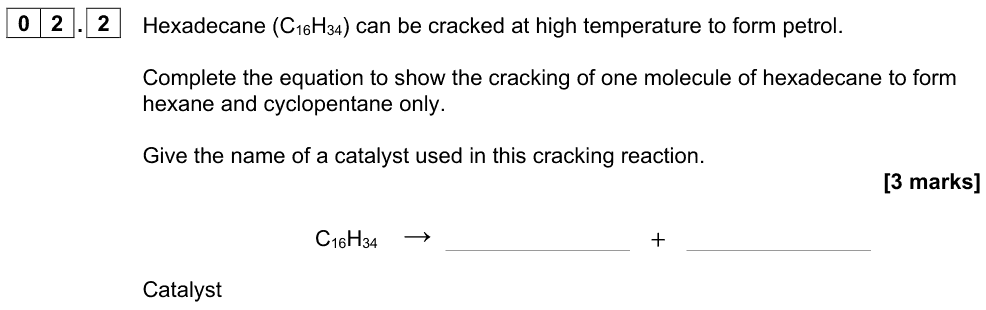
C16H34 → C6H14 + 2C5H10 (one mark for the formulas, one for balancing)
catalyst: zeolite (allow aluminosilicate or aluminium oxide)
November 2021 · AS Paper 2 · Q05.16 marksShort answer
Mark scheme
Notes from the mark scheme and report
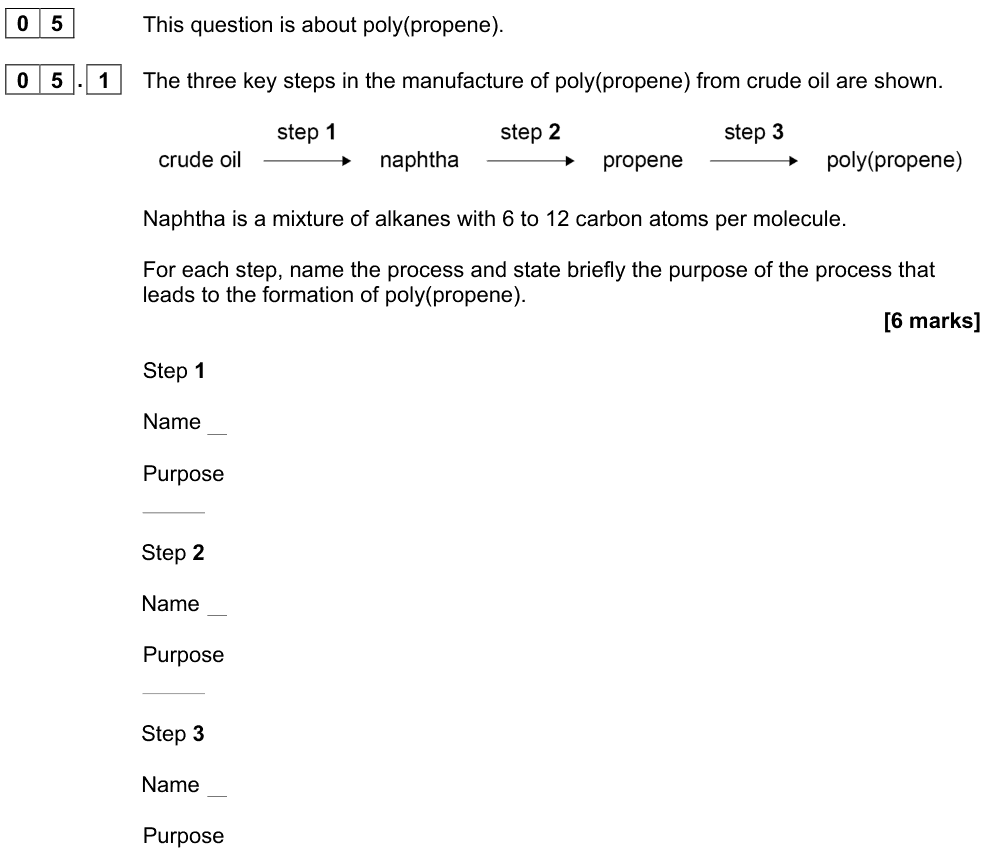
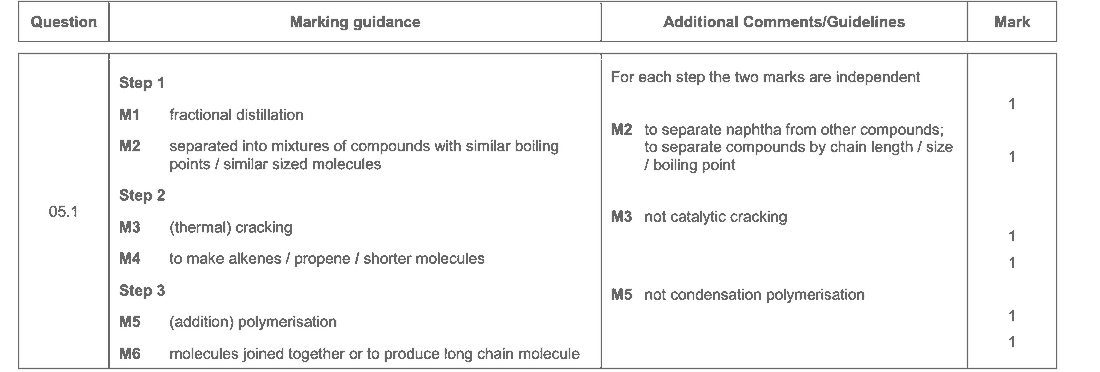
Step 1 fractional distillation: separates crude oil into fractions of similar boiling point / chain length (to obtain naphtha). Step 2 (thermal) cracking, not catalytic: makes alkenes / propene / shorter molecules. Step 3 (addition) polymerisation, not condensation: joins propene molecules into long chains. Name and purpose marked independently
November 2021 · Paper 2 · Q09.43 marksEquation writing
Earlier part of question 09 that this part uses
Mark scheme
Examiner's comment
Many also scored good marks on question 09.4 by being able to derive equations for novel propagation steps.
Notes from the mark scheme and report
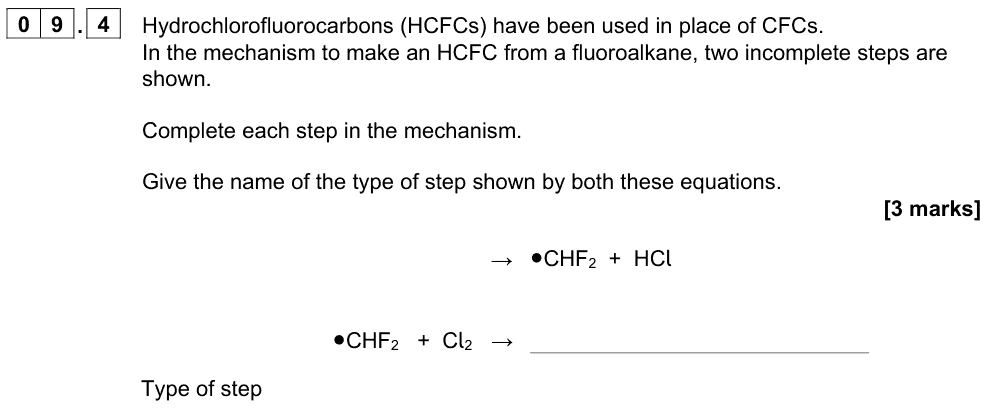
Cl• + CH2F2 → •CHF2 + HCl
•CHF2 + Cl2 → CHClF2 + Cl•
both are propagation steps. A missing dot is penalised once only
November 2021 · AS Paper 2 · Q121 markMultiple choice
Answer
D
Mark scheme
Notes from the mark scheme and report
Answer: D. •CH3 + Cl2 → CH3Cl + Cl• uses one radical and regenerates another
H• is not formed in this mechanism and C is termination
November 2021 · AS Paper 2 · Q221 markMultiple choice
Answer
A
Mark scheme
Notes from the mark scheme and report
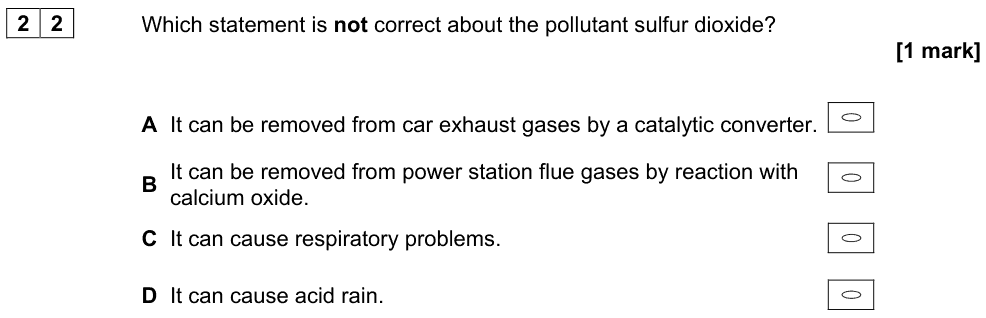
Answer: A. Catalytic converters remove NOx, CO and unburned hydrocarbons, not sulfur dioxide
SO2 is removed from flue gases with calcium oxide and causes acid rain and breathing problems
November 2021 · Paper 3 · Q251 markMultiple choice
Answer
B
Mark scheme
Notes from the mark scheme and report
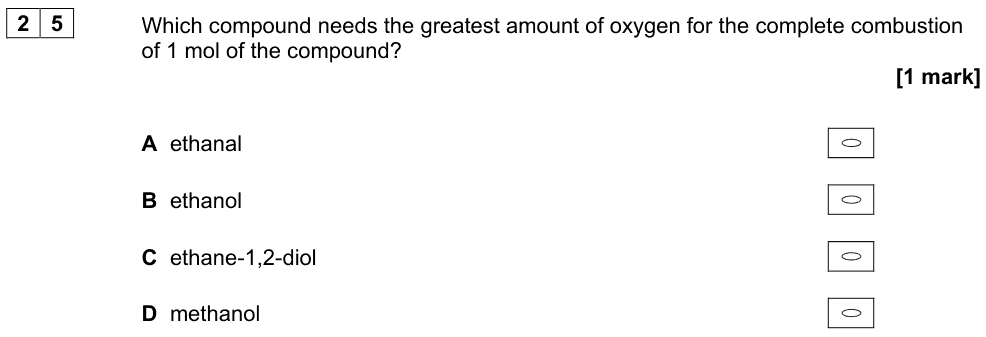
Answer: B. Ethanol needs 3 mol O2
ethanal and ethane-1,2-diol need 2.5 mol and methanol 1.5 mol (report: one of five items answered correctly by fewer than 40%)
Skills: MS0.2 Use ratios, fractions and percentages
November 2020 · AS Paper 2 · Q01.33 marksEquation writing
Earlier part of question 01 that this part uses
Mark scheme
Notes from the mark scheme and report
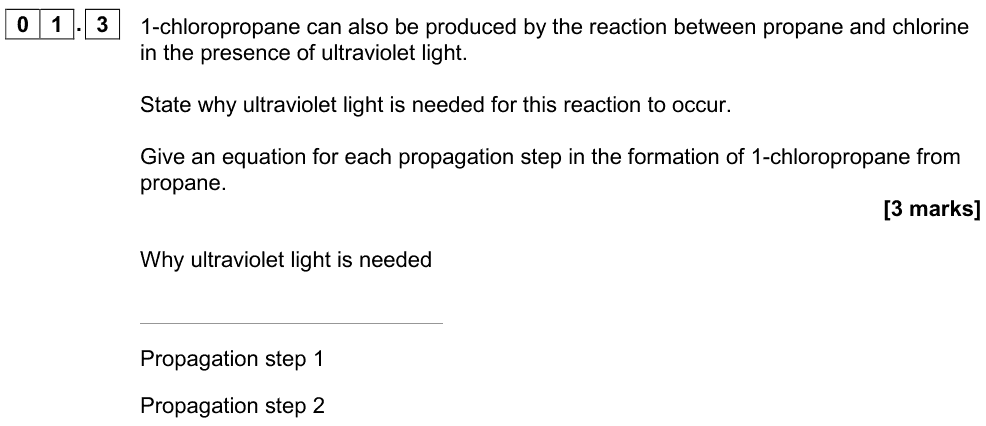
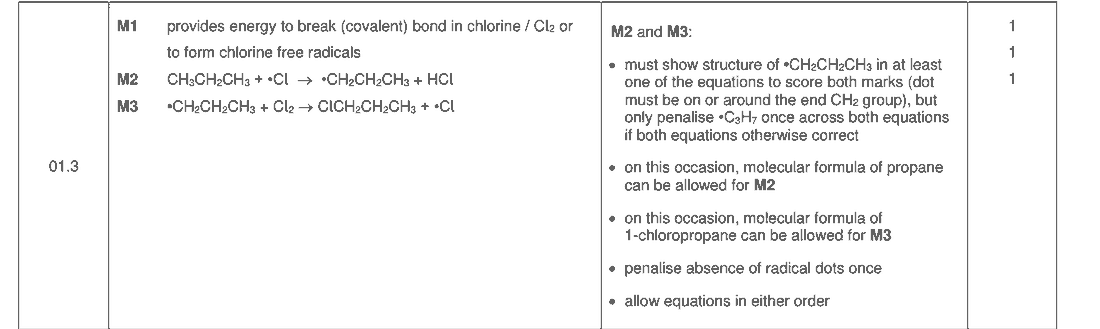
UV light provides the energy to break the Cl–Cl bond / form chlorine radicals. CH3CH2CH3 + •Cl → •CH2CH2CH3 + HCl
•CH2CH2CH3 + Cl2 → ClCH2CH2CH3 + •Cl. The radical must be shown as •CH2CH2CH3 (dot on the end carbon), not •C3H7
missing radical dots penalised once
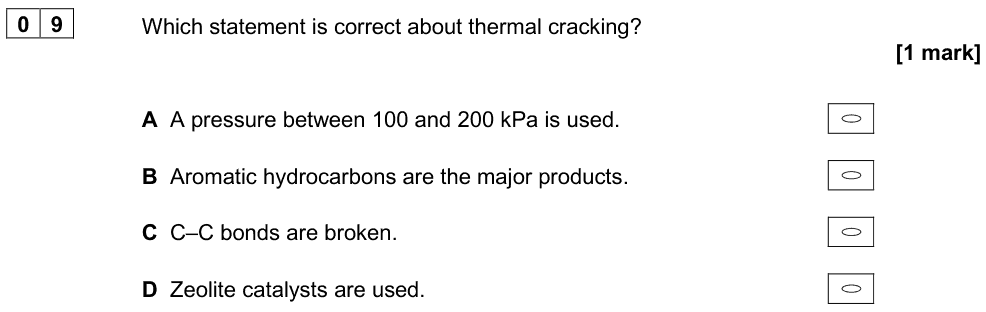
November 2020 · AS Paper 2 · Q091 markMultiple choice
Answer
C
Mark scheme
Notes from the mark scheme and report
Answer: C. All cracking breaks C–C bonds
slight pressure, zeolite catalysts and aromatic products belong to catalytic cracking
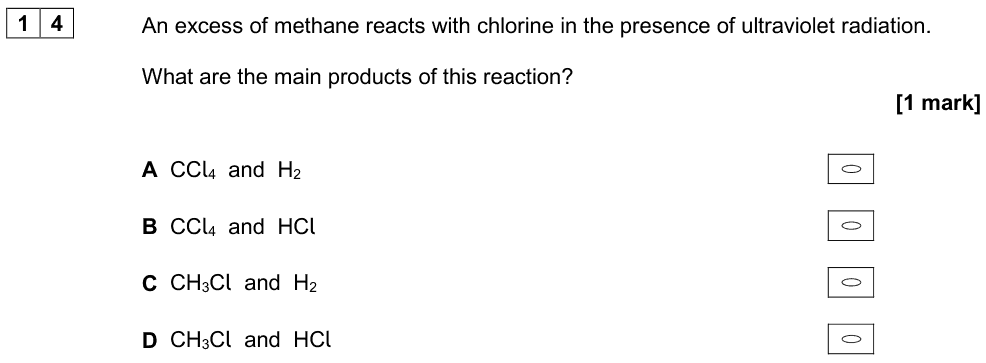
November 2020 · AS Paper 2 · Q141 markMultiple choice
Answer
D
Mark scheme
Notes from the mark scheme and report
Answer: D. With excess methane further substitution is unlikely, so the products are chloromethane and hydrogen chloride
November 2020 · Paper 3 · Q01.12 marksExplanation
Mark scheme
Examiner's comment
01.1 proved trickier than expected with about one third of students failing to score any marks.
There was confusion about the origin of the nitrogen and a frequent failure to mention the importance of high temperature.
Notes from the mark scheme and report
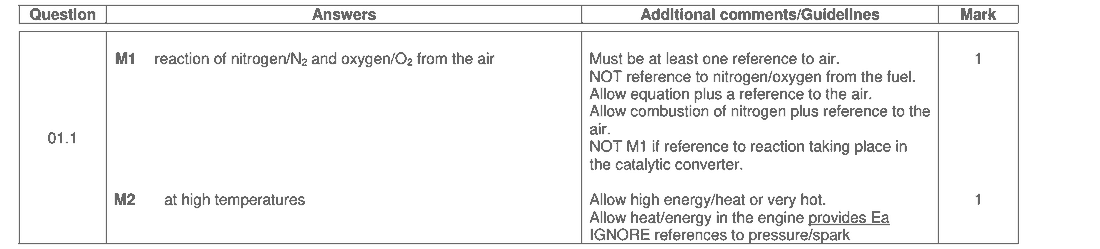
Nitrogen and oxygen from the air react
at the high temperature in the engine. Must refer to the air: the nitrogen does not come from the fuel. About one third scored 0
the high temperature was often left out
November 2020 · Paper 3 · Q01.21 markShort answer
Earlier part of question 01 that this part uses
Mark scheme
Examiner's comment
In 01.2, the expected answers were acid rain or respiratory problems although ‘toxic’ was allowed.
Many students referred incorrectly to global warming or a greenhouse gas.
Notes from the mark scheme and report
They form acid rain / cause respiratory problems (allow toxic, photochemical smog). Global warming, greenhouse gas and ozone layer are ignored and were common
November 2020 · Paper 3 · Q01.51 markShort answer
Earlier part of question 01 that this part uses
Mark scheme
Examiner's comment
In 01.5, most students recognised that production of carbon particulates is due to incomplete combustion.
Notes from the mark scheme and report
Incomplete combustion (not enough oxygen)
November 2020 · Paper 3 · Q231 markMultiple choice
Answer
C
Mark scheme
Notes from the mark scheme and report
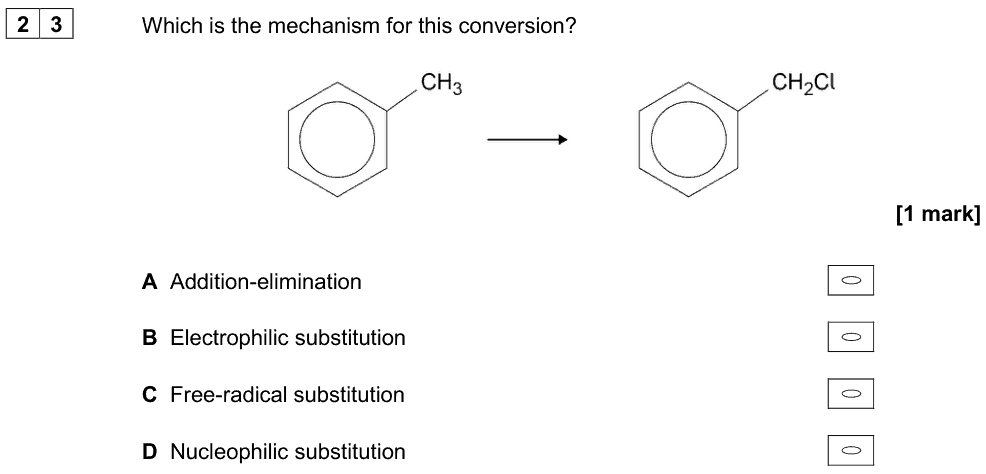
Answer: C. An H of the methyl side chain (an alkane-like C–H) is replaced by Cl: free-radical substitution with chlorine in UV light
the ring is not attacked
June 2019 · AS Paper 2 · Q04.11 markEquation writing
Mark scheme
Examiner's comment
4.1 Most students could write the equation for the complete combustion of octane.
Notes from the mark scheme and report
C8H18 + 12½O2 → 8CO2 + 9H2O (multiples allowed)
June 2019 · AS Paper 2 · Q04.21 markEquation writing
Earlier part of question 04 that this part uses
Mark scheme
Examiner's comment
4.2 An equation for the removal of NO in a catalytic converter was not well known.
Notes from the mark scheme and report
2NO + 2CO → N2 + 2CO2 (or 2NO → N2 + O2, or 25NO + C8H18 → 12½N2 + 8CO2 + 9H2O). Not well known
June 2019 · Paper 2 · Q11.41 markEquation writing
Earlier part of question 11 that this part uses
Mark scheme
Examiner's comment
11.4 The non-integral moles of oxygen, coupled with the fact that there are two oxygen atoms in the structure of the ester, made this question a good discriminator. The main error was to write 27½ mol of oxygen, forgetting the two oxygen atoms in the ester molecule.
Notes from the mark scheme and report
C19H34O2 + 26½O2 → 19CO2 + 17H2O (allow doubled). Main error: 27½O2, forgetting the two oxygen atoms in the ester
June 2019 · AS Paper 2 · Q151 markMultiple choice
Answer
D
Mark scheme
Examiner's comment
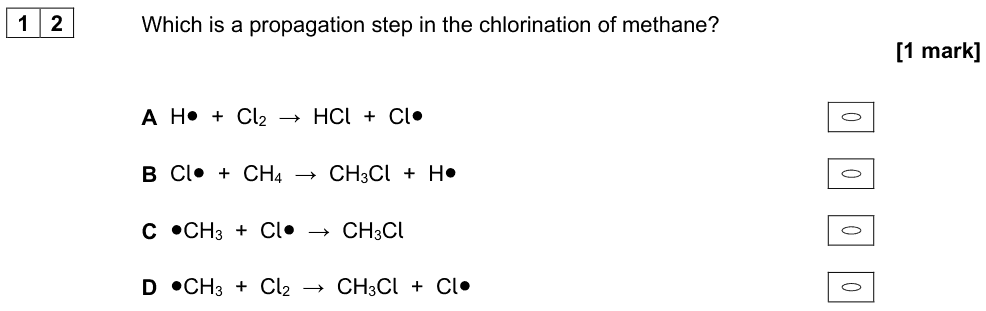
Most students could identify a propagation step from the options.
Notes from the mark scheme and report
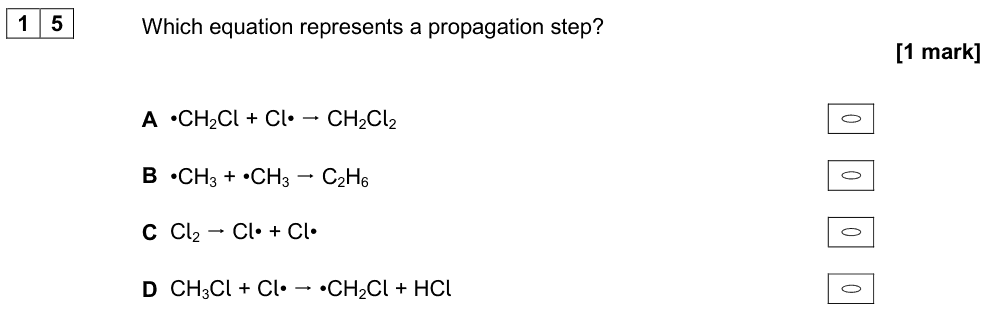
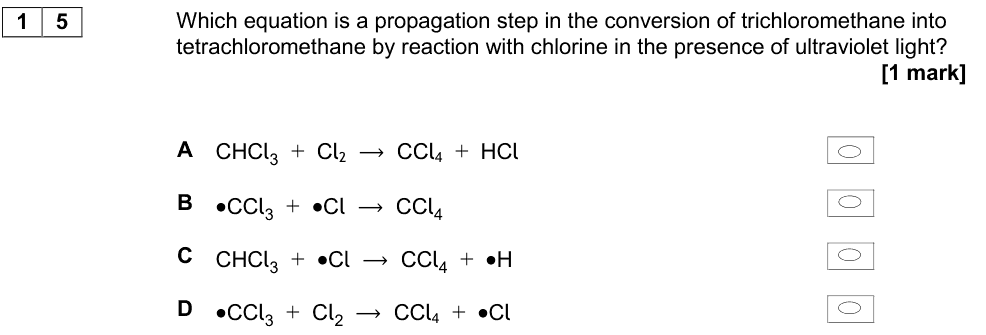
Answer: D. A radical reacts with a molecule to give a new radical
A and B are termination, C is initiation
June 2018 · Paper 2 · Q01.11 markEquation writingEasy
Mark scheme
Examiner's comment
01.1 The equation was an easy starter and 90.1% of the students gained the mark.
Notes from the mark scheme and report
C7H16 + 11O2 → 7CO2 + 8H2O
June 2018 · Paper 2 · Q01.23 marksShort answer
Earlier part of question 01 that this part uses
Mark scheme
Examiner's comment
01.2 Most students were able to give a correct catalyst and the correct equation. However, the pressure condition was not answered well. Low or high pressure were common wrong answers and there were some contradictions. Although temperature was not required, it was sometimes given.
Notes from the mark scheme and report
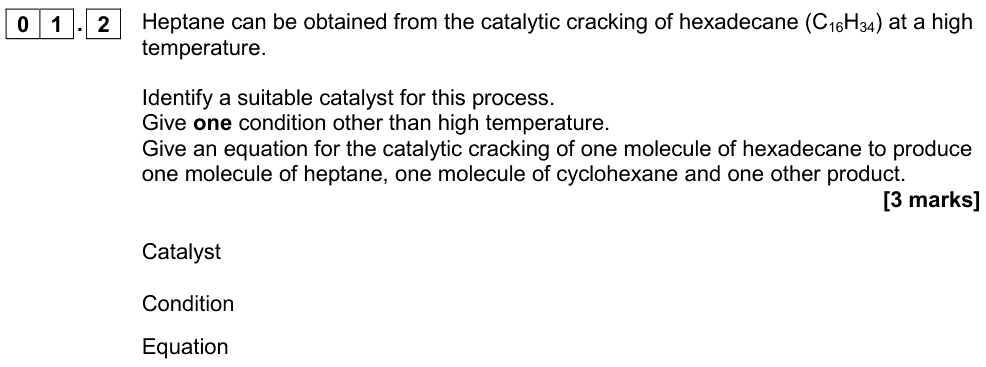
Catalyst: zeolite (aluminosilicate). Condition: slight / moderate pressure (just above atmospheric). C16H34 → C7H16 + C6H12 + C3H6. 'High pressure' and 'low pressure' were common wrong conditions
June 2018 · Paper 2 · Q01.32 marksEquation writing
Earlier part of question 01 that this part uses
Mark scheme
Examiner's comment
01.3 Only the better students scored both marks, but nearly two-thirds of the students scored one out of two. Common errors were to give the ambiguous radical, C4H9
Notes from the mark scheme and report
Cl• + CH3CH2CH2CH3 → CH3CH2•CHCH3 + HCl
CH3CH2•CHCH3 + Cl2 → CH3CH2CHClCH3 + Cl•. The radical dot must be on the second carbon
the ambiguous radical C4H9• loses the first mark
June 2018 · AS Paper 2 · Q04.12 marksShort answer
Mark scheme
Examiner's comment
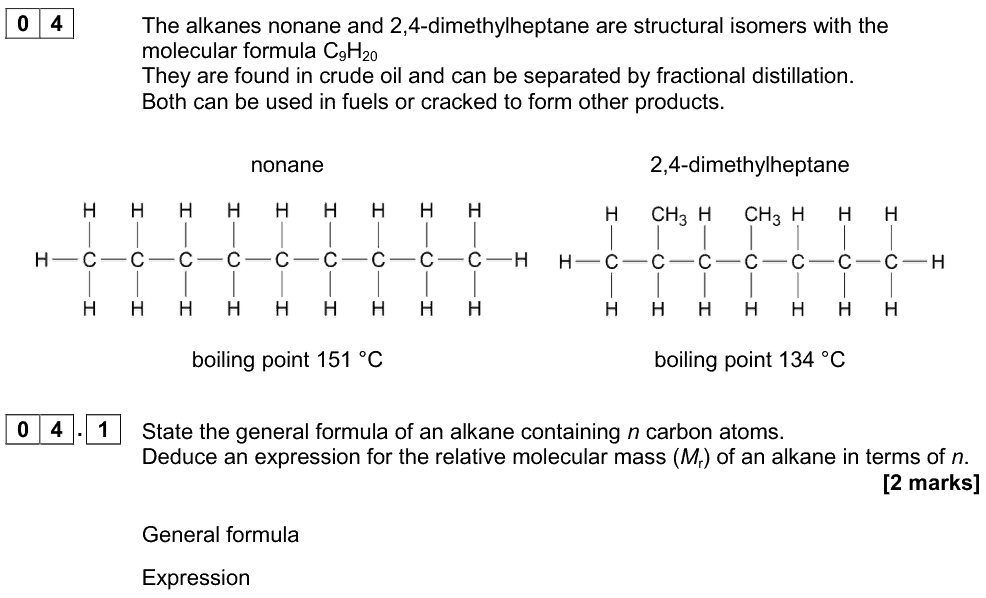
04.1 Most students knew the general formula of alkanes and many could also deduce the Mr in terms of n, where n is the number of C atoms.
Notes from the mark scheme and report
CnH2n+2
Mr = 14n + 2 (12n + 2n + 2)
Skills: MS2.1 Understand and use the symbols: =, <, <<, >>, >, ∝, ~, equilibrium sign
June 2018 · AS Paper 2 · Q04.31 markEquation writingEasy
Earlier part of question 04 that this part uses
Mark scheme
Examiner's comment
04.3 Nearly all students (82.8%) could write the balanced equation for the complete combustion of nonane.
Notes from the mark scheme and report
C9H20 + 14O2 → 9CO2 + 10H2O
June 2018 · AS Paper 2 · Q04.42 marksExplanation
Earlier part of question 04 that this part uses
Mark scheme
Examiner's comment
04.4 A good number of students knew how NO is formed in an engine, but many did not appreciate that the nitrogen comes from the air and that high temperatures are required for the formation of NO.
Notes from the mark scheme and report
Nitrogen and oxygen from the air react
at high temperature (in the engine). The nitrogen does not come from the fuel. 'Heat', 'hot' and pressure are ignored
June 2018 · AS Paper 2 · Q04.51 markShort answerEasy
Earlier part of question 04 that this part uses
Mark scheme
Examiner's comment
04.5 Most students (75.7%) knew that thermal cracking is used to form alkenes.
Notes from the mark scheme and report
Thermal cracking (gives a high percentage of alkenes)
June 2018 · AS Paper 2 · Q141 markMultiple choice
Answer
B
Mark scheme
Examiner's comment
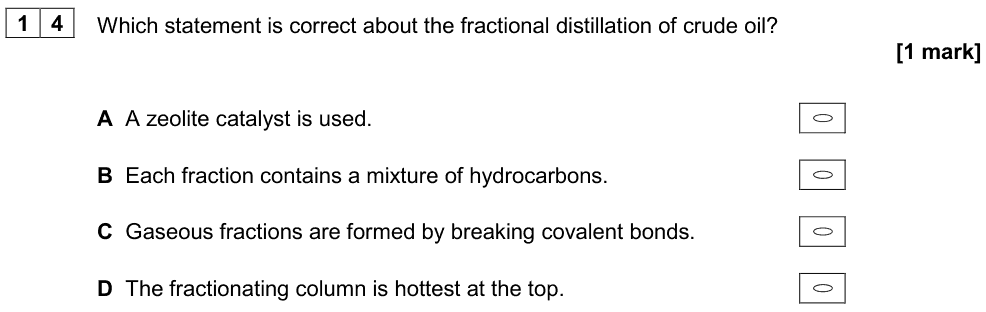
Many students (57.3%) got this correct, but many incorrectly thought covalent bonds are broken when molecular substances boil.
Notes from the mark scheme and report
Answer: B. Fractional distillation separates by boiling point into mixtures of hydrocarbons
no bonds are broken, no catalyst is used and the column is coolest at the top. Many chose C
June 2018 · Paper 3 · Q091 markMultiple choice
Answer
D
Mark scheme
Notes from the mark scheme and report
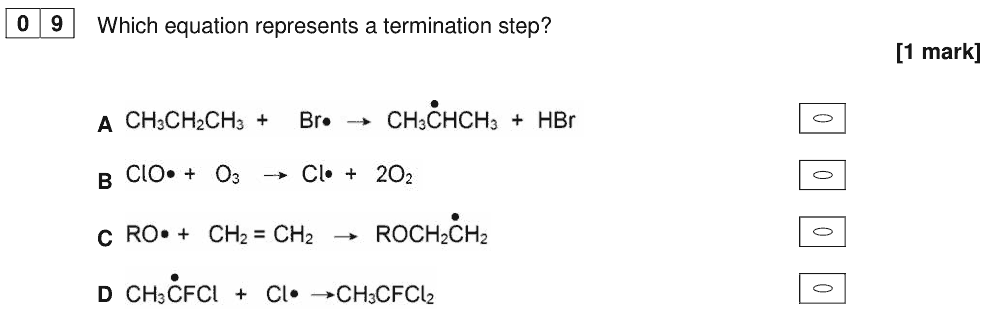
Answer: D. Two radicals combine to give a molecule (CH3C•FCl + Cl• → CH3CFCl2)
A, B and C each produce a new radical (propagation)
June 2017 · AS Paper 1 · Q06.22 marksShort answer
Earlier part of question 06 that this part uses
Mark scheme
Examiner's comment
06.2 The reasons for removal of sulphur dioxide were quite well known despite the unfamiliar context; 86.3% of students picked up at least one mark on this question.
Notes from the mark scheme and report
Any two: prevents acid rain
SO2 is toxic / causes breathing problems
reduces waste or makes use of it, for example to make sulfuric acid (improves atom economy, less sulfur mining). 86.3% gained at least one mark
June 2017 · AS Paper 2 · Q04.11 markEquation writing
Mark scheme
Examiner's comment
04.1 Most students could write the equation for the complete combustion of propane.
Notes from the mark scheme and report
C3H8 + 5O2 → 3CO2 + 4H2O
June 2017 · AS Paper 2 · Q08.31 markDiagram or structure
Earlier part of question 08 that this part uses
Mark scheme
Examiner's comment
08.3 Most students realised that thermal cracking produced an alkene.
Notes from the mark scheme and report
Any alkene with four carbon atoms: but-1-ene, but-2-ene or methylpropene (allow butadiene)
June 2017 · AS Paper 2 · Q151 markMultiple choiceEasy
Answer
D
Mark scheme
Examiner's comment
This was answered well with a high proportion of the students (68.8%) scoring the mark.
Notes from the mark scheme and report
Answer: D. Propagation: a radical reacts and a new radical forms: •CCl3 + Cl2 → CCl4 + •Cl (B is termination)
June 2017 · Paper 3 · Q081 markMultiple choice
Answer
C
Mark scheme
Notes from the mark scheme and report
Answer: C. Catalytic cracking uses a slight pressure and high temperature (zeolite) and gives branched alkanes and aromatics
thermal cracking uses high pressure and gives mainly alkenes
June 2016 · AS Paper 2 · Q03.31 markEquation writing
Earlier part of question 03 that this part uses
Mark scheme
Examiner's comment
Q3.3 was well answered, although 8½O2 was seen often stemming from students not appreciating that there were two oxygen atoms in each CO2 molecule.
June 2016 · AS Paper 2 · Q03.51 markEquation writing
Earlier part of question 03 that this part uses
Mark scheme
Examiner's comment
a catalytic converter, answering Q3.5.
Notes from the mark scheme and report
2CO + 2NO → 2CO2 + N2
June 2016 · AS Paper 2 · Q03.62 marksExplanation
Earlier part of question 03 that this part uses
Mark scheme
Examiner's comment
Many students in Q3.6 could explain that a thin layer of catalyst was used on a ceramic support to increase surface area, but few also explained that this reduced the amount of catalyst needed (which would be expensive).
Notes from the mark scheme and report
A thin layer means only a small amount of the (expensive) metals is needed
spreading it on the honeycomb gives a large surface area (a high proportion of metal atoms on the surface). Few gave the point about reducing the amount of metal
June 2016 · AS Paper 2 · Q05.42 marksEquation writing
Earlier part of question 05 that this part uses
Mark scheme
Examiner's comment
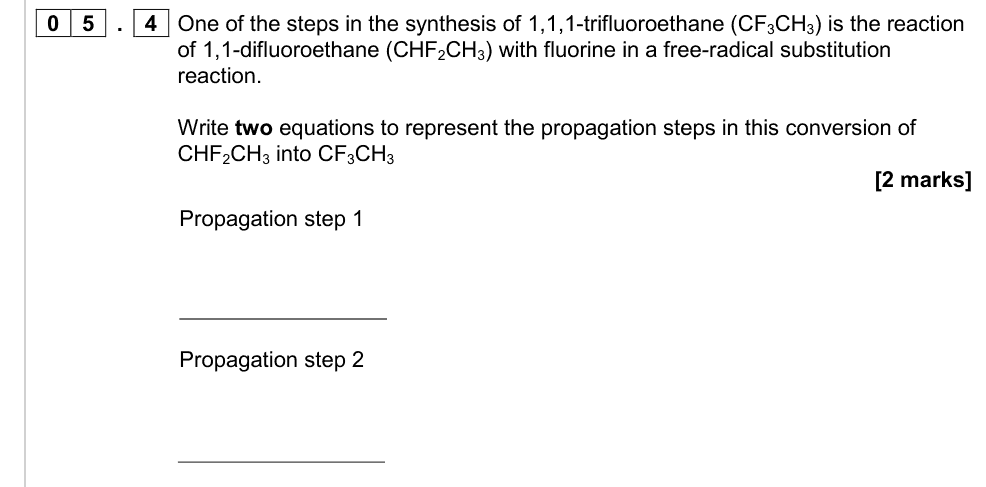
Students in Q5.4 found the two propagation steps to convert CHF2CH3 into CF3CH3 more challenging, but a pleasing number could do this.
The most common mistake was to remove a Hydrogen atom from the wrong Carbon atom in the first step.
Notes from the mark scheme and report
CHF2CH3 + F• → •CF2CH3 + HF, then •CF2CH3 + F2 → CF3CH3 + F•. Most common error: removing the hydrogen atom from the wrong carbon (the CH3 group)
June 2016 · AS Paper 2 · Q121 markMultiple choice
Answer
A
Mark scheme
Notes from the mark scheme and report
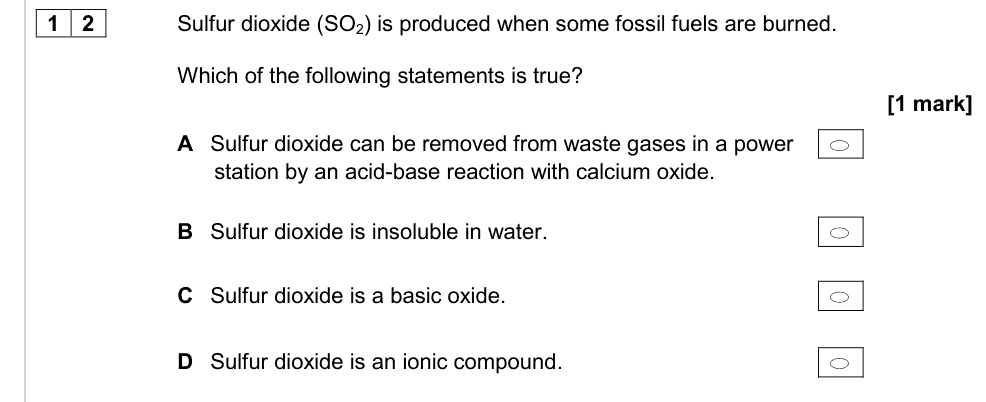
Answer: A. SO2 is an acidic, soluble, covalent (molecular) oxide, so it is removed by reaction with the base calcium oxide
June 2016 · AS Paper 2 · Q171 markMultiple choice
Answer
A
Mark scheme
Notes from the mark scheme and report
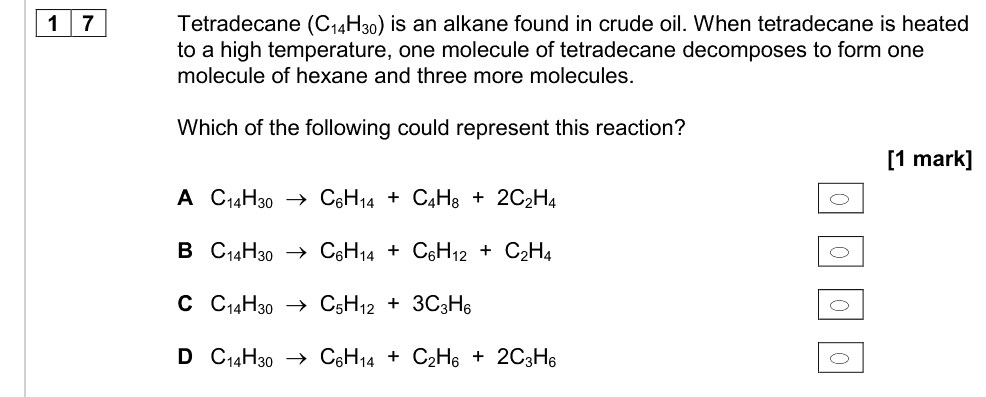
Answer: A. It gives hexane (C6H14) plus three more molecules and balances: C 6 + 4 + 4 = 14, H 14 + 8 + 8 = 30. B gives only two more molecules, C has no hexane, D does not balance for hydrogen
Specimen · Paper 2 · Q03.31 markAO2=1Equation writing
Earlier part of question 03 that this part uses
Mark scheme
Notes from the mark scheme and report
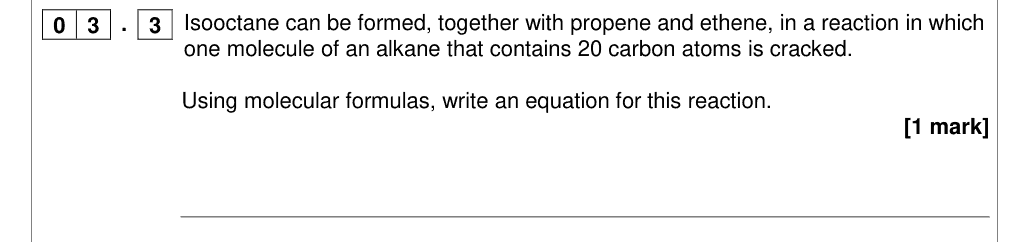
C20H42 → C8H18 + 2C3H6 + 3C2H4
Specimen · Paper 2 · Q03.41 markAO1=1Short answer
Earlier part of question 03 that this part uses
Mark scheme
Notes from the mark scheme and report
Mainly alkenes are formed (a high percentage of alkenes)
Specimen · Paper 3 · Q251 markAO1=1Multiple choice
Answer
C
Mark scheme
Notes from the mark scheme and report
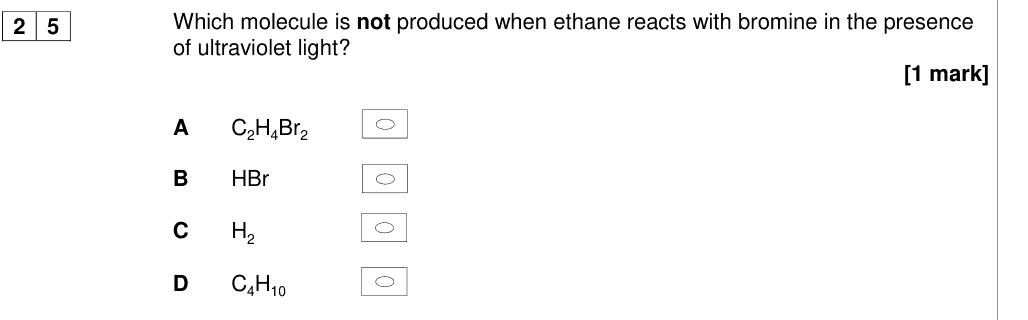
Answer: C. Free-radical substitution gives HBr (not H2), further substitution gives C2H4Br2, and two ethyl radicals in a termination step give C4H10
Work with an A-level chemistry tutor
Dropping marks on calculations, mechanisms or the required practicals? Book a trial session with a specialist A-level chemistry tutor.