Notes and key-term cards for this topic are being written by our tutors. The past-paper questions below are ready now.
Specification statements
Show the 7 statements from the specification
3.3.8-01 Aldehydes are readily oxidised to carboxylic acids.
3.3.8-02 Chemical tests to distinguish between aldehydes and ketones including Fehling’s solution and Tollens’ reagent.
3.3.8-03 Aldehydes can be reduced to primary alcohols, and ketones to secondary alcohols, using NaBH4 in aqueous solution. These reduction reactions are examples of nucleophilic addition.
3.3.8-04 The nucleophilic addition reactions of carbonyl compounds with KCN, followed by dilute acid, to produce hydroxynitriles.
3.3.8-05 Aldehydes and unsymmetrical ketones form mixtures of enantiomers when they react with KCN followed by dilute acid.
3.3.8-06 The hazards of using KCN.
3.3.8-07 Students should be able to: • write overall equations for reduction reactions using [H] as the reductant • outline the nucleophilic addition mechanism for reduction reactions with NaBH4 (the nucleophile should be shown as H–) • write overall equations for the formation of hydroxynitriles using HCN • outline the nucleophilic addition mechanism for the reaction with KCN followed by dilute acid • explain why nucleophilic addition reactions of KCN, followed by dilute acid, can produce a mixture of enantiomers.
Six-mark level of response questions on this topic
Tap a question to zoom it. Where a part needs a figure, table or structure from earlier in the question, that part folds out above it; the mark scheme and examiner's comment open underneath. Have AQA's Data Booklet (the Periodic Table and the spectroscopy tables) beside you.
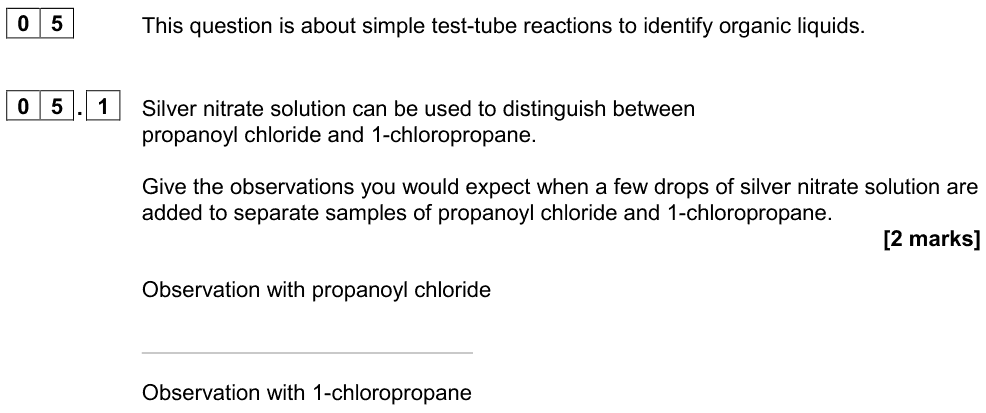
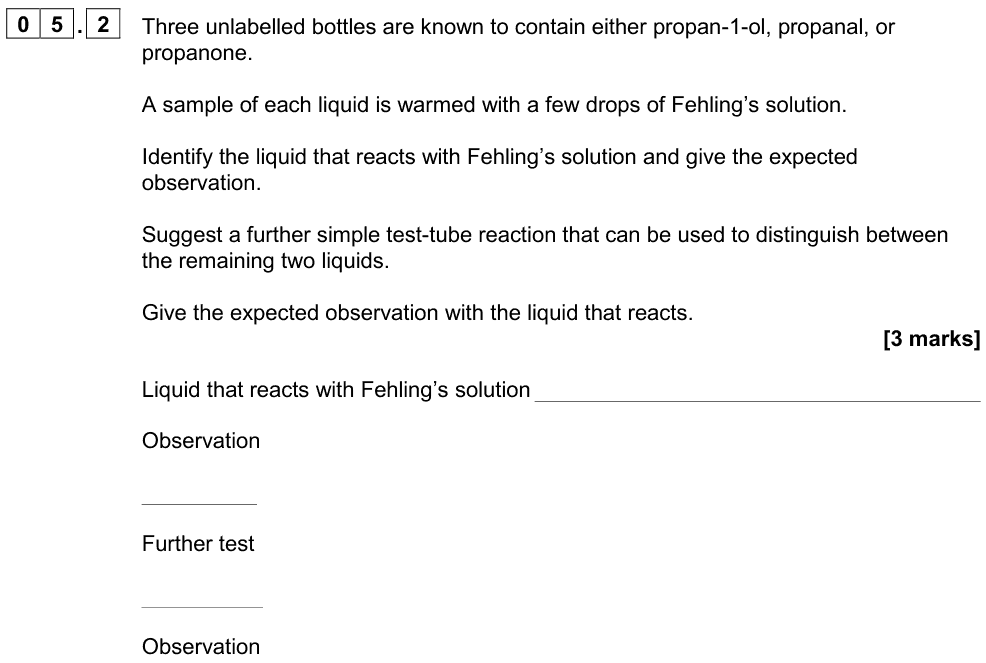
June 2024 · Paper 2 · Q05.23 marksAO3=3Practical and data analysis
Earlier part of question 05 that this part uses
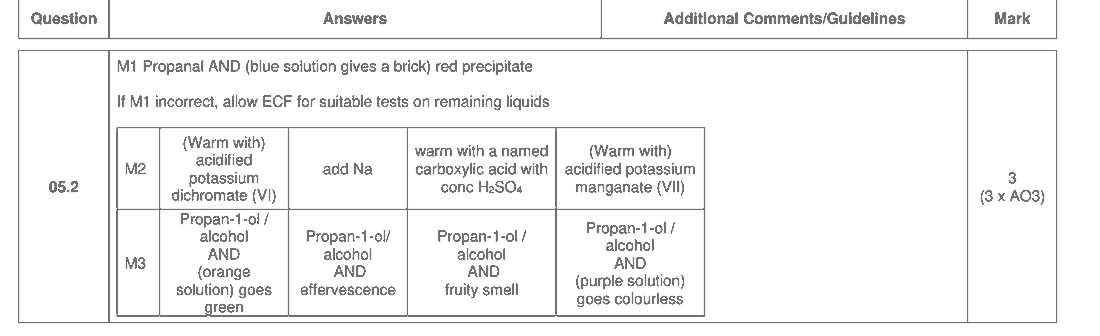
Mark scheme
Examiner's comment
5.2 This was much better answered than Q5.1 and most students scored at least 2 of the 3 marks.
Notes from the mark scheme and report
Propanal: blue solution gives a brick-red precipitate. Further test: warm with acidified potassium dichromate(VI): propan-1-ol turns it from orange to green (propanone does not). Alternatives: sodium (effervescence with the alcohol)
carboxylic acid with concentrated H2SO4 (fruity smell)
acidified KMnO4 (purple to colourless)
Skills: ATd Use laboratory apparatus for a variety of experimental techniques including: titration, using burette and pipette; distillation and heating under reflux, including setting up glassware using retort stand and clamps; qualitative tests for ions and organic functional groups; filtration, including use of fluted filter paper, or filtration under reduced pressure; PS1.1 Solve problems set in practical contexts; RP6 Tests for alcohol, aldehyde, alkene and carboxylic acid
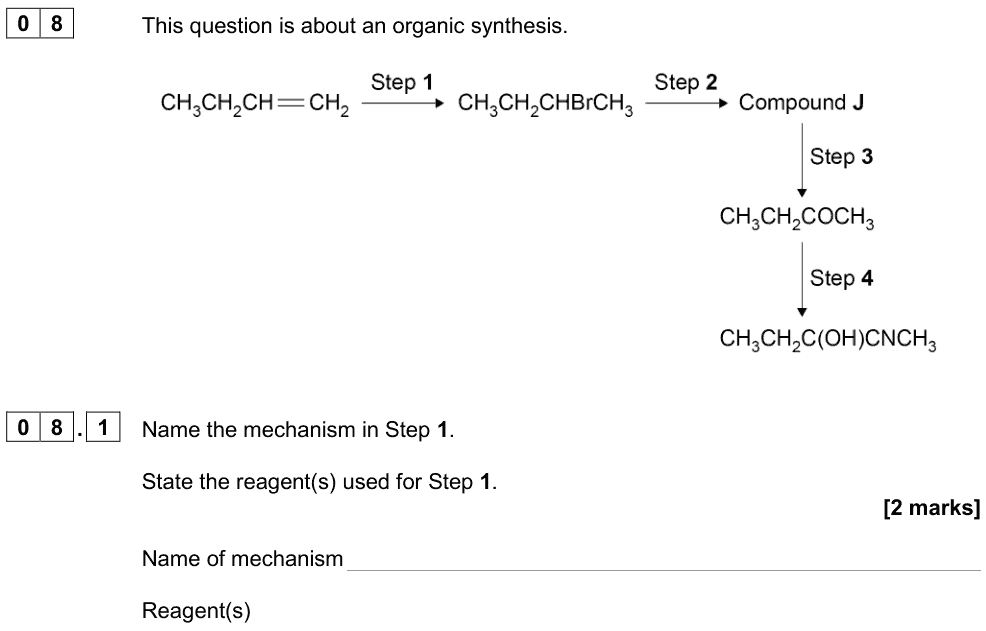
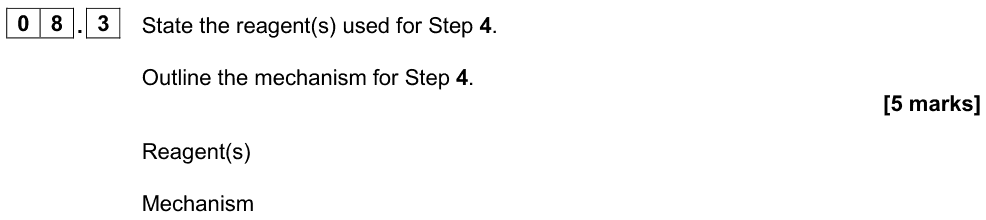
June 2024 · Paper 2 · Q08.35 marksAO1=1, AO2=4Mechanism
Earlier part of question 08 that this part uses
Mark scheme
Examiner's comment
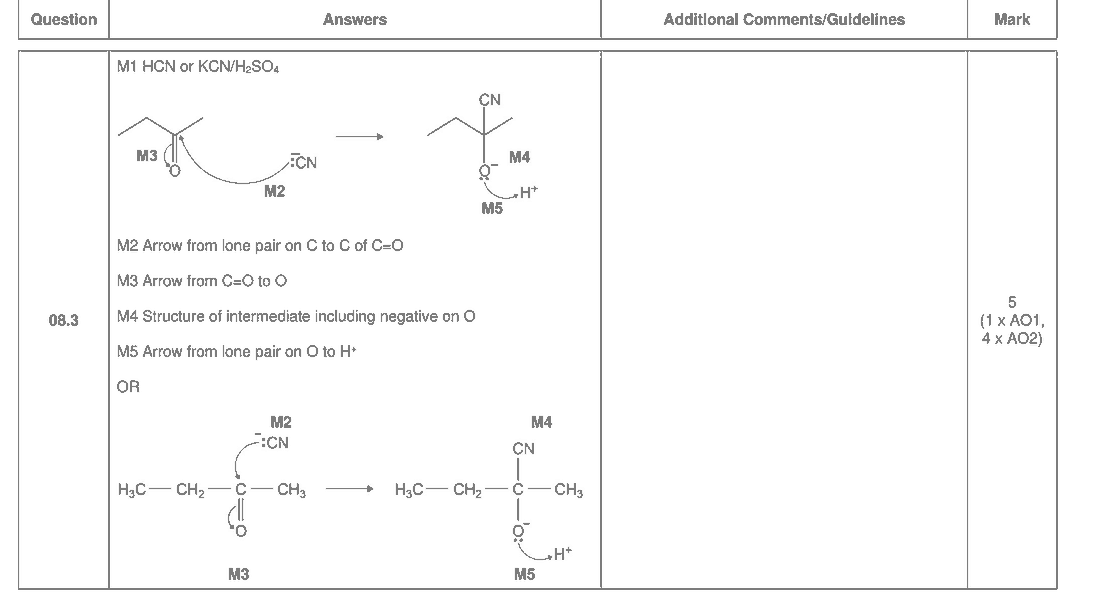
8.3 This fairly standard mechanism was well answered but also differentiated very effectively, with a discrimination index of 0.67.
Notes from the mark scheme and report
KCN followed by dilute acid (HCN or KCN/H2SO4). Nucleophilic addition: arrow from the lone pair on C of :CN– to the C of C=O
arrow from the C=O bond to O
intermediate with O–
arrow from a lone pair on O– to H+
June 2024 · Paper 2 · Q08.43 marksAO2=3ExplanationHard
Earlier part of question 08 that this part uses
Mark scheme
Examiner's comment
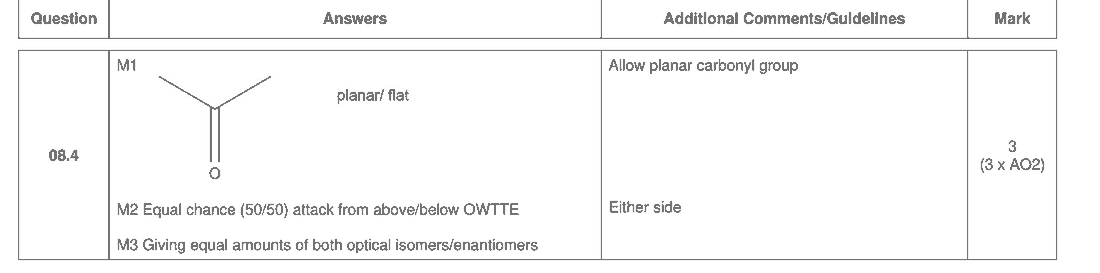
8.4 Students often stated that the C=O bond is planar without including the other atoms attached to the C. As such, M1 was often missed although M2 and M3 were available. As a consequence, only around 12% scored all 3 marks but over 43% scored 2 marks.
Notes from the mark scheme and report
The carbonyl group (the C=O carbon and the atoms bonded to it) is planar
so :CN– has an equal chance of attacking from above or below
giving equal amounts of the two enantiomers. Saying only that the C=O bond is planar missed M1
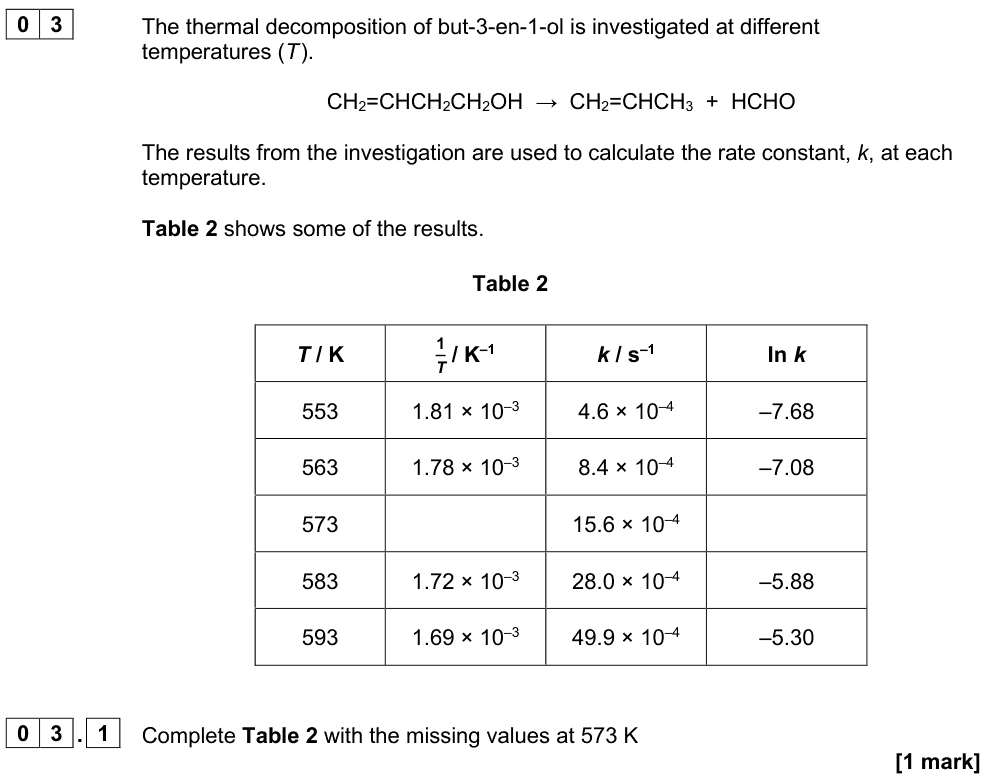
June 2024 · Paper 3 · Q03.52 marksAO2=2Short answer
Earlier part of question 03 that this part uses
Mark scheme
Examiner's comment
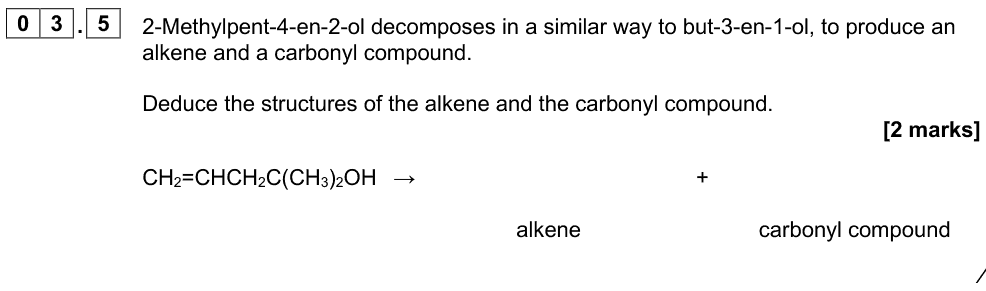
03.5 tested the ability to apply information from the start of the question where the equation for the thermal decomposition of but-3-en-1-ol was given and to apply it to a different compound.
Many students failed to respond to the need for a carbonyl as one of the products and suggested alcohols or acids instead.
Notes from the mark scheme and report
Alkene: CH2=CHCH3 (propene)
carbonyl compound: (CH3)2CO (propanone), by analogy with but-3-en-1-ol → propene + methanal. The two the wrong way round scores 1. Many gave alcohols or acids instead of a carbonyl
June 2024 · Paper 3 · Q241 markAO1=1Multiple choice
Answer
D
Mark scheme
Notes from the mark scheme and report
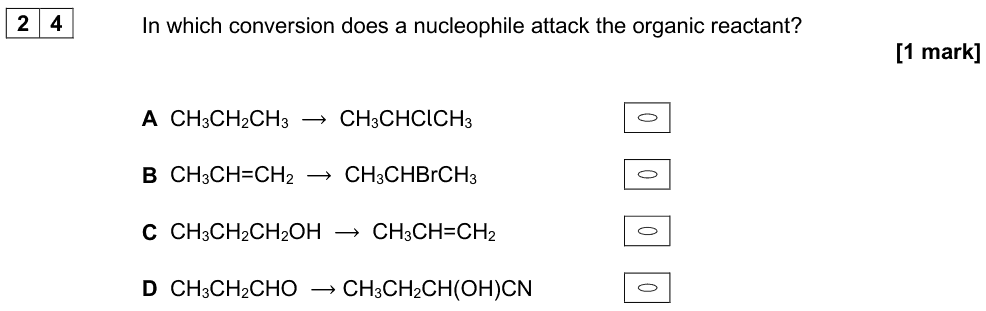
Answer: D. :CN– attacks the δ+ carbon of the C=O (nucleophilic addition). A is free-radical substitution, B electrophilic addition, C elimination
June 2024 · Paper 3 · Q271 markAO3=1Multiple choice
Answer
A
Mark scheme
Notes from the mark scheme and report
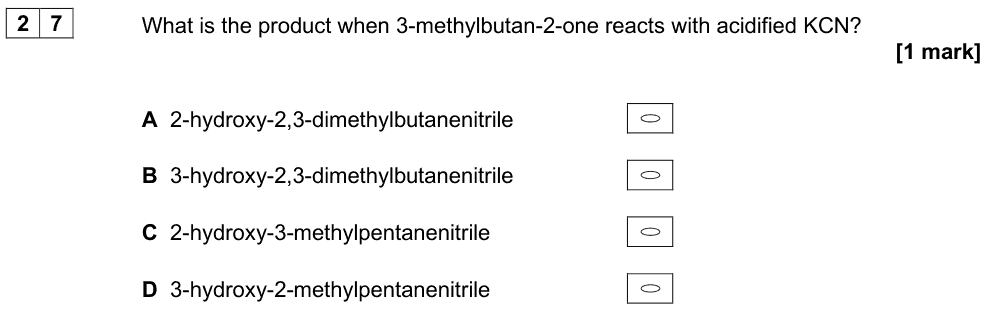
Answer: A. CN adds to the carbonyl carbon: (CH3)2CH–C(OH)(CN)–CH3. The nitrile carbon is C1, so 2-hydroxy-2,3-dimethylbutanenitrile
June 2023 · Paper 2 · Q03.34 marksAO1=4Mechanism
Earlier part of question 03 that this part uses
Mark scheme
Examiner's comment
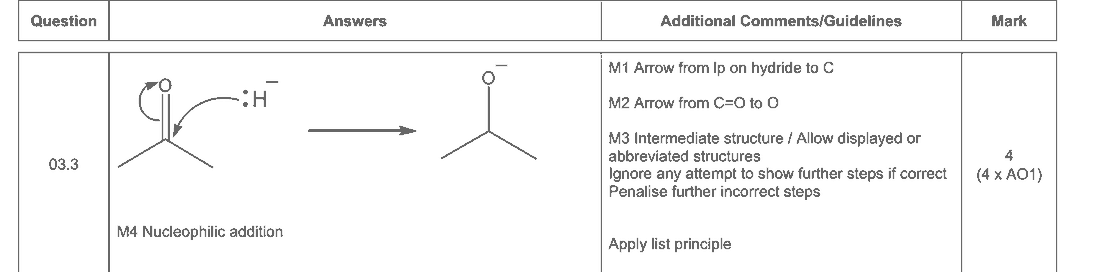
03.3 Despite the less familiar use of a skeletal formula for propanone, this question was well answered with around 48% of students scoring all four marks.
Notes from the mark scheme and report
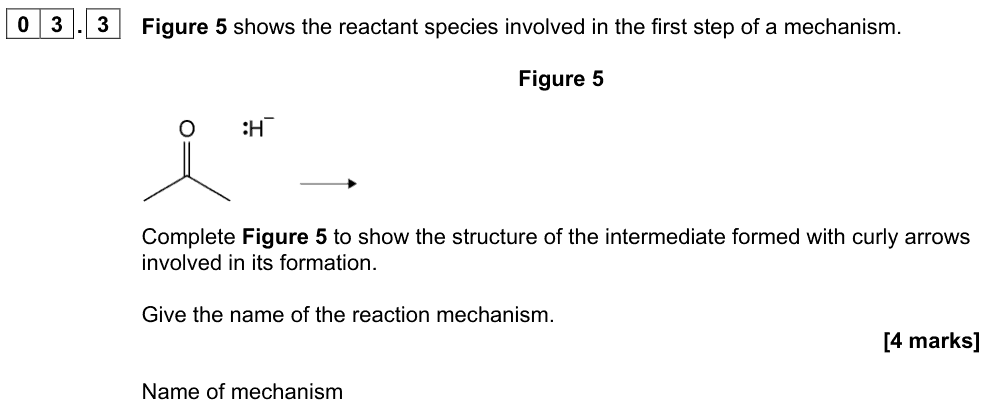
Nucleophilic addition. Curly arrow from the lone pair on H– to the carbonyl C of propanone
curly arrow from the C=O bond to O
intermediate (CH3)2CH–O– with the negative charge on O. Further incorrect steps are penalised
June 2023 · Paper 2 · Q06.22 marksAO3=2Practical and data analysis
Earlier part of question 06 that this part uses
Mark scheme
Examiner's comment
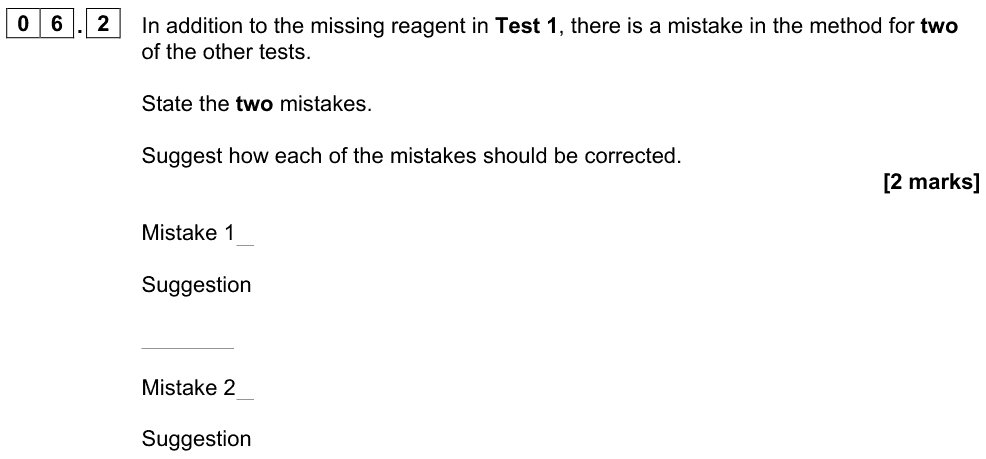
06.2 Around three-quarters of students were able to score at least 1 mark here. Some failed to score because, due to poor expression, they were unable to show clearly that the gas should be bubbled through limewater, or that simply observing effervescence would be enough to complete the test correctly.
Notes from the mark scheme and report
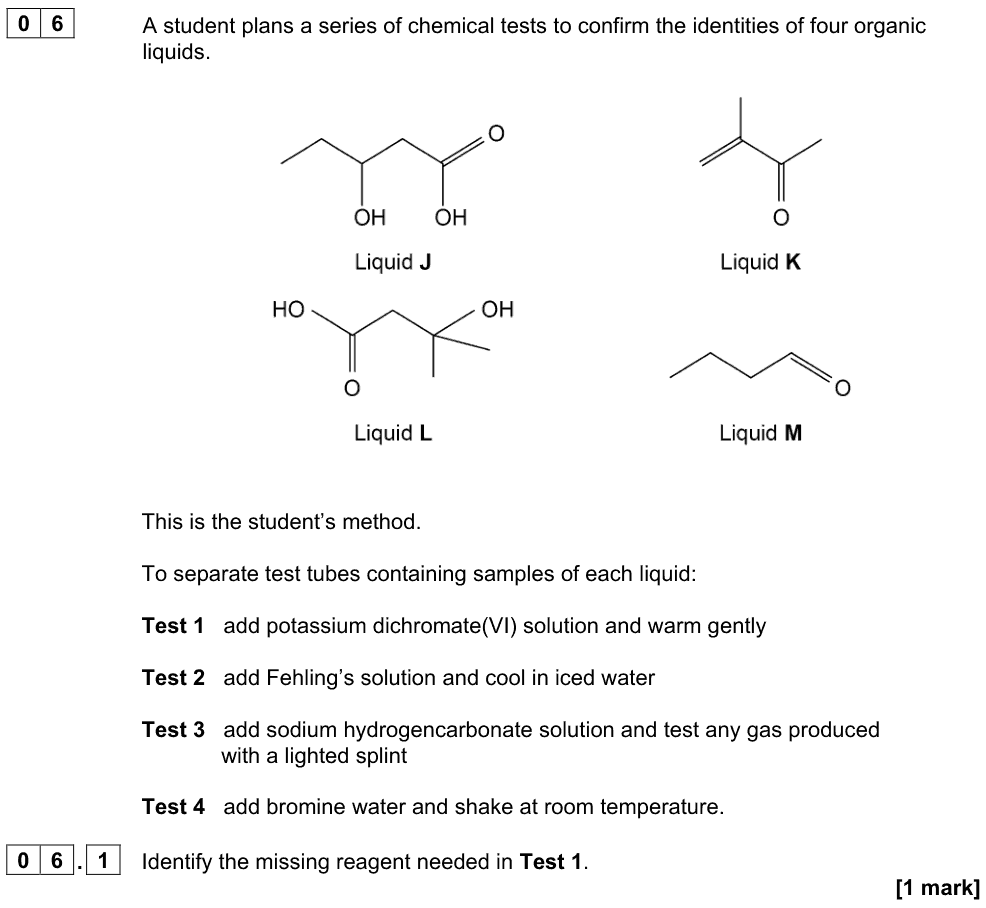
Test 2: should be warmed (in a water bath), not cooled in iced water. Test 3: the gas should not be tested with a lighted splint
bubble it through limewater (or just observe effervescence). Around three-quarters scored at least 1
poor expression lost marks
Skills: PS2.1 Comment on experimental design and evaluate scientific methods; ATb Use water bath or electric heater or sand bath for heating; RP6 Tests for alcohol, aldehyde, alkene and carboxylic acid
June 2022 · Paper 2 · Q01.85 marksAO1=1, AO2=4Mechanism
Earlier parts of question 01 that this part uses
Mark scheme
Examiner's comment
01.8 This question had a very high discrimination index and the best students were able to score full marks. Common errors included poor drawing of curly arrows and mistakes in the structure of the intermediate.
Notes from the mark scheme and report
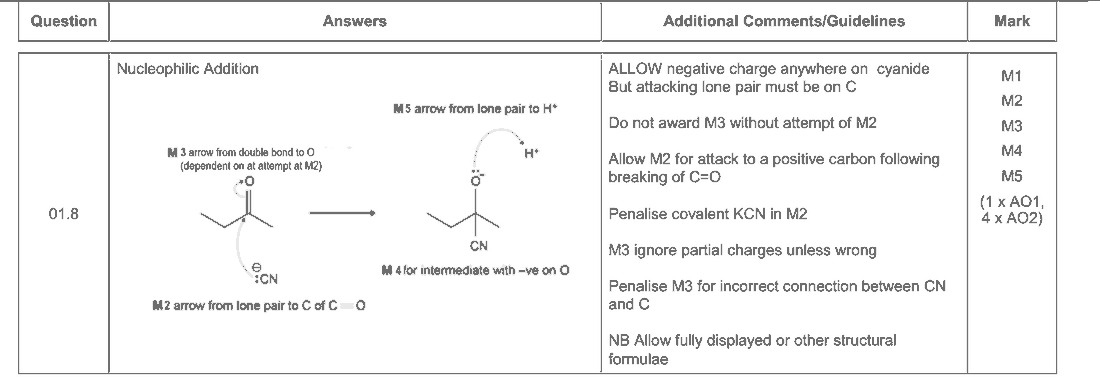
Nucleophilic addition. Curly arrow from the lone pair on C of :CN– to the C of C=O
curly arrow from the C=O bond to O
intermediate CH3CH2C(CH3)(CN)O– with the negative charge on O
curly arrow from the lone pair on O– to H+. The attacking lone pair must be on C
KCN must not be shown as covalent. Errors: poor curly arrows
wrong intermediate
June 2022 · Paper 3 · Q301 markAO3=1Multiple choice
Answer
B
Mark scheme
Notes from the mark scheme and report
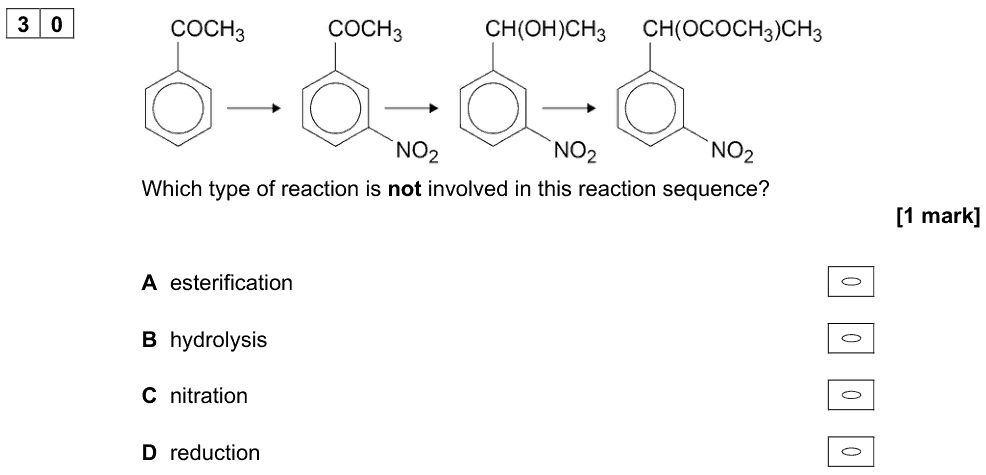
Answer: B. The steps are nitration of the ring, reduction of C=O to CH(OH), then esterification of the OH
no hydrolysis
November 2021 · Paper 3 · Q03.22 marksShort answer
Earlier part of question 03 that this part uses
Mark scheme
Examiner's comment
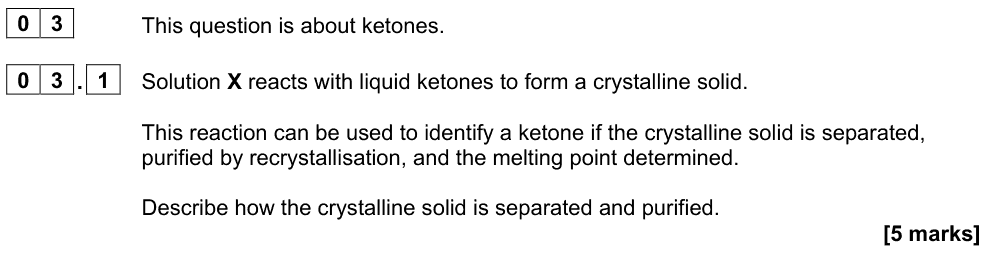
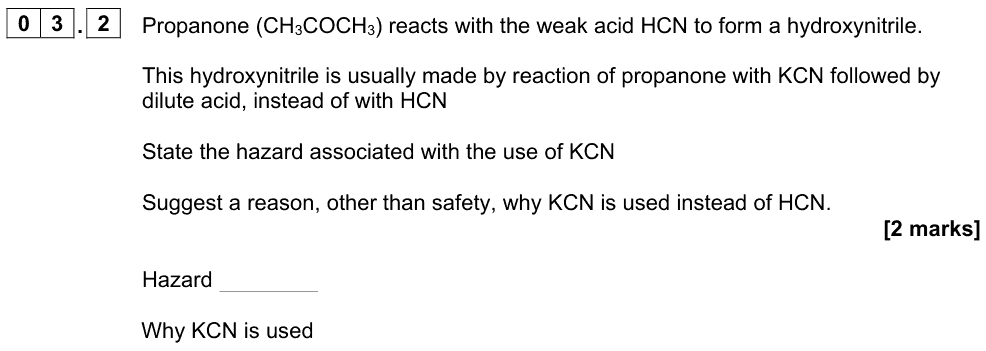
In question 03.2 many students did not read the question carefully and referred to HCN when they should have been referring to KCN, and vice versa.
Notes from the mark scheme and report
KCN is toxic / poisonous. HCN is a weak acid so gives too low a concentration of CN–
KCN dissociates fully to provide the CN– nucleophile. Many mixed up which compound the question asked about
November 2021 · Paper 3 · Q03.34 marksMechanismHard
Earlier part of question 03 that this part uses
Mark scheme
Examiner's comment
The mechanism in question 03.3 was known quite well with a third of students scoring full marks here.
Notes from the mark scheme and report
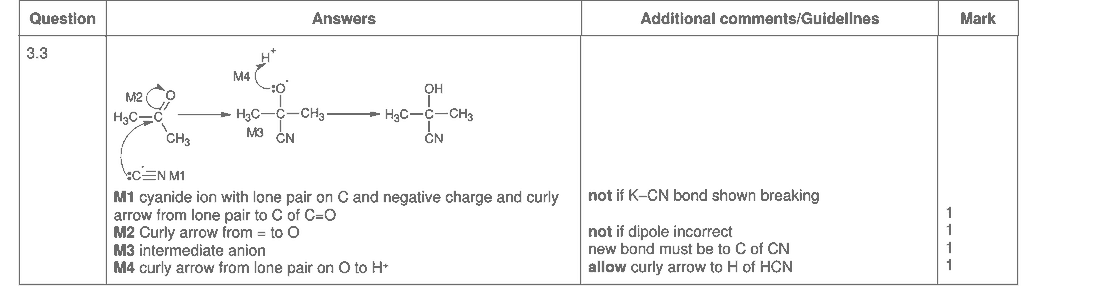
Nucleophilic addition: arrow from the lone pair on C of :CN– to the C of C=O
arrow from the C=O bond to O
intermediate (CH3)2C(CN)O–
arrow from a lone pair on O– to H+ (or the H of HCN). The new bond must be to the C of CN
no K–CN bond breaking
November 2020 · Paper 2 · Q03.22 marksPractical and data analysis
Earlier part of question 03 that this part uses
Mark scheme
Examiner's comment
The expected observations for test tube reactions in 03.1 and 03.2 were well known.
Notes from the mark scheme and report
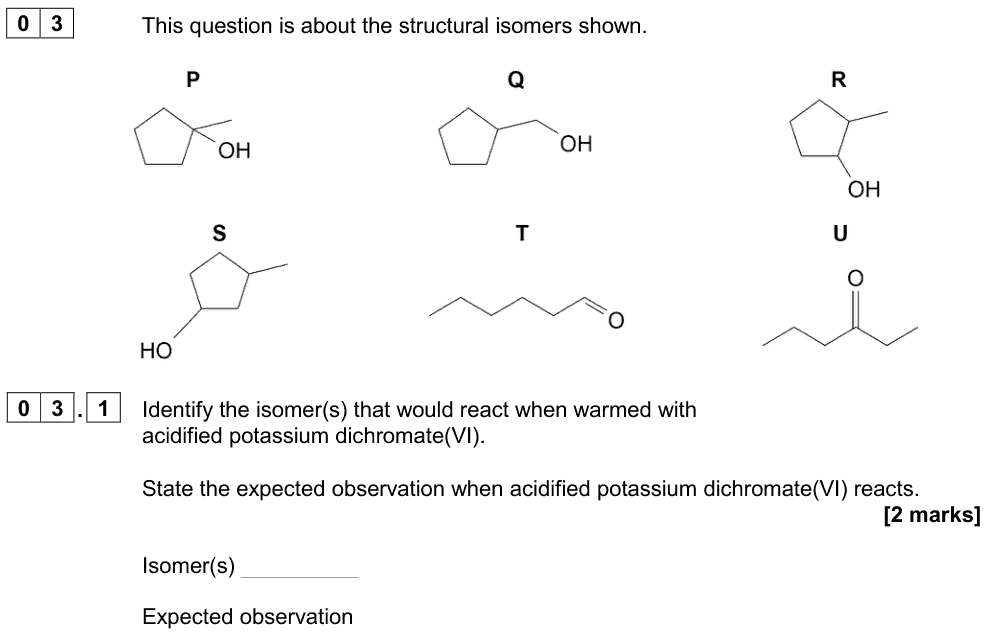
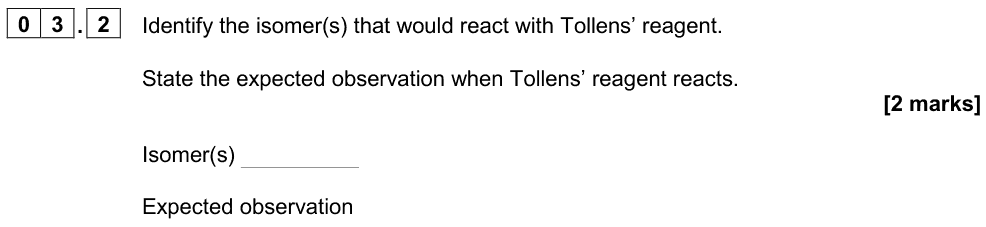
T only (the aldehyde, hexanal)
silver mirror (allow grey / black precipitate)
Skills: ATd Use laboratory apparatus for a variety of experimental techniques including: titration, using burette and pipette; distillation and heating under reflux, including setting up glassware using retort stand and clamps; qualitative tests for ions and organic functional groups; filtration, including use of fluted filter paper, or filtration under reduced pressure; PS1.1 Solve problems set in practical contexts; RP6 Tests for alcohol, aldehyde, alkene and carboxylic acid
November 2020 · Paper 2 · Q06.23 marksShort answer
Earlier part of question 06 that this part uses
Mark scheme
Examiner's comment
06.2 also proved to be quite a low scoring question despite the familiarity of this reaction in many previous exams.
Notes from the mark scheme and report
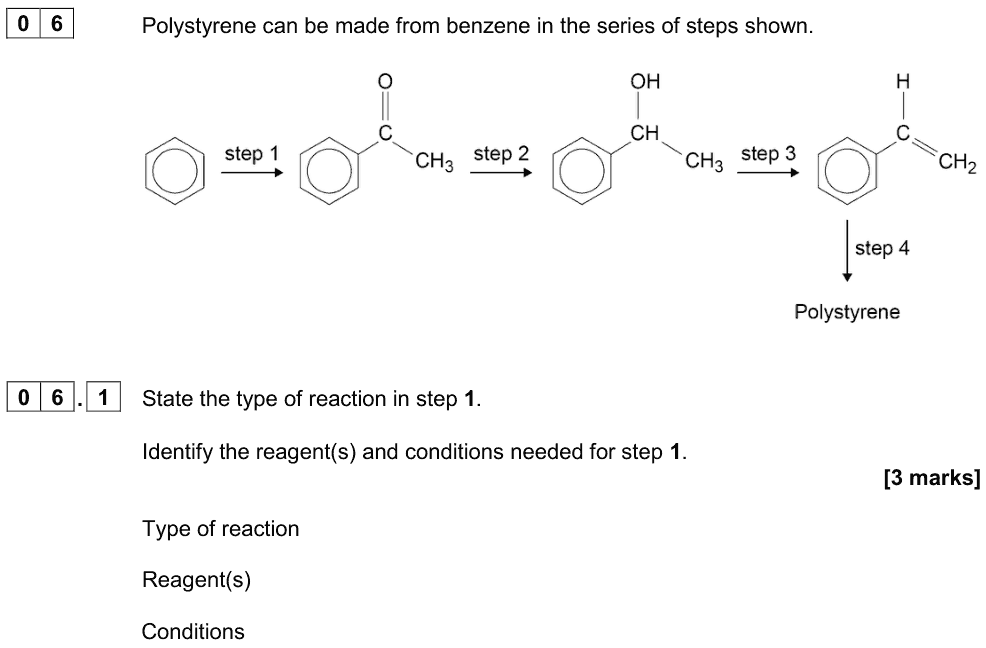
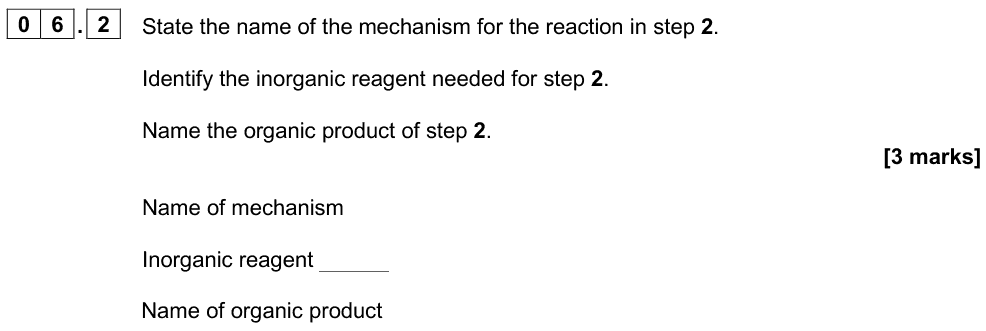
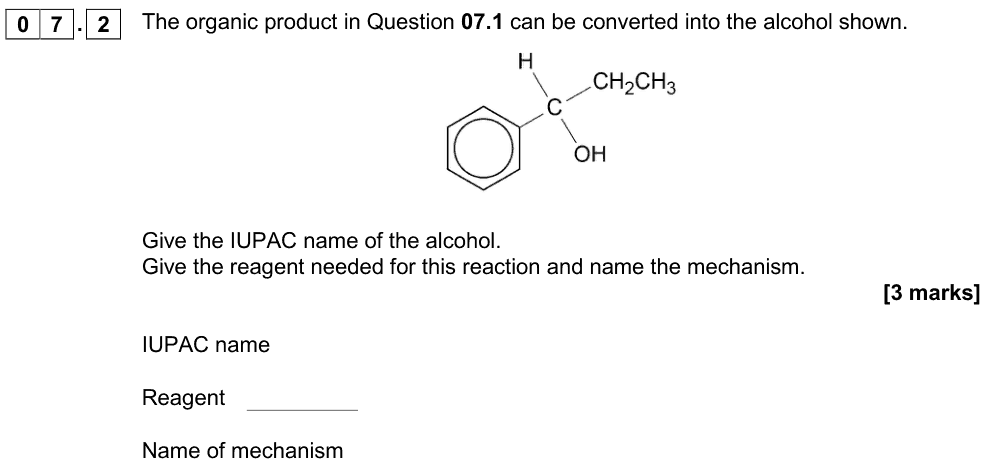
Nucleophilic addition
NaBH4 (allow LiAlH4)
1-phenylethanol (1-phenylethan-1-ol). H2/Ni scores reagent and product but the mechanism mark would need 'catalytic addition'
November 2020 · Paper 2 · Q09.53 marksMechanism
Earlier parts of question 09 that this part uses
Mark scheme
Examiner's comment
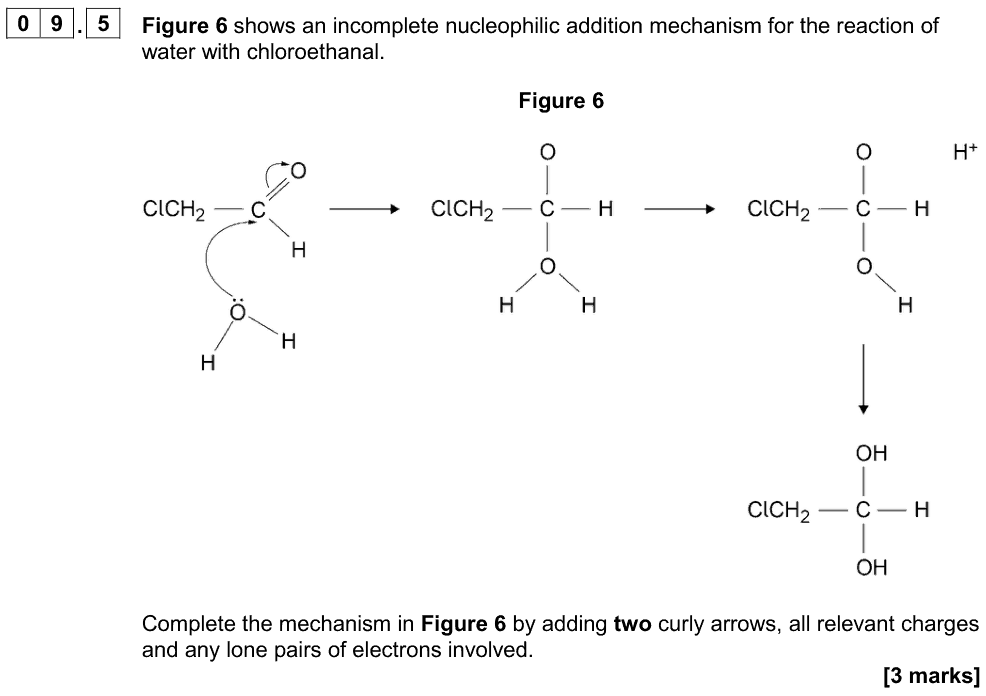
09.5 required students to apply their understanding of standard mechanistic ideas to a novel mechanism.
Most students were able to score at least some of the marks and a good number (44.3%) scored all three marks.
Notes from the mark scheme and report
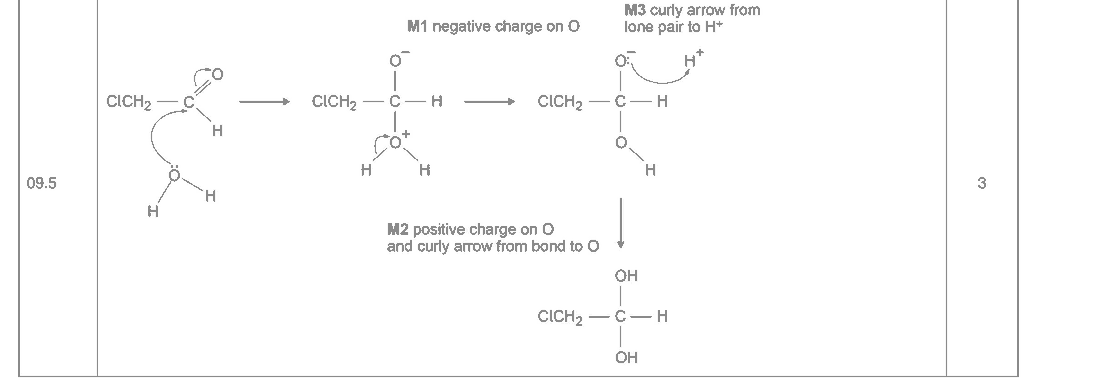
First intermediate: negative charge on the O that came from C=O, positive charge on the O of the attached water, and a curly arrow from an O–H bond of that –OH2+ to the O+ (loss of H+). Second intermediate: lone pair on O– and a curly arrow from it to H+. Most scored some marks
44.3% scored all 3
November 2020 · Paper 2 · Q09.63 marksExplanation
Earlier parts of question 09 that this part uses
Mark scheme
Examiner's comment
Full marks proved far more difficult in 09.6 but students often gained some credit for recognising that the alkyl group would be electron donating.
Notes from the mark scheme and report
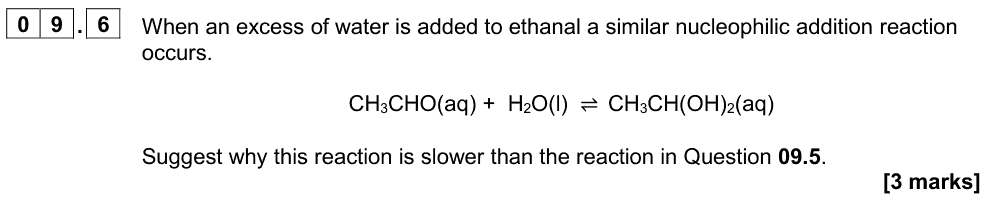
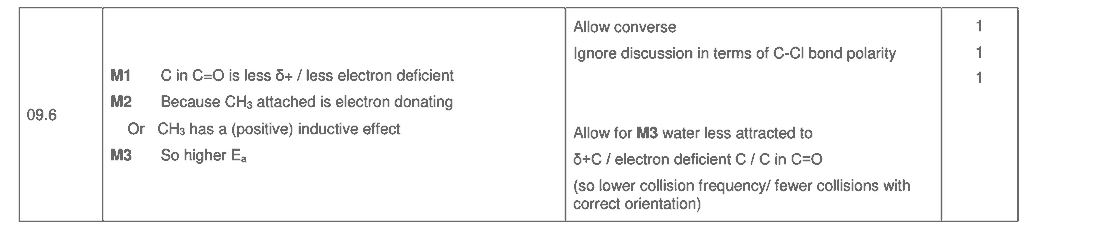
The carbon of C=O in ethanal is less δ+ (less electron deficient), because the CH3 group is electron donating (positive inductive effect) whereas Cl is electron withdrawing
so the activation energy is higher (water is less strongly attracted to the carbon). Full marks were rare
many got the electron-donating alkyl group
June 2019 · Paper 2 · Q13.15 marksMechanism
Mark scheme
Examiner's comment
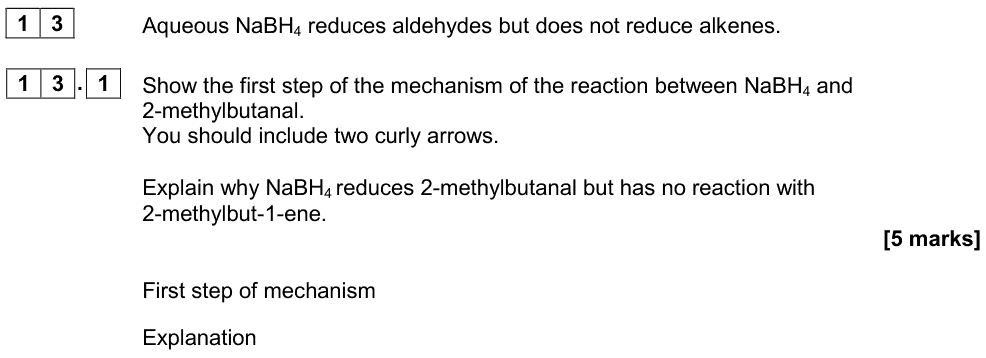
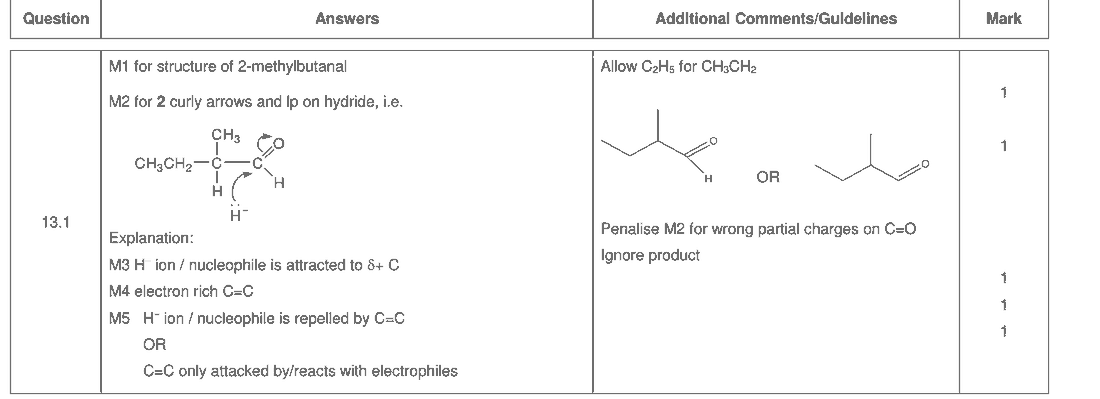
13.1 This question discriminated well. It was surprising to see how many students were unable to draw the correct structure of 2-methylbutanal. Many placed the methyl group on carbon 3. Most students were familiar with the mechanism and drew the
curly arrow from the lone pair on :H– to the C of C=O and curly arrow from the C=O bond to O. Explanation: the H– nucleophile is attracted to the δ+ carbon of the polar C=O
the C=C is electron rich, so it repels H– / is attacked only by electrophiles. Many drew the methyl group on carbon 3
June 2019 · Paper 2 · Q13.22 marksPractical and data analysisEasy
Earlier part of question 13 that this part uses
Mark scheme
Examiner's comment
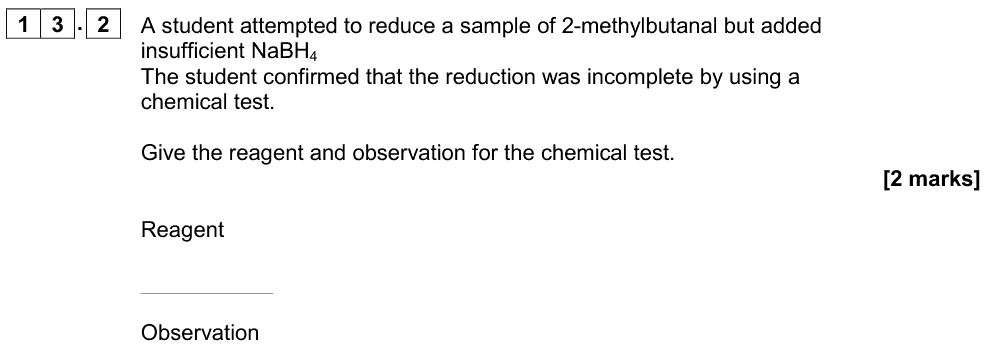
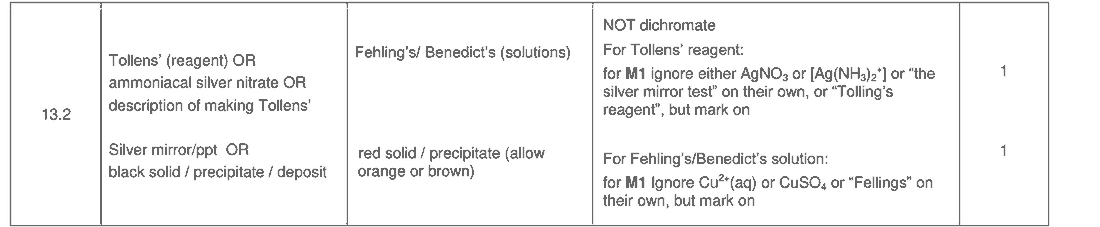
13.2 Nearly two-thirds of students scored both marks in this question. A common incorrect answer was to suggest acidified potassium dichromate as the reagent when it would not, of course, distinguish between the aldehyde and the alcohol formed.
or Fehling's solution: red (brick-red) precipitate, showing aldehyde is still present. Not acidified dichromate, which also oxidises the alcohol formed
Skills: ATd Use laboratory apparatus for a variety of experimental techniques including: titration, using burette and pipette; distillation and heating under reflux, including setting up glassware using retort stand and clamps; qualitative tests for ions and organic functional groups; filtration, including use of fluted filter paper, or filtration under reduced pressure; PS4.1 Know and understand how to use a wide range of experimental and practical instruments, equipment and techniques appropriate to the knowledge and understanding included in the specification; RP6 Tests for alcohol, aldehyde, alkene and carboxylic acid
June 2019 · Paper 3 · Q04.11 markShort answer
Mark scheme
Examiner's comment
4.1 Most students correctly remembered this name.
Notes from the mark scheme and report
Nucleophilic addition (both words, no extra names)
June 2019 · Paper 3 · Q04.25 marksDiagram or structure
Earlier part of question 04 that this part uses
Mark scheme
Examiner's comment
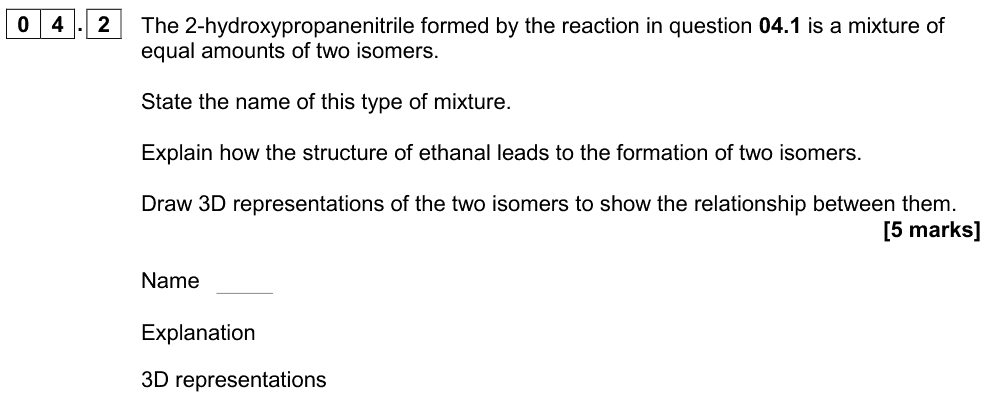
4.2 A key phrase in this question was “explain how the structure of ethanal leads to the formation of two isomers”. This wording was unfortunately missed by many students who instead referred to the structure of the product and wrote about the chiral carbon. Those who recognised the need to refer to the planar carbonyl group sometimes made the mistake of referring to ethanal itself as planar – which is not true for the whole molecule. There are many different ways of drawing 3D representations, but the style shown in the mark scheme is recommended for clarity. Enantiomers should either be shown by drawing the second image as a mirror of the first, or by drawing the same orientation as the first but with two groups swapped round.
Notes from the mark scheme and report
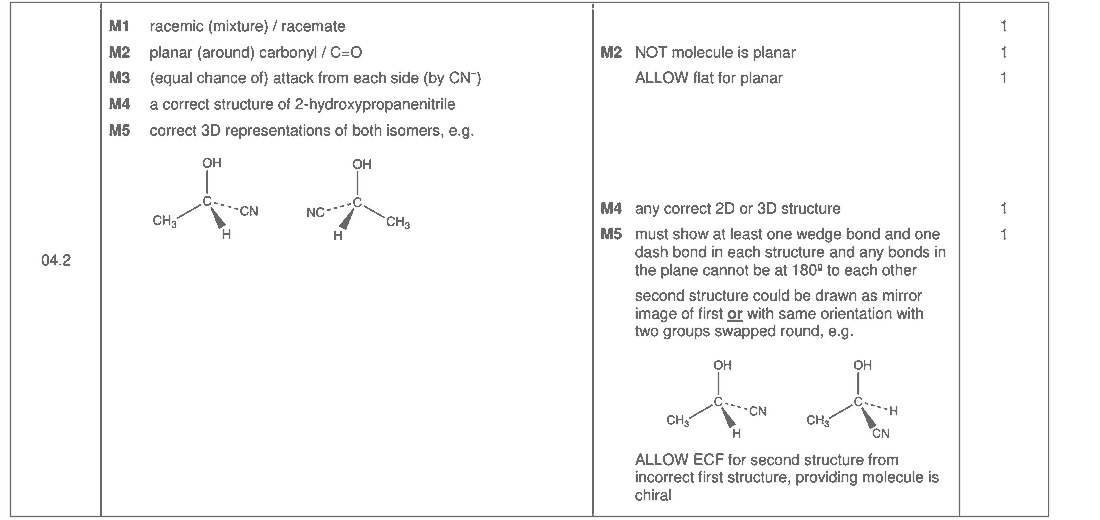
Racemic mixture (racemate)
the carbonyl group is planar
CN– has an equal chance of attacking from either side
a correct structure of CH3CH(OH)CN
two 3D drawings (wedge and dash bonds) that are mirror images, or the same orientation with two groups swapped. Not 'the molecule is planar'. Many wrote about the chiral carbon in the product instead of the structure of ethanal
Skills: MS4.2 Visualise and represent 2D and 3D forms including two-dimensional representations of 3D objects
June 2019 · Paper 3 · Q231 markMultiple choice
Answer
B
Mark scheme
Notes from the mark scheme and report
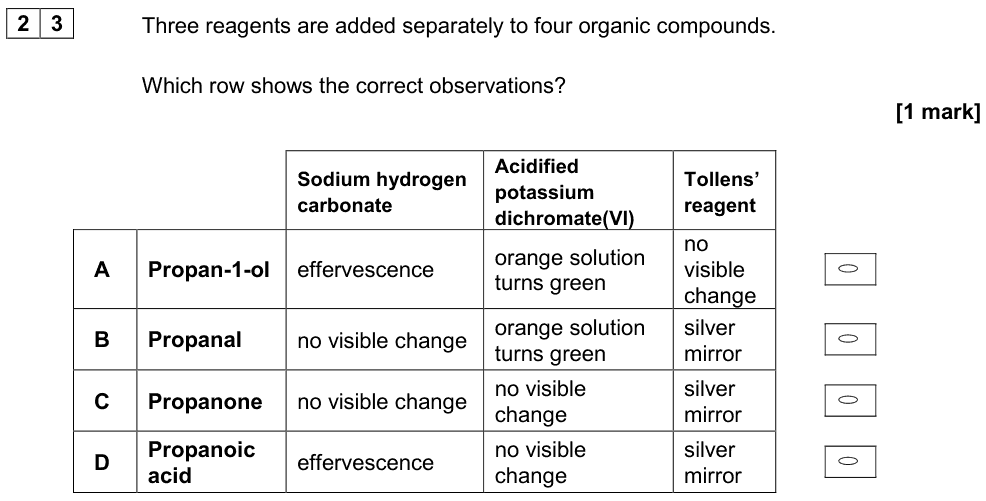
Answer: B. Propanal is not acidic, is oxidised by dichromate (orange to green) and gives a silver mirror with Tollens' reagent
Skills: RP6 Tests for alcohol, aldehyde, alkene and carboxylic acid
June 2018 · Paper 2 · Q02.42 marksDiagram or structure
Earlier part of question 02 that this part uses
Mark scheme
Examiner's comment
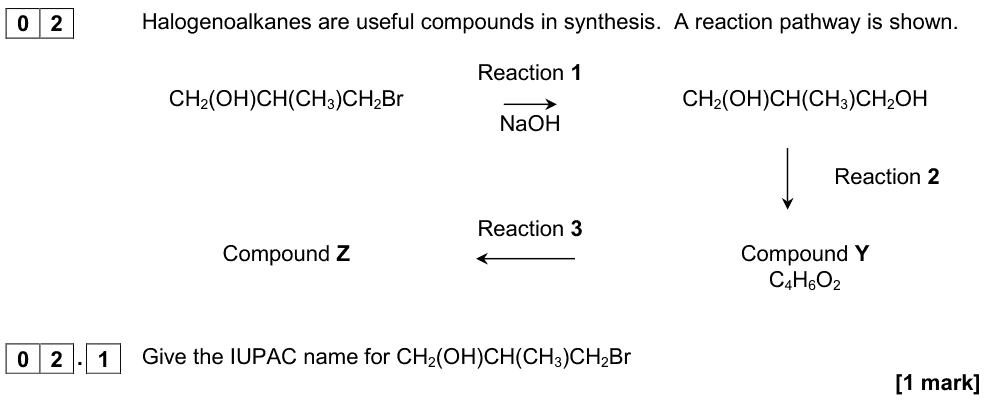
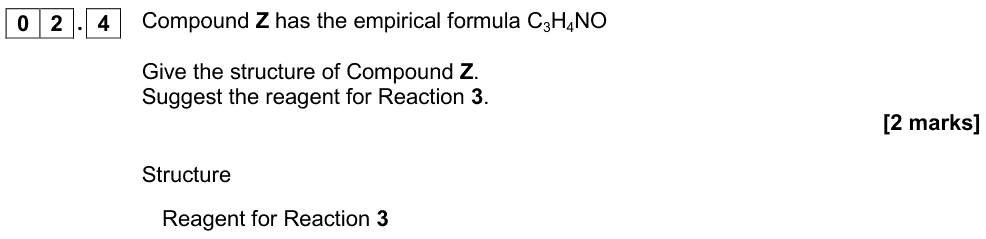
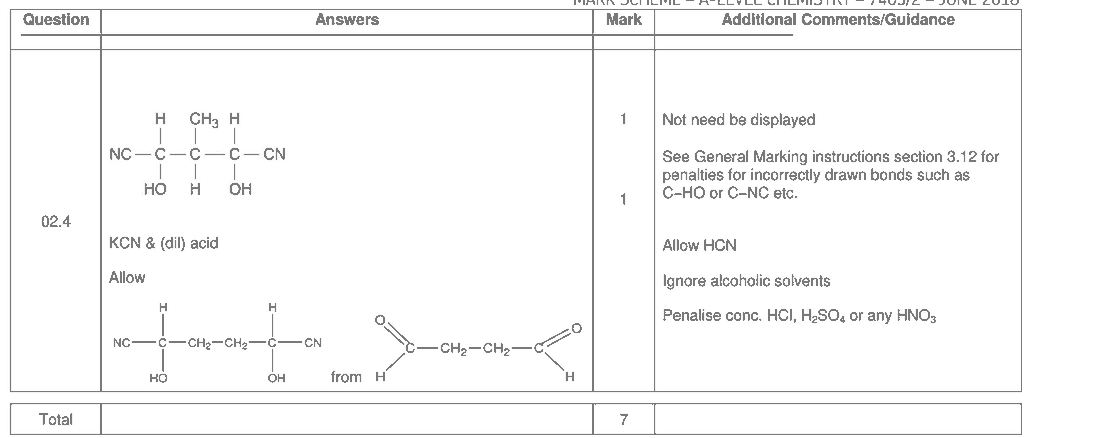
02.4 Most students identified that nitrile groups were present in this molecule, although some drew amines. There were some incorrectly drawn bonds, notably C–NC (see Mark Scheme Instructions for Examiners, section 3.12). Some who drew the incorrect butanedial in question 02.3 gained a mark here for a correct consequential structure. The reagent for Reaction 3 was not well answered. Many students missed the need for acid with KCN and some suggested the CN− ion, which is an incomplete reagent.
Notes from the mark scheme and report
Z is NC–CH(OH)–CH(CH3)–CH(OH)–CN (C6H8N2O2). Reagent: KCN followed by dilute acid (allow HCN). Not conc HCl, H2SO4 or any HNO3
'CN– ions' is incomplete
bonds must go to the C of CN (not C–NC). Consequential structure allowed from butanedial
June 2018 · Paper 2 · Q07.23 marksShort answer
Earlier part of question 07 that this part uses
Mark scheme
Examiner's comment
07.2 In this question, although some students struggled with the name, a number failed to gain the mark due to a failure to label 1-phenyl in an otherwise correct name. Most identified a correct reagent but “electrophilic addition” and “reduction” were frequent wrong answers for the name of the mechanism.
Notes from the mark scheme and report
1-phenylpropan-1-ol (both numbers needed)
NaBH4 (or LiAlH4)
nucleophilic addition. Alternative: H2 with Ni, addition / hydrogenation. 'Reduction' and 'electrophilic addition' are not the mechanism name
June 2018 · Paper 3 · Q281 markMultiple choice
Answer
B
Mark scheme
Examiner's comment
28 A was the commonest incorrect response to this question which had a 47% success rate. This suggests there were many students who recognised that the answer is an aldehyde, but who then missed a possible isomer. Drawing out possible structures in a logical sequence is the key here. Students are advised to start with a 5C chain, then 4C and find
Notes from the mark scheme and report
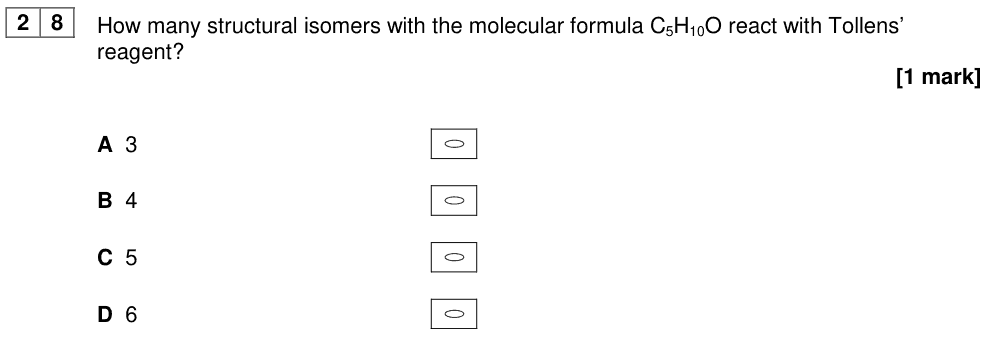
Answer: B. Only aldehydes react: pentanal, 2-methylbutanal, 3-methylbutanal and 2,2-dimethylpropanal. Work through 5-carbon, 4-carbon then 3-carbon chains
A (one missed) was the common wrong answer
June 2017 · Paper 2 · Q04.33 marksExplanation
Earlier part of question 04 that this part uses
Mark scheme
Examiner's comment
04.3 The first mark was less commonly scored than expected as many students wrote about a planar molecule or a planar bond rather than planar carbonyl group; the other two marks were frequently awarded.
Notes from the mark scheme and report
The carbonyl group (C=O carbon) is planar
the CN– can attack from either side
with equal probability, giving equal amounts of the two enantiomers. Not 'planar molecule' or 'planar bond'
June 2017 · Paper 2 · Q04.42 marksDiagram or structure
Earlier part of question 04 that this part uses
Mark scheme
Examiner's comment
04.4 A significant number were not able to deduce the correct product and many incorrect products were seen. These included the cyanohydrin formed from pentanal. This showed a lack of care in reading the question.
Notes from the mark scheme and report
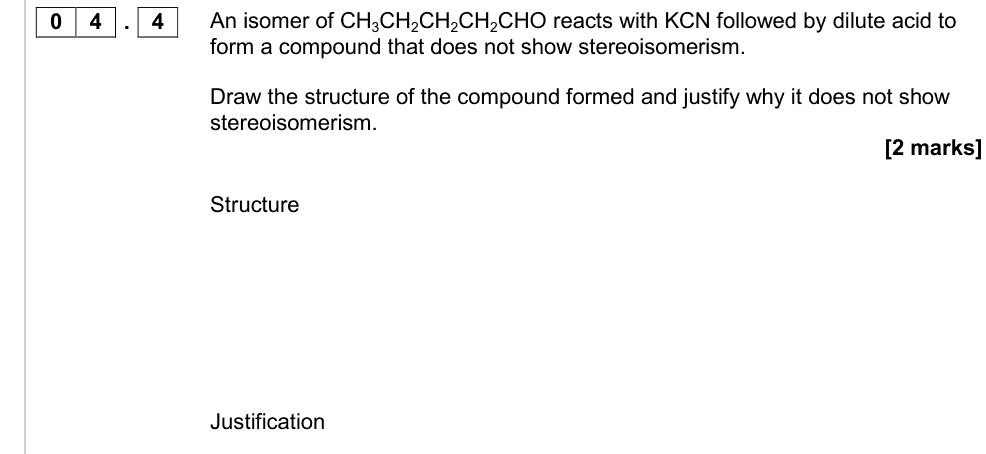
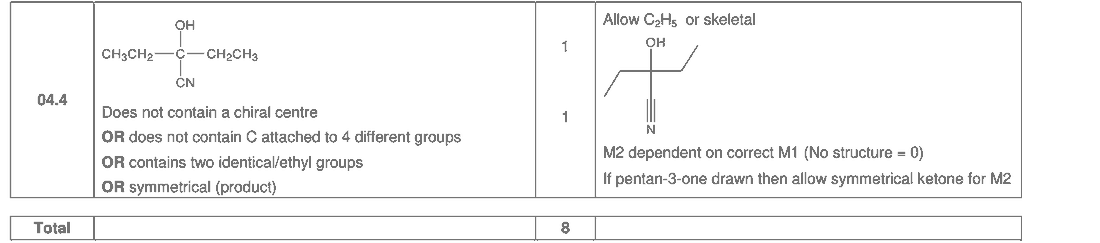
(CH3CH2)2C(OH)CN, from pentan-3-one
it has no chiral centre: the carbon has two identical ethyl groups, not four different groups. M2 depends on the correct structure. Common error: the hydroxynitrile from pentanal
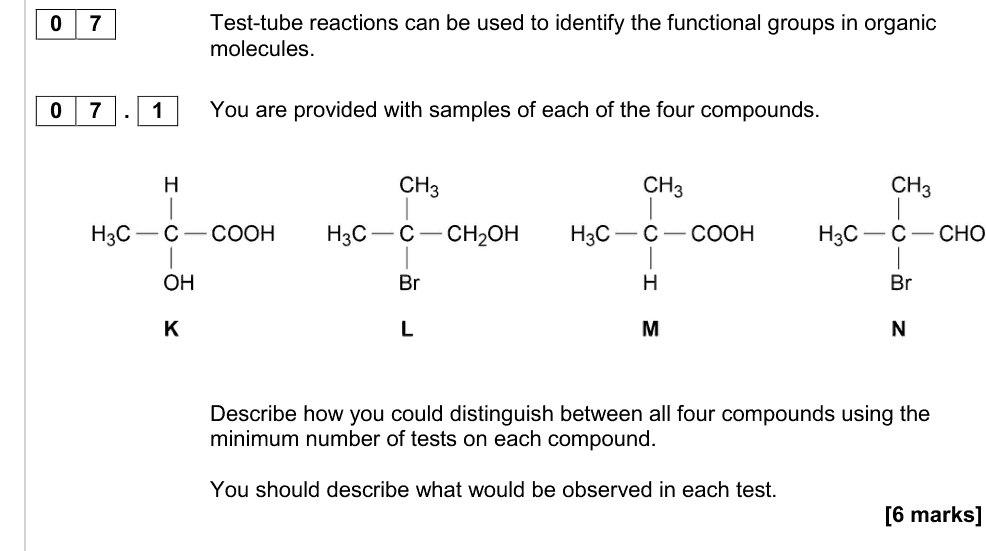
June 2017 · Paper 2 · Q07.16 marks6-mark level of responseHard
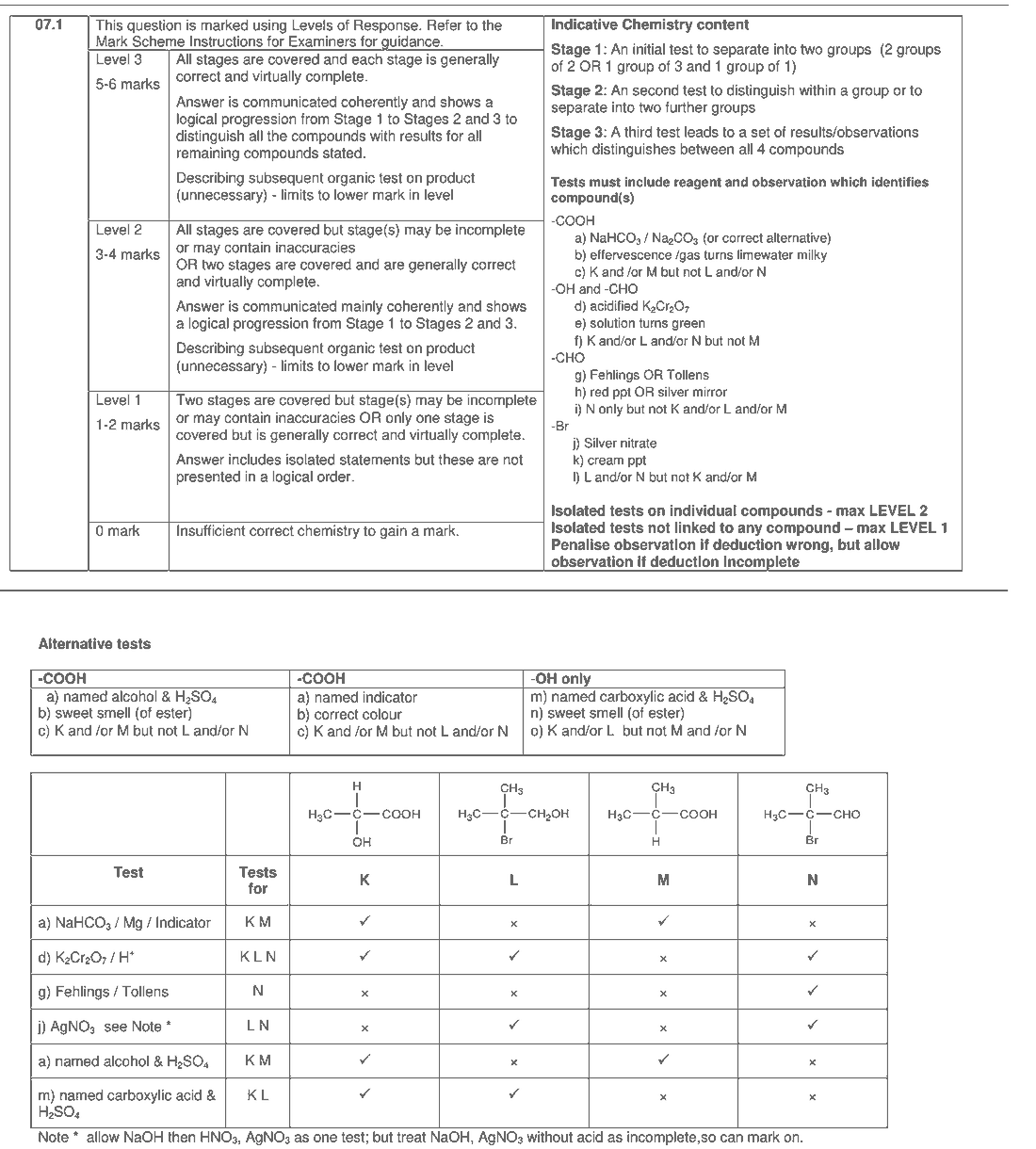
Mark scheme, with the levels and indicative content
Examiner's comment
07.1 There were some very good answers to this question and nearly a fifth of the students scored full marks. The best answers followed a ‘stage approach’, in which a first test divided the four compounds into two groups. Subsequent tests were then made on each group.
Notes from the mark scheme and report
Levels of response: a first test splits the four into two groups, later tests separate within the groups, each with reagent, observation and which compounds respond. NaHCO3/Na2CO3: effervescence with the acids K and M only. Acidified K2Cr2O7: turns green with K, L and N but not M. Fehling's (red precipitate) or Tollens' (silver mirror): N only. Silver nitrate (after NaOH then HNO3): cream precipitate with L and N. Isolated tests not linked to a compound are limited to level 1
Skills: PS1.1 Solve problems set in practical contexts; PS2.1 Comment on experimental design and evaluate scientific methods; RP6 Tests for alcohol, aldehyde, alkene and carboxylic acid
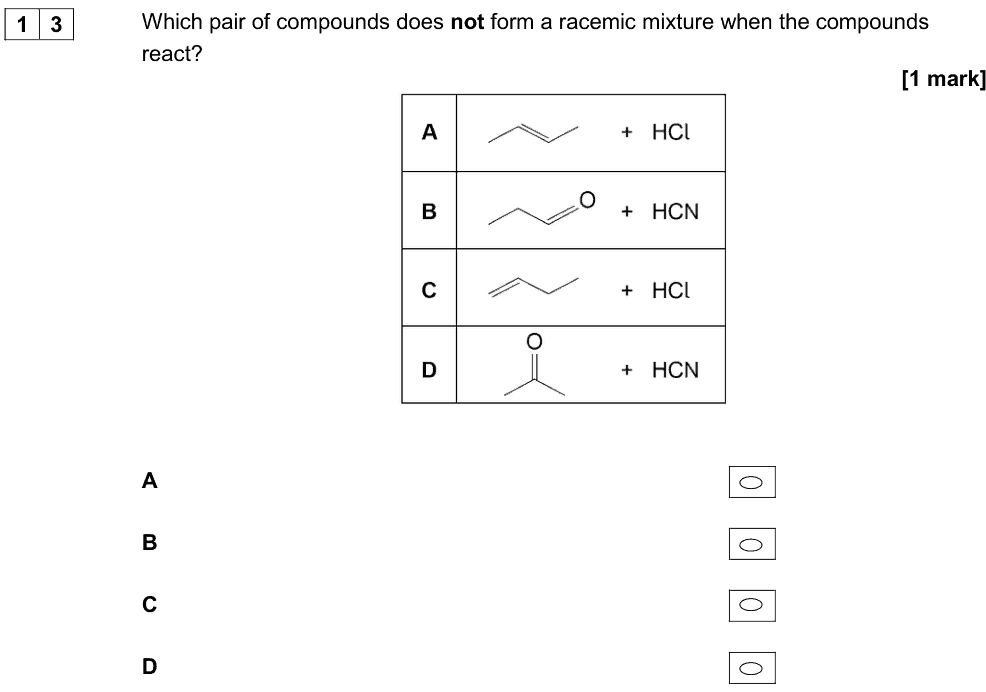
June 2017 · Paper 3 · Q131 markMultiple choice
Answer
D
Mark scheme
Notes from the mark scheme and report
Answer: D. Propanone and HCN give 2-hydroxy-2-methylpropanenitrile, which has two identical methyl groups on the carbon and so no chiral centre. A and C both give 2-chlorobutane and B gives 2-hydroxybutanenitrile, each chiral and formed as a racemate
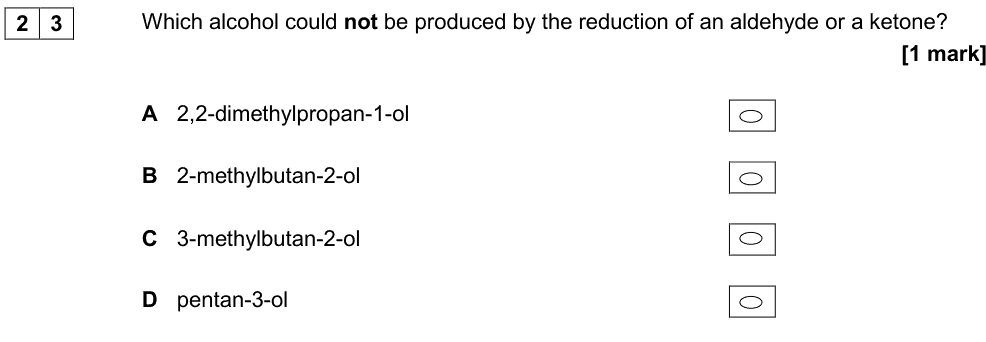
June 2017 · Paper 3 · Q231 markMultiple choice
Answer
B
Mark scheme
Notes from the mark scheme and report
Answer: B. 2-methylbutan-2-ol is a tertiary alcohol
reduction of aldehydes gives primary alcohols and of ketones gives secondary alcohols
Specimen · Paper 2 · Q11.11 markAO1=1Equation writing
Mark scheme
Notes from the mark scheme and report
CH3CH2COCH3 + 2[H] → CH3CH2CH(OH)CH3.
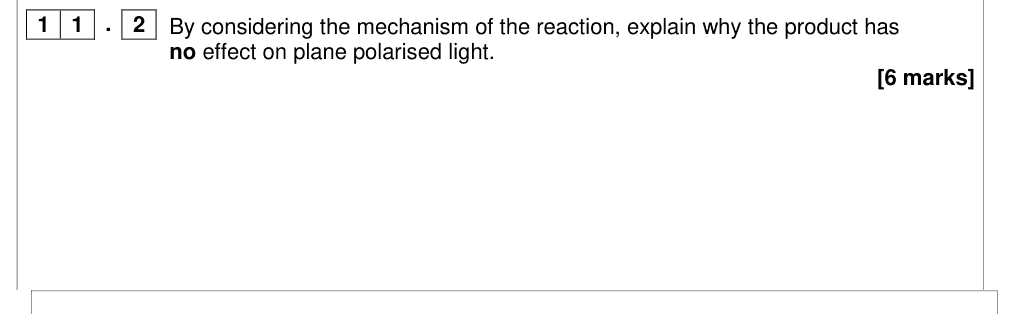
Specimen · Paper 2 · Q11.26 marks6-mark level of response
Earlier part of question 11 that this part uses
Mark scheme, with the levels and indicative content
Notes from the mark scheme and report
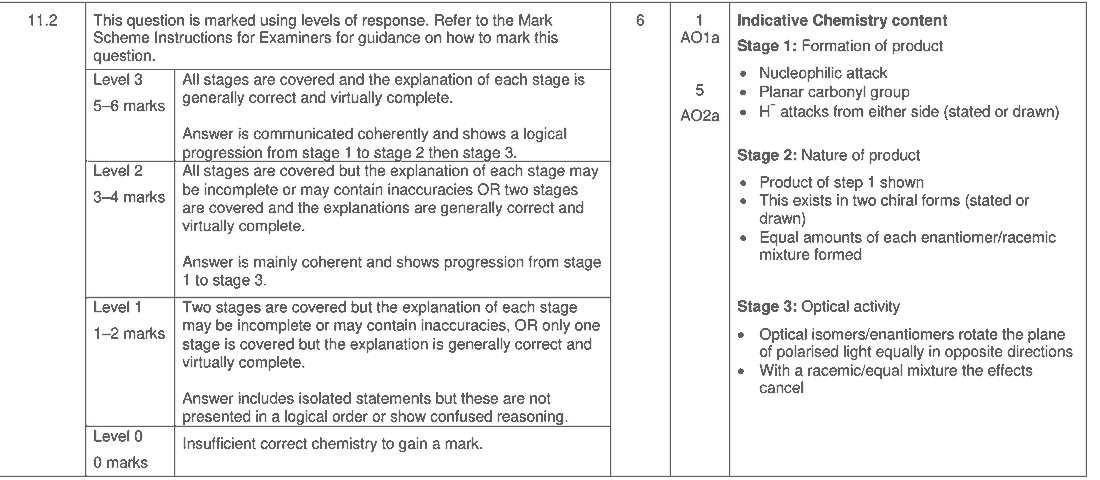
Levels of response, three stages. Formation: nucleophilic attack by H– on the planar carbonyl group, equally likely from either side. Product: butan-2-ol (the step 1 product shown) is chiral and exists as two enantiomers, formed in equal amounts: a racemic mixture. Optical activity: enantiomers rotate plane polarised light equally in opposite directions, so in an equal mixture the effects cancel
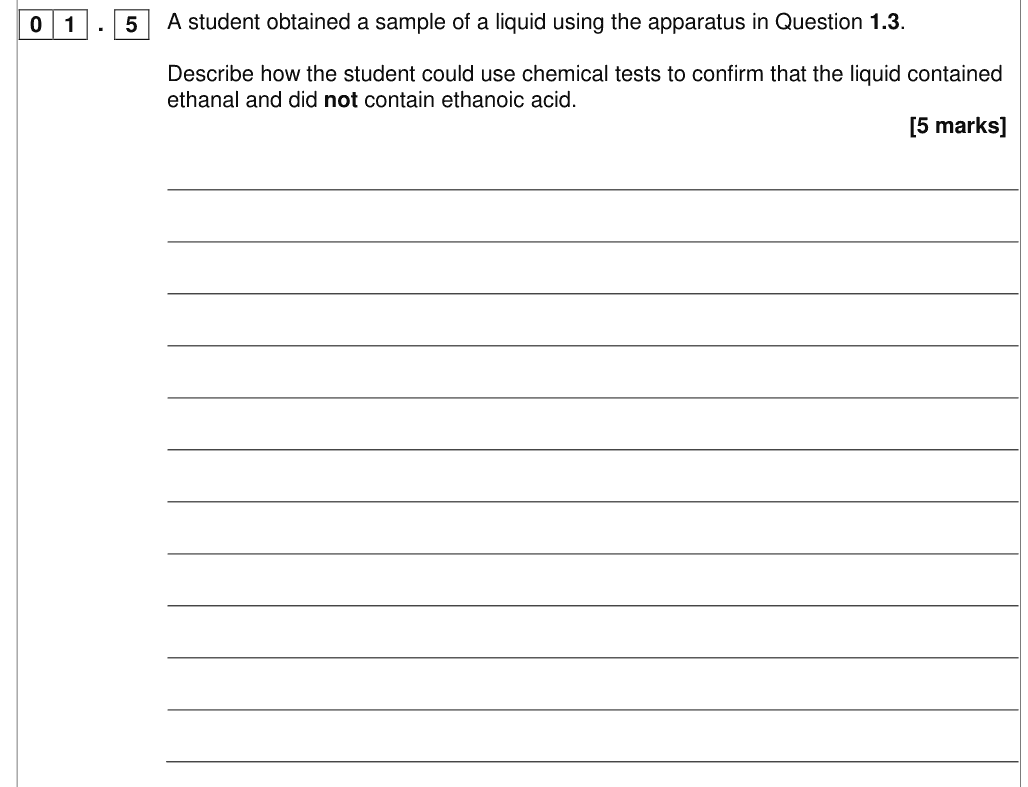
Specimen · Paper 3 · Q01.55 marksPractical and data analysis
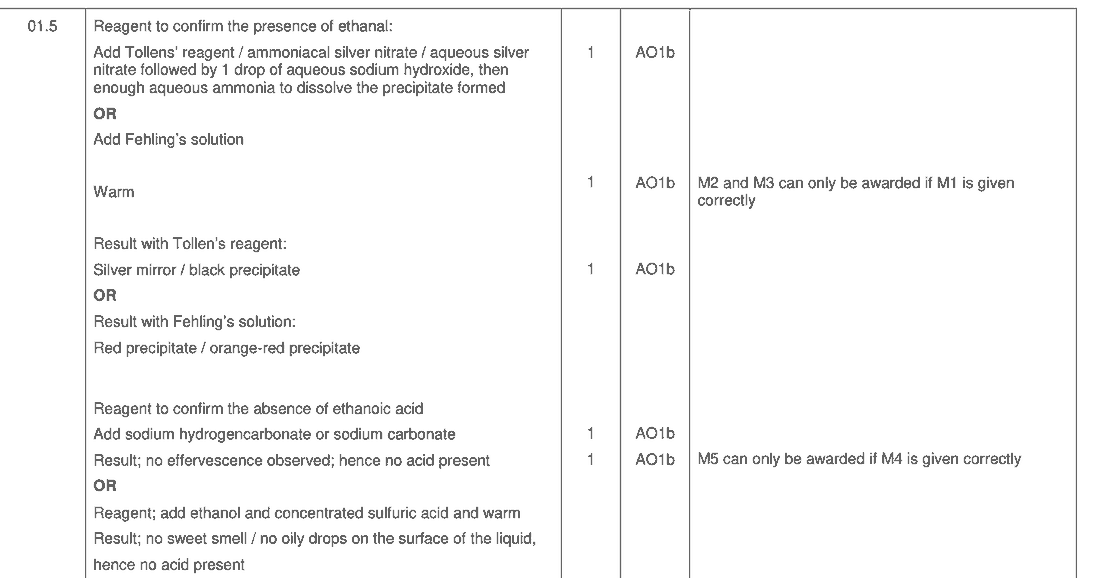
or Fehling's solution and warm, red (orange-red) precipitate. No ethanoic acid: add sodium carbonate or hydrogencarbonate, no effervescence
or warm with ethanol and concentrated H2SO4, no sweet smell. Observation marks need the correct reagent
Skills: ATd Use laboratory apparatus for a variety of experimental techniques including: titration, using burette and pipette; distillation and heating under reflux, including setting up glassware using retort stand and clamps; qualitative tests for ions and organic functional groups; filtration, including use of fluted filter paper, or filtration under reduced pressure; PS4.1 Know and understand how to use a wide range of experimental and practical instruments, equipment and techniques appropriate to the knowledge and understanding included in the specification; PS2.3 Evaluate results and draw conclusions with reference to measurement uncertainties and errors; RP6 Tests for alcohol, aldehyde, alkene and carboxylic acid
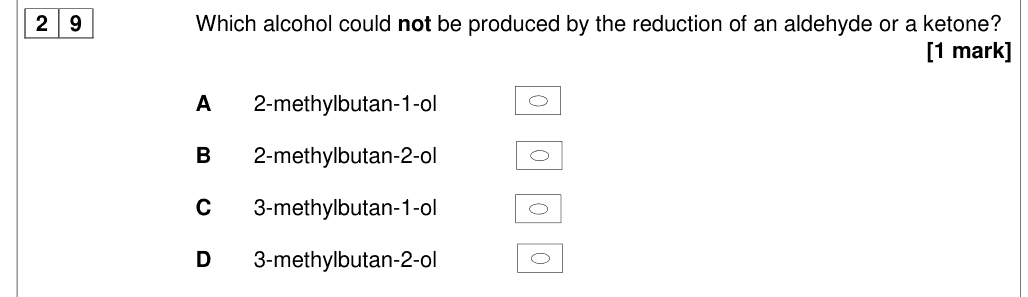
Specimen · Paper 3 · Q291 markAO3=1Multiple choice
Answer
B
Mark scheme
Notes from the mark scheme and report
Answer: B. 2-Methylbutan-2-ol is a tertiary alcohol
reduction of aldehydes gives primary alcohols and of ketones gives secondary alcohols
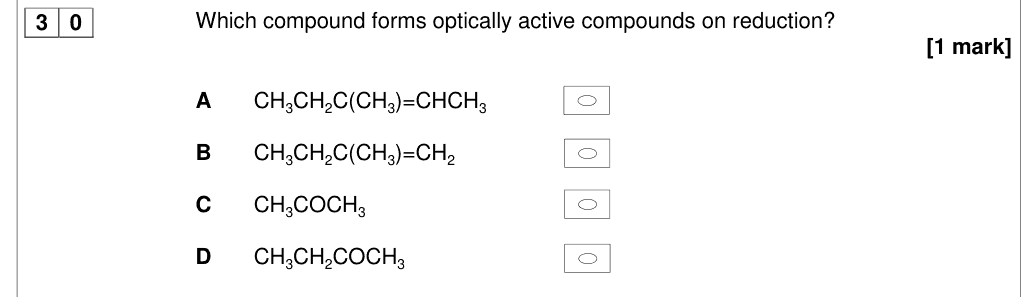
Specimen · Paper 3 · Q301 markAO3=1Multiple choice
Answer
D
Mark scheme
Notes from the mark scheme and report
Answer: D. Butanone is reduced to butan-2-ol, which has a chiral carbon (CH3, C2H5, H, OH)
the products from A, B and C have no chiral centre
Work with an A-level chemistry tutor
Dropping marks on calculations, mechanisms or the required practicals? Book a trial session with a specialist A-level chemistry tutor.