Notes and key-term cards for this topic are being written by our tutors. The past-paper questions below are ready now.
Specification statements
Show the 13 statements from the specification
3.2.2-01 The trends in atomic radius, first ionisation energy and melting point of the elements Mg–Ba
3.2.2-02 Students should be able to: • explain the trends in atomic radius and first ionisation energy • explain the melting point of the elements in terms of their structure and bonding.
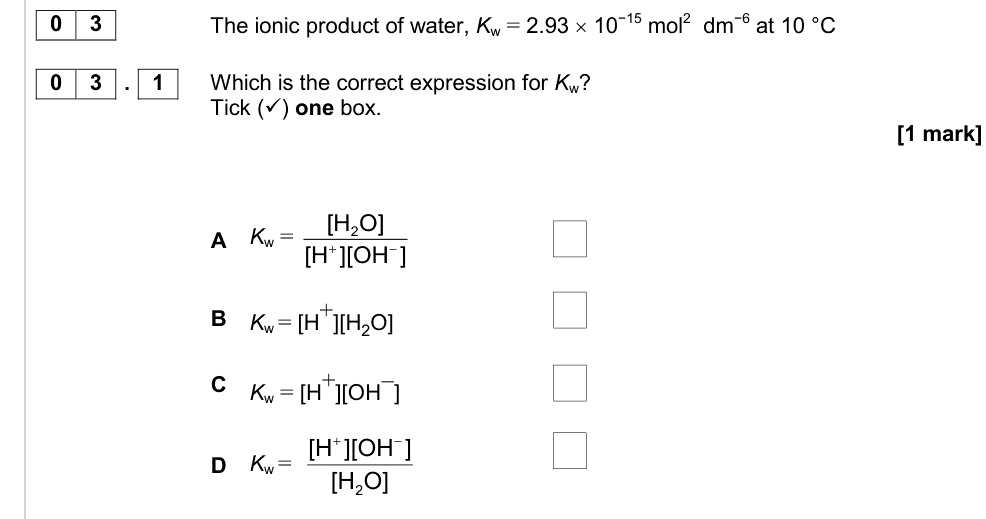
3.2.2-03 The reactions of the elements Mg–Ba with water.
3.2.2-04 The use of magnesium in the extraction of titanium from TiCl4
3.2.2-05 The relative solubilities of the hydroxides of the elements Mg–Ba in water.
3.2.2-06 Mg(OH)2 is sparingly soluble.
3.2.2-07 The use of Mg(OH)2 in medicine and of Ca(OH)2 in agriculture.
3.2.2-08 The use of CaO or CaCO3 to remove SO2 from flue gases.
3.2.2-09 The relative solubilities of the sulfates of the elements Mg–Ba in water.
3.2.2-10 BaSO4 is insoluble.
3.2.2-11 The use of acidified BaCl2 solution to test for sulfate ions.
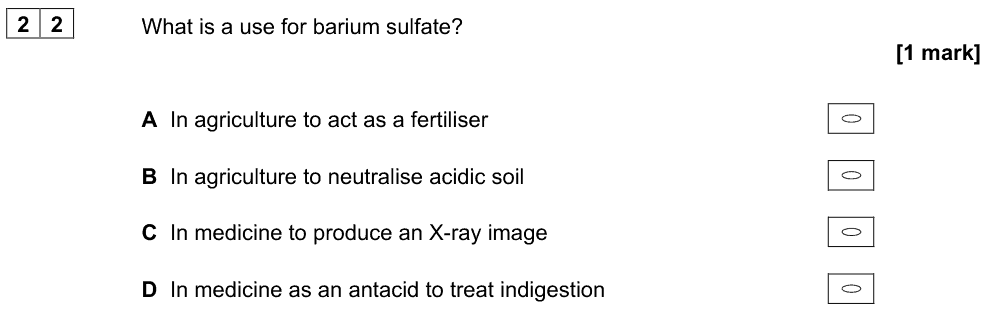
3.2.2-12 The use of BaSO4 in medicine.
3.2.2-13 Students should be able to: • explain why BaCl2 solution is used to test for sulfate ions and why it is acidified.
Six-mark level of response questions on this topic
Tap a question to zoom it. Where a part needs a figure, table or structure from earlier in the question, that part folds out above it; the mark scheme and examiner's comment open underneath. Have AQA's Data Booklet (the Periodic Table and the spectroscopy tables) beside you.
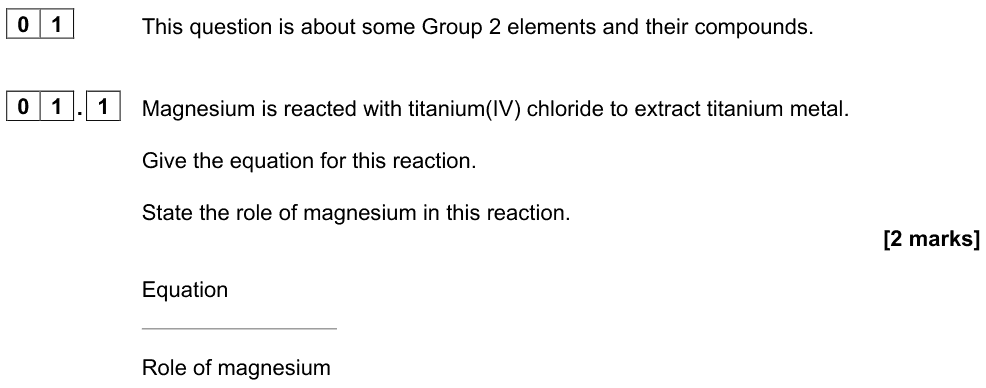
June 2025 · Paper 1 · Q01.12 marksAO1=1, AO2=1Equation writing
Mark scheme
Examiner's comment
Over half the students scored both marks in part 1; some students were unfamiliar with the correct formula of titanium (IV) chloride and were unable to write a balanced equation.
Some students did not know the role of magnesium.
Notes from the mark scheme and report
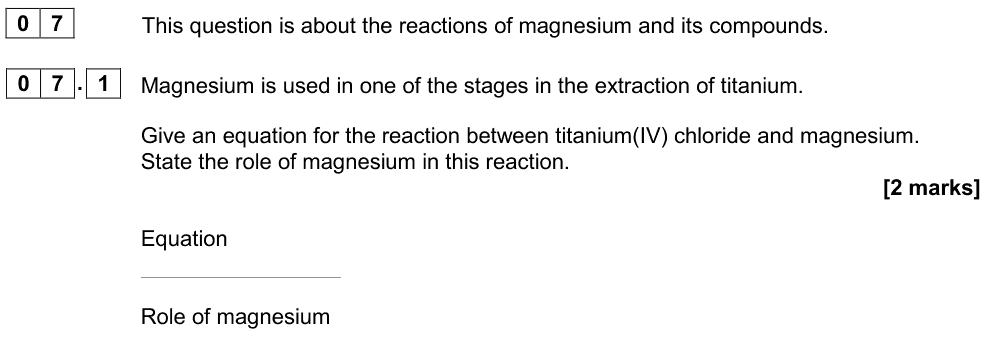
TiCl4 + 2Mg → Ti + 2MgCl2
magnesium is the reducing agent (electron donor). Errors: wrong formula for titanium(IV) chloride
equation not balanced
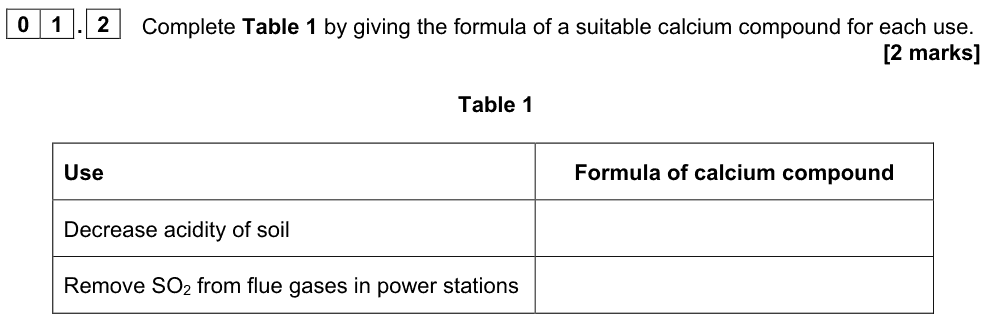
June 2025 · Paper 1 · Q01.22 marksAO1=2Short answer
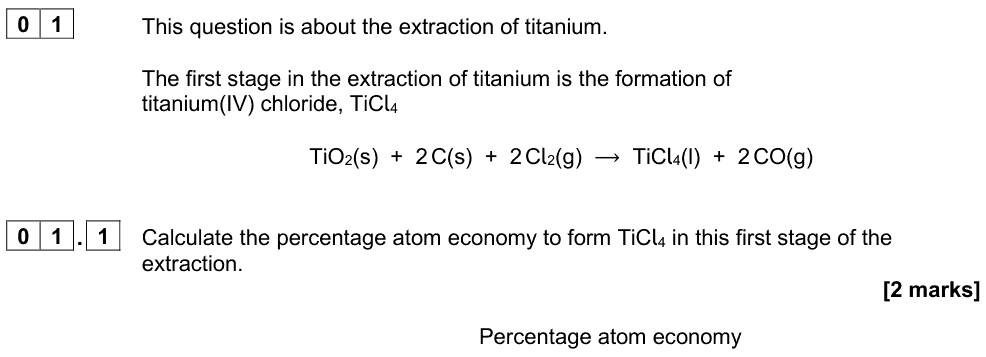
Earlier part of question 01 that this part uses
Mark scheme
Examiner's comment
Answers to part 2 were good; common errors included incorrect formulas.
Notes from the mark scheme and report
Decrease acidity of soil: Ca(OH)2. Remove SO2 from flue gases: CaCO3 or CaO. Common errors were incorrect formulas
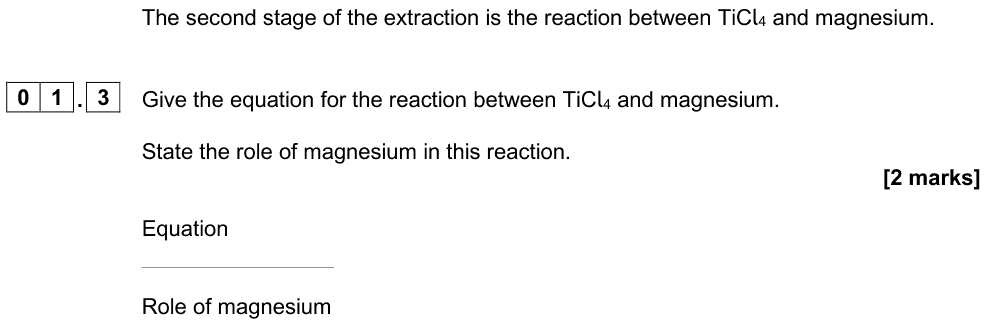
June 2025 · AS Paper 1 · Q01.32 marksAO1=2Equation writing
Earlier part of question 01 that this part uses
Mark scheme
Examiner's comment
1.3 The majority of students were able to give a correct chemical equation for the reaction between titanium (IV) chloride and magnesium. However, the role of magnesium was often incorrectly stated as an oxidising agent rather than a reducing agent.
Notes from the mark scheme and report
TiCl4 + 2Mg → 2MgCl2 + Ti
magnesium is the reducing agent / electron donor. Role often wrongly given as oxidising agent
June 2025 · Paper 1 · Q01.31 markAO3=1Short answer
Earlier part of question 01 that this part uses
Mark scheme
Examiner's comment
In part 3 many students knew that magnesium hydroxide was less soluble than sodium hydroxide; common errors included reference to the base strength without linking their ideas to solubility or comparing the reactivity of NaOH and Mg(OH)2
Notes from the mark scheme and report
Magnesium hydroxide is sparingly soluble / insoluble (less soluble than NaOH), or it is not corrosive whereas sodium hydroxide is. References to base strength or pH alone are ignored
June 2025 · AS Paper 1 · Q01.41 markAO3=1Short answer
Earlier parts of question 01 that this part uses
Mark scheme
Examiner's comment
1.4 Students found this question very challenging. Whilst students appreciated that magnesium is a reactive metal, they struggled to then suggest why this made the magnesium expensive.
Notes from the mark scheme and report
The process to extract magnesium uses a lot of energy / uses electrolysis. Students knew magnesium is reactive but could not link this to cost
June 2025 · Paper 1 · Q01.42 marksAO3=2Equation writing
Earlier part of question 01 that this part uses
Mark scheme
Examiner's comment
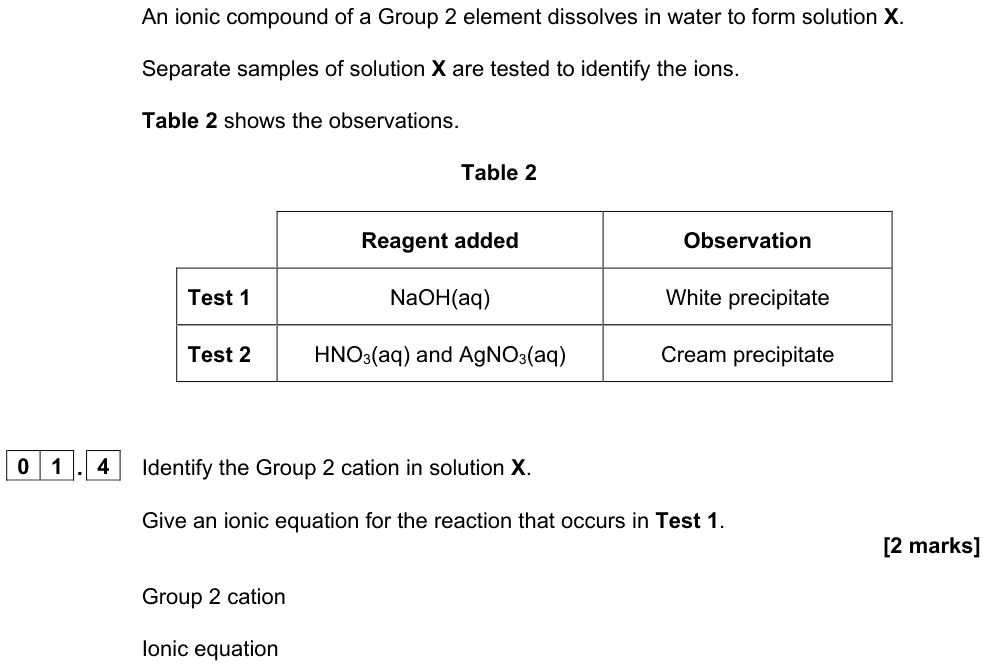
Fewer than half the students scored both marks in part 4; some students did not attempt an ionic equation and used NaOH as their reagent.
Notes from the mark scheme and report
Mg2+
Mg2+ + 2OH– → Mg(OH)2 (Ca2+ also allowed with a matching equation). Must be an ionic equation: many used NaOH as the reagent or did not attempt it
Skills: PS1.2 Apply scientific knowledge to practical contexts; RP4 Carry out simple test-tube reactions to identify: cations – Group 2, NH4+; anions – Group 7 (halide ions), OH–, CO32–, SO42–
June 2025 · Paper 1 · Q01.61 markAO1=1Short answer
Earlier parts of question 01 that this part uses
Mark scheme
Examiner's comment
Part 6 was well answered.
Notes from the mark scheme and report
It is insoluble (so not absorbed / not toxic), or it absorbs / blocks X-rays (radiopaque). 'Barium meal' or 'X-rays' without qualification is ignored
June 2025 · Paper 1 · Q02.12 marksAO1=2Explanation
Mark scheme
Examiner's comment
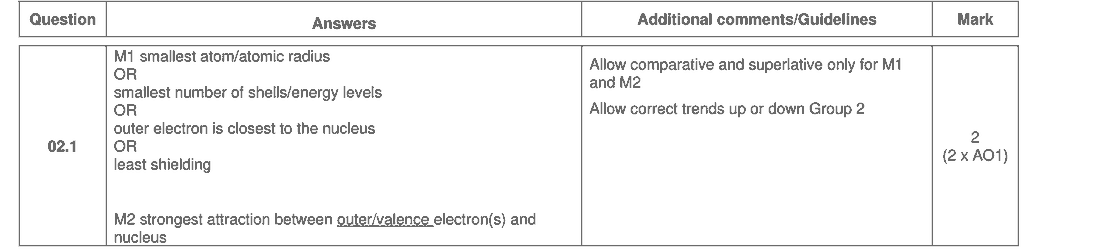
About 50% of the students gained both marks in part 1; some students lost the second mark for not giving a comparative response or by not referring to the attraction between the nucleus and the outermost electron.
Notes from the mark scheme and report
Beryllium has the smallest atom / fewest shells / least shielding (outer electron closest to the nucleus)
so the strongest attraction between the nucleus and the outer electron. Comparative or superlative wording needed for both marks
June 2025 · AS Paper 1 · Q04.12 marksAO1=2Explanation
Mark scheme
Examiner's comment
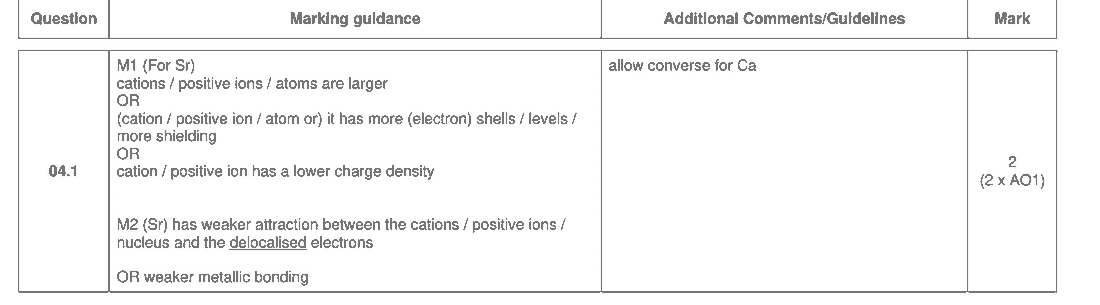
4.1 Students were asked to explain why strontium has a lower melting point than calcium. Many students understood that Sr2+ is a larger ion or an ion with a lower charge density. However, a large number of students did not explain that in Strontium there is a weaker attraction for the delocalised electrons and often made reference to the attraction for the outer electrons.
Notes from the mark scheme and report
Sr2+ ions are larger (more shells / lower charge density), so the attraction between the positive ions and the delocalised electrons is weaker (weaker metallic bonding). Many wrote about attraction for the outer electrons rather than the delocalised electrons
June 2025 · AS Paper 1 · Q04.21 markAO1=1Short answer
Earlier part of question 04 that this part uses
Mark scheme
Examiner's comment
4.2 This question was well answered with students giving a reason for increasing atomic radius down Group 2
Notes from the mark scheme and report
More (electron) shells / energy levels
June 2025 · AS Paper 1 · Q04.31 markAO1=1Equation writing
Earlier part of question 04 that this part uses
Mark scheme
Examiner's comment
4.3 Students did not often include state symbols in their equation. Students also gave equations that formed BaO rather than Ba(OH)2
Notes from the mark scheme and report
Ba(s) + 2H2O(l) → Ba(OH)2(aq) + H2(g). State symbols essential. Errors: no state symbols
BaO as the product
June 2025 · AS Paper 1 · Q04.51 markAO1=1Short answer
Earlier part of question 04 that this part uses
Mark scheme
Examiner's comment
4.5 The vast majority of students were correctly able to identify the Group 2 metal with the lowest ionisation energy.
Notes from the mark scheme and report
Barium (allow radium)
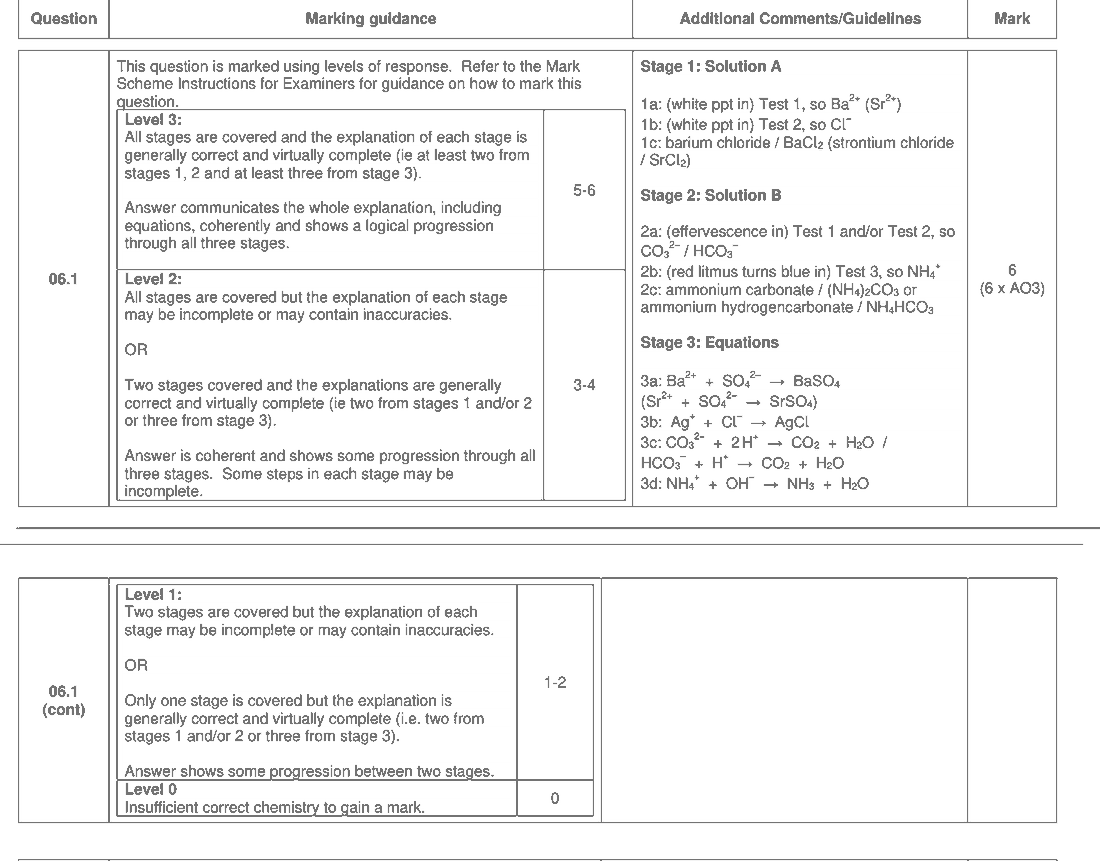
June 2025 · AS Paper 1 · Q06.16 marksAO3=66-mark level of responseHard
Mark scheme, with the levels and indicative content
Examiner's comment
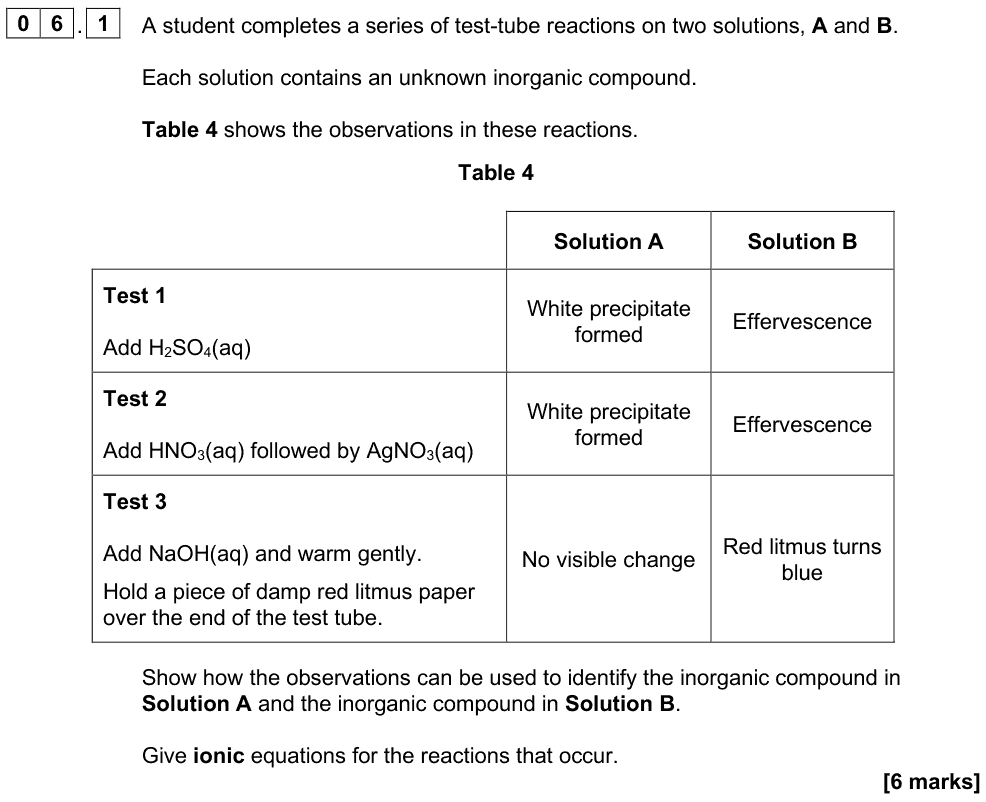
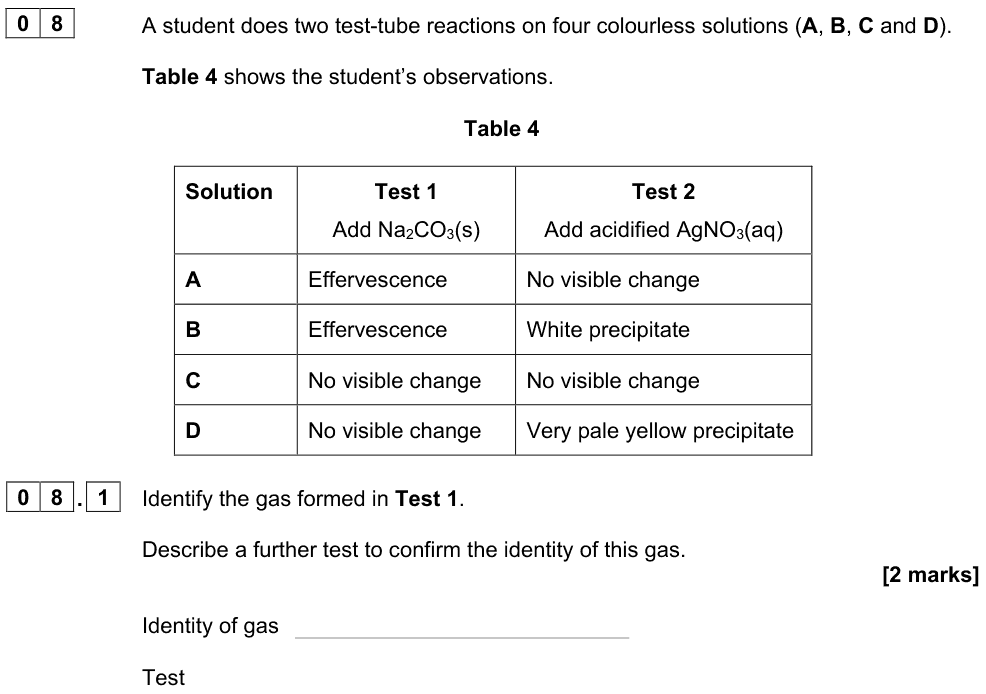
6.1 Students found interpreting the observations for a series of test-tube reaction challenging. Correct ionic equations for the reactions. Ionic equations were frequently missing from student answers so only about a quarter of students scored highly on this question. Students did also not always clearly explain how the observations from the Table could be used to identify the ions / compounds present in each solution.
Notes from the mark scheme and report
Levels of response, three stages. Stage 1, solution A: white precipitate with H2SO4 so Ba2+ (or Sr2+)
white precipitate with acidified AgNO3 so Cl–
barium chloride. Stage 2, solution B: effervescence with acid so CO3 2– (or HCO3–)
damp red litmus turns blue on warming with NaOH so NH4+
NH4+ + OH– → NH3 + H2O. Ionic equations were frequently missing and the link from observation to ion was not always explained
Skills: PS1.1 Solve problems set in practical contexts; PS2.3 Evaluate results and draw conclusions with reference to measurement uncertainties and errors; ATd Use laboratory apparatus for a variety of experimental techniques including: titration, using burette and pipette; distillation and heating under reflux, including setting up glassware using retort stand and clamps; qualitative tests for ions and organic functional groups; filtration, including use of fluted filter paper, or filtration under reduced pressure; RP4 Carry out simple test-tube reactions to identify: cations – Group 2, NH4+; anions – Group 7 (halide ions), OH–, CO32–, SO42–
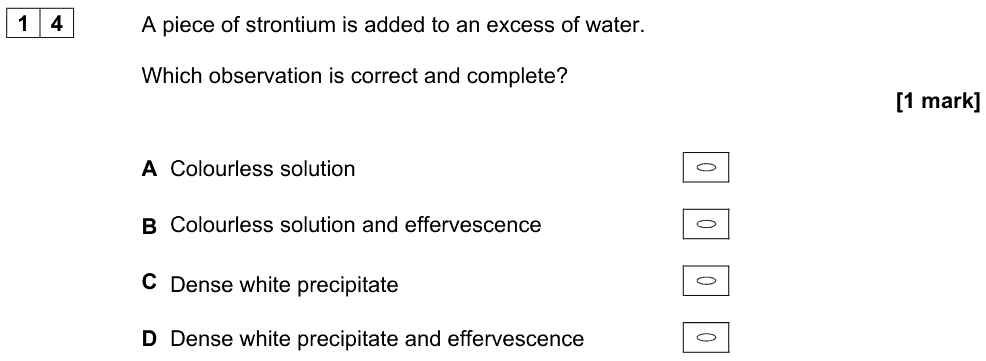
June 2025 · Paper 3 · Q141 markAO1=1Multiple choice
Answer
B
Mark scheme
Notes from the mark scheme and report
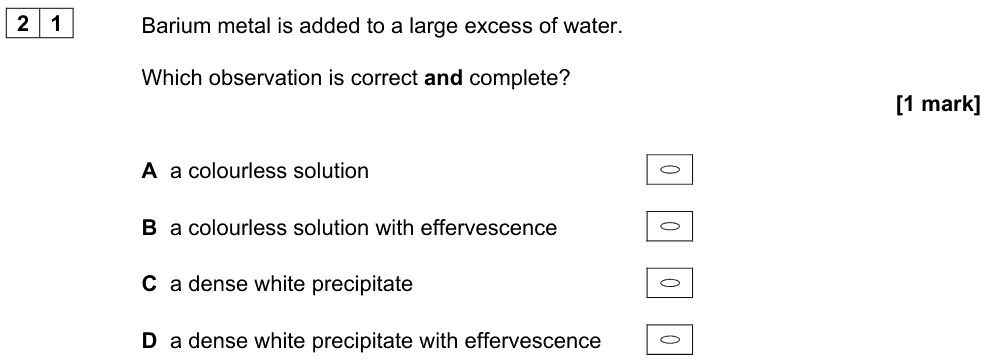
Answer: B. Strontium gives hydrogen gas and strontium hydroxide, which is soluble enough to stay in solution. One of the least well answered questions (under 55% correct)
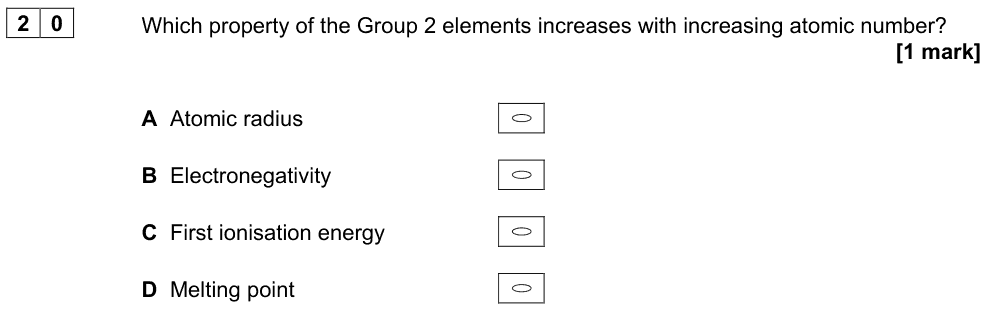
June 2025 · Paper 3 · Q201 markAO1=1Multiple choice
Answer
A
Mark scheme
Notes from the mark scheme and report
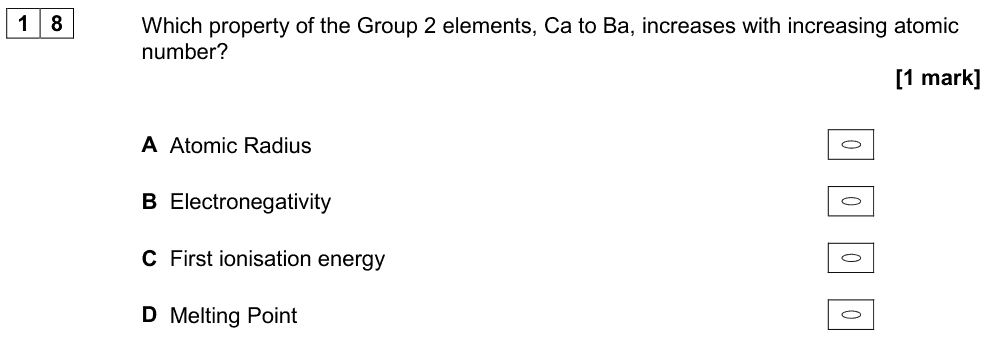
Answer: A. Atomic radius increases down Group 2
the other three decrease
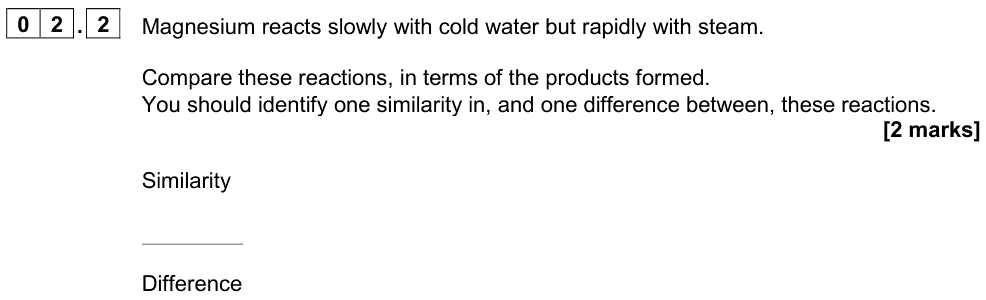
June 2024 · AS Paper 1 · Q02.22 marksAO1=2Short answer
Earlier part of question 02 that this part uses
Mark scheme
Examiner's comment
02.2 This question was also well answered by many students. Some students, however, did not refer to the products formed in their answers. Reference to the differing rate of reaction was a common difference mentioned by students. The comparison required reference to the products, so this difference was not awarded credit.
Notes from the mark scheme and report
Similarity: both produce hydrogen (or a white solid / a base / an Mg2+ compound). Difference: steam gives magnesium oxide, cold water gives magnesium hydroxide. Must be about products
difference in rate does not score
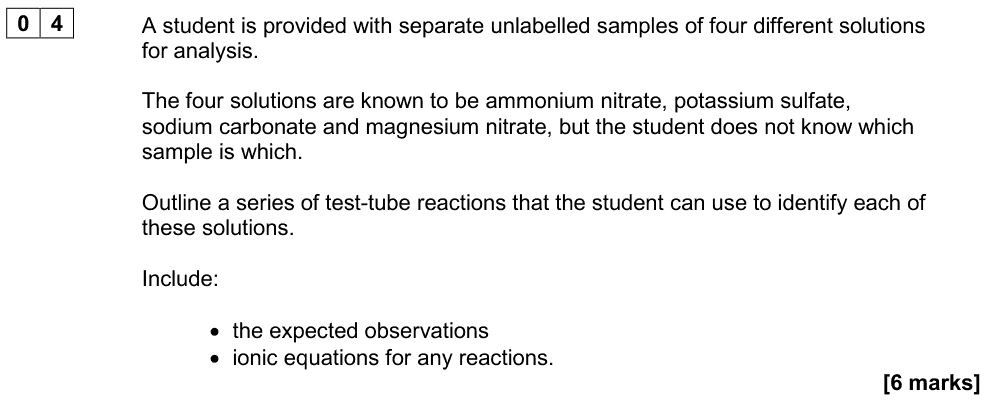
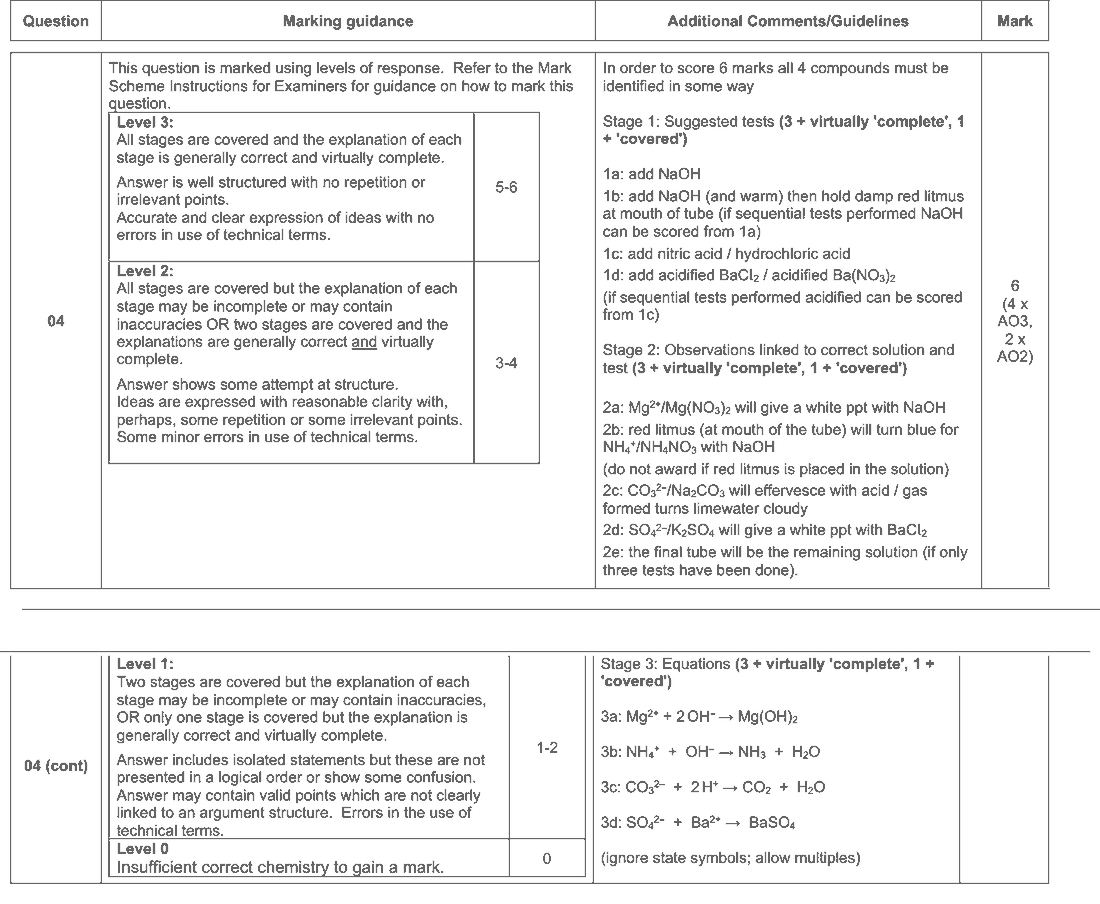
June 2024 · AS Paper 1 · Q046 marksAO2=2, AO3=46-mark level of response
Mark scheme, with the levels and indicative content
Examiner's comment
04 Only a few students scored all the marks on this question. Inorganic ion tests were not well described. In particular, many students did not show that the test for ammonium ions requires the use of sodium hydroxide as well as placing damp red litmus paper at the top/mouth of the tube. Students did not always provide any equations for these tests and when these were provided, they were often not ionic equations.
Notes from the mark scheme and report
Levels of response, three stages. Tests: add NaOH
add NaOH, warm and hold damp red litmus at the mouth of the tube
add dilute nitric or hydrochloric acid
add acidified BaCl2. Observations: Mg(NO3)2 gives a white precipitate with NaOH
NH4NO3 turns the damp red litmus blue
Na2CO3 effervesces with acid
K2SO4 gives a white precipitate with BaCl2. Ionic equations: Mg2+ + 2OH– → Mg(OH)2
NH4+ + OH– → NH3 + H2O
CO3 2– + 2H+ → CO2 + H2O
Ba2+ + SO4 2– → BaSO4. All four solutions must be identified for 6. Errors: litmus dipped in the solution, no NaOH for the ammonium test, equations not ionic
Skills: ATd Use laboratory apparatus for a variety of experimental techniques including: titration, using burette and pipette; distillation and heating under reflux, including setting up glassware using retort stand and clamps; qualitative tests for ions and organic functional groups; filtration, including use of fluted filter paper, or filtration under reduced pressure; PS1.1 Solve problems set in practical contexts; PS4.1 Know and understand how to use a wide range of experimental and practical instruments, equipment and techniques appropriate to the knowledge and understanding included in the specification; RP4 Carry out simple test-tube reactions to identify: cations – Group 2, NH4+; anions – Group 7 (halide ions), OH–, CO32–, SO42–
June 2024 · Paper 1 · Q09.11 markAO3=1Short answer
Mark scheme
Examiner's comment
Errors in answers to part 1 included more shielding or more orbitals: these are correct statements but insufficient for the mark as they do not explain the increase in atomic size.
Notes from the mark scheme and report
Calcium has more shells / energy levels. More shielding or more orbitals are true but do not score
June 2024 · Paper 1 · Q09.21 markAO3=1Equation writing
Earlier part of question 09 that this part uses
Mark scheme
Examiner's comment
The equation in part 2 was generally good: errors included missing state symbols and MgO(aq) or MgO(g) as a product.
Some students gave magnesium hydroxide as a product.
Notes from the mark scheme and report
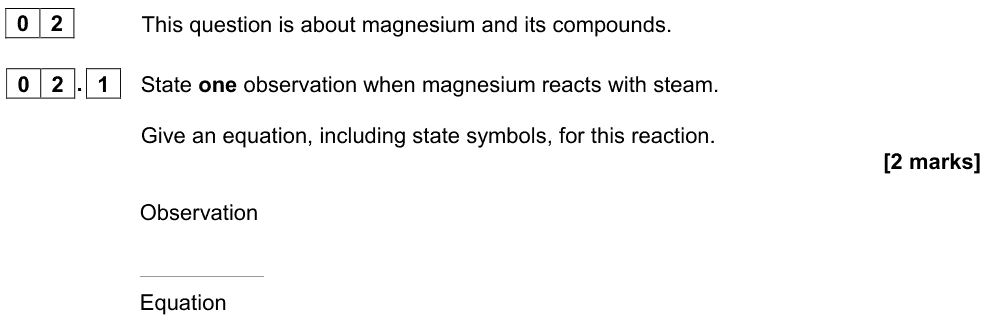
Mg(s) + H2O(g) → MgO(s) + H2(g). State symbols required. Errors: MgO(aq) or MgO(g)
magnesium hydroxide as the product
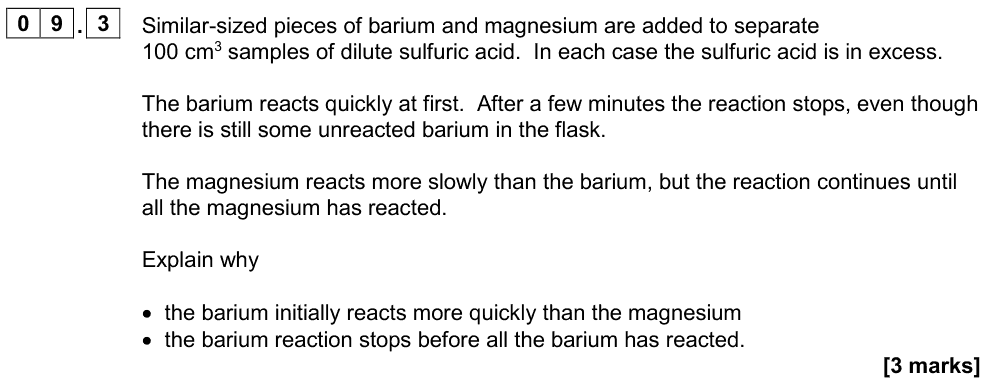
June 2024 · Paper 1 · Q09.33 marksAO1=2, AO3=1Explanation
Earlier part of question 09 that this part uses
Mark scheme
Examiner's comment
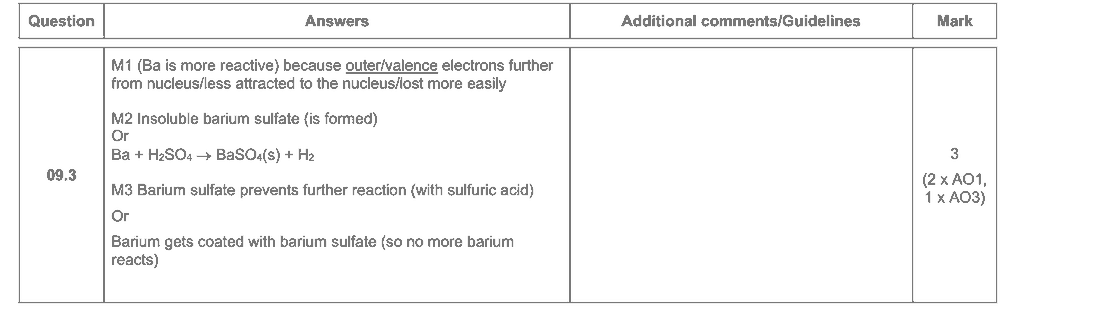
In part 3 most students knew that electrons were easier to lose from barium and/or that barium sulfate is insoluble.
Very few students stated that a precipitate would form a layer on the barium and stop the reaction.
Notes from the mark scheme and report
Barium's outer electrons are further from the nucleus and lost more easily
insoluble barium sulfate forms and coats the barium, preventing further reaction. Very few mentioned the coating
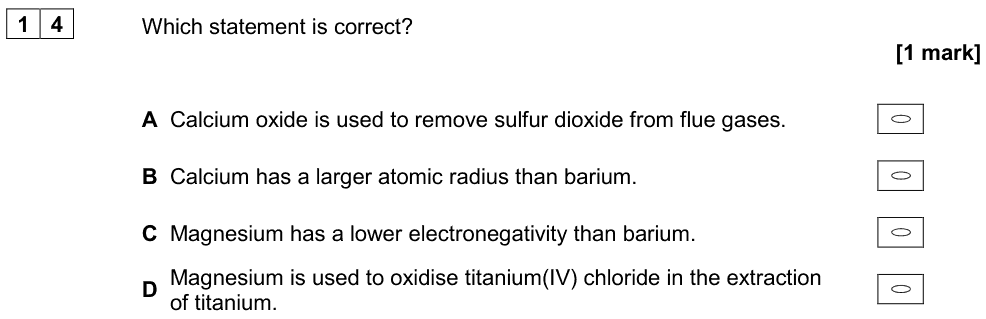
June 2024 · AS Paper 1 · Q141 markAO1=1Multiple choice
Answer
A
Mark scheme
Examiner's comment
Properties of Group 2 elements Just over half the students (55%) could identify the correct statement about the properties of Group 2 elements. A large number of students incorrectly thought that magnesium oxidises titanium(IV) chloride in the extraction of titanium.
Notes from the mark scheme and report
Answer: A. CaO removes SO2 from flue gases. Ca is smaller than Ba
Mg is more electronegative than Ba
Mg reduces TiCl4 (a common wrong choice was D)
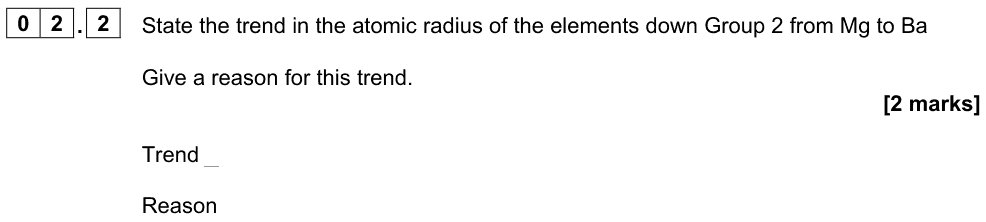
June 2023 · AS Paper 1 · Q02.22 marksAO1=2Short answer
Earlier part of question 02 that this part uses
Mark scheme
Examiner's comment
02.2 This question was well answered, although students didn’t always consider the change in the number of electron energy levels in the atoms.
Notes from the mark scheme and report
Atomic radius increases
the number of electron energy levels (shells) increases. An increase in shielding is ignored
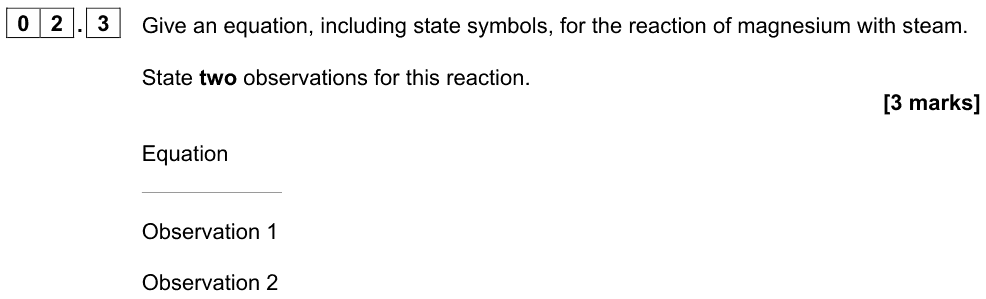
June 2023 · AS Paper 1 · Q02.33 marksAO1=1, AO2=2Short answer
Earlier part of question 02 that this part uses
Mark scheme
Examiner's comment
02.3 Students found this question challenging and did not always include state symbols in their equations. Some students incorrectly gave Mg(OH)2 as the product of this reaction, whilst common incorrect observations included fizzing and the formation of a precipitate.
Notes from the mark scheme and report
Mg(s) + H2O(g) → MgO(s) + H2(g), state symbols essential. Observations: bright white flame/light
white (or grey) powder/ash formed. Not precipitate. Common errors: Mg(OH)2 as the product
fizzing
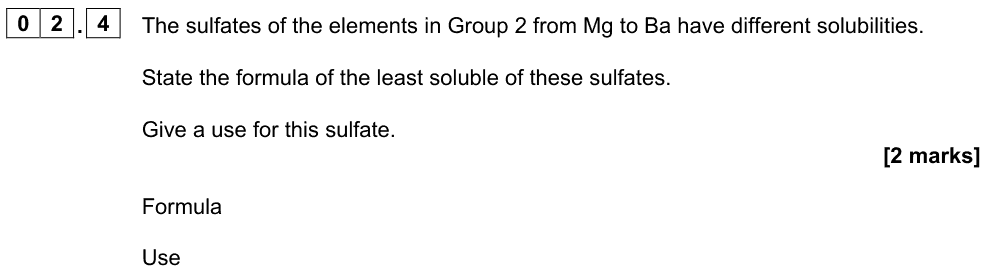
June 2023 · AS Paper 1 · Q02.42 marksAO1=2Short answer
Earlier part of question 02 that this part uses
Mark scheme
Examiner's comment
02.4 Just over half of the students achieved both marks on this question, although some students gave the formula of a sulfide rather than a sulfate and the uses given were often uses of calcium hydroxide or magnesium hydroxide rather than barium sulfate.
Notes from the mark scheme and report
BaSO4
used as a barium meal for X-rays of internal organs. Common errors: a sulfide formula
uses of calcium hydroxide or magnesium hydroxide
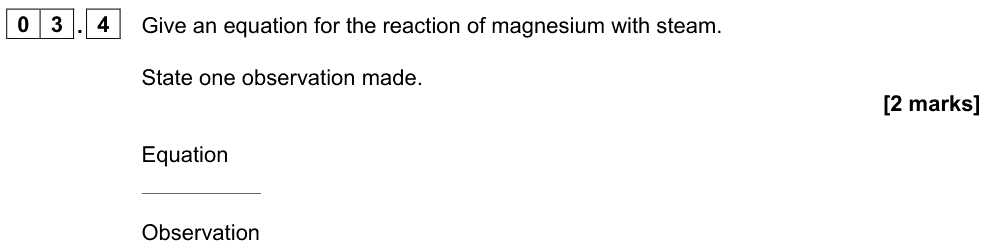
June 2023 · Paper 1 · Q03.42 marksAO1=2Equation writing
Earlier part of question 03 that this part uses
Mark scheme
Examiner's comment
In 03.4 several students did not give the correct equation; the most common errors were to form magnesium hydroxide and hydrogen or to give the observation as fizzing or a white precipitate.
Notes from the mark scheme and report
Mg + H2O → MgO + H2. Observation: white solid / white powder, or bright white light / flame. Not a white precipitate, not effervescence. Common error: Mg(OH)2 as the product
June 2023 · AS Paper 1 · Q201 markAO3=1Multiple choice
Earlier part of question 20 that this part uses
Answer
B
Mark scheme
Examiner's comment
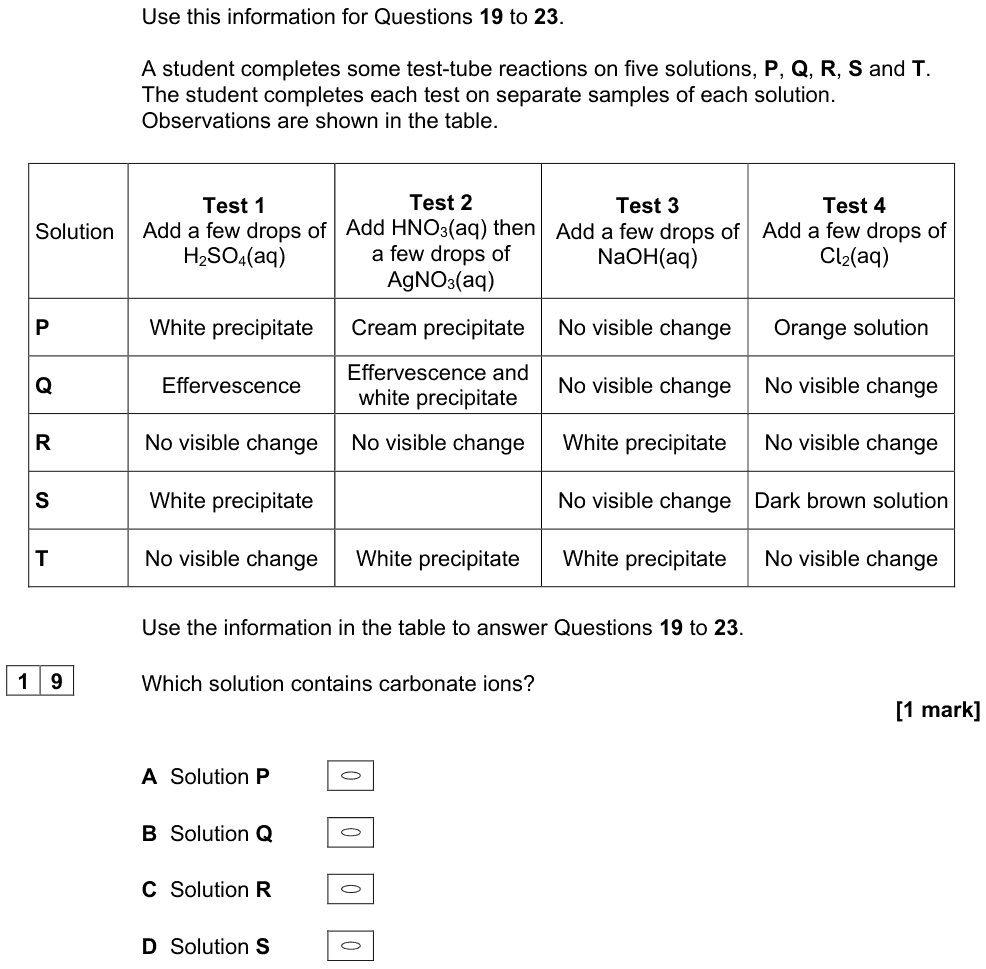
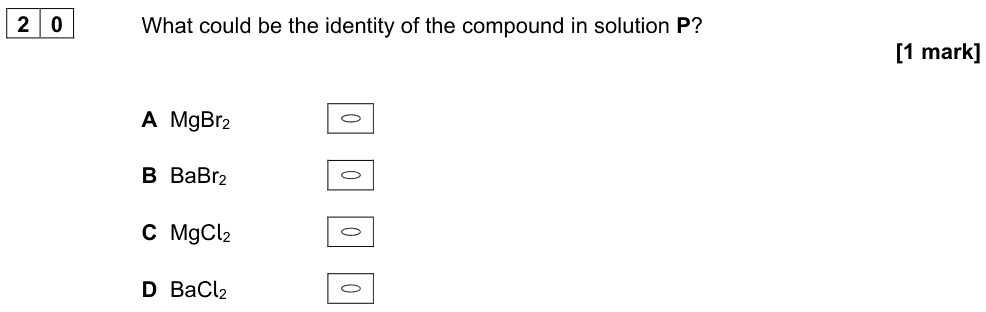
These questions enabled students to analyse and interpret some observations from some test-tube reactions. They were generally well answered by students, although they found it more challenging to deduce the identity of the compound in solution P in question 20, and of the compound in solution T in question 23.
Notes from the mark scheme and report
Answer: B. White precipitate with H2SO4 (BaSO4), cream precipitate with AgNO3 (AgBr) and orange bromine with chlorine: BaBr2. Found more challenging
Skills: PS1.1 Solve problems set in practical contexts; RP4 Carry out simple test-tube reactions to identify: cations – Group 2, NH4+; anions – Group 7 (halide ions), OH–, CO32–, SO42–
June 2023 · AS Paper 1 · Q231 markAO3=1Multiple choice
Earlier part of question 23 that this part uses
Answer
A
Mark scheme
Examiner's comment
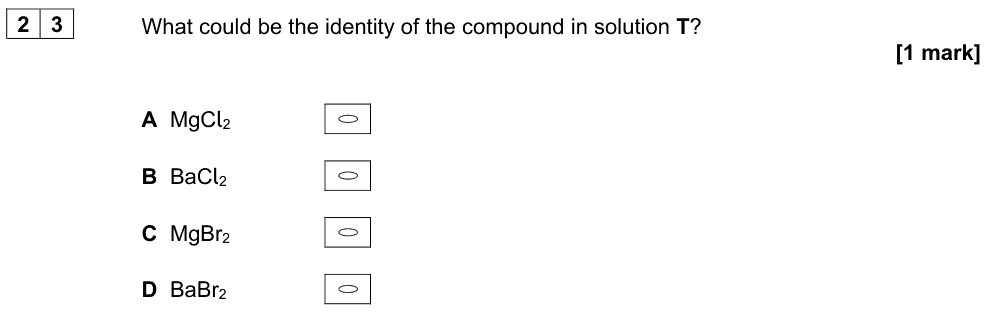
These questions enabled students to analyse and interpret some observations from some test-tube reactions. They were generally well answered by students, although they found it more challenging to deduce the identity of the compound in solution P in question 20, and of the compound in solution T in question 23.
Notes from the mark scheme and report
Answer: A. White precipitate with AgNO3 (chloride), white precipitate with NaOH (Mg(OH)2) and none with H2SO4: MgCl2. Found more challenging
Skills: PS1.1 Solve problems set in practical contexts; RP4 Carry out simple test-tube reactions to identify: cations – Group 2, NH4+; anions – Group 7 (halide ions), OH–, CO32–, SO42–
June 2023 · Paper 3 · Q211 markAO1=1Multiple choice
Answer
B
Mark scheme
Notes from the mark scheme and report
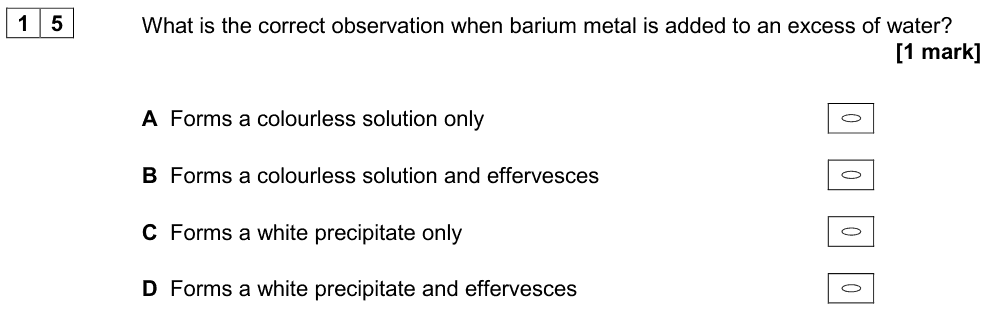
Answer: B. Ba + 2H2O → Ba(OH)2 + H2: hydrogen effervesces and barium hydroxide is soluble, so the solution is colourless with no precipitate
June 2022 · AS Paper 1 · Q01.12 marksAO1=2Explanation
Mark scheme
Examiner's comment
01.1 Many students were able to explain why the first ionisation energy decreases down the group, although it is important that students make reference to the outer electron in their answers rather than just electrons in general.
Notes from the mark scheme and report
The outer electron is in a higher energy level / more shells / more shielding / larger atoms
so weaker attraction between the nucleus and the outer electron (marked independently). Refer to the outer electron, not electrons in general
June 2022 · Paper 1 · Q05.11 markAO1=1Short answer
Mark scheme
Examiner's comment
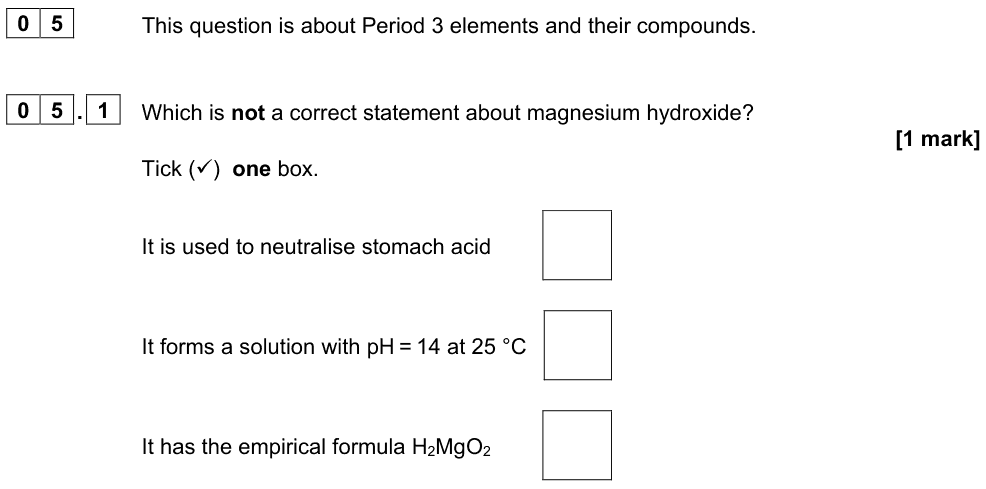
56% of students scored the mark in 05.1.
Notes from the mark scheme and report
Answer: 'It forms a solution with pH = 14 at 25 °C' is the incorrect statement
magnesium hydroxide is only sparingly soluble, so [OH–] is low. 56% gained the mark
June 2022 · Paper 1 · Q06.71 markAO2=1Equation writing
Earlier part of question 06 that this part uses
Mark scheme
Examiner's comment
question 06.7; common errors included the wrong formulas for titanium chloride and magnesium chloride and using Mg2 in the equation.
Notes from the mark scheme and report
TiCl4 + 2Mg → 2MgCl2 + Ti. About half were correct. Errors: wrong formulas for titanium chloride or magnesium chloride
Mg2
June 2022 · AS Paper 1 · Q08.34 marksAO3=4Practical and data analysis
Earlier part of question 08 that this part uses
Mark scheme
Examiner's comment
08.3 This was found by students to be a challenging question – very few students were correctly able to describe the test for ammonium ions, whereas the test for sulfate ions was well known.
Notes from the mark scheme and report
Warm with NaOH(aq)
damp red litmus held at the mouth of the tube turns blue (ammonium). Add acidified BaCl2 or Ba(NO3)2
white precipitate (sulfate). Ba(OH)2 can score the two reagent marks. Not litmus dipped in the solution
no observation mark if the reagent is wrong. Very few could describe the ammonium test
Skills: ATd Use laboratory apparatus for a variety of experimental techniques including: titration, using burette and pipette; distillation and heating under reflux, including setting up glassware using retort stand and clamps; qualitative tests for ions and organic functional groups; filtration, including use of fluted filter paper, or filtration under reduced pressure; PS1.1 Solve problems set in practical contexts; PS4.1 Know and understand how to use a wide range of experimental and practical instruments, equipment and techniques appropriate to the knowledge and understanding included in the specification; RP4 Carry out simple test-tube reactions to identify: cations – Group 2, NH4+; anions – Group 7 (halide ions), OH–, CO32–, SO42–
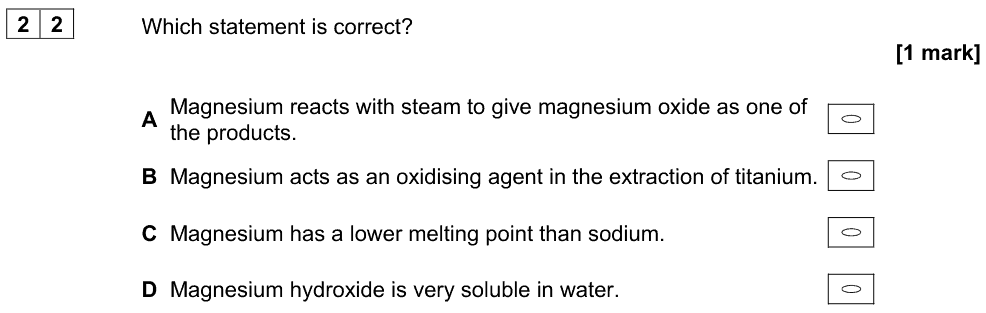
June 2022 · AS Paper 1 · Q221 markAO1=1Multiple choice
Answer
A
Mark scheme
Examiner's comment
Magnesium About half the students understood that magnesium oxide is a product when magnesium reacts with steam.
Notes from the mark scheme and report
Answer: A. Mg + H2O(g) → MgO + H2. Mg is the reducing agent in titanium extraction
it melts higher than Na
Mg(OH)2 is sparingly soluble
November 2021 · AS Paper 1 · Q02.12 marksEquation writing
Mark scheme
Notes from the mark scheme and report
Bright / white light or white powder (solid) formed
Mg(s) + H2O(g) → MgO(s) + H2(g). State symbols essential
November 2021 · AS Paper 1 · Q02.41 markShort answer
Earlier part of question 02 that this part uses
Mark scheme
Notes from the mark scheme and report
Indigestion relief / antacid to neutralise excess stomach acid / laxative (milk of magnesia)
November 2021 · Paper 1 · Q03.51 markShort answer
Earlier part of question 03 that this part uses
Mark scheme
Examiner's comment
Question 03.5 was answered well, though common errors included calcium hydroxide or an incorrect formula for magnesium hydroxide.
Notes from the mark scheme and report
Mg(OH)2. Errors: calcium hydroxide
wrong formula
November 2021 · AS Paper 1 · Q04.12 marksEquation writing
Mark scheme
Notes from the mark scheme and report
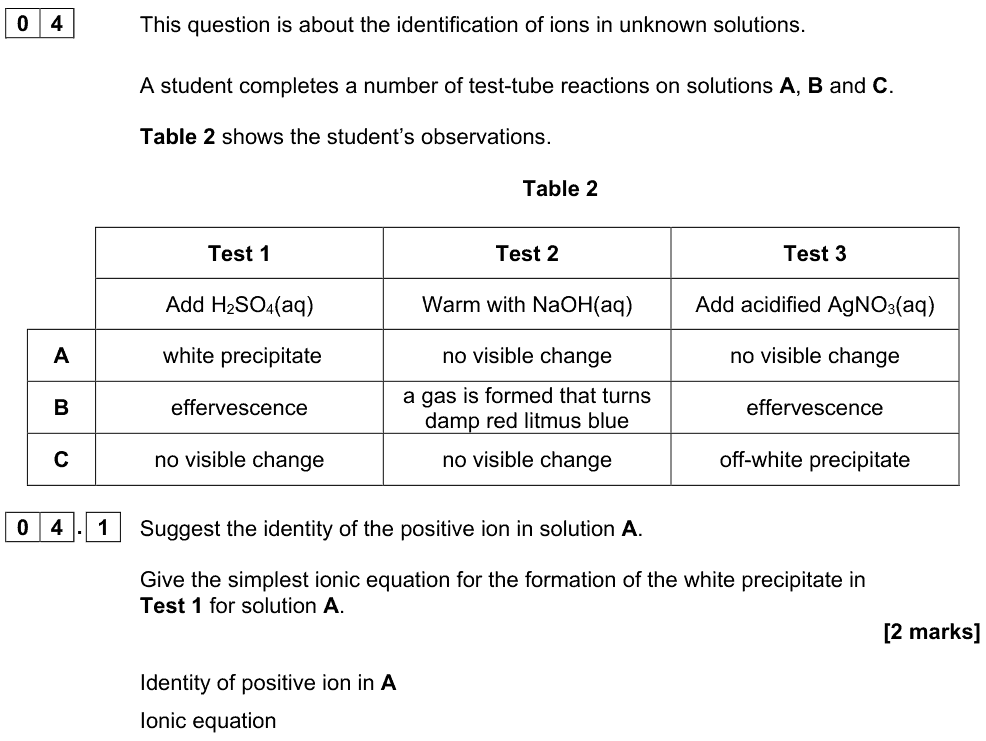
Ba2+
Ba2+(aq) + SO4 2–(aq) → BaSO4(s). Ca2+, Sr2+ or Pb2+ also accepted with a matching equation
state symbols ignored
Skills: PS1.2 Apply scientific knowledge to practical contexts; RP4 Carry out simple test-tube reactions to identify: cations – Group 2, NH4+; anions – Group 7 (halide ions), OH–, CO32–, SO42–
November 2021 · AS Paper 1 · Q221 markMultiple choice
Answer
C
Mark scheme
Notes from the mark scheme and report
Answer: C. Barium sulfate is insoluble and opaque to X-rays, so is used as a 'barium meal'
November 2020 · AS Paper 1 · Q05.22 marksEquation writing
Earlier part of question 05 that this part uses
Mark scheme
Notes from the mark scheme and report
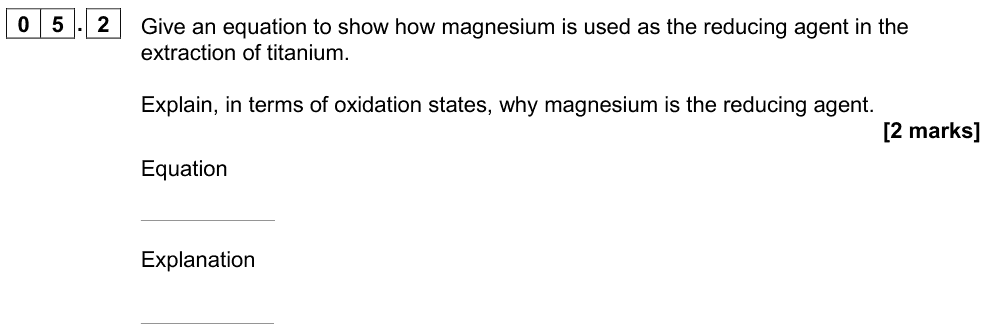
2Mg + TiCl4 → 2MgCl2 + Ti. Mg changes oxidation state from 0 to +2, so it loses electrons (or Ti goes from +4 to 0, so gains electrons)
November 2020 · AS Paper 1 · Q05.32 marksShort answer
Earlier part of question 05 that this part uses
Mark scheme
Notes from the mark scheme and report
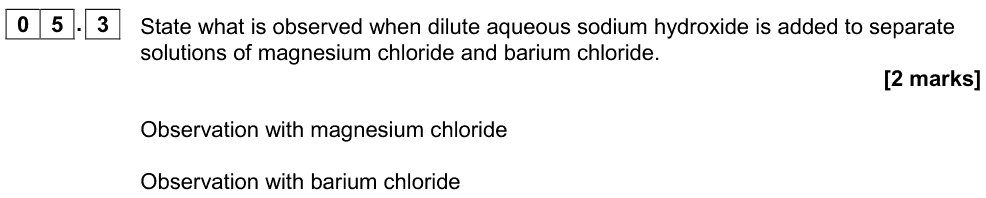
Magnesium chloride: (slight) white precipitate. Barium chloride: no visible change / stays a colourless solution. Do not write 'nothing' or 'no observation'
Skills: ATd Use laboratory apparatus for a variety of experimental techniques including: titration, using burette and pipette; distillation and heating under reflux, including setting up glassware using retort stand and clamps; qualitative tests for ions and organic functional groups; filtration, including use of fluted filter paper, or filtration under reduced pressure; RP4 Carry out simple test-tube reactions to identify: cations – Group 2, NH4+; anions – Group 7 (halide ions), OH–, CO32–, SO42–
June 2019 · AS Paper 1 · Q07.12 marksEquation writing
Mark scheme
Examiner's comment
07.1 The equation for the use of magnesium in the extraction of titanium was not well known by students, although many understood its role as a reducing agent.
Notes from the mark scheme and report
2Mg + TiCl4 → Ti + 2MgCl2
magnesium is the reducing agent (electron donor, not electron pair donor). The equation was not well known
June 2019 · AS Paper 1 · Q08.13 marksPractical and data analysis
Mark scheme
Examiner's comment
08.1 The question was found to be quite challenging, with a high number of students choosing silver nitrate to distinguish between these two compounds. However, a good number of
Notes from the mark scheme and report
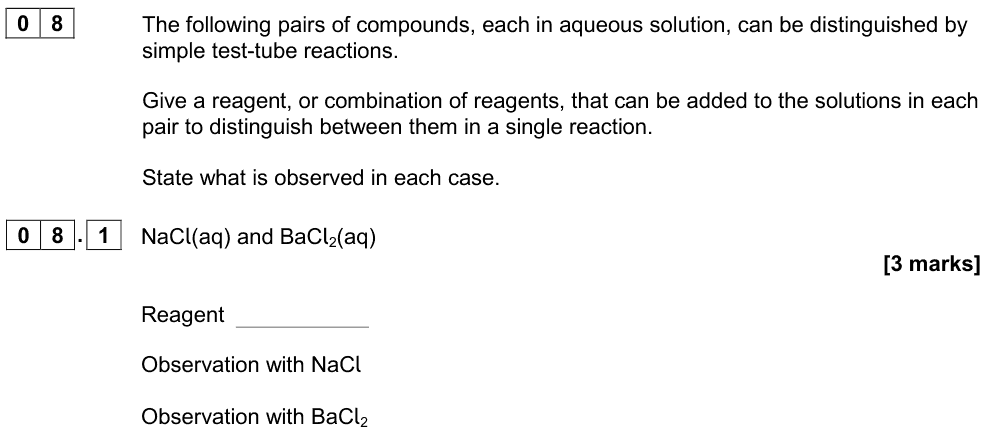
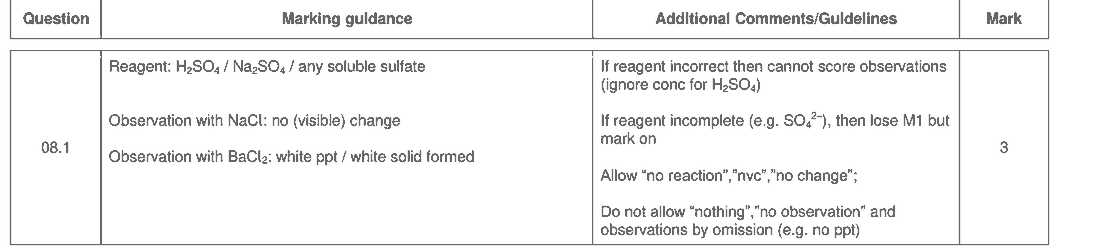
Reagent: H2SO4 or any soluble sulfate such as Na2SO4. NaCl: no visible change. BaCl2: white precipitate. An incomplete reagent (SO4 2–) loses M1 only
'nothing' or 'no precipitate' is not accepted for no visible change. Common wrong reagent: silver nitrate (both contain chloride)
Skills: PS1.2 Apply scientific knowledge to practical contexts; ATd Use laboratory apparatus for a variety of experimental techniques including: titration, using burette and pipette; distillation and heating under reflux, including setting up glassware using retort stand and clamps; qualitative tests for ions and organic functional groups; filtration, including use of fluted filter paper, or filtration under reduced pressure; RP4 Carry out simple test-tube reactions to identify: cations – Group 2, NH4+; anions – Group 7 (halide ions), OH–, CO32–, SO42–
June 2019 · AS Paper 1 · Q161 markMultiple choice
Answer
C
Mark scheme
Examiner's comment
Half of the students were able to choose the correct property of the element radium.
Notes from the mark scheme and report
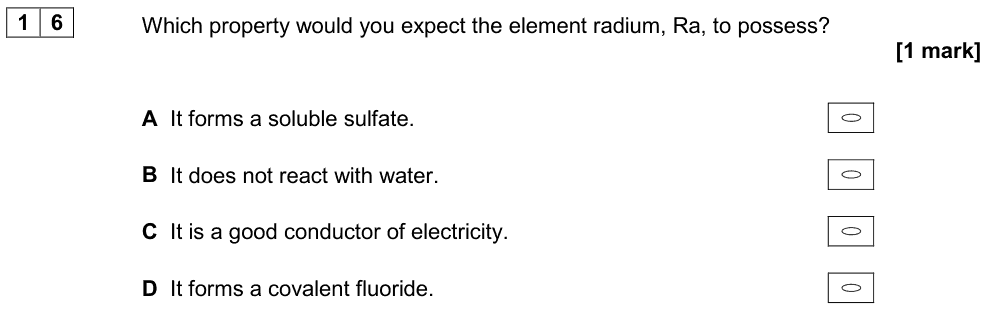
Answer: C. Radium is a Group 2 metal so has delocalised electrons and conducts
its sulfate would be insoluble, it would react vigorously with water and its fluoride would be ionic
June 2019 · AS Paper 1 · Q171 markMultiple choice
Answer
C
Mark scheme
Examiner's comment
The majority of students understood that strontium reacted more vigorously with water than calcium. However, a good number also thought that calcium hydroxide was more soluble in water than strontium hydroxide.
Notes from the mark scheme and report
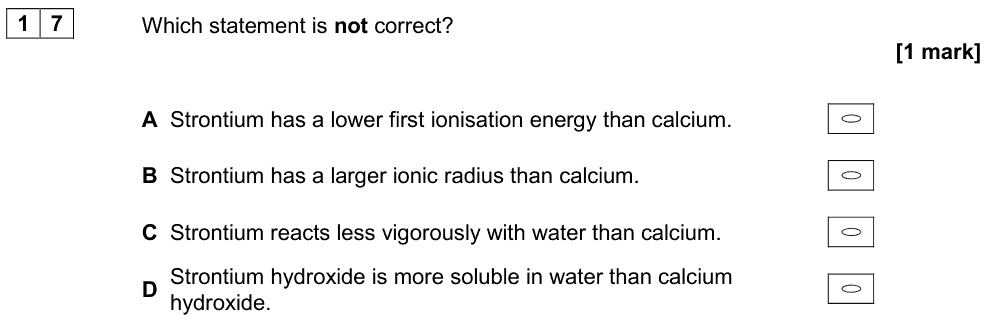
Answer: C. Reactivity with water increases down Group 2, so strontium reacts more vigorously than calcium. Common wrong choice: D (hydroxide solubility does increase down the group)
June 2019 · AS Paper 1 · Q181 markMultiple choiceEasy
Answer
A
Mark scheme
Examiner's comment
Over 70% of students were able to select the property that increases down group 2.
Notes from the mark scheme and report
Answer: A. Atomic radius increases down the group (more shells)
electronegativity, first ionisation energy and melting point decrease
June 2019 · Paper 3 · Q151 markMultiple choice
Answer
B
Mark scheme
Notes from the mark scheme and report
Answer: B. Hydrogen is given off and barium hydroxide is soluble, so a colourless solution forms
June 2019 · Paper 3 · Q161 markMultiple choice
Answer
A
Mark scheme
Notes from the mark scheme and report
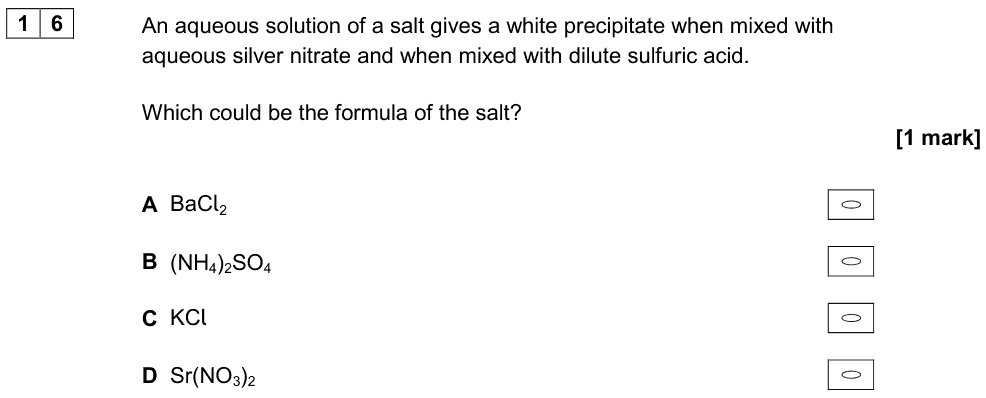
Answer: A. BaCl2 gives white AgCl with silver nitrate and white BaSO4 with sulfuric acid
Skills: RP4 Carry out simple test-tube reactions to identify: cations – Group 2, NH4+; anions – Group 7 (halide ions), OH–, CO32–, SO42–
June 2018 · Paper 1 · Q04.41 markShort answerEasy
Earlier part of question 04 that this part uses
Mark scheme
Examiner's comment
04.4 The majority of students (76.3%) answered this correctly, although there were quite a number who gave the incorrect formula.
Notes from the mark scheme and report
Mg(OH)2. Some gave an incorrect formula
June 2018 · AS Paper 1 · Q141 markMultiple choiceEasy
Answer
A
Mark scheme
Examiner's comment
The majority of students (74%) were able to recall correctly the reducing agent in this process.
Notes from the mark scheme and report
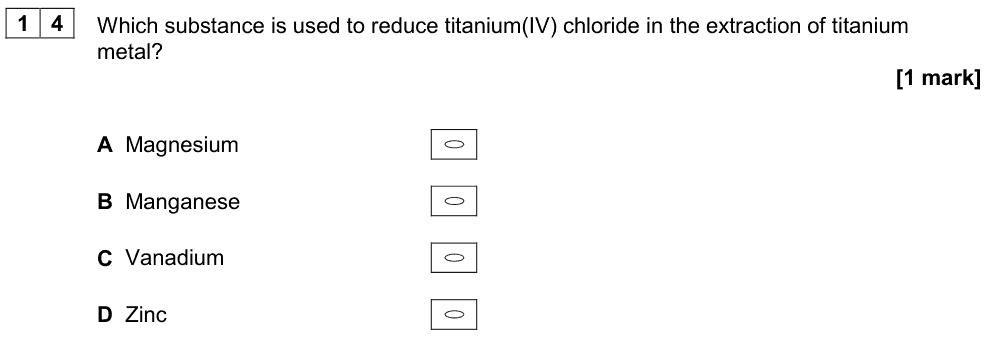
Answer: A. Magnesium reduces TiCl4 to titanium
June 2018 · AS Paper 1 · Q151 markMultiple choiceEasy
Answer
B
Mark scheme
Examiner's comment
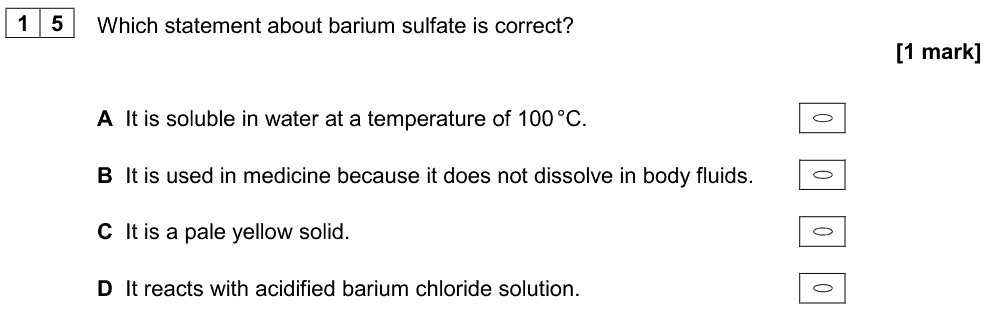
Many students (81.2%) got this correct and appreciated the use of barium sulfate in medicine.
Notes from the mark scheme and report
Answer: B. BaSO4 is insoluble, so it can be used safely in medicine (barium meal)
it is a white solid
June 2018 · AS Paper 1 · Q171 markMultiple choiceEasy
Answer
B
Mark scheme
Examiner's comment
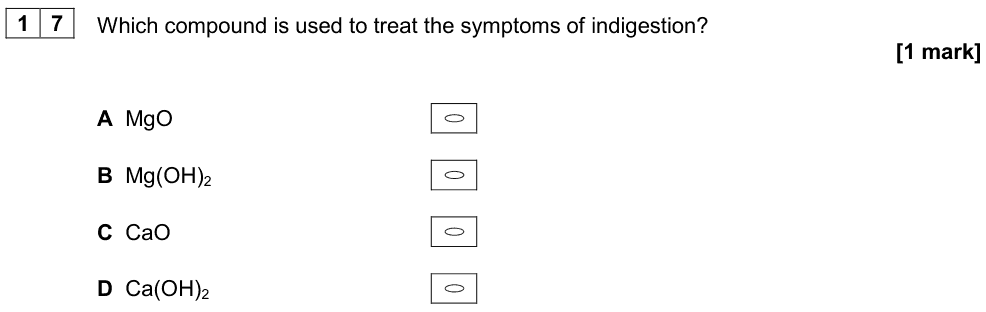
Most students (69.2%) got this question correct but many confused the uses of magnesium hydroxide and calcium hydroxide.
Notes from the mark scheme and report
Answer: B. Mg(OH)2 is used in medicine as an antacid
Ca(OH)2 is used in agriculture
June 2018 · Paper 3 · Q191 markMultiple choice
Answer
C
Mark scheme
Notes from the mark scheme and report
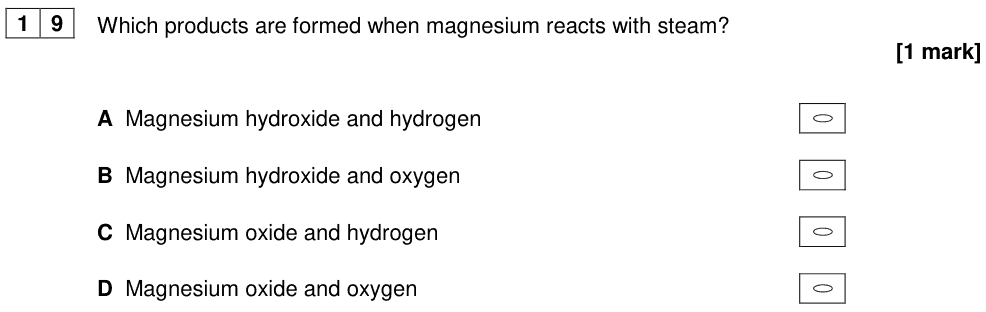
Answer: C. Mg + H2O(g) → MgO + H2
the hydroxide forms only in the slow reaction with cold water (distractor A)
June 2018 · Paper 3 · Q311 markMultiple choice
Answer
B
Mark scheme
Examiner's comment
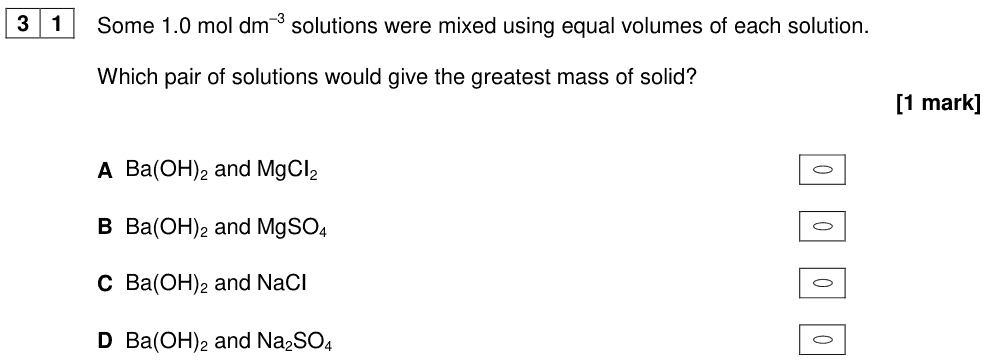
31 D was the commonest incorrect response, presumably from a failure to recognise that Mg(OH)2 is sparingly soluble as well as BaSO4. 46.8% of students were successful.
Notes from the mark scheme and report
Answer: B. Ba(OH)2 + MgSO4 gives two solids: insoluble BaSO4 and sparingly soluble Mg(OH)2. D gives only BaSO4 and was the common wrong answer
June 2017 · Paper 1 · Q03.52 marksExplanation
Earlier part of question 03 that this part uses
Mark scheme
Examiner's comment
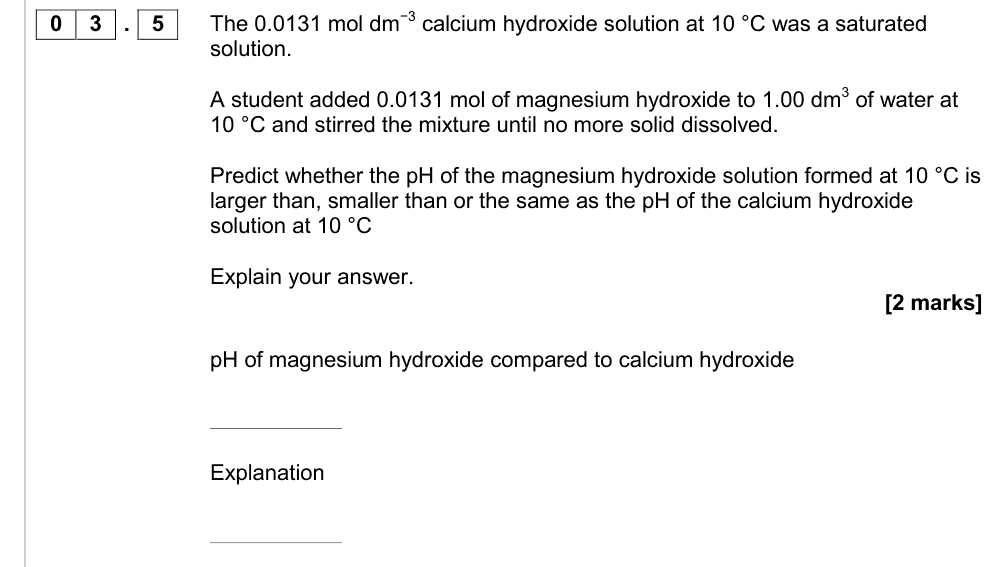
03.5 The idea that magnesium hydroxide is less soluble than calcium hydroxide was appreciated by only a few students. Many thought the pH value should be the same. Some who gave a lower pH followed this with a discussion about the magnesium ion’s greater polarising power.
Notes from the mark scheme and report
Smaller pH (less alkaline)
magnesium hydroxide is less soluble / sparingly soluble (hydroxide solubility increases down Group 2). Not 'insoluble'. 0/2 if not smaller. Many said the same pH
some argued from polarising power
June 2017 · AS Paper 1 · Q07.12 marksEquation writing
Mark scheme
Examiner's comment
07.1 The correct ion was identified quite often but the equation was much less well answered.
Notes from the mark scheme and report
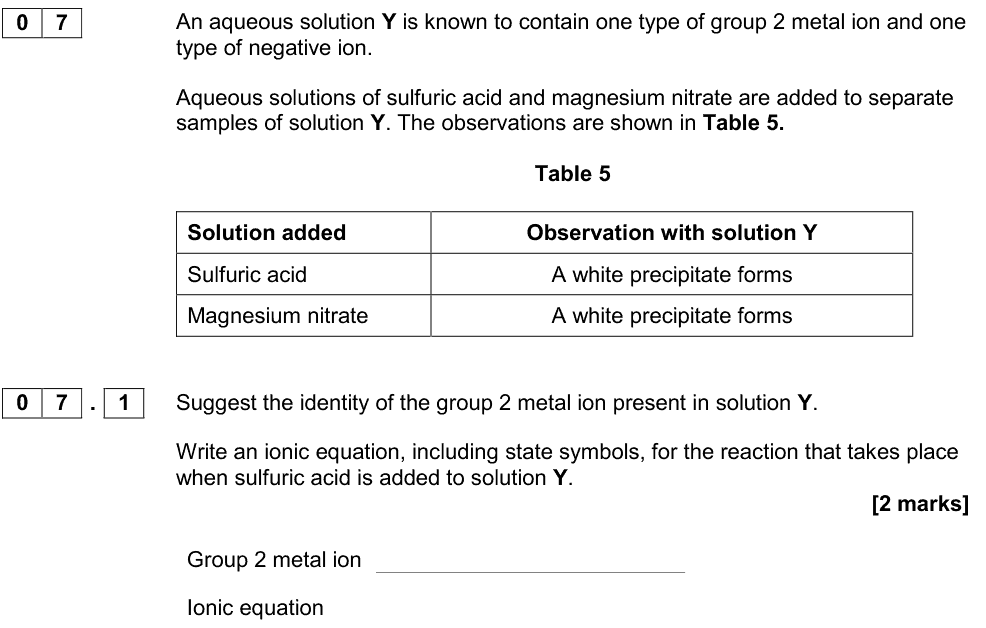
Ba2+ (or Sr2+)
Ba2+(aq) + SO4 2–(aq) → BaSO4(s), state symbols required. The ion was often identified but the ionic equation was much less well done
Skills: PS1.1 Solve problems set in practical contexts; RP4 Carry out simple test-tube reactions to identify: cations – Group 2, NH4+; anions – Group 7 (halide ions), OH–, CO32–, SO42–
June 2017 · AS Paper 1 · Q07.22 marksEquation writing
Earlier part of question 07 that this part uses
Mark scheme
Examiner's comment
07.2 Even good students struggled with this question. The context of the ion test was the reverse of the common way of asking the question and, as such, poorly understood.
Notes from the mark scheme and report
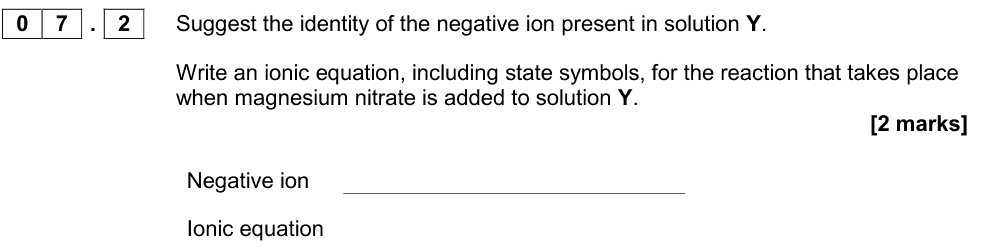
OH–
Mg2+(aq) + 2OH–(aq) → Mg(OH)2(s), state symbols required (magnesium hydroxide is sparingly soluble). Poorly answered because the ion test was approached in reverse
Skills: PS1.1 Solve problems set in practical contexts; RP4 Carry out simple test-tube reactions to identify: cations – Group 2, NH4+; anions – Group 7 (halide ions), OH–, CO32–, SO42–
June 2017 · Paper 1 · Q08.13 marksPractical and data analysis
Mark scheme
Examiner's comment
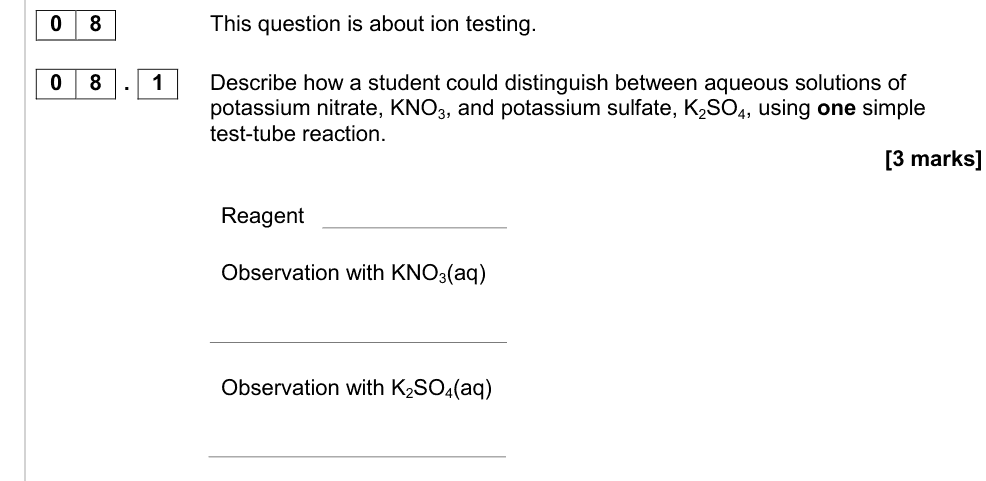
08.1 Many students gave incomplete reagents or the wrong formula. Barium itself was an occasional wrong answer. Most students gained the observation mark for potassium sulfate, but not for potassium nitrate.
Notes from the mark scheme and report
BaCl2 / Ba(NO3)2 / Ba(OH)2 solution (0/3 if acidified with H2SO4
'Ba2+' or barium loses M1)
KNO3: no visible change / colourless solution
K2SO4: white precipitate. 'Nothing happens' is ignored. The KNO3 observation was the mark most often lost
Skills: ATd Use laboratory apparatus for a variety of experimental techniques including: titration, using burette and pipette; distillation and heating under reflux, including setting up glassware using retort stand and clamps; qualitative tests for ions and organic functional groups; filtration, including use of fluted filter paper, or filtration under reduced pressure; PS1.1 Solve problems set in practical contexts; RP4 Carry out simple test-tube reactions to identify: cations – Group 2, NH4+; anions – Group 7 (halide ions), OH–, CO32–, SO42–
June 2016 · AS Paper 1 · Q09.14 marksCalculation
Mark scheme
Examiner's comment
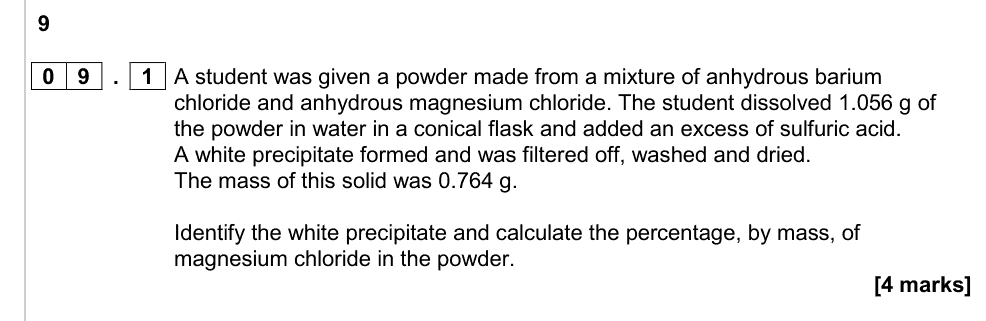
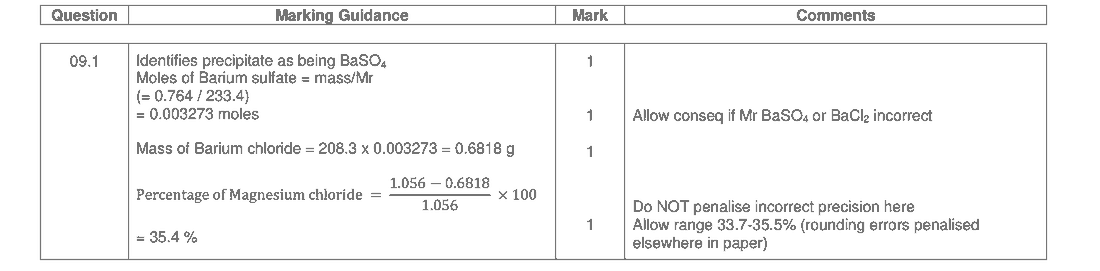
This question was very poorly answered with few getting to the correct overall answer. The unstructured nature of this calculation proved too difficult for most especially following the requirement to identify correctly BaSO4 as the precipitate formed. Only the very best students scored well here.
Notes from the mark scheme and report
Answer: 35.4% (allow 33.7 to 35.5). Precipitate is BaSO4
Skills: MS0.2 Use ratios, fractions and percentages
June 2016 · AS Paper 1 · Q151 markMultiple choice
Answer
A
Mark scheme
Examiner's comment
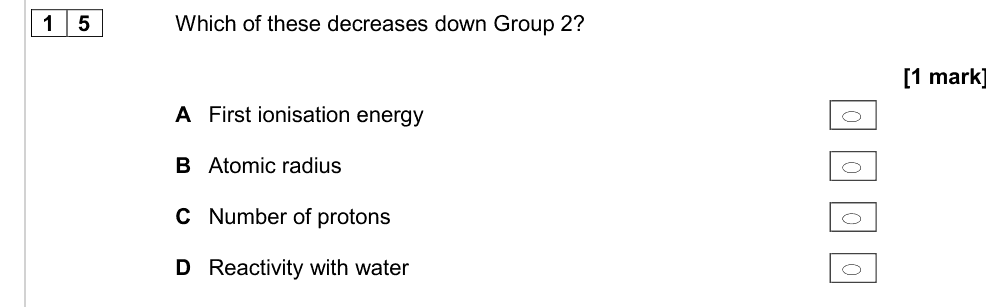
Questions 10-24 Multiple choice From this section of the paper items 10,11,15 and 18 were usually answered correctly. It was surprising to see that item 17 was answered poorly but it did give further evidence that redox ideas are not well understood by large numbers of students at this level. Item 20 proved difficult showing that the overall dipole possessed by a molecule clearly isn’t a well understood concept. Item 22 was also not answered correctly by most; this idea has not been tested often in the previous specification so students may not have had much prior experience of the type of question.
Notes from the mark scheme and report
Answer: A. First ionisation energy decreases down Group 2
atomic radius, proton number and reactivity with water all increase (report: report says item 15 was usually answered correctly)
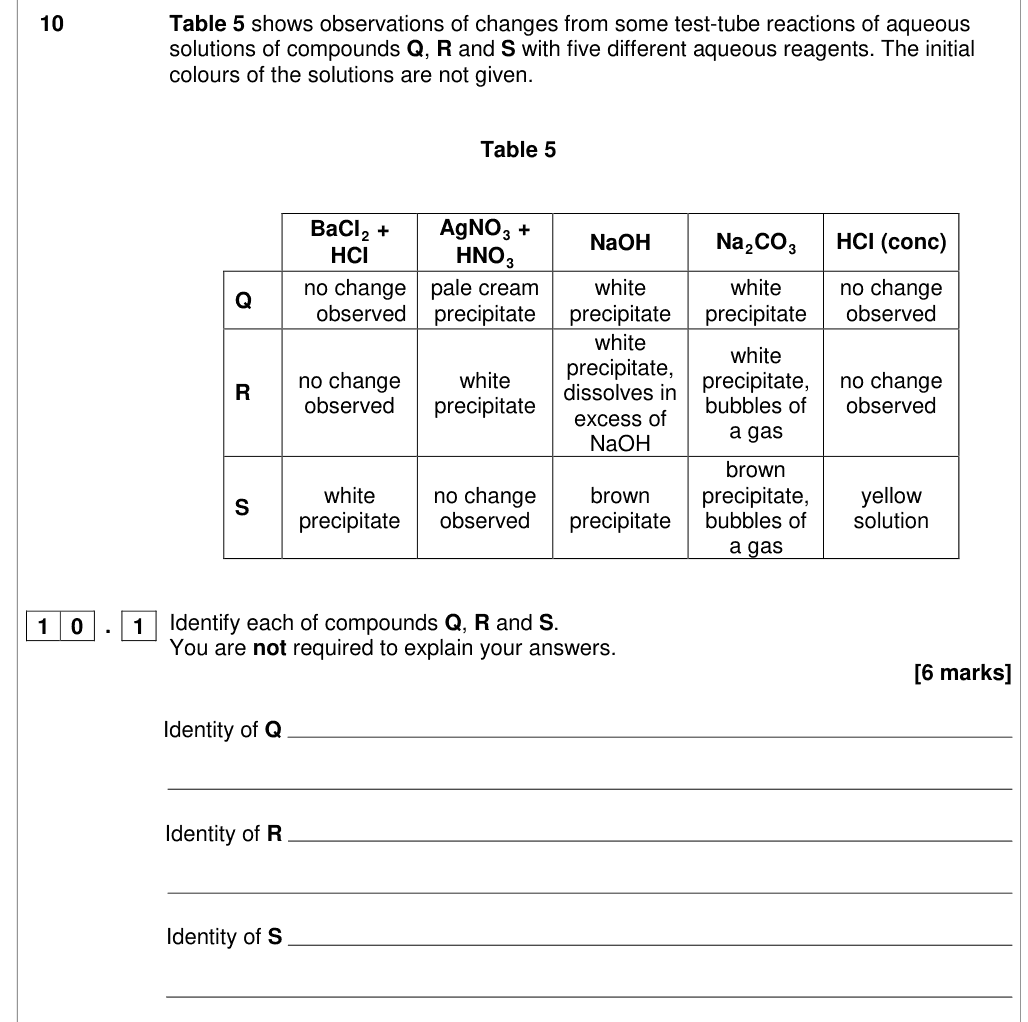
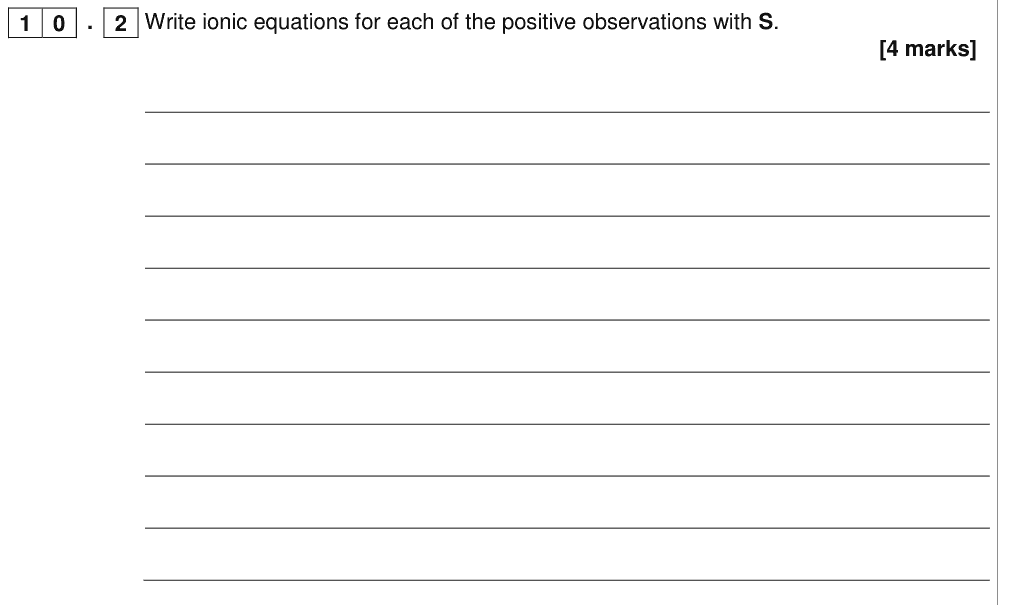
Specimen · Paper 1 · Q10.16 marksPractical and data analysis
Mark scheme
Notes from the mark scheme and report
Q is calcium bromide or magnesium bromide
R is aluminium chloride
S is iron(III) sulfate. Six marks, one for each ion identified independently (cream precipitate = bromide
white precipitate dissolving in excess NaOH = Al3+
white precipitate with BaCl2 = sulfate
brown precipitates = Fe3+)
Skills: PS1.1 Solve problems set in practical contexts; PS2.3 Evaluate results and draw conclusions with reference to measurement uncertainties and errors; ATd Use laboratory apparatus for a variety of experimental techniques including: titration, using burette and pipette; distillation and heating under reflux, including setting up glassware using retort stand and clamps; qualitative tests for ions and organic functional groups; filtration, including use of fluted filter paper, or filtration under reduced pressure; RP11 Carry out simple test-tube reactions to identify transition metal ions in aqueous solution