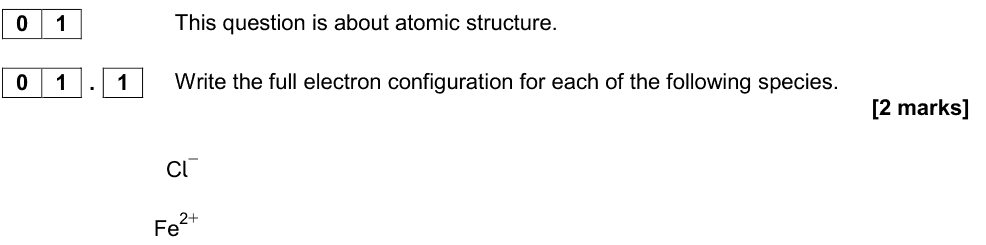
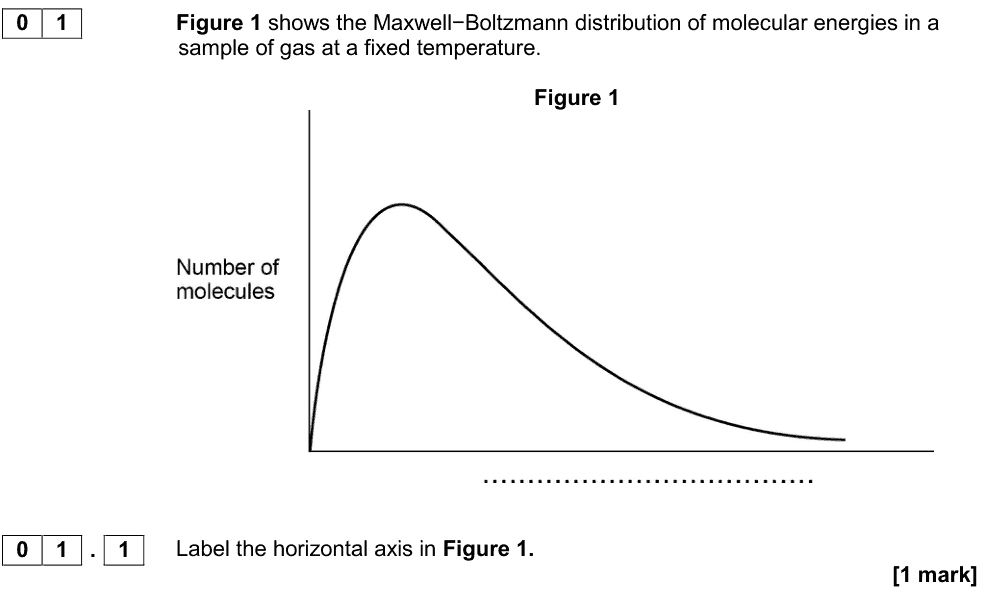
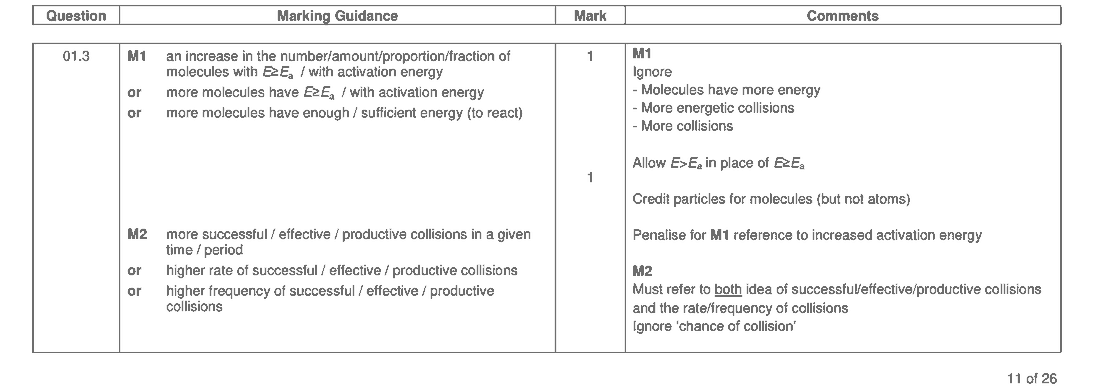
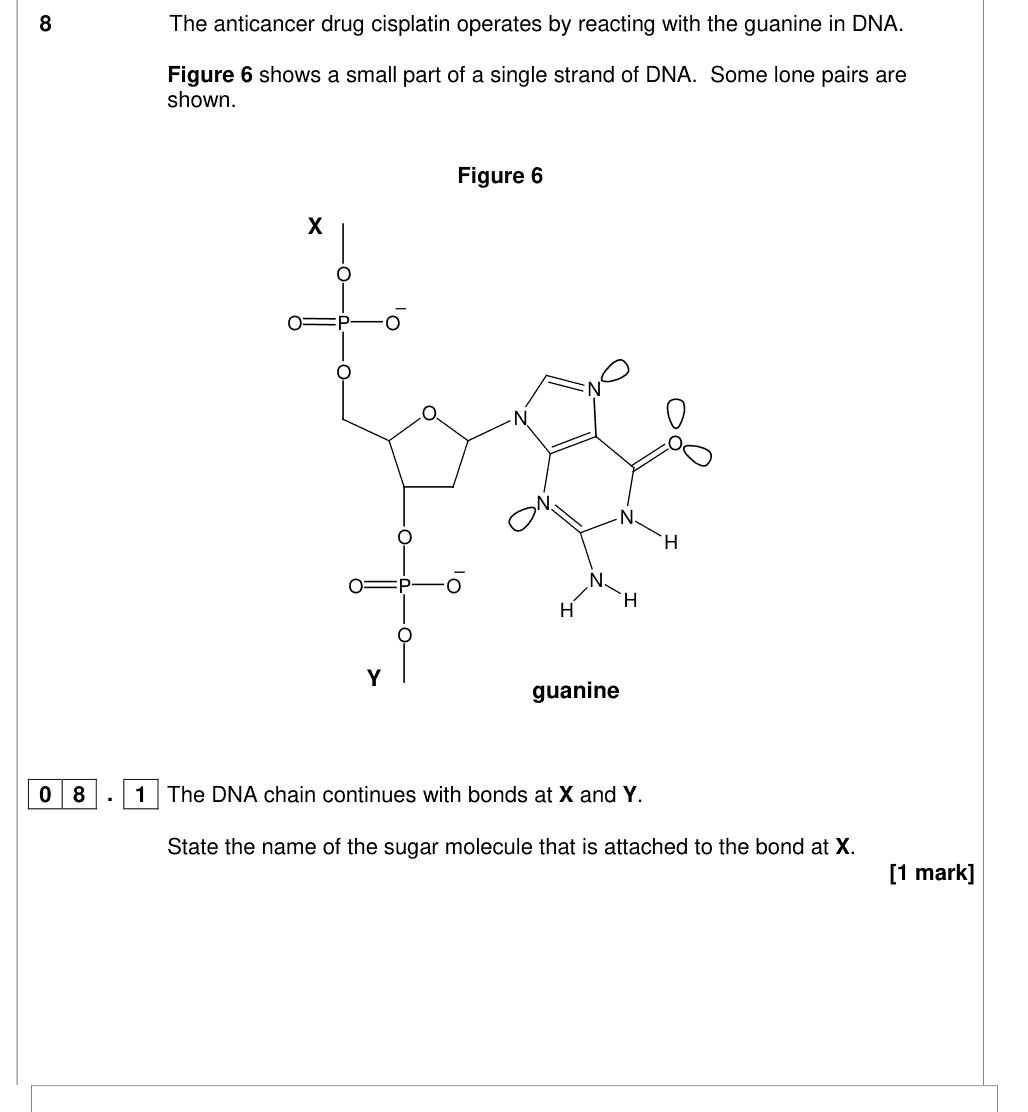
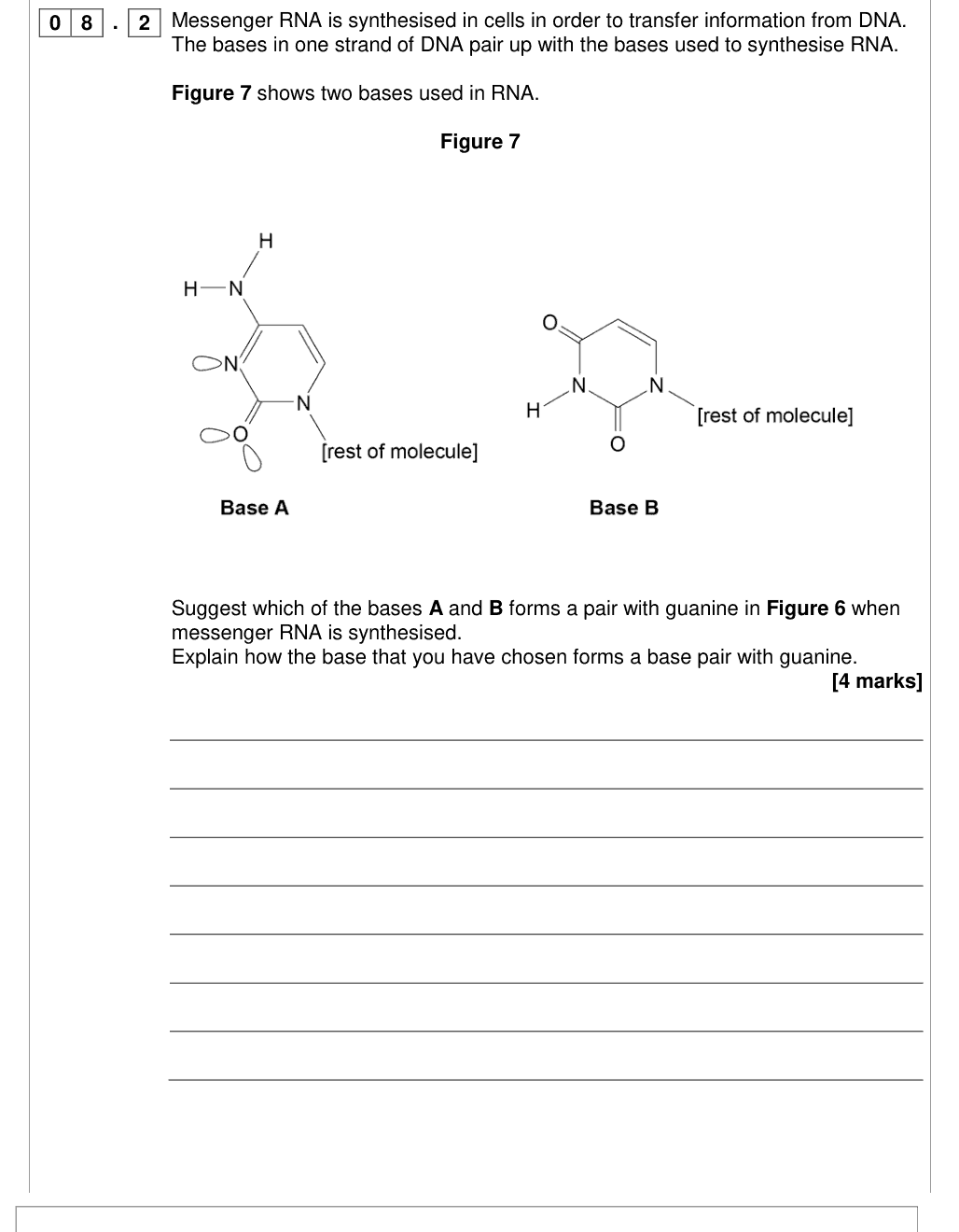
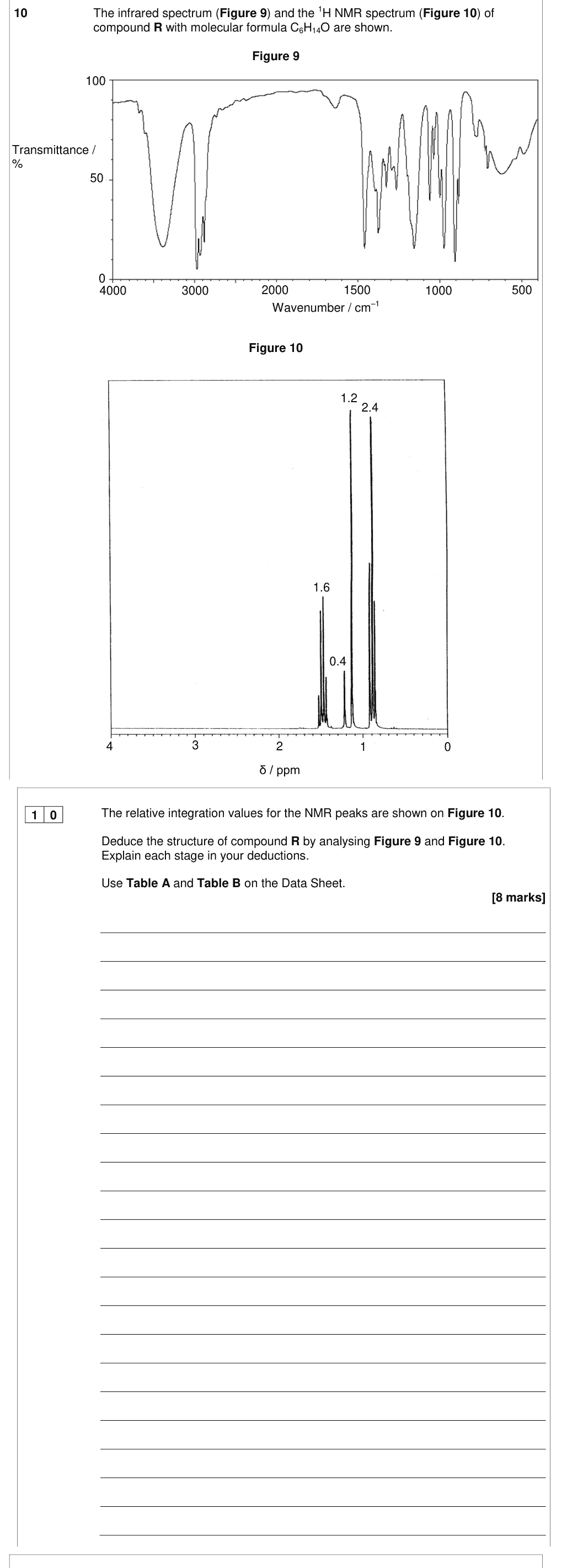
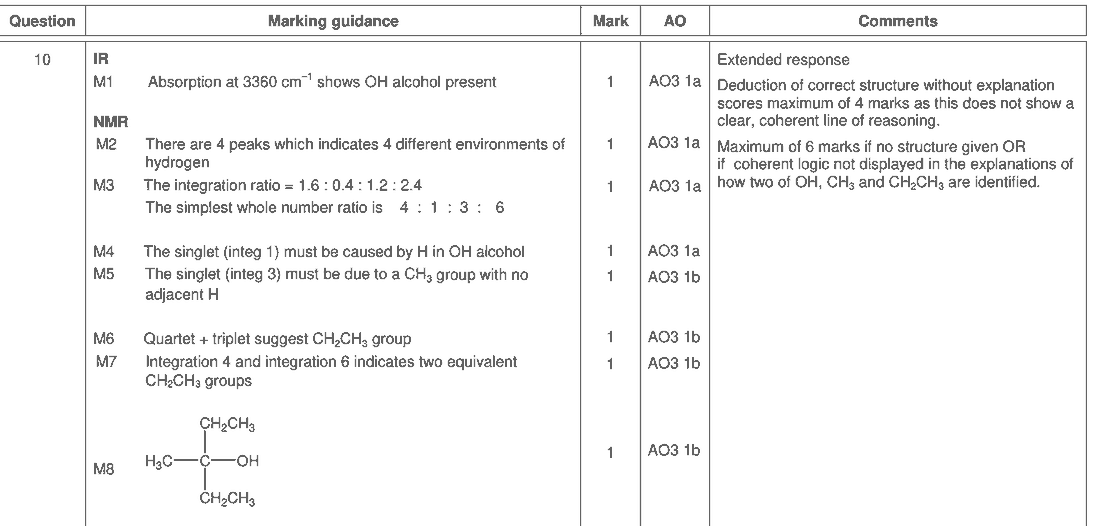
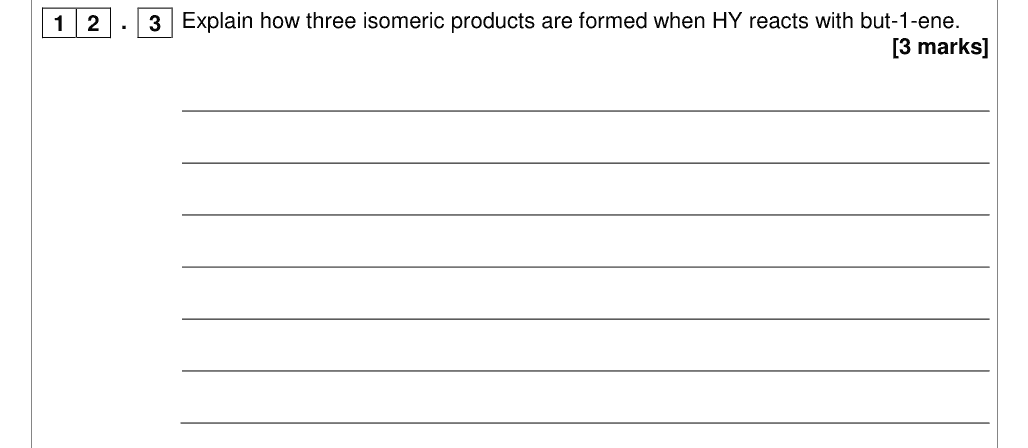
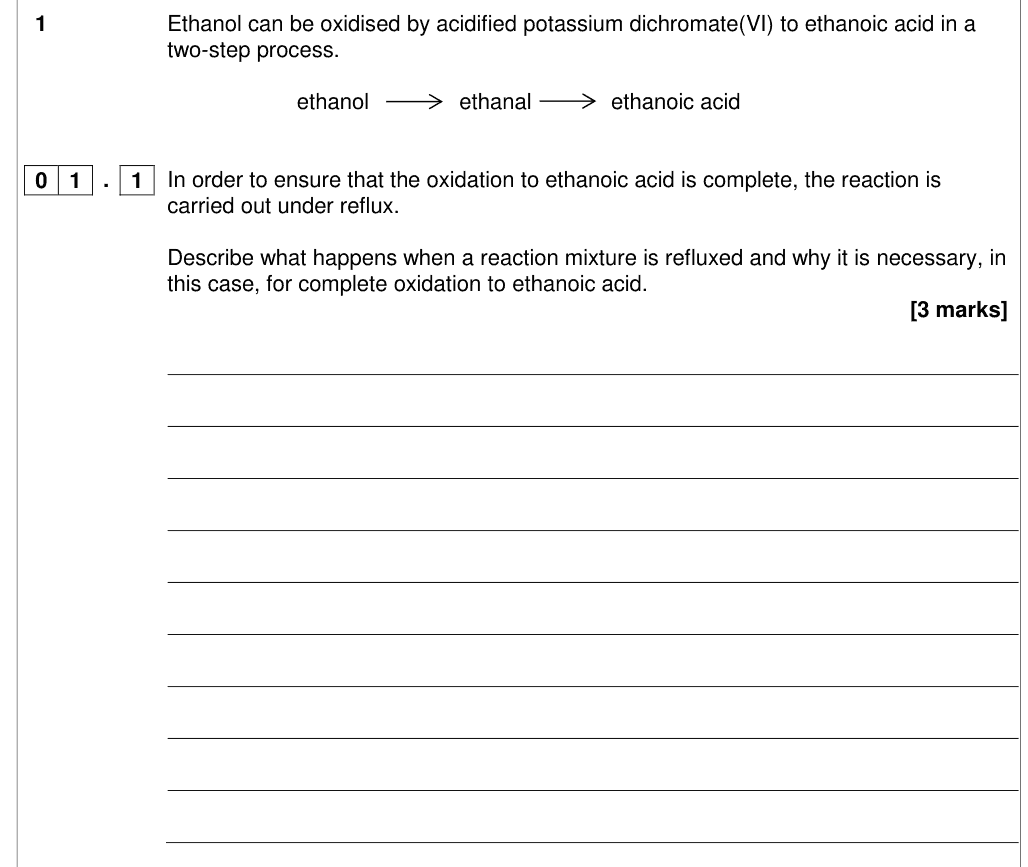
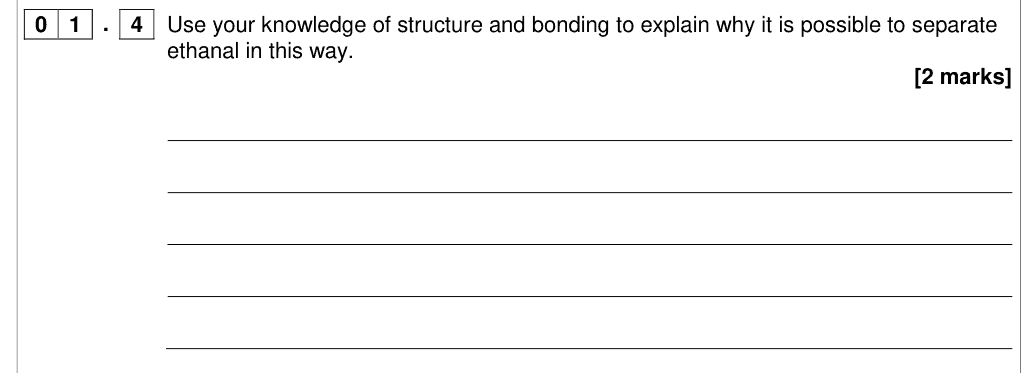
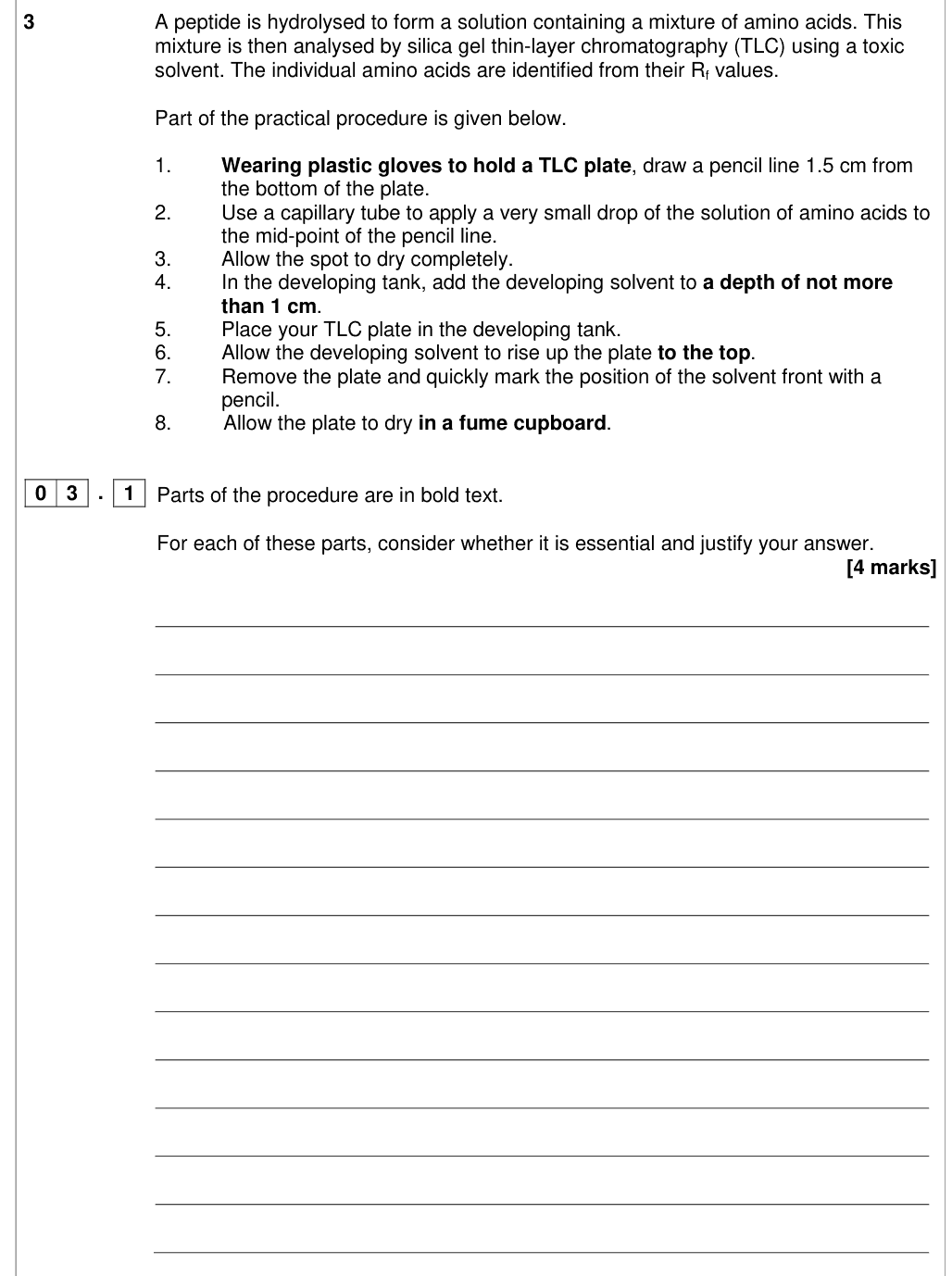
Explanation questions

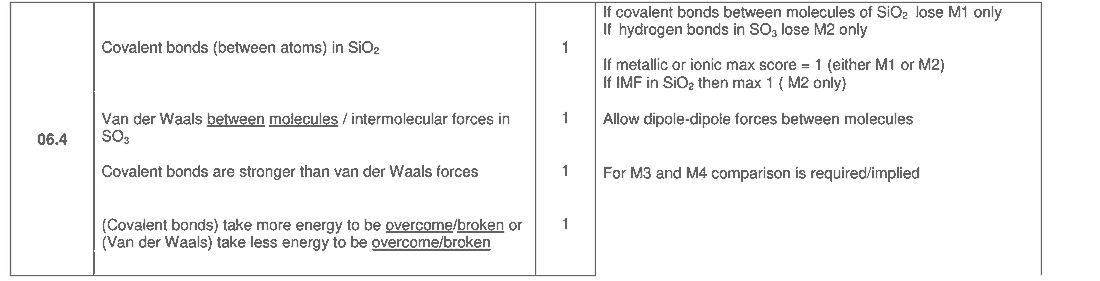
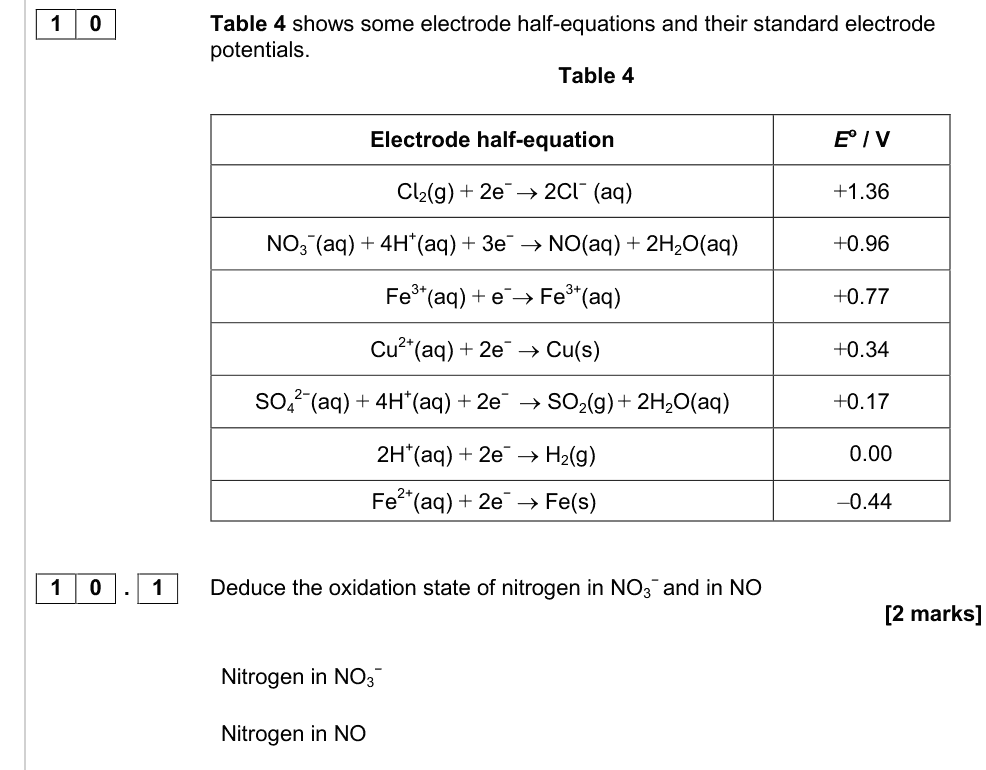
Explain questions worth two to four marks. Each mark is a separate point of chemistry, so plan one point per mark. 200 questions.

Other types: Multiple-choice questions · Calculation questions · Equation questions · Mechanism questions · Structure and diagram questions · Six-mark level of response questions · Practical questions · Short-answer questions

June 2025 · AS Paper 1 · Q02.1 2 marks AO1=2 Explanation group 7 the halogensbonding
This question is about the halogens and their compounds.
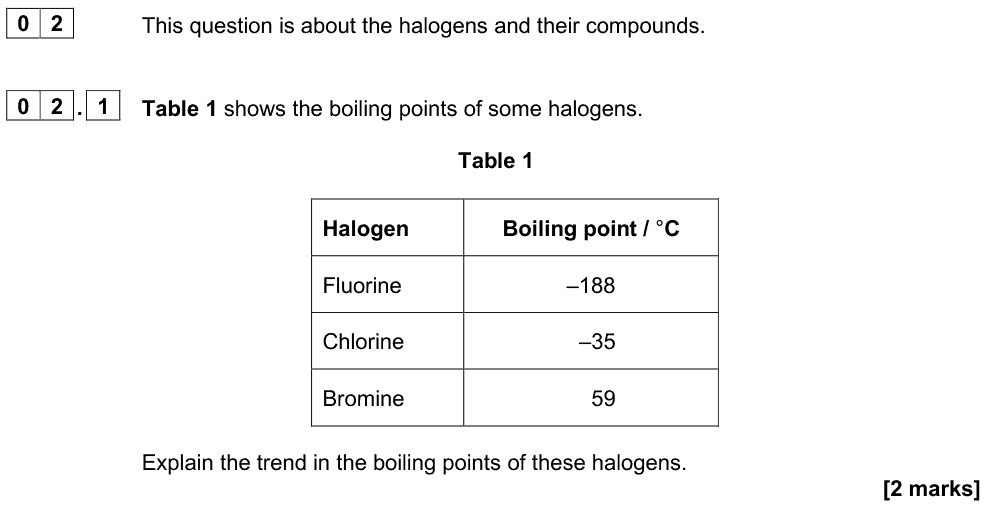
Table 1 shows the boiling points of some halogens.
Table 1
Halogen
Boiling point / °C
Fluorine
–188
Chlorine
–35
Bromine
59
Explain the trend in the boiling points of these halogens.
[2 marks]
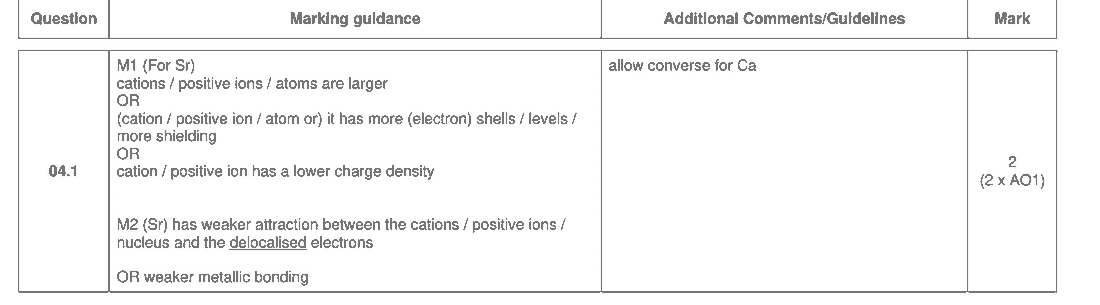
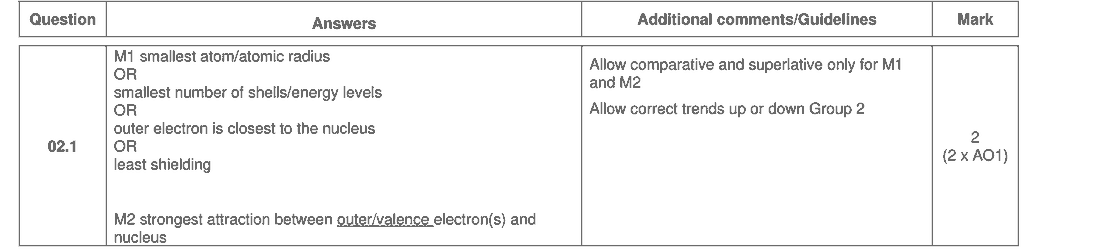
June 2025 · AS Paper 1 · Q04.1 2 marks AO1=2 Explanation group 2bonding
This question is about the Group 2 metals Mg to Ba
Strontium and calcium have the same metallic structure.
Explain why strontium has a lower melting point than calcium.
[2 marks]
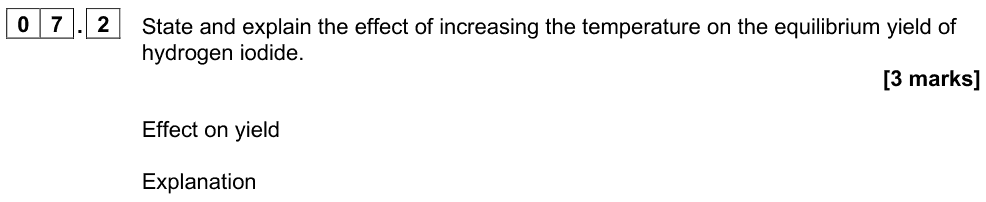
June 2025 · AS Paper 1 · Q07.2 3 marks AO2=3 Explanation chemical equilibria and kc
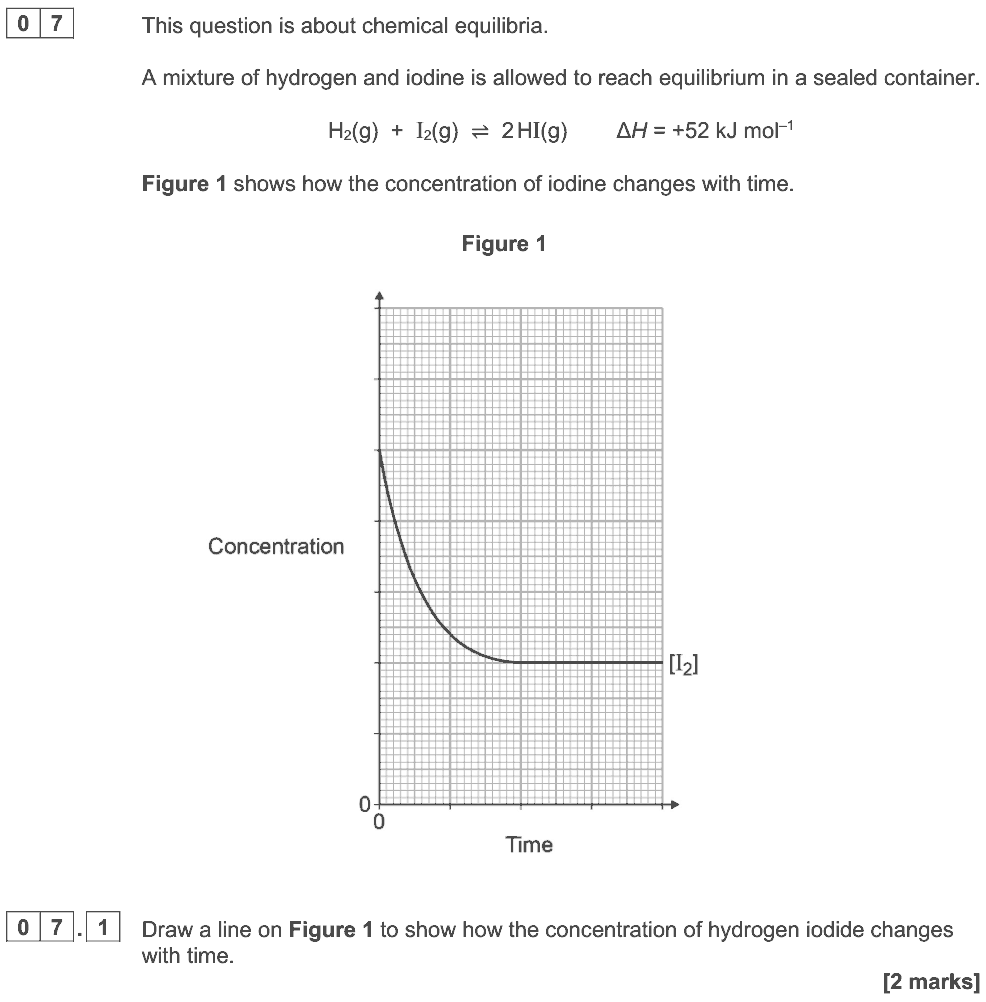
Earlier part of question 07 that this part usesEarlier part of June 2025 Paper 1 question 07
State and explain the effect of increasing the temperature on the equilibrium yield of
hydrogen iodide.
[3 marks]
Effect on yield
Explanation
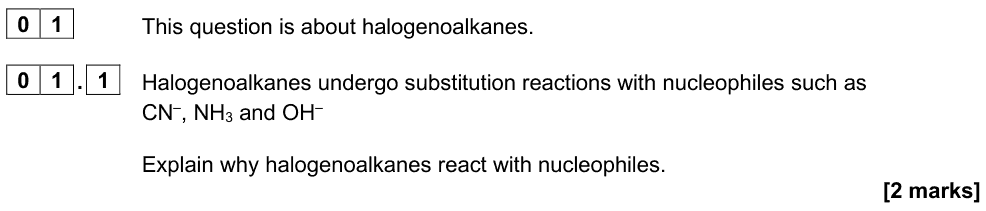
June 2025 · AS Paper 2 · Q01.1 2 marks AO1=2 Explanation halogenoalkanes
This question is about halogenoalkanes.
Halogenoalkanes undergo substitution reactions with nucleophiles such as
CN–, NH3 and OH–
Explain why halogenoalkanes react with nucleophiles.
[2 marks]
June 2025 · AS Paper 2 · Q01.6 2 marks AO1=1, AO2=1 Explanation bonding
Earlier part of question 01 that this part usesEarlier part of June 2025 Paper 2 question 01
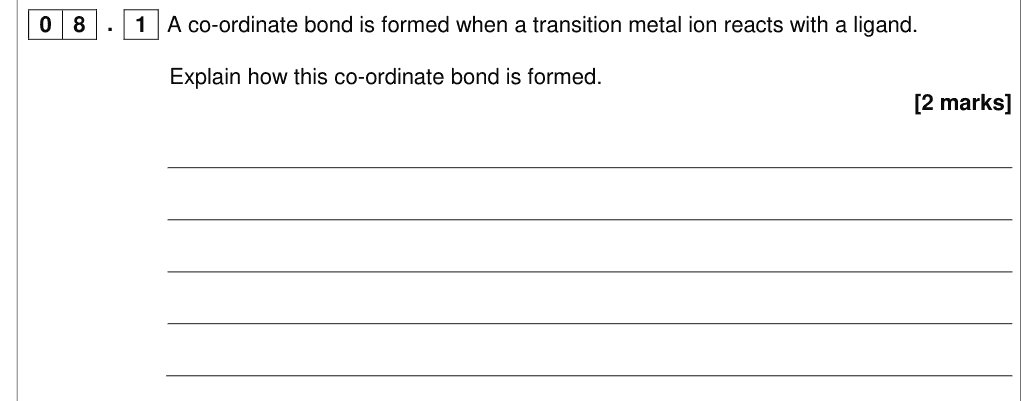
A co-ordinate bond is formed when the (CH3)3C+ carbocation reacts with CN– to
form a nitrile.
Explain how this co-ordinate bond is formed during this reaction.
[2 marks]
June 2025 · AS Paper 2 · Q02.2 3 marks AO3=3 Explanation kinetics
Earlier part of question 02 that this part usesEarlier part of June 2025 Paper 2 question 02
Explain why the rate of a reaction increases as the temperature increases.
[3 marks]
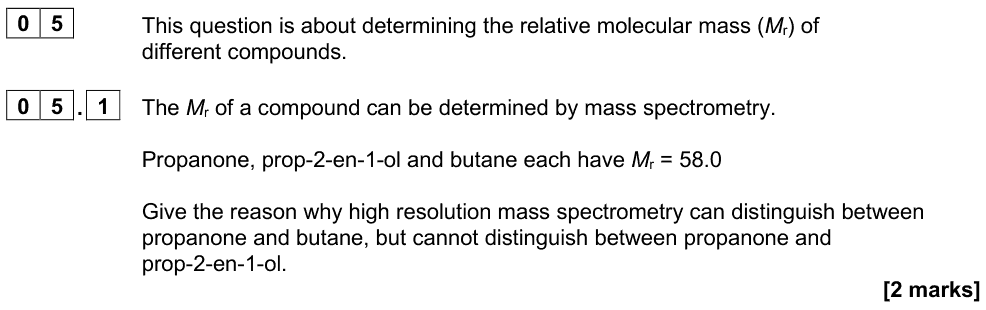
June 2025 · AS Paper 2 · Q05.1 2 marks AO2=2 Explanation organic analysis
This question is about determining the relative molecular mass (Mr) of
different compounds.
The Mr of a compound can be determined by mass spectrometry.
Propanone, prop-2-en-1-ol and butane each have Mr = 58.0
Give the reason why high resolution mass spectrometry can distinguish between
propanone and butane, but cannot distinguish between propanone and
prop-2-en-1-ol.
[2 marks]
June 2025 · Paper 1 · Q02.1 2 marks AO1=2 Explanation group 2
This question is about ionisation energies.
Explain why beryllium is the element with the highest first ionisation energy in
Group 2.
[2 marks]
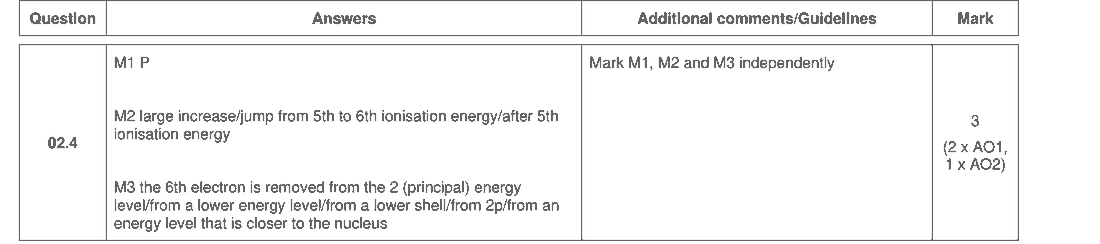
June 2025 · Paper 1 · Q02.4 3 marks AO1=2, AO2=1 Explanation atomic structure
Earlier part of question 02 that this part usesEarlier part of June 2025 Paper 1 question 02
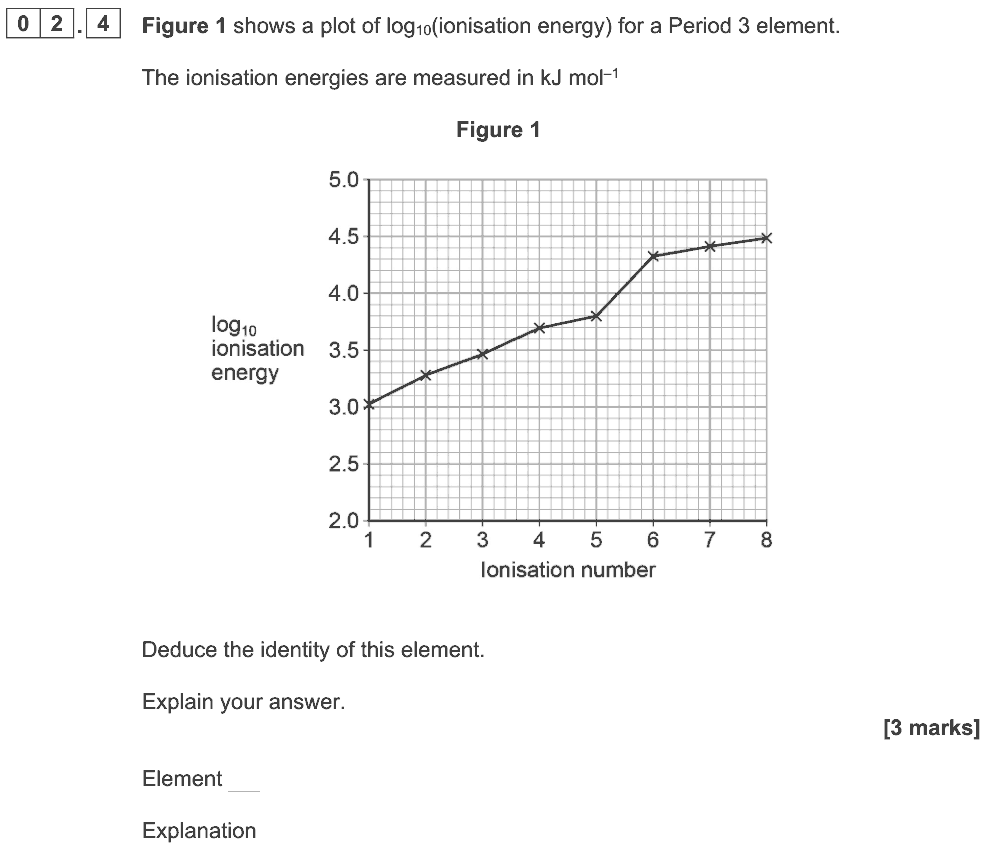
Figure 1 shows a plot of log10(ionisation energy) for a Period 3 element.
The ionisation energies are measured in kJ mol–1
Figure 1
Deduce the identity of this element.
Explain your answer.
[3 marks]
Element
Explanation
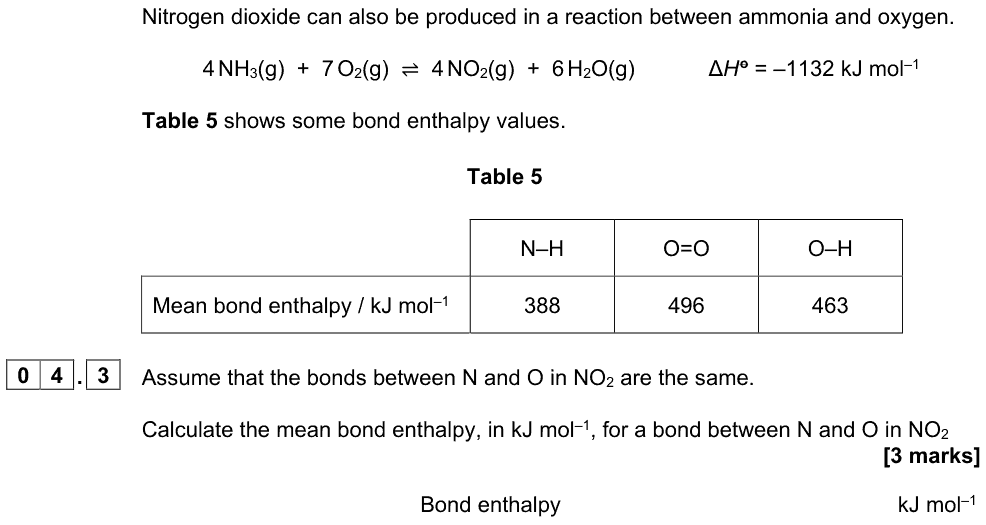
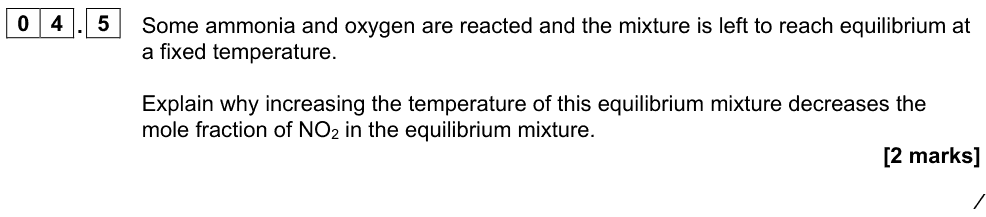
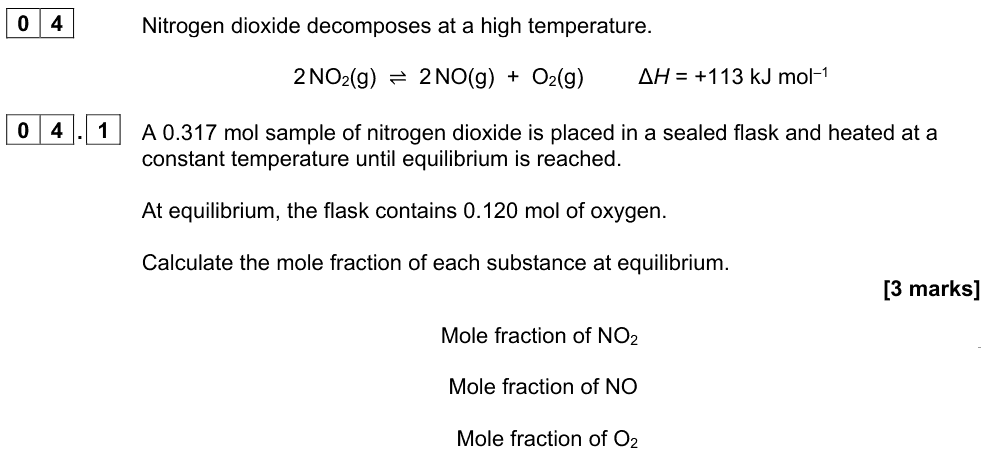
June 2025 · Paper 1 · Q04.5 2 marks AO1=1, AO2=1 Explanation chemical equilibria and kcequilibrium constant kp
Earlier parts of question 04 that this part usesEarlier part of June 2025 Paper 1 question 04Earlier part of June 2025 Paper 1 question 04
Some ammonia and oxygen are reacted and the mixture is left to reach equilibrium at
a fixed temperature.
Explain why increasing the temperature of this equilibrium mixture decreases the
mole fraction of NO2 in the equilibrium mixture.
[2 marks]
June 2025 · Paper 1 · Q05.1 2 marks AO1=2 Explanation group 7 the halogensbonding
This question is about the halogens and some of their compounds.
Explain why chlorine has a lower boiling point than bromine.
[2 marks]
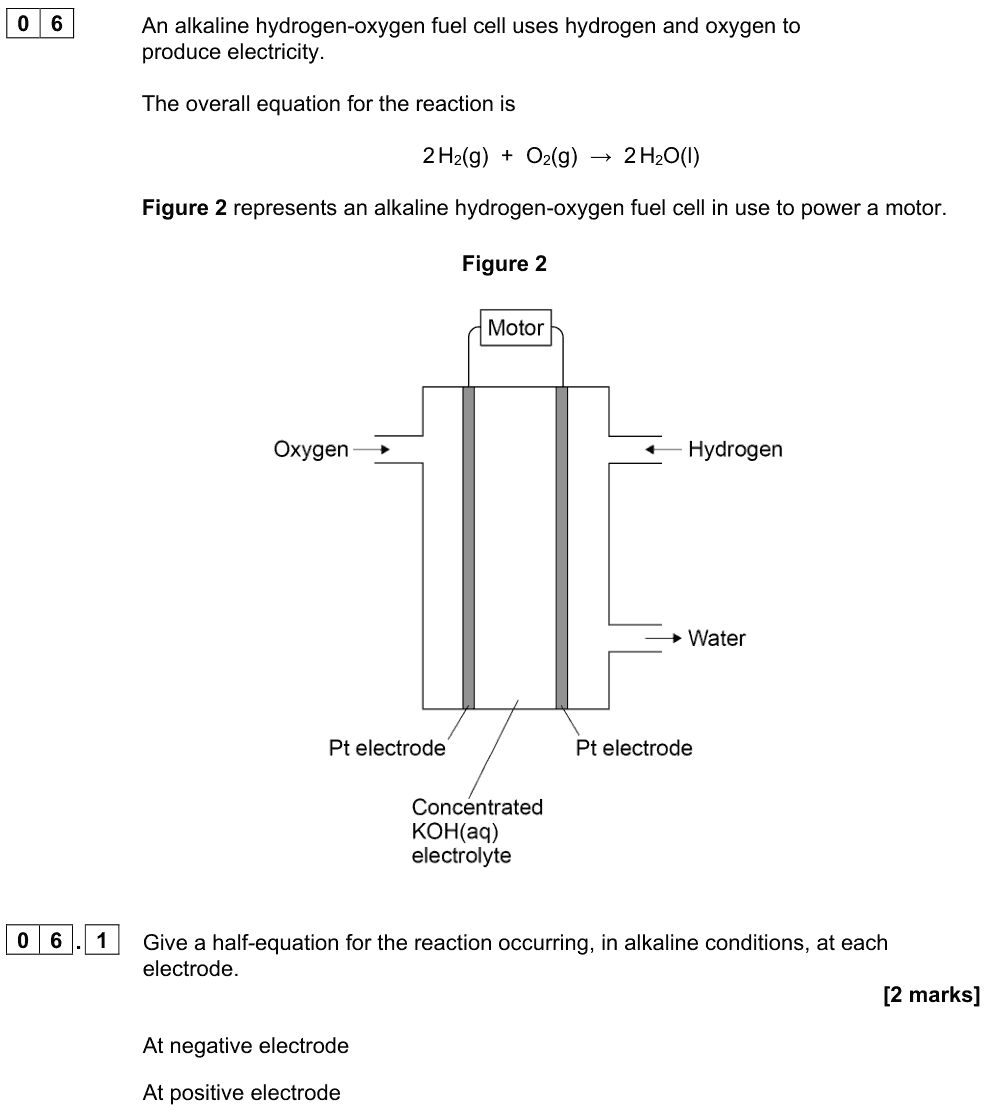
June 2025 · Paper 1 · Q06.3 2 marks AO2=2 Explanation electrode potentials and cells
Earlier part of question 06 that this part usesEarlier part of June 2025 Paper 1 question 06
Describe how the reactions at the electrodes generate an electric current that can
power the motor in the external circuit.
[2 marks]
June 2025 · Paper 1 · Q07.5 2 marks AO1=2 Explanation bonding
Earlier part of question 07 that this part usesEarlier part of June 2025 Paper 1 question 07
Vanadium(III) sulfate is a pale yellow solid at room temperature.
Explain why vanadium(III) sulfate has a high melting point.
[2 marks]
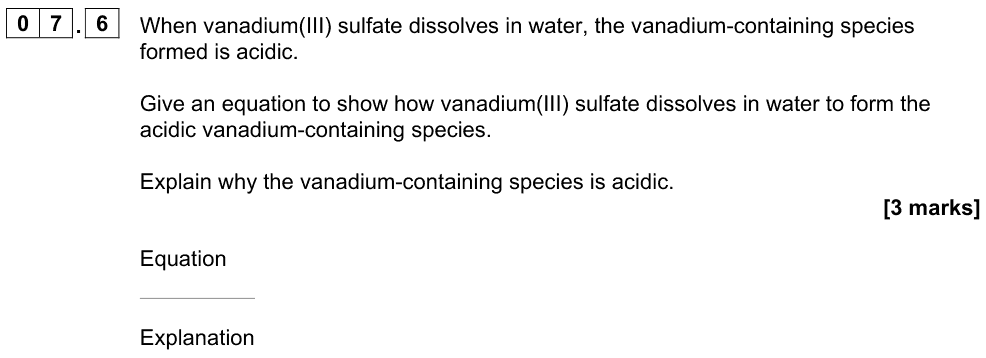
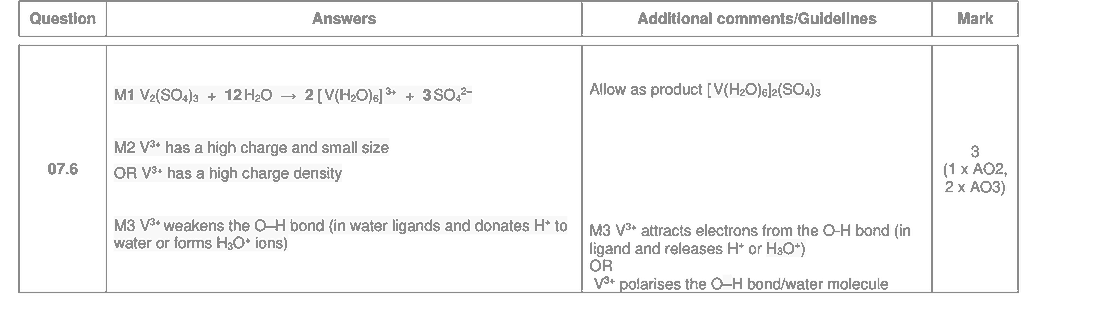
June 2025 · Paper 1 · Q07.6 3 marks AO2=1, AO3=2 Explanation reactions of ions in aqueous solution
Earlier parts of question 07 that this part usesEarlier part of June 2025 Paper 1 question 07Earlier part of June 2025 Paper 1 question 07
When vanadium(III) sulfate dissolves in water, the vanadium-containing species
formed is acidic.
Give an equation to show how vanadium(III) sulfate dissolves in water to form the
acidic vanadium-containing species.
Explain why the vanadium-containing species is acidic.
[3 marks]
Equation
Explanation
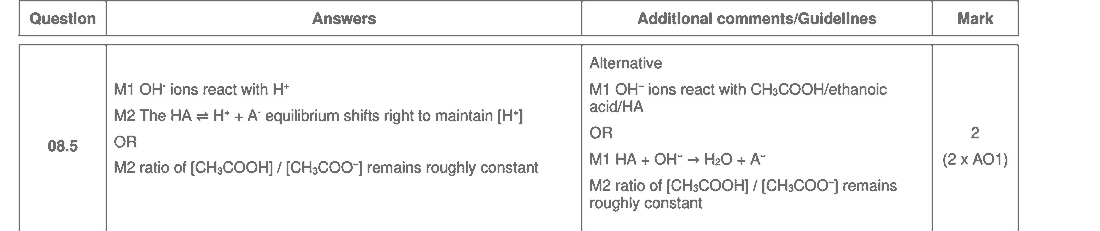
June 2025 · Paper 1 · Q08.5 2 marks AO1=2 Explanation acids and bases
Earlier part of question 08 that this part usesEarlier part of June 2025 Paper 1 question 08
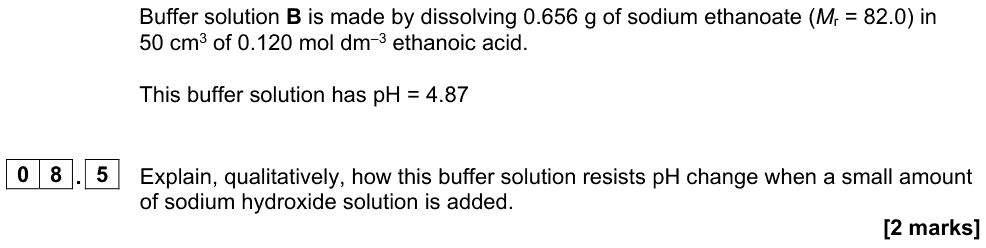
Buffer solution B is made by dissolving 0.656 g of sodium ethanoate (Mr = 82.0) in
50 cm3 of 0.120 mol dm–3 ethanoic acid.
This buffer solution has pH = 4.87
Explain, qualitatively, how this buffer solution resists pH change when a small amount
of sodium hydroxide solution is added.
[2 marks]
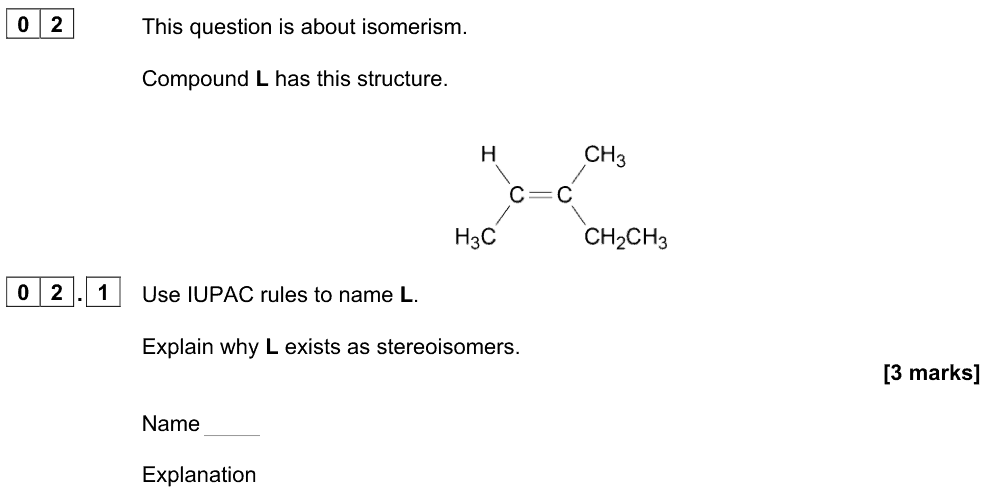
June 2025 · Paper 2 · Q02.1 3 marks AO1=2, AO2=1 Explanation introduction to organic chemistry
This question is about isomerism.
Compound L has this structure.
Use IUPAC rules to name L.
Explain why L exists as stereoisomers.
[3 marks]
Name
Explanation
June 2025 · Paper 2 · Q03.6 3 marks AO1=1, AO3=2 Explanation bonding
Earlier part of question 03 that this part usesEarlier part of June 2025 Paper 2 question 03
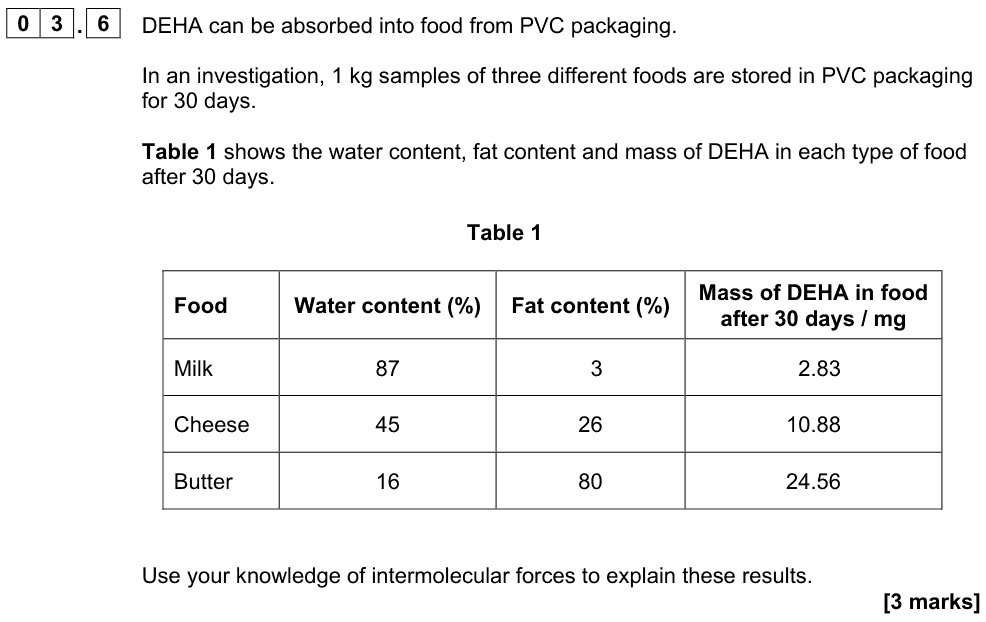
DEHA can be absorbed into food from PVC packaging.
In an investigation, 1 kg samples of three different foods are stored in PVC packaging
for 30 days.
Table 1 shows the water content, fat content and mass of DEHA in each type of food
after 30 days.
Table 1
Food
Water content (%)
Fat content (%)
Mass of DEHA in food
after 30 days / mg
Milk
87
3
2.83
Cheese
45
26
10.88
Butter
16
80
24.56
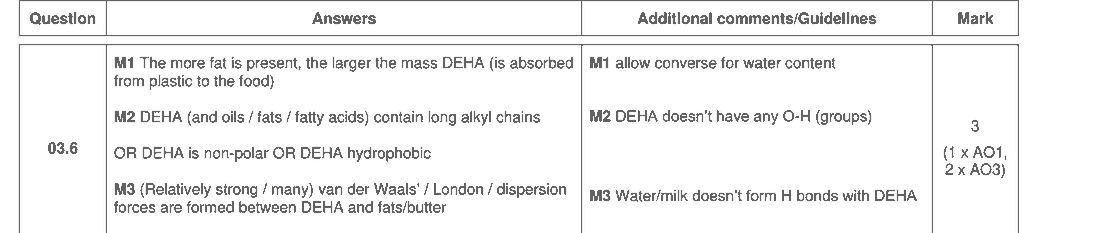
Use your knowledge of intermolecular forces to explain these results.
[3 marks]
June 2025 · Paper 2 · Q07.1 5 marks AO1=2, AO2=3 Explanation organic analysisnmr spectroscopy
This question is about spectroscopy.
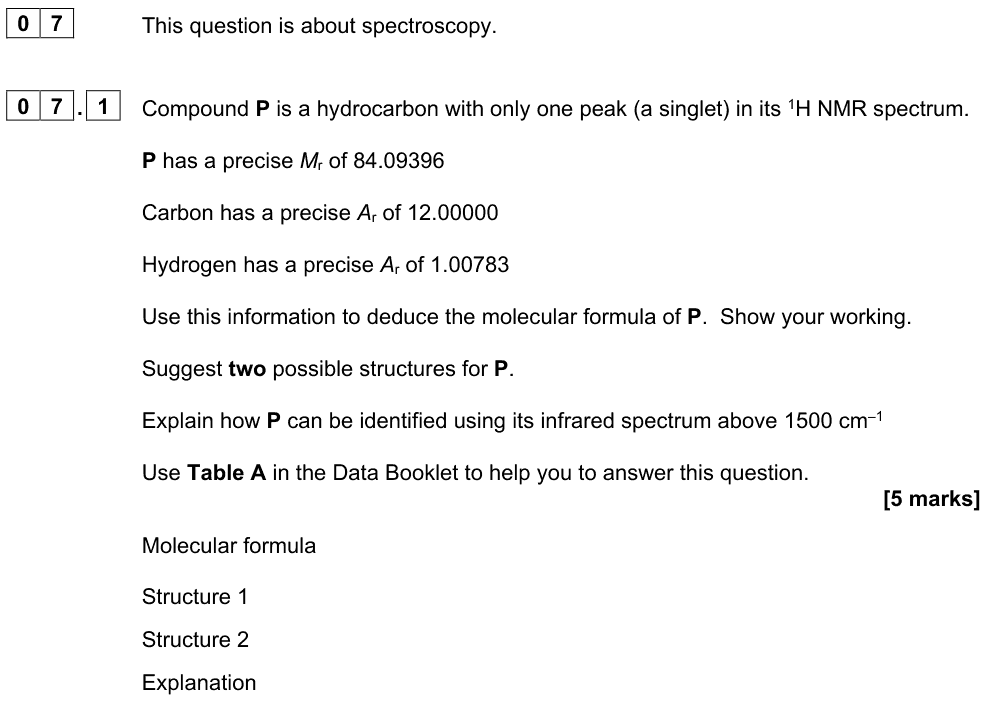
Compound P is a hydrocarbon with only one peak (a singlet) in its 1H NMR spectrum.
P has a precise Mr of 84.09396
Carbon has a precise Ar of 12.00000
Hydrogen has a precise Ar of 1.00783
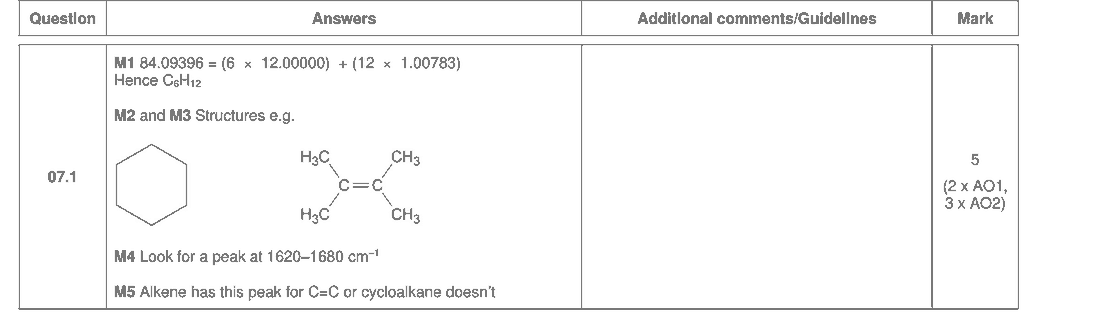
Use this information to deduce the molecular formula of P.  Show your working.
Suggest two possible structures for P.
Explain how P can be identified using its infrared spectrum above 1500 cm–1
Use Table A in the Data Booklet to help you to answer this question.
[5 marks]
Molecular formula
Structure 1
Structure 2
Explanation
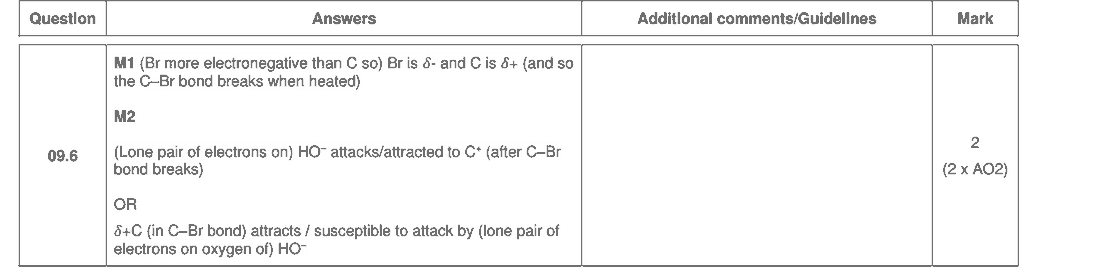
June 2025 · Paper 2 · Q09.6 2 marks AO2=2 Explanation halogenoalkanesbonding
Earlier part of question 09 that this part usesEarlier part of June 2025 Paper 2 question 09
Explain, in terms of bond polarity, why R2CHBr and KOH react together.
[2 marks]
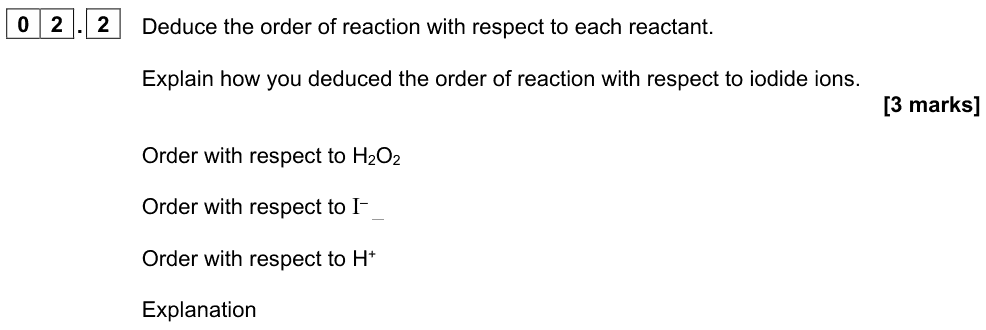
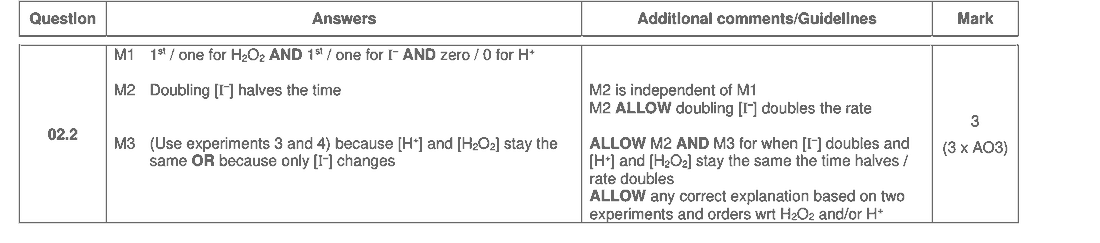
June 2025 · Paper 3 · Q02.2 3 marks AO3=3 Explanation Hard rate equations
Earlier part of question 02 that this part usesEarlier part of June 2025 Paper 3 question 02
Deduce the order of reaction with respect to each reactant.
Explain how you deduced the order of reaction with respect to iodide ions.
[3 marks]
Order with respect to H2O2
Order with respect to I–
Order with respect to H+
Explanation
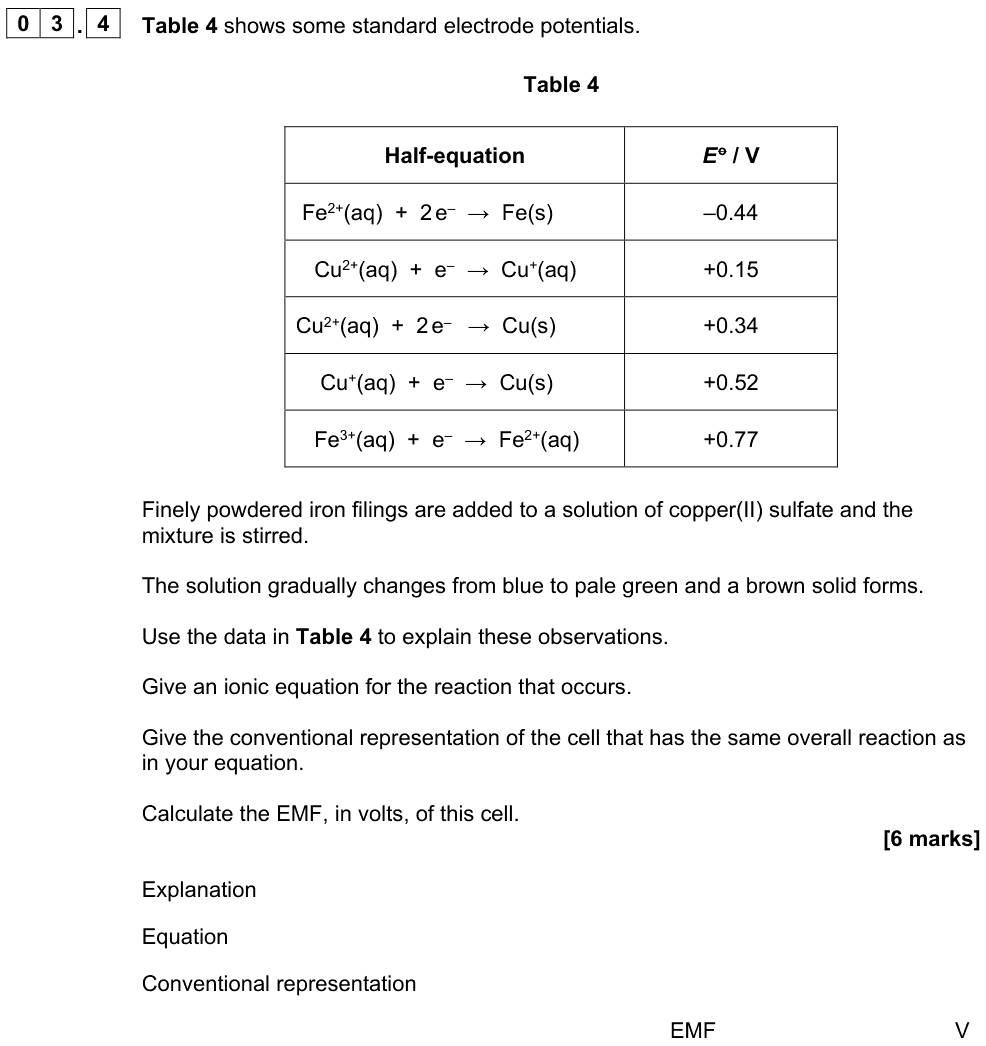
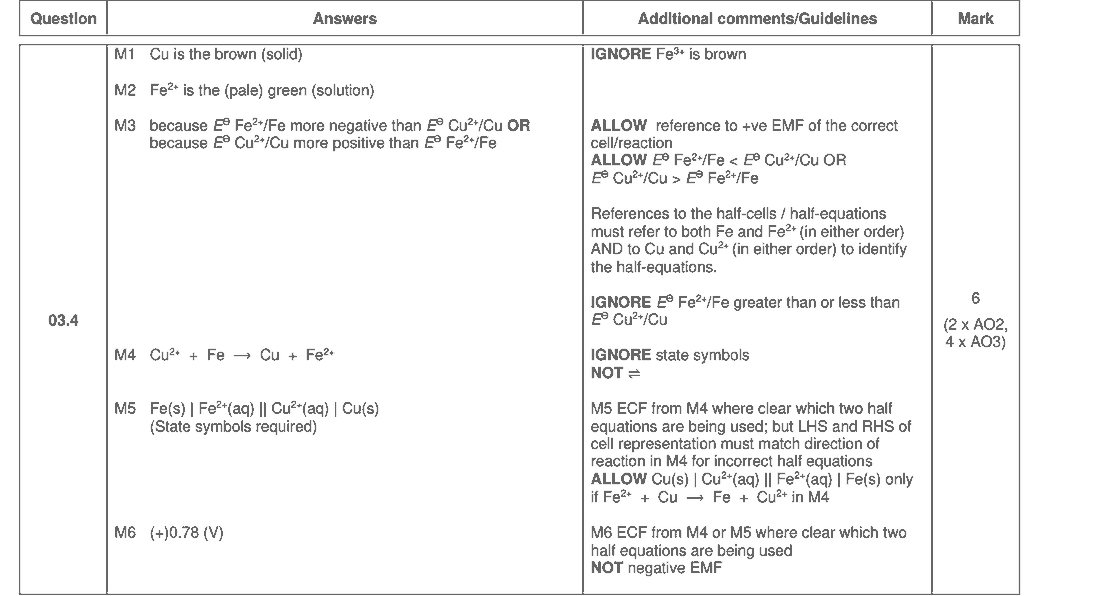
June 2025 · Paper 3 · Q03.4 6 marks AO2=2, AO3=4 Explanation Hard electrode potentials and cells
Earlier part of question 03 that this part usesEarlier part of June 2025 Paper 3 question 03
Table 4 shows some standard electrode potentials.
Table 4
Half-equation
E o / V
Fe2+(aq)  +  2 e–  →  Fe(s)
–0.44
Cu2+(aq)  +  e–  →  Cu+(aq)
+0.15
Cu2+(aq)  +  2 e–   →  Cu(s)
+0.34
Cu+(aq)  +  e–  →  Cu(s)
+0.52
Fe3+(aq)  +  e–  →  Fe2+(aq)
+0.77
Finely powdered iron filings are added to a solution of copper(II) sulfate and the
mixture is stirred.
The solution gradually changes from blue to pale green and a brown solid forms.
Use the data in Table 4 to explain these observations.
Give an ionic equation for the reaction that occurs.
Give the conventional representation of the cell that has the same overall reaction as
in your equation.
Calculate the EMF, in volts, of this cell.
[6 marks]
Explanation
Equation
Conventional representation
EMF
V
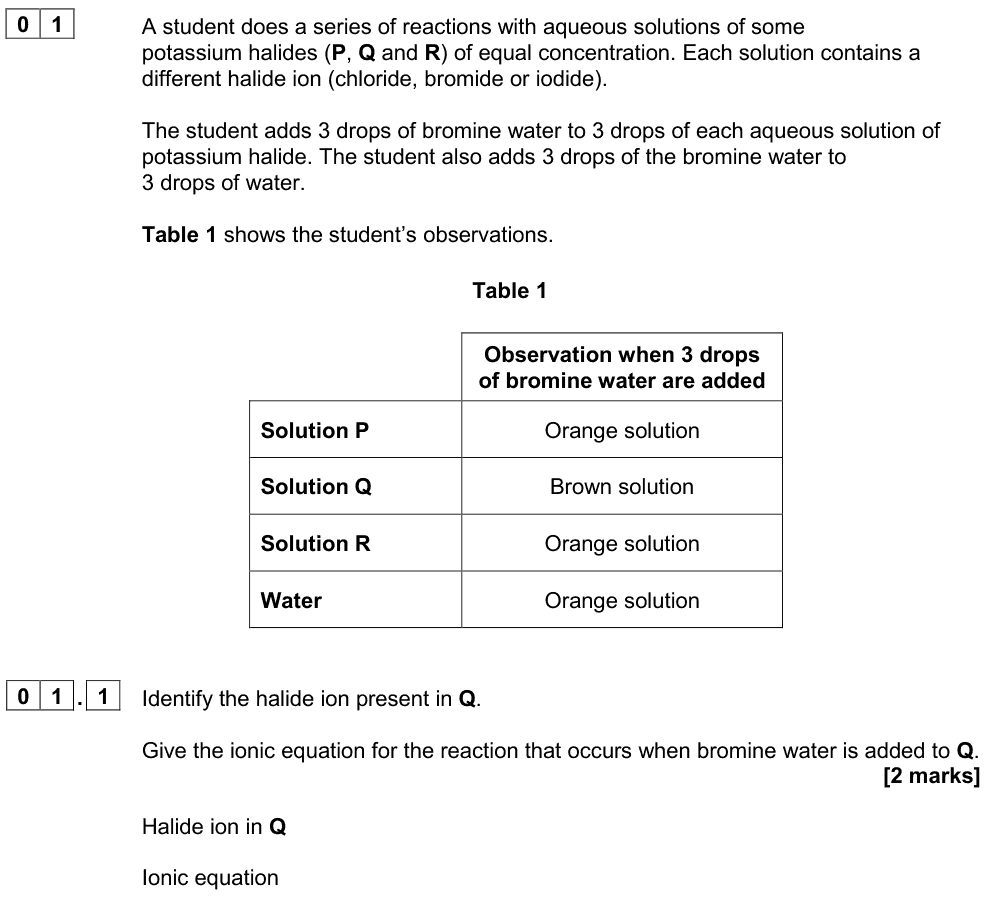
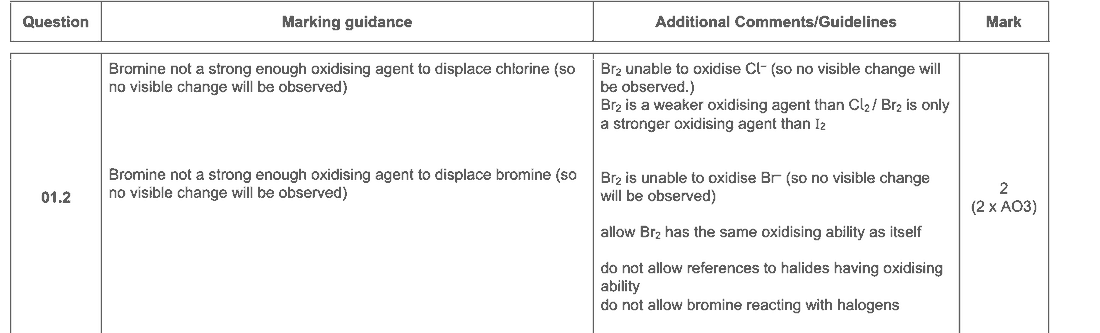
June 2024 · AS Paper 1 · Q01.2 2 marks AO3=2 Explanation group 7 the halogens
Earlier part of question 01 that this part usesEarlier part of June 2024 Paper 1 question 01
Explain, in terms of oxidising ability, why the observations from these reactions
do not allow the student to identify the halide ion present in P and the halide ion
present in R.
[2 marks]
June 2024 · AS Paper 1 · Q02.1 3 marks AO2=3 Explanation atomic structure
This question is about the elements in Group 2.
Explain why the third ionisation energy of beryllium is much higher than the
second ionisation energy of beryllium.
[3 marks]
June 2024 · AS Paper 1 · Q02.3 2 marks AO2=2 Explanation redox
Earlier part of question 02 that this part usesEarlier part of June 2024 Paper 1 question 02
The reaction of calcium with water is a redox reaction.
Explain, in terms of oxidation states, why this reaction involves both oxidation
and reduction.
[2 marks]
June 2024 · AS Paper 1 · Q03.2 2 marks AO2=2 Explanation bonding
Earlier part of question 03 that this part usesEarlier part of June 2024 Paper 1 question 03
Explain why the C–Cl bond is polar.
[2 marks]
June 2024 · AS Paper 1 · Q03.3 2 marks AO2=2 Explanation bonding
Earlier part of question 03 that this part usesEarlier part of June 2024 Paper 1 question 03
Although the C–Cl bond is polar, CCl4 is a non-polar molecule.
Explain why.
[2 marks]
June 2024 · AS Paper 1 · Q03.4 3 marks AO1=3 Explanation bonding
Earlier part of question 03 that this part usesEarlier part of June 2024 Paper 1 question 03
There are van der Waals forces between non-polar molecules.
Explain what causes these forces.
[3 marks]
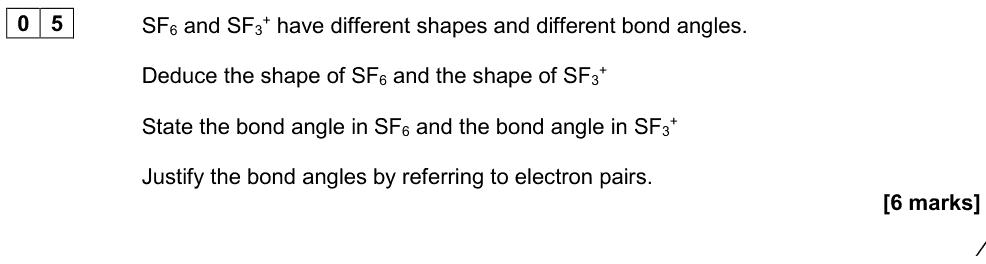
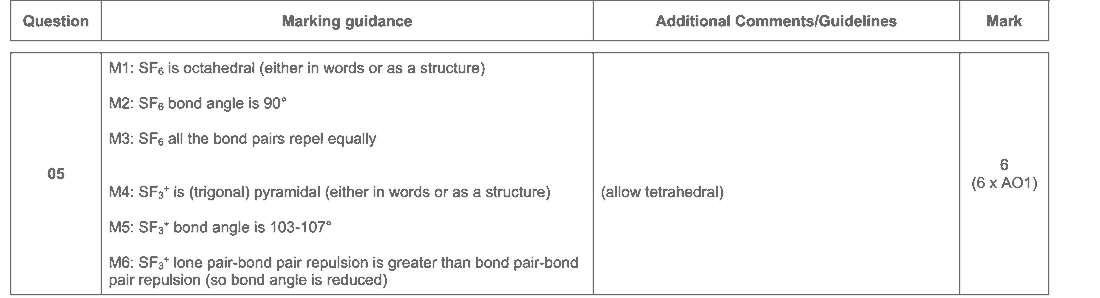
June 2024 · AS Paper 1 · Q05 6 marks AO1=6 Explanation Hard bonding
SF6 and SF3+ have different shapes and different bond angles.
Deduce the shape of SF6 and the shape of SF3+
State the bond angle in SF6 and the bond angle in SF3+
Justify the bond angles by referring to electron pairs.
[6 marks]
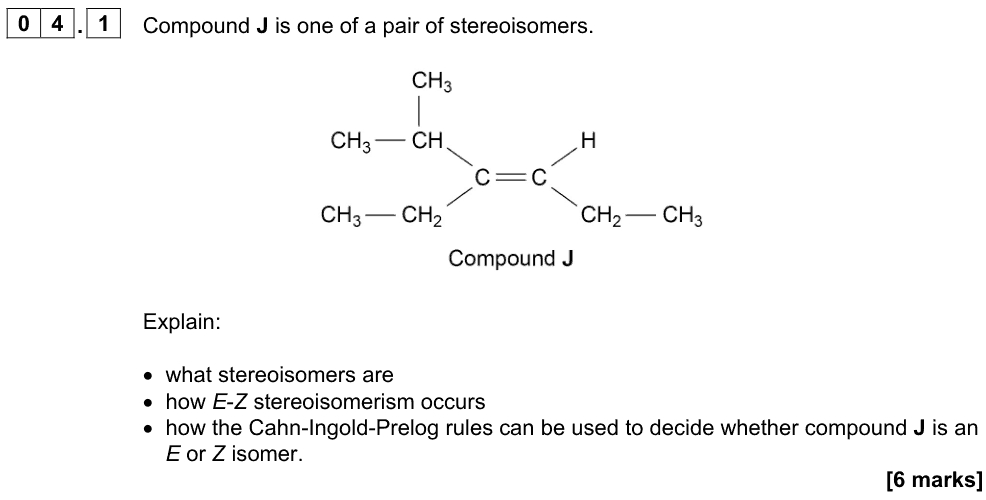
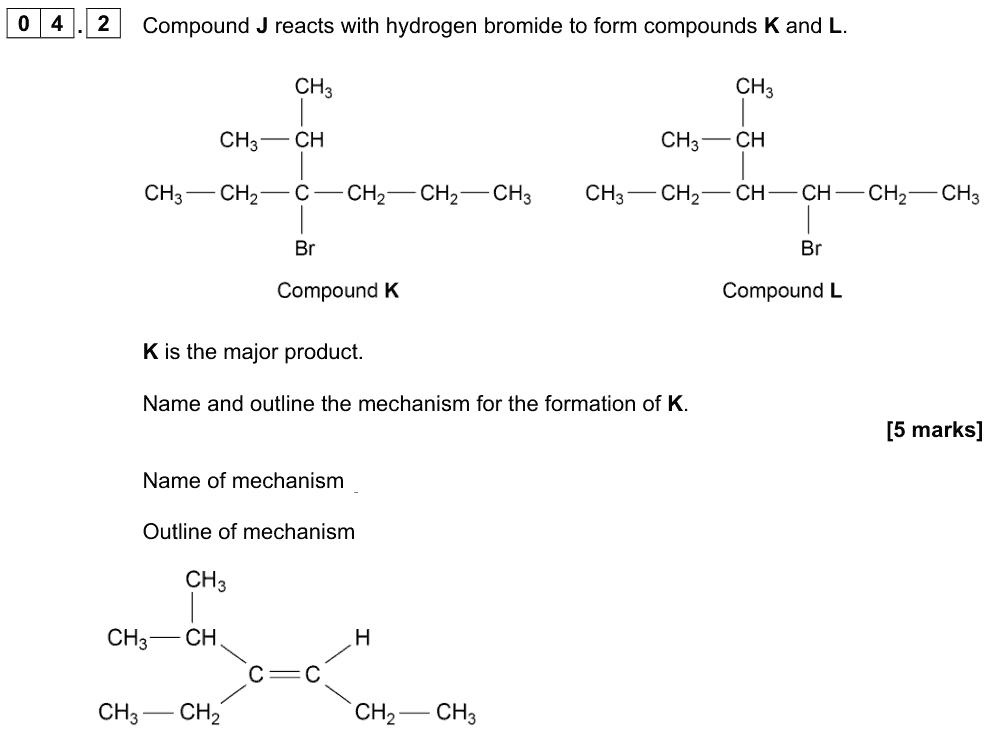
June 2024 · AS Paper 2 · Q04.3 3 marks AO3=3 Explanation alkenes
Earlier parts of question 04 that this part usesEarlier part of June 2024 Paper 2 question 04Earlier part of June 2024 Paper 2 question 04
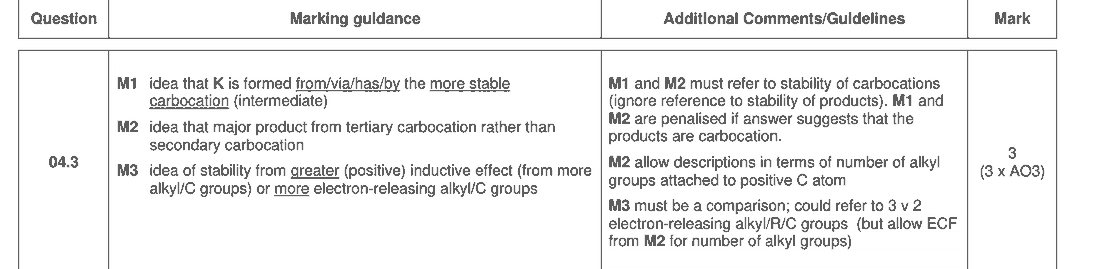
Explain why compound K is the major product in the reaction in Question 04.2.
[3 marks]
June 2024 · AS Paper 2 · Q06.3 3 marks AO3=3 Explanation halogenoalkanes
Earlier parts of question 06 that this part usesEarlier part of June 2024 Paper 2 question 06Earlier part of June 2024 Paper 2 question 06
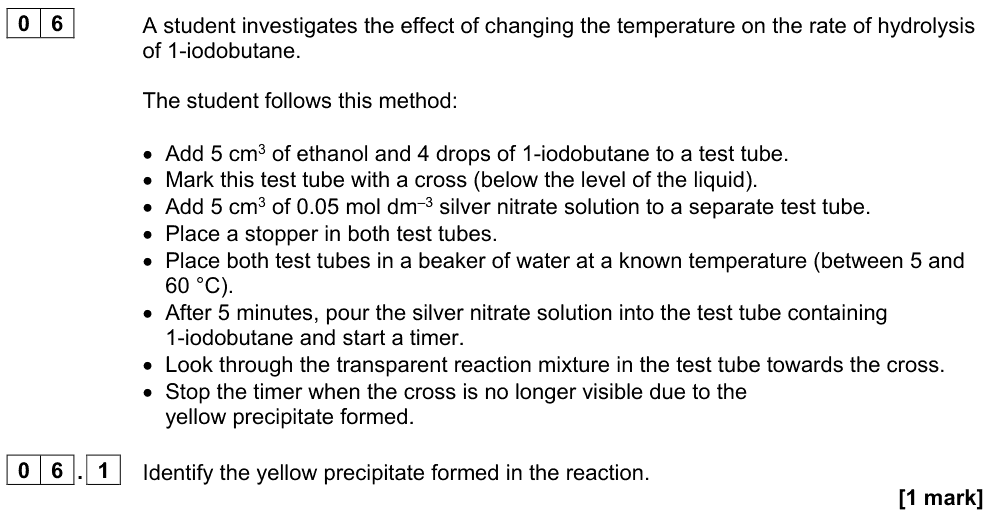
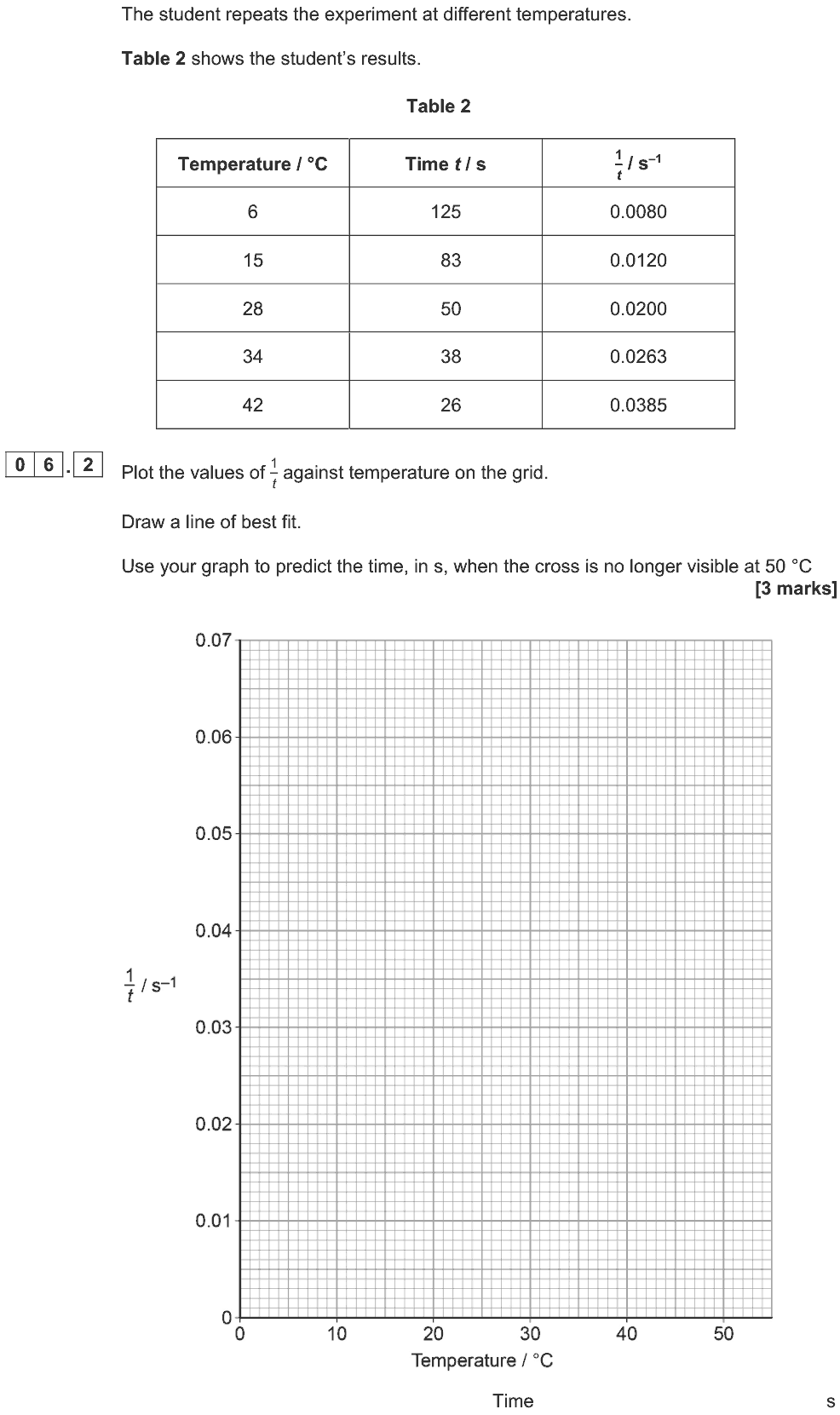
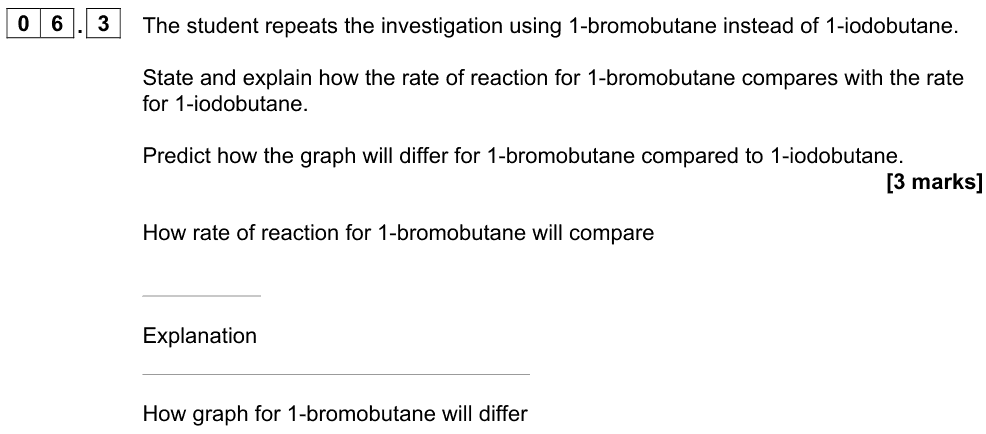
The student repeats the investigation using 1-bromobutane instead of 1-iodobutane.
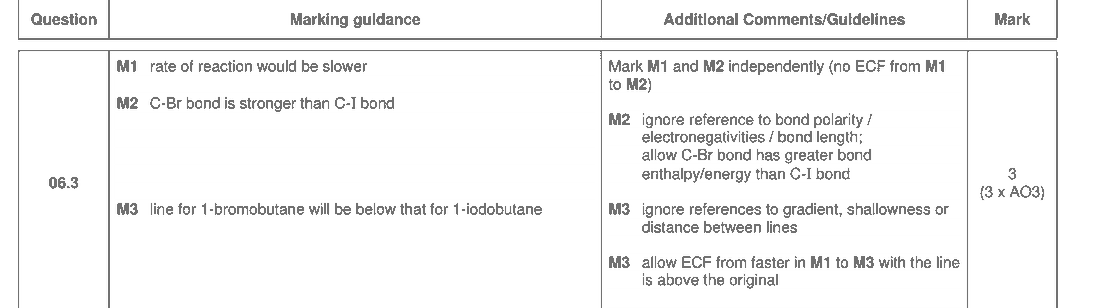
State and explain how the rate of reaction for 1-bromobutane compares with the rate
for 1-iodobutane.
Predict how the graph will differ for 1-bromobutane compared to 1-iodobutane.
[3 marks]
How rate of reaction for 1-bromobutane will compare
Explanation
How graph for 1-bromobutane will differ
June 2024 · AS Paper 2 · Q07.8 3 marks AO2=3 Explanation chemical equilibria and kc
Earlier parts of question 07 that this part usesEarlier part of June 2024 Paper 2 question 07Earlier part of June 2024 Paper 2 question 07
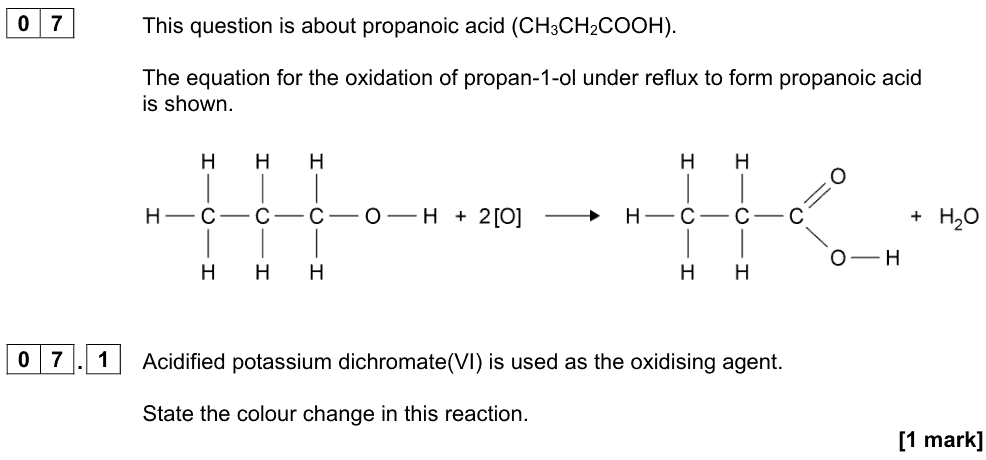
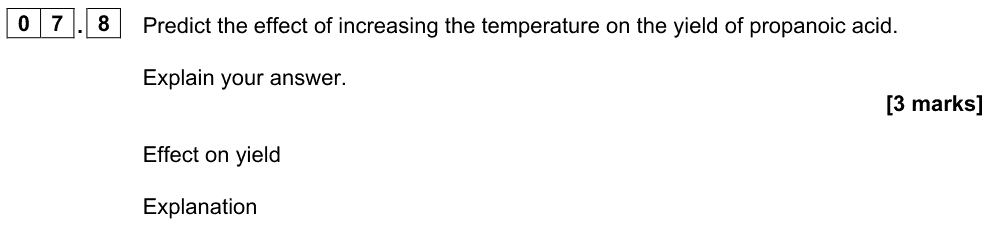
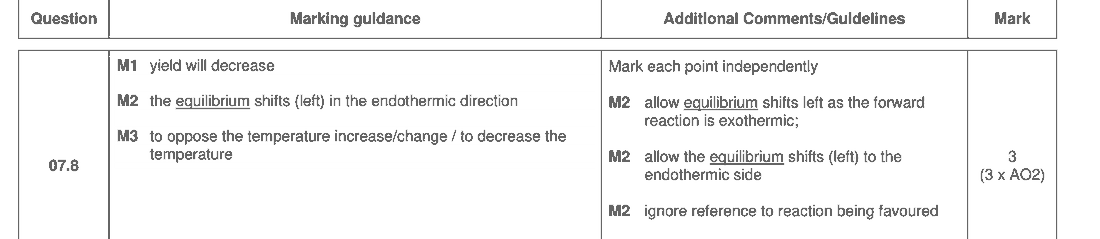
Predict the effect of increasing the temperature on the yield of propanoic acid.
Explain your answer.
[3 marks]
Effect on yield
Explanation
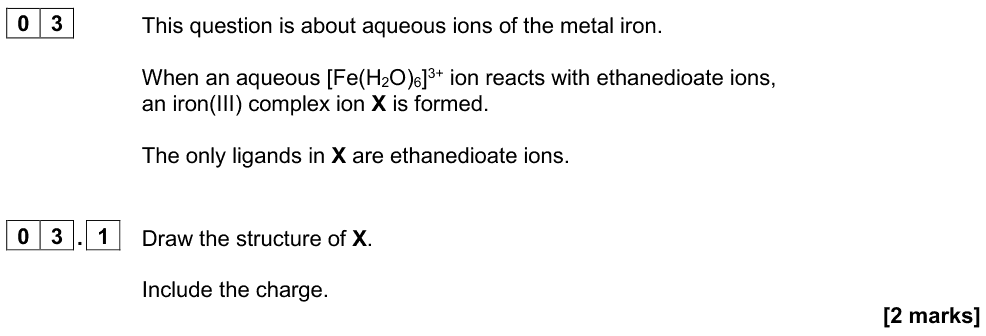
June 2024 · Paper 1 · Q03.2 2 marks AO1=2 Explanation transition metals
Earlier part of question 03 that this part usesEarlier part of June 2024 Paper 1 question 03
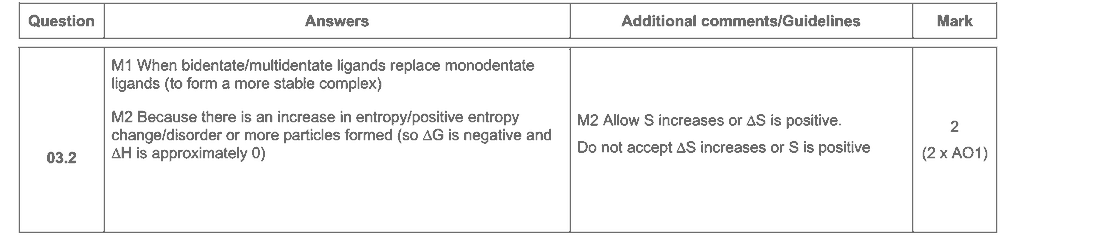
The formation of X is an example of the chelate effect.
Explain the meaning of the chelate effect.
[2 marks]
June 2024 · Paper 1 · Q05.6 2 marks AO2=1, AO3=1 Explanation Hard bonding
Earlier part of question 05 that this part usesEarlier part of June 2024 Paper 1 question 05
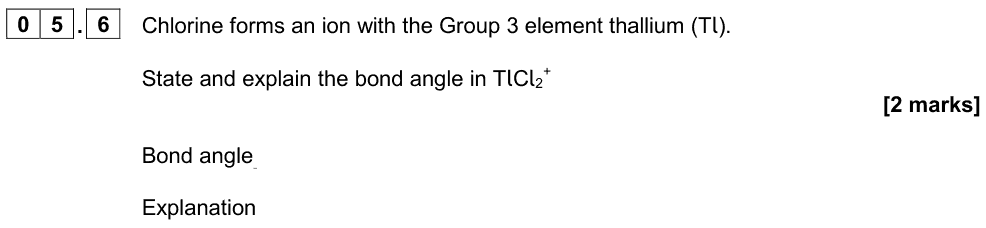
Chlorine forms an ion with the Group 3 element thallium (Tl).
State and explain the bond angle in TlCl2
+
[2 marks]
Bond angle
Explanation
June 2024 · Paper 1 · Q06.1 2 marks AO3=2 Explanation Hard electrode potentials and cellstransition metals
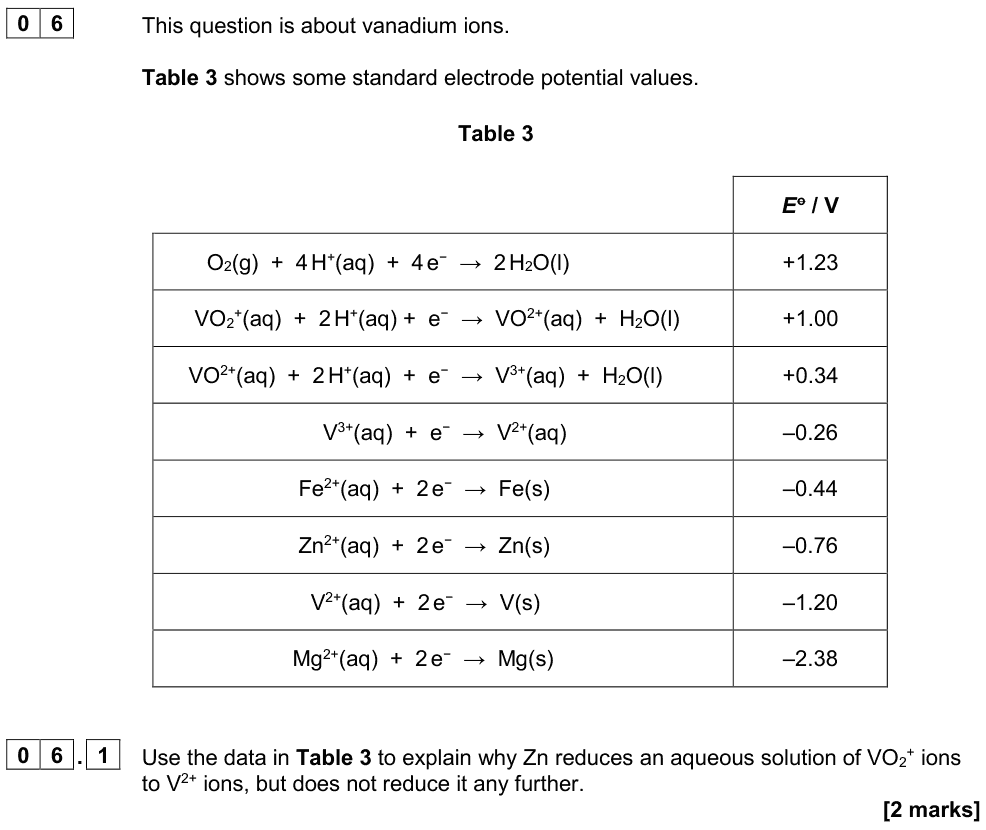
This question is about vanadium ions.
Table 3 shows some standard electrode potential values.
Table 3
E  o / V
O2(g)  +  4 H+(aq)  +  4 e−  →  2 H2O(l)
+1.23
VO2+(aq)  +  2 H+(aq) +  e−  →  VO2+(aq)  +  H2O(l)
+1.00
VO2+(aq)  +  2 H+(aq)  +  e−  →  V3+(aq)  +  H2O(l)
+0.34
V3+(aq)  +  e−  →  V2+(aq)
–0.26
Fe2+(aq)  +  2 e−  →  Fe(s)
–0.44
Zn2+(aq)  +  2 e−  →  Zn(s)
–0.76
V2+(aq)  +  2 e−  →  V(s)
–1.20
Mg2+(aq)  +  2 e−  →  Mg(s)
–2.38
Use the data in Table 3 to explain why Zn reduces an aqueous solution of VO2+ ions
to V2+ ions, but does not reduce it any further.
[2 marks]
June 2024 · Paper 1 · Q08.4 1 mark AO1=1 Explanation Hard thermodynamics
Earlier part of question 08 that this part usesEarlier part of June 2024 Paper 1 question 08
Explain why the second electron affinity of oxygen has a positive value.
[1 mark]
June 2024 · Paper 1 · Q08.5 2 marks AO3=2 Explanation thermodynamicsbonding
Earlier part of question 08 that this part usesEarlier part of June 2024 Paper 1 question 08
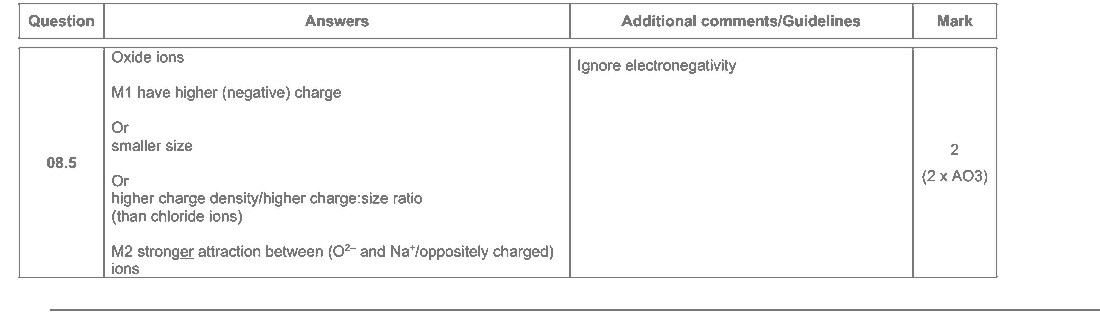
Explain why the enthalpy of lattice dissociation for sodium oxide is greater than the
enthalpy of lattice dissociation for sodium chloride.
[2 marks]
June 2024 · Paper 1 · Q09.3 3 marks AO1=2, AO3=1 Explanation group 2
Earlier part of question 09 that this part usesEarlier part of June 2024 Paper 1 question 09
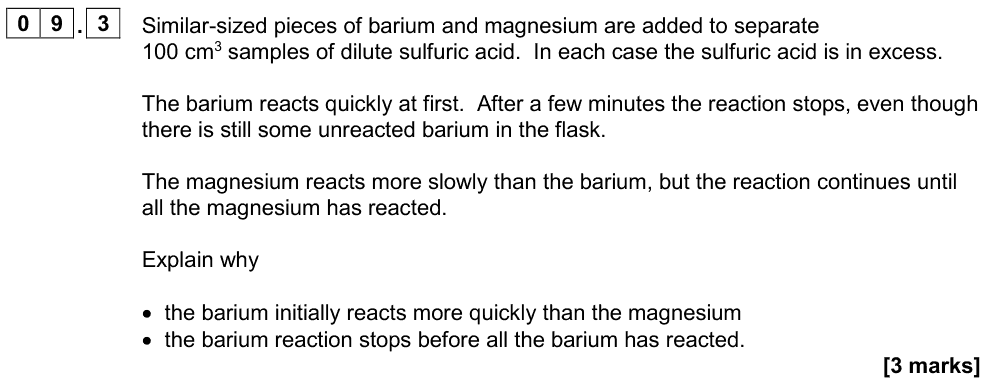
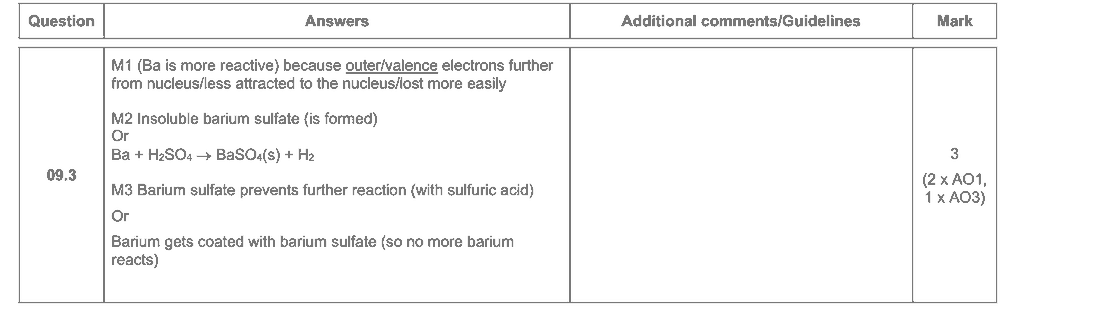
Similar-sized pieces of barium and magnesium are added to separate
100 cm3 samples of dilute sulfuric acid.  In each case the sulfuric acid is in excess.
The barium reacts quickly at first.  After a few minutes the reaction stops, even though
there is still some unreacted barium in the flask.
The magnesium reacts more slowly than the barium, but the reaction continues until
all the magnesium has reacted.
Explain why
• the barium initially reacts more quickly than the magnesium
• the barium reaction stops before all the barium has reacted.
[3 marks]
June 2024 · Paper 1 · Q09.5 3 marks AO2=2, AO3=1 Explanation amount of substancebonding
Earlier part of question 09 that this part usesEarlier part of June 2024 Paper 1 question 09
Sodium reacts with aluminium and hydrogen to form solid NaAlH4
Give an equation for this reaction.
Suggest why NaAlH4 has a high melting point.
[3 marks]
Equation
Suggestion
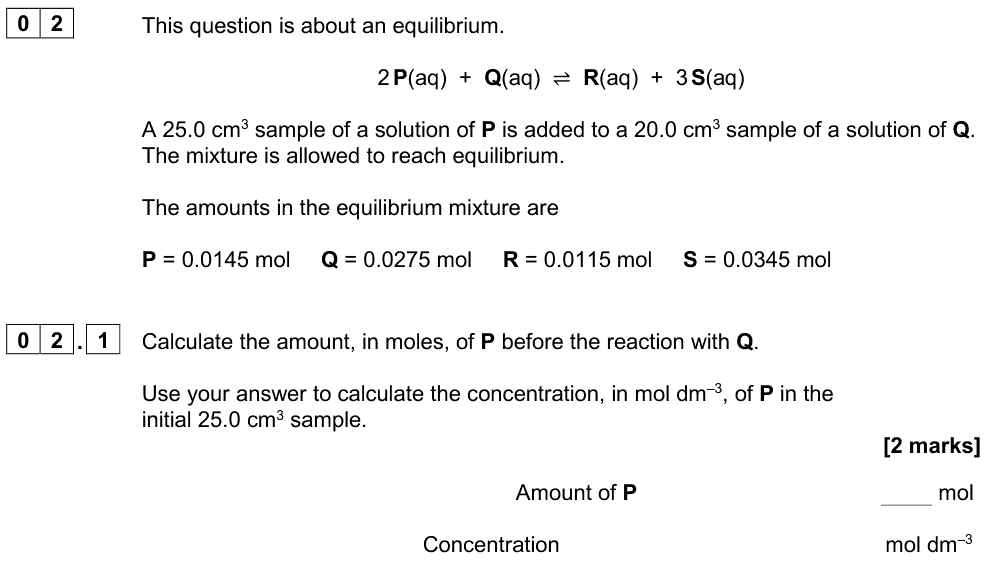
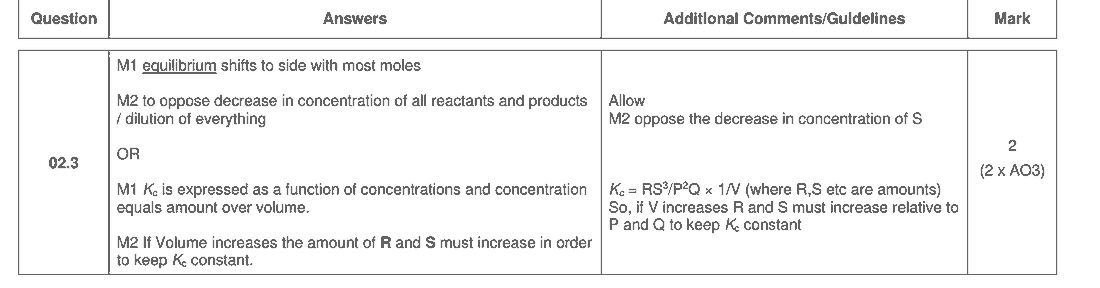
June 2024 · Paper 2 · Q02.3 2 marks AO3=2 Explanation chemical equilibria and kc
Earlier part of question 02 that this part usesEarlier part of June 2024 Paper 2 question 02
Explain why the amount of S increases when water is added to the
equilibrium mixture.
[2 marks]
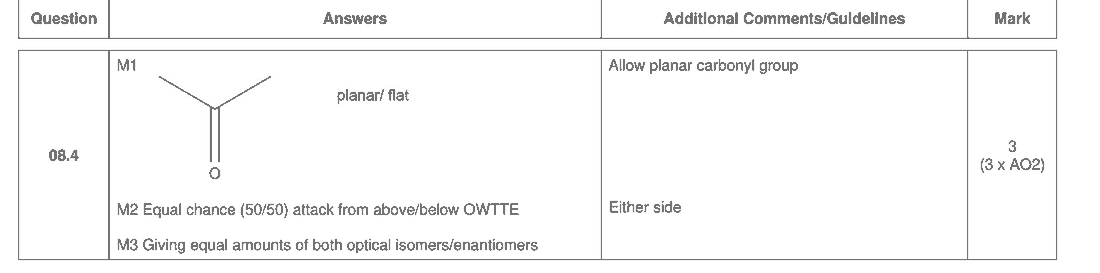
June 2024 · Paper 2 · Q08.4 3 marks AO2=3 Explanation Hard aldehydes and ketonesoptical isomerism
Earlier part of question 08 that this part usesEarlier part of June 2024 Paper 2 question 08
Explain why Step 4 produces a racemic mixture.
[3 marks]
June 2024 · Paper 2 · Q09.4 2 marks AO1=2 Explanation amines
Earlier part of question 09 that this part usesEarlier part of June 2024 Paper 2 question 09
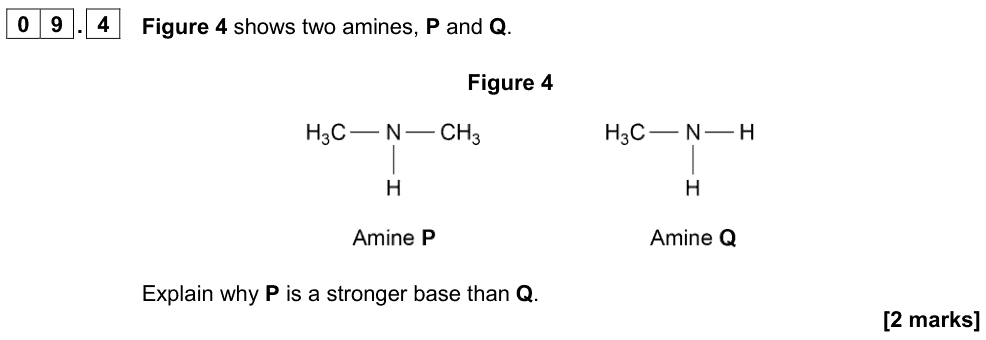
Figure 4 shows two amines, P and Q.
Figure 4
Explain why P is a stronger base than Q.
[2 marks]
June 2024 · Paper 2 · Q10.1 5 marks AO1=2, AO3=3 Explanation aromatic chemistry
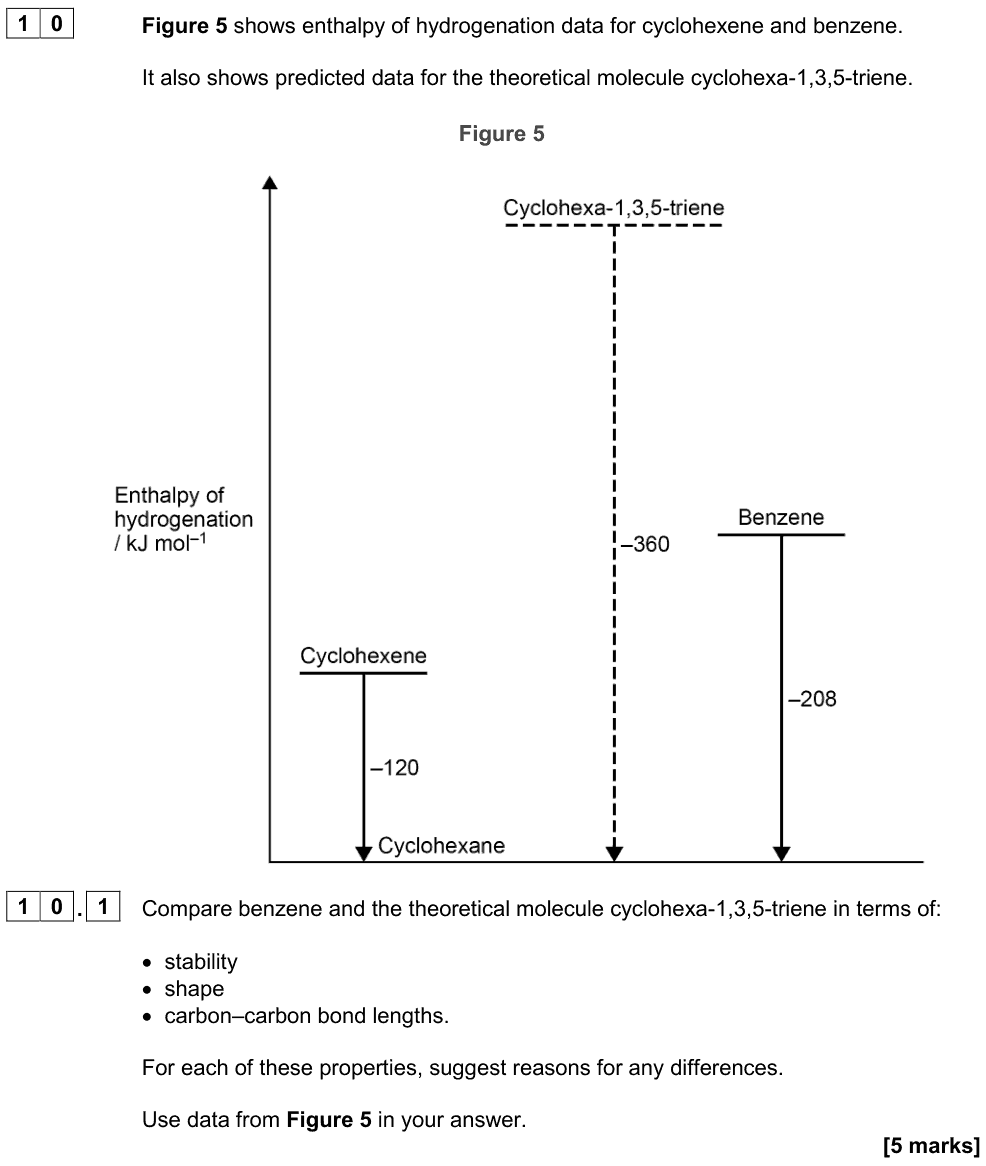
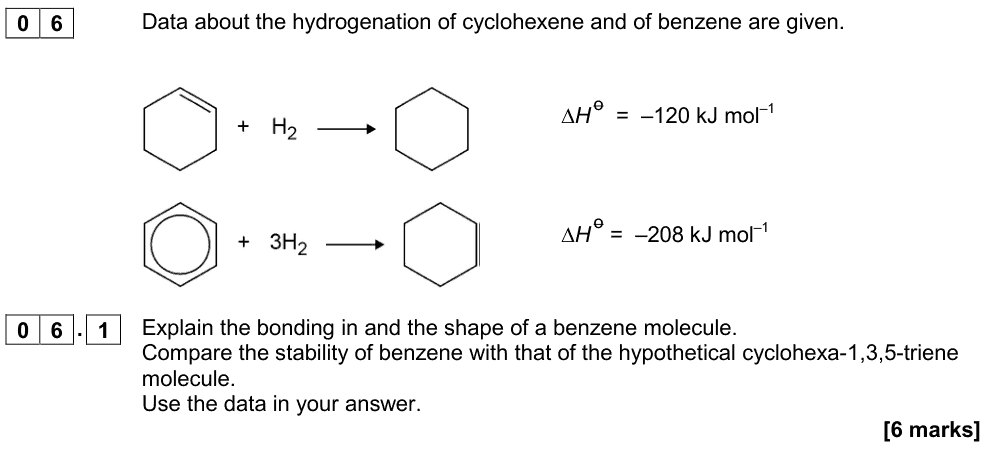
Figure 5 shows enthalpy of hydrogenation data for cyclohexene and benzene.
It also shows predicted data for the theoretical molecule cyclohexa-1,3,5-triene.
Figure 5
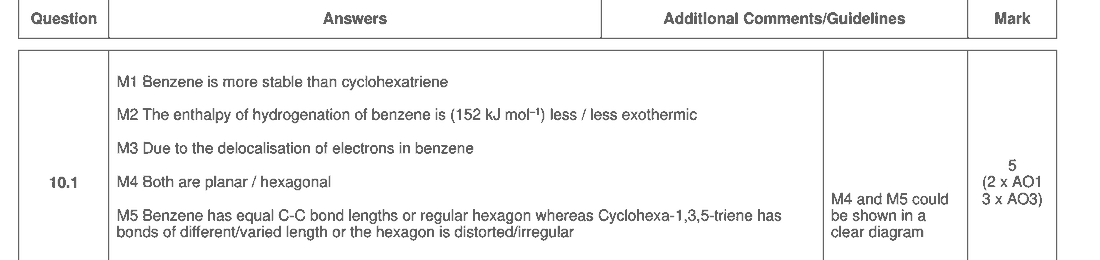
Compare benzene and the theoretical molecule cyclohexa-1,3,5-triene in terms of:
• stability
• shape
• carbon–carbon bond lengths.
For each of these properties, suggest reasons for any differences.
Use data from Figure 5 in your answer.
[5 marks]
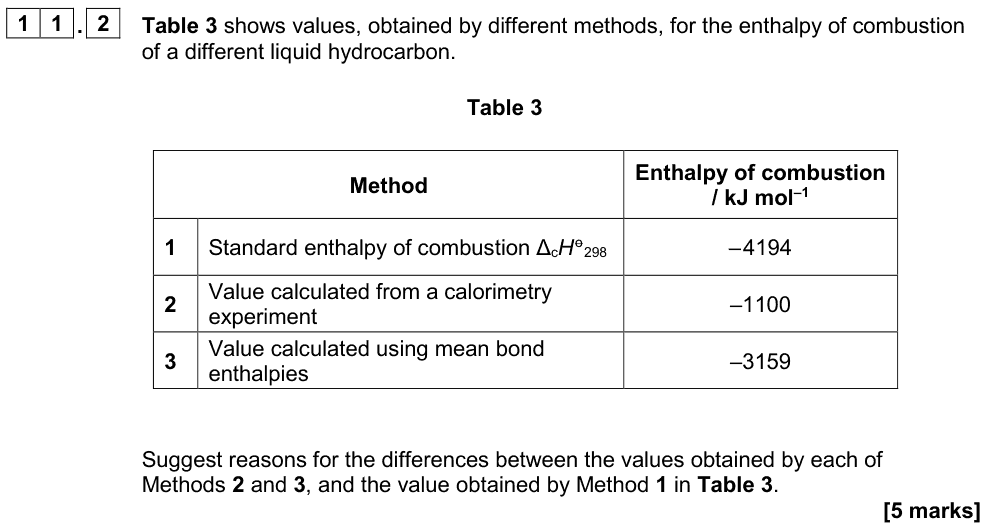
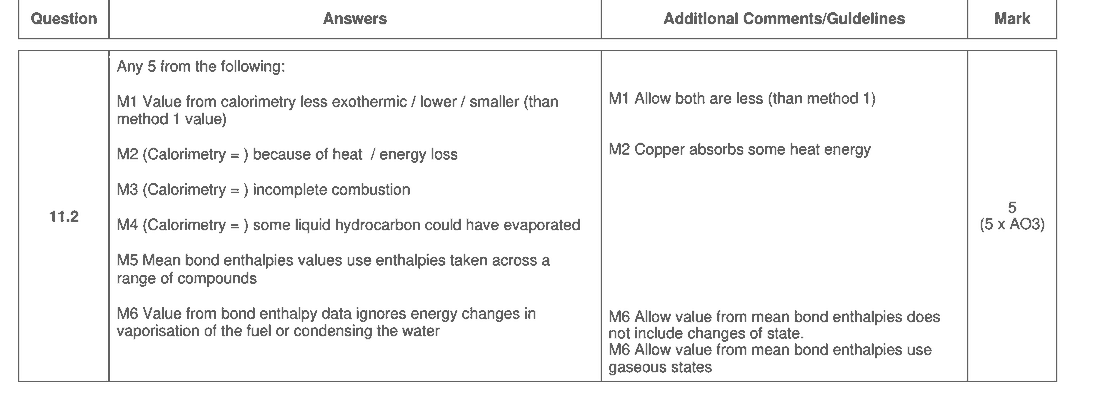
June 2024 · Paper 2 · Q11.2 5 marks AO3=5 Explanation energetics
Earlier part of question 11 that this part usesEarlier part of June 2024 Paper 2 question 11
Table 3 shows values, obtained by different methods, for the enthalpy of combustion
of a different liquid hydrocarbon.
Table 3
Method
Enthalpy of combustion
/ kJ mol–1
1
Standard enthalpy of combustion ΔcH o
298
– 4194
2
Value calculated from a calorimetry
experiment
–1100
3
Value calculated using mean bond
enthalpies
–3159
Suggest reasons for the differences between the values obtained by each of
Methods 2 and 3, and the value obtained by Method 1 in Table 3.
[5 marks]
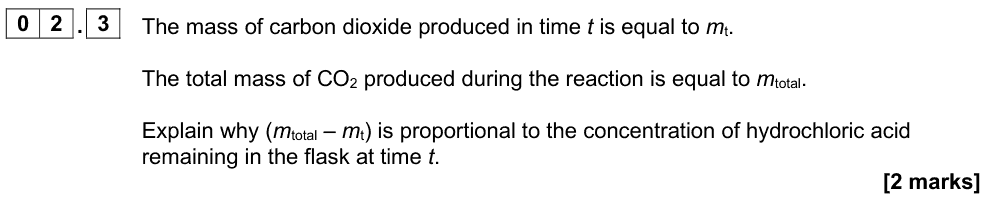
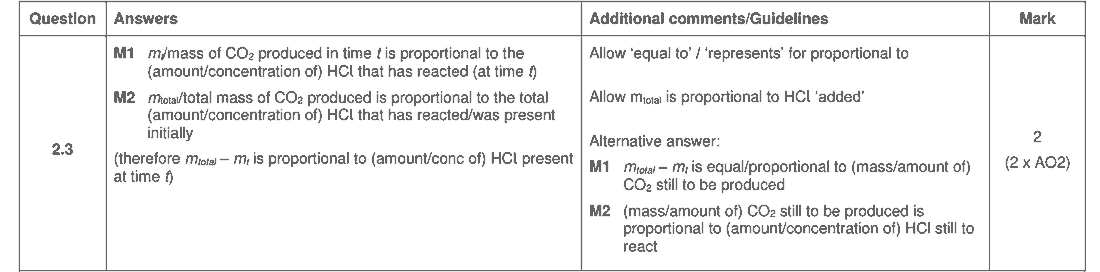
June 2024 · Paper 3 · Q02.3 2 marks AO2=2 Explanation rate equationsamount of substance
Earlier part of question 02 that this part usesEarlier part of June 2024 Paper 3 question 02
The mass of carbon dioxide produced in time t is equal to mt.
The total mass of CO2 produced during the reaction is equal to mtotal.
Explain why (mtotal – mt) is proportional to the concentration of hydrochloric acid
remaining in the flask at time t.
[2 marks]
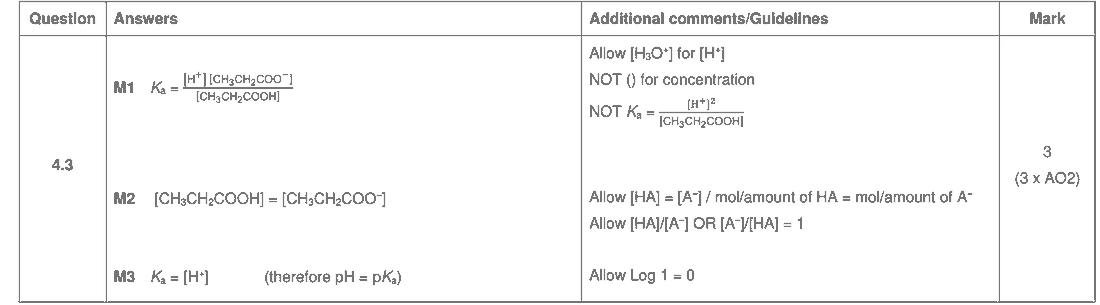
June 2024 · Paper 3 · Q04.3 3 marks AO2=3 Explanation acids and bases
Earlier part of question 04 that this part usesEarlier part of June 2024 Paper 3 question 04
Give an expression for Ka for propanoic acid (CH3CH2COOH).
Use this expression to show that pH = pKa when half of the propanoic acid has
reacted with sodium hydroxide.
[3 marks]
Ka
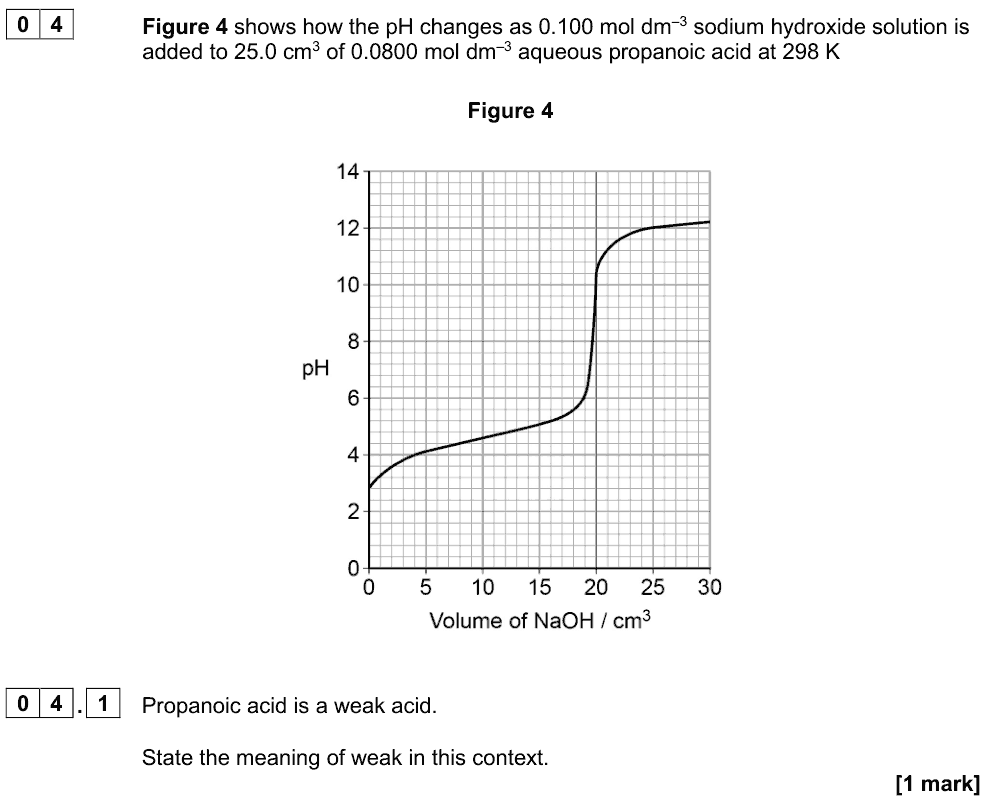
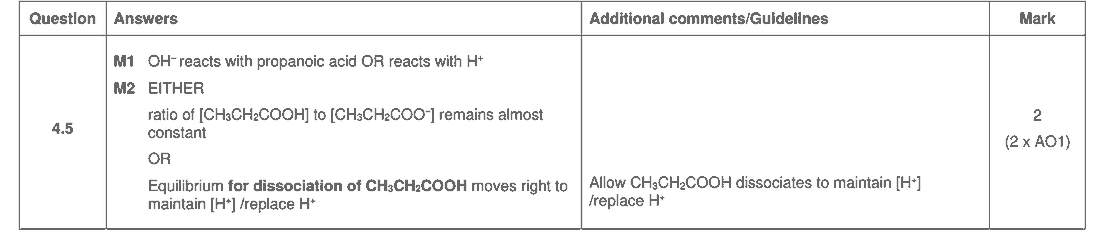
June 2024 · Paper 3 · Q04.5 2 marks AO1=2 Explanation acids and bases
Earlier part of question 04 that this part usesEarlier part of June 2024 Paper 3 question 04
When sodium hydroxide solution is added to aqueous propanoic acid, the solution
formed acts as a buffer when between 5 cm3 and 15 cm3 have been added.
Explain why the pH stays approximately constant during this part of the experiment.
[2 marks]
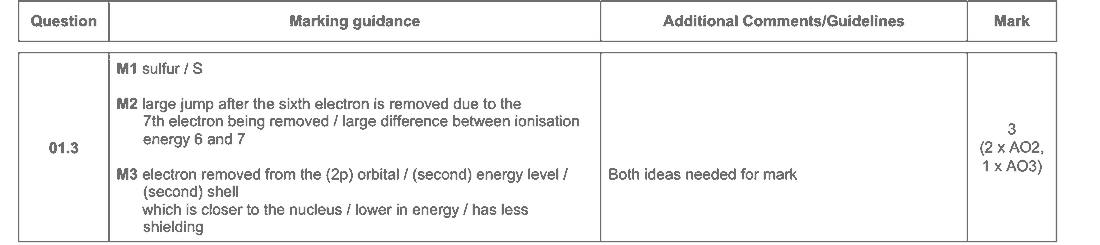
June 2023 · AS Paper 1 · Q01.3 3 marks AO2=2, AO3=1 Explanation atomic structure
Earlier part of question 01 that this part usesEarlier part of June 2023 Paper 1 question 01
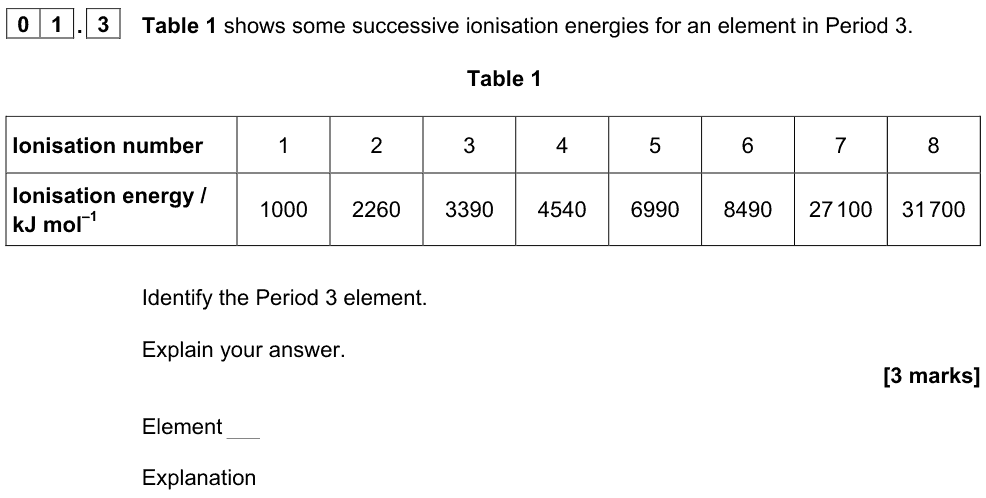
Table 1 shows some successive ionisation energies for an element in Period 3.
Table 1
Ionisation number
1
2
3
4
5
6
7
8
Ionisation energy /
kJ mol–1
1000
2260
3390
4540
6990
8490
27 100
31 700
Identify the Period 3 element.
Explain your answer.
[3 marks]
Element
Explanation
June 2023 · AS Paper 1 · Q06.1 2 marks AO1=2 Explanation Hard group 7 the halogensbonding
This question is about halogens and halide ions.
Explain why the electronegativity of the halogens decreases down the group.
[2 marks]
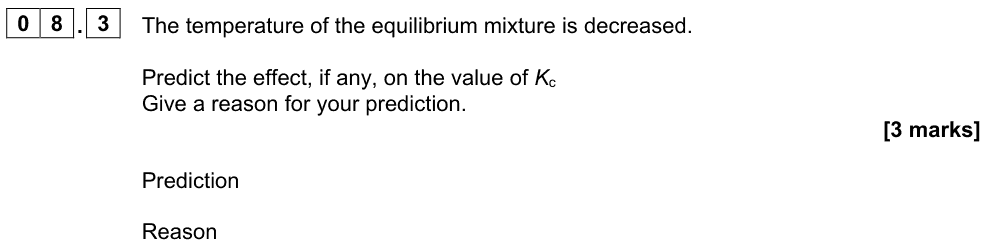
June 2023 · AS Paper 1 · Q08.3 3 marks AO3=3 Explanation chemical equilibria and kc
Earlier part of question 08 that this part usesEarlier part of June 2023 Paper 1 question 08
The temperature of the equilibrium mixture is decreased.
Predict the effect, if any, on the value of Kc
Give a reason for your prediction.
[3 marks]
Prediction
Reason
June 2023 · AS Paper 2 · Q04.2 4 marks AO2=3, AO3=1 Explanation alkenes
Earlier part of question 04 that this part usesEarlier part of June 2023 Paper 2 question 04
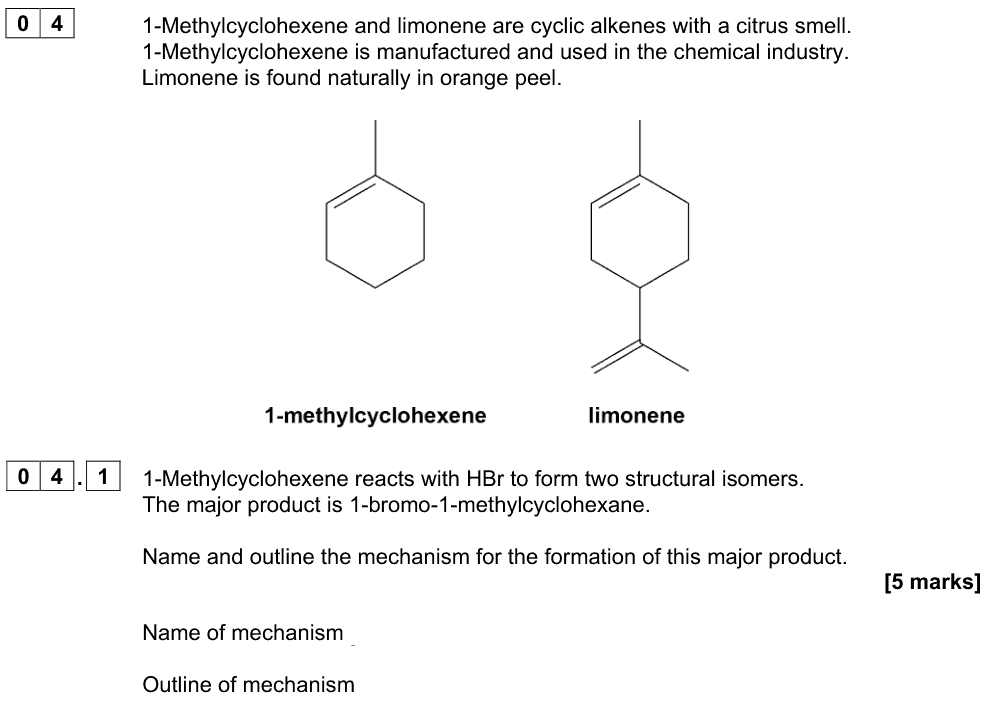
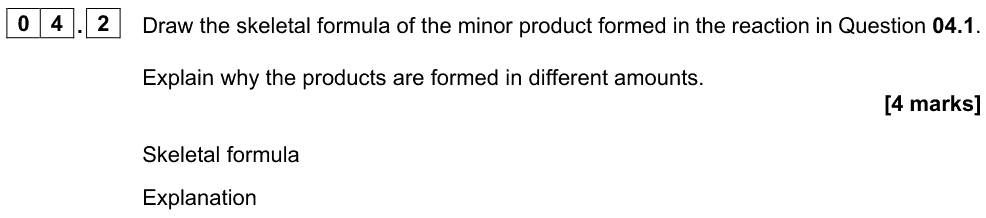
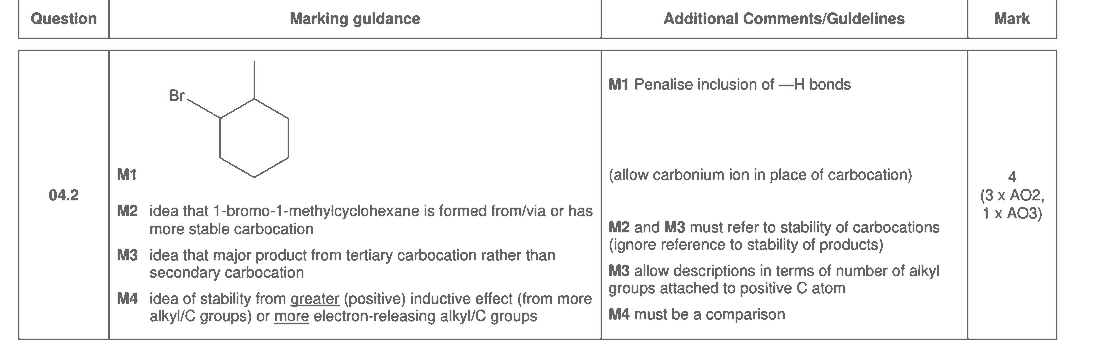
Draw the skeletal formula of the minor product formed in the reaction in Question 04.1.
Explain why the products are formed in different amounts.
[4 marks]
Skeletal formula
Explanation
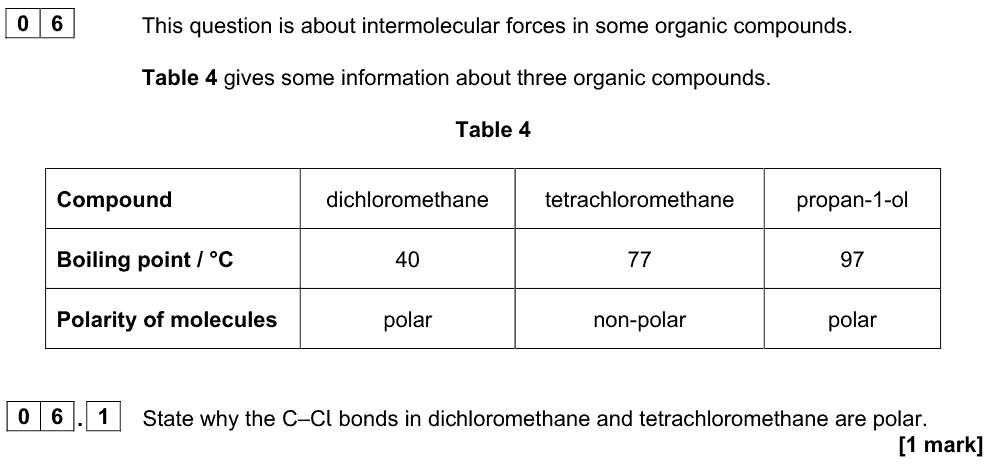
June 2023 · AS Paper 2 · Q06.3 2 marks AO2=2 Explanation bonding
Earlier part of question 06 that this part usesEarlier part of June 2023 Paper 2 question 06
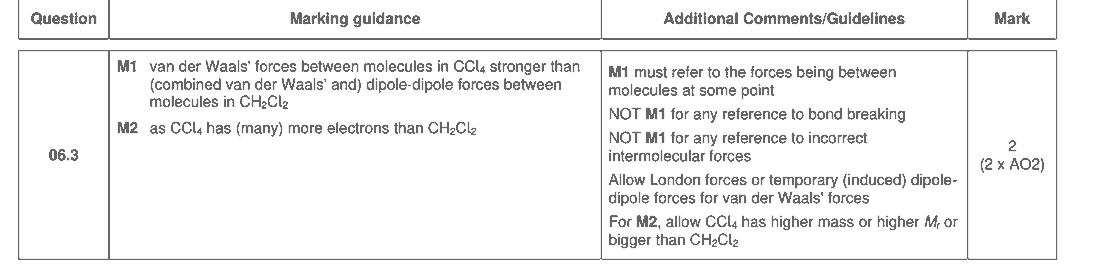
Explain why tetrachloromethane has a higher boiling point than dichloromethane.
[2 marks]
June 2023 · Paper 1 · Q04.5 2 marks AO3=2 Explanation equilibrium constant kpchemical equilibria and kc
Earlier part of question 04 that this part usesEarlier part of June 2023 Paper 1 question 04
The equilibrium mixture in Question 04.3 is allowed to reach equilibrium at a lower
temperature.
Explain why the equilibrium yield of oxygen decreases.
[2 marks]
June 2023 · Paper 1 · Q05.3 2 marks AO1=2 Explanation Hard thermodynamics
Earlier part of question 05 that this part usesEarlier part of June 2023 Paper 1 question 05
Explain why the enthalpy of hydration of fluoride ions is more negative than the
enthalpy of hydration of chloride ions.
[2 marks]
June 2023 · Paper 1 · Q07.3 2 marks AO1=2 Explanation reactions of ions in aqueous solution
Earlier part of question 07 that this part usesEarlier part of June 2023 Paper 1 question 07
Explain why the solution containing [Al(H2O)6]3+ is acidic.
[2 marks]
June 2023 · Paper 1 · Q10.5 2 marks AO3=2 Explanation acids and bases
Earlier part of question 10 that this part usesEarlier part of June 2023 Paper 1 question 10
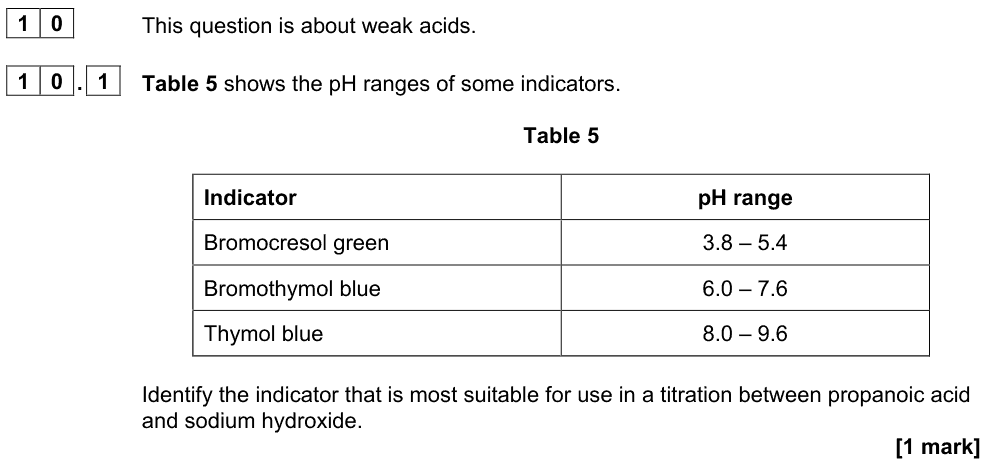
A student plans to titrate butanoic acid solution with a solution of ethylamine.
Explain why this titration could not be done using an indicator.
[2 marks]
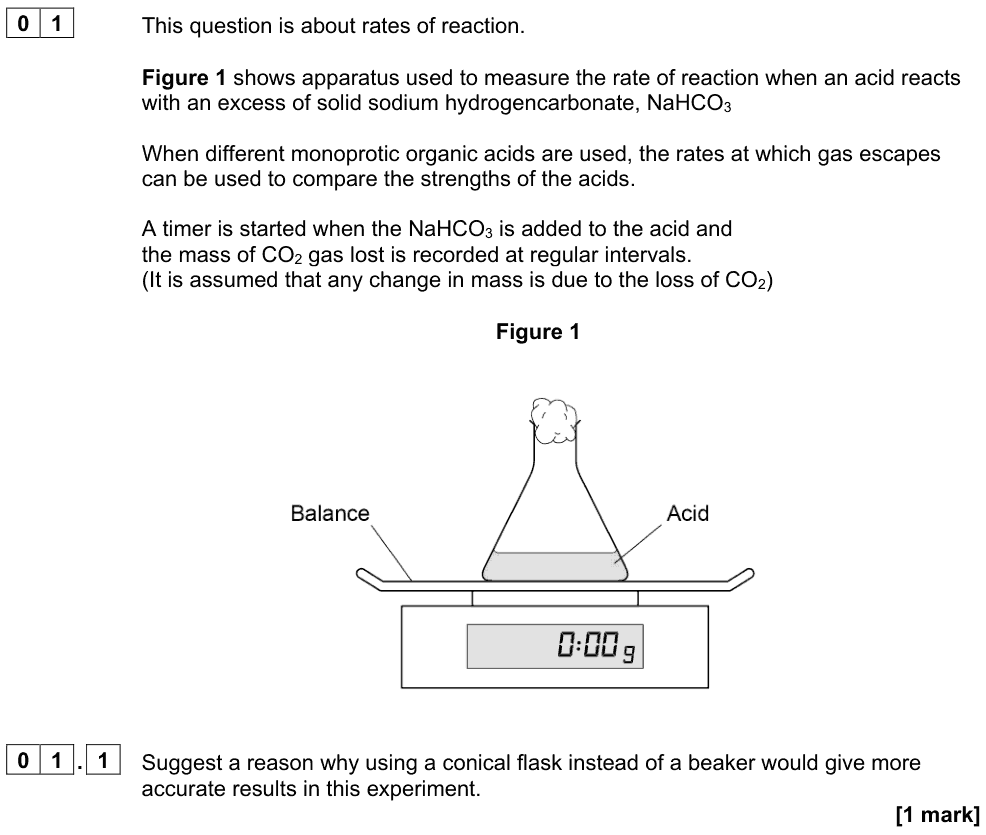
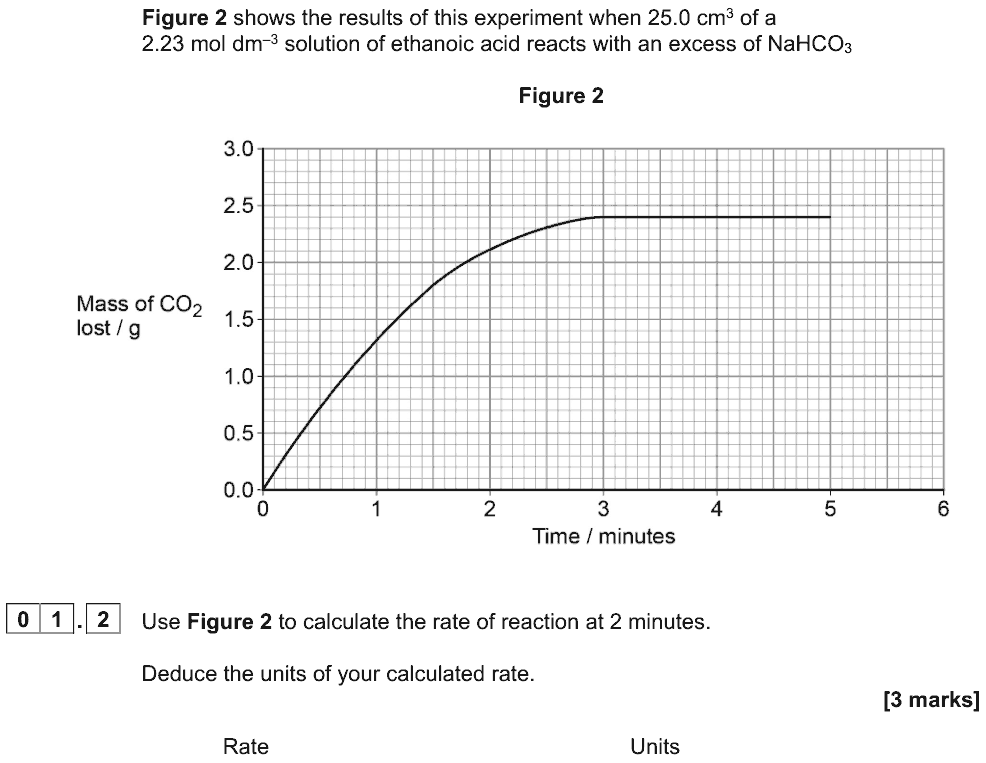
June 2023 · Paper 2 · Q01.3 3 marks AO3=3 Explanation carboxylic acids and derivativesrate equations
Earlier parts of question 01 that this part usesEarlier part of June 2023 Paper 2 question 01Earlier part of June 2023 Paper 2 question 01
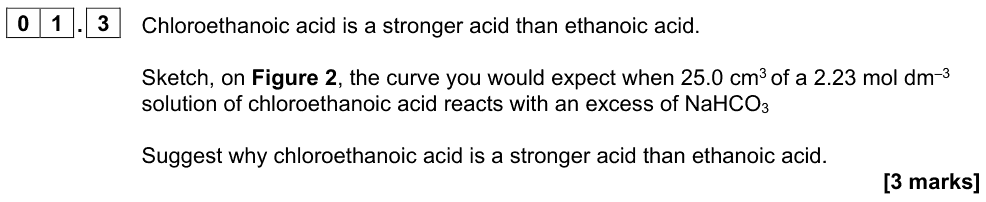
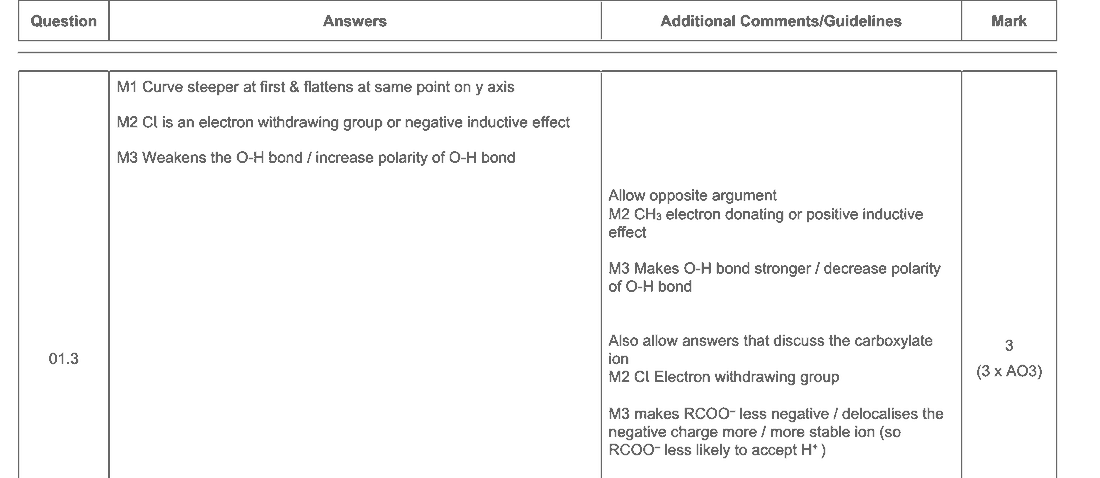
Chloroethanoic acid is a stronger acid than ethanoic acid.
Sketch, on Figure 2, the curve you would expect when 25.0 cm3 of a 2.23 mol dm–3
solution of chloroethanoic acid reacts with an excess of NaHCO3
Suggest why chloroethanoic acid is a stronger acid than ethanoic acid.
[3 marks]
June 2023 · Paper 2 · Q05.4 5 marks AO2=5 Explanation nmr spectroscopy
Earlier parts of question 05 that this part usesEarlier part of June 2023 Paper 2 question 05Earlier part of June 2023 Paper 2 question 05
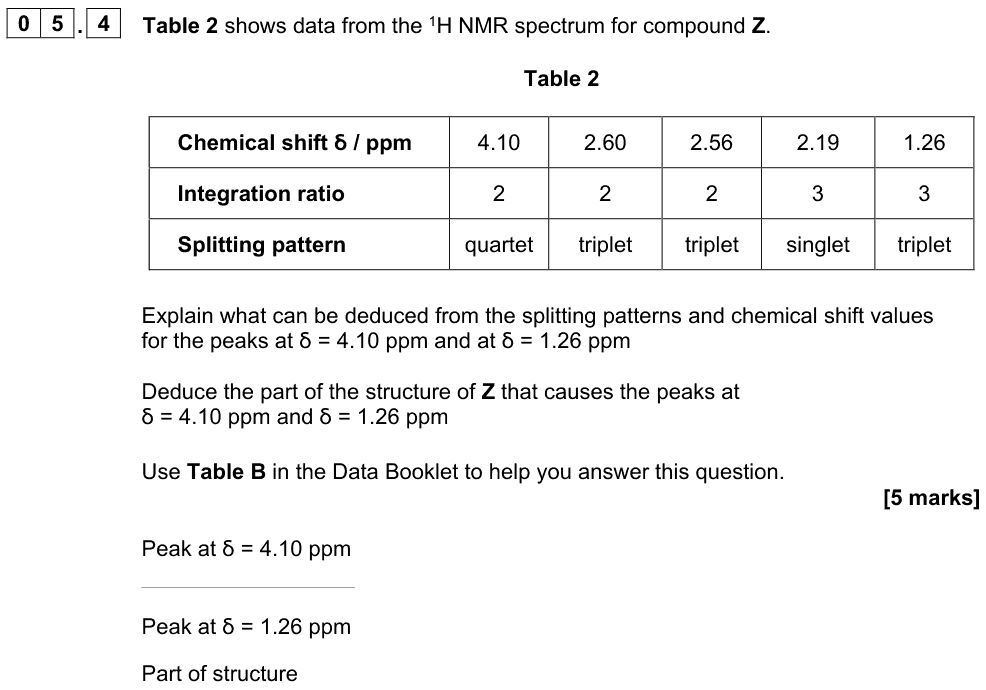
Table 2 shows data from the 1H NMR spectrum for compound Z.
Table 2
Chemical shift ẟ / ppm
4.10
2.60
2.56
2.19
1.26
Integration ratio
2
2
2
3
3
Splitting pattern
quartet
triplet
triplet
singlet
triplet
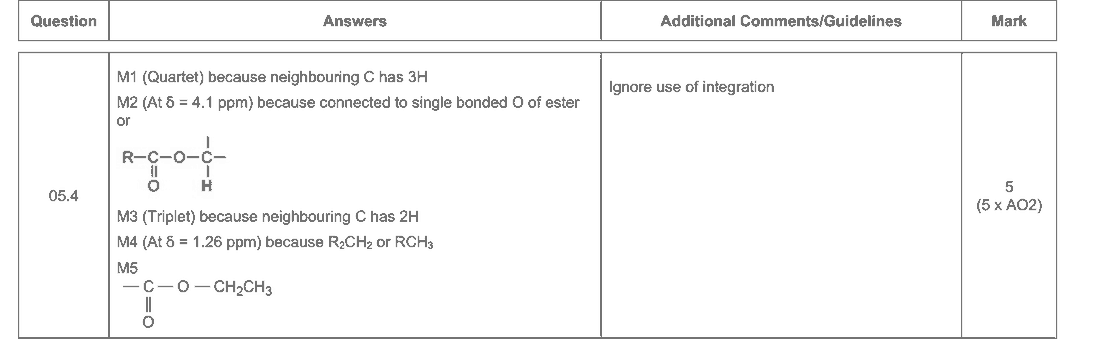
Explain what can be deduced from the splitting patterns and chemical shift values
for the peaks at ẟ = 4.10 ppm and at ẟ = 1.26 ppm
Deduce the part of the structure of Z that causes the peaks at
ẟ = 4.10 ppm and ẟ = 1.26 ppm
Use Table B in the Data Booklet to help you answer this question.
[5 marks]
Peak at ẟ = 4.10 ppm
Peak at ẟ = 1.26 ppm
Part of structure
June 2023 · Paper 3 · Q05.2 4 marks Explanation bonding
Earlier part of question 05 that this part usesEarlier part of June 2023 Paper 3 question 05
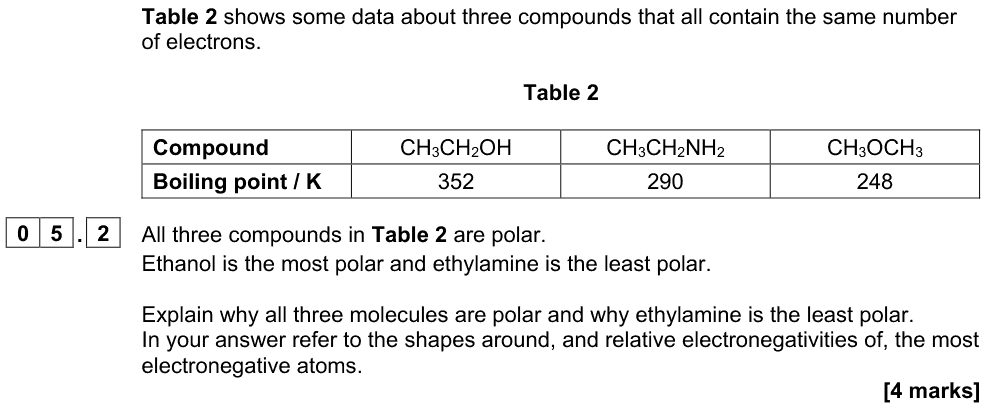
Table 2 shows some data about three compounds that all contain the same number
of electrons.
Table 2
Compound
CH3CH2OH
CH3CH2NH2
CH3OCH3
Boiling point / K
352
290
248
All three compounds in Table 2 are polar.
Ethanol is the most polar and ethylamine is the least polar.
Explain why all three molecules are polar and why ethylamine is the least polar.
In your answer refer to the shapes around, and relative electronegativities of, the most
electronegative atoms.
[4 marks]
June 2023 · Paper 3 · Q05.3 3 marks Explanation bonding
Earlier parts of question 05 that this part usesEarlier part of June 2023 Paper 3 question 05Earlier part of June 2023 Paper 3 question 05
Explain the trend in the boiling points of the three compounds.
Refer to the intermolecular forces in all three compounds in your answer.
[3 marks]
June 2022 · AS Paper 1 · Q01.1 2 marks AO1=2 Explanation group 2
This question is about ionisation energies of Group 2 elements.
Explain why the first ionisation energy of the Group 2 elements decreases down the
group.
[2 marks]
June 2022 · AS Paper 1 · Q01.3 2 marks AO2=2 Explanation atomic structure
Earlier part of question 01 that this part usesEarlier part of June 2022 Paper 1 question 01
Explain why the third ionisation energy of magnesium is much higher than the
second ionisation energy of magnesium.
[2 marks]
June 2022 · AS Paper 1 · Q04.4 2 marks AO2=2 Explanation bonding
Earlier part of question 04 that this part usesEarlier part of June 2022 Paper 1 question 04
The C–Br bond is polar.
Explain why CBr4 is not a polar molecule.
[2 marks]
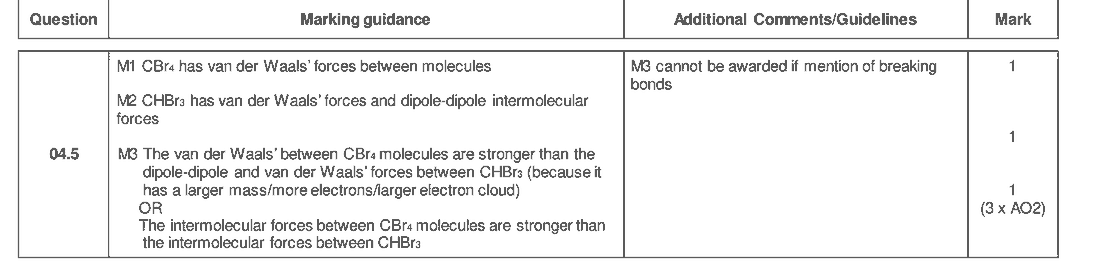
June 2022 · AS Paper 1 · Q04.5 3 marks AO2=3 Explanation bonding
Earlier part of question 04 that this part usesEarlier part of June 2022 Paper 1 question 04
Suggest, in terms of the intermolecular forces for each compound, why CBr4 has a
higher boiling point than CHBr3
[3 marks]
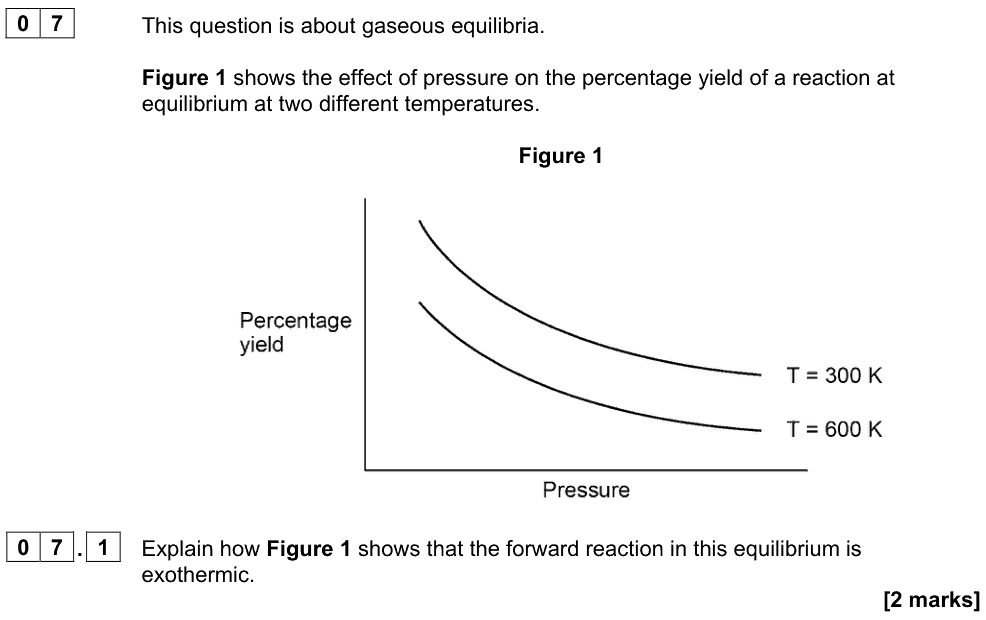
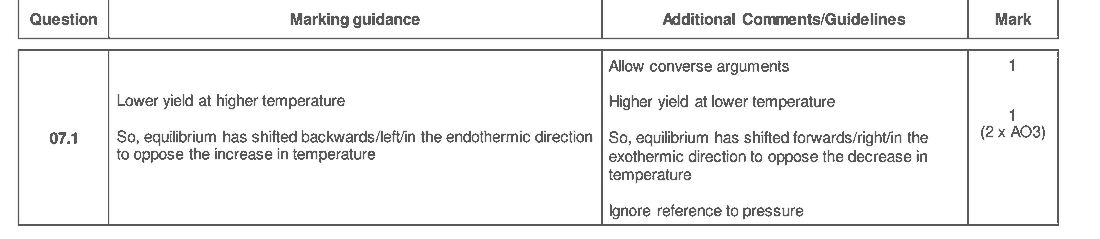
June 2022 · AS Paper 1 · Q07.1 2 marks AO3=2 Explanation chemical equilibria and kc
This question is about gaseous equilibria.
Figure 1 shows the effect of pressure on the percentage yield of a reaction at
equilibrium at two different temperatures.
Figure 1
Explain how Figure 1 shows that the forward reaction in this equilibrium is
exothermic.
[2 marks]
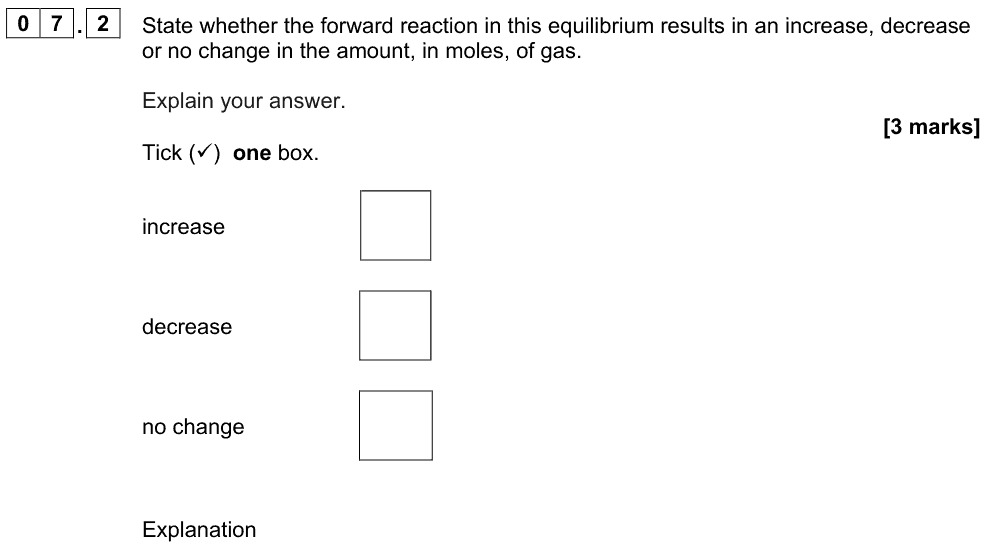
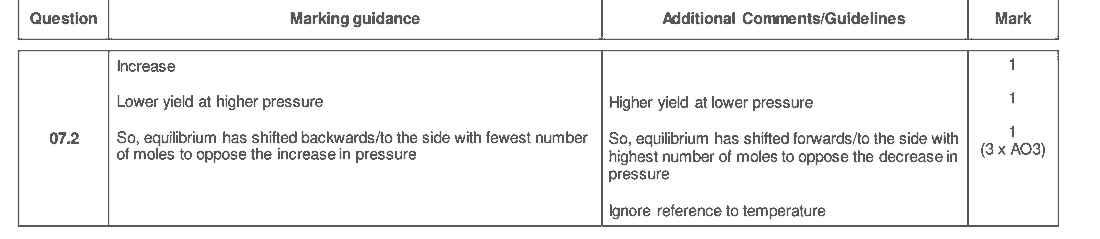
June 2022 · AS Paper 1 · Q07.2 3 marks AO3=3 Explanation chemical equilibria and kc
Earlier part of question 07 that this part usesEarlier part of June 2022 Paper 1 question 07
State whether the forward reaction in this equilibrium results in an increase, decrease
or no change in the amount, in moles, of gas.
Explain your answer.
[3 marks]
Tick ()  one box.
increase
decrease
no change
Explanation
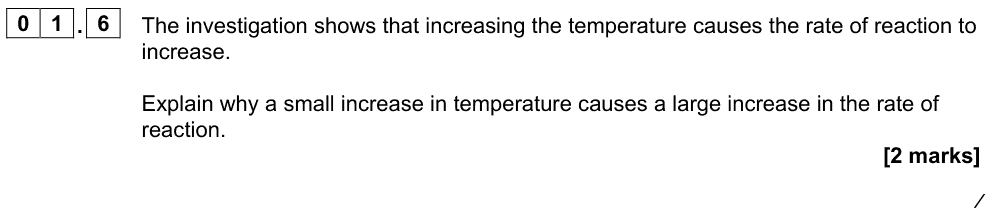
June 2022 · AS Paper 2 · Q01.6 2 marks AO1=2 Explanation kinetics
Earlier part of question 01 that this part usesEarlier part of June 2022 Paper 2 question 01
The investigation shows that increasing the temperature causes the rate of reaction to
increase.
Explain why a small increase in temperature causes a large increase in the rate of
reaction.
[2 marks]
June 2022 · AS Paper 2 · Q07.1 4 marks AO1=3, AO3=1 Explanation alcohols
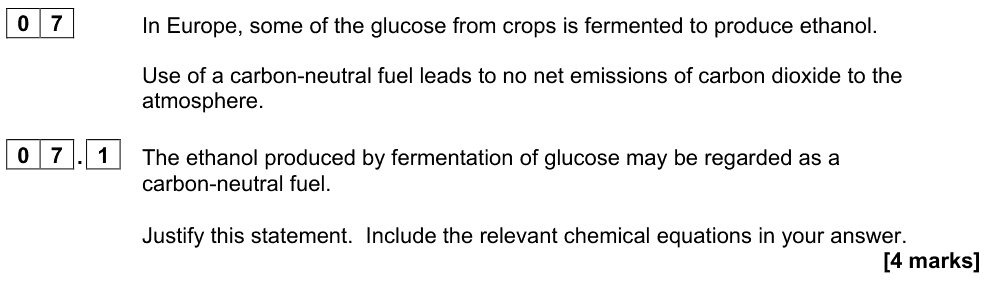
In Europe, some of the glucose from crops is fermented to produce ethanol.
Use of a carbon-neutral fuel leads to no net emissions of carbon dioxide to the
atmosphere.
The ethanol produced by fermentation of glucose may be regarded as a
carbon-neutral fuel.
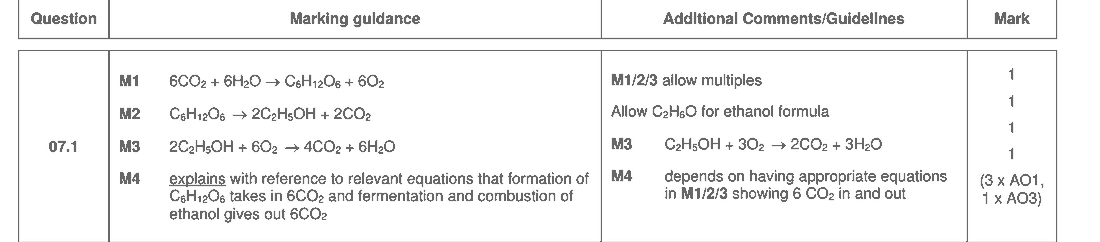
Justify this statement.  Include the relevant chemical equations in your answer.
[4 marks]
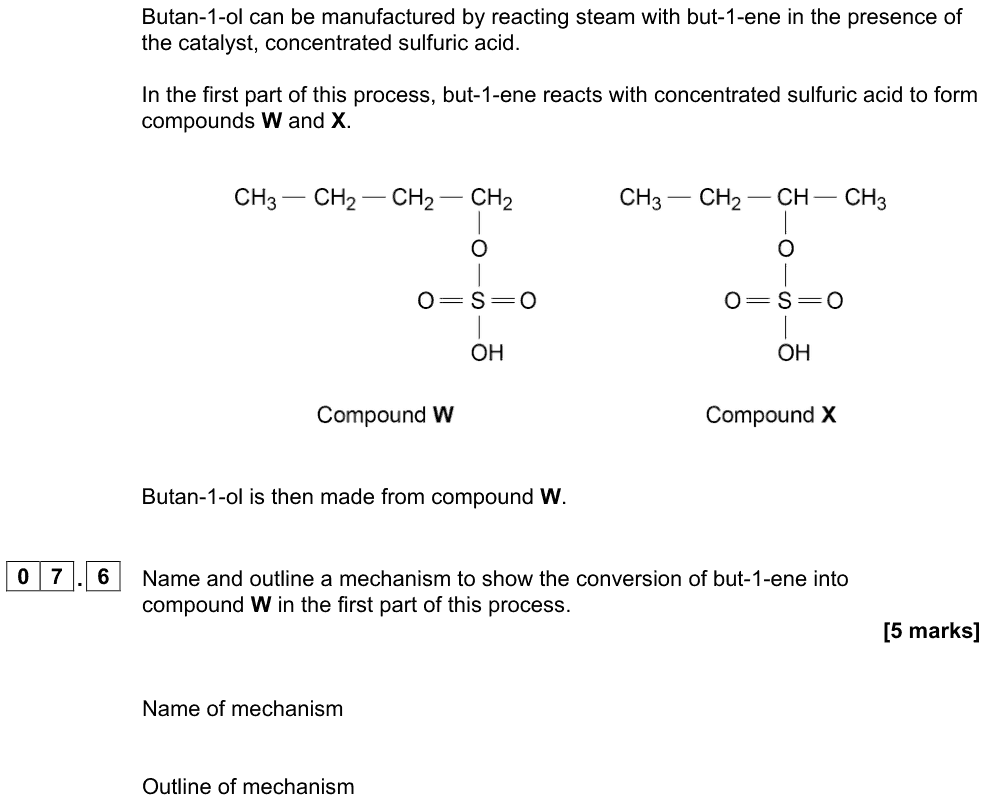
June 2022 · AS Paper 2 · Q07.7 2 marks AO1=1, AO3=1 Explanation alkenes
Earlier parts of question 07 that this part usesEarlier part of June 2022 Paper 2 question 07Earlier part of June 2022 Paper 2 question 07
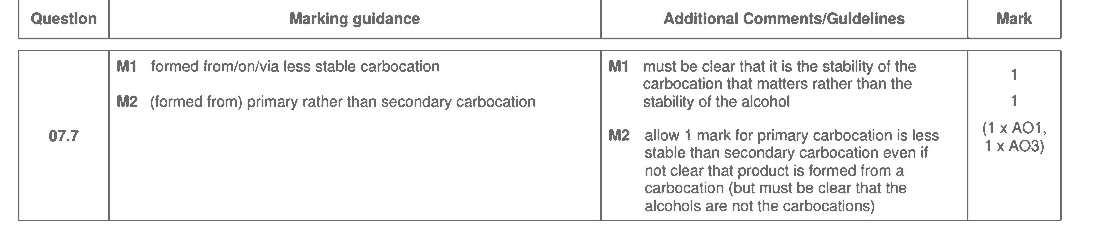
There is a very low yield of butan-1-ol from but-1-ene in this manufacturing process.
Explain why.
[2 marks]
June 2022 · Paper 1 · Q07.1 2 marks AO2=2 Explanation transition metals
Copper(II) complexes are coloured.
The colour is caused by the d electrons of copper moving from their ground state to
an excited state.
Explain why aqueous solutions containing [CuCl4] 2– ions are yellow.
[2 marks]
June 2022 · Paper 2 · Q01.5 3 marks AO1=2, AO2=1 Explanation rate equationskinetics
Earlier part of question 01 that this part usesEarlier part of June 2022 Paper 2 question 01
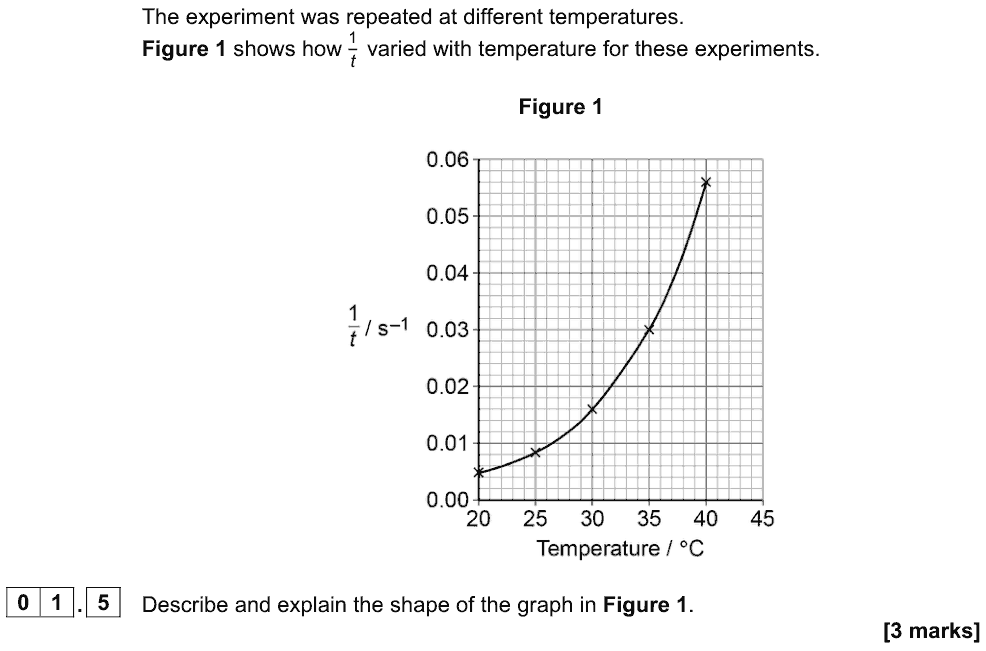
The experiment was repeated at different temperatures.
Figure 1 shows how
1
t  varied with temperature for these experiments.
Figure 1
Describe and explain the shape of the graph in Figure 1.
[3 marks]
June 2022 · Paper 2 · Q02.4 3 marks AO2=3 Explanation chemical equilibria and kc
Earlier part of question 02 that this part usesEarlier part of June 2022 Paper 2 question 02
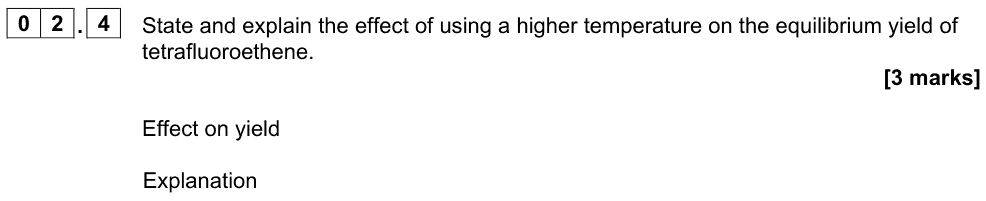
State and explain the effect of using a higher temperature on the equilibrium yield of
tetrafluoroethene.
[3 marks]
Effect on yield
Explanation
June 2022 · Paper 2 · Q03.2 3 marks AO2=3 Explanation alkenes
Earlier part of question 03 that this part usesEarlier part of June 2022 Paper 2 question 03
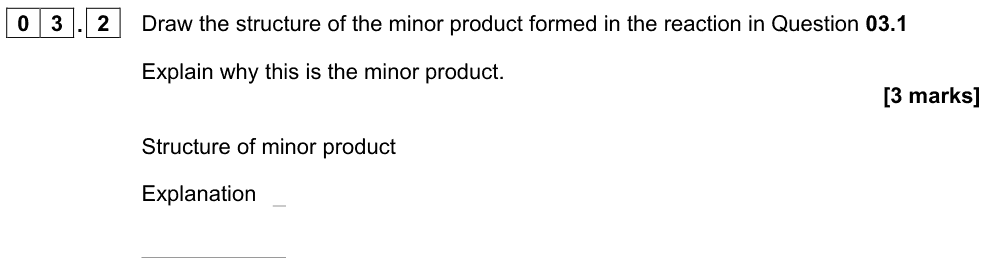
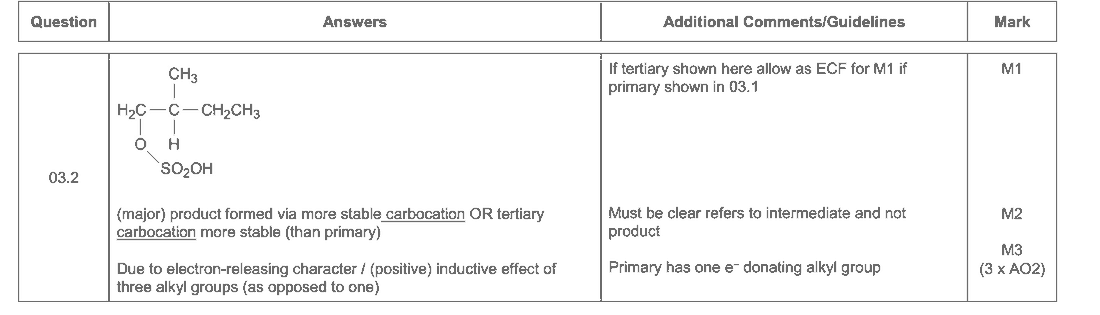
Draw the structure of the minor product formed in the reaction in Question 03.1
Explain why this is the minor product.
[3 marks]
Structure of minor product
Explanation
June 2022 · Paper 2 · Q04.4 4 marks AO1=2, AO3=2 Explanation amino acids proteins and dna
Earlier part of question 04 that this part usesEarlier part of June 2022 Paper 2 question 04
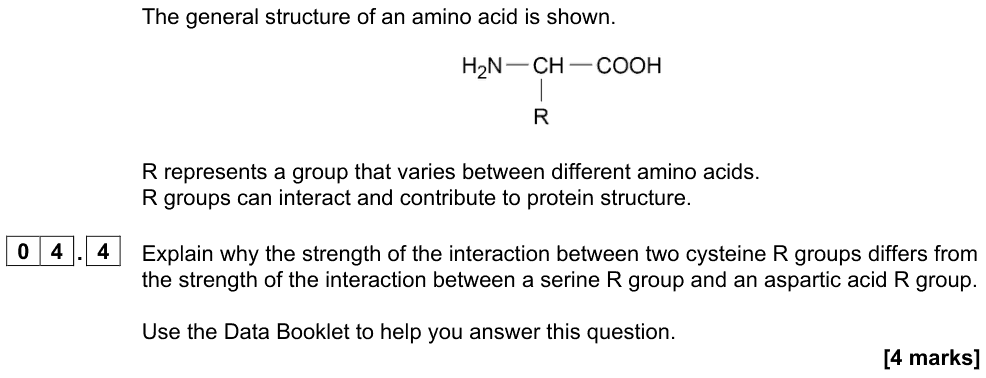
The general structure of an amino acid is shown.
R represents a group that varies between different amino acids.
R groups can interact and contribute to protein structure.
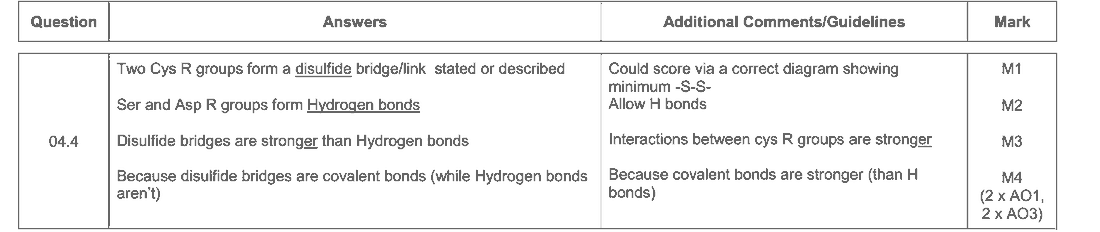
Explain why the strength of the interaction between two cysteine R groups differs from
the strength of the interaction between a serine R group and an aspartic acid R group.
Use the Data Booklet to help you answer this question.
[4 marks]
June 2022 · Paper 2 · Q10.4 2 marks AO3=2 Explanation amines
Earlier part of question 10 that this part usesEarlier part of June 2022 Paper 2 question 10
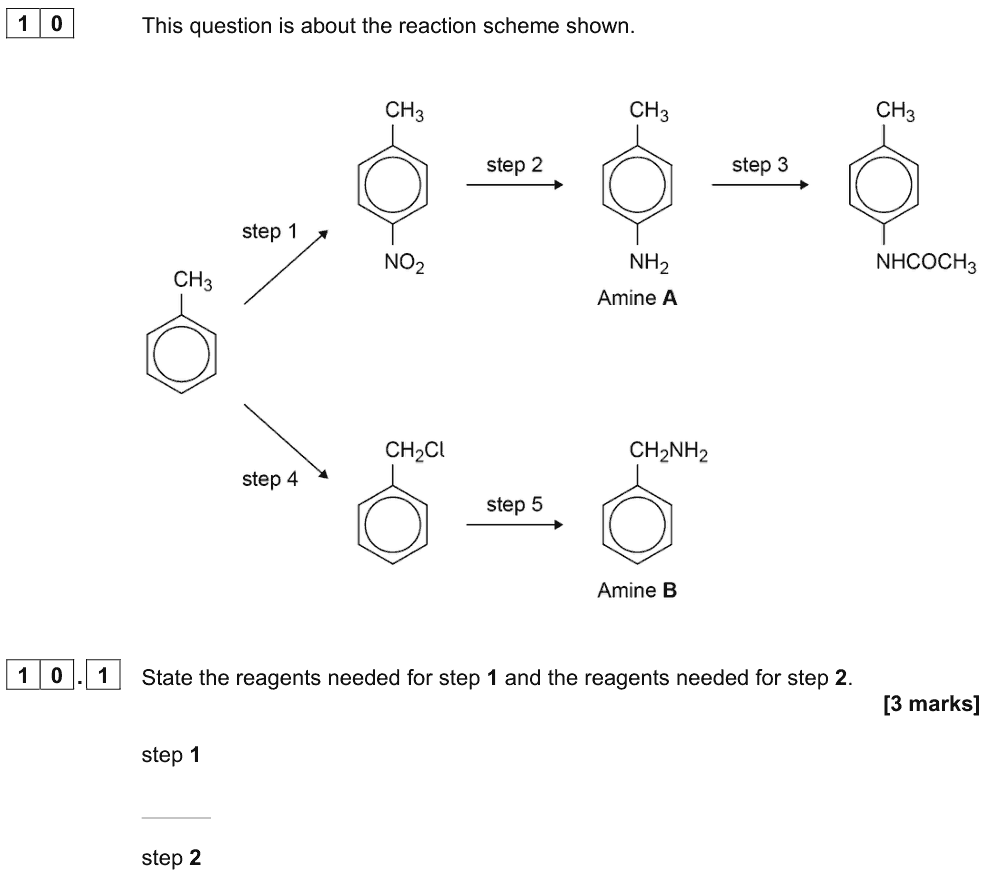
Amine A is formed in step 2 and amine B is formed in step 5.
Explain why the yield of B in step 5 is less than the yield of A in step 2.
[2 marks]
June 2022 · Paper 2 · Q10.5 2 marks AO2=2 Explanation amines
Earlier part of question 10 that this part usesEarlier part of June 2022 Paper 2 question 10
Explain why amine B is a stronger base than amine A.
[2 marks]
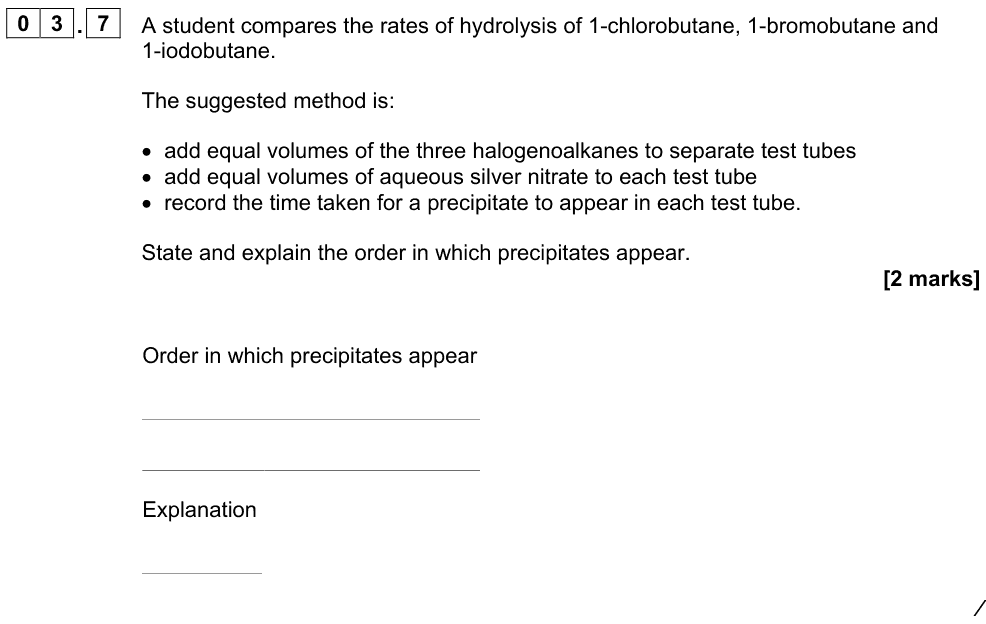
June 2022 · Paper 3 · Q03.7 2 marks AO3=2 Explanation halogenoalkanes
Earlier part of question 03 that this part usesEarlier part of June 2022 Paper 3 question 03
A student compares the rates of hydrolysis of 1-chlorobutane, 1-bromobutane and
1-iodobutane.
The suggested method is:
• add equal volumes of the three halogenoalkanes to separate test tubes
• add equal volumes of aqueous silver nitrate to each test tube
• record the time taken for a precipitate to appear in each test tube.
State and explain the order in which precipitates appear.
[2 marks]
Order in which precipitates appear
Explanation
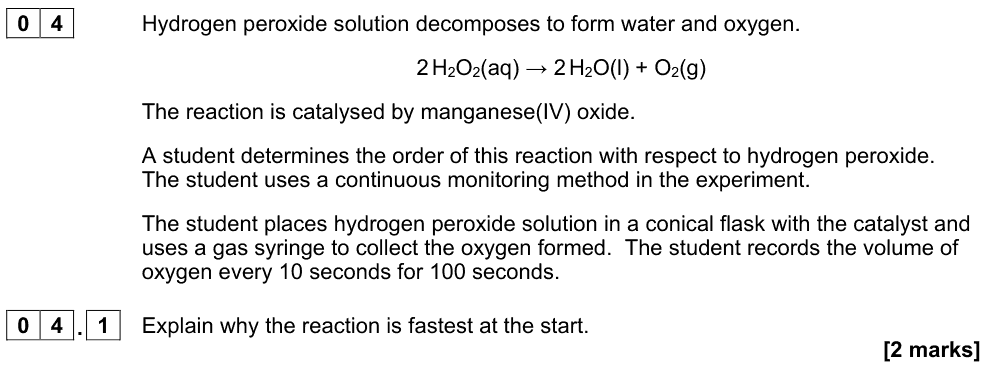
June 2022 · Paper 3 · Q04.1 2 marks AO1=2 Explanation kinetics
Hydrogen peroxide solution decomposes to form water and oxygen.
2 H2O2(aq) → 2 H2O(l) + O2(g)
The reaction is catalysed by manganese(IV) oxide.
A student determines the order of this reaction with respect to hydrogen peroxide.
The student uses a continuous monitoring method in the experiment.

The student places hydrogen peroxide solution in a conical flask with the catalyst and
uses a gas syringe to collect the oxygen formed.  The student records the volume of
oxygen every 10 seconds for 100 seconds.
Explain why the reaction is fastest at the start.
[2 marks]
June 2022 · Paper 3 · Q05.2 6 marks AO1=6 Explanation transition metals
Earlier part of question 05 that this part usesEarlier part of June 2022 Paper 3 question 05
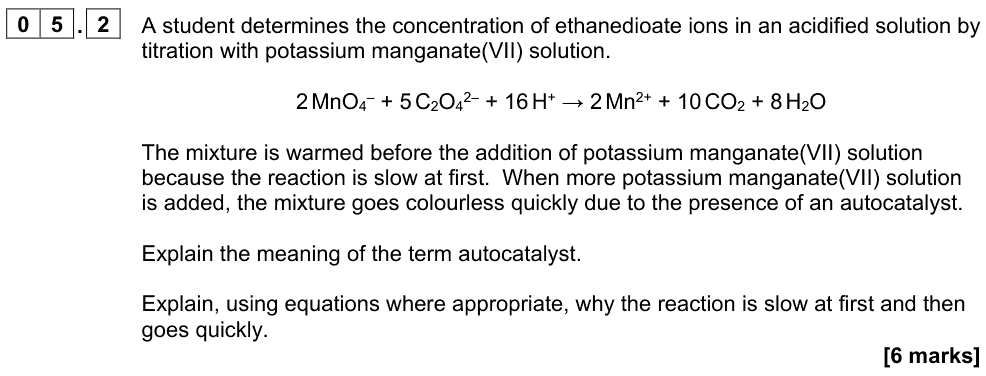
A student determines the concentration of ethanedioate ions in an acidified solution by
titration with potassium manganate(VII) solution.
2 MnO4– + 5 C2O42– + 16 H+ → 2 Mn2+ + 10 CO2 + 8 H2O
The mixture is warmed before the addition of potassium manganate(VII) solution
because the reaction is slow at first.  When more potassium manganate(VII) solution
is added, the mixture goes colourless quickly due to the presence of an autocatalyst.
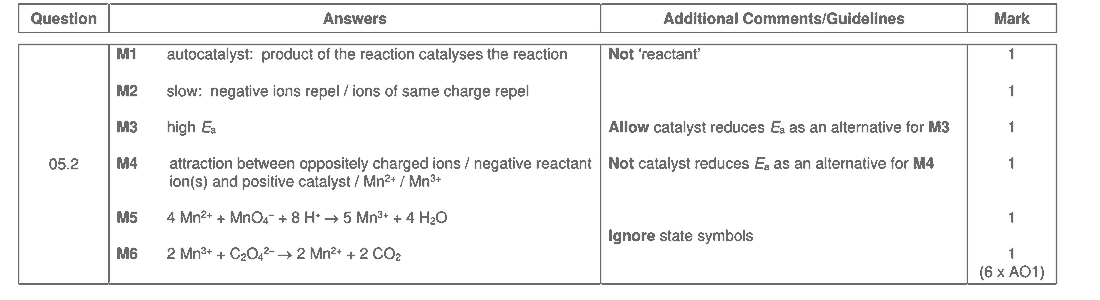
Explain the meaning of the term autocatalyst.
Explain, using equations where appropriate, why the reaction is slow at first and then
goes quickly.
[6 marks]
June 2022 · Paper 3 · Q05.3 3 marks AO3=3 Explanation transition metalselectrode potentials and cells
Earlier part of question 05 that this part usesEarlier part of June 2022 Paper 3 question 05
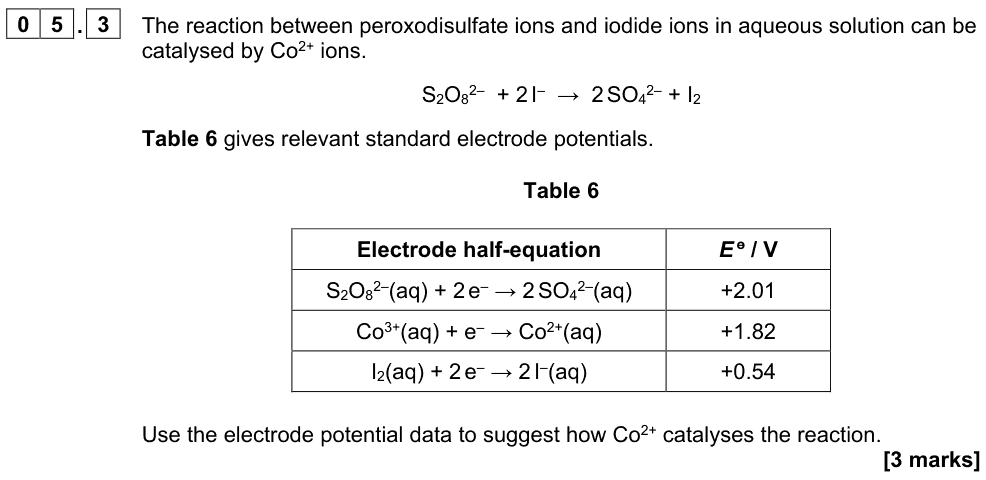
The reaction between peroxodisulfate ions and iodide ions in aqueous solution can be
catalysed by Co2+ ions.
S2O82–  + 2 I–  →  2 SO42– + I2
Table 6 gives relevant standard electrode potentials.
Table 6
Electrode half-equation
E ɵ / V
S2O82–(aq) + 2 e– → 2 SO42–(aq)
+2.01
Co3+(aq) + e– → Co2+(aq)
+1.82
I2(aq) + 2 e– → 2 I–(aq)
+0.54
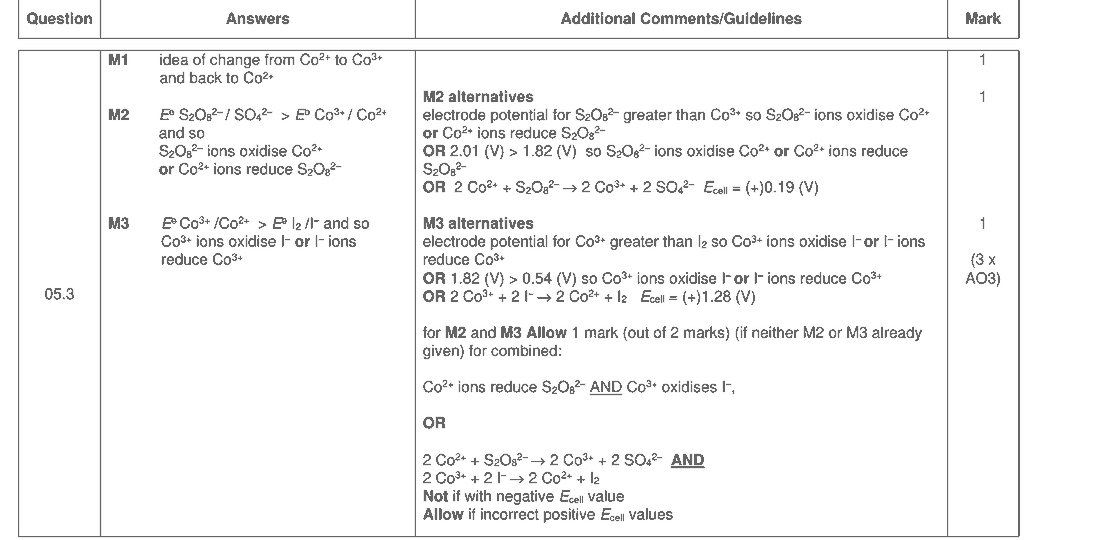
Use the electrode potential data to suggest how Co2+ catalyses the reaction.
[3 marks]
November 2021 · AS Paper 1 · Q02.3 3 marks Explanation bonding
Earlier part of question 02 that this part usesEarlier part of November 2021 Paper 1 question 02
Explain, in terms of structure and bonding, why magnesium chloride has a
high melting point.
[3 marks]
November 2021 · AS Paper 1 · Q05.1 3 marks Explanation bonding
This question is about chlorine.
Chlorine has a low boiling point because the forces between the molecules are weak.
Explain how these forces arise between molecules of chlorine.
[3 marks]
November 2021 · AS Paper 2 · Q02.2 3 marks Explanation alkenes
Earlier part of question 02 that this part usesEarlier part of November 2021 Paper 2 question 02
Explain why there is an attraction between a C=C double bond and Br2
[3 marks]
November 2021 · AS Paper 2 · Q03.4 3 marks Explanation bonding
Earlier parts of question 03 that this part usesEarlier part of November 2021 Paper 2 question 03Earlier part of November 2021 Paper 2 question 03
Explain why propanone has a lower boiling point than propan-2-ol.
[3 marks]
November 2021 · AS Paper 2 · Q04.6 2 marks Explanation organic analysis
Earlier part of question 04 that this part usesEarlier part of November 2021 Paper 2 question 04
CFC-11 is a greenhouse gas that can contribute to global warming.
State and explain how CFC-11 is able to contribute to global warming.
[2 marks]
November 2021 · Paper 1 · Q01.6 2 marks Explanation thermodynamics
Earlier part of question 01 that this part usesEarlier part of November 2021 Paper 1 question 01
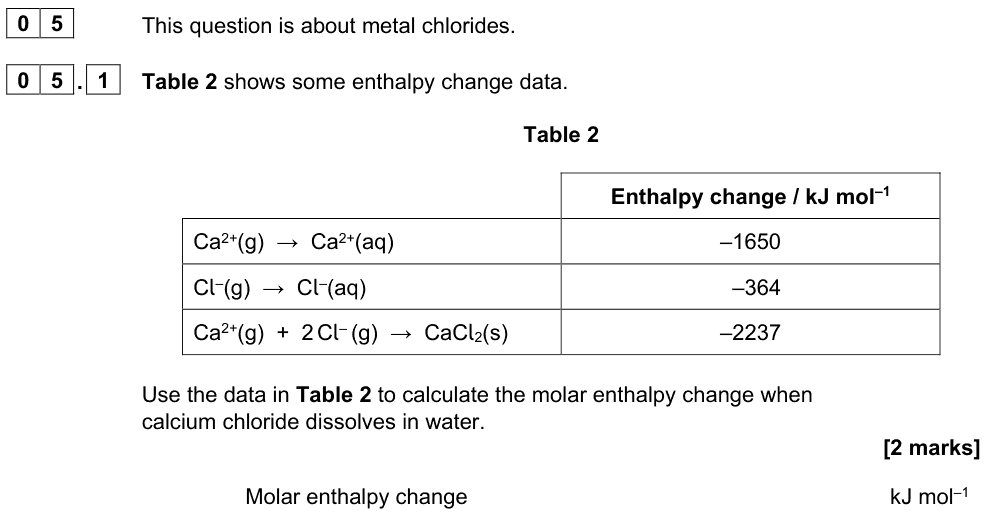
The enthalpy of hydration of Ca2+(g) is  –1650 kJ mol–1
Suggest why this value is less exothermic than that of Mg2+(g)
[2 marks]
November 2021 · Paper 1 · Q03.3 4 marks Explanation period 3 elements and oxides

Earlier part of question 03 that this part usesEarlier part of November 2021 Paper 1 question 03
Explain, in terms of crystal structure and bonding, why silicon(IV) oxide has a higher
melting point than phosphorus(V) oxide.
[4 marks]
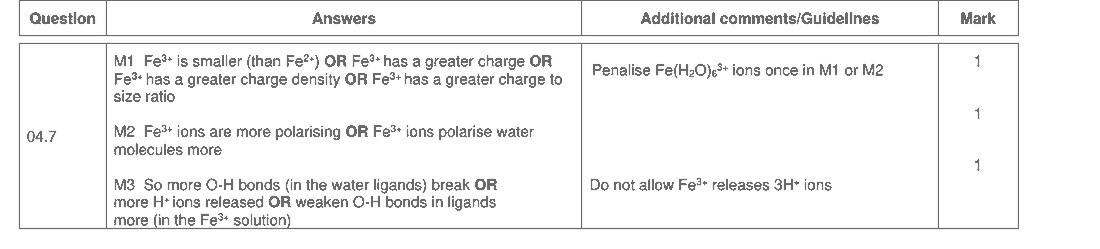
November 2021 · Paper 1 · Q04.7 3 marks Explanation reactions of ions in aqueous solution
Earlier part of question 04 that this part usesEarlier part of November 2021 Paper 1 question 04
Explain why an aqueous solution containing [Fe(H2O)6]3+ ions has a lower pH than
an aqueous solution containing [Fe(H2O)6]2+ ions.
[3 marks]
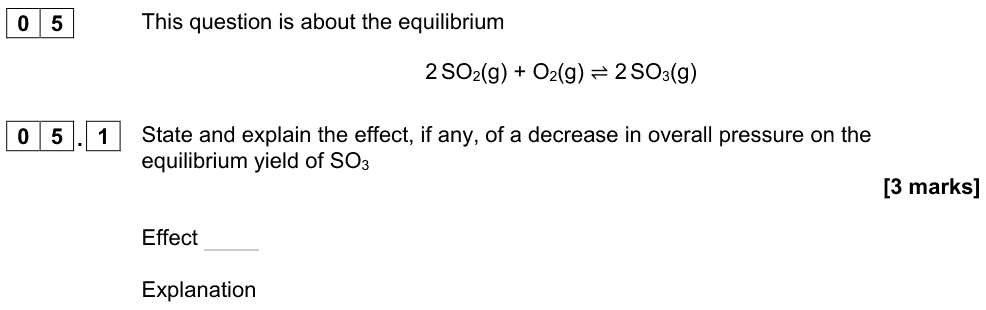
November 2021 · Paper 1 · Q05.1 3 marks Explanation chemical equilibria and kc
This question is about the equilibrium
2 SO2(g) + O2(g) ⇌ 2 SO3(g)
State and explain the effect, if any, of a decrease in overall pressure on the
equilibrium yield of SO3
[3 marks]
Effect
Explanation
November 2021 · Paper 1 · Q06.2 2 marks Explanation acids and baseschemical equilibria and kc
Earlier part of question 06 that this part usesEarlier part of November 2021 Paper 1 question 06
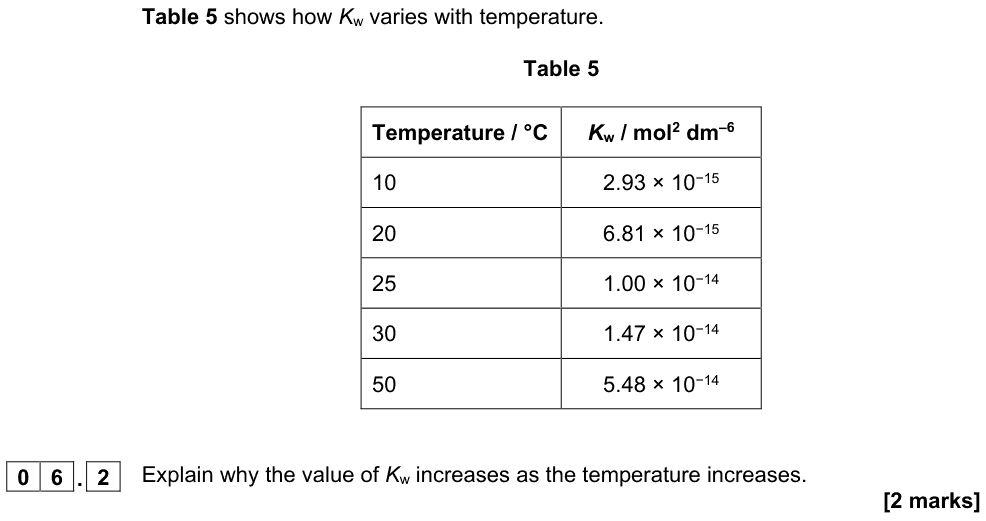
Table 5 shows how Kw varies with temperature.
Table 5
Temperature / °C
Kw / mol2 dm–6
10
2.93 × 10⁻¹⁵
20
6.81 × 10⁻¹⁵
25
1.00 × 10⁻¹⁴
30
1.47 × 10⁻¹⁴
50
5.48 × 10⁻¹⁴
Explain why the value of Kw increases as the temperature increases.
[2 marks]
November 2021 · Paper 1 · Q08.5 2 marks Explanation electrode potentials and cells
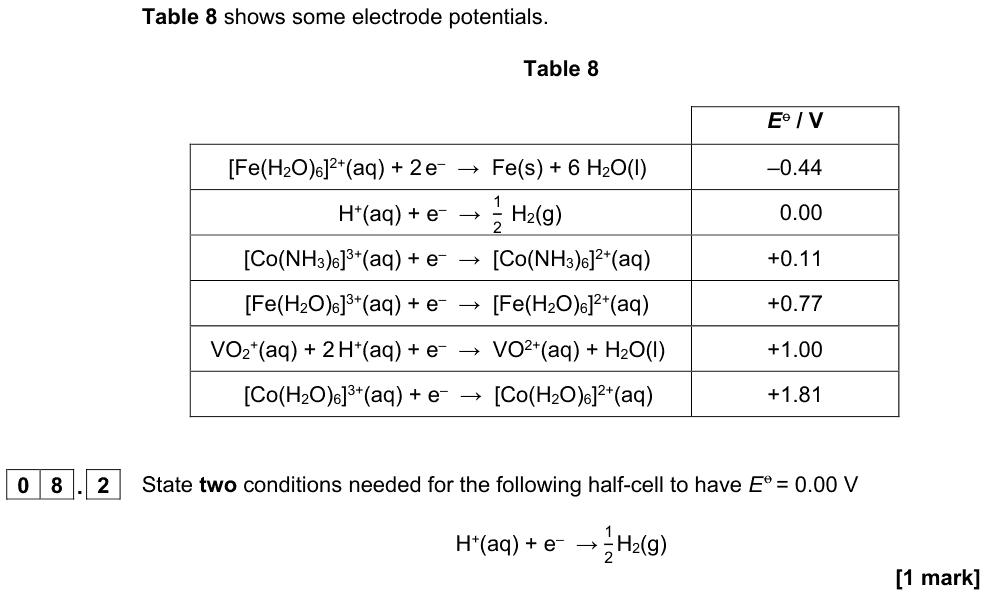
Earlier parts of question 08 that this part usesEarlier part of November 2021 Paper 1 question 08Earlier part of November 2021 Paper 1 question 08
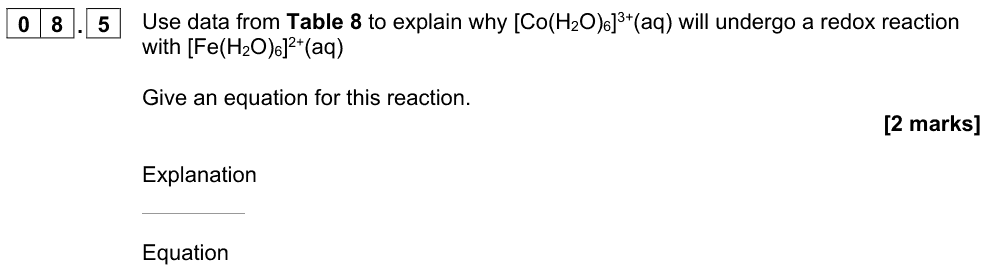
Use data from Table 8 to explain why [Co(H2O)6]3+(aq) will undergo a redox reaction
with [Fe(H2O)6]2+(aq)
Give an equation for this reaction.
[2 marks]
Explanation
Equation
November 2021 · Paper 1 · Q09.1 2 marks Explanation electrode potentials and cells
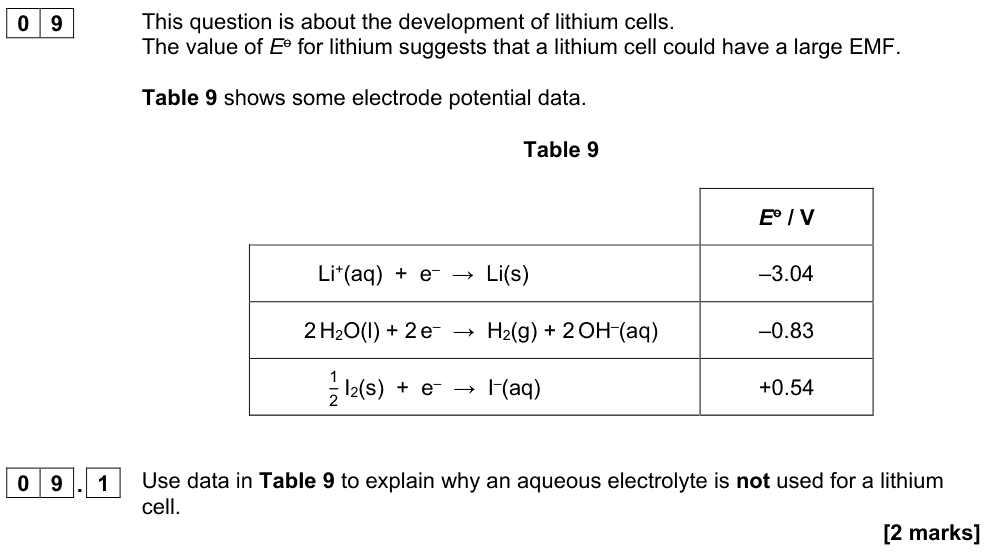
This question is about the development of lithium cells.
The value of Eo for lithium suggests that a lithium cell could have a large EMF.
Table 9 shows some electrode potential data.
Table 9
Eo / V
Li+(aq)  +  e–  →  Li(s)
–3.04
2 H2O(l) + 2 e–  →  H2(g) + 2 OH–(aq)
–0.83
1
2 I2(s)  +  e–  →  I–(aq)
+0.54
Use data in Table 9 to explain why an aqueous electrolyte is not used for a lithium
cell.
[2 marks]
November 2021 · Paper 2 · Q07.3 5 marks Explanation Hard nmr spectroscopy
Earlier part of question 07 that this part usesEarlier part of November 2021 Paper 2 question 07
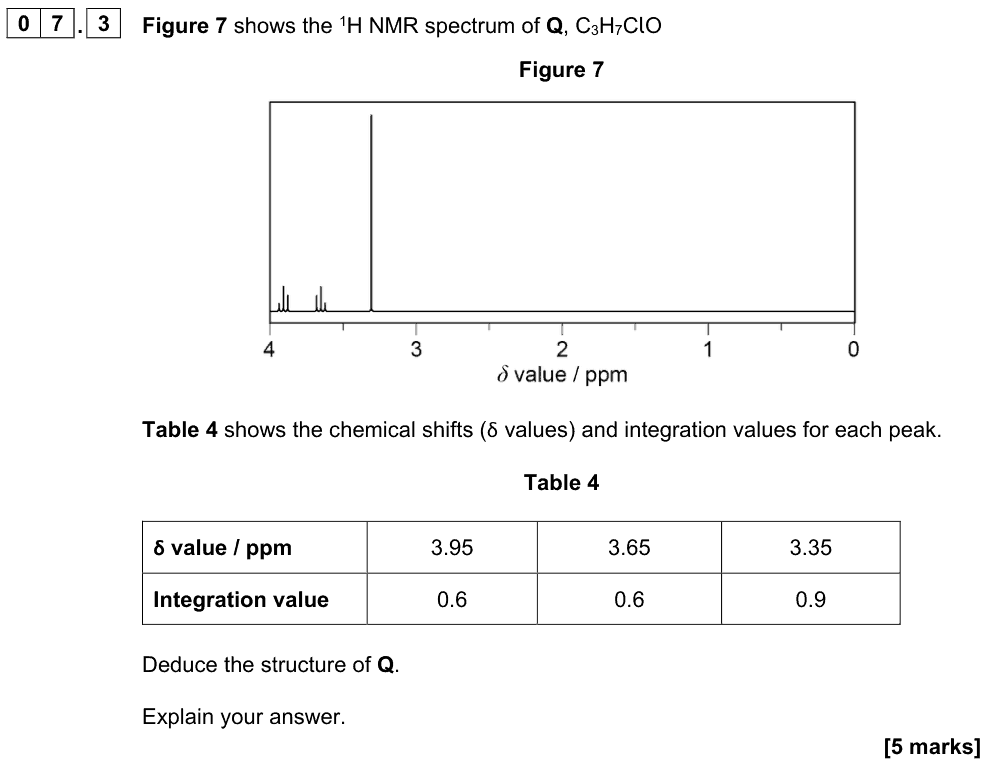
Figure 7 shows the 1H NMR spectrum of Q, C3H7ClO
Figure 7
Table 4 shows the chemical shifts (δ values) and integration values for each peak.
Table 4
δ value / ppm
3.95
3.65
3.35
Integration value
0.6
0.6
0.9
Deduce the structure of Q.
Explain your answer.
[5 marks]
November 2021 · Paper 2 · Q10.4 2 marks Explanation rate equations
Earlier parts of question 10 that this part usesEarlier part of November 2021 Paper 2 question 10Earlier part of November 2021 Paper 2 question 10
Explain how the graph shows that the reaction is zero-order with respect to iodine in
the reaction between propanone and iodine.
[2 marks]
November 2021 · Paper 3 · Q01.2 2 marks Explanation polymers
Earlier part of question 01 that this part usesEarlier part of November 2021 Paper 3 question 01
Explain why polyesters are biodegradable but polyalkenes are not biodegradable.
[2 marks]
November 2021 · Paper 3 · Q04.2 5 marks Explanation group 7 the halogens
Earlier part of question 04 that this part usesEarlier part of November 2021 Paper 3 question 04
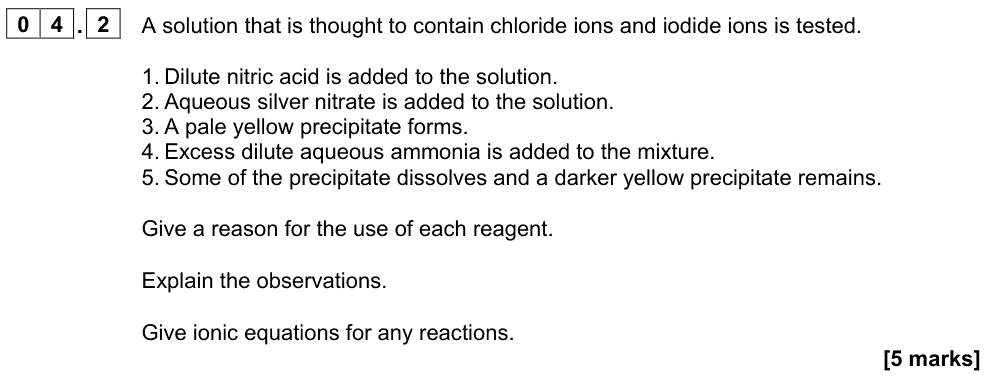
A solution that is thought to contain chloride ions and iodide ions is tested.
1. Dilute nitric acid is added to the solution.
2. Aqueous silver nitrate is added to the solution.
3. A pale yellow precipitate forms.
4. Excess dilute aqueous ammonia is added to the mixture.
5. Some of the precipitate dissolves and a darker yellow precipitate remains.
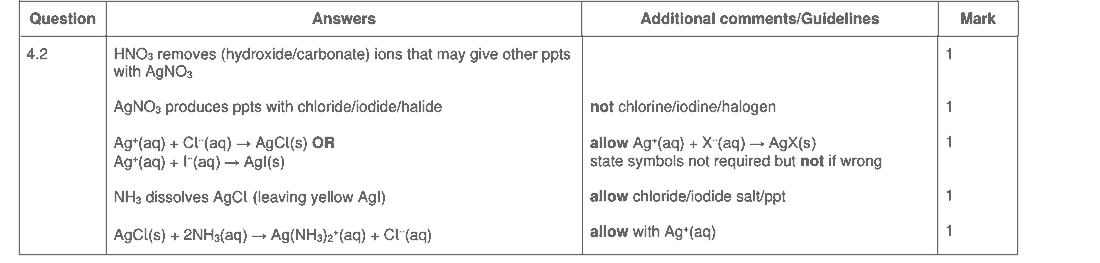
Give a reason for the use of each reagent.
Explain the observations.
Give ionic equations for any reactions.
[5 marks]
November 2020 · AS Paper 1 · Q01.1 3 marks Explanation periodicityatomic structure
This question is about atomic structure.
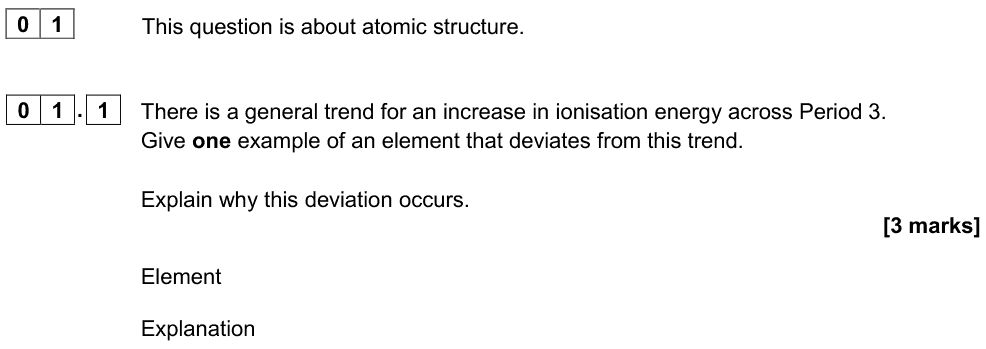
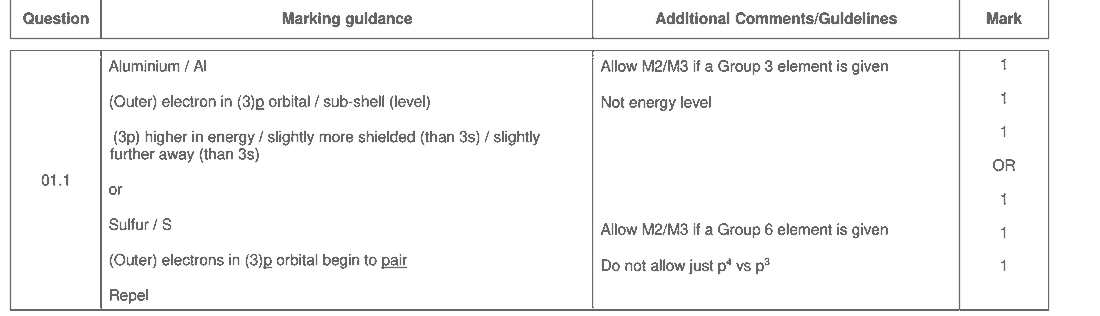
There is a general trend for an increase in ionisation energy across Period 3.
Give one example of an element that deviates from this trend.
Explain why this deviation occurs.
[3 marks]
Element
Explanation
November 2020 · AS Paper 1 · Q01.3 3 marks Explanation atomic structure
Earlier part of question 01 that this part usesEarlier part of November 2020 Paper 1 question 01
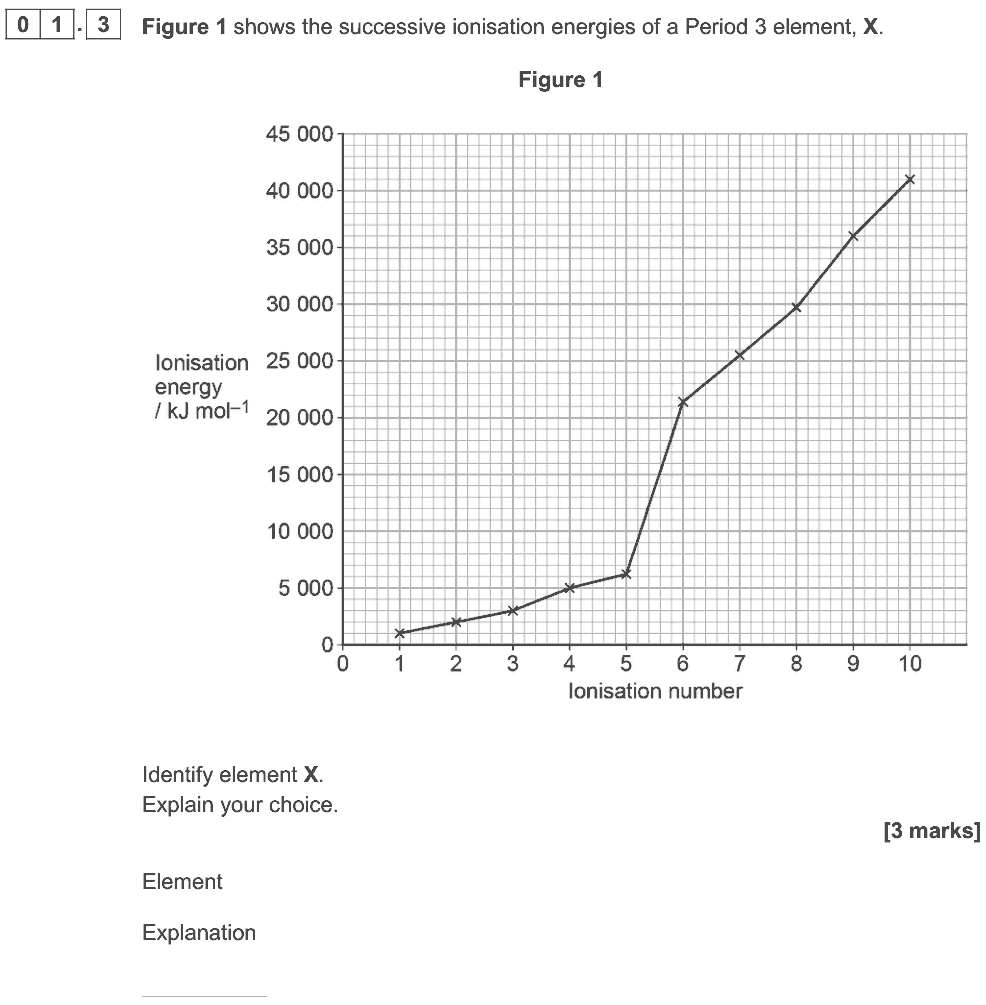
Figure 1 shows the successive ionisation energies of a Period 3 element, X.

Figure 1
Identify element X.
Explain your choice.
[3 marks]
Element
Explanation
November 2020 · AS Paper 1 · Q05.1 2 marks Explanation periodicitybonding
This question is about Group 2 elements and their compounds.
Explain why the melting point of magnesium is higher than the melting point of
sodium.
[2 marks]
November 2020 · AS Paper 2 · Q04.1 3 marks Explanation bonding
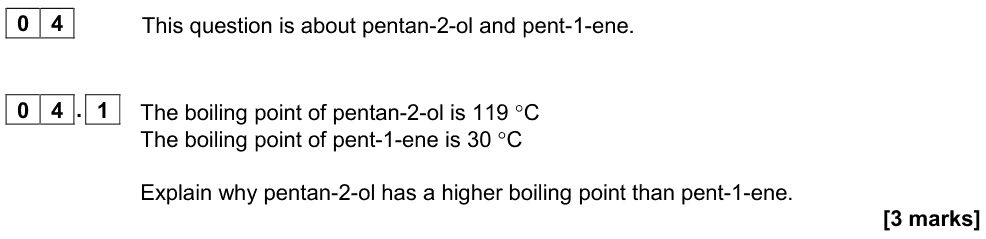
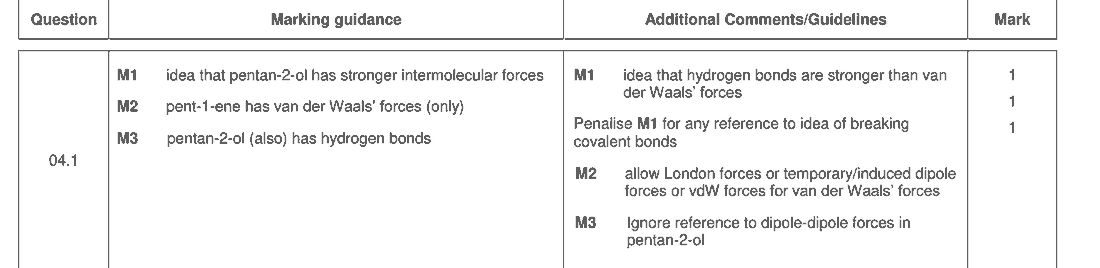
This question is about pentan-2-ol and pent-1-ene.
The boiling point of pentan-2-ol is 119 °C
The boiling point of pent-1-ene is 30 °C
Explain why pentan-2-ol has a higher boiling point than pent-1-ene.
[3 marks]
November 2020 · AS Paper 2 · Q06.2 2 marks Explanation alkenes
Earlier part of question 06 that this part usesEarlier part of November 2020 Paper 2 question 06
State what you would observe if bromine water was added to poly(chloroethene).
Explain this observation.
[2 marks]
Observation
Explanation
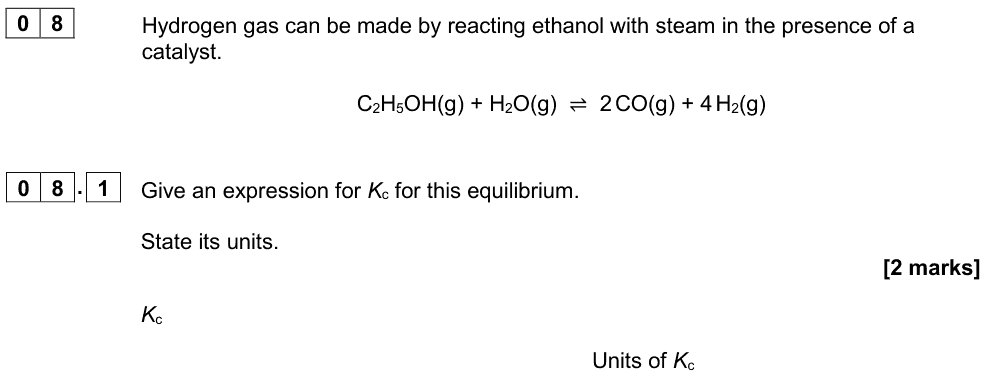
November 2020 · AS Paper 2 · Q08.3 4 marks Explanation chemical equilibria and kc
Earlier part of question 08 that this part usesEarlier part of November 2020 Paper 2 question 08
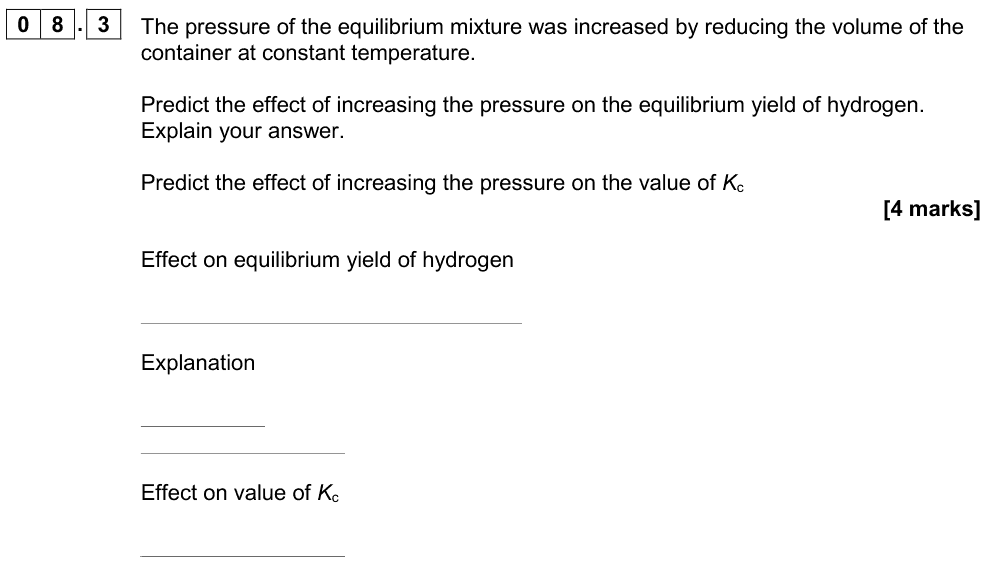
The pressure of the equilibrium mixture was increased by reducing the volume of the
container at constant temperature.
Predict the effect of increasing the pressure on the equilibrium yield of hydrogen.
Explain your answer.
Predict the effect of increasing the pressure on the value of Kc
[4 marks]
Effect on equilibrium yield of hydrogen
Explanation
Effect on value of Kc
November 2020 · Paper 1 · Q01.4 2 marks Explanation thermodynamics
Earlier parts of question 01 that this part usesEarlier part of November 2020 Paper 1 question 01Earlier part of November 2020 Paper 1 question 01
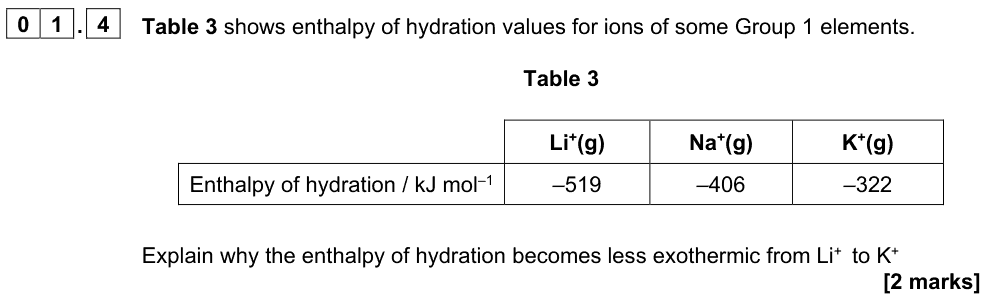
Table 3 shows enthalpy of hydration values for ions of some Group 1 elements.
Table 3
Li+(g)
Na+(g)
K+(g)
Enthalpy of hydration / kJ mol–1
–519
–406
–322
Explain why the enthalpy of hydration becomes less exothermic from Li+  to K+
[2 marks]
November 2020 · Paper 1 · Q03.3 2 marks Explanation periodicity
Earlier part of question 03 that this part usesEarlier part of November 2020 Paper 1 question 03
Explain why the atomic radius decreases across Period 3, from sodium to chlorine.
[2 marks]
November 2020 · Paper 1 · Q05.4 3 marks Explanation reactions of ions in aqueous solution
Earlier part of question 05 that this part usesEarlier part of November 2020 Paper 1 question 05
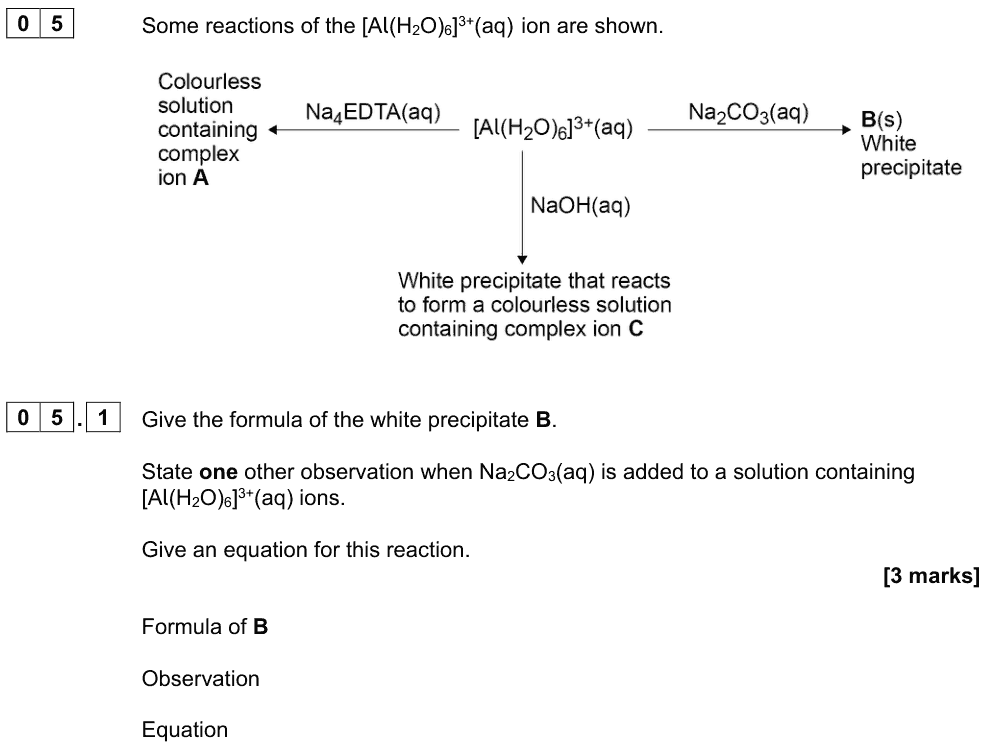
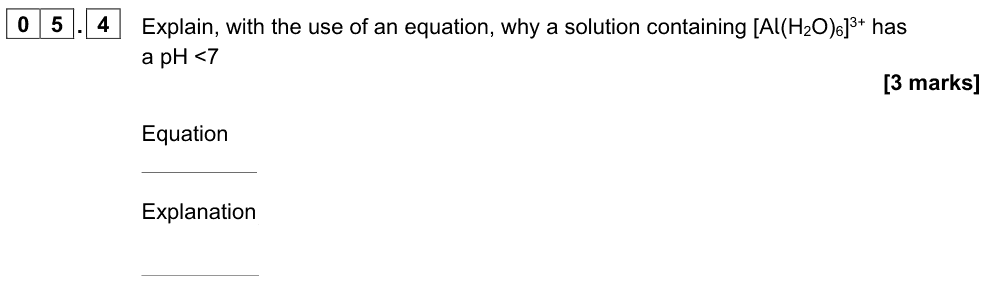
Explain, with the use of an equation, why a solution containing [Al(H2O)6]3+ has
a pH ˂7
[3 marks]
Equation
Explanation
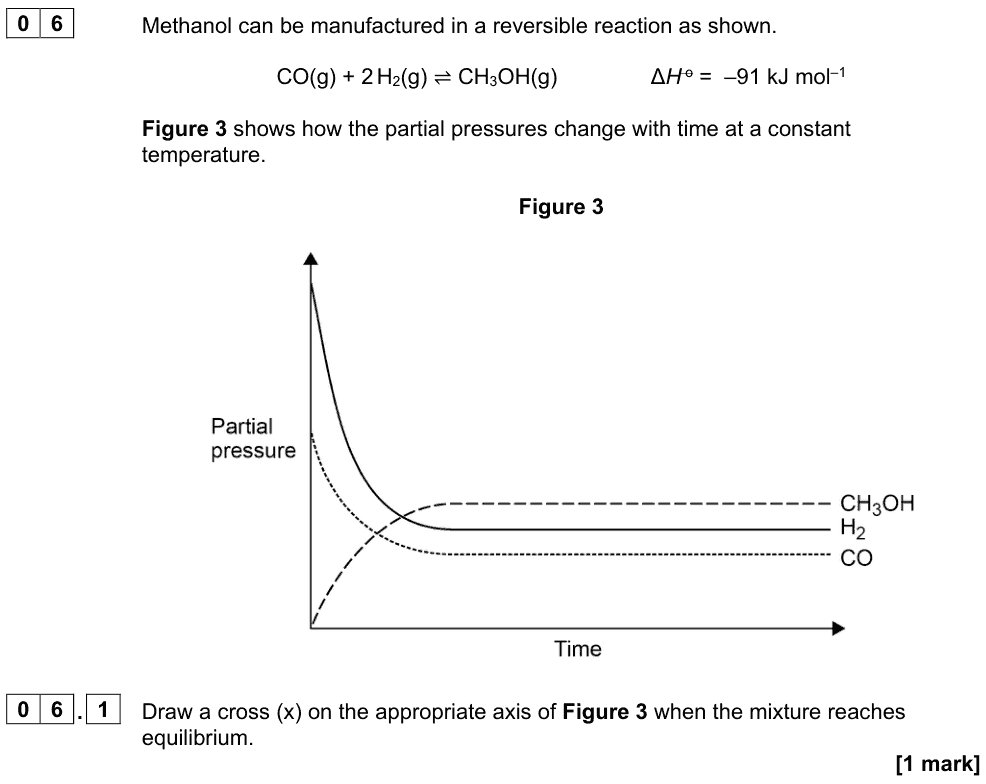
November 2020 · Paper 1 · Q06.5 2 marks Explanation equilibrium constant kpchemical equilibria and kc
Earlier part of question 06 that this part usesEarlier part of November 2020 Paper 1 question 06
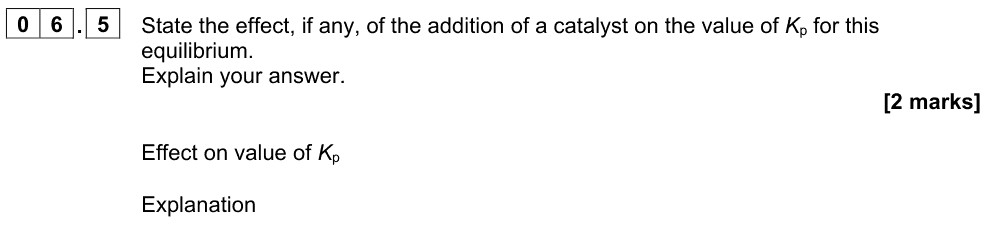
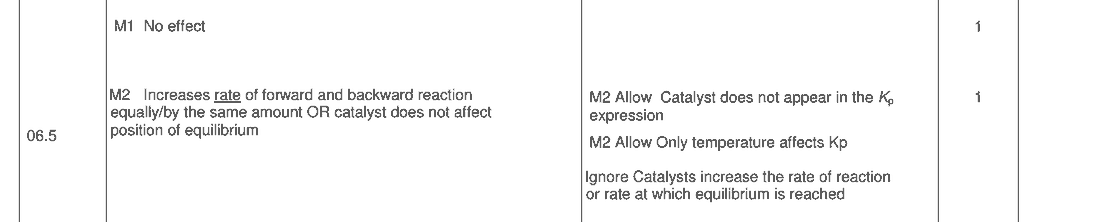
State the effect, if any, of the addition of a catalyst on the value of Kp for this
equilibrium.
Explain your answer.
[2 marks]
Effect on value of Kp
Explanation
November 2020 · Paper 2 · Q02.4 2 marks Explanation amino acids proteins and dna
Earlier part of question 02 that this part usesEarlier part of November 2020 Paper 2 question 02
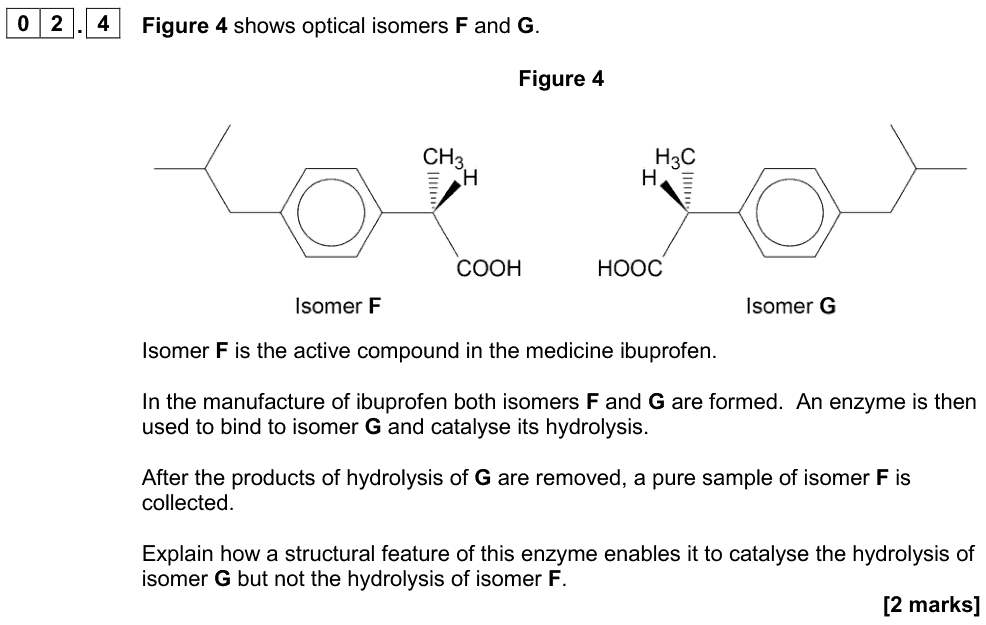
Figure 4 shows optical isomers F and G.
Figure 4
Isomer F is the active compound in the medicine ibuprofen.
In the manufacture of ibuprofen both isomers F and G are formed.  An enzyme is then
used to bind to isomer G and catalyse its hydrolysis.
After the products of hydrolysis of G are removed, a pure sample of isomer F is
collected.
Explain how a structural feature of this enzyme enables it to catalyse the hydrolysis of
isomer G but not the hydrolysis of isomer F.
[2 marks]
November 2020 · Paper 2 · Q03.5 4 marks Explanation organic analysis
Earlier part of question 03 that this part usesEarlier part of November 2020 Paper 2 question 03
Describe fully how infrared spectra can be used to distinguish between
isomers R, S and T.
Use data from Table A in the Data Booklet in your answer.
[4 marks]
November 2020 · Paper 2 · Q09.6 3 marks Explanation aldehydes and ketoneskinetics
Earlier parts of question 09 that this part usesEarlier part of November 2020 Paper 2 question 09Earlier part of November 2020 Paper 2 question 09
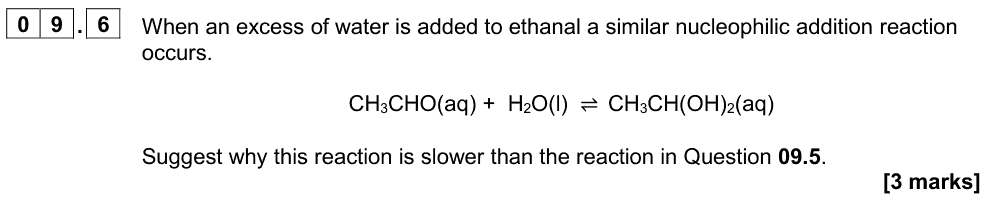
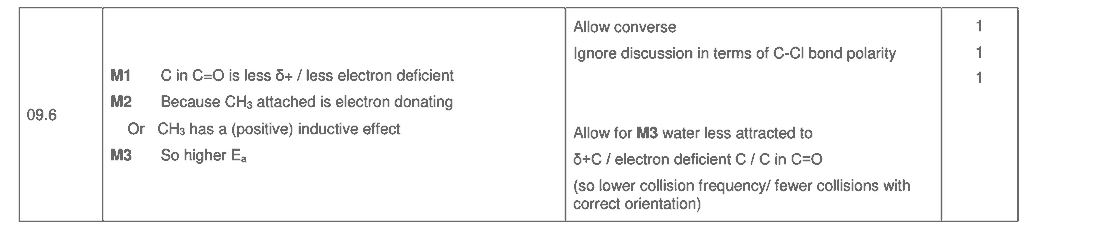
When an excess of water is added to ethanal a similar nucleophilic addition reaction
occurs.
CH3CHO(aq) +  H2O(l)  ⇌  CH3CH(OH)2(aq)
Suggest why this reaction is slower than the reaction in Question 09.5.
[3 marks]
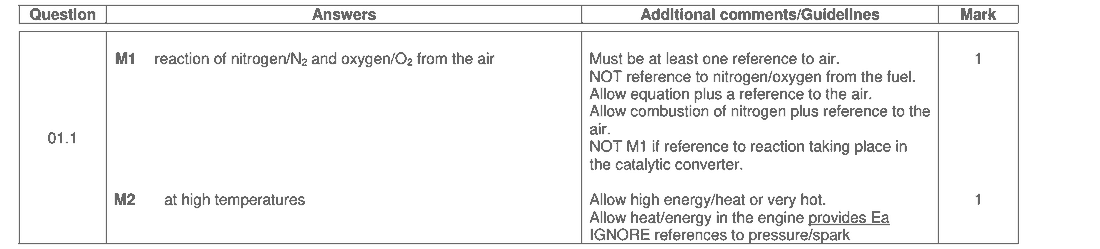
November 2020 · Paper 3 · Q01.1 2 marks Explanation alkanes
This question is about emissions of oxides of nitrogen from petrol and diesel engines.
Explain how oxides of nitrogen are formed in engines.
[2 marks]
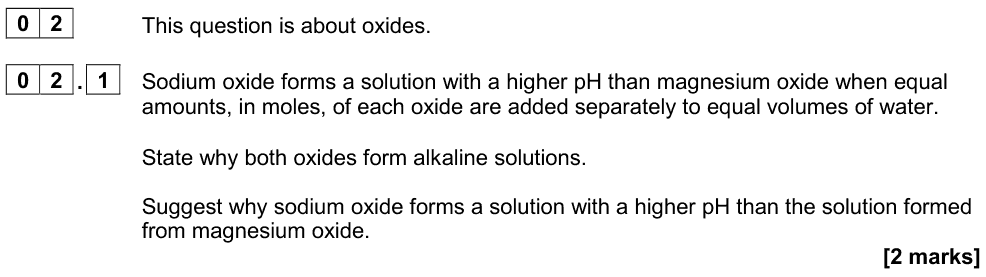
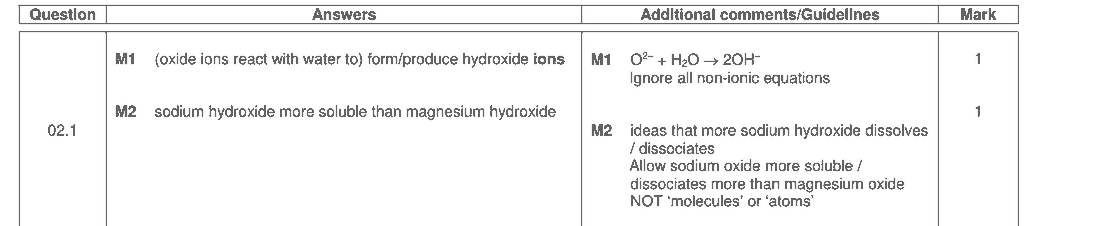
November 2020 · Paper 3 · Q02.1 2 marks Explanation period 3 elements and oxides
This question is about oxides.
Sodium oxide forms a solution with a higher pH than magnesium oxide when equal
amounts, in moles, of each oxide are added separately to equal volumes of water.
State why both oxides form alkaline solutions.
Suggest why sodium oxide forms a solution with a higher pH than the solution formed
from magnesium oxide.
[2 marks]
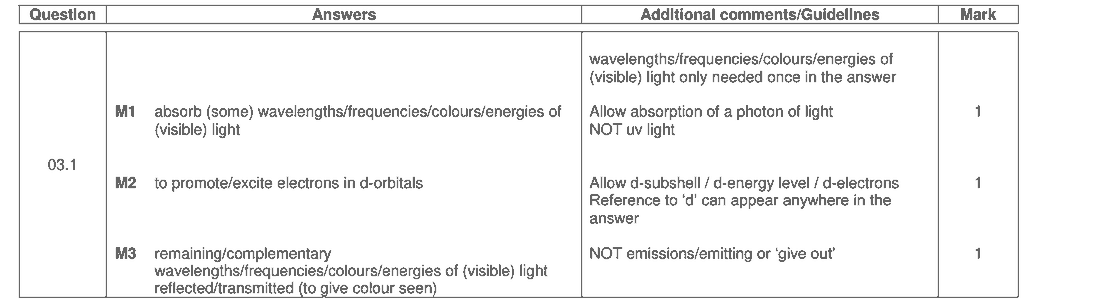
November 2020 · Paper 3 · Q03.1 3 marks Explanation Hard transition metals
Explain why complexes formed from transition metal ions are coloured.
[3 marks]
November 2020 · Paper 3 · Q06.4 3 marks Explanation Hard electrode potentials and cellsredox
Earlier parts of question 06 that this part usesEarlier part of November 2020 Paper 3 question 06Earlier part of November 2020 Paper 3 question 06
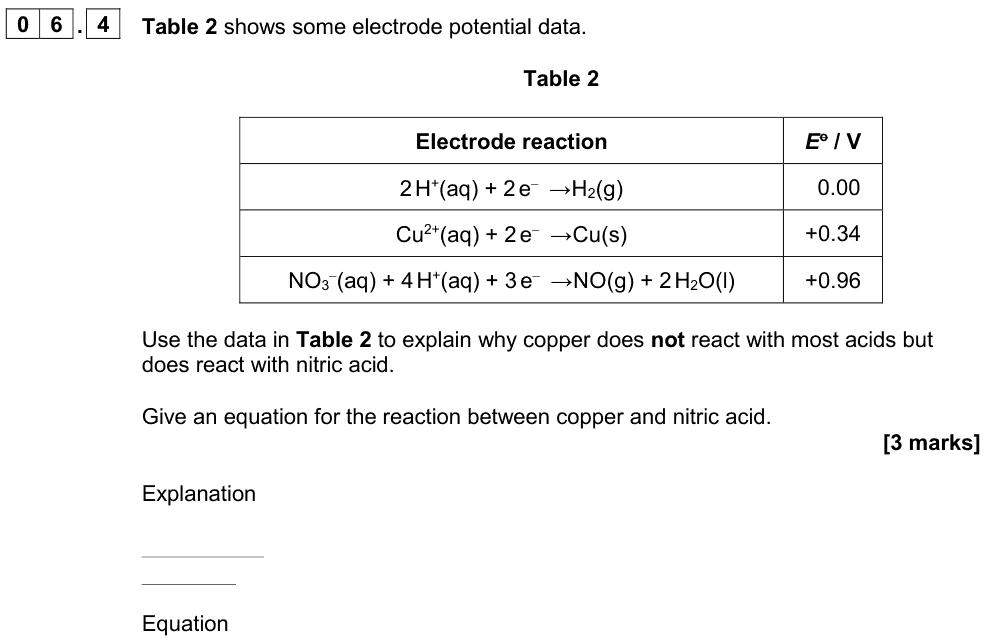
Table 2 shows some electrode potential data.
Table 2
Electrode reaction
Eo / V
2 H+(aq) + 2 e− → H2(g)
0.00
Cu2+(aq) + 2 e− → Cu(s)
+0.34
NO3−(aq) + 4 H+(aq) + 3 e− → NO(g) + 2 H2O(l)
+0.96
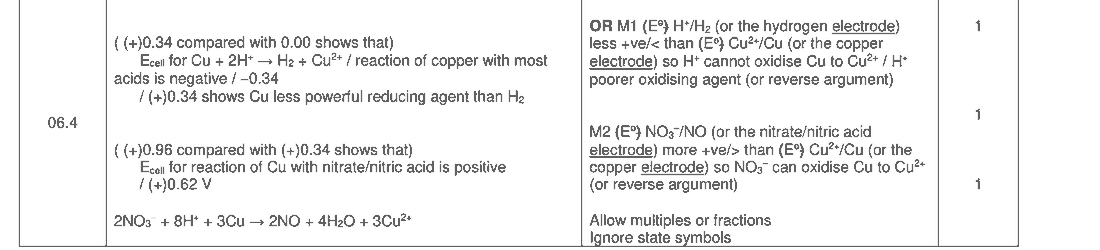
Use the data in Table 2 to explain why copper does not react with most acids but
does react with nitric acid.
Give an equation for the reaction between copper and nitric acid.
[3 marks]
Explanation
Equation
June 2019 · AS Paper 1 · Q01.1 2 marks Explanation atomic structureperiodicity
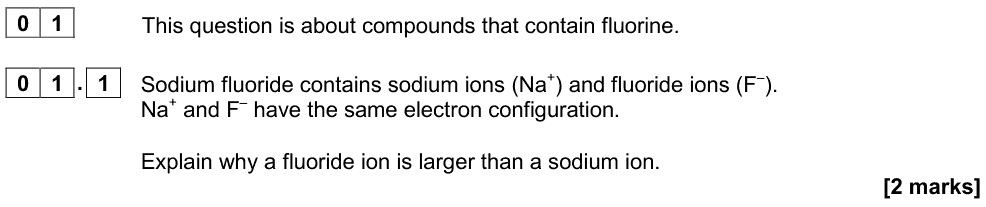
This question is about compounds that contain fluorine.
Sodium fluoride contains sodium ions (Na+) and fluoride ions (F–).
Na+ and F– have the same electron configuration.
Explain why a fluoride ion is larger than a sodium ion.
[2 marks]
June 2019 · AS Paper 1 · Q01.2 2 marks Explanation bonding
Earlier part of question 01 that this part usesEarlier part of June 2019 Paper 1 question 01
Explain, in terms of structure and bonding, why the melting point of sodium fluoride is
high.
[2 marks]
June 2019 · AS Paper 2 · Q06.3 2 marks Explanation alkenes
Earlier part of question 06 that this part usesEarlier part of June 2019 Paper 2 question 06
Explain why more of isomer E than isomer F is formed in this reaction.
[2 marks]
June 2019 · Paper 1 · Q02.1 4 marks Explanation atomic structure
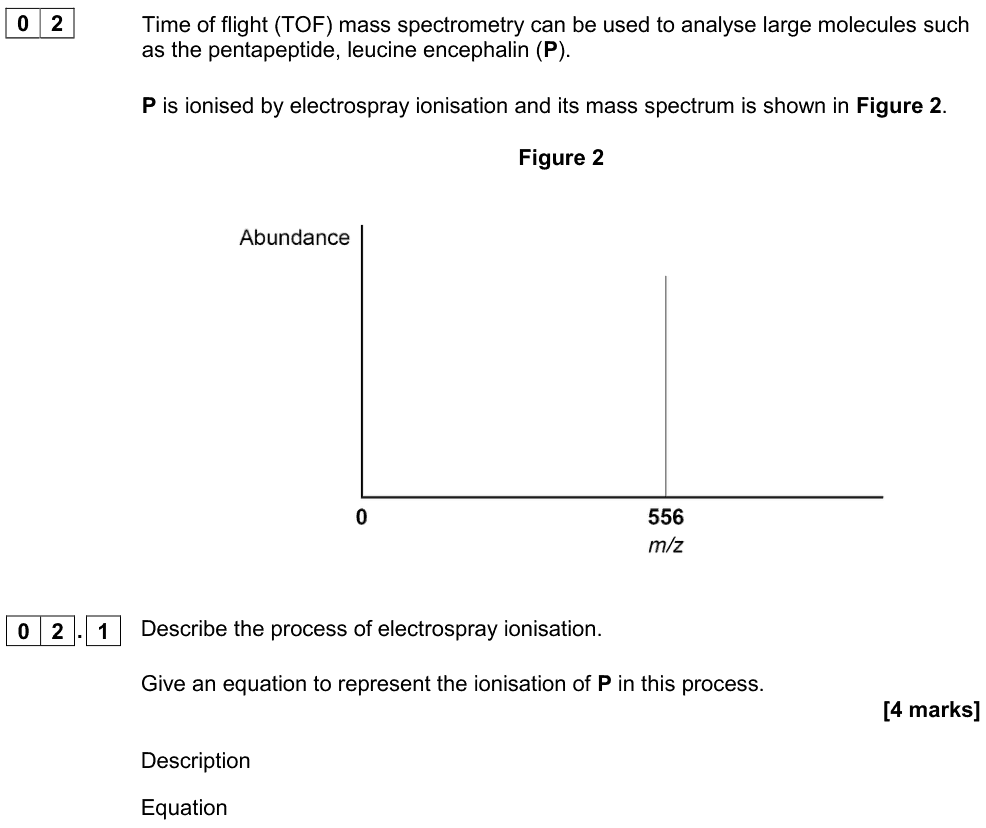
Time of flight (TOF) mass spectrometry can be used to analyse large molecules such
as the pentapeptide, leucine encephalin (P).
P is ionised by electrospray ionisation and its mass spectrum is shown in Figure 2.
Figure 2
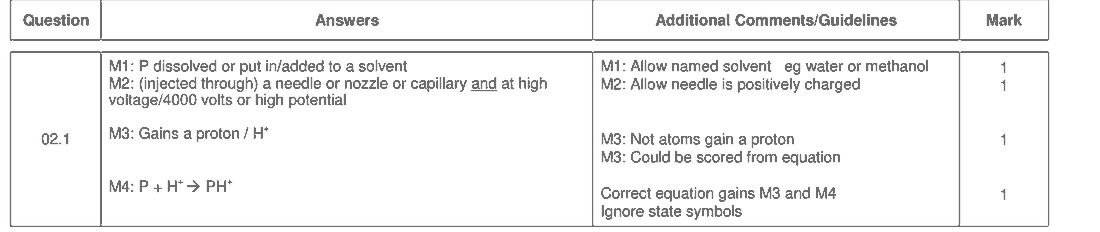
Describe the process of electrospray ionisation.
Give an equation to represent the ionisation of P in this process.
[4 marks]
Description
Equation
June 2019 · Paper 1 · Q03.3 3 marks Explanation periodicity
Earlier part of question 03 that this part usesEarlier part of June 2019 Paper 1 question 03
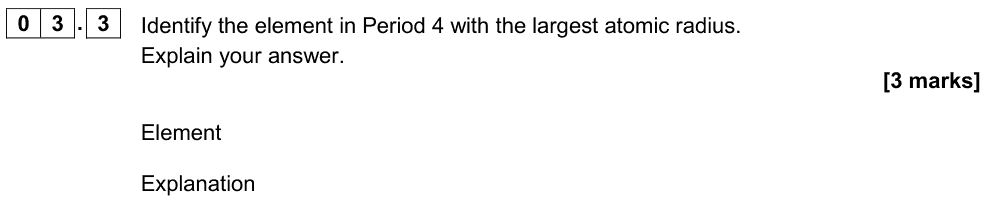
Identify the element in Period 4 with the largest atomic radius.
Explain your answer.
[3 marks]
Element
Explanation
June 2019 · Paper 1 · Q06.5 2 marks Explanation transition metals
Earlier part of question 06 that this part usesEarlier part of June 2019 Paper 1 question 06
Copper(I) iodide is a white solid.
Explain why copper(I) iodide is white.
[2 marks]
June 2019 · Paper 1 · Q07.3 2 marks Explanation equilibrium constant kpchemical equilibria and kc
Earlier part of question 07 that this part usesEarlier part of June 2019 Paper 1 question 07
For this reaction at 1050 K the equilibrium constant, Kp = 7.62 x 10⁵ Pa
For this reaction at 500 K the equilibrium constant, Kp = 3.94 x 10⁴ Pa
Explain how this information can be used to deduce that the forward reaction is
endothermic.
[2 marks]
June 2019 · Paper 1 · Q08.2 3 marks Explanation bonding
Earlier part of question 08 that this part usesEarlier part of June 2019 Paper 1 question 08
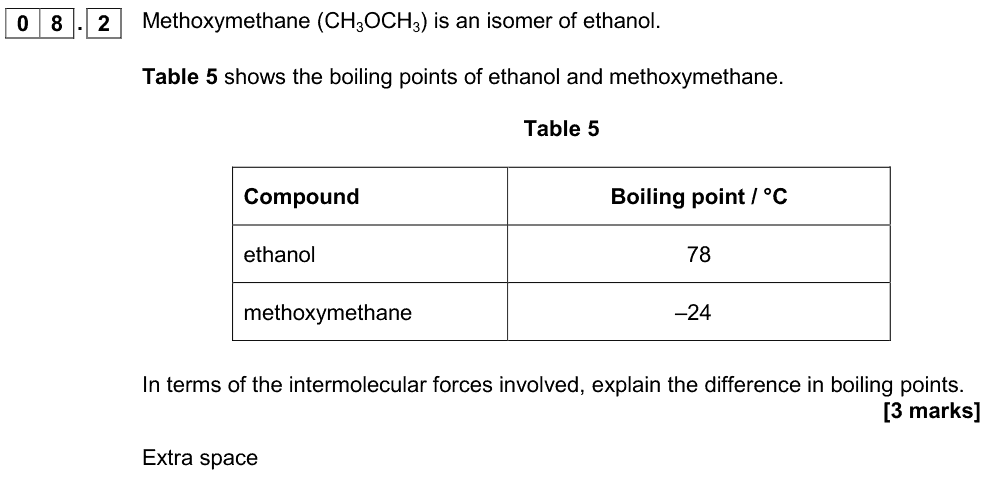
Methoxymethane (CH3OCH3) is an isomer of ethanol.
Table 5 shows the boiling points of ethanol and methoxymethane.
Table 5
Compound
Boiling point / °C
ethanol
78
methoxymethane
–24
In terms of the intermolecular forces involved, explain the difference in boiling points.
[3 marks]
Extra space
June 2019 · Paper 2 · Q01.4 2 marks Explanation Hard amines
Earlier part of question 01 that this part usesEarlier part of June 2019 Paper 2 question 01
Explain why 3-aminopentane is a stronger base than ammonia.
[2 marks]
June 2019 · Paper 2 · Q11.6 2 marks Explanation organic analysis
Earlier part of question 11 that this part usesEarlier part of June 2019 Paper 2 question 11
Explain how carbon dioxide causes global warming.
[2 marks]
June 2019 · Paper 3 · Q02.5 2 marks Explanation chemical equilibria and kcacids and bases
Earlier part of question 02 that this part usesEarlier part of June 2019 Paper 3 question 02
Some sodium sulfate is dissolved in a sample of the solution from question 02.4.
Explain why this increases the pH of the solution.
[2 marks]
June 2018 · AS Paper 1 · Q02.4 3 marks Explanation atomic structure
Earlier part of question 02 that this part usesEarlier part of June 2018 Paper 1 question 02
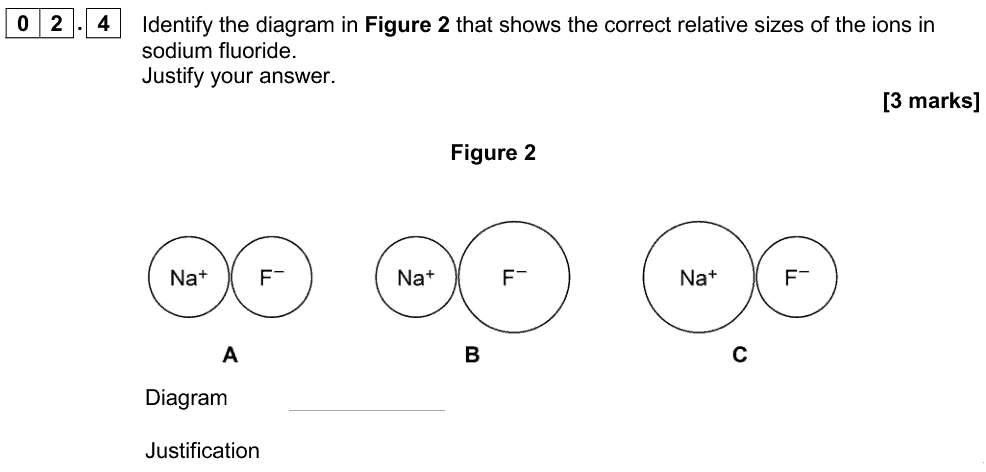
Identify the diagram in Figure 2 that shows the correct relative sizes of the ions in
sodium fluoride.
Justify your answer.
[3 marks]
Figure 2
Diagram
Justification
June 2018 · AS Paper 1 · Q05.3 2 marks Explanation chemical equilibria and kc
Earlier part of question 05 that this part usesEarlier part of June 2018 Paper 1 question 05
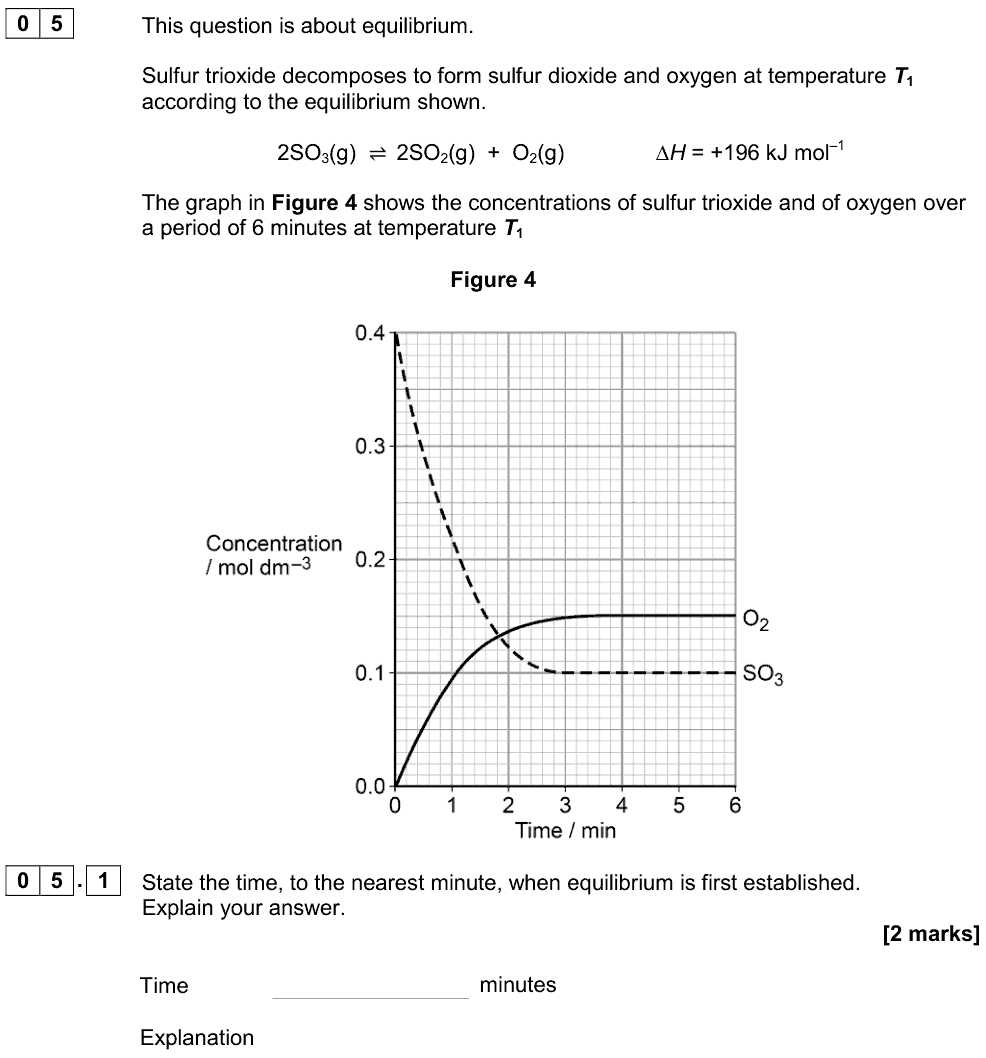
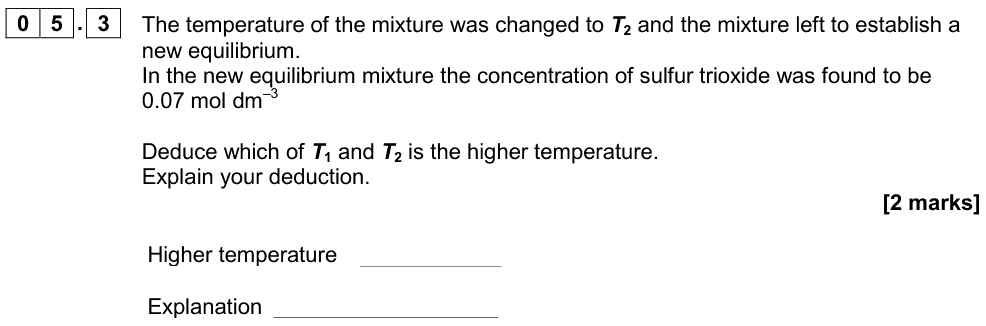
The temperature of the mixture was changed to T2 and the mixture left to establish a
new equilibrium.
In the new equilibrium mixture the concentration of sulfur trioxide was found to be
0.07 mol dm–3
Deduce which of T1 and T2 is the higher temperature.
Explain your deduction.
[2 marks]
Higher temperature
Explanation
June 2018 · AS Paper 1 · Q08.2 2 marks Explanation atomic structure
Earlier part of question 08 that this part usesEarlier part of June 2018 Paper 1 question 08
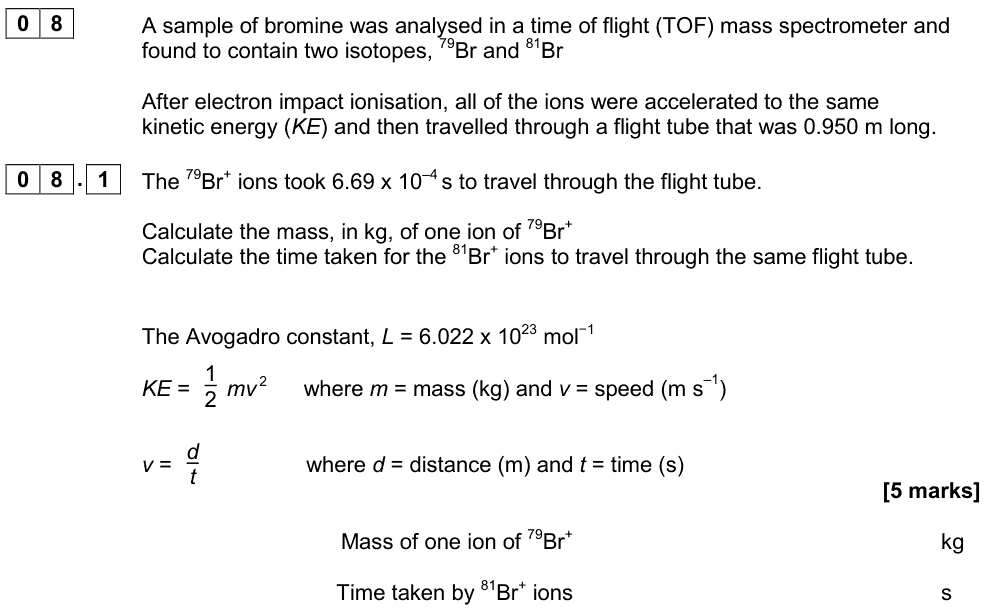
Explain how ions are detected and relative abundance is measured in a TOF mass
spectrometer.
[2 marks]
June 2018 · AS Paper 1 · Q09.2 2 marks Explanation bonding
Earlier part of question 09 that this part usesEarlier part of June 2018 Paper 1 question 09
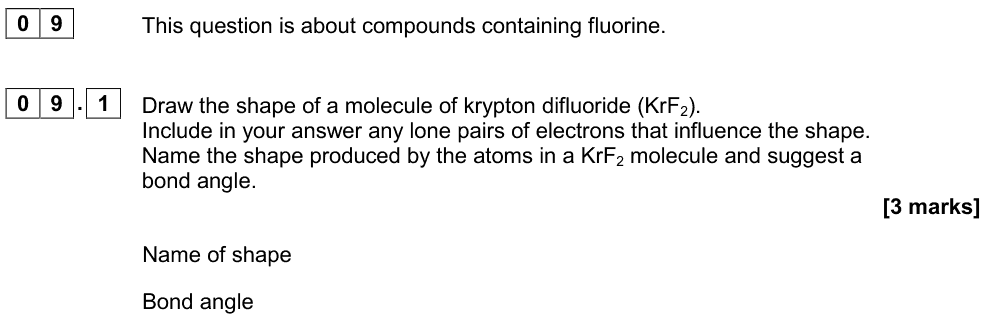
There are two lone pairs of electrons on the oxygen atom in a molecule of
oxygen difluoride (OF2).
Explain how the lone pairs of electrons on the oxygen atom influence the bond angle
in oxygen difluoride.
[2 marks]
June 2018 · AS Paper 1 · Q09.3 3 marks Explanation Hard bonding
Earlier part of question 09 that this part usesEarlier part of June 2018 Paper 1 question 09
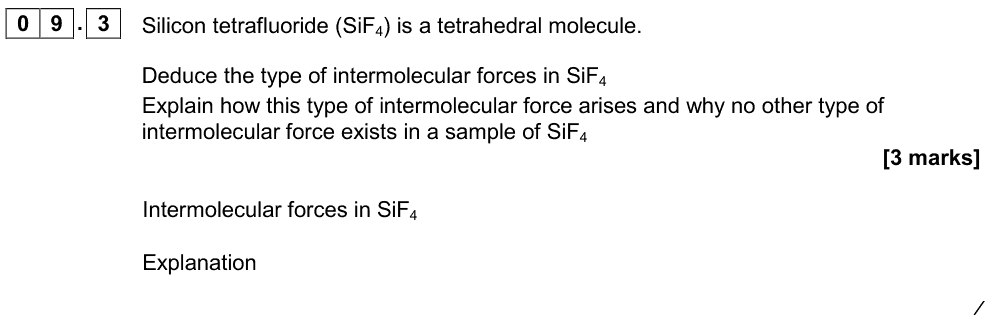
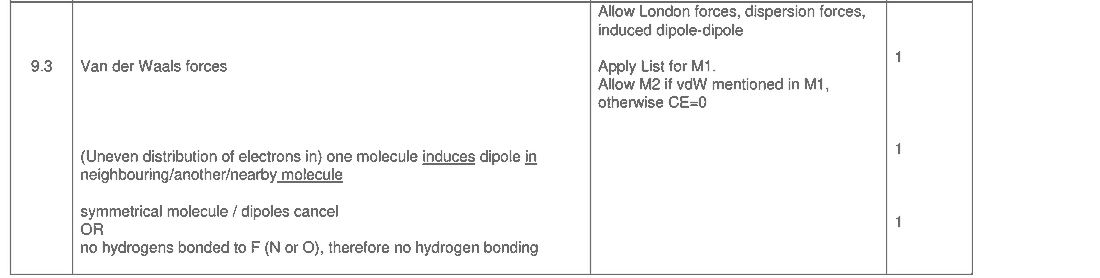
Silicon tetrafluoride (SiF4) is a tetrahedral molecule.
Deduce the type of intermolecular forces in SiF4
Explain how this type of intermolecular force arises and why no other type of
intermolecular force exists in a sample of SiF4
[3 marks]
Intermolecular forces in SiF4
Explanation
June 2018 · AS Paper 2 · Q01.1 2 marks Explanation Easy kinetics
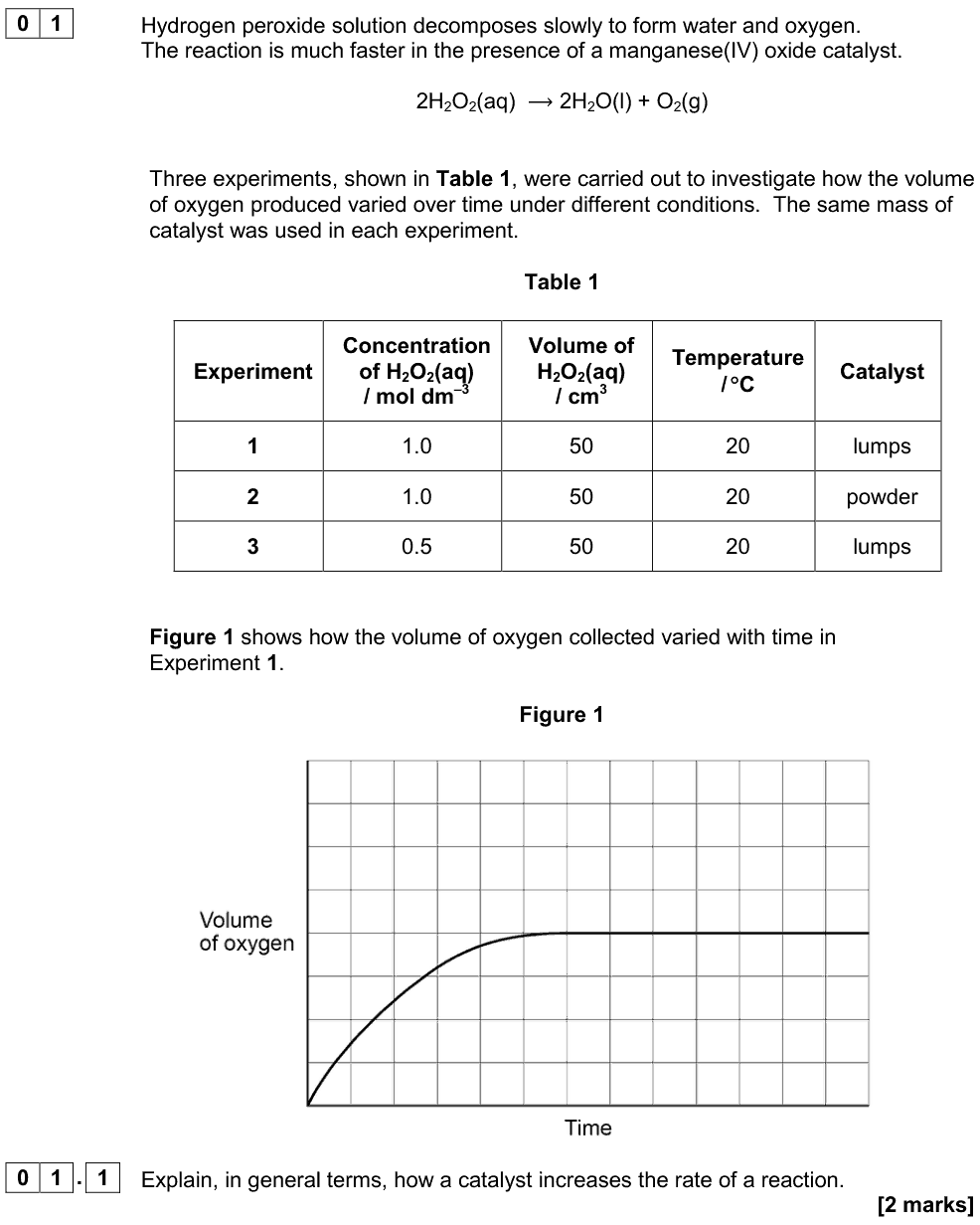
Hydrogen peroxide solution decomposes slowly to form water and oxygen.
The reaction is much faster in the presence of a manganese(IV) oxide catalyst.
2H2O2(aq)  ⟶ 2H2O(l) + O2(g)
Three experiments, shown in Table 1, were carried out to investigate how the volume
of oxygen produced varied over time under different conditions.  The same mass of
catalyst was used in each experiment.
Table 1
Experiment
Concentration
of H2O2(aq)
/ mol dm–3
Volume of
H2O2(aq)
/ cm3
Temperature
/ C
Catalyst
1
1.0
50
20
lumps
2
1.0
50
20
powder
3
0.5
50
20
lumps
Figure 1 shows how the volume of oxygen collected varied with time in
Experiment 1.
Figure 1
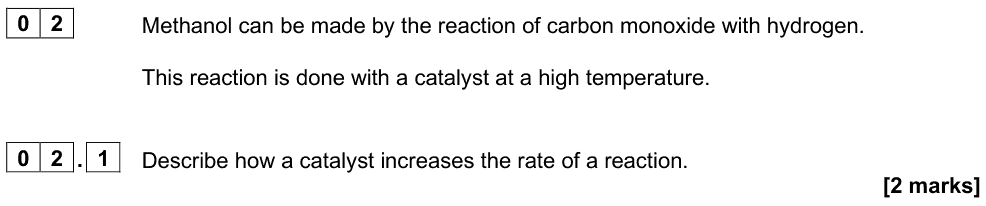
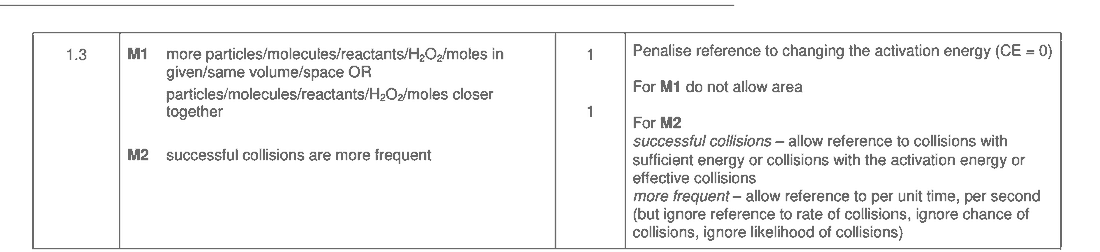
Explain, in general terms, how a catalyst increases the rate of a reaction.
[2 marks]
June 2018 · AS Paper 2 · Q01.3 2 marks Explanation kinetics
Earlier part of question 01 that this part usesEarlier part of June 2018 Paper 2 question 01
Explain, in terms of collision theory, the effect of increasing the concentration of
hydrogen peroxide on the rate of reaction.
[2 marks]
June 2018 · AS Paper 2 · Q04.2 2 marks Explanation bonding
Earlier part of question 04 that this part usesEarlier part of June 2018 Paper 2 question 04
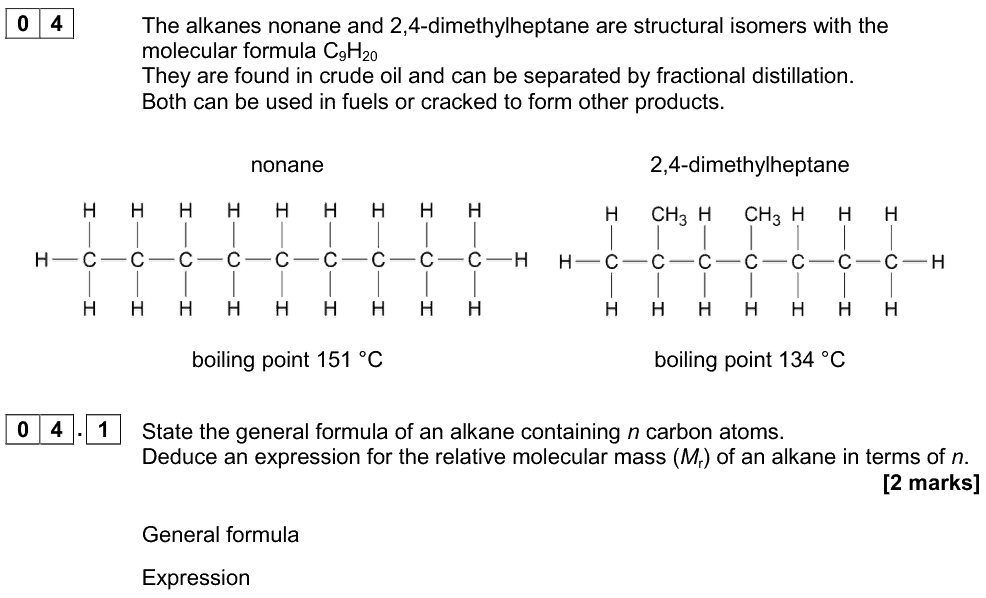
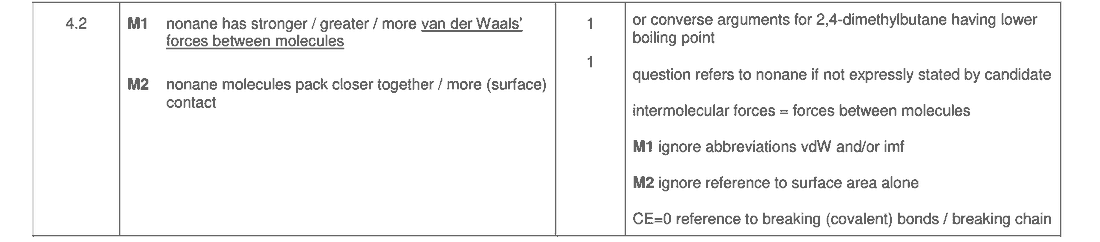
Explain why nonane has a higher boiling point than 2,4-dimethylheptane.
[2 marks]
June 2018 · AS Paper 2 · Q04.4 2 marks Explanation alkanes
Earlier part of question 04 that this part usesEarlier part of June 2018 Paper 2 question 04
Nonane is often found in fuel for jet engines.  Combustion in jet engines produces
pollutants including nitrogen monoxide (NO).
Explain how this nitrogen monoxide is formed.
[2 marks]
June 2018 · AS Paper 2 · Q08.1 2 marks Explanation chemical equilibria and kc
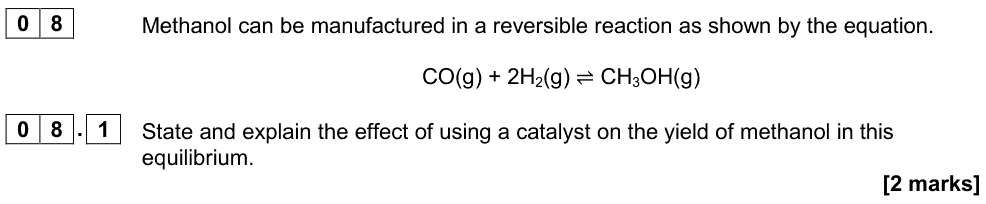
Methanol can be manufactured in a reversible reaction as shown by the equation.
CO(g) + 2H2(g) ⇌ CH3OH(g)
State and explain the effect of using a catalyst on the yield of methanol in this
equilibrium.
[2 marks]
June 2018 · Paper 1 · Q02.4 3 marks Explanation equilibrium constant kp
Earlier part of question 02 that this part usesEarlier part of June 2018 Paper 1 question 02
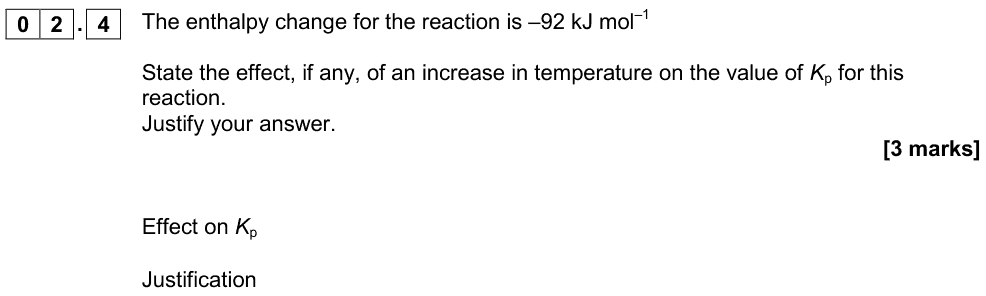
The enthalpy change for the reaction is –92 kJ mol–1
State the effect, if any, of an increase in temperature on the value of Kp for this
reaction.
Justify your answer.
[3 marks]
Effect on Kp
Justification
June 2018 · Paper 1 · Q03.3 2 marks Explanation thermodynamics
Earlier part of question 03 that this part usesEarlier part of June 2018 Paper 1 question 03
The reaction between ammonia and oxygen was carried out at a higher temperature.
Explain how this change affects the value of ΔG for the reaction.
[2 marks]
June 2018 · Paper 1 · Q03.4 3 marks Explanation transition metals
Earlier part of question 03 that this part usesEarlier part of June 2018 Paper 1 question 03
Platinum acts as a heterogeneous catalyst in the reaction between ammonia and
oxygen.  It provides an alternative reaction route with a lower activation energy.
Describe the stages of this alternative route.
[3 marks]
June 2018 · Paper 1 · Q04.2 2 marks Explanation Hard atomic structure
Earlier part of question 04 that this part usesEarlier part of June 2018 Paper 1 question 04
Explain why the second ionisation energy of calcium is lower than the second
ionisation energy of potassium.
[2 marks]
June 2018 · Paper 1 · Q09.1 2 marks Explanation Hard electrode potentials and cells
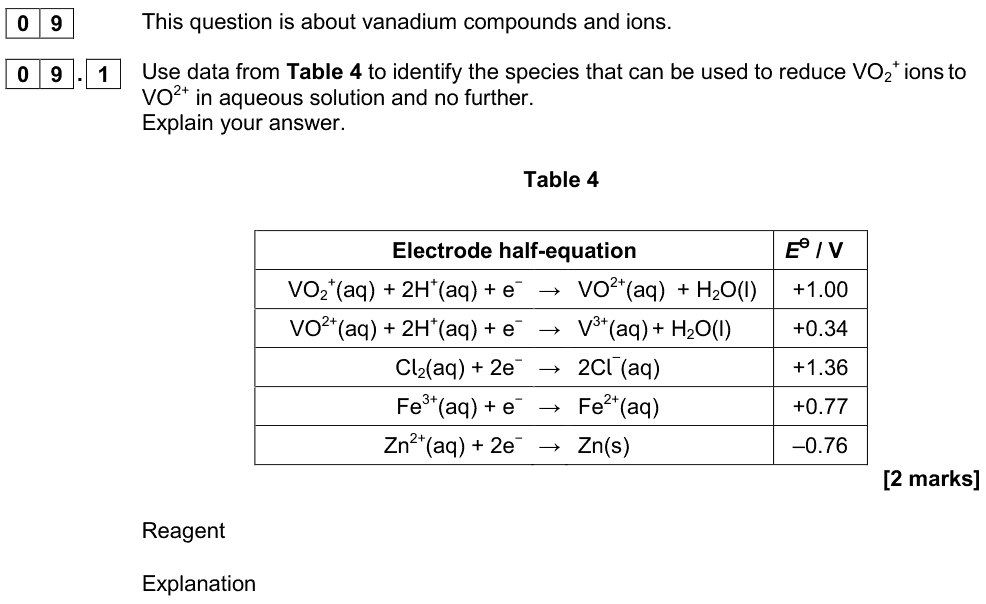
This question is about vanadium compounds and ions.
Use data from Table 4 to identify the species that can be used to reduce VO2
+ ions to
VO2+ in aqueous solution and no further.
Explain your answer.
Table 4
Electrode half-equation
EƟ / V
VO2
+(aq)  + 2H+(aq) + e− → VO2+(aq)  + H2O(l)
+1.00
VO2+(aq) + 2H+(aq) + e− → V3+(aq) + H2O(l)
+0.34
Cl2(aq) + 2e−  → 2Cl
–(aq)
+1.36
Fe3+(aq) + e− → Fe2+(aq)
+0.77
Zn2+(aq) + 2e− → Zn(s)
–0.76
[2 marks]
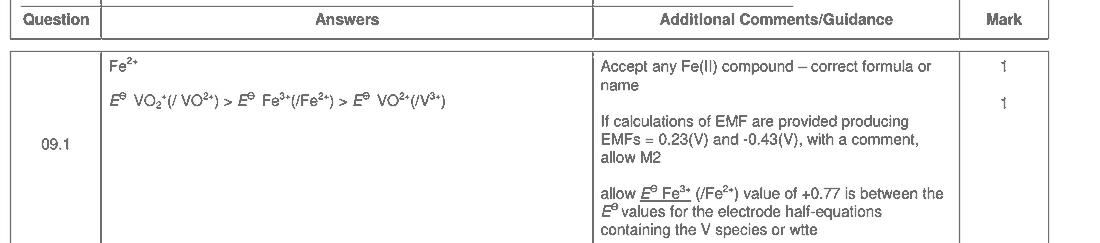
Reagent
Explanation
June 2018 · Paper 2 · Q01.4 4 marks Explanation halogenoalkanes
Earlier part of question 01 that this part usesEarlier part of June 2018 Paper 2 question 01
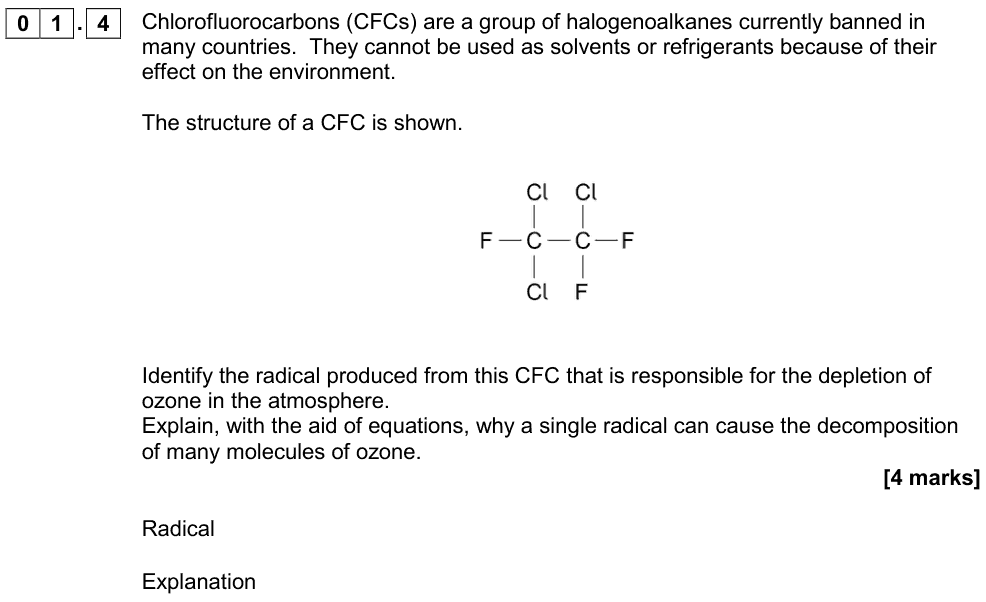
Chlorofluorocarbons (CFCs) are a group of halogenoalkanes currently banned in
many countries.  They cannot be used as solvents or refrigerants because of their
effect on the environment.
The structure of a CFC is shown.
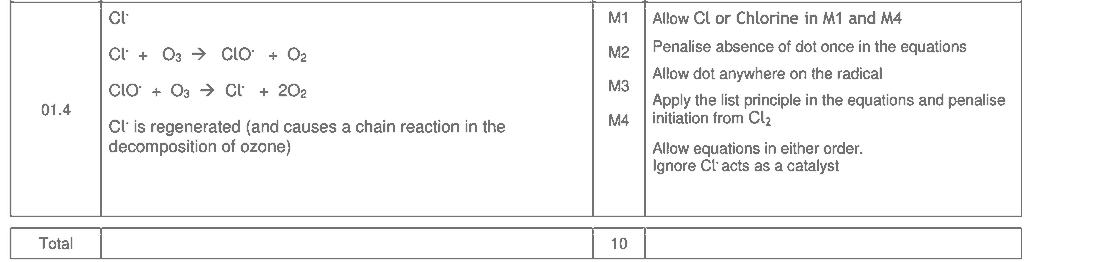
Identify the radical produced from this CFC that is responsible for the depletion of
ozone in the atmosphere.
Explain, with the aid of equations, why a single radical can cause the decomposition
of many molecules of ozone.
[4 marks]
Radical
Explanation
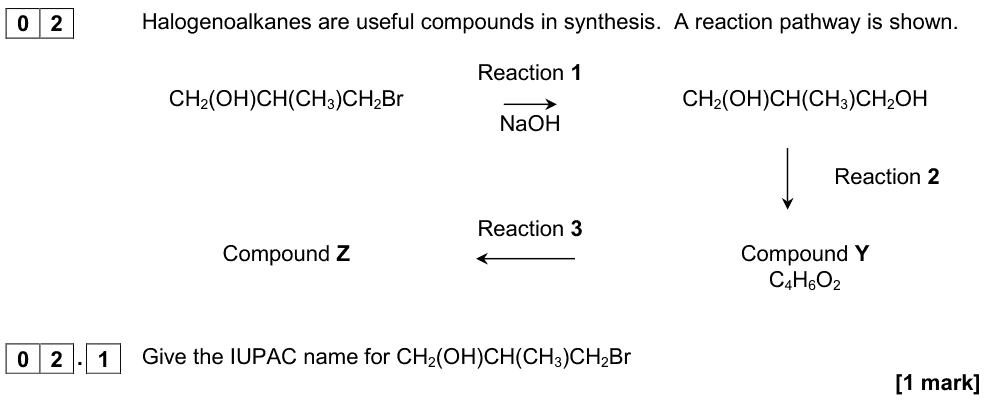
June 2018 · Paper 2 · Q02.2 3 marks Explanation halogenoalkanes
Earlier part of question 02 that this part usesEarlier part of June 2018 Paper 2 question 02
Reaction 1 occurs via a nucleophilic substitution mechanism.
Explain why the halogenoalkane is attacked by the nucleophile in this reaction.
[3 marks]
June 2018 · Paper 2 · Q03.1 3 marks Explanation Hard bonding
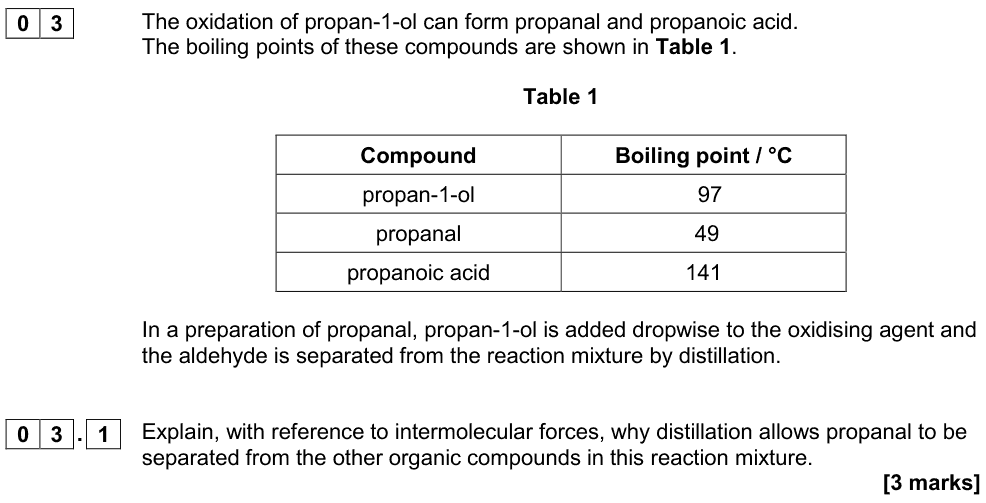
The oxidation of propan-1-ol can form propanal and propanoic acid.
The boiling points of these compounds are shown in Table 1.
Table 1
Compound
Boiling point / °C
propan-1-ol
97
propanal
49
propanoic acid
141
In a preparation of propanal, propan-1-ol is added dropwise to the oxidising agent and
the aldehyde is separated from the reaction mixture by distillation.
Explain, with reference to intermolecular forces, why distillation allows propanal to be
separated from the other organic compounds in this reaction mixture.
[3 marks]
June 2018 · Paper 2 · Q04.4 3 marks Explanation Hard chemical equilibria and kc
Earlier part of question 04 that this part usesEarlier part of June 2018 Paper 2 question 04
Justify the statement that adding more water to the equilibrium mixture in
Question 04.3 will lower the amount of A in the mixture.
[3 marks]
June 2018 · Paper 2 · Q06.2 3 marks Explanation Hard aromatic chemistry
Earlier part of question 06 that this part usesEarlier part of June 2018 Paper 2 question 06
The enthalpy of hydrogenation of cyclohexa-1,3-diene is not exactly double that of
cyclohexene.
Suggest a value for the enthalpy of hydrogenation of cyclohexa-1,3-diene and justify
your value.
[3 marks]
June 2018 · Paper 2 · Q08.1 2 marks Explanation amino acids proteins and dnabonding
Use the Data Booklet to help you answer this question about amino acids.
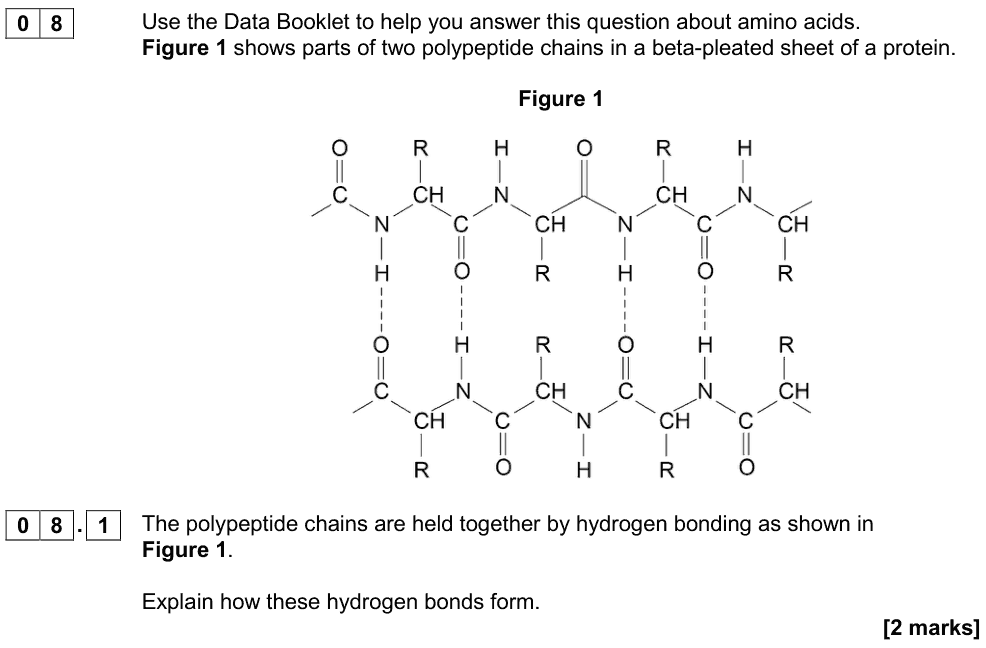
Figure 1 shows parts of two polypeptide chains in a beta-pleated sheet of a protein.
Figure 1
The polypeptide chains are held together by hydrogen bonding as shown in
Figure 1.
Explain how these hydrogen bonds form.
[2 marks]
June 2018 · Paper 2 · Q10.3 2 marks Explanation Hard amines
Earlier part of question 10 that this part usesEarlier part of June 2018 Paper 2 question 10
Primary amines can be prepared by the reaction of halogenoalkanes with ammonia or
by the reduction of nitriles.
Justify the statement that it is better to prepare primary amines from nitriles rather
than from halogenoalkanes.
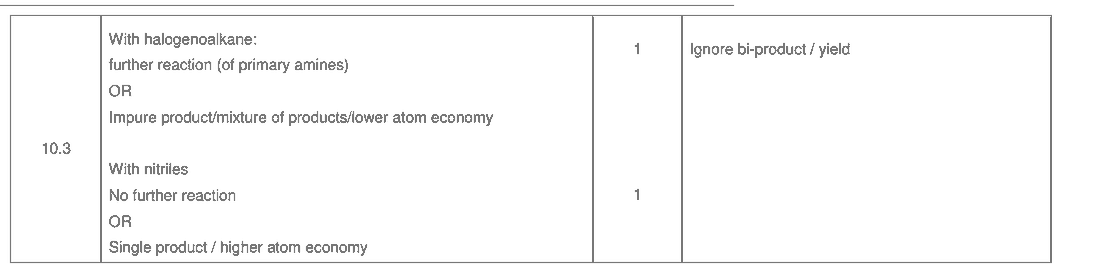
[2 marks]
June 2018 · Paper 3 · Q01.1 2 marks Explanation rate equations
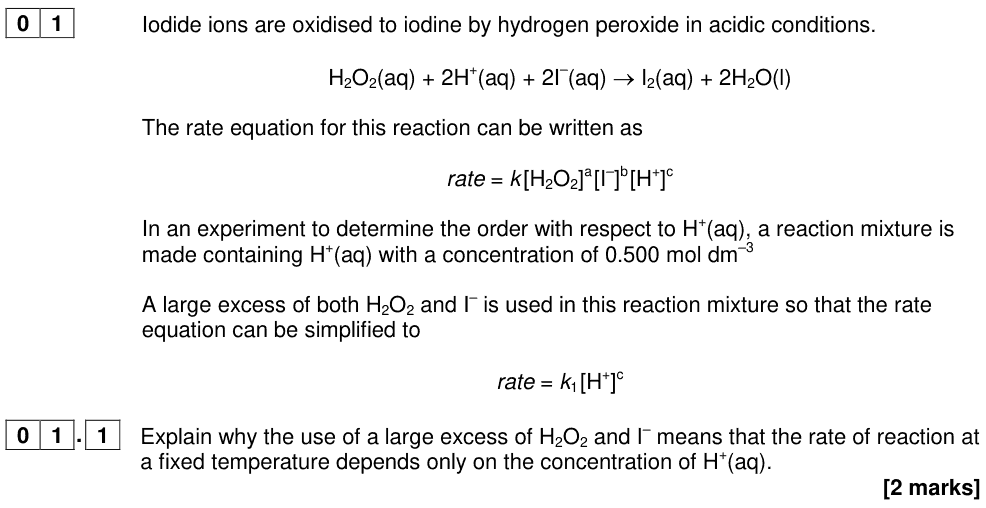
Iodide ions are oxidised to iodine by hydrogen peroxide in acidic conditions.
H2O2(aq) + 2H+(aq) + 2I–(aq) → I2(aq) + 2H2O(l)
The rate equation for this reaction can be written as
rate = k [H2O2]a [I–]b [H+]c
In an experiment to determine the order with respect to H+(aq), a reaction mixture is
made containing H+(aq) with a concentration of 0.500 mol dm–3
A large excess of both H2O2 and I– is used in this reaction mixture so that the rate
equation can be simplified to
rate = k1 [H+]c
Explain why the use of a large excess of H2O2 and I– means that the rate of reaction at
a fixed temperature depends only on the concentration of H+(aq).
[2 marks]
June 2018 · Paper 3 · Q01.3 2 marks Explanation rate equations
Earlier part of question 01 that this part usesEarlier part of June 2018 Paper 3 question 01
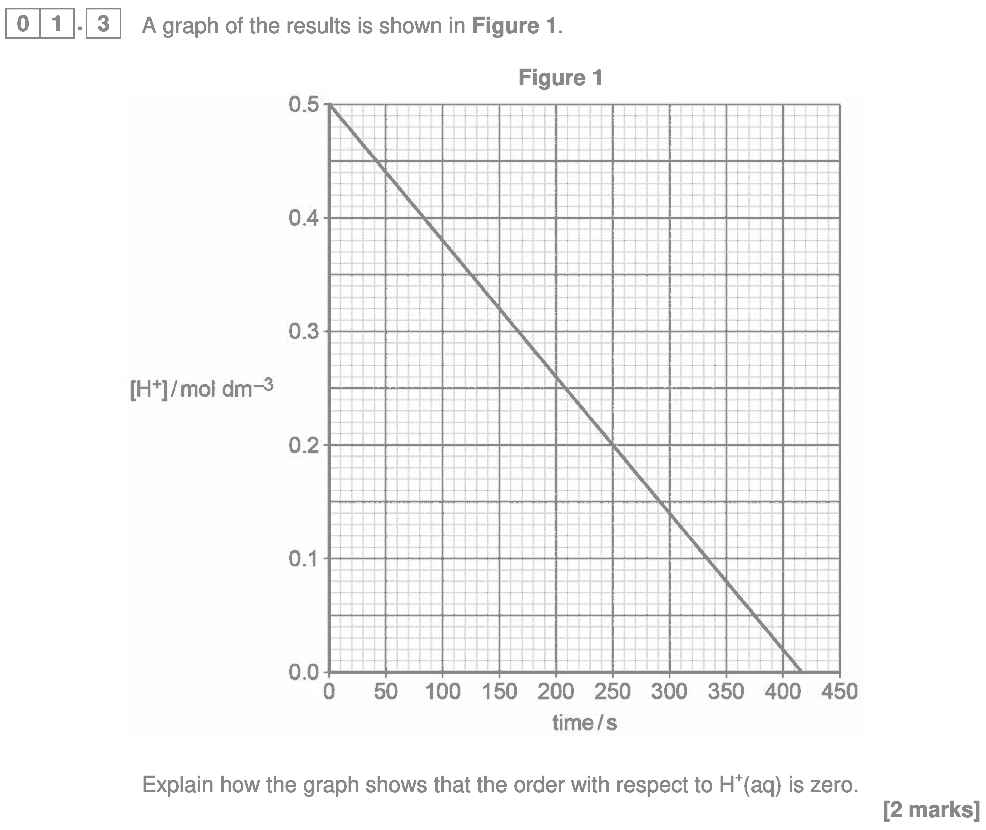
A graph of the results is shown in Figure 1.
Figure 1
Explain how the graph shows that the order with respect to H+(aq) is zero.
[2 marks]
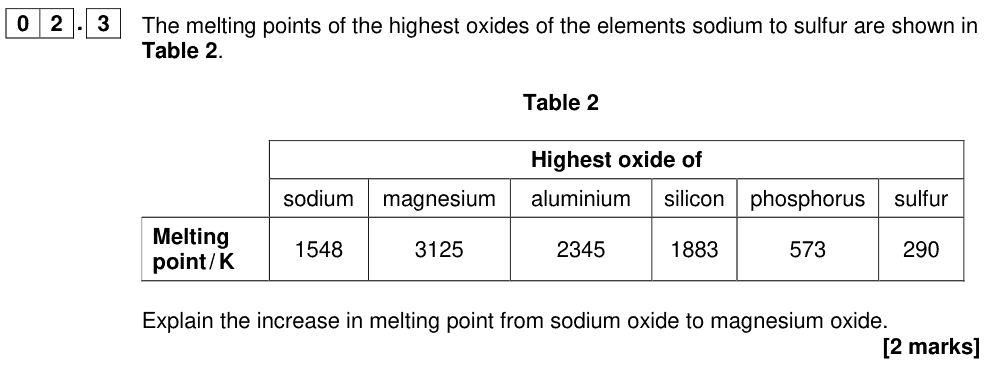
June 2018 · Paper 3 · Q02.3 2 marks Explanation period 3 elements and oxides
Earlier part of question 02 that this part usesEarlier part of June 2018 Paper 3 question 02
The melting points of the highest oxides of the elements sodium to sulfur are shown in
Table 2.
Table 2
Highest oxide of
sodium
magnesium
aluminium
silicon
phosphorus
sulfur
Melting
point / K
1548
3125
2345
1883
573
290
Explain the increase in melting point from sodium oxide to magnesium oxide.
[2 marks]
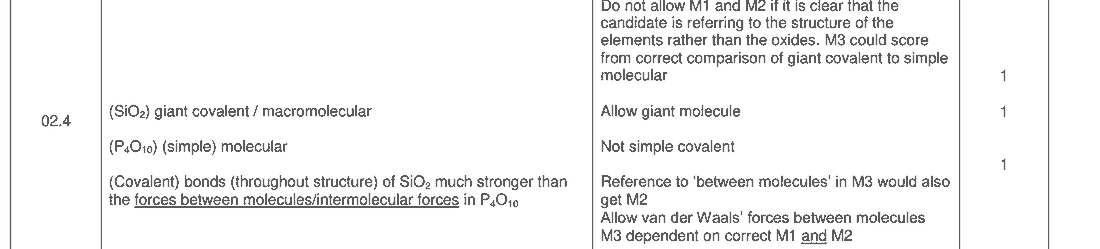
June 2018 · Paper 3 · Q02.4 3 marks Explanation period 3 elements and oxides
Earlier part of question 02 that this part usesEarlier part of June 2018 Paper 3 question 02
Explain why the melting point of the oxide of silicon is much higher than that of the
highest oxide of phosphorus.
[3 marks]
June 2018 · Paper 3 · Q03.7 2 marks Explanation chromatography
Earlier part of question 03 that this part usesEarlier part of June 2018 Paper 3 question 03
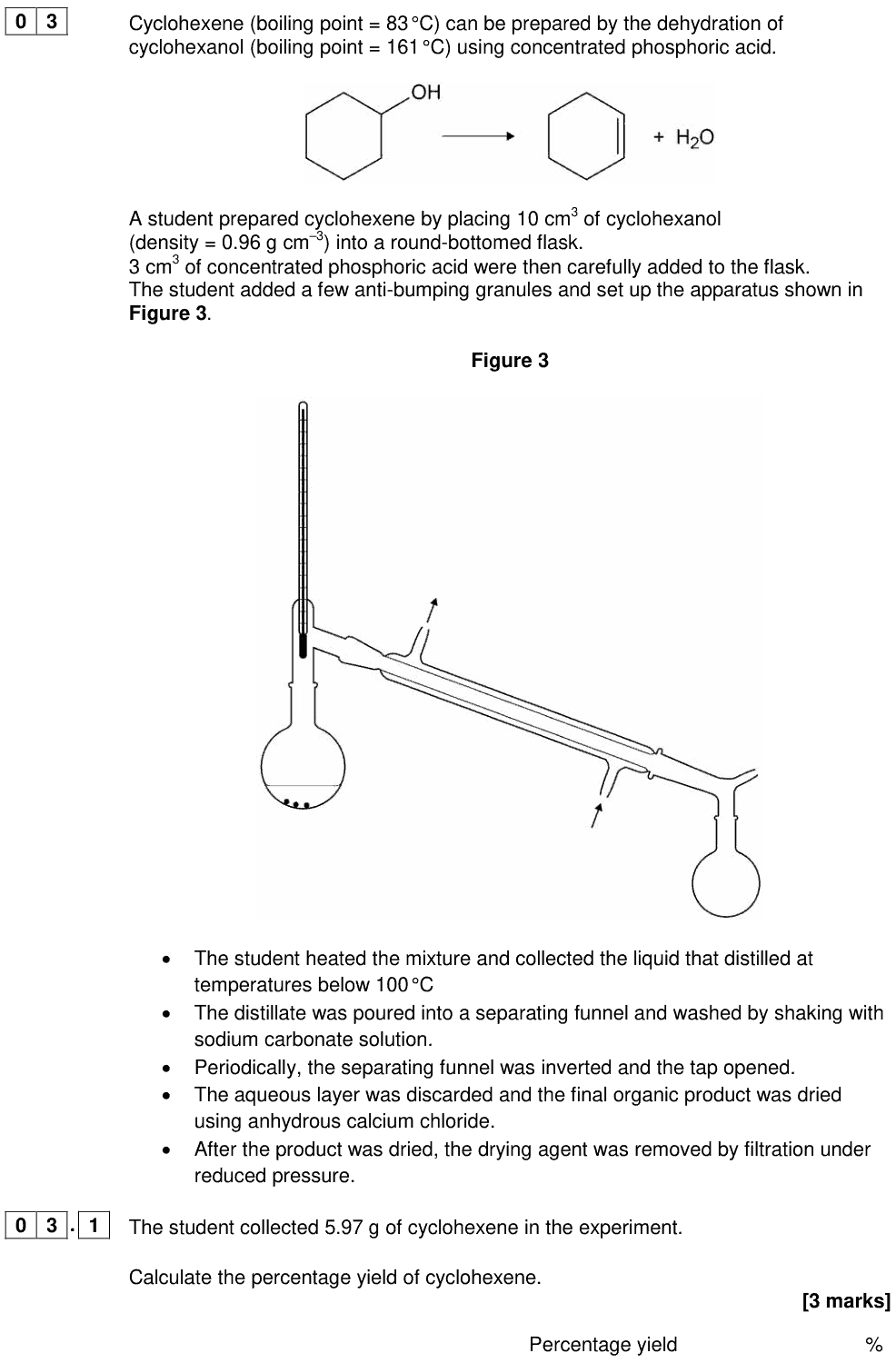
A sample of cyclohexene has been contaminated with cyclohexanol.  The
cyclohexene can be separated from the cyclohexanol by column chromatography.
Silica gel is used as the stationary phase and hexane as the mobile phase.
Explain why cyclohexene has a shorter retention time than cyclohexanol.
[2 marks]
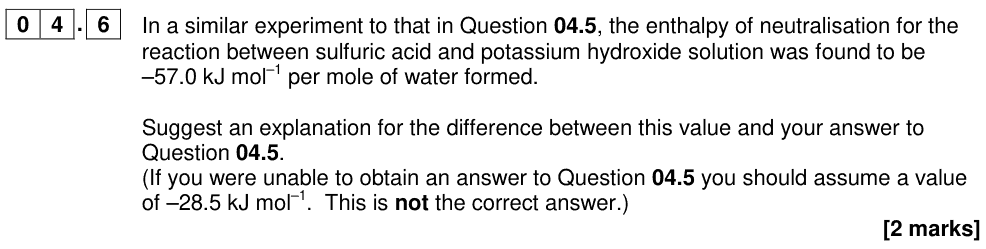
June 2018 · Paper 3 · Q04.6 2 marks Explanation Hard acids and bases
Earlier part of question 04 that this part usesEarlier part of June 2018 Paper 3 question 04
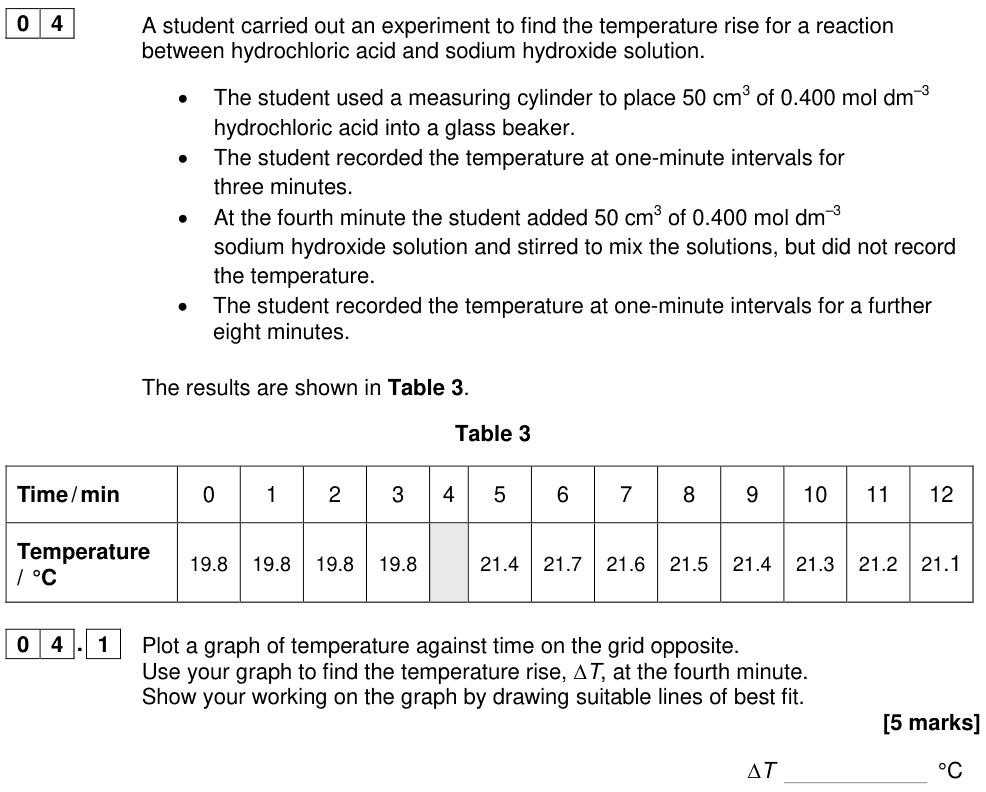
In a similar experiment to that in Question 04.5, the enthalpy of neutralisation for the
reaction between sulfuric acid and potassium hydroxide solution was found to be
–57.0 kJ mol–1 per mole of water formed.
Suggest an explanation for the difference between this value and your answer to
Question 04.5.
(If you were unable to obtain an answer to Question 04.5 you should assume a value
of –28.5 kJ mol–1.  This is not the correct answer.)
[2 marks]
June 2017 · AS Paper 1 · Q01.3 3 marks Explanation atomic structureperiodicity
Earlier part of question 01 that this part usesEarlier part of June 2017 Paper 1 question 01
State which of the elements magnesium and aluminium has the lower
first ionisation energy.
Explain your answer.
[3 marks]
June 2017 · AS Paper 1 · Q05.2 2 marks Explanation bonding
Earlier part of question 05 that this part usesEarlier part of June 2017 Paper 1 question 05
Explain how permanent dipole-dipole forces arise between hydrogen chloride
molecules.
[2 marks]
June 2017 · AS Paper 2 · Q01.3 2 marks Explanation kinetics
Earlier part of question 01 that this part usesEarlier part of June 2017 Paper 2 question 01
This gas decomposes on heating.
Explain why an increase in temperature increases the rate at which this gas
decomposes.
[2 marks]
June 2017 · AS Paper 2 · Q07.3 2 marks Explanation alkenes
Earlier part of question 07 that this part usesEarlier part of June 2017 Paper 2 question 07
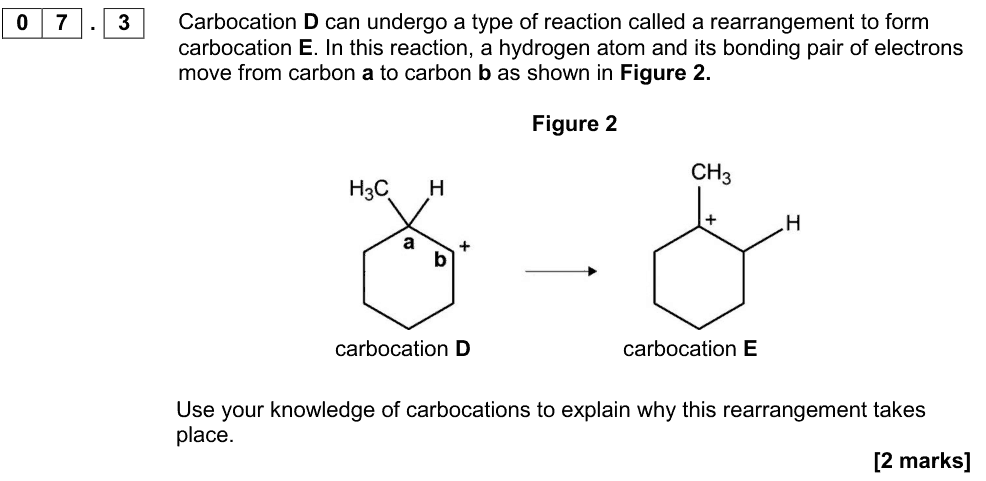
Carbocation D can undergo a type of reaction called a rearrangement to form
carbocation E. In this reaction, a hydrogen atom and its bonding pair of electrons
move from carbon a to carbon b as shown in Figure 2.
Figure 2
Use your knowledge of carbocations to explain why this rearrangement takes
place.
[2 marks]
carbocation D
carbocation E
June 2017 · AS Paper 2 · Q07.5 6 marks Explanation bonding
Earlier part of question 07 that this part usesEarlier part of June 2017 Paper 2 question 07
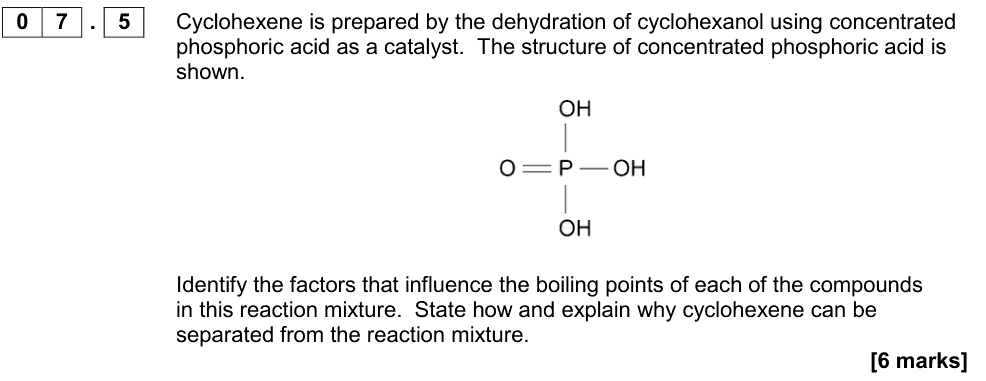
Cyclohexene is prepared by the dehydration of cyclohexanol using concentrated
phosphoric acid as a catalyst.  The structure of concentrated phosphoric acid is
shown.
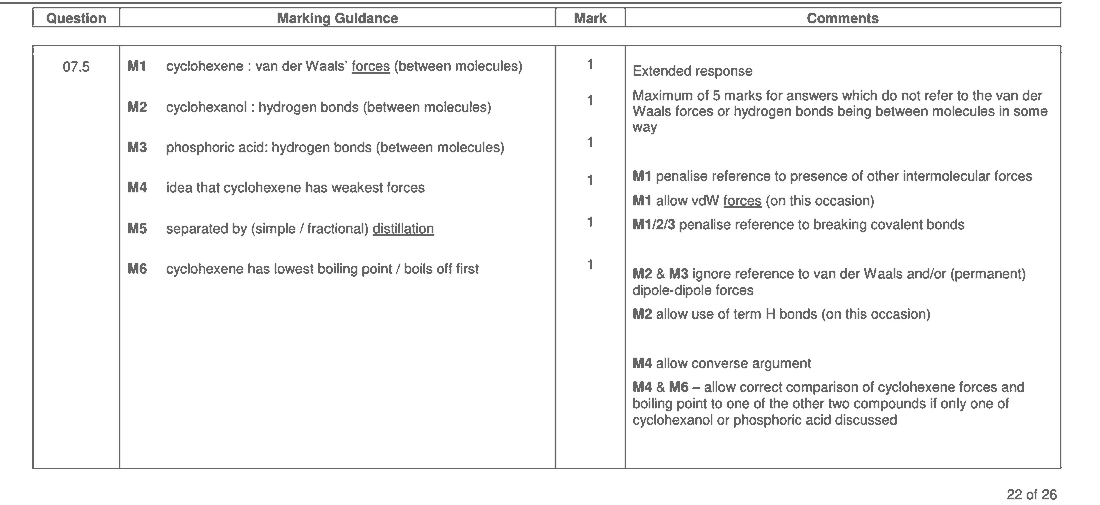
Identify the factors that influence the boiling points of each of the compounds
in this reaction mixture.  State how and explain why cyclohexene can be
separated from the reaction mixture.
[6 marks]
June 2017 · AS Paper 2 · Q09.1 2 marks Explanation alkenesbonding
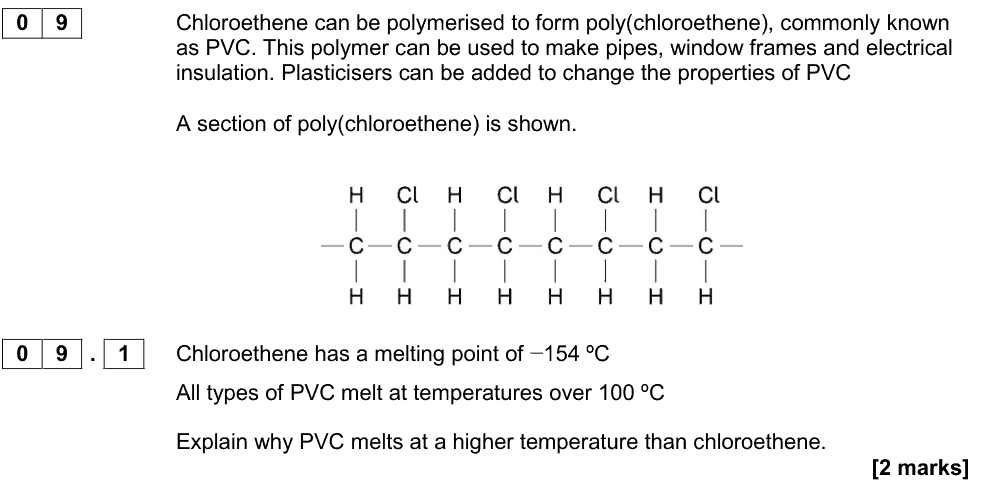
Chloroethene can be polymerised to form poly(chloroethene), commonly known
as PVC. This polymer can be used to make pipes, window frames and electrical
insulation. Plasticisers can be added to change the properties of PVC
A section of poly(chloroethene) is shown.
Chloroethene has a melting point of −154 ºC
All types of PVC melt at temperatures over 100 ºC
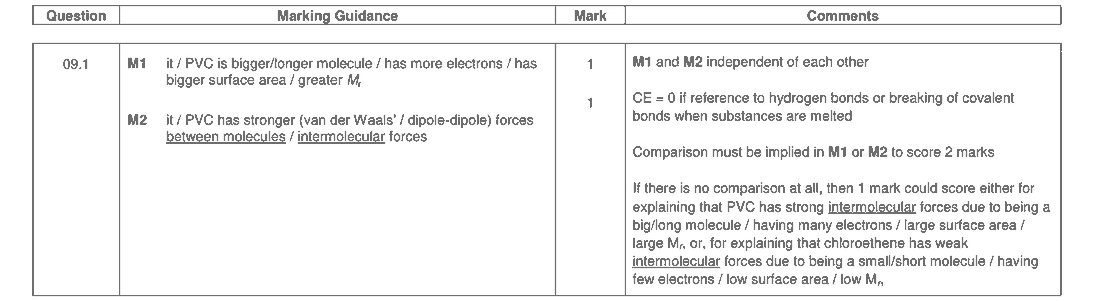
Explain why PVC melts at a higher temperature than chloroethene.
[2 marks]
June 2017 · Paper 1 · Q01.3 2 marks Explanation thermodynamics
Earlier part of question 01 that this part usesEarlier part of June 2017 Paper 1 question 01
A calculation of the enthalpy of lattice formation of silver iodide based on a
perfect ionic model gives a smaller numerical value than the value calculated in
Question 1.2
Explain this difference.
[2 marks]
June 2017 · Paper 1 · Q03.5 2 marks Explanation group 2
Earlier part of question 03 that this part usesEarlier part of June 2017 Paper 1 question 03
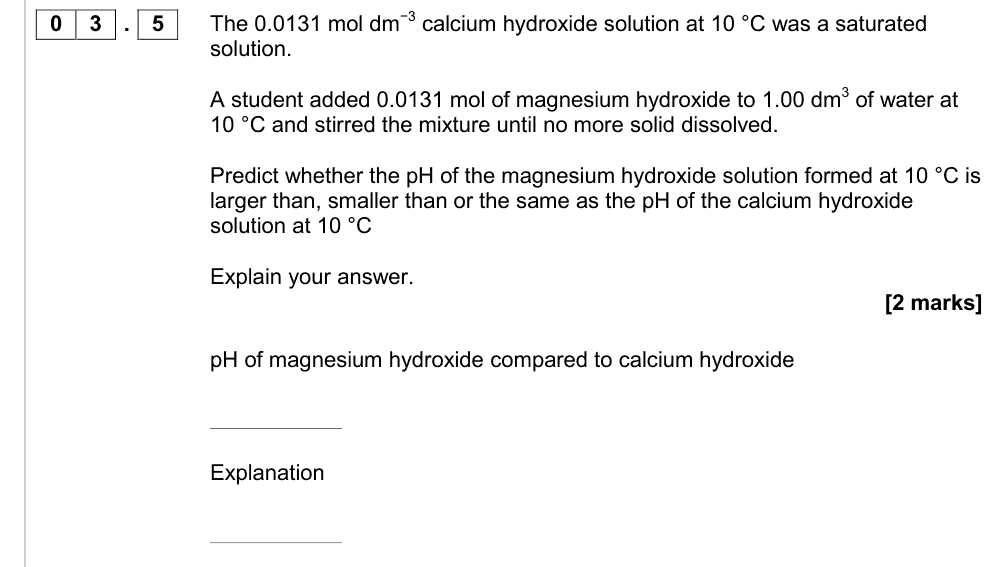
The 0.0131 mol dm−3 calcium hydroxide solution at 10 °C was a saturated
solution.
A student added 0.0131 mol of magnesium hydroxide to 1.00 dm3 of water at
10 °C and stirred the mixture until no more solid dissolved.
Predict whether the pH of the magnesium hydroxide solution formed at 10 °C is
larger than, smaller than or the same as the pH of the calcium hydroxide
solution at 10 °C
Explain your answer.
[2 marks]
pH of magnesium hydroxide compared to calcium hydroxide
Explanation
June 2017 · Paper 1 · Q06.4 4 marks Explanation period 3 elements and oxides
Earlier part of question 06 that this part usesEarlier part of June 2017 Paper 1 question 06
Explain why silicon dioxide has a higher melting point than sulfur trioxide.
[4 marks]
June 2017 · Paper 1 · Q07.6 2 marks Explanation transition metals
Earlier part of question 07 that this part usesEarlier part of June 2017 Paper 1 question 07
Explain why colorimetry cannot be used to determine the concentration of
solutions containing [CuCl2]−
In your answer refer to the electron configuration of the metal ion.
[2 marks]
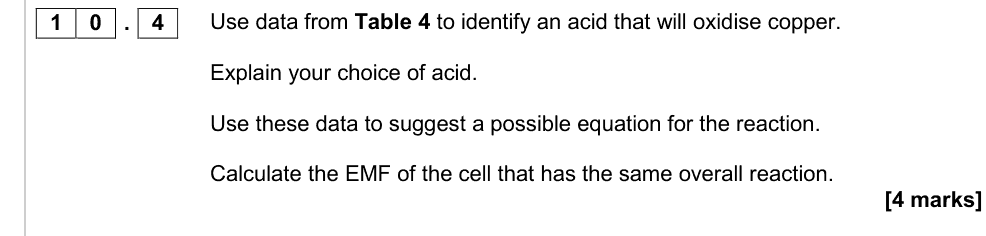
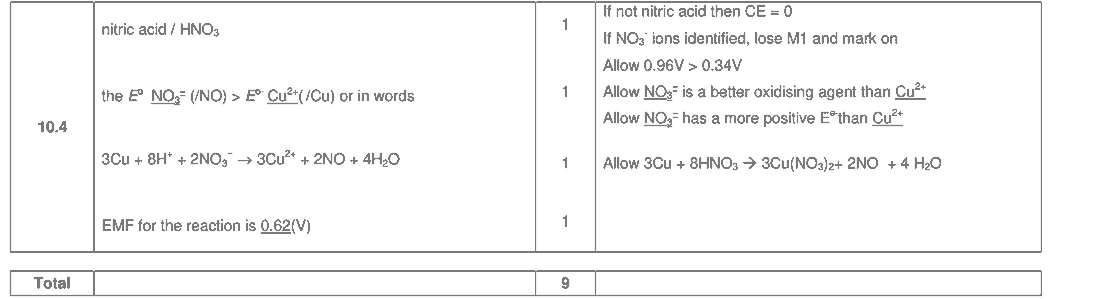
June 2017 · Paper 1 · Q10.4 4 marks Explanation electrode potentials and cellsredox
Earlier part of question 10 that this part usesEarlier part of June 2017 Paper 1 question 10
Use data from Table 4 to identify an acid that will oxidise copper.
Explain your choice of acid.
Use these data to suggest a possible equation for the reaction.
Calculate the EMF of the cell that has the same overall reaction.
[4 marks]
June 2017 · Paper 2 · Q04.3 3 marks Explanation optical isomerismaldehydes and ketones
Earlier part of question 04 that this part usesEarlier part of June 2017 Paper 2 question 04
Explain why the reaction produces a racemic mixture.
[3 marks]
June 2017 · Paper 2 · Q08.6 2 marks Explanation Hard chromatography
Earlier part of question 08 that this part usesEarlier part of June 2017 Paper 2 question 08
A second TLC experiment was carried out using 1,2-dinitrobenzene and
1,4-dinitrobenzene.  An identical plate to that in Question 8.3 was used under
the same conditions with the same solvent.  In this experiment, the Rf value of
1,4-dinitrobenzene was found to be greater than that of 1,2-dinitrobenzene.
Deduce the relative polarities of the 1,2-dinitrobenzene and 1,4-dinitrobenzene
and explain why 1,4-dinitrobenzene has the greater Rf value.
[2 marks]
Relative polarities
Explanation
June 2017 · Paper 2 · Q08.7 2 marks Explanation chromatography
Earlier part of question 08 that this part usesEarlier part of June 2017 Paper 2 question 08
A third TLC experiment was carried out using 1,2-dinitrobenzene.  An identical
plate to that in Question 8.3 was used under the same conditions, but the
solvent used contained a mixture of hexane and ethyl ethanoate.
A student stated that the Rf value of 1,2-dinitrobenzene in this third experiment
would be greater than that of 1,2-dinitrobenzene in the experiment in
Question 8.6
Is the student correct? Justify your answer.
[2 marks]
June 2017 · Paper 2 · Q10.4 3 marks Explanation nmr spectroscopy
Earlier part of question 10 that this part usesEarlier part of June 2017 Paper 2 question 10
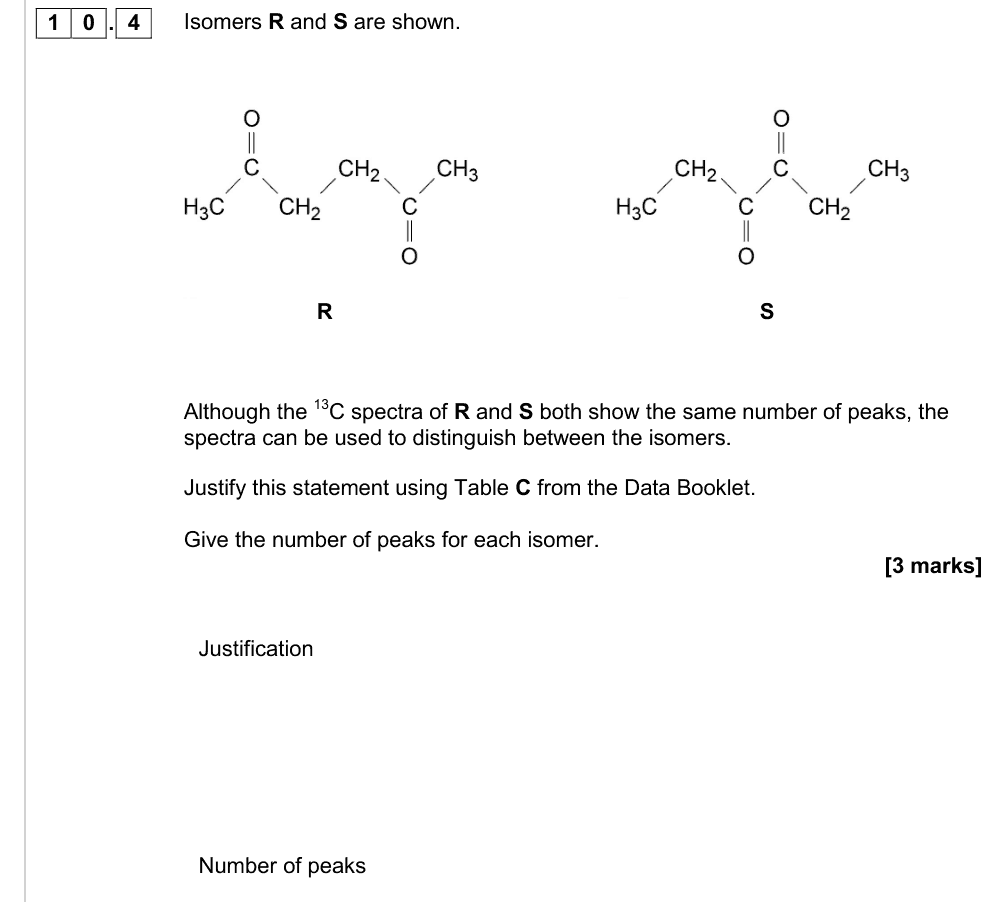
Isomers R and S are shown.
R
S
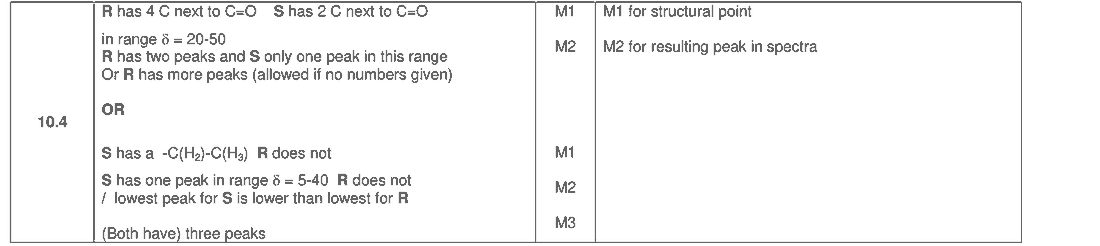
Although the 13C spectra of R and S both show the same number of peaks, the
spectra can be used to distinguish between the isomers.
Justify this statement using Table C from the Data Booklet.
Give the number of peaks for each isomer.
[3 marks]
Justification
Number of peaks
June 2017 · Paper 2 · Q10.5 3 marks Explanation nmr spectroscopy
Earlier parts of question 10 that this part usesEarlier part of June 2017 Paper 2 question 10Earlier part of June 2017 Paper 2 question 10
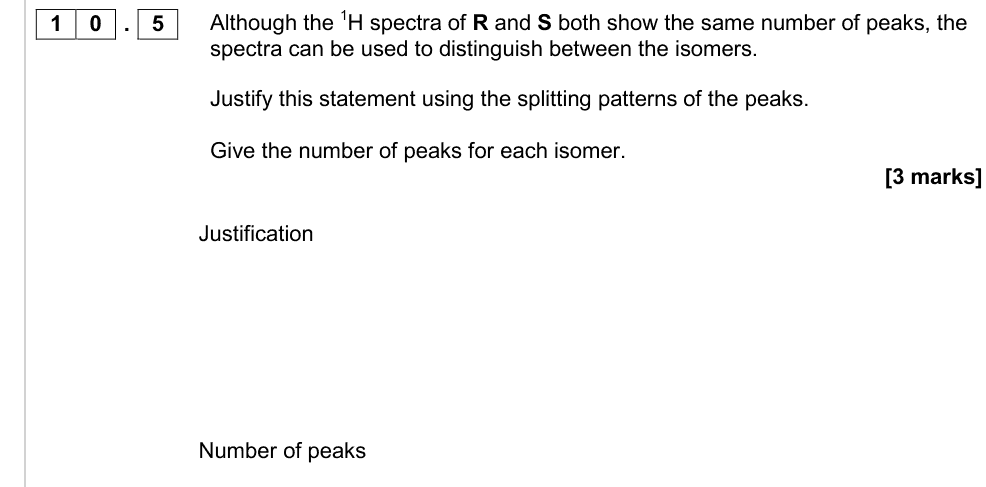
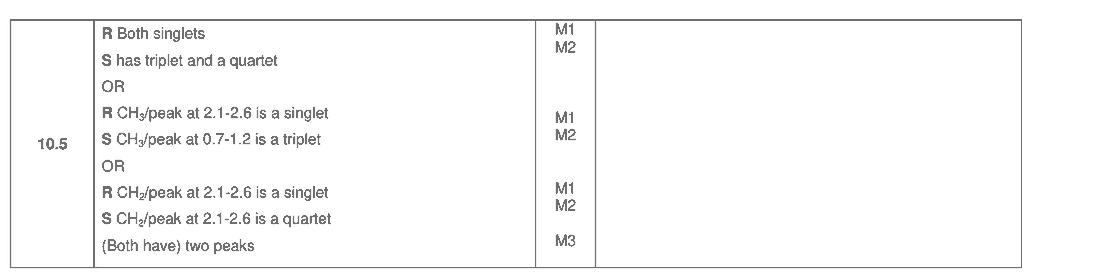
Although the 1H spectra of R and S both show the same number of peaks, the
spectra can be used to distinguish between the isomers.
Justify this statement using the splitting patterns of the peaks.
Give the number of peaks for each isomer.
[3 marks]
Justification
Number of peaks
June 2017 · Paper 2 · Q11.1 6 marks Explanation amines
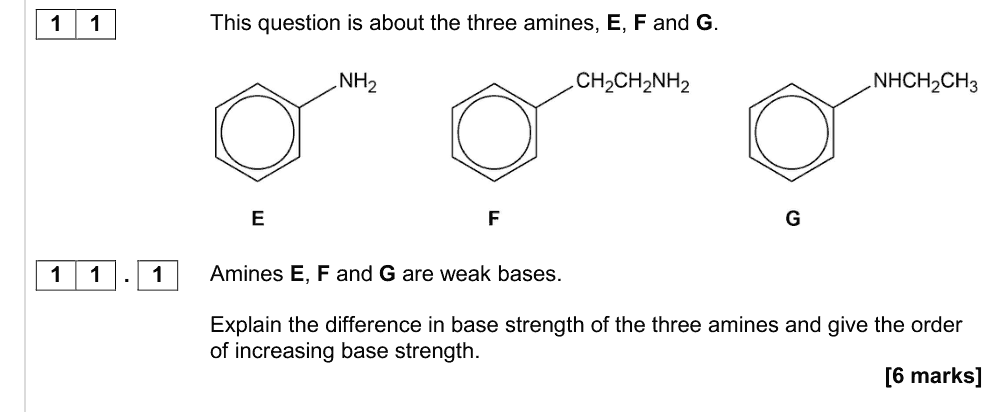
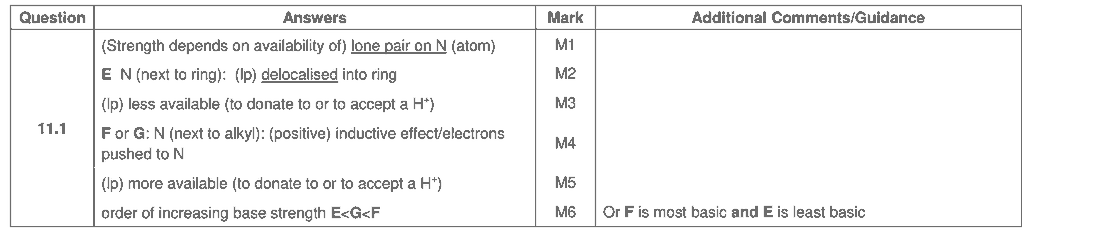
This question is about the three amines, E, F and G.
Amines E, F and G are weak bases.
Explain the difference in base strength of the three amines and give the order
of increasing base strength.
[6 marks]
June 2017 · Paper 3 · Q02.4 2 marks Explanation Hard alkenes
Earlier part of question 02 that this part usesEarlier part of June 2017 Paper 3 question 02
Explain why the product shown in your answer to Question 2.2 is the major product.
[2 marks]
June 2017 · Paper 3 · Q03.7 2 marks Explanation Hard bonding
Earlier part of question 03 that this part usesEarlier part of June 2017 Paper 3 question 03
Suggest why sodium benzoate is soluble in cold water but benzoic acid is insoluble in
cold water.
[2 marks]
June 2016 · AS Paper 1 · Q02.1 2 marks Explanation periodicityatomic structure
This question is about Period 3 of the Periodic Table.
Deduce which of Na+ and Mg2+ is the smaller ion.
Explain your answer.
[2 marks]
Smaller ion
Explanation
June 2016 · AS Paper 1 · Q02.3 4 marks Explanation periodicityatomic structure
Earlier part of question 02 that this part usesEarlier part of June 2016 Paper 1 question 02
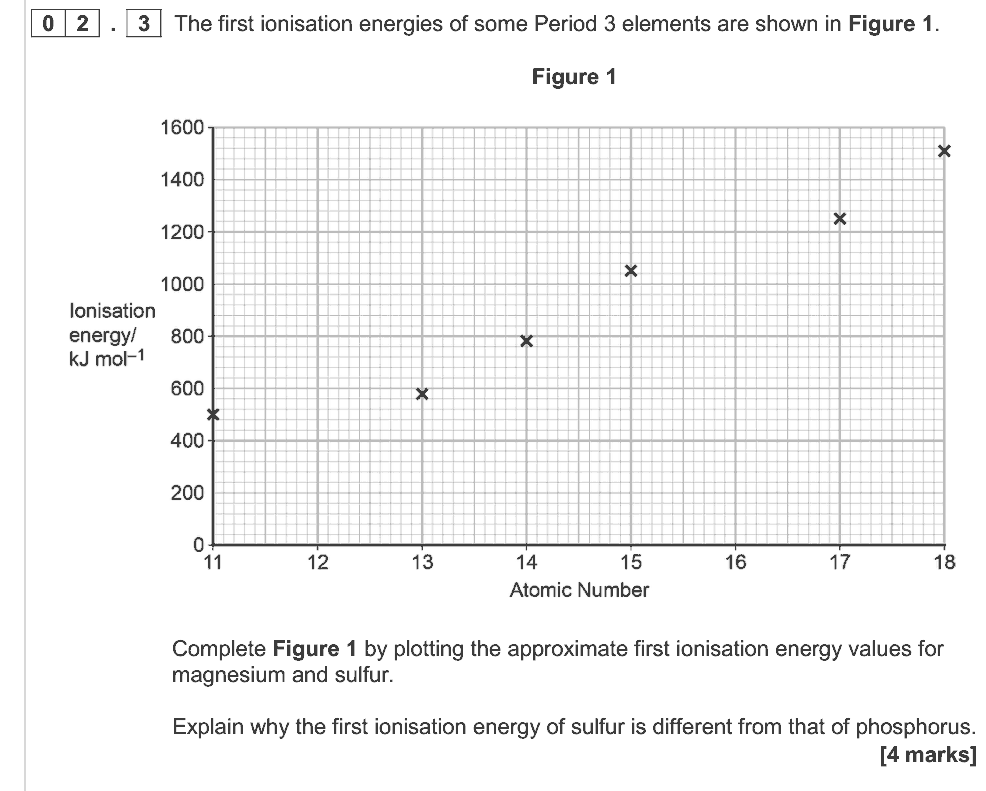
The first ionisation energies of some Period 3 elements are shown in Figure 1.
Figure 1
Complete Figure 1 by plotting the approximate first ionisation energy values for
magnesium and sulfur.
Explain why the first ionisation energy of sulfur is different from that of phosphorus.
[4 marks]
June 2016 · AS Paper 1 · Q04.1 5 marks Explanation bonding
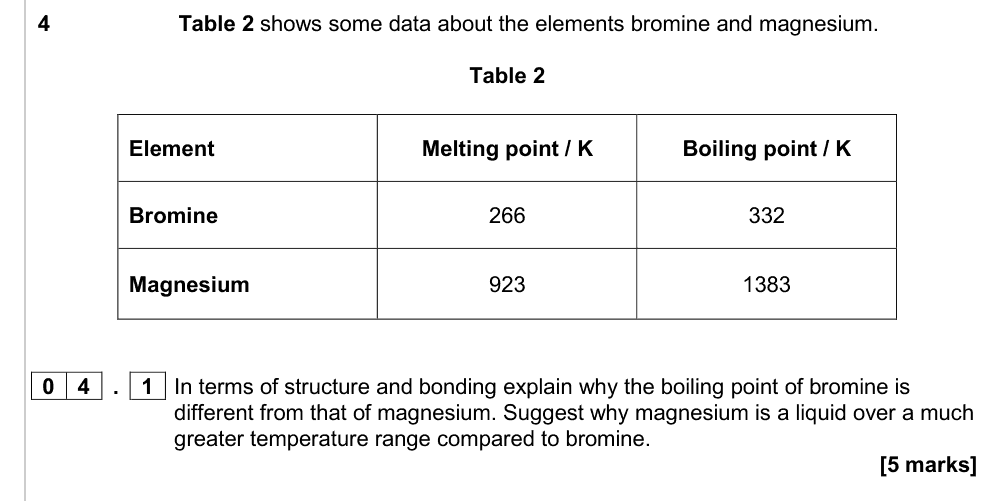
Table 2 shows some data about the elements bromine and magnesium.
Table 2
Element
Melting point / K
Boiling point / K
Bromine
266
332
Magnesium
923
1383
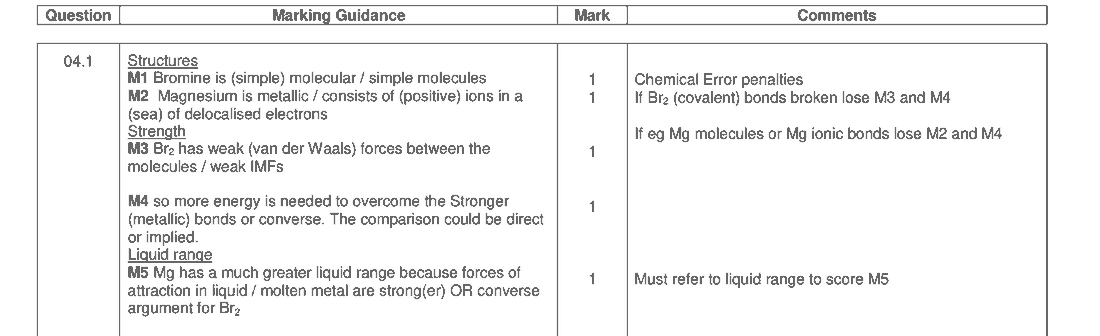
In terms of structure and bonding explain why the boiling point of bromine is
different from that of magnesium. Suggest why magnesium is a liquid over a much
greater temperature range compared to bromine.
[5 marks]
June 2016 · AS Paper 1 · Q06.1 3 marks Explanation atomic structure
Explain how ions are accelerated, detected and have their abundance determined
in a time of flight (TOF) mass spectrometer.
[3 marks]
June 2016 · AS Paper 1 · Q07.3 2 marks Explanation bonding
Earlier part of question 07 that this part usesEarlier part of June 2016 Paper 1 question 07
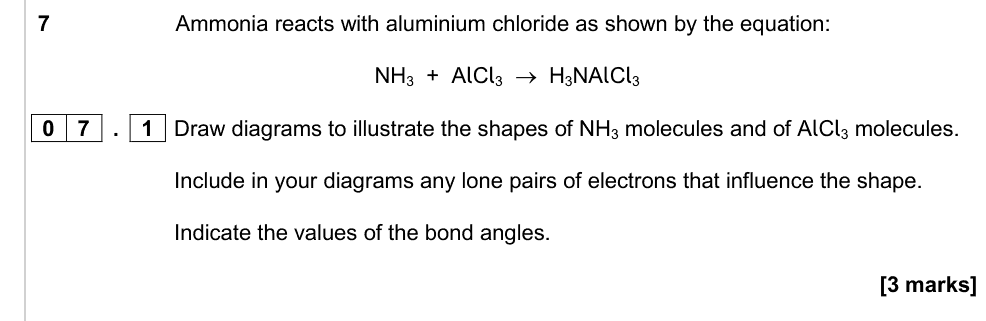
Explain how the value of the Cl-Al-Cl bond angle in AlCl3 changes, if at all, on
formation of the compound H3NAlCl3
[2 marks]
June 2016 · AS Paper 1 · Q08.4 3 marks Explanation group 7 the halogensredox
Earlier part of question 08 that this part usesEarlier part of June 2016 Paper 1 question 08
A solution of sodium chlorate(l) was added to a colourless solution of potassium
iodide.
Suggest what is observed.
Explain the reaction that leads to this observation.
[3 marks]
June 2016 · AS Paper 2 · Q03.4 2 marks Explanation kinetics
Earlier part of question 03 that this part usesEarlier part of June 2016 Paper 2 question 03
Explain, in general terms, how a catalyst works.
[2 marks]
June 2016 · AS Paper 2 · Q03.6 2 marks Explanation alkanes
Earlier part of question 03 that this part usesEarlier part of June 2016 Paper 2 question 03
Platinum, palladium and rhodium are metals used inside catalytic converters.
A very thin layer of the metals is used on a honeycomb ceramic support.
Explain why a thin layer is used in this way.
[2 marks]
June 2016 · AS Paper 2 · Q04.1 2 marks Explanation organic analysis
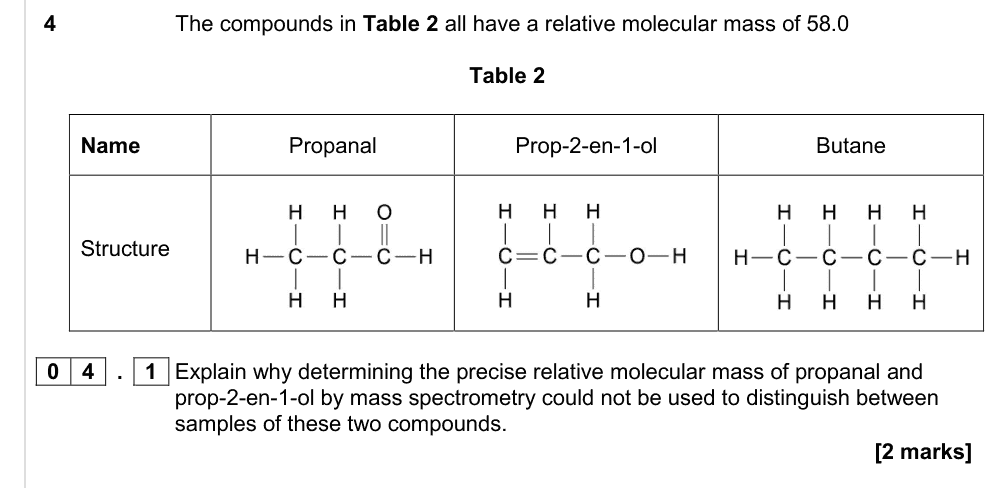
The compounds in Table 2 all have a relative molecular mass of 58.0
Table 2
Name
Propanal
Prop-2-en-1-ol
Butane
Structure
Explain why determining the precise relative molecular mass of propanal and
prop-2-en-1-ol by mass spectrometry could not be used to distinguish between
samples of these two compounds.
[2 marks]
Specimen · Paper 1 · Q02.1 2 marks Explanation periodicity
Explain why the atomic radii of the elements decrease across Period 3 from sodium to
chlorine.
[2 marks]
Specimen · Paper 1 · Q02.2 2 marks Explanation periodicitybonding
Earlier part of question 02 that this part usesEarlier part of Specimen Paper 1 question 02
Explain why the melting point of sulfur (S8) is greater than that of phosphorus (P4).
[2 marks]
Specimen · Paper 1 · Q02.3 2 marks Explanation period 3 elements and oxides
Earlier part of question 02 that this part usesEarlier part of Specimen Paper 1 question 02
Explain why sodium oxide forms an alkaline solution when it reacts with water.
[2 marks]
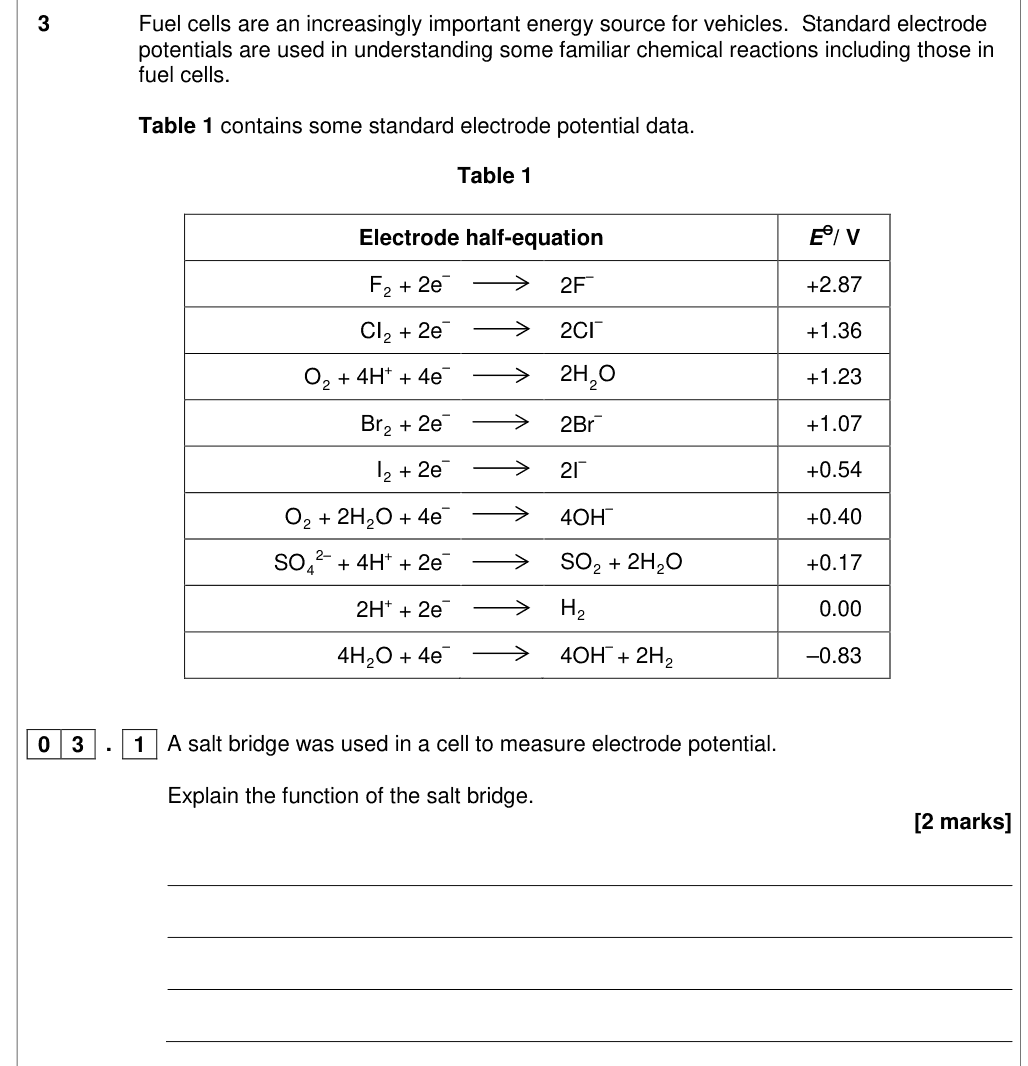
Specimen · Paper 1 · Q03.1 2 marks Explanation electrode potentials and cells
Fuel cells are an increasingly important energy source for vehicles.  Standard electrode
potentials are used in understanding some familiar chemical reactions including those in
fuel cells.
Table 1 contains some standard electrode potential data.
Table 1
Electrode half-equation
EƟ/ V
F2 + 2e
–
2F
–
+2.87
Cl2 + 2e
–
2Cl
–
+1.36
O2 + 4H+ + 4e
–
2H2O
+1.23
Br2 + 2e
–
2Br
–
+1.07
I2 + 2e
–
2I
–
+0.54
O2 + 2H2O + 4e
–
4OH
–
+0.40
SO4
2– + 4H+ + 2e
–
SO2 + 2H2O
+0.17
2H+ + 2e
–
H2
0.00
4H2O + 4e
–
4OH
– + 2H2
–0.83
A salt bridge was used in a cell to measure electrode potential.
Explain the function of the salt bridge.
[2 marks]
Specimen · Paper 1 · Q04.4 3 marks Explanation chemical equilibria and kc
Earlier part of question 04 that this part usesEarlier part of Specimen Paper 1 question 04
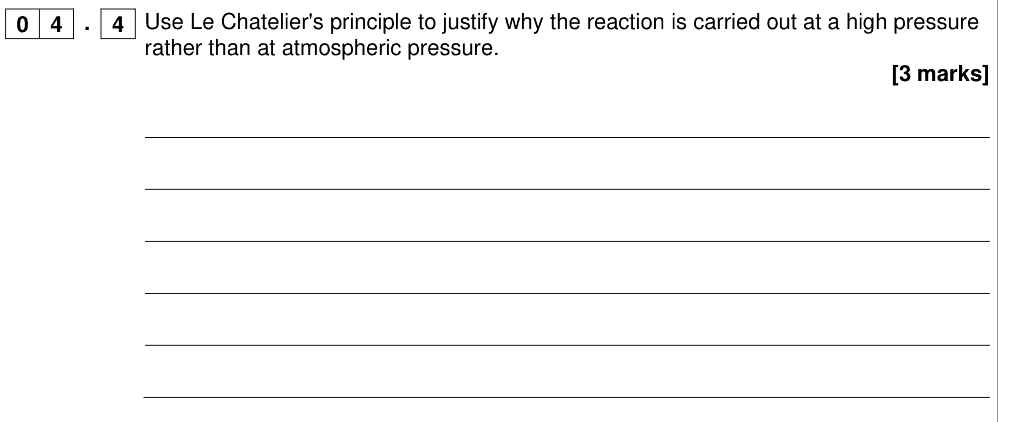
Use Le Chatelier's principle to justify why the reaction is carried out at a high pressure
rather than at atmospheric pressure.
[3 marks]
Specimen · Paper 1 · Q06.2 2 marks Explanation acids and bases
Earlier part of question 06 that this part usesEarlier part of Specimen Paper 1 question 06
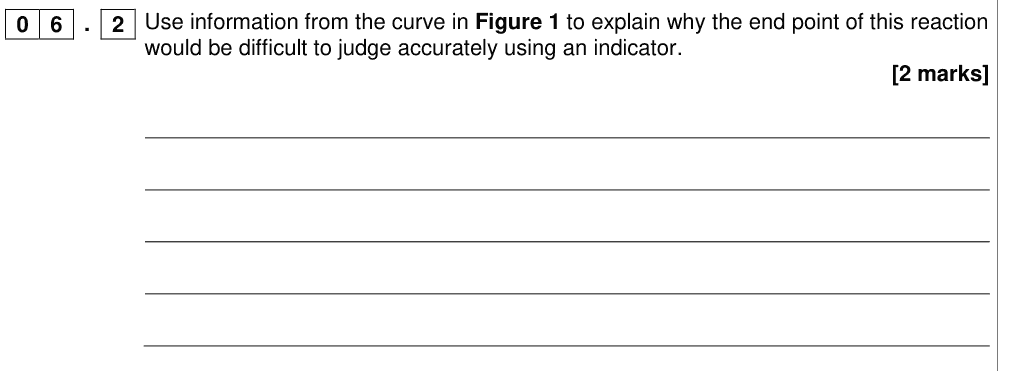
Use information from the curve in Figure 1 to explain why the end point of this reaction
would be difficult to judge accurately using an indicator.
[2 marks]
Specimen · Paper 1 · Q07.4 2 marks Explanation transition metals
Earlier part of question 07 that this part usesEarlier part of Specimen Paper 1 question 07
An acidified solution of NH4VO3 reacts with zinc.
Explain how observations from this reaction show that vanadium exists in at least two
different oxidation states.
[2 marks]
Specimen · Paper 1 · Q08.1 2 marks Explanation transition metalsbonding
A co-ordinate bond is formed when a transition metal ion reacts with a ligand.
Explain how this co-ordinate bond is formed.
[2 marks]
Specimen · Paper 1 · Q08.4 2 marks Explanation transition metals
Earlier parts of question 08 that this part usesEarlier part of Specimen Paper 1 question 08Earlier part of Specimen Paper 1 question 08
Suggest why the enthalpy change for the reaction in Question 8.3 is approximately
zero.
[2 marks]
Specimen · Paper 1 · Q08.5 2 marks Explanation transition metalsthermodynamics
Earlier parts of question 08 that this part usesEarlier part of Specimen Paper 1 question 08Earlier part of Specimen Paper 1 question 08
Explain why the reaction in Question 8.3 occurs despite having an enthalpy change
that is approximately zero.
[2 marks]
Specimen · Paper 1 · Q09.4 2 marks Explanation thermodynamicsbonding
Earlier part of question 09 that this part usesEarlier part of Specimen Paper 1 question 09
Explain why your answer to Question 9.3 is different from the lattice enthalpy of
dissociation for magnesium chloride.
[2 marks]
Specimen · Paper 2 · Q01.1 3 marks Explanation rate equations
This question involves the use of kinetic data to deduce the order of a reaction and
calculate a value for a rate constant.
The data in Table 1 were obtained in a series of experiments on the rate of the
reaction between compounds A and B at a constant temperature.
Table 1
Experiment  Initial concentration
of A / mol dm–3
Initial concentration
of B / mol dm–3
Initial rate
/ mol dm–3 s–1
1
0.12
0.26
2.10 × 10⁻⁴
2
0.36
0.26
1.89 × 10⁻³
3
0.72
0.13
3.78 × 10⁻³
Show how these data can be used to deduce the rate expression for the reaction
between A and B.
[3 marks]
Specimen · Paper 2 · Q01.4 3 marks Explanation rate equationskinetics
Earlier parts of question 01 that this part usesEarlier part of Specimen Paper 2 question 01Earlier part of Specimen Paper 2 question 01
The rate equation for a reaction is
rate  =  k[E]
Explain qualitatively why doubling the temperature has a much greater effect on
the rate of the reaction than doubling the concentration of E.
[3 marks]
Specimen · Paper 2 · Q05.2 4 marks Explanation amino acids proteins and dnabonding
Earlier part of question 05 that this part usesEarlier part of Specimen Paper 2 question 05
Explain the origin of the interaction represented by the dotted lines in Figure 3.
[4 marks]
Specimen · Paper 2 · Q07.3 3 marks Explanation polymers
Earlier part of question 07 that this part usesEarlier part of Specimen Paper 2 question 07
Suggest an environmental advantage of polymer Q over polymer P.
Justify your answer.
[3 marks]
Advantage
Justification
Specimen · Paper 2 · Q08.2 4 marks Explanation amino acids proteins and dna
Earlier part of question 08 that this part usesEarlier part of Specimen Paper 2 question 08
Messenger RNA is synthesised in cells in order to transfer information from DNA.
The bases in one strand of DNA pair up with the bases used to synthesise RNA.
Figure 7 shows two bases used in RNA.
Figure 7
Suggest which of the bases A and B forms a pair with guanine in Figure 6 when
messenger RNA is synthesised.
Explain how the base that you have chosen forms a base pair with guanine.
[4 marks]
Specimen · Paper 2 · Q10 8 marks Explanation nmr spectroscopyorganic analysis
The infrared spectrum (Figure 9) and the 1H NMR spectrum (Figure 10) of
compound R with molecular formula C6H14O are shown.
Figure 9
Figure 10
100
50
0
Transmittance /
%
Wavenumber / cm–1
4000
3000
2000
1500
1000
500
0
4
1
3
2
0.4
1.6
2.4
1.2
The relative integration values for the NMR peaks are shown on Figure 10.
Deduce the structure of compound R by analysing Figure 9 and Figure 10.
Explain each stage in your deductions.
Use Table A and Table B on the Data Sheet.
[8 marks]
Specimen · Paper 2 · Q12.3 3 marks Explanation alkenesoptical isomerism
Earlier part of question 12 that this part usesEarlier part of Specimen Paper 2 question 12
Explain how three isomeric products are formed when HY reacts with but-1-ene.
[3 marks]
Specimen · Paper 3 · Q01.4 2 marks Explanation bonding
Earlier part of question 01 that this part usesEarlier part of Specimen Paper 3 question 01
Use your knowledge of structure and bonding to explain why it is possible to separate
ethanal in this way.
[2 marks]
Specimen · Paper 3 · Q03.3 2 marks Explanation chromatography
Earlier part of question 03 that this part usesEarlier part of Specimen Paper 3 question 03
Explain why different amino acids have different Rf values.
[2 marks]
Specimen · Paper 3 · Q05.2 4 marks Explanation atomic structure
Earlier part of question 05 that this part usesEarlier part of Specimen Paper 3 question 05
Outline how the TOF mass spectrometer is able to separate these two species to give
two peaks.
[4 marks]

Work with an A-level chemistry tutor

Dropping marks on calculations, mechanisms or the required practicals? Book a trial session with a specialist A-level chemistry tutor.

Prefer email? Send an enquiry

If you are under 18, please include a parent's contact details. Enquiries go to enquiries@chemistryaleveltutor.com and are deleted once handled. All tutoring is online.