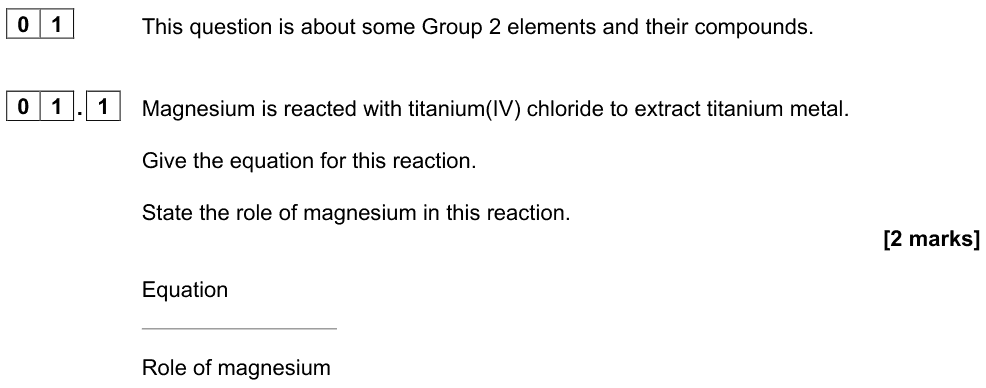
Notes and key-term cards for this topic are being written by our tutors. The past-paper questions below are ready now.
Specification statements
Show the 14 statements from the specification
3.2.3.1-01 The trends in electronegativity and boiling point of the halogens.
3.2.3.1-02 Students should be able to: • explain the trend in electronegativity • explain the trend in the boiling point of the elements in terms of their structure and bonding.
3.2.3.1-03 The trend in oxidising ability of the halogens down the group, including displacement reactions of halide ions in aqueous solution.
3.2.3.1-04 The trend in reducing ability of the halide ions, including the reactions of solid sodium halides with concentrated sulfuric acid.
3.2.3.1-05 The use of acidified silver nitrate solution to identify and distinguish between halide ions.
3.2.3.1-06 The trend in solubility of the silver halides in ammonia.
3.2.3.1-07 Students should be able to explain why: • silver nitrate solution is used to identify halide ions • the silver nitrate solution is acidified • ammonia solution is added.
3.2.3.2-01 The reaction of chlorine with water to form chloride ions and chlorate(I) ions.
3.2.3.2-02 The reaction of chlorine with water to form chloride ions and oxygen.
3.2.3.2-03 Appreciate that society assesses the advantages and disadvantages when deciding if chemicals should be added to water supplies.
3.2.3.2-04 The use of chlorine in water treatment.
3.2.3.2-05 Appreciate that the benefits to health of water treatment by chlorine outweigh its toxic effects.
3.2.3.2-06 The reaction of chlorine with cold, dilute, aqueous NaOH and uses of the solution formed.
3.2.3.2-07 Required practical 4 Carry out simple test-tube reactions to identify: • cations – Group 2, NH4+ • anions – Group 7 (halide ions), OH–, CO32–, SO42–
Six-mark level of response questions on this topic
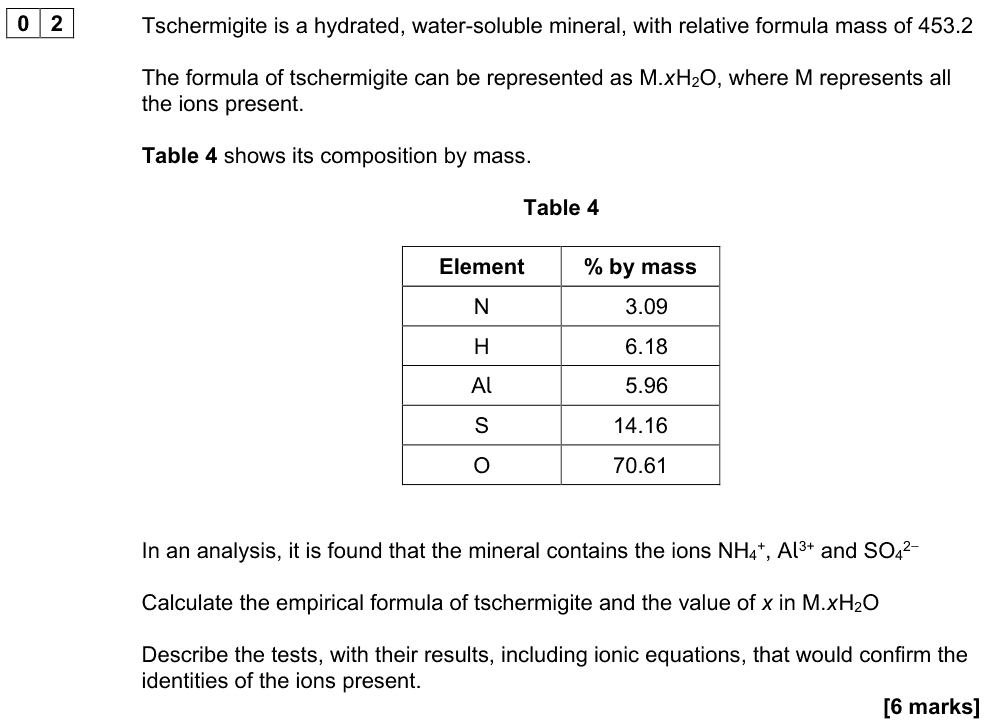
the empirical formula of tschermigite and the value of x in M.x H2O Describe the tests, with their results, including ionic equations, that would confirm the
Tap a question to zoom it. Where a part needs a figure, table or structure from earlier in the question, that part folds out above it; the mark scheme and examiner's comment open underneath. Have AQA's Data Booklet (the Periodic Table and the spectroscopy tables) beside you.
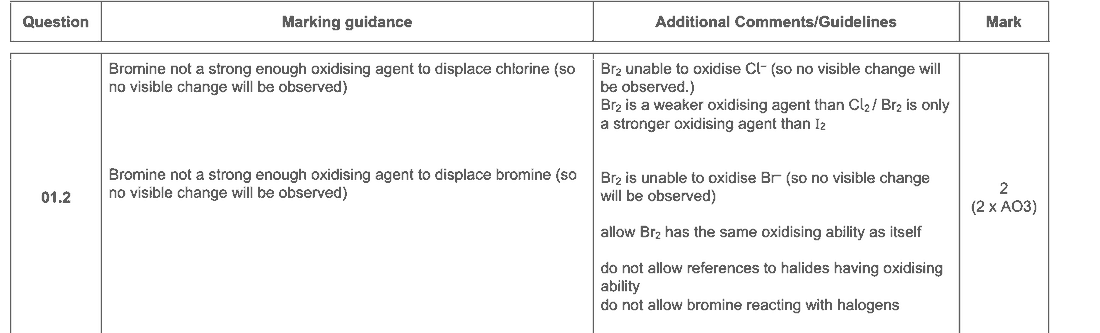
June 2025 · Paper 1 · Q01.53 marksAO2=1, AO3=2Equation writing
Earlier parts of question 01 that this part uses
Mark scheme
Examiner's comment
The bromide was well known in part 5, but many students did not write an ionic equation or omitted the state symbols in their equation.
The most common answer for the explanation of acidification was to remove carbonate ions.
Occasionally, students answered in terms of false positive results but failed to mention the ions involved.
Notes from the mark scheme and report
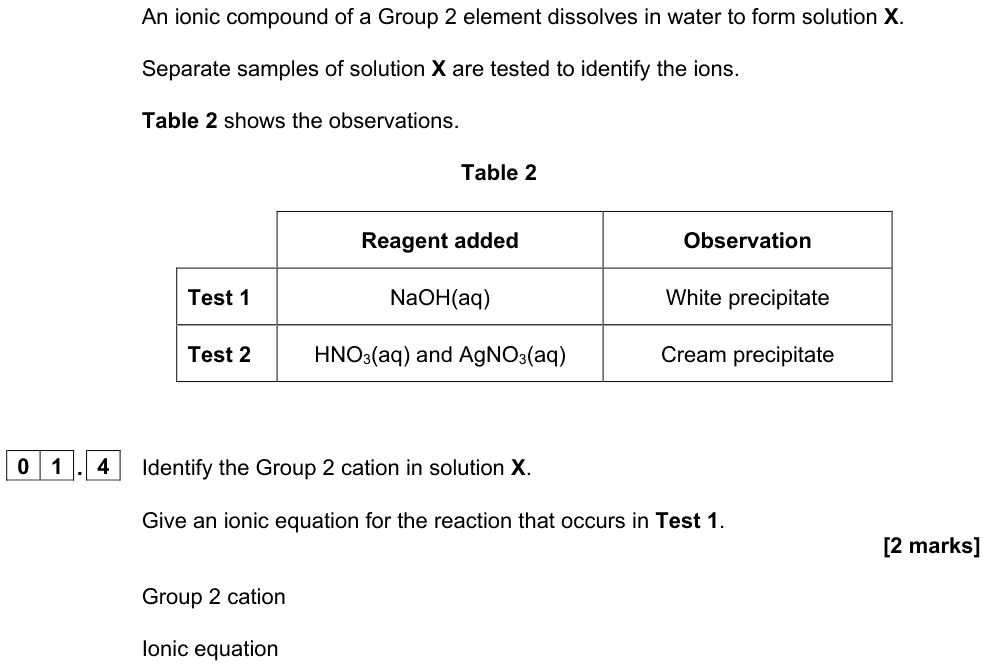
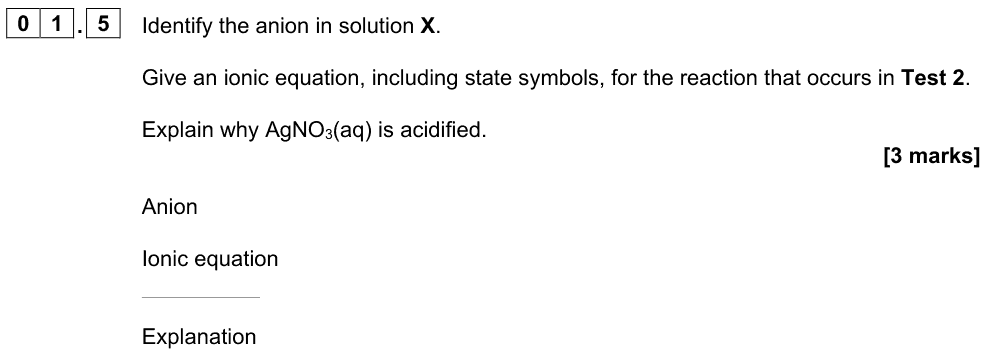
Bromide (cream precipitate)
Ag+(aq) + Br–(aq) → AgBr(s)
acidified to remove carbonate ions (or other ions that would give a precipitate with silver nitrate). Errors: full rather than ionic equation
state symbols omitted
'false positives' without naming the ions. Uses Table 2 from 01.4
Skills: PS1.2 Apply scientific knowledge to practical contexts; RP4 Carry out simple test-tube reactions to identify: cations – Group 2, NH4+; anions – Group 7 (halide ions), OH–, CO32–, SO42–
June 2025 · AS Paper 1 · Q02.12 marksAO1=2Explanation
Mark scheme
Examiner's comment
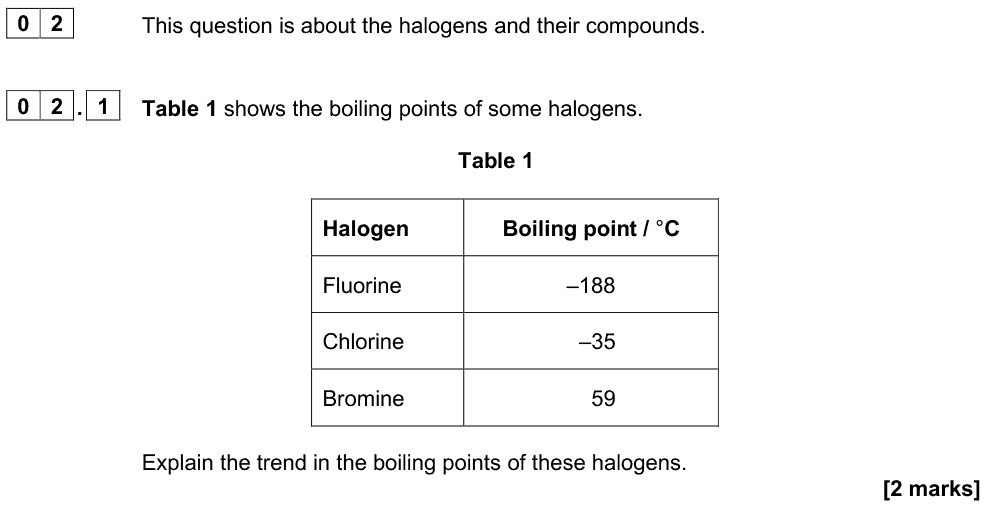
2.1 Students usually understood that the reason for increasing boiling points down the group was linked to the larger molecules. However, few students were able to be precise about the nature of the van der Waals’ forces (or induced dipole-dipole forces) between the molecules.
Notes from the mark scheme and report
Down the group the molecules are larger / have more electrons, so there are stronger van der Waals (induced dipole–dipole, London, dispersion) forces between molecules. If a wrong trend is stated the next mark is lost. Few were precise about the forces being between molecules
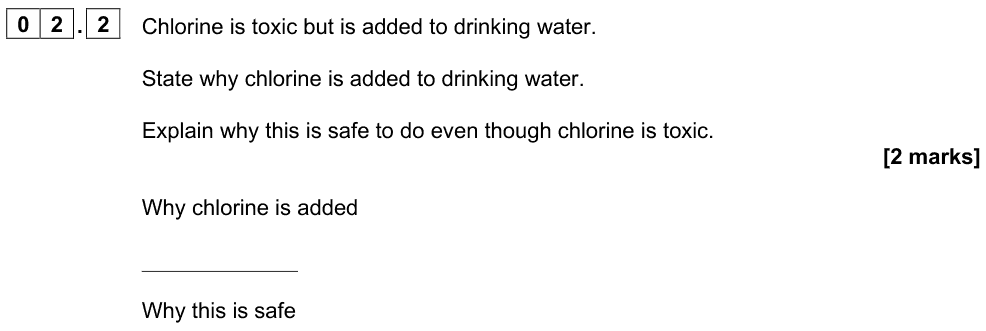
June 2025 · AS Paper 1 · Q02.22 marksAO1=2Short answer
Earlier part of question 02 that this part uses
Mark scheme
Examiner's comment
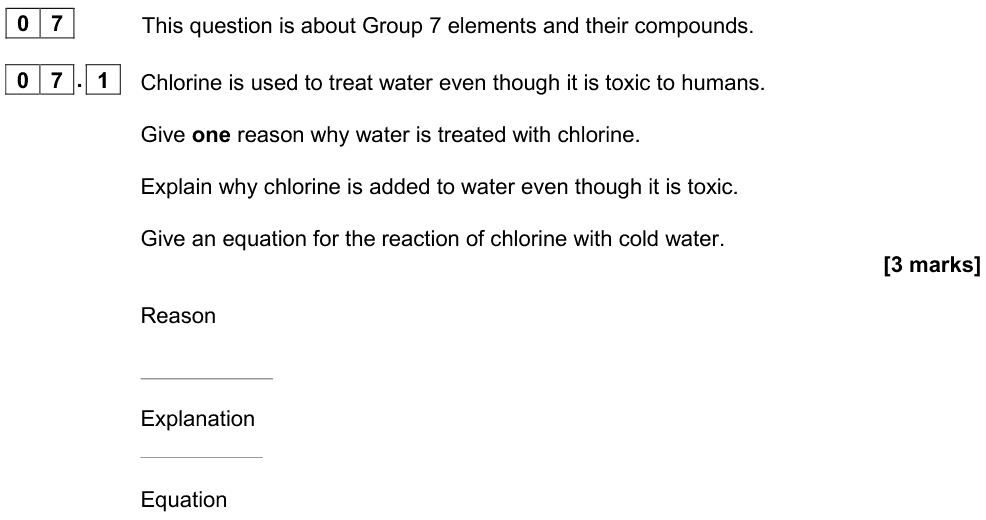
2.2 Most students were able to give the reason for adding chlorine to water in order to kill bacteria but few students were able to explain clearly why this was safe to do in terms of the toxic chlorine being of low concentration.
Notes from the mark scheme and report
Added to kill bacteria / sterilise water / prevent water-borne disease (for example cholera). Safe because the concentration used is small enough not to harm humans. Few explained the low concentration
June 2025 · AS Paper 1 · Q02.31 markAO1=1Equation writing
Earlier part of question 02 that this part uses
Mark scheme
Examiner's comment
2.3 The majority of students did not realise that when chlorine reacts with water in sunlight, this leads to the formation of oxygen and instead gave an equation to form hydrochloric acid and chloric(I) acid. Equations that lead to the formation of oxygen were often not correctly balanced.
Notes from the mark scheme and report
2Cl2 + 2H2O → 4HCl + O2 (allow 4H+ + 4Cl–). Most gave the equation forming HCl and HClO instead
equations forming O2 were often unbalanced
June 2025 · AS Paper 1 · Q02.41 markAO1=1Equation writing
Earlier part of question 02 that this part uses
Mark scheme
Examiner's comment
2.4 Students often gave equations that produced hydrochloric acid rather than appreciating that sodium chloride would also be formed in this reaction in addition to sodium chlorate(I).
Notes from the mark scheme and report
2NaOH + Cl2 → NaClO + NaCl + H2O. Common error: HCl as a product instead of NaCl
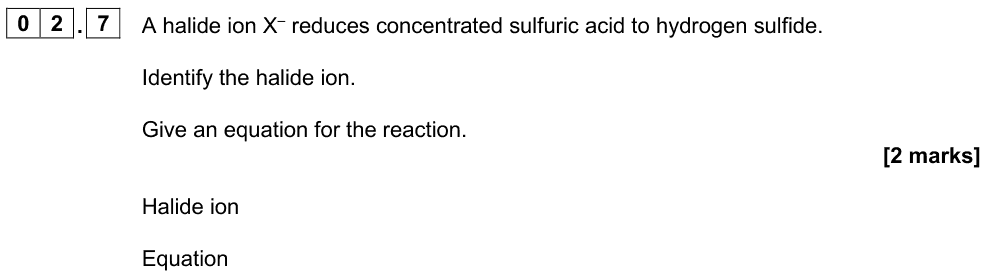
June 2025 · AS Paper 1 · Q02.72 marksAO1=1, AO2=1Equation writingHard
Earlier part of question 02 that this part uses
Mark scheme
Examiner's comment
2.7 A large proportion of students were able to identify the halide ion that is able to reduce concentrated sulfuric acid to hydrogen sulphide. Only about one quarter of students were then able to give a correct equation for the reaction of this halide ion with sulfuric acid to form hydrogen sulphide.
Notes from the mark scheme and report
Iodide, I– (allow astatide). H2SO4 + 8H+ + 8I– → H2S + 4H2O + 4I2 (allow 8HI, or 10H+ + SO4 2– + 8I–). Most identified the halide
the equation was the difficulty
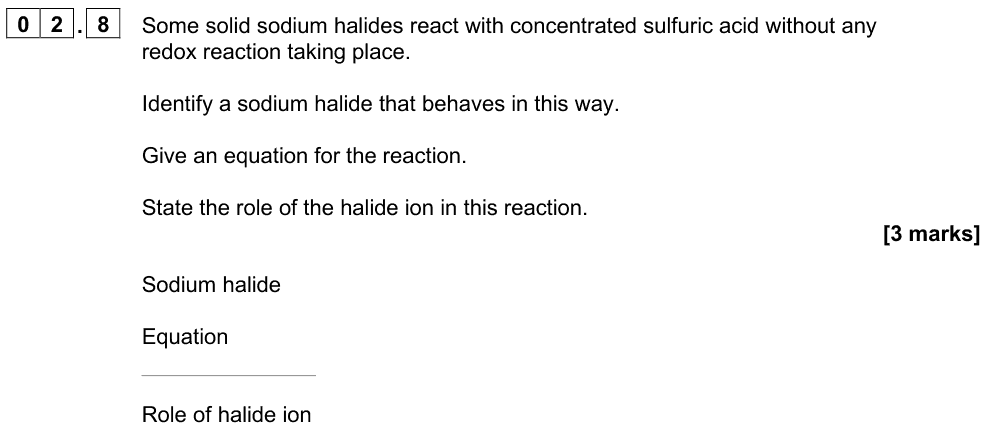
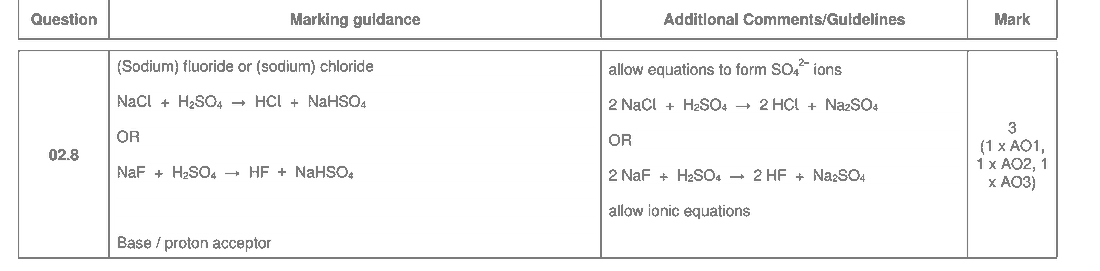
June 2025 · AS Paper 1 · Q02.83 marksAO1=1, AO2=1, AO3=1Equation writing
Earlier part of question 02 that this part uses
Mark scheme
Examiner's comment
2.8 About three-quarters of students correctly identified a sodium halide that reacts with concentrated sulfuric acid without any redox taking place. However, less than half were then able to give an equation for the acid-base reaction that takes place whilst some gave equations for a redox reaction rather than an acid-base reaction.
allow equations forming Na2SO4, and ionic equations). The halide ion acts as a base / proton acceptor. About three-quarters identified the halide but fewer than half gave the equation
some wrote a redox equation
June 2025 · Paper 1 · Q05.12 marksAO1=2Explanation
Mark scheme
Examiner's comment
Many students failed to mention that van der Waals’ forces were between molecules in part 1; a few students referred to chloride and bromide ions.
Some students confused the boiling point with ionisation energy and wrote about higher nuclear charge in bromine so stronger attraction between the outer electrons and the nucleus.
A number of students thought that the covalent bonds break during a change of state and some students compared the reactivity of chlorine and bromine.
Notes from the mark scheme and report
Chlorine molecules are smaller / have fewer electrons (smaller Mr)
so the van der Waals forces between chlorine molecules are weaker and need less energy to overcome. Errors: not saying the forces are between molecules
chloride and bromide ions
breaking covalent bonds
nuclear attraction arguments
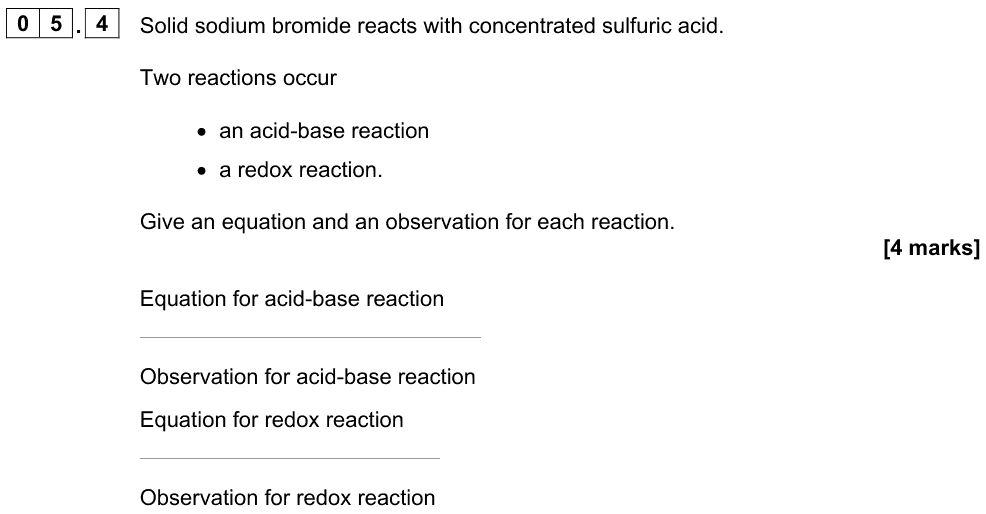
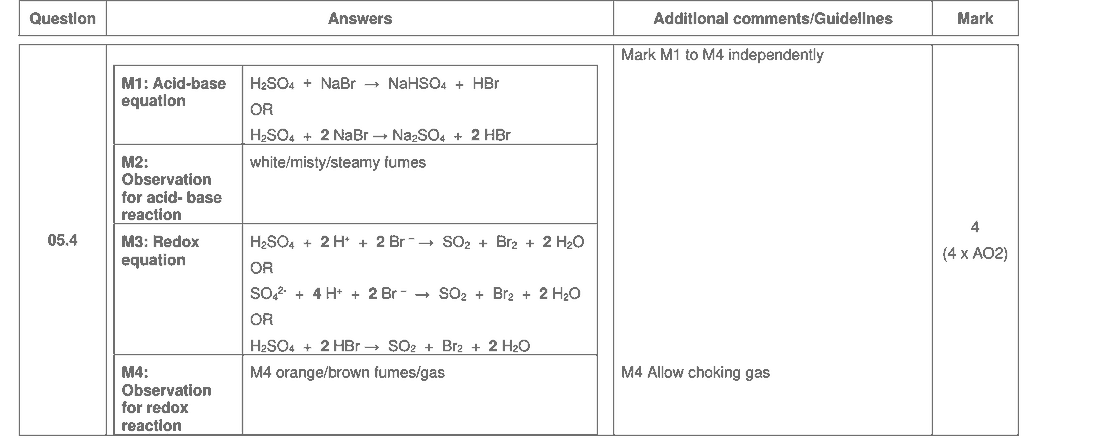
June 2025 · Paper 1 · Q05.44 marksAO2=4Equation writing
Earlier part of question 05 that this part uses
Mark scheme
Examiner's comment
Part 4 differentiated well; observations were often incorrect eg white and cream precipitates, and HBr described as a brown gas.
A correct equation for the acid -base equation was more successful than the redox equation.
The redox equation was often unbalanced or contained incorrect formulas eg NaSO4 and BrSO4.
orange / brown fumes. Four independent marks. Errors: white or cream precipitates as observations
HBr described as brown
unbalanced redox equation
formulas such as NaSO4
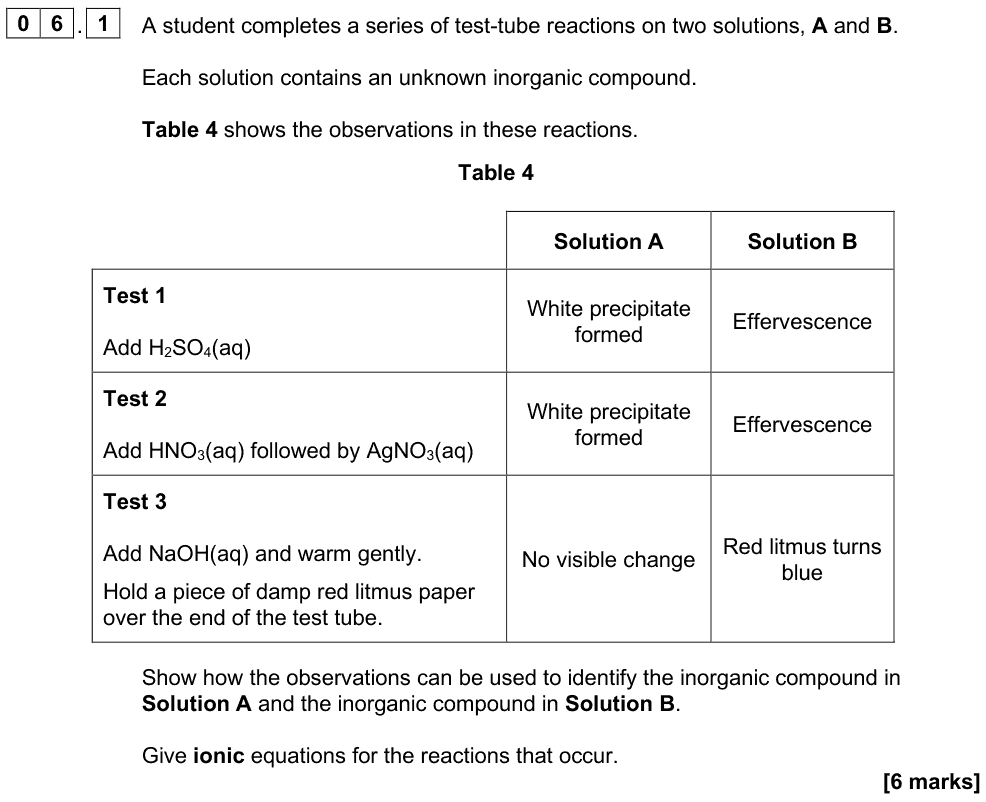
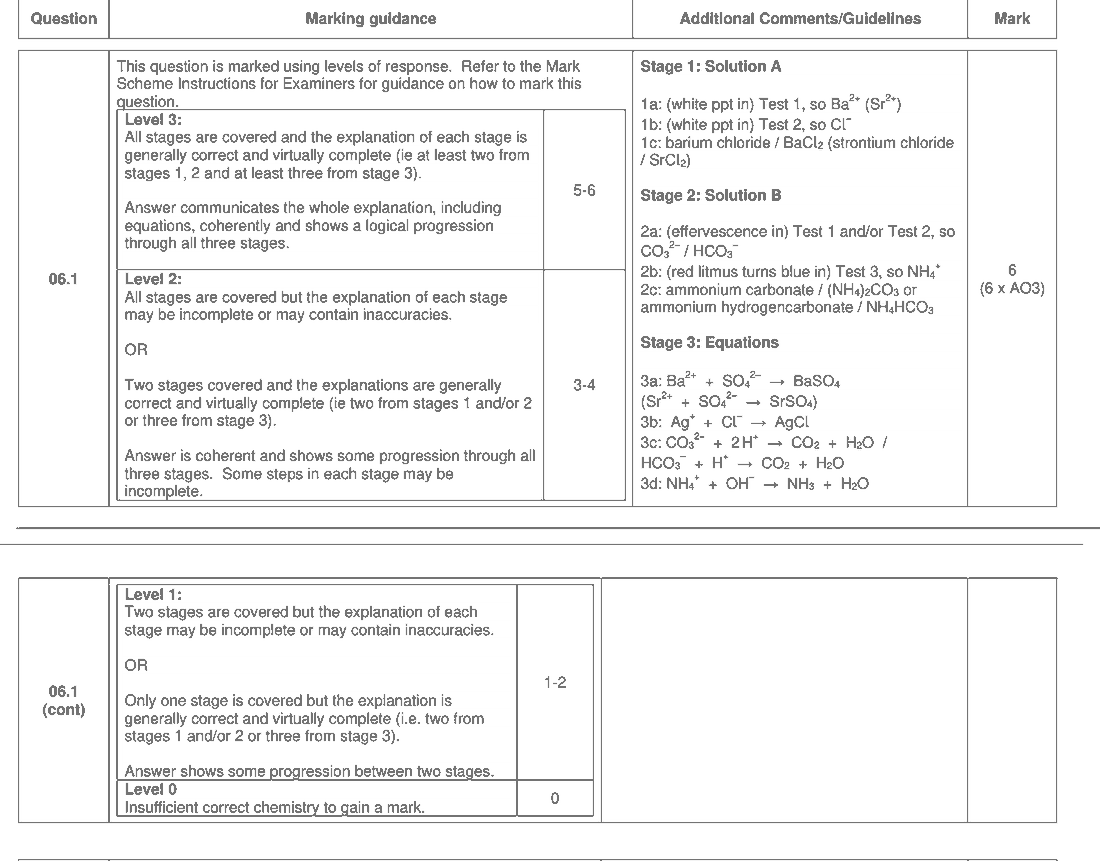
June 2025 · AS Paper 1 · Q06.16 marksAO3=66-mark level of responseHard
Mark scheme, with the levels and indicative content
Examiner's comment
6.1 Students found interpreting the observations for a series of test-tube reaction challenging. Correct ionic equations for the reactions. Ionic equations were frequently missing from student answers so only about a quarter of students scored highly on this question. Students did also not always clearly explain how the observations from the Table could be used to identify the ions / compounds present in each solution.
Notes from the mark scheme and report
Levels of response, three stages. Stage 1, solution A: white precipitate with H2SO4 so Ba2+ (or Sr2+)
white precipitate with acidified AgNO3 so Cl–
barium chloride. Stage 2, solution B: effervescence with acid so CO3 2– (or HCO3–)
damp red litmus turns blue on warming with NaOH so NH4+
NH4+ + OH– → NH3 + H2O. Ionic equations were frequently missing and the link from observation to ion was not always explained
Skills: PS1.1 Solve problems set in practical contexts; PS2.3 Evaluate results and draw conclusions with reference to measurement uncertainties and errors; ATd Use laboratory apparatus for a variety of experimental techniques including: titration, using burette and pipette; distillation and heating under reflux, including setting up glassware using retort stand and clamps; qualitative tests for ions and organic functional groups; filtration, including use of fluted filter paper, or filtration under reduced pressure; RP4 Carry out simple test-tube reactions to identify: cations – Group 2, NH4+; anions – Group 7 (halide ions), OH–, CO32–, SO42–
June 2025 · AS Paper 1 · Q06.21 markAO3=1Practical and data analysisHard
Earlier part of question 06 that this part uses
Mark scheme
Examiner's comment
6.2 Only about a third of students were able to describe correctly a test to confirm that a solution contains hydroxide ions.
Notes from the mark scheme and report
Add universal indicator, which turns blue / purple, or red litmus, which turns blue
or add a named soluble magnesium salt to give a (slight) white precipitate. Reagent and result both needed
Skills: ATd Use laboratory apparatus for a variety of experimental techniques including: titration, using burette and pipette; distillation and heating under reflux, including setting up glassware using retort stand and clamps; qualitative tests for ions and organic functional groups; filtration, including use of fluted filter paper, or filtration under reduced pressure; PS4.1 Know and understand how to use a wide range of experimental and practical instruments, equipment and techniques appropriate to the knowledge and understanding included in the specification; RP4 Carry out simple test-tube reactions to identify: cations – Group 2, NH4+; anions – Group 7 (halide ions), OH–, CO32–, SO42–
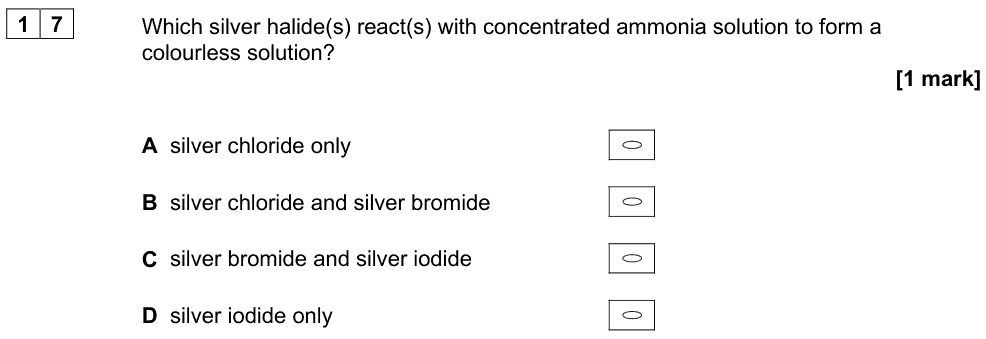
June 2025 · AS Paper 1 · Q171 markAO1=1Multiple choiceEasy
Answer
B
Mark scheme
Examiner's comment
About two-thirds of students could identify the silver halide that reacts with concentrated ammonia for form a colourless solution.
Notes from the mark scheme and report
Answer: B. AgCl dissolves in dilute ammonia and AgBr in concentrated ammonia
AgI is insoluble in concentrated ammonia
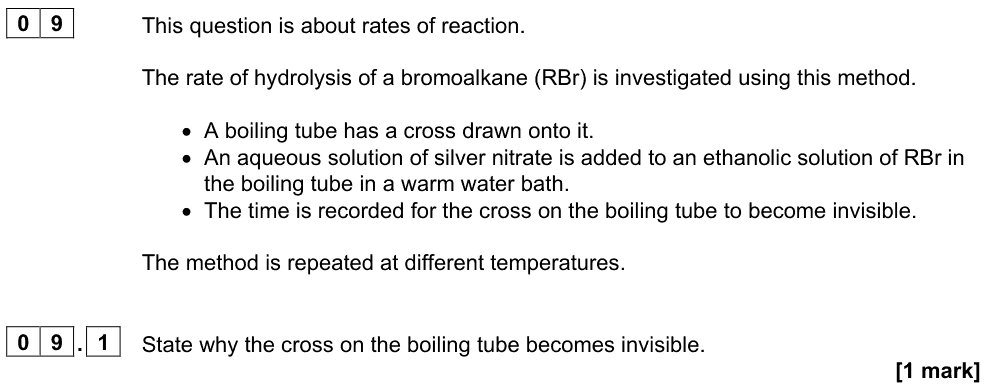
June 2025 · Paper 2 · Q09.11 markAO1=1Short answer
Mark scheme
Examiner's comment
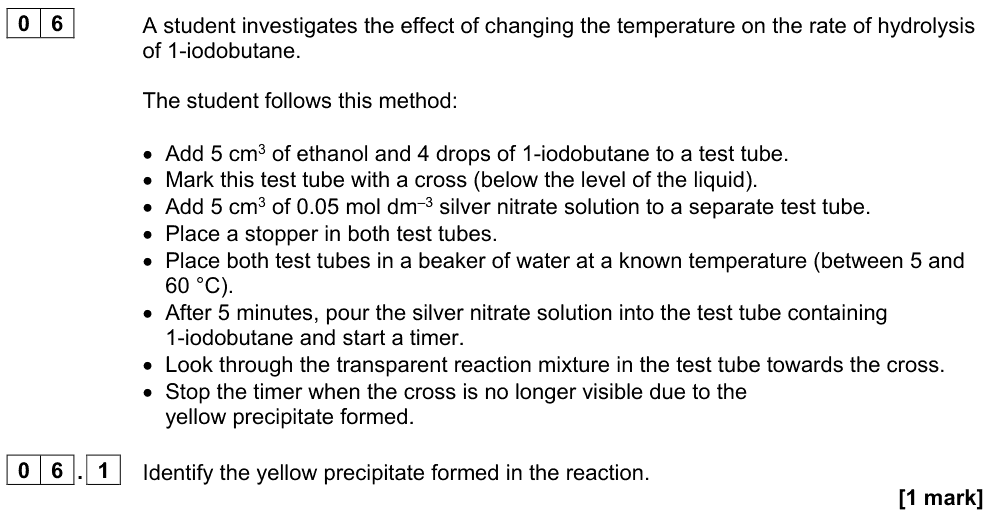
9.1 This question was well answered and students were often able to give precipitation of silver bromide as the reason that the cross on the boiling tube became invisible
Notes from the mark scheme and report
An insoluble product (silver bromide precipitate) forms
Skills: PS1.2 Apply scientific knowledge to practical contexts; RP3 Investigation of how the rate of a reaction changes with temperature
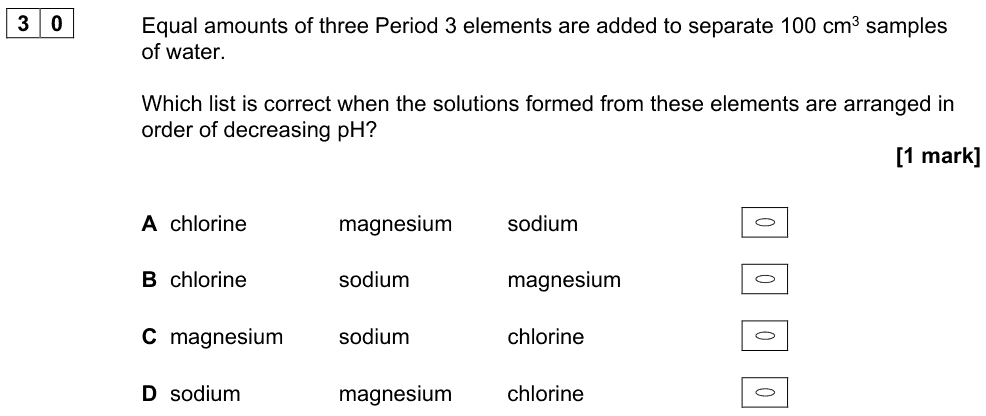
June 2025 · Paper 3 · Q301 markAO1=1Multiple choice
Answer
D
Mark scheme
Notes from the mark scheme and report
Answer: D. Sodium gives strongly alkaline NaOH
magnesium reacts very slowly to give sparingly soluble Mg(OH)2
chlorine gives an acidic solution (HCl and HClO)
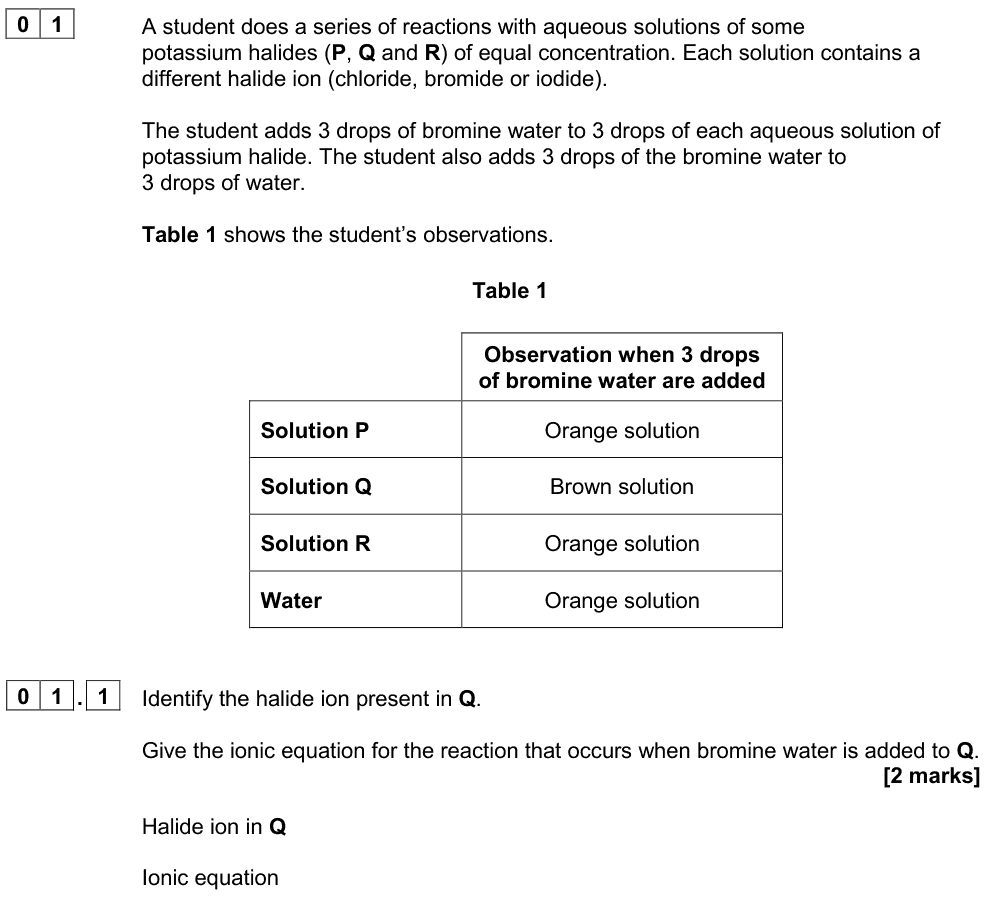
June 2024 · AS Paper 1 · Q01.12 marksAO3=2Short answerHard
Mark scheme
Examiner's comment
01.1 Many students were able to identify the halide ion present in Q as iodide, but only about a quarter of students were able to give the correct ionic equation for the reaction of these ions with bromine. Common incorrect answers gave equations that included the spectator ions and also half equations that showed the reduction of iodide ions.
Notes from the mark scheme and report
Iodide ion, I– (not iodine, I or I2). Br2 + 2I– → I2 + 2Br– (allow Br2 + 3I– → I3– + 2Br–). Errors: including K+ spectator ions
half-equations only
Skills: PS1.2 Apply scientific knowledge to practical contexts; ATd Use laboratory apparatus for a variety of experimental techniques including: titration, using burette and pipette; distillation and heating under reflux, including setting up glassware using retort stand and clamps; qualitative tests for ions and organic functional groups; filtration, including use of fluted filter paper, or filtration under reduced pressure
June 2024 · AS Paper 1 · Q01.22 marksAO3=2Explanation
Earlier part of question 01 that this part uses
Mark scheme
Examiner's comment
01.2 This question was not well answered. Many students did not mention oxidising ability. Students need to be precise with their use of terminology and understand that halogens are displaced, and halide ions are oxidised. Commonly students included incorrect statements such as ‘bromine is not able to displace chloride’ or ‘bromine is unable to oxidise chlorine.’
Notes from the mark scheme and report
Bromine is not a strong enough oxidising agent to oxidise chloride ions (Br2 is a weaker oxidising agent than Cl2), and Br2 cannot oxidise Br–, so neither P nor R shows a visible change. Halogens are displaced, halide ions are oxidised: 'bromine cannot displace chloride' or 'cannot oxidise chlorine' do not score
halides do not have oxidising ability
Skills: PS1.2 Apply scientific knowledge to practical contexts
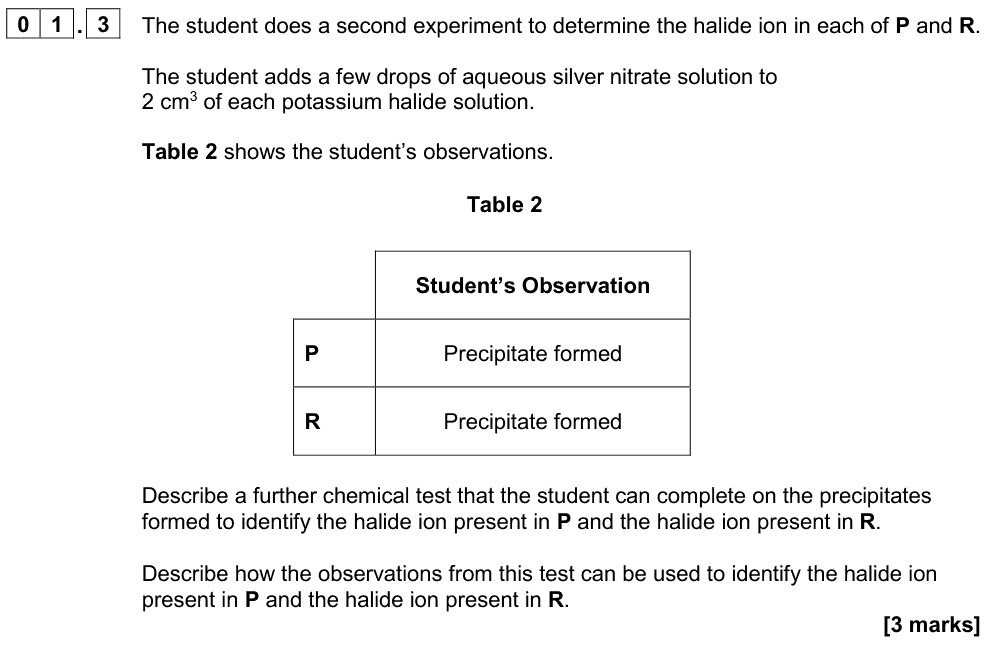
June 2024 · AS Paper 1 · Q01.33 marksAO3=3Practical and data analysis
Earlier part of question 01 that this part uses
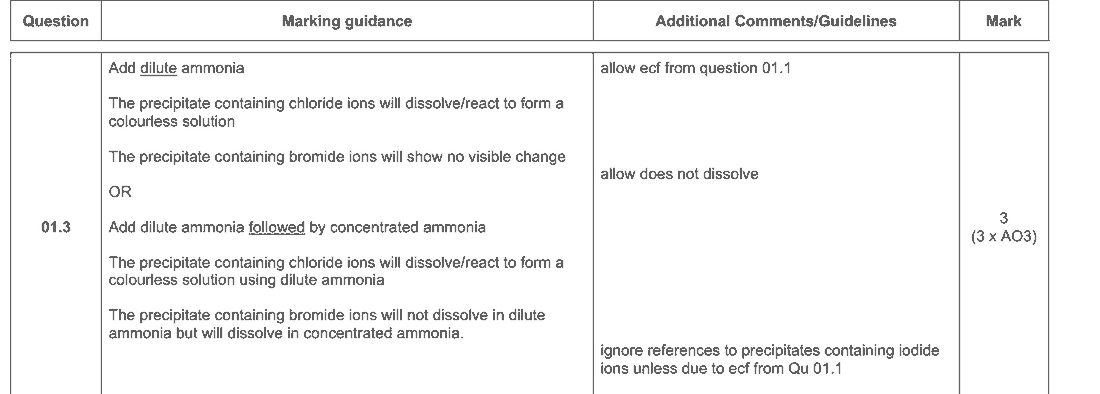
Mark scheme
Examiner's comment
01.3 Many students were able to describe a suitable chemical test using ammonia. However, most students were unable to describe how the observations can be used to identify the halide ion present in P and the halide ion present in R. Students often suggested incorrectly that the solutions or ions dissolved rather than the precipitates.
Notes from the mark scheme and report
Add dilute ammonia solution to each precipitate. The precipitate from the chloride (AgCl) dissolves to give a colourless solution
the precipitate from the bromide (AgBr) shows no visible change (it dissolves only in concentrated ammonia). It is the precipitate that dissolves, not the solution or the ions
Skills: ATd Use laboratory apparatus for a variety of experimental techniques including: titration, using burette and pipette; distillation and heating under reflux, including setting up glassware using retort stand and clamps; qualitative tests for ions and organic functional groups; filtration, including use of fluted filter paper, or filtration under reduced pressure; PS1.1 Solve problems set in practical contexts; PS4.1 Know and understand how to use a wide range of experimental and practical instruments, equipment and techniques appropriate to the knowledge and understanding included in the specification; RP4 Carry out simple test-tube reactions to identify: cations – Group 2, NH4+; anions – Group 7 (halide ions), OH–, CO32–, SO42–
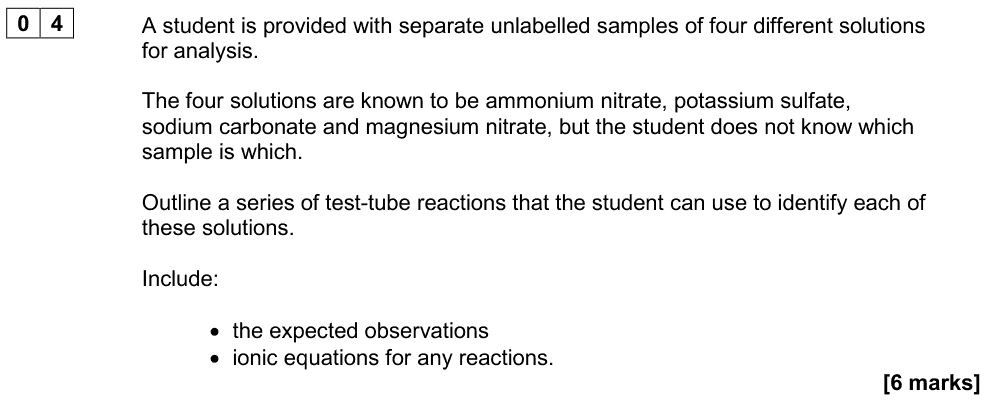
June 2024 · AS Paper 1 · Q046 marksAO2=2, AO3=46-mark level of response
Mark scheme, with the levels and indicative content
Examiner's comment
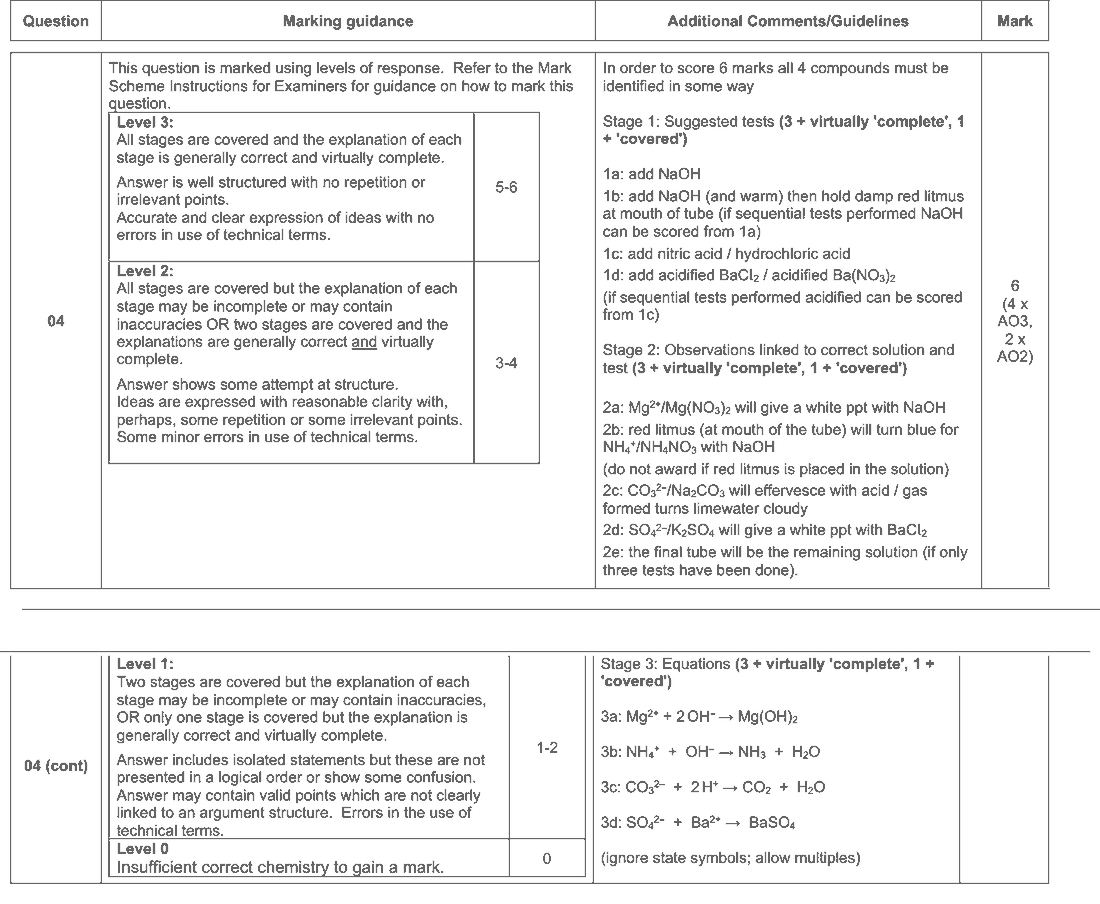
04 Only a few students scored all the marks on this question. Inorganic ion tests were not well described. In particular, many students did not show that the test for ammonium ions requires the use of sodium hydroxide as well as placing damp red litmus paper at the top/mouth of the tube. Students did not always provide any equations for these tests and when these were provided, they were often not ionic equations.
Notes from the mark scheme and report
Levels of response, three stages. Tests: add NaOH
add NaOH, warm and hold damp red litmus at the mouth of the tube
add dilute nitric or hydrochloric acid
add acidified BaCl2. Observations: Mg(NO3)2 gives a white precipitate with NaOH
NH4NO3 turns the damp red litmus blue
Na2CO3 effervesces with acid
K2SO4 gives a white precipitate with BaCl2. Ionic equations: Mg2+ + 2OH– → Mg(OH)2
NH4+ + OH– → NH3 + H2O
CO3 2– + 2H+ → CO2 + H2O
Ba2+ + SO4 2– → BaSO4. All four solutions must be identified for 6. Errors: litmus dipped in the solution, no NaOH for the ammonium test, equations not ionic
Skills: ATd Use laboratory apparatus for a variety of experimental techniques including: titration, using burette and pipette; distillation and heating under reflux, including setting up glassware using retort stand and clamps; qualitative tests for ions and organic functional groups; filtration, including use of fluted filter paper, or filtration under reduced pressure; PS1.1 Solve problems set in practical contexts; PS4.1 Know and understand how to use a wide range of experimental and practical instruments, equipment and techniques appropriate to the knowledge and understanding included in the specification; RP4 Carry out simple test-tube reactions to identify: cations – Group 2, NH4+; anions – Group 7 (halide ions), OH–, CO32–, SO42–
June 2024 · Paper 1 · Q05.11 markAO1=1Equation writingEasy
Mark scheme
Examiner's comment
67% of students gave a correct equation in part 1.
June 2024 · Paper 1 · Q05.21 markAO1=1Equation writing
Earlier part of question 05 that this part uses
Mark scheme
Examiner's comment
The equation in part 2 proved more difficult: errors included HCl or HOCl as the product and a few students who had all the species correct failed to balance the equation.
Notes from the mark scheme and report
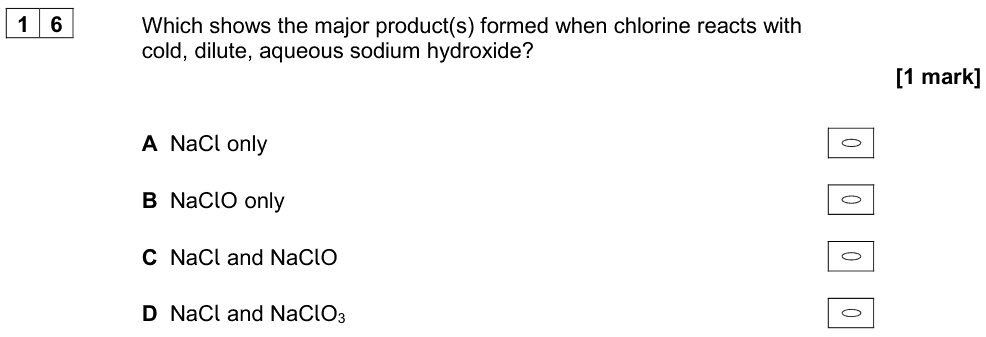
Cl2 + 2NaOH → NaCl + NaOCl + H2O. Errors: HCl or HOCl as a product
not balanced
June 2024 · Paper 1 · Q05.42 marksAO1=1, AO3=1Equation writing
Earlier part of question 05 that this part uses
Mark scheme
Examiner's comment
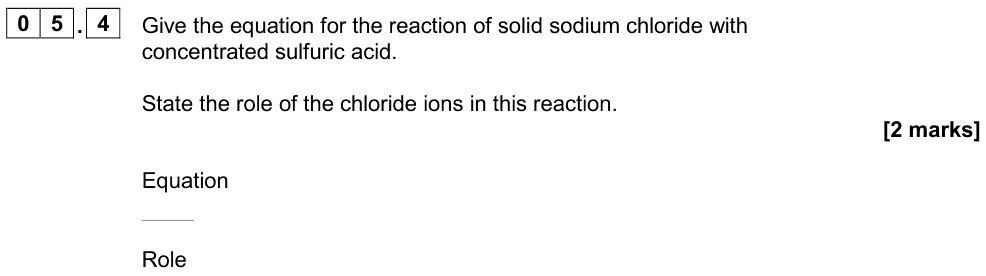
In part 4, 39% of students scored both the marks: errors in the identification of the role of the chloride ion included acid, oxidising agent, reducing agent and catalyst.
Notes from the mark scheme and report
NaCl + H2SO4 → HCl + NaHSO4
the chloride ion is a base / proton acceptor. Wrong roles given: acid, oxidising agent, reducing agent, catalyst
June 2024 · AS Paper 1 · Q131 markAO1=1Multiple choice
Answer
C
Mark scheme
Examiner's comment
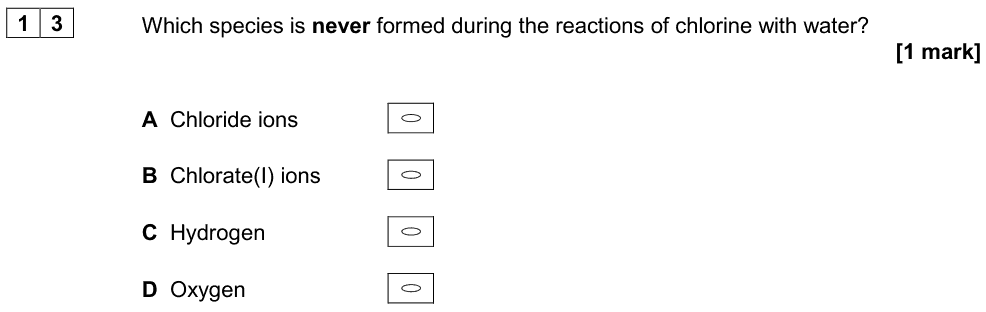
Reaction of chlorine with water Students found this question challenging with significantly less than half (38%) able to indicate which species cannot be formed during the reactions of chlorine with water.
Notes from the mark scheme and report
Answer: C. Chlorine and water give Cl– and ClO– (HCl + HClO), or Cl– and O2 in sunlight
hydrogen gas is never formed
June 2024 · AS Paper 1 · Q191 markAO3=1Multiple choice
Answer
C
Mark scheme
Examiner's comment
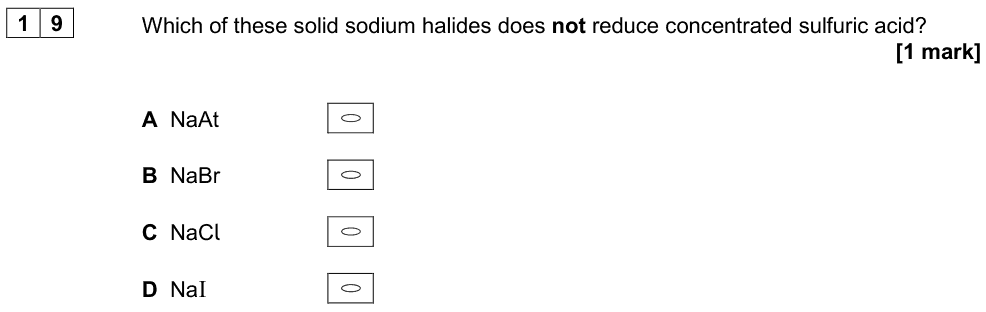
Reducing ability of halide ions Although just over half of students could identify which sodium halide does not reduce concentrated sulfuric acid, a large number (about one third) incorrectly thought that sodium astatide does not reduce concentrated sulfuric acid.
Notes from the mark scheme and report
Answer: C. Chloride is the weakest reducing agent and cannot reduce H2SO4 (only an acid–base reaction giving HCl). About a third chose NaAt
June 2024 · AS Paper 2 · Q06.11 markAO2=1Short answer
Mark scheme
Examiner's comment
6.1 Most students could identify the silver iodide precipitate.
Notes from the mark scheme and report
Silver iodide, AgI (if both name and formula are given, both must be right)
Skills: RP3 Investigation of how the rate of a reaction changes with temperature
June 2023 · AS Paper 1 · Q06.12 marksAO1=2ExplanationHard
Mark scheme
Examiner's comment
06.1 Only about a quarter of students scored both marks on this question. Students generally referred to the attraction for outer electrons rather than the attraction for the bonding pair of electrons.
Notes from the mark scheme and report
Atoms get larger / more shells / more shielding, so the bonding pair is further from the nucleus
weaker attraction between the nucleus and the bonding (shared) pair of electrons. References to outer electrons are ignored: the common error
June 2023 · AS Paper 1 · Q06.22 marksAO1=2Short answer
Earlier part of question 06 that this part uses
Mark scheme
Examiner's comment
06.2 The observations for these reactions were not well known. There appeared to be some confusion between the reactions of sodium halides with silver nitrate solution and the reactions of sodium halides with concentrated sulfuric acid, so many students incorrectly mentioned the formation of white and/or cream precipitates.
Notes from the mark scheme and report
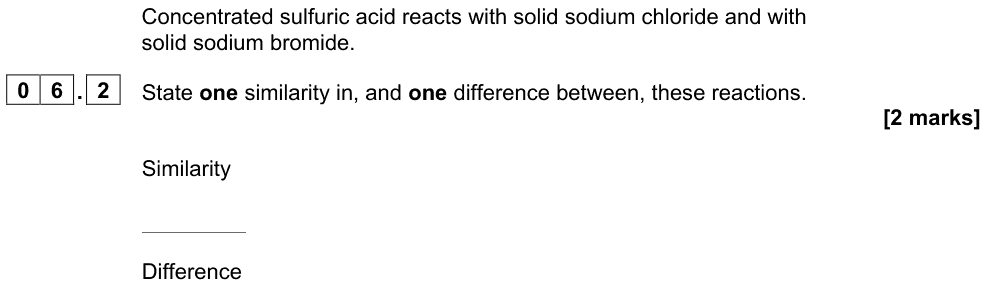
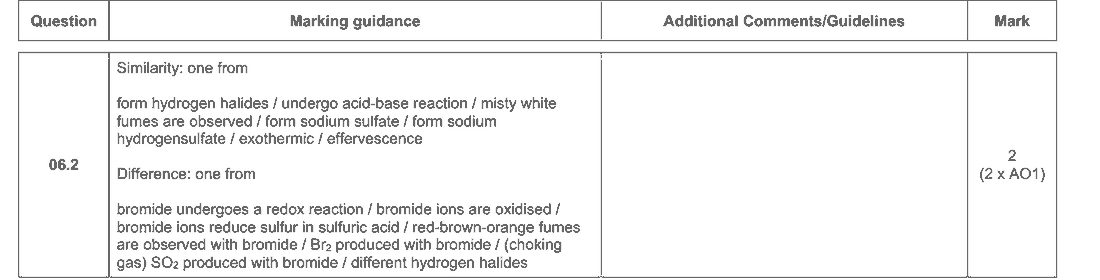
Similarity (one): both form a hydrogen halide / acid–base reaction / misty white fumes / NaHSO4 formed. Difference (one): bromide ions are oxidised (redox) / Br2 as red-brown fumes / SO2 formed with bromide only. Common error: white and cream precipitates (confusion with the silver nitrate test)
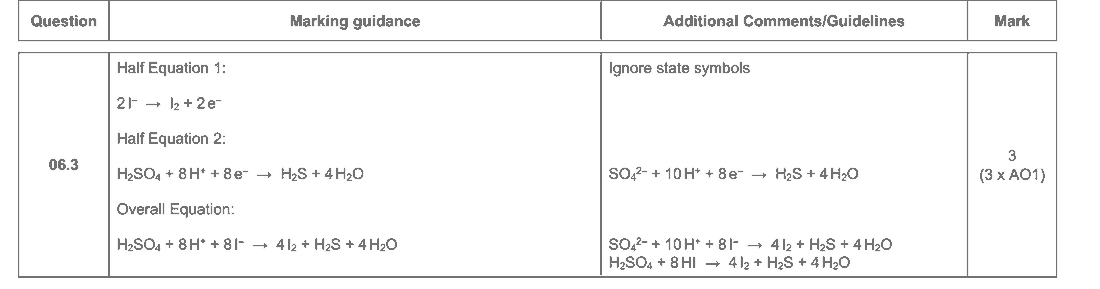
June 2023 · AS Paper 1 · Q06.33 marksAO1=3Equation writing
Earlier parts of question 06 that this part uses
Mark scheme
Examiner's comment
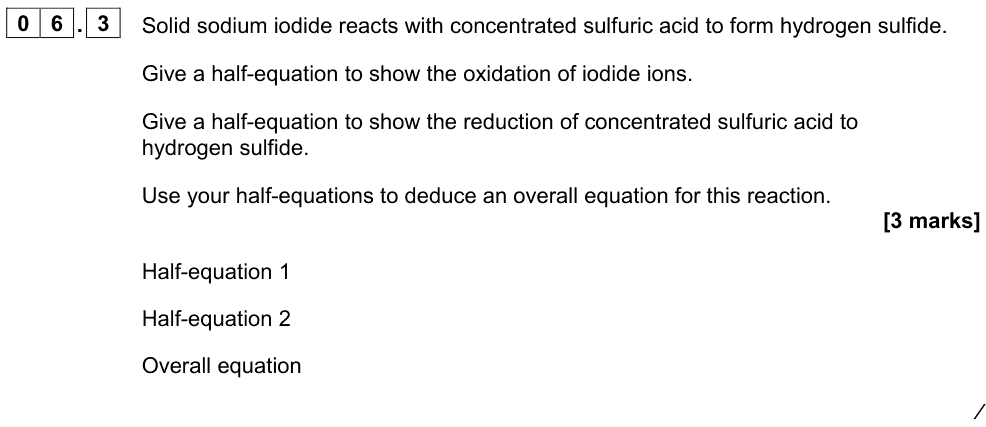
06.3 Students found writing the half-equation for the reduction of concentrated sulfuric acid to hydrogen sulfide challenging. In the overall equation students did not always cancel down the electrons.
overall H2SO4 + 8H+ + 8I– → 4I2 + H2S + 4H2O (or H2SO4 + 8HI → 4I2 + H2S + 4H2O). The reduction half-equation was found hard
electrons were not always cancelled in the overall equation
June 2023 · AS Paper 1 · Q191 markAO3=1Multiple choice
Answer
B
Mark scheme
Examiner's comment
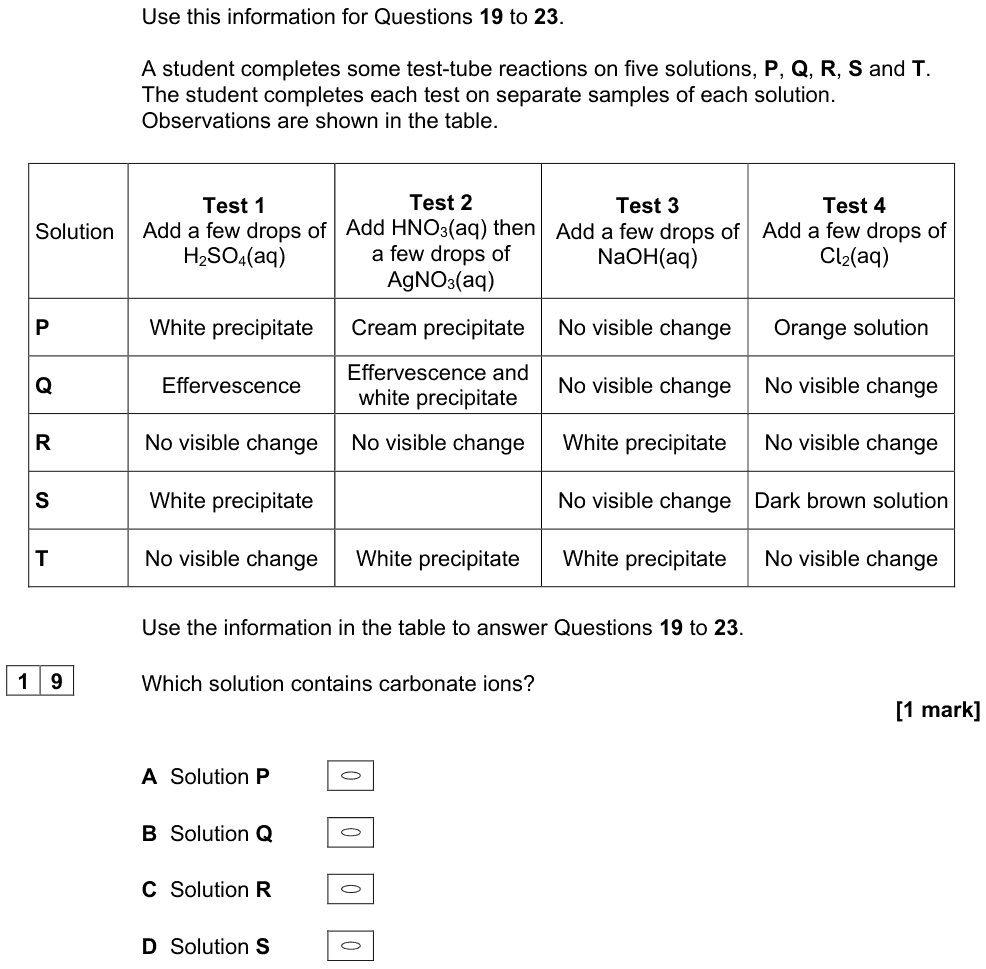
Questions 19 to 23: Test-tube reactions
Notes from the mark scheme and report
Answer: B. Solution Q effervesces with acid (CO2 from carbonate)
Skills: PS1.1 Solve problems set in practical contexts; RP4 Carry out simple test-tube reactions to identify: cations – Group 2, NH4+; anions – Group 7 (halide ions), OH–, CO32–, SO42–
June 2023 · AS Paper 1 · Q201 markAO3=1Multiple choice
Earlier part of question 20 that this part uses
Answer
B
Mark scheme
Examiner's comment
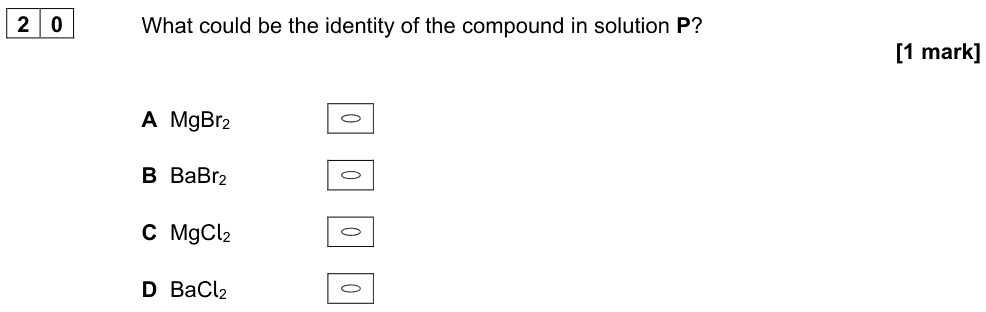
These questions enabled students to analyse and interpret some observations from some test-tube reactions. They were generally well answered by students, although they found it more challenging to deduce the identity of the compound in solution P in question 20, and of the compound in solution T in question 23.
Notes from the mark scheme and report
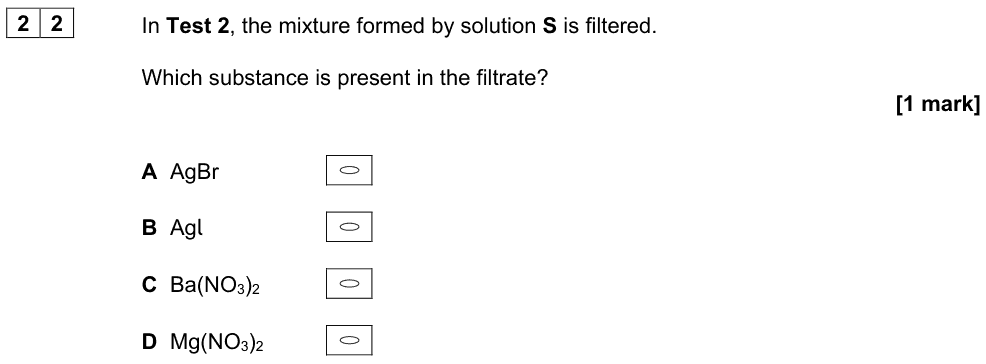
Answer: B. White precipitate with H2SO4 (BaSO4), cream precipitate with AgNO3 (AgBr) and orange bromine with chlorine: BaBr2. Found more challenging
Skills: PS1.1 Solve problems set in practical contexts; RP4 Carry out simple test-tube reactions to identify: cations – Group 2, NH4+; anions – Group 7 (halide ions), OH–, CO32–, SO42–
June 2023 · AS Paper 1 · Q211 markAO3=1Multiple choice
Earlier part of question 21 that this part uses
Answer
D
Mark scheme
Notes from the mark scheme and report
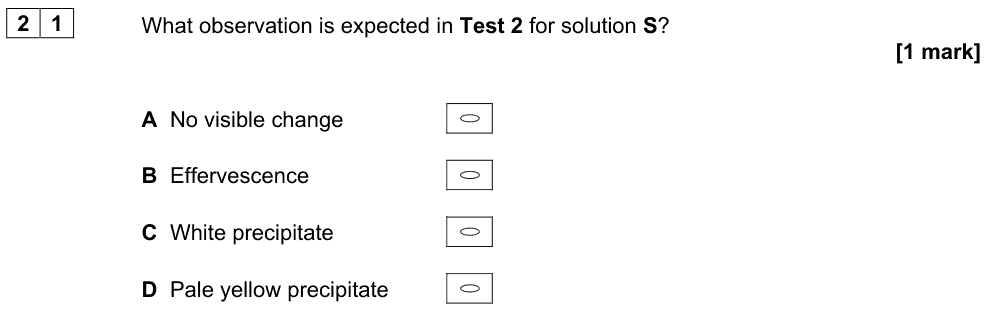
Answer: D. The dark brown solution with chlorine shows iodide, which gives pale yellow AgI
Skills: PS1.1 Solve problems set in practical contexts; RP4 Carry out simple test-tube reactions to identify: cations – Group 2, NH4+; anions – Group 7 (halide ions), OH–, CO32–, SO42–
June 2023 · AS Paper 1 · Q221 markMultiple choice
Earlier part of question 22 that this part uses
Mark scheme
Examiner's comment
Unfortunately there was a typographical error in option B, where silver iodide (AgI) was mistakenly shown as Ag. In order to mitigate possible disadvantage to students, the question was discounted and every student received a mark for this question.
To avoid any chance of a similar error happening in future, it has been decided that, from 2024 onwards, iodine/iodide will be represented by a very clear capital (Times New Roman font) I.
Notes from the mark scheme and report
No key printed: the board discounted this question because of a typographical error in option B (silver iodide was misprinted) and awarded every candidate the mark. The mark scheme gives no answer
Skills: PS1.1 Solve problems set in practical contexts; RP4 Carry out simple test-tube reactions to identify: cations – Group 2, NH4+; anions – Group 7 (halide ions), OH–, CO32–, SO42–
June 2023 · AS Paper 1 · Q231 markAO3=1Multiple choice
Earlier part of question 23 that this part uses
Answer
A
Mark scheme
Examiner's comment
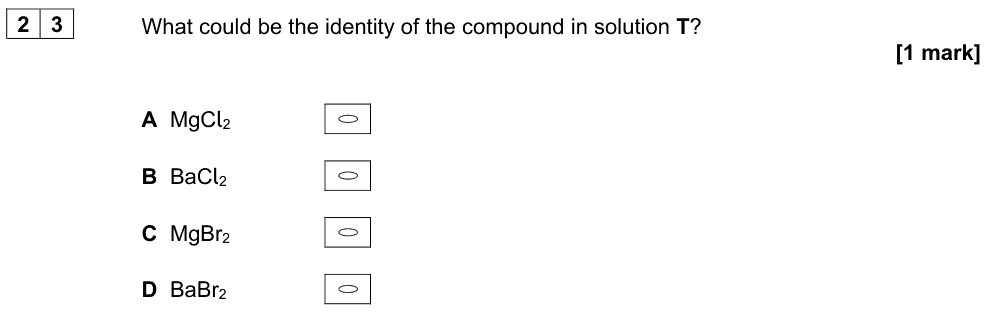
These questions enabled students to analyse and interpret some observations from some test-tube reactions. They were generally well answered by students, although they found it more challenging to deduce the identity of the compound in solution P in question 20, and of the compound in solution T in question 23.
Notes from the mark scheme and report
Answer: A. White precipitate with AgNO3 (chloride), white precipitate with NaOH (Mg(OH)2) and none with H2SO4: MgCl2. Found more challenging
Skills: PS1.1 Solve problems set in practical contexts; RP4 Carry out simple test-tube reactions to identify: cations – Group 2, NH4+; anions – Group 7 (halide ions), OH–, CO32–, SO42–
June 2023 · Paper 3 · Q046 marks6-mark level of responseHard
Mark scheme, with the levels and indicative content
Examiner's comment
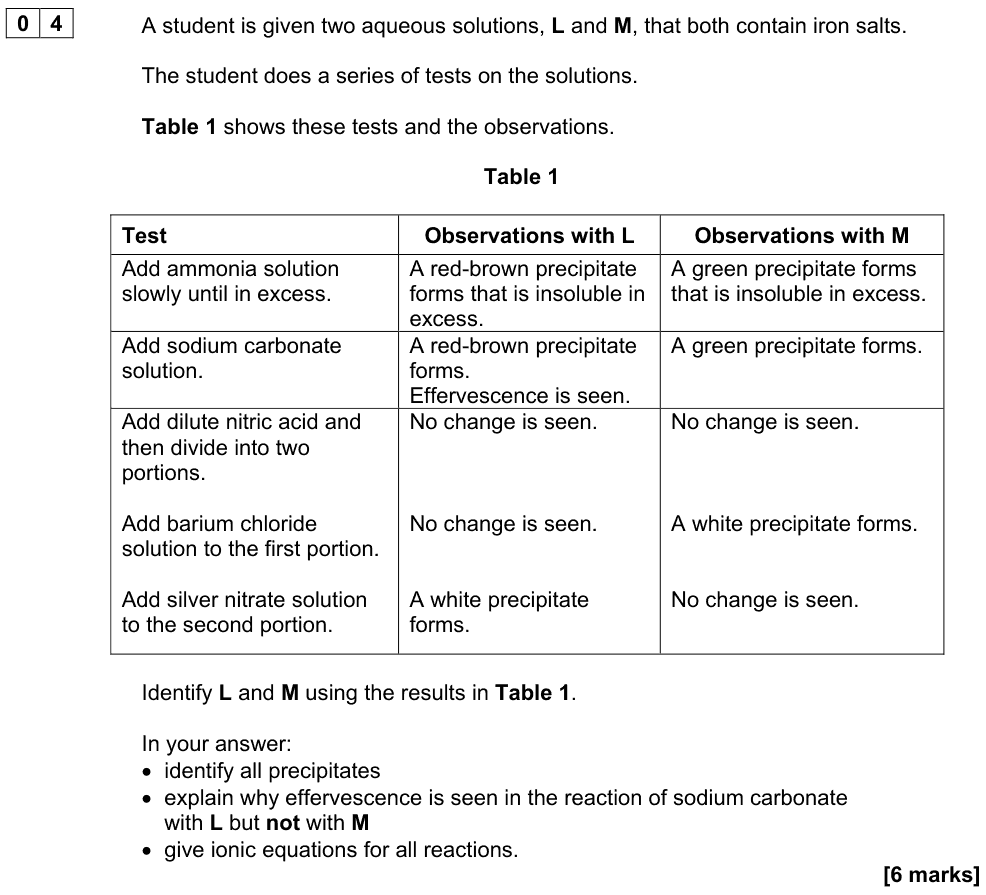
As last year, only about 10% of students were able to access level 3 and score 5 or 6 marks. In this case, the most common omissions from the indicative content were 2b and 2c which related to the explanation of the reason for effervescence with L but not with M when carbonate was added. Many students thought that it was enough to simply say that CO2 is produced with L but not M and did not go on to discuss the reasons for this in terms of the greater acidity of Fe3+(aq) compared with Fe2+(aq).
Many students did, however, recognise the important distinction that the 3+ ion with carbonate produces iron(III) hydroxide but the 2+ ion with carbonate forms iron(II) carbonate. The quality of equations varied and there were sometimes contradictions between a statement that, for example, a reaction produces a precipitate of Fe(H2O)4(OH)2 but then an equation showing the formation of Fe(H2O)4(NH3)2. Hydroxide ions were also often seen as a reactant in the reaction equations for Fe2+ and Fe3+ with ammonia.
It was unexpected to discover that a significant minority of students did not recognise the tests for ions that were included in the question – especially as some of these tests are first encountered at GCSE.
Notes from the mark scheme and report
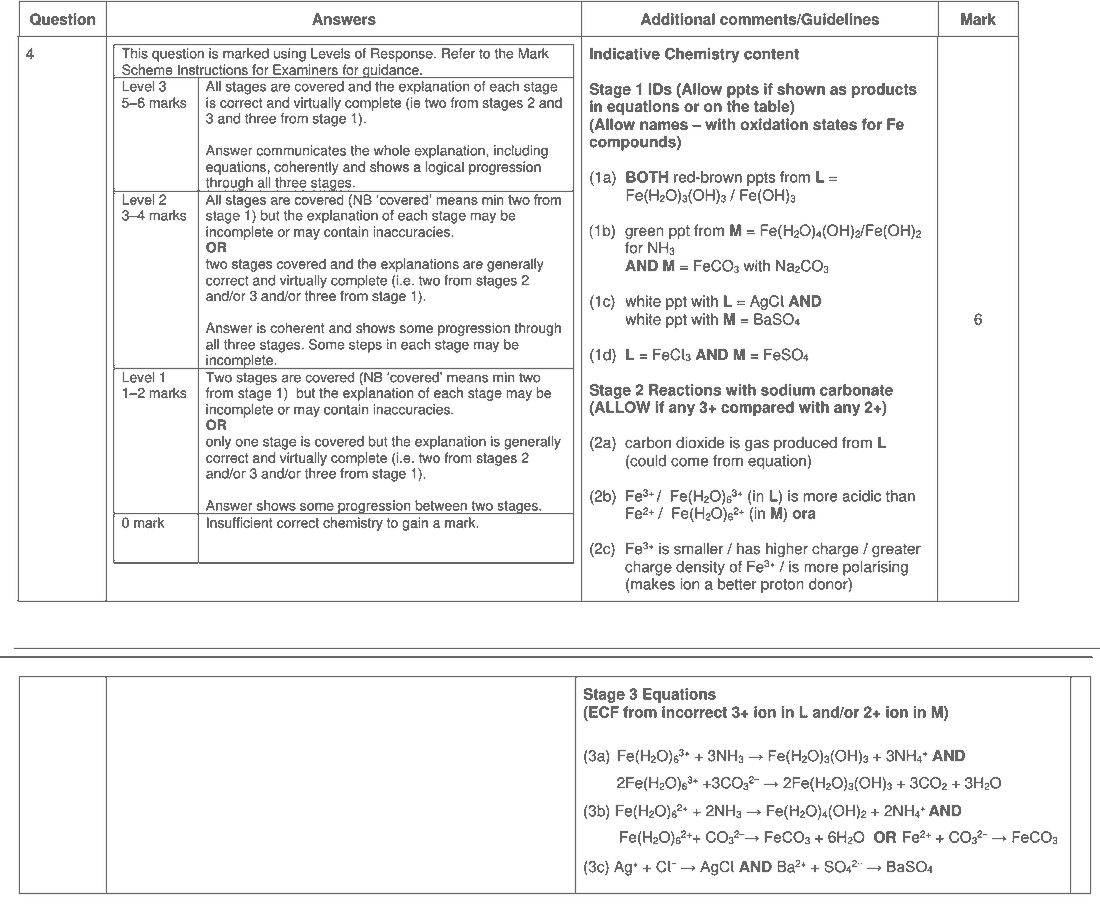
Levels of response, three stages. Stage 1 identities: L is FeCl3 and M is FeSO4
both red-brown precipitates are Fe(H2O)3(OH)3
green precipitates are Fe(H2O)4(OH)2 with ammonia and FeCO3 with carbonate
white precipitates are AgCl (from L) and BaSO4 (from M). Stage 2 effervescence: CO2 forms with L only, because [Fe(H2O)6]3+ is more acidic than [Fe(H2O)6]2+
Fe3+ is smaller with a higher charge (greater charge density, more polarising). Stage 3 ionic equations: [Fe(H2O)6]3+ + 3NH3 → Fe(H2O)3(OH)3 + 3NH4+
Ba2+ + SO4 2– → BaSO4. Most often missing: the acidity explanation
OH– wrongly shown as the reactant with ammonia
Skills: ATd Use laboratory apparatus for a variety of experimental techniques including: titration, using burette and pipette; distillation and heating under reflux, including setting up glassware using retort stand and clamps; qualitative tests for ions and organic functional groups; filtration, including use of fluted filter paper, or filtration under reduced pressure; PS1.1 Solve problems set in practical contexts; PS2.3 Evaluate results and draw conclusions with reference to measurement uncertainties and errors; RP11 Carry out simple test-tube reactions to identify transition metal ions in aqueous solution
June 2023 · Paper 3 · Q221 markAO1=1Multiple choice
Answer
D
Mark scheme
Notes from the mark scheme and report
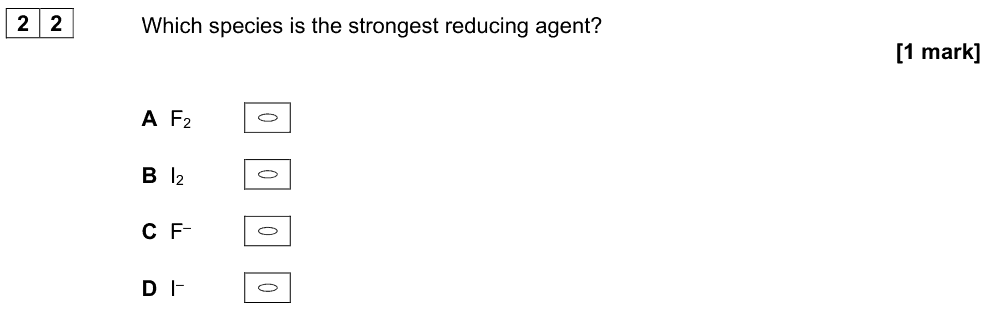
Answer: D. Halide ions are the reducing agents and reducing ability increases down the group: I– loses an electron most easily
June 2022 · Paper 1 · Q06.11 markAO1=1Short answer
Mark scheme
Examiner's comment
Most students knew the answer to 06.1.
Notes from the mark scheme and report
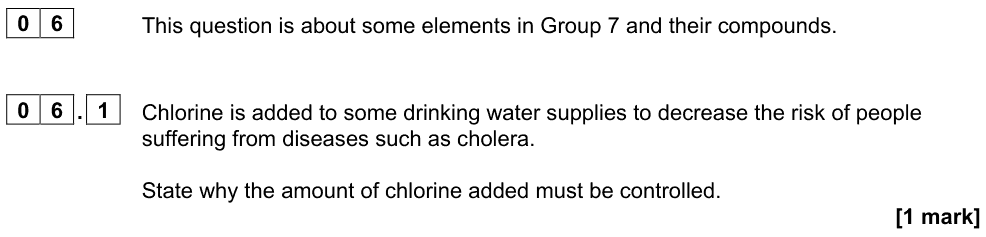
Chlorine is toxic / poisonous (too much would harm people)
June 2022 · Paper 1 · Q06.22 marksAO1=2Equation writing
Earlier part of question 06 that this part uses
Mark scheme
Examiner's comment
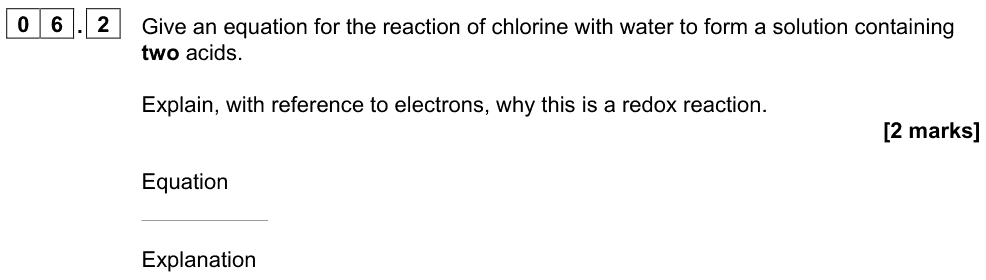
In 06.2, most students knew the equation but did not mention electrons in their explanation; many referred to oxidation numbers.
Of those who mentioned electrons in the explanation, some stated that chlorine gained electrons but then thought oxygen or hydrogen lost electrons.
Notes from the mark scheme and report
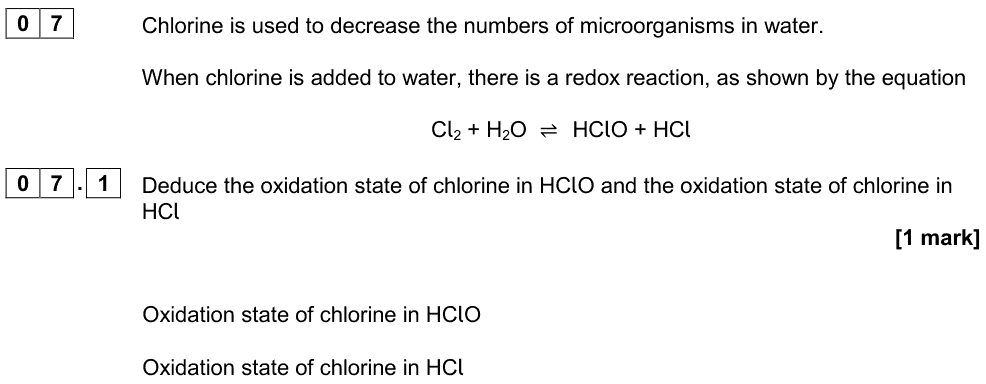
Cl2 + H2O ⇌ HCl + HClO (allow 2H+ + Cl– + ClO–). Chlorine gains electrons (to form Cl–) and chlorine also loses electrons (to form ClO–). Oxidation numbers and 'disproportionation' alone are ignored
some wrongly said oxygen or hydrogen lost the electrons
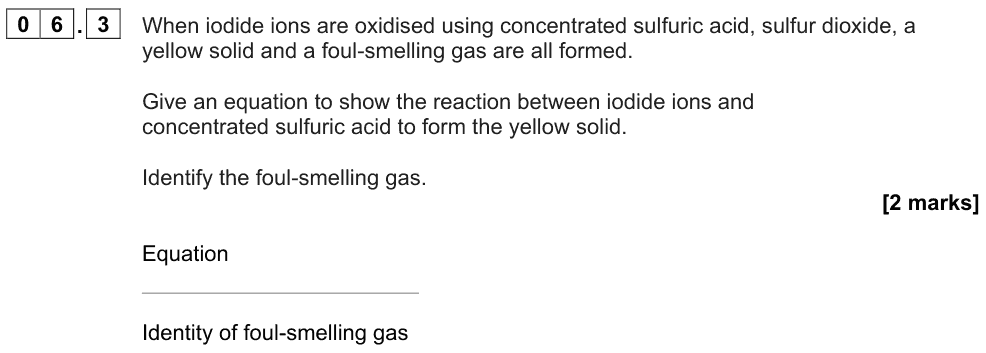
June 2022 · AS Paper 1 · Q06.32 marksAO1=2Equation writing
Earlier parts of question 06 that this part uses
Mark scheme
Examiner's comment
06.3 A high number of students were able to identify correctly the foul-smelling gas but only a few students provided an equation to produce S. Many equations showed the formation of sulfur dioxide instead.
Notes from the mark scheme and report
6I– + 6H+ + H2SO4 → S + 3I2 + 4H2O (allow 6HI + H2SO4, or 6I– + 8H+ + SO4 2–). Gas: hydrogen sulfide, H2S. Many gave the equation that forms SO2 instead of S
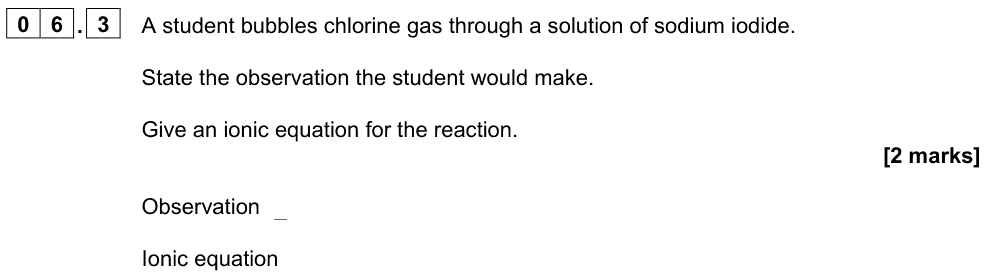
June 2022 · Paper 1 · Q06.32 marksEquation writingHard
Earlier part of question 06 that this part uses
Mark scheme
Examiner's comment
Many students stated that a brown or purple gas was given off in 06.3 and many students did not give an ionic equation; 33% of students scored both marks.
Notes from the mark scheme and report
Brown solution (or black solid) forms
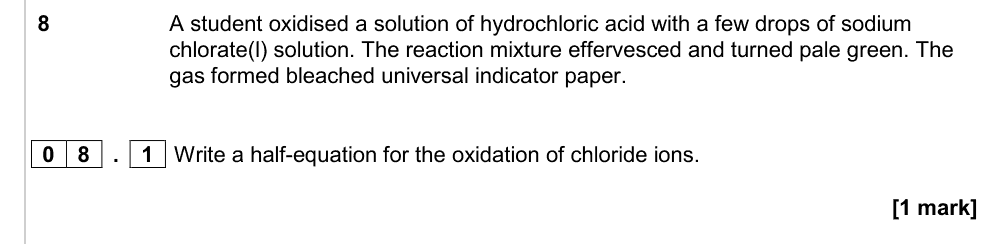
Cl2 + 2I– → 2Cl– + I2. Not purple
not a gas. Many did not give an ionic equation
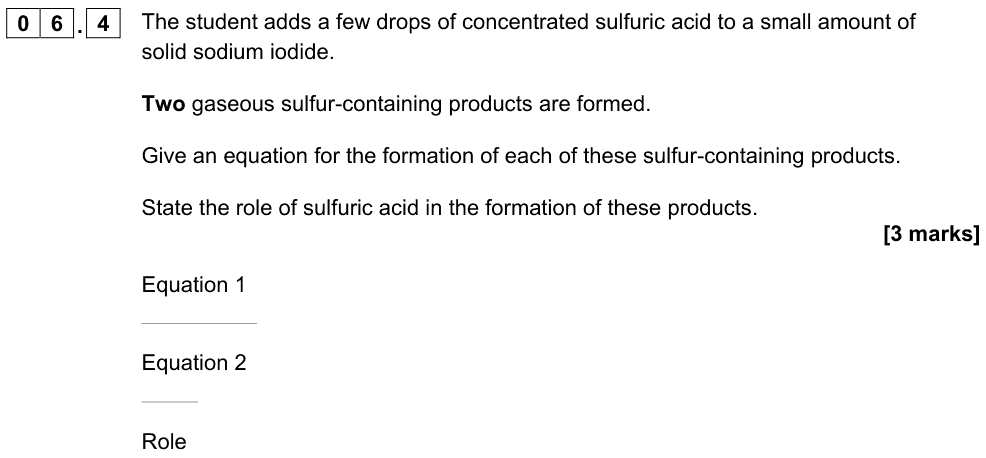
June 2022 · Paper 1 · Q06.43 marksAO1=3Equation writing
Earlier part of question 06 that this part uses
Mark scheme
Examiner's comment
In 06.4, most students knew the role of sulfuric acid.
The equations were not well known, however, and some students gave half-equations.
Several students gave a correct equation for sulfur rather than a gas containing sulfur.
Notes from the mark scheme and report
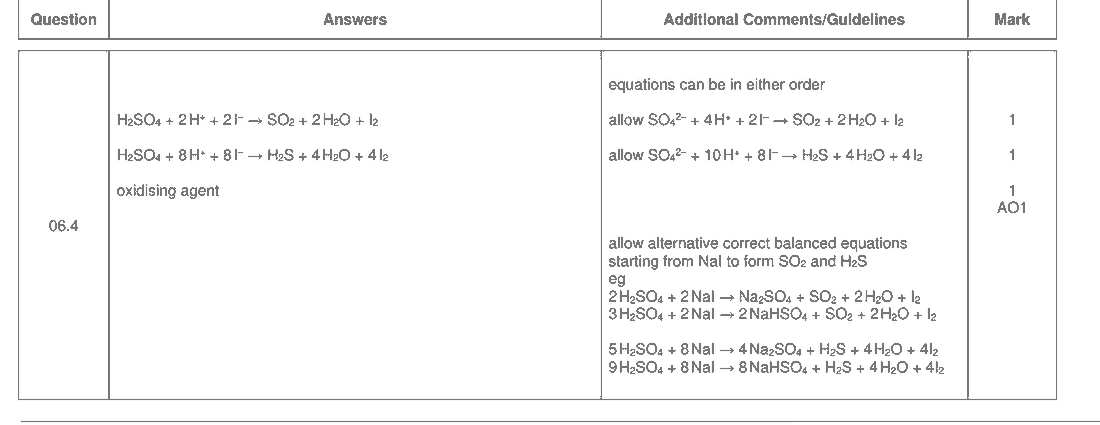
H2SO4 + 2H+ + 2I– → SO2 + 2H2O + I2 and H2SO4 + 8H+ + 8I– → H2S + 4H2O + 4I2 (balanced equations from NaI allowed)
sulfuric acid is an oxidising agent. The role was well known, the equations were not
some gave half-equations or the equation forming sulfur (not a gas)
June 2022 · Paper 1 · Q06.53 marksShort answerHard
Earlier part of question 06 that this part uses
Mark scheme
Examiner's comment
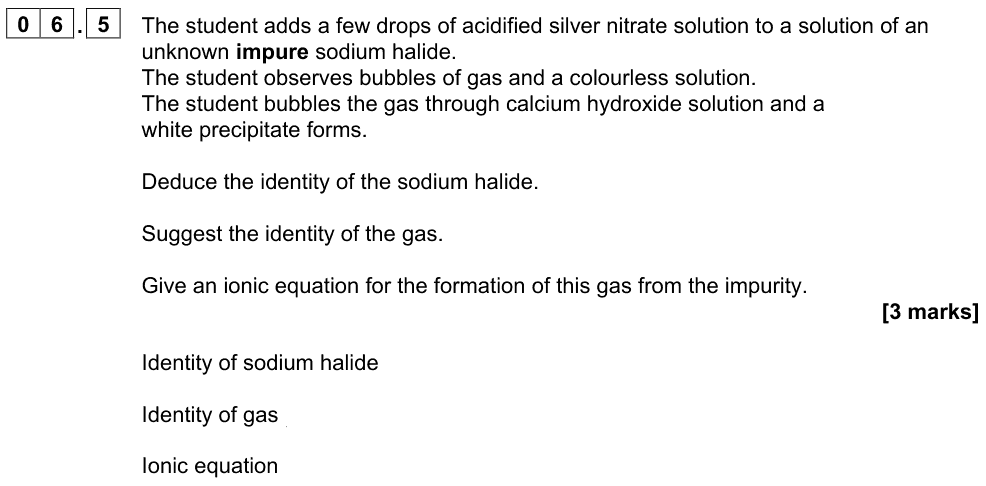
Students found 06.5 challenging; 10% scored all the marks in the question.
Carbon dioxide was scored more often than the other marks.
Many students could not give the equation and many thought the sodium halide was NaCl.
Notes from the mark scheme and report
Sodium fluoride (no precipitate, because silver fluoride is soluble)
the gas is carbon dioxide (white precipitate with calcium hydroxide solution), from a carbonate impurity: CO3 2– + 2H+ → CO2 + H2O. Many chose NaCl
CO2 was the mark most often scored
Skills: PS1.1 Solve problems set in practical contexts; ATd Use laboratory apparatus for a variety of experimental techniques including: titration, using burette and pipette; distillation and heating under reflux, including setting up glassware using retort stand and clamps; qualitative tests for ions and organic functional groups; filtration, including use of fluted filter paper, or filtration under reduced pressure; RP4 Carry out simple test-tube reactions to identify: cations – Group 2, NH4+; anions – Group 7 (halide ions), OH–, CO32–, SO42–
June 2022 · AS Paper 1 · Q08.12 marksAO1=1, AO3=1Practical and data analysis
Mark scheme
Examiner's comment
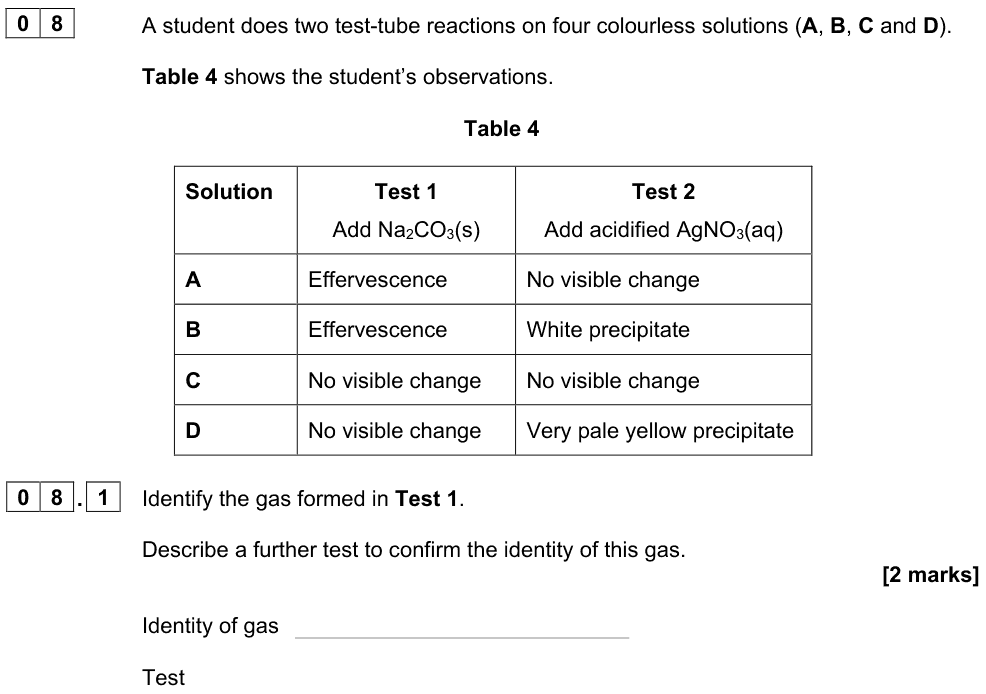
08.1 Many students did not correctly identify the gas produced as carbon dioxide. Students who did needed to give the correct result of the test using limewater in order to score both the marks on this question.
Notes from the mark scheme and report
Carbon dioxide, CO2
bubble the gas through limewater, which turns cloudy / gives a white precipitate (M2 depends on M1). Many did not identify the gas
the result of the test must be stated
Skills: ATd Use laboratory apparatus for a variety of experimental techniques including: titration, using burette and pipette; distillation and heating under reflux, including setting up glassware using retort stand and clamps; qualitative tests for ions and organic functional groups; filtration, including use of fluted filter paper, or filtration under reduced pressure; PS1.2 Apply scientific knowledge to practical contexts; RP4 Carry out simple test-tube reactions to identify: cations – Group 2, NH4+; anions – Group 7 (halide ions), OH–, CO32–, SO42–
June 2022 · AS Paper 1 · Q08.22 marksAO2=2Practical and data analysis
Earlier part of question 08 that this part uses
Mark scheme
Examiner's comment
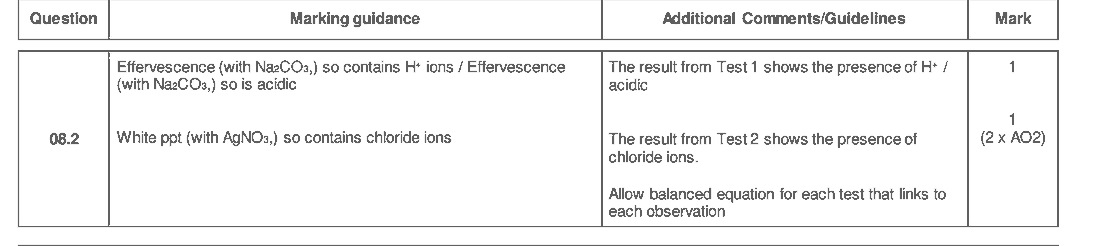
08.2 Students did not always link the observations from Test 1 and Test 2 to the ions that would be present in hydrochloric acid to justify their answers.
Notes from the mark scheme and report
Effervescence with Na2CO3 shows H+ ions (acidic)
the white precipitate with AgNO3 shows chloride ions. Balanced equations linked to each observation allowed. Link each observation to the ion
Skills: ATd Use laboratory apparatus for a variety of experimental techniques including: titration, using burette and pipette; distillation and heating under reflux, including setting up glassware using retort stand and clamps; qualitative tests for ions and organic functional groups; filtration, including use of fluted filter paper, or filtration under reduced pressure; PS1.2 Apply scientific knowledge to practical contexts; RP4 Carry out simple test-tube reactions to identify: cations – Group 2, NH4+; anions – Group 7 (halide ions), OH–, CO32–, SO42–
June 2022 · AS Paper 1 · Q08.34 marksAO3=4Practical and data analysis
Earlier part of question 08 that this part uses
Mark scheme
Examiner's comment
08.3 This was found by students to be a challenging question – very few students were correctly able to describe the test for ammonium ions, whereas the test for sulfate ions was well known.
Notes from the mark scheme and report
Warm with NaOH(aq)
damp red litmus held at the mouth of the tube turns blue (ammonium). Add acidified BaCl2 or Ba(NO3)2
white precipitate (sulfate). Ba(OH)2 can score the two reagent marks. Not litmus dipped in the solution
no observation mark if the reagent is wrong. Very few could describe the ammonium test
Skills: ATd Use laboratory apparatus for a variety of experimental techniques including: titration, using burette and pipette; distillation and heating under reflux, including setting up glassware using retort stand and clamps; qualitative tests for ions and organic functional groups; filtration, including use of fluted filter paper, or filtration under reduced pressure; PS1.1 Solve problems set in practical contexts; PS4.1 Know and understand how to use a wide range of experimental and practical instruments, equipment and techniques appropriate to the knowledge and understanding included in the specification; RP4 Carry out simple test-tube reactions to identify: cations – Group 2, NH4+; anions – Group 7 (halide ions), OH–, CO32–, SO42–
June 2022 · AS Paper 1 · Q08.42 marksAO3=2Practical and data analysis
Earlier part of question 08 that this part uses
Mark scheme
Examiner's comment
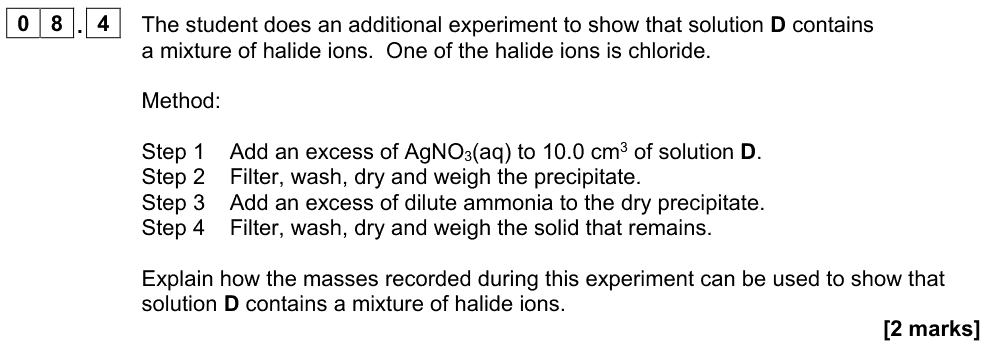
08.4 Few students appreciated that any silver chloride formed during step 1 would dissolve in dilute ammonia during step 3 so the mass of precipitate would decrease. Some students understood the trend in solubility of the silver halides but did not apply this to the context of the stated method.
Notes from the mark scheme and report
The mass after step 4 is smaller than the mass after step 2
because silver chloride dissolves in dilute ammonia while the other silver halide does not. Few applied the solubility trend to this method
Skills: ATd Use laboratory apparatus for a variety of experimental techniques including: titration, using burette and pipette; distillation and heating under reflux, including setting up glassware using retort stand and clamps; qualitative tests for ions and organic functional groups; filtration, including use of fluted filter paper, or filtration under reduced pressure; PS1.2 Apply scientific knowledge to practical contexts; PS3.2 Process and analyse data using appropriate mathematical skills as exemplified in the mathematical appendix for each science; RP4 Carry out simple test-tube reactions to identify: cations – Group 2, NH4+; anions – Group 7 (halide ions), OH–, CO32–, SO42–
June 2022 · AS Paper 1 · Q161 markAO1=1Multiple choiceEasy
Answer
B
Mark scheme
Examiner's comment
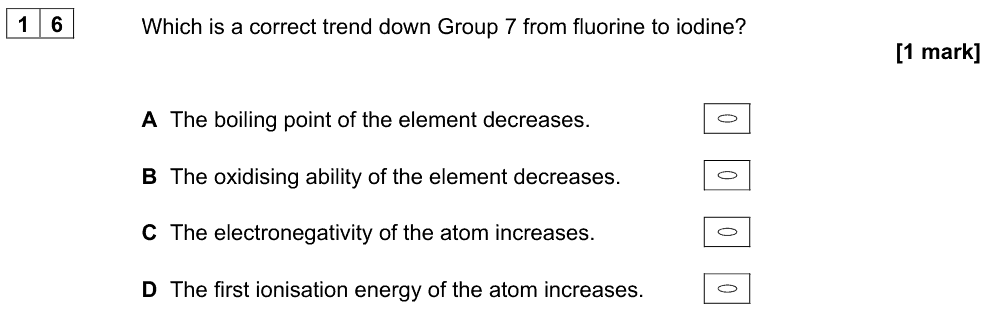
Group 7 Many students (62%) were able to identify correctly trends down group 7.
Notes from the mark scheme and report
Answer: B. Oxidising ability decreases down Group 7
boiling point increases, electronegativity and first ionisation energy decrease
June 2022 · AS Paper 1 · Q181 markAO1=1Multiple choiceHard
Answer
D
Mark scheme
Examiner's comment
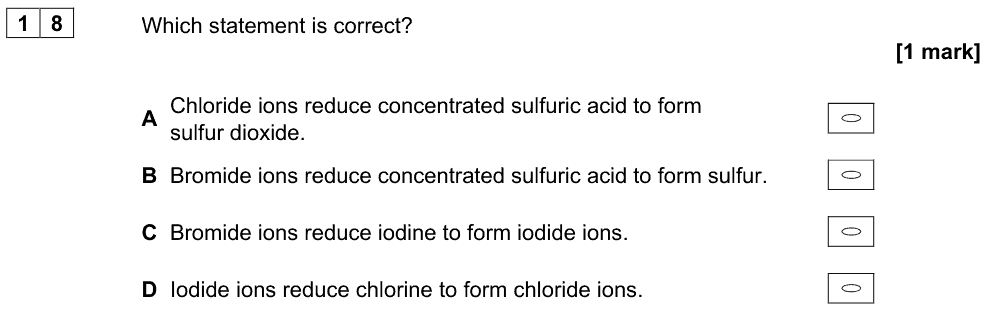
Halide ion reactions Less than a third of students were able to identify the correct reaction involving halide ions.
Notes from the mark scheme and report
Answer: D. Iodide ions reduce chlorine (2I– + Cl2 → I2 + 2Cl–). Chloride does not reduce H2SO4
bromide reduces it only to SO2
bromide cannot reduce iodine
June 2022 · AS Paper 1 · Q211 markAO1=1Multiple choiceHard
Answer
D
Mark scheme
Examiner's comment
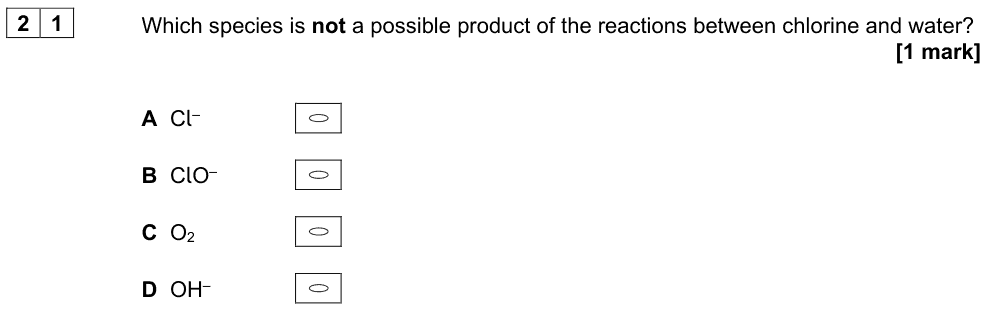
Chlorine Only about a third of students were able to identify the products of the reactions between chlorine and water.
Notes from the mark scheme and report
Answer: D. Cl2 + H2O ⇌ HCl + HClO gives Cl– and ClO–
in sunlight 2Cl2 + 2H2O → 4HCl + O2. Hydroxide ions are not formed (the solutions are acidic)
June 2022 · Paper 3 · Q026 marksAO2=2, AO3=46-mark level of response
Mark scheme, with the levels and indicative content
Examiner's comment
This levels of response question was expected to be more accessible than some in the past but a lack of accuracy in describing the tests for the anions meant that Level 3 was rarely attained. The need to warm after adding NaOH when testing for NH4+ was often missing as was the need to acidify the BaCl2 when testing for sulfate. Many students also stopped their description of the test for Al3+ at the stage of forming a white precipitate and failed to mention that it redissolves in excess NaOH.
The equations for the test for Al3+ should preferably have been those with the hydrated ion but the simpler versions were allowed from the point of view of indicative content. The equation for the redissolving of the solid was often shown as Al(H2O)3(OH)3 + OH– → Al(OH)4– + 3 H2O which implies a combination of ligand replacement and acid-base behaviour, but the product anion should be shown with two water ligands still present in this case.
In stage 1 the empirical formula of NH28AlS2O20 was sometimes not actually shown even though the calculation was done. Some students seemed confused that, in this case, the empirical formula mass is equal to the relative formula mass and they thought that meant that x = 0. It was hoped that students would recognise that 1 × N meant one NH4+ and 2 × S meant two SO42– ions – from which the number of waters could be found.
Notes from the mark scheme and report
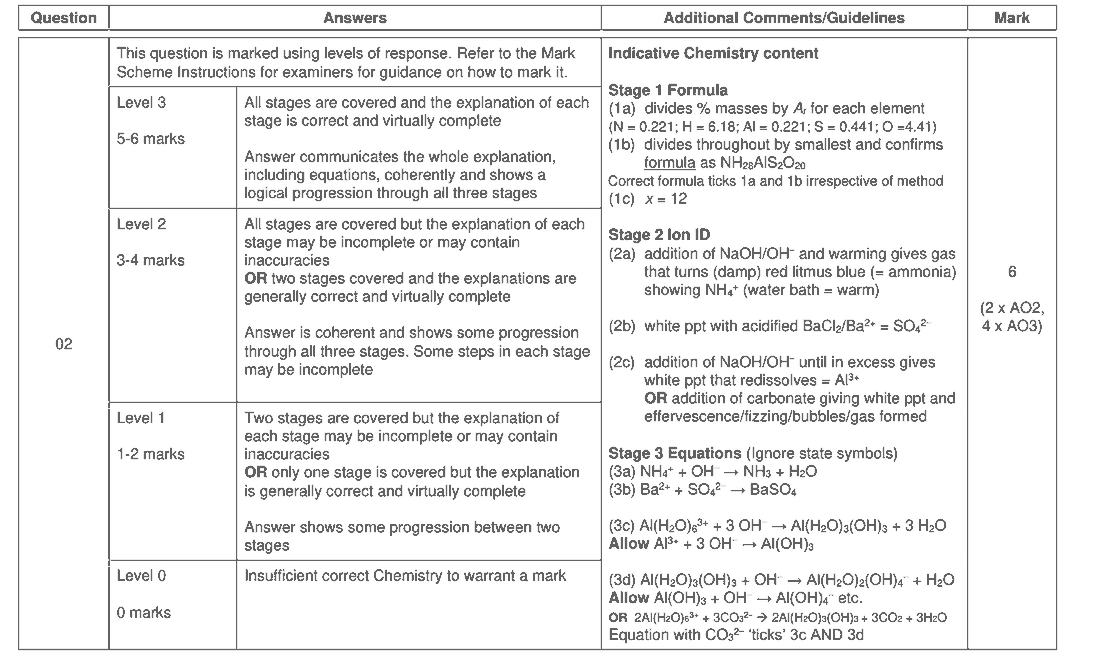
Levels of response, three stages. Formula: divide % by Ar (N 0.221, H 6.18, Al 0.221, S 0.441, O 4.41)
divide by the smallest to get NH28AlS2O20
this is NH4Al(SO4)2.12H2O, so x = 12. Tests: add NaOH and warm, gas turns damp red litmus blue (NH4+)
acidified BaCl2 gives a white precipitate (SO4 2–)
NaOH added dropwise gives a white precipitate that dissolves in excess (Al3+). Equations: NH4+ + OH– → NH3 + H2O
Ba2+ + SO4 2– → BaSO4
[Al(H2O)6]3+ + 3OH– → [Al(H2O)3(OH)3] + 3H2O
[Al(H2O)3(OH)3] + OH– → [Al(H2O)2(OH)4]– + H2O. Common gaps: no warming, BaCl2 not acidified, precipitate not redissolved. Level 3 was rarely reached
Skills: MS0.2 Use ratios, fractions and percentages; ATd Use laboratory apparatus for a variety of experimental techniques including: titration, using burette and pipette; distillation and heating under reflux, including setting up glassware using retort stand and clamps; qualitative tests for ions and organic functional groups; filtration, including use of fluted filter paper, or filtration under reduced pressure; PS1.1 Solve problems set in practical contexts; RP4 Carry out simple test-tube reactions to identify: cations – Group 2, NH4+; anions – Group 7 (halide ions), OH–, CO32–, SO42–
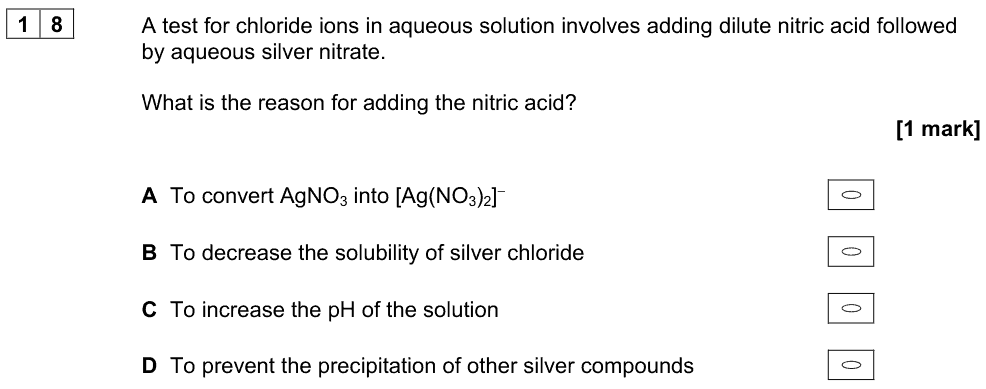
June 2022 · Paper 3 · Q181 markAO1=1Multiple choice
Answer
D
Mark scheme
Notes from the mark scheme and report
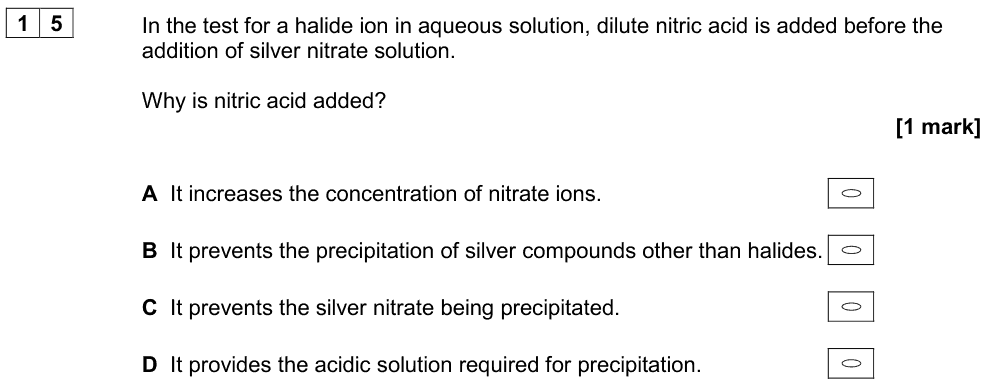
Answer: D. The acid removes ions such as carbonate or hydroxide that would also give a precipitate with silver ions
Skills: ATd Use laboratory apparatus for a variety of experimental techniques including: titration, using burette and pipette; distillation and heating under reflux, including setting up glassware using retort stand and clamps; qualitative tests for ions and organic functional groups; filtration, including use of fluted filter paper, or filtration under reduced pressure; RP4 Carry out simple test-tube reactions to identify: cations – Group 2, NH4+; anions – Group 7 (halide ions), OH–, CO32–, SO42–
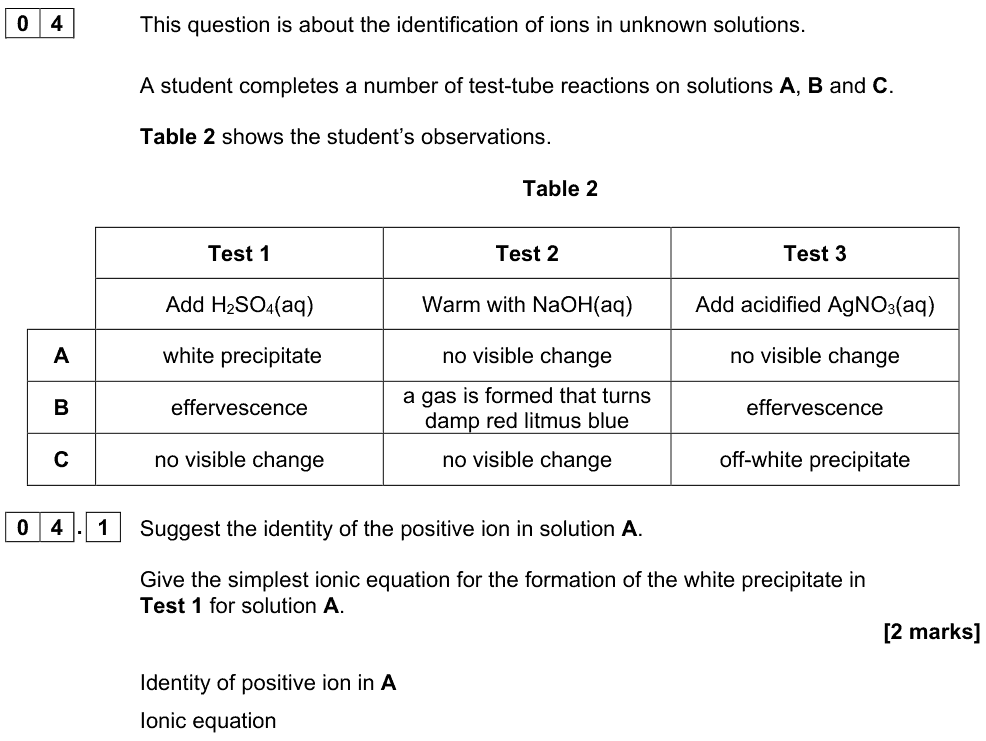
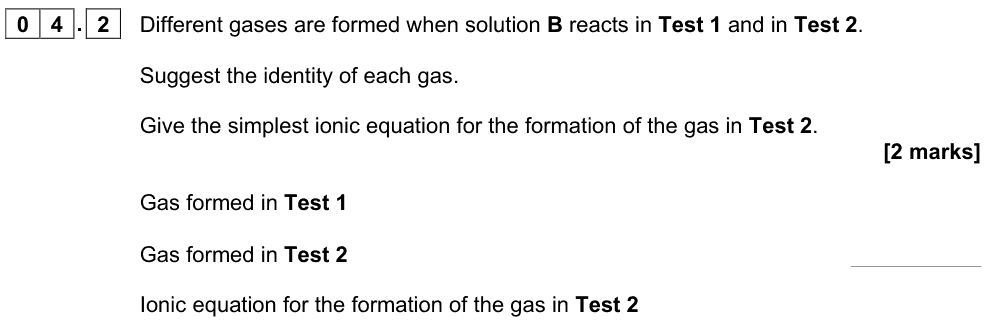
November 2021 · AS Paper 1 · Q04.22 marksEquation writing
Earlier part of question 04 that this part uses
Mark scheme
Notes from the mark scheme and report
Test 1 gas: CO2 (from a carbonate with acid
SO2 allowed). Test 2 gas: NH3. Both gases needed for the first mark. NH4+ + OH– → NH3 + H2O
Skills: PS1.2 Apply scientific knowledge to practical contexts; RP4 Carry out simple test-tube reactions to identify: cations – Group 2, NH4+; anions – Group 7 (halide ions), OH–, CO32–, SO42–
November 2021 · AS Paper 1 · Q04.33 marksPractical and data analysis
Earlier part of question 04 that this part uses
Mark scheme
Notes from the mark scheme and report
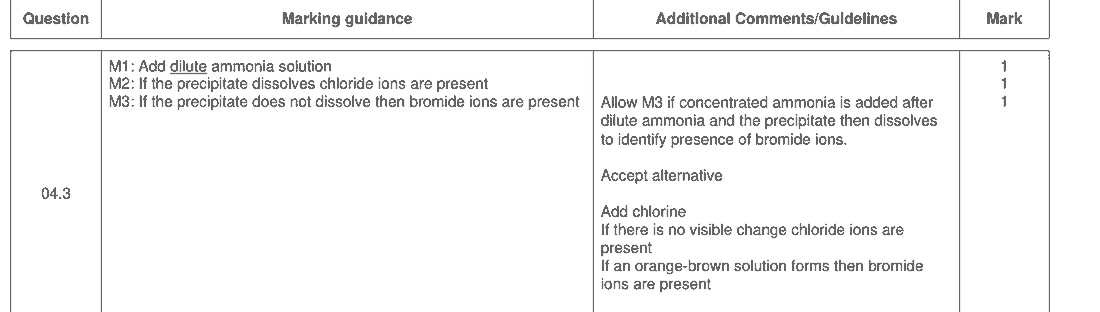
Add dilute ammonia solution (to the precipitate): if the precipitate dissolves, chloride is present
if it does not dissolve, bromide is present (AgBr dissolves only in concentrated ammonia). Alternative: add chlorine
no visible change means chloride, an orange-brown solution means bromide
Skills: PS1.2 Apply scientific knowledge to practical contexts; PS4.1 Know and understand how to use a wide range of experimental and practical instruments, equipment and techniques appropriate to the knowledge and understanding included in the specification; RP4 Carry out simple test-tube reactions to identify: cations – Group 2, NH4+; anions – Group 7 (halide ions), OH–, CO32–, SO42–
November 2021 · AS Paper 1 · Q05.22 marksEquation writing
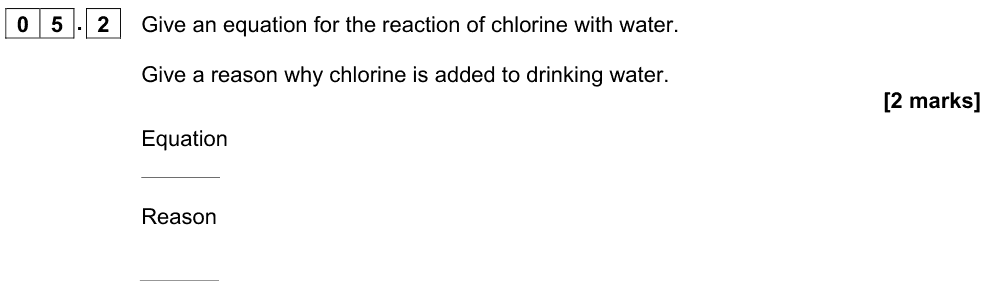
it kills bacteria / microorganisms (sterilises the water)
November 2021 · AS Paper 1 · Q05.31 markEquation writing
Earlier part of question 05 that this part uses
Mark scheme
Notes from the mark scheme and report
Cl2 + 2NaOH → NaCl + NaClO + H2O
November 2021 · AS Paper 1 · Q191 markMultiple choice
Answer
D
Mark scheme
Notes from the mark scheme and report
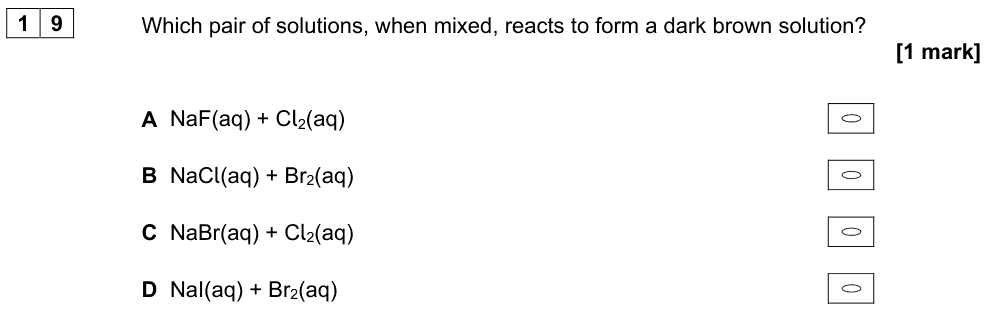
Answer: D. Bromine oxidises iodide ions to iodine, which is brown in solution
a halogen cannot displace one above it in the group, and C gives orange bromine
November 2021 · AS Paper 1 · Q201 markMultiple choice
Answer
A
Mark scheme
Notes from the mark scheme and report
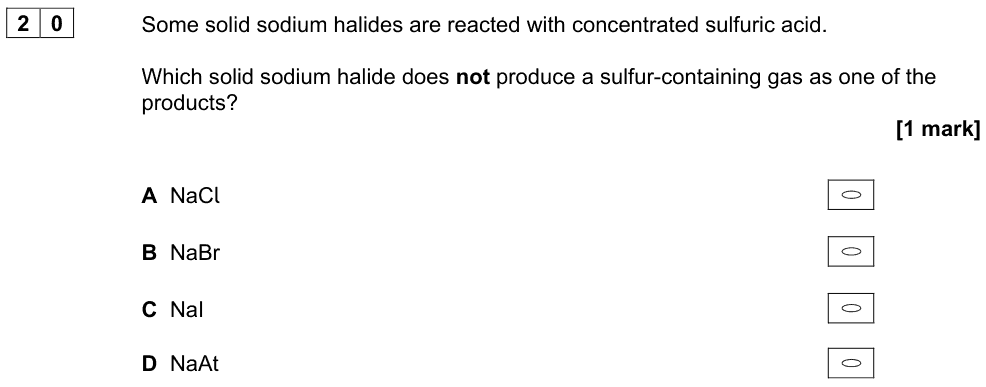
Answer: A. Chloride ions are too weak a reducing agent to reduce H2SO4, so only HCl forms
bromide gives SO2 and iodide (and astatide) gives SO2 and H2S
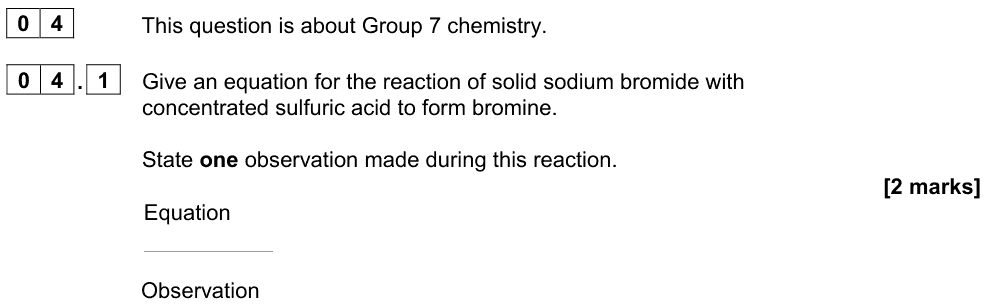
November 2021 · Paper 3 · Q04.12 marksEquation writing
Mark scheme
Examiner's comment
The equation in 04.1 was not correctly given by many students.
The recommendation for this type of situation is not to try and memorise the overall equation but to remember the key aspects such as ‘bromide is oxidised to bromine’ and ‘sulfate is reduced to SO2’.
The overall equation can then be constructed from the appropriate half-equations.
orange/brown fumes. Not a yellow solid, bad-egg smell or white precipitate. Build the equation from half-equations: bromide oxidised to bromine, sulfuric acid reduced to SO2
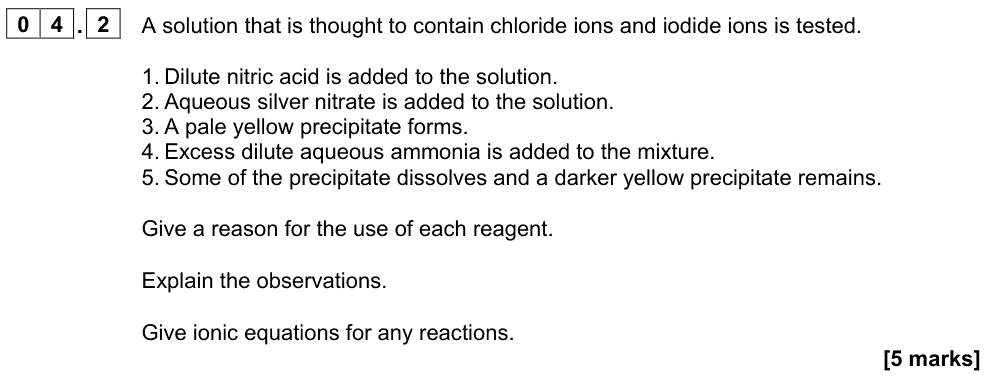
November 2021 · Paper 3 · Q04.25 marksExplanation
Earlier part of question 04 that this part uses
Mark scheme
Examiner's comment
Question 04.2 again showed weaknesses in awareness of ideas related to practical situations and in being able to give clear, concise explanations.
The need to include ionic equations was also often overlooked.
Notes from the mark scheme and report
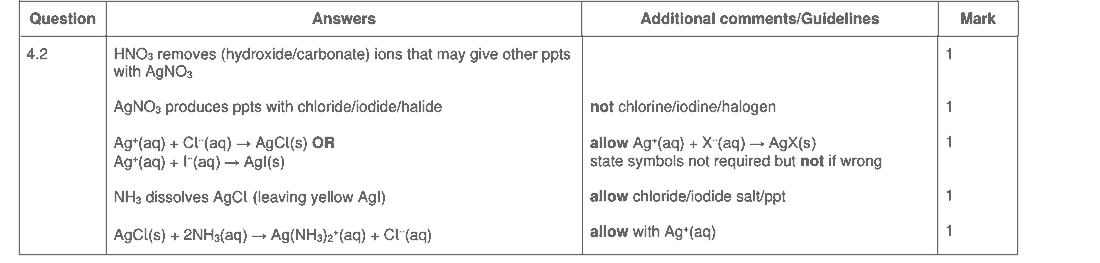
Nitric acid removes ions such as carbonate or hydroxide that would give other precipitates with silver nitrate
silver nitrate gives precipitates with the halide ions: Ag+(aq) + Cl–(aq) → AgCl(s) or Ag+(aq) + I–(aq) → AgI(s)
ammonia dissolves the AgCl, leaving yellow AgI
AgCl(s) + 2NH3(aq) → [Ag(NH3)2]+(aq) + Cl–(aq). Say chloride/iodide, not chlorine/iodine. The ionic equations were often left out
Skills: PS1.1 Solve problems set in practical contexts; PS1.2 Apply scientific knowledge to practical contexts; RP4 Carry out simple test-tube reactions to identify: cations – Group 2, NH4+; anions – Group 7 (halide ions), OH–, CO32–, SO42–
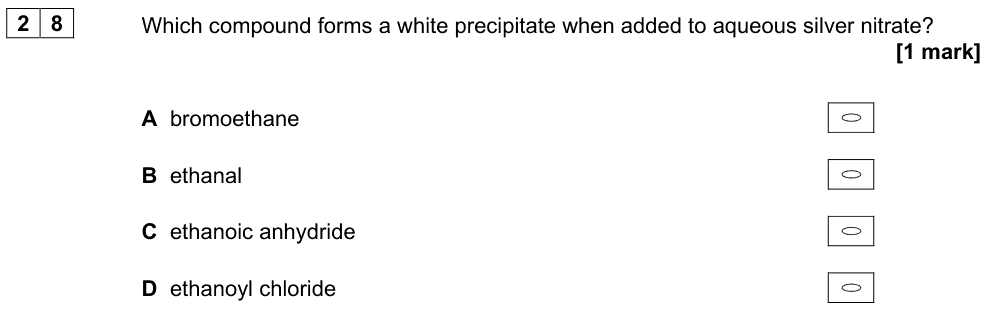
November 2021 · Paper 3 · Q281 markMultiple choice
Answer
D
Mark scheme
Notes from the mark scheme and report
Answer: D. Ethanoyl chloride is hydrolysed rapidly by the water, releasing chloride ions that give white AgCl (bromoethane would give a cream precipitate, slowly)
November 2020 · AS Paper 1 · Q07.13 marksShort answer
Mark scheme
Notes from the mark scheme and report
Reason: to kill bacteria / sterilise the water. Explanation: the health benefit outweighs the risk / it is only used in low concentration. Equation: Cl2 + H2O ⇌ HCl + HClO (or 2Cl2 + 2H2O → 4HCl + O2)
November 2020 · AS Paper 1 · Q07.24 marksEquation writing
Earlier part of question 07 that this part uses
Mark scheme
Notes from the mark scheme and report
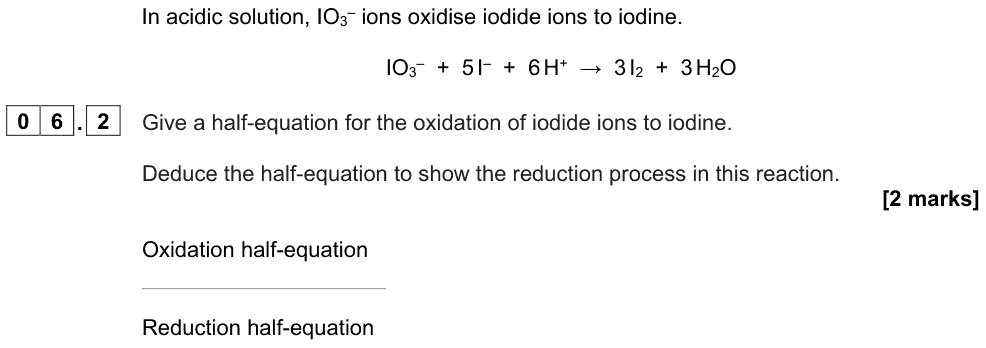
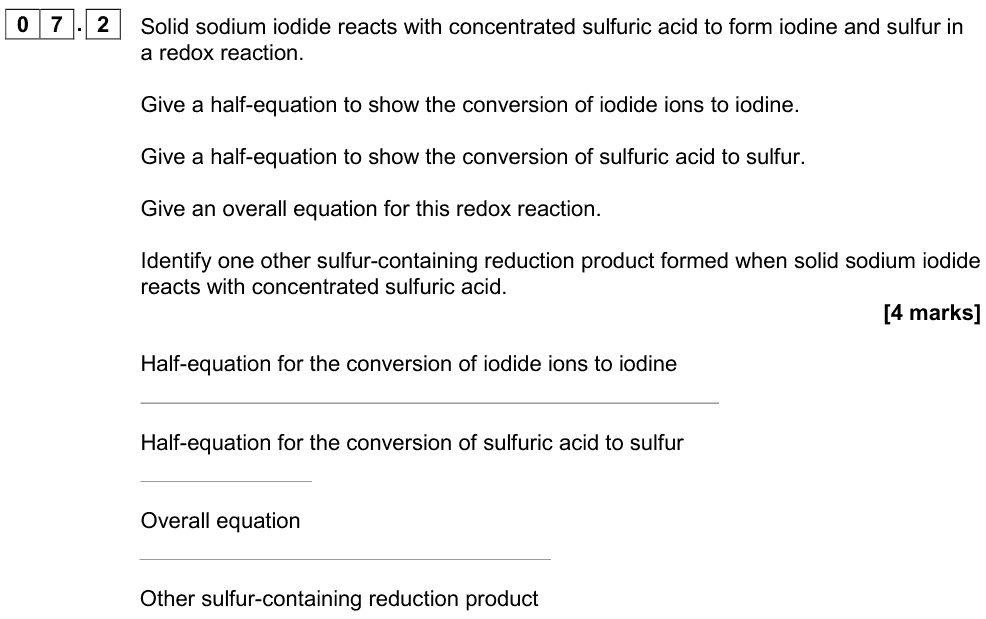
2I– → I2 + 2e–
H2SO4 + 6H+ + 6e– → S + 4H2O
overall 6H+ + 6I– + H2SO4 → 3I2 + S + 4H2O
other product SO2 or H2S. Equations using 8H+ + SO4 2– are allowed
November 2020 · AS Paper 1 · Q07.31 markPractical and data analysis
Earlier part of question 07 that this part uses
Mark scheme
Notes from the mark scheme and report
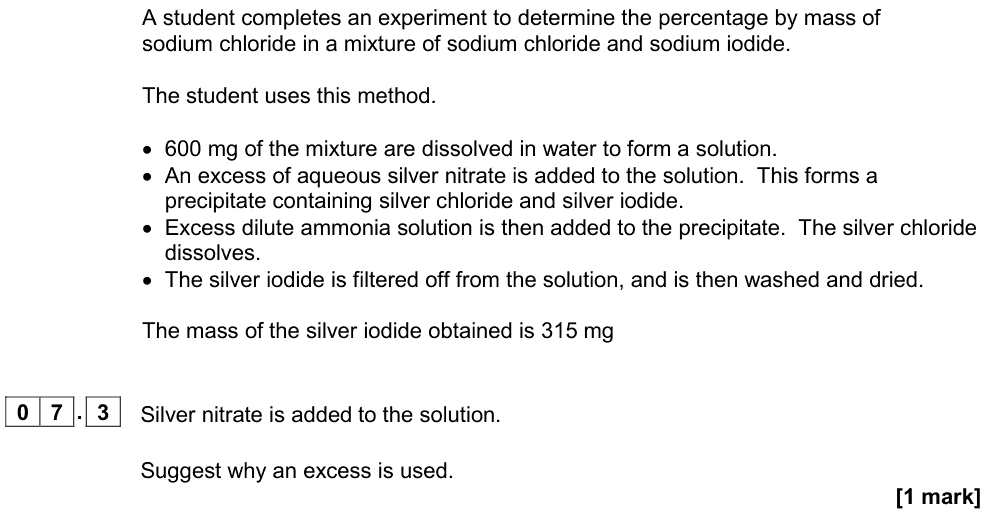
To make sure all the halide ions (chloride and iodide) are precipitated / removed from the solution. Must refer to both halide ions or all halide ions
Skills: PS2.1 Comment on experimental design and evaluate scientific methods; PS1.2 Apply scientific knowledge to practical contexts
November 2020 · Paper 1 · Q09.11 markShort answer
Mark scheme
Examiner's comment
Most students knew there would be no reaction and therefore no visible observation in 09.1; the most common incorrect answer was a white precipitate.
Notes from the mark scheme and report
No visible change / colourless solution / no precipitate (silver fluoride is soluble). 'Nothing' is ignored. Most common wrong answer: white precipitate
Skills: ATd Use laboratory apparatus for a variety of experimental techniques including: titration, using burette and pipette; distillation and heating under reflux, including setting up glassware using retort stand and clamps; qualitative tests for ions and organic functional groups; filtration, including use of fluted filter paper, or filtration under reduced pressure; RP4 Carry out simple test-tube reactions to identify: cations – Group 2, NH4+; anions – Group 7 (halide ions), OH–, CO32–, SO42–
November 2020 · Paper 1 · Q09.23 marksEquation writing
Earlier part of question 09 that this part uses
Mark scheme
Examiner's comment
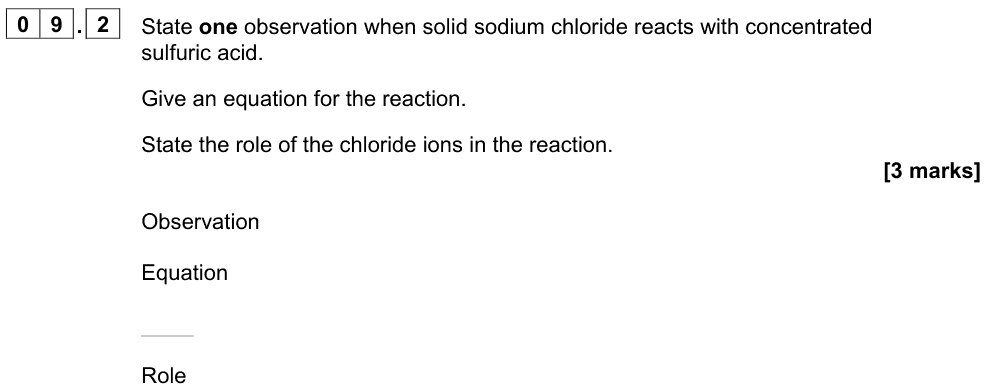
In 09.2, most students gave a correct observation and the correct equation was often seen; the role of the chloride ion was less well understood.
chloride ions act as a base / proton acceptor. The role was the least well known
November 2020 · Paper 1 · Q09.33 marksEquation writing
Earlier part of question 09 that this part uses
Mark scheme
Examiner's comment
Students found 09.3 more challenging; only a few students gave a correct equation.
The explanation was not well done.
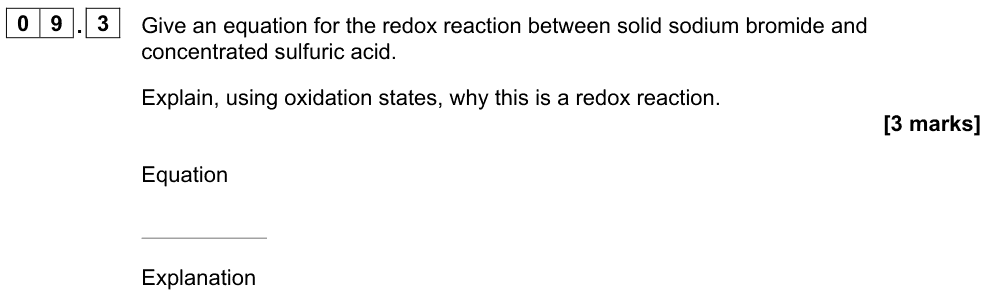
Although some students gave the oxidation states correctly, they either failed to identify the oxidation or reduction processes or they gave them the wrong way round; many students thought hydrogen was the element being reduced or oxidised.
S goes from +6 to +4 and is reduced. Errors: few correct equations
oxidation and reduction not identified or reversed
hydrogen named as the element changing
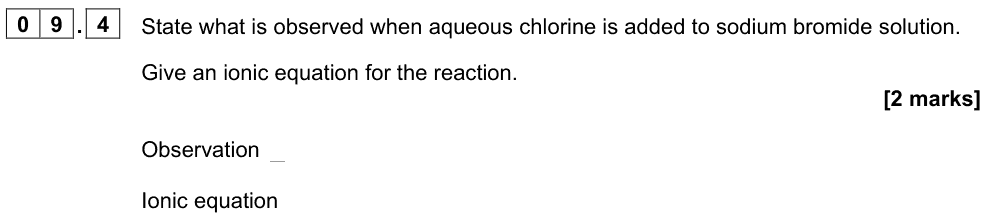
November 2020 · Paper 1 · Q09.42 marksEquation writing
Earlier part of question 09 that this part uses
Mark scheme
Examiner's comment
In 09.4, many students incorrectly gave the colour of bromine as a brown solution and some students failed to gain marks by simply stating a colour but omitting to state that a solution formed.
Many students were unable to write a correct ionic equation; some students gave an unbalanced ionic equation and some gave a full equation including sodium ions.
Notes from the mark scheme and report
Yellow / orange solution (not brown
must say solution)
Cl2 + 2Br– → 2Cl– + Br2. Errors: 'brown'
colour without 'solution'
unbalanced equation or sodium ions included
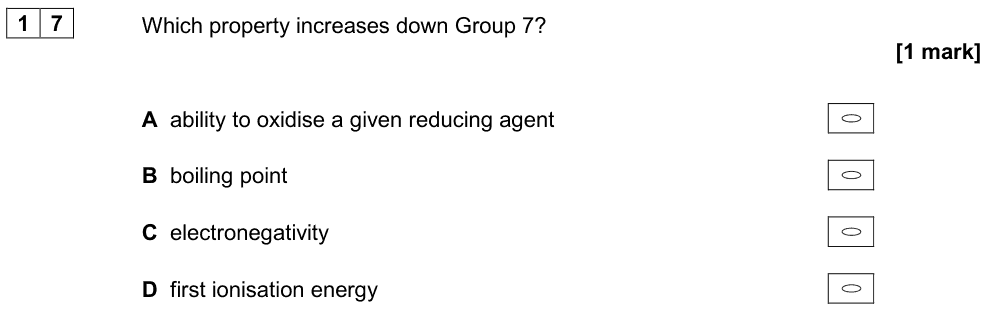
November 2020 · AS Paper 1 · Q171 markMultiple choice
Answer
B
Mark scheme
Notes from the mark scheme and report
Answer: B. Boiling point increases down Group 7 (larger molecules, stronger van der Waals forces)
oxidising ability, electronegativity and first ionisation energy all decrease
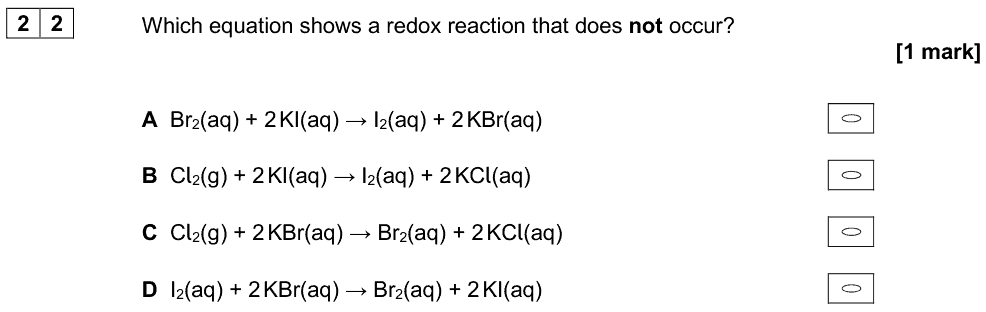
November 2020 · AS Paper 1 · Q221 markMultiple choice
Answer
D
Mark scheme
Notes from the mark scheme and report
Answer: D. Iodine is a weaker oxidising agent than bromine, so it cannot oxidise bromide ions
November 2020 · Paper 3 · Q151 markMultiple choice
Answer
B
Mark scheme
Notes from the mark scheme and report
Answer: B. Nitric acid removes ions such as carbonate or hydroxide that would also give a precipitate with silver ions
Skills: ATd Use laboratory apparatus for a variety of experimental techniques including: titration, using burette and pipette; distillation and heating under reflux, including setting up glassware using retort stand and clamps; qualitative tests for ions and organic functional groups; filtration, including use of fluted filter paper, or filtration under reduced pressure; RP4 Carry out simple test-tube reactions to identify: cations – Group 2, NH4+; anions – Group 7 (halide ions), OH–, CO32–, SO42–
November 2020 · Paper 3 · Q161 markMultiple choice
Answer
C
Mark scheme
Notes from the mark scheme and report
Answer: C. Cl2 + 2NaOH → NaCl + NaClO + H2O
June 2019 · Paper 1 · Q05.12 marksEquation writing
Mark scheme
Examiner's comment
5.1 Most students gave a correct equation in part 1 but the second mark was gained less frequently, with the role being defined incorrectly.
Notes from the mark scheme and report
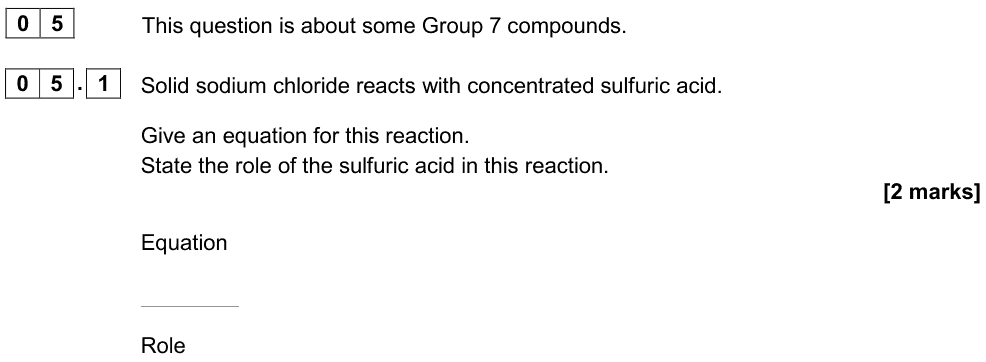
NaCl + H2SO4 → NaHSO4 + HCl (allow 2NaCl + H2SO4 → Na2SO4 + 2HCl). Sulfuric acid is a proton donor (acid). The role was often wrong
June 2019 · Paper 1 · Q05.23 marksEquation writing
Earlier part of question 05 that this part uses
Mark scheme
Examiner's comment
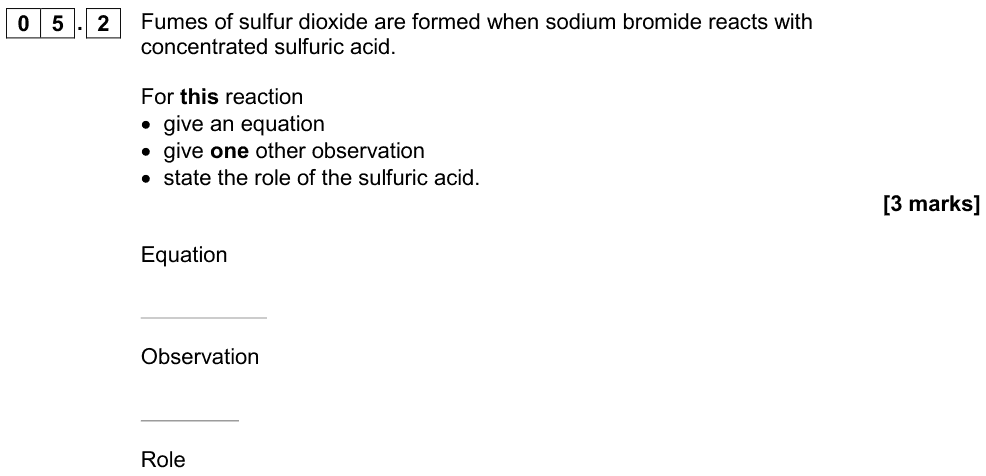
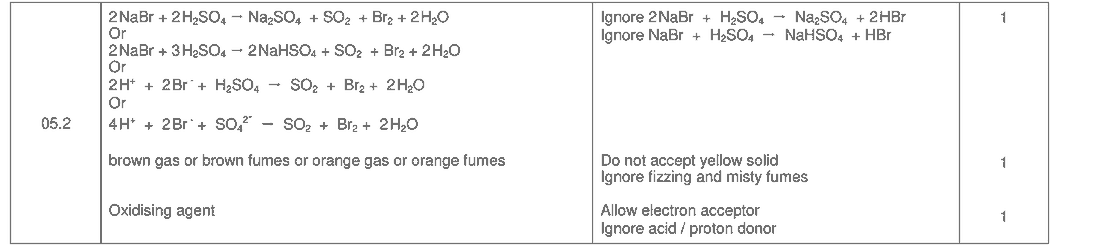
5.2 Students found this part more challenging; a few students gave a correct equation starting from sodium bromide, but equations starting from bromide ions were more successful. The observation was not well known; many students gave red fumes or brown liquid/brown solution. Mark 3 was scored more often; very few students could not state the role of sulfuric acid.
Notes from the mark scheme and report
2NaBr + 2H2SO4 → Na2SO4 + SO2 + Br2 + 2H2O (or 2H+ + 2Br– + H2SO4 → SO2 + Br2 + 2H2O). Observation: brown (orange) fumes. Role: oxidising agent. Not red fumes, brown liquid or brown solution
fizzing and misty fumes are ignored
June 2019 · Paper 1 · Q05.56 marksShort answer
Earlier part of question 05 that this part uses
Mark scheme
Examiner's comment
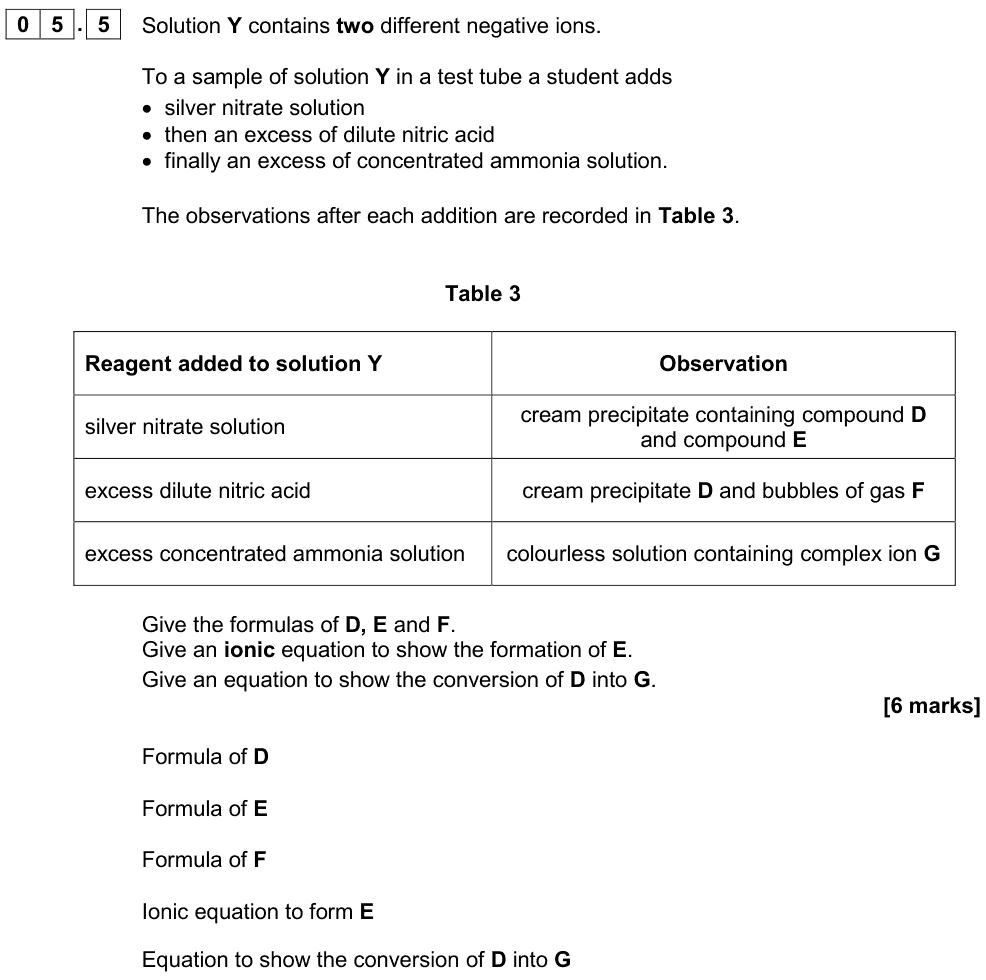
5.5 Only the most able students scored highly here. The formula of D was quite well known; E was often incorrect and those who knew it was silver carbonate often gave the wrong formula. The identity of F as CO2 was often the only mark scored. The first equation often showed precipitation of AgBr rather than Ag2CO3. The formula of the diaminosilver(I) complex was not well known and those who did know it often could not give a balanced equation.
Notes from the mark scheme and report
D = AgBr
E = Ag2CO3
F = CO2. 2Ag+ + CO3 2– → Ag2CO3. AgBr + 2NH3 → [Ag(NH3)2]+ + Br– (one mark for the complex ion, one for the equation). Errors: wrong formula for silver carbonate
an equation precipitating AgBr instead of E
formula of the diamminesilver(I) ion not known
Skills: PS1.1 Solve problems set in practical contexts; ATd Use laboratory apparatus for a variety of experimental techniques including: titration, using burette and pipette; distillation and heating under reflux, including setting up glassware using retort stand and clamps; qualitative tests for ions and organic functional groups; filtration, including use of fluted filter paper, or filtration under reduced pressure; RP4 Carry out simple test-tube reactions to identify: cations – Group 2, NH4+; anions – Group 7 (halide ions), OH–, CO32–, SO42–
June 2019 · AS Paper 1 · Q08.23 marksPractical and data analysis
Earlier part of question 08 that this part uses
Mark scheme
Examiner's comment
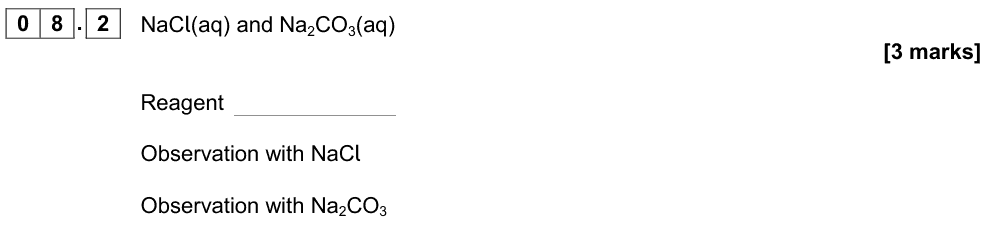
08.2 This question also proved to be challenging. Although many students chose to distinguish between these two compounds using an acid, some students chose to use acidified silver nitrate. These students did not always appreciate that the sodium carbonate solution would react with the acidified silver nitrate as well as the sodium chloride solution.
Notes from the mark scheme and report
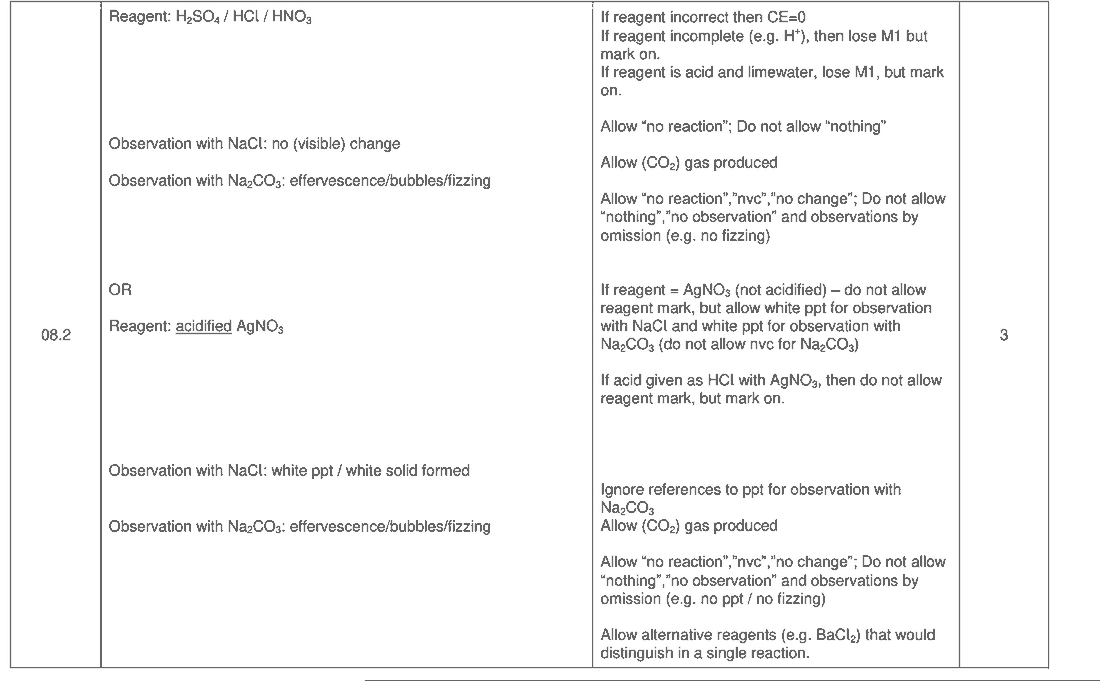
Reagent: a named acid (HCl, H2SO4 or HNO3). NaCl: no visible change. Na2CO3: effervescence. Alternative: acidified AgNO3 gives a white precipitate with NaCl and effervescence with Na2CO3. A wrong reagent scores 0
'H+' loses M1 only. Error: not realising the carbonate also reacts with acidified silver nitrate
Skills: PS1.2 Apply scientific knowledge to practical contexts; ATd Use laboratory apparatus for a variety of experimental techniques including: titration, using burette and pipette; distillation and heating under reflux, including setting up glassware using retort stand and clamps; qualitative tests for ions and organic functional groups; filtration, including use of fluted filter paper, or filtration under reduced pressure; RP4 Carry out simple test-tube reactions to identify: cations – Group 2, NH4+; anions – Group 7 (halide ions), OH–, CO32–, SO42–
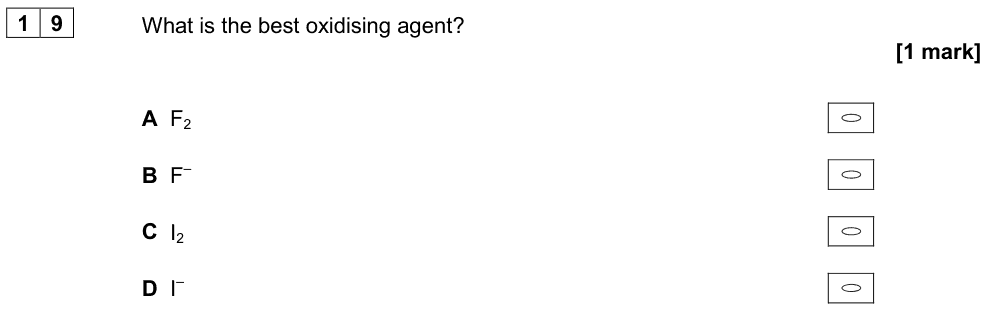
June 2019 · AS Paper 1 · Q191 markMultiple choice
Answer
A
Mark scheme
Examiner's comment
A good number of students were able to select the best oxidising agent. However a large number of students confused the oxidising ability of the halogens with the reducing ability of halide ions.
Notes from the mark scheme and report
Answer: A. Oxidising ability of the halogens decreases down the group, so F2 is the strongest electron acceptor. Common error: confusing this with the reducing ability of halide ions
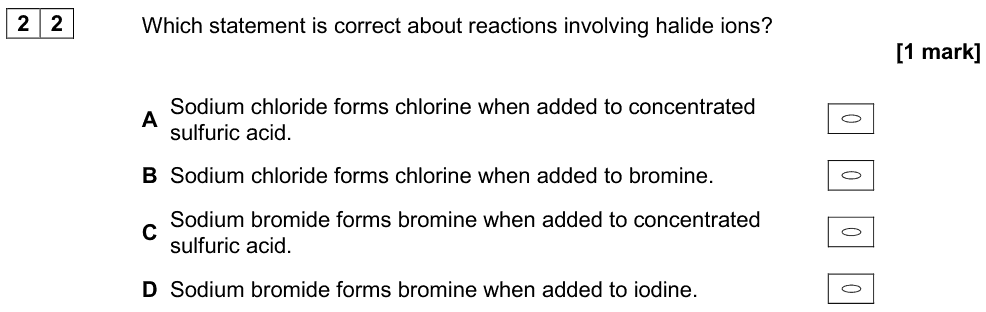
June 2019 · AS Paper 1 · Q221 markMultiple choice
Answer
C
Mark scheme
Examiner's comment
Just over half of students were able to decide on the correct statement about reactions involving halide ions in terms of their reducing ability.
Notes from the mark scheme and report
Answer: C. Bromide ions are strong enough reducing agents to reduce concentrated H2SO4 and are oxidised to Br2
chloride ions are not, and a halogen cannot displace one above it
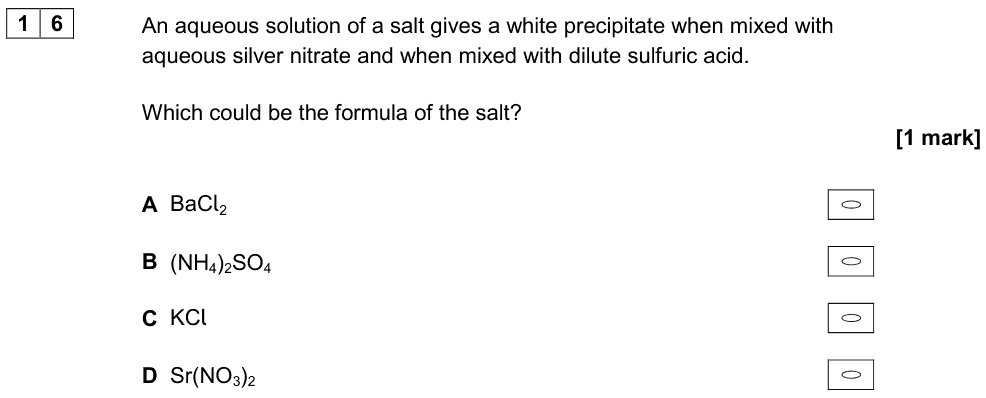
June 2019 · Paper 3 · Q161 markMultiple choice
Answer
A
Mark scheme
Notes from the mark scheme and report
Answer: A. BaCl2 gives white AgCl with silver nitrate and white BaSO4 with sulfuric acid
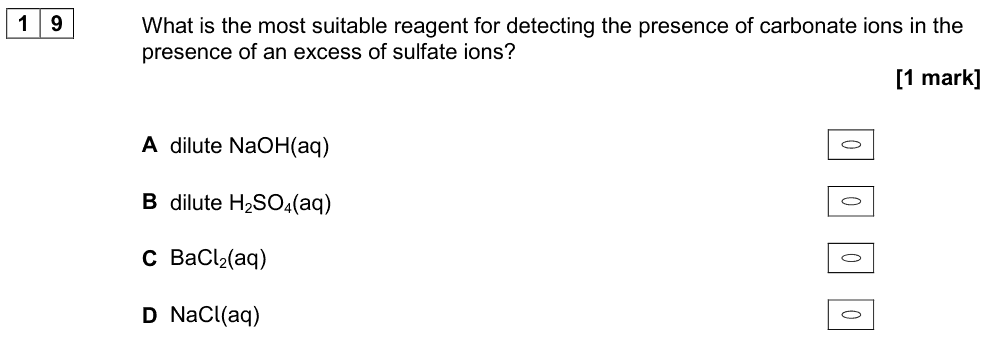
Skills: RP4 Carry out simple test-tube reactions to identify: cations – Group 2, NH4+; anions – Group 7 (halide ions), OH–, CO32–, SO42–
June 2019 · Paper 3 · Q191 markMultiple choice
Answer
B
Mark scheme
Notes from the mark scheme and report
Answer: B. Dilute acid gives effervescence (CO2) with carbonate and nothing with sulfate
BaCl2 would precipitate with both
Skills: PS1.1 Solve problems set in practical contexts; RP4 Carry out simple test-tube reactions to identify: cations – Group 2, NH4+; anions – Group 7 (halide ions), OH–, CO32–, SO42–
June 2018 · AS Paper 1 · Q04.16 marks6-mark level of response
Mark scheme, with the levels and indicative content
Examiner's comment
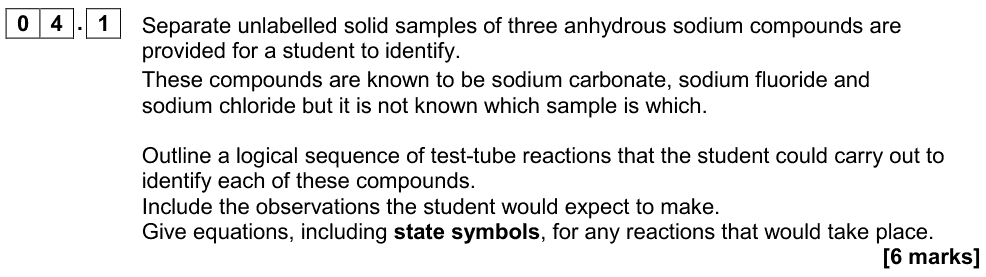
04.1 Students found this challenging and did not always express their ideas clearly. Many approached this question as if they already knew which compound was which. A good number did not appreciate that the compounds were solids and so they should make them into solutions. The best students realised that acid should be added first to identify the sodium carbonate and that this solid can then be discarded from further tests. A large number of students realised that silver nitrate would be the best reagent that could be used to determine which solid was sodium chloride and which was sodium fluoride. Additional use of ammonia solution was not necessary in this case. Equations were well written, although did not often include state symbols as required. A high number of students felt that concentrated sulfuric could be used to determine which solid was which despite the fact that all three solids would give very similar observations. The question discriminated particularly well.
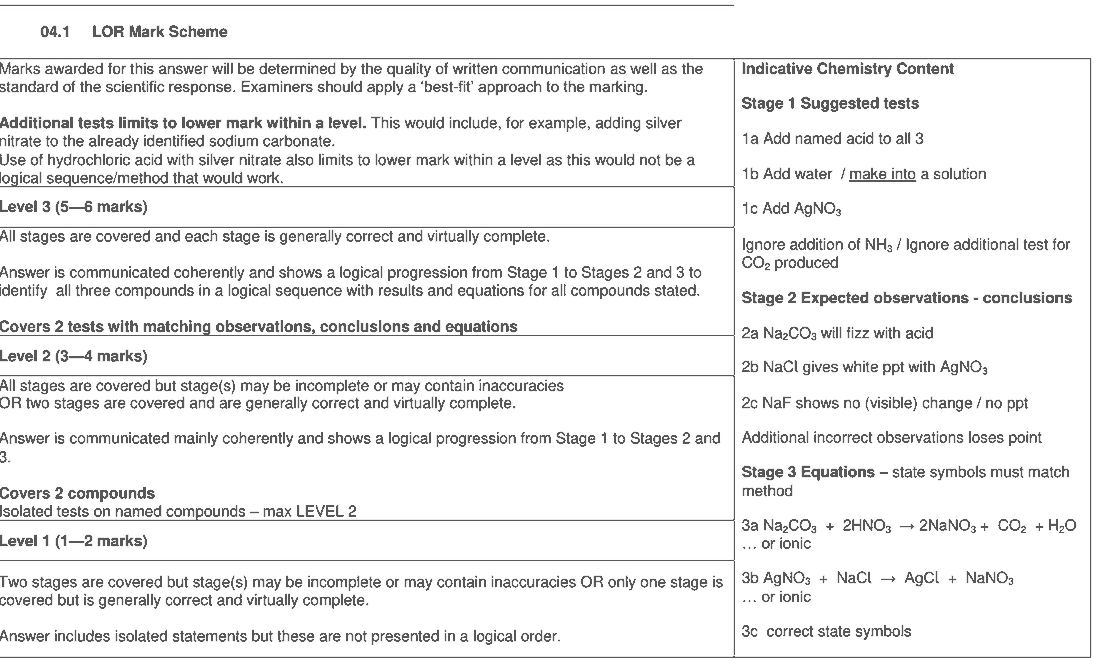
Notes from the mark scheme and report
Levels of response, three stages. Tests: add a named acid (eg HNO3) to all three
make solutions in water
add AgNO3. Observations: Na2CO3 fizzes with acid
NaCl gives a white precipitate with AgNO3
NaF shows no visible change. Equations with state symbols: Na2CO3 + 2HNO3 → 2NaNO3 + CO2 + H2O
AgNO3 + NaCl → AgCl + NaNO3 (or ionic). Using HCl before AgNO3, or testing an already identified sample, limits the mark within a level
isolated tests on named compounds are max level 2. Errors: treating the samples as already known, not dissolving the solids, concentrated H2SO4 (all three look similar), state symbols missing
Skills: ATd Use laboratory apparatus for a variety of experimental techniques including: titration, using burette and pipette; distillation and heating under reflux, including setting up glassware using retort stand and clamps; qualitative tests for ions and organic functional groups; filtration, including use of fluted filter paper, or filtration under reduced pressure; PS1.1 Solve problems set in practical contexts; PS4.1 Know and understand how to use a wide range of experimental and practical instruments, equipment and techniques appropriate to the knowledge and understanding included in the specification; RP4 Carry out simple test-tube reactions to identify: cations – Group 2, NH4+; anions – Group 7 (halide ions), OH–, CO32–, SO42–
June 2018 · AS Paper 1 · Q07.31 markEquation writingHard
Earlier part of question 07 that this part uses
Mark scheme
Examiner's comment
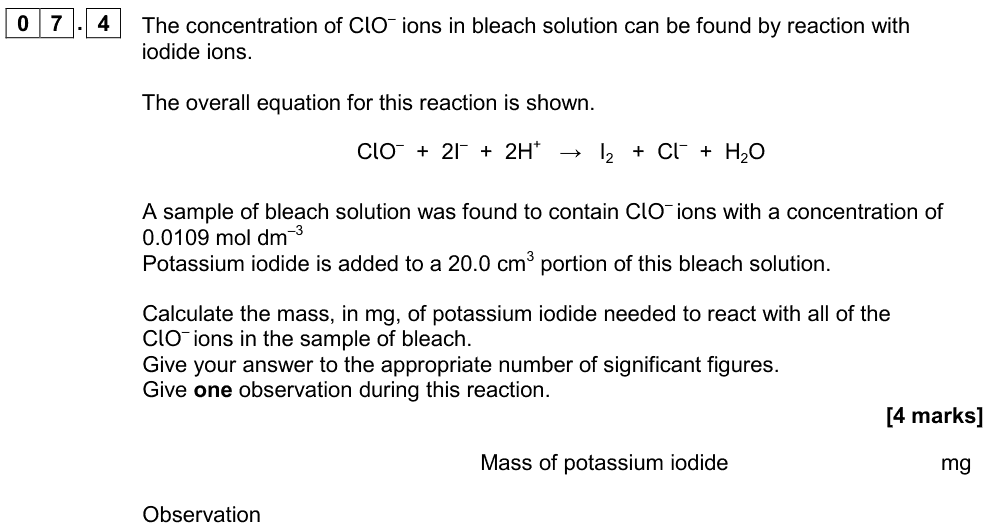
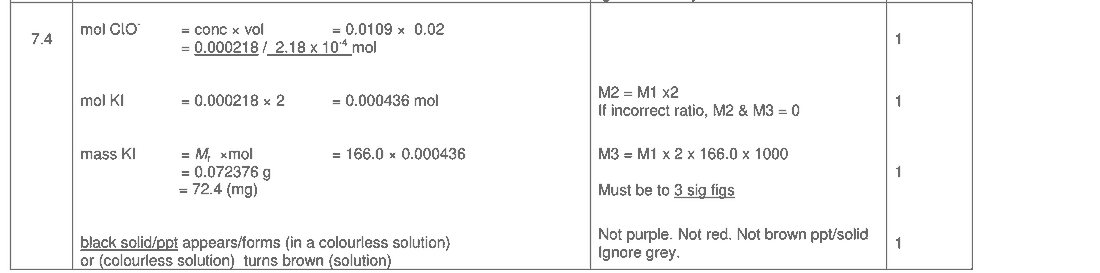
07.3 Only some students (23.1%) were able to recall this equation from the specification.
07.4 Some students successfully calculated the mass of potassium iodide. However, many did not appreciate that this reaction was not 1:1 and so used the incorrect reacting ratio in their calculations. Many students stated incorrectly that the iodine formed would be observed as purple fumes or as a purple solution. This question discriminated particularly well.
× 166.0 = 0.0724 g. Observation: colourless solution turns brown, or a black solid forms. Not purple, not red, not a brown precipitate. Errors: 1:1 ratio used
purple fumes or purple solution
Skills: MS0.0 Recognise and make use of appropriate units in calculation; MS0.2 Use ratios, fractions and percentages; MS1.1 Use an appropriate number of significant figures
June 2018 · AS Paper 1 · Q161 markMultiple choice
Answer
C
Mark scheme
Examiner's comment
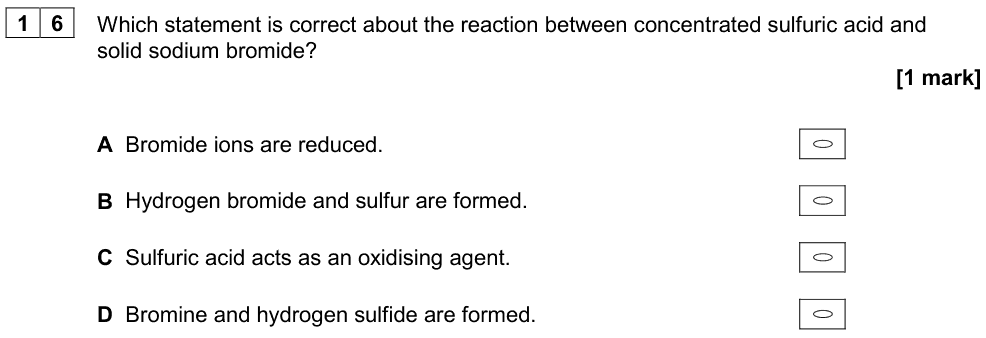
Many students (47.6%) got this correct although a significant number thought that bromide ions were reduced in the reaction of sodium bromide with concentrated sulfuric acid.
Notes from the mark scheme and report
Answer: C. Bromide ions are oxidised to Br2 and H2SO4 is reduced to SO2, so sulfuric acid is the oxidising agent. Common wrong answer: bromide ions are reduced
June 2018 · Paper 3 · Q181 markMultiple choiceEasy
Answer
A
Mark scheme
Examiner's comment
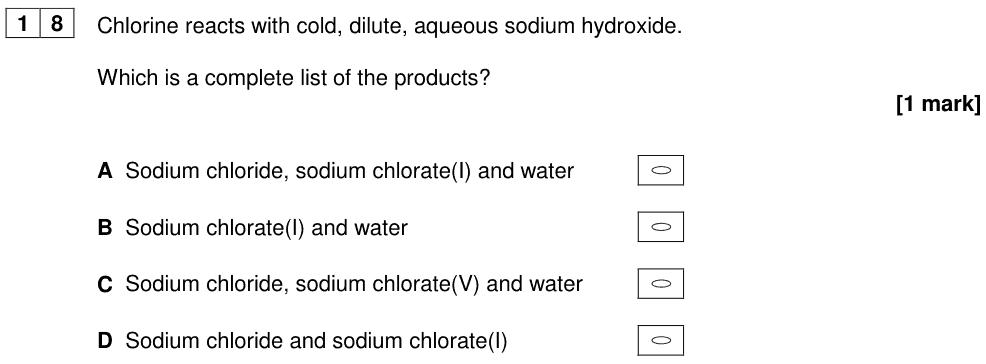
18 C was the commonest incorrect response, which is to be expected as these are the products with hot aqueous alkali. The success rate was 68.9%.
Notes from the mark scheme and report
Answer: A. Cl2 + 2NaOH → NaCl + NaClO + H2O. Chlorate(V) forms only with hot alkali (commonest wrong answer C)
June 2018 · Paper 3 · Q201 markMultiple choiceEasy
Answer
D
Mark scheme
Examiner's comment
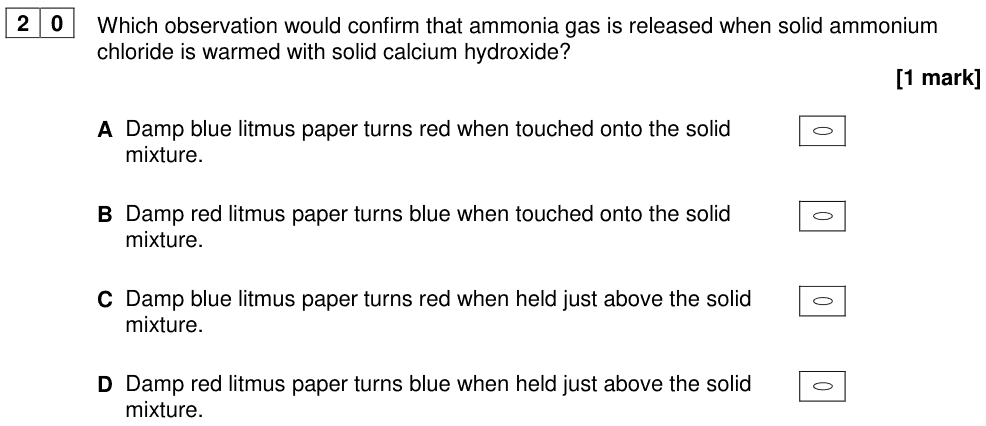
20 C was the commonest incorrect response, which gave the correct position for the litmus paper but with the colour change reversed. 72.2% of students correctly chose D.
Notes from the mark scheme and report
Answer: D. Ammonia is an alkaline gas, so damp red litmus held above the mixture turns blue
touching the solid would test the calcium hydroxide instead
Skills: ATd Use laboratory apparatus for a variety of experimental techniques including: titration, using burette and pipette; distillation and heating under reflux, including setting up glassware using retort stand and clamps; qualitative tests for ions and organic functional groups; filtration, including use of fluted filter paper, or filtration under reduced pressure; PS4.1 Know and understand how to use a wide range of experimental and practical instruments, equipment and techniques appropriate to the knowledge and understanding included in the specification; RP4 Carry out simple test-tube reactions to identify: cations – Group 2, NH4+; anions – Group 7 (halide ions), OH–, CO32–, SO42–
June 2017 · Paper 1 · Q01.42 marksShort answer
Earlier part of question 01 that this part uses
Mark scheme
Examiner's comment
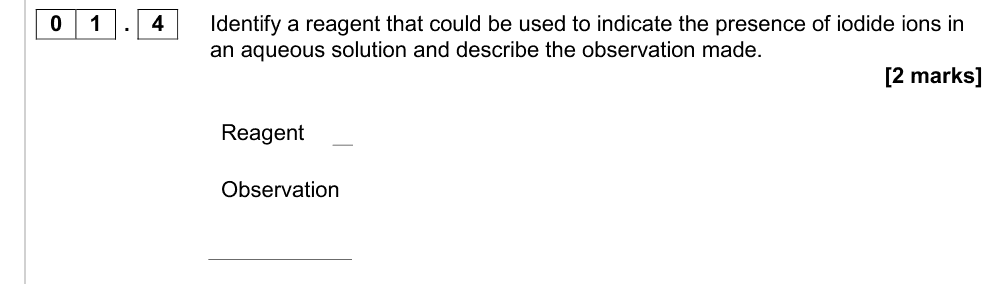
01.4 The reagent silver nitrate was well known, and this was generally followed by the correct colour of the precipitate. Some students used a more reactive halogen as the reagent and this was given full credit; however, observations for this were less well known.
Notes from the mark scheme and report
Silver nitrate solution, AgNO3
yellow precipitate. Or Cl2 or Br2
brown solution / black precipitate. Observation mark depends on a correct reagent. Observations with a halogen were less well known
Skills: ATd Use laboratory apparatus for a variety of experimental techniques including: titration, using burette and pipette; distillation and heating under reflux, including setting up glassware using retort stand and clamps; qualitative tests for ions and organic functional groups; filtration, including use of fluted filter paper, or filtration under reduced pressure; RP4 Carry out simple test-tube reactions to identify: cations – Group 2, NH4+; anions – Group 7 (halide ions), OH–, CO32–, SO42–
June 2017 · AS Paper 1 · Q101 markMultiple choiceEasy
Answer
C
Mark scheme
Examiner's comment
63.6% of students gained this mark. This proved to be a relatively easy practical question requiring little application of knowledge.
Notes from the mark scheme and report
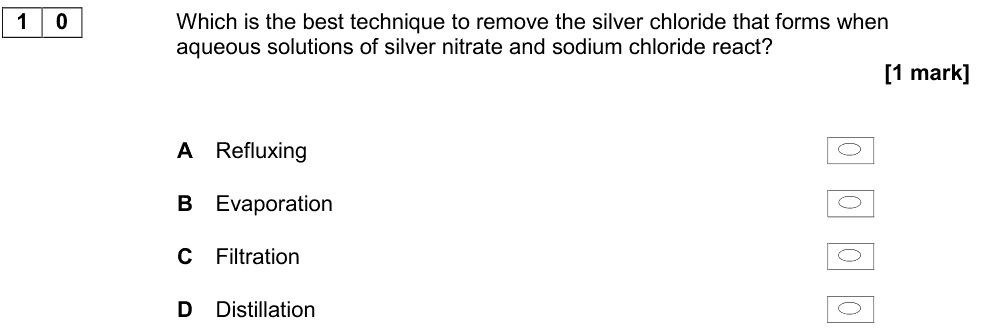
Answer: C. Silver chloride is an insoluble solid (precipitate), so it is separated from the solution by filtration
Skills: ATd Use laboratory apparatus for a variety of experimental techniques including: titration, using burette and pipette; distillation and heating under reflux, including setting up glassware using retort stand and clamps; qualitative tests for ions and organic functional groups; filtration, including use of fluted filter paper, or filtration under reduced pressure; PS4.1 Know and understand how to use a wide range of experimental and practical instruments, equipment and techniques appropriate to the knowledge and understanding included in the specification
June 2017 · AS Paper 1 · Q111 markMultiple choiceEasy
Answer
C
Mark scheme
Examiner's comment
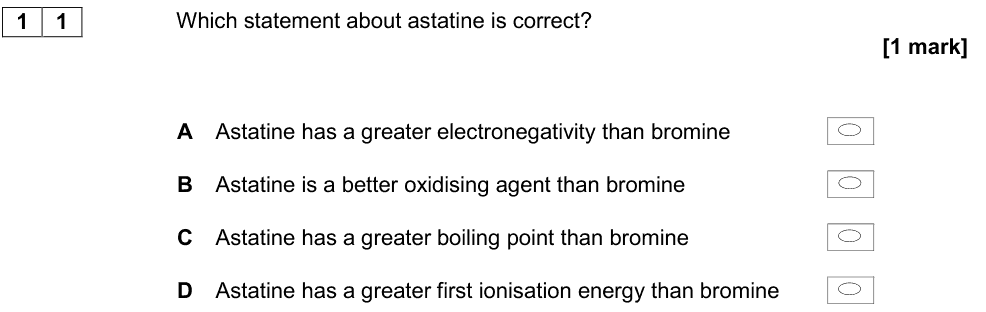
This mark was gained by 71.7% of students, showing that this is one of the easier physical property trends to remember.
Notes from the mark scheme and report
Answer: C. Boiling point increases down Group 7 (larger molecules, stronger van der Waals forces)
electronegativity, oxidising ability and first ionisation energy all decrease
June 2017 · AS Paper 1 · Q231 markMultiple choice
Answer
A
Mark scheme
Examiner's comment
Only 42.2% of students selected the correct answer. Perhaps many students did not appreciate that a range of sulfur-based products are formed in the reaction.
Notes from the mark scheme and report
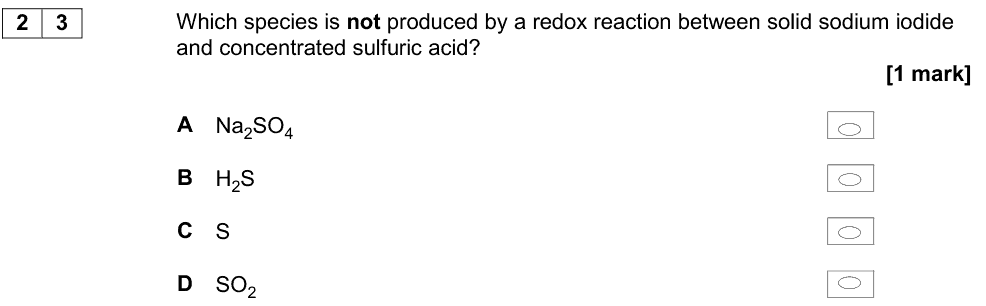
Answer: A. Iodide reduces H2SO4 to SO2, S and H2S (I– oxidised to I2)
the sodium salt comes from the acid–base reaction, not redox (42.2% correct)
June 2017 · Paper 3 · Q02.72 marksShort answer
Earlier part of question 02 that this part uses
Mark scheme
Examiner's comment
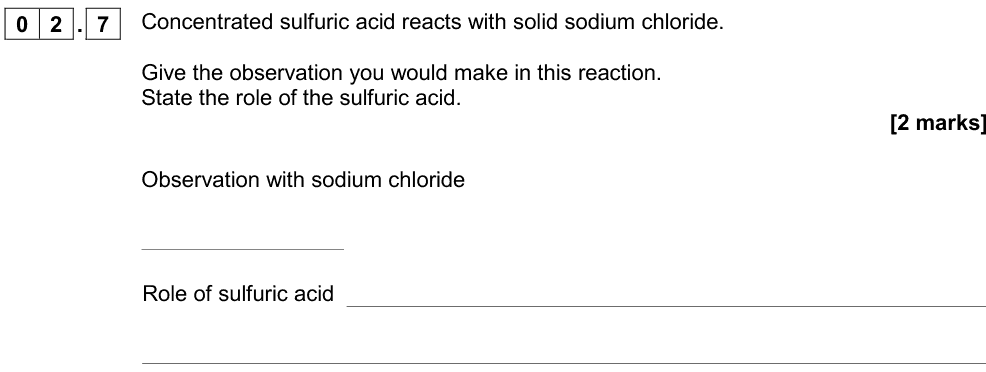
02.7 Although the oxidising ability of concentrated sulfuric acid did not seem to be recognised often in question 02.6, it was often, incorrectly, suggested here, with most students concentrating on this aspect and failing to recognise that sulfuric acid does not oxidise a chloride ion.
Notes from the mark scheme and report
Steamy / misty white fumes (of HCl)
sulfuric acid acts as an acid (proton donor). Not 'gas evolved' or effervescence. Common error: oxidising agent, but sulfuric acid does not oxidise chloride ions
June 2017 · Paper 3 · Q02.83 marksShort answer
Earlier part of question 02 that this part uses
Mark scheme
Examiner's comment
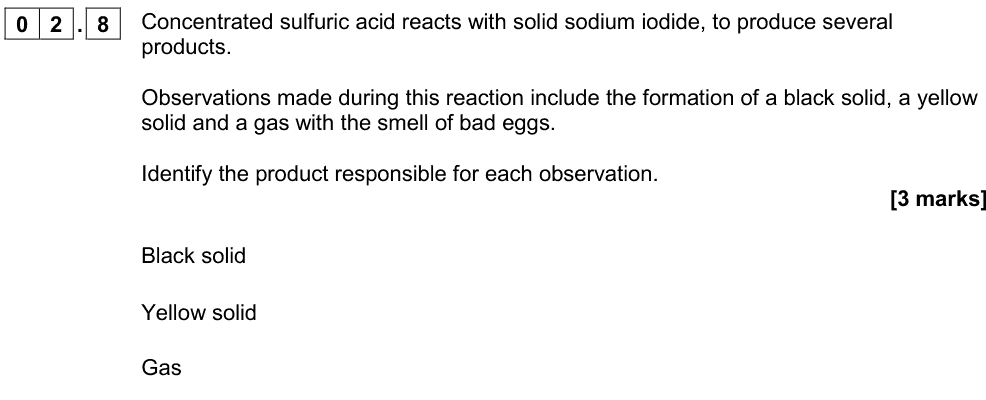
02.8 Over 30% of students gained full marks here, but there was also quite a lot of confusion between the products, with carbon suggested as the black solid; iodine, SO2 or H2S as the yellow solid; and SO2 commonly suggested as the gas smelling of bad eggs.
Notes from the mark scheme and report
Black solid: iodine (I2). Yellow solid: sulfur. Bad-egg gas: hydrogen sulfide (H2S). If name and formula are both given, both must be right. Common errors: carbon as the black solid
SO2 as the bad-egg gas
June 2016 · AS Paper 1 · Q08.43 marksExplanation
Earlier part of question 08 that this part uses
Mark scheme
Examiner's comment
In 8.4 the explanation that iodide ions are oxidised wasn’t seen very often but a reasonable proportion of students scored some marks on this question.
Notes from the mark scheme and report
Solution turns brown (allow black solid
not black solution or purple) because iodine (or I3–) forms
iodide ions are oxidised (by ClO–). A correct half-equation 2I– → I2 + 2e– scores the second and third marks. 'Iodide is oxidised' was seldom stated
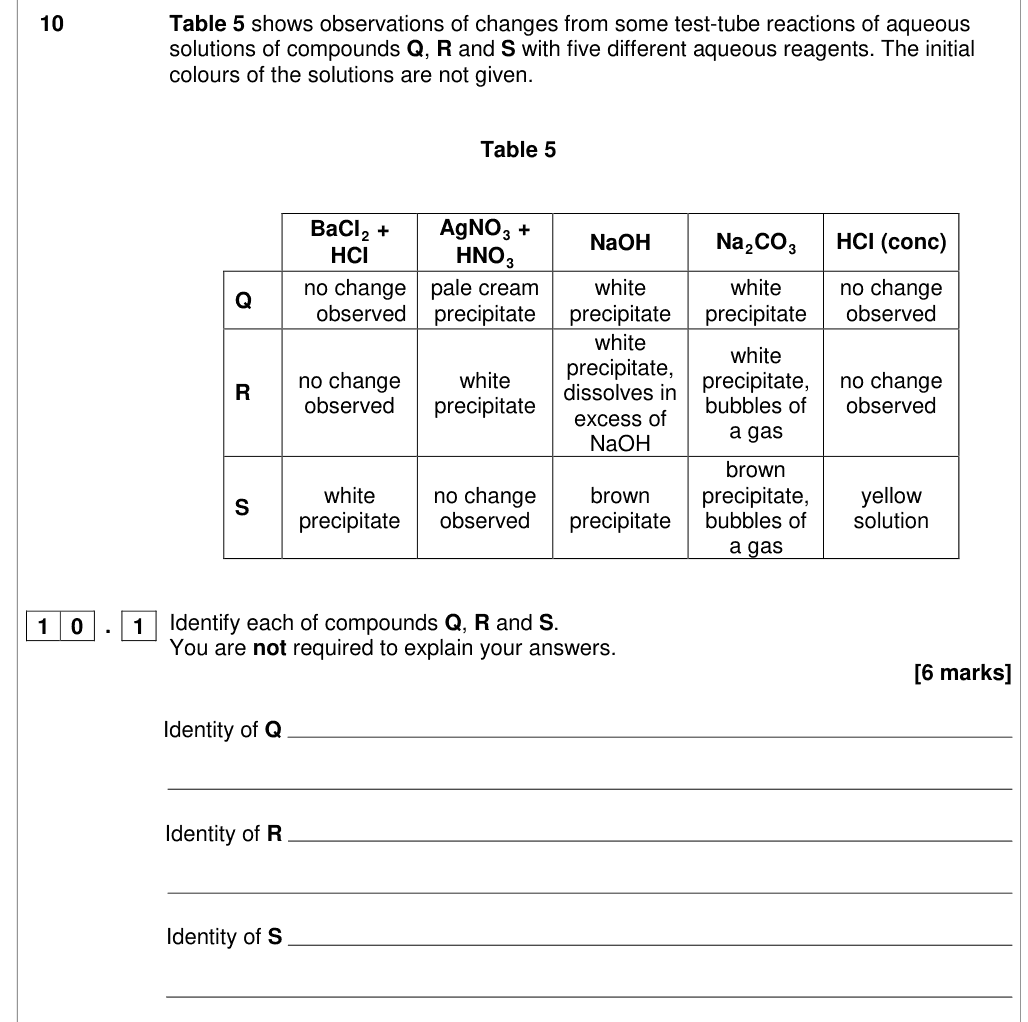
Specimen · Paper 1 · Q10.16 marksPractical and data analysis
Mark scheme
Notes from the mark scheme and report
Q is calcium bromide or magnesium bromide
R is aluminium chloride
S is iron(III) sulfate. Six marks, one for each ion identified independently (cream precipitate = bromide
white precipitate dissolving in excess NaOH = Al3+
white precipitate with BaCl2 = sulfate
brown precipitates = Fe3+)
Skills: PS1.1 Solve problems set in practical contexts; PS2.3 Evaluate results and draw conclusions with reference to measurement uncertainties and errors; ATd Use laboratory apparatus for a variety of experimental techniques including: titration, using burette and pipette; distillation and heating under reflux, including setting up glassware using retort stand and clamps; qualitative tests for ions and organic functional groups; filtration, including use of fluted filter paper, or filtration under reduced pressure; RP11 Carry out simple test-tube reactions to identify transition metal ions in aqueous solution
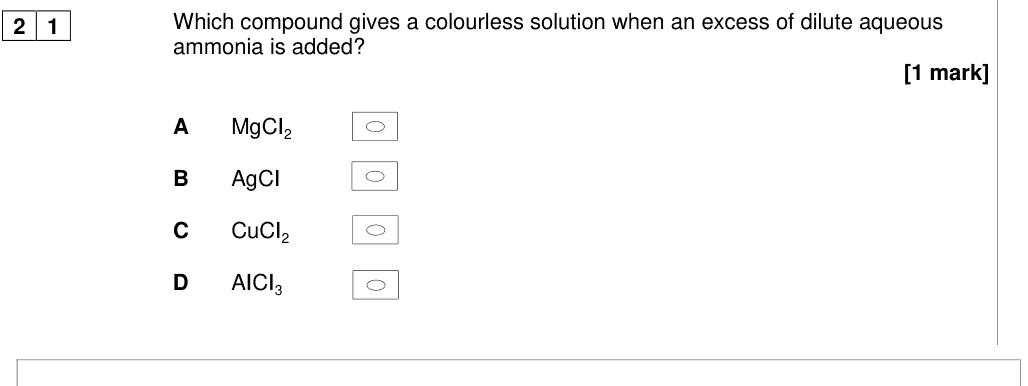
Specimen · Paper 3 · Q211 markAO1=1Multiple choice
Answer
B
Mark scheme
Notes from the mark scheme and report
Answer: B. AgCl dissolves in ammonia to form colourless [Ag(NH3)2]+. Mg2+ and Al3+ give white hydroxide precipitates
Cu2+ gives a deep blue solution
Work with an A-level chemistry tutor
Dropping marks on calculations, mechanisms or the required practicals? Book a trial session with a specialist A-level chemistry tutor.