Notes and key-term cards for this topic are being written by our tutors. The past-paper questions below are ready now.
Specification statements
Show the 3 statements from the specification
3.1.10-01 The equilibrium constant Kp is deduced from the equation for a reversible reaction occurring in the gas phase.
3.1.10-02 Kp is the equilibrium constant calculated from partial pressures for a system at constant temperature.
3.1.10-03 Students should be able to: • derive partial pressure from mole fraction and total pressure • construct an expression for Kp for a homogeneous system in equilibrium • perform calculations involving Kp • predict the qualitative effects of changes in temperature and pressure on the position of equilibrium • predict the qualitative effects of changes in temperature on the value of Kp • understand that, whilst a catalyst can affect the rate of attainment of an equilibrium, it does not affect the value of the equilibrium constant.
Tap a question to zoom it. Where a part needs a figure, table or structure from earlier in the question, that part folds out above it; the mark scheme and examiner's comment open underneath. Have AQA's Data Booklet (the Periodic Table and the spectroscopy tables) beside you.
June 2025 · Paper 1 · Q04.52 marksAO1=1, AO2=1Explanation
Earlier parts of question 04 that this part uses
Mark scheme
Examiner's comment
In part 5 over half the students gained both marks.
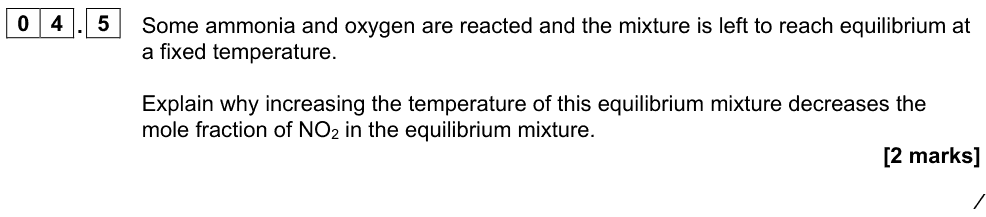
Some students stated that the equilibrium shifted in the endothermic direction without specifying this as being the reverse direction or without explaining that this was to oppose the change put on the system.
It is advised to begin a response with a clear statement: eg the forward reaction is exothermic.
Notes from the mark scheme and report
The forward reaction is exothermic
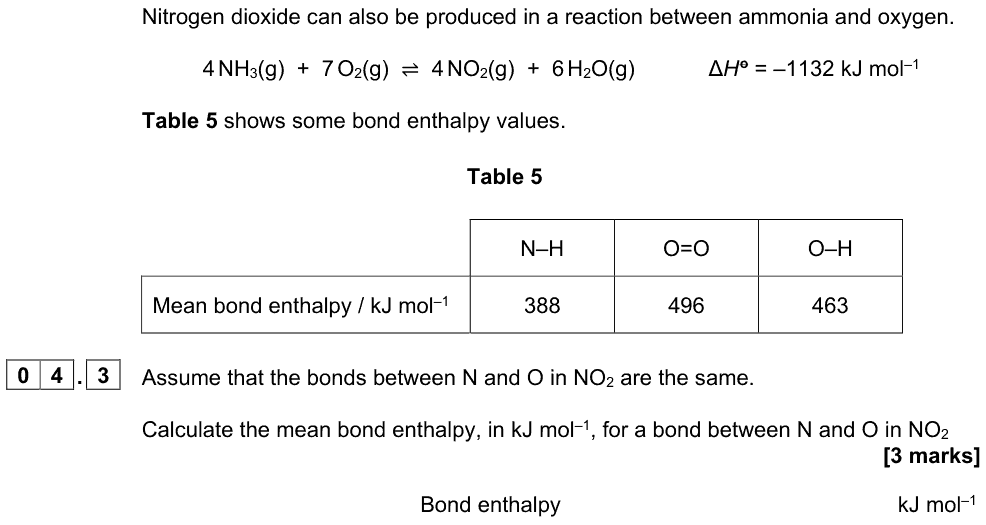
the equilibrium shifts to oppose the increase in temperature (in the endothermic, reverse direction). 'Shifts to the left' alone is insufficient. Start with a clear statement that the forward reaction is exothermic. Uses the equation and ∆H printed with 04.3
June 2024 · Paper 1 · Q04.12 marksAO2=2Calculation
Mark scheme
Examiner's comment
Part 1 was answered well.
Notes from the mark scheme and report
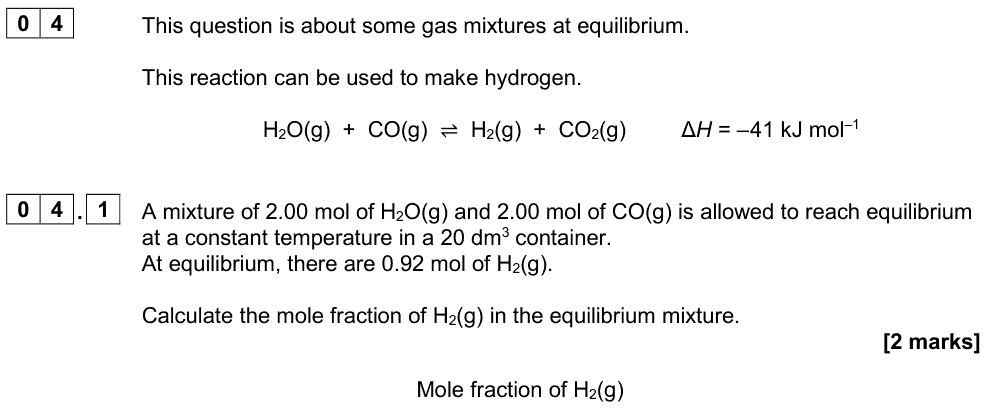
Answer: 0.23. Total amount of gas at equilibrium is 4.00 mol
0.92 ÷ 4.00
Skills: MS0.2 Use ratios, fractions and percentages
June 2024 · Paper 1 · Q04.21 markAO1=1Short answer
Earlier part of question 04 that this part uses
Mark scheme
Examiner's comment
52% of students gained the mark in part 2: incorrect answers included the same number of reactants and products rather than referring to the amount, in moles, of reactants and products.
‘The units cancel’ was a common response but was insufficient for the mark.
Notes from the mark scheme and report
The amount in moles of products equals that of reactants, so the units of partial pressure cancel. 'The units cancel' alone was insufficient
Skills: MS0.0 Recognise and make use of appropriate units in calculation
June 2024 · Paper 1 · Q04.31 markAO1=1Short answer
Earlier part of question 04 that this part uses
Mark scheme
Examiner's comment
Part 3 was answered well.
Notes from the mark scheme and report
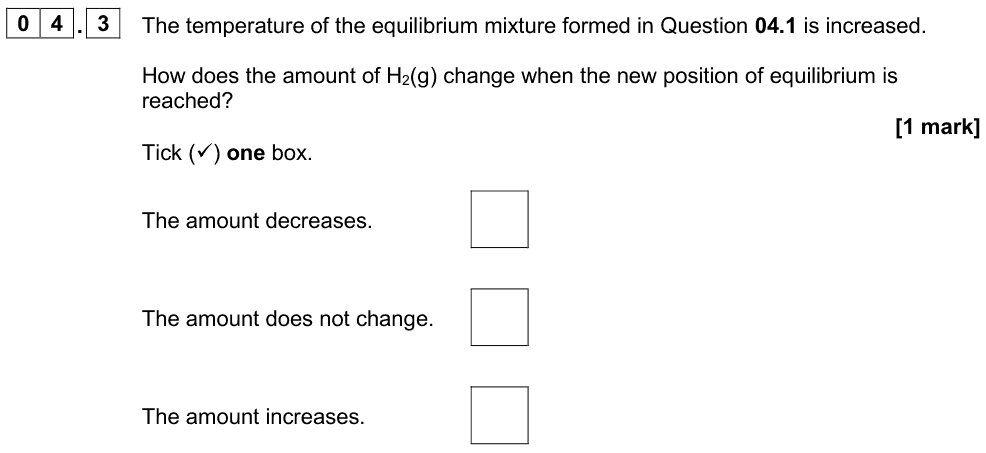
Answer: the amount decreases (the forward reaction is exothermic)
June 2024 · Paper 1 · Q04.44 marksAO2=4Calculation
Earlier part of question 04 that this part uses
Mark scheme
Examiner's comment
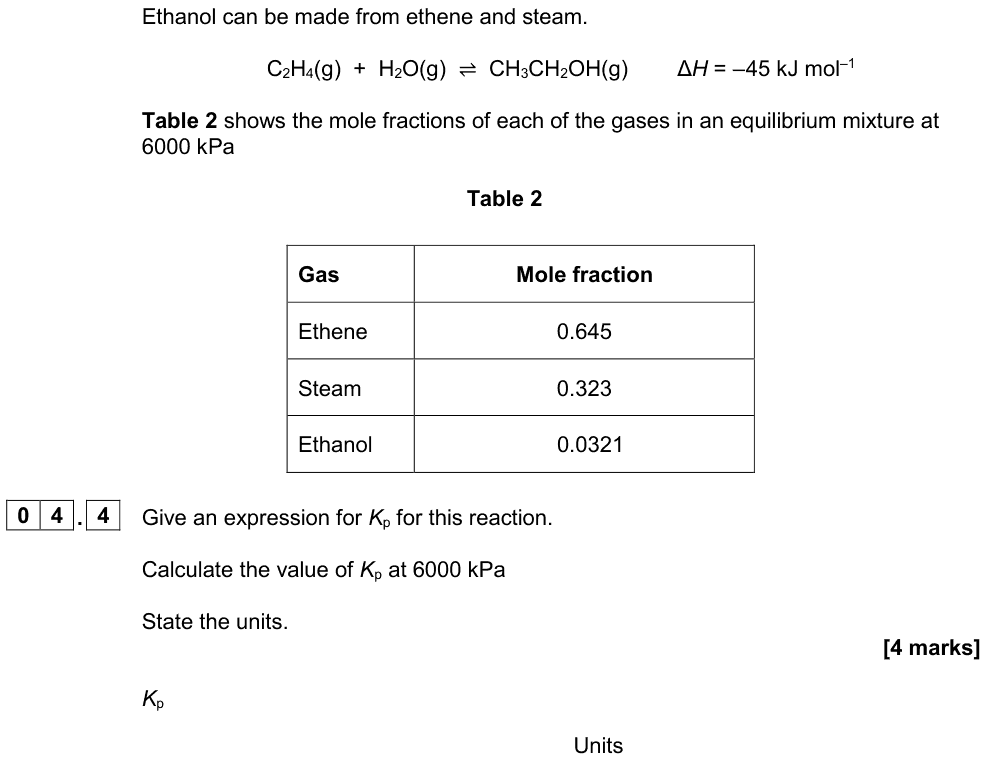
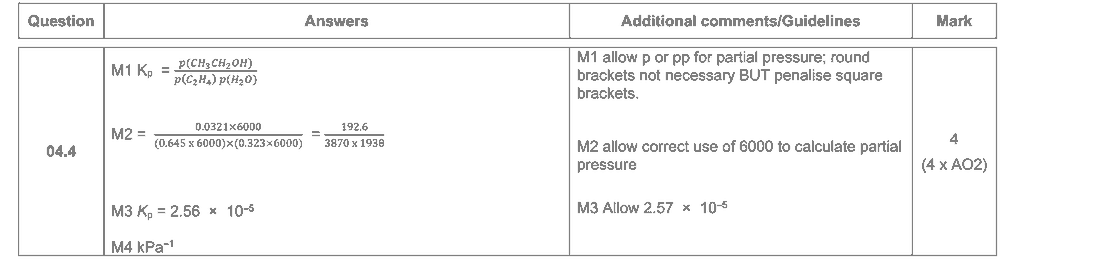
The calculation in part 4 was well done: errors included omitting the conversion from mole fraction into partial pressures or by giving incomplete units (kPa).
Some students failed to gain a mark for the expression by omitting a symbol for partial pressure, or by using square brackets.
each partial pressure = mole fraction × 6000. Errors: mole fractions not converted
square brackets
units given as kPa
Skills: MS0.0 Recognise and make use of appropriate units in calculation; MS0.1 Recognise and use expressions in decimal and ordinary form; MS2.3 Substitute numerical values into algebraic equations using appropriate units for physical quantities
June 2024 · Paper 1 · Q04.51 markAO1=1Short answerEasy
Earlier parts of question 04 that this part uses
Mark scheme
Examiner's comment
In part 5, 73% of students gained the mark.
Notes from the mark scheme and report
Answer: no effect
June 2024 · Paper 3 · Q291 markAO2=1Multiple choice
Answer
D
Mark scheme
Notes from the mark scheme and report
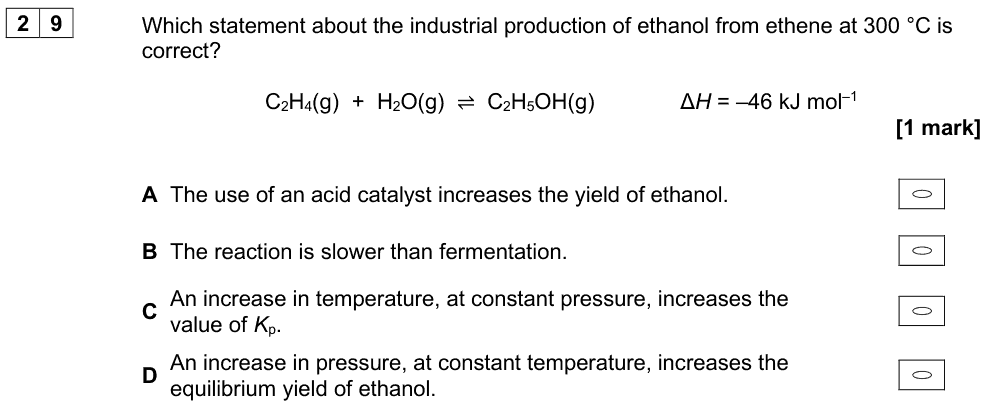
Answer: D. There are fewer moles of gas on the right (2 → 1), so higher pressure increases the yield. A catalyst does not change yield
the reaction is exothermic so Kp falls as temperature rises
hydration is faster than fermentation
June 2023 · Paper 1 · Q04.13 marksAO2=3Calculation
Mark scheme
Examiner's comment
Questions 04.1 and 04.2 were well answered.
Notes from the mark scheme and report
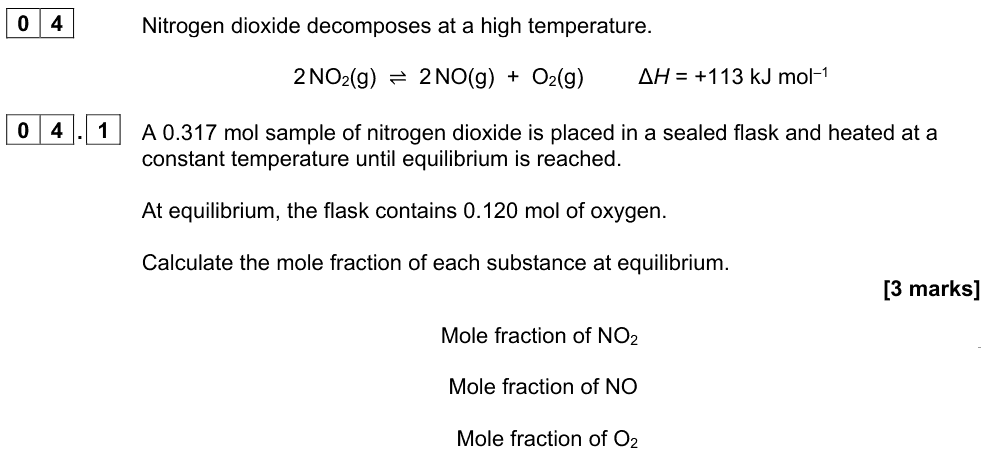
Answer: NO2 0.176, NO 0.549, O2 0.275. At equilibrium O2 = 0.120 mol, NO = 0.240 mol, NO2 = 0.317 – 0.240 = 0.077 mol
total 0.437 mol. Allow 2 significant figures
Skills: MS0.2 Use ratios, fractions and percentages
June 2023 · Paper 1 · Q04.21 markAO2=1Calculation
Earlier part of question 04 that this part uses
Mark scheme
Examiner's comment
Questions 04.1 and 04.2 were well answered.
Notes from the mark scheme and report
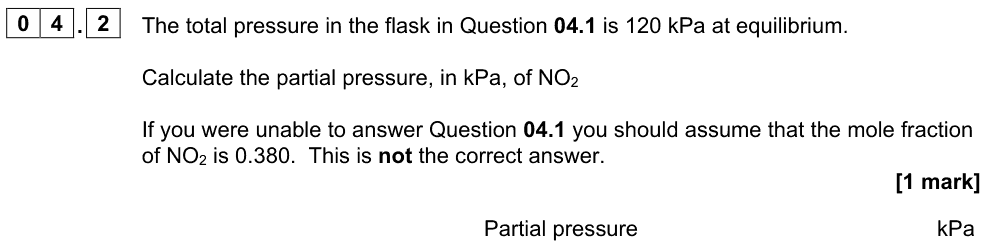
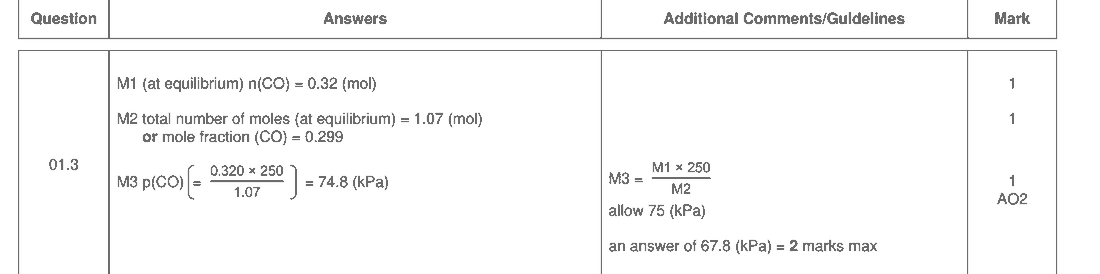
Answer: 21.1 kPa (0.176 × 120
allow 21.6
45.6 kPa if the given 0.380 is used)
Skills: MS0.2 Use ratios, fractions and percentages
June 2023 · Paper 1 · Q04.33 marksAO1=1, AO2=2Calculation
Earlier part of question 04 that this part uses
Mark scheme
Examiner's comment
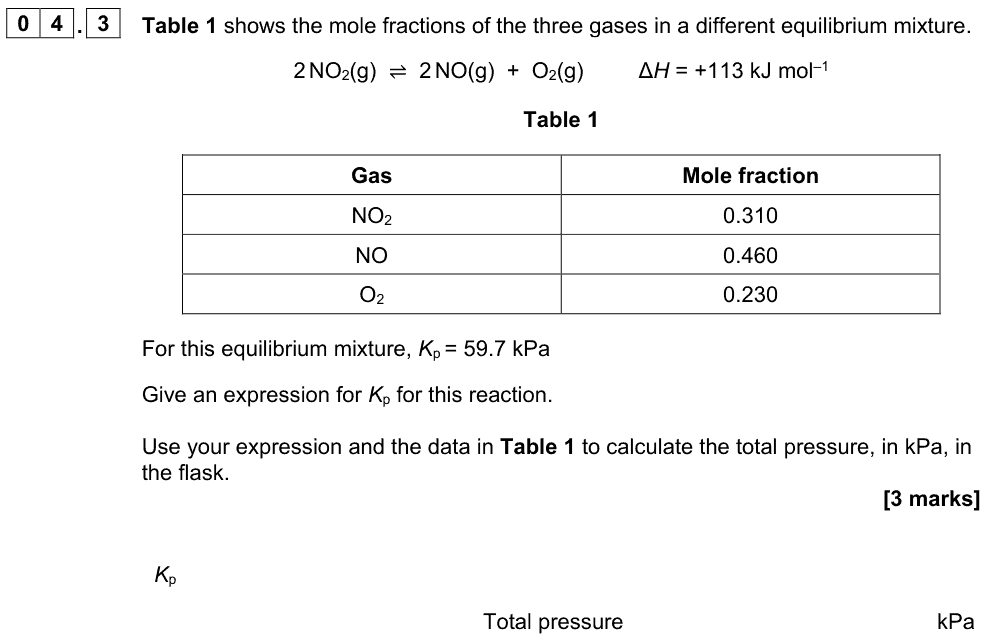
In 04.3, 47% of students gained all the marks; errors included using square brackets in the expression for Kp and not rearranging the expression correctly to calculate total pressure.
substituting mole fraction × P gives P = Kp × (0.310)² ÷ ((0.460)² × 0.230). No square brackets in Kp. Errors: square brackets
wrong rearrangement
Skills: MS0.0 Recognise and make use of appropriate units in calculation; MS2.2 Change the subject of an equation; MS2.3 Substitute numerical values into algebraic equations using appropriate units for physical quantities
June 2023 · Paper 1 · Q04.42 marksAO1=1, AO3=1Short answer
Earlier part of question 04 that this part uses
Mark scheme
Examiner's comment
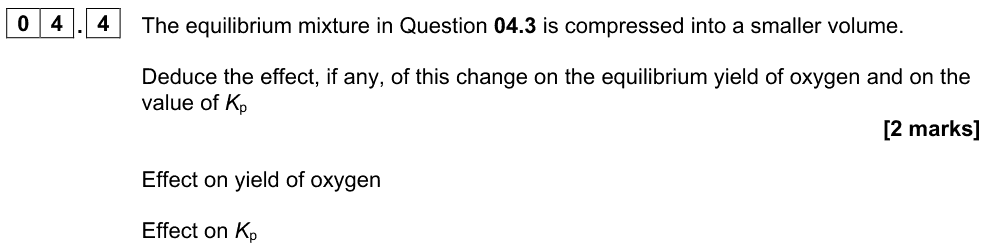
Most students gained at least one of the marks in 04.4; many students did not realise that changing the pressure does not change Kp.
Only a change in temperature affects the value of Kp.
Notes from the mark scheme and report
Yield of oxygen decreases (higher pressure favours the side with fewer gas moles)
Kp does not change. Many thought pressure changes Kp
only temperature does
June 2023 · Paper 1 · Q04.52 marksAO3=2Explanation
Earlier part of question 04 that this part uses
Mark scheme
Examiner's comment
In 04.5, many students gave correct answers; several students gave answers referring to rates.
Notes from the mark scheme and report
The forward reaction is endothermic (reverse is exothermic)
the equilibrium shifts to the left to oppose the decrease in temperature / to raise the temperature. Rate arguments do not score
June 2023 · Paper 3 · Q251 markAO2=1Multiple choice
Answer
C
Mark scheme
Notes from the mark scheme and report
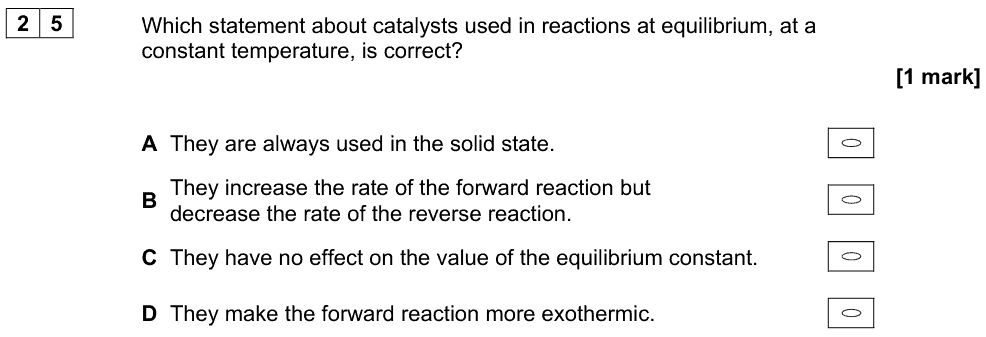
Answer: C. A catalyst speeds up the forward and reverse reactions equally, so it does not change the equilibrium constant or ∆H
catalysts are not always solids
June 2023 · Paper 3 · Q281 markAO2=1Multiple choice
Answer
A
Mark scheme
Notes from the mark scheme and report
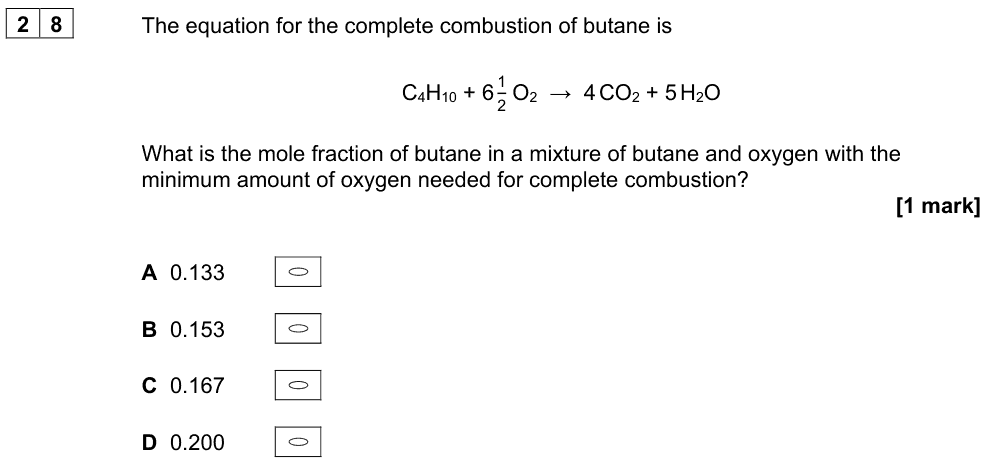
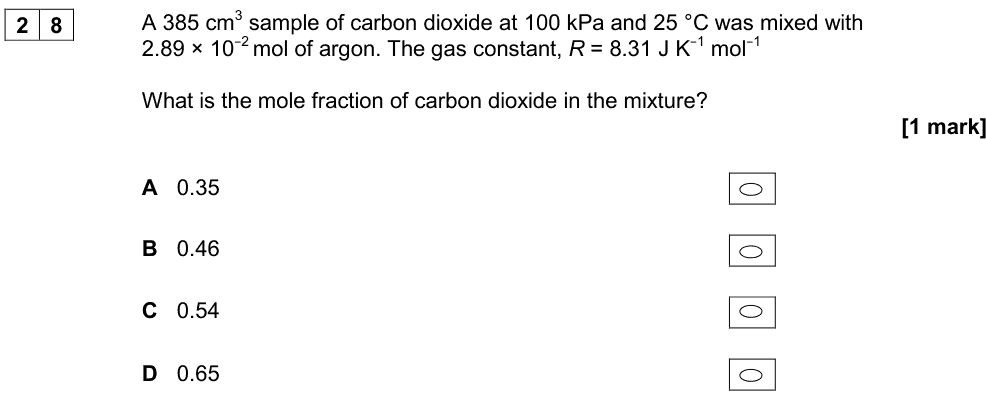
Answer: A. 1 mol of butane with 6.5 mol of oxygen: mole fraction = 1 ÷ 7.5 = 0.133
Skills: MS0.2 Use ratios, fractions and percentages
June 2022 · Paper 1 · Q01.21 markAO3=1Short answer
Earlier part of question 01 that this part uses
Mark scheme
Examiner's comment
Many students gained the mark in 01.2.
Notes from the mark scheme and report
There are more moles (molecules) of gaseous products than gaseous reactants / more moles on the right-hand side. Not 'atoms'
June 2022 · Paper 1 · Q01.33 marksAO2=3CalculationEasy
Earlier part of question 01 that this part uses
Mark scheme
Examiner's comment
Answers to 01.3 were generally good with 68% gaining all the marks.
Skills: MS0.2 Use ratios, fractions and percentages
June 2022 · Paper 1 · Q01.41 markAO1=1Short answer
Earlier part of question 01 that this part uses
Mark scheme
Examiner's comment
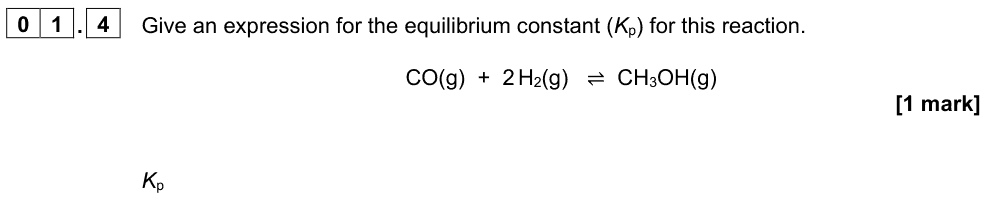
Most students gave the correct expression in 01.4; common errors included missing p (reference to partial pressure) or using square brackets.
Notes from the mark scheme and report
Kp = p(CH3OH) ÷ (p(CO) × p(H2)²). No square brackets
the p for partial pressure must be shown
June 2022 · Paper 1 · Q01.53 marksAO2=3Calculation
Earlier part of question 01 that this part uses
Mark scheme
Examiner's comment
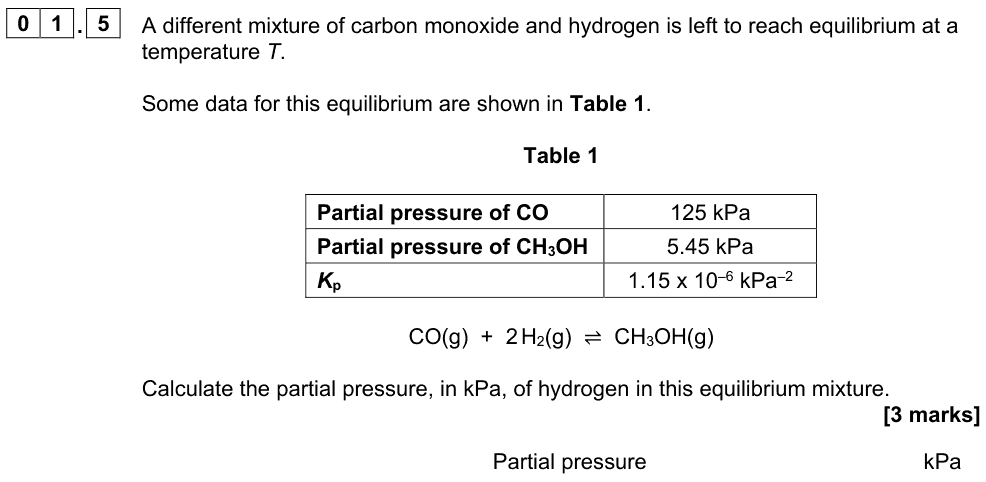
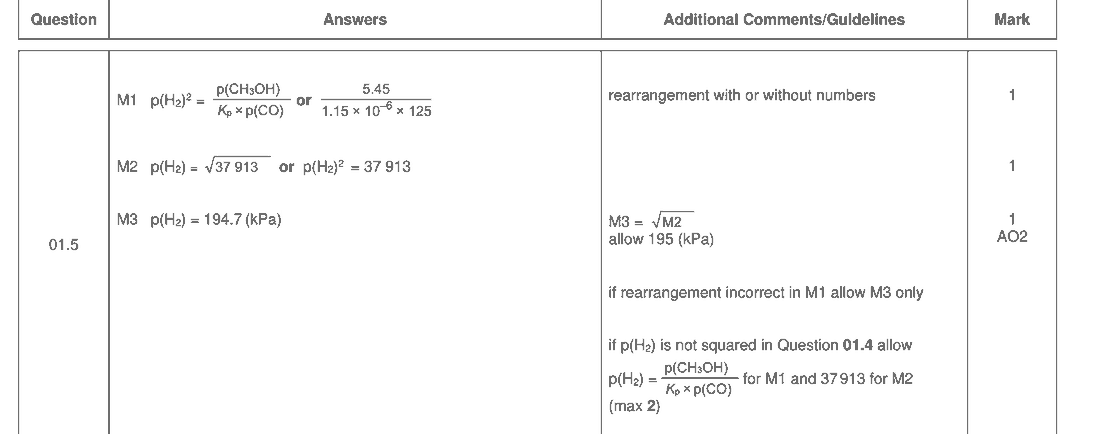
Answers to 01.5 were good.
Some students worked out a Kp value using a rearranged expression rather than just taking the inverse of the Kp from question 01.5.
Skills: MS2.2 Change the subject of an equation; MS2.3 Substitute numerical values into algebraic equations using appropriate units for physical quantities
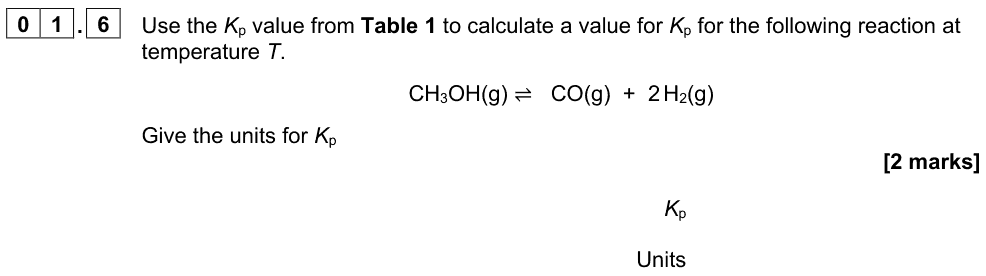
June 2022 · Paper 1 · Q01.62 marksAO2=2Calculation
Earlier parts of question 01 that this part uses
Mark scheme
Examiner's comment
About half the students scored both marks in 01.6; most students scored the mark for units.
Notes from the mark scheme and report
Answer: Kp = 8.70 × 10^5 kPa2. The reaction is reversed, so Kp = 1 ÷ (1.15 × 10^–6). Uses Table 1 printed in 01.5. Most scored the units mark
about half scored both. Some recalculated Kp from a rearranged expression instead of taking the reciprocal
Skills: MS0.0 Recognise and make use of appropriate units in calculation
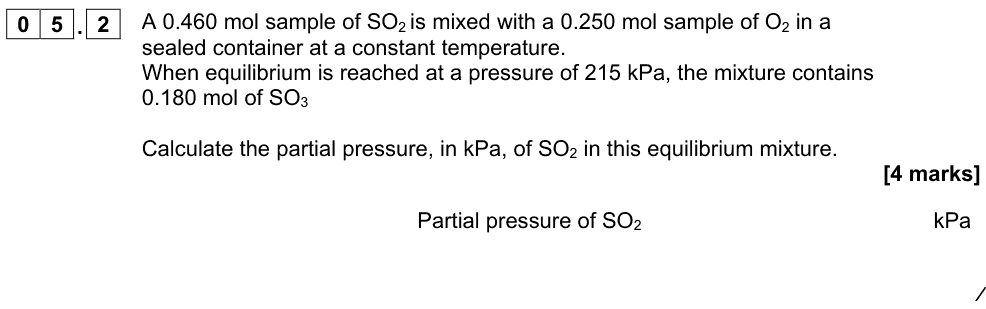
November 2021 · Paper 1 · Q05.24 marksCalculation
Earlier part of question 05 that this part uses
Mark scheme
Examiner's comment
About half of the students answered question 05.2 very well but others found the question very challenging; many students could not calculate the amount, in moles, of SO2 and O2 at equilibrium or omitted the amount of SO3 when calculating the total amount, in moles, at equilibrium.
Skills: MS0.2 Use ratios, fractions and percentages
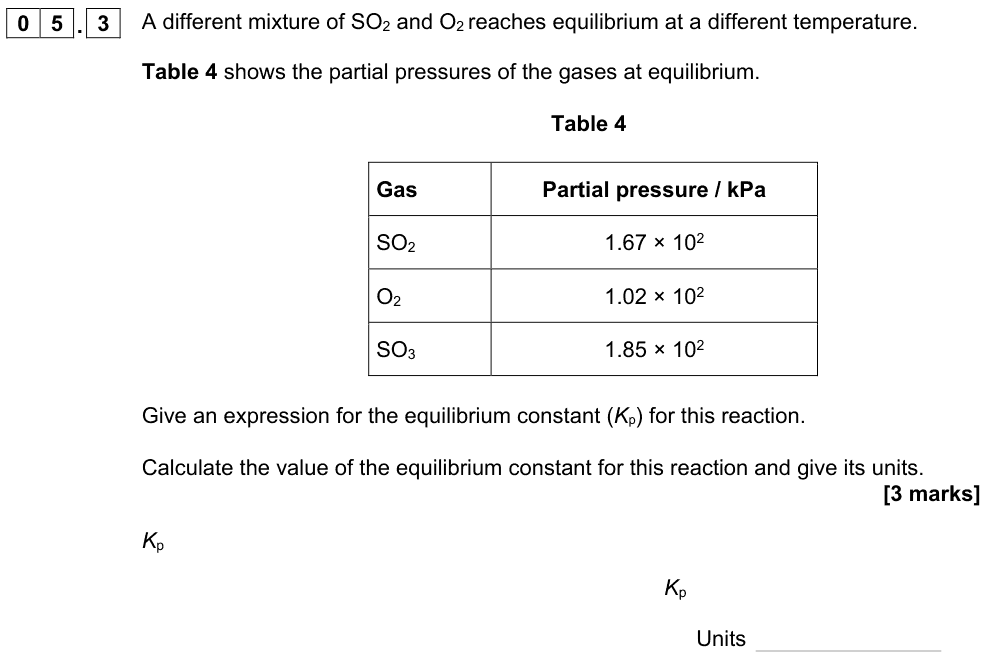
November 2021 · Paper 1 · Q05.33 marksCalculation
Earlier part of question 05 that this part uses
Mark scheme
Examiner's comment
Although question 05.3 was often well answered, common errors included not giving an expression for Kp, or giving an expression for Kp that used square brackets instead of partial pressures.
Many students did the calculation well but some failed to use the squared terms from their expressions; units were sometimes given as concentrations rather than in terms of kPa.
Notes from the mark scheme and report
Answer: 1.20 × 10^–2 kPa–1. Kp = p(SO3)² ÷ (p(SO2)² × p(O2)). Square brackets penalised. Errors: squared terms not used
concentration units
Skills: MS0.0 Recognise and make use of appropriate units in calculation; MS0.1 Recognise and use expressions in decimal and ordinary form; MS2.3 Substitute numerical values into algebraic equations using appropriate units for physical quantities
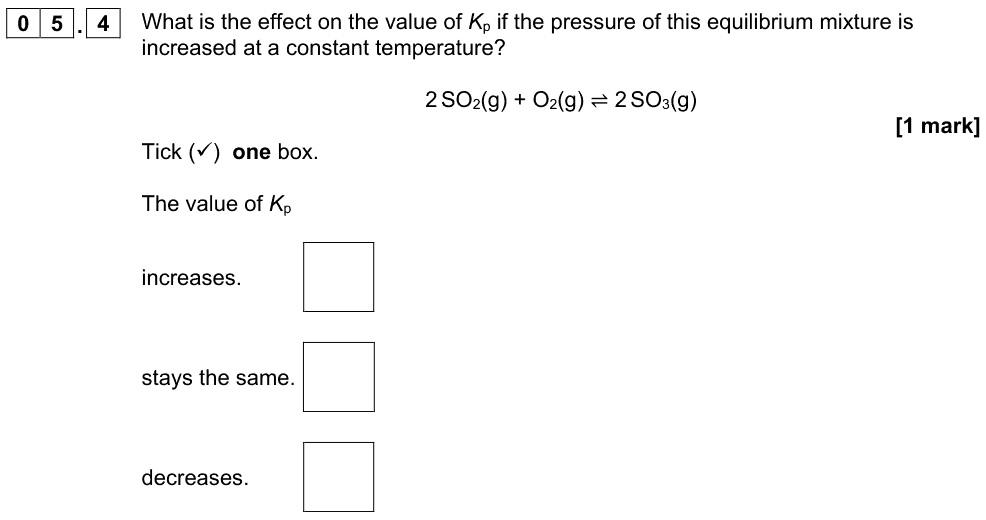
November 2021 · Paper 1 · Q05.41 markShort answer
Earlier part of question 05 that this part uses
Mark scheme
Examiner's comment
Just over half the students gave the correct answer in question 05.4.
Notes from the mark scheme and report
Answer: stays the same (Kp changes only with temperature)
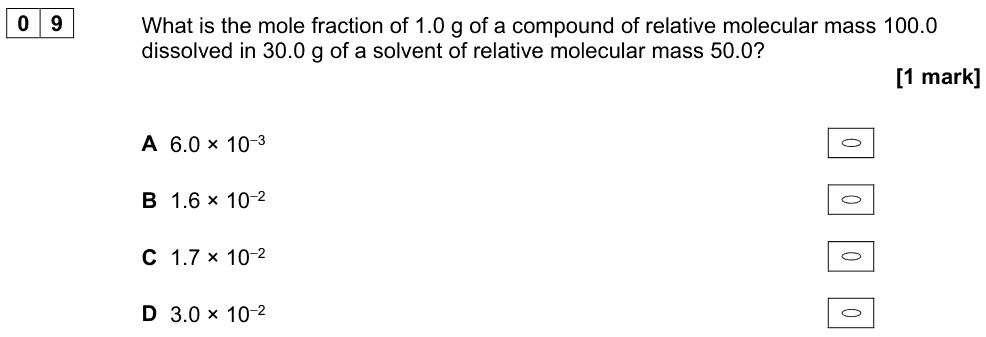
November 2021 · Paper 3 · Q091 markMultiple choice
Answer
B
Mark scheme
Notes from the mark scheme and report
Answer: B. 0.010 mol of solute and 0.60 mol of solvent: 0.010 ÷ 0.610 = 1.6 × 10^–2
Skills: MS0.2 Use ratios, fractions and percentages
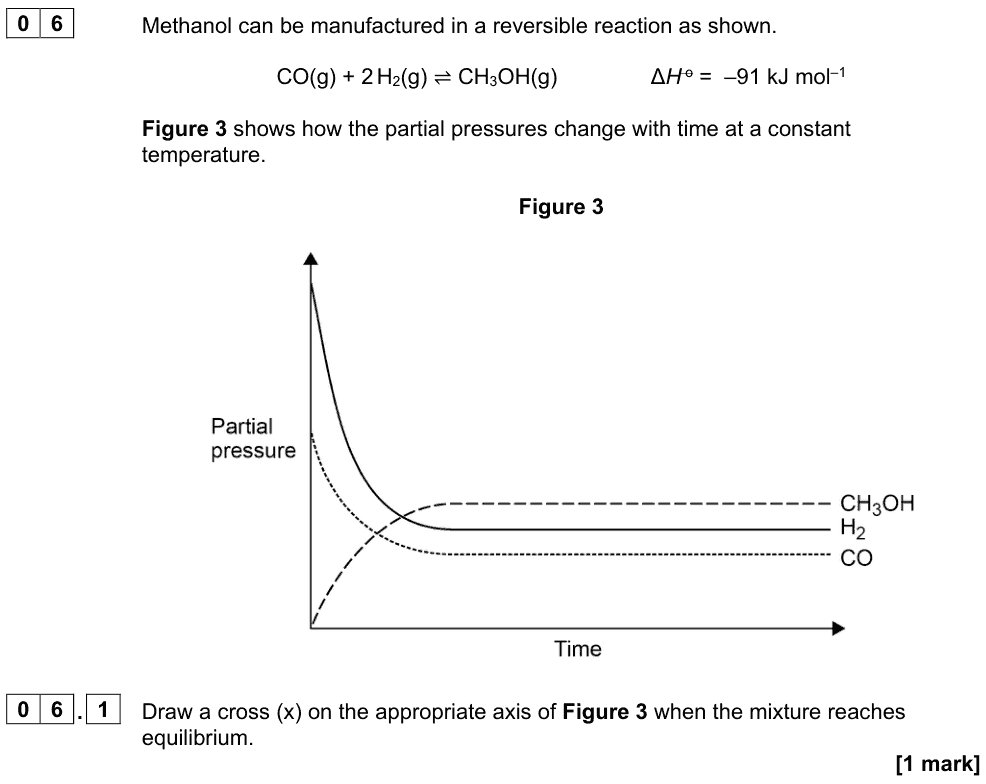
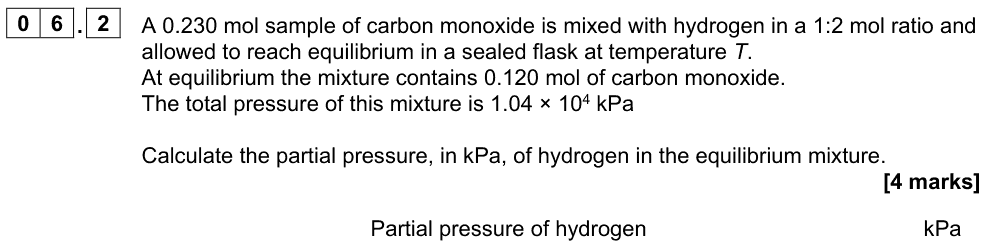
November 2020 · Paper 1 · Q06.24 marksCalculation
Earlier part of question 06 that this part uses
Mark scheme
Examiner's comment
Many students failed to calculate correctly the amount, in moles, of hydrogen at equilibrium in 06.2.
However, most students could take their mole fraction and find the partial pressure correctly.
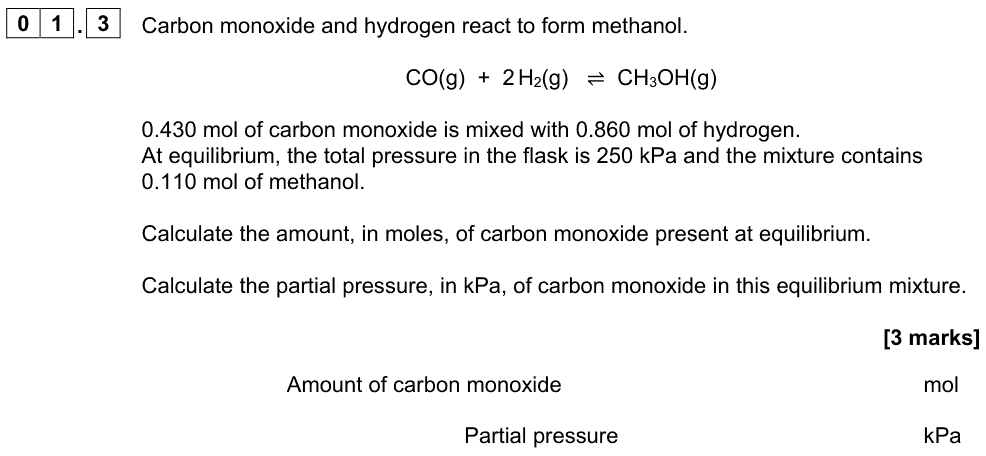
× 1.04 × 10^4. Many got the equilibrium moles of H2 wrong
Skills: MS0.1 Recognise and use expressions in decimal and ordinary form; MS0.2 Use ratios, fractions and percentages
November 2020 · Paper 1 · Q06.32 marksShort answer
Earlier part of question 06 that this part uses
Mark scheme
Examiner's comment
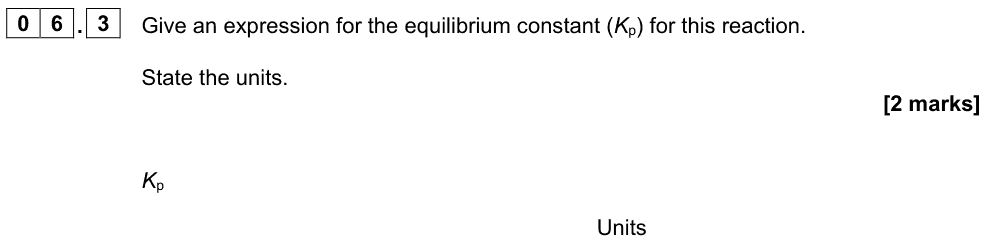
Most students gave the expression correctly with correct units in 06.3; some students expressed the equilibrium constant in terms of concentrations rather than partial pressures with appropriate units, and failed to score any marks.
Notes from the mark scheme and report
Kp = p(CH3OH) ÷ [p(CO) × p(H2)²]
units kPa–2 (or Pa–2). No square brackets
a Kc expression with concentration units scored 0
Skills: MS0.0 Recognise and make use of appropriate units in calculation
November 2020 · Paper 1 · Q06.42 marksShort answer
Earlier part of question 06 that this part uses
Mark scheme
Examiner's comment
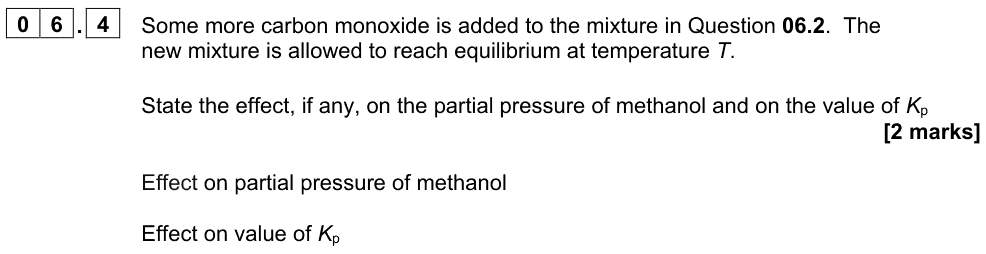
In 06.4, many students who gave the correct answer that the partial pressure of methanol
Notes from the mark scheme and report
Partial pressure of methanol increases
no effect on Kp (temperature unchanged)
November 2020 · Paper 1 · Q06.52 marksExplanation
Earlier part of question 06 that this part uses
Mark scheme
Examiner's comment
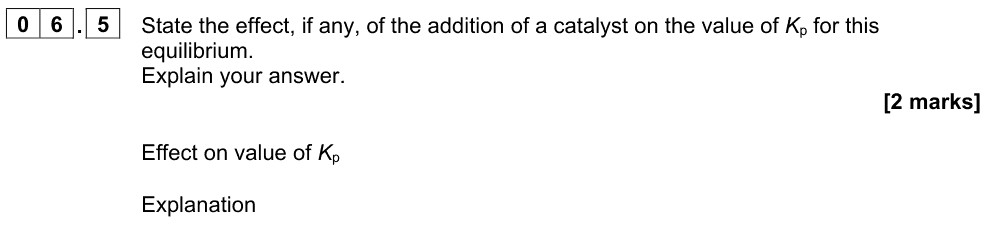
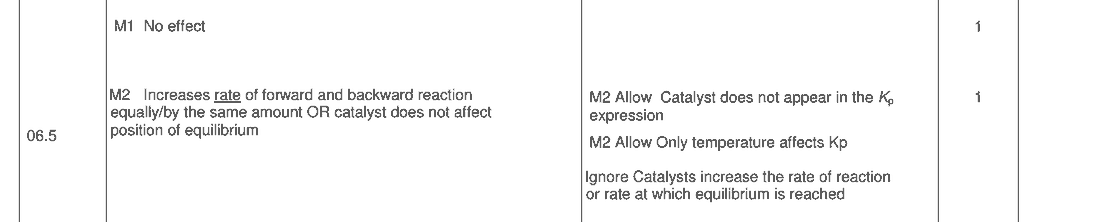
Many students knew that Kp was unchanged in 06.5 but then failed to explain the reason fully; common errors included that a catalyst increases the rate of both reactions or lowers the activation energy by providing an alternative route.
Notes from the mark scheme and report
No effect
a catalyst increases the rate of the forward and backward reactions equally / does not change the position of equilibrium (allow: only temperature affects Kp). 'Increases the rate' or 'lowers the activation energy' alone is ignored
June 2019 · Paper 1 · Q07.24 marksCalculation
Earlier part of question 07 that this part uses
Mark scheme
Examiner's comment
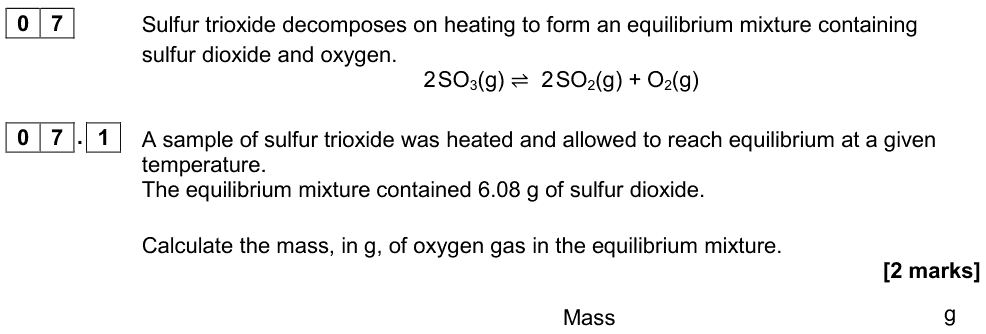
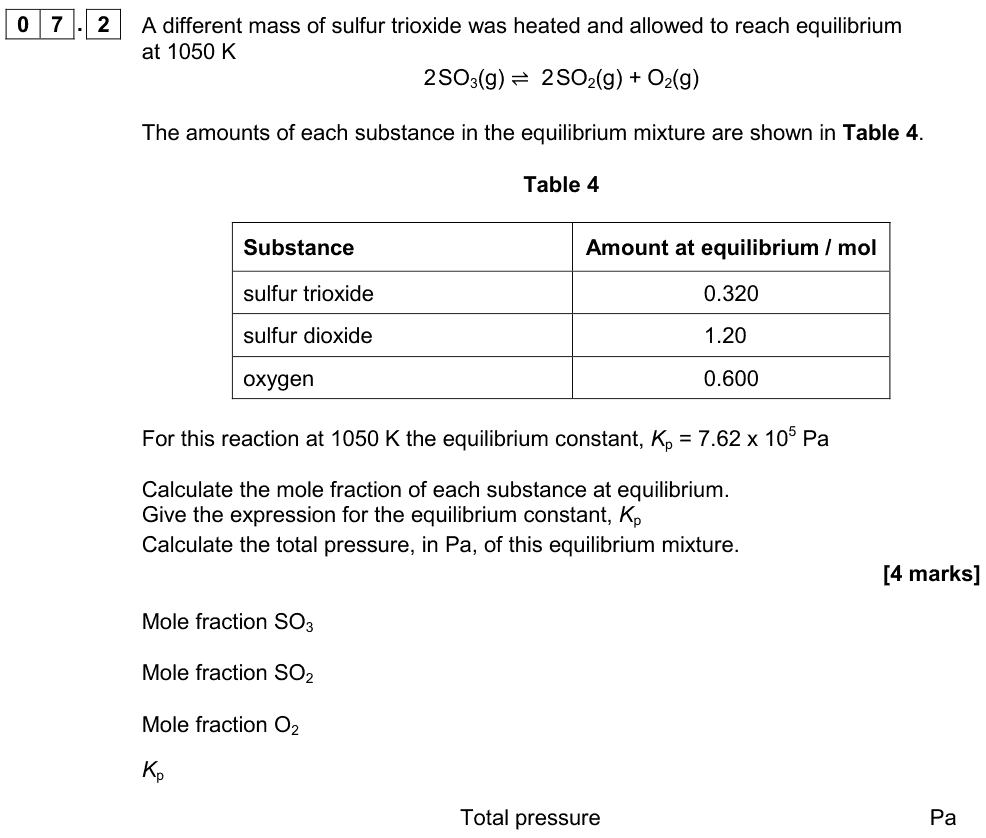
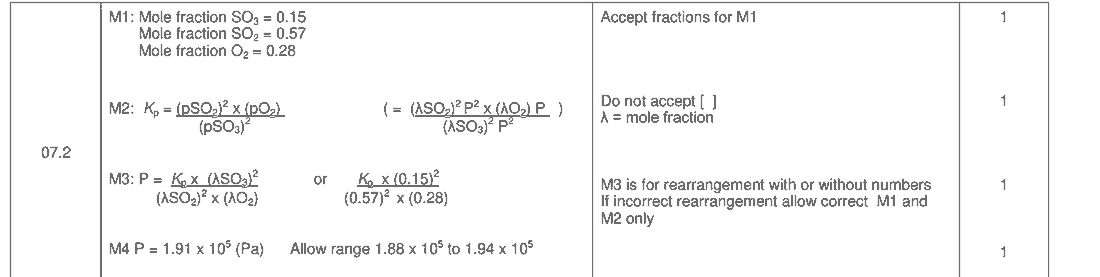
7.2 Most students gained the mole fractions mark in part 2. Several students did not gain the second mark by failing to give the symbol for the partial pressures or by using square brackets. Many students could not rearrange the equation or failed to square the relevant partial pressures in their calculation.
Skills: MS0.1 Recognise and use expressions in decimal and ordinary form; MS0.2 Use ratios, fractions and percentages; MS2.2 Change the subject of an equation; MS2.3 Substitute numerical values into algebraic equations using appropriate units for physical quantities
June 2019 · Paper 1 · Q07.32 marksExplanation
Earlier part of question 07 that this part uses
Mark scheme
Examiner's comment
7.3 Students generally answered part 3 well.
Notes from the mark scheme and report
Kp is larger at the higher temperature, so at higher temperature the equilibrium has moved to the right / more products are formed, which is the endothermic direction. Second mark depends on the first
June 2019 · Paper 1 · Q07.42 marksCalculation
Earlier part of question 07 that this part uses
Mark scheme
Examiner's comment
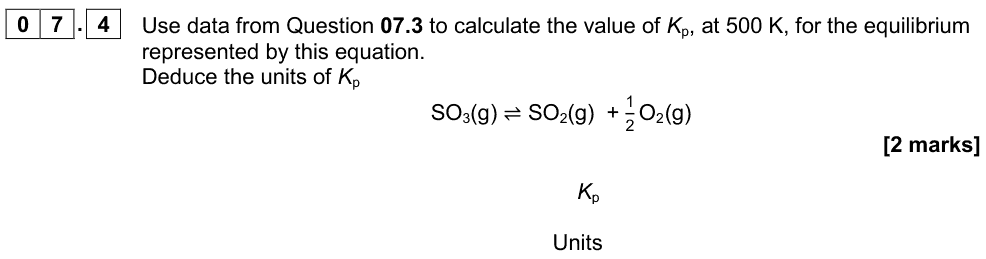
7.4 Very few students could calculate the value of Kp, but the mark for the units was awarded more often.
Notes from the mark scheme and report
Answer: 198 (198.5) Pa^½. Kp for the halved equation = √(3.94 × 10^4). Using the 1050 K value (873) loses the first mark only. Very few got the value
the units were more often correct
Skills: MS0.0 Recognise and make use of appropriate units in calculation; MS0.4 Use calculators to find and use power, exponential and logarithmic functions
June 2019 · Paper 3 · Q111 markMultiple choice
Answer
B
Mark scheme
Notes from the mark scheme and report
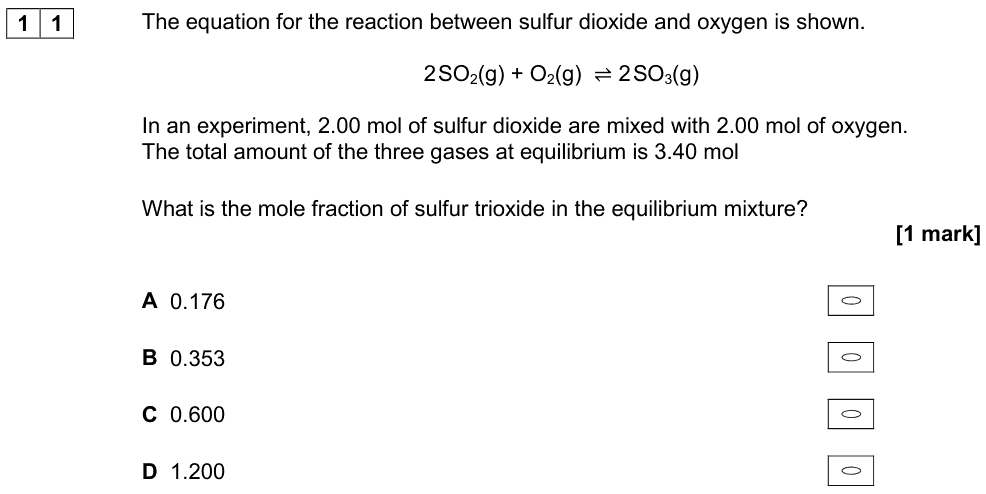
Answer: B. The total falls by 0.60 mol = O2 reacted, so SO3 = 1.20 mol
1.20 ÷ 3.40 = 0.353
Skills: MS0.2 Use ratios, fractions and percentages
June 2019 · Paper 3 · Q121 markMultiple choice
Answer
B
Mark scheme
Notes from the mark scheme and report
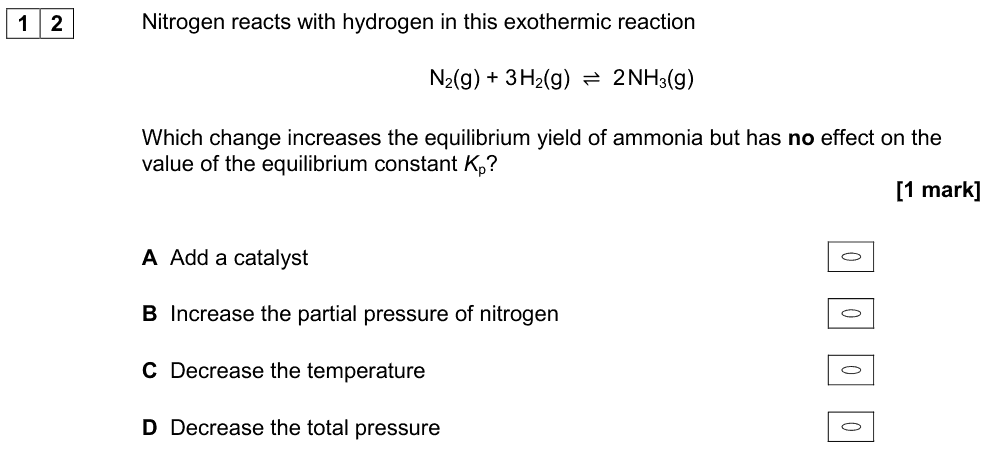
Answer: B. More nitrogen shifts the equilibrium to the right
Kp changes only with temperature (C changes Kp, D lowers the yield, A has no effect on yield)
June 2018 · Paper 1 · Q02.13 marksCalculation
Mark scheme
Examiner's comment
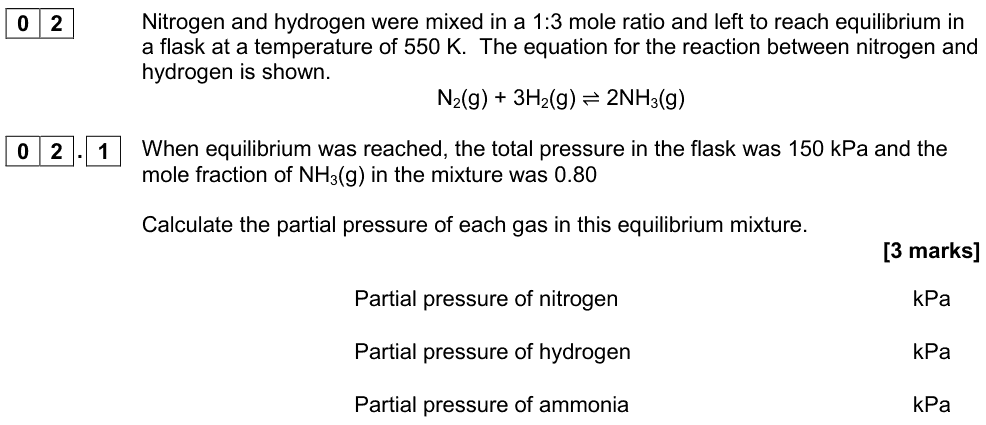
02.1 Most students calculated the partial pressure of ammonia correctly but could not calculate the partial pressures of the other two gases; the idea that the total pressure is the sum of the partial pressures was missed by many students.
the remaining 30 kPa is shared 1:3 between N2 and H2. Many missed that the partial pressures add up to the total pressure
Skills: MS0.2 Use ratios, fractions and percentages
June 2018 · Paper 1 · Q02.21 markShort answerEasy
Earlier part of question 02 that this part uses
Mark scheme
Examiner's comment
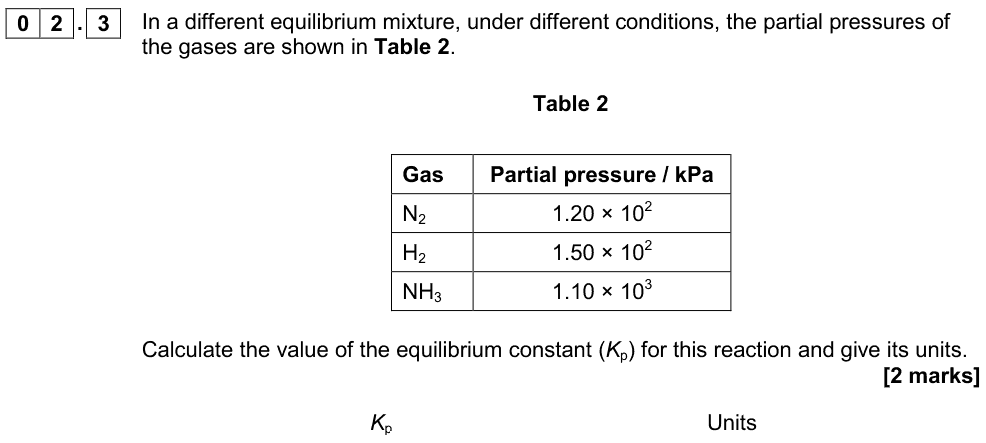
02.2 Students answered this part well and most (70.8%) gave the correct expression; common errors included using square brackets, that denote concentration, or inverting the expression.
02.3 Most students were able to calculate the equilibrium constant, but often the units were given as mol2 dm-6.
Notes from the mark scheme and report
Answer: 2.9 × 10^–3 to 3.0 × 10^–3 kPa–2. (1.10 × 10^3)² ÷ ((1.50 × 10^2)³ × 1.20 × 10^2). Common error: units given as mol2 dm–6
Skills: MS0.0 Recognise and make use of appropriate units in calculation; MS0.1 Recognise and use expressions in decimal and ordinary form; MS2.3 Substitute numerical values into algebraic equations using appropriate units for physical quantities
June 2018 · Paper 1 · Q02.43 marksExplanation
Earlier part of question 02 that this part uses
Mark scheme
Examiner's comment
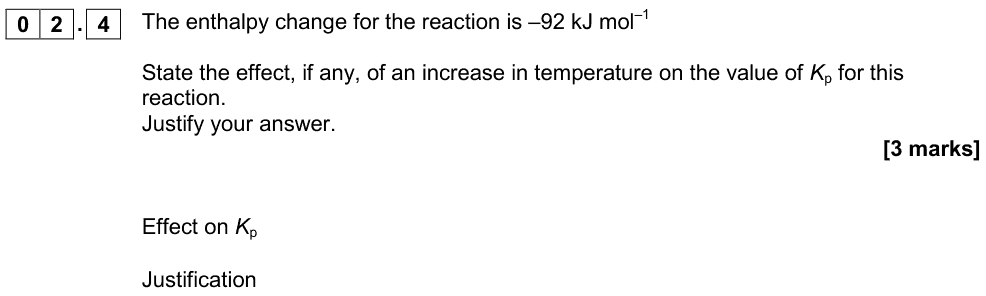
02.4 Most students could state that the value of Kp would decrease because the reaction was exothermic but failed to link this to Le Chatelier’s principle and did not state that the equilibrium shifts/moves to oppose the increase in temperature.
Notes from the mark scheme and report
Kp decreases
the equilibrium shifts in the endothermic direction (to the left), to oppose the increase in temperature. 'Increase' or 'no change' scores 0. Many did not link to opposing the change
June 2017 · Paper 1 · Q09.36 marksCalculation
Earlier part of question 09 that this part uses
Mark scheme
Examiner's comment
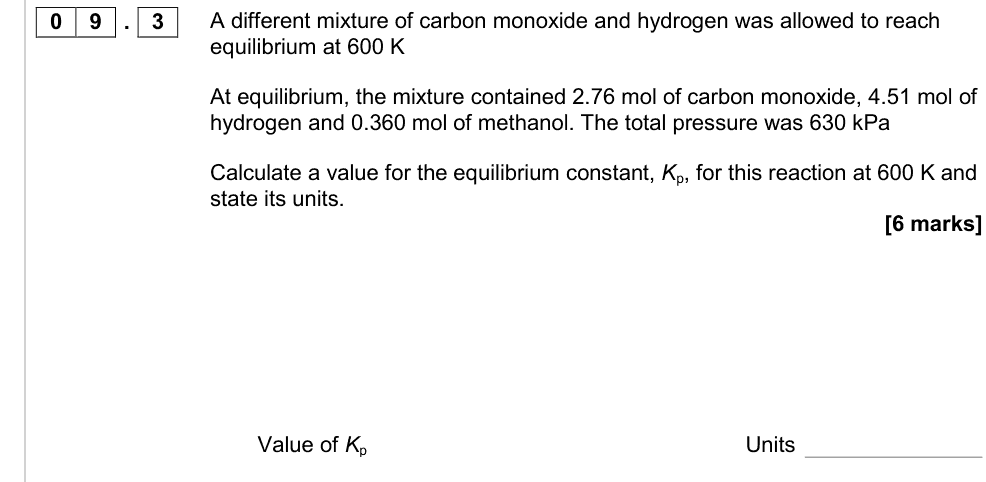
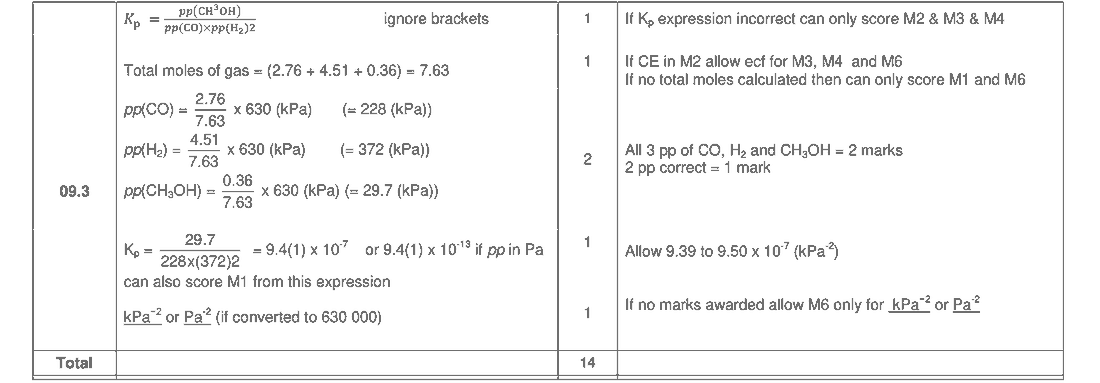
09.3 Many completely correct answers were seen (48.9% of students). Some students, however, could not calculate the total number of moles or could not calculate the partial pressures of the gases. Most students could write the expression for Kp but some forgot to square the partial pressure of hydrogen. Units were sometimes incorrectly given in moles.
Skills: MS0.0 Recognise and make use of appropriate units in calculation; MS0.1 Recognise and use expressions in decimal and ordinary form; MS0.2 Use ratios, fractions and percentages; MS2.3 Substitute numerical values into algebraic equations using appropriate units for physical quantities
June 2017 · Paper 3 · Q201 markMultiple choice
Answer
D
Mark scheme
Notes from the mark scheme and report
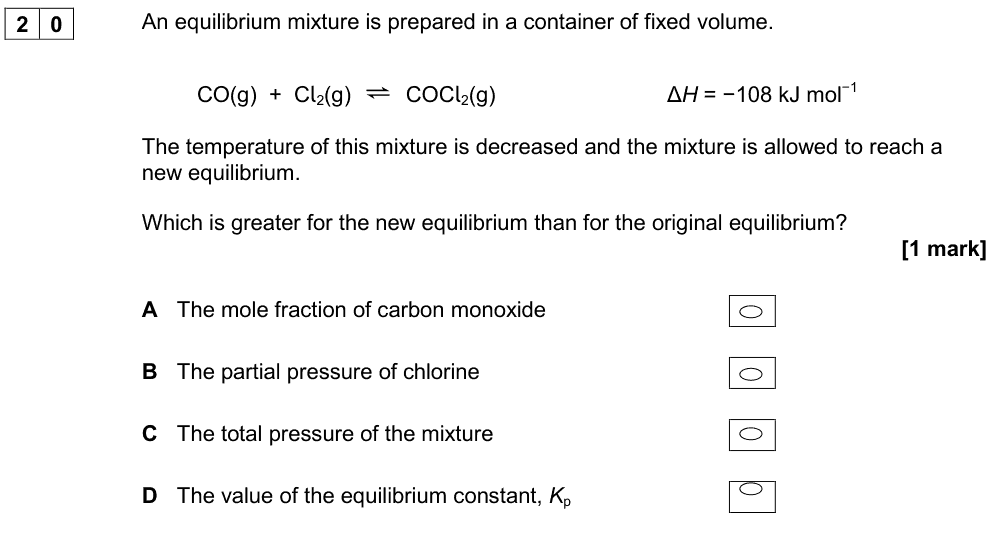
Answer: D. The forward reaction is exothermic, so lowering the temperature shifts the equilibrium to the right and Kp increases
the amounts of CO and Cl2 and the total pressure all fall
Skills: MS0.0 Recognise and make use of appropriate units in calculation; MS0.2 Use ratios, fractions and percentages; MS2.2 Change the subject of an equation
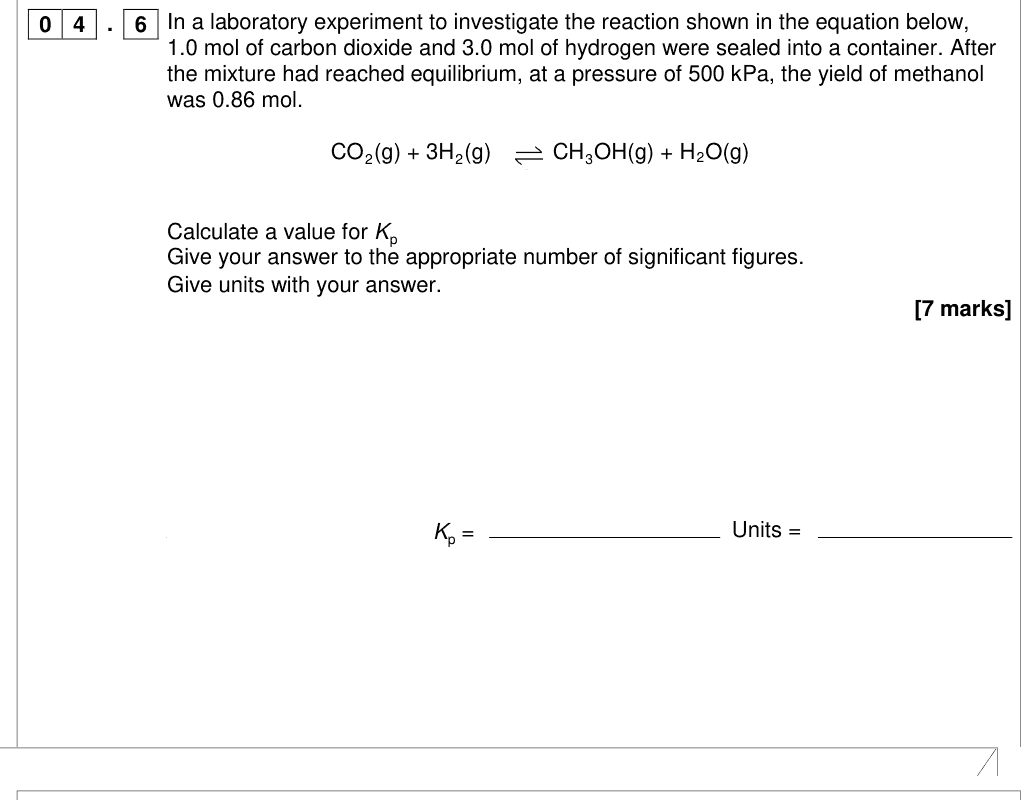
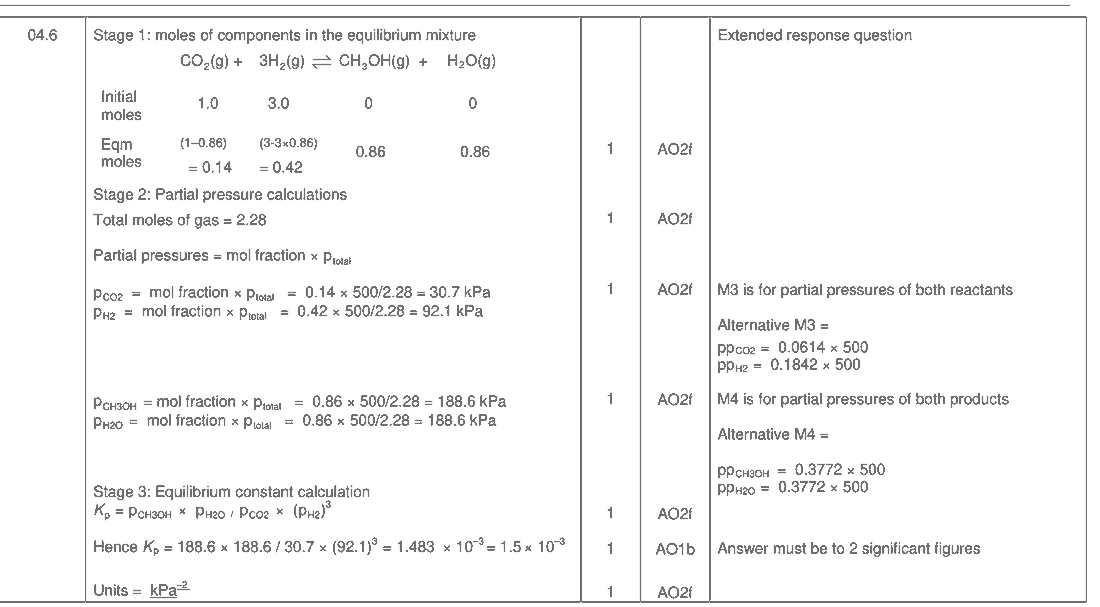
total 2.28. Partial pressures (mole fraction × 500): 30.7, 92.1, 188.6, 188.6 kPa. Kp = p(CH3OH) × p(H2O) ÷ (p(CO2) × p(H2)³). Marked point by point (7), not by levels
Skills: MS0.0 Recognise and make use of appropriate units in calculation; MS0.2 Use ratios, fractions and percentages; MS1.1 Use an appropriate number of significant figures; MS2.3 Substitute numerical values into algebraic equations using appropriate units for physical quantities
Specimen · Paper 3 · Q121 markAO1=1Multiple choice
Answer
D
Mark scheme
Notes from the mark scheme and report
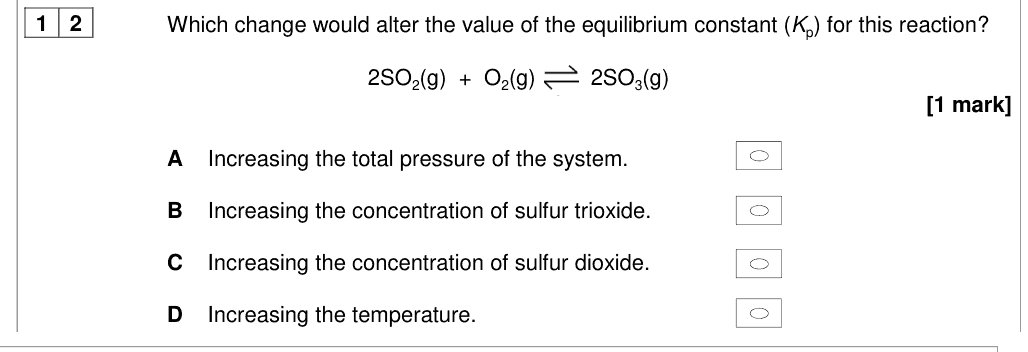
Answer: D. Only a change in temperature alters the value of an equilibrium constant
Work with an A-level chemistry tutor
Dropping marks on calculations, mechanisms or the required practicals? Book a trial session with a specialist A-level chemistry tutor.