Notes and key-term cards for this topic are being written by our tutors. The past-paper questions below are ready now.
Specification statements
Show the 10 statements from the specification
3.1.6.1-01 Many chemical reactions are reversible.
3.1.6.1-02 In a reversible reaction at equilibrium: • forward and reverse reactions proceed at equal rates • the concentrations of reactants and products remain constant
3.1.6.1-03 Le Chatelier’s principle.
3.1.6.1-04 Le Chatelier's principle can be used to predict the effects of changes in temperature, pressure and concentration on the position of equilibrium in homogeneous reactions.
3.1.6.1-05 A catalyst does not affect the position of equilibrium.
3.1.6.1-06 Students should be able to: • use Le Chatelier’s principle to predict qualitatively the effect of changes in temperature, pressure and concentration on the position of equilibrium • explain why, for a reversible reaction used in an industrial process, a compromise temperature and pressure may be used.
3.1.6.2-01 The equilibrium constant Kc is deduced from the equation for a reversible reaction.
3.1.6.2-02 The concentration, in mol dm–3, of a species X involved in the expression for Kc is represented by [X]
3.1.6.2-03 The value of the equilibrium constant is not affected either by changes in concentration or addition of a catalyst.
3.1.6.2-04 Students should be able to: • construct an expression for Kc for a homogeneous system in equilibrium • calculate a value for Kc from the equilibrium concentrations for a homogeneous system at constant temperature • perform calculations involving Kc • predict the qualitative effects of changes of temperature on the value of Kc
Six-mark level of response questions on this topic
Tap a question to zoom it. Where a part needs a figure, table or structure from earlier in the question, that part folds out above it; the mark scheme and examiner's comment open underneath. Have AQA's Data Booklet (the Periodic Table and the spectroscopy tables) beside you.
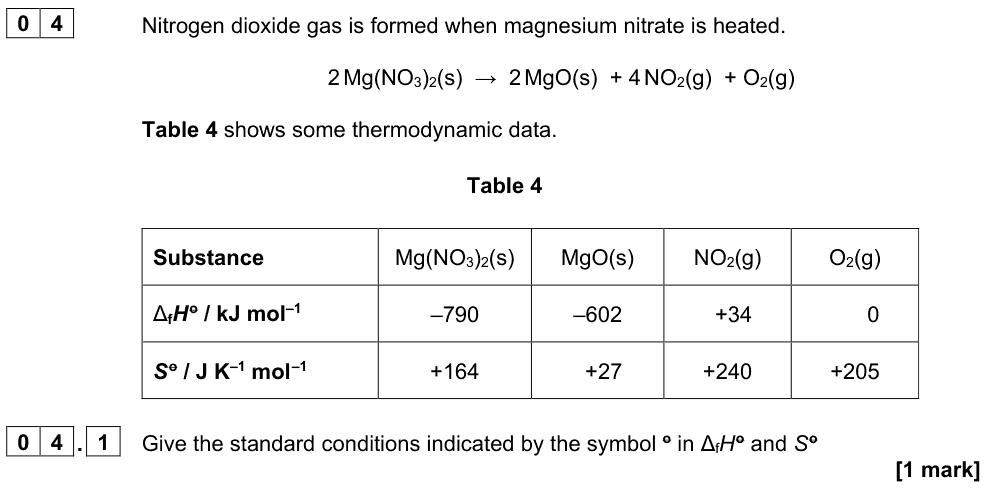
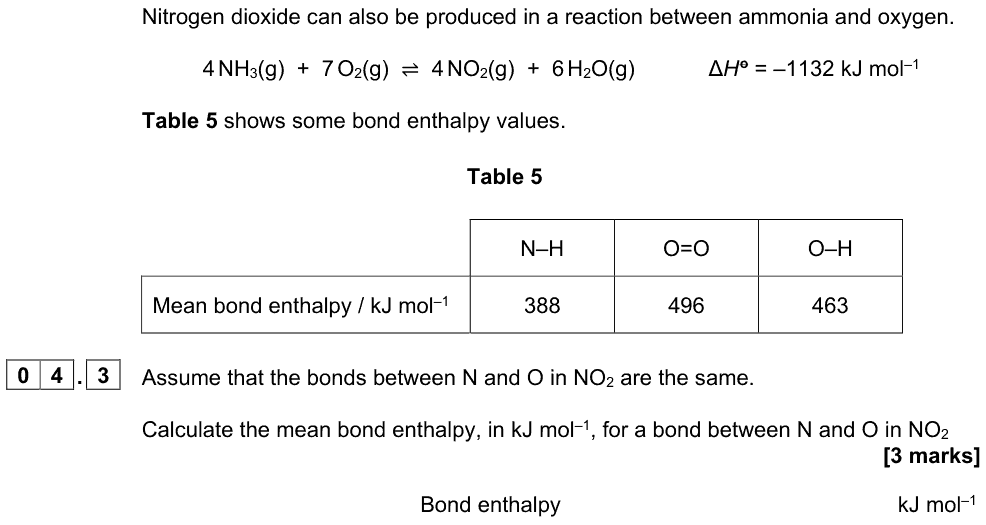
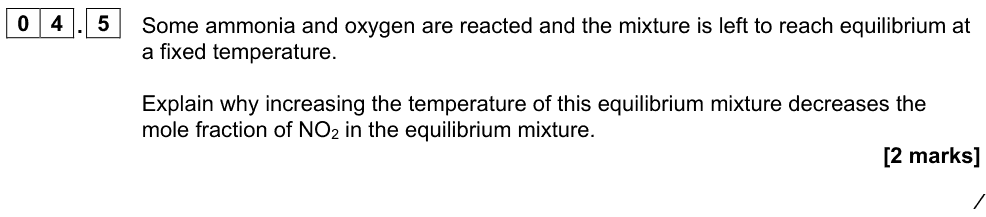
June 2025 · Paper 1 · Q04.52 marksAO1=1, AO2=1Explanation
Earlier parts of question 04 that this part uses
Mark scheme
Examiner's comment
In part 5 over half the students gained both marks.
Some students stated that the equilibrium shifted in the endothermic direction without specifying this as being the reverse direction or without explaining that this was to oppose the change put on the system.
It is advised to begin a response with a clear statement: eg the forward reaction is exothermic.
Notes from the mark scheme and report
The forward reaction is exothermic
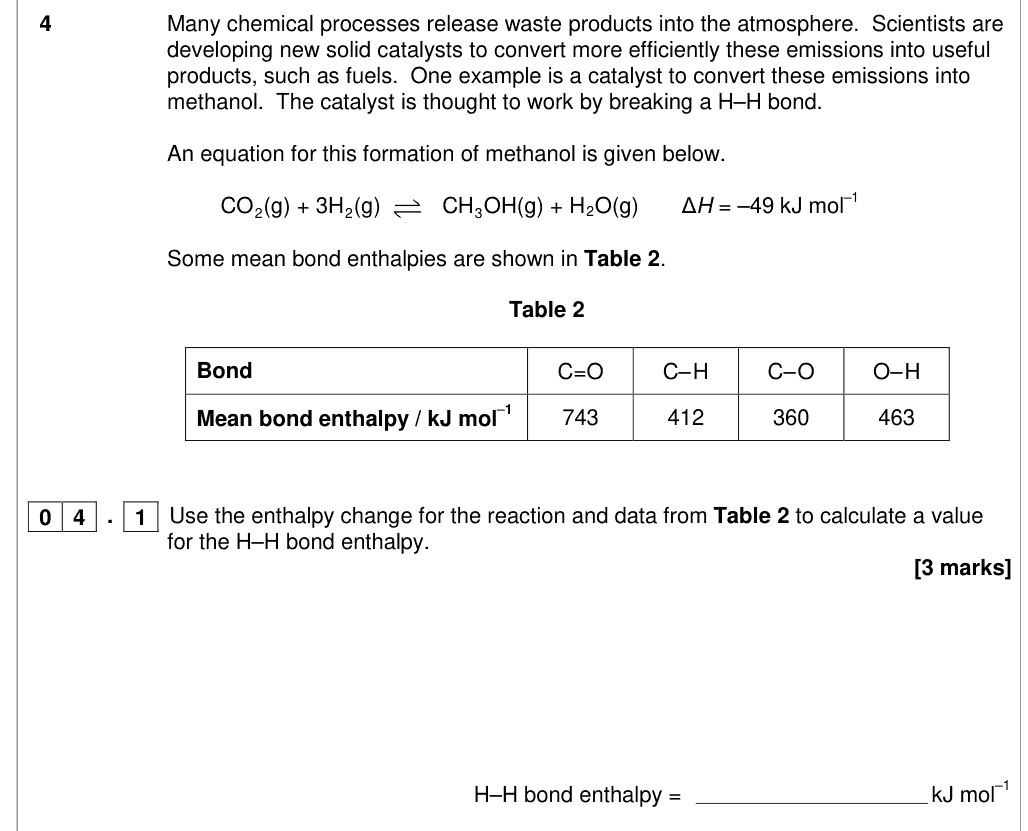
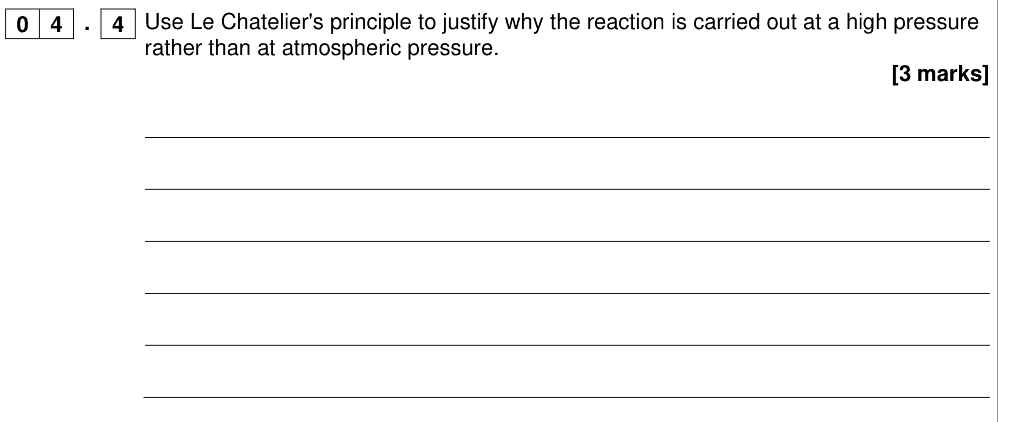
the equilibrium shifts to oppose the increase in temperature (in the endothermic, reverse direction). 'Shifts to the left' alone is insufficient. Start with a clear statement that the forward reaction is exothermic. Uses the equation and ∆H printed with 04.3
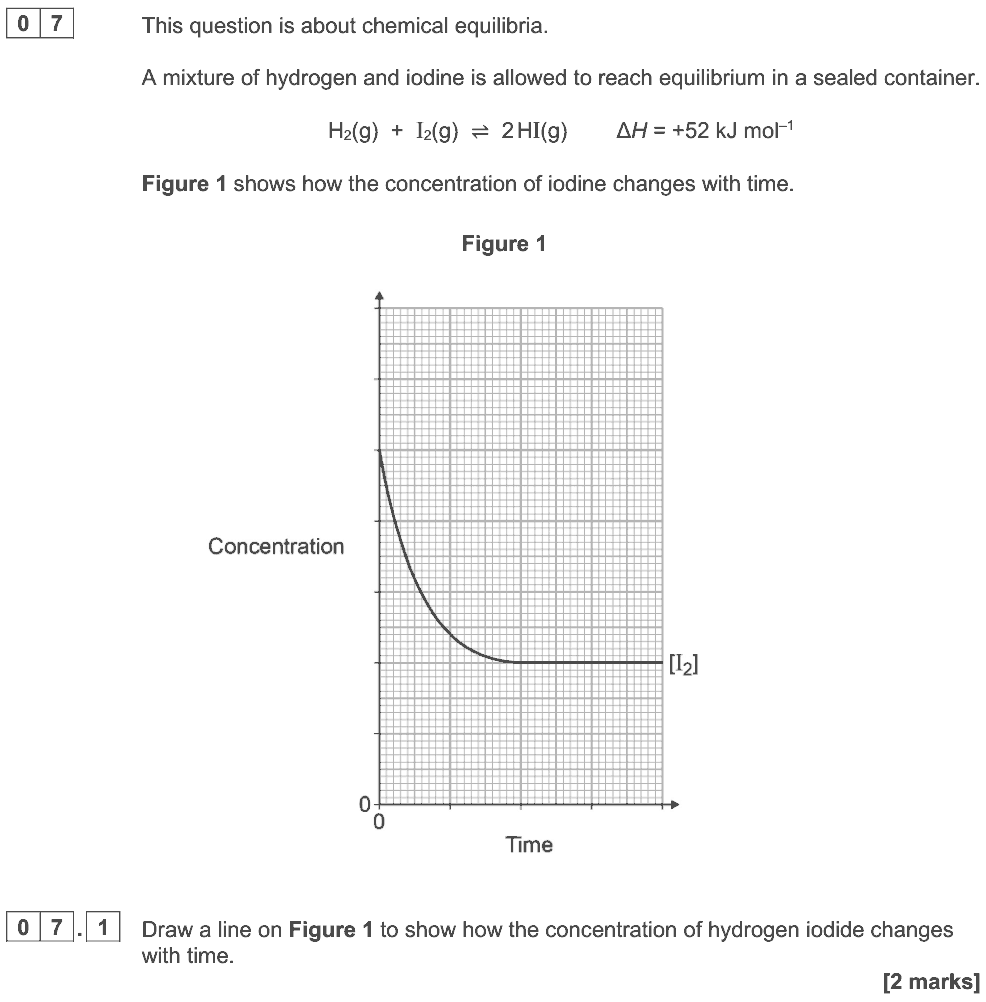
June 2025 · AS Paper 1 · Q07.12 marksAO2=2Diagram or structure
Mark scheme
Examiner's comment
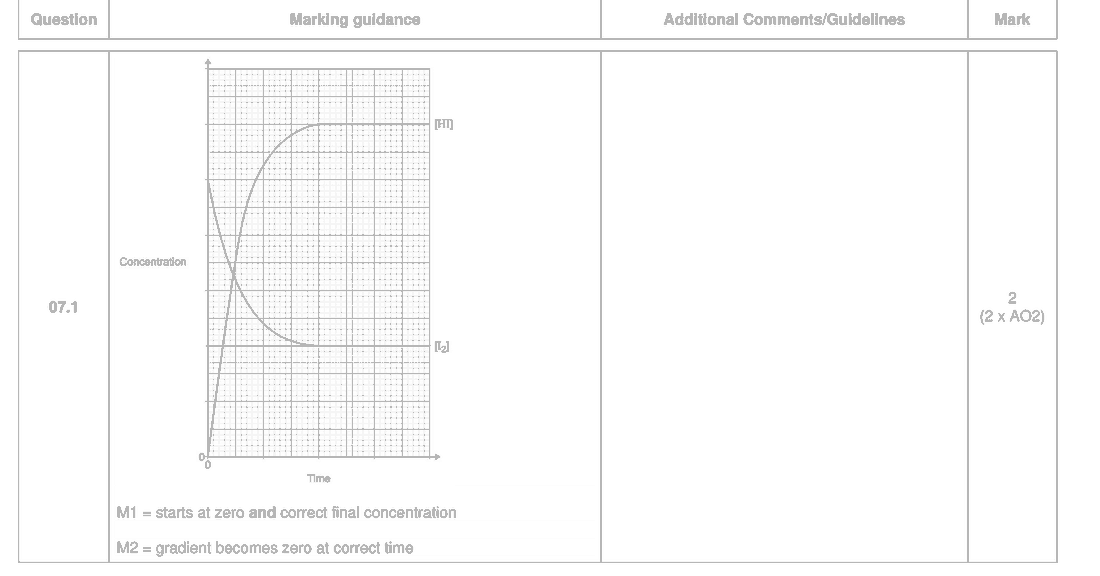
7.1 Students were asked to show graphically how the concentration of the product of the reaction between hydrogen and iodide changes with time. Students found this question challenging with students not appreciating that the change in the concentration of hydrogen iodide would be twice that of the change in the concentration of iodine.
Notes from the mark scheme and report
Curve for [HI] starts at zero and rises with decreasing gradient to a final concentration equal to twice the fall in [I2] (2 mol HI per mol I2)
it becomes horizontal at the same time as the [I2] line levels off. Most did not see that the change in [HI] is twice the change in [I2]
Skills: MS3.1 Translate information between graphical, numerical and algebraic forms; MS0.2 Use ratios, fractions and percentages
June 2025 · AS Paper 1 · Q07.23 marksAO2=3Explanation
Earlier part of question 07 that this part uses
Mark scheme
Examiner's comment
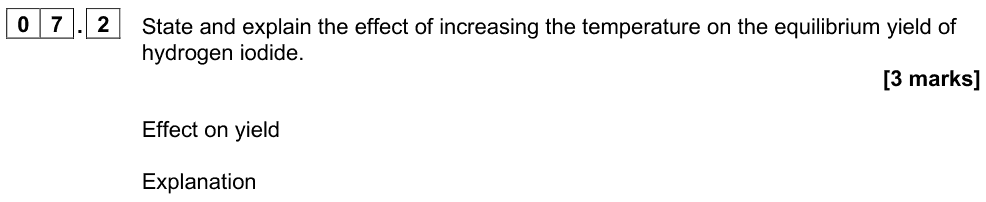
7.2 Students were asked to state and explain the effect of increasing temperature on the equilibrium yield of hydrogen iodide. Students did not always answer in terms of Le Chatelier’s Principle. Students need to make sure that they make reference to a shift in the position of equilibrium rather than just suggesting that the equilibrium favours the reactants or products.
Notes from the mark scheme and report
Yield increases
the equilibrium shifts to the right, in the endothermic direction, to oppose the increase in temperature (to lower the temperature). Each point is marked independently. Refer to a shift in the position of equilibrium, not just 'favours the products'
June 2025 · AS Paper 1 · Q07.36 marksAO2=6Calculation
Earlier part of question 07 that this part uses
Mark scheme
Examiner's comment
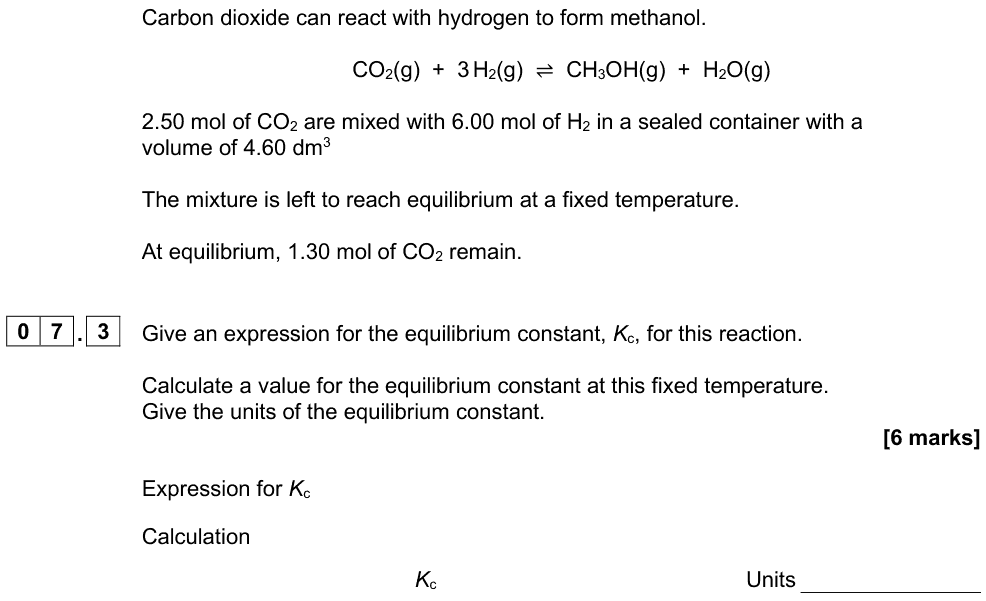
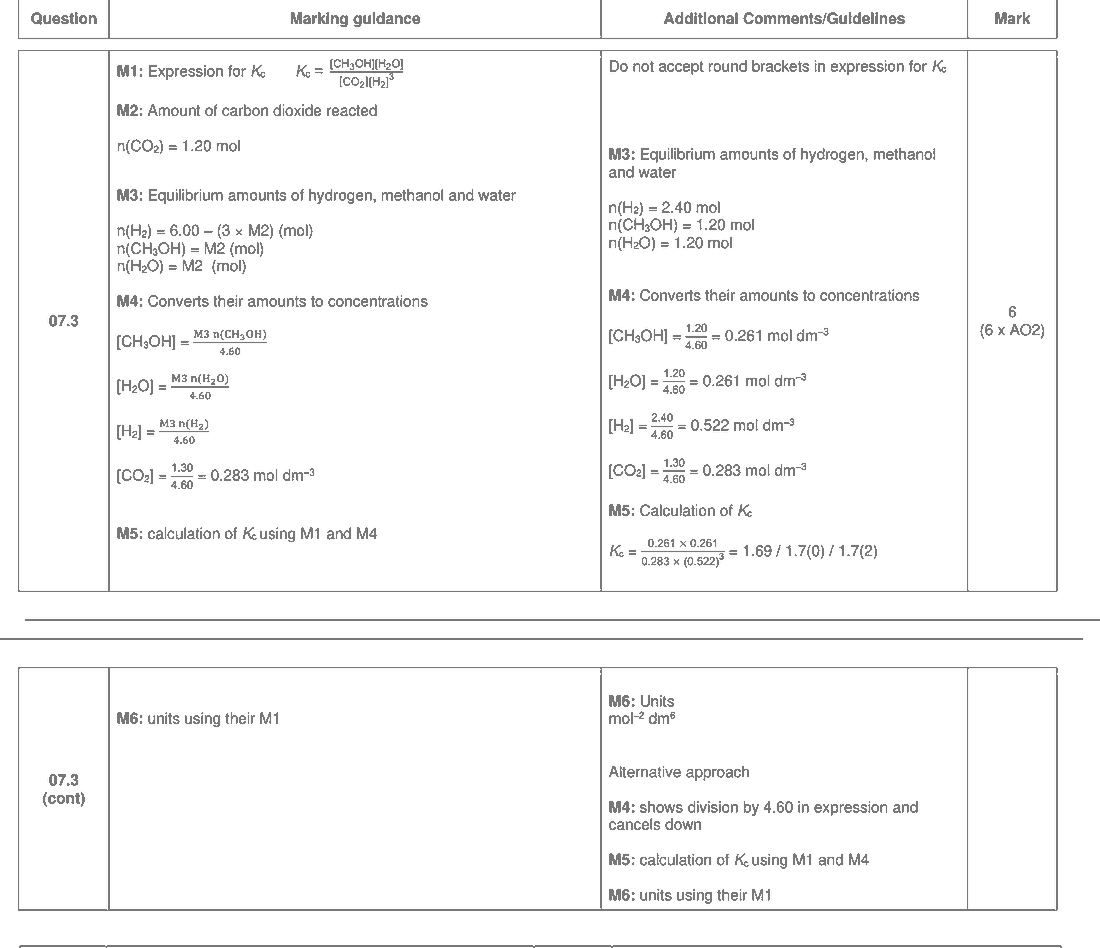
7.3 Students were asked to calculate a value for the equilibrium constant for the reaction between carbon dioxide with hydrogen to form methanol and water. Students found this challenging. Many students struggled to correctly calculate the amount of hydrogen present in the equilibrium mixture. In addition, students did not always convert the equilibrium quantities to concentration before using these to calculate the value of the equilibrium constant.
divide each by 4.60 dm3: 0.261, 0.261, 0.522 and 0.283 mol dm–3. Errors: wrong equilibrium amount of hydrogen
amounts not converted to concentrations
Skills: MS0.0 Recognise and make use of appropriate units in calculation; MS0.2 Use ratios, fractions and percentages; MS2.3 Substitute numerical values into algebraic equations using appropriate units for physical quantities
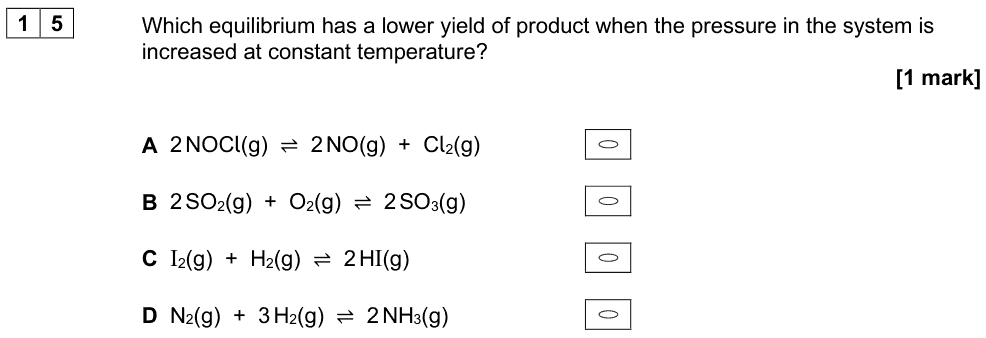
June 2025 · AS Paper 1 · Q151 markAO2=1Multiple choice
Answer
A
Mark scheme
Examiner's comment
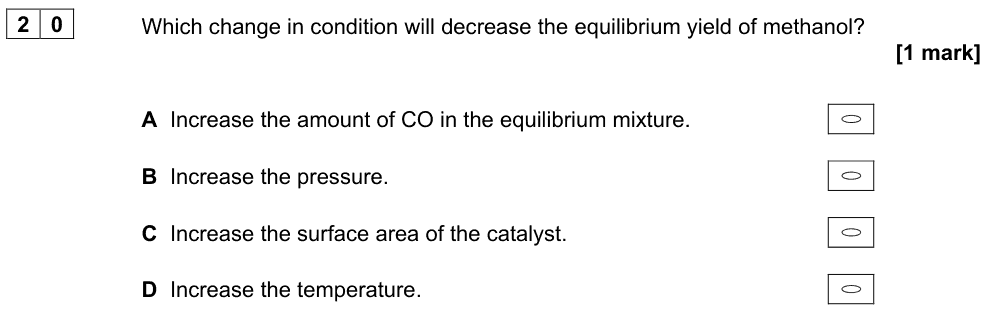
A majority of students were able to identify the equilibrium that has a lower yield of product when the pressure is increased at a constant temperature.
Notes from the mark scheme and report
Answer: A. Only A has more moles of gas on the product side (2 → 3), so higher pressure shifts the equilibrium to the left
June 2025 · Paper 3 · Q04.11 markAO2=1Short answerEasy
Mark scheme
Examiner's comment
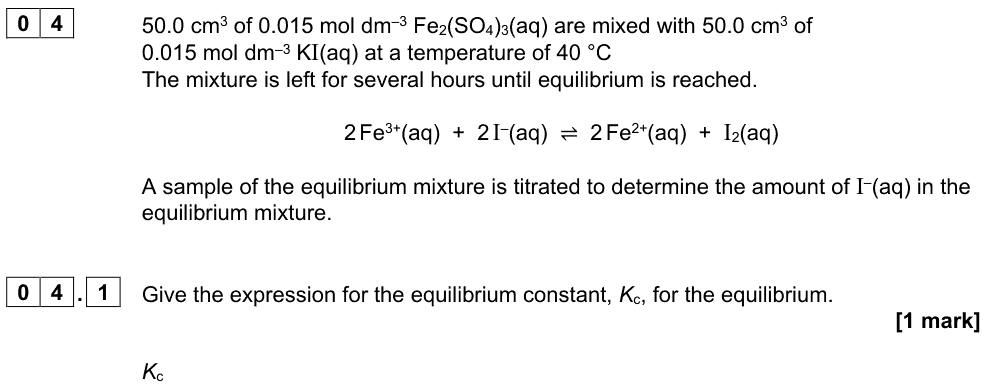
4.1 Nearly 90% of students were able to give the correct expression for Kc with the commonest mistakes being the use of ‘+’ symbols and missing subscripts or superscripts on symbols.
errors were '+' signs between terms and missing charges or powers
June 2025 · Paper 3 · Q04.22 marksAO3=2Practical and data analysisHard
Earlier part of question 04 that this part uses
Mark scheme
Examiner's comment
4.2 Over 50% of students scored at least 1/2 but a lack of clarity in the answers meant that less than 5% scored 2 marks. A majority of students realised that the ‘quenching’ would stop the reaction but failed to be clear about the explanation of this being that the equilibrium would not then shift to compensate for the iodide being removed during the titration.
Notes from the mark scheme and report
Dilution and cooling stop (greatly slow) the reaction
so the equilibrium does not shift to make more iodide as iodide is removed during the titration. 'Iodide concentration stays constant during the titration' is not accepted. Most said it stops the reaction but did not explain the equilibrium shift
Skills: PS1.2 Apply scientific knowledge to practical contexts; PS2.1 Comment on experimental design and evaluate scientific methods
June 2025 · Paper 3 · Q04.36 marksAO2=6Calculation
Earlier part of question 04 that this part uses
Mark scheme
Examiner's comment
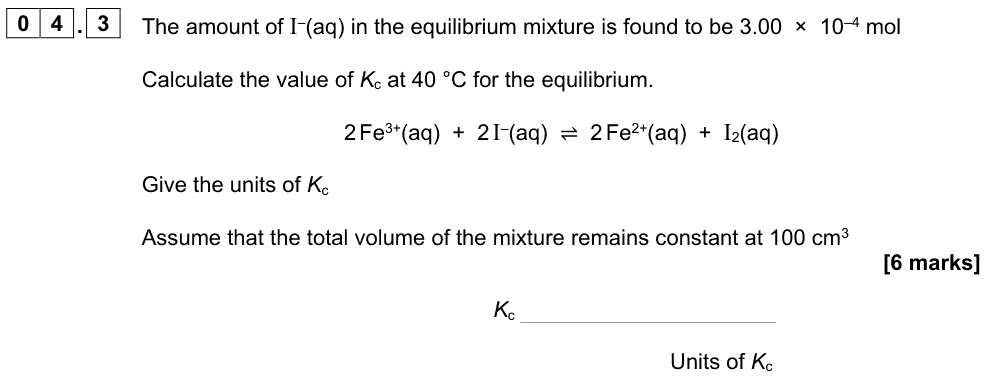
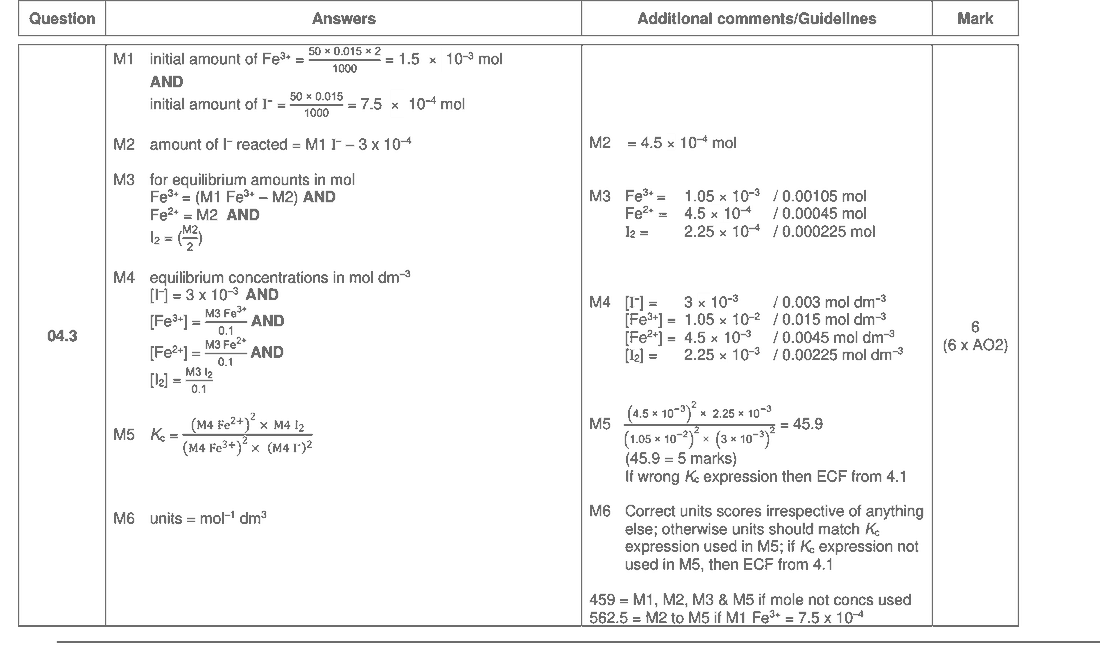
4.3 Students are strongly recommended to use an ICE chart to organise the working for this type of calculation – and to spread it across the page to give room for clear working, e.g.
Kc = (4.5 × 10^–3)² × 2.25 × 10^–3 ÷ [(1.05 × 10^–2)² × (3.0 × 10^–3)²]. 459 if moles are used instead of concentrations (4 marks)
562.5 if the 2 Fe3+ per Fe2(SO4)3 is missed. An ICE table is recommended
Skills: MS0.0 Recognise and make use of appropriate units in calculation; MS0.2 Use ratios, fractions and percentages; MS2.3 Substitute numerical values into algebraic equations using appropriate units for physical quantities
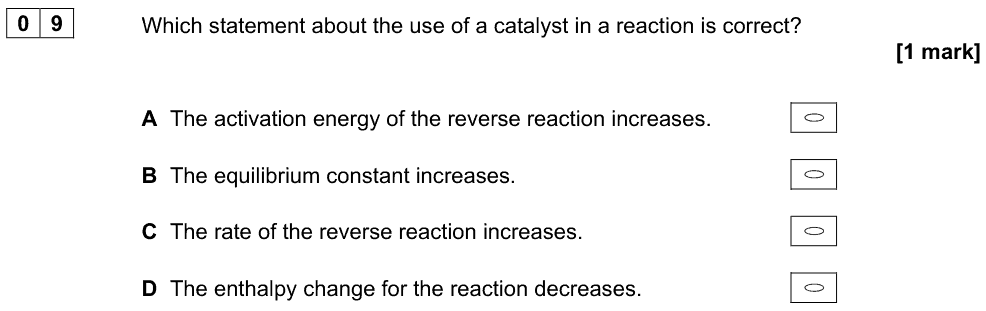
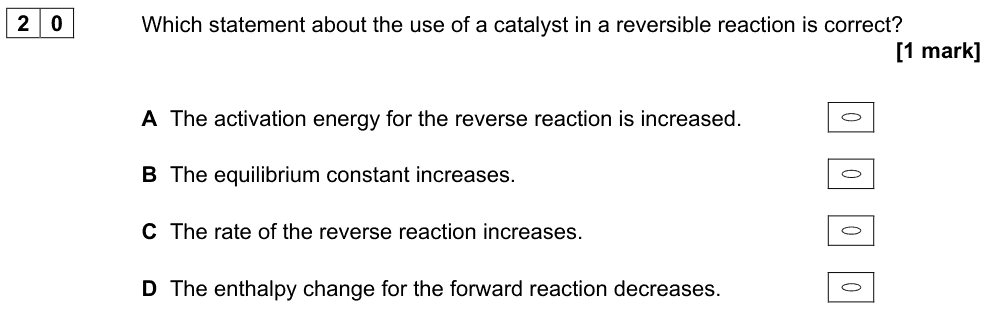
June 2025 · Paper 3 · Q091 markAO1=1Multiple choice
Answer
C
Mark scheme
Notes from the mark scheme and report
Answer: C. A catalyst lowers the activation energy for both directions, so both rates increase
Kc and ∆H are unchanged
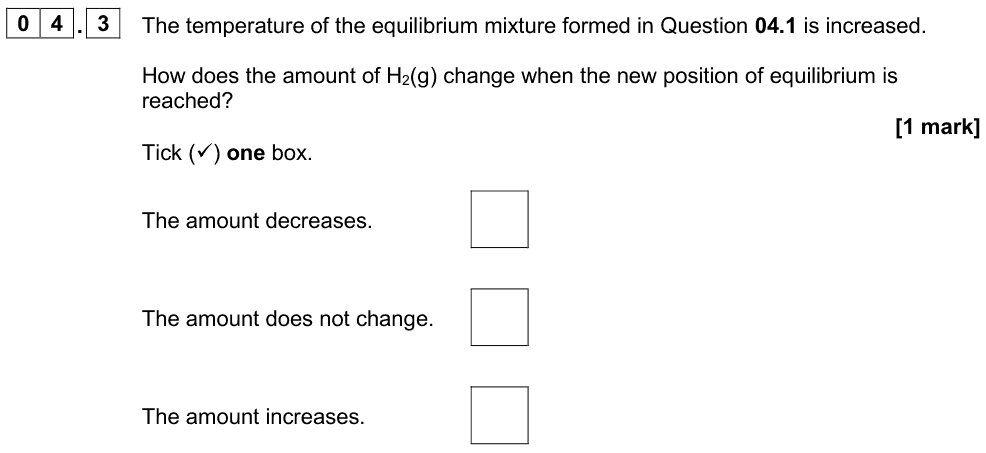
June 2024 · Paper 1 · Q04.31 markAO1=1Short answer
Earlier part of question 04 that this part uses
Mark scheme
Examiner's comment
Part 3 was answered well.
Notes from the mark scheme and report
Answer: the amount decreases (the forward reaction is exothermic)
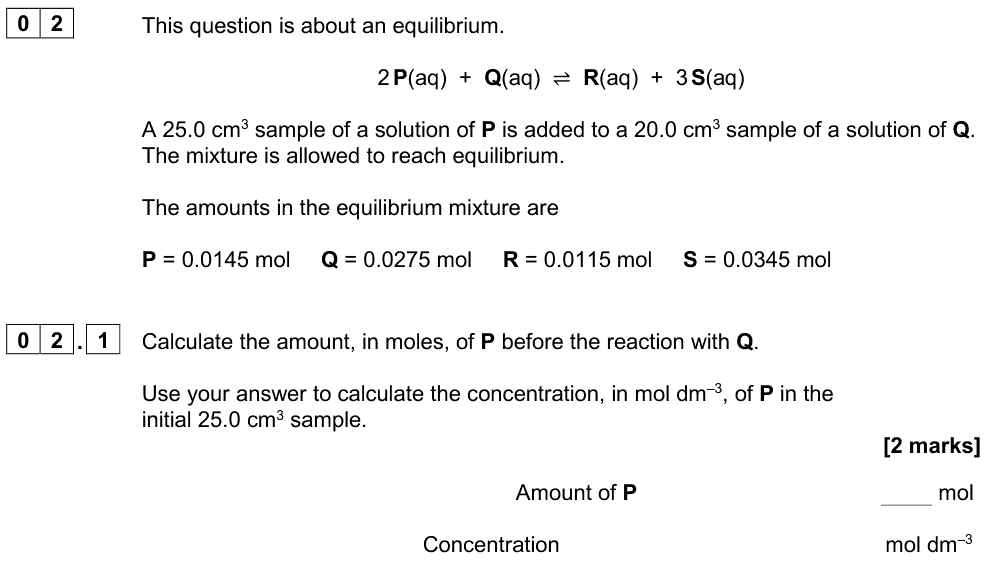
June 2024 · Paper 2 · Q02.12 marksAO2=2CalculationEasy
Mark scheme
Examiner's comment
2.1 Over 60% of students scored both of these marks. Those who got the amount of P wrong were able to score a consequential mark for converting their amount into a concentration.
Notes from the mark scheme and report
Answer: 0.0375 mol
1.50 mol dm–3. Initial P = 0.0145 + (2 × 0.0115)
÷ 0.0250 dm3. ECF for the concentration from a wrong amount
Skills: MS0.0 Recognise and make use of appropriate units in calculation; MS0.2 Use ratios, fractions and percentages
June 2024 · Paper 2 · Q02.24 marksAO2=4Calculation
Earlier part of question 02 that this part uses
Mark scheme
Examiner's comment
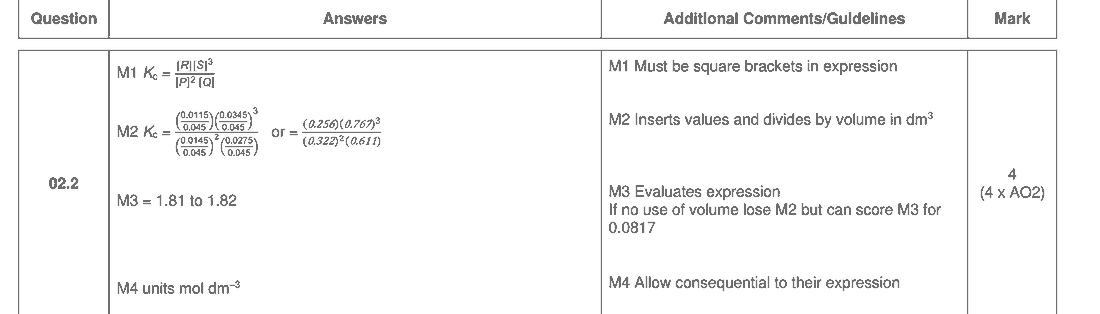
2.2 The most common mark lost here was because students failed to divide the amount, in moles, of each reagent by the total volume of solution in the equilibrium expression, but the question scored highly with around 75% gaining at least three of the four marks.
Notes from the mark scheme and report
Answer: Kc = 1.81 to 1.82 mol dm–3. Kc = [R][S]³ ÷ ([P]²[Q]) with square brackets
each amount ÷ 0.0450 dm3 (total volume): (0.256)(0.767)³ ÷ [(0.322)²(0.611)]. No volume used: 0.0817 scores M3 only as ECF. Most common loss: not dividing by the total volume
Skills: MS0.0 Recognise and make use of appropriate units in calculation; MS2.3 Substitute numerical values into algebraic equations using appropriate units for physical quantities
June 2024 · Paper 2 · Q02.32 marksAO3=2Explanation
Earlier part of question 02 that this part uses
Mark scheme
Examiner's comment
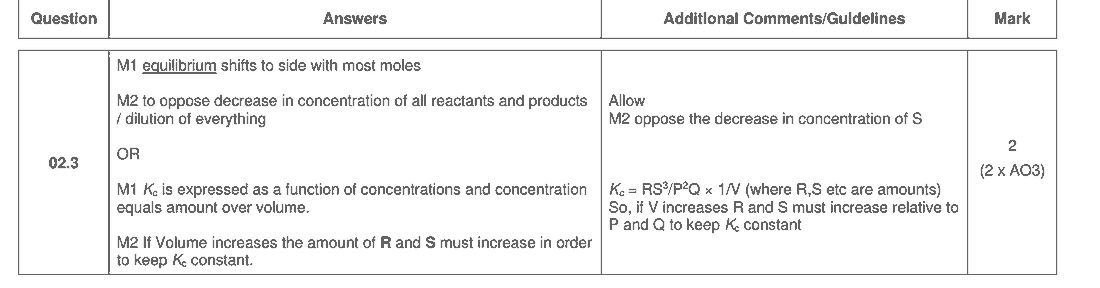
2.3 Despite being a relatively unfamiliar application of Le Chatelier’s principle, the best students were able to apply the idea to this context. Around 40% scored at least 1 mark here.
Notes from the mark scheme and report
Adding water lowers all the concentrations
the equilibrium shifts to the side with more moles (4 on the right v 3 on the left) to oppose the dilution. Or: Kc is in concentrations (amount ÷ volume) and has one more volume term on the bottom, so if V increases the amounts of R and S must rise to keep Kc constant
June 2024 · AS Paper 2 · Q07.61 markAO2=1Short answer
Earlier parts of question 07 that this part uses
Mark scheme
Examiner's comment
7.6 Most students could give the Kc expression for the equilibrium.
June 2024 · AS Paper 2 · Q07.74 marksAO2=4Calculation
Earlier parts of question 07 that this part uses
Mark scheme
Examiner's comment
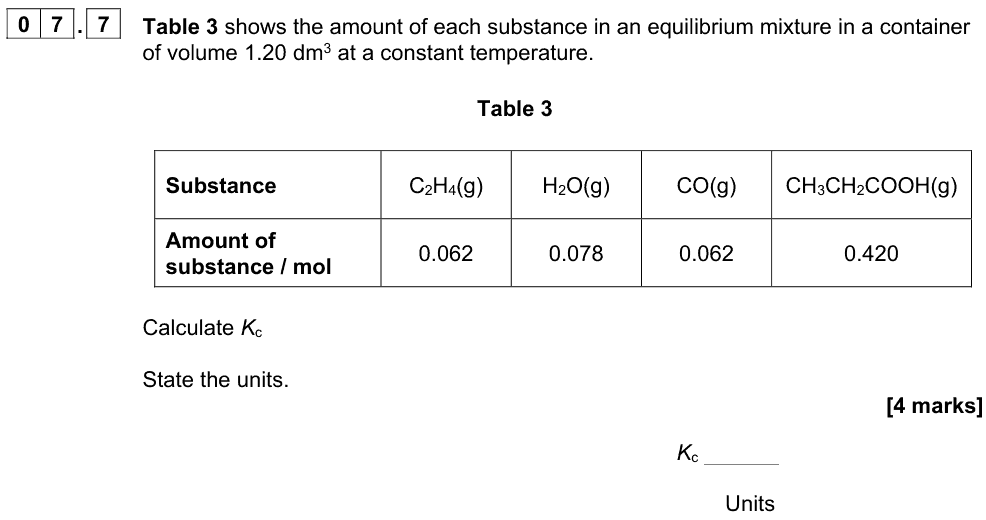
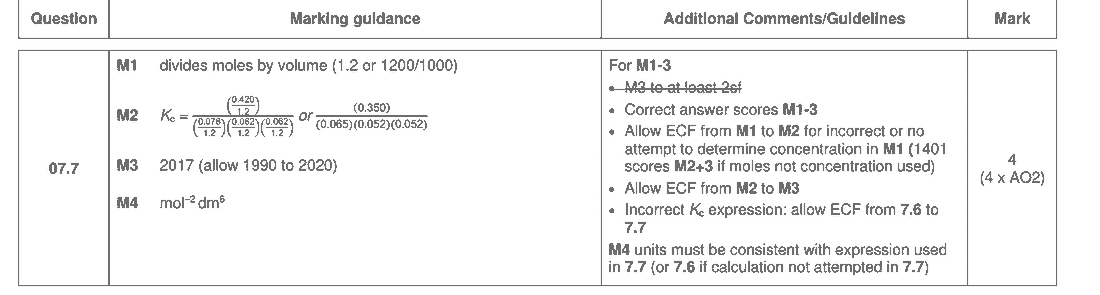
7.7 Many students correctly calculated Kc and its units. The most common error was using amounts in moles rather than concentrations. A significant number of students rounded 0.0516666 to 0.0516 which led to an answer that was outside the accepted range.
Notes from the mark scheme and report
Answer: Kc = 2017 mol–2 dm6 (allow 1990 to 2020). Divide each amount by 1.20 dm3: 0.350 ÷ (0.0650 × 0.0517 × 0.0517). Using moles gives 1401 (scores 2 of the first 3). Rounding 0.051666 down to 0.0516 put some answers outside the range
Skills: MS0.0 Recognise and make use of appropriate units in calculation; MS0.2 Use ratios, fractions and percentages; MS2.3 Substitute numerical values into algebraic equations using appropriate units for physical quantities
June 2024 · AS Paper 2 · Q07.83 marksAO2=3Explanation
Earlier parts of question 07 that this part uses
Mark scheme
Examiner's comment
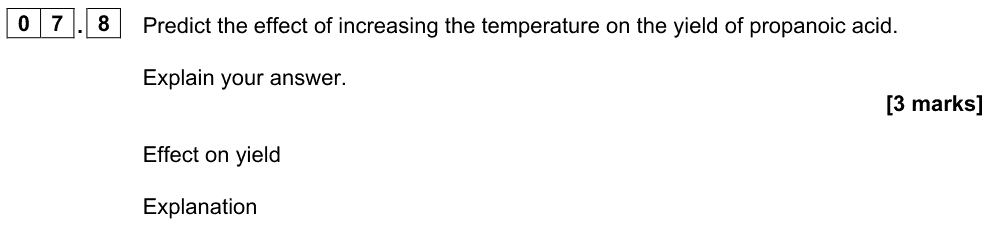
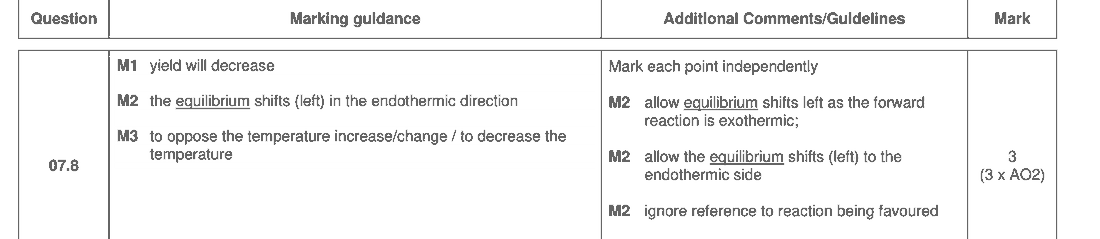
7.8 In this question students had to predict the effect of increasing temperature on the position of an equilibrium. This was done well, but some students did not refer to how the position of equilibrium shifted, while others did not appreciate that a negative enthalpy change represents an exothermic reaction.
Notes from the mark scheme and report
Yield decreases
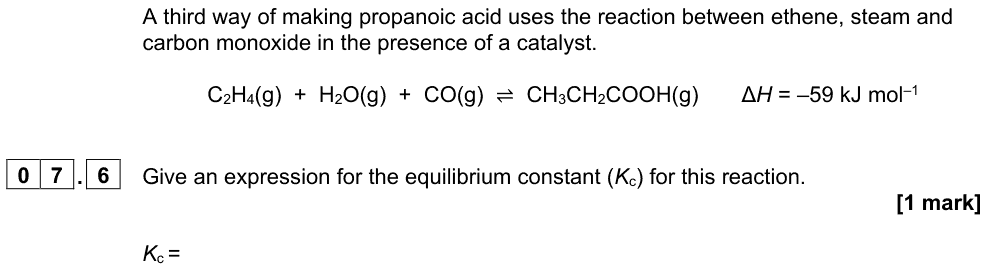
the equilibrium shifts to the left, in the endothermic direction, to oppose the increase in temperature. Each point marked independently. Needs ∆H = –59 kJ mol–1, printed in the 07.6 crop. Errors: no reference to the shift in equilibrium position
not recognising negative ∆H as exothermic
June 2023 · Paper 1 · Q04.52 marksAO3=2Explanation
Earlier part of question 04 that this part uses
Mark scheme
Examiner's comment
In 04.5, many students gave correct answers; several students gave answers referring to rates.
Notes from the mark scheme and report
The forward reaction is endothermic (reverse is exothermic)
the equilibrium shifts to the left to oppose the decrease in temperature / to raise the temperature. Rate arguments do not score
June 2023 · AS Paper 1 · Q08.12 marksAO2=2Calculation
Mark scheme
Examiner's comment
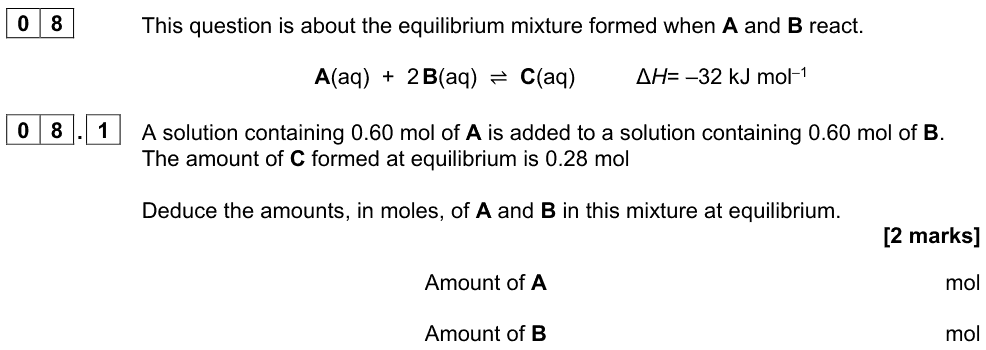
08.1 Just over half of the students scored both marks in this question. However, many students did not deduce the amount of A remaining at equilibrium by subtracting the amount of C formed from the initial amount of A. Another common cause of error was assuming that the amount of B was always twice the amount of A.
Notes from the mark scheme and report
Answer: A = 0.32 mol, B = 0.04 mol. A = 0.60 – 0.28
B = 0.60 – (2 × 0.28). Errors: not subtracting the amount of C from A
assuming B is always twice A
Skills: MS0.2 Use ratios, fractions and percentages
June 2023 · AS Paper 1 · Q08.21 markAO1=1Short answer
Earlier part of question 08 that this part uses
Mark scheme
Examiner's comment
08.2 This was well answered by the majority of students. However, the expression for the equilibrium constant, Kc, needs to be in terms of [A], [B] and [C] rather than with values.
Notes from the mark scheme and report
Kc = [C] ÷ ([A][B]²). Must be in terms of [A], [B] and [C], not numbers
June 2023 · AS Paper 1 · Q08.33 marksAO3=3Explanation
Earlier part of question 08 that this part uses
Mark scheme
Examiner's comment
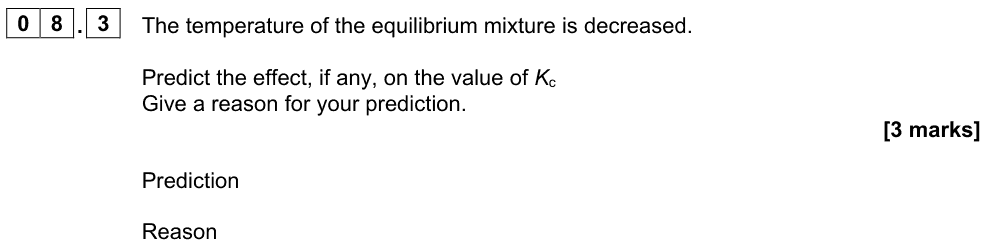
08.3 Students did not always answer in terms of Le Chatelier’s Principle. Students need to make sure that they make reference to a shift in the position of equilibrium.
Notes from the mark scheme and report
Kc increases
the equilibrium shifts in the exothermic (forward) direction, to oppose the decrease in temperature. Must refer to a shift in the position of equilibrium
June 2023 · AS Paper 1 · Q08.43 marksAO2=3Calculation
Earlier part of question 08 that this part uses
Mark scheme
Examiner's comment
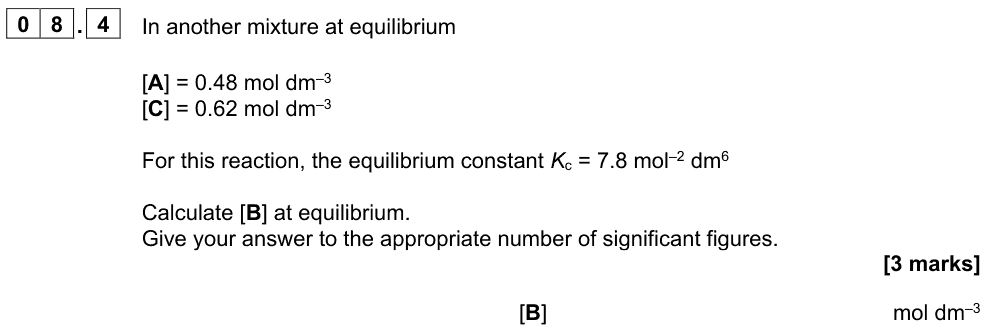
08.4 Just over half of the students scored all the marks on this question. Common causes of error included some incorrect rearrangements for the expression for the equilibrium constant and answers that were not always given to the appropriate number of significant figures.
Skills: MS1.1 Use an appropriate number of significant figures; MS2.2 Change the subject of an equation; MS2.3 Substitute numerical values into algebraic equations using appropriate units for physical quantities
June 2023 · AS Paper 2 · Q161 markAO3=1Multiple choice
Answer
D
Mark scheme
Examiner's comment
This was answered correctly by a majority (55%) of students.
Notes from the mark scheme and report
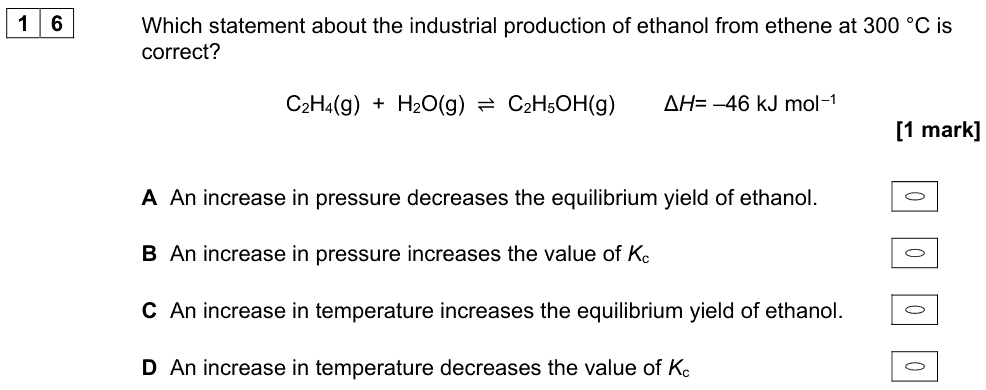
Answer: D. The forward reaction is exothermic, so raising the temperature moves the equilibrium left and Kc decreases. Pressure does not change Kc, and higher pressure increases the yield (2 mol of gas to 1 mol)
June 2023 · Paper 3 · Q01.81 markShort answerEasy
Earlier part of question 01 that this part uses
Mark scheme
Examiner's comment
72% of students were able to correctly answer 01.8.
Notes from the mark scheme and report
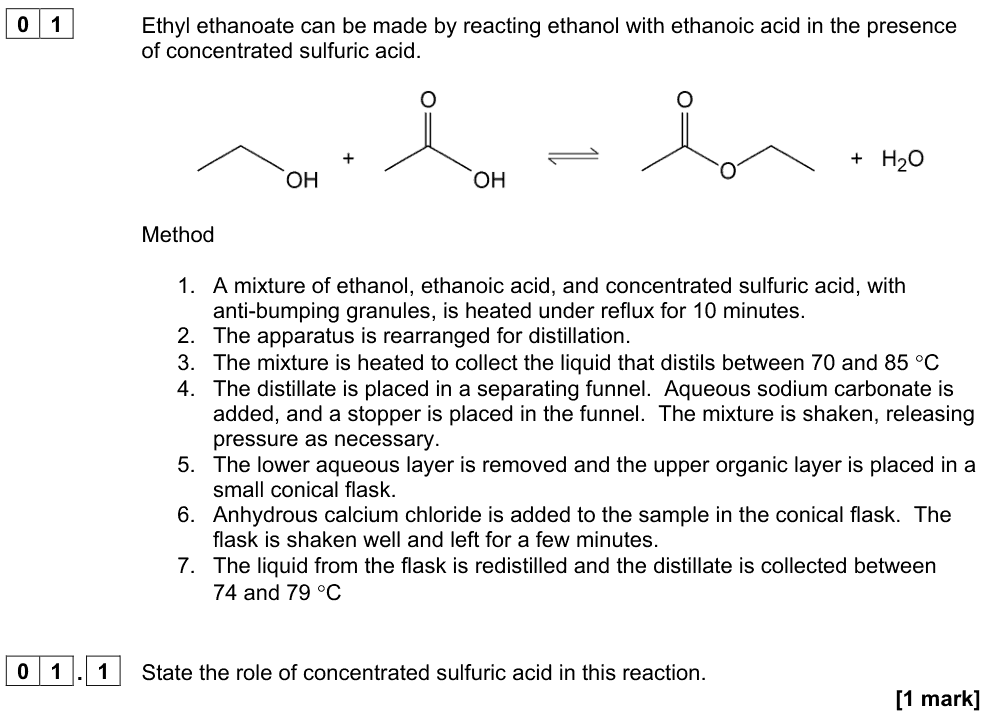
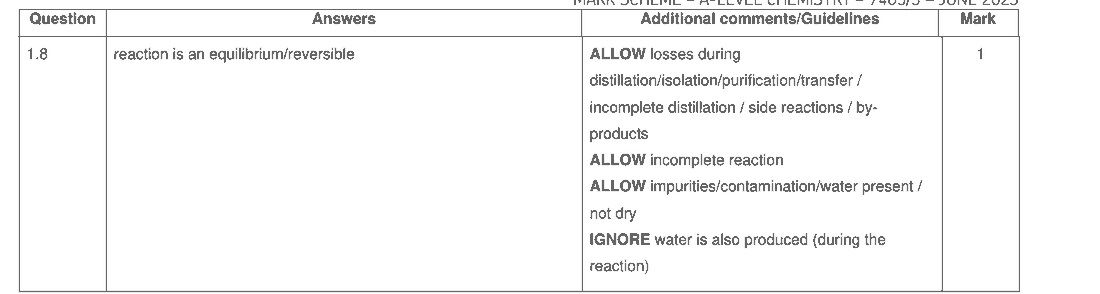
The reaction is reversible / reaches equilibrium (allow incomplete reaction, losses during distillation, purification or transfer, side reactions). 'Water is also produced' is ignored
Skills: PS2.3 Evaluate results and draw conclusions with reference to measurement uncertainties and errors; RP10 Preparation of: a pure organic solid and test of its purity; a pure organic liquid
June 2023 · Paper 3 · Q251 markAO2=1Multiple choice
Answer
C
Mark scheme
Notes from the mark scheme and report
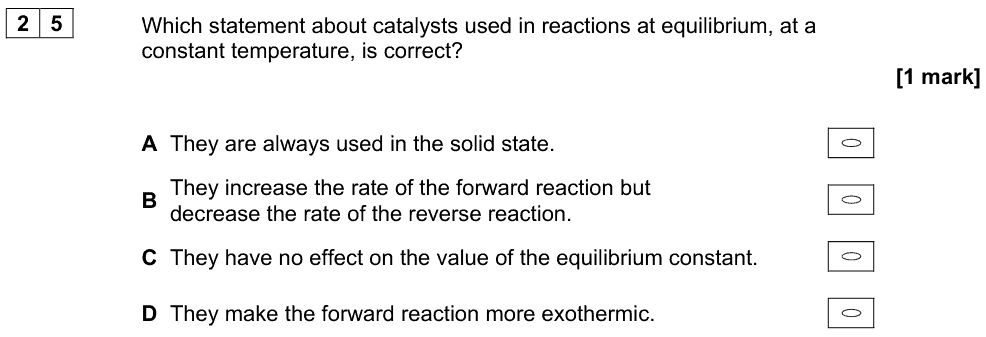
Answer: C. A catalyst speeds up the forward and reverse reactions equally, so it does not change the equilibrium constant or ∆H
catalysts are not always solids
June 2022 · Paper 1 · Q01.12 marksAO1=2Short answerHard
Mark scheme
Examiner's comment
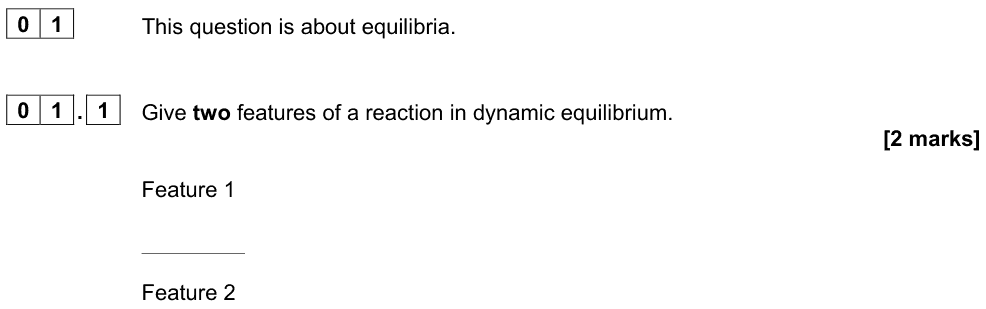
In 01.1, 21% of students gained both marks; common errors included stating that the concentrations are equal or that forwards and backwards reactions are equal, without reference to rate.
Notes from the mark scheme and report
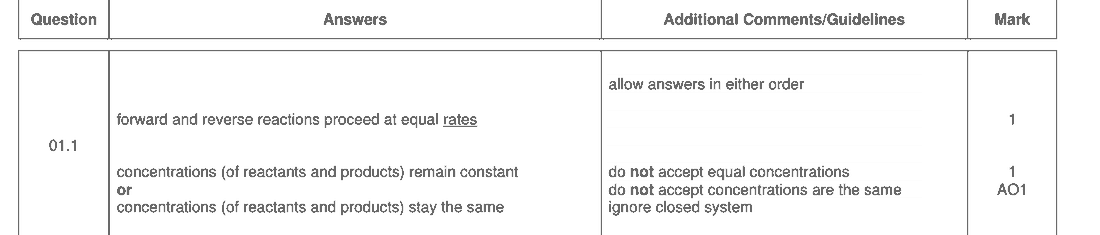
Forward and reverse reactions proceed at equal rates
concentrations of reactants and products remain constant. Not 'concentrations are equal'
'forward and backward reactions are equal' without rate does not score. Ignore closed system
June 2022 · Paper 1 · Q01.21 markAO3=1Short answer
Earlier part of question 01 that this part uses
Mark scheme
Examiner's comment
Many students gained the mark in 01.2.
Notes from the mark scheme and report
There are more moles (molecules) of gaseous products than gaseous reactants / more moles on the right-hand side. Not 'atoms'
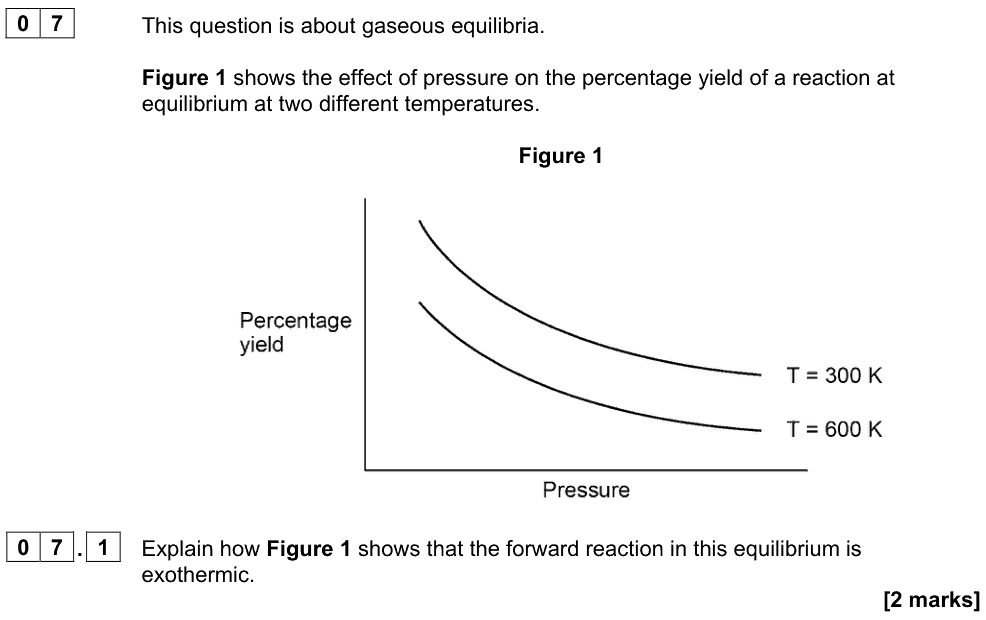
June 2022 · AS Paper 1 · Q07.12 marksAO3=2Explanation
Mark scheme
Examiner's comment
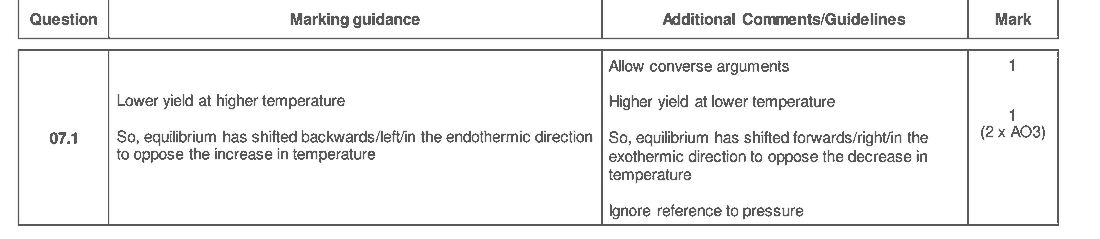
07.1 Some students attempted to answer this question by considering how the yield changed with pressure (rather than temperature), whilst others did not refer to Le Chatelier’s principle alongside the evidence from Figure 1 to support their answer.
Notes from the mark scheme and report
The yield is lower at the higher temperature (600 K)
so the equilibrium has shifted in the endothermic (reverse) direction to oppose the increase in temperature. Converse allowed. Errors: discussing pressure
no link to Le Chatelier's principle
Skills: MS3.1 Translate information between graphical, numerical and algebraic forms
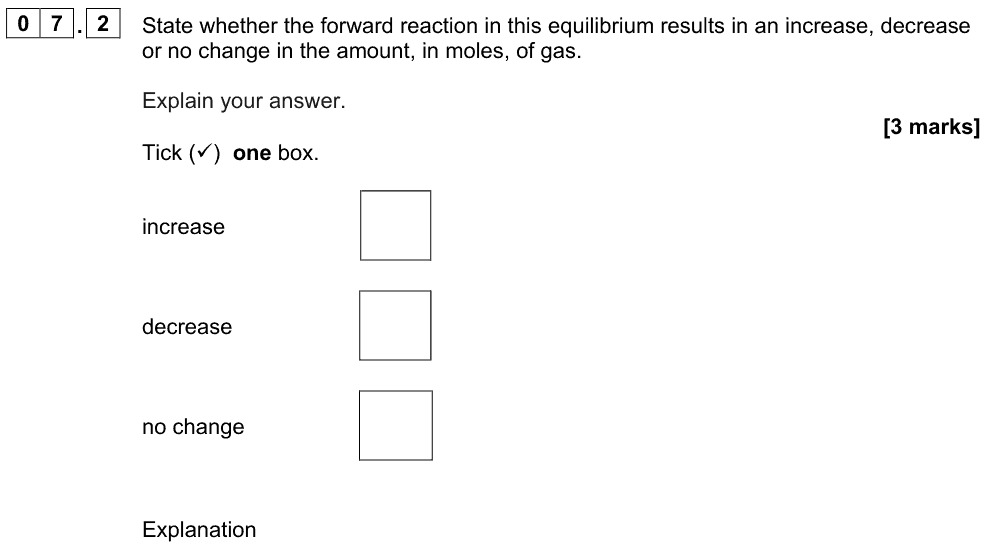
June 2022 · AS Paper 1 · Q07.23 marksAO3=3Explanation
Earlier part of question 07 that this part uses
Mark scheme
Examiner's comment
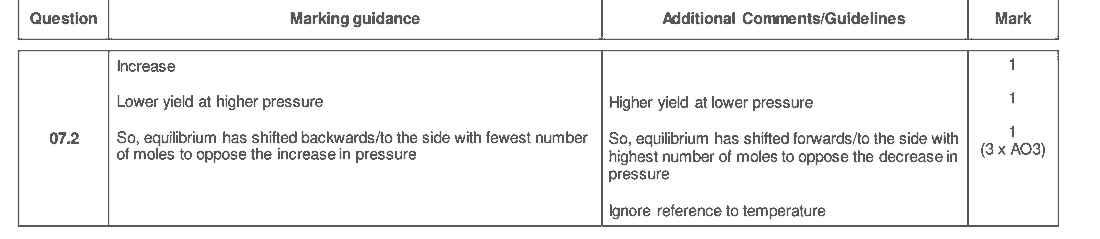
07.2 Likewise on this question, some students attempted to answer this question by considering how the yield changed with temperature (rather than pressure). Again, students did not always refer to Le Chatelier’s principle alongside the evidence to support their explanation.
Notes from the mark scheme and report
Answer: increase. The yield is lower at higher pressure
so the equilibrium has shifted to the reactant side, which has fewer moles of gas, to oppose the increase in pressure. Error: discussing temperature
Skills: MS3.1 Translate information between graphical, numerical and algebraic forms
June 2022 · AS Paper 1 · Q07.31 markAO1=1Short answerHard
Earlier part of question 07 that this part uses
Mark scheme
Examiner's comment
07.3 This was not well answered with only about one quarter scoring the mark. Many students just stated that the catalyst would increase the rate, or that it would not affect the position of equilibrium.
Notes from the mark scheme and report
A catalyst increases the rate of the forward and reverse reactions equally. 'Increases the rate' or 'does not affect the position of equilibrium' alone did not score
June 2022 · AS Paper 1 · Q07.45 marksAO2=5Calculation
Earlier part of question 07 that this part uses
Mark scheme
Examiner's comment
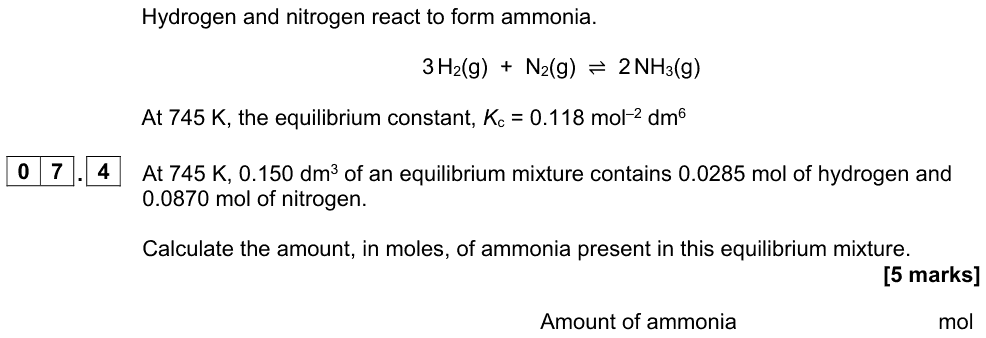
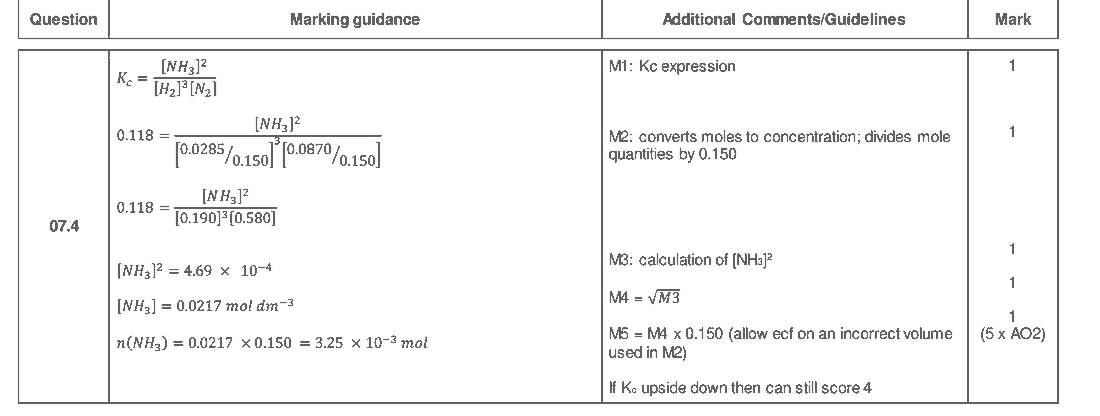
07.4 A good number of students were able to calculate correctly the amount, in moles, of ammonia present in the equilibrium mixture. However, some students only calculated the equilibrium concentration of ammonia. There were some errors in the rearrangement of the expression involving Kc to calculate this concentration of ammonia.
Skills: MS0.0 Recognise and make use of appropriate units in calculation; MS2.2 Change the subject of an equation; MS2.3 Substitute numerical values into algebraic equations using appropriate units for physical quantities; MS2.4 Solve algebraic equations
June 2022 · AS Paper 1 · Q07.52 marksAO2=2Calculation
Earlier parts of question 07 that this part uses
Mark scheme
Examiner's comment
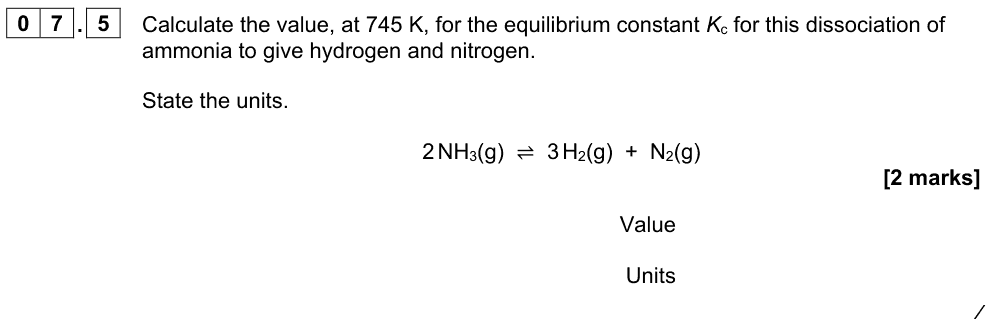
07.5 Students did not need to use the values from their calculations of moles in question 07.4. They did not often appreciate that this is the reverse reaction so the value of Kc would be the inverse of that given in question 07.4
Notes from the mark scheme and report
Answer: 8.47 mol2 dm–6 (allow 8.45 to 8.5). Kc for the reverse reaction = 1 ÷ 0.118
the answer to 07.4 is not needed
Skills: MS0.0 Recognise and make use of appropriate units in calculation
June 2022 · Paper 2 · Q02.12 marksAO2=2Calculation
Mark scheme
Examiner's comment
02.1 A familiar type of equilibrium question that students answered well.
June 2022 · Paper 2 · Q02.33 marksAO2=3Calculation
Earlier part of question 02 that this part uses
Mark scheme
Examiner's comment
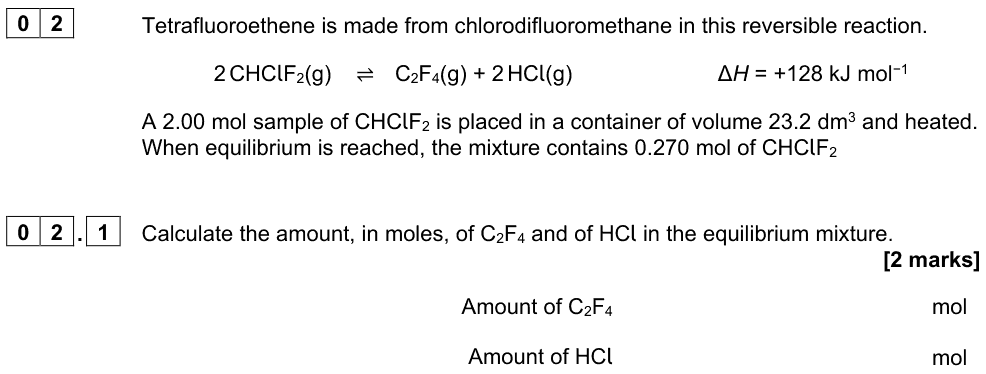
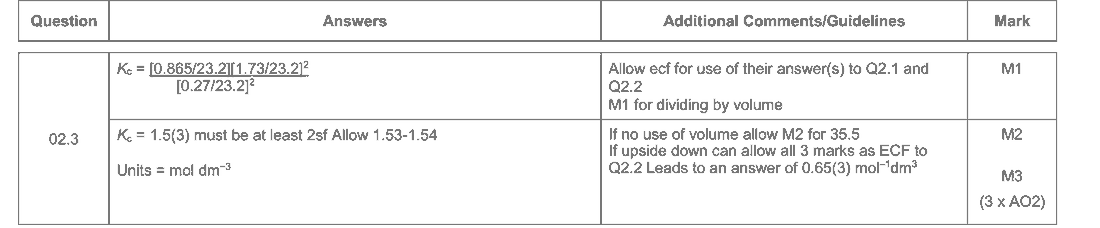
02.3 Although many students were able to score full marks here, significant numbers failed to use the volume when substituting values into the Kc expression.
Notes from the mark scheme and report
Answer: Kc = 1.53 mol dm–3 (allow 1.5
1.53 to 1.54). (0.865/23.2) × (1.73/23.2)² ÷ (0.270/23.2)². Not dividing by the volume gives 35.5 (1 mark for the value)
many forgot the volume
Skills: MS0.0 Recognise and make use of appropriate units in calculation; MS2.3 Substitute numerical values into algebraic equations using appropriate units for physical quantities
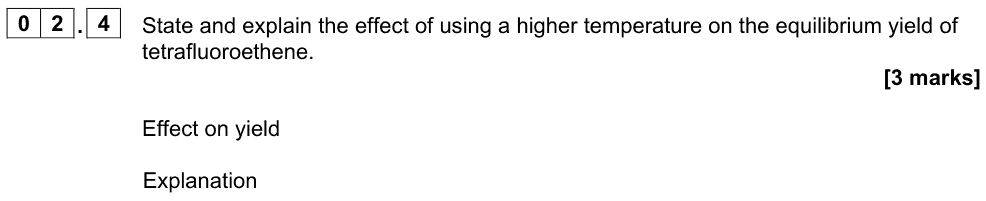
June 2022 · Paper 2 · Q02.43 marksAO2=3Explanation
Earlier part of question 02 that this part uses
Mark scheme
Examiner's comment
02.4 This question required students to apply Le Chatelier’s principle and most were able to score high marks here.
Notes from the mark scheme and report
Yield increases. The forward reaction is endothermic
the equilibrium shifts in the endothermic direction (to the right) to oppose the increase in temperature / to reduce the temperature. 'Favours' is ignored
June 2022 · AS Paper 2 · Q181 markAO2=1Multiple choiceEasy
Answer
B
Mark scheme
Examiner's comment
This was answered correctly by a majority of students (80.1%).
Notes from the mark scheme and report
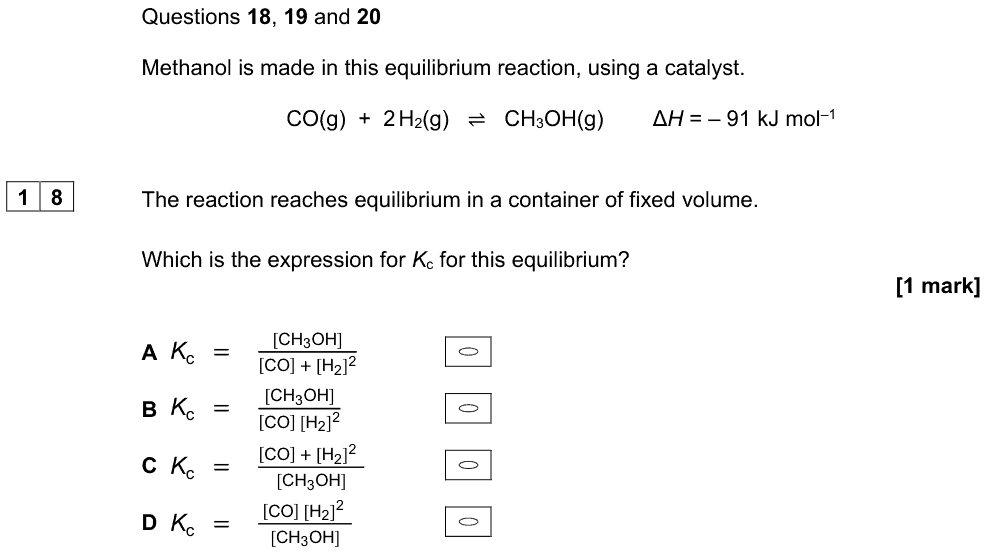
Answer: B. Kc = [CH3OH] ÷ ([CO][H2]²): products over reactants, concentrations multiplied
June 2022 · AS Paper 2 · Q191 markAO2=1Multiple choice
Earlier part of question 19 that this part uses
Answer
B
Mark scheme
Examiner's comment
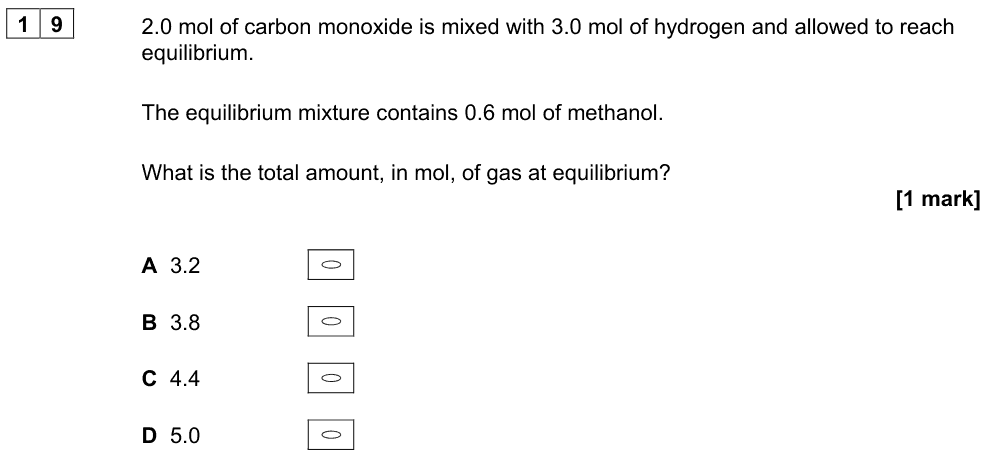
Students found it difficult to work out the amount, in moles, of the substances in an equilibrium mixture.
Notes from the mark scheme and report
Answer: B. CO = 2.0 – 0.6 = 1.4 mol
H2 = 3.0 – 1.2 = 1.8 mol
CH3OH = 0.6 mol
total 3.8 mol
Skills: MS0.2 Use ratios, fractions and percentages
June 2022 · AS Paper 2 · Q201 markAO3=1Multiple choiceEasy
Earlier part of question 20 that this part uses
Answer
D
Mark scheme
Examiner's comment
This was answered correctly by a majority of students (60.7%).
Q21 Reaction of 2-bromobutane with hydroxide ions
Students found it difficult to deduce which compounds could be produced by substitution and/or elimination.
Q22 Role of hydroxide ions in elimination
Students were unsure about the role of hydroxide ions in elimination from halogenoalkanes, although the majority (57.1%) answered it correctly.
Notes from the mark scheme and report
Answer: D. The forward reaction is exothermic, so a higher temperature shifts the equilibrium to the left
November 2021 · Paper 1 · Q05.13 marksExplanation
Mark scheme
Examiner's comment
Question 05.1 was generally well answered.
Some students did not gain the first mark because they did not state a change in yield; a common error was to refer to equilibrium shift.
Many students did not gain the third mark as they did not refer to the equilibrium shifting to oppose the decrease in pressure.
Notes from the mark scheme and report
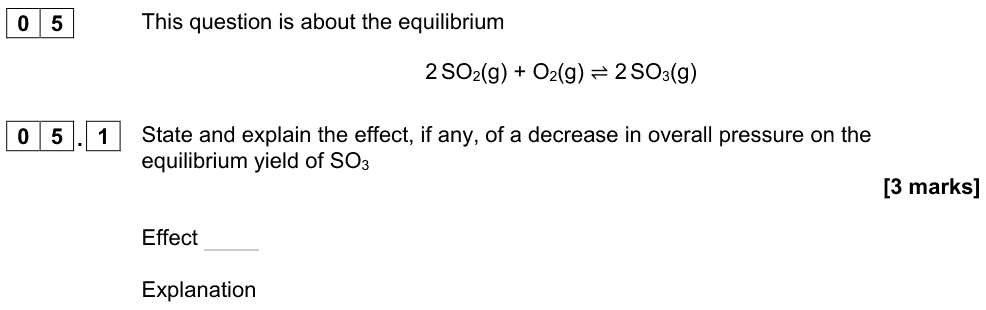
The yield decreases
there are more moles of gas on the left-hand side
the equilibrium shifts to the left to oppose the decrease in pressure (to increase the pressure). Must state the change in yield and refer to the equilibrium shifting
November 2021 · Paper 1 · Q06.22 marksExplanation
Earlier part of question 06 that this part uses
Mark scheme
Examiner's comment
In question 06.2 some students realised that the reaction was endothermic but did not complete their answer with an explanation.
Some students tried to explain their answer in terms of kinetics.
Notes from the mark scheme and report
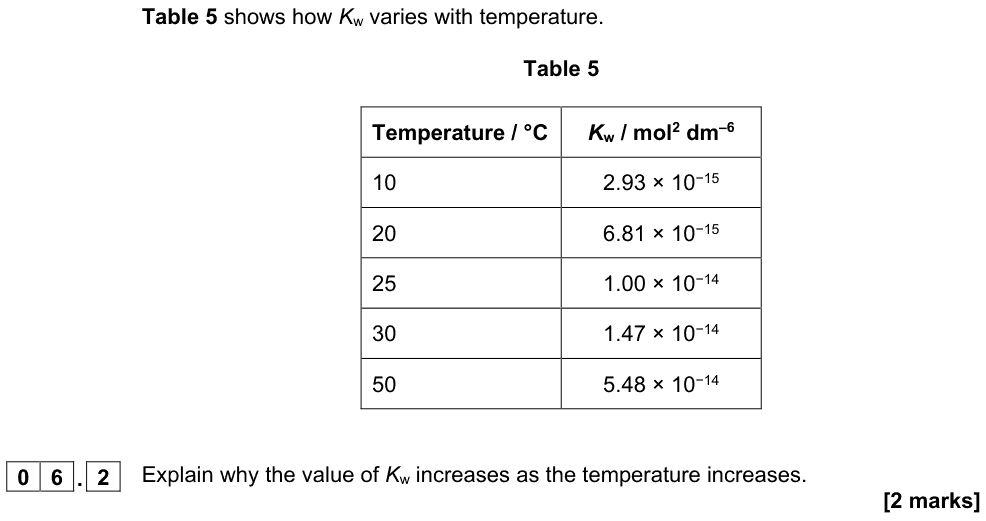
The dissociation is endothermic
the equilibrium shifts to the right to oppose the temperature increase. Kinetic arguments do not score
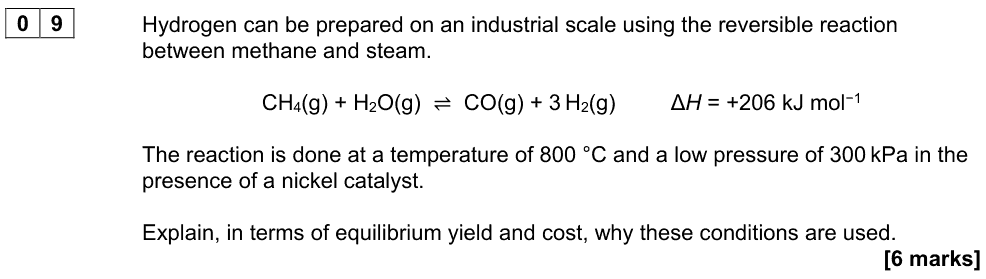
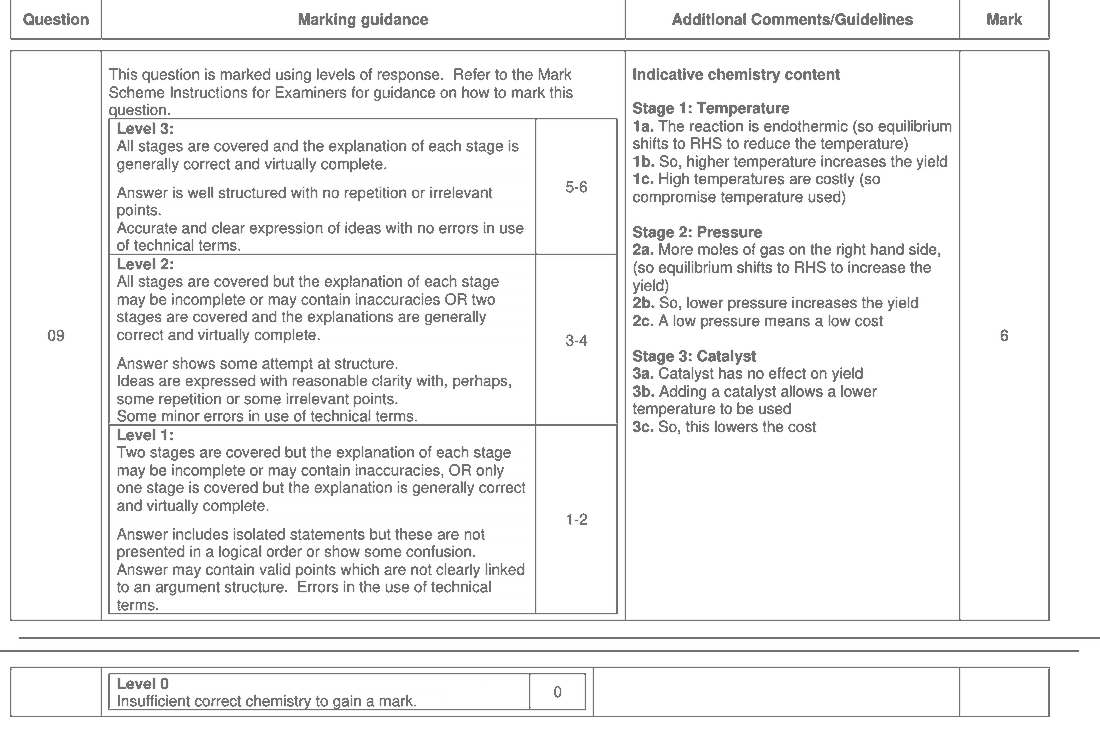
November 2021 · AS Paper 1 · Q096 marks6-mark level of response
Mark scheme, with the levels and indicative content
Notes from the mark scheme and report
Levels of response, three stages. Temperature: the forward reaction is endothermic, so a high temperature shifts equilibrium to the right and increases the yield
high temperatures are costly, so a compromise is used. Pressure: more moles of gas on the right (4 against 2), so a low pressure increases the yield
low pressure also means low cost. Catalyst: no effect on the yield
allows a lower temperature to be used, which lowers the cost
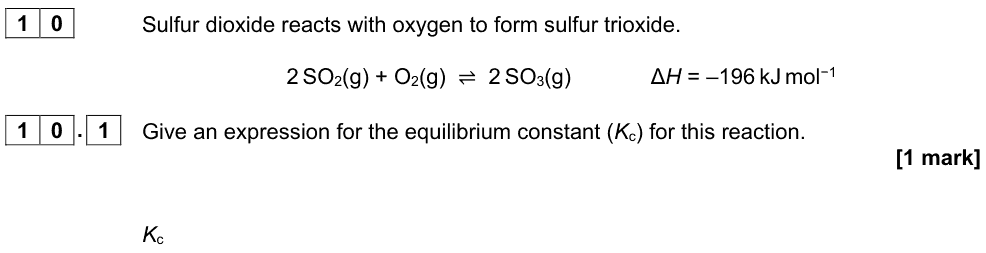
November 2021 · AS Paper 1 · Q10.11 markShort answer
Mark scheme
Notes from the mark scheme and report
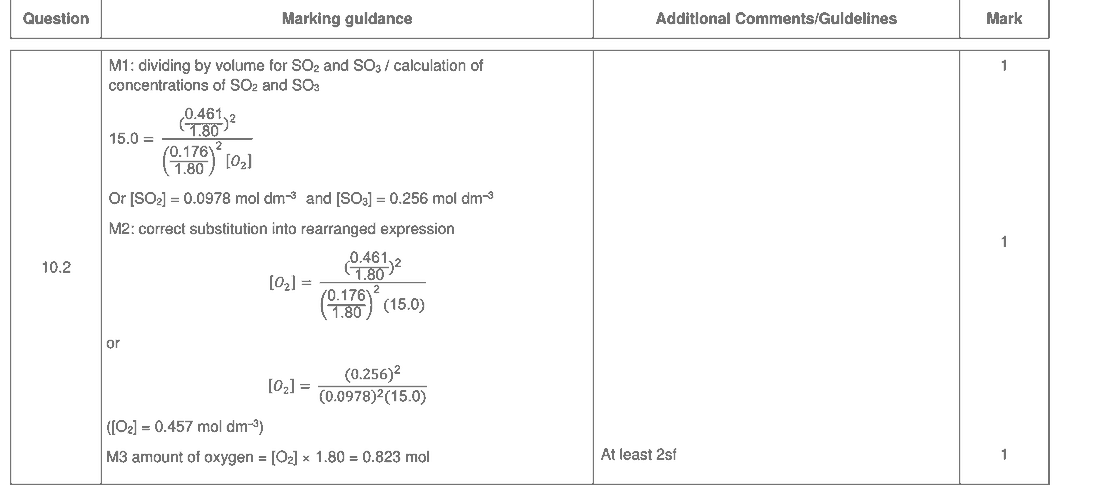
Kc = [SO3]² ÷ ([SO2]²[O2])
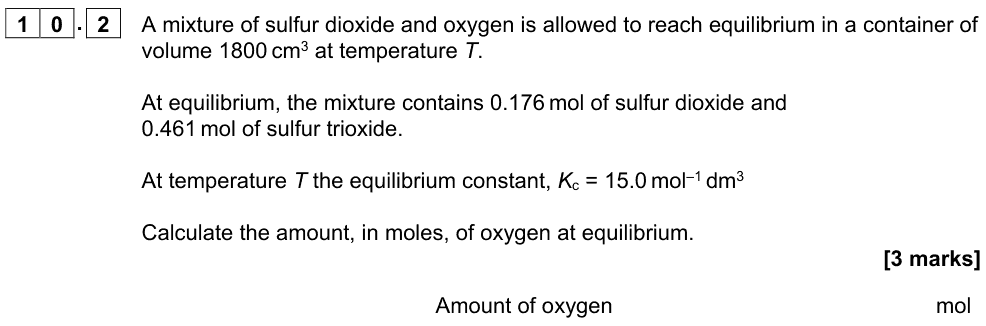
November 2021 · AS Paper 1 · Q10.23 marksCalculation
Skills: MS0.0 Recognise and make use of appropriate units in calculation; MS2.2 Change the subject of an equation; MS2.3 Substitute numerical values into algebraic equations using appropriate units for physical quantities
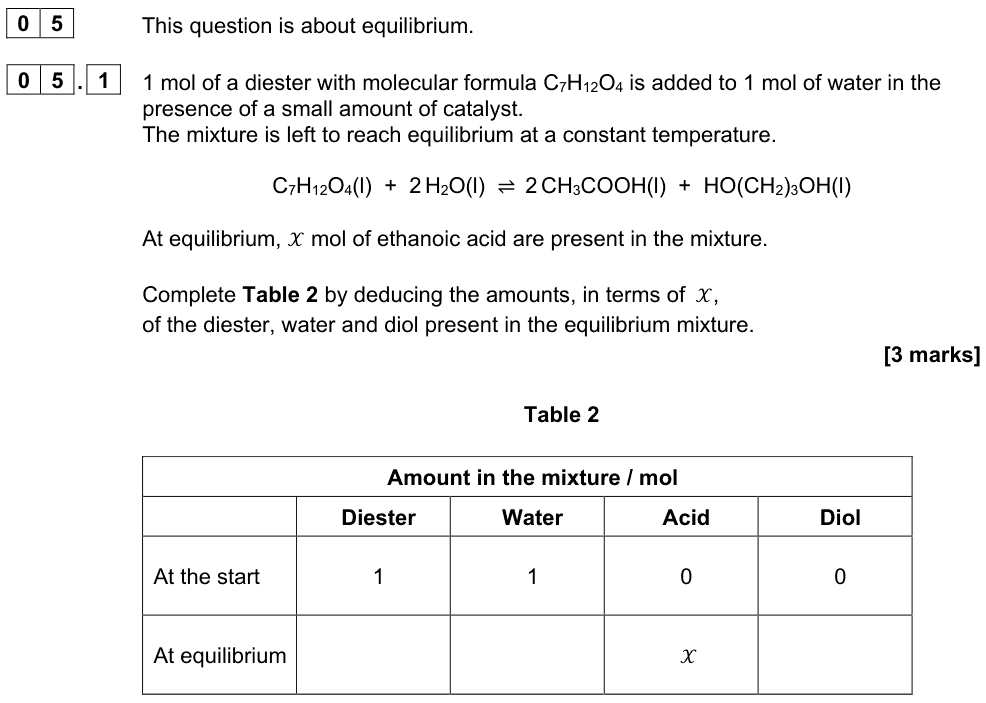
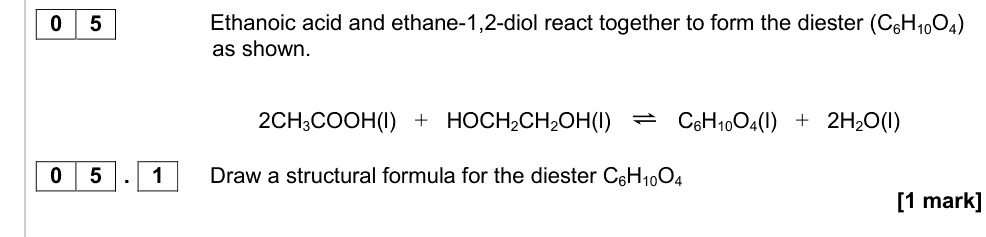
November 2021 · Paper 2 · Q05.13 marksShort answer
Mark scheme
Examiner's comment
The algebraic approach needed in question 05.1 proved difficult for some but around half the students were able to score full marks here.
Notes from the mark scheme and report
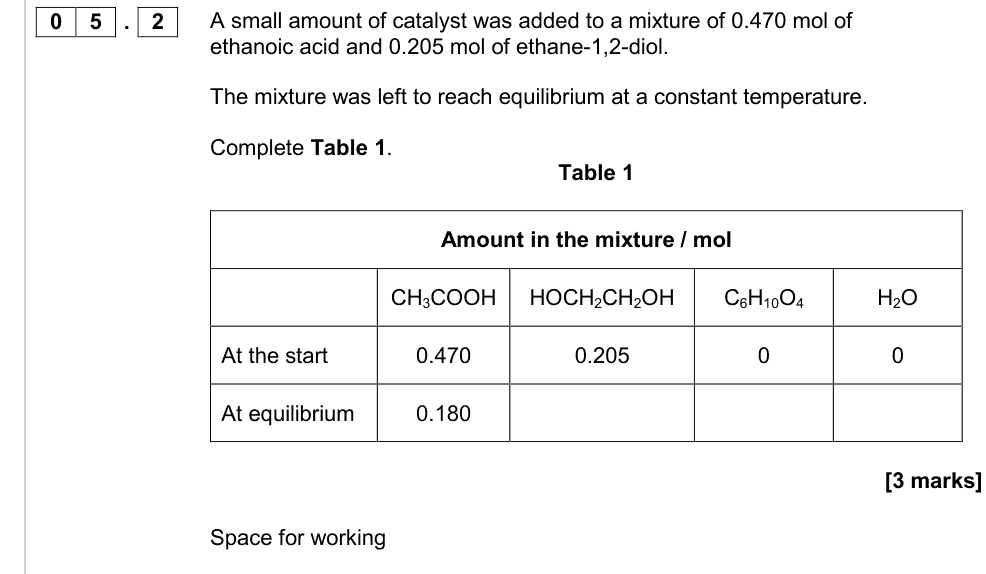
Diester = 1 – x/2
water = 1 – x
diol = x/2 (2 mol of acid form for each mole of diester and diol, and for 2 mol of water). Around half scored full marks
Skills: MS0.2 Use ratios, fractions and percentages; MS2.1 Understand and use the symbols: =, <, <<, >>, >, ∝, ~, equilibrium sign
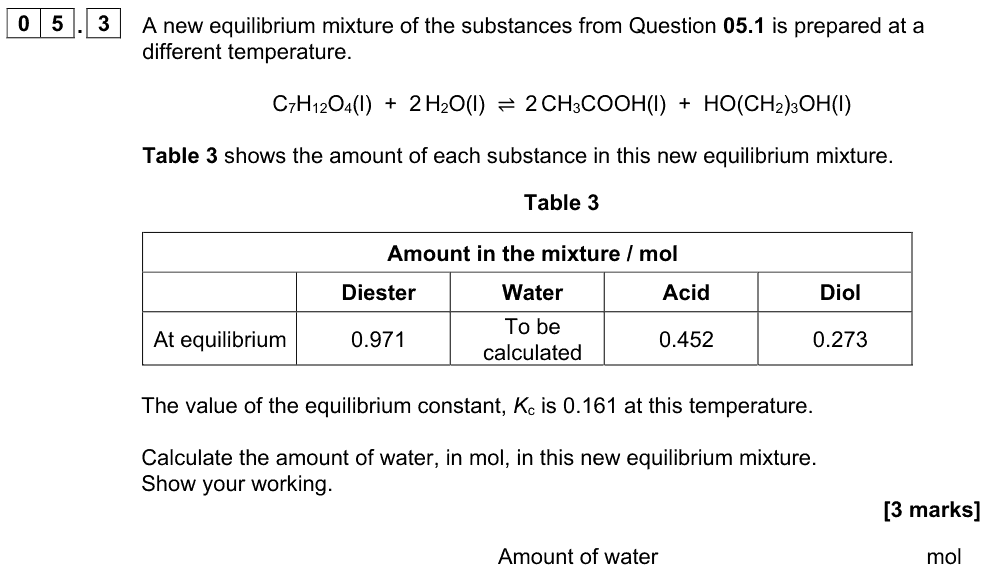
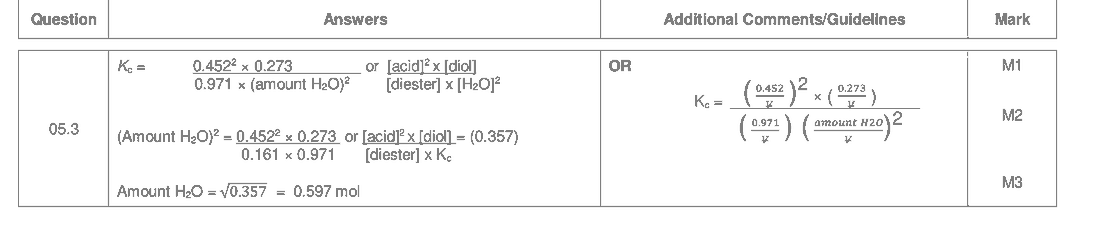
November 2021 · Paper 2 · Q05.33 marksCalculationEasy
Earlier part of question 05 that this part uses
Mark scheme
Examiner's comment
The structure of the diester in question 05.2 was very poorly answered, but the familiar Kc calculation in question 05.3 proved very accessible and around two thirds of students scored all three marks.
Skills: MS2.2 Change the subject of an equation; MS2.3 Substitute numerical values into algebraic equations using appropriate units for physical quantities
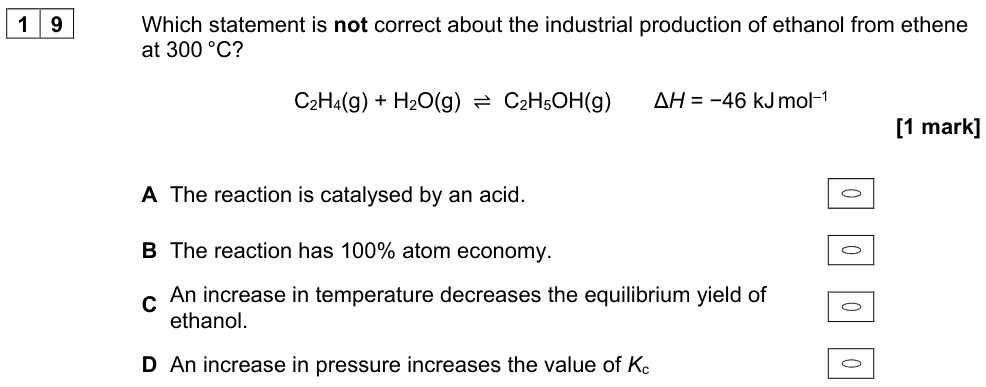
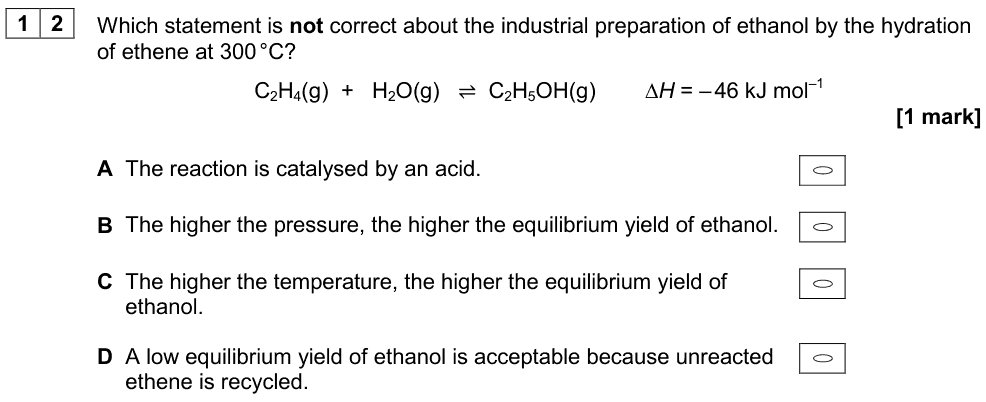
November 2021 · AS Paper 2 · Q191 markMultiple choice
Answer
D
Mark scheme
Notes from the mark scheme and report
Answer: D. Kc changes only with temperature
pressure shifts the position of equilibrium but not Kc. A, B and C are all true (acid catalyst, a single product, exothermic forward reaction)
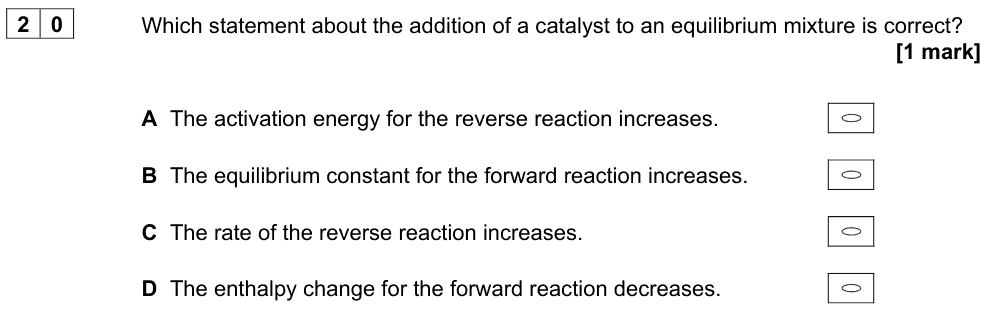
November 2021 · AS Paper 2 · Q201 markMultiple choice
Answer
C
Mark scheme
Notes from the mark scheme and report
Answer: C. A catalyst lowers the activation energy for both directions, so forward and reverse rates both increase
K and ∆H are unchanged
November 2021 · Paper 3 · Q201 markMultiple choice
Answer
C
Mark scheme
Notes from the mark scheme and report
Answer: C. A catalyst lowers the activation energy and speeds up forward and reverse reactions equally
K and ∆H are unchanged
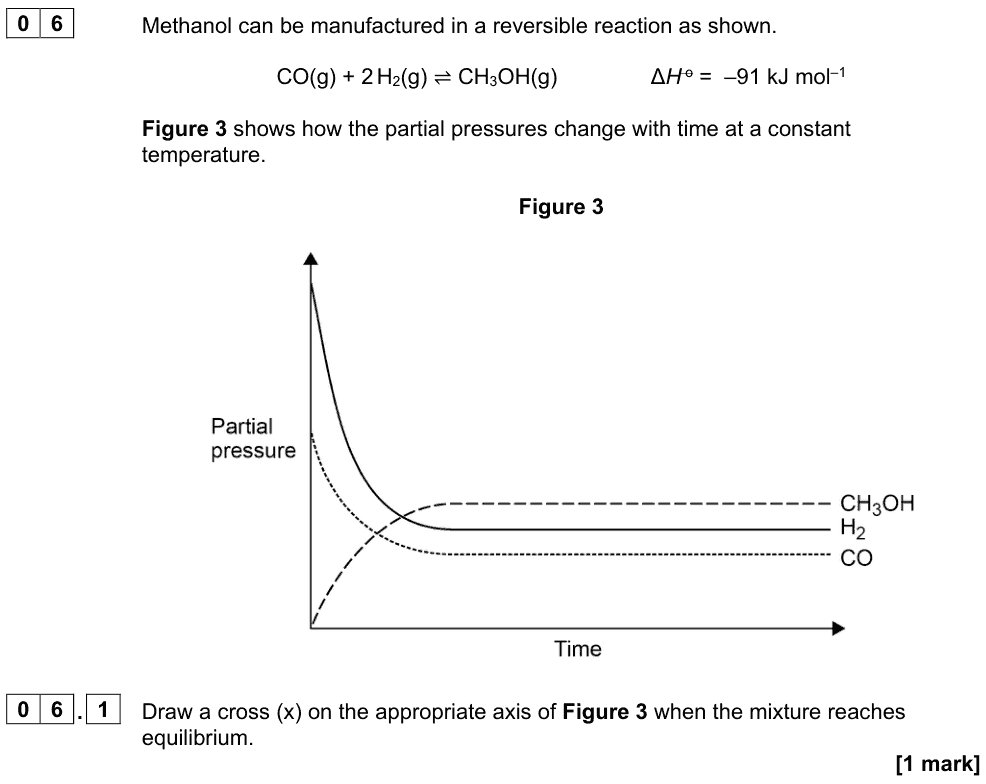
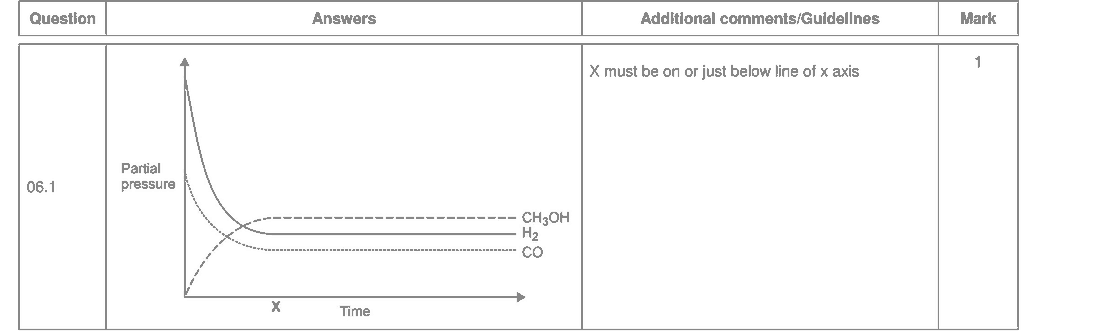
November 2020 · Paper 1 · Q06.11 markDiagram or structure
Mark scheme
Examiner's comment
In 06.1, students often failed to mark the cross with sufficient accuracy; many students did not put the cross on the correct axis but, instead, on the curve or on the wrong axis.
Notes from the mark scheme and report
Cross on (or just below) the time axis at the point where the three curves first become horizontal. Many put the cross on a curve or on the wrong axis, or not accurately enough
Skills: MS3.1 Translate information between graphical, numerical and algebraic forms
November 2020 · Paper 1 · Q06.42 marksShort answer
Earlier part of question 06 that this part uses
Mark scheme
Examiner's comment
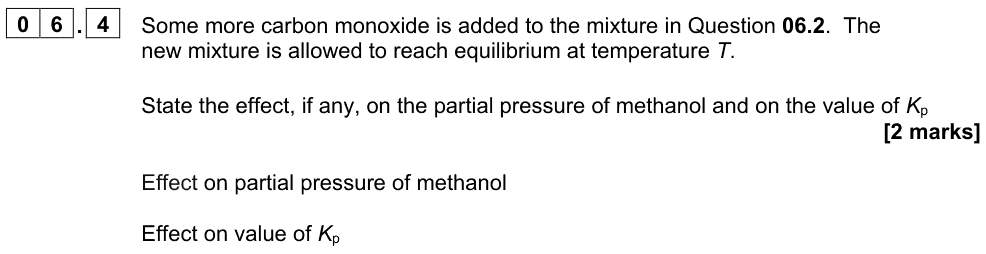
In 06.4, many students who gave the correct answer that the partial pressure of methanol
Notes from the mark scheme and report
Partial pressure of methanol increases
no effect on Kp (temperature unchanged)
November 2020 · Paper 1 · Q06.52 marksExplanation
Earlier part of question 06 that this part uses
Mark scheme
Examiner's comment
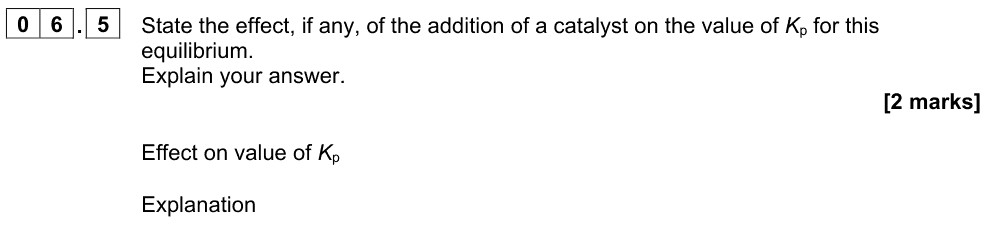
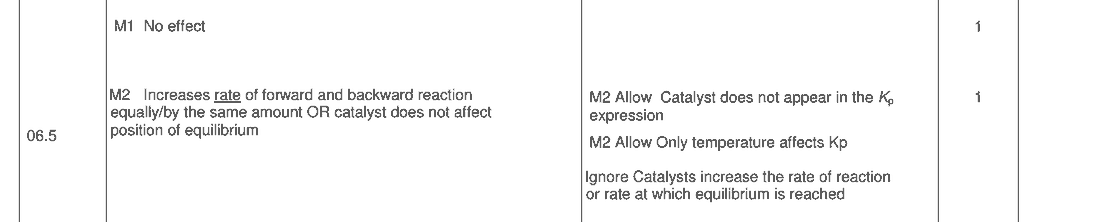
Many students knew that Kp was unchanged in 06.5 but then failed to explain the reason fully; common errors included that a catalyst increases the rate of both reactions or lowers the activation energy by providing an alternative route.
Notes from the mark scheme and report
No effect
a catalyst increases the rate of the forward and backward reactions equally / does not change the position of equilibrium (allow: only temperature affects Kp). 'Increases the rate' or 'lowers the activation energy' alone is ignored
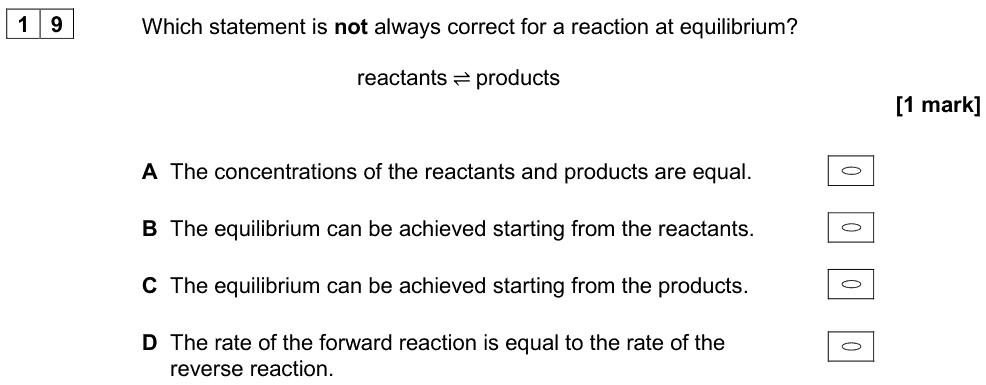
November 2020 · AS Paper 1 · Q191 markMultiple choice
Answer
A
Mark scheme
Notes from the mark scheme and report
Answer: A. At equilibrium concentrations are constant, not necessarily equal
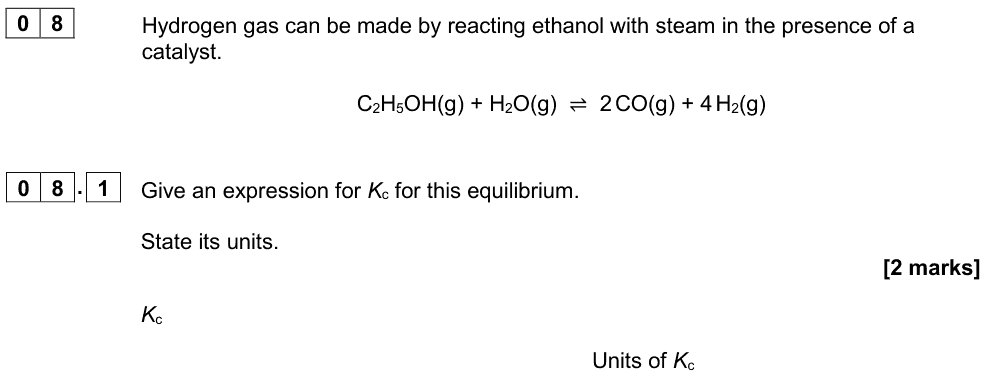
November 2020 · AS Paper 2 · Q08.12 marksShort answer
Mark scheme
Notes from the mark scheme and report
Kc = [CO]²[H2]⁴ ÷ ([C2H5OH][H2O])
units mol4 dm–12
Skills: MS0.0 Recognise and make use of appropriate units in calculation
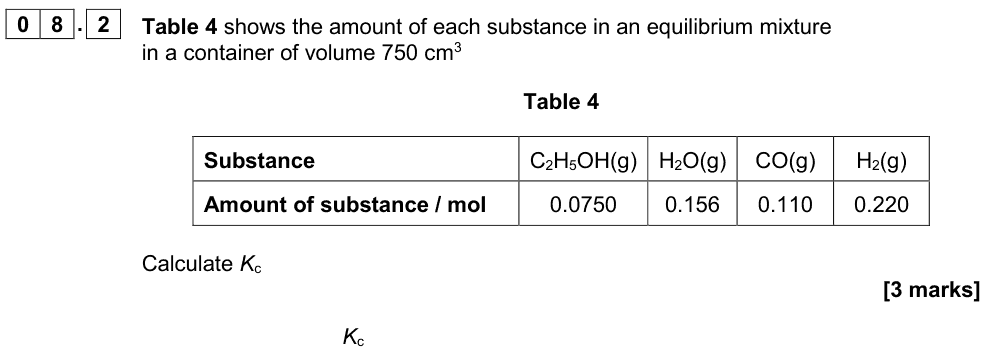
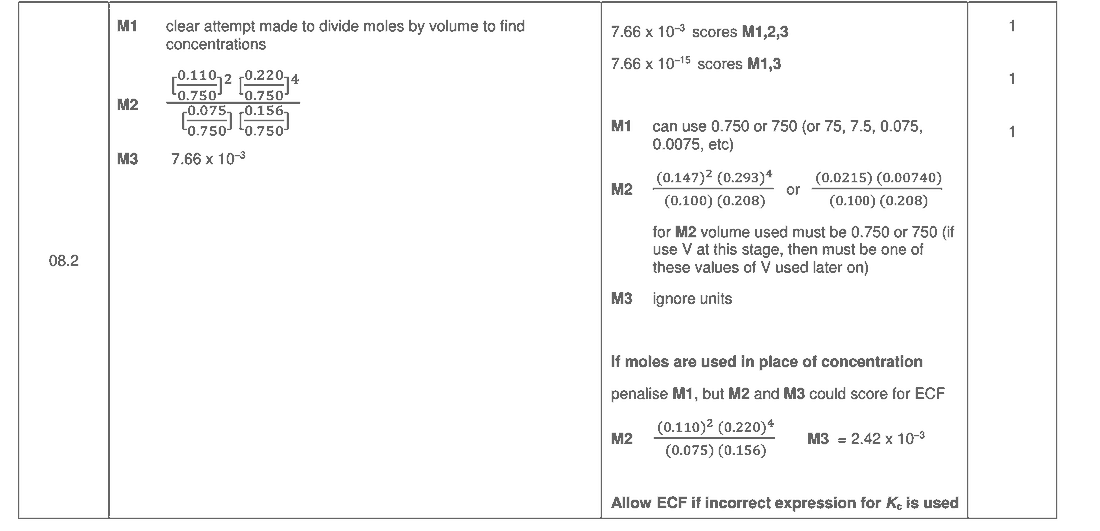
November 2020 · AS Paper 2 · Q08.23 marksCalculation
Kc = (0.147² × 0.293⁴) ÷ (0.100 × 0.208). Using moles instead of concentrations gives 2.42 × 10^–3 (loses M1). Uses the Kc expression from 08.1
Skills: MS0.0 Recognise and make use of appropriate units in calculation; MS0.1 Recognise and use expressions in decimal and ordinary form; MS2.3 Substitute numerical values into algebraic equations using appropriate units for physical quantities
November 2020 · AS Paper 2 · Q08.34 marksExplanation
Earlier part of question 08 that this part uses
Mark scheme
Notes from the mark scheme and report
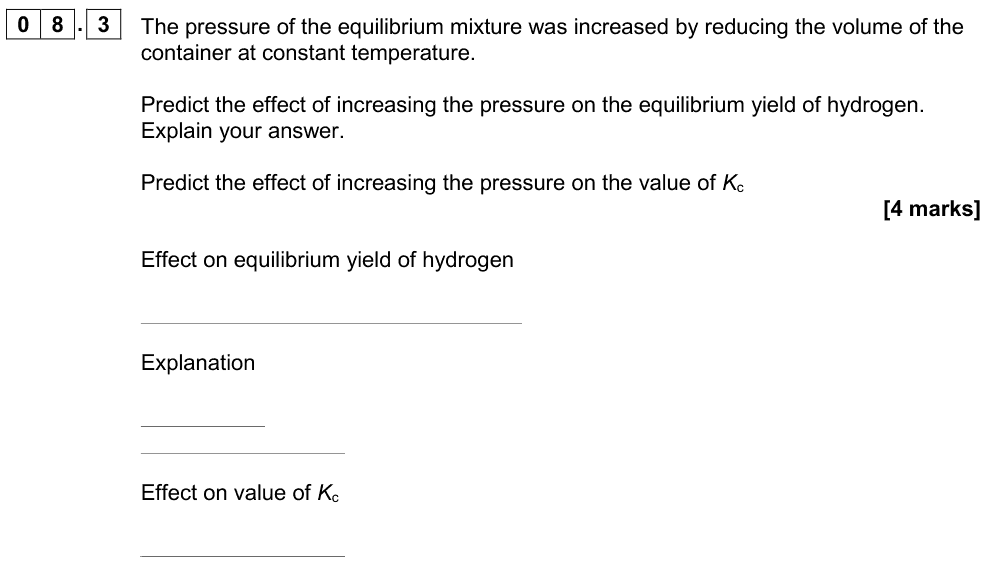
Yield of hydrogen decreases
the equilibrium shifts to the left to oppose the increase in pressure
there are fewer moles of gas on the left (2 against 6)
no effect on the value of Kc (only temperature changes Kc). Four independent marks
November 2020 · Paper 2 · Q09.12 marksCalculation
Mark scheme
Examiner's comment
The first two parts of the question were very well answered and students often scored high marks. 09.3 was much less well answered, with fewer than 20% of students able to suggest that the concentration of water being effectively constant is the reason why the equilibrium expression can be written without including it. 09.4 was another calculation where many students got started but few were able to access the highest marks. Only the very best identified that an algebraic approach was needed to calculate the required equilibrium concentration. 09.5 required students to apply their understanding of standard mechanistic ideas to a novel mechanism. Most students were able to score at least some of the marks and a good number (44.3%) scored all three marks. Full marks proved far more difficult in 09.6 but students often gained some credit for recognising that the alkyl group would be electron donating.
Concluding Remarks
Overall the questions in this paper proved to be of a similar standard to those in previous series. The paper differentiated well, and students were able to complete the questions in the time available. All questions were correctly answered by a good number of students apart from 07.3 which was the most difficult question on the paper.
Notes from the mark scheme and report
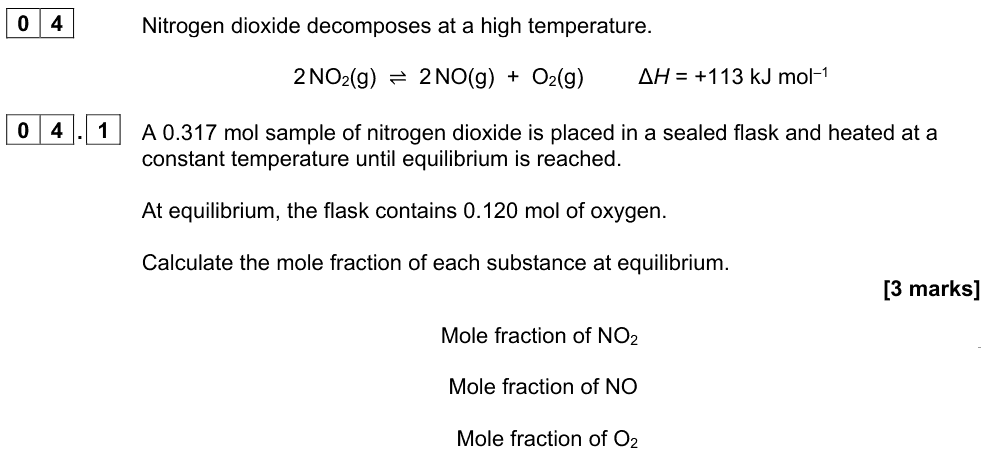
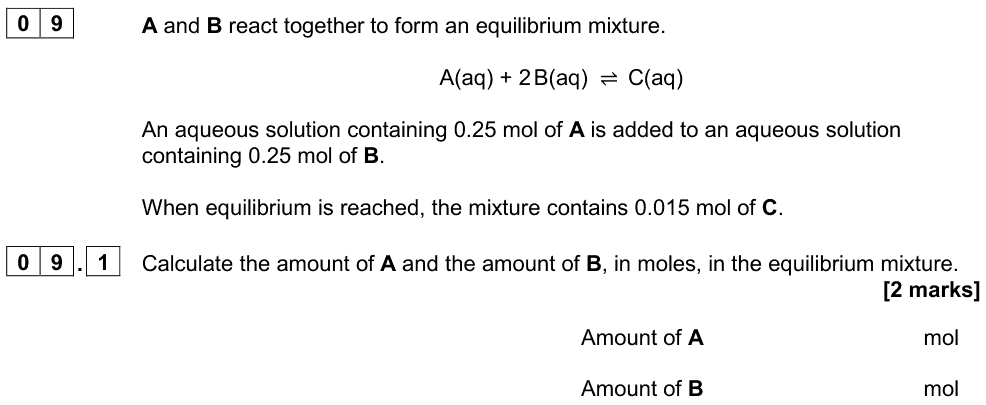
Answer: A = 0.235 mol (allow 0.24), B = 0.22 mol. A = 0.25 – 0.015
B = 0.25 – (2 × 0.015)
Skills: MS0.2 Use ratios, fractions and percentages
November 2020 · Paper 2 · Q09.24 marksCalculation
Earlier part of question 09 that this part uses
Mark scheme
Examiner's comment
The first two parts of the question were very well answered and students often scored high marks. 09.3 was much less well answered, with fewer than 20% of students able to suggest that the concentration of water being effectively constant is the reason why the equilibrium expression can be written without including it. 09.4 was another calculation where many students got started but few were able to access the highest marks. Only the very best identified that an algebraic approach was needed to calculate the required equilibrium concentration. 09.5 required students to apply their understanding of standard mechanistic ideas to a novel mechanism. Most students were able to score at least some of the marks and a good number (44.3%) scored all three marks. Full marks proved far more difficult in 09.6 but students often gained some credit for recognising that the alkyl group would be electron donating.
Concluding Remarks
Overall the questions in this paper proved to be of a similar standard to those in previous series. The paper differentiated well, and students were able to complete the questions in the time available. All questions were correctly answered by a good number of students apart from 07.3 which was the most difficult question on the paper.
Notes from the mark scheme and report
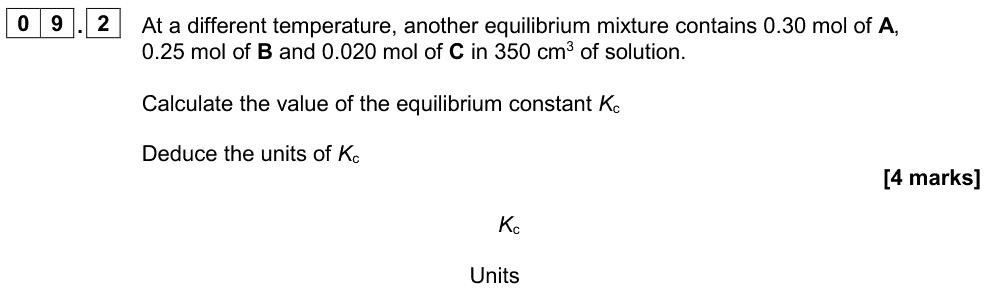
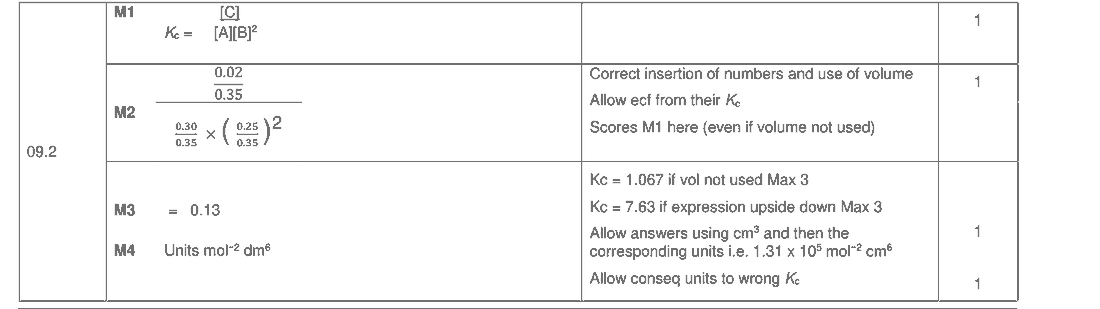
Answer: Kc = 0.13 mol–2 dm6. Kc = [C] ÷ ([A][B]²) = (0.020/0.35) ÷ ((0.30/0.35) × (0.25/0.35)²). Not using the volume gives 1.07 (max 3)
inverted expression gives 7.63 (max 3)
Skills: MS0.0 Recognise and make use of appropriate units in calculation; MS2.3 Substitute numerical values into algebraic equations using appropriate units for physical quantities
November 2020 · Paper 2 · Q09.31 markShort answerHard
Earlier part of question 09 that this part uses
Mark scheme
Examiner's comment
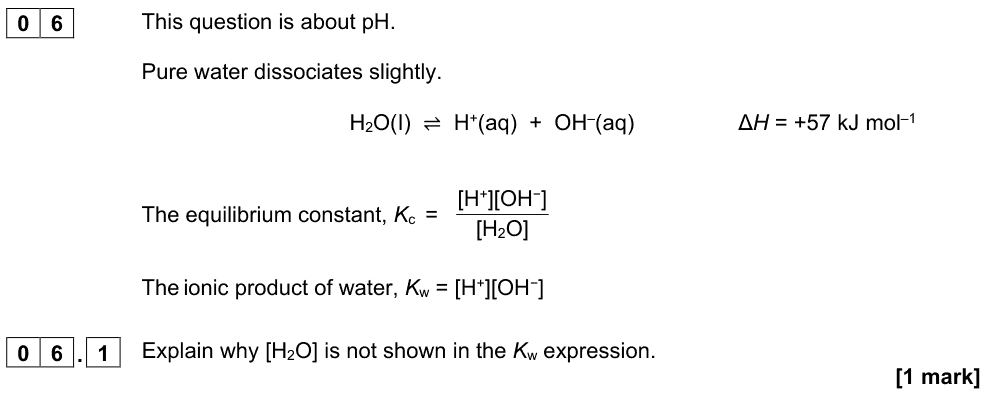
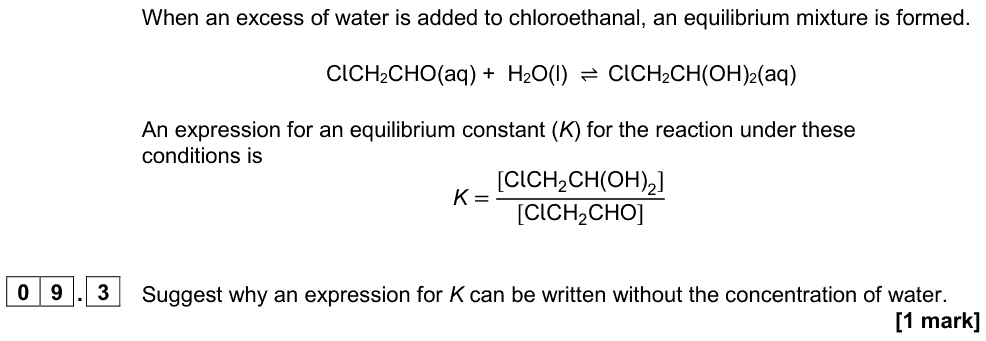
09.3 was much less well answered, with fewer than 20% of students able to suggest that the concentration of water being effectively constant is the reason why the equilibrium expression can be written without including it.
Notes from the mark scheme and report
Water is in large excess, so its concentration is (effectively) constant
November 2020 · Paper 2 · Q09.45 marksCalculation
Earlier parts of question 09 that this part uses
Mark scheme
Examiner's comment
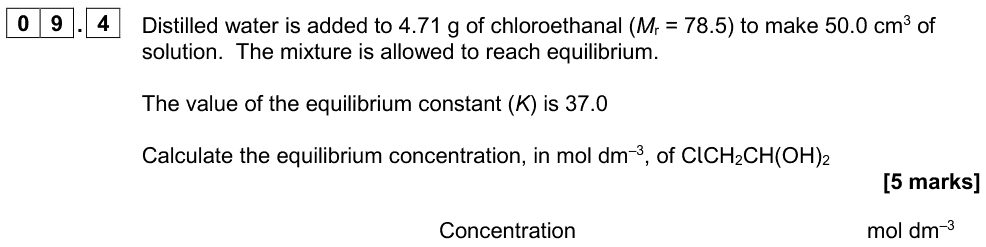
09.4 was another calculation where many students got started but few were able to access the highest marks.
Only the very best identified that an algebraic approach was needed to calculate the required equilibrium concentration.
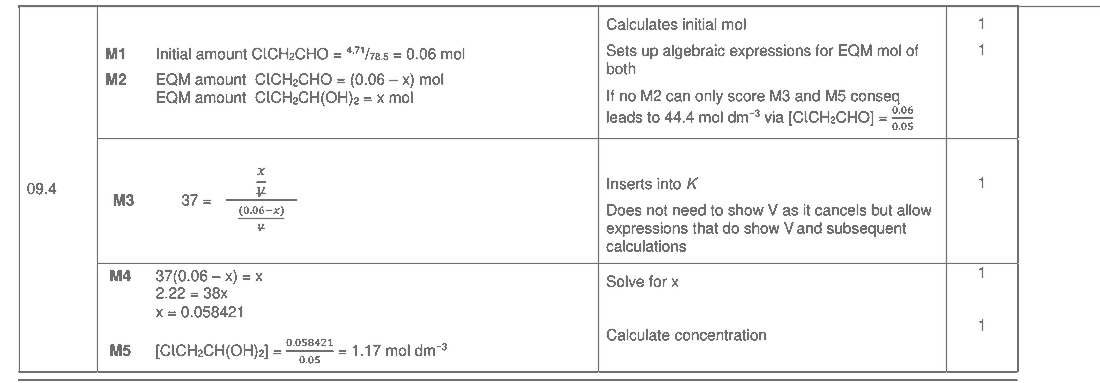
at equilibrium aldehyde = 0.0600 – x, product = x (volumes cancel)
37.0 = x ÷ (0.0600 – x)
2.22 = 38x
x = 0.0584 mol
÷ 0.0500 dm3. Without the algebra, 44.4 scores 2. Only the best used an algebraic approach
Skills: MS0.0 Recognise and make use of appropriate units in calculation; MS2.2 Change the subject of an equation; MS2.4 Solve algebraic equations
June 2019 · AS Paper 1 · Q05.12 marksCalculation
Mark scheme
Examiner's comment
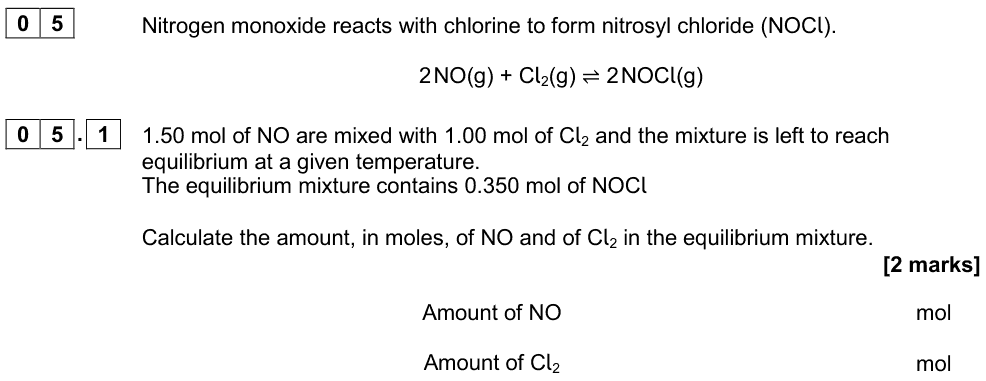
05.1 A good number of students were able to calculate correctly the moles of NO, and of Cl2 in the equilibrium mixture. However, students often also assumed that the equilibrium moles of NOCl was the same as the equilibrium moles of NO.
Notes from the mark scheme and report
Answer: NO = 1.15 mol
Cl2 = 0.825 mol. 0.350 mol NOCl formed uses 0.350 mol NO and 0.175 mol Cl2. Common error: taking the equilibrium amount of NO to equal that of NOCl
Skills: MS0.2 Use ratios, fractions and percentages
June 2019 · AS Paper 1 · Q05.21 markShort answerEasy
Earlier part of question 05 that this part uses
Mark scheme
Examiner's comment
05.2 The expression for the equilibrium constant was well done by over two-thirds of students, although a few had the expression upside down. Similarly, a number of students had added the concentrations of NO and Cl2 rather than multiplying them.
Notes from the mark scheme and report
Kc = [NOCl]² ÷ ([NO]²[Cl2]). Errors: expression upside down
adding [NO] and [Cl2] instead of multiplying
June 2019 · AS Paper 1 · Q05.34 marksCalculation
Earlier part of question 05 that this part uses
Mark scheme
Examiner's comment
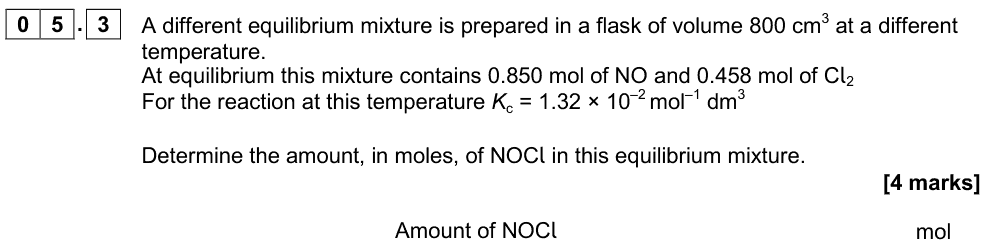
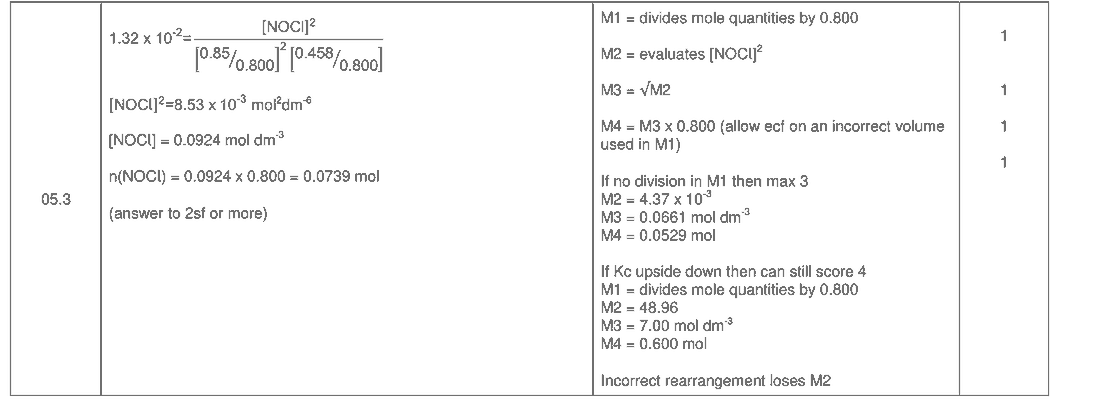
05.3 This question proved to be challenging, with a number of students not converting the equilibrium moles to concentration for use in their expression for Kc. Similarly, students did not convert their final calculated concentration of NOCl into moles by multiplying by the volume. Some students struggled to rearrange the expression for Kc correctly.
× 0.800. Without dividing by the volume max 3 (0.0529 mol). Errors: moles not converted to concentrations
final concentration not converted back to moles
wrong rearrangement
Skills: MS0.0 Recognise and make use of appropriate units in calculation; MS2.2 Change the subject of an equation; MS2.3 Substitute numerical values into algebraic equations using appropriate units for physical quantities
June 2019 · Paper 1 · Q07.32 marksExplanation
Earlier part of question 07 that this part uses
Mark scheme
Examiner's comment
7.3 Students generally answered part 3 well.
Notes from the mark scheme and report
Kp is larger at the higher temperature, so at higher temperature the equilibrium has moved to the right / more products are formed, which is the endothermic direction. Second mark depends on the first
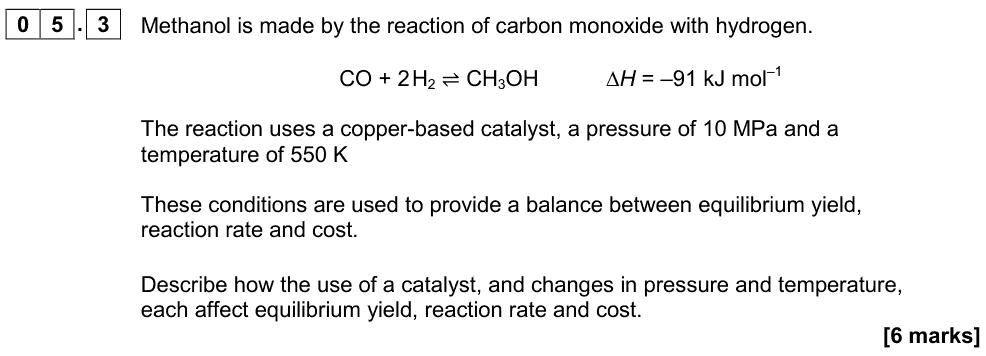
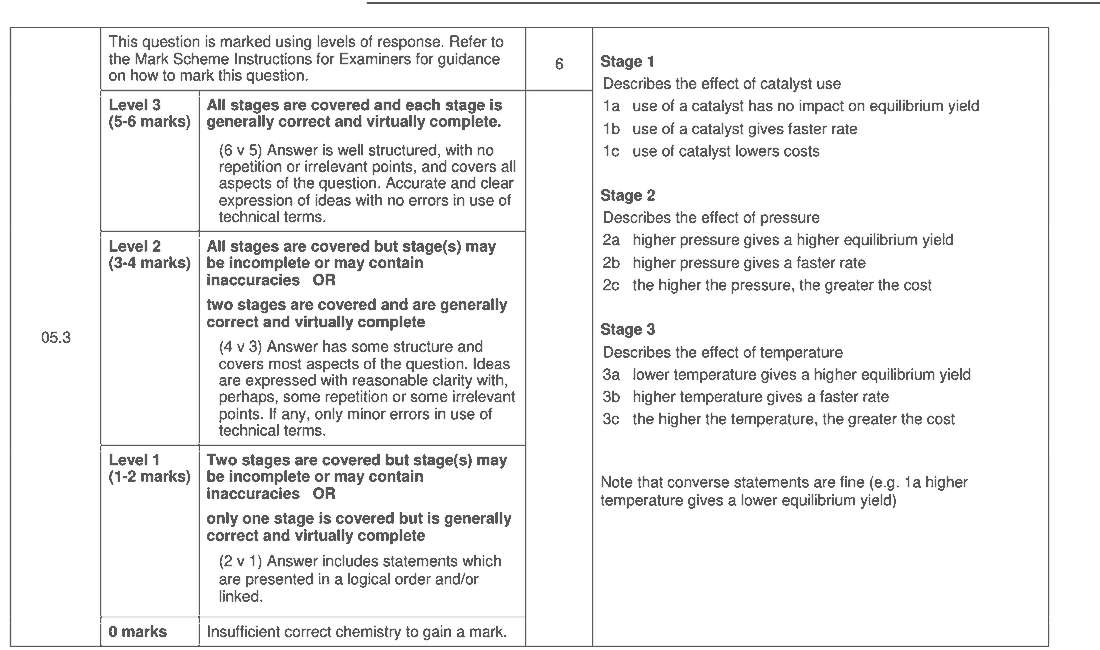
June 2019 · AS Paper 2 · Q05.36 marks6-mark level of response
Earlier part of question 05 that this part uses
Mark scheme, with the levels and indicative content
Examiner's comment
5.3 Students answered the level of response question well. The question asked students to ‘describe’ the effects of a catalyst, pressure and temperature on the yield, rate and cost of the reaction. Many also ‘explained’ the effects, which was not required. Students should note the specific command word and answer accordingly. The most significant misunderstanding was that some students thought the use of a catalyst would change the equilibrium yield.
Notes from the mark scheme and report
Levels of response, three stages. Catalyst: no effect on equilibrium yield
faster rate
lowers costs. Pressure: higher pressure gives a higher yield (fewer moles of gas on the right)
faster rate
greater cost. Temperature: lower temperature gives a higher yield (forward reaction exothermic)
higher temperature gives a faster rate
higher temperature costs more. Only description was asked for
main misconception: a catalyst changes the equilibrium yield
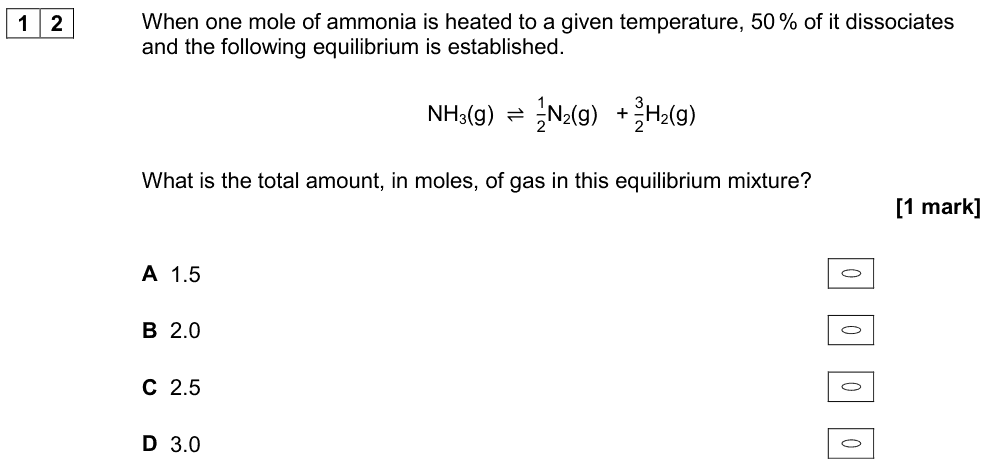
June 2019 · AS Paper 2 · Q121 markMultiple choice
Answer
A
Mark scheme
Examiner's comment
Students struggled with this question, possibly due to misunderstanding the concept of 50% dissociation.
Notes from the mark scheme and report
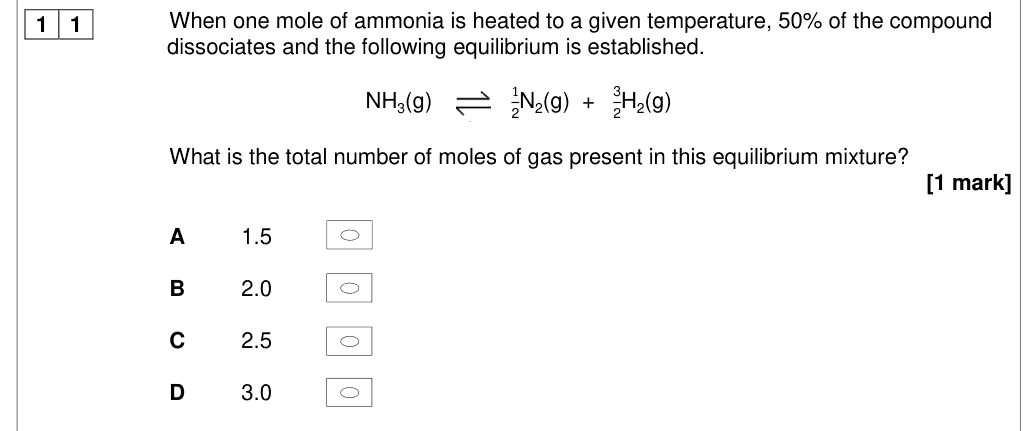
Answer: A. 0.50 mol NH3 remains and 0.50 mol reacts to give 0.25 mol N2 and 0.75 mol H2
total 1.5 mol. Students found this hard
Skills: MS0.2 Use ratios, fractions and percentages
June 2019 · Paper 3 · Q02.52 marksExplanation
Earlier part of question 02 that this part uses
Mark scheme
Examiner's comment
2.5 With around 50% of students failing to score, this question proved trickier than expected. Many students failed to realise that this should be answered with reference to the equilibrium equation from earlier in the question. There was also evidence of confusion between the direction of change in pH and the corresponding direction of change in [H+], with many suggesting that an increase in pH represents an increase in [H+]. Explanations for an increase in pH also often featured the suggestion that [OH–] must be increasing – a misconception perhaps derived from the GCSE idea that an alkali contains OH– ions and that this explains high pH values. At A-level it would be hoped that students recognise that the pH scale is a measure of [H+] and that high values represent low [H+].
Notes from the mark scheme and report
The equilibrium HSO4– ⇌ SO4 2– + H+ shifts to the left (to remove the added SO4 2–)
so [H+] decreases. Misconceptions: higher pH means higher [H+]
[OH–] must increase
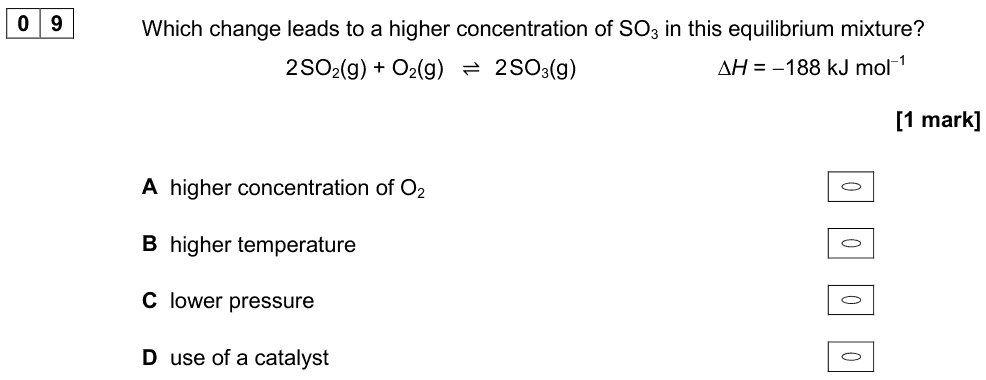
June 2019 · Paper 3 · Q091 markMultiple choiceEasy
Answer
A
Mark scheme
Examiner's comment
Questions that proved to be substantially more accessible than the ‘average’ items included numbers 9 (around 80% correct), 10 (84%), 13 (85%), 29 (86%), 30 (88%) and 32 (83%).
Notes from the mark scheme and report
Answer: A. Adding O2 shifts the equilibrium to the right
higher temperature and lower pressure shift it left
a catalyst has no effect on position
June 2018 · AS Paper 1 · Q05.12 marksShort answer
Mark scheme
Examiner's comment
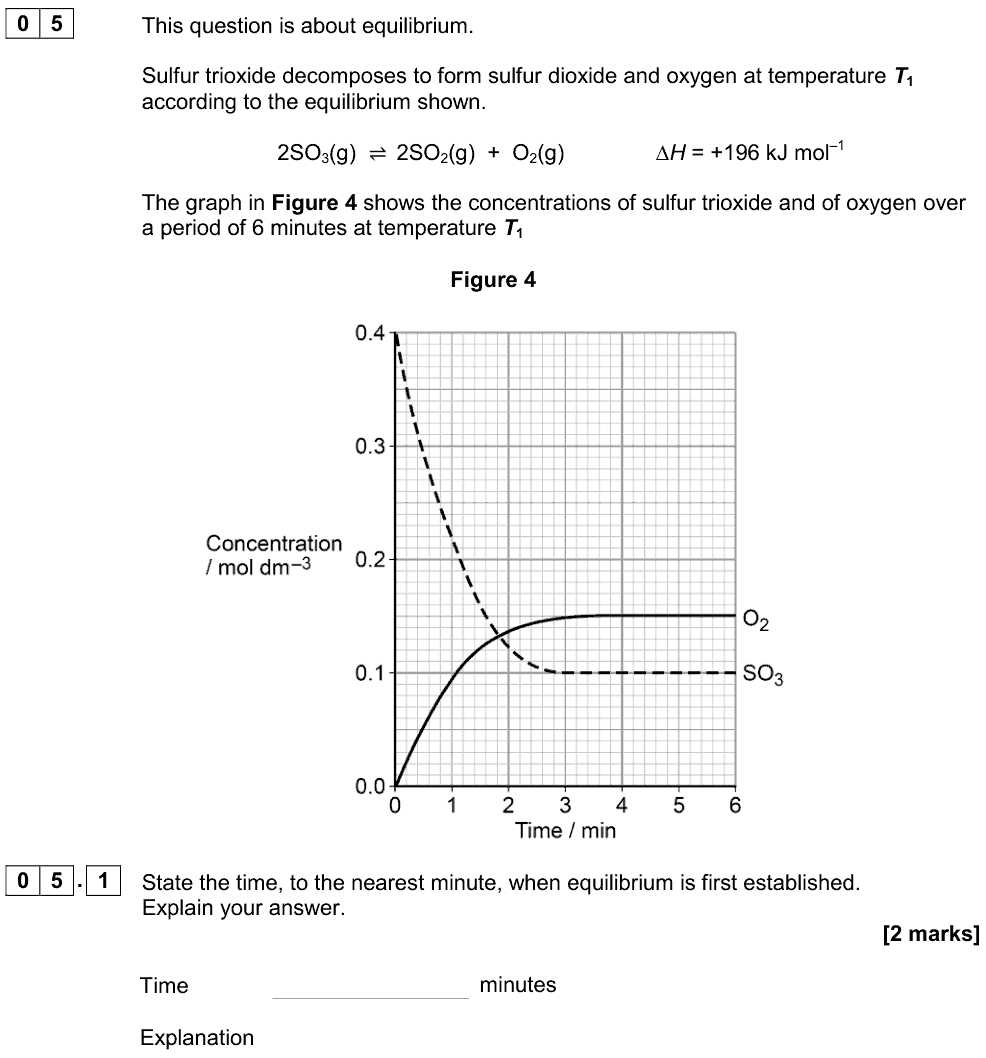
05.1 Most students answered this question well, with just over half of students scoring both marks, although many thought that the time that equilibrium was achieved was the point that the concentrations of SO3 and O2 were the same as each other.
Notes from the mark scheme and report
3 minutes
concentrations (of SO3 and O2) remain constant from this time / the curves level off. Not 'concentrations are the same': many chose the point where the two curves cross
Skills: MS3.1 Translate information between graphical, numerical and algebraic forms
June 2018 · AS Paper 1 · Q05.22 marksDiagram or structure
Earlier part of question 05 that this part uses
Mark scheme
Examiner's comment
05.2 Many students were able to sketch accurate curves although they didn’t always appreciate that the SO2 and O2 concentrations would be in the ratio 2:1.
Notes from the mark scheme and report
Curve starts at the origin and rises until 3 minutes, then is level at 0.30 mol dm–3 (twice the O2 concentration, mole ratio 2SO2 : 1O2). Many missed the 2:1 ratio
Skills: MS3.1 Translate information between graphical, numerical and algebraic forms; MS0.2 Use ratios, fractions and percentages
June 2018 · AS Paper 1 · Q05.32 marksExplanation
Earlier part of question 05 that this part uses
Mark scheme
Examiner's comment
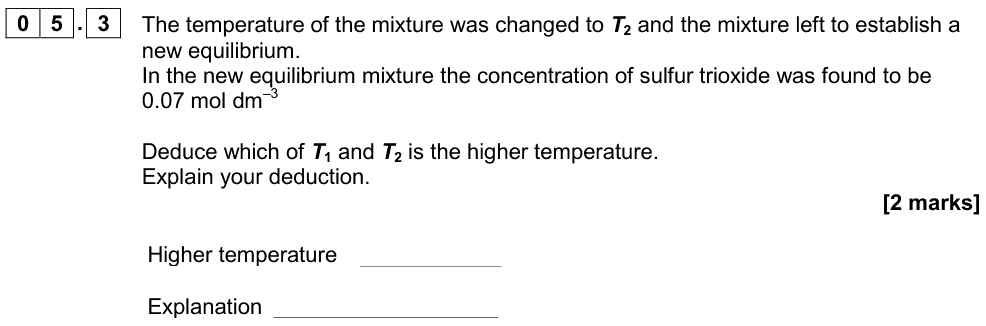
05.3 This proved to be demanding for many students (62.7% scored zero). Explanations and predictions in terms of Le Chatelier’s Principle were often vague and did not refer to a shift in the position in equilibrium. A good number of students also confused rate arguments with equilibrium arguments when giving an explanation.
Notes from the mark scheme and report
T2 is higher (no mark alone
T1 is a chemical error). SO3 has fallen from 0.10 to 0.07 mol dm–3, so equilibrium has shifted to the right in the endothermic direction
it moves this way to oppose the increase / to lower the temperature. 'To oppose the change' is not enough. Errors: no mention of a shift in equilibrium position
rate arguments (report: 62.7% scored zero)
June 2018 · Paper 2 · Q04.15 marksCalculation
Mark scheme
Examiner's comment
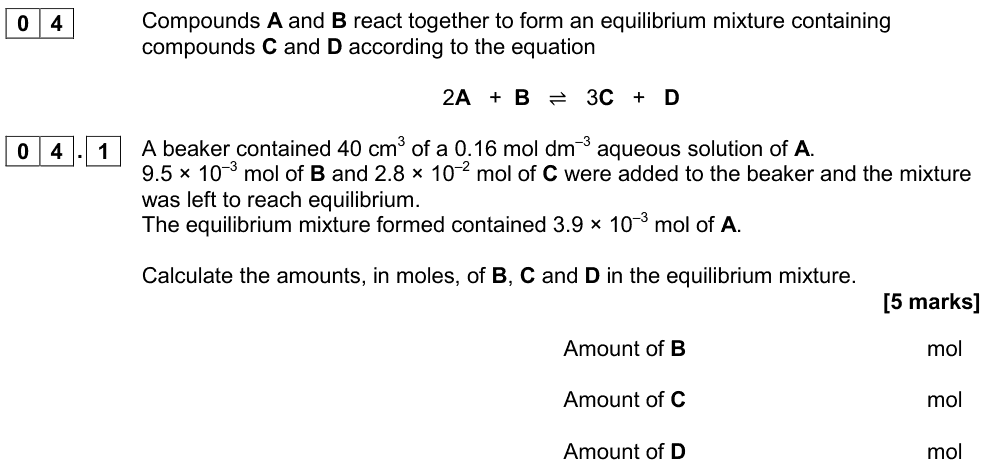
04.1 Many students gained high marks in this question – over 70% scored 4 or 5. Others often failed to use the mole ratio from the equation when deducing the amounts, in moles, of reagents at equilibrium.
Notes from the mark scheme and report
Answer: B = 8.25 × 10^–3 mol, C = 0.0318 mol, D = 1.25 × 10^–3 mol. Initial A = 0.040 × 0.16 = 6.4 × 10^–3 mol
A used = 2x = 2.5 × 10^–3, so x = 1.25 × 10^–3
B = 9.5 × 10^–3 – x
C = 2.8 × 10^–2 + 3x
D = x. Error: ignoring the mole ratios. Over 70% scored 4 or 5
Skills: MS0.2 Use ratios, fractions and percentages
June 2018 · Paper 2 · Q04.22 marksShort answerEasy
Earlier part of question 04 that this part uses
Mark scheme
Examiner's comment
04.2 The expression and its units were given correctly by over 82% of students.
Notes from the mark scheme and report
Kc = [C]³[D] ÷ ([A]²[B])
units mol dm–3. Round brackets penalised
no units mark if the expression is wrong
Skills: MS0.0 Recognise and make use of appropriate units in calculation
June 2018 · Paper 2 · Q04.33 marksCalculation
Earlier part of question 04 that this part uses
Mark scheme
Examiner's comment
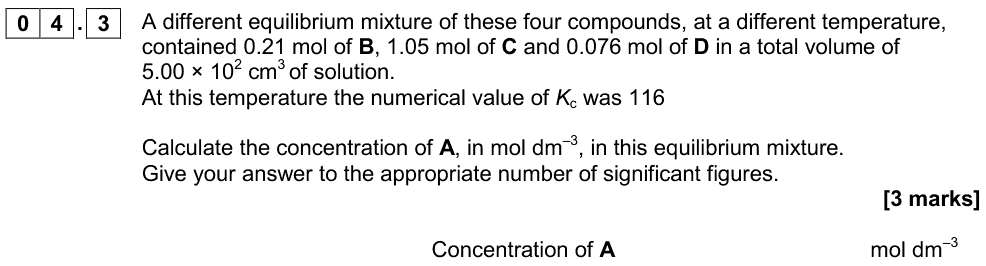
04.3 In this question, many students were able to re-arrange the expression for Kc but significant numbers failed to divide the amounts in moles that they were given by the correct volume in dm3. Some failed to gain a mark by giving the answer as the amount, in moles, of A rather than its concentration. Since the least precise data in the question were given to two significant figures, the final answer for concentration should have been given to two significant figures, so some students failed to gain the final mark because the answer was given to the wrong number of significant figures.
divide each amount by 0.500 dm3: [B] = 0.42, [C] = 2.10, [D] = 0.152
[A]² = 0.0289. Errors: not dividing by the volume
giving moles of A
wrong sig figs
Skills: MS1.1 Use an appropriate number of significant figures; MS2.2 Change the subject of an equation; MS2.3 Substitute numerical values into algebraic equations using appropriate units for physical quantities
June 2018 · Paper 2 · Q04.43 marksExplanationHard
Earlier part of question 04 that this part uses
Mark scheme
Examiner's comment
04.4 This question was poorly answered and showed that students were unfamiliar with the idea of the equilibrium moving to the side with a larger amount, in moles, to oppose the fall in concentrations of all reagents when more water was added to the equilibrium mixture. Credit was given to those few students who adopted a mathematical approach. 65.8% of students failed to score here.
Notes from the mark scheme and report
Adding water lowers all the concentrations
the equilibrium moves to the side with more moles (2A + B is 3 mol, 3C + D is 4 mol, so to the right) to oppose the decrease in concentration. Or: Kc = mole ratio × 1/V, so if V increases the mole ratio must increase to keep Kc constant. 'Only the concentration of A falls' or 'pressure falls' scores 0
June 2018 · AS Paper 2 · Q08.12 marksExplanation
Mark scheme
Examiner's comment
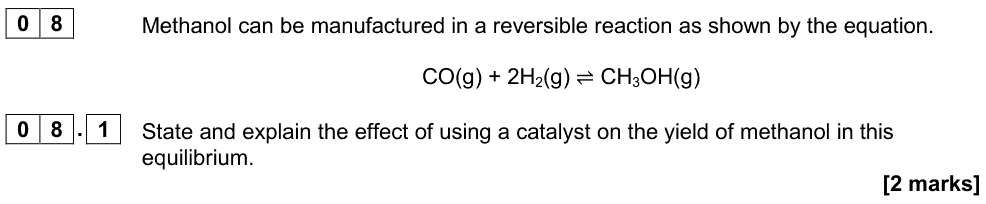
08.1 Most students knew that a catalyst does not affect the equilibrium yield, but few could explain that this is because it increases the rate of both the forwards and reverse reactions equally.
Notes from the mark scheme and report
No effect on the yield
the catalyst increases the rate of the forward and reverse reactions equally. If the yield is said to change, 0 marks. Few gave the reason
June 2018 · AS Paper 2 · Q08.21 markShort answerEasy
Earlier part of question 08 that this part uses
Mark scheme
Examiner's comment
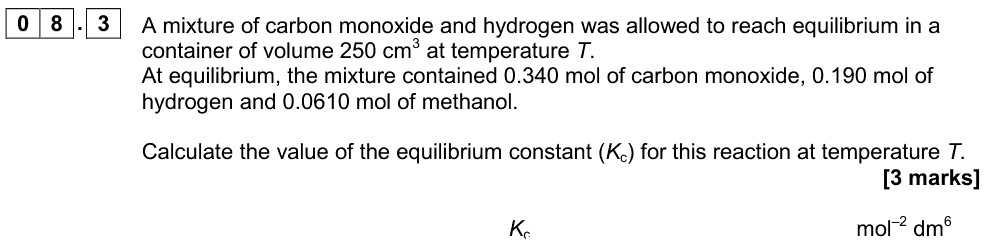
08.2 Most students (78.5%) could write the expression for Kc.
08.3 The most common mistake in the calculation of Kc was to use the amount in moles rather the concentration of each reagent. Others failed to square the concentration of hydrogen. A good number of candidates (44.1%) did, however, gain all three marks.
Kc = 0.244 ÷ (1.36 × 0.760²). Using moles without the volume gives 4.97 (1 mark). Errors: moles instead of concentrations
not squaring [H2]
Skills: MS0.0 Recognise and make use of appropriate units in calculation; MS2.3 Substitute numerical values into algebraic equations using appropriate units for physical quantities
June 2018 · AS Paper 2 · Q08.42 marksCalculation
Earlier part of question 08 that this part uses
Mark scheme
Examiner's comment
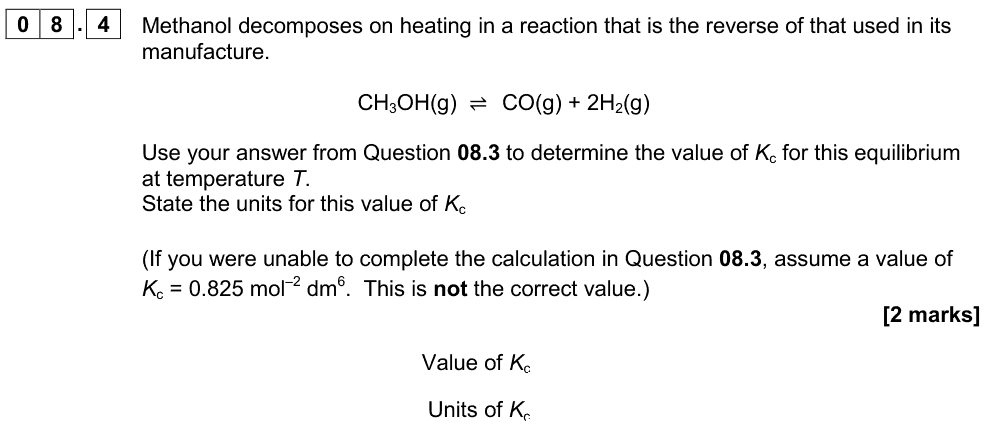
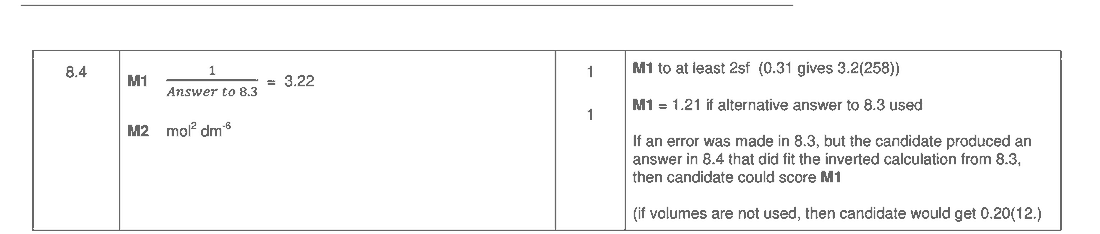
08.4 The idea of the answer being equal to (1/answer to 08.3) was quite well known and many could deduce the units. A surprisingly high proportion of students (14.2%), however, made no attempt at this question.
Notes from the mark scheme and report
Answer: 3.22 mol2 dm–6. Kc for the reverse reaction = 1 ÷ 0.311 (1.21 if the alternative 0.825 is used)
units are the inverse. 14.2% did not attempt it
Skills: MS0.0 Recognise and make use of appropriate units in calculation; MS2.2 Change the subject of an equation
June 2018 · AS Paper 2 · Q121 markMultiple choiceEasy
Answer
C
Mark scheme
Examiner's comment
Most students (60.1%) could use Le Chatelier’s principle to deduce which statement was correct.
Notes from the mark scheme and report
Answer: C. The forward reaction is exothermic, so a higher temperature shifts the equilibrium to the left and lowers the yield
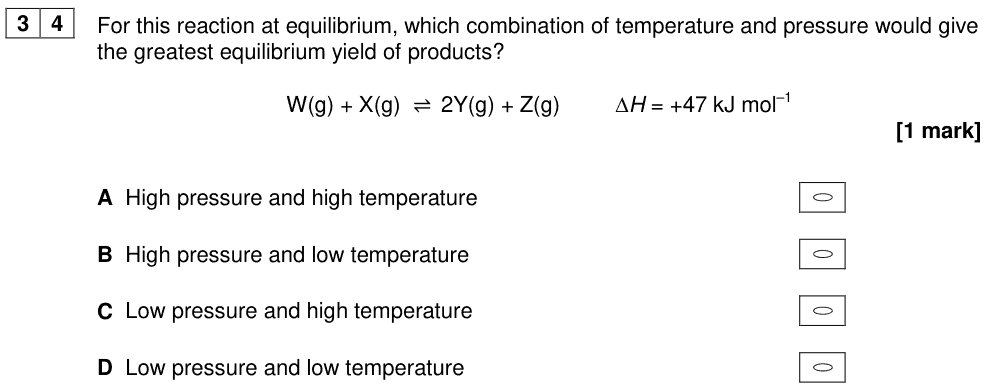
June 2018 · Paper 3 · Q341 markMultiple choiceEasy
Answer
C
Mark scheme
Examiner's comment
34 D was the commonest incorrect response, suggesting that the effect of pressure on equilibrium position was understood better than the effect of temperature. The success rate on the final question was 76.3%.
Notes from the mark scheme and report
Answer: C. The forward reaction is endothermic (favoured by high temperature) and makes more moles of gas, 2 to 3 (favoured by low pressure). D was the common wrong answer
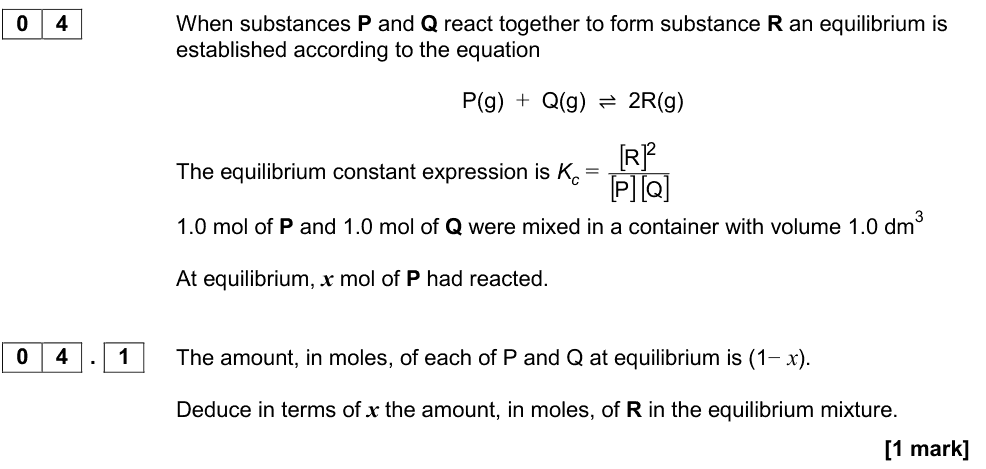
June 2017 · AS Paper 1 · Q04.11 markShort answer
Mark scheme
Examiner's comment
04.1 Only 36.3% of students gained this mark. The algebraic approach clearly proved difficult for many.
Notes from the mark scheme and report
Answer: 2x mol of R. The algebraic approach proved difficult
36.3% gained the mark
Skills: MS0.2 Use ratios, fractions and percentages
June 2017 · AS Paper 1 · Q04.23 marksCalculation
Earlier part of question 04 that this part uses
Mark scheme
Examiner's comment
04.2 Few students took the most ‘elegant’ approach of taking the square root of both sides of the expression. As a result, those who attempted the question often ended up with a difficult quadratic equation to solve. This was a possible route to the correct answer, but far more difficult, and so most students failed to score all the marks.
take the positive square root of both sides: 1.90 = 2x ÷ (1 – x), so x = 0.49 and [R] = 2x (volume is 1.0 dm3). Few took the square root, so most met a hard quadratic and lost marks
Skills: MS2.2 Change the subject of an equation; MS2.4 Solve algebraic equations
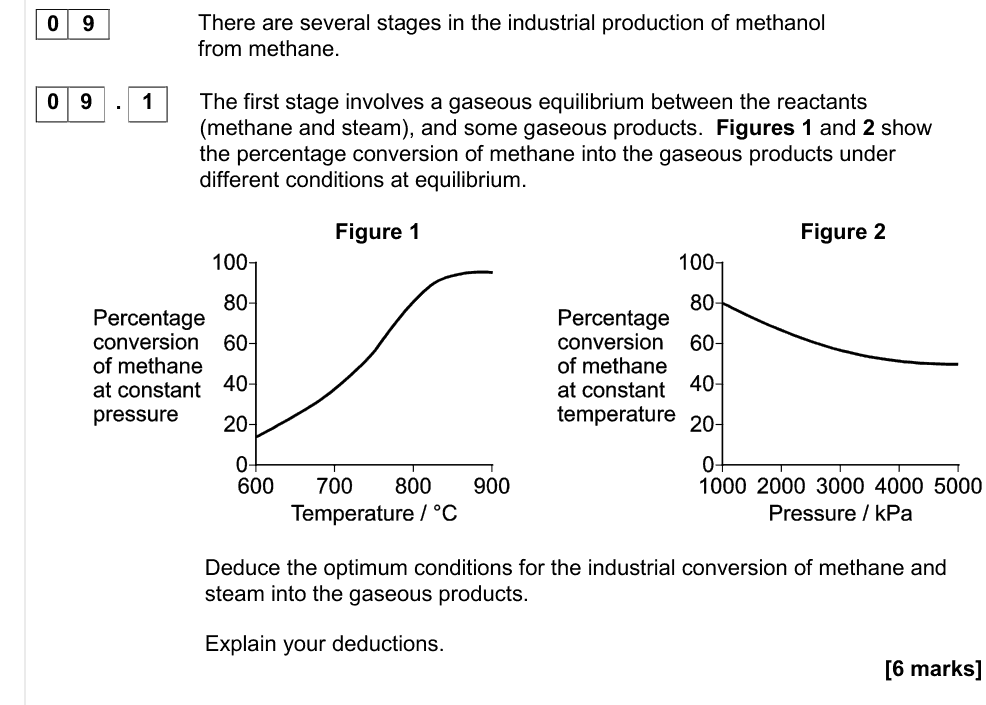
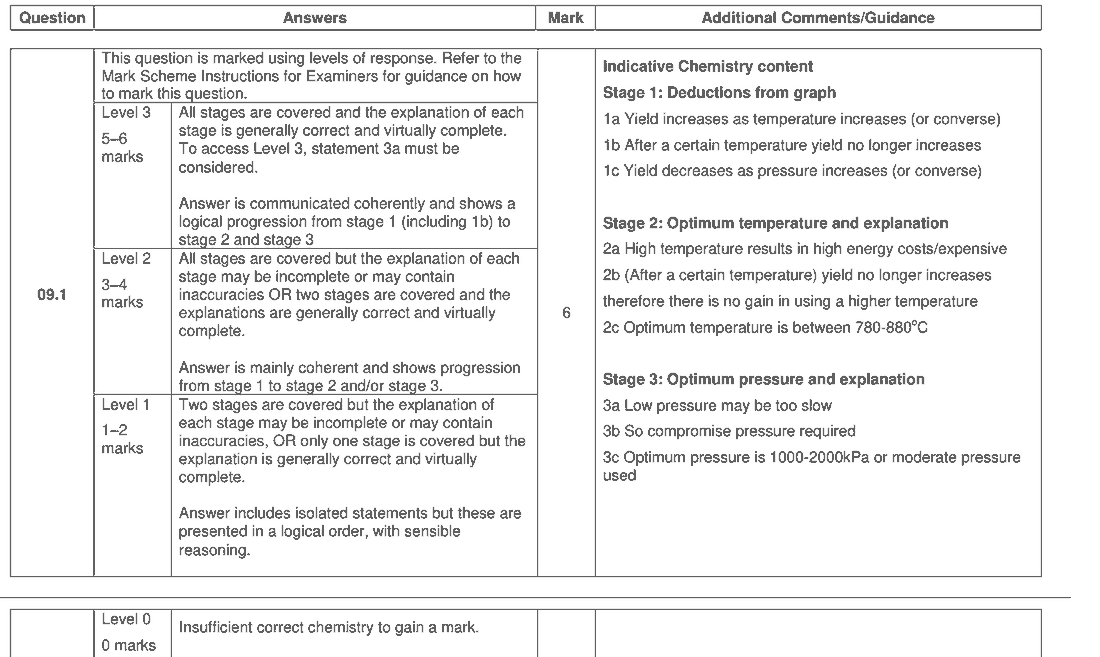
June 2017 · Paper 1 · Q09.16 marks6-mark level of response
Mark scheme, with the levels and indicative content
Examiner's comment
09.1 Students answered this question quite well, with a good awareness of the range of temperatures and pressures needed. Most students failed to describe the information given in the graph; only the best students noted that the yield plateaued over about 850 °C. The relationship between pressure and rate was often missed and this also limited students’ marks. Many students discussed conclusions that could be drawn from using Le Chatelier’s Principle; this was not what the question was asking.
Notes from the mark scheme and report
Levels of response, three stages. 1 From the graphs: conversion rises with temperature, then levels off above about 850 °C
conversion falls as pressure rises. 2 Temperature: high temperature means high energy cost
no gain above the plateau
optimum 780 to 880 °C. 3 Pressure: low pressure gives the best yield but the rate may be too slow, so a compromise, moderate pressure of 1000 to 2000 kPa (needed for level 3). Most did not describe the graphs or the plateau
the pressure–rate link was often missed
Le Chatelier arguments were not asked for
Skills: MS3.1 Translate information between graphical, numerical and algebraic forms
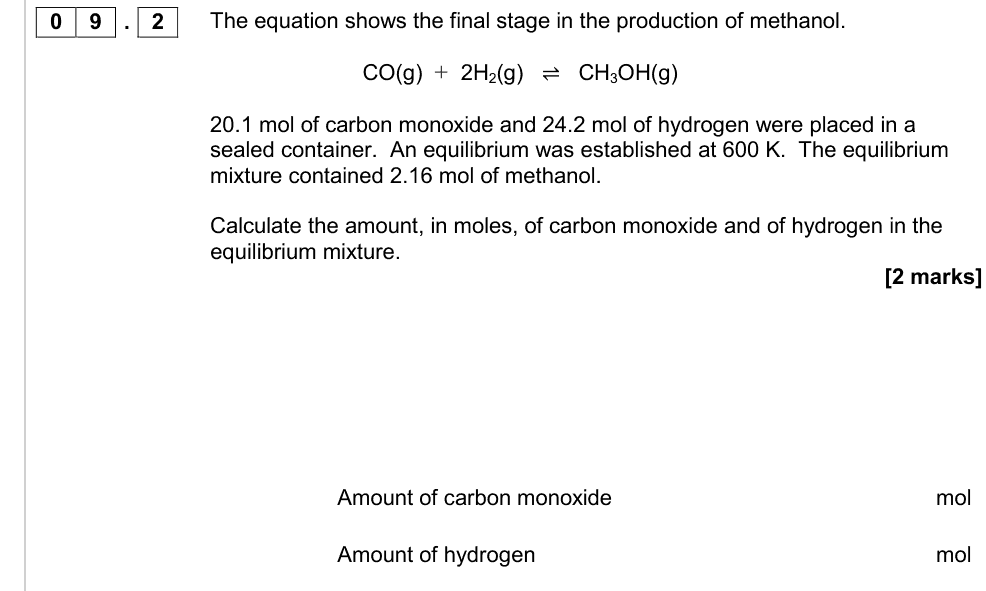
June 2017 · Paper 1 · Q09.22 marksCalculation
Earlier part of question 09 that this part uses
Mark scheme
Examiner's comment
09.2 Only a few students did not understand what was being asked for; most errors were either arithmetic errors or rounding errors.
Notes from the mark scheme and report
Answer: CO 17.9 mol
H2 19.9 mol. CO: 20.1 – 2.16 = 17.94
H2: 24.2 – (2 × 2.16) = 19.88. Errors were arithmetic or rounding
Skills: MS0.2 Use ratios, fractions and percentages
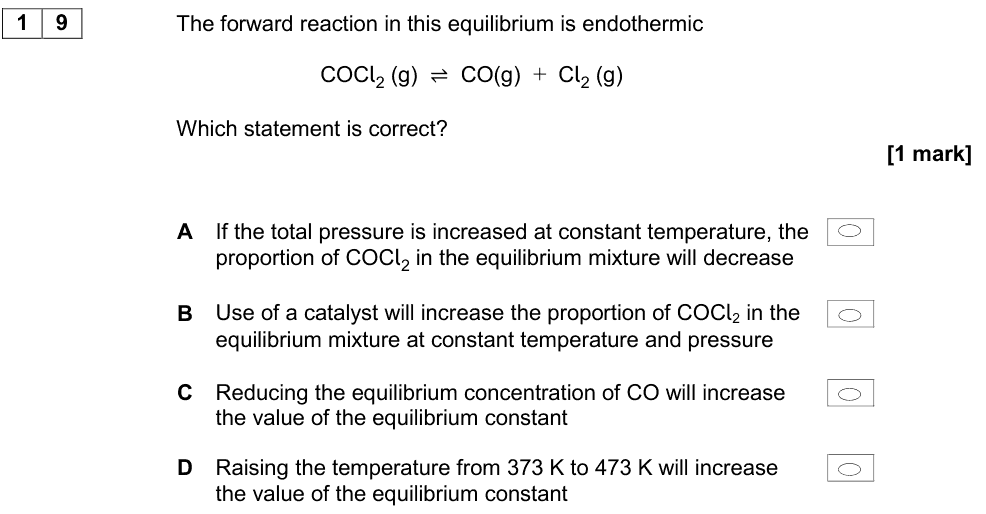
June 2017 · AS Paper 1 · Q191 markMultiple choiceEasy
Answer
D
Mark scheme
Examiner's comment
Students showed a good understanding of qualitative equilibrium ideas, with 64% gaining this mark.
Notes from the mark scheme and report
Answer: D. The forward reaction is endothermic, so a higher temperature moves the equilibrium to the right and Kc increases. Higher pressure favours COCl2 (fewer moles)
a catalyst and concentration changes do not alter Kc
June 2017 · Paper 2 · Q05.23 marksCalculationEasy
Earlier part of question 05 that this part uses
Mark scheme
Examiner's comment
05.2 The equilibrium amounts were also answered well and nearly 75% of students scored three marks here.
Notes from the mark scheme and report
Diol 0.0600 mol
diester 0.145 mol
water 0.290 mol. Acid reacted = 0.470 – 0.180 = 0.290 mol, so 0.145 mol of diol reacts and 0.145 mol of ester and 0.290 mol of water form
Skills: MS0.2 Use ratios, fractions and percentages
June 2017 · Paper 2 · Q05.32 marksShort answer
Earlier part of question 05 that this part uses
Mark scheme
Examiner's comment
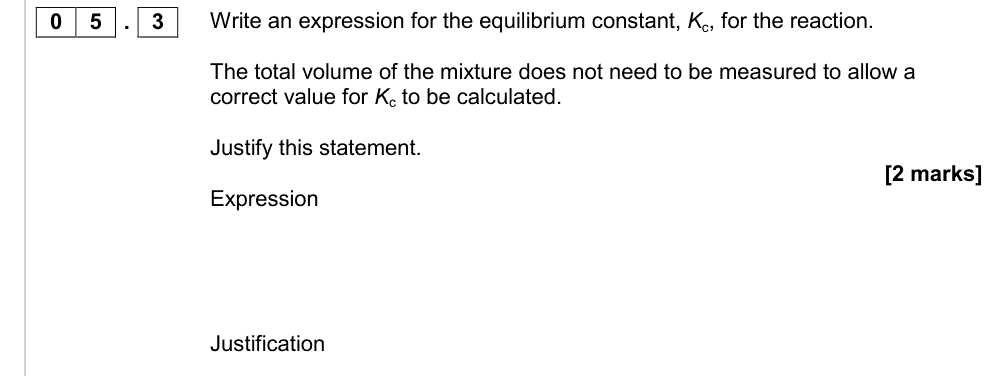
05.3 Most students were able to write the Kc expression correctly, but weaker students were unable to explain clearly that the volume term cancelled in the expression.
Notes from the mark scheme and report
Kc = [C6H10O4][H2O]² ÷ ([CH3COOH]²[HOCH2CH2OH])
the volume cancels because there are equal numbers of moles on each side of the equation
June 2017 · Paper 2 · Q05.43 marksCalculationEasy
Earlier part of question 05 that this part uses
Mark scheme
Examiner's comment
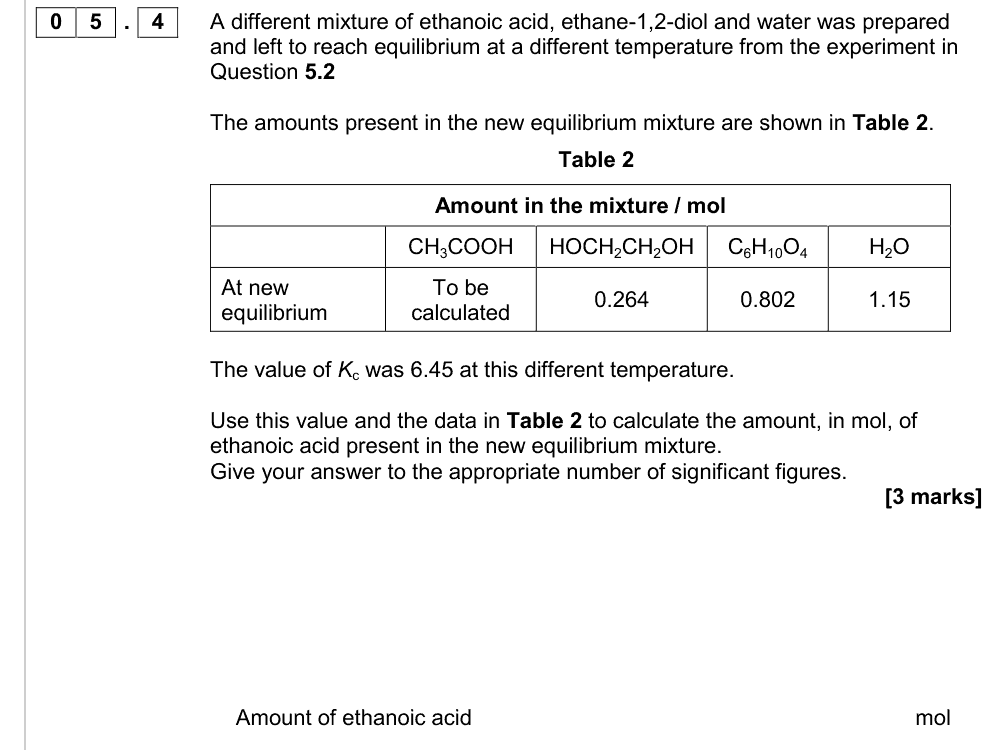
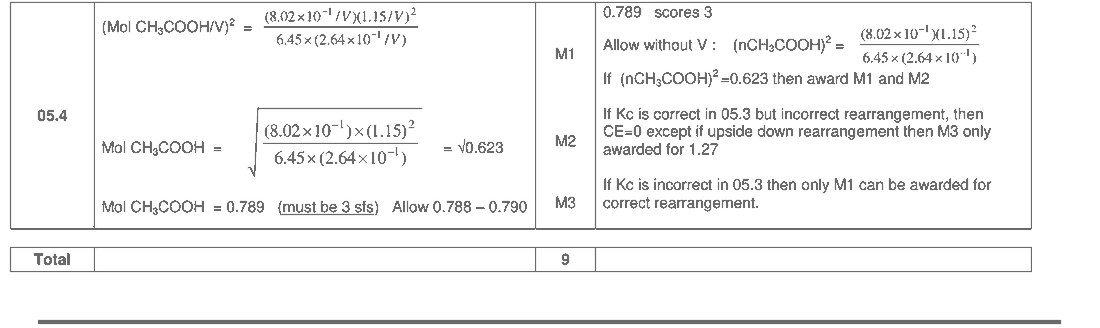
05.4 Nearly 70% of students were able to calculate the equilibrium amount of ethanoic acid correctly. Mathematical aspects caused others to lose marks; incorrect rearrangement of the expression was the most common error, while some failed to give their answer to three significant figures – as expected in a question where all the data provided were to three significant figures.
Skills: MS1.1 Use an appropriate number of significant figures; MS2.2 Change the subject of an equation; MS2.3 Substitute numerical values into algebraic equations using appropriate units for physical quantities
June 2017 · AS Paper 2 · Q211 markMultiple choice
Answer
D
Mark scheme
Examiner's comment
This question was also a challenge to many students (42.1% correct) and they are urged to take a systematic approach to deducing the amount in moles of species present in an equilibrium mixture.
Notes from the mark scheme and report
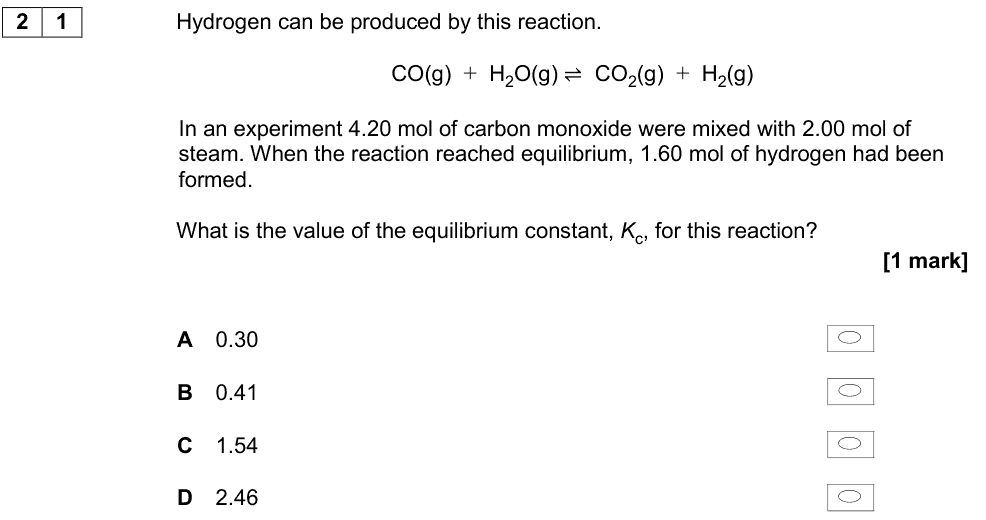
Answer: D. At equilibrium CO = 2.60, H2O = 0.40, CO2 = H2 = 1.60 mol
Skills: MS0.2 Use ratios, fractions and percentages
June 2016 · AS Paper 1 · Q191 markMultiple choice
Answer
A
Mark scheme
Notes from the mark scheme and report
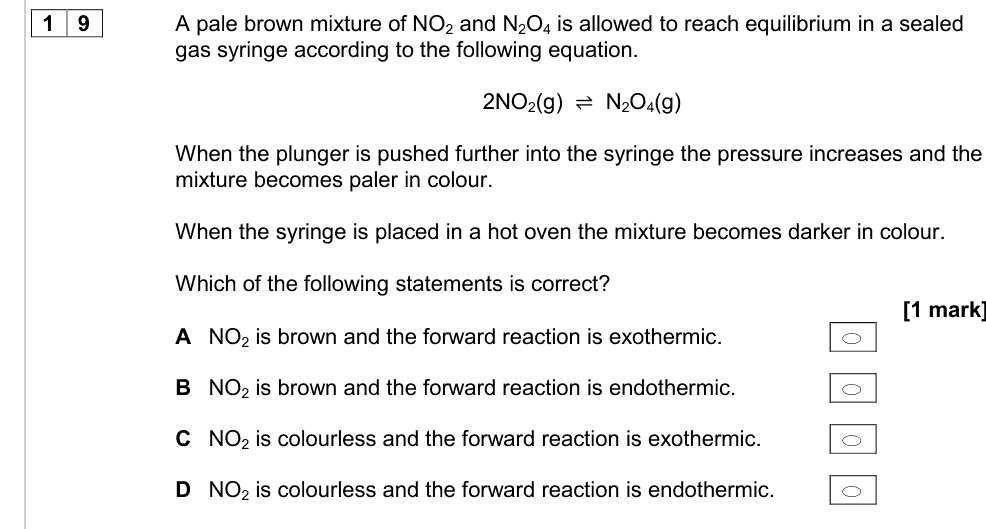
Answer: A. Higher pressure favours N2O4 (fewer moles) and the mixture goes paler, so NO2 is brown
heating makes it darker (more NO2), so the forward reaction is exothermic
June 2016 · AS Paper 2 · Q01.12 marksShort answer
Mark scheme
Examiner's comment
Many students could write the correct expression for Kc in Q1.1 although some failed to use square brackets to show concentration.
Students found it harder to derive the units for Kc.
Notes from the mark scheme and report
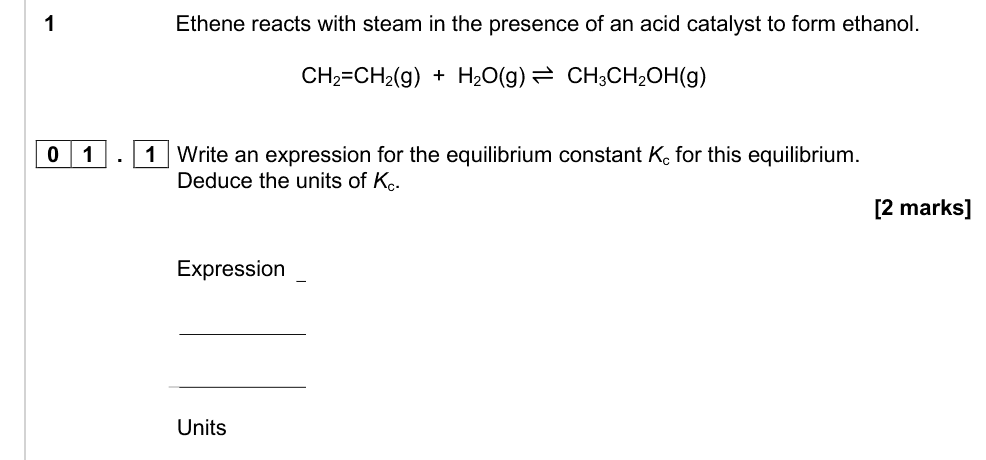
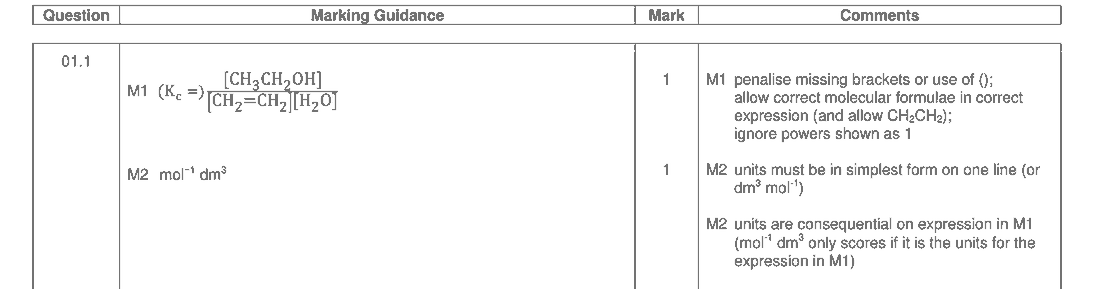
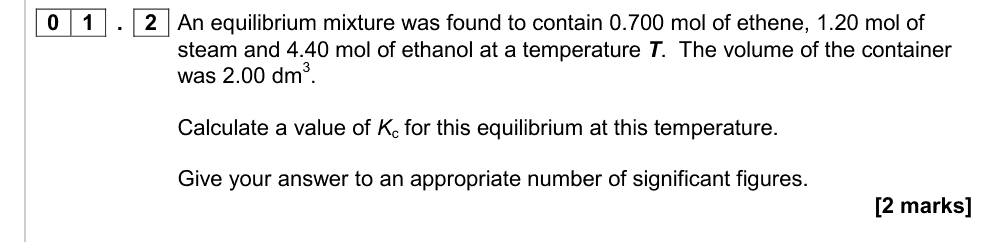
Kc = [CH3CH2OH] ÷ ([CH2=CH2][H2O]) for the hydration of ethene by steam, CH2=CH2 + H2O ⇌ CH3CH2OH
units mol–1 dm3 (consequential on the expression). Square brackets needed, not round ones. Units were found harder than the expression
Skills: MS0.0 Recognise and make use of appropriate units in calculation
June 2016 · AS Paper 2 · Q01.22 marksCalculation
Earlier part of question 01 that this part uses
Mark scheme
Examiner's comment
In the calculation of Kc in Q1.2, many students failed to use the concentration of each substance.
They used incorrectly just the moles instead.
A few students found the correct value of Kc but did not give it to the correct number of significant figures.
Notes from the mark scheme and report
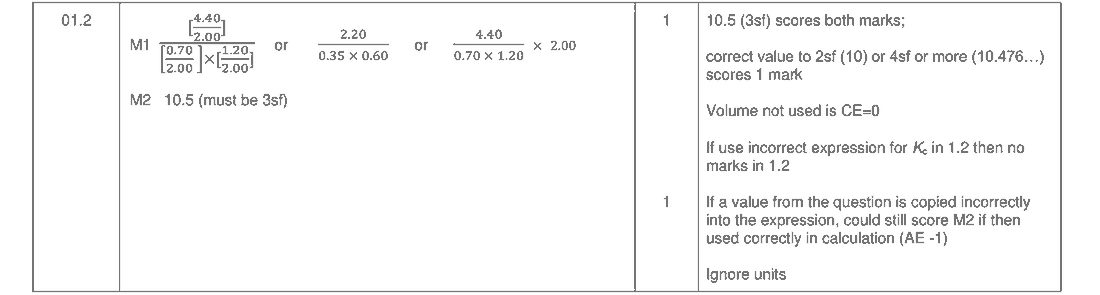
Answer: 10.5 (3 significant figures
ignore units). Concentrations: (4.40 ÷ 2.00) ÷ [(0.700 ÷ 2.00) × (1.20 ÷ 2.00)] = 2.20 ÷ (0.350 × 0.600). Not dividing by the volume is CE = 0
2 or 4+ significant figures scores 1. Many used moles instead of concentrations
Skills: MS0.2 Use ratios, fractions and percentages; MS1.1 Use an appropriate number of significant figures; MS2.3 Substitute numerical values into algebraic equations using appropriate units for physical quantities
June 2016 · AS Paper 2 · Q191 markMultiple choice
Answer
C
Mark scheme
Notes from the mark scheme and report
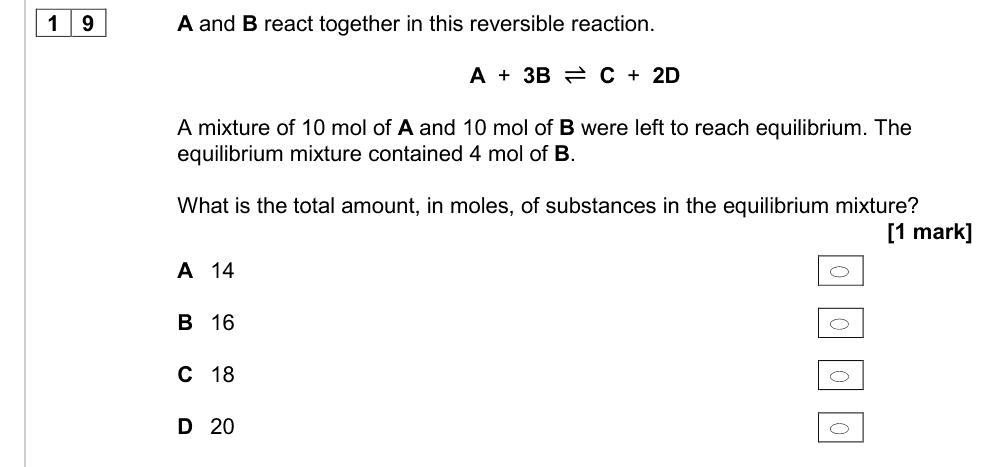
Answer: C. 6 mol of B react, so 2 mol of A react and 2 mol of C and 4 mol of D form: 8 + 4 + 2 + 4 = 18 mol. The report says students found this challenging
Skills: MS0.2 Use ratios, fractions and percentages
June 2016 · AS Paper 2 · Q211 markMultiple choice
Answer
C
Mark scheme
Notes from the mark scheme and report
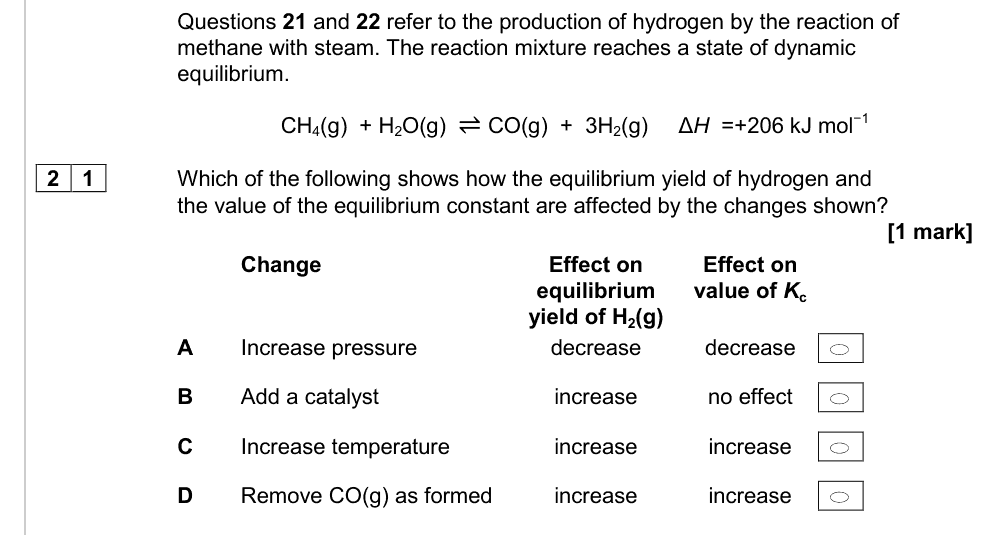
Answer: C. The forward reaction is endothermic, so a higher temperature increases both the yield of H2 and Kc. Only temperature changes Kc
a catalyst does not change the yield. Many chose distractors through not knowing what affects Kc
Specimen · Paper 1 · Q04.43 marksExplanation
Earlier part of question 04 that this part uses
Mark scheme
Notes from the mark scheme and report
4 mol of gas form 2 mol of gas
at high pressure the position of equilibrium moves to the right to oppose the increase (lower the pressure)
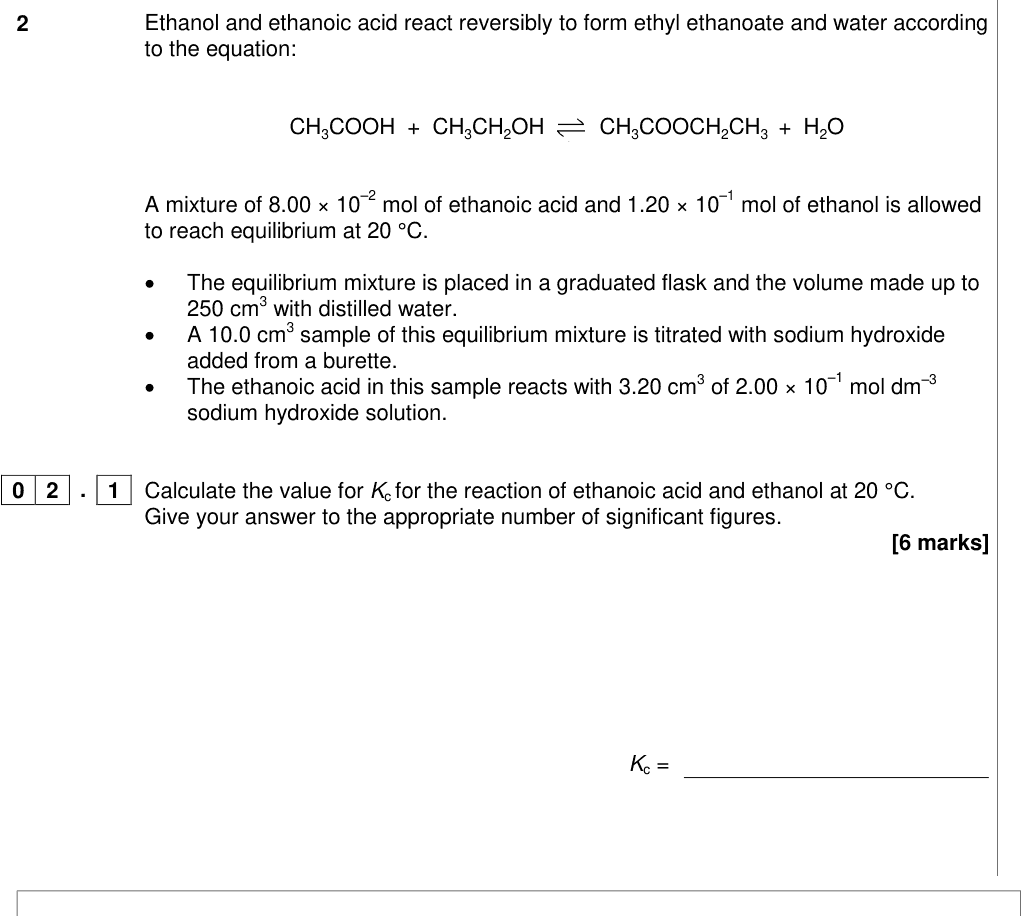
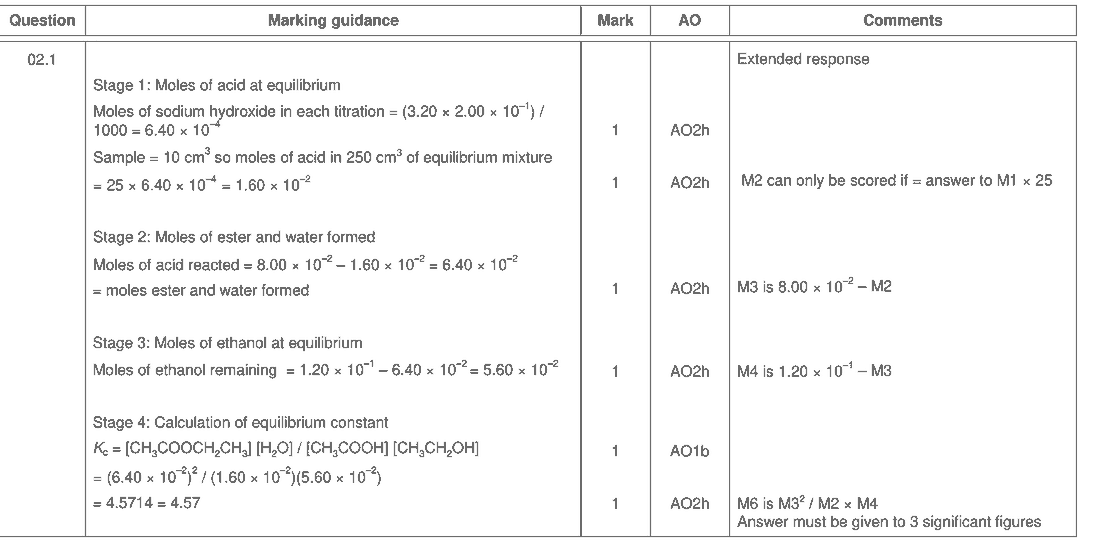
Kc = (6.40 × 10^–2)² ÷ (1.60 × 10^–2 × 5.60 × 10^–2). Six point marks
Skills: MS0.2 Use ratios, fractions and percentages; MS1.1 Use an appropriate number of significant figures; MS2.3 Substitute numerical values into algebraic equations using appropriate units for physical quantities; RP1 Make up a volumetric solution and carry out a simple acid–base titration
Specimen · Paper 3 · Q111 markAO2=1Multiple choice
Answer
A
Mark scheme
Notes from the mark scheme and report
Answer: A. 0.5 mol NH3 left + 0.25 mol N2 + 0.75 mol H2 = 1.5 mol
Skills: MS0.2 Use ratios, fractions and percentages
Work with an A-level chemistry tutor
Dropping marks on calculations, mechanisms or the required practicals? Book a trial session with a specialist A-level chemistry tutor.