Notes and key-term cards for this topic are being written by our tutors. The past-paper questions below are ready now.
Specification statements
Show the 4 statements from the specification
3.1.7-01 Oxidation is the process of electron loss and oxidising agents are electron acceptors.
3.1.7-02 Reduction is the process of electron gain and reducing agents are electron donors.
3.1.7-03 The rules for assigning oxidation states.
3.1.7-04 Students should be able to: • work out the oxidation state of an element in a compound or ion from the formula • write half-equations identifying the oxidation and reduction processes in redox reactions • combine half-equations to give an overall redox equation.
Tap a question to zoom it. Where a part needs a figure, table or structure from earlier in the question, that part folds out above it; the mark scheme and examiner's comment open underneath. Have AQA's Data Booklet (the Periodic Table and the spectroscopy tables) beside you.
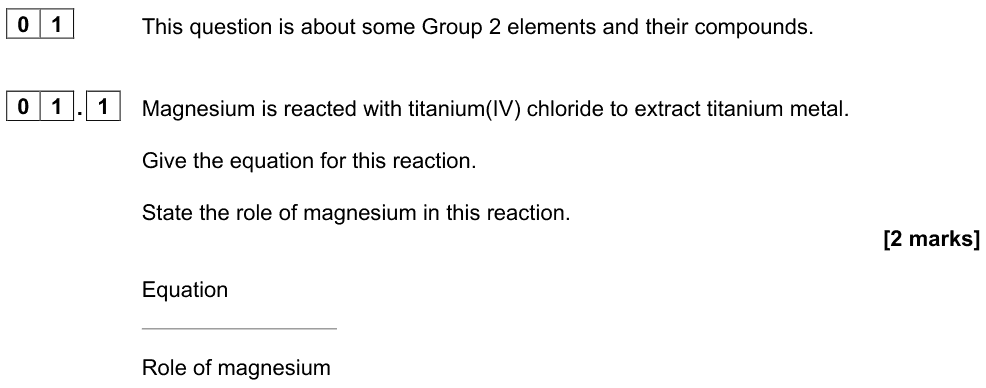
June 2025 · Paper 1 · Q01.12 marksAO1=1, AO2=1Equation writing
Mark scheme
Examiner's comment
Over half the students scored both marks in part 1; some students were unfamiliar with the correct formula of titanium (IV) chloride and were unable to write a balanced equation.
Some students did not know the role of magnesium.
Notes from the mark scheme and report
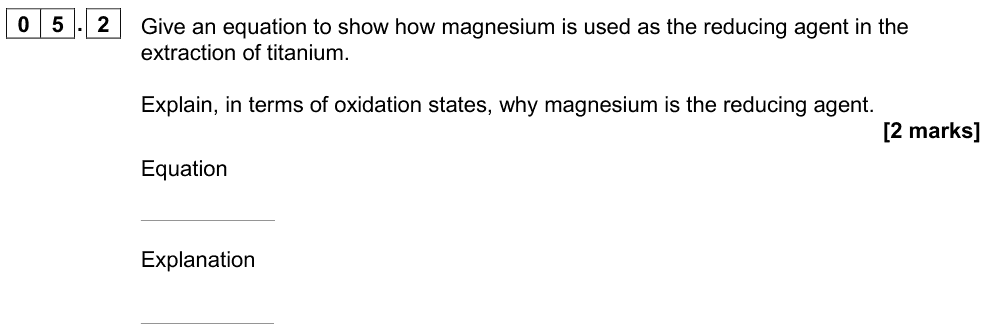
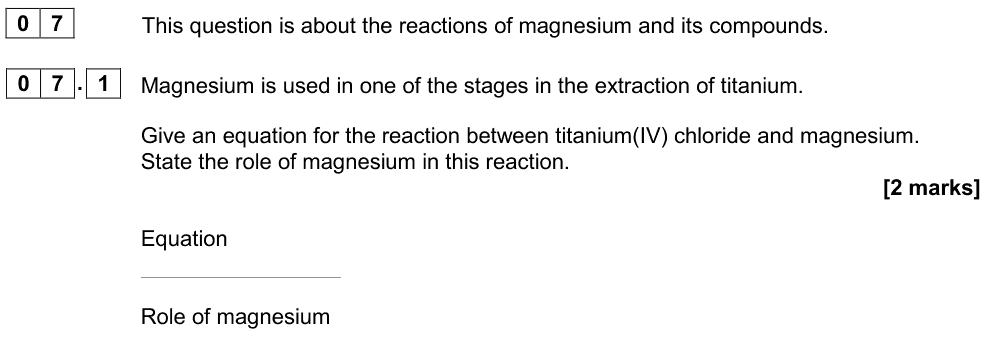
TiCl4 + 2Mg → Ti + 2MgCl2
magnesium is the reducing agent (electron donor). Errors: wrong formula for titanium(IV) chloride
equation not balanced
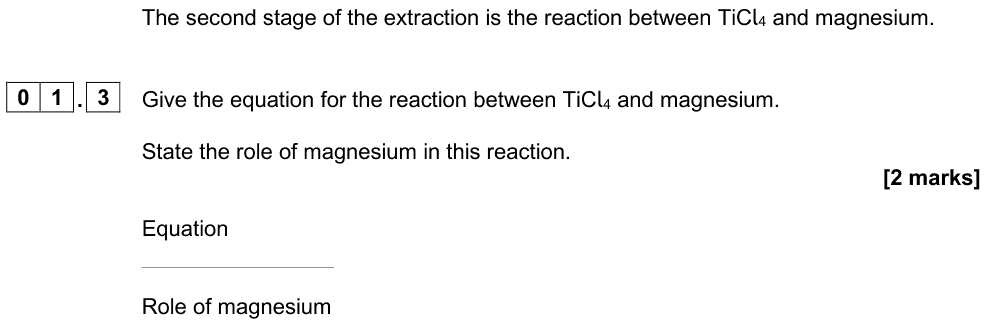
June 2025 · AS Paper 1 · Q01.32 marksAO1=2Equation writing
Earlier part of question 01 that this part uses
Mark scheme
Examiner's comment
1.3 The majority of students were able to give a correct chemical equation for the reaction between titanium (IV) chloride and magnesium. However, the role of magnesium was often incorrectly stated as an oxidising agent rather than a reducing agent.
Notes from the mark scheme and report
TiCl4 + 2Mg → 2MgCl2 + Ti
magnesium is the reducing agent / electron donor. Role often wrongly given as oxidising agent
June 2025 · AS Paper 1 · Q02.52 marksAO2=2Equation writing
Earlier part of question 02 that this part uses
Mark scheme
Examiner's comment
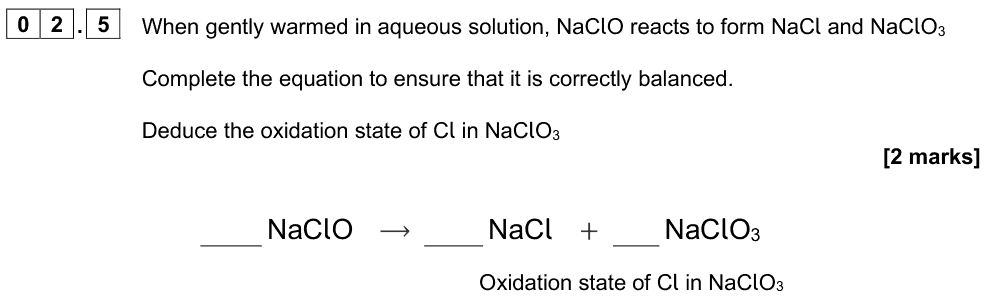
2.5 Most students were able to balanced the equation correctly but fewer were able to deduce the oxidation state of chlorine in NaClO3
Notes from the mark scheme and report
3NaClO → 2NaCl + NaClO3 (allow multiples)
oxidation state of Cl in NaClO3 = +5. The balancing was done better than the oxidation state
June 2025 · AS Paper 1 · Q02.61 markAO2=1Equation writing
Earlier part of question 02 that this part uses
Mark scheme
Examiner's comment
2.6 Over half of the students were able to deduce a correct half-equation but a large number of students did not include electrons in their half-equation or gave an incorrect number of electrons.
Notes from the mark scheme and report
ClO3– + 6H+ + 6e– → Cl– + 3H2O. Over half were correct
errors were electrons missing or the wrong number of electrons
June 2025 · AS Paper 1 · Q02.72 marksAO1=1, AO2=1Equation writingHard
Earlier part of question 02 that this part uses
Mark scheme
Examiner's comment
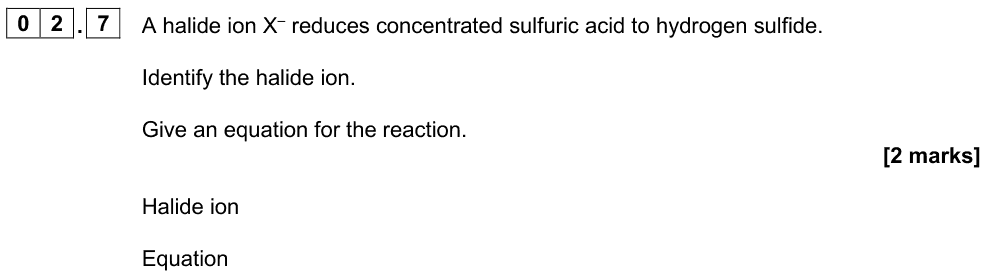
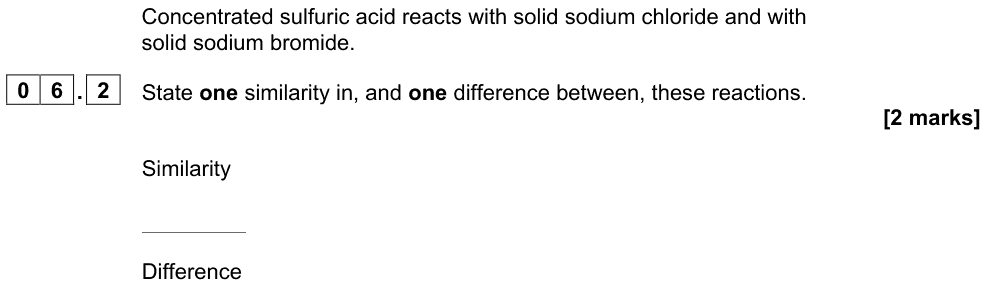
2.7 A large proportion of students were able to identify the halide ion that is able to reduce concentrated sulfuric acid to hydrogen sulphide. Only about one quarter of students were then able to give a correct equation for the reaction of this halide ion with sulfuric acid to form hydrogen sulphide.
Notes from the mark scheme and report
Iodide, I– (allow astatide). H2SO4 + 8H+ + 8I– → H2S + 4H2O + 4I2 (allow 8HI, or 10H+ + SO4 2– + 8I–). Most identified the halide
the equation was the difficulty
June 2025 · Paper 1 · Q03.61 markAO2=1Equation writing
Earlier part of question 03 that this part uses
Mark scheme
Examiner's comment
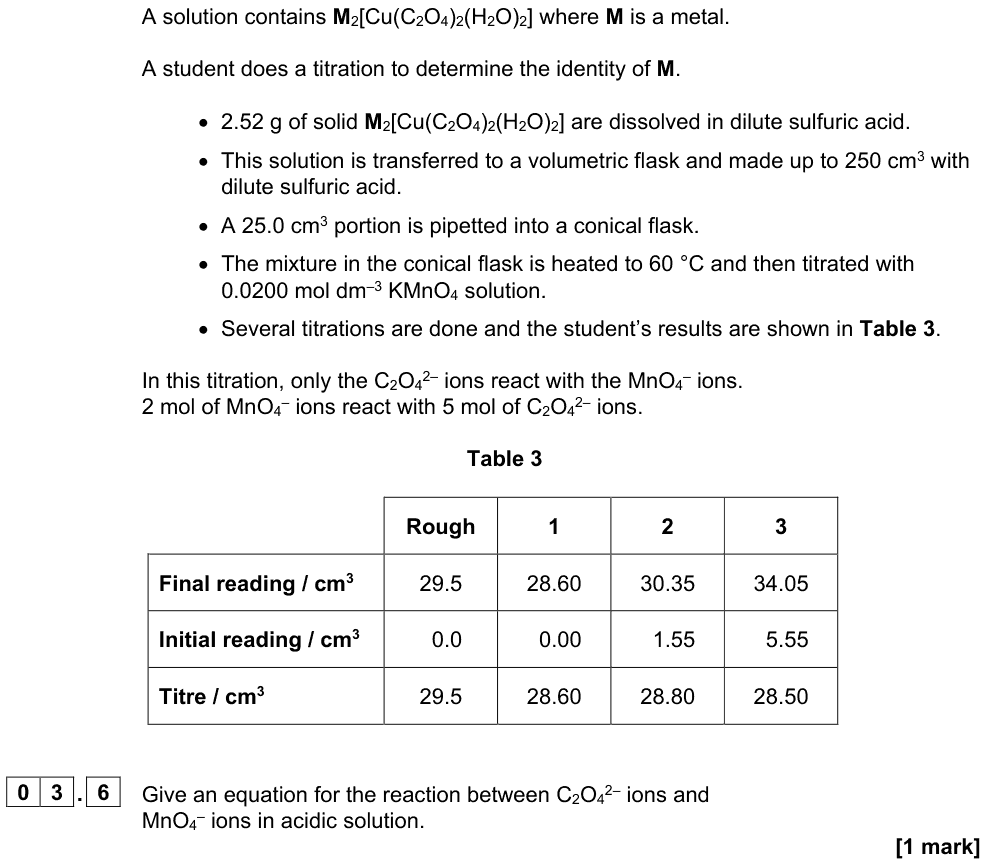
In part 6 many students could not give a balanced equation; H+ ions were often omitted from the left-hand side and water from the right-hand side.
Notes from the mark scheme and report
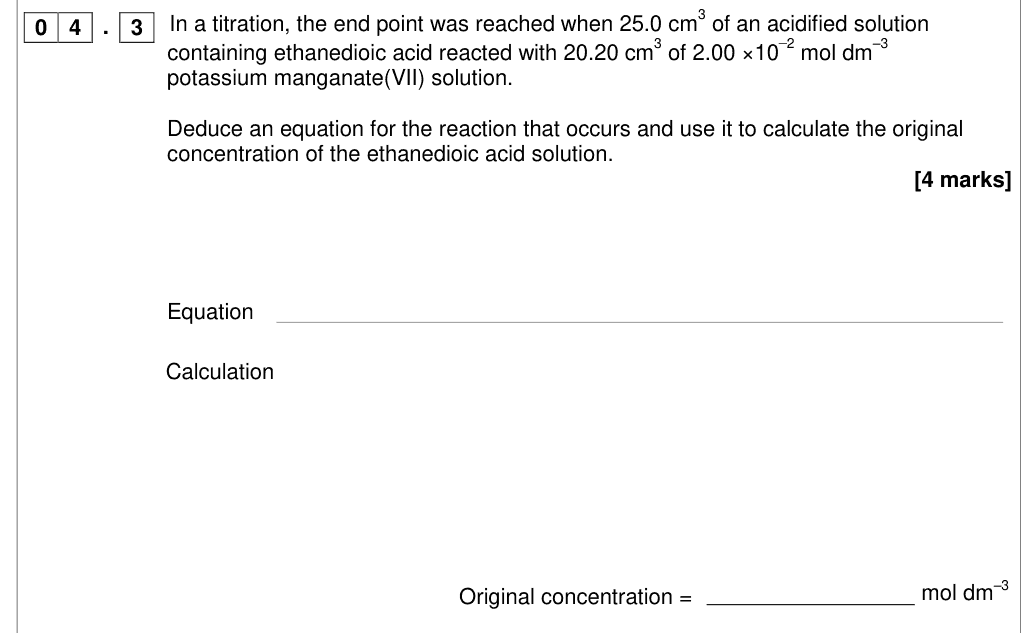
2MnO4– + 5C2O4 2– + 16H+ → 2Mn2+ + 10CO2 + 8H2O. Errors: H+ omitted from the left and water from the right
June 2025 · Paper 1 · Q05.21 markAO3=1Short answer
Earlier part of question 05 that this part uses
Mark scheme
Examiner's comment
Part 2 was generally well answered.
Notes from the mark scheme and report
Answer: Br +3
F –1. Both needed for the mark
June 2025 · Paper 1 · Q05.51 markAO2=1Equation writing
Earlier part of question 05 that this part uses
Mark scheme
Examiner's comment
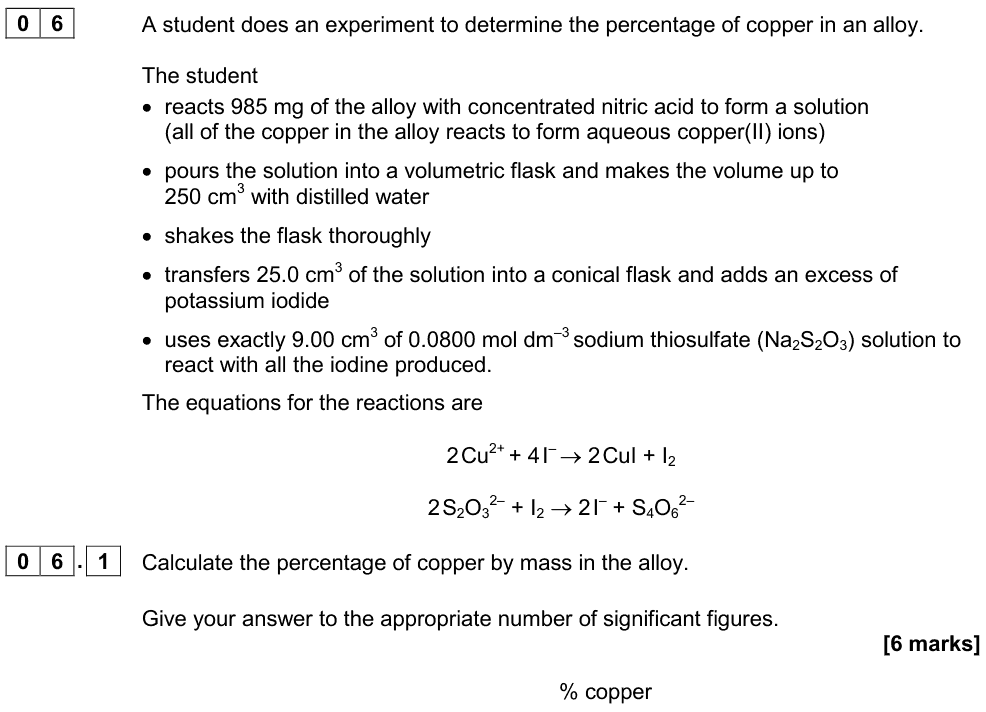
In part 5 very few students gave an equation to form copper(I) iodide.
Notes from the mark scheme and report
2Cu2+ + 4I– → 2CuI + I2. Very few gave an equation forming copper(I) iodide
June 2025 · AS Paper 1 · Q201 markAO1=1Multiple choice
Answer
D
Mark scheme
Examiner's comment
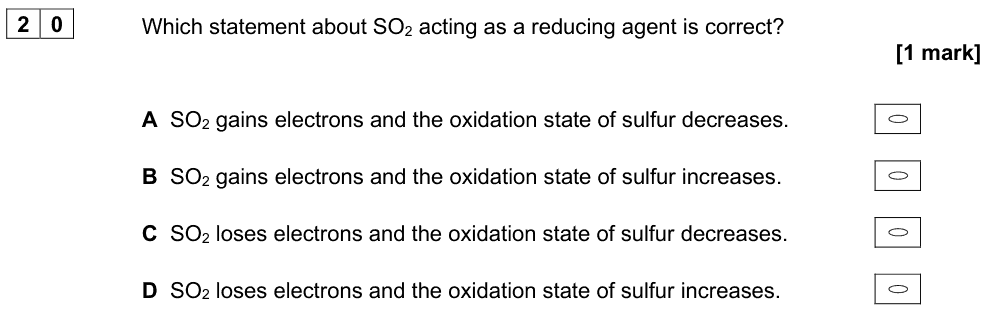
Just over half of the students were able to link the idea of the loss of electrons by with changes in oxidation state when SO2 acts as a reducing agent.
Notes from the mark scheme and report
Answer: D. A reducing agent donates electrons and is itself oxidised, so the oxidation state of sulfur increases (+4 to +6). Just over half were correct
June 2025 · Paper 3 · Q03.31 markAO2=1Equation writingHard
Earlier part of question 03 that this part uses
Mark scheme
Examiner's comment
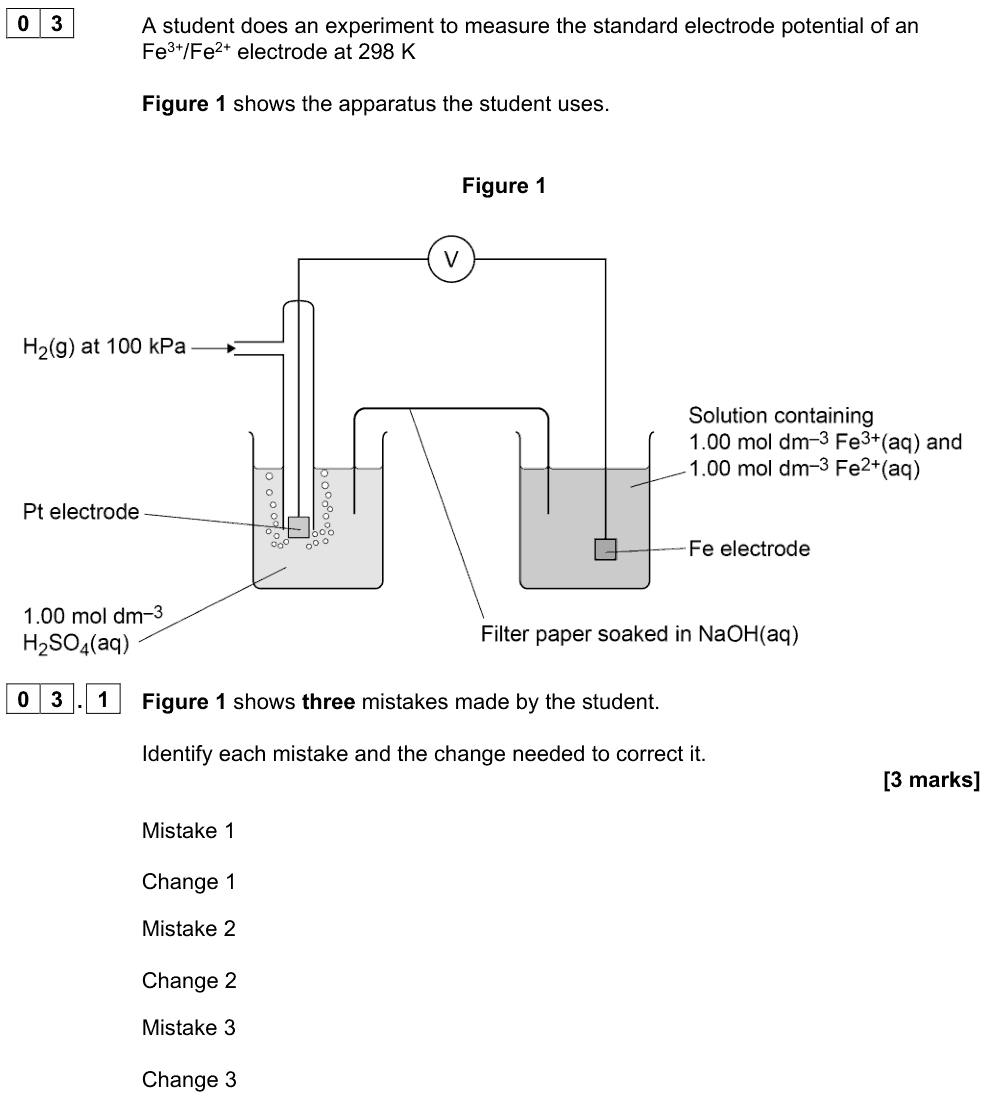
3.3 Approximately 30% of students were able to give the correct equation for the overall cell reaction with many reversing the equation or attempting a half-equation. The information given in the question is that the Fe3+/Fe2+ electrode is the positive electrode which should allow students to work out: Fe3+ + e– → Fe2+ and, conversely, H2 + 2e– → 2 H+. Combining these gives the answer of 2 Fe3+ + H2 → 2 Fe2+ + 2 H+.
Notes from the mark scheme and report
2Fe3+ + H2 → 2Fe2+ + 2H+. The positive electrode is where reduction happens (Fe3+ + e– → Fe2+), so hydrogen is oxidised. Not a reversible arrow. Errors: equation reversed
a half-equation only
June 2024 · AS Paper 1 · Q02.32 marksAO2=2Explanation
Earlier part of question 02 that this part uses
Mark scheme
Examiner's comment
02.3 Students did not always answer the question and explain, in terms of oxidation states, the redox characteristics of the reaction between calcium and water. Instead, they just identified the oxidising agent and reducing agent. A few students attempted to explain the redox chemistry of this reaction in terms of loss and gain of oxygen and/or hydrogen.
Notes from the mark scheme and report
Ca goes from 0 to +2 (oxidation state increases) so calcium is oxidised
H goes from +1 to 0 (decreases) so hydrogen is reduced. Correct oxidation states before and after alone score 1. Naming the oxidising and reducing agents, or using gain/loss of oxygen or hydrogen, does not answer the question
June 2024 · Paper 1 · Q05.33 marksAO3=3Equation writing
Earlier part of question 05 that this part uses
Mark scheme
Examiner's comment
In part 3 most students gave the first equation.
Errors in the second equation included not balancing the chlorine atoms, putting H+ on the wrong side of the equation and omitting the electrons.
In the third equation 5Cl2 or 7Cl2 were common errors.
A few students missed the charge on the chlorate(V) ion.
Notes from the mark scheme and report
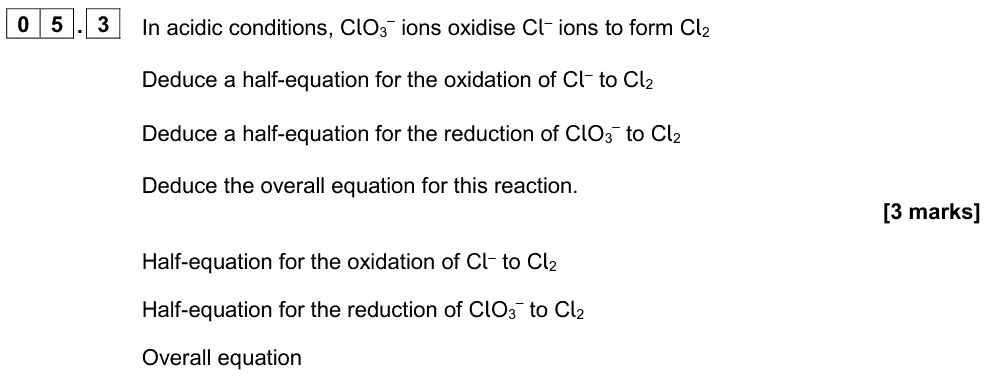
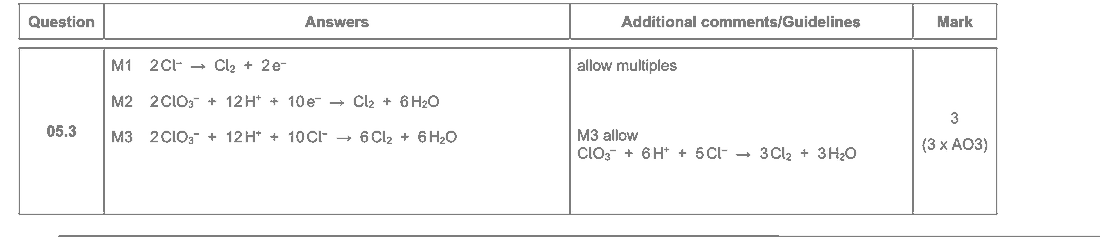
2Cl– → Cl2 + 2e–
2ClO3– + 12H+ + 10e– → Cl2 + 6H2O
overall ClO3– + 6H+ + 5Cl– → 3Cl2 + 3H2O. Errors: chlorine atoms not balanced, H+ on the wrong side, electrons omitted
5Cl2 or 7Cl2 in the overall equation
June 2024 · AS Paper 1 · Q09.11 markAO1=1Short answerEasy
Mark scheme
Examiner's comment
09.1 The definition of the term oxidising agent was well known, and this mark was scored by more than three-quarters of students.
Notes from the mark scheme and report
An electron acceptor. Not 'electron pair acceptor' or 'gain of electrons'
June 2024 · AS Paper 1 · Q09.21 markAO2=1Equation writing
Earlier part of question 09 that this part uses
Mark scheme
Examiner's comment
09.2 The half-equation to show the oxidation of copper was well answered although the most common mistake was for students to add electrons to the wrong side of the reaction.
Notes from the mark scheme and report
Cu → Cu2+ + 2e–. Common error: electrons on the wrong side
June 2024 · AS Paper 1 · Q09.31 markAO2=1Equation writing
Earlier part of question 09 that this part uses
Mark scheme
Examiner's comment
09.3 Although well over half of the students gave a correct half-equation, other students did not always balance the hydrogen atoms which led to an incorrect number of electrons.
Notes from the mark scheme and report
NO3– + 2H+ + e– → NO2 + H2O. Error: hydrogen not balanced, giving the wrong number of electrons
June 2024 · AS Paper 1 · Q09.41 markAO2=1Equation writing
Earlier part of question 09 that this part uses
Mark scheme
Examiner's comment
09.4 Students did not always multiply the half-equation from 09.3 by two to allow the electrons to cancel out when the two half-equations were combined.
Notes from the mark scheme and report
Cu + 2NO3– + 4H+ → Cu2+ + 2NO2 + 2H2O. The nitrate half-equation must be doubled before adding
June 2023 · Paper 1 · Q01.31 markAO3=1Short answer
Earlier part of question 01 that this part uses
Mark scheme
Examiner's comment
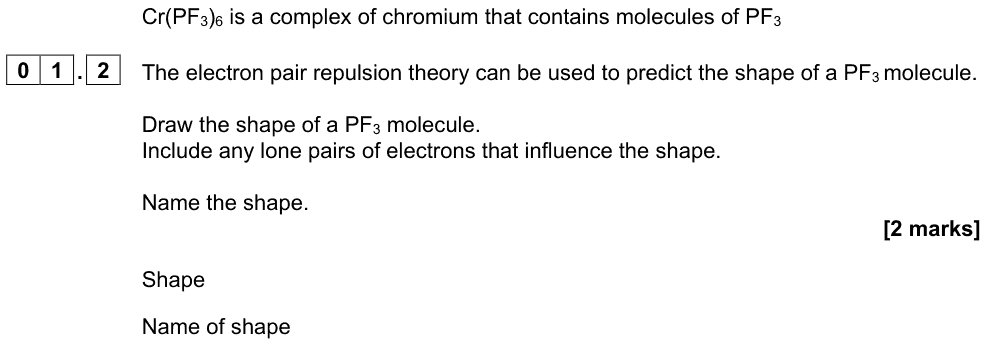
Only the most able students could give the correct explanation in 01.3; many students referred to the oxidation state of Cr(PF3)6 or the PF3 molecule.
Notes from the mark scheme and report
PF3 is a neutral ligand and the complex has no overall charge. Many wrote about the oxidation state of the complex or of PF3 instead
June 2023 · Paper 1 · Q01.41 markAO3=1Short answer
Earlier parts of question 01 that this part uses
Mark scheme
Examiner's comment
In 01.4, the oxidation state was given correctly by 49% of students; the most common incorrect answer was +2.
Notes from the mark scheme and report
Answer: +3 (three Cl– in total, NH3 neutral). Most common wrong answer: +2
June 2023 · AS Paper 1 · Q06.33 marksAO1=3Equation writing
Earlier parts of question 06 that this part uses
Mark scheme
Examiner's comment
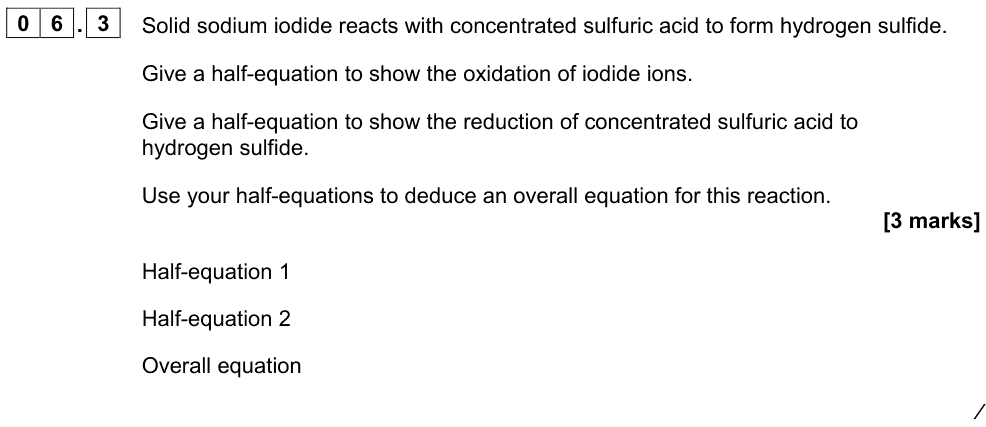
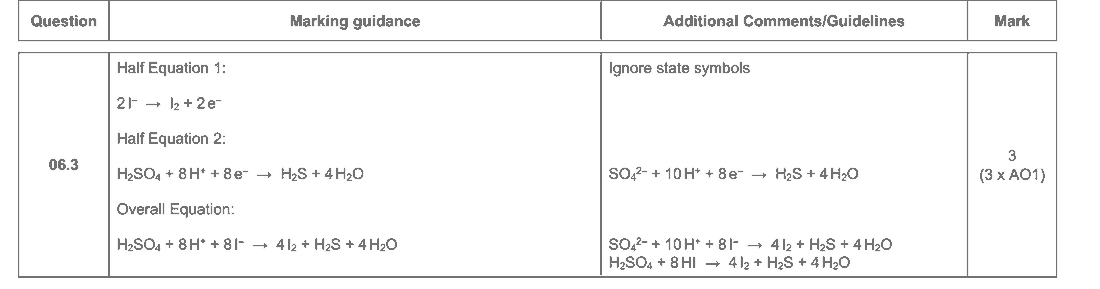
06.3 Students found writing the half-equation for the reduction of concentrated sulfuric acid to hydrogen sulfide challenging. In the overall equation students did not always cancel down the electrons.
overall H2SO4 + 8H+ + 8I– → 4I2 + H2S + 4H2O (or H2SO4 + 8HI → 4I2 + H2S + 4H2O). The reduction half-equation was found hard
electrons were not always cancelled in the overall equation
June 2023 · Paper 1 · Q08.11 markAO1=1Equation writing
Mark scheme
Examiner's comment
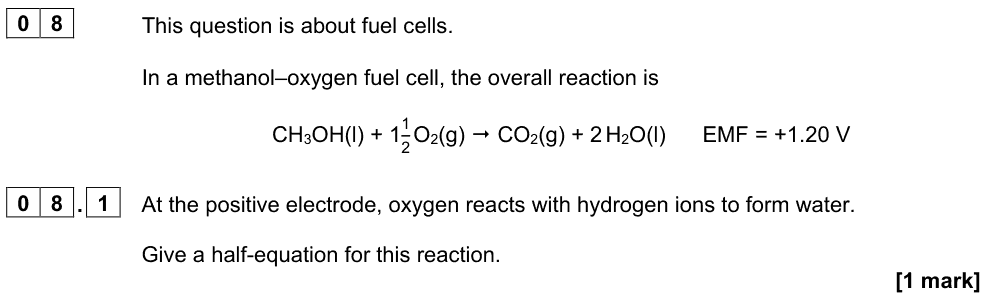
The half-equation required in 08.1 was often missing the electrons.
Notes from the mark scheme and report
O2 + 4H+ + 4e– → 2H2O. Electrons were often missing
June 2023 · Paper 1 · Q08.21 markAO2=1Equation writing
Earlier part of question 08 that this part uses
Mark scheme
Examiner's comment
In 08.2, the electrons were also often missing or on the wrong side of the equation.
Notes from the mark scheme and report
CH3OH + H2O → CO2 + 6H+ + 6e–. Electrons often missing or on the wrong side
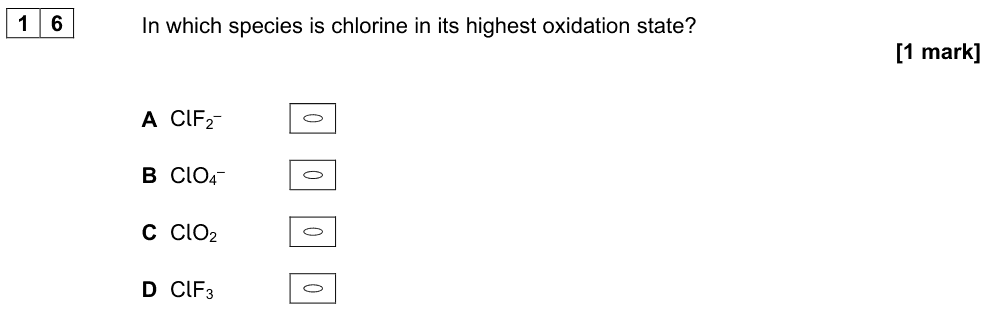
June 2023 · AS Paper 1 · Q161 markAO1=1Multiple choiceEasy
Answer
B
Mark scheme
Examiner's comment
This was well answered with the great majority (82%) of students correctly identifying the species with chlorine in its highest oxidation state.
Notes from the mark scheme and report
Answer: B. Chlorine is +7 in ClO4– (+1 in ClF2–, +4 in ClO2, +3 in ClF3)
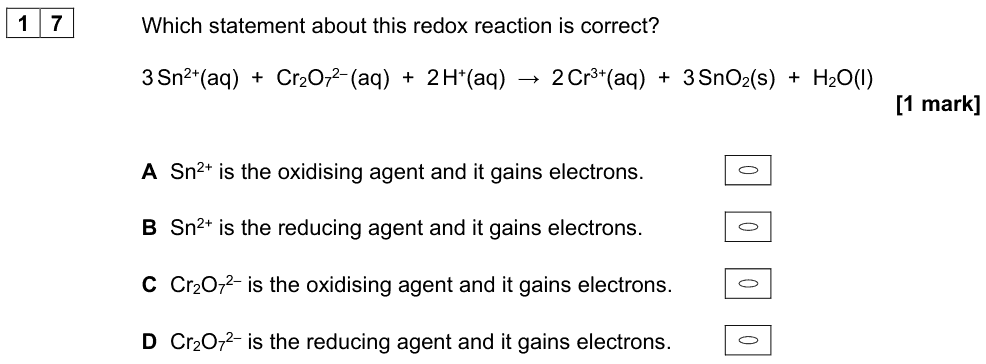
June 2023 · AS Paper 1 · Q171 markAO1=1Multiple choice
Answer
C
Mark scheme
Examiner's comment
Students found this question challenging with less than half correctly understanding the redox processes in this reaction.
Notes from the mark scheme and report
Answer: C. Chromium is reduced from +6 to +3, so Cr2O7 2– gains electrons and is the oxidising agent
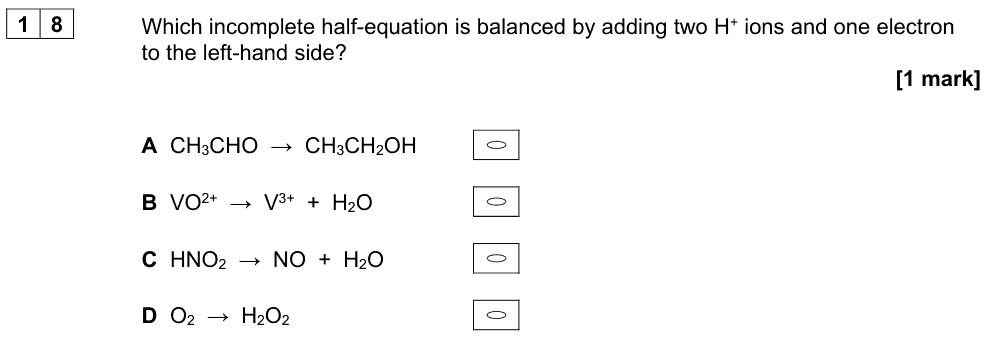
June 2023 · AS Paper 1 · Q181 markAO1=1Multiple choiceEasy
Answer
B
Mark scheme
Examiner's comment
This was well answered with nearly three-quarters of students correctly choosing the half-equation that can be balanced by two H+ ions and one electron.
Notes from the mark scheme and report
Answer: B. VO2+ + 2H+ + e– → V3+ + H2O (vanadium +4 to +3)
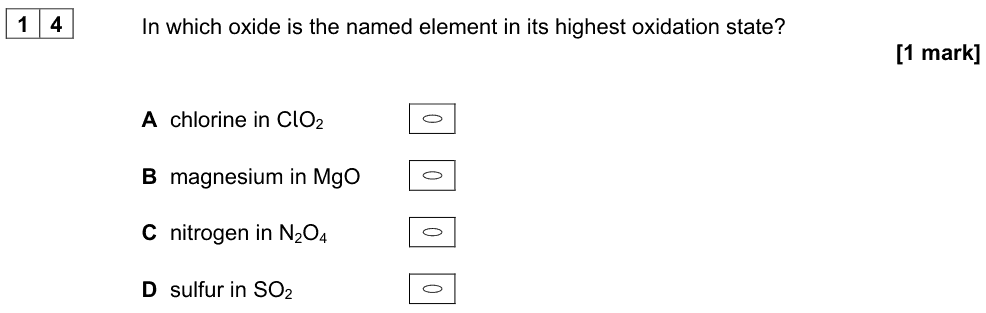
June 2023 · Paper 3 · Q141 markAO1=1Multiple choice
Answer
B
Mark scheme
Notes from the mark scheme and report
Answer: B. Mg is +2, its highest state. Cl in ClO2 is +4 (highest +7), N in N2O4 is +4 (highest +5), S in SO2 is +4 (highest +6)
June 2023 · Paper 3 · Q221 markAO1=1Multiple choice
Answer
D
Mark scheme
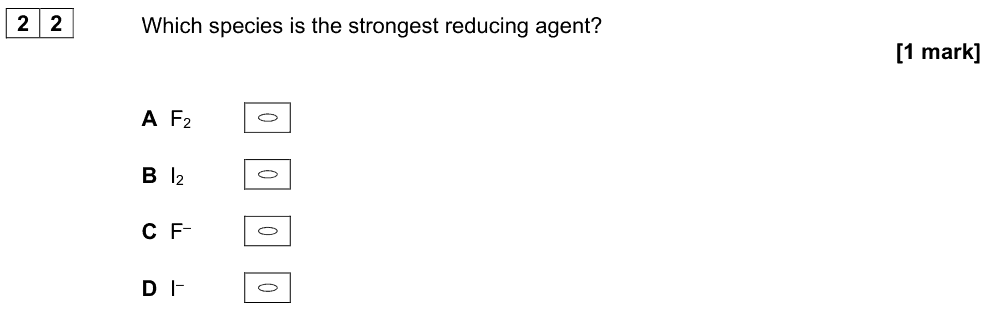
Notes from the mark scheme and report
Answer: D. Halide ions are the reducing agents and reducing ability increases down the group: I– loses an electron most easily
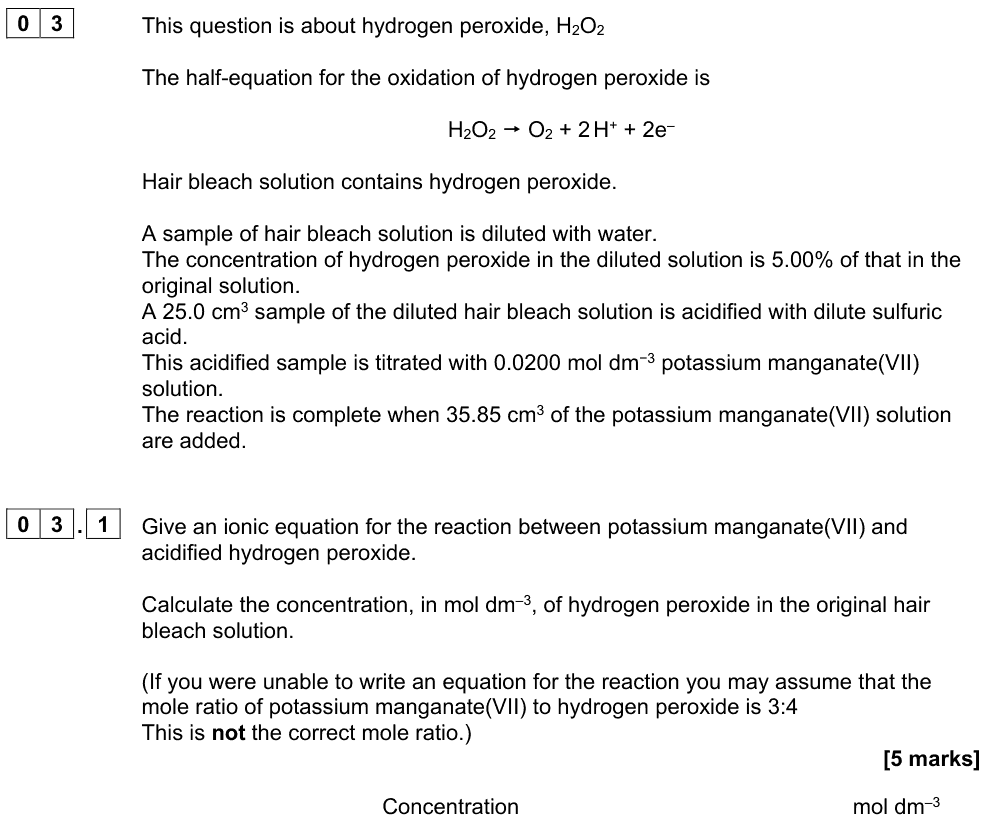
June 2022 · Paper 1 · Q03.15 marksAO2=5CalculationHard
Mark scheme
Examiner's comment
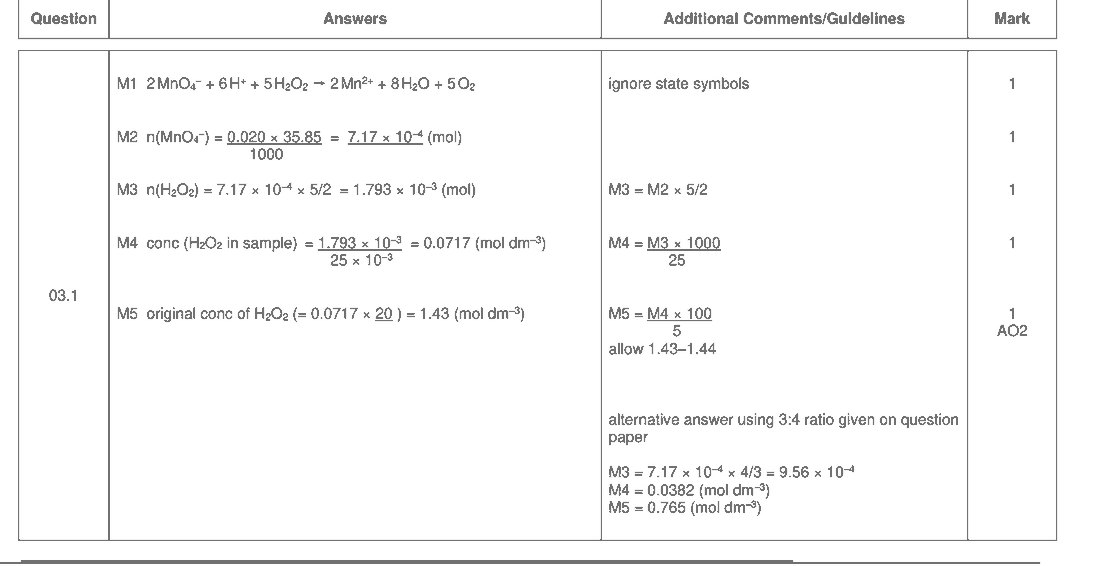
Most students could not give a correct equation in 03.1; if they did score the equation mark they generally carried on to complete the calculation correctly.
21% of students scored all the marks in this question.
A minority had an incorrect ratio in the equation that they then used correctly in the calculation, and so scored 4 marks.
The most common responses used the 3:4 ratio given in the question.
Converting 5% to 100% proved challenging for many so they could not score M5.
The question discriminated very well.
× 100/5 (× 20) for the original solution. Using the given 3:4 ratio gives 0.765 and max 4. Most could not write the equation
scaling 5% to 100% was a common failure
Skills: MS0.0 Recognise and make use of appropriate units in calculation; MS0.2 Use ratios, fractions and percentages
June 2022 · Paper 1 · Q03.31 markAO2=1Short answer
Earlier part of question 03 that this part uses
Mark scheme
Examiner's comment
Most students gave the correct answer in 03.3; the most common incorrect answers were +1 and –2.
Notes from the mark scheme and report
Answer: –1. Common wrong answers +1 and –2
June 2022 · AS Paper 1 · Q06.11 markAO1=1Short answer
Mark scheme
Examiner's comment
06.1 This definition was not always answered in terms of electrons but instead in terms of gain of oxygen.
Notes from the mark scheme and report
An electron acceptor / a species that gains electrons. Not 'electron pair acceptor'
not 'gain of electrons' (that is reduction, not the agent). Many answered in terms of oxygen
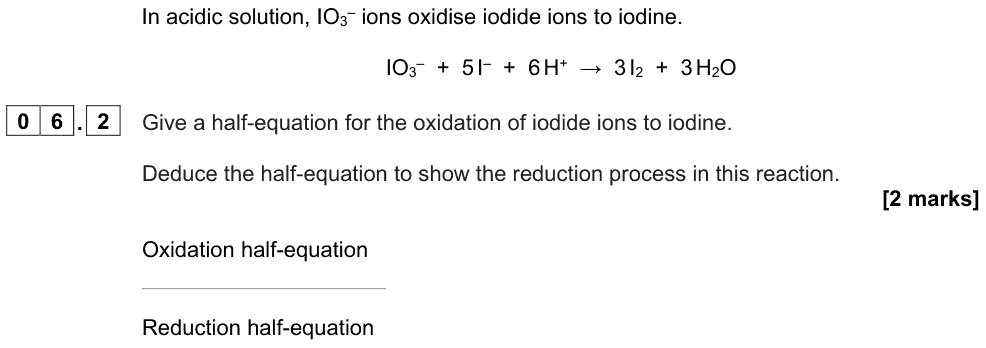
June 2022 · AS Paper 1 · Q06.22 marksAO2=2Equation writingHard
Earlier part of question 06 that this part uses
Mark scheme
Examiner's comment
06.2 Equations were not always balanced for atoms or charge. Students found the reduction half-equation more challenging, with less than 15% of students scoring both marks.
Notes from the mark scheme and report
Oxidation: 2I– → I2 + 2e–. Reduction: 2IO3– + 12H+ + 10e– → I2 + 6H2O (multiples allowed). 1 mark if the two are transposed. Errors: atoms or charge not balanced
June 2022 · Paper 1 · Q06.22 marksAO1=2Equation writing
Earlier part of question 06 that this part uses
Mark scheme
Examiner's comment
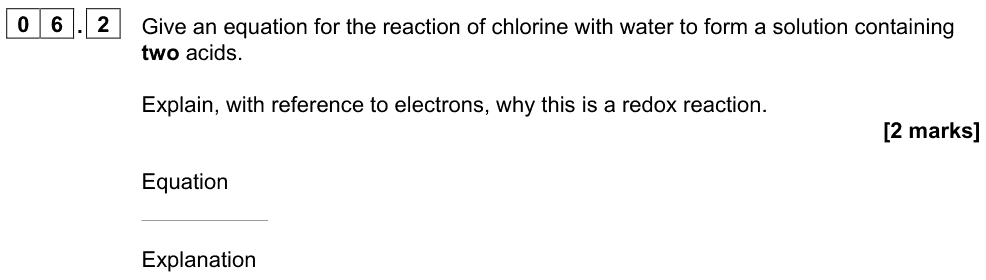
In 06.2, most students knew the equation but did not mention electrons in their explanation; many referred to oxidation numbers.
Of those who mentioned electrons in the explanation, some stated that chlorine gained electrons but then thought oxygen or hydrogen lost electrons.
Notes from the mark scheme and report
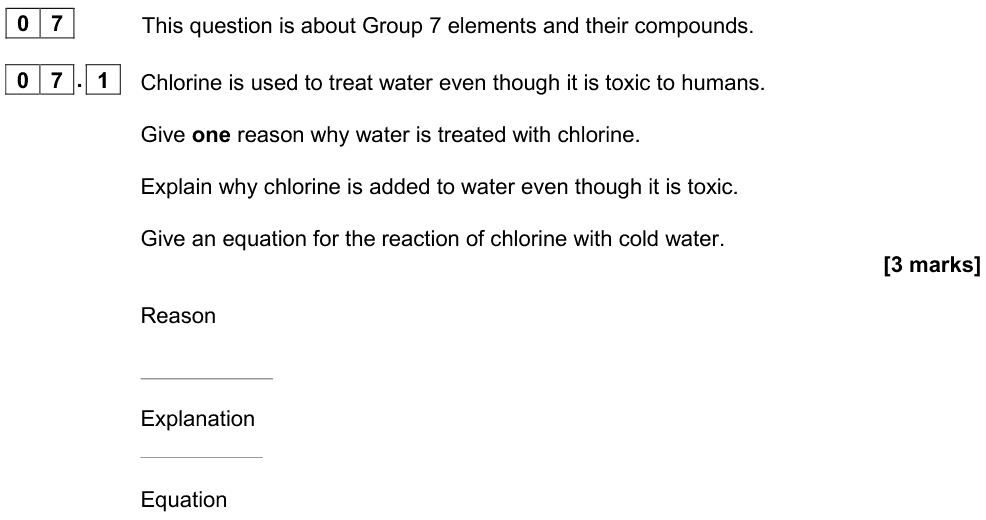
Cl2 + H2O ⇌ HCl + HClO (allow 2H+ + Cl– + ClO–). Chlorine gains electrons (to form Cl–) and chlorine also loses electrons (to form ClO–). Oxidation numbers and 'disproportionation' alone are ignored
some wrongly said oxygen or hydrogen lost the electrons
June 2022 · Paper 1 · Q06.43 marksAO1=3Equation writing
Earlier part of question 06 that this part uses
Mark scheme
Examiner's comment
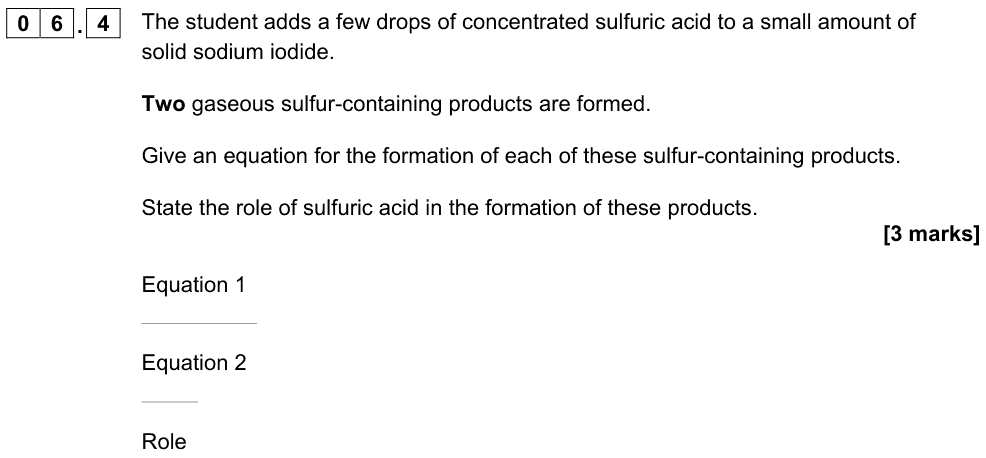
In 06.4, most students knew the role of sulfuric acid.
The equations were not well known, however, and some students gave half-equations.
Several students gave a correct equation for sulfur rather than a gas containing sulfur.
Notes from the mark scheme and report
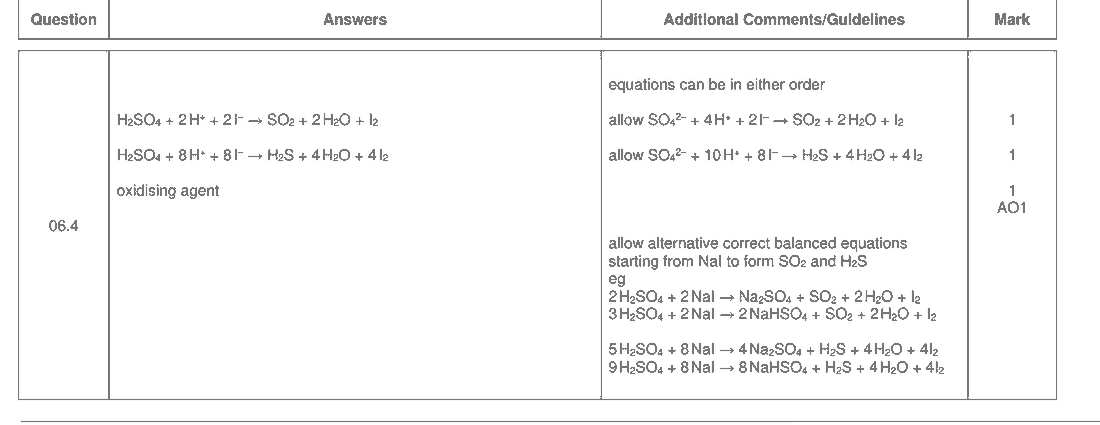
H2SO4 + 2H+ + 2I– → SO2 + 2H2O + I2 and H2SO4 + 8H+ + 8I– → H2S + 4H2O + 4I2 (balanced equations from NaI allowed)
sulfuric acid is an oxidising agent. The role was well known, the equations were not
some gave half-equations or the equation forming sulfur (not a gas)
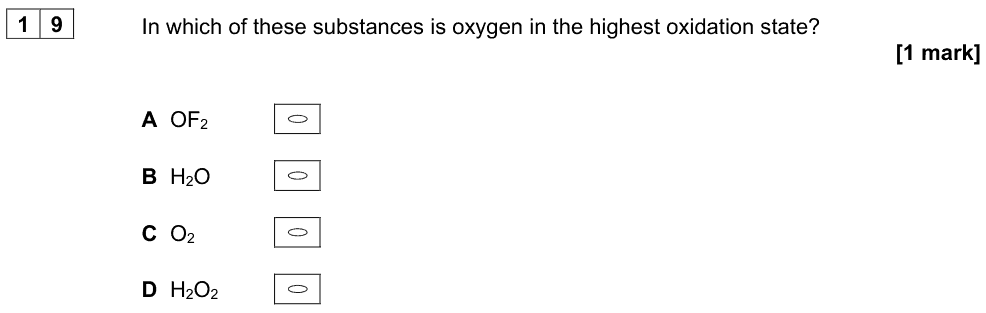
June 2022 · AS Paper 1 · Q191 markAO1=1Multiple choice
Answer
A
Mark scheme
Examiner's comment
Oxidation state About half the students could identify when oxygen was in its highest oxidation state.
Notes from the mark scheme and report
Answer: A. In OF2 oxygen is +2 (fluorine is always –1)
H2O –2, O2 0, H2O2 –1
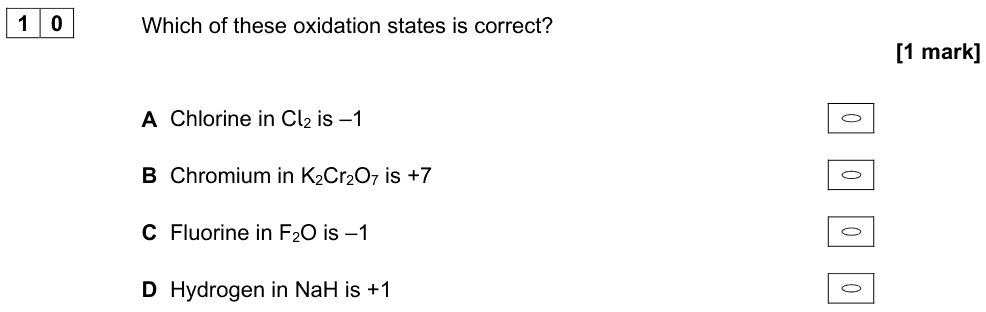
June 2022 · Paper 3 · Q101 markAO1=1Multiple choice
Answer
C
Mark scheme
Notes from the mark scheme and report
Answer: C. Fluorine is always –1 in compounds (oxygen is +2 in F2O). Cl in Cl2 is 0, Cr in K2Cr2O7 is +6, H in NaH is –1 (report: report lists question 10 as particularly challenging)
November 2021 · AS Paper 1 · Q03.11 markShort answer
Mark scheme
Notes from the mark scheme and report
An electron acceptor. Not 'electron pair acceptor'
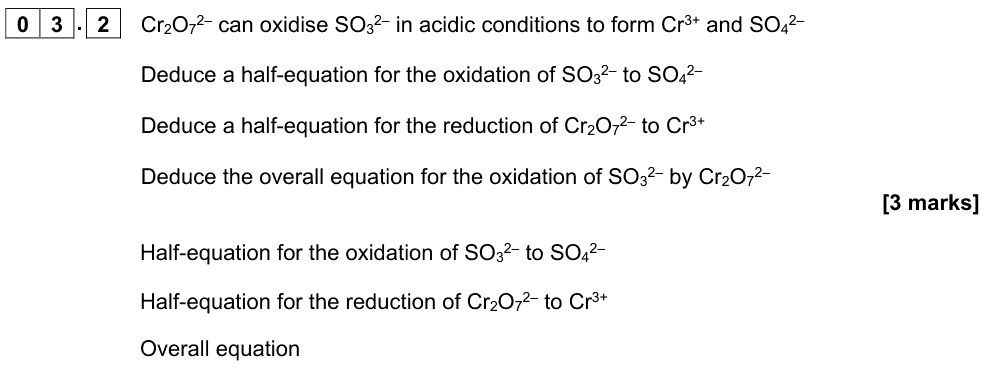
November 2021 · AS Paper 1 · Q03.23 marksEquation writing
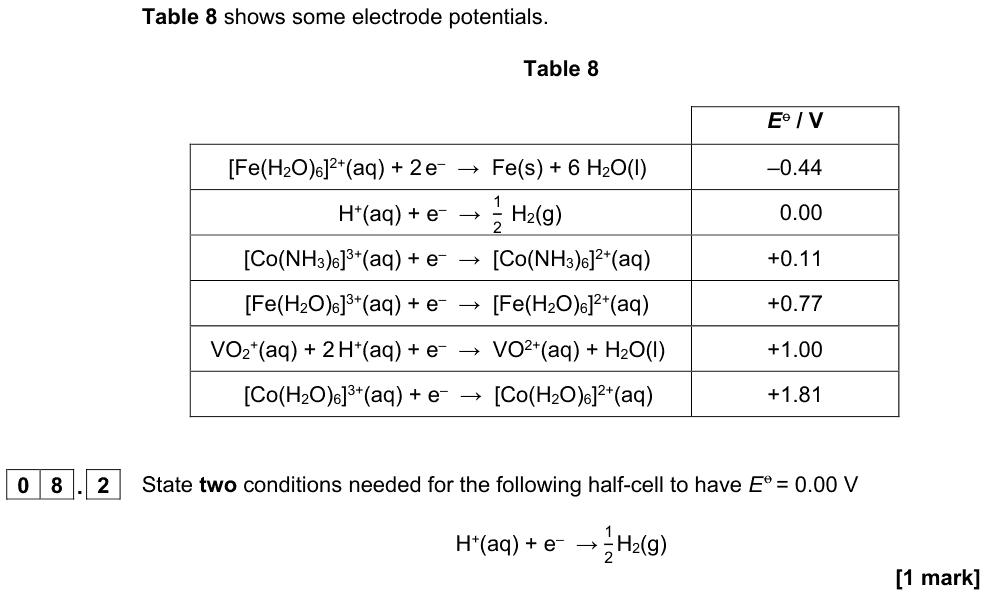
November 2021 · Paper 1 · Q08.42 marksEquation writing
Earlier parts of question 08 that this part uses
Mark scheme
Examiner's comment
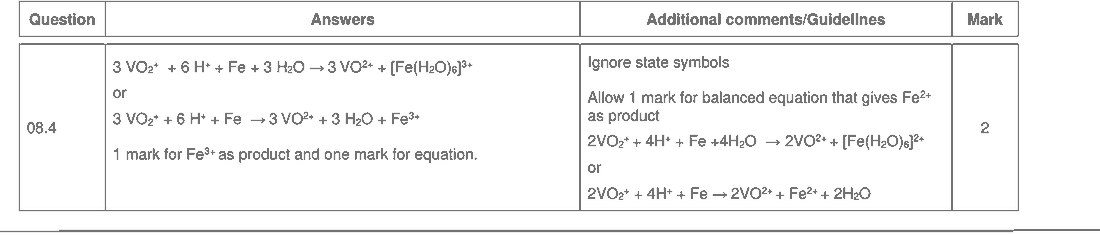
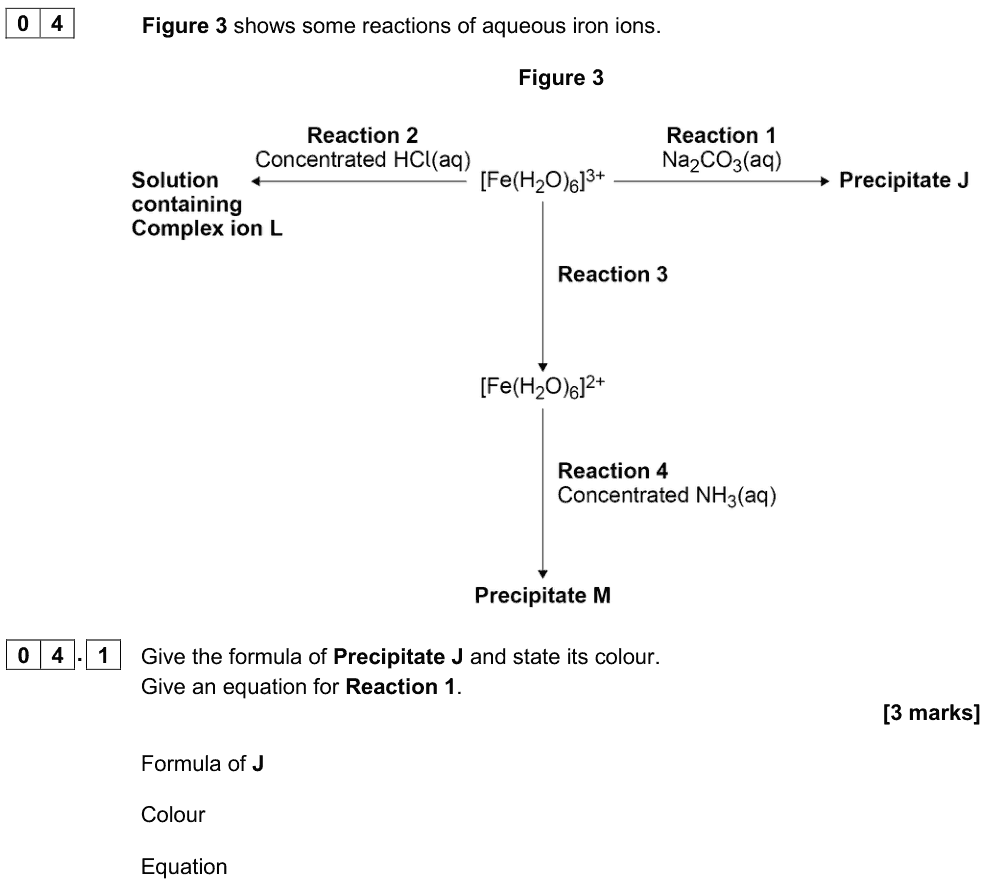
In question 08.4 many students did not start with Fe but with [Fe(H2O)6]2+; those who started with Fe often gave Fe2+ or [Fe(H2O)6]2+ as the product.
Students who gave an equation often failed to cancel out the waters on each side of the equation.
Notes from the mark scheme and report
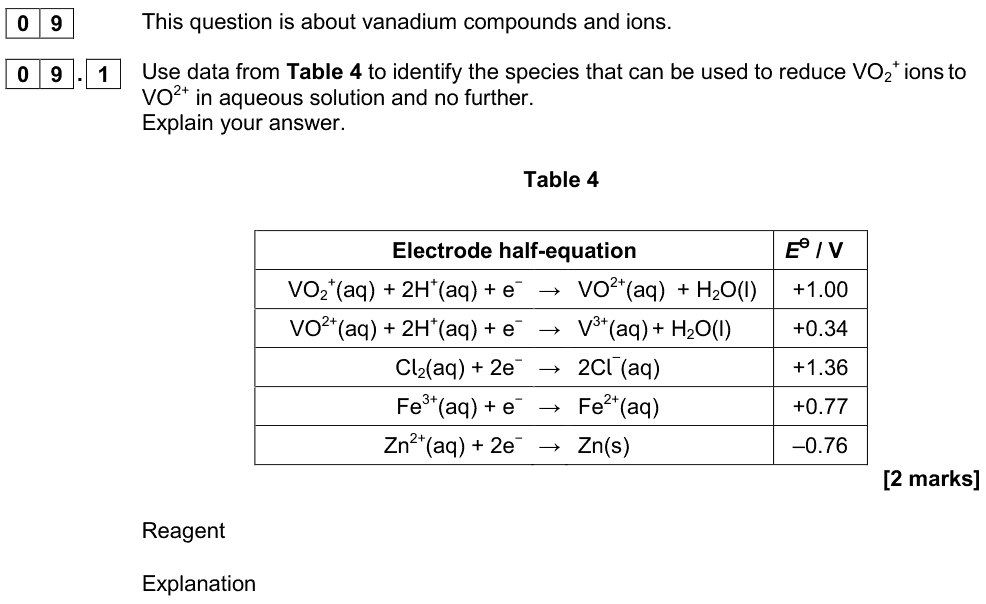
3VO2+ + 6H+ + Fe → 3VO2+ + 3H2O + Fe3+ (or with [Fe(H2O)6]3+ and 3H2O on the left): reactant vanadium(V) VO2 +, product vanadium(IV) VO 2+. One mark for Fe3+ as the product, one for the equation
a balanced equation giving Fe2+ scores 1. Errors: starting from [Fe(H2O)6]2+
not cancelling water. Uses Table 8 from 08.2
November 2021 · Paper 1 · Q09.41 markShort answer
Earlier part of question 09 that this part uses
Mark scheme
Examiner's comment
Many students could calculate the oxidation state in question 09.4; however common errors included –7 and +9.
Notes from the mark scheme and report
Answer: +7. Common errors: –7 and +9
November 2021 · AS Paper 1 · Q161 markMultiple choice
Answer
C
Mark scheme
Notes from the mark scheme and report
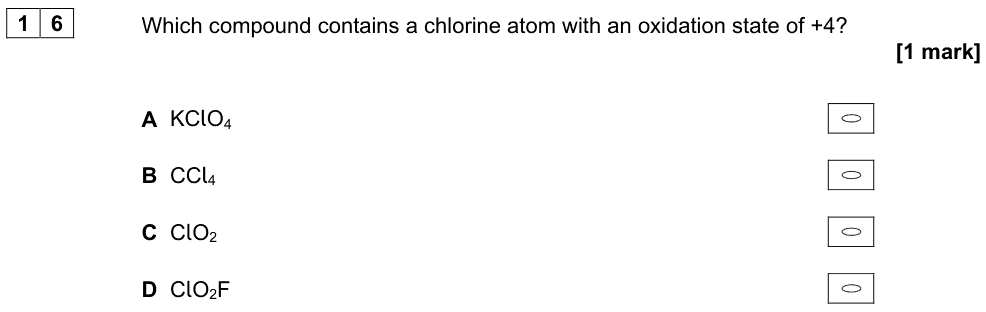
Answer: C. In ClO2, Cl + 2(–2) = 0 so Cl is +4
KClO4 is +7, CCl4 is –1 and ClO2F is +5
November 2021 · Paper 3 · Q211 markMultiple choice
Answer
D
Mark scheme
Notes from the mark scheme and report
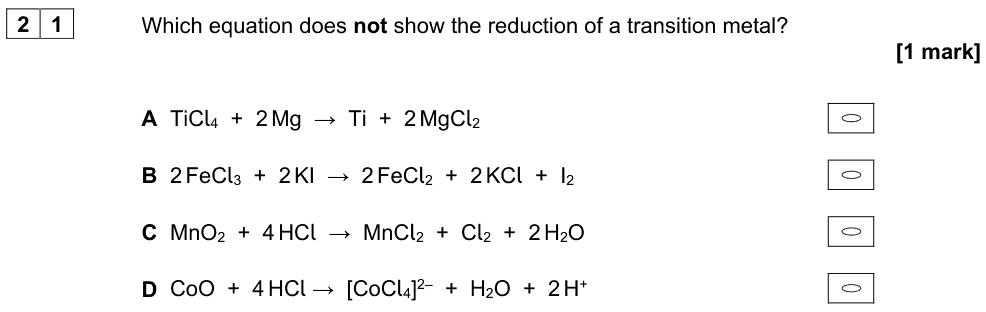
Answer: D. Cobalt is +2 in both CoO and [CoCl4]2–
Ti (+4 to 0), Fe (+3 to +2) and Mn (+4 to +2) are reduced
November 2020 · AS Paper 1 · Q05.22 marksEquation writing
Earlier part of question 05 that this part uses
Mark scheme
Notes from the mark scheme and report
2Mg + TiCl4 → 2MgCl2 + Ti. Mg changes oxidation state from 0 to +2, so it loses electrons (or Ti goes from +4 to 0, so gains electrons)
November 2020 · AS Paper 1 · Q07.24 marksEquation writing
Earlier part of question 07 that this part uses
Mark scheme
Notes from the mark scheme and report
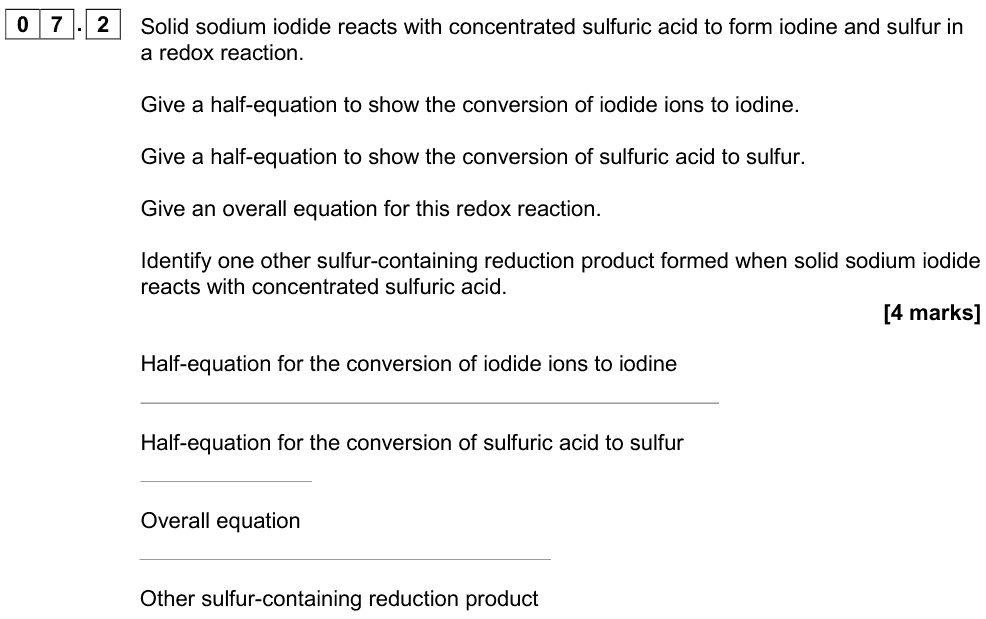
2I– → I2 + 2e–
H2SO4 + 6H+ + 6e– → S + 4H2O
overall 6H+ + 6I– + H2SO4 → 3I2 + S + 4H2O
other product SO2 or H2S. Equations using 8H+ + SO4 2– are allowed
November 2020 · Paper 1 · Q09.33 marksEquation writing
Earlier part of question 09 that this part uses
Mark scheme
Examiner's comment
Students found 09.3 more challenging; only a few students gave a correct equation.
The explanation was not well done.
Although some students gave the oxidation states correctly, they either failed to identify the oxidation or reduction processes or they gave them the wrong way round; many students thought hydrogen was the element being reduced or oxidised.
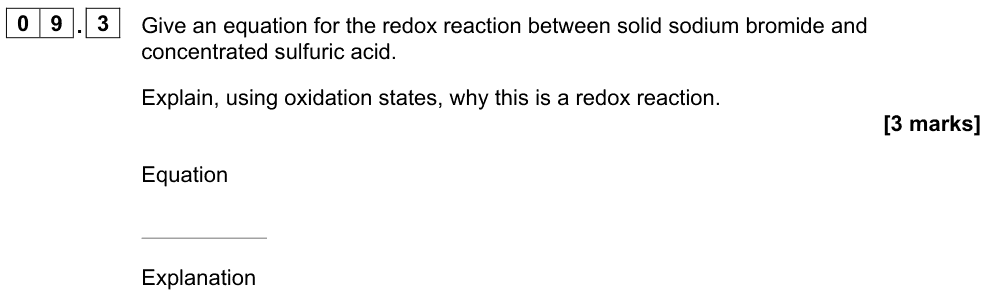
S goes from +6 to +4 and is reduced. Errors: few correct equations
oxidation and reduction not identified or reversed
hydrogen named as the element changing
November 2020 · Paper 1 · Q11.11 markEquation writing
Mark scheme
Examiner's comment
Most students were unable to give a correct equation in 11.1 and 11.2; some students wrote the correct substance on the correct side of the equation but then added electrons to the wrong side.
Notes from the mark scheme and report
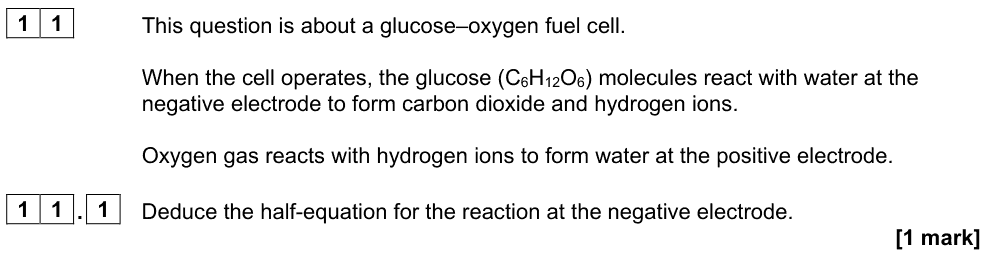
C6H12O6 + 6H2O → 6CO2 + 24H+ + 24e–. Most could not do this
electrons were often on the wrong side
November 2020 · Paper 1 · Q11.21 markEquation writing
Earlier part of question 11 that this part uses
Mark scheme
Examiner's comment
Most students were unable to give a correct equation in 11.1 and 11.2; some students wrote the correct substance on the correct side of the equation but then added electrons to the wrong side.
Notes from the mark scheme and report
O2 + 4H+ + 4e– → 2H2O. Electrons were often on the wrong side
November 2020 · Paper 1 · Q11.31 markEquation writing
Earlier part of question 11 that this part uses
Mark scheme
Examiner's comment
In 11.3, most students gave an unbalanced equation; some students reversed the equation and gave the equation for photosynthesis and some students failed to cancel out water molecules on each side of the equation.
Notes from the mark scheme and report
C6H12O6 + 6O2 → 6CO2 + 6H2O. Errors: unbalanced
reversed (photosynthesis)
water not cancelled
November 2020 · AS Paper 1 · Q131 markMultiple choice
Answer
A
Mark scheme
Notes from the mark scheme and report
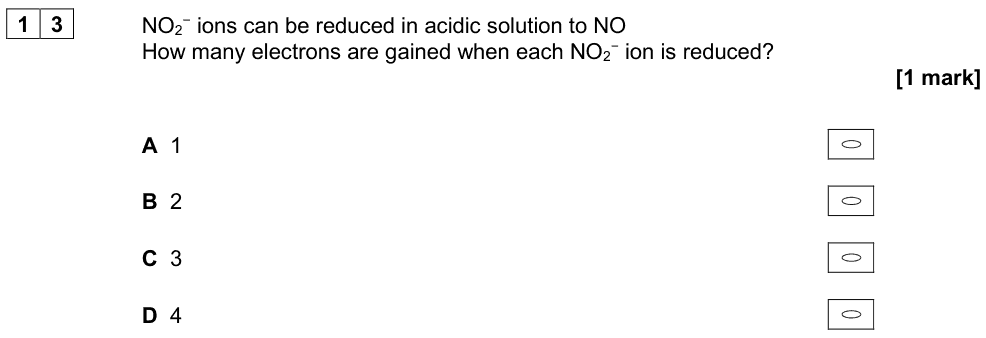
Answer: A. N goes from +3 in NO2– to +2 in NO, a gain of one electron (NO2– + 2H+ + e– → NO + H2O)
November 2020 · AS Paper 1 · Q211 markMultiple choice
Answer
A
Mark scheme
Notes from the mark scheme and report
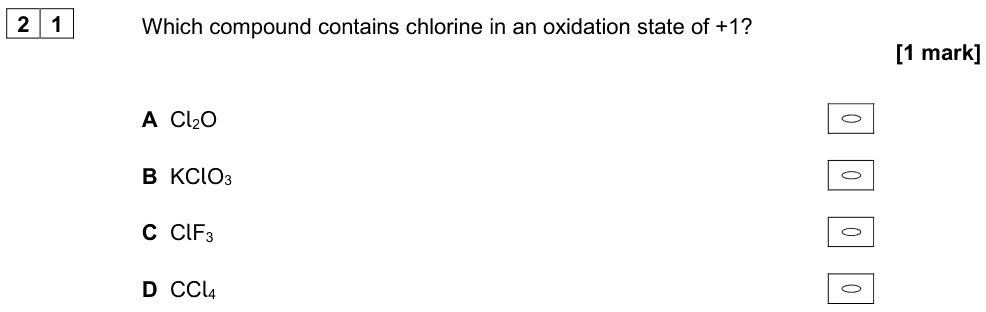
Answer: A. In Cl2O oxygen is –2 so each Cl is +1 (KClO3 +5, ClF3 +3, CCl4 –1)
November 2020 · Paper 3 · Q01.32 marksEquation writing
Earlier part of question 01 that this part uses
Mark scheme
Examiner's comment
01.3 was fairly well answered with some quirky variations on fractional balancing seen.
November 2020 · Paper 3 · Q06.31 markEquation writing
Earlier part of question 06 that this part uses
Mark scheme
Examiner's comment
In 06.3, balancing the equation proved trickier than expected.
Notes from the mark scheme and report
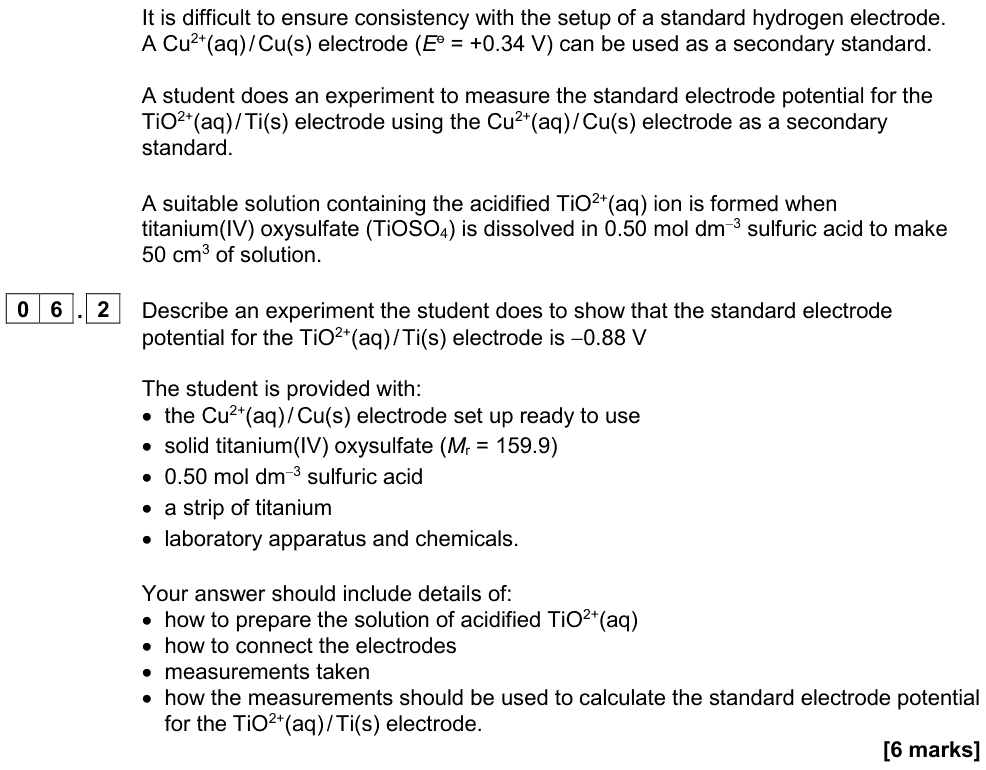
TiO2+ + 2H+ + 4e– → Ti + H2O (reverse or equilibrium arrow allowed). Balancing proved tricky
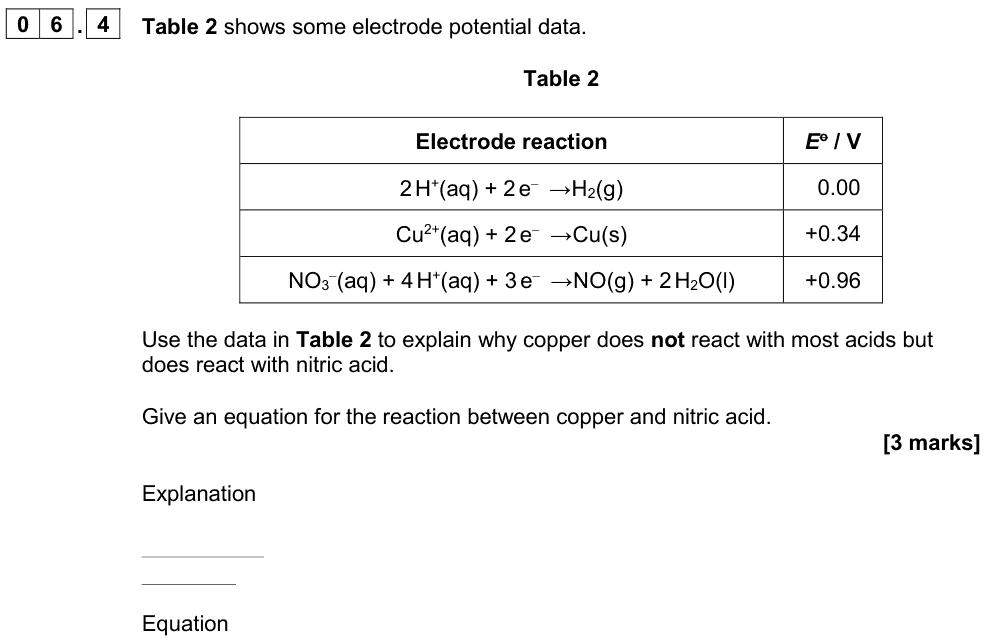
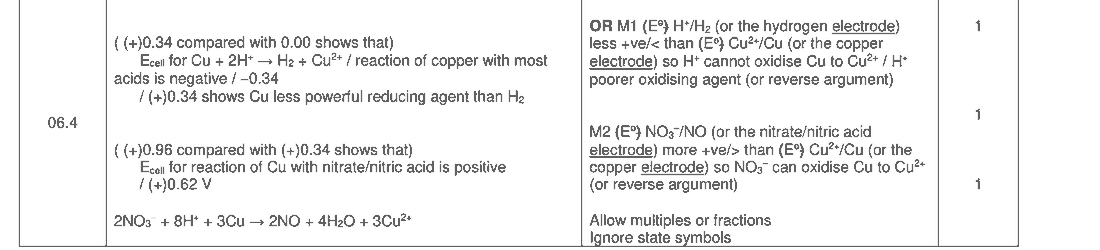
November 2020 · Paper 3 · Q06.43 marksExplanationHard
Earlier parts of question 06 that this part uses
Mark scheme
Examiner's comment
06.4 was not an exception and only 19% of students scored two or more marks.
Many students failed to appreciate the need to discuss both comparisons and only focused on the interaction between copper and nitric acid.
Many descriptions made confused references to the electrodes – often without referring to an electrode at all but using phrases such as ‘the E for nitric acid’.
The best answers made clear references such as "Eo NO3–/NO > Eo Cu2+/Cu, so Cu can reduce NO3–".
It was also often unclear what the students were suggesting as being oxidised or reduced – specific species need mentioning.
Notes from the mark scheme and report
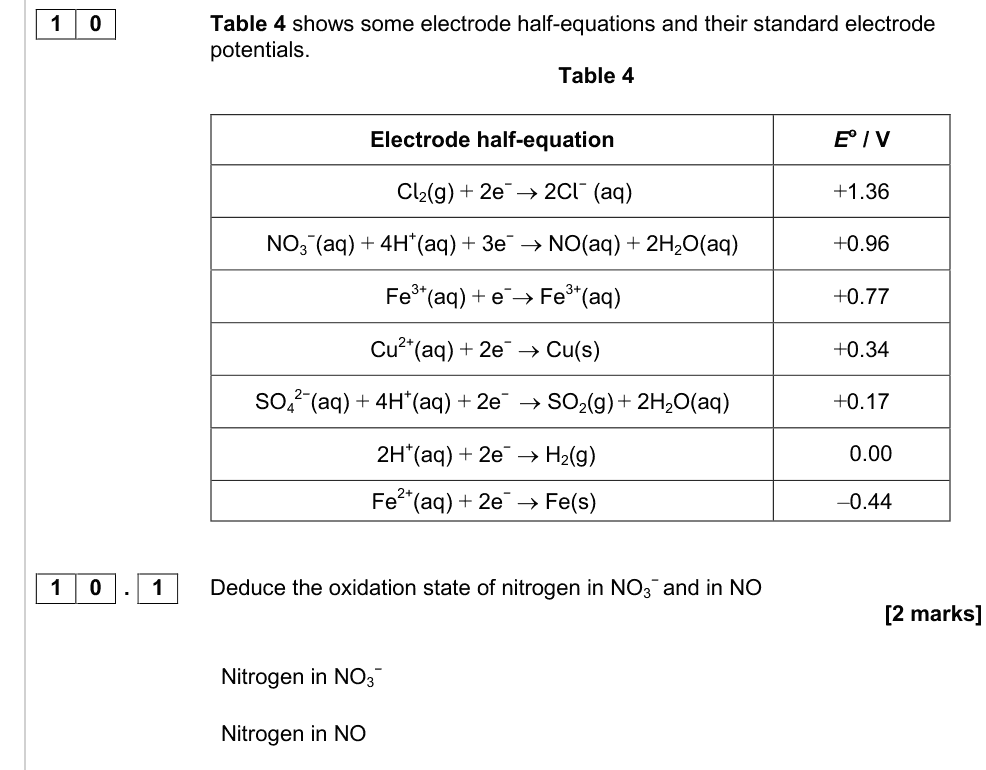
E(H+/H2) 0.00 V is less positive than E(Cu2+/Cu) +0.34 V, so H+ cannot oxidise copper (cell EMF would be –0.34 V)
E(NO3–/NO) +0.96 V is more positive than E(Cu2+/Cu), so nitrate ions in acid can oxidise copper (EMF +0.62 V)
3Cu + 2NO3– + 8H+ → 3Cu2+ + 2NO + 4H2O. Both comparisons are needed
name the electrodes and species, not 'the E for nitric acid'
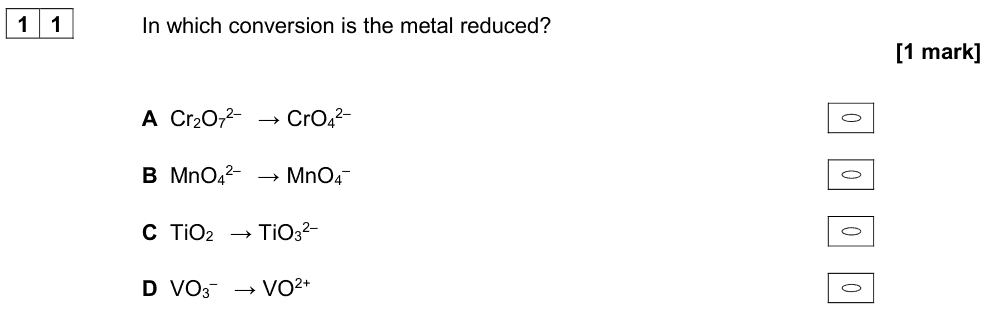
November 2020 · Paper 3 · Q111 markMultiple choice
Answer
D
Mark scheme
Notes from the mark scheme and report
Answer: D. V goes from +5 in VO3– to +4 in VO2+. Cr stays +6, Mn rises from +6 to +7, Ti stays +4
November 2020 · Paper 3 · Q191 markMultiple choice
Answer
D
Mark scheme
Notes from the mark scheme and report
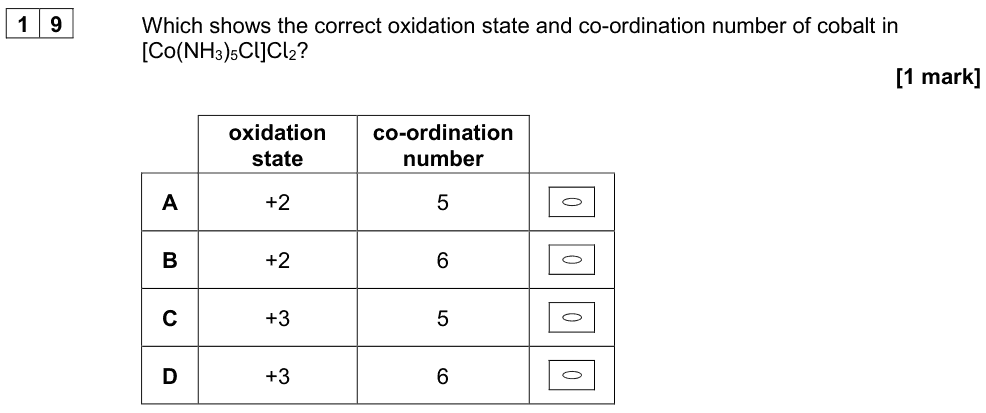
Answer: D. Three chloride ions in total and neutral NH3 make cobalt +3
five NH3 and one Cl– ligand give six co-ordinate bonds (the two outer Cl– are not ligands)
November 2020 · Paper 3 · Q211 markMultiple choice
Answer
C
Mark scheme
Notes from the mark scheme and report
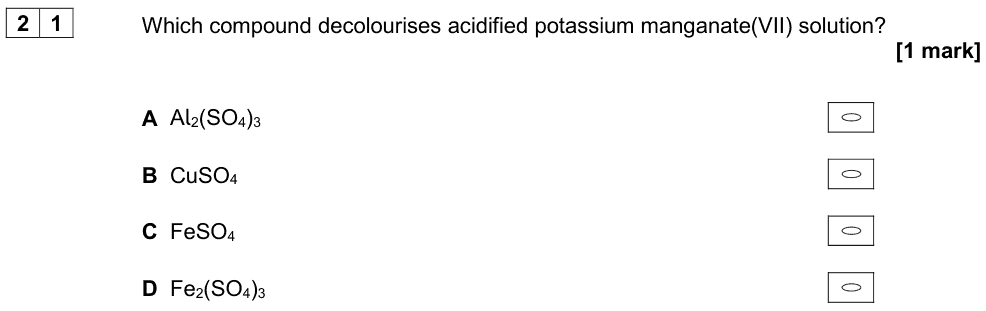
Answer: C. Fe2+ is oxidised to Fe3+ by MnO4–, which is reduced to colourless Mn2+
Al3+, Cu2+ and Fe3+ are not oxidised
June 2019 · AS Paper 1 · Q03.41 markShort answer
Earlier part of question 03 that this part uses
Mark scheme
Examiner's comment
03.4 This question was also well answered, with the majority of students giving correct answers. Some students did not take the overall charge into account when determining the oxidation state of the chromium in this ion, however.
June 2019 · AS Paper 1 · Q03.51 markEquation writing
Earlier part of question 03 that this part uses
Mark scheme
Examiner's comment
03.5 – 03.7 Students were generally able to write a half-equation for the oxidation of iodide ions to iodine, whilst writing a half-equation for the reduction of Cr2O7
Notes from the mark scheme and report
2I– → I2 + 2e– (multiples allowed)
June 2019 · AS Paper 1 · Q03.61 markEquation writing
Earlier part of question 03 that this part uses
Mark scheme
Examiner's comment
03.5 – 03.7 Students were generally able to write a half-equation for the oxidation of iodide ions to iodine, whilst writing a half-equation for the reduction of Cr2O7
Notes from the mark scheme and report
Cr2O7 2– + 14H+ + 6e– → 2Cr3+ + 7H2O. Found harder than the iodide half-equation
June 2019 · AS Paper 1 · Q03.71 markEquation writing
Earlier part of question 03 that this part uses
Mark scheme
Examiner's comment
03.5 – 03.7 Students were generally able to write a half-equation for the oxidation of iodide ions to iodine, whilst writing a half-equation for the reduction of Cr2O7
Students who succeeded in writing the first two half-equations were usually able to combine them in 03.7 to give a correctly balanced full equation for the reaction.
electrons cancel). Error carried forward from 03.6 is allowed
June 2019 · Paper 1 · Q04.31 markShort answer
Earlier part of question 04 that this part uses
Mark scheme
Examiner's comment
4.3 Very few students could give a correct reducing agent in part 3; some suggested iodide ions but this is not a reagent.
Notes from the mark scheme and report
Zinc (in acid such as HCl or H2SO4)
potassium iodide allowed. 'Iodide ions' is not a reagent. Very few correct
June 2019 · Paper 1 · Q05.23 marksEquation writing
Earlier part of question 05 that this part uses
Mark scheme
Examiner's comment
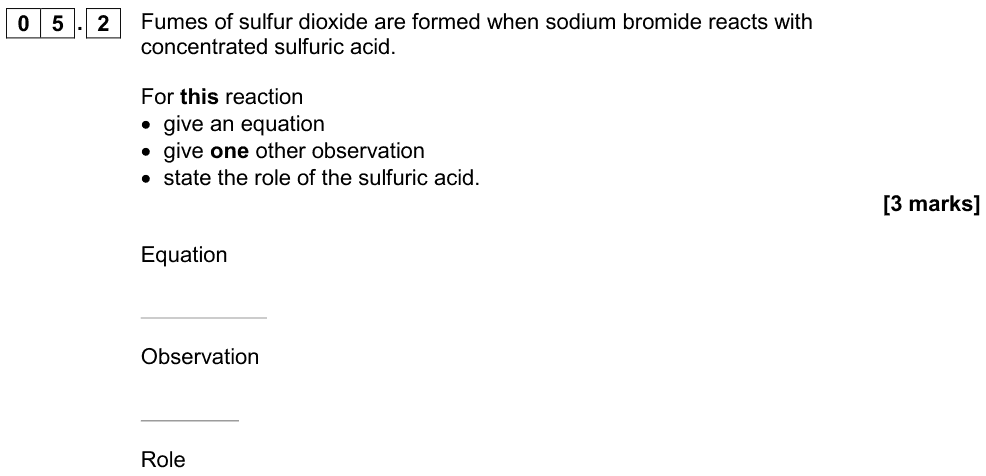
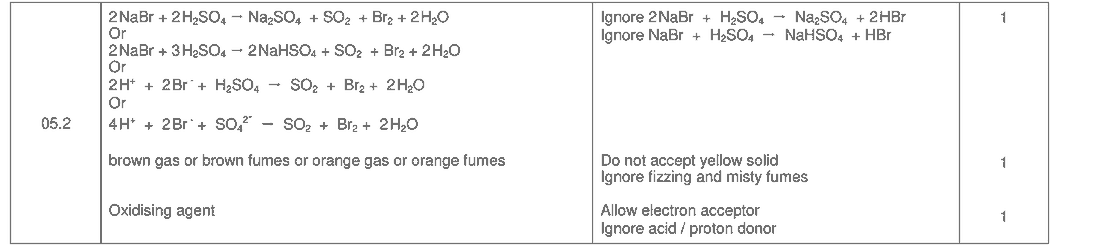
5.2 Students found this part more challenging; a few students gave a correct equation starting from sodium bromide, but equations starting from bromide ions were more successful. The observation was not well known; many students gave red fumes or brown liquid/brown solution. Mark 3 was scored more often; very few students could not state the role of sulfuric acid.
Notes from the mark scheme and report
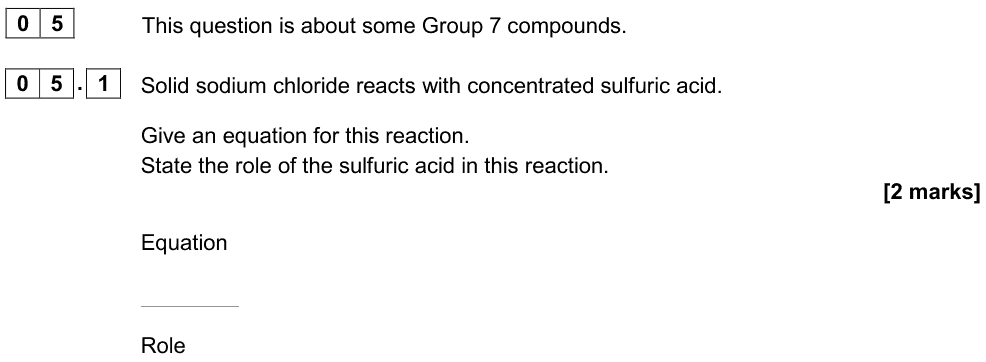
2NaBr + 2H2SO4 → Na2SO4 + SO2 + Br2 + 2H2O (or 2H+ + 2Br– + H2SO4 → SO2 + Br2 + 2H2O). Observation: brown (orange) fumes. Role: oxidising agent. Not red fumes, brown liquid or brown solution
fizzing and misty fumes are ignored
June 2019 · Paper 1 · Q05.31 markShort answerEasy
Earlier part of question 05 that this part uses
Mark scheme
Examiner's comment
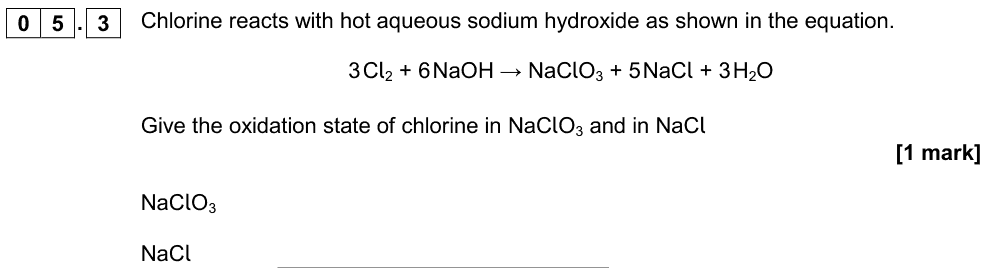
5.3 This was answered correctly by over 75% of students.
Notes from the mark scheme and report
+5 in NaClO3 and –1 in NaCl (both needed)
June 2019 · Paper 1 · Q05.41 markShort answer
Earlier part of question 05 that this part uses
Mark scheme
Examiner's comment
5.4 Most students knew chlorine was both oxidised and reduced or that this was an example of disproportionation; some students failed to gain the mark by stating either that the chlorine was reduced or that the chlorine was oxidised, but not both.
Notes from the mark scheme and report
Chlorine is both oxidised and reduced (disproportionation). Saying only oxidised or only reduced does not score
June 2019 · Paper 1 · Q06.31 markShort answer
Earlier part of question 06 that this part uses
Mark scheme
Examiner's comment
6.3 This was well answered, though common errors included base, catalyst and reducing agent.
June 2019 · AS Paper 1 · Q07.12 marksEquation writing
Mark scheme
Examiner's comment
07.1 The equation for the use of magnesium in the extraction of titanium was not well known by students, although many understood its role as a reducing agent.
Notes from the mark scheme and report
2Mg + TiCl4 → Ti + 2MgCl2
magnesium is the reducing agent (electron donor, not electron pair donor). The equation was not well known
June 2019 · AS Paper 1 · Q151 markMultiple choice
Answer
D
Mark scheme
Examiner's comment
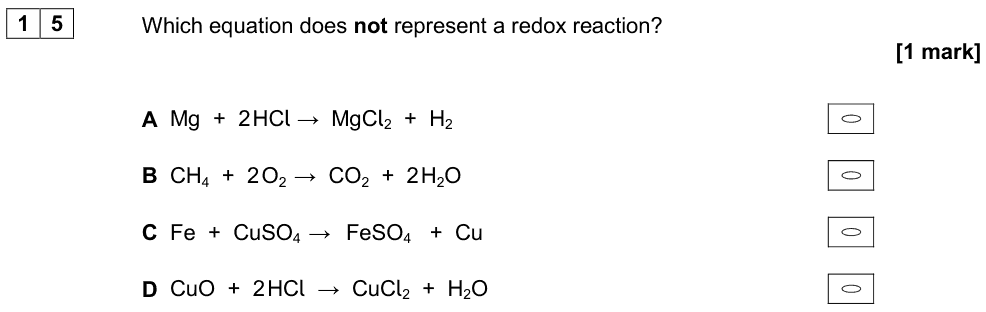
Just under half of students were able to select the equation that did not represent a redox reaction.
Notes from the mark scheme and report
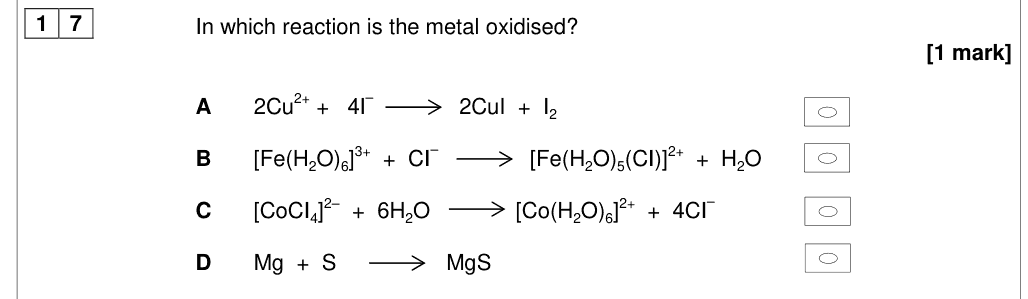
Answer: D. No oxidation state changes in CuO + 2HCl (Cu +2, O –2, H +1, Cl –1 throughout)
it is an acid–base reaction
June 2019 · Paper 3 · Q05.31 markEquation writing
Earlier part of question 05 that this part uses
Mark scheme
Examiner's comment
5.3 Another equation that over half of students were unable to construct, despite the familiarity of acidified manganate(VII) as an oxidising agent.
Notes from the mark scheme and report
5Fe2+ + MnO4– + 8H+ → 5Fe3+ + Mn2+ + 4H2O. No electrons in the overall equation. Over half could not write it
June 2018 · Paper 1 · Q03.51 markShort answerEasy
Earlier part of question 03 that this part uses
Mark scheme
Examiner's comment
03.5 74.4% of students answered this correctly, although a few students thought the oxidation state of N in ammonia was +3.
Notes from the mark scheme and report
–3 to +2 (a change of +5). Error: nitrogen in ammonia given as +3
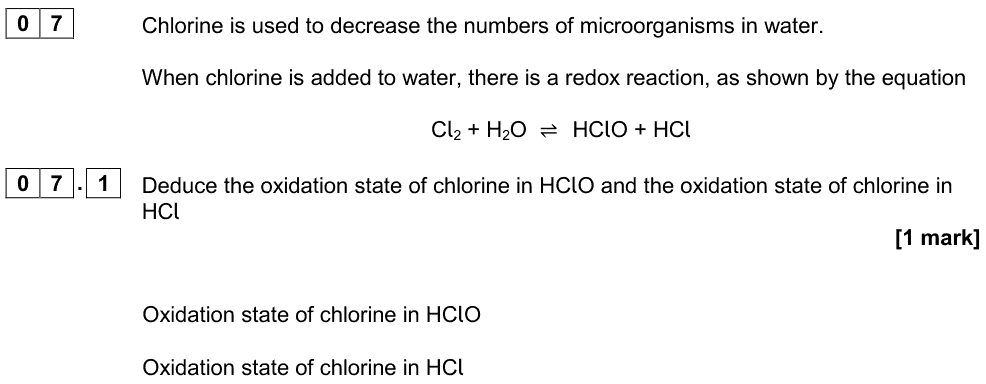
June 2018 · AS Paper 1 · Q07.11 markShort answerEasy
Mark scheme
Examiner's comment
07.1 This was answered well – nearly all students (83.8%) were able to state two correct oxidation states.
Notes from the mark scheme and report
Cl in HClO = +1
Cl in HCl = –1 (both needed for the mark)
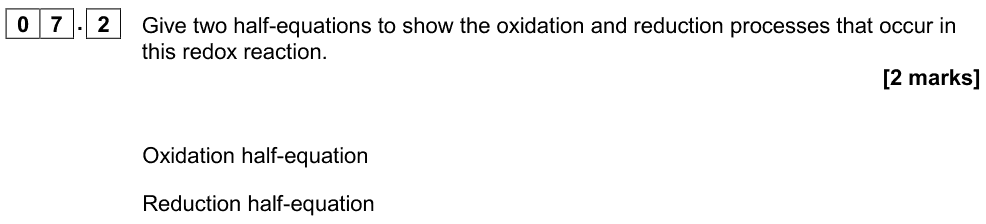
June 2018 · AS Paper 1 · Q07.22 marksEquation writing
Earlier part of question 07 that this part uses
Mark scheme
Examiner's comment
07.2 Very few students were able give the first half-equation for the oxidation of chlorine whereas the second half-equation was more regularly correct.
Notes from the mark scheme and report
Oxidation: Cl2 + 2H2O → 2HClO + 2H+ + 2e–. Reduction: Cl2 + 2H+ + 2e– → 2HCl (allow Cl2 + 2e– → 2Cl–). Both correct but in the wrong order scores 1. Very few gave the oxidation half-equation
June 2018 · Paper 1 · Q09.21 markShort answerEasy
Earlier part of question 09 that this part uses
Mark scheme
Examiner's comment
09.2 Just over three-quarters of students could give the oxidation state.
Notes from the mark scheme and report
Answer: +4
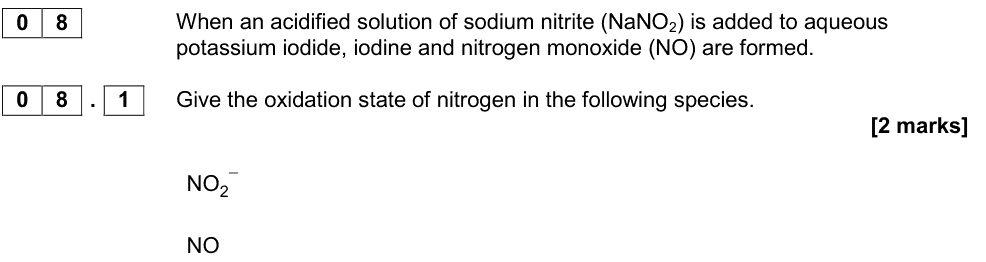
June 2017 · AS Paper 1 · Q08.12 marksShort answerEasy
Mark scheme
Examiner's comment
08.1 Students showed admirable ability to calculate the oxidation states and 71.8% of students gained both marks on this question.
Notes from the mark scheme and report
NO2–: +3. NO: +2
June 2017 · AS Paper 1 · Q08.21 markEquation writing
Earlier part of question 08 that this part uses
Mark scheme
Examiner's comment
08.2 This was much better answered than the half equations in the 2016 AS paper 1, with 44.6% of students gaining the mark.
Notes from the mark scheme and report
NO2– + 2H+ + e– → NO + H2O (allow doubled). 44.6% gained the mark
June 2017 · AS Paper 1 · Q08.31 markEquation writingEasy
Earlier part of question 08 that this part uses
Mark scheme
Examiner's comment
08.3 62.4% of students gained the mark for this familiar half-equation.
Notes from the mark scheme and report
2I– → I2 + 2e– (allow halved)
June 2017 · AS Paper 1 · Q08.41 markEquation writing
Earlier part of question 08 that this part uses
Mark scheme
Examiner's comment
08.4 This question discriminated better than the previous two part-questions; surprisingly, 8.5% of students did not even attempt this.
Notes from the mark scheme and report
2NO2– + 2I– + 4H+ → I2 + 2NO + 2H2O (electrons cancelled). 8.5% did not attempt it
June 2017 · AS Paper 1 · Q08.51 markShort answer
Earlier part of question 08 that this part uses
Mark scheme
Examiner's comment
08.5 56.3% of students were successful in gaining this mark.
Notes from the mark scheme and report
Oxidising agent (allow oxidant, electron acceptor). Not 'oxidise'
not 'accepts pairs of electrons'. 56.3% gained the mark
June 2017 · Paper 1 · Q10.12 marksShort answerEasy
Mark scheme
Examiner's comment
10.1 The oxidation states were well known, with 92.2% of students gaining both marks; +7 was the commonest wrong answer for the nitrate ion.
Notes from the mark scheme and report
Answer: +5 in NO3–
+2 in NO. Commonest wrong answer for nitrate: +7
June 2017 · Paper 1 · Q10.21 markShort answer
Earlier part of question 10 that this part uses
Mark scheme
Examiner's comment
10.2 Just under half of students could identify the weakest reducing agent.
Notes from the mark scheme and report
Answer: chloride ions, Cl– (the reduced form in the half-equation with the most positive E). Not chlorine / Cl2
June 2017 · Paper 1 · Q10.44 marksExplanation
Earlier part of question 10 that this part uses
Mark scheme
Examiner's comment
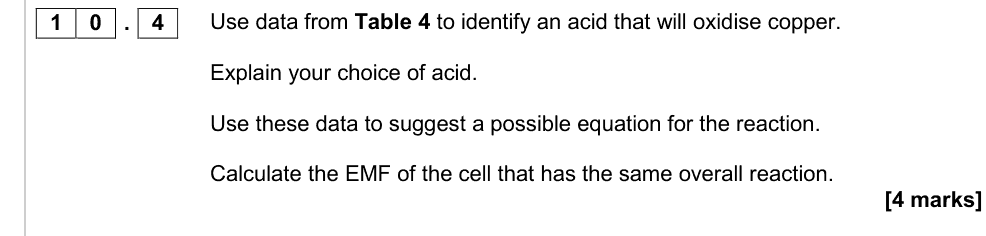
10.4 “Nitrate ions” was a common insufficient answer, and sulfuric acid a common incorrect answer.
Only the very best students scored mark point two; the common incorrect answer was that the Eo for NO3
Notes from the mark scheme and report
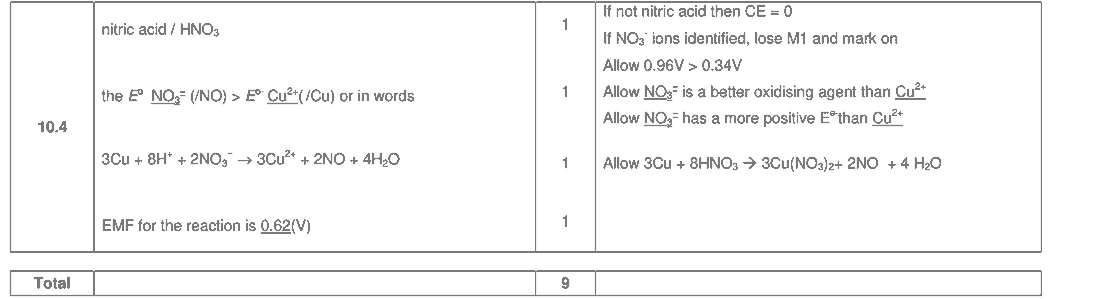
Nitric acid, HNO3 (anything else = 0
'nitrate ions' loses M1)
E(NO3–/NO) +0.96 V is more positive than E(Cu2+/Cu) +0.34 V
EMF = 0.62 V. Sulfuric acid was a common wrong choice
only the best compared the two electrode potentials correctly
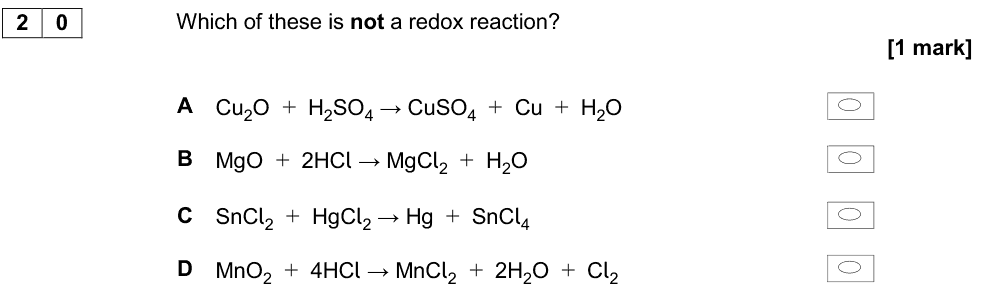
June 2017 · AS Paper 1 · Q201 markMultiple choice
Answer
B
Mark scheme
Examiner's comment
Although 47.8% of students scored here, the three distractors all drew significant attention.
Notes from the mark scheme and report
Answer: B. MgO + 2HCl is acid–base: Mg stays +2, O –2, H +1, Cl –1. In A copper(I) disproportionates, in C Sn is oxidised and Hg reduced, in D Mn is reduced and Cl oxidised (47.8% correct)
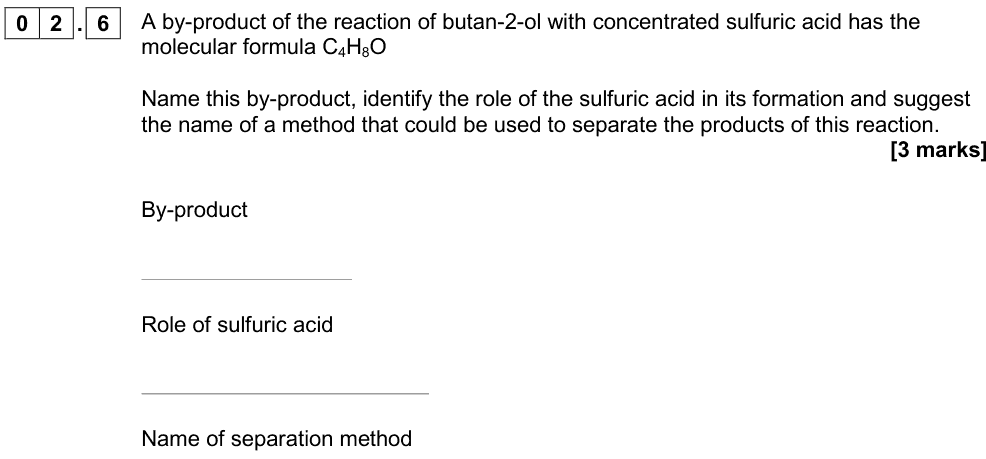
June 2017 · Paper 3 · Q02.63 marksShort answer
Earlier part of question 02 that this part uses
Mark scheme
Examiner's comment
02.6 Butanal was a common wrong answer for the by-product and the fact that sulfuric acid acts as an oxidising agent was not well recognised.
Notes from the mark scheme and report
Butanone
sulfuric acid acts as an oxidising agent (electron acceptor)
(fractional) distillation. Common wrong answers: butanal (a secondary alcohol gives a ketone)
reflux named as a separation method
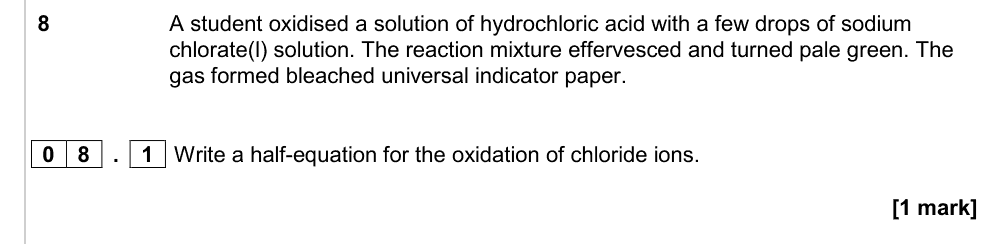
June 2016 · AS Paper 1 · Q08.11 markEquation writing
Mark scheme
Examiner's comment
Even the half equation in 8.1 was usually not answered correctly and the more challenging equations in 8.2 and 8.3 were only seen from the better students.
Notes from the mark scheme and report
2Cl– → Cl2 + 2e–. Usually not answered correctly
June 2016 · AS Paper 1 · Q08.21 markEquation writing
Earlier part of question 08 that this part uses
Mark scheme
Examiner's comment
Even the half equation in 8.1 was usually not answered correctly and the more challenging equations in 8.2 and 8.3 were only seen from the better students.
Notes from the mark scheme and report
2ClO– + 4H+ + 2e– → Cl2 + 2H2O (allow a balanced version with HClO). Only the better students got this
June 2016 · AS Paper 1 · Q08.31 markEquation writing
Earlier part of question 08 that this part uses
Mark scheme
Examiner's comment
Even the half equation in 8.1 was usually not answered correctly and the more challenging equations in 8.2 and 8.3 were only seen from the better students.
In 8.4 the explanation that iodide ions are oxidised wasn’t seen very often but a reasonable proportion of students scored some marks on this question.
Notes from the mark scheme and report
Solution turns brown (allow black solid
not black solution or purple) because iodine (or I3–) forms
iodide ions are oxidised (by ClO–). A correct half-equation 2I– → I2 + 2e– scores the second and third marks. 'Iodide is oxidised' was seldom stated
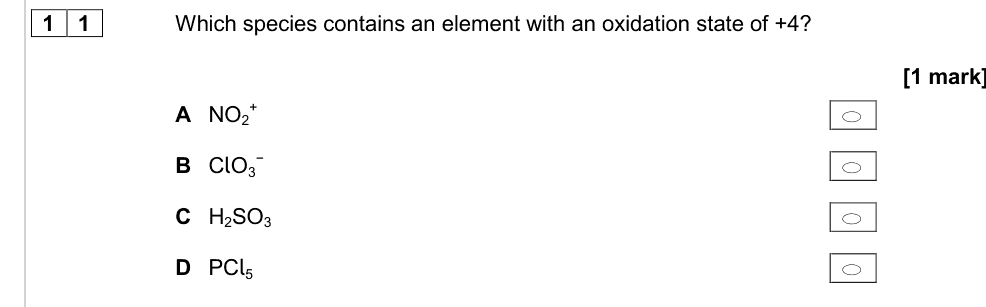
June 2016 · AS Paper 1 · Q111 markMultiple choice
Answer
C
Mark scheme
Examiner's comment
Questions 10-24 Multiple choice From this section of the paper items 10,11,15 and 18 were usually answered correctly. It was surprising to see that item 17 was answered poorly but it did give further evidence that redox ideas are not well understood by large numbers of students at this level. Item 20 proved difficult showing that the overall dipole possessed by a molecule clearly isn’t a well understood concept. Item 22 was also not answered correctly by most; this idea has not been tested often in the previous specification so students may not have had much prior experience of the type of question.
Notes from the mark scheme and report
Answer: C. S is +4 in H2SO3
N in NO2+, Cl in ClO3– and P in PCl5 are all +5 (report: report says item 11 was usually answered correctly)
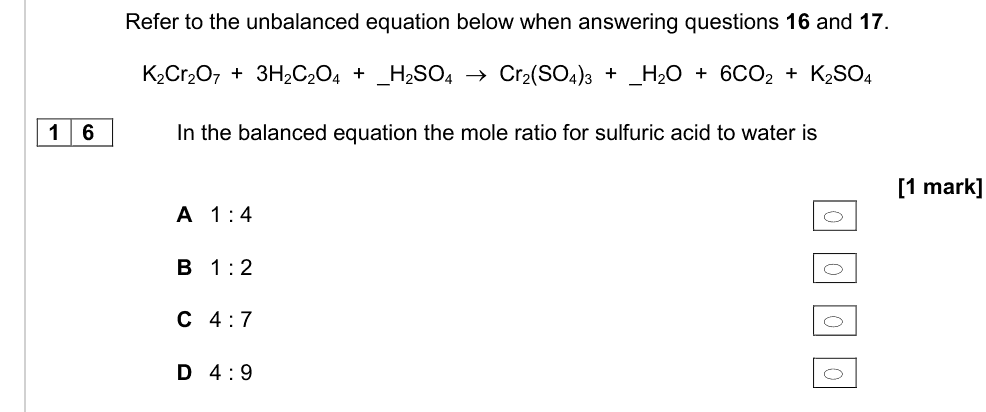
June 2016 · AS Paper 1 · Q171 markMultiple choice
Earlier part of question 17 that this part uses
Answer
B
Mark scheme
Examiner's comment
Questions 10-24 Multiple choice From this section of the paper items 10,11,15 and 18 were usually answered correctly. It was surprising to see that item 17 was answered poorly but it did give further evidence that redox ideas are not well understood by large numbers of students at this level. Item 20 proved difficult showing that the overall dipole possessed by a molecule clearly isn’t a well understood concept. Item 22 was also not answered correctly by most; this idea has not been tested often in the previous specification so students may not have had much prior experience of the type of question.
Notes from the mark scheme and report
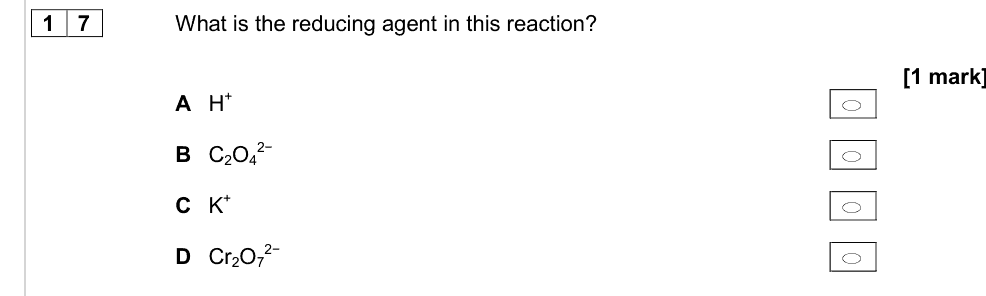
Answer: B. C2O4 2– is oxidised to CO2 (C +3 to +4), donating electrons to Cr2O7 2– (report: report says item 17 was answered poorly)
Specimen · Paper 1 · Q07.56 marksCalculation
Earlier part of question 07 that this part uses
Mark scheme
Notes from the mark scheme and report
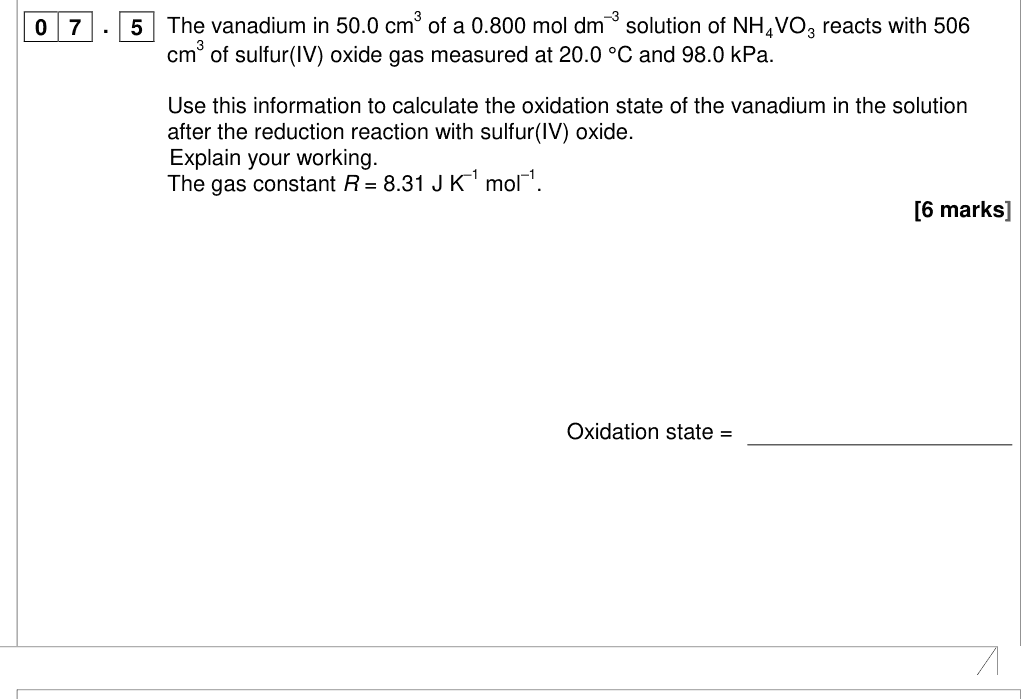
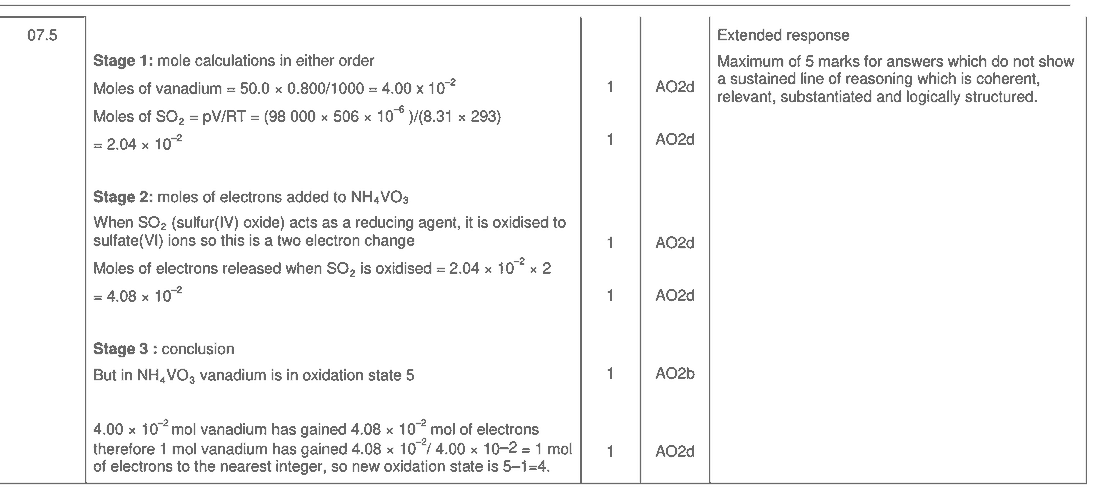
Answer: +4. n(V) = 50.0 × 0.800 ÷ 1000 = 4.00 × 10^–2 mol. n(SO2) = pV/RT = (98 000 × 506 × 10^–6) ÷ (8.31 × 293) = 2.04 × 10^–2 mol. SO2 is oxidised to sulfate(VI), a two-electron change, so electrons released = 4.08 × 10^–2 mol. Each V(V) gains 4.08 ÷ 4.00 = 1 electron, so 5 – 1 = 4. Six point marks
max 5 without a sustained line of reasoning
Skills: MS0.0 Recognise and make use of appropriate units in calculation; MS0.2 Use ratios, fractions and percentages; MS2.2 Change the subject of an equation; MS2.3 Substitute numerical values into algebraic equations using appropriate units for physical quantities
Specimen · Paper 3 · Q01.21 markAO2=1Equation writing