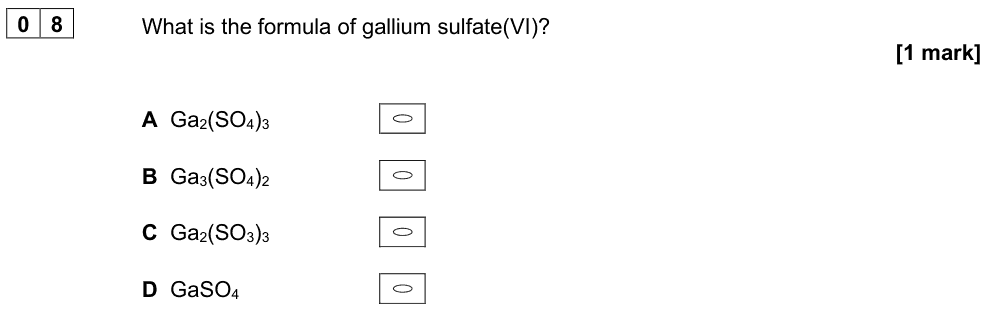
Answer
A
Mark scheme

Examiner's comment
This was answered correctly by a majority of students.
Notes from the mark scheme and report
- Answer: A. Ga is in Group 3 so forms Ga3+
- sulfate(VI) is SO4 2–
- charges balance in Ga2(SO4)3
Every multiple-choice question: Section B of A-level Paper 3 (thirty) and Section B of each AS paper (fifteen), with the answer behind the button. Allow about a minute and a quarter each. 600 questions.
Other types: Calculation questions · Equation questions · Mechanism questions · Structure and diagram questions · Explanation questions · Six-mark level of response questions · Practical questions · Short-answer questions
A
This was answered correctly by a majority of students.
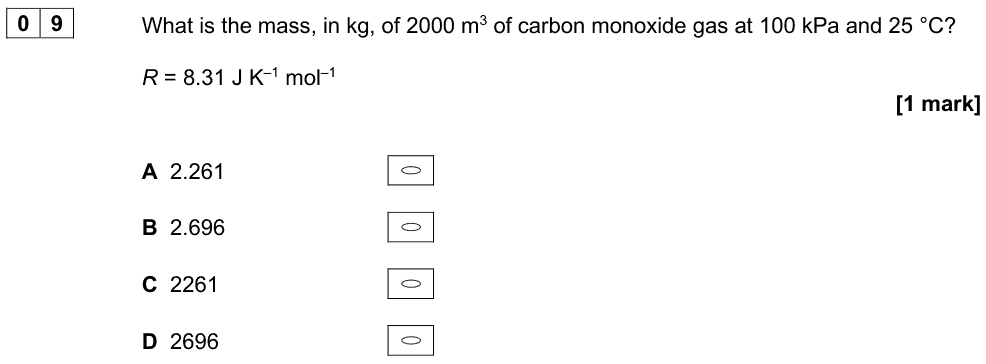
C
This was answered correctly by a majority of students.
Skills: MS0.0 Recognise and make use of appropriate units in calculation; MS2.2 Change the subject of an equation; MS2.3 Substitute numerical values into algebraic equations using appropriate units for physical quantities
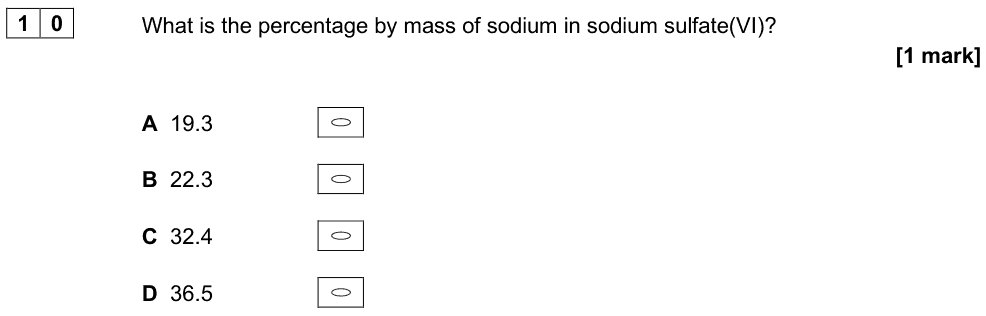
C
The correct answer was the most common answer, although many students had used an incorrect formula of sodium sulphate (VI) in their calculation.
Skills: MS0.2 Use ratios, fractions and percentages
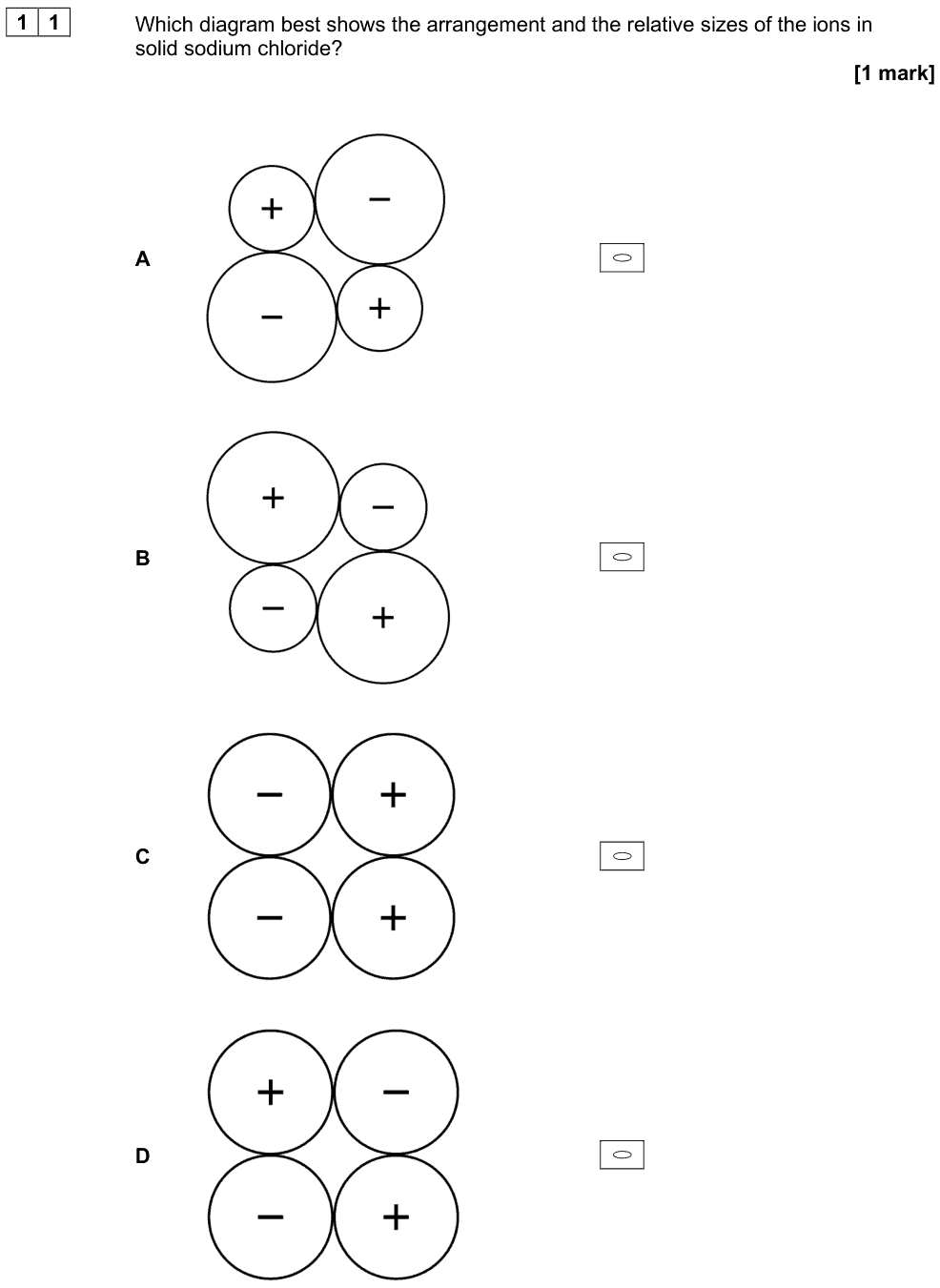
A
Under half of the students could identify the relative sizes and arrangements of the sizes of the ions in sodium chloride. A large number of students thought that the sodium ion was larger than the chloride ion.
Skills: MS4.2 Visualise and represent 2D and 3D forms including two-dimensional representations of 3D objects
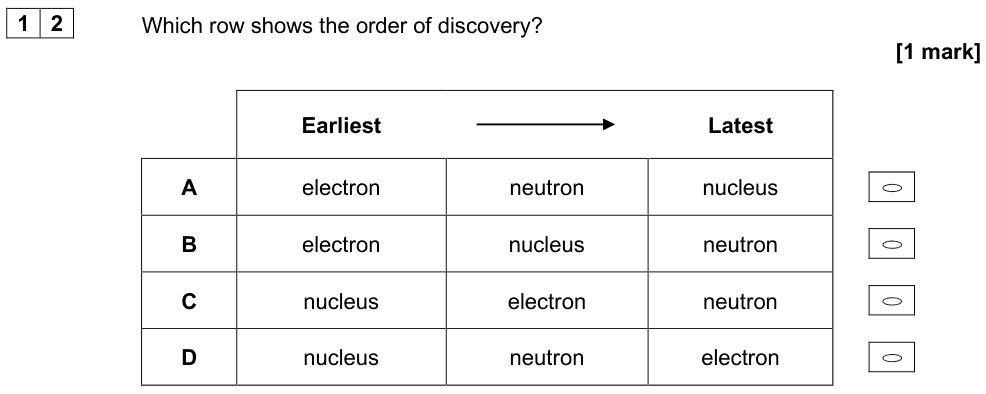
B
This was answered correctly by a majority of students.
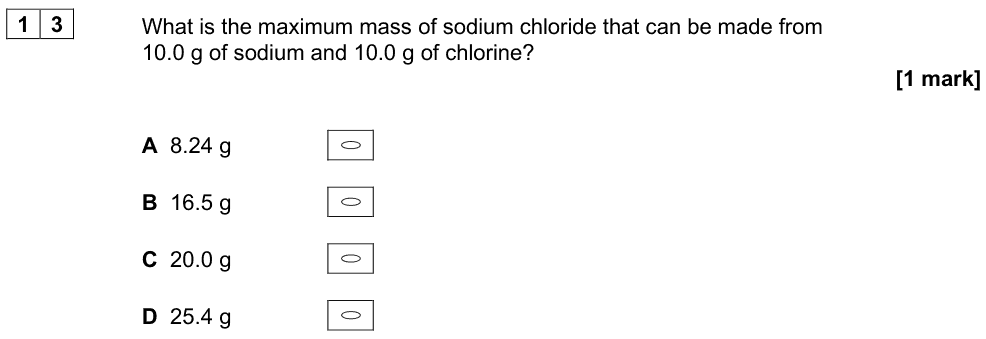
B
About half of the students were able to correctly calculate the maximum mass of sodium chloride formed from 10.0g of sodium and 10.0g of chlorine.
Skills: MS0.2 Use ratios, fractions and percentages
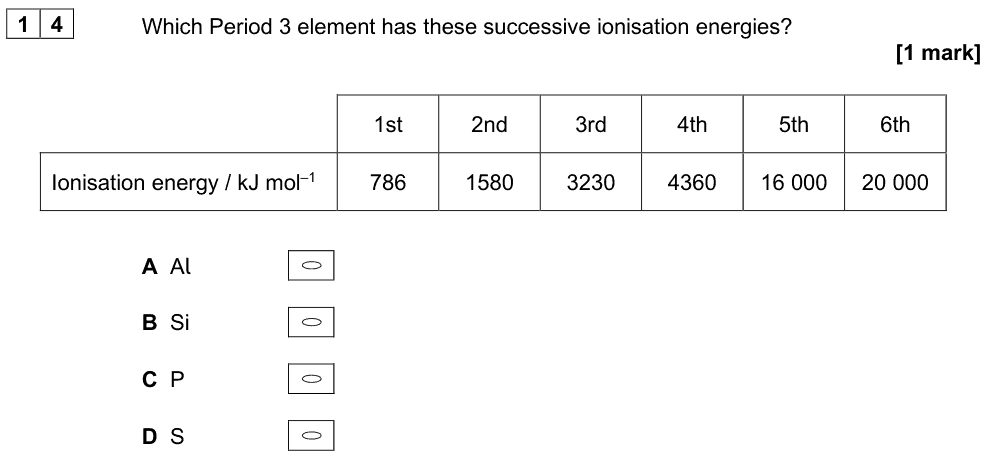
B
This was answered correctly by about three-quarters of students.
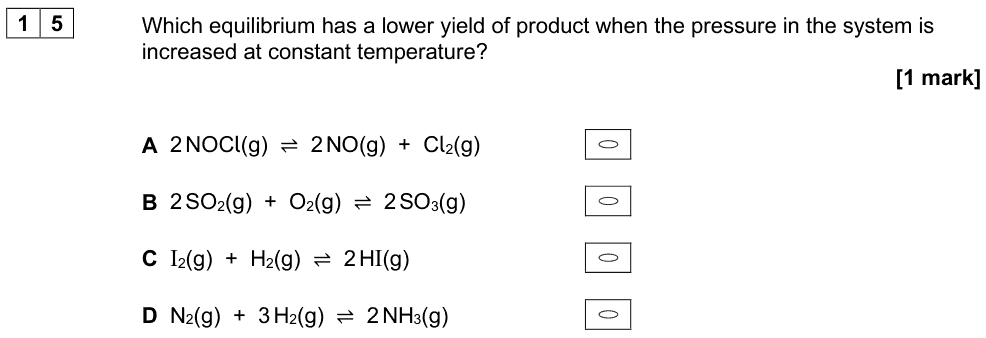
A
A majority of students were able to identify the equilibrium that has a lower yield of product when the pressure is increased at a constant temperature.
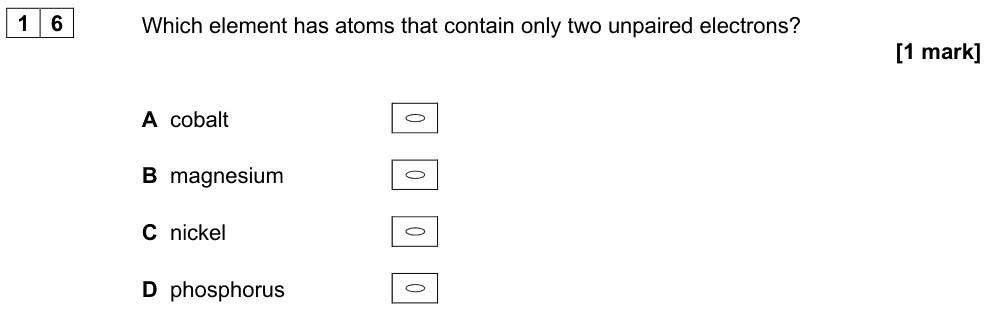
C
About half the students were able to identify correctly the element that has atoms that contain only two unpaired electrons.
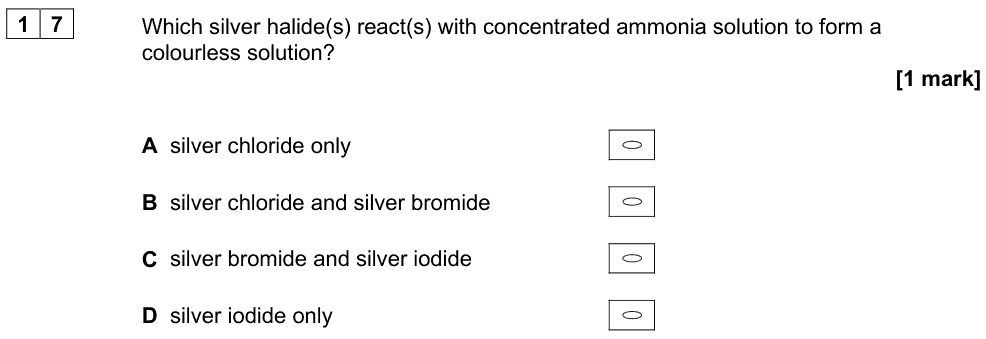
B
About two-thirds of students could identify the silver halide that reacts with concentrated ammonia for form a colourless solution.
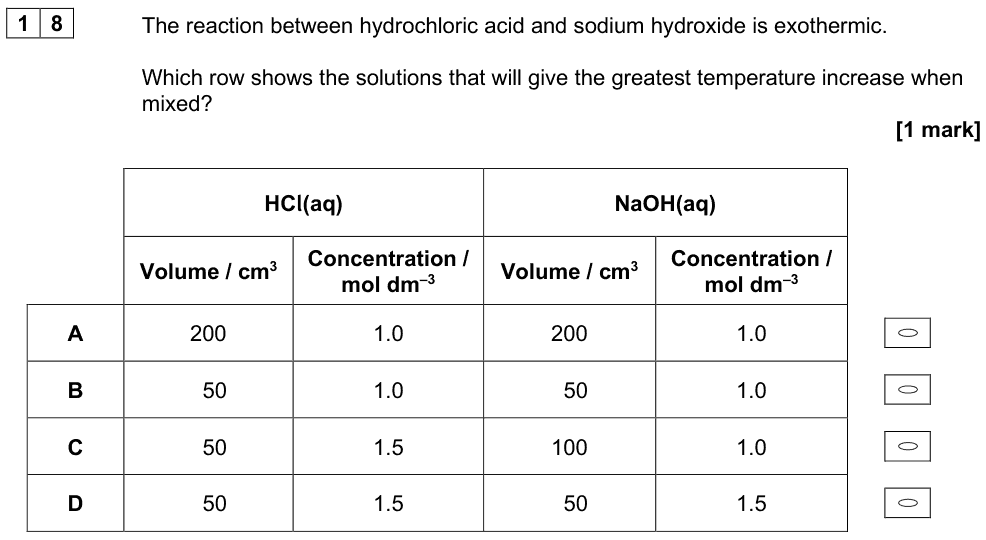
D
Students found this challenging with only about one third of students able to consider which combination of solutions would give the greatest temperature change. The most common answer was one where the students considered the maximum number of moles rather than considering that a lower total volume would also lead to a higher temperature rise.
Skills: MS0.2 Use ratios, fractions and percentages
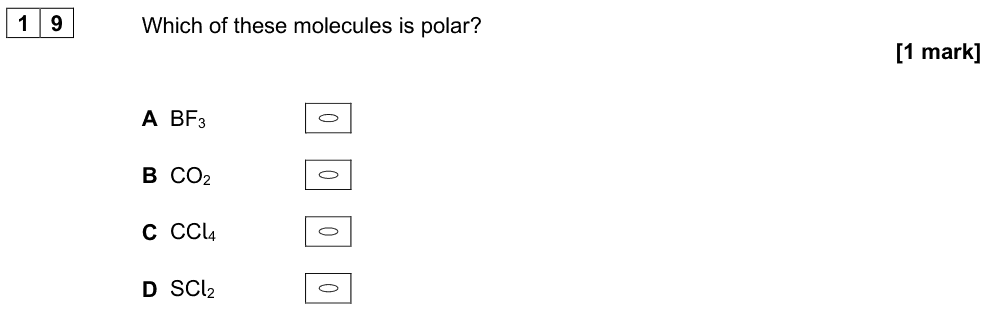
D
Just under half of students were able to identify which molecule is polar. Many students decided that BF3 was polar but didn’t appreciate that the dipoles in this molecule would cancel out.
Skills: MS4.1 Use angles and shapes in regular 2D and 3D structures
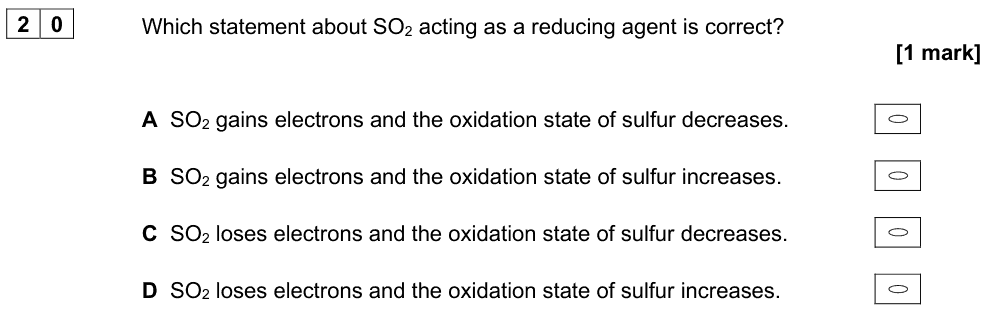
D
Just over half of the students were able to link the idea of the loss of electrons by with changes in oxidation state when SO2 acts as a reducing agent.
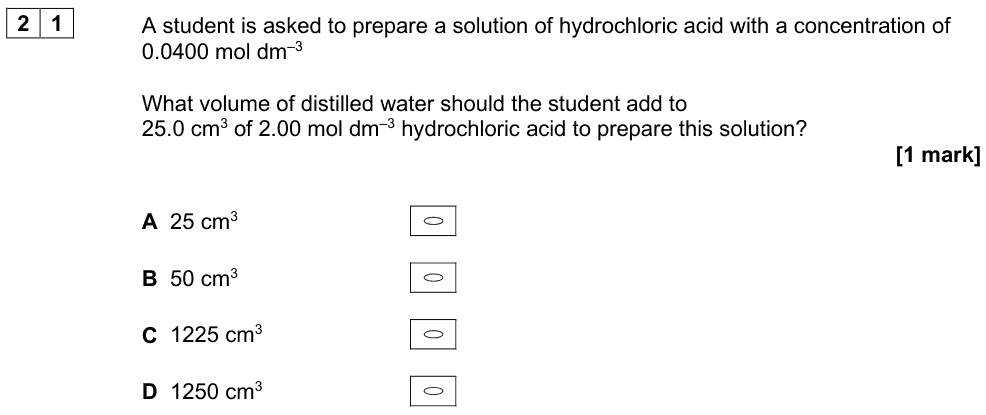
C
Students found this challenging and many gave the total volume of the solution rather than calculating the volume of water that needs to be added to a solution to dilute it to give a solution with concentration of 0.0400 mol dm–3
Skills: MS0.2 Use ratios, fractions and percentages; MS2.2 Change the subject of an equation; ATe Use volumetric flask, including accurate technique for making up a standard solution
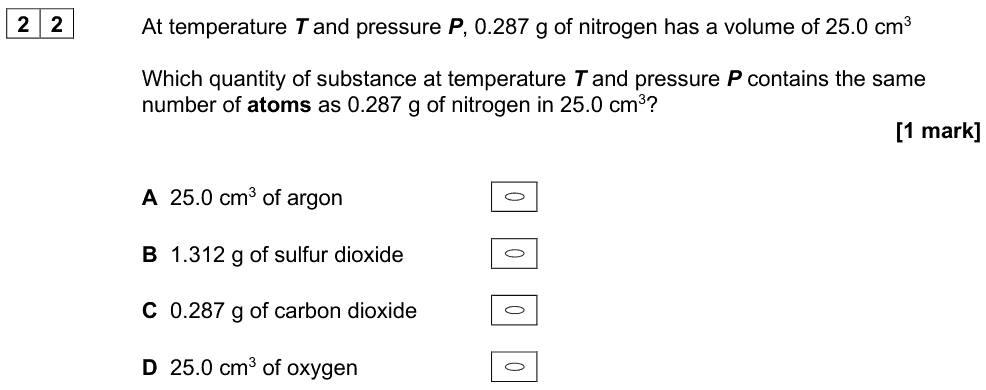
D
Students found this challenging with only about a quarter of students being able to identify which sample contained the same number of atoms as in 0.287 g of nitrogen at 25.0 cm3
Skills: MS0.2 Use ratios, fractions and percentages
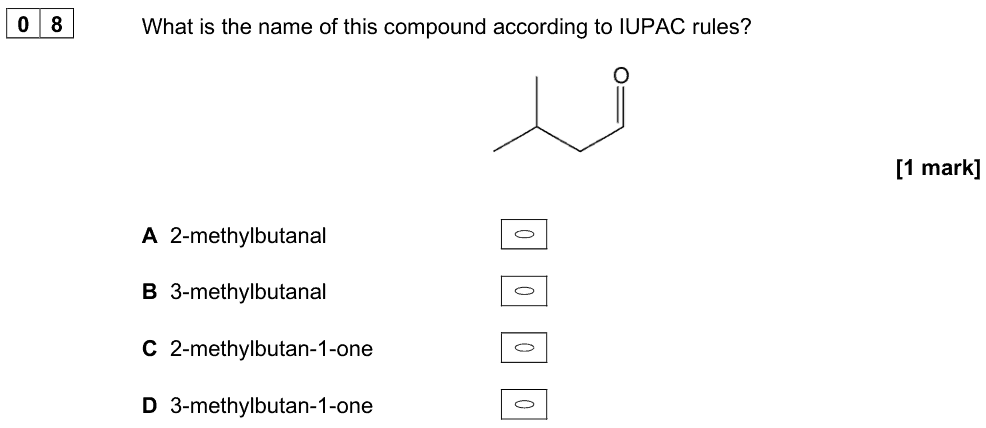
B
Organic nomenclature This was answered correctly by a majority of students but many thought it was a ketone rather than an aldehyde or did not appreciate that the aldehyde group was C-1 and so the methyl group was on C-3 not C-2.
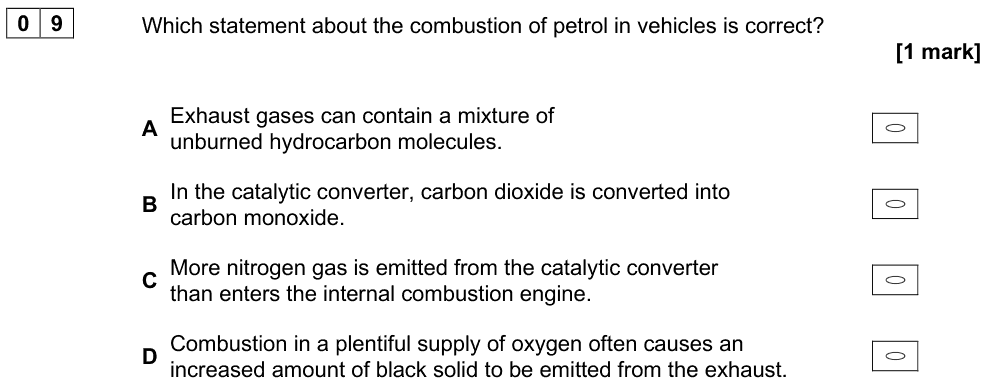
A
Catalytic converters This was answered correctly by a majority of students.
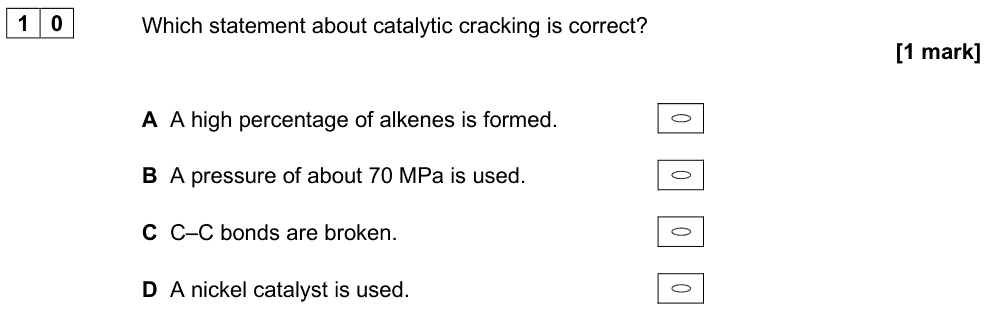
C
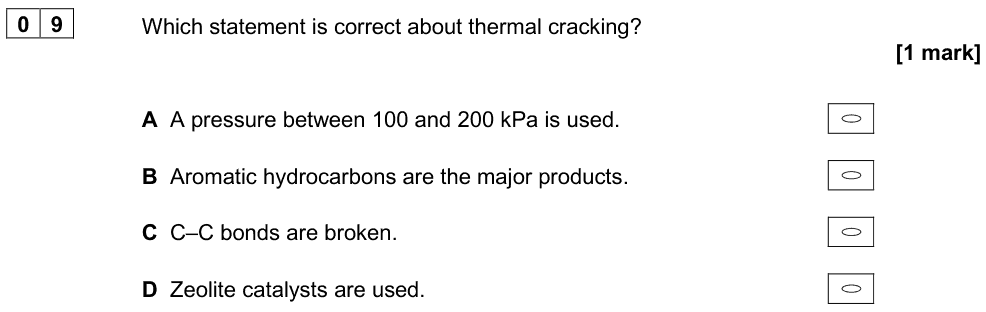
This was answered correctly by a majority of students, but many did mix up aspects with thermal cracking.
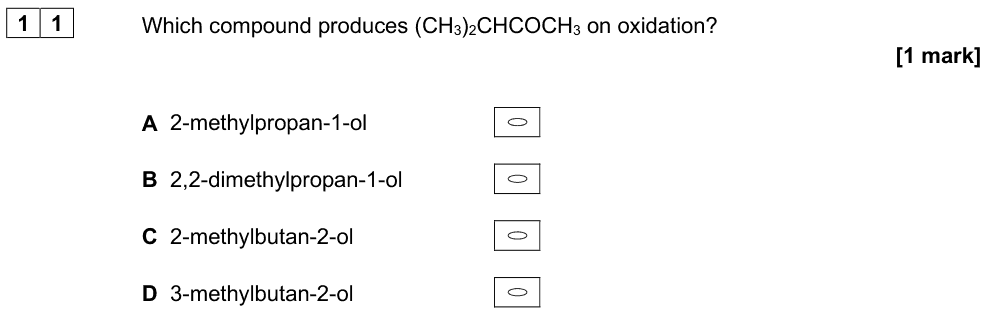
D
This was answered correctly by a majority of students.
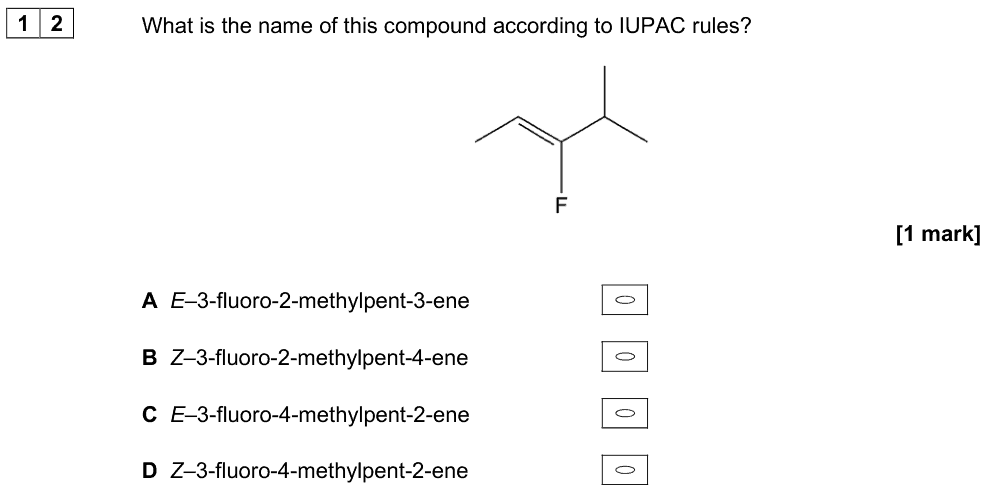
D
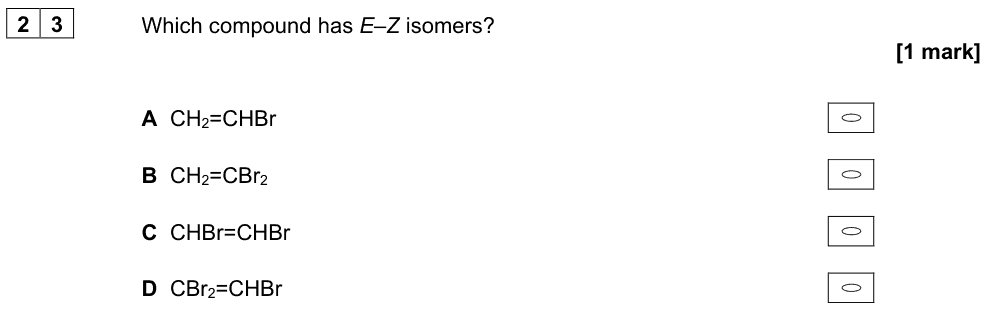
The correct answer was the most common answer, but many thought the compound was E not Z possibly as they looked at the relative mass of the whole group attached to the C of C=C rather than the relative mass of the first atom attached.
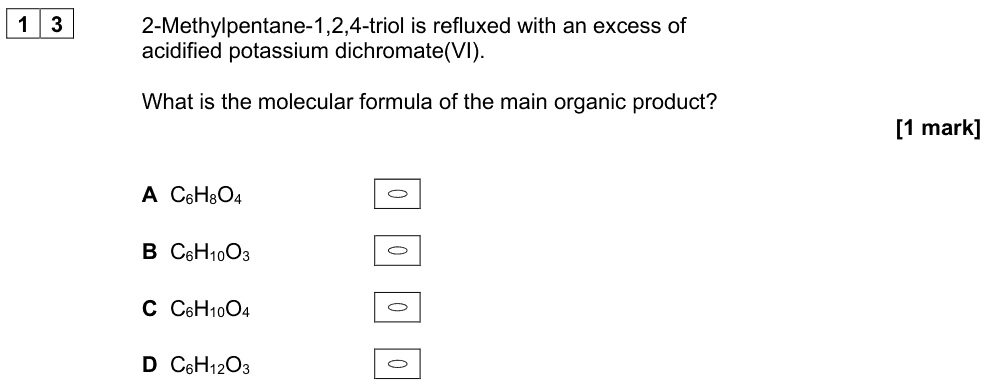
C
The correct answer was the most common answer, but it appears that students found it hard to deal with the different oxidations of the three alcohol groups.
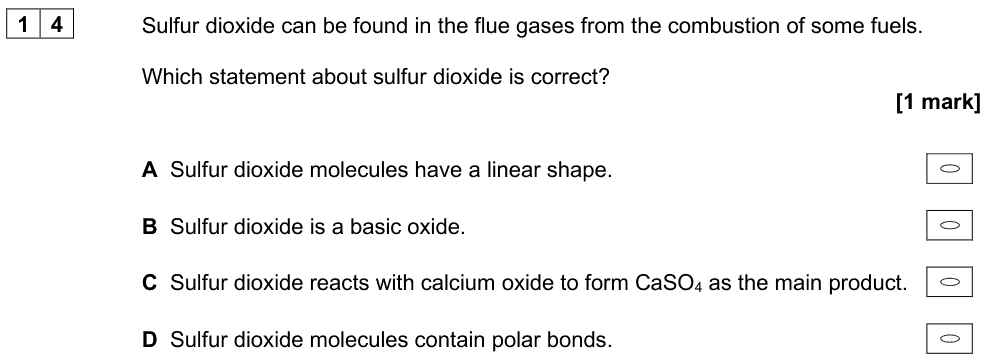
D
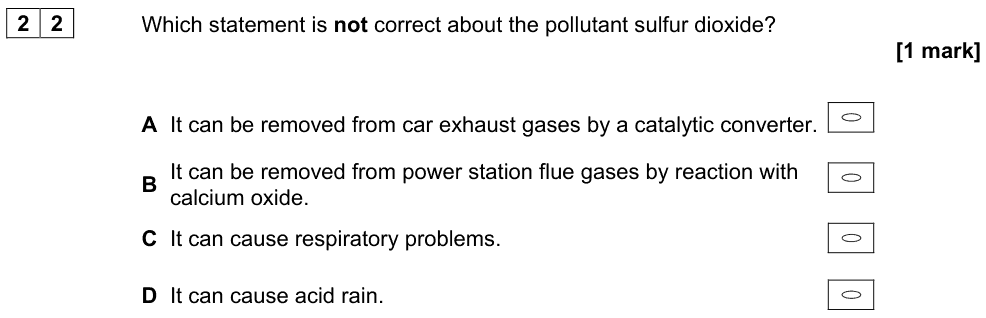
The most common answer was incorrect. SO2 reacts with CaO to form CaSO3 and not CaSO4 as the main product. Fewer students appreciated that SO2 contains polar bonds.
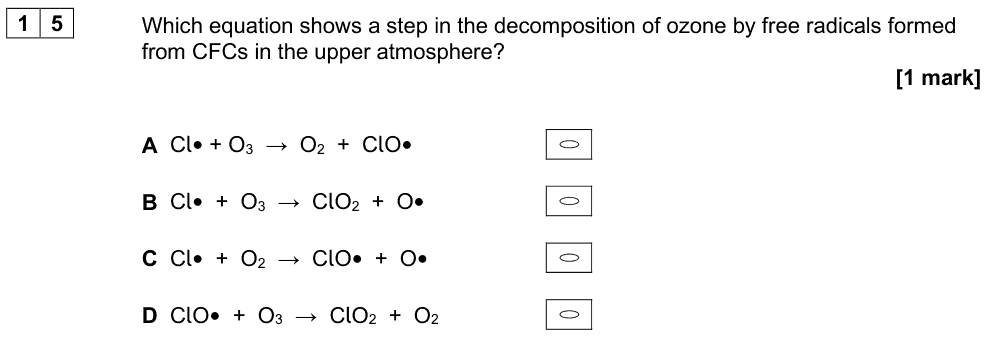
A
This was answered correctly by a majority of students. Q16 Fractional distillation of crude oil This was answered correctly by a majority of students.
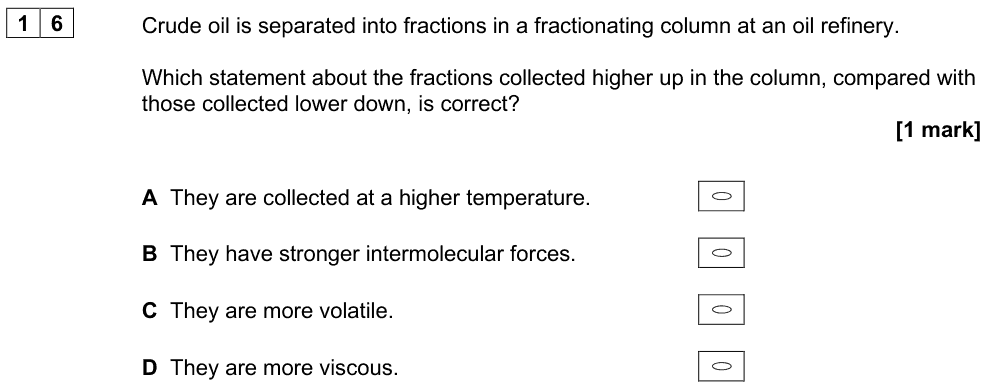
C
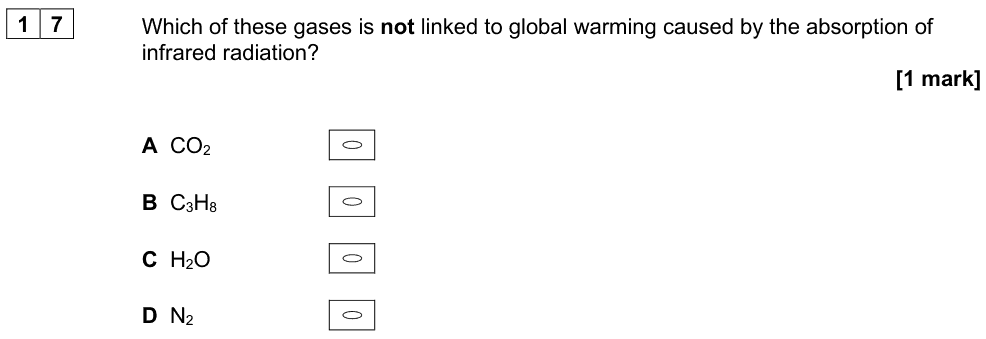
D
This was answered correctly by a majority of students, but many thought that propane or water were not greenhouse gases.
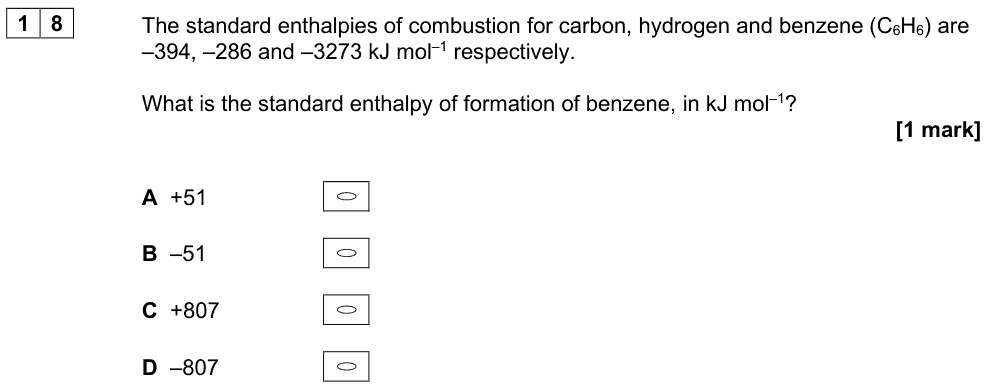
A
Students struggled with this question. Common errors were thinking that the cycle involved 6 x the enthalpy of combustion of hydrogen rather than 3 x, and/or making an error with sign for the required reaction. Q19 Maxwell-Boltzmann distribution curve This was answered correctly by a majority of students.
Skills: MS2.4 Solve algebraic equations
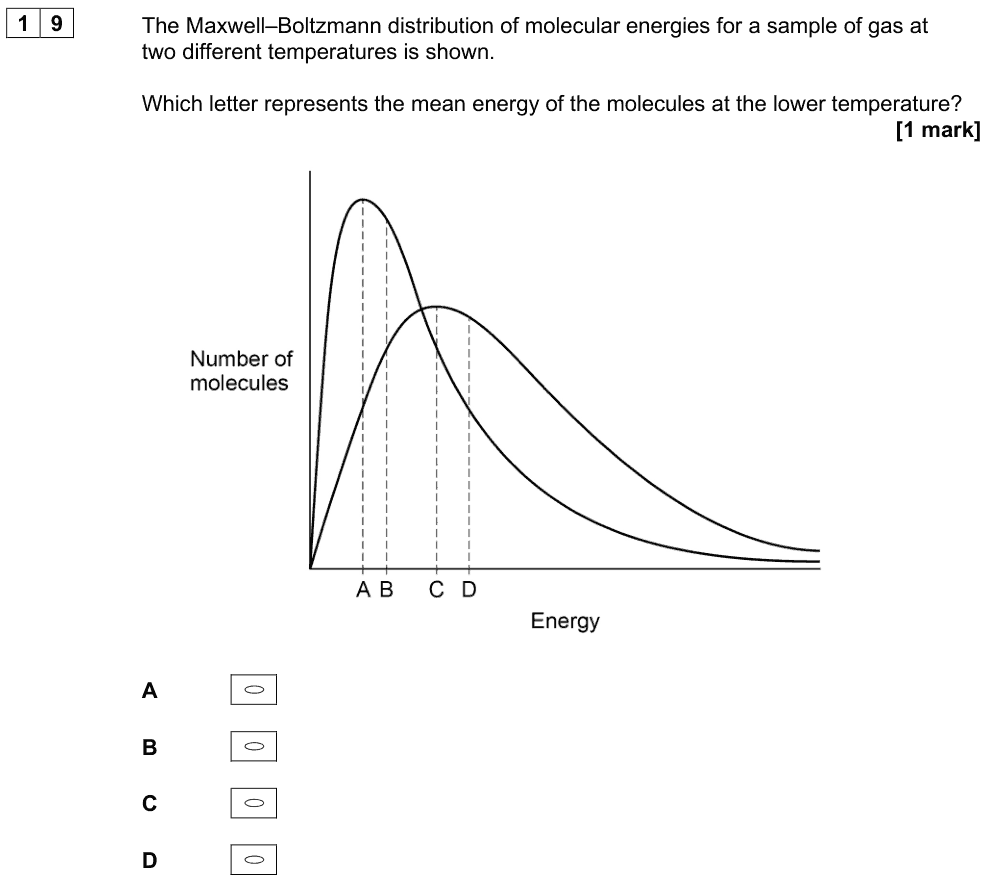
B
Skills: MS3.1 Translate information between graphical, numerical and algebraic forms
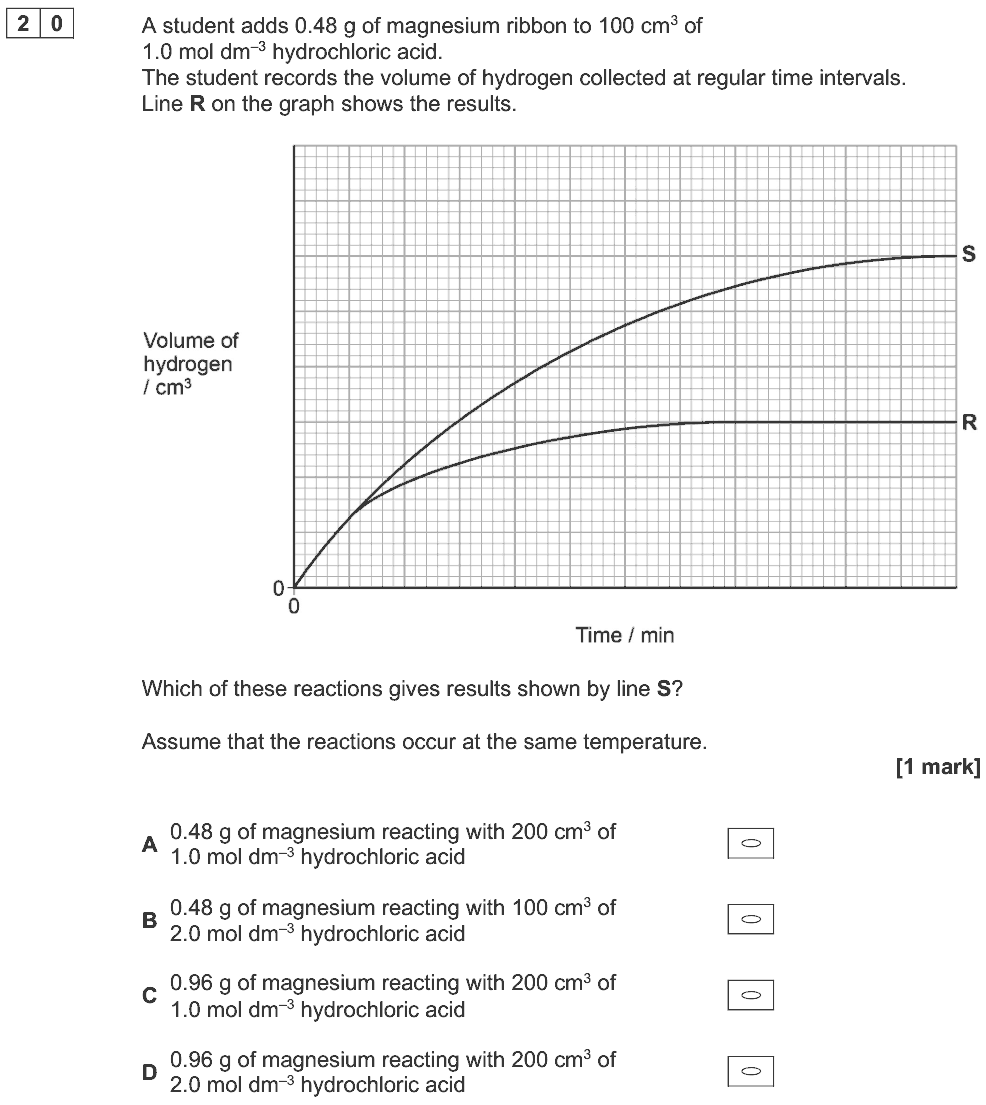
C
Students found this hard although the correct answer was the most common response. Students struggled to appreciate the impact of limiting reagents on the volume of gas formed.
Skills: MS3.1 Translate information between graphical, numerical and algebraic forms; MS0.2 Use ratios, fractions and percentages
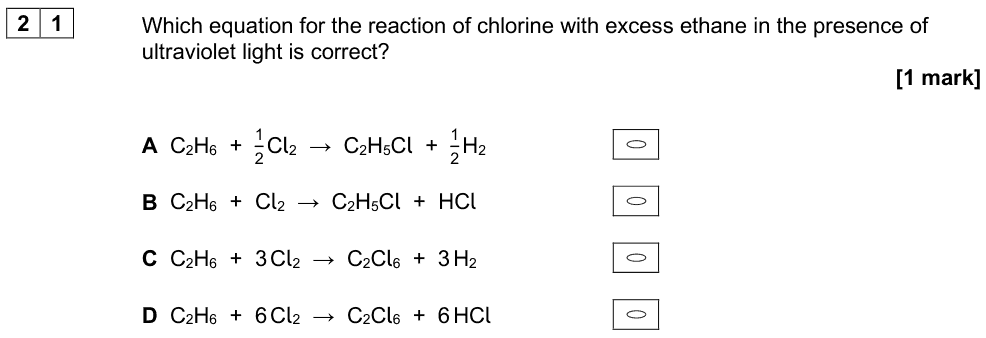
B
This was answered correctly by a majority of students.
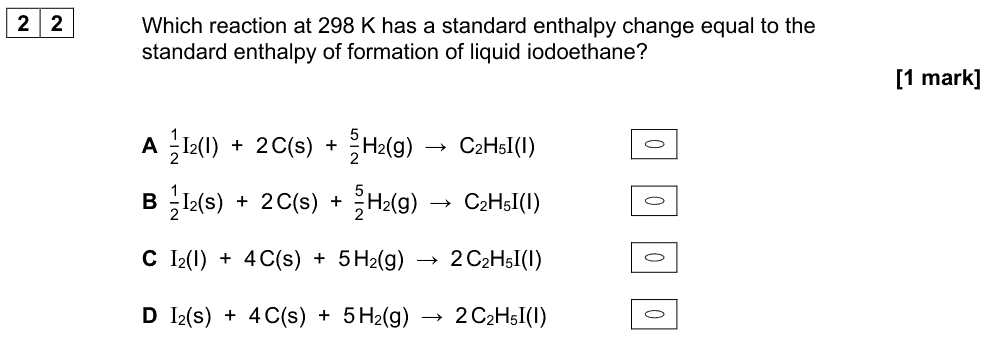
B
Students found this hard although the correct answer was the most common. Students struggled to appreciate that iodine is a solid and/or that the equation for the enthalpy of formation must form one mole of the compound.
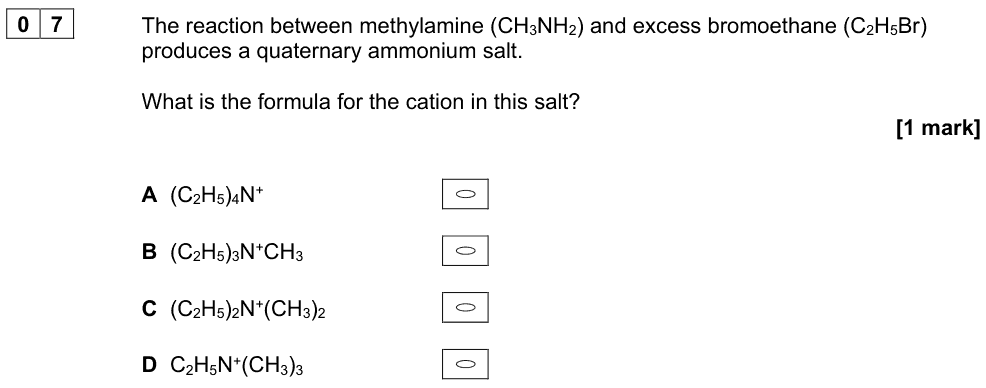
B
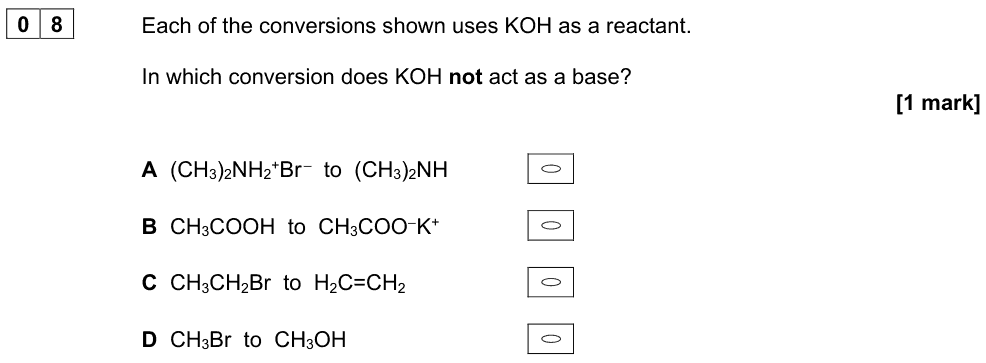
D
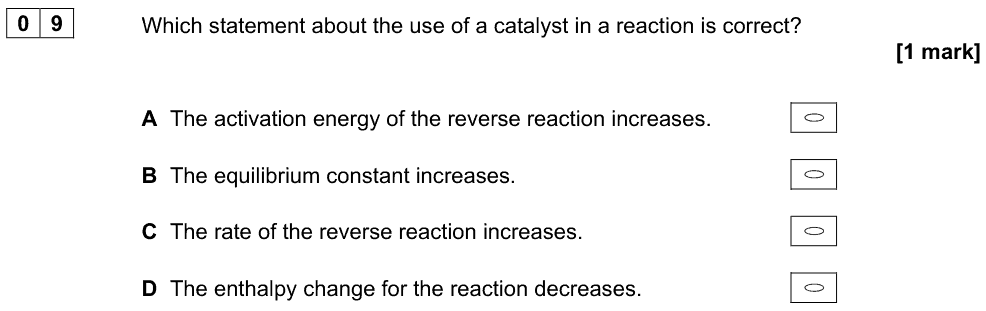
C
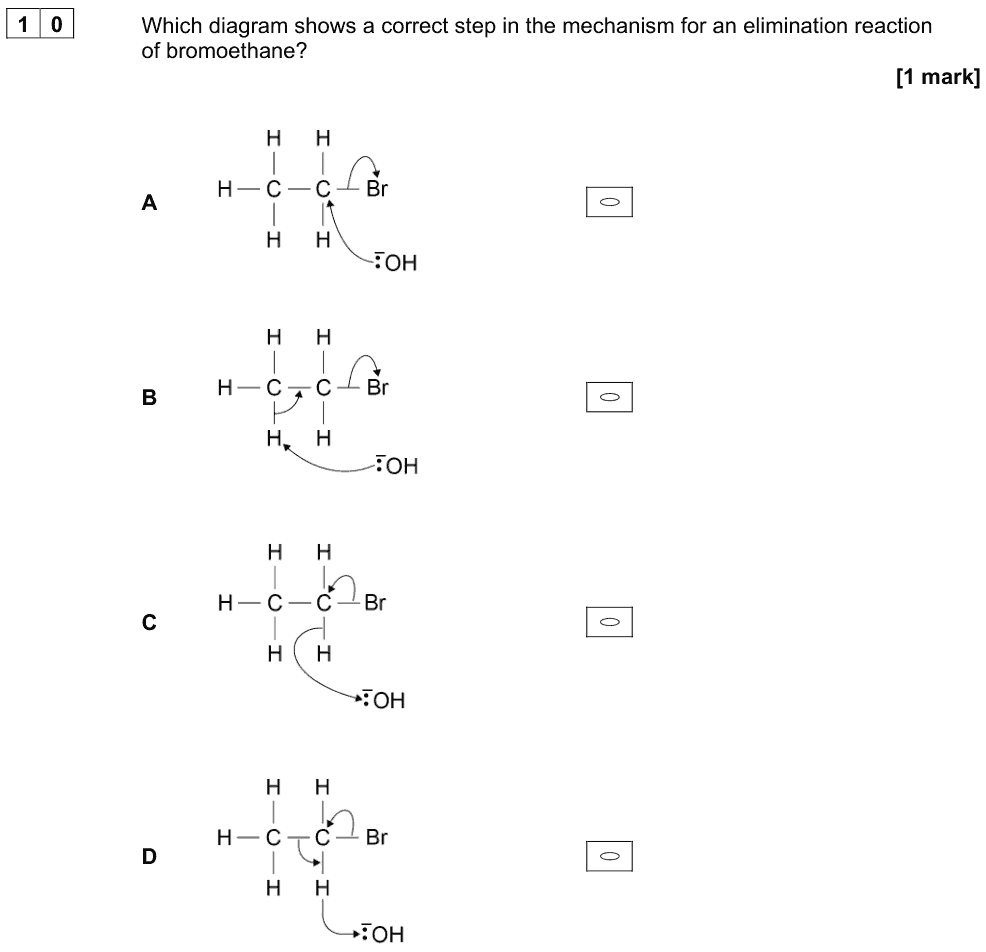
B
The most accessible items (answered correctly by more than 80% of students) were questions 10, 15, 18 and 25. The least accessible questions (< 55% success rate) were 8, 12, 14, 21, 31, 35 and 36.
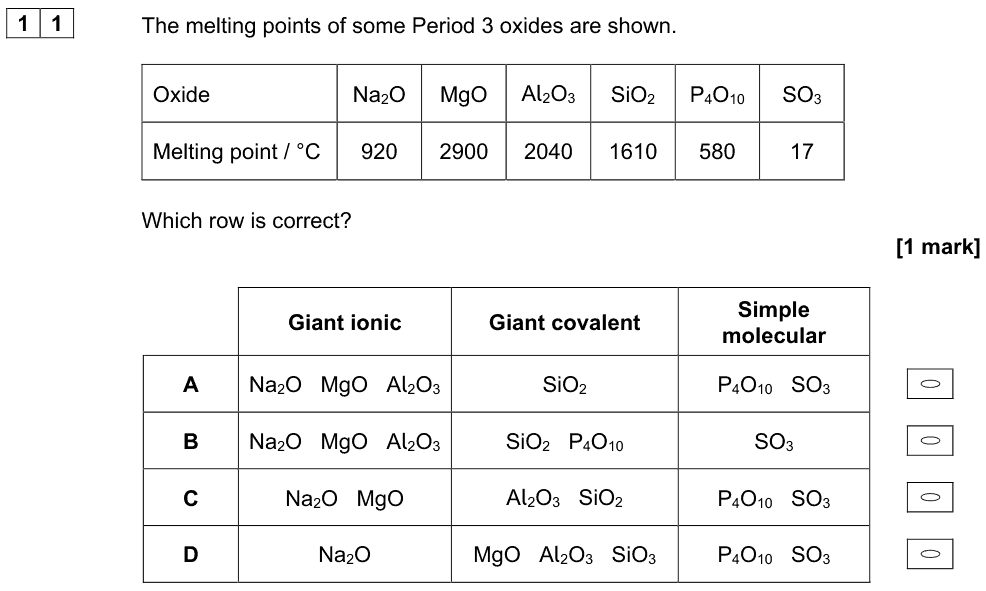
A
Unfortunately, an erratum notice had to be issued for Question 11 due to a typo in one of the distractors, option D: SiO2 had to be substituted for the incorrect SiO3. The vast majority of students thankfully had the erratum notice delivered to them; detailed analyses showed that there was no discernible difference in the performance on this question between that majority of students and the small minority who were not told about the error. The question, answered correctly by just over 75% of students, had one of the best discrimination indices of all the Section B questions, and so functioned well.
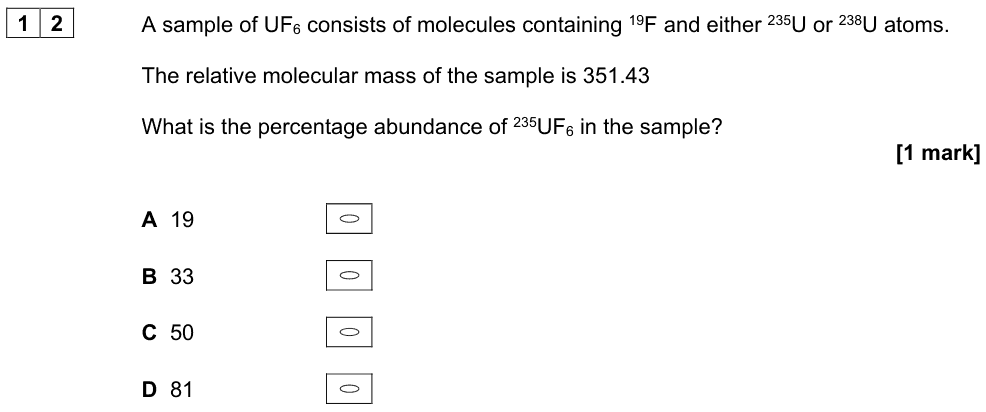
A
Skills: MS0.2 Use ratios, fractions and percentages; MS1.2 Find arithmetic means; MS2.4 Solve algebraic equations
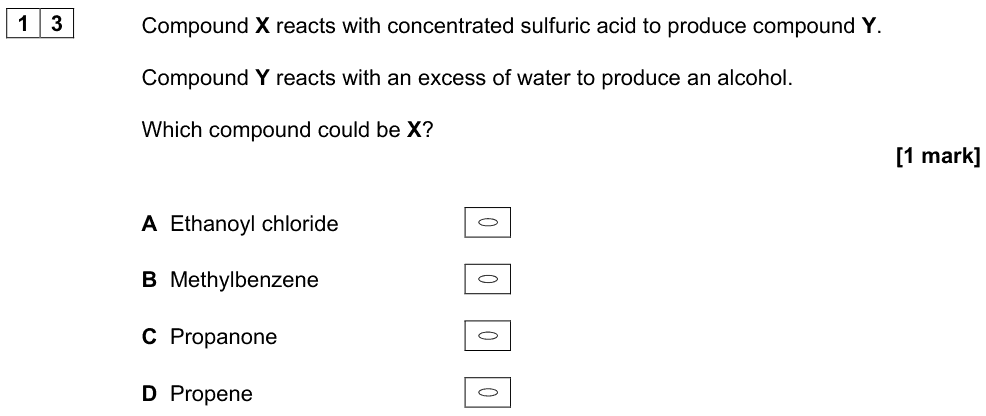
D
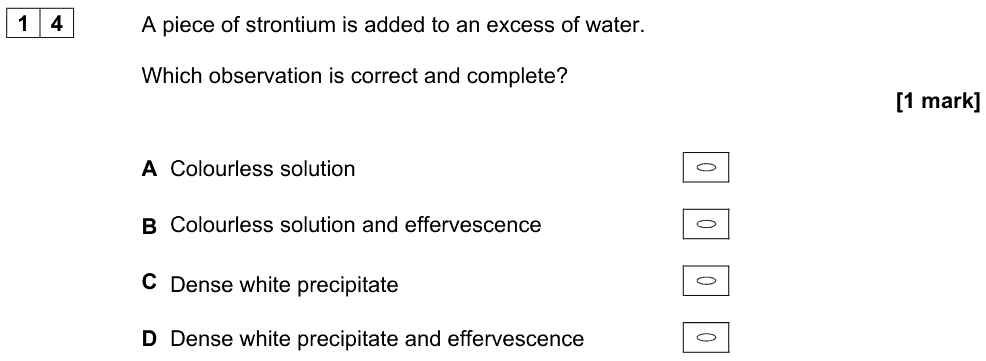
B
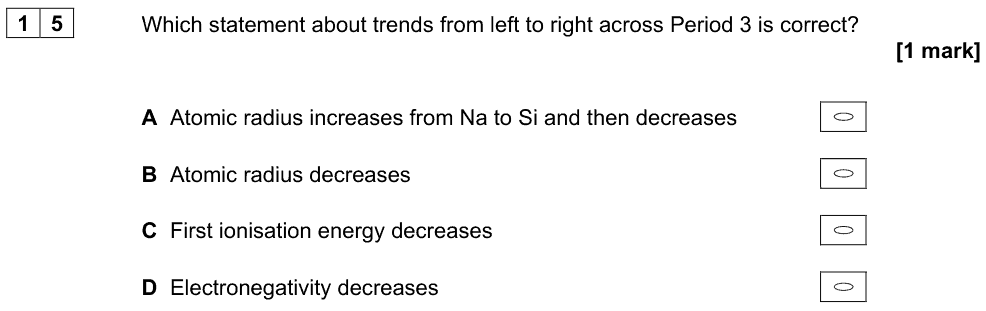
B
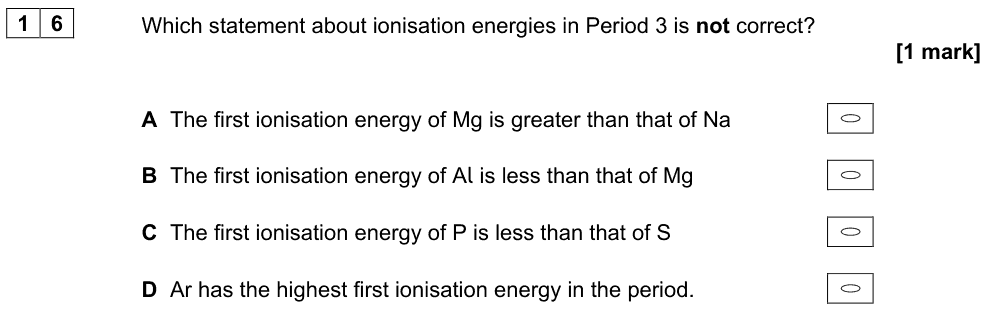
C
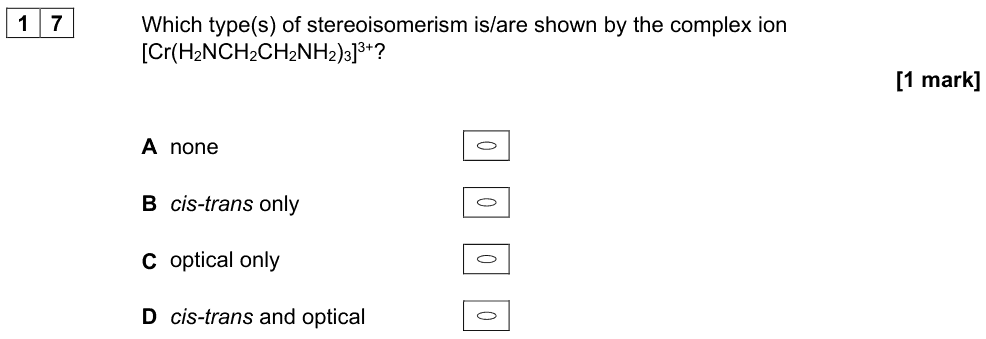
C
Skills: MS4.2 Visualise and represent 2D and 3D forms including two-dimensional representations of 3D objects; MS4.3 Understand the symmetry of 2D and 3D shapes
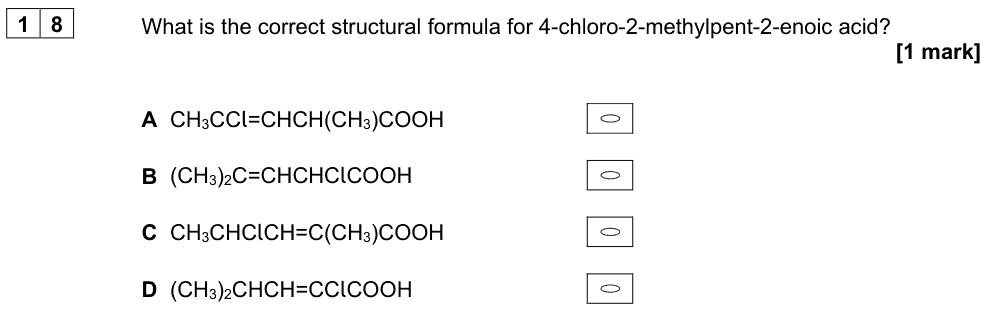
C
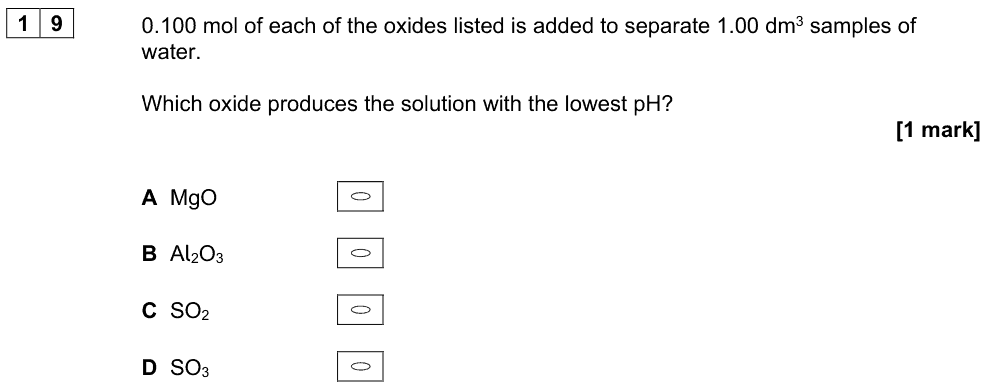
D
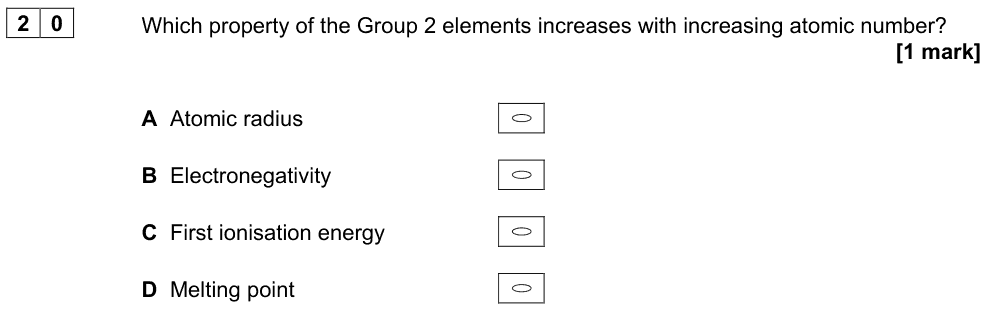
A
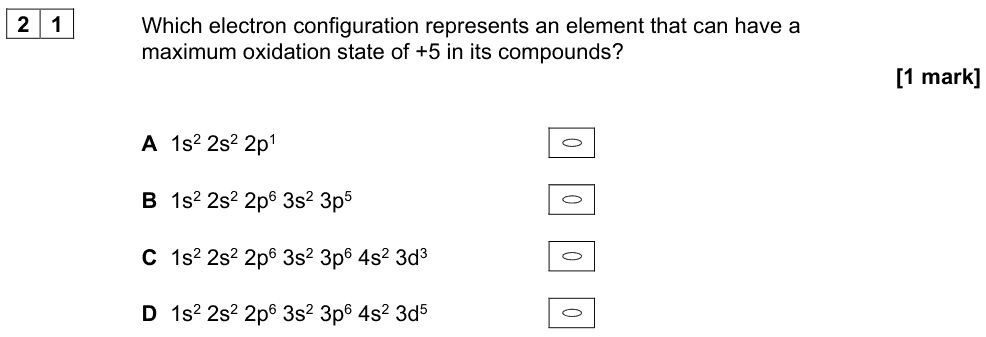
C
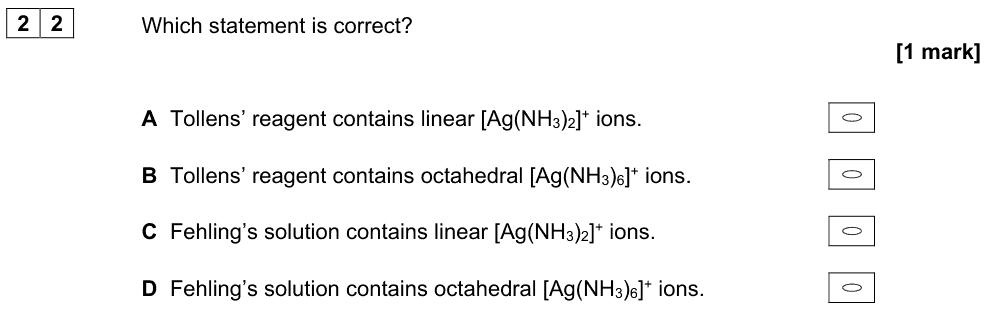
A
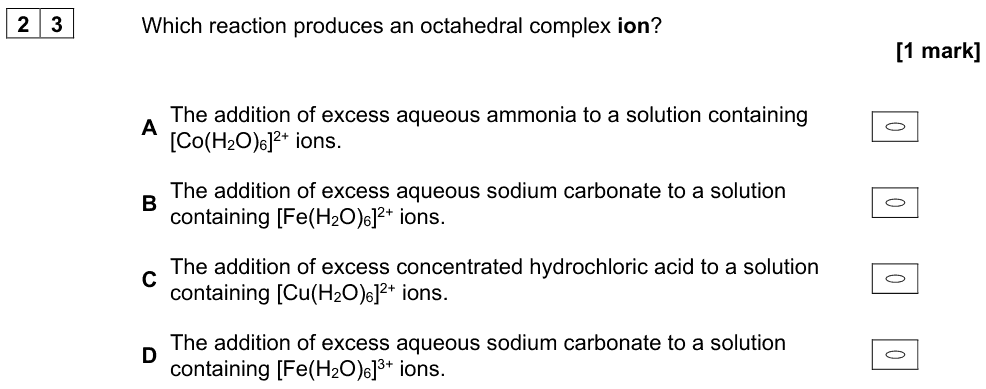
A
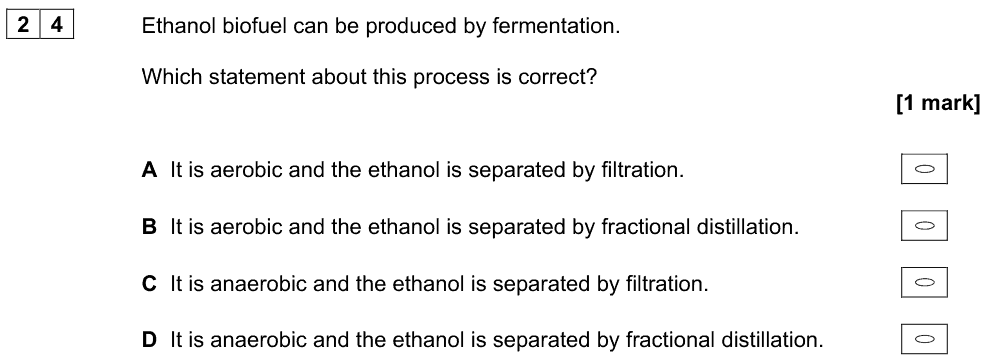
D
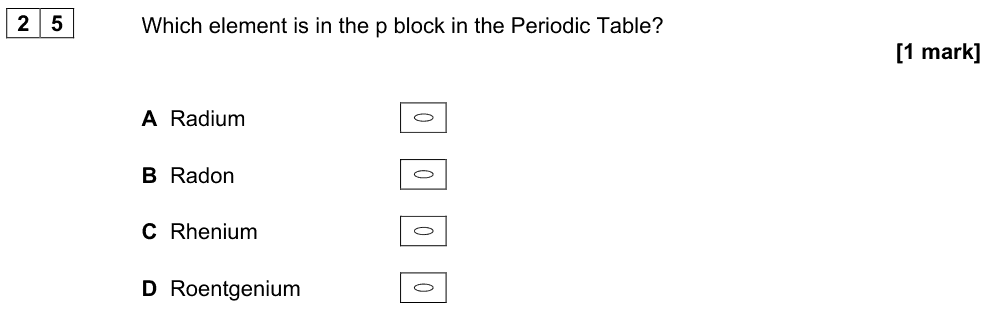
B
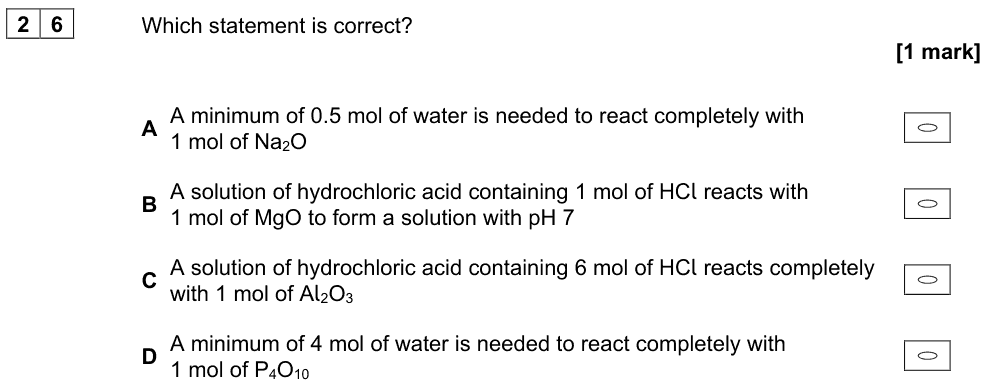
C
Skills: MS0.2 Use ratios, fractions and percentages
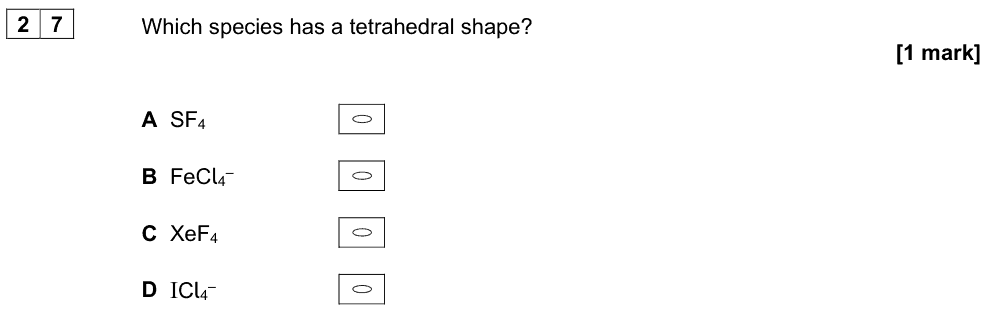
B
Skills: MS4.1 Use angles and shapes in regular 2D and 3D structures
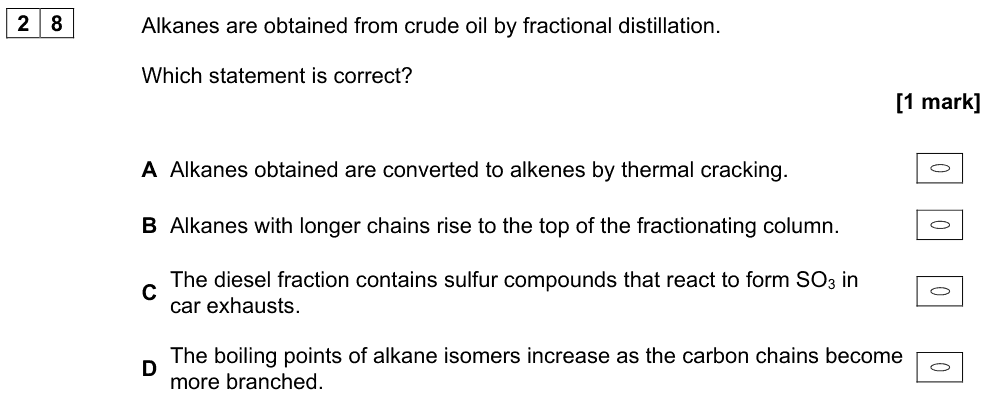
A
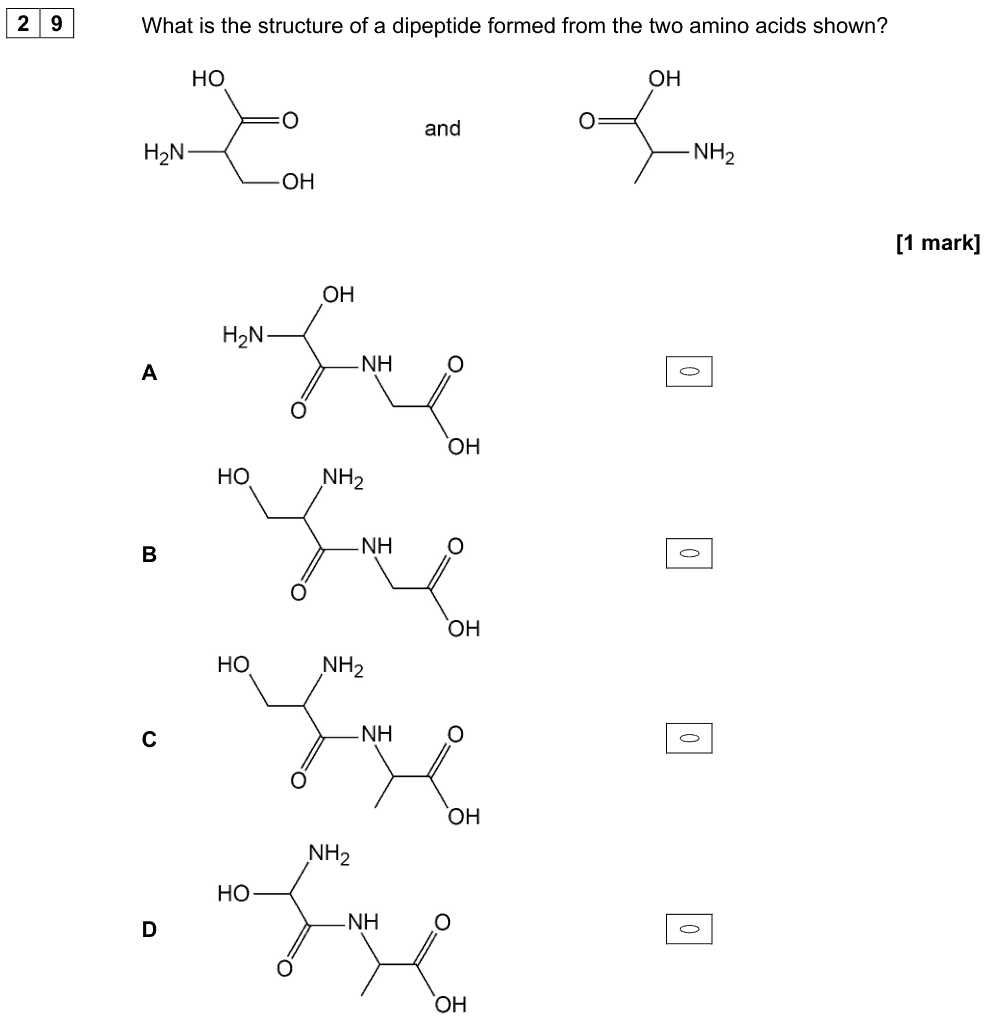
C
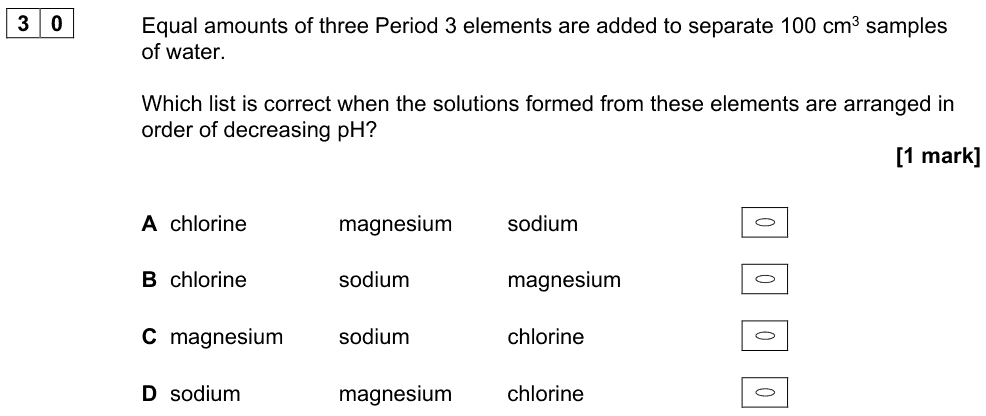
D
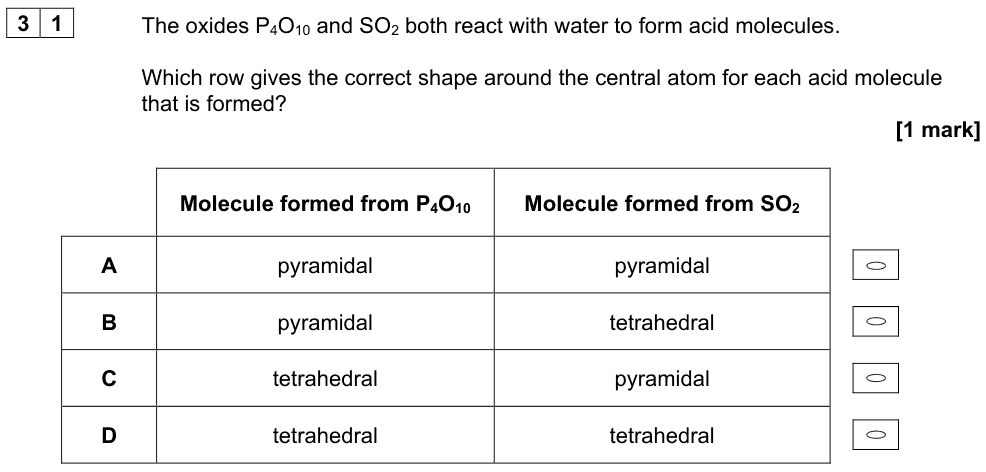
C
Skills: MS4.1 Use angles and shapes in regular 2D and 3D structures
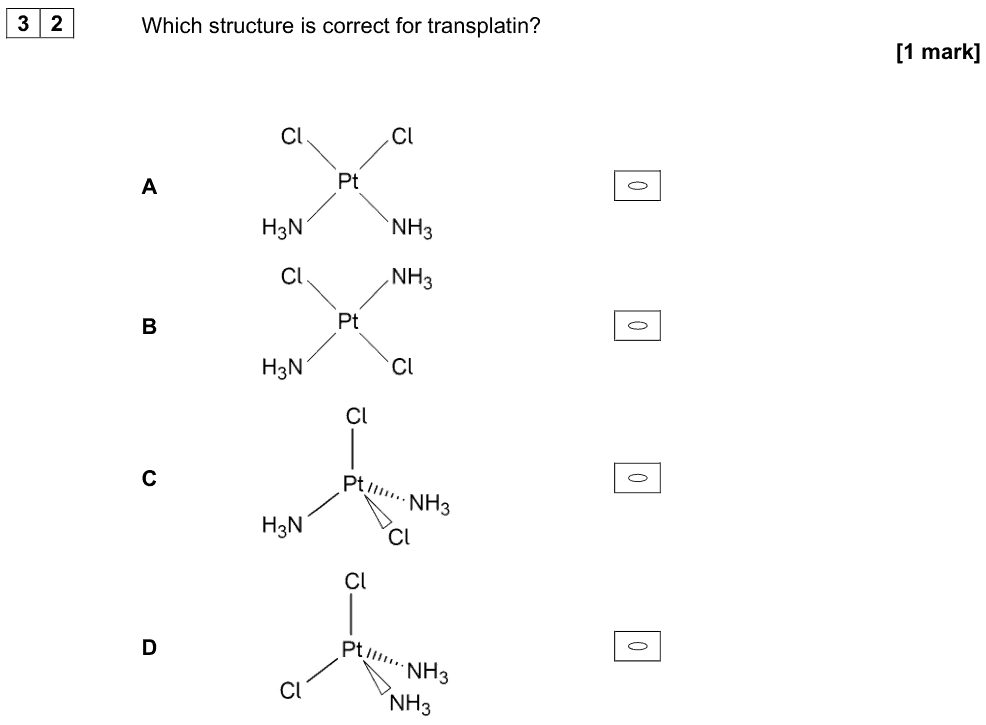
B
Skills: MS4.2 Visualise and represent 2D and 3D forms including two-dimensional representations of 3D objects
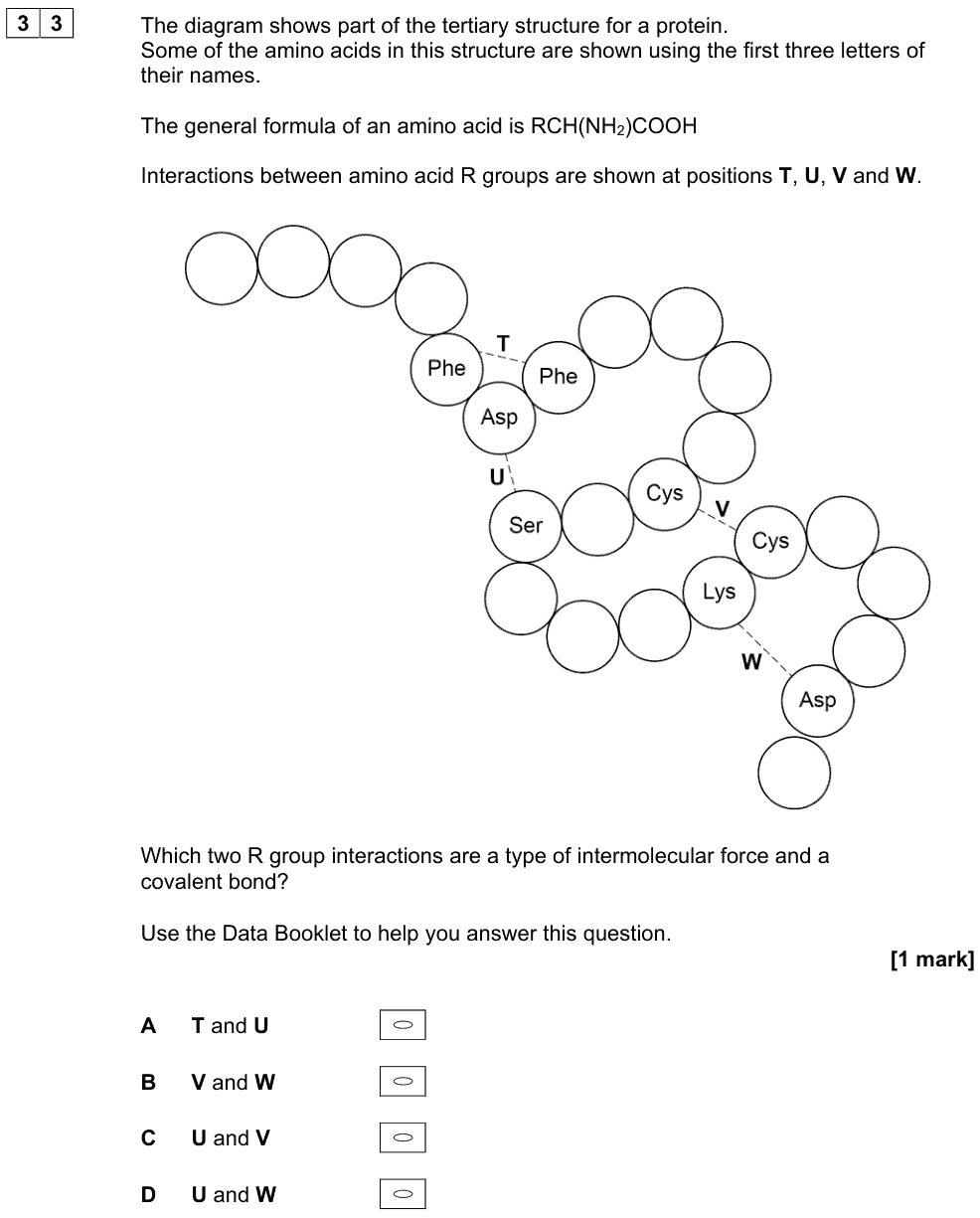
C
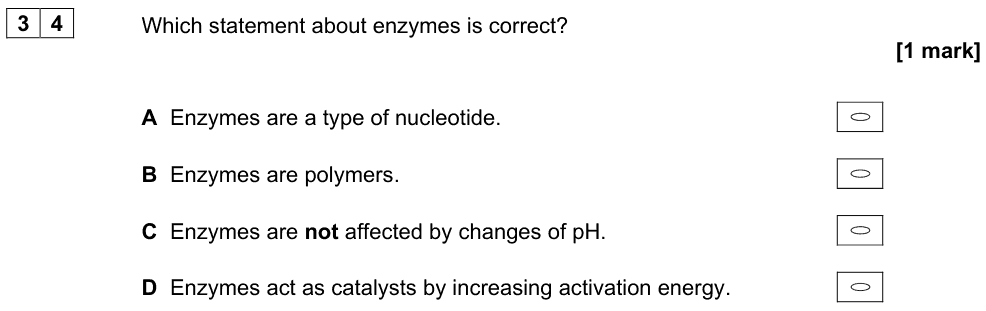
B
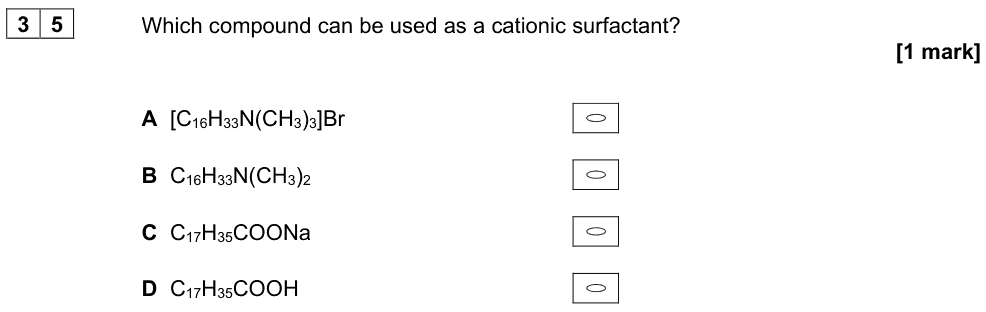
A
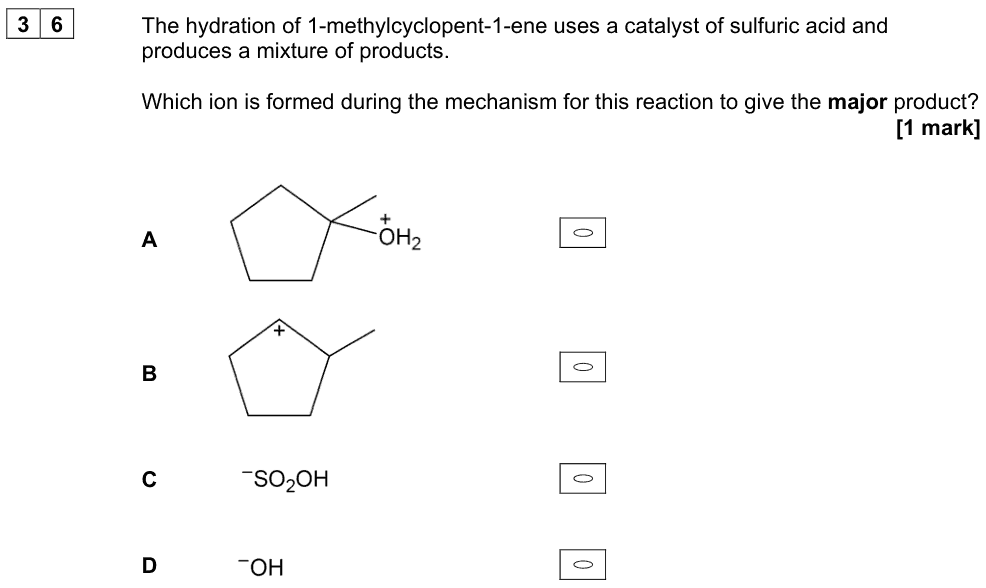
A
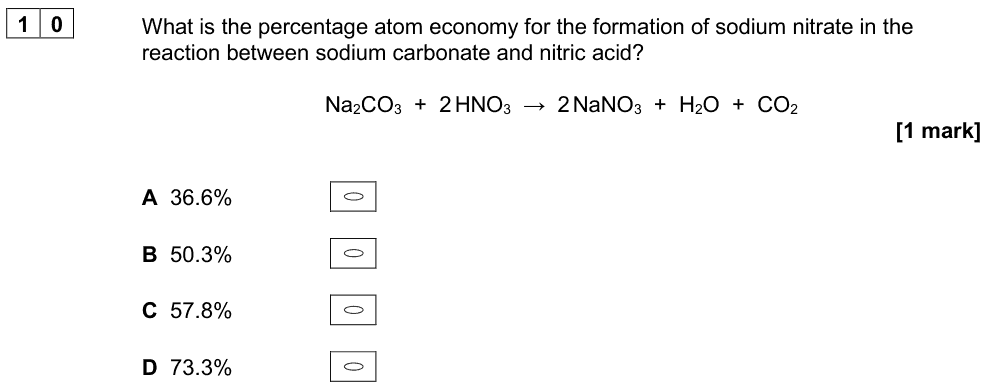
D
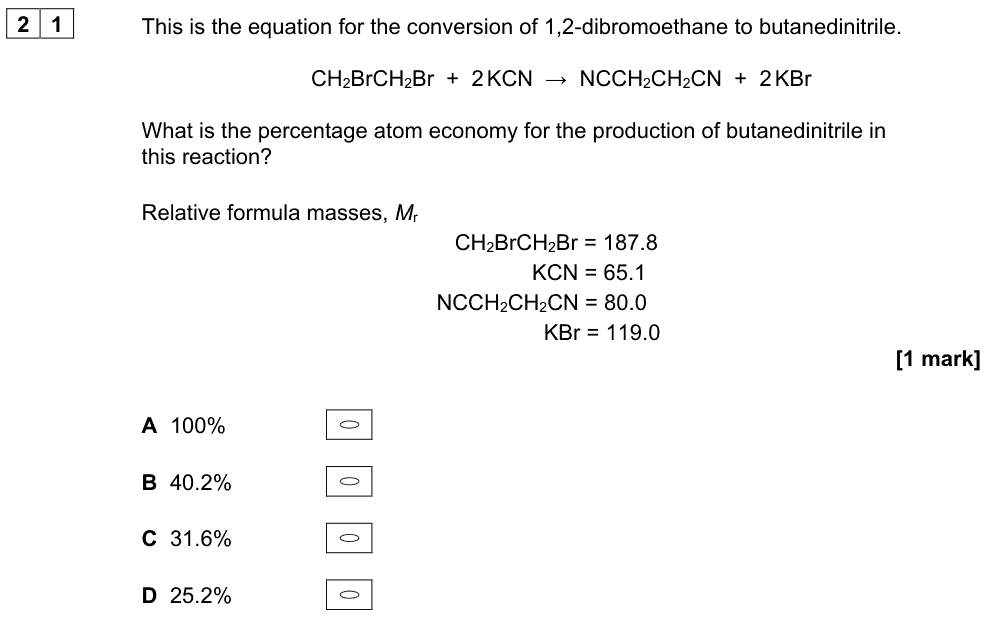
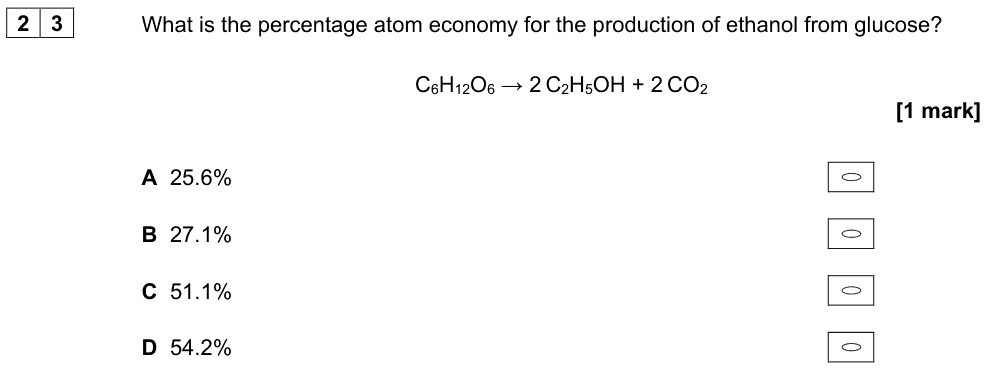
Atom Economy About two-thirds of students (65%) were able to correctly calculate the atom economy for the reaction.
Skills: MS0.2 Use ratios, fractions and percentages
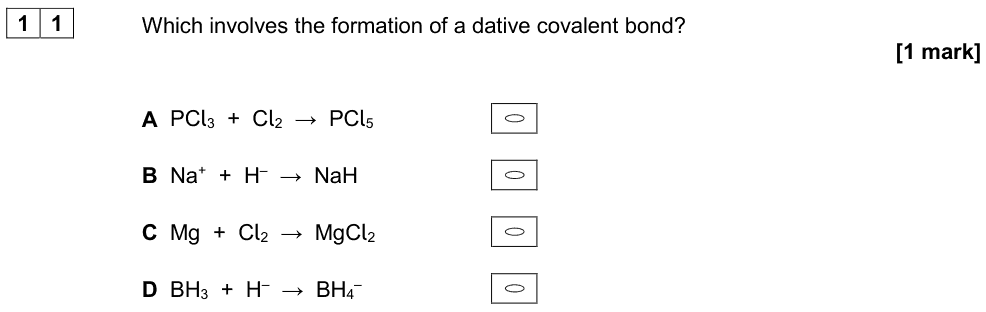
D
Dative Covalent Bond Just over half of students (57%) were able to identify the reaction in which a dative covalent bond is formed.
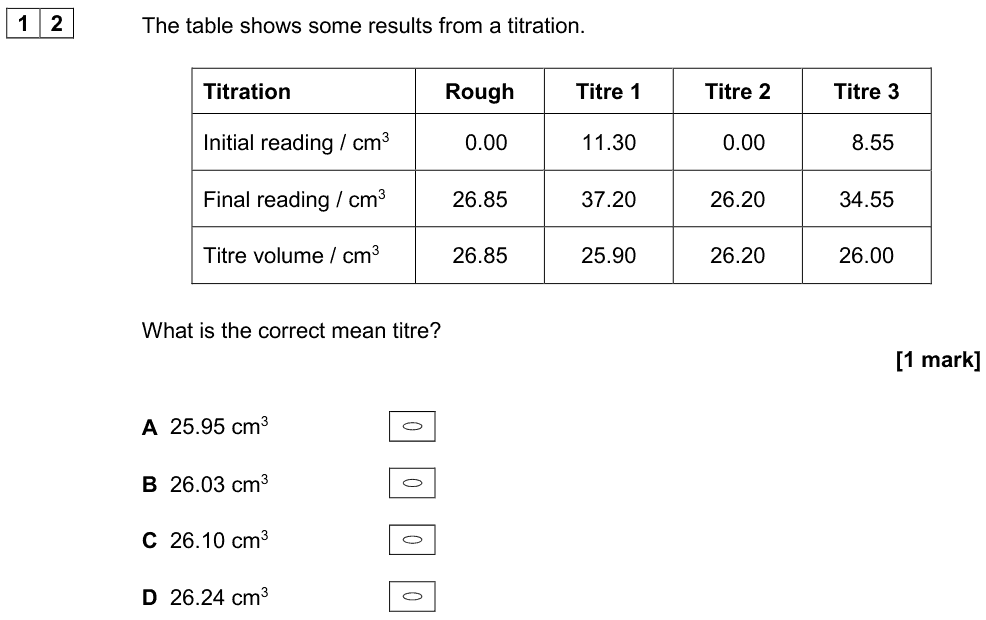
A
Mean titre The majority of students (80%) were able to calculate correctly the mean titre using the data from the table – ignoring the non-concordant titres.
Skills: MS1.2 Find arithmetic means; PS3.2 Process and analyse data using appropriate mathematical skills as exemplified in the mathematical appendix for each science; ATd Use laboratory apparatus for a variety of experimental techniques including: titration, using burette and pipette; distillation and heating under reflux, including setting up glassware using retort stand and clamps; qualitative tests for ions and organic functional groups; filtration, including use of fluted filter paper, or filtration under reduced pressure; RP1 Make up a volumetric solution and carry out a simple acid–base titration
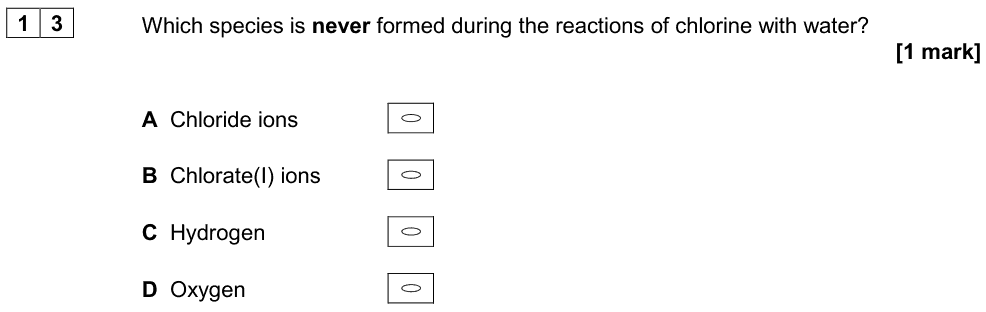
C
Reaction of chlorine with water Students found this question challenging with significantly less than half (38%) able to indicate which species cannot be formed during the reactions of chlorine with water.
A
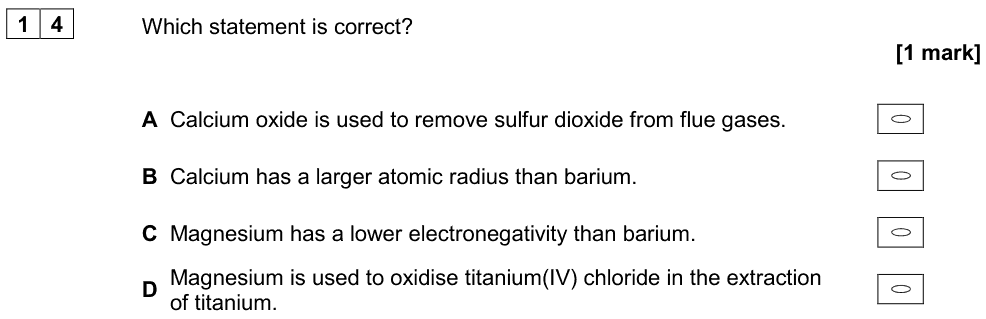
Properties of Group 2 elements Just over half the students (55%) could identify the correct statement about the properties of Group 2 elements. A large number of students incorrectly thought that magnesium oxidises titanium(IV) chloride in the extraction of titanium.
C
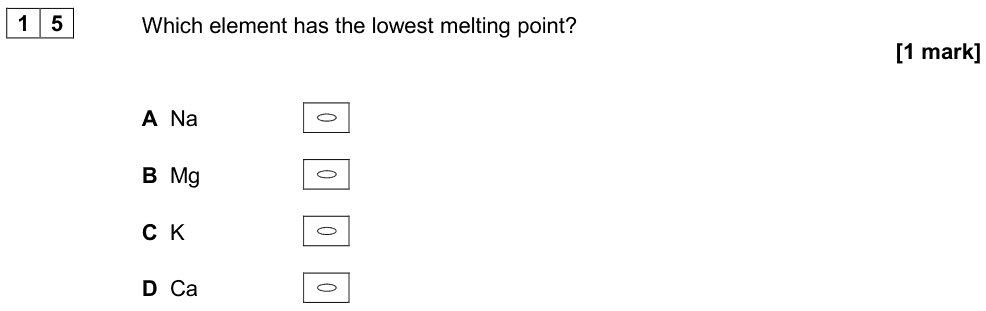
Melting points of Period 3 and Group 2 elements Only about 40% of students were able to identify that potassium has the lowest melting point, with many students (about one third) incorrectly choosing sodium.
A
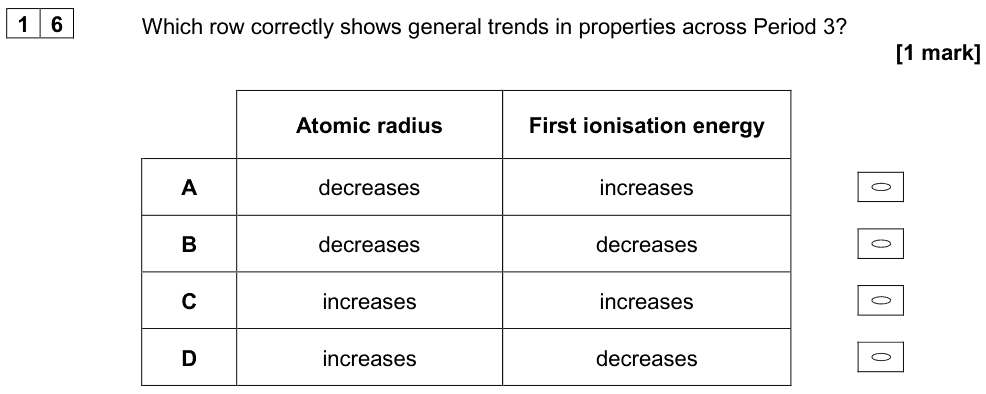
Trend in physical properties of Period 3 elements This question was well answered with over 60% of students identifying the correct trend in atomic radius and in first ionisation energy across Period 3.
C
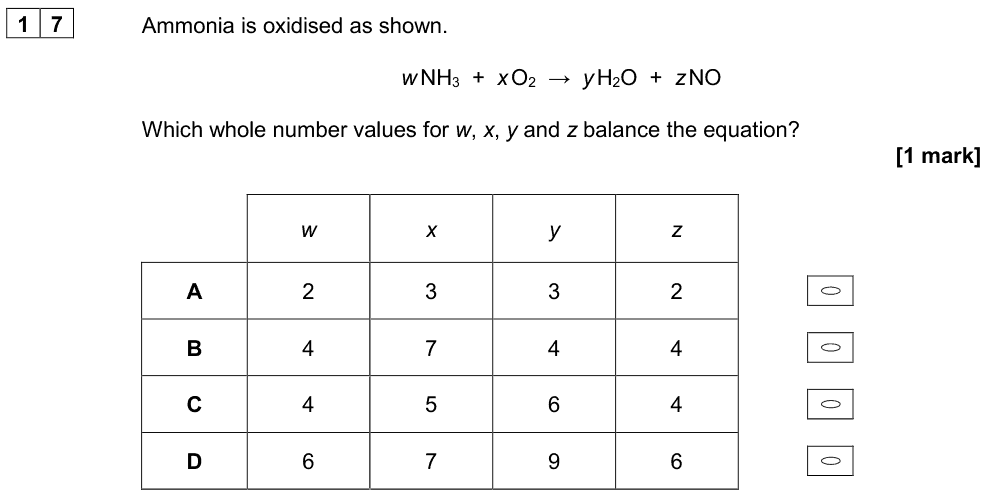
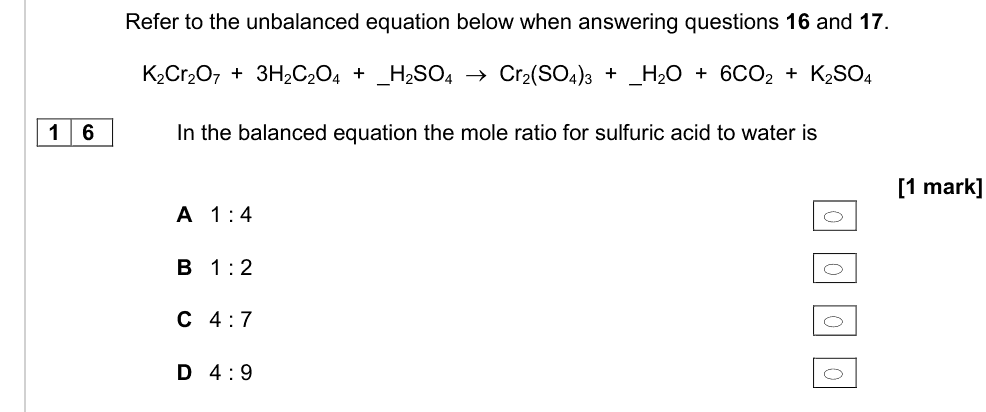
Stoichiometry The majority of students (85%) correctly balanced the equation.
Skills: MS0.2 Use ratios, fractions and percentages
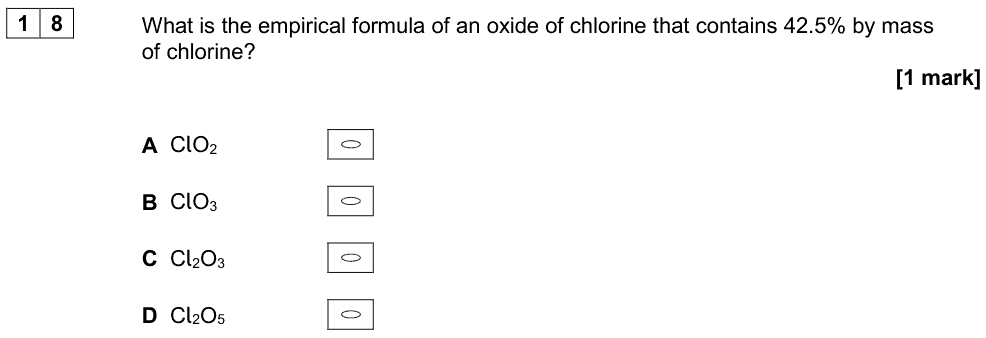
B
Empirical Formula This was well answered with about three-quarters of students able to determine which oxide of chlorine contains 42.5% by mass of chlorine.
Skills: MS0.2 Use ratios, fractions and percentages
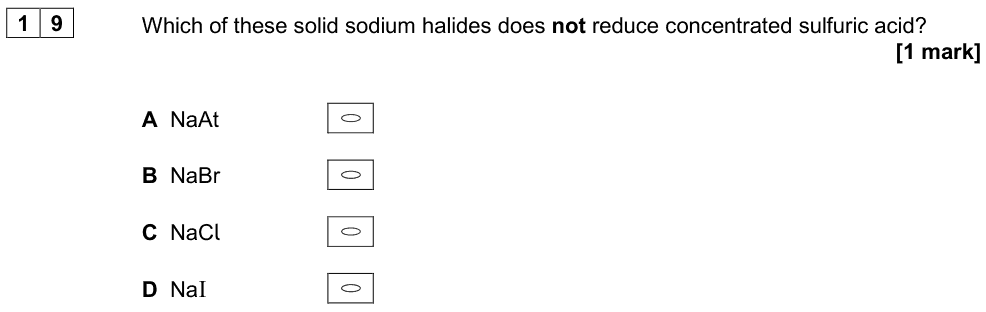
C
Reducing ability of halide ions Although just over half of students could identify which sodium halide does not reduce concentrated sulfuric acid, a large number (about one third) incorrectly thought that sodium astatide does not reduce concentrated sulfuric acid.
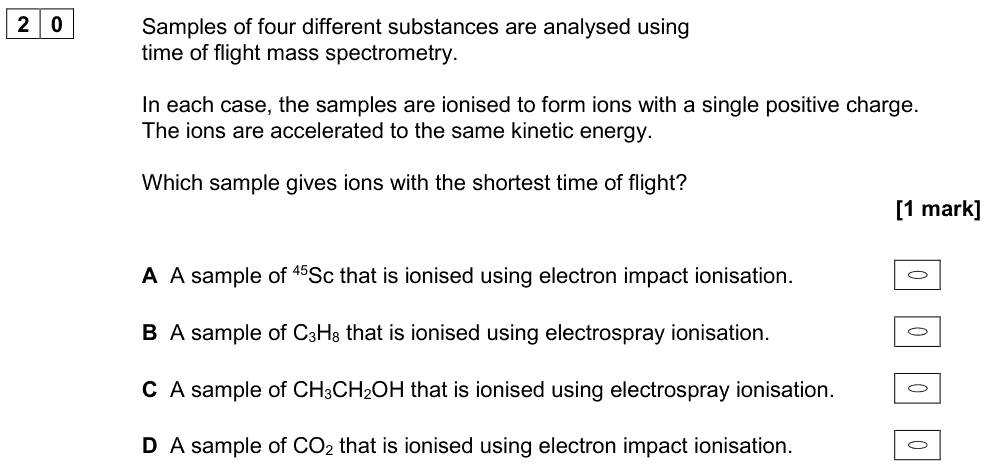
D
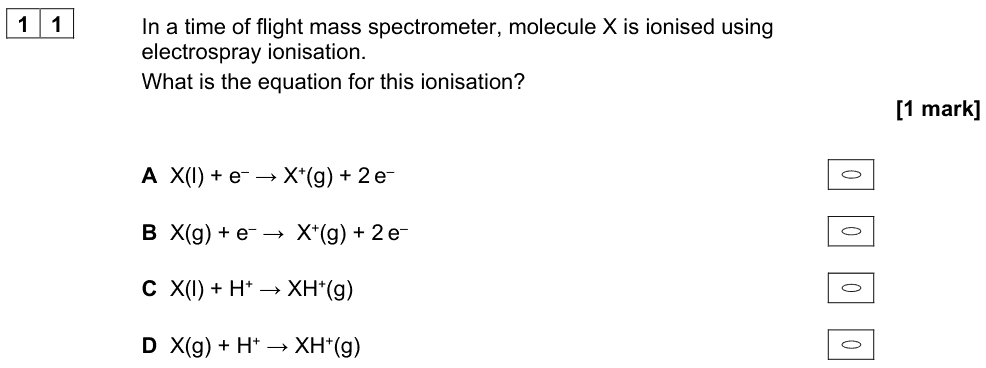
Time of flight mass spectrometry About two-thirds of students were able to identify which sample gave ions with the shortest time of flight.
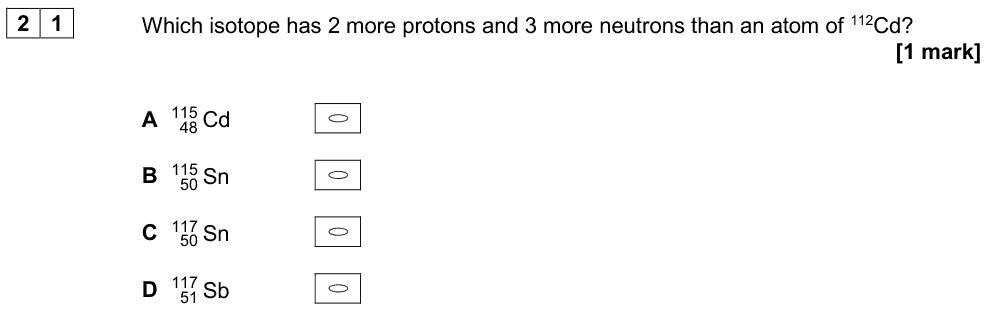
C
Atomic Structure This question was well answered with the majority of students (82%) identifying the correct isotope.
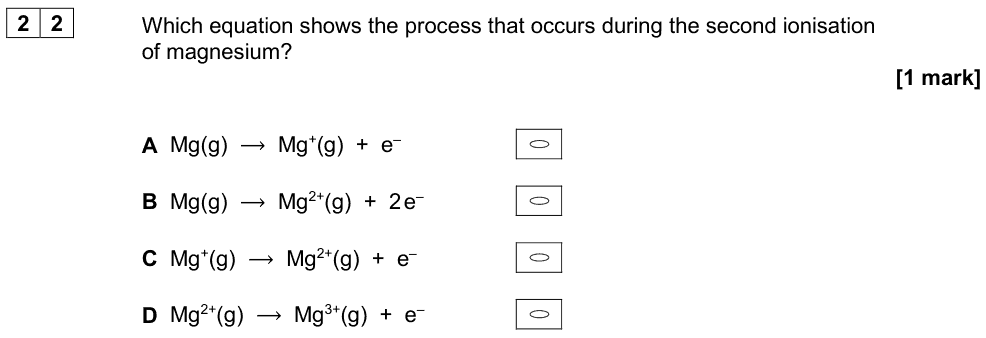
C
Second ionisation of Mg Nearly all students (over 90%) were able to correctly identify the equation that shows the process that occurs during the second ionisation of magnesium.
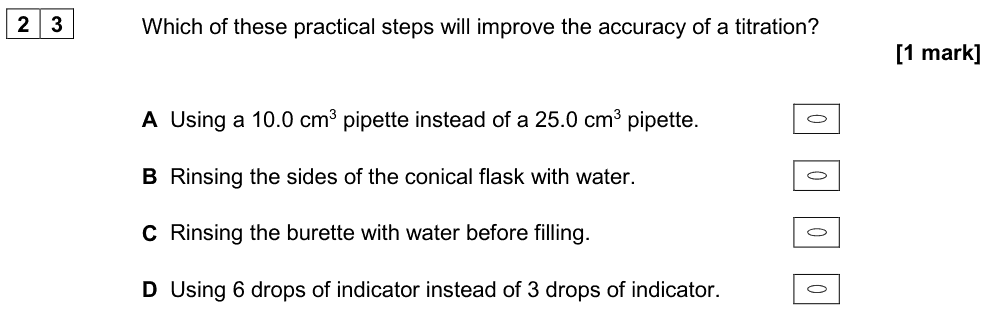
B
Titration accuracy A good number of students (about 60%) were able to identify the step that would improve the accuracy of a titration.
Skills: ATd Use laboratory apparatus for a variety of experimental techniques including: titration, using burette and pipette; distillation and heating under reflux, including setting up glassware using retort stand and clamps; qualitative tests for ions and organic functional groups; filtration, including use of fluted filter paper, or filtration under reduced pressure; PS2.1 Comment on experimental design and evaluate scientific methods; RP1 Make up a volumetric solution and carry out a simple acid–base titration
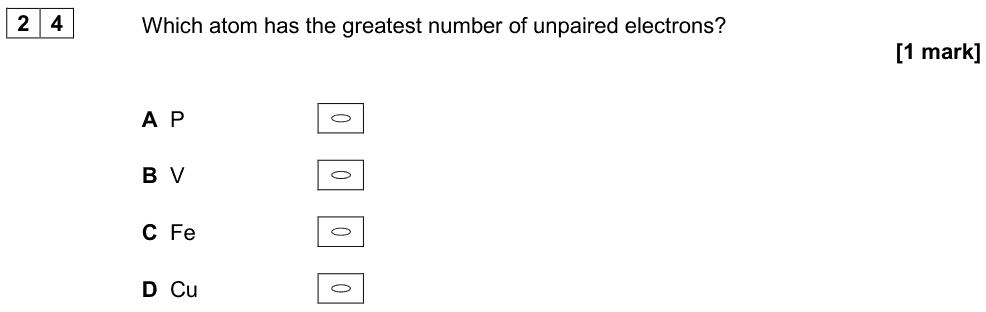
C
Electron configuration Students found this challenging with just over one third of students able to identify the atom that has the greatest number of unpaired electrons.
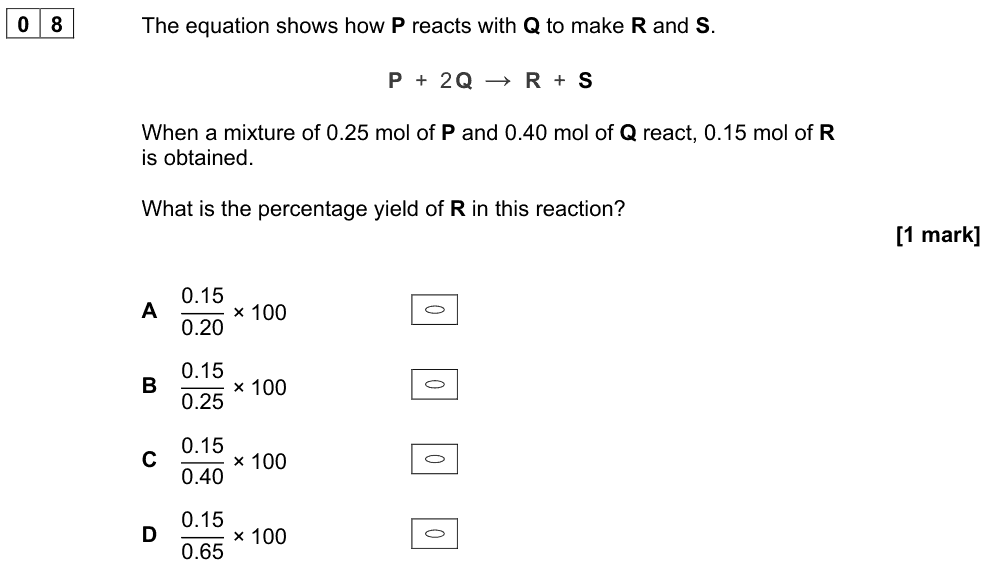
A
Percentage yield Students struggled with this question with few students understanding percentage yield in a reaction. Many incorrectly believe it is the mass of product formed divided by the mass of reactant(s) as a percentage, rather than mass of product formed divided by the expected mass of product as a percentage.
Skills: MS0.2 Use ratios, fractions and percentages
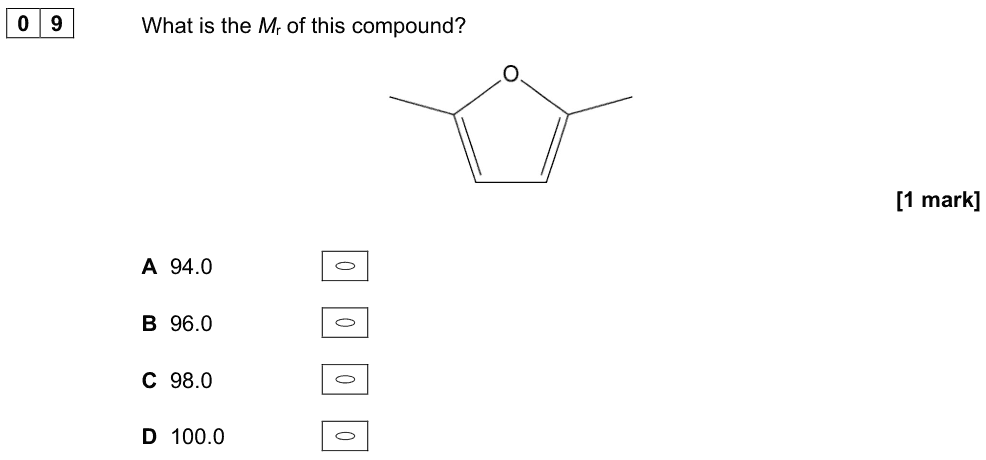
B
Mr from a skeletal structure This was answered correctly by a majority (73.4%) of students.
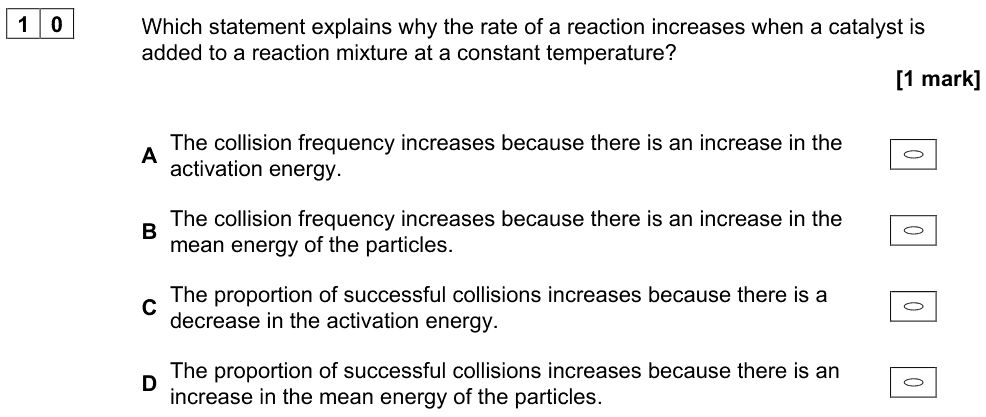
C
This was answered correctly by the vast majority (89.2%) of students. Q11 Curly arrows in an unfamiliar mechanism This was answered correctly by a majority (73.2%) of students.
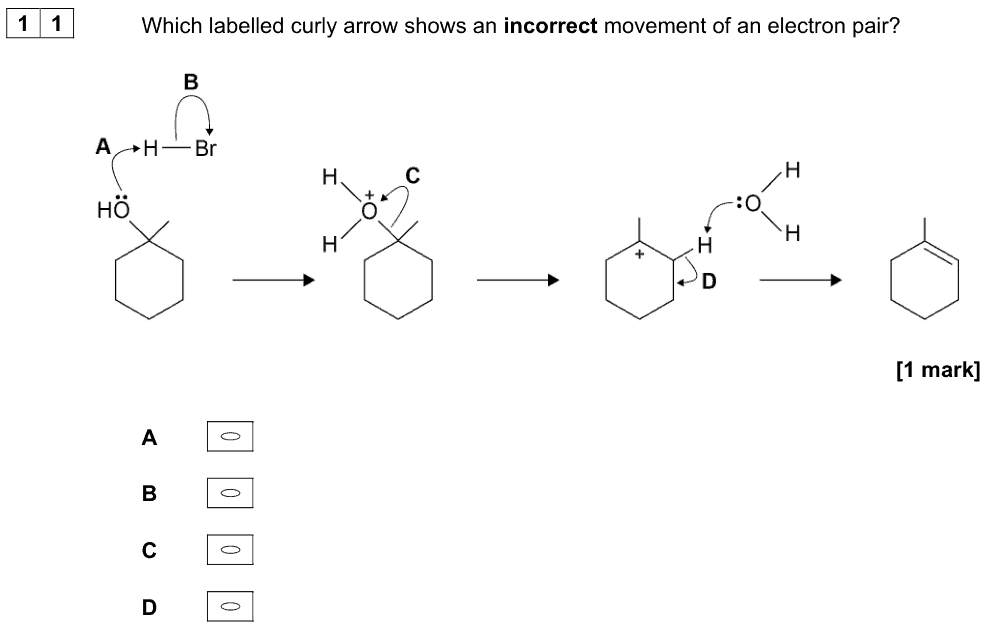
D
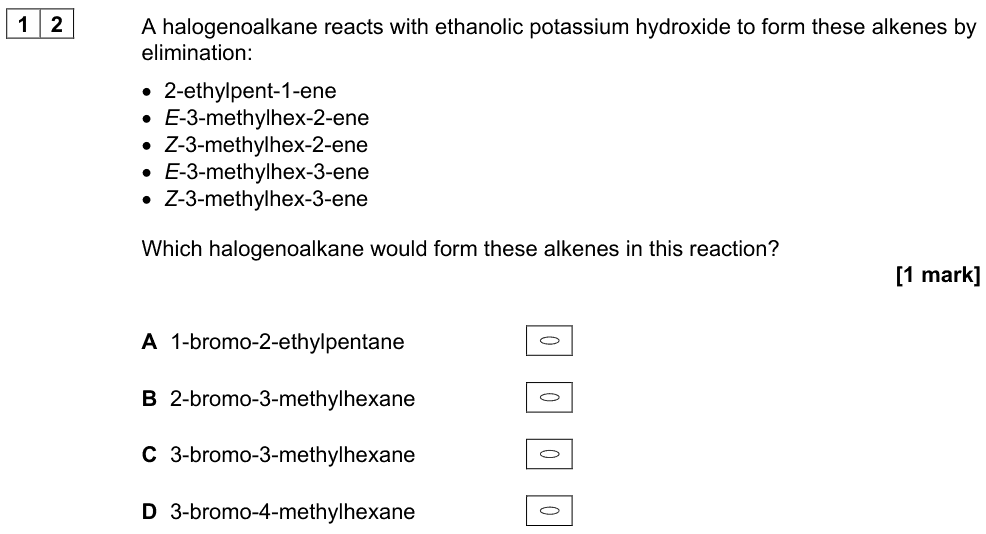
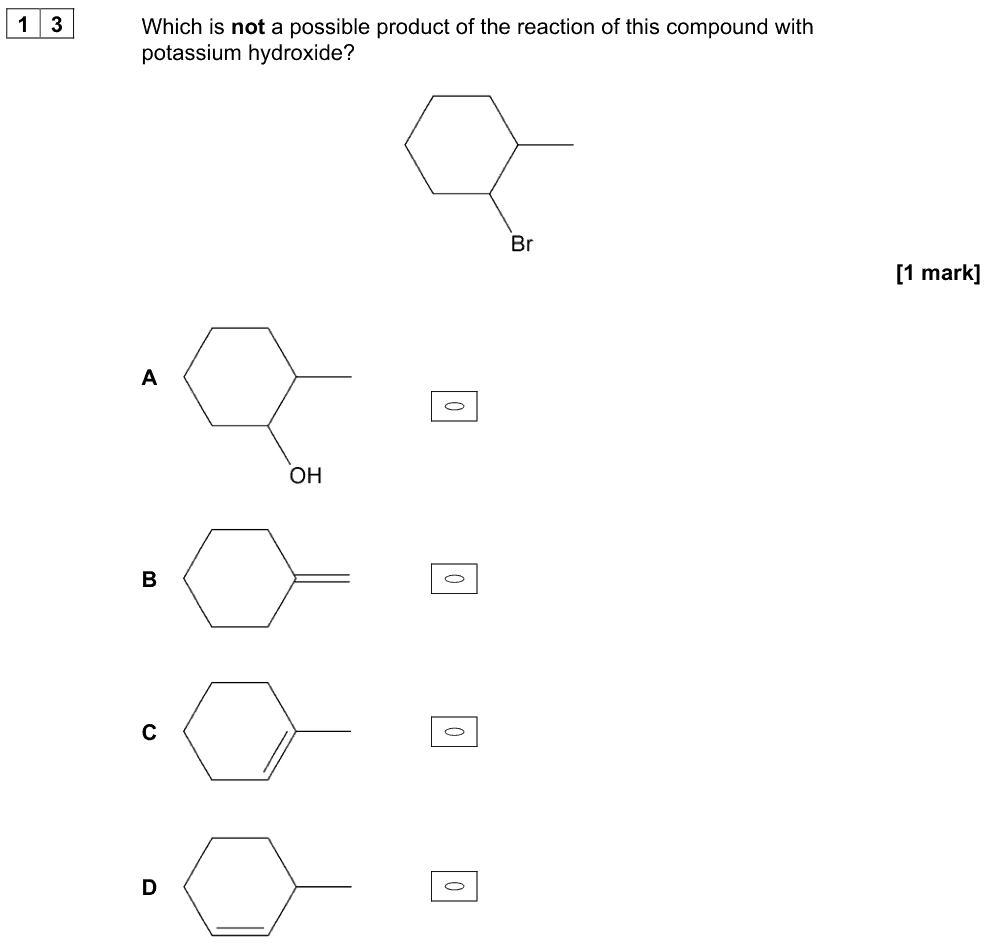
C
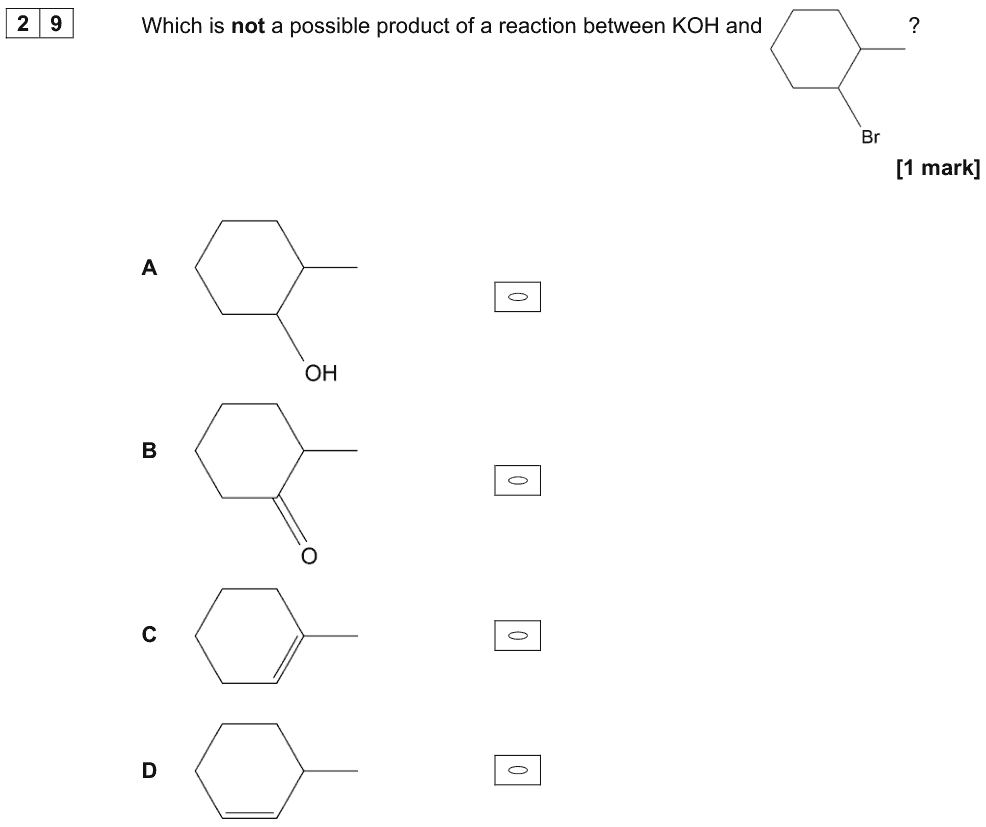
Students struggled to deduce which alkene could be formed by elimination of HBr from a halogenoalkane. Q13 Apparatus for production of an aldehyde from an alcohol This was answered correctly by a majority (65.6%) of students.
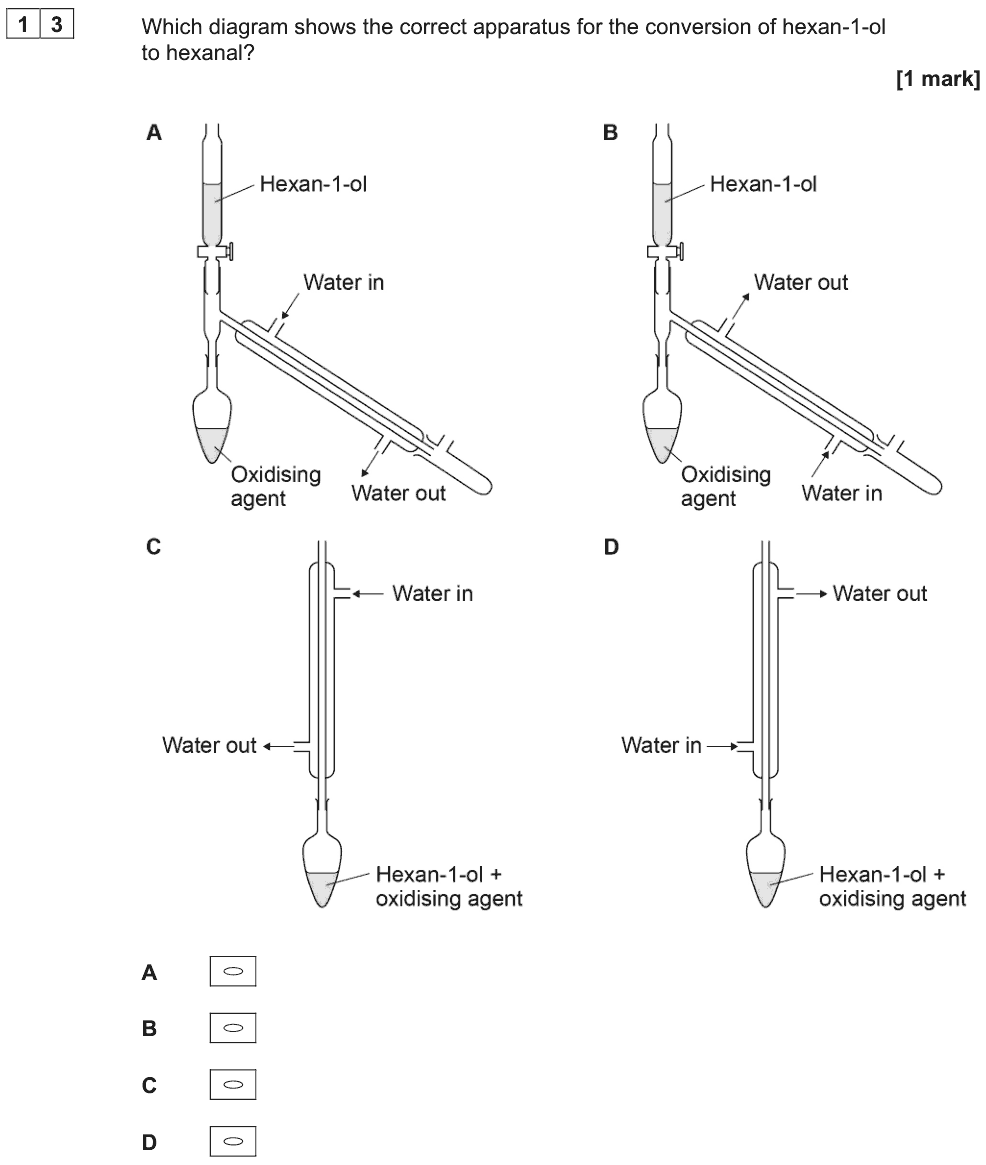
B
Skills: ATd Use laboratory apparatus for a variety of experimental techniques including: titration, using burette and pipette; distillation and heating under reflux, including setting up glassware using retort stand and clamps; qualitative tests for ions and organic functional groups; filtration, including use of fluted filter paper, or filtration under reduced pressure; PS4.1 Know and understand how to use a wide range of experimental and practical instruments, equipment and techniques appropriate to the knowledge and understanding included in the specification; RP5 Distillation of a product from a reaction
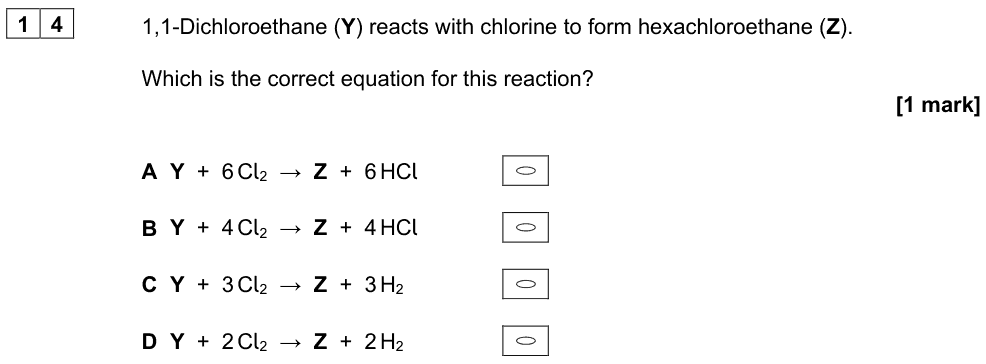
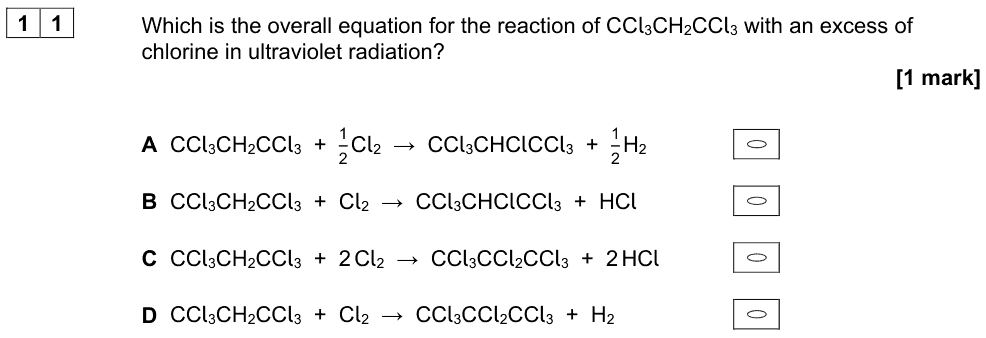
B
Students found this question difficult, with confusion about whether H2 or HCl is a by-product.
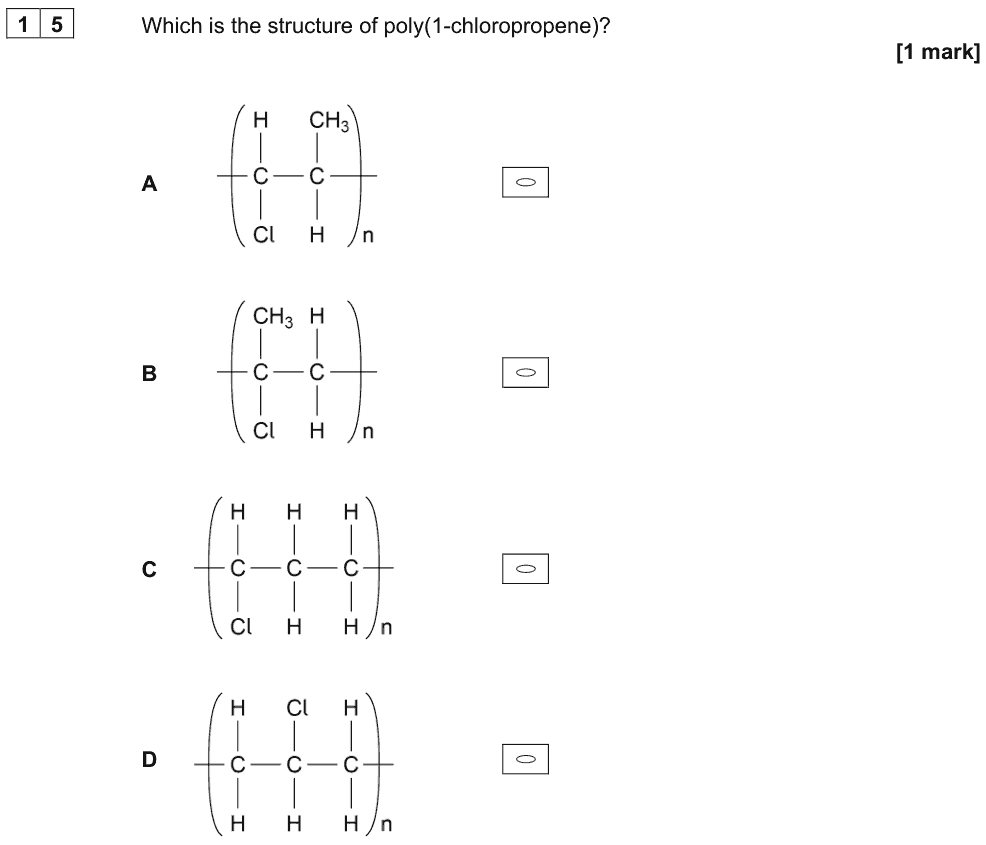
A
This was answered correctly by a majority (66.9%) of students.
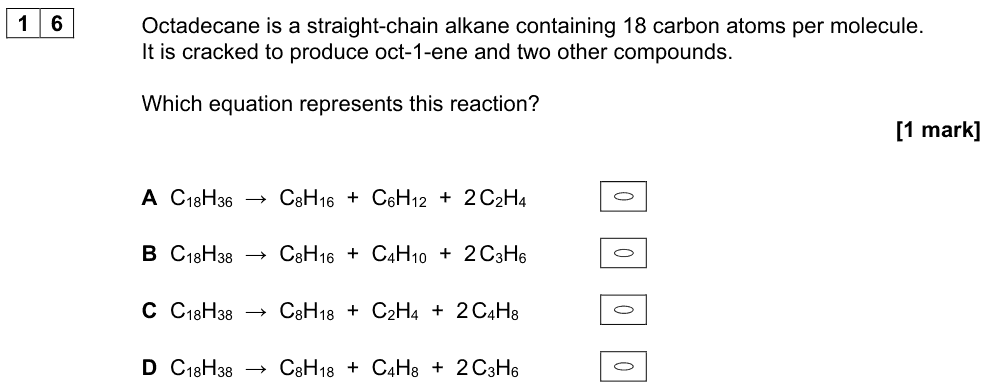
B
This was answered correctly by a majority (74.2%) of students.
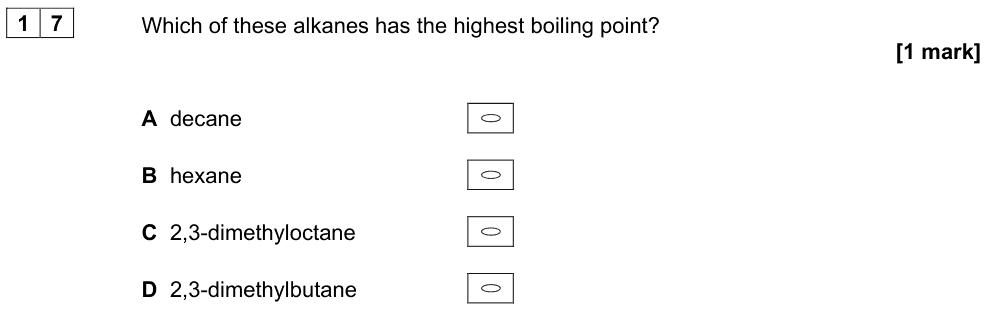
A
This was answered correctly by a majority (67.1%) of students. Q18 Use of high-resolution mass spectrometry to distinguish compounds Students found this question harder, possibly failing to deduce the correct molecular formula of each compound from its name.
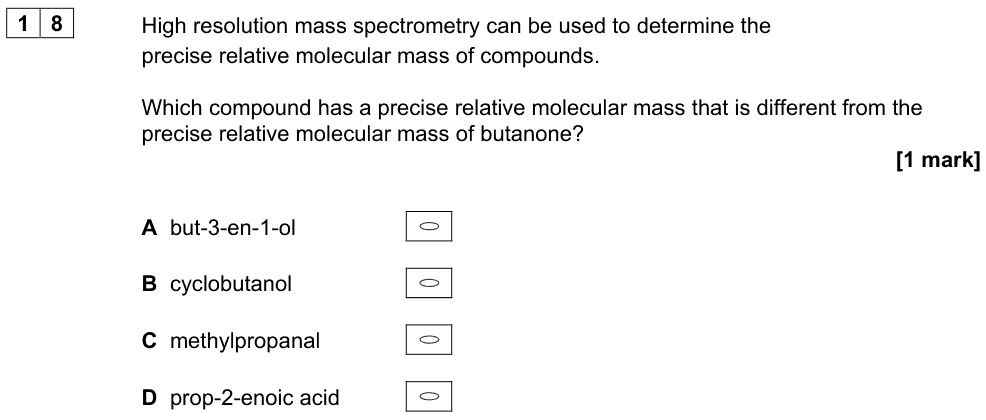
D
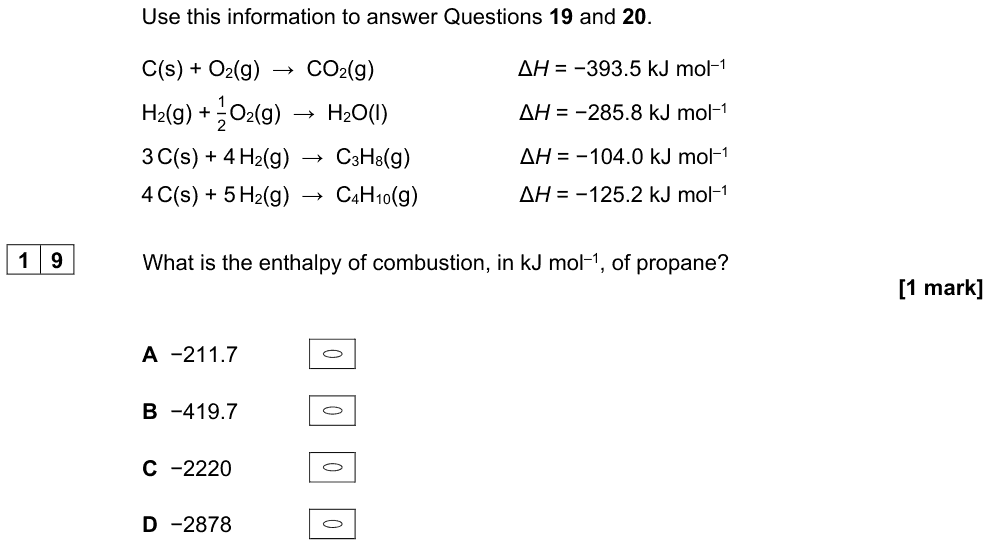
C
This was answered correctly by a majority (57.1%) of students.
Skills: MS2.4 Solve algebraic equations
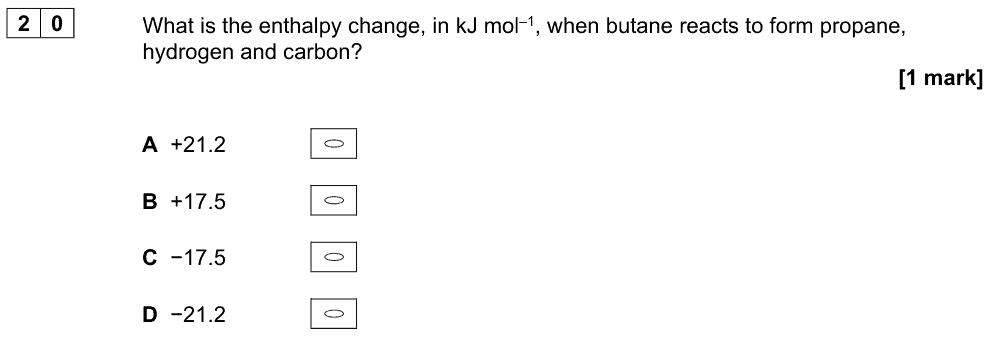
A
Students found this question harder, possibly due to it being a less familiar type of Hess’ cycle.
Skills: MS2.4 Solve algebraic equations
D
This was answered correctly by a majority (67.8%) of students.
Skills: MS0.2 Use ratios, fractions and percentages
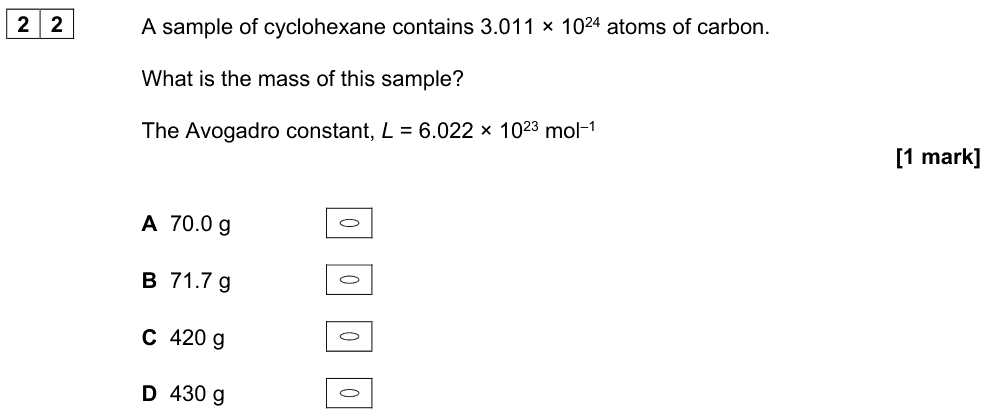
A
Students found this question difficult, possibly due to it involving the Avogadro constant and/or not taking into account that data in the question gave the number of C atoms rather than the number of molecules.
Skills: MS0.1 Recognise and use expressions in decimal and ordinary form; MS0.2 Use ratios, fractions and percentages
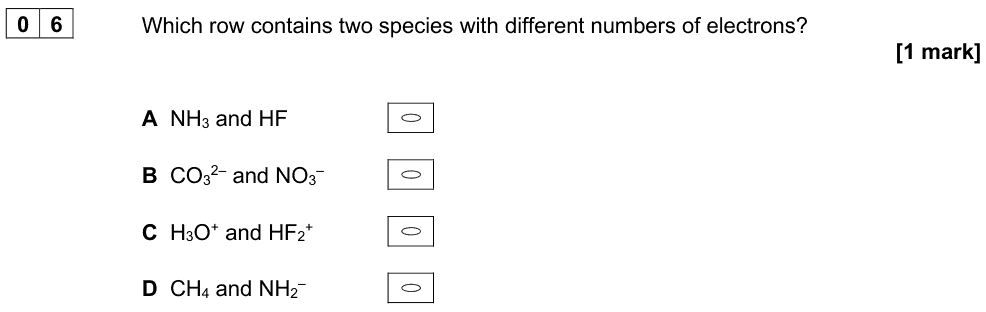
C
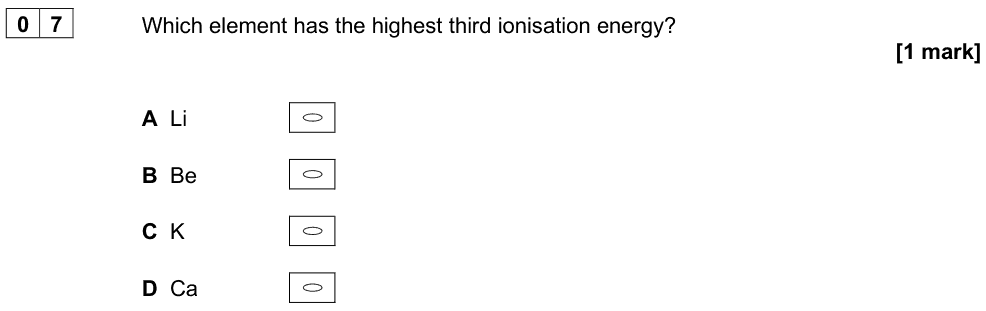
B
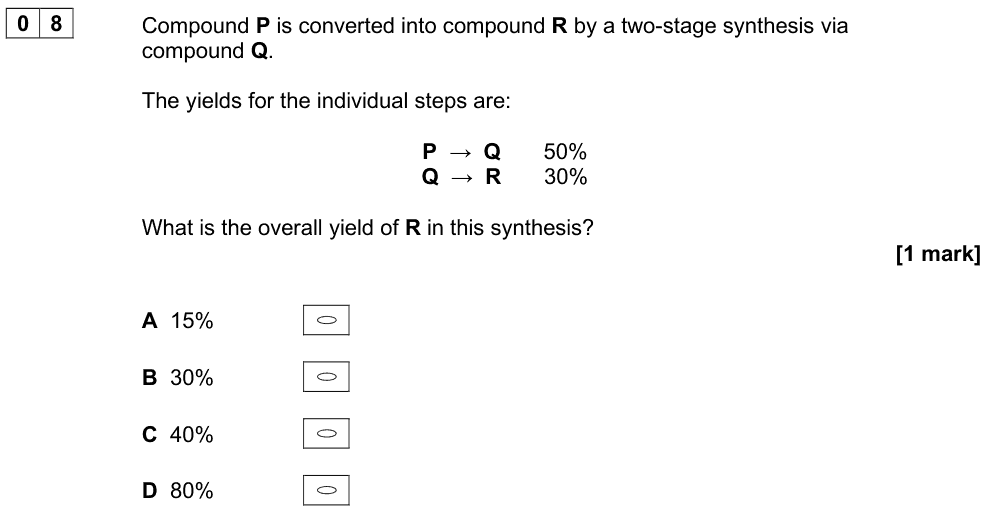
A
Skills: MS0.2 Use ratios, fractions and percentages
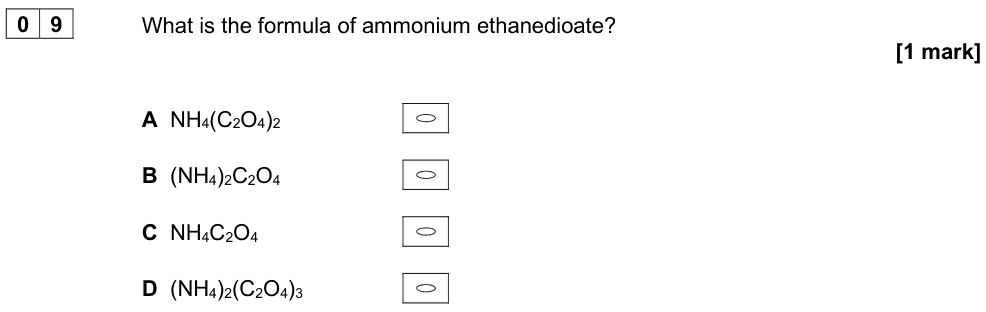
B
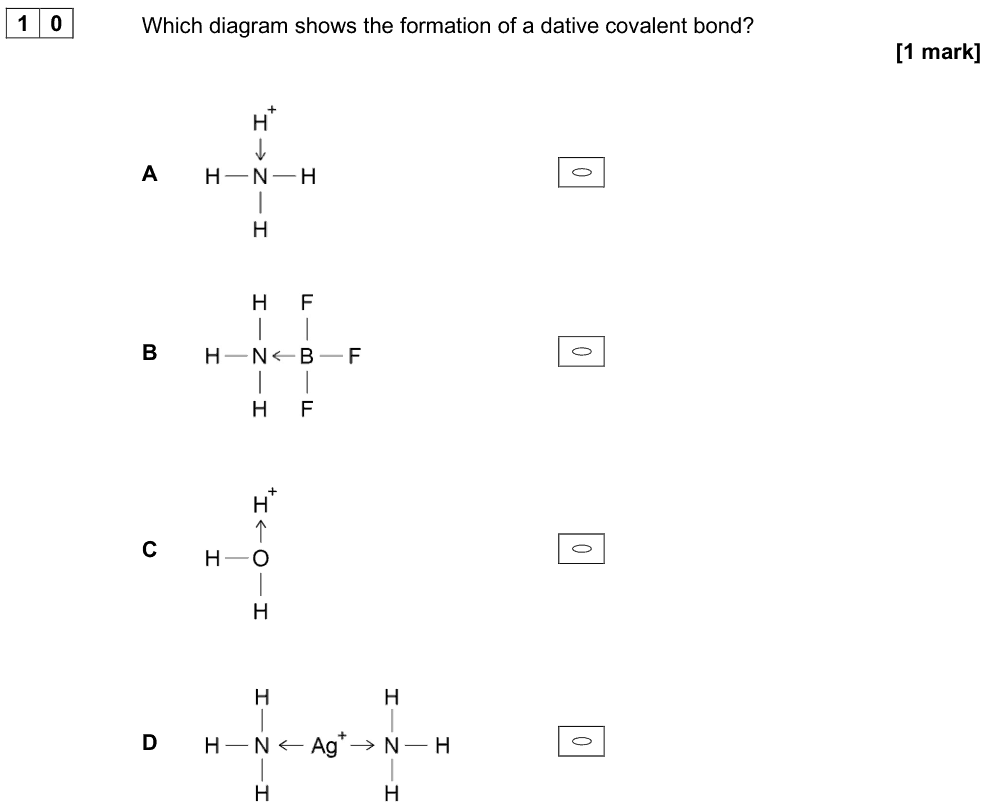
C
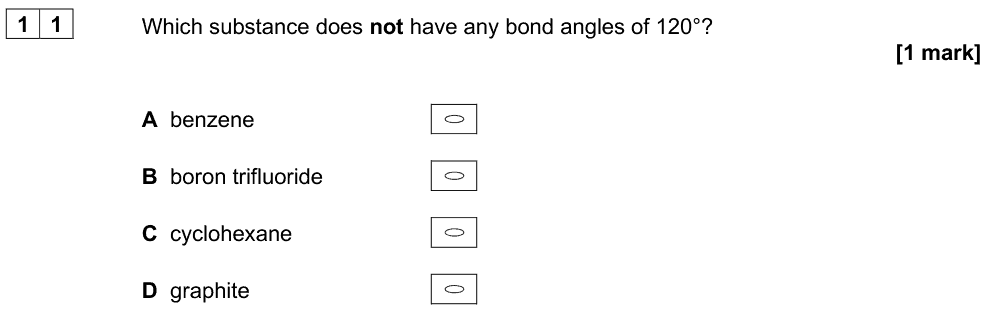
C
Skills: MS4.1 Use angles and shapes in regular 2D and 3D structures
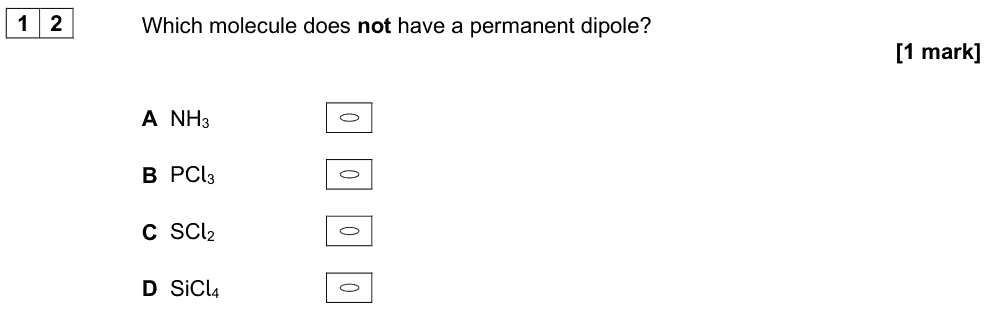
D
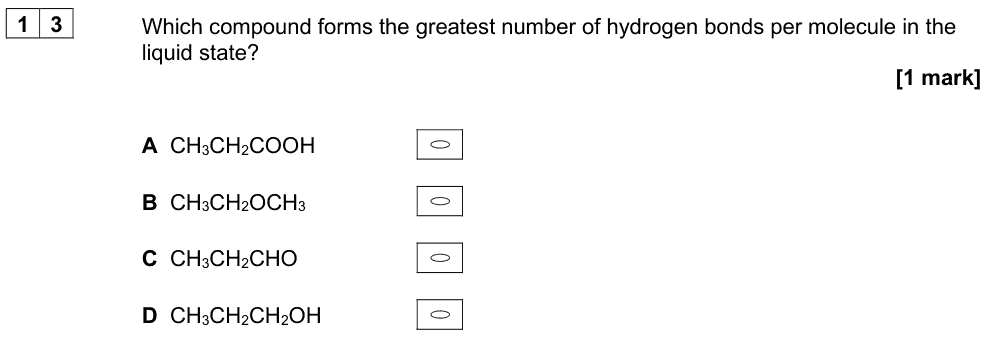
A
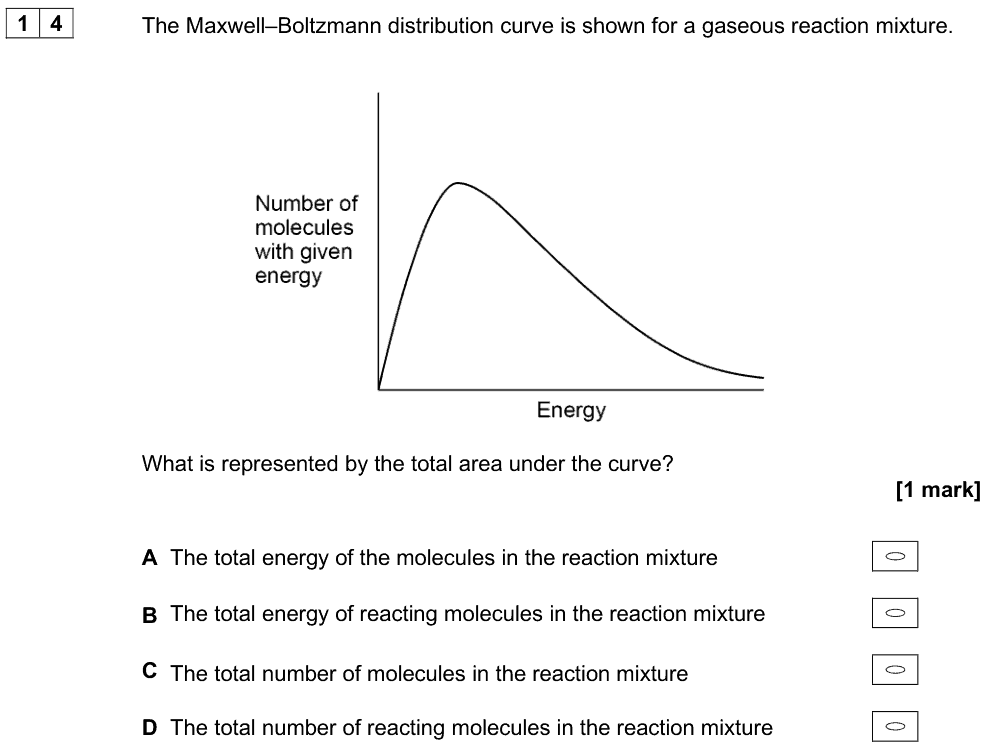
C
Skills: MS3.1 Translate information between graphical, numerical and algebraic forms
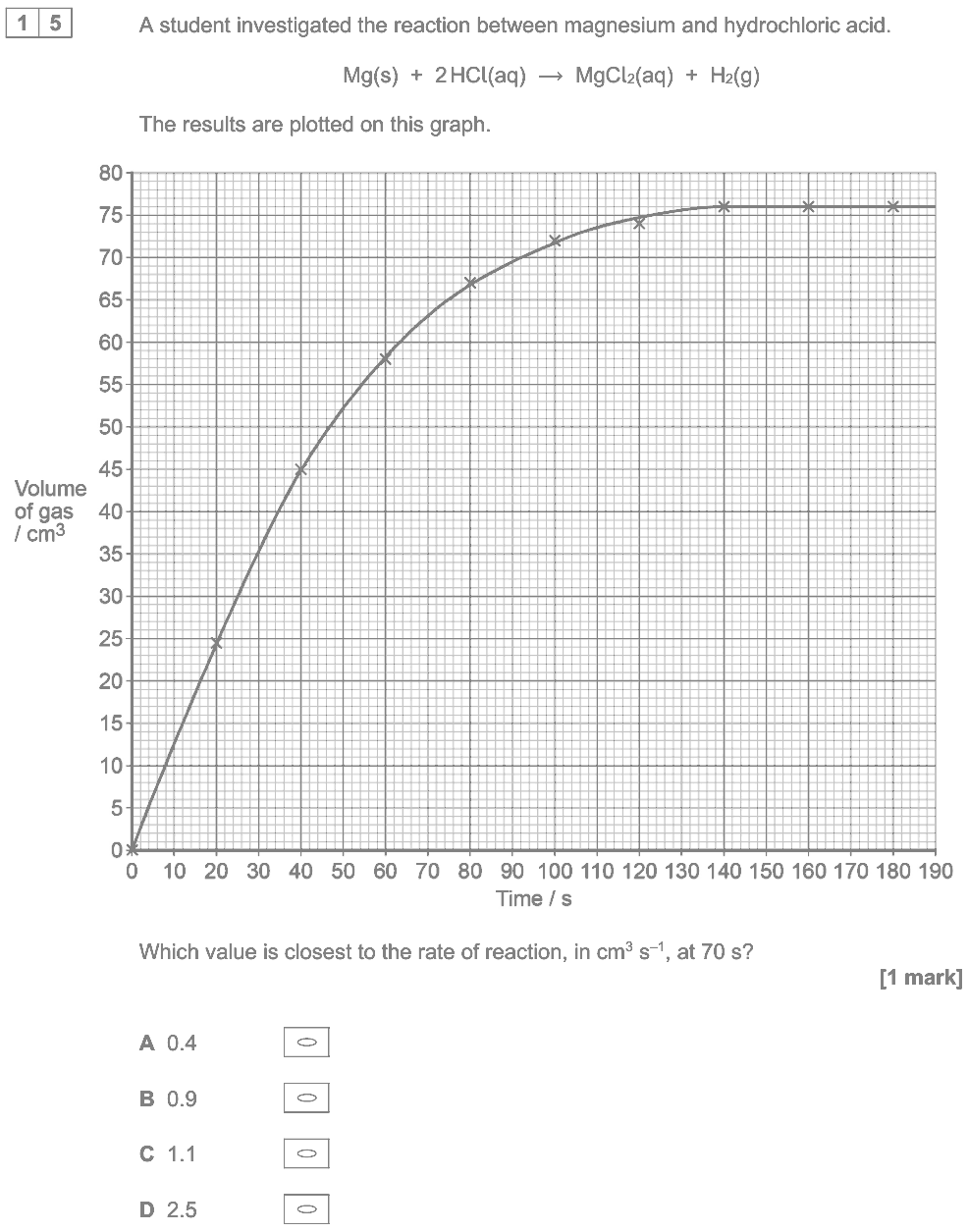
A
Skills: MS3.5 Draw and use the slope of a tangent to a curve as a measure of rate of change; PS3.1 Plot and interpret graphs; RP7 Measuring the rate of reaction: by an initial rate method; by a continuous monitoring method
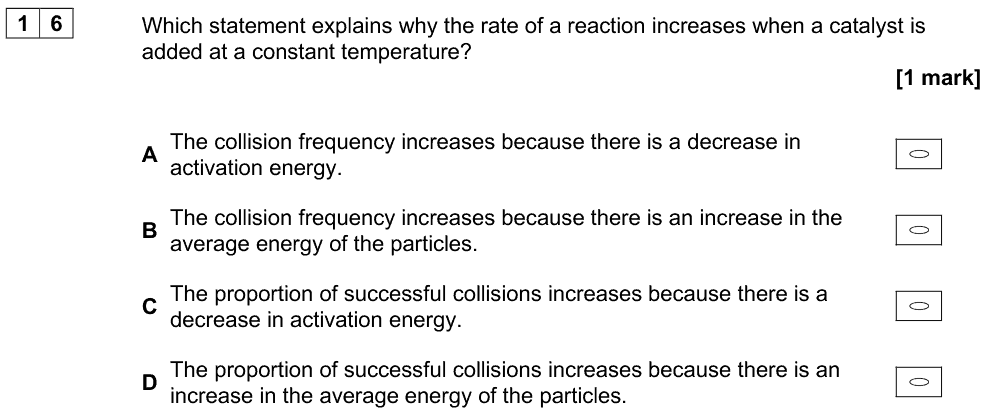
C
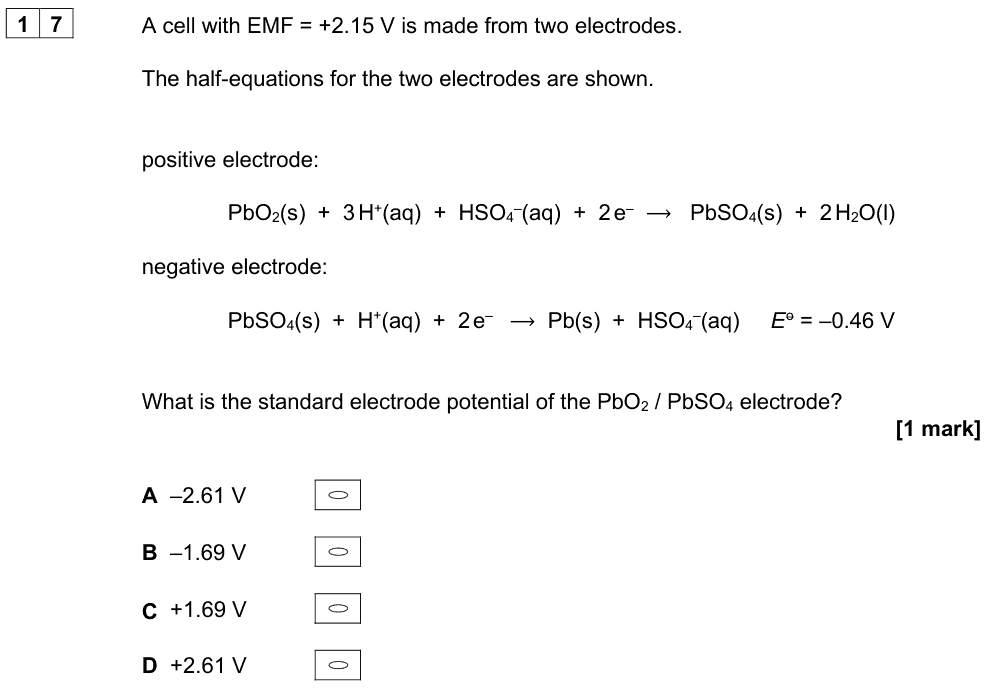
C
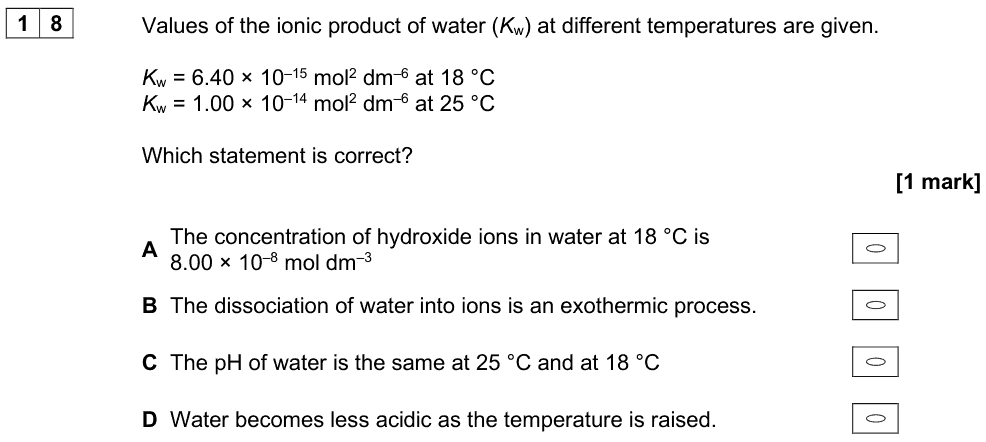
A
Skills: MS0.4 Use calculators to find and use power, exponential and logarithmic functions
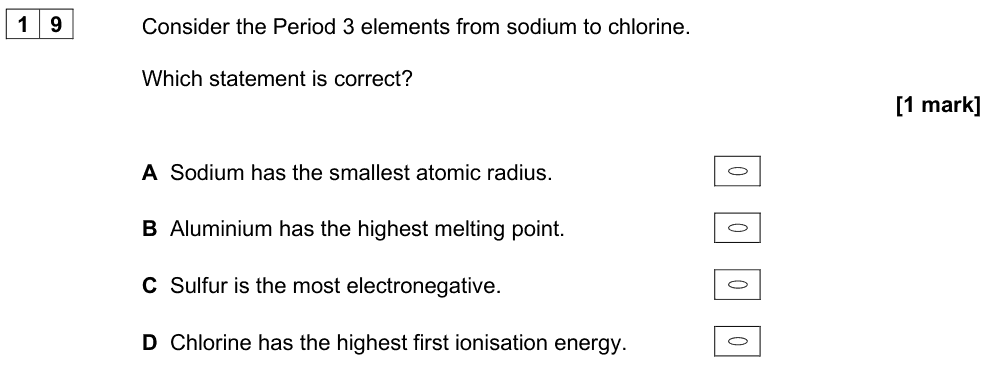
D
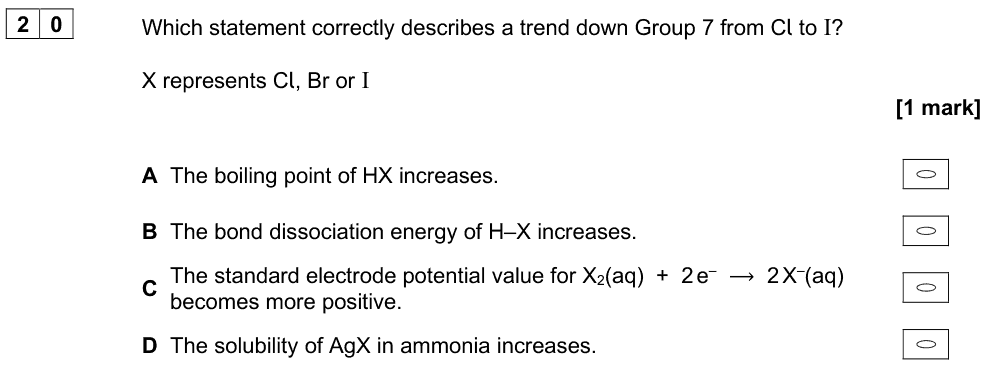
A
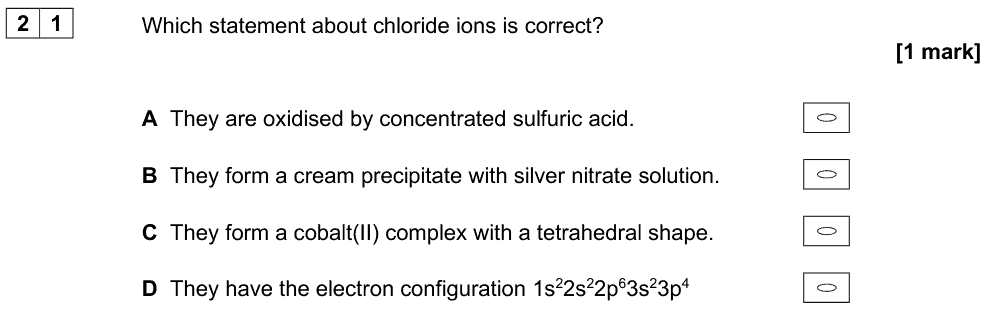
C
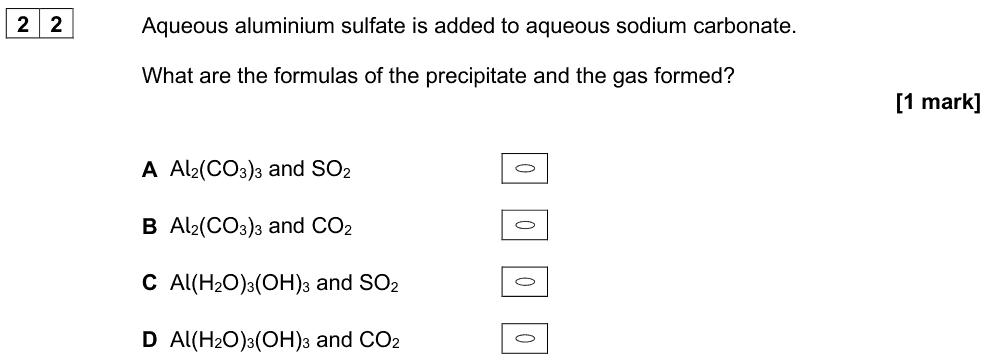
D
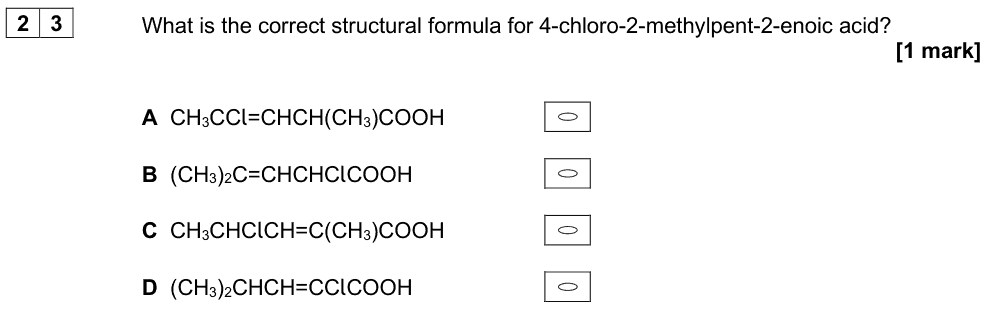
C
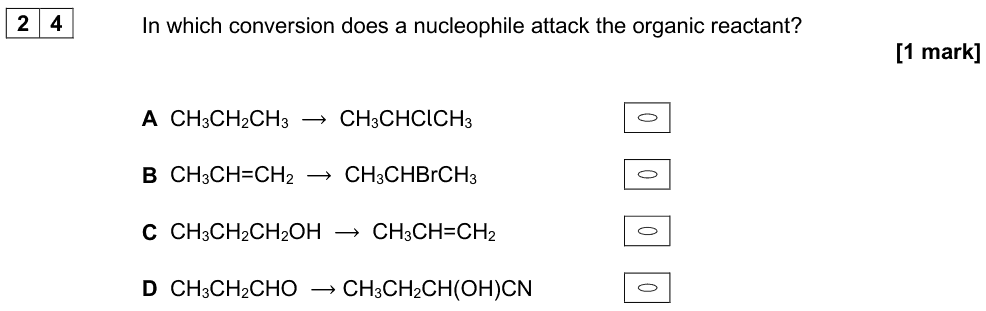
D
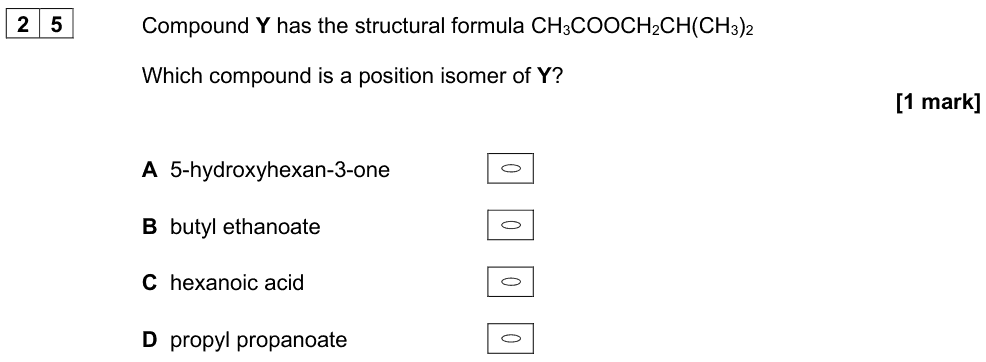
D
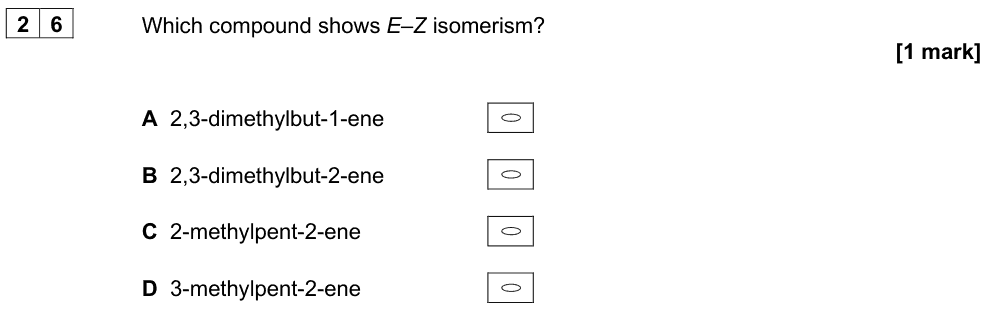
D
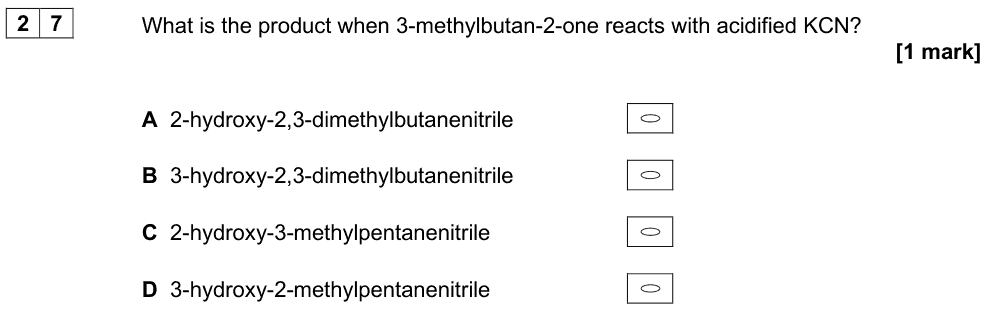
A
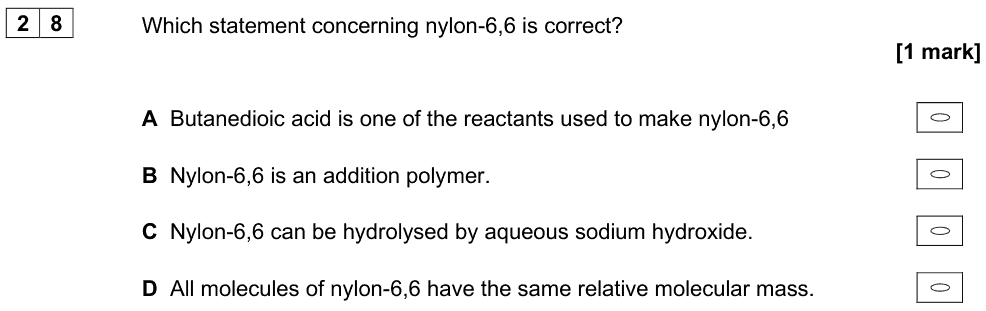
C
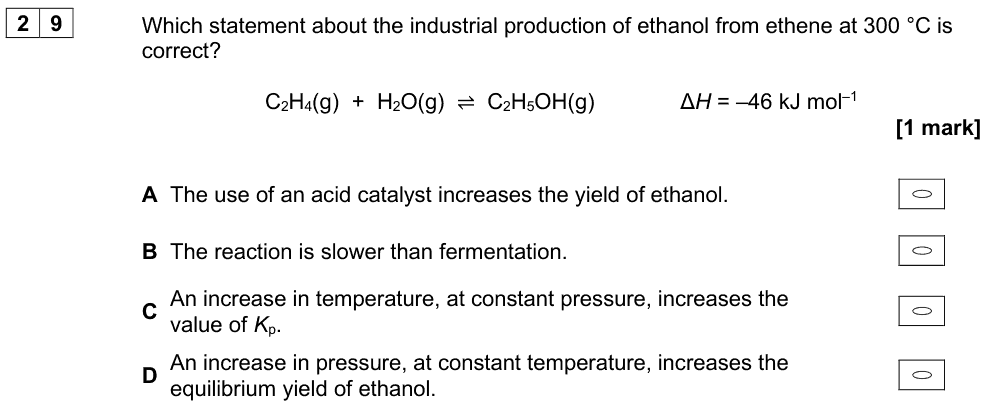
D
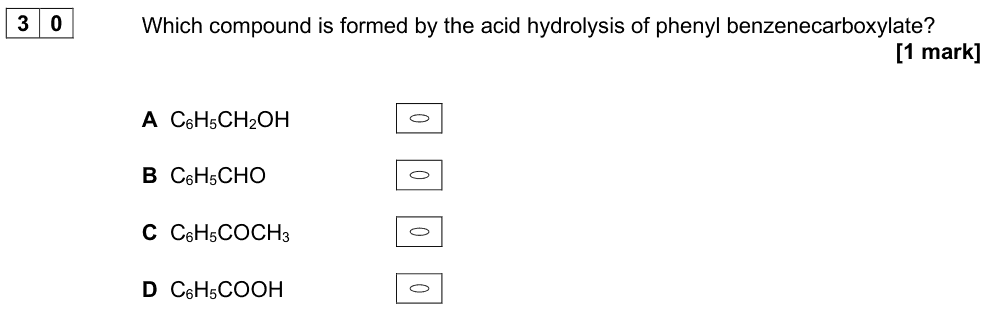
D
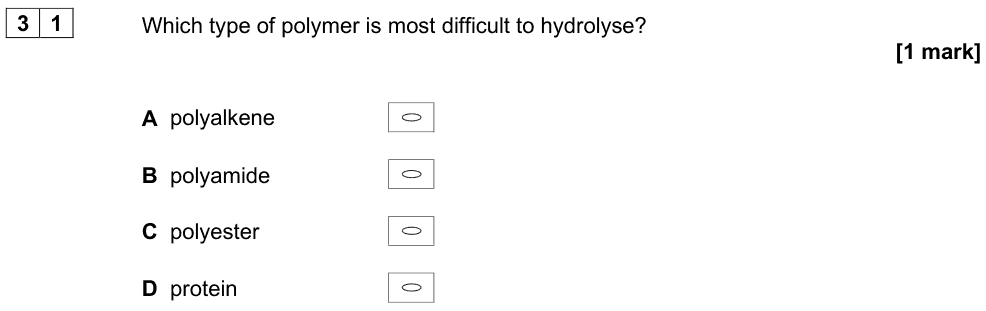
A
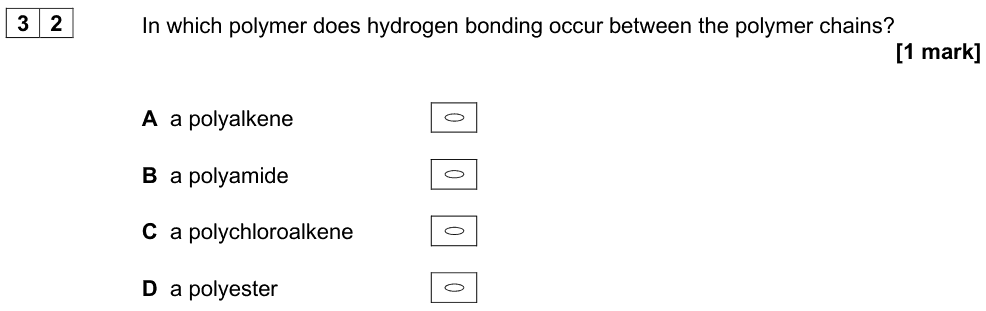
B
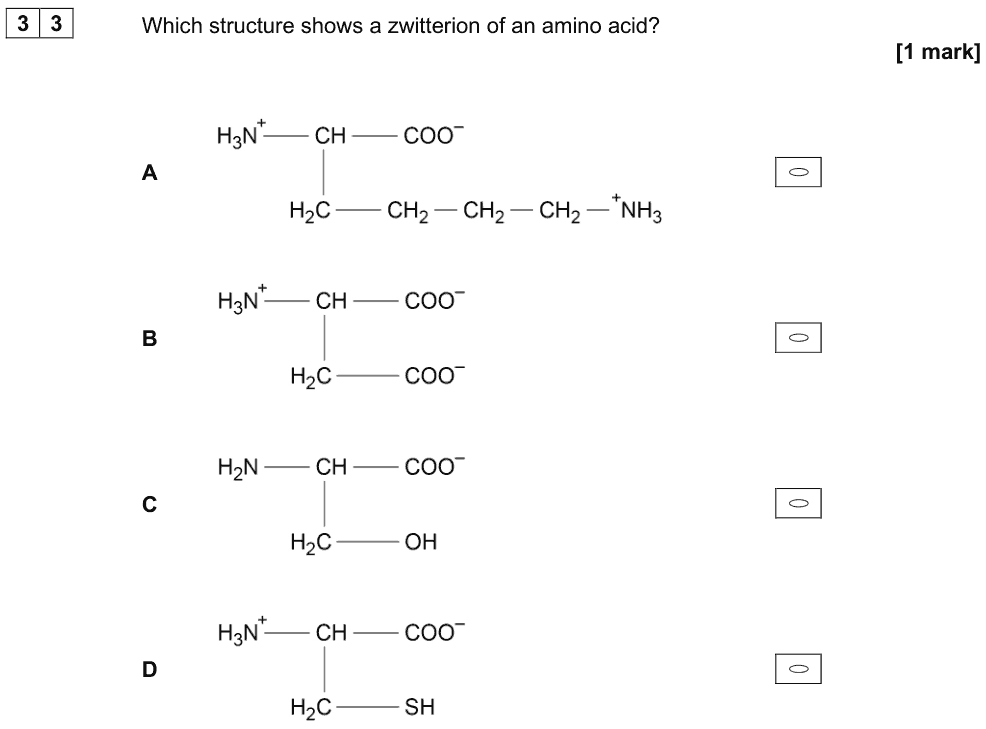
D
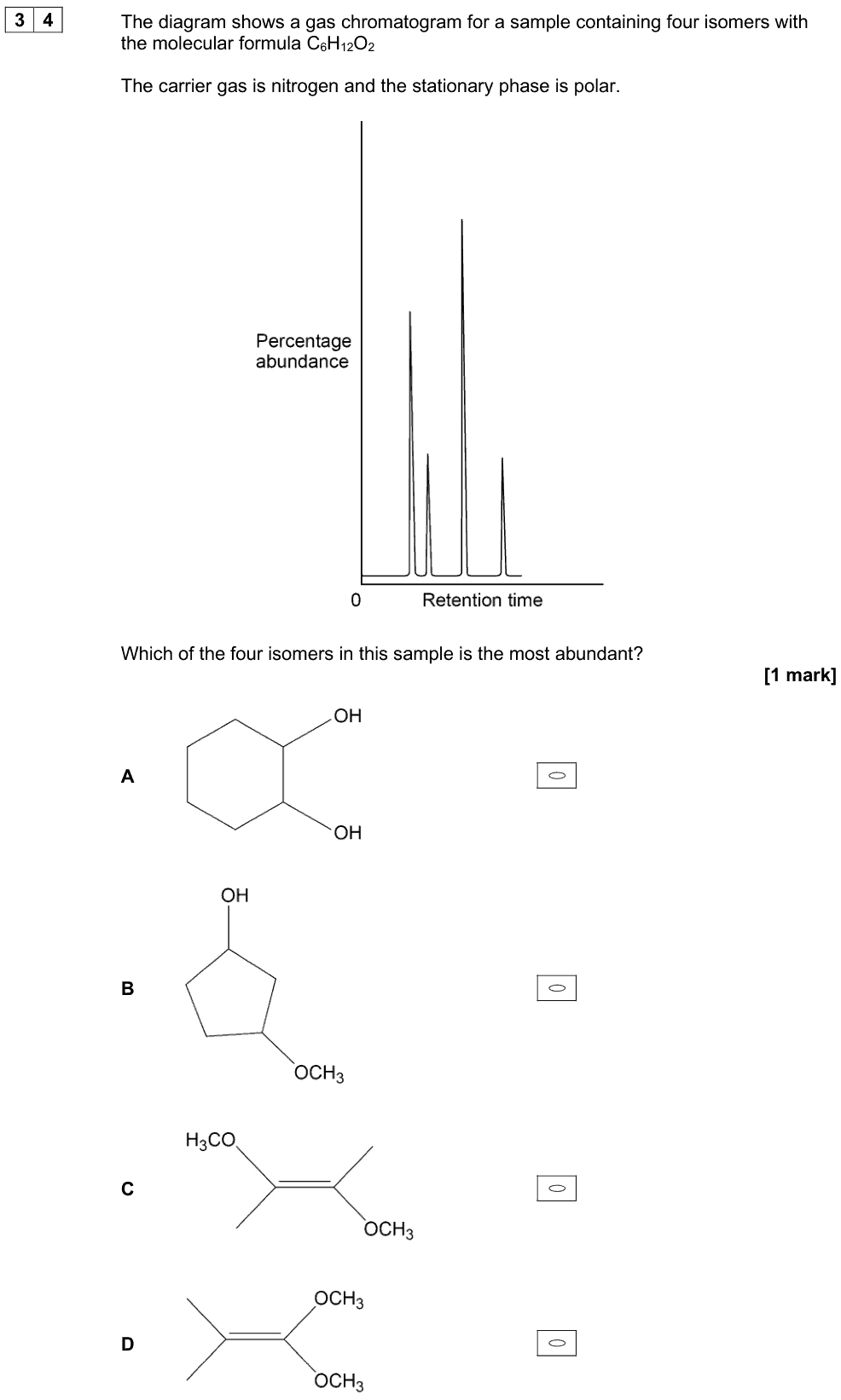
B
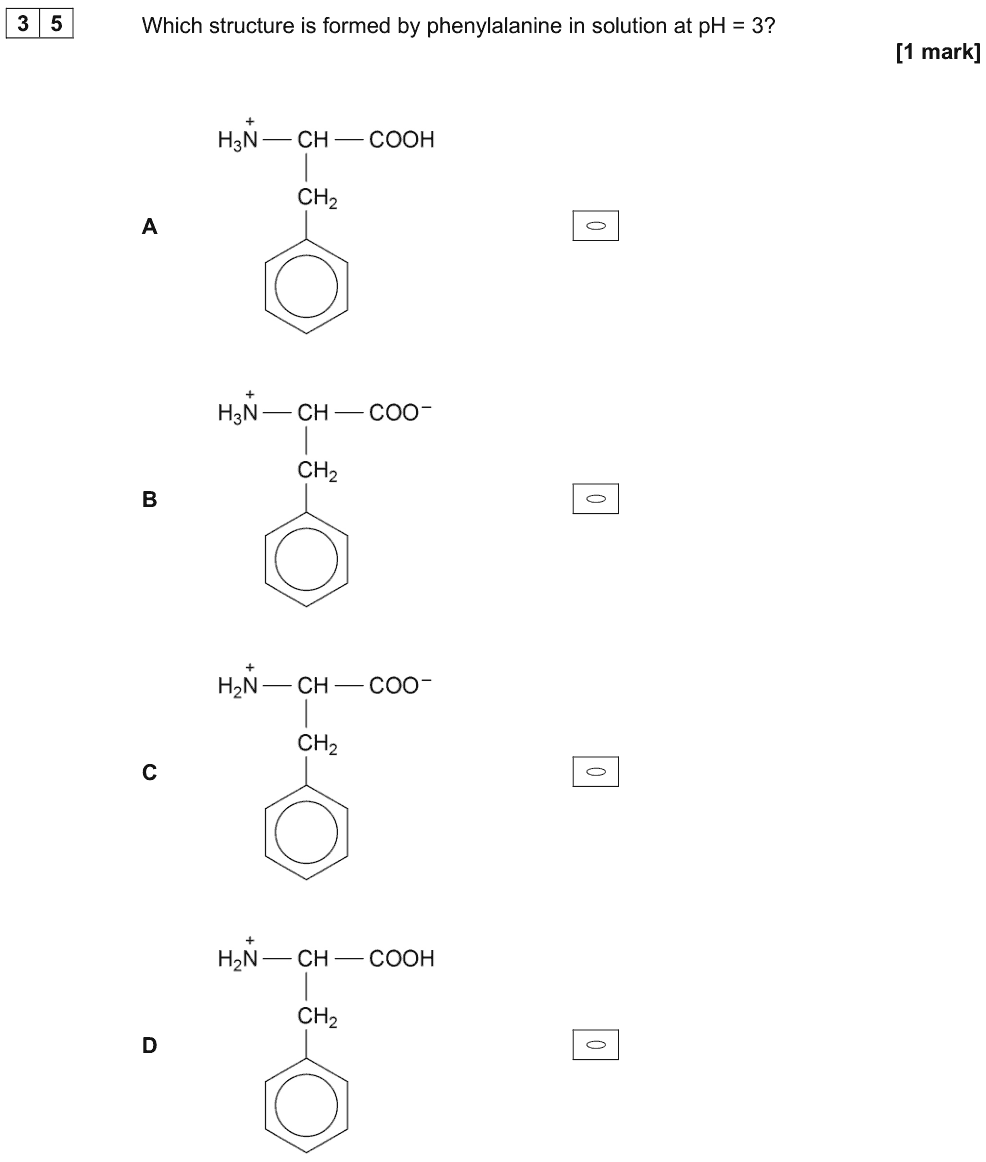
A
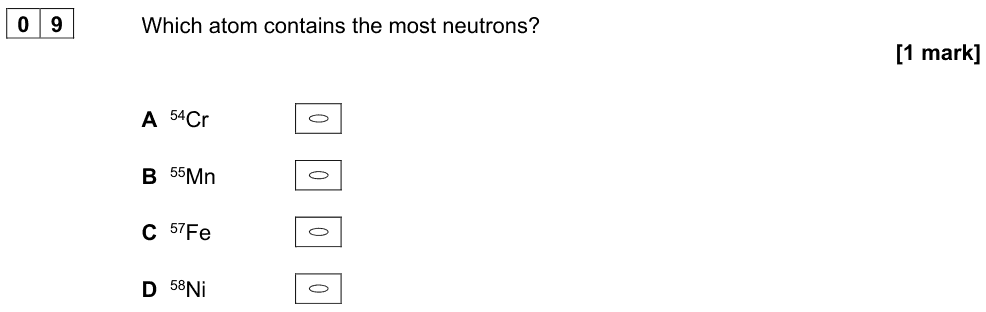
C
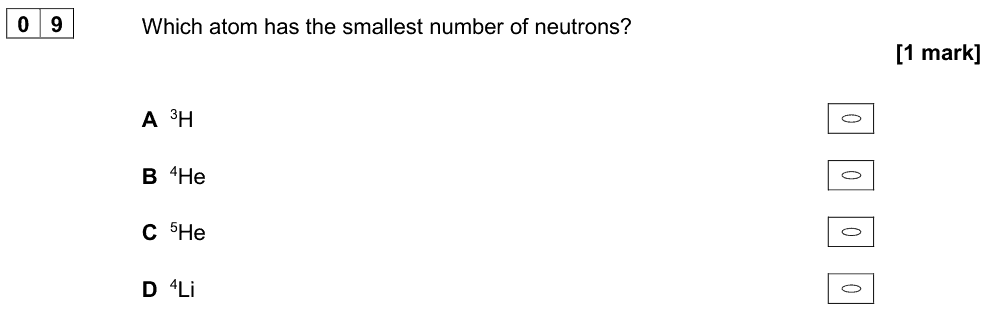
Atomic Structure The vast majority of students (86%) were able to deduce correctly the atom that contains the most neutrons. Question 10 and Question 11: Titration About half of the students scored the mark on these questions. In question 10, some students decided, incorrectly, that rinsing the conical flask with vinegar (one of the reagents) between each titration would improve accuracy. In question 11, a number of students decided that rinsing with distilled water would decrease the percentage uncertainty.
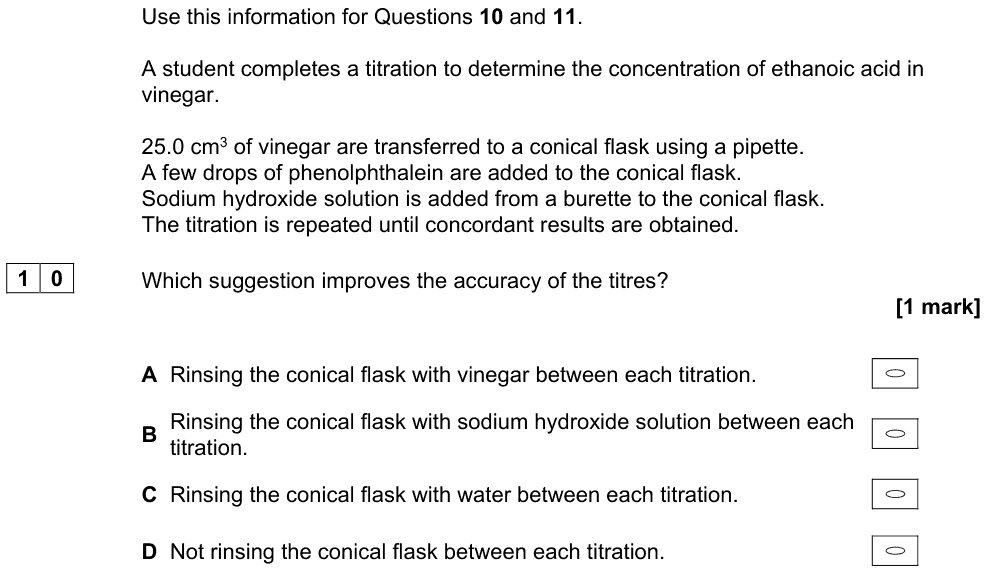
C
Skills: ATd Use laboratory apparatus for a variety of experimental techniques including: titration, using burette and pipette; distillation and heating under reflux, including setting up glassware using retort stand and clamps; qualitative tests for ions and organic functional groups; filtration, including use of fluted filter paper, or filtration under reduced pressure; PS2.1 Comment on experimental design and evaluate scientific methods; RP1 Make up a volumetric solution and carry out a simple acid–base titration
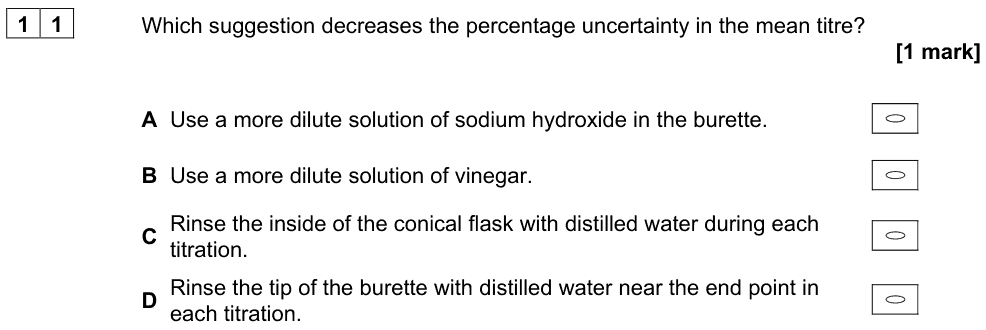
A
Skills: ATd Use laboratory apparatus for a variety of experimental techniques including: titration, using burette and pipette; distillation and heating under reflux, including setting up glassware using retort stand and clamps; qualitative tests for ions and organic functional groups; filtration, including use of fluted filter paper, or filtration under reduced pressure; MS1.3 Identify uncertainties in measurements and use simple techniques to determine uncertainty when data are combined; PS2.3 Evaluate results and draw conclusions with reference to measurement uncertainties and errors; RP1 Make up a volumetric solution and carry out a simple acid–base titration
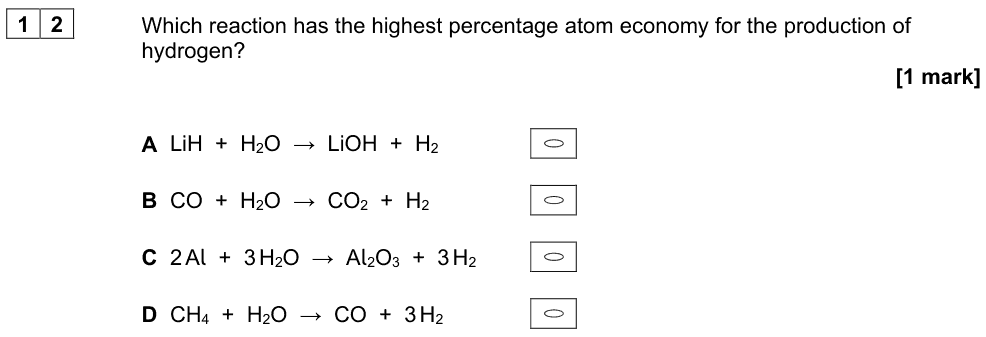
D
The majority of students (68%) were able to deduce which equation had the highest atom economy for the production of hydrogen.
Skills: MS0.2 Use ratios, fractions and percentages
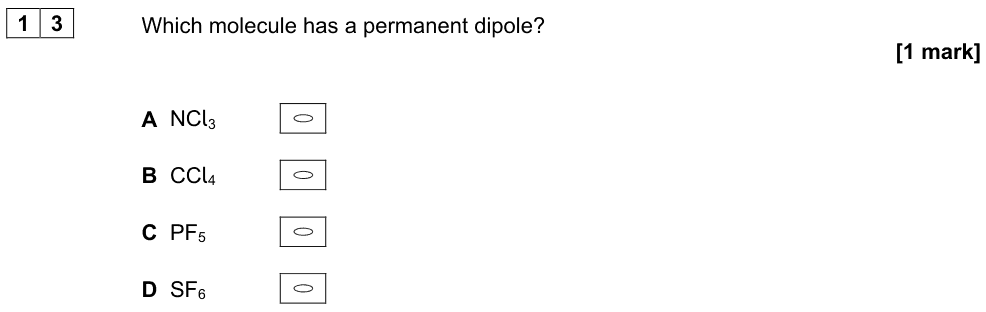
A
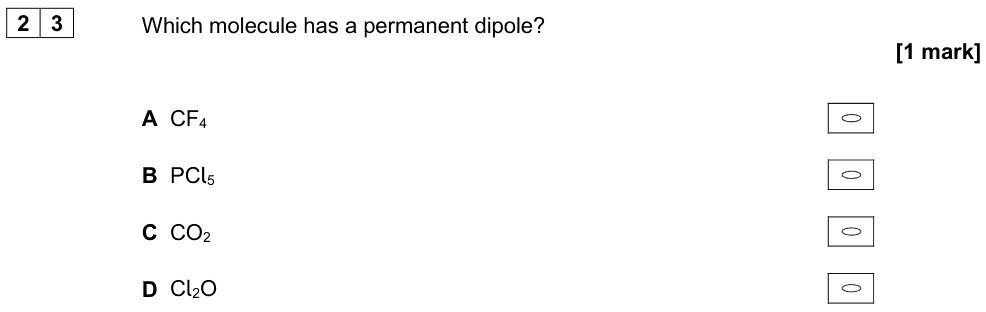
About half of the students were able to identify the molecule that has a permanent dipole.
Skills: MS4.1 Use angles and shapes in regular 2D and 3D structures
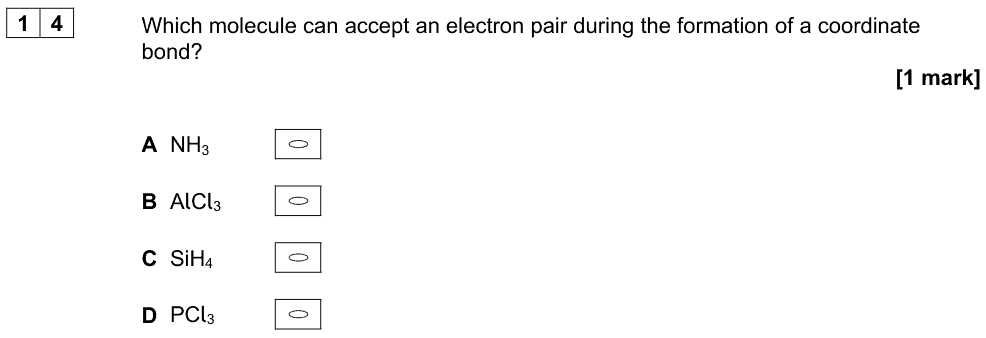
B
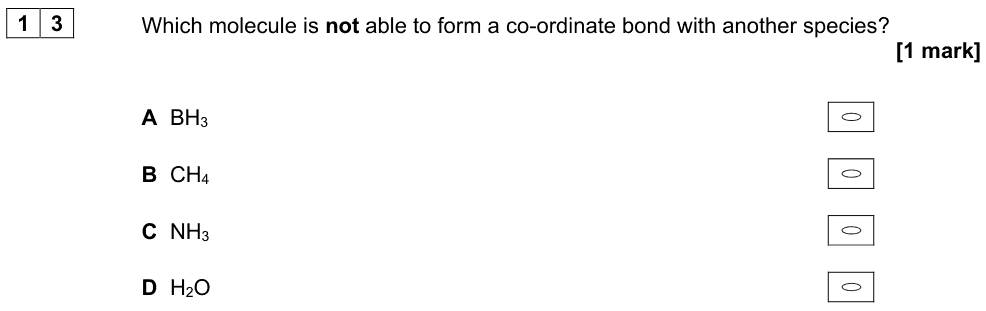
Just under half of the students were able to identify the molecule that can accept an electron pair during the formation of a coordinate bond. A common incorrect answer was the identification of a molecule that would donate the lone pair during the formation of a coordinate bond.
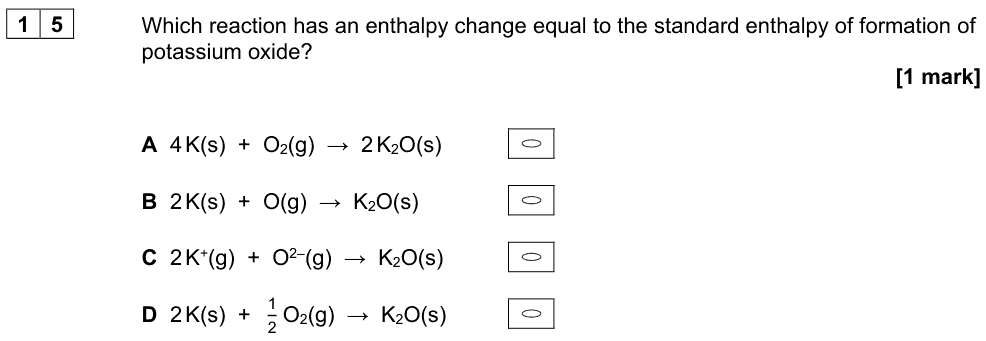
D
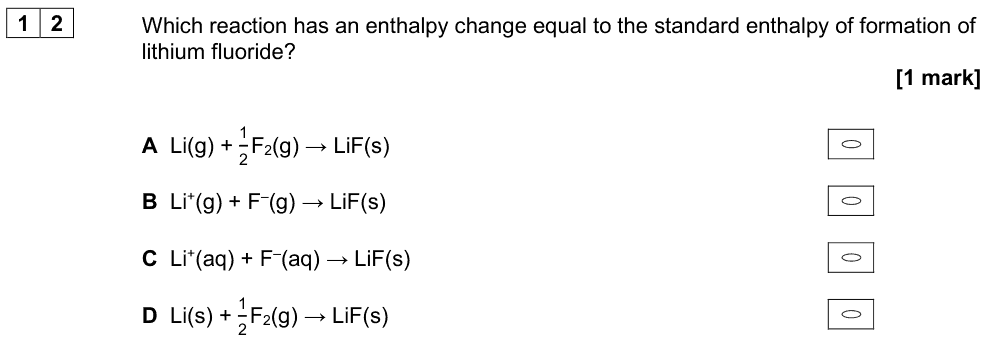
About two-thirds of students correctly identified the reaction that has an enthalpy change equal to the standard enthalpy of formation of potassium oxide.
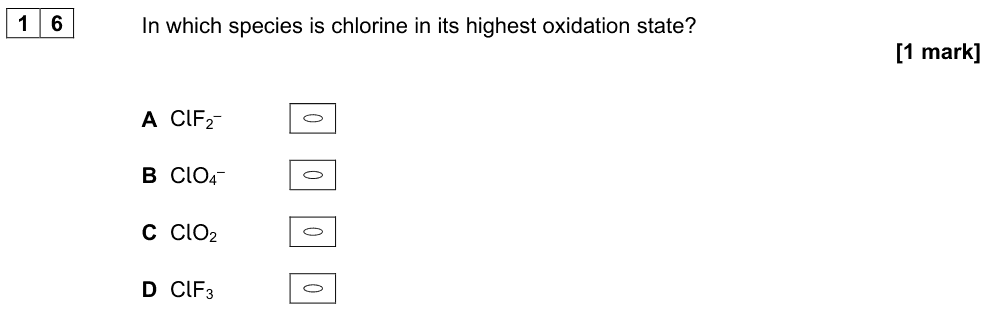
B
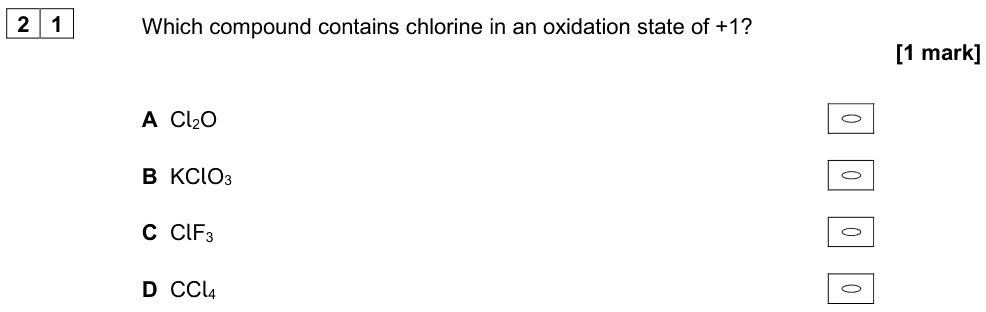
This was well answered with the great majority (82%) of students correctly identifying the species with chlorine in its highest oxidation state.
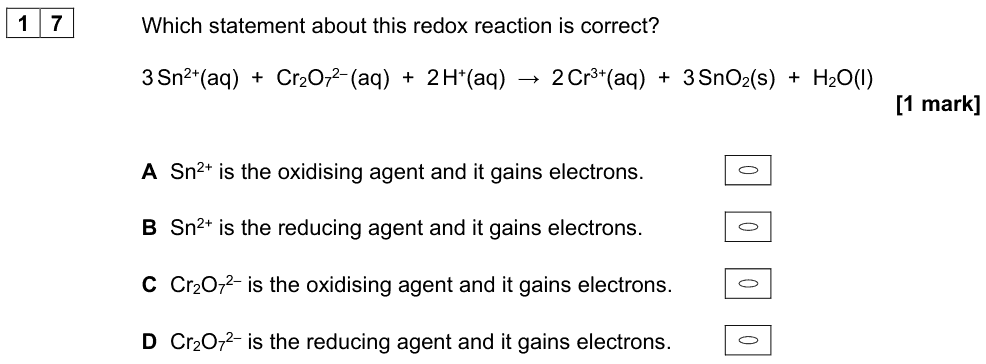
C
Students found this question challenging with less than half correctly understanding the redox processes in this reaction.
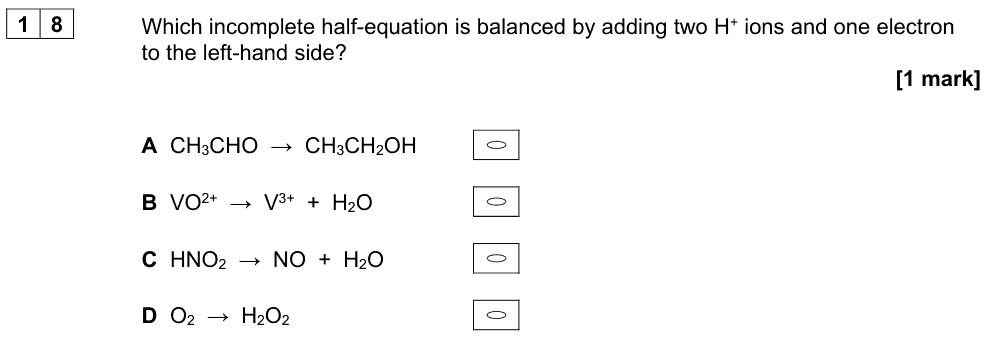
B
This was well answered with nearly three-quarters of students correctly choosing the half-equation that can be balanced by two H+ ions and one electron.
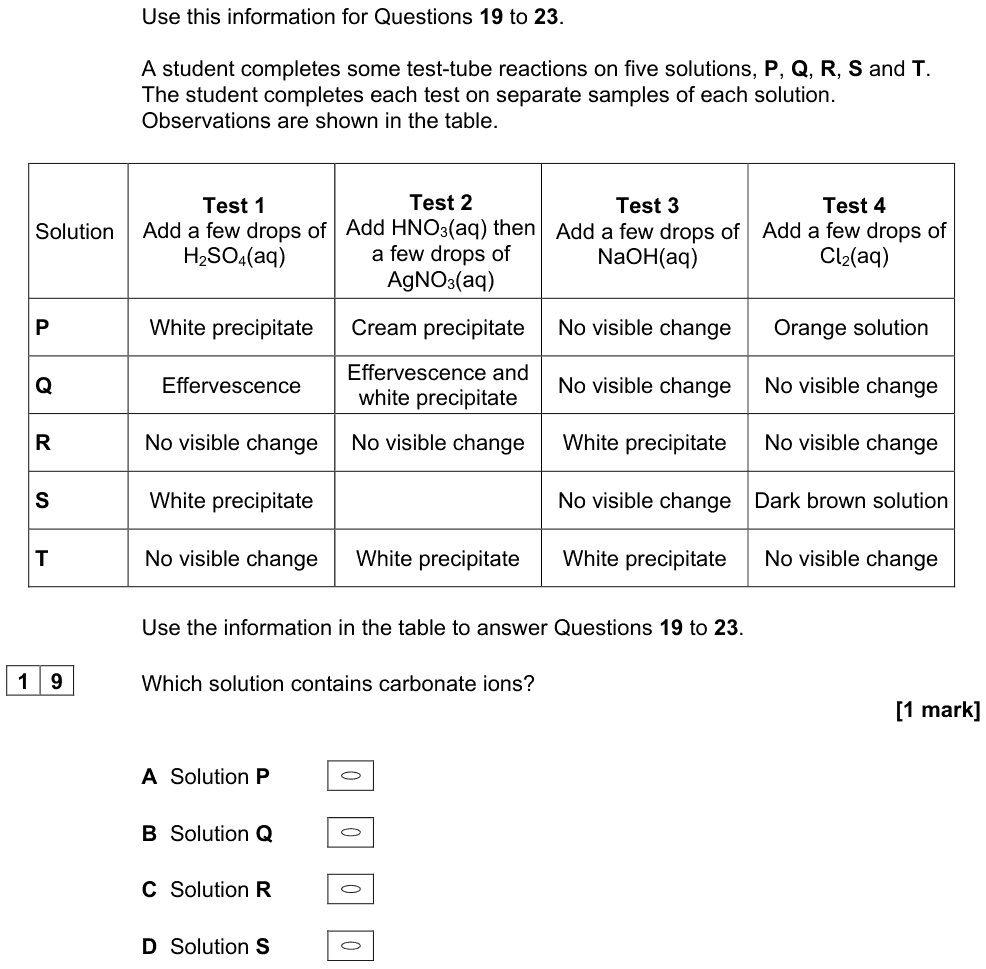
B
Questions 19 to 23: Test-tube reactions
Skills: PS1.1 Solve problems set in practical contexts; RP4 Carry out simple test-tube reactions to identify: cations – Group 2, NH4+; anions – Group 7 (halide ions), OH–, CO32–, SO42–
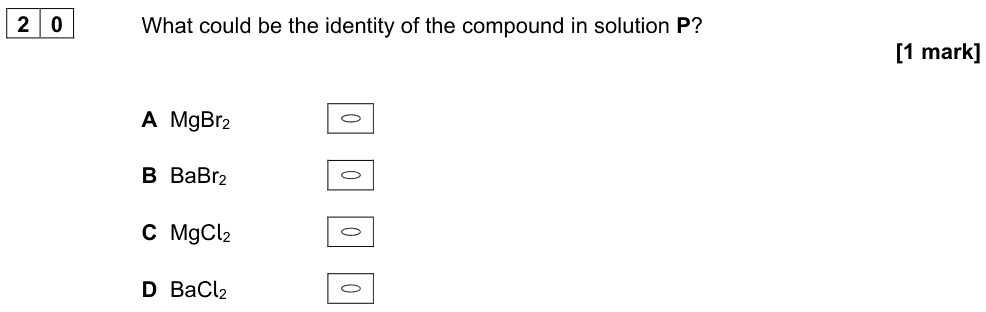
B
These questions enabled students to analyse and interpret some observations from some test-tube reactions. They were generally well answered by students, although they found it more challenging to deduce the identity of the compound in solution P in question 20, and of the compound in solution T in question 23.
Skills: PS1.1 Solve problems set in practical contexts; RP4 Carry out simple test-tube reactions to identify: cations – Group 2, NH4+; anions – Group 7 (halide ions), OH–, CO32–, SO42–
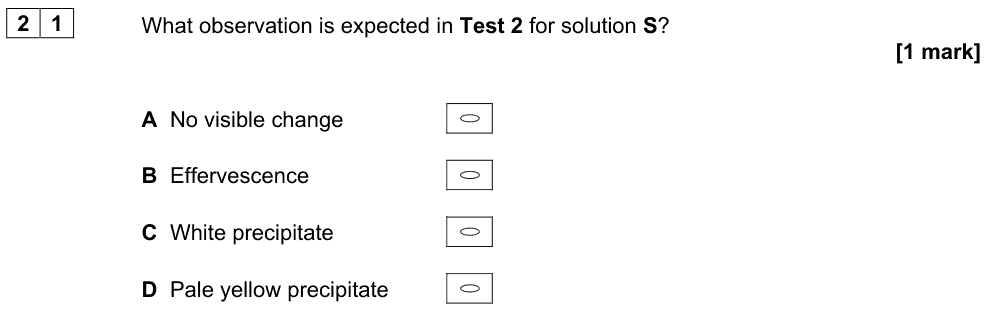
D
Skills: PS1.1 Solve problems set in practical contexts; RP4 Carry out simple test-tube reactions to identify: cations – Group 2, NH4+; anions – Group 7 (halide ions), OH–, CO32–, SO42–
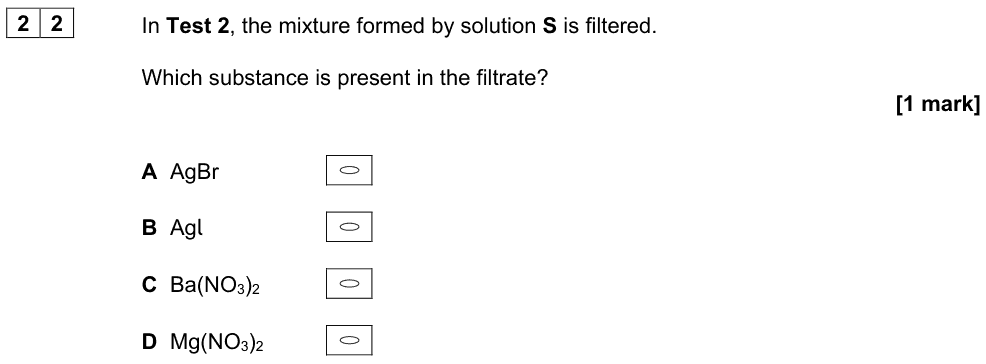
Unfortunately there was a typographical error in option B, where silver iodide (AgI) was mistakenly shown as Ag. In order to mitigate possible disadvantage to students, the question was discounted and every student received a mark for this question. To avoid any chance of a similar error happening in future, it has been decided that, from 2024 onwards, iodine/iodide will be represented by a very clear capital (Times New Roman font) I.
Skills: PS1.1 Solve problems set in practical contexts; RP4 Carry out simple test-tube reactions to identify: cations – Group 2, NH4+; anions – Group 7 (halide ions), OH–, CO32–, SO42–
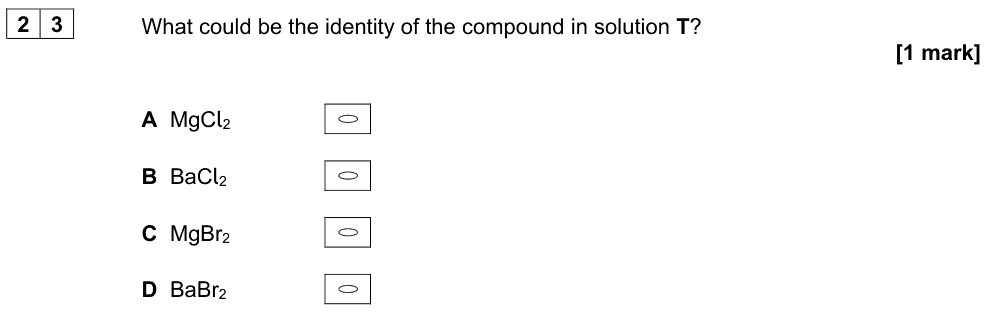
A
These questions enabled students to analyse and interpret some observations from some test-tube reactions. They were generally well answered by students, although they found it more challenging to deduce the identity of the compound in solution P in question 20, and of the compound in solution T in question 23.
Skills: PS1.1 Solve problems set in practical contexts; RP4 Carry out simple test-tube reactions to identify: cations – Group 2, NH4+; anions – Group 7 (halide ions), OH–, CO32–, SO42–
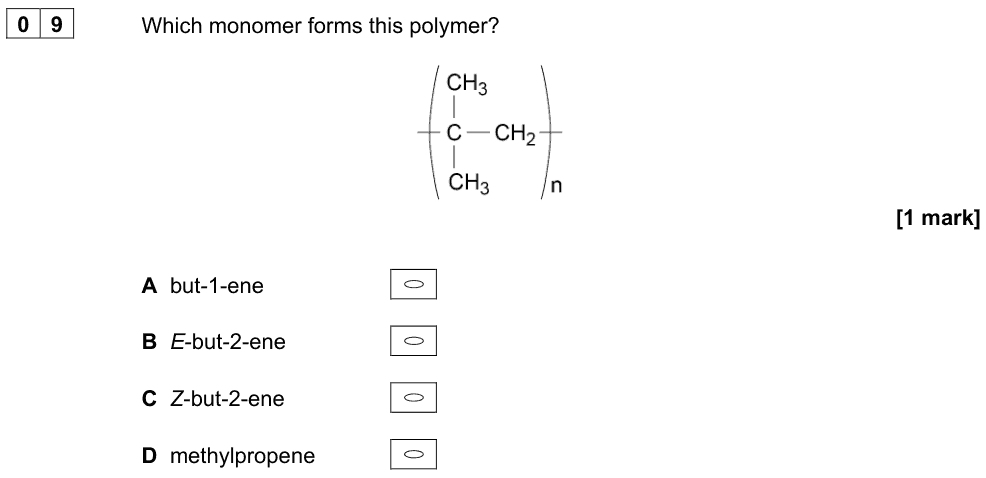
D
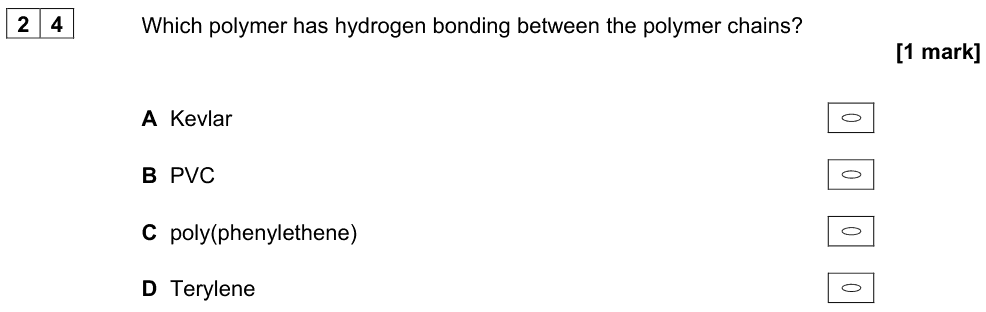
Polymers This was answered correctly by a majority (73%) of students.
C
This was answered correctly by the vast majority (84%) of students.
C
Students struggled with this question, with many believing that hydrogen is a product.
A
This was answered correctly by a great majority (79%) of students.
B
This was answered correctly by a great majority (78%) of students.
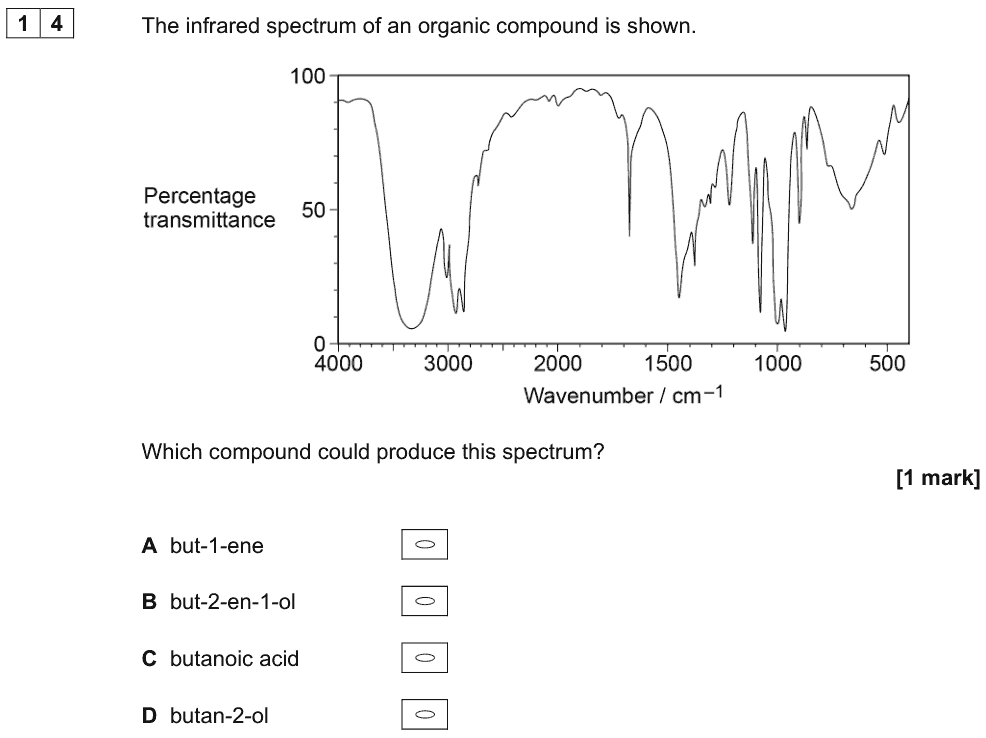
B
Many students incorrectly thought that the alcohol O-H group was a carboxylic acid O-H group.
Skills: MS3.1 Translate information between graphical, numerical and algebraic forms
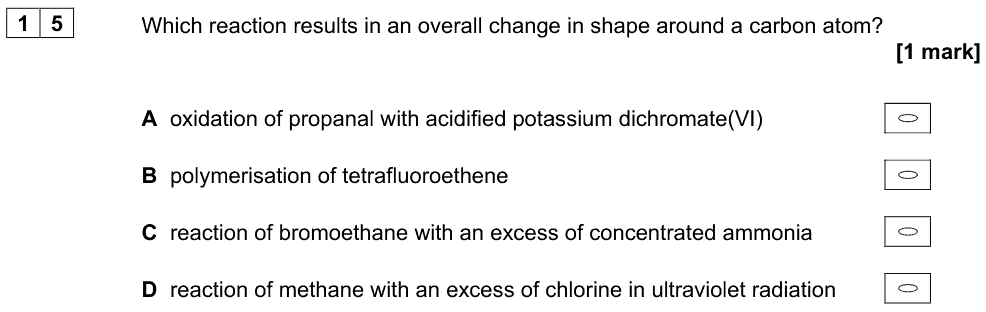
B
There was much to consider in this question and a range of answers was given by students. Just over 40% of students gave the correct answer.
Skills: MS4.1 Use angles and shapes in regular 2D and 3D structures
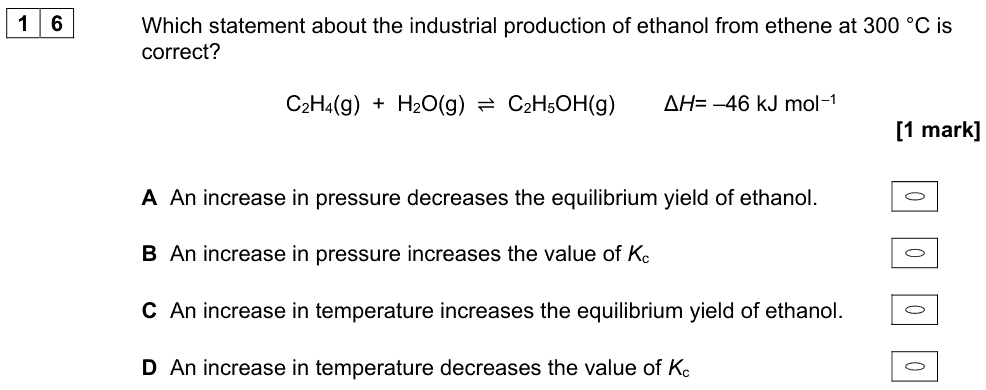
D
This was answered correctly by a majority (55%) of students.
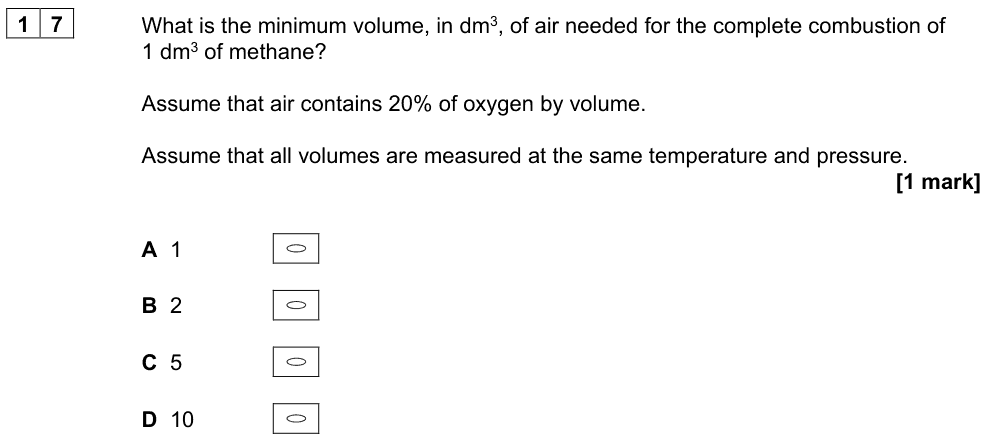
D
Students found this question difficult, possibly due to having to determine the molar reacting ratio first.
Skills: MS0.2 Use ratios, fractions and percentages
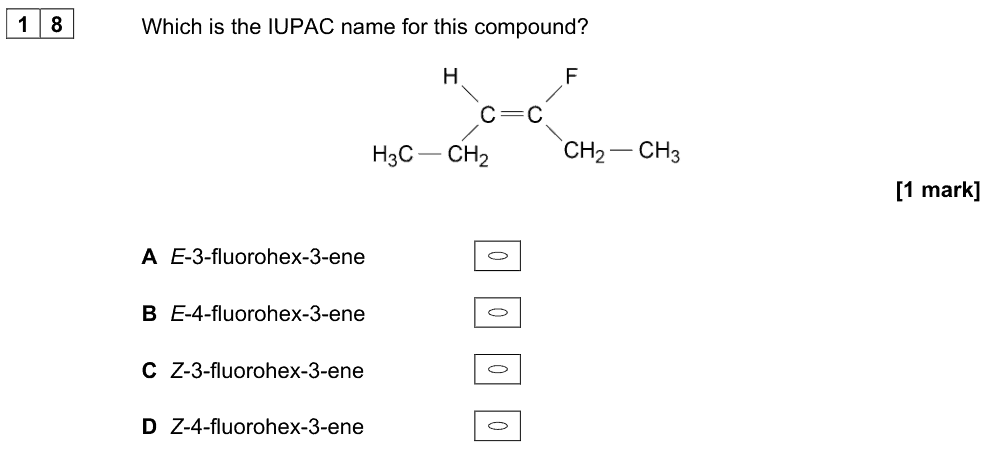
A
Students struggled with this question, with many believing it was the Z, not the E, stereoisomer. This was possibly due to a misunderstanding of how the Cahn-Ingold prelog priority rules apply when there is an ethyl group on each C of the C=C bond.
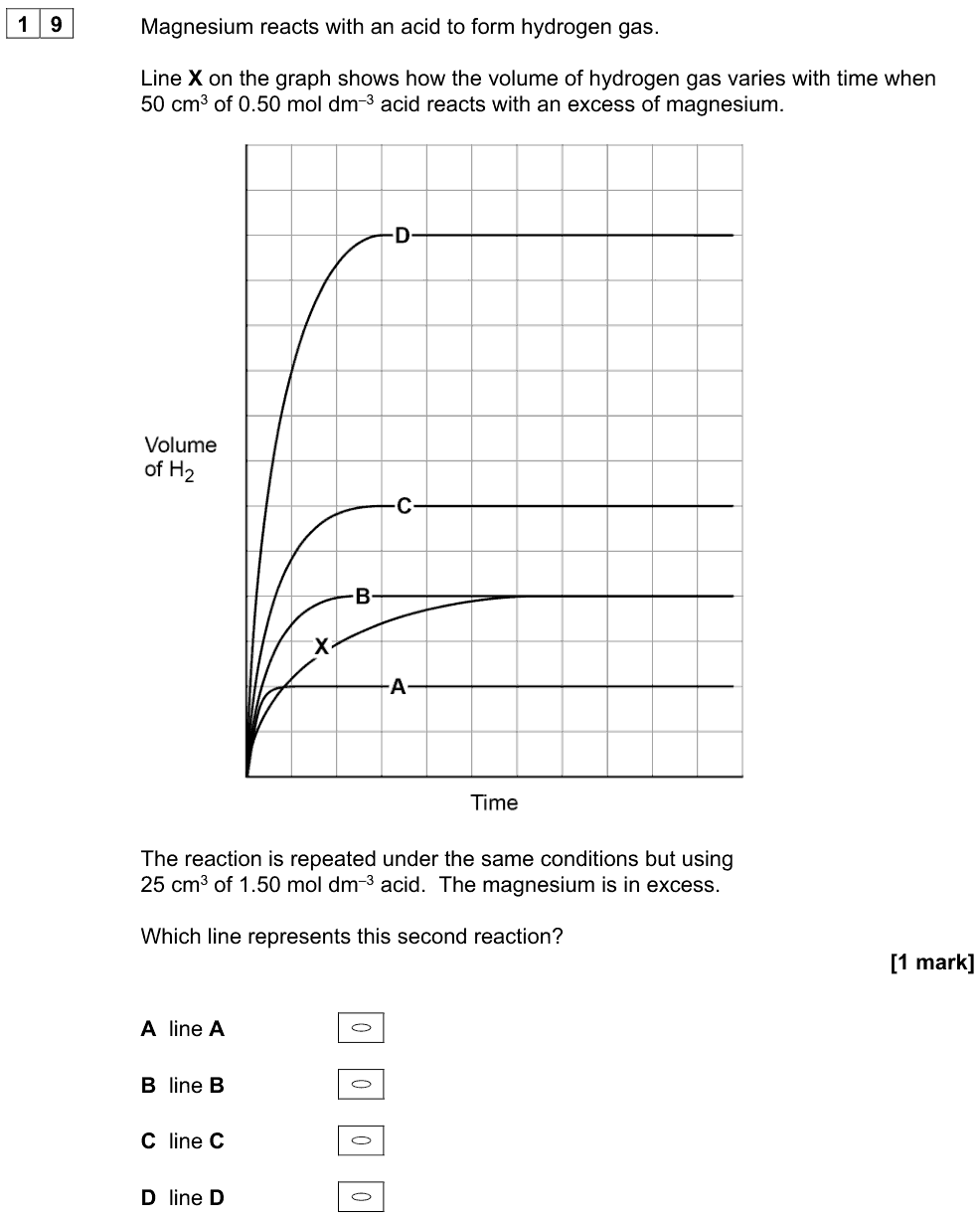
C
This was answered correctly by a majority (51%) of students.
Skills: MS0.2 Use ratios, fractions and percentages; MS3.1 Translate information between graphical, numerical and algebraic forms
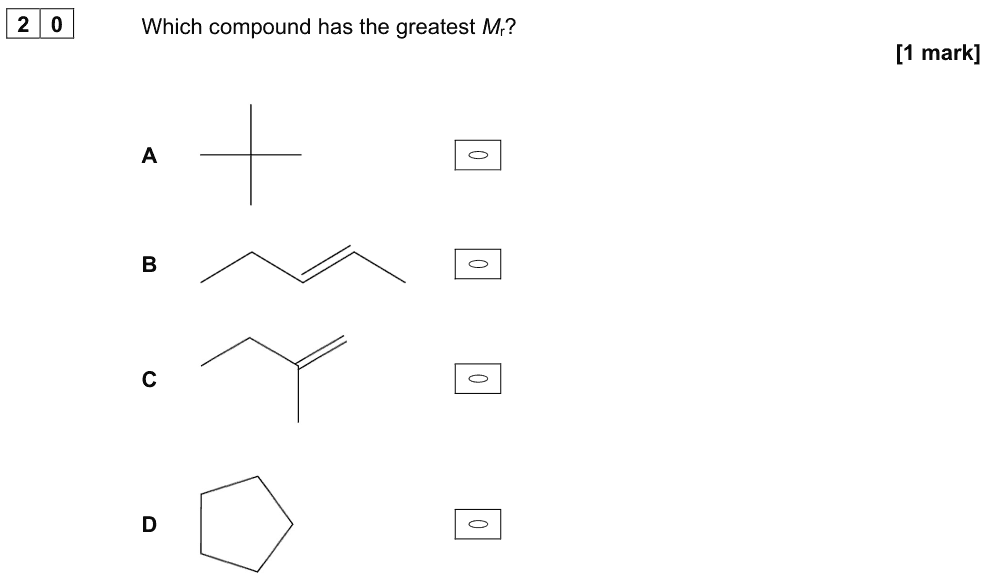
A
This was answered correctly by a majority (59%) of students.
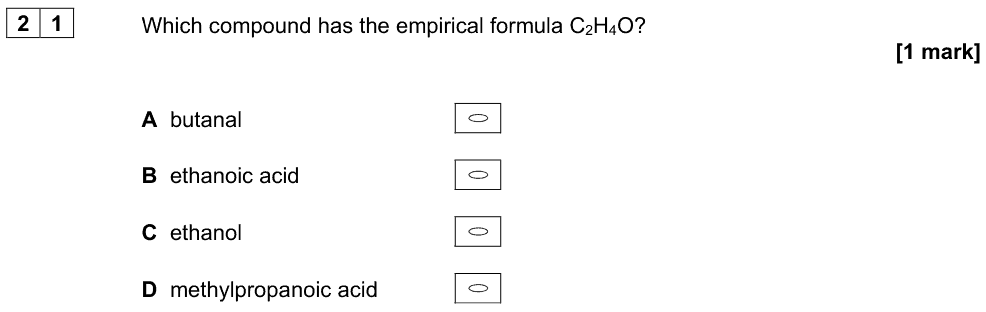
D
Students found this question difficult, possibly due to it requiring two steps to determine the molecular formula from the name and then the empirical formula.
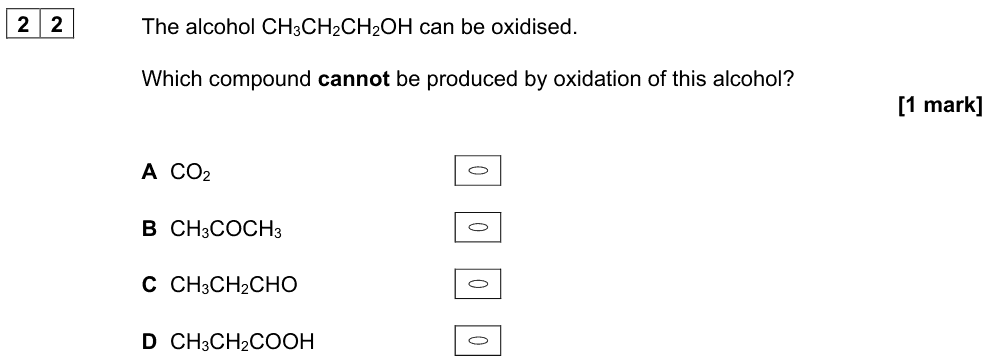
B
This was answered correctly by a majority (53%) of students.
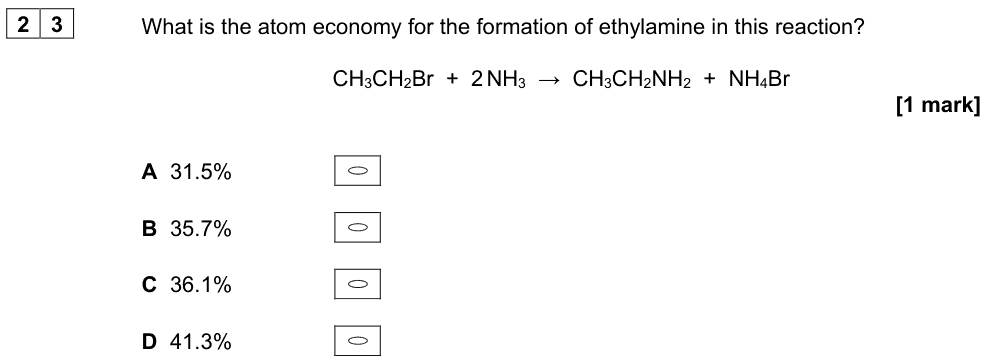
A
This was answered correctly by a clear majority (65%) of students.
Skills: MS0.2 Use ratios, fractions and percentages
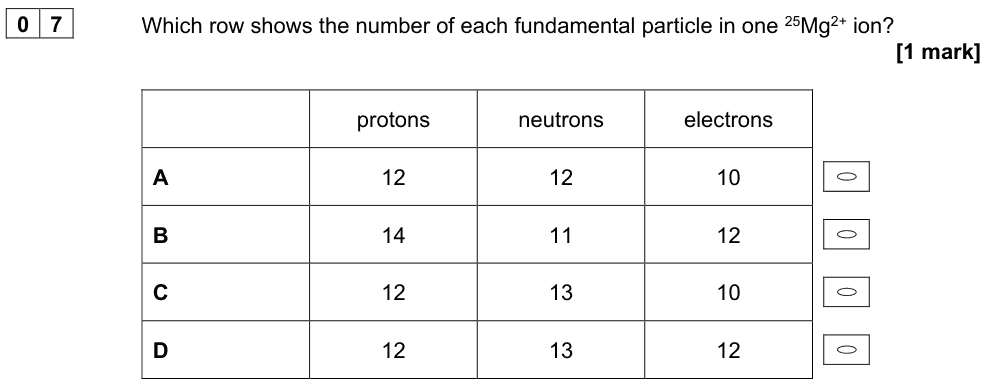
C
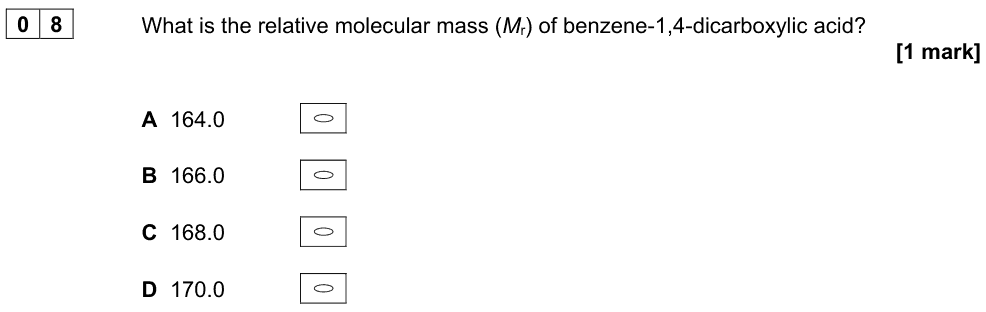
B
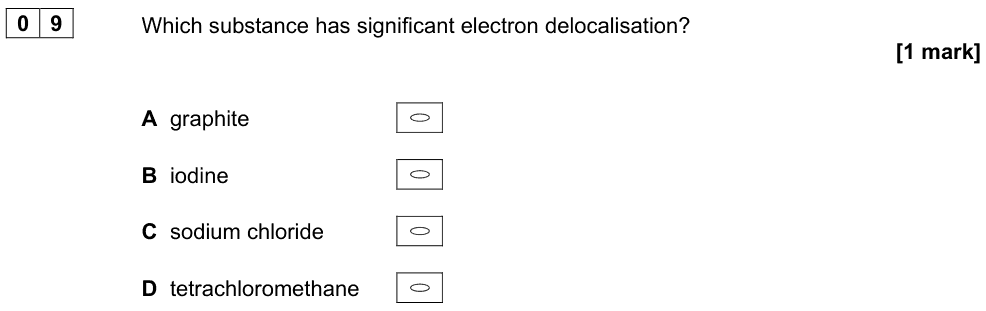
A
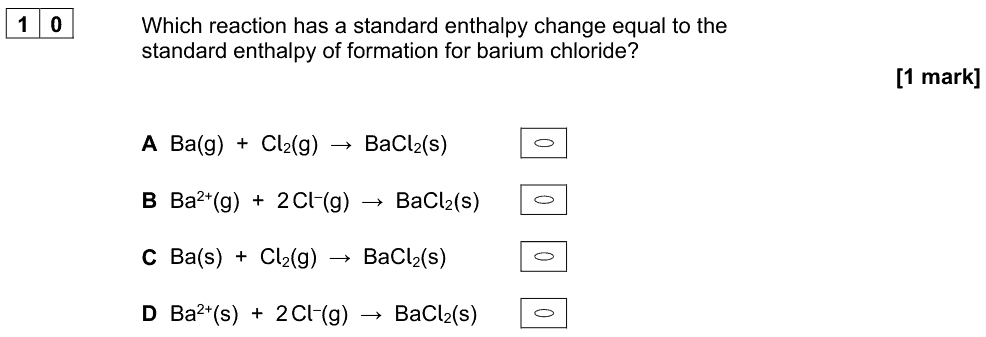
C
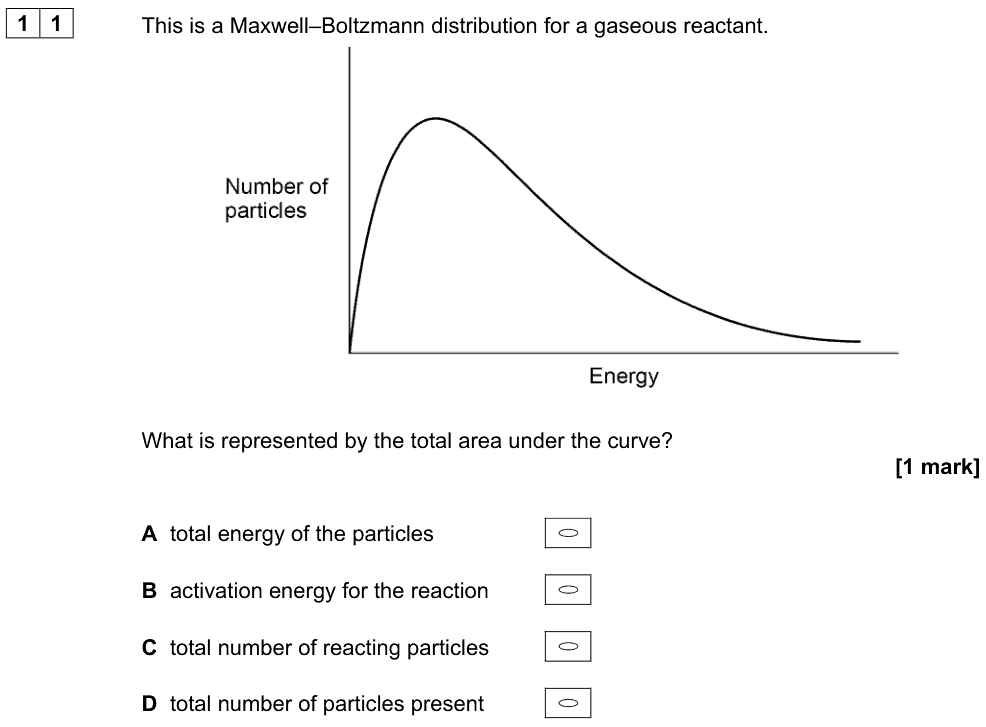
D
Skills: MS3.1 Translate information between graphical, numerical and algebraic forms
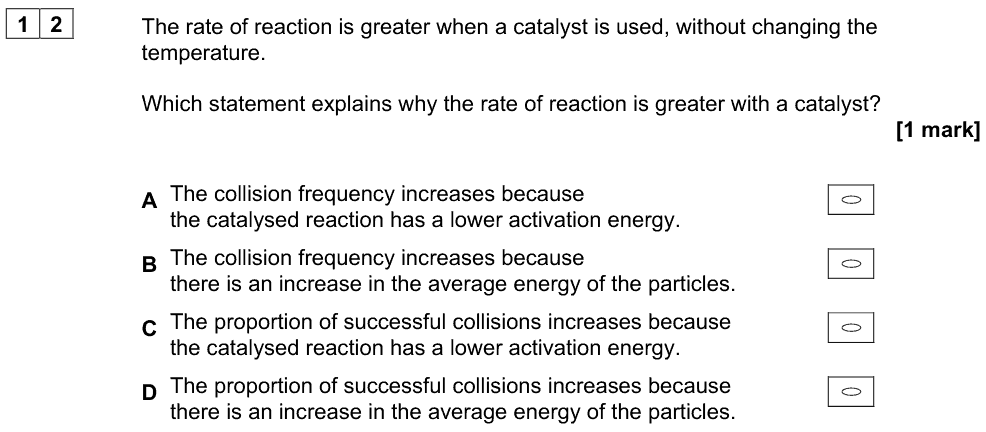
C
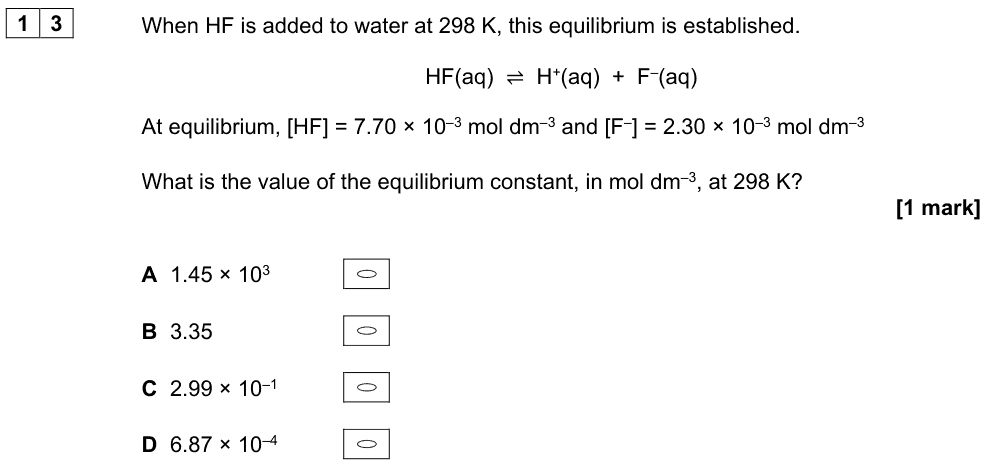
D
Skills: MS0.1 Recognise and use expressions in decimal and ordinary form; MS2.3 Substitute numerical values into algebraic equations using appropriate units for physical quantities
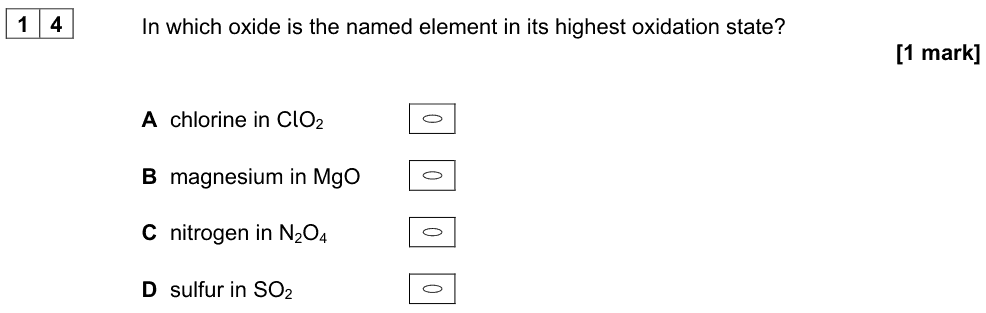
B
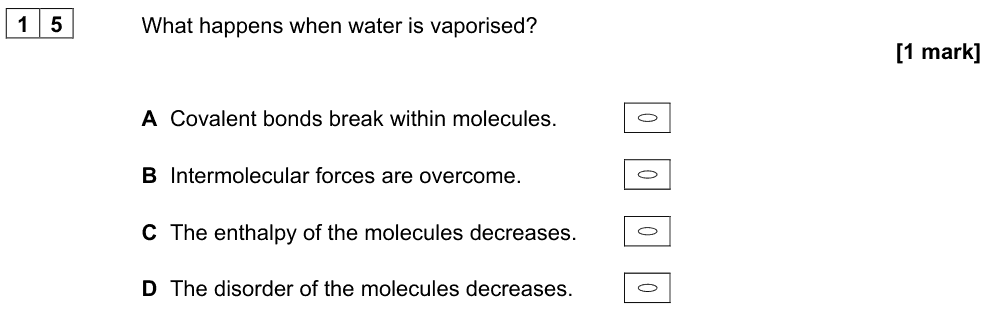
B
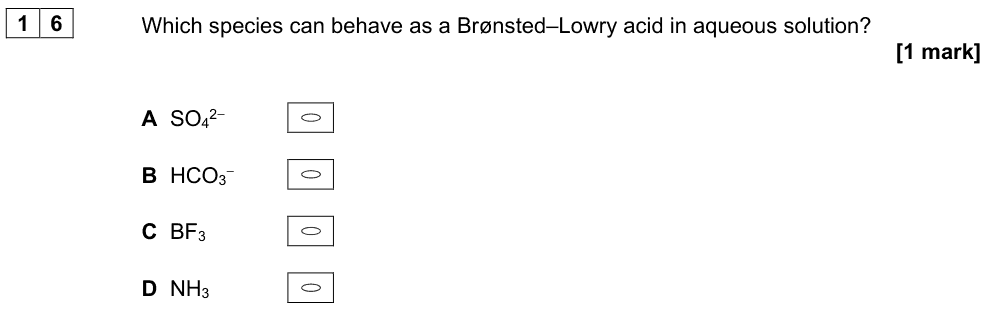
B
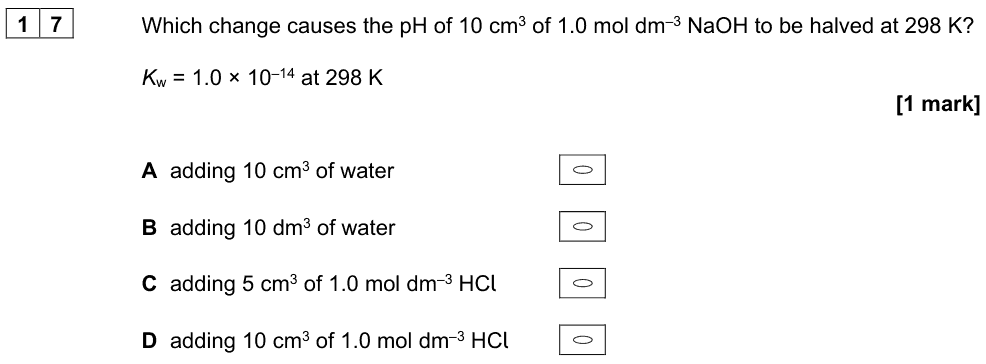
D
Skills: MS0.4 Use calculators to find and use power, exponential and logarithmic functions; MS2.5 Use logarithms in relation to quantities that range over several orders of magnitude
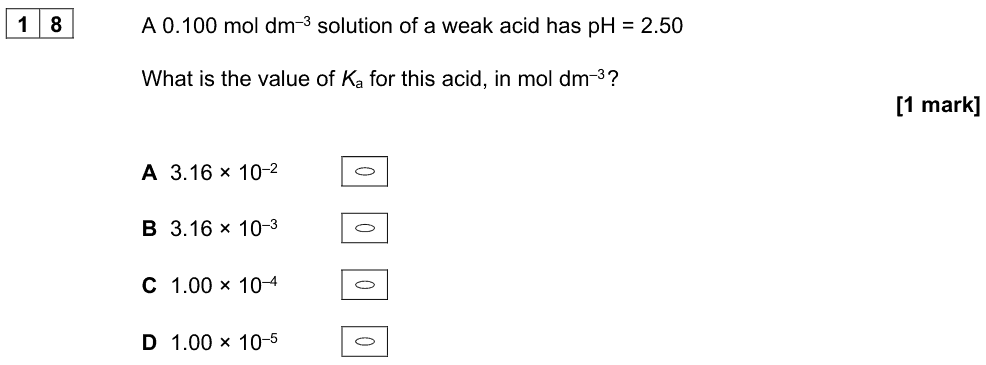
C
Skills: MS0.4 Use calculators to find and use power, exponential and logarithmic functions; MS2.5 Use logarithms in relation to quantities that range over several orders of magnitude
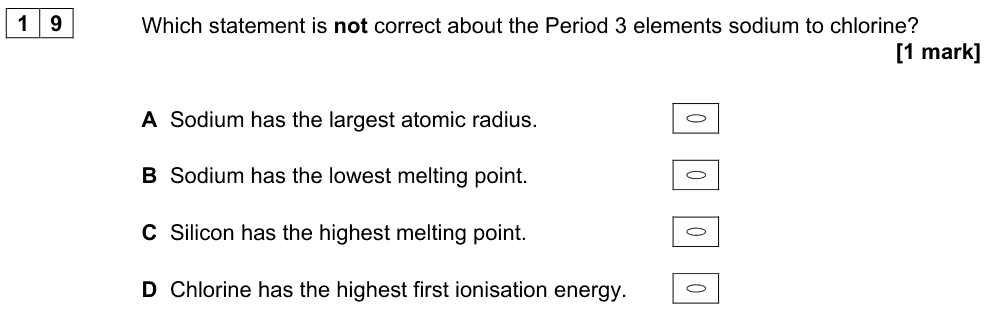
B
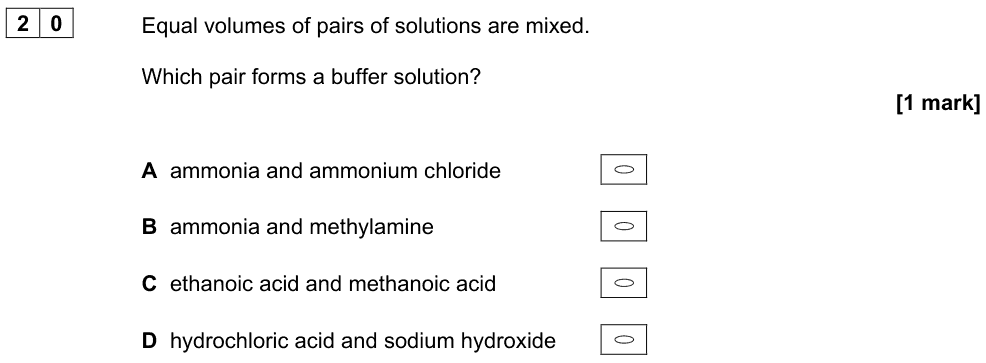
A
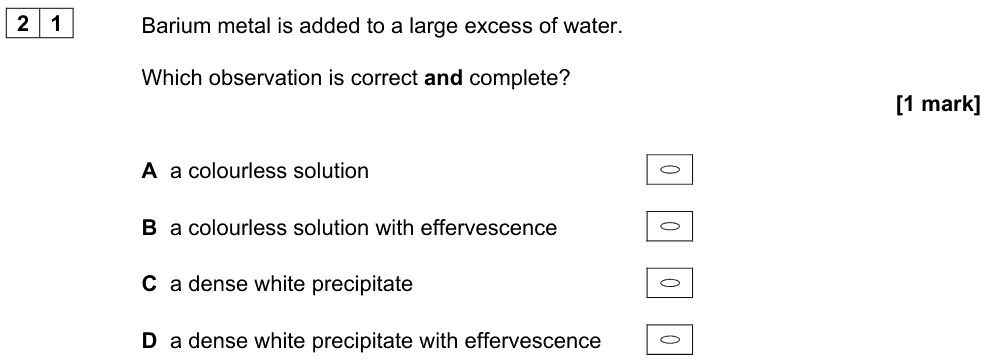
B
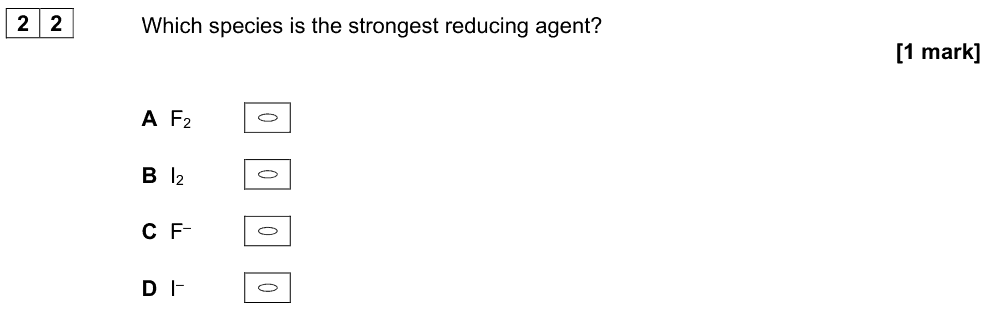
D
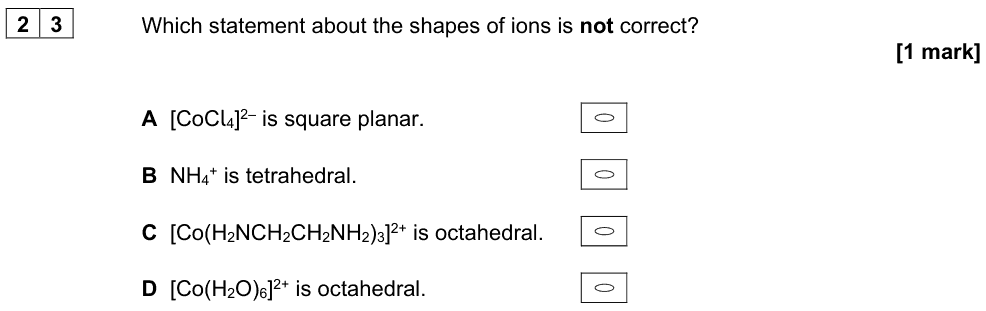
A
Skills: MS4.1 Use angles and shapes in regular 2D and 3D structures
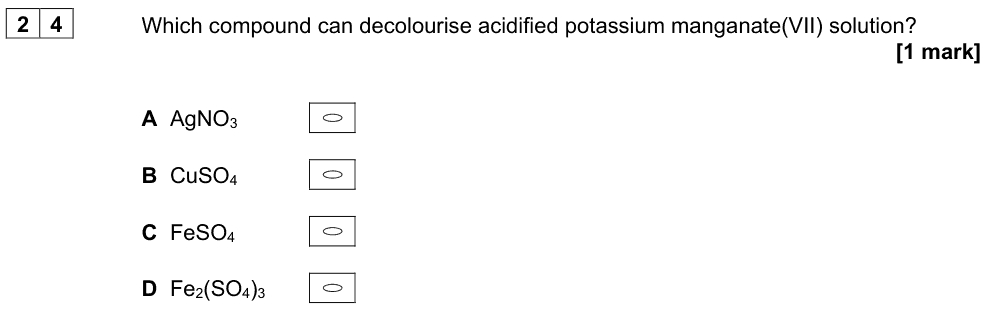
C
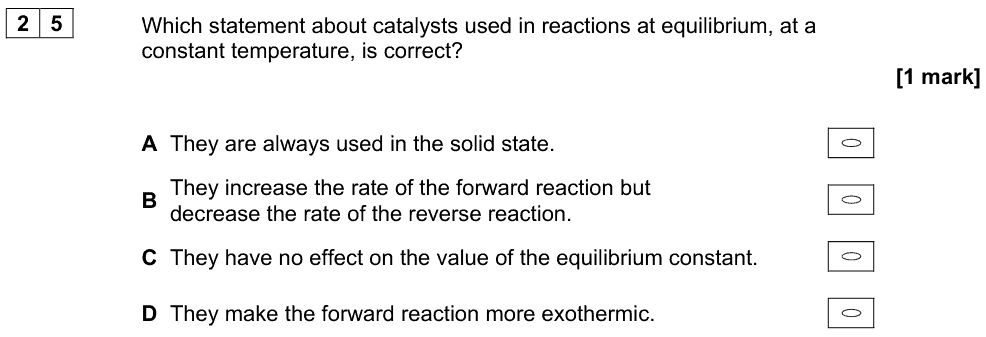
C
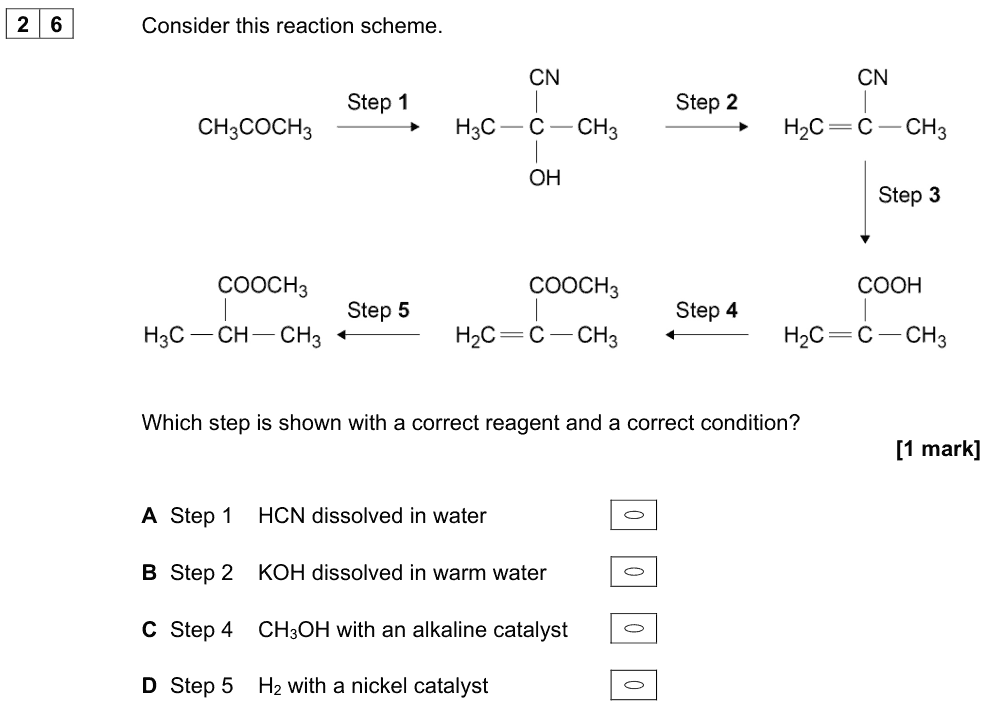
D
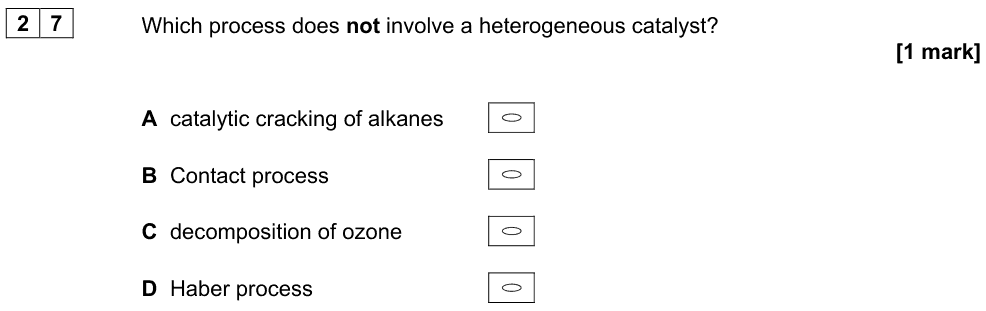
C
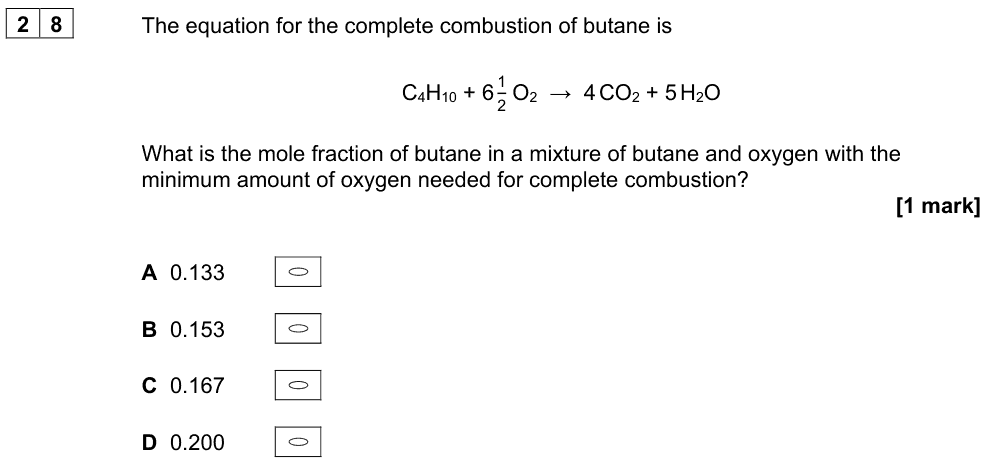
A
Skills: MS0.2 Use ratios, fractions and percentages
B
D
A
D
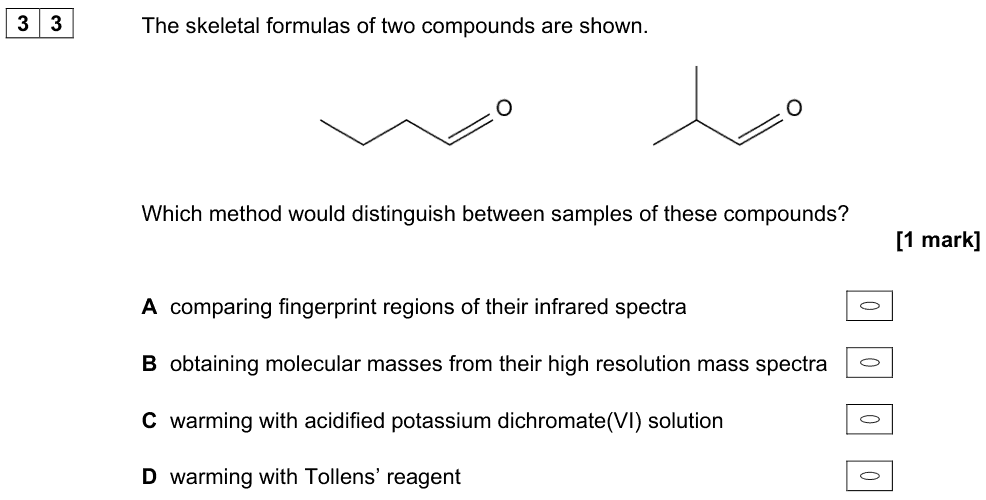
A
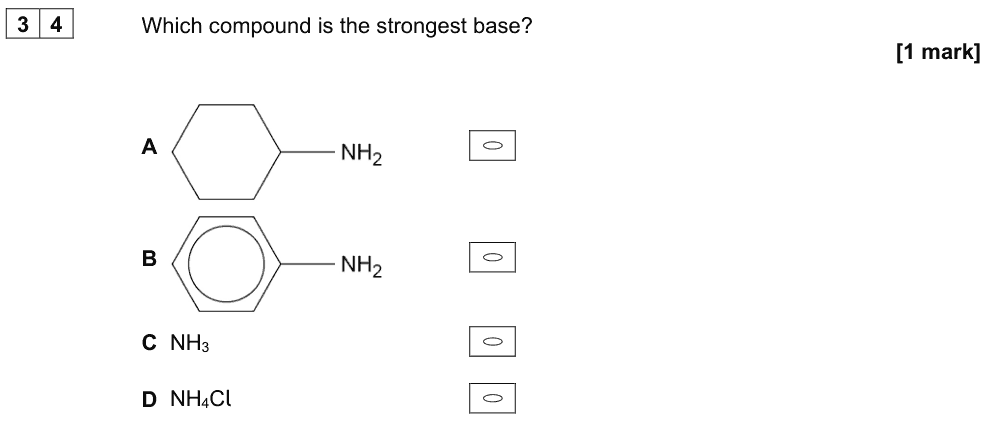
A
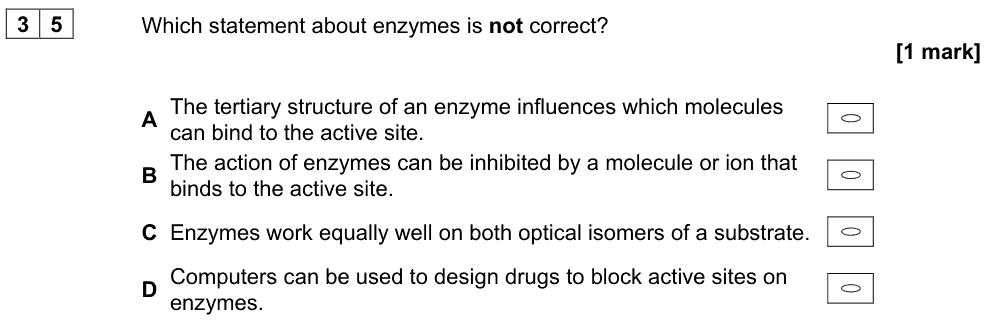
C
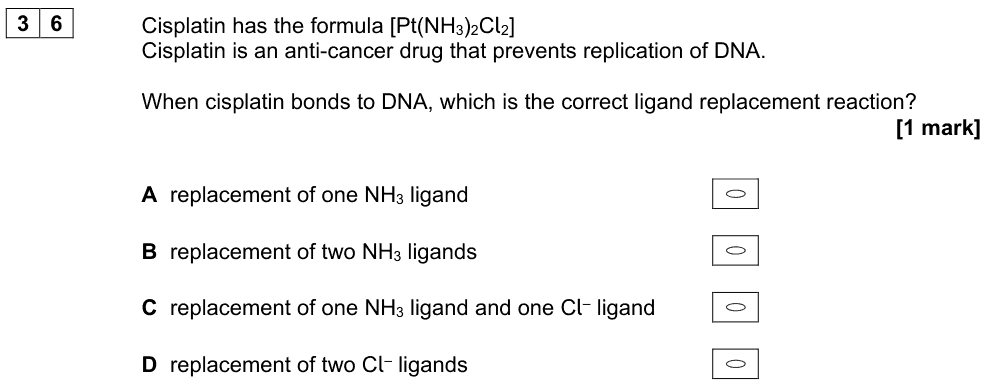
D
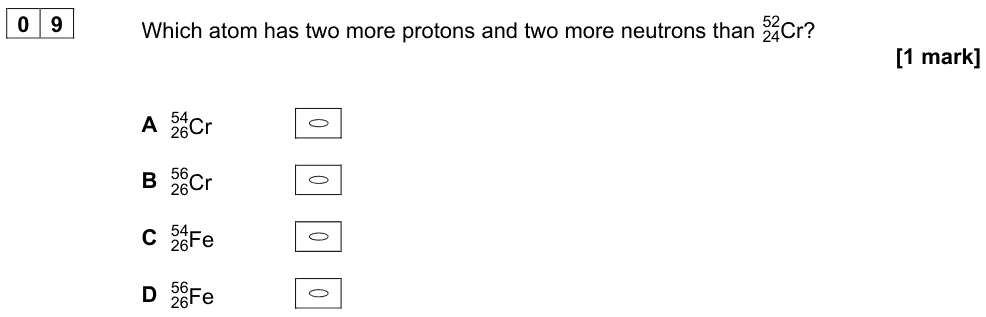
D
Atomic Structure The majority of students (67%) were able to deduce the correct atom, although some did not recall that protons also contribute to the atomic mass.
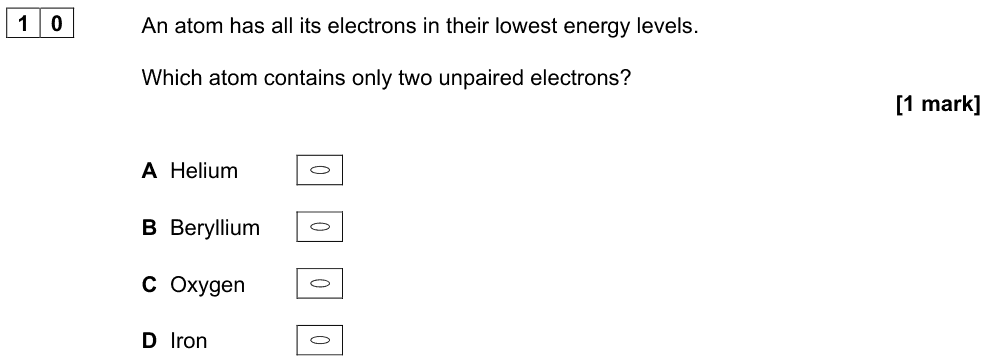
C
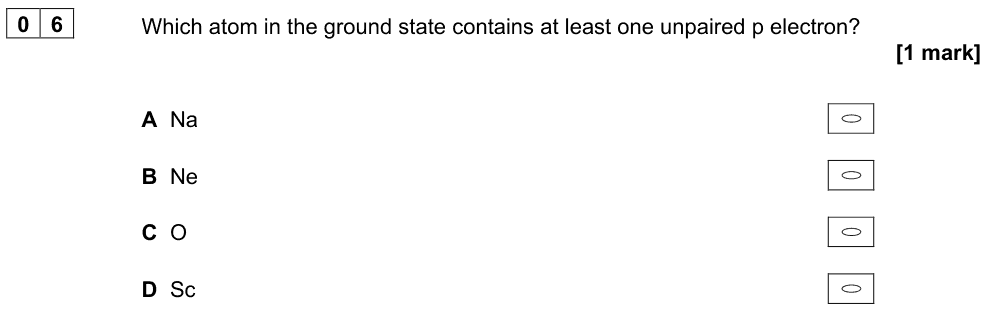
Unpaired electrons About half the students were able to identify the atom with two unpaired electrons.
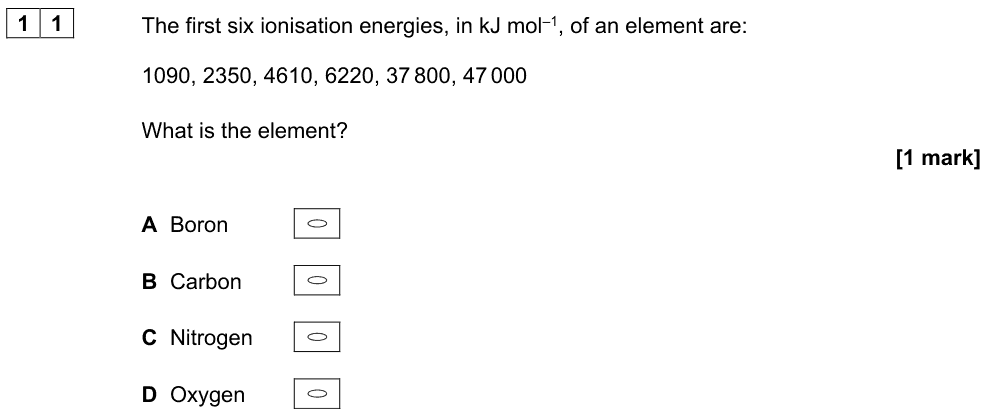
B
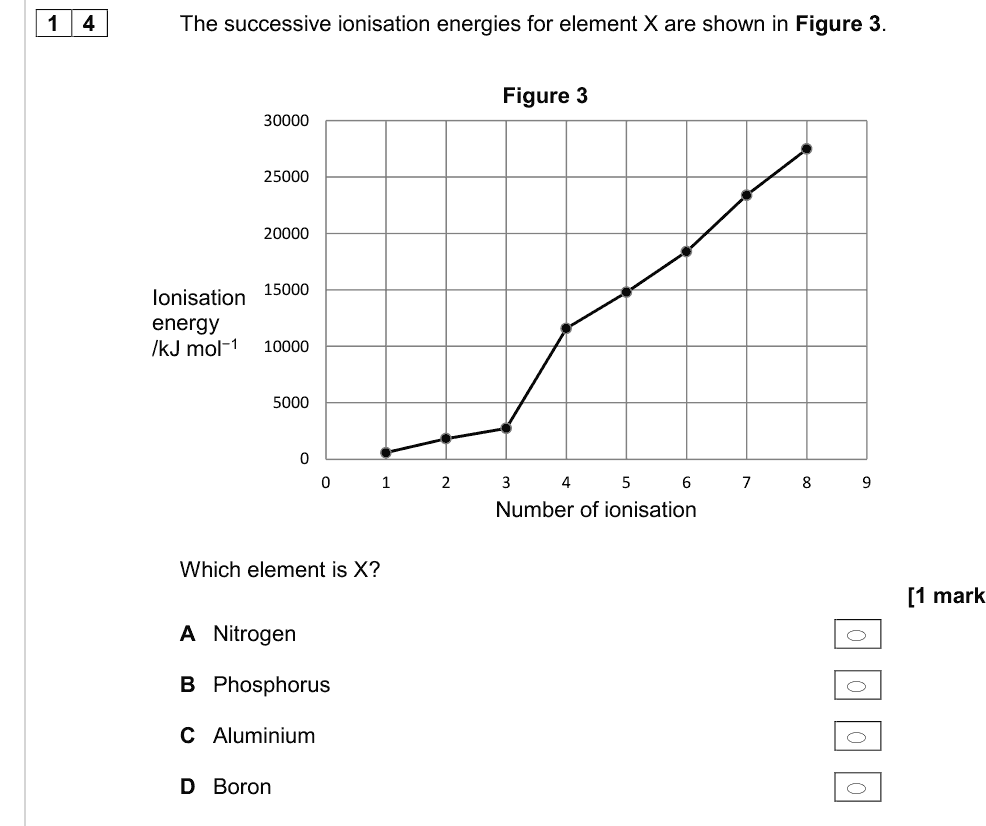
Successive ionisation energies Most students (70%) were correctly able to identify an element from a list of successive ionisation energies
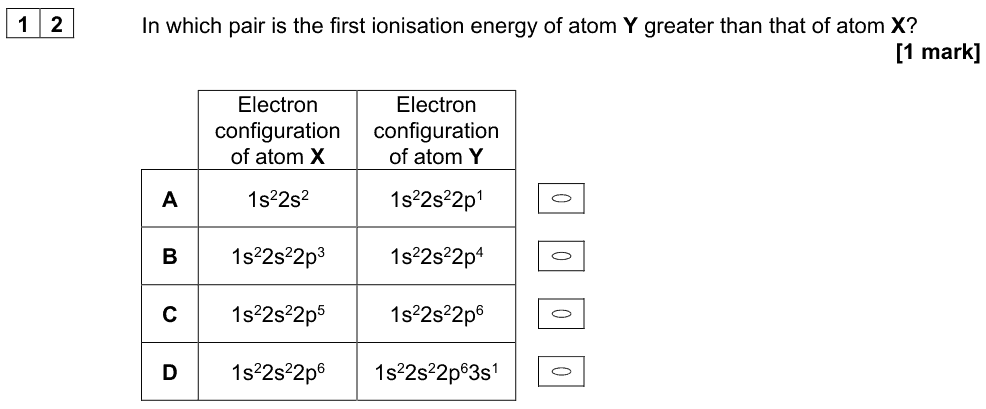
C
Comparing ionisation energies About half the students were able to compare the relative size of first ionisation energies based on electron configurations.
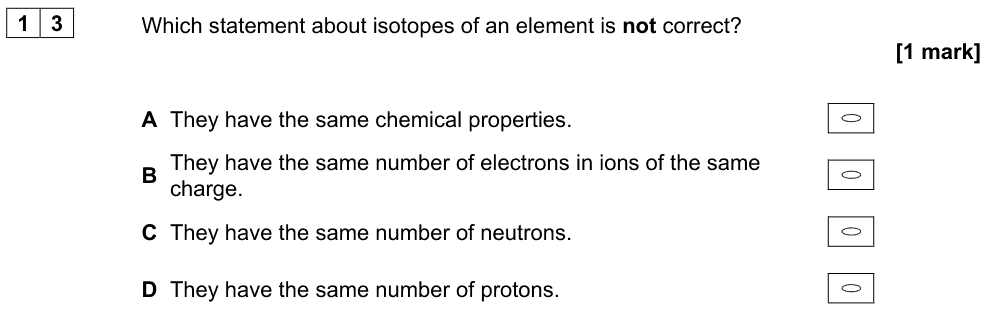
C
Isotopes This question was well answered, with most students (90%) understanding the concept of isotopes.
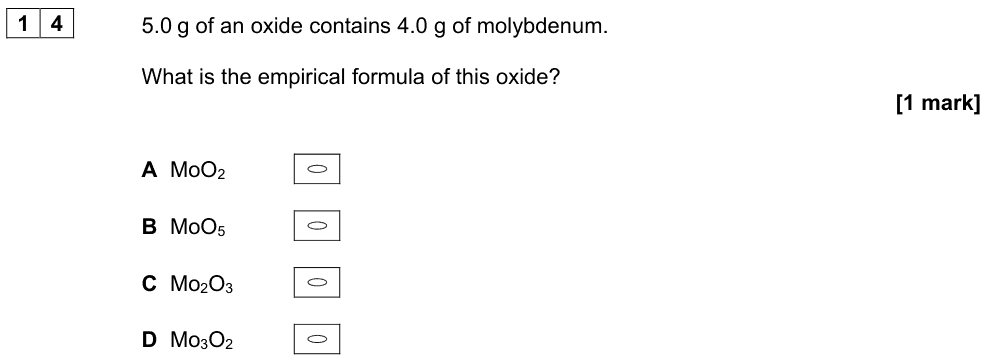
C
Empirical formula The majority of students (65%) were correctly able to determine an empirical formula.
Skills: MS0.2 Use ratios, fractions and percentages
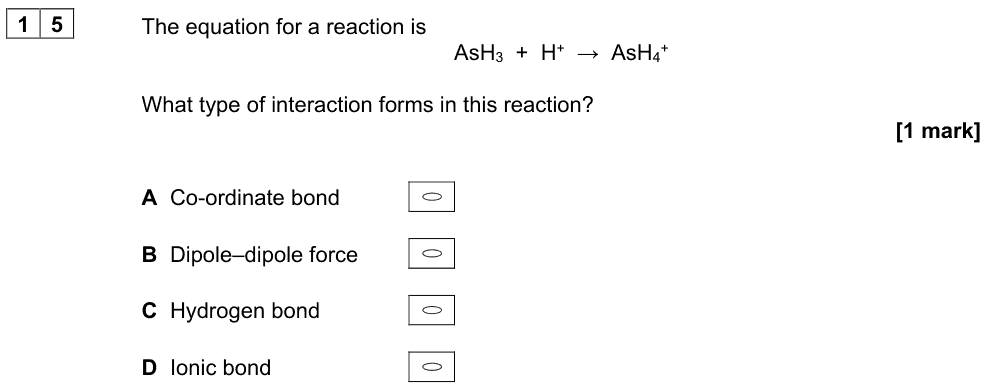
A
Co-ordinate bonding A high number of students (80%) were able to identify the formation of a co-ordinate bond in a reaction.
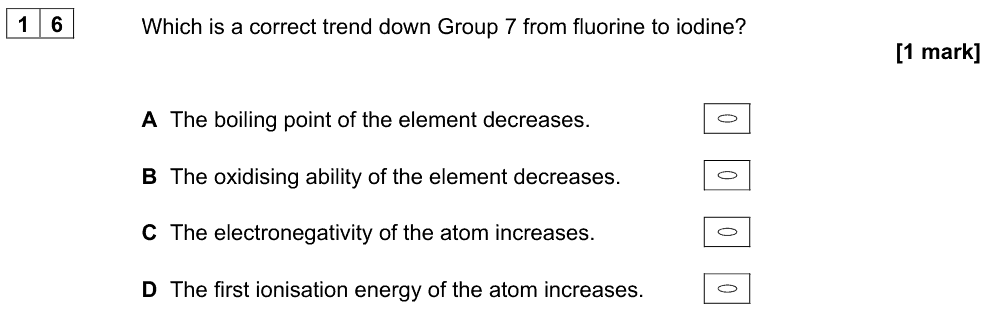
B
Group 7 Many students (62%) were able to identify correctly trends down group 7.
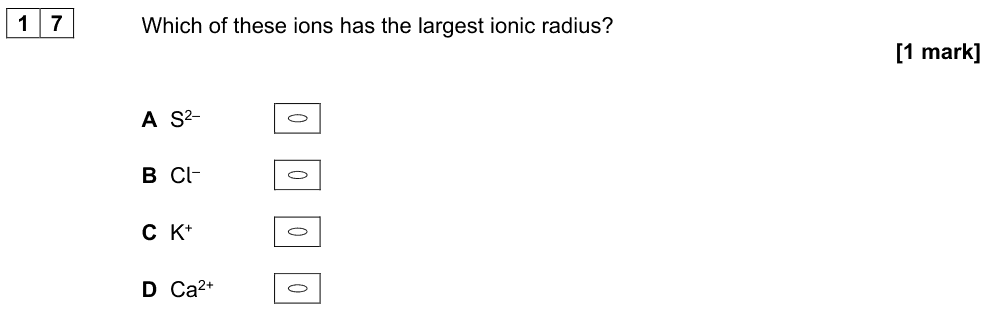
A
Ionic radius About half the students were able to identify the ion with the largest ionic radius. A particularly common incorrect answer was that with the smallest ionic radius.
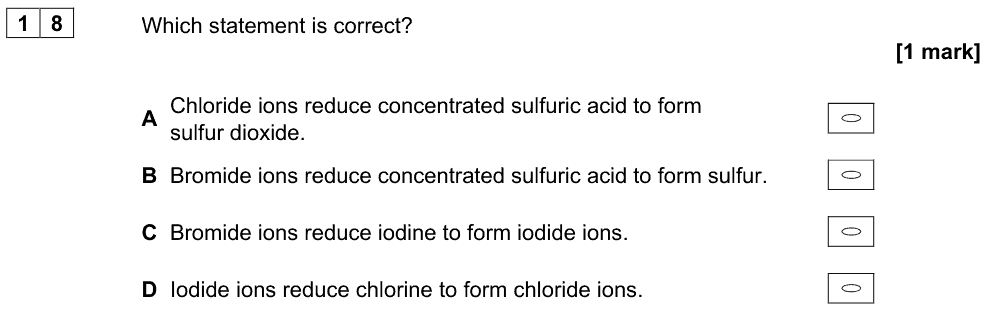
D
Halide ion reactions Less than a third of students were able to identify the correct reaction involving halide ions.
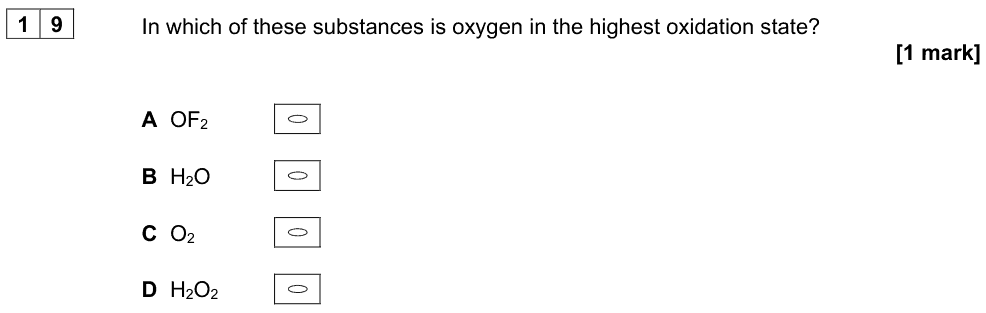
A
Oxidation state About half the students could identify when oxygen was in its highest oxidation state.
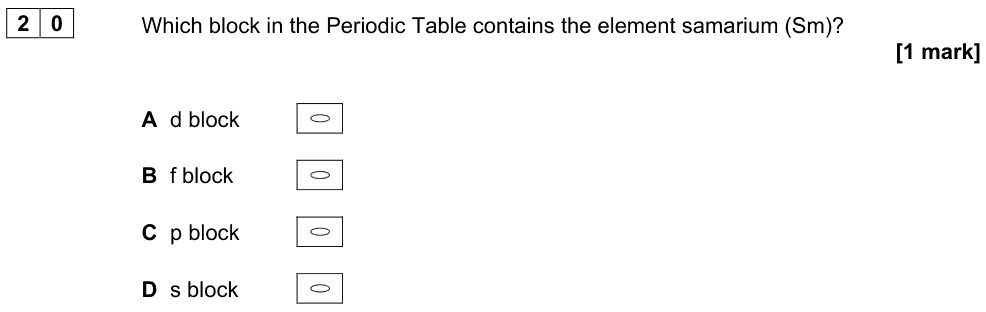
B
Blocks Most students (85%) were able to identify samarium as an f block element.
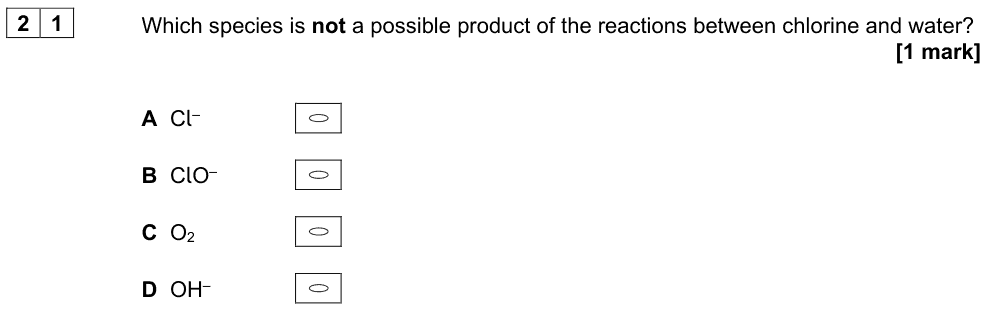
D
Chlorine Only about a third of students were able to identify the products of the reactions between chlorine and water.
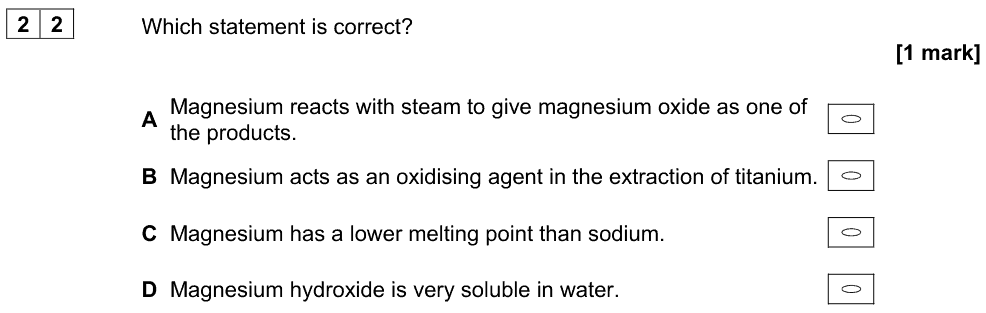
A
Magnesium About half the students understood that magnesium oxide is a product when magnesium reacts with steam.
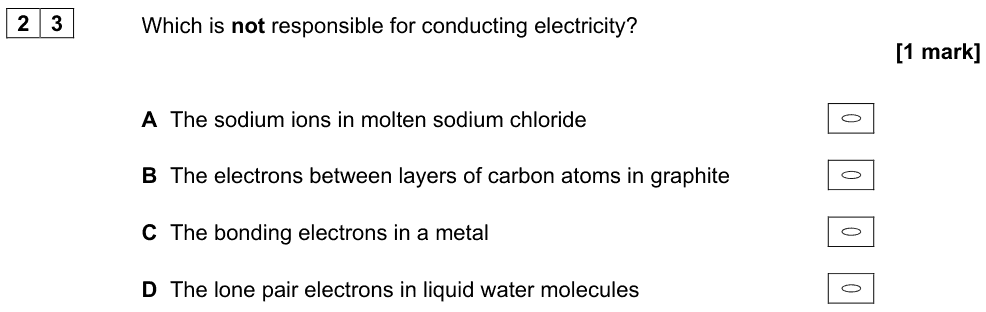
D
Conductivity Some students (43%) were able to consider correctly the particles in different substances that are responsible for conducting electricity.
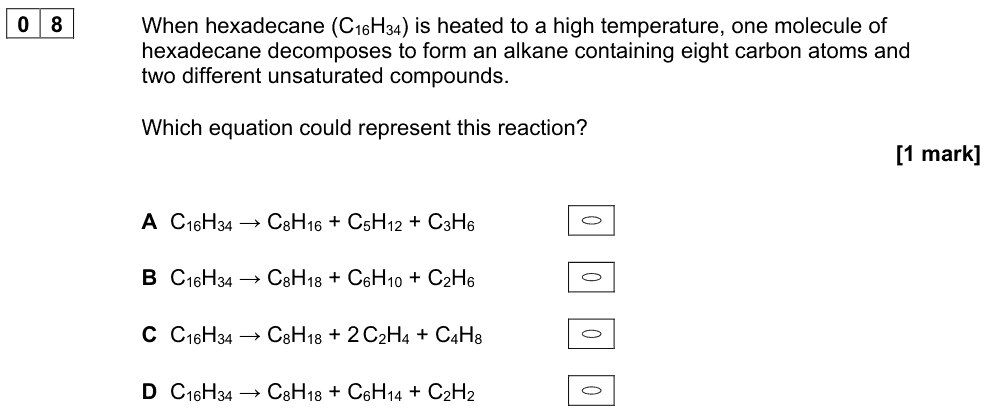
C
Cracking This was answered correctly by a majority of students (68.9%).
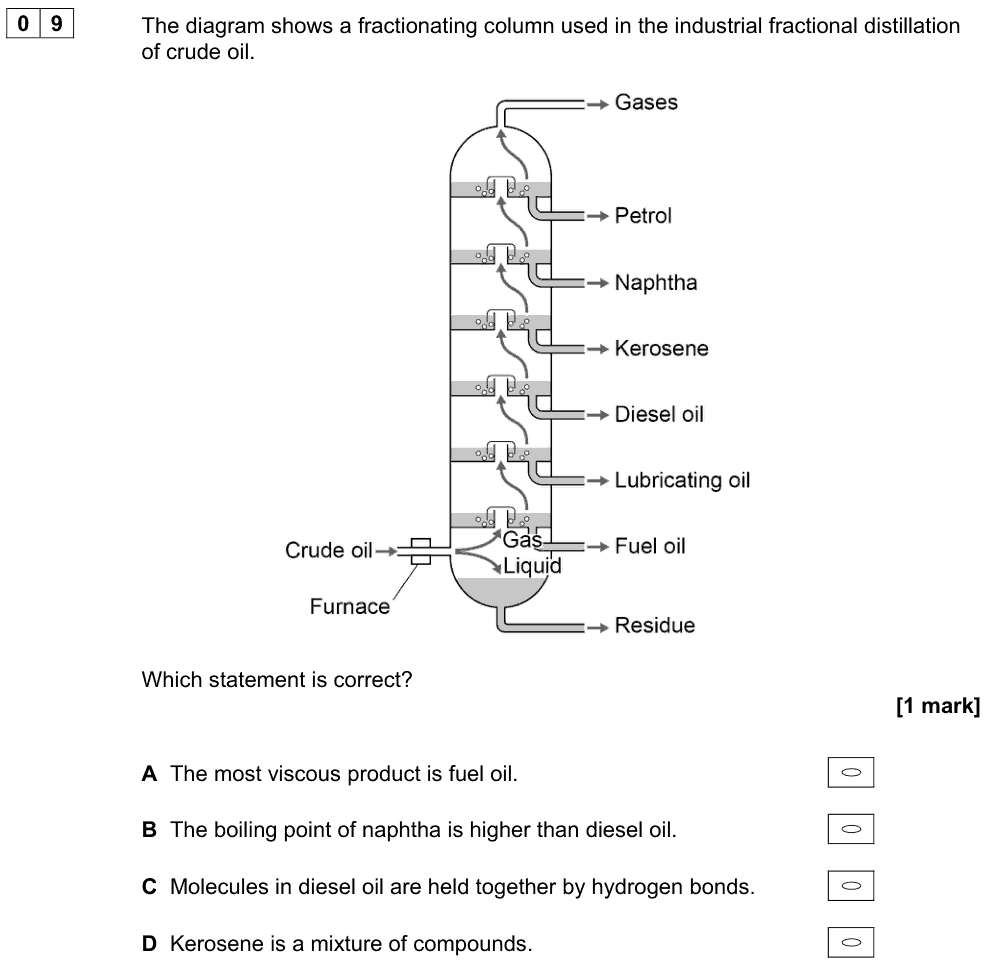
D
Fractional distillation Many students incorrectly thought that the fuel oil was more viscous than the residue, or perhaps did not realise there was any residue. Only 36.5% of students gained the mark.
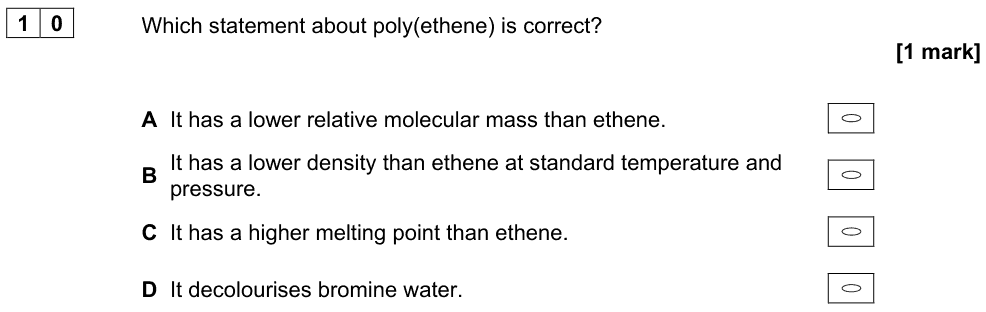
C
This was answered correctly by a majority of students (66.7%).
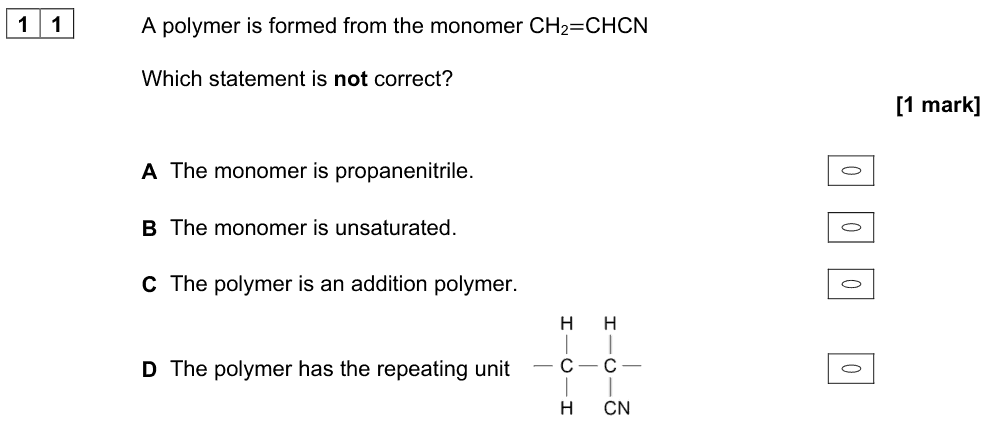
A
Students struggled with this question, with many believing that the polymer is unsaturated.
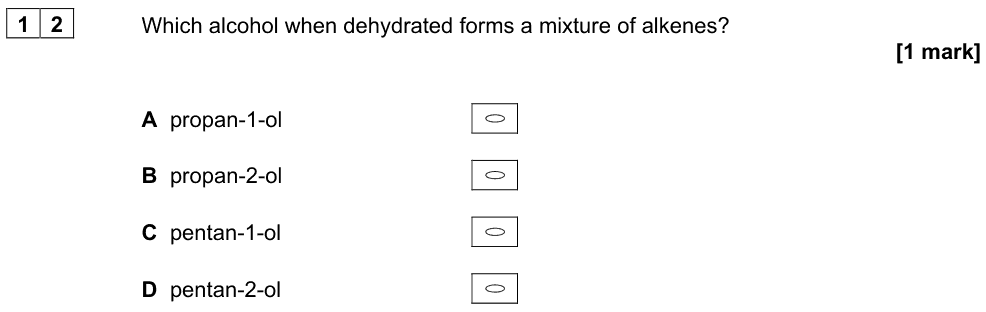
D
This was answered correctly by a majority of students (69.2%).
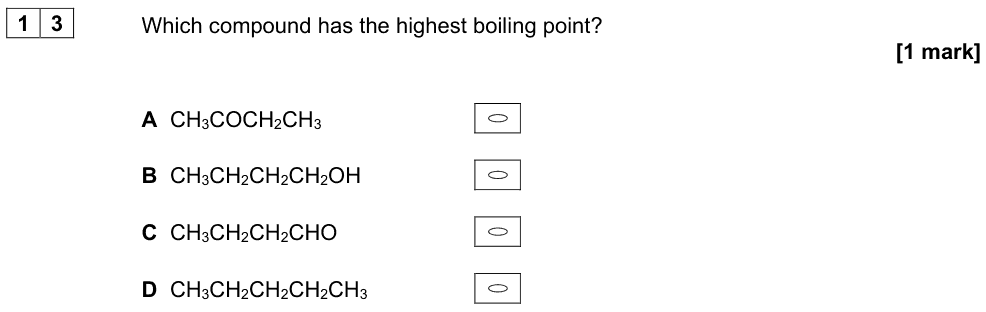
B
This was answered correctly by a majority of students (66.8%).
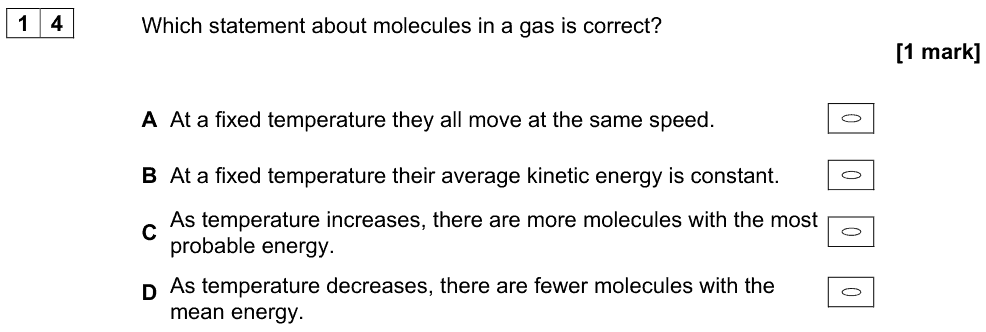
B
Many students incorrectly thought that as temperature increases, the number of molecules with the most probable energy increases.
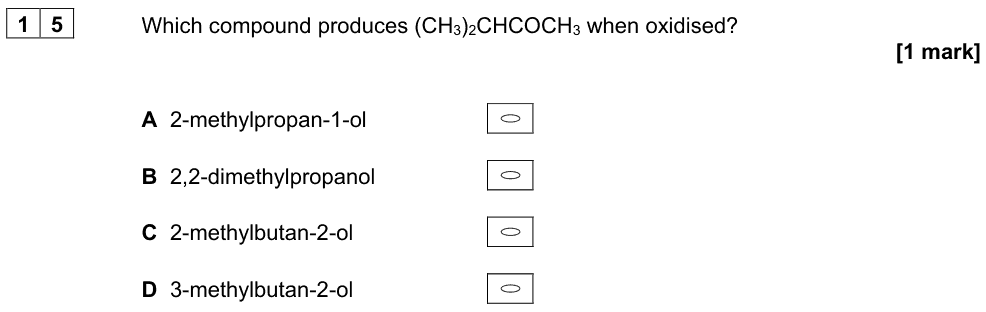
D
Many students struggled to work out which alcohol is oxidised to a given ketone.
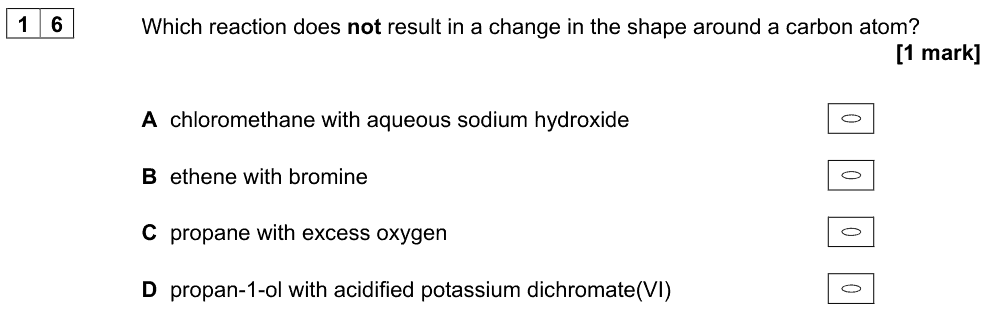
A
Students found this question challenging and struggled to work out whether the shape of an organic compound changes from the start to end of a reaction. Only 34.5% of students gained this mark.
Skills: MS4.1 Use angles and shapes in regular 2D and 3D structures
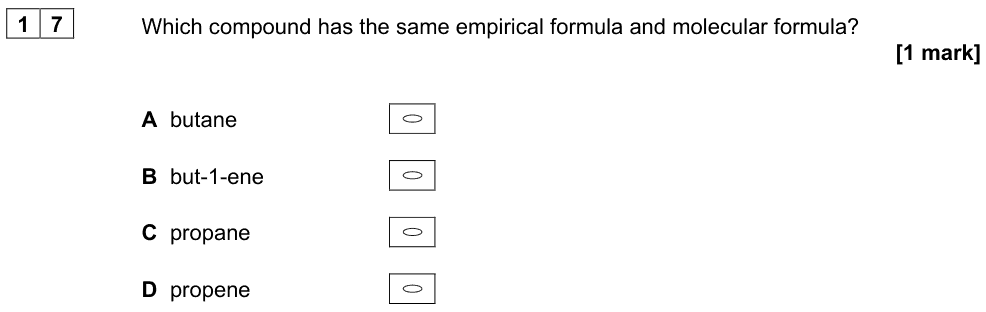
C
This was answered correctly by a majority of students (67.2%).
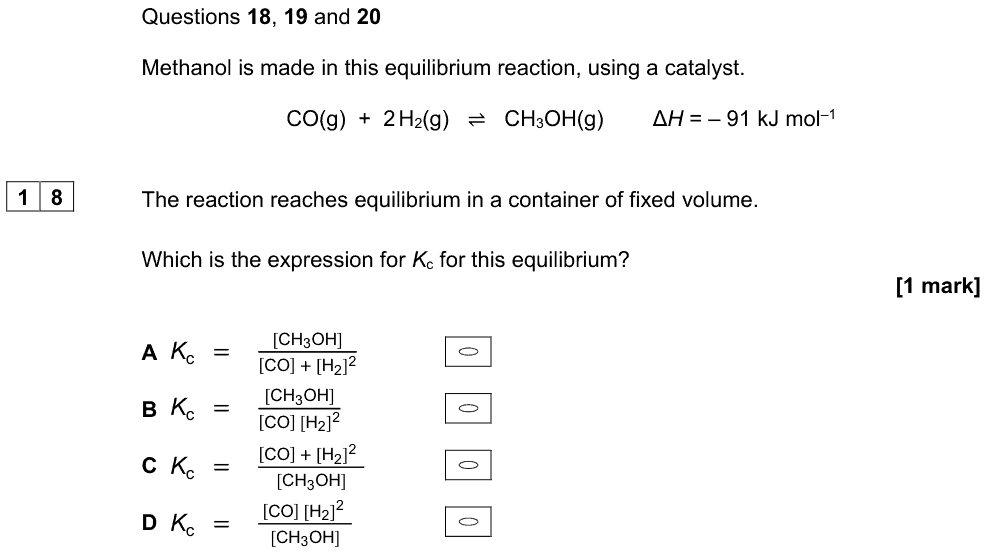
B
This was answered correctly by a majority of students (80.1%).
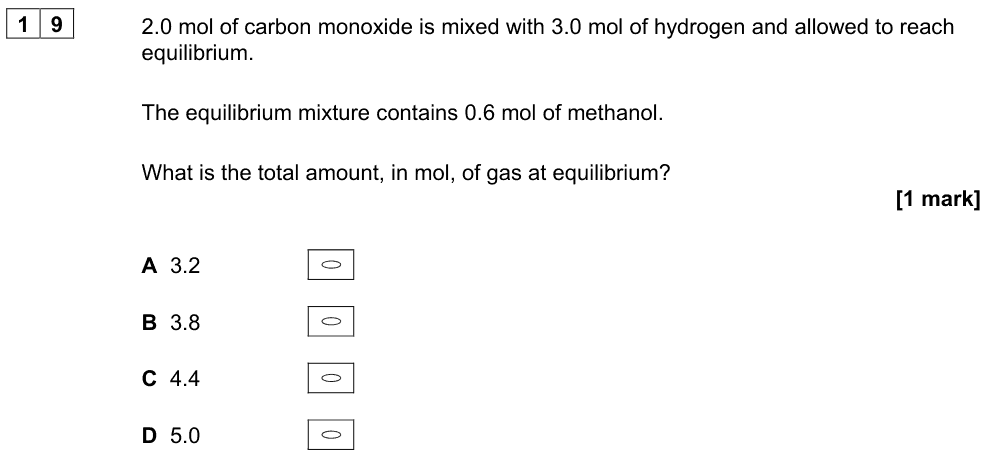
B
Students found it difficult to work out the amount, in moles, of the substances in an equilibrium mixture.
Skills: MS0.2 Use ratios, fractions and percentages
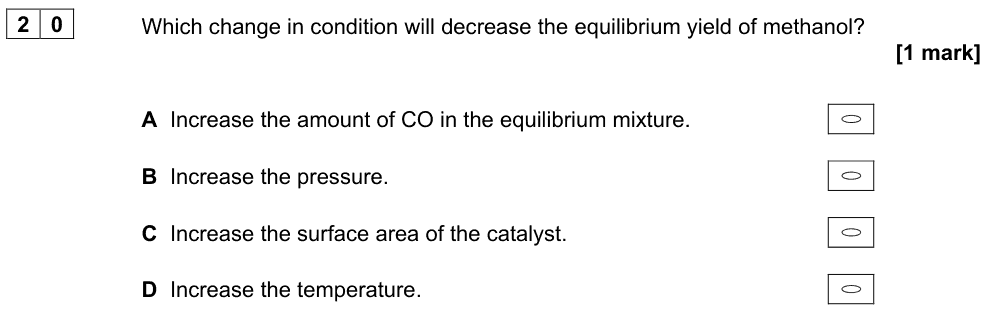
D
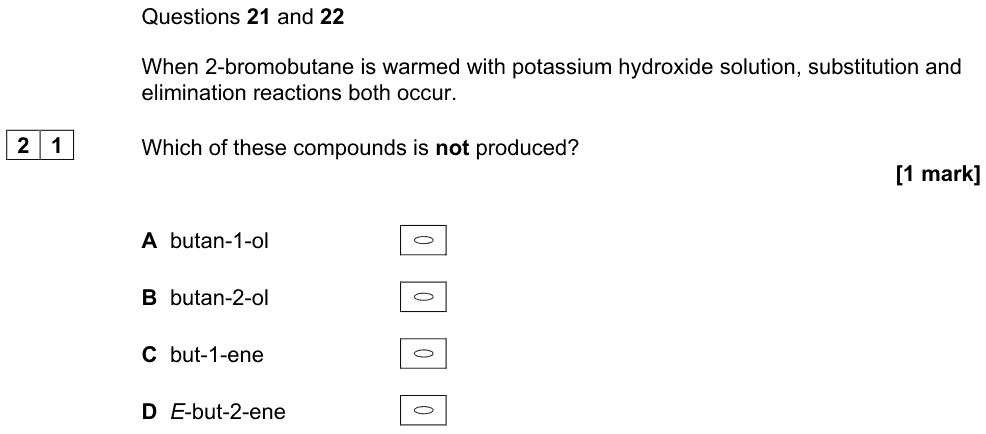
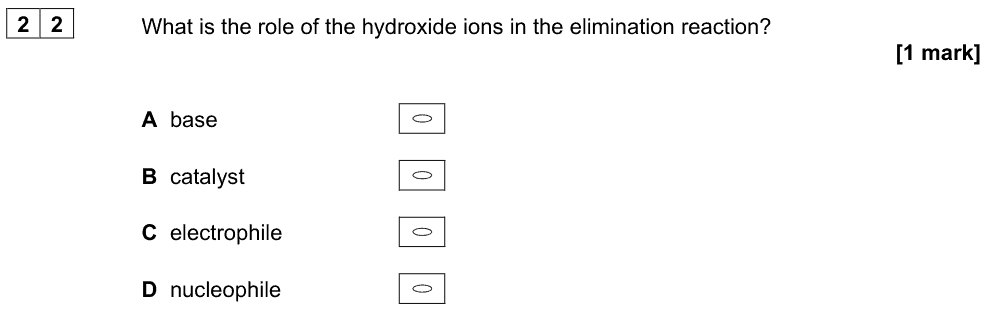
This was answered correctly by a majority of students (60.7%). Q21 Reaction of 2-bromobutane with hydroxide ions Students found it difficult to deduce which compounds could be produced by substitution and/or elimination. Q22 Role of hydroxide ions in elimination Students were unsure about the role of hydroxide ions in elimination from halogenoalkanes, although the majority (57.1%) answered it correctly.
A
A
C
C
Skills: MS0.2 Use ratios, fractions and percentages
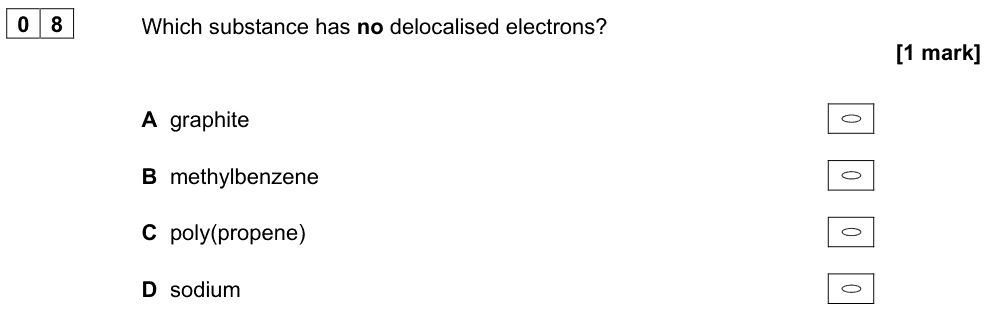
C
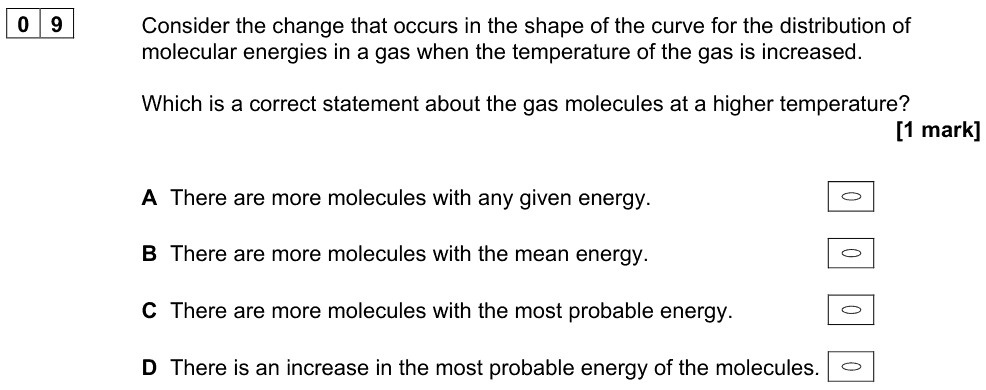
D
Skills: MS3.1 Translate information between graphical, numerical and algebraic forms
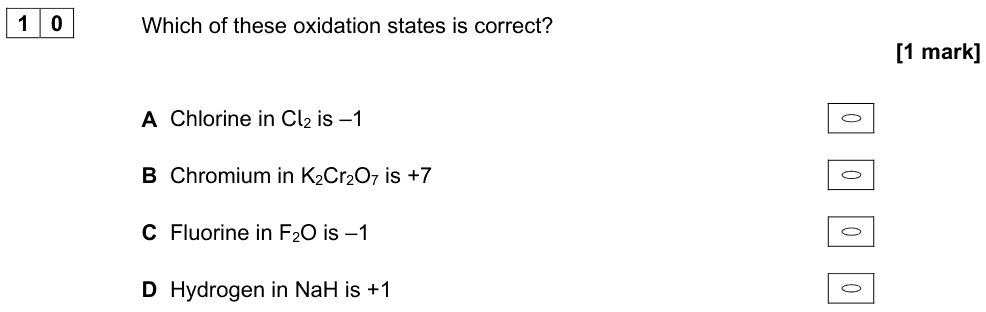
C
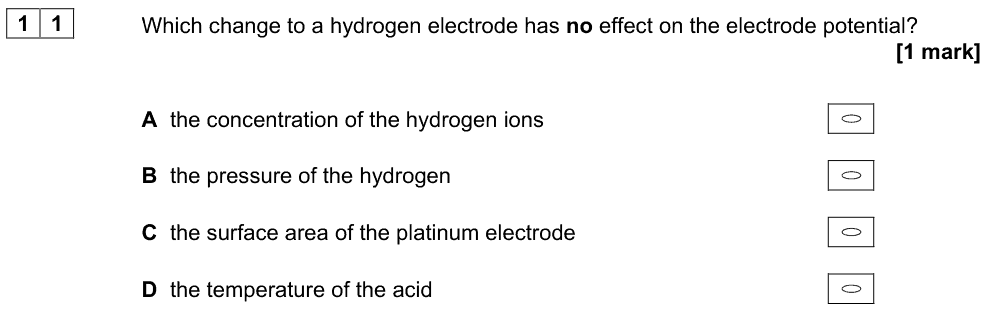
C
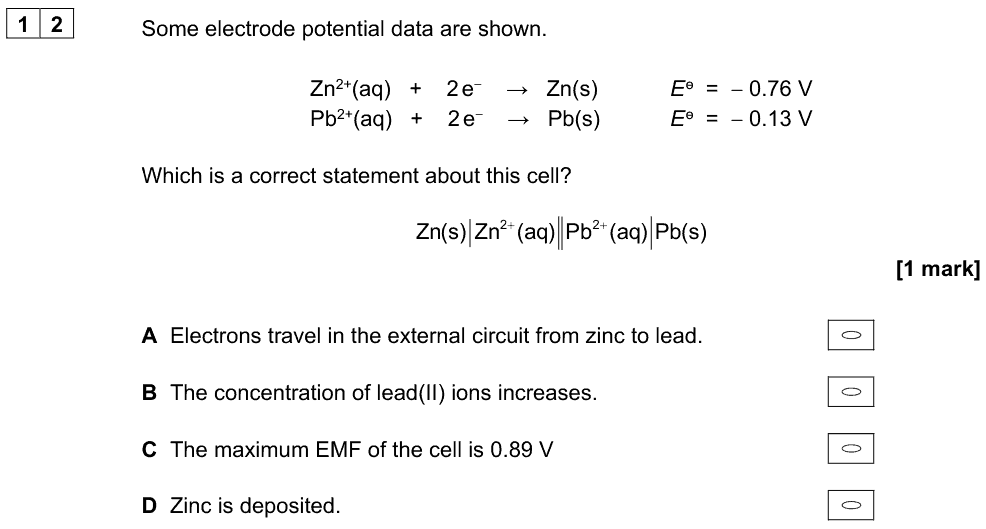
A
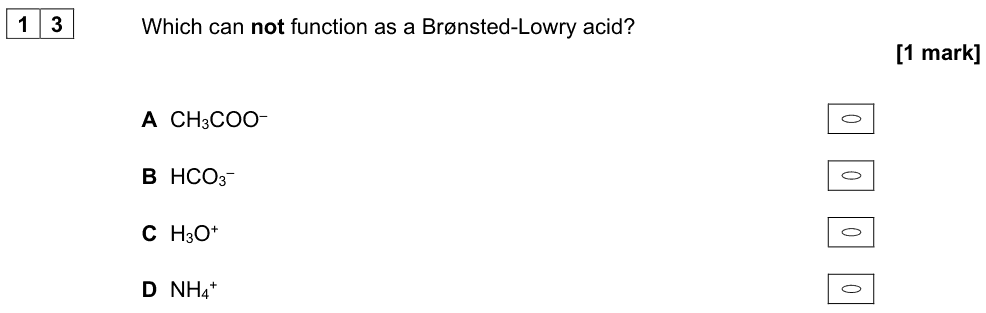
A
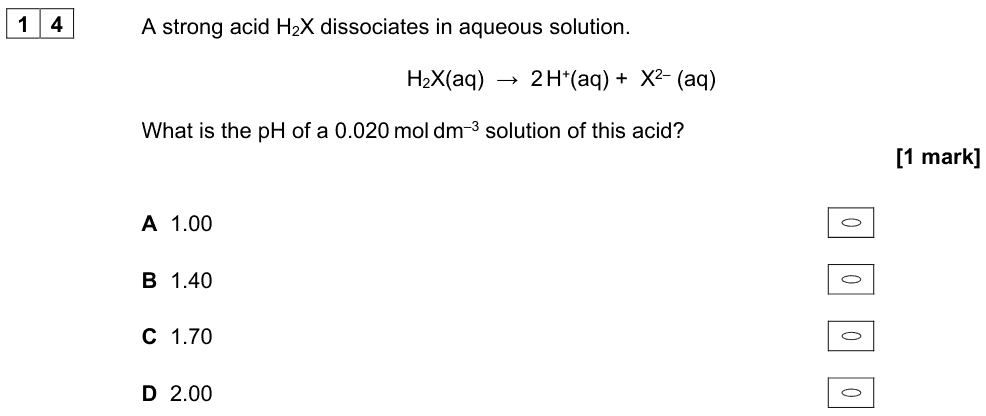
B
Skills: MS0.4 Use calculators to find and use power, exponential and logarithmic functions; MS2.5 Use logarithms in relation to quantities that range over several orders of magnitude
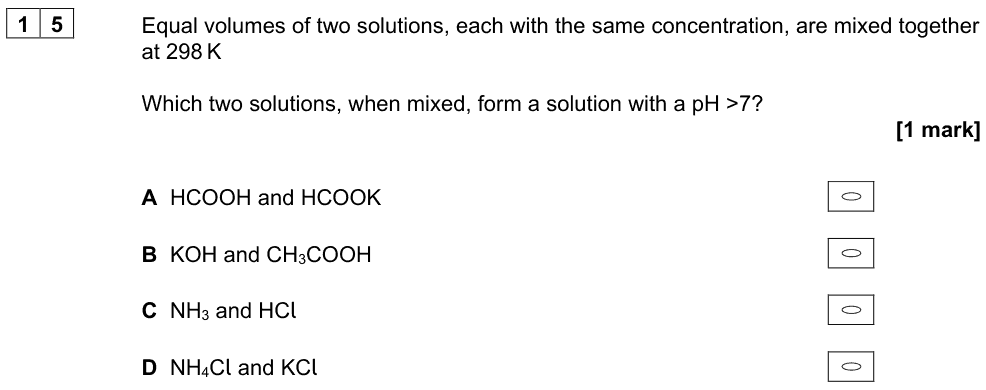
B
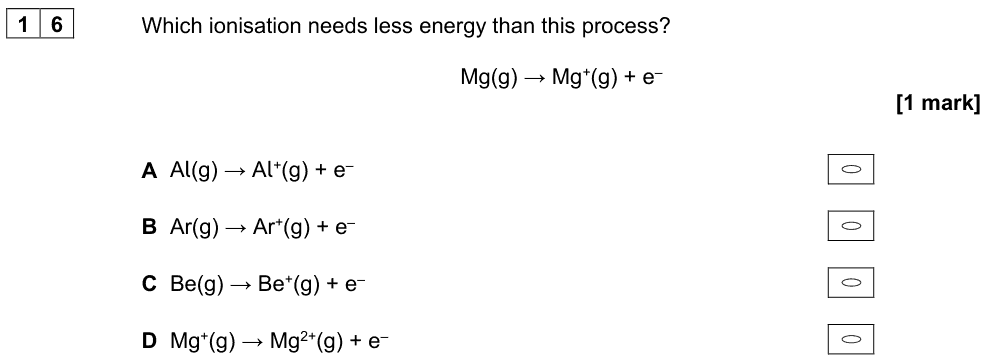
A
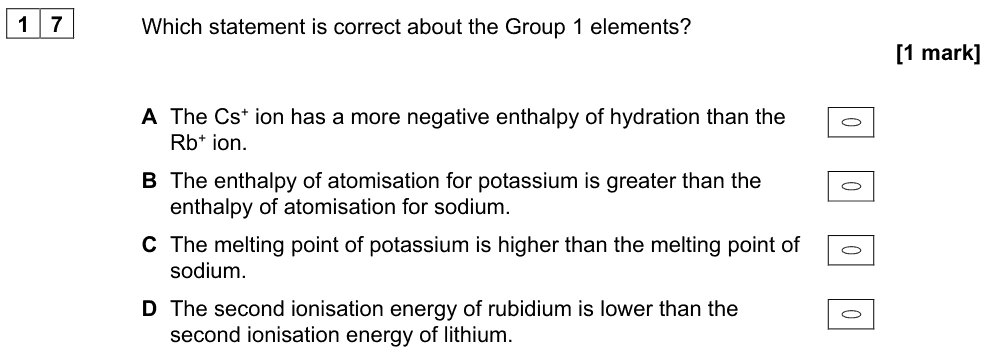
D
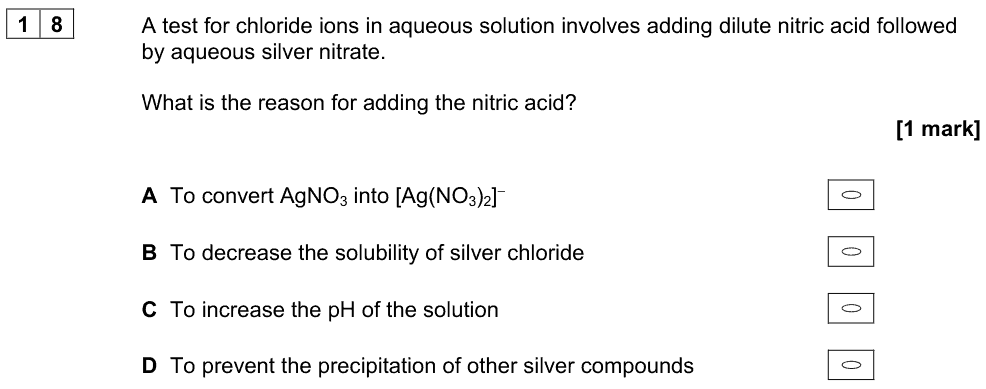
D
Skills: ATd Use laboratory apparatus for a variety of experimental techniques including: titration, using burette and pipette; distillation and heating under reflux, including setting up glassware using retort stand and clamps; qualitative tests for ions and organic functional groups; filtration, including use of fluted filter paper, or filtration under reduced pressure; RP4 Carry out simple test-tube reactions to identify: cations – Group 2, NH4+; anions – Group 7 (halide ions), OH–, CO32–, SO42–
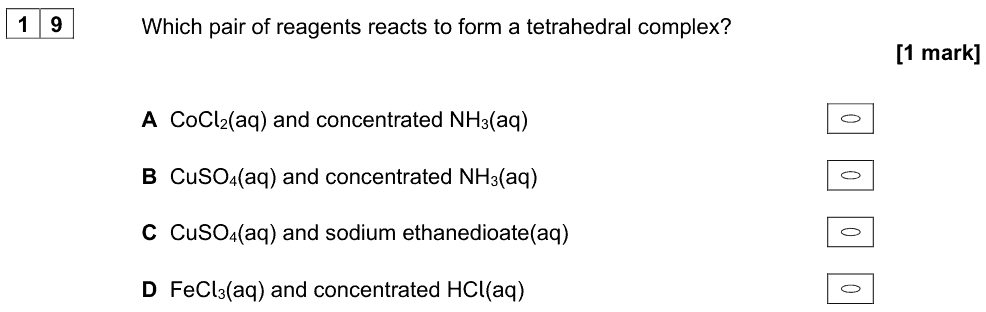
D
Skills: MS4.1 Use angles and shapes in regular 2D and 3D structures
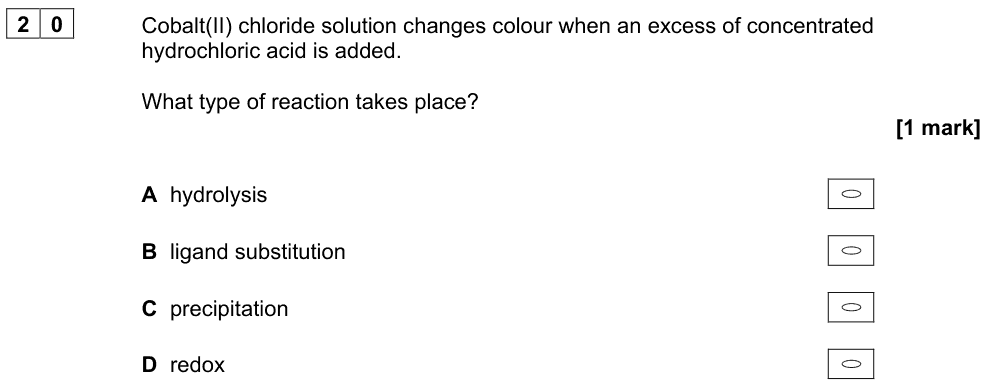
B
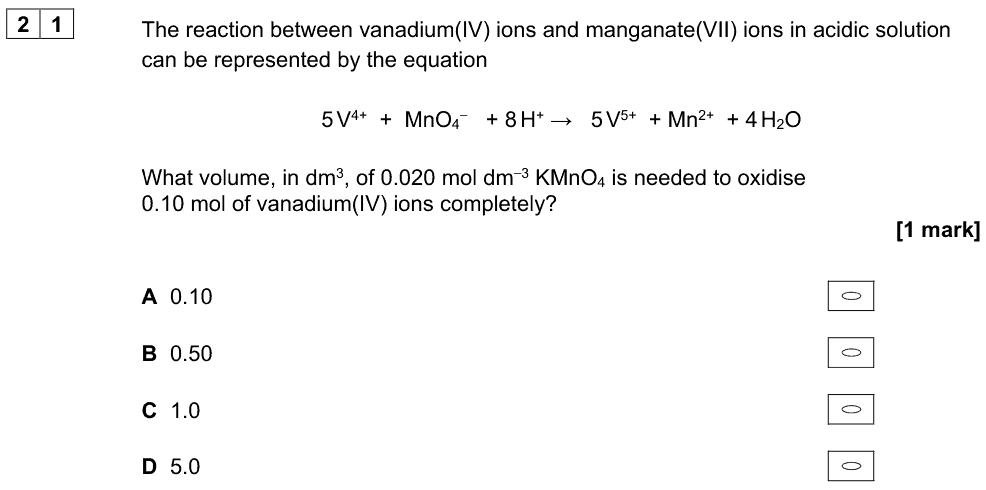
C
Skills: MS0.2 Use ratios, fractions and percentages
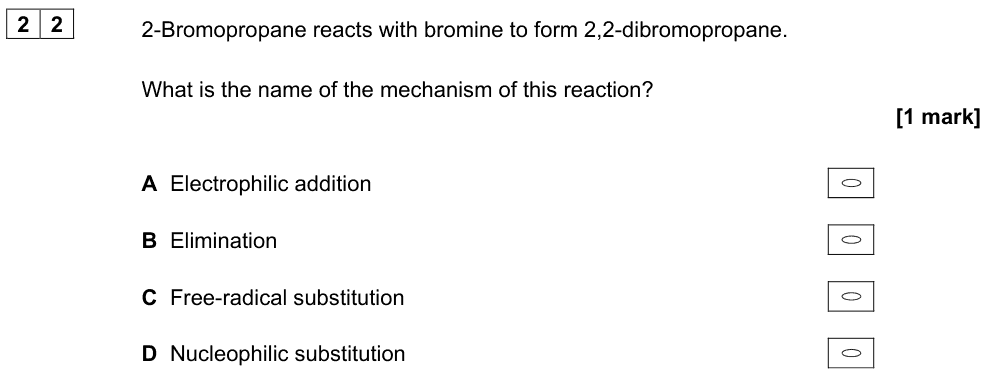
C
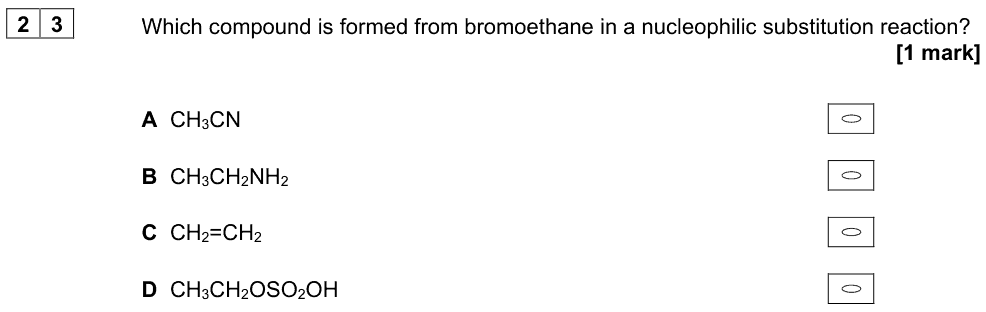
B
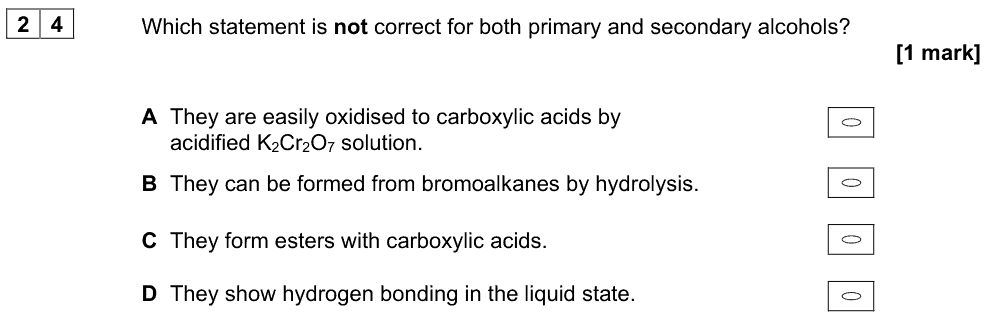
A
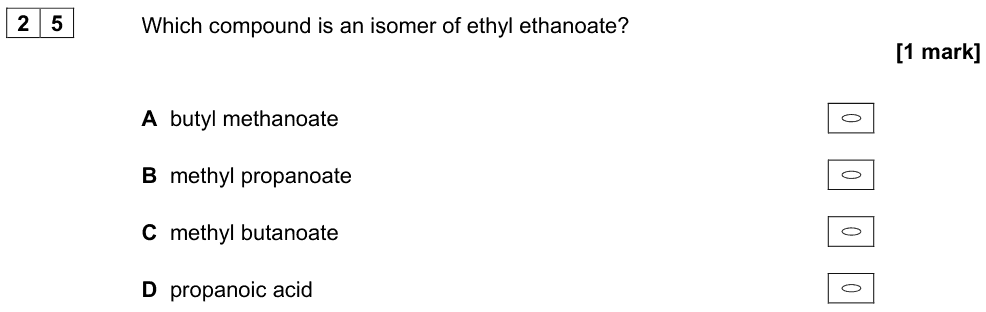
B
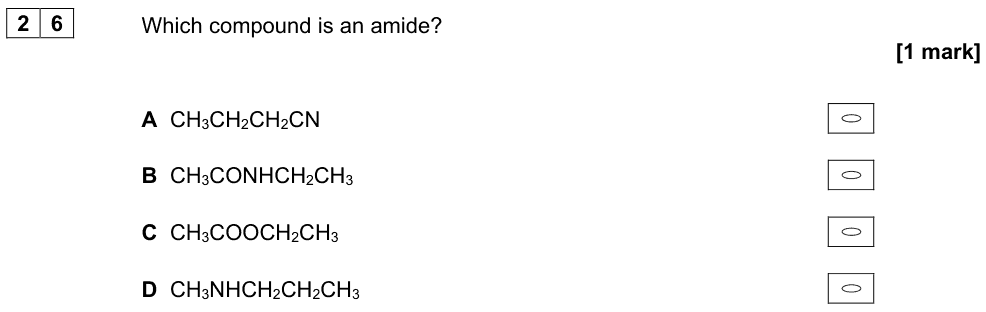
B
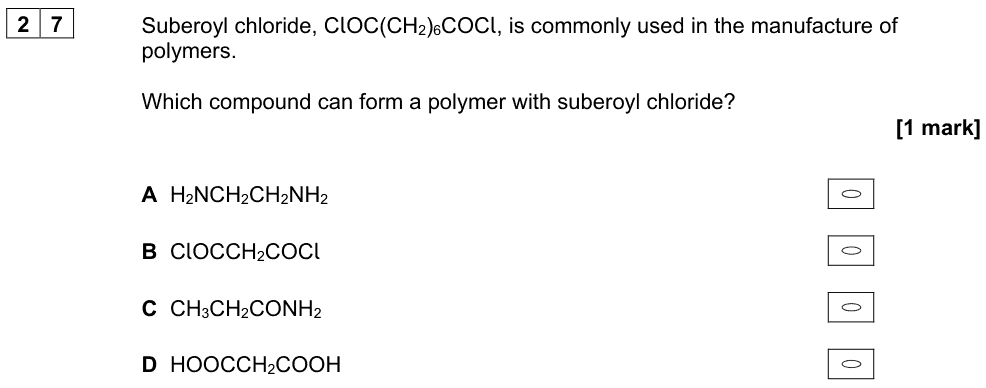
A
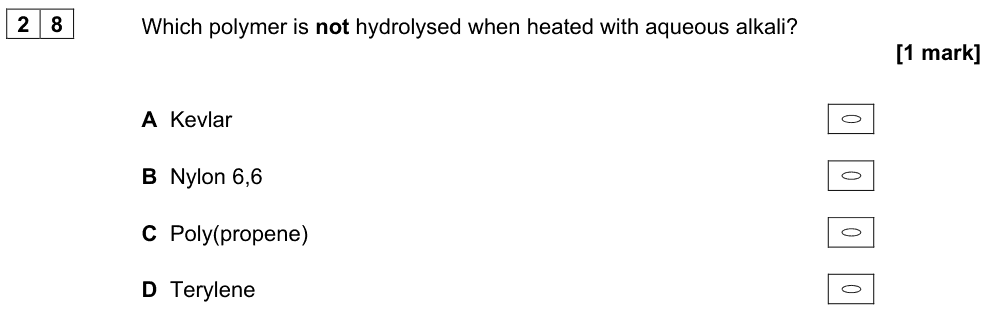
C
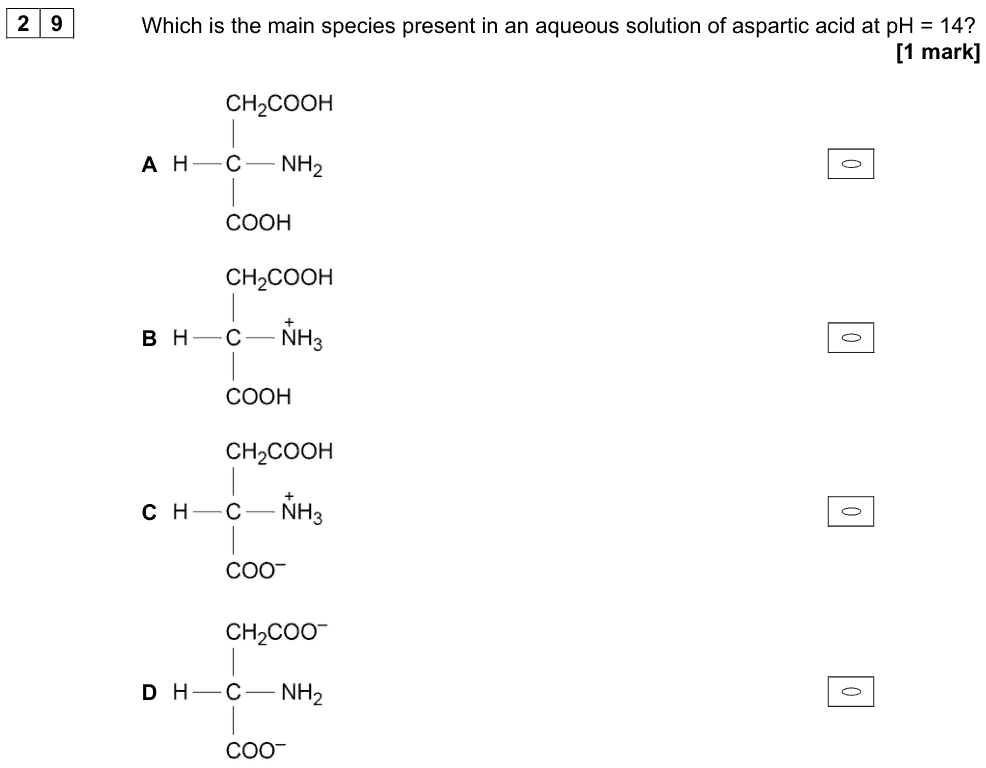
D
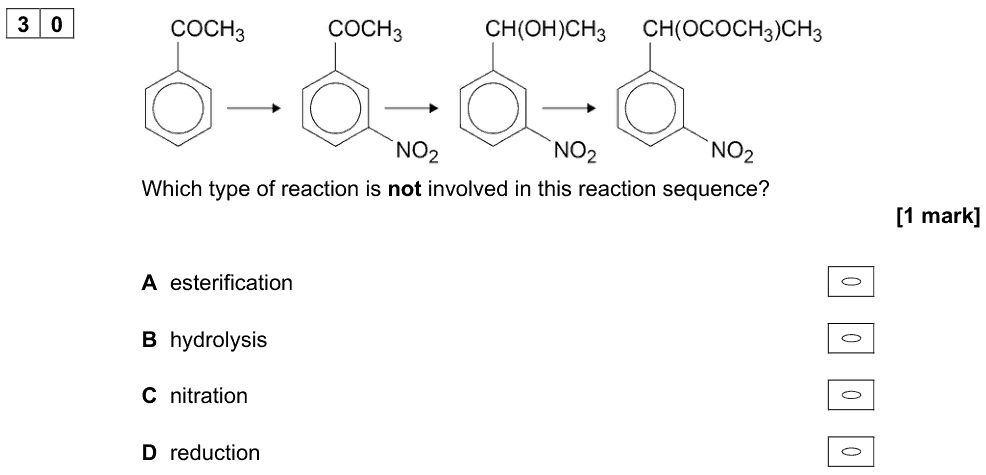
B
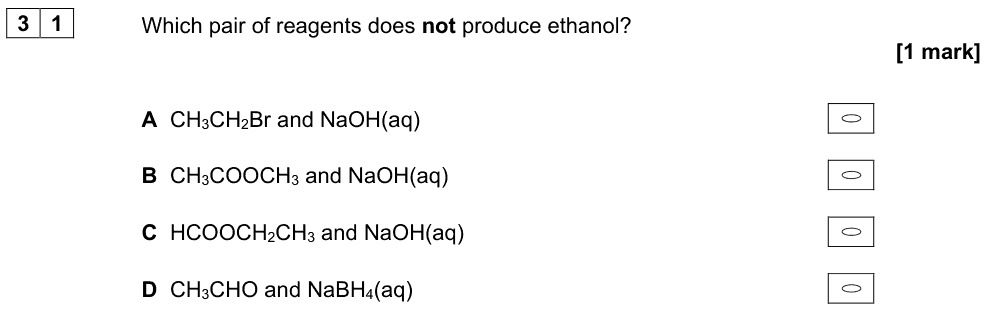
B
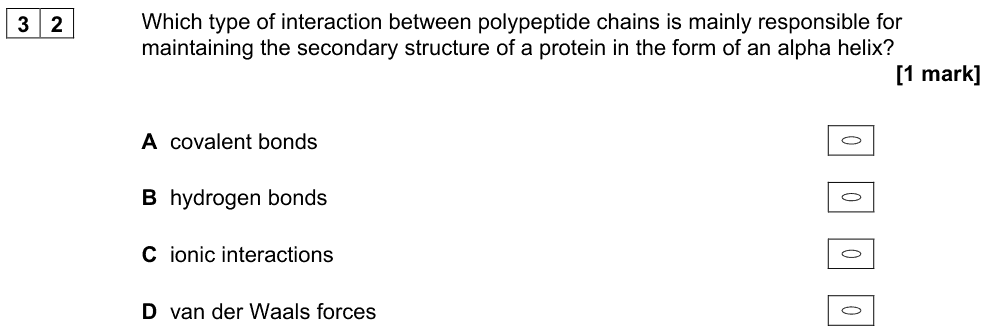
B
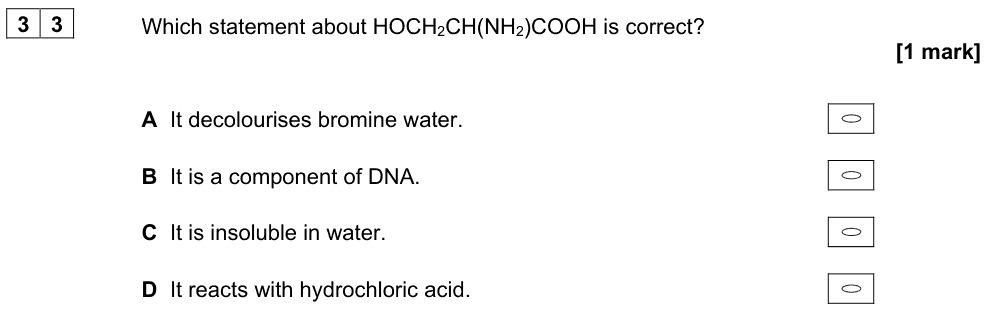
D
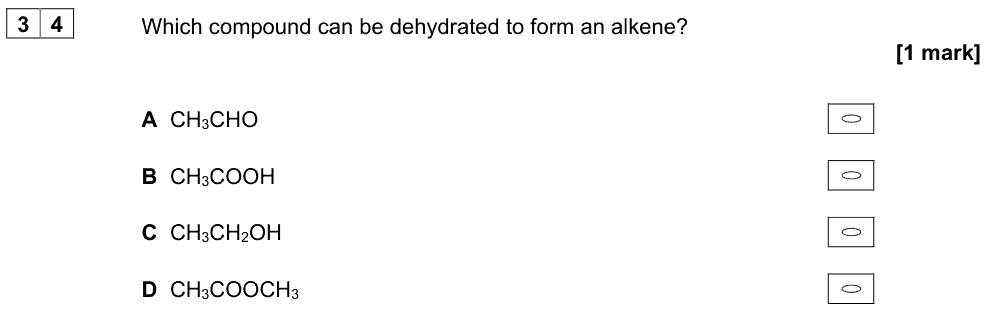
C
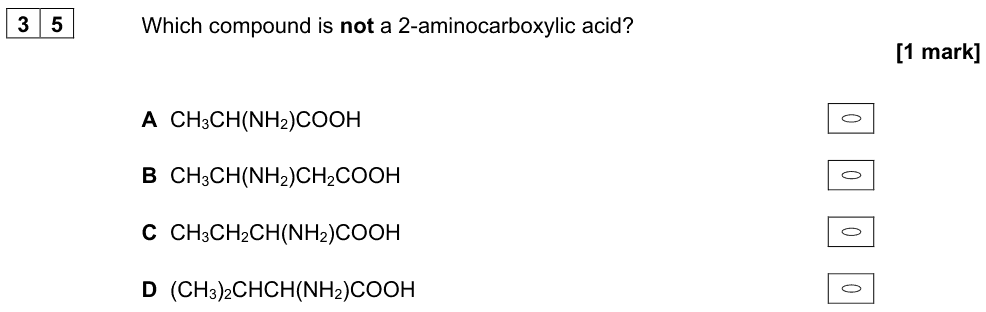
B
D
A
B
C
Skills: MS4.1 Use angles and shapes in regular 2D and 3D structures
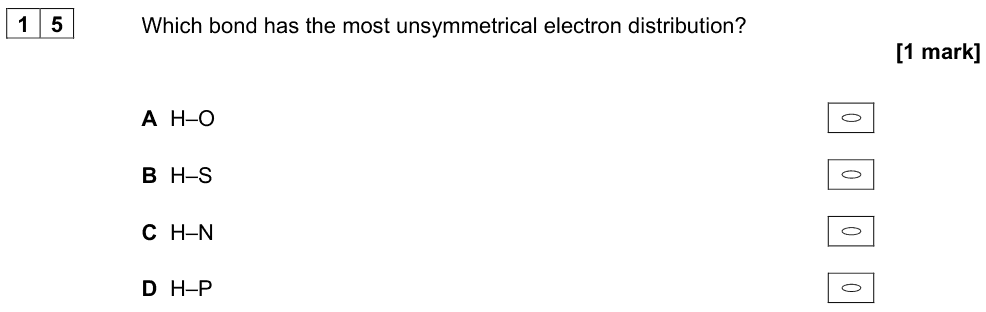
A
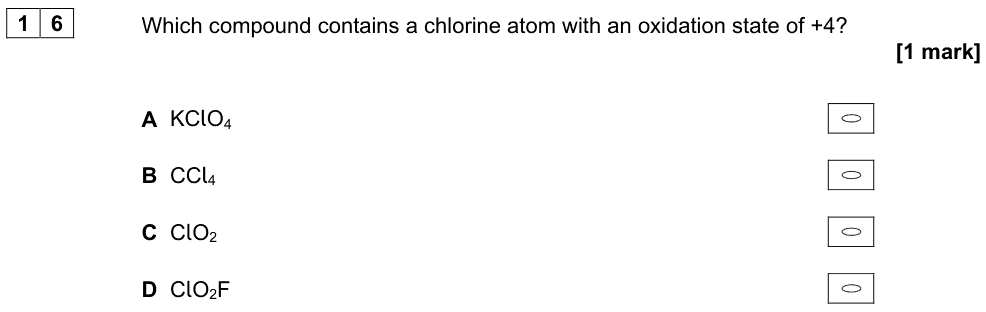
C
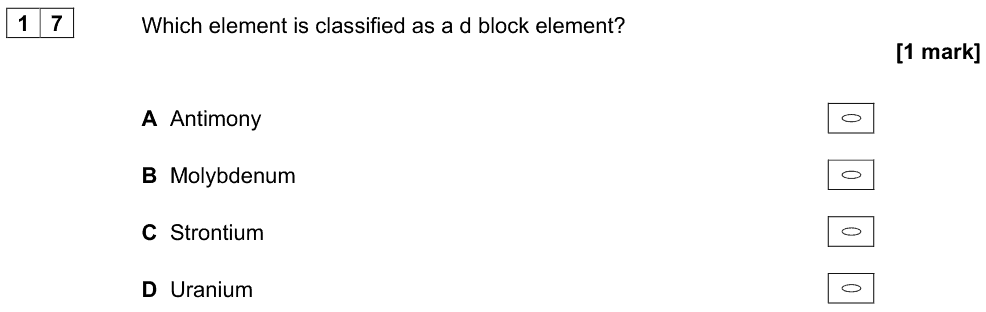
B
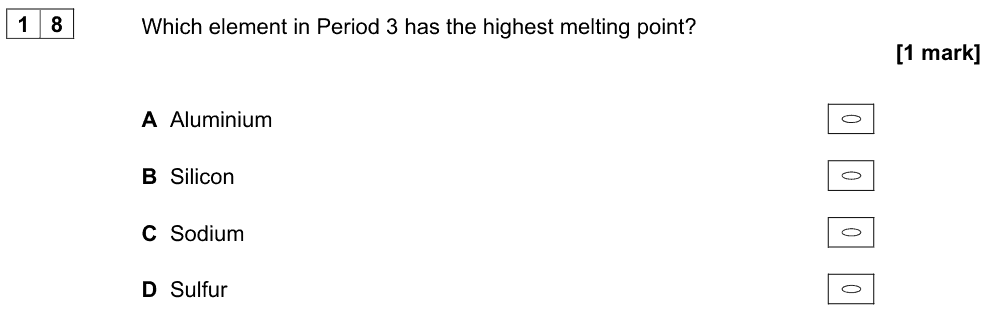
B
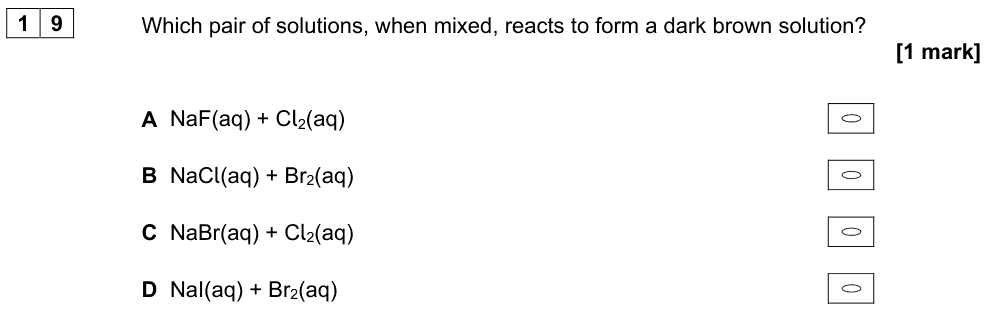
D
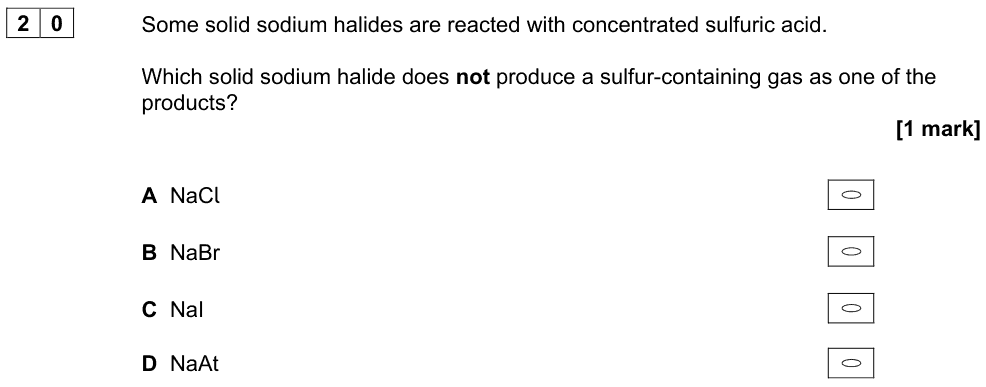
A
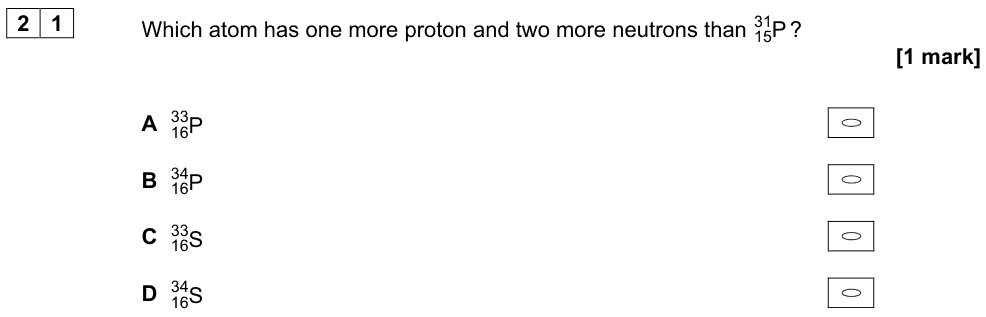
D
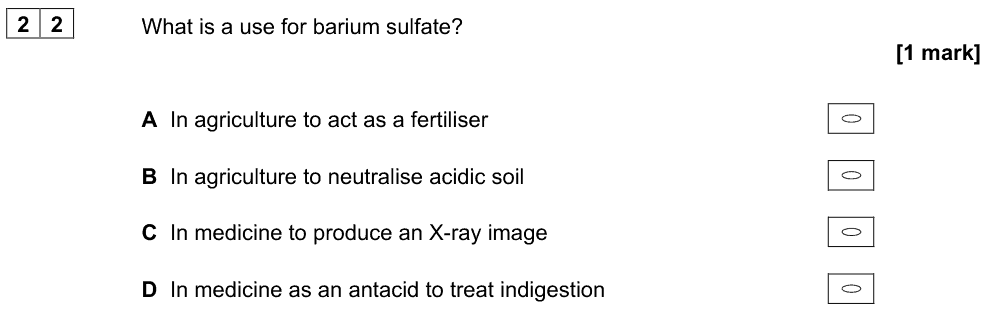
C
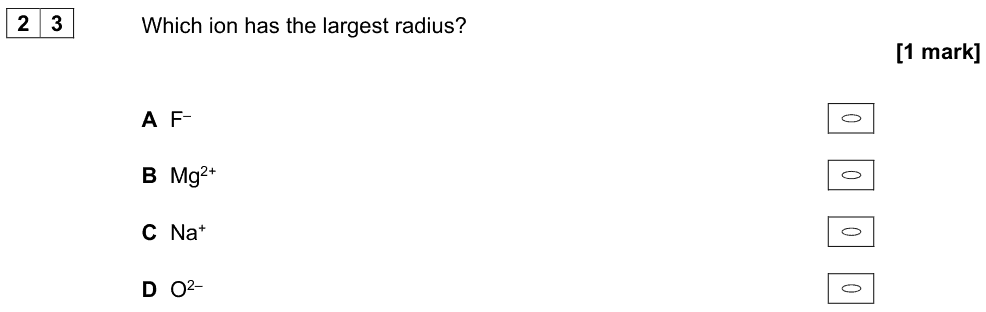
D
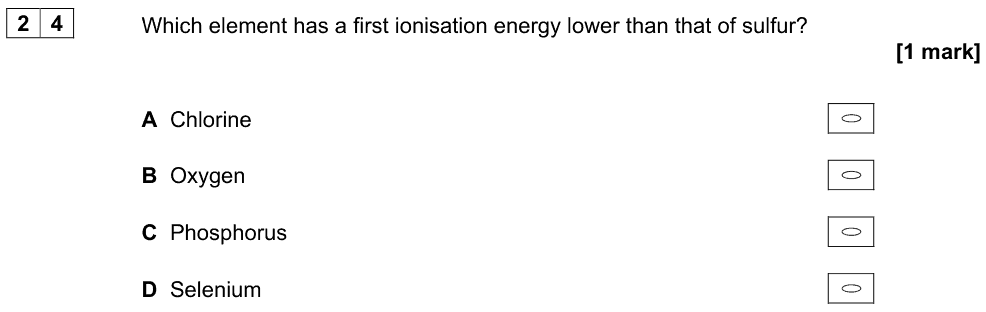
D
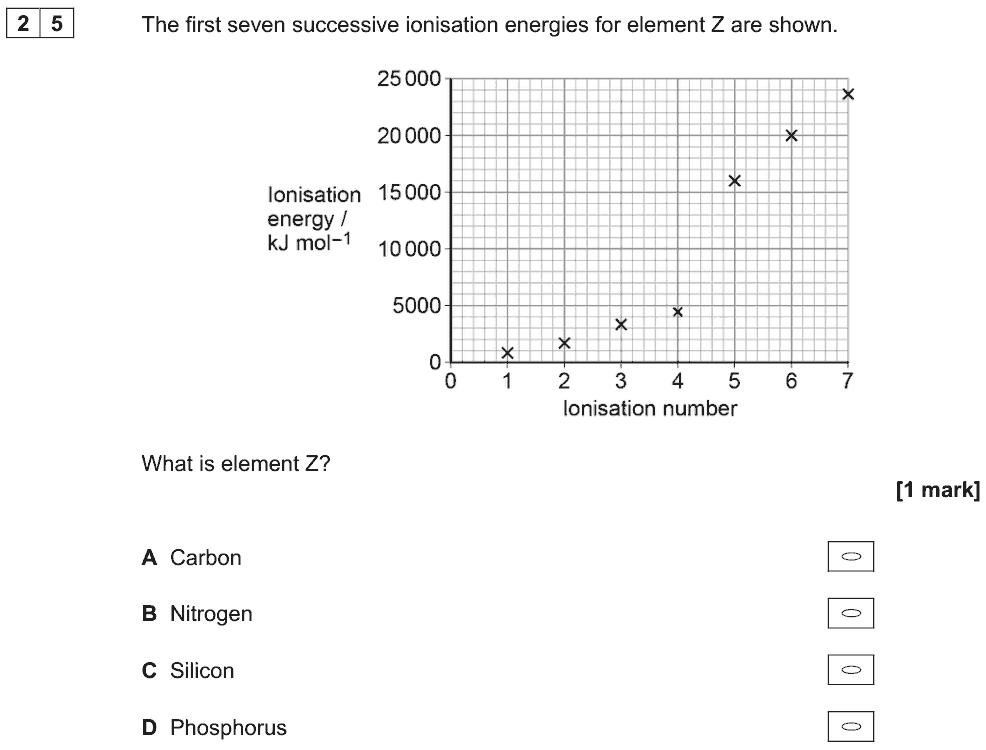
C
Skills: MS3.1 Translate information between graphical, numerical and algebraic forms
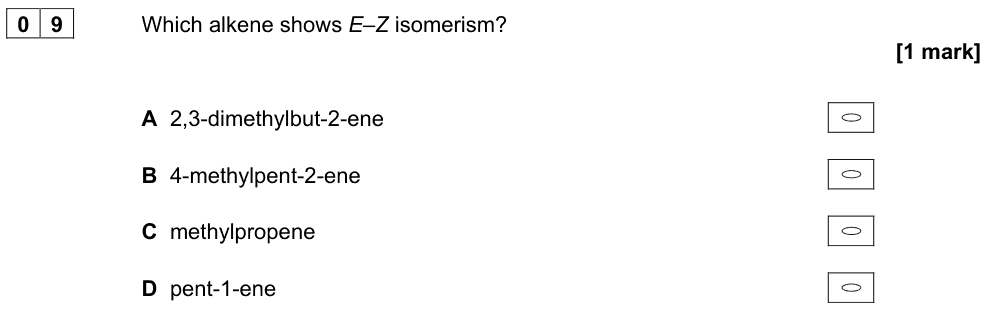
B
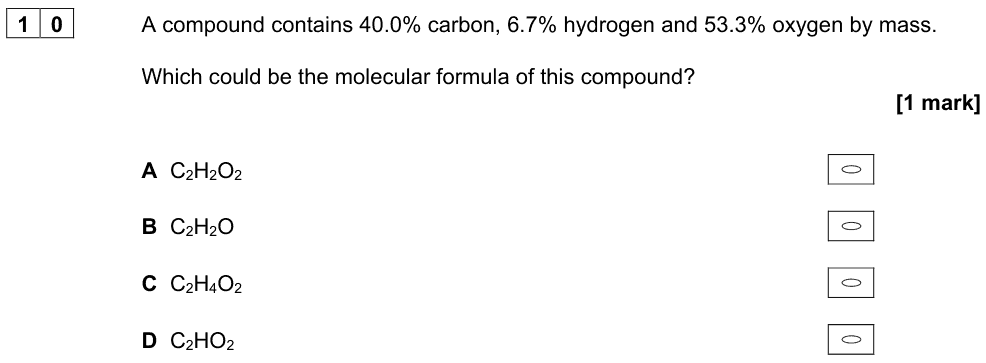
C
Skills: MS0.2 Use ratios, fractions and percentages
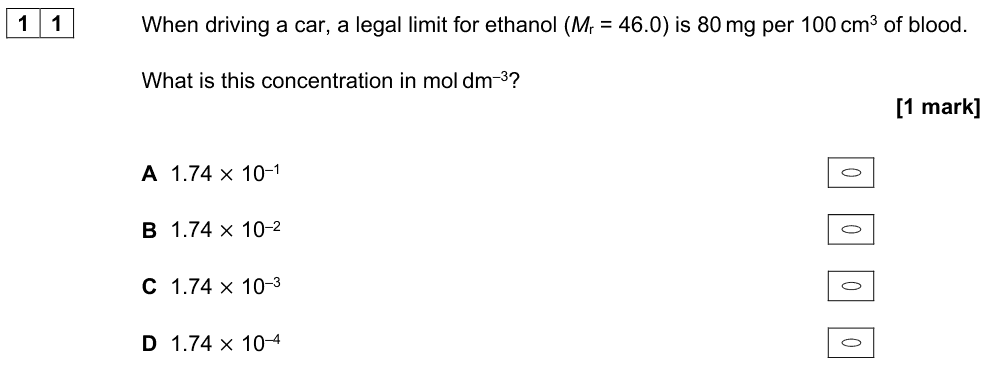
B
Skills: MS0.0 Recognise and make use of appropriate units in calculation; MS0.1 Recognise and use expressions in decimal and ordinary form
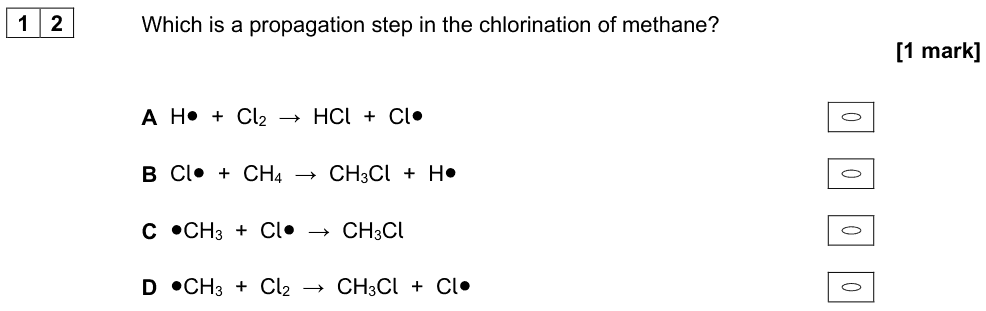
D
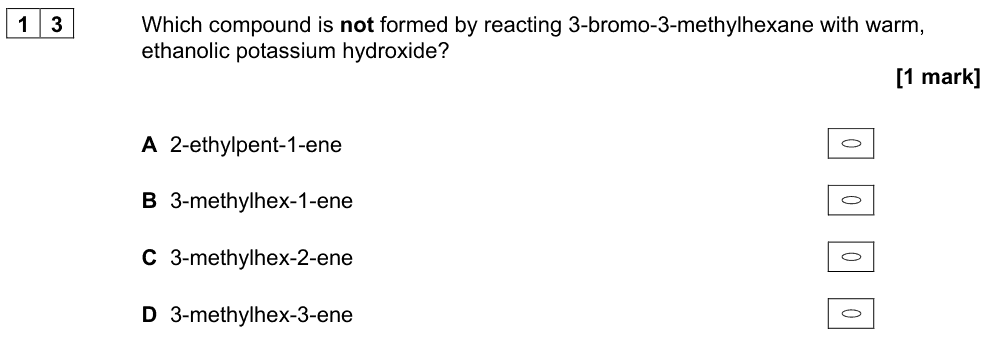
B
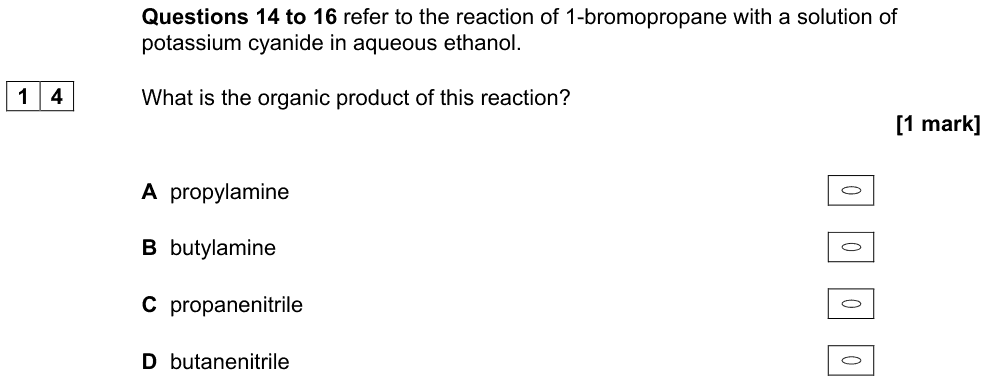
D
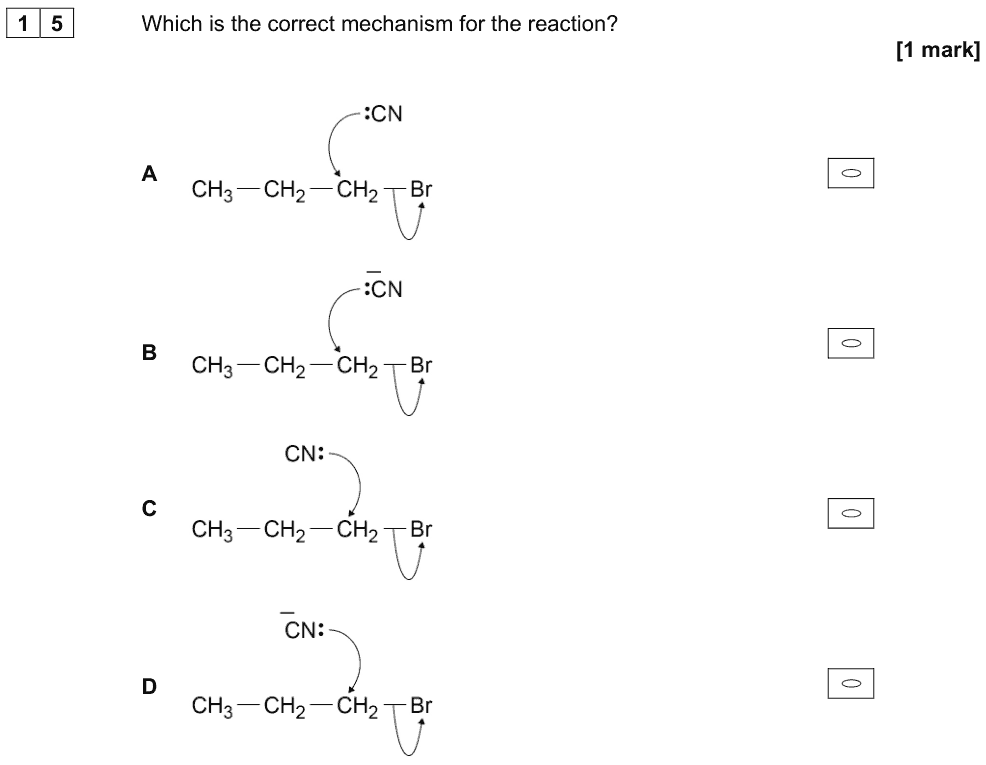
B
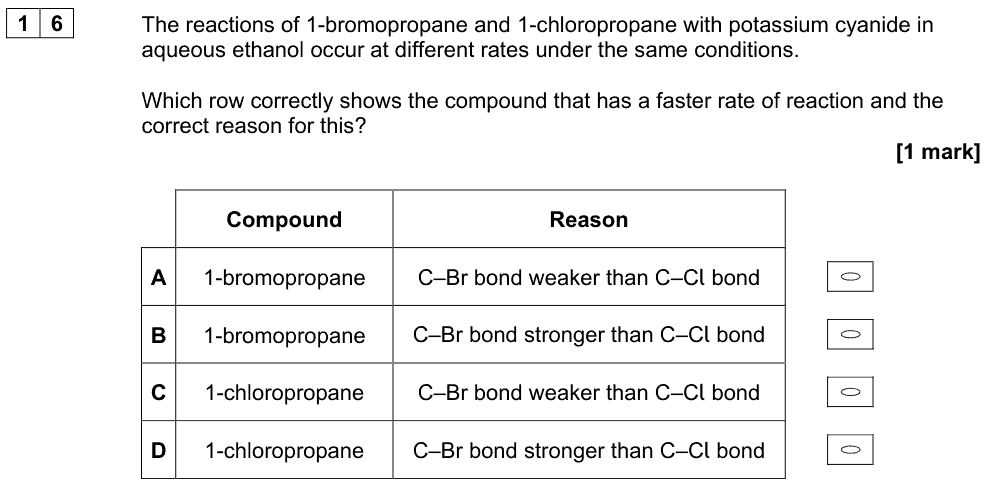
A
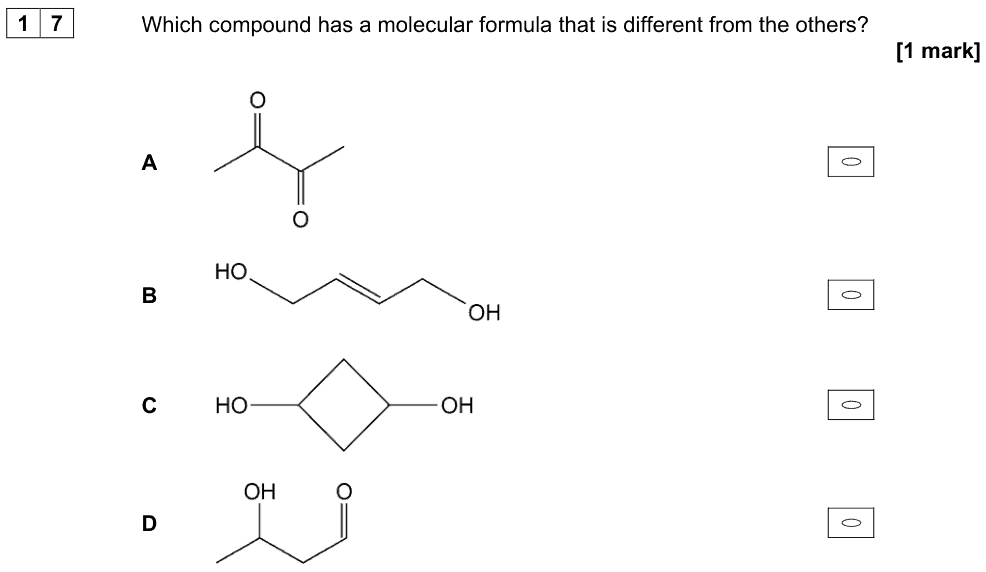
A
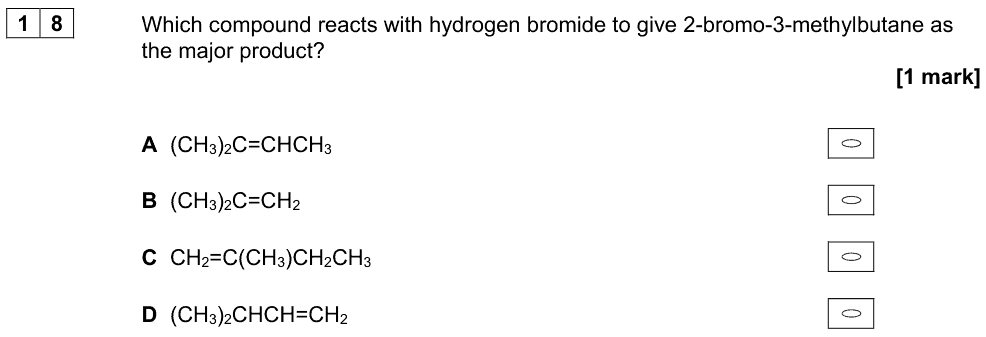
D
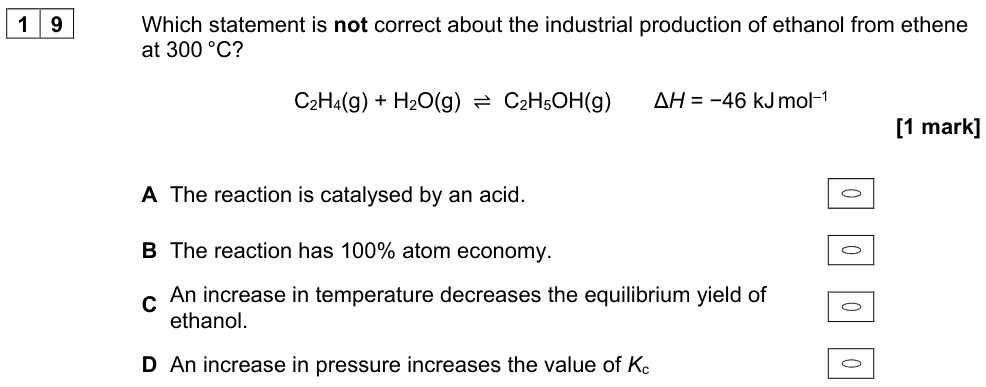
D
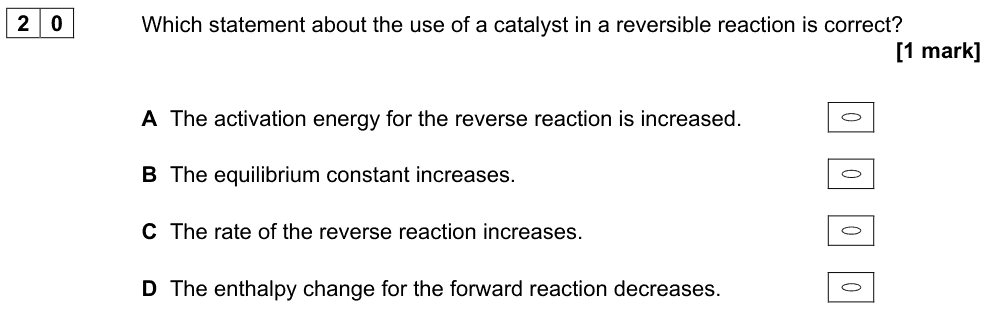
C
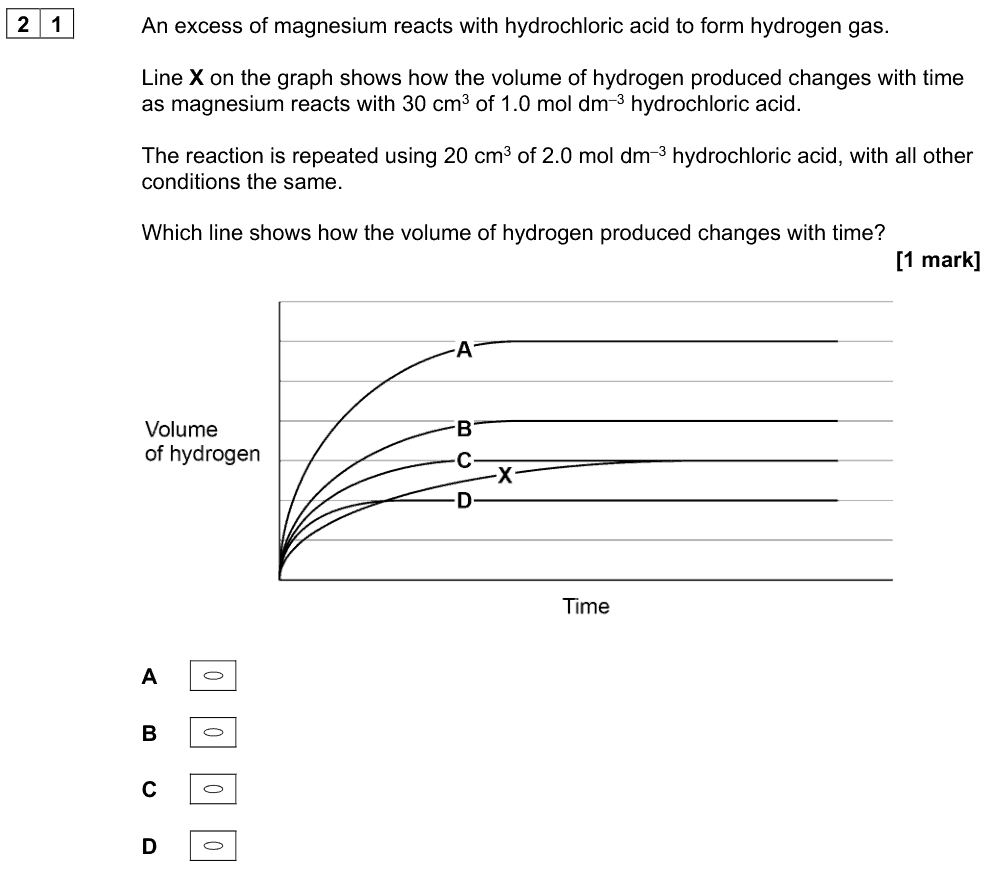
B
Skills: MS3.1 Translate information between graphical, numerical and algebraic forms
A
C
Skills: MS0.2 Use ratios, fractions and percentages
C
B
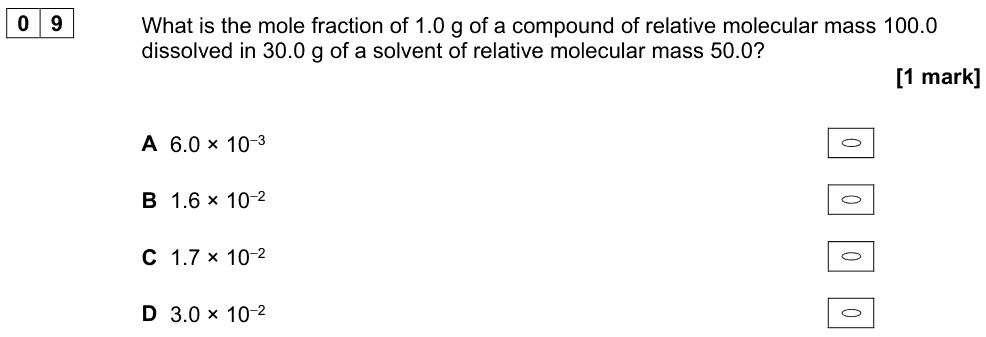
B
Skills: MS0.2 Use ratios, fractions and percentages
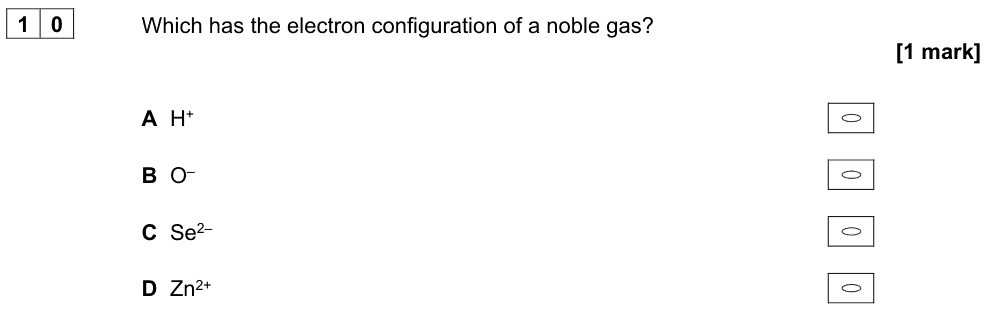
C
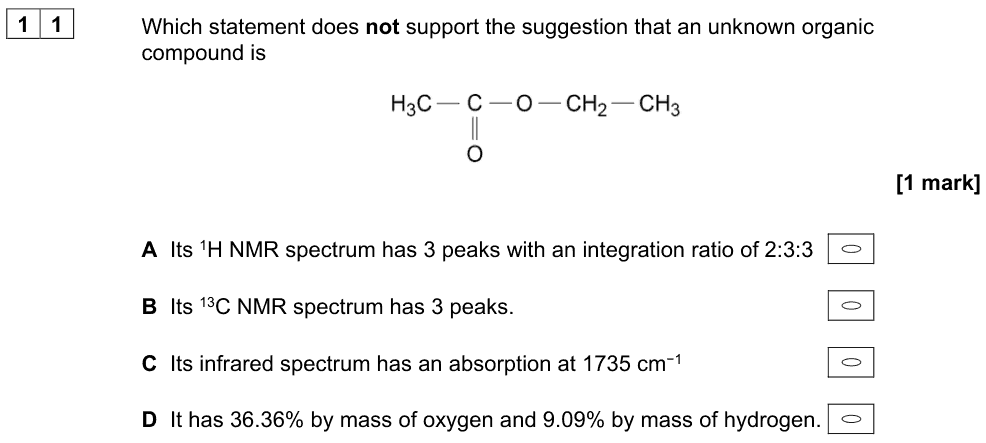
B
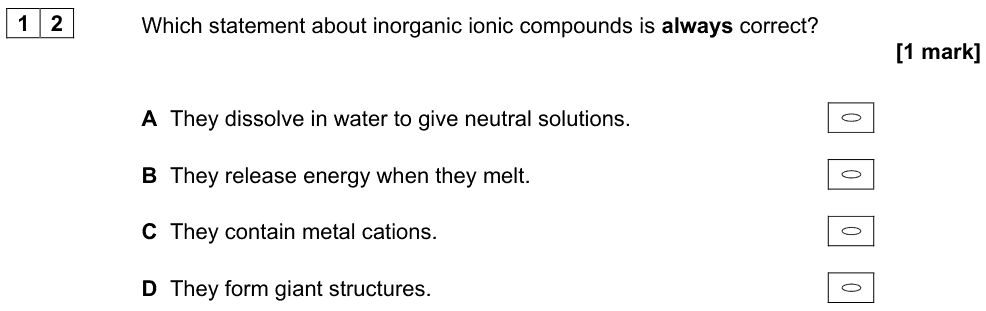
D
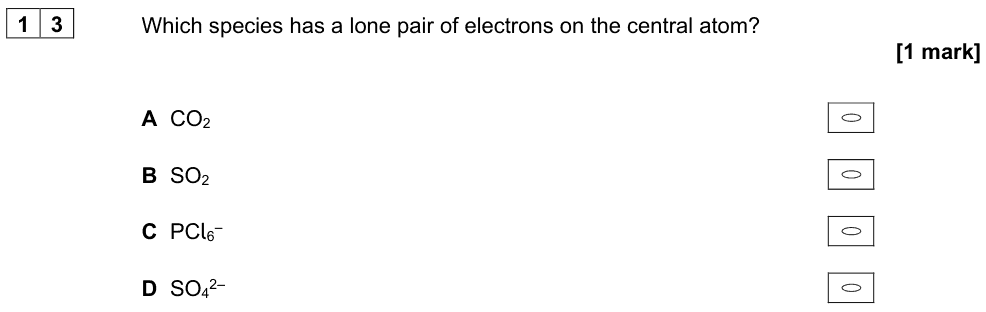
B
Skills: MS4.1 Use angles and shapes in regular 2D and 3D structures
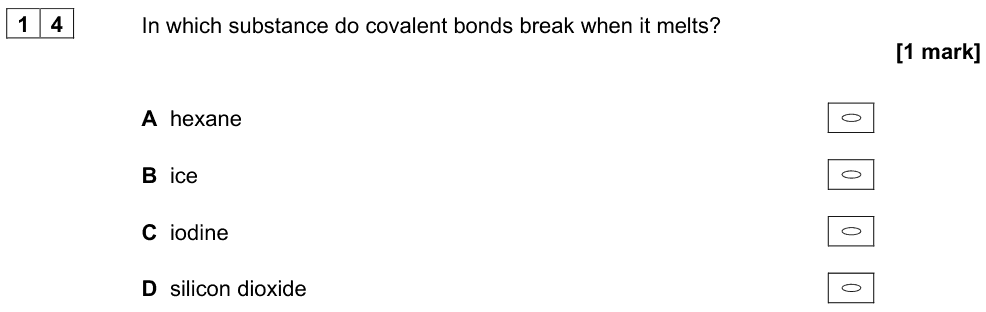
D
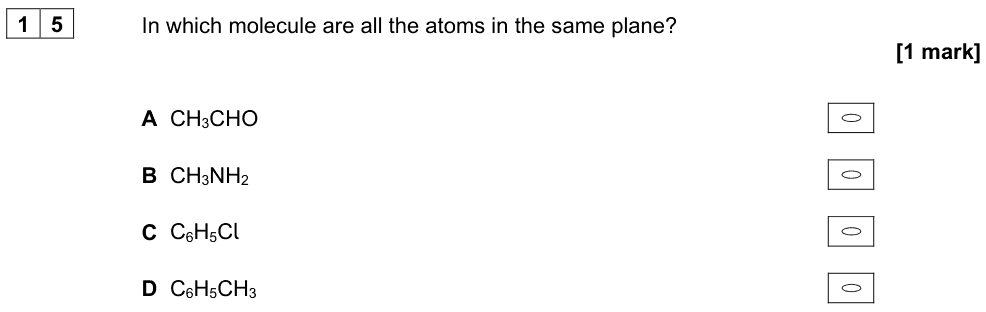
C
Skills: MS4.1 Use angles and shapes in regular 2D and 3D structures
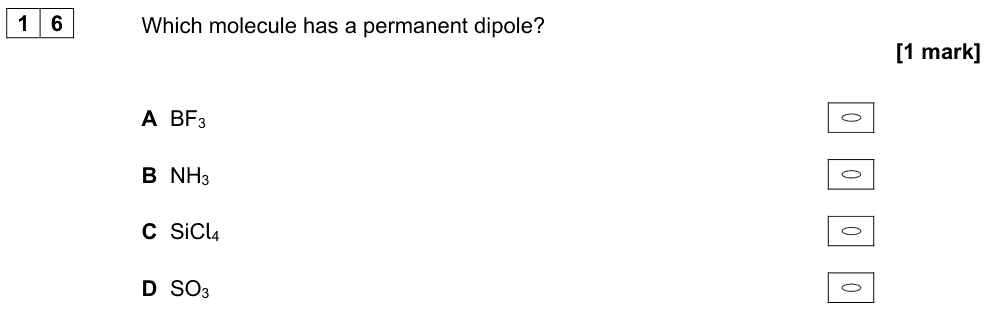
B
Skills: MS4.1 Use angles and shapes in regular 2D and 3D structures
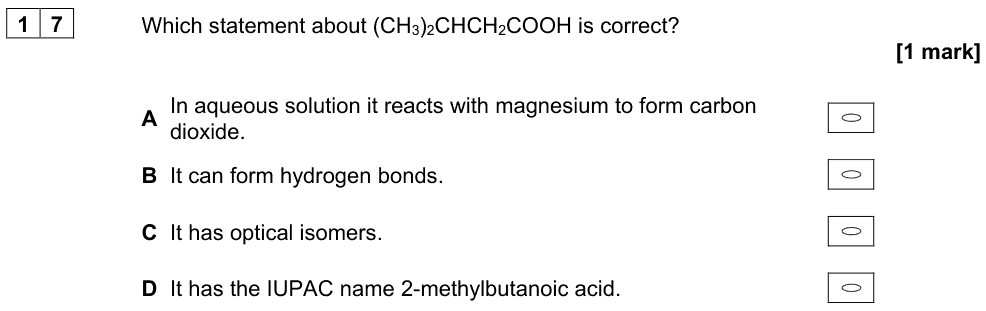
B
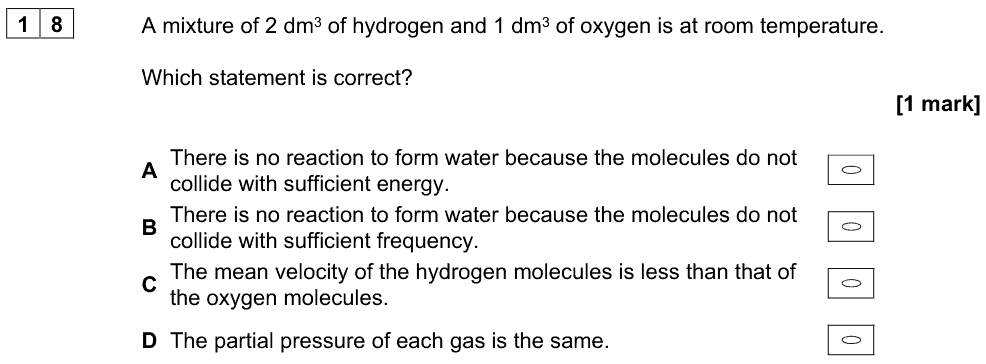
A
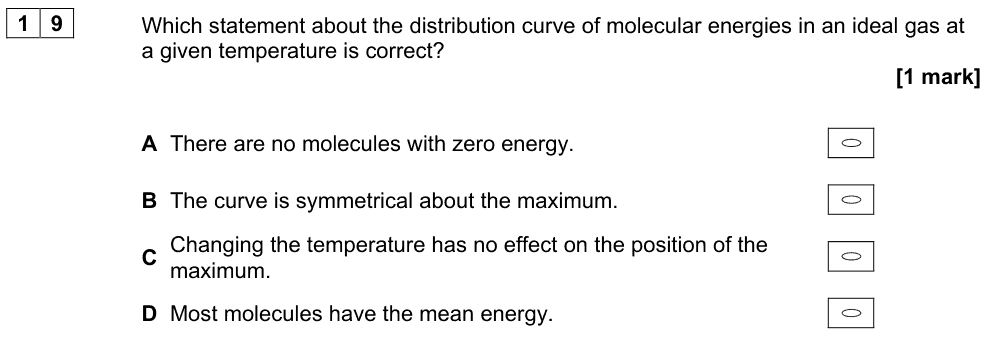
A
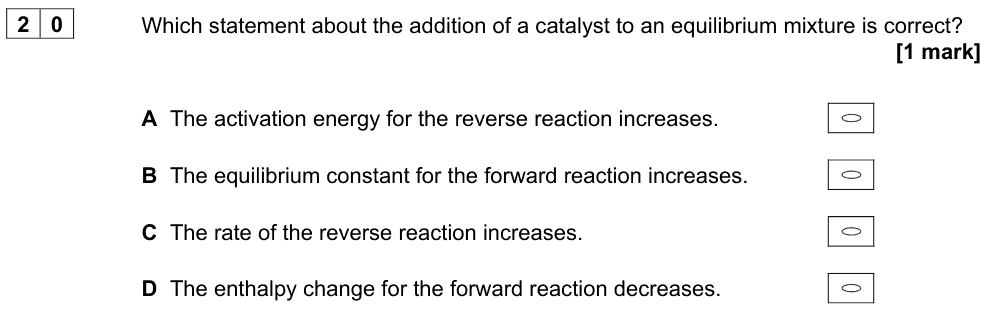
C
D
B
C
A
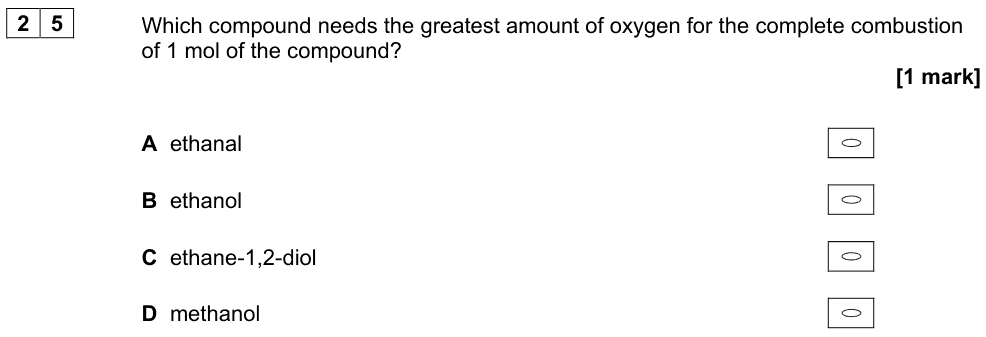
B
Skills: MS0.2 Use ratios, fractions and percentages
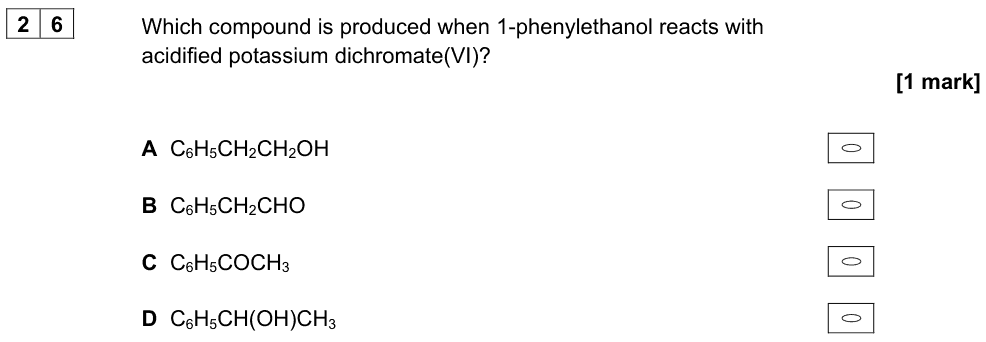
C
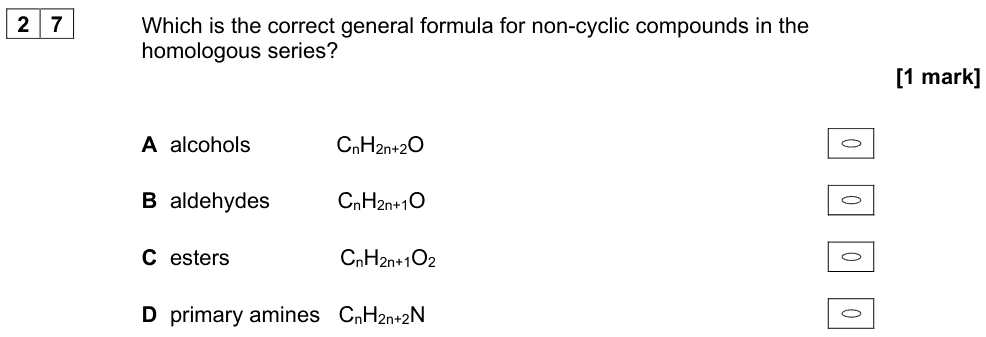
A
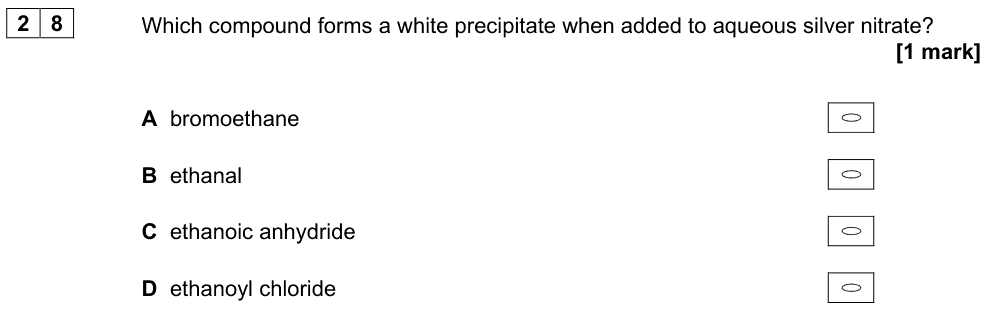
D
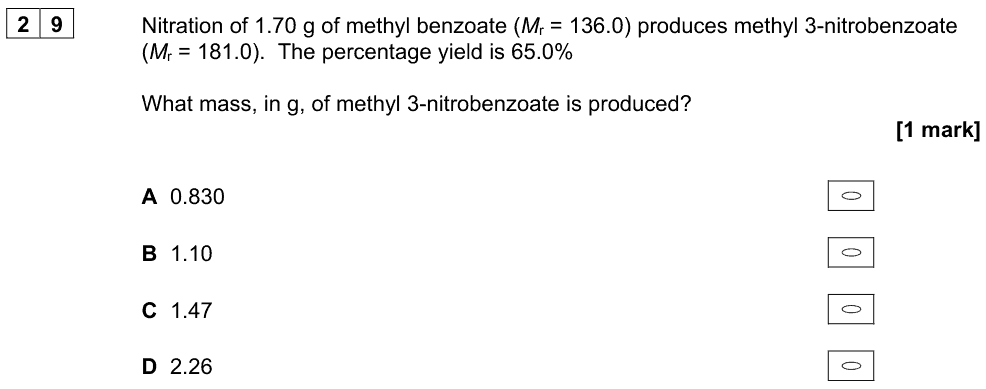
C
Skills: MS0.2 Use ratios, fractions and percentages
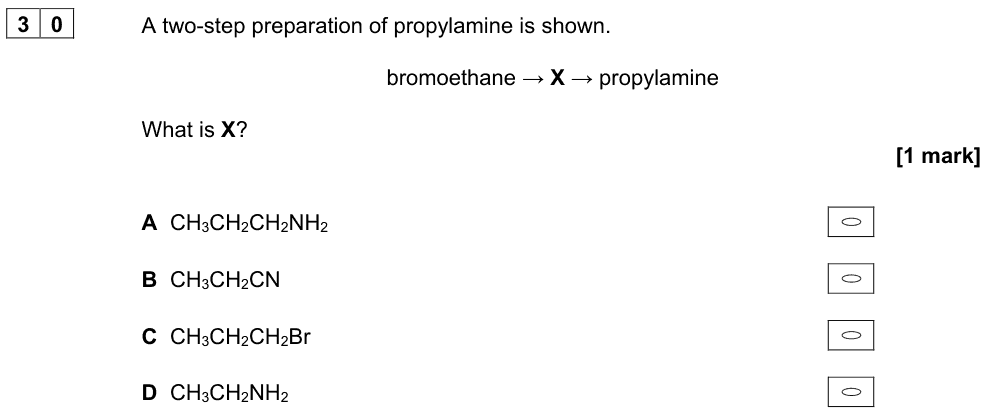
B
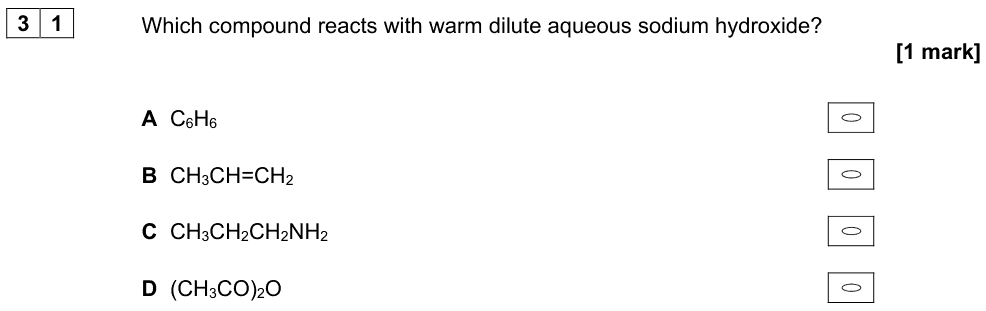
D
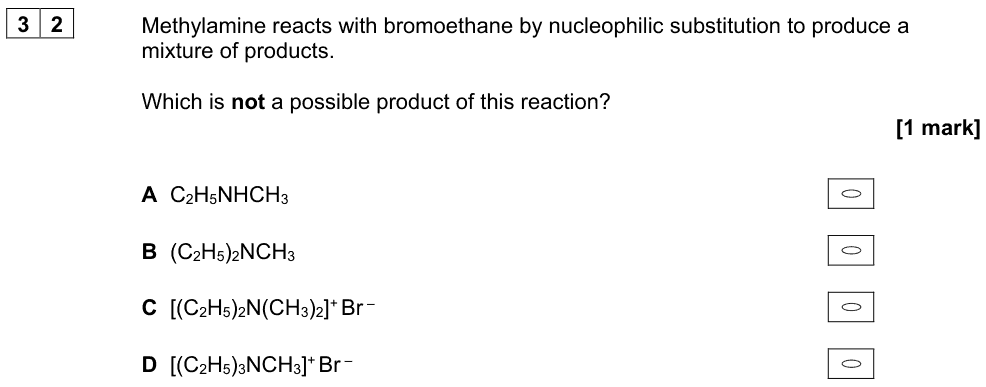
C
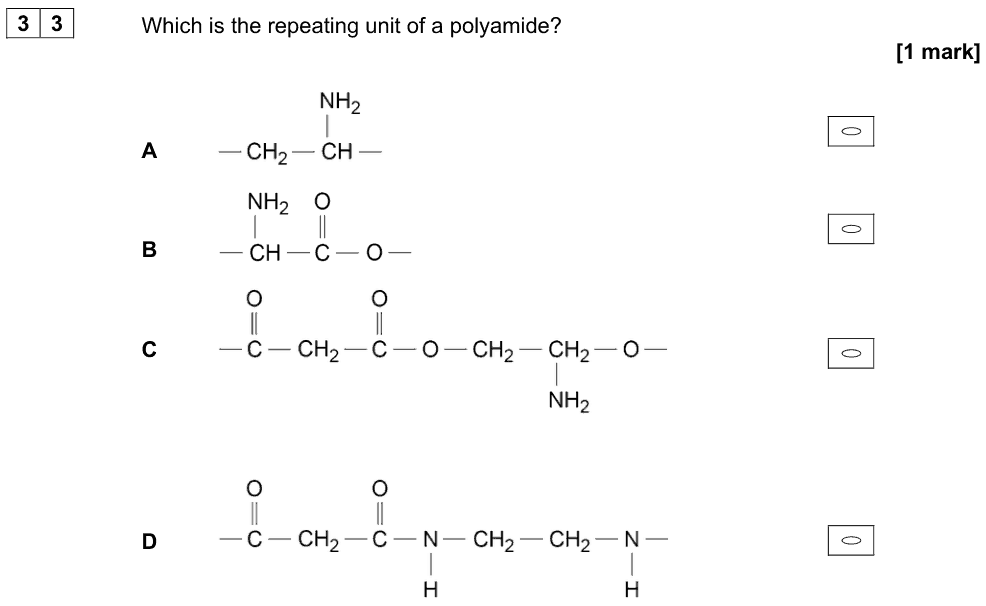
D
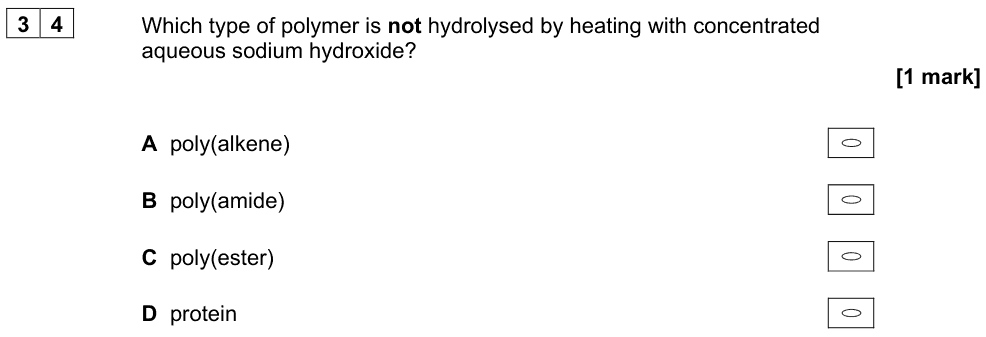
A
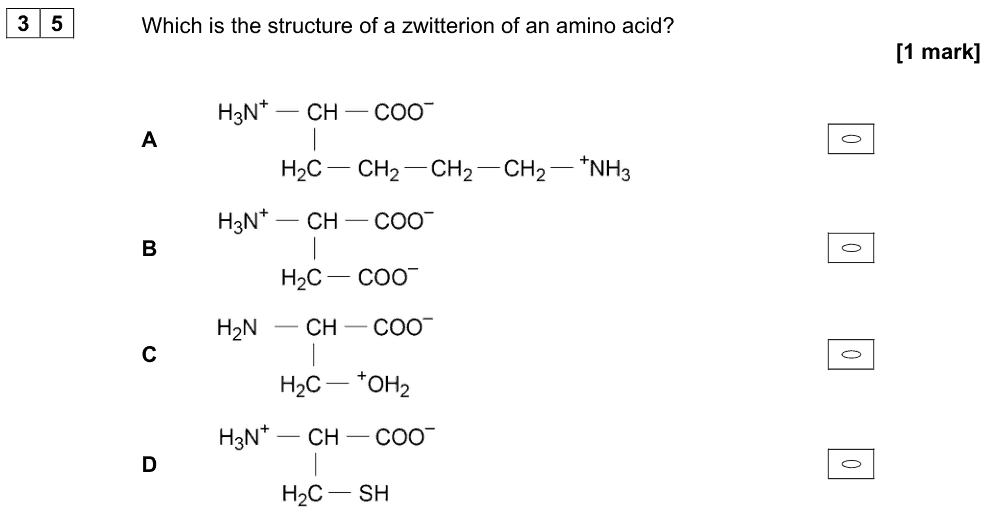
D
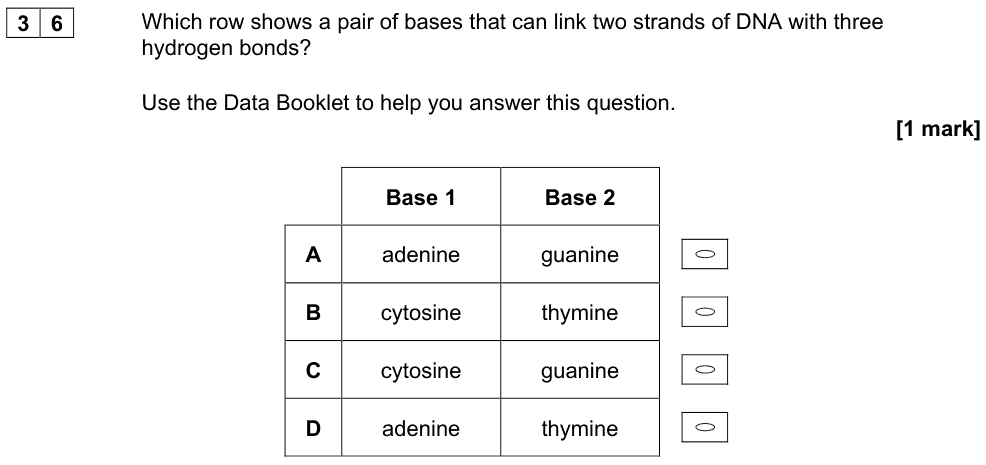
C
D
C
B
D
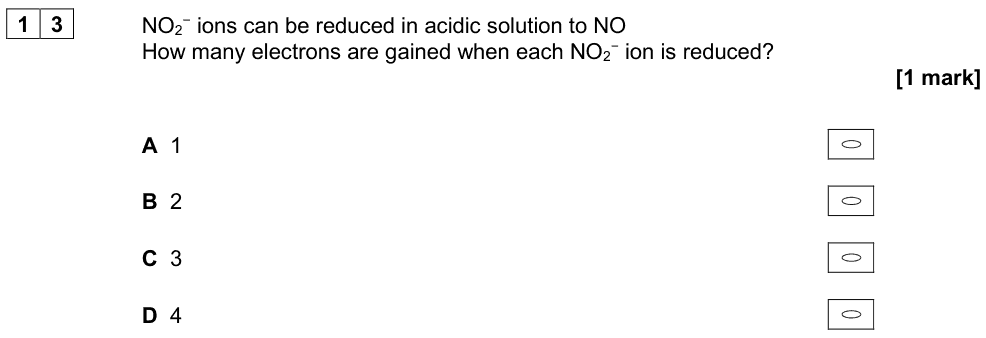
A
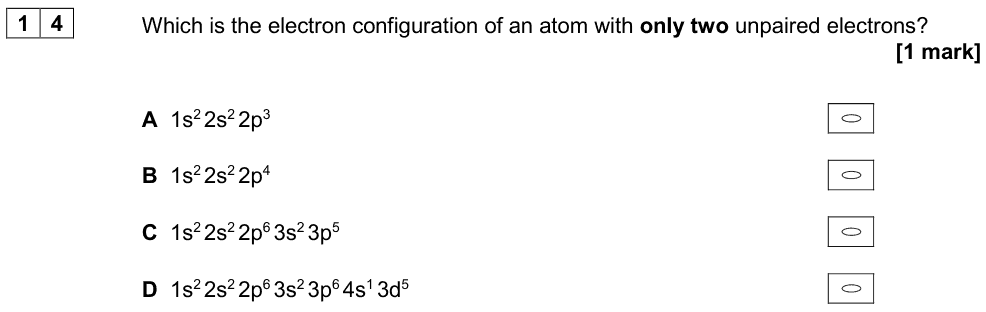
B
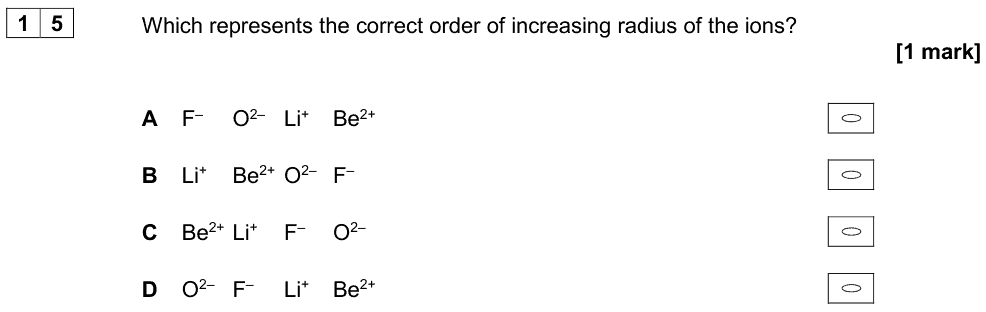
C
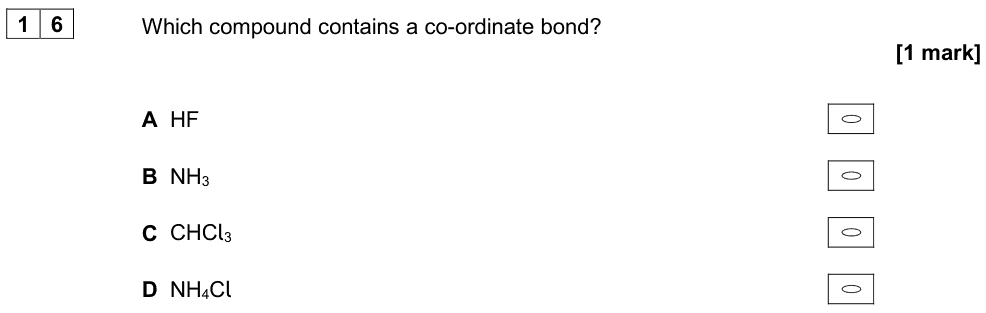
D
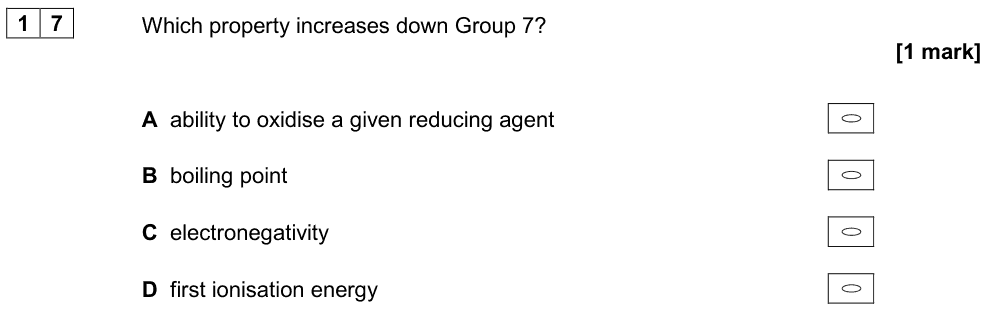
B
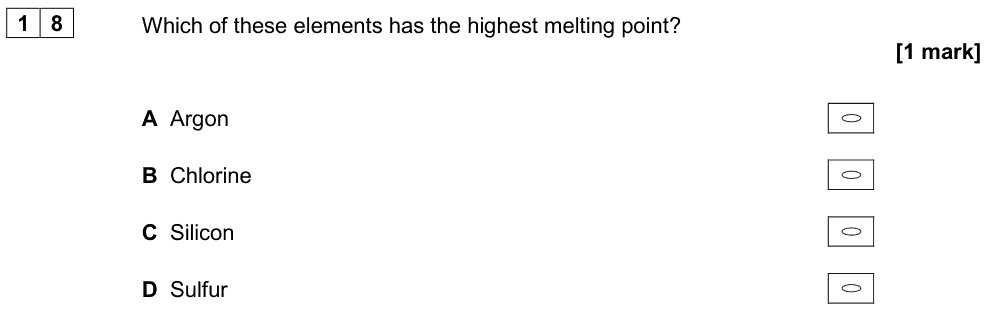
C
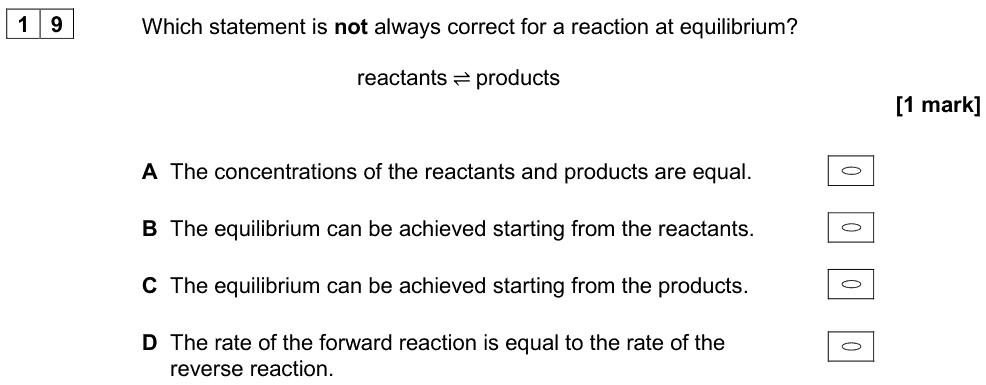
A
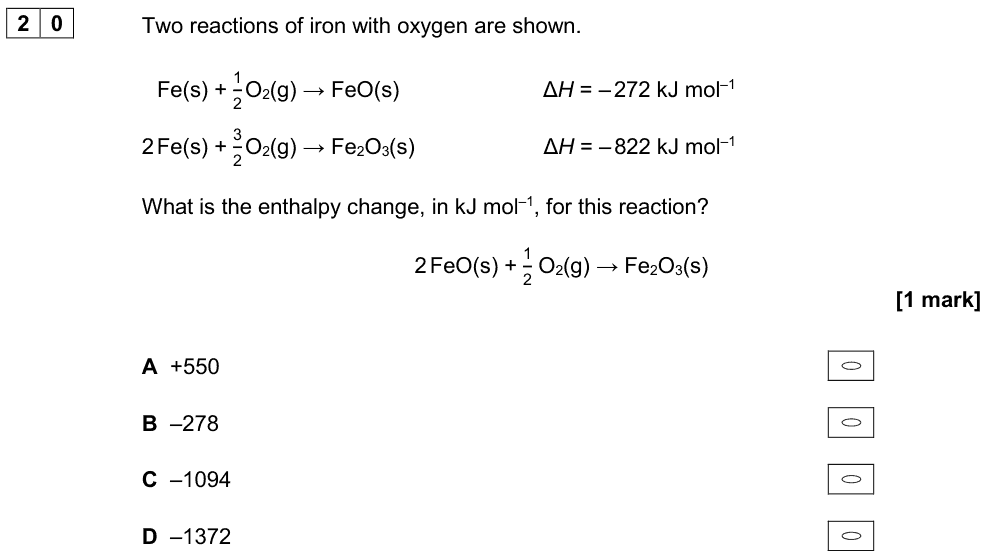
B
Skills: MS2.4 Solve algebraic equations
A
D
D
C
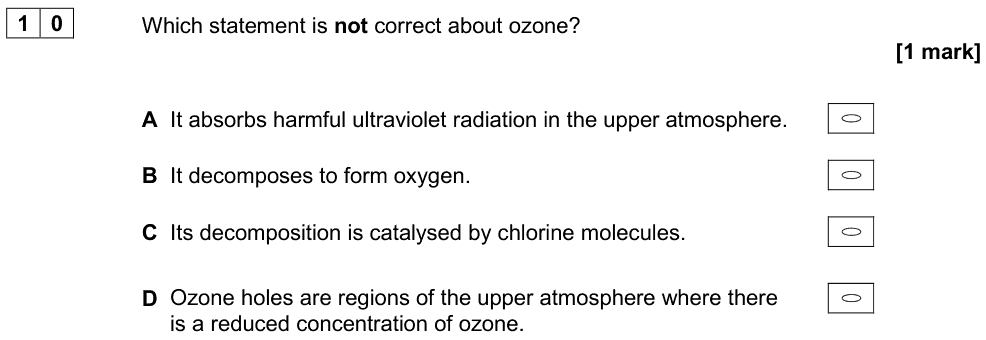
C
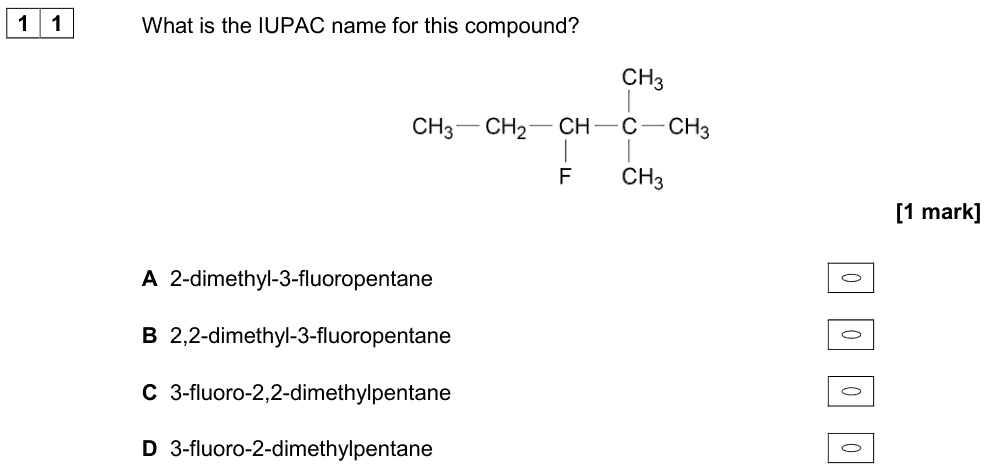
C
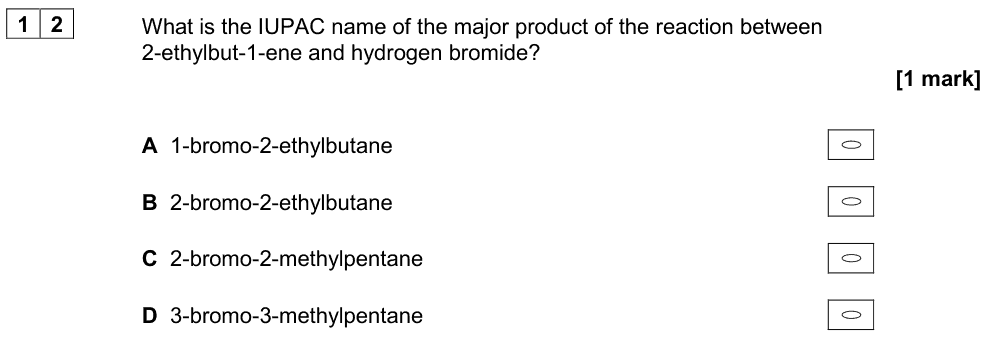
D
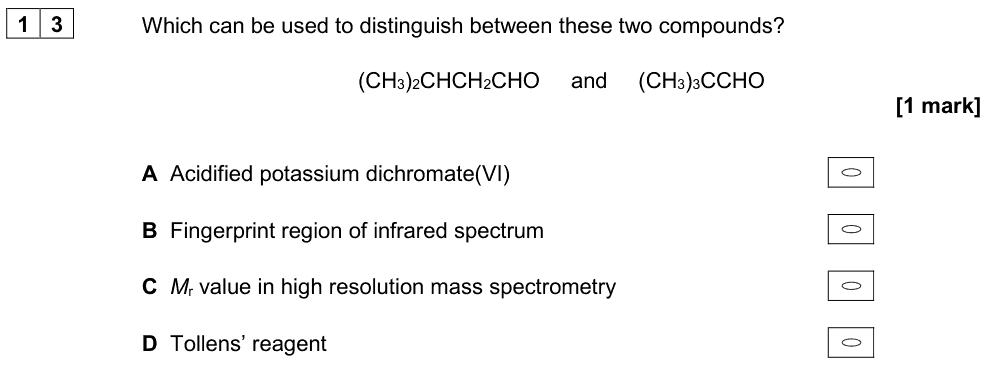
B
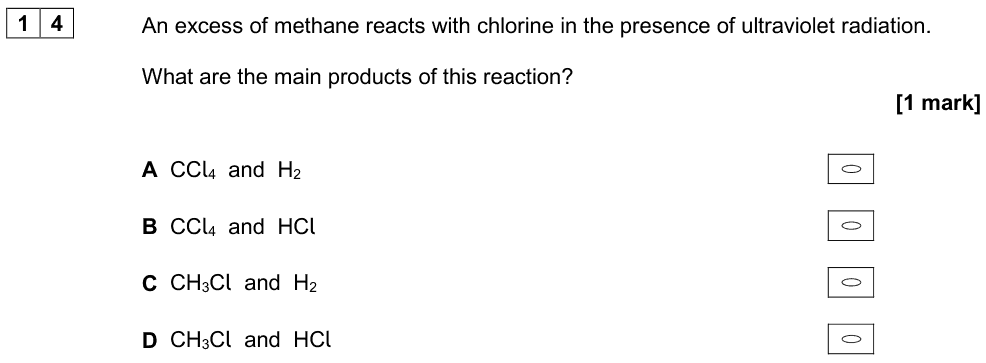
D
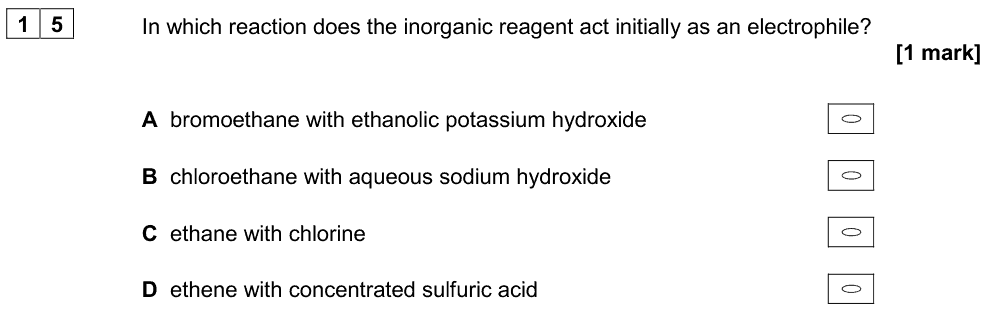
D
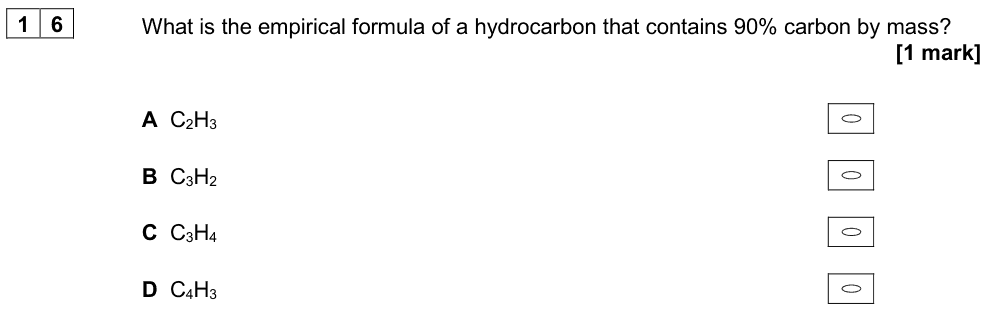
C
Skills: MS0.2 Use ratios, fractions and percentages
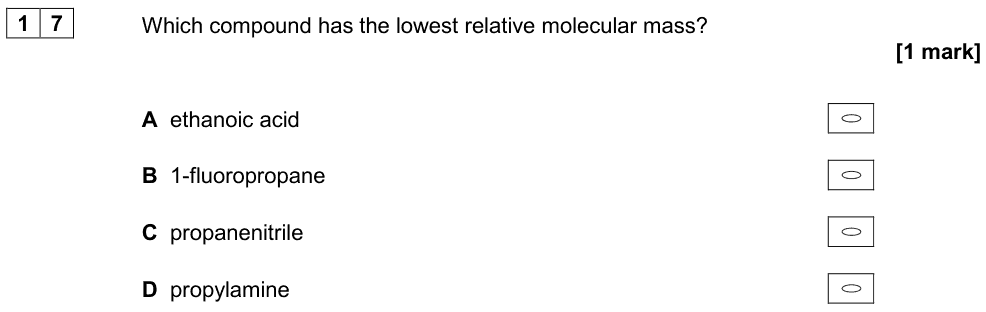
C
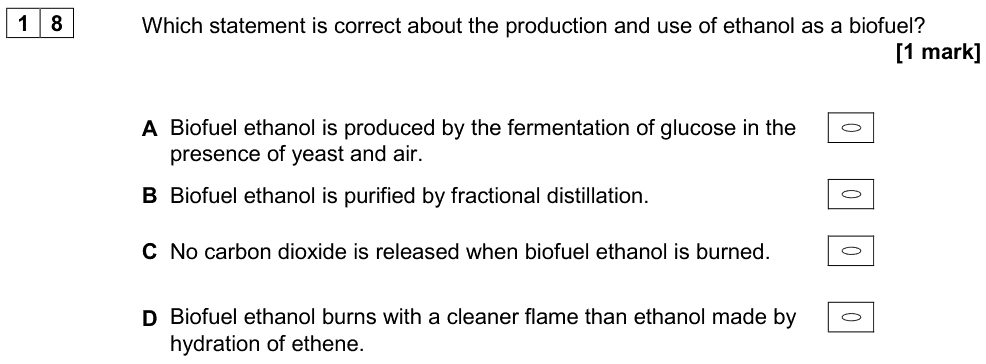
B
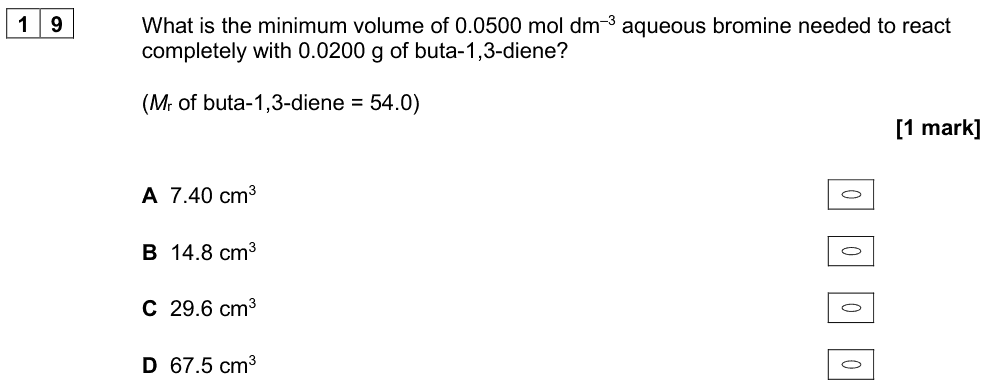
B
Skills: MS0.0 Recognise and make use of appropriate units in calculation; MS0.2 Use ratios, fractions and percentages
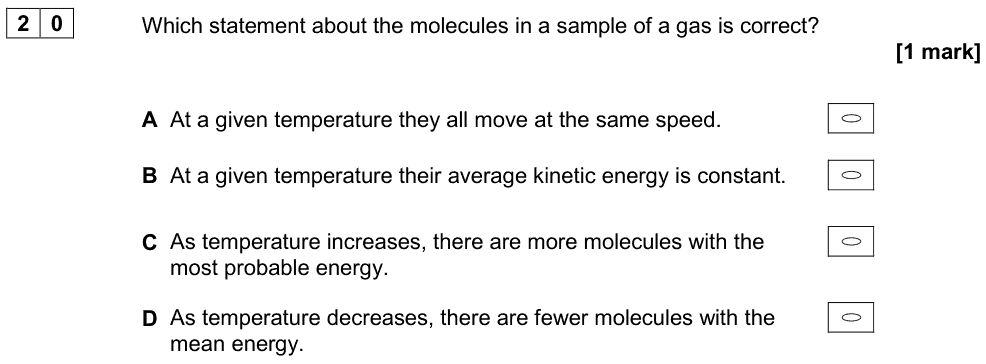
B
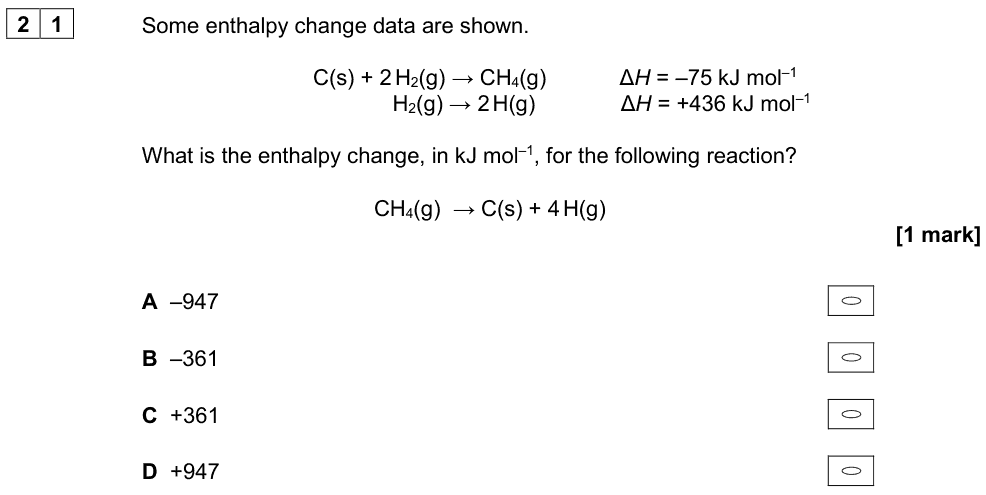
D
Skills: MS2.4 Solve algebraic equations
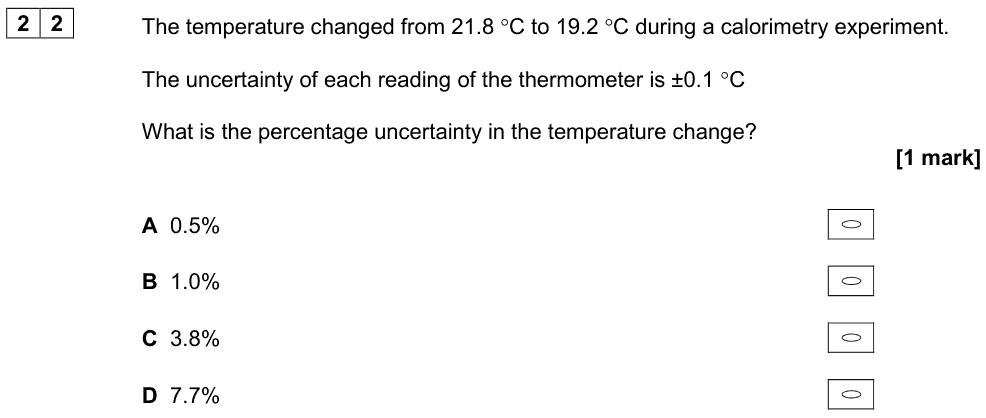
D
Skills: MS1.3 Identify uncertainties in measurements and use simple techniques to determine uncertainty when data are combined; PS3.3 Consider margins of error, accuracy and precision of data; RP2 Measurement of an enthalpy change
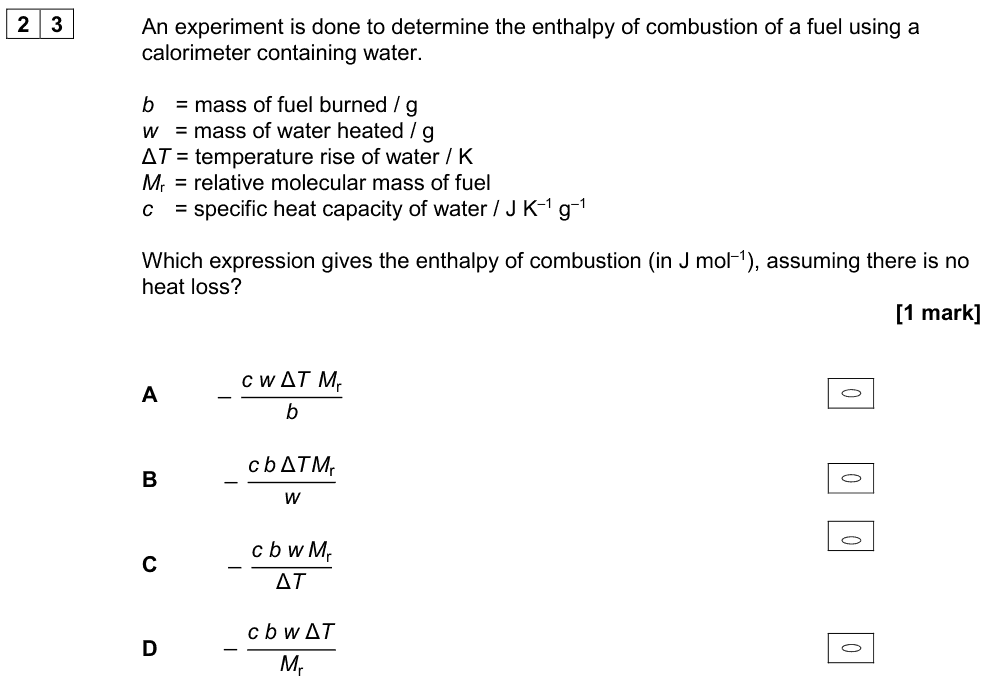
A
Skills: MS2.2 Change the subject of an equation; RP2 Measurement of an enthalpy change
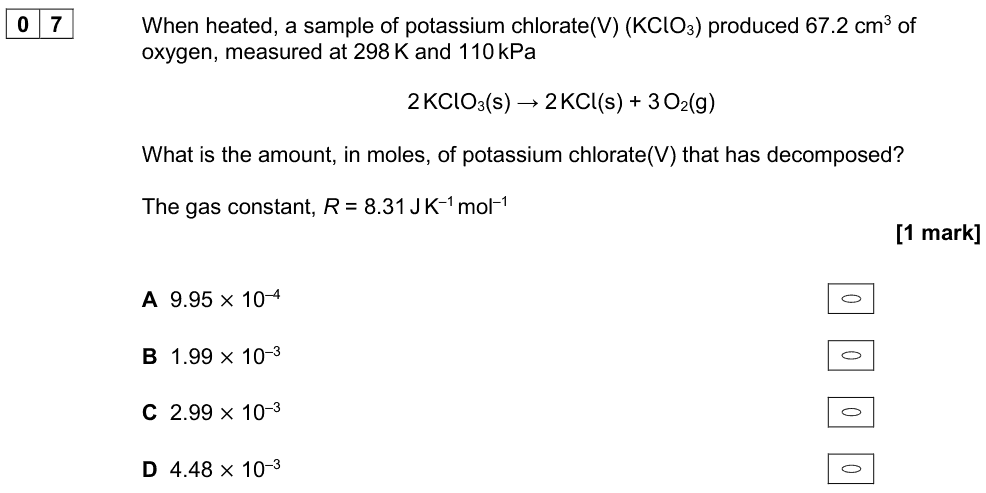
B
Skills: MS0.0 Recognise and make use of appropriate units in calculation; MS0.2 Use ratios, fractions and percentages; MS2.2 Change the subject of an equation
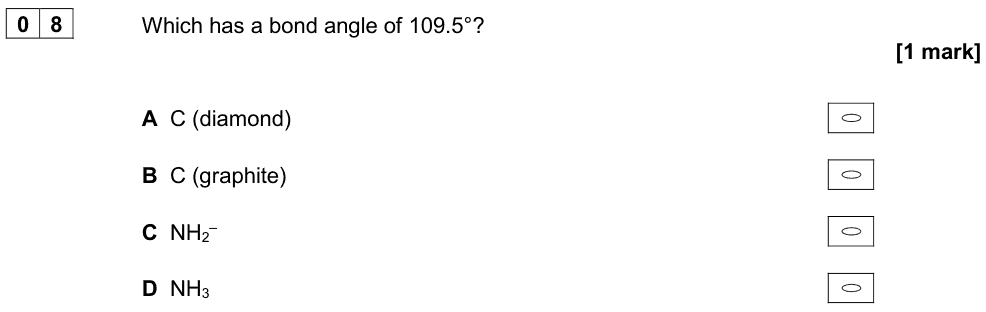
A
Skills: MS4.1 Use angles and shapes in regular 2D and 3D structures
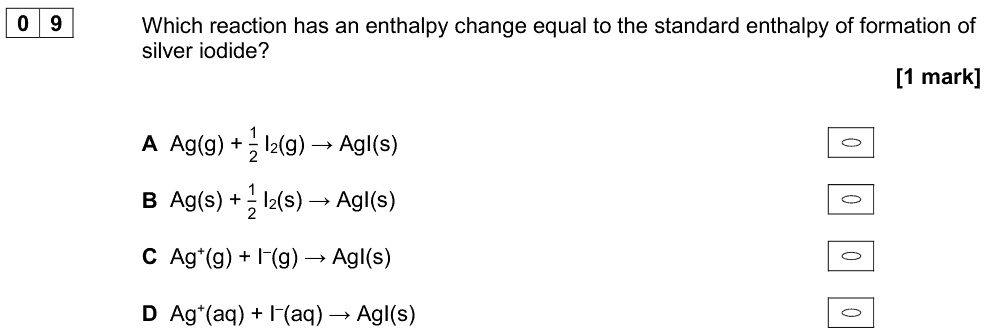
B
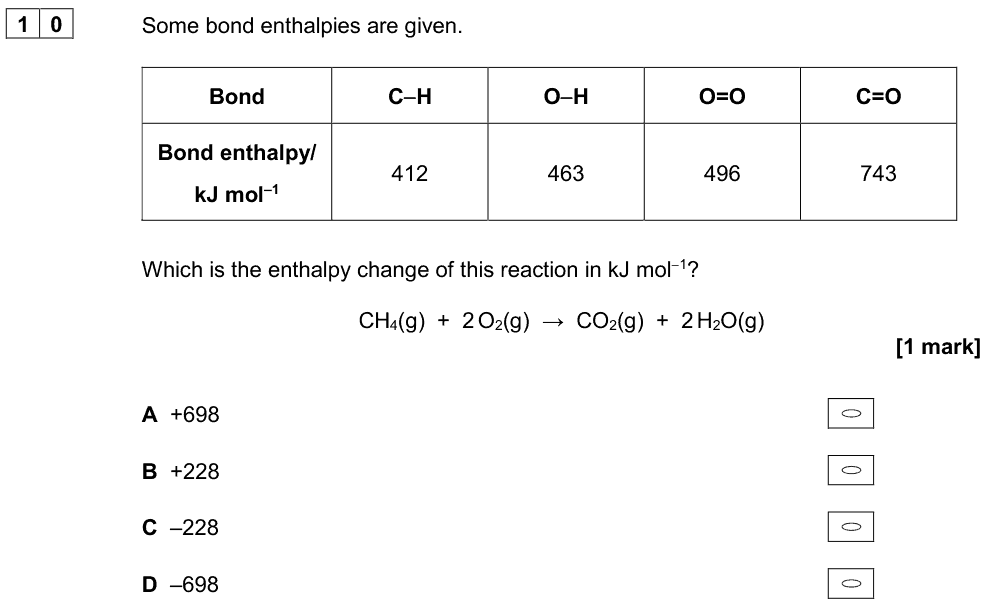
D
Skills: MS2.4 Solve algebraic equations
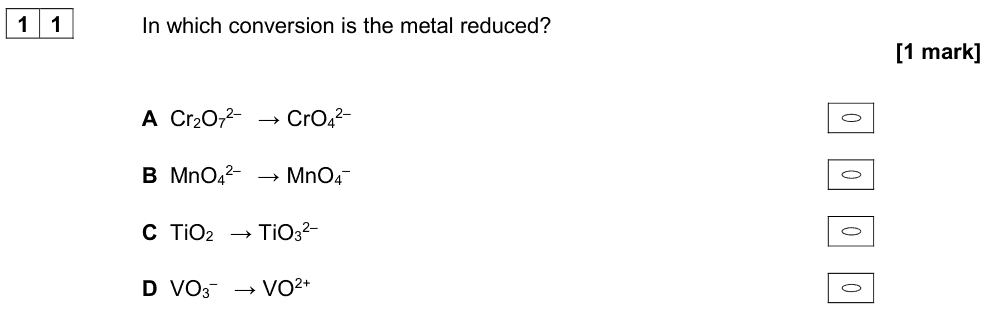
D
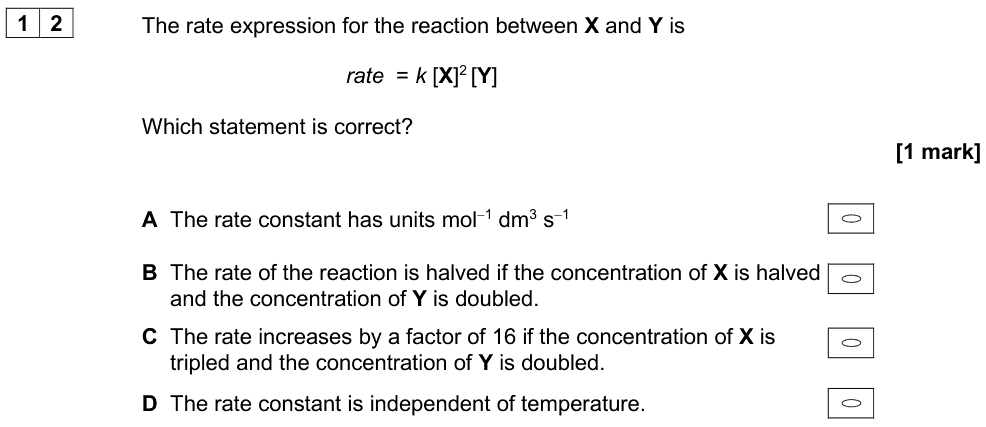
B
Skills: MS0.2 Use ratios, fractions and percentages
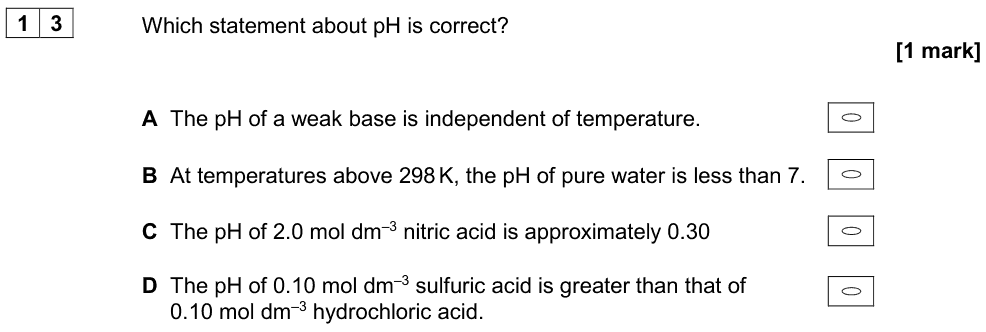
B
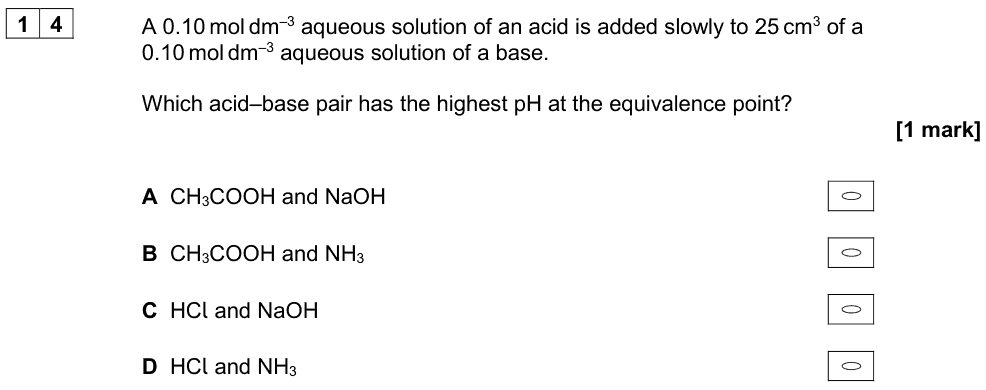
A
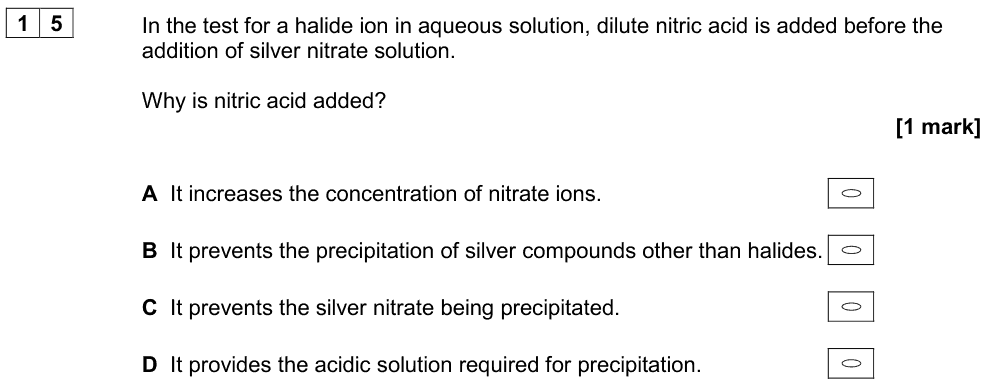
B
Skills: ATd Use laboratory apparatus for a variety of experimental techniques including: titration, using burette and pipette; distillation and heating under reflux, including setting up glassware using retort stand and clamps; qualitative tests for ions and organic functional groups; filtration, including use of fluted filter paper, or filtration under reduced pressure; RP4 Carry out simple test-tube reactions to identify: cations – Group 2, NH4+; anions – Group 7 (halide ions), OH–, CO32–, SO42–
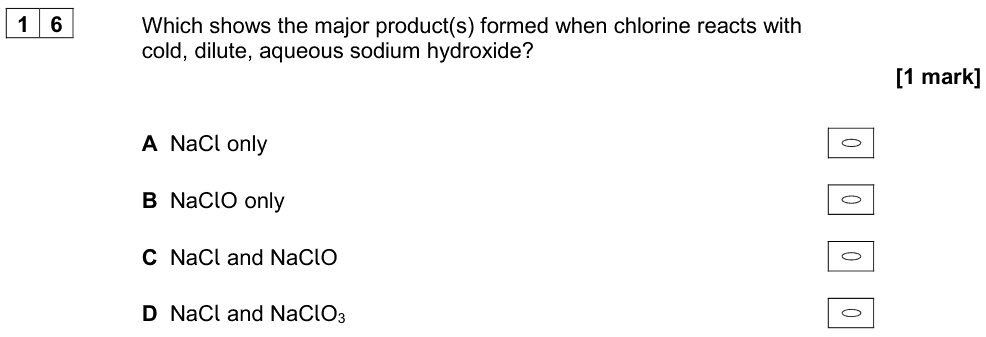
C
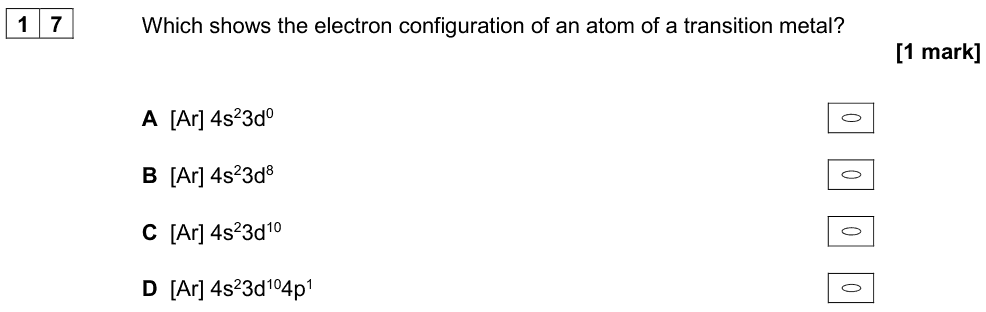
B
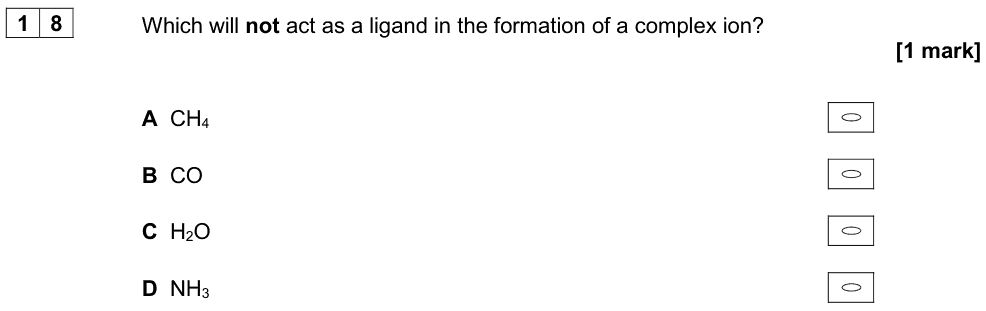
A
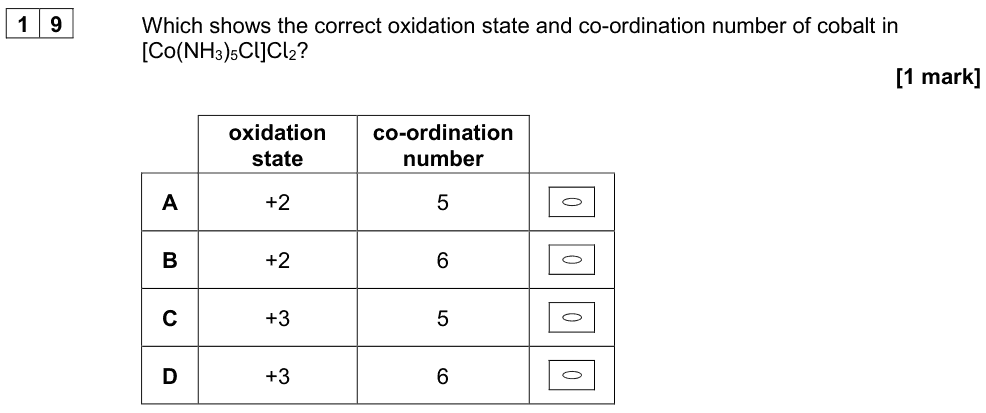
D
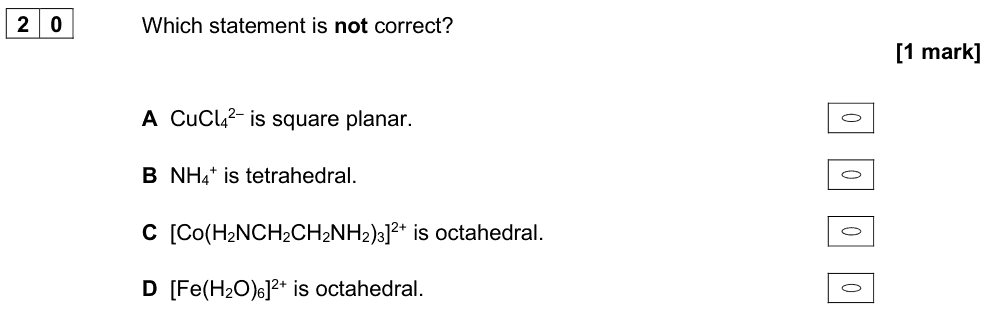
A
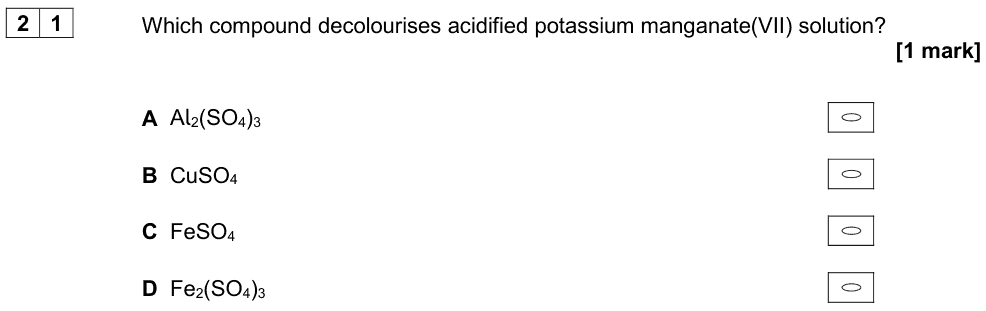
C
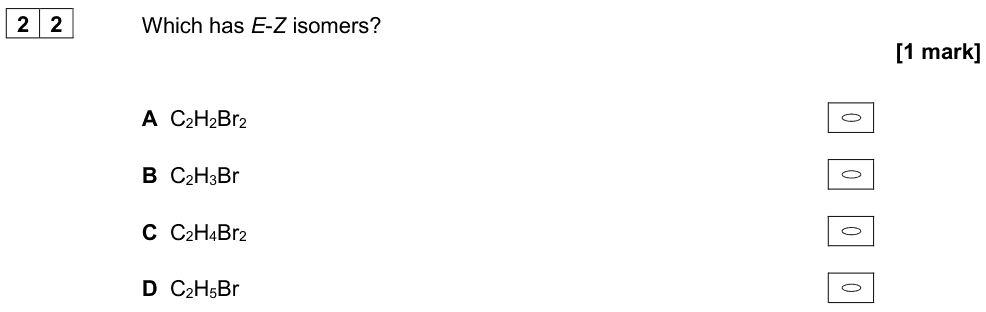
A
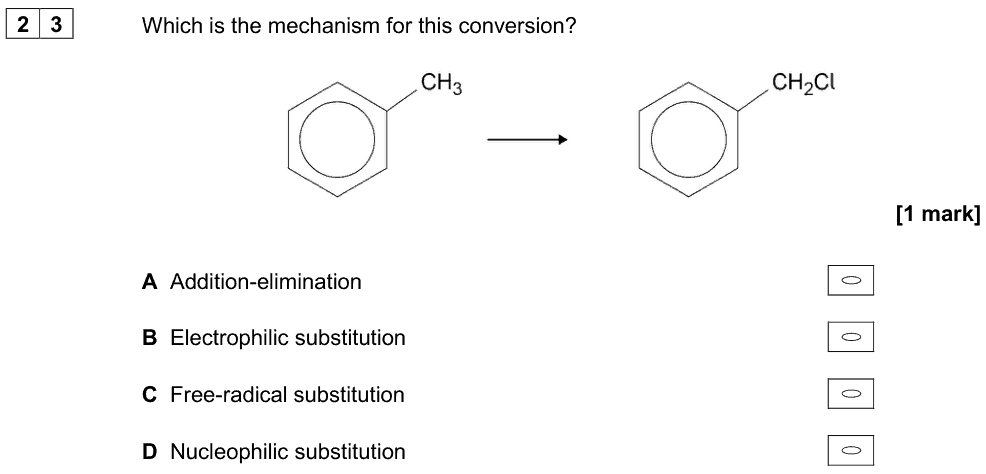
C
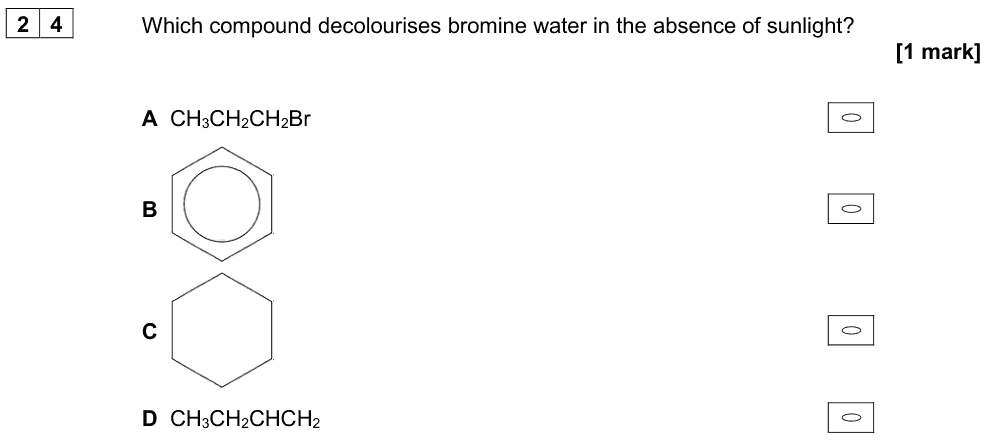
D
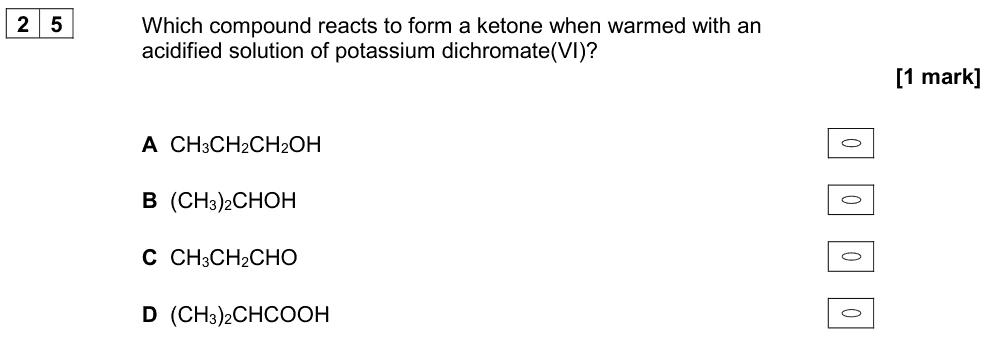
B
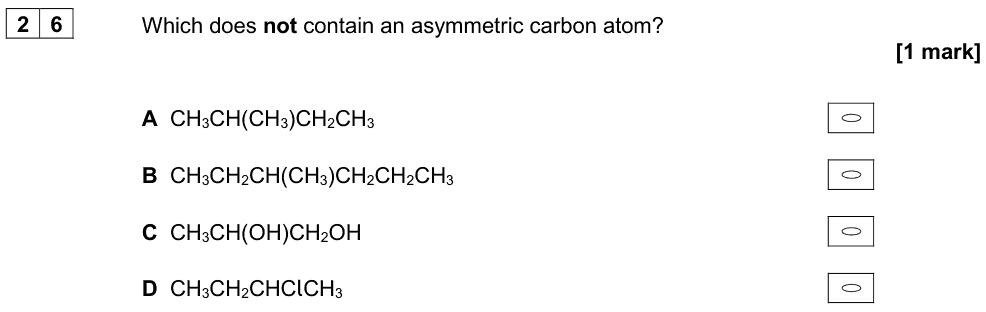
A
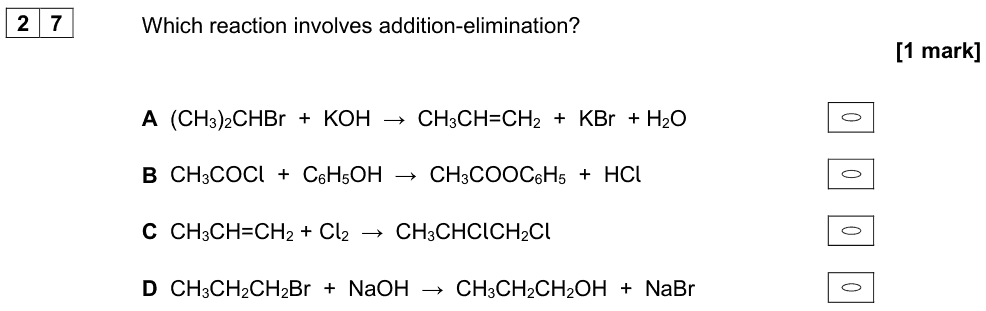
B
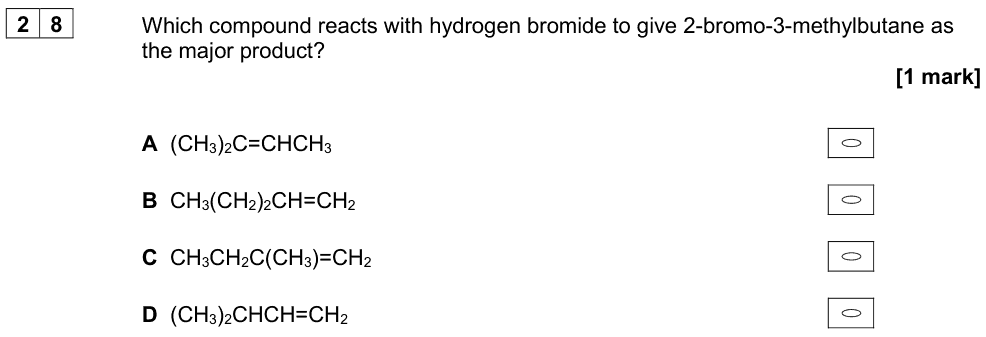
D
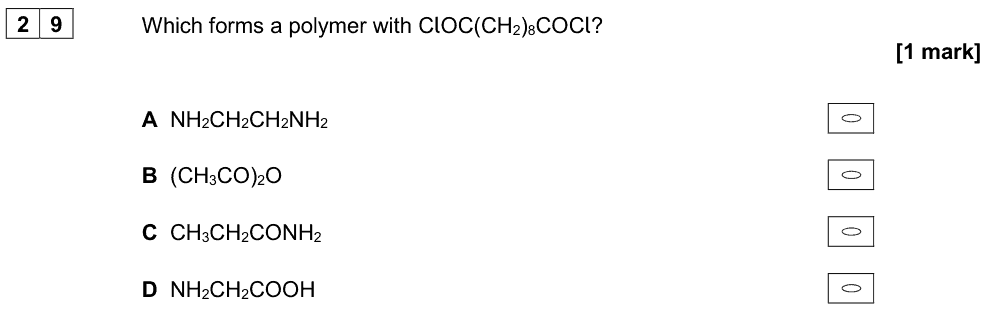
A
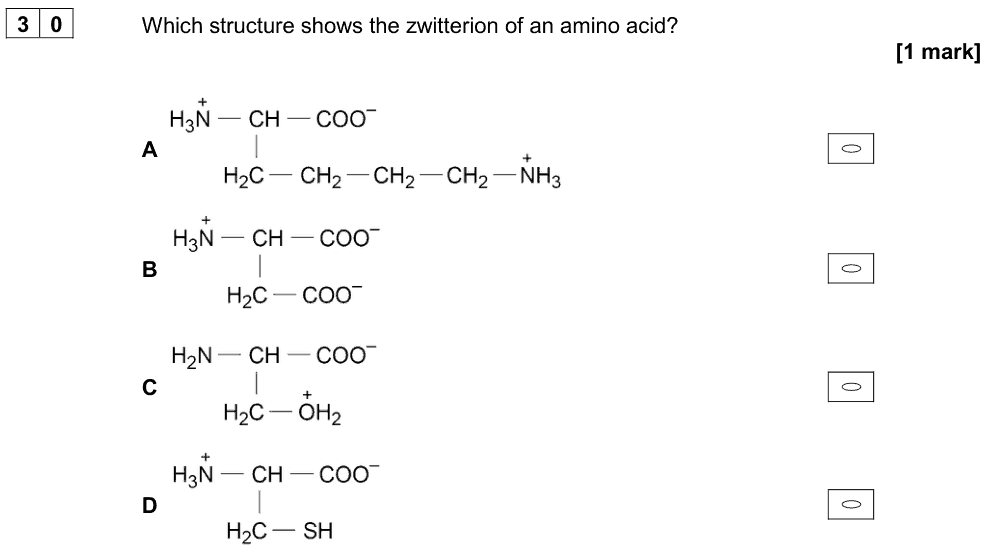
D
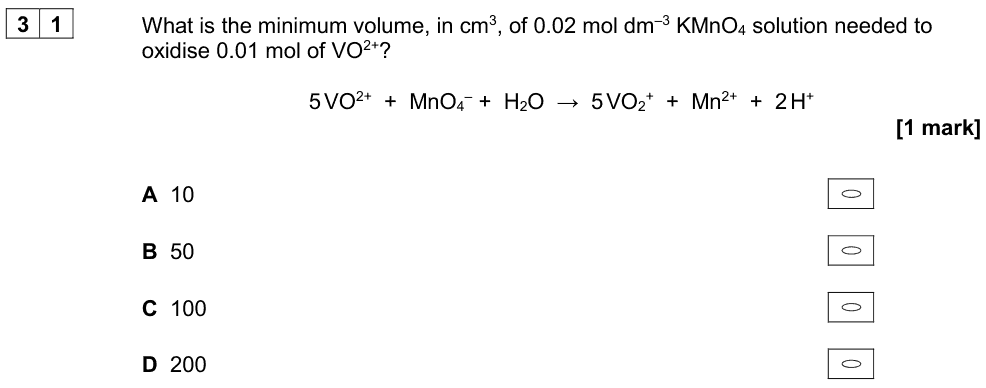
C
Skills: MS0.0 Recognise and make use of appropriate units in calculation; MS0.2 Use ratios, fractions and percentages
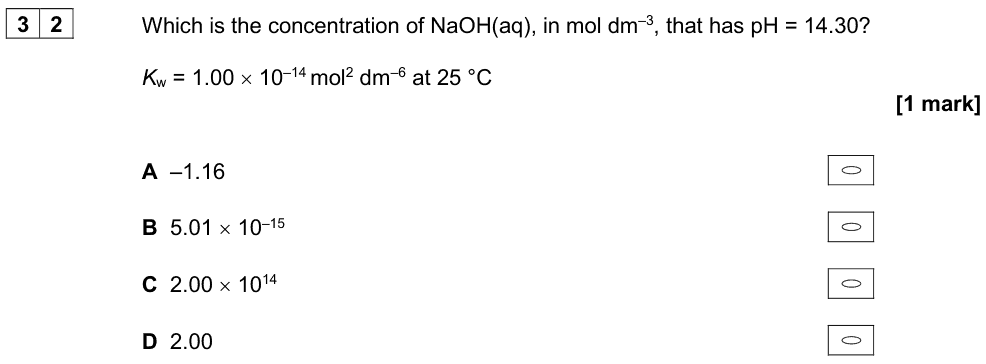
D
Skills: MS0.4 Use calculators to find and use power, exponential and logarithmic functions; MS2.5 Use logarithms in relation to quantities that range over several orders of magnitude
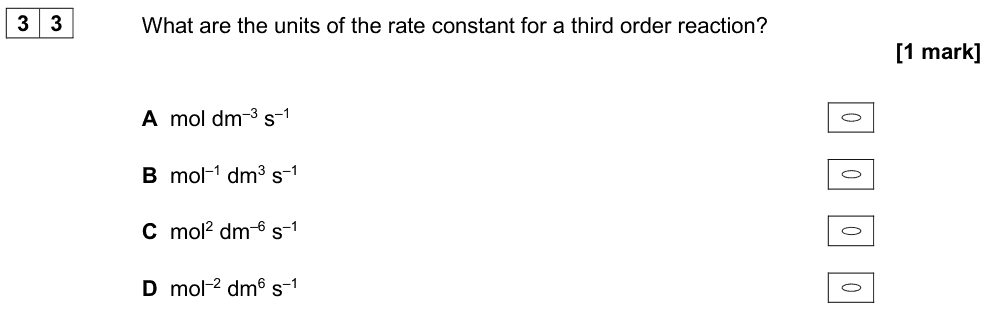
D
Skills: MS0.0 Recognise and make use of appropriate units in calculation
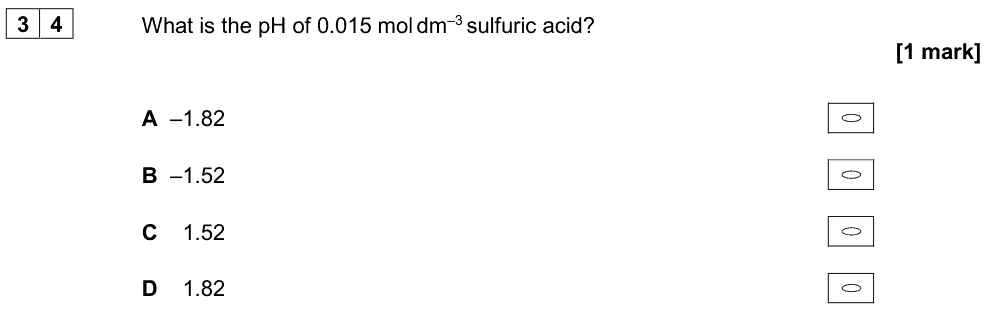
C
Skills: MS0.4 Use calculators to find and use power, exponential and logarithmic functions; MS2.5 Use logarithms in relation to quantities that range over several orders of magnitude
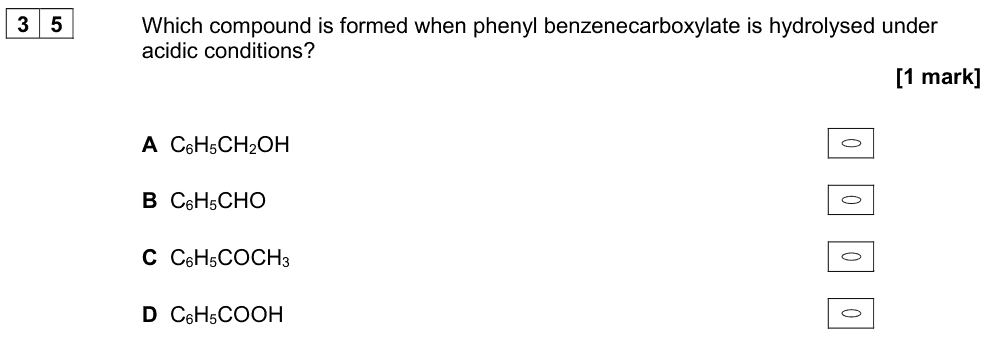
D
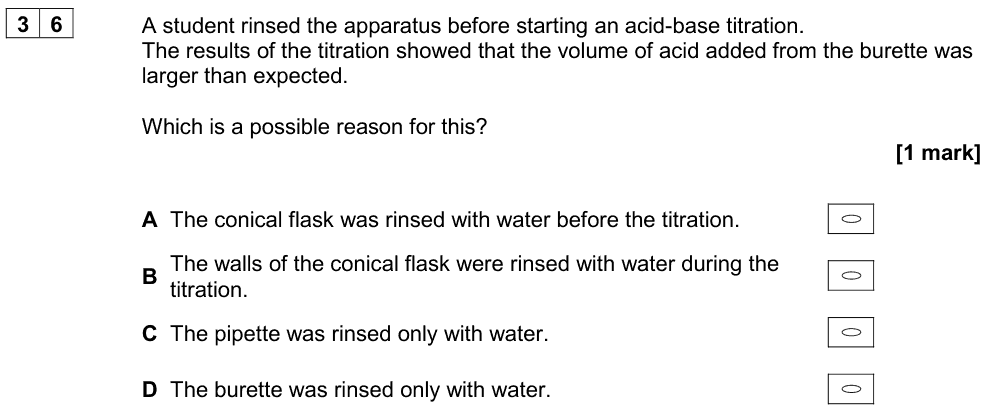
D
Skills: ATd Use laboratory apparatus for a variety of experimental techniques including: titration, using burette and pipette; distillation and heating under reflux, including setting up glassware using retort stand and clamps; qualitative tests for ions and organic functional groups; filtration, including use of fluted filter paper, or filtration under reduced pressure; PS2.3 Evaluate results and draw conclusions with reference to measurement uncertainties and errors; RP1 Make up a volumetric solution and carry out a simple acid–base titration
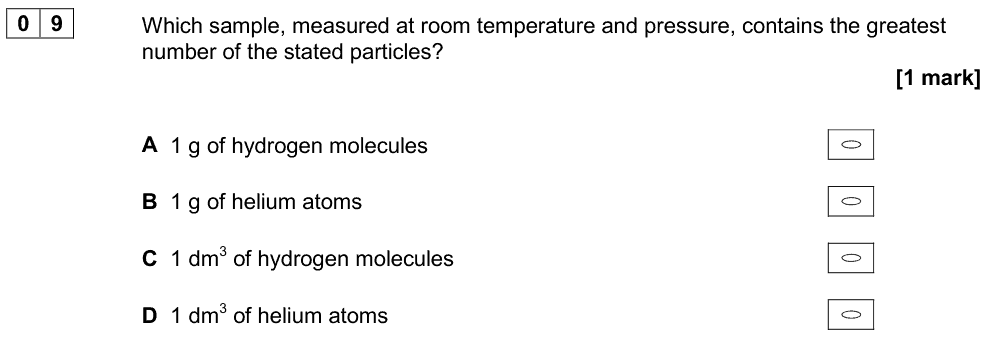
A
Just over a third of students were able to deduce which sample contained the greatest number of particles. However, many did not appreciate that there were more hydrogen molecules in 1 g than there are in 1 dm3 (measured at room temperature and pressure).
Skills: MS0.2 Use ratios, fractions and percentages
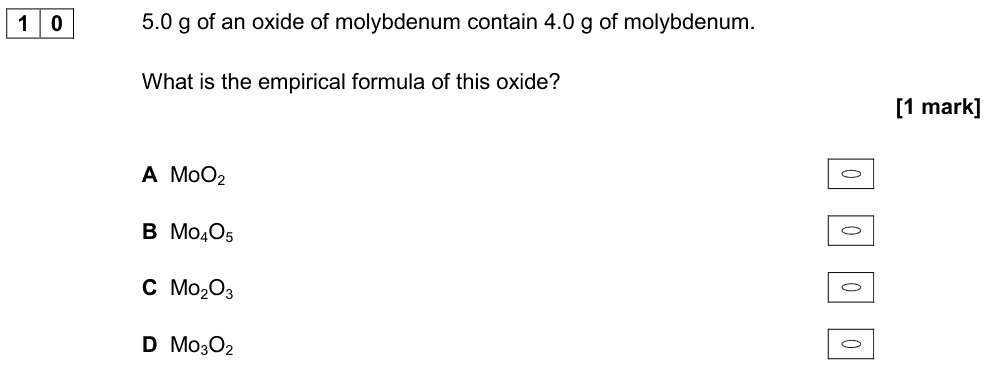
C
Just over half of students were correctly able to deduce the empirical formula of the oxide.
Skills: MS0.2 Use ratios, fractions and percentages
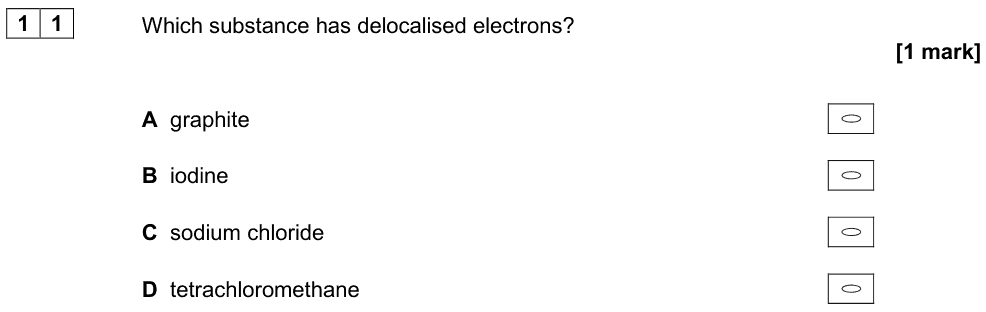
A
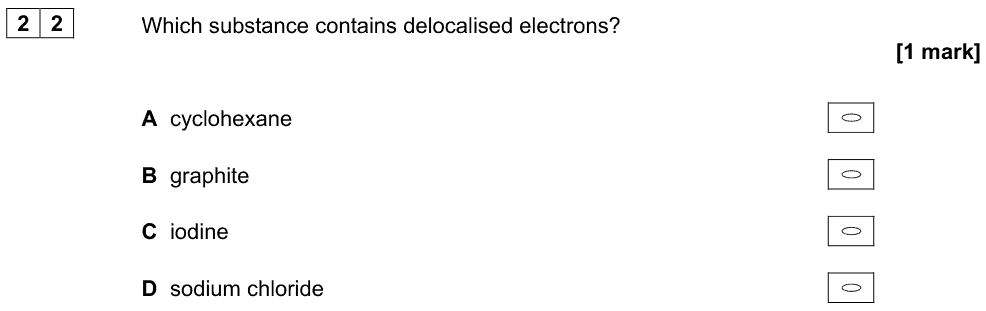
The vast majority of students were able to identify the substance that had delocalised electrons.
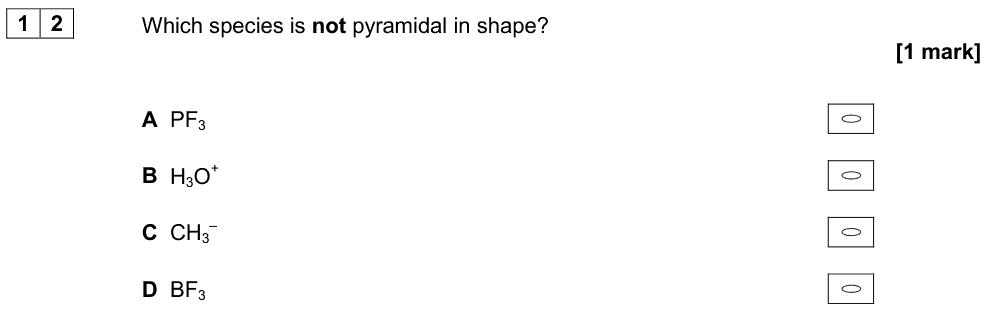
D
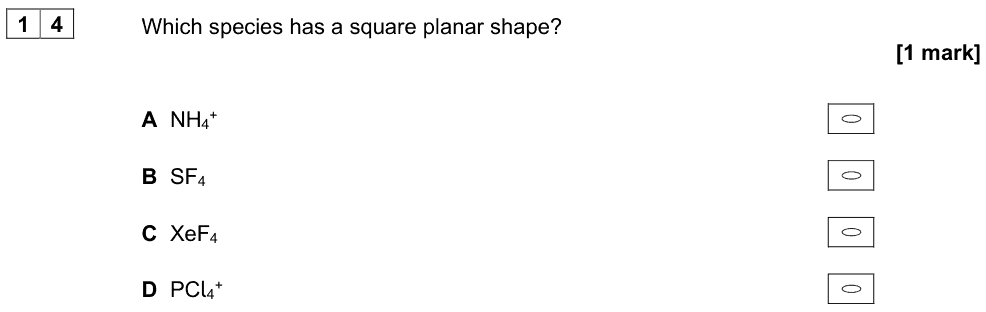
More than half of the students could identify the species that was not pyramidal.
Skills: MS4.1 Use angles and shapes in regular 2D and 3D structures
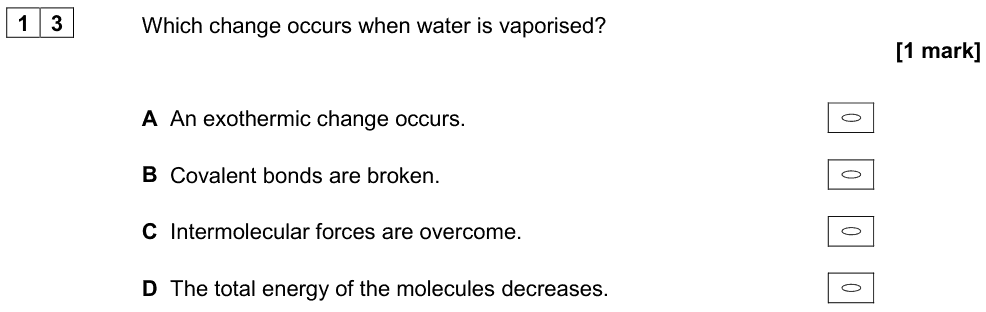
C
Around three-quarters of students understood the changes that occurred when a sample of water is vaporised.
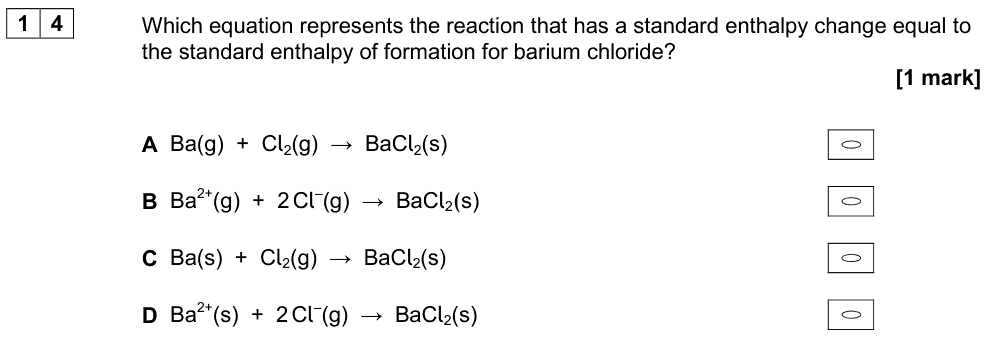
C
Nearly 60% of students were able to select the equation that correctly represented the standard enthalpy of formation of barium chloride.
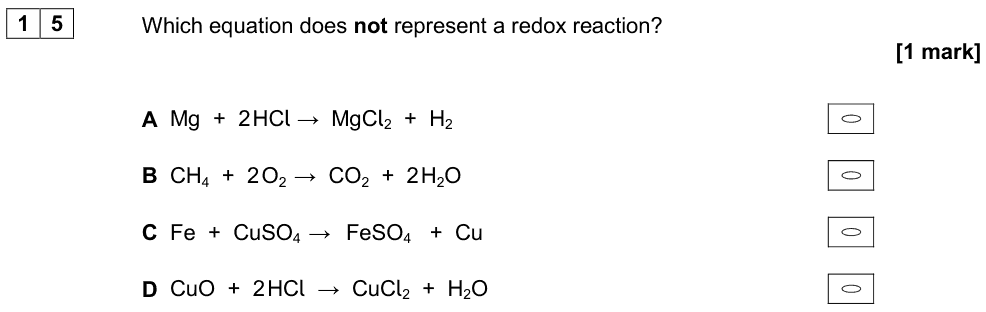
D
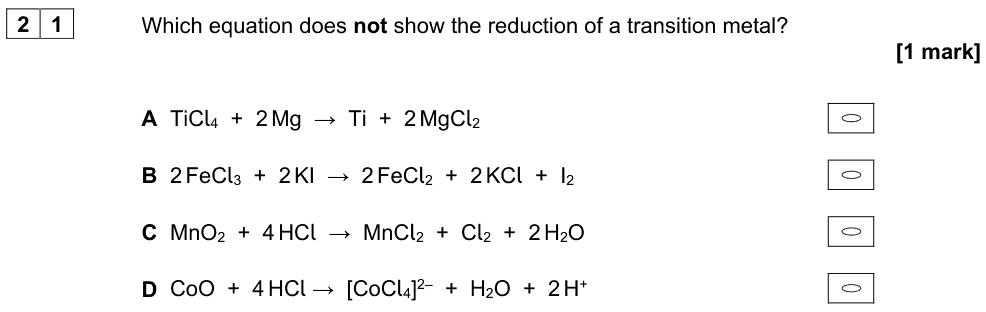
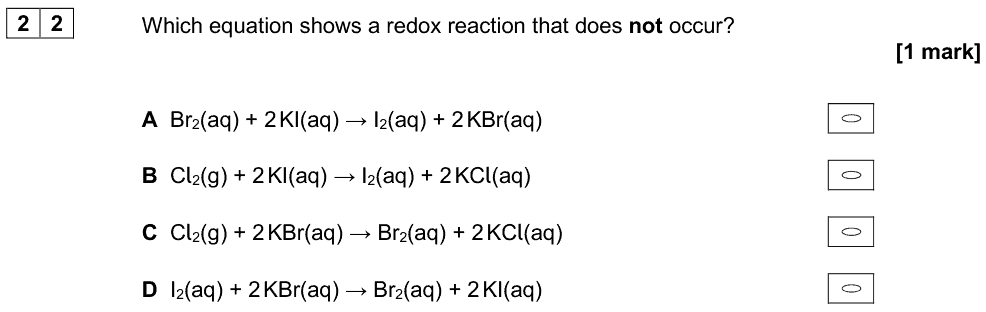
Just under half of students were able to select the equation that did not represent a redox reaction.
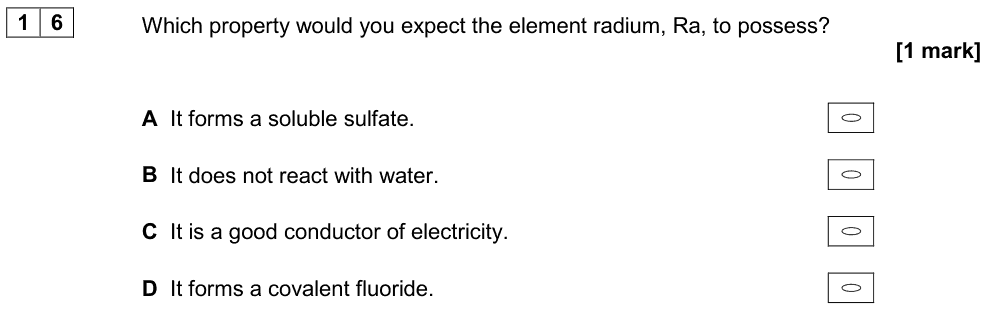
C
Half of the students were able to choose the correct property of the element radium.
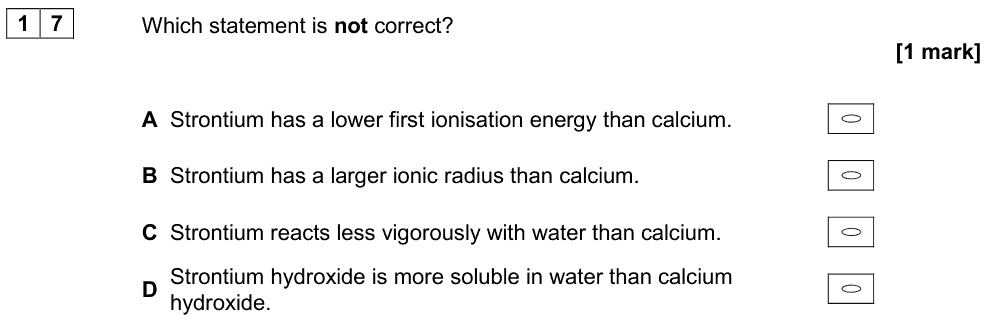
C
The majority of students understood that strontium reacted more vigorously with water than calcium. However, a good number also thought that calcium hydroxide was more soluble in water than strontium hydroxide.
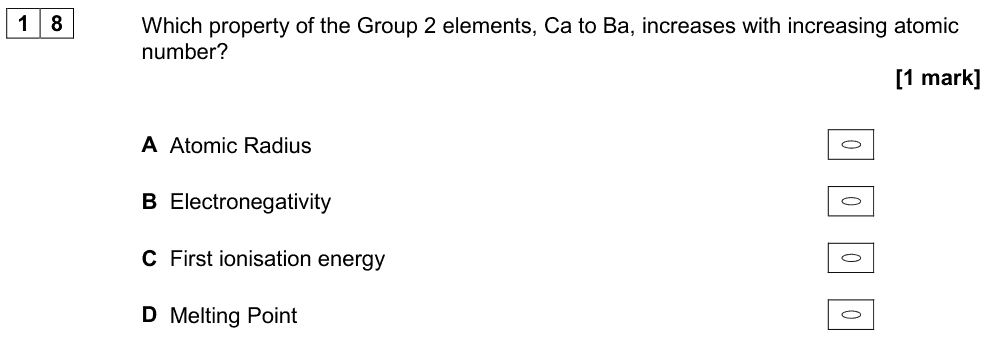
A
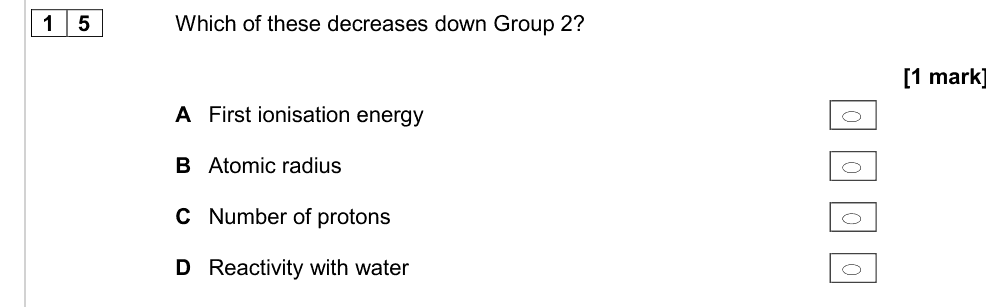
Over 70% of students were able to select the property that increases down group 2.
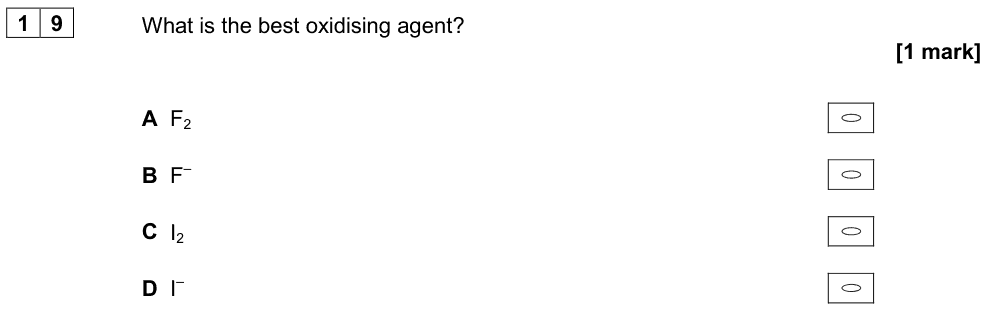
A
A good number of students were able to select the best oxidising agent. However a large number of students confused the oxidising ability of the halogens with the reducing ability of halide ions.
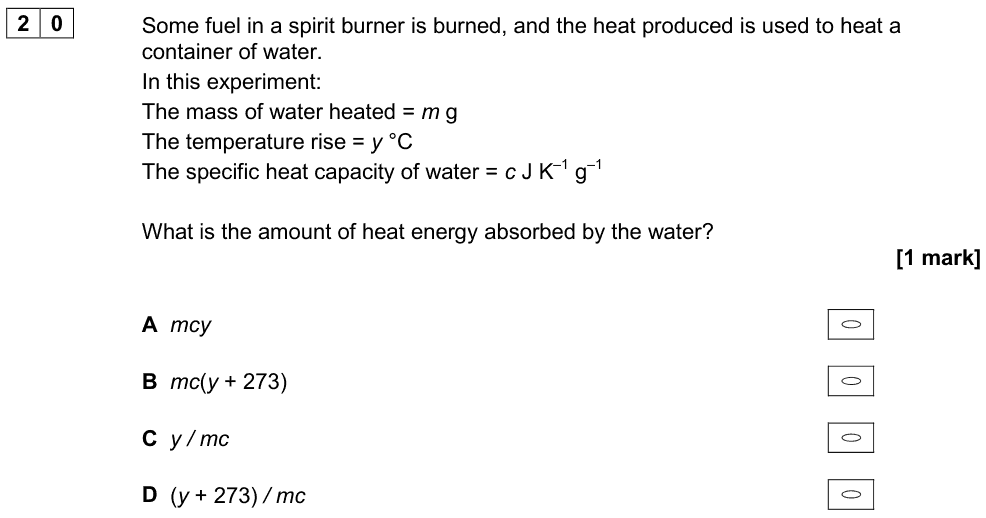
A
A good number of students were able to show the amount of energy absorbed by water in a calorimetry experiment. However, almost as many students thought that 273 should be added to the temperature change for this calculation.
Skills: MS2.3 Substitute numerical values into algebraic equations using appropriate units for physical quantities
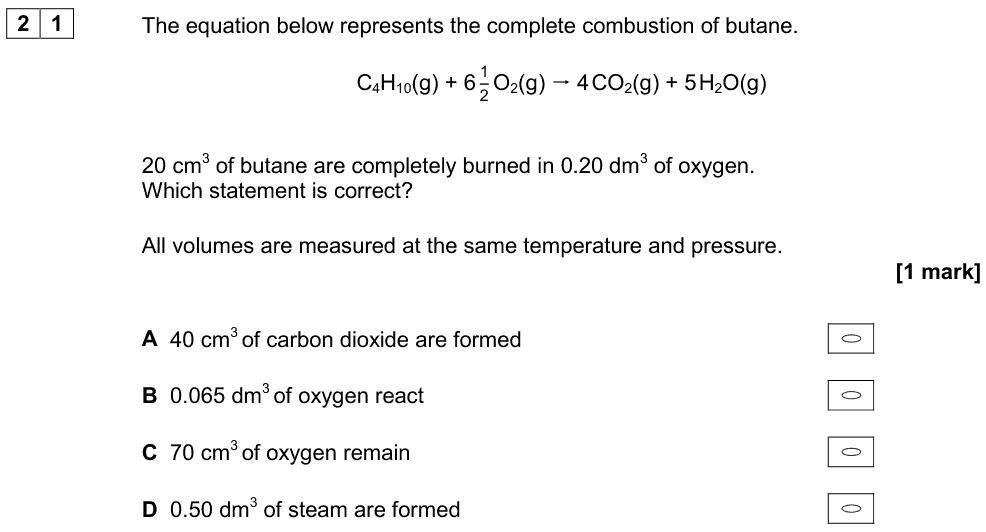
C
Only just over one-third of students were able to select the correct statement about the volume of gas in this reaction. Other answers were approximately equally likely to be chosen.
Skills: MS0.0 Recognise and make use of appropriate units in calculation; MS0.2 Use ratios, fractions and percentages
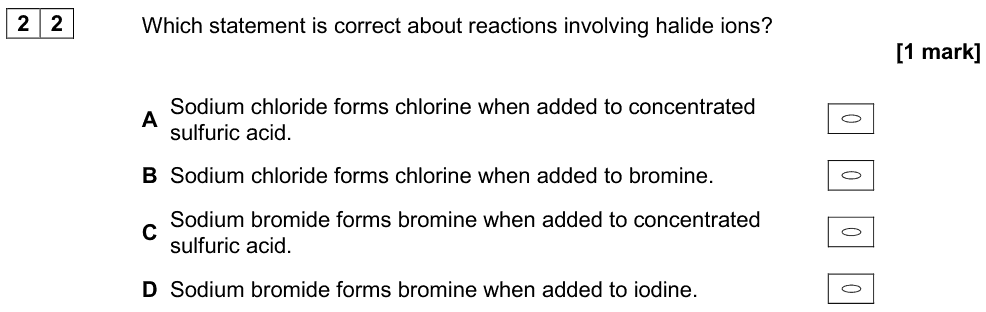
C
Just over half of students were able to decide on the correct statement about reactions involving halide ions in terms of their reducing ability.
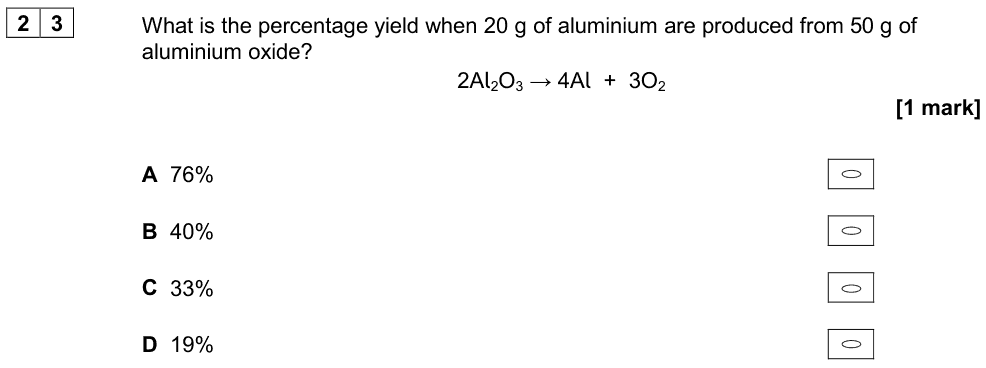
A
The most common answer (B) was incorrect as students did not appreciate that 50g of aluminium oxide do not product 50g of aluminium.
Skills: MS0.2 Use ratios, fractions and percentages
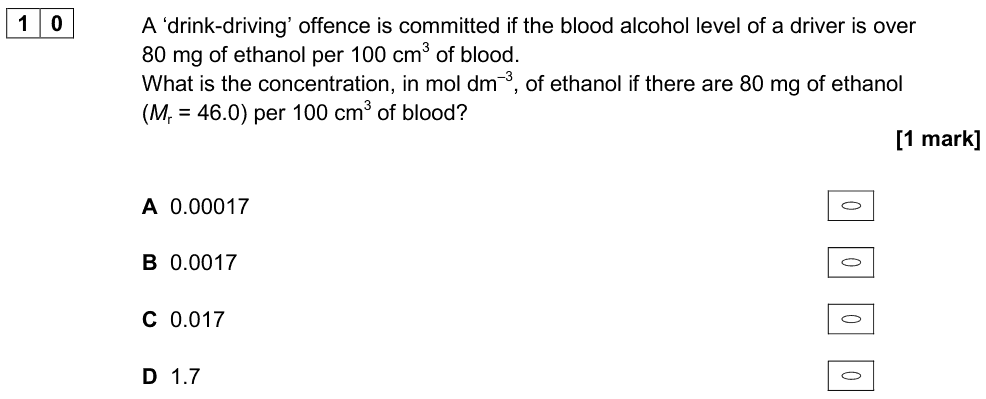
C
This calculation was done correctly by the majority of students.
Skills: MS0.0 Recognise and make use of appropriate units in calculation; MS0.2 Use ratios, fractions and percentages
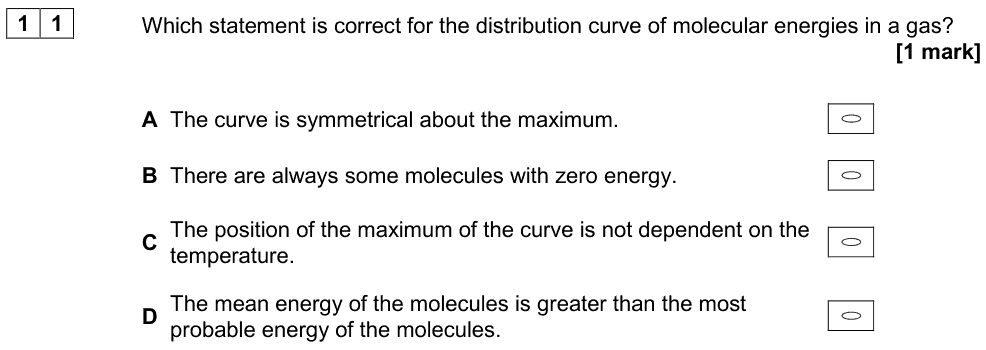
D
This question was answered correctly by the majority of students.
Skills: MS3.1 Translate information between graphical, numerical and algebraic forms
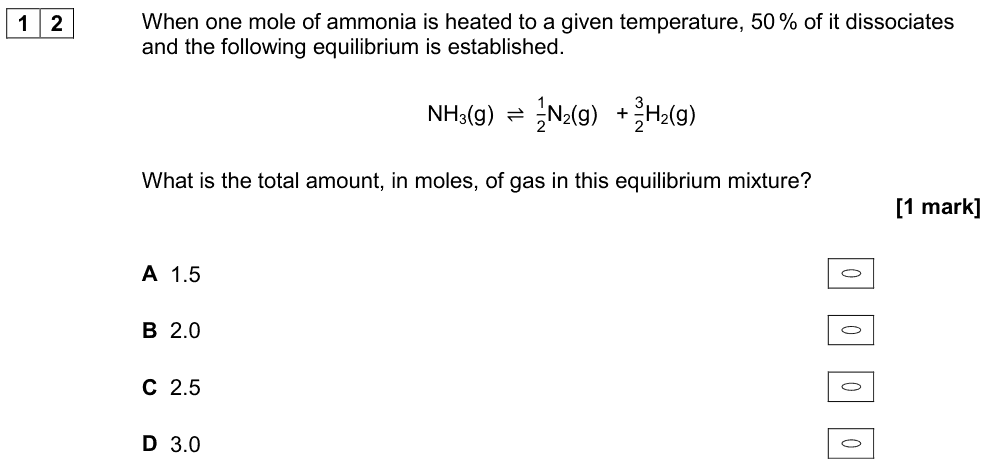
A
Students struggled with this question, possibly due to misunderstanding the concept of 50% dissociation.
Skills: MS0.2 Use ratios, fractions and percentages
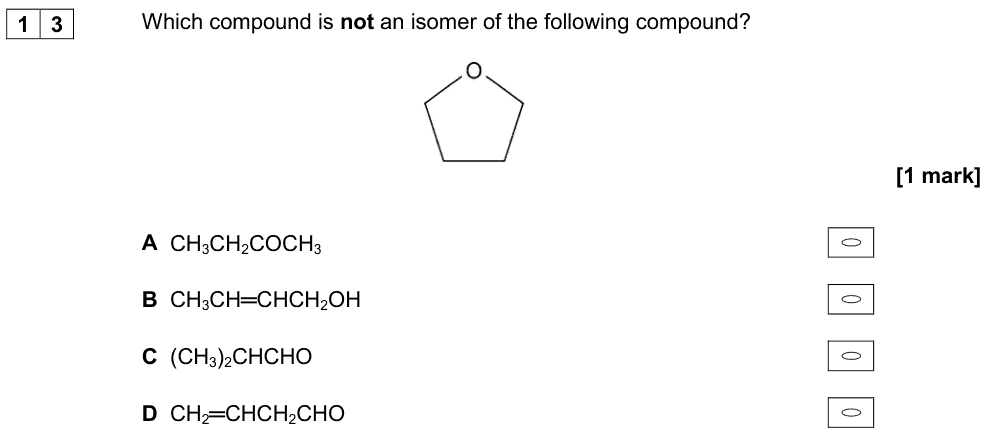
D
Only about half the students could do this. This may stem from poor understanding of the number of H atoms in a skeletal structure.
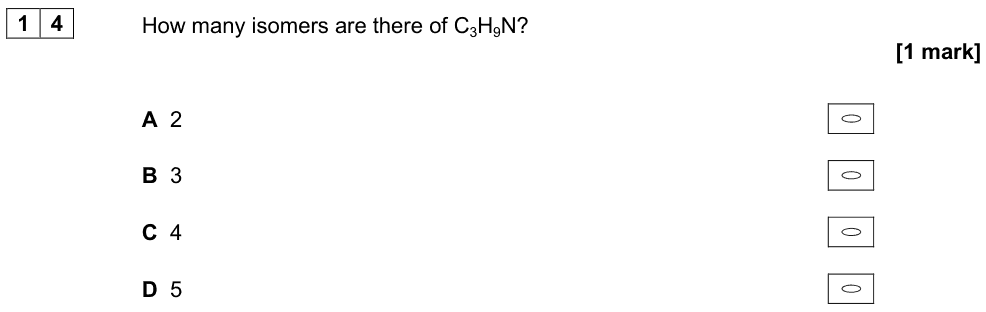
C
Few students got this correct, with most missing one or more isomers.
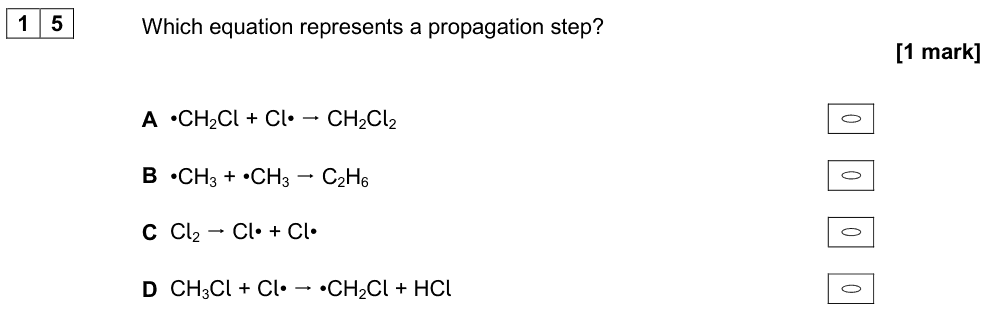
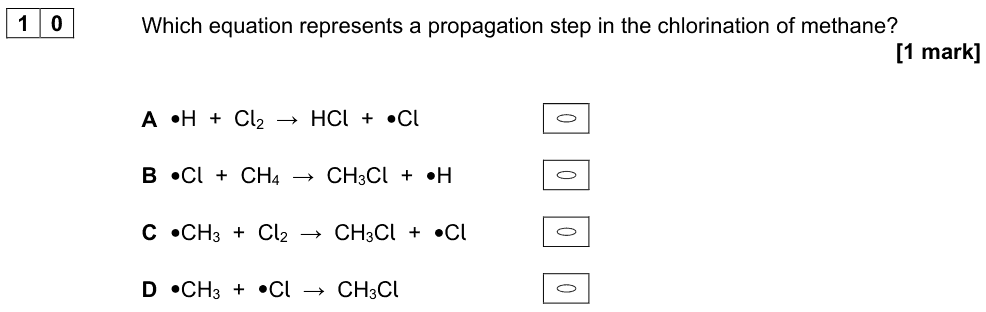
D
Most students could identify a propagation step from the options.
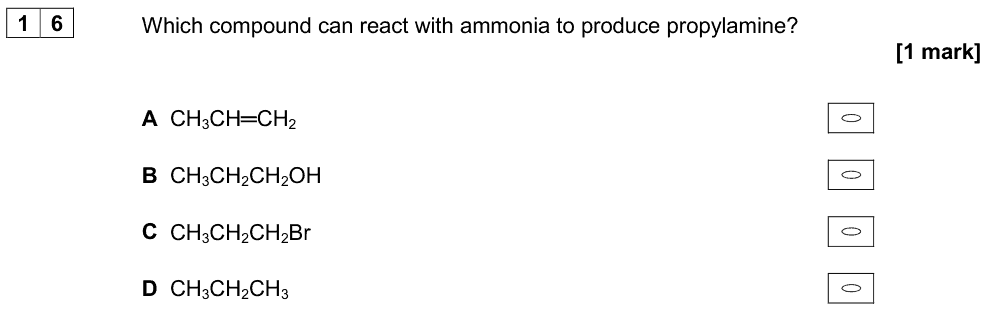
C
This was answered correctly by a good majority of students.
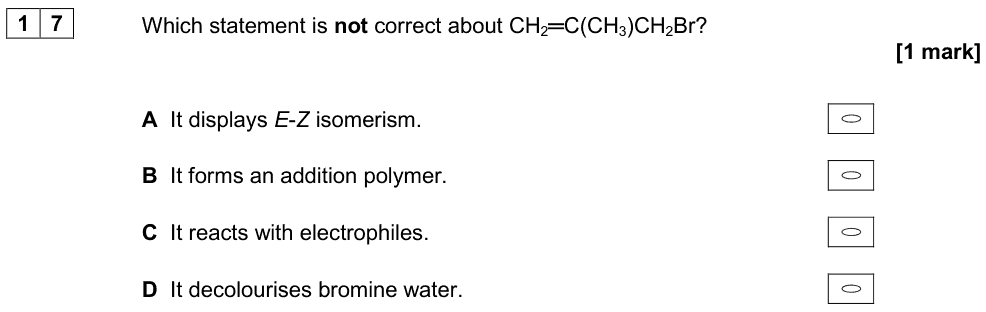
A
This was answered correctly by a good majority of students.
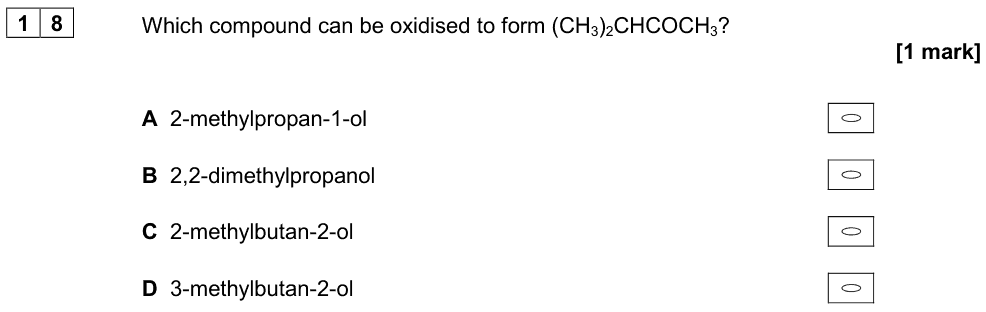
D
Students found this question more challenging. It would help students if they drew structures.
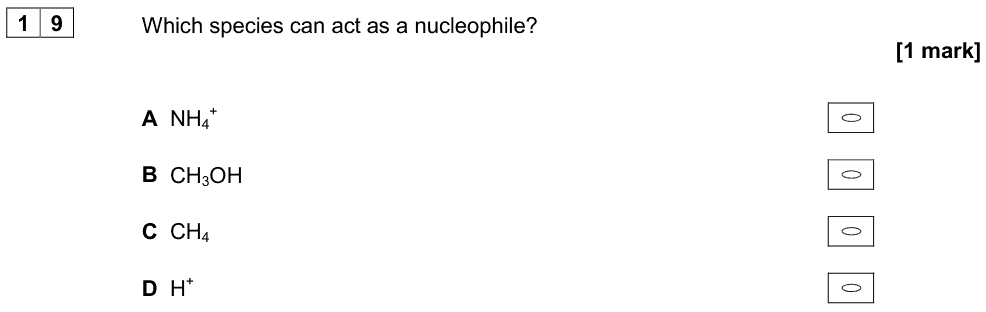
B
This question was not as well answered as expected. There was only one species with a lone pair, but only about half the students could identify this as the nucleophile.
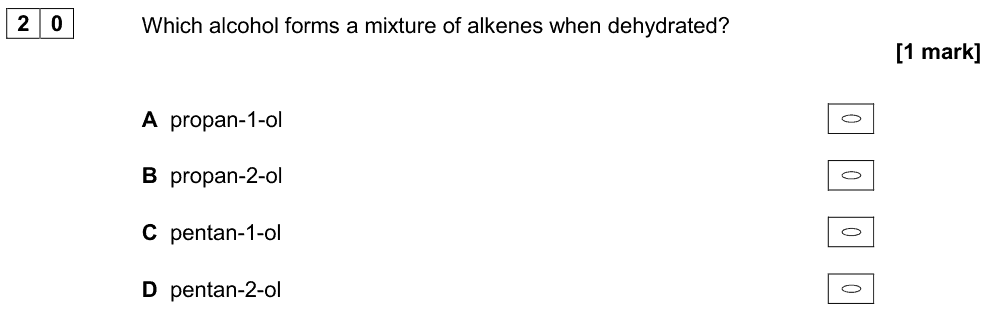
D
This was answered correctly by a good majority of students.
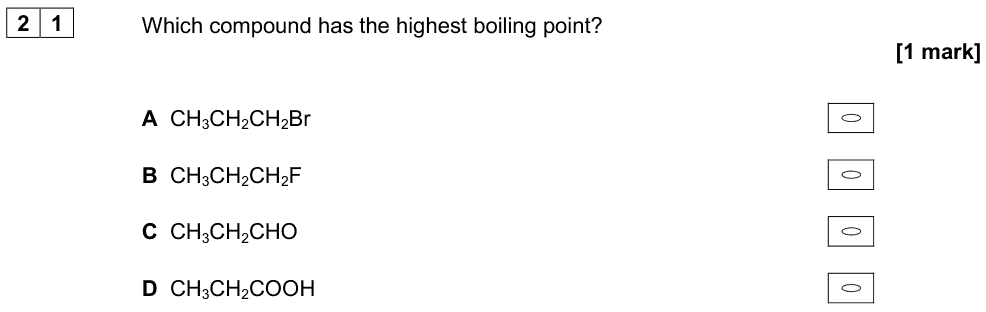
D
This was answered correctly by a majority of students.
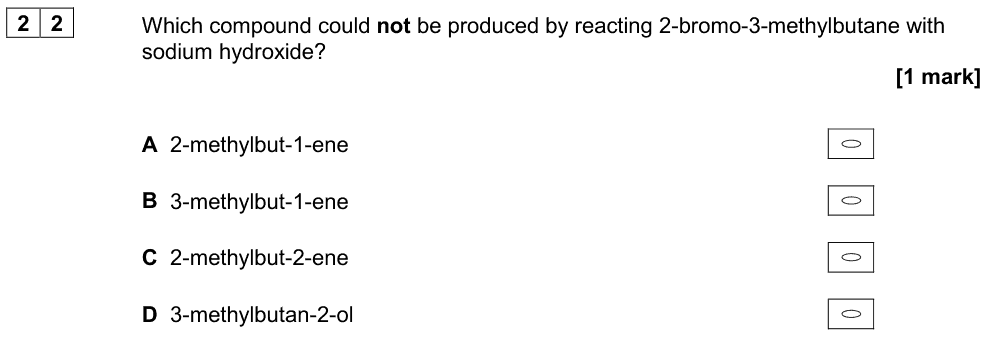
A
Students found this question more challenging. It would be helpful to draw structures.
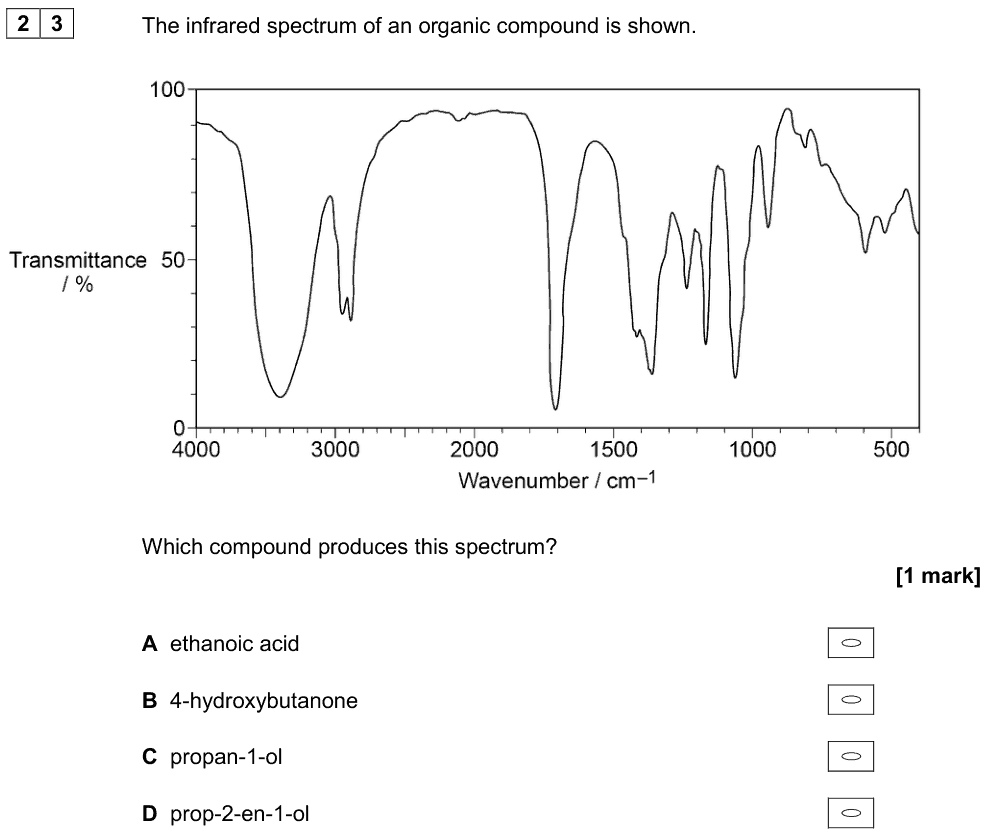
B
The infrared spectrum showed both a C=O stretch and an O−H stretch. Many students thought it was a carboxylic acid, but the peak centred on 3400 cm−1 should have been recognised as due to an alcohol O−H group not an acid O−H group.
Skills: MS3.1 Translate information between graphical, numerical and algebraic forms
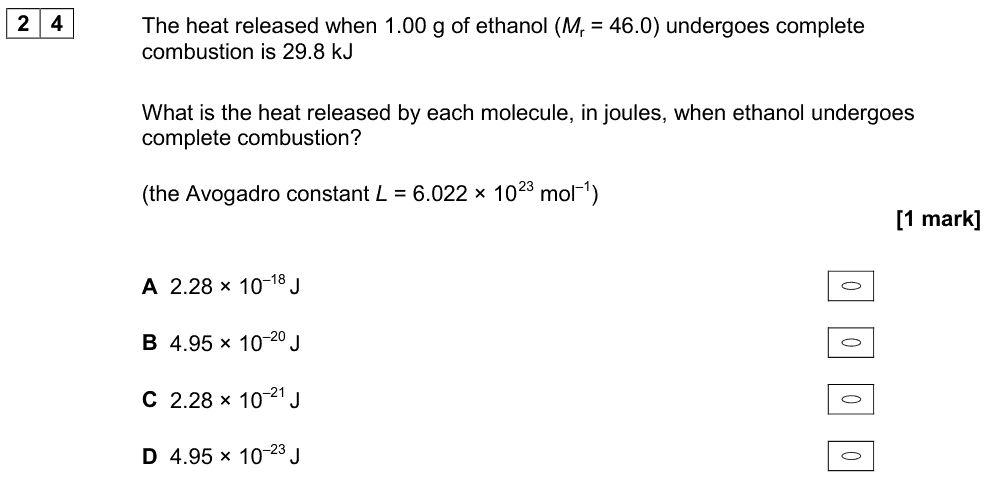
A
Students found dealing with units and the Avogadro constant to be challenging.
Skills: MS0.0 Recognise and make use of appropriate units in calculation; MS0.1 Recognise and use expressions in decimal and ordinary form
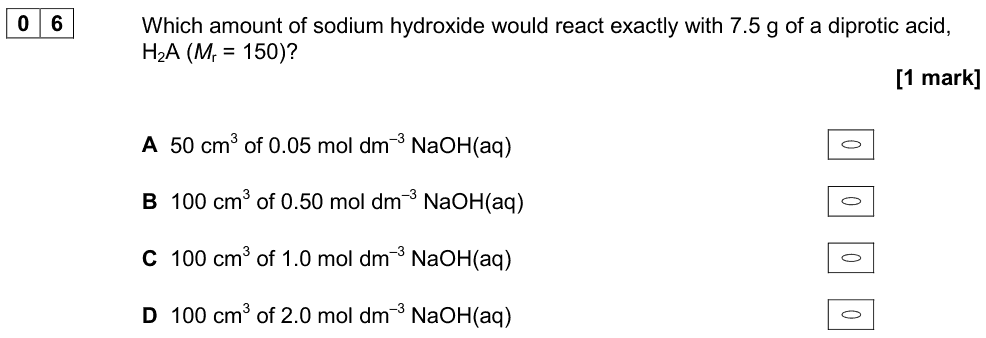
C
Skills: MS0.2 Use ratios, fractions and percentages
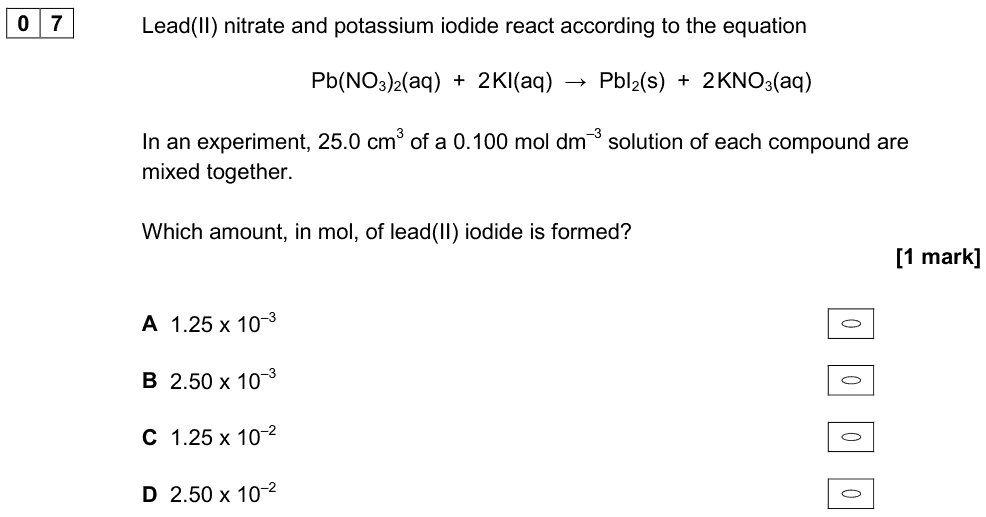
A
Skills: MS0.2 Use ratios, fractions and percentages
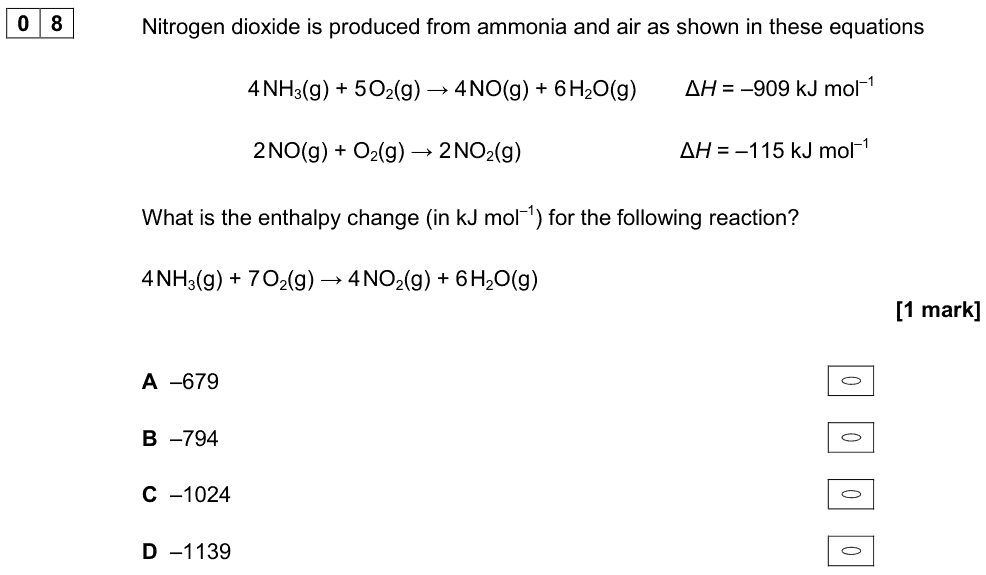
D
Skills: MS2.4 Solve algebraic equations
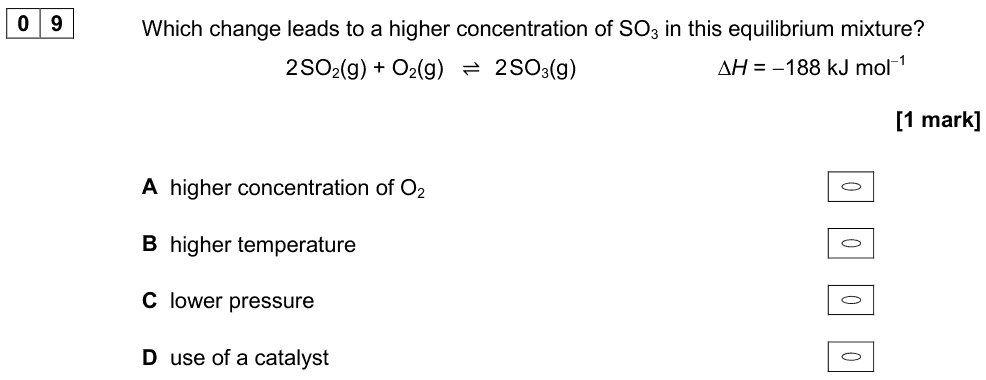
A
Questions that proved to be substantially more accessible than the ‘average’ items included numbers 9 (around 80% correct), 10 (84%), 13 (85%), 29 (86%), 30 (88%) and 32 (83%).
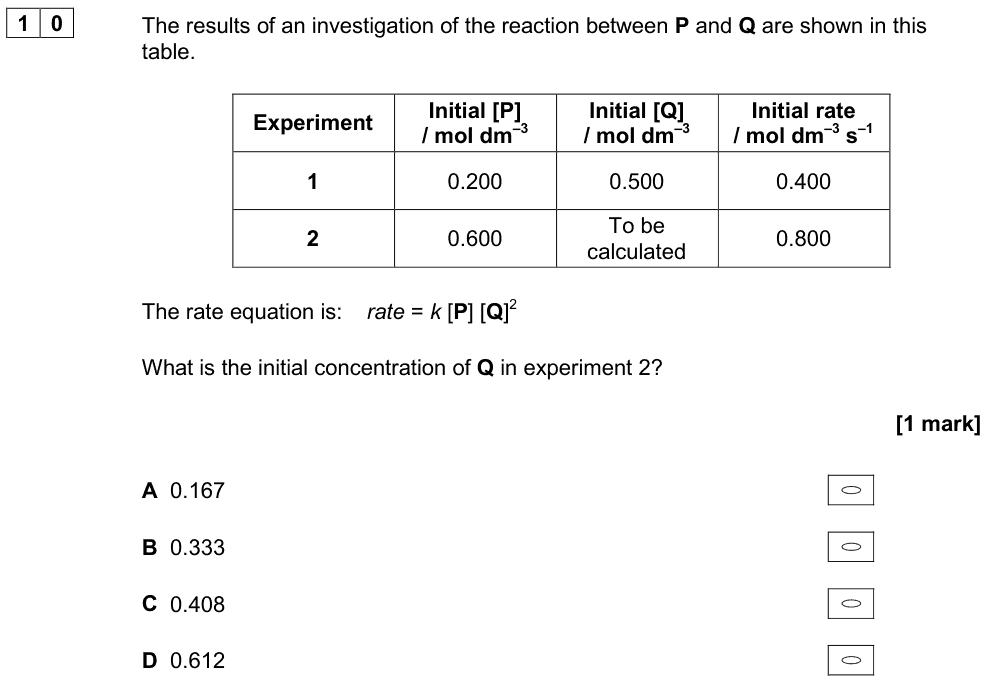
C
Skills: MS0.2 Use ratios, fractions and percentages; MS2.2 Change the subject of an equation
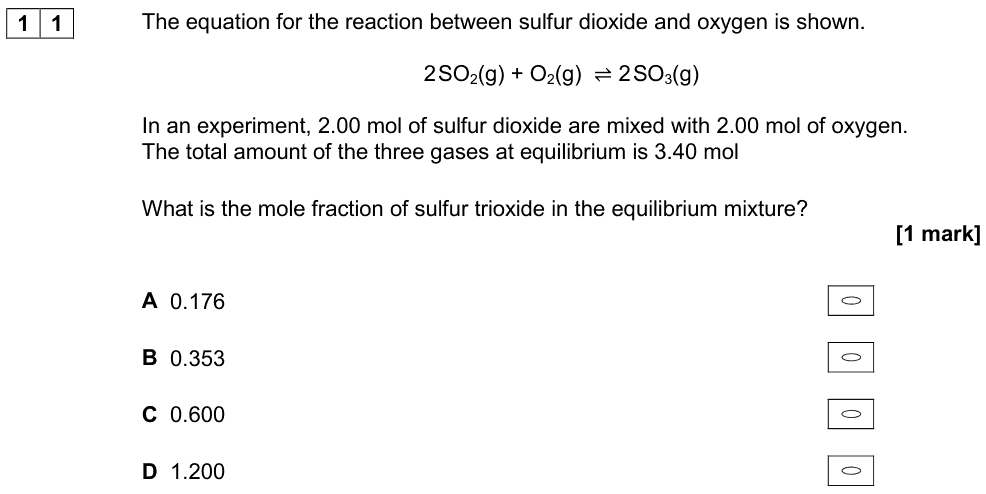
B
Skills: MS0.2 Use ratios, fractions and percentages
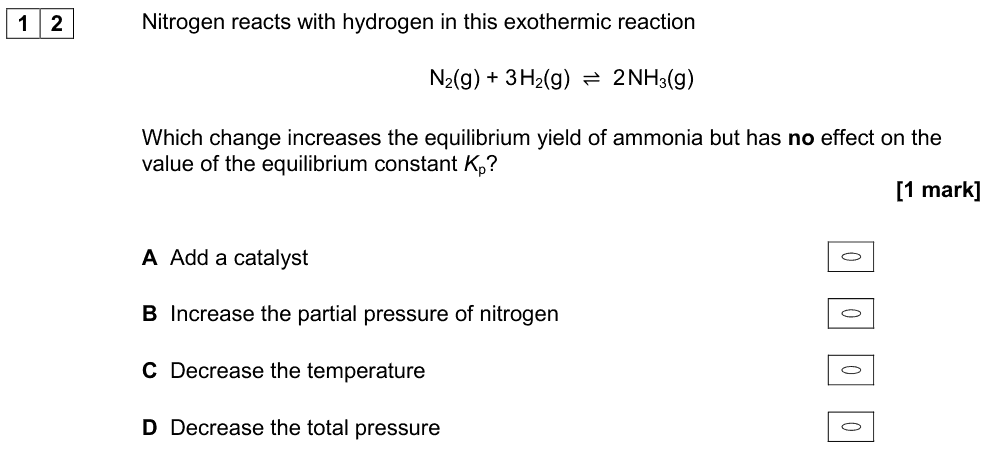
B
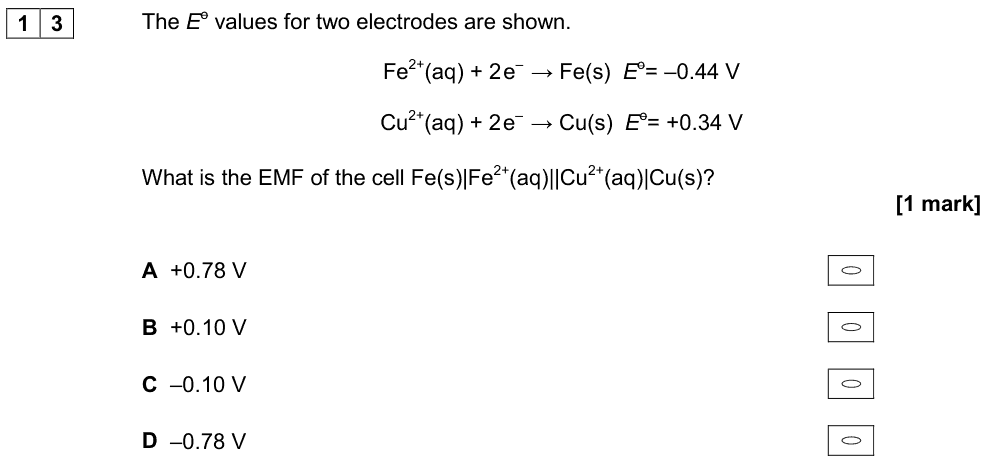
A
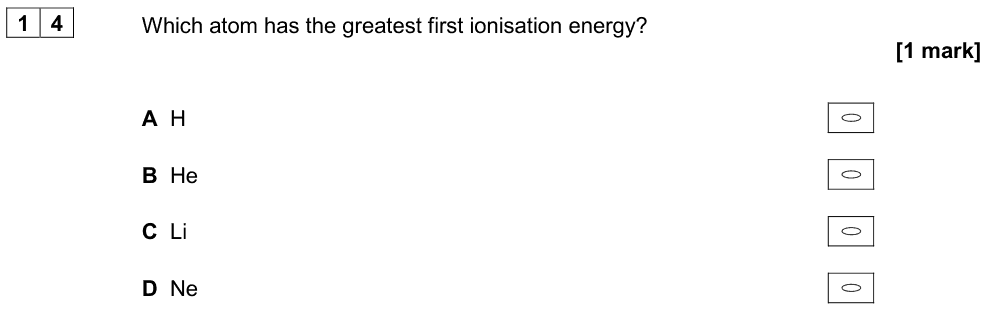
B
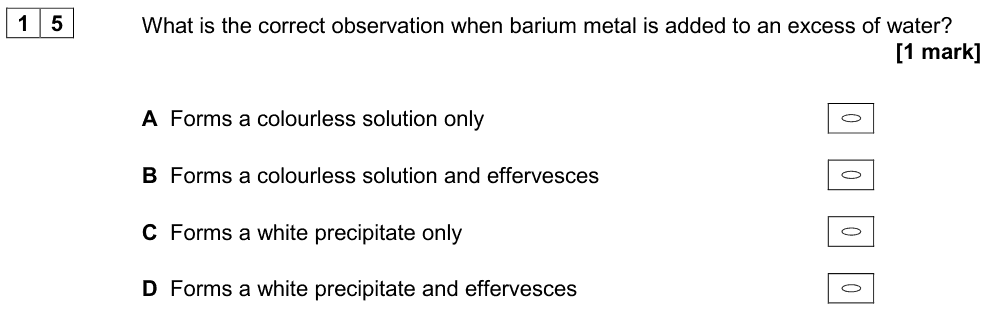
B
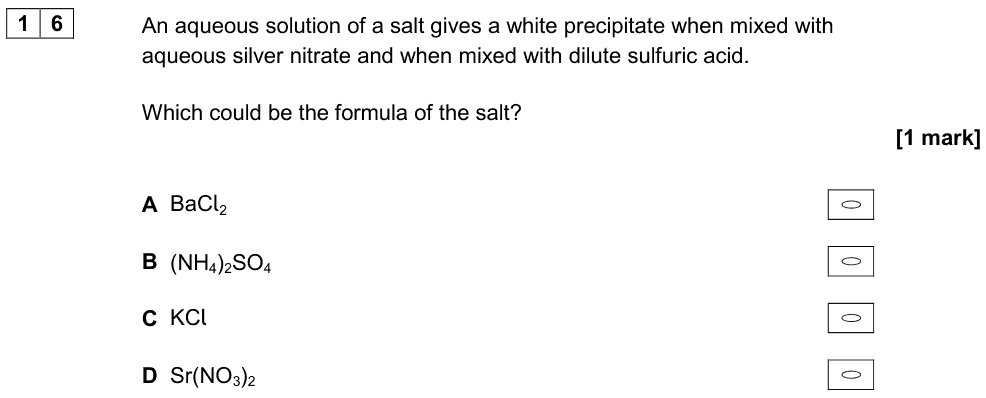
A
Skills: RP4 Carry out simple test-tube reactions to identify: cations – Group 2, NH4+; anions – Group 7 (halide ions), OH–, CO32–, SO42–
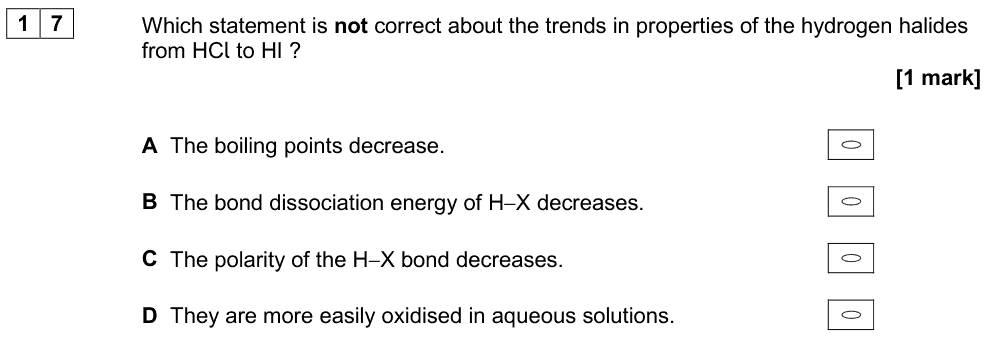
A
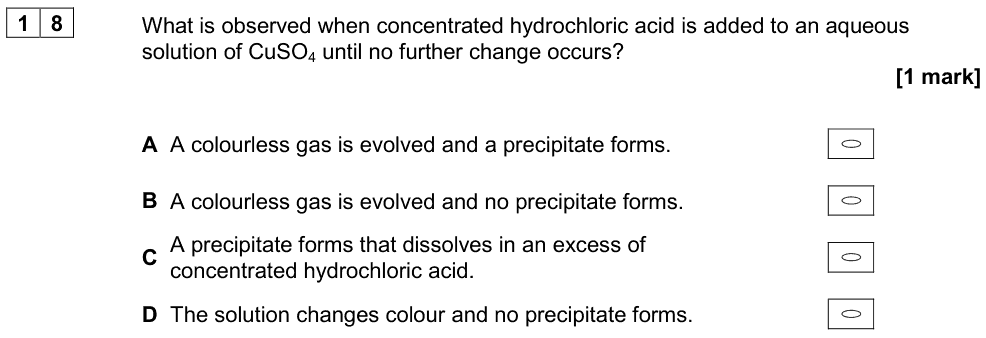
D
Questions that were substantially more challenging than the ‘average’ items included numbers 18 (around 40% correct), 22 (34%) and 34 (40%).
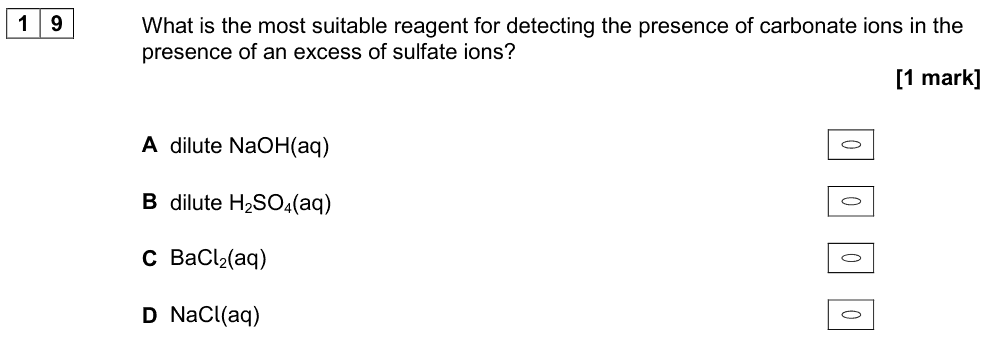
B
Skills: PS1.1 Solve problems set in practical contexts; RP4 Carry out simple test-tube reactions to identify: cations – Group 2, NH4+; anions – Group 7 (halide ions), OH–, CO32–, SO42–
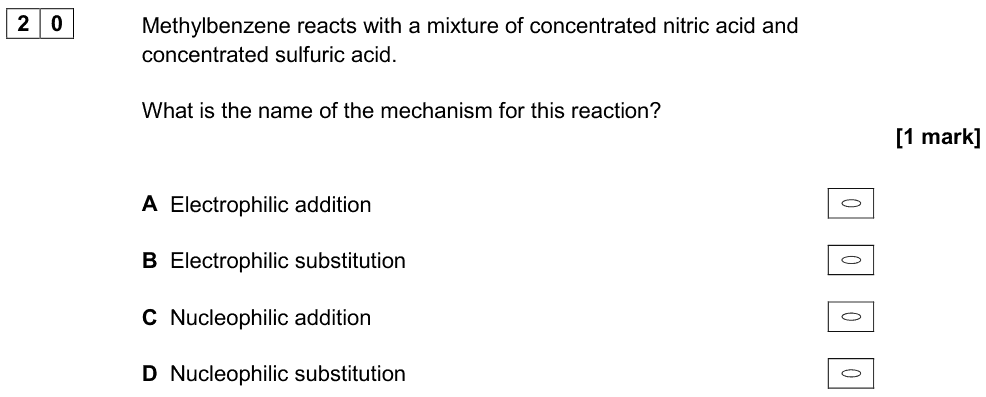
B
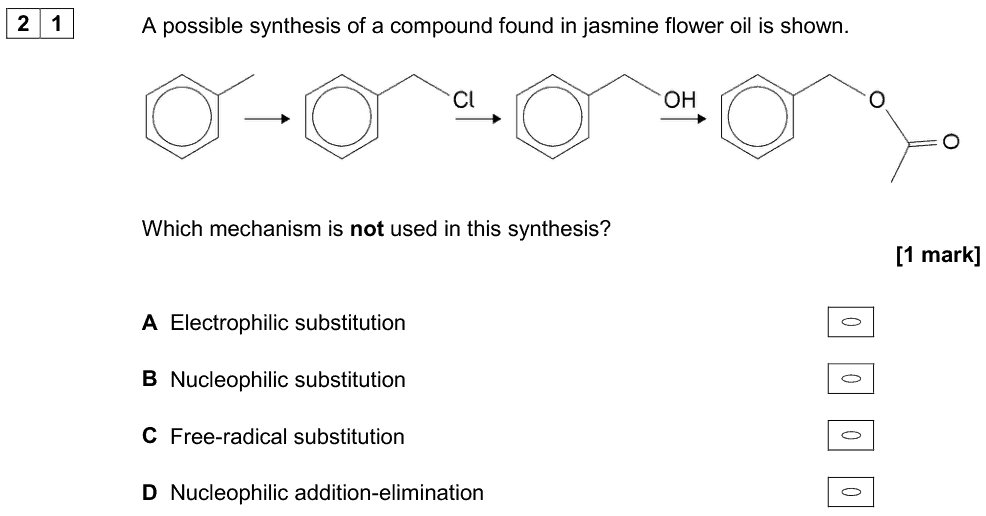
A
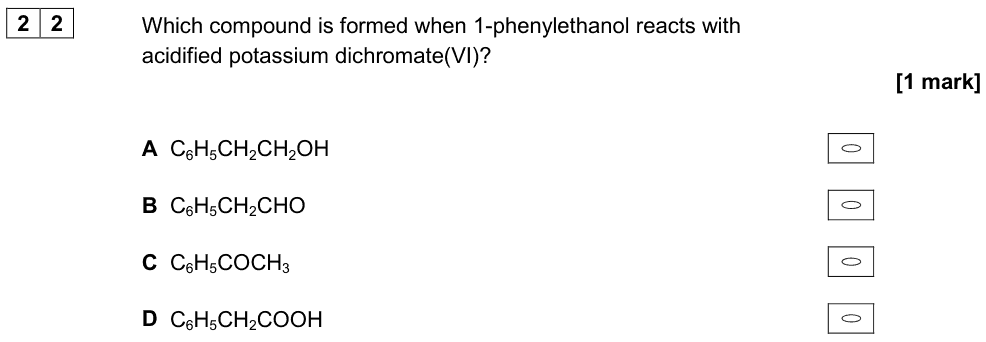
C
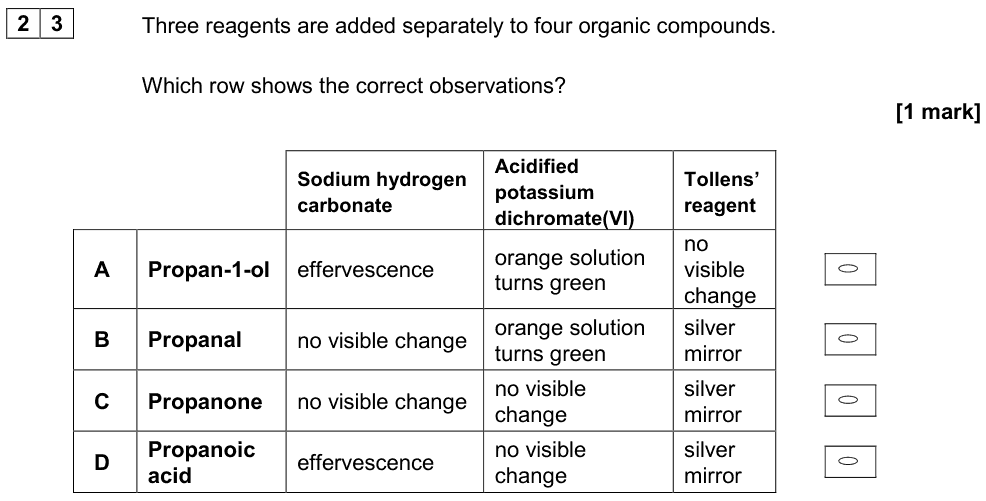
B
Skills: RP6 Tests for alcohol, aldehyde, alkene and carboxylic acid
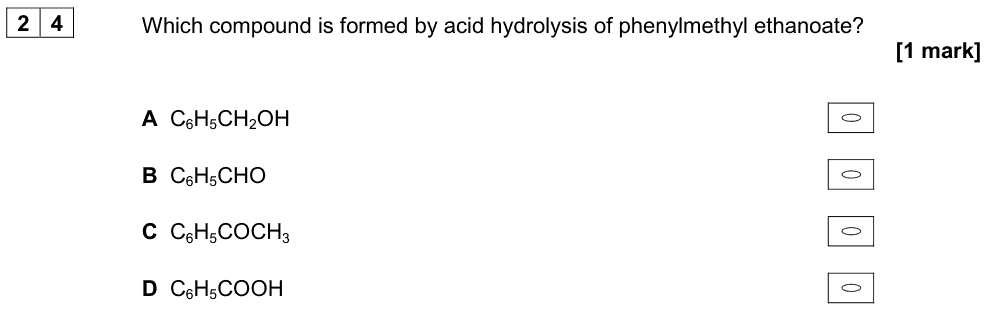
A
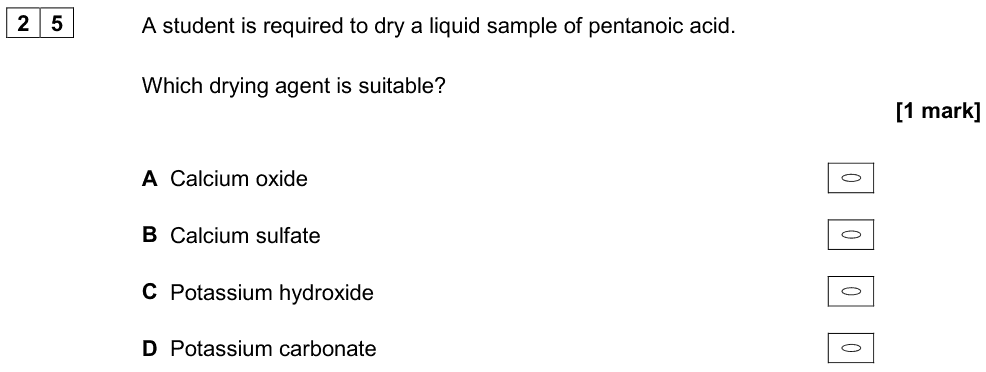
B
Skills: ATg Purify: a solid product by recrystallisation; a liquid product, including use of separating funnel; RP10 Preparation of: a pure organic solid and test of its purity; a pure organic liquid
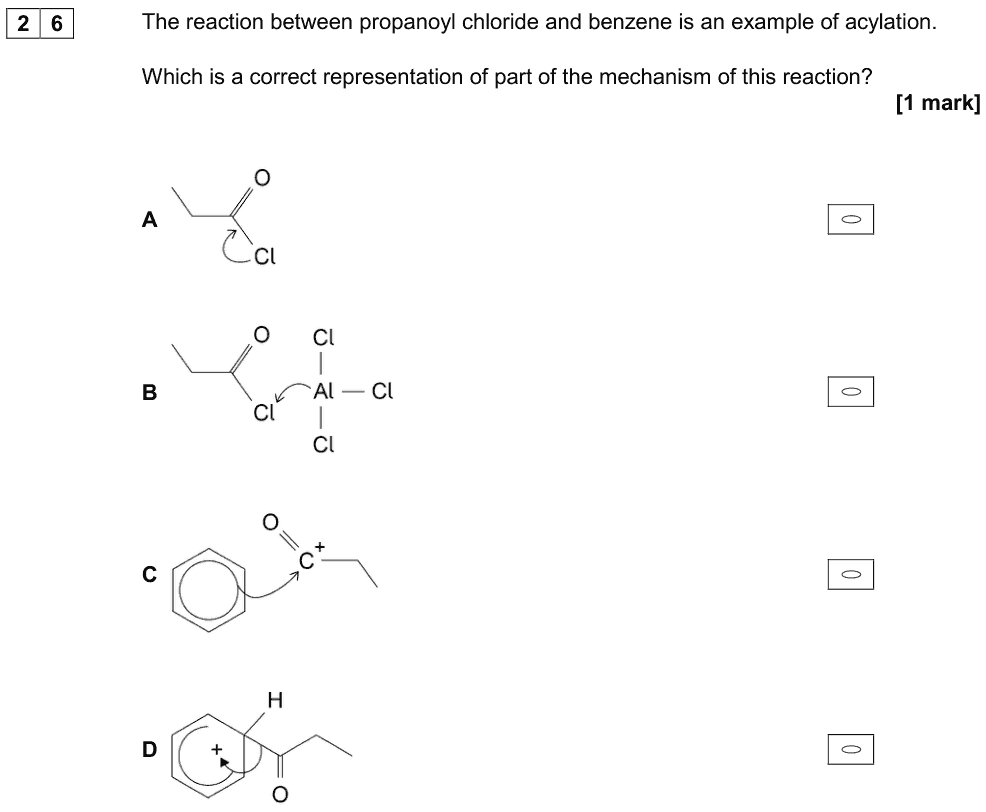
C
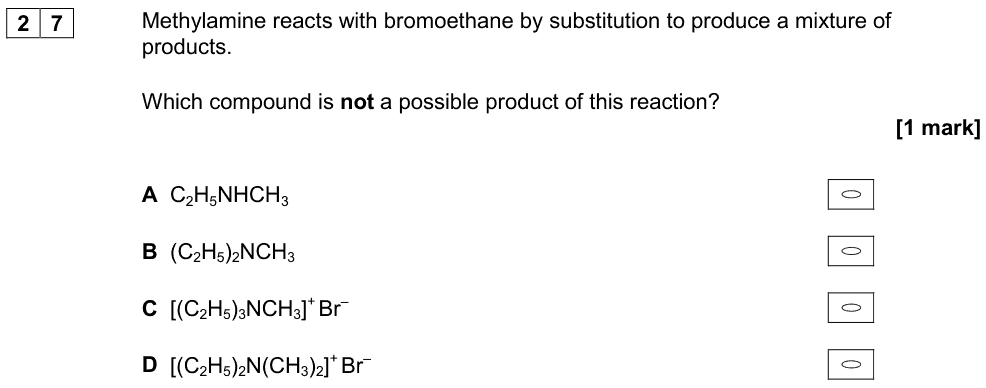
D
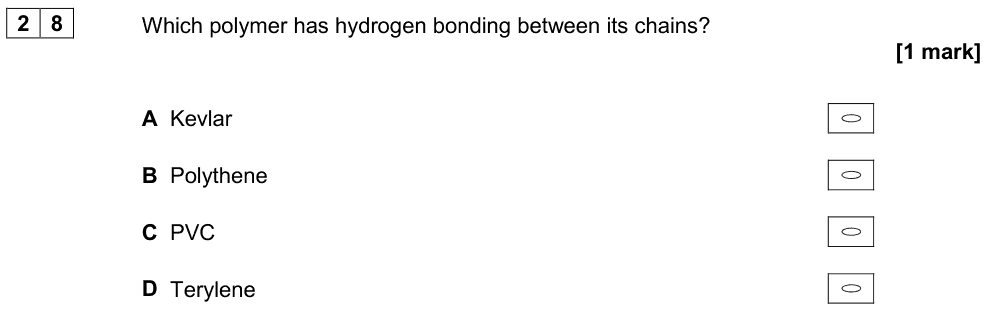
A
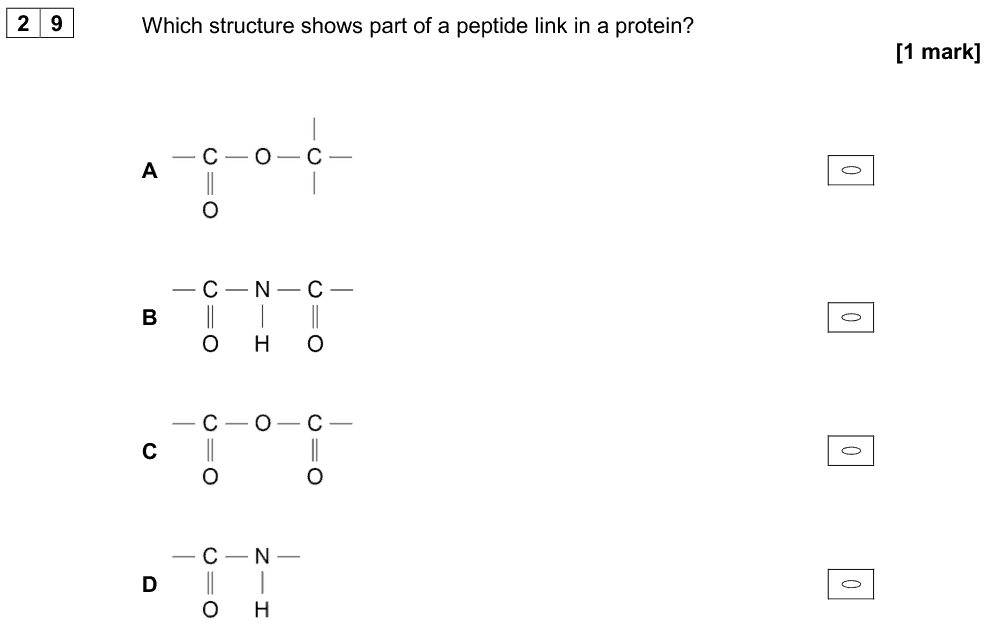
D
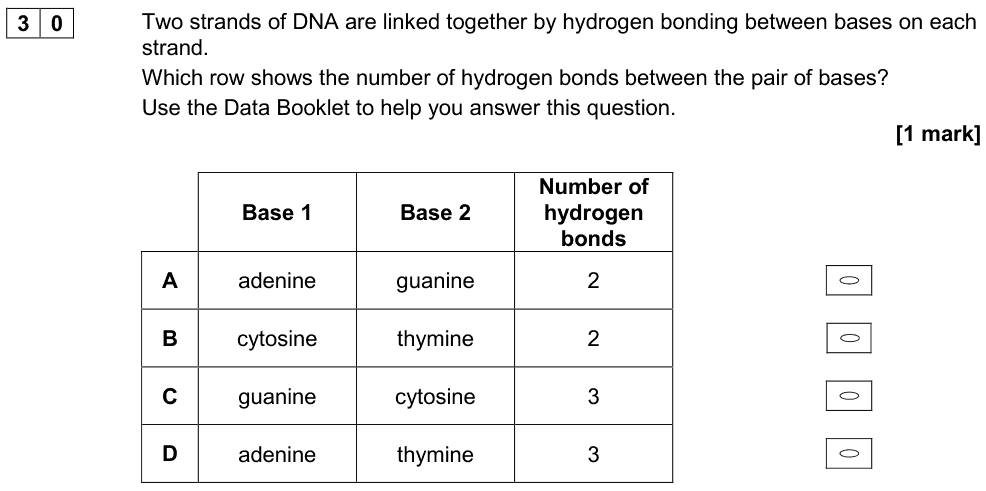
C
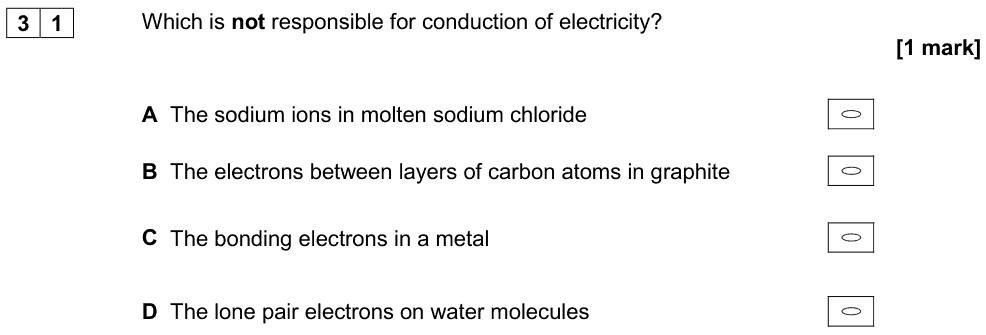
D
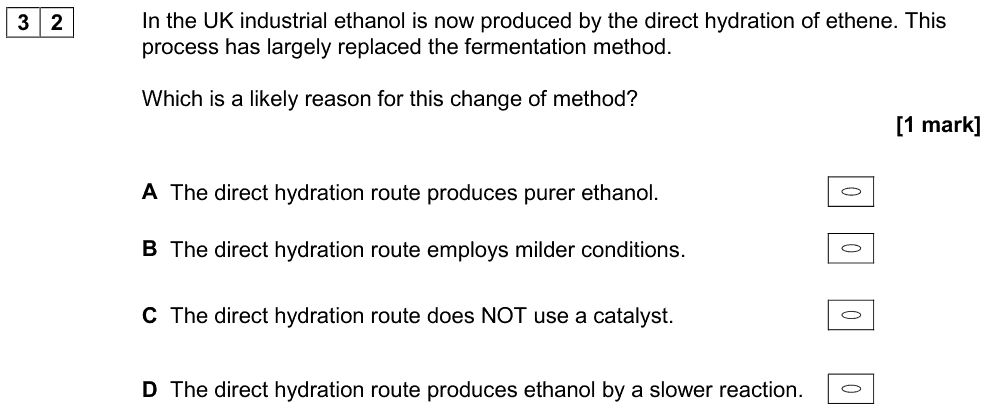
A
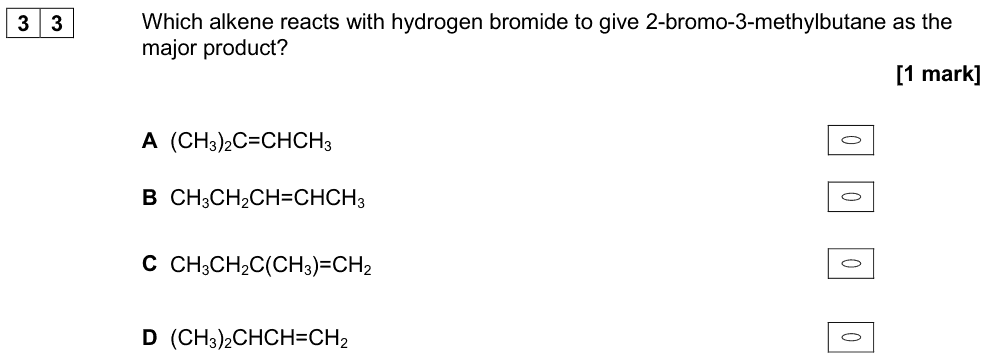
D
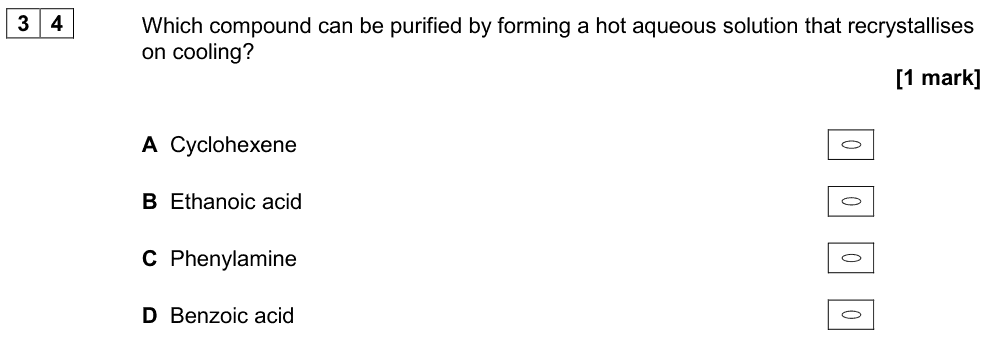
D
Skills: ATg Purify: a solid product by recrystallisation; a liquid product, including use of separating funnel; RP10 Preparation of: a pure organic solid and test of its purity; a pure organic liquid
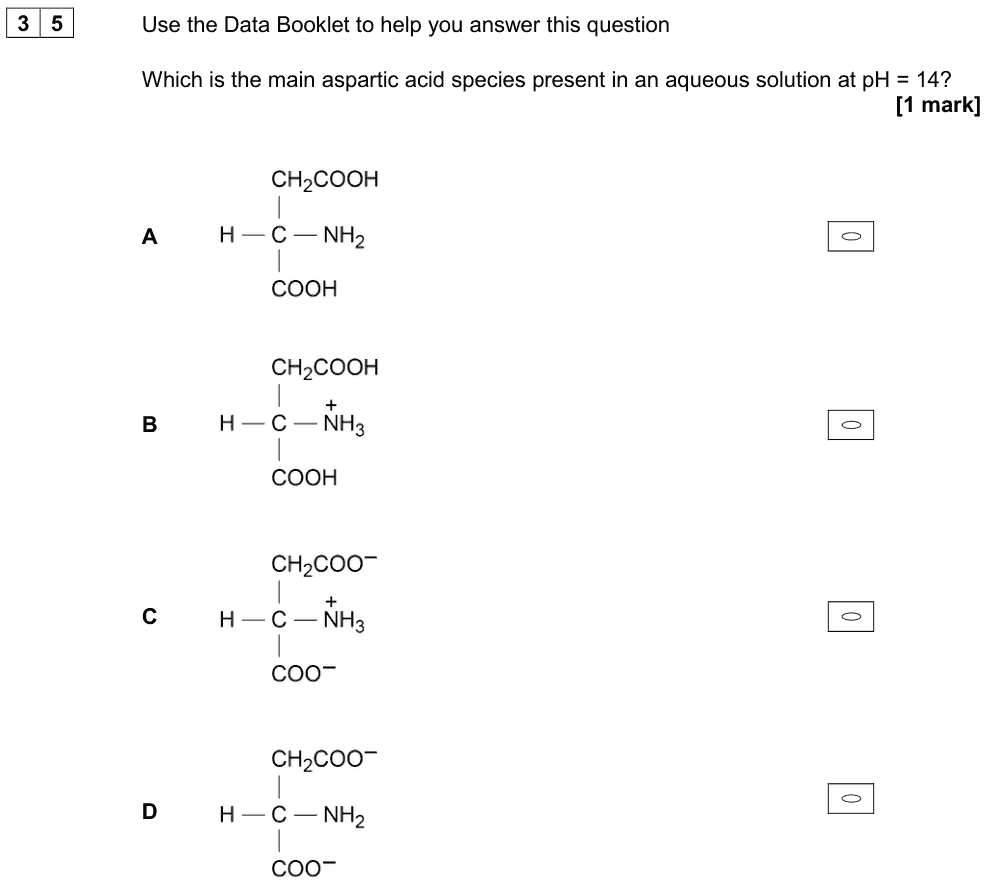
D
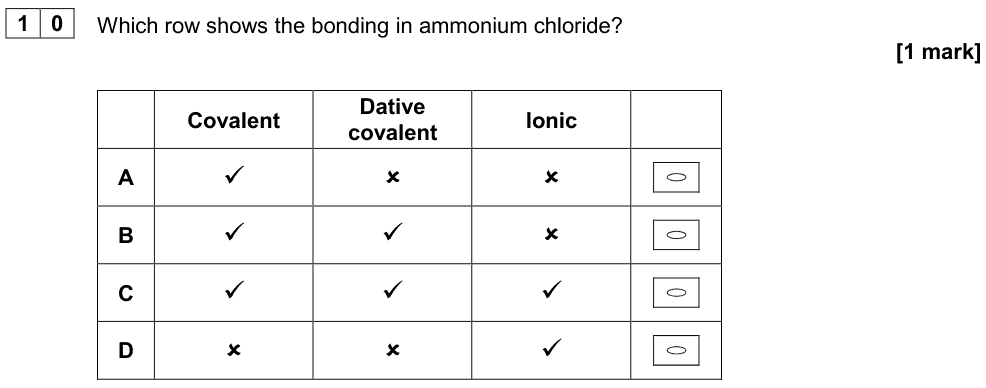
C
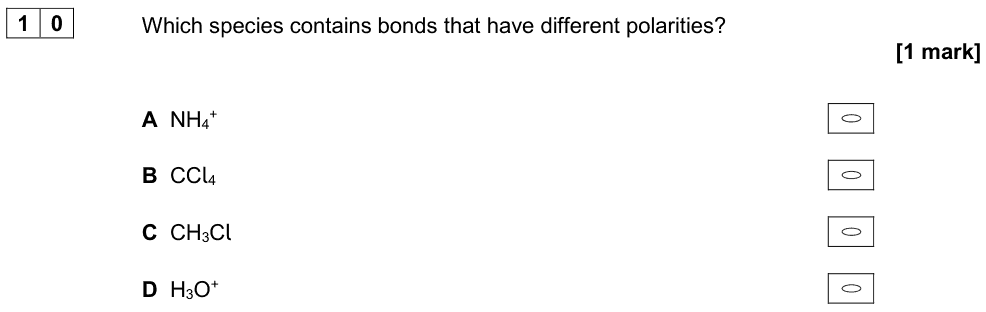
The most common answer was incorrect. Students did not appreciate the presence of the ionic bond between the ammonium ion and the chloride ion. Only 12.8% of students scored this mark.
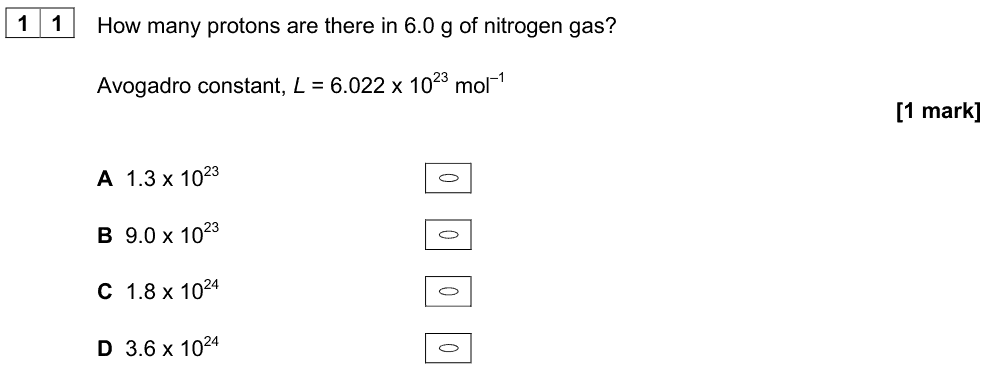
C
The most common answer (D) was incorrect and was the value that was twice the correct answer.
Skills: MS0.1 Recognise and use expressions in decimal and ordinary form
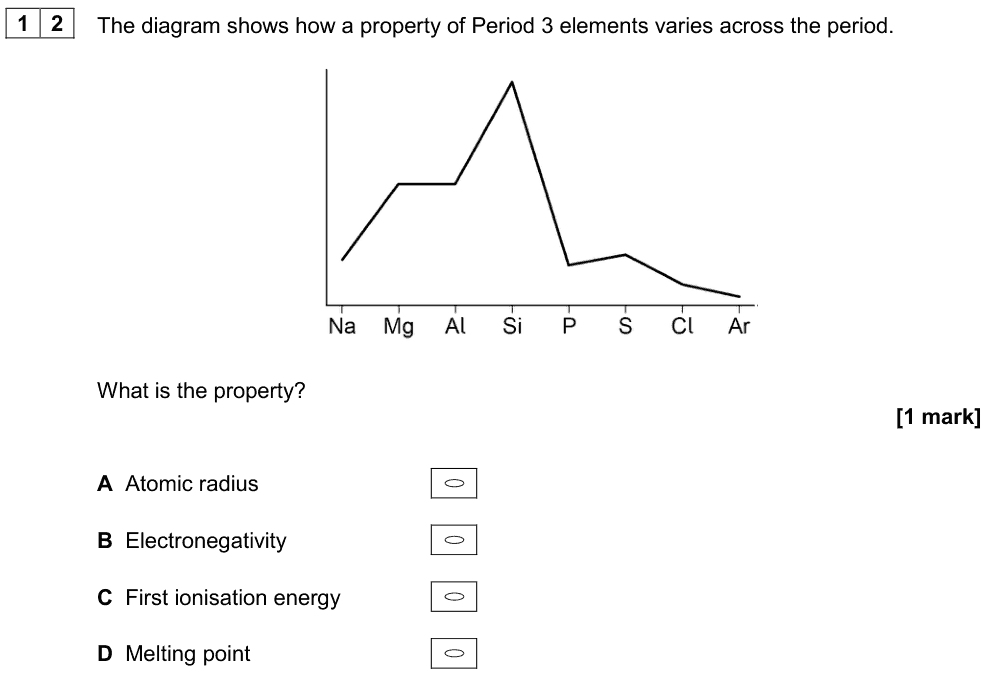
D
Most students (77.6%) could identify the correct trend.
Skills: MS3.1 Translate information between graphical, numerical and algebraic forms
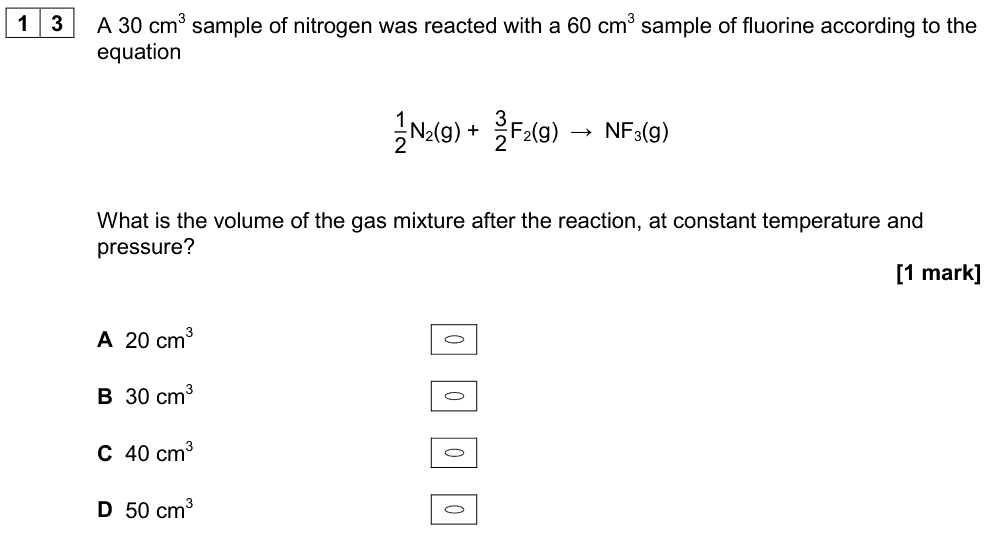
D
The most common answer (C) was incorrect. Most students believed that the total volume of gas in the mixture at the end of the reaction was 40 cm3, and did not realise that there would have been 10cm3 of unreacted gas. Only 16% of students were successful here.
Skills: MS0.2 Use ratios, fractions and percentages
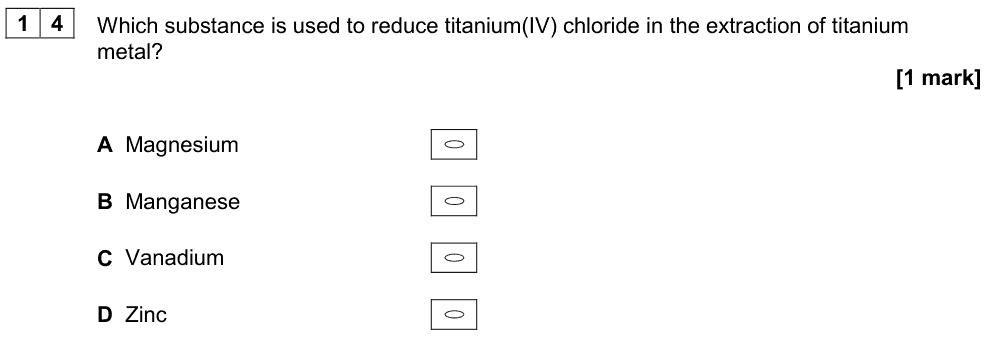
A
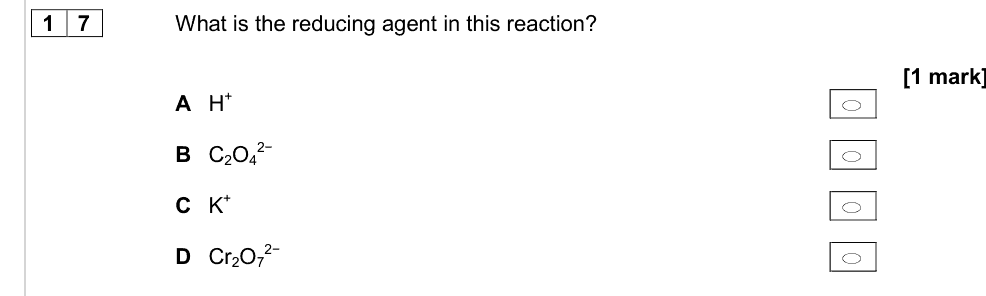
The majority of students (74%) were able to recall correctly the reducing agent in this process.
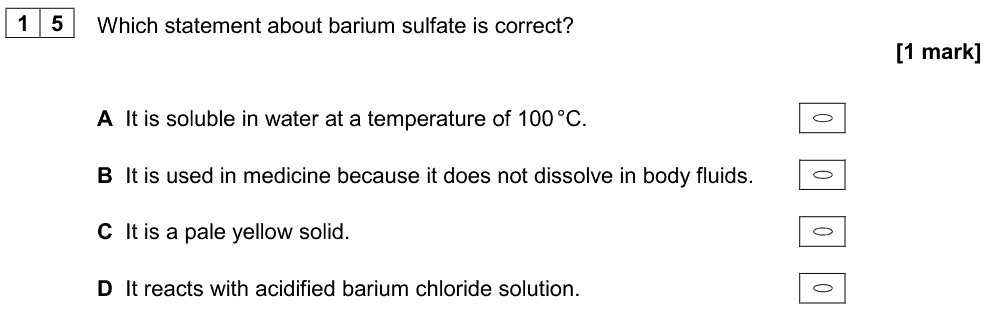
B
Many students (81.2%) got this correct and appreciated the use of barium sulfate in medicine.
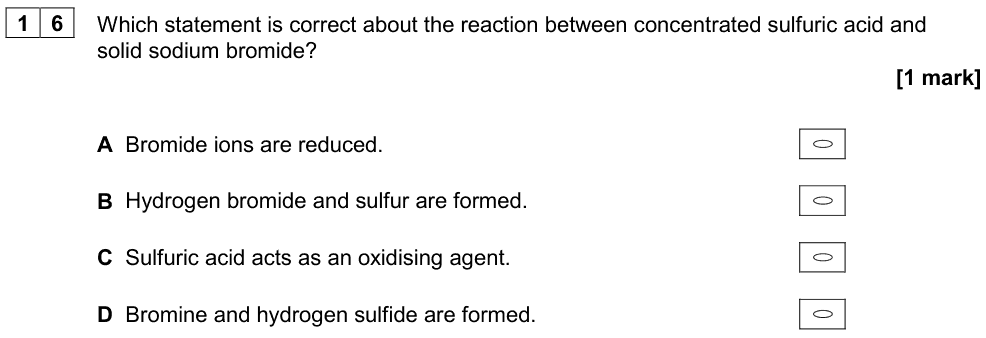
C
Many students (47.6%) got this correct although a significant number thought that bromide ions were reduced in the reaction of sodium bromide with concentrated sulfuric acid.
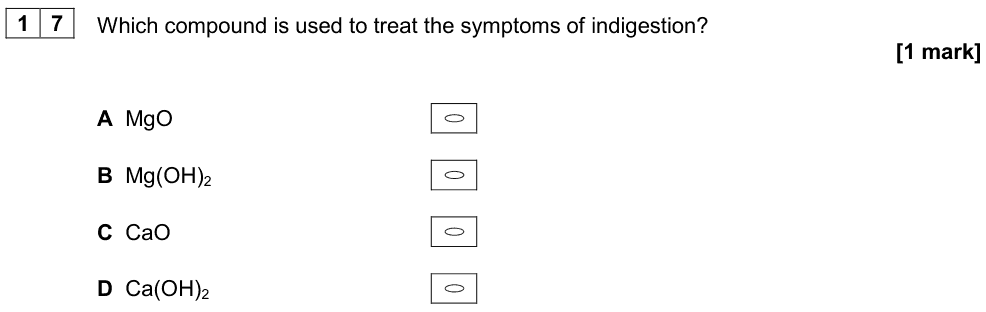
B
Most students (69.2%) got this question correct but many confused the uses of magnesium hydroxide and calcium hydroxide.
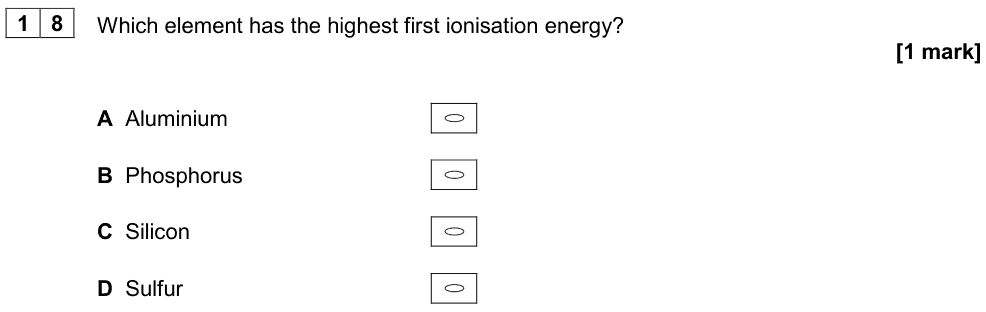
B
Some students (38.8%) were able to identify the element with the highest first ionisation energy, although many students thought that sulfur had the highest first ionisation energy.
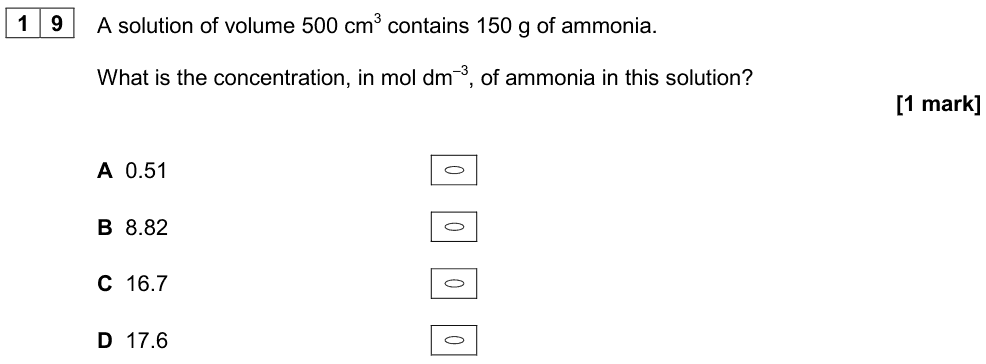
D
The majority of students (67.5%) answered this question correctly.
Skills: MS0.0 Recognise and make use of appropriate units in calculation
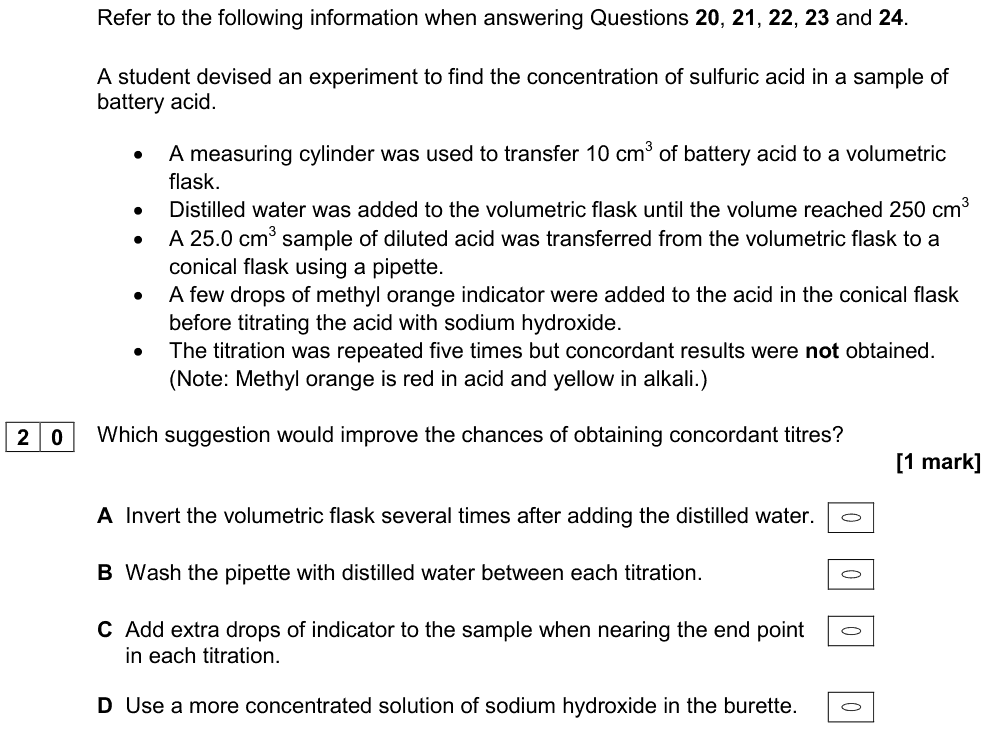
A
Only a minority of students (38.3%) answered this question correctly; many felt that washing the pipette with water between each titration helped to improve concordancy.
Skills: ATe Use volumetric flask, including accurate technique for making up a standard solution; PS2.1 Comment on experimental design and evaluate scientific methods; RP1 Make up a volumetric solution and carry out a simple acid–base titration
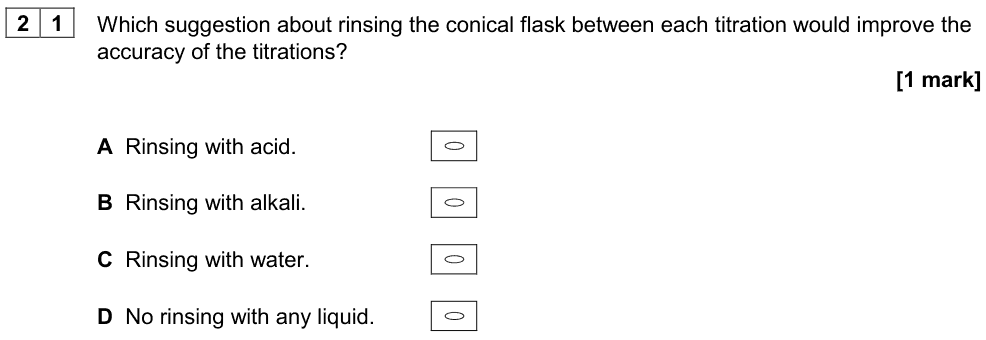
C
The majority of students (64.5%) appreciated that the conical flask should be rinsed with water between titrations.
Skills: ATd Use laboratory apparatus for a variety of experimental techniques including: titration, using burette and pipette; distillation and heating under reflux, including setting up glassware using retort stand and clamps; qualitative tests for ions and organic functional groups; filtration, including use of fluted filter paper, or filtration under reduced pressure; PS2.1 Comment on experimental design and evaluate scientific methods; RP1 Make up a volumetric solution and carry out a simple acid–base titration
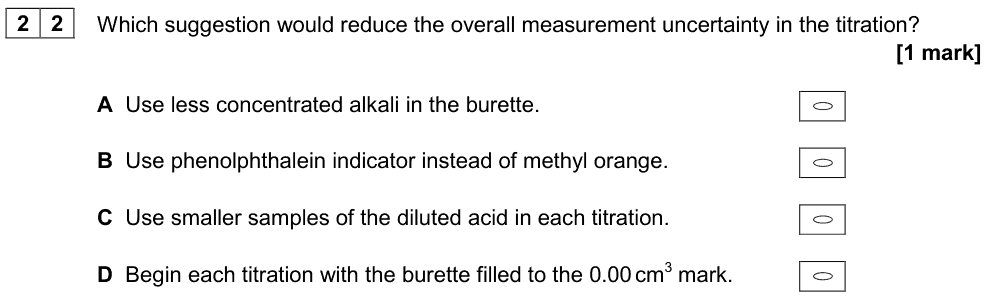
A
Only 30.5% of students gained this mark, thus most students did not appreciate that a higher burette reading would lead to a lower uncertainty so less concentrated alkali should be used. Instead, the majority of students felt that the most appropriate way to reduce uncertainty was to fill the burette to the 0.00 cm3 mark.
Skills: MS1.3 Identify uncertainties in measurements and use simple techniques to determine uncertainty when data are combined; PS3.3 Consider margins of error, accuracy and precision of data; ATd Use laboratory apparatus for a variety of experimental techniques including: titration, using burette and pipette; distillation and heating under reflux, including setting up glassware using retort stand and clamps; qualitative tests for ions and organic functional groups; filtration, including use of fluted filter paper, or filtration under reduced pressure; RP1 Make up a volumetric solution and carry out a simple acid–base titration
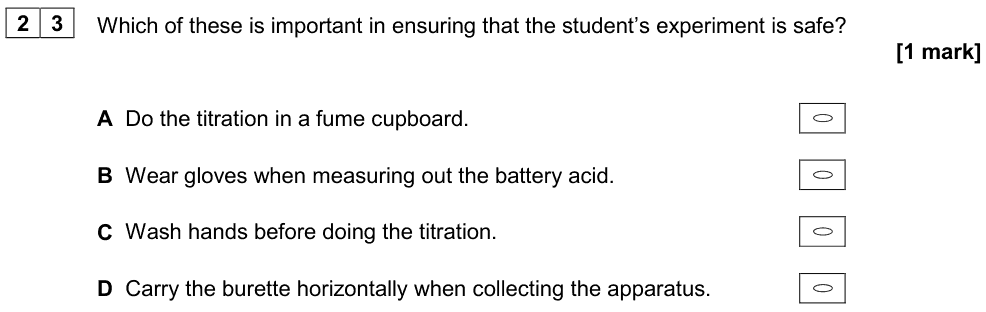
B
The majority of students (76%) were able to suggest the most appropriate safety precaution.
Skills: ATk Safely and carefully handle solids and liquids, including corrosive, irritant, flammable and toxic substances; PS4.1 Know and understand how to use a wide range of experimental and practical instruments, equipment and techniques appropriate to the knowledge and understanding included in the specification; RP1 Make up a volumetric solution and carry out a simple acid–base titration
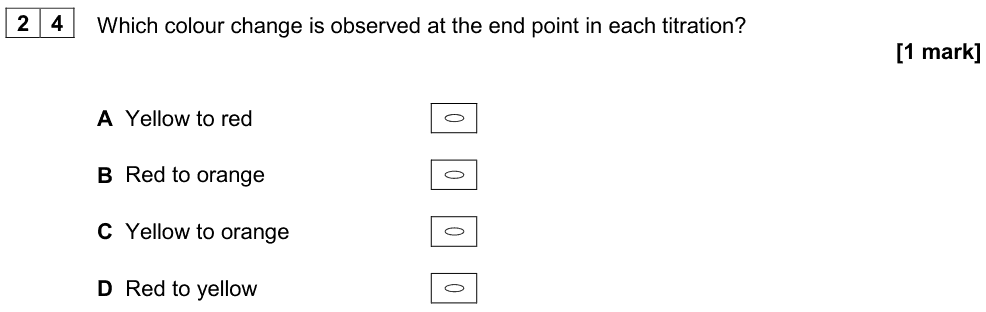
B
The majority of students felt that the end point when using methyl orange would be red to yellow rather than red to orange. Just under a third of students gave the correct answer.
Skills: ATf Use acid–base indicators in titrations of weak/strong acids with weak/strong alkalis; ATd Use laboratory apparatus for a variety of experimental techniques including: titration, using burette and pipette; distillation and heating under reflux, including setting up glassware using retort stand and clamps; qualitative tests for ions and organic functional groups; filtration, including use of fluted filter paper, or filtration under reduced pressure; RP1 Make up a volumetric solution and carry out a simple acid–base titration
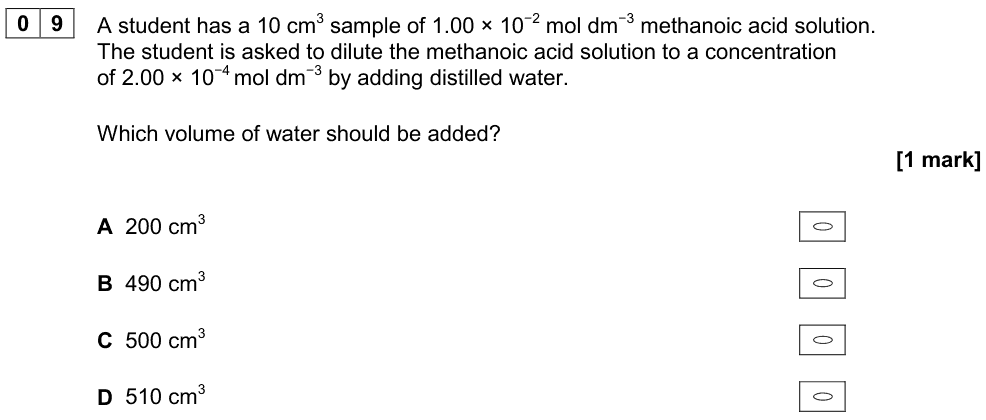
B
Diluting a solution The most common answer, C, was incorrect. Students believed that 500 cm3 of water should be added to the 10 cm3 of solution, rather than adding 490 cm3 to make the total volume 500 cm3.
Skills: MS0.1 Recognise and use expressions in decimal and ordinary form; MS0.2 Use ratios, fractions and percentages
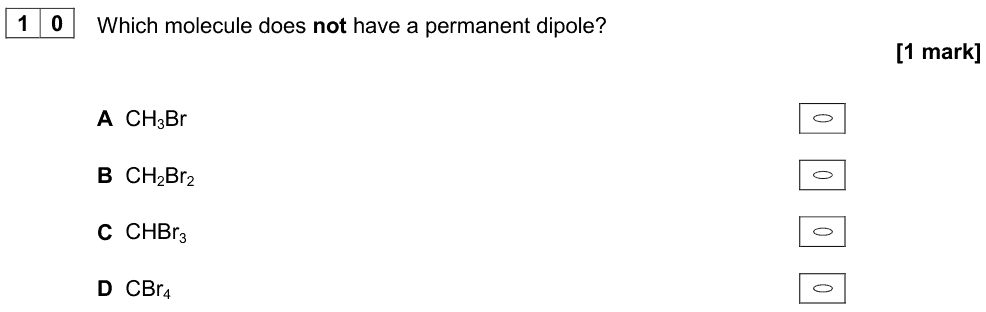
D
A significant majority of students (74.1%) could deduce that CBr4 had no overall dipole.
Skills: MS4.3 Understand the symmetry of 2D and 3D shapes
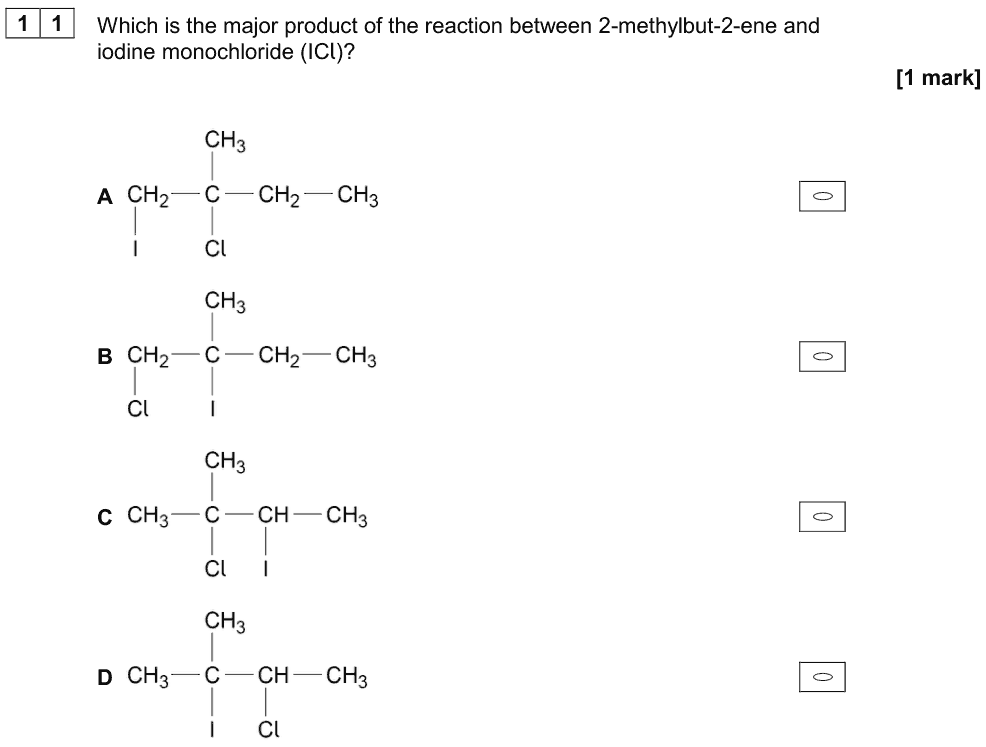
C
This question was challenging. The most common incorrect answer added the iodine and chlorine onto the two C atoms, but could not use the bond polarity in iodine monochloride to determine which way round they added. Pleasingly, though, 47.9% of students gained the mark.
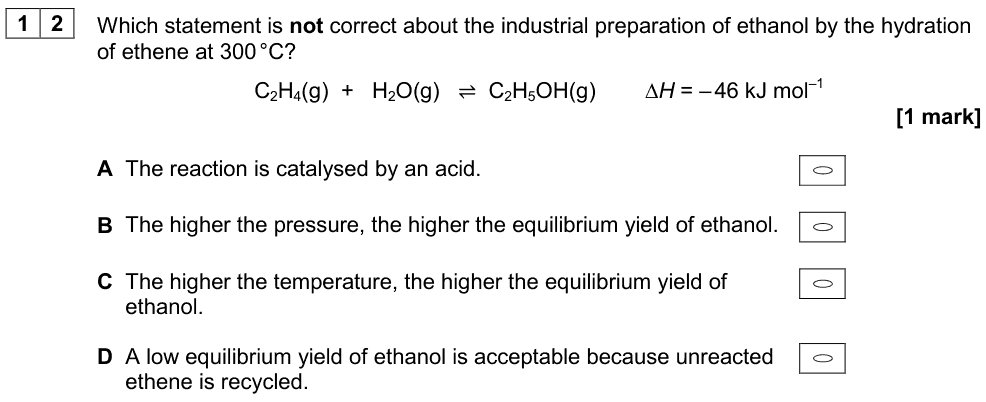
C
Most students (60.1%) could use Le Chatelier’s principle to deduce which statement was correct.
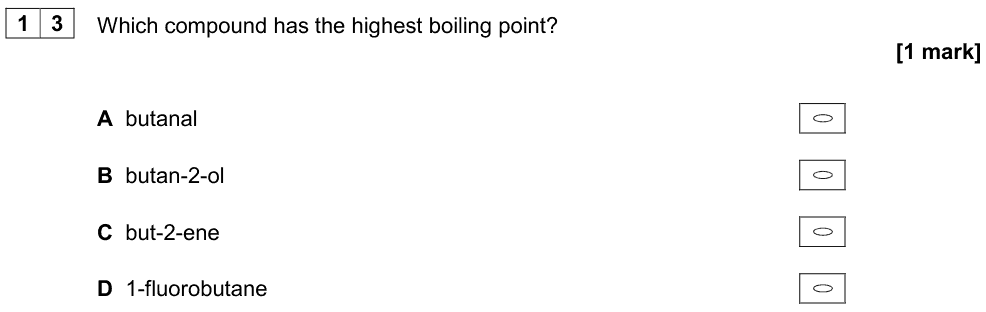
B
Students found it hard to predict which compound had the highest boiling point. Many thought the fluoroalkane had the highest boiling point, possibly as they incorrectly believed it might contain hydrogen bonds between molecules.
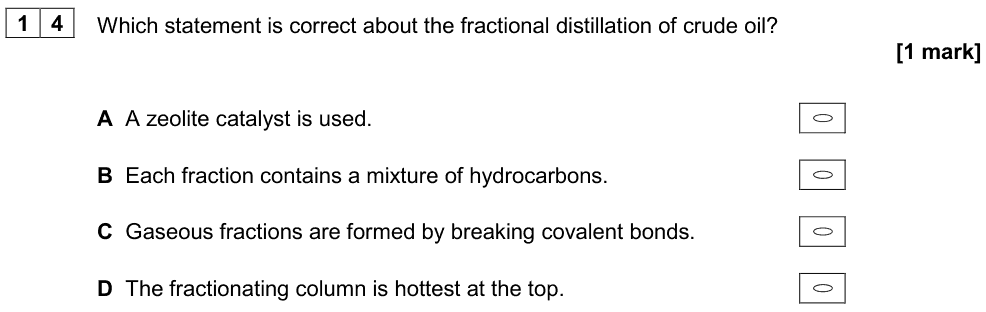
B
Many students (57.3%) got this correct, but many incorrectly thought covalent bonds are broken when molecular substances boil.
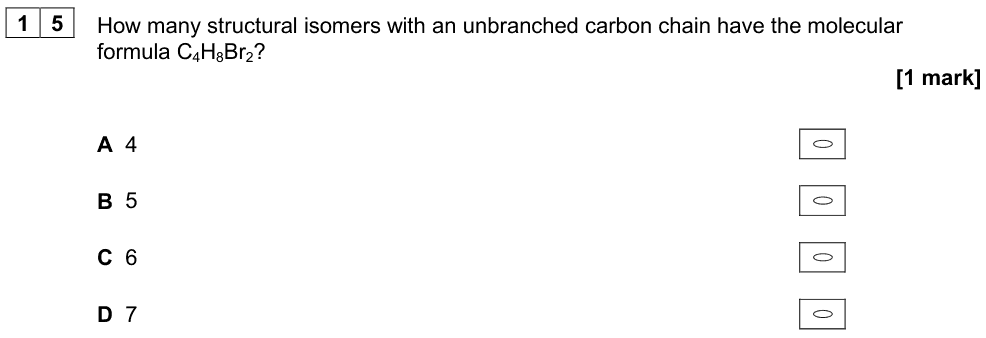
C
Few students (28.7%) got this correct, with most believing there are fewer isomers than there actually are.
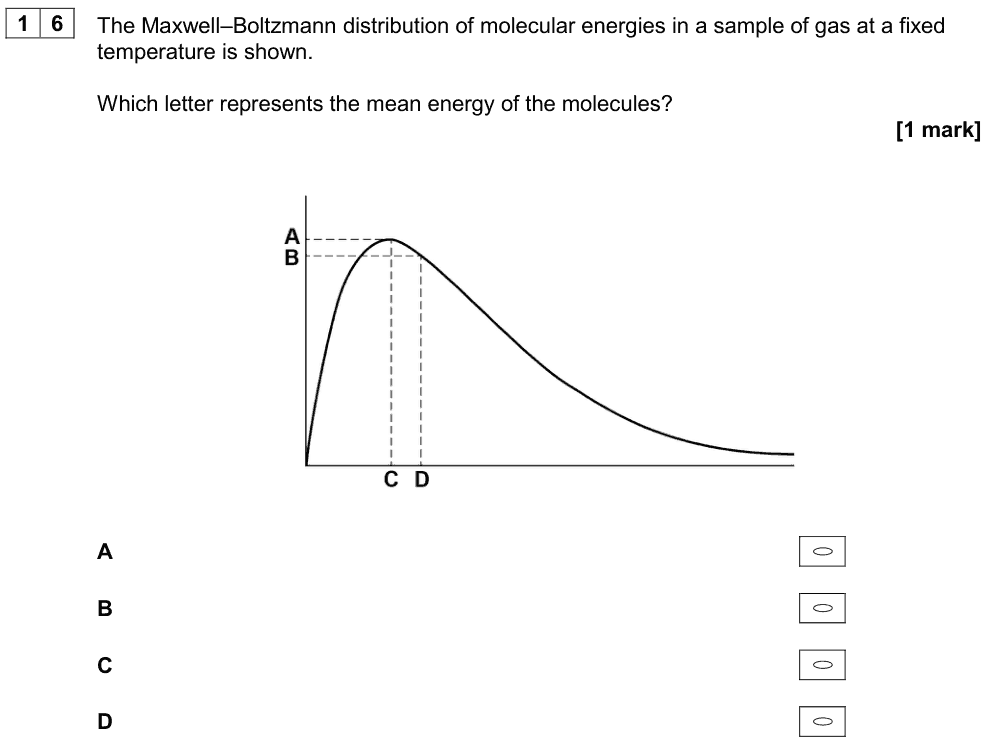
D
Many students (58.9%) got this question correct but many confused the most probable energy with the mean energy of the particles.
Skills: MS3.1 Translate information between graphical, numerical and algebraic forms
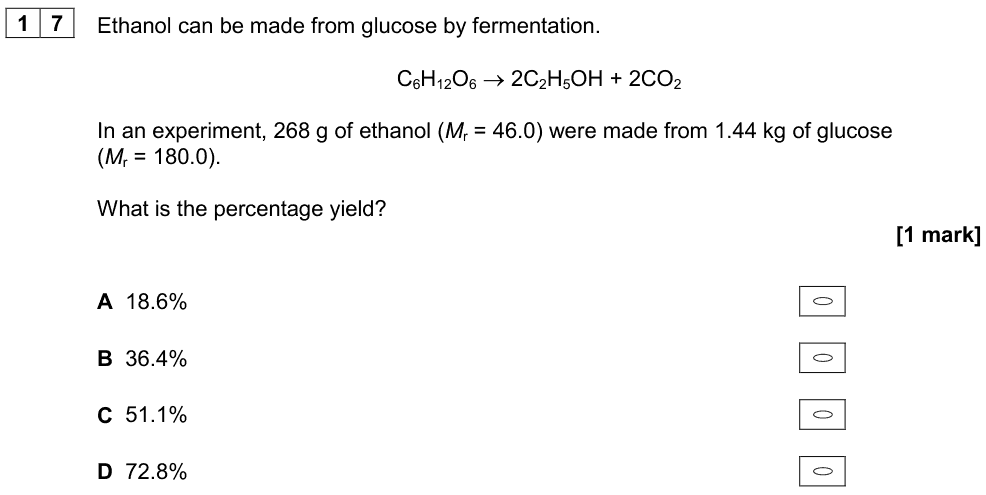
B
A good number of students (37.2%) could work out the percentage yield, but the many incorrect answers suggest that many students do not understand how to calculate percentage yield.
Skills: MS0.0 Recognise and make use of appropriate units in calculation; MS0.2 Use ratios, fractions and percentages
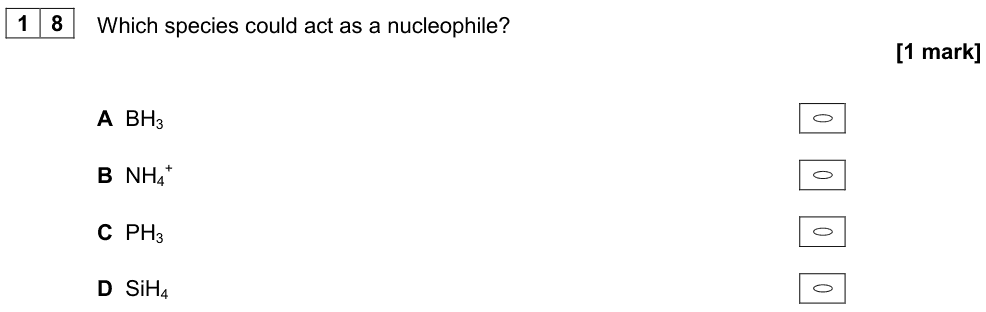
C
Many students (46.8%) got this question correct but many others thought that NH4 + could act as a nucleophile, possibly due to confusion with NH3.
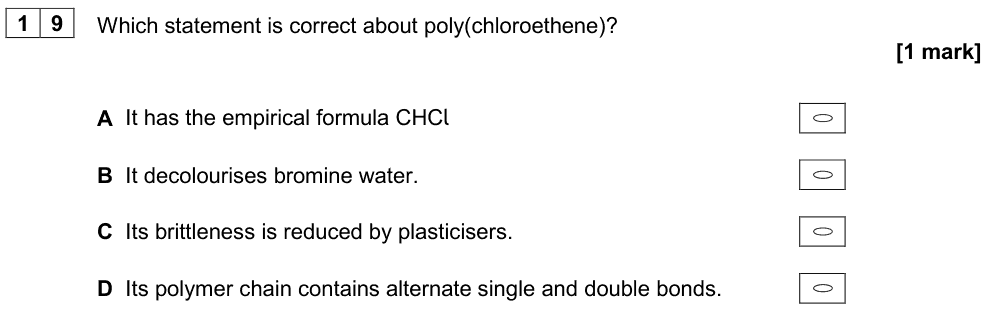
C
Many students (52.2%) got this question correct but many others incorrectly thought that the polymer contained a C=C bond and would decolourise bromine water.
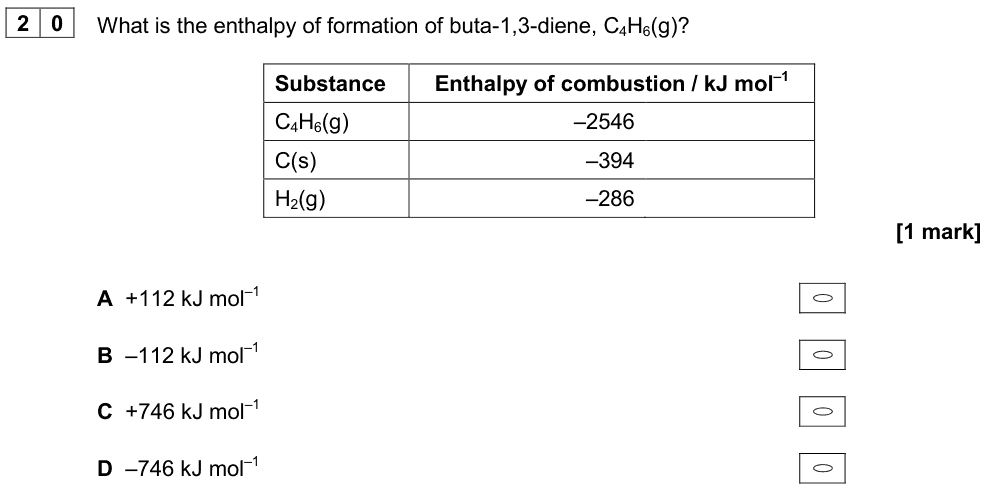
A
Just over a third of students calculated the correct answer of +112 kJ mol–1, but almost as many students gave –112 kJ mol–1. A possible reason for this wrong answer is that students may use summary equations in calculations such as these and may be uncertain whether these involve (products – reactants) or (reactants – products).
Skills: MS2.4 Solve algebraic equations
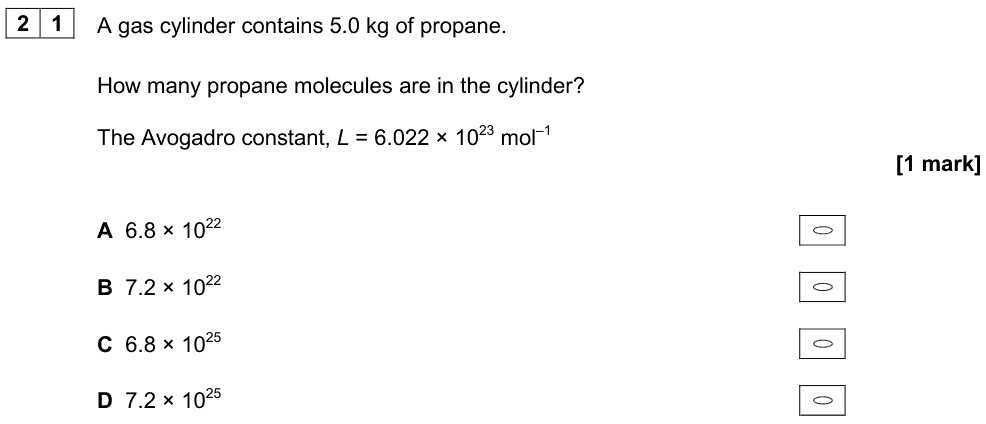
C
Most students (70.6%) could correctly find the number of molecules in a sample of propane. The most common incorrect answer used C3H6 rather than C3H8 as the formula of propane.
Skills: MS0.0 Recognise and make use of appropriate units in calculation; MS0.1 Recognise and use expressions in decimal and ordinary form
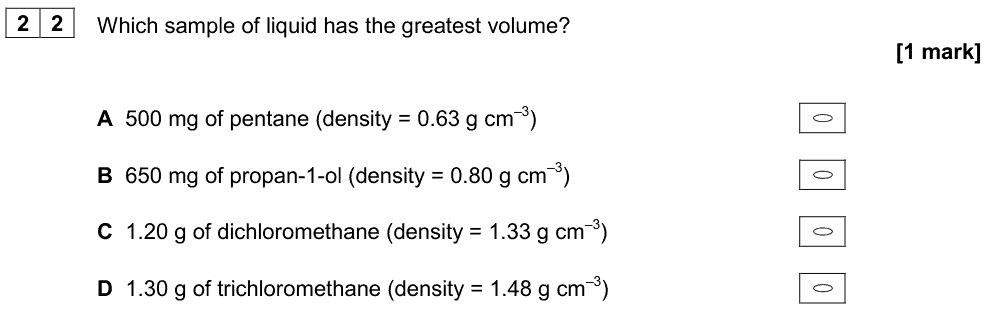
C
Most students (55.6%) could correctly find the liquid that had the greatest volume from its mass and density.
Skills: MS0.0 Recognise and make use of appropriate units in calculation; MS2.2 Change the subject of an equation
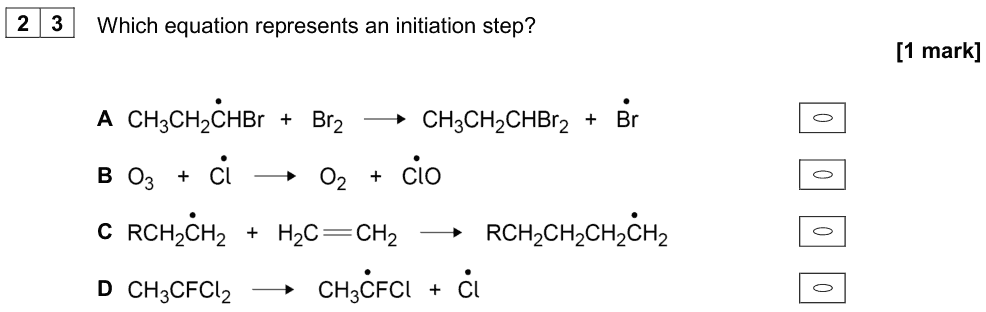
D
A high proportion of students (73.9%) could identify the initiation reaction, but many thought that the propagation step from the decomposition of ozone was an initiation reaction.
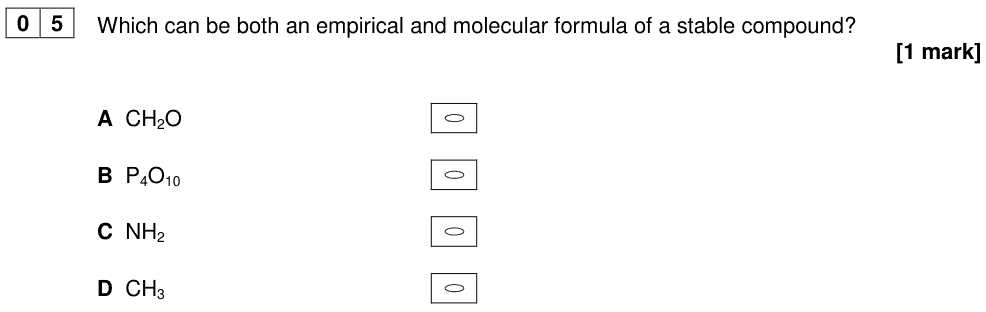
A
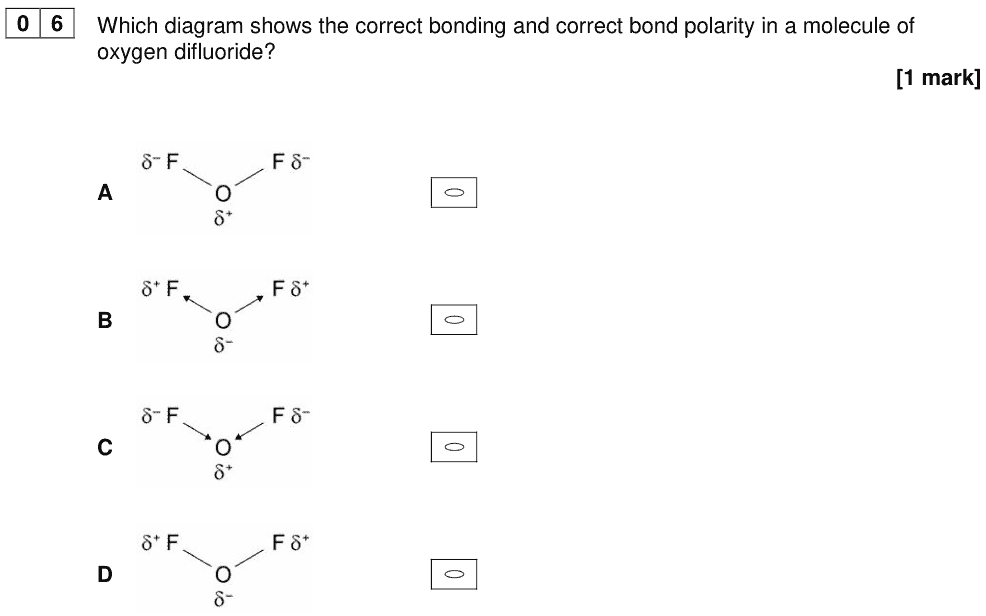
A
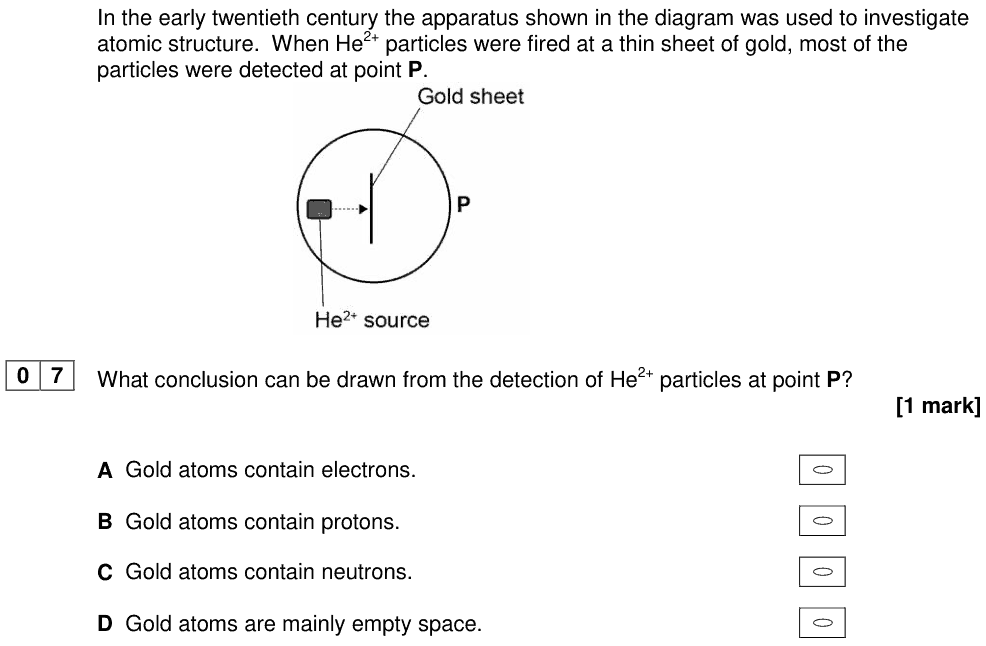
D
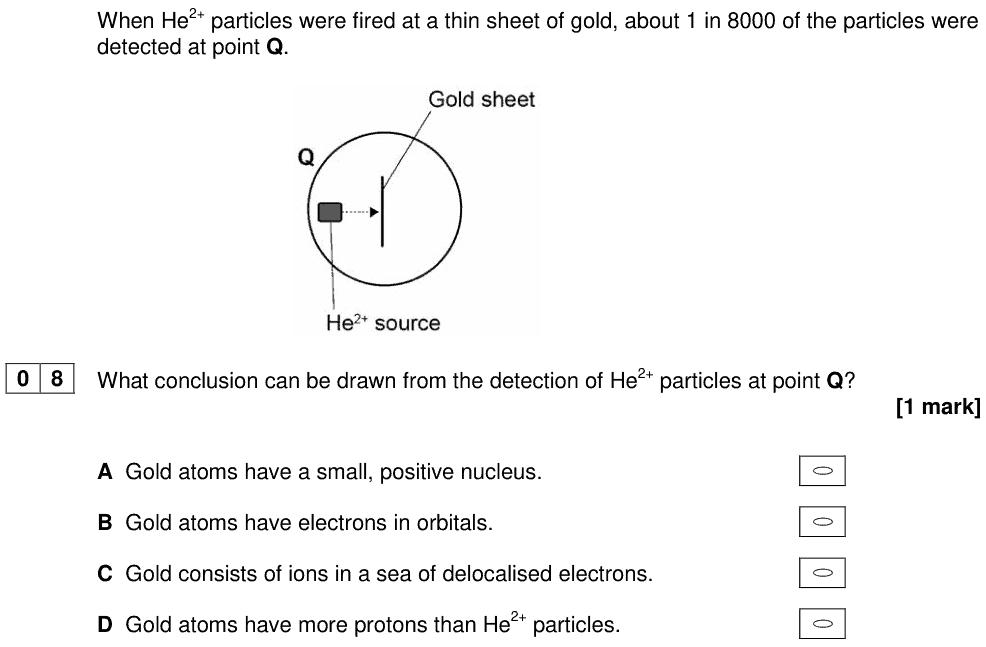
A
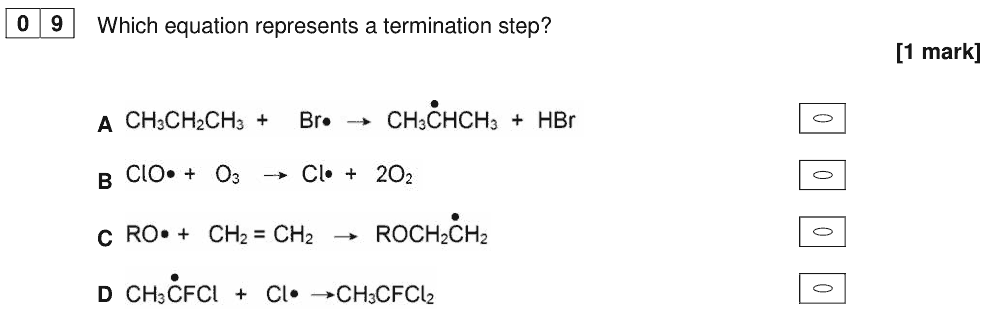
D
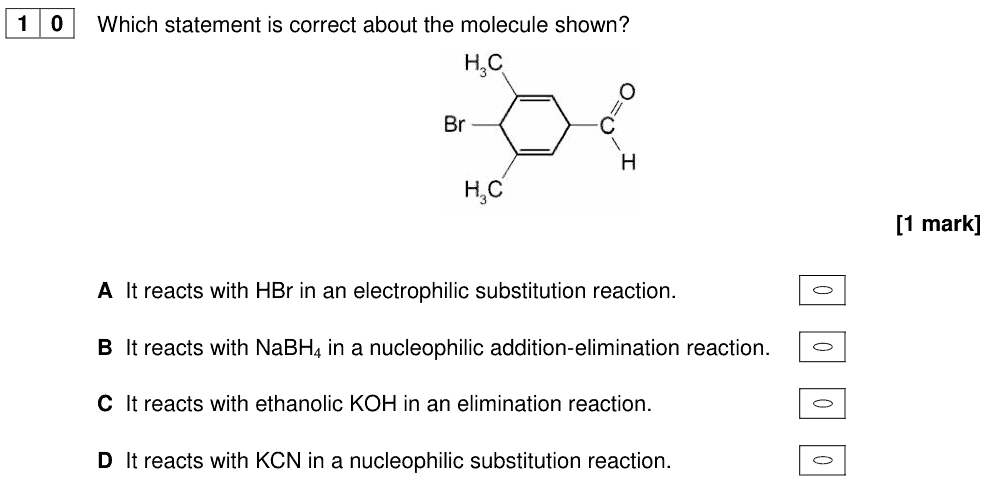
D
10 B was the commonest incorrect response suggesting confusion about the name of the mechanism of aldehyde reduction. 54.4% of students chose the correct response.
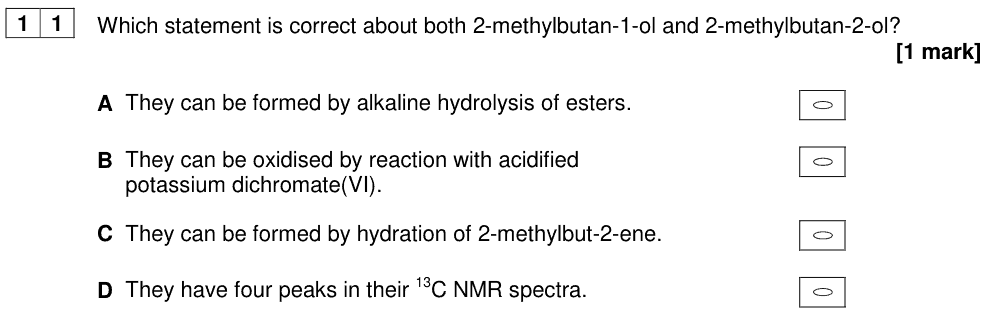
A
11 This was one of the few questions answered incorrectly more often than correctly (41.7% success rate) – C was the commonest incorrect response. If students draw the structures as their rough working, it should be clear that –OH will not add in position 1 of 2-methylbut-2-ene.
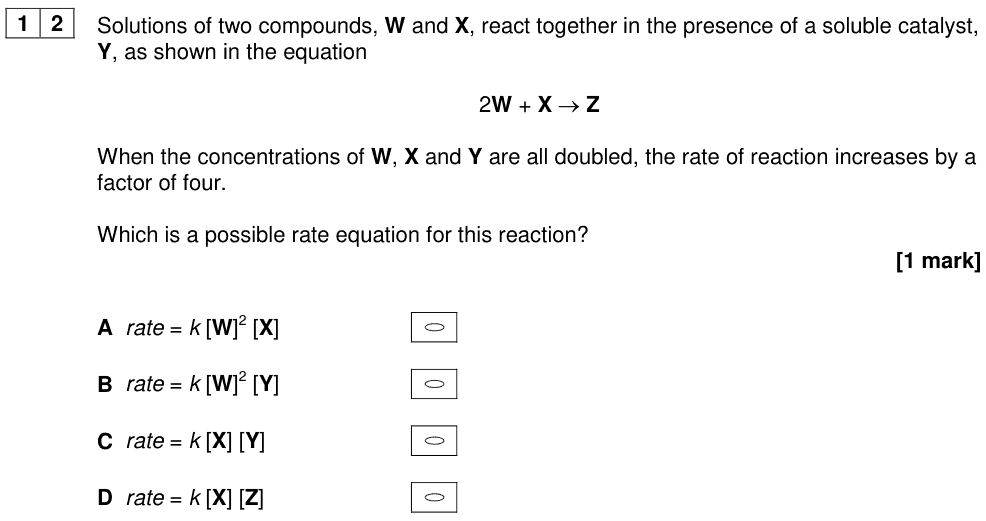
C
12 43% of students chose correctly. A was the commonest incorrect response, perhaps suggesting that those students were expecting the orders in the rate equation to match the balancing in the reaction equation instead of working out the orders from the rate data given.
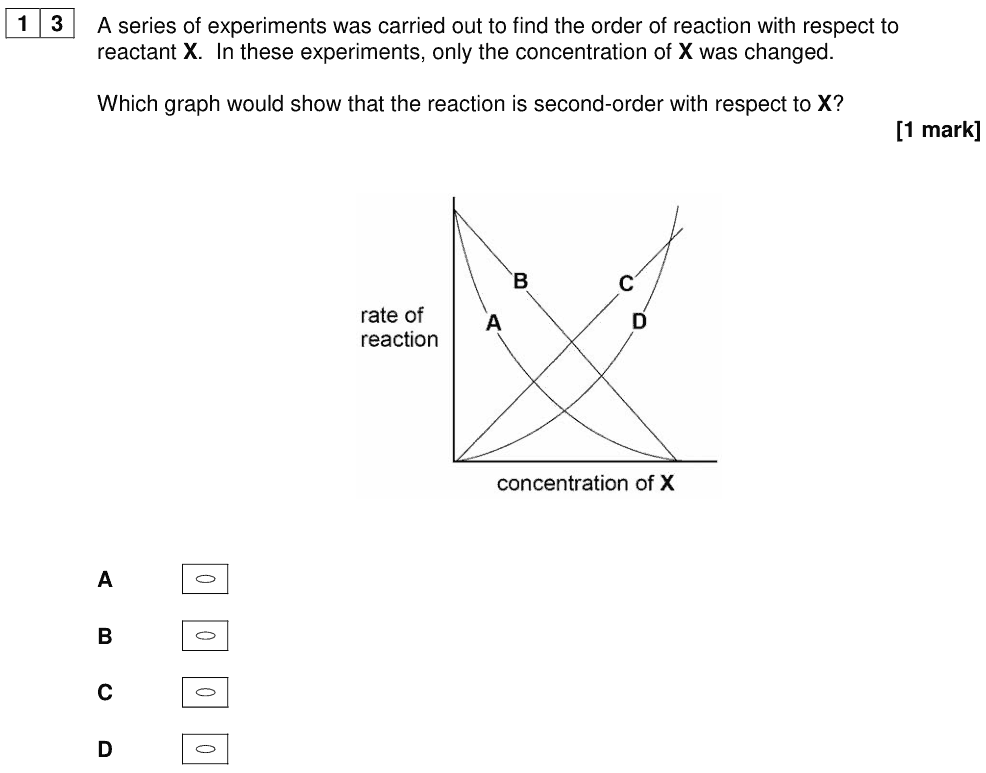
D
13 A was the commonest incorrect response here, suggesting that those students thought it was a concentration v time graph rather than a rate v concentration graph. 76.5% of students were successful.
Skills: MS3.1 Translate information between graphical, numerical and algebraic forms
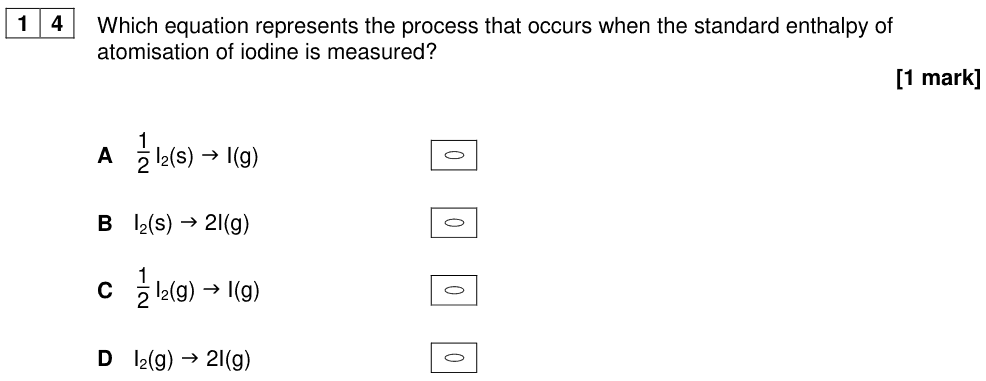
A
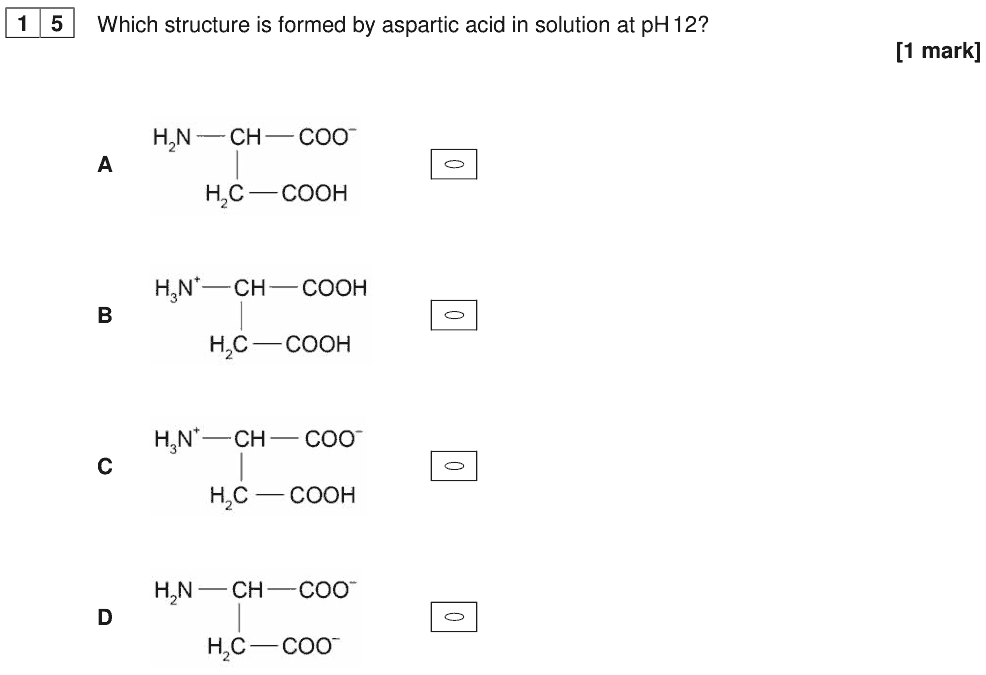
D
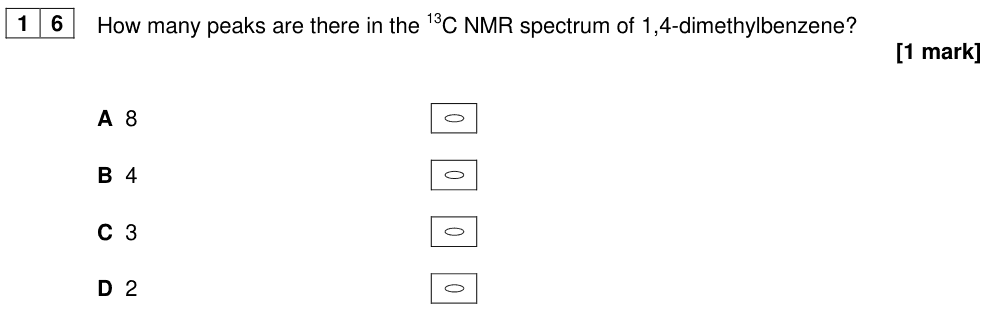
C
Skills: MS4.3 Understand the symmetry of 2D and 3D shapes
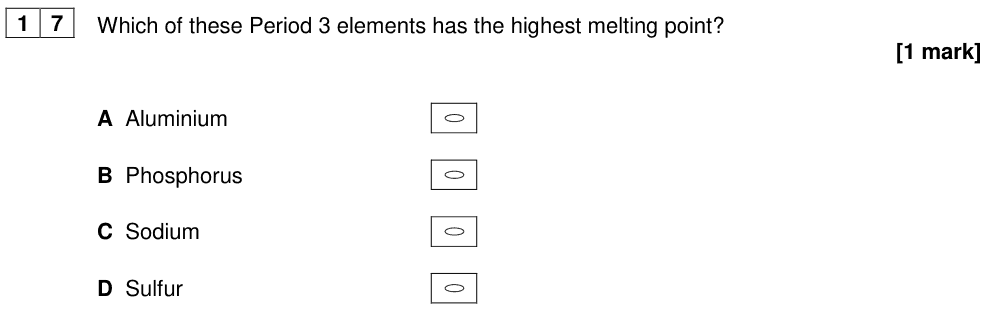
A
17 D (followed by B) was the commonest incorrect response. It is not clear why so many students would choose a simple molecular element in preference to a metal as having the highest melting point. 68.9% were, however, correct.
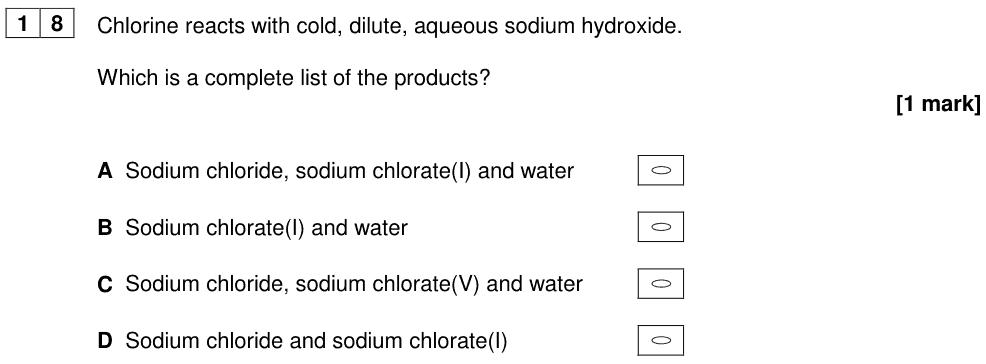
A
18 C was the commonest incorrect response, which is to be expected as these are the products with hot aqueous alkali. The success rate was 68.9%.
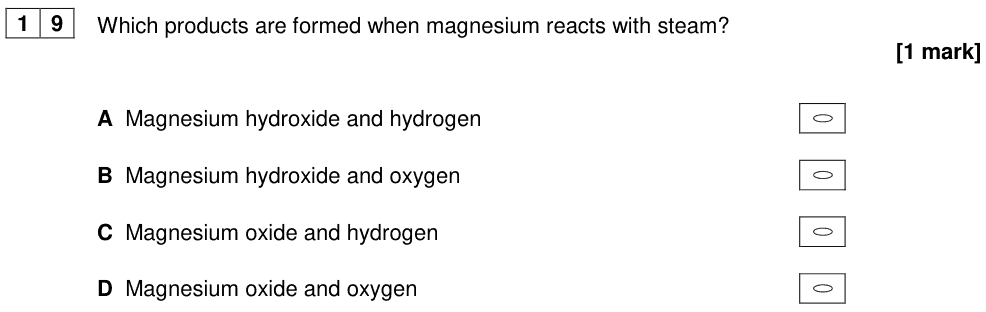
C
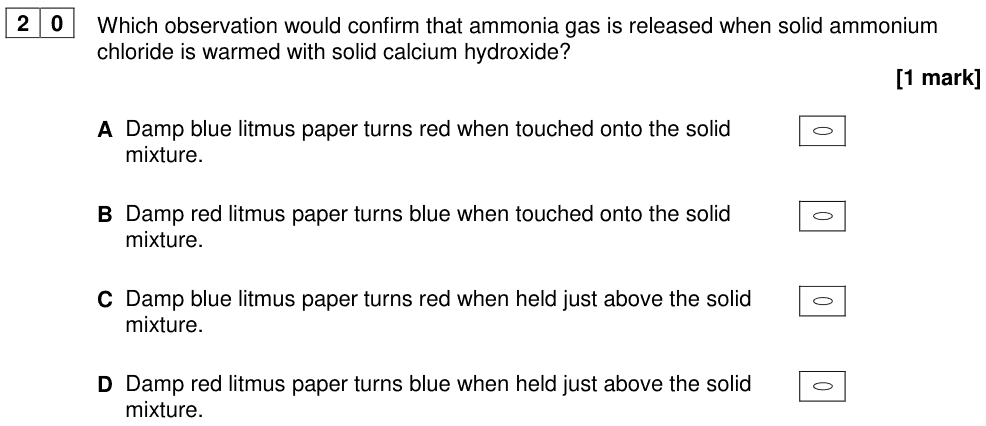
D
20 C was the commonest incorrect response, which gave the correct position for the litmus paper but with the colour change reversed. 72.2% of students correctly chose D.
Skills: ATd Use laboratory apparatus for a variety of experimental techniques including: titration, using burette and pipette; distillation and heating under reflux, including setting up glassware using retort stand and clamps; qualitative tests for ions and organic functional groups; filtration, including use of fluted filter paper, or filtration under reduced pressure; PS4.1 Know and understand how to use a wide range of experimental and practical instruments, equipment and techniques appropriate to the knowledge and understanding included in the specification; RP4 Carry out simple test-tube reactions to identify: cations – Group 2, NH4+; anions – Group 7 (halide ions), OH–, CO32–, SO42–
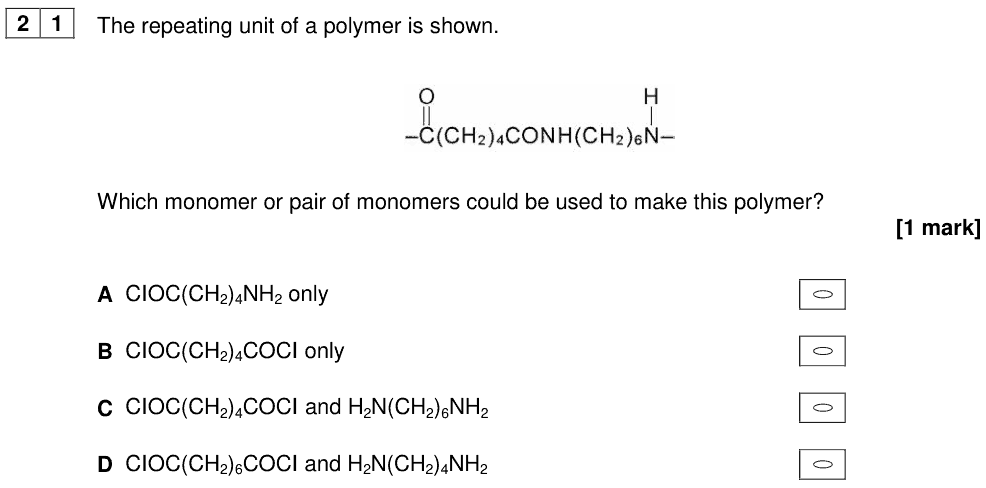
C
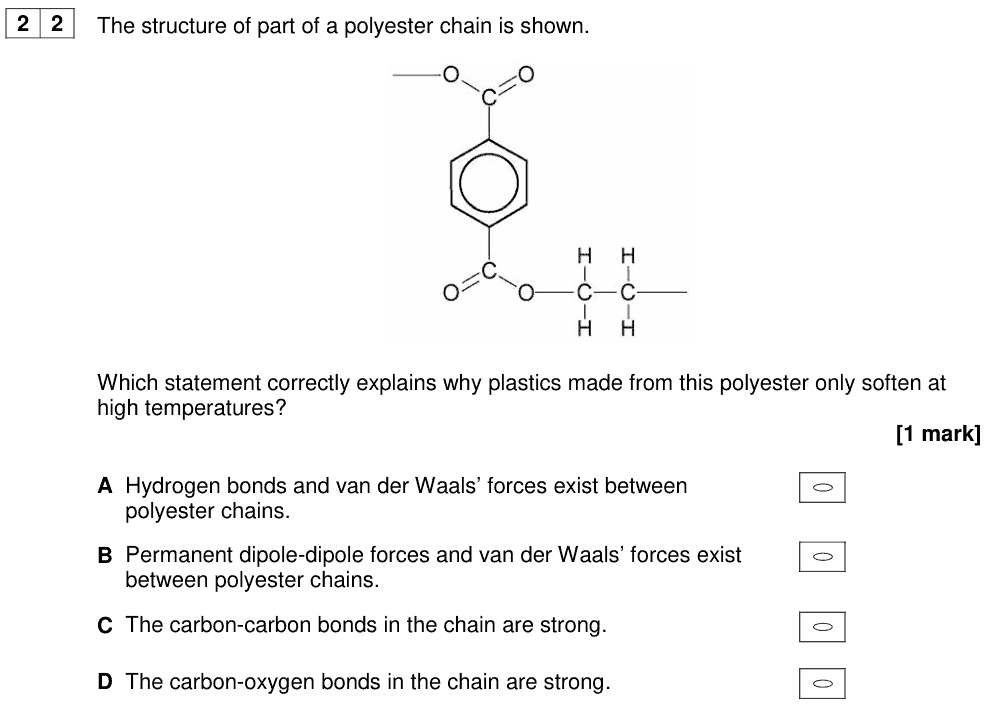
B
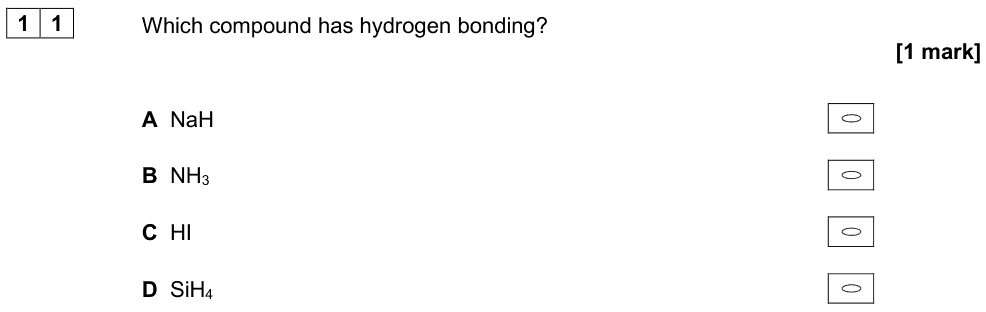
22 A was the commonest incorrect response suggesting that students failed to realise that hydrogen must be directly attached to an electronegative atom in order to take part in hydrogen bonding. 51.2% of students gained this mark.
A
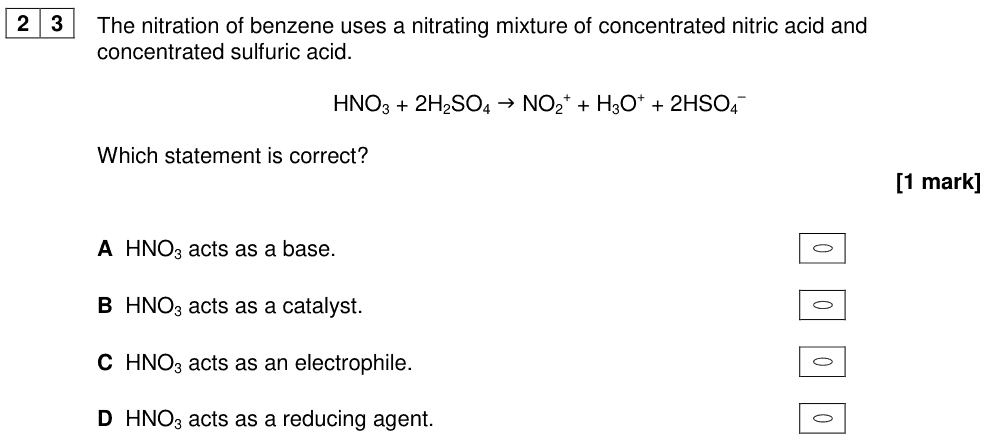
23 46% of students scored here. Three-quarters of the incorrect responses were D, but there are no changes of oxidation state in this reaction, so it is not a redox reaction. The H2SO4 transfers a proton to the HNO3 so the HNO3 acts as a base.
C
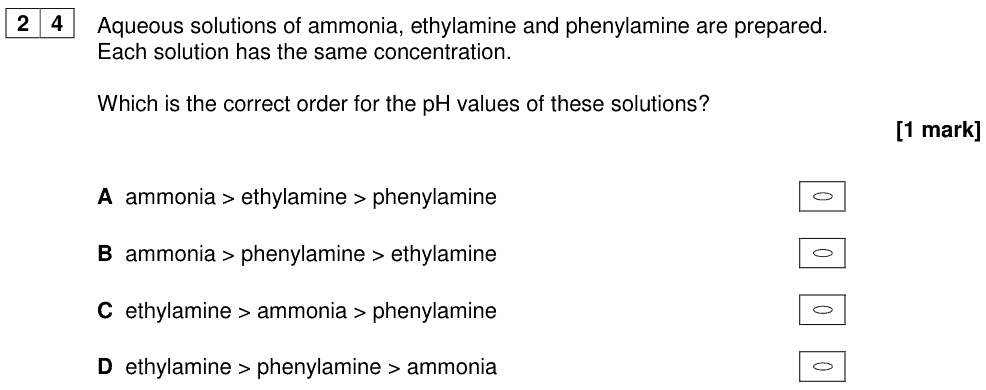
24 A was the commonest incorrect response. 58.3% of students realised that electron- releasing alkyl groups increase the availability of the lone pair on N, making amines more basic than ammonia (D).
A
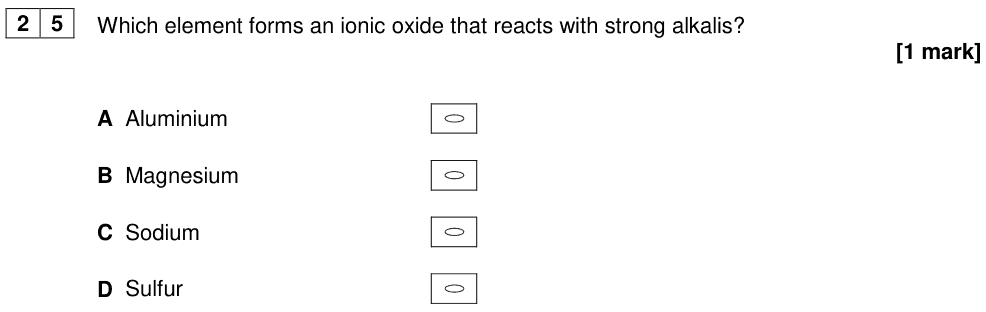
25 In a question where just under half of students arrived at the correct answer, D was the commonest incorrect response. This was presumably because sulfur forms an acidic oxide that reacts with alkali – but sulfur oxides are molecular, not ionic.
C
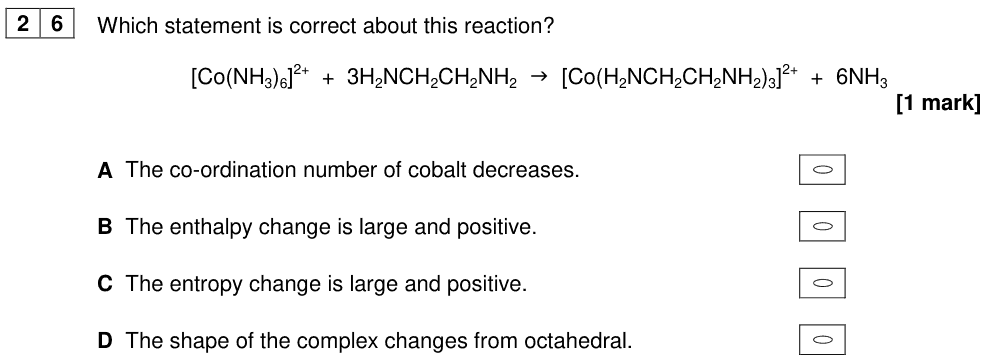
26 D was the commonest incorrect response; presumably the presence of only 3 ligand molecules in the product meant that some students did not realise that the cobalt still has a co-ordination number of 6. 73.9% of students did, however, give the correct response.
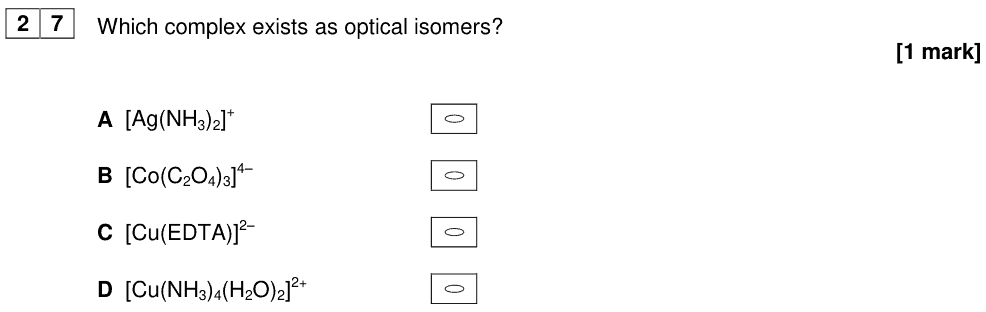
B or C
27 D was suggested as the answer more often than the correct response (B, identified by 36% of students). This suggests confusion between geometric and optical isomerism in transition metal complexes.
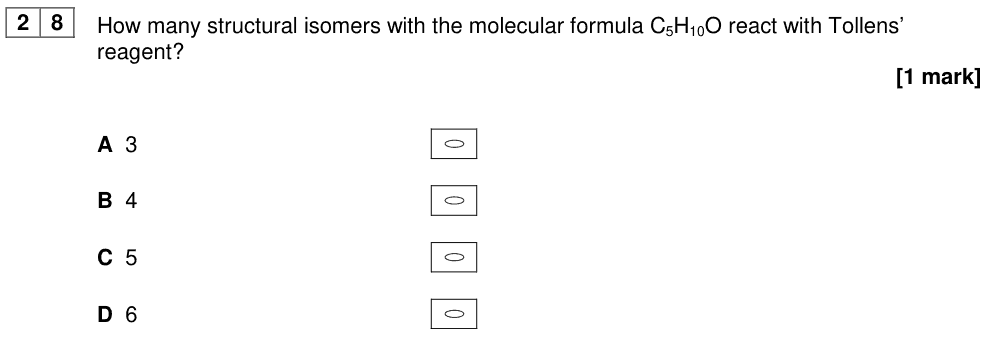
B
28 A was the commonest incorrect response to this question which had a 47% success rate. This suggests there were many students who recognised that the answer is an aldehyde, but who then missed a possible isomer. Drawing out possible structures in a logical sequence is the key here. Students are advised to start with a 5C chain, then 4C and find
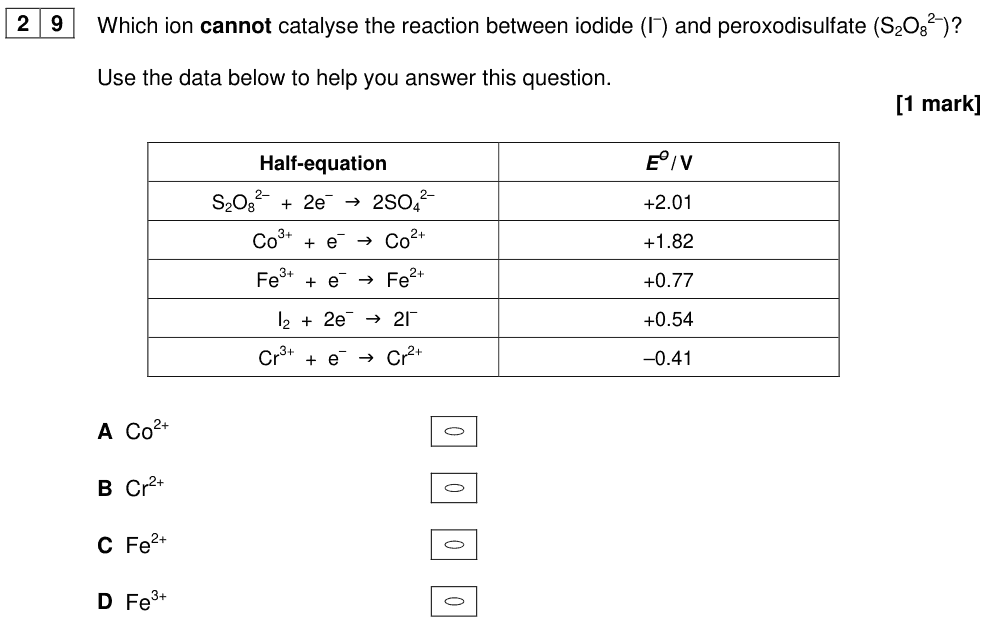
B
29 Just over two-thirds of students arrived at the correct answer. D (followed by A) was the commonest incorrect response.
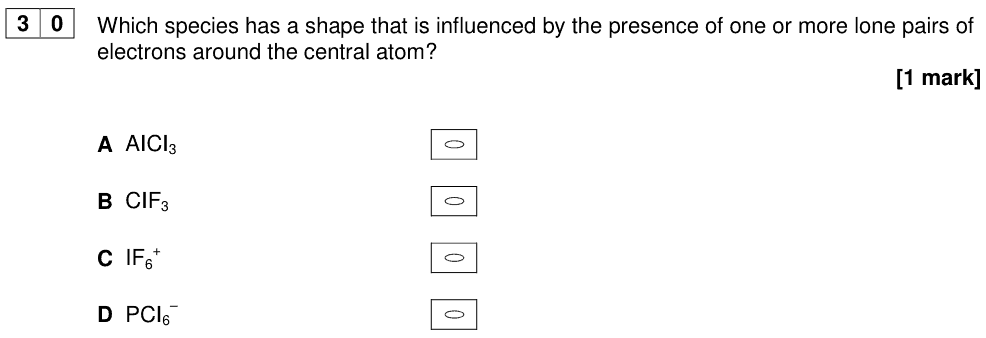
B
30 While 72% of students gave the correct answer, D and A were chosen with almost equal frequency as incorrect responses.
Skills: MS4.1 Use angles and shapes in regular 2D and 3D structures
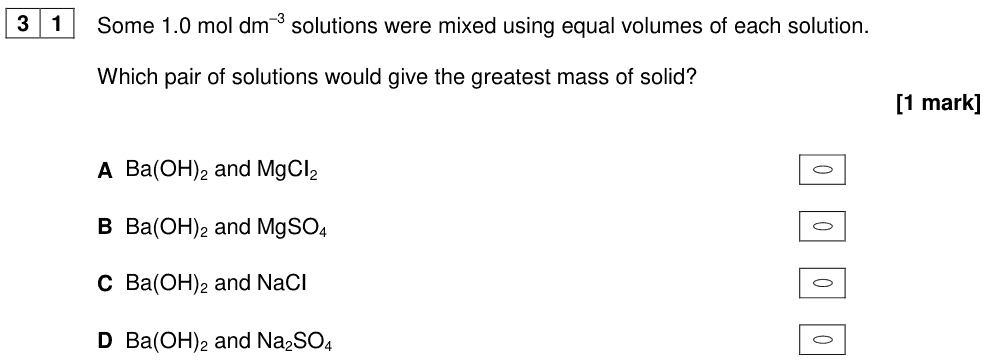
B
31 D was the commonest incorrect response, presumably from a failure to recognise that Mg(OH)2 is sparingly soluble as well as BaSO4. 46.8% of students were successful.
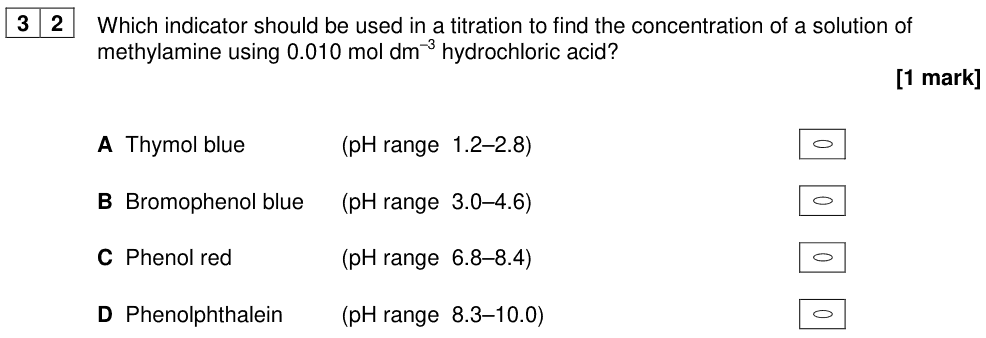
B
32 C (followed by A) was the commonest incorrect response, suggesting that students failed to realise how low the pH is when the plot ceases to be vertical in a strong acid-weak base titration. The success rate was 41.9%.
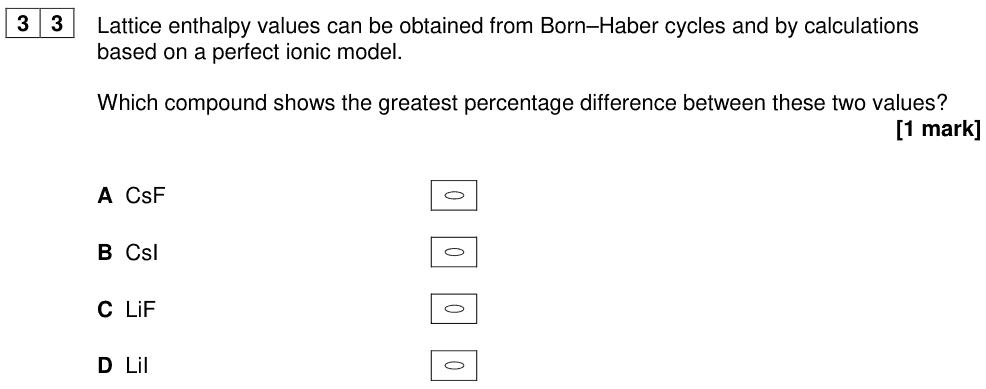
D
33 The correct response was only the third most ‘popular’ choice for this question, suggesting that this concept is not well known. Poor agreement between theoretical and experimental lattice energy values suggests that the ionic compound has covalent character. This is due to anion polarisation and is most likely when the cation is small with a high charge density and the anion is large (D, chosen by only 23.1% of students). A and C were chosen more often than the correct answer, but the fluoride ion is very resistant to polarisation due to its small size, so fluorides usually match the ionic model and have good agreement between theoretical and experimental values.
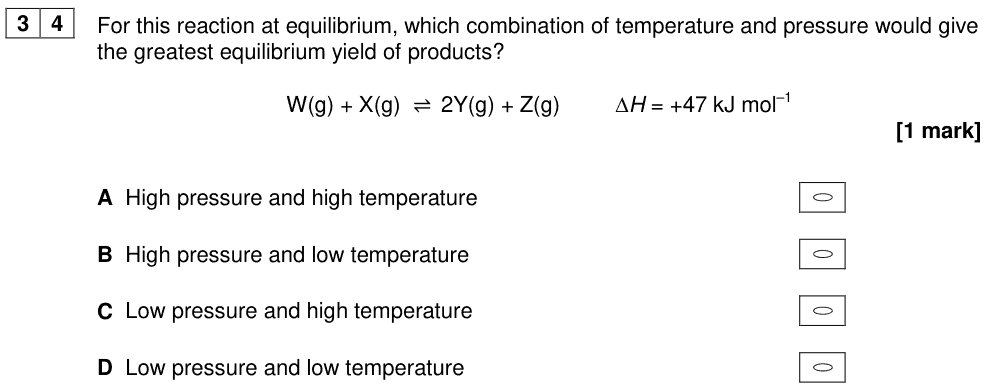
C
34 D was the commonest incorrect response, suggesting that the effect of pressure on equilibrium position was understood better than the effect of temperature. The success rate on the final question was 76.3%.
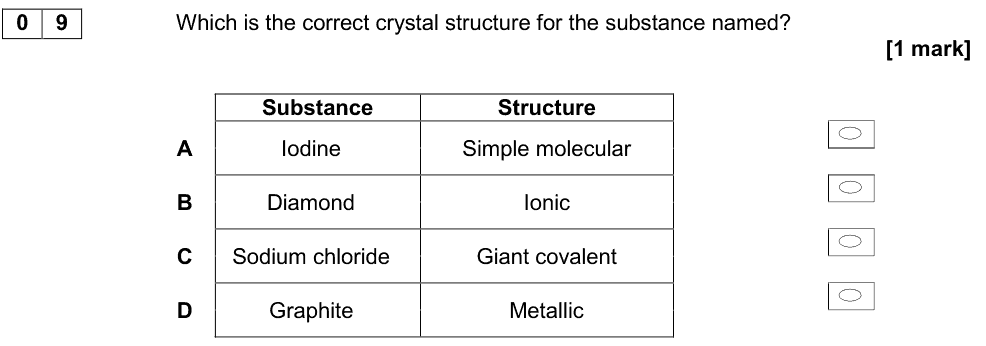
A
85.7% of students scored here on this straightforward question about structure and bonding.
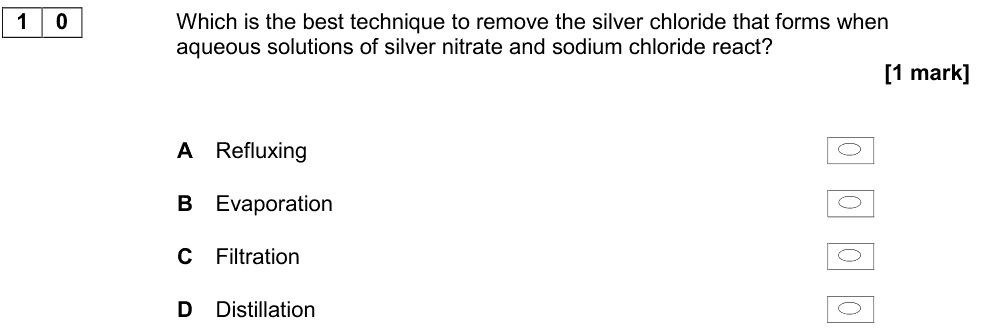
C
63.6% of students gained this mark. This proved to be a relatively easy practical question requiring little application of knowledge.
Skills: ATd Use laboratory apparatus for a variety of experimental techniques including: titration, using burette and pipette; distillation and heating under reflux, including setting up glassware using retort stand and clamps; qualitative tests for ions and organic functional groups; filtration, including use of fluted filter paper, or filtration under reduced pressure; PS4.1 Know and understand how to use a wide range of experimental and practical instruments, equipment and techniques appropriate to the knowledge and understanding included in the specification
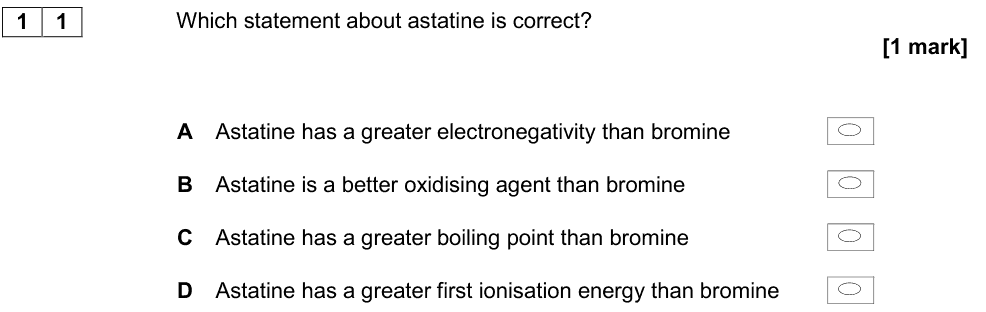
C
This mark was gained by 71.7% of students, showing that this is one of the easier physical property trends to remember.
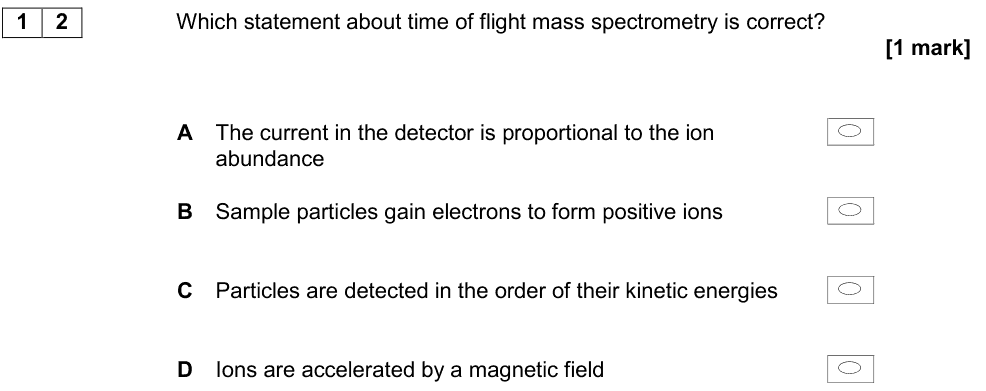
A
48.5% of students scored this mark; the most common wrong answer was D, showing that some students thought that a magnetic field is involved in TOF mass spectrometry.
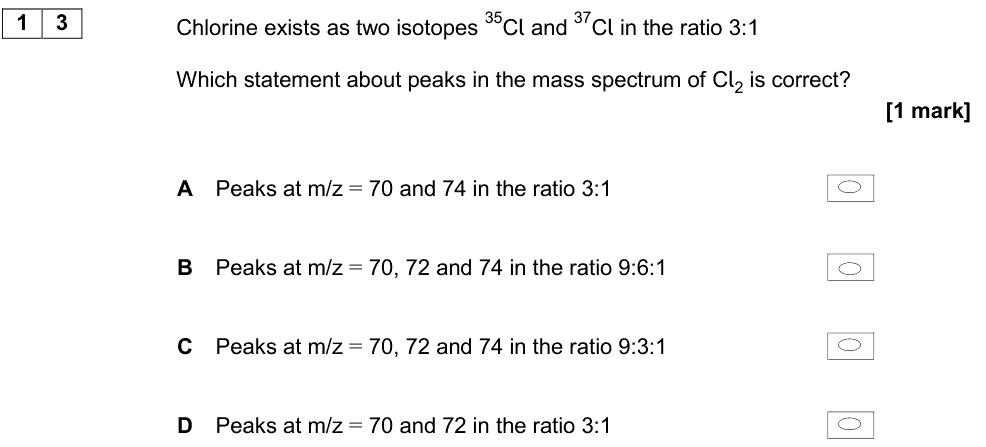
B
Only 26.2% of students selected the correct answer here, with all three distractors attracting significant numbers of students. Although this example is commonly taught, there are clearly not many students who can either remember the example or work out the probabilities for themselves.
Skills: MS0.2 Use ratios, fractions and percentages
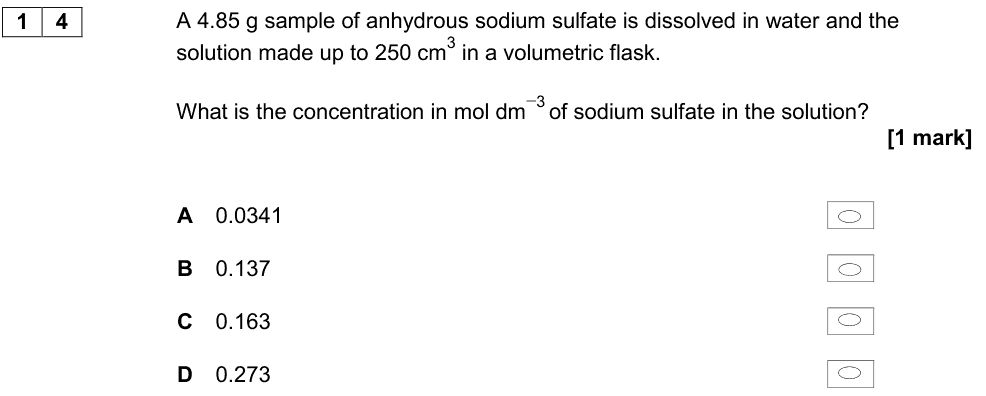
B
38.1% of students were successful. The most popular answer was C which shows that an incorrect formula (NaSO4) must have been used by these students.
Skills: MS0.0 Recognise and make use of appropriate units in calculation
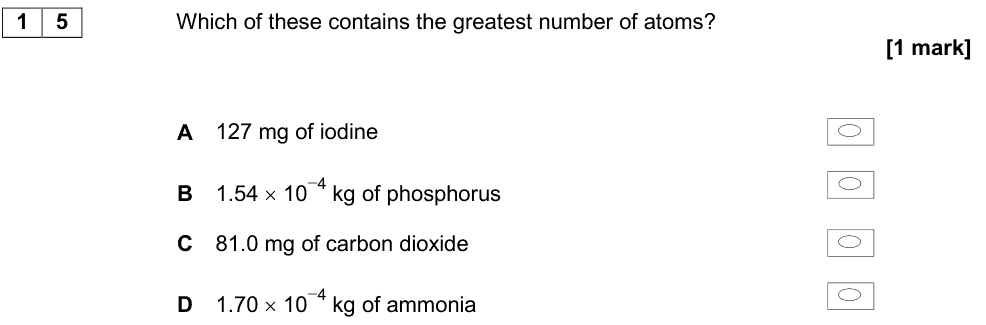
D
Although 47.7% of students gained this mark, all three distractors attracted significant numbers of students.
Skills: MS0.0 Recognise and make use of appropriate units in calculation; MS0.1 Recognise and use expressions in decimal and ordinary form
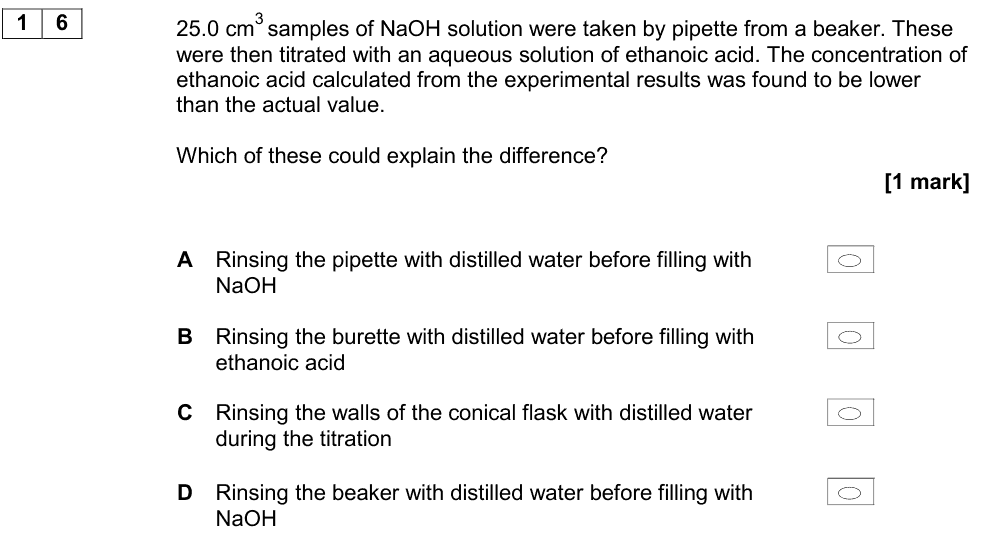
B
42.3% of students selected the correct answer. Most of the other students chose C – rinsing the walls of the conical flask with water. This is a common misconception and is clearly not well understood.
Skills: PS2.1 Comment on experimental design and evaluate scientific methods; PS2.3 Evaluate results and draw conclusions with reference to measurement uncertainties and errors; ATd Use laboratory apparatus for a variety of experimental techniques including: titration, using burette and pipette; distillation and heating under reflux, including setting up glassware using retort stand and clamps; qualitative tests for ions and organic functional groups; filtration, including use of fluted filter paper, or filtration under reduced pressure; RP1 Make up a volumetric solution and carry out a simple acid–base titration
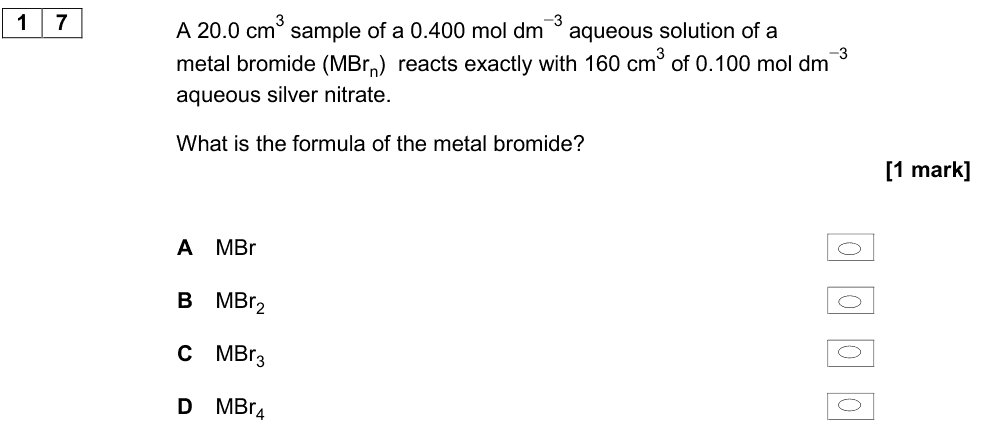
B
A pleasing 66% of students could perform this relatively tricky calculation.
Skills: MS0.2 Use ratios, fractions and percentages
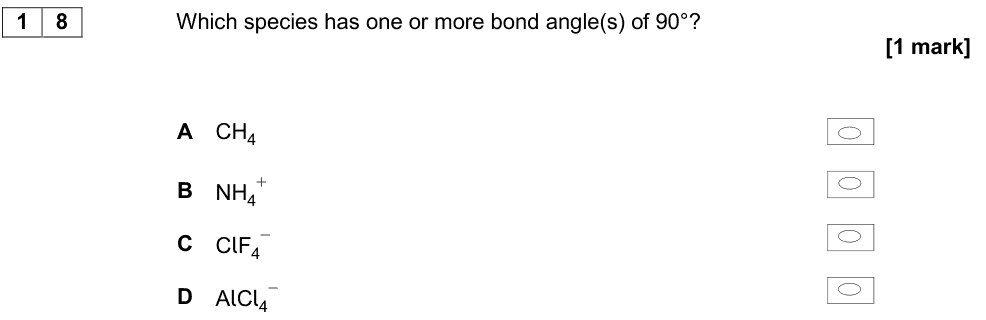
C
Although 55.5% of students got this correct, a surprising number thought that methane (A) has a 90º bond angle – it was the most popular distractor.
Skills: MS4.1 Use angles and shapes in regular 2D and 3D structures
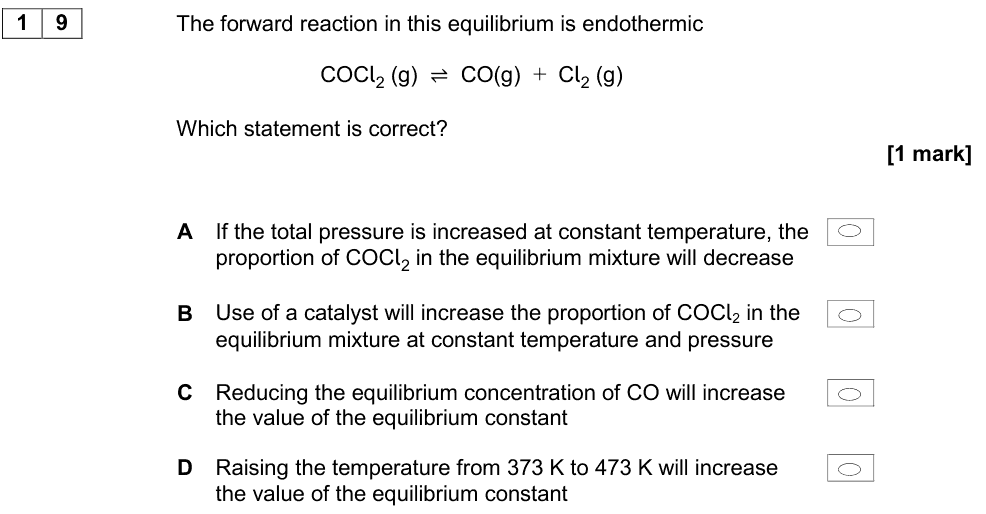
D
Students showed a good understanding of qualitative equilibrium ideas, with 64% gaining this mark.
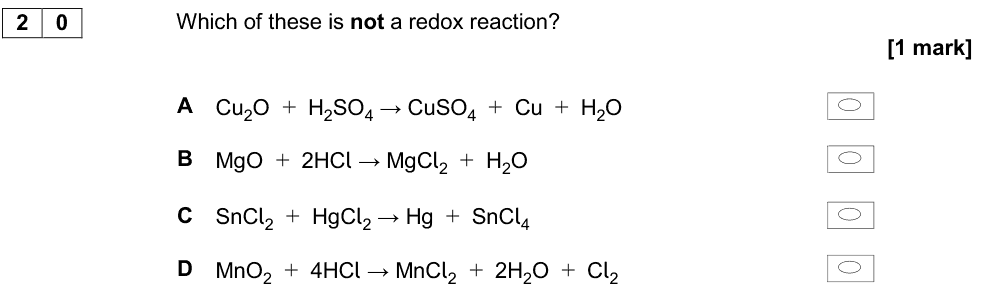
B
Although 47.8% of students scored here, the three distractors all drew significant attention.
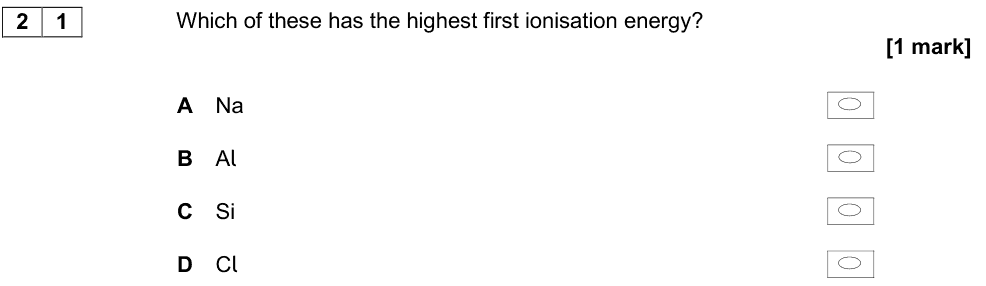
D
69% of students scored this mark.
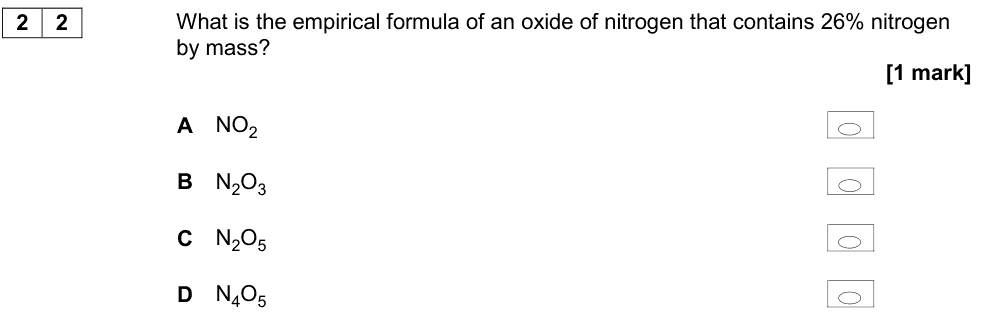
C
66.4% of students performed this calculation correctly.
Skills: MS0.2 Use ratios, fractions and percentages
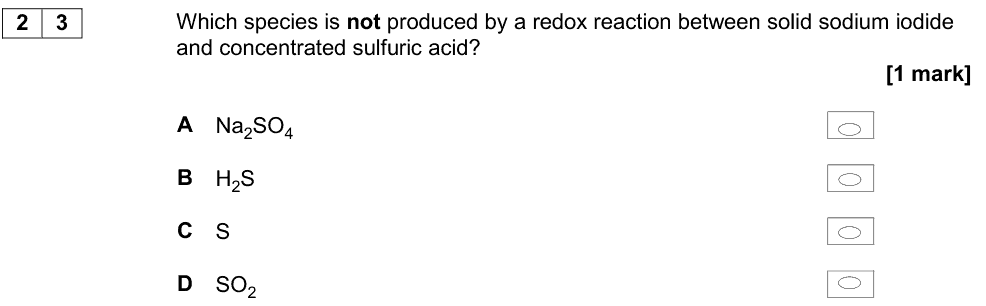
A
Only 42.2% of students selected the correct answer. Perhaps many students did not appreciate that a range of sulfur-based products are formed in the reaction.
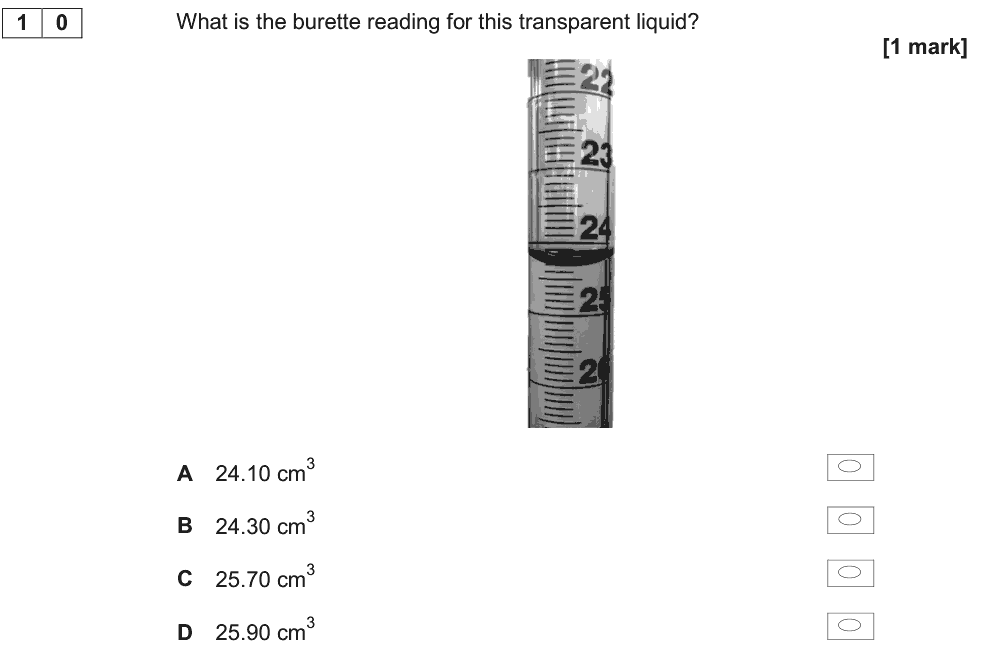
B
Most students (77%) read the burette correctly, but a significant number read the scale upside- down to get 25.70 cm3 rather than 24.30 cm3.
Skills: ATd Use laboratory apparatus for a variety of experimental techniques including: titration, using burette and pipette; distillation and heating under reflux, including setting up glassware using retort stand and clamps; qualitative tests for ions and organic functional groups; filtration, including use of fluted filter paper, or filtration under reduced pressure; PS4.1 Know and understand how to use a wide range of experimental and practical instruments, equipment and techniques appropriate to the knowledge and understanding included in the specification; RP1 Make up a volumetric solution and carry out a simple acid–base titration
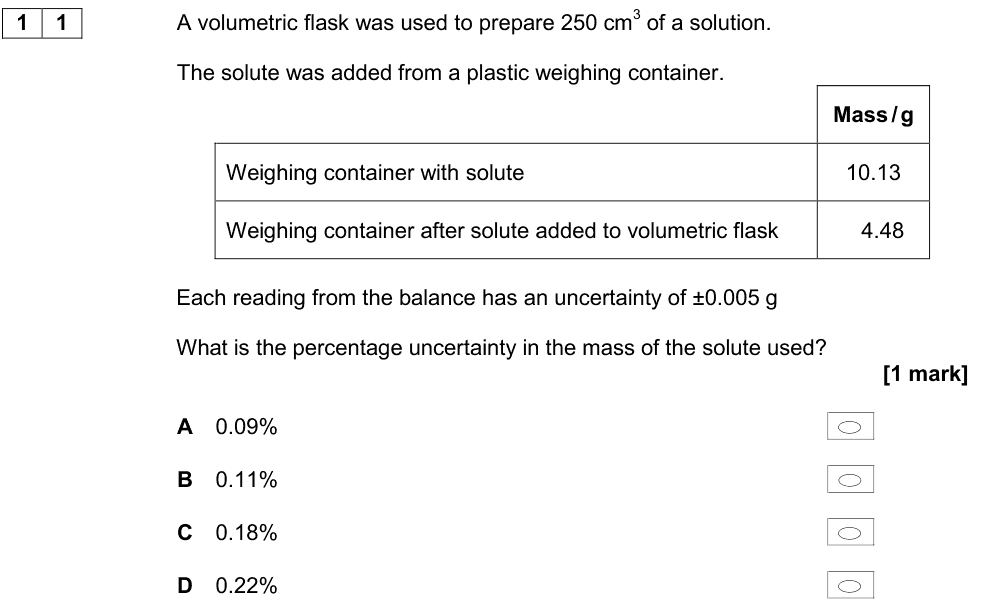
C
Students struggled with this question (30.2% correct). Many did not appreciate that there are two uncertainties as two readings of the balance are taken to find a change in mass. Many did not realise that the uncertainty is with the mass of the solute itself.
Skills: MS1.3 Identify uncertainties in measurements and use simple techniques to determine uncertainty when data are combined; PS3.3 Consider margins of error, accuracy and precision of data; ATa Use appropriate apparatus to record a range of measurements (to include mass, time, volume of liquids and gases, temperature); RP1 Make up a volumetric solution and carry out a simple acid–base titration
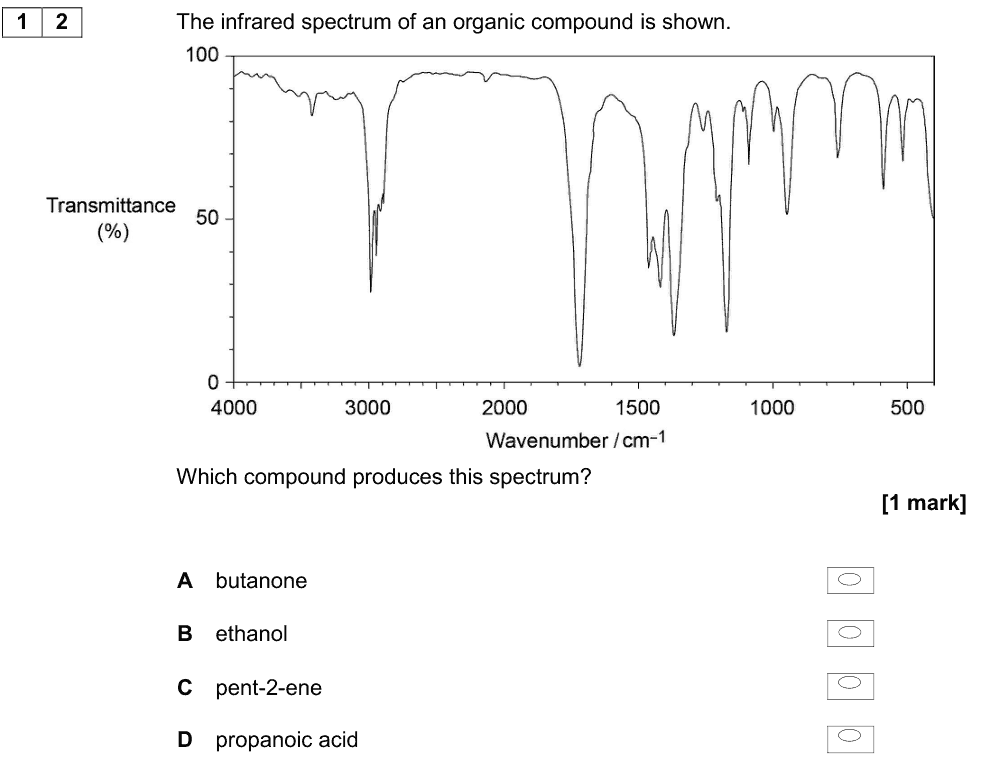
A
Many students thought the spectrum represented a carboxylic acid rather than a ketone, even though there is no sign of an acid O-H peak at all. 42.3% of students gained the mark.
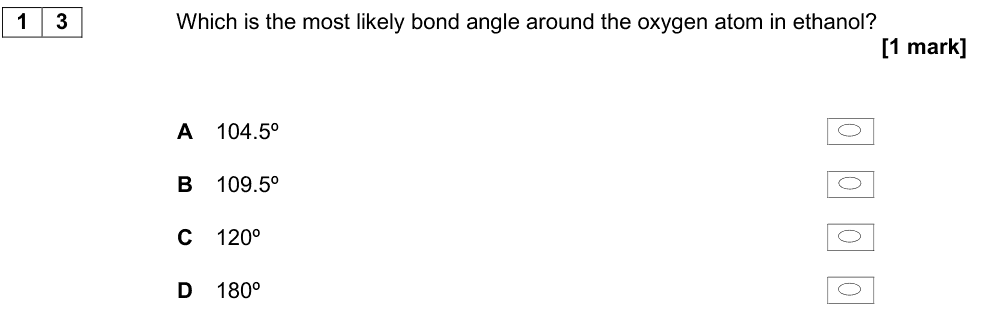
A
Many students (45%) could suggest the most likely bond angle around the oxygen atom in ethanol.
Skills: MS4.1 Use angles and shapes in regular 2D and 3D structures
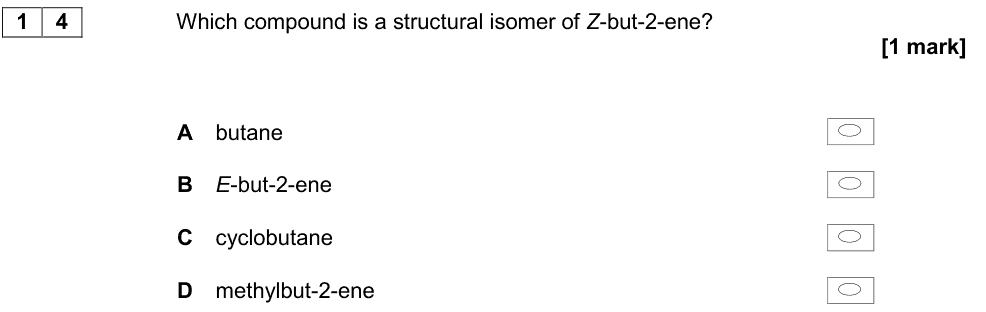
C
Many students (48%) got this correct, but many incorrectly thought that E-but-2-ene is a structural isomer of Z-but-2-ene.
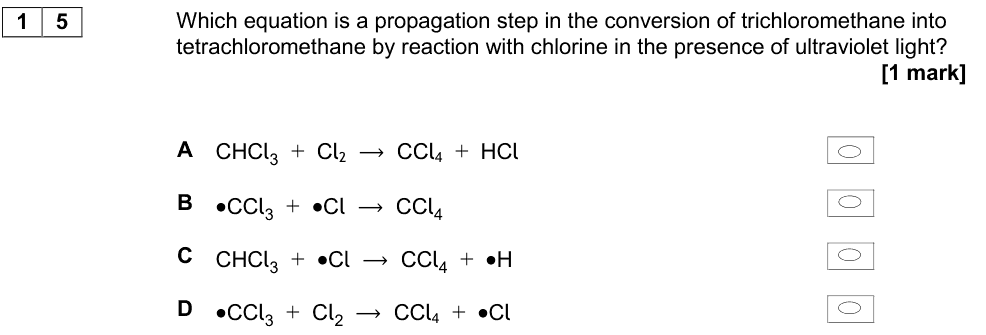
D
This was answered well with a high proportion of the students (68.8%) scoring the mark.
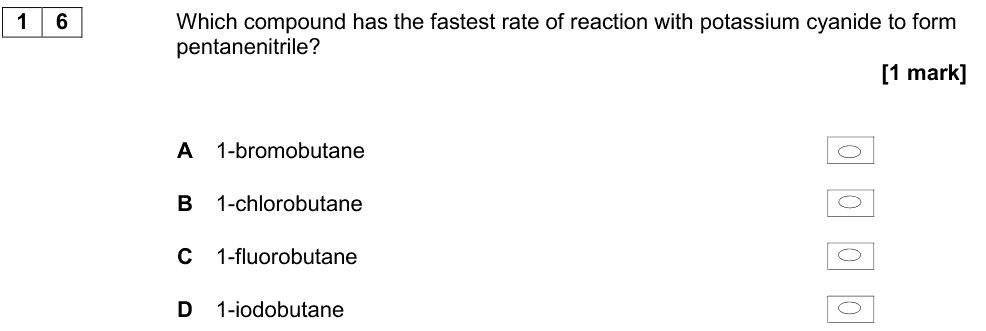
D
Many students (58.4%) got this question correct but many incorrectly believed that the fluoroalkane would react fastest.
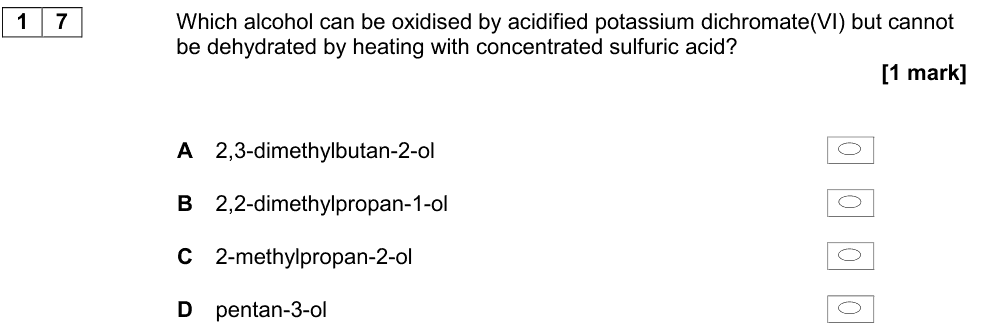
B
A good number of students (41.3%) could work out which alcohol could be oxidised but not dehydrated, but many could not – possibly due to a lack of appreciation of the need for the presence of a hydrogen atom on the carbon atom adjacent to the carbon with the alcohol group.
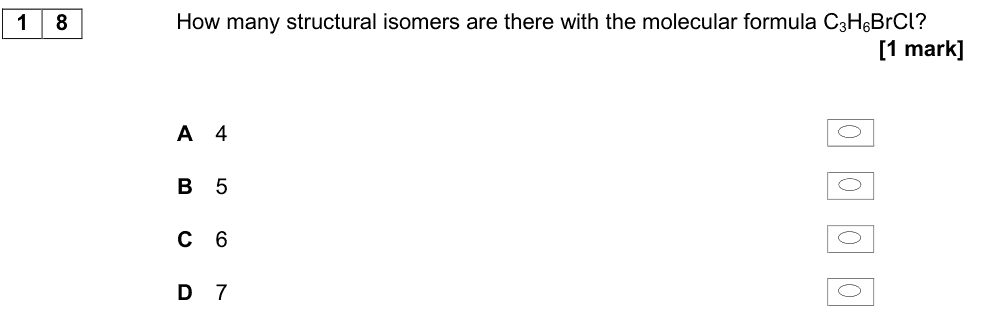
B
A minority of students (31.9%) scored this mark, with many incorrectly thinking there were one more or one fewer isomers than there actually were. Students are encouraged to take a systematic approach to deducing all possible structures.
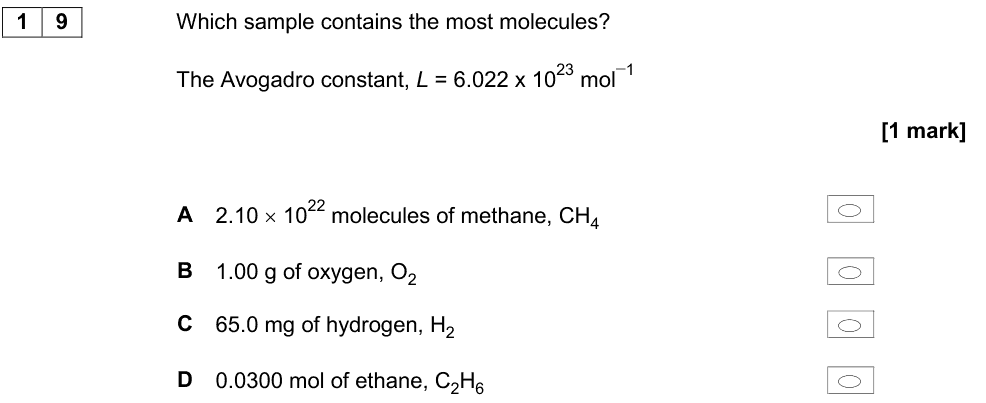
A
Students found this question challenging (38.8% correct), possibly from a lack of familiarity with using the Avogadro constant.
Skills: MS0.1 Recognise and use expressions in decimal and ordinary form
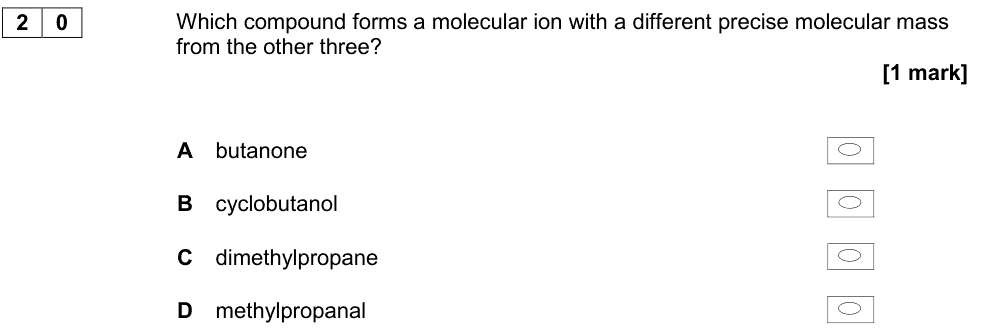
C
Students also found this question challenging (41.8% correct), with many failing to appreciate that only one molecule did not contain any oxygen and so must have a different value from the others.
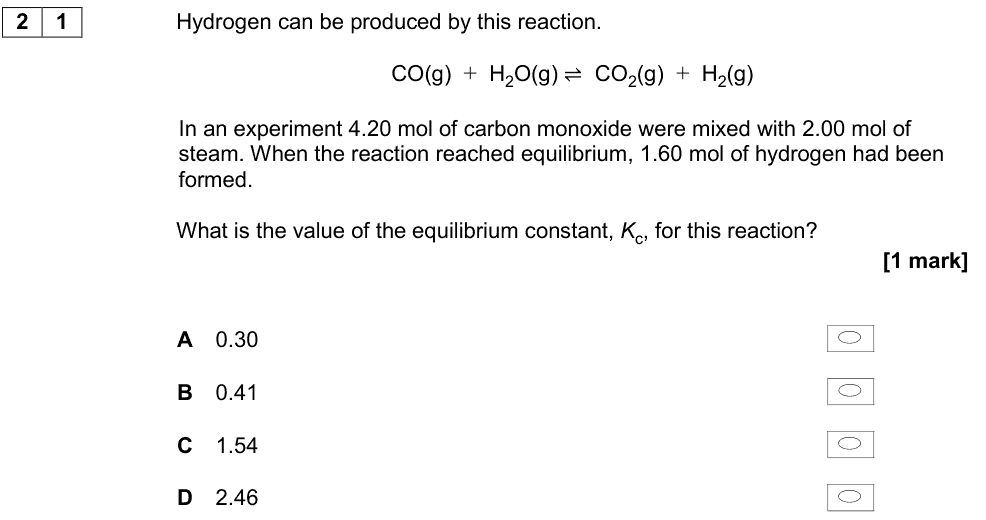
D
This question was also a challenge to many students (42.1% correct) and they are urged to take a systematic approach to deducing the amount in moles of species present in an equilibrium mixture.
Skills: MS0.2 Use ratios, fractions and percentages
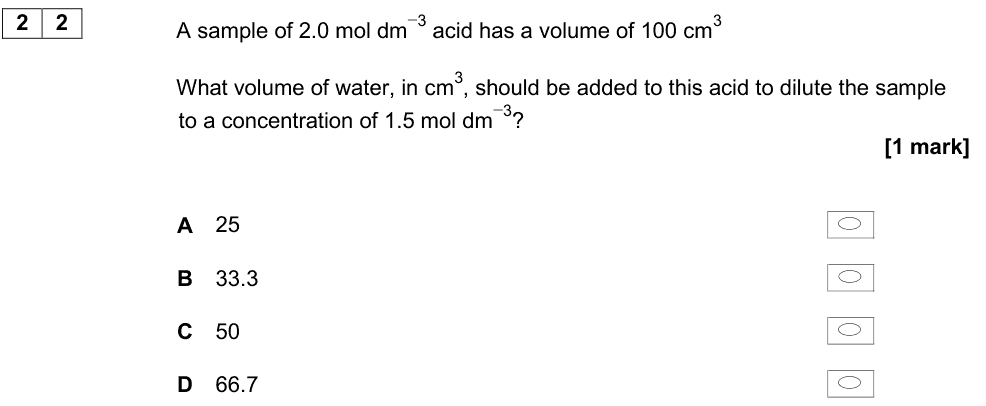
B
Nearly half of the students (44.8%) could do this, but many could not work out how much water to add to a solution to dilute it by a specific factor.
Skills: MS0.2 Use ratios, fractions and percentages
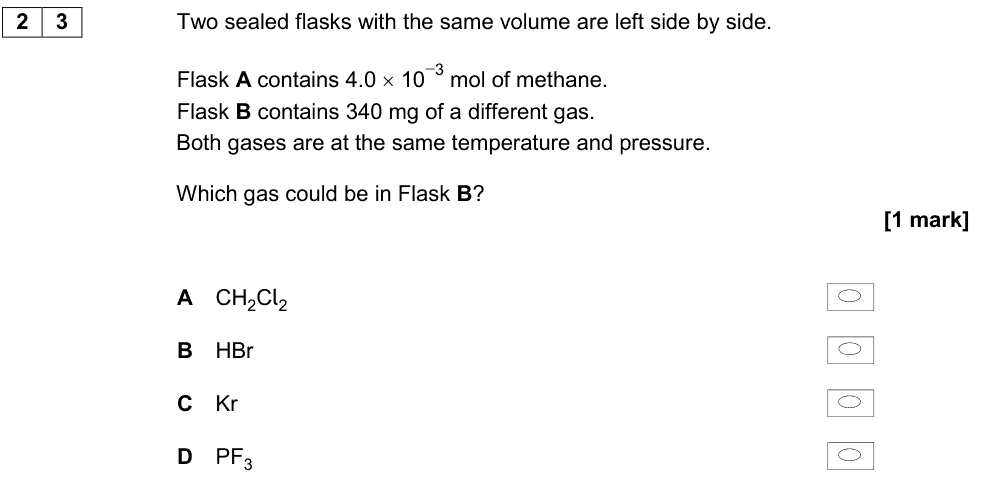
A
A good proportion of students (43.8%) could do this, but many may not have appreciated that the two identical flasks at the same temperature and pressure will contain the same number of gaseous molecules.
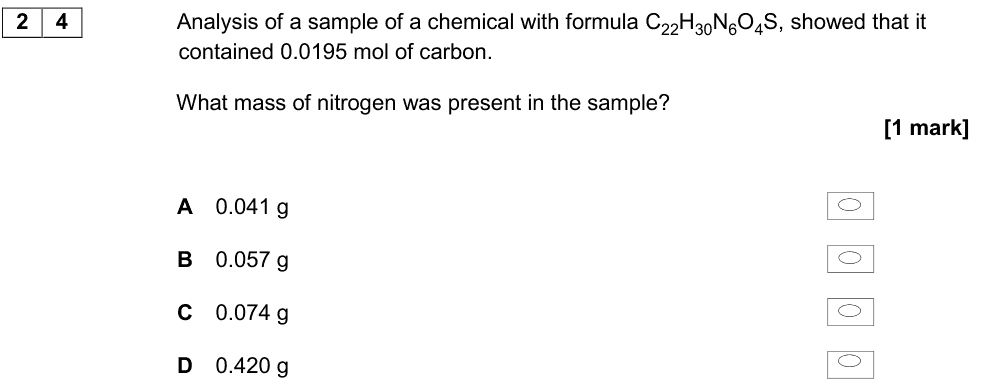
C
There was no evidence that students were short of time on this calculation at the end of the paper and a good number (41.8%) completed it successfully.
Skills: MS0.2 Use ratios, fractions and percentages
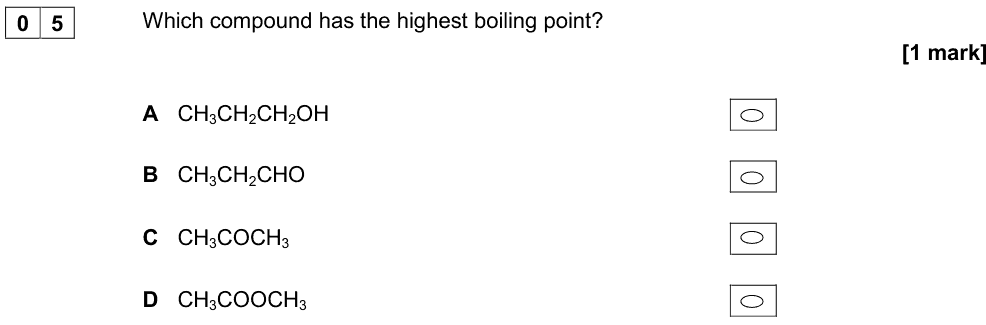
A
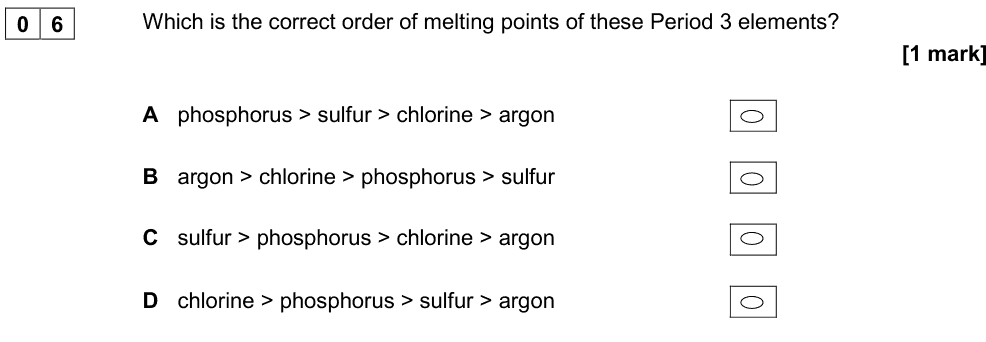
C
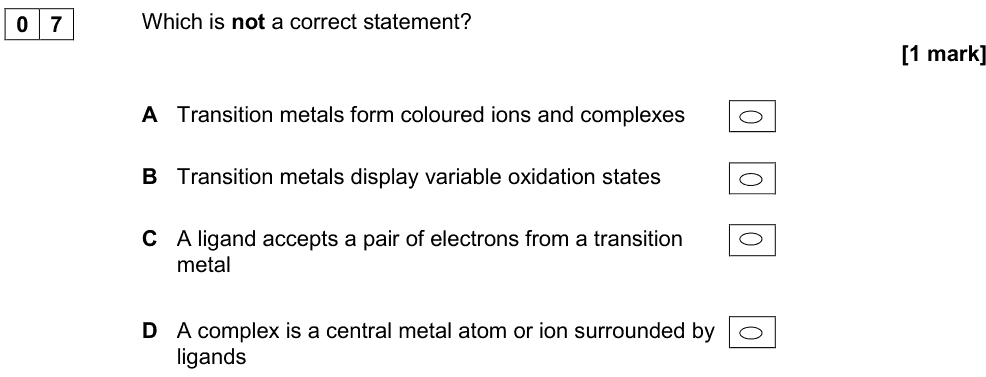
C
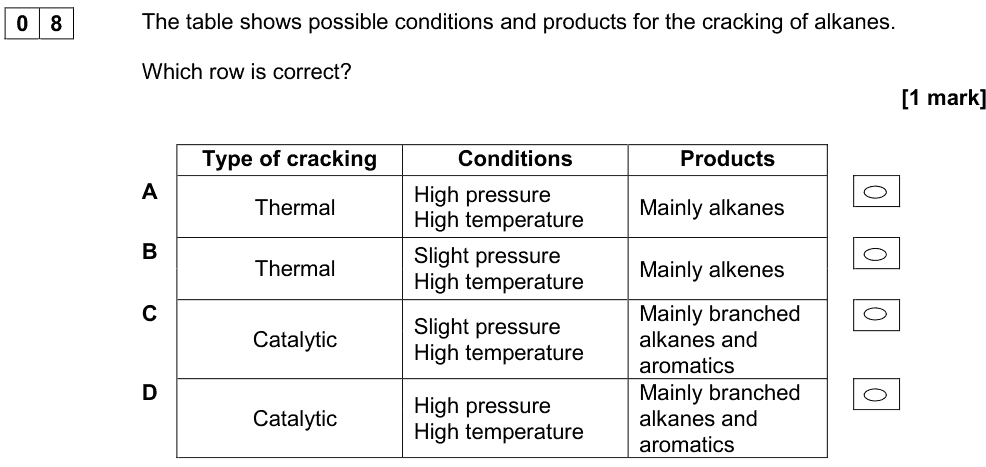
C
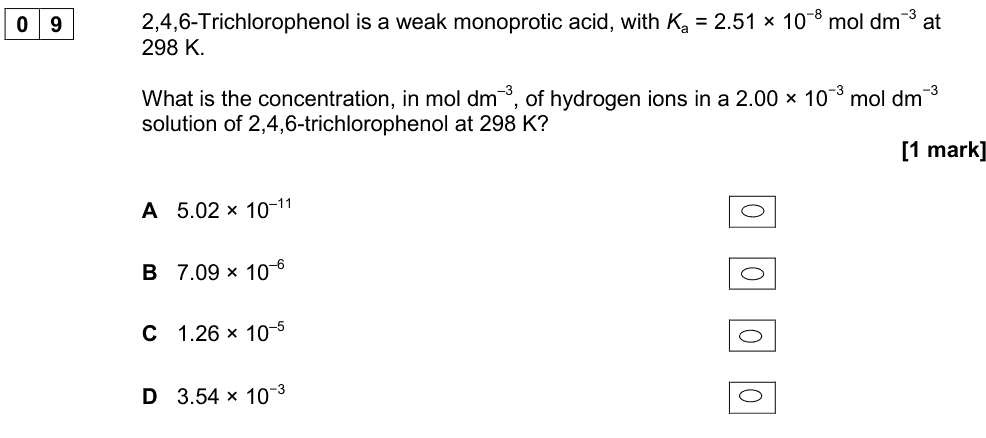
B
Skills: MS0.1 Recognise and use expressions in decimal and ordinary form; MS2.2 Change the subject of an equation
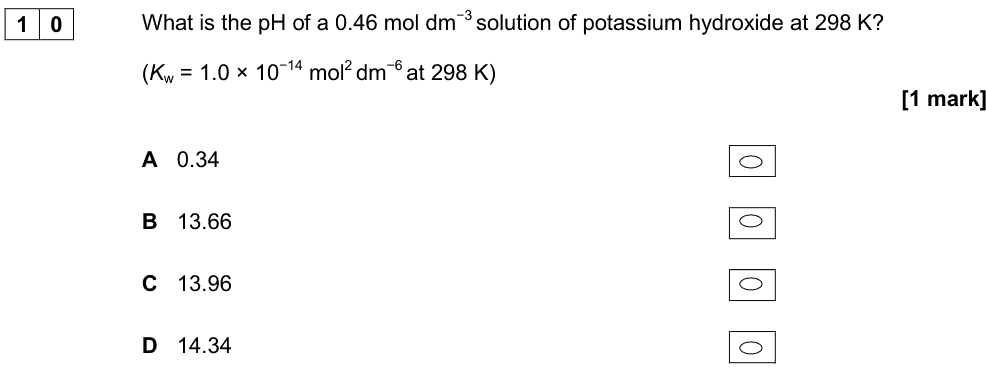
B
Skills: MS0.4 Use calculators to find and use power, exponential and logarithmic functions; MS2.5 Use logarithms in relation to quantities that range over several orders of magnitude
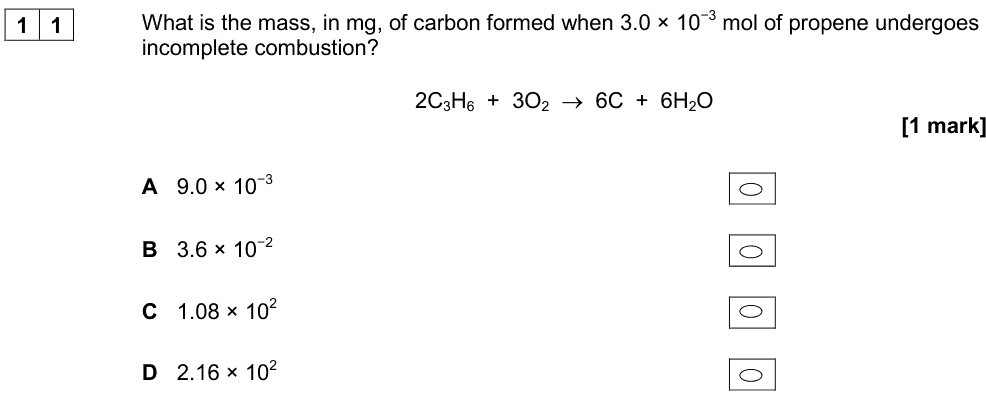
C
Skills: MS0.0 Recognise and make use of appropriate units in calculation; MS0.1 Recognise and use expressions in decimal and ordinary form; MS0.2 Use ratios, fractions and percentages
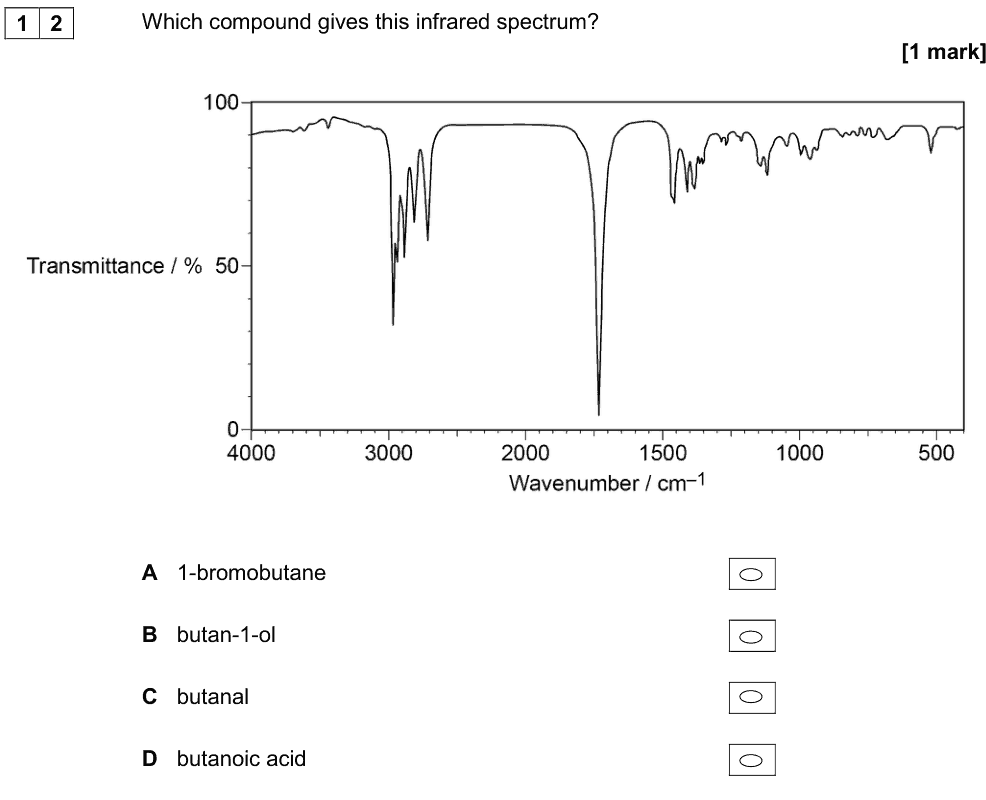
C
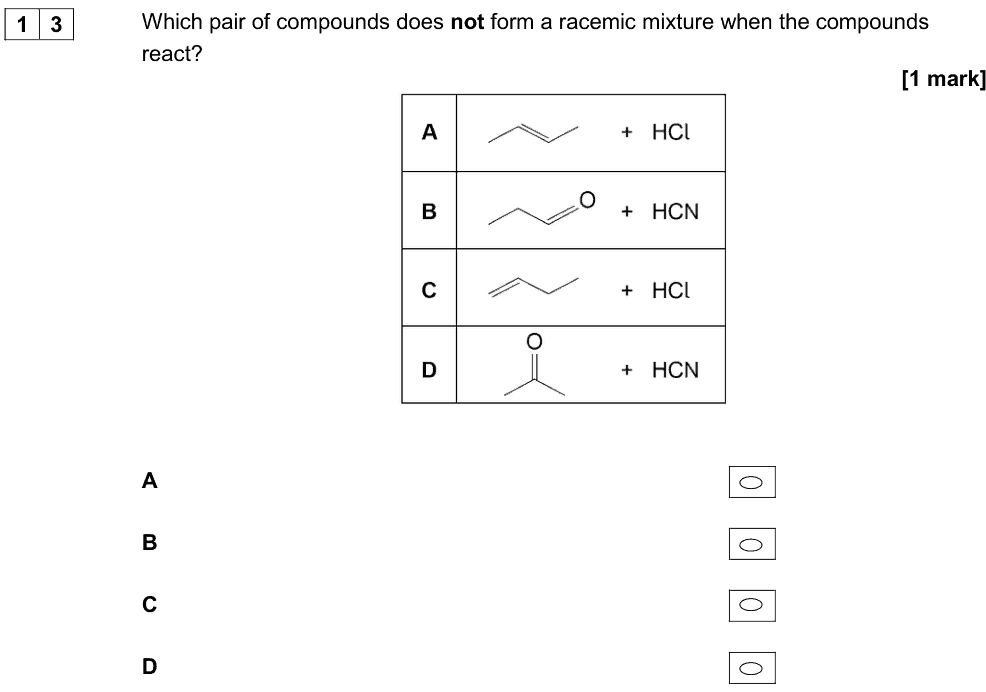
D
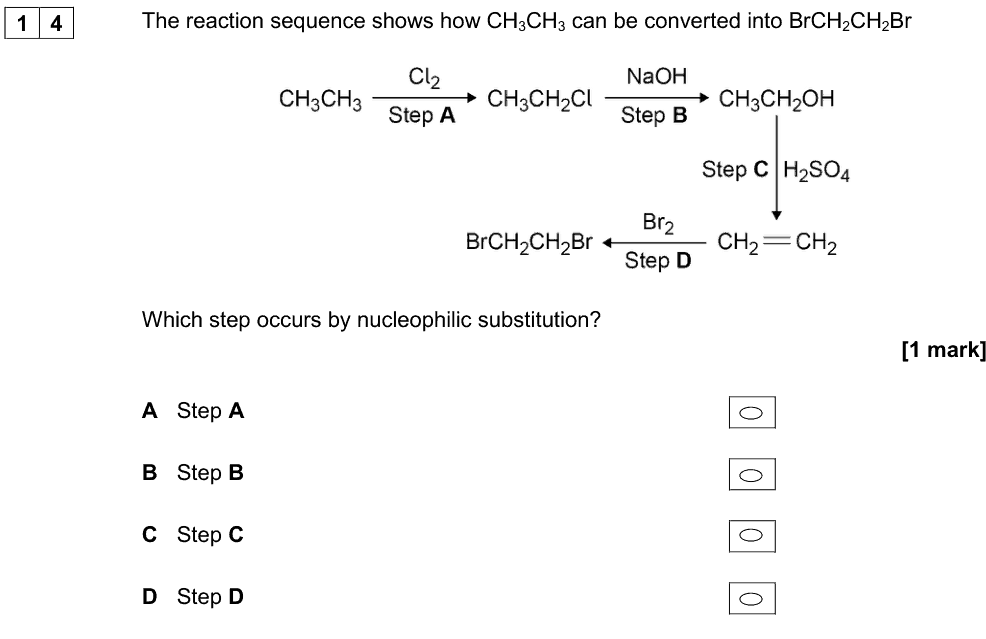
B
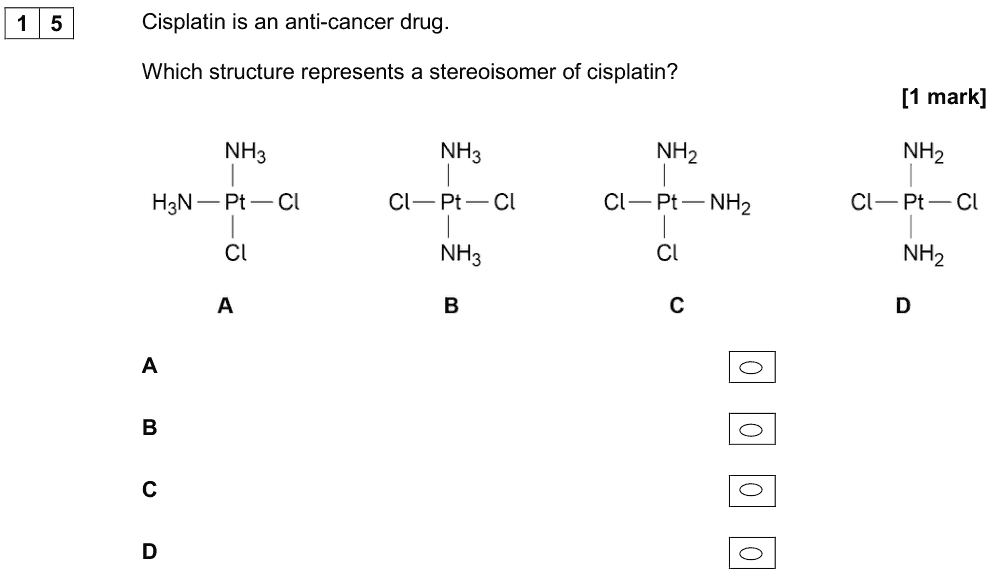
B
Skills: MS4.2 Visualise and represent 2D and 3D forms including two-dimensional representations of 3D objects
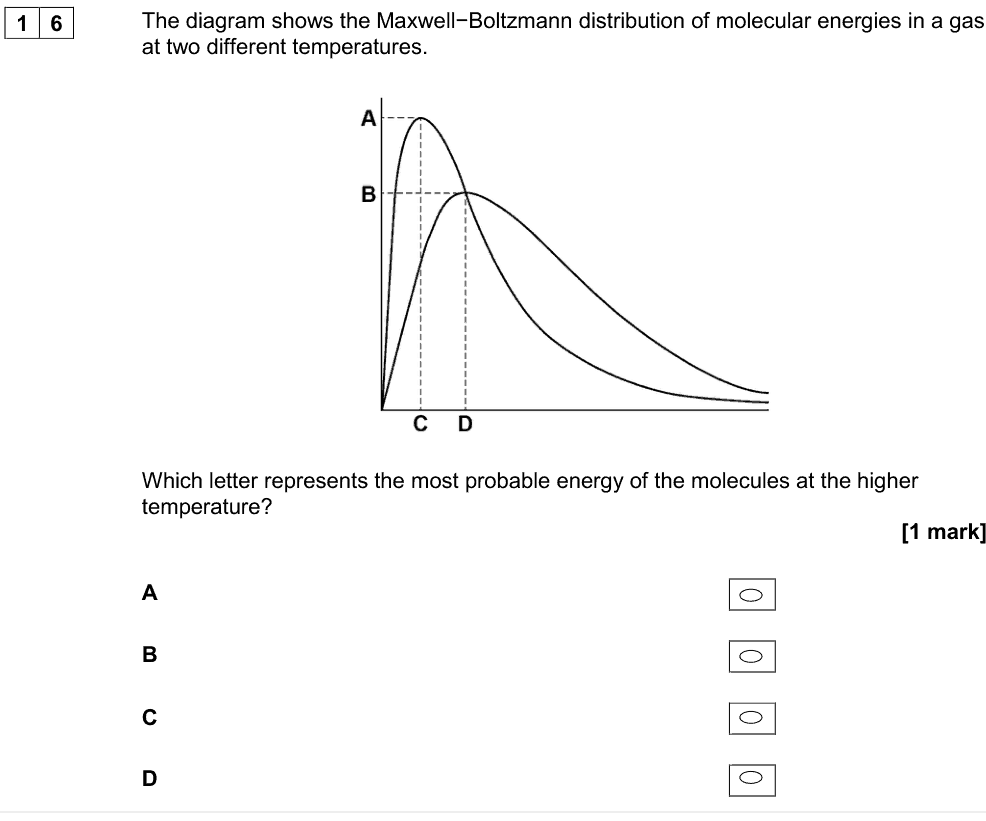
D
Skills: MS3.1 Translate information between graphical, numerical and algebraic forms
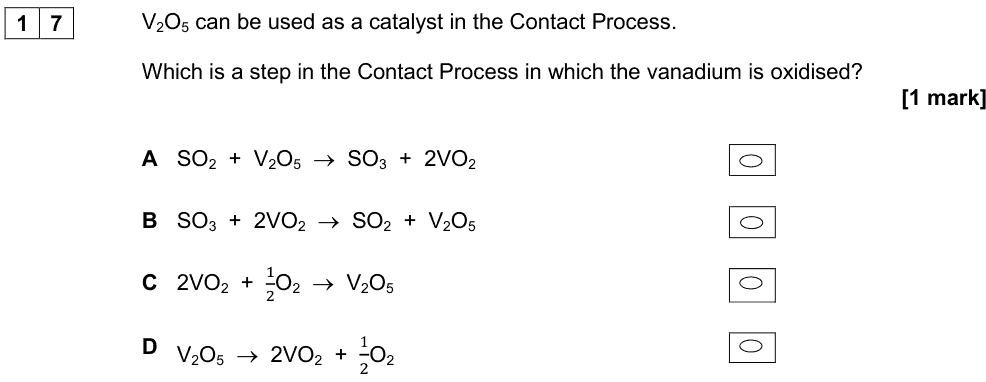
C
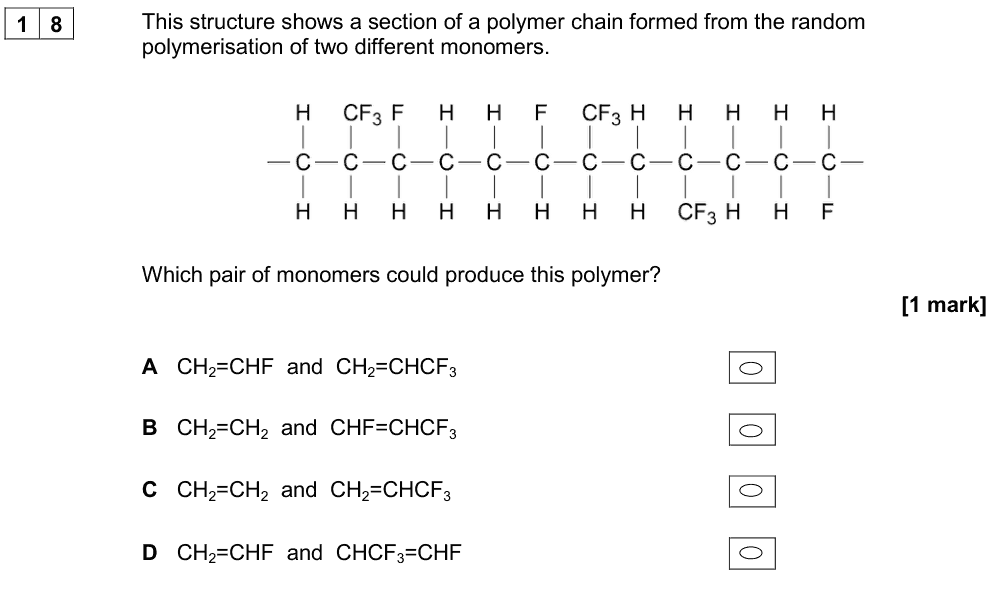
A
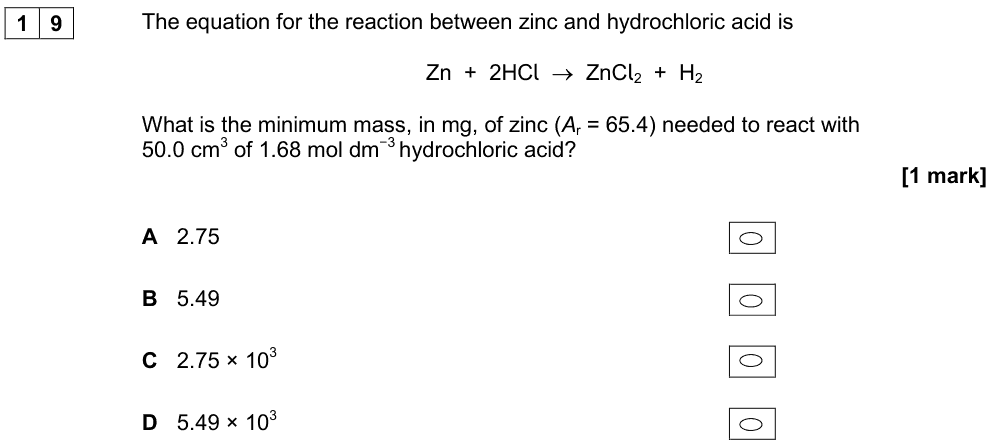
C
Skills: MS0.0 Recognise and make use of appropriate units in calculation; MS0.2 Use ratios, fractions and percentages
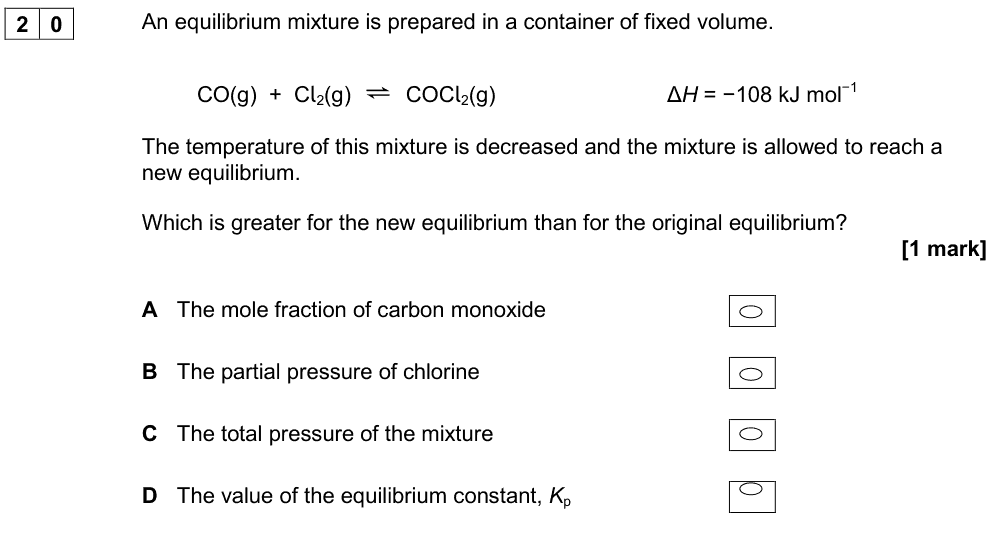
D
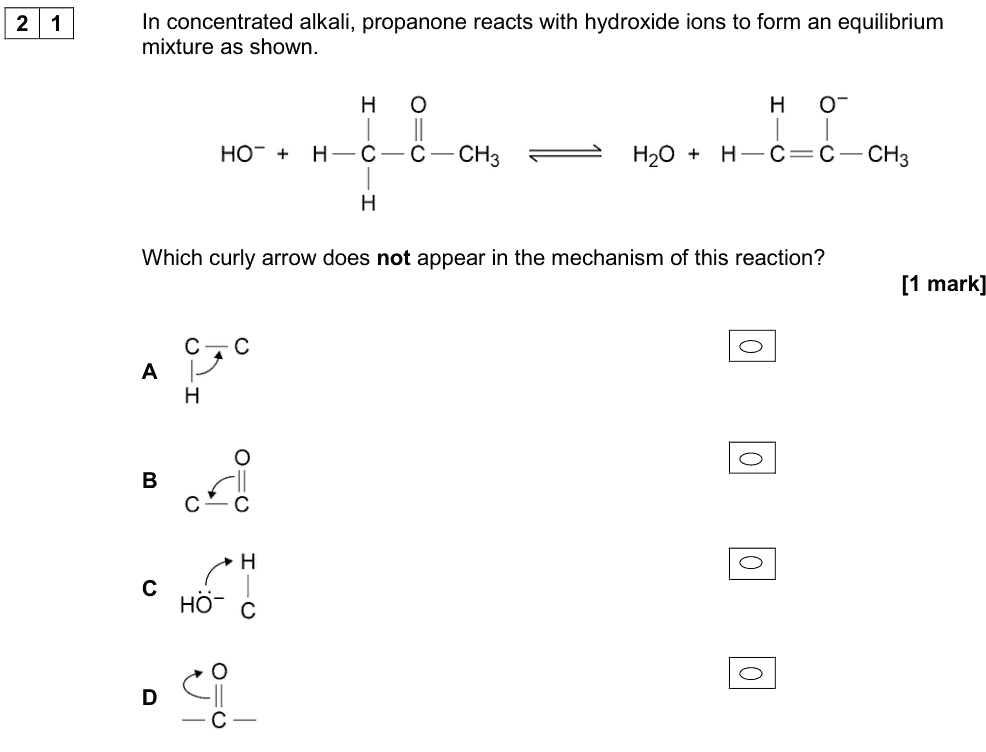
B
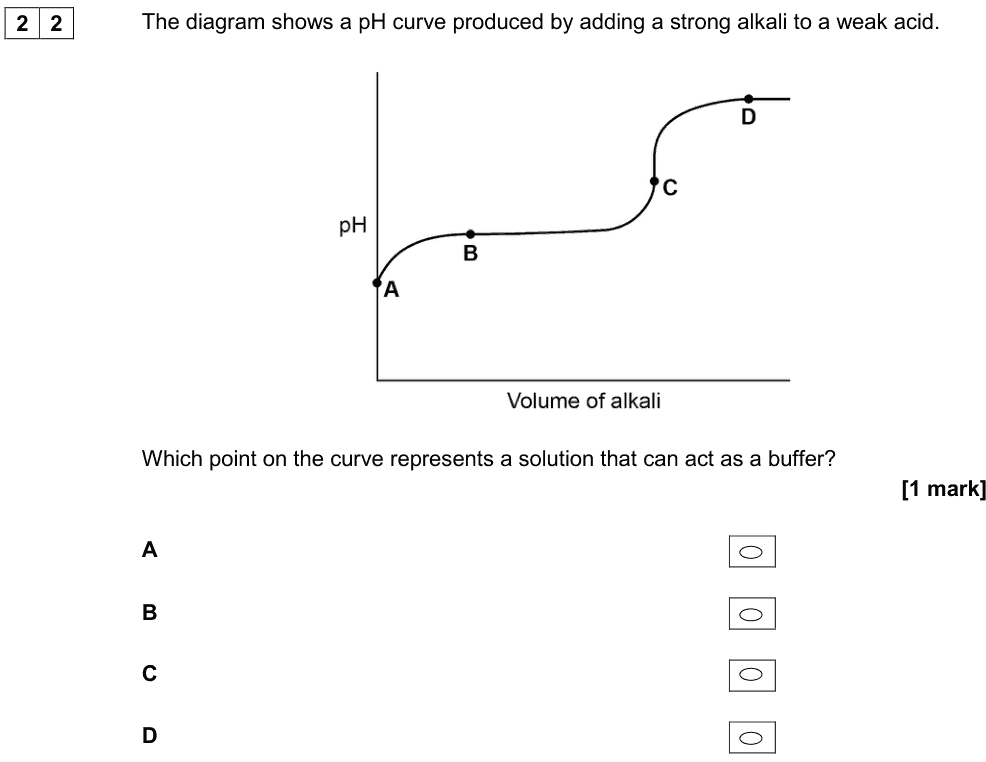
B
Skills: MS3.1 Translate information between graphical, numerical and algebraic forms
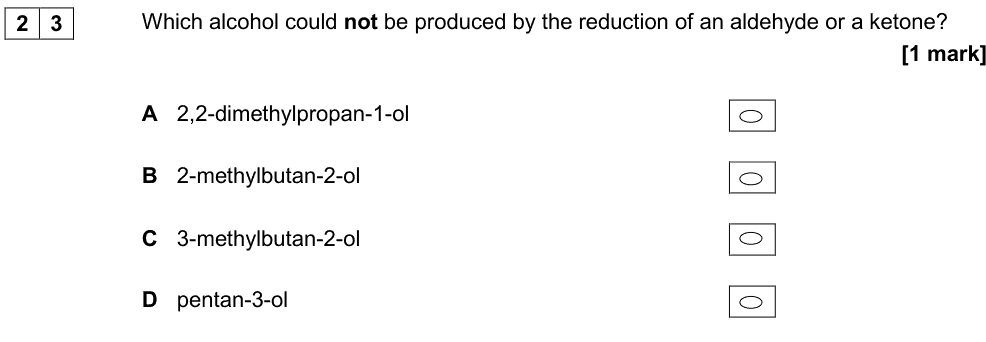
B
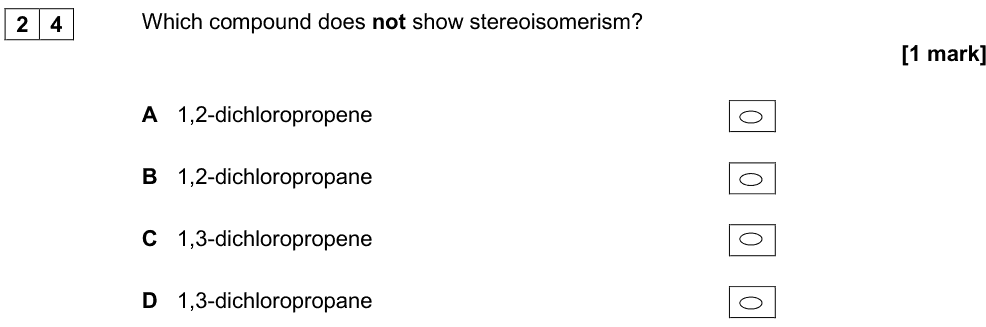
D
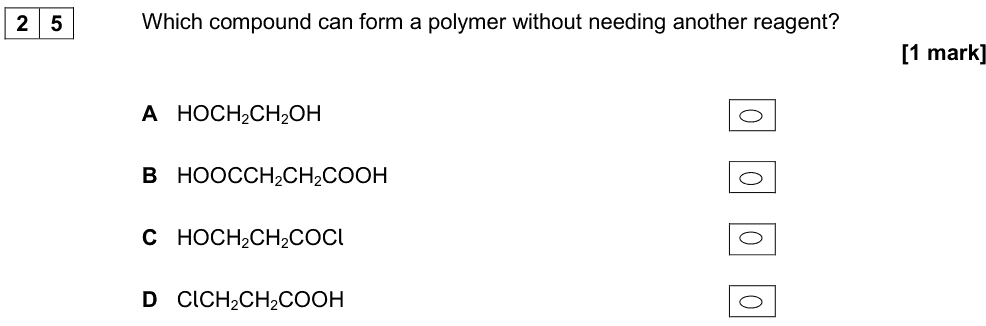
C
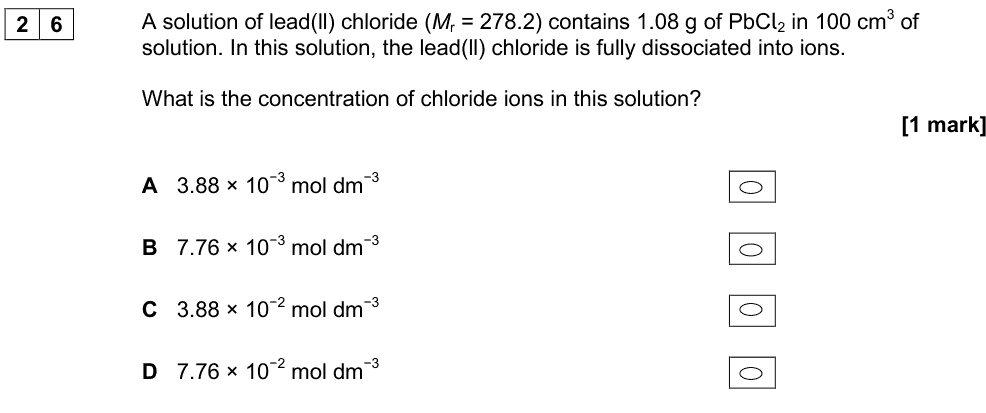
D
Skills: MS0.0 Recognise and make use of appropriate units in calculation; MS0.2 Use ratios, fractions and percentages
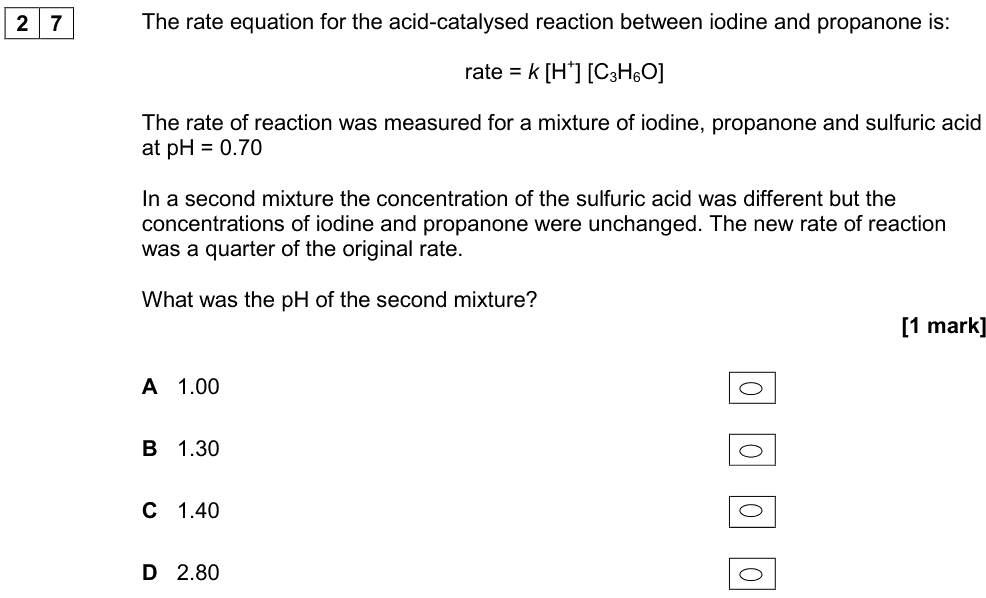
B
Skills: MS0.4 Use calculators to find and use power, exponential and logarithmic functions; MS2.5 Use logarithms in relation to quantities that range over several orders of magnitude
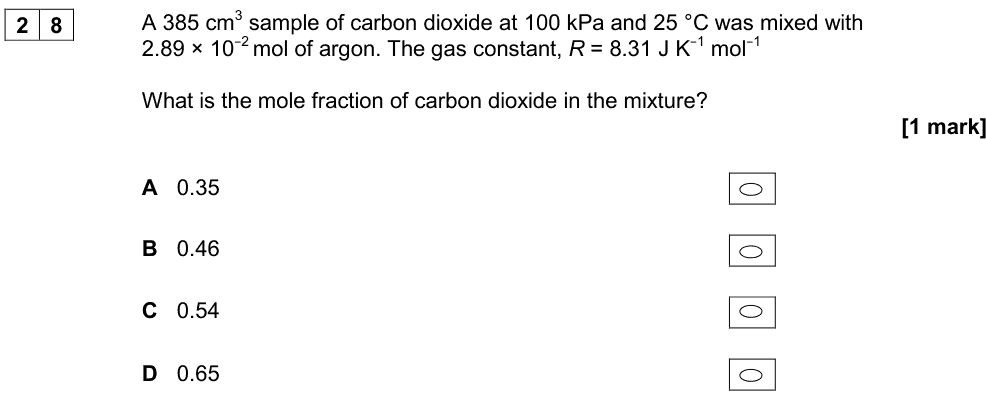
A
Skills: MS0.0 Recognise and make use of appropriate units in calculation; MS0.2 Use ratios, fractions and percentages; MS2.2 Change the subject of an equation
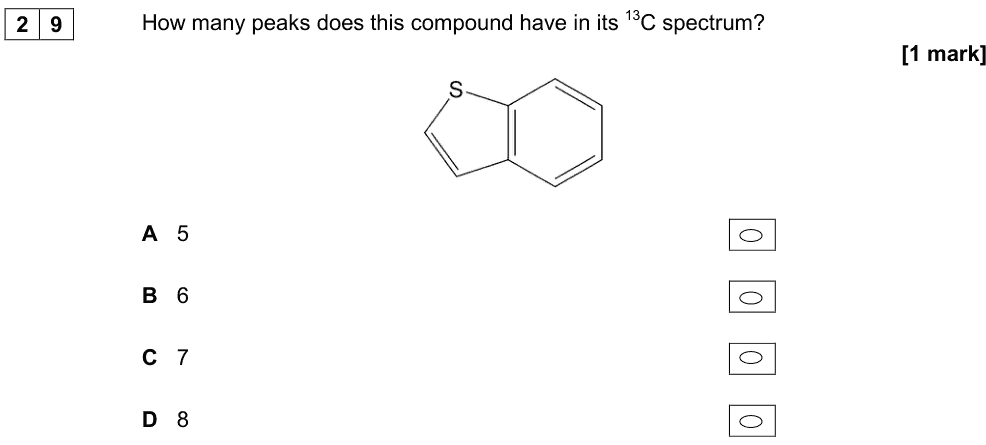
D
Skills: MS4.3 Understand the symmetry of 2D and 3D shapes
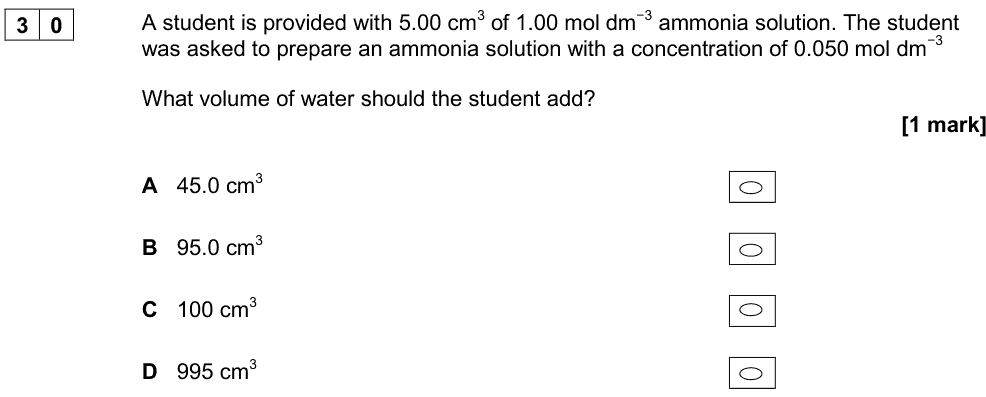
B
Skills: MS0.2 Use ratios, fractions and percentages
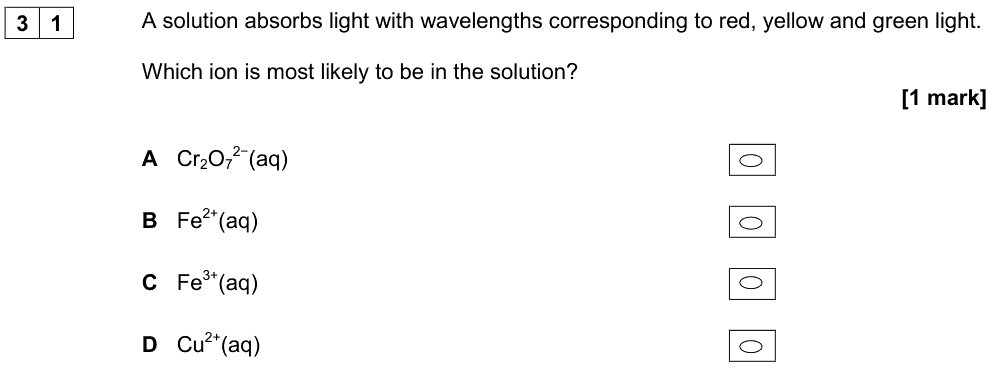
D
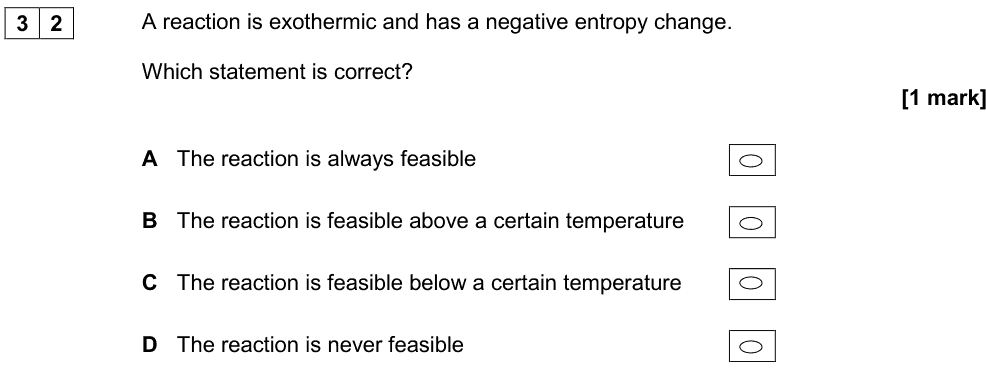
C
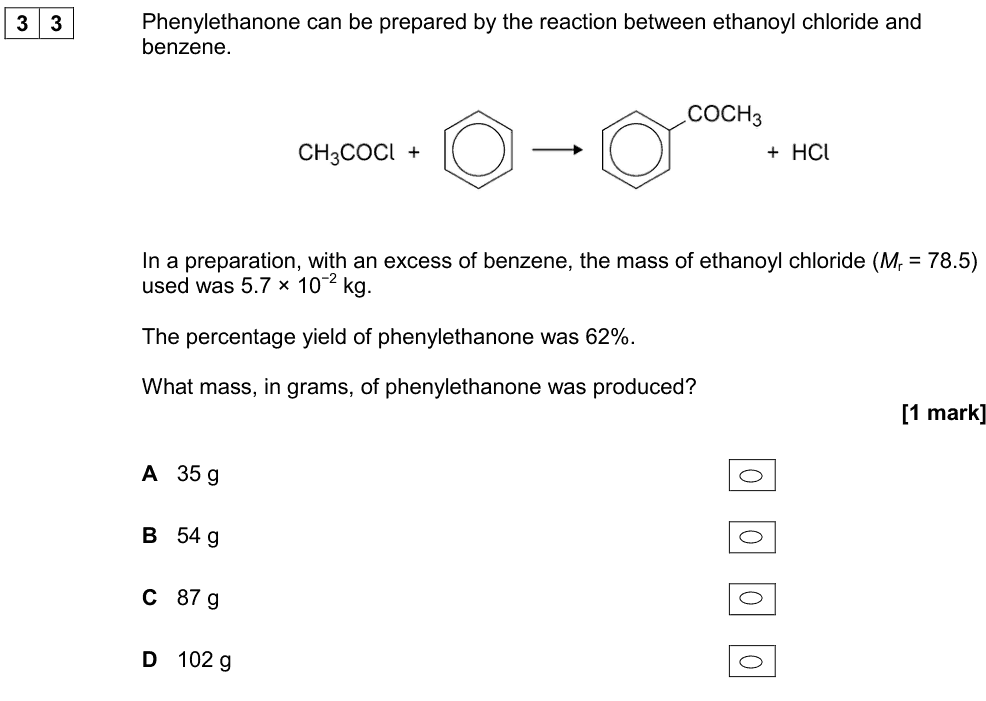
B
Skills: MS0.0 Recognise and make use of appropriate units in calculation; MS0.2 Use ratios, fractions and percentages
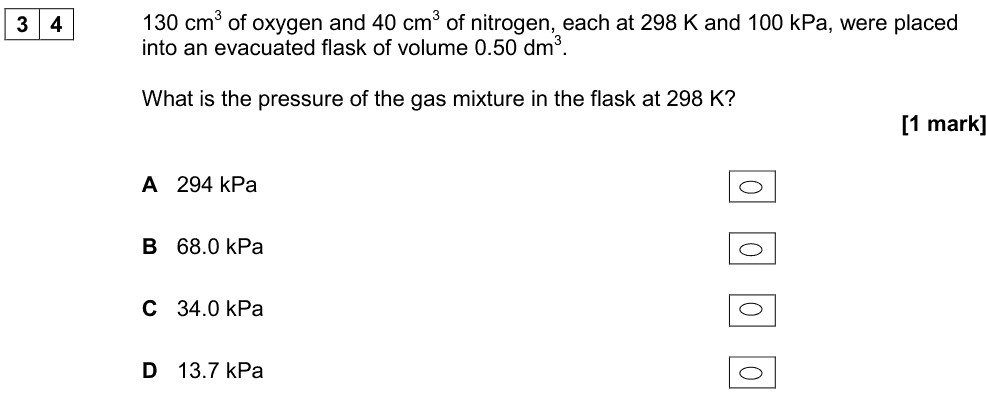
C
Skills: MS0.2 Use ratios, fractions and percentages; MS2.2 Change the subject of an equation
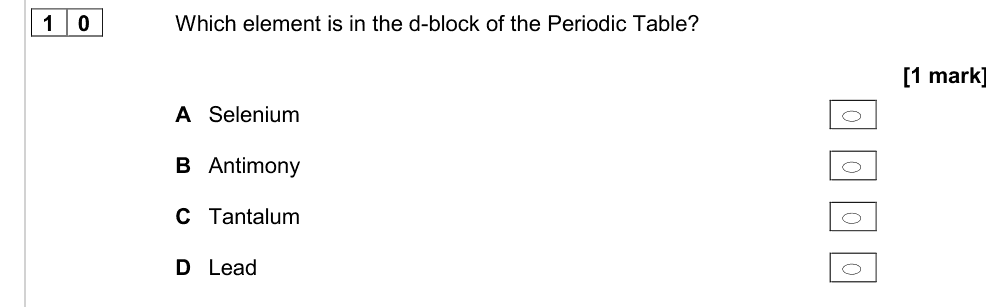
C
Questions 10-24 Multiple choice From this section of the paper items 10,11,15 and 18 were usually answered correctly. It was surprising to see that item 17 was answered poorly but it did give further evidence that redox ideas are not well understood by large numbers of students at this level. Item 20 proved difficult showing that the overall dipole possessed by a molecule clearly isn’t a well understood concept. Item 22 was also not answered correctly by most; this idea has not been tested often in the previous specification so students may not have had much prior experience of the type of question.
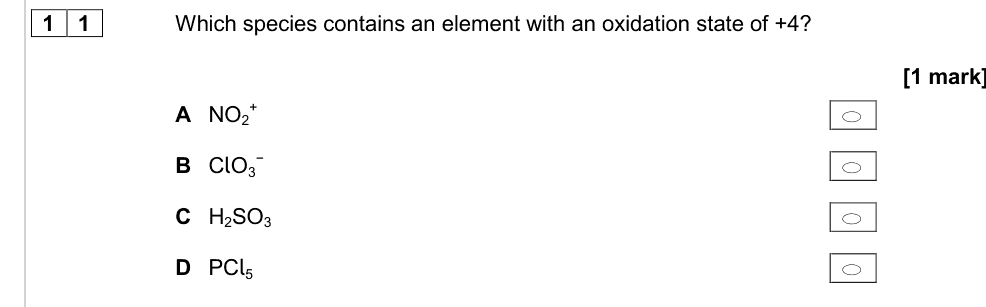
C
Questions 10-24 Multiple choice From this section of the paper items 10,11,15 and 18 were usually answered correctly. It was surprising to see that item 17 was answered poorly but it did give further evidence that redox ideas are not well understood by large numbers of students at this level. Item 20 proved difficult showing that the overall dipole possessed by a molecule clearly isn’t a well understood concept. Item 22 was also not answered correctly by most; this idea has not been tested often in the previous specification so students may not have had much prior experience of the type of question.
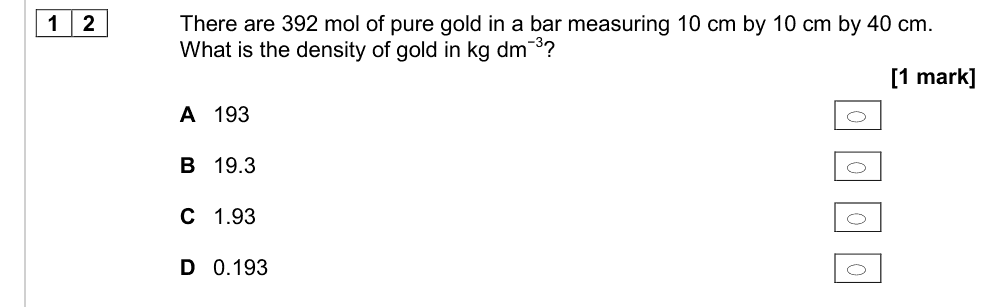
B
Skills: MS0.0 Recognise and make use of appropriate units in calculation; MS0.2 Use ratios, fractions and percentages
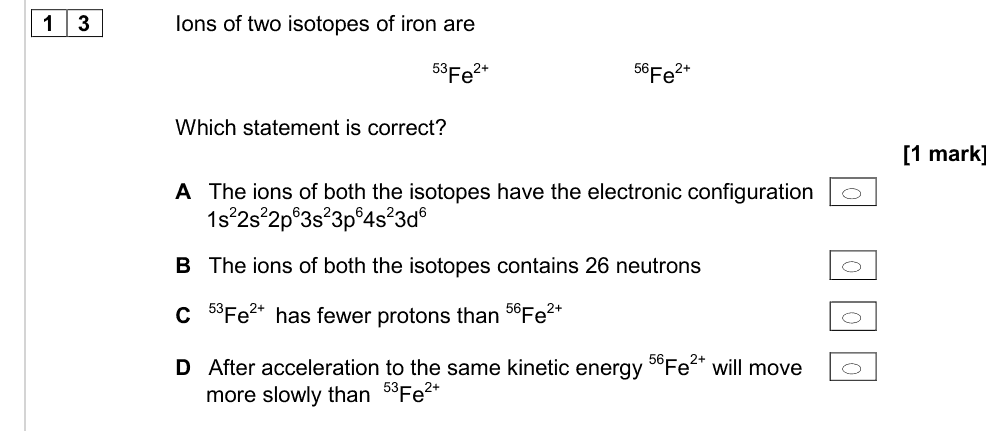
D
C
Skills: MS3.1 Translate information between graphical, numerical and algebraic forms
A
Questions 10-24 Multiple choice From this section of the paper items 10,11,15 and 18 were usually answered correctly. It was surprising to see that item 17 was answered poorly but it did give further evidence that redox ideas are not well understood by large numbers of students at this level. Item 20 proved difficult showing that the overall dipole possessed by a molecule clearly isn’t a well understood concept. Item 22 was also not answered correctly by most; this idea has not been tested often in the previous specification so students may not have had much prior experience of the type of question.
C
Skills: MS0.2 Use ratios, fractions and percentages
B
Questions 10-24 Multiple choice From this section of the paper items 10,11,15 and 18 were usually answered correctly. It was surprising to see that item 17 was answered poorly but it did give further evidence that redox ideas are not well understood by large numbers of students at this level. Item 20 proved difficult showing that the overall dipole possessed by a molecule clearly isn’t a well understood concept. Item 22 was also not answered correctly by most; this idea has not been tested often in the previous specification so students may not have had much prior experience of the type of question.
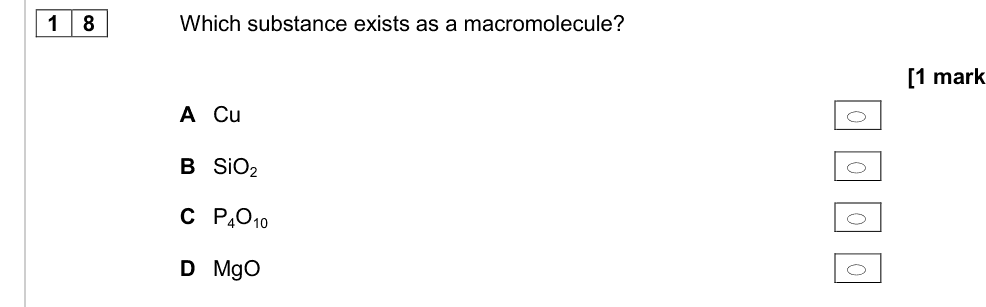
B
Questions 10-24 Multiple choice From this section of the paper items 10,11,15 and 18 were usually answered correctly. It was surprising to see that item 17 was answered poorly but it did give further evidence that redox ideas are not well understood by large numbers of students at this level. Item 20 proved difficult showing that the overall dipole possessed by a molecule clearly isn’t a well understood concept. Item 22 was also not answered correctly by most; this idea has not been tested often in the previous specification so students may not have had much prior experience of the type of question.
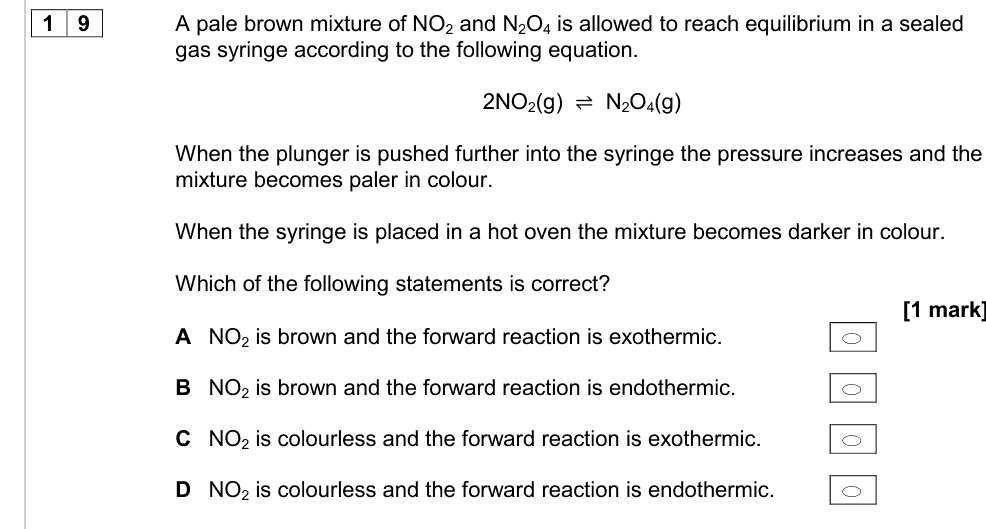
A
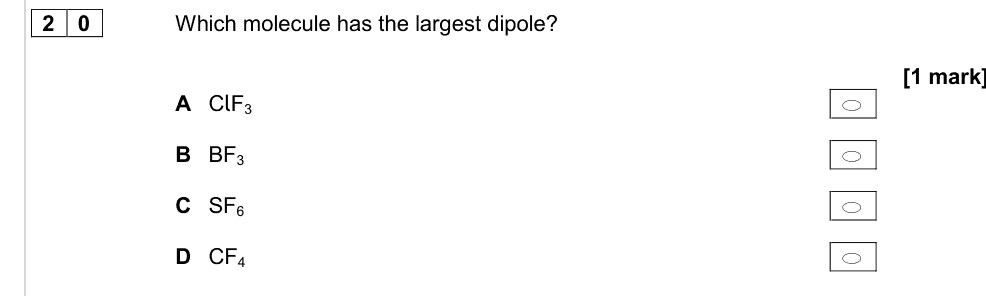
A
Questions 10-24 Multiple choice From this section of the paper items 10,11,15 and 18 were usually answered correctly. It was surprising to see that item 17 was answered poorly but it did give further evidence that redox ideas are not well understood by large numbers of students at this level. Item 20 proved difficult showing that the overall dipole possessed by a molecule clearly isn’t a well understood concept. Item 22 was also not answered correctly by most; this idea has not been tested often in the previous specification so students may not have had much prior experience of the type of question.
Skills: MS4.1 Use angles and shapes in regular 2D and 3D structures
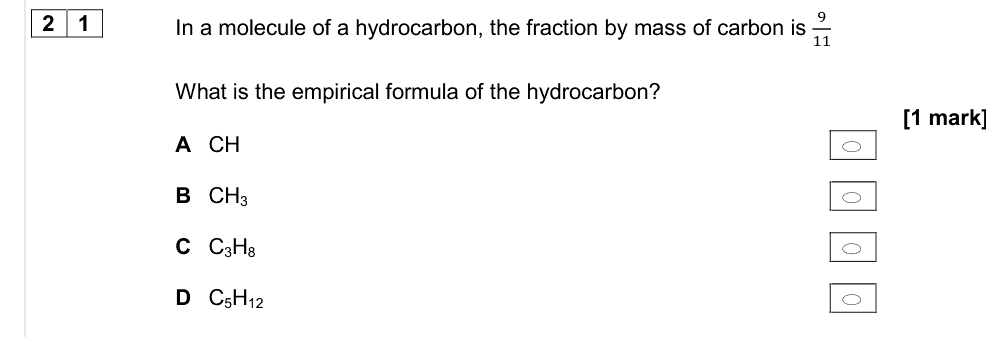
C
Skills: MS0.2 Use ratios, fractions and percentages
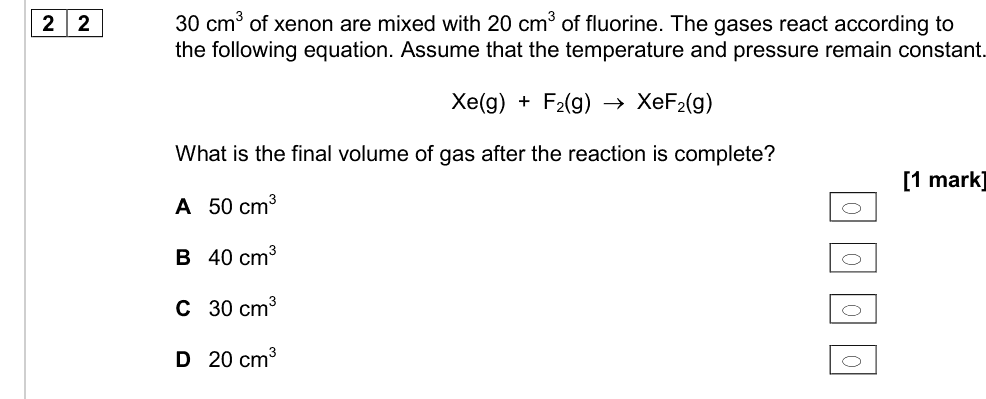
C
Questions 10-24 Multiple choice From this section of the paper items 10,11,15 and 18 were usually answered correctly. It was surprising to see that item 17 was answered poorly but it did give further evidence that redox ideas are not well understood by large numbers of students at this level. Item 20 proved difficult showing that the overall dipole possessed by a molecule clearly isn’t a well understood concept. Item 22 was also not answered correctly by most; this idea has not been tested often in the previous specification so students may not have had much prior experience of the type of question.
Skills: MS0.2 Use ratios, fractions and percentages
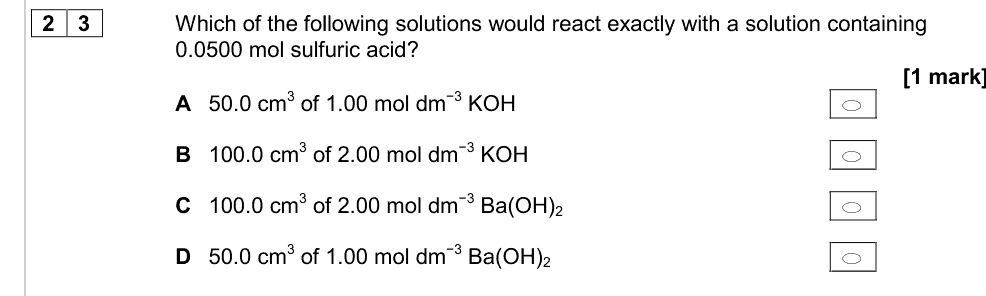
D
Skills: MS0.2 Use ratios, fractions and percentages
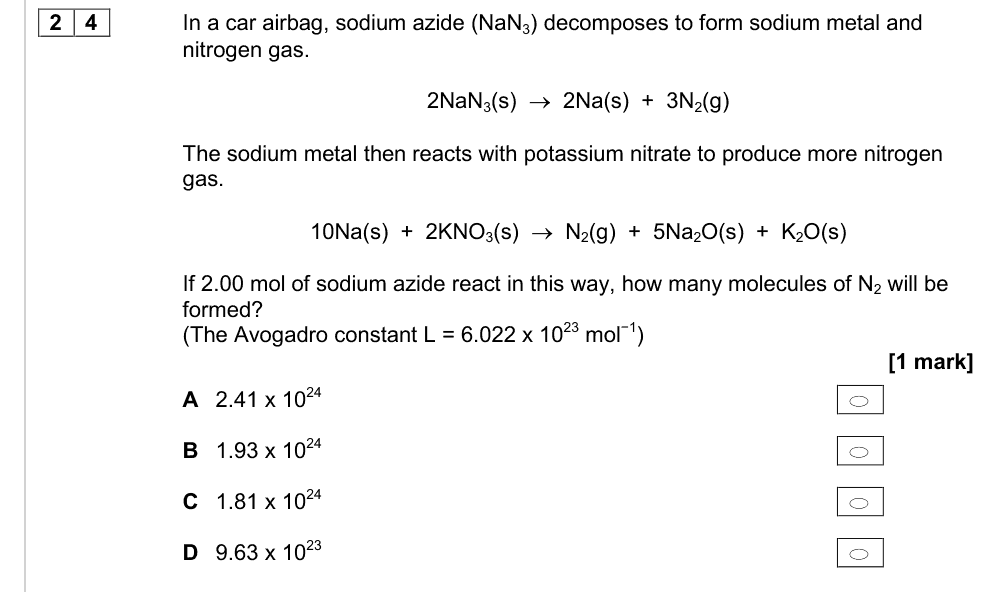
B
Skills: MS0.1 Recognise and use expressions in decimal and ordinary form; MS0.2 Use ratios, fractions and percentages
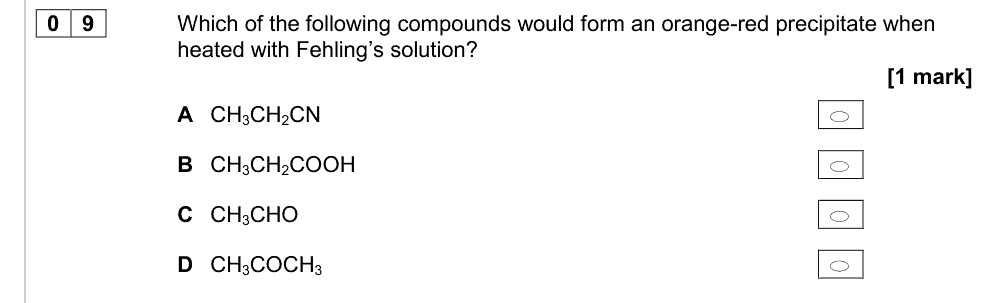
C
Students generally did well on Q11 but many gave answers that demonstrated a lack of understanding about how to calculate percentage yield by dividing the mass of the product by the mass of the starting material. Students found Q19 challenging suggesting that this is a skill that they need to practise more, ultimately to have success in extended questions on calculating equilibrium constants. Many students were distracted by incorrect responses to Q21 due to a misunderstanding of the factors that affect the value of the equilibrium constant. Q22 involved several steps and many went wrong as they effectively used ∆H = [Sum bond enthalpies products] – [Sum bond enthalpies reactants] instead of ∆H = [Sum bond enthalpies reactants] – [Sum bond enthalpies products]. Q23 proved to be the most challenging multiple choice question. Errors may have stemmed from some students running short of time and/or not using SI units in the calculations.
Skills: RP6 Tests for alcohol, aldehyde, alkene and carboxylic acid
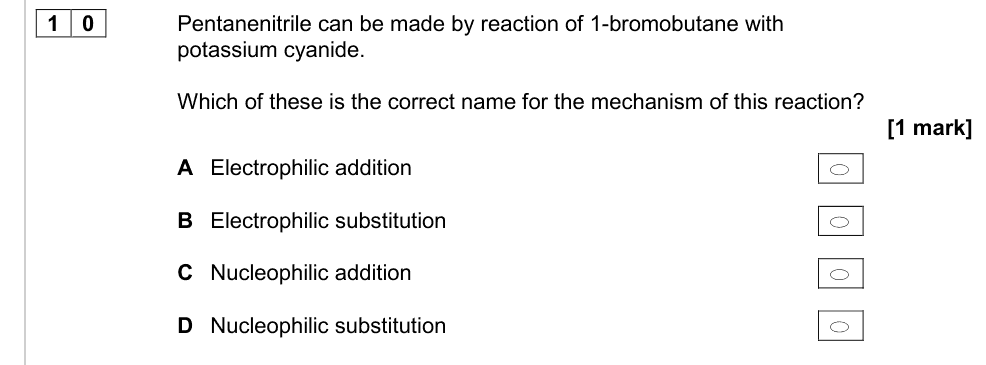
D
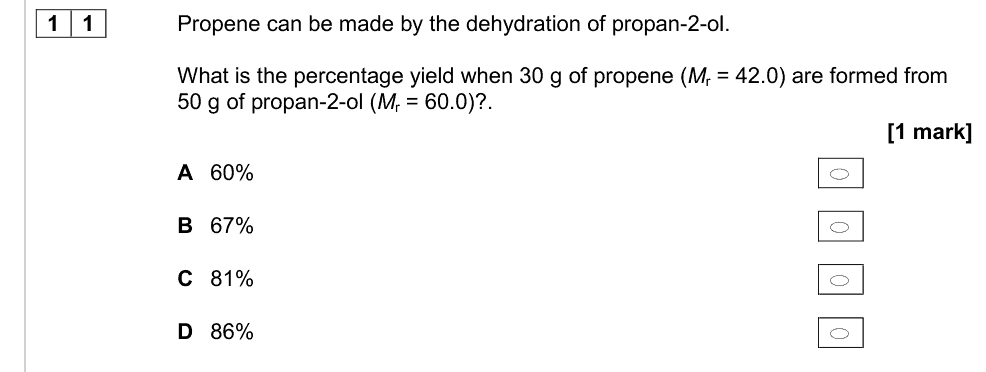
D
Skills: MS0.2 Use ratios, fractions and percentages
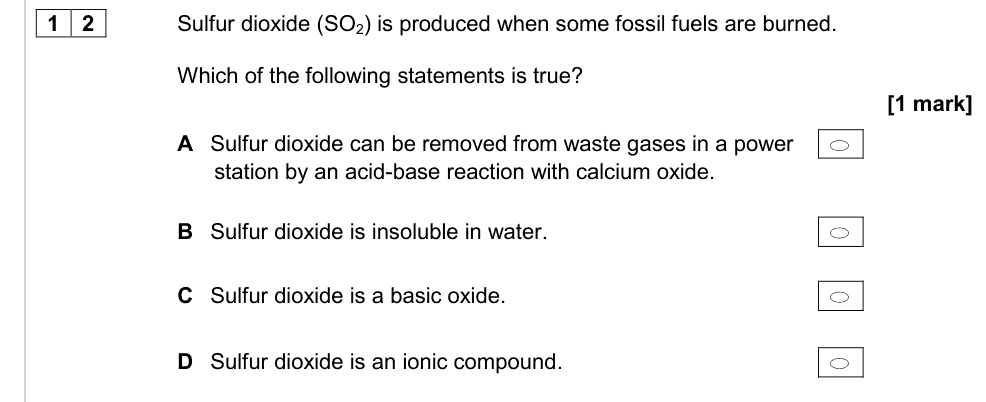
A
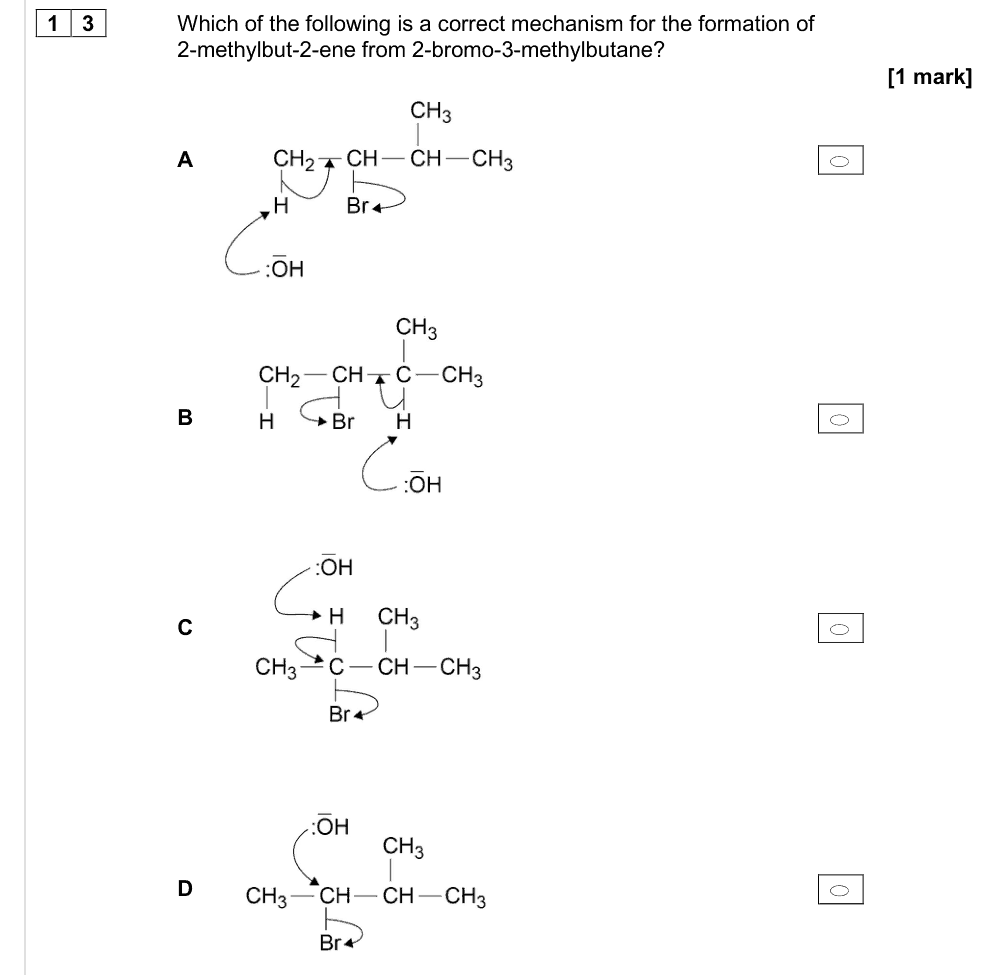
B
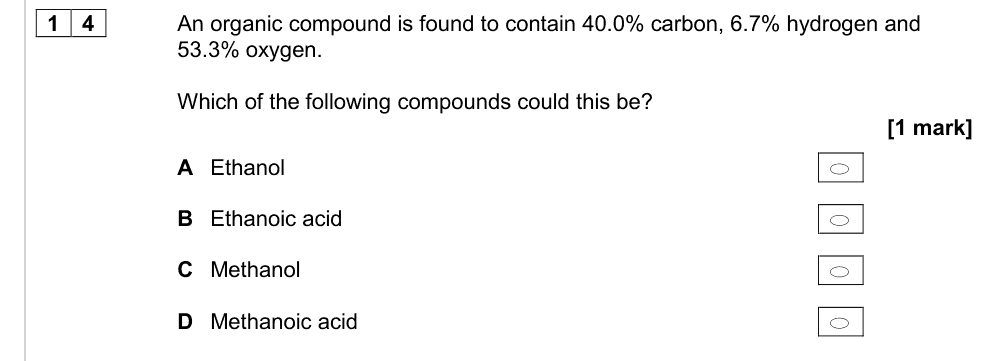
B
Skills: MS0.2 Use ratios, fractions and percentages
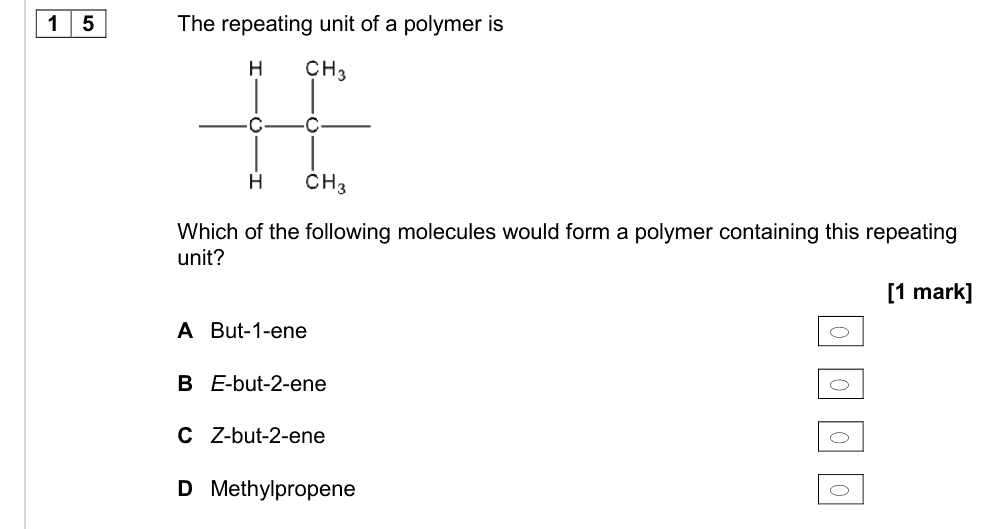
D
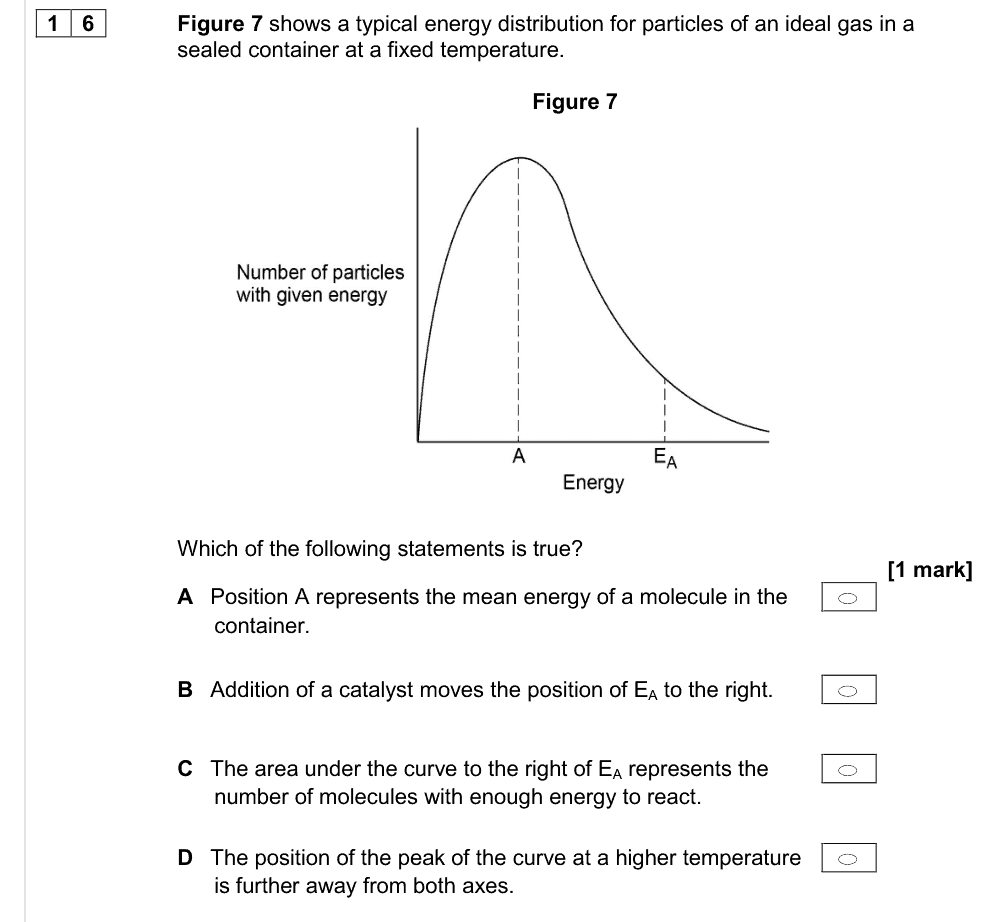
C
Skills: MS3.1 Translate information between graphical, numerical and algebraic forms
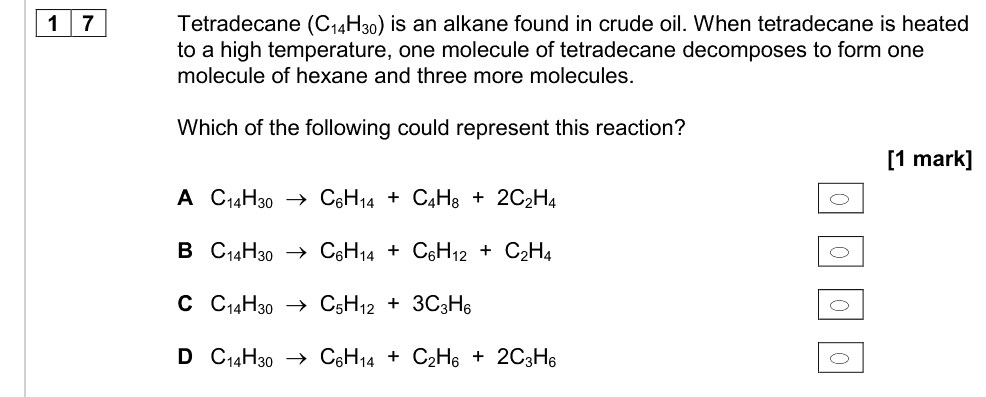
A
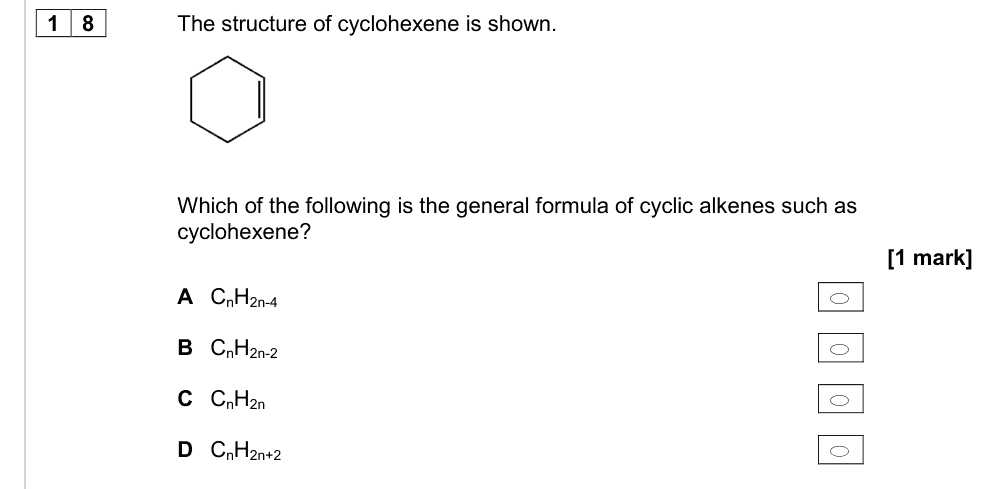
B
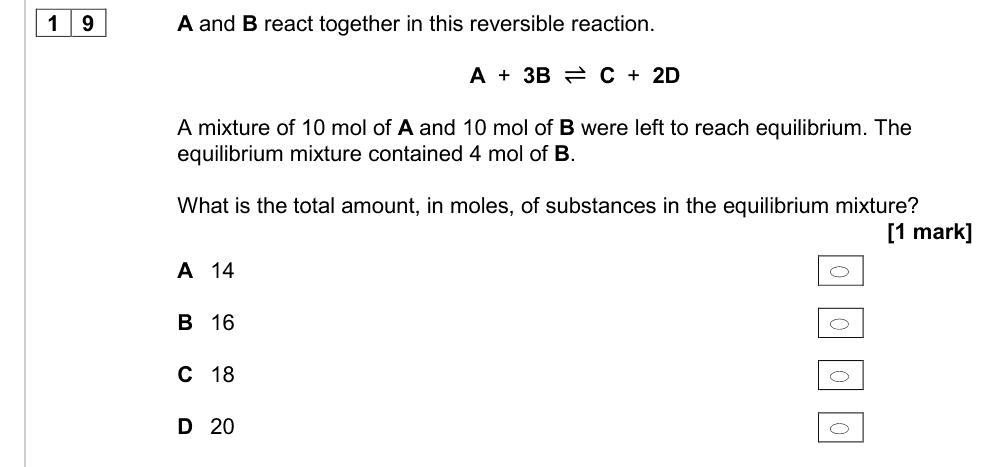
C
Skills: MS0.2 Use ratios, fractions and percentages
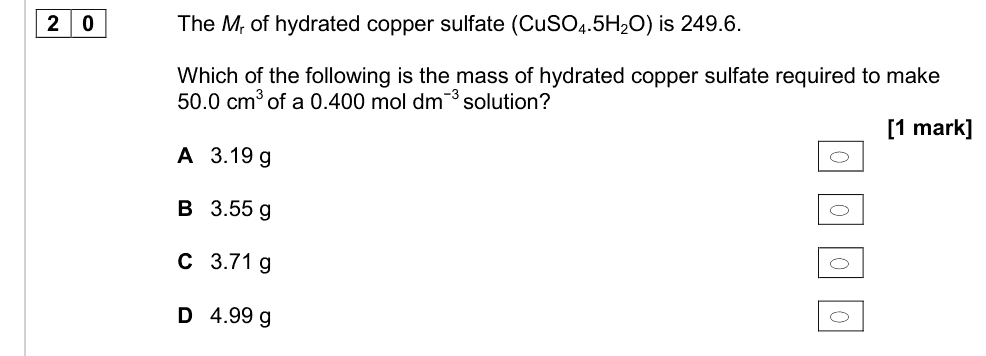
D
Skills: MS0.0 Recognise and make use of appropriate units in calculation
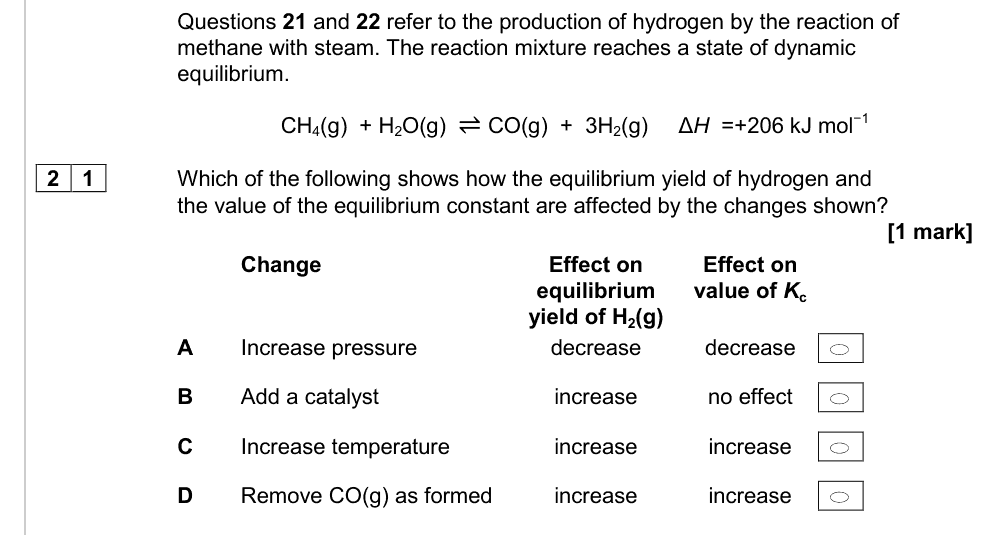
C
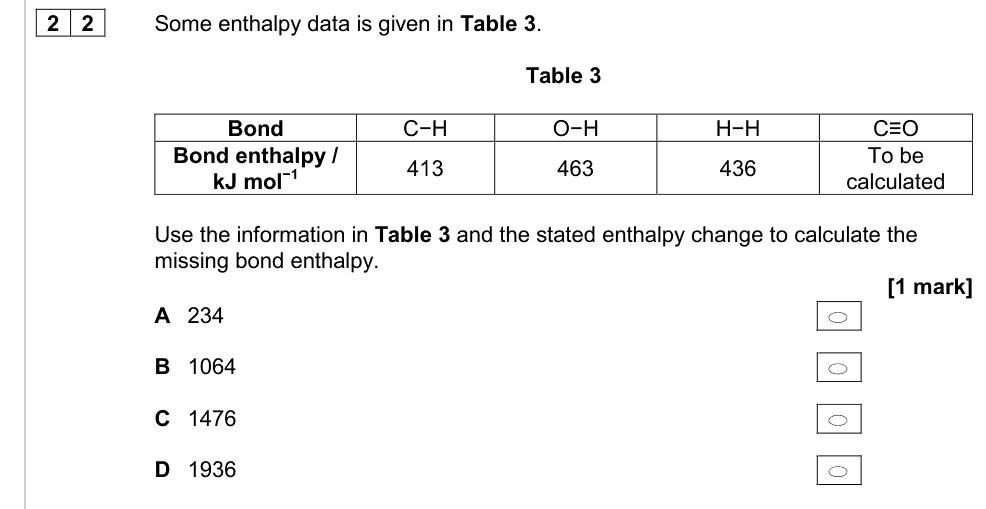
B
Skills: MS2.4 Solve algebraic equations
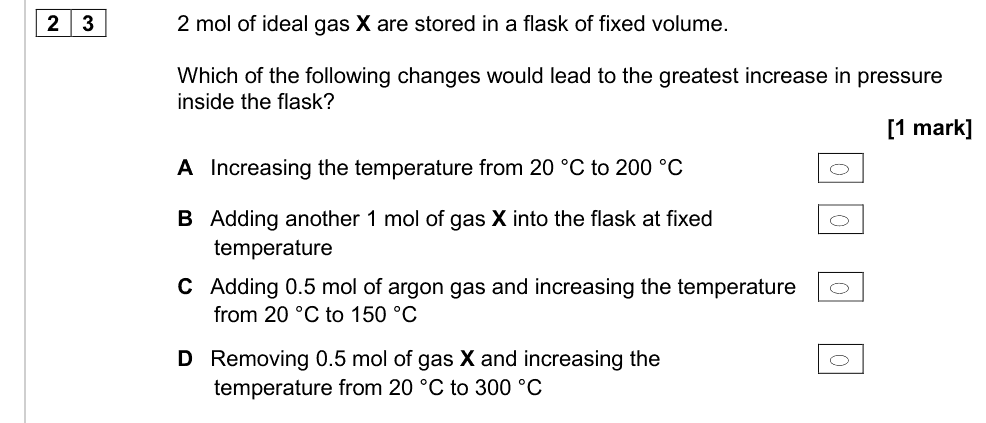
C
Skills: MS0.0 Recognise and make use of appropriate units in calculation; MS0.2 Use ratios, fractions and percentages
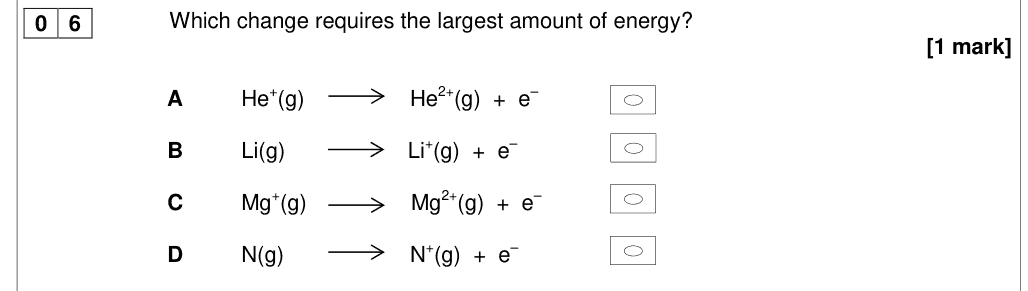
A
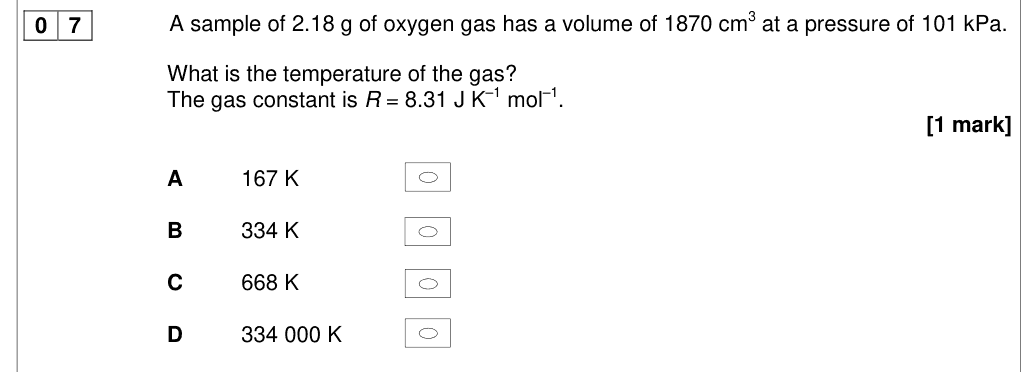
B
Skills: MS0.0 Recognise and make use of appropriate units in calculation; MS2.2 Change the subject of an equation
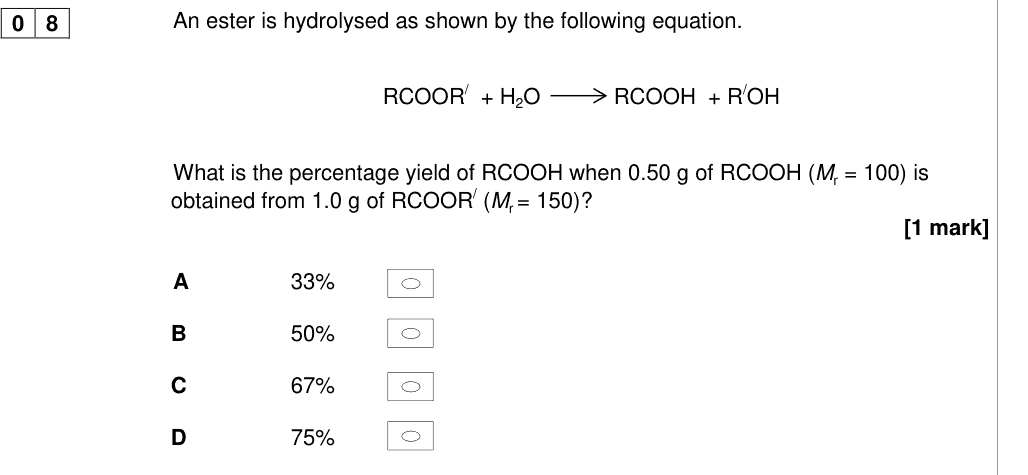
D
Skills: MS0.2 Use ratios, fractions and percentages
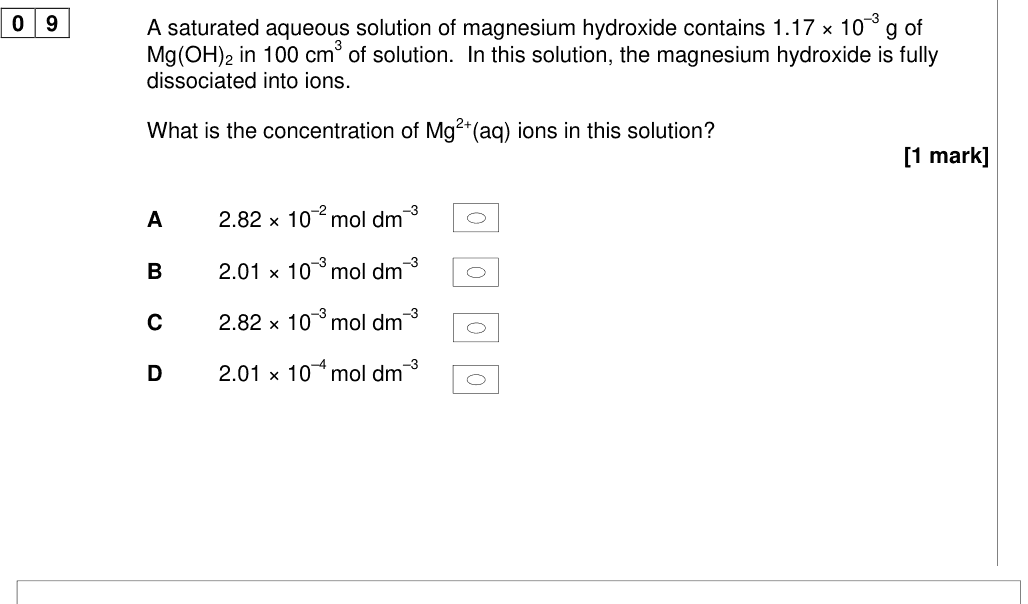
D
Skills: MS0.0 Recognise and make use of appropriate units in calculation; MS0.1 Recognise and use expressions in decimal and ordinary form
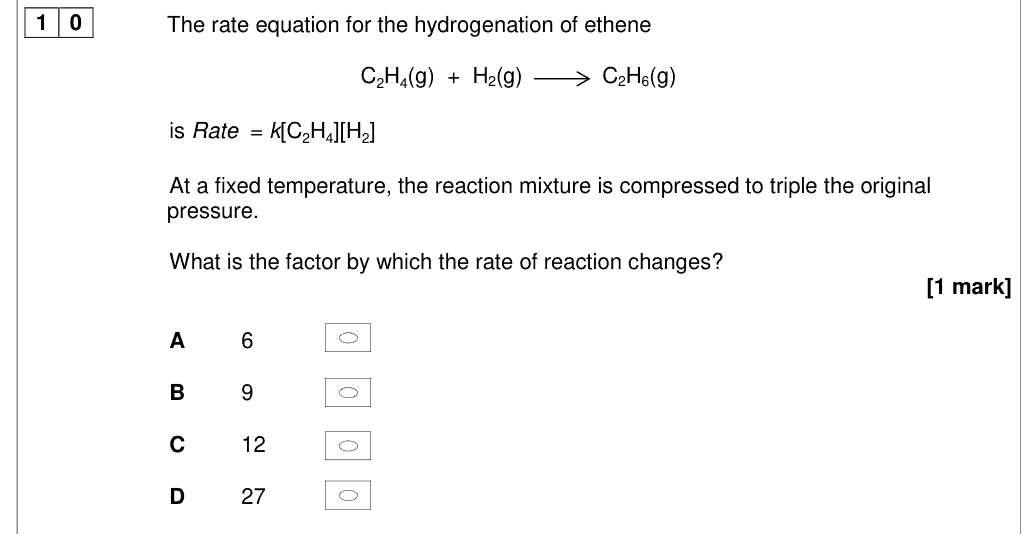
B
Skills: MS0.2 Use ratios, fractions and percentages
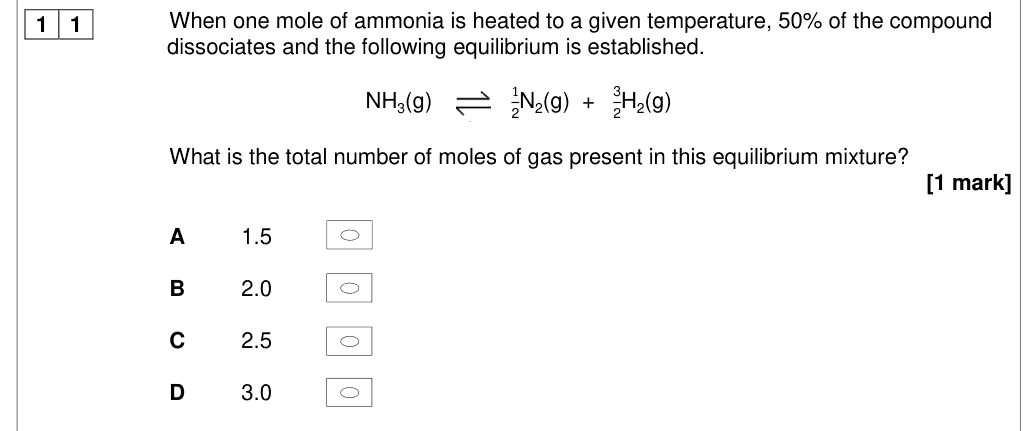
A
Skills: MS0.2 Use ratios, fractions and percentages
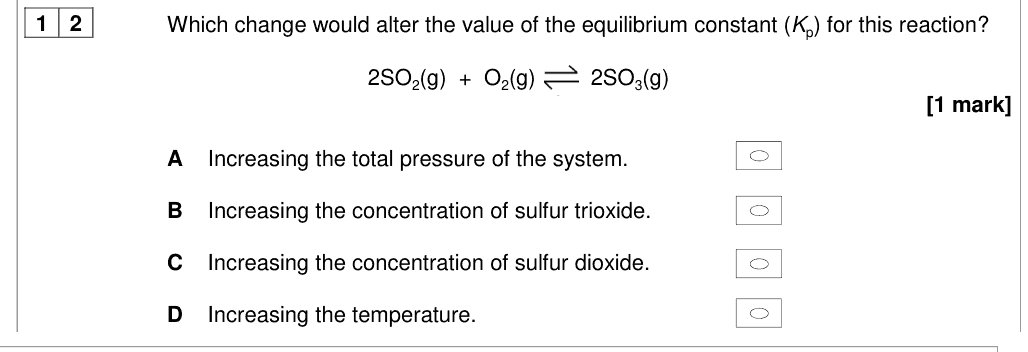
D
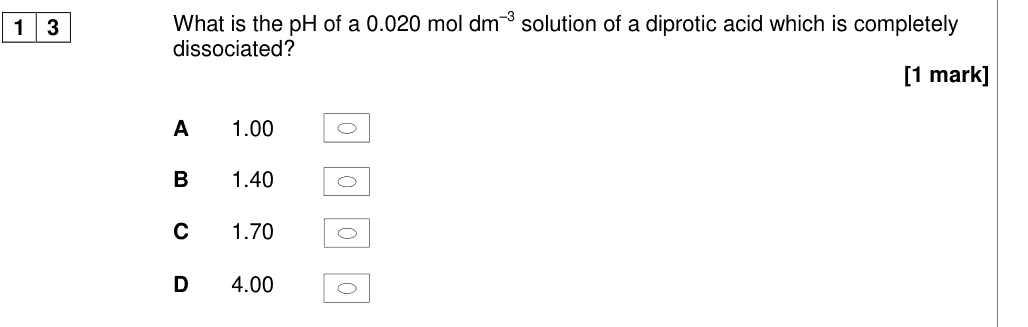
B
Skills: MS0.4 Use calculators to find and use power, exponential and logarithmic functions; MS2.5 Use logarithms in relation to quantities that range over several orders of magnitude
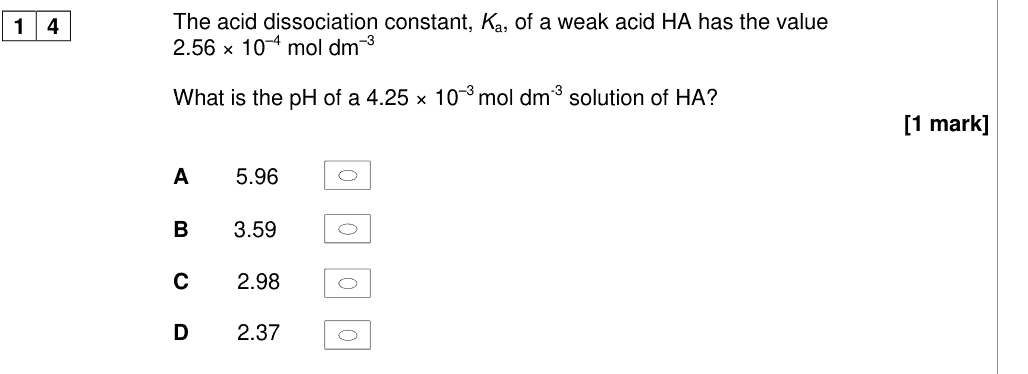
C
Skills: MS0.4 Use calculators to find and use power, exponential and logarithmic functions; MS2.5 Use logarithms in relation to quantities that range over several orders of magnitude
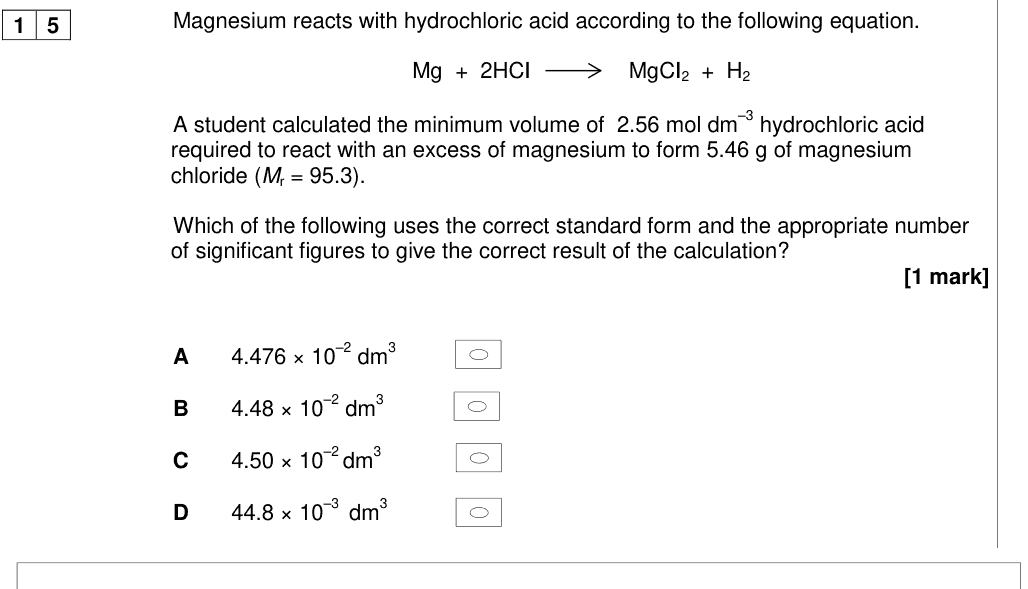
B
Skills: MS0.1 Recognise and use expressions in decimal and ordinary form; MS1.1 Use an appropriate number of significant figures
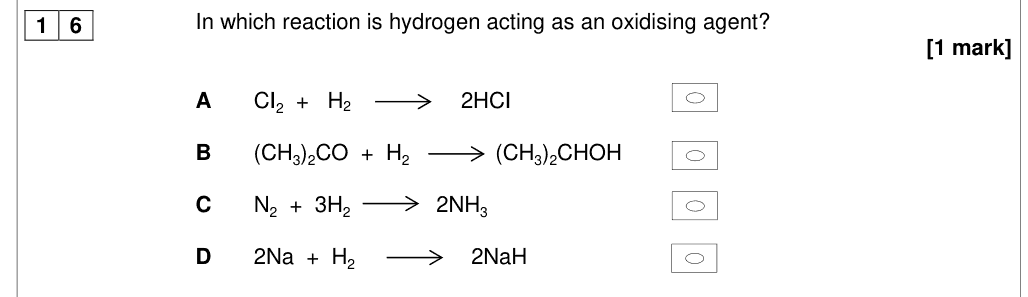
D
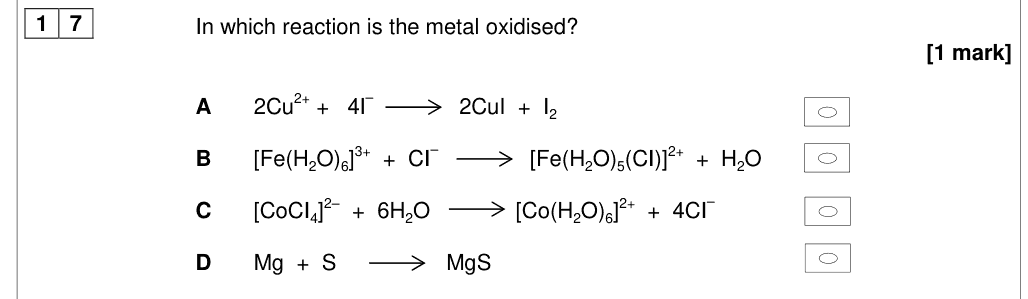
D
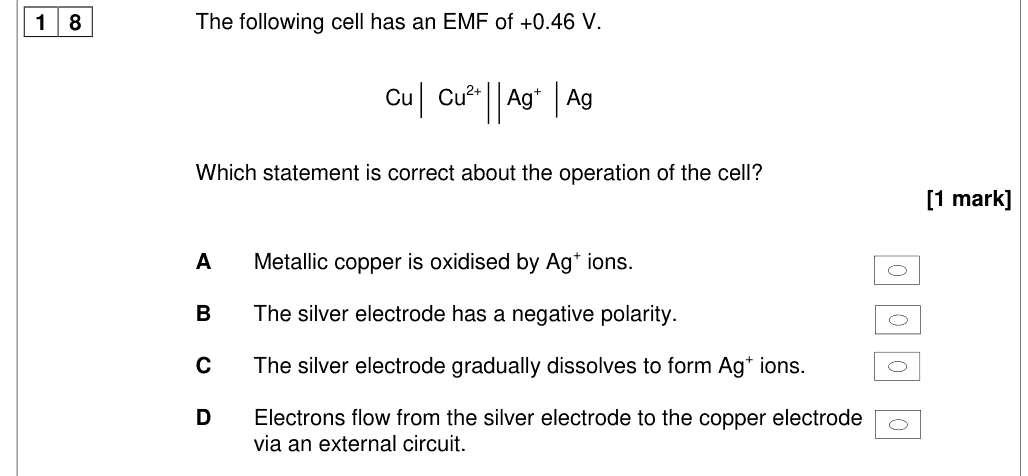
A
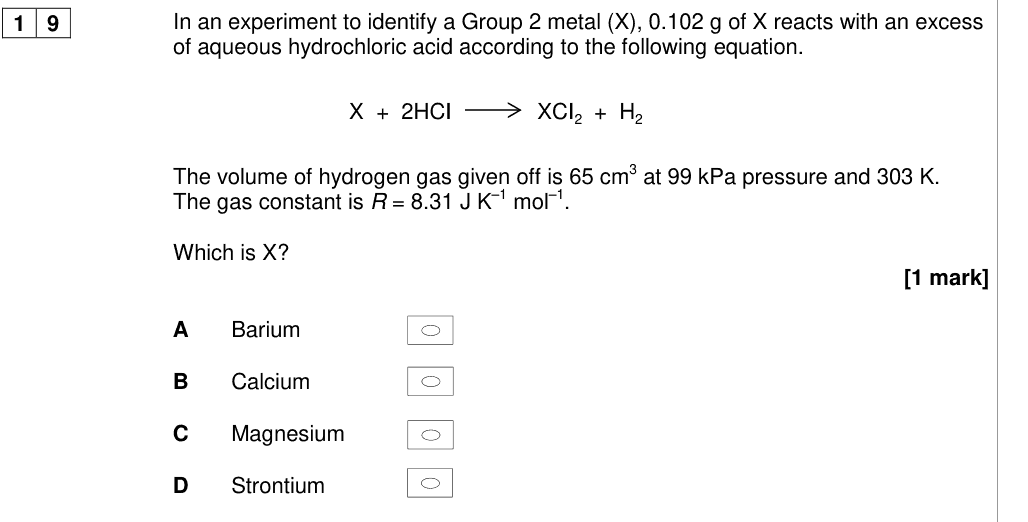
B
Skills: MS0.0 Recognise and make use of appropriate units in calculation; MS2.2 Change the subject of an equation
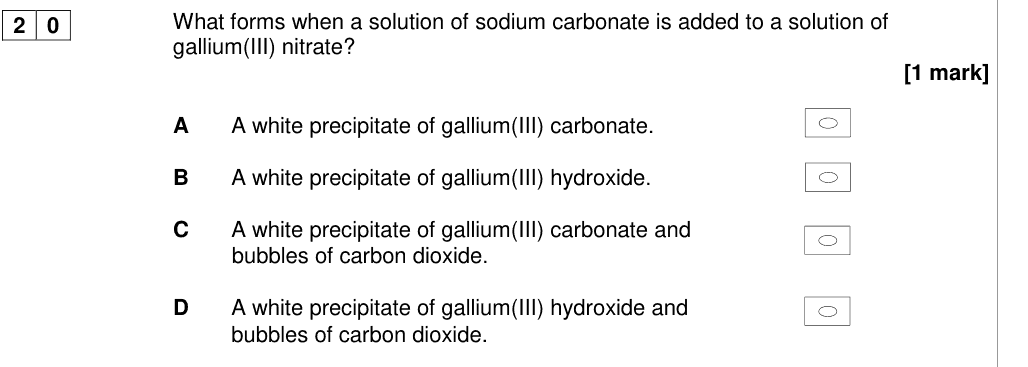
D
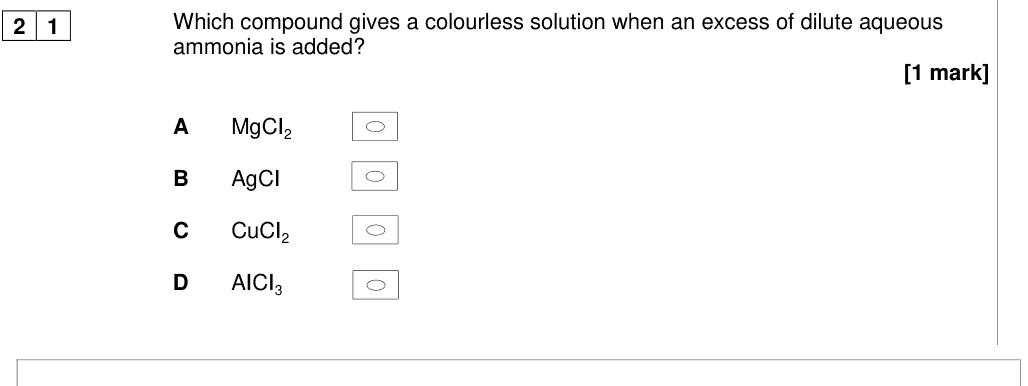
B
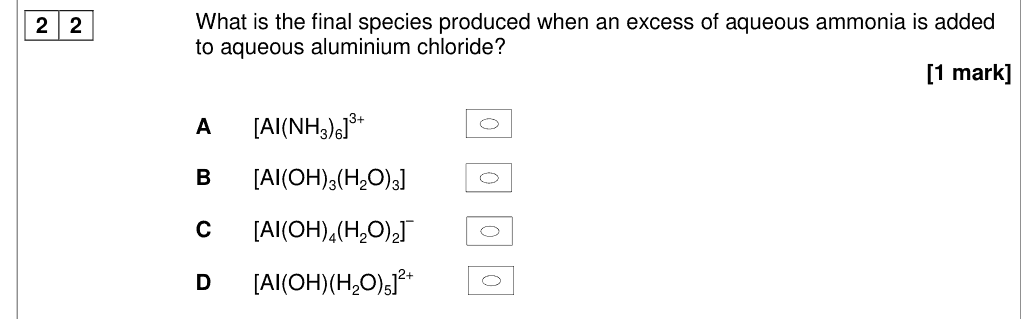
B
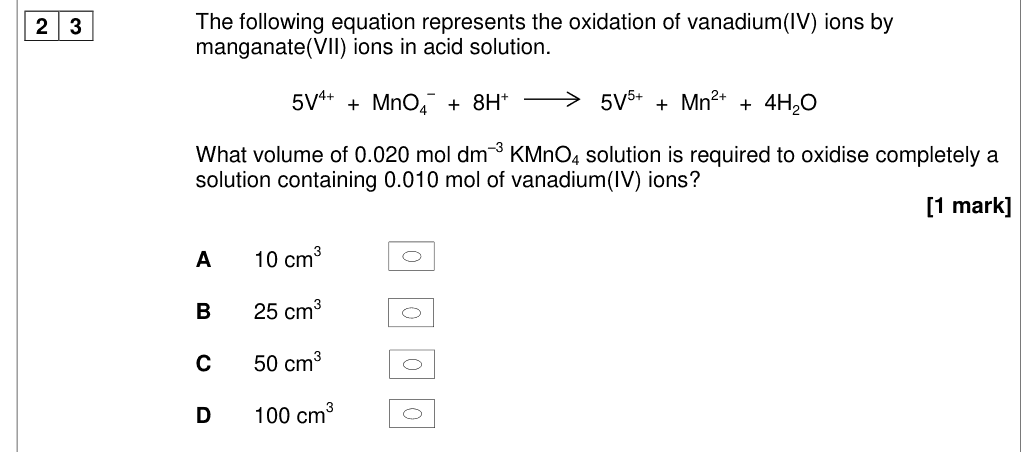
D
Skills: MS0.2 Use ratios, fractions and percentages
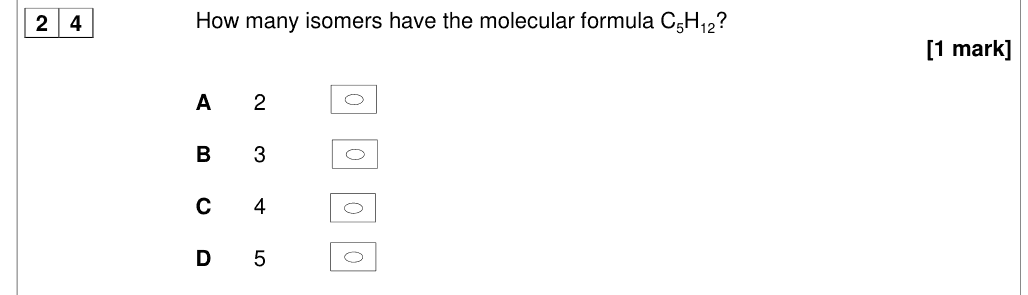
B
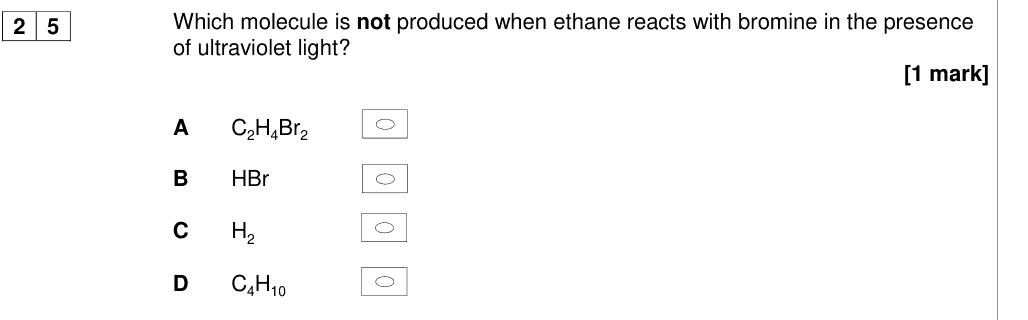
C
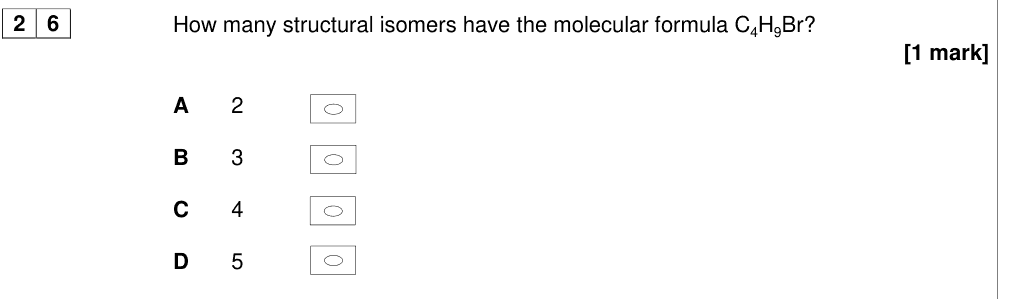
C
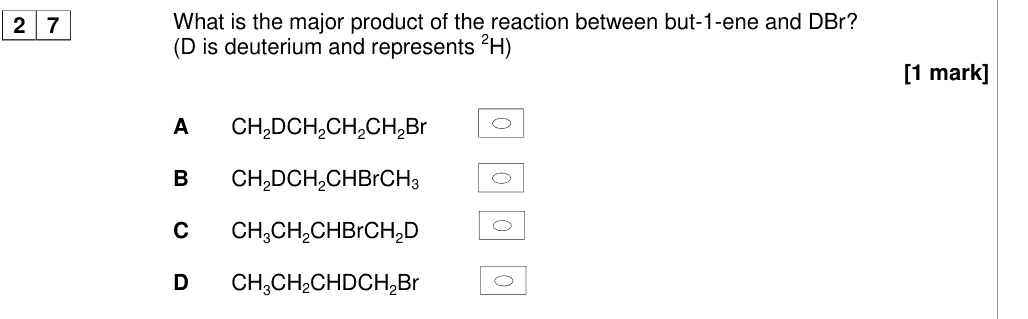
C
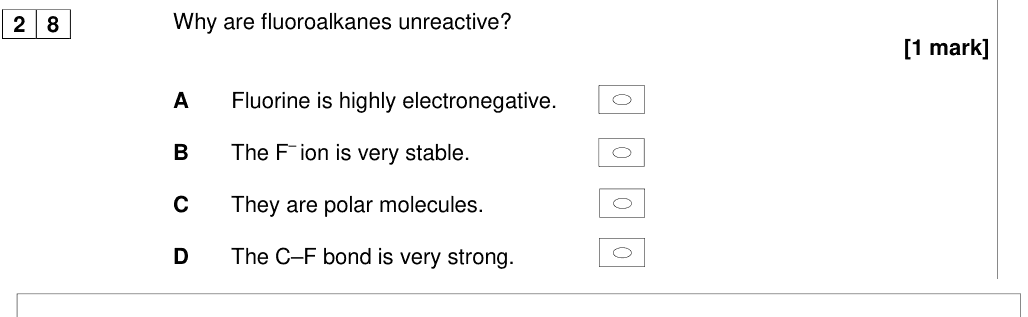
D
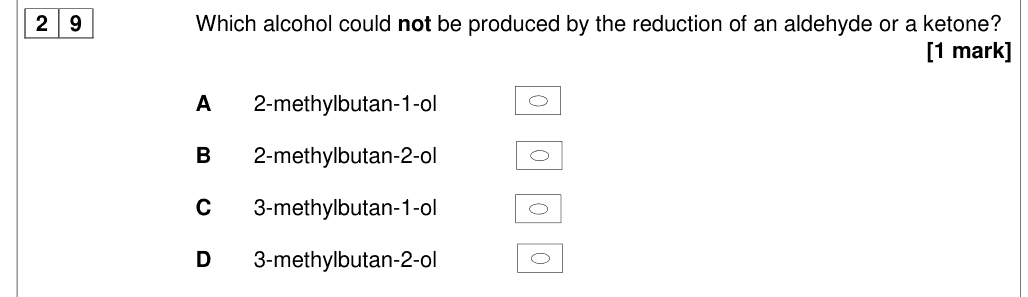
B
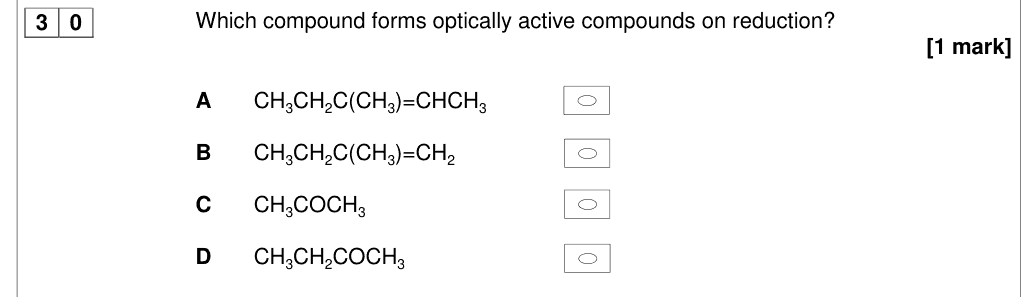
D
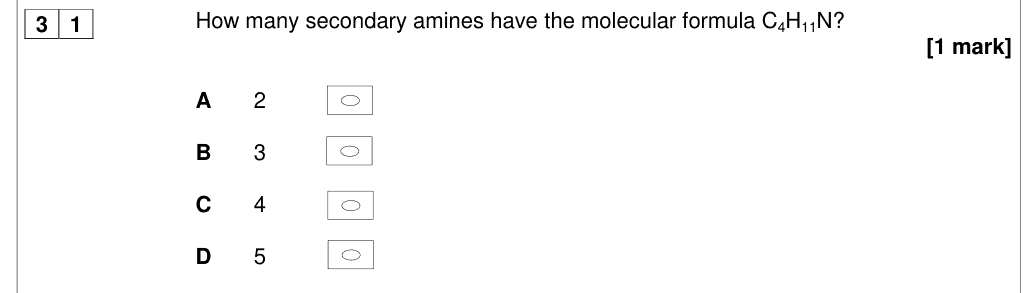
B
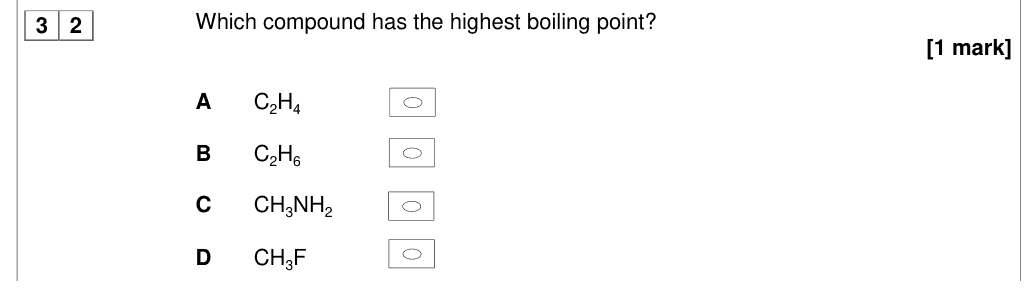
C
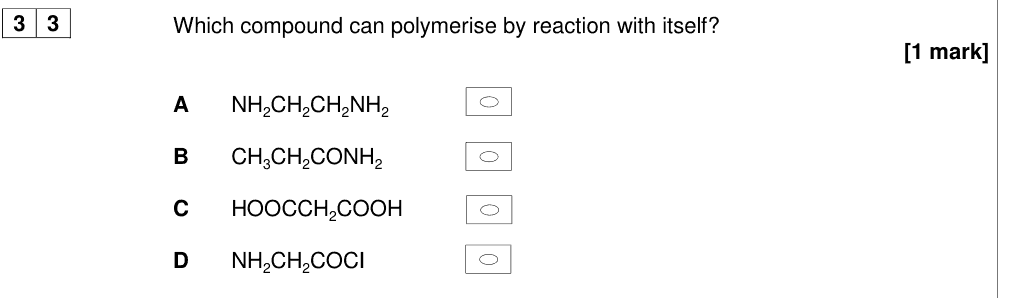
D
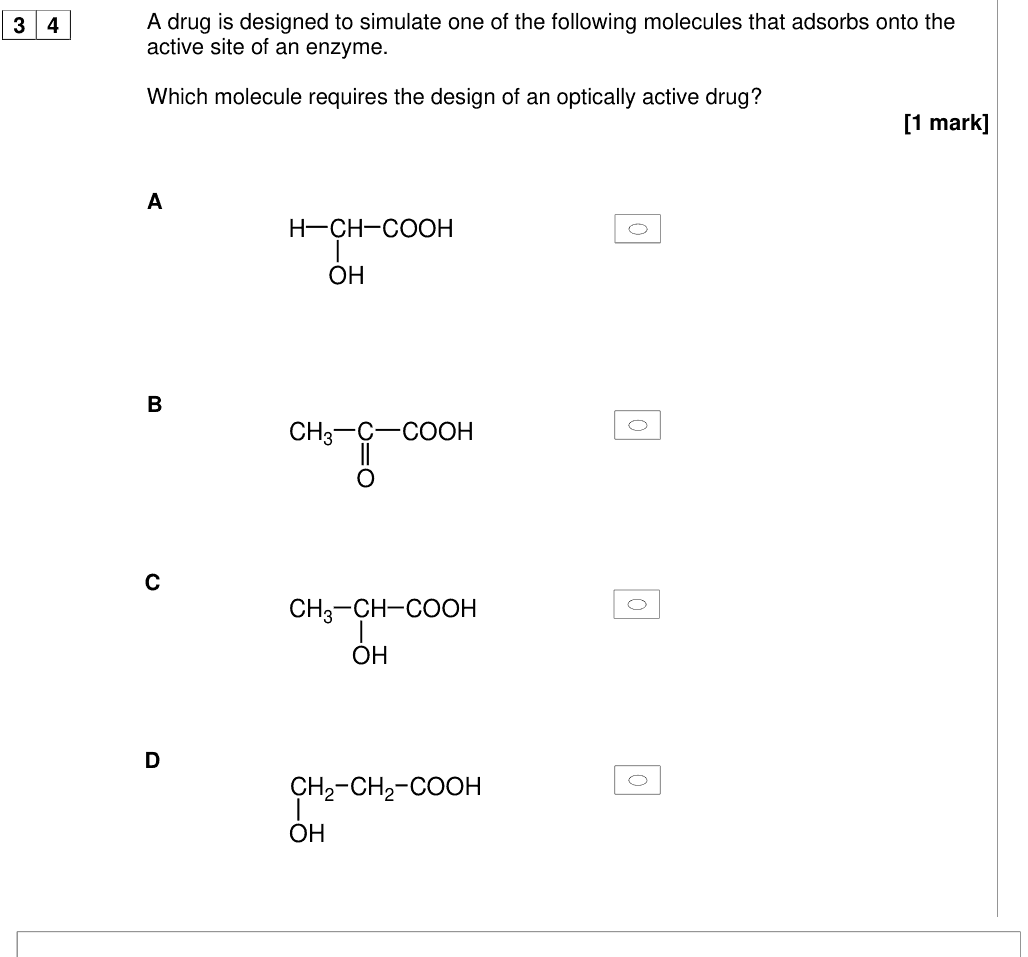
C
Skills: MS4.3 Understand the symmetry of 2D and 3D shapes
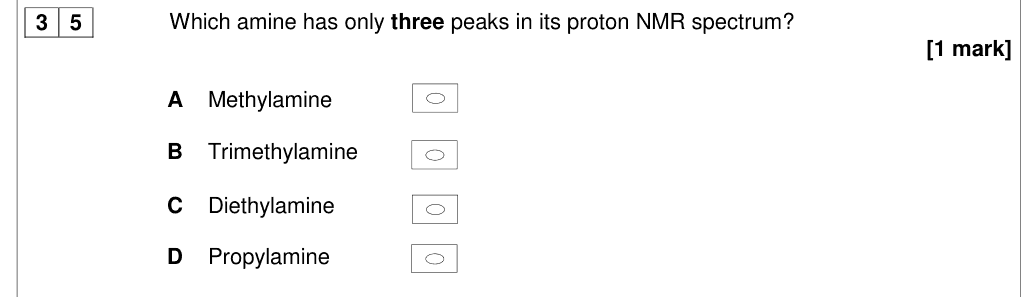
C
Skills: MS4.3 Understand the symmetry of 2D and 3D shapes
Dropping marks on calculations, mechanisms or the required practicals? Book a trial session with a specialist A-level chemistry tutor.





















































































































































































































































































































































































































































































































































































































