Notes and key-term cards for this topic are being written by our tutors. The past-paper questions below are ready now.
Specification statements
Show the 2 statements from the specification
3.3.14-01 The synthesis of an organic compound can involve several steps.
3.3.14-02 Students should be able to: • explain why chemists aim to design processes that do not require a solvent and that use non- hazardous starting materials • explain why chemists aim to design production methods with fewer steps that have a high percentage atom economy • use reactions in this specification to devise a synthesis, with up to four steps, for an organic compound.
Tap a question to zoom it. Where a part needs a figure, table or structure from earlier in the question, that part folds out above it; the mark scheme and examiner's comment open underneath. Have AQA's Data Booklet (the Periodic Table and the spectroscopy tables) beside you.
June 2025 · Paper 2 · Q04.62 marksAO3=2Short answer
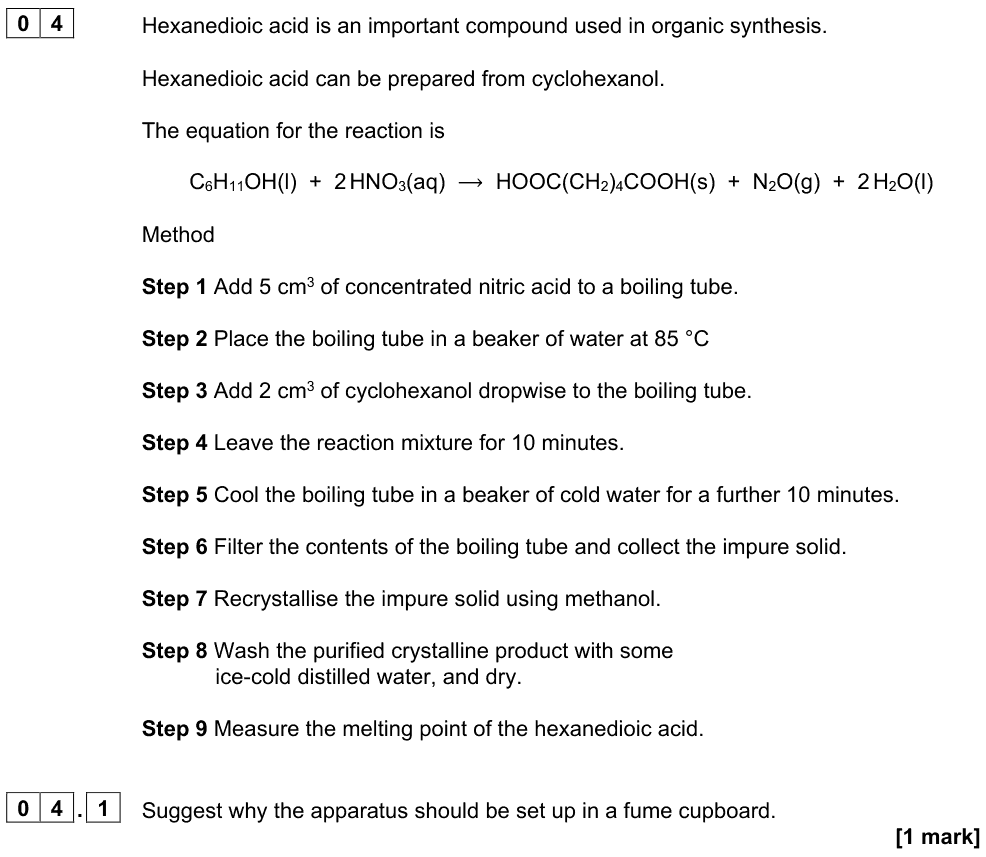
Earlier part of question 04 that this part uses
Mark scheme
Examiner's comment
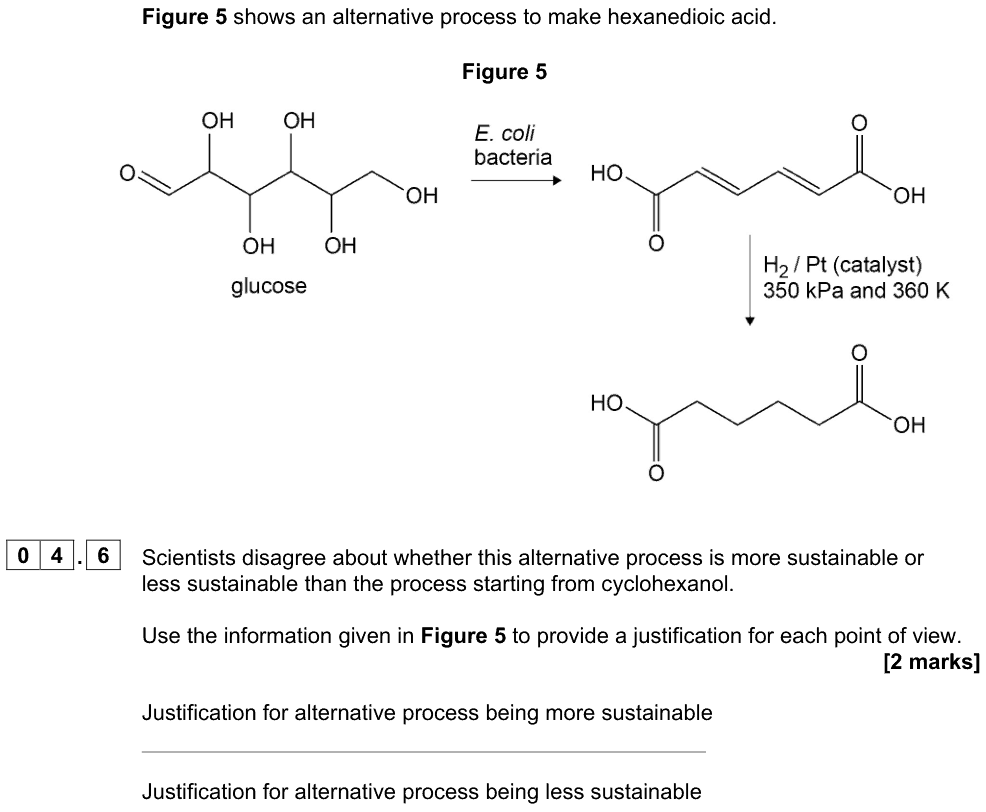
4.6 Students were shown details of an alternative two stage synthesis of the product and asked to justify it being more or less sustainable. Many observed that biological/natural sources were used but did not state that these are renewable to justify the process as more sustainable. The use of energy from fossil fuels to achieve high pressures was the most common answer given credit as a justification for the process being less sustainable. Large numbers focused on the temperature used but this was almost identical to the temperature used in the original method outlined at the start of the question.
Notes from the mark scheme and report
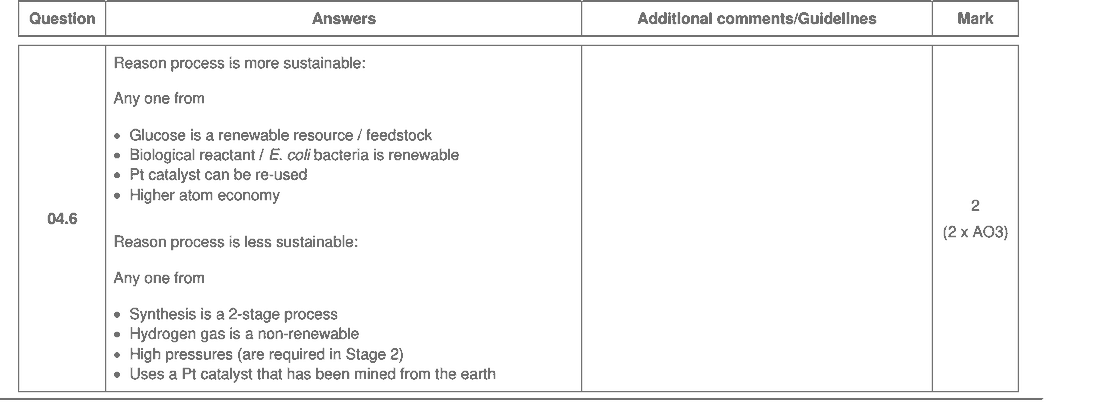
More sustainable (one): glucose is a renewable feedstock
the bacteria are renewable
the Pt catalyst can be re-used
higher atom economy. Less sustainable (one): two-stage process
hydrogen is non-renewable
high pressure needed in stage 2
platinum has to be mined. 'Natural' without 'renewable' did not score
the temperature is nearly the same as in the original method
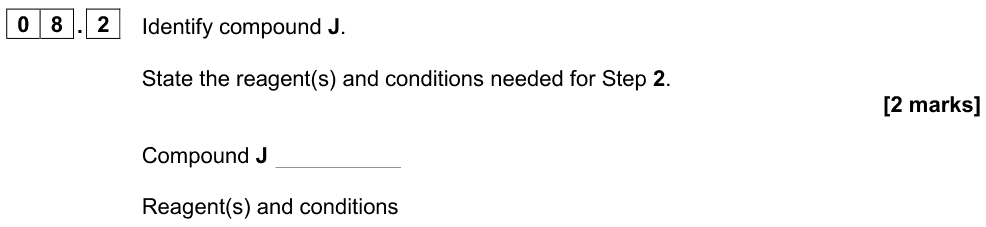
June 2024 · Paper 2 · Q08.22 marksAO1=1, AO2=1Short answer
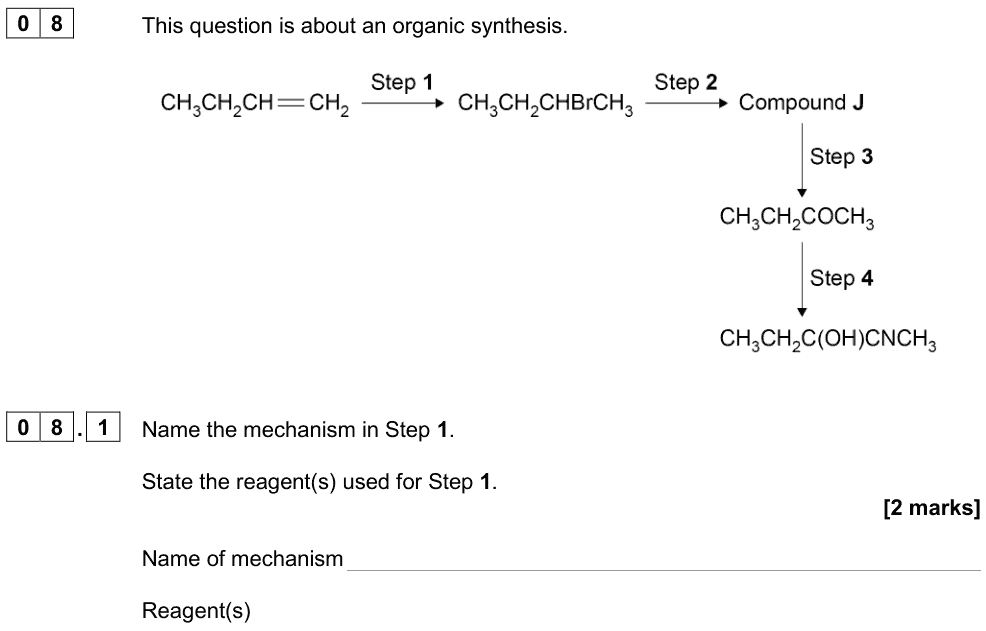
Earlier part of question 08 that this part uses
Mark scheme
Examiner's comment
8.2 Students often scored for the reagent but not the conditions here.
Notes from the mark scheme and report
J is butan-2-ol, CH3CH(OH)CH2CH3
NaOH, aqueous and warm. The reagent was often given without the conditions
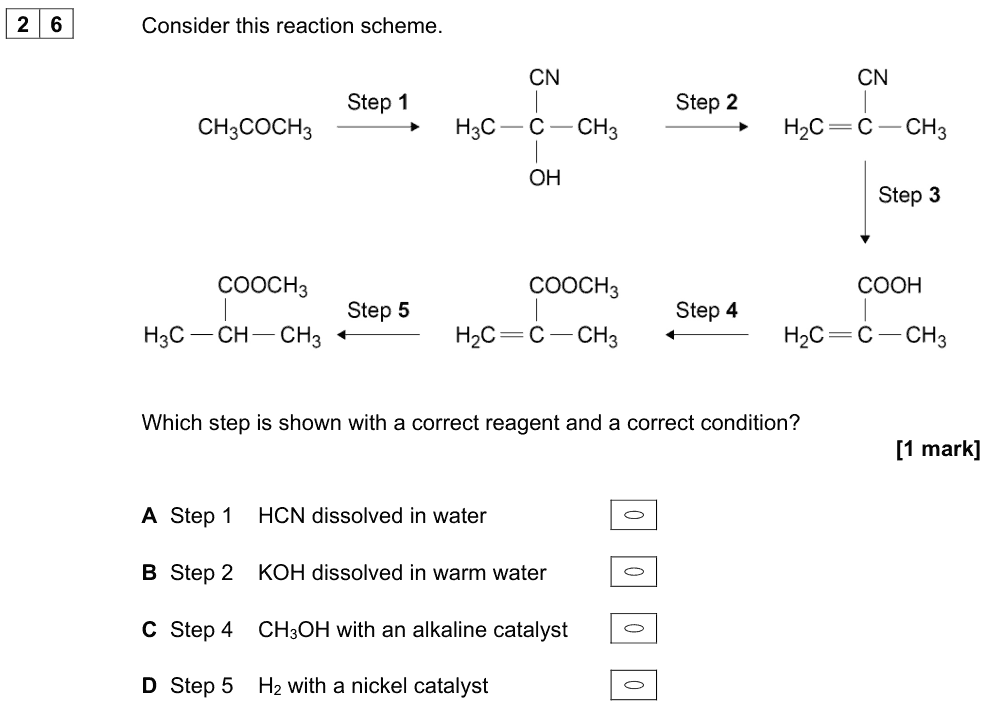
June 2023 · Paper 3 · Q261 markAO3=1Multiple choice
Answer
D
Mark scheme
Notes from the mark scheme and report
Answer: D. Step 5 adds H2 across the C=C with a nickel catalyst. Step 1 needs KCN followed by dilute acid
step 2 is dehydration of an alcohol (concentrated acid, not KOH)
step 4 esterification needs an acid catalyst
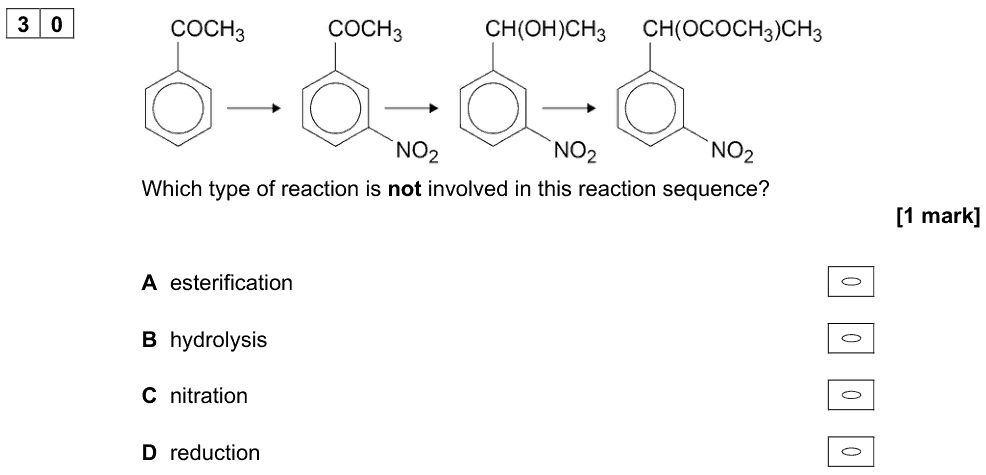
June 2022 · Paper 3 · Q301 markAO3=1Multiple choice
Answer
B
Mark scheme
Notes from the mark scheme and report
Answer: B. The steps are nitration of the ring, reduction of C=O to CH(OH), then esterification of the OH
no hydrolysis
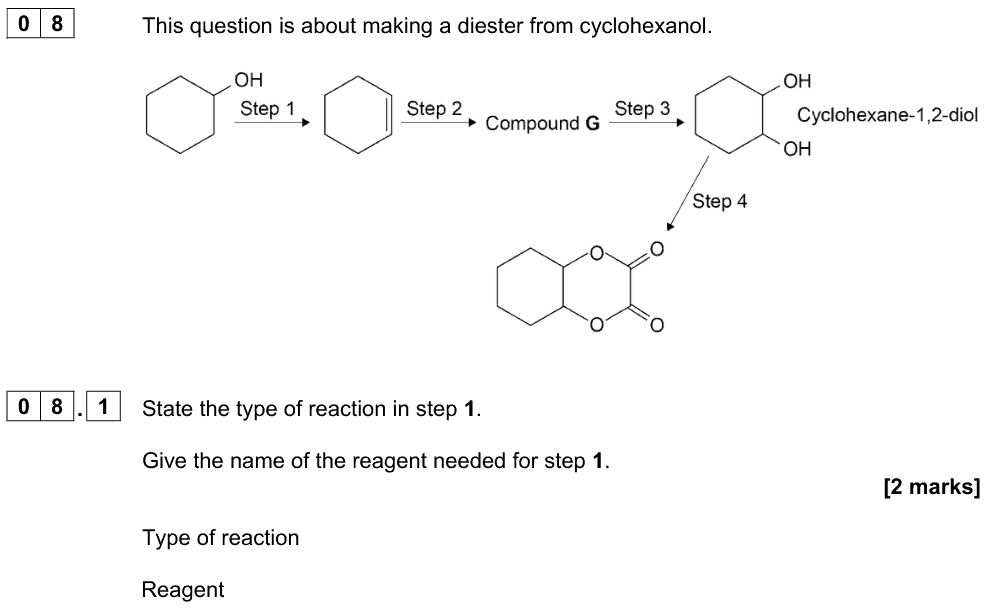
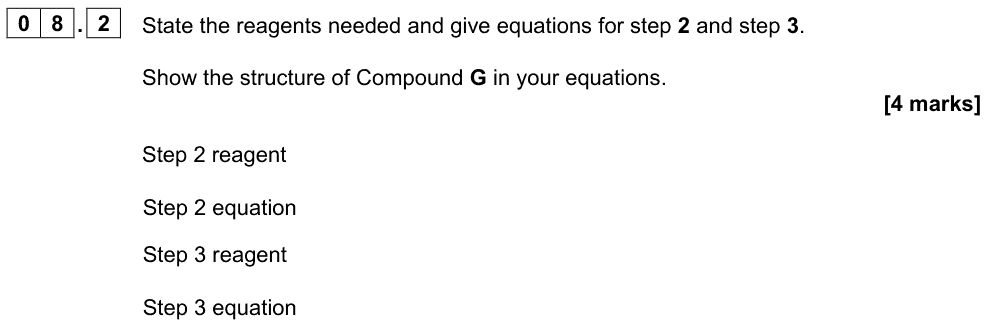
November 2021 · Paper 2 · Q08.24 marksEquation writing
Earlier part of question 08 that this part uses
Mark scheme
Examiner's comment
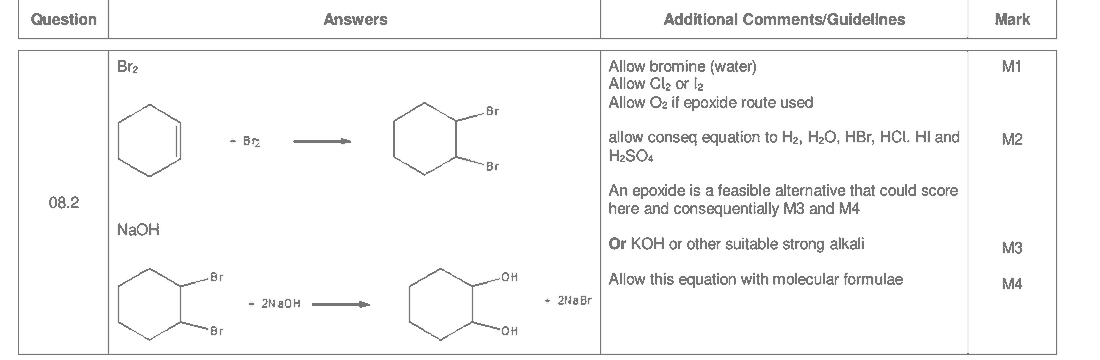
Few students scored 3 or more marks on question 08.2.
Both the reagents and equations proved very challenging, with over 50% either failing to score or not attempting this question.
G + 2NaOH → cyclohexane-1,2-diol + 2NaBr. Cl2 or I2 allowed
an epoxide route with O2 is also accepted. Over 50% scored nothing or did not attempt it
November 2021 · Paper 2 · Q08.42 marksShort answer
Earlier part of question 08 that this part uses
Mark scheme
Examiner's comment
Few students scored 3 or more marks on question 08.2. Both the reagents and equations proved very challenging, with over 50% either failing to score or not attempting this question. A very good range of marks was seen for question 08.3 and the question discriminated very well.
Notes from the mark scheme and report
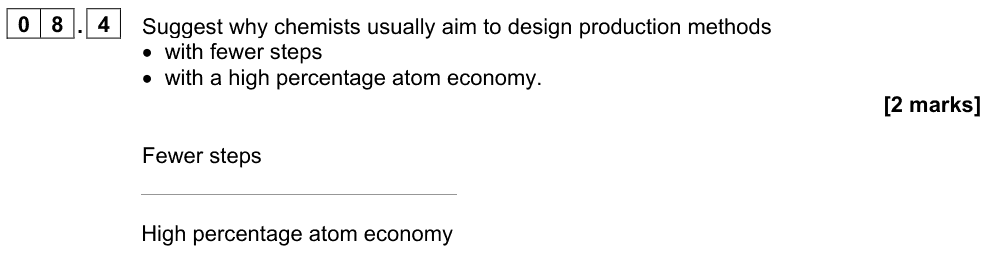
Fewer steps: better overall yield / less energy used (fewer practical losses, simpler plant). High atom economy: less waste / less pollution, more of the raw materials end up in the useful product, saving resources
June 2019 · Paper 2 · Q01.33 marksShort answer
Earlier part of question 01 that this part uses
Mark scheme
Examiner's comment
01.3 KCN was usually given but the correct aqueous-alcoholic conditions were rarely seen. The mark for hydrogen and nickel was gained by most.
Notes from the mark scheme and report
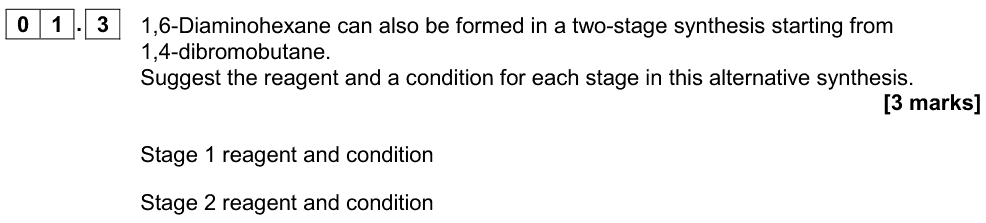
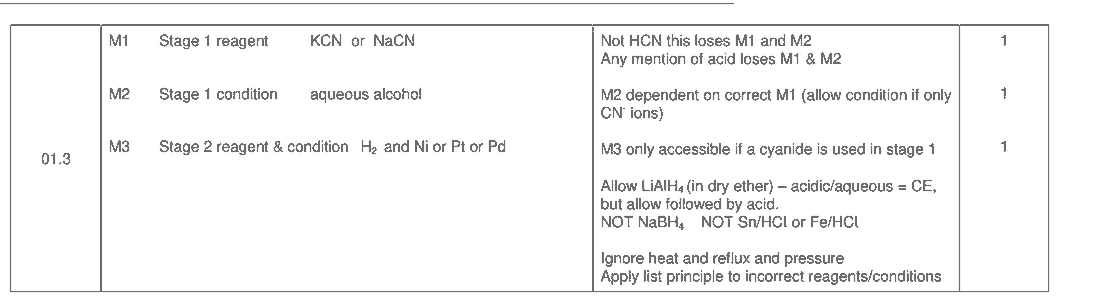
Stage 1: KCN (or NaCN) in aqueous alcohol, giving NC(CH2)4CN. Stage 2: H2 with Ni (or Pt / Pd) catalyst (allow LiAlH4 in dry ether) to reduce the dinitrile. HCN or any acid in stage 1 loses M1 and M2
not NaBH4, not Sn/HCl. The aqueous-alcoholic condition was rarely given.
June 2019 · Paper 3 · Q211 markMultiple choice
Answer
A
Mark scheme
Notes from the mark scheme and report
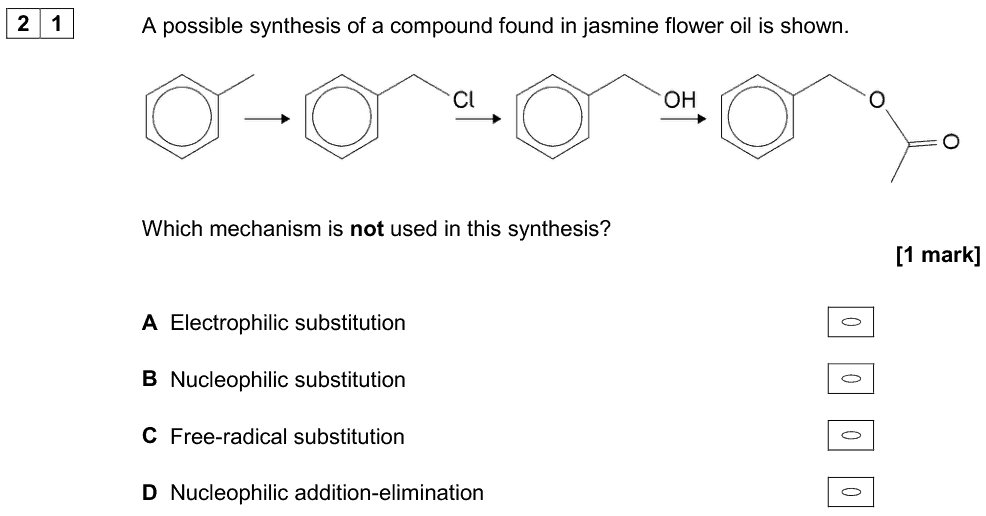
Answer: A. Step 1 is free-radical substitution of the methyl group, step 2 nucleophilic substitution of Cl by OH, step 3 addition–elimination to form the ester
the ring is never substituted
June 2017 · Paper 2 · Q11.25 marksShort answer
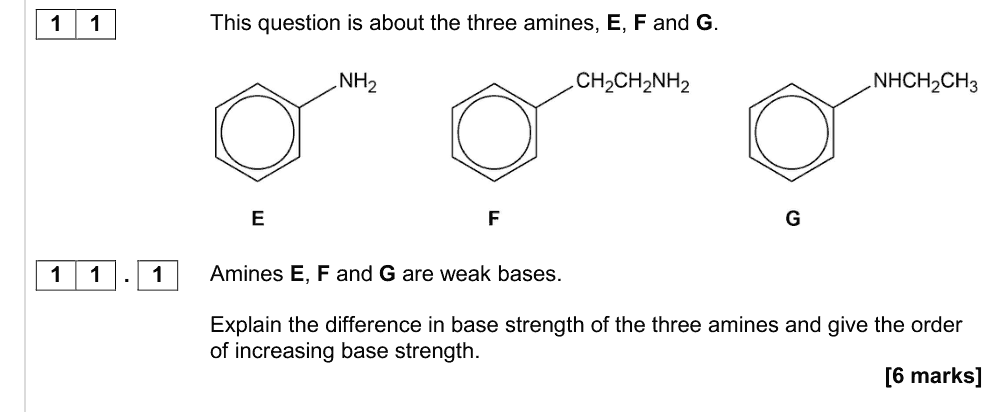
Earlier part of question 11 that this part uses
Mark scheme
Examiner's comment
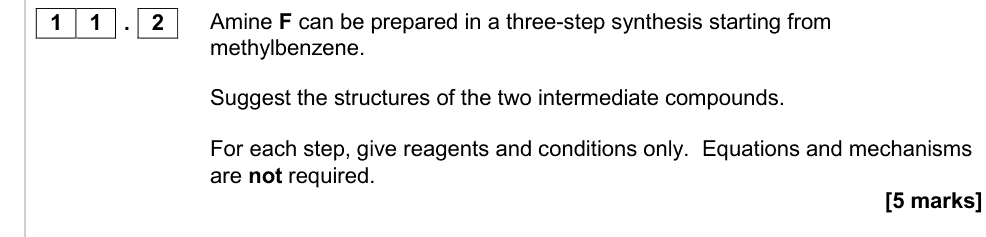
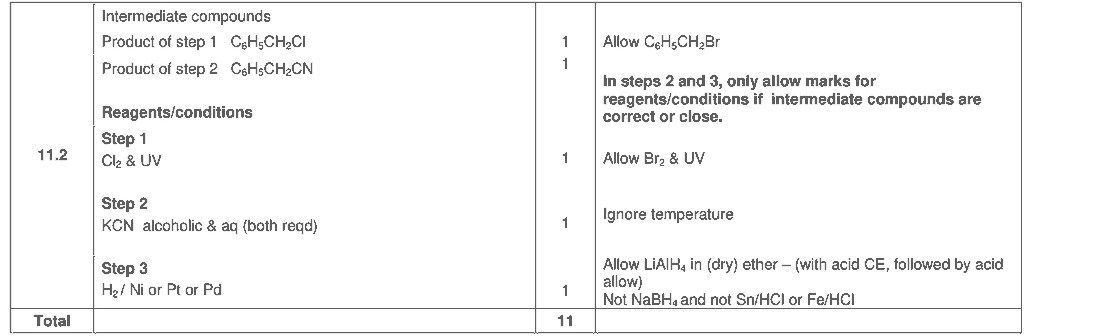
11.2 Some excellent answers were seen, but overall this was not answered well. The fact that about 8% of students made no attempt at this part of the question perhaps indicated that a small number of students were short of time. Some students, confused by the presence of a benzene ring, started with nitration. This rarely led to any marks. For those who chose the correct route, the two intermediates were often correctly identified. The use of chlorine or bromine in UV in the first step was usually well known but use of the reagent KCN in a mixed aqueous/alcoholic solvent was less often correct in the next step. The expected reducing agent/condition for the final step was hydrogen with a nickel or platinum catalyst. LiAlH4 in dry ether is not required knowledge for this specification, but was an acceptable answer.
Notes from the mark scheme and report
Intermediates: C6H5CH2Cl (or the bromide), then C6H5CH2CN. Step 1: Cl2 (or Br2) and UV light. Step 2: KCN in aqueous alcohol (both needed). Step 3: H2 with a Ni (or Pt/Pd) catalyst
LiAlH4 in dry ether allowed
not NaBH4, Sn/HCl or Fe/HCl. Reagent marks for steps 2 and 3 need correct intermediates. Common error: starting with nitration
Work with an A-level chemistry tutor
Dropping marks on calculations, mechanisms or the required practicals? Book a trial session with a specialist A-level chemistry tutor.