Notes and key-term cards for this topic are being written by our tutors. The past-paper questions below are ready now.
Specification statements
Show the 5 statements from the specification
3.2.6-01 In aqueous solution, the following metal-aqua ions are formed: [M(H2O)6]2+, limited to M = Fe and Cu [M(H2O)6]3+, limited to M = Al and Fe
3.2.6-02 The acidity of [M(H2O)6]3+ is greater than that of [M(H2O)6]2+
3.2.6-03 Some metal hydroxides show amphoteric character by dissolving in both acids and bases (eg hydroxides of Al3+).
3.2.6-04 Students should be able to: • explain, in terms of the charge/size ratio of the metal ion, why the acidity of [M(H2O)6]3+ is greater than that of [M(H2O)6]2+ • describe and explain the simple test-tube reactions of: M2+(aq) ions, limited to M = Fe and Cu, and of M3+(aq) ions, limited to M = Al and Fe, with the bases OH–, NH3 and CO32–
3.2.6-05 Required practical 11 Carry out simple test-tube reactions to identify transition metal ions in aqueous solution.
Six-mark level of response questions on this topic
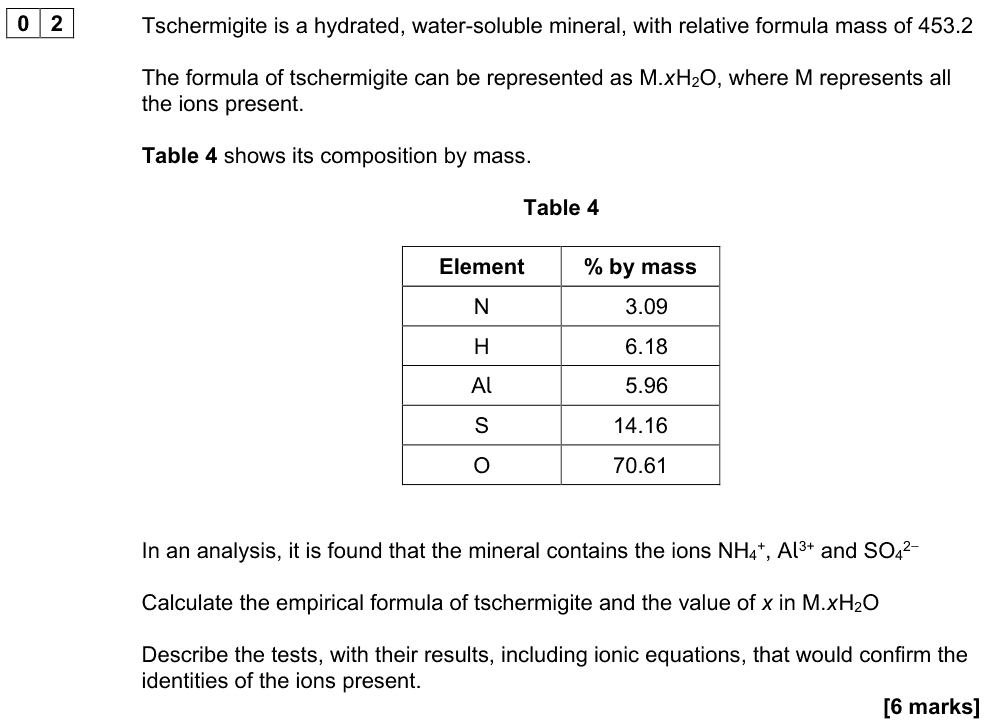
the empirical formula of tschermigite and the value of x in M.x H2O Describe the tests, with their results, including ionic equations, that would confirm the
Tap a question to zoom it. Where a part needs a figure, table or structure from earlier in the question, that part folds out above it; the mark scheme and examiner's comment open underneath. Have AQA's Data Booklet (the Periodic Table and the spectroscopy tables) beside you.
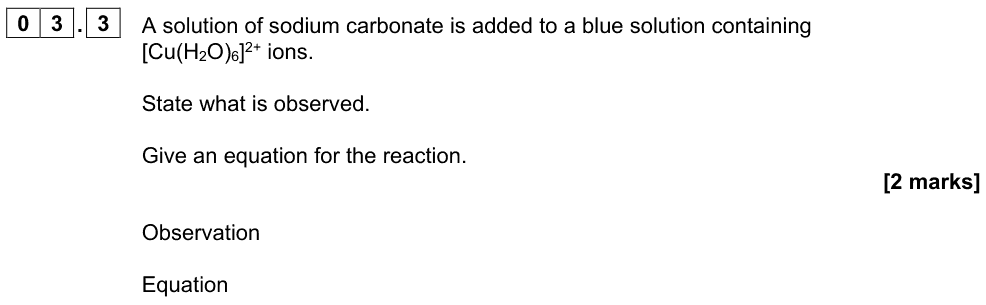
June 2025 · Paper 1 · Q03.32 marksAO1=1, AO2=1Equation writing
Earlier part of question 03 that this part uses
Mark scheme
Examiner's comment
Many incorrect observations were seen in part 3.
The students who started with CO32– usually gave a correct equation; ions with incorrect formula CO3– were common.
Notes from the mark scheme and report
Green / blue-green precipitate (not blue)
[Cu(H2O)6]2+ + CO3 2– → CuCO3 + 6H2O. No effervescence with an M2+ ion. Carbonate written as CO3– was a common error
Skills: RP11 Carry out simple test-tube reactions to identify transition metal ions in aqueous solution
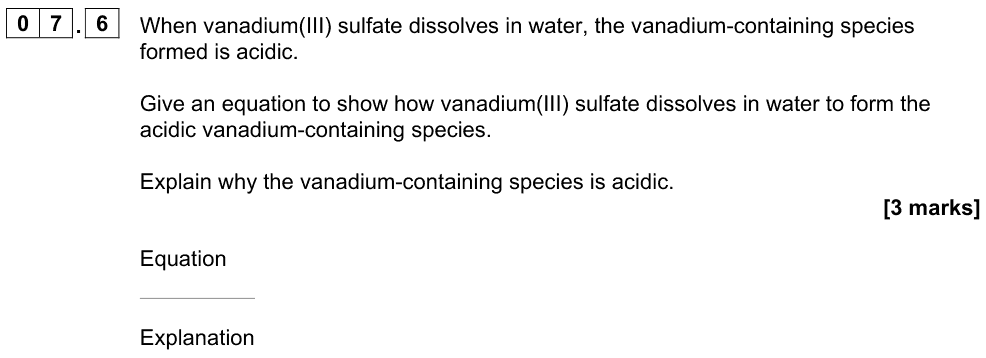
June 2025 · Paper 1 · Q07.63 marksAO2=1, AO3=2Explanation
Earlier parts of question 07 that this part uses
Mark scheme
Examiner's comment
Few students were able to construct and balance the initial equation in part 6 to show the formation of the hexa-aqua complex; VO, VO2+ and H2SO4 were all common products.
Notes from the mark scheme and report
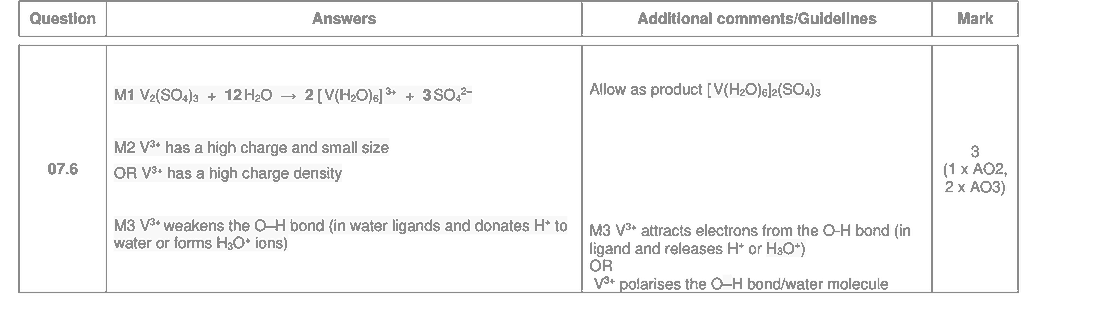
V2(SO4)3 + 12H2O → 2[V(H2O)6]3+ + 3SO4 2–. V3+ is small with a high charge (high charge density)
it polarises / weakens the O–H bond in a water ligand so H+ is released. Few could write the equation: VO, VO 2+ and H2SO4 were common wrong products
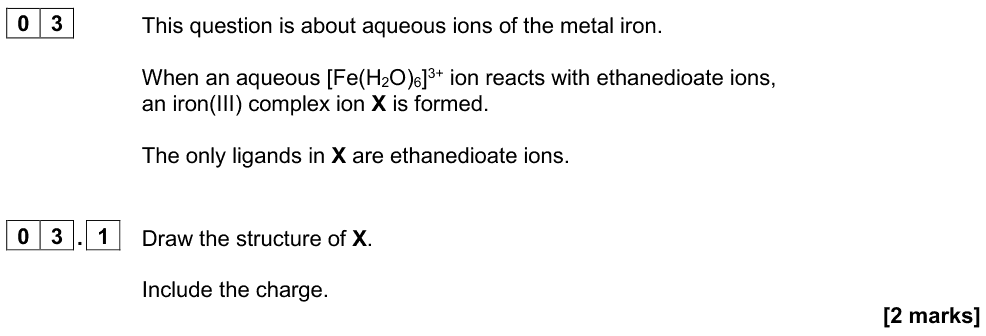
June 2024 · Paper 1 · Q03.41 markAO2=1Short answer
Earlier part of question 03 that this part uses
Mark scheme
Examiner's comment
Many students gave the correct answer to part 4: common incorrect answers included Fe(NH3)2(H2O)4 and Fe(OH–)2(H2O)4.
CO3– was often seen for the carbonate ion in both parts 4 and 5.
Notes from the mark scheme and report
[Fe(H2O)4(OH)2]. Common wrong answers: Fe(NH3)2(H2O)4 and Fe(OH–)2(H2O)4
Skills: RP11 Carry out simple test-tube reactions to identify transition metal ions in aqueous solution
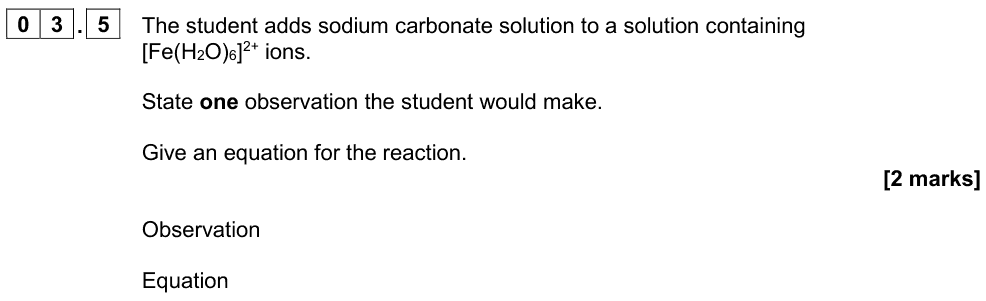
June 2024 · Paper 1 · Q03.52 marksAO1=1, AO2=1Equation writing
Earlier part of question 03 that this part uses
Mark scheme
Examiner's comment
In part 5 the colour of the precipitate was known quite well: some students gave effervescence as an observation with or without the precipitate and therefore could not score.
In the equation many students incorrectly attempted to give acid base reactions.
CO3– was often seen for the carbonate ion in both parts 4 and 5.
Notes from the mark scheme and report
Green precipitate
[Fe(H2O)6]2+ + CO3 2– → FeCO3 + 6H2O. Effervescence given as an observation loses the mark
carbonate written as CO3– was common
Skills: RP11 Carry out simple test-tube reactions to identify transition metal ions in aqueous solution
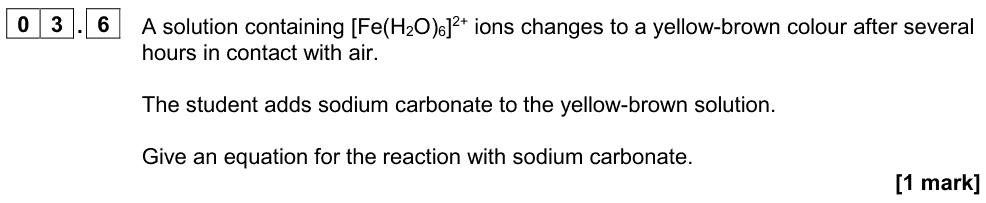
June 2024 · Paper 1 · Q03.61 markAO3=1Equation writingHard
Earlier part of question 03 that this part uses
Mark scheme
Examiner's comment
31% of students gave a correct equation in part 6: common errors included unbalanced equations or giving Na atoms as a product.
Notes from the mark scheme and report
2[Fe(H2O)6]3+ + 3CO3 2– → 2[Fe(H2O)3(OH)3] + 3CO2 + 3H2O (the solution has been oxidised to iron(III)). Errors: unbalanced equations
Na atoms as a product
Skills: RP11 Carry out simple test-tube reactions to identify transition metal ions in aqueous solution
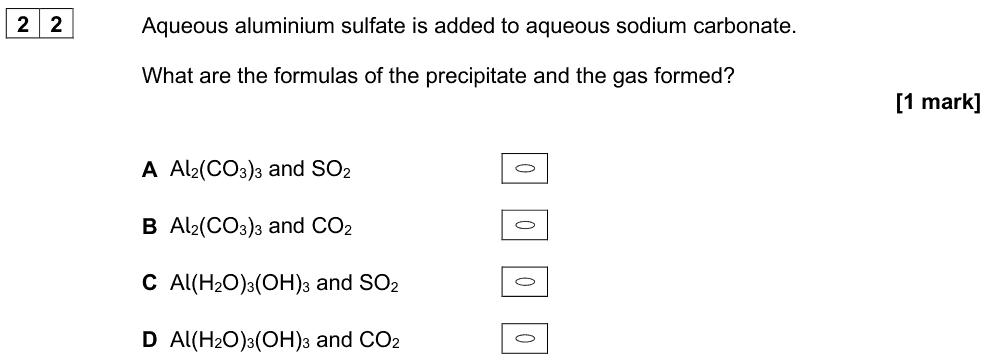
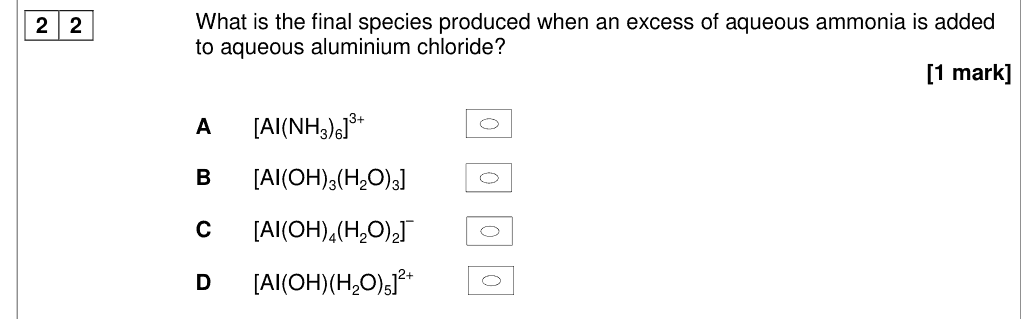
June 2024 · Paper 3 · Q221 markAO2=1Multiple choice
Answer
D
Mark scheme
Notes from the mark scheme and report
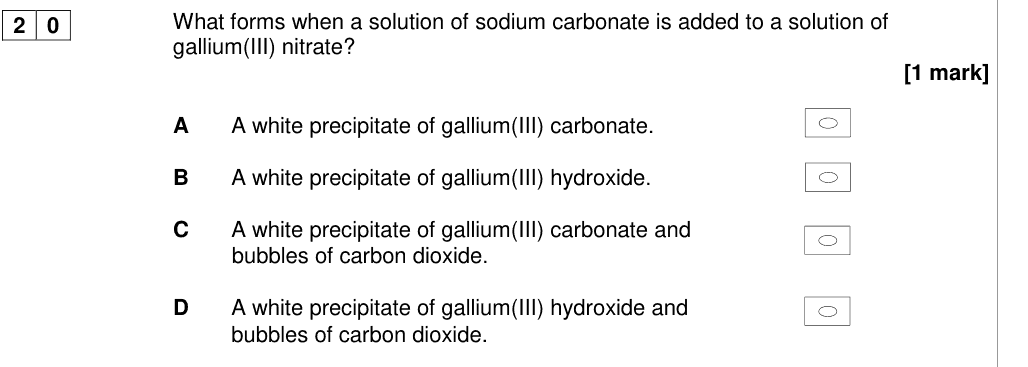
Answer: D. The acidic [Al(H2O)6]3+ ion reacts with carbonate to give the hydroxide precipitate Al(H2O)3(OH)3 and CO2
aluminium carbonate does not form
June 2023 · Paper 1 · Q07.21 markAO1=1Equation writing
Earlier part of question 07 that this part uses
Mark scheme
Examiner's comment
In 07.2, the correct equation was given by 35% of students; common errors included 6 waters on the LHS of the equation and missing the 2– charge on SO42–.
Notes from the mark scheme and report
Al2(SO4)3 + 12H2O → 2[Al(H2O)6]3+ + 3SO4 2–. Errors: 6H2O on the left
charge missing on sulfate (35% correct)
June 2023 · Paper 1 · Q07.32 marksAO1=2Explanation
Earlier part of question 07 that this part uses
Mark scheme
Examiner's comment
Students generally found the explanation in 07.3 challenging; many students discussed the 3+ charge on the complex stating that the complex was polarising, with no reference to Al3+.
The second mark was not often gained.
Notes from the mark scheme and report
Al3+ has a high charge and small size (high charge density)
it polarises / weakens the O–H bond in the water ligands, releasing H+ (forming H3O+). Refer to the Al3+ ion, not the 3+ charge on the complex
M2 was rarely gained
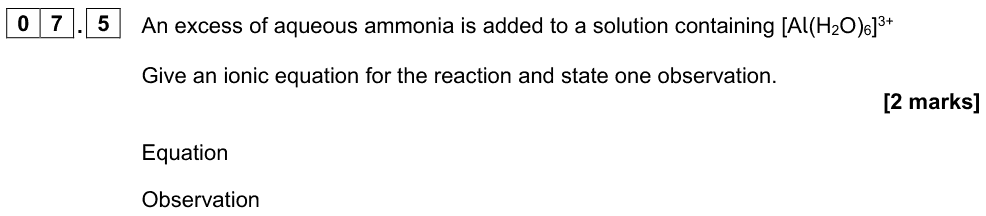
June 2023 · Paper 1 · Q07.52 marksAO1=1, AO2=1Equation writing
Earlier part of question 07 that this part uses
Mark scheme
Examiner's comment
In 07.5, the observation was often correct but the equation was less well known.
Notes from the mark scheme and report
[Al(H2O)6]3+ + 3NH3 → [Al(H2O)3(OH)3] + 3NH4+
white precipitate. Not effervescence
the precipitate does not dissolve in excess ammonia
June 2023 · Paper 1 · Q07.61 markAO3=1Short answer
Earlier part of question 07 that this part uses
Mark scheme
Examiner's comment
A few students gave the correct answer in 07.6; Al2(SO4)3 was a common incorrect answer.
Notes from the mark scheme and report
[Al(H2O)6]3+ (the hydroxide precipitate dissolves in acid). Common wrong answer: Al2(SO4)3
June 2023 · Paper 3 · Q046 marks6-mark level of responseHard
Mark scheme, with the levels and indicative content
Examiner's comment
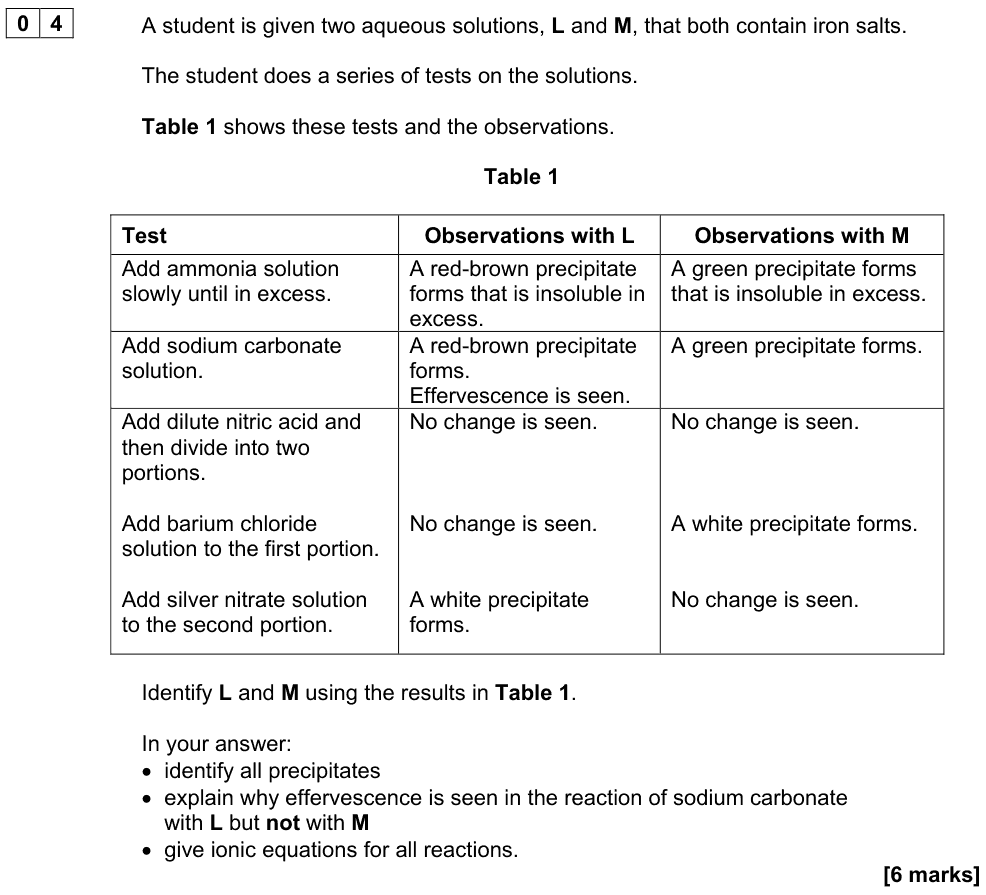
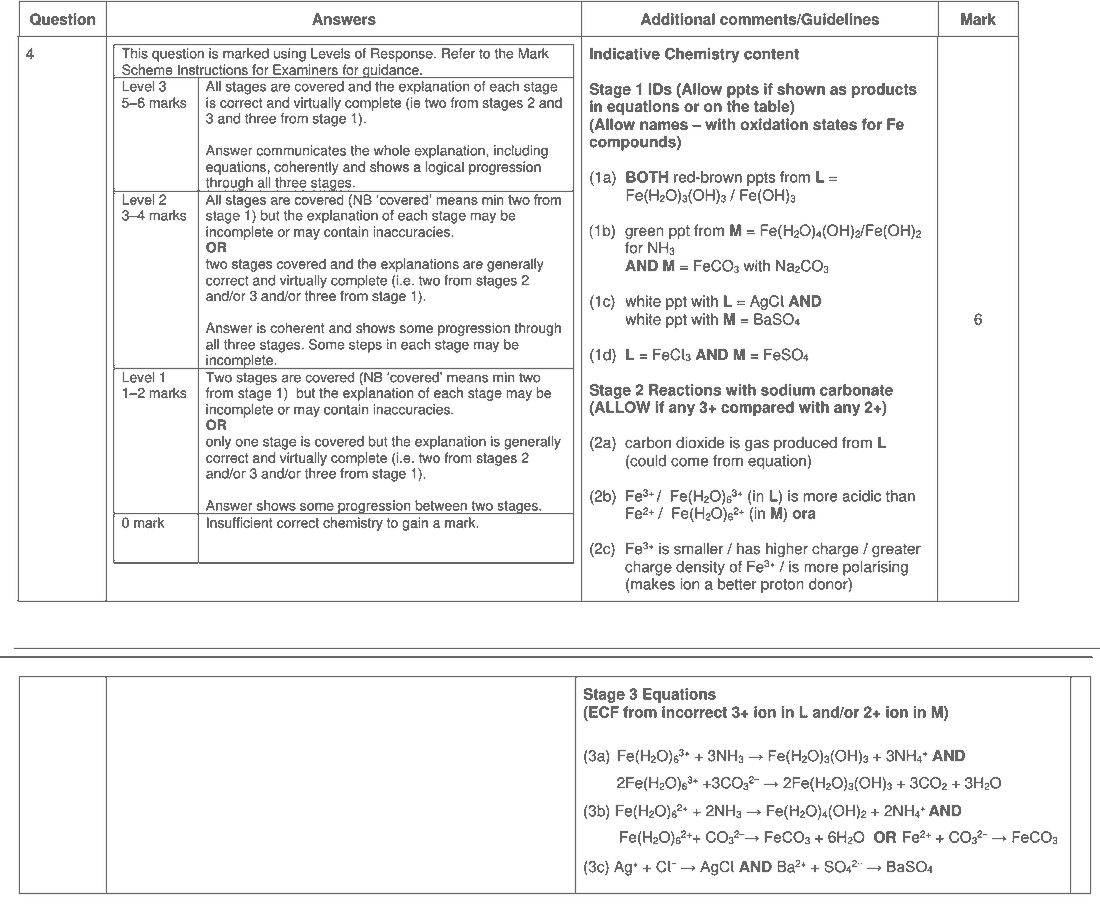
As last year, only about 10% of students were able to access level 3 and score 5 or 6 marks. In this case, the most common omissions from the indicative content were 2b and 2c which related to the explanation of the reason for effervescence with L but not with M when carbonate was added. Many students thought that it was enough to simply say that CO2 is produced with L but not M and did not go on to discuss the reasons for this in terms of the greater acidity of Fe3+(aq) compared with Fe2+(aq).
Many students did, however, recognise the important distinction that the 3+ ion with carbonate produces iron(III) hydroxide but the 2+ ion with carbonate forms iron(II) carbonate. The quality of equations varied and there were sometimes contradictions between a statement that, for example, a reaction produces a precipitate of Fe(H2O)4(OH)2 but then an equation showing the formation of Fe(H2O)4(NH3)2. Hydroxide ions were also often seen as a reactant in the reaction equations for Fe2+ and Fe3+ with ammonia.
It was unexpected to discover that a significant minority of students did not recognise the tests for ions that were included in the question – especially as some of these tests are first encountered at GCSE.
Notes from the mark scheme and report
Levels of response, three stages. Stage 1 identities: L is FeCl3 and M is FeSO4
both red-brown precipitates are Fe(H2O)3(OH)3
green precipitates are Fe(H2O)4(OH)2 with ammonia and FeCO3 with carbonate
white precipitates are AgCl (from L) and BaSO4 (from M). Stage 2 effervescence: CO2 forms with L only, because [Fe(H2O)6]3+ is more acidic than [Fe(H2O)6]2+
Fe3+ is smaller with a higher charge (greater charge density, more polarising). Stage 3 ionic equations: [Fe(H2O)6]3+ + 3NH3 → Fe(H2O)3(OH)3 + 3NH4+
Ba2+ + SO4 2– → BaSO4. Most often missing: the acidity explanation
OH– wrongly shown as the reactant with ammonia
Skills: ATd Use laboratory apparatus for a variety of experimental techniques including: titration, using burette and pipette; distillation and heating under reflux, including setting up glassware using retort stand and clamps; qualitative tests for ions and organic functional groups; filtration, including use of fluted filter paper, or filtration under reduced pressure; PS1.1 Solve problems set in practical contexts; PS2.3 Evaluate results and draw conclusions with reference to measurement uncertainties and errors; RP11 Carry out simple test-tube reactions to identify transition metal ions in aqueous solution
June 2022 · Paper 1 · Q07.51 markAO3=1Equation writing
Earlier parts of question 07 that this part uses
Mark scheme
Examiner's comment
In 07.5, 50% of students gave the correct equation; a common error was to have 2 Cl2 as a product.
Notes from the mark scheme and report
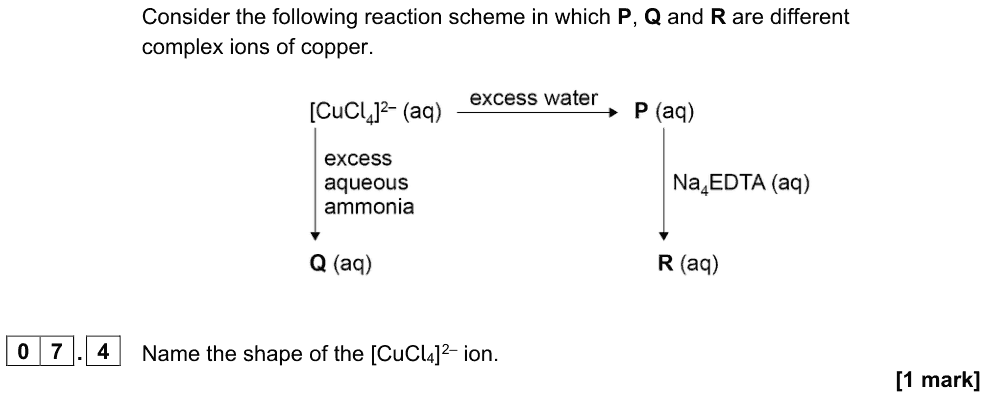
[CuCl4]2– + 6H2O → [Cu(H2O)6]2+ + 4Cl– (P is the hexaaqua ion
co-ordination number changes from 4 to 6). Common error: 2Cl2 as a product. 50% correct. Uses the reaction scheme printed in 07.4
June 2022 · Paper 1 · Q07.62 marksAO3=2Equation writing
Earlier parts of question 07 that this part uses
Mark scheme
Examiner's comment
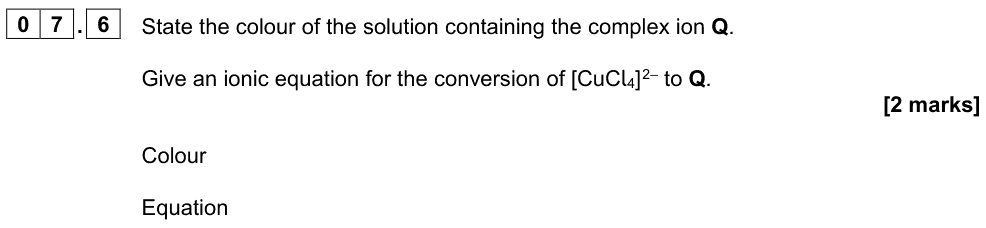
In 07.6, some students did not state that the solution was deep blue and many could not give a correct equation; many students gave complexes with six ammonia ligands and chlorine gas as a product.
chlorine gas as a product. Uses the reaction scheme printed in 07.4
June 2022 · Paper 3 · Q026 marksAO2=2, AO3=46-mark level of response
Mark scheme, with the levels and indicative content
Examiner's comment
This levels of response question was expected to be more accessible than some in the past but a lack of accuracy in describing the tests for the anions meant that Level 3 was rarely attained. The need to warm after adding NaOH when testing for NH4+ was often missing as was the need to acidify the BaCl2 when testing for sulfate. Many students also stopped their description of the test for Al3+ at the stage of forming a white precipitate and failed to mention that it redissolves in excess NaOH.
The equations for the test for Al3+ should preferably have been those with the hydrated ion but the simpler versions were allowed from the point of view of indicative content. The equation for the redissolving of the solid was often shown as Al(H2O)3(OH)3 + OH– → Al(OH)4– + 3 H2O which implies a combination of ligand replacement and acid-base behaviour, but the product anion should be shown with two water ligands still present in this case.
In stage 1 the empirical formula of NH28AlS2O20 was sometimes not actually shown even though the calculation was done. Some students seemed confused that, in this case, the empirical formula mass is equal to the relative formula mass and they thought that meant that x = 0. It was hoped that students would recognise that 1 × N meant one NH4+ and 2 × S meant two SO42– ions – from which the number of waters could be found.
Notes from the mark scheme and report
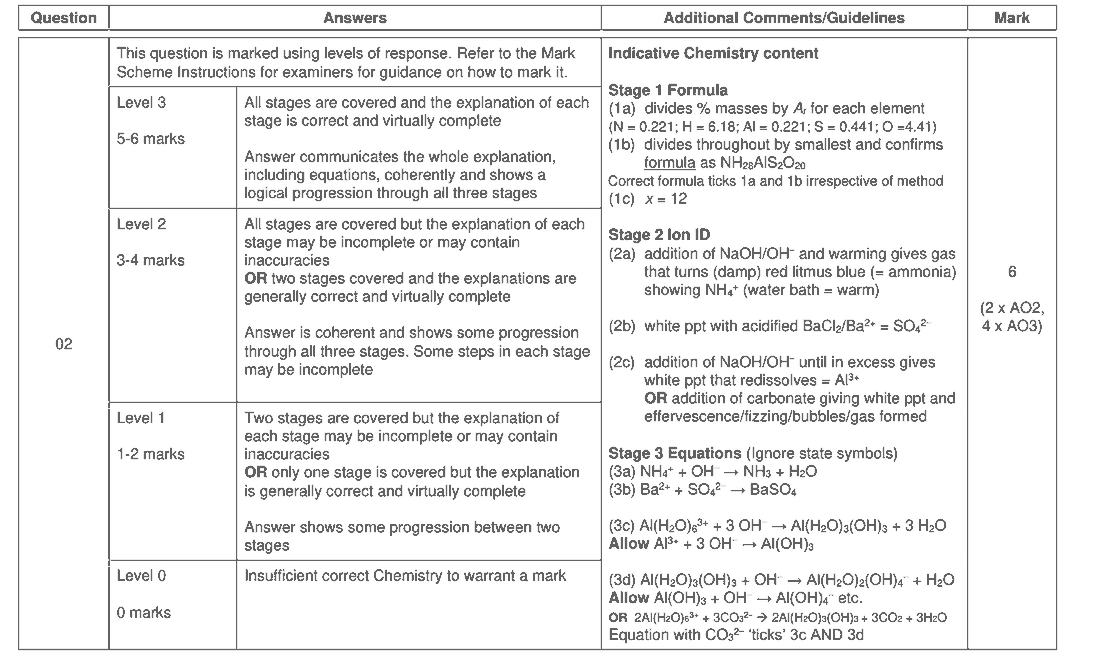
Levels of response, three stages. Formula: divide % by Ar (N 0.221, H 6.18, Al 0.221, S 0.441, O 4.41)
divide by the smallest to get NH28AlS2O20
this is NH4Al(SO4)2.12H2O, so x = 12. Tests: add NaOH and warm, gas turns damp red litmus blue (NH4+)
acidified BaCl2 gives a white precipitate (SO4 2–)
NaOH added dropwise gives a white precipitate that dissolves in excess (Al3+). Equations: NH4+ + OH– → NH3 + H2O
Ba2+ + SO4 2– → BaSO4
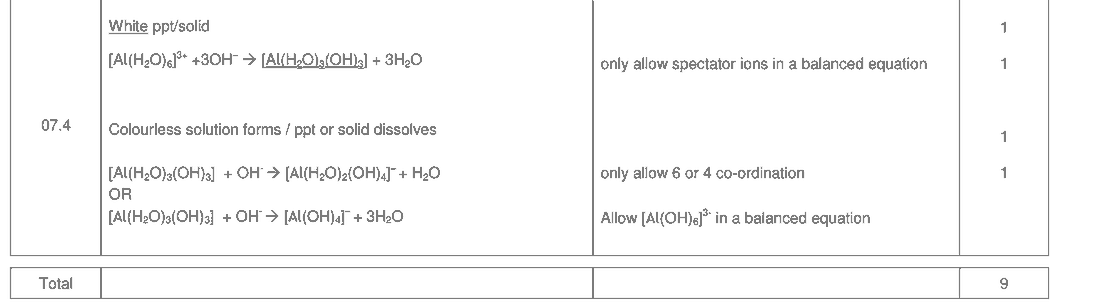
[Al(H2O)6]3+ + 3OH– → [Al(H2O)3(OH)3] + 3H2O
[Al(H2O)3(OH)3] + OH– → [Al(H2O)2(OH)4]– + H2O. Common gaps: no warming, BaCl2 not acidified, precipitate not redissolved. Level 3 was rarely reached
Skills: MS0.2 Use ratios, fractions and percentages; ATd Use laboratory apparatus for a variety of experimental techniques including: titration, using burette and pipette; distillation and heating under reflux, including setting up glassware using retort stand and clamps; qualitative tests for ions and organic functional groups; filtration, including use of fluted filter paper, or filtration under reduced pressure; PS1.1 Solve problems set in practical contexts; RP4 Carry out simple test-tube reactions to identify: cations – Group 2, NH4+; anions – Group 7 (halide ions), OH–, CO32–, SO42–
November 2021 · Paper 1 · Q04.52 marksShort answer
Earlier part of question 04 that this part uses
Mark scheme
Examiner's comment
In question 04.5 the colour of iron(II) carbonate was well known; however, if iron carbonate was given in words the (II) was often missing.
Notes from the mark scheme and report
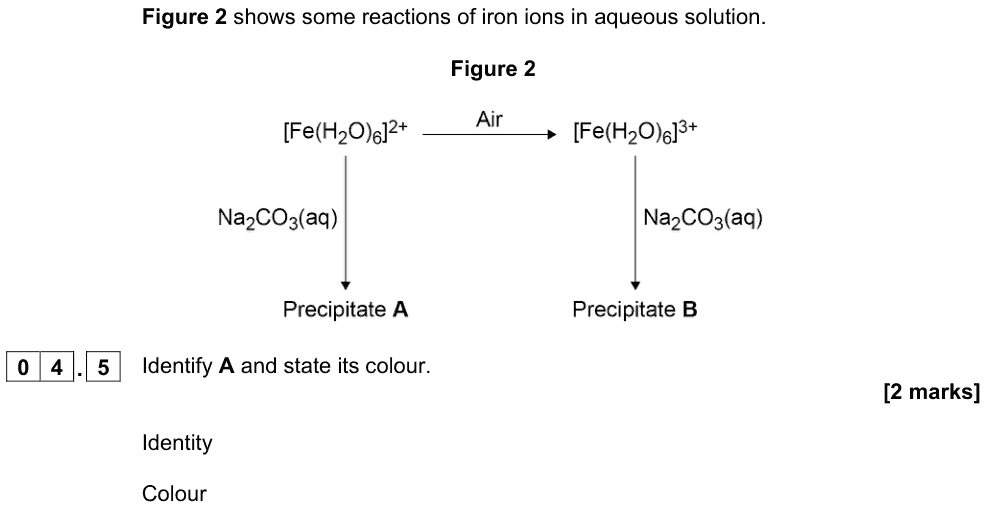
Iron(II) carbonate, FeCO3
green (allow white). If named in words the (II) is needed
Skills: RP11 Carry out simple test-tube reactions to identify transition metal ions in aqueous solution
November 2021 · Paper 1 · Q04.63 marksEquation writing
Earlier parts of question 04 that this part uses
Mark scheme
Examiner's comment
The colour and/or formula were generally known in question 04.6 but the equation was not answered well; if the species were correct the equation was often not balanced.
Notes from the mark scheme and report
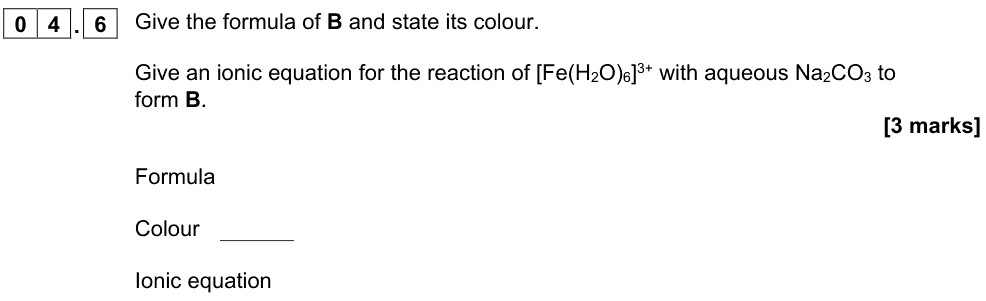
Fe(H2O)3(OH)3
brown
2[Fe(H2O)6]3+ + 3CO3 2– → 2Fe(H2O)3(OH)3 + 3CO2 + 3H2O. The equation was often unbalanced. Uses Figure 2 from 04.5
Skills: RP11 Carry out simple test-tube reactions to identify transition metal ions in aqueous solution
November 2021 · Paper 1 · Q04.73 marksExplanation
Earlier part of question 04 that this part uses
Mark scheme
Examiner's comment
Students found question 04.7 very challenging; students often discussed the charge-to-size ratio of the hydrated ions rather than the iron ions themselves.
Students rarely gained the second mark but a few did state that more hydrogen ions were released and so gained the third mark.
Notes from the mark scheme and report
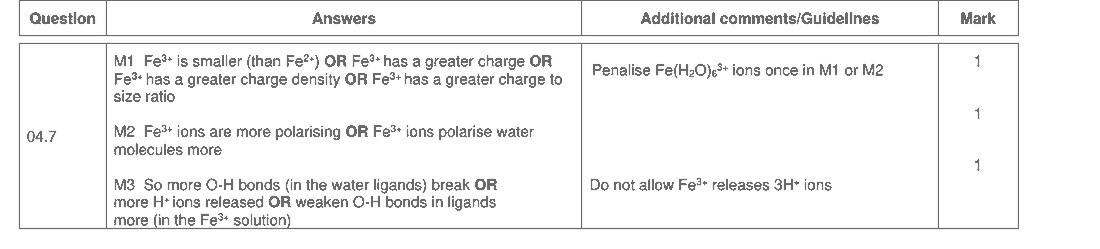
Fe3+ is smaller / has a greater charge (greater charge to size ratio) than Fe2+
so it is more polarising (polarises the water ligands more)
the O–H bonds in the ligands are weakened more, so more H+ ions are released. Refer to the Fe3+ ion, not the hydrated complex
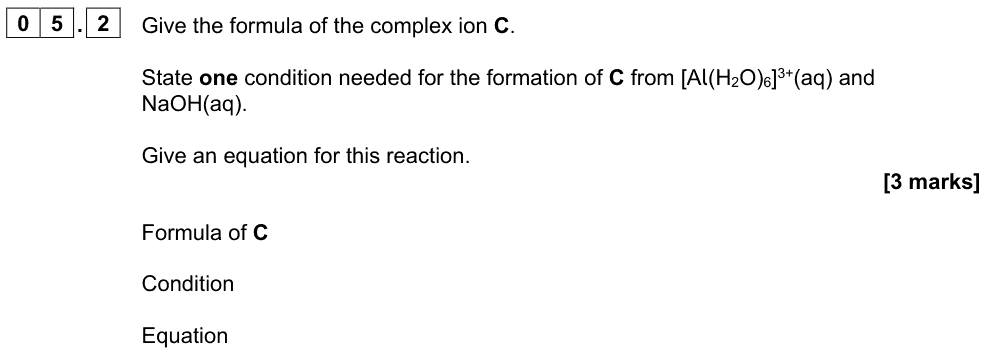
November 2020 · Paper 1 · Q05.13 marksEquation writing
Mark scheme
Examiner's comment
The formula in 05.1 was correctly given by some students; the observation was well known.
The equation was correct in only a small proportion of responses; students often failed to balance the equation and some failed to include water as a product.
Notes from the mark scheme and report
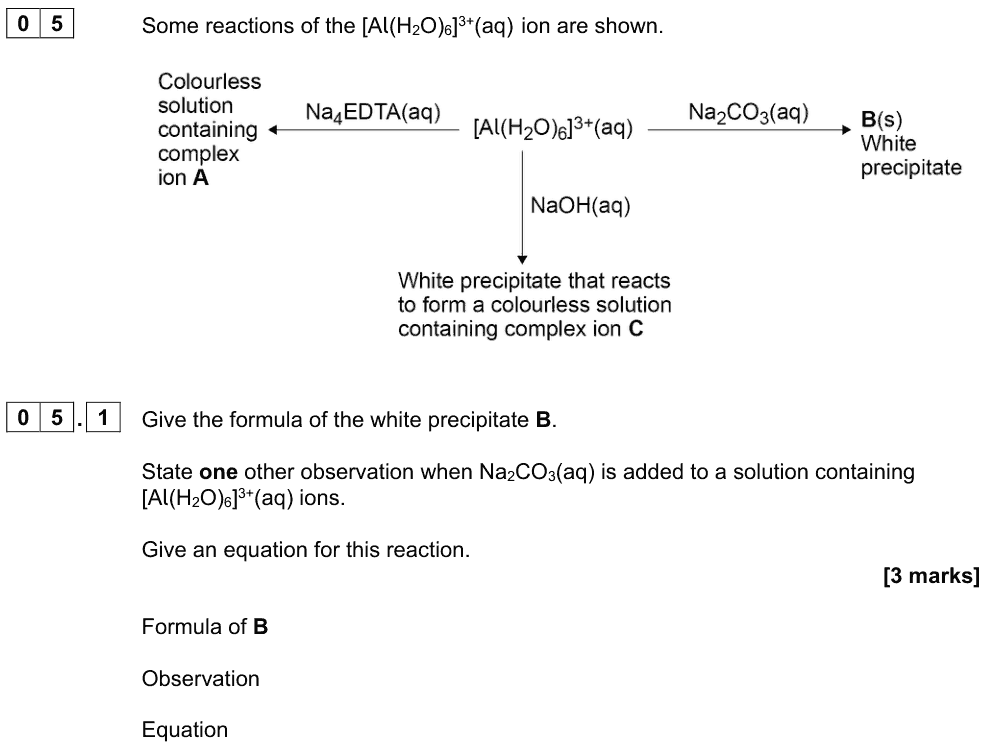
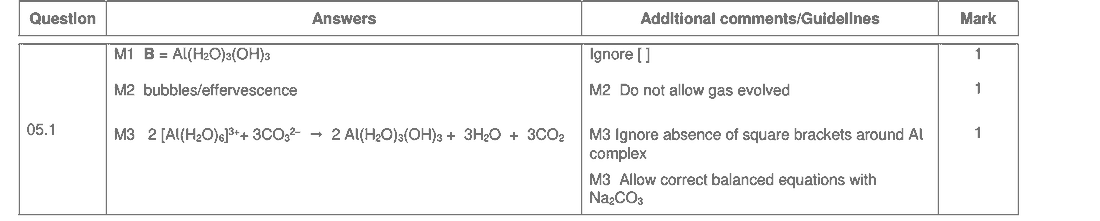
B = Al(H2O)3(OH)3
effervescence / bubbles (not 'gas evolved')
2[Al(H2O)6]3+ + 3CO3 2– → 2Al(H2O)3(OH)3 + 3CO2 + 3H2O. Equation rarely correct: unbalanced or water missing
November 2020 · Paper 1 · Q05.23 marksEquation writing
Earlier part of question 05 that this part uses
Mark scheme
Examiner's comment
In 05.2, many students did not give the correct formula of the complex ion; common incorrect answers included Al(H2O)3(OH)3 or complex ions with positive charges.
Some students incorrectly gave heat, reflux or concentrated alkali as the condition.
Students who had the correct formula for the aluminate complex often did not balance the equation correctly or started from Al(H2O)3(OH)3.
Notes from the mark scheme and report
C = [Al(OH)4]– (or [Al(H2O)2(OH)4]– or [Al(OH)6]3–)
excess NaOH
[Al(H2O)6]3+ + 4OH– → [Al(OH)4]– + 6H2O (or the matching equation for their ion). Wrong answers: Al(H2O)3(OH)3, positive ions
heat or concentrated alkali as the condition
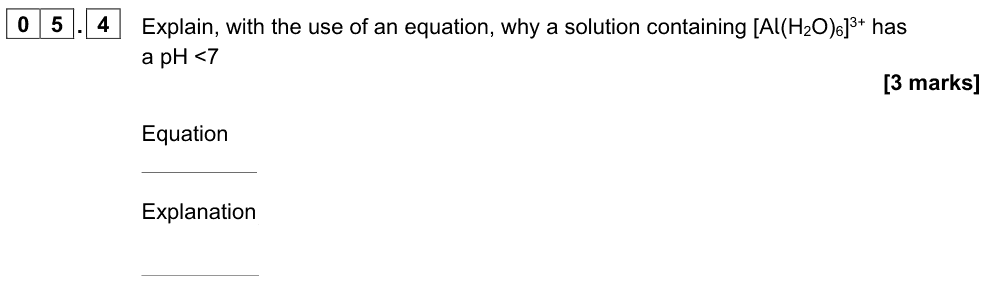
November 2020 · Paper 1 · Q05.43 marksExplanation
Earlier part of question 05 that this part uses
Mark scheme
Examiner's comment
Answers to 05.4 were not well done.
Many students tried to give an equation involving a base other than water.
Many students failed to explain their answers clearly enough to score marks; common errors included stating that aluminium or the aluminium complex has a high charge to size ratio.
The bond that was weakened was not clearly stated and there was a failure to state that H+ ions are released which makes the solution acidic.
Notes from the mark scheme and report
[Al(H2O)6]3+ + H2O ⇌ [Al(H2O)5(OH)]2+ + H3O+ (or → ... + H+). Al3+ is small and highly charged (high charge density)
it weakens the O–H bond in a water ligand so H+ is released. Must be the Al3+ ion, not aluminium or the complex
say which bond weakens and that H+ is released
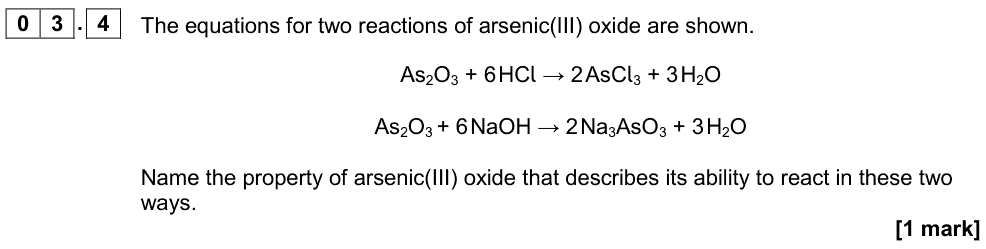
June 2019 · Paper 1 · Q03.41 markShort answer
Earlier part of question 03 that this part uses
Mark scheme
Examiner's comment
3.4 Amphoteric was well known, although the spelling was often incorrect.
Notes from the mark scheme and report
Amphoteric (reacts with both acid and alkali)
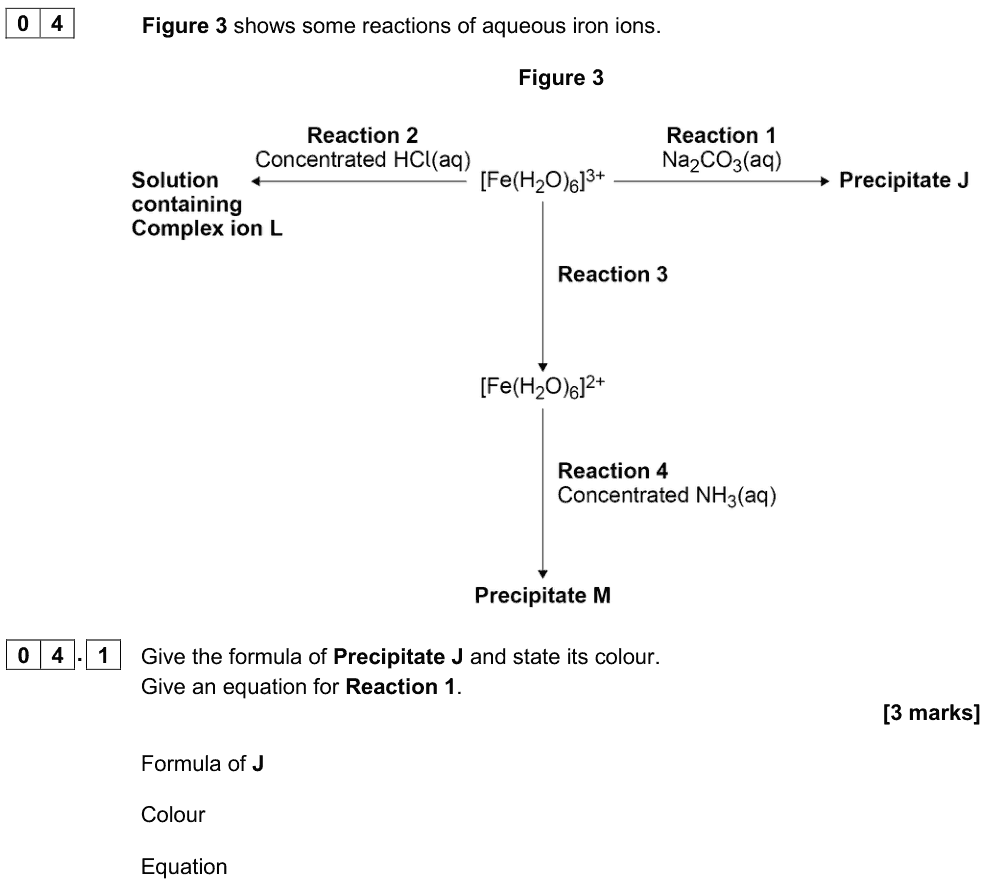
June 2019 · Paper 1 · Q04.13 marksShort answer
Mark scheme
Examiner's comment
4.1 The formula was well known but the colour of the precipitate less so. The equation was only familiar to a small number of students; the required ratio of 2:3 for the iron(III) ion: carbonate ion was often incorrect.
Notes from the mark scheme and report
J is [Fe(OH)3(H2O)3]
brown (red-brown). 2[Fe(H2O)6]3+ + 3CO3 2– → 2[Fe(OH)3(H2O)3] + 3CO2 + 3H2O. The colour was less well known
the 2:3 ratio was often wrong
Skills: RP11 Carry out simple test-tube reactions to identify transition metal ions in aqueous solution
June 2019 · Paper 1 · Q04.42 marksShort answer
Earlier part of question 04 that this part uses
Mark scheme
Examiner's comment
4.4 Here, the colour of the precipitate was quite well known but the formula less so; many students included ammonia in the complex and did not recognise this as a hydrolysis reaction. Answers such as [Fe(NH3)6]2+ or [Fe(NH3)4(H2O)2]2+ were common.
Notes from the mark scheme and report
M is [Fe(OH)2(H2O)4]
green. Ammonia acts as a base here: common wrong answers put NH3 in the complex, eg [Fe(NH3)6]2+ or [Fe(NH3)4(H2O)2]2+
Skills: RP11 Carry out simple test-tube reactions to identify transition metal ions in aqueous solution
June 2018 · Paper 1 · Q07.11 markEquation writing
Mark scheme
Examiner's comment
07.1 Just over half of the students (50.2%) could give the correct equation; common errors included giving chlorine as a product, incorrect balancing and sometimes an incorrect formula for aluminium chloride.
Notes from the mark scheme and report
AlCl3 + 6H2O → [Al(H2O)6]3+ + 3Cl–. Errors: chlorine as a product
not balanced
wrong formula for aluminium chloride
June 2018 · Paper 1 · Q07.21 markEquation writingHard
Earlier part of question 07 that this part uses
Mark scheme
Examiner's comment
07.2 Only a small proportion of students (22.6%) could give a correct equation here; many did not include protonation of water, as implied in the question. A surprisingly high proportion of students (10.8%) failed even to attempt this question.
Notes from the mark scheme and report
[Al(H2O)6]3+ + H2O → [Al(H2O)5(OH)]2+ + H3O+ (water must be shown accepting the proton). Many did not protonate water
June 2018 · Paper 1 · Q07.33 marksEquation writingHard
Earlier part of question 07 that this part uses
Mark scheme
Examiner's comment
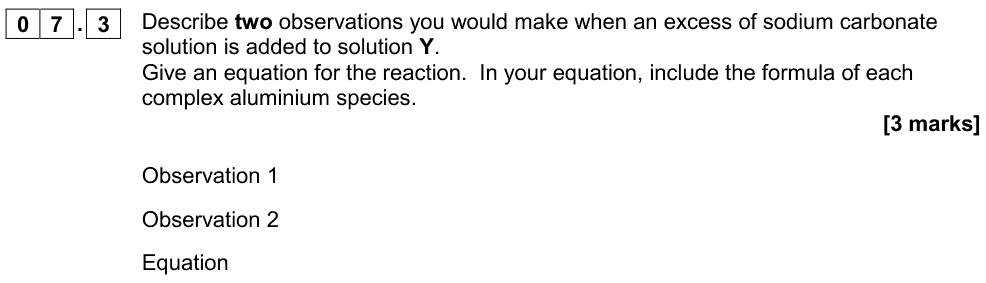
07.3 Here, students were more able to state observations than to write the equations. Some students stated that carbon dioxide was evolved, but this is not an observation – it is a deduction from the effervescence seen. Just over 25% of students scored all the marks in this part of the question.
Notes from the mark scheme and report
White precipitate
effervescence. 2[Al(H2O)6]3+ + 3CO3 2– → 2[Al(H2O)3(OH)3] + 3CO2 + 3H2O. 'Carbon dioxide evolved' is a deduction, not an observation
June 2018 · Paper 1 · Q07.44 marksEquation writing
Earlier part of question 07 that this part uses
Mark scheme
Examiner's comment
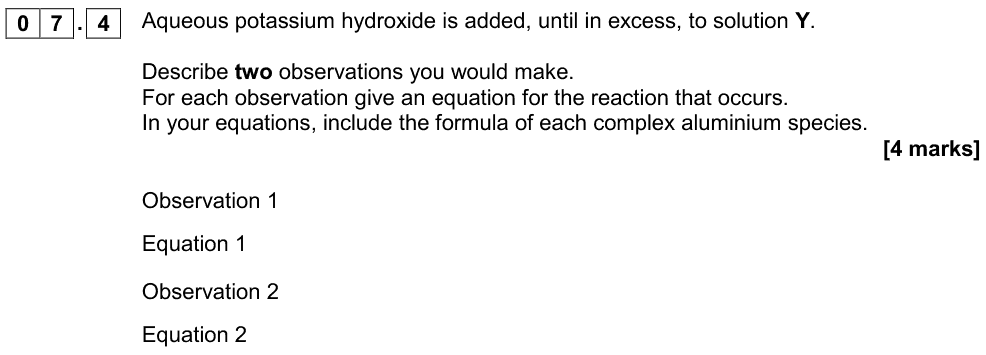
07.4 Students were better able to state observations than write equations but only 35% of students scored all of the marks available. Again, just over 10% of students failed to attempt this part.
Notes from the mark scheme and report
White precipitate: [Al(H2O)6]3+ + 3OH– → [Al(H2O)3(OH)3] + 3H2O. Then the precipitate dissolves to a colourless solution: [Al(H2O)3(OH)3] + OH– → [Al(H2O)2(OH)4]– + H2O (or [Al(OH)4]– + 3H2O). Only 6 or 4 co-ordination allowed
June 2017 · Paper 1 · Q07.32 marksEquation writing
Earlier part of question 07 that this part uses
Mark scheme
Examiner's comment
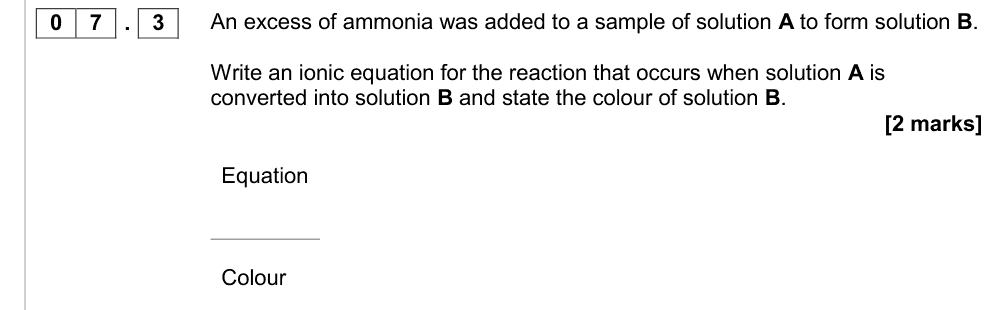
07.3 The colour of the solution formed was better known than the equation; many students could not give a correct ionic equation and [Cu(NH3)6]2+ was a common incorrect product.
Notes from the mark scheme and report
[Cu(H2O)6]2+ + 4NH3 → [Cu(NH3)4(H2O)2]2+ + 4H2O (the two-step route via [Cu(H2O)4(OH)2] is allowed)
deep blue solution. [Cu(NH3)6]2+ was a common wrong product
Skills: RP11 Carry out simple test-tube reactions to identify transition metal ions in aqueous solution
Skills: RP11 Carry out simple test-tube reactions to identify transition metal ions in aqueous solution
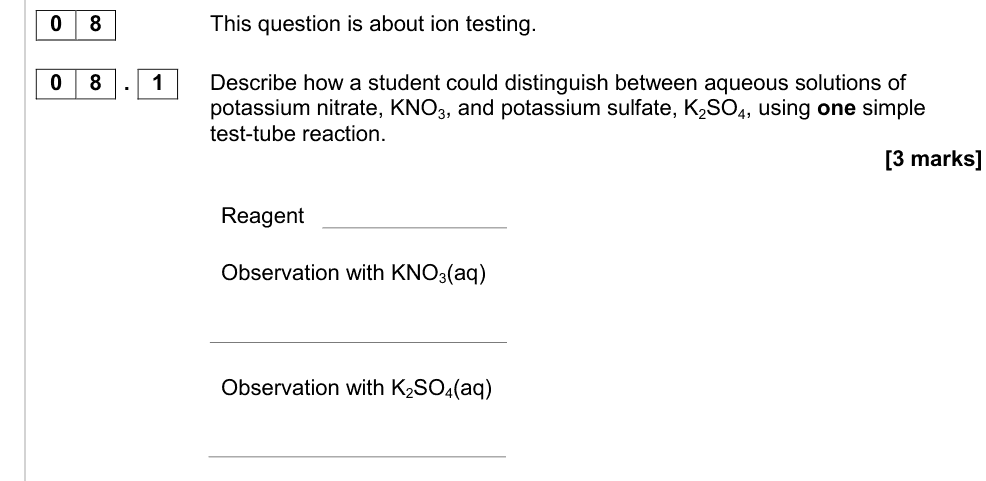
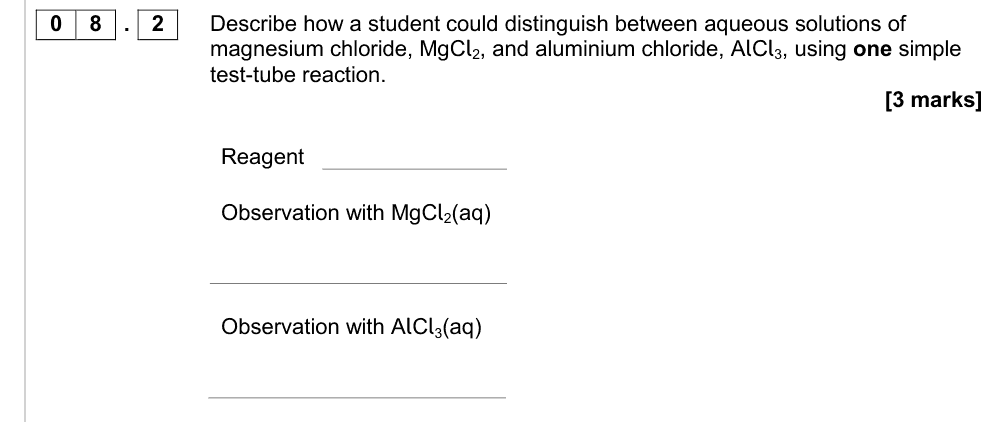
June 2017 · Paper 1 · Q08.23 marksPractical and data analysis
Earlier part of question 08 that this part uses
Mark scheme
Examiner's comment
08.2 Good answers to this question were rarely seen. Sodium hydroxide was the most common correct reagent, but students then failed to realise that an excess of sodium hydroxide was needed to distinguish between the two metal ions. A few students suggested sodium carbonate as the reagent but then failed to give full observations.
Notes from the mark scheme and report
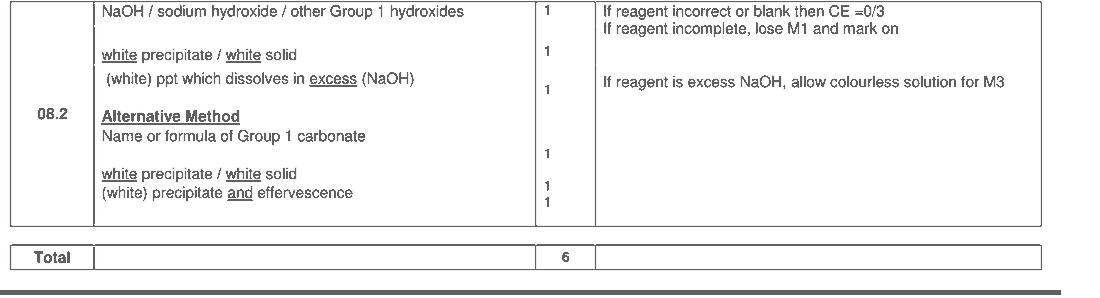
NaOH(aq) (or another Group 1 hydroxide): MgCl2 gives a white precipitate
AlCl3 gives a white precipitate that dissolves in excess NaOH. Alternative: Group 1 carbonate: white precipitate with MgCl2
white precipitate and effervescence with AlCl3. Wrong reagent = 0/3. Most did not say that excess NaOH is needed
Skills: ATd Use laboratory apparatus for a variety of experimental techniques including: titration, using burette and pipette; distillation and heating under reflux, including setting up glassware using retort stand and clamps; qualitative tests for ions and organic functional groups; filtration, including use of fluted filter paper, or filtration under reduced pressure; PS1.1 Solve problems set in practical contexts; RP4 Carry out simple test-tube reactions to identify: cations – Group 2, NH4+; anions – Group 7 (halide ions), OH–, CO32–, SO42–
Specimen · Paper 1 · Q08.24 marksEquation writing
Earlier part of question 08 that this part uses
Mark scheme
Notes from the mark scheme and report
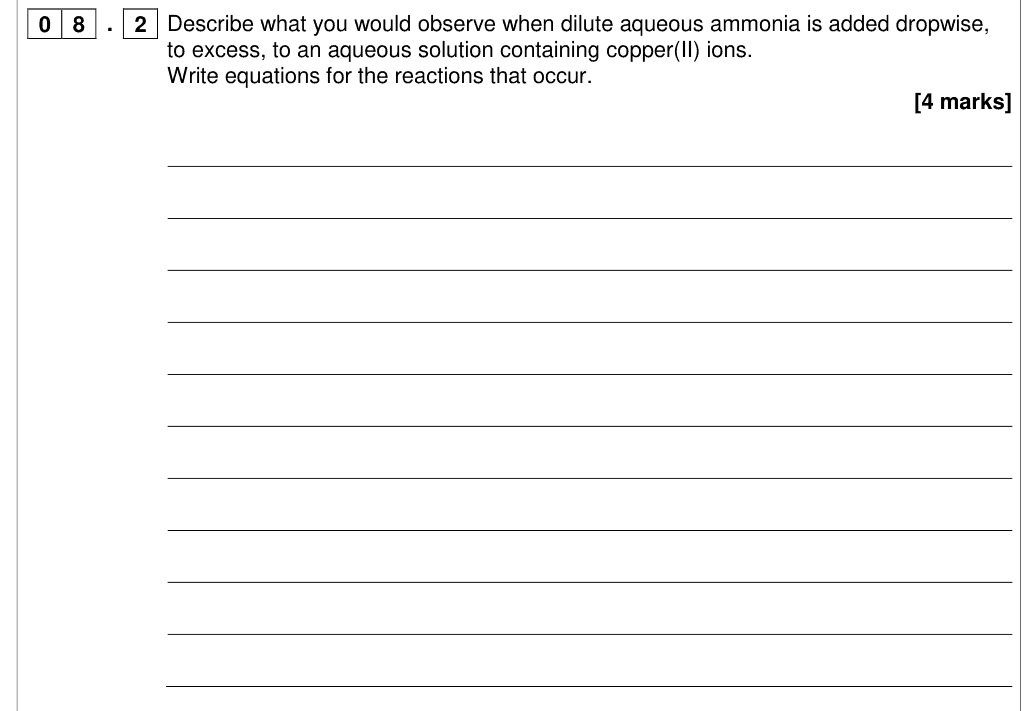
A (pale) blue precipitate forms, which dissolves in excess to give a dark blue solution. [Cu(H2O)6]2+ + 2NH3 → [Cu(H2O)4(OH)2] + 2NH4+
Skills: ATd Use laboratory apparatus for a variety of experimental techniques including: titration, using burette and pipette; distillation and heating under reflux, including setting up glassware using retort stand and clamps; qualitative tests for ions and organic functional groups; filtration, including use of fluted filter paper, or filtration under reduced pressure; RP11 Carry out simple test-tube reactions to identify transition metal ions in aqueous solution
Specimen · Paper 1 · Q10.16 marksPractical and data analysis
Mark scheme
Notes from the mark scheme and report
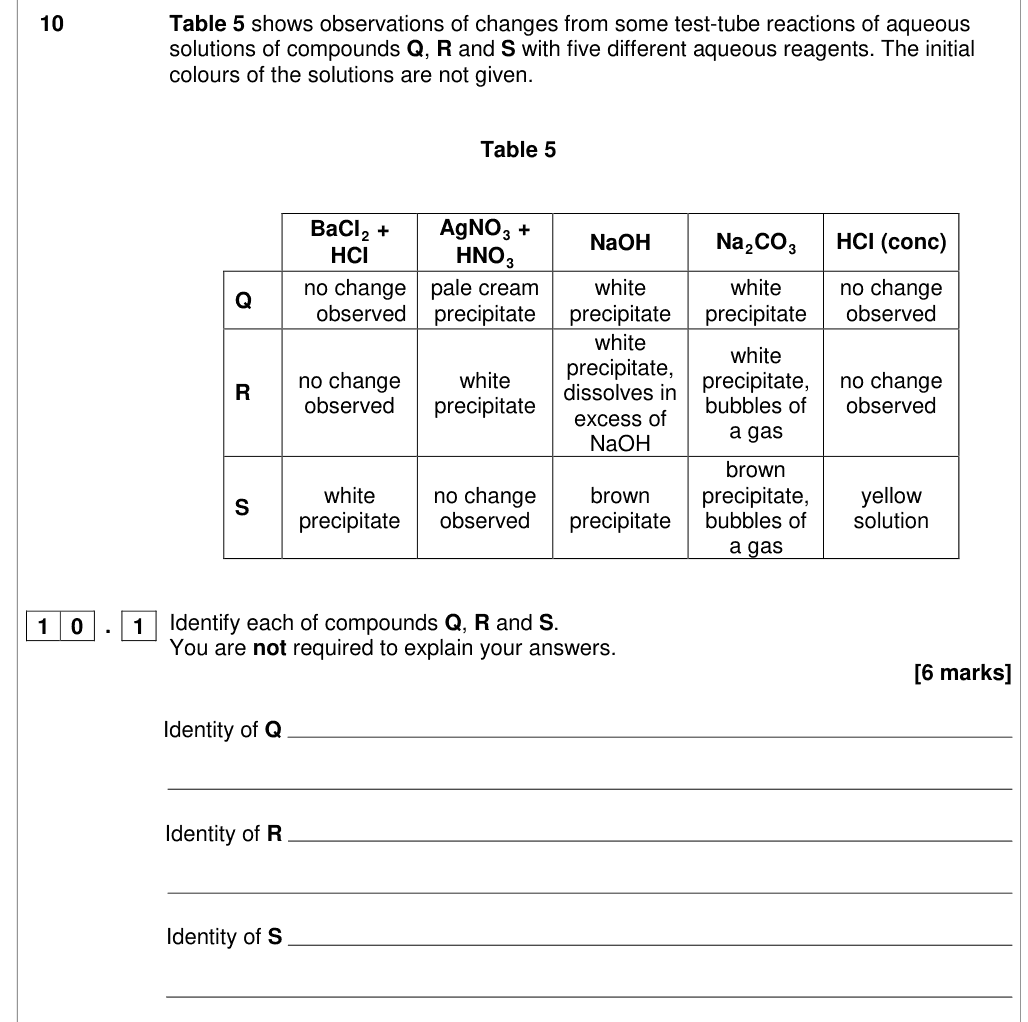
Q is calcium bromide or magnesium bromide
R is aluminium chloride
S is iron(III) sulfate. Six marks, one for each ion identified independently (cream precipitate = bromide
white precipitate dissolving in excess NaOH = Al3+
white precipitate with BaCl2 = sulfate
brown precipitates = Fe3+)
Skills: PS1.1 Solve problems set in practical contexts; PS2.3 Evaluate results and draw conclusions with reference to measurement uncertainties and errors; ATd Use laboratory apparatus for a variety of experimental techniques including: titration, using burette and pipette; distillation and heating under reflux, including setting up glassware using retort stand and clamps; qualitative tests for ions and organic functional groups; filtration, including use of fluted filter paper, or filtration under reduced pressure; RP11 Carry out simple test-tube reactions to identify transition metal ions in aqueous solution