Notes and key-term cards for this topic are being written by our tutors. The past-paper questions below are ready now.
Specification statements
Show the 15 statements from the specification
3.1.11.1-01 IUPAC convention for writing half-equations for electrode reactions.
3.1.11.1-02 The conventional representation of cells.
3.1.11.1-03 Cells are used to measure electrode potentials by reference to the standard hydrogen electrode.
3.1.11.1-04 The importance of the conditions when measuring the electrode potential, E (Nernst equation not required).
3.1.11.1-05 Standard electrode potential, EƟ, refers to conditions of 298 K, 100 kPa and 1.00 mol dm−3 solution of ions.
3.1.11.1-06 Standard electrode potentials can be listed as an electrochemical series.
3.1.11.1-07 Students should be able to: • use EƟ values to predict the direction of simple redox reactions • calculate the EMF of a cell • write and apply the conventional representation of a cell.
3.1.11.1-08 Required practical 8 Measuring the EMF of an electrochemical cell.
3.1.11.2-01 Electrochemical cells can be used as a commercial source of electrical energy.
3.1.11.2-02 The simplified electrode reactions in a lithium cell: Positive electrode: Li+ + CoO2 + e– → Li+[CoO2]– Negative electrode: Li → Li+ + e–
3.1.11.2-03 Cells can be non-rechargeable (irreversible), rechargeable or fuel cells.
3.1.11.2-04 Fuel cells are used to generate an electric current and do not need to be electrically recharged.
3.1.11.2-05 The electrode reactions in an alkaline hydrogen–oxygen fuel cell.
3.1.11.2-06 The benefits and risks to society associated with using these cells.
3.1.11.2-07 Students should be able to: • use given electrode data to deduce the reactions occurring in non-rechargeable and rechargeable cells • deduce the EMF of a cell • explain how the electrode reactions can be used to generate an electric current.
Six-mark level of response questions on this topic
Tap a question to zoom it. Where a part needs a figure, table or structure from earlier in the question, that part folds out above it; the mark scheme and examiner's comment open underneath. Have AQA's Data Booklet (the Periodic Table and the spectroscopy tables) beside you.
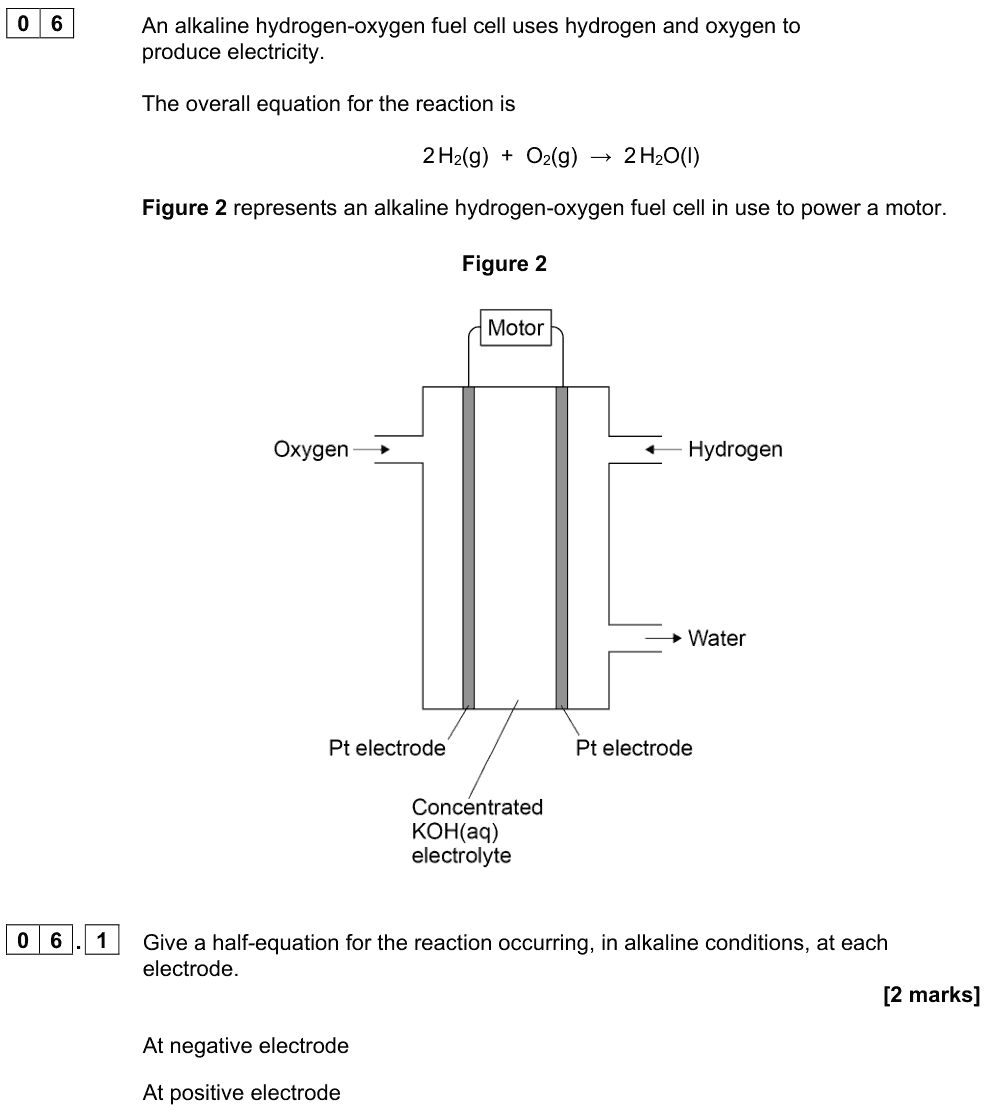
June 2025 · Paper 1 · Q06.12 marksAO2=2Equation writingHard
Mark scheme
Examiner's comment
About one fifth of students gave correct equations in part 1; common errors included not balancing the half-equations with the species, or with electrons.
Notes from the mark scheme and report
Negative electrode: H2 + 2OH– → 2H2O + 2e–. Positive electrode: O2 + 2H2O + 4e– → 4OH–. Both correct but reversed scores 1. Errors: half-equations not balanced for species or electrons
June 2025 · Paper 1 · Q06.21 markAO2=1Short answer
Earlier part of question 06 that this part uses
Mark scheme
Examiner's comment
In part 2, very few students explained that hydroxide ions were involved at both electrodes.
A few students wrote that hydroxide ions were produced at the positive electrode but did not go further.
Many students stated that the reactants were supplied continuously or that it was a reversible reaction.
Notes from the mark scheme and report
OH– ions used at one electrode are produced at the other (so their concentration is unchanged). Common wrong answers: reactants are supplied continuously
the reaction is reversible
June 2025 · Paper 1 · Q06.32 marksAO2=2Explanation
Earlier part of question 06 that this part uses
Mark scheme
Examiner's comment
Many students could not answer part 3; some students scored a mark by stating that electrons were released at the negative electrode or by the hydrogen but often didn’t go on to explain that these flowed through the external circuit/motor to the other electrode.
Notes from the mark scheme and report
Electrons are released at the negative electrode (hydrogen is oxidised)
they pass through the external circuit / motor to the positive electrode (where oxygen is reduced). Many stopped after the first point
June 2025 · Paper 1 · Q06.41 markAO3=1Short answerHard
Earlier part of question 06 that this part uses
Mark scheme
Examiner's comment
About one third of students gave the correct answer in part 4; common incorrect answers included N2 and SO2.
Notes from the mark scheme and report
Carbon dioxide (acidic, so reacts with the KOH electrolyte). Common wrong answers: N2 and SO2
June 2025 · Paper 1 · Q06.51 markAO2=1Short answer
Earlier part of question 06 that this part uses
Mark scheme
Examiner's comment
In part 5, very few students linked storing hydrogen as a liquid to occupying less volume or minimising chance of escape.
Notes from the mark scheme and report
Liquid hydrogen occupies less volume (allow minimises the chance of escape). Cost, safety and transport are ignored
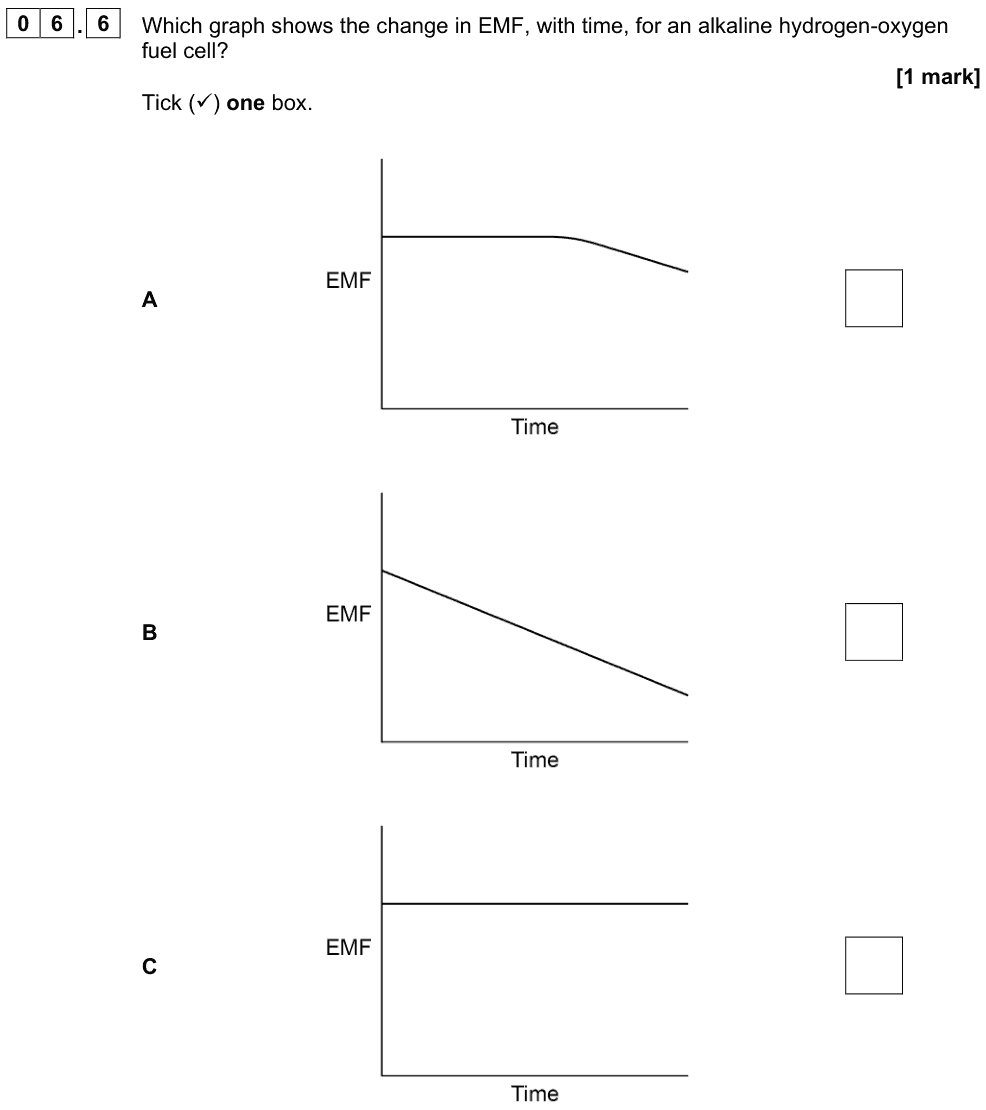
June 2025 · Paper 1 · Q06.61 markAO1=1Short answer
Earlier part of question 06 that this part uses
Mark scheme
Examiner's comment
Part 6 was generally well done.
Notes from the mark scheme and report
Answer: C. The EMF stays constant because the reactants are supplied continuously, so their concentrations do not fall
Skills: MS3.1 Translate information between graphical, numerical and algebraic forms
June 2025 · Paper 1 · Q06.71 markAO1=1Short answer
Earlier part of question 06 that this part uses
Mark scheme
Examiner's comment
In part 7, some students incorrectly stated that the half equations were the same; the correct idea that combining the two different sets of half equations, in both acidic and alkaline conditions, would lead to the same overall equation was not well understood.
Notes from the mark scheme and report
The overall reaction is the same (2H2 + O2 → 2H2O). Error: stating that the half-equations are the same
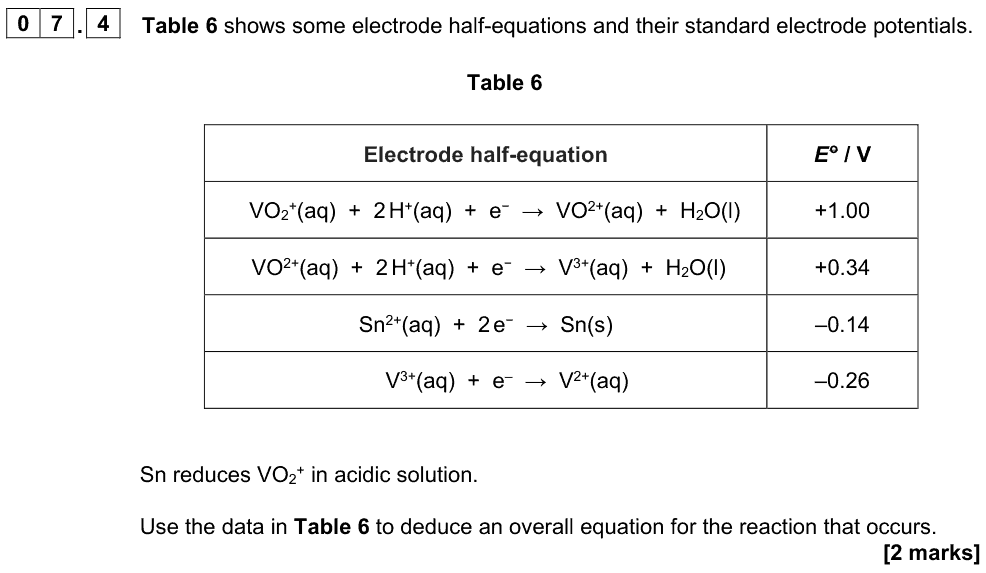
June 2025 · Paper 1 · Q07.42 marksAO3=2Equation writing
Earlier part of question 07 that this part uses
Mark scheme
Examiner's comment
In part 4, the majority of students did not recognize that the reduction of the vanadium species with tin proceeds in two steps and stops at V(III).
A correct understanding of how EMF values determine the spontaneity of redox reactions was essential for full marks.
Many students who did start and end with the correct vanadium species did not balance the equation.
Notes from the mark scheme and report
VO2+ + 4H+ + Sn → V3+ + Sn2+ + 2H2O. Tin (E = –0.14 V) reduces VO2+ to VO 2+ and then to V3+ (+1.00 and +0.34 V are both more positive), but not to V2+ (–0.26 V is more negative). M1 is for V3+ as the only vanadium product. Most did not see that reduction goes in two steps and stops at V(III)
many correct species were left unbalanced
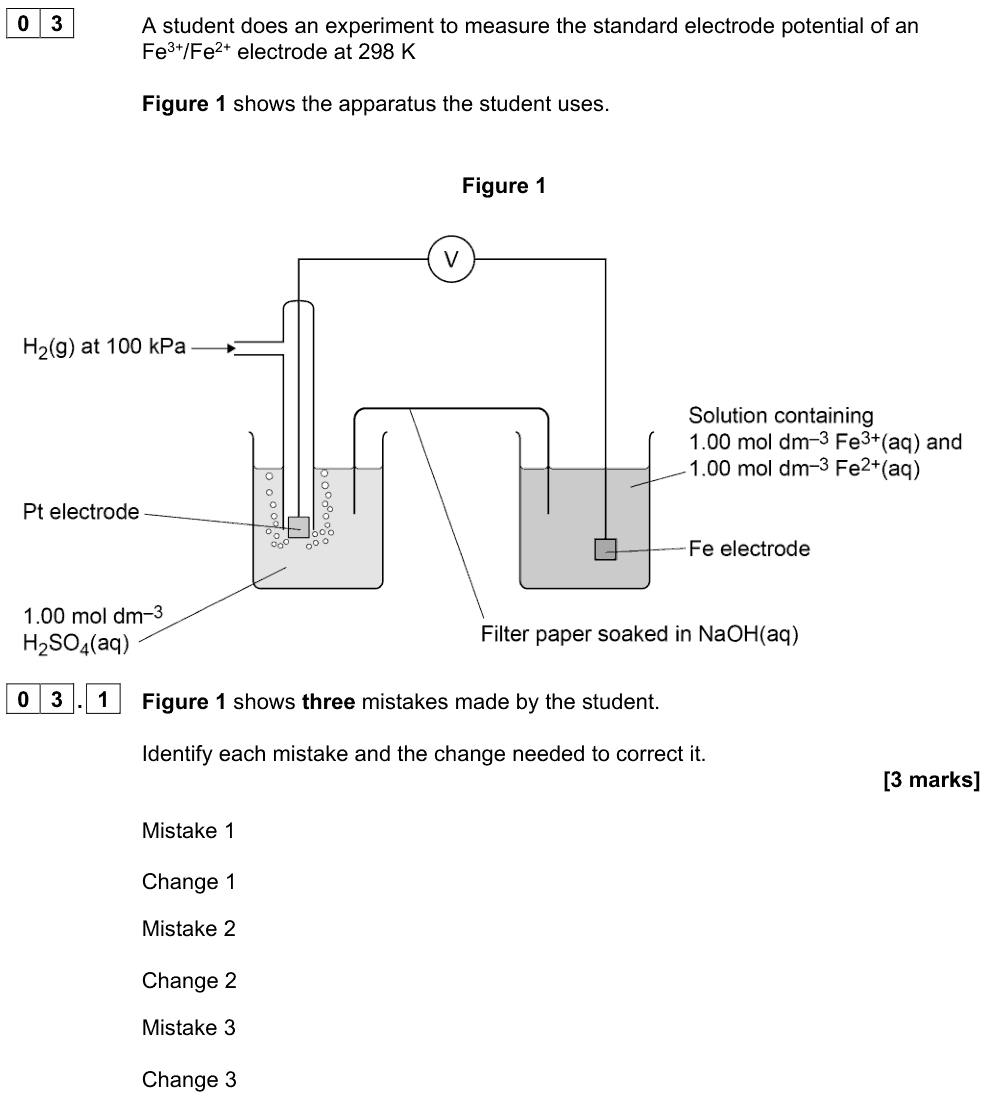
June 2025 · Paper 3 · Q03.13 marksAO3=3Practical and data analysis
Mark scheme
Examiner's comment
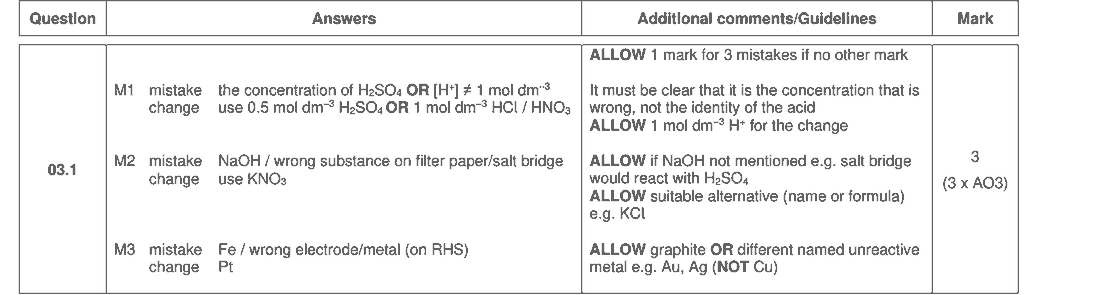
3.1 Around 60% of students scored at least 2/3 marks here with many recognising that the Fe electrode should be Pt and the NaOH should be KNO3. For the third mark many students missed it by not referring to the concentration and instead implying that it was the choice of acid itself that was the mistake rather than its concentration being wrong.
Notes from the mark scheme and report
(1) Acid concentration is wrong: [H+] must be 1.00 mol dm–3, so use 0.500 mol dm–3 H2SO4 (or 1.00 mol dm–3 HCl). (2) Salt bridge soaked in NaOH (it would react): use KNO3 (or KCl). (3) Iron electrode on the right: use platinum. Naming the three mistakes without corrections scores 1. Make clear it is the concentration, not the choice of acid, that is wrong
Skills: ATj Set up electrochemical cells and measuring voltages; PS2.1 Comment on experimental design and evaluate scientific methods; PS4.1 Know and understand how to use a wide range of experimental and practical instruments, equipment and techniques appropriate to the knowledge and understanding included in the specification; RP8 Measuring the EMF of an electrochemical cell
June 2025 · Paper 3 · Q03.21 markAO1=1Short answer
Earlier part of question 03 that this part uses
Mark scheme
Examiner's comment
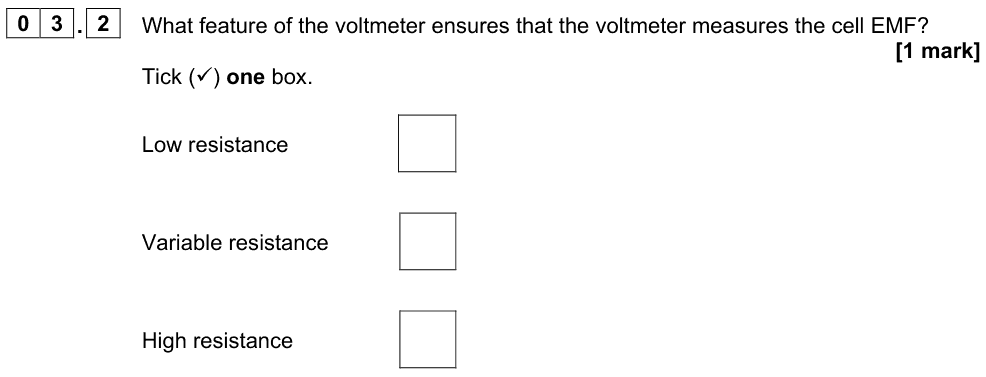
3.2 Most students made the correct choice here.
Notes from the mark scheme and report
Answer: high resistance (so that negligible current flows)
Skills: ATj Set up electrochemical cells and measuring voltages; PS4.1 Know and understand how to use a wide range of experimental and practical instruments, equipment and techniques appropriate to the knowledge and understanding included in the specification; RP8 Measuring the EMF of an electrochemical cell
June 2025 · Paper 3 · Q03.31 markAO2=1Equation writingHard
Earlier part of question 03 that this part uses
Mark scheme
Examiner's comment
3.3 Approximately 30% of students were able to give the correct equation for the overall cell reaction with many reversing the equation or attempting a half-equation. The information given in the question is that the Fe3+/Fe2+ electrode is the positive electrode which should allow students to work out: Fe3+ + e– → Fe2+ and, conversely, H2 + 2e– → 2 H+. Combining these gives the answer of 2 Fe3+ + H2 → 2 Fe2+ + 2 H+.
Notes from the mark scheme and report
2Fe3+ + H2 → 2Fe2+ + 2H+. The positive electrode is where reduction happens (Fe3+ + e– → Fe2+), so hydrogen is oxidised. Not a reversible arrow. Errors: equation reversed
a half-equation only
June 2025 · Paper 3 · Q03.46 marksAO2=2, AO3=4ExplanationHard
Earlier part of question 03 that this part uses
Mark scheme
Examiner's comment
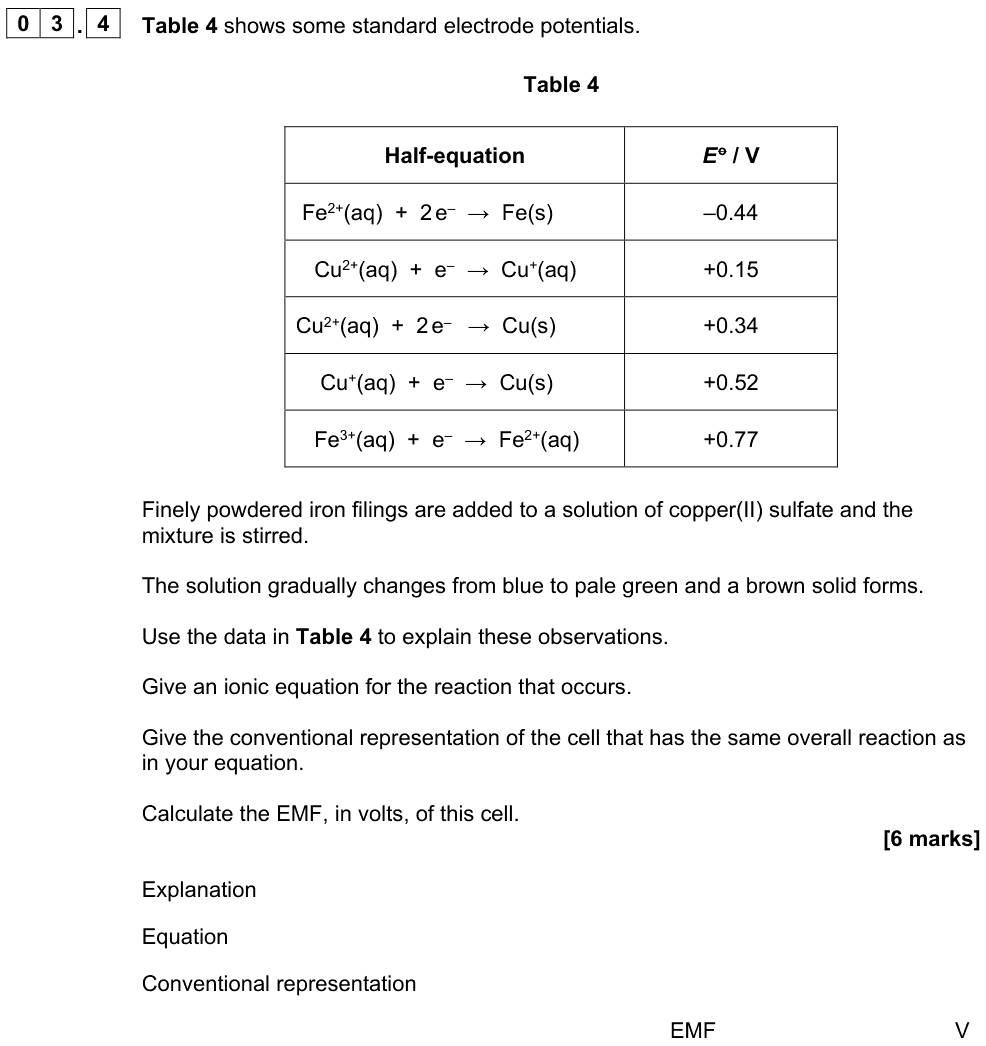
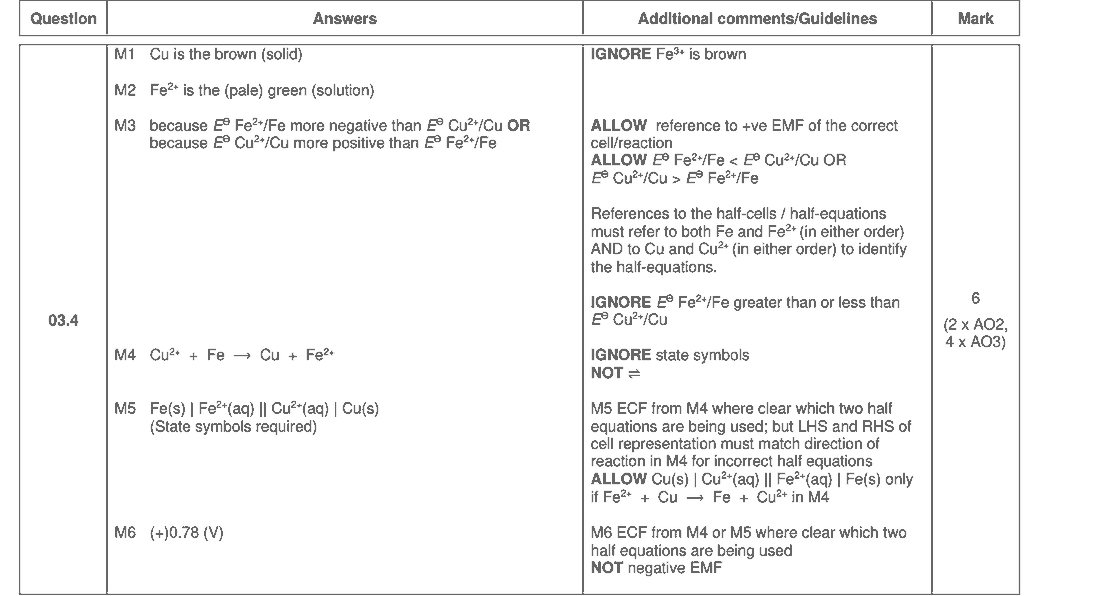
3.4 There were many confused answers here with many students not paying enough attention to the information given in the stem of the question. The stem describes that iron filings are reacted with copper(II) sulfate, which should point students to their equation needing to start with Fe(s) and Cu2+(aq) as the reactants. Table 4 provided the data for this question and included 2 half-equations containing 3 different iron species and 3 equations containing 3 different copper species. Students therefore need to be very specific about which half-equations they are referring to and this is best done by referring, as on the mark scheme, to the fact that the electrode potential for the Fe3+/Fe2+ electrode is more negative than that for the Cu2+/Cu electrode. Overall the question discriminated very well with close to 30% of students achieving at least 4/6.
Notes from the mark scheme and report
Brown solid is copper
pale green solution is Fe2+
E(Fe2+/Fe) is more negative than E(Cu2+/Cu), so iron reduces Cu2+. Cu2+ + Fe → Cu + Fe2+. Fe(s) ∣ Fe2+(aq) ∥ Cu2+(aq) ∣ Cu(s) (state symbols required). EMF = 0.34 – (–0.44) = +0.78 V. Name both species of each electrode, because the table has several iron and copper half-equations
the reactants are Fe(s) and Cu2+(aq), so Fe3+ and Cu+ are not involved
June 2024 · Paper 1 · Q06.12 marksAO3=2ExplanationHard
Mark scheme
Examiner's comment
In part 1, 15% of students scored both marks.
Very few students answered in terms of the EꝊ of Zn2+.
Many students referred to the EꝊ of Zn and could not gain any marks.
Students who wrote about EꝊ of Zn2+ compared it to the EꝊ of VO2+ and not to the EꝊ of V3+.
There was a lack of understanding of the concept that while Zn is the reacting species, the electrode potential refers to the reduction of Zn2+.
Notes from the mark scheme and report
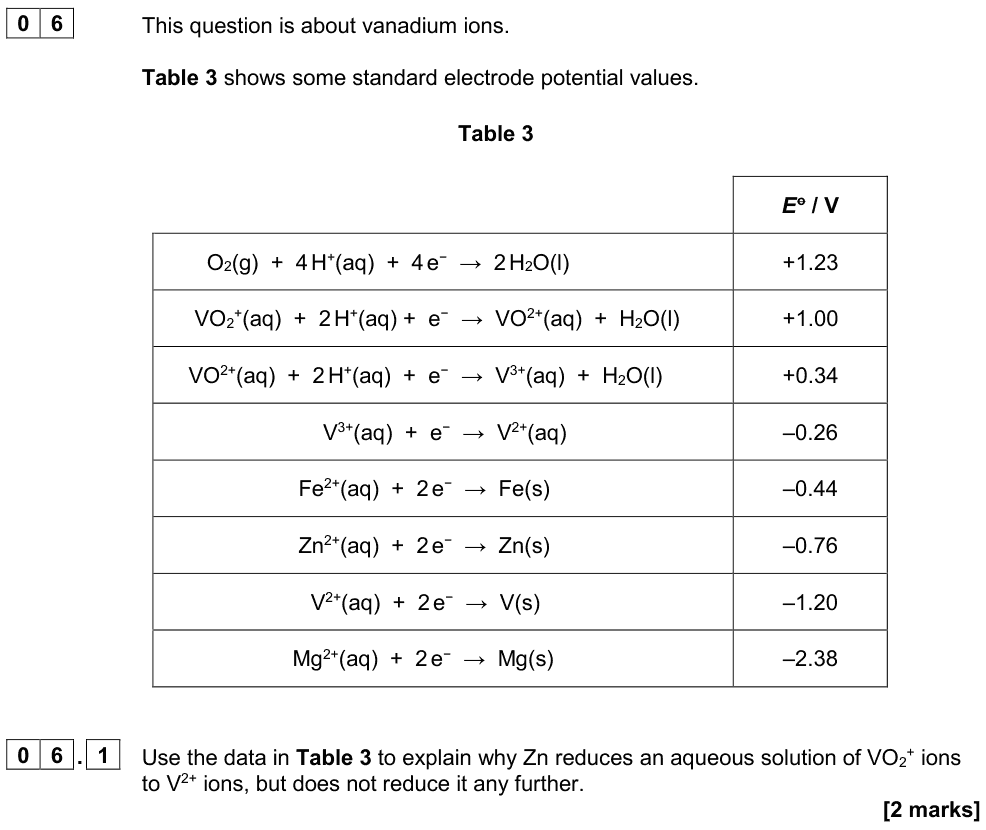
E(V3+/V2+) is more positive than E(Zn2+/Zn), so zinc reduces as far as V2+
E(V2+/V) is more negative than E(Zn2+/Zn), so no further. Refer to the electrode potential of Zn2+/Zn, not 'E of Zn', and compare with V3+, not VO2+
June 2024 · Paper 1 · Q06.21 markAO3=1Short answer
Earlier part of question 06 that this part uses
Mark scheme
Examiner's comment
Part 2 was well answered.
Notes from the mark scheme and report
Answer: Mg only
June 2024 · Paper 1 · Q06.33 marksAO1=1, AO2=2Calculation
Earlier part of question 06 that this part uses
Mark scheme
Examiner's comment
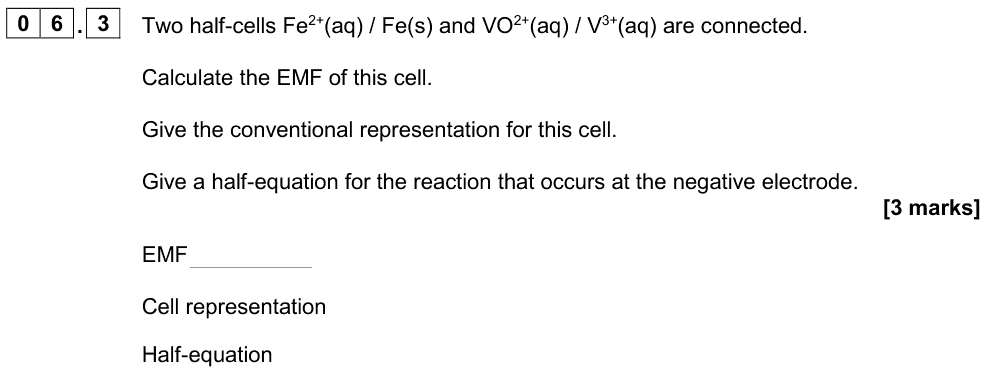
Most students scored the mark for the cell EMF in part 3.
In the cell representation, the order of VO2+ and V3+ were often the wrong way round or the Pt electrode was missing.
The half- equation was often the wrong way round.
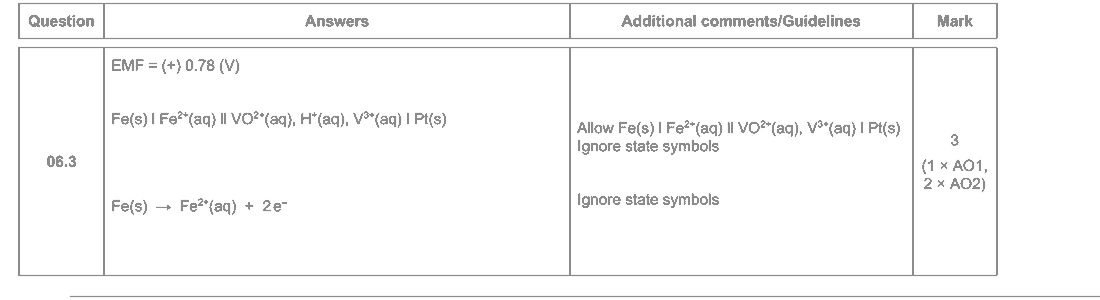
Fe(s) → Fe2+(aq) + 2e–. Errors: VO2+ and V3+ the wrong way round, Pt missing, half-equation reversed
June 2024 · Paper 1 · Q09.71 markAO1=1Equation writingHard
Earlier part of question 09 that this part uses
Mark scheme
Examiner's comment
19% of students gave the correct half-equation in part 7.
Li+ + e– → Li and Li+ + CoO2 → LiCoO2 were common incorrect answers.
Notes from the mark scheme and report
Li+ + CoO2 + e– → Li+[CoO2]–. Common wrong answers: Li+ + e– → Li and Li+ + CoO2 → LiCoO2
June 2024 · Paper 1 · Q09.81 markAO1=1Short answer
Earlier part of question 09 that this part uses
Mark scheme
Examiner's comment
Many students identified that the reaction is reversible in part 8: some students confused the cell with a fuel cell and stated that reactants could be continuously supplied.
Notes from the mark scheme and report
The electrode reactions can be reversed (by applying a reverse potential). Not a fuel cell
June 2024 · Paper 3 · Q171 markAO2=1Multiple choice
Answer
C
Mark scheme
Notes from the mark scheme and report
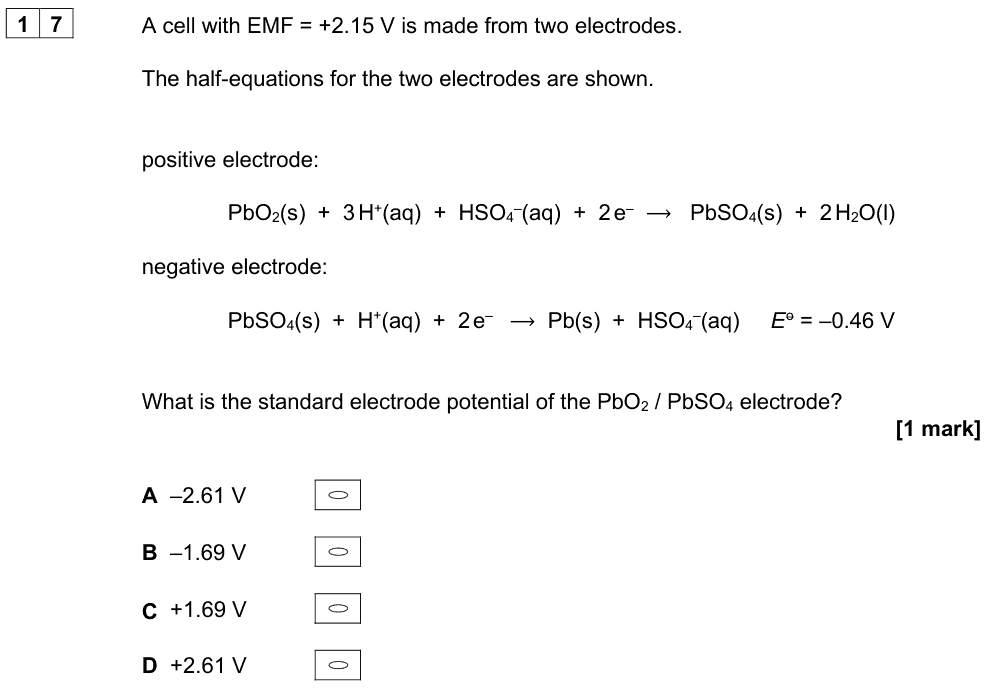
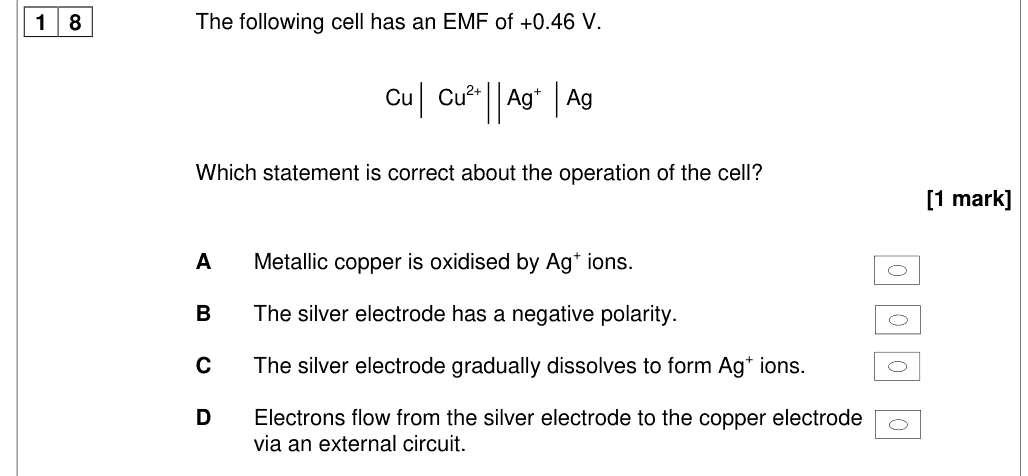
Answer: C. EMF = E(positive) – E(negative), so E = 2.15 + (–0.46) = +1.69 V
June 2023 · Paper 1 · Q02.12 marksAO1=2Short answer
Mark scheme
Examiner's comment
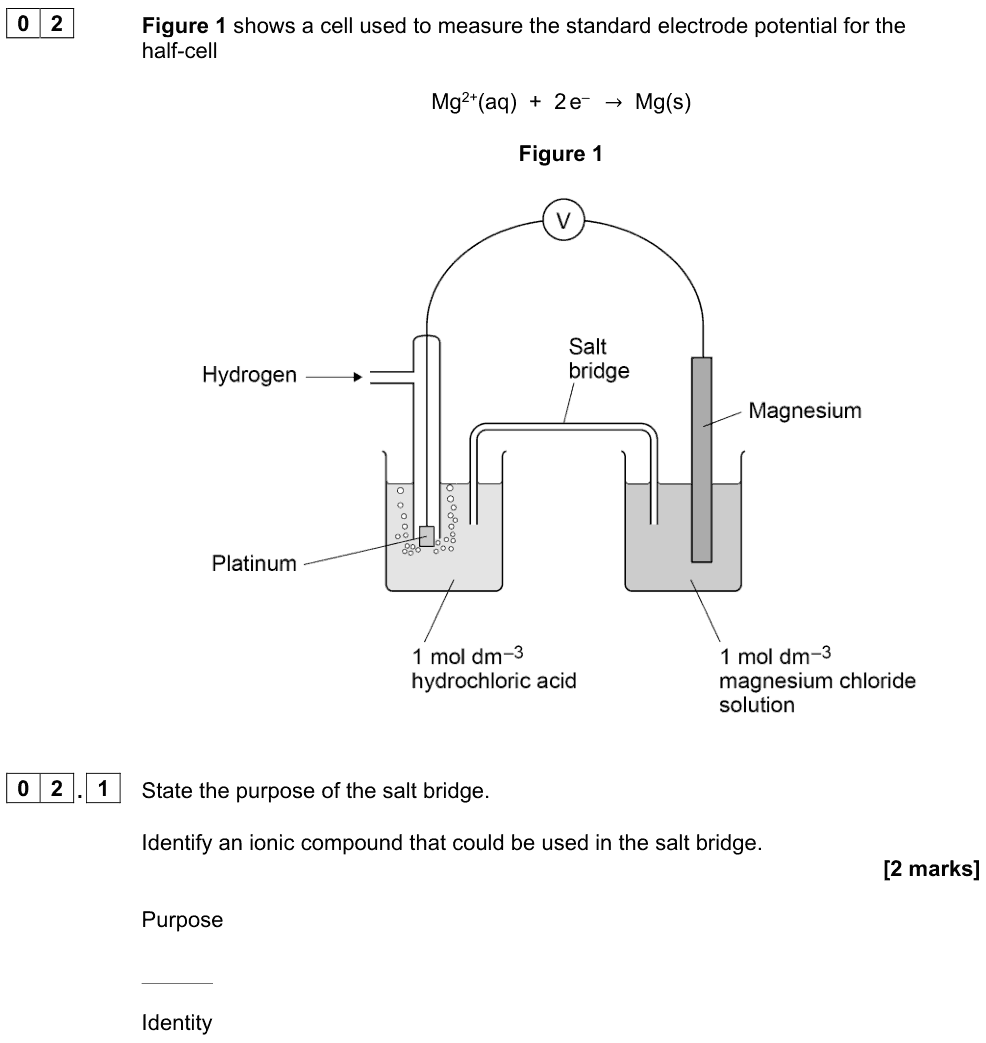
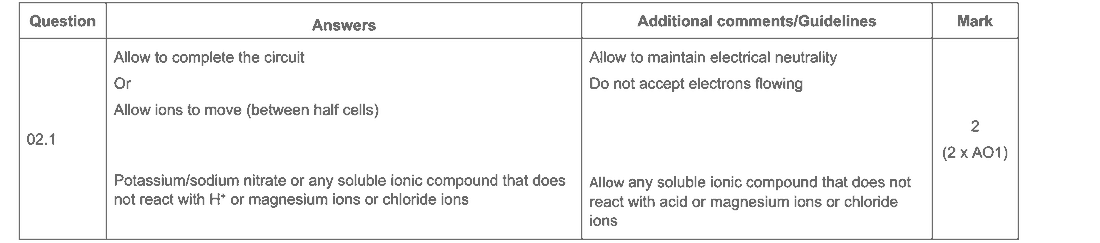
The majority of students could state the purpose of the salt bridge in 02.1 but the identity of the ionic compound was not answered quite as well; several students thought that electrons flowed through the salt bridge and many students did not realise that the ionic compound should be soluble and not react with the acid or magnesium ions or chloride ions.
Notes from the mark scheme and report
Purpose: to complete the circuit / allow ions to move between the half-cells (not electrons). Identity: potassium nitrate or sodium nitrate (any soluble ionic compound that does not react with the acid, Mg2+ or Cl–). Errors: electrons flowing through the salt bridge
an insoluble or reactive compound
Skills: ATj Set up electrochemical cells and measuring voltages; PS4.1 Know and understand how to use a wide range of experimental and practical instruments, equipment and techniques appropriate to the knowledge and understanding included in the specification; RP8 Measuring the EMF of an electrochemical cell
June 2023 · Paper 1 · Q02.21 markAO1=1Short answer
Earlier part of question 02 that this part uses
Mark scheme
Examiner's comment
There were many correct answers in 02.2 although a few had confused this with rates of reaction.
Notes from the mark scheme and report
Answer: no change. Some confused EMF with rate of reaction
Skills: ATj Set up electrochemical cells and measuring voltages; RP8 Measuring the EMF of an electrochemical cell
June 2023 · Paper 1 · Q02.31 markAO3=1Short answer
Earlier part of question 02 that this part uses
Mark scheme
Examiner's comment
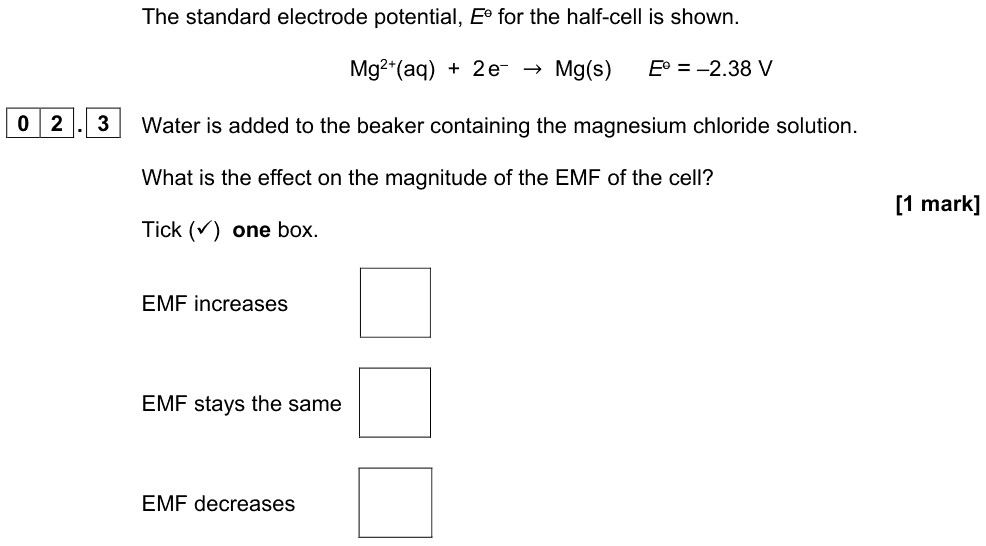
Few students gave the correct answer in 02.3.
Notes from the mark scheme and report
Answer: EMF increases. Diluting Mg2+(aq) shifts Mg2+ + 2e– ⇌ Mg to the left, so the electrode potential becomes more negative and the difference from the hydrogen electrode is larger. Few were correct
Skills: RP8 Measuring the EMF of an electrochemical cell
June 2023 · Paper 1 · Q02.41 markAO3=1Equation writing
Earlier part of question 02 that this part uses
Mark scheme
Examiner's comment
Question 02.4 proved challenging; the equation given by most students was for the reverse reaction.
Notes from the mark scheme and report
Mg + 2HCl → MgCl2 + H2 (or Mg + 2H+ → Mg2+ + H2). Most gave the reverse reaction
June 2023 · Paper 1 · Q08.11 markAO1=1Equation writing
Mark scheme
Examiner's comment
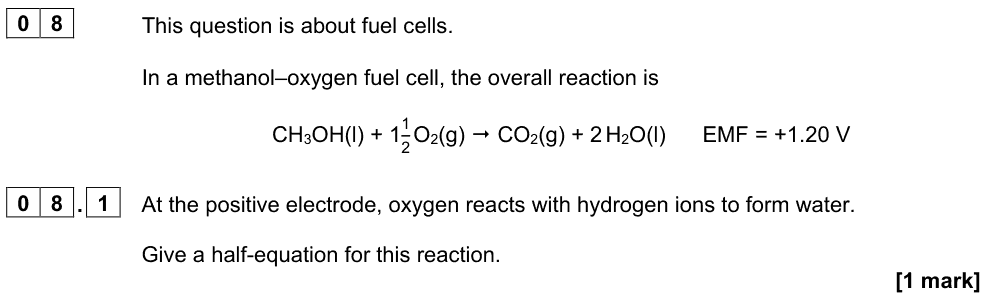
The half-equation required in 08.1 was often missing the electrons.
Notes from the mark scheme and report
O2 + 4H+ + 4e– → 2H2O. Electrons were often missing
June 2023 · Paper 1 · Q08.21 markAO2=1Equation writing
Earlier part of question 08 that this part uses
Mark scheme
Examiner's comment
In 08.2, the electrons were also often missing or on the wrong side of the equation.
Notes from the mark scheme and report
CH3OH + H2O → CO2 + 6H+ + 6e–. Electrons often missing or on the wrong side
June 2023 · Paper 1 · Q08.31 markAO2=1Calculation
Earlier part of question 08 that this part uses
Mark scheme
Examiner's comment
Many students gained the mark in 08.3; the most common incorrect answer was 1.17 V.
Notes from the mark scheme and report
Answer: +1.23 V (EMF = E(positive) – E(negative): 1.20 + 0.03). Most common wrong answer: 1.17 V
June 2023 · Paper 1 · Q08.41 markAO1=1Short answer
Earlier part of question 08 that this part uses
Mark scheme
Examiner's comment
Students found 08.4 challenging; many students thought that the cell was reversible and so could be recharged and others thought that hydrogen could be supplied from the air.
Notes from the mark scheme and report
The reactants (fuel and oxygen) are supplied continuously. Misconceptions: the cell is reversible so can be recharged
hydrogen is taken from the air
June 2023 · Paper 1 · Q08.51 markAO2=1Short answer
Earlier part of question 08 that this part uses
Mark scheme
Examiner's comment
Question 08.5 proved difficult for students; many referred to the flammability of hydrogen without considering that methanol is flammable too.
Notes from the mark scheme and report
Methanol is a liquid, so it is easier to store or transport / gives more energy per cm3 than hydrogen gas. Safety, cost and flammability are ignored
not 'no greenhouse gas emissions'
June 2022 · Paper 1 · Q08.11 markAO2=1Short answer
Mark scheme
Examiner's comment
Less than half the students gave a correct answer in 08.1; Zn was a common incorrect response.
Notes from the mark scheme and report
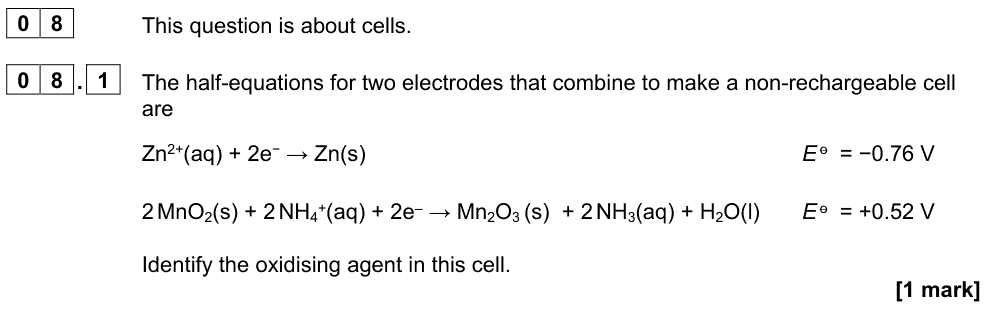
Answer: MnO2. It has the more positive electrode potential, so it gains electrons (is reduced). Zn was a common wrong answer
less than half were correct
June 2022 · Paper 1 · Q08.21 markAO1=1Short answer
Earlier part of question 08 that this part uses
Mark scheme
Examiner's comment
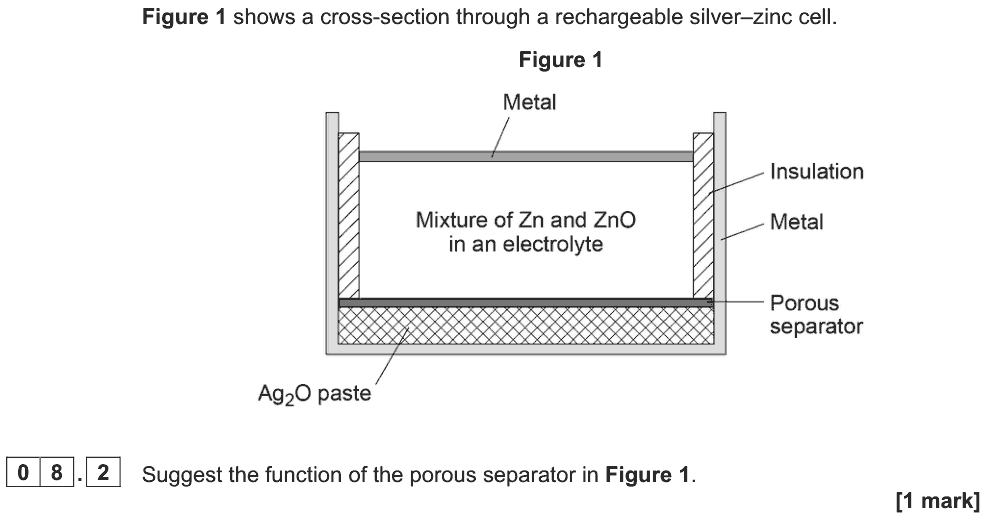
In 08.2, few students realised that the porous separator was acting as a salt bridge; a common misconception was that it was ‘separating reactions’ or ‘stopping electrolyte & paste mixing’.
Notes from the mark scheme and report
It allows ions to move between the electrodes / completes the circuit / acts as a salt bridge. Not electrons
ignore 'allows current to flow'. Misconception: it separates the reactions or stops the electrolyte and paste mixing
June 2022 · Paper 1 · Q08.31 markAO3=1Equation writingHard
Earlier part of question 08 that this part uses
Mark scheme
Examiner's comment
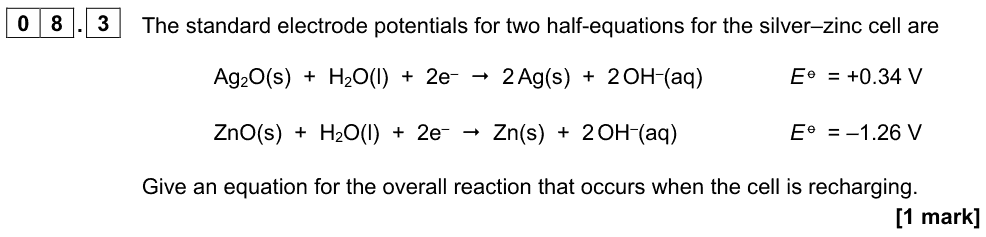
The equation in 08.3 was not answered well; 29% of students gained this mark.
Many students gave the reverse equation or gave a correct one but did not cancel the water and hydroxide ions.
Notes from the mark scheme and report
2Ag + ZnO → Zn + Ag2O (the reverse of the discharge reaction
H2O and OH– cancel). Errors: the discharge equation
water and hydroxide ions not cancelled
June 2022 · Paper 1 · Q08.42 marksEquation writingHard
Earlier part of question 08 that this part uses
Mark scheme
Examiner's comment
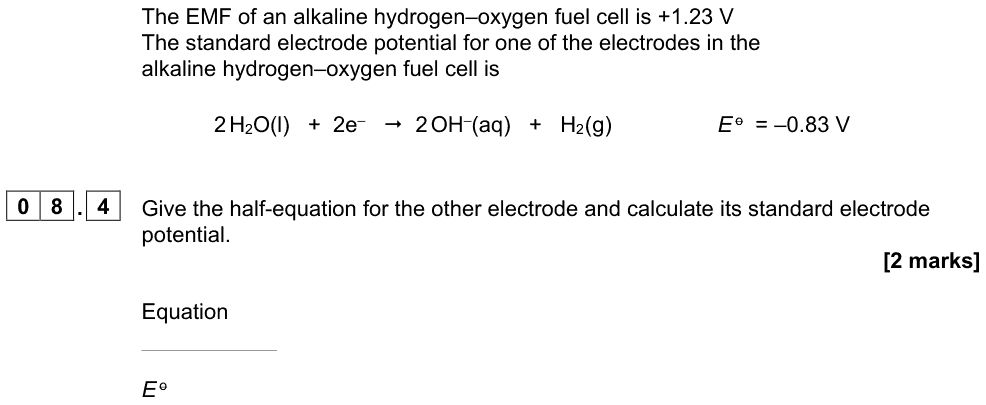
Question 08.4 was very challenging; only 7% scored both marks.
Many students calculated the standard electrode potential correctly although common errors were – 0.4 V and 2.06 V.
Notes from the mark scheme and report
O2(g) + 2H2O(l) + 4e– → 4OH–(aq)
E = +0.40 V (1.23 = E – (–0.83)). Common wrong values –0.4 V and 2.06 V
the half-equation was rarely correct
Skills: MS2.2 Change the subject of an equation
June 2022 · Paper 1 · Q08.51 markAO2=1Short answer
Earlier parts of question 08 that this part uses
Mark scheme
Examiner's comment
In 08.5, most students did not realise that the overall equation for the cell reaction is the same in each cell.
Notes from the mark scheme and report
The overall reaction is the same in both cells: 2H2 + O2 → 2H2O
June 2022 · Paper 3 · Q05.33 marksAO3=3Explanation
Earlier part of question 05 that this part uses
Mark scheme
Examiner's comment
05.3 saw the greatest evidence of confusion in the use of correct terminology.
One of the key aspects of the topic on electrochemistry and electrode potentials is its reliance on conventional terms of reference.
When referring to an electrode potential it is advised that students stick to the conventional form.
Notes from the mark scheme and report
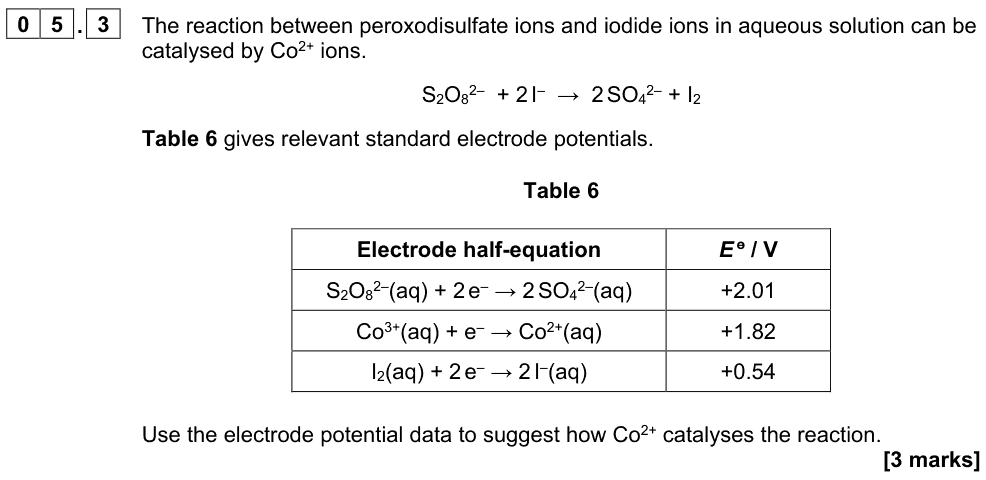
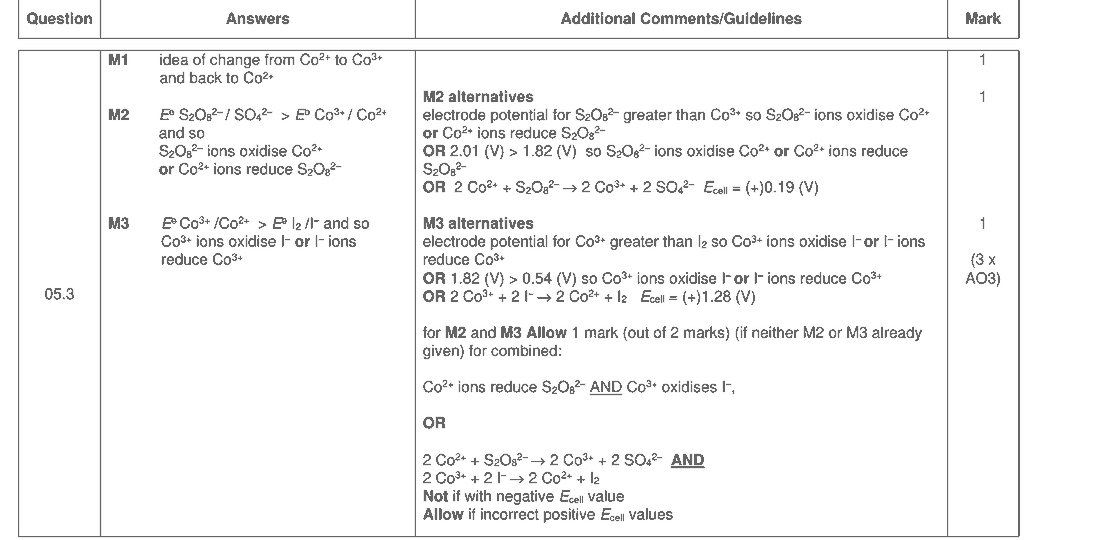
Co2+ is oxidised to Co3+ and then reduced back to Co2+. E(S2O8 2–/SO4 2–) is more positive than E(Co3+/Co2+), so S2O8 2– oxidises Co2+ (2Co2+ + S2O8 2– → 2Co3+ + 2SO4 2–, Ecell +0.19 V). E(Co3+/Co2+) is more positive than E(I2/I–), so Co3+ oxidises I– (2Co3+ + 2I– → 2Co2+ + I2, Ecell +1.28 V). Use conventional electrode-potential terminology
June 2022 · Paper 3 · Q111 markAO1=1Multiple choice
Answer
C
Mark scheme
Notes from the mark scheme and report
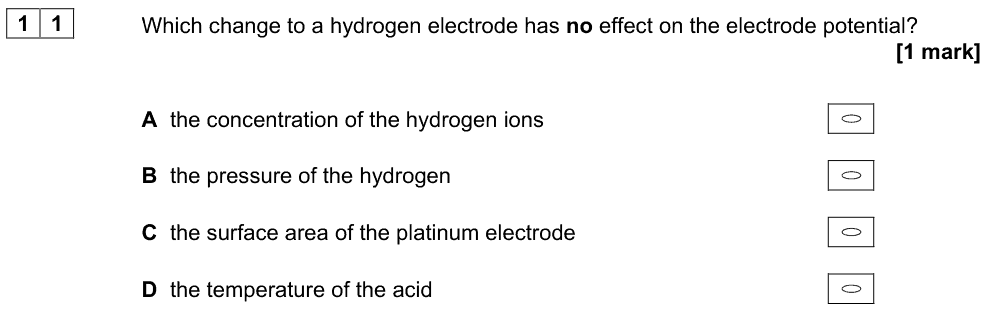
Answer: C. Electrode potential depends on concentration, pressure and temperature, not on the surface area of the platinum
June 2022 · Paper 3 · Q121 markAO1=1Multiple choice
Answer
A
Mark scheme
Notes from the mark scheme and report
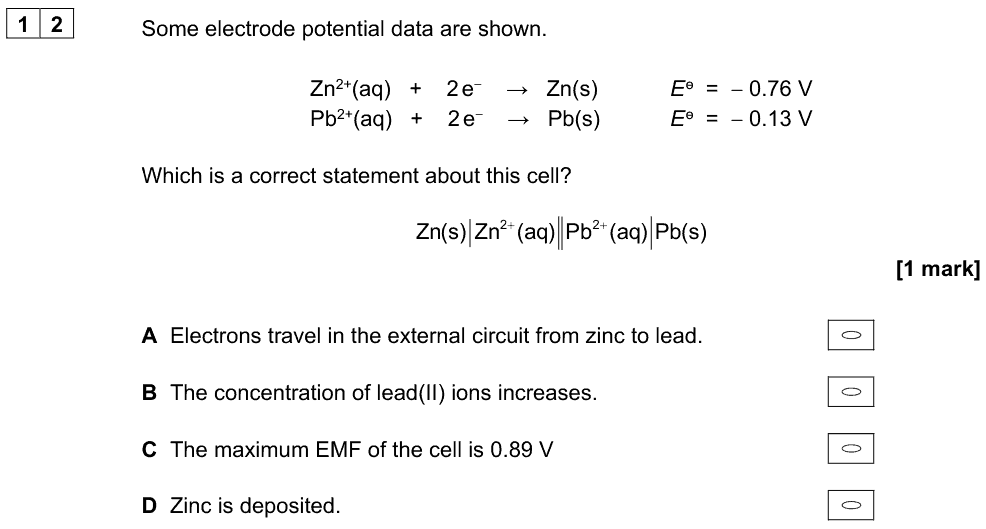
Answer: A. Zinc has the more negative potential so it is oxidised and electrons flow from zinc to lead
Pb2+ is reduced (its concentration falls) and the EMF is 0.63 V
November 2021 · Paper 1 · Q08.11 markShort answer
Mark scheme
Examiner's comment
Few students gave a correct answer to question 08.1; some students explained that it was a list of electrode potentials but failed to state that these were in order and a few students used the idea of EMF or cell potentials rather than electrode potentials.
Notes from the mark scheme and report
A list of electrode potentials (or half-equations) in numerical order of E. Not EMF
'in order' was often missing
November 2021 · Paper 1 · Q08.21 markShort answer
Earlier part of question 08 that this part uses
Mark scheme
Examiner's comment
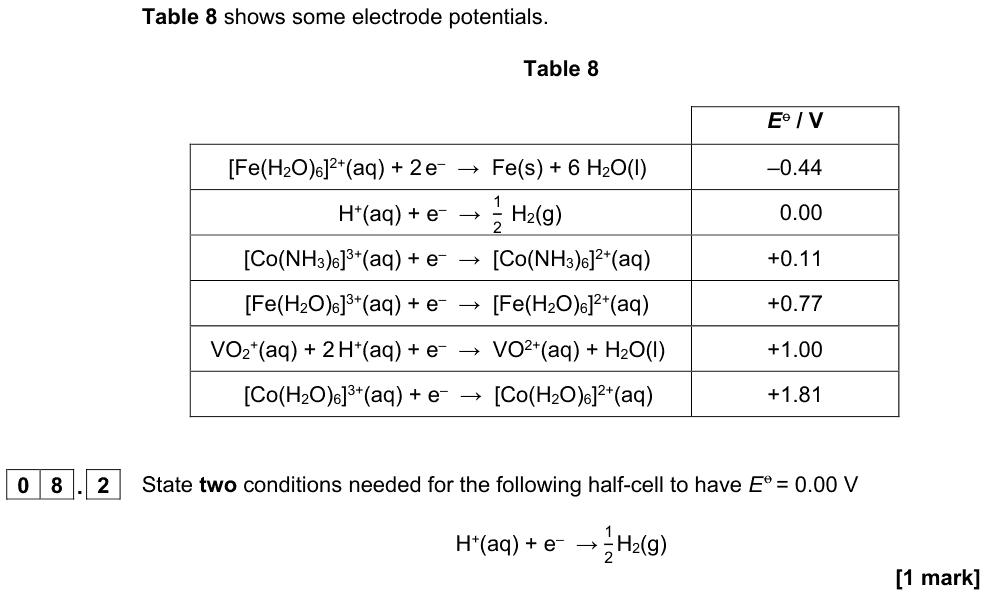
Conditions in question 08.2 were well known but some students only gave one condition; 101 kPa or 1 atm were the commonest wrong answers.
Notes from the mark scheme and report
Any two: 298 K (25 °C)
[H+] = 1 mol dm–3
100 kPa. 1 atm is ignored
101 kPa was a common wrong answer
November 2021 · Paper 1 · Q08.31 markShort answer
Earlier parts of question 08 that this part uses
Mark scheme
Examiner's comment
In question 08.3 many students gave [Co(H2O)6]3+ as the ion; Fe was also a common incorrect answer.
Notes from the mark scheme and report
[Co(H2O)6]2+ (the reduced species of the most positive half-equation). Common wrong answers: [Co(H2O)6]3+ and Fe. Uses Table 8 from 08.2
November 2021 · Paper 1 · Q08.42 marksEquation writing
Earlier parts of question 08 that this part uses
Mark scheme
Examiner's comment
In question 08.4 many students did not start with Fe but with [Fe(H2O)6]2+; those who started with Fe often gave Fe2+ or [Fe(H2O)6]2+ as the product.
Students who gave an equation often failed to cancel out the waters on each side of the equation.
Notes from the mark scheme and report
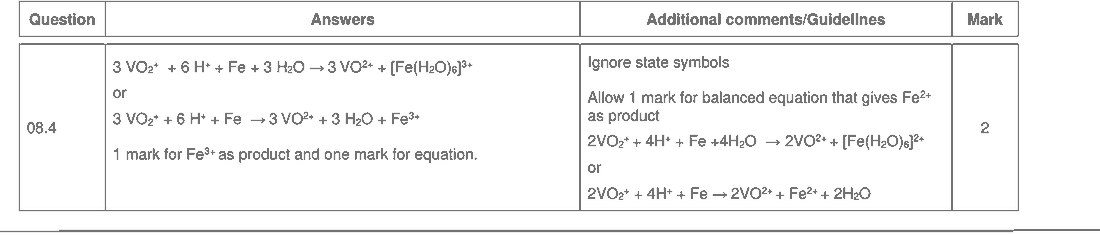
3VO2+ + 6H+ + Fe → 3VO2+ + 3H2O + Fe3+ (or with [Fe(H2O)6]3+ and 3H2O on the left): reactant vanadium(V) VO2 +, product vanadium(IV) VO 2+. One mark for Fe3+ as the product, one for the equation
a balanced equation giving Fe2+ scores 1. Errors: starting from [Fe(H2O)6]2+
not cancelling water. Uses Table 8 from 08.2
November 2021 · Paper 1 · Q08.52 marksExplanation
Earlier parts of question 08 that this part uses
Mark scheme
Examiner's comment
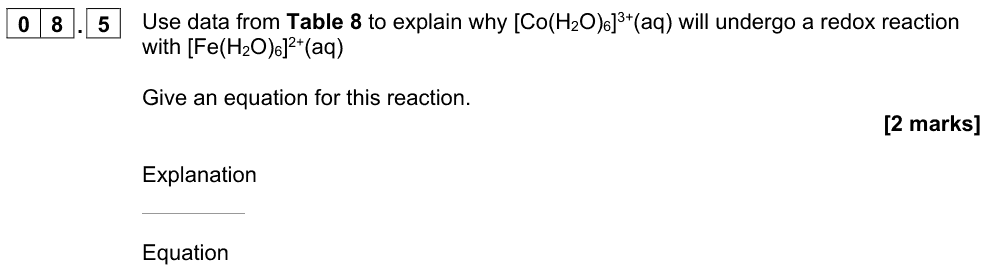
Very few students gave the explanation correctly in question 08.5.
Some students gave the equation correctly; a significant number, however, thought the cobalt complex was a reducing agent and gave iron as the product.
Notes from the mark scheme and report
E for Co3+/Co2+ (+1.81 V) is greater than E for Fe3+/Fe2+ (+0.77 V) (must refer to E)
[Co(H2O)6]3+ + [Fe(H2O)6]2+ → [Co(H2O)6]2+ + [Fe(H2O)6]3+. Common error: treating the cobalt complex as the reducing agent. Uses Table 8 from 08.2
November 2021 · Paper 1 · Q09.12 marksExplanation
Mark scheme
Examiner's comment
Students found question 09.1 very challenging.
Some students stated that lithium reacts with water but only a very small number of students could give an explanation in terms of electrode potentials.
Notes from the mark scheme and report
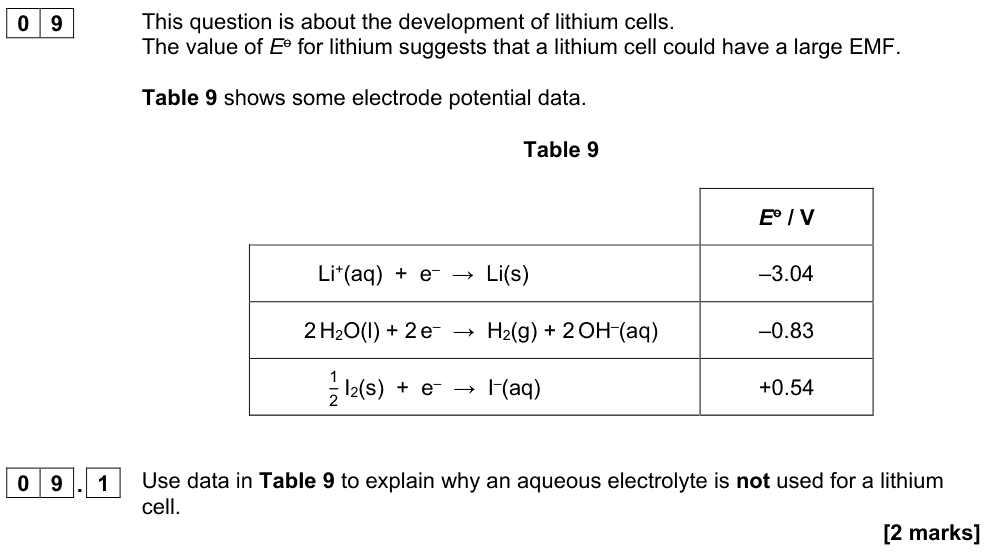
Lithium would react with the water in the electrolyte
E for Li+/Li (–3.04 V) is more negative than E for water (–0.83 V), so lithium reduces water to hydrogen. Few gave the electrode potential argument
November 2021 · Paper 1 · Q09.21 markCalculation
Earlier part of question 09 that this part uses
Mark scheme
Examiner's comment
Answers to question 09.2 were generally correct.
Notes from the mark scheme and report
Answer: 3.58 V. 0.54 – (–3.04)
November 2021 · Paper 1 · Q09.31 markShort answer
Earlier part of question 09 that this part uses
Mark scheme
Examiner's comment
In question 09.3 some students realised that the cell was operating under non-standard conditions.
Notes from the mark scheme and report
The commercial cell does not operate under standard conditions (eg non-aqueous)
November 2021 · Paper 1 · Q09.51 markEquation writing
Earlier part of question 09 that this part uses
Mark scheme
Examiner's comment
Very few students knew the equation in question 09.5.
Notes from the mark scheme and report
Li+ + CoO2 + e– → Li+[CoO2]– (or LiCoO2)
November 2021 · Paper 1 · Q09.61 markEquation writing
Earlier parts of question 09 that this part uses
Mark scheme
Examiner's comment
The equation in question 09.6 was slightly better, but many students reversed the equation and some had electrons on the wrong side of the equation.
Notes from the mark scheme and report
Li → Li+ + e–. Errors: equation reversed
electrons on the wrong side
November 2020 · Paper 1 · Q11.11 markEquation writing
Mark scheme
Examiner's comment
Most students were unable to give a correct equation in 11.1 and 11.2; some students wrote the correct substance on the correct side of the equation but then added electrons to the wrong side.
Notes from the mark scheme and report
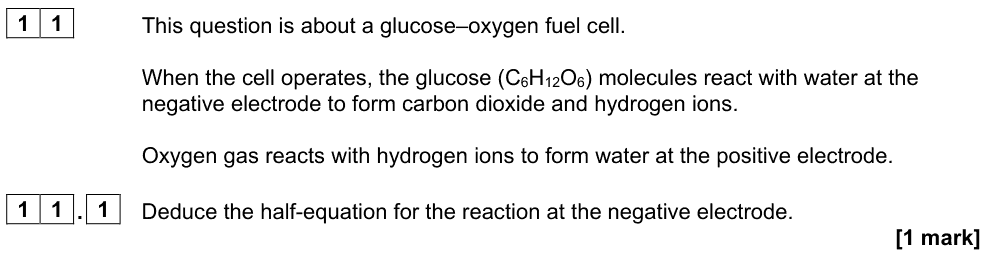
C6H12O6 + 6H2O → 6CO2 + 24H+ + 24e–. Most could not do this
electrons were often on the wrong side
November 2020 · Paper 1 · Q11.21 markEquation writing
Earlier part of question 11 that this part uses
Mark scheme
Examiner's comment
Most students were unable to give a correct equation in 11.1 and 11.2; some students wrote the correct substance on the correct side of the equation but then added electrons to the wrong side.
Notes from the mark scheme and report
O2 + 4H+ + 4e– → 2H2O. Electrons were often on the wrong side
November 2020 · Paper 1 · Q11.31 markEquation writing
Earlier part of question 11 that this part uses
Mark scheme
Examiner's comment
In 11.3, most students gave an unbalanced equation; some students reversed the equation and gave the equation for photosynthesis and some students failed to cancel out water molecules on each side of the equation.
Notes from the mark scheme and report
C6H12O6 + 6O2 → 6CO2 + 6H2O. Errors: unbalanced
reversed (photosynthesis)
water not cancelled
November 2020 · Paper 1 · Q11.42 marksShort answer
Earlier part of question 11 that this part uses
Mark scheme
Examiner's comment
11.4 was the most challenging question on the paper.
Very few students suggested the correct substance for the electrode and students seldom gave the reduced and oxidised species in the correct order.
Notes from the mark scheme and report
C(s) ∣ C6H12O6(aq), H+(aq) ∣ CO2(g) ∥ O2(g) ∣ H+(aq), H2O(l) ∣ Pt(s). M1 for the order C ∣ C6H12O6 ... CO2 ∥ O2 ... H2O ∣ Pt
M2 fully correct. 0 if electrons are included
state symbols ignored. The hardest question on the paper
November 2020 · Paper 1 · Q11.51 markShort answer
Earlier part of question 11 that this part uses
Mark scheme
Examiner's comment
Some students gave a correct answer in 11.5.
Incorrect answers included use of a salt bridge, use of standard conditions, replacing electrodes and adding more oxygen or water.
Notes from the mark scheme and report
Keep supplying the reactants (glucose and oxygen) / keep the reactant concentrations constant. Wrong: salt bridge, standard conditions, replacing electrodes
November 2020 · Paper 3 · Q06.13 marksShort answer
Mark scheme
Examiner's comment
In 06.1, many students just listed standard conditions without identifying the gas, solution or electrode.
Notes from the mark scheme and report
Hydrogen gas at 100 kPa
1.00 mol dm–3 H+(aq) (HCl or HNO3
or 0.5 mol dm–3 H2SO4)
platinum electrode at 298 K. Not 1 atm or 101 kPa. Many listed standard conditions without naming the gas, solution or electrode
Skills: ATj Set up electrochemical cells and measuring voltages
November 2020 · Paper 3 · Q06.26 marks6-mark level of responseHard
Earlier part of question 06 that this part uses
Mark scheme, with the levels and indicative content
Examiner's comment
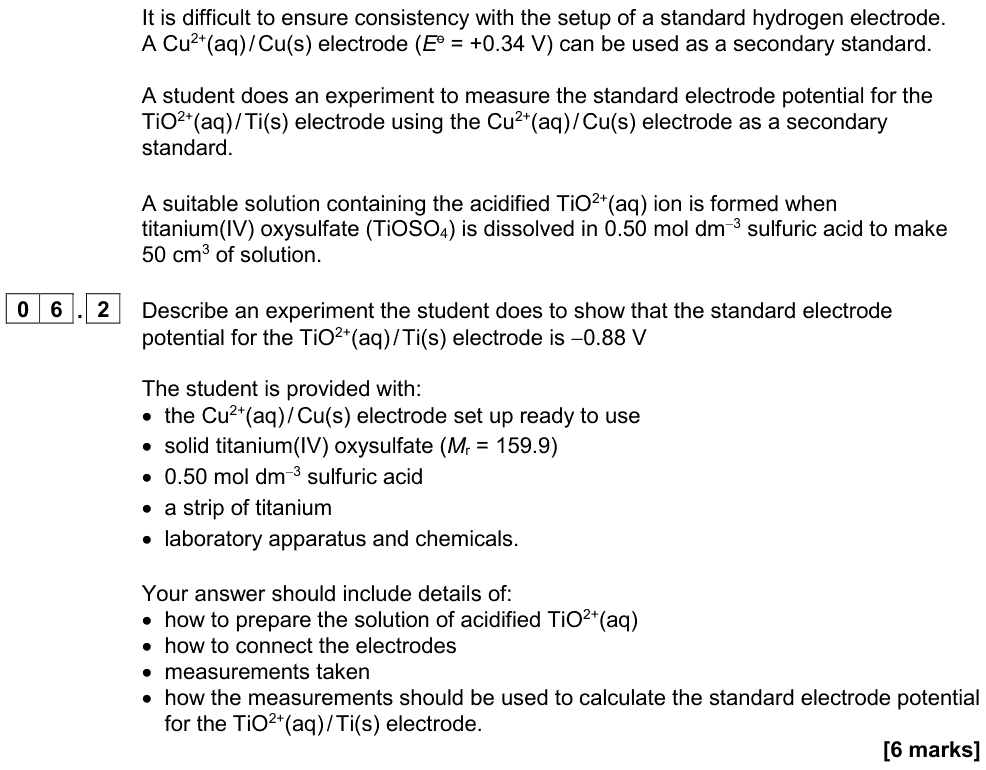
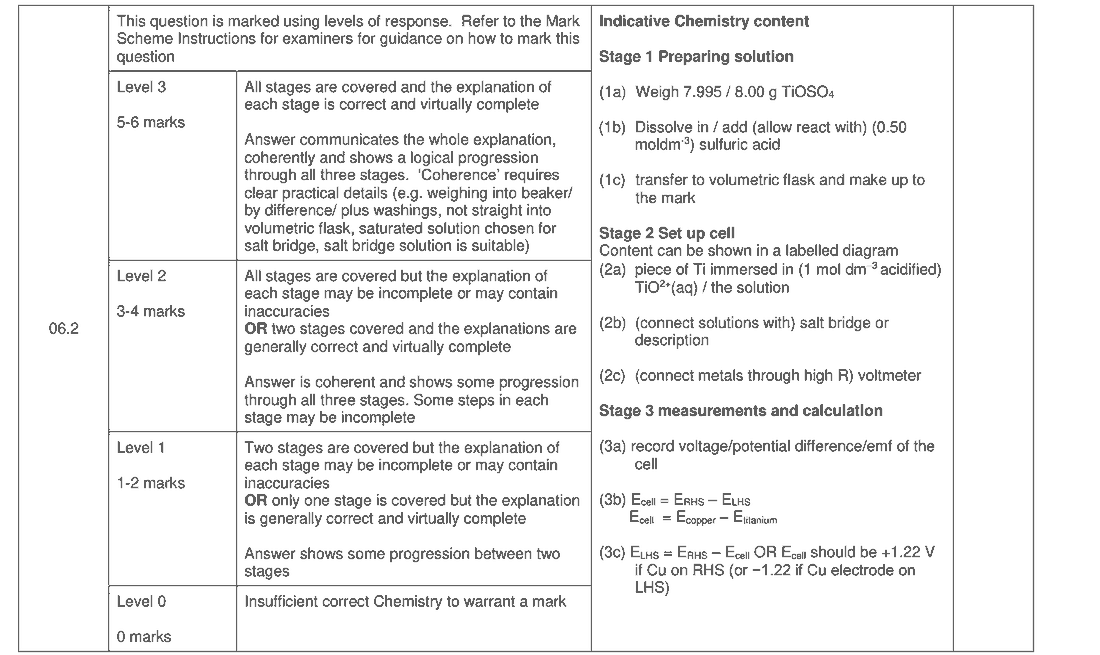
In 06.2, surprisingly, only about 9% of students were able to access Level 3, due mainly to a failure to address the indicative content in stage 1 ( preparation of the solution) despite the prompts in the question.
Many of those who did try to calculate the mass of solid needed seemed to base the calculation on the 0.5 mol dm–3 value for the sulfuric acid instead of the required standard concentration of 1.0 mol dm–3.
Students should also appreciate that weighing by difference is not the best approach when making up a solution of an exact concentration.
The best method is to weigh the solid directly into the beaker before dissolving in a small volume of solvent and then transferring (with washings) to a volumetric flask.
By contrast, many students covered all the items in stage 2 of the indicative content (how to set up the cell) where a diagram was often usefully employed.
Notes from the mark scheme and report
Levels of response, three stages. 1 Solution: weigh 8.00 g (7.995 g) of TiOSO4 (1.00 mol dm–3 in 50 cm3)
dissolve in the 0.50 mol dm–3 sulfuric acid
transfer with washings to a 50 cm3 volumetric flask and make up to the mark. 2 Cell: titanium strip dipping in the TiO2+ solution
salt bridge joining the two solutions
high-resistance voltmeter between the metals. 3 Measurement: record the EMF
expect 1.22 V. Most missed stage 1 or based the mass on 0.5 mol dm–3
weigh into a beaker rather than by difference
Skills: ATa Use appropriate apparatus to record a range of measurements (to include mass, time, volume of liquids and gases, temperature); ATe Use volumetric flask, including accurate technique for making up a standard solution; ATj Set up electrochemical cells and measuring voltages; ATk Safely and carefully handle solids and liquids, including corrosive, irritant, flammable and toxic substances; PS4.1 Know and understand how to use a wide range of experimental and practical instruments, equipment and techniques appropriate to the knowledge and understanding included in the specification; MS2.2 Change the subject of an equation; RP8 Measuring the EMF of an electrochemical cell
November 2020 · Paper 3 · Q06.31 markEquation writing
Earlier part of question 06 that this part uses
Mark scheme
Examiner's comment
In 06.3, balancing the equation proved trickier than expected.
Notes from the mark scheme and report
TiO2+ + 2H+ + 4e– → Ti + H2O (reverse or equilibrium arrow allowed). Balancing proved tricky
November 2020 · Paper 3 · Q06.43 marksExplanationHard
Earlier parts of question 06 that this part uses
Mark scheme
Examiner's comment
06.4 was not an exception and only 19% of students scored two or more marks.
Many students failed to appreciate the need to discuss both comparisons and only focused on the interaction between copper and nitric acid.
Many descriptions made confused references to the electrodes – often without referring to an electrode at all but using phrases such as ‘the E for nitric acid’.
The best answers made clear references such as "Eo NO3–/NO > Eo Cu2+/Cu, so Cu can reduce NO3–".
It was also often unclear what the students were suggesting as being oxidised or reduced – specific species need mentioning.
Notes from the mark scheme and report
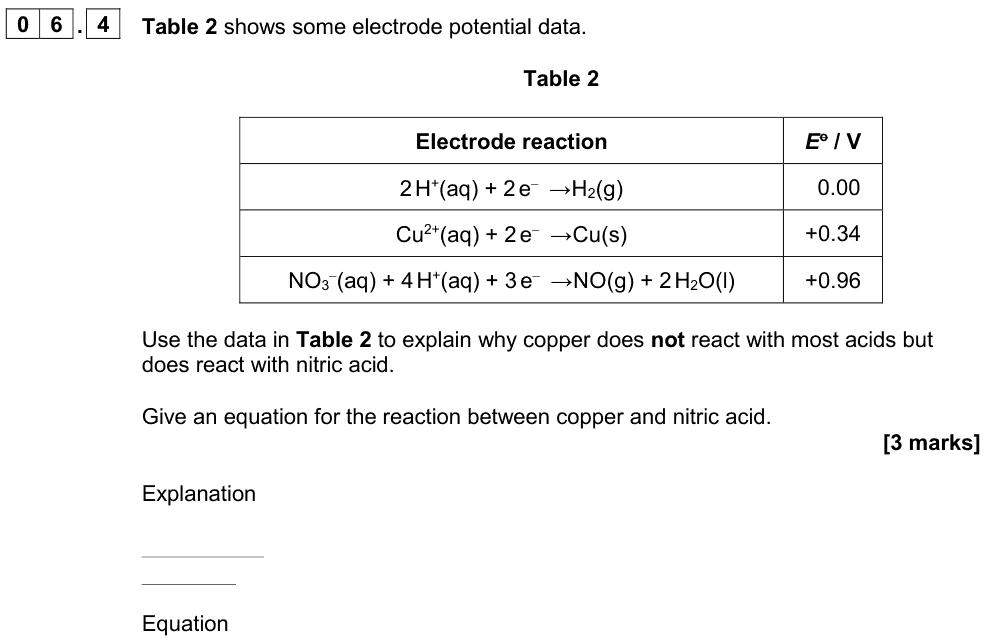
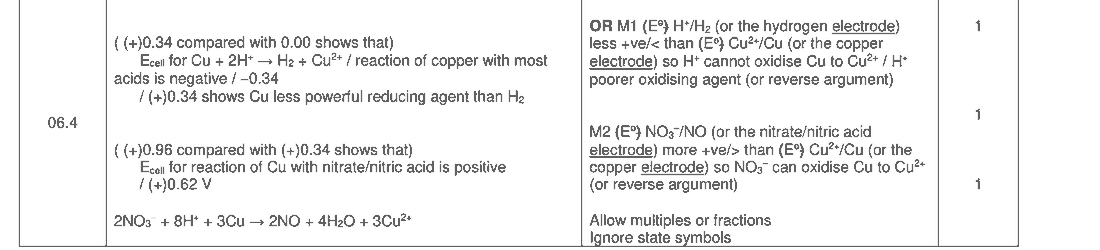
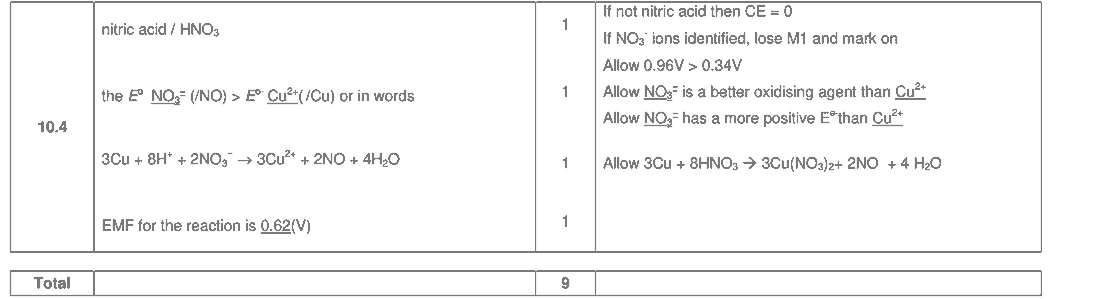
E(H+/H2) 0.00 V is less positive than E(Cu2+/Cu) +0.34 V, so H+ cannot oxidise copper (cell EMF would be –0.34 V)
E(NO3–/NO) +0.96 V is more positive than E(Cu2+/Cu), so nitrate ions in acid can oxidise copper (EMF +0.62 V)
3Cu + 2NO3– + 8H+ → 3Cu2+ + 2NO + 4H2O. Both comparisons are needed
name the electrodes and species, not 'the E for nitric acid'
June 2019 · Paper 3 · Q03.11 markShort answer
Mark scheme
Examiner's comment
3.1 As expected, this gave students an easy introduction to question 3.
Notes from the mark scheme and report
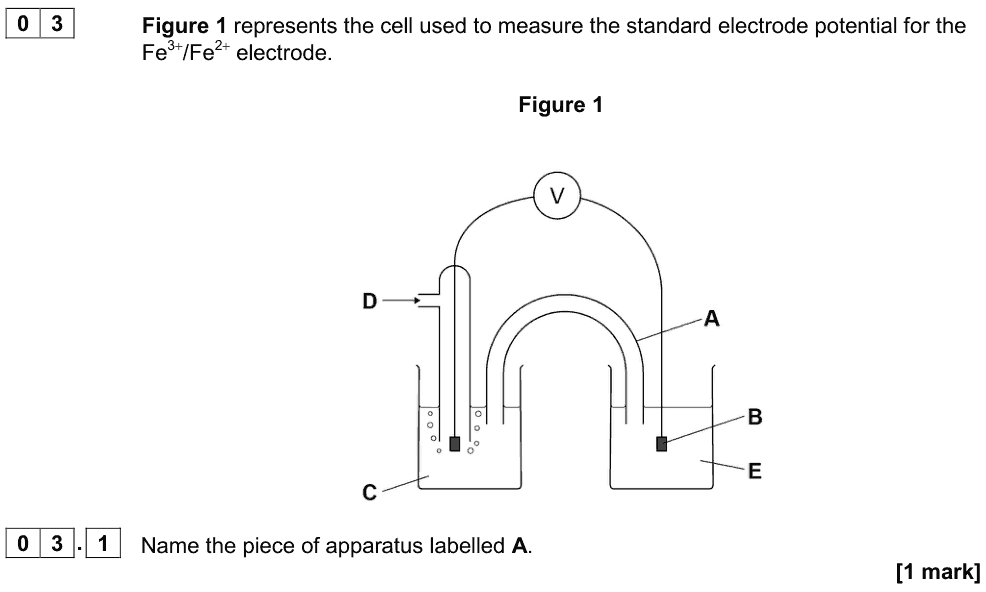
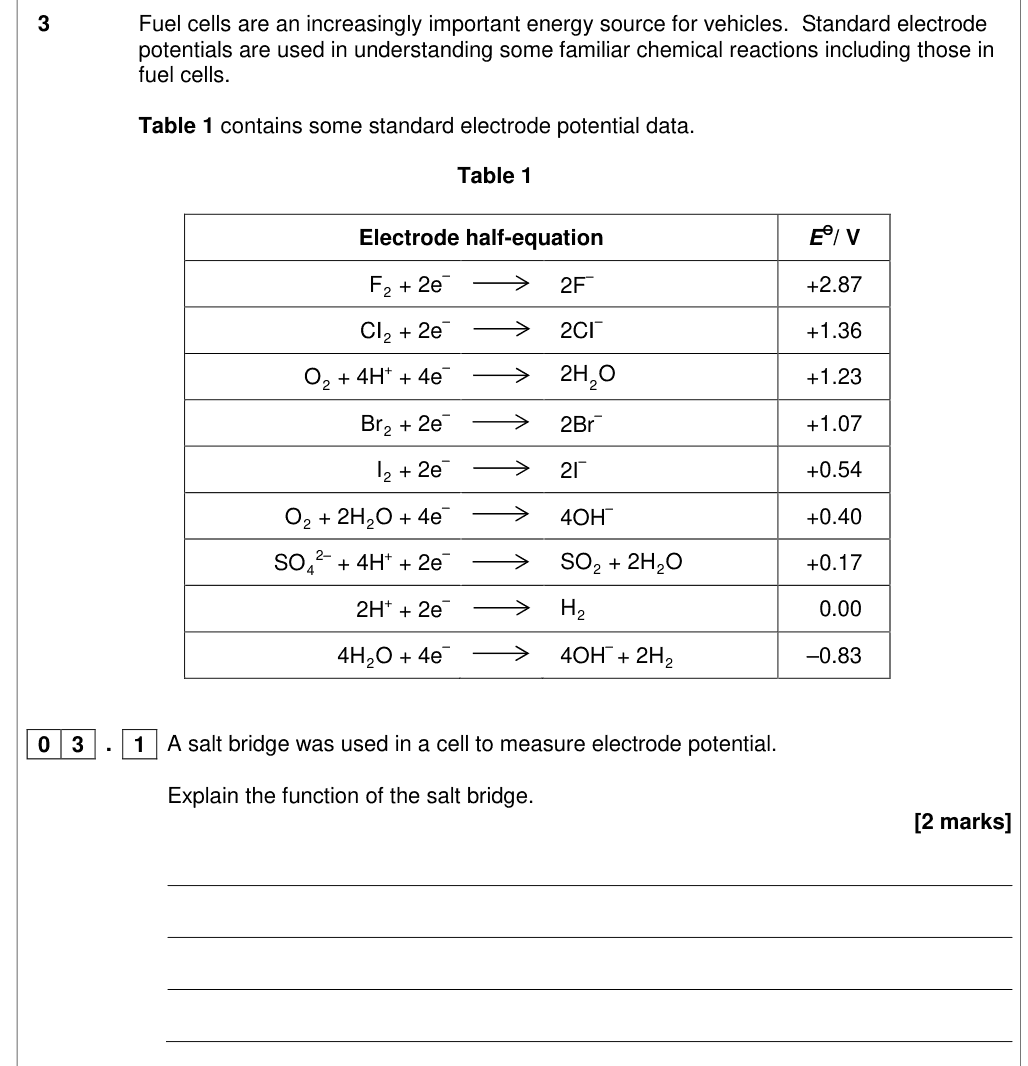
Salt bridge (or a description such as filter paper soaked in a suitable solution
not 'U tube' alone)
Skills: ATj Set up electrochemical cells and measuring voltages; RP8 Measuring the EMF of an electrochemical cell
June 2019 · Paper 3 · Q03.21 markShort answer
Earlier part of question 03 that this part uses
Mark scheme
Examiner's comment
3.2 Again, this was well answered, with relatively few suggesting, incorrectly, that the salt bridge allows electrons to flow through it.
Notes from the mark scheme and report
To complete the circuit / allow ions to move / maintain electrical neutrality. Not electrons flowing
Skills: ATj Set up electrochemical cells and measuring voltages; RP8 Measuring the EMF of an electrochemical cell
June 2019 · Paper 3 · Q03.31 markShort answer
Earlier part of question 03 that this part uses
Mark scheme
Examiner's comment
3.3 The presence of the Fe3+/Fe2+ electrode meant that some students suggested an iron electrode here, but most recognised the need for an inert, platinum electrode.
Notes from the mark scheme and report
Platinum (an inert electrode). Common wrong answer: iron
Skills: ATj Set up electrochemical cells and measuring voltages; RP8 Measuring the EMF of an electrochemical cell
June 2019 · Paper 3 · Q03.44 marksShort answer
Earlier part of question 03 that this part uses
Mark scheme
Examiner's comment
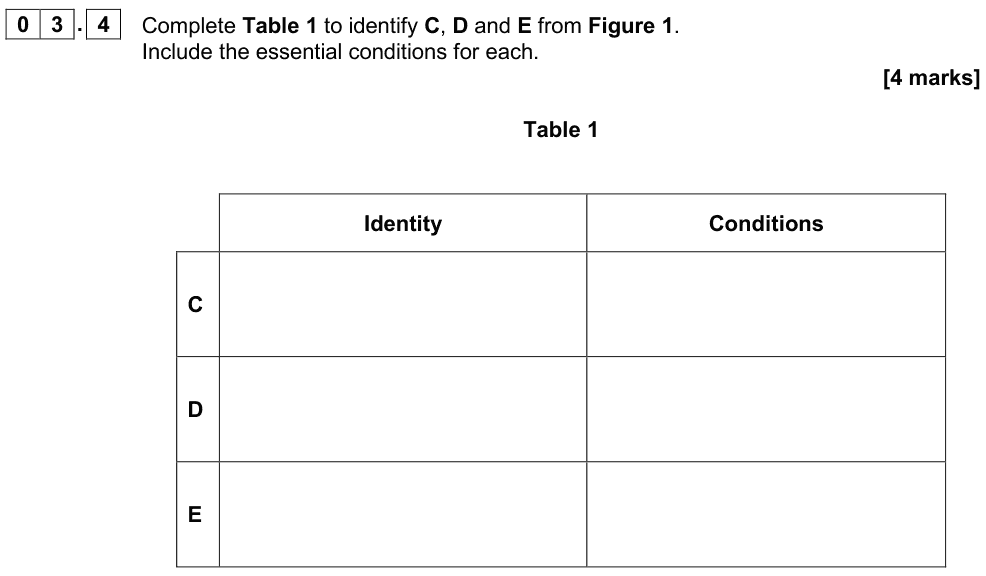
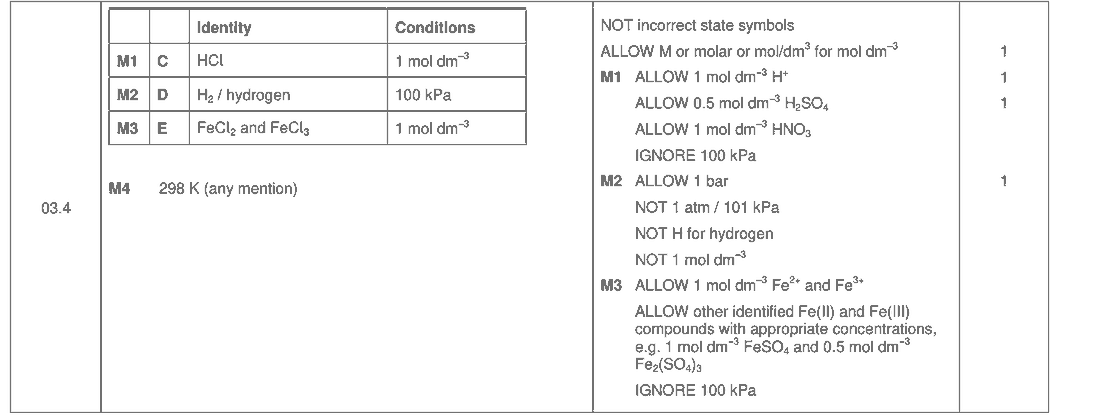
3.4 A surprising number of students failed to score here, with a significant number of responses showing no concept of what was required, especially in the ‘conditions’ column. Of those students who made a reasonable attempt, there was some confusion about the significance of concentration with the [H+] in C needing to be 1.0 mol dm–3 so, if students chose H2SO4 its concentration needs to be 0.5 mol dm−3. Likewise for E it needed to be clear that the concentrations of Fe2+ and Fe3+ are both 1.0 mol dm−3, which caused problems for some students who chose to suggest the use of Fe2(SO4)3. For D it is clear that some students are using out of date concepts with references to 1 atm as standard pressure.
Notes from the mark scheme and report
C: HCl (H+) at 1 mol dm–3 (0.5 mol dm–3 if H2SO4). D: hydrogen gas at 100 kPa (not 1 atm or 101 kPa). E: solution containing Fe2+ and Fe3+, each 1 mol dm–3. Fourth mark: 298 K anywhere. Errors: wrong concentrations for H2SO4 or Fe2(SO4)3
1 atm
Skills: ATj Set up electrochemical cells and measuring voltages; RP8 Measuring the EMF of an electrochemical cell
June 2019 · Paper 3 · Q03.52 marksEquation writing
Earlier part of question 03 that this part uses
Mark scheme
Examiner's comment
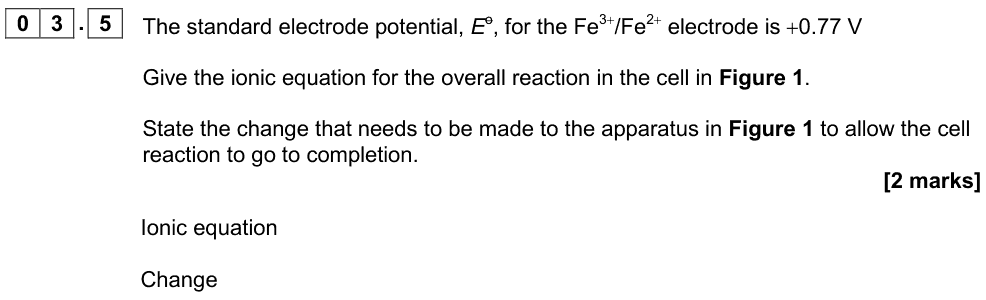
3.5 This was another question that proved harder than expected and that, again, revealed weaknesses for many students when it comes to writing a balanced equation.
Notes from the mark scheme and report
H2 + 2Fe3+ → 2H+ + 2Fe2+
replace the voltmeter with a wire, lamp or ammeter (so that current flows)
Skills: RP8 Measuring the EMF of an electrochemical cell
June 2019 · Paper 3 · Q03.63 marksPractical and data analysis
Earlier part of question 03 that this part uses
Mark scheme
Examiner's comment
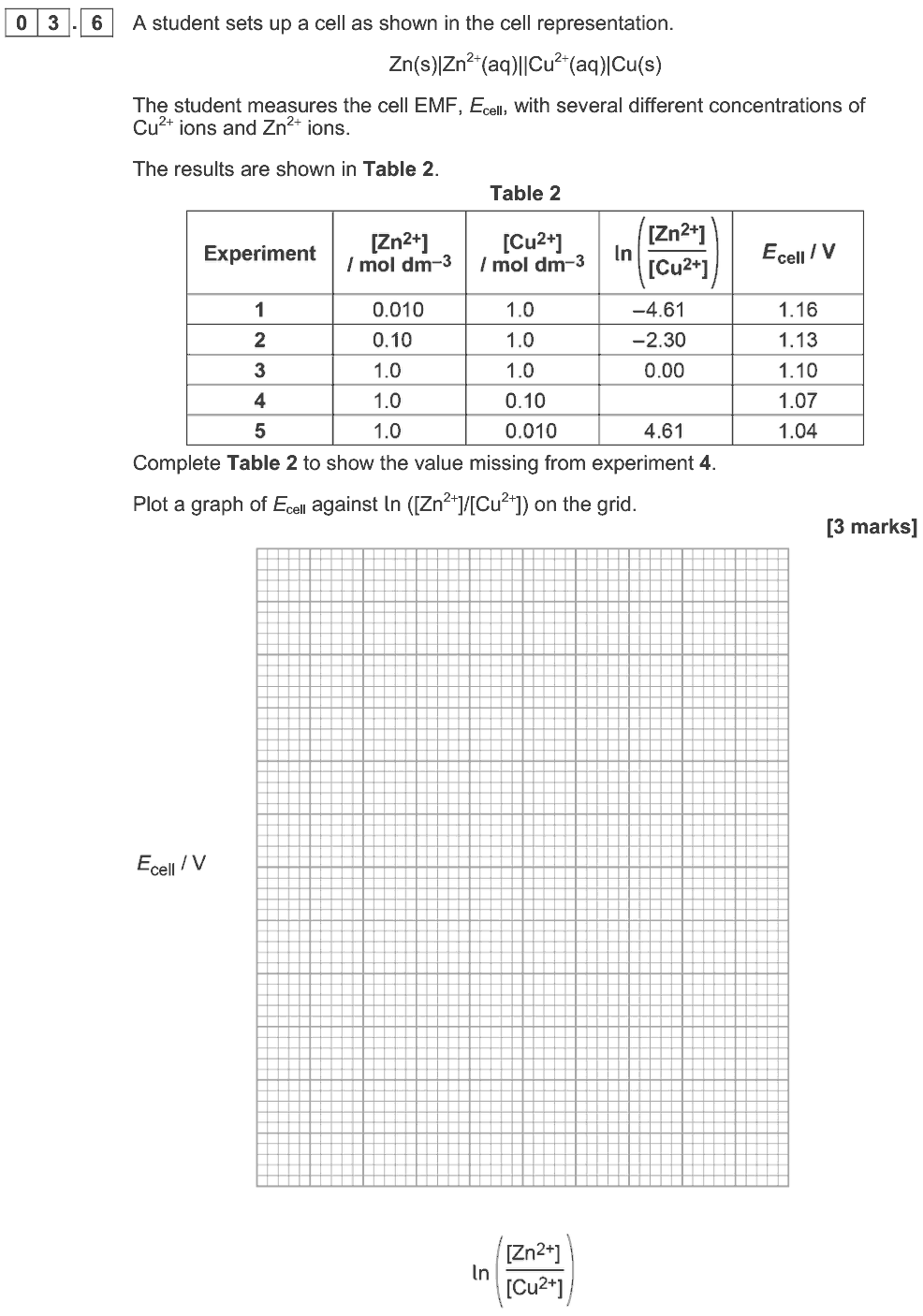
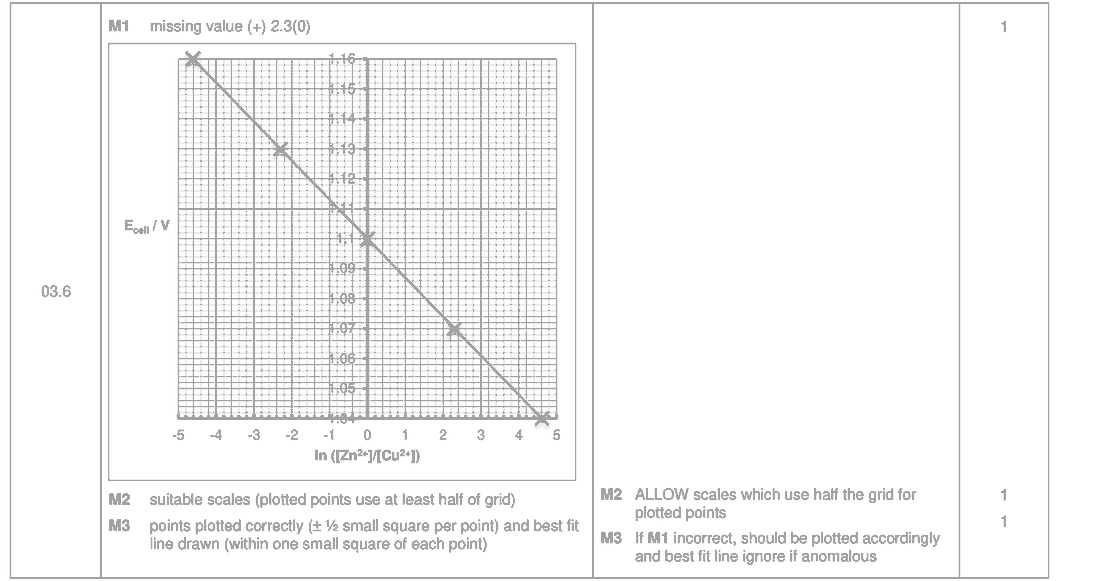
3.6 The symmetry of the values in the results table was, presumably, a factor in ensuring that almost all students scored at least one mark here and it was pleasing to see that a majority of students could choose a suitable scale and plot the points. Some students still need reminding that a ‘suitable’ scale must be linear and that the plotted points occupy at least 50% of the available space along the axis.
Notes from the mark scheme and report
Missing value: +2.30 (ln 10). Linear scales with the plotted points using at least half the grid
points plotted to ± half a small square and a best-fit straight line
Skills: MS2.5 Use logarithms in relation to quantities that range over several orders of magnitude; MS3.2 Plot two variables from experimental or other data; PS3.1 Plot and interpret graphs; RP8 Measuring the EMF of an electrochemical cell
June 2019 · Paper 3 · Q03.73 marksCalculation
Earlier parts of question 03 that this part uses
Mark scheme
Examiner's comment
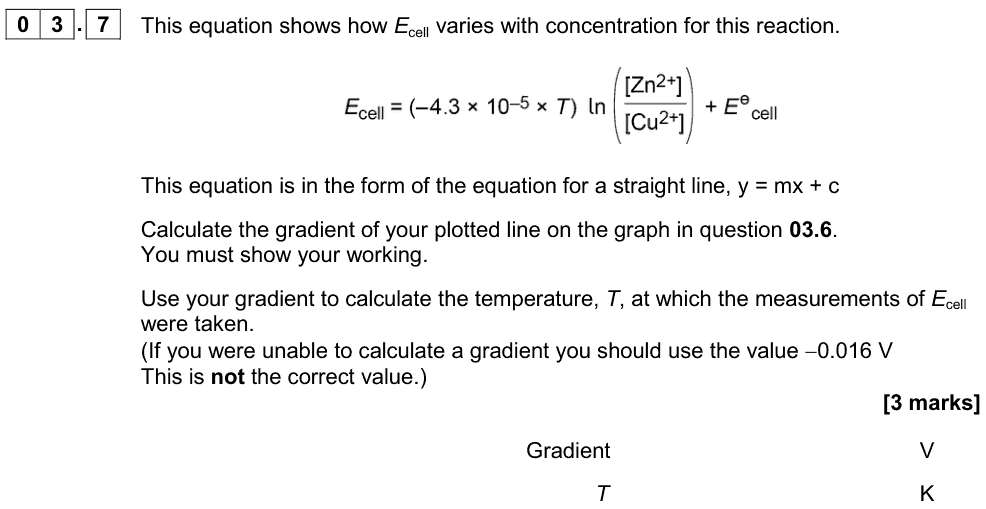
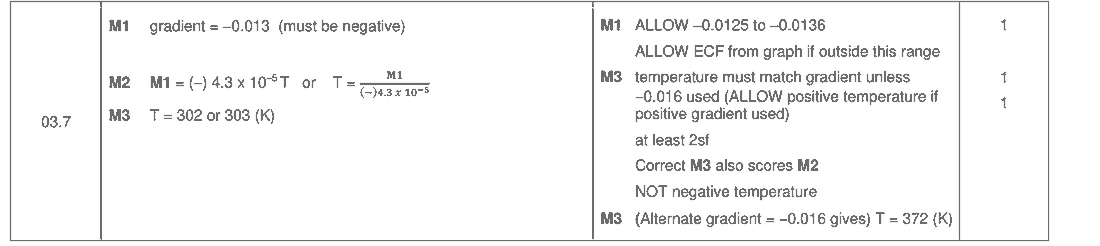
3.7 Most students sensibly chose to use values from the results table to calculate the gradient, which reduced errors resulting from misreading their scales. The need for the gradient to be negative was a stumbling block for some. A significant number of students then, however, tried substituting values into the whole ‘y = mx + c’ expression and failed to realise that the gradient is equal to (−4.3 x 10⁻⁵T).
Notes from the mark scheme and report
Answer: gradient = –0.013 V (–0.0125 to –0.0136
must be negative)
T = gradient ÷ (–4.3 × 10^–5) = 302 or 303 K (372 K from –0.016). Error: substituting into the whole y = mx + c expression. Needs the graph and Table 2 from 03.6
Skills: MS3.3 Determine the slope and intercept of a linear graph; MS3.1 Translate information between graphical, numerical and algebraic forms; MS2.2 Change the subject of an equation; RP8 Measuring the EMF of an electrochemical cell
June 2019 · Paper 3 · Q03.82 marksCalculation
Earlier parts of question 03 that this part uses
Mark scheme
Examiner's comment
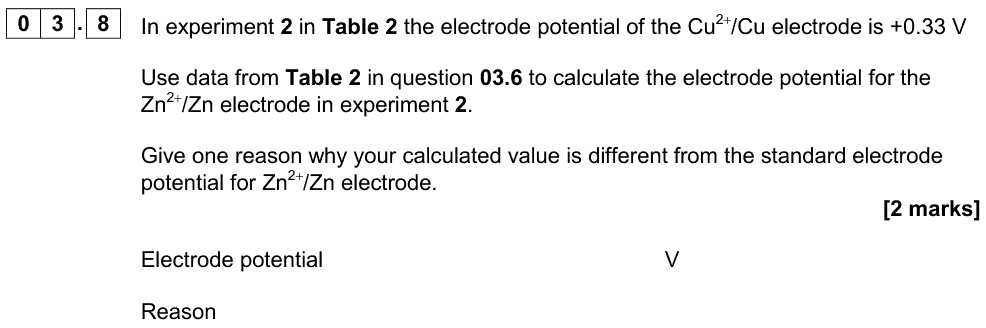
3.8 Most students seemed to rely exclusively on the use of an equation such as Ecell = ER − EL (in this case giving 1.13 = 0.33 − EZn, so EZn = 0.33 − 1.13), which caused problems for some when re-arranging.
Notes from the mark scheme and report
Answer: –0.80 V (1.13 = 0.33 – E, so E = 0.33 – 1.13). Reason: non-standard conditions: the concentration of Zn2+ is not (is less than) 1 mol dm–3. Not just 'the concentration is different'. Needs Table 2 from 03.6
Skills: RP8 Measuring the EMF of an electrochemical cell
June 2019 · Paper 3 · Q131 markMultiple choice
Answer
A
Mark scheme
Notes from the mark scheme and report
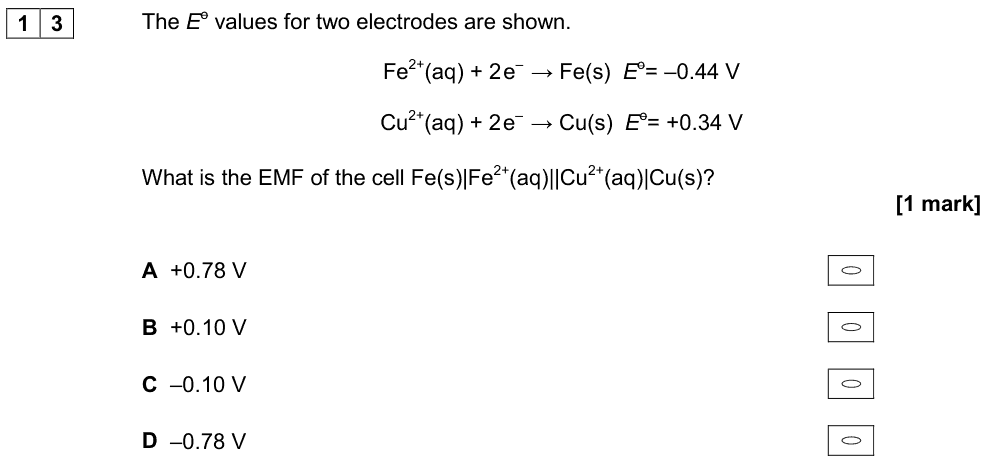
Answer: A. EMF = E(right) – E(left) = +0.34 – (–0.44) = +0.78 V
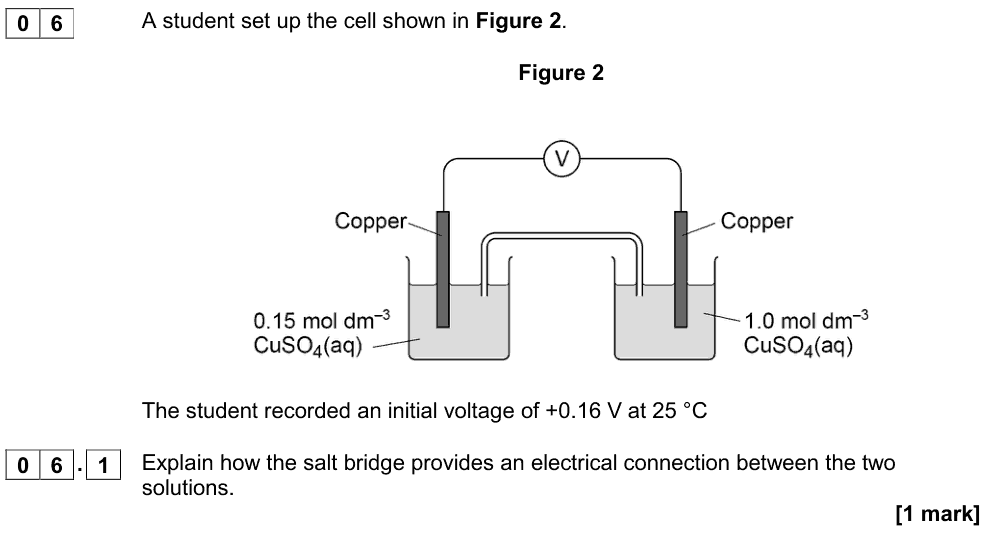
June 2018 · Paper 1 · Q06.11 markPractical and data analysisEasy
Mark scheme
Examiner's comment
06.1 Although 73.4% of students were able to answer correctly, some stated that the circuit was completed by the flow of electrons.
Notes from the mark scheme and report
It contains mobile ions / ions can move through it. Not movement of electrons (the common error)
Skills: ATj Set up electrochemical cells and measuring voltages; PS1.2 Apply scientific knowledge to practical contexts; RP8 Measuring the EMF of an electrochemical cell
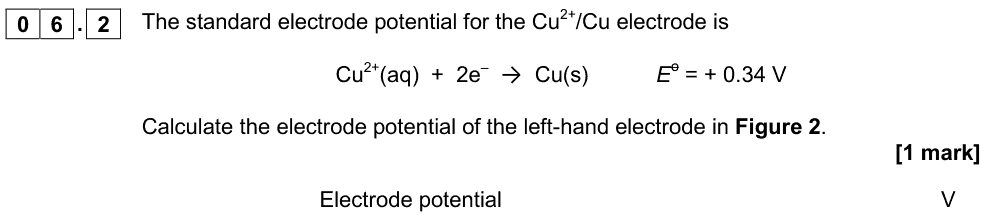
June 2018 · Paper 1 · Q06.21 markCalculationEasy
Earlier part of question 06 that this part uses
Mark scheme
Examiner's comment
06.2 Nearly two-thirds of the students (65.6%) could calculate the EMF of the cell.
Notes from the mark scheme and report
Answer: +0.18 V (0.34 – 0.16)
Skills: MS2.2 Change the subject of an equation; RP8 Measuring the EMF of an electrochemical cell
June 2018 · Paper 1 · Q06.31 markShort answerHard
Earlier part of question 06 that this part uses
Mark scheme
Examiner's comment
06.3 Students knew that the concentrations of copper sulfate were different but only just over 20% of them could state that the left-hand electrode’s concentration needed to be 1 mol dm-3.
Notes from the mark scheme and report
The concentration of Cu2+ is not 1.0 mol dm–3 (not standard conditions). Saying only that the concentrations differ was not enough
Skills: RP8 Measuring the EMF of an electrochemical cell
June 2018 · Paper 1 · Q06.41 markShort answer
Earlier part of question 06 that this part uses
Mark scheme
Examiner's comment
06.4 Many students did not give state symbols and a few gave extra phase boundaries and platinum electrodes.
Notes from the mark scheme and report
Cu(s) ∣ Cu2+(aq) ∥ Cu2+(aq) ∣ Cu(s). Errors: no state symbols
extra phase boundaries
platinum electrodes
Skills: RP8 Measuring the EMF of an electrochemical cell
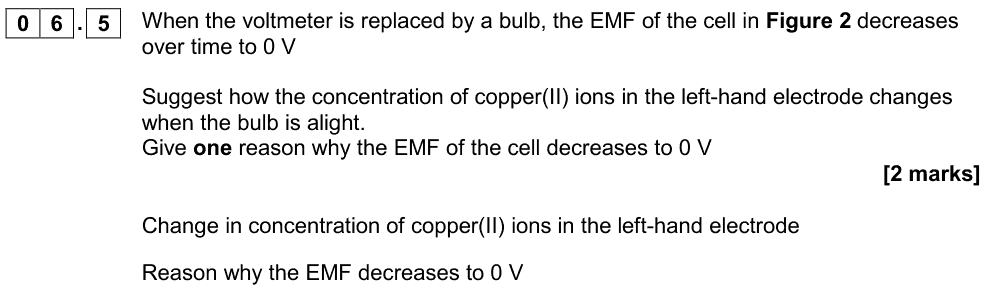
June 2018 · Paper 1 · Q06.52 marksShort answerHard
Earlier part of question 06 that this part uses
Mark scheme
Examiner's comment
06.5 Only the best students (15.5%) scored both marks. Many students could state that the concentration of copper ions would increase but then thought that the reagents would run out.
Notes from the mark scheme and report
The Cu2+ concentration in the left-hand electrode increases
the EMF is 0 V when the Cu2+ concentrations in the two solutions become equal. Common error: the reagents run out
Skills: RP8 Measuring the EMF of an electrochemical cell
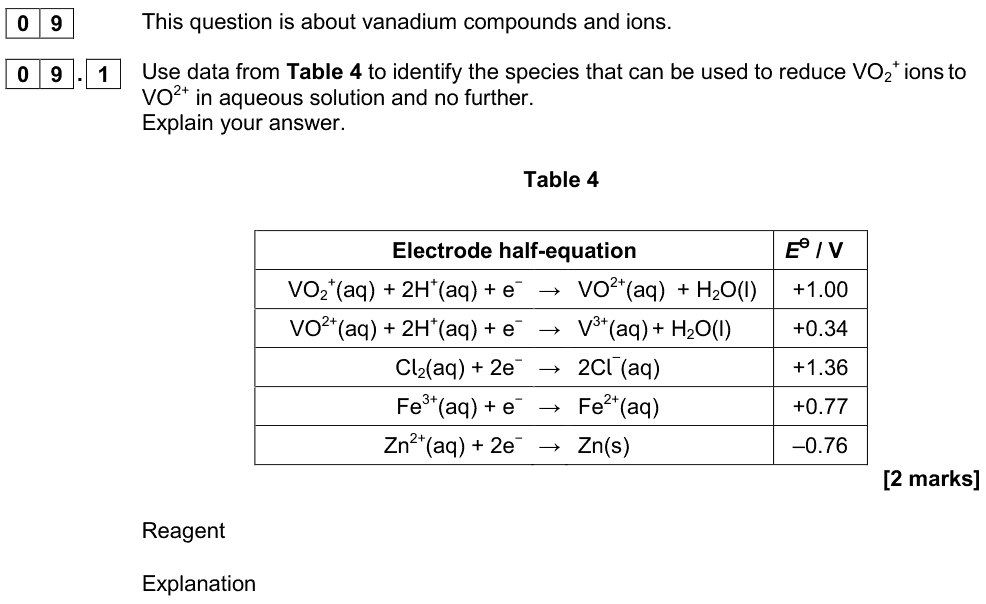
June 2018 · Paper 1 · Q09.12 marksExplanationHard
Mark scheme
Examiner's comment
09.1 Only 11.3% of students scored both marks here; sometimes Fe2+ was chosen but students could not explain their choice. The most common incorrect answer was Zn2+.
Notes from the mark scheme and report
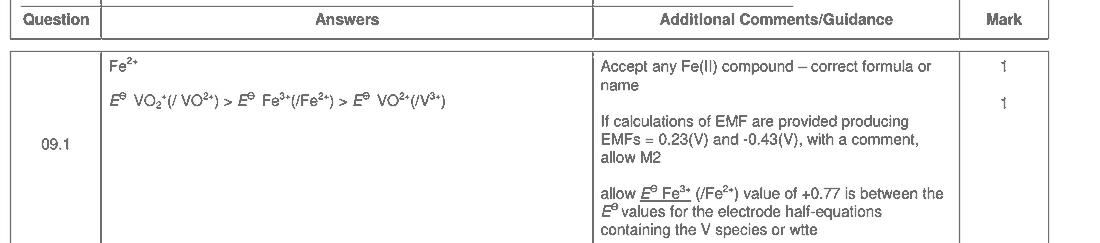
Fe2+ (any iron(II) compound). E(VO2+/VO2+) = +1.00 is greater than E(Fe3+/Fe2+) = +0.77, which is greater than E(VO2+/V3+) = +0.34, so Fe2+ reduces vanadium(V) to vanadium(IV) but no further. Most common wrong answer: Zn2+
June 2018 · Paper 3 · Q291 markMultiple choiceEasy
Answer
B
Mark scheme
Examiner's comment
29 Just over two-thirds of students arrived at the correct answer. D (followed by A) was the commonest incorrect response.
Notes from the mark scheme and report
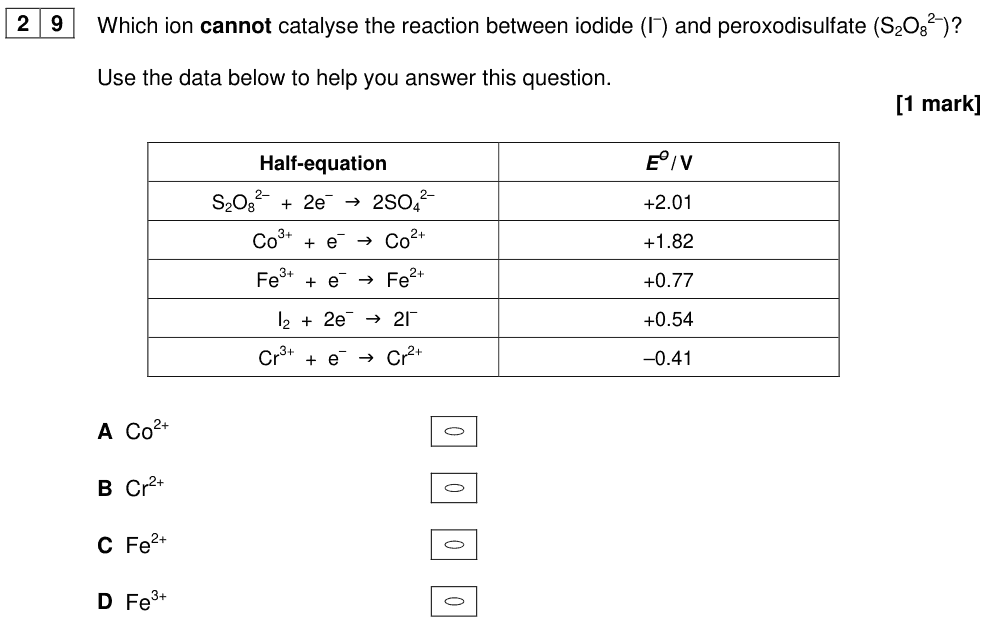
Answer: B. A catalyst couple needs E between +0.54 and +2.01 V. Cr2+ would be oxidised by S2O8 2– to Cr3+, but Cr3+ (–0.41 V) cannot oxidise I– back, so no cycle. The Co and Fe couples lie in the range, and Fe3+ works as well as Fe2+
June 2017 · Paper 1 · Q10.21 markShort answer
Earlier part of question 10 that this part uses
Mark scheme
Examiner's comment
10.2 Just under half of students could identify the weakest reducing agent.
Notes from the mark scheme and report
Answer: chloride ions, Cl– (the reduced form in the half-equation with the most positive E). Not chlorine / Cl2
June 2017 · Paper 1 · Q10.32 marksShort answer
Earlier part of question 10 that this part uses
Examiner's comment
10.3 Unfortunately, due to a printing error on the question paper, this question had to be discounted. All students were awarded two marks.
Notes from the mark scheme and report
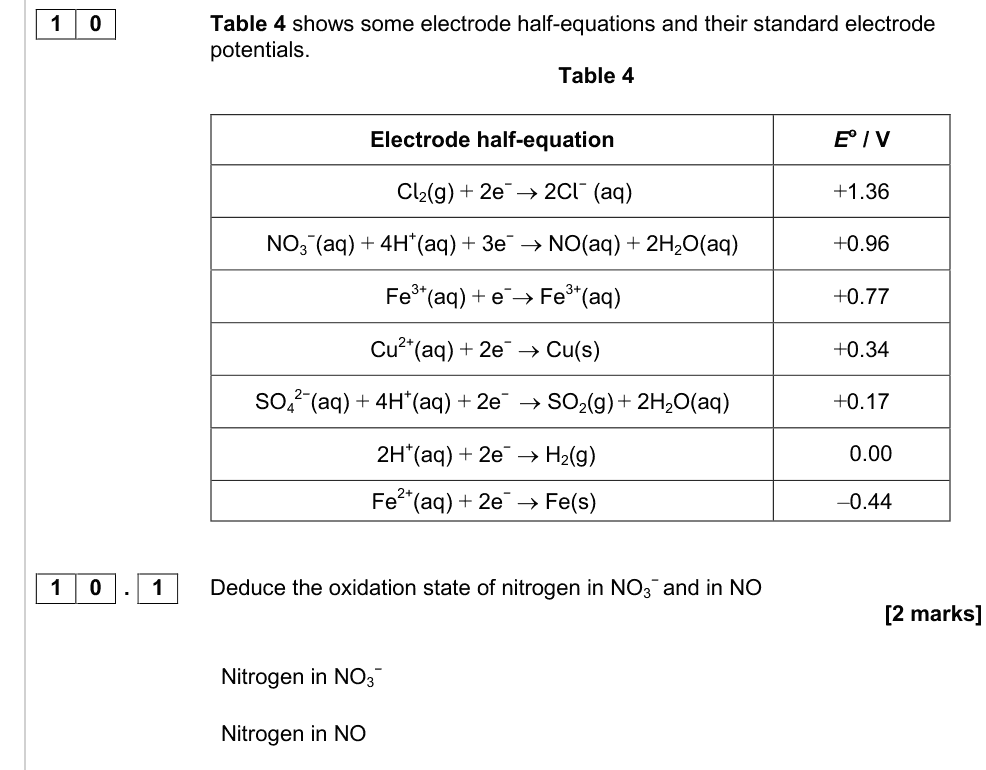
No mark scheme published for this part. The question was discounted because of a printing error in Table 4 (the iron(III) half-equation is printed as Fe3+ + e– → Fe3+) and all students were given 2 marks. Intended cell (0.77 – 0.34 = 0.43 V): Cu(s) ∣ Cu2+(aq) ∥ Fe3+(aq), Fe2+(aq) ∣ Pt(s)
June 2017 · Paper 1 · Q10.44 marksExplanation
Earlier part of question 10 that this part uses
Mark scheme
Examiner's comment
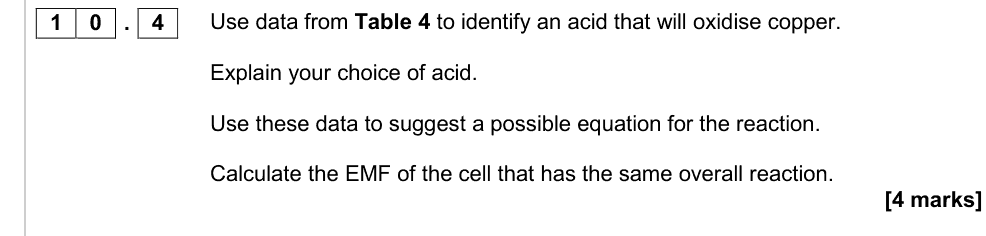
10.4 “Nitrate ions” was a common insufficient answer, and sulfuric acid a common incorrect answer.
Only the very best students scored mark point two; the common incorrect answer was that the Eo for NO3
Notes from the mark scheme and report
Nitric acid, HNO3 (anything else = 0
'nitrate ions' loses M1)
E(NO3–/NO) +0.96 V is more positive than E(Cu2+/Cu) +0.34 V