Notes and key-term cards for this topic are being written by our tutors. The past-paper questions below are ready now.
Specification statements
Show the 9 statements from the specification
3.3.15-01 Appreciation that scientists have developed a range of analytical techniques which together enable the structures of new compounds to be confirmed.
3.3.15-02 Nuclear magnetic resonance (NMR) gives information about the position of 13C or 1H atoms in a molecule.
3.3.15-03 13C NMR gives simpler spectra than 1H NMR.
3.3.15-04 The use of the δ scale for recording chemical shift.
3.3.15-05 Chemical shift depends on the molecular environment.
3.3.15-06 Integrated spectra indicate the relative numbers of 1H atoms in different environments.
3.3.15-07 1H NMR spectra are obtained using samples dissolved in deuterated solvents or CCl4
3.3.15-08 The use of tetramethylsilane (TMS) as a standard.
3.3.15-09 Students should be able to: • explain why TMS is a suitable substance to use as a standard • use 1H NMR and 13C NMR spectra and chemical shift data from the Chemistry Data Booklet to suggest possible structures or part structures for molecules • use integration data from 1H NMR spectra to determine the relative numbers of equivalent protons in the molecule • use the n+1 rule to deduce the spin–spin splitting patterns of adjacent, non-equivalent protons, limited to doublet, triplet and quartet formation in aliphatic compounds.
Six-mark level of response questions on this topic
Tap a question to zoom it. Where a part needs a figure, table or structure from earlier in the question, that part folds out above it; the mark scheme and examiner's comment open underneath. Have AQA's Data Booklet (the Periodic Table and the spectroscopy tables) beside you.
June 2025 · Paper 2 · Q06.12 marksAO2=2Short answer
Mark scheme
Examiner's comment
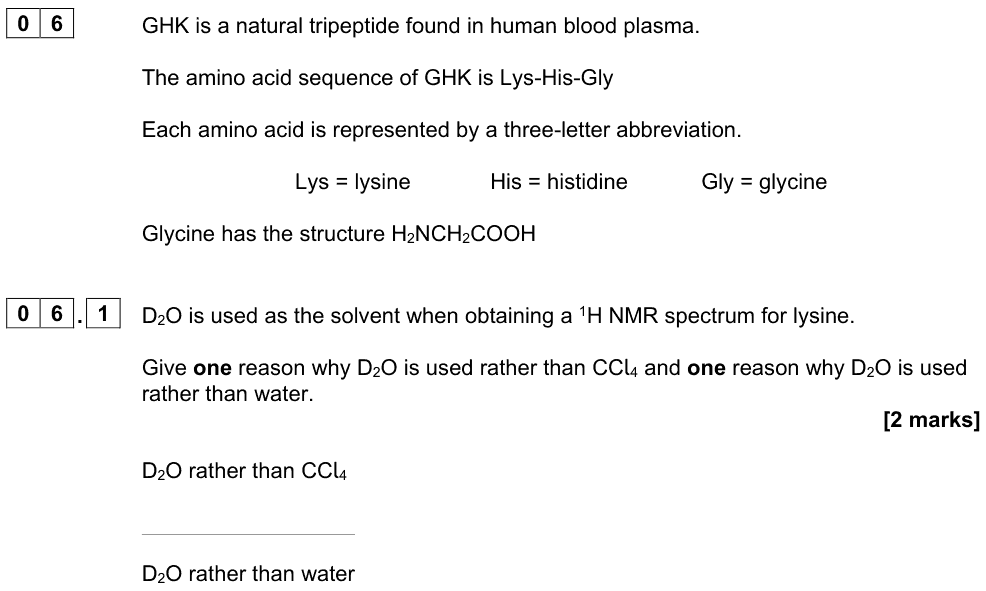
6.1 Students were required to deduce why D2O is used instead of CCl4 or H2O when obtaining a 1H NMR spectrum for lysine. Many were able to score here for relating the polar nature of the lysine to the fact that would not dissolve well in non-polar CCl4 or that D2O does not give its own signal in a 1H NMR spectrum.
Notes from the mark scheme and report
Rather than CCl4: D2O is polar, so it dissolves lysine (CCl4 is non-polar). Rather than water: D2O has no 1H atoms, so it gives no signal in the 1H spectrum
June 2025 · Paper 2 · Q07.15 marksAO1=2, AO2=3Explanation
Mark scheme
Examiner's comment
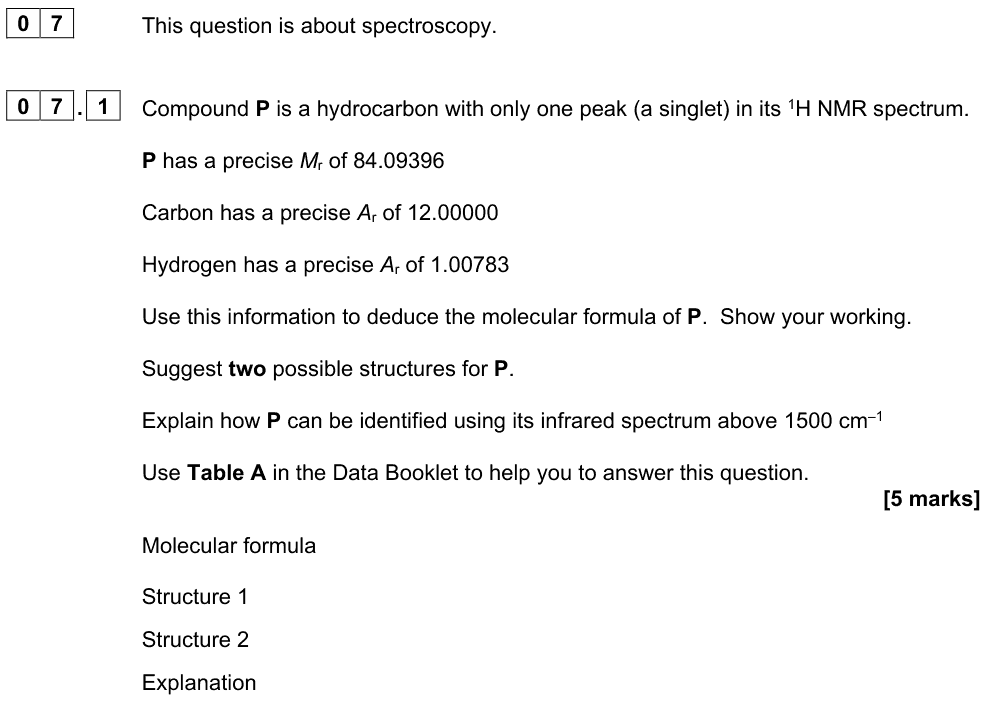
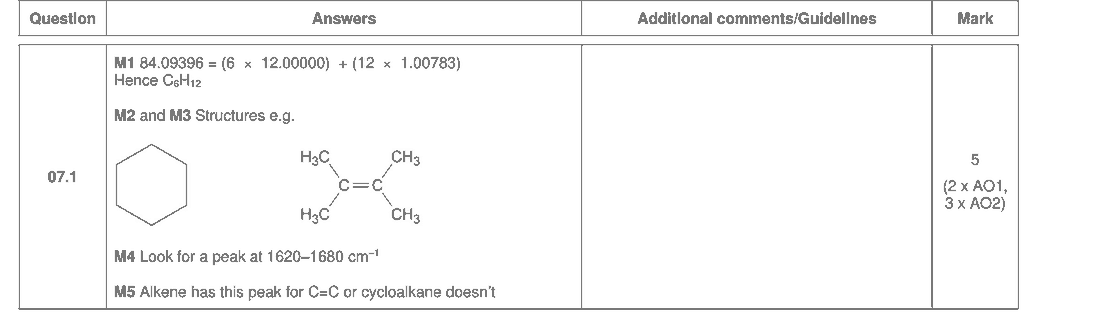
7.1 Students were given precise Mr data for an unknown hydrocarbon. Some were able to deduce the molecular formula but did not score as no workings were shown. Cyclohexane was the most commonly drawn correct structure but far fewer were able to deduce that 2,3-dimethylbut-2-ene was the other possible structure for C6H12 that gives only one singlet peak in its 1H NMR spectrum. The most common error was to give an alkene that had more than one peak in the 1H NMR spectrum. The final marks were quite well answered by suggesting the presence or absence of the C=C bond absorption at 1620-1680 cm-1 in the infrared spectrum.
Notes from the mark scheme and report
C6H12: (6 × 12.00000) + (12 × 1.00783) = 84.09396 (working needed). Structures with one hydrogen environment: cyclohexane and 2,3-dimethylbut-2-ene. Look for an absorption at 1620–1680 cm–1: the alkene has this C=C peak, cyclohexane does not. Common error: an alkene with more than one 1H peak
Skills: MS2.4 Solve algebraic equations
June 2025 · Paper 2 · Q07.27 marksAO2=3, AO3=47-mark level of response
Earlier part of question 07 that this part uses
Mark scheme, with the levels and indicative content
Examiner's comment
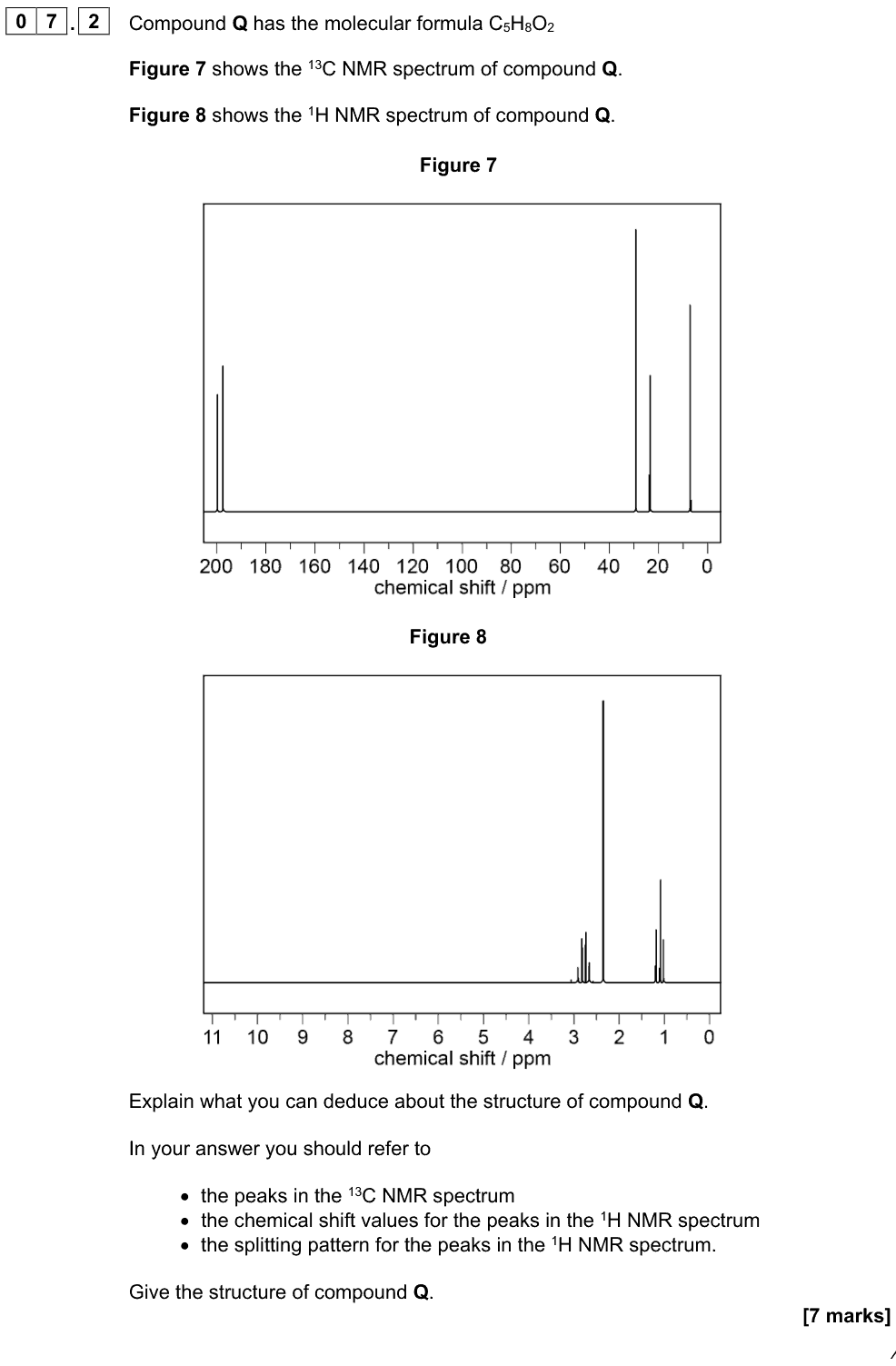
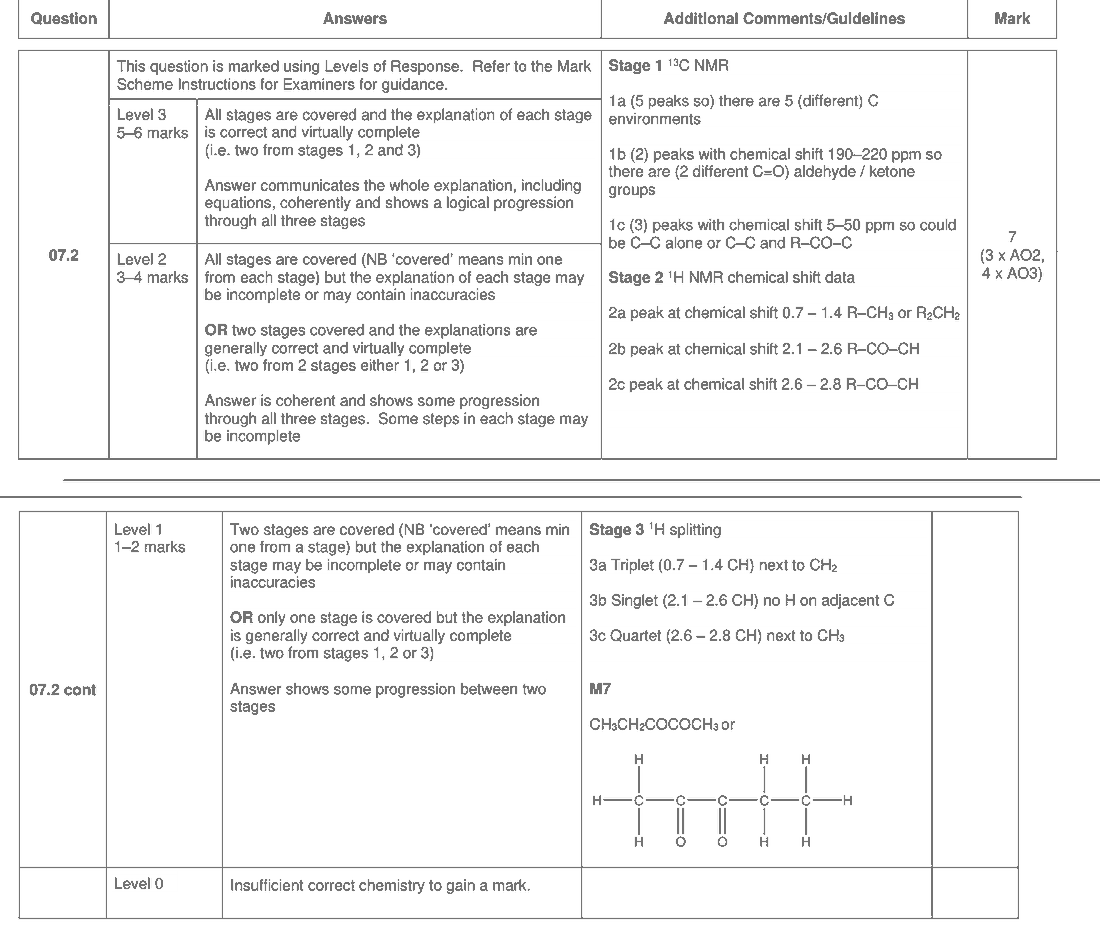
7.2 Students were given the 13C and 1H NMR spectra for an unknown compound and asked to explain what could be deduced from the spectra about its structure. Students often did well on the chemical shift analysis but less well in addressing the splitting patterns in the 1H NMR. The final mark of the 7 available here was for deducing the structure of the dione and this was quite well done by those who had done a thorough analysis of the spectral data. The question was marked with a levels of response mark scheme and differentiated very well.
Notes from the mark scheme and report
Levels of response (6) plus 1 for the structure. Stage 1, 13C: five peaks so five carbon environments
two peaks at 190–220 ppm so two different C=O (aldehyde/ketone)
three peaks at 5–50 ppm for C–C / C next to C=O. Stage 2, 1H shifts: 0.7–1.4 ppm R–CH3
2.1–2.6 and 2.6–2.8 ppm H on C next to C=O. Stage 3, splitting: triplet (CH3 next to CH2)
singlet (CH3 with no H on the adjacent C)
quartet (CH2 next to CH3). Q is pentane-2,3-dione, CH3CH2COCOCH3. Splitting was the weakest stage
June 2024 · Paper 2 · Q03.21 markAO3=1Short answer
Earlier part of question 03 that this part uses
Mark scheme
Examiner's comment
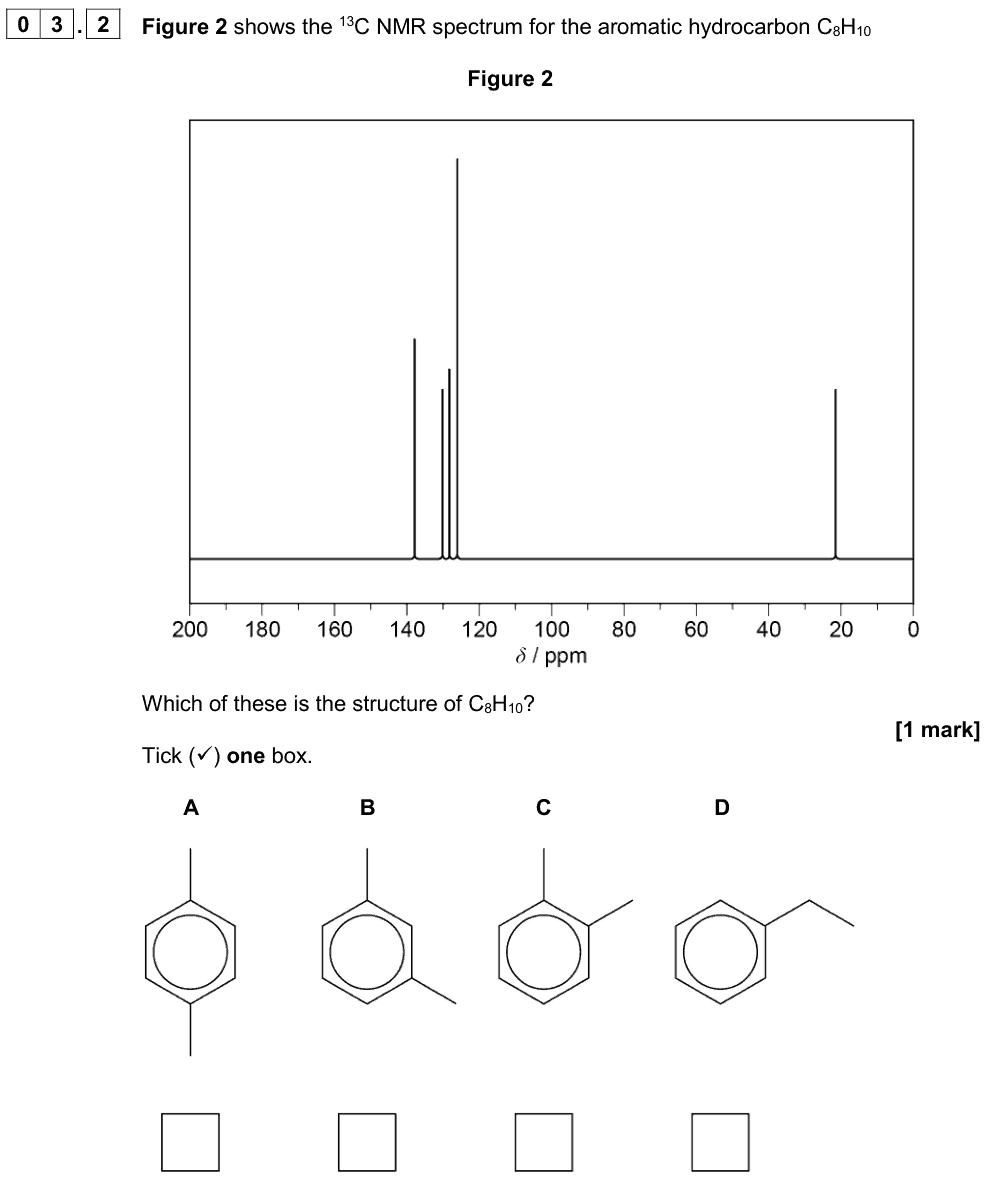
3.2 Students found this difficult. Only around 40% were able to link the number and chemical shifts of peaks in the 13C NMR spectrum to the number of different C environments in the options. Only option B has 5 different carbon environments, so this had to be the correct answer matching the 5 peaks in the spectrum.
Notes from the mark scheme and report
Answer: B (1,3-dimethylbenzene). Five peaks means five carbon environments (four aromatic, one CH3)
A has 3, C has 4 and D has 6
June 2024 · Paper 2 · Q06.32 marksAO2=2Diagram or structure
Earlier part of question 06 that this part uses
Mark scheme
Examiner's comment
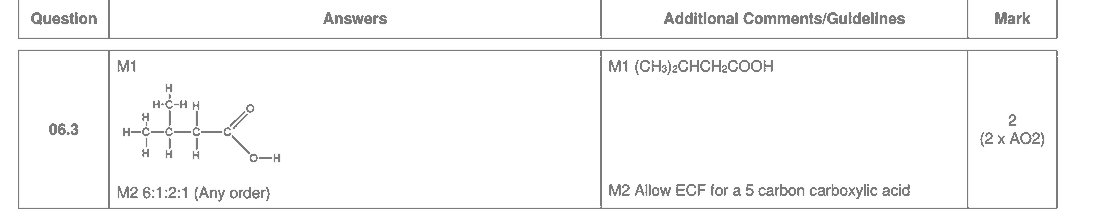
6.3 This proved to be quite a demanding question although over 30% gained both marks. If the structure was correct, then the integration ratio was often correct too.
Notes from the mark scheme and report
W is (CH3)2CHCH2COOH (3-methylbutanoic acid)
integration ratio 6 : 1 : 2 : 1 (any order). Ratio allowed as ECF from another five-carbon acid
June 2024 · Paper 2 · Q06.42 marksAO2=2Diagram or structure
Earlier part of question 06 that this part uses
Mark scheme
Examiner's comment
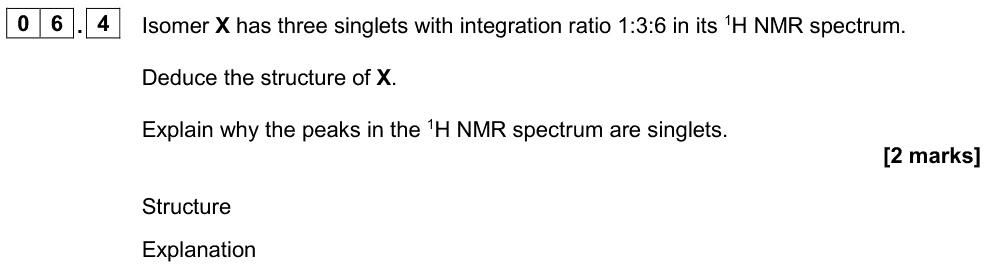
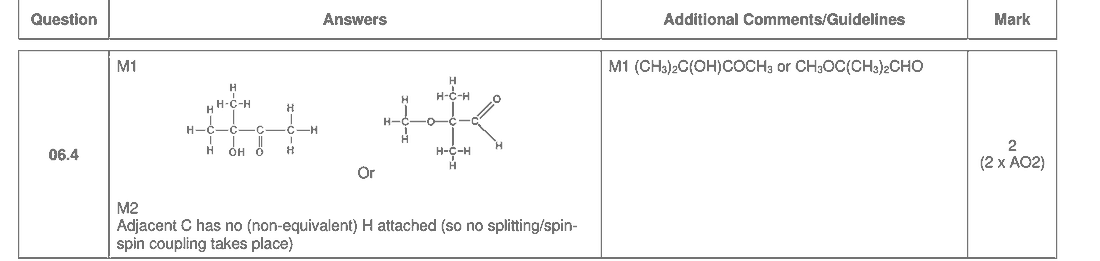
6.4 M2 was well known for explaining why peaks are singlets in 1H NMR. Over half the students scored at least 1 mark but the structure proved more challenging than the explanation of singlets.
Notes from the mark scheme and report
X is (CH3)2C(OH)COCH3 or CH3OC(CH3)2CHO
the peaks are singlets because the adjacent carbon has no (non-equivalent) hydrogen atoms attached, so there is no splitting. The explanation was better known than the structure
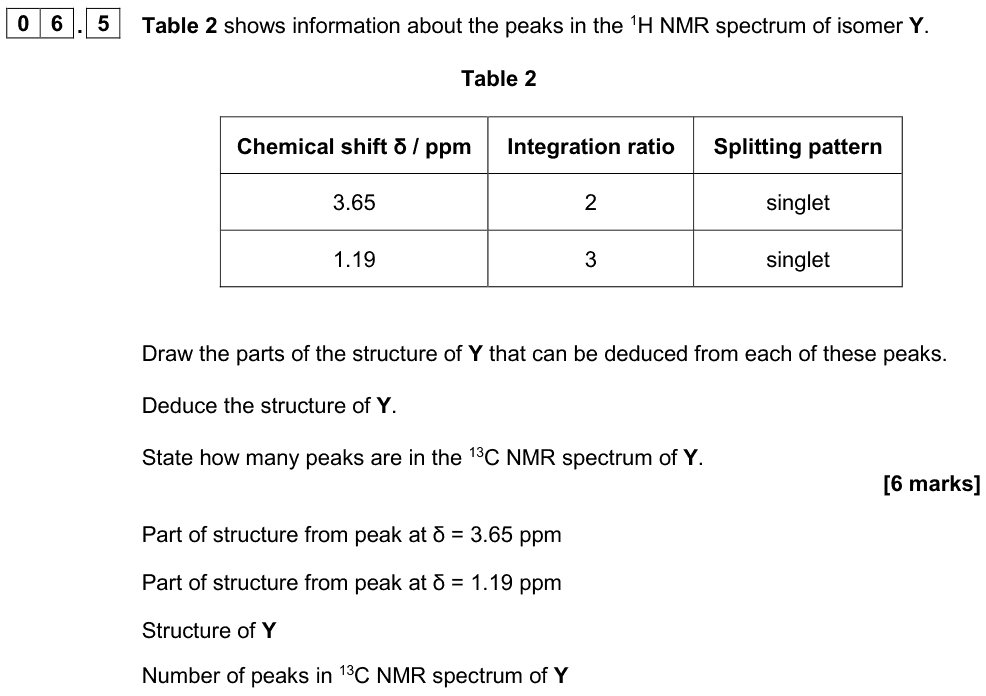
June 2024 · Paper 2 · Q06.56 marksAO1=1, AO3=5Diagram or structure
Earlier part of question 06 that this part uses
Mark scheme
Examiner's comment
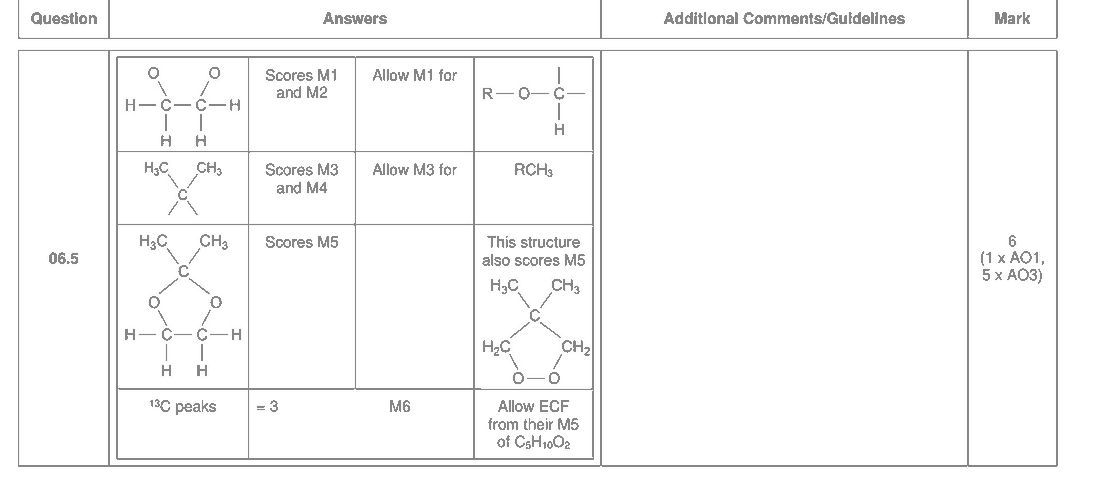
6.5 This proved to be a very demanding question. There were straightforward marks available for relating the chemical shifts given to structure fragments from the data booklet. However, students often failed to copy these fragments clearly enough or contradicted them with different answers.
Notes from the mark scheme and report
δ 3.65 (2, singlet): –O–CH2–CH2–O– (allow R–O–CH for 1 mark). δ 1.19 (3, singlet): C(CH3)2, two equivalent methyl groups on a carbon with no H (allow R–CH3 for 1). Y is cyclic: 2,2-dimethyl-1,3-dioxolane, (CH3)2C joined to –O–CH2–CH2–O–
the peroxide ring with –CH2–O–O–CH2– and C(CH3)2 also scores. 13C peaks: 3 (ECF from their C5H10O2 structure). Very demanding
fragments were often copied unclearly or contradicted
June 2023 · Paper 2 · Q05.21 markAO1=1Short answerEasy
Earlier part of question 05 that this part uses
Mark scheme
Examiner's comment
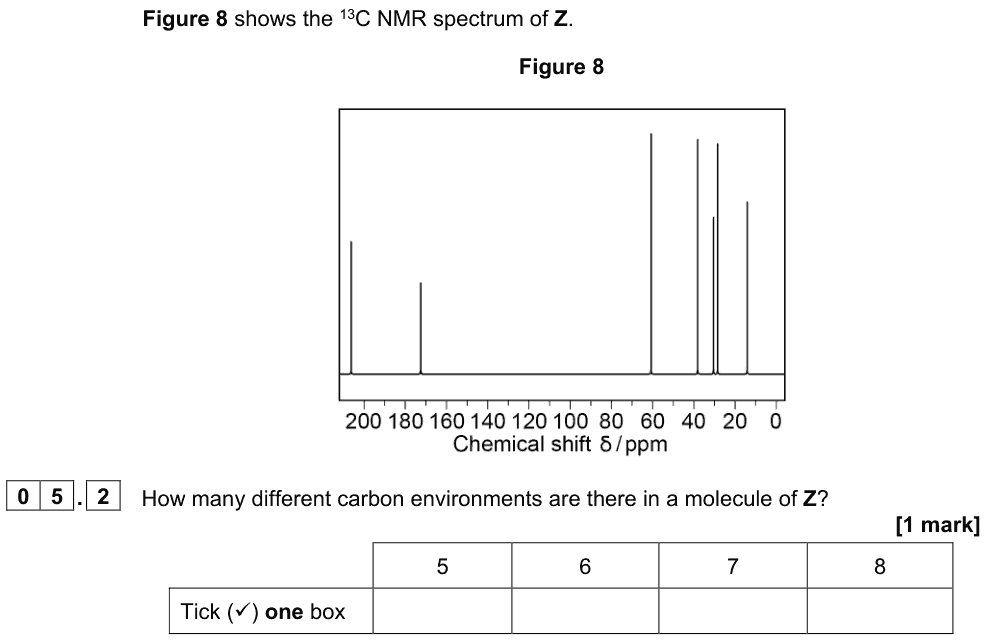
05.2 Although straightforward, only about two-thirds of students were able to link the seven peaks on the 13C NMR spectrum to the seven carbon environments in the molecule.
Notes from the mark scheme and report
Answer: 7 (seven peaks in the 13C spectrum, one per carbon environment)
June 2023 · Paper 2 · Q05.31 markAO1=1Short answer
Earlier parts of question 05 that this part uses
Mark scheme
Examiner's comment
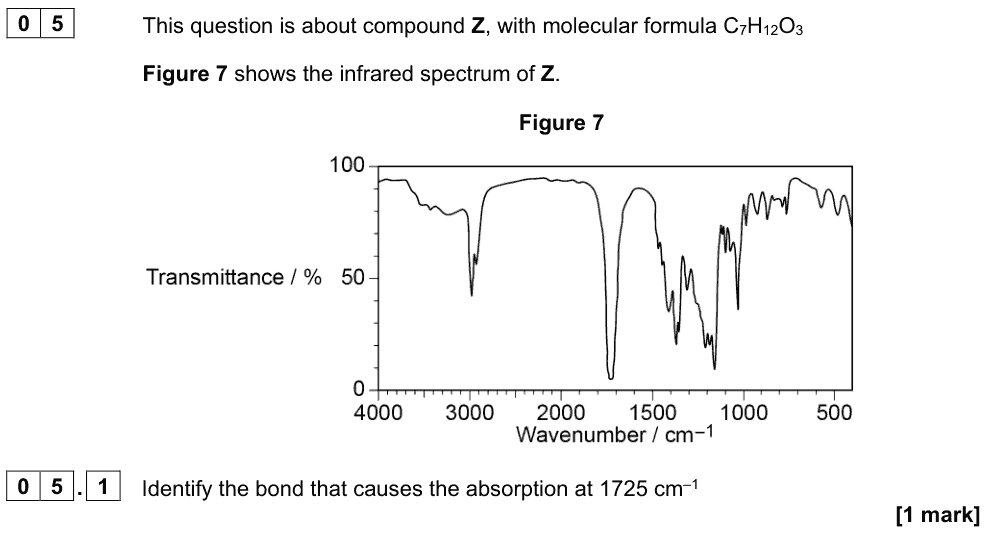
05.3 This was well answered but some students failed to identify the fact that the carbon giving rise to the peak concerned was part of an ester group.
Notes from the mark scheme and report
The carbonyl carbon of an ester, R–C(=O)–O– (160–185 ppm). 'Acids' ignored
Z has no O–H absorption for an acid. Some did not say ester
June 2023 · Paper 2 · Q05.45 marksAO2=5Explanation
Earlier parts of question 05 that this part uses
Mark scheme
Examiner's comment
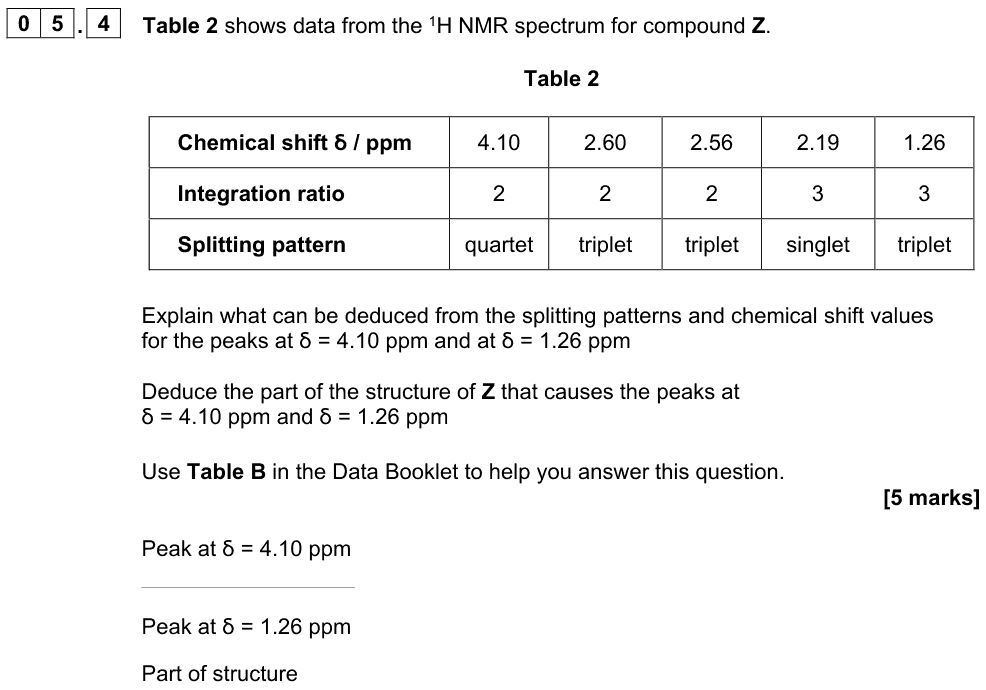
05.4 This question discriminated very well with only the best students scoring full marks. That said, over half scored at least three of the five marks available.
Notes from the mark scheme and report
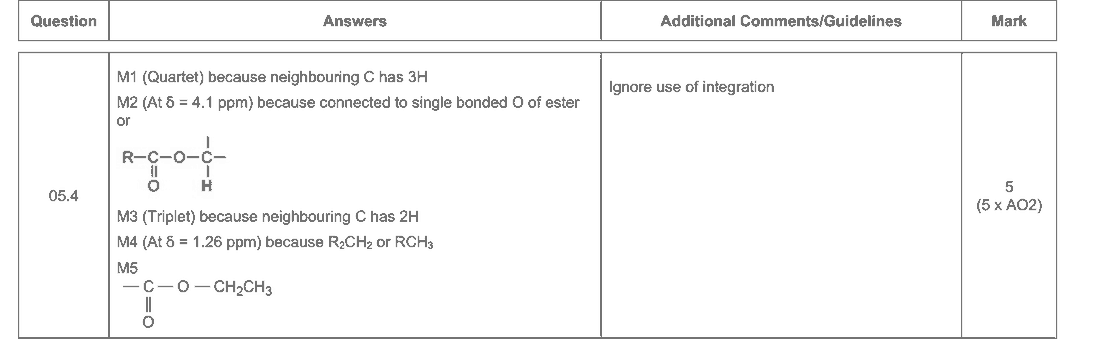
δ 4.10: quartet, so the adjacent carbon has 3 H
the shift shows the H atoms are on a carbon bonded to the single-bonded O of an ester (–COO–CH2–). δ 1.26: triplet, so the adjacent carbon has 2 H
the shift shows R–CH3. Part structure: –COO–CH2CH3 (ethyl ester). Integration is ignored. Over half scored at least 3
June 2023 · Paper 2 · Q05.51 markAO2=1Diagram or structureEasy
Earlier parts of question 05 that this part uses
Mark scheme
Examiner's comment
05.5 Over two-thirds of students scored the mark for this question, despite not always being convincing in the way they showed there were three equivalent H atoms next to a carbonyl group. It is best practice to include the symbol for hydrogen (H) at the end of each line representing a bond from carbon.
Notes from the mark scheme and report
CH3–C(=O)– : a singlet for 3 H with no H on the adjacent carbon, at the shift for H on a carbon next to C=O. Show all three H atoms. Uses Table 2 from 05.4
June 2023 · Paper 2 · Q05.61 markAO3=1Short answer
Earlier parts of question 05 that this part uses
Mark scheme
Examiner's comment
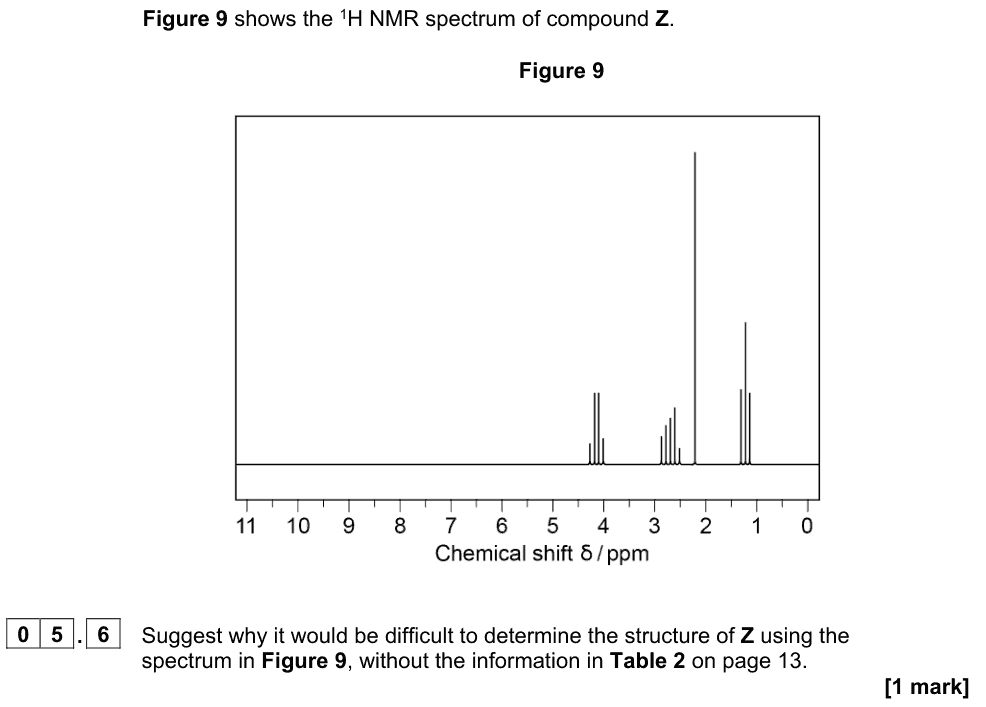
05.6 This question was well answered and there were several alternative ways students could approach the question. Most focused on the lack of integration data on the spectrum but fewer gave the anticipated response about the peaks at δ=2.60 and 2.58 overlapping and making the splitting patterns difficult to interpret.
Notes from the mark scheme and report
The peaks at δ 2.60 and 2.56 overlap, so their splitting patterns cannot be deduced
or the spectrum shows no integration values
June 2023 · Paper 2 · Q05.71 markAO2=1Diagram or structure
Earlier parts of question 05 that this part uses
Mark scheme
Examiner's comment
05.7 Only the most able students were able to draw together all the information from the spectra and data table to deduce the final structure. The question had a high discrimination index.
Notes from the mark scheme and report
CH3COCH2CH2COOCH2CH3 (ethyl 4-oxopentanoate): CH3CO– singlet, two adjacent CH2 groups each a triplet, and an ethyl ester
seven carbon environments. Only the most able got this
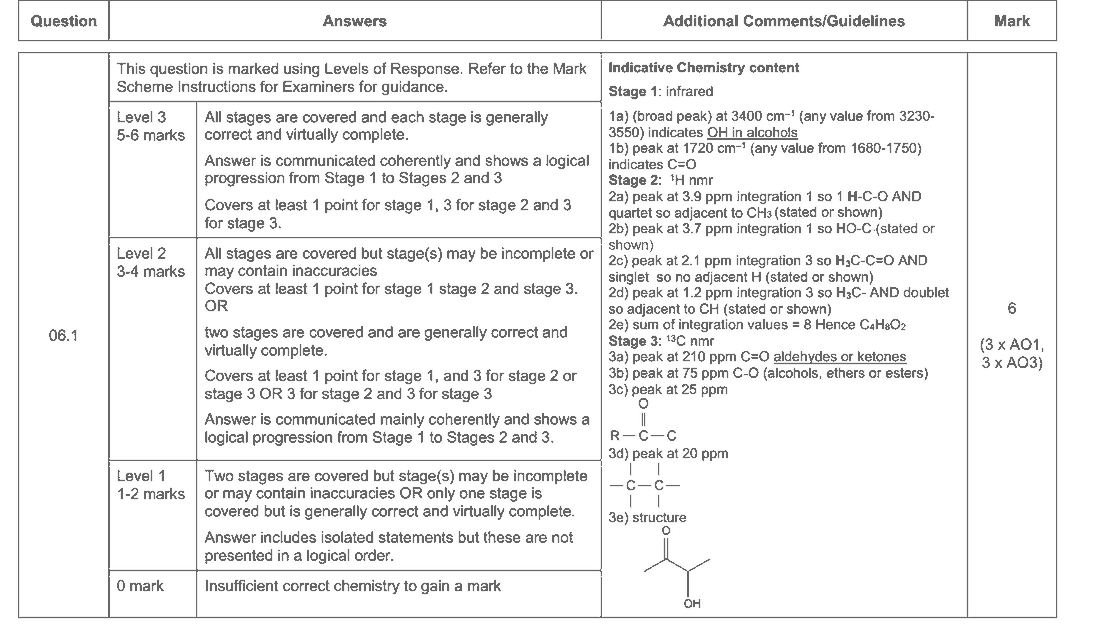
June 2022 · Paper 2 · Q066 marksAO1=3, AO3=36-mark level of response
Mark scheme, with the levels and indicative content
Examiner's comment
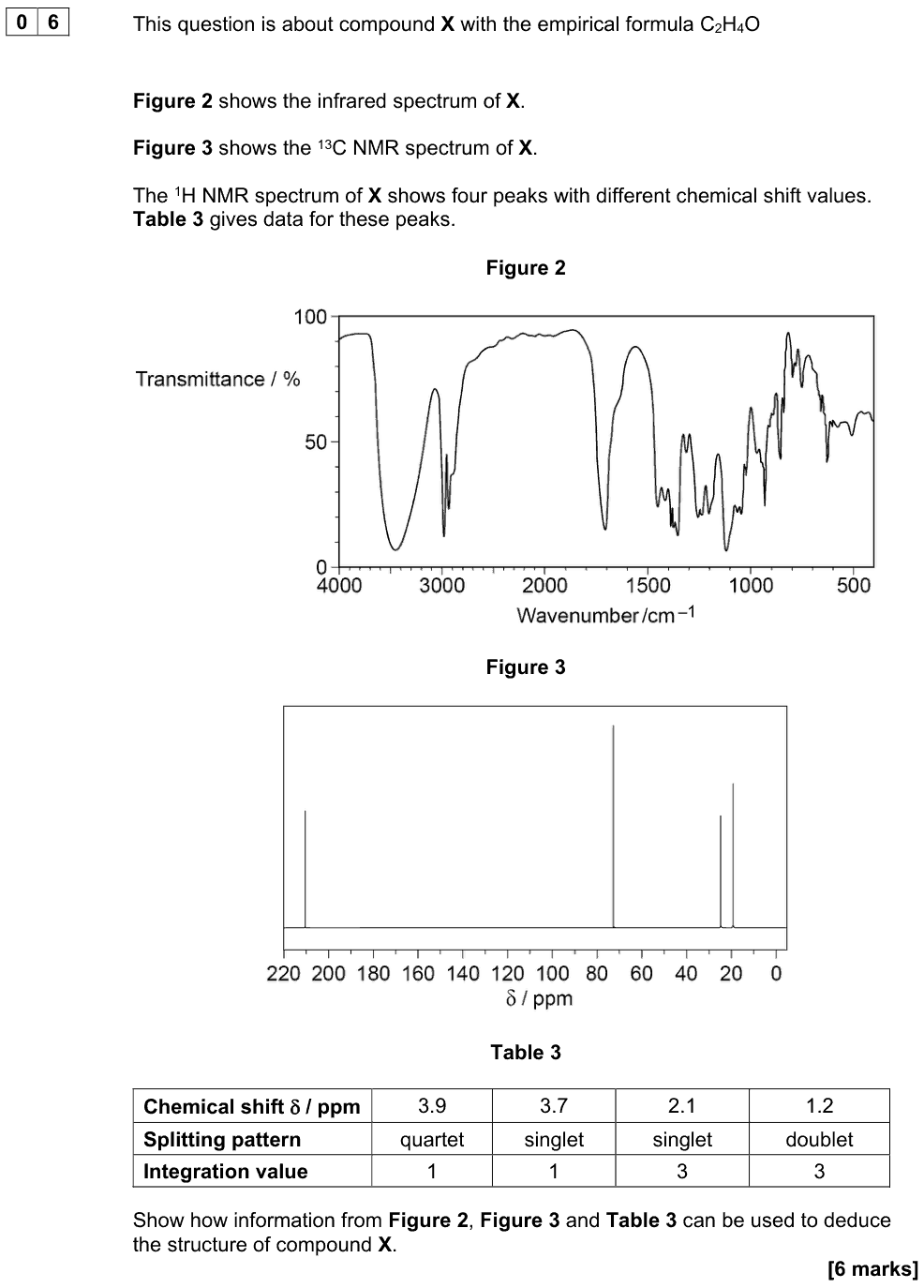
This question was marked using a levels of response mark scheme. Most students were able to get started and could identify some structural features using the infrared spectrum and the data
booklet. The best answers also showed a logical and systematic approach in analysis of each signal in the 13C NMR spectrum and the table of data relating to the 1H NMR spectrum. Students often failed to reach the highest level because their answers lacked sufficient detail, despite arriving at the correct overall structure.
Notes from the mark scheme and report
Levels of response, three stages. Infrared: broad absorption about 3400 cm–1 = O–H (alcohol)
about 1720 cm–1 = C=O. 1H NMR: 3.9 ppm, 1H, H–C–O, quartet so next to CH3
3.7 ppm, 1H, O–H
2.1 ppm, 3H, CH3–C=O, singlet so no adjacent H
1.2 ppm, 3H, CH3, doublet so next to CH
integration total 8 H so C4H8O2. 13C NMR: about 210 ppm C=O of a ketone or aldehyde
about 75 ppm C–O
about 25 ppm C next to C=O
about 20 ppm C–C. Structure: CH3COCH(OH)CH3 (3-hydroxybutan-2-one). Many reached the structure without enough supporting detail
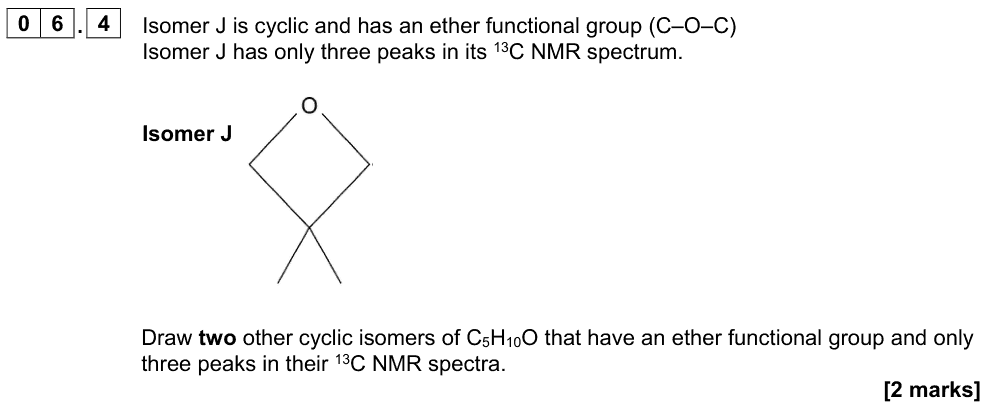
November 2021 · Paper 2 · Q06.42 marksDiagram or structure
Earlier part of question 06 that this part uses
Mark scheme
Examiner's comment
Questions 06.2 and 06.4 proved more accessible.
Notes from the mark scheme and report
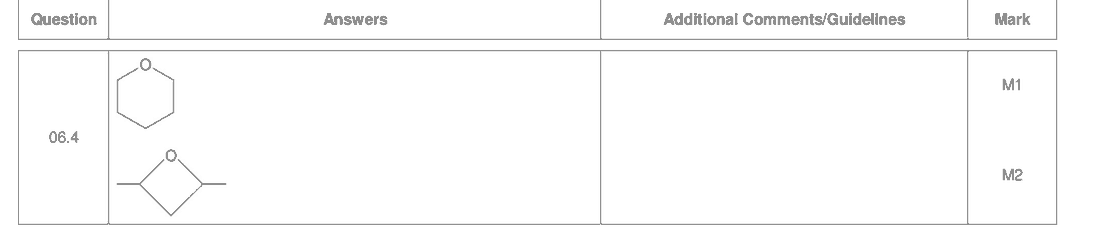
A six-membered ring with one O (tetrahydropyran, oxane) and 2,4-dimethyloxetane (four-membered ring with O, a CH3 on each carbon next to the O)
each has three carbon environments.
Skills: MS4.3 Understand the symmetry of 2D and 3D shapes
November 2021 · Paper 2 · Q07.35 marksExplanationHard
Earlier part of question 07 that this part uses
Mark scheme
Examiner's comment
Less than 20% of students scored 3 or more marks for question 07.3.
The lack of a suitable explanation for splitting patterns and chemical shifts was the most common problem.
That said, a significant number were able to score the mark for deducing the structure.
Notes from the mark scheme and report
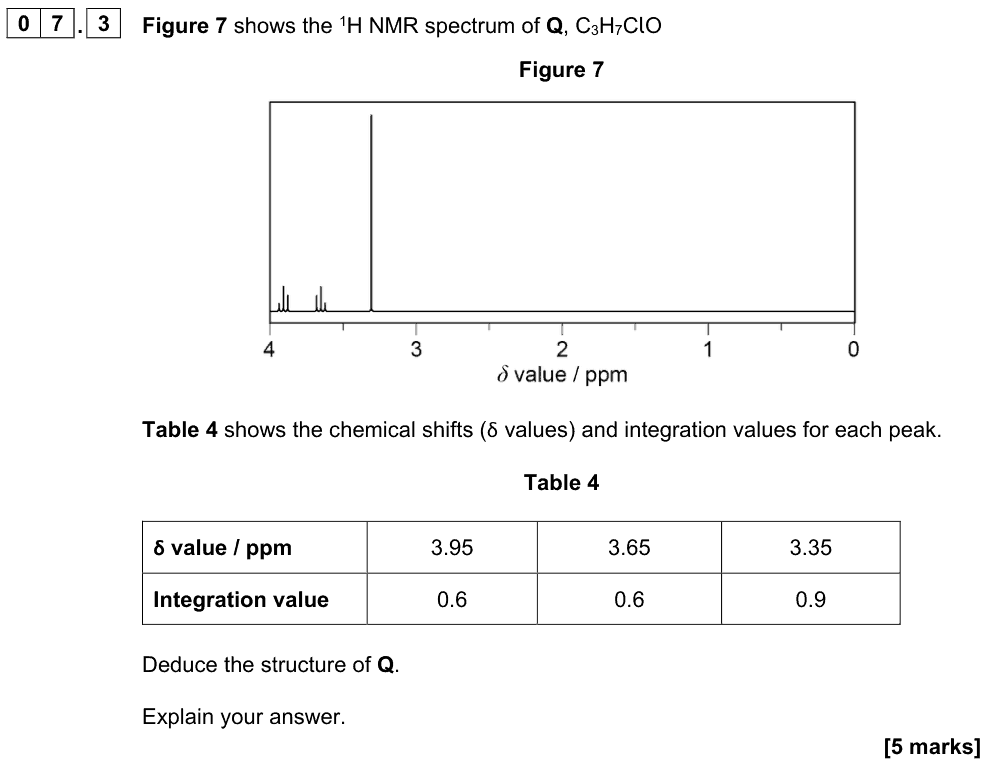
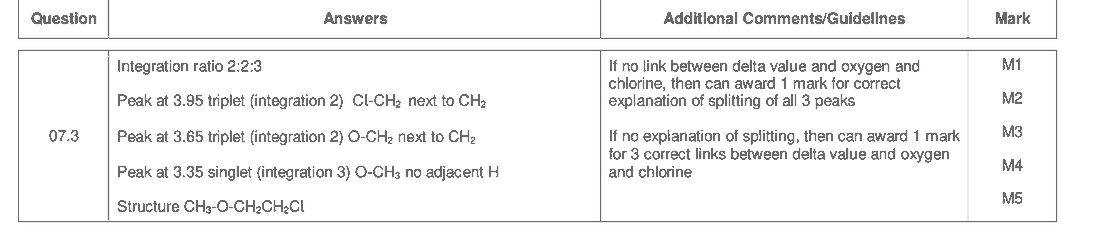
Q is CH3OCH2CH2Cl. Integration 0.6 : 0.6 : 0.9 = 2 : 2 : 3. δ 3.95, triplet, 2H: CH2 bonded to Cl, next to a CH2. δ 3.65, triplet, 2H: O–CH2 next to a CH2. δ 3.35, singlet, 3H: O–CH3 with no adjacent H (assignments as given in the mark scheme). Without shift links, max 1 for the splitting of all three peaks, and vice versa. Many gave the structure but not the explanation of splitting and shifts
Skills: MS0.2 Use ratios, fractions and percentages
November 2021 · Paper 3 · Q111 markMultiple choice
Answer
B
Mark scheme
Notes from the mark scheme and report
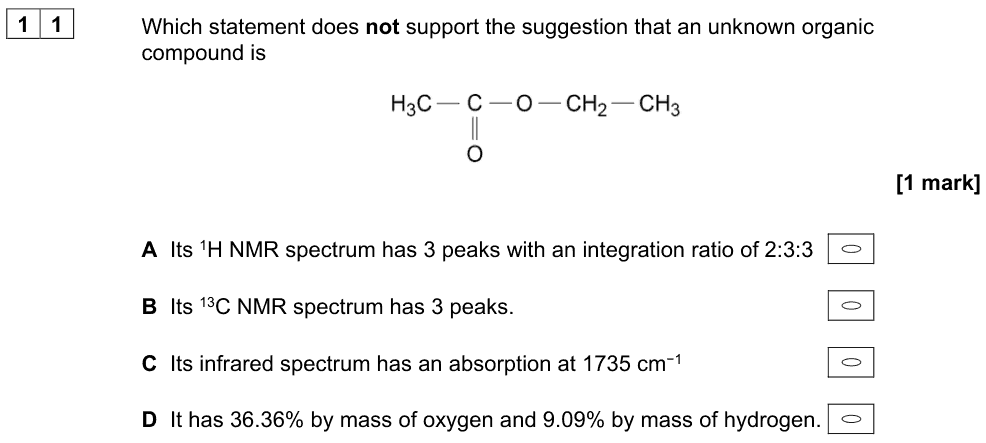
Answer: B. Ethyl ethanoate has four carbon environments, so four 13C peaks, not three
the other statements fit
November 2020 · Paper 2 · Q07.16 marks6-mark level of responseHard
Mark scheme, with the levels and indicative content
Examiner's comment
07.1 was marked with a levels of response mark scheme and required students to communicate their answers coherently with logical progression.
The role of Si(CH3)4 in NMR was quite well understood but few students knew that CDCl3 and CCl4 are used as solvents.
This lack of knowledge meant the highest level was hard to access.
Only the very best students were able to explain the link between solvent chosen and the polarity of the sample.
Around 43% of students scored at least 3 marks here but less than 10% scored 5 or 6 marks.
Notes from the mark scheme and report
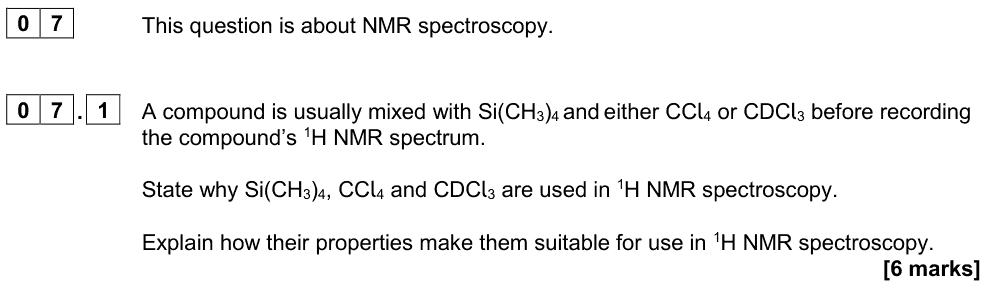
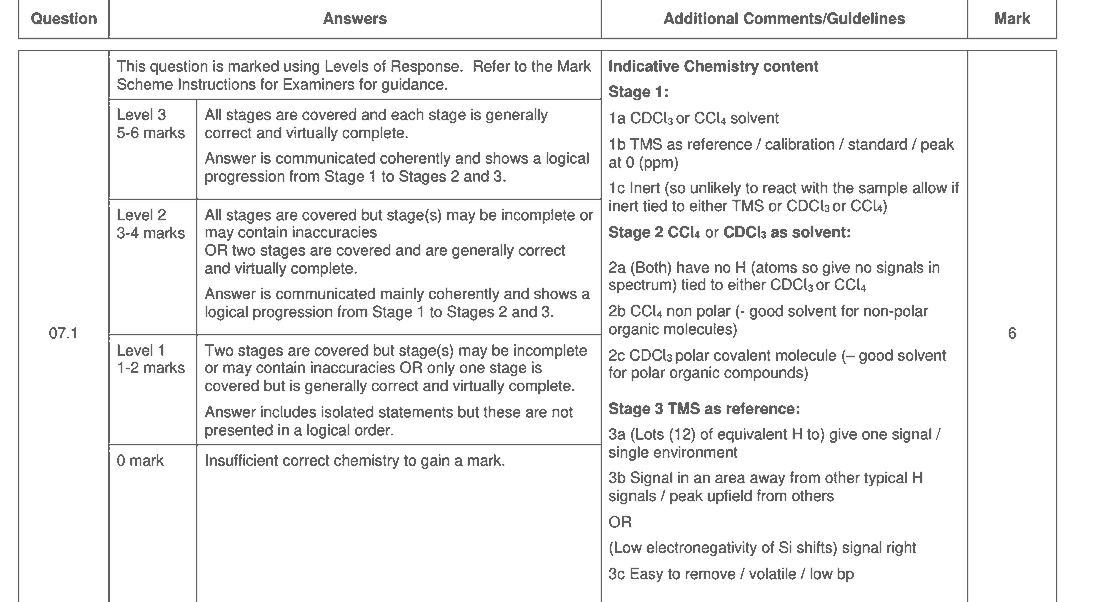
Levels of response, three stages. Uses: CCl4 or CDCl3 is the solvent
TMS, Si(CH3)4, is the reference / standard giving the peak at δ = 0
they are inert. Solvents: neither contains 1H atoms, so no signal in the spectrum
CCl4 is non-polar (good solvent for non-polar compounds)
CDCl3 is polar (good solvent for polar compounds). TMS: 12 equivalent H atoms give one strong signal
the signal is well away from (upfield of) other proton signals because Si has low electronegativity
volatile / low boiling point so easily removed. Few knew that CCl4 and CDCl3 are solvents. About 43% scored at least 3
November 2020 · Paper 2 · Q07.23 marksShort answer
Earlier part of question 07 that this part uses
Mark scheme
Examiner's comment
Students were good at identifying at least some of the splitting patterns required in 07.2, but 07.3 proved very challenging.
Notes from the mark scheme and report
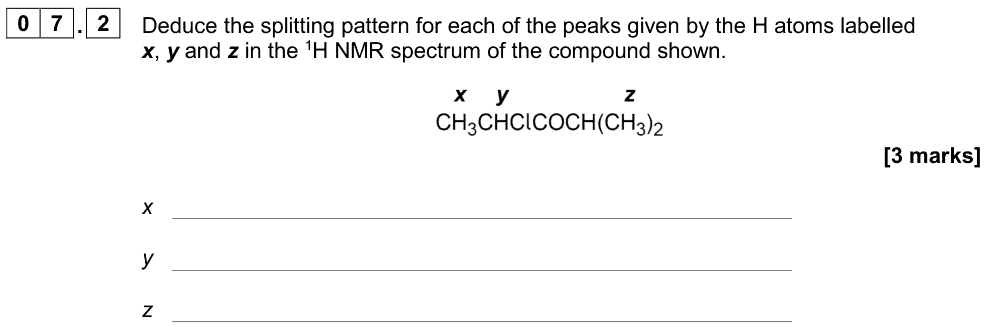
x: doublet
y: quartet
z: doublet (n + 1 rule: x has one H on the adjacent carbon, y has three, z has one)
November 2020 · Paper 2 · Q07.31 markShort answer
Earlier part of question 07 that this part uses
Mark scheme
Examiner's comment
Students were good at identifying at least some of the splitting patterns required in 07.2, but 07.3 proved very challenging.
Notes from the mark scheme and report
The H labelled y is on a carbon that is bonded to Cl and is also next to C=O, so it does not match a single entry in Table B. The report calls this the hardest question on the paper
November 2020 · Paper 2 · Q07.42 marksDiagram or structure
Earlier part of question 07 that this part uses
Mark scheme
Examiner's comment
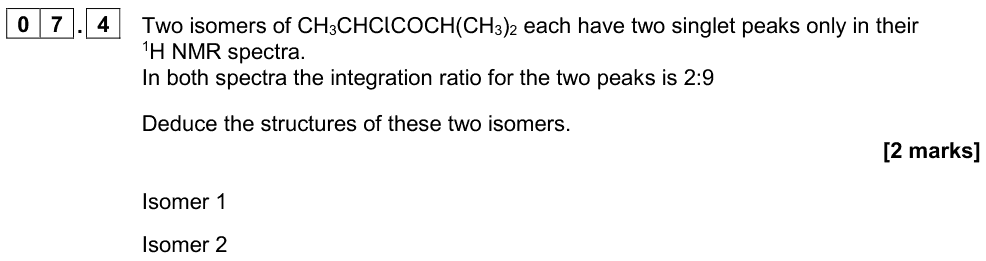
07.4 required students to deduce structures for isomers based on the number of singlet peaks and integration ratios in the 1H NMR spectra, but responses often failed to fit with these requirements.
Notes from the mark scheme and report
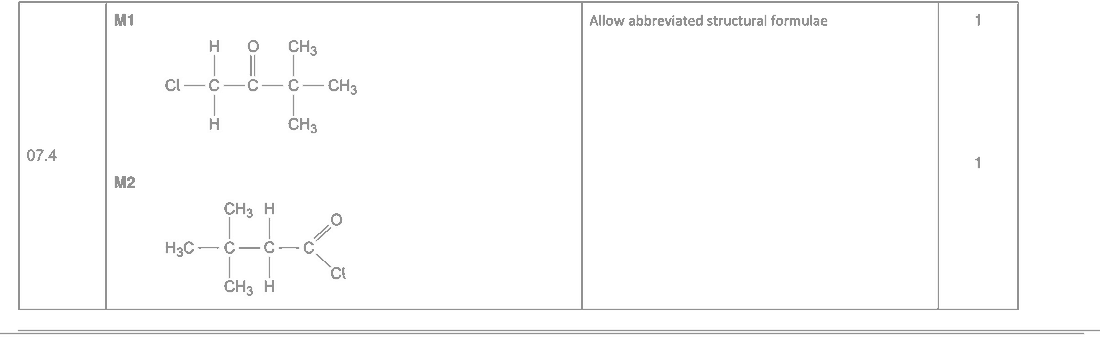
ClCH2COC(CH3)3 and (CH3)3CCH2COCl: each has a CH2 singlet (2H) and a C(CH3)3 singlet (9H). Abbreviated structural formulae allowed. Answers often did not fit both the singlets and the 2:9 ratio
Skills: MS4.3 Understand the symmetry of 2D and 3D shapes
November 2020 · Paper 2 · Q08.41 markShort answer
Earlier parts of question 08 that this part uses
Mark scheme
Examiner's comment
08.3 was well answered but 08.4 was only scored by around 40% of students.
Notes from the mark scheme and report
Answer: 4 (two equivalent CH2, two equivalent end COOH, the central C–OH and the central COOH). Around 40% correct
Skills: MS4.3 Understand the symmetry of 2D and 3D shapes
June 2019 · Paper 2 · Q06.22 marksDiagram or structure
Earlier part of question 06 that this part uses
Mark scheme
Examiner's comment
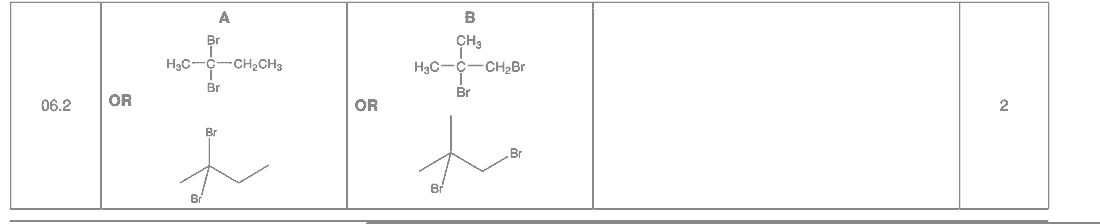
06.2 Structure A was found easier to deduce than the branched structure B and only the more able students gained both marks.
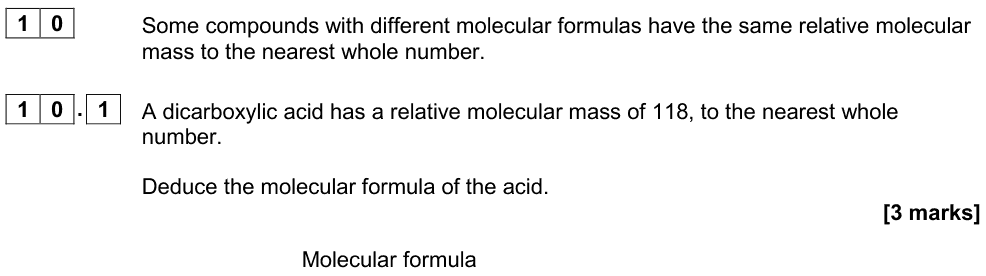
Notes from the mark scheme and report
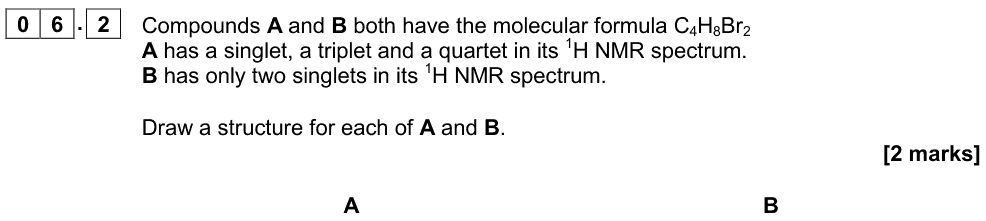
A is CH3CBr2CH2CH3 (2,2-dibromobutane: CH3 singlet, CH2 quartet, CH3 triplet). B is (CH3)2CBrCH2Br (1,2-dibromo-2-methylpropane: two singlets). A was found easier than the branched B
June 2019 · Paper 2 · Q06.32 marksDiagram or structure
Earlier part of question 06 that this part uses
Mark scheme
Examiner's comment
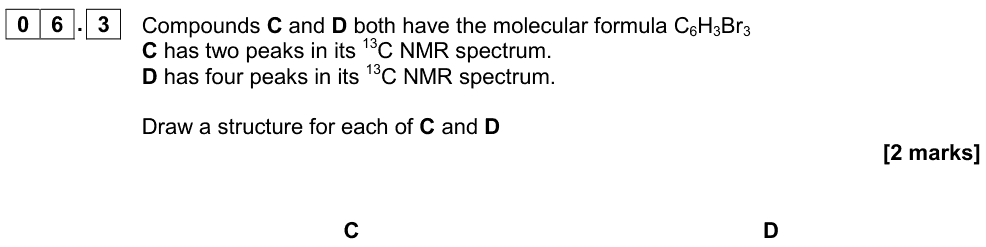
06.3 Similarly, this part was answered well by only the most able students. Many did not realise that C and D were aromatic compounds.
Notes from the mark scheme and report
C is 1,3,5-tribromobenzene (two carbon environments). D is 1,2,3-tribromobenzene (four carbon environments). Kekulé structures allowed
the aromatic ring must be shown. Many did not realise the compounds were aromatic.
Skills: MS4.3 Understand the symmetry of 2D and 3D shapes
June 2019 · Paper 2 · Q07.26 marks6-mark level of response
Earlier part of question 07 that this part uses
Mark scheme, with the levels and indicative content
Examiner's comment
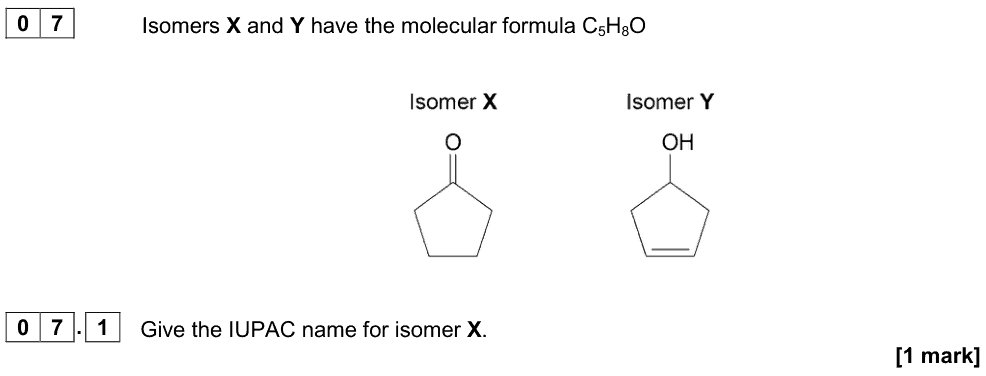
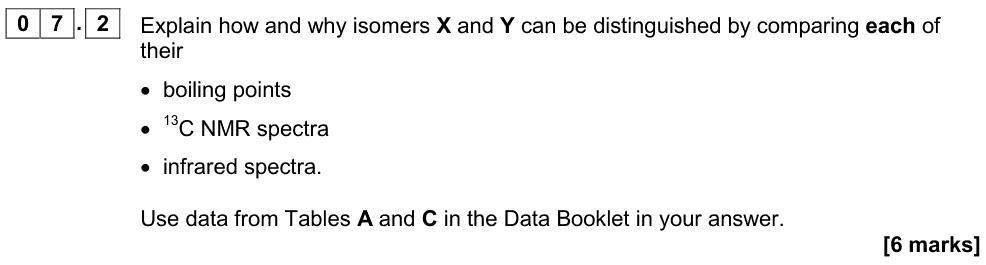
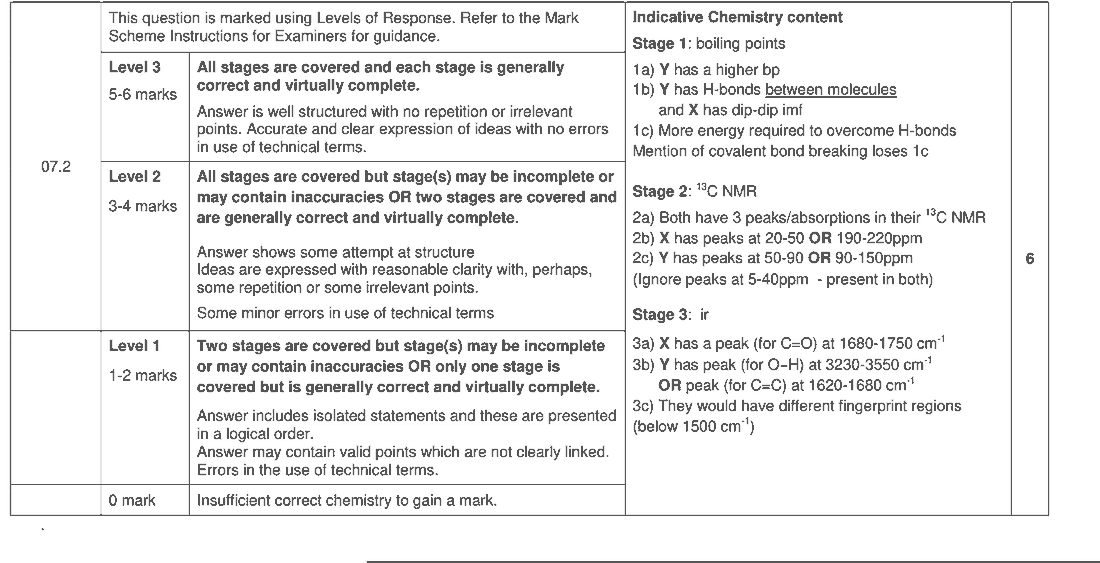
07.2 Overall, this question was well answered and approximately two-thirds of the students gained four or more marks. Some students stumbled in their explanations of the boiling point differences (Stage 1) and were therefore limited to level 2. Most students dealt with the characteristic observations from 13C NMR and IR spectroscopy (Stages 2 and 3) without much difficulty. For stage 1, most students correctly stated that compound Y has the higher boiling point. Explanations with reference to hydrogen bonding and permanent dipole- dipole forces in Y and X, respectively, sometimes fell short when there was a failure to mention the intermolecular nature of these forces. Typically students recovered the potential loss of a marking point by referring to the fact that more energy is required to overcome the H-bonds. Full and unnecessary discussions on how the two types of intermolecular forces arise were common, as was the discussion of (fractional) distillation of a mixture of the two liquids. Most students were able to report on the correct ranges of chemical shifts in 13C NMR spectra for both compounds. Some effective responses recognised three peaks for each compound, with detailed and comprehensive analyses of the types of carbon involved. Communication on IR spectra was generally good, with students correctly identifying absorptions and corresponding bond types. There was some use of non-technical language such as ‘dips and troughs’ to communicate absorption or low transmittance. Reference to the unique fingerprint regions appeared in very few responses.
Notes from the mark scheme and report
Levels of response, three stages. Stage 1 boiling point: Y (the alcohol) has the higher boiling point
Y has hydrogen bonds between molecules, X only dipole–dipole forces
more energy is needed to overcome hydrogen bonds (mention of breaking covalent bonds loses this). Stage 2 13C NMR: both have three peaks
X has peaks at 20–50 ppm or 190–220 ppm (C=O)
Y has peaks at 50–90 ppm (C–O) or 90–150 ppm (C=C). Stage 3 infrared: X has C=O at 1680–1750 cm–1
Y has O–H at 3230–3550 cm–1 or C=C at 1620–1680 cm–1
fingerprint regions differ. About two-thirds gained four or more marks
forces not described as intermolecular and fingerprint region rarely mentioned
June 2019 · Paper 2 · Q10.31 markShort answerEasy
Earlier part of question 10 that this part uses
Mark scheme
Examiner's comment
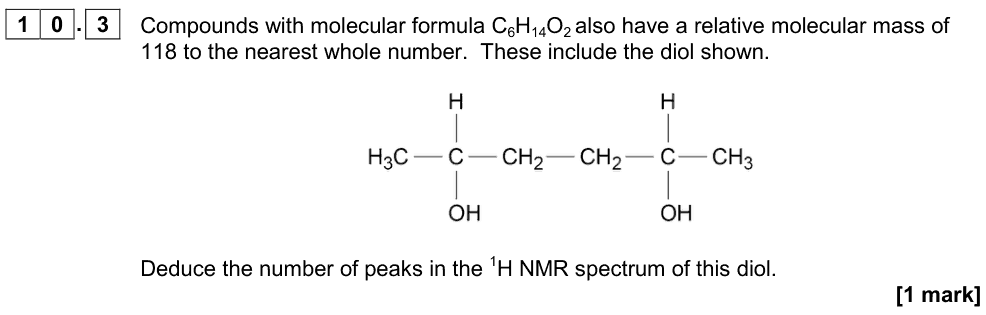
10.3 Three-quarters of students deduced the correct number of peaks in this part.
Notes from the mark scheme and report
Answer: 4. Hexane-2,5-diol is symmetrical: CH3, CH, CH2 and OH environments
Skills: MS4.3 Understand the symmetry of 2D and 3D shapes
June 2019 · Paper 2 · Q10.41 markDiagram or structureHard
Earlier part of question 10 that this part uses
Mark scheme
Examiner's comment
10.4 Only a third of the students were able to draw the correct structure for the diol.
Notes from the mark scheme and report
(CH3)2C(OH)C(OH)(CH3)2, 2,3-dimethylbutane-2,3-diol: twelve equivalent CH3 protons and two equivalent OH protons, with no H on adjacent carbons, so two singlets
June 2018 · Paper 2 · Q11.13 marksShort answer
Mark scheme
Examiner's comment
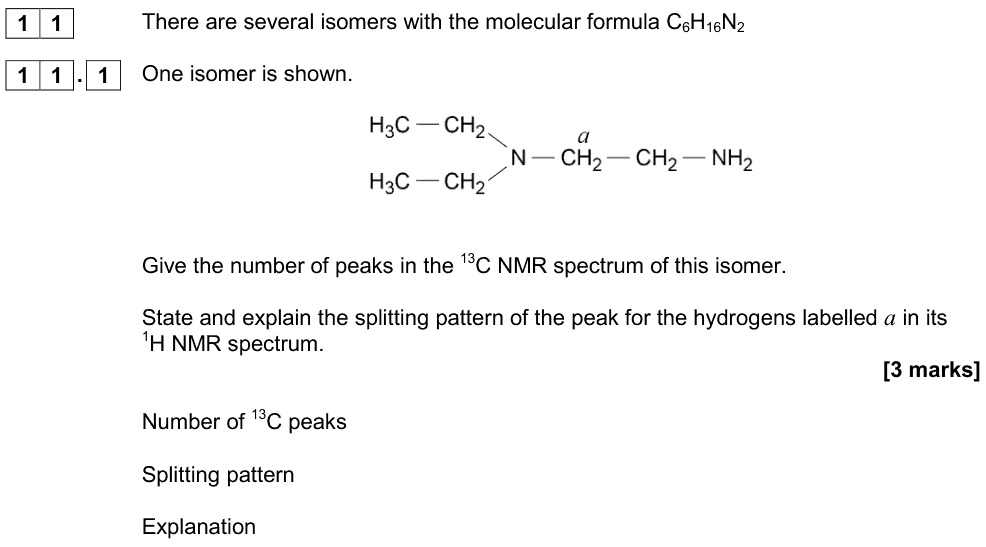
11.1 This part was answered well and over half of the students, 56.6%, gained full marks. The third ‘explanation’ mark was the one least frequently awarded. An explanation was required that referred to the number of adjacent hydrogens, not just a generic statement that the n+1 rule applies.
Notes from the mark scheme and report
4 peaks
triplet
because there are two hydrogens on the adjacent carbon. Explanation mark depends on the correct splitting
'n+1 rule' alone is not enough. 56.6% scored all 3
June 2018 · Paper 2 · Q11.31 markDiagram or structureHard
Earlier part of question 11 that this part uses
Mark scheme
Examiner's comment
11.3 Although this isomer was found to be the most difficult of the three, 32% of the students answered correctly. Others suggested cyclic structures that contained two primary amine groups and produced only two 13C NMR peaks, but sadly contained too few hydrogen atoms to be isomers of C6H16N2. As with the previous part, there were many students, 15.6%, who did not attempt to answer this question.
Notes from the mark scheme and report
H2N–C(CH3)2–C(CH3)2–NH2 (2,3-dimethylbutane-2,3-diamine). Cyclic suggestions had too few hydrogens to be isomers
Skills: MS4.3 Understand the symmetry of 2D and 3D shapes
June 2018 · Paper 2 · Q11.41 markDiagram or structure
Earlier part of question 11 that this part uses
Mark scheme
Examiner's comment
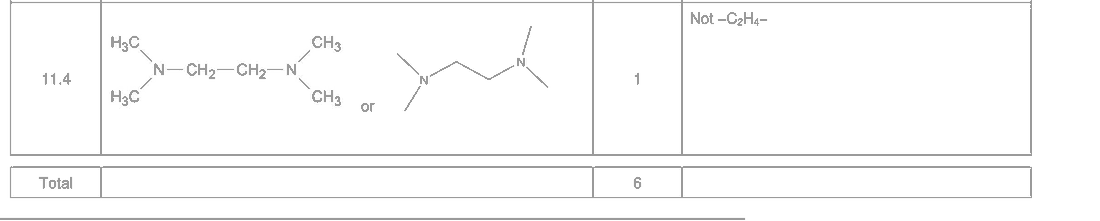
11.4 This isomer was drawn correctly by just over 40% of the students, but the question was also not attempted by 20.7%.
Notes from the mark scheme and report
(CH3)2N–CH2CH2–N(CH3)2 (not –C2H4–). Just over 40% correct
20.7% did not attempt it
Skills: MS4.3 Understand the symmetry of 2D and 3D shapes
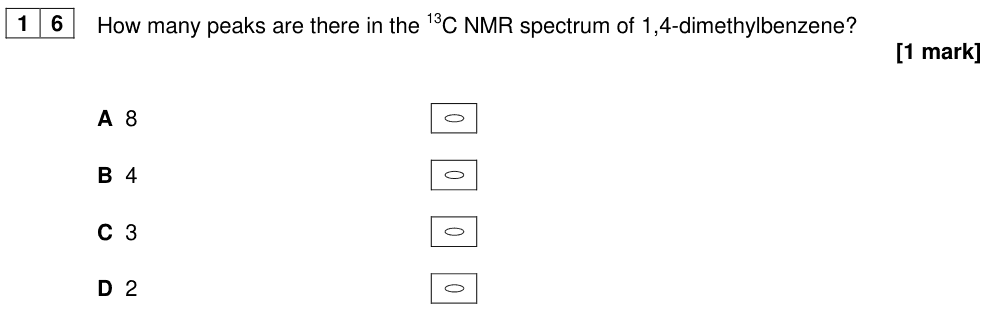
June 2018 · Paper 3 · Q161 markMultiple choice
Answer
C
Mark scheme
Notes from the mark scheme and report
Answer: C. Three environments: the two CH3 carbons, the two ring carbons that carry them, and the four equivalent ring CH carbons (2, 3, 5 and 6). Commonest wrong answer B
Skills: MS4.3 Understand the symmetry of 2D and 3D shapes
June 2017 · Paper 2 · Q10.33 marksDiagram or structure
Earlier part of question 10 that this part uses
Mark scheme
Examiner's comment
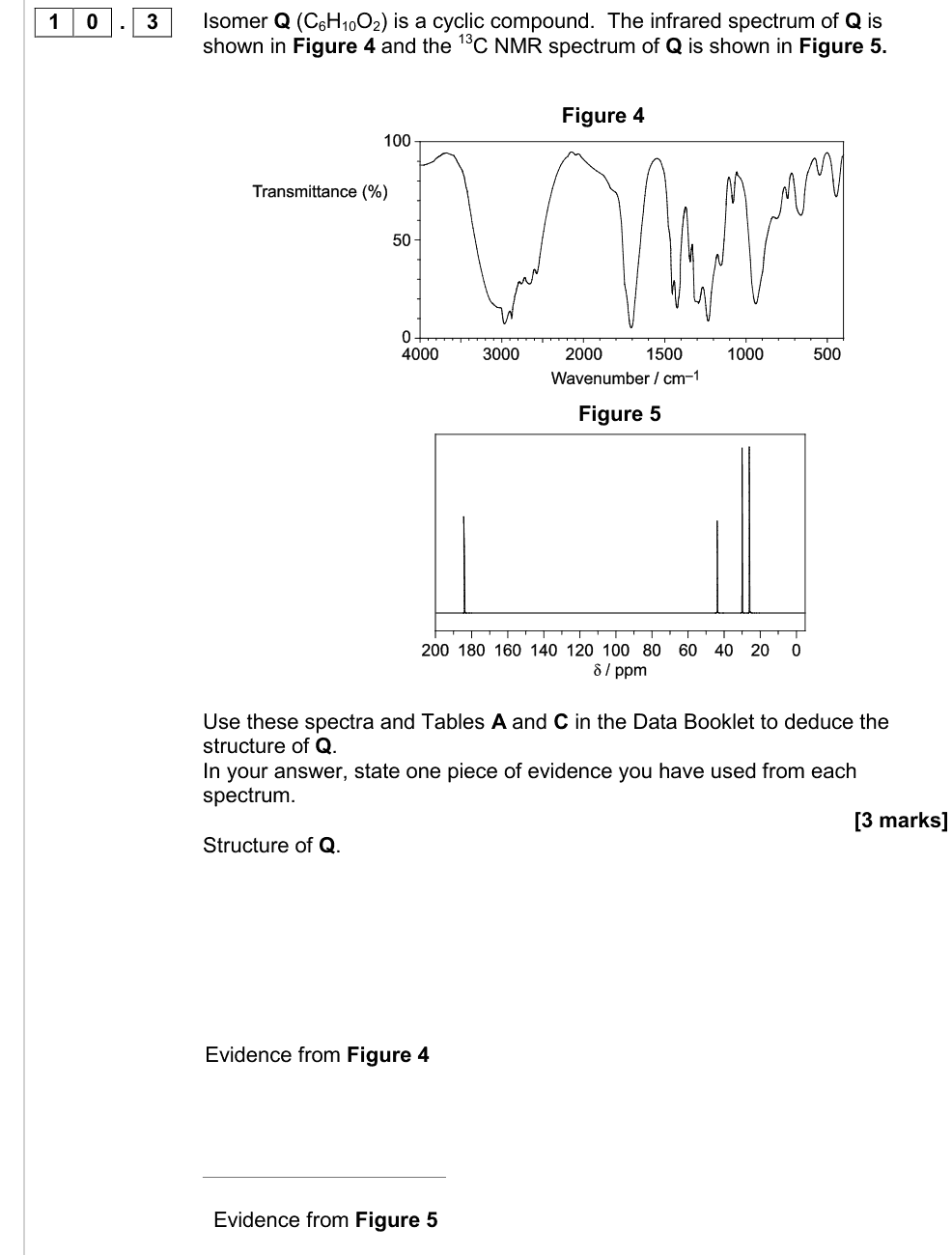
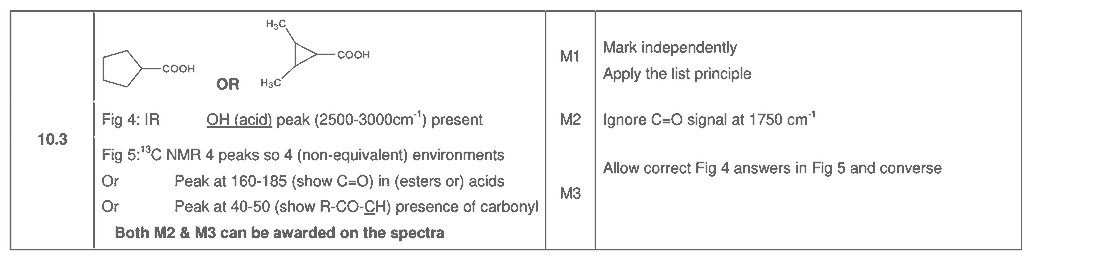
10.3 The identity of Q discriminated well. Many students were not able to relate an aspect of its structure to a peak/signal. In the evidence from Figure 4, many students failed to state that the infrared absorption between 2500 and 3000 cm-1 showed the presence of an O−H bond in an acid. In the 13C NMR evidence, many students thought that the structure was an aldehyde/ketone having been careless in reading the value of the chemical shift on the x- axis.
Notes from the mark scheme and report
Q is cyclopentanecarboxylic acid (or a dimethylcyclopropanecarboxylic acid with four carbon environments). IR: broad O–H (acid) absorption at 2500–3000 cm–1 (the C=O peak is ignored). 13C NMR: four peaks so four carbon environments, or the peak at 160–185 ppm for C=O in an acid, or the peak at 40–50 ppm for the C next to C=O. Common error: reading the shift as an aldehyde/ketone
June 2017 · Paper 2 · Q10.43 marksExplanation
Earlier part of question 10 that this part uses
Mark scheme
Examiner's comment
10.4 Few students gained full marks here. Although the number of peaks was deduced correctly, few gave a correct comparison of the spectra of R and S. The symmetry of each compound was not always noted, so the number of peaks given was double the correct value.
Notes from the mark scheme and report
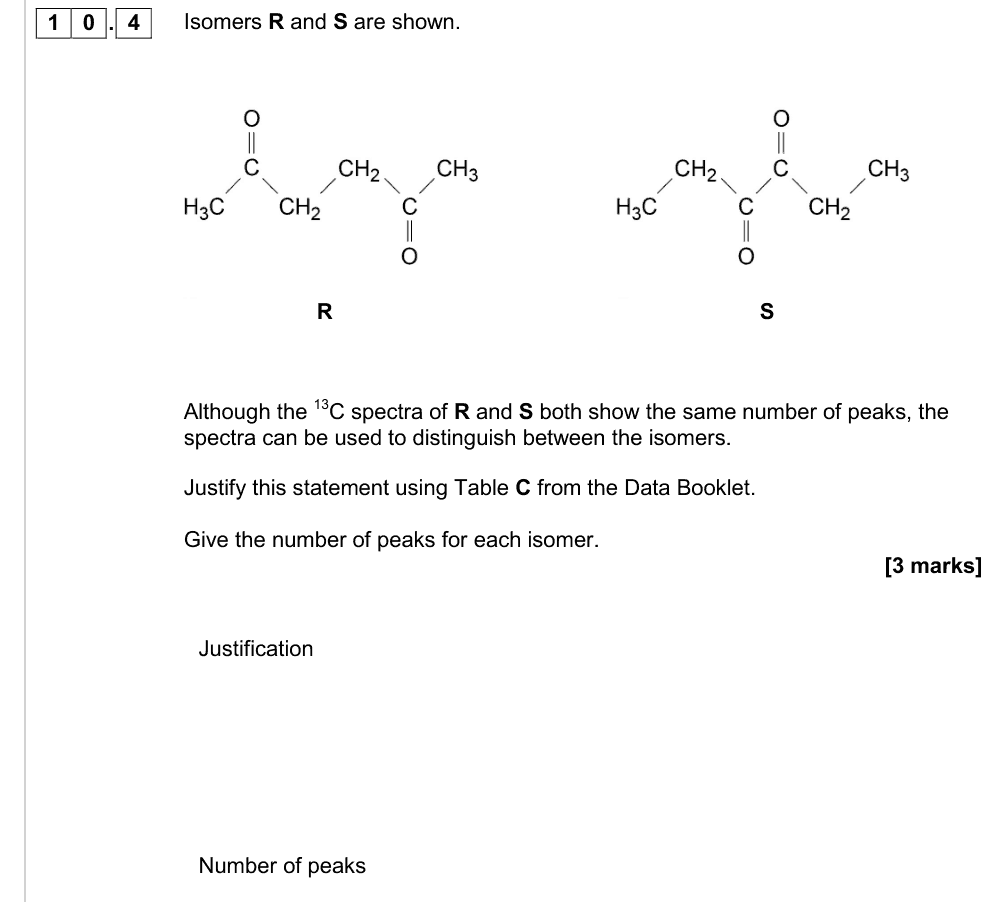
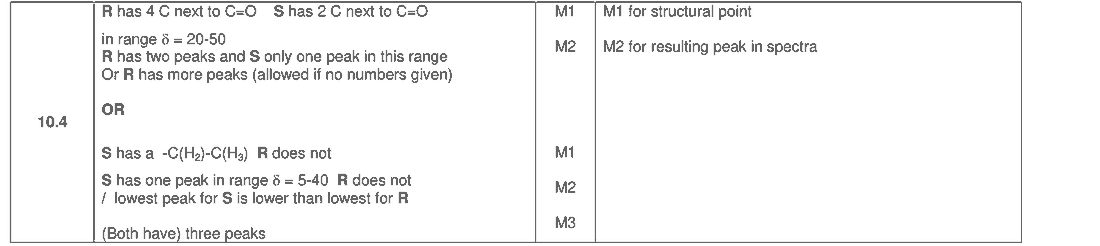
Both have three peaks. R (hexane-2,5-dione) has two different carbons next to C=O, so two peaks in the range 20–50 ppm
S (hexane-3,4-dione) has only one. Or: S has a CH3 next to a CH2 giving a peak at 5–40 ppm that R does not have. Missing the symmetry doubles the number of peaks
June 2017 · Paper 2 · Q10.53 marksExplanation
Earlier parts of question 10 that this part uses
Mark scheme
Examiner's comment
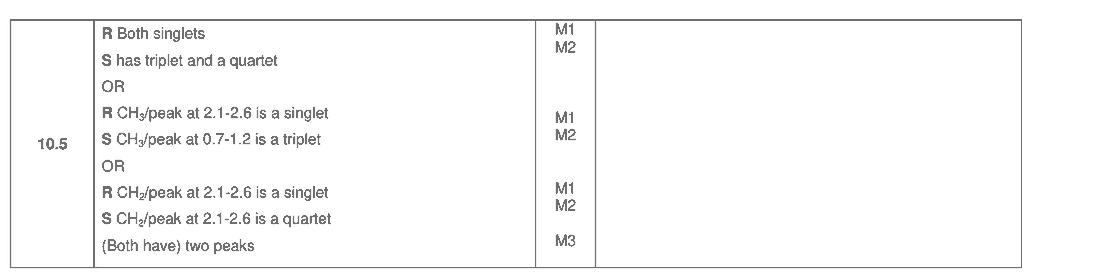
10.5 Again, the fact that the two CH2 groups were identical, and would therefore produce a singlet, was missed by most students who predicted a triplet in the spectrum of R. The triplet and quartet for S were usually predicted correctly but full marks were obtained by relatively few students. Over 5% of students made no attempt at the question.
Notes from the mark scheme and report
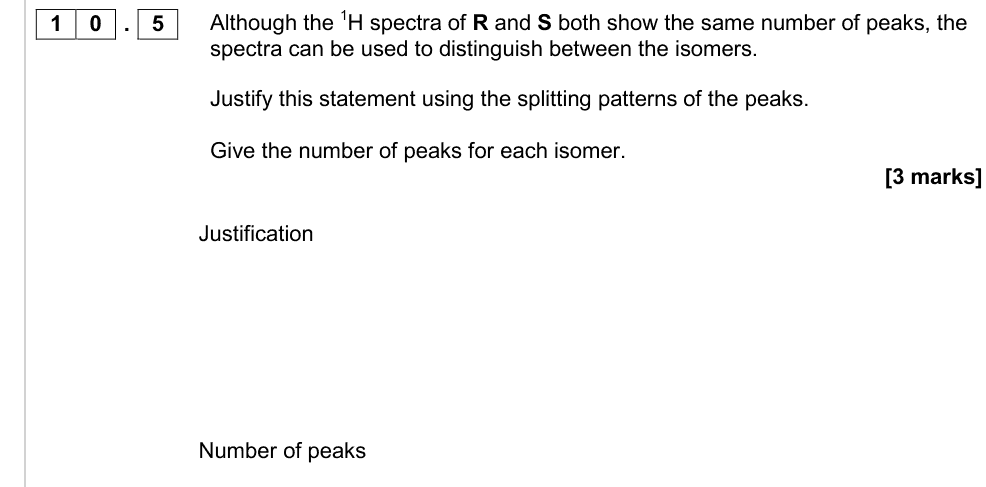
Both have two peaks. R: both peaks are singlets (the CH3 and the two equivalent CH2 groups have no hydrogens on adjacent carbons). S: a triplet (CH3) and a quartet (CH2). Most wrongly predicted a triplet for the CH2 groups in R. Structures of R and S are in 10.4
June 2017 · Paper 3 · Q291 markMultiple choice
Answer
D
Mark scheme
Notes from the mark scheme and report
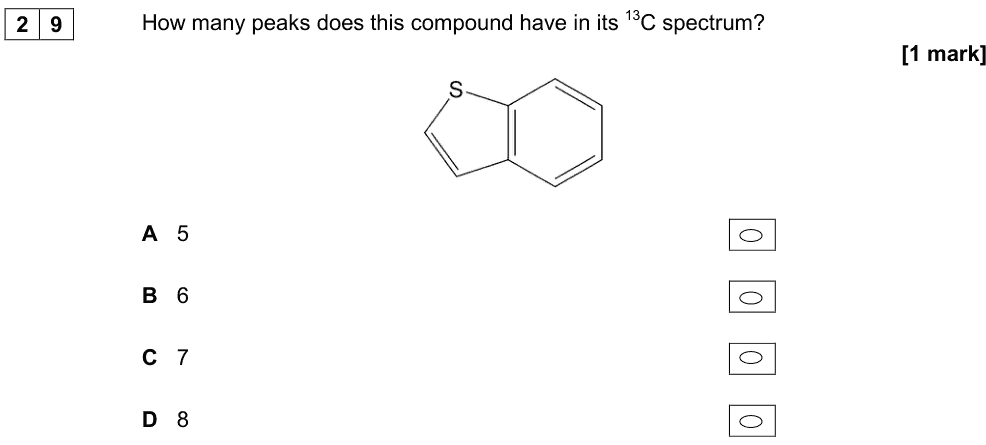
Answer: D. The molecule has no symmetry, so all eight carbon atoms are in different environments
Skills: MS4.3 Understand the symmetry of 2D and 3D shapes
Specimen · Paper 2 · Q03.21 markAO2=1Short answer
Earlier part of question 03 that this part uses
Mark scheme
Notes from the mark scheme and report
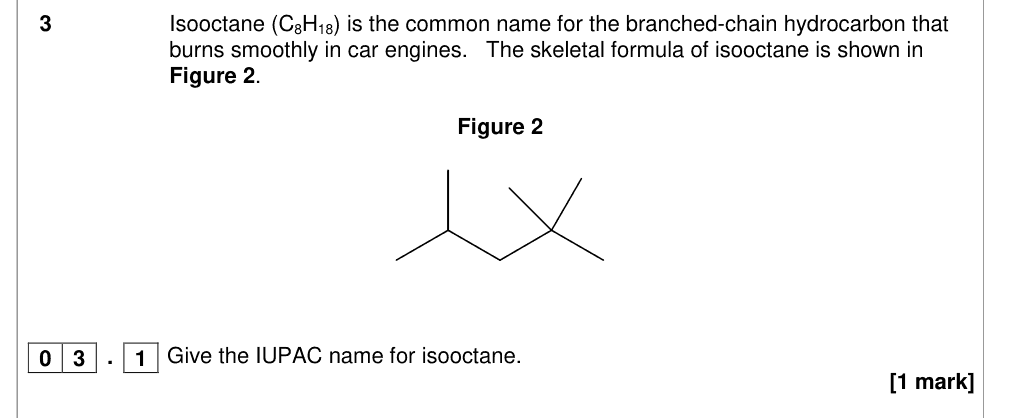
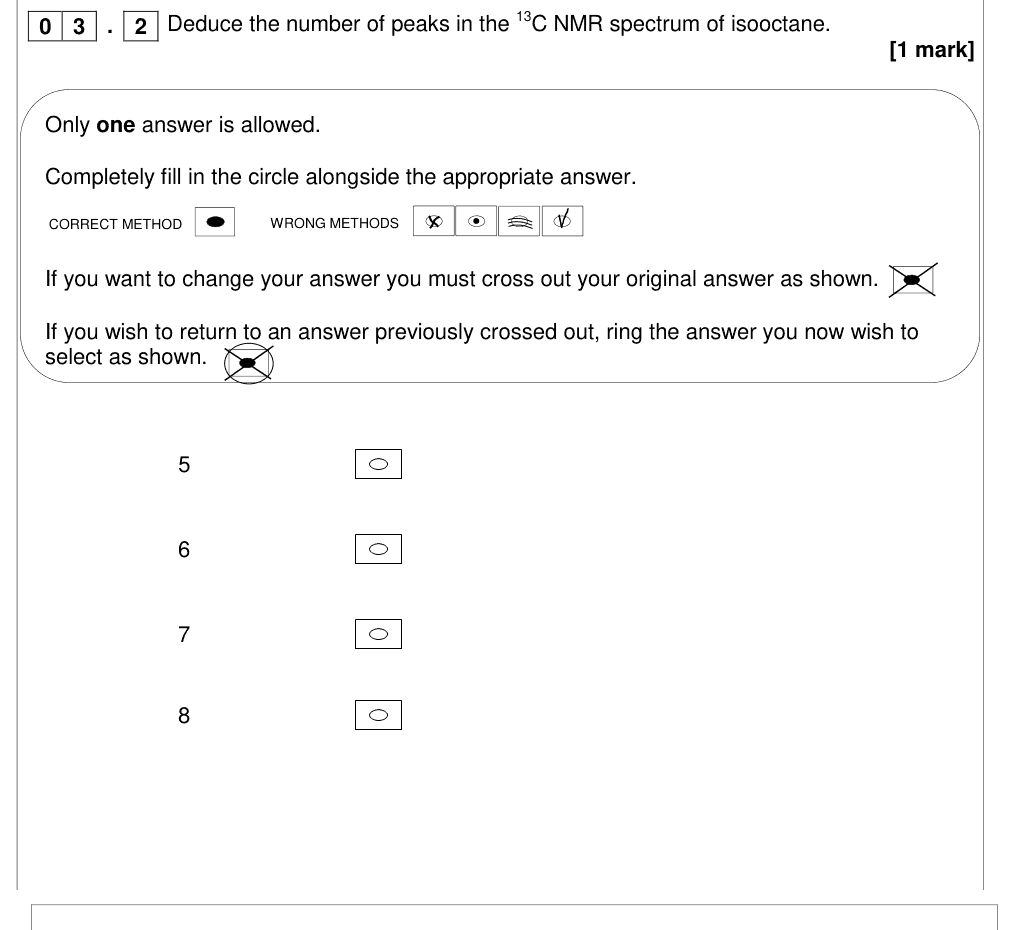
Answer: 5 (five carbon environments: the three equivalent CH3 on C2, the quaternary C, the CH2, the CH and the two equivalent CH3 on C4). Answer chosen from 5, 6, 7, 8
Specimen · Paper 2 · Q108 marksExplanation
Mark scheme
Notes from the mark scheme and report
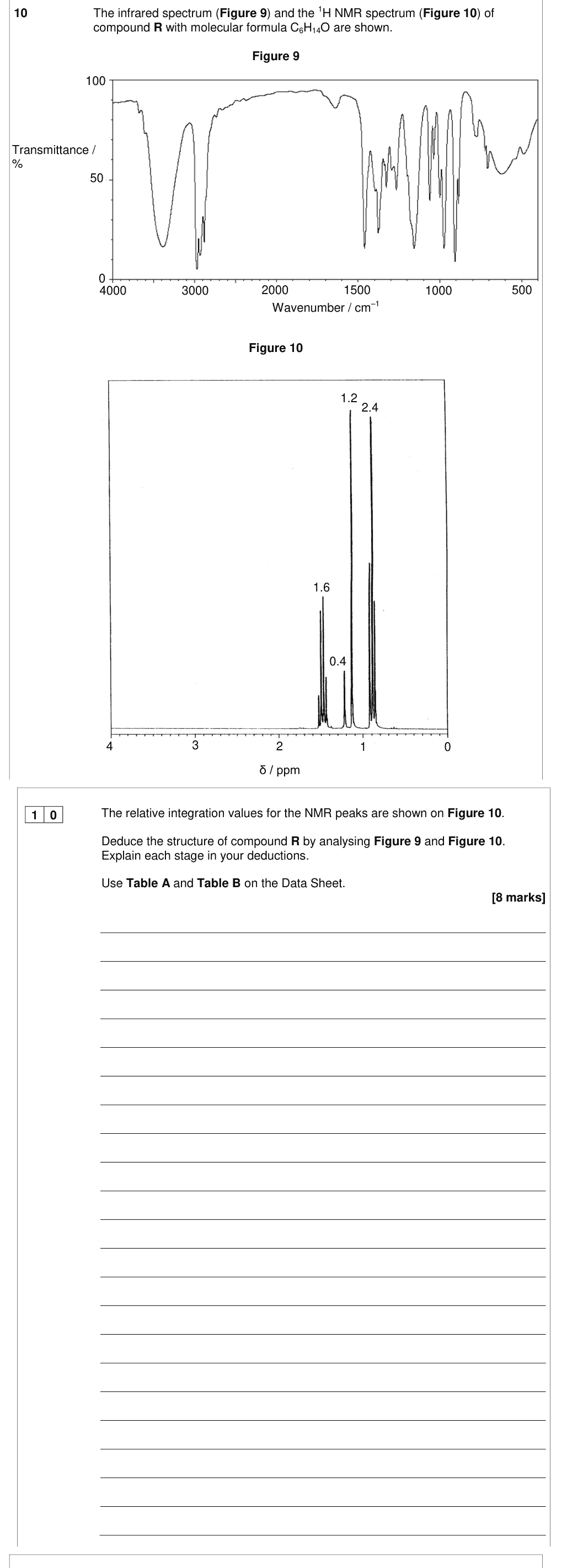
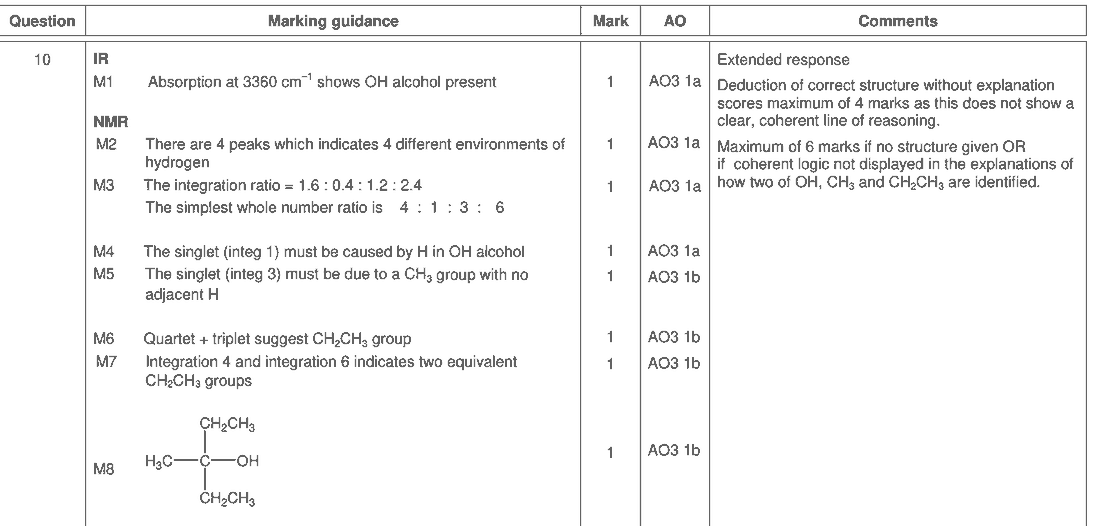
Eight marking points. IR: absorption at about 3360 cm–1 shows an alcohol O–H. NMR: four peaks = four hydrogen environments
integration 1.6 : 0.4 : 1.2 : 2.4 = 4 : 1 : 3 : 6
singlet (1H) is the OH
singlet (3H) is a CH3 with no adjacent H
quartet and triplet show CH2CH3
integrations 4 and 6 mean two equivalent CH2CH3 groups. Structure: CH3C(OH)(CH2CH3)2 (3-methylpentan-3-ol). Correct structure without explanation scores max 4
max 6 if no structure. (Figures 9 and 10 are not in the crop)
Specimen · Paper 3 · Q351 markAO1=1Multiple choice
Answer
C
Mark scheme
Notes from the mark scheme and report
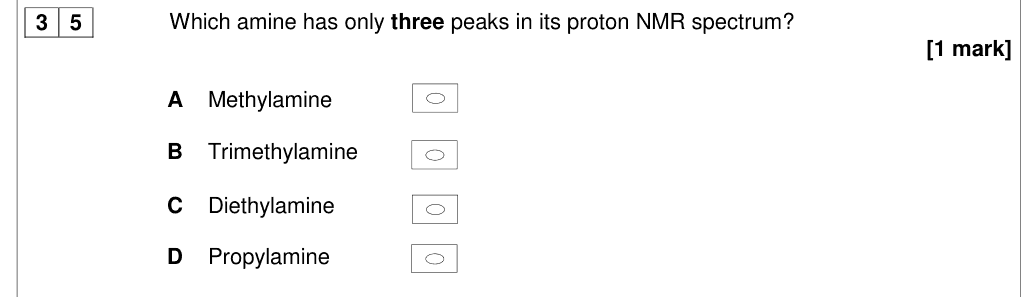
Answer: C. Diethylamine (CH3CH2)2NH has three proton environments: CH3, CH2 and NH. Methylamine has two, trimethylamine one, propylamine four
Skills: MS4.3 Understand the symmetry of 2D and 3D shapes
Work with an A-level chemistry tutor
Dropping marks on calculations, mechanisms or the required practicals? Book a trial session with a specialist A-level chemistry tutor.