Notes and key-term cards for this topic are being written by our tutors. The past-paper questions below are ready now.
Specification statements
Show the 4 statements from the specification
3.2.1.1-01 An element is classified as s, p, d or f block according to its position in the Periodic Table, which is determined by its proton number.
3.2.1.2-01 The trends in atomic radius, first ionisation energy and melting point of the elements Na–Ar
3.2.1.2-02 The reasons for these trends in terms of the structure of and bonding in the elements.
3.2.1.2-03 Students should be able to: • explain the trends in atomic radius and first ionisation energy • explain the melting point of the elements in terms of their structure and bonding.
Six-mark level of response questions on this topic
Tap a question to zoom it. Where a part needs a figure, table or structure from earlier in the question, that part folds out above it; the mark scheme and examiner's comment open underneath. Have AQA's Data Booklet (the Periodic Table and the spectroscopy tables) beside you.
June 2025 · Paper 1 · Q07.11 markAO1=1Short answer
Mark scheme
Examiner's comment
Part 1 was well answered.
Notes from the mark scheme and report
d block (not '3d')
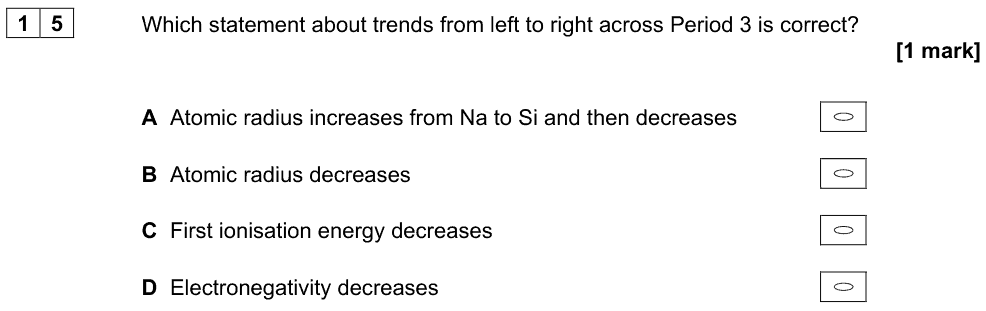
June 2025 · Paper 3 · Q151 markAO1=1Multiple choice
Answer
B
Mark scheme
Notes from the mark scheme and report
Answer: B. Nuclear charge increases with similar shielding, so atomic radius decreases across the period
first ionisation energy and electronegativity generally increase
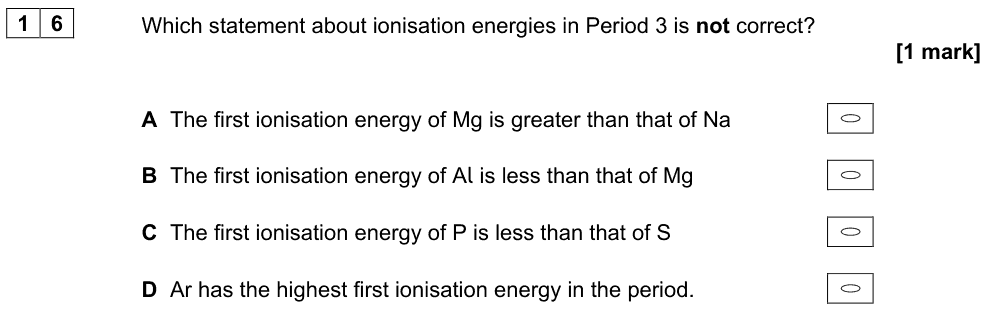
June 2025 · Paper 3 · Q161 markAO1=1Multiple choice
Answer
C
Mark scheme
Notes from the mark scheme and report
Answer: C. Phosphorus has a higher first ionisation energy than sulfur, because sulfur's paired 3p electrons repel
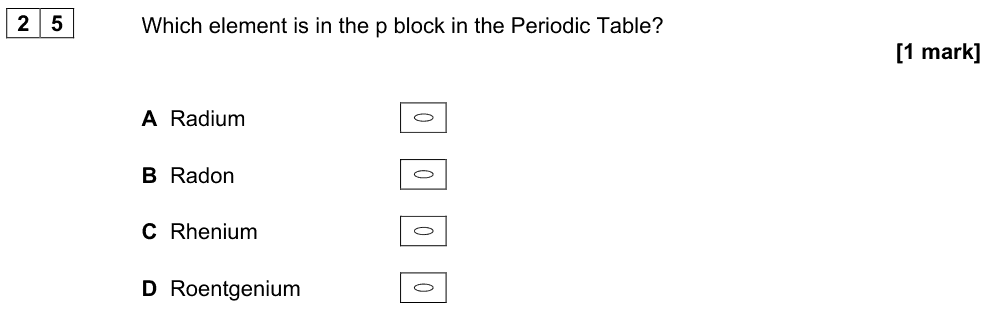
June 2025 · Paper 3 · Q251 markAO1=1Multiple choice
Answer
B
Mark scheme
Notes from the mark scheme and report
Answer: B. Radon is a Group 0 element (p block)
radium is s block and rhenium and roentgenium are d block
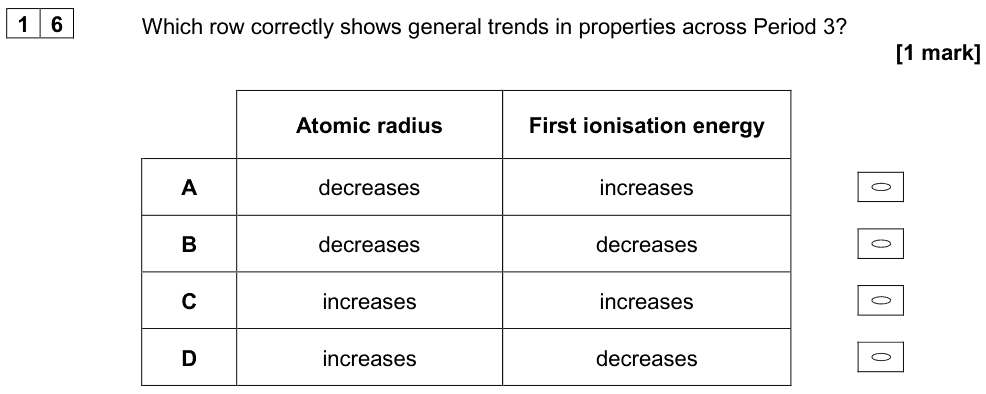
June 2024 · AS Paper 1 · Q161 markAO1=1Multiple choiceEasy
Answer
A
Mark scheme
Examiner's comment
Trend in physical properties of Period 3 elements This question was well answered with over 60% of students identifying the correct trend in atomic radius and in first ionisation energy across Period 3.
Notes from the mark scheme and report
Answer: A. Across Period 3 atomic radius decreases and first ionisation energy generally increases (greater nuclear charge, similar shielding)
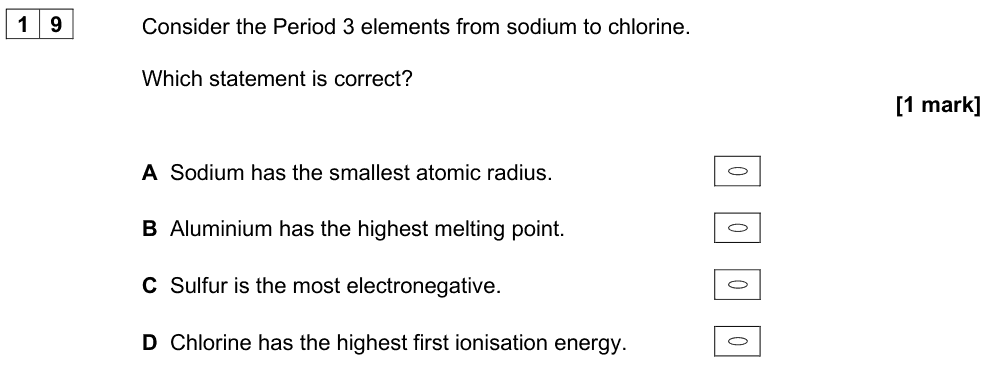
June 2024 · Paper 3 · Q191 markAO2=1Multiple choice
Answer
D
Mark scheme
Notes from the mark scheme and report
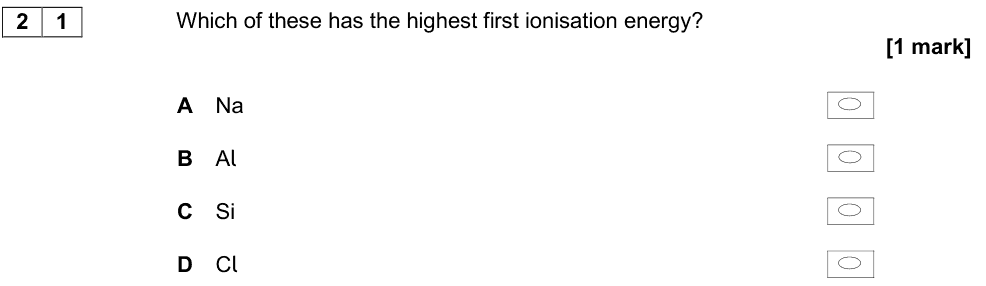
Answer: D. Of Na to Cl, chlorine has the highest nuclear charge with similar shielding, so the highest first ionisation energy
Na has the largest radius, Si the highest melting point, Cl the highest electronegativity
June 2023 · AS Paper 1 · Q01.11 markAO1=1Short answer
Mark scheme
Examiner's comment
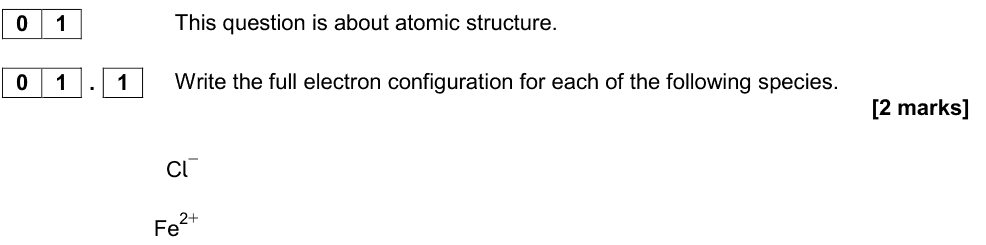
01.1 Many students were able to give the full electron configuration of the element in Period 3 with the highest first ionisation energy. However, some students provided electron configurations for Period 2 elements or for sodium/chlorine rather than for argon.
Notes from the mark scheme and report
Argon: 1s2 2s2 2p6 3s2 3p6. Common errors: configurations of Period 2 elements, or of sodium or chlorine
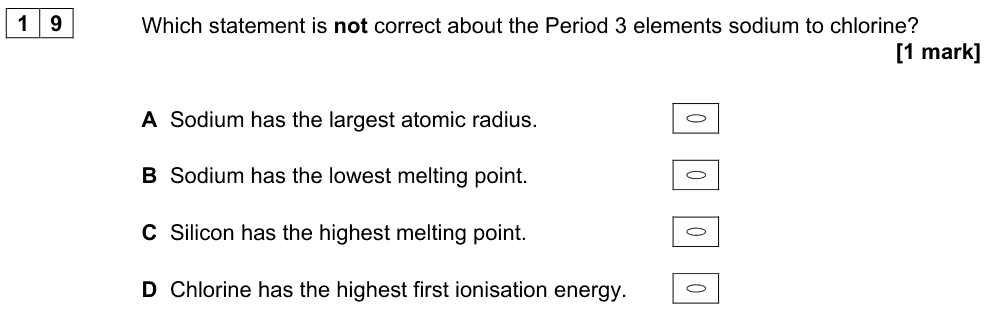
June 2023 · Paper 3 · Q191 markAO2=1Multiple choice
Answer
B
Mark scheme
Notes from the mark scheme and report
Answer: B. Sodium is a metal with a higher melting point than the simple molecular elements (P4, S8, Cl2)
chlorine has the lowest melting point of these. A, C and D are correct statements
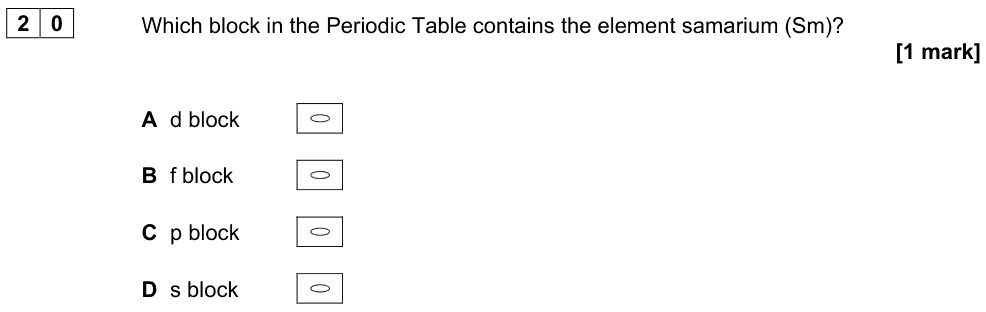
June 2022 · AS Paper 1 · Q201 markAO1=1Multiple choiceEasy
Answer
B
Mark scheme
Examiner's comment
Blocks Most students (85%) were able to identify samarium as an f block element.
Notes from the mark scheme and report
Answer: B. Samarium is a lanthanide: f block
November 2021 · Paper 1 · Q03.61 markShort answer
Earlier part of question 03 that this part uses
Mark scheme
Examiner's comment
Although many students gave the correct answer in question 03.6, chlorine and argon were common incorrect answers.
Notes from the mark scheme and report
Sodium. Common wrong answers: chlorine and argon
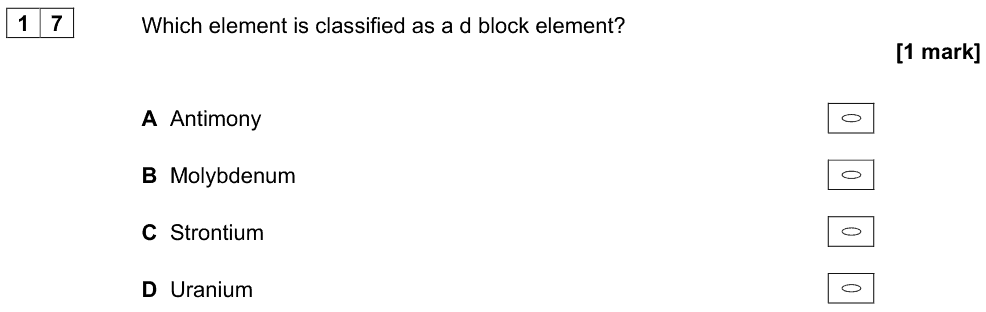
November 2021 · AS Paper 1 · Q171 markMultiple choice
Answer
B
Mark scheme
Notes from the mark scheme and report
Answer: B. Molybdenum is in the d block (Group 6 of the transition elements)
antimony is p block, strontium s block and uranium f block
November 2021 · AS Paper 1 · Q181 markMultiple choice
Answer
B
Mark scheme
Notes from the mark scheme and report
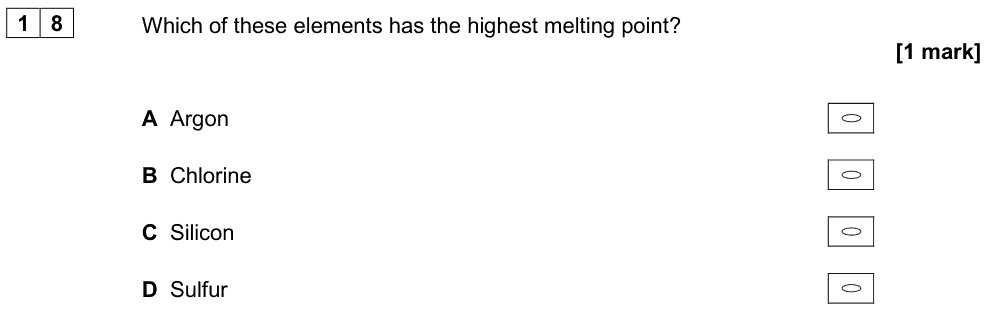
Answer: B. Silicon is macromolecular: many strong covalent bonds must be broken
November 2021 · AS Paper 1 · Q241 markMultiple choice
Answer
D
Mark scheme
Notes from the mark scheme and report
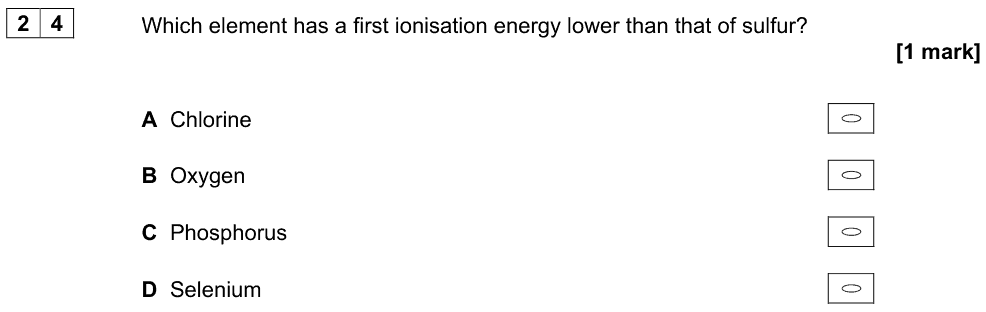
Answer: D. Selenium is below sulfur in the group: its outer electron is further from the nucleus and more shielded. Phosphorus is higher than sulfur because sulfur has a paired 3p electron
November 2020 · AS Paper 1 · Q01.13 marksExplanation
Mark scheme
Notes from the mark scheme and report
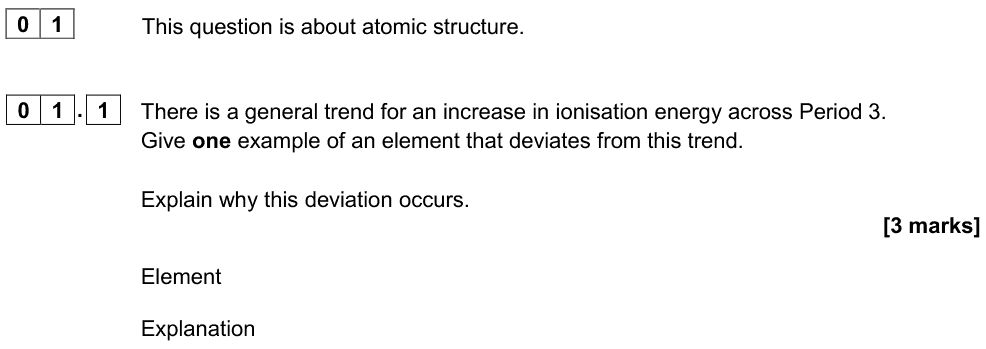
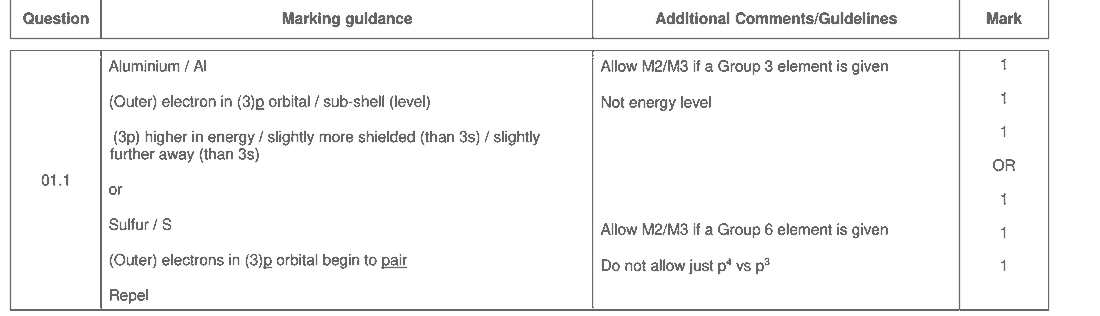
Aluminium: its outer electron is in a 3p sub-shell, which is higher in energy / slightly more shielded than 3s (in Mg). OR sulfur: outer electrons in a 3p orbital begin to pair, and the paired electrons repel. Not 'energy level' for sub-shell
'p4 versus p3' alone is not enough
November 2020 · Paper 1 · Q03.11 markDiagram or structure
Mark scheme
Examiner's comment
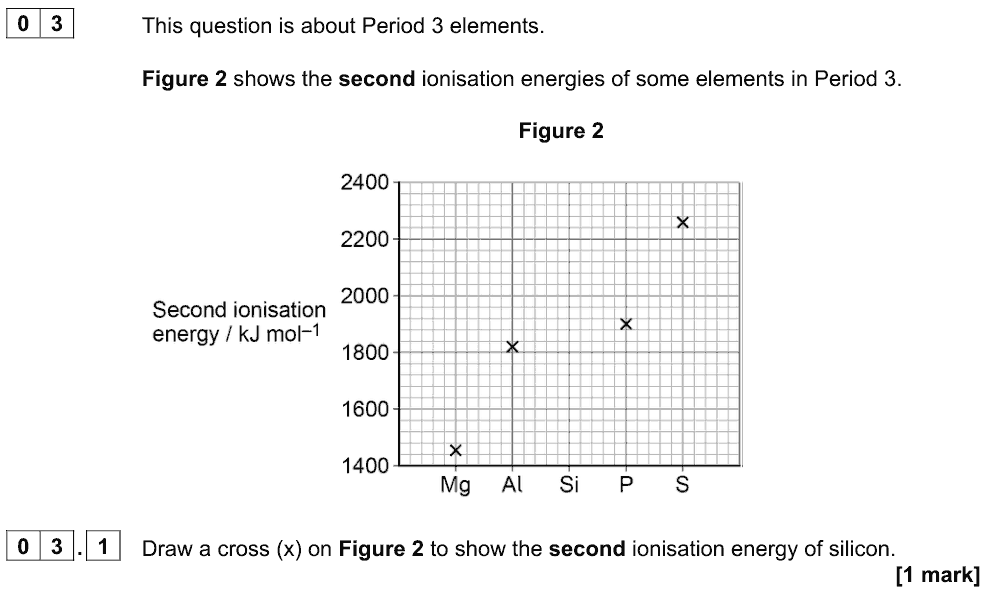
Students were about equally divided over whether the second ionisation energy would be higher or lower than that of aluminium in 03.1.
Notes from the mark scheme and report
Cross at about 1580 kJ mol–1 (anywhere between the Mg and Al values). Si+ loses a 3p electron, which is higher in energy than the 3s electron lost by Al+. Students split evenly between higher and lower than Al
Skills: MS3.1 Translate information between graphical, numerical and algebraic forms
November 2020 · Paper 1 · Q03.32 marksExplanation
Earlier part of question 03 that this part uses
Mark scheme
Examiner's comment
03.3 was generally well answered.
The increase in nuclear charge was well known but the similarity in shielding less so.
Notes from the mark scheme and report
Number of protons / nuclear charge increases
shielding is similar (electrons are added to the same shell). The shielding point was less well known
November 2020 · AS Paper 1 · Q05.12 marksExplanation
Mark scheme
Notes from the mark scheme and report
Mg2+ has a higher charge than Na+ (or is smaller / has more delocalised electrons), so there is stronger attraction between the ions and the delocalised electrons / stronger metallic bonding. Not attraction for outer electrons
November 2020 · AS Paper 1 · Q181 markMultiple choice
Answer
C
Mark scheme
Notes from the mark scheme and report
Answer: C. Silicon is macromolecular with many strong covalent bonds to break
the others are simple molecular or atomic
June 2019 · AS Paper 1 · Q01.12 marksExplanation
Mark scheme
Examiner's comment
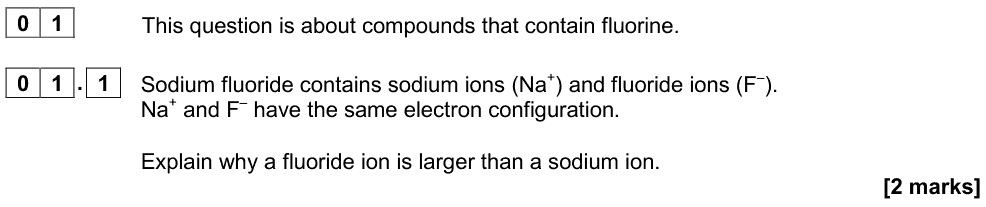
01.1 Many students understood that the key reason for the difference in size of the two isoelectronic ions was the difference in the number of protons. However, many students made reference to differences in atomic radius rather than ionic radius. Students did not always answer with an explanation of the difference in the attraction.
Notes from the mark scheme and report
The fluoride ion has (two) fewer protons / a lower nuclear charge, so there is weaker attraction between the nucleus and the (outer) electrons. Must refer to ions, not fluorine atoms
saying the ions have different numbers of electrons loses M1. Common errors: writing about atomic radius
not explaining the attraction
June 2019 · Paper 1 · Q03.11 markShort answer
Mark scheme
Examiner's comment
3.1 Very few students gave a correct explanation of periodicity; most students described a single trend across a period and a significant number described trends in groups.
Notes from the mark scheme and report
A repeating pattern (trend) of properties across each period. Describing one trend across a period, or trends down groups, does not score. Very few correct
June 2019 · Paper 1 · Q03.33 marksExplanation
Earlier part of question 03 that this part uses
Mark scheme
Examiner's comment
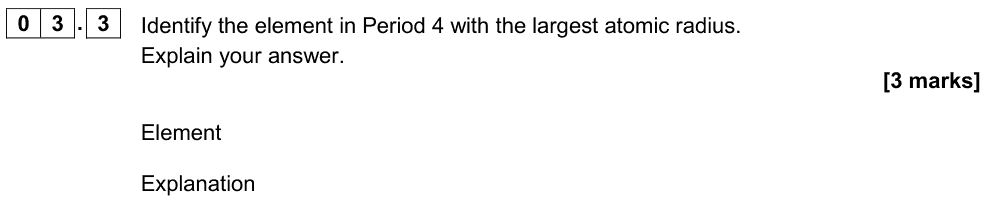
3.3 Those who gave potassium as the element here almost always stated it had the lowest number of protons, but some then failed to mention similar shielding; very few students could not identify the element.
Notes from the mark scheme and report
Potassium: it has the fewest protons (smallest nuclear charge) in the period, with similar shielding / the same number of shells as the other Period 4 elements. Na or Rb loses the first mark only
similar shielding was often omitted
June 2019 · AS Paper 1 · Q046 marks6-mark level of response
Mark scheme, with the levels and indicative content
Examiner's comment
On this question a good number of students were able to explain the trend across the period in detail, giving explanations for the general trend as well as the two deviations in the trend. However, some students confused period 2 with Period 3 and referred to elements from period 3, or to 3s/3p sub-shells in their explanations. Equally, some students only explained the general trend across the period without reference to the deviations that occur between beryllium and boron and also between nitrogen and oxygen.
Notes from the mark scheme and report
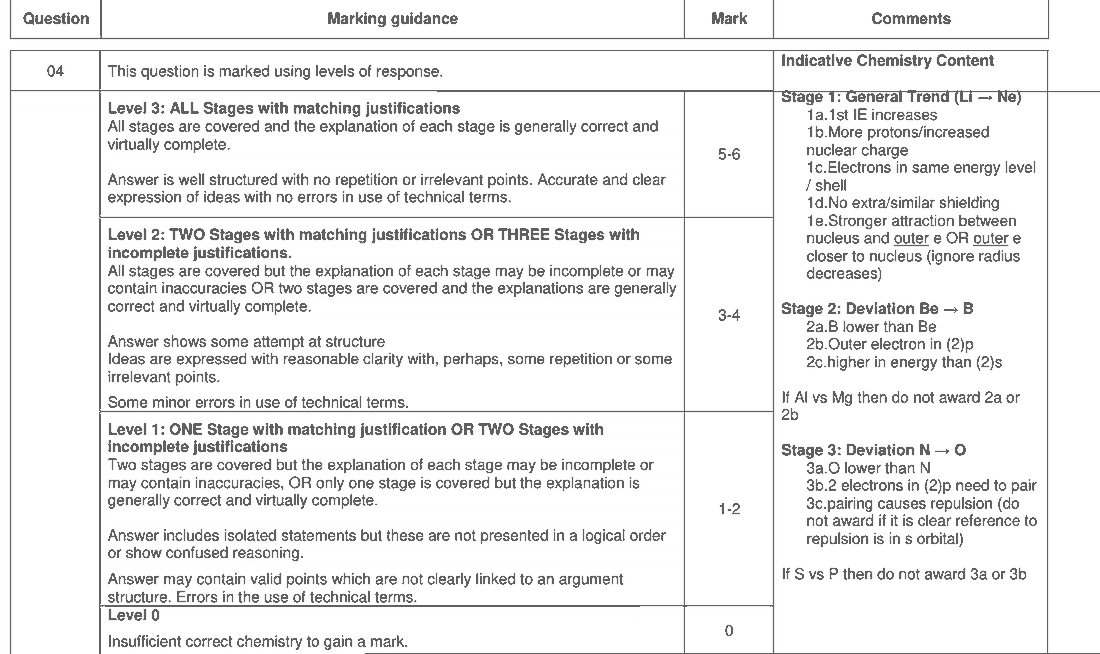
Levels of response, three stages. Stage 1 general trend: first ionisation energy increases Li to Ne
more protons / greater nuclear charge
electrons in the same shell with similar shielding
stronger attraction between nucleus and outer electron. Stage 2: B is lower than Be
its outer electron is in 2p, which is higher in energy than 2s. Stage 3: O is lower than N
two electrons are paired in a 2p orbital and the pairing causes repulsion. Errors: using Period 3 elements or 3s/3p sub-shells (Mg/Al or P/S lose the deviation marks)
giving only the general trend
June 2018 · AS Paper 1 · Q121 markMultiple choiceEasy
Answer
D
Mark scheme
Examiner's comment
Most students (77.6%) could identify the correct trend.
Notes from the mark scheme and report
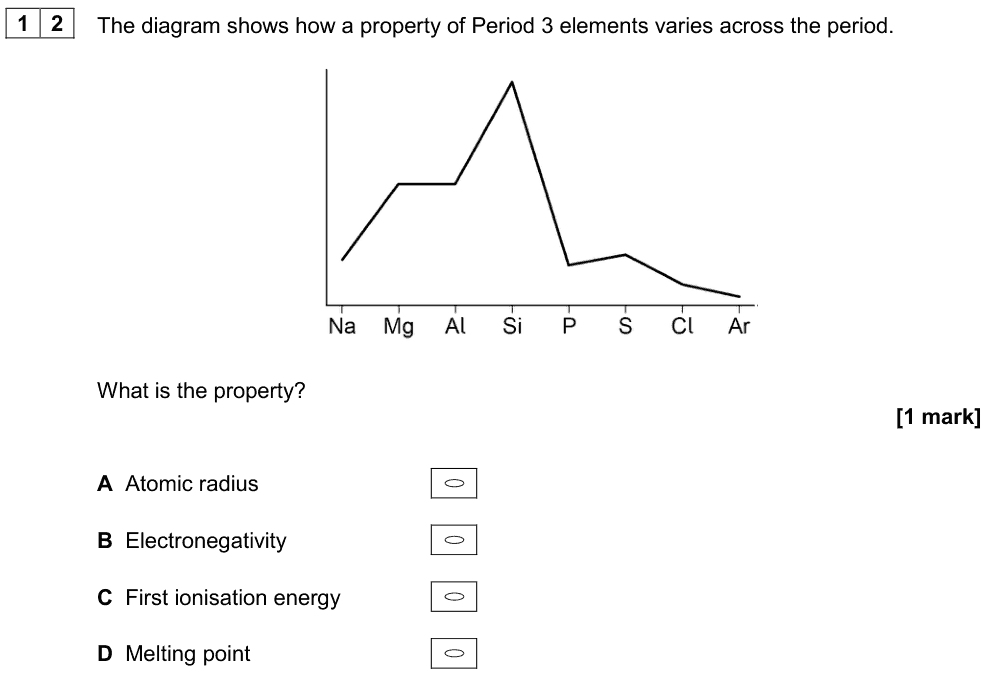
Answer: D. Melting point rises Na to Al, peaks at Si (macromolecular), then is low for P, S, Cl, Ar (simple molecular / atoms) with S8 above P4
Skills: MS3.1 Translate information between graphical, numerical and algebraic forms
June 2018 · AS Paper 1 · Q181 markMultiple choice
Answer
B
Mark scheme
Examiner's comment
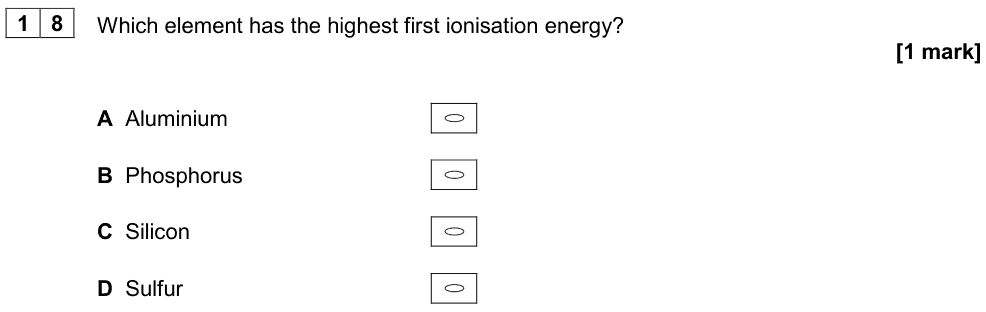
Some students (38.8%) were able to identify the element with the highest first ionisation energy, although many students thought that sulfur had the highest first ionisation energy.
Notes from the mark scheme and report
Answer: B. First ionisation energy rises Al to Si to P, then falls at S because of repulsion between the paired electrons in a 3p orbital. Common wrong answer: sulfur
June 2018 · Paper 3 · Q171 markMultiple choiceEasy
Answer
A
Mark scheme
Examiner's comment
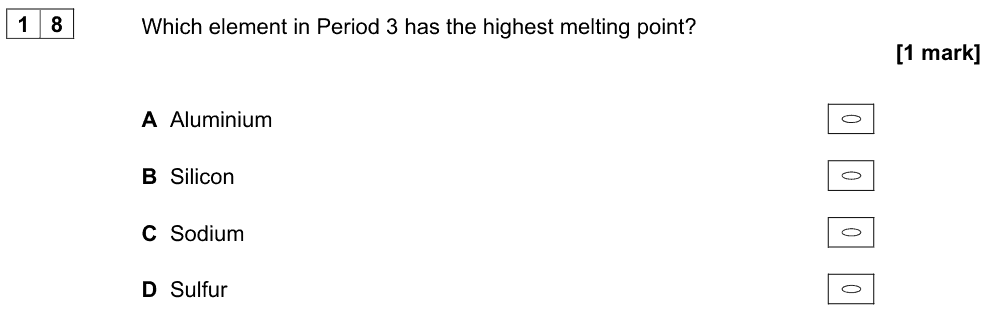
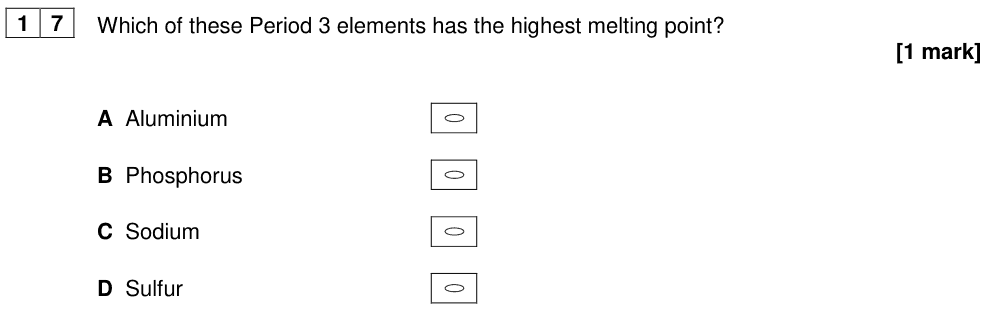
17 D (followed by B) was the commonest incorrect response. It is not clear why so many students would choose a simple molecular element in preference to a metal as having the highest melting point. 68.9% were, however, correct.
Notes from the mark scheme and report
Answer: A. Aluminium has the strongest metallic bonding (3+ ions, three delocalised electrons per atom)
sodium's is weaker and P4 and S8 are simple molecular
June 2017 · AS Paper 1 · Q01.33 marksExplanation
Earlier part of question 01 that this part uses
Mark scheme
Examiner's comment
01.3 This was a familiar question and quite well answered.
Notes from the mark scheme and report
Aluminium (Mg is CE = 0). Its outer electron is in a 3p sub-level or orbital (not just 'level' or 'shell'), which is higher in energy / further from the nucleus, so it is easier to remove. Ignore shielding
June 2017 · AS Paper 1 · Q211 markMultiple choiceEasy
Answer
D
Mark scheme
Examiner's comment
69% of students scored this mark.
Notes from the mark scheme and report
Answer: D. First ionisation energy increases across Period 3: greater nuclear charge, similar shielding
June 2017 · Paper 3 · Q061 markMultiple choice
Answer
C
Mark scheme
Notes from the mark scheme and report
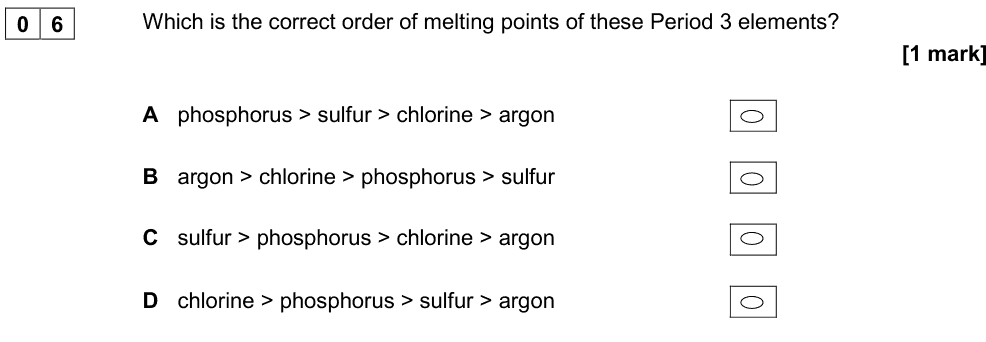
Answer: C. The molecules are S8, P4, Cl2 and Ar atoms
the more electrons, the stronger the van der Waals forces
June 2016 · AS Paper 1 · Q02.12 marksExplanation
Mark scheme
Examiner's comment
Most of this question was answered correctly but many students failed to appreciate that the ions compared in 2.1 had the same number of electrons therefore 1 mark was scored rather than 2.
Notes from the mark scheme and report
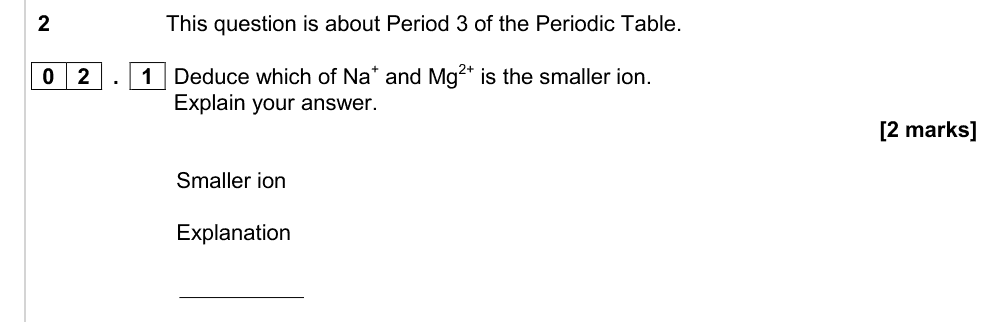
Mg2+ is smaller: it has more protons (greater nuclear charge) AND the same number of electrons / same shielding (isoelectronic). Na+ chosen scores 0. Many missed that the two ions have the same number of electrons, so scored 1
June 2016 · AS Paper 1 · Q02.34 marksExplanation
Earlier part of question 02 that this part uses
Mark scheme
Examiner's comment
It was pleasing to see over half the students scoring 3 or more marks on question 2.3
Notes from the mark scheme and report
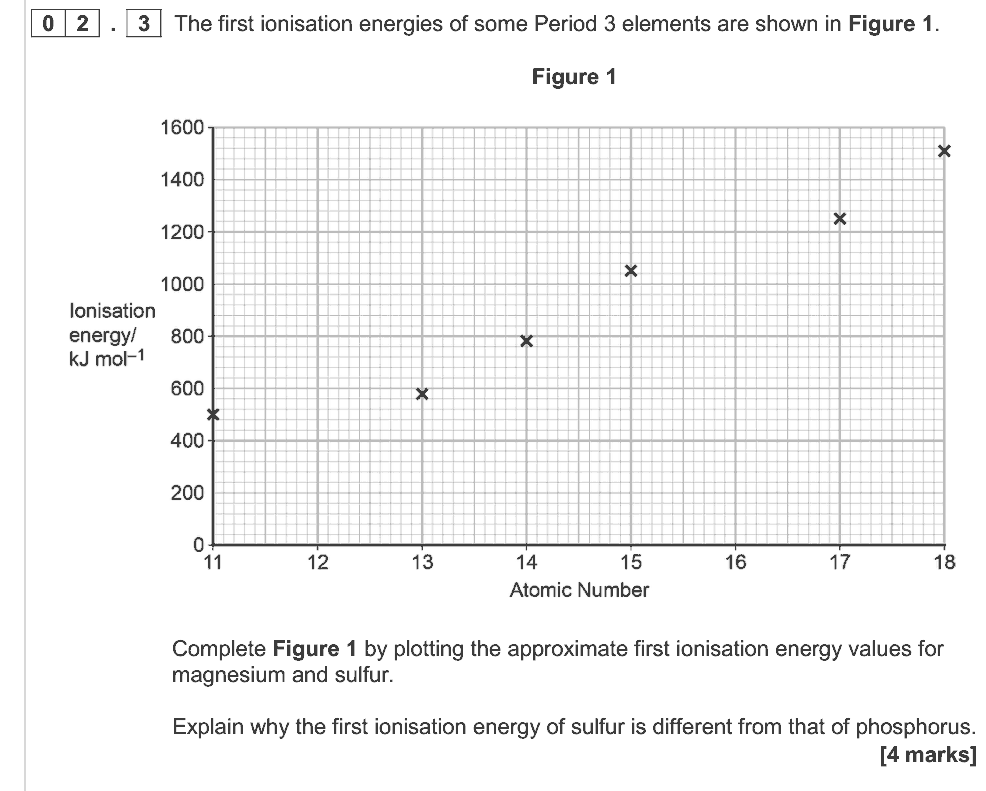
Plot Mg between 600 and 800 and S between 800 and 1040 kJ mol–1 (S must be below P). Explanation: sulfur has a pair of electrons in a 3p orbital
the paired electrons repel, so less energy is needed to remove one. If S is not plotted below P only the Mg mark is available
Skills: MS3.2 Plot two variables from experimental or other data
June 2016 · AS Paper 1 · Q101 markMultiple choice
Answer
C
Mark scheme
Examiner's comment
Questions 10-24 Multiple choice From this section of the paper items 10,11,15 and 18 were usually answered correctly. It was surprising to see that item 17 was answered poorly but it did give further evidence that redox ideas are not well understood by large numbers of students at this level. Item 20 proved difficult showing that the overall dipole possessed by a molecule clearly isn’t a well understood concept. Item 22 was also not answered correctly by most; this idea has not been tested often in the previous specification so students may not have had much prior experience of the type of question.
Notes from the mark scheme and report
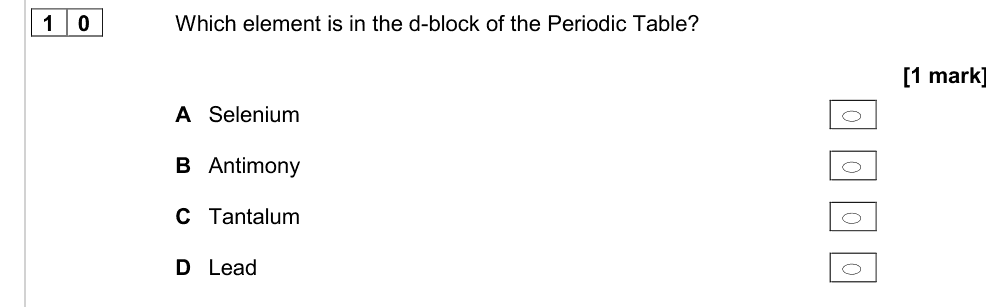
Answer: C. Tantalum is a transition (d-block) element
Se, Sb and Pb are p-block (report: report says item 10 was usually answered correctly)
Specimen · Paper 1 · Q02.12 marksExplanation
Mark scheme
Notes from the mark scheme and report
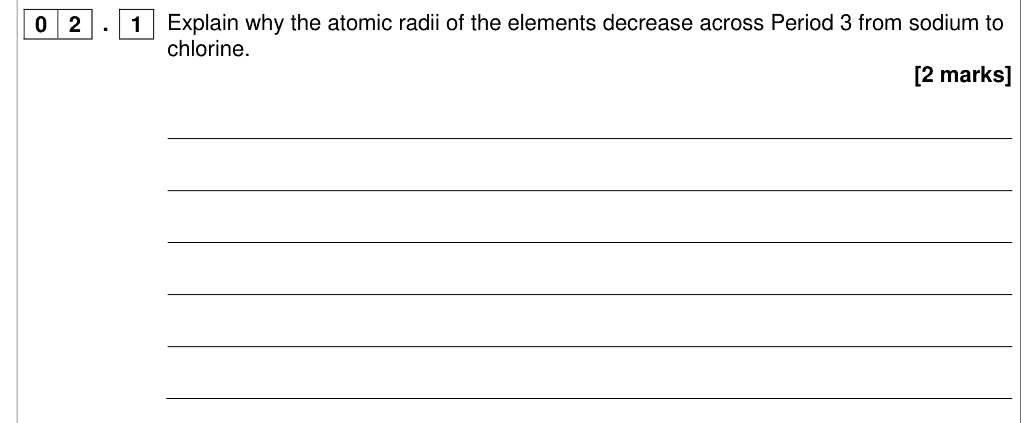
The number of protons (nuclear charge) increases across the period, so the attraction between the nucleus and the (outer) electrons increases. Second mark only if the first is correct
Specimen · Paper 1 · Q02.22 marksExplanation
Earlier part of question 02 that this part uses
Mark scheme
Notes from the mark scheme and report
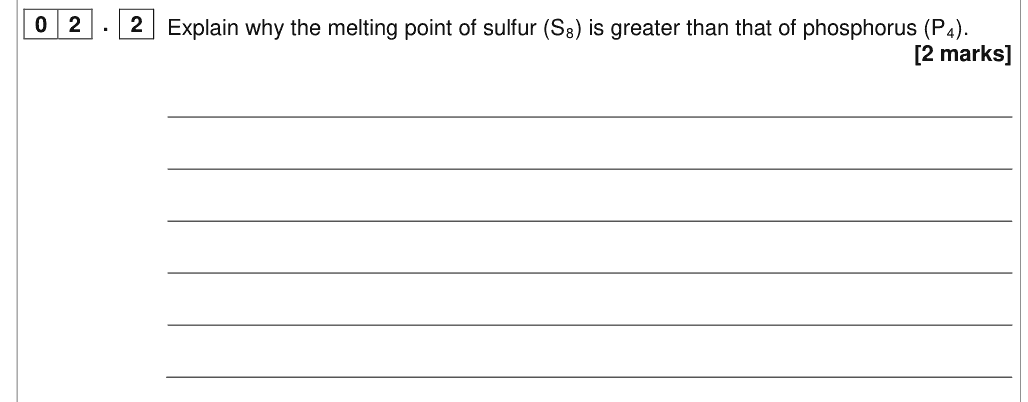
S8 molecules are bigger than P4 molecules (larger Mr / surface area), so the van der Waals forces between molecules are stronger in sulfur
Work with an A-level chemistry tutor
Dropping marks on calculations, mechanisms or the required practicals? Book a trial session with a specialist A-level chemistry tutor.