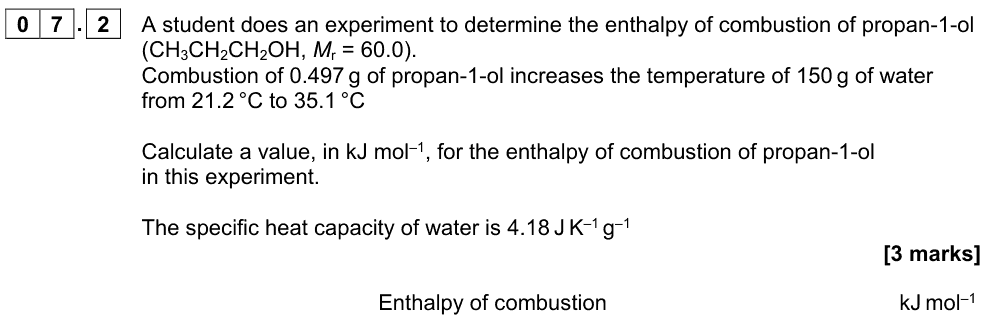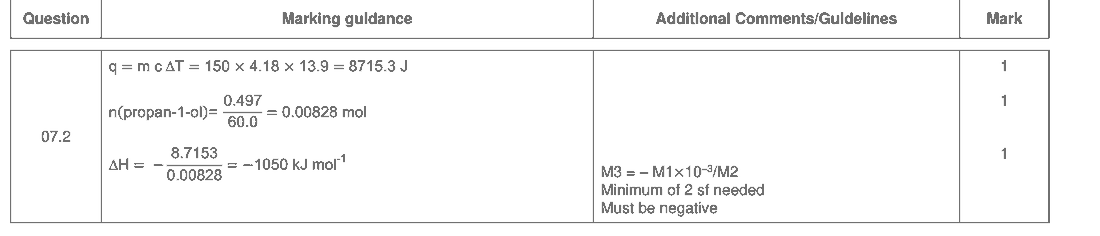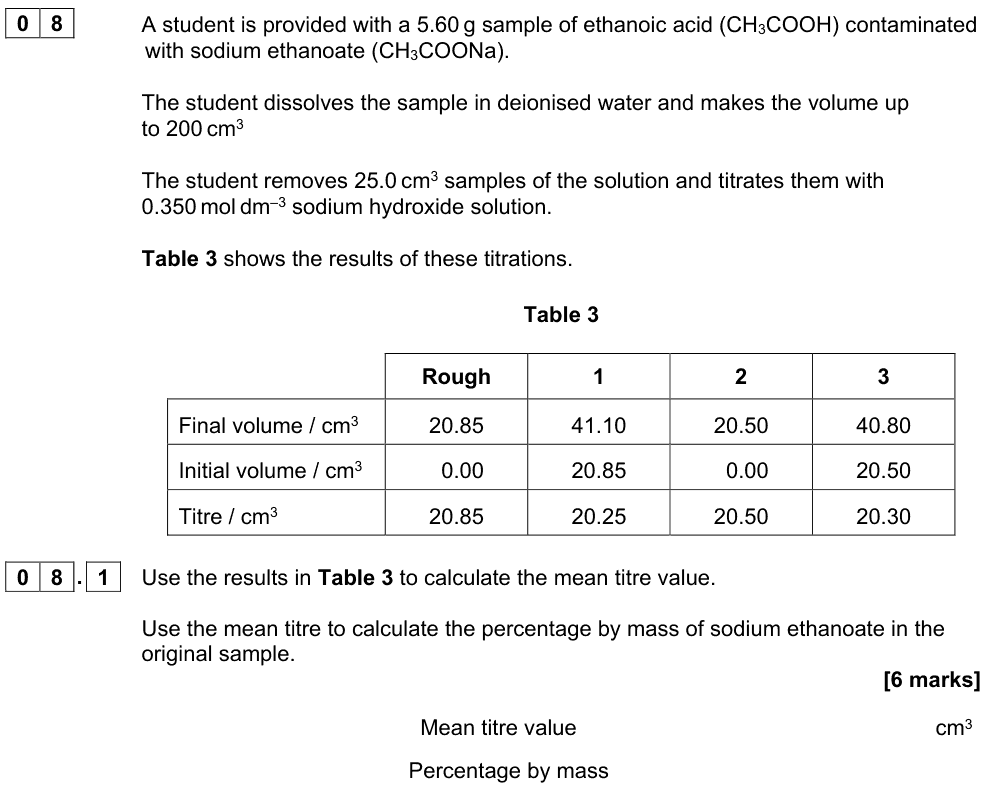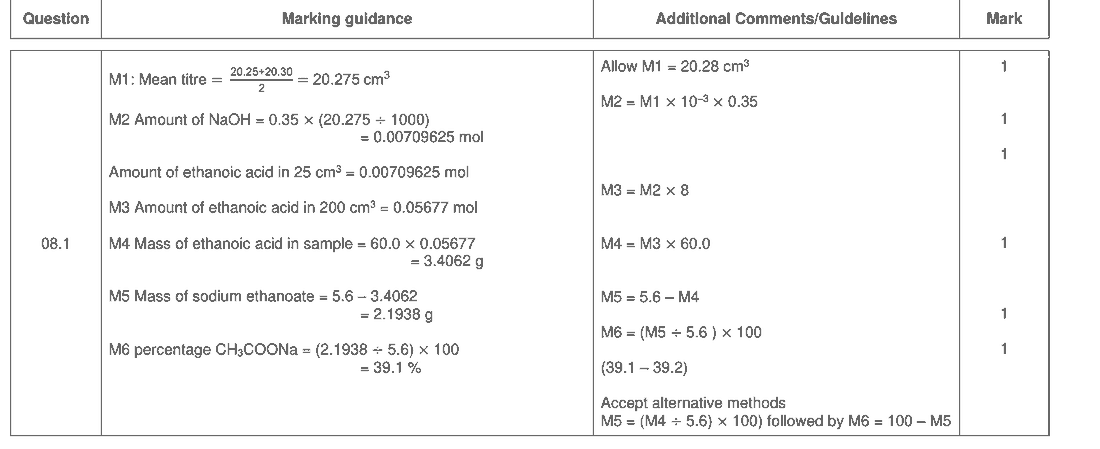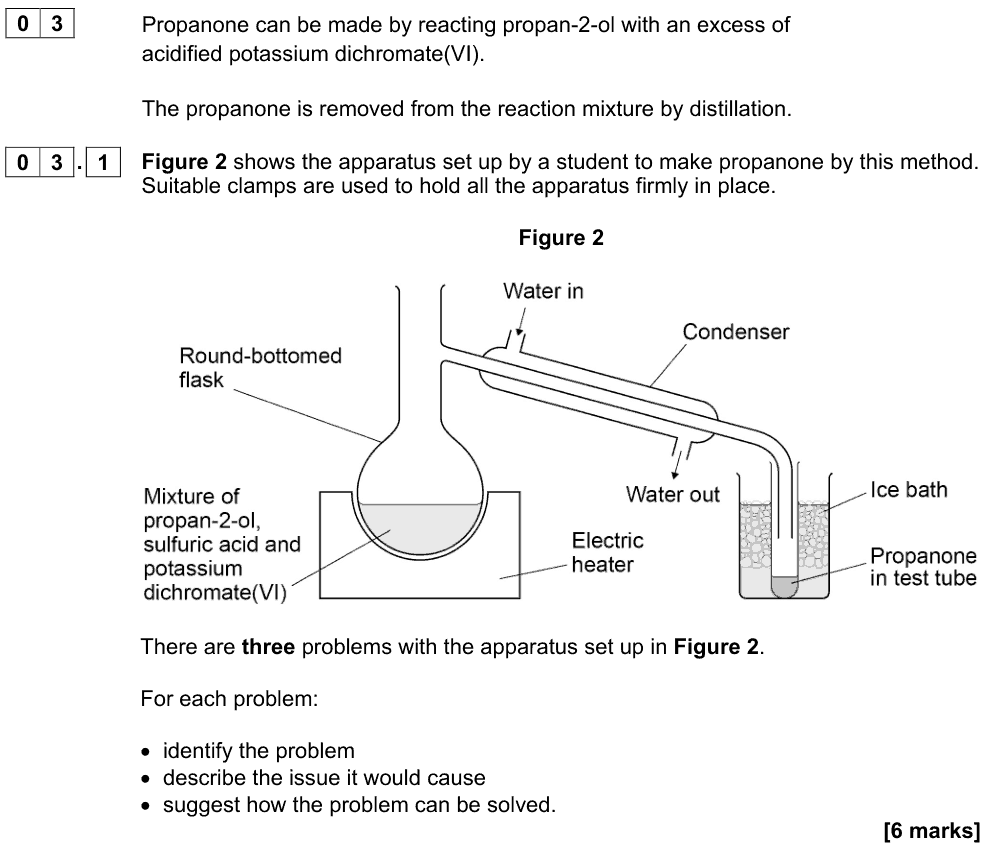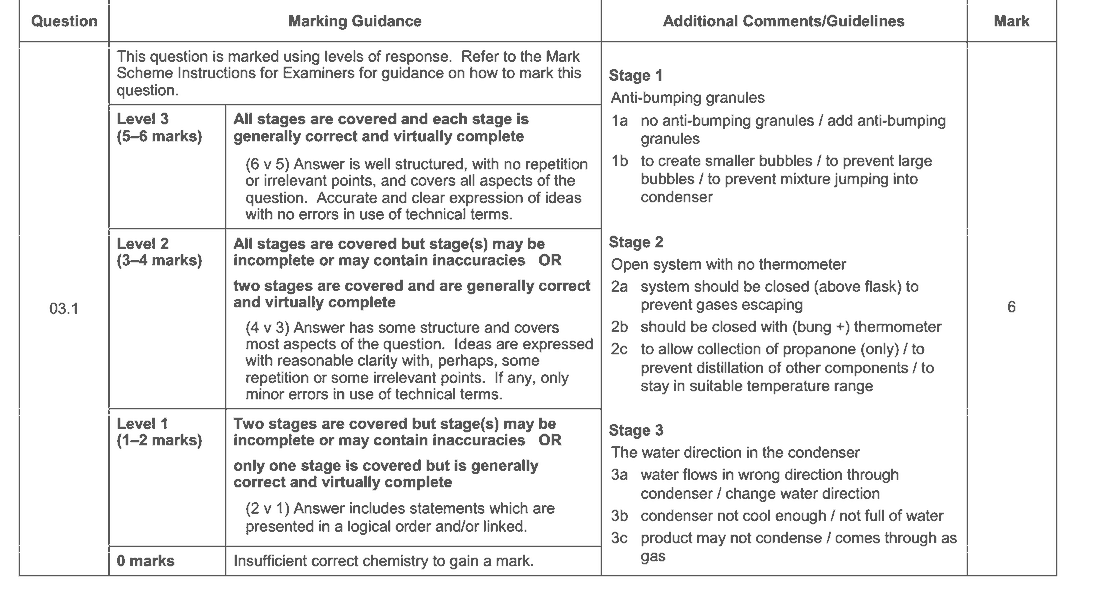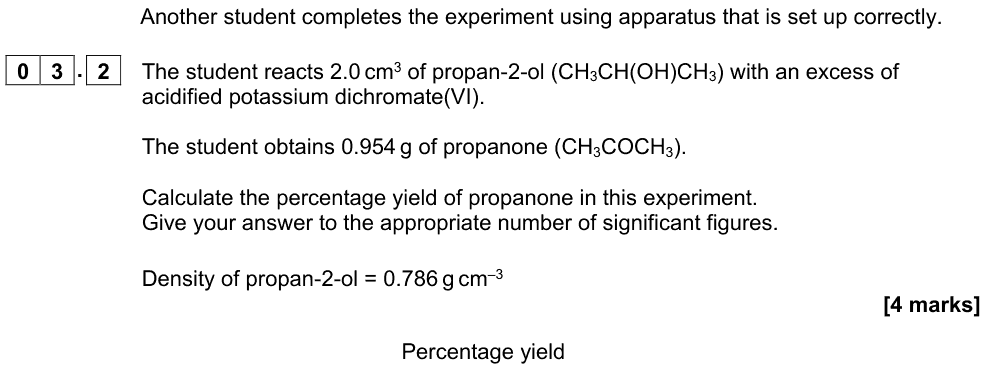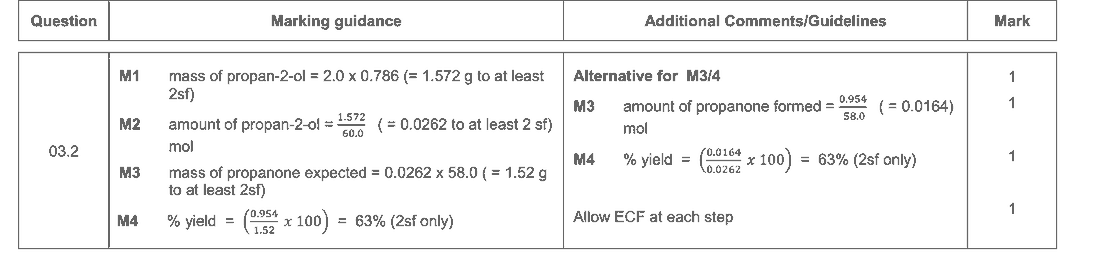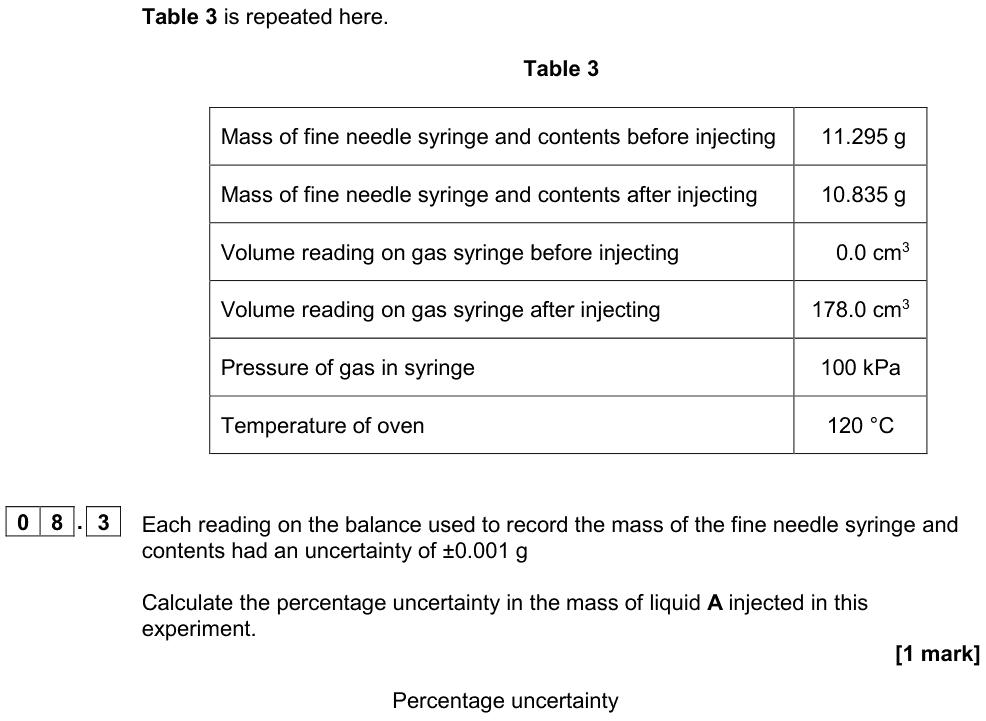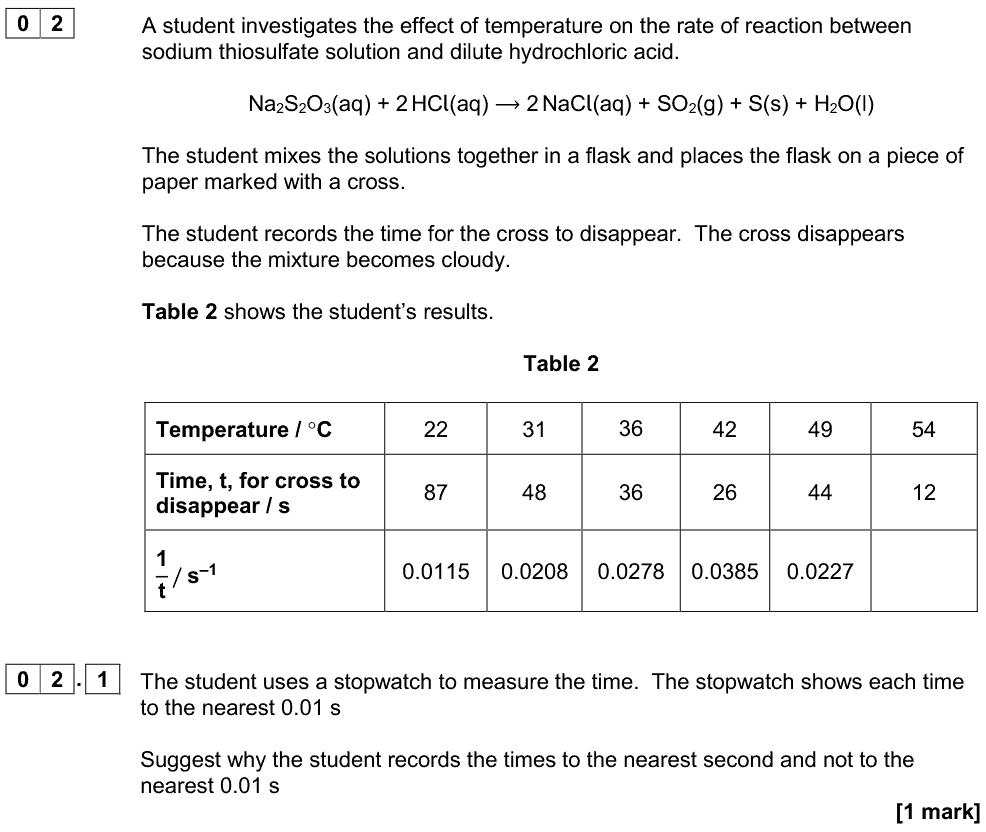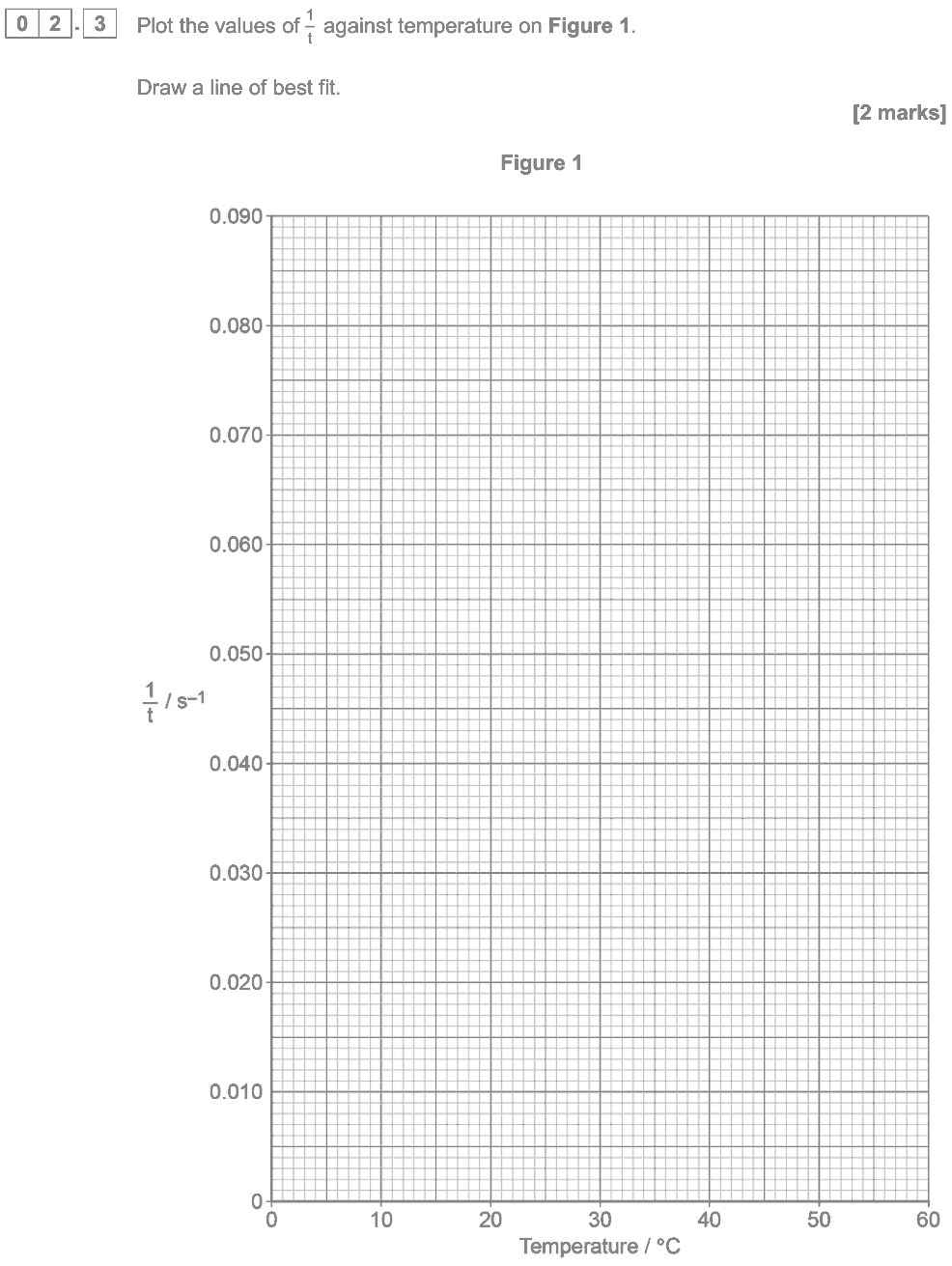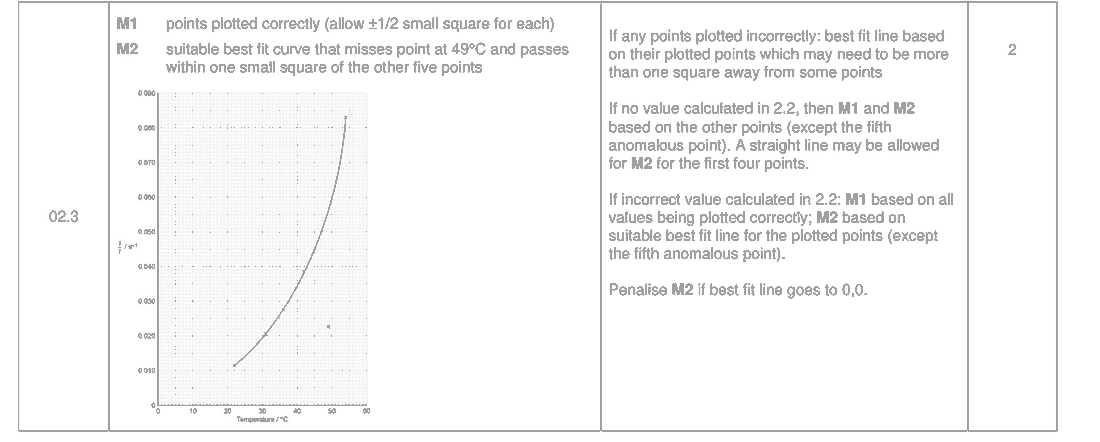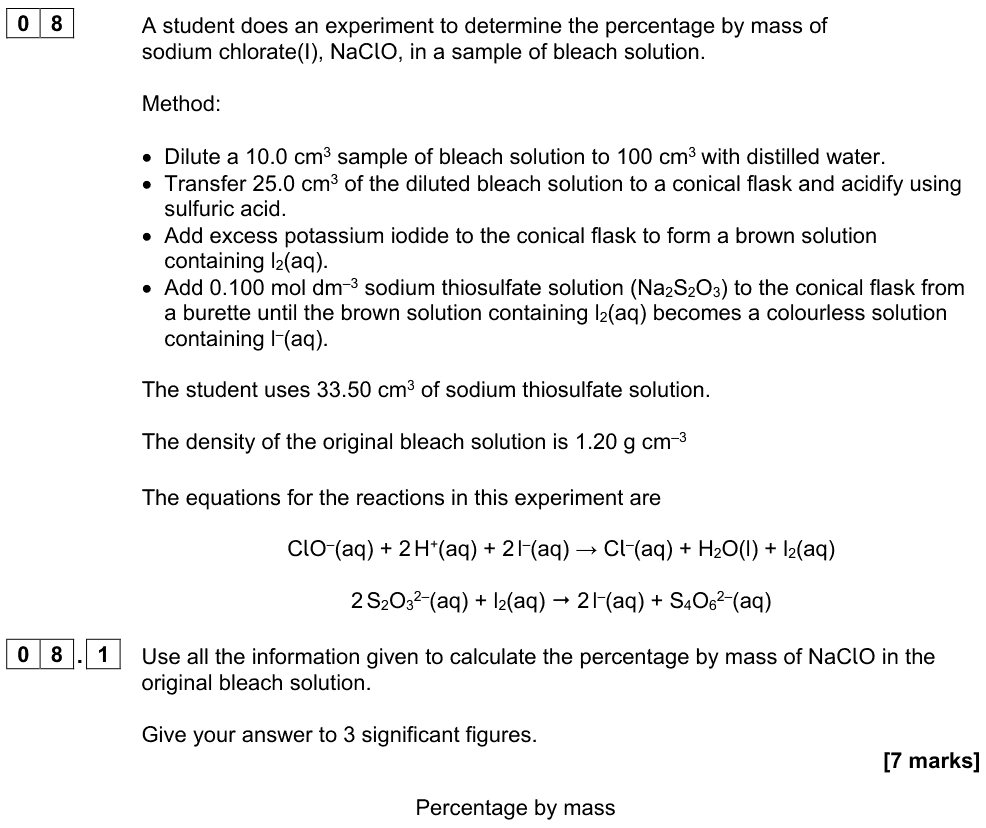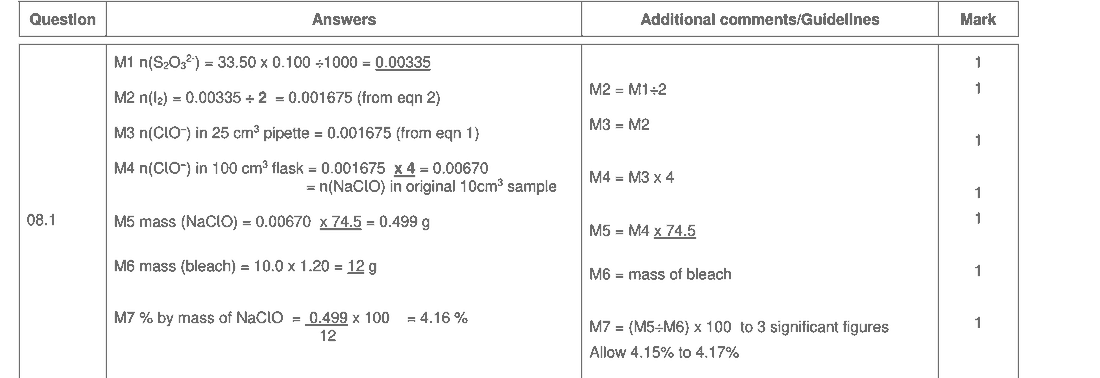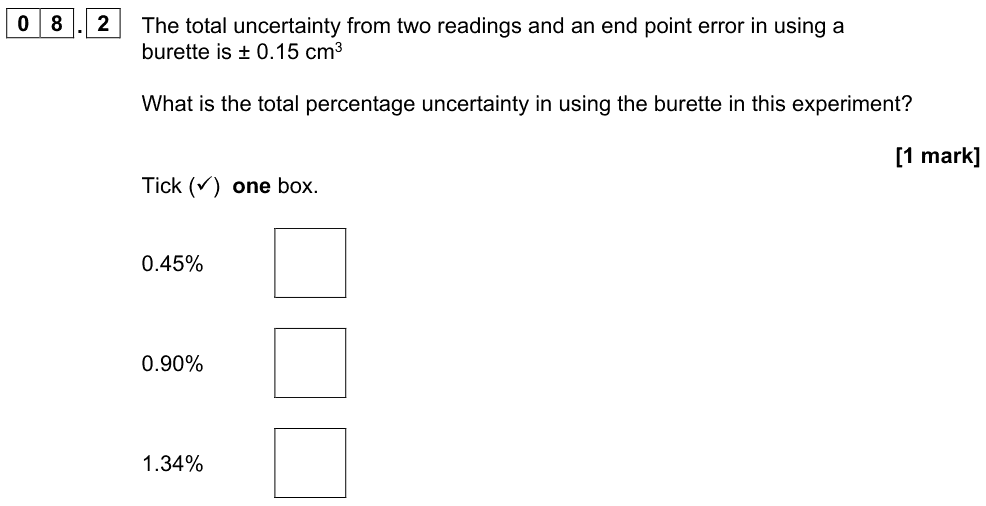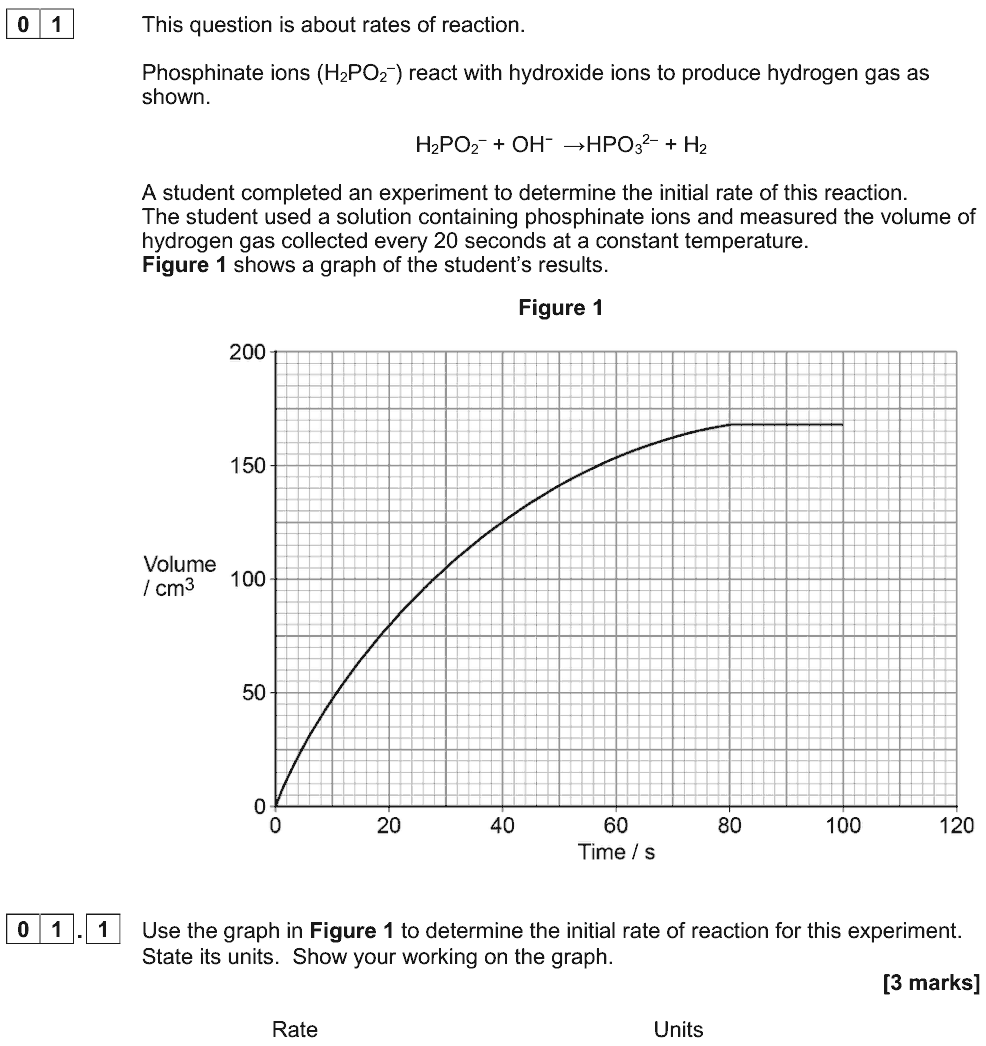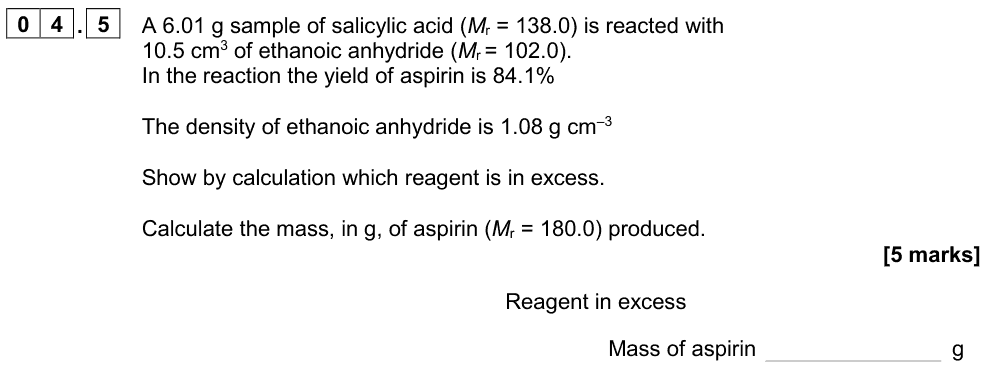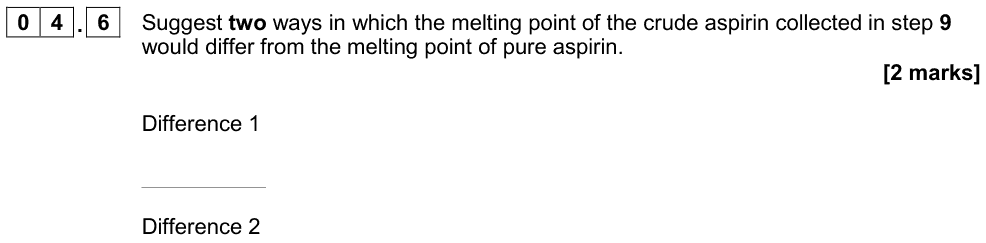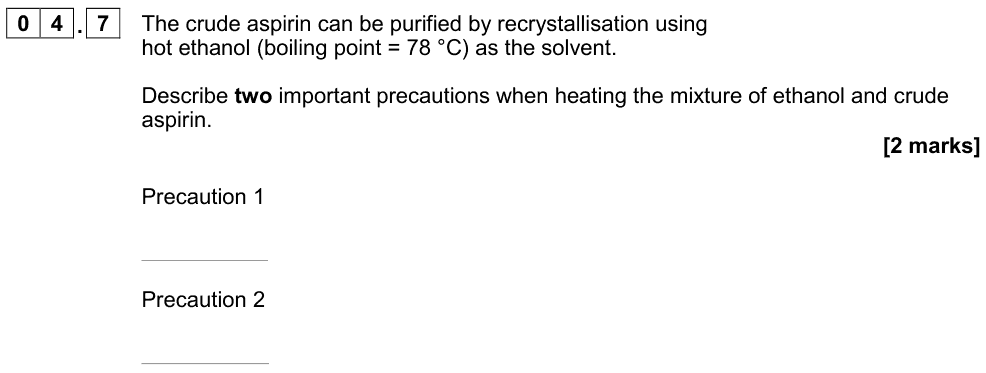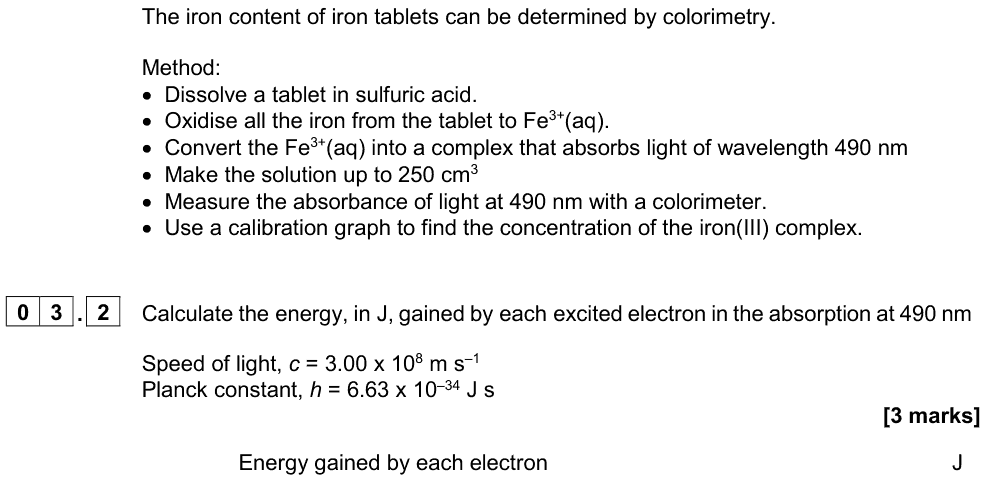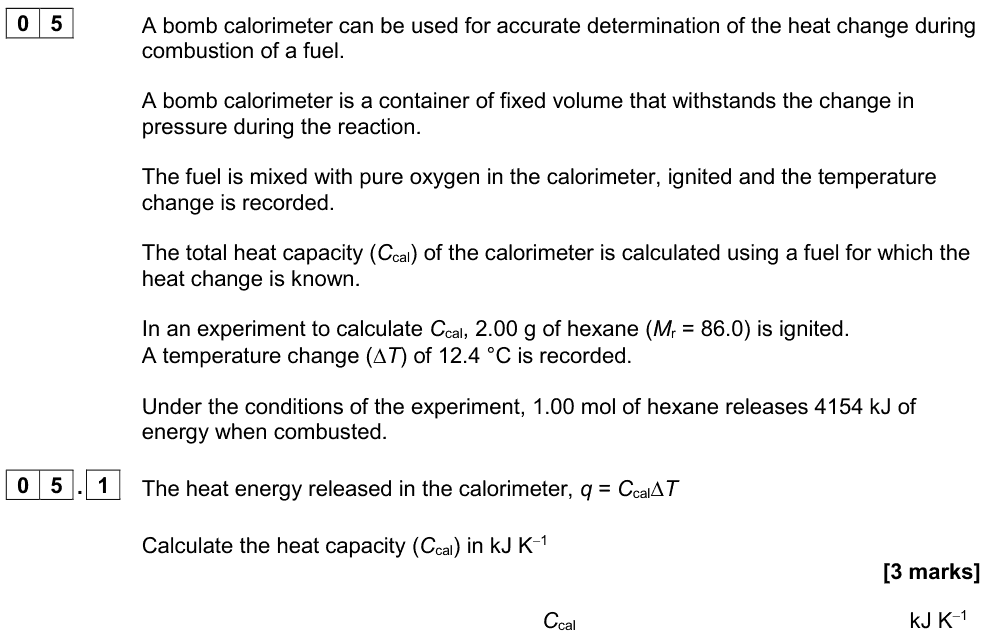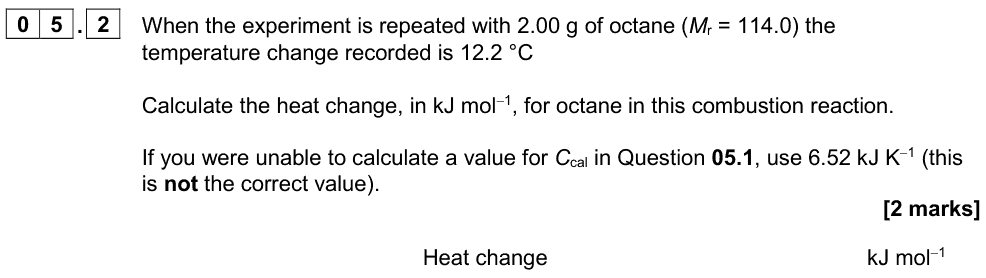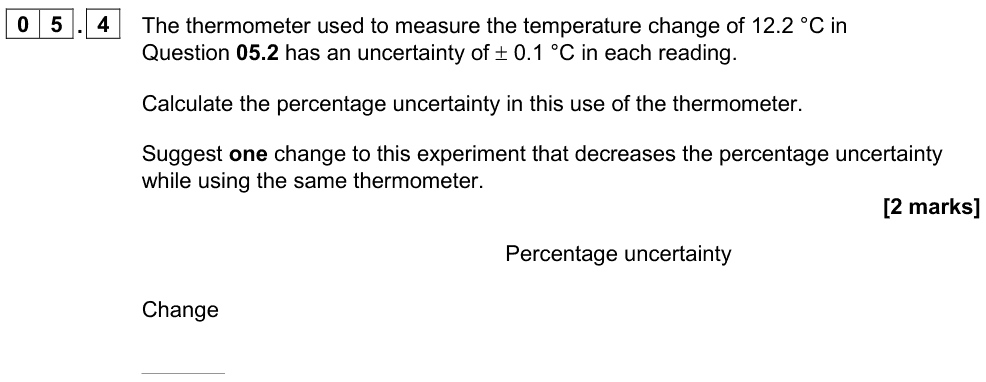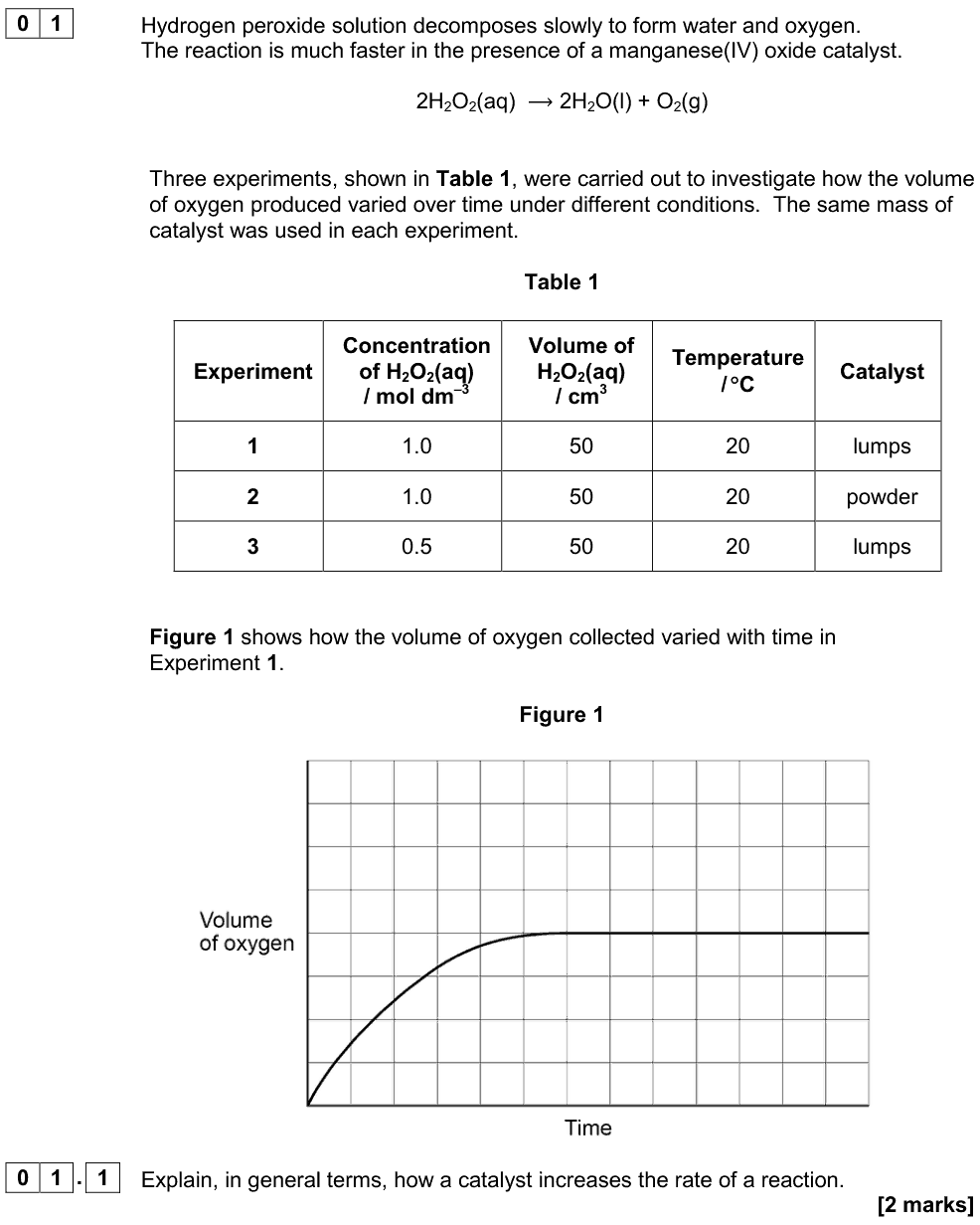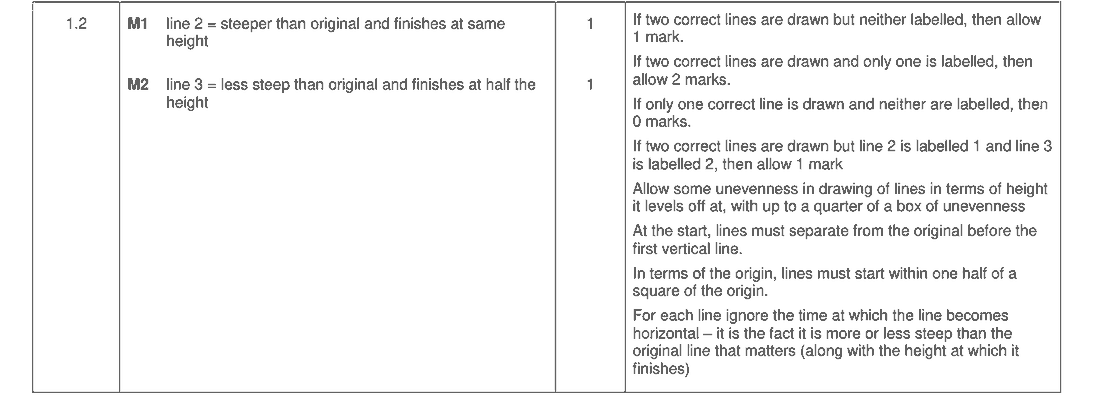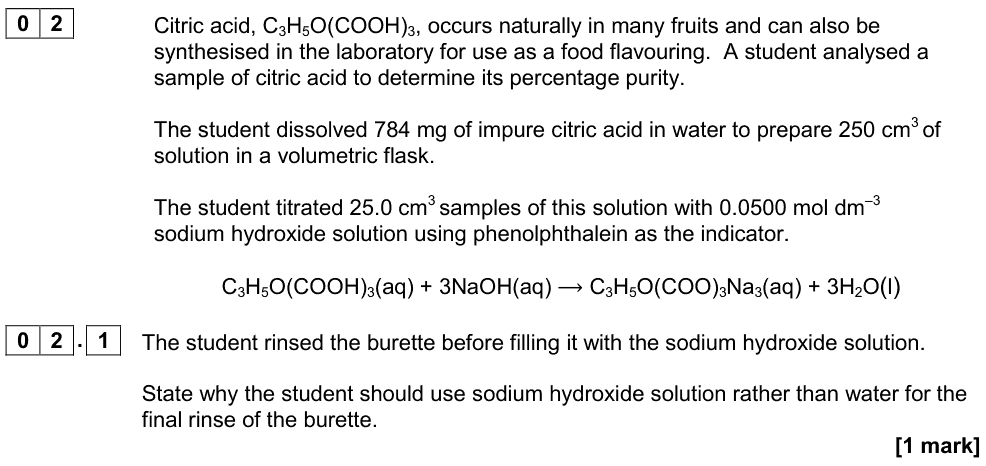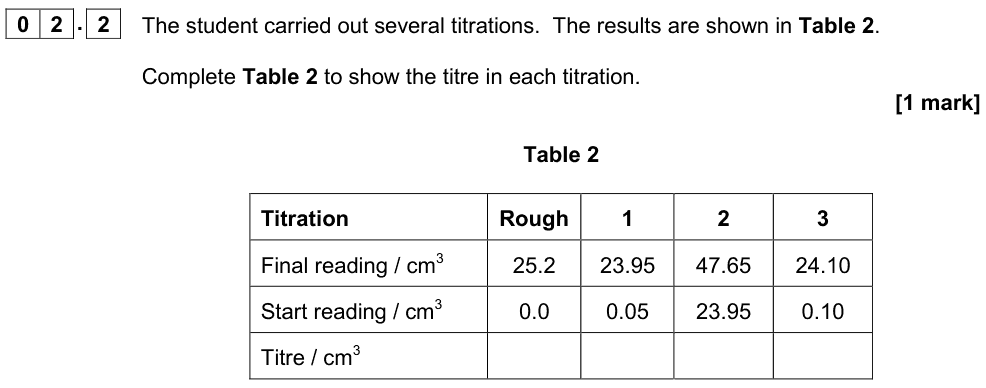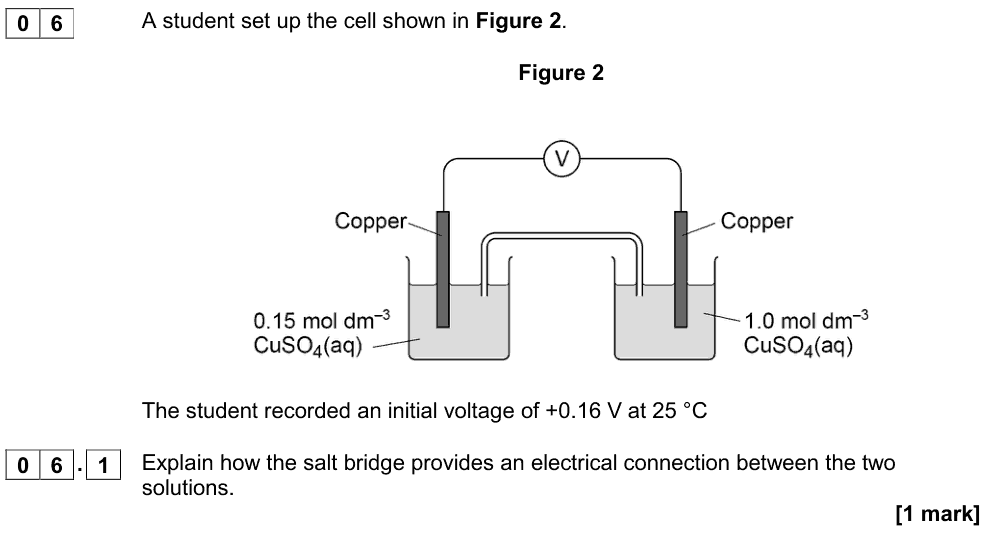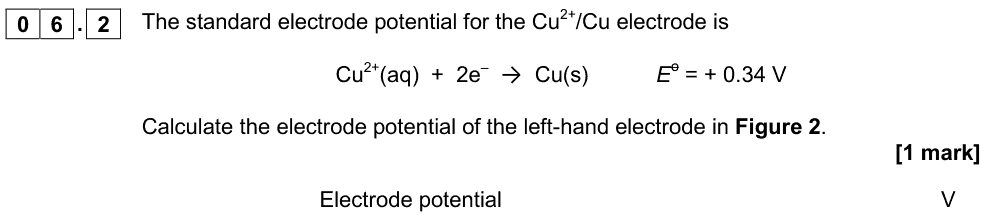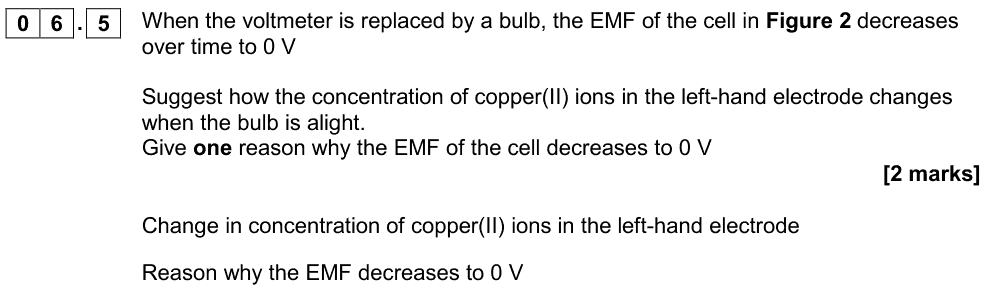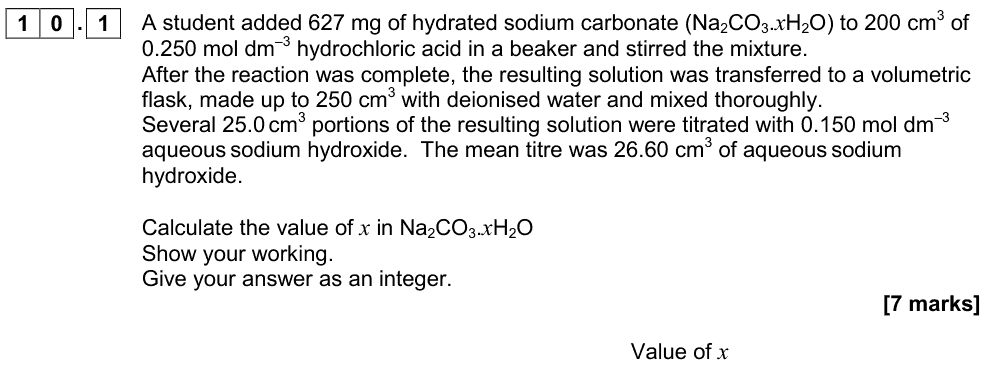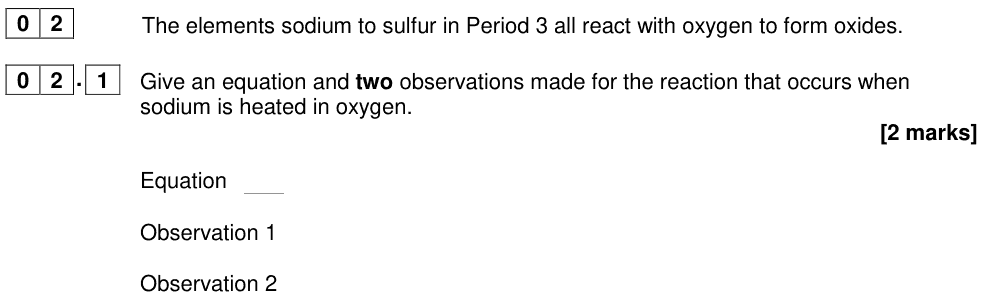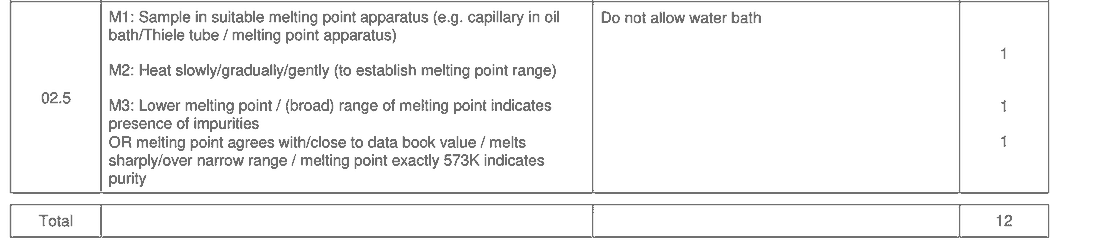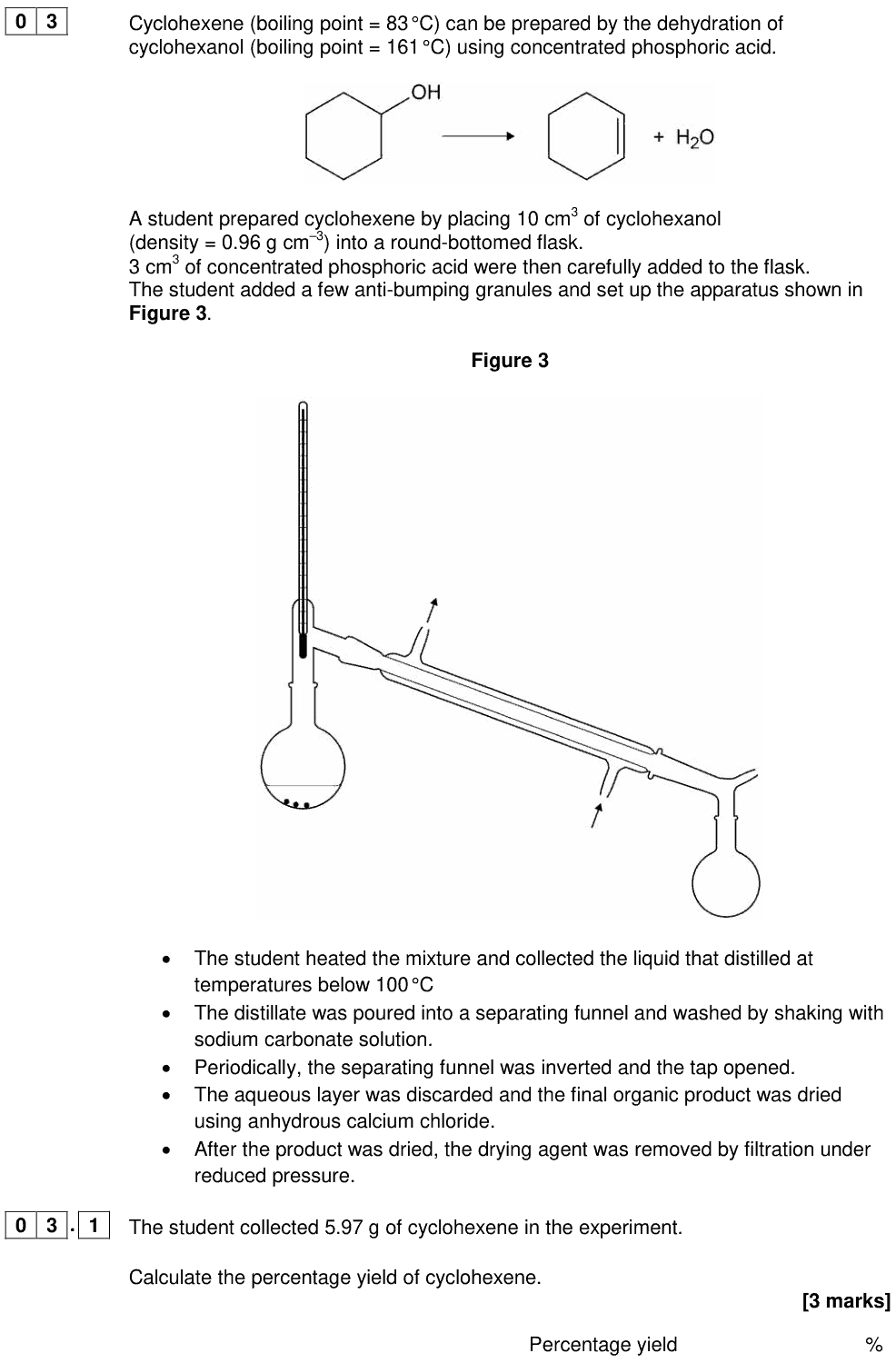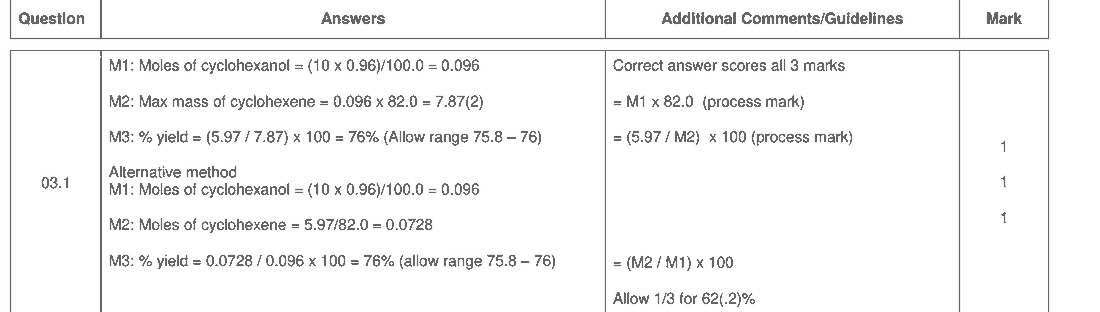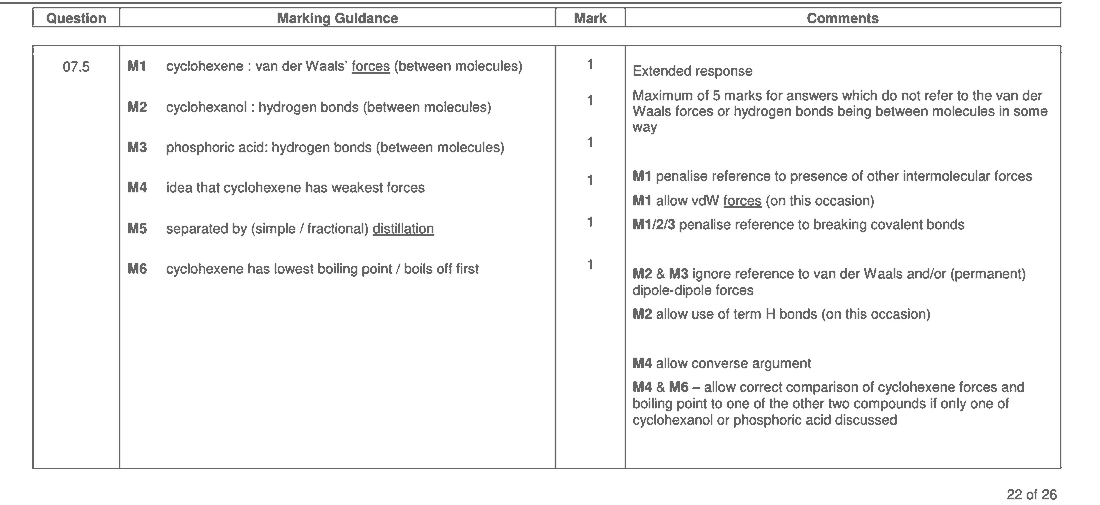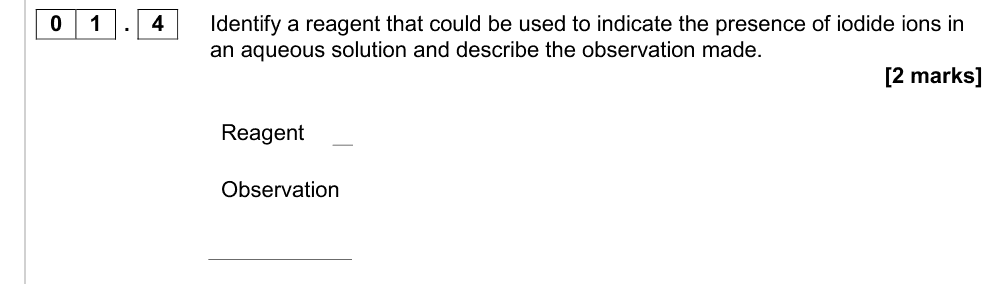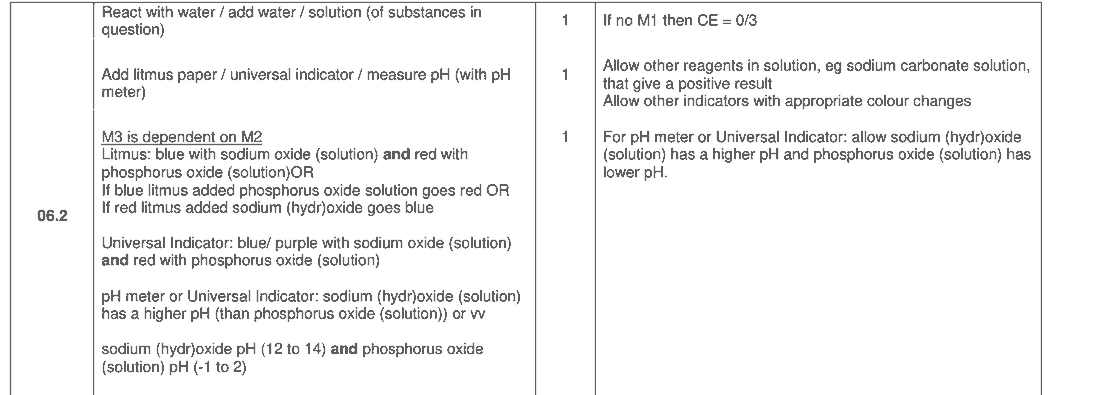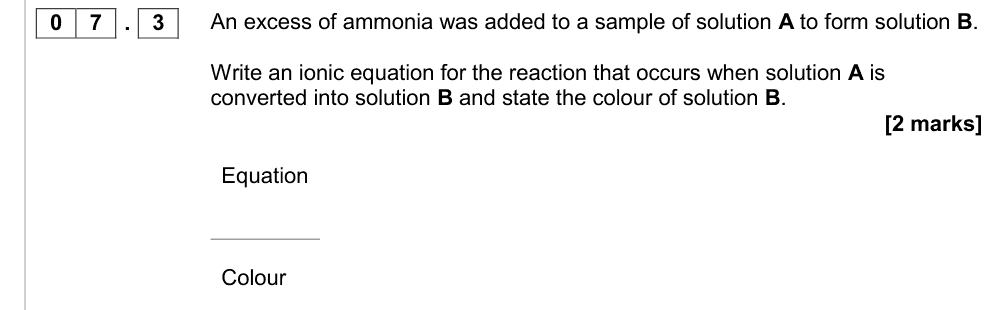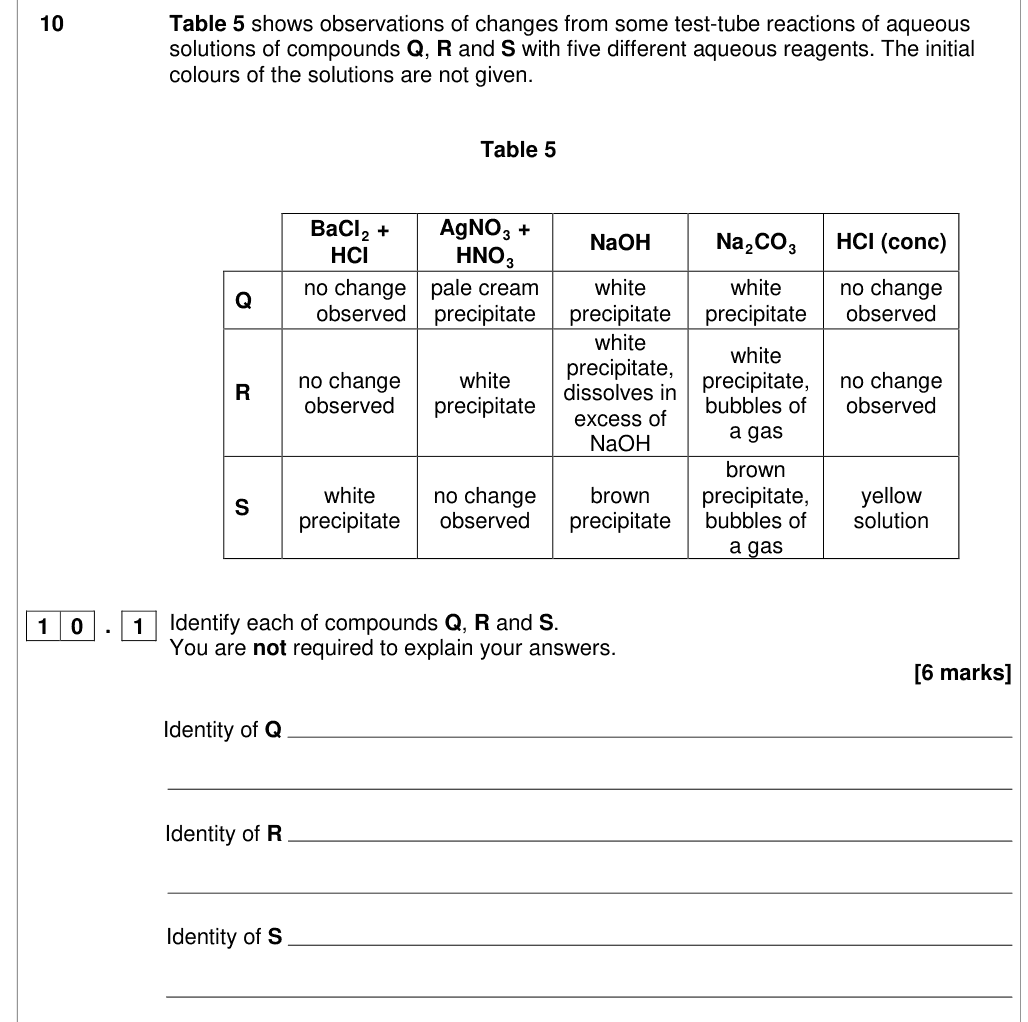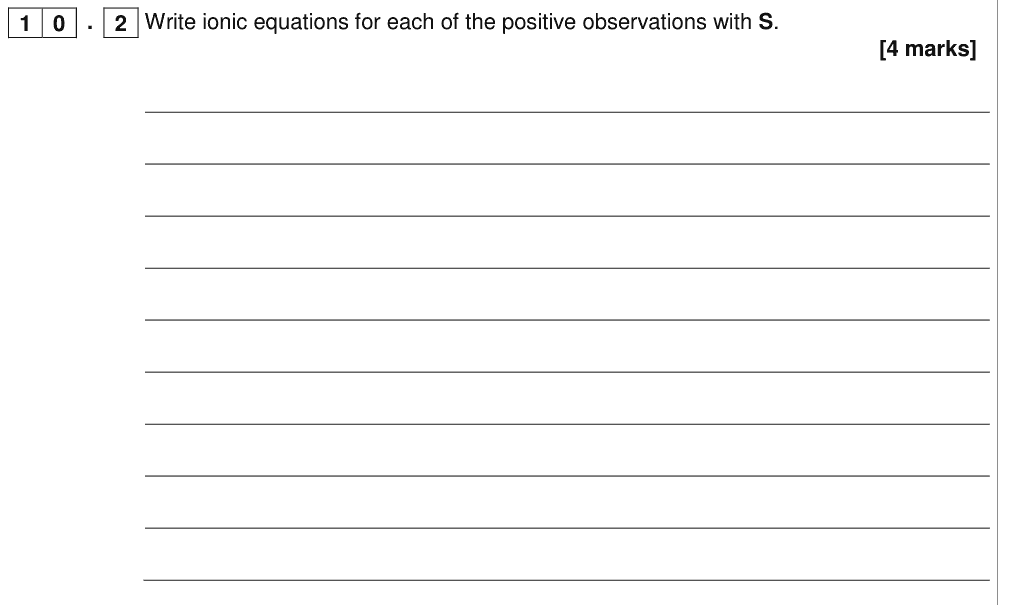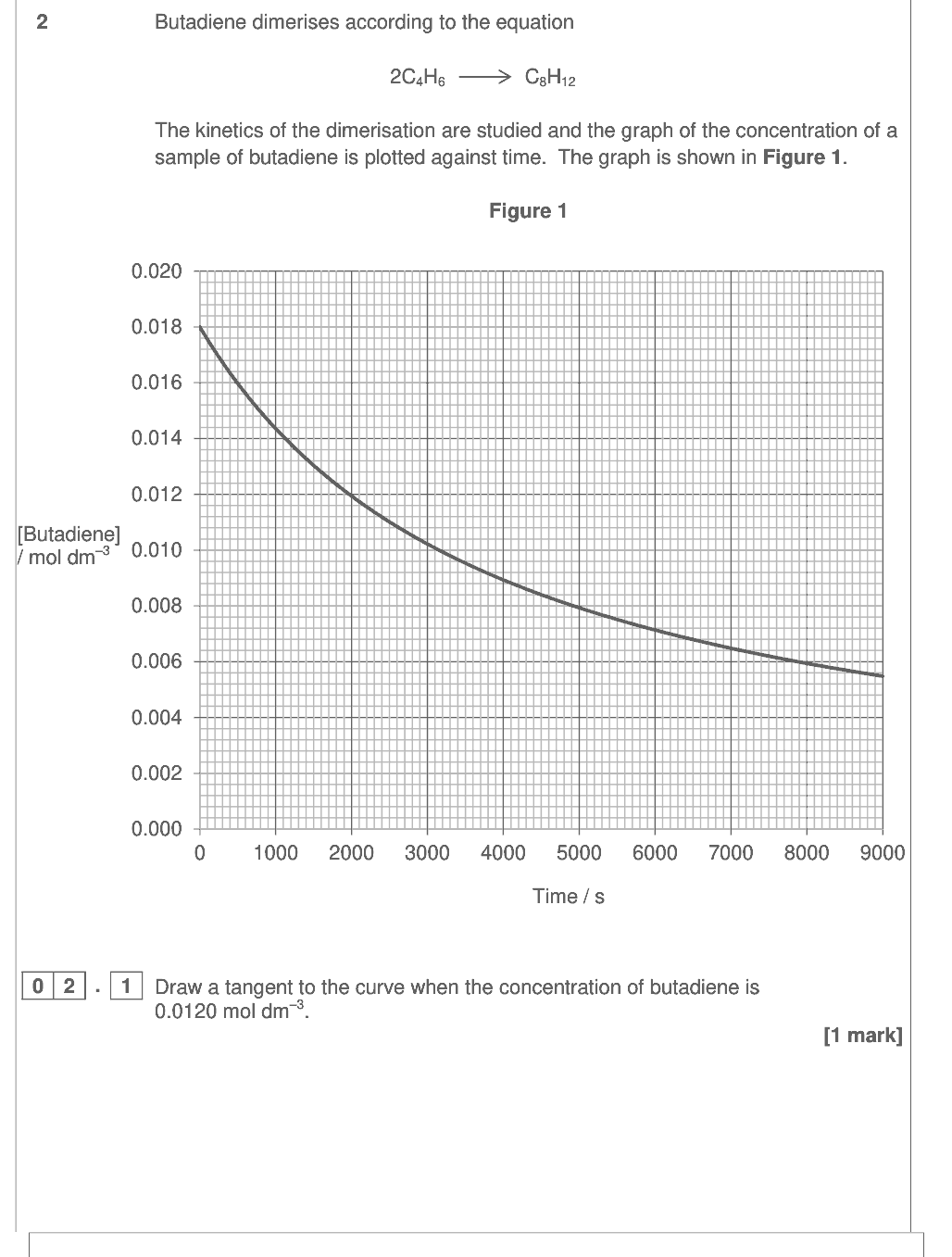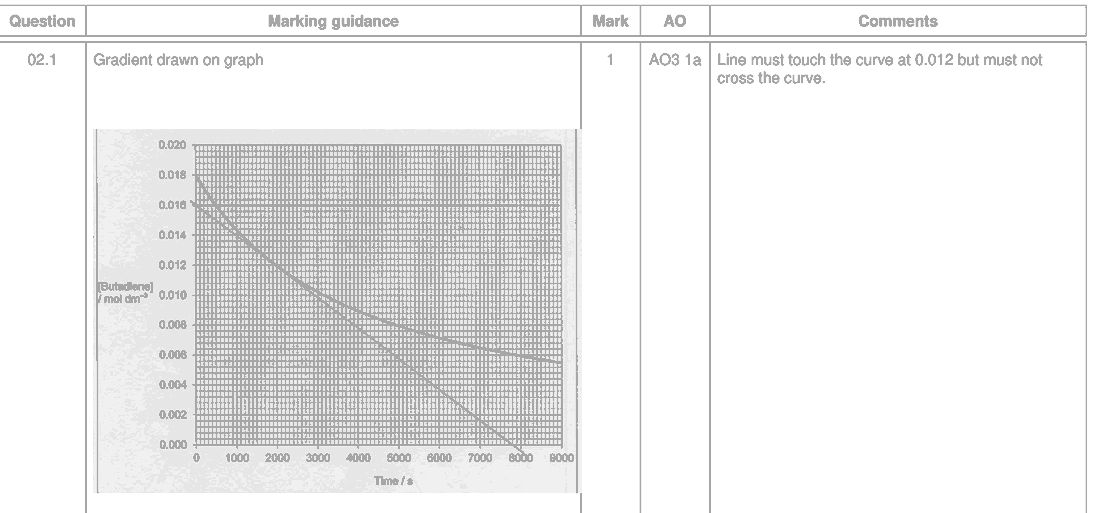
Practical questions

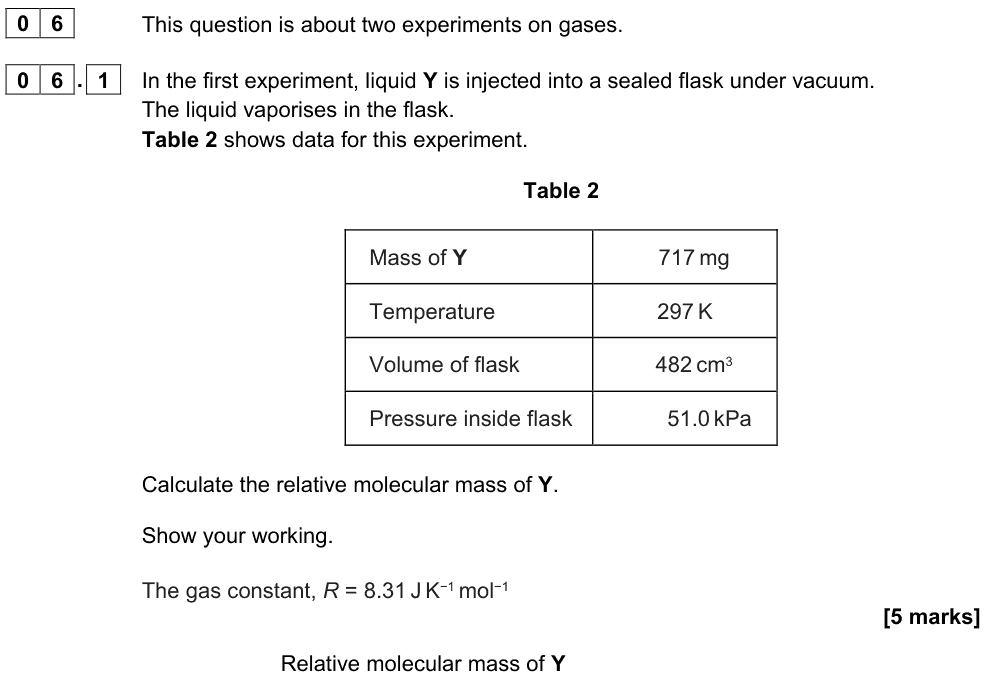
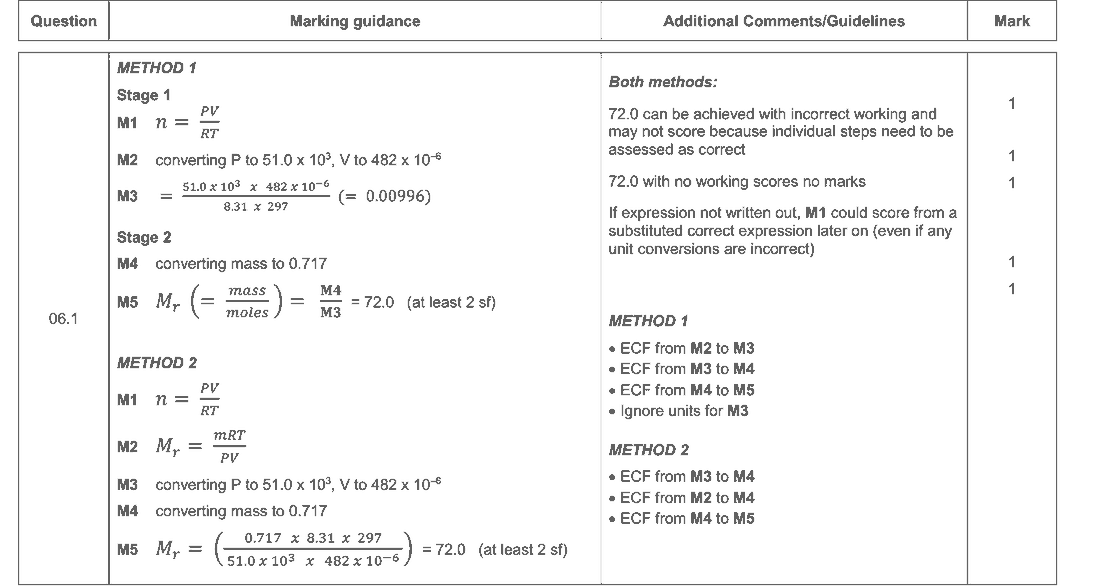
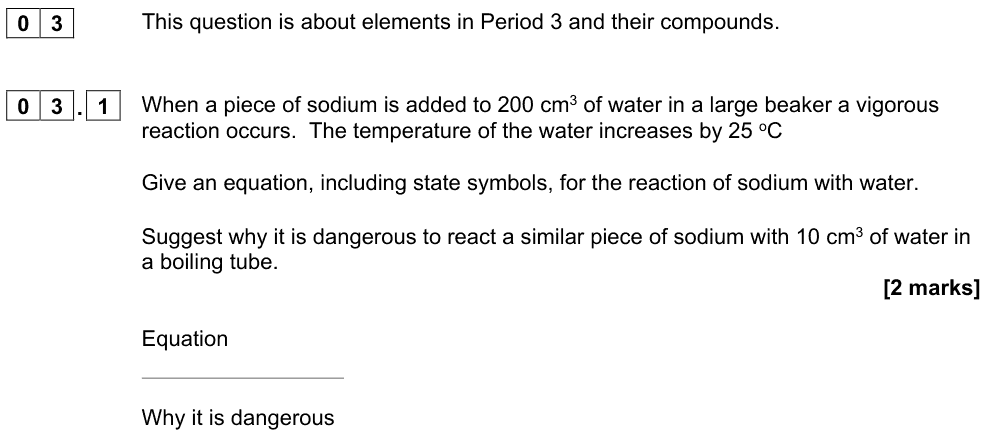
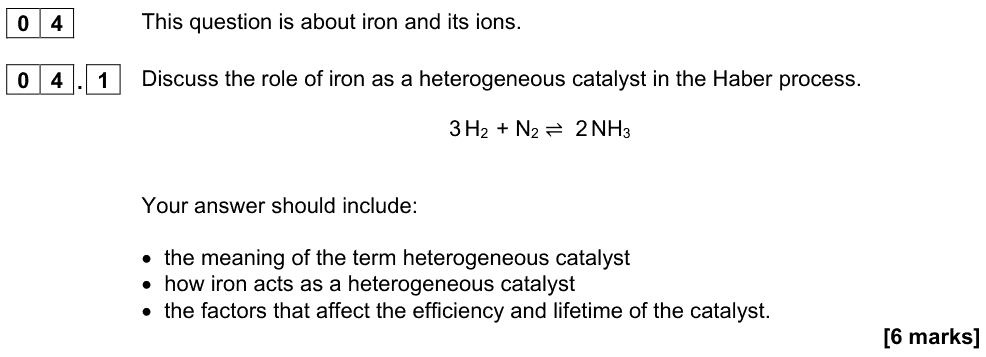
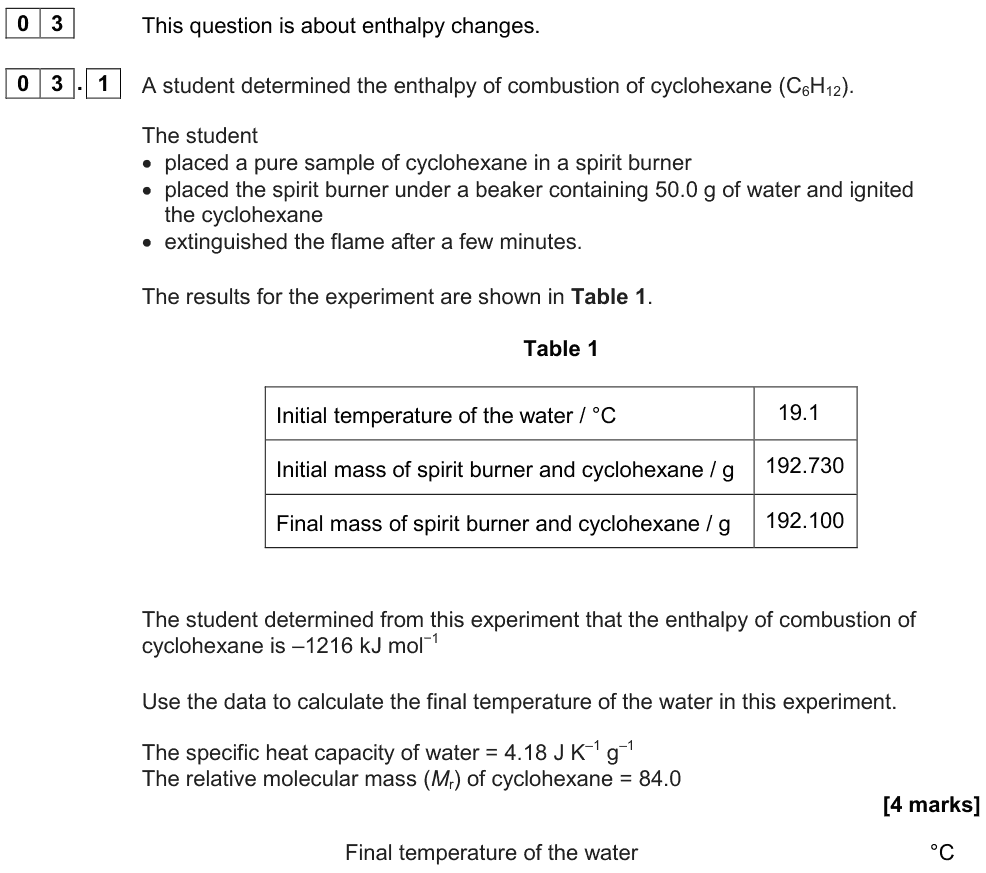
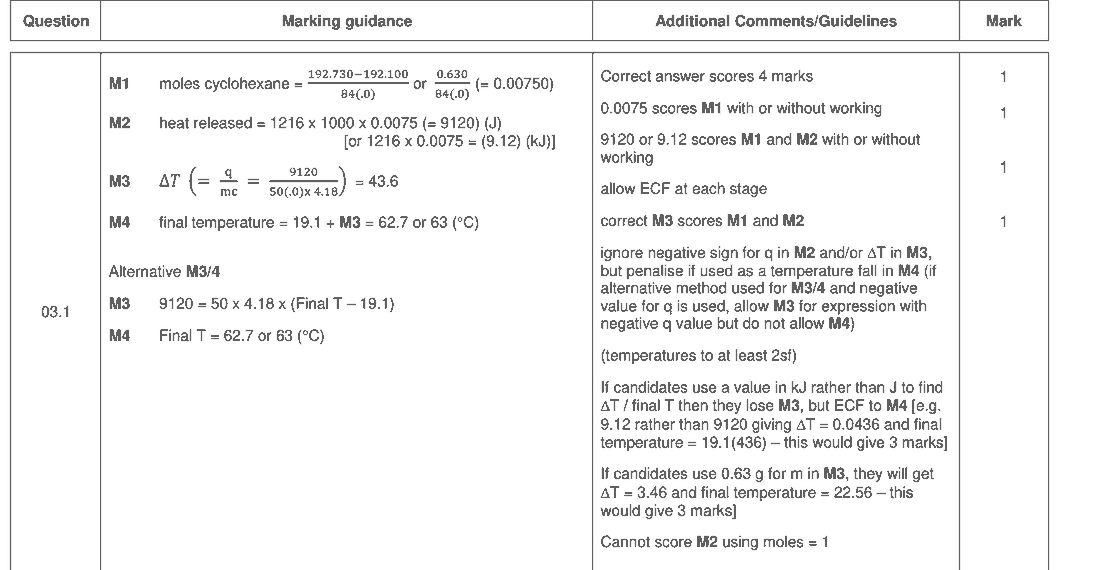
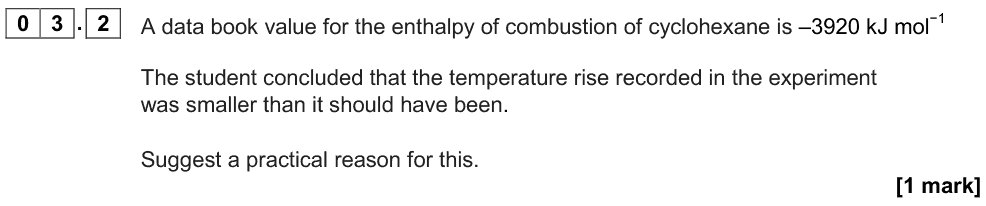
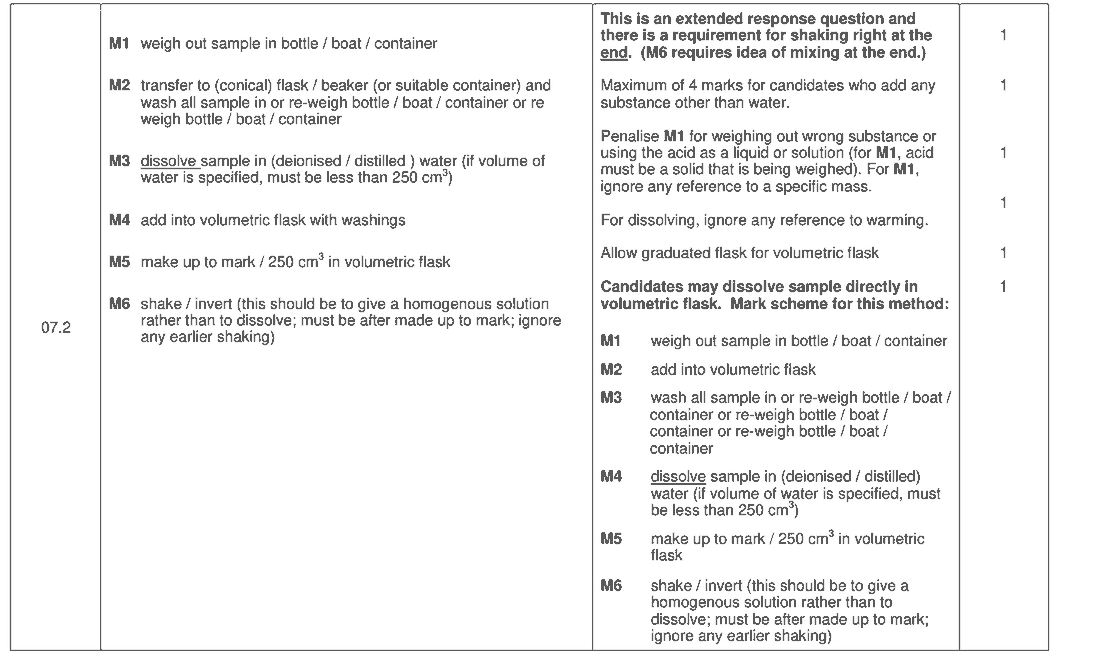
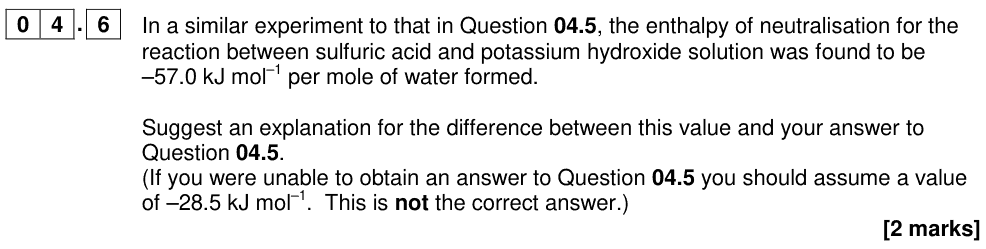
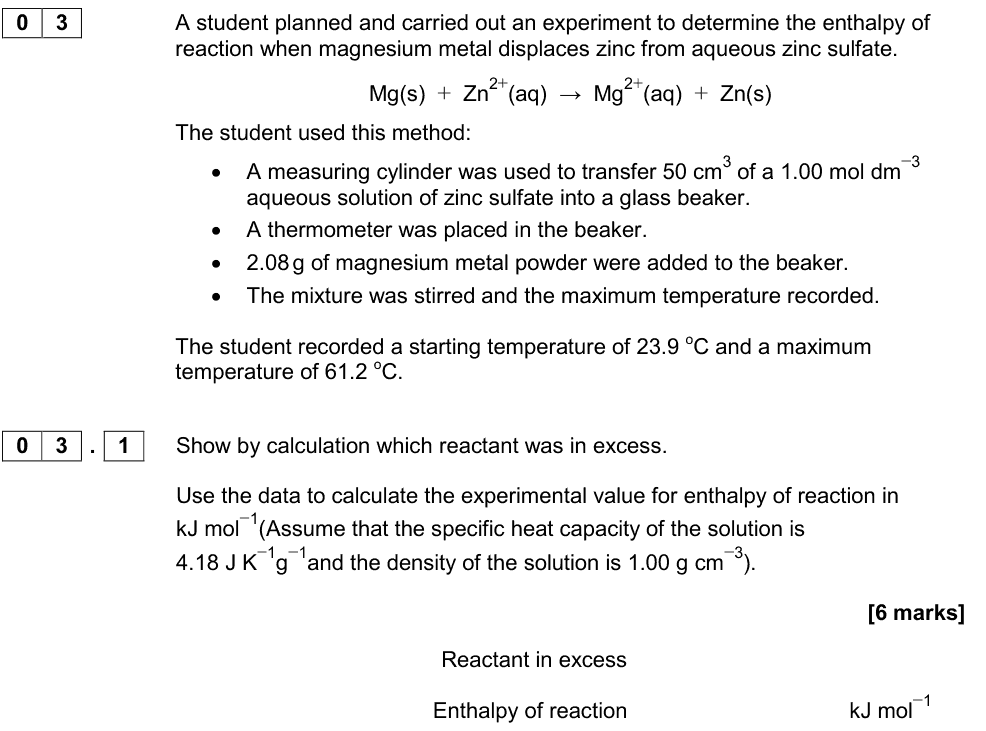
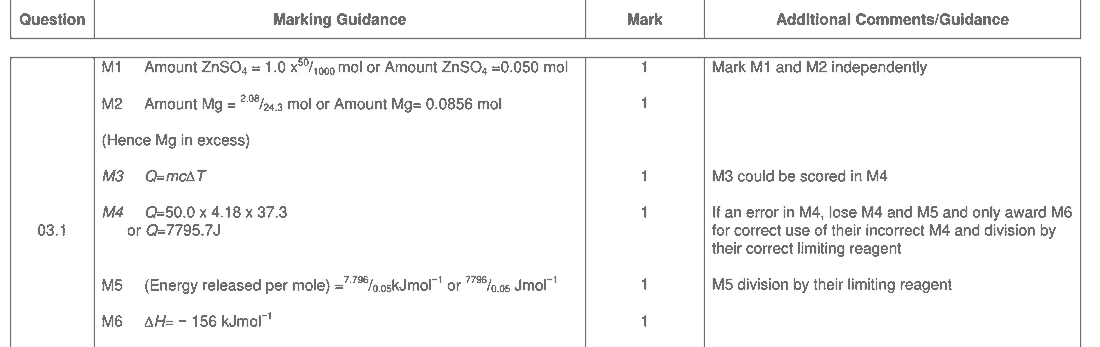
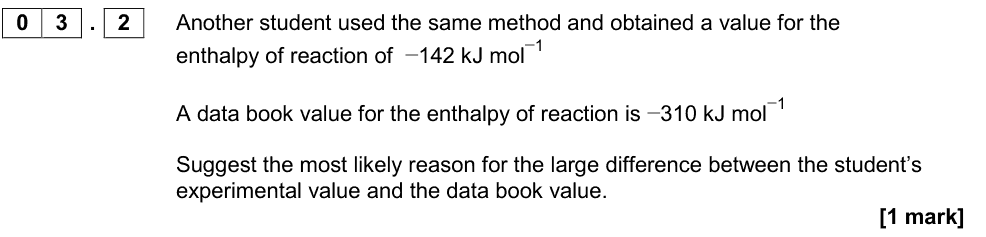
Questions on the twelve required practicals and on apparatus, measurements, uncertainties and evaluation. Paper 3 carries most of them. 422 questions.

Other types: Multiple-choice questions · Calculation questions · Equation questions · Mechanism questions · Structure and diagram questions · Explanation questions · Six-mark level of response questions · Short-answer questions

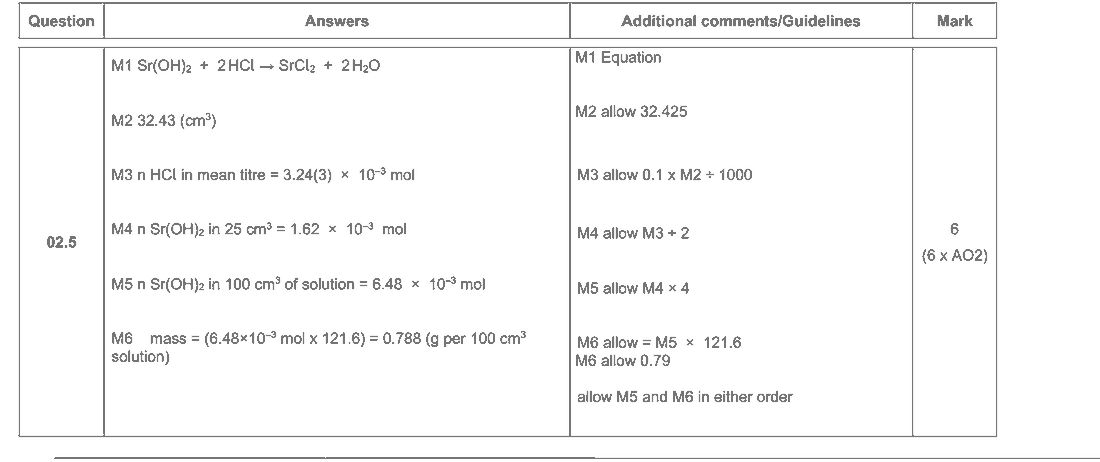
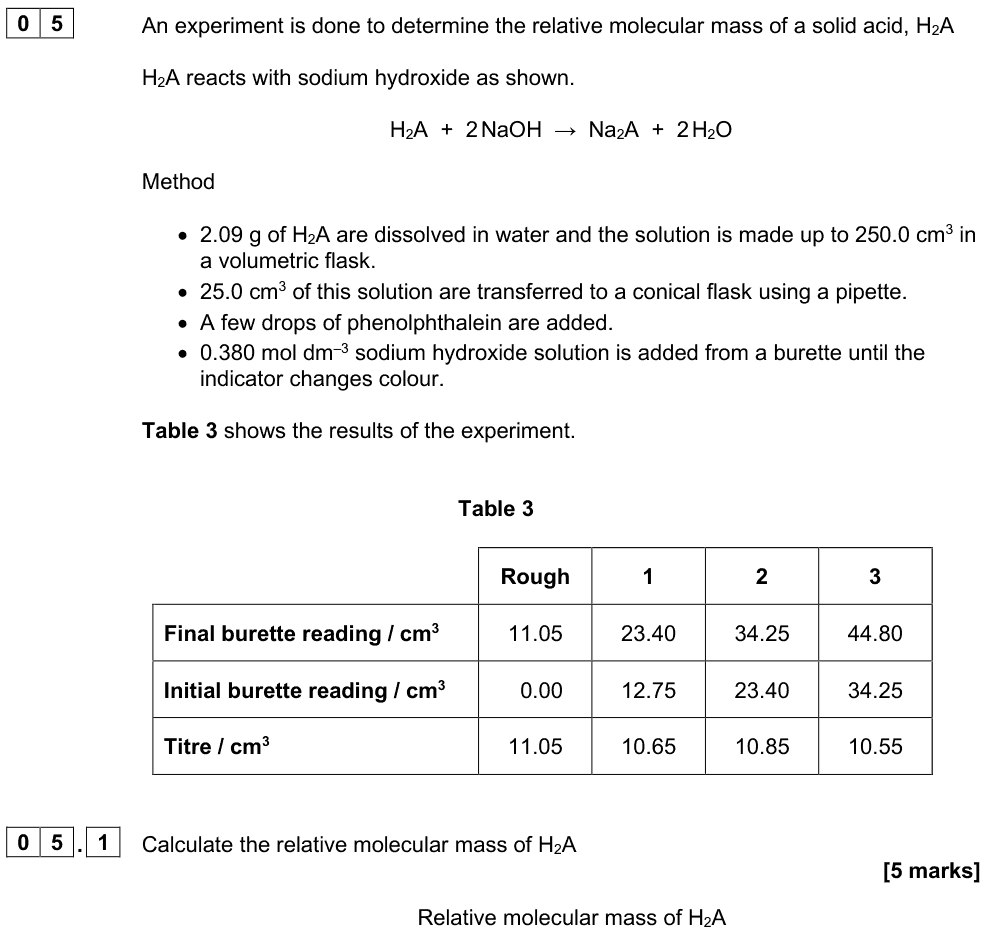
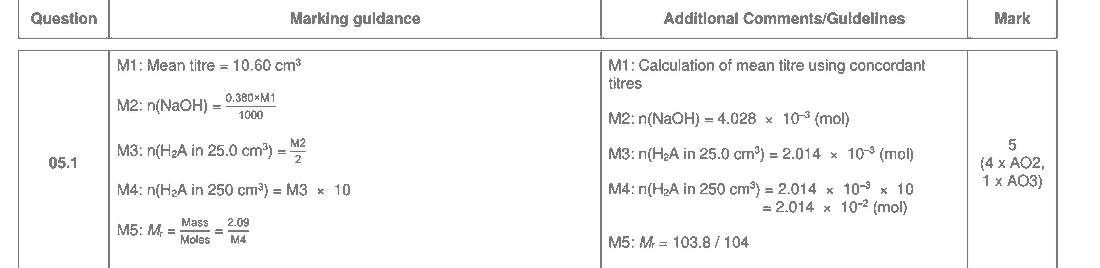
June 2025 · AS Paper 1 · Q05.1 5 marks AO2=4, AO3=1 Calculation amount of substance
An experiment is done to determine the relative molecular mass of a solid acid, H2A
H2A reacts with sodium hydroxide as shown.
H2A  +  2 NaOH  →  Na2A  +  2 H2O
Method
• 2.09 g of H2A are dissolved in water and the solution is made up to 250.0 cm3 in
a volumetric flask.
• 25.0 cm3 of this solution are transferred to a conical flask using a pipette.
• A few drops of phenolphthalein are added.
• 0.380 mol dm–3 sodium hydroxide solution is added from a burette until the
indicator changes colour.
Table 3 shows the results of the experiment.
Table 3
Rough
1
2
3
Final burette reading / cm3
11.05
23.40
34.25
44.80
Initial burette reading / cm3
0.00
12.75
23.40
34.25
Titre / cm3
11.05
10.65
10.85
10.55
Calculate the relative molecular mass of H2A
[5 marks]
Relative molecular mass of H2A
June 2025 · AS Paper 1 · Q05.2 1 mark AO2=1 Practical and data analysis amount of substance
Earlier part of question 05 that this part usesEarlier part of June 2025 Paper 1 question 05
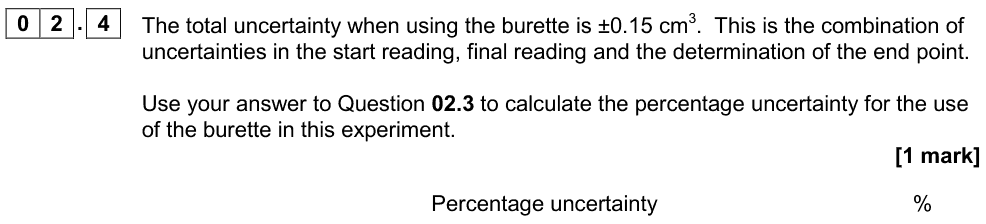
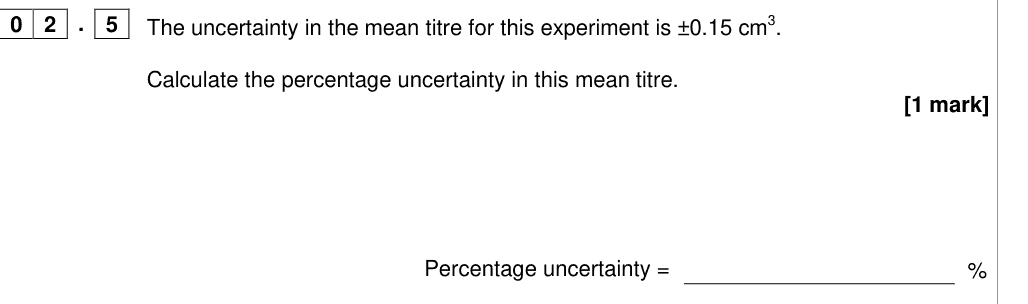
The uncertainty in the use of the burette in each titration is ±0.15 cm3
Calculate the percentage uncertainty in the use of the burette in titration 1.
[1 mark]
Percentage uncertainty
June 2025 · AS Paper 1 · Q05.3 2 marks AO3=2 Practical and data analysis amount of substance
Earlier part of question 05 that this part usesEarlier part of June 2025 Paper 1 question 05
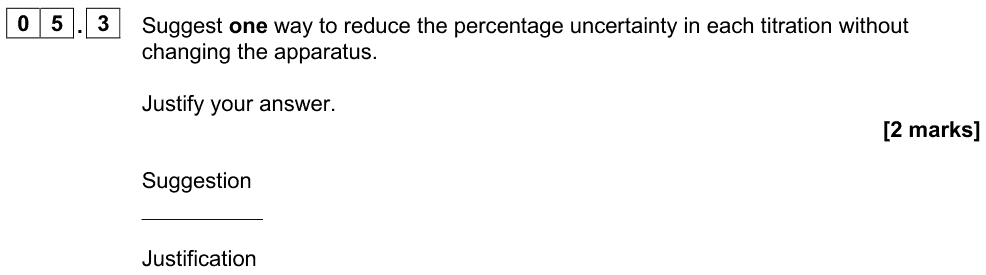
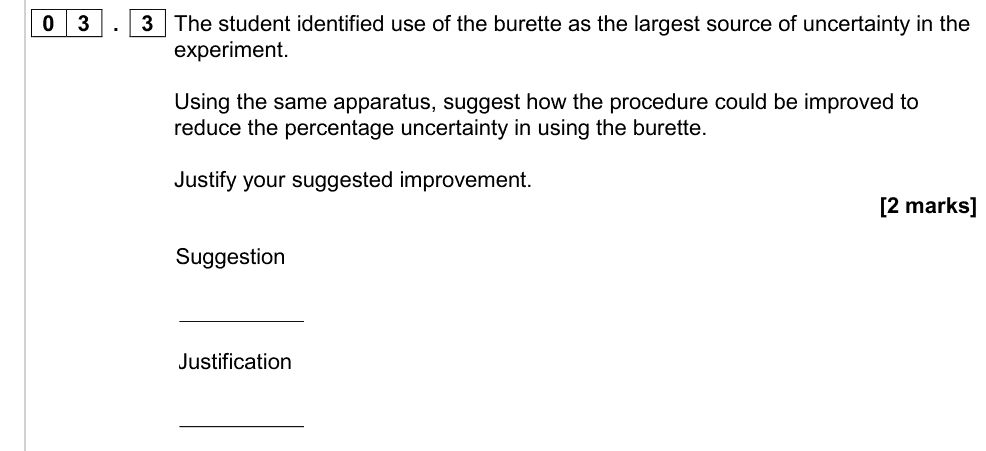
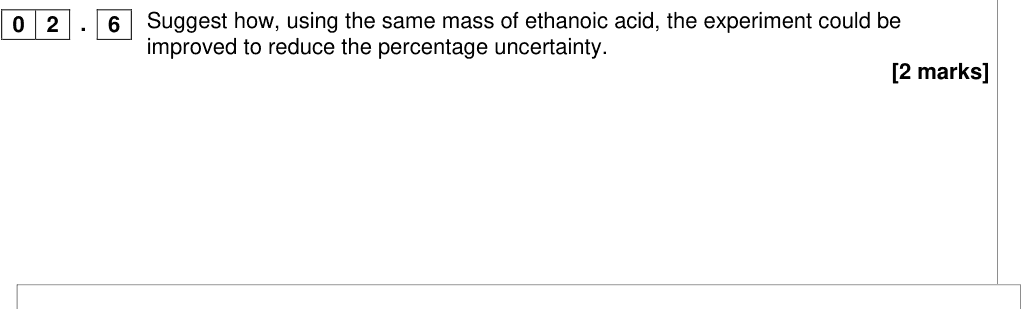
Suggest one way to reduce the percentage uncertainty in each titration without
changing the apparatus.
Justify your answer.
[2 marks]
Suggestion
Justification
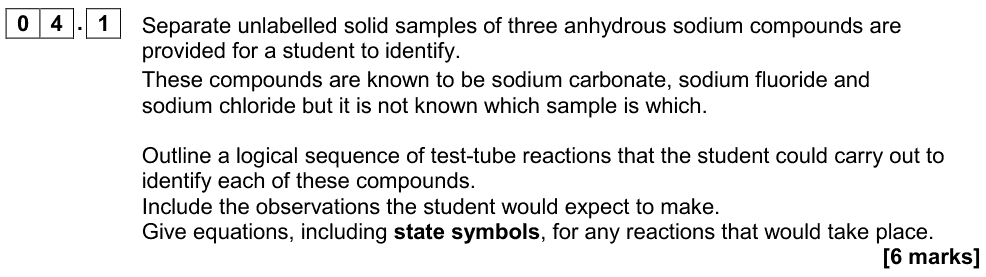
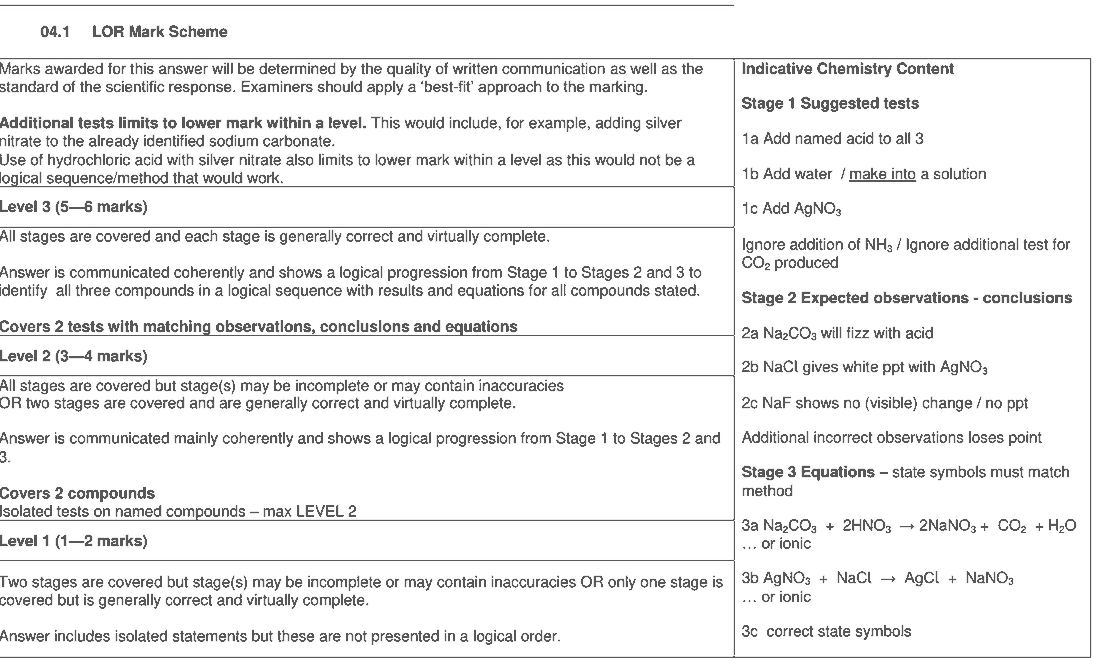
June 2025 · AS Paper 1 · Q06.1 6 marks AO3=6 6-mark level of response Hard group 7 the halogensgroup 2
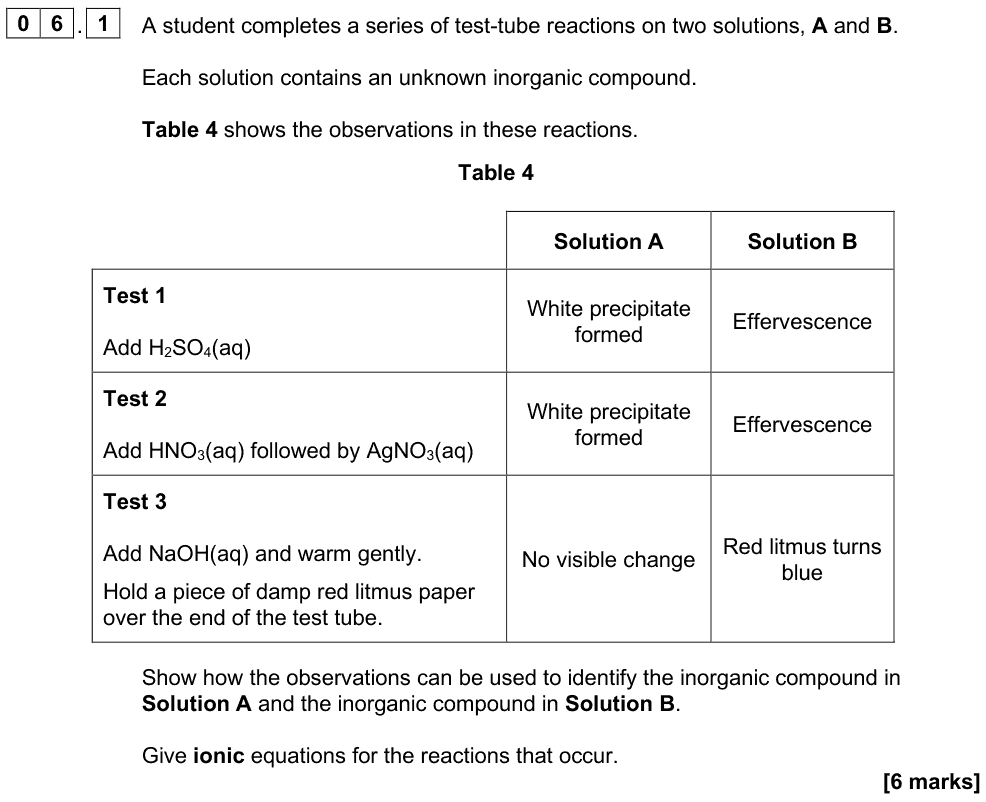
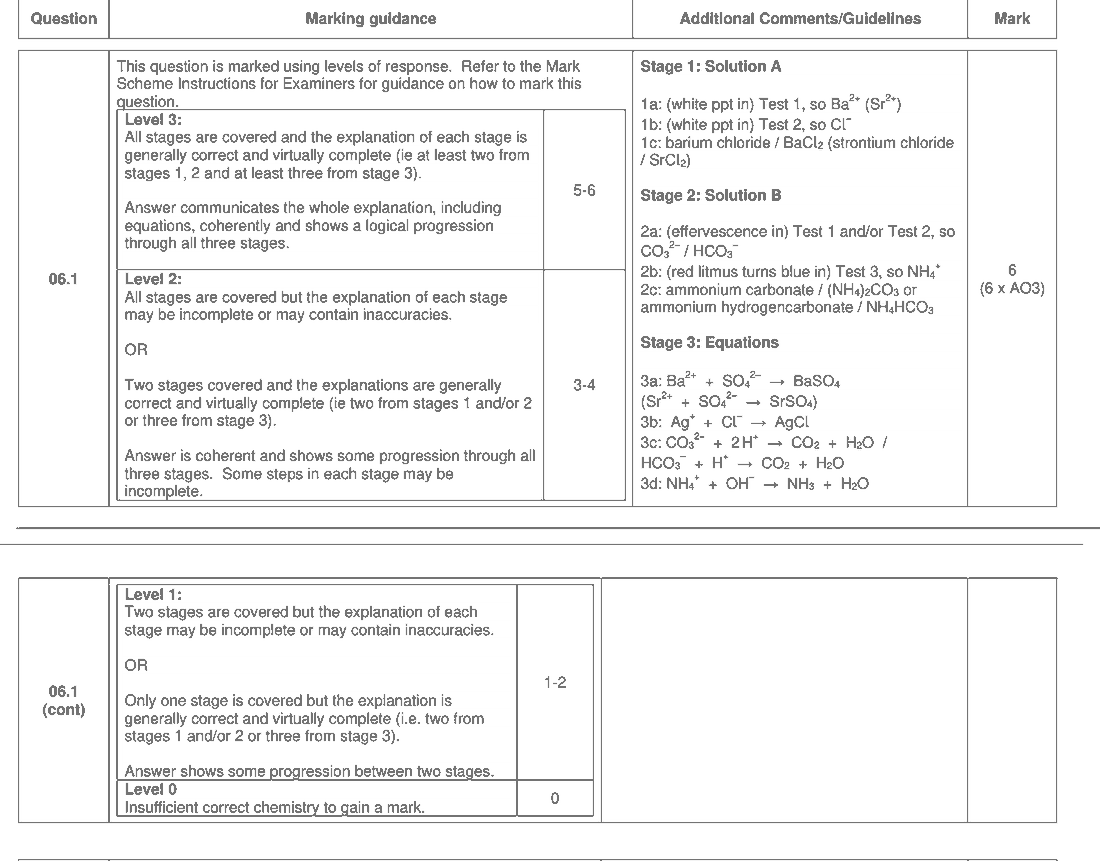
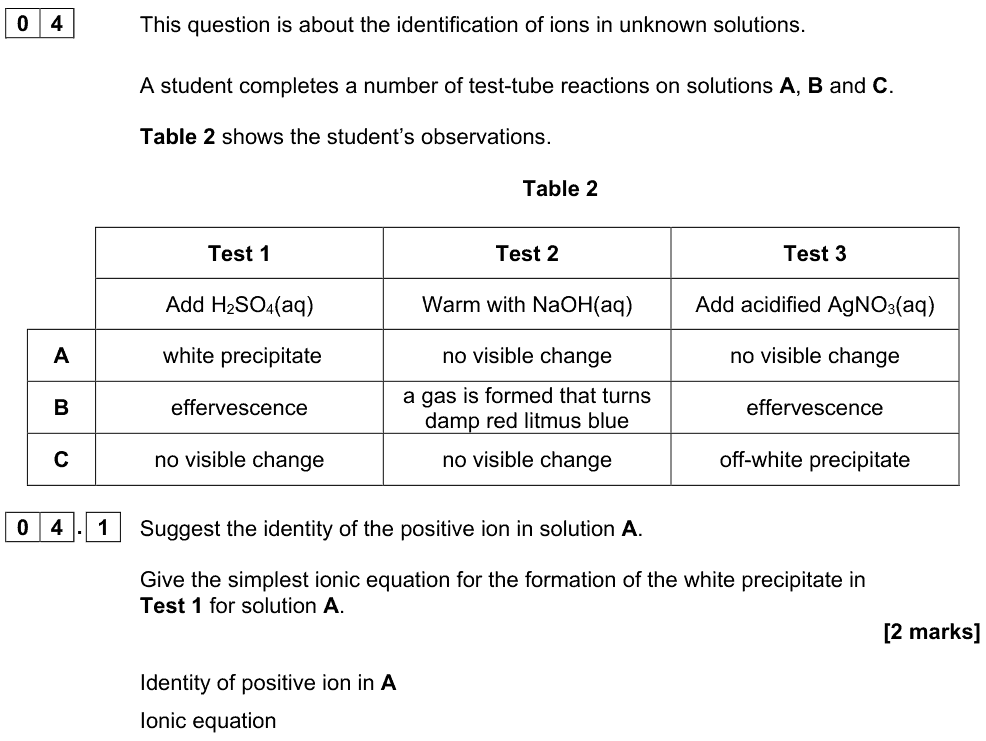
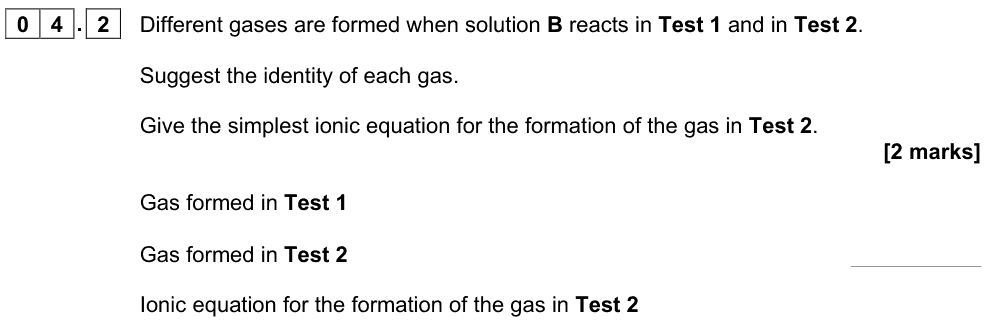
A student completes a series of test-tube reactions on two solutions, A and B.
Each solution contains an unknown inorganic compound.
Table 4 shows the observations in these reactions.
Table 4
Solution A
Solution B
Test 1
Add H2SO4(aq)
White precipitate
formed
Effervescence
Test 2
Add HNO3(aq) followed by AgNO3(aq)
White precipitate
formed
Effervescence
Test 3
Add NaOH(aq) and warm gently.
Hold a piece of damp red litmus paper
over the end of the test tube.
No visible change
Red litmus turns
blue
Show how the observations can be used to identify the inorganic compound in
Solution A and the inorganic compound in Solution B.
Give ionic equations for the reactions that occur.
[6 marks]
June 2025 · AS Paper 1 · Q06.2 1 mark AO3=1 Practical and data analysis Hard group 7 the halogens
Earlier part of question 06 that this part usesEarlier part of June 2025 Paper 1 question 06
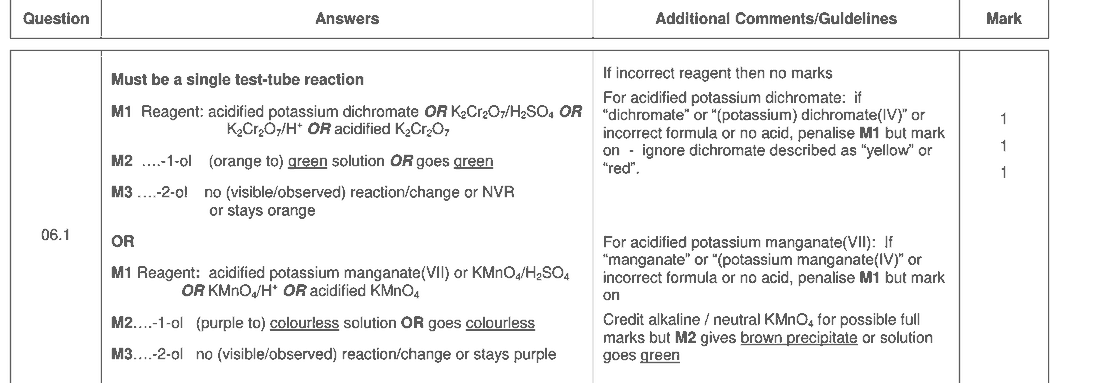
Describe a test to confirm that a solution contains hydroxide ions.
[1 mark]
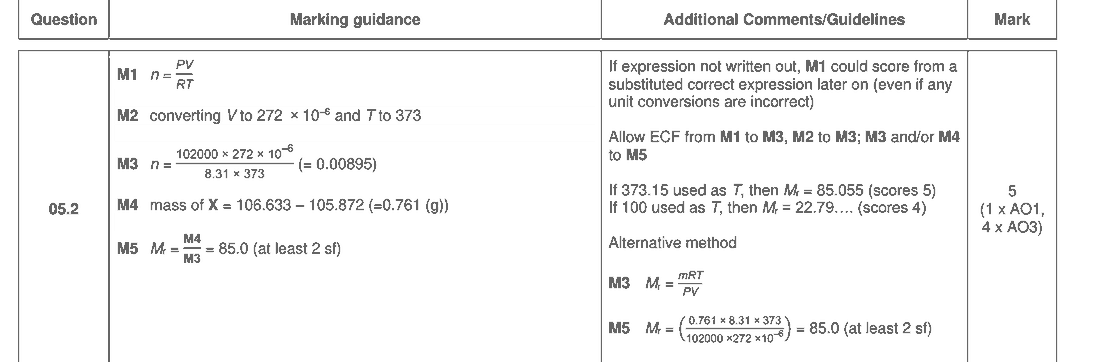
June 2025 · AS Paper 2 · Q05.2 5 marks AO1=1, AO3=4 Calculation amount of substance
Earlier part of question 05 that this part usesEarlier part of June 2025 Paper 2 question 05
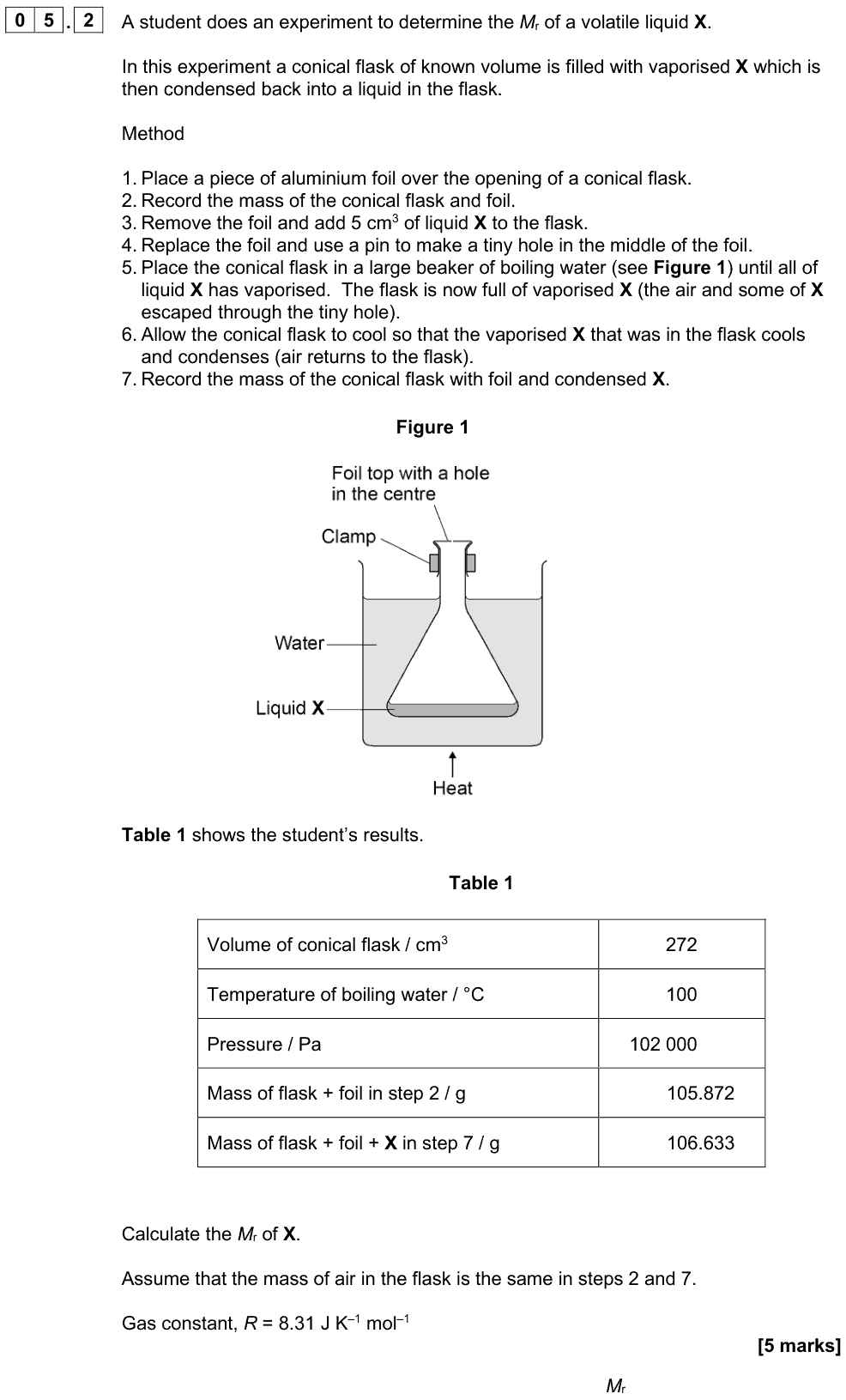
A student does an experiment to determine the Mr of a volatile liquid X.
In this experiment a conical flask of known volume is filled with vaporised X which is
then condensed back into a liquid in the flask.
Method
1. Place a piece of aluminium foil over the opening of a conical flask.
2. Record the mass of the conical flask and foil.
3. Remove the foil and add 5 cm3 of liquid X to the flask.
4. Replace the foil and use a pin to make a tiny hole in the middle of the foil.
5. Place the conical flask in a large beaker of boiling water (see Figure 1) until all of
liquid X has vaporised.  The flask is now full of vaporised X (the air and some of X
escaped through the tiny hole).
6. Allow the conical flask to cool so that the vaporised X that was in the flask cools
and condenses (air returns to the flask).
7. Record the mass of the conical flask with foil and condensed X.
Figure 1
Table 1 shows the student’s results.
Table 1
Volume of conical flask / cm3
272
Temperature of boiling water / °C
100
Pressure / Pa
102 000
Mass of flask + foil in step 2 / g
105.872
Mass of flask + foil + X in step 7 / g
106.633
Calculate the Mr of X.
Assume that the mass of air in the flask is the same in steps 2 and 7.
Gas constant, R = 8.31 J K–1 mol–1
[5 marks]
Mr
June 2025 · AS Paper 2 · Q06.4 2 marks AO1=2 Practical and data analysis alcohols
Earlier part of question 06 that this part usesEarlier part of June 2025 Paper 2 question 06
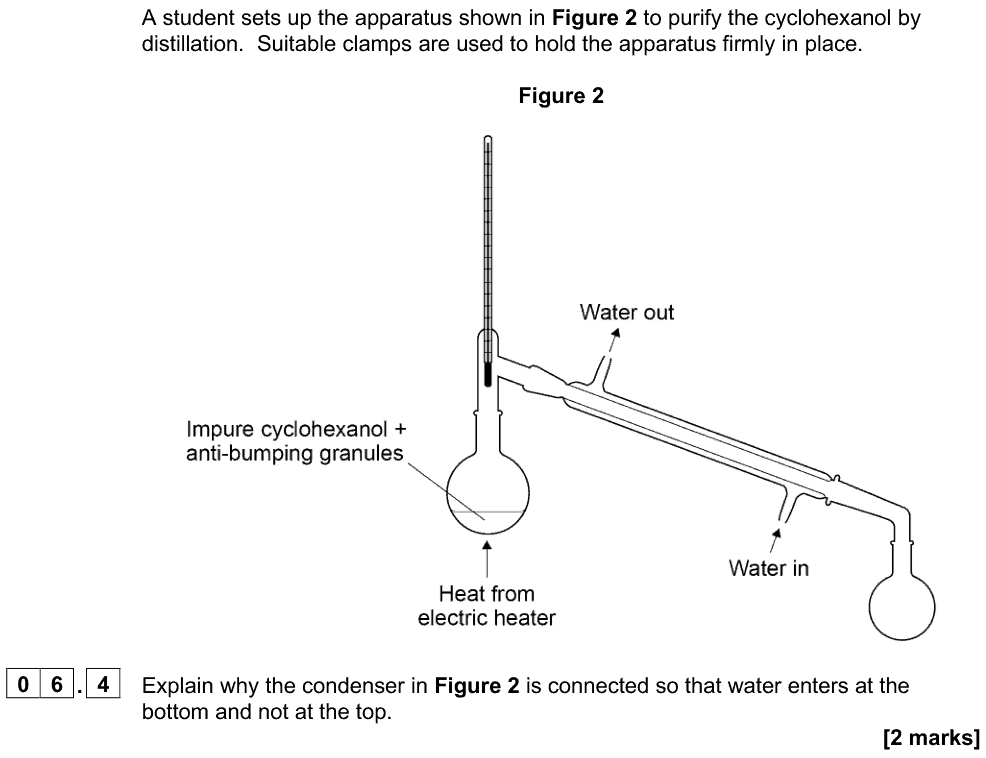
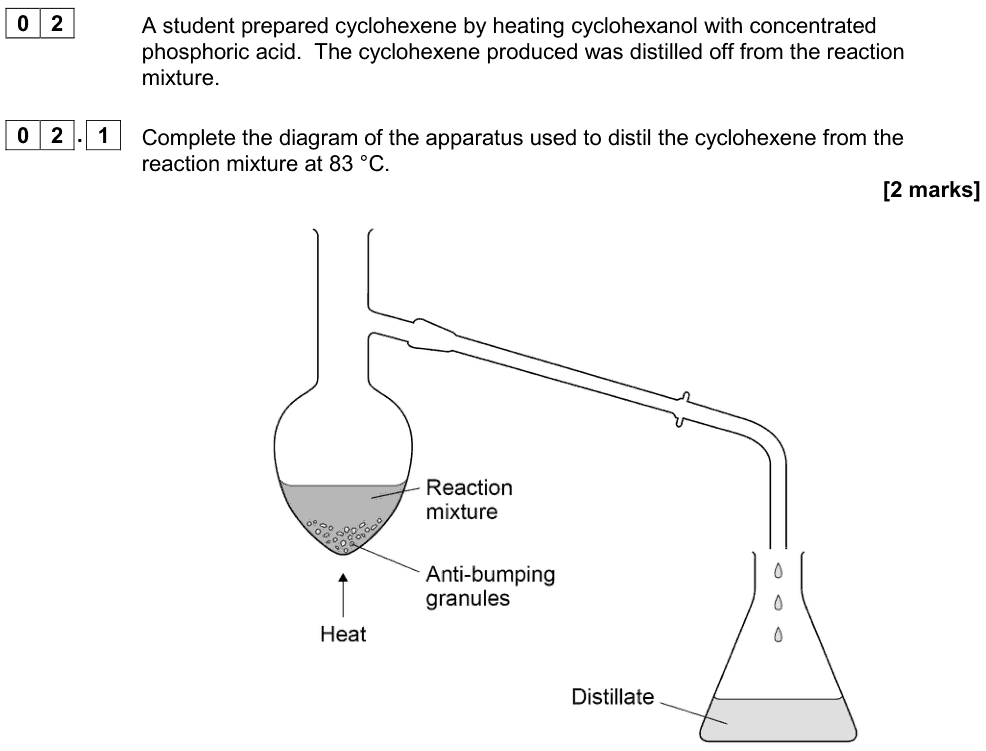
A student sets up the apparatus shown in Figure 2 to purify the cyclohexanol by
distillation.  Suitable clamps are used to hold the apparatus firmly in place.
Figure 2
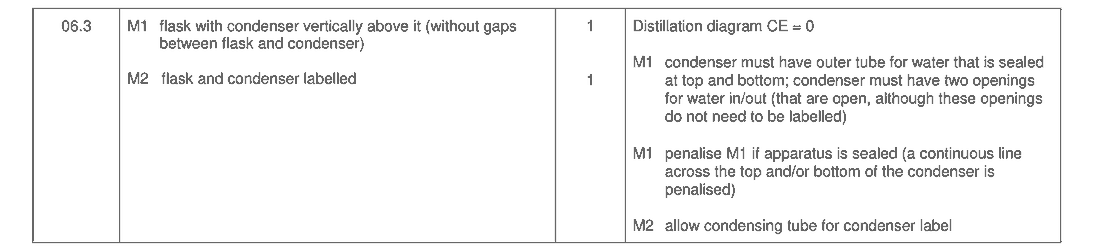
Explain why the condenser in Figure 2 is connected so that water enters at the
bottom and not at the top.
[2 marks]
June 2025 · AS Paper 2 · Q06.5 1 mark AO1=1 Practical and data analysis alcohols
Earlier parts of question 06 that this part usesEarlier part of June 2025 Paper 2 question 06Earlier part of June 2025 Paper 2 question 06
The flask heated in Figure 2 contains anti-bumping granules.
State why these are used.
[1 mark]
June 2025 · AS Paper 2 · Q06.6 1 mark AO3=1 Practical and data analysis alcohols
Earlier parts of question 06 that this part usesEarlier part of June 2025 Paper 2 question 06Earlier part of June 2025 Paper 2 question 06
Suggest why the flask in Figure 2 is heated with an electric heater, rather than a
Bunsen burner.
[1 mark]
June 2025 · AS Paper 2 · Q06.7 2 marks AO3=2 Practical and data analysis alcohols
Earlier parts of question 06 that this part usesEarlier part of June 2025 Paper 2 question 06Earlier part of June 2025 Paper 2 question 06
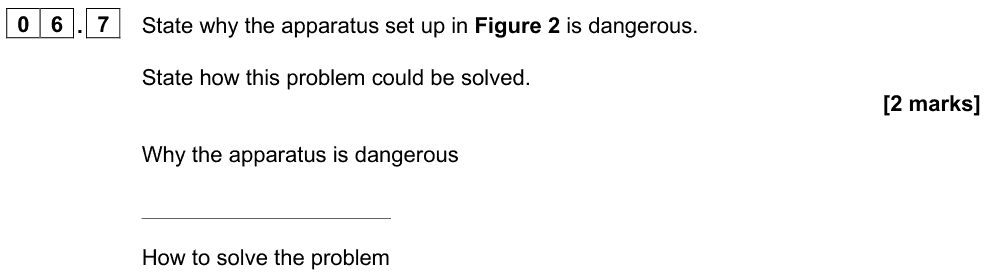
State why the apparatus set up in Figure 2 is dangerous.
State how this problem could be solved.
[2 marks]
Why the apparatus is dangerous
How to solve the problem
June 2025 · Paper 1 · Q01.4 2 marks AO3=2 Equation writing group 2amount of substance
Earlier part of question 01 that this part usesEarlier part of June 2025 Paper 1 question 01
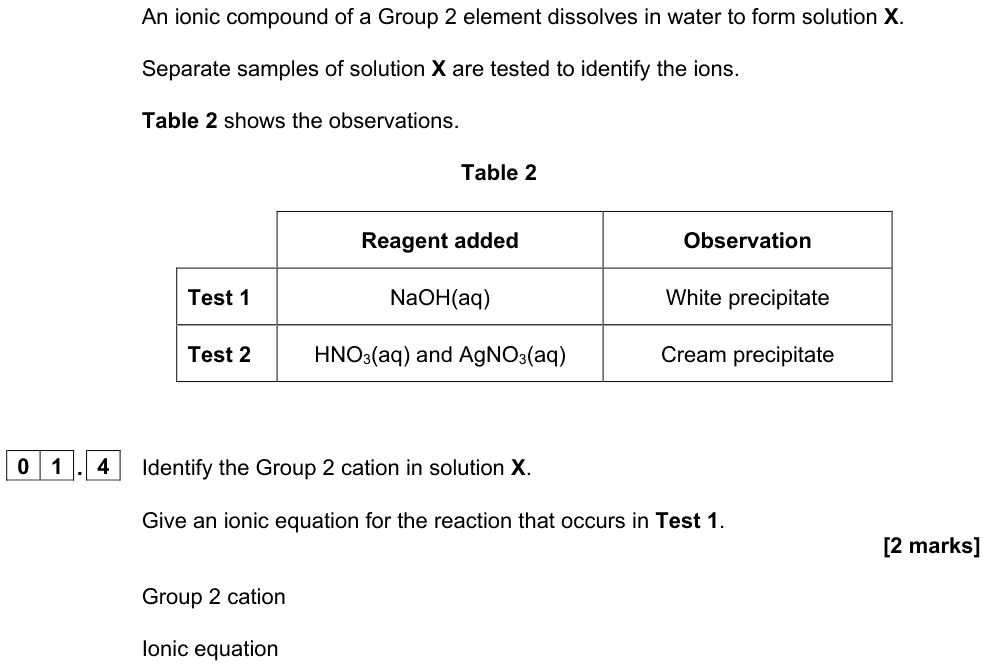
An ionic compound of a Group 2 element dissolves in water to form solution X.
Separate samples of solution X are tested to identify the ions.
Table 2 shows the observations.
Table 2
Reagent added
Observation
Test 1
NaOH(aq)
White precipitate
Test 2
HNO3(aq) and AgNO3(aq)
Cream precipitate
Identify the Group 2 cation in solution X.
Give an ionic equation for the reaction that occurs in Test 1.
[2 marks]
Group 2 cation
Ionic equation
June 2025 · Paper 1 · Q01.5 3 marks AO2=1, AO3=2 Equation writing group 7 the halogensamount of substance
Earlier parts of question 01 that this part usesEarlier part of June 2025 Paper 1 question 01Earlier part of June 2025 Paper 1 question 01
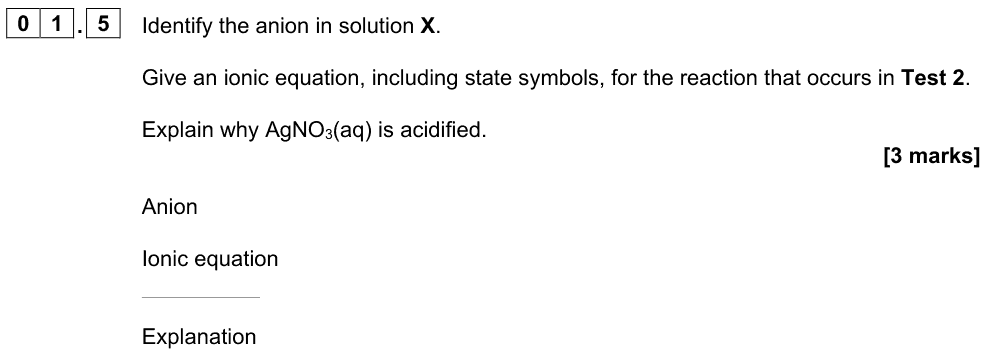
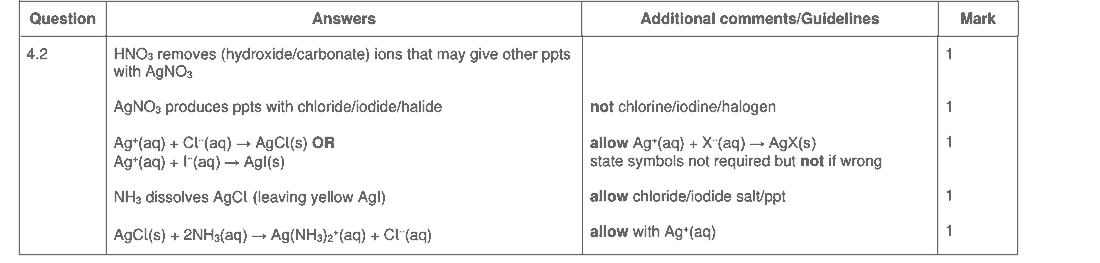
Identify the anion in solution X.
Give an ionic equation, including state symbols, for the reaction that occurs in Test 2.
Explain why AgNO3(aq) is acidified.
[3 marks]
Anion
Ionic equation
Explanation
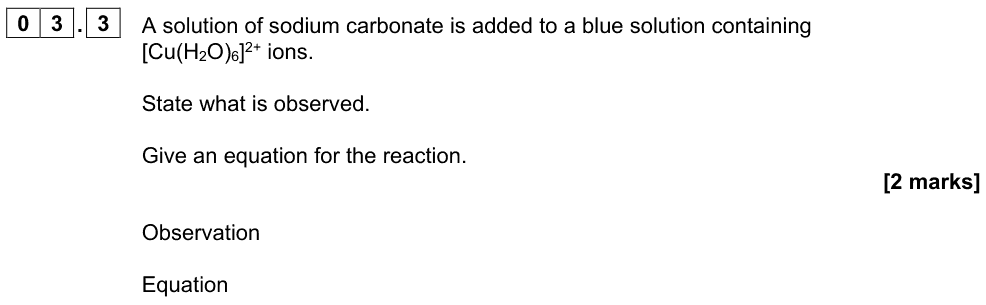
June 2025 · Paper 1 · Q03.3 2 marks AO1=1, AO2=1 Equation writing reactions of ions in aqueous solution
Earlier part of question 03 that this part usesEarlier part of June 2025 Paper 1 question 03
A solution of sodium carbonate is added to a blue solution containing
[Cu(H2O)6]2+ ions.
State what is observed.
Give an equation for the reaction.
[2 marks]
Observation
Equation
June 2025 · Paper 1 · Q03.5 2 marks AO1=1, AO2=1 Equation writing Hard transition metals
Earlier part of question 03 that this part usesEarlier part of June 2025 Paper 1 question 03
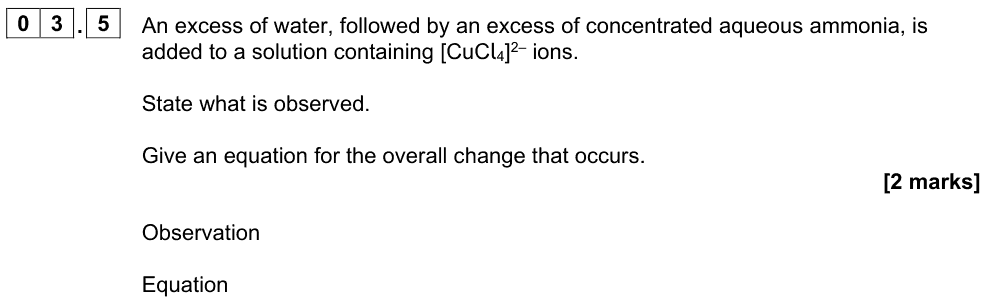
An excess of water, followed by an excess of concentrated aqueous ammonia, is
added to a solution containing [CuCl4]2– ions.
State what is observed.
Give an equation for the overall change that occurs.
[2 marks]
Observation
Equation
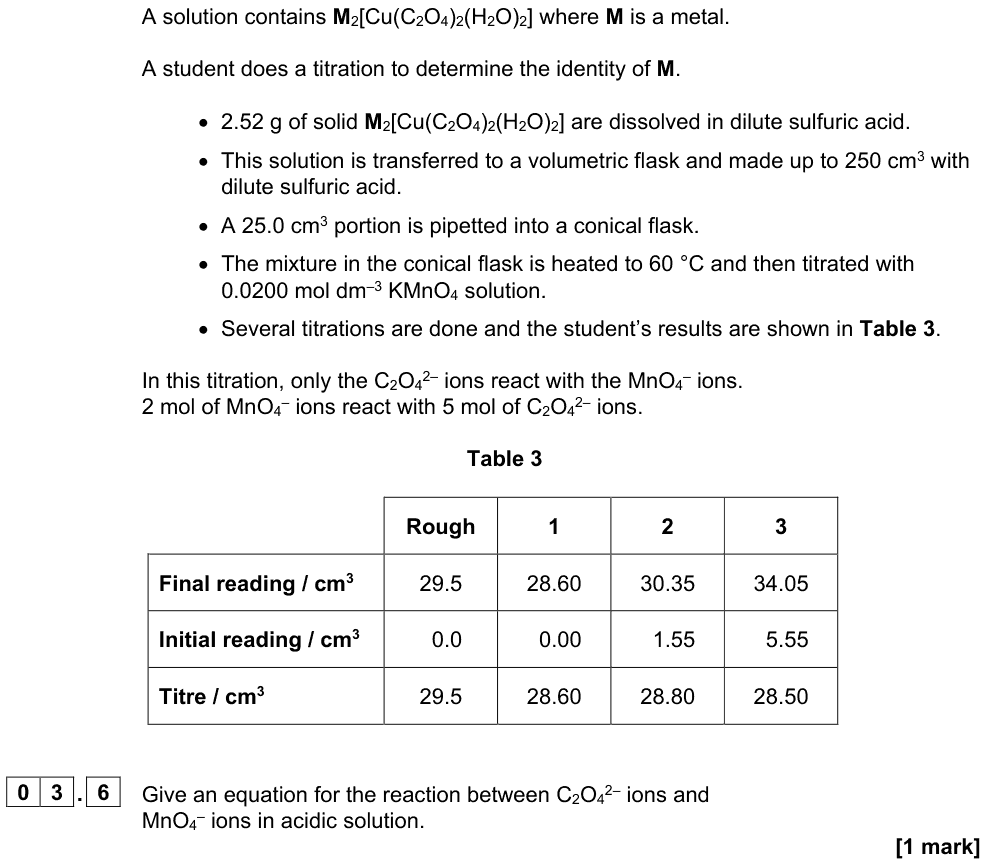
June 2025 · Paper 1 · Q03.7 1 mark AO2=1 Calculation transition metals
Earlier parts of question 03 that this part usesEarlier part of June 2025 Paper 1 question 03Earlier part of June 2025 Paper 1 question 03
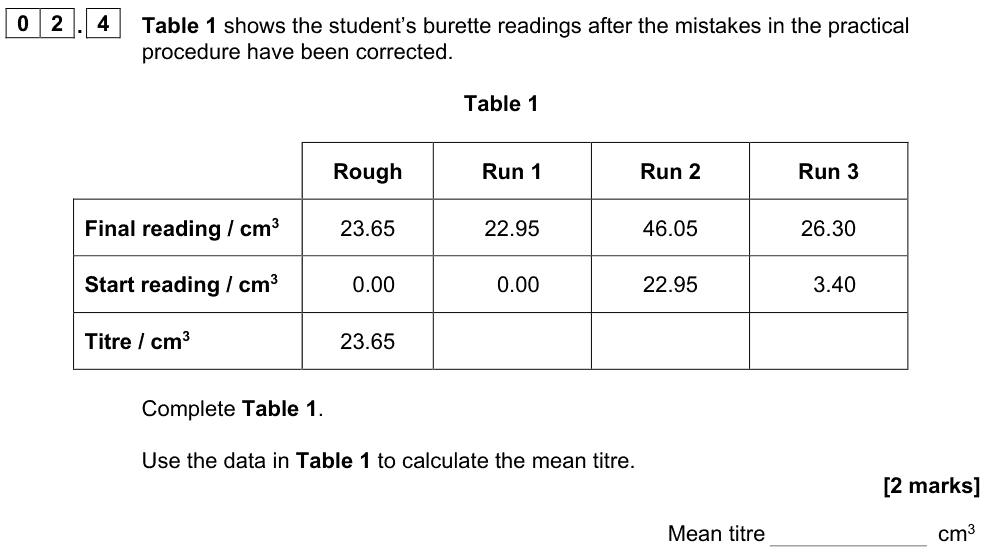
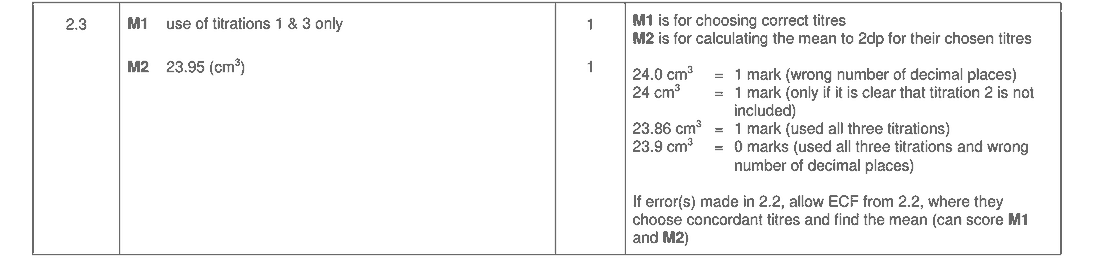
Calculate the mean titre from the student’s results.
[1 mark]
cm3
June 2025 · Paper 1 · Q08.3 1 mark AO2=1 Short answer acids and bases
Earlier part of question 08 that this part usesEarlier part of June 2025 Paper 1 question 08
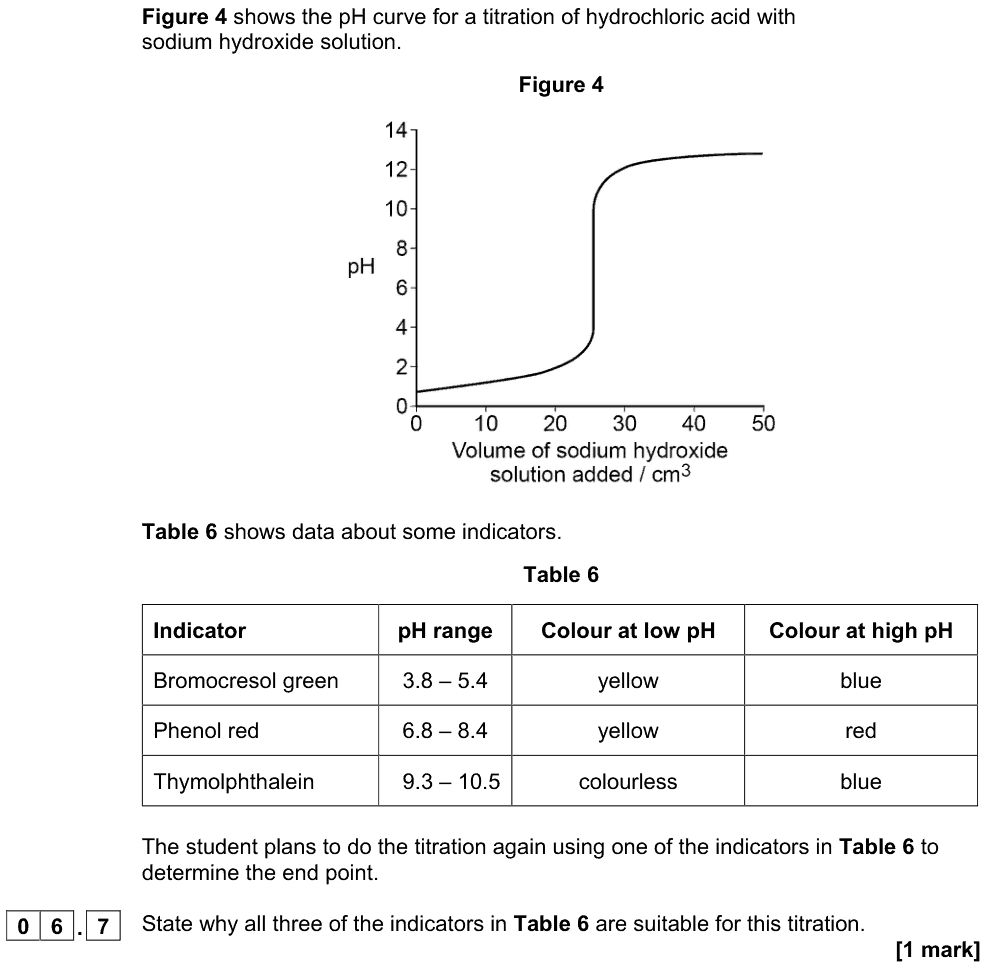
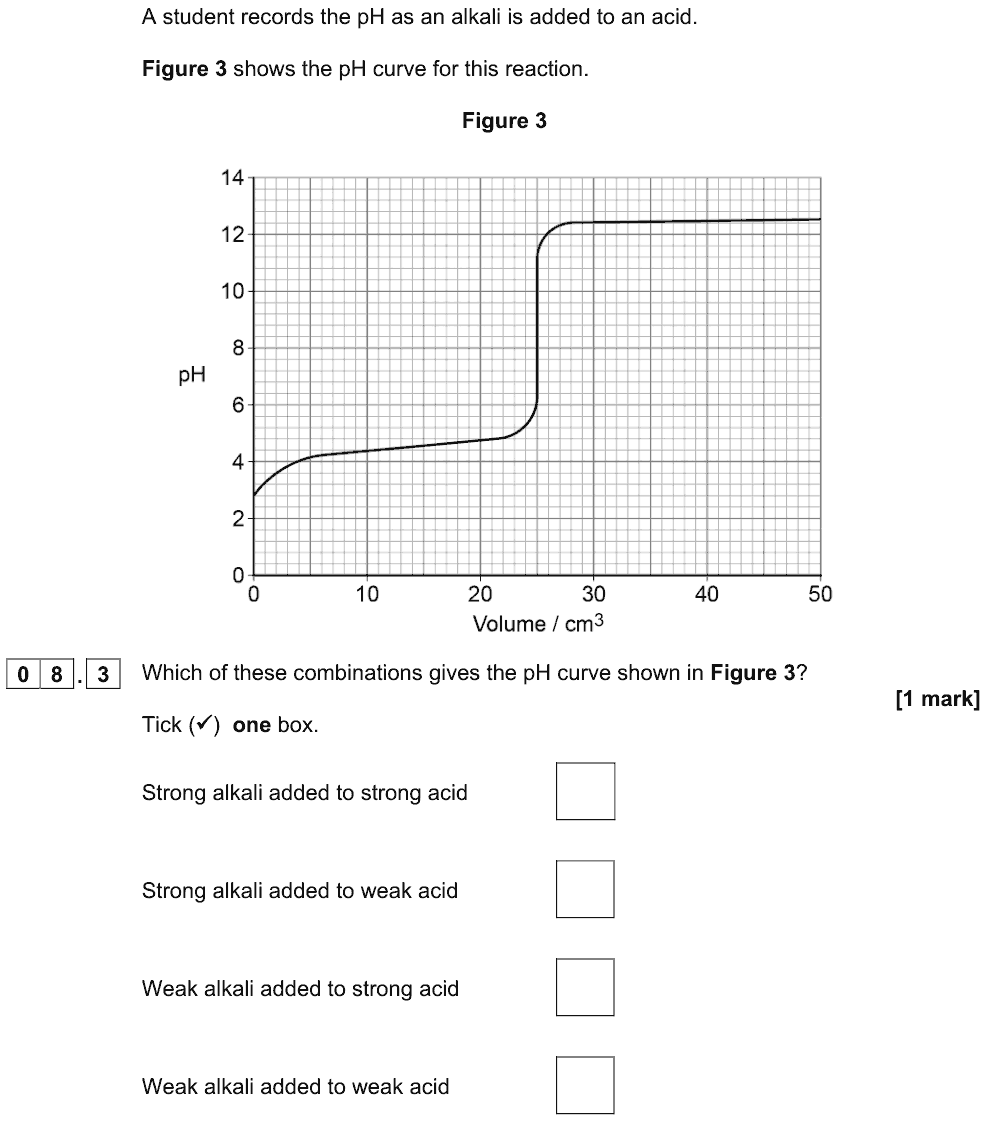
A student records the pH as an alkali is added to an acid.
Figure 3 shows the pH curve for this reaction.
Figure 3
Which of these combinations gives the pH curve shown in Figure 3?
[1 mark]
Tick ( )  one box.
Strong alkali added to strong acid
Strong alkali added to weak acid
Weak alkali added to strong acid
Weak alkali added to weak acid
June 2025 · Paper 1 · Q08.4 1 mark AO3=1 Short answer acids and bases
Earlier parts of question 08 that this part usesEarlier part of June 2025 Paper 1 question 08Earlier part of June 2025 Paper 1 question 08
Different indicators change colour across different pH ranges.
Tick ( ) the box of each indicator that would change colour at the equivalence point in
Figure 3.
[1 mark]
Name of indicator
pH range
Methyl orange
3.2–4.4
Bromocresol green
3.8–5.4
Cresol red
7.2–8.8
Naphtholphthalein
7.3–8.7
Cresolphthalein
8.2–9.8
Indigo carmine
11.5–14.0
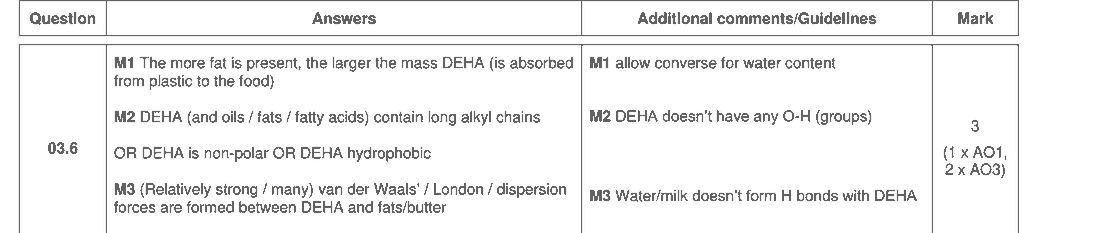
June 2025 · Paper 2 · Q03.6 3 marks AO1=1, AO3=2 Explanation bonding
Earlier part of question 03 that this part usesEarlier part of June 2025 Paper 2 question 03
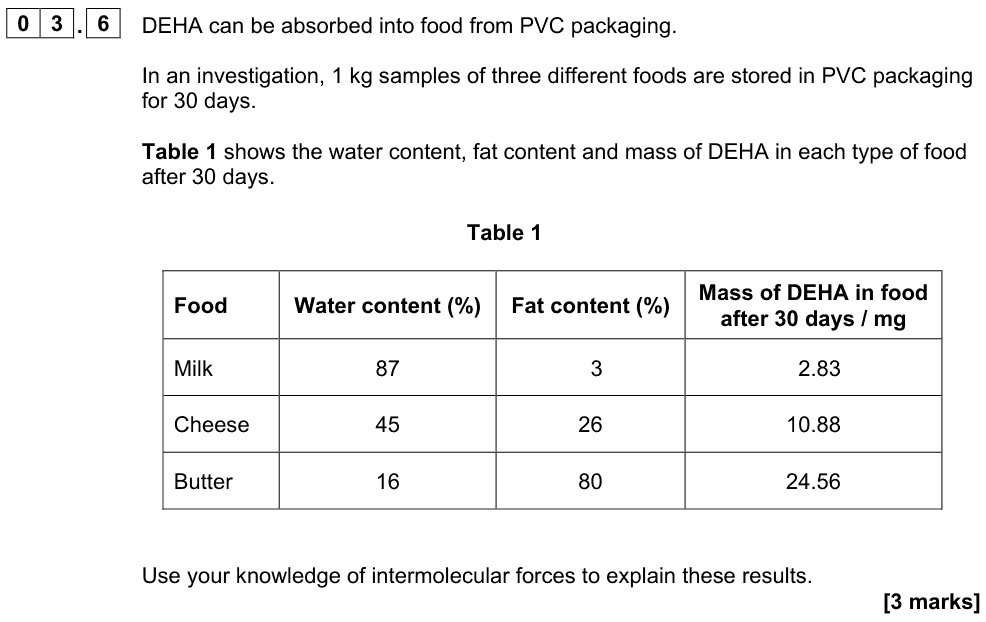
DEHA can be absorbed into food from PVC packaging.
In an investigation, 1 kg samples of three different foods are stored in PVC packaging
for 30 days.
Table 1 shows the water content, fat content and mass of DEHA in each type of food
after 30 days.
Table 1
Food
Water content (%)
Fat content (%)
Mass of DEHA in food
after 30 days / mg
Milk
87
3
2.83
Cheese
45
26
10.88
Butter
16
80
24.56
Use your knowledge of intermolecular forces to explain these results.
[3 marks]
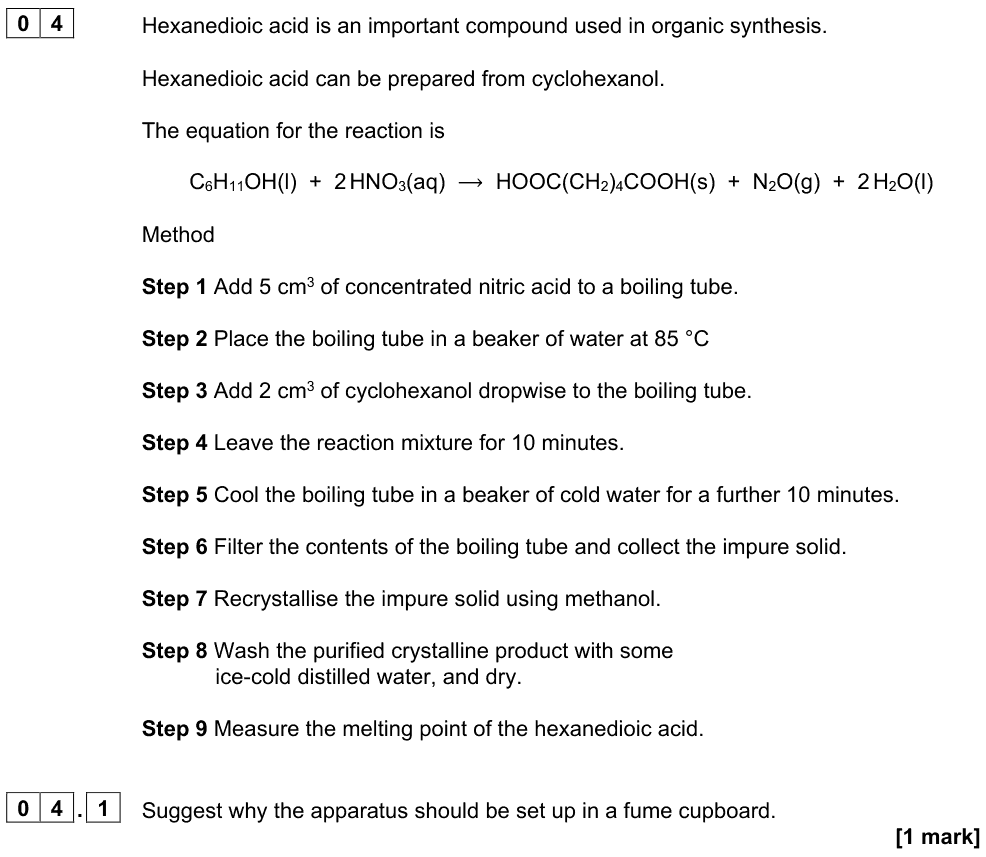
June 2025 · Paper 2 · Q04.1 1 mark AO3=1 Practical and data analysis carboxylic acids and derivatives
Hexanedioic acid is an important compound used in organic synthesis.
Hexanedioic acid can be prepared from cyclohexanol.
The equation for the reaction is
C6H11OH(l)  +  2 HNO3(aq)  ⟶  HOOC(CH2)4COOH(s)  +  N2O(g)  +  2 H2O(l)
Method
Step 1 Add 5 cm3 of concentrated nitric acid to a boiling tube.
Step 2 Place the boiling tube in a beaker of water at 85 °C
Step 3 Add 2 cm3 of cyclohexanol dropwise to the boiling tube.
Step 4 Leave the reaction mixture for 10 minutes.
Step 5 Cool the boiling tube in a beaker of cold water for a further 10 minutes.
Step 6 Filter the contents of the boiling tube and collect the impure solid.
Step 7 Recrystallise the impure solid using methanol.
Step 8 Wash the purified crystalline product with some
ice-cold distilled water, and dry.
Step 9 Measure the melting point of the hexanedioic acid.
Suggest why the apparatus should be set up in a fume cupboard.
[1 mark]
June 2025 · Paper 2 · Q04.2 1 mark AO2=1 Short answer alcohols
Earlier part of question 04 that this part usesEarlier part of June 2025 Paper 2 question 04
Deduce the role of the concentrated nitric acid in the reaction.
[1 mark]
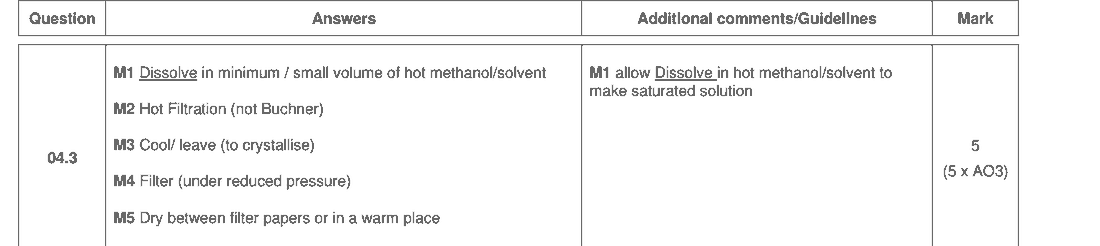
June 2025 · Paper 2 · Q04.3 5 marks AO3=5 Practical and data analysis carboxylic acids and derivatives
Earlier part of question 04 that this part usesEarlier part of June 2025 Paper 2 question 04
Outline how Steps 7 and 8 should be done to obtain the purified crystalline product.
[5 marks]
June 2025 · Paper 2 · Q04.4 1 mark AO2=1 Practical and data analysis carboxylic acids and derivatives
Earlier part of question 04 that this part usesEarlier part of June 2025 Paper 2 question 04
In Step 8, the distilled water must be ice-cold.
Suggest why using water at room temperature lowers the recorded yield of product.
[1 mark]
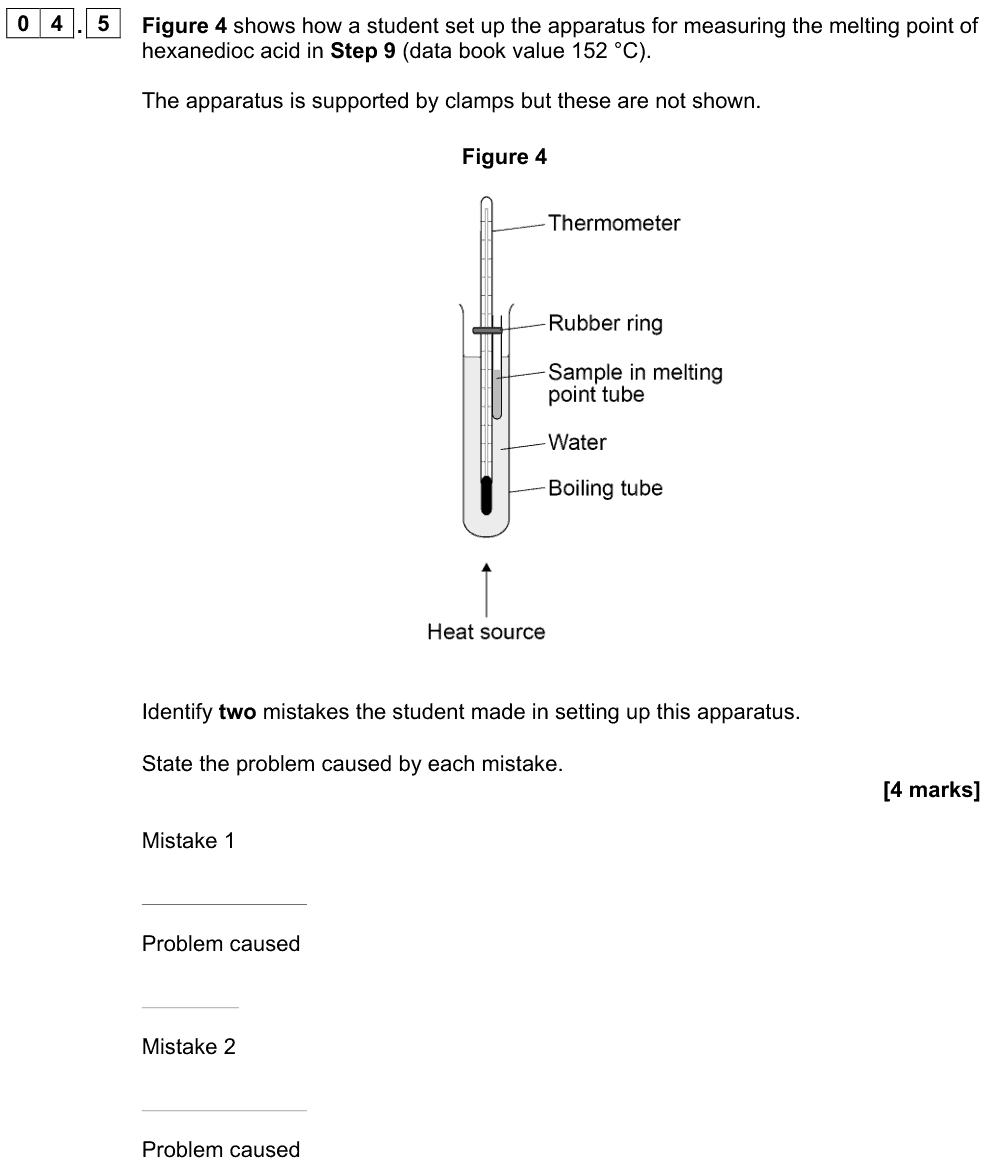
June 2025 · Paper 2 · Q04.5 4 marks AO3=4 Practical and data analysis carboxylic acids and derivatives
Earlier part of question 04 that this part usesEarlier part of June 2025 Paper 2 question 04
Figure 4 shows how a student set up the apparatus for measuring the melting point of
hexanedioc acid in Step 9 (data book value 152 °C).
The apparatus is supported by clamps but these are not shown.
Figure 4
Identify two mistakes the student made in setting up this apparatus.
State the problem caused by each mistake.
[4 marks]
Mistake 1
Problem caused
Mistake 2
Problem caused
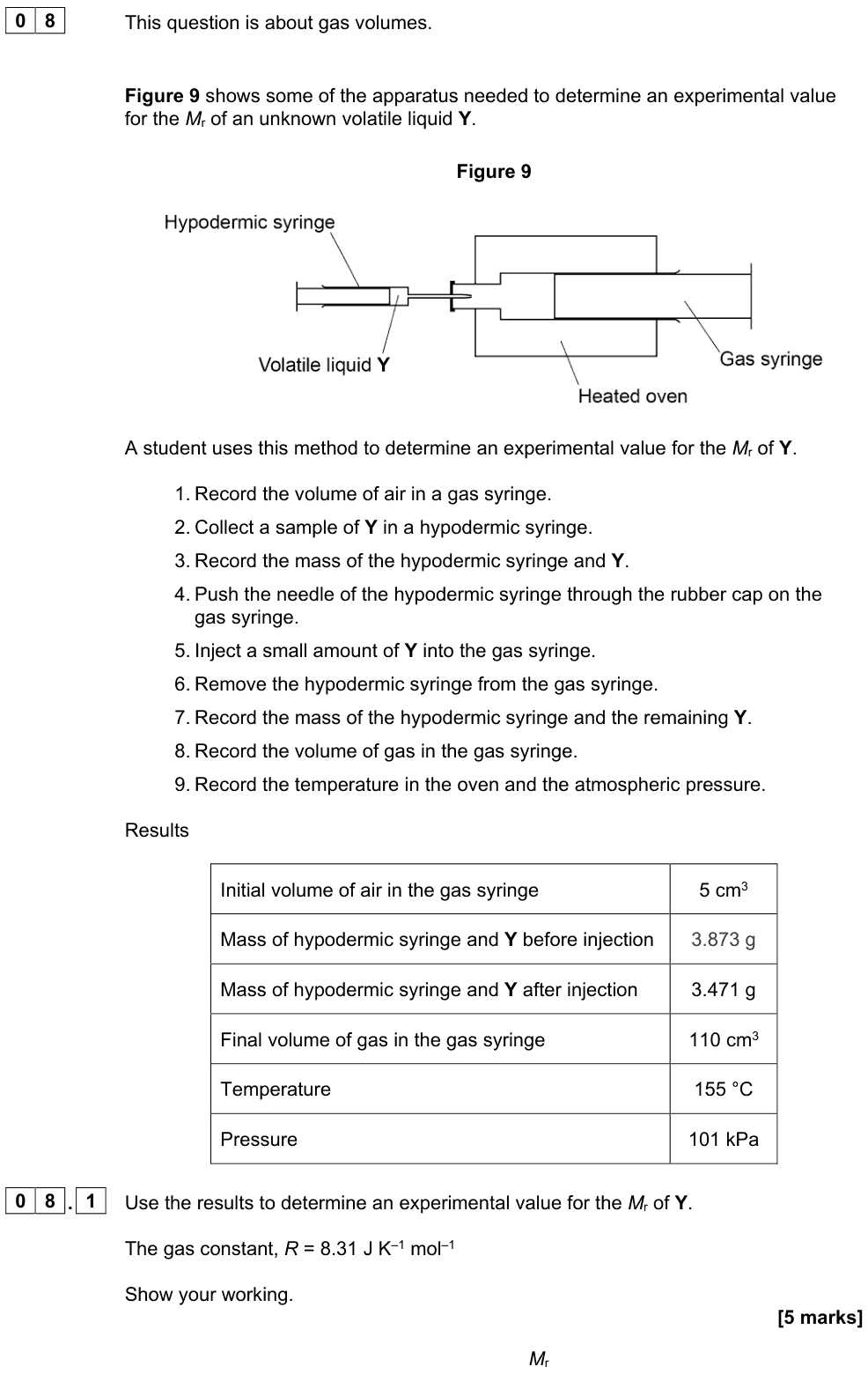
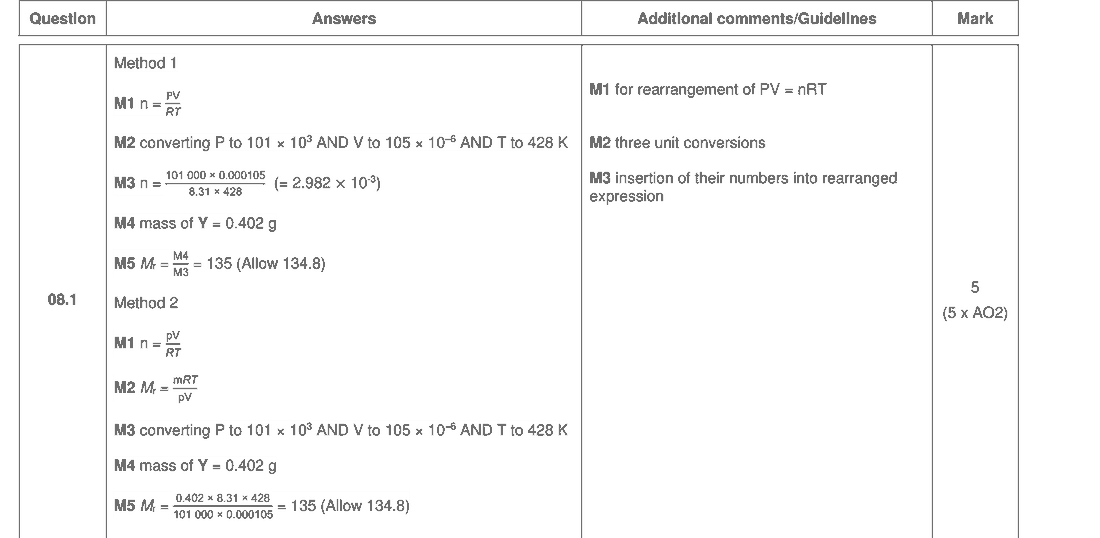
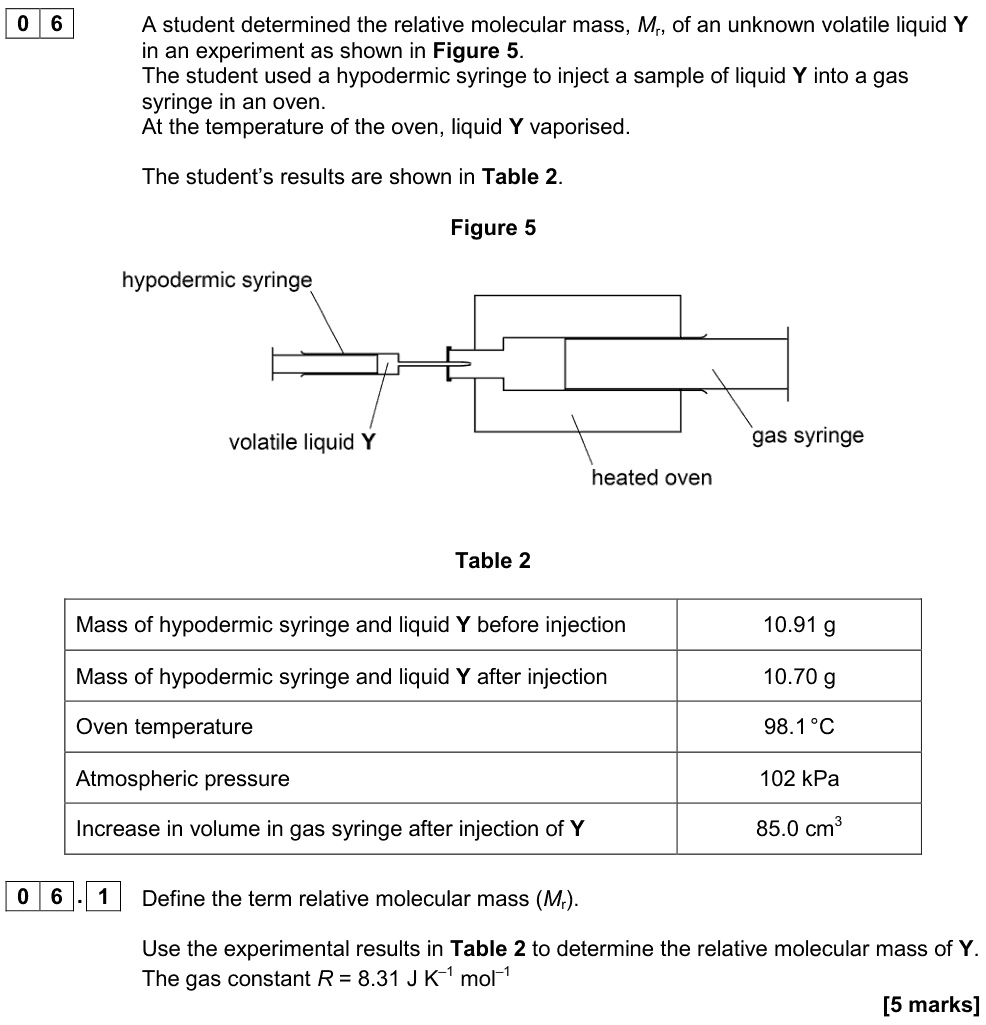
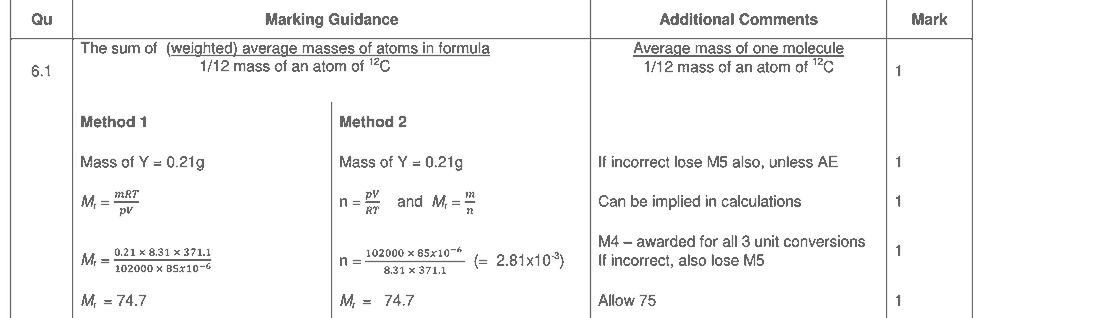
June 2025 · Paper 2 · Q08.1 5 marks AO2=5 Calculation amount of substance
This question is about gas volumes.
Figure 9 shows some of the apparatus needed to determine an experimental value
for the Mr of an unknown volatile liquid Y.
Figure 9
A student uses this method to determine an experimental value for the Mr of Y.
1. Record the volume of air in a gas syringe.
2. Collect a sample of Y in a hypodermic syringe.
3. Record the mass of the hypodermic syringe and Y.
4. Push the needle of the hypodermic syringe through the rubber cap on the
gas syringe.
5. Inject a small amount of Y into the gas syringe.
6. Remove the hypodermic syringe from the gas syringe.
7. Record the mass of the hypodermic syringe and the remaining Y.
8. Record the volume of gas in the gas syringe.
9. Record the temperature in the oven and the atmospheric pressure.
Results
Initial volume of air in the gas syringe
5 cm3
Mass of hypodermic syringe and Y before injection
3.873 g
Mass of hypodermic syringe and Y after injection
3.471 g
Final volume of gas in the gas syringe
110 cm3
Temperature
155 °C
Pressure
101 kPa
Use the results to determine an experimental value for the Mr of Y.
The gas constant, R = 8.31 J K–1 mol–1
Show your working.
[5 marks]
Mr
June 2025 · Paper 2 · Q08.2 3 marks AO3=3 Practical and data analysis amount of substance
Earlier part of question 08 that this part usesEarlier part of June 2025 Paper 2 question 08
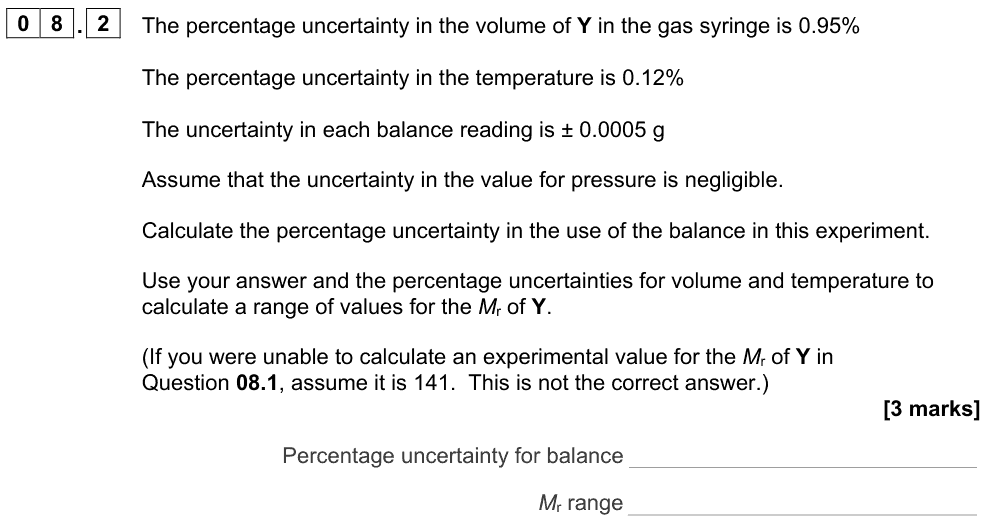
The percentage uncertainty in the volume of Y in the gas syringe is 0.95%
The percentage uncertainty in the temperature is 0.12%
The uncertainty in each balance reading is ± 0.0005 g
Assume that the uncertainty in the value for pressure is negligible.
Calculate the percentage uncertainty in the use of the balance in this experiment.
Use your answer and the percentage uncertainties for volume and temperature to
calculate a range of values for the Mr of Y.
(If you were unable to calculate an experimental value for the Mr of Y in
Question 08.1, assume it is 141.  This is not the correct answer.)
[3 marks]
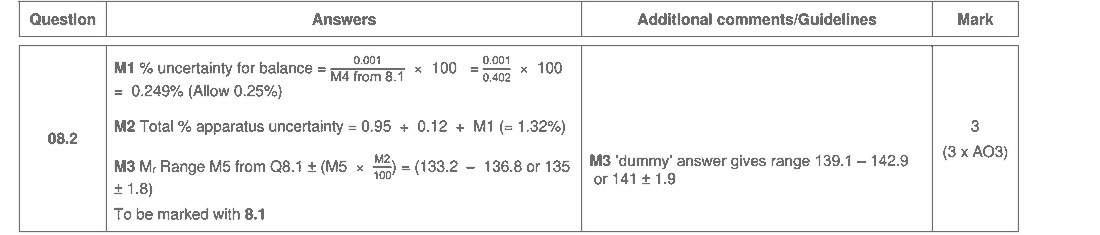
Percentage uncertainty for balance
Mr range
June 2025 · Paper 2 · Q08.3 1 mark AO3=1 Practical and data analysis amount of substance
Earlier part of question 08 that this part usesEarlier part of June 2025 Paper 2 question 08
A teacher suggests placing a seal over the needle of the hypodermic syringe after
collecting the sample of liquid Y, and then replacing the seal after injecting the liquid Y
into the gas syringe.
Give a reason why the teacher’s suggestion will improve the experiment.
[1 mark]
June 2025 · Paper 2 · Q09.1 1 mark AO1=1 Short answer group 7 the halogens
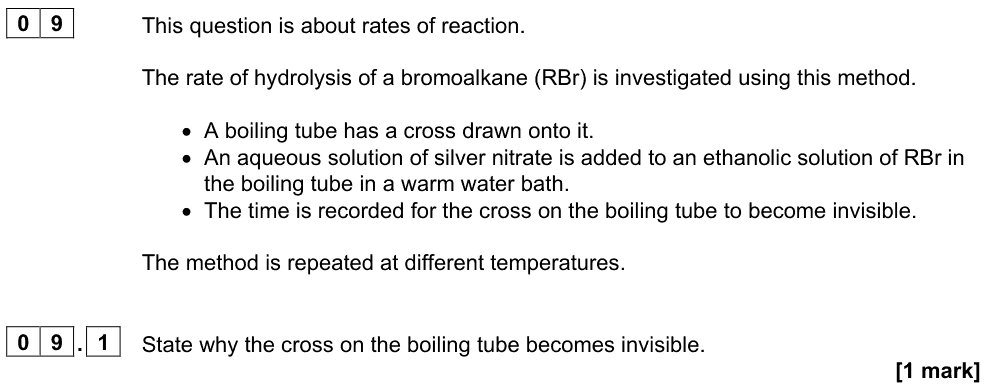
This question is about rates of reaction.
The rate of hydrolysis of a bromoalkane (RBr) is investigated using this method.
• A boiling tube has a cross drawn onto it.
• An aqueous solution of silver nitrate is added to an ethanolic solution of RBr in
the boiling tube in a warm water bath.
• The time is recorded for the cross on the boiling tube to become invisible.
The method is repeated at different temperatures.
State why the cross on the boiling tube becomes invisible.
[1 mark]
June 2025 · Paper 2 · Q09.2 1 mark AO3=1 Practical and data analysis kinetics
Earlier part of question 09 that this part usesEarlier part of June 2025 Paper 2 question 09
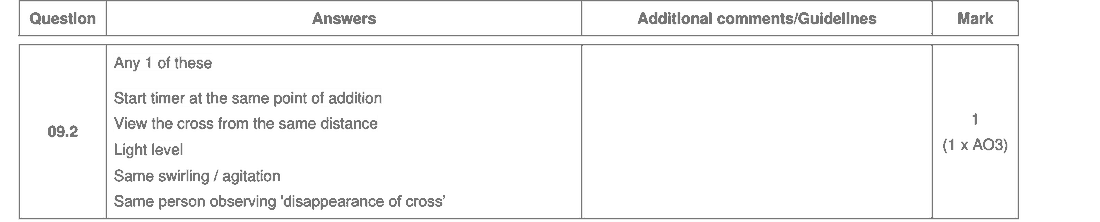
The volume and concentration of each substance used at each temperature is
kept constant.
Identify one other variable that should be kept constant to ensure that the
investigation is fair.
[1 mark]
June 2025 · Paper 2 · Q09.3 1 mark AO1=1 Calculation rate equations
Earlier part of question 09 that this part usesEarlier part of June 2025 Paper 2 question 09
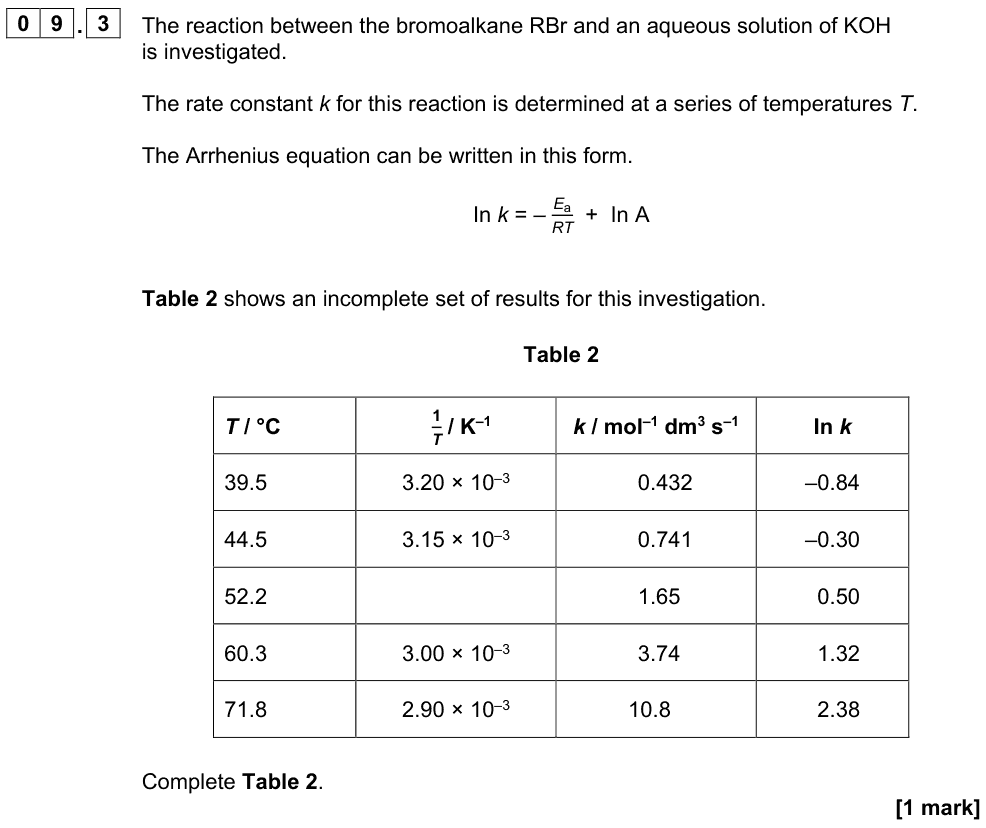
The reaction between the bromoalkane RBr and an aqueous solution of KOH
is investigated.
The rate constant k for this reaction is determined at a series of temperatures T.
The Arrhenius equation can be written in this form.
In k = –
Ea
RT  +  In A
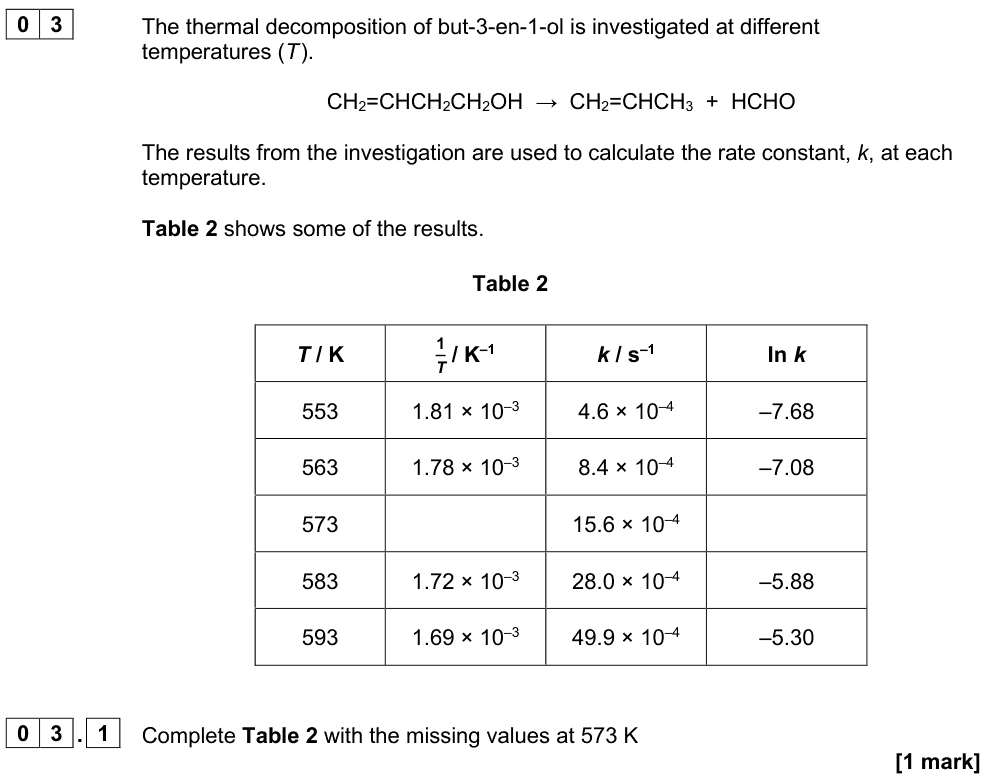
Table 2 shows an incomplete set of results for this investigation.
Table 2
T / °C
1
T / K–1
k / mol–1 dm3 s–1
In k
39.5
3.20 × 10⁻³
0.432
–0.84
44.5
3.15 × 10⁻³
0.741
–0.30
52.2
1.65
0.50
60.3
3.00 × 10⁻³
3.74
1.32
71.8
2.90 × 10⁻³
10.8
2.38
Complete Table 2.
[1 mark]
June 2025 · Paper 2 · Q09.4 5 marks AO2=5 Calculation rate equations
Earlier parts of question 09 that this part usesEarlier part of June 2025 Paper 2 question 09Earlier part of June 2025 Paper 2 question 09
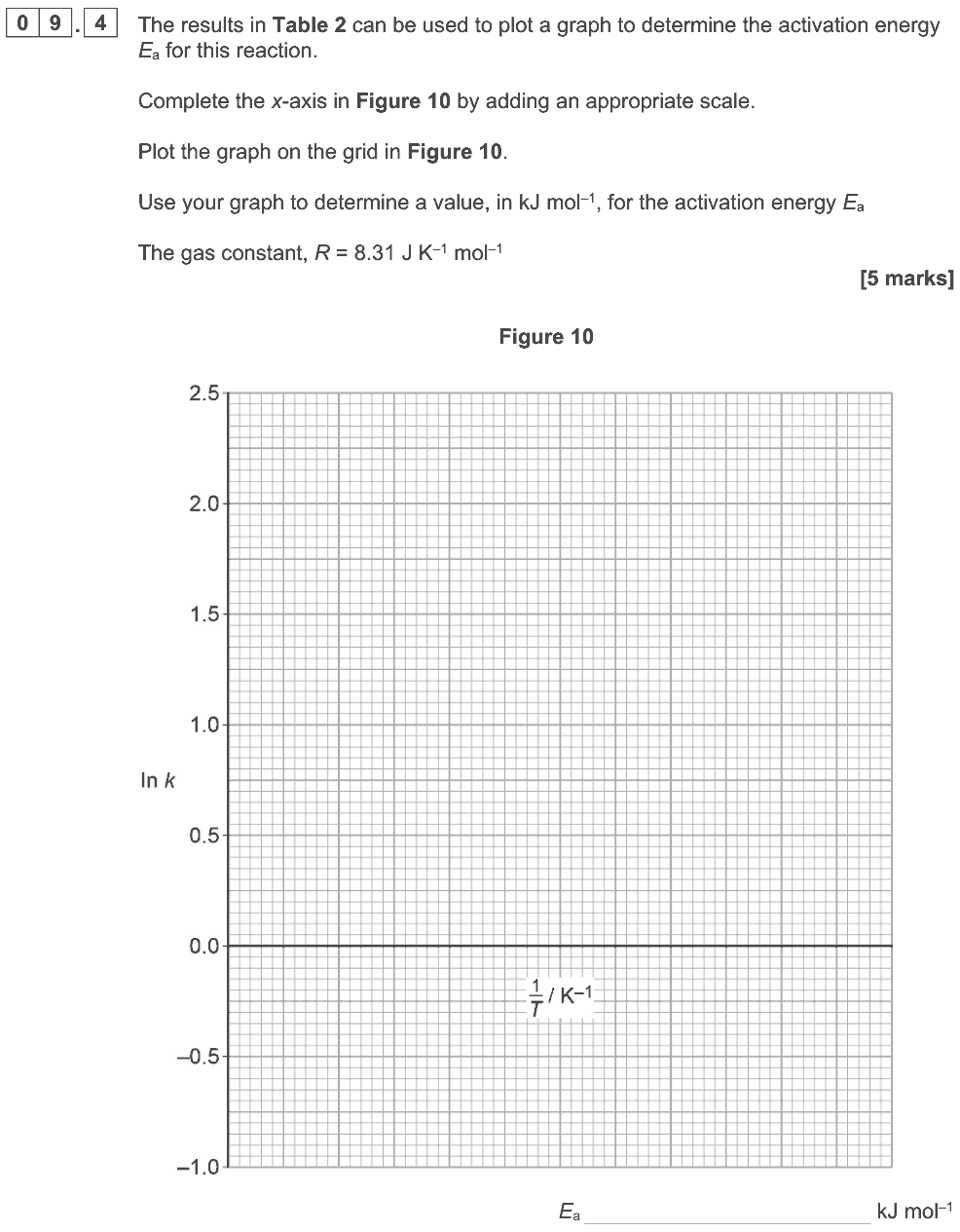
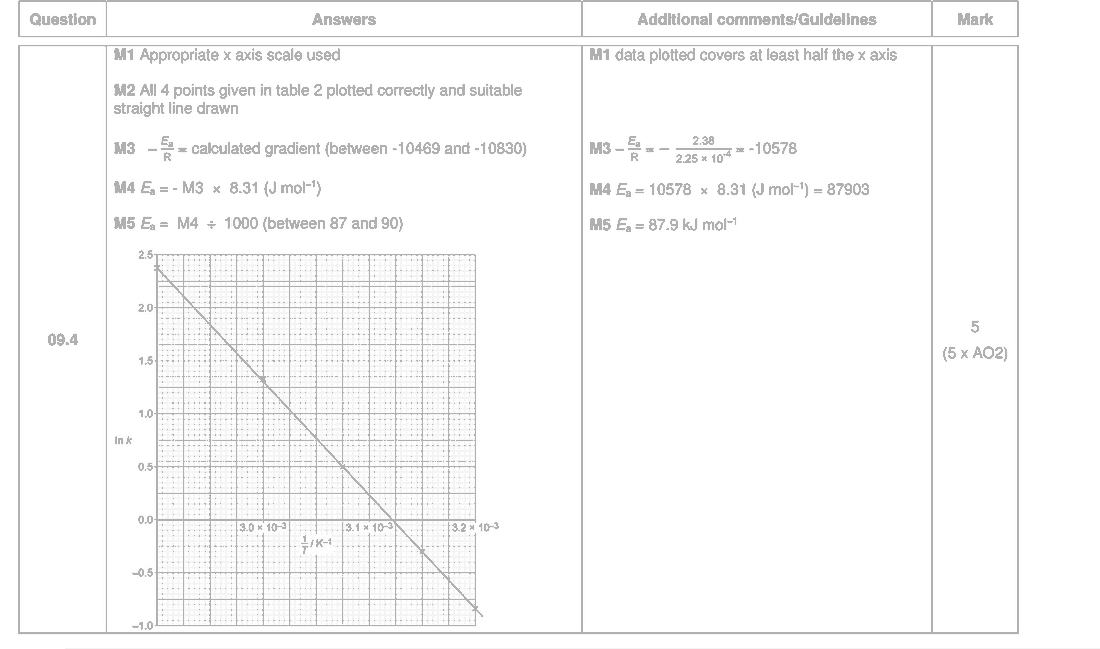
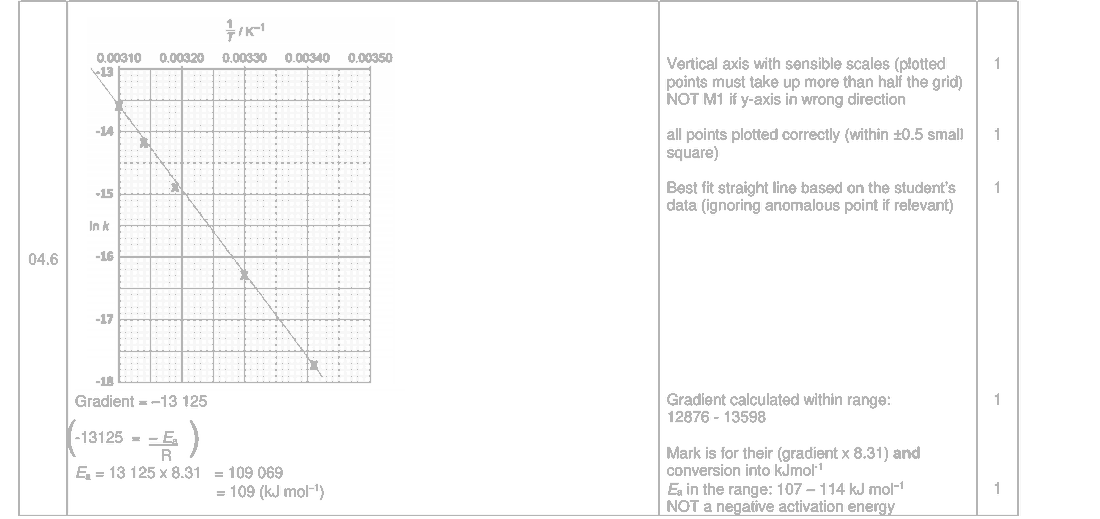
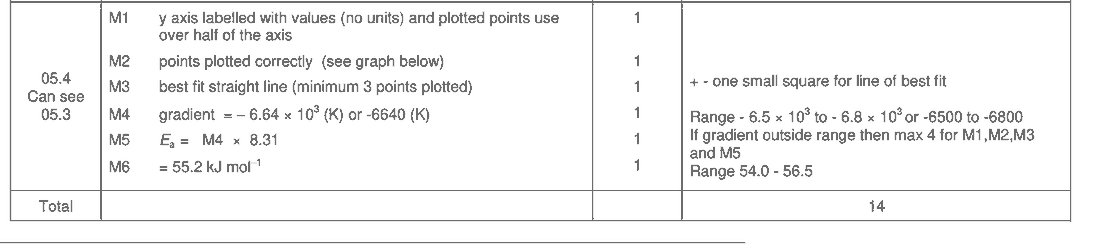
The results in Table 2 can be used to plot a graph to determine the activation energy
Ea for this reaction.
Complete the x-axis in Figure 10 by adding an appropriate scale.
Plot the graph on the grid in Figure 10.
Use your graph to determine a value, in kJ mol–1, for the activation energy Ea
The gas constant, R = 8.31 J K–1 mol–1
[5 marks]
Figure 10
Ea
kJ mol–1
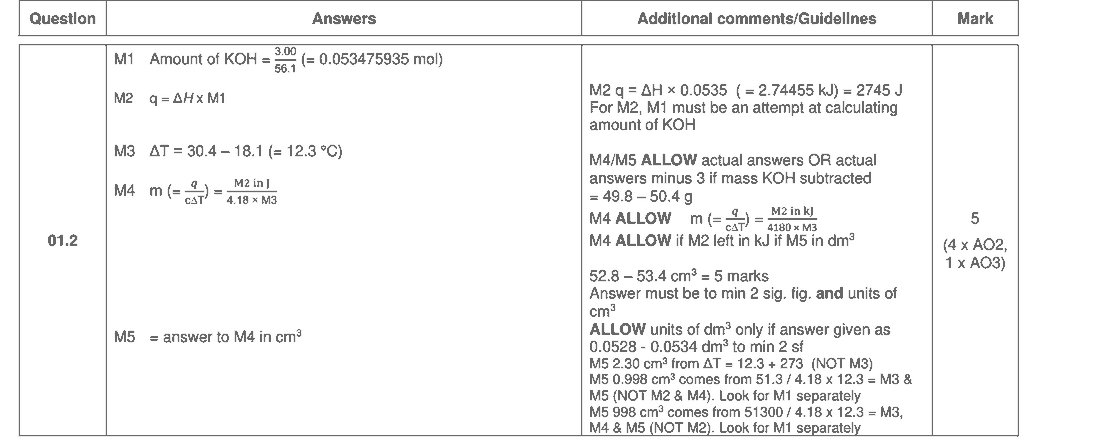
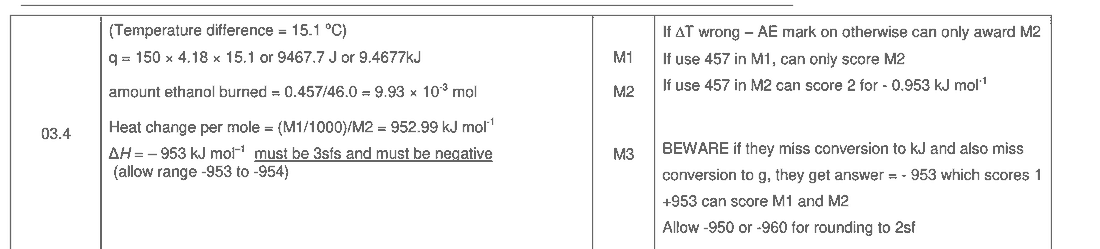
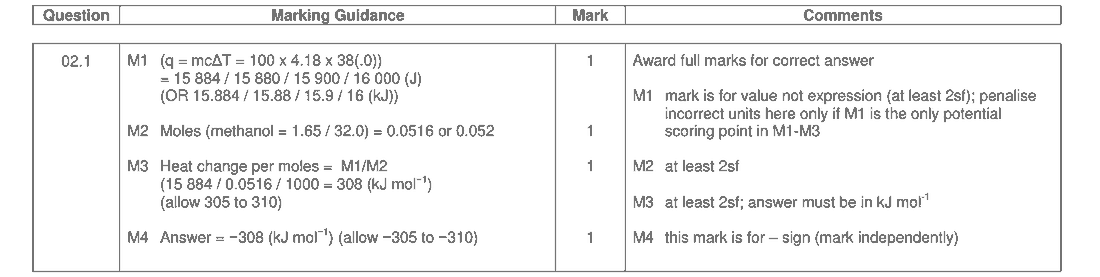
June 2025 · Paper 3 · Q01.2 5 marks AO2=4, AO3=1 Calculation energeticsamount of substance
Earlier part of question 01 that this part usesEarlier part of June 2025 Paper 3 question 01
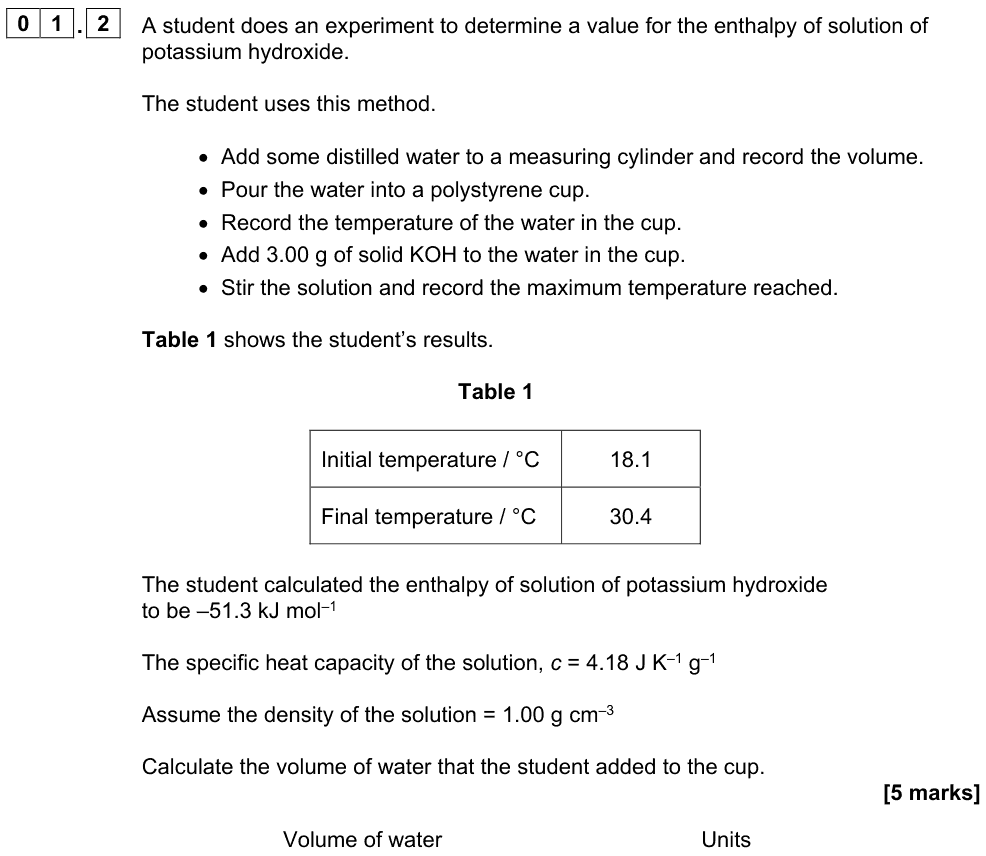
A student does an experiment to determine a value for the enthalpy of solution of
potassium hydroxide.
The student uses this method.
• Add some distilled water to a measuring cylinder and record the volume.
• Pour the water into a polystyrene cup.
• Record the temperature of the water in the cup.
• Add 3.00 g of solid KOH to the water in the cup.
• Stir the solution and record the maximum temperature reached.
Table 1 shows the student’s results.
Table 1
Initial temperature / °C
18.1
Final temperature / °C
30.4
The student calculated the enthalpy of solution of potassium hydroxide
to be –51.3 kJ mol–1
The specific heat capacity of the solution, c = 4.18 J K–1 g–1
Assume the density of the solution = 1.00 g cm–3
Calculate the volume of water that the student added to the cup.
[5 marks]
Volume of water
Units
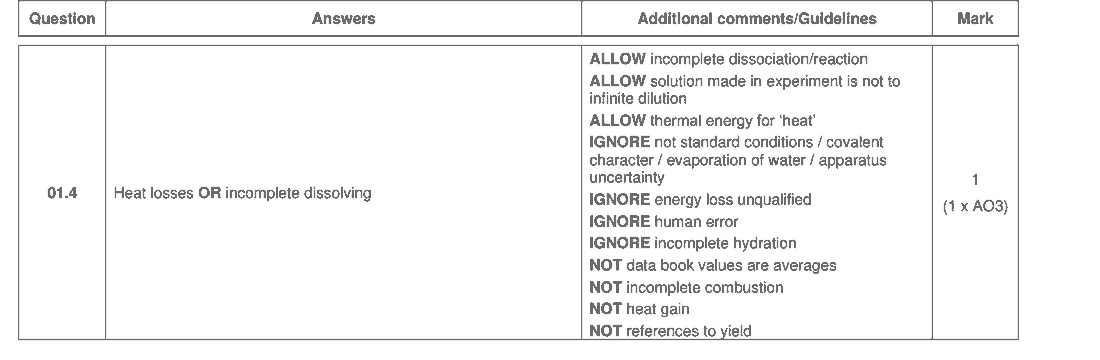
June 2025 · Paper 3 · Q01.4 1 mark AO3=1 Practical and data analysis energetics
Earlier part of question 01 that this part usesEarlier part of June 2025 Paper 3 question 01
Suggest why the value calculated in Question 01.3 is different from the
experimental value given in Question 01.2.
[1 mark]
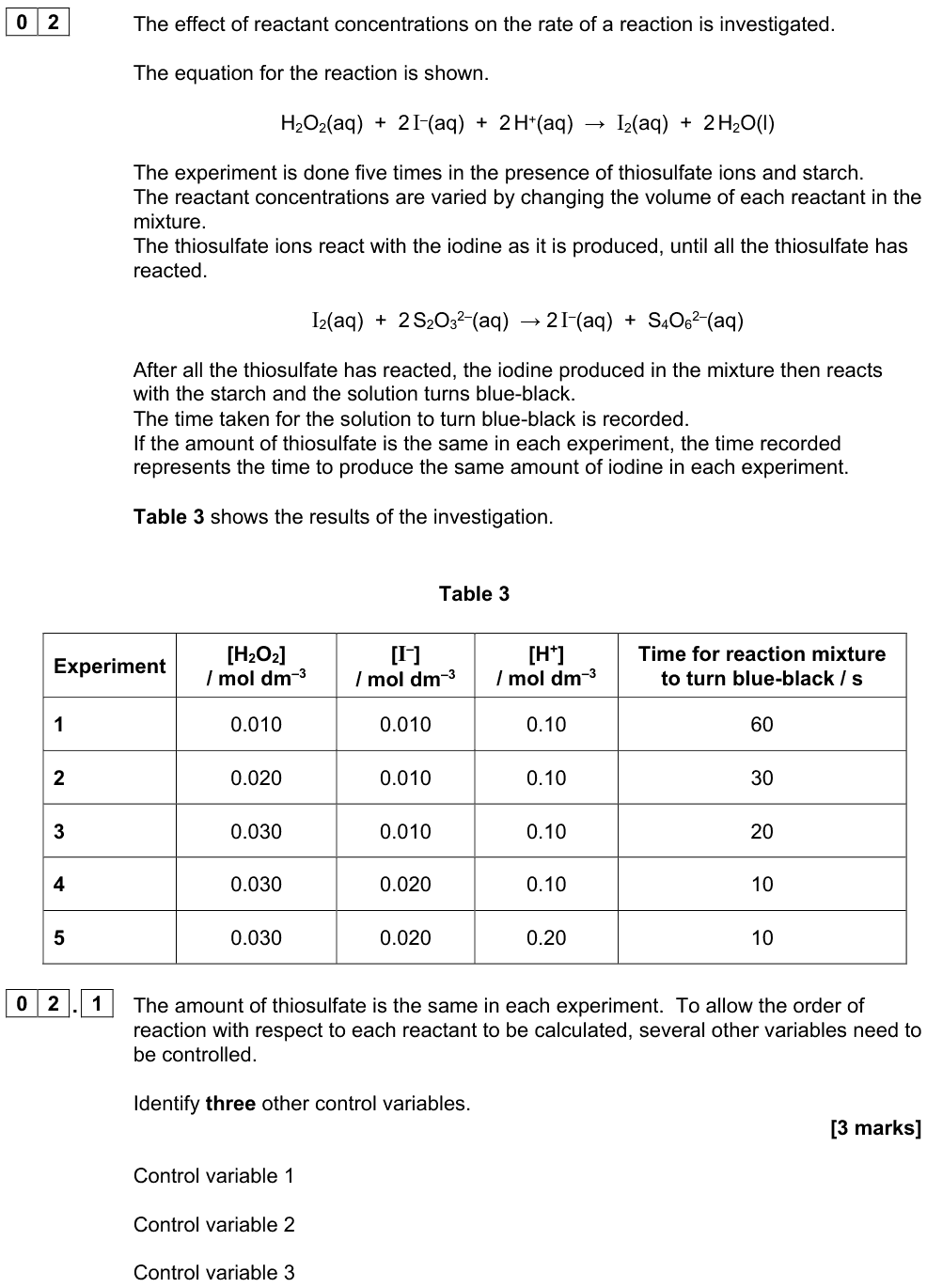
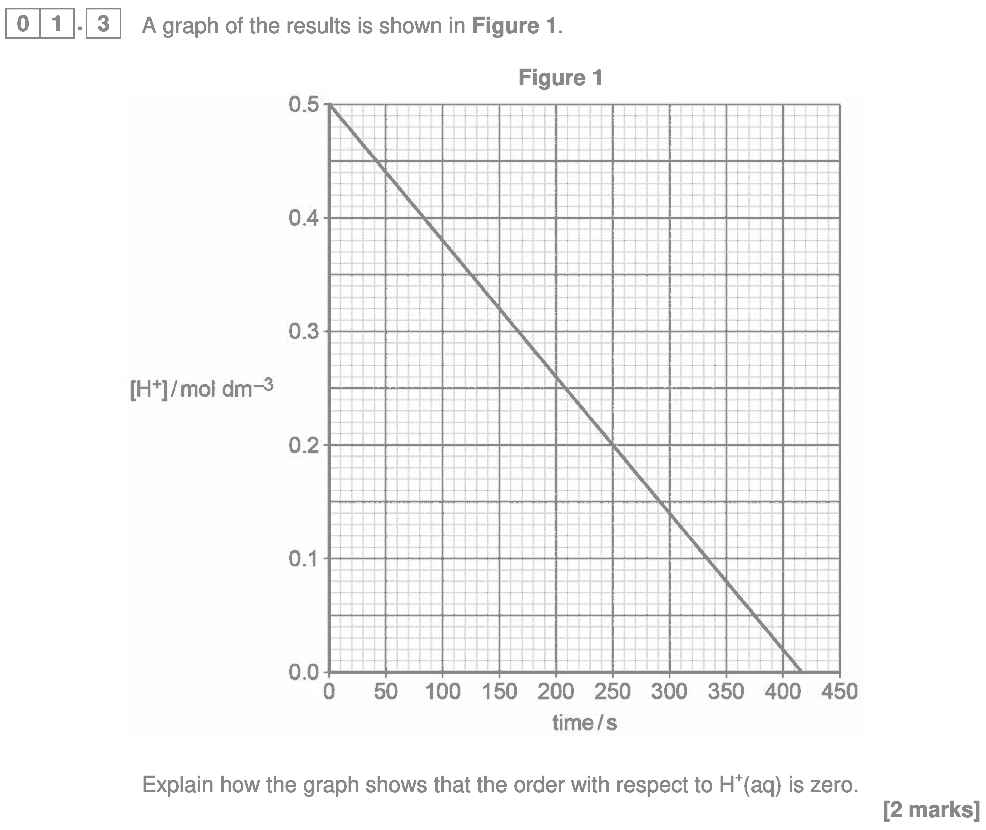
June 2025 · Paper 3 · Q02.1 3 marks AO3=3 Practical and data analysis rate equations
The effect of reactant concentrations on the rate of a reaction is investigated.
The equation for the reaction is shown.
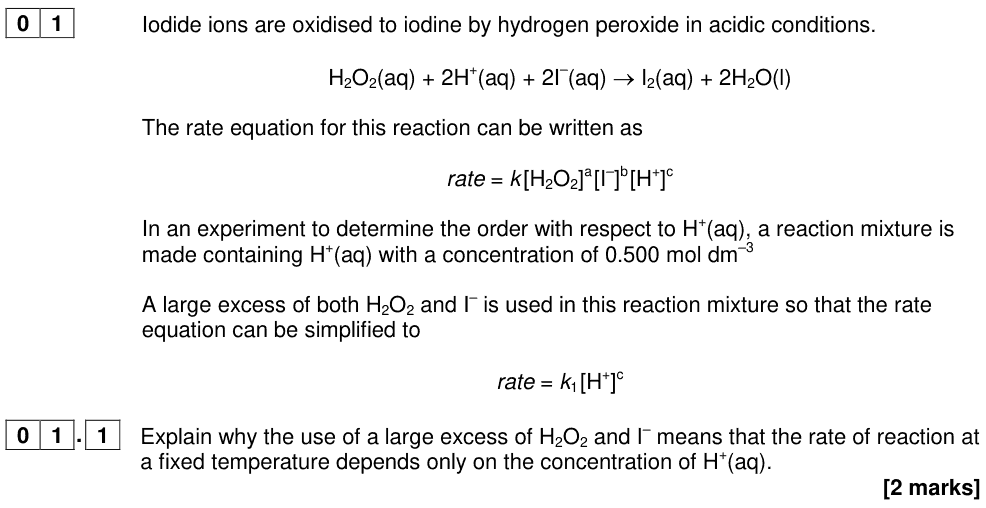
H2O2(aq)  +  2 I–(aq)  +  2 H+(aq)  →  I2(aq)  +  2 H2O(l)
The experiment is done five times in the presence of thiosulfate ions and starch.
The reactant concentrations are varied by changing the volume of each reactant in the
mixture.
The thiosulfate ions react with the iodine as it is produced, until all the thiosulfate has
reacted.
I2(aq)  +  2 S2O32–(aq)  → 2 I–(aq)  +  S4O62–(aq)
After all the thiosulfate has reacted, the iodine produced in the mixture then reacts
with the starch and the solution turns blue-black.
The time taken for the solution to turn blue-black is recorded.
If the amount of thiosulfate is the same in each experiment, the time recorded
represents the time to produce the same amount of iodine in each experiment.
Table 3 shows the results of the investigation.
Table 3
Experiment
[H2O2]
/ mol dm–3
[I–]
/ mol dm–3
[H+]
/ mol dm–3
Time for reaction mixture
to turn blue-black / s
0.010
0.010
0.10
60
0.020
0.010
0.10
30
0.030
0.010
0.10
20
0.030
0.020
0.10
10
0.030
0.020
0.20
10
The amount of thiosulfate is the same in each experiment.  To allow the order of
reaction with respect to each reactant to be calculated, several other variables need to
be controlled.
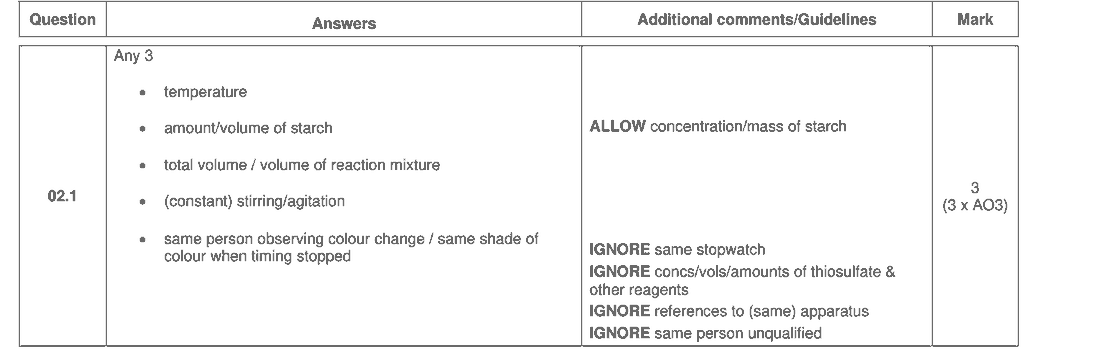
Identify three other control variables.
[3 marks]
Control variable 1
Control variable 2
Control variable 3
June 2025 · Paper 3 · Q02.2 3 marks AO3=3 Explanation Hard rate equations
Earlier part of question 02 that this part usesEarlier part of June 2025 Paper 3 question 02
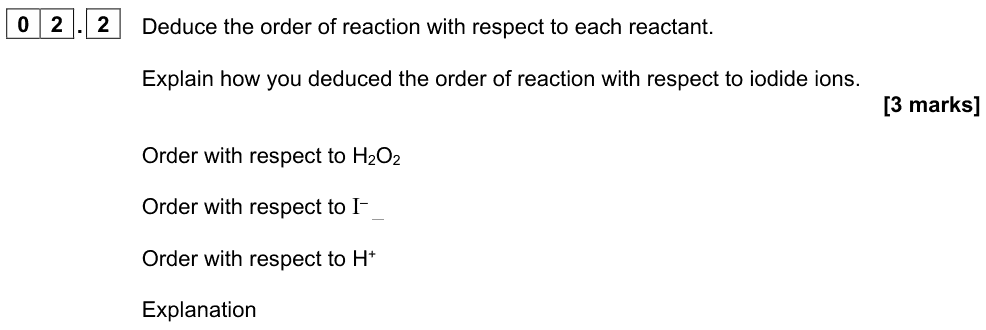
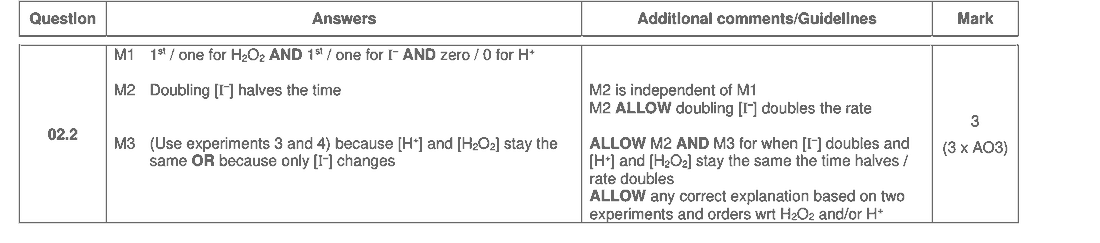
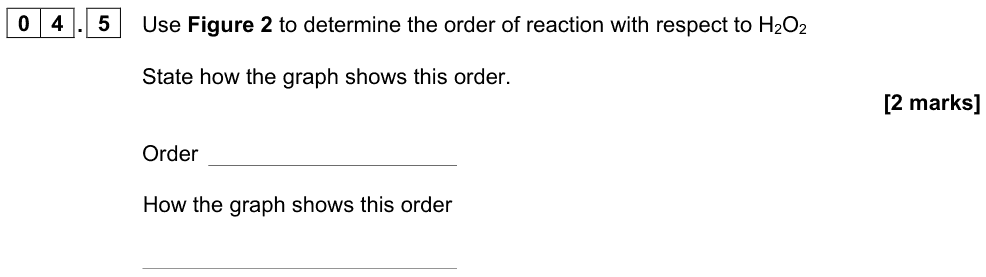
Deduce the order of reaction with respect to each reactant.
Explain how you deduced the order of reaction with respect to iodide ions.
[3 marks]
Order with respect to H2O2
Order with respect to I–
Order with respect to H+
Explanation
June 2025 · Paper 3 · Q02.4 3 marks AO2=3 Calculation rate equationsamount of substance
Earlier part of question 02 that this part usesEarlier part of June 2025 Paper 3 question 02
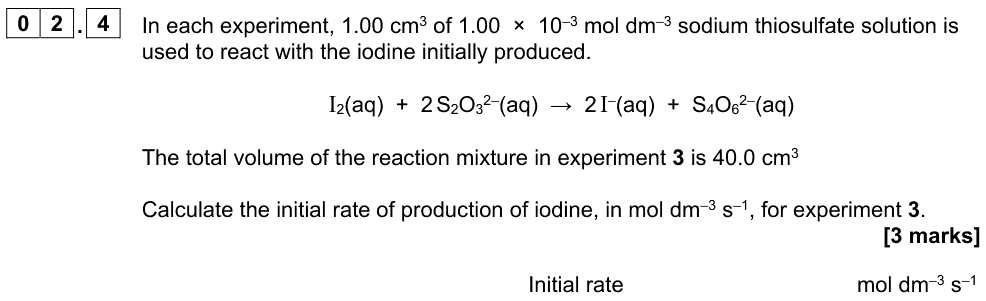
In each experiment, 1.00 cm3 of 1.00  ×  10–3 mol dm–3 sodium thiosulfate solution is
used to react with the iodine initially produced.
I2(aq)  +  2 S2O32–(aq)  →  2 I–(aq)  +  S4O62–(aq)
The total volume of the reaction mixture in experiment 3 is 40.0 cm3
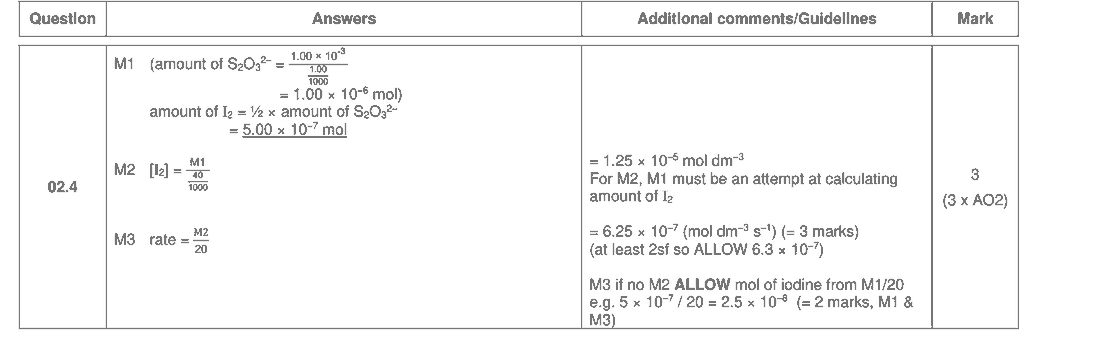
Calculate the initial rate of production of iodine, in mol dm–3 s–1, for experiment 3.
[3 marks]
Initial rate
mol dm–3 s–1
June 2025 · Paper 3 · Q02.5 1 mark AO3=1 Practical and data analysis rate equations
Earlier part of question 02 that this part usesEarlier part of June 2025 Paper 3 question 02
The total uncertainty in the times recorded for each experiment is ±0.5 s but the
stopwatch used has a measurement uncertainty of ±0.01 s
Suggest why, in each experiment, the uncertainty in the times recorded is greater than
the measurement uncertainty of the stopwatch.
[1 mark]
June 2025 · Paper 3 · Q02.6 1 mark AO3=1 Calculation rate equations
Earlier parts of question 02 that this part usesEarlier part of June 2025 Paper 3 question 02Earlier part of June 2025 Paper 3 question 02
Calculate the percentage uncertainty in the time recorded in experiment 3.
[1 mark]
Percentage uncertainty
June 2025 · Paper 3 · Q02.7 2 marks AO3=2 Practical and data analysis Hard rate equations
Earlier part of question 02 that this part usesEarlier part of June 2025 Paper 3 question 02
The five experiments are repeated with the same stopwatch and the same
concentrations and volumes of H2O2, I– and H+
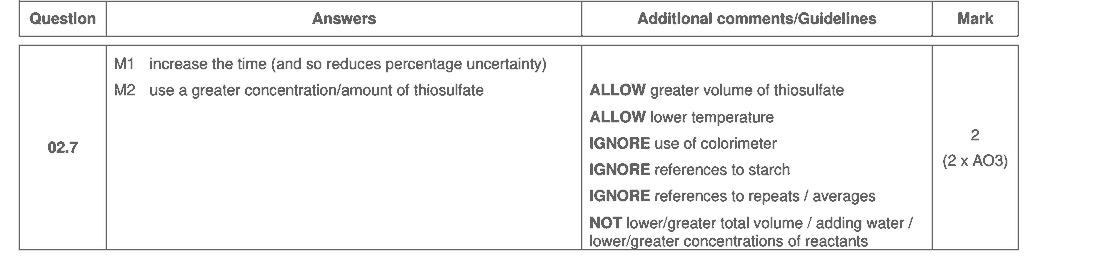
Suggest and explain how the method can be changed to decrease the
percentage uncertainty in the times recorded.
[2 marks]
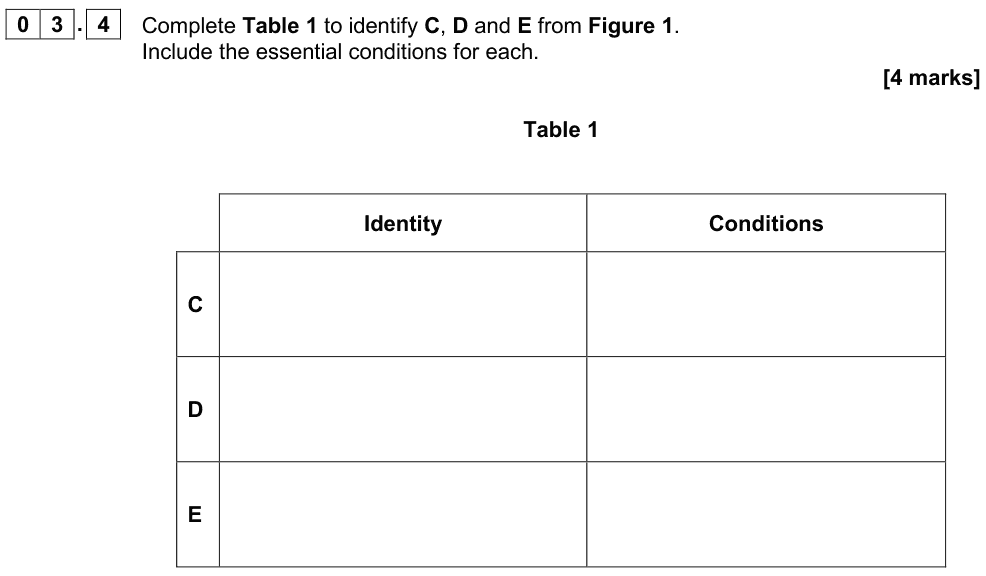
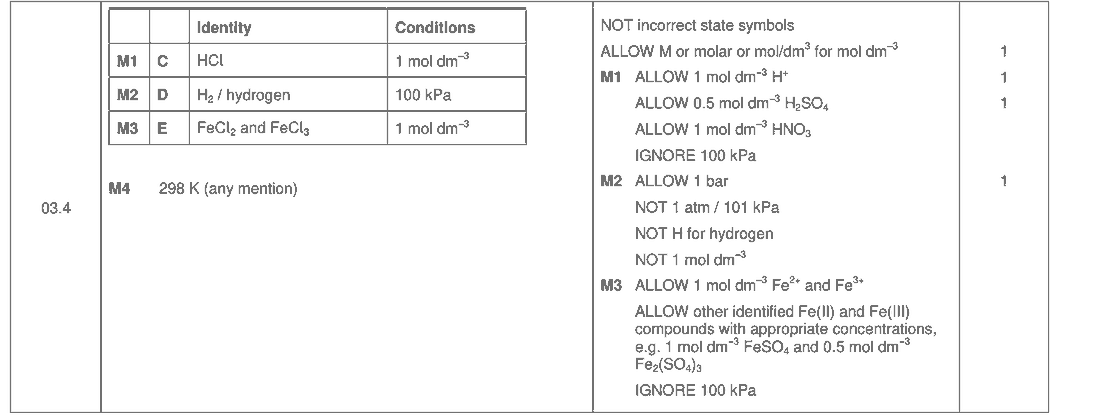
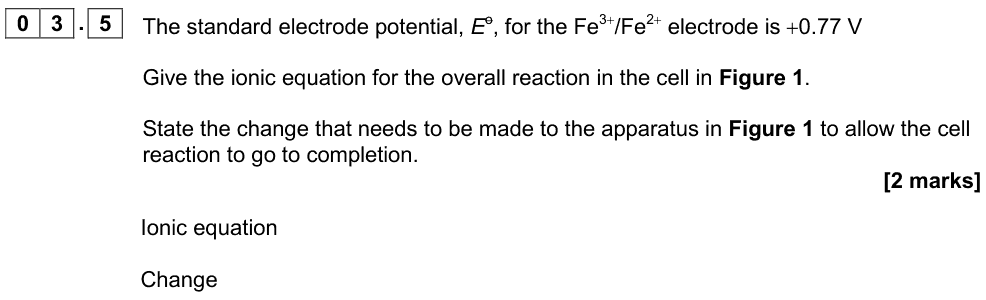
June 2025 · Paper 3 · Q03.1 3 marks AO3=3 Practical and data analysis electrode potentials and cells
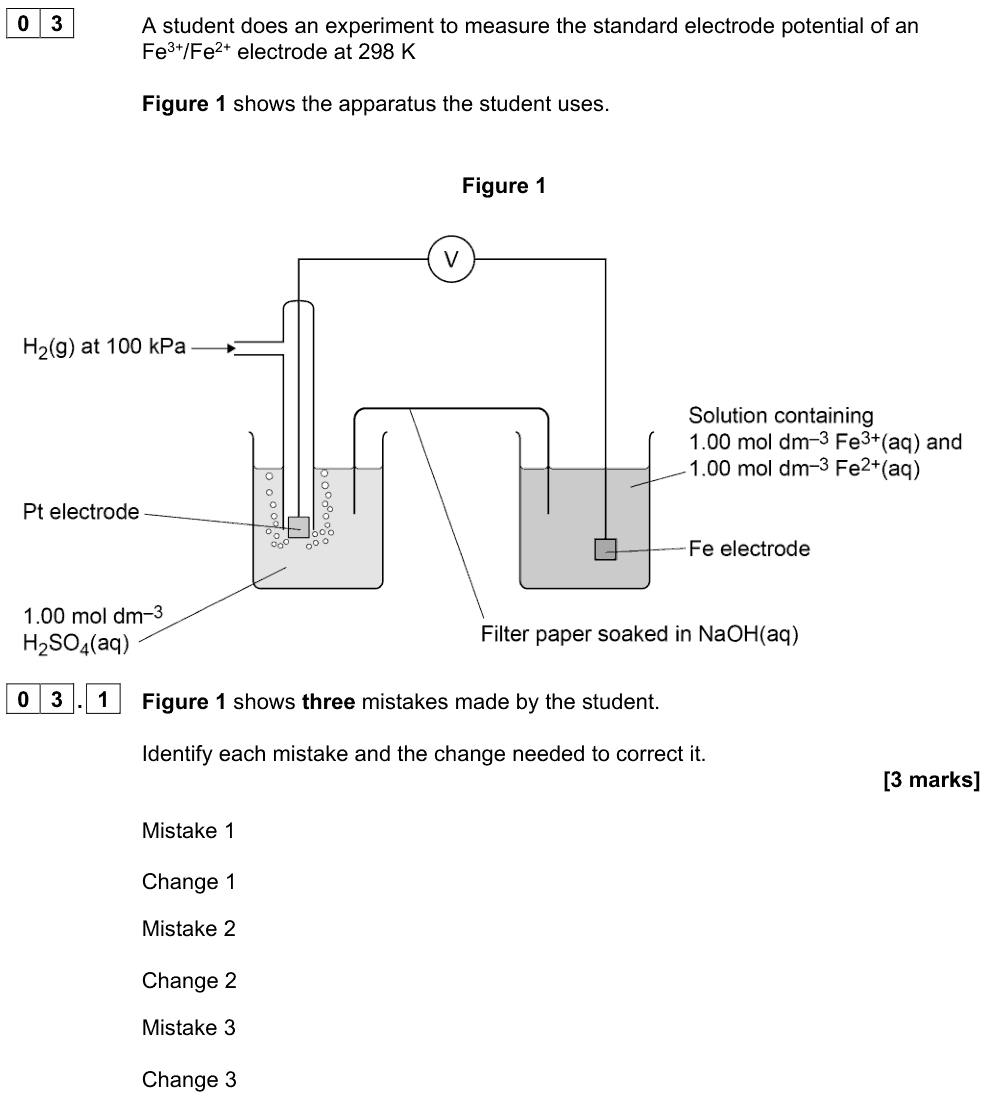
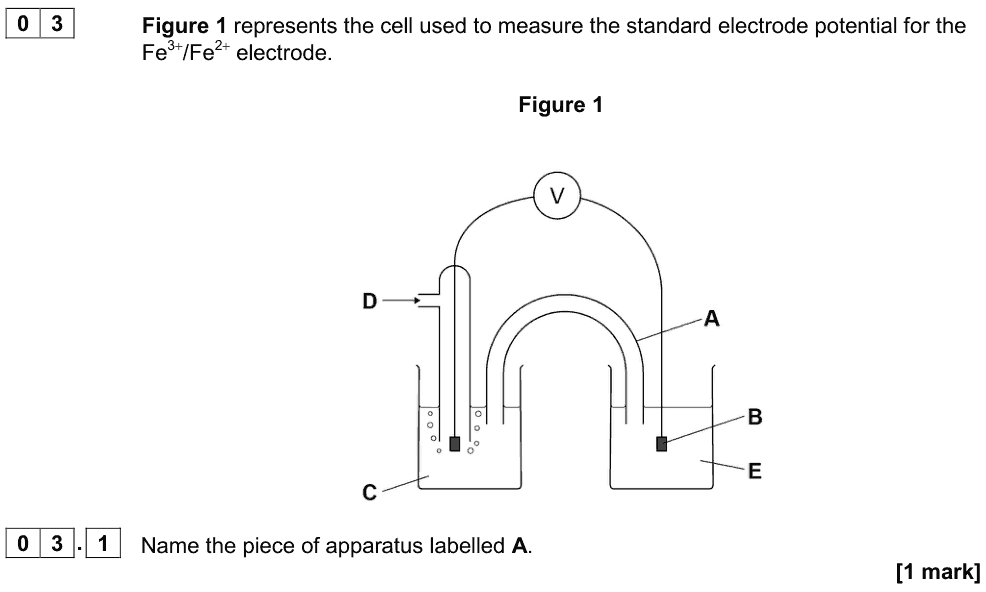
A student does an experiment to measure the standard electrode potential of an
Fe3+/Fe2+ electrode at 298 K
Figure 1 shows the apparatus the student uses.
Figure 1
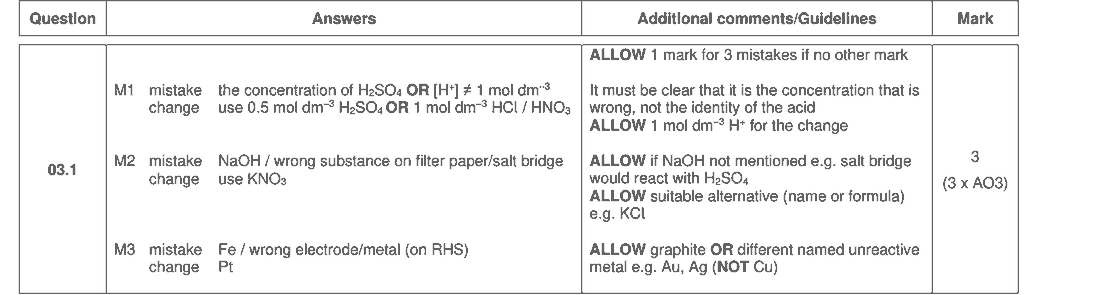
Figure 1 shows three mistakes made by the student.
Identify each mistake and the change needed to correct it.
[3 marks]
Mistake 1
Change 1
Mistake 2
Change 2
Mistake 3
Change 3
June 2025 · Paper 3 · Q03.2 1 mark AO1=1 Short answer electrode potentials and cells
Earlier part of question 03 that this part usesEarlier part of June 2025 Paper 3 question 03
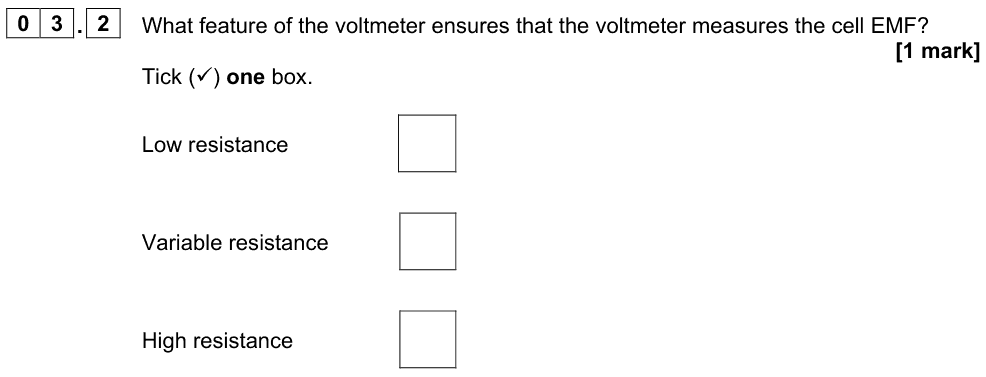
What feature of the voltmeter ensures that the voltmeter measures the cell EMF?
[1 mark]
Tick () one box.
Low resistance
Variable resistance
High resistance
June 2025 · Paper 3 · Q04.2 2 marks AO3=2 Practical and data analysis Hard chemical equilibria and kc
Earlier part of question 04 that this part usesEarlier part of June 2025 Paper 3 question 04
Before the titration, the sample is ‘quenched’ by adding 50 cm3 of ice-cold water.
Suggest why the sample is ‘quenched’ in this way before the titration.
Explain your answer.
[2 marks]
June 2025 · Paper 3 · Q05.1 6 marks AO3=6 6-mark level of response Hard alcoholsorganic analysis
This question is about oxidation.
A student has separate unlabelled samples of propan-1-ol and propan-2-ol but does
not know which sample is which alcohol.
The student plans a series of steps to identify the alcohols.
Step 1  Oxidise each sample, distilling off the organic product as it is formed.
Step 2  Identify the organic products using a simple chemical test.
Step 3  Confirm the identities using the infrared spectrum of each original sample.
Give further details of each step in the plan.  In your answer include
• an appropriate oxidising agent used in Step 1
• equations, using [O] to represent the oxidising agent, for each reaction in Step 1
• a suitable test and expected observations in Step 2
• how the infrared spectra can be used to confirm the identities.
[6 marks]
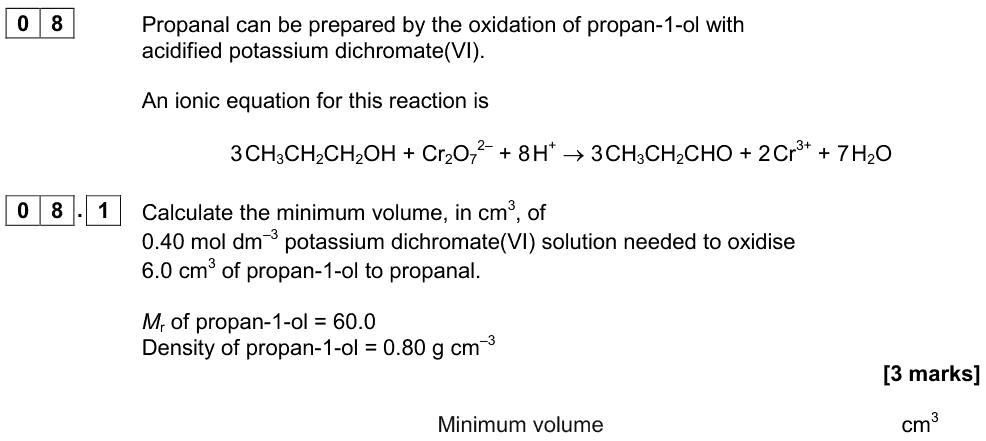
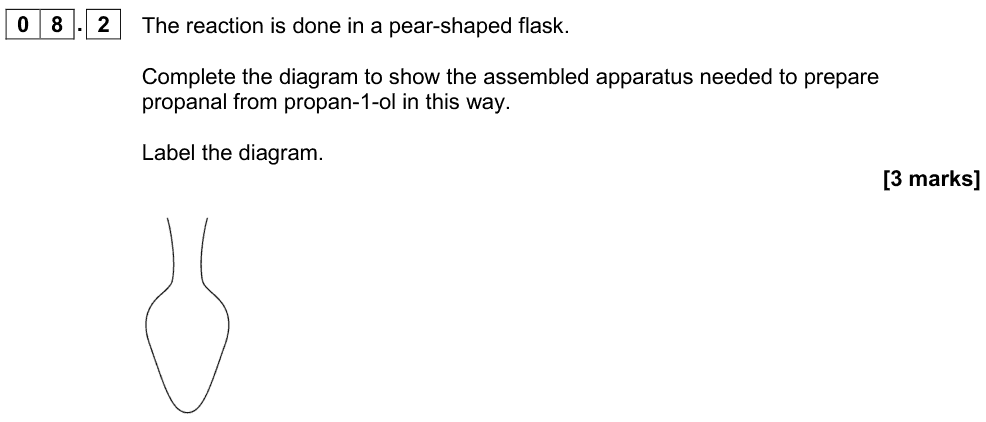
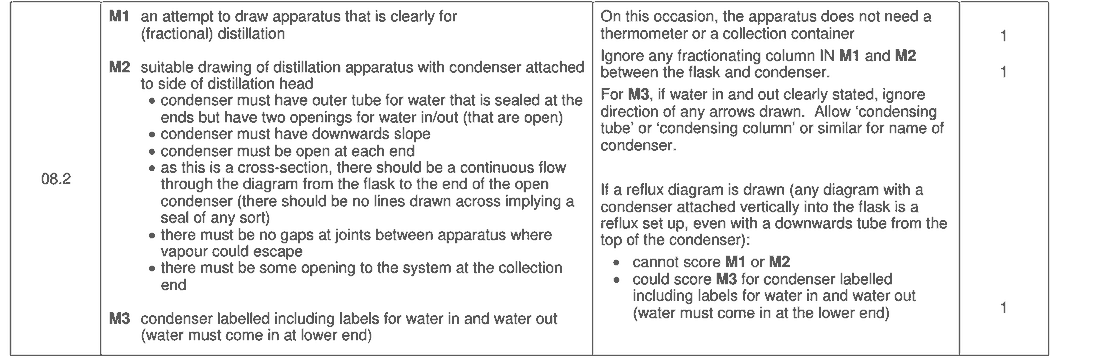
June 2025 · Paper 3 · Q05.2 3 marks AO1=1, AO3=2 Diagram or structure alcohols
Earlier part of question 05 that this part usesEarlier part of June 2025 Paper 3 question 05
A primary alcohol can be oxidised to form a carboxylic acid using an excess of the
oxidising agent in Question 05.1.
Give the condition needed for this reaction.
Complete the diagram, adding labels, to show how the apparatus would be set up.
[3 marks]
Condition
June 2025 · Paper 3 · Q05.3 1 mark AO1=1 Practical and data analysis Easy alcohols
Earlier part of question 05 that this part usesEarlier part of June 2025 Paper 3 question 05
During oxidation reactions, anti-bumping granules are often added to the
pear-shaped flask containing the reactants.
State why anti-bumping granules are used.
[1 mark]
June 2024 · AS Paper 1 · Q01.1 2 marks AO3=2 Short answer Hard group 7 the halogensamount of substance
A student does a series of reactions with aqueous solutions of some
potassium halides (P, Q and R) of equal concentration. Each solution contains a
different halide ion (chloride, bromide or iodide).
The student adds 3 drops of bromine water to 3 drops of each aqueous solution of
potassium halide. The student also adds 3 drops of the bromine water to
3 drops of water.
Table 1 shows the student’s observations.
Table 1
Observation when 3 drops
of bromine water are added
Solution P
Orange solution
Solution Q
Brown solution
Solution R
Orange solution
Water
Orange solution
Identify the halide ion present in Q.
Give the ionic equation for the reaction that occurs when bromine water is added to Q.
[2 marks]
Halide ion in Q
Ionic equation
June 2024 · AS Paper 1 · Q01.2 2 marks AO3=2 Explanation group 7 the halogens
Earlier part of question 01 that this part usesEarlier part of June 2024 Paper 1 question 01
Explain, in terms of oxidising ability, why the observations from these reactions
do not allow the student to identify the halide ion present in P and the halide ion
present in R.
[2 marks]
June 2024 · AS Paper 1 · Q01.3 3 marks AO3=3 Practical and data analysis group 7 the halogens
Earlier part of question 01 that this part usesEarlier part of June 2024 Paper 1 question 01
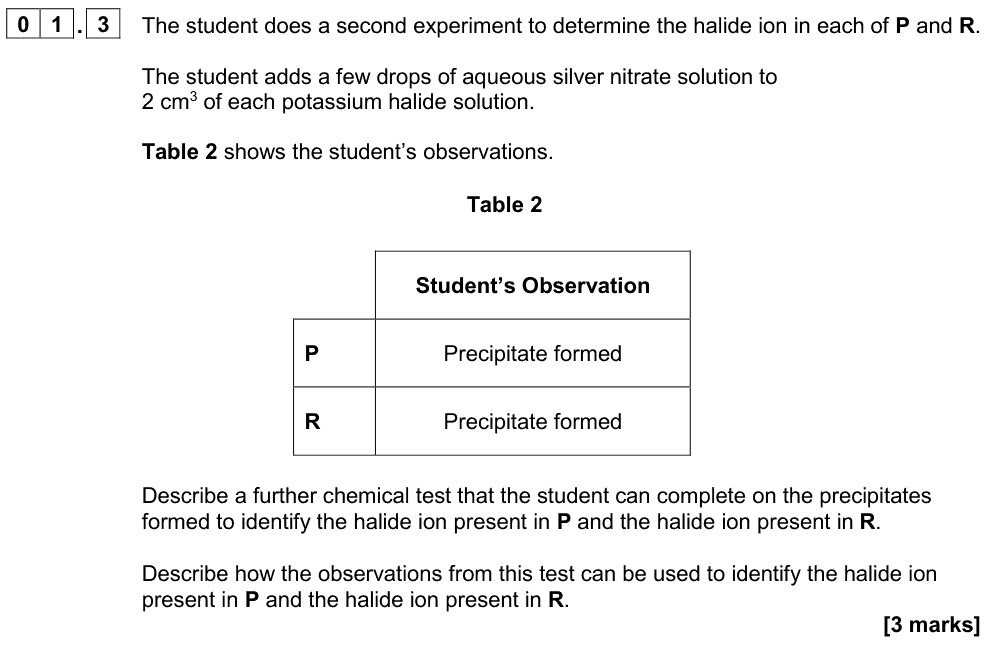
The student does a second experiment to determine the halide ion in each of P and R.
The student adds a few drops of aqueous silver nitrate solution to
2 cm3 of each potassium halide solution.
Table 2 shows the student’s observations.
Table 2
Student’s Observation
P
Precipitate formed
R
Precipitate formed
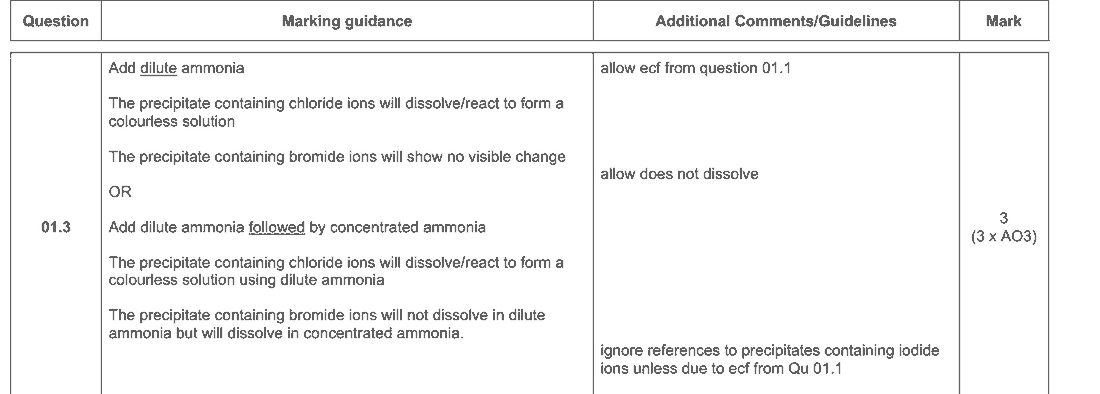
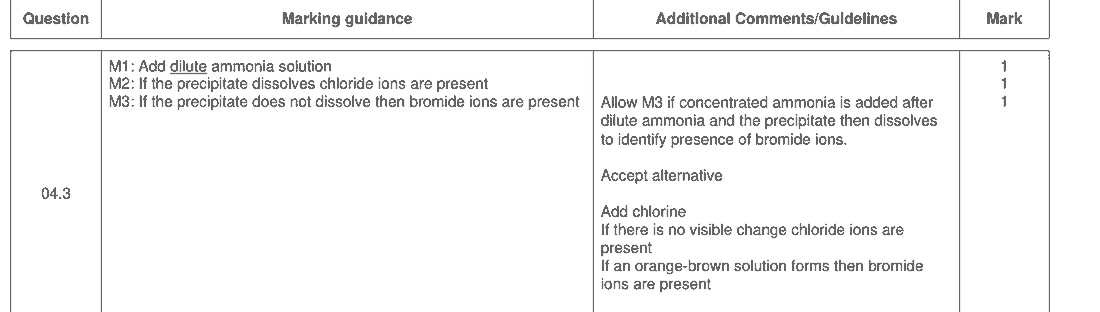
Describe a further chemical test that the student can complete on the precipitates
formed to identify the halide ion present in P and the halide ion present in R.
Describe how the observations from this test can be used to identify the halide ion
present in P and the halide ion present in R.
[3 marks]
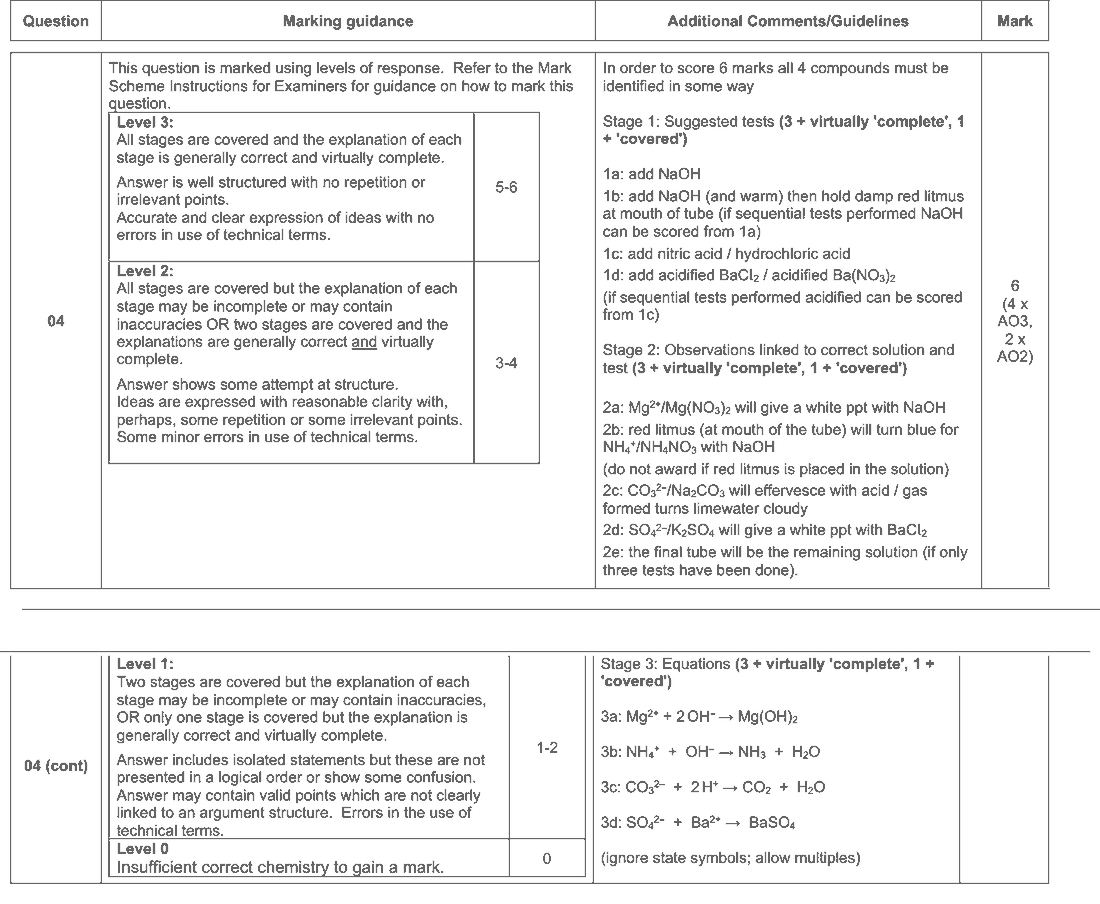
June 2024 · AS Paper 1 · Q04 6 marks AO2=2, AO3=4 6-mark level of response group 7 the halogensgroup 2amount of substance
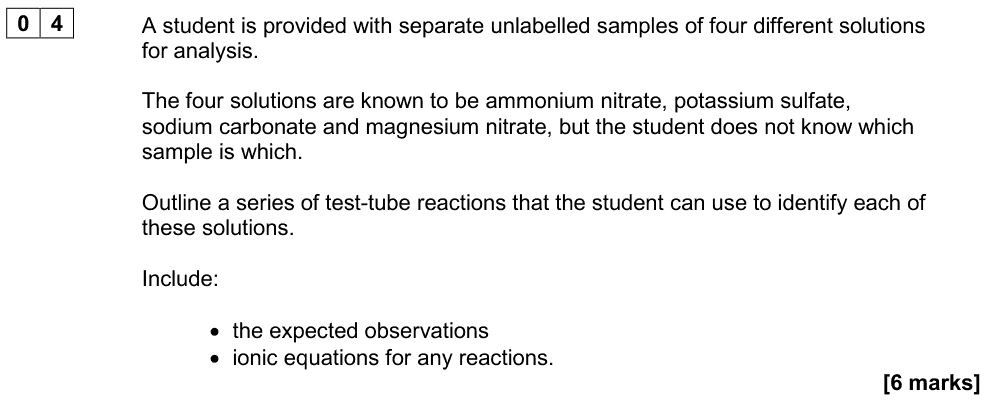
A student is provided with separate unlabelled samples of four different solutions
for analysis.
The four solutions are known to be ammonium nitrate, potassium sulfate,
sodium carbonate and magnesium nitrate, but the student does not know which
sample is which.
Outline a series of test-tube reactions that the student can use to identify each of
these solutions.
Include:
• the expected observations
• ionic equations for any reactions.
[6 marks]
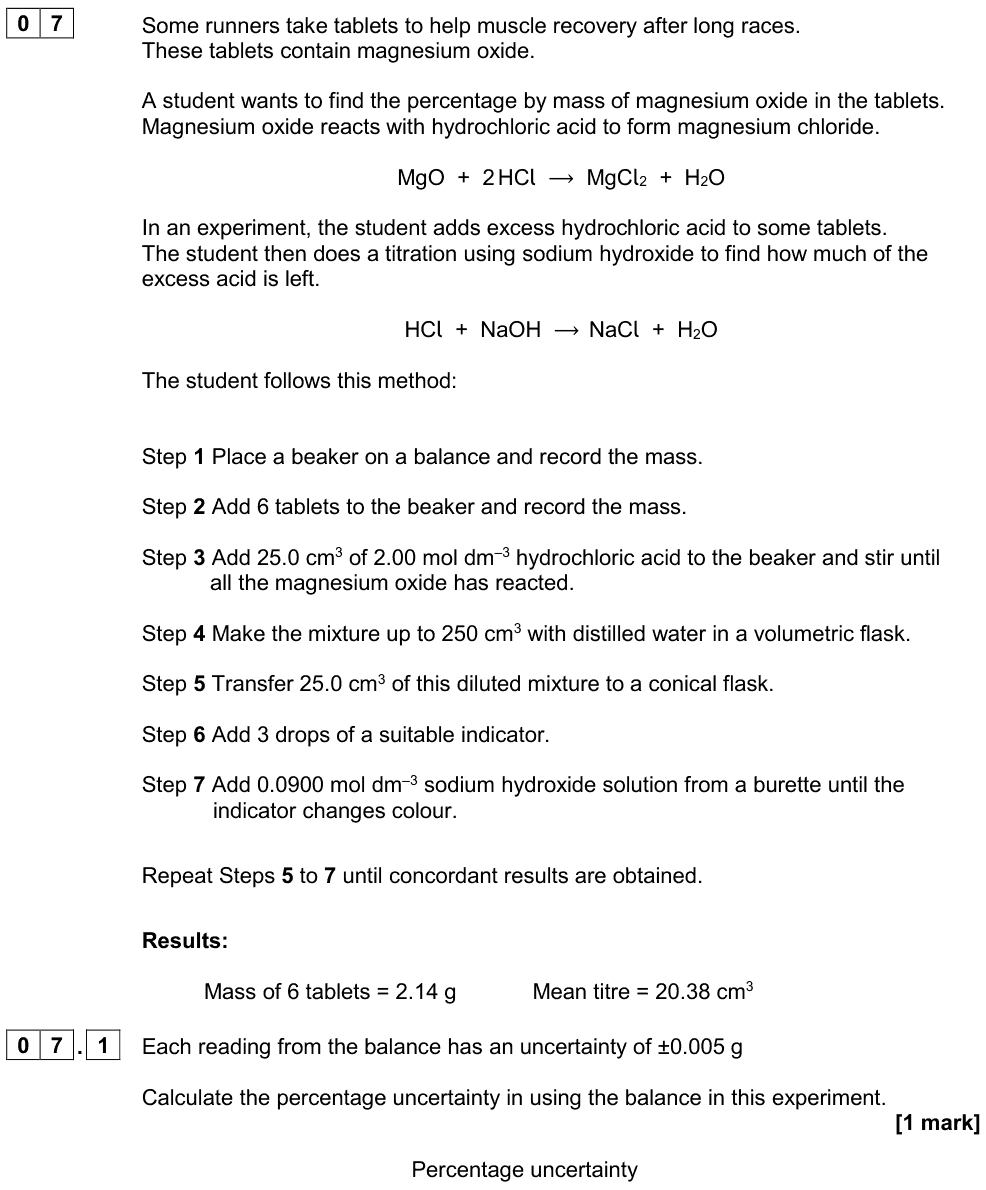
June 2024 · AS Paper 1 · Q07.1 1 mark AO1=1 Calculation Hard amount of substance
Some runners take tablets to help muscle recovery after long races.
These tablets contain magnesium oxide.
A student wants to find the percentage by mass of magnesium oxide in the tablets.
Magnesium oxide reacts with hydrochloric acid to form magnesium chloride.
MgO  +  2 HCl  ⟶  MgCl2  +  H2O
In an experiment, the student adds excess hydrochloric acid to some tablets.
The student then does a titration using sodium hydroxide to find how much of the
excess acid is left.
HCl  +  NaOH  ⟶  NaCl  +  H2O
The student follows this method:
Step 1 Place a beaker on a balance and record the mass.
Step 2 Add 6 tablets to the beaker and record the mass.
Step 3 Add 25.0 cm3 of 2.00 mol dm–3 hydrochloric acid to the beaker and stir until
all the magnesium oxide has reacted.
Step 4 Make the mixture up to 250 cm3 with distilled water in a volumetric flask.
Step 5 Transfer 25.0 cm3 of this diluted mixture to a conical flask.
Step 6 Add 3 drops of a suitable indicator.
Step 7 Add 0.0900 mol dm–3 sodium hydroxide solution from a burette until the
indicator changes colour.
Repeat Steps 5 to 7 until concordant results are obtained.
Results:
Mass of 6 tablets = 2.14 g
Mean titre = 20.38 cm3
Each reading from the balance has an uncertainty of ±0.005 g
Calculate the percentage uncertainty in using the balance in this experiment.
[1 mark]
Percentage uncertainty
June 2024 · AS Paper 1 · Q07.2 1 mark AO2=1 Calculation amount of substance
Earlier part of question 07 that this part usesEarlier part of June 2024 Paper 1 question 07
Calculate the amount, in moles, of hydrochloric acid that was added to the
tablets in Step 3.
Give your answer to an appropriate precision.
[1 mark]
Amount of hydrochloric acid
mol
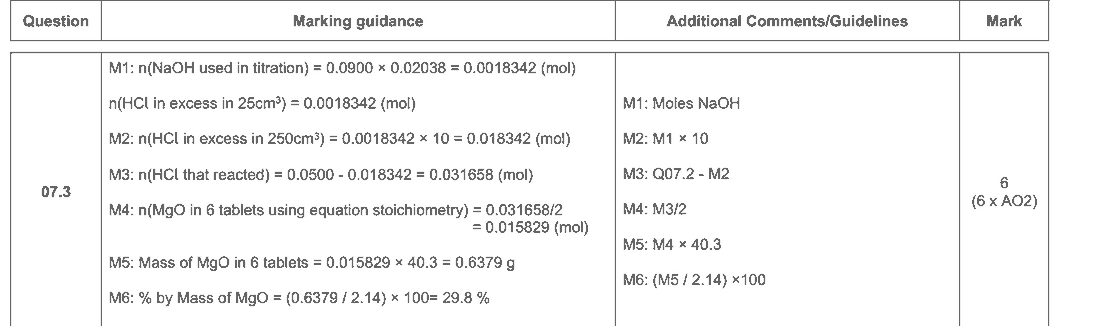
June 2024 · AS Paper 1 · Q07.3 6 marks AO2=6 Calculation Hard amount of substance
Earlier part of question 07 that this part usesEarlier part of June 2024 Paper 1 question 07
Use your answer to Question 07.2 and the information given to calculate
the percentage by mass of magnesium oxide in the tablets.
[6 marks]
Percentage by mass of MgO
June 2024 · AS Paper 1 · Q08.3 1 mark AO2=1 Practical and data analysis energetics
Earlier part of question 08 that this part usesEarlier part of June 2024 Paper 1 question 08
Suggest why the enthalpy change for the thermal decomposition of
solid silver nitrate(III) is difficult to determine experimentally.
[1 mark]
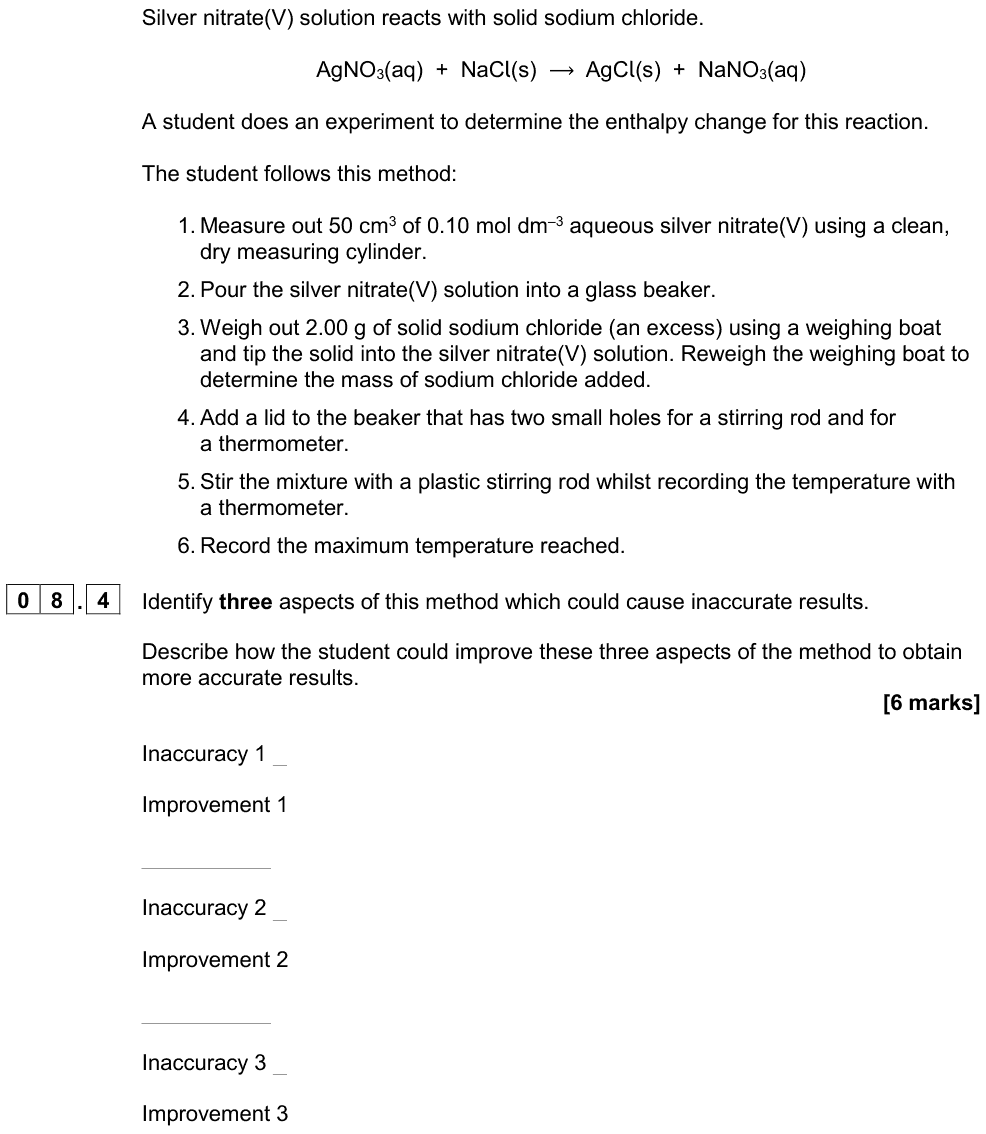
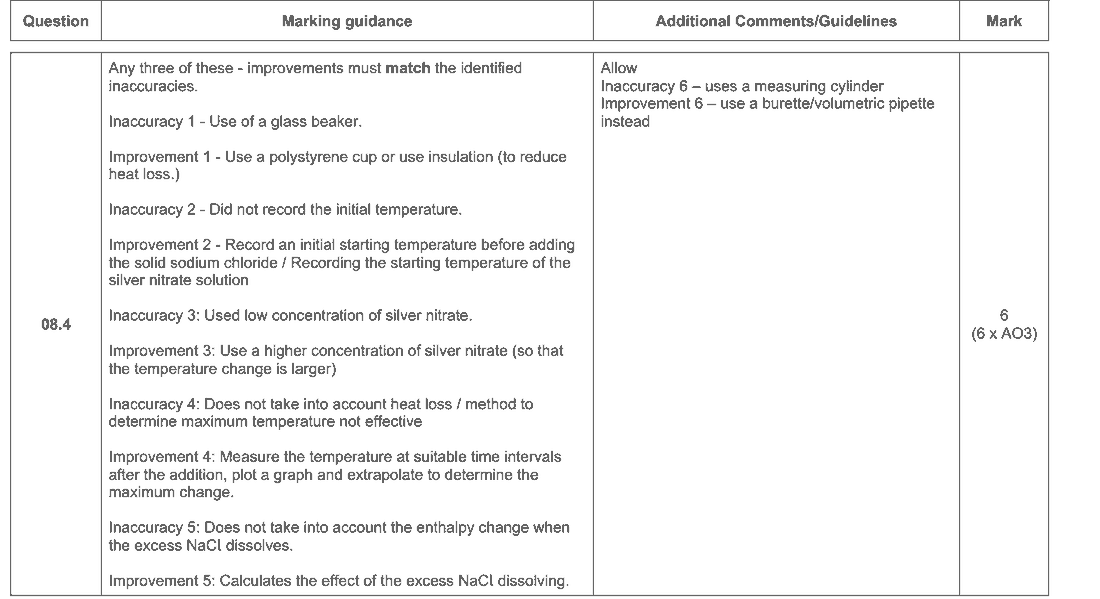
June 2024 · AS Paper 1 · Q08.4 6 marks AO3=6 Practical and data analysis Hard energetics
Earlier part of question 08 that this part usesEarlier part of June 2024 Paper 1 question 08
Silver nitrate(V) solution reacts with solid sodium chloride.
AgNO3(aq)  +  NaCl(s)  ⟶  AgCl(s)  +  NaNO3(aq)
A student does an experiment to determine the enthalpy change for this reaction.
The student follows this method:
1. Measure out 50 cm3 of 0.10 mol dm–3 aqueous silver nitrate(V) using a clean,
dry measuring cylinder.
2. Pour the silver nitrate(V) solution into a glass beaker.
3. Weigh out 2.00 g of solid sodium chloride (an excess) using a weighing boat
and tip the solid into the silver nitrate(V) solution. Reweigh the weighing boat to
determine the mass of sodium chloride added.
4. Add a lid to the beaker that has two small holes for a stirring rod and for
a thermometer.
5. Stir the mixture with a plastic stirring rod whilst recording the temperature with
a thermometer.
6. Record the maximum temperature reached.
Identify three aspects of this method which could cause inaccurate results.
Describe how the student could improve these three aspects of the method to obtain
more accurate results.
[6 marks]
Inaccuracy 1
Improvement 1
Inaccuracy 2
Improvement 2
Inaccuracy 3
Improvement 3
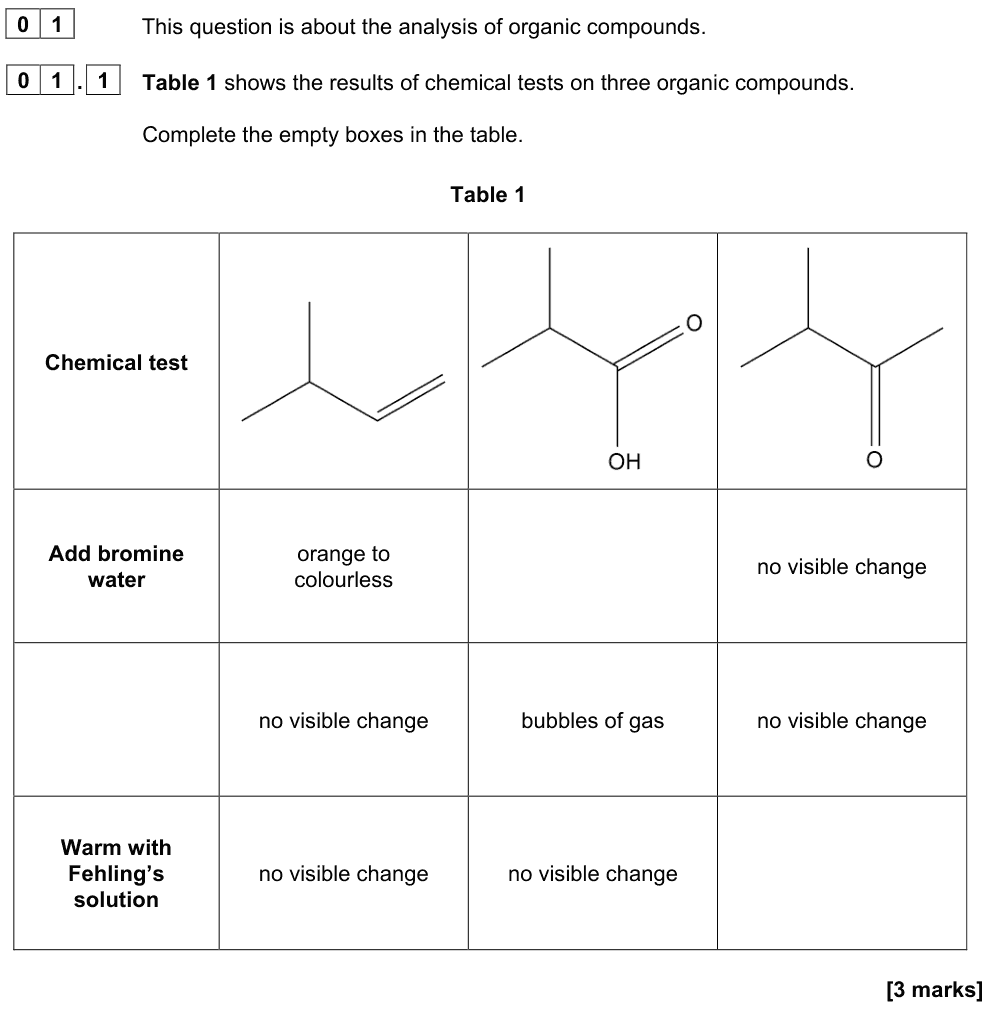
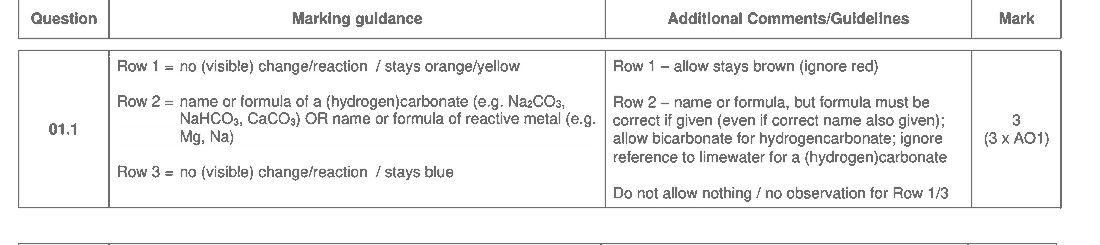
June 2024 · AS Paper 2 · Q01.1 3 marks AO1=3 Practical and data analysis organic analysisalkenesalcohols
This question is about the analysis of organic compounds.
Table 1 shows the results of chemical tests on three organic compounds.
Complete the empty boxes in the table.
Table 1
Chemical test
Add bromine
water
orange to
colourless
no visible change
no visible change
bubbles of gas
no visible change
Warm with
Fehling’s
solution
no visible change
no visible change
[3 marks]
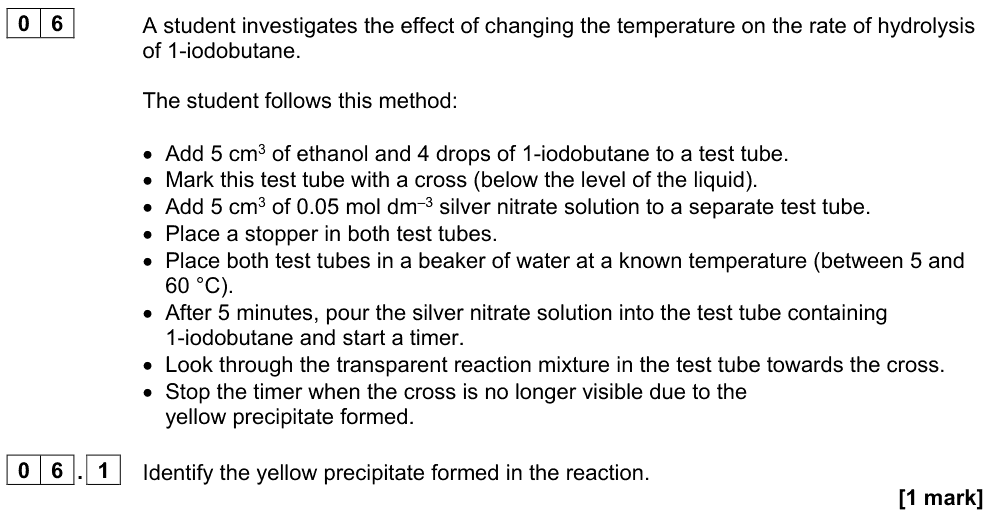
June 2024 · AS Paper 2 · Q06.1 1 mark AO2=1 Short answer group 7 the halogens
A student investigates the effect of changing the temperature on the rate of hydrolysis
of 1-iodobutane.
The student follows this method:
• Add 5 cm3 of ethanol and 4 drops of 1-iodobutane to a test tube.
• Mark this test tube with a cross (below the level of the liquid).
• Add 5 cm3 of 0.05 mol dm–3 silver nitrate solution to a separate test tube.
• Place a stopper in both test tubes.
• Place both test tubes in a beaker of water at a known temperature (between 5 and
60 °C).
• After 5 minutes, pour the silver nitrate solution into the test tube containing
1-iodobutane and start a timer.
• Look through the transparent reaction mixture in the test tube towards the cross.
• Stop the timer when the cross is no longer visible due to the
yellow precipitate formed.
Identify the yellow precipitate formed in the reaction.
[1 mark]
June 2024 · AS Paper 2 · Q06.2 3 marks AO2=3 Practical and data analysis kinetics
Earlier part of question 06 that this part usesEarlier part of June 2024 Paper 2 question 06
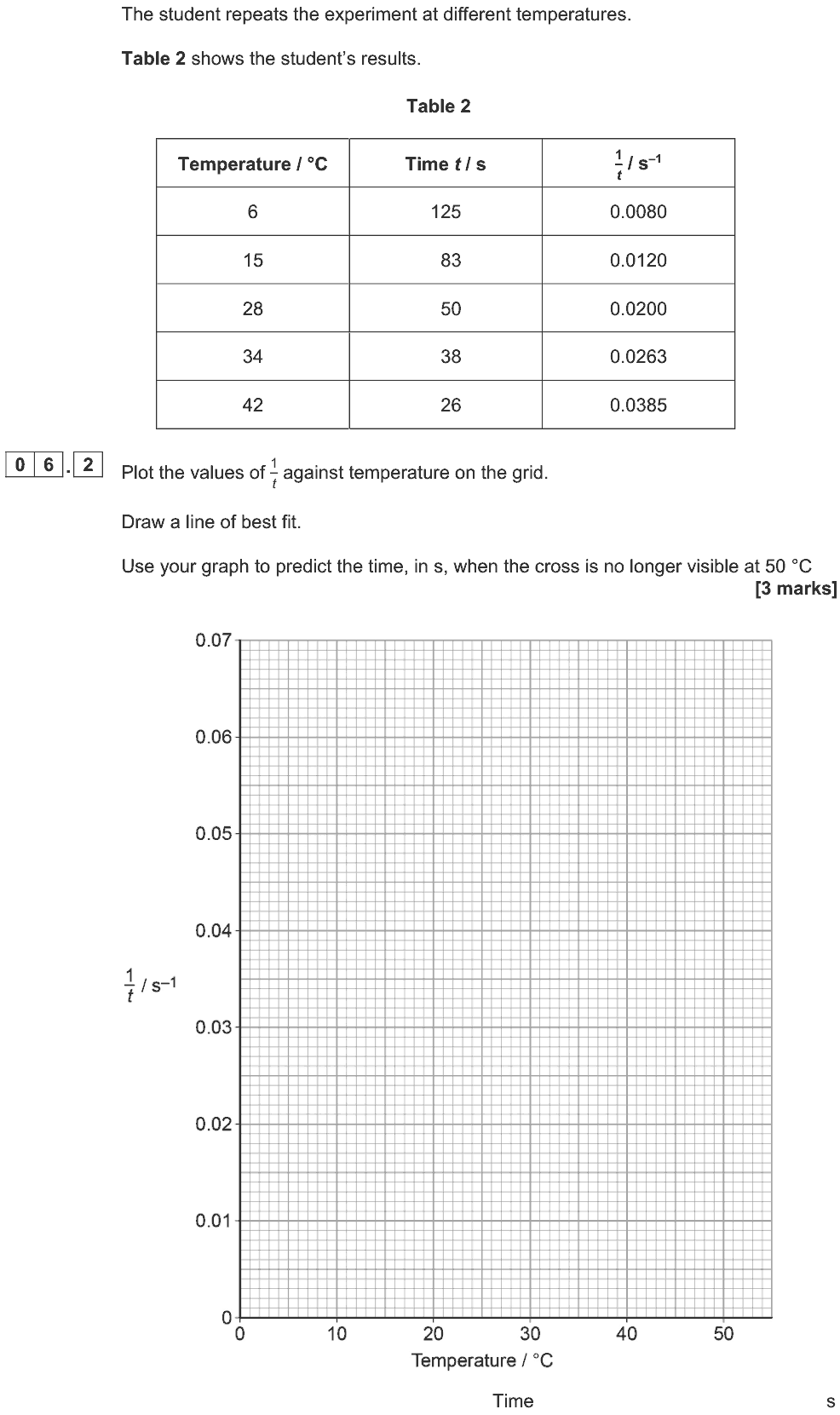
The student repeats the experiment at different temperatures.
Table 2 shows the student’s results.
Table 2
Temperature / °C
Time t / s
1
t / s–1
6
125
0.0080
15
83
0.0120
28
50
0.0200
34
38
0.0263
42
26
0.0385
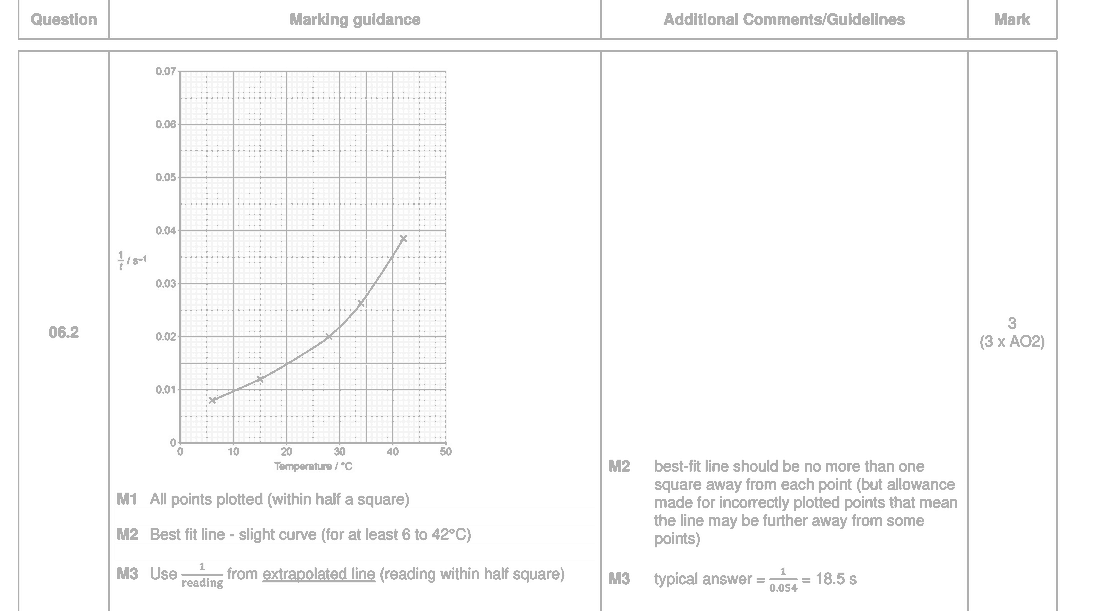
Plot the values of
1
t against temperature on the grid.
Draw a line of best fit.
Use your graph to predict the time, in s, when the cross is no longer visible at 50 °C
[3 marks]
Time
s
June 2024 · AS Paper 2 · Q06.3 3 marks AO3=3 Explanation halogenoalkanes
Earlier parts of question 06 that this part usesEarlier part of June 2024 Paper 2 question 06Earlier part of June 2024 Paper 2 question 06
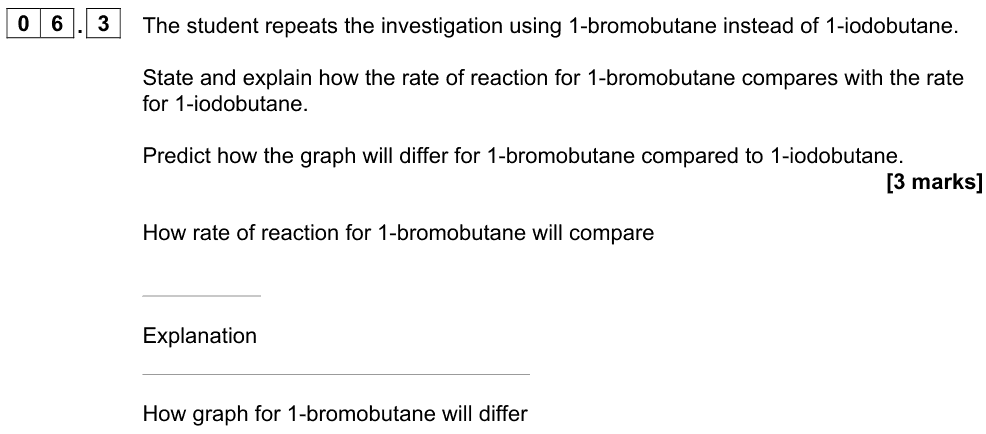
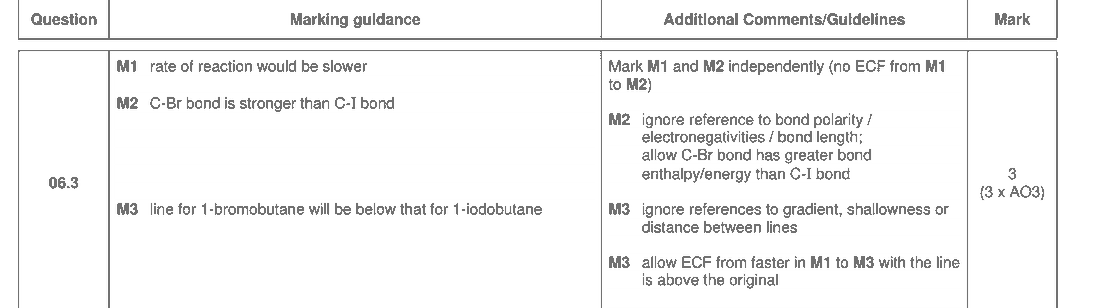
The student repeats the investigation using 1-bromobutane instead of 1-iodobutane.
State and explain how the rate of reaction for 1-bromobutane compares with the rate
for 1-iodobutane.
Predict how the graph will differ for 1-bromobutane compared to 1-iodobutane.
[3 marks]
How rate of reaction for 1-bromobutane will compare
Explanation
How graph for 1-bromobutane will differ
June 2024 · Paper 1 · Q02.1 1 mark AO3=1 Practical and data analysis amount of substance
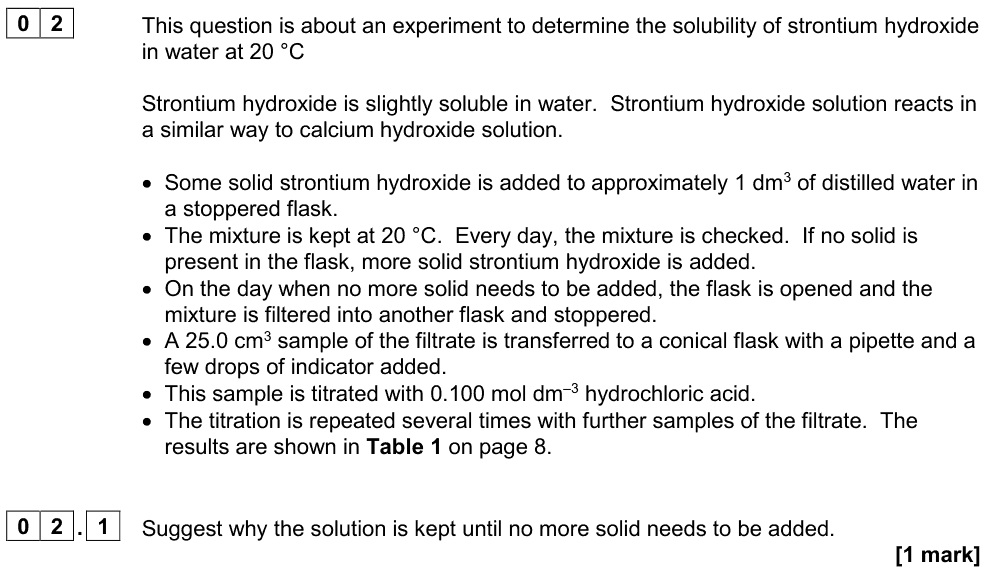
This question is about an experiment to determine the solubility of strontium hydroxide
in water at 20 °C
Strontium hydroxide is slightly soluble in water.  Strontium hydroxide solution reacts in
a similar way to calcium hydroxide solution.
• Some solid strontium hydroxide is added to approximately 1 dm3 of distilled water in
a stoppered flask.
• The mixture is kept at 20 °C.  Every day, the mixture is checked.  If no solid is
present in the flask, more solid strontium hydroxide is added.
• On the day when no more solid needs to be added, the flask is opened and the
mixture is filtered into another flask and stoppered.
• A 25.0 cm3 sample of the filtrate is transferred to a conical flask with a pipette and a
few drops of indicator added.
• This sample is titrated with 0.100 mol dm–3 hydrochloric acid.
• The titration is repeated several times with further samples of the filtrate.  The
results are shown in Table 1 on page 8.
Suggest why the solution is kept until no more solid needs to be added.
[1 mark]
June 2024 · Paper 1 · Q02.2 1 mark AO3=1 Practical and data analysis amount of substance
Earlier part of question 02 that this part usesEarlier part of June 2024 Paper 1 question 02
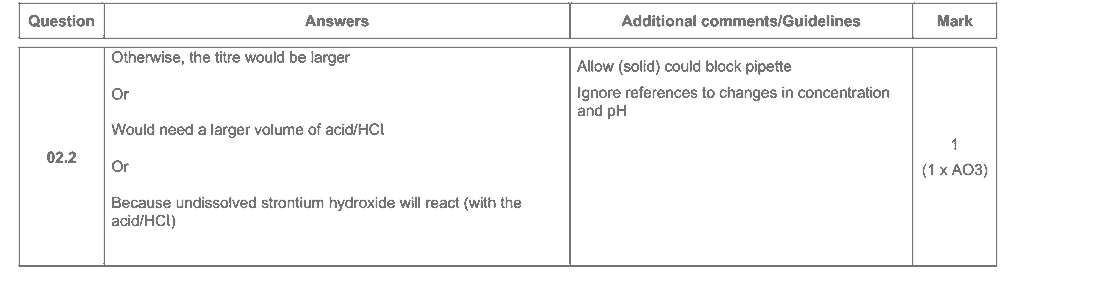
Suggest why it is important to remove the undissolved strontium hydroxide before the
titration.
[1 mark]
June 2024 · Paper 1 · Q02.3 1 mark AO2=1 Practical and data analysis amount of substance
Earlier part of question 02 that this part usesEarlier part of June 2024 Paper 1 question 02
After the filtration, the solution is stored in a stoppered flask.
Suggest a reason for stoppering the flask.
[1 mark]
June 2024 · Paper 1 · Q02.4 1 mark AO3=1 Practical and data analysis amount of substance
Earlier part of question 02 that this part usesEarlier part of June 2024 Paper 1 question 02
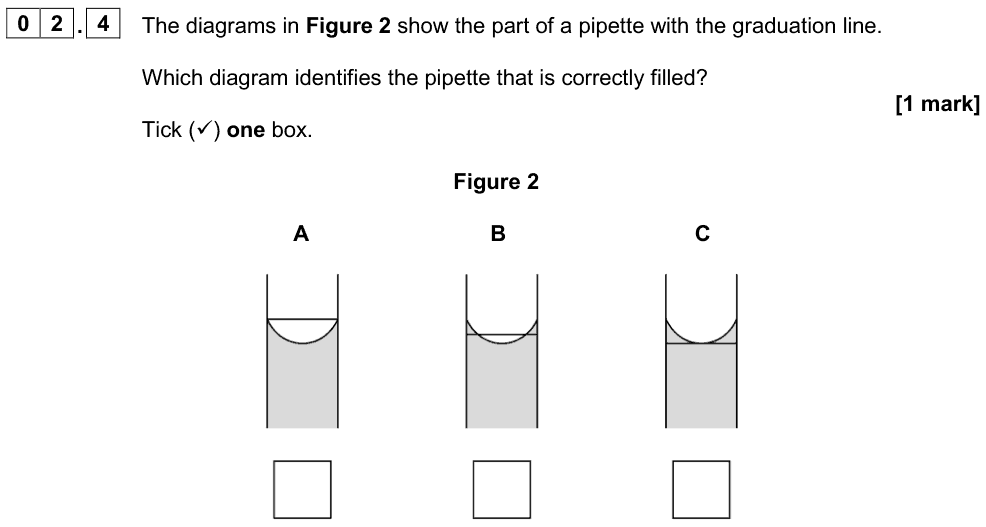
The diagrams in Figure 2 show the part of a pipette with the graduation line.
Which diagram identifies the pipette that is correctly filled?
[1 mark]
Tick () one box.
Figure 2
A
B
C
June 2024 · Paper 1 · Q02.5 6 marks AO2=6 Calculation Hard amount of substance
Earlier part of question 02 that this part usesEarlier part of June 2024 Paper 1 question 02
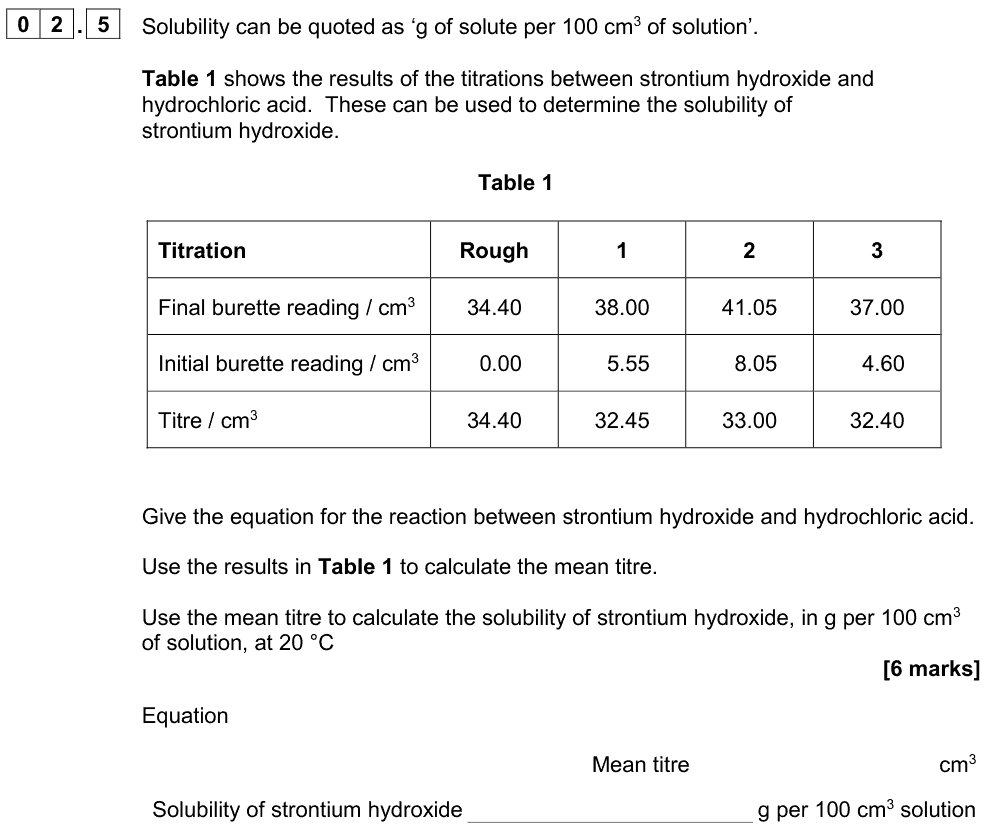
Solubility can be quoted as ‘g of solute per 100 cm3 of solution’.
Table 1 shows the results of the titrations between strontium hydroxide and
hydrochloric acid.  These can be used to determine the solubility of
strontium hydroxide.
Table 1
Titration
Rough
1
2
3
Final burette reading / cm3
34.40
38.00
41.05
37.00
Initial burette reading / cm3
0.00
5.55
8.05
4.60
Titre / cm3
34.40
32.45
33.00
32.40
Give the equation for the reaction between strontium hydroxide and hydrochloric acid.
Use the results in Table 1 to calculate the mean titre.
Use the mean titre to calculate the solubility of strontium hydroxide, in g per 100 cm3
of solution, at 20 °C
[6 marks]
Equation
Mean titre
cm3
Solubility of strontium hydroxide
g per 100 cm3 solution
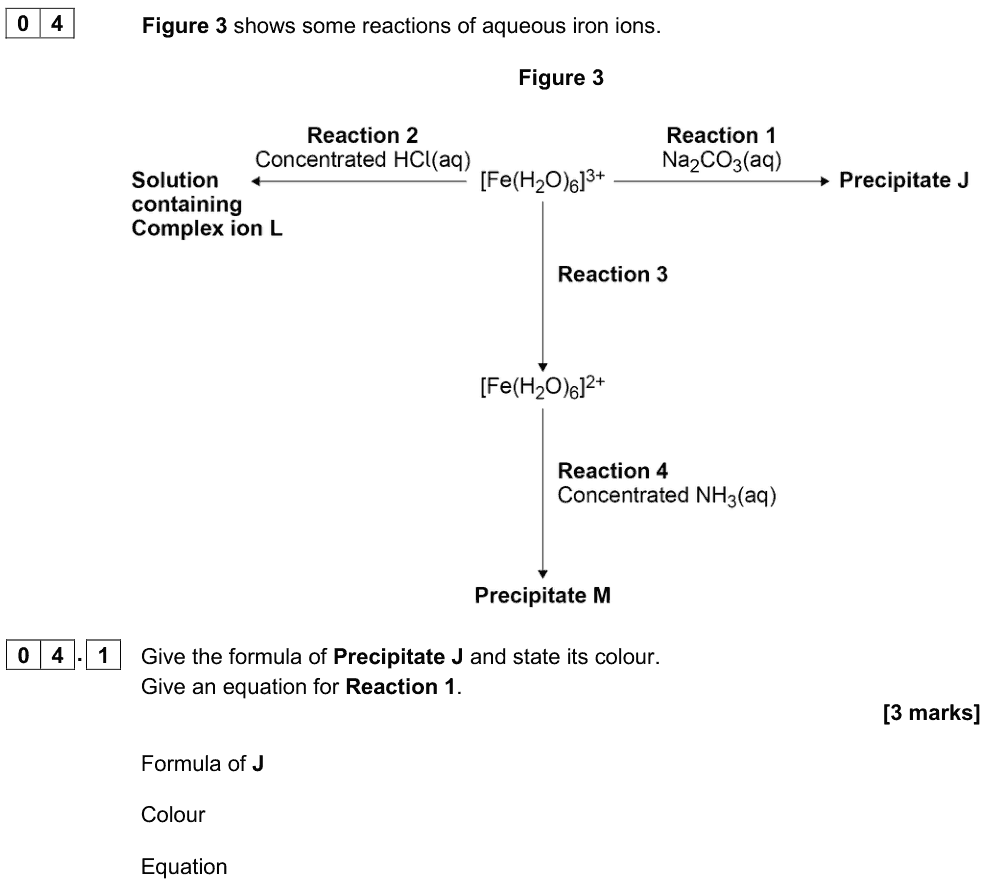
June 2024 · Paper 1 · Q03.4 1 mark AO2=1 Short answer reactions of ions in aqueous solution
Earlier part of question 03 that this part usesEarlier part of June 2024 Paper 1 question 03
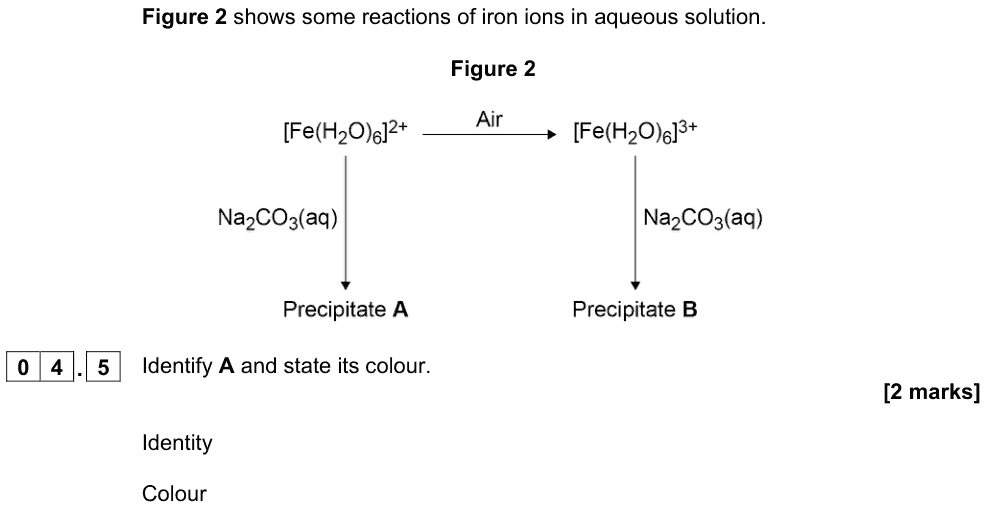
A student adds dilute ammonia solution to a solution containing [Fe(H2O)6]2+ ions.
Give the formula of the precipitate that forms.
[1 mark]
June 2024 · Paper 1 · Q03.5 2 marks AO1=1, AO2=1 Equation writing reactions of ions in aqueous solution
Earlier part of question 03 that this part usesEarlier part of June 2024 Paper 1 question 03
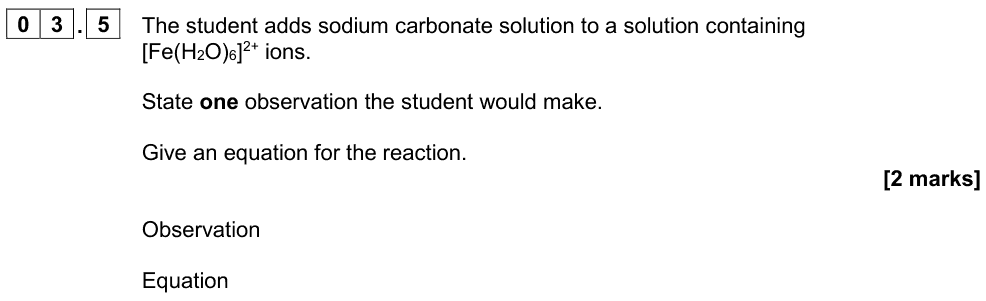
The student adds sodium carbonate solution to a solution containing
[Fe(H2O)6]2+ ions.
State one observation the student would make.
Give an equation for the reaction.
[2 marks]
Observation
Equation
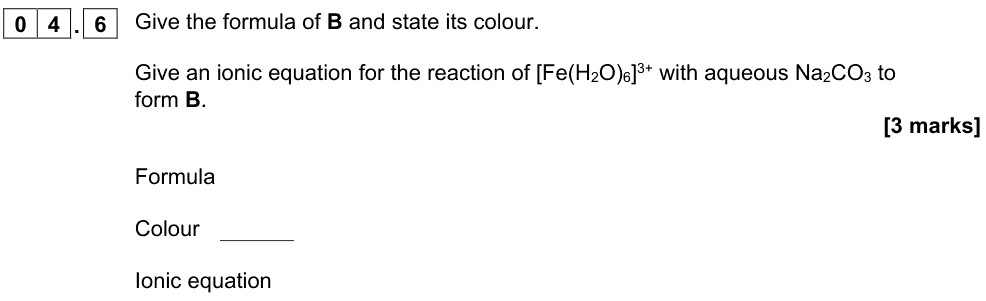
June 2024 · Paper 1 · Q03.6 1 mark AO3=1 Equation writing Hard reactions of ions in aqueous solution
Earlier part of question 03 that this part usesEarlier part of June 2024 Paper 1 question 03
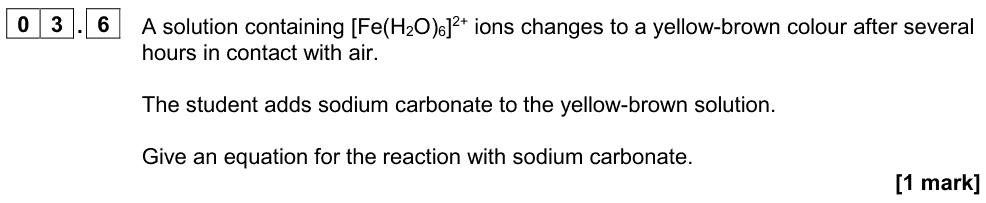
A solution containing [Fe(H2O)6]2+ ions changes to a yellow-brown colour after several
hours in contact with air.
The student adds sodium carbonate to the yellow-brown solution.
Give an equation for the reaction with sodium carbonate.
[1 mark]
June 2024 · Paper 2 · Q04.2 6 marks AO3=6 6-mark level of response carboxylic acids and derivatives
Earlier part of question 04 that this part usesEarlier part of June 2024 Paper 2 question 04
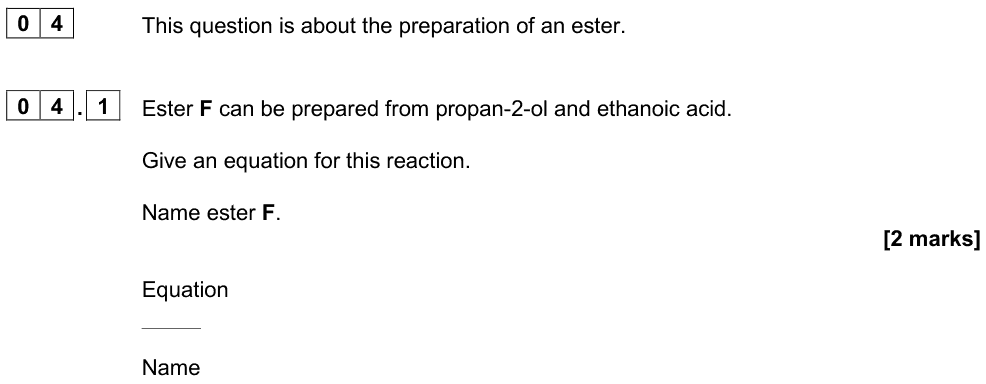
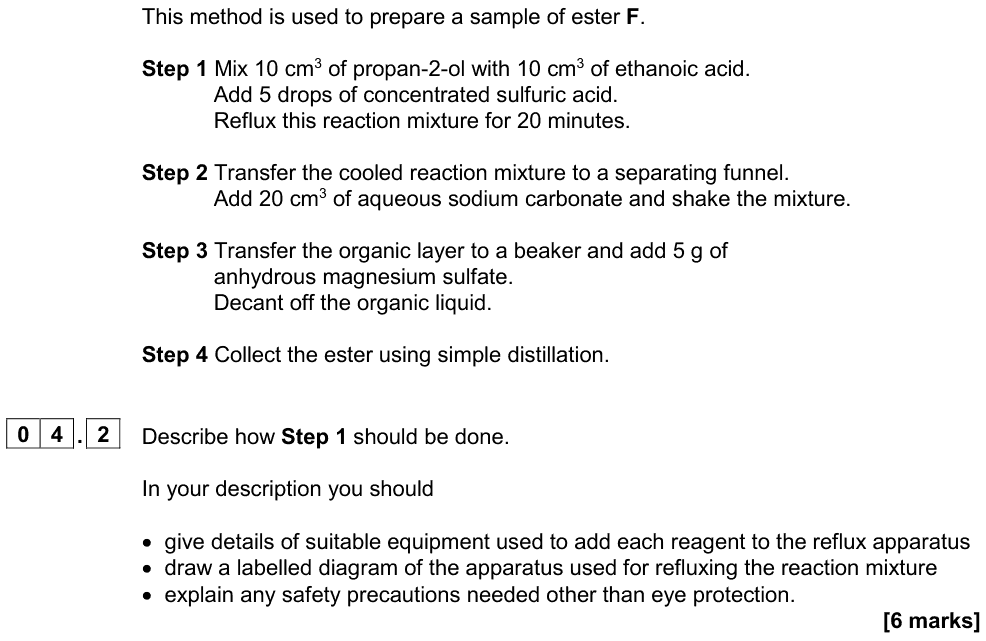
This method is used to prepare a sample of ester F.
Step 1 Mix 10 cm3 of propan-2-ol with 10 cm3 of ethanoic acid.
Add 5 drops of concentrated sulfuric acid.
Reflux this reaction mixture for 20 minutes.
Step 2 Transfer the cooled reaction mixture to a separating funnel.
Add 20 cm3 of aqueous sodium carbonate and shake the mixture.
Step 3 Transfer the organic layer to a beaker and add 5 g of
anhydrous magnesium sulfate.
Decant off the organic liquid.
Step 4 Collect the ester using simple distillation.
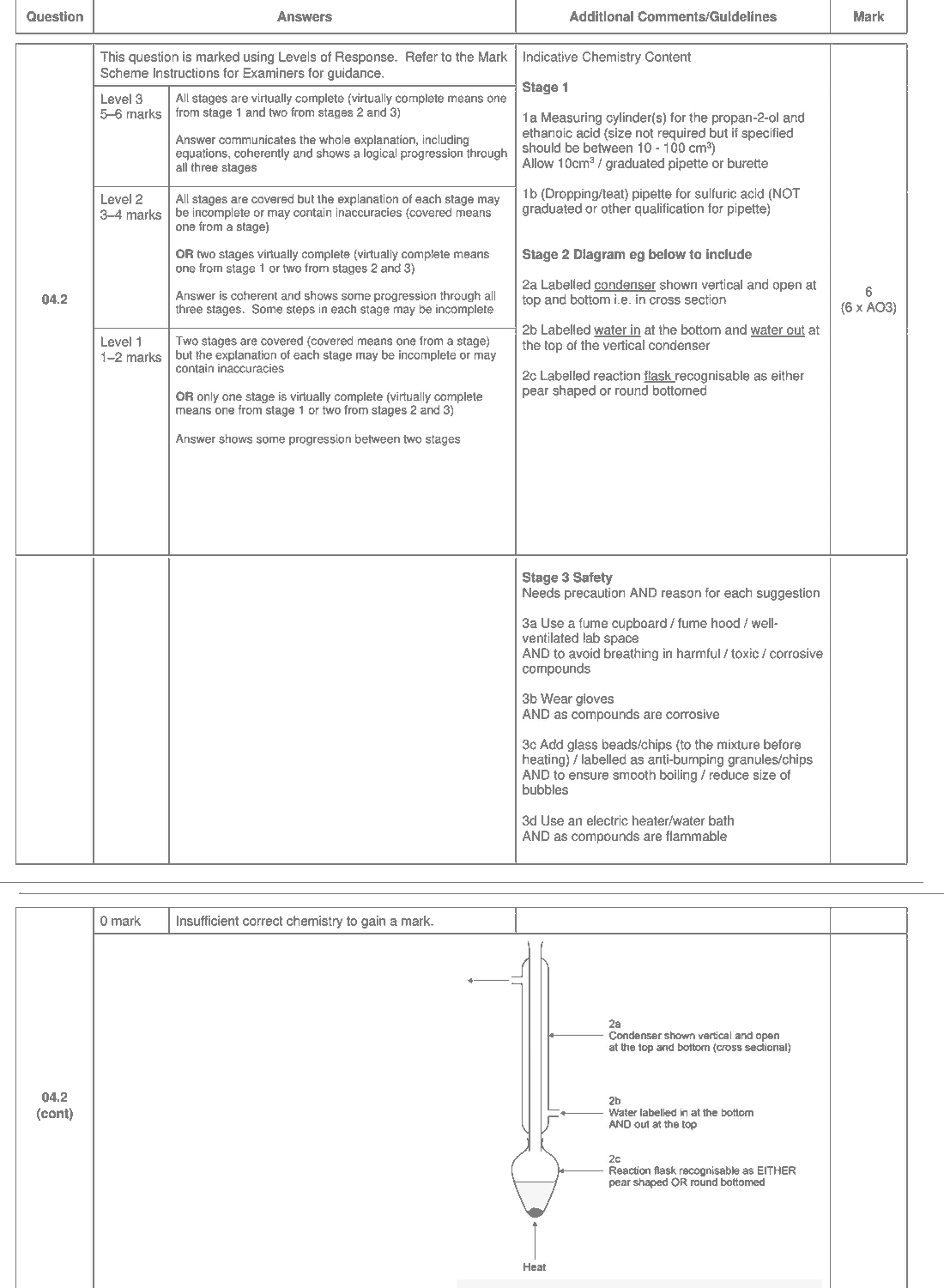
Describe how Step 1 should be done.
In your description you should
• give details of suitable equipment used to add each reagent to the reflux apparatus
• draw a labelled diagram of the apparatus used for refluxing the reaction mixture
• explain any safety precautions needed other than eye protection.
[6 marks]
June 2024 · Paper 2 · Q04.3 3 marks AO1=1, AO3=2 Practical and data analysis carboxylic acids and derivatives
Earlier parts of question 04 that this part usesEarlier part of June 2024 Paper 2 question 04Earlier part of June 2024 Paper 2 question 04
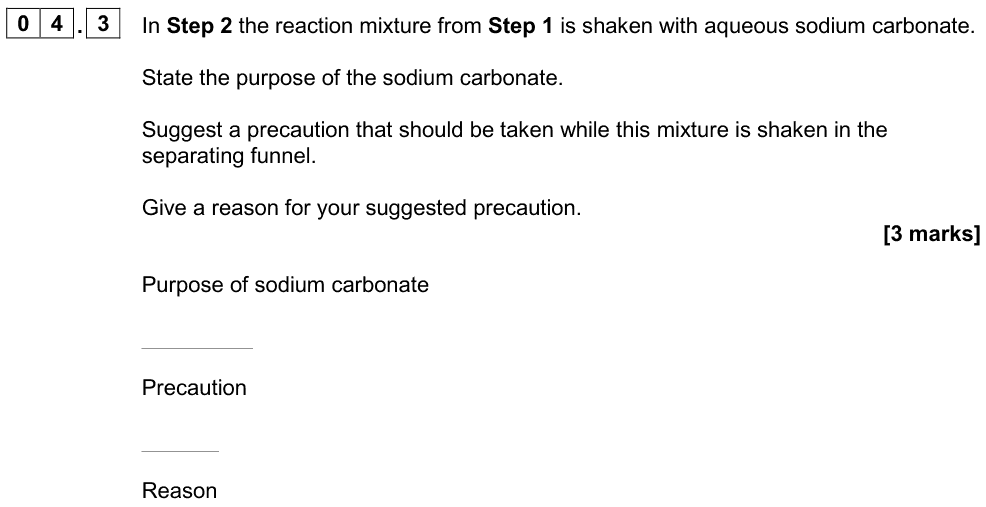
In Step 2 the reaction mixture from Step 1 is shaken with aqueous sodium carbonate.
State the purpose of the sodium carbonate.
Suggest a precaution that should be taken while this mixture is shaken in the
separating funnel.
Give a reason for your suggested precaution.
[3 marks]
Purpose of sodium carbonate
Precaution
Reason
June 2024 · Paper 2 · Q04.4 1 mark AO1=1 Short answer carboxylic acids and derivatives
Earlier parts of question 04 that this part usesEarlier part of June 2024 Paper 2 question 04Earlier part of June 2024 Paper 2 question 04
Give the reason for the use of anhydrous magnesium sulfate in Step 3.
[1 mark]
June 2024 · Paper 2 · Q04.5 1 mark AO1=1 Short answer Hard carboxylic acids and derivatives
Earlier parts of question 04 that this part usesEarlier part of June 2024 Paper 2 question 04Earlier part of June 2024 Paper 2 question 04
Suggest how the purity of the ester can be confirmed during the distillation in Step 4.
[1 mark]
June 2024 · Paper 2 · Q05.1 2 marks AO3=2 Practical and data analysis carboxylic acids and derivativeshalogenoalkanes
This question is about simple test-tube reactions to identify organic liquids.
Silver nitrate solution can be used to distinguish between
propanoyl chloride and 1-chloropropane.
Give the observations you would expect when a few drops of silver nitrate solution are
added to separate samples of propanoyl chloride and 1-chloropropane.
[2 marks]
Observation with propanoyl chloride
Observation with 1-chloropropane
June 2024 · Paper 2 · Q05.2 3 marks AO3=3 Practical and data analysis aldehydes and ketonesorganic analysisalcohols
Earlier part of question 05 that this part usesEarlier part of June 2024 Paper 2 question 05
Three unlabelled bottles are known to contain either propan-1-ol, propanal, or
propanone.
A sample of each liquid is warmed with a few drops of Fehling’s solution.
Identify the liquid that reacts with Fehling’s solution and give the expected
observation.
Suggest a further simple test-tube reaction that can be used to distinguish between
the remaining two liquids.
Give the expected observation with the liquid that reacts.
[3 marks]
Liquid that reacts with Fehling’s solution
Observation
Further test
Observation
June 2024 · Paper 2 · Q11.1 4 marks AO1=1, AO2=3 Calculation energetics
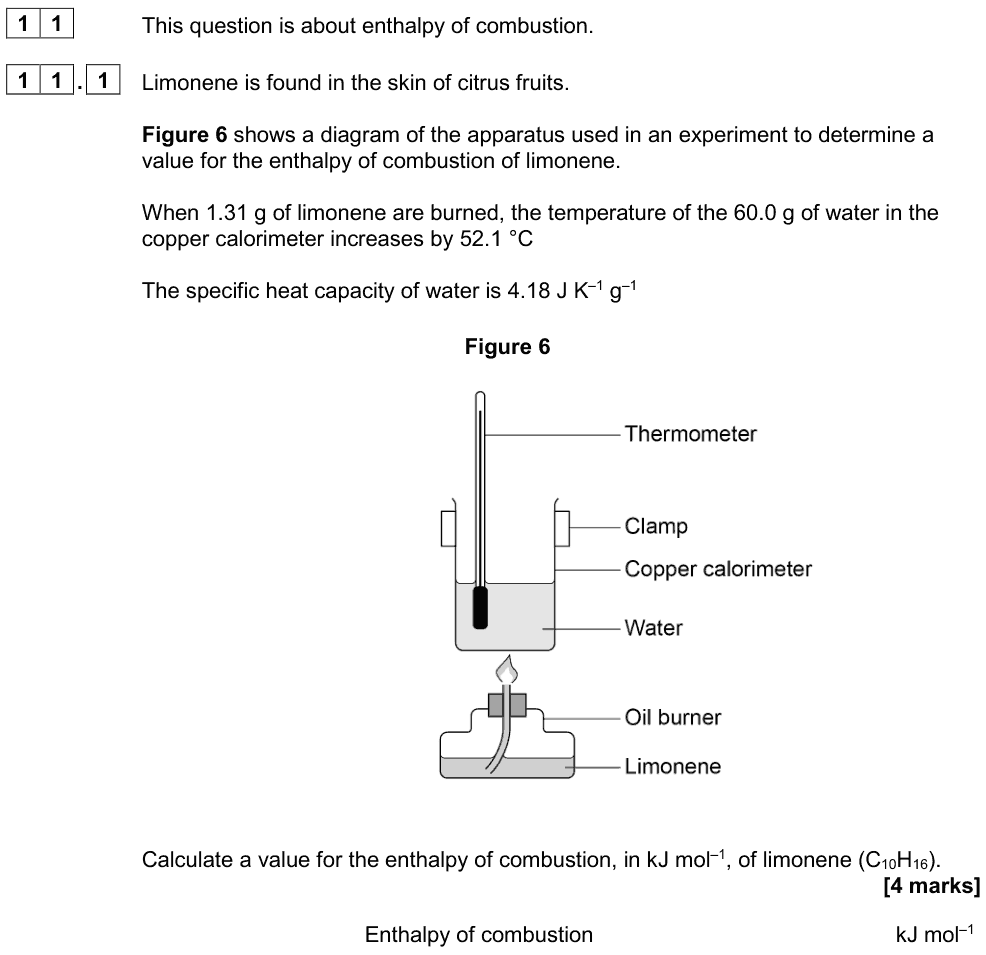
This question is about enthalpy of combustion.
Limonene is found in the skin of citrus fruits.
Figure 6 shows a diagram of the apparatus used in an experiment to determine a
value for the enthalpy of combustion of limonene.
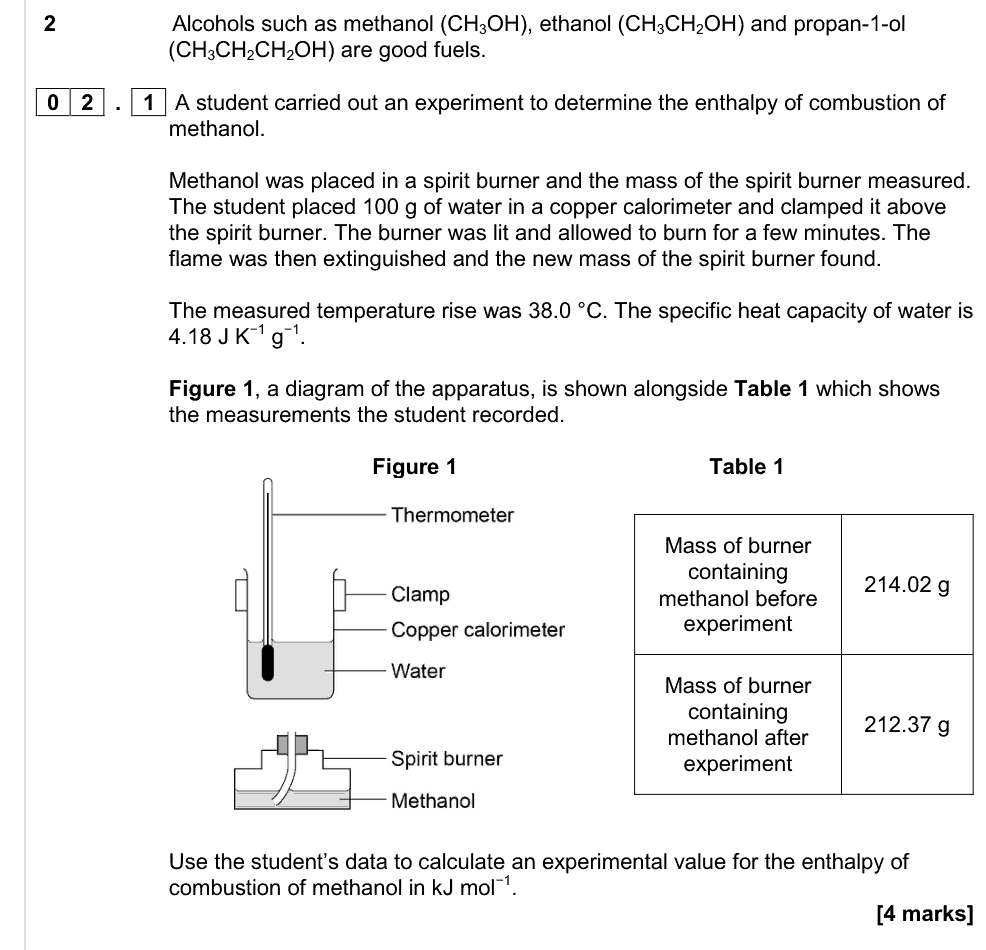
When 1.31 g of limonene are burned, the temperature of the 60.0 g of water in the
copper calorimeter increases by 52.1 °C
The specific heat capacity of water is 4.18 J K–1 g–1
Figure 6
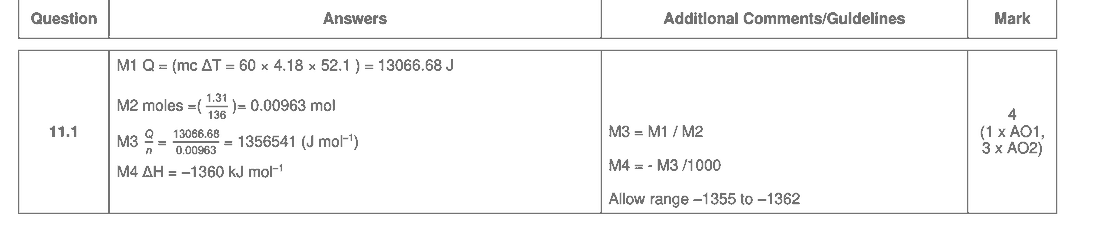
Calculate a value for the enthalpy of combustion, in kJ mol–1, of limonene (C10H16).
[4 marks]
Enthalpy of combustion
kJ mol–1
June 2024 · Paper 2 · Q11.2 5 marks AO3=5 Explanation energetics
Earlier part of question 11 that this part usesEarlier part of June 2024 Paper 2 question 11
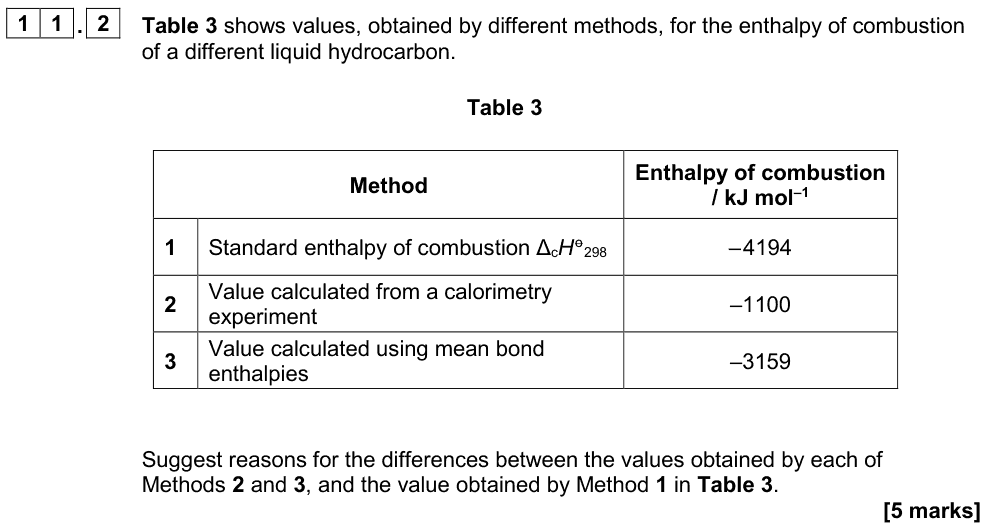
Table 3 shows values, obtained by different methods, for the enthalpy of combustion
of a different liquid hydrocarbon.
Table 3
Method
Enthalpy of combustion
/ kJ mol–1
1
Standard enthalpy of combustion ΔcH o
298
– 4194
2
Value calculated from a calorimetry
experiment
–1100
3
Value calculated using mean bond
enthalpies
–3159
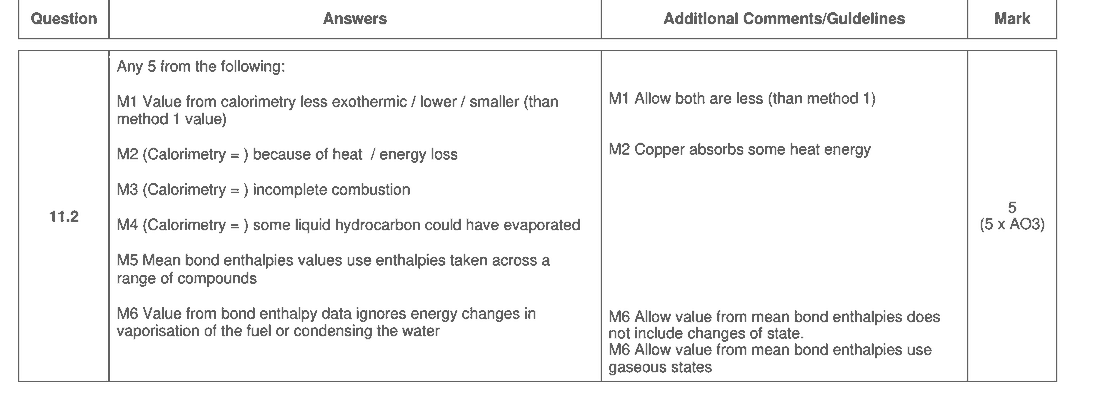
Suggest reasons for the differences between the values obtained by each of
Methods 2 and 3, and the value obtained by Method 1 in Table 3.
[5 marks]
June 2024 · Paper 3 · Q01.2 1 mark AO1=1 Short answer carboxylic acids and derivatives
Earlier part of question 01 that this part usesEarlier part of June 2024 Paper 3 question 01
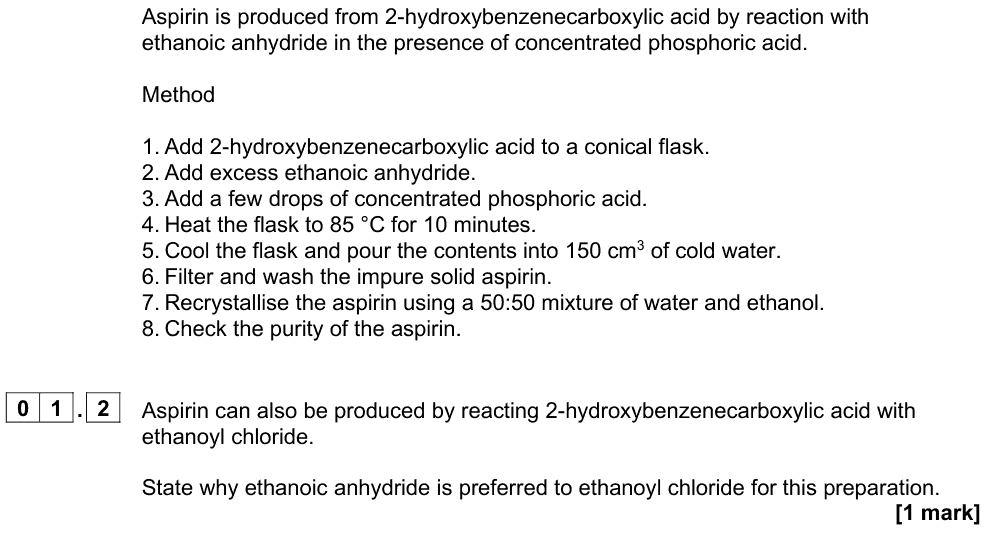
Aspirin is produced from 2-hydroxybenzenecarboxylic acid by reaction with
ethanoic anhydride in the presence of concentrated phosphoric acid.
Method
1. Add 2-hydroxybenzenecarboxylic acid to a conical flask.
2. Add excess ethanoic anhydride.
3. Add a few drops of concentrated phosphoric acid.
4. Heat the flask to 85 °C for 10 minutes.
5. Cool the flask and pour the contents into 150 cm3 of cold water.
6. Filter and wash the impure solid aspirin.
7. Recrystallise the aspirin using a 50:50 mixture of water and ethanol.
8. Check the purity of the aspirin.
Aspirin can also be produced by reacting 2-hydroxybenzenecarboxylic acid with
ethanoyl chloride.
State why ethanoic anhydride is preferred to ethanoyl chloride for this preparation.
[1 mark]
June 2024 · Paper 3 · Q01.4 1 mark AO3=1 Short answer kinetics
Earlier parts of question 01 that this part usesEarlier part of June 2024 Paper 3 question 01Earlier part of June 2024 Paper 3 question 01
Suggest the role of the concentrated phosphoric acid.
[1 mark]
June 2024 · Paper 3 · Q01.5 1 mark AO3=1 Practical and data analysis Hard carboxylic acids and derivatives
Earlier parts of question 01 that this part usesEarlier part of June 2024 Paper 3 question 01Earlier part of June 2024 Paper 3 question 01
Suggest why reflux is not essential when the flask is heated to 85 °C for 10 minutes.
[1 mark]
June 2024 · Paper 3 · Q01.6 2 marks AO3=2 Diagram or structure carboxylic acids and derivatives
Earlier parts of question 01 that this part usesEarlier part of June 2024 Paper 3 question 01Earlier part of June 2024 Paper 3 question 01
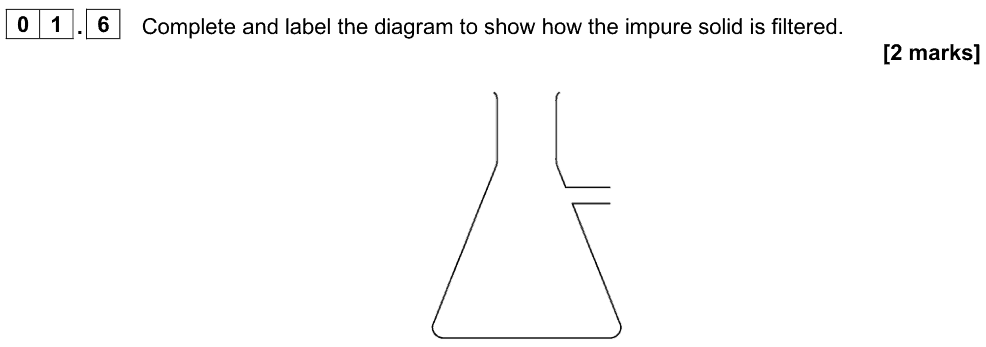
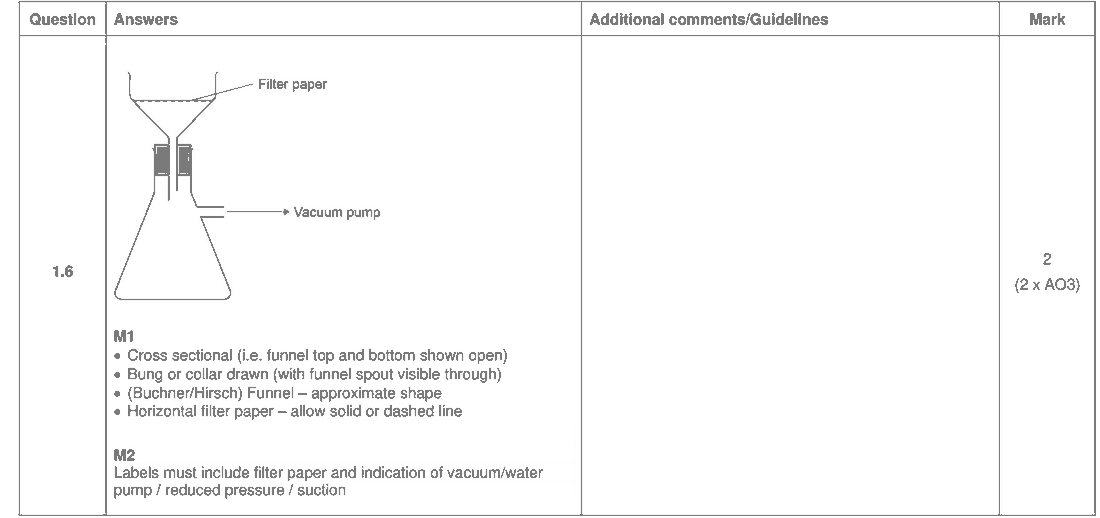
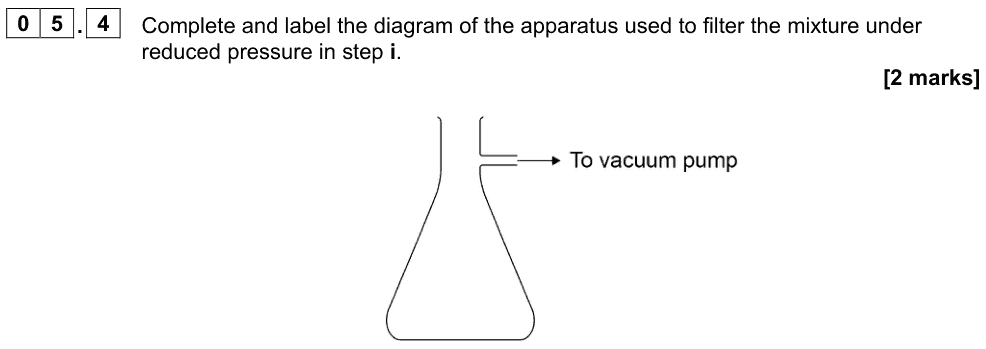
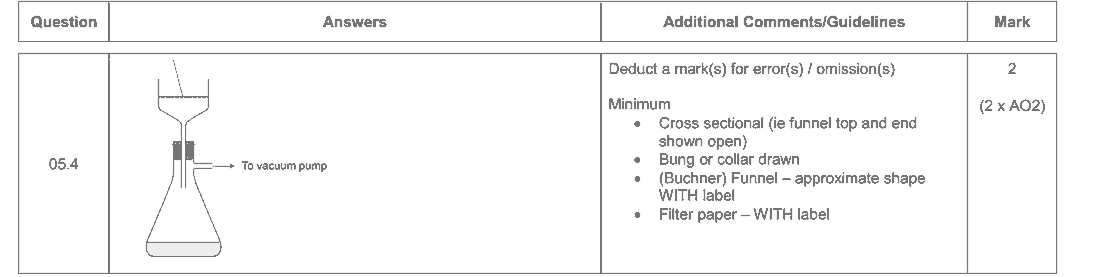
Complete and label the diagram to show how the impure solid is filtered.
[2 marks]
June 2024 · Paper 3 · Q01.7 2 marks AO3=2 Short answer carboxylic acids and derivatives
Earlier parts of question 01 that this part usesEarlier part of June 2024 Paper 3 question 01Earlier part of June 2024 Paper 3 question 01
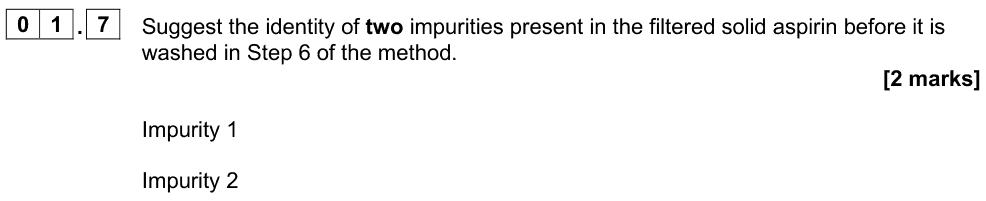
Suggest the identity of two impurities present in the filtered solid aspirin before it is
washed in Step 6 of the method.
[2 marks]
Impurity 1
Impurity 2
June 2024 · Paper 3 · Q01.8 6 marks AO1=6 Practical and data analysis carboxylic acids and derivatives
Earlier parts of question 01 that this part usesEarlier part of June 2024 Paper 3 question 01Earlier part of June 2024 Paper 3 question 01
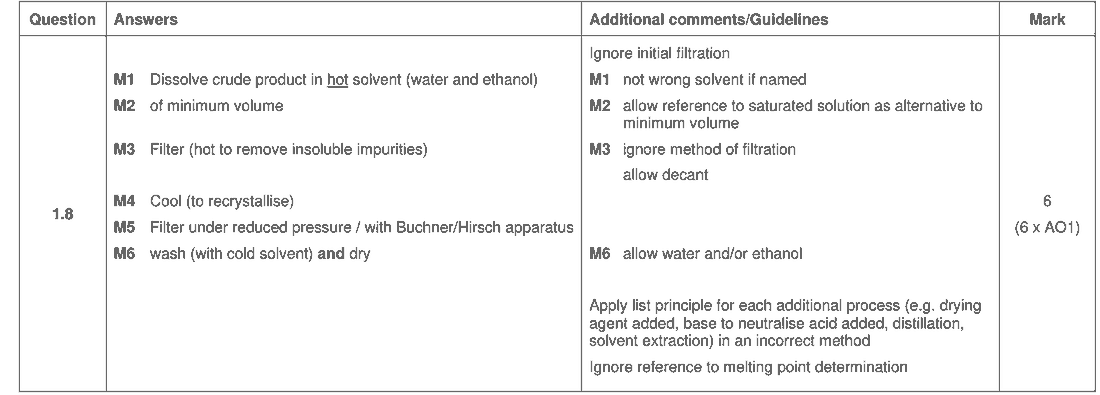
Describe the recrystallisation process used to purify the aspirin.
Include the method and apparatus used.
[6 marks]
June 2024 · Paper 3 · Q01.9 3 marks AO1=3 Practical and data analysis carboxylic acids and derivatives
Earlier parts of question 01 that this part usesEarlier part of June 2024 Paper 3 question 01Earlier part of June 2024 Paper 3 question 01
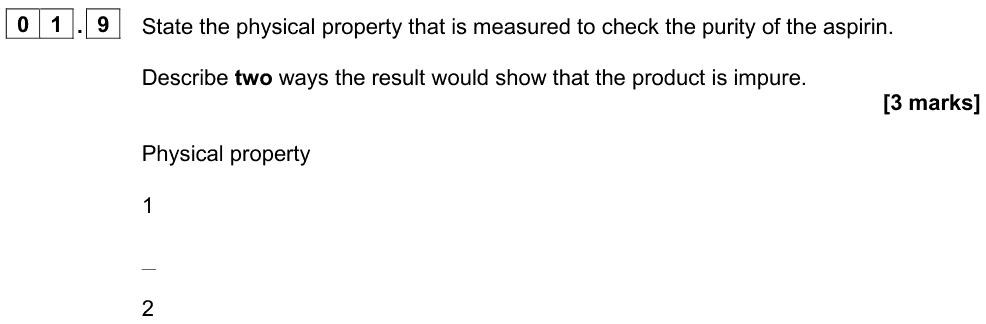
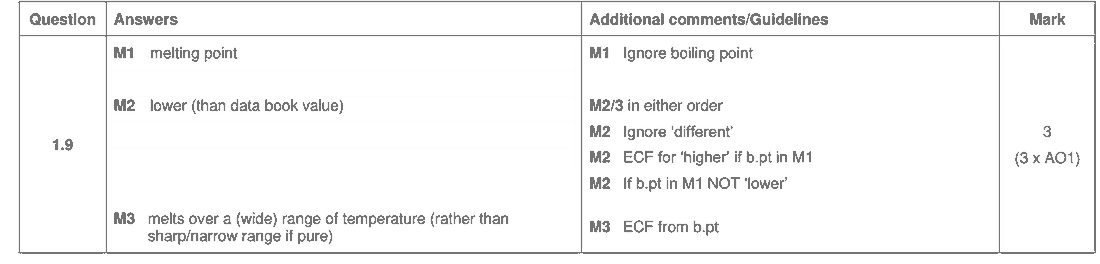
State the physical property that is measured to check the purity of the aspirin.
Describe two ways the result would show that the product is impure.
[3 marks]
Physical property
1
2
June 2024 · Paper 3 · Q02.1 2 marks AO3=2 Practical and data analysis rate equations
The rate of reaction between calcium carbonate and hydrochloric acid is investigated
using a continuous monitoring method.
Method
• Place a conical flask on a balance and add approximately 20 g of
large marble chips.
• Add 50 cm3 of 0.4 mol dm–3 hydrochloric acid.
• Place a loose cotton wool plug in the neck of the flask.
• Zero the mass reading on the balance.
• Start a timer.
• Record the loss in mass (mt) every 30 seconds for 4 minutes.
• Wait for the reaction to finish and record the total mass loss (mtotal).
• Plot a graph of (mtotal – mt) against time.
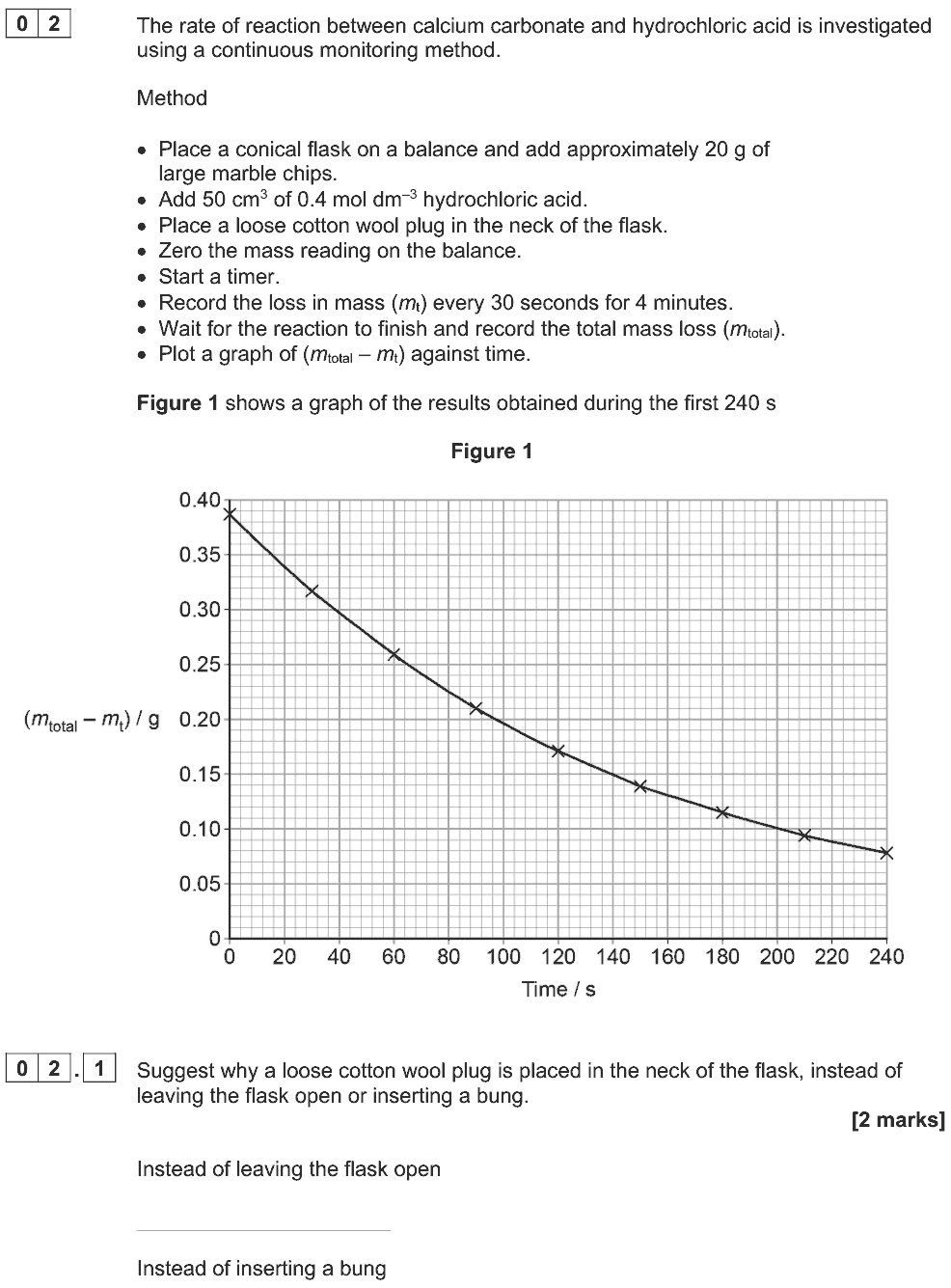
Figure 1 shows a graph of the results obtained during the first 240 s
Figure 1
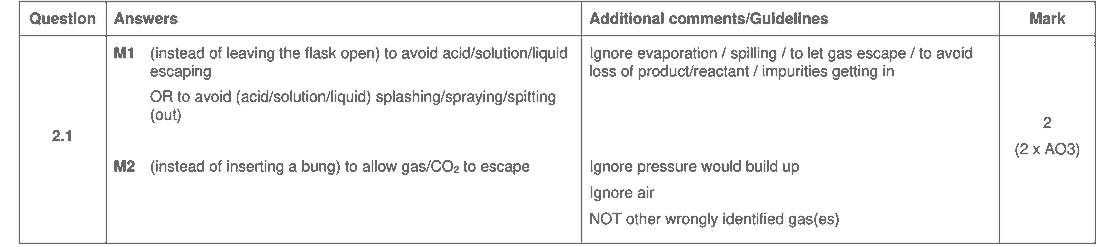
Suggest why a loose cotton wool plug is placed in the neck of the flask, instead of
leaving the flask open or inserting a bung.
[2 marks]
Instead of leaving the flask open
Instead of inserting a bung
June 2024 · Paper 3 · Q02.2 1 mark AO3=1 Practical and data analysis Hard rate equations
Earlier part of question 02 that this part usesEarlier part of June 2024 Paper 3 question 02
20 g of large marble chips is a large excess of calcium carbonate.
Suggest why using a large excess of calcium carbonate means that the rate is only
affected by the changing concentration of the hydrochloric acid.
[1 mark]
June 2024 · Paper 3 · Q02.3 2 marks AO2=2 Explanation rate equationsamount of substance
Earlier part of question 02 that this part usesEarlier part of June 2024 Paper 3 question 02
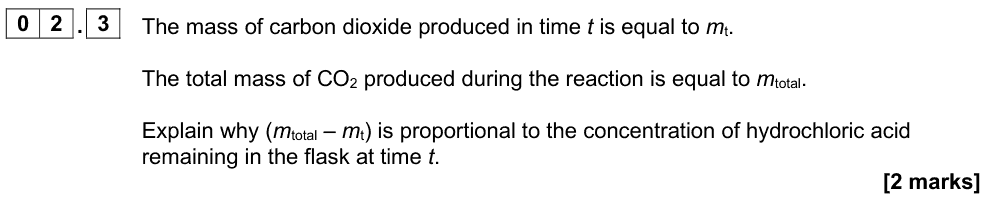
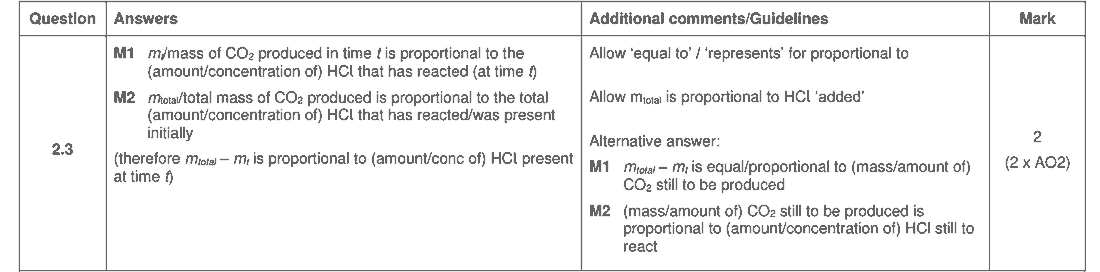
The mass of carbon dioxide produced in time t is equal to mt.
The total mass of CO2 produced during the reaction is equal to mtotal.
Explain why (mtotal – mt) is proportional to the concentration of hydrochloric acid
remaining in the flask at time t.
[2 marks]
June 2024 · Paper 3 · Q02.4 3 marks AO2=3 Practical and data analysis rate equations
Earlier part of question 02 that this part usesEarlier part of June 2024 Paper 3 question 02
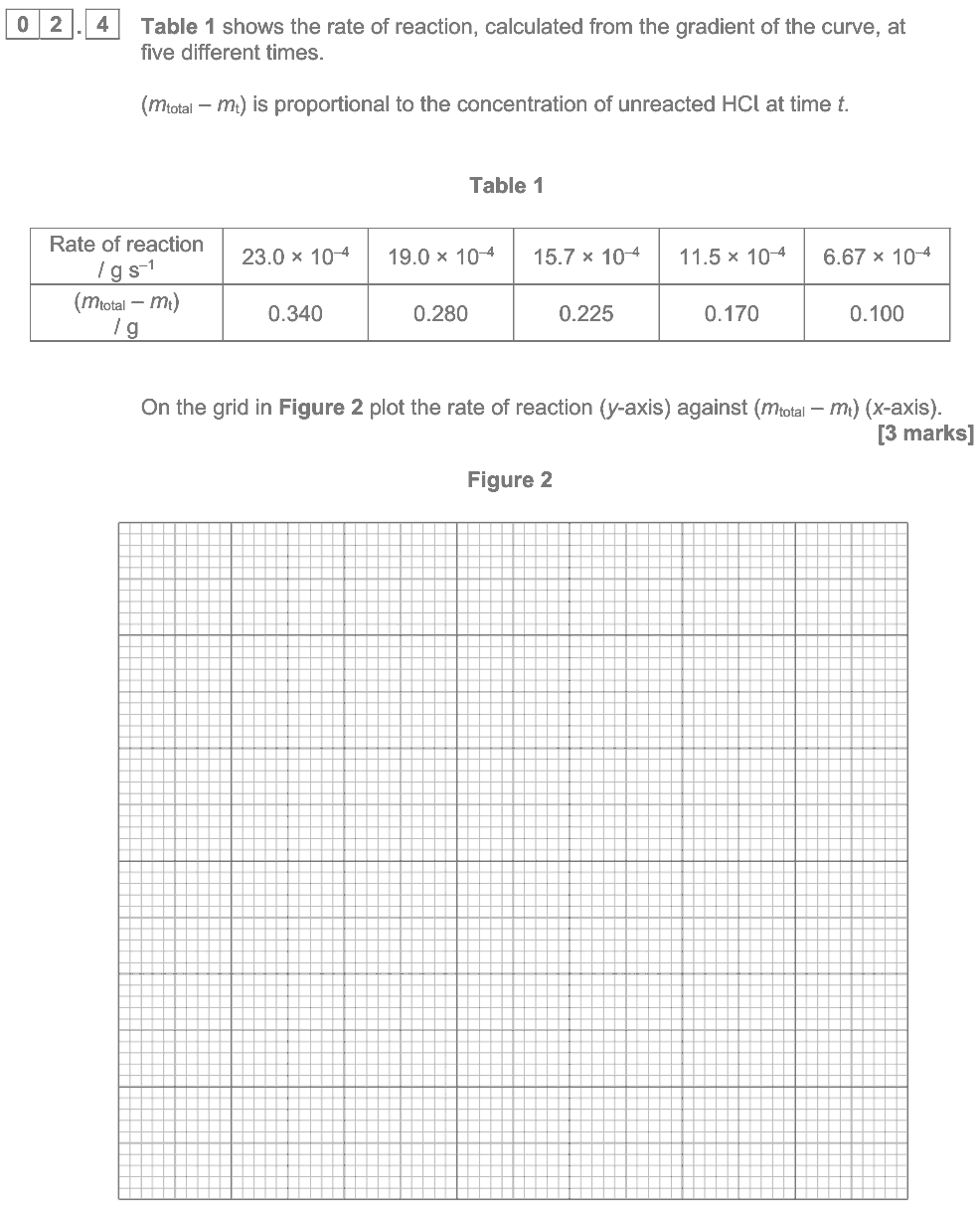
Table 1 shows the rate of reaction, calculated from the gradient of the curve, at
five different times.
(mtotal – mt) is proportional to the concentration of unreacted HCl at time t.
Table 1
Rate of reaction
/ g s–1
23.0 × 10⁻⁴
19.0 × 10⁻⁴
15.7 × 10⁻⁴
11.5 × 10⁻⁴
6.67 × 10⁻⁴
(mtotal – mt)
/ g
0.340
0.280
0.225
0.170
0.100
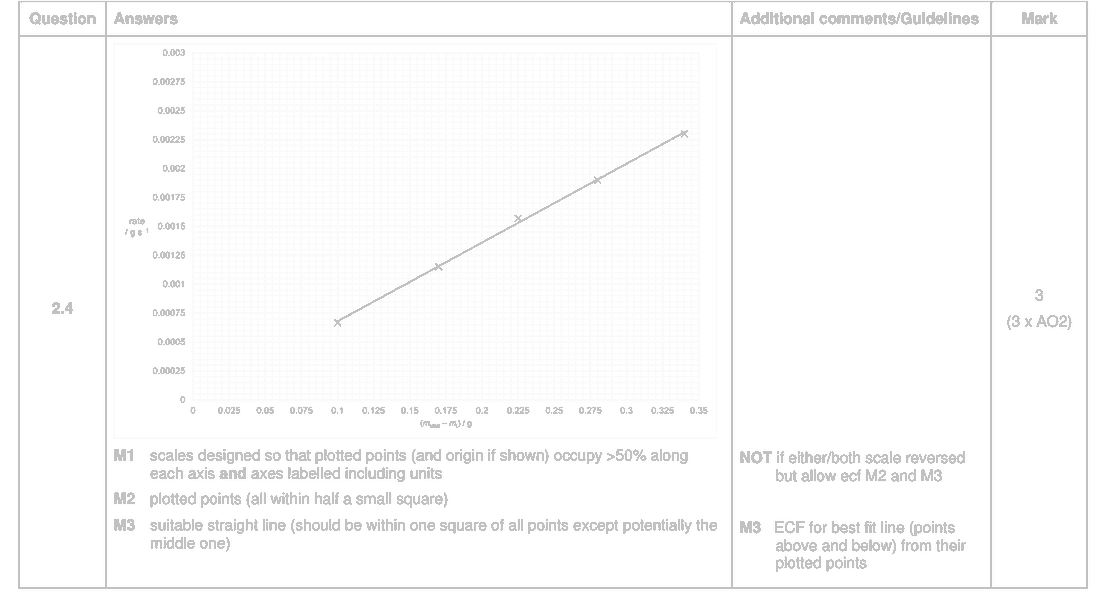
On the grid in Figure 2 plot the rate of reaction (y-axis) against (mtotal – mt) (x-axis).
[3 marks]
Figure 2
June 2024 · Paper 3 · Q02.5 1 mark AO3=1 Short answer rate equations
Earlier parts of question 02 that this part usesEarlier part of June 2024 Paper 3 question 02Earlier part of June 2024 Paper 3 question 02
State how the graph in Figure 2 confirms that the rate equation for this reaction is
Rate = k[HCl]
[1 mark]
June 2024 · Paper 3 · Q02.6 2 marks AO3=2 Practical and data analysis Hard rate equations
Earlier part of question 02 that this part usesEarlier part of June 2024 Paper 3 question 02
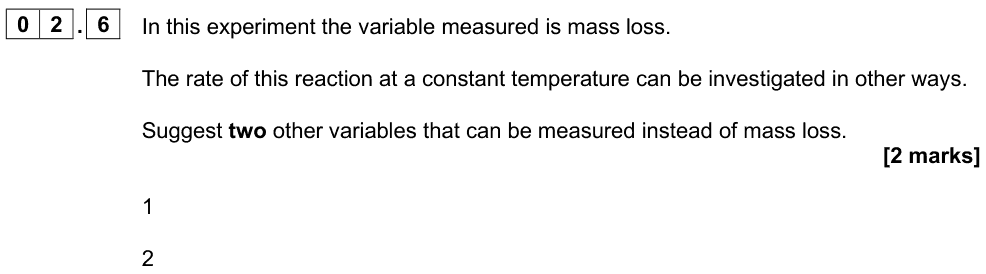
In this experiment the variable measured is mass loss.
The rate of this reaction at a constant temperature can be investigated in other ways.
Suggest two other variables that can be measured instead of mass loss.
[2 marks]
1
2
June 2024 · Paper 3 · Q03.3 2 marks Practical and data analysis rate equations
Earlier part of question 03 that this part usesEarlier part of June 2024 Paper 3 question 03
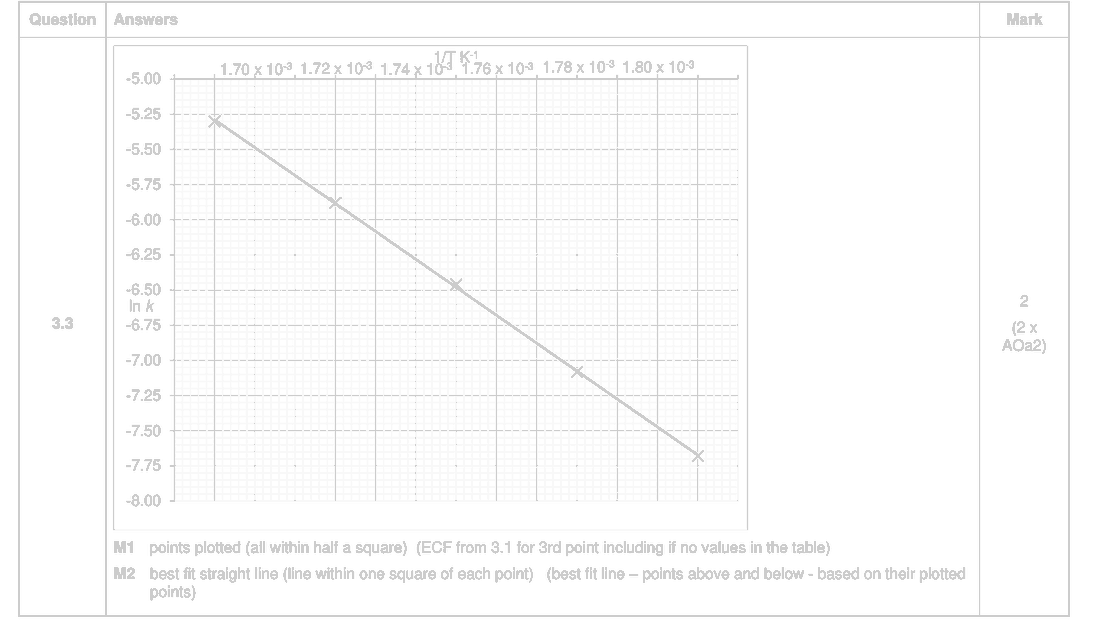
The Arrhenius equation can be written in the form shown.
In k = In A –
Ea
RT
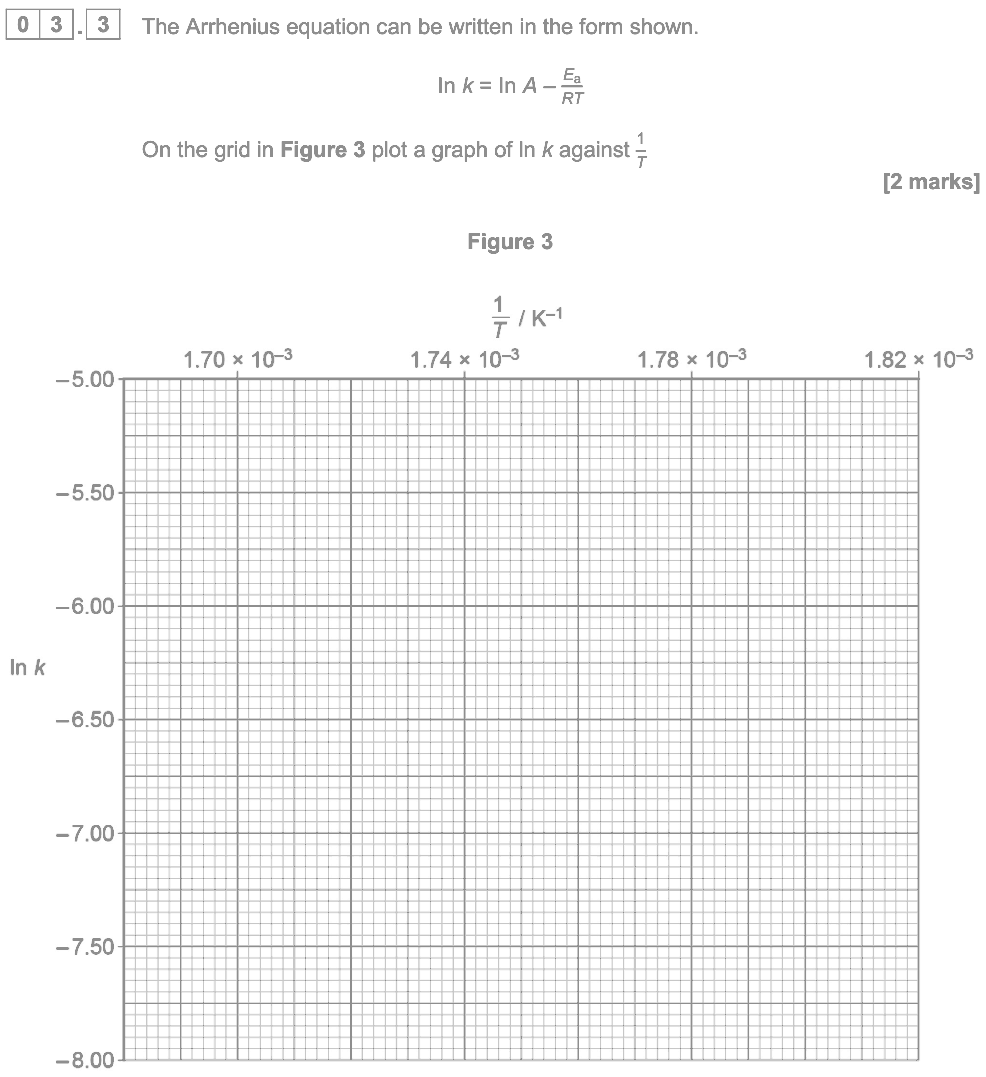
On the grid in Figure 3 plot a graph of ln k against
1
T
[2 marks]
Figure 3
June 2024 · Paper 3 · Q04.2 1 mark AO3=1 Practical and data analysis acids and bases
Earlier part of question 04 that this part usesEarlier part of June 2024 Paper 3 question 04
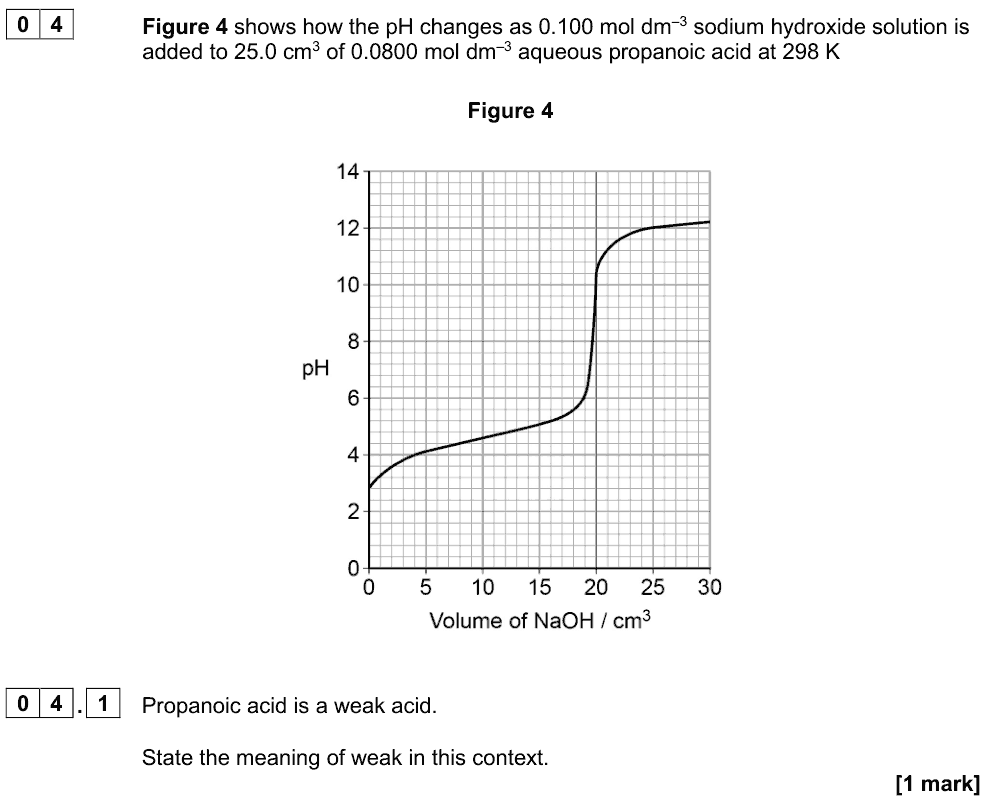
Suggest why a student doing an experiment to produce the curve in Figure 4 would
add the sodium hydroxide solution dropwise around the equivalence point.
[1 mark]
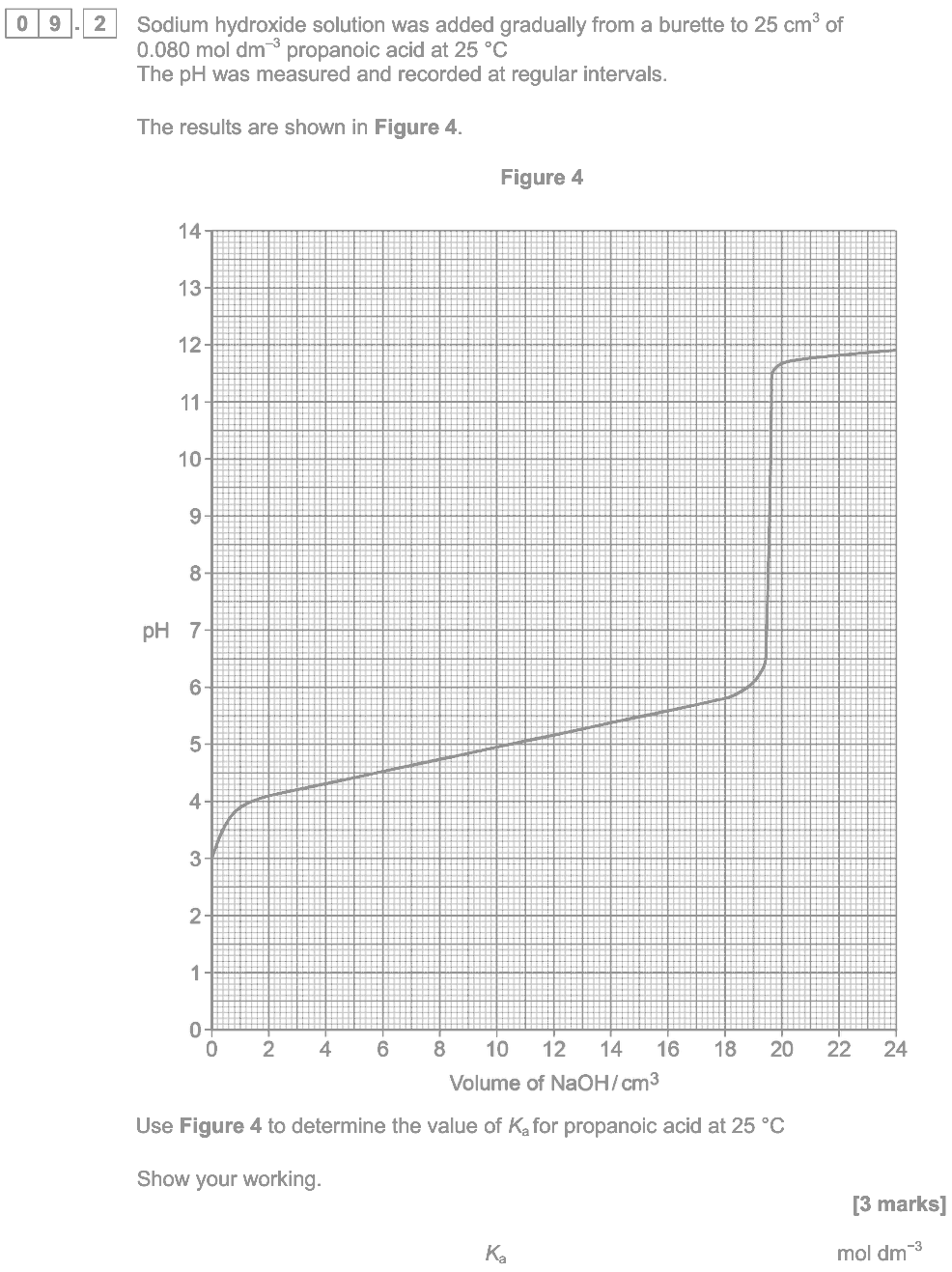
June 2024 · Paper 3 · Q04.4 2 marks AO3=2 Calculation acids and bases
Earlier part of question 04 that this part usesEarlier part of June 2024 Paper 3 question 04
Use the pH from Figure 4, when half of the propanoic acid has reacted, to calculate
Ka at 298 K
[2 marks]
Ka
mol dm–3
June 2024 · Paper 3 · Q04.6 2 marks AO3=2 Short answer acids and bases
Earlier part of question 04 that this part usesEarlier part of June 2024 Paper 3 question 04
Methyl orange and universal indicator are not suitable indicators for the titration of

solutions of propanoic acid with sodium hydroxide.
State the reason why each indicator is not suitable.
[2 marks]
Methyl orange
Universal indicator
June 2024 · Paper 3 · Q05.1 6 marks AO1=6 6-mark level of response Hard transition metals
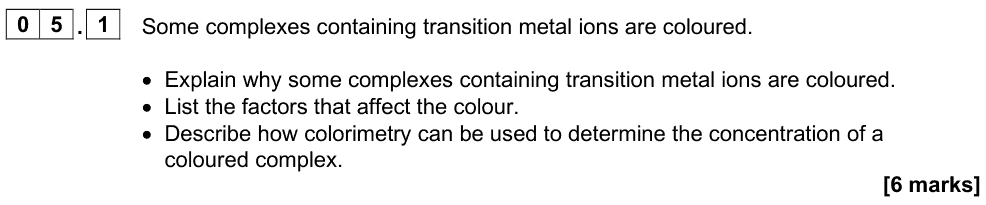
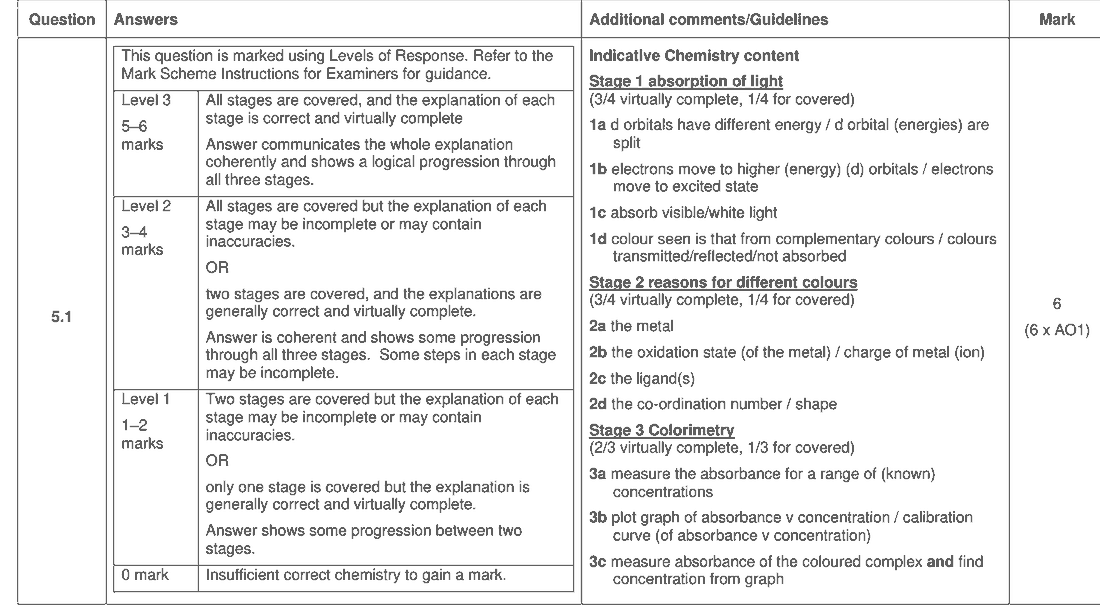
Some complexes containing transition metal ions are coloured.
• Explain why some complexes containing transition metal ions are coloured.
• List the factors that affect the colour.
• Describe how colorimetry can be used to determine the concentration of a
coloured complex.
[6 marks]
June 2023 · AS Paper 1 · Q02.6 6 marks AO2=6 Calculation Hard amount of substance
Earlier part of question 02 that this part usesEarlier part of June 2023 Paper 1 question 02
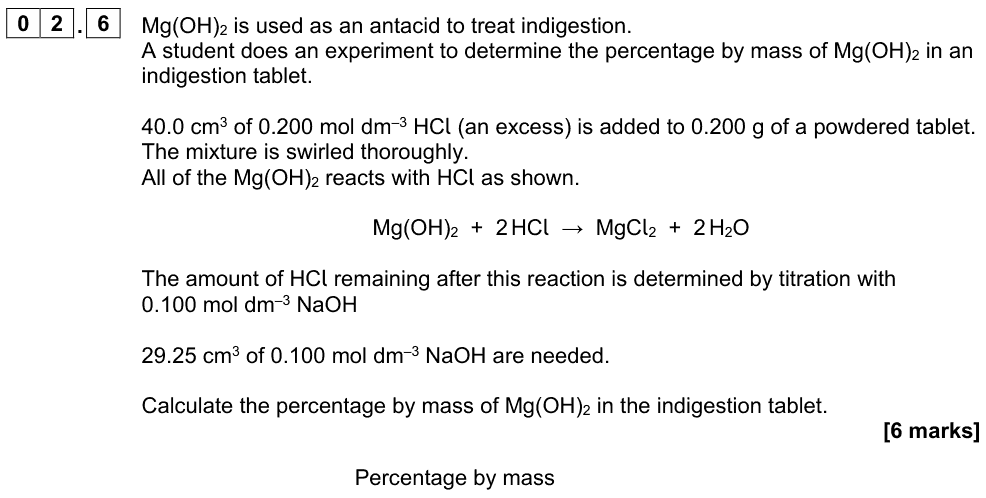
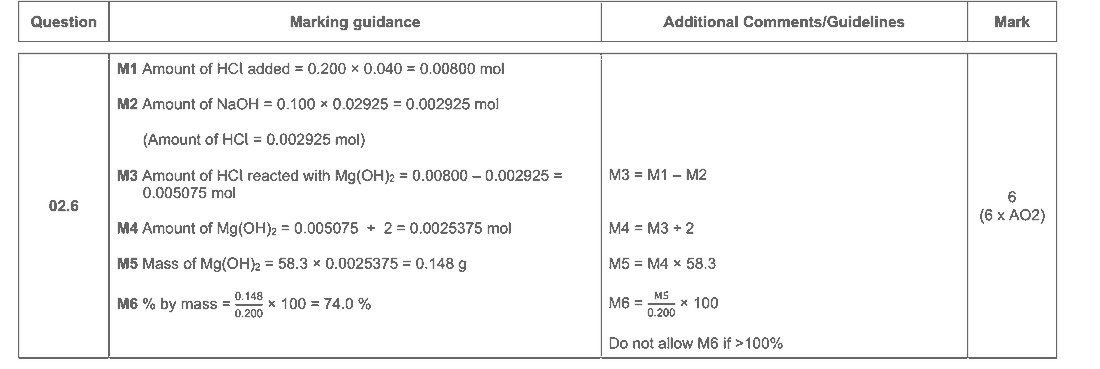
Mg(OH)2 is used as an antacid to treat indigestion.
A student does an experiment to determine the percentage by mass of Mg(OH)2 in an
indigestion tablet.
40.0 cm3 of 0.200 mol dm–3 HCl (an excess) is added to 0.200 g of a powdered tablet.
The mixture is swirled thoroughly.
All of the Mg(OH)2 reacts with HCl as shown.
Mg(OH)2  +  2 HCl  →  MgCl2  +  2 H2O
The amount of HCl remaining after this reaction is determined by titration with
0.100 mol dm–3 NaOH
29.25 cm3 of 0.100 mol dm–3 NaOH are needed.
Calculate the percentage by mass of Mg(OH)2 in the indigestion tablet.
[6 marks]
Percentage by mass
June 2023 · AS Paper 1 · Q03.1 3 marks AO3=3 Practical and data analysis amount of substance
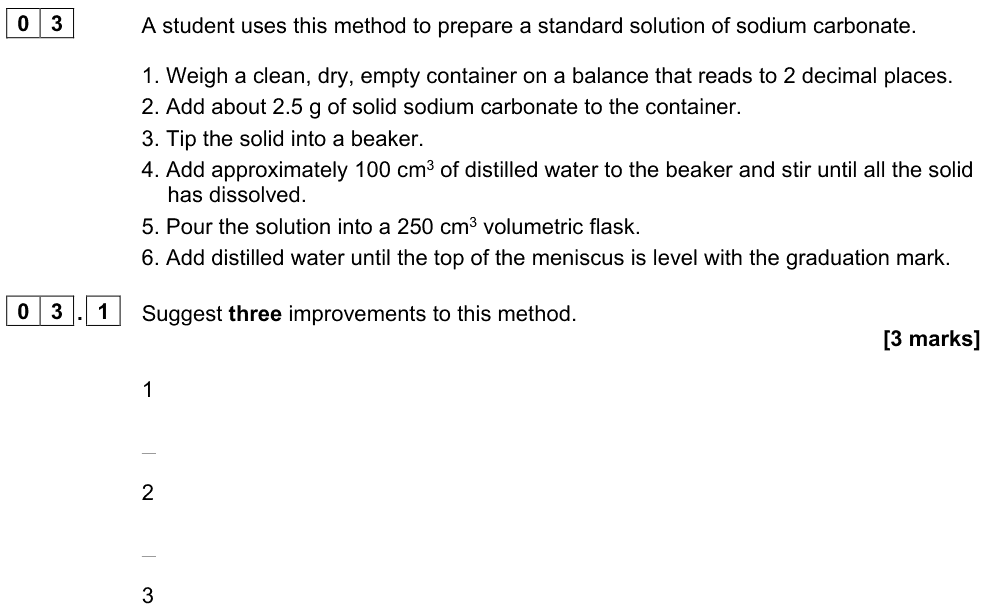
A student uses this method to prepare a standard solution of sodium carbonate.
1. Weigh a clean, dry, empty container on a balance that reads to 2 decimal places.
2. Add about 2.5 g of solid sodium carbonate to the container.
3. Tip the solid into a beaker.
4. Add approximately 100 cm3 of distilled water to the beaker and stir until all the solid
has dissolved.
5. Pour the solution into a 250 cm3 volumetric flask.
6. Add distilled water until the top of the meniscus is level with the graduation mark.
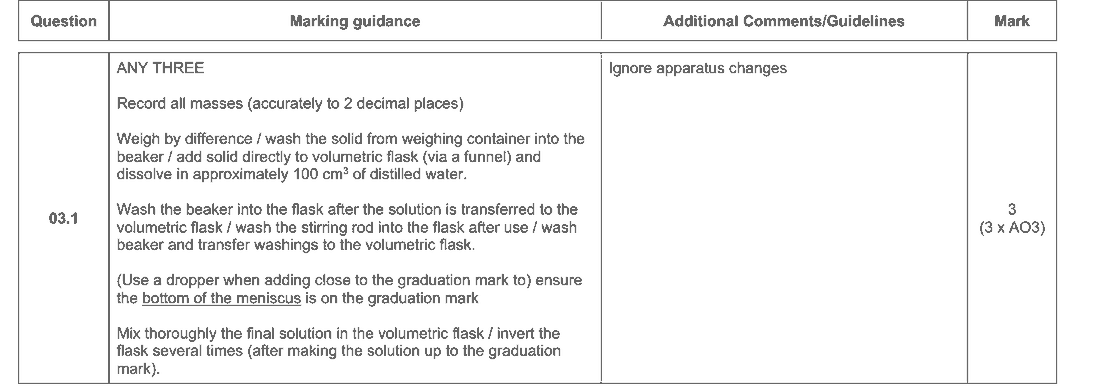
Suggest three improvements to this method.
[3 marks]
1
2
3
June 2023 · AS Paper 1 · Q03.2 1 mark AO2=1 Practical and data analysis Easy amount of substance
Earlier part of question 03 that this part usesEarlier part of June 2023 Paper 1 question 03
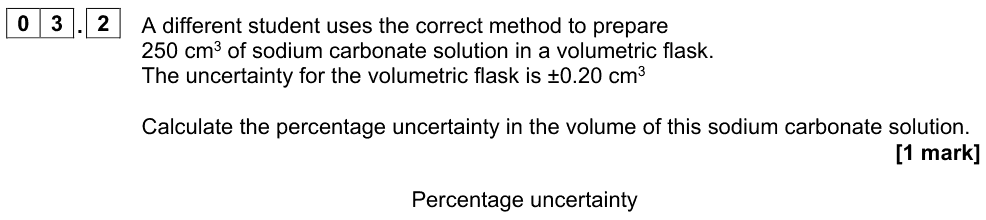
A different student uses the correct method to prepare
250 cm3 of sodium carbonate solution in a volumetric flask.
The uncertainty for the volumetric flask is ±0.20 cm3
Calculate the percentage uncertainty in the volume of this sodium carbonate solution.
[1 mark]
Percentage uncertainty
June 2023 · AS Paper 2 · Q01.1 3 marks AO3=3 Practical and data analysis organic analysisalcohols
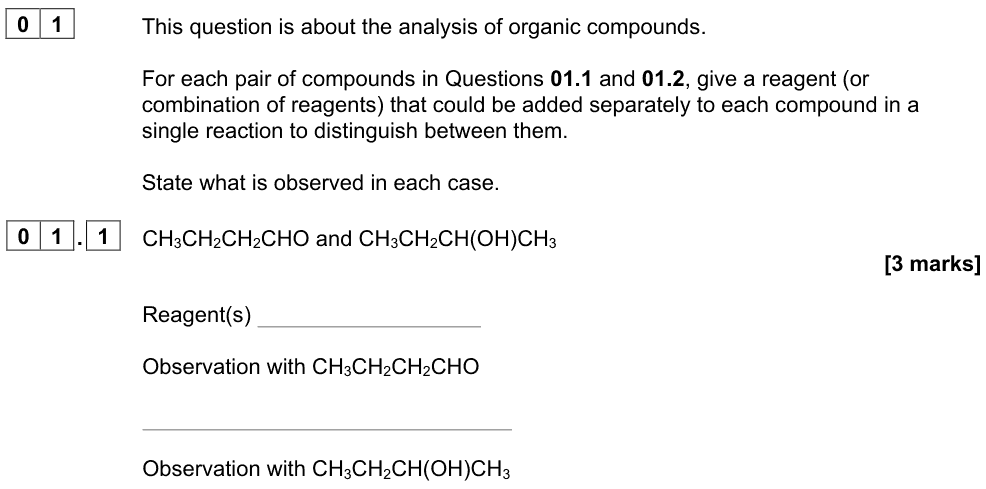
This question is about the analysis of organic compounds.
For each pair of compounds in Questions 01.1 and 01.2, give a reagent (or
combination of reagents) that could be added separately to each compound in a
single reaction to distinguish between them.
State what is observed in each case.
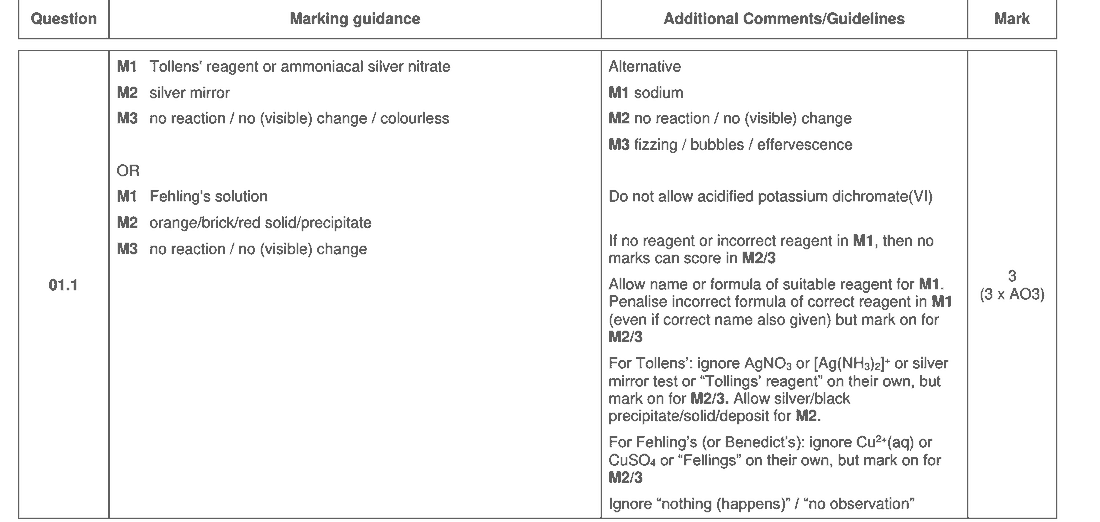
CH3CH2CH2CHO and CH3CH2CH(OH)CH3
[3 marks]
Reagent(s)
Observation with CH3CH2CH2CHO
Observation with CH3CH2CH(OH)CH3
June 2023 · AS Paper 2 · Q01.2 3 marks AO3=3 Practical and data analysis Easy alkenesorganic analysis
Earlier part of question 01 that this part usesEarlier part of June 2023 Paper 2 question 01
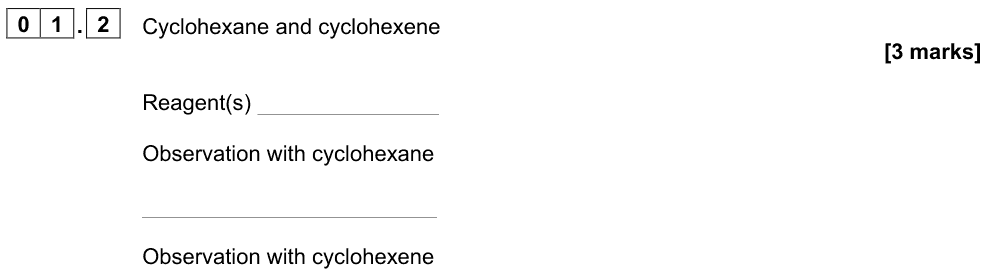
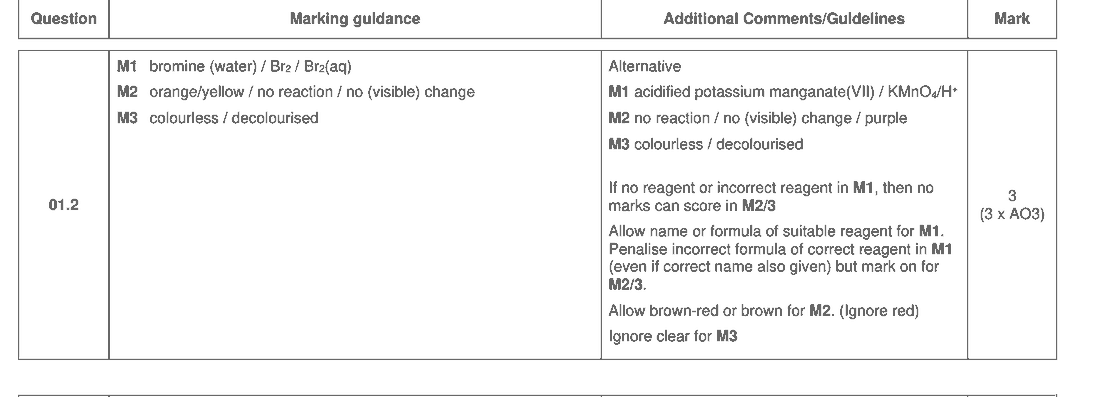
Cyclohexane and cyclohexene
[3 marks]
Reagent(s)
Observation with cyclohexane
Observation with cyclohexene
June 2023 · AS Paper 2 · Q03.2 2 marks AO2=2 Short answer Hard halogenoalkanes
Earlier part of question 03 that this part usesEarlier part of June 2023 Paper 2 question 03
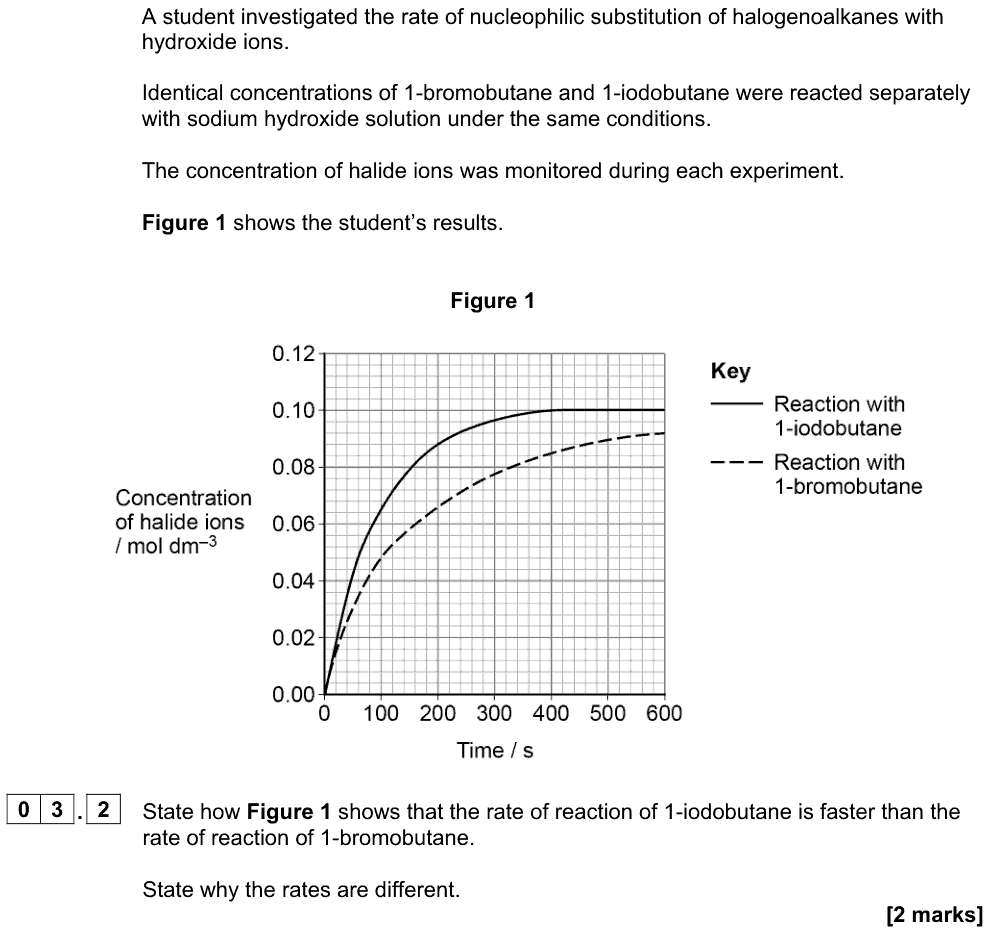
A student investigated the rate of nucleophilic substitution of halogenoalkanes with
hydroxide ions.
Identical concentrations of 1-bromobutane and 1-iodobutane were reacted separately
with sodium hydroxide solution under the same conditions.
The concentration of halide ions was monitored during each experiment.
Figure 1 shows the student’s results.
Figure 1
State how Figure 1 shows that the rate of reaction of 1-iodobutane is faster than the
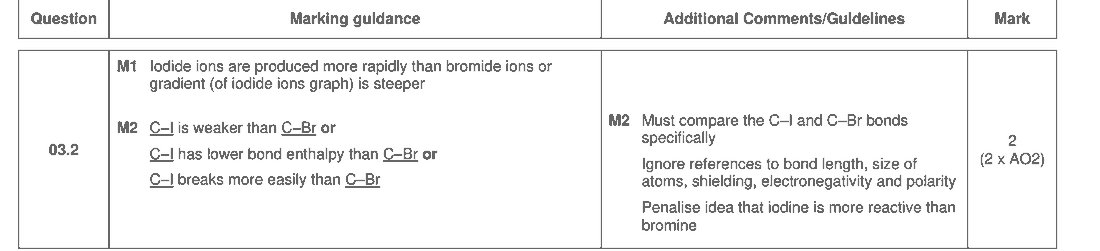
rate of reaction of 1-bromobutane.
State why the rates are different.
[2 marks]
June 2023 · AS Paper 2 · Q05.1 3 marks AO2=3 Calculation energetics
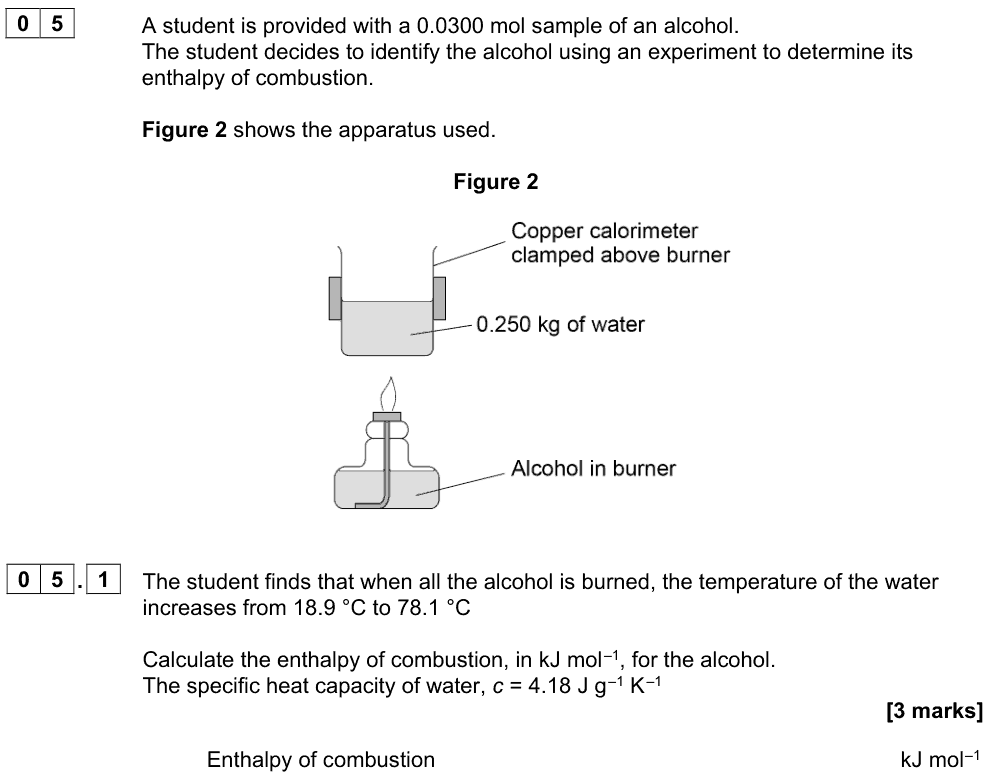
A student is provided with a 0.0300 mol sample of an alcohol.
The student decides to identify the alcohol using an experiment to determine its
enthalpy of combustion.
Figure 2 shows the apparatus used.
Figure 2
The student finds that when all the alcohol is burned, the temperature of the water
increases from 18.9 °C to 78.1 °C
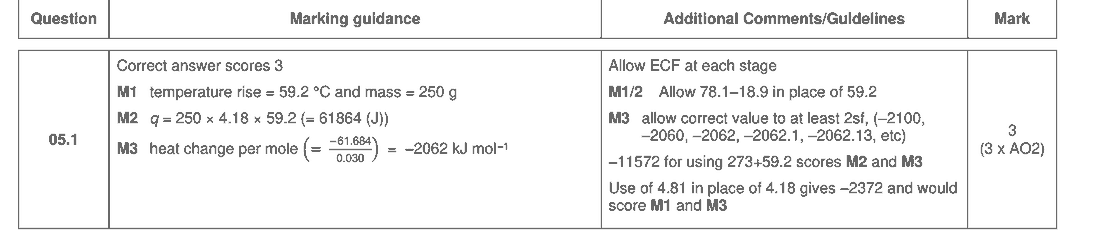
Calculate the enthalpy of combustion, in kJ mol –1, for the alcohol.
The specific heat capacity of water, c = 4.18 J g –1 K –1
[3 marks]
Enthalpy of combustion
kJ mol –1
June 2023 · AS Paper 2 · Q05.2 2 marks AO3=2 Practical and data analysis energetics
Earlier part of question 05 that this part usesEarlier part of June 2023 Paper 2 question 05
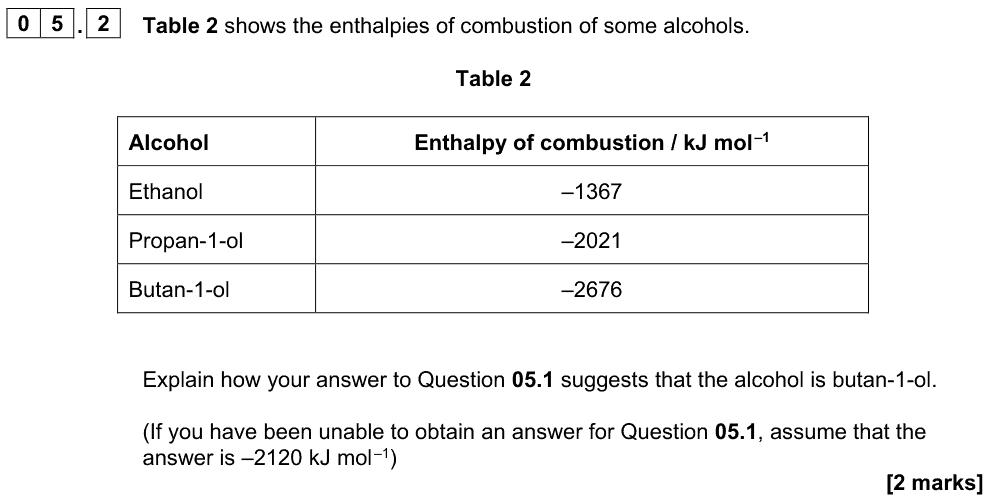
Table 2 shows the enthalpies of combustion of some alcohols.
Table 2
Alcohol
Enthalpy of combustion / kJ mol –1
Ethanol
–1367
Propan-1-ol
–2021
Butan-1-ol
–2676
Explain how your answer to Question 05.1 suggests that the alcohol is butan-1-ol.
(If you have been unable to obtain an answer for Question 05.1, assume that the
answer is –2120 kJ mol –1)
[2 marks]
June 2023 · AS Paper 2 · Q07.1 2 marks AO3=2 Practical and data analysis alcohols
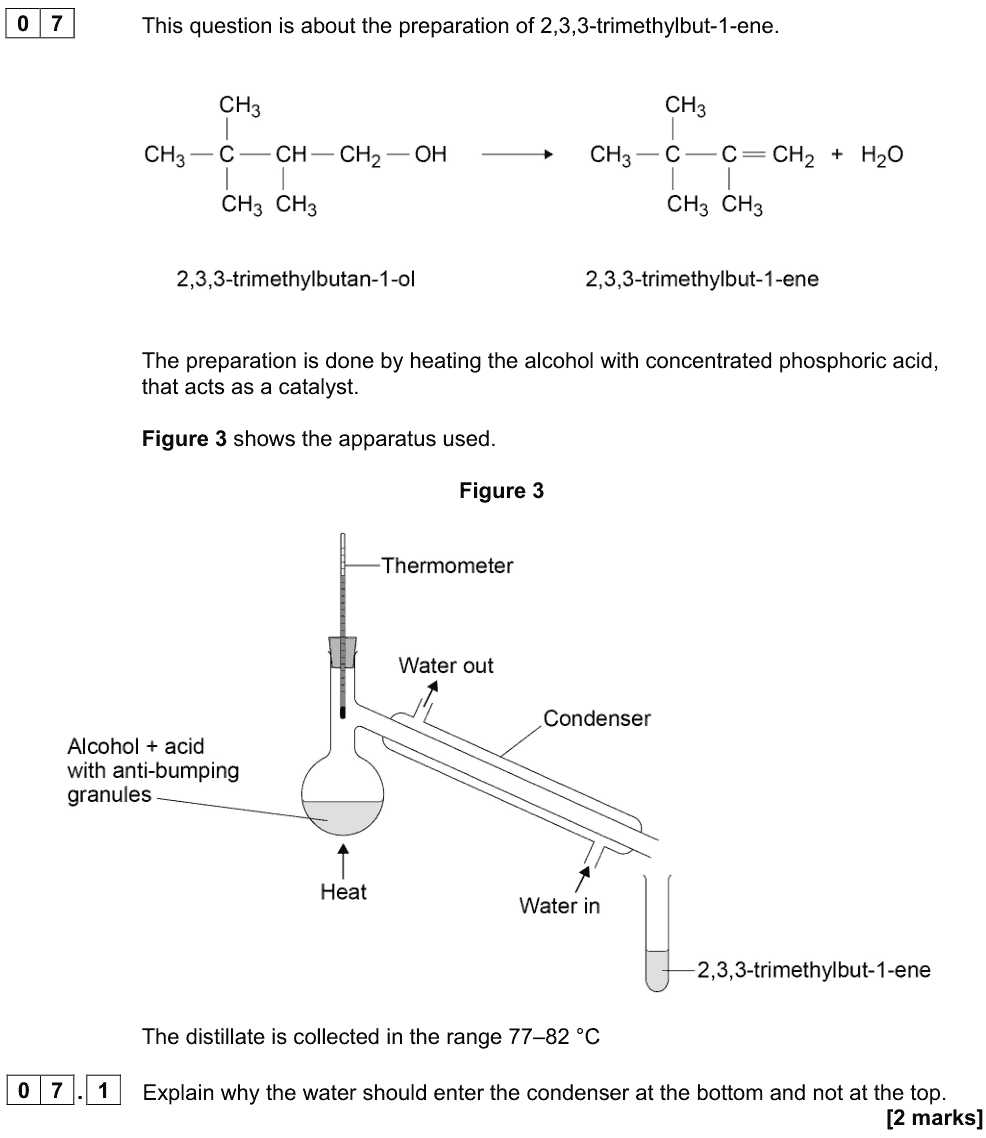
This question is about the preparation of 2,3,3-trimethylbut-1-ene.
The preparation is done by heating the alcohol with concentrated phosphoric acid,
that acts as a catalyst.
Figure 3 shows the apparatus used.
Figure 3
The distillate is collected in the range 77–82 °C
Explain why the water should enter the condenser at the bottom and not at the top.
[2 marks]
June 2023 · AS Paper 2 · Q07.3 5 marks AO1=1, AO2=4 Calculation amount of substance
Earlier part of question 07 that this part usesEarlier part of June 2023 Paper 2 question 07
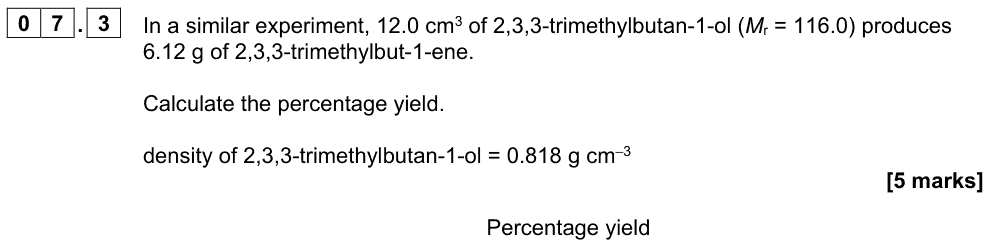
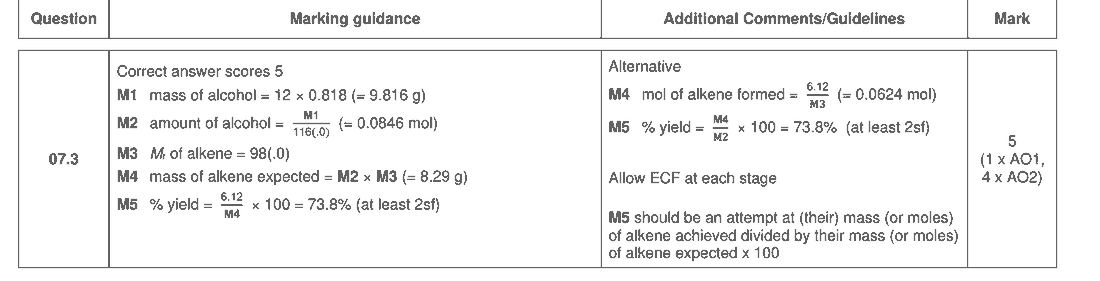
In a similar experiment, 12.0 cm3 of 2,3,3-trimethylbutan-1-ol (Mr = 116.0) produces
6.12 g of 2,3,3-trimethylbut-1-ene.
Calculate the percentage yield.
density of 2,3,3-trimethylbutan-1-ol = 0.818 g cm–3
[5 marks]
Percentage yield
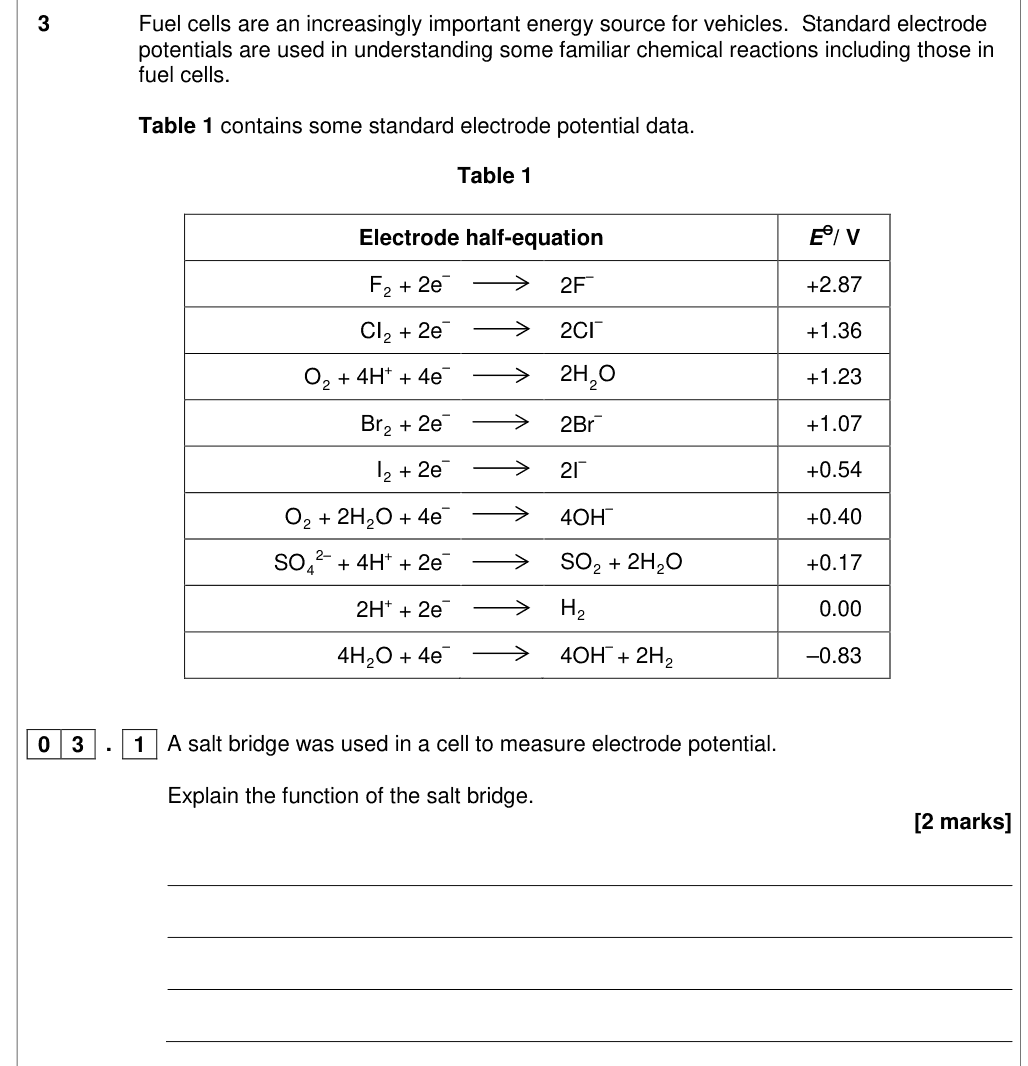
June 2023 · Paper 1 · Q02.1 2 marks AO1=2 Short answer electrode potentials and cells
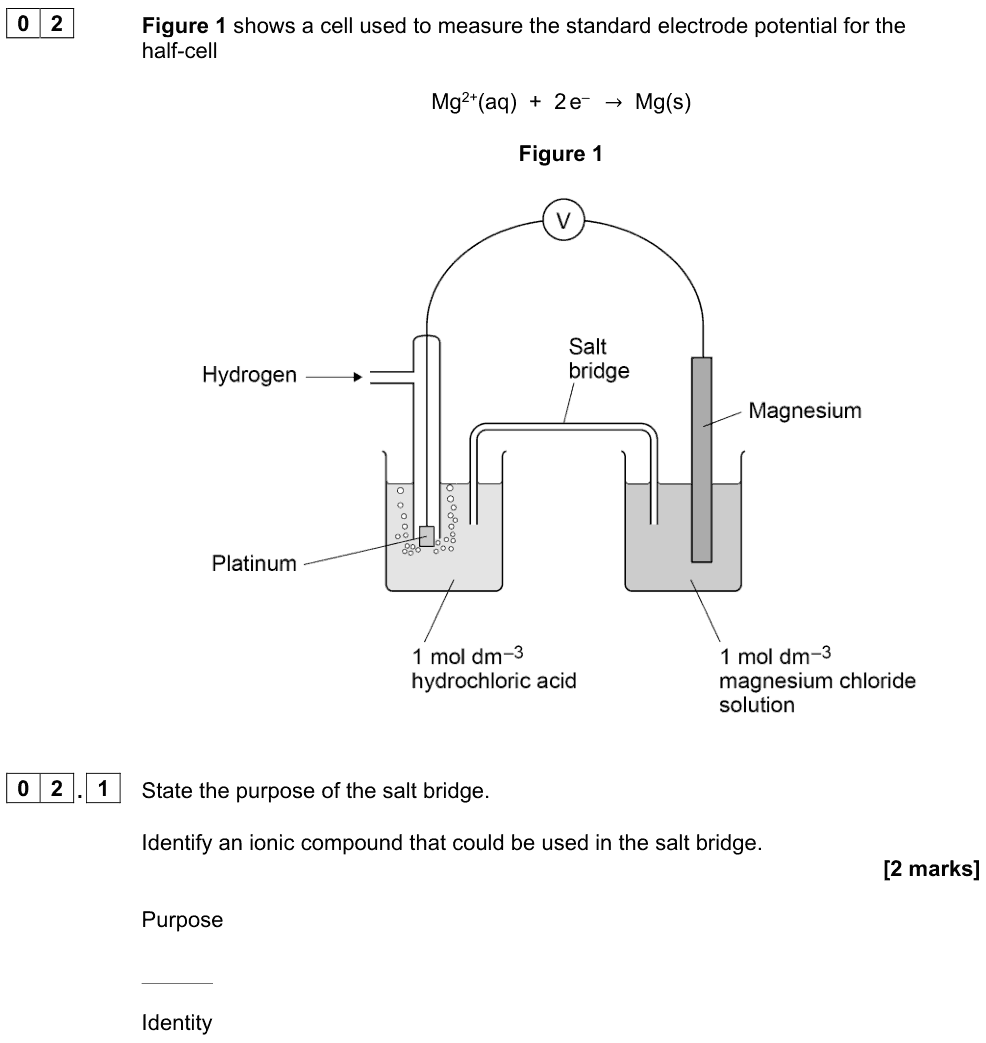
Figure 1 shows a cell used to measure the standard electrode potential for the
half-cell
Mg2+(aq)  +  2 e–   →  Mg(s)
Figure 1
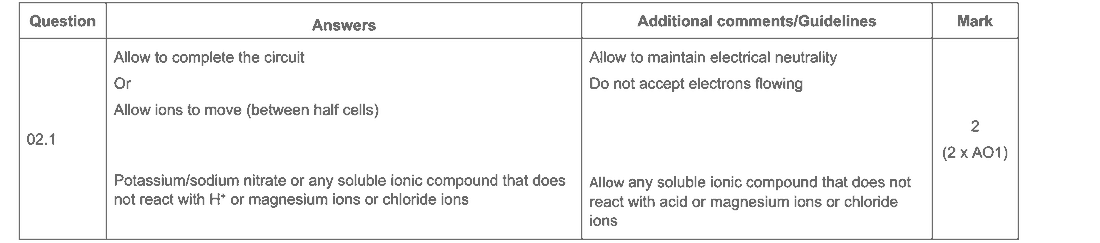
State the purpose of the salt bridge.
Identify an ionic compound that could be used in the salt bridge.
[2 marks]
Purpose
Identity
June 2023 · Paper 1 · Q02.2 1 mark AO1=1 Short answer electrode potentials and cells
Earlier part of question 02 that this part usesEarlier part of June 2023 Paper 1 question 02
State how, if at all, the EMF of this cell will change if the surface area of the platinum
electrode is increased.
[1 mark]
June 2023 · Paper 1 · Q02.3 1 mark AO3=1 Short answer electrode potentials and cells
Earlier part of question 02 that this part usesEarlier part of June 2023 Paper 1 question 02
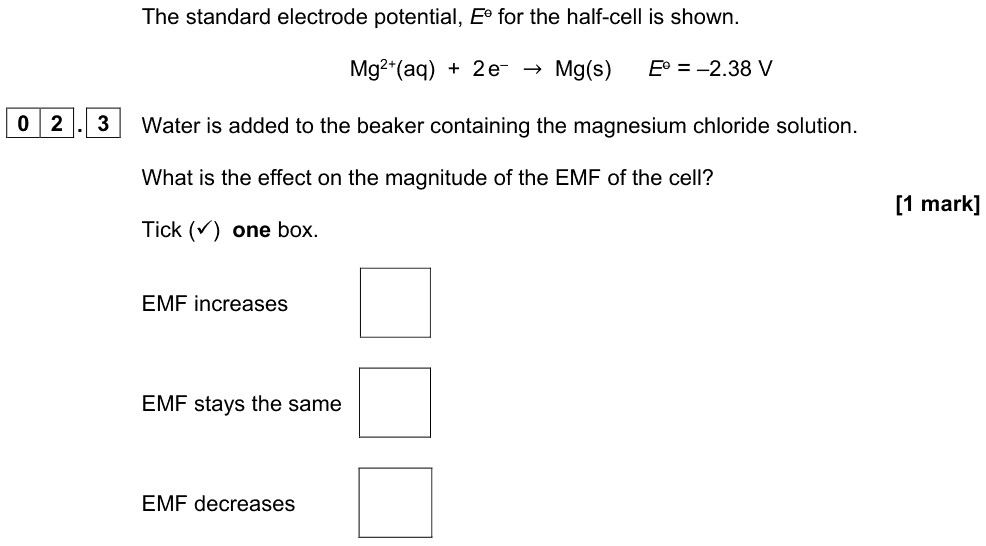
The standard electrode potential, Eo for the half-cell is shown.
Mg2+(aq)  +  2 e–   →  Mg(s)      Eo = –2.38 V
Water is added to the beaker containing the magnesium chloride solution.
What is the effect on the magnitude of the EMF of the cell?
[1 mark]
Tick ()  one box.
EMF increases
EMF stays the same
EMF decreases
June 2023 · Paper 1 · Q06.1 1 mark AO2=1 Calculation amount of substance
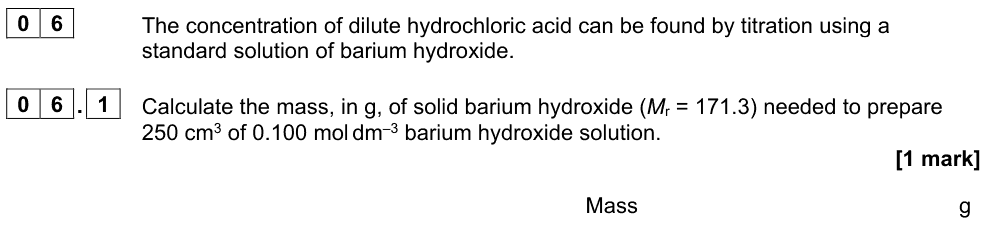
The concentration of dilute hydrochloric acid can be found by titration using a

standard solution of barium hydroxide.
Calculate the mass, in g, of solid barium hydroxide (Mr = 171.3) needed to prepare
250 cm3 of 0.100 mol dm–3 barium hydroxide solution.
[1 mark]
Mass
g
June 2023 · Paper 1 · Q06.2 3 marks AO2=3 Practical and data analysis amount of substance
Earlier part of question 06 that this part usesEarlier part of June 2023 Paper 1 question 06
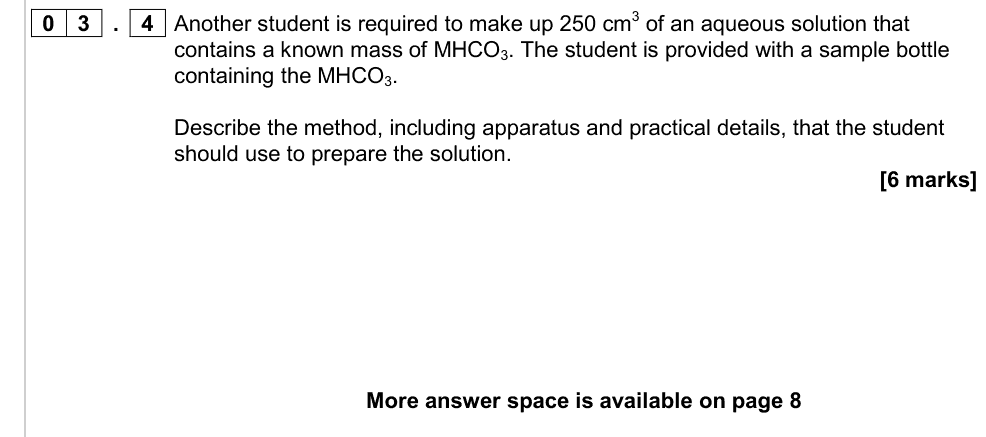
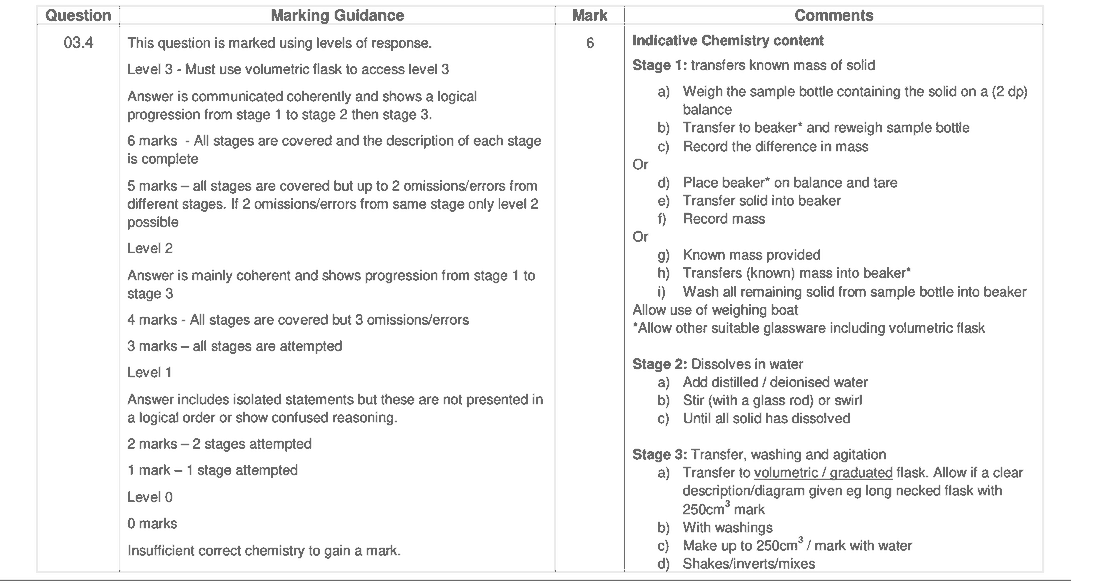
The mass of barium hydroxide from Question 06.1 is dissolved in a beaker containing
150 cm3 of distilled water.
Describe how this solution is used to make 250 cm3 of the
0.100 mol dm–3 barium hydroxide solution.
[3 marks]
June 2023 · Paper 1 · Q06.3 1 mark AO3=1 Practical and data analysis amount of substance
Earlier part of question 06 that this part usesEarlier part of June 2023 Paper 1 question 06
Before the first titration, the 25 cm3 pipette is rinsed with a small volume of the
0.100 mol dm–3 barium hydroxide solution.
State why it is good practice to rinse the pipette in this way.
[1 mark]
June 2023 · Paper 1 · Q06.4 1 mark AO1=1 Practical and data analysis amount of substance
Earlier part of question 06 that this part usesEarlier part of June 2023 Paper 1 question 06
Hydrochloric acid is added to the burette using a funnel.
State why it is good practice to remove the funnel from the burette before the titration.
[1 mark]
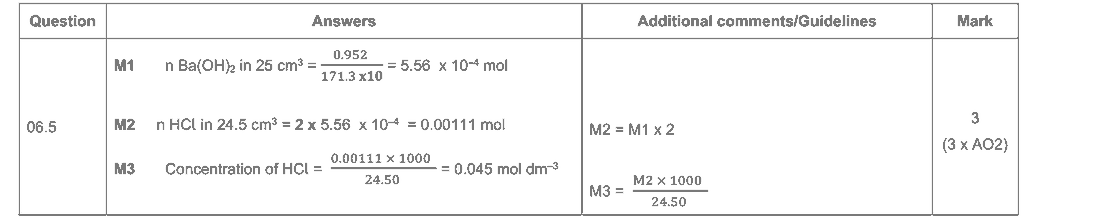
June 2023 · Paper 1 · Q06.5 3 marks AO2=3 Calculation Hard amount of substance
Earlier part of question 06 that this part usesEarlier part of June 2023 Paper 1 question 06
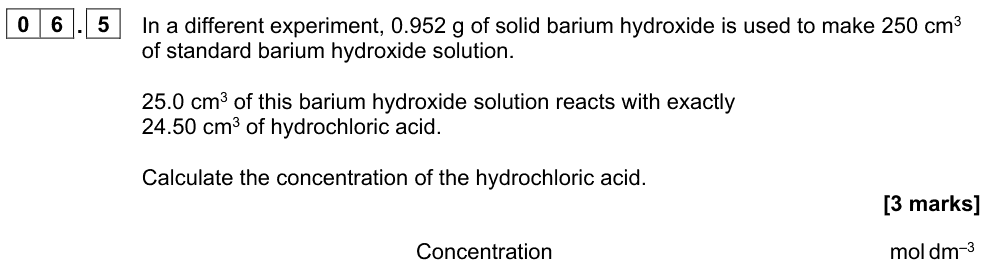
In a different experiment, 0.952 g of solid barium hydroxide is used to make 250 cm3
of standard barium hydroxide solution.
25.0 cm3 of this barium hydroxide solution reacts with exactly
24.50 cm3 of hydrochloric acid.
Calculate the concentration of the hydrochloric acid.

[3 marks]
Concentration
mol dm–3
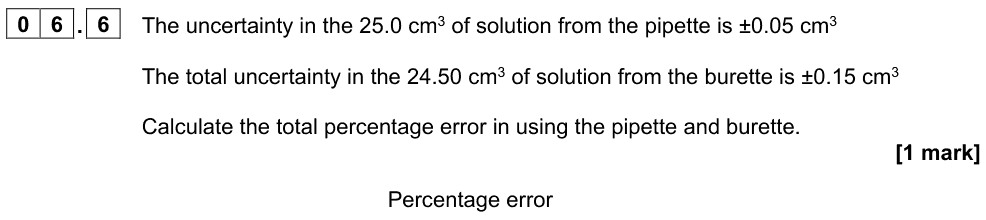
June 2023 · Paper 1 · Q06.6 1 mark AO2=1 Practical and data analysis amount of substance
Earlier part of question 06 that this part usesEarlier part of June 2023 Paper 1 question 06
The uncertainty in the 25.0 cm3 of solution from the pipette is ±0.05 cm3
The total uncertainty in the 24.50 cm3 of solution from the burette is ±0.15 cm3
Calculate the total percentage error in using the pipette and burette.
[1 mark]
Percentage error
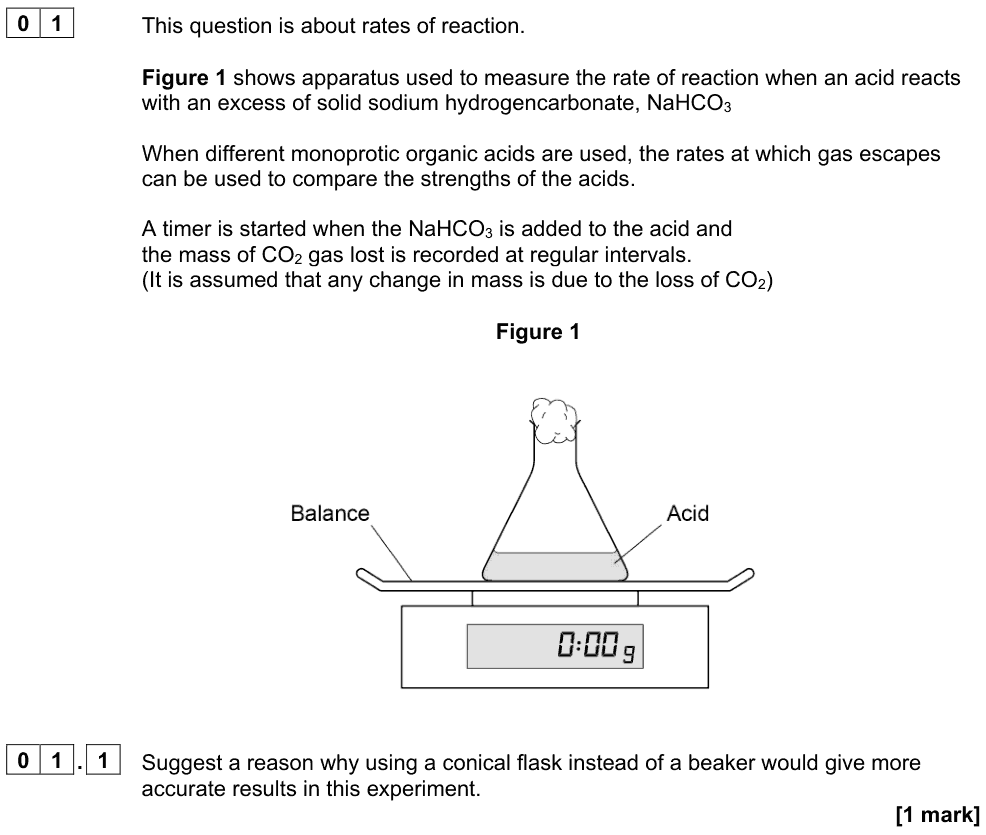
June 2023 · Paper 2 · Q01.1 1 mark AO3=1 Practical and data analysis rate equations
This question is about rates of reaction.
Figure 1 shows apparatus used to measure the rate of reaction when an acid reacts
with an excess of solid sodium hydrogencarbonate, NaHCO3
When different monoprotic organic acids are used, the rates at which gas escapes
can be used to compare the strengths of the acids.
A timer is started when the NaHCO3 is added to the acid and
the mass of CO2 gas lost is recorded at regular intervals.
(It is assumed that any change in mass is due to the loss of CO2)
Figure 1
Suggest a reason why using a conical flask instead of a beaker would give more
accurate results in this experiment.
[1 mark]
June 2023 · Paper 2 · Q01.2 3 marks AO2=3 Calculation rate equations
Earlier part of question 01 that this part usesEarlier part of June 2023 Paper 2 question 01

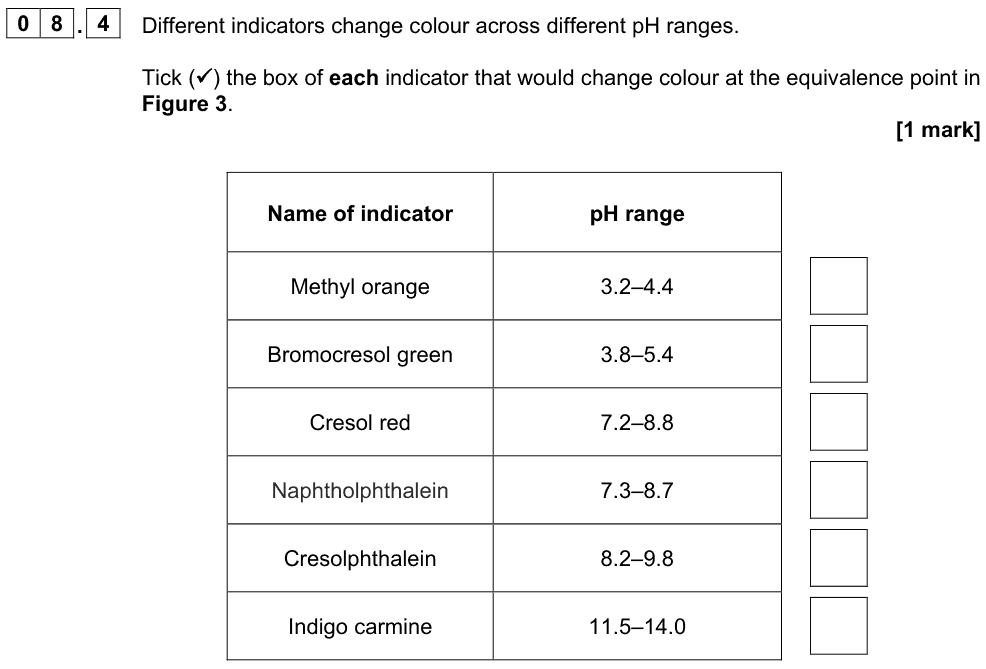
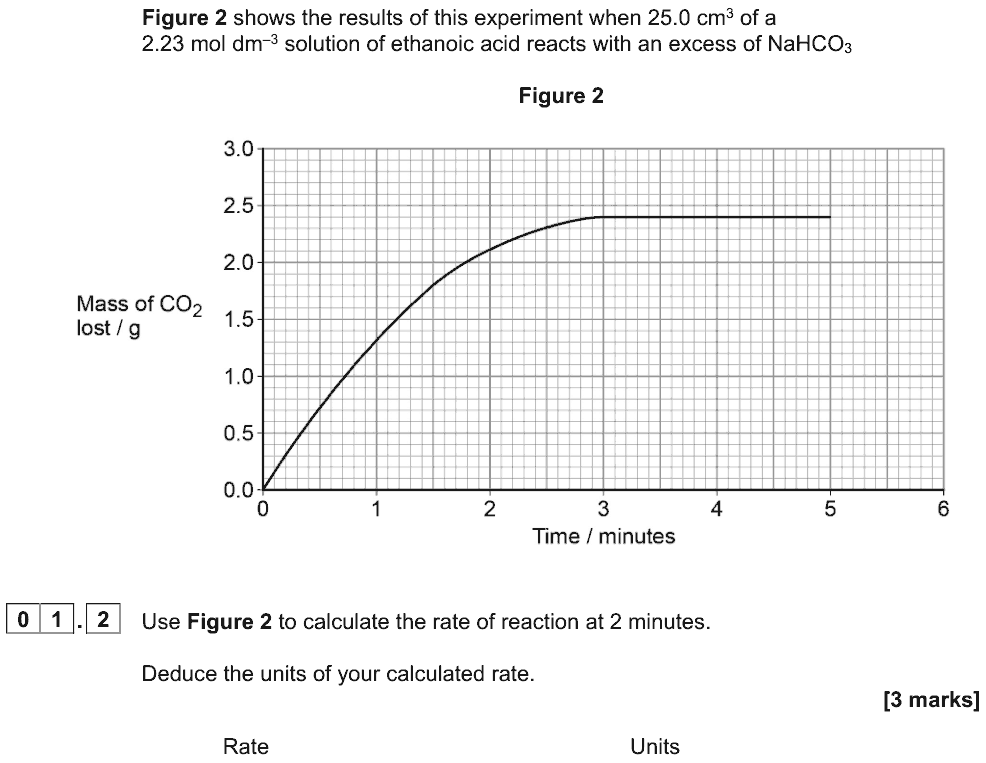
Figure 2 shows the results of this experiment when 25.0 cm3 of a
2.23 mol dm–3 solution of ethanoic acid reacts with an excess of NaHCO3

Figure 2
Use Figure 2 to calculate the rate of reaction at 2 minutes.
Deduce the units of your calculated rate.
[3 marks]
Rate
Units
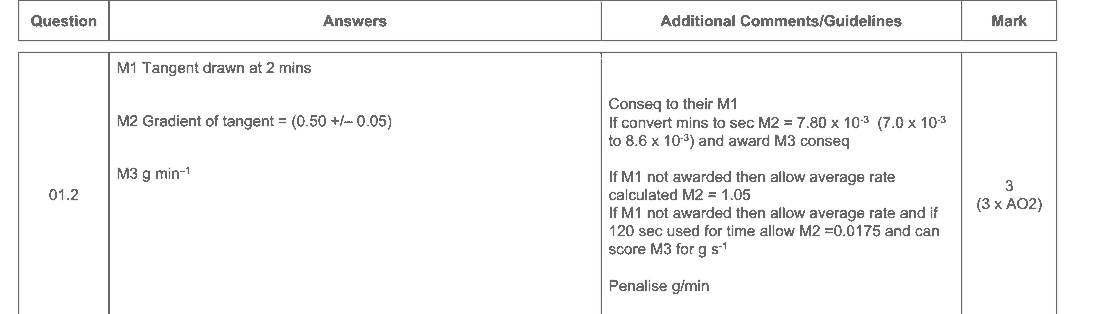
June 2023 · Paper 2 · Q06.1 1 mark AO1=1 Practical and data analysis Easy alcohols
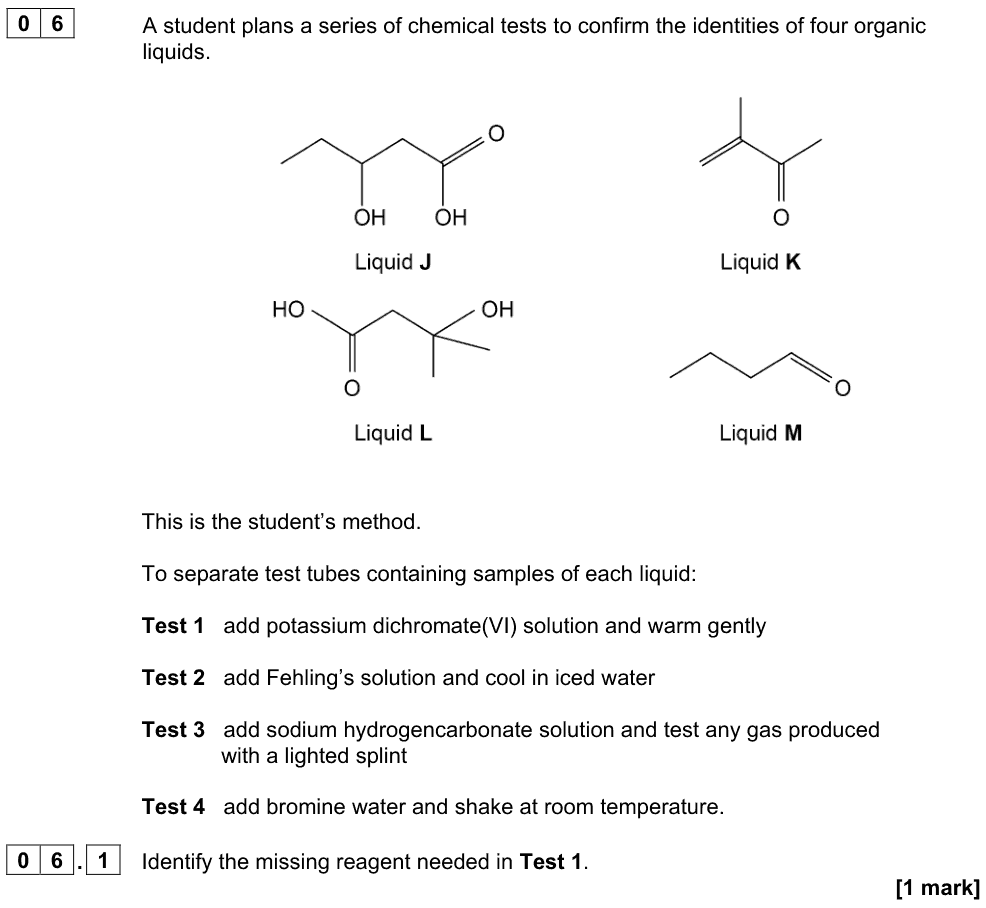
A student plans a series of chemical tests to confirm the identities of four organic
liquids.
This is the student’s method.
To separate test tubes containing samples of each liquid:
Test 1   add potassium dichromate(VI) solution and warm gently
Test 2   add Fehling’s solution and cool in iced water
Test 3   add sodium hydrogencarbonate solution and test any gas produced
with a lighted splint
Test 4   add bromine water and shake at room temperature.
Identify the missing reagent needed in Test 1.
[1 mark]
June 2023 · Paper 2 · Q06.2 2 marks AO3=2 Practical and data analysis organic analysisaldehydes and ketones
Earlier part of question 06 that this part usesEarlier part of June 2023 Paper 2 question 06
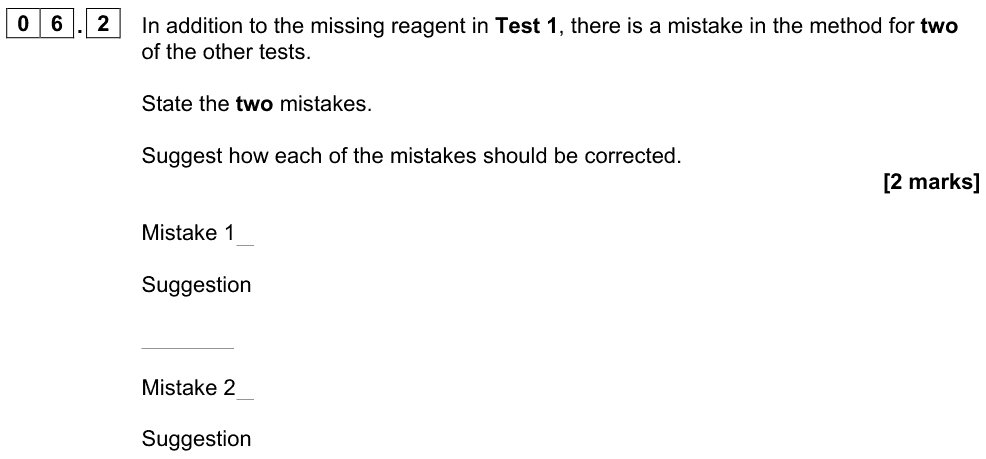
In addition to the missing reagent in Test 1, there is a mistake in the method for two
of the other tests.
State the two mistakes.
Suggest how each of the mistakes should be corrected.
[2 marks]
Mistake 1
Suggestion
Mistake 2
Suggestion
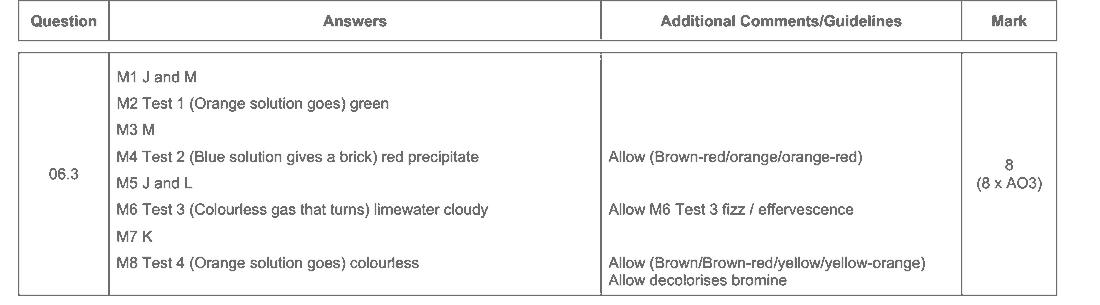
June 2023 · Paper 2 · Q06.3 8 marks AO3=8 Practical and data analysis organic analysisalcoholscarboxylic acids and derivatives
Earlier part of question 06 that this part usesEarlier part of June 2023 Paper 2 question 06
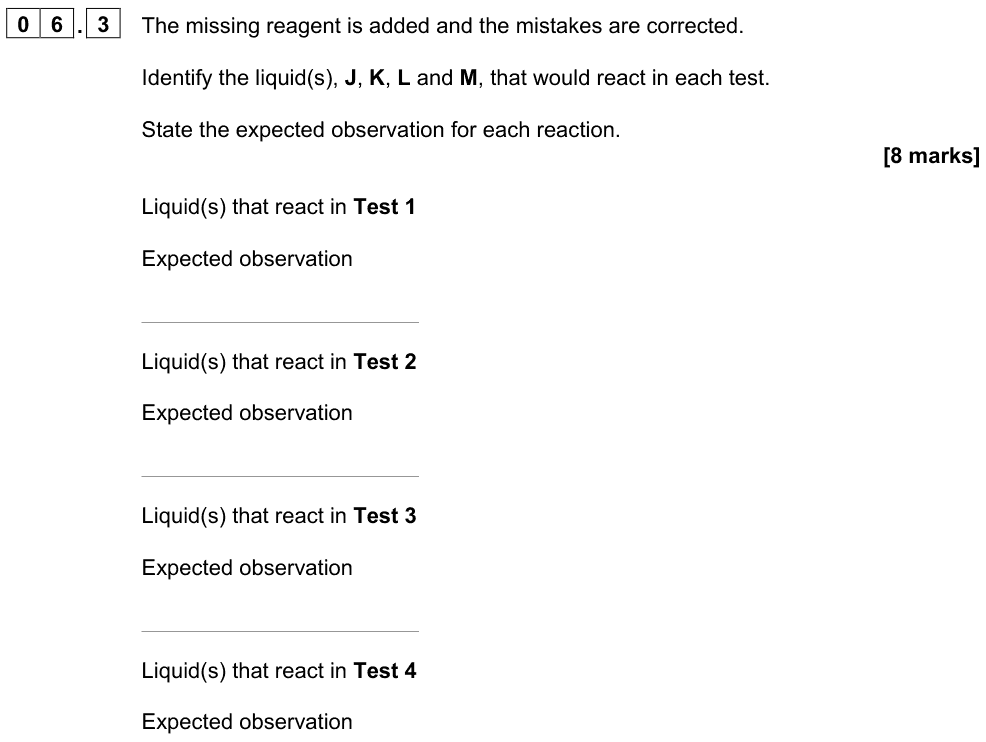
The missing reagent is added and the mistakes are corrected.
Identify the liquid(s), J, K, L and M, that would react in each test.
State the expected observation for each reaction.
[8 marks]
Liquid(s) that react in Test 1
Expected observation
Liquid(s) that react in Test 2
Expected observation
Liquid(s) that react in Test 3
Expected observation
Liquid(s) that react in Test 4
Expected observation
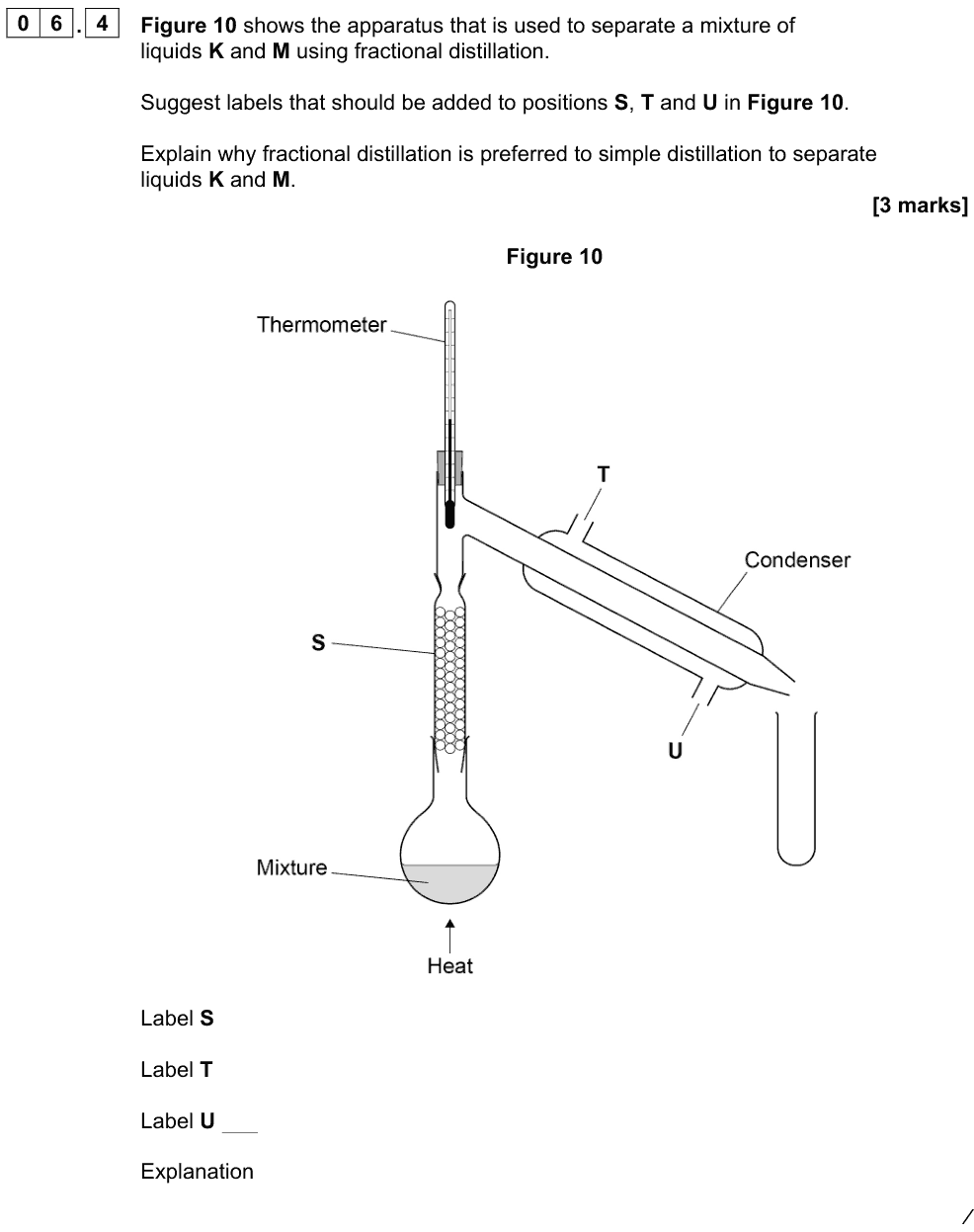
June 2023 · Paper 2 · Q06.4 3 marks AO3=3 Practical and data analysis alcohols
Earlier part of question 06 that this part usesEarlier part of June 2023 Paper 2 question 06
Figure 10 shows the apparatus that is used to separate a mixture of
liquids K and M using fractional distillation.
Suggest labels that should be added to positions S, T and U in Figure 10.
Explain why fractional distillation is preferred to simple distillation to separate
liquids K and M.
[3 marks]
Figure 10
Label S
Label T
Label U
Explanation
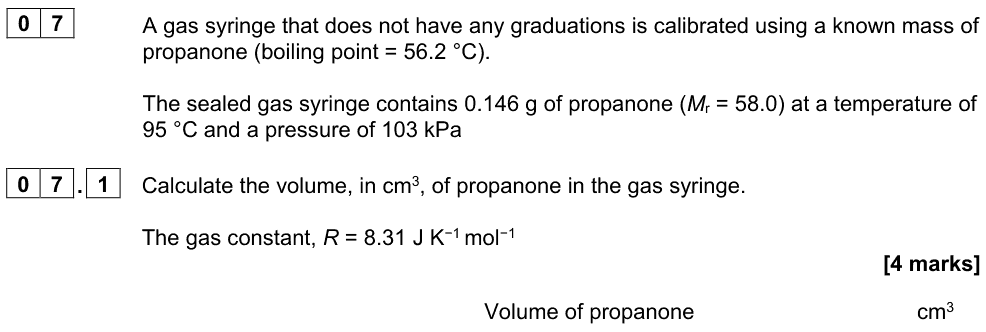
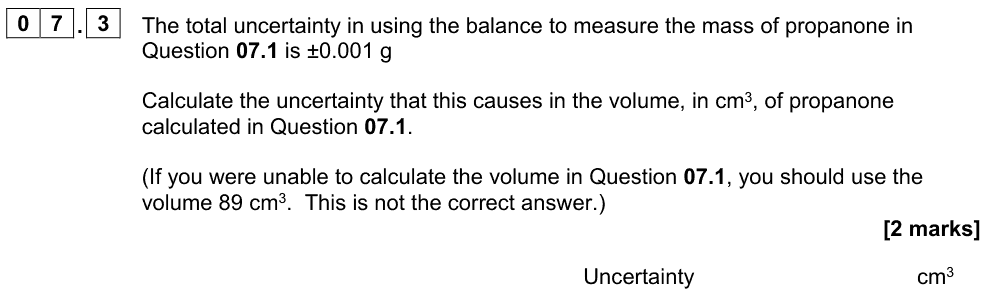
June 2023 · Paper 2 · Q07.3 2 marks AO2=2 Calculation amount of substance
Earlier part of question 07 that this part usesEarlier part of June 2023 Paper 2 question 07
The total uncertainty in using the balance to measure the mass of propanone in
Question 07.1 is ±0.001 g
Calculate the uncertainty that this causes in the volume, in cm3, of propanone
calculated in Question 07.1.
(If you were unable to calculate the volume in Question 07.1, you should use the
volume 89 cm3.  This is not the correct answer.)
[2 marks]
Uncertainty
cm3
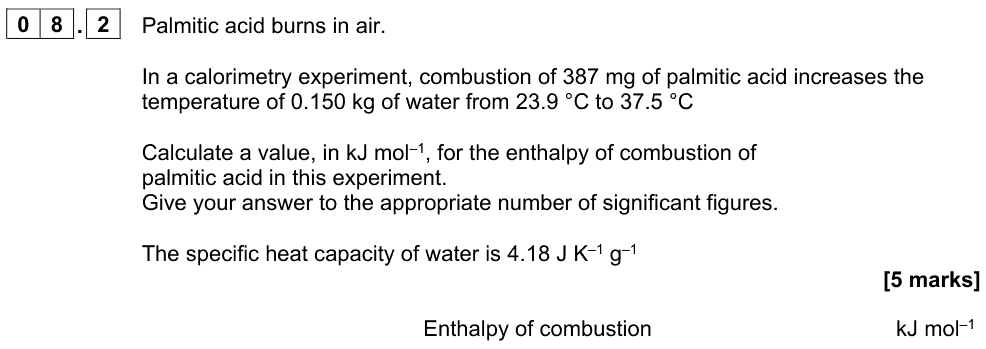
June 2023 · Paper 2 · Q08.2 5 marks AO2=5 Calculation energeticsamount of substance
Earlier part of question 08 that this part usesEarlier part of June 2023 Paper 2 question 08
Palmitic acid burns in air.
In a calorimetry experiment, combustion of 387 mg of palmitic acid increases the
temperature of 0.150 kg of water from 23.9 °C to 37.5 °C
Calculate a value, in kJ mol–1, for the enthalpy of combustion of
palmitic acid in this experiment.
Give your answer to the appropriate number of significant figures.
The specific heat capacity of water is 4.18 J K–1 g–1
[5 marks]
Enthalpy of combustion
kJ mol–1
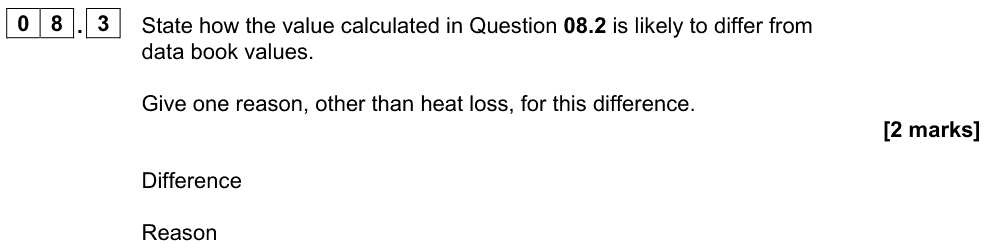
June 2023 · Paper 2 · Q08.3 2 marks AO2=2 Practical and data analysis energetics
Earlier part of question 08 that this part usesEarlier part of June 2023 Paper 2 question 08
State how the value calculated in Question 08.2 is likely to differ from
data book values.
Give one reason, other than heat loss, for this difference.
[2 marks]
Difference
Reason
June 2023 · Paper 3 · Q01.1 1 mark Short answer Easy carboxylic acids and derivatives
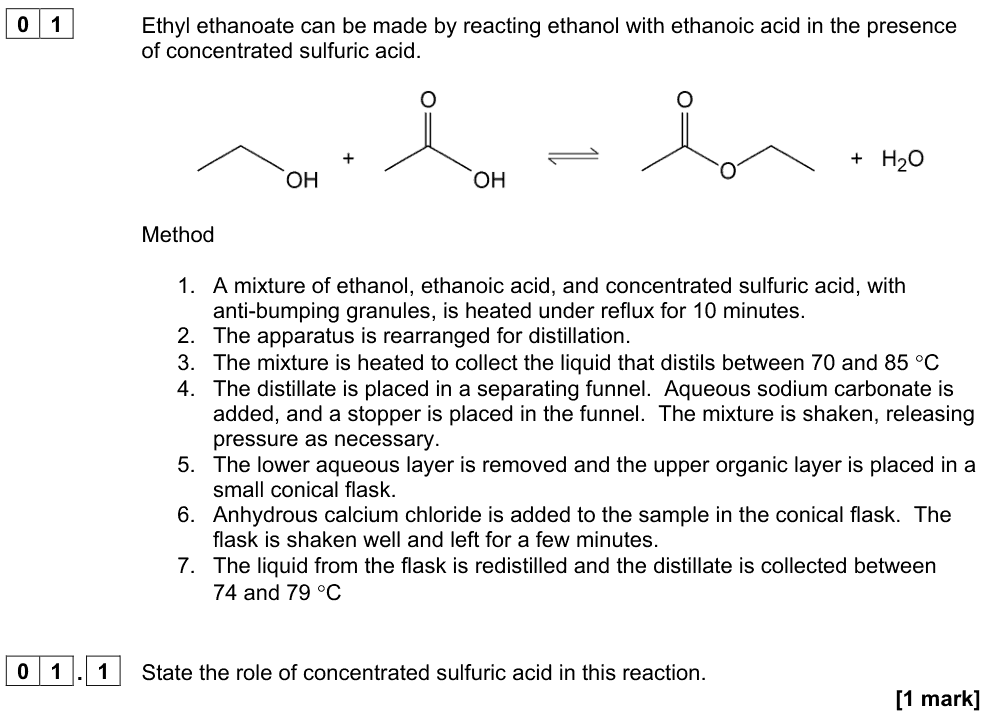
Ethyl ethanoate can be made by reacting ethanol with ethanoic acid in the presence
of concentrated sulfuric acid.
Method
1. A mixture of ethanol, ethanoic acid, and concentrated sulfuric acid, with
anti-bumping granules, is heated under reflux for 10 minutes.
2. The apparatus is rearranged for distillation.
3. The mixture is heated to collect the liquid that distils between 70 and 85 °C
4. The distillate is placed in a separating funnel.  Aqueous sodium carbonate is
added, and a stopper is placed in the funnel.  The mixture is shaken, releasing
pressure as necessary.
5. The lower aqueous layer is removed and the upper organic layer is placed in a
small conical flask.
6. Anhydrous calcium chloride is added to the sample in the conical flask.  The
flask is shaken well and left for a few minutes.
7. The liquid from the flask is redistilled and the distillate is collected between
74 and 79 °C
State the role of concentrated sulfuric acid in this reaction.
[1 mark]
June 2023 · Paper 3 · Q01.2 1 mark Practical and data analysis Easy carboxylic acids and derivatives
Earlier part of question 01 that this part usesEarlier part of June 2023 Paper 3 question 01
The reaction mixture is flammable.
Suggest how the reaction mixture should be heated in step 1.
[1 mark]
June 2023 · Paper 3 · Q01.3 4 marks Practical and data analysis carboxylic acids and derivatives
Earlier part of question 01 that this part usesEarlier part of June 2023 Paper 3 question 01
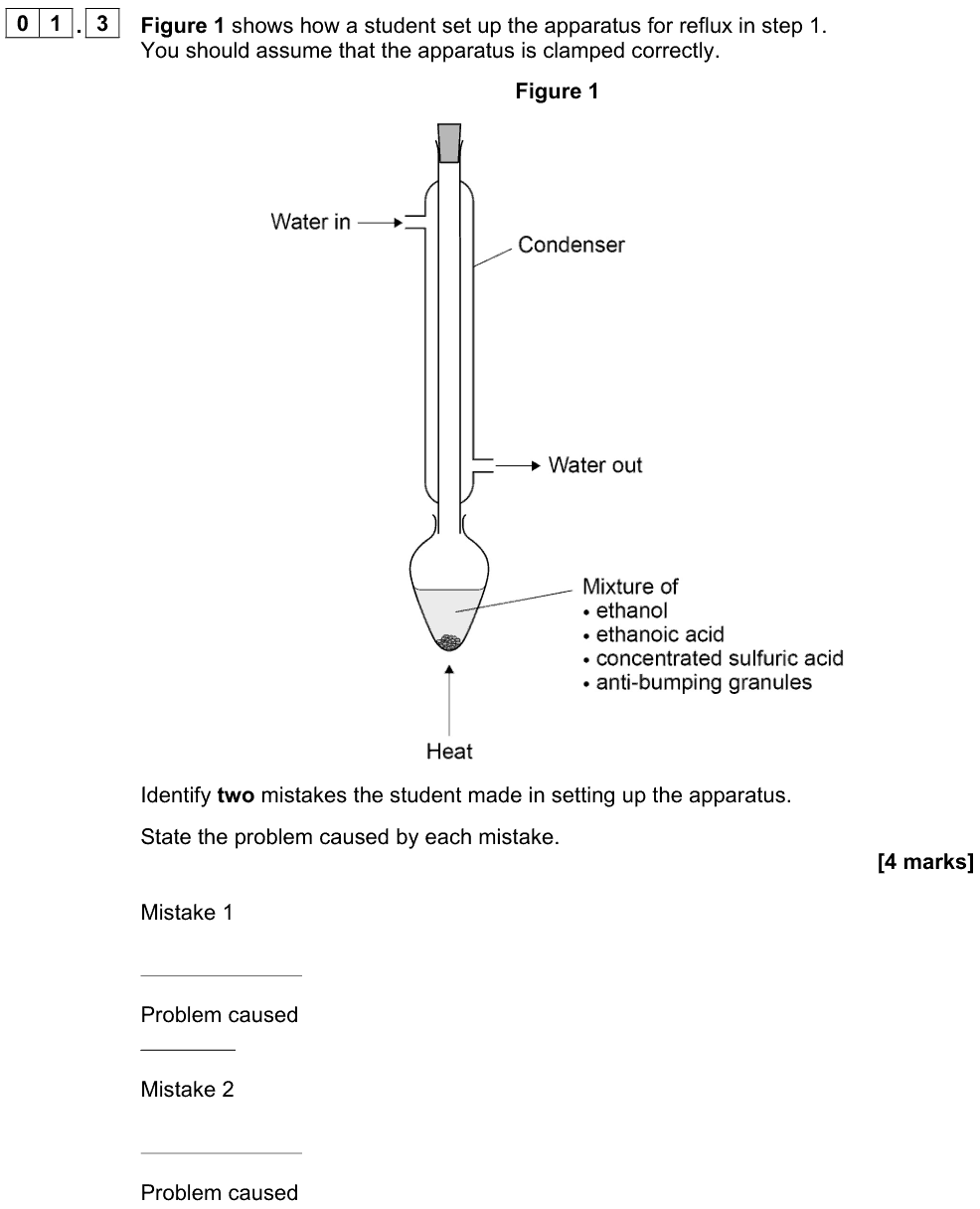
Figure 1 shows how a student set up the apparatus for reflux in step 1.
You should assume that the apparatus is clamped correctly.
Figure 1
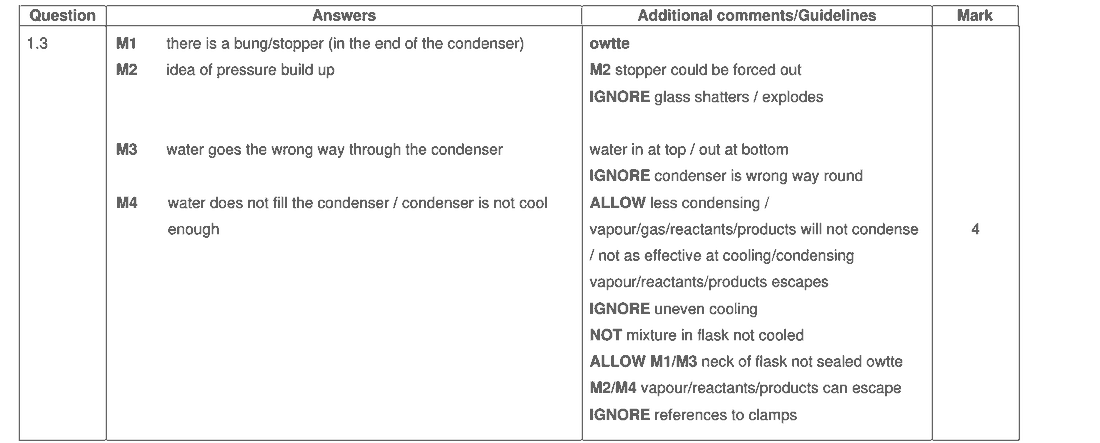
Identify two mistakes the student made in setting up the apparatus.
State the problem caused by each mistake.
[4 marks]
Mistake 1
Problem caused
Mistake 2
Problem caused
June 2023 · Paper 3 · Q01.4 2 marks Practical and data analysis carboxylic acids and derivatives
Earlier part of question 01 that this part usesEarlier part of June 2023 Paper 3 question 01
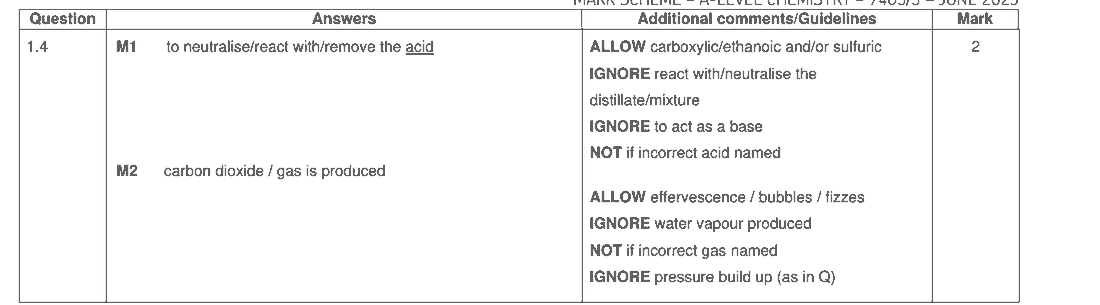
State why sodium carbonate is added to the distillate in step 4.
Explain why there is a build-up of pressure in the separating funnel.
[2 marks]
June 2023 · Paper 3 · Q01.5 2 marks Practical and data analysis Hard carboxylic acids and derivatives
Earlier part of question 01 that this part usesEarlier part of June 2023 Paper 3 question 01
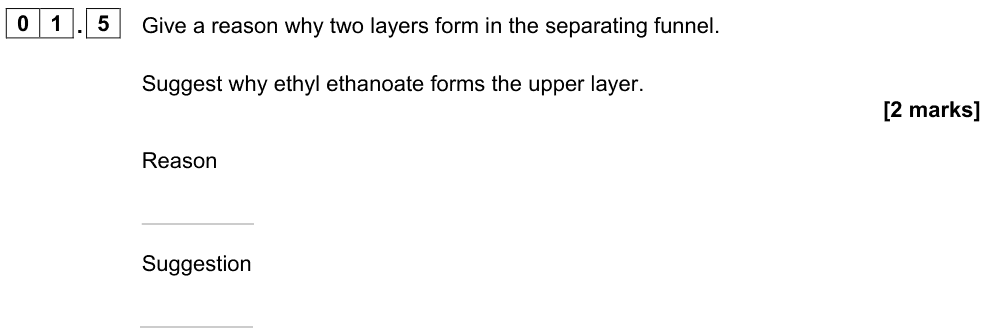
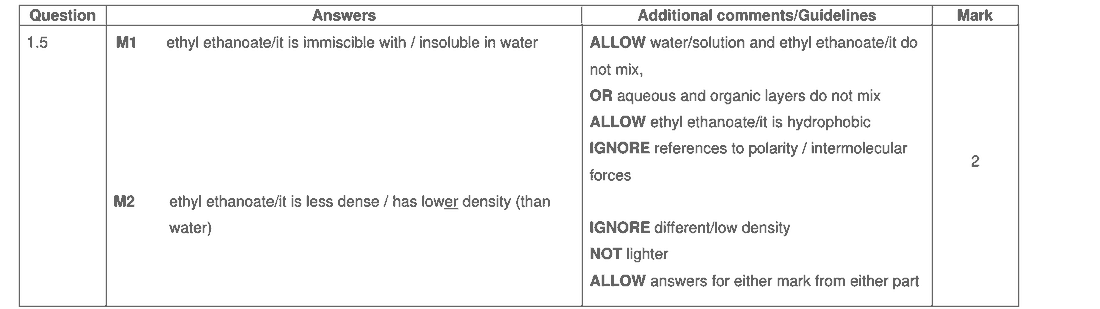
Give a reason why two layers form in the separating funnel.
Suggest why ethyl ethanoate forms the upper layer.
[2 marks]
Reason
Suggestion
June 2023 · Paper 3 · Q01.6 1 mark Practical and data analysis Easy carboxylic acids and derivatives
Earlier part of question 01 that this part usesEarlier part of June 2023 Paper 3 question 01
State why anhydrous calcium chloride is added in step 6.
[1 mark]
June 2023 · Paper 3 · Q01.7 5 marks Calculation amount of substance
Earlier part of question 01 that this part usesEarlier part of June 2023 Paper 3 question 01
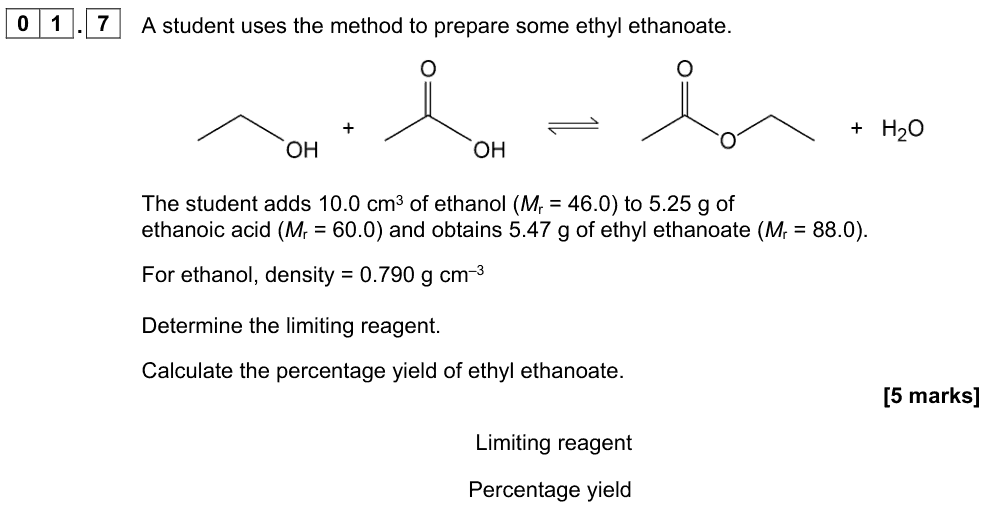
A student uses the method to prepare some ethyl ethanoate.
The student adds 10.0 cm3 of ethanol (Mr = 46.0) to 5.25 g of
ethanoic acid (Mr = 60.0) and obtains 5.47 g of ethyl ethanoate (Mr = 88.0).
For ethanol, density = 0.790 g cm–3
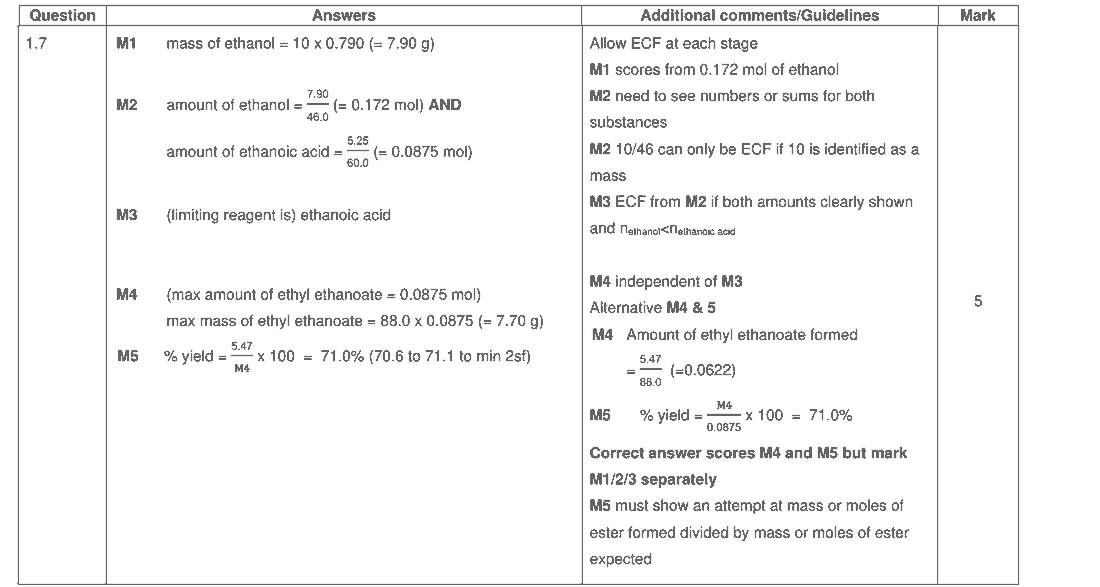
Determine the limiting reagent.
Calculate the percentage yield of ethyl ethanoate.
[5 marks]
Limiting reagent
Percentage yield
June 2023 · Paper 3 · Q01.8 1 mark Short answer Easy chemical equilibria and kccarboxylic acids and derivatives
Earlier part of question 01 that this part usesEarlier part of June 2023 Paper 3 question 01
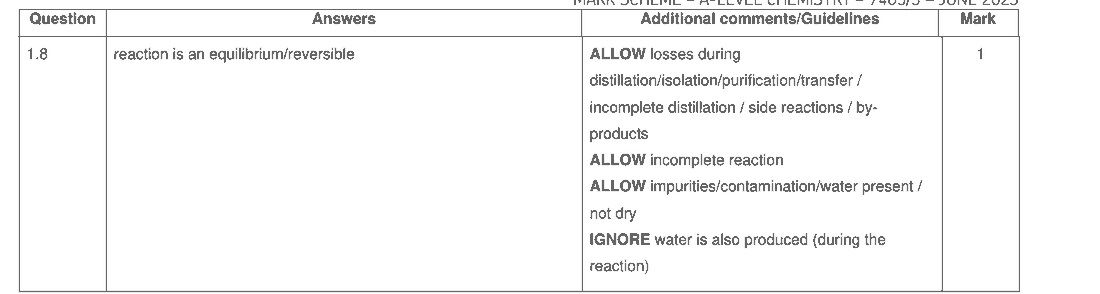
Suggest a reason why the percentage yield is not 100%.
[1 mark]
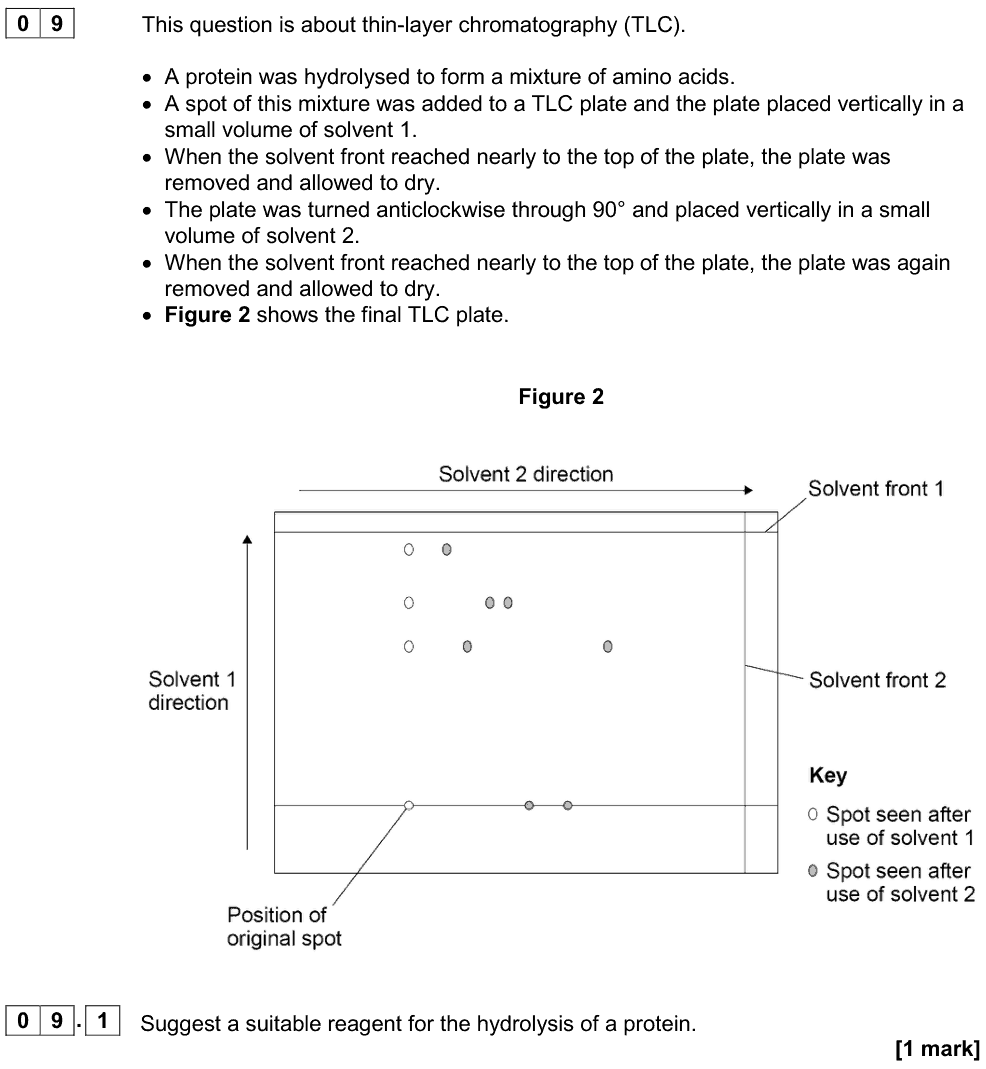
June 2023 · Paper 3 · Q03.3 2 marks Short answer amino acids proteins and dna
Earlier part of question 03 that this part usesEarlier part of June 2023 Paper 3 question 03
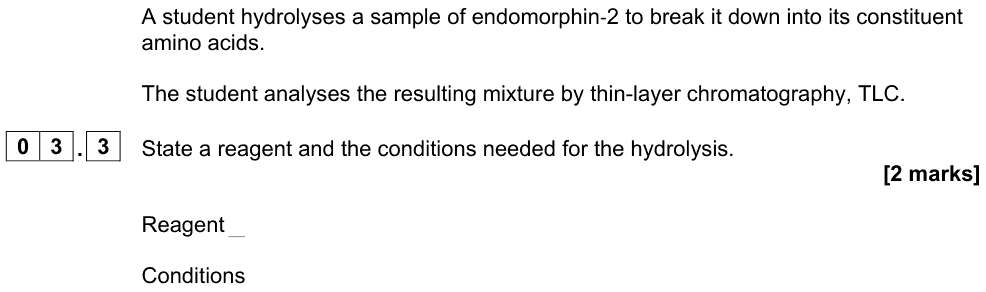
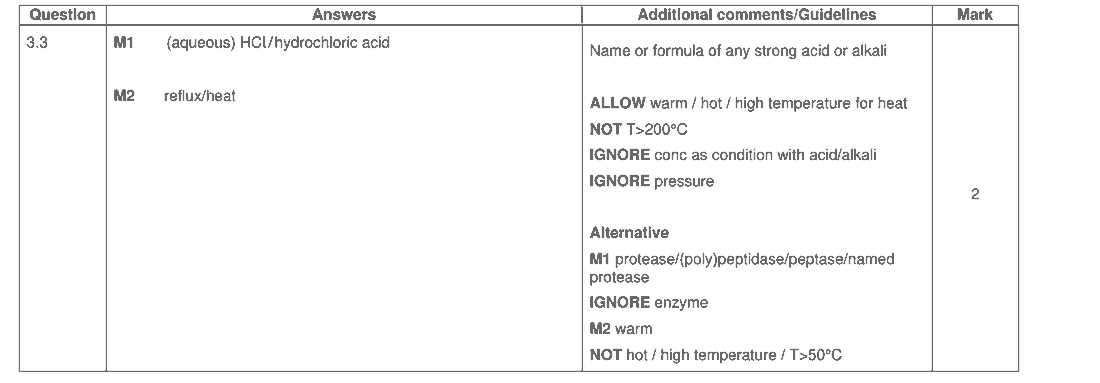
A student hydrolyses a sample of endomorphin-2 to break it down into its constituent
amino acids.
The student analyses the resulting mixture by thin-layer chromatography, TLC.
State a reagent and the conditions needed for the hydrolysis.
[2 marks]
Reagent
Conditions
June 2023 · Paper 3 · Q03.4 3 marks Practical and data analysis chromatography
Earlier part of question 03 that this part usesEarlier part of June 2023 Paper 3 question 03
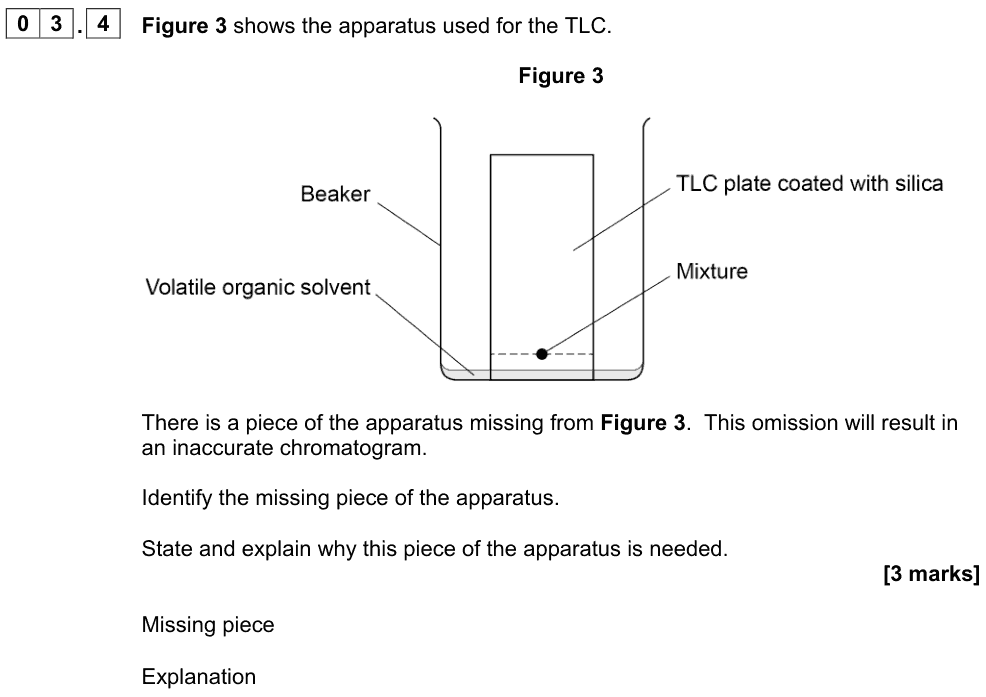
Figure 3 shows the apparatus used for the TLC.
Figure 3
There is a piece of the apparatus missing from Figure 3.  This omission will result in
an inaccurate chromatogram.
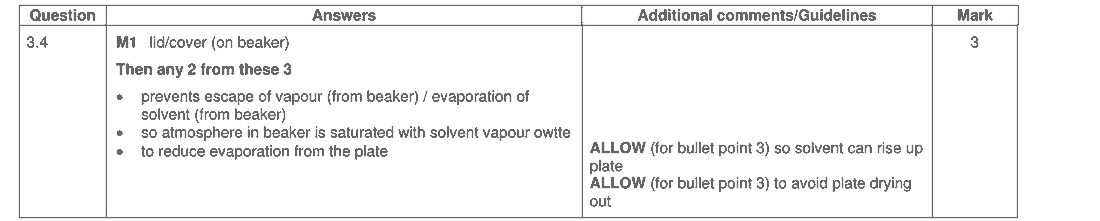
Identify the missing piece of the apparatus.
State and explain why this piece of the apparatus is needed.
[3 marks]
Missing piece
Explanation
June 2023 · Paper 3 · Q03.5 1 mark Short answer chromatography
Earlier part of question 03 that this part usesEarlier part of June 2023 Paper 3 question 03
State why the amino acids separate on the TLC plate.
[1 mark]
June 2023 · Paper 3 · Q03.6 2 marks Practical and data analysis amino acids proteins and dna
Earlier parts of question 03 that this part usesEarlier part of June 2023 Paper 3 question 03Earlier part of June 2023 Paper 3 question 03
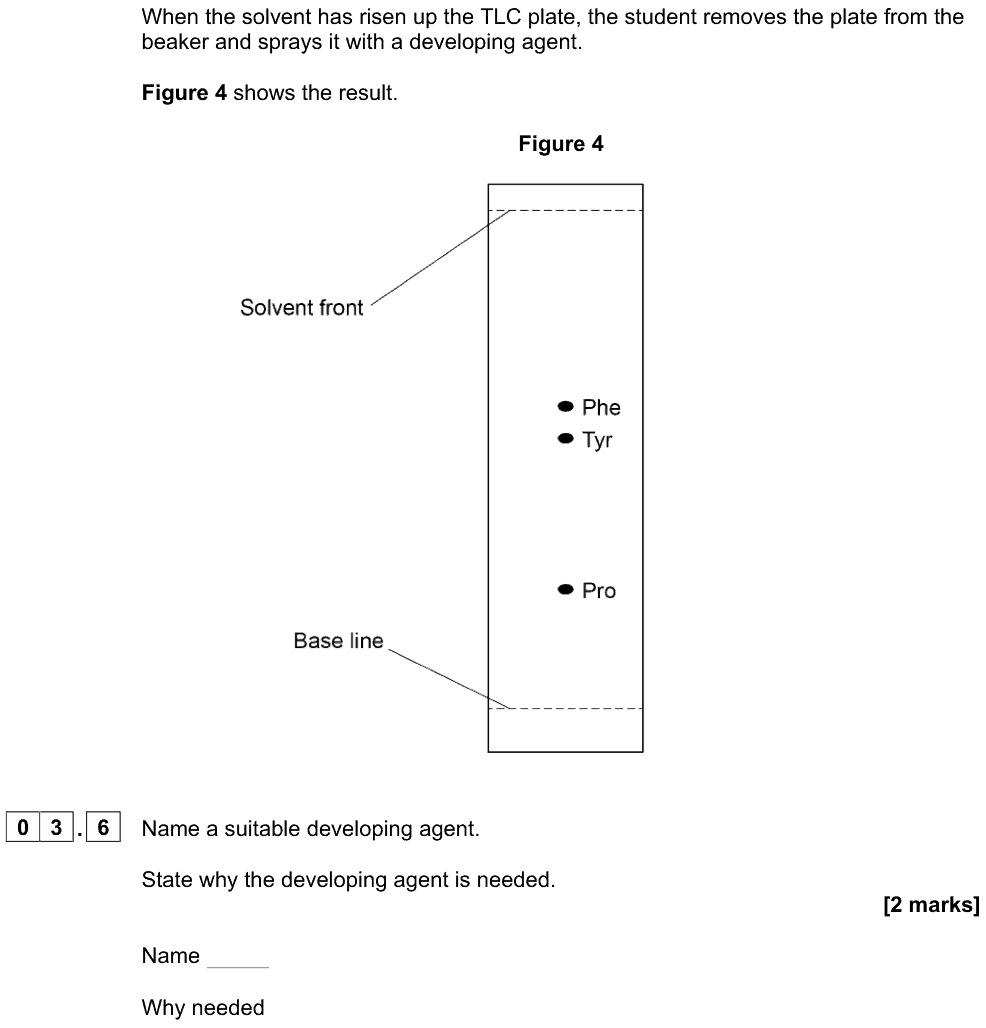
When the solvent has risen up the TLC plate, the student removes the plate from the
beaker and sprays it with a developing agent.
Figure 4 shows the result.
Figure 4
Name a suitable developing agent.
State why the developing agent is needed.
[2 marks]
Name
Why needed
June 2023 · Paper 3 · Q03.7 1 mark Practical and data analysis Easy chromatographyamino acids proteins and dna
Earlier parts of question 03 that this part usesEarlier part of June 2023 Paper 3 question 03Earlier part of June 2023 Paper 3 question 03
Determine the Rf value for Tyr.
[1 mark]
Rf
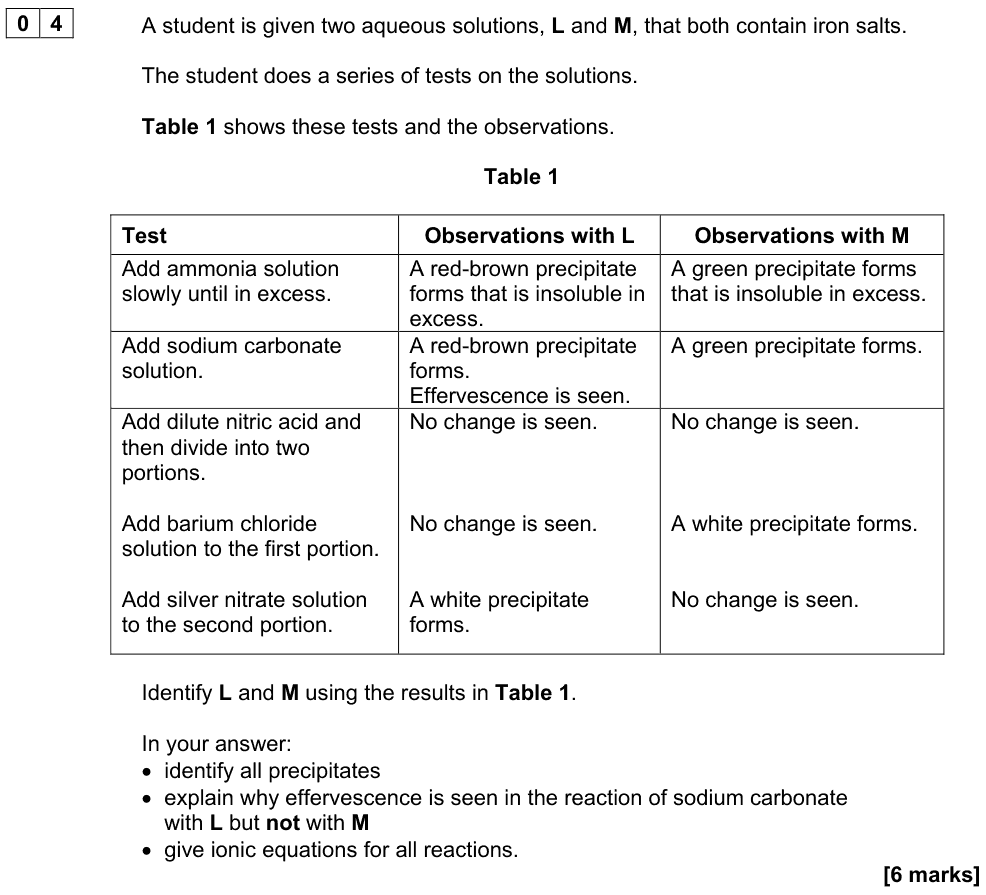
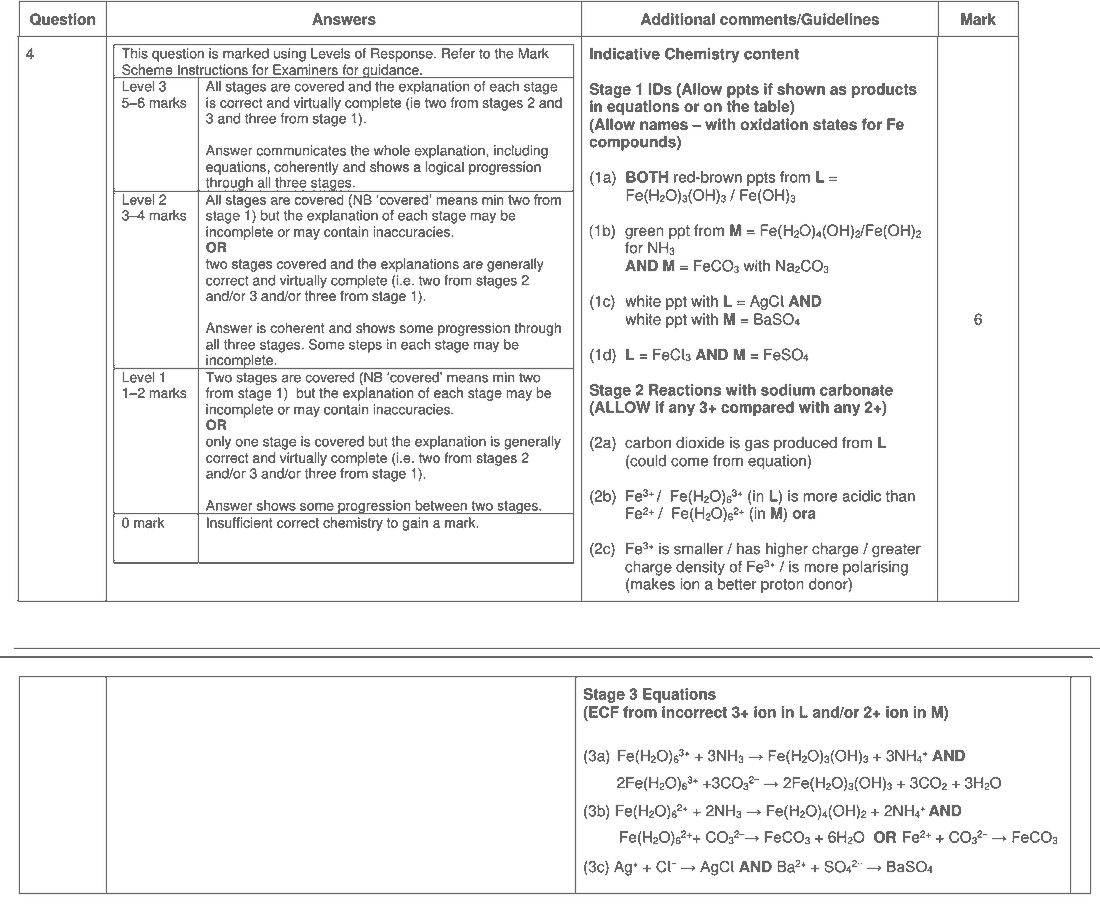
June 2023 · Paper 3 · Q04 6 marks 6-mark level of response Hard reactions of ions in aqueous solutiongroup 7 the halogens
A student is given two aqueous solutions, L and M, that both contain iron salts.
The student does a series of tests on the solutions.
Table 1 shows these tests and the observations.
Table 1
Test
Observations with L
Observations with M
Add ammonia solution
slowly until in excess.
A red-brown precipitate
forms that is insoluble in
excess.
A green precipitate forms
that is insoluble in excess.
Add sodium carbonate
solution.
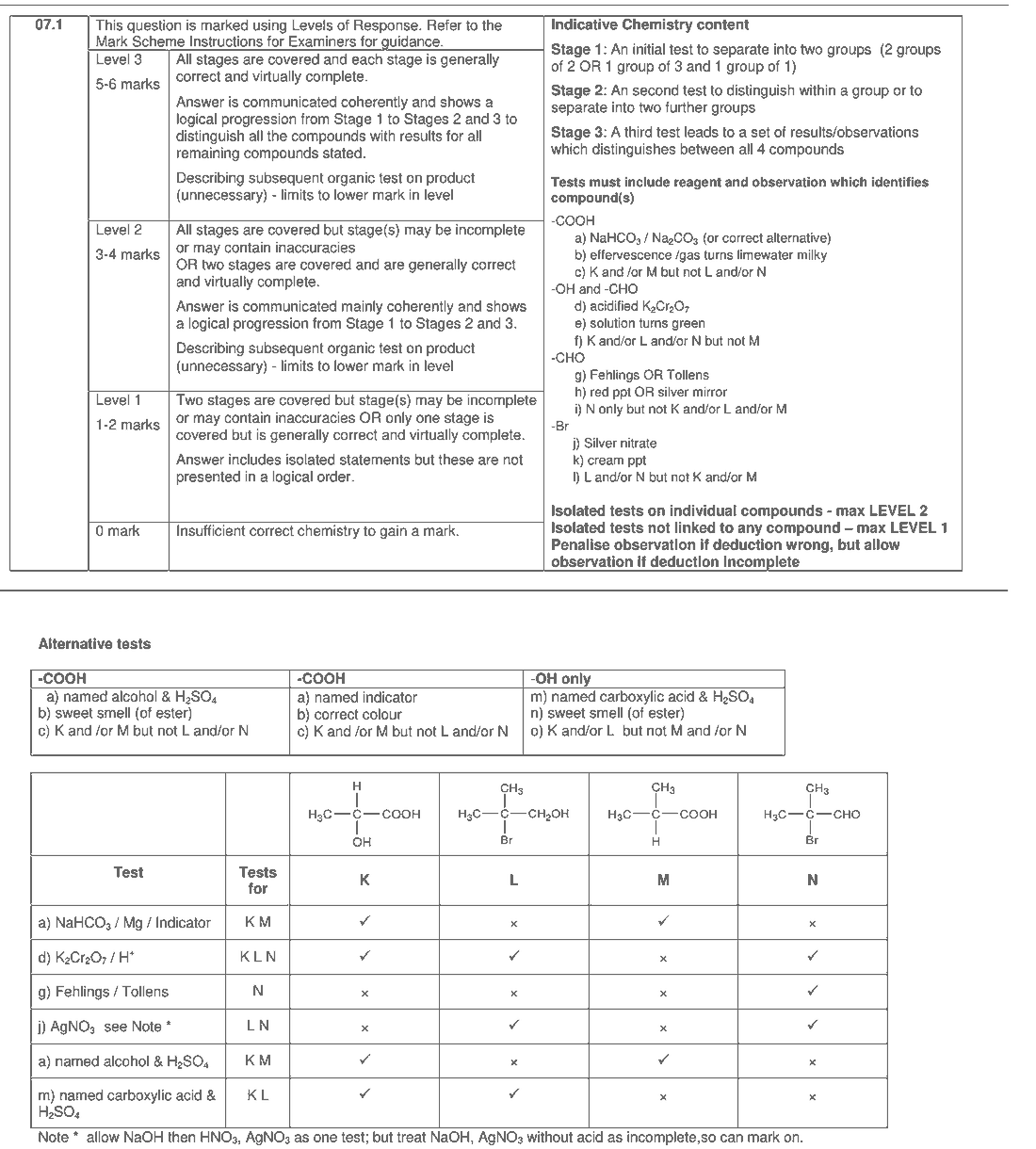
A red-brown precipitate
forms.
Effervescence is seen.
A green precipitate forms.
Add dilute nitric acid and
then divide into two
portions.
Add barium chloride
solution to the first portion.
Add silver nitrate solution
to the second portion.
No change is seen.
No change is seen.
A white precipitate
forms.
No change is seen.
A white precipitate forms.
No change is seen.
Identify L and M using the results in Table 1.
In your answer:
• identify all precipitates
• explain why effervescence is seen in the reaction of sodium carbonate
with L but not with M
• give ionic equations for all reactions.
[6 marks]
June 2023 · Paper 3 · Q05.1 3 marks Calculation amount of substanceenergetics
The molar enthalpy of vaporisation (∆Hvap) of a liquid is the enthalpy change when one
mole of liquid is converted to vapour at the boiling point of the liquid.
A student does an experiment to determine ∆Hvap for water.
The student:
• places a large beaker on a balance
• pours 500 cm3 of water into the beaker
• uses a 2.4 kW heater to raise the temperature of the water to 100 °C
• records the mass of the beaker and hot water
• uses the 2.4 kW heater to boil the water for 100 s
• records the mass of the beaker and remaining water.
The loss in mass is 103 g
Calculate ∆Hvap for water.
[1 kW = 1 kJ s–1]
[3 marks]
∆Hvap
kJ mol–1
June 2022 · AS Paper 1 · Q02.1 2 marks AO1=2 Practical and data analysis amount of substance
This question is about acid–base titrations.
Citric acid reacts with sodium hydroxide.
C6H8O7(aq)  +  3 NaOH(aq)  →  Na3C6H5O7(aq)  +  3 H2O(l)
A student makes a solution of citric acid by dissolving some solid citric acid in water.
Describe a method to add an accurately known mass of solid to a beaker to make
a solution.
[2 marks]
June 2022 · AS Paper 1 · Q02.2 3 marks AO2=3 Calculation amount of substance
Earlier part of question 02 that this part usesEarlier part of June 2022 Paper 1 question 02
The student dissolves 0.834 g of citric acid in water and makes the solution up to
500 cm3
Calculate the concentration, in mol dm–3, of citric acid in this solution.
[3 marks]
Concentration
mol dm–3
June 2022 · AS Paper 1 · Q02.3 6 marks AO1=3, AO3=3 6-mark level of response amount of substance
Earlier part of question 02 that this part usesEarlier part of June 2022 Paper 1 question 02
The student uses this method to complete a titration.
• Rinse a burette with distilled water.
• Fill the burette with sodium hydroxide solution.
• Use a measuring cylinder to transfer 25 cm3 of the citric acid solution into a
conical flask.
• Add 5 cm3 of indicator.
• Slowly add the sodium hydroxide solution from the burette into the conical flask.
• Add the sodium hydroxide solution dropwise near the end point until the indicator
just changes colour.
• Repeat the titration to get concordant results.

The method used by the student includes three practical steps that will lead to an
inaccurate final result.
For each of these three steps
• identify the mistake
• explain why it is a mistake
• suggest how the mistake can be overcome.
[6 marks]
June 2022 · AS Paper 1 · Q02.4 2 marks AO1=2 Practical and data analysis amount of substance
Earlier part of question 02 that this part usesEarlier part of June 2022 Paper 1 question 02
Table 1 shows the student’s burette readings after the mistakes in the practical
procedure have been corrected.
Table 1
Rough
Run 1
Run 2
Run 3
Final reading / cm3
23.65
22.95
46.05
26.30
Start reading / cm3
0.00
0.00
22.95
3.40
Titre / cm3
23.65
Complete Table 1.
Use the data in Table 1 to calculate the mean titre.
[2 marks]
Mean titre
cm3
June 2022 · AS Paper 1 · Q02.5 1 mark AO1=1 Calculation amount of substance
Earlier parts of question 02 that this part usesEarlier part of June 2022 Paper 1 question 02Earlier part of June 2022 Paper 1 question 02
The total uncertainty in the use of the burette is ±0.15 cm3
Calculate the percentage uncertainty in the use of the burette in Run 1.
[1 mark]
Percentage uncertainty
June 2022 · AS Paper 1 · Q08.1 2 marks AO1=1, AO3=1 Practical and data analysis group 7 the halogens
A student does two test-tube reactions on four colourless solutions (A, B, C and D).
Table 4 shows the student’s observations.
Table 4
Solution
Test 1
Add Na2CO3(s)
Test 2
Add acidified AgNO3(aq)
A
Effervescence
No visible change
B
Effervescence
White precipitate
C
No visible change
No visible change
D
No visible change
Very pale yellow precipitate
Identify the gas formed in Test 1.
Describe a further test to confirm the identity of this gas.
[2 marks]
Identity of gas
Test
June 2022 · AS Paper 1 · Q08.2 2 marks AO2=2 Practical and data analysis group 7 the halogens
Earlier part of question 08 that this part usesEarlier part of June 2022 Paper 1 question 08
Explain how the observations from Test 1 and Test 2 can be used to show that
solution B contains hydrochloric acid.
[2 marks]
June 2022 · AS Paper 1 · Q08.3 4 marks AO3=4 Practical and data analysis group 7 the halogensgroup 2
Earlier part of question 08 that this part usesEarlier part of June 2022 Paper 1 question 08
Describe a series of tests that the student can use to show that solution C contains
ammonium sulfate.
[4 marks]
June 2022 · AS Paper 1 · Q08.4 2 marks AO3=2 Practical and data analysis group 7 the halogens
Earlier part of question 08 that this part usesEarlier part of June 2022 Paper 1 question 08
The student does an additional experiment to show that solution D contains
a mixture of halide ions.  One of the halide ions is chloride.
Method:
Step 1    Add an excess of AgNO3(aq) to 10.0 cm3 of solution D.
Step 2    Filter, wash, dry and weigh the precipitate.
Step 3    Add an excess of dilute ammonia to the dry precipitate.
Step 4    Filter, wash, dry and weigh the solid that remains.
Explain how the masses recorded during this experiment can be used to show that
solution D contains a mixture of halide ions.
[2 marks]
June 2022 · AS Paper 2 · Q01.1 1 mark AO3=1 Practical and data analysis kinetics
This question is about rates of reaction.
Potassium manganate(VII), KMnO4, reacts with sodium ethanedioate, Na2C2O4, in the
presence of dilute sulfuric acid.
2 MnO4–(aq) + 16 H+(aq) + 5 C2O42–(aq) → 2 Mn2+(aq) + 8 H2O(l) + 10 CO2(g)
The reaction mixture is purple at the start and goes colourless when all the
MnO4–(aq) ions have reacted.
The rate of reaction can be measured as
1000
t where t = the time taken for the mixture
to go colourless.
A student investigated how long it takes for this reaction mixture to go colourless at
different temperatures.  The same concentrations and volumes of each reagent were
used in an experiment at each temperature.  Table 1 shows the results.
Table 1
Temperature / C
32
38
44
54
67
Time t / s
155
85
50
22
9
1000
t
6.45
11.8
20.0
45.5
Complete Table 1.
[1 mark]
June 2022 · AS Paper 2 · Q01.2 1 mark AO1=1 Practical and data analysis kinetics
Earlier part of question 01 that this part usesEarlier part of June 2022 Paper 2 question 01
State the independent variable in this investigation.
[1 mark]
June 2022 · AS Paper 2 · Q01.3 1 mark AO3=1 Practical and data analysis kinetics
Earlier part of question 01 that this part usesEarlier part of June 2022 Paper 2 question 01
The student noticed that the temperature of each reaction mixture decreased during
each experiment.
Suggest how the student calculated the temperature values in Table 1.
[1 mark]
June 2022 · AS Paper 2 · Q01.4 3 marks AO1=2, AO2=1 Practical and data analysis kinetics
Earlier part of question 01 that this part usesEarlier part of June 2022 Paper 2 question 01
Use the data in Table 1 to plot a graph of
1000
t against temperature.
[3 marks]
June 2022 · AS Paper 2 · Q01.5 1 mark AO3=1 Practical and data analysis kinetics
Earlier part of question 01 that this part usesEarlier part of June 2022 Paper 2 question 01
Use your graph in Question 01.4 to find the time taken for the mixture to go colourless
at 60 °C
Show your working.
[1 mark]
Time t
s
June 2022 · AS Paper 2 · Q02 6 marks AO1=4, AO3=2 6-mark level of response organic analysisalcohols
A student has samples of these four compounds but does not know which is which:
• butanoic acid
• 2-methylpropanal
• 2-methylpropanoic acid
• 2-methylpropan-1-ol
Step 1:   Two of these compounds can be identified by simple chemical tests.
Step 2:   The other two compounds, that contain the same functional group as each
other, can then be distinguished using a spectroscopic technique.
Describe how these two steps could be used to identify which compound is which.
[6 marks]
June 2022 · AS Paper 2 · Q07.3 2 marks AO3=2 Calculation energetics
Earlier parts of question 07 that this part usesEarlier part of June 2022 Paper 2 question 07Earlier part of June 2022 Paper 2 question 07
Table 2 shows the enthalpies of combustion of the three fuels from the fermentation
of silverskin.
Table 2
Fuel
Standard enthalpy of
combustion / kJ mol–1
Energy released per mole
of CO2 produced / kJ
ethanol, C2H5OH(l)
–1371
butan-1-ol, C4H9OH(l)
–2673
propanone, C3H6O(l)
–1786
One way to measure a fuel’s environmental impact is to measure the amount of
energy released per mole of CO2 produced.
Complete Table 2.
Use your answers to deduce the fuel with the lowest environmental impact by this
measure.
[2 marks]
June 2022 · AS Paper 2 · Q07.4 4 marks AO2=4 Calculation energetics
Earlier parts of question 07 that this part usesEarlier part of June 2022 Paper 2 question 07Earlier part of June 2022 Paper 2 question 07
A student investigated the combustion of propanone (C3H6O) using calorimetry.
A copper calorimeter containing water was heated by the complete combustion of
some propanone.  The student did not record the final temperature of the water.
Table 3 shows the student’s results.
Table 3
Mass of propanone burned / g
1.18
Mass of water / g
260
Initial temperature of water / °C
22.3
Final temperature of water / °C
Not recorded
Use the results in Table 3 to calculate a value for final temperature of the water in the
experiment.
Assume that no heat was lost in the experiment and that the heat capacity of the
calorimeter is negligible.
For propanone, enthalpy of combustion = –1786 kJ mol−1
For water, specific heat capacity = 4.18 J g−1 K−1
[4 marks]
Final temperature of water
°C
June 2022 · Paper 1 · Q03.2 1 mark AO1=1 Short answer transition metals
Earlier part of question 03 that this part usesEarlier part of June 2022 Paper 1 question 03
State why an indicator is not added in this titration.
[1 mark]
June 2022 · Paper 1 · Q05.3 3 marks AO3=3 Practical and data analysis Hard period 3 elements and oxides
Earlier part of question 05 that this part usesEarlier part of June 2022 Paper 1 question 05
Identify a reagent or test that could be used to distinguish between aqueous solutions
of sulfur dioxide and sulfur trioxide with the same concentrations.
State the observation in each case.
[3 marks]
Reagent or test
Observation with sulfur dioxide solution
Observation with sulfur trioxide solution
June 2022 · Paper 1 · Q06.5 3 marks Short answer Hard group 7 the halogens
Earlier part of question 06 that this part usesEarlier part of June 2022 Paper 1 question 06
The student adds a few drops of acidified silver nitrate solution to a solution of an
unknown impure sodium halide.
The student observes bubbles of gas and a colourless solution.
The student bubbles the gas through calcium hydroxide solution and a
white precipitate forms.
Deduce the identity of the sodium halide.
Suggest the identity of the gas.
Give an ionic equation for the formation of this gas from the impurity.
[3 marks]
Identity of sodium halide
Identity of gas
Ionic equation
June 2022 · Paper 2 · Q01.4 1 mark AO3=1 Practical and data analysis rate equations
Earlier part of question 01 that this part usesEarlier part of June 2022 Paper 2 question 01
An experiment was done to measure the time, t, taken for a solution of iodine to react
completely when added to an excess of an acidified solution of butanone.
Suggest an observation used to judge when all the iodine had reacted.
[1 mark]
June 2022 · Paper 2 · Q01.5 3 marks AO1=2, AO2=1 Explanation rate equationskinetics
Earlier part of question 01 that this part usesEarlier part of June 2022 Paper 2 question 01
The experiment was repeated at different temperatures.
Figure 1 shows how
1
t  varied with temperature for these experiments.
Figure 1
Describe and explain the shape of the graph in Figure 1.
[3 marks]
June 2022 · Paper 2 · Q01.6 1 mark AO2=1 Calculation kinetics
Earlier parts of question 01 that this part usesEarlier part of June 2022 Paper 2 question 01Earlier part of June 2022 Paper 2 question 01
Deduce the time taken for the reaction at 35 oC
[1 mark]
Time
s
June 2022 · Paper 2 · Q05.1 2 marks AO3=2 Practical and data analysis carboxylic acids and derivatives
This question is about the preparation of hexan-2-ol.
Hexan-2-ol does not mix with water and has a boiling point of 140 oC
Hexan-2-ol can be prepared from hex-1-ene using this method.
a Measure out 11.0 cm3 of hex-1-ene into a boiling tube in an ice bath.
b Carefully add 5 cm3 of concentrated phosphoric acid to the hex-1-ene.
c After 5 minutes add 10 cm3 of distilled water to the mixture and transfer the
boiling tube contents to a separating funnel.
d Shake the mixture and allow it to settle.
e Discard the lower (aqueous) layer.
f
Add a fresh 10 cm3 sample of distilled water and repeat steps d and e.
g Transfer the remaining liquid to a beaker.
h Add 2 g of anhydrous magnesium sulfate and allow to stand for 5 minutes.
i
Filter the mixture under reduced pressure.
j
Distil the filtrate and collect the distillate that boils in the range 130–160 oC
It is important to wear eye protection and a lab coat when completing this experiment.
Suggest, with a reason, one other appropriate safety precaution for this experiment.
[2 marks]
Precaution
Reason
June 2022 · Paper 2 · Q05.2 1 mark AO2=1 Practical and data analysis carboxylic acids and derivatives
Earlier part of question 05 that this part usesEarlier part of June 2022 Paper 2 question 05
Give a reason for adding the distilled water in steps c and f.
[1 mark]
June 2022 · Paper 2 · Q05.3 1 mark AO2=1 Practical and data analysis carboxylic acids and derivatives
Earlier part of question 05 that this part usesEarlier part of June 2022 Paper 2 question 05
Give a reason for adding anhydrous magnesium sulfate in step h.
[1 mark]
June 2022 · Paper 2 · Q05.4 2 marks AO2=2 Diagram or structure carboxylic acids and derivatives
Earlier part of question 05 that this part usesEarlier part of June 2022 Paper 2 question 05
Complete and label the diagram of the apparatus used to filter the mixture under
reduced pressure in step i.
[2 marks]
June 2022 · Paper 2 · Q05.5 2 marks AO2=2 Short answer alkenesalcohols
Earlier part of question 05 that this part usesEarlier part of June 2022 Paper 2 question 05
Identify the most likely organic impurity, other than hex-1-ene, in the distillate collected
in step j.
Suggest one reason why it could be difficult to remove this impurity.
[2 marks]
Impurity
Reason
June 2022 · Paper 2 · Q05.6 4 marks AO2=4 Calculation amount of substance
Earlier part of question 05 that this part usesEarlier part of June 2022 Paper 2 question 05
Calculate the mass, in g, of hexan-2-ol formed from 11.0 cm3 of hex-1-ene if the
yield is 31.0%
Give your answer to 1 decimal place.
Density of hex-1-ene = 0.678 g cm−3
[4 marks]
Mass
g
June 2022 · Paper 2 · Q09.1 2 marks AO3=2 Practical and data analysis amount of substance
This question is about olive oil.
A sample of olive oil is mainly the unsaturated fat Y mixed with a small amount of inert
impurity.
The structure of Y in the olive oil is shown.
Y has the molecular formula C57H100O6 (Mr = 880).
The amount of Y is found by measuring how much bromine water is decolourised by a
sample of oil, using this method.
• Transfer a weighed sample of oil to a 250 cm3 volumetric flask and make up to the
mark with an inert organic solvent.
• Titrate 25.0 cm3 samples of the olive oil solution with 0.025 mol dm−3 Br2(aq).
A suitable target titre for the titration is 30.0 cm3 of 0.025 mol dm−3 Br2(aq).
Justify why a much smaller target titre would not be appropriate.
Calculate the amount, in moles, of bromine in the target titre.
[2 marks]
Justification
Amount of bromine
mol
June 2022 · Paper 2 · Q09.2 5 marks AO2=3, AO3=2 Calculation amount of substancealkenes
Earlier part of question 09 that this part usesEarlier part of June 2022 Paper 2 question 09
Calculate a suitable mass of olive oil to transfer to the volumetric flask using your
answer to Question 09.1 and the structure of Y.
Assume that the olive oil contains 85% of Y by mass.
(If you were unable to calculate the amount of bromine in the target titre, you should
assume it is 6.25 ×10⁻⁴ mol.  This is not the correct amount.)
[5 marks]
Mass of olive oil
g
June 2022 · Paper 2 · Q09.3 2 marks AO3=2 Practical and data analysis amount of substance
Earlier part of question 09 that this part usesEarlier part of June 2022 Paper 2 question 09
The olive oil solution can be prepared using this method.
• Place a weighing bottle on a balance and record the mass, in g, to 2 decimal places.
• Add olive oil to the weighing bottle until a suitable mass has been added.
• Record the mass of the weighing bottle and olive oil.
• Pour the olive oil into a 250 cm3 volumetric flask.
• Add organic solvent to the volumetric flask until it is made up to the mark.
• Place a stopper in the flask and invert the flask several times.
Suggest an extra step to ensure that the mass of olive oil in the solution is recorded
accurately.
Justify your suggestion.
[2 marks]
Extra step
Justification
June 2022 · Paper 2 · Q09.4 1 mark AO3=1 Practical and data analysis amount of substance
Earlier part of question 09 that this part usesEarlier part of June 2022 Paper 2 question 09
State the reason for inverting the flask several times.
[1 mark]
June 2022 · Paper 3 · Q01.3 3 marks AO2=3 Calculation energetics
Earlier part of question 01 that this part usesEarlier part of June 2022 Paper 3 question 01
A student does an experiment to determine a value for the enthalpy of solution for
ammonium nitrate.
The student uses this method.
• Measure 25.0 cm3 of distilled water in a measuring cylinder.
• Pour the water into a beaker.
• Record the temperature of the water in the beaker.
• Add 4.00 g of solid NH4NO3 to the water in the beaker.
• Stir the solution and record the lowest temperature reached.
Table 2 shows the student’s results.
Table 2
Initial temperature / °C
20.2
Lowest temperature / °C
12.2
Calculate the enthalpy of solution, in kJ mol−1, for ammonium nitrate in this
experiment.
Assume that the specific heat capacity of the solution, c = 4.18 J K−1 g−1
Assume that the density of the solution = 1.00 g cm−3
[3 marks]
Enthalpy of solution
kJ mol−1
June 2022 · Paper 3 · Q01.4 1 mark AO2=1 Calculation energetics
Earlier part of question 01 that this part usesEarlier part of June 2022 Paper 3 question 01
The uncertainty in each of the temperature readings from the thermometer used in
this experiment is ±0.1°C
Calculate the percentage uncertainty in the temperature change in this experiment.
[1 mark]
Percentage uncertainty
June 2022 · Paper 3 · Q01.5 2 marks AO3=2 Practical and data analysis energetics
Earlier part of question 01 that this part usesEarlier part of June 2022 Paper 3 question 01
Suggest a change to the student’s method, using the same apparatus, that would
reduce the percentage uncertainty in the temperature change.
Give a reason for your answer.
[2 marks]
Change
Reason
June 2022 · Paper 3 · Q01.6 1 mark AO3=1 Practical and data analysis energetics
Earlier part of question 01 that this part usesEarlier part of June 2022 Paper 3 question 01
Another student obtained a value of +15 kJ mol−1 using the same method.
Suggest the main reason for the difference between this experimental value for the
enthalpy of solution and the correct value of +26 kJ mol−1
[1 mark]
June 2022 · Paper 3 · Q02 6 marks AO2=2, AO3=4 6-mark level of response amount of substancegroup 7 the halogensreactions of ions in aqueous solution
Tschermigite is a hydrated, water-soluble mineral, with relative formula mass of 453.2
The formula of tschermigite can be represented as M.x H2O, where M represents all
the ions present.
Table 4 shows its composition by mass.
Table 4
Element
% by mass
N
3.09
H
6.18
Al
5.96
S
14.16
O
70.61
In an analysis, it is found that the mineral contains the ions NH4+, Al3+ and SO42−
Calculate the empirical formula of tschermigite and the value of x in M.x H2O
Describe the tests, with their results, including ionic equations, that would confirm the
identities of the ions present.
[6 marks]
June 2022 · Paper 3 · Q03.7 2 marks AO3=2 Explanation halogenoalkanes
Earlier part of question 03 that this part usesEarlier part of June 2022 Paper 3 question 03
A student compares the rates of hydrolysis of 1-chlorobutane, 1-bromobutane and
1-iodobutane.
The suggested method is:
• add equal volumes of the three halogenoalkanes to separate test tubes
• add equal volumes of aqueous silver nitrate to each test tube
• record the time taken for a precipitate to appear in each test tube.
State and explain the order in which precipitates appear.
[2 marks]
Order in which precipitates appear
Explanation
June 2022 · Paper 3 · Q04.1 2 marks AO1=2 Explanation kinetics
Hydrogen peroxide solution decomposes to form water and oxygen.
2 H2O2(aq) → 2 H2O(l) + O2(g)
The reaction is catalysed by manganese(IV) oxide.
A student determines the order of this reaction with respect to hydrogen peroxide.
The student uses a continuous monitoring method in the experiment.
The student places hydrogen peroxide solution in a conical flask with the catalyst and
uses a gas syringe to collect the oxygen formed.  The student records the volume of
oxygen every 10 seconds for 100 seconds.
Explain why the reaction is fastest at the start.
[2 marks]
June 2022 · Paper 3 · Q04.2 2 marks AO2=2 Calculation rate equations
Earlier part of question 04 that this part usesEarlier part of June 2022 Paper 3 question 04
The graph in Figure 1 shows how the concentration of hydrogen peroxide changes
with time in this experiment.
Figure 1
Tangents to the curve in Figure 1 can be used to determine rates of reaction.
Draw a tangent to the curve when the concentration of hydrogen peroxide solution is
0.05 mol dm–3
Use your tangent to calculate the gradient of the curve at this point.
[2 marks]
Gradient
mol dm–3 s–1
June 2022 · Paper 3 · Q04.3 2 marks AO3=2 Calculation rate equations
Earlier parts of question 04 that this part usesEarlier part of June 2022 Paper 3 question 04Earlier part of June 2022 Paper 3 question 04
The concentration of hydrogen peroxide solution at time t during the experiment can
be calculated using this expression.
[
]
[
]
max
2
2
2
2 initial
max
H O
H O
t
t
V
V
V


−
=




[
]
2
2
H O
t = concentration of hydrogen peroxide solution at time t / mol dm–3
[
]
2
2 initial
H O
= concentration of hydrogen peroxide solution at the start / mol dm–3
max
V
= total volume of oxygen gas collected during the whole experiment / cm3
tV = volume of oxygen gas collected at time t / cm3
In this experiment,
max
V
= 100 cm3
Use Figure 1 and the expression to calculate [
]
2
2
H O
t when 20 cm3 of oxygen has
been collected.
[2 marks]
[
]
2
2
H O
t
mol dm–3
June 2022 · Paper 3 · Q04.4 2 marks AO2=1, AO3=1 Practical and data analysis rate equations
Earlier part of question 04 that this part usesEarlier part of June 2022 Paper 3 question 04
Table 5 shows data from a similar experiment.
Table 5
[H2O2] / mol dm–3
0.02
0.03
0.05
0.07
0.09
Rate / mol dm–3 s–1
0.00049
0.00073 0.00124
0.00168
0.00219
Plot the data from Table 5 on the grid in Figure 2.
Draw a line of best fit.
[2 marks]
Figure 2
June 2022 · Paper 3 · Q04.5 2 marks AO3=2 Short answer rate equations
Earlier parts of question 04 that this part usesEarlier part of June 2022 Paper 3 question 04Earlier part of June 2022 Paper 3 question 04
Use Figure 2 to determine the order of reaction with respect to H2O2
State how the graph shows this order.
[2 marks]
Order
How the graph shows this order
November 2021 · AS Paper 1 · Q04.1 2 marks Equation writing group 2amount of substance
This question is about the identification of ions in unknown solutions.
A student completes a number of test-tube reactions on solutions A, B and C.
Table 2 shows the student’s observations.
Table 2
Test 1
Test 2
Test 3
Add H2SO4(aq)
Warm with NaOH(aq)
Add acidified AgNO3(aq)
A
white precipitate
no visible change
no visible change
B
effervescence
a gas is formed that turns
damp red litmus blue
effervescence
C
no visible change
no visible change
off-white precipitate
Suggest the identity of the positive ion in solution A.
Give the simplest ionic equation for the formation of the white precipitate in
Test 1 for solution A.
[2 marks]
Identity of positive ion in A
Ionic equation
November 2021 · AS Paper 1 · Q04.2 2 marks Equation writing group 7 the halogensamount of substance
Earlier part of question 04 that this part usesEarlier part of November 2021 Paper 1 question 04
Different gases are formed when solution B reacts in Test 1 and in Test 2.
Suggest the identity of each gas.
Give the simplest ionic equation for the formation of the gas in Test 2.
[2 marks]
Gas formed in Test 1
Gas formed in Test 2
Ionic equation for the formation of the gas in Test 2
November 2021 · AS Paper 1 · Q04.3 3 marks Practical and data analysis group 7 the halogens
Earlier part of question 04 that this part usesEarlier part of November 2021 Paper 1 question 04
The student thinks that solution C contains either chloride ions or bromide ions.
Describe a further test, or tests, to show whether solution C contains chloride or
bromide ions.
[3 marks]
November 2021 · AS Paper 1 · Q07.2 3 marks Calculation energetics
Earlier part of question 07 that this part usesEarlier part of November 2021 Paper 1 question 07
A student does an experiment to determine the enthalpy of combustion of propan-1-ol
(CH3CH2CH2OH, Mr = 60.0).
Combustion of 0.497 g of propan-1-ol increases the temperature of 150 g of water
from 21.2 °C to 35.1 °C
Calculate a value, in kJ mol–1, for the enthalpy of combustion of propan-1-ol
in this experiment.
The specific heat capacity of water is 4.18 J K–1 g–1
[3 marks]
Enthalpy of combustion
kJ mol‒1
November 2021 · AS Paper 1 · Q07.3 1 mark Practical and data analysis energetics
Earlier part of question 07 that this part usesEarlier part of November 2021 Paper 1 question 07
The enthalpy of combustion determined experimentally is less exothermic than that
calculated using enthalpies of formation.
Give one possible reason for this, other than heat loss.
[1 mark]
November 2021 · AS Paper 1 · Q08.1 6 marks Calculation amount of substance
A student is provided with a 5.60 g sample of ethanoic acid (CH3COOH) contaminated
with sodium ethanoate (CH3COONa).
The student dissolves the sample in deionised water and makes the volume up
to 200 cm3
The student removes 25.0 cm3 samples of the solution and titrates them with
0.350 mol dm–3 sodium hydroxide solution.
Table 3 shows the results of these titrations.
Table 3
Rough
1
2
3
Final volume / cm3
20.85
41.10
20.50
40.80
Initial volume / cm3
0.00
20.85
0.00
20.50
Titre / cm3
20.85
20.25
20.50
20.30
Use the results in Table 3 to calculate the mean titre value.
Use the mean titre to calculate the percentage by mass of sodium ethanoate in the
original sample.
[6 marks]
Mean titre value
cm3
Percentage by mass
November 2021 · AS Paper 1 · Q08.2 2 marks Practical and data analysis amount of substance
Earlier part of question 08 that this part usesEarlier part of November 2021 Paper 1 question 08
The student rinses the burette with deionised water before filling with
sodium hydroxide solution.
State and explain the effect, if any, that this rinsing will have on the value of the titre.
[2 marks]
November 2021 · AS Paper 2 · Q03.1 6 marks 6-mark level of response alcohols
Propanone can be made by reacting propan-2-ol with an excess of
acidified potassium dichromate(VI).
The propanone is removed from the reaction mixture by distillation.
Figure 2 shows the apparatus set up by a student to make propanone by this method.
Suitable clamps are used to hold all the apparatus firmly in place.
Figure 2
There are three problems with the apparatus set up in Figure 2.
For each problem:
• identify the problem
• describe the issue it would cause
• suggest how the problem can be solved.
[6 marks]
November 2021 · AS Paper 2 · Q03.2 4 marks Calculation amount of substance
Earlier part of question 03 that this part usesEarlier part of November 2021 Paper 2 question 03
Another student completes the experiment using apparatus that is set up correctly.
The student reacts 2.0 cm3 of propan-2-ol (CH3CH(OH)CH3) with an excess of
acidified potassium dichromate(VI).
The student obtains 0.954 g of propanone (CH3COCH3).
Calculate the percentage yield of propanone in this experiment.
Give your answer to the appropriate number of significant figures.
Density of propan-2-ol = 0.786 g cm–3
[4 marks]
Percentage yield
November 2021 · AS Paper 2 · Q06.1 5 marks Calculation amount of substance
This question is about two experiments on gases.
In the first experiment, liquid Y is injected into a sealed flask under vacuum.
The liquid vaporises in the flask.
Table 2 shows data for this experiment.
Table 2
Mass of Y
717 mg
Temperature
297 K
Volume of flask
482 cm3
Pressure inside flask
51.0 kPa
Calculate the relative molecular mass of Y.
Show your working.
The gas constant, R = 8.31 J K−1 mol−1
[5 marks]
Relative molecular mass of Y
November 2021 · Paper 1 · Q03.1 2 marks Equation writing period 3 elements and oxides
This question is about elements in Period 3 and their compounds.
When a piece of sodium is added to 200 cm3 of water in a large beaker a vigorous
reaction occurs.  The temperature of the water increases by 25 oC
Give an equation, including state symbols, for the reaction of sodium with water.
Suggest why it is dangerous to react a similar piece of sodium with 10 cm3 of water in
a boiling tube.
[2 marks]
Equation
Why it is dangerous
November 2021 · Paper 1 · Q04.5 2 marks Short answer reactions of ions in aqueous solution
Earlier part of question 04 that this part usesEarlier part of November 2021 Paper 1 question 04
Figure 2 shows some reactions of iron ions in aqueous solution.
Figure 2
Identify A and state its colour.
[2 marks]
Identity
Colour
November 2021 · Paper 1 · Q04.6 3 marks Equation writing reactions of ions in aqueous solution
Earlier parts of question 04 that this part usesEarlier part of November 2021 Paper 1 question 04Earlier part of November 2021 Paper 1 question 04
Give the formula of B and state its colour.
Give an ionic equation for the reaction of [Fe(H2O)6]3+ with aqueous Na2CO3 to
form B.
[3 marks]
Formula
Colour
Ionic equation
November 2021 · Paper 1 · Q06.4 1 mark Practical and data analysis acids and bases
Earlier part of question 06 that this part usesEarlier part of November 2021 Paper 1 question 06
A pH meter is calibrated using a calibration graph.
To create the calibration, the pH meter is used to measure the pH of separate
solutions, each with a known, accurate pH.
Figure 3 shows the calibration graph.
Figure 3
Use Figure 3 to give the true pH value when the pH meter reading is 5.6
[1 mark]
November 2021 · Paper 1 · Q06.5 1 mark Practical and data analysis acids and bases
Earlier parts of question 06 that this part usesEarlier part of November 2021 Paper 1 question 06Earlier part of November 2021 Paper 1 question 06
Suggest why the pH probe is washed with distilled water between each of the
calibration measurements.
[1 mark]
November 2021 · Paper 1 · Q06.6 1 mark Practical and data analysis acids and bases
Earlier parts of question 06 that this part usesEarlier part of November 2021 Paper 1 question 06Earlier part of November 2021 Paper 1 question 06
The calibrated pH meter is used to monitor the pH during a titration of
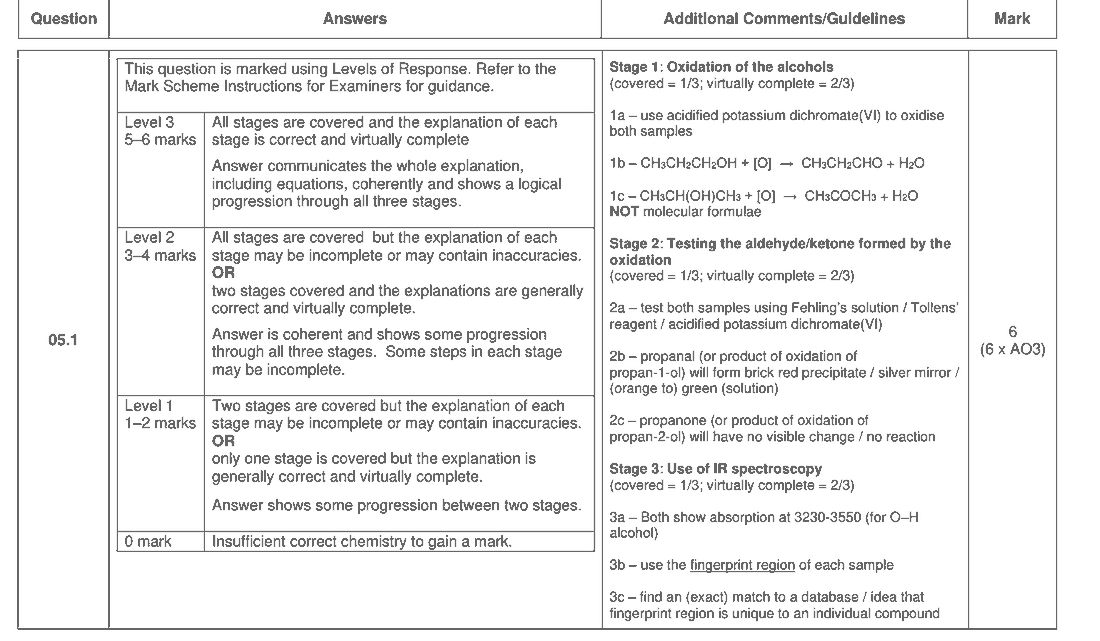
hydrochloric acid with sodium hydroxide.
Explain why the volume of sodium hydroxide solution added between each
pH measurement is smaller as the end point of the titration is approached.
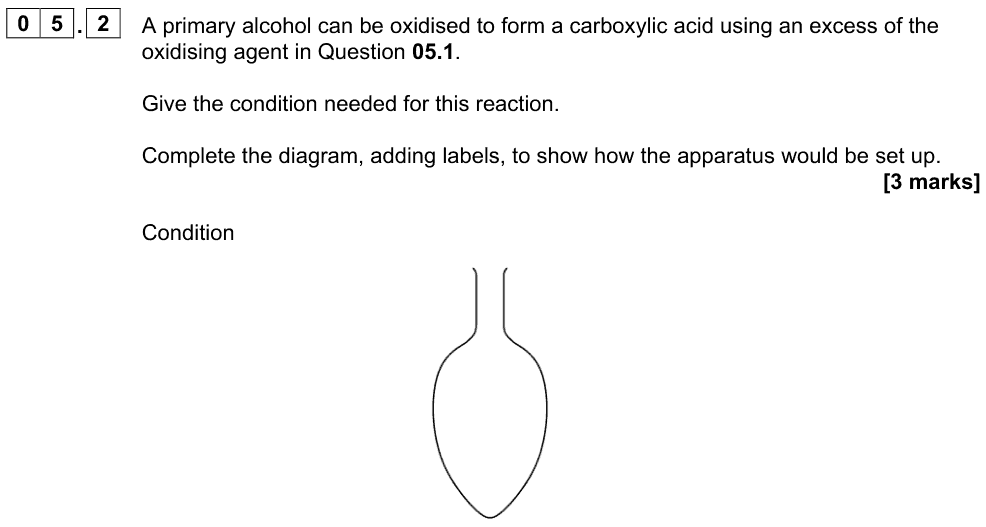
[1 mark]
November 2021 · Paper 1 · Q06.7 1 mark Short answer acids and bases
Earlier parts of question 06 that this part usesEarlier part of November 2021 Paper 1 question 06Earlier part of November 2021 Paper 1 question 06
Figure 4 shows the pH curve for a titration of hydrochloric acid with
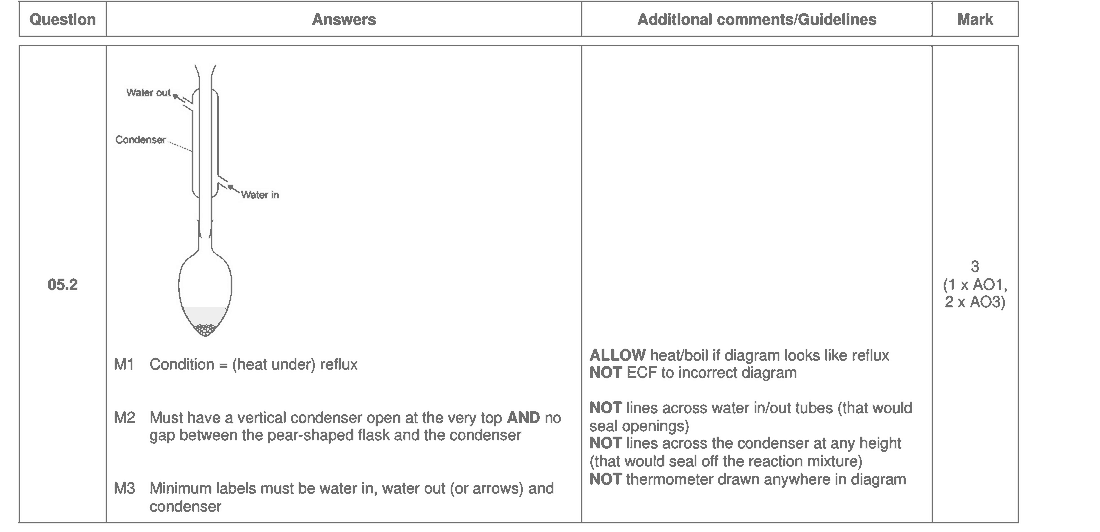
sodium hydroxide solution.
Figure 4
Table 6 shows data about some indicators.
Table 6
Indicator
pH range
Colour at low pH
Colour at high pH
Bromocresol green
3.8 – 5.4
yellow
blue
Phenol red
6.8 – 8.4
yellow
red
Thymolphthalein
9.3 – 10.5
colourless
blue
The student plans to do the titration again using one of the indicators in Table 6 to

determine the end point.
State why all three of the indicators in Table 6 are suitable for this titration.
[1 mark]
November 2021 · Paper 2 · Q01.4 3 marks Practical and data analysis carboxylic acids and derivatives
Earlier part of question 01 that this part usesEarlier part of November 2021 Paper 2 question 01
Suggest why aqueous ethanol is a suitable solvent when heating the coconut oil
with KOH.
Give a safety precaution used when heating the mixture.
Justify your choice.
[3 marks]
Reason
Safety precaution
Justification

November 2021 · Paper 2 · Q03.1 2 marks Practical and data analysis energetics
A student does an experiment to determine a value for the enthalpy of combustion of
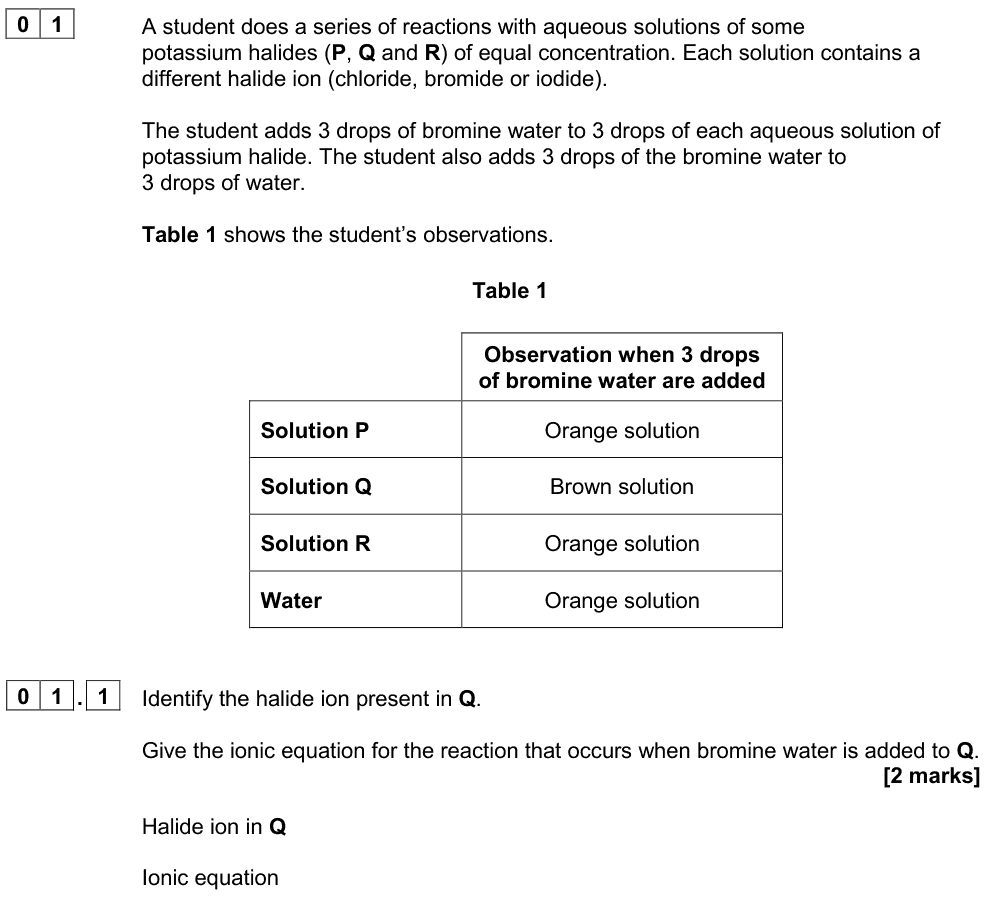
heptane.
Figure 2 shows some of the apparatus used.
Figure 2
Design a table to record all the readings necessary to determine an experimental
value for the enthalpy of combustion for heptane in this experiment.

[2 marks]
November 2021 · Paper 2 · Q03.2 2 marks Practical and data analysis energetics
Earlier part of question 03 that this part usesEarlier part of November 2021 Paper 2 question 03

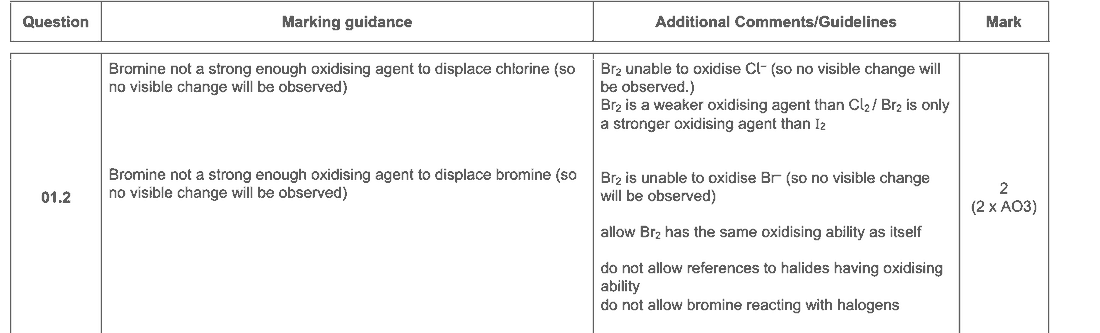
The student considered using a glass beaker on a tripod and gauze instead of the
clamped copper calorimeter.
Suggest two disadvantages of using a glass beaker on a tripod and gauze.
[2 marks]
Disadvantage 1
Disadvantage 2
November 2021 · Paper 2 · Q03.3 2 marks Practical and data analysis energetics
Earlier part of question 03 that this part usesEarlier part of November 2021 Paper 2 question 03
Suggest two reasons why the value of enthalpy of combustion from this experiment is
less exothermic than a data book value.
[2 marks]
Reason 1
Reason 2
November 2021 · Paper 2 · Q03.4 1 mark Practical and data analysis energetics
Earlier part of question 03 that this part usesEarlier part of November 2021 Paper 2 question 03
Suggest one addition to this apparatus that would improve the accuracy of the
enthalpy value obtained.
[1 mark]
November 2021 · Paper 2 · Q10.1 2 marks Practical and data analysis rate equations
This question is about rates of reaction.
Iodine and propanone react together in an acid-catalysed reaction
CH3COCH3(aq) + I2(aq) → CH3COCH2I(aq) + HI(aq)
A student completed a series of experiments to determine the order of reaction with
respect to iodine.
Method
• Transfer 25 cm3 of 1.0 mol dm–3 propanone solution into a conical flask.
• Add 10 cm3 of 1.0 mol dm–3 HCl(aq)
• Add 25 cm3 of 5.0 × 10⁻³ mol dm–3 I2(aq) and start a timer.
• At intervals of 1 minute, remove a 1.0 cm3 sample of the mixture and add each
sample to a separate beaker containing an excess of NaHCO3(aq)
• Titrate the contents of each beaker with a standard solution of
sodium thiosulfate and record the volume of sodium thiosulfate used.
Suggest why the 1.0 cm3 portions of the reaction mixture are added to an excess of
NaHCO3 solution.
[2 marks]
November 2021 · Paper 2 · Q10.2 2 marks Practical and data analysis rate equations
Earlier part of question 10 that this part usesEarlier part of November 2021 Paper 2 question 10
Suggest why the order of this reaction with respect to propanone can be ignored in
this experiment.
[2 marks]
November 2021 · Paper 2 · Q10.3 3 marks Practical and data analysis rate equations
Earlier part of question 10 that this part usesEarlier part of November 2021 Paper 2 question 10
The volume of sodium thiosulfate solution used in each titration is proportional to the
concentration of iodine in each beaker.
Table 5 shows the results of the experiment.
Table 5
Time / minutes
Volume of sodium thiosulfate solution
/ cm3
1
41
2
35
3
24
4
22
5
16
6
10
Use the results in Table 5 to draw a graph of volume of sodium thiosulfate solution
against time.
Draw a line of best fit.
[3 marks]
November 2021 · Paper 2 · Q10.4 2 marks Explanation rate equations
Earlier parts of question 10 that this part usesEarlier part of November 2021 Paper 2 question 10Earlier part of November 2021 Paper 2 question 10
Explain how the graph shows that the reaction is zero-order with respect to iodine in
the reaction between propanone and iodine.
[2 marks]
November 2021 · Paper 3 · Q01.3 4 marks Calculation transition metals
Earlier part of question 01 that this part usesEarlier part of November 2021 Paper 3 question 01
Sodium ethanedioate is used to find the concentration of solutions of
potassium manganate(VII) by titration.  The equation for this reaction is
2 MnO4– + 16 H+ + 5 C2O42– → 2 Mn2+ + 8 H2O + 10 CO2
A standard solution is made by dissolving 162 mg of Na2C2O4 (Mr = 134.0) in water
and making up to 250 cm3 in a volumetric flask.
25.0 cm3 of this solution and an excess of sulfuric acid are added to a conical flask.
The mixture is warmed and titrated with potassium manganate(VII) solution.
The titration is repeated until concordant results are obtained.
The mean titre is 23.85 cm3
Calculate the concentration, in mol dm–3, of the potassium manganate(VII) solution.
[4 marks]
Concentration
mol dm−3
November 2021 · Paper 3 · Q01.4 1 mark Practical and data analysis Easy amount of substance
Earlier part of question 01 that this part usesEarlier part of November 2021 Paper 3 question 01
Figure 1 shows the 25.0 cm3 pipette used to measure the
sodium ethanedioate solution.
Figure 1
On Figure 1, draw the meniscus of the solution when the pipette is ready to transfer
25.0 cm3 of the sodium ethanedioate solution.
[1 mark]
November 2021 · Paper 3 · Q01.5 2 marks Practical and data analysis amount of substance
Earlier part of question 01 that this part usesEarlier part of November 2021 Paper 3 question 01
Potassium manganate(VII) is oxidising and harmful.
Sodium ethanedioate is toxic.
Suggest safety precautions, other than eye protection, that should be taken when:
• filling the burette with potassium manganate(VII) solution
• dissolving the solid sodium ethanedioate in water.
[2 marks]
Filling the burette
Dissolving the solid
November 2021 · Paper 3 · Q01.6 1 mark Practical and data analysis Hard transition metals
Earlier parts of question 01 that this part usesEarlier part of November 2021 Paper 3 question 01Earlier part of November 2021 Paper 3 question 01
State the colour change seen at the end point of each titration.
[1 mark]
November 2021 · Paper 3 · Q01.7 2 marks Practical and data analysis amount of substance
Earlier part of question 01 that this part usesEarlier part of November 2021 Paper 3 question 01
Figure 2 shows the burette containing potassium manganate(VII) solution.
Figure 2
Give two practical steps needed before recording the initial burette reading.
[2 marks]
1
2
November 2021 · Paper 3 · Q02.1 2 marks Practical and data analysis amino acids proteins and dnachromatography
The protein fibroin can be broken down into amino acids using an enzyme.
A student uses thin-layer chromatography (TLC) to identify these amino acids.
The student identifies two of the amino acids as alanine and serine.
Use Figure 3 to calculate the Rf value of the unknown amino acid.
Show your working.
Use your Rf value and Table 1 to identify the unknown amino acid.
[2 marks]
Figure 3
Table 1
Amino acid
Rf value
tyrosine
0.25
glycine
0.34
valine
0.64
leucine
0.73
Rf value
Identity
November 2021 · Paper 3 · Q02.2 1 mark Short answer amino acids proteins and dna
Earlier part of question 02 that this part usesEarlier part of November 2021 Paper 3 question 02
The amino acids cannot be seen as they move during the experiment.
State how the amino acids can be made visible at the end of the experiment.
[1 mark]
November 2021 · Paper 3 · Q03.1 5 marks Practical and data analysis Hard carboxylic acids and derivatives
This question is about ketones.
Solution X reacts with liquid ketones to form a crystalline solid.
This reaction can be used to identify a ketone if the crystalline solid is separated,
purified by recrystallisation, and the melting point determined.
Describe how the crystalline solid is separated and purified.
[5 marks]
November 2021 · Paper 3 · Q04.2 5 marks Explanation group 7 the halogens
Earlier part of question 04 that this part usesEarlier part of November 2021 Paper 3 question 04
A solution that is thought to contain chloride ions and iodide ions is tested.
1. Dilute nitric acid is added to the solution.
2. Aqueous silver nitrate is added to the solution.
3. A pale yellow precipitate forms.
4. Excess dilute aqueous ammonia is added to the mixture.
5. Some of the precipitate dissolves and a darker yellow precipitate remains.
Give a reason for the use of each reagent.
Explain the observations.
Give ionic equations for any reactions.
[5 marks]
November 2021 · Paper 3 · Q06.1 2 marks Practical and data analysis alcohols
A student plans an experiment to investigate the yield of propanoic acid when a
sample of propan-1-ol is oxidised.
Figure 4 shows the apparatus that the student plans to use for the experiment.
The student’s teacher says that the apparatus is not safe.
Figure 4
Give two reasons why the apparatus shown in Figure 4 is not safe.
[2 marks]
1
2
November 2021 · Paper 3 · Q06.3 2 marks Practical and data analysis alcohols
Earlier part of question 06 that this part usesEarlier part of November 2021 Paper 3 question 06
State two more mistakes in the way the apparatus is set up in Figure 4.
[2 marks]
1
2
November 2021 · Paper 3 · Q06.4 1 mark Practical and data analysis alcohols
Earlier part of question 06 that this part usesEarlier part of November 2021 Paper 3 question 06
State the purpose of the small glass beads in the flask in Figure 4.
[1 mark]
November 2021 · Paper 3 · Q06.5 4 marks Calculation amount of substancealcohols
Earlier part of question 06 that this part usesEarlier part of November 2021 Paper 3 question 06
After correcting the mistakes, the student heats a reaction mixture containing 6.50 g of
propan-1-ol with an excess of the oxidising agent.
The propanoic acid separated from the reaction mixture has a mass of 3.25 g
State the name of the technique used to separate the propanoic acid from the reaction
mixture.
Calculate the percentage yield of propanoic acid.
[4 marks]
Technique
Percentage yield
November 2021 · Paper 3 · Q06.6 3 marks Practical and data analysis organic analysiscarboxylic acids and derivatives
Earlier part of question 06 that this part usesEarlier part of November 2021 Paper 3 question 06
State a simple chemical test that distinguishes the propanoic acid from the
propan-1-ol.
Give one observation for the test with each substance.
[3 marks]
Test
Propanoic acid
Propan-1-ol
November 2020 · AS Paper 1 · Q02.1 5 marks Calculation amount of substance
This question is about a titration.
A student dissolves an unknown mass of sodium hydroxide in water to make
200 cm3 of an aqueous solution.
A 25.0 cm3 sample of this sodium hydroxide solution is placed in a conical flask and is
titrated with 0.150 mol dm–3 sulfuric acid.
The equation for this reaction is shown.
2 NaOH(aq) + H2SO4(aq) → Na2SO4(aq) + 2 H2O(l)
Table 1 shows the results of the titrations.
Table 1
Titration
Rough
1
2
3
Final reading / cm3
20.75
40.35
21.05
40.60
Initial reading / cm3
0.00
20.75
1.20
21.05
Titre / cm3
20.75
19.60
19.85
19.55
Calculate the mass of sodium hydroxide used to make the original solution.
[5 marks]
Mass of sodium hydroxide
g
November 2020 · AS Paper 1 · Q02.2 1 mark Practical and data analysis amount of substance
Earlier part of question 02 that this part usesEarlier part of November 2020 Paper 1 question 02
The student uses a funnel to fill the burette with sulfuric acid before starting the
titration.  After filling, the student forgets to remove the funnel from the top of the
burette.
Suggest why this might affect the titre volume recorded.
[1 mark]
November 2020 · AS Paper 1 · Q02.3 1 mark Practical and data analysis amount of substance
Earlier part of question 02 that this part usesEarlier part of November 2020 Paper 1 question 02
State one advantage of using a conical flask rather than a beaker for the titration.
[1 mark]
November 2020 · AS Paper 1 · Q04.2 6 marks 6-mark level of response energetics
Earlier part of question 04 that this part usesEarlier part of November 2020 Paper 1 question 04
A student determines the enthalpy change for the reaction between
calcium carbonate and hydrochloric acid.
CaCO3(s) + 2 HCl(aq) → CaCl2(aq) + CO2(g) + H2O(l)
The student follows this method:
• measure out 50 cm3 of 1.00 mol dm–3 aqueous hydrochloric acid using a measuring
cylinder and pour the acid into a 100 cm3 glass beaker
• weigh out 2.50 g of solid calcium carbonate on a watch glass and tip the solid into
the acid
• stir the mixture with a thermometer
• record the maximum temperature reached.
The student uses the data to determine a value for the enthalpy change.
Explain how the experimental method and use of apparatus can be improved to
provide more accurate data.
Describe how this data from the improved method can be used to determine an
accurate value for the temperature change.
[6 marks]
November 2020 · AS Paper 1 · Q04.4 1 mark Practical and data analysis energetics
Earlier part of question 04 that this part usesEarlier part of November 2020 Paper 1 question 04
Suggest how, without changing the apparatus, the experiment in Question 04.3 could
be improved to reduce the percentage uncertainty in the temperature change.
[1 mark]
November 2020 · AS Paper 1 · Q05.3 2 marks Short answer group 2
Earlier part of question 05 that this part usesEarlier part of November 2020 Paper 1 question 05
State what is observed when dilute aqueous sodium hydroxide is added to separate
solutions of magnesium chloride and barium chloride.
[2 marks]
Observation with magnesium chloride
Observation with barium chloride
November 2020 · AS Paper 1 · Q07.3 1 mark Practical and data analysis group 7 the halogens
Earlier part of question 07 that this part usesEarlier part of November 2020 Paper 1 question 07
A student completes an experiment to determine the percentage by mass of
sodium chloride in a mixture of sodium chloride and sodium iodide.
The student uses this method.
• 600 mg of the mixture are dissolved in water to form a solution.
• An excess of aqueous silver nitrate is added to the solution.  This forms a
precipitate containing silver chloride and silver iodide.
• Excess dilute ammonia solution is then added to the precipitate.  The silver chloride
dissolves.
• The silver iodide is filtered off from the solution, and is then washed and dried.
The mass of the silver iodide obtained is 315 mg
Silver nitrate is added to the solution.
Suggest why an excess is used.
[1 mark]
November 2020 · AS Paper 1 · Q08.1 4 marks Calculation amount of substance
This question is about a volatile liquid, A.
A student does an experiment to determine the relative molecular mass (Mr) of
liquid A using the apparatus shown in Figure 2.
The student injects a sample of A into a gas syringe in an oven.
At the temperature of the oven, liquid A vaporises.
Figure 2
Table 3 shows the student’s results.
Table 3
Mass of fine needle syringe and contents before injecting
11.295 g
Mass of fine needle syringe and contents after injecting
10.835 g
Volume reading on gas syringe before injecting
0.0 cm3
Volume reading on gas syringe after injecting
178.0 cm3
Pressure of gas in syringe
100 kPa
Temperature of oven
120 °C
Calculate the Mr of A.
Give your answer to 3 significant figures.
The gas constant, R = 8.31 J K–1 mol–1
[4 marks]
Mr
November 2020 · AS Paper 1 · Q08.2 2 marks Practical and data analysis amount of substance
Earlier part of question 08 that this part usesEarlier part of November 2020 Paper 1 question 08
The student noticed that some of the liquid injected into the gas syringe
did not vaporise.
Explain the effect that this has on the Mr calculated by the student.
[2 marks]
November 2020 · AS Paper 1 · Q08.3 1 mark Practical and data analysis amount of substance
Earlier part of question 08 that this part usesEarlier part of November 2020 Paper 1 question 08
Table 3 is repeated here.
Table 3
Mass of fine needle syringe and contents before injecting
11.295 g
Mass of fine needle syringe and contents after injecting
10.835 g
Volume reading on gas syringe before injecting
0.0 cm3
Volume reading on gas syringe after injecting
178.0 cm3
Pressure of gas in syringe
100 kPa
Temperature of oven
120 °C
Each reading on the balance used to record the mass of the fine needle syringe and
contents had an uncertainty of ±0.001 g
Calculate the percentage uncertainty in the mass of liquid A injected in this
experiment.
[1 mark]
Percentage uncertainty
November 2020 · AS Paper 2 · Q02.1 1 mark Practical and data analysis kinetics
A student investigates the effect of temperature on the rate of reaction between
sodium thiosulfate solution and dilute hydrochloric acid.
Na2S2O3(aq) + 2 HCl(aq) ⟶ 2 NaCl(aq) + SO2(g) + S(s) + H2O(l)
The student mixes the solutions together in a flask and places the flask on a piece of
paper marked with a cross.
The student records the time for the cross to disappear.  The cross disappears
because the mixture becomes cloudy.
Table 2 shows the student’s results.
Table 2
Temperature / °C
22
31
36
42
49
54
Time, t, for cross to
disappear / s
87
48
36
26
44
12
1
t / s–1
0.0115
0.0208
0.0278
0.0385
0.0227
The student uses a stopwatch to measure the time.  The stopwatch shows each time
to the nearest 0.01 s
Suggest why the student records the times to the nearest second and not to the
nearest 0.01 s
[1 mark]
November 2020 · AS Paper 2 · Q02.2 1 mark Practical and data analysis kinetics
Earlier part of question 02 that this part usesEarlier part of November 2020 Paper 2 question 02
The rate of reaction is proportional to
1
t
Complete Table 2.
[1 mark]
November 2020 · AS Paper 2 · Q02.3 2 marks Practical and data analysis kinetics
Earlier part of question 02 that this part usesEarlier part of November 2020 Paper 2 question 02
Plot the values of
1
Draw a line of best fit.
[2 marks]
Figure 1
November 2020 · AS Paper 2 · Q02.4 1 mark Practical and data analysis kinetics
Earlier part of question 02 that this part usesEarlier part of November 2020 Paper 2 question 02
Use your line of best fit to estimate the time for the cross to disappear at 40 °C
Show your working.
[1 mark]
Time
s
November 2020 · AS Paper 2 · Q02.5 1 mark Practical and data analysis kinetics
Earlier part of question 02 that this part usesEarlier part of November 2020 Paper 2 question 02
Suggest, by considering the products of this reaction, why small amounts of reactants
are used in this experiment.
[1 mark]
November 2020 · AS Paper 2 · Q02.6 1 mark Practical and data analysis kinetics
Earlier part of question 02 that this part usesEarlier part of November 2020 Paper 2 question 02
The student could do the experiment at lower temperatures using an ice bath.
Suggest why the student chose not to carry out experiments at temperatures in the
range 1–10 °C
[1 mark]
November 2020 · Paper 1 · Q08.1 7 marks Calculation amount of substance
A student does an experiment to determine the percentage by mass of
sodium chlorate(I), NaClO, in a sample of bleach solution.
Method:
• Dilute a 10.0 cm3 sample of bleach solution to 100 cm3 with distilled water.
• Transfer 25.0 cm3 of the diluted bleach solution to a conical flask and acidify using
sulfuric acid.
• Add excess potassium iodide to the conical flask to form a brown solution
containing l2(aq).
• Add 0.100 mol dm–3 sodium thiosulfate solution (Na2S2O3) to the conical flask from
a burette until the brown solution containing l2(aq) becomes a colourless solution
containing l–(aq).
The student uses 33.50 cm3 of sodium thiosulfate solution.
The density of the original bleach solution is 1.20 g cm–3
The equations for the reactions in this experiment are
ClO–(aq) + 2 H+(aq) + 2 l–(aq) → Cl–(aq) + H2O(l) + l2(aq)
2 S2O32–(aq) + l2(aq)  2 l–(aq) + S4O62–(aq)
Use all the information given to calculate the percentage by mass of NaClO in the
original bleach solution.
Give your answer to 3 significant figures.
[7 marks]
Percentage by mass
November 2020 · Paper 1 · Q08.2 1 mark Practical and data analysis amount of substance
Earlier part of question 08 that this part usesEarlier part of November 2020 Paper 1 question 08
The total uncertainty from two readings and an end point error in using a
burette is ± 0.15 cm3
What is the total percentage uncertainty in using the burette in this experiment?
[1 mark]
Tick ()  one box.
0.45%
0.90%
1.34%
November 2020 · Paper 1 · Q09.1 1 mark Short answer group 7 the halogens
This question is about sodium halides.
State what is observed when silver nitrate solution is added to sodium fluoride
solution.
[1 mark]
November 2020 · Paper 2 · Q01.1 3 marks Calculation rate equations
This question is about rates of reaction.
Phosphinate ions (H2PO2–) react with hydroxide ions to produce hydrogen gas as
shown.
H2PO2– + OH− → HPO32– + H2
A student completed an experiment to determine the initial rate of this reaction.
The student used a solution containing phosphinate ions and measured the volume of
hydrogen gas collected every 20 seconds at a constant temperature.
Figure 1 shows a graph of the student’s results.
Figure 1
Use the graph in Figure 1 to determine the initial rate of reaction for this experiment.
State its units.  Show your working on the graph.
[3 marks]
Rate
Units
November 2020 · Paper 2 · Q01.2 2 marks Short answer rate equations
Earlier part of question 01 that this part usesEarlier part of November 2020 Paper 2 question 01
Another student reacted different initial concentrations of phosphinate ions with an
excess of hydroxide ions.  The student measured the time (t) taken to collect
15 cm3 of hydrogen gas.  Each experiment was carried out at the same temperature.
Table 1 shows the results.
Table 1
Initial [H2PO2–] / mol dm–3
t / s
0.25
64
0.35
32
0.50
16
1.00
4
State the relationship between the initial concentration of phosphinate and time (t).
Deduce the order of the reaction with respect to phosphinate.
[2 marks]
Relationship
Order
November 2020 · Paper 2 · Q01.3 1 mark Diagram or structure rate equations
Earlier part of question 01 that this part usesEarlier part of November 2020 Paper 2 question 01
Complete the diagram in Figure 2 to show how the hydrogen gas could be collected
and measured in the experiments in Questions 01.1 and 01.2.
[1 mark]
Figure 2
November 2020 · Paper 2 · Q03.1 2 marks Practical and data analysis alcohols
This question is about the structural isomers shown.
Identify the isomer(s) that would react when warmed with
acidified potassium dichromate(VI).
State the expected observation when acidified potassium dichromate(VI) reacts.
[2 marks]
Isomer(s)
Expected observation
November 2020 · Paper 2 · Q03.2 2 marks Practical and data analysis aldehydes and ketones
Earlier part of question 03 that this part usesEarlier part of November 2020 Paper 2 question 03
Identify the isomer(s) that would react with Tollens’ reagent.
State the expected observation when Tollens’ reagent reacts.
[2 marks]
Isomer(s)
Expected observation
November 2020 · Paper 2 · Q03.3 3 marks Practical and data analysis carboxylic acids and derivatives
Earlier part of question 03 that this part usesEarlier part of November 2020 Paper 2 question 03
Separate samples of each isomer are warmed with ethanoic acid and a few drops of
concentrated sulfuric acid.  In each case the mixture is then poured into a solution of
sodium hydrogencarbonate.
Identify the isomer(s) that would react with ethanoic acid.
Suggest a simple way to detect if the ethanoic acid reacts with each isomer.
Give a reason why the mixture is poured into sodium hydrogencarbonate solution.
[3 marks]
Isomer(s)
Suggestion
Reason
November 2020 · Paper 2 · Q04.1 2 marks Practical and data analysis carboxylic acids and derivatives
Aspirin can be produced by reacting salicylic acid with ethanoic anhydride.
An incomplete method to determine the yield of aspirin is shown.
1. Add about 6 g of salicylic acid to a weighing boat.
2. Place the weighing boat on a 2 decimal place balance and record the mass.
3. Tip the salicylic acid into a 100 cm3 conical flask.
4. 
5. Add 10 cm3 of ethanoic anhydride to the conical flask and swirl.
6. Add 5 drops of concentrated phosphoric acid.
7. Warm the flask for 20 minutes.
8. Add ice-cold water to the reaction mixture and place the flask in an ice bath.
9. Filter off the crude aspirin from the mixture and leave it to dry.
10. Weigh the crude aspirin and calculate the yield.
Describe the instruction that is missing from step 4 of the method.
Justify why this step is necessary.
[2 marks]
Instruction
Justification
November 2020 · Paper 2 · Q04.2 1 mark Practical and data analysis carboxylic acids and derivatives
Earlier part of question 04 that this part usesEarlier part of November 2020 Paper 2 question 04
Suggest a suitable piece of apparatus to measure out the ethanoic anhydride in
step 5.
[1 mark]
November 2020 · Paper 2 · Q04.3 1 mark Practical and data analysis carboxylic acids and derivatives
Earlier part of question 04 that this part usesEarlier part of November 2020 Paper 2 question 04
Identify a hazard of using concentrated phosphoric acid in step 6.
[1 mark]
November 2020 · Paper 2 · Q04.5 5 marks Calculation amount of substance
Earlier part of question 04 that this part usesEarlier part of November 2020 Paper 2 question 04
A 6.01 g sample of salicylic acid (Mr = 138.0) is reacted with
10.5 cm3 of ethanoic anhydride (Mr = 102.0).
In the reaction the yield of aspirin is 84.1%
The density of ethanoic anhydride is 1.08 g cm–3
Show by calculation which reagent is in excess.
Calculate the mass, in g, of aspirin (Mr = 180.0) produced.
[5 marks]
Reagent in excess
Mass of aspirin
g
November 2020 · Paper 2 · Q04.6 2 marks Practical and data analysis carboxylic acids and derivatives
Earlier part of question 04 that this part usesEarlier part of November 2020 Paper 2 question 04
Suggest two ways in which the melting point of the crude aspirin collected in step 9
would differ from the melting point of pure aspirin.
[2 marks]
Difference 1
Difference 2
November 2020 · Paper 2 · Q04.7 2 marks Practical and data analysis carboxylic acids and derivatives
Earlier part of question 04 that this part usesEarlier part of November 2020 Paper 2 question 04
The crude aspirin can be purified by recrystallisation using
hot ethanol (boiling point = 78 °C) as the solvent.
Describe two important precautions when heating the mixture of ethanol and crude
aspirin.
[2 marks]
Precaution 1
Precaution 2
November 2020 · Paper 2 · Q04.8 1 mark Practical and data analysis carboxylic acids and derivatives
Earlier part of question 04 that this part usesEarlier part of November 2020 Paper 2 question 04
The pure aspirin is filtered under reduced pressure.
A small amount of cold ethanol is then poured through the Buchner funnel.
Explain the purpose of adding a small amount of cold ethanol.
[1 mark]
November 2020 · Paper 2 · Q04.9 1 mark Practical and data analysis carboxylic acids and derivatives
Earlier part of question 04 that this part usesEarlier part of November 2020 Paper 2 question 04
A sample of the crude aspirin is kept to compare with the purified aspirin.
Describe one difference in appearance you would expect to see between these two
solid samples.
[1 mark]
November 2020 · Paper 3 · Q03.3 3 marks Practical and data analysis transition metals
Earlier parts of question 03 that this part usesEarlier part of November 2020 Paper 3 question 03Earlier part of November 2020 Paper 3 question 03
Describe how a calibration graph is produced and used to find the concentration of the
iron(III) complex.
[3 marks]
November 2020 · Paper 3 · Q04.4 3 marks Practical and data analysis rate equations
Earlier parts of question 04 that this part usesEarlier part of November 2020 Paper 3 question 04Earlier part of November 2020 Paper 3 question 04
An experiment is done to investigate the rate of reaction in Question 04.2.
During the experiment the concentration of cisplatin is measured at one-minute
intervals.
Explain how graphical methods can be used to process the measured results, to
confirm that the reaction is first order.
[3 marks]
November 2020 · Paper 3 · Q04.6 5 marks Calculation rate equations
Earlier parts of question 04 that this part usesEarlier part of November 2020 Paper 3 question 04Earlier part of November 2020 Paper 3 question 04Earlier part of November 2020 Paper 3 question 04Earlier part of November 2020 Paper 3 question 04
The Arrhenius equation can be written in the form
In k = –Ea
RT + In A
Use the data in Table 1 to plot a graph of ln k against 1
T on the grid in Figure 2.
Calculate the activation energy, Ea, in kJ mol−1
The gas constant, R = 8.31 J K−1 mol−1
[5 marks]
Figure 2
Ea
kJ mol−1
November 2020 · Paper 3 · Q05.1 3 marks Calculation energetics
A bomb calorimeter can be used for accurate determination of the heat change during
combustion of a fuel.
A bomb calorimeter is a container of fixed volume that withstands the change in
pressure during the reaction.
The fuel is mixed with pure oxygen in the calorimeter, ignited and the temperature
change is recorded.
The total heat capacity (Ccal) of the calorimeter is calculated using a fuel for which the
heat change is known.
In an experiment to calculate Ccal, 2.00 g of hexane (Mr = 86.0) is ignited.
A temperature change (∆T) of 12.4 °C is recorded.
Under the conditions of the experiment, 1.00 mol of hexane releases 4154 kJ of
energy when combusted.
The heat energy released in the calorimeter, q = Ccal∆T
Calculate the heat capacity (Ccal) in kJ K−1
[3 marks]
Ccal
kJ K−1
November 2020 · Paper 3 · Q05.2 2 marks Calculation energetics
Earlier part of question 05 that this part usesEarlier part of November 2020 Paper 3 question 05
When the experiment is repeated with 2.00 g of octane (Mr = 114.0) the
temperature change recorded is 12.2 °C
Calculate the heat change, in kJ mol−1, for octane in this combustion reaction.
If you were unable to calculate a value for Ccal in Question 05.1, use 6.52 kJ K−1 (this
is not the correct value).
[2 marks]
Heat change
kJ mol−1
November 2020 · Paper 3 · Q05.4 2 marks Practical and data analysis energetics
Earlier part of question 05 that this part usesEarlier part of November 2020 Paper 3 question 05
The thermometer used to measure the temperature change of 12.2 °C in
Question 05.2 has an uncertainty of ± 0.1 °C in each reading.
Calculate the percentage uncertainty in this use of the thermometer.
Suggest one change to this experiment that decreases the percentage uncertainty
while using the same thermometer.
[2 marks]
Percentage uncertainty
Change
November 2020 · Paper 3 · Q06.1 3 marks Short answer electrode potentials and cells
Standard electrode potentials are measured by comparison with the
standard hydrogen electrode.
State the substances and conditions needed in a standard hydrogen electrode.
[3 marks]
November 2020 · Paper 3 · Q06.2 6 marks 6-mark level of response Hard electrode potentials and cells
Earlier part of question 06 that this part usesEarlier part of November 2020 Paper 3 question 06
It is difficult to ensure consistency with the setup of a standard hydrogen electrode.
A Cu2+(aq) / Cu(s) electrode (Eo = +0.34 V) can be used as a secondary standard.
A student does an experiment to measure the standard electrode potential for the
TiO2+(aq) / Ti(s) electrode using the Cu2+(aq) / Cu(s) electrode as a secondary
standard.
A suitable solution containing the acidified TiO2+(aq) ion is formed when
titanium(IV) oxysulfate (TiOSO4) is dissolved in 0.50 mol dm−3 sulfuric acid to make
50 cm3 of solution.
Describe an experiment the student does to show that the standard electrode
potential for the TiO2+(aq) / Ti(s) electrode is −0.88 V
The student is provided with:
• the Cu2+(aq) / Cu(s) electrode set up ready to use
• solid titanium(IV) oxysulfate (Mr = 159.9)
• 0.50 mol dm−3 sulfuric acid
• a strip of titanium
• laboratory apparatus and chemicals.
Your answer should include details of:
• how to prepare the solution of acidified TiO2+(aq)
• how to connect the electrodes
• measurements taken
• how the measurements should be used to calculate the standard electrode potential
for the TiO2+(aq) / Ti(s) electrode.
[6 marks]
June 2019 · AS Paper 1 · Q06.1 5 marks Calculation amount of substance
A student does an investigation to determine the relative formula mass, Mr, of a
solid unknown diprotic acid, H2A
H2A + 2 NaOH → Na2A + 2 H2O
• 250 cm3 of aqueous solution are prepared using 1300 mg of H2A
• A pipette is used to add 25.0 cm3 of 0.112 mol dm–3 aqueous sodium hydroxide to a
conical flask.
• This aqueous sodium hydroxide is titrated with the acid solution.
The titration results are shown in Table 3.
Table 3
Rough
1
2
3
Final volume / cm3
27.35
26.75
38.90
35.70
Initial volume / cm3
0.00
0.35
12.15
9.20
Titre / cm3
27.35
26.40
26.75
26.50
Use the results to calculate the Mr of H2A
[5 marks]
Mr of H2A
June 2019 · AS Paper 1 · Q06.2 1 mark Practical and data analysis amount of substance
Earlier part of question 06 that this part usesEarlier part of June 2019 Paper 1 question 06
The uncertainty in using the pipette in this experiment is ±0.06 cm3
Calculate the percentage uncertainty in using the pipette.
[1 mark]
% uncertainty
June 2019 · AS Paper 1 · Q06.3 1 mark Practical and data analysis amount of substance
Earlier part of question 06 that this part usesEarlier part of June 2019 Paper 1 question 06
Before adding the solution from the burette in the rough titration, there was an
air bubble below the tap.
At the end of this titration the air bubble was not there.
Explain why this air bubble increases the final burette reading of the rough titration.
[1 mark]
June 2019 · AS Paper 1 · Q06.4 1 mark Practical and data analysis amount of substance
Earlier part of question 06 that this part usesEarlier part of June 2019 Paper 1 question 06
During the titration the student washed the inside of the conical flask with some
distilled water.
Suggest why this washing does not give an incorrect result.
[1 mark]
June 2019 · AS Paper 1 · Q08.1 3 marks Practical and data analysis group 2
The following pairs of compounds, each in aqueous solution, can be distinguished by
simple test-tube reactions.
Give a reagent, or combination of reagents, that can be added to the solutions in each
pair to distinguish between them in a single reaction.
State what is observed in each case.
NaCl(aq) and BaCl2(aq)
[3 marks]
Reagent
Observation with NaCl
Observation with BaCl2
June 2019 · AS Paper 1 · Q08.2 3 marks Practical and data analysis group 7 the halogens
Earlier part of question 08 that this part usesEarlier part of June 2019 Paper 1 question 08
NaCl(aq) and Na2CO3(aq)
[3 marks]
Reagent
Observation with NaCl
Observation with Na2CO3
June 2019 · AS Paper 2 · Q01.1 3 marks Practical and data analysis organic analysis
The structures of three organic compounds A, B and C are shown.
These compounds can be distinguished by simple test-tube reactions.
For each pair of compounds in questions 01.1 and 01.2, give a reagent
(or combination of reagents) that could be added separately to each compound to
distinguish between them.
State what is observed in each case.
Compounds A and B
[3 marks]
Reagent
Observation with A
Observation with B
June 2019 · AS Paper 2 · Q01.2 3 marks Practical and data analysis alcoholsorganic analysis
Earlier part of question 01 that this part usesEarlier part of June 2019 Paper 2 question 01
Compounds A and C
[3 marks]
Reagent
Observation with A
Observation with C
June 2019 · AS Paper 2 · Q03.1 4 marks Calculation energetics
This question is about enthalpy changes.
A student determined the enthalpy of combustion of cyclohexane (C6H12).
The student
• placed a pure sample of cyclohexane in a spirit burner
• placed the spirit burner under a beaker containing 50.0 g of water and ignited
the cyclohexane
• extinguished the flame after a few minutes.
The results for the experiment are shown in Table 1.
Table 1
Initial temperature of the water / °C
19.1
Initial mass of spirit burner and cyclohexane / g
192.730
Final mass of spirit burner and cyclohexane / g
192.100
The student determined from this experiment that the enthalpy of combustion of
cyclohexane is –1216 kJ mol−1
Use the data to calculate the final temperature of the water in this experiment.
The specific heat capacity of water = 4.18 J K–1 g–1
The relative molecular mass (Mr) of cyclohexane = 84.0
[4 marks]
Final temperature of the water
°C
June 2019 · AS Paper 2 · Q03.2 1 mark Practical and data analysis energetics
Earlier part of question 03 that this part usesEarlier part of June 2019 Paper 2 question 03
A data book value for the enthalpy of combustion of cyclohexane is –3920 kJ mol−1
The student concluded that the temperature rise recorded in the experiment
was smaller than it should have been.
Suggest a practical reason for this.
[1 mark]
June 2019 · AS Paper 2 · Q07.2 6 marks Practical and data analysis amount of substance
Earlier part of question 07 that this part usesEarlier part of June 2019 Paper 2 question 07
Describe how to prepare 250 cm3 of an aqueous standard solution of
propanedioic acid containing an accurately measured mass of the acid.
Include essential practical details in your answer.
[6 marks]
June 2019 · AS Paper 2 · Q07.3 2 marks Calculation amount of substance
Earlier part of question 07 that this part usesEarlier part of June 2019 Paper 2 question 07
Calculate the mass, in mg, of propanedioic acid (Mr = 104.0) needed to prepare
250 cm3 of a 0.00500 mol dm–3 solution.
[2 marks]
Mass of propanedioic acid
mg
June 2019 · AS Paper 2 · Q08.2 3 marks Practical and data analysis alcohols
Earlier part of question 08 that this part usesEarlier part of June 2019 Paper 2 question 08
The reaction is done in a pear-shaped flask.
Complete the diagram to show the assembled apparatus needed to prepare
propanal from propan-1-ol in this way.
Label the diagram.
[3 marks]
June 2019 · Paper 1 · Q04.1 3 marks Short answer reactions of ions in aqueous solution
Figure 3 shows some reactions of aqueous iron ions.
Figure 3
Give the formula of Precipitate J and state its colour.
Give an equation for Reaction 1.
[3 marks]
Formula of J
Colour
Equation
June 2019 · Paper 1 · Q04.4 2 marks Short answer reactions of ions in aqueous solution
Earlier part of question 04 that this part usesEarlier part of June 2019 Paper 1 question 04
Give the formula of Precipitate M and state its colour.
[2 marks]
Formula of M
Colour
June 2019 · Paper 1 · Q05.5 6 marks Short answer group 7 the halogens
Earlier part of question 05 that this part usesEarlier part of June 2019 Paper 1 question 05
Solution Y contains two different negative ions.
To a sample of solution Y in a test tube a student adds
• silver nitrate solution
• then an excess of dilute nitric acid
• finally an excess of concentrated ammonia solution.
The observations after each addition are recorded in Table 3.
Table 3
Reagent added to solution Y
Observation
silver nitrate solution
cream precipitate containing compound D
and compound E
excess dilute nitric acid
cream precipitate D and bubbles of gas F
excess concentrated ammonia solution
colourless solution containing complex ion G
Give the formulas of D, E and F.
Give an ionic equation to show the formation of E.
Give an equation to show the conversion of D into G.
[6 marks]
Formula of D
Formula of E
Formula of F
Ionic equation to form E
Equation to show the conversion of D into G
June 2019 · Paper 1 · Q06.2 2 marks Practical and data analysis amount of substance
Earlier part of question 06 that this part usesEarlier part of June 2019 Paper 1 question 06
Suggest two ways that the student could reduce the percentage uncertainty in the
measurement of the volume of sodium thiosulfate solution, using the same
apparatus as this experiment.
[2 marks]
1
2
June 2019 · Paper 1 · Q09.2 3 marks Calculation acids and bases
Earlier part of question 09 that this part usesEarlier part of June 2019 Paper 1 question 09
Sodium hydroxide solution was added gradually from a burette to 25 cm3 of
0.080 mol dm–3 propanoic acid at 25 °C
The pH was measured and recorded at regular intervals.
The results are shown in Figure 4.
Figure 4
Use Figure 4 to determine the value of Ka for propanoic acid at 25 °C
Show your working.
[3 marks]
Ka
mol dm−3
June 2019 · Paper 1 · Q09.3 1 mark Short answer acids and bases
Earlier part of question 09 that this part usesEarlier part of June 2019 Paper 1 question 09
Suggest which indicator is the most appropriate for the reaction in Question 09.2?
Tick () one box.
[1 mark]
Indicator
pH range
Tick () one box
methyl orange
3.1 – 4.4
bromothymol blue
6.0 – 7.6
cresolphthalein
8.2 – 9.8
indigo carmine
11.6 – 13.0
June 2019 · Paper 2 · Q02.1 2 marks Diagram or structure alcohols
A student prepared cyclohexene by heating cyclohexanol with concentrated
phosphoric acid.  The cyclohexene produced was distilled off from the reaction
mixture.
Complete the diagram of the apparatus used to distil the cyclohexene from the
reaction mixture at 83 °C.
[2 marks]
June 2019 · Paper 2 · Q02.2 1 mark Practical and data analysis alcohols
Earlier part of question 02 that this part usesEarlier part of June 2019 Paper 2 question 02
The distillate was shaken with saturated sodium chloride solution.  The cyclohexene
was separated from the aqueous solution using a separating funnel.
State why cyclohexene can be separated from the aqueous solution using the
separating funnel.
[1 mark]
June 2019 · Paper 2 · Q02.3 1 mark Practical and data analysis alcohols
Earlier part of question 02 that this part usesEarlier part of June 2019 Paper 2 question 02
The cyclohexene separated in Question 02.2 was obtained as a cloudy liquid.
The student dried this cyclohexene by adding a few lumps of anhydrous calcium
chloride and allowing the mixture to stand.
Give one observation that the student made to confirm that the cyclohexene was dry.
[1 mark]
June 2019 · Paper 2 · Q02.4 5 marks Calculation amount of substance
Earlier part of question 02 that this part usesEarlier part of June 2019 Paper 2 question 02
In this preparation, the student added an excess of concentrated phosphoric acid to
14.4 g of cyclohexanol (Mr = 100.0).
The student obtained 4.15 cm3 of cyclohexene (Mr = 82.0).
Density of cyclohexene = 0.810 g cm–3
Calculate the percentage yield of cyclohexene obtained.
Give your answer to the appropriate number of significant figures.
[5 marks]
% yield
June 2019 · Paper 2 · Q06.1 3 marks Practical and data analysis organic analysisalcohols
This question is about isomers.
Give a reagent and observations for a test-tube reaction to distinguish between
2-methylbutan-1-ol and 2-methylbutan-2-ol.
[3 marks]
Reagent
Observation with 2-methylbutan-1-ol
Observation with 2-methylbutan-2-ol
June 2019 · Paper 2 · Q09.1 1 mark Short answer amino acids proteins and dna
This question is about thin-layer chromatography (TLC).
• A protein was hydrolysed to form a mixture of amino acids.
• A spot of this mixture was added to a TLC plate and the plate placed vertically in a
small volume of solvent 1.
• When the solvent front reached nearly to the top of the plate, the plate was
removed and allowed to dry.
• The plate was turned anticlockwise through 90° and placed vertically in a small
volume of solvent 2.
• When the solvent front reached nearly to the top of the plate, the plate was again
removed and allowed to dry.
• Figure 2 shows the final TLC plate.
Figure 2
Suggest a suitable reagent for the hydrolysis of a protein.
[1 mark]
June 2019 · Paper 2 · Q09.2 1 mark Practical and data analysis amino acids proteins and dna
Earlier part of question 09 that this part usesEarlier part of June 2019 Paper 2 question 09
Suggest how the positions of the amino acids on the TLC plate were located.
[1 mark]
June 2019 · Paper 2 · Q09.3 1 mark Practical and data analysis Hard amino acids proteins and dnachromatography
Earlier part of question 09 that this part usesEarlier part of June 2019 Paper 2 question 09
Deduce the minimum number of amino acids present in the original mixture.
[1 mark]
June 2019 · Paper 2 · Q09.4 1 mark Practical and data analysis chromatography
Earlier part of question 09 that this part usesEarlier part of June 2019 Paper 2 question 09
Suggest why it was necessary to use two different solvents.
[1 mark]
June 2019 · Paper 2 · Q10.2 4 marks Calculation Hard amount of substance
Earlier part of question 10 that this part usesEarlier part of June 2019 Paper 2 question 10
A student dissolved some of the dicarboxylic acid from Question 10.1 in water and
made up the solution to 250 cm3 in a volumetric flask.
In a titration, a 25.0 cm3 sample of the acid solution needed 21.60 cm3 of
0.109 mol dm−3 sodium hydroxide solution for neutralisation.
Calculate the mass, in g, of the dicarboxylic acid used.
Give your answer to the appropriate number of significant figures.
[4 marks]
Mass
g
June 2019 · Paper 2 · Q13.2 2 marks Practical and data analysis Easy aldehydes and ketones
Earlier part of question 13 that this part usesEarlier part of June 2019 Paper 2 question 13
A student attempted to reduce a sample of 2-methylbutanal but added
insufficient NaBH4
The student confirmed that the reduction was incomplete by using a
chemical test.
Give the reagent and observation for the chemical test.
[2 marks]
Reagent
Observation
June 2019 · Paper 3 · Q01.4 6 marks 6-mark level of response Hard kinetics
Earlier part of question 01 that this part usesEarlier part of June 2019 Paper 3 question 01
The initial rate of the reaction between sodium thiosulfate and hydrochloric acid can
be monitored by measuring the time taken for a fixed amount of sulfur to be produced.
Describe an experiment to investigate the effect of temperature on the initial rate of
this reaction.
Include
• a brief outline of your method
• how you will measure the time taken for a fixed amount of sulfur to be formed
• how you will present your results in graphical form
• a sketch of the graph that you would expect.
[6 marks]
June 2019 · Paper 3 · Q02.3 4 marks Practical and data analysis Hard amount of substance
Earlier part of question 02 that this part usesEarlier part of June 2019 Paper 3 question 02
A student is required to make 250 cm3 of an aqueous solution that contains an
accurately measured mass of sodium hydrogensulfate (NaHSO4).
Describe the method that the student should use to make this solution.
[4 marks]
Extra space
June 2019 · Paper 3 · Q03.1 1 mark Short answer electrode potentials and cells
Figure 1 represents the cell used to measure the standard electrode potential for the
Fe3+/Fe2+ electrode.
Figure 1
Name the piece of apparatus labelled A.
[1 mark]
June 2019 · Paper 3 · Q03.2 1 mark Short answer electrode potentials and cells
Earlier part of question 03 that this part usesEarlier part of June 2019 Paper 3 question 03
State the purpose of A.
[1 mark]
June 2019 · Paper 3 · Q03.3 1 mark Short answer electrode potentials and cells
Earlier part of question 03 that this part usesEarlier part of June 2019 Paper 3 question 03
Name the substance used as electrode B in Figure 1.
[1 mark]
June 2019 · Paper 3 · Q03.4 4 marks Short answer electrode potentials and cells
Earlier part of question 03 that this part usesEarlier part of June 2019 Paper 3 question 03
Complete Table 1 to identify C, D and E from Figure 1.
Include the essential conditions for each.
[4 marks]
Table 1
Identity
Conditions
C
D
E
June 2019 · Paper 3 · Q03.5 2 marks Equation writing electrode potentials and cells
Earlier part of question 03 that this part usesEarlier part of June 2019 Paper 3 question 03
The standard electrode potential, Eo, for the Fe3+/Fe2+ electrode is +0.77 V
Give the ionic equation for the overall reaction in the cell in Figure 1.
State the change that needs to be made to the apparatus in Figure 1 to allow the cell
reaction to go to completion.
[2 marks]
Ionic equation
Change
June 2019 · Paper 3 · Q03.6 3 marks Practical and data analysis electrode potentials and cells
Earlier part of question 03 that this part usesEarlier part of June 2019 Paper 3 question 03
A student sets up a cell as shown in the cell representation.
Zn(s)|Zn2+(aq)||Cu2+(aq)|Cu(s)
The student measures the cell EMF, Ecell, with several different concentrations of
Cu2+ ions and Zn2+ ions.
The results are shown in Table 2.
Table 2
Complete Table 2 to show the value missing from experiment 4.
Plot a graph of Ecell against ln ([Zn2+]/[Cu2+]) on the grid.
[3 marks]
June 2019 · Paper 3 · Q03.7 3 marks Calculation electrode potentials and cells
Earlier parts of question 03 that this part usesEarlier part of June 2019 Paper 3 question 03Earlier part of June 2019 Paper 3 question 03
This equation shows how Ecell varies with concentration for this reaction.
This equation is in the form of the equation for a straight line, y = mx + c
Calculate the gradient of your plotted line on the graph in question 03.6.
You must show your working.
Use your gradient to calculate the temperature, T, at which the measurements of Ecell
were taken.
(If you were unable to calculate a gradient you should use the value −0.016 V
This is not the correct value.)
[3 marks]
Gradient
V
T
K
June 2019 · Paper 3 · Q03.8 2 marks Calculation electrode potentials and cells
Earlier parts of question 03 that this part usesEarlier part of June 2019 Paper 3 question 03Earlier part of June 2019 Paper 3 question 03
In experiment 2 in Table 2 the electrode potential of the Cu2+/Cu electrode is +0.33 V
Use data from Table 2 in question 03.6 to calculate the electrode potential for the
Zn2+/Zn electrode in experiment 2.
Give one reason why your calculated value is different from the standard electrode
potential for Zn2+/Zn electrode.
[2 marks]
Electrode potential
V
Reason
June 2019 · Paper 3 · Q05.2 1 mark Practical and data analysis transition metals
Earlier part of question 05 that this part usesEarlier part of June 2019 Paper 3 question 05
The titration results are shown in Table 3.
Table 3
1
2
3
Final volume / cm3
22.90
45.60
22.60
Initial volume / cm3
0.00
22.90
0.00
Titre / cm3
22.90
22.70
22.60
Calculate the mean titre.
[1 mark]
Mean titre
cm3
June 2019 · Paper 3 · Q05.4 1 mark Practical and data analysis transition metals
Earlier part of question 05 that this part usesEarlier part of June 2019 Paper 3 question 05
State the colour change seen at the end point of the titration.
[1 mark]
June 2019 · Paper 3 · Q05.5 1 mark Practical and data analysis amount of substance
Earlier part of question 05 that this part usesEarlier part of June 2019 Paper 3 question 05
Name the piece of apparatus used for these stages of the method.
[1 mark]
Taking the 25.0 cm3 portions
Adding the
potassium manganate(VII) solution
June 2019 · Paper 3 · Q05.6 1 mark Practical and data analysis amount of substance
Earlier part of question 05 that this part usesEarlier part of June 2019 Paper 3 question 05
The balance used to weigh the 680 mg of iron wire has an uncertainty of ±0.005 g
A container was weighed and its mass was subtracted from the total mass of the
container and wire.
Calculate the percentage uncertainty in using the balance.
[1 mark]
% uncertainty
June 2018 · AS Paper 1 · Q03.1 5 marks Calculation amount of substance
A student heated a solid sample of Na2CO3. xH2O for 1 minute to remove water and
determine a value for x
Figure 3 shows the apparatus used.  Table 1 shows the results recorded.
Figure 3
Table 1
Mass of empty evaporating basin
24.35 g
Mass of evaporating basin and solid before heating
25.47 g
Mass of evaporating basin and solid after heating for 1 minute
24.92 g
Use the data in Table 1 to calculate a value for x in the formula Na2CO3. xH2O
Give your answer to 2 decimal places.
[5 marks]
Value for x
June 2018 · AS Paper 1 · Q03.2 1 mark Practical and data analysis amount of substance
Earlier part of question 03 that this part usesEarlier part of June 2018 Paper 1 question 03
The correct value for x is 10
Suggest a reason for the difference between the experimental value for x and the
correct value.
(If you were unable to calculate an experimental value for x assume it was 8.05.
This is not the correct experimental value.)
[1 mark]
June 2018 · AS Paper 1 · Q03.3 2 marks Practical and data analysis amount of substance
Earlier part of question 03 that this part usesEarlier part of June 2018 Paper 1 question 03
Suggest how the procedure could be improved, using the same apparatus, to give a
more accurate value for x
Justify your answer.
[2 marks]
Suggestion
Justification
June 2018 · AS Paper 1 · Q04.1 6 marks 6-mark level of response group 7 the halogensamount of substance
Separate unlabelled solid samples of three anhydrous sodium compounds are
provided for a student to identify.
These compounds are known to be sodium carbonate, sodium fluoride and
sodium chloride but it is not known which sample is which.
Outline a logical sequence of test-tube reactions that the student could carry out to
identify each of these compounds.
Include the observations the student would expect to make.
Give equations, including state symbols, for any reactions that would take place.
[6 marks]
June 2018 · AS Paper 1 · Q06.1 5 marks Calculation amount of substance
A student determined the relative molecular mass, Mr, of an unknown volatile liquid Y
in an experiment as shown in Figure 5.
The student used a hypodermic syringe to inject a sample of liquid Y into a gas
syringe in an oven.
At the temperature of the oven, liquid Y vaporised.
The student’s results are shown in Table 2.
Figure 5
Table 2
Mass of hypodermic syringe and liquid Y before injection
10.91 g
Mass of hypodermic syringe and liquid Y after injection
10.70 g
Oven temperature
98.1 °C
Atmospheric pressure
102 kPa
Increase in volume in gas syringe after injection of Y
85.0 cm3
Define the term relative molecular mass (Mr).
Use the experimental results in Table 2 to determine the relative molecular mass of Y.
The gas constant R = 8.31 J K–1 mol–1
[5 marks]
June 2018 · AS Paper 1 · Q06.2 2 marks Practical and data analysis amount of substance
Earlier part of question 06 that this part usesEarlier part of June 2018 Paper 1 question 06
Some of the liquid injected did not evaporate because it dripped into the
gas syringe nozzle outside the oven.
Explain how this would affect the value of the Mr of Y calculated from the experimental
results.
[2 marks]
June 2018 · AS Paper 2 · Q01.2 2 marks Diagram or structure kinetics
Earlier part of question 01 that this part usesEarlier part of June 2018 Paper 2 question 01
Draw two lines on Figure 1 to show how the volume of oxygen collected varied with
time in Experiments 2 and 3.
Label each line with the experiment number.
[2 marks]
June 2018 · AS Paper 2 · Q02.1 1 mark Practical and data analysis amount of substance
Citric acid, C3H5O(COOH)3, occurs naturally in many fruits and can also be
synthesised in the laboratory for use as a food flavouring.  A student analysed a
sample of citric acid to determine its percentage purity.
The student dissolved 784 mg of impure citric acid in water to prepare 250 cm3 of
solution in a volumetric flask.
The student titrated 25.0 cm3 samples of this solution with 0.0500 mol dm–3
sodium hydroxide solution using phenolphthalein as the indicator.
C3H5O(COOH)3(aq) + 3NaOH(aq) ⟶ C3H5O(COO)3Na3(aq) + 3H2O(l)
The student rinsed the burette before filling it with the sodium hydroxide solution.
State why the student should use sodium hydroxide solution rather than water for the
final rinse of the burette.
[1 mark]
June 2018 · AS Paper 2 · Q02.2 1 mark Practical and data analysis Hard amount of substance
Earlier part of question 02 that this part usesEarlier part of June 2018 Paper 2 question 02
The student carried out several titrations.  The results are shown in Table 2.
Complete Table 2 to show the titre in each titration.
[1 mark]
Table 2
Titration
Rough
1
2
3
Final reading / cm3
25.2
23.95
47.65
24.10
Start reading / cm3
0.0
0.05
23.95
0.10
Titre / cm3
June 2018 · AS Paper 2 · Q02.3 2 marks Calculation amount of substance
Earlier parts of question 02 that this part usesEarlier part of June 2018 Paper 2 question 02Earlier part of June 2018 Paper 2 question 02
Calculate the mean titre using the concordant results.
Give your answer to the appropriate number of significant figures.
[2 marks]
Mean titre
cm3
June 2018 · AS Paper 2 · Q02.4 1 mark Calculation amount of substance
Earlier parts of question 02 that this part usesEarlier part of June 2018 Paper 2 question 02Earlier part of June 2018 Paper 2 question 02
The total uncertainty when using the burette is ±0.15 cm3.  This is the combination of
uncertainties in the start reading, final reading and the determination of the end point.
Use your answer to Question 02.3 to calculate the percentage uncertainty for the use
of the burette in this experiment.
[1 mark]
Percentage uncertainty
%
June 2018 · AS Paper 2 · Q02.5 3 marks Calculation amount of substance
Earlier parts of question 02 that this part usesEarlier part of June 2018 Paper 2 question 02Earlier part of June 2018 Paper 2 question 02
Use your answer to Question 02.3 to find the mass, in mg, of citric acid dissolved in
250 cm3 of the solution.
The relative molecular mass (Mr) of citric acid is 192.0
[3 marks]
Mass
mg
June 2018 · AS Paper 2 · Q02.6 1 mark Calculation amount of substance
Earlier parts of question 02 that this part usesEarlier part of June 2018 Paper 2 question 02Earlier part of June 2018 Paper 2 question 02
Calculate the percentage purity of this sample of citric acid.
[1 mark]
Percentage purity
%
June 2018 · AS Paper 2 · Q03.2 2 marks Practical and data analysis Hard energetics
Earlier part of question 03 that this part usesEarlier part of June 2018 Paper 2 question 03
A student recorded the temperature of aqueous ethanoic acid in a polystyrene cup for
three minutes.
At the fourth minute, the student added sodium hydrogencarbonate.
The student stirred the mixture and carried on recording the temperature every minute
for several minutes.
The student’s measurements are shown in Figure 2.
A best-fit line showing the temperature before mixing has been drawn.
Draw an appropriate best-fit line on Figure 2 and use it to find the temperature
change at the time of mixing.
[2 marks]
Figure 2
Temperature change at time of mixing
°C
June 2018 · AS Paper 2 · Q07.1 6 marks 6-mark level of response organic analysisalcohols
Four compounds, all colourless liquids, are
•
butan-2-ol
•
butanal
•
butanone
•
2-methylpropan-2-ol
Two of these compounds can be identified using different test-tube reactions.
Describe these two test-tube reactions by giving reagents and observations in each
case.
Suggest how the results of a spectroscopic technique could be used to distinguish
between the other two compounds.
[6 marks]
June 2018 · Paper 1 · Q06.1 1 mark Practical and data analysis Easy electrode potentials and cells
A student set up the cell shown in Figure 2.
Figure 2
The student recorded an initial voltage of +0.16 V at 25 °C
Explain how the salt bridge provides an electrical connection between the two
solutions.
[1 mark]
June 2018 · Paper 1 · Q06.2 1 mark Calculation Easy electrode potentials and cells
Earlier part of question 06 that this part usesEarlier part of June 2018 Paper 1 question 06
The standard electrode potential for the Cu2+/Cu electrode is
Cu2+(aq)  +  2e–  →  Cu(s)           Eo = + 0.34 V
Calculate the electrode potential of the left-hand electrode in Figure 2.
[1 mark]
Electrode potential
V
June 2018 · Paper 1 · Q06.3 1 mark Short answer Hard electrode potentials and cells
Earlier part of question 06 that this part usesEarlier part of June 2018 Paper 1 question 06
Both electrodes contain a strip of copper metal in a solution of aqueous Cu2+ ions.
State why the left-hand electrode does not have an electrode potential of +0.34 V
[1 mark]
June 2018 · Paper 1 · Q06.4 1 mark Short answer electrode potentials and cells
Earlier part of question 06 that this part usesEarlier part of June 2018 Paper 1 question 06
Give the conventional representation for the cell in Figure 2.
Include all state symbols.
[1 mark]
June 2018 · Paper 1 · Q06.5 2 marks Short answer Hard electrode potentials and cells
Earlier part of question 06 that this part usesEarlier part of June 2018 Paper 1 question 06
When the voltmeter is replaced by a bulb, the EMF of the cell in Figure 2 decreases
over time to 0 V
Suggest how the concentration of copper(II) ions in the left-hand electrode changes
when the bulb is alight.
Give one reason why the EMF of the cell decreases to 0 V
[2 marks]
Change in concentration of copper(II) ions in the left-hand electrode
Reason why the EMF decreases to 0 V
June 2018 · Paper 1 · Q10.1 7 marks Calculation Hard amount of substance
A student added 627 mg of hydrated sodium carbonate (Na2CO3.xH2O) to 200 cm3 of
0.250 mol dm–3 hydrochloric acid in a beaker and stirred the mixture.
After the reaction was complete, the resulting solution was transferred to a volumetric
flask, made up to 250 cm3 with deionised water and mixed thoroughly.
Several 25.0 cm3 portions of the resulting solution were titrated with 0.150 mol dm–3
aqueous sodium hydroxide.  The mean titre was 26.60 cm3 of aqueous sodium
hydroxide.
Calculate the value of x in Na2CO3.xH2O
Show your working.
Give your answer as an integer.
[7 marks]
Value of x
June 2018 · Paper 2 · Q03.1 3 marks Explanation Hard bonding
The oxidation of propan-1-ol can form propanal and propanoic acid.
The boiling points of these compounds are shown in Table 1.
Table 1
Compound
Boiling point / °C
propan-1-ol
97
propanal
49
propanoic acid
141
In a preparation of propanal, propan-1-ol is added dropwise to the oxidising agent and
the aldehyde is separated from the reaction mixture by distillation.
Explain, with reference to intermolecular forces, why distillation allows propanal to be
separated from the other organic compounds in this reaction mixture.
[3 marks]
June 2018 · Paper 2 · Q03.2 2 marks Practical and data analysis Hard alcohols
Earlier part of question 03 that this part usesEarlier part of June 2018 Paper 2 question 03
Give two ways of maximising the yield of propanal obtained by distillation of the
reaction mixture.
[2 marks]
1
2
June 2018 · Paper 2 · Q03.3 2 marks Practical and data analysis Easy organic analysiscarboxylic acids and derivatives
Earlier part of question 03 that this part usesEarlier part of June 2018 Paper 2 question 03
Describe how you would carry out a simple test-tube reaction to confirm that the
sample of propanal obtained by distillation does not contain any propanoic acid.
[2 marks]
June 2018 · Paper 2 · Q03.4 3 marks Calculation energetics
Earlier part of question 03 that this part usesEarlier part of June 2018 Paper 2 question 03
A student carried out an experiment to determine the enthalpy of combustion of
ethanol.
Combustion of 457 mg of ethanol increased the temperature of 150 g of water from
25.1 °C to 40.2 °C
Calculate a value, in kJ mol–1, for the enthalpy of combustion of ethanol in this
experiment.
Give your answer to the appropriate number of significant figures.
(The specific heat capacity of water is 4.18 J K–1 g–1)
[3 marks]
Enthalpy of combustion
kJ mol–1
June 2018 · Paper 2 · Q05.3 2 marks Calculation Easy rate equations
Earlier part of question 05 that this part usesEarlier part of June 2018 Paper 2 question 05
A second series of experiments was carried out to investigate how the rate of the
reaction varies with temperature.
The results were used to obtain a value for the activation energy of the reaction, Ea
Identical amounts of reagents were mixed at different temperatures.
The time taken, t, for a fixed amount of bromine to be formed was measured at
different temperatures.
The results are shown in Table 3.
Table 3
Temperature, T
/ K
T
1 / K–1
Time, t
/ s
/ s–1
ln
286
3.50 × 10⁻³
54
1.85 × 10⁻²
−3.99
295
3.39 × 10⁻³
27
3.70 × 10⁻²
302
15
6.67 × 10⁻²
−2.71
312
3.21 × 10⁻³
8
1.25 × 10⁻¹
−2.08
Complete Table 3.
[2 marks]
June 2018 · Paper 2 · Q05.4 6 marks Practical and data analysis rate equations
Earlier parts of question 05 that this part usesEarlier part of June 2018 Paper 2 question 05Earlier part of June 2018 Paper 2 question 05
The Arrhenius equation can be written as
In this experiment, the rate constant, k, is directly proportional to
t
1
Therefore
where C1 and C2 are constants.
Use values from Table 3 to plot a graph of ln
t
1 (y axis) against
T
1 on the grid.
Use your graph to calculate a value for the activation energy, in kJ mol–1, for this
reaction.
The value of the gas constant, R = 8.31 J K–1 mol–1
[6 marks]
Activation energy
kJ mol−1
June 2018 · Paper 2 · Q10.5 2 marks Equation writing amines
Earlier part of question 10 that this part usesEarlier part of June 2018 Paper 2 question 10
A student dissolves a few drops of propylamine in 1 cm3 of water in a test tube.
Give an equation for the reaction that occurs.
Describe what is observed when Universal Indicator is added to this solution.
[2 marks]
Equation
Observation
June 2018 · Paper 3 · Q01.1 2 marks Explanation rate equations
Iodide ions are oxidised to iodine by hydrogen peroxide in acidic conditions.
H2O2(aq) + 2H+(aq) + 2I–(aq) → I2(aq) + 2H2O(l)
The rate equation for this reaction can be written as
rate = k [H2O2]a [I–]b [H+]c
In an experiment to determine the order with respect to H+(aq), a reaction mixture is
made containing H+(aq) with a concentration of 0.500 mol dm–3
A large excess of both H2O2 and I– is used in this reaction mixture so that the rate
equation can be simplified to
rate = k1 [H+]c
Explain why the use of a large excess of H2O2 and I– means that the rate of reaction at
a fixed temperature depends only on the concentration of H+(aq).
[2 marks]
June 2018 · Paper 3 · Q01.2 2 marks Practical and data analysis Hard rate equations
Earlier part of question 01 that this part usesEarlier part of June 2018 Paper 3 question 01
Samples of the reaction mixture are removed at timed intervals and titrated with alkali
to determine the concentration of H+(aq).
State and explain what must be done to each sample before it is titrated with alkali.
[2 marks]
June 2018 · Paper 3 · Q01.3 2 marks Explanation rate equations
Earlier part of question 01 that this part usesEarlier part of June 2018 Paper 3 question 01
A graph of the results is shown in Figure 1.
Figure 1
Explain how the graph shows that the order with respect to H+(aq) is zero.
[2 marks]
June 2018 · Paper 3 · Q01.4 3 marks Calculation rate equations
Earlier parts of question 01 that this part usesEarlier part of June 2018 Paper 3 question 01Earlier part of June 2018 Paper 3 question 01
Use the graph in Figure 1 to calculate the value of k1
Give the units of k1
[3 marks]
k1
Units
June 2018 · Paper 3 · Q01.5 1 mark Practical and data analysis Easy rate equations
Earlier part of question 01 that this part usesEarlier part of June 2018 Paper 3 question 01
A second reaction mixture is made at the same temperature.  The initial
concentrations of H+(aq) and I–(aq) in this mixture are both 0.500 mol dm–3
There is a large excess of H2O2
In this reaction mixture, the rate depends only on the concentration of I–(aq).
The results are shown in Table 1.
Table 1
Time / s
0
100
200
400
600
800
1000
1200
[H+] / mol dm–3
0.50
0.44
0.39
0.31
0.24
0.19
0.15
0.12
Plot these results on the grid in Figure 2.  The first three points have been plotted.
[1 mark]
Figure 2
June 2018 · Paper 3 · Q01.6 1 mark Practical and data analysis Easy rate equations
Earlier parts of question 01 that this part usesEarlier part of June 2018 Paper 3 question 01Earlier part of June 2018 Paper 3 question 01
Draw a line of best fit on the grid in Figure 2.
[1 mark]
June 2018 · Paper 3 · Q01.7 2 marks Calculation rate equations
Earlier parts of question 01 that this part usesEarlier part of June 2018 Paper 3 question 01Earlier part of June 2018 Paper 3 question 01
Calculate the rate of reaction when [H+] = 0.35 mol dm–3
Show your working using a suitable construction on the graph in Figure 2.
[2 marks]
Rate
mol dm–3 s–1
June 2018 · Paper 3 · Q01.8 6 marks 6-mark level of response rate equations
Earlier part of question 01 that this part usesEarlier part of June 2018 Paper 3 question 01
A general equation for a reaction is shown.
A(aq) + B(aq) +  C(aq) → D(aq) + E(aq)
In aqueous solution, A, B, C and D are all colourless but E is dark blue.
A reagent (X) is available that reacts rapidly with E.  This means that, if a small
amount of X is included in the initial reaction mixture, it will react with any E produced
until all of the X has been used up.
Explain, giving brief experimental details, how you could use a series of experiments
to determine the order of this reaction with respect to A.  In each experiment you
should obtain a measure of the initial rate of reaction.
[6 marks]
June 2018 · Paper 3 · Q02.5 3 marks Practical and data analysis carboxylic acids and derivatives
Earlier part of question 02 that this part usesEarlier part of June 2018 Paper 3 question 02
A sample of the highest oxide of phosphorus was prepared in a laboratory.
Describe a method for determining the melting point of the sample.
State how the result obtained could be used to evaluate its purity.
[3 marks]
June 2018 · Paper 3 · Q03.1 3 marks Calculation amount of substance
Cyclohexene (boiling point = 83 °C) can be prepared by the dehydration of
cyclohexanol (boiling point = 161 °C) using concentrated phosphoric acid.
A student prepared cyclohexene by placing 10 cm3 of cyclohexanol
(density = 0.96 g cm–3) into a round-bottomed flask.
3 cm3 of concentrated phosphoric acid were then carefully added to the flask.
The student added a few anti-bumping granules and set up the apparatus shown in
Figure 3.
Figure 3
•
The student heated the mixture and collected the liquid that distilled at
temperatures below 100 °C
•
The distillate was poured into a separating funnel and washed by shaking with
sodium carbonate solution.
•
Periodically, the separating funnel was inverted and the tap opened.
•
The aqueous layer was discarded and the final organic product was dried
using anhydrous calcium chloride.
•
After the product was dried, the drying agent was removed by filtration under
reduced pressure.
The student collected 5.97 g of cyclohexene in the experiment.
Calculate the percentage yield of cyclohexene.
[3 marks]
Percentage yield
%
June 2018 · Paper 3 · Q03.2 2 marks Practical and data analysis Easy alkenesorganic analysis
Earlier part of question 03 that this part usesEarlier part of June 2018 Paper 3 question 03
Describe a test-tube reaction, on the product, to show that the cyclohexanol had been
dehydrated.
State what you would observe.
[2 marks]
June 2018 · Paper 3 · Q03.3 1 mark Short answer carboxylic acids and derivatives
Earlier part of question 03 that this part usesEarlier part of June 2018 Paper 3 question 03
Suggest why sodium carbonate solution was used to wash the distillate.
[1 mark]
June 2018 · Paper 3 · Q03.4 1 mark Short answer carboxylic acids and derivatives
Earlier part of question 03 that this part usesEarlier part of June 2018 Paper 3 question 03
Explain why it is important to open the tap of the separating funnel periodically.
[1 mark]
June 2018 · Paper 3 · Q03.5 1 mark Short answer Hard carboxylic acids and derivatives
Earlier part of question 03 that this part usesEarlier part of June 2018 Paper 3 question 03
Give a property of anhydrous calcium chloride, other than its ability to absorb water,
that makes it suitable as a drying agent in this preparation.
[1 mark]
June 2018 · Paper 3 · Q03.6 2 marks Practical and data analysis Hard carboxylic acids and derivatives
Earlier part of question 03 that this part usesEarlier part of June 2018 Paper 3 question 03
Describe the apparatus used to remove the drying agent by filtration under reduced
pressure.  Your description of the apparatus can be either a labelled diagram or a
description in words.
[2 marks]
June 2018 · Paper 3 · Q04.1 5 marks Practical and data analysis Hard energetics
A student carried out an experiment to find the temperature rise for a reaction
between hydrochloric acid and sodium hydroxide solution.
•
The student used a measuring cylinder to place 50 cm3 of 0.400 mol dm–3
hydrochloric acid into a glass beaker.
•
The student recorded the temperature at one-minute intervals for
three minutes.
•
At the fourth minute the student added 50 cm3 of 0.400 mol dm–3
sodium hydroxide solution and stirred to mix the solutions, but did not record
the temperature.
•
The student recorded the temperature at one-minute intervals for a further
eight minutes.
The results are shown in Table 3.
Table 3
Time / min
0
1
2
3
4
5
6
7
8
9
10
11
12
Temperature
/  °C
19.8
19.8
19.8
19.8
21.4
21.7
21.6
21.5
21.4
21.3
21.2
21.1
Plot a graph of temperature against time on the grid opposite.
Use your graph to find the temperature rise, ∆T, at the fourth minute.
Show your working on the graph by drawing suitable lines of best fit.
[5 marks]
∆T
°C
June 2018 · Paper 3 · Q04.2 1 mark Calculation Hard energetics
Earlier part of question 04 that this part usesEarlier part of June 2018 Paper 3 question 04
The uncertainty in each of the temperature readings from the thermometer used in
this experiment was ±0.1° C
Calculate the percentage uncertainty in the value for the temperature rise.
[1 mark]
Percentage uncertainty
June 2018 · Paper 3 · Q04.3 1 mark Practical and data analysis Easy energetics
Earlier part of question 04 that this part usesEarlier part of June 2018 Paper 3 question 04
Suggest a change to the experiment that would minimise heat loss.
[1 mark]
June 2018 · Paper 3 · Q04.4 2 marks Practical and data analysis energetics
Earlier part of question 04 that this part usesEarlier part of June 2018 Paper 3 question 04
Suggest and explain another change to the experiment that would decrease the
percentage uncertainty in the use of the same thermometer.
[2 marks]
June 2018 · Paper 3 · Q04.5 5 marks Calculation Hard energeticsamount of substance
Earlier part of question 04 that this part usesEarlier part of June 2018 Paper 3 question 04
A second student completed an experiment to determine the enthalpy of neutralisation
for the reaction between ethanedioic acid solution (HOOCCOOH) and potassium
hydroxide solution.
The student added 25 cm3 of 0.80 mol dm–3 ethanedioic acid solution to 75 cm3 of
0.60 mol dm–3 potassium hydroxide solution.
The temperature increased by 3.2 °C
Give an equation for the reaction between ethanedioic acid solution and potassium
hydroxide solution.
Calculate the enthalpy change (∆H) per mole of water formed in this reaction.
Assume that the specific heat capacity of the reaction mixture is 4.2 J K–1
g–1
Assume that the density of the reaction mixture is 1.00 g cm–3
[5 marks]
Equation
∆H
kJ mol–1
June 2018 · Paper 3 · Q04.6 2 marks Explanation Hard acids and bases
Earlier part of question 04 that this part usesEarlier part of June 2018 Paper 3 question 04
In a similar experiment to that in Question 04.5, the enthalpy of neutralisation for the
reaction between sulfuric acid and potassium hydroxide solution was found to be
–57.0 kJ mol–1 per mole of water formed.
Suggest an explanation for the difference between this value and your answer to
Question 04.5.
(If you were unable to obtain an answer to Question 04.5 you should assume a value
of –28.5 kJ mol–1.  This is not the correct answer.)
[2 marks]
June 2017 · AS Paper 1 · Q03.1 6 marks Calculation energeticsamount of substance
A student planned and carried out an experiment to determine the enthalpy of
reaction when magnesium metal displaces zinc from aqueous zinc sulfate.
Mg(s)  +  Zn2+(aq)  →  Mg2+(aq)  +  Zn(s)
The student used this method:
•
A measuring cylinder was used to transfer 50 cm3 of a 1.00 mol dm−3
aqueous solution of zinc sulfate into a glass beaker.
•
A thermometer was placed in the beaker.
•
2.08 g of magnesium metal powder were added to the beaker.
•
The mixture was stirred and the maximum temperature recorded.
The student recorded a starting temperature of 23.9 oC and a maximum
temperature of 61.2 oC.
Show by calculation which reactant was in excess.
Use the data to calculate the experimental value for enthalpy of reaction in
kJ mol−1(Assume that the specific heat capacity of the solution is
4.18 J K−1g−1and the density of the solution is 1.00 g cm−3).
[6 marks]
Reactant in excess
Enthalpy of reaction
kJ mol−1
June 2017 · AS Paper 1 · Q03.2 1 mark Practical and data analysis energetics
Earlier part of question 03 that this part usesEarlier part of June 2017 Paper 1 question 03
Another student used the same method and obtained a value for the
enthalpy of reaction of  −142 kJ mol−1
A data book value for the enthalpy of reaction is −310 kJ mol−1
Suggest the most likely reason for the large difference between the student’s
experimental value and the data book value.
[1 mark]
June 2017 · AS Paper 1 · Q03.3 6 marks 6-mark level of response energetics
Earlier part of question 03 that this part usesEarlier part of June 2017 Paper 1 question 03
Suggest how the students’ method, and the analysis of the results, could be
improved in order to determine a more accurate value for the enthalpy of
reaction.
Justify your suggestions.
Do not refer to the precision of the measuring equipment. Do not change the
amounts or the concentration of the chemicals.
[6 marks]
June 2017 · AS Paper 1 · Q07.1 2 marks Equation writing group 2amount of substance
An aqueous solution Y is known to contain one type of group 2 metal ion and one
type of negative ion.
Aqueous solutions of sulfuric acid and magnesium nitrate are added to separate
samples of solution Y. The observations are shown in Table 5.
Table 5
Solution added
Observation with solution Y
Sulfuric acid
A white precipitate forms
Magnesium nitrate
A white precipitate forms
Suggest the identity of the group 2 metal ion present in solution Y.
Write an ionic equation, including state symbols, for the reaction that takes place
when sulfuric acid is added to solution Y.
[2 marks]
Group 2 metal ion
Ionic equation
June 2017 · AS Paper 1 · Q07.2 2 marks Equation writing group 2amount of substance
Earlier part of question 07 that this part usesEarlier part of June 2017 Paper 1 question 07
Suggest the identity of the negative ion present in solution Y.
Write an ionic equation, including state symbols, for the reaction that takes place
when magnesium nitrate is added to solution Y.
[2 marks]
Negative ion
Ionic equation
June 2017 · AS Paper 2 · Q02.1 5 marks Calculation amount of substance
An experiment was carried out to determine the relative molecular mass (Mr) of a
volatile hydrocarbon X that is a liquid at room temperature.
A known mass of X was vaporised at a known temperature and pressure and the
volume of the gas produced was measured in a gas syringe.
Data from this experiment are shown in Table 1.
Table 1
Mass of X
194 mg
Temperature
373 K
Pressure
102 kPa
Volume
72 cm3
Calculate the relative molecular mass of X.
Show your working.
Give your answer to the appropriate number of significant figures.
The gas constant, R = 8.31 J K−1 mol−1
[5 marks]
Relative molecular mass
June 2017 · AS Paper 2 · Q04.4 3 marks Practical and data analysis energetics
Earlier part of question 04 that this part usesEarlier part of June 2017 Paper 2 question 04
Values of the enthalpy change for combustion of 1 g of some alkanes are shown in
Table 2.
Table 2
methane
ethane
propane
butane
pentane
Enthalpy change in
kJ for combustion of
1 g
–55.6
–52.0
–49.6
–48.7
Plot the enthalpy change for the combustion of 1 g against the number of carbon
atoms in the alkanes in Table 2.
Draw a best fit line and use this to estimate the enthalpy change for combustion of
1 g of propane.
Write your answer in Table 2.
[3 marks]
June 2017 · AS Paper 2 · Q05.1 4 marks Calculation amount of substance
Ethanedioic acid (H2C2O4) is a diprotic acid. Beekeepers use a solution of this
acid as a pesticide.
A student carried out a titration with sodium hydroxide solution to determine the
mass of the acid in the solution. The student repeated the titration until
concordant titres were obtained.
H2C2O4(aq)  +  2NaOH(aq) ⟶ Na2C2O4(aq)  +  2H2O(l)
The student found that 25.0 cm3 of the ethanedioic acid solution reacted
completely with 25.30 cm3 of 0.500 mol dm−3 sodium hydroxide solution.
Calculate the mass, in mg, of the acid in 25.0 cm3 of this solution.
[4 marks]
Mass of acid
mg
June 2017 · AS Paper 2 · Q05.2 1 mark Practical and data analysis amount of substance
Earlier part of question 05 that this part usesEarlier part of June 2017 Paper 2 question 05
The student used a wash bottle containing deionised water when approaching the
end-point to rinse the inside of the conical flask.
Explain why this improved the accuracy of the titration.
[1 mark]
June 2017 · AS Paper 2 · Q05.3 1 mark Practical and data analysis amount of substance
Earlier part of question 05 that this part usesEarlier part of June 2017 Paper 2 question 05
Give the meaning of the term concordant titres.
[1 mark]
June 2017 · AS Paper 2 · Q07.5 6 marks Explanation bonding
Earlier part of question 07 that this part usesEarlier part of June 2017 Paper 2 question 07
Cyclohexene is prepared by the dehydration of cyclohexanol using concentrated
phosphoric acid as a catalyst.  The structure of concentrated phosphoric acid is
shown.
Identify the factors that influence the boiling points of each of the compounds
in this reaction mixture.  State how and explain why cyclohexene can be
separated from the reaction mixture.
[6 marks]
June 2017 · Paper 1 · Q01.4 2 marks Short answer group 7 the halogens
Earlier part of question 01 that this part usesEarlier part of June 2017 Paper 1 question 01
Identify a reagent that could be used to indicate the presence of iodide ions in
an aqueous solution and describe the observation made.
[2 marks]
Reagent
Observation
June 2017 · Paper 1 · Q06.2 3 marks Practical and data analysis period 3 elements and oxides
Earlier part of question 06 that this part usesEarlier part of June 2017 Paper 1 question 06
Describe a test you could carry out in a test tube to distinguish between sodium
oxide and the product of the reaction in Question 6.1
[3 marks]
June 2017 · Paper 1 · Q07.3 2 marks Equation writing transition metalsreactions of ions in aqueous solution
Earlier part of question 07 that this part usesEarlier part of June 2017 Paper 1 question 07
An excess of ammonia was added to a sample of solution A to form solution B.
Write an ionic equation for the reaction that occurs when solution A is
converted into solution B and state the colour of solution B.
[2 marks]
Equation
Colour
June 2017 · Paper 1 · Q07.4 1 mark Short answer Easy reactions of ions in aqueous solution
Earlier part of question 07 that this part usesEarlier part of June 2017 Paper 1 question 07
Aqueous sodium carbonate was added to another sample of solution A to form
a blue-green solid C.
Identify the blue-green solid C.
[1 mark]
June 2017 · Paper 1 · Q08.1 3 marks Practical and data analysis group 2
This question is about ion testing.
Describe how a student could distinguish between aqueous solutions of
potassium nitrate, KNO3, and potassium sulfate, K2SO4, using one simple
test-tube reaction.
[3 marks]
Reagent
Observation with KNO3(aq)
Observation with K2SO4(aq)
June 2017 · Paper 1 · Q08.2 3 marks Practical and data analysis reactions of ions in aqueous solution
Earlier part of question 08 that this part usesEarlier part of June 2017 Paper 1 question 08
Describe how a student could distinguish between aqueous solutions of
magnesium chloride, MgCl2, and aluminium chloride, AlCl3, using one simple
test-tube reaction.
[3 marks]
Reagent
Observation with MgCl2(aq)
Observation with AlCl3(aq)
June 2017 · Paper 2 · Q07.1 6 marks 6-mark level of response Hard organic analysisaldehydes and ketonescarboxylic acids and derivatives
Test-tube reactions can be used to identify the functional groups in organic
molecules.
You are provided with samples of each of the four compounds.
Describe how you could distinguish between all four compounds using the
minimum number of tests on each compound.
You should describe what would be observed in each test.
[6 marks]
June 2017 · Paper 2 · Q08.3 1 mark Practical and data analysis Easy chromatography
Earlier part of question 08 that this part usesEarlier part of June 2017 Paper 2 question 08
The dinitrobenzenes shown were investigated by thin layer chromatography
(TLC).
In an experiment, carried out in a fume cupboard, a concentrated solution of
pure 1,4-dinitrobenzene was spotted on a TLC plate coated with a solid that
contains polar bonds.  Hexane was used as the solvent in a beaker with a lid.
The start line, drawn in pencil, the final position of the spot and the final solvent
front are shown on the chromatogram in Figure 3
Figure 3
Use the chromatogram in Figure 3 to deduce the Rf value of
1,4-dinitrobenzene in this experiment.
Tick () one box.
[1 mark]
A 0.41
B 0.46
C 0.52
D 0.62
June 2017 · Paper 2 · Q08.5 1 mark Practical and data analysis chromatography
Earlier part of question 08 that this part usesEarlier part of June 2017 Paper 2 question 08
To obtain the chromatogram, the TLC plate was held by the edges and placed
in the solvent in the beaker in the fume cupboard.  The lid was then replaced
on the beaker.
Give one other practical requirement when placing the plate in the beaker.
[1 mark]
June 2017 · Paper 2 · Q08.6 2 marks Explanation Hard chromatography
Earlier part of question 08 that this part usesEarlier part of June 2017 Paper 2 question 08
A second TLC experiment was carried out using 1,2-dinitrobenzene and
1,4-dinitrobenzene.  An identical plate to that in Question 8.3 was used under
the same conditions with the same solvent.  In this experiment, the Rf value of
1,4-dinitrobenzene was found to be greater than that of 1,2-dinitrobenzene.
Deduce the relative polarities of the 1,2-dinitrobenzene and 1,4-dinitrobenzene
and explain why 1,4-dinitrobenzene has the greater Rf value.
[2 marks]
Relative polarities
Explanation
June 2017 · Paper 2 · Q08.7 2 marks Explanation chromatography
Earlier part of question 08 that this part usesEarlier part of June 2017 Paper 2 question 08
A third TLC experiment was carried out using 1,2-dinitrobenzene.  An identical
plate to that in Question 8.3 was used under the same conditions, but the
solvent used contained a mixture of hexane and ethyl ethanoate.
A student stated that the Rf value of 1,2-dinitrobenzene in this third experiment
would be greater than that of 1,2-dinitrobenzene in the experiment in
Question 8.6
Is the student correct? Justify your answer.
[2 marks]
June 2017 · Paper 3 · Q01.1 1 mark Practical and data analysis Hard energetics
Anhydrous magnesium chloride, MgCl2, can absorb water to form the hydrated salt
MgCl2.4H2O
MgCl2(s) + 4H2O(l)  →  MgCl2.4H2O(s)
Suggest one reason why the enthalpy change for this reaction cannot be determined
directly by calorimetry.
[1 mark]
June 2017 · Paper 3 · Q01.3 6 marks 6-mark level of response energetics
Earlier part of question 01 that this part usesEarlier part of June 2017 Paper 3 question 01
Describe how you would carry out an experiment to determine the enthalpy of solution
of anhydrous magnesium chloride.
You should use about 0.8 g of anhydrous magnesium chloride.
Explain how your results could be used to calculate the enthalpy of solution.
[6 marks]
June 2017 · Paper 3 · Q03.1 1 mark Practical and data analysis Hard carboxylic acids and derivatives
Benzoic acid can be prepared from ethyl benzoate.
Ethyl benzoate is first hydrolysed in alkaline conditions as shown:
A student used the following method.
Add 5.0 cm3 of ethyl benzoate (density = 1.05 g cm–3, Mr = 150) to 30.0 cm3 of
aqueous 2 mol dm–3 sodium hydroxide in a round-bottomed flask.
Add a few anti-bumping granules and attach a condenser to the flask. Heat the mixture
under reflux for half an hour.  Allow the mixture to cool to room temperature.
Pour 50.0 cm3 of 2 mol dm–3 hydrochloric acid into the cooled mixture.
Filter off the precipitate of benzoic acid under reduced pressure.
Suggest how the anti-bumping granules prevent bumping during reflux.
[1 mark]
June 2017 · Paper 3 · Q03.2 2 marks Calculation amount of substance
Earlier part of question 03 that this part usesEarlier part of June 2017 Paper 3 question 03
Show, by calculation, that an excess of sodium hydroxide is used in this reaction.
[2 marks]
June 2017 · Paper 3 · Q03.3 1 mark Practical and data analysis carboxylic acids and derivatives
Earlier part of question 03 that this part usesEarlier part of June 2017 Paper 3 question 03
Suggest why an excess of sodium hydroxide is used.
[1 mark]
June 2017 · Paper 3 · Q03.4 1 mark Practical and data analysis carboxylic acids and derivatives
Earlier part of question 03 that this part usesEarlier part of June 2017 Paper 3 question 03
Suggest why an electric heater is used rather than a Bunsen burner in this
hydrolysis.
[1 mark]
June 2017 · Paper 3 · Q03.5 1 mark Practical and data analysis carboxylic acids and derivatives
Earlier part of question 03 that this part usesEarlier part of June 2017 Paper 3 question 03
State why reflux is used in this hydrolysis.
[1 mark]
June 2017 · Paper 3 · Q03.8 6 marks Practical and data analysis Hard carboxylic acids and derivatives
Earlier part of question 03 that this part usesEarlier part of June 2017 Paper 3 question 03
After the solid benzoic acid has been filtered off, it can be purified.
Describe the method that the student should use to purify the benzoic acid.
[6 marks]
June 2017 · Paper 3 · Q03.9 3 marks Calculation Hard amount of substance
Earlier part of question 03 that this part usesEarlier part of June 2017 Paper 3 question 03
In a similar experiment, another student used 0.040 mol of ethyl benzoate and
obtained 5.12 g of benzoic acid.
Calculate the percentage yield of benzoic acid.
Suggest why the yield is not 100%.
[3 marks]
Percentage yield
%
Suggestion
June 2017 · Paper 3 · Q04.1 1 mark Short answer acids and bases
A 0.100 mol dm−3 solution of sodium hydroxide was gradually added to 25.0 cm3 of a
solution of a weak acid, HX, in the presence of a suitable indicator.
A graph was plotted of pH against the volume of sodium hydroxide solution, as shown
in Figure 1.
The first pH reading was taken after 20.0 cm3 of sodium hydroxide solution had been
added.
The acid dissociation constant of HX, Ka, = 2.62 × 10⁻⁵ mol dm−3
Figure 1
The pH range of an indicator is the range over which it changes colour.
Suggest the pH range of a suitable indicator for this titration.
[1 mark]
June 2017 · Paper 3 · Q04.3 2 marks Calculation acids and bases
Earlier part of question 04 that this part usesEarlier part of June 2017 Paper 3 question 04
Calculate the concentration of HX in the original solution.
[2 marks]
Concentration
mol dm−3
June 2017 · Paper 3 · Q04.6 2 marks Diagram or structure Hard acids and bases
Earlier part of question 04 that this part usesEarlier part of June 2017 Paper 3 question 04
Plot your answers to Questions 4.4 and 4.5 on the grid in Figure 1.
Use these points to sketch the missing part of the curve between 0 and 20 cm3 of
NaOH solution added.
[2 marks]
June 2016 · AS Paper 1 · Q03.1 3 marks Calculation amount of substance
This question is about a white solid, MHCO3, that dissolves in water and reacts with
hydrochloric acid to give a salt.
MHCO3  +  HCl  →  MCl  +  H2O  +  CO2
A student was asked to design an experiment to determine a value for the Mr of
MHCO3. The student dissolved 1464 mg of MHCO3 in water and made the solution
up to 250 cm3.
25.0 cm3 samples of the solution were titrated with 0.102 mol dm−3 hydrochloric
acid. The results are shown in Table 1.
Table 1
Rough
1
2
3
Initial burette
reading / cm3
0.00
10.00
19.50
29.25
Final burette
reading / cm3
10.00
19.50
29.25
38.90
Titre / cm3
10.00
9.50
9.75
9.65
Calculate the mean titre and use this to determine the amount, in moles, of HCl
that reacted with 25.0 cm3 of the MHCO3 solution.
[3 marks]
June 2016 · AS Paper 1 · Q03.2 3 marks Calculation amount of substance
Earlier part of question 03 that this part usesEarlier part of June 2016 Paper 1 question 03
Calculate the amount, in moles, of MHCO3 in 250 cm3 of the solution.
Then calculate the experimental value for the Mr of MHCO3.
Give your answer to the appropriate number of significant figures.
[3 marks]
June 2016 · AS Paper 1 · Q03.3 2 marks Practical and data analysis amount of substance
Earlier part of question 03 that this part usesEarlier part of June 2016 Paper 1 question 03
The student identified use of the burette as the largest source of uncertainty in the
experiment.
Using the same apparatus, suggest how the procedure could be improved to
reduce the percentage uncertainty in using the burette.
Justify your suggested improvement.
[2 marks]
Suggestion
Justification
June 2016 · AS Paper 1 · Q03.4 6 marks 6-mark level of response amount of substance
Earlier part of question 03 that this part usesEarlier part of June 2016 Paper 1 question 03
Another student is required to make up 250 cm3 of an aqueous solution that
contains a known mass of MHCO3. The student is provided with a sample bottle
containing the MHCO3.
Describe the method, including apparatus and practical details, that the student
should use to prepare the solution.
[6 marks]
More answer space is available on page 8
June 2016 · AS Paper 2 · Q02.1 4 marks Calculation energeticsamount of substance
Alcohols such as methanol (CH3OH), ethanol (CH3CH2OH) and propan-1-ol
(CH3CH2CH2OH) are good fuels.
A student carried out an experiment to determine the enthalpy of combustion of
methanol.
Methanol was placed in a spirit burner and the mass of the spirit burner measured.
The student placed 100 g of water in a copper calorimeter and clamped it above
the spirit burner. The burner was lit and allowed to burn for a few minutes. The
flame was then extinguished and the new mass of the spirit burner found.
The measured temperature rise was 38.0 °C. The specific heat capacity of water is
4.18 J K−1 g−1.
Figure 1, a diagram of the apparatus, is shown alongside Table 1 which shows
the measurements the student recorded.
Figure 1                                       Table 1
Mass of burner
containing
methanol before
experiment
214.02 g
Mass of burner
containing
methanol after
experiment
212.37 g
Use the student’s data to calculate an experimental value for the enthalpy of
combustion of methanol in kJ mol−1.
[4 marks]
June 2016 · AS Paper 2 · Q02.2 1 mark Practical and data analysis energetics
Earlier part of question 02 that this part usesEarlier part of June 2016 Paper 2 question 02
Suggest one reason, other than incomplete combustion or heat transfer to the
atmosphere, why the student’s value for the enthalpy of combustion of methanol
is different from that in a Data Book.
[1 mark]
June 2016 · AS Paper 2 · Q02.3 1 mark Practical and data analysis energetics
Earlier part of question 02 that this part usesEarlier part of June 2016 Paper 2 question 02
The uncertainty in each of the temperature readings from the thermometer in this
experiment was ±0.25 °C.  This gave an overall uncertainty in the temperature
rise of ±0.5 °C.
Calculate the percentage uncertainty for the use of the thermometer in this
experiment.
[1 mark]
June 2016 · AS Paper 2 · Q02.4 1 mark Practical and data analysis energetics
Earlier part of question 02 that this part usesEarlier part of June 2016 Paper 2 question 02
The student said correctly that using a thermometer with an overall uncertainty for
the rise in temperature of ±0.5 °C was adequate for this experiment.
Explain why this thermometer was adequate for this experiment.
[1 mark]
June 2016 · AS Paper 2 · Q03.2 3 marks Practical and data analysis alcohols
Earlier part of question 03 that this part usesEarlier part of June 2016 Paper 2 question 03
Octane and isooctane can be separated in the laboratory.
Name a laboratory technique that could be used to separate isooctane from a
mixture of octane and isooctane.
Outline how this technique separates isooctane from octane.
[3 marks]
Name
Outline
June 2016 · AS Paper 2 · Q03.7 2 marks Practical and data analysis alkenesorganic analysis
Earlier part of question 03 that this part usesEarlier part of June 2016 Paper 2 question 03
Oleic acid (C18H34O2) is a straight-chain fatty acid obtained from plant oils.
Isooctane can be made from oleic acid.  The skeletal formula of oleic acid is
shown in Figure 3.
Figure 3
Identify a reagent that could be used in a chemical test to show that oleic acid is
unsaturated.
State what would be observed in this test.
[2 marks]
Reagent
Observation
June 2016 · AS Paper 2 · Q06.3 2 marks Diagram or structure alcohols
Earlier part of question 06 that this part usesEarlier part of June 2016 Paper 2 question 06
Draw a labelled diagram to show how you would set up apparatus for refluxing.
[2 marks]
June 2016 · AS Paper 2 · Q06.4 1 mark Practical and data analysis alcohols
Earlier part of question 06 that this part usesEarlier part of June 2016 Paper 2 question 06
Anti-bumping granules are placed in the flask when refluxing.
Suggest why these granules prevent bumping.
[1 mark]
Specimen · Paper 1 · Q03.1 2 marks Explanation electrode potentials and cells
Fuel cells are an increasingly important energy source for vehicles.  Standard electrode
potentials are used in understanding some familiar chemical reactions including those in
fuel cells.
Table 1 contains some standard electrode potential data.
Table 1
Electrode half-equation
EƟ/ V
F2 + 2e
–
2F
–
+2.87
Cl2 + 2e
–
2Cl
–
+1.36
O2 + 4H+ + 4e
–
2H2O
+1.23
Br2 + 2e
–
2Br
–
+1.07
I2 + 2e
–
2I
–
+0.54
O2 + 2H2O + 4e
–
4OH
–
+0.40
SO4
2– + 4H+ + 2e
–
SO2 + 2H2O
+0.17
2H+ + 2e
–
H2
0.00
4H2O + 4e
–
4OH
– + 2H2
–0.83
A salt bridge was used in a cell to measure electrode potential.
Explain the function of the salt bridge.
[2 marks]
Specimen · Paper 1 · Q06.1 2 marks Practical and data analysis acids and bases
Ammonium chloride, when dissolved in water, can act as a weak acid as shown by the
following equation.
NH4
+(aq)       NH3(aq) + H+(aq)
Figure 1 shows a graph of data obtained by a student when a solution of sodium
hydroxide was added to a solution of ammonium chloride.  The pH of the reaction
mixture was measured initially and after each addition of the sodium hydroxide
solution.
Figure 1
Suggest a suitable piece of apparatus that could be used to measure out the sodium
hydroxide solution.
Explain why this apparatus is more suitable than a pipette for this purpose.
[2 marks]
4
5
6
7
8
9
10
11
12
13
14
0
1
2
3
4
5
6
7
8
9
10
11
12
13
pH
Volume of NaOH added / cm3
Apparatus
Explanation
Specimen · Paper 1 · Q06.2 2 marks Explanation acids and bases
Earlier part of question 06 that this part usesEarlier part of Specimen Paper 1 question 06
Use information from the curve in Figure 1 to explain why the end point of this reaction
would be difficult to judge accurately using an indicator.
[2 marks]
Specimen · Paper 1 · Q08.2 4 marks Equation writing reactions of ions in aqueous solutiontransition metals
Earlier part of question 08 that this part usesEarlier part of Specimen Paper 1 question 08
Describe what you would observe when dilute aqueous ammonia is added dropwise,
to excess, to an aqueous solution containing copper(II) ions.
Write equations for the reactions that occur.
[4 marks]
Specimen · Paper 1 · Q09.1 4 marks Practical and data analysis energetics
A 5.00 g sample of potassium chloride was added to 50.0 g of water initially at
20.0 °C. The mixture was stirred and as the potassium chloride dissolved, the
temperature of the solution decreased.
Describe the steps you would take to determine an accurate minimum temperature
that is not influenced by heat from the surroundings.
[4 marks]
Specimen · Paper 1 · Q09.2 4 marks Calculation energetics
Earlier part of question 09 that this part usesEarlier part of Specimen Paper 1 question 09
The temperature of the water decreased to 14.6 °C.
Calculate a value, in kJ mol
–1, for the enthalpy of solution of potassium chloride.
You should assume that only the 50.0 g of water changes in temperature and that the
specific heat capacity of water is 4.18 J K–1 g–1.
Give your answer to the appropriate number of significant figures.
[4 marks]
Enthalpy of solution =
kJ mol
Specimen · Paper 1 · Q10.1 6 marks Practical and data analysis reactions of ions in aqueous solutiongroup 7 the halogensgroup 2
Table 5 shows observations of changes from some test-tube reactions of aqueous
solutions of compounds Q, R and S with five different aqueous reagents. The initial
colours of the solutions are not given.
Table 5
BaCl2 +
HCl
AgNO3 +
HNO3
NaOH
Na2CO3
HCl (conc)
Q
no change
observed
pale cream
precipitate
white
precipitate
white
precipitate
no change
observed
R
no change
observed
white
precipitate
white
precipitate,
dissolves in
excess of
NaOH
white
precipitate,
bubbles of
a gas
no change
observed
S
white
precipitate
no change
observed
brown
precipitate
brown
precipitate,
bubbles of
a gas
yellow
solution
Identify each of compounds Q, R and S.
You are not required to explain your answers.
[6 marks]
Identity of Q
Identity of R
Identity of S
Specimen · Paper 1 · Q10.2 4 marks Equation writing reactions of ions in aqueous solutiongroup 2transition metals
Earlier part of question 10 that this part usesEarlier part of Specimen Paper 1 question 10
Write ionic equations for each of the positive observations with S.
[4 marks]
Specimen · Paper 2 · Q02.1 1 mark AO3=1 Practical and data analysis rate equations
Butadiene dimerises according to the equation
2C4H6              C8H12
The kinetics of the dimerisation are studied and the graph of the concentration of a
sample of butadiene is plotted against time.  The graph is shown in Figure 1.
Figure 1
Draw a tangent to the curve when the concentration of butadiene is
0.0120 mol dm–3.
[1 mark]
0.000
0.002
0.004
0.006
0.008
0.010
0.012
0.014
0.016
0.018
0.020
0
1000
2000
3000
4000
5000
6000
7000
8000
9000
Time / s
[Butadiene]
/ mol dm–3
Specimen · Paper 2 · Q02.2 5 marks Calculation rate equations
Earlier part of question 02 that this part usesEarlier part of Specimen Paper 2 question 02
The initial rate of reaction in this experiment has the value
4.57 × 10⁻⁶ mol dm–3 s–1.
Use this value, together with a rate obtained from your tangent, to justify that the
order of the reaction is 2 with respect to butadiene.
[5 marks]
Specimen · Paper 2 · Q09.2 4 marks Practical and data analysis carboxylic acids and derivatives
Earlier part of question 09 that this part usesEarlier part of Specimen Paper 2 question 09
The product of step 1 was purified by recrystallisation as follows.
The crude product was dissolved in the minimum quantity of hot water and the
hot solution was filtered through a hot filter funnel into a conical flask. This filtration
removed any insoluble impurities.  The flask was left to cool to room
temperature.
The crystals formed were filtered off using a Buchner funnel and a clean cork was
used to compress the crystals in the funnel.  A little cold water was then
poured through the crystals.
After a few minutes, the crystals were removed from the funnel and weighed.
A small sample was then used to find the melting point.
Give reasons for each of the following practical steps.
[4 marks]
The minimum quantity of hot water was used
The flask was cooled to room temperature before the crystals were filtered off
The crystals were compressed in the funnel
A little cold water was poured through the crystals
Specimen · Paper 2 · Q09.3 2 marks Practical and data analysis carboxylic acids and derivatives
Earlier part of question 09 that this part usesEarlier part of Specimen Paper 2 question 09
The melting point of the sample in Question 9.2 was found to be slightly lower than
a data-book value.
Suggest the most likely impurity to have caused this low value and an
improvement to the method so that a more accurate value for the melting point
would be obtained.
[2 marks]
Specimen · Paper 2 · Q09.4 3 marks Calculation amount of substance
Earlier part of question 09 that this part usesEarlier part of Specimen Paper 2 question 09
Figure 8
NH2
NHCOCH3
NHCOCH3
Step 1
Step 2
NO2
Step 3
NH2
NO2
NH2
NH2
Step 4
Figure 8 is repeated here to help you answer the following questions.
In an experiment starting with 5.05 g of phenylamine, 4.82 g of purified product
were obtained in step 1.
Calculate the percentage yield in this reaction.
Give your answer to the appropriate number of significant figures.
[3 marks]
Percentage yield =
%
Specimen · Paper 3 · Q01.1 3 marks Practical and data analysis alcohols
Ethanol can be oxidised by acidified potassium dichromate(VI) to ethanoic acid in a
two-step process.
ethanol
ethanal             ethanoic acid
In order to ensure that the oxidation to ethanoic acid is complete, the reaction is
carried out under reflux.
Describe what happens when a reaction mixture is refluxed and why it is necessary, in
this case, for complete oxidation to ethanoic acid.
[3 marks]
Specimen · Paper 3 · Q01.3 5 marks Practical and data analysis alcohols
Earlier part of question 01 that this part usesEarlier part of Specimen Paper 3 question 01
The boiling points of the organic compounds in a reaction mixture are shown in
Table 1.
Table 1
Compound
ethanol
ethanal
ethanoic acid
Boiling point / °C
78
21
118
Use these data to describe how you would obtain a sample of ethanal from a mixture
of these three compounds.  Include in your answer a description of the apparatus you
would use and how you would minimise the loss of ethanal.  Your description of the
apparatus can be either a description in words or a labelled sketch.
[5 marks]
Specimen · Paper 3 · Q01.5 5 marks Practical and data analysis aldehydes and ketonescarboxylic acids and derivativesorganic analysis
Earlier part of question 01 that this part usesEarlier part of Specimen Paper 3 question 01
A student obtained a sample of a liquid using the apparatus in Question 1.3.
Describe how the student could use chemical tests to confirm that the liquid contained
ethanal and did not contain ethanoic acid.
[5 marks]
Specimen · Paper 3 · Q02.1 6 marks Calculation chemical equilibria and kcamount of substance
Ethanol and ethanoic acid react reversibly to form ethyl ethanoate and water according
to the equation:
CH3COOH  +  CH3CH2OH         CH3COOCH2CH3  +  H2O
A mixture of 8.00 × 10
–2 mol of ethanoic acid and 1.20 × 10
–1 mol of ethanol is allowed
to reach equilibrium at 20 °C.
•
The equilibrium mixture is placed in a graduated flask and the volume made up to
250 cm3 with distilled water.
•
A 10.0 cm3 sample of this equilibrium mixture is titrated with sodium hydroxide
added from a burette.
•
The ethanoic acid in this sample reacts with 3.20 cm3 of 2.00 × 10
–1 mol dm–3
sodium hydroxide solution.
Calculate the value for Kc for the reaction of ethanoic acid and ethanol at 20 °C.
Give your answer to the appropriate number of significant figures.
[6 marks]
Kc =
Specimen · Paper 3 · Q02.2 1 mark Practical and data analysis amount of substance
Earlier part of question 02 that this part usesEarlier part of Specimen Paper 3 question 02
A student obtained the titration results given in Table 2.
Table 2
Complete Table 2.
[1 mark]
Rough
1
2
3
Final burette reading / cm3
4.60
8.65
12.85
16.80
Initial burette reading / cm3
0.10
4.65
8.65
12.85
Titre / cm3
Specimen · Paper 3 · Q02.3 2 marks Practical and data analysis amount of substance
Earlier part of question 02 that this part usesEarlier part of Specimen Paper 3 question 02
Calculate the mean titre and justify your choice of titres.
[2 marks]
Mean titre =
cm3
Calculation
Justification
Specimen · Paper 3 · Q02.4 1 mark Short answer acids and bases
Earlier parts of question 02 that this part usesEarlier part of Specimen Paper 3 question 02Earlier part of Specimen Paper 3 question 02
The pH ranges of three indicators are shown in Table 3.
Table 3
Indicator
pH range
Bromocresol green
3.8–5.4
Bromothymol blue
6.0–7.6
Thymol blue
8.0–9.6
Select from Table 3 a suitable indicator for the titration of ethanoic acid with
sodium hydroxide.
[1 mark]
Specimen · Paper 3 · Q02.5 1 mark Calculation amount of substance
Earlier parts of question 02 that this part usesEarlier part of Specimen Paper 3 question 02Earlier part of Specimen Paper 3 question 02
The uncertainty in the mean titre for this experiment is ±0.15 cm3.
Calculate the percentage uncertainty in this mean titre.
[1 mark]
Percentage uncertainty =
%
Specimen · Paper 3 · Q02.6 2 marks Practical and data analysis amount of substance
Earlier parts of question 02 that this part usesEarlier part of Specimen Paper 3 question 02Earlier part of Specimen Paper 3 question 02
Suggest how, using the same mass of ethanoic acid, the experiment could be
improved to reduce the percentage uncertainty.
[2 marks]
Specimen · Paper 3 · Q03.1 4 marks Practical and data analysis chromatography
A peptide is hydrolysed to form a solution containing a mixture of amino acids. This
mixture is then analysed by silica gel thin-layer chromatography (TLC) using a toxic
solvent. The individual amino acids are identified from their Rf values.
Part of the practical procedure is given below.
1.
Wearing plastic gloves to hold a TLC plate, draw a pencil line 1.5 cm from
the bottom of the plate.
2.
Use a capillary tube to apply a very small drop of the solution of amino acids to
the mid-point of the pencil line.
3.
Allow the spot to dry completely.
4.
In the developing tank, add the developing solvent to a depth of not more
than 1 cm.
5.
Place your TLC plate in the developing tank.
6.
Allow the developing solvent to rise up the plate to the top.
7.
Remove the plate and quickly mark the position of the solvent front with a
pencil.
8.
Allow the plate to dry in a fume cupboard.
Parts of the procedure are in bold text.
For each of these parts, consider whether it is essential and justify your answer.
[4 marks]
Specimen · Paper 3 · Q03.2 4 marks Practical and data analysis amino acids proteins and dnachromatography
Earlier part of question 03 that this part usesEarlier part of Specimen Paper 3 question 03
Outline the steps needed to locate the positions of the amino acids on the TLC plate
and to determine their Rf values.
[4 marks]

Work with an A-level chemistry tutor

Dropping marks on calculations, mechanisms or the required practicals? Book a trial session with a specialist A-level chemistry tutor.

Prefer email? Send an enquiry

If you are under 18, please include a parent's contact details. Enquiries go to enquiries@chemistryaleveltutor.com and are deleted once handled. All tutoring is online.