Notes and key-term cards for this topic are being written by our tutors. The past-paper questions below are ready now.
Specification statements
Show the 7 statements from the specification
3.3.16-01 Chromatography can be used to separate and identify the components in a mixture.
3.3.16-02 Types of chromatography include: • thin-layer chromatography (TLC) – a plate is coated with a solid and a solvent moves up the plate • column chromatography (CC) – a column is packed with a solid and a solvent moves down the column • gas chromatography (GC) – a column is packed with a solid or with a solid coated by a liquid, and a gas is passed through the column under pressure at high temperature.
3.3.16-03 Separation depends on the balance between solubility in the moving phase and retention by the stationary phase.
3.3.16-04 Retention times and Rf values are used to identify different substances.
3.3.16-05 The use of mass spectrometry to analyse the components separated by GC.
3.3.16-06 Students should be able to: • calculate Rf values from a chromatogram • compare retention times and Rf values with standards to identify different substances.
3.3.16-07 Required practical 12 Separation of species by thin-layer chromatography.
Tap a question to zoom it. Where a part needs a figure, table or structure from earlier in the question, that part folds out above it; the mark scheme and examiner's comment open underneath. Have AQA's Data Booklet (the Periodic Table and the spectroscopy tables) beside you.
June 2024 · Paper 3 · Q341 markAO3=1Multiple choice
Answer
B
Notes from the mark scheme and report
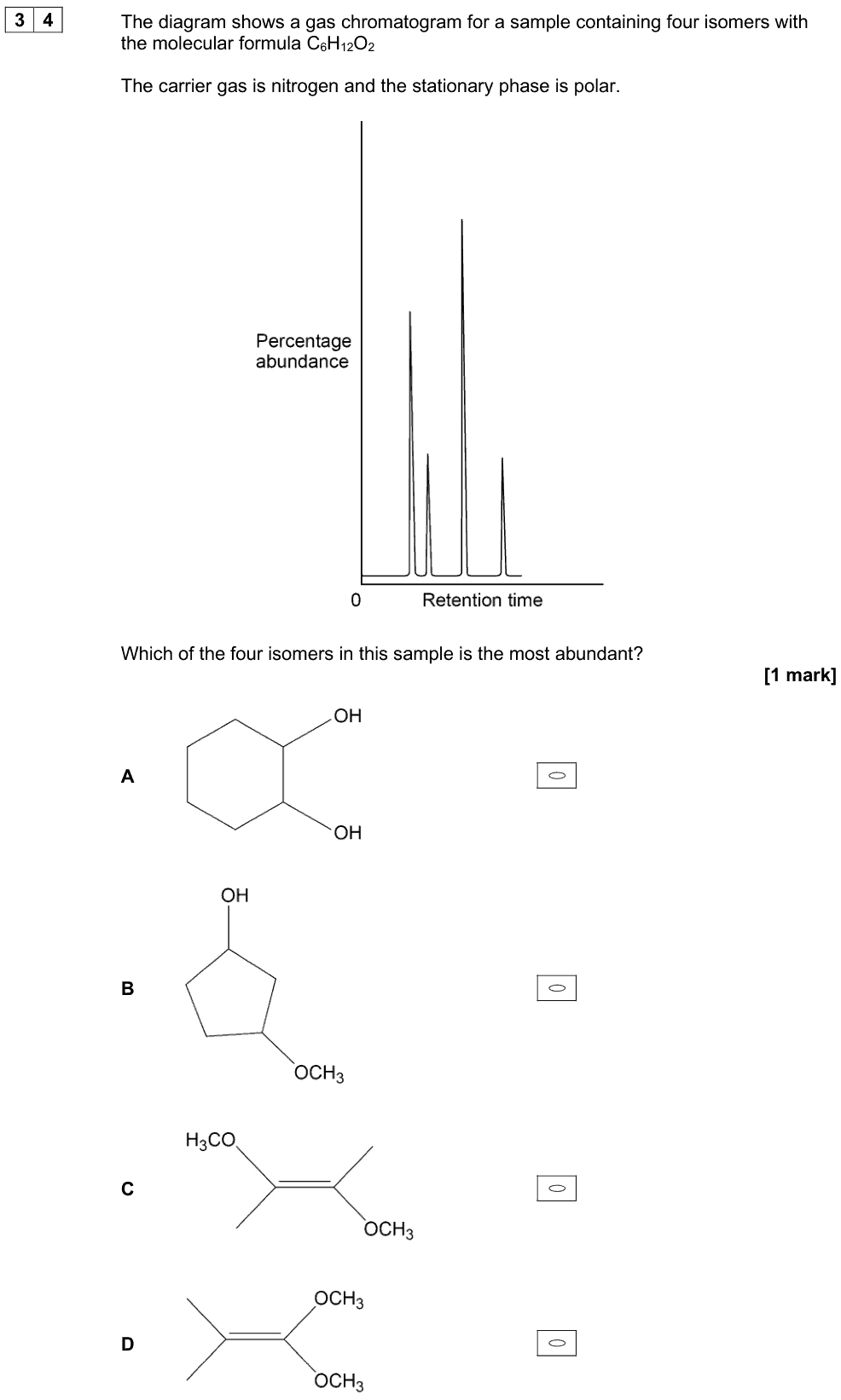
Answer: B. The tallest peak is the third. With a polar stationary phase the more polar isomers are retained longer: the two diethers come first, the diol (A, two OH groups) last, so the third peak is B (one OH and one ether group)
June 2023 · Paper 3 · Q03.43 marksPractical and data analysis
Earlier part of question 03 that this part uses
Mark scheme
Examiner's comment
In 03.4, the key idea of this sort of chromatography (which is the need for the atmosphere in the tank to be saturated with vapour of the mobile phase) is clearly not well known by students, although it was pleasing to see a few such references.
Again, various other valid suggestions were
Notes from the mark scheme and report
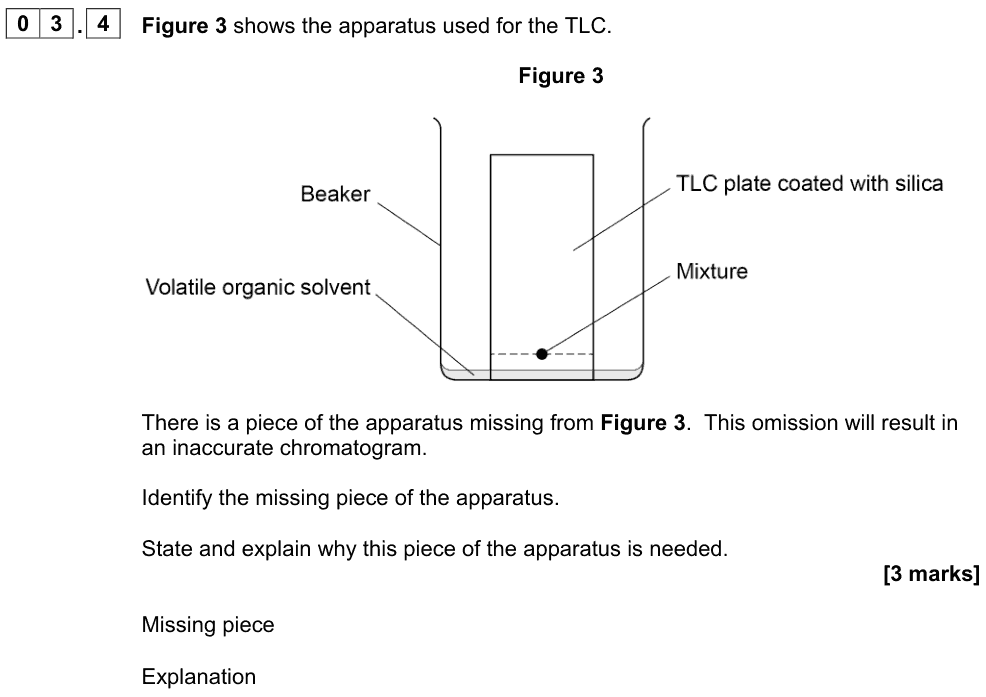
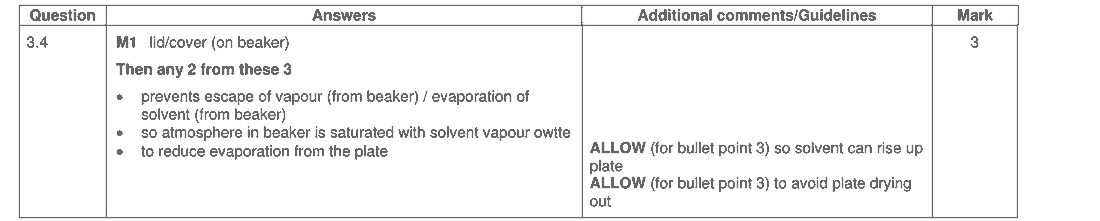
A lid / cover on the beaker. Then any two: it prevents solvent vapour escaping / solvent evaporating from the beaker
so the atmosphere in the beaker is saturated with solvent vapour
this reduces evaporation of solvent from the plate (so the solvent can rise up the plate). The saturated-atmosphere idea was not well known
Skills: ATi Use thin-layer or paper chromatography; PS2.1 Comment on experimental design and evaluate scientific methods; PS4.1 Know and understand how to use a wide range of experimental and practical instruments, equipment and techniques appropriate to the knowledge and understanding included in the specification; RP12 Separation of species by thin-layer chromatography
June 2023 · Paper 3 · Q03.51 markShort answer
Earlier part of question 03 that this part uses
Mark scheme
Examiner's comment
03.5 was a direct test of a statement in the specification, which refers to there being a balance between solubility in the mobile phase and retention on the stationary phase.
Many answers were incorrect because they only referred to solubility in the mobile phase.
Notes from the mark scheme and report
The amino acids differ in the balance between their solubility in the solvent (mobile phase) and their retention on (attraction to) the stationary phase. Solubility in the mobile phase alone does not score
Skills: RP12 Separation of species by thin-layer chromatography
June 2023 · Paper 3 · Q03.71 markPractical and data analysisEasy
Earlier parts of question 03 that this part uses
Mark scheme
Examiner's comment
78% of students were able to correctly calculate the Rf value in 03.7.
Notes from the mark scheme and report
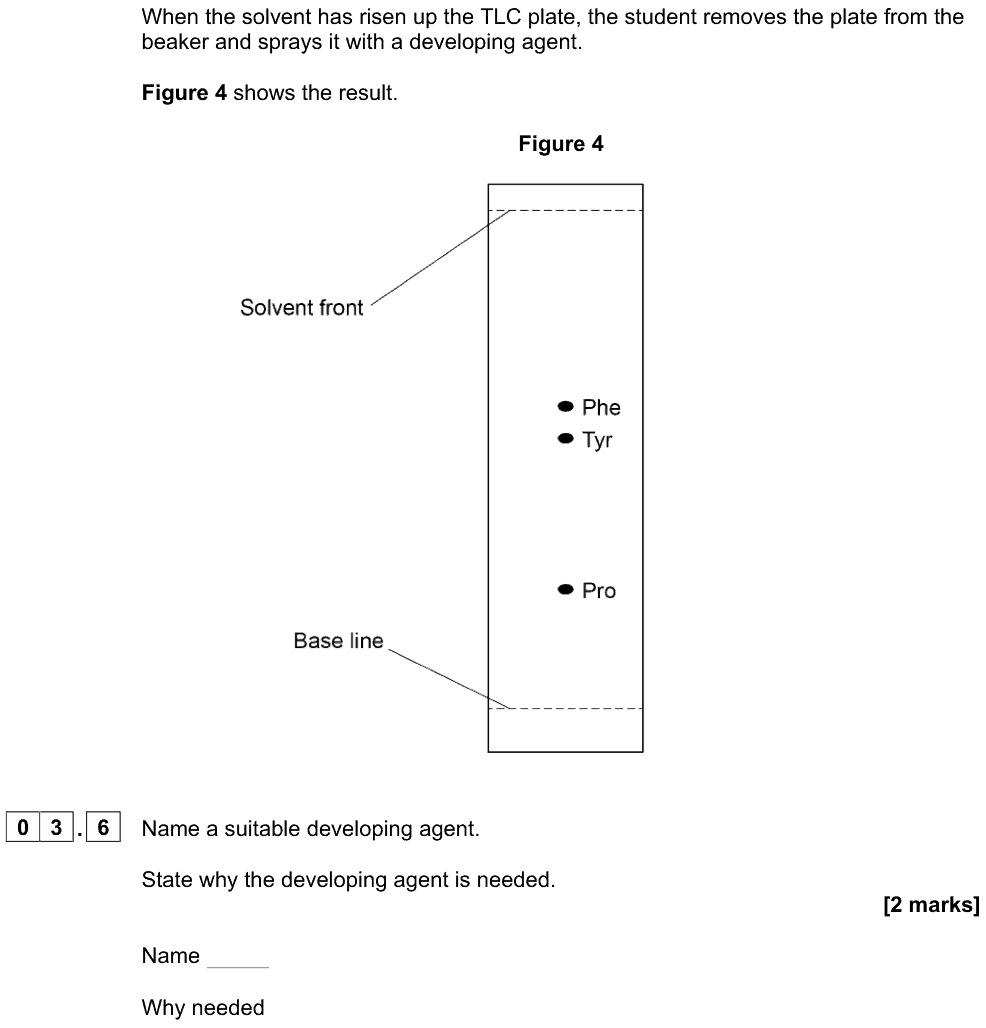
Answer: 0.54 (allow 0.53 to 0.55). Rf = distance moved by the Tyr spot from the base line ÷ distance moved by the solvent front from the base line, measured on Figure 4, which is printed in the 03.6 crop
Skills: MS0.2 Use ratios, fractions and percentages; ATi Use thin-layer or paper chromatography; PS3.2 Process and analyse data using appropriate mathematical skills as exemplified in the mathematical appendix for each science; RP12 Separation of species by thin-layer chromatography
November 2021 · Paper 3 · Q02.12 marksPractical and data analysis
Mark scheme
Examiner's comment
This was generally answered well although a number of students failed to respond to the instruction to show their working in 02.1.
Notes from the mark scheme and report
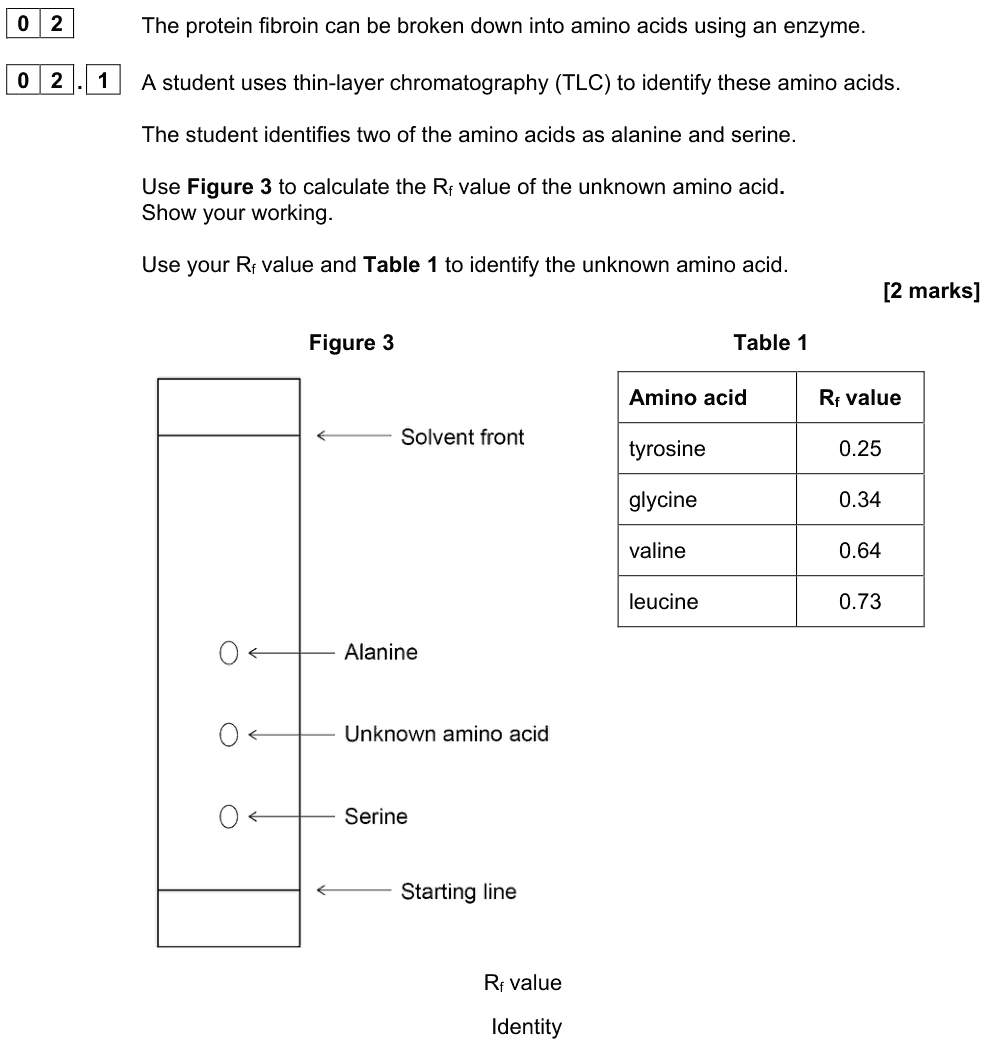
Answer: Rf = 0.34 (27 ÷ 80
allow 0.325 to 0.35), so glycine. Rf = distance moved by the spot ÷ distance moved by the solvent front, from the starting line
working must be shown
Skills: MS0.2 Use ratios, fractions and percentages; ATi Use thin-layer or paper chromatography; PS3.2 Process and analyse data using appropriate mathematical skills as exemplified in the mathematical appendix for each science; RP12 Separation of species by thin-layer chromatography
November 2021 · Paper 3 · Q02.31 markShort answer
Earlier part of question 02 that this part uses
Mark scheme
Examiner's comment
This was generally answered well although a number of students failed to respond to the instruction to show their working in 02.1.
Notes from the mark scheme and report
Each amino acid has a different balance of affinity for the stationary phase and solubility in the mobile phase (solvent)
June 2019 · Paper 2 · Q09.31 markPractical and data analysisHard
Earlier part of question 09 that this part uses
Mark scheme
Examiner's comment
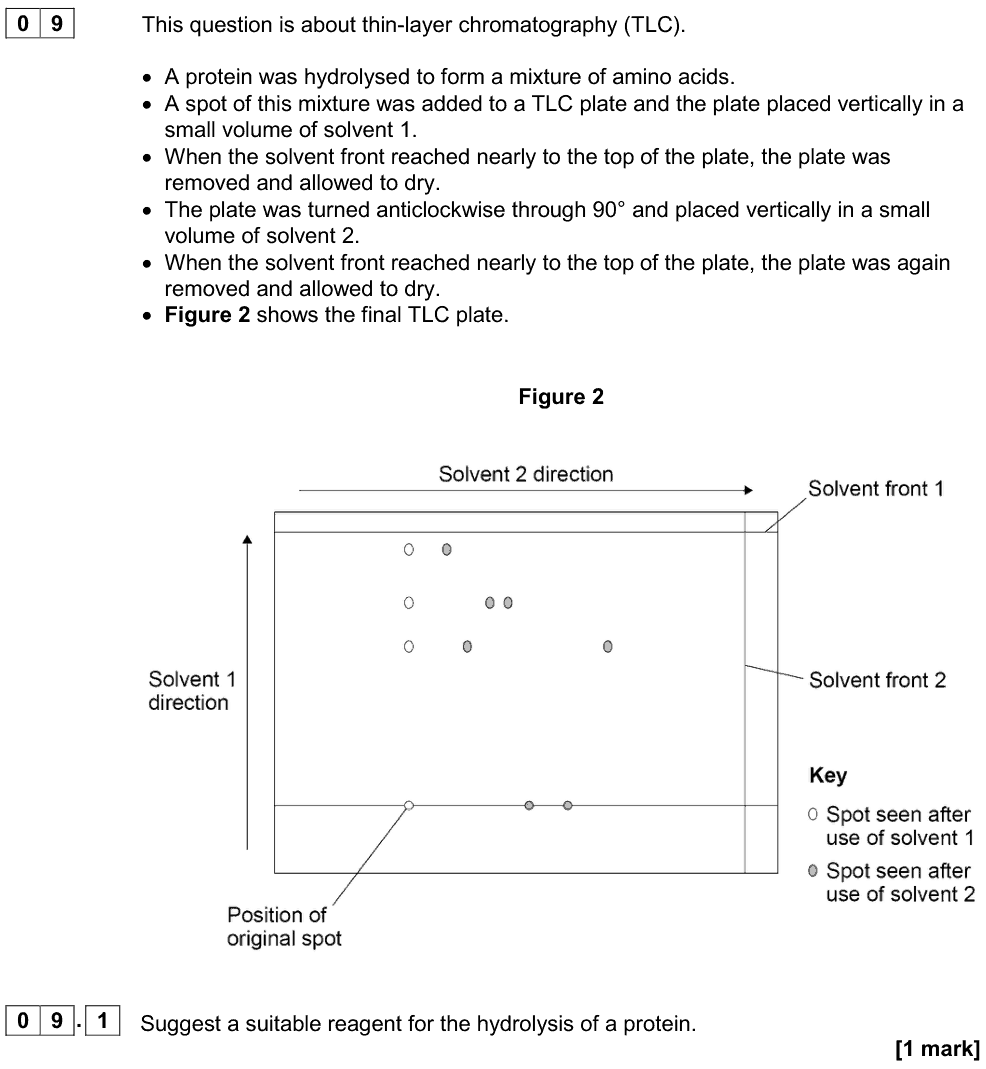
09.3 The number of amino acids, as shown by the seven dark spots on the chromatogram, was answered correctly by under a quarter of students.
Notes from the mark scheme and report
Answer: 7 (the seven dark spots seen after solvent 2
only four spots were resolved by solvent 1)
Skills: ATi Use thin-layer or paper chromatography; PS3.2 Process and analyse data using appropriate mathematical skills as exemplified in the mathematical appendix for each science; RP12 Separation of species by thin-layer chromatography
June 2019 · Paper 2 · Q09.41 markPractical and data analysis
Earlier part of question 09 that this part uses
Mark scheme
Examiner's comment
09.4 Answers in part 4 were poorly explained, with many students simply stating that the amino acids had different solubilities or different Rf values in different solvents without explaining that some had the same Rf value in solvent 1 hence the need to use solvent 2.
Notes from the mark scheme and report
Some amino acids did not separate in the first solvent because they have the same Rf value (same affinity) in it
the second solvent separates them. 'Different Rf values in different solvents' alone does not score
Skills: ATi Use thin-layer or paper chromatography; PS2.1 Comment on experimental design and evaluate scientific methods; RP12 Separation of species by thin-layer chromatography
June 2018 · Paper 3 · Q03.72 marksExplanation
Earlier part of question 03 that this part uses
Mark scheme
Examiner's comment
03.7 This part gave numerous examples of repeating the question, with many answers seen along the lines of “the retention time is shorter because the retention time is shorter”. Some students also inverted the question and tried to describe why cyclohexene had a longer retention time, while others thought incorrectly that cyclohexene is polar due to the C=C bond. An inversion of reasoning that was often seen was the incorrect idea that cyclohexanol has hydrogen bonding, which is why it is polar. 34.9% of students scored zero here.
Notes from the mark scheme and report
Cyclohexene is less polar than cyclohexanol (non-polar v polar)
so it has a greater affinity for (is more soluble in) the hexane mobile phase, while cyclohexanol is held more strongly by the polar silica (hydrogen bonding). Many simply repeated the question
some thought the C=C makes cyclohexene polar
34.9% scored 0
June 2017 · Paper 2 · Q08.31 markPractical and data analysisEasy
Earlier part of question 08 that this part uses
Mark scheme
Examiner's comment
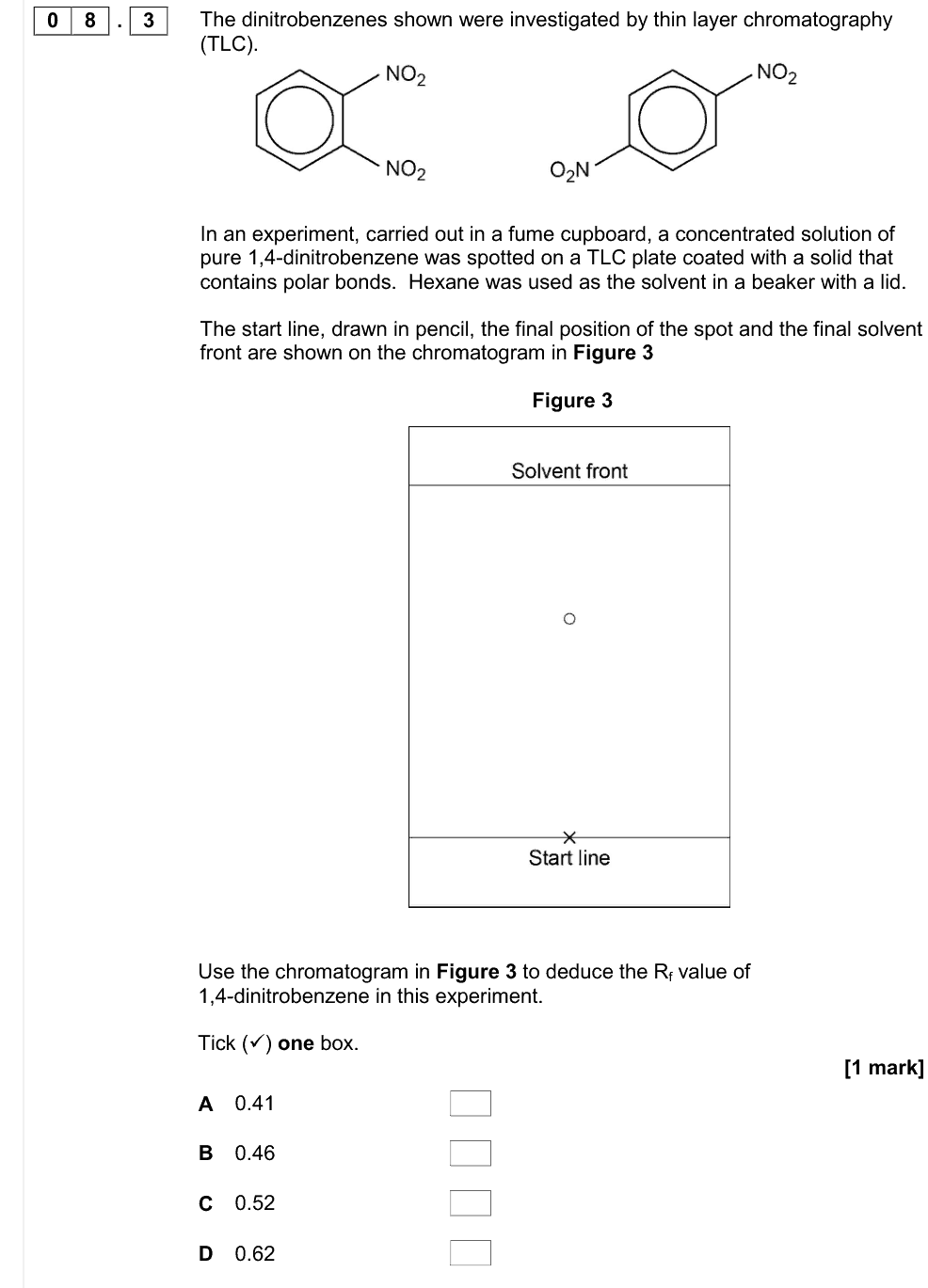
08.3 Only the very weakest 7% of students failed to calculate the correct Rf value.
Notes from the mark scheme and report
Answer: D (0.62). Rf = distance moved by the spot ÷ distance moved by the solvent front, both measured from the start line
Skills: MS0.2 Use ratios, fractions and percentages; ATi Use thin-layer or paper chromatography; PS3.2 Process and analyse data using appropriate mathematical skills as exemplified in the mathematical appendix for each science; RP12 Separation of species by thin-layer chromatography
June 2017 · Paper 2 · Q08.41 markShort answer
Earlier part of question 08 that this part uses
Mark scheme
Examiner's comment
08.4 This question tested understanding of the balance between solubility in the moving phase and retention by the stationary phase. Both parts were needed in the answer.
Notes from the mark scheme and report
The balance between solubility in the moving phase and retention by the stationary phase (relative affinity for the two phases). Both parts needed
June 2017 · Paper 2 · Q08.51 markPractical and data analysis
Earlier part of question 08 that this part uses
Mark scheme
Examiner's comment
08.5 This question was found very easy by most, although weaker students discussed safety issues.
Notes from the mark scheme and report
The solvent level must be below the start line. Safety points are ignored
Skills: ATi Use thin-layer or paper chromatography; PS4.1 Know and understand how to use a wide range of experimental and practical instruments, equipment and techniques appropriate to the knowledge and understanding included in the specification; RP12 Separation of species by thin-layer chromatography
June 2017 · Paper 2 · Q08.62 marksExplanationHard
Earlier part of question 08 that this part uses
Mark scheme
Examiner's comment
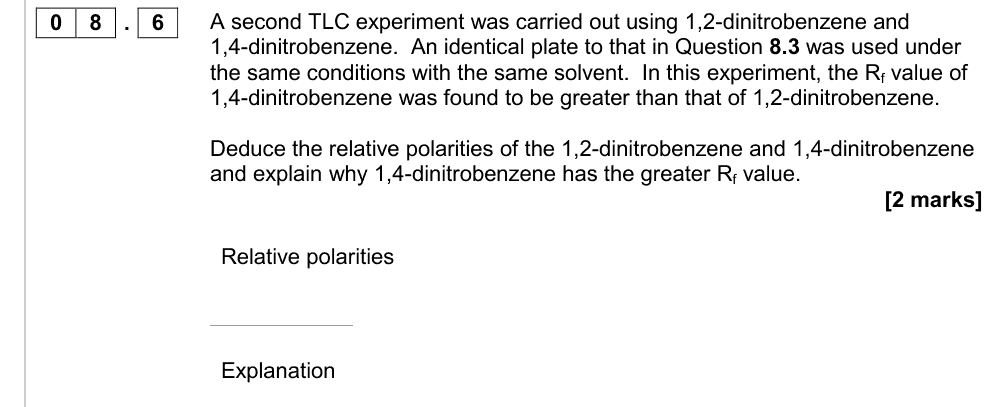
08.6 A third of students scored both marks, but sadly 7% of students made no attempt at the question. They were asked to deduce the answer to an unfamiliar practical situation, but one which is similar to those they will have met in Required Practical Activity 12. Many deduced that the 1,4 isomer was less polar, but then attempted to explain this relative polarity rather than answering the question asked.
Notes from the mark scheme and report
1,2-dinitrobenzene is more polar (1,4- is less polar/non-polar)
the less polar 1,4-isomer is less attracted to the polar stationary phase / more soluble in the non-polar hexane. M2 depends on M1. Many tried to explain the polarity instead
Skills: PS1.2 Apply scientific knowledge to practical contexts; RP12 Separation of species by thin-layer chromatography
June 2017 · Paper 2 · Q08.72 marksExplanation
Earlier part of question 08 that this part uses
Mark scheme
Examiner's comment
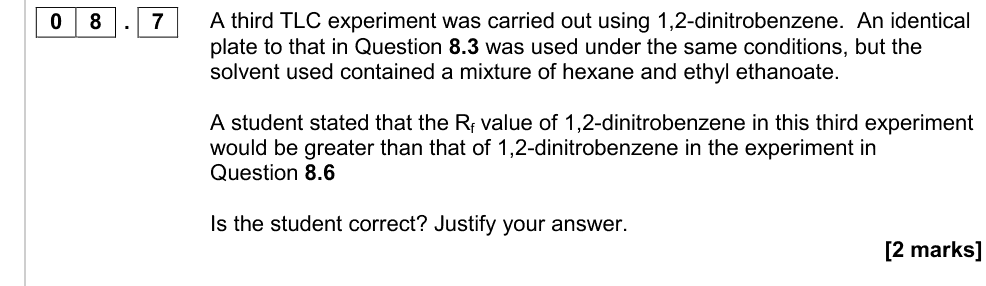
08.7 This final part to the question was not attempted by 10.2% of students. The best answers demonstrated the ability of candidates to deduce that the student was correct, and to explain their deduction.
Notes from the mark scheme and report
Yes (no mark for yes alone
'no' scores 0): the solvent is now more polar (ethyl ethanoate is polar), so the polar 1,2-isomer is more soluble in / more attracted to the solvent than before. Not 'bonded to' the mobile phase
Skills: PS1.2 Apply scientific knowledge to practical contexts; RP12 Separation of species by thin-layer chromatography
Specimen · Paper 3 · Q03.14 marksPractical and data analysis
Mark scheme
Notes from the mark scheme and report
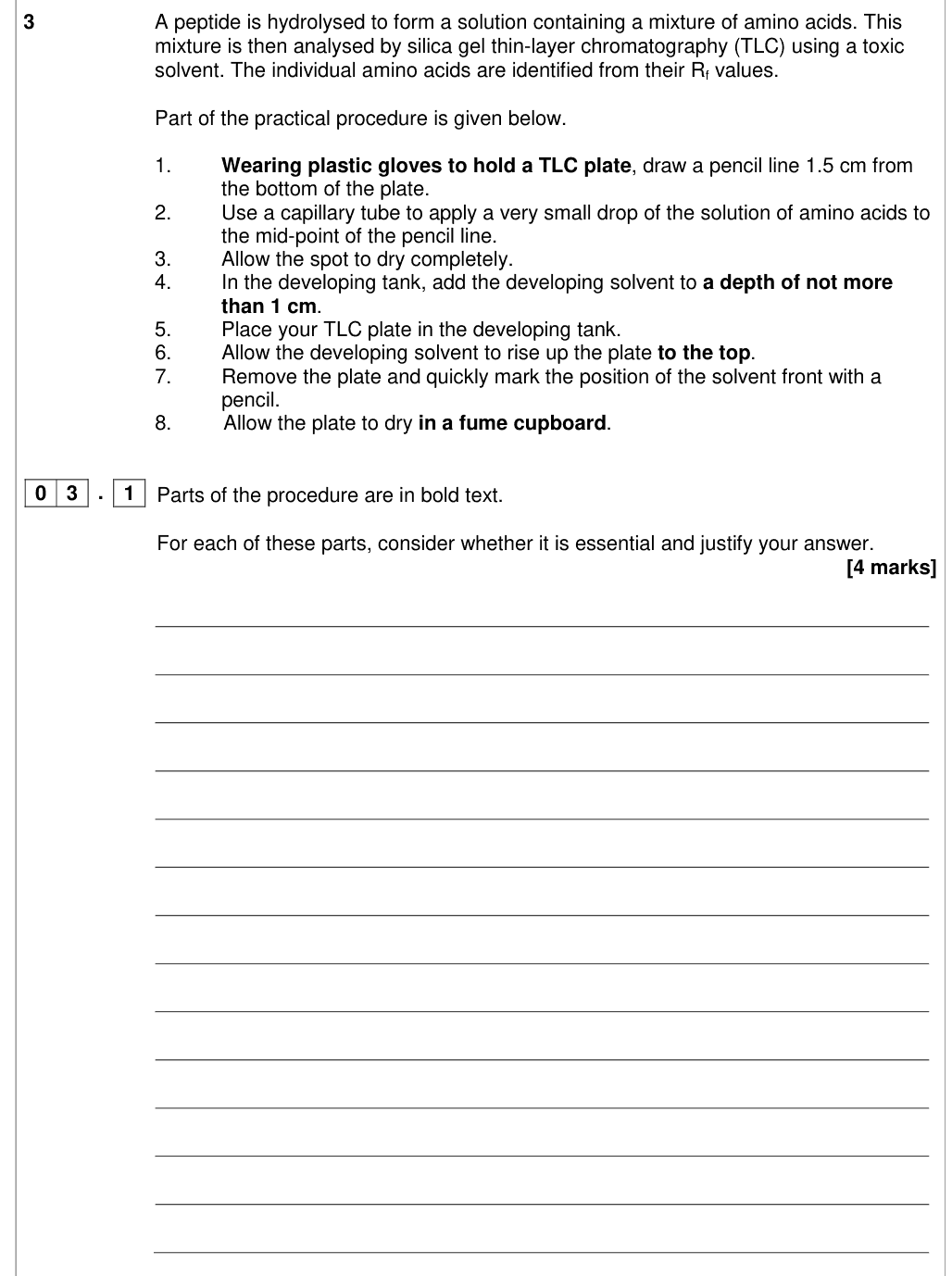
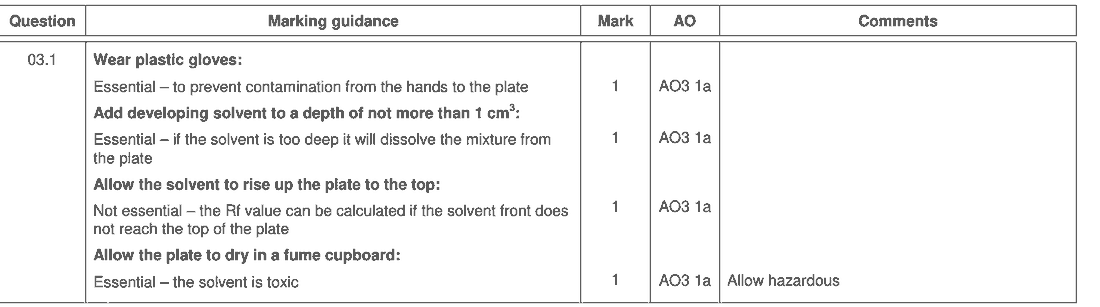
Plastic gloves: essential, to stop contamination of the plate from the hands. Solvent depth not more than 1 cm: essential, otherwise the solvent would dissolve the spot off the plate (it must start below the pencil line). Solvent rising to the top: not essential, Rf can be calculated wherever the solvent front is marked. Fume cupboard: essential, because the solvent is toxic
Skills: ATi Use thin-layer or paper chromatography; ATk Safely and carefully handle solids and liquids, including corrosive, irritant, flammable and toxic substances; PS2.1 Comment on experimental design and evaluate scientific methods; PS4.1 Know and understand how to use a wide range of experimental and practical instruments, equipment and techniques appropriate to the knowledge and understanding included in the specification; RP12 Separation of species by thin-layer chromatography
Specimen · Paper 3 · Q03.24 marksPractical and data analysis
Earlier part of question 03 that this part uses
Mark scheme
Notes from the mark scheme and report
Spray with a developing agent (ninhydrin) or view under UV light
measure the distance from the pencil start line to each spot (x)
measure the distance from the start line to the solvent front (y)
Rf = x ÷ y
Skills: ATi Use thin-layer or paper chromatography; PS3.2 Process and analyse data using appropriate mathematical skills as exemplified in the mathematical appendix for each science; PS4.1 Know and understand how to use a wide range of experimental and practical instruments, equipment and techniques appropriate to the knowledge and understanding included in the specification; RP12 Separation of species by thin-layer chromatography
Specimen · Paper 3 · Q03.32 marksExplanation
Earlier part of question 03 that this part uses
Mark scheme
Notes from the mark scheme and report
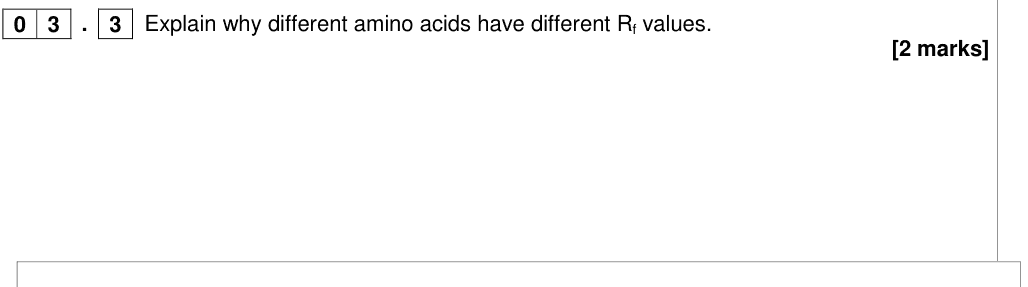
The amino acids have different polarities, so they are retained to different extents by the stationary phase / have different solubilities in the developing solvent
Work with an A-level chemistry tutor
Dropping marks on calculations, mechanisms or the required practicals? Book a trial session with a specialist A-level chemistry tutor.