Six-mark level of response questions

The six-mark questions marked using levels of response. The level depends on how many stages of the question you cover and how fully, then on how clearly the answer is set out. 50 questions.

Other types: Multiple-choice questions · Calculation questions · Equation questions · Mechanism questions · Structure and diagram questions · Explanation questions · Practical questions · Short-answer questions

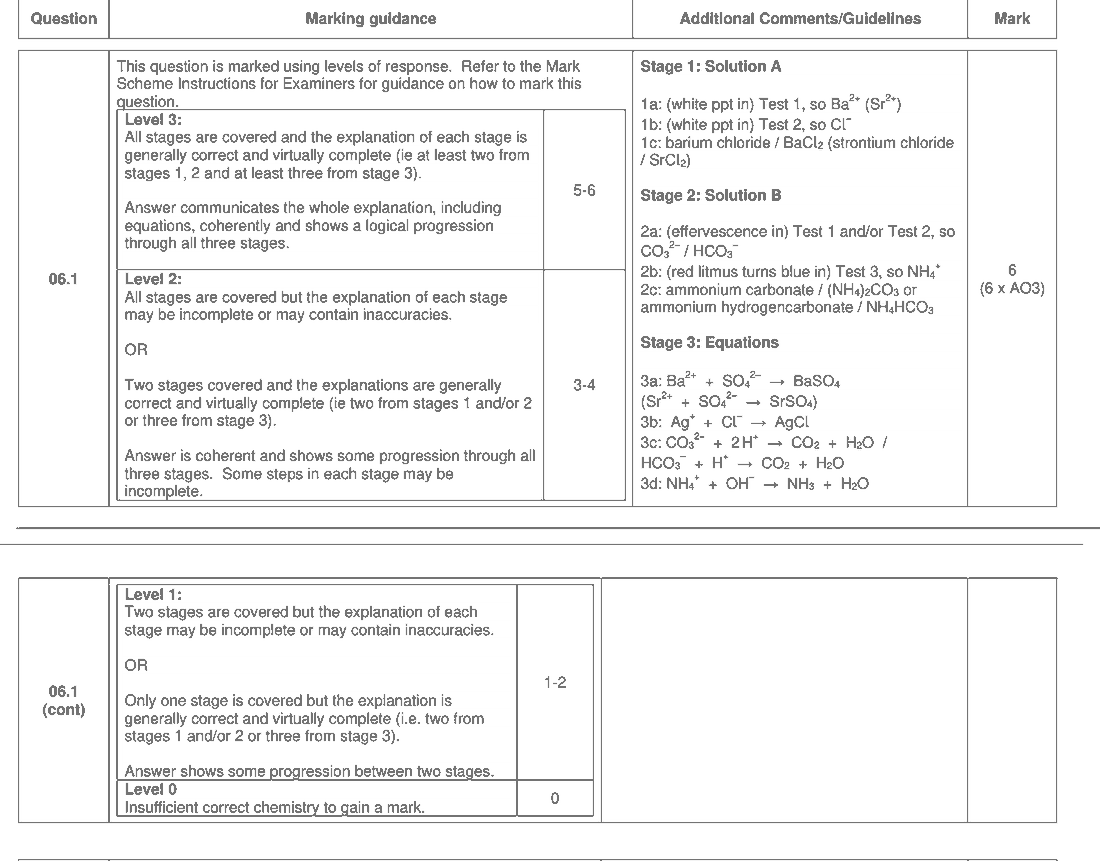
June 2025 · AS Paper 1 · Q06.1 6 marks AO3=6 6-mark level of response Hard group 7 the halogensgroup 2
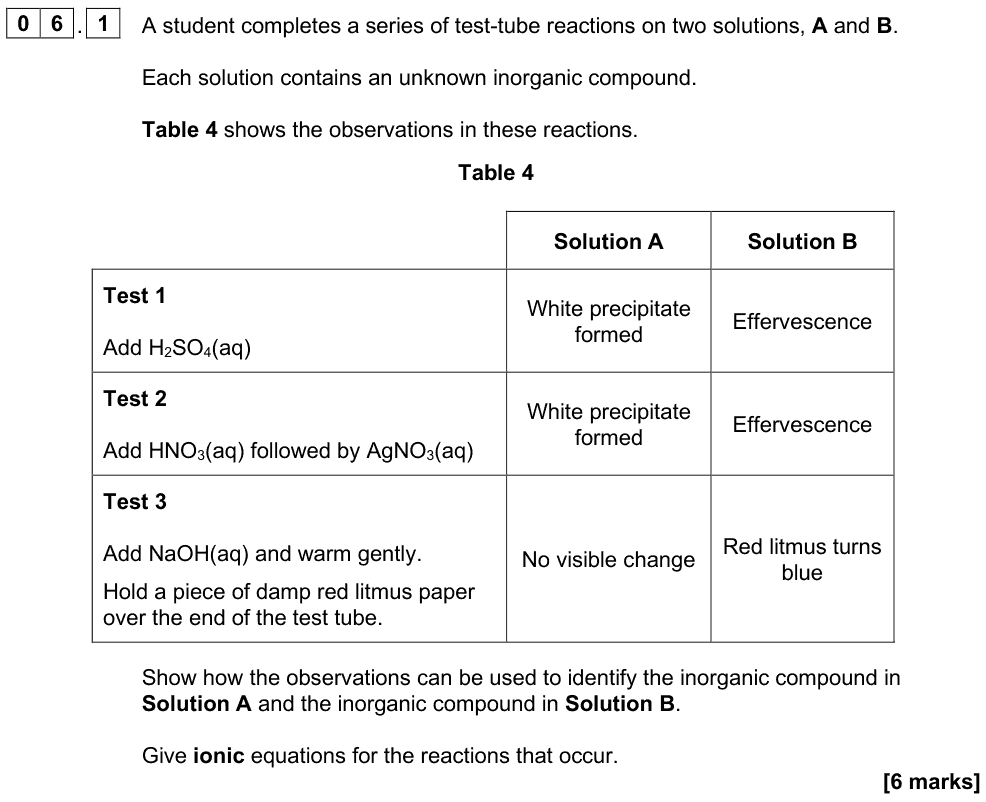
A student completes a series of test-tube reactions on two solutions, A and B.
Each solution contains an unknown inorganic compound.
Table 4 shows the observations in these reactions.
Table 4
Solution A
Solution B
Test 1
Add H2SO4(aq)
White precipitate
formed
Effervescence
Test 2
Add HNO3(aq) followed by AgNO3(aq)
White precipitate
formed
Effervescence
Test 3
Add NaOH(aq) and warm gently.
Hold a piece of damp red litmus paper
over the end of the test tube.
No visible change
Red litmus turns
blue
Show how the observations can be used to identify the inorganic compound in
Solution A and the inorganic compound in Solution B.
Give ionic equations for the reactions that occur.
[6 marks]
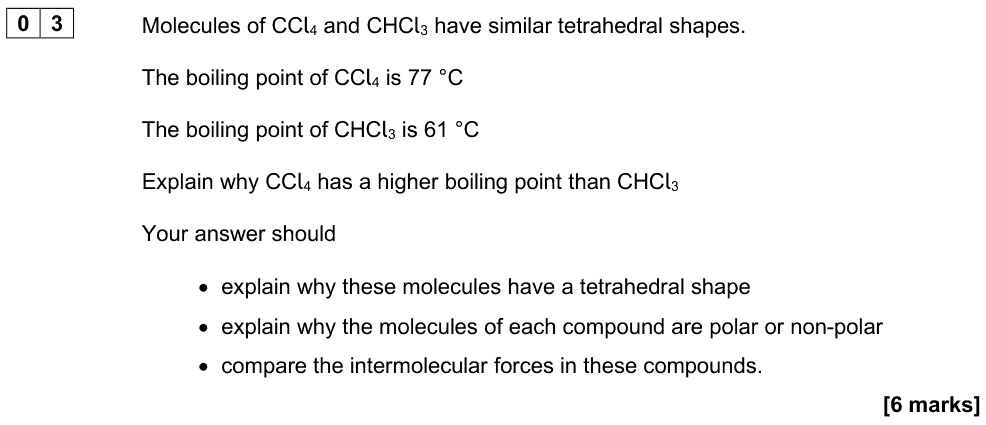
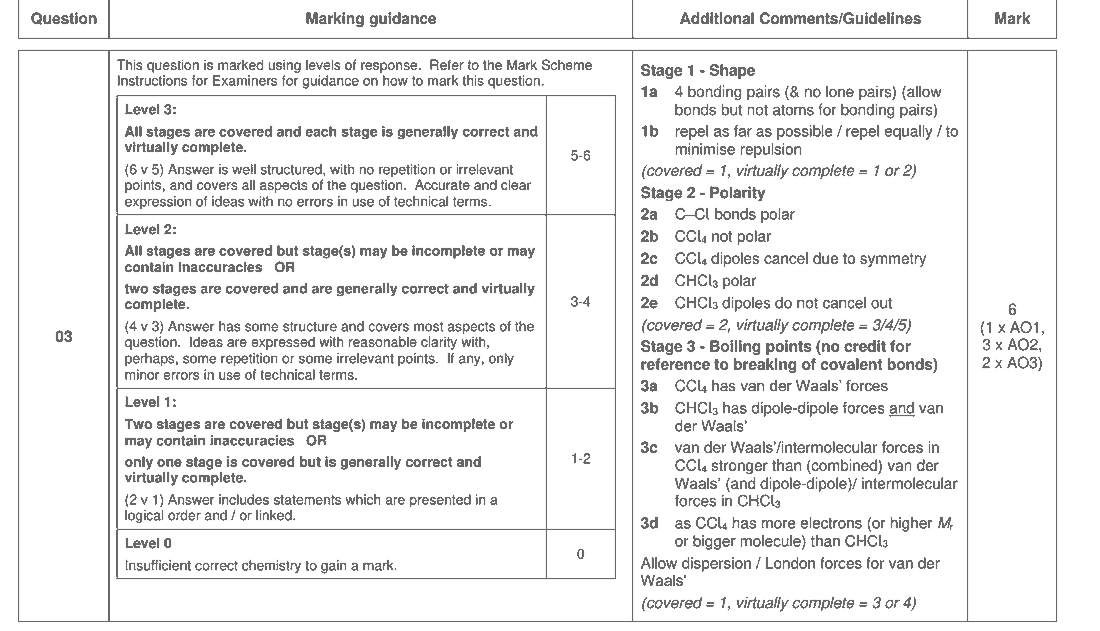
June 2025 · AS Paper 2 · Q03 6 marks AO1=1, AO2=3, AO3=2 6-mark level of response bonding
Molecules of CCl4 and CHCl3 have similar tetrahedral shapes.
The boiling point of CCl4 is 77 °C
The boiling point of CHCl3 is 61 °C
Explain why CCl4 has a higher boiling point than CHCl3
Your answer should
• explain why these molecules have a tetrahedral shape
• explain why the molecules of each compound are polar or non-polar
• compare the intermolecular forces in these compounds.
[6 marks]
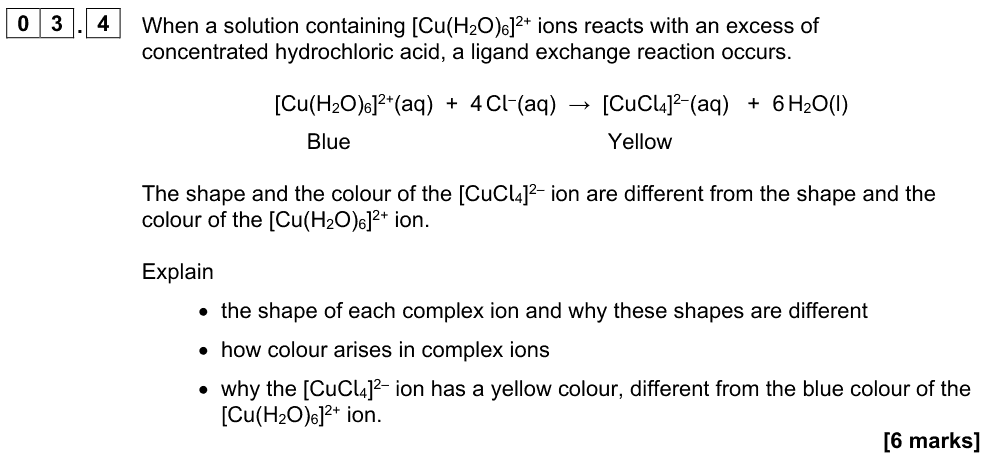
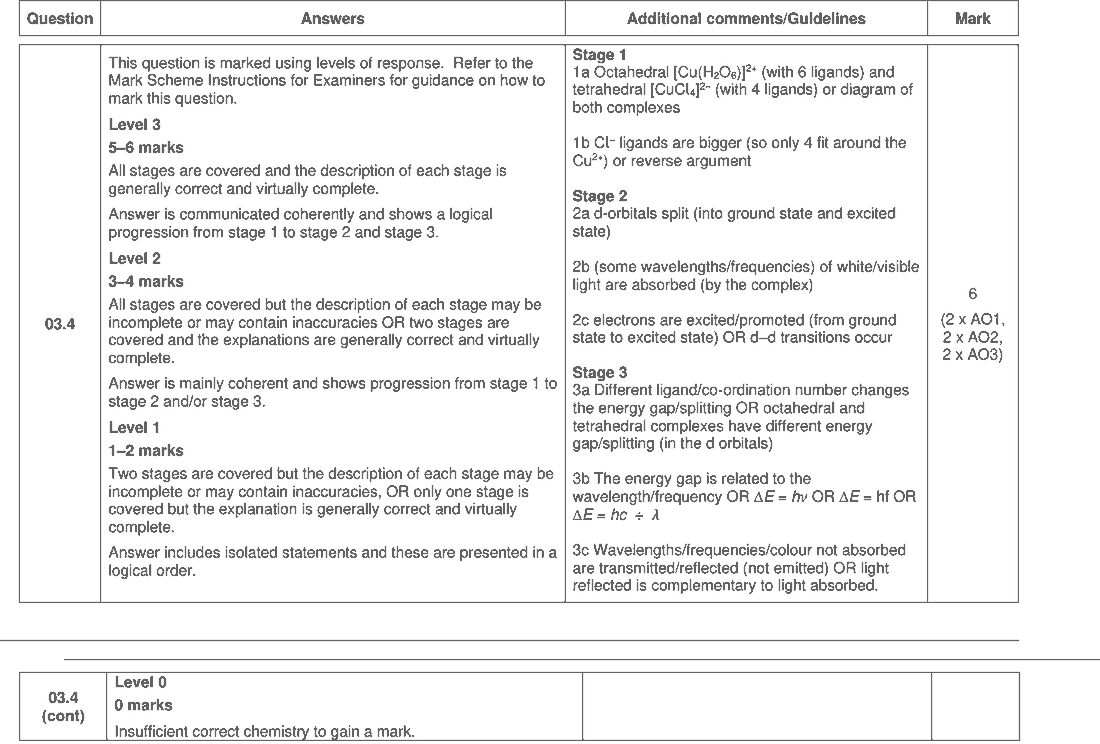
June 2025 · Paper 1 · Q03.4 6 marks AO1=2, AO2=2, AO3=2 6-mark level of response transition metals
Earlier part of question 03 that this part usesEarlier part of June 2025 Paper 1 question 03
When a solution containing [Cu(H2O)6]2+ ions reacts with an excess of
concentrated hydrochloric acid, a ligand exchange reaction occurs.
[Cu(H2O)6]2+(aq)  +  4 Cl–
(aq)  →  [CuCl4]2–
(aq)   +  6 H2O(l)
Blue                                          Yellow
The shape and the colour of the [CuCl4]2– ion are different from the shape and the
colour of the [Cu(H2O)6]2+ ion.
Explain
• the shape of each complex ion and why these shapes are different
• how colour arises in complex ions
• why the [CuCl4]2– ion has a yellow colour, different from the blue colour of the
[Cu(H2O)6]2+ ion.
[6 marks]
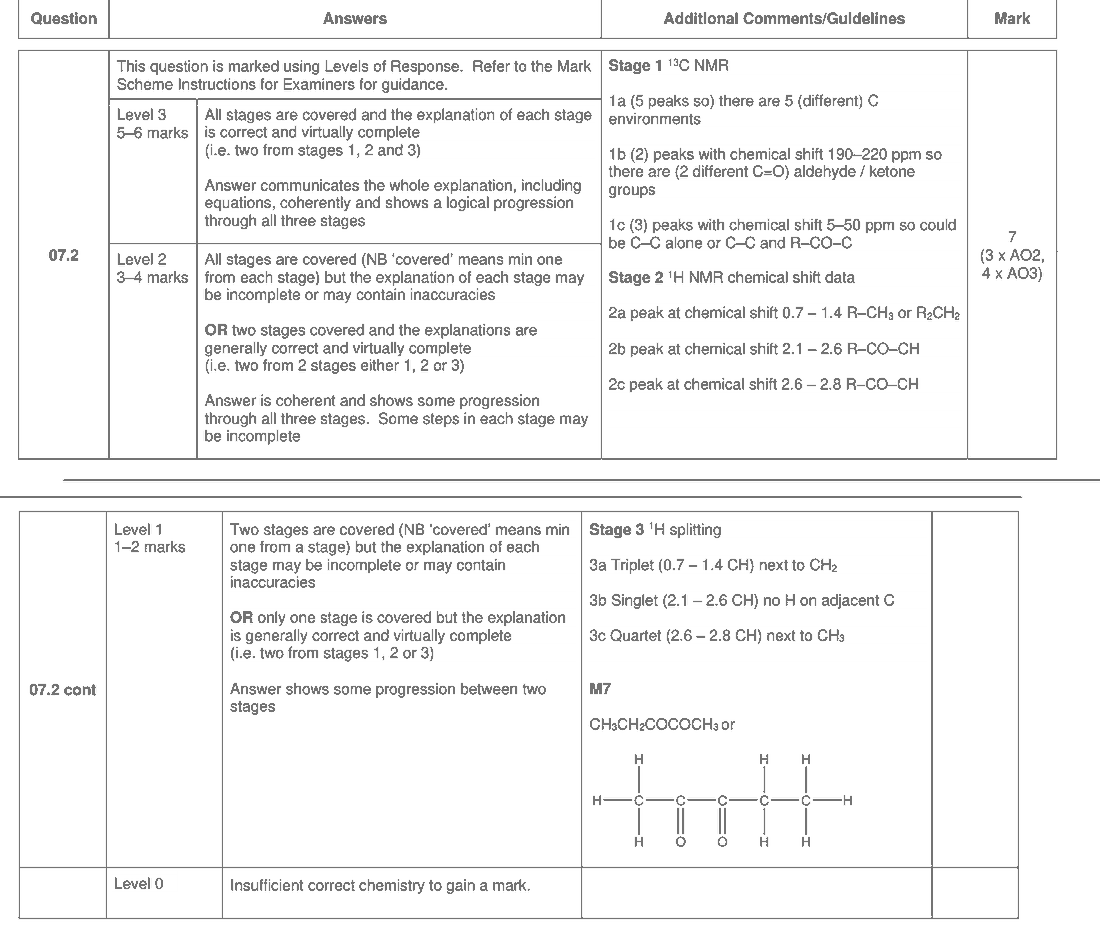
June 2025 · Paper 2 · Q07.2 7 marks AO2=3, AO3=4 7-mark level of response nmr spectroscopy
Earlier part of question 07 that this part usesEarlier part of June 2025 Paper 2 question 07
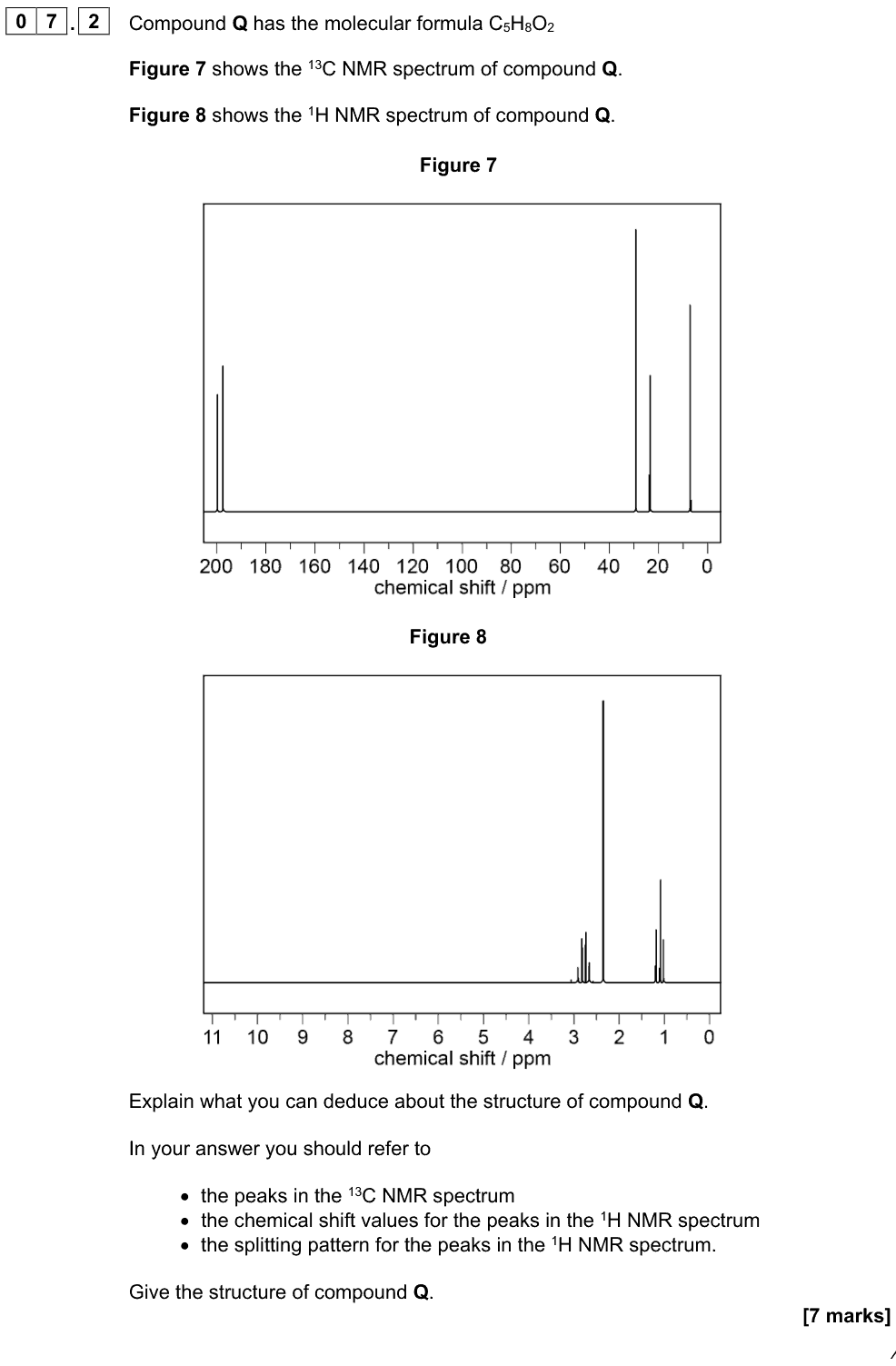
Compound Q has the molecular formula C5H8O2
Figure 7 shows the 13C NMR spectrum of compound Q.
Figure 8 shows the 1H NMR spectrum of compound Q.
Figure 7
Figure 8
Explain what you can deduce about the structure of compound Q.
In your answer you should refer to
• the peaks in the 13C NMR spectrum
• the chemical shift values for the peaks in the 1H NMR spectrum
• the splitting pattern for the peaks in the 1H NMR spectrum.
Give the structure of compound Q.
[7 marks]
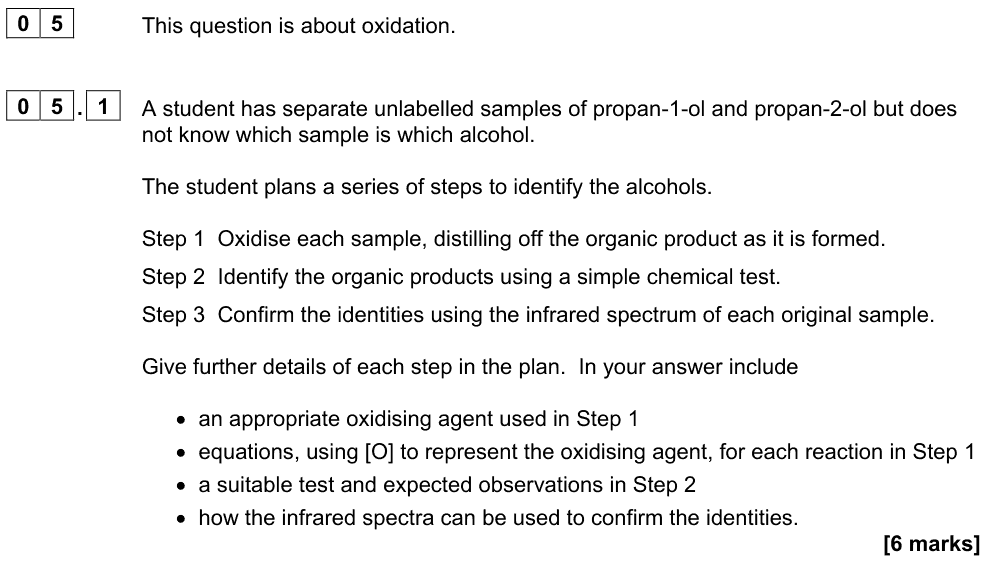
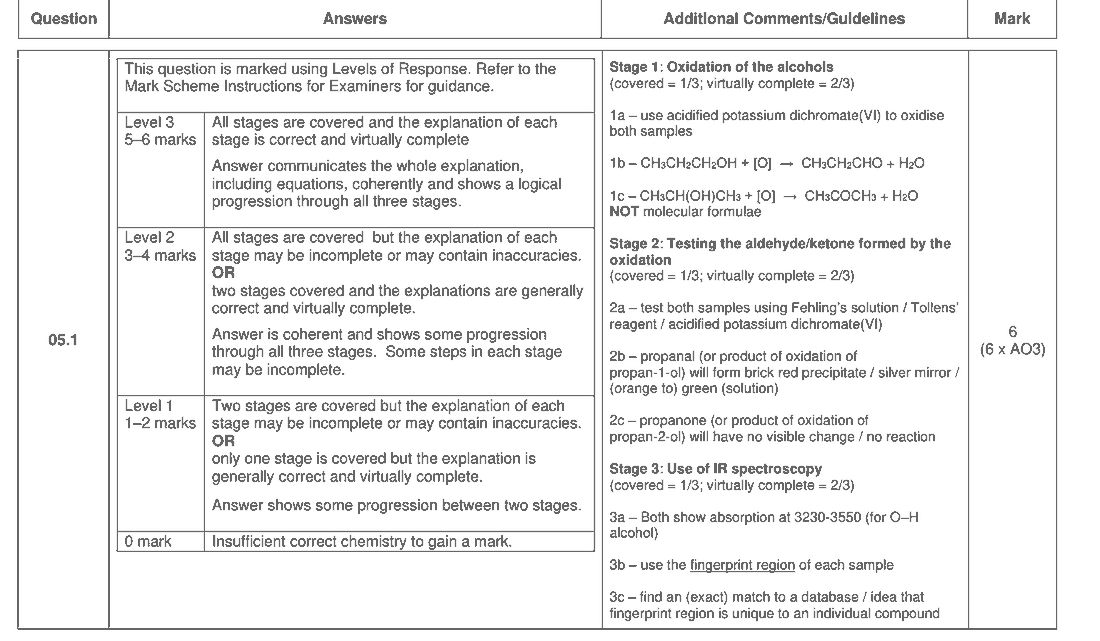
June 2025 · Paper 3 · Q05.1 6 marks AO3=6 6-mark level of response Hard alcoholsorganic analysis
This question is about oxidation.
A student has separate unlabelled samples of propan-1-ol and propan-2-ol but does
not know which sample is which alcohol.
The student plans a series of steps to identify the alcohols.
Step 1  Oxidise each sample, distilling off the organic product as it is formed.
Step 2  Identify the organic products using a simple chemical test.
Step 3  Confirm the identities using the infrared spectrum of each original sample.
Give further details of each step in the plan.  In your answer include
• an appropriate oxidising agent used in Step 1
• equations, using [O] to represent the oxidising agent, for each reaction in Step 1
• a suitable test and expected observations in Step 2
• how the infrared spectra can be used to confirm the identities.
[6 marks]
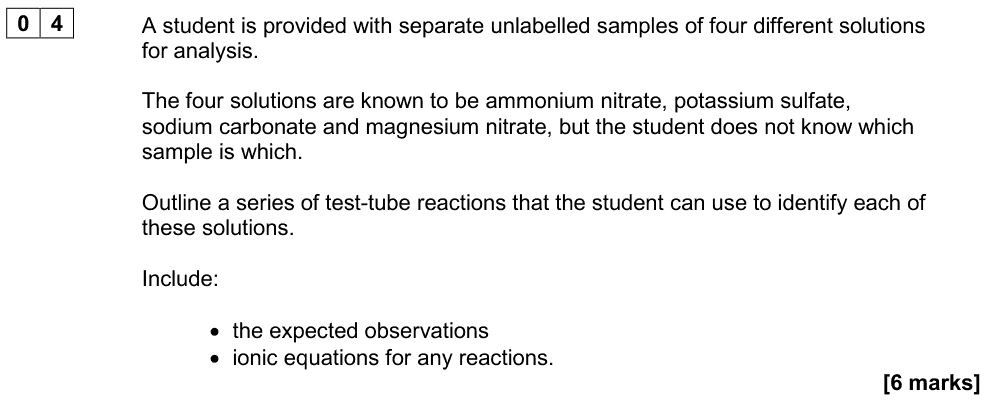
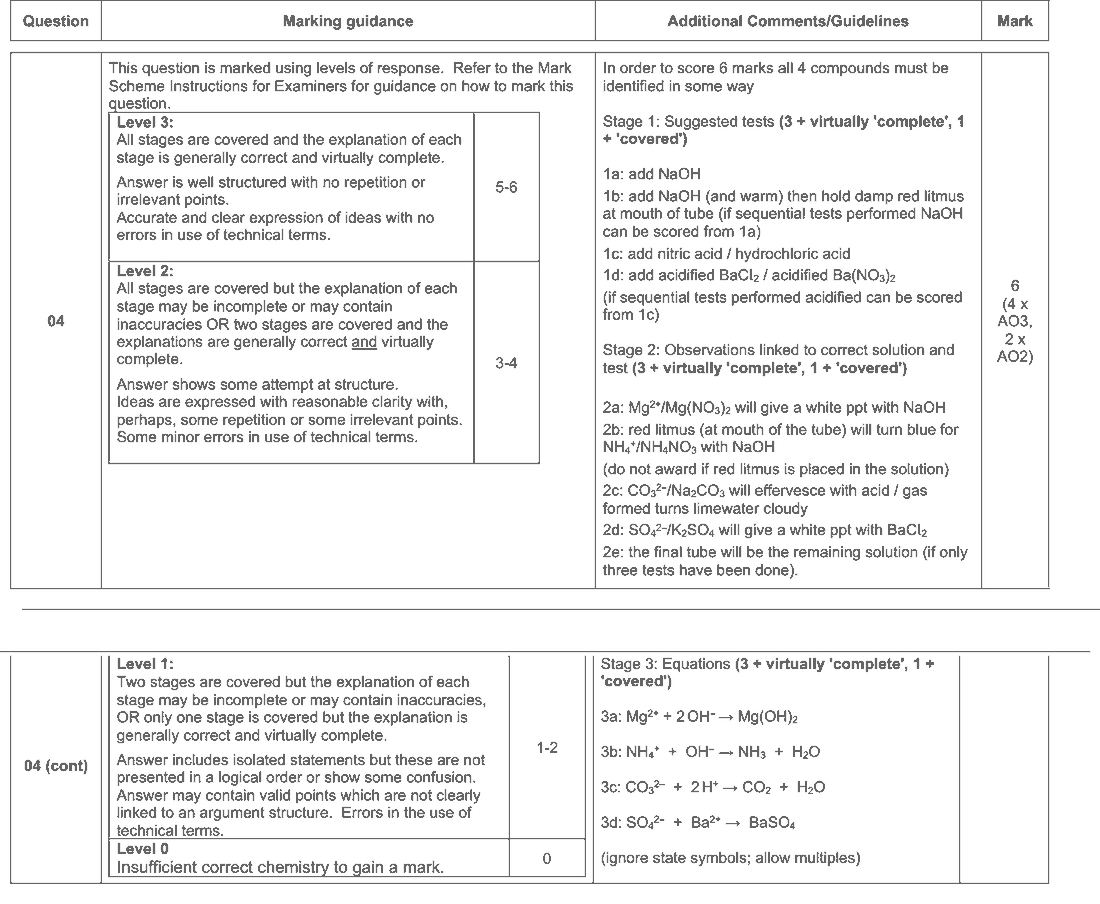
June 2024 · AS Paper 1 · Q04 6 marks AO2=2, AO3=4 6-mark level of response group 7 the halogensgroup 2amount of substance
A student is provided with separate unlabelled samples of four different solutions
for analysis.
The four solutions are known to be ammonium nitrate, potassium sulfate,
sodium carbonate and magnesium nitrate, but the student does not know which
sample is which.
Outline a series of test-tube reactions that the student can use to identify each of
these solutions.
Include:
• the expected observations
• ionic equations for any reactions.
[6 marks]
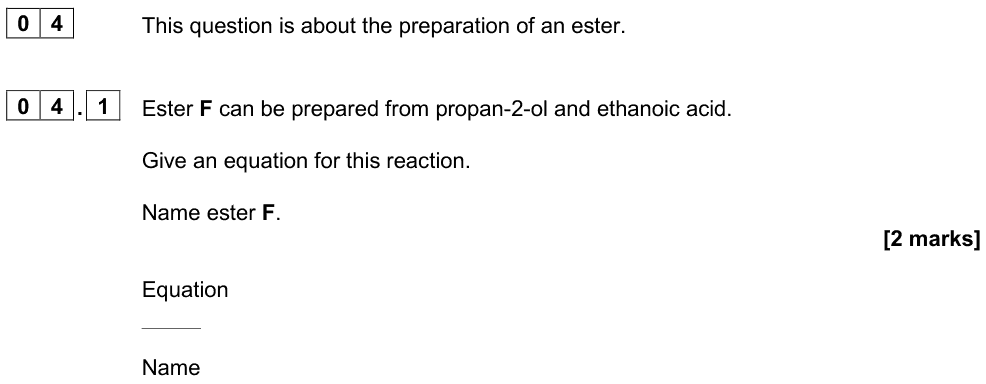
June 2024 · AS Paper 2 · Q04.1 6 marks AO1=4, AO3=2 6-mark level of response introduction to organic chemistry
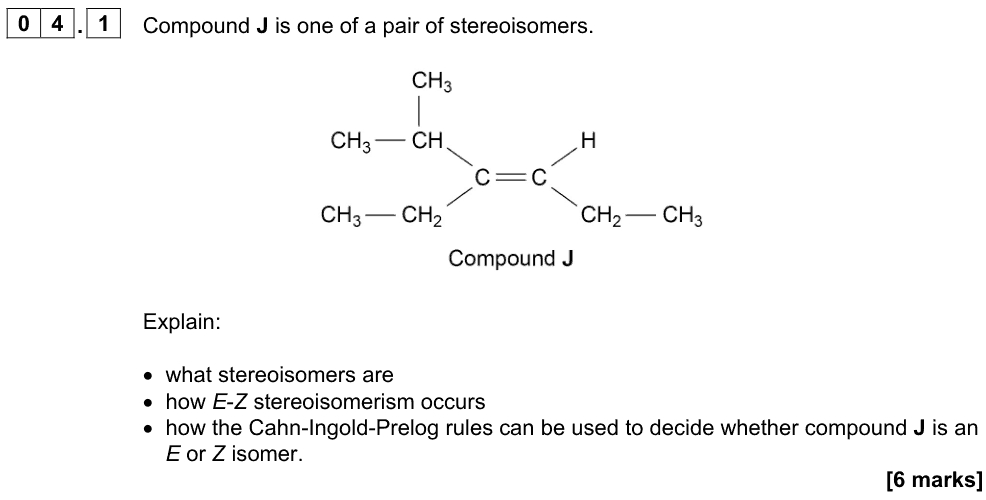
Compound J is one of a pair of stereoisomers.
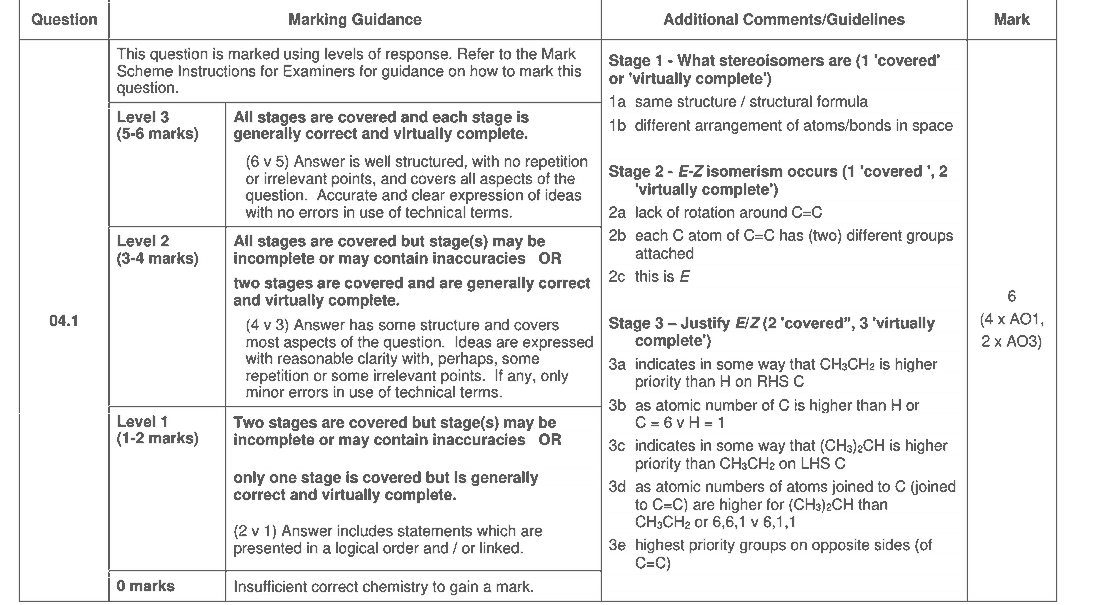
Explain:
• what stereoisomers are
• how E-Z stereoisomerism occurs
• how the Cahn-Ingold-Prelog rules can be used to decide whether compound J is an
E or Z isomer.
[6 marks]
June 2024 · Paper 1 · Q03.3 6 marks AO1=2, AO2=2, AO3=2 6-mark level of response Hard transition metals
Earlier part of question 03 that this part usesEarlier part of June 2024 Paper 1 question 03
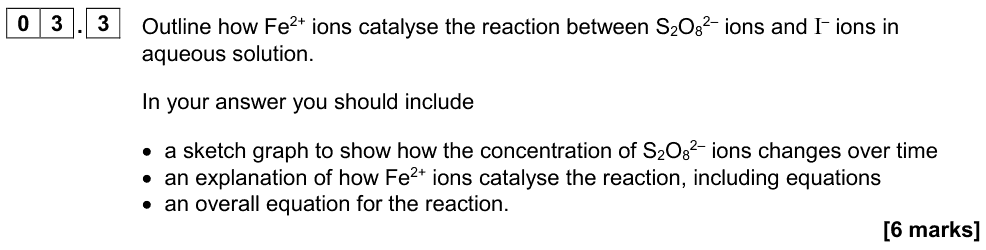
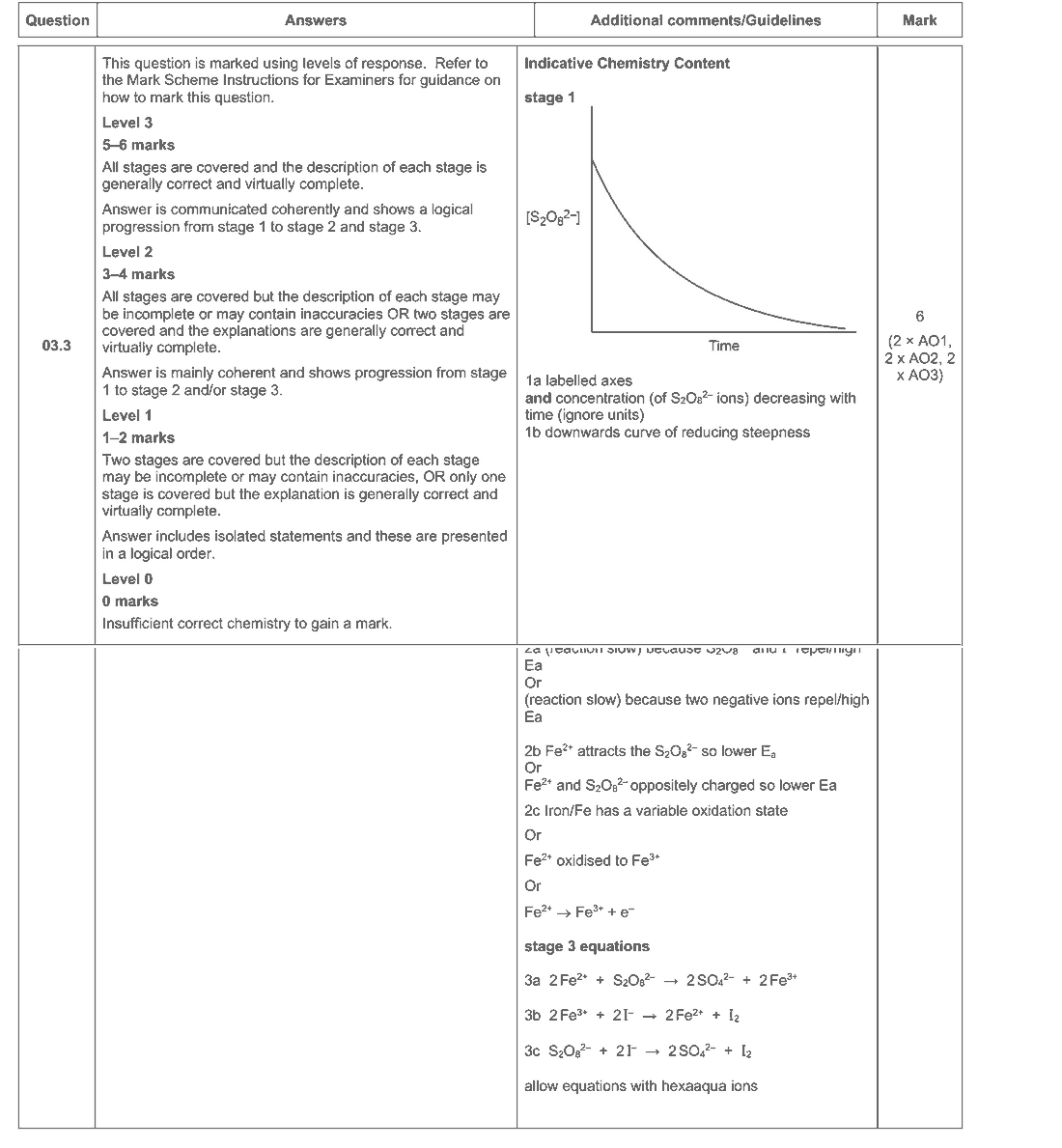
Outline how Fe2+ ions catalyse the reaction between S2O82– ions and I– ions in
aqueous solution.
In your answer you should include
• a sketch graph to show how the concentration of S2O82– ions changes over time
• an explanation of how Fe2+ ions catalyse the reaction, including equations
• an overall equation for the reaction.
[6 marks]
June 2024 · Paper 2 · Q04.2 6 marks AO3=6 6-mark level of response carboxylic acids and derivatives
Earlier part of question 04 that this part usesEarlier part of June 2024 Paper 2 question 04
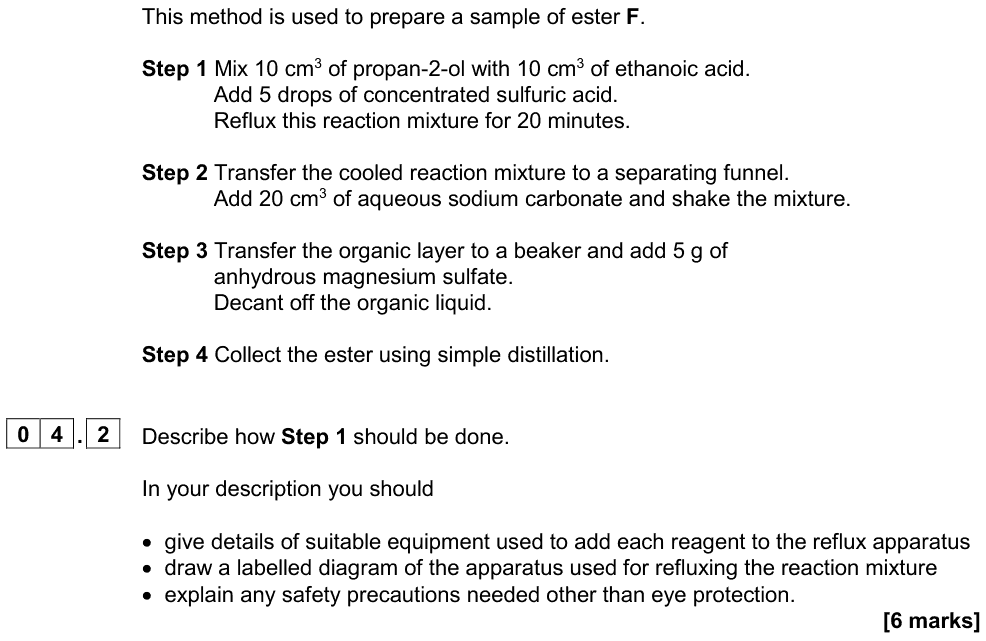
This method is used to prepare a sample of ester F.
Step 1 Mix 10 cm3 of propan-2-ol with 10 cm3 of ethanoic acid.
Add 5 drops of concentrated sulfuric acid.
Reflux this reaction mixture for 20 minutes.
Step 2 Transfer the cooled reaction mixture to a separating funnel.
Add 20 cm3 of aqueous sodium carbonate and shake the mixture.
Step 3 Transfer the organic layer to a beaker and add 5 g of
anhydrous magnesium sulfate.
Decant off the organic liquid.
Step 4 Collect the ester using simple distillation.
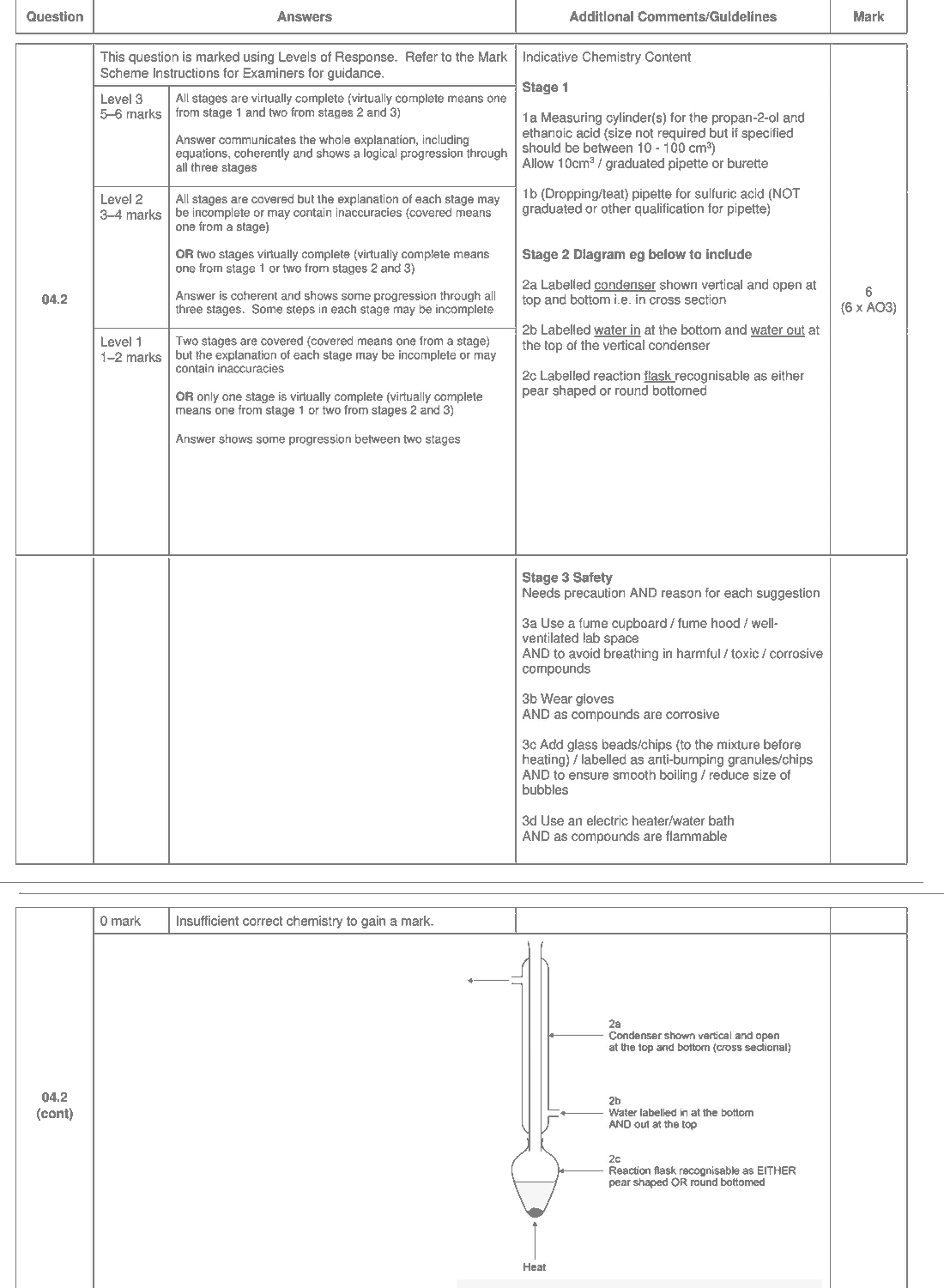
Describe how Step 1 should be done.
In your description you should
• give details of suitable equipment used to add each reagent to the reflux apparatus
• draw a labelled diagram of the apparatus used for refluxing the reaction mixture
• explain any safety precautions needed other than eye protection.
[6 marks]
June 2024 · Paper 3 · Q05.1 6 marks AO1=6 6-mark level of response Hard transition metals
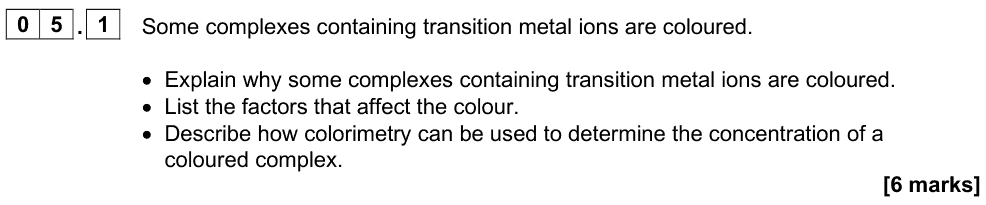
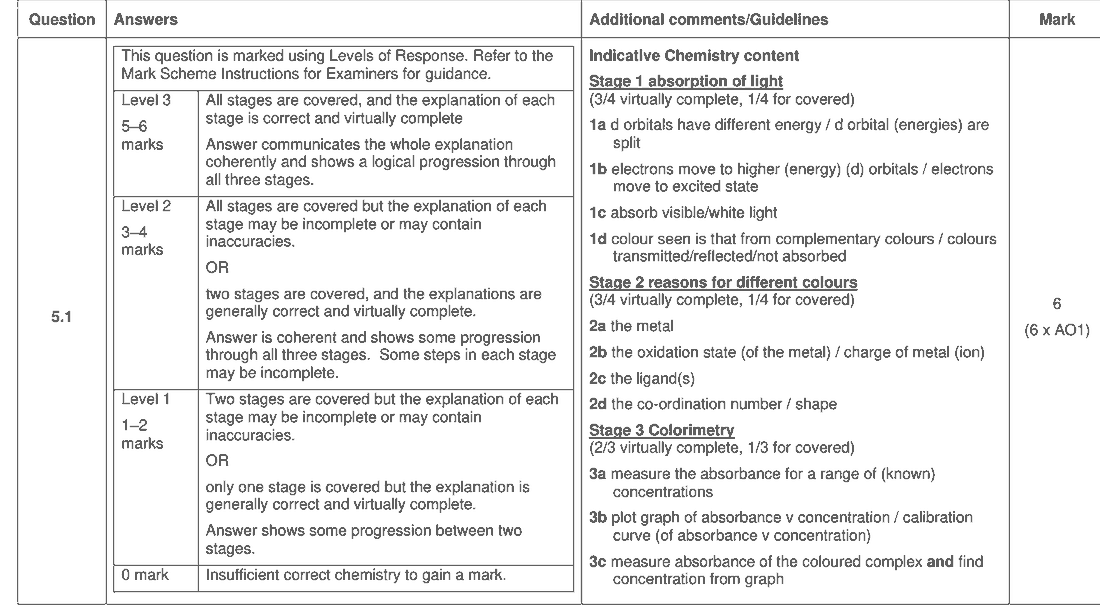
Some complexes containing transition metal ions are coloured.
• Explain why some complexes containing transition metal ions are coloured.
• List the factors that affect the colour.
• Describe how colorimetry can be used to determine the concentration of a
coloured complex.
[6 marks]
June 2023 · AS Paper 1 · Q05 6 marks AO2=6 6-mark level of response Hard bonding
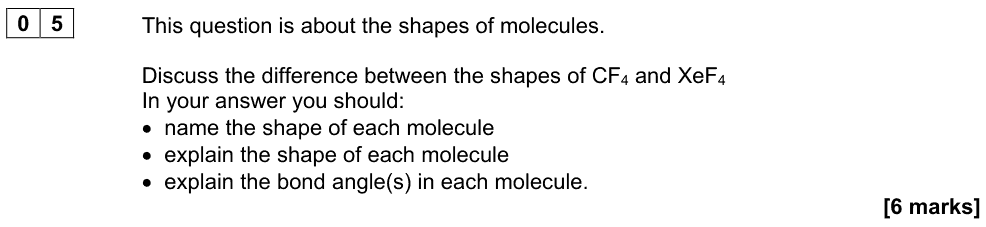
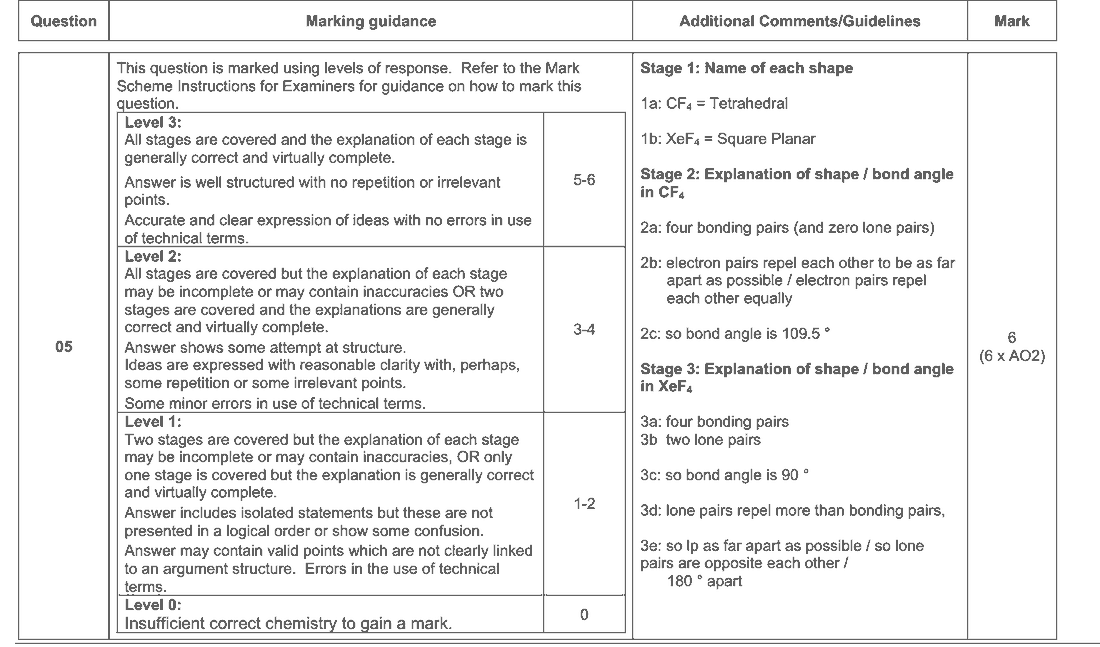
This question is about the shapes of molecules.
Discuss the difference between the shapes of CF4 and XeF4
In your answer you should:
• name the shape of each molecule
• explain the shape of each molecule
• explain the bond angle(s) in each molecule.
[6 marks]
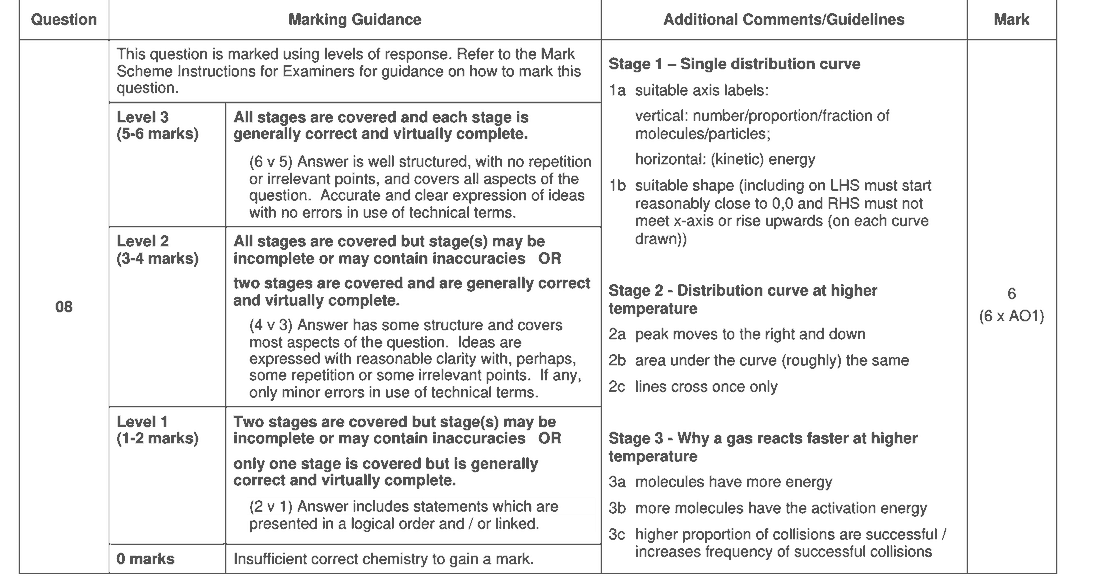
June 2023 · AS Paper 2 · Q08 6 marks AO1=6 6-mark level of response kinetics
Draw the Maxwell–Boltzmann distribution curves for a fixed mass of a gas at two
different temperatures.
This gas decomposes when heated.
By reference to these distribution curves, explain why the rate of decomposition of this
gas increases at higher temperatures.
[6 marks]
June 2023 · Paper 1 · Q05.7 6 marks AO1=2, AO2=2, AO3=2 6-mark level of response Hard thermodynamicsbonding
Earlier part of question 05 that this part usesEarlier part of June 2023 Paper 1 question 05
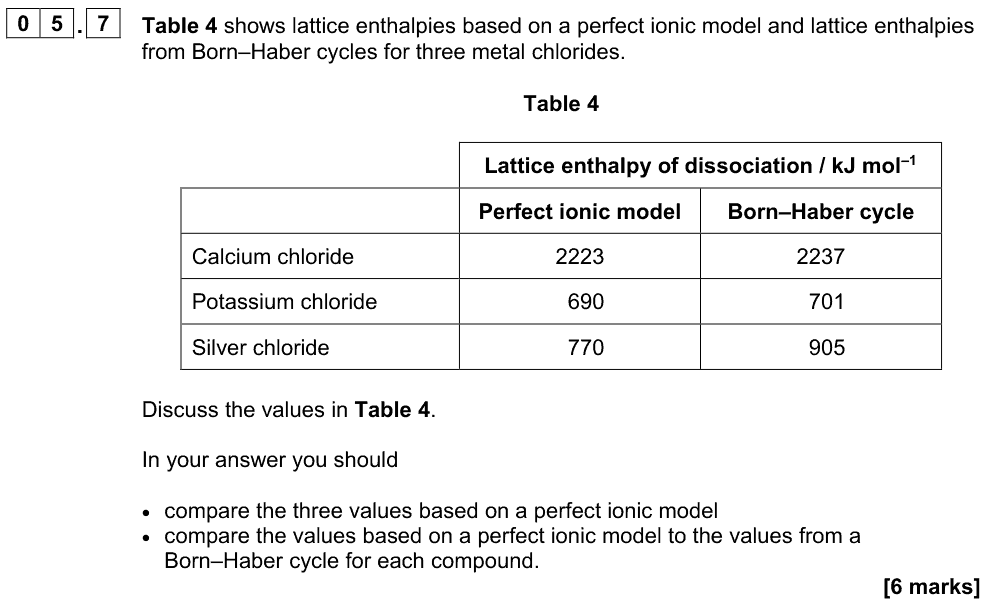
Table 4 shows lattice enthalpies based on a perfect ionic model and lattice enthalpies
from Born–Haber cycles for three metal chlorides.
Table 4
Lattice enthalpy of dissociation / kJ mol–1
Perfect ionic model
Born–Haber cycle
Calcium chloride
2223
2237
Potassium chloride
690
701
Silver chloride
770
905
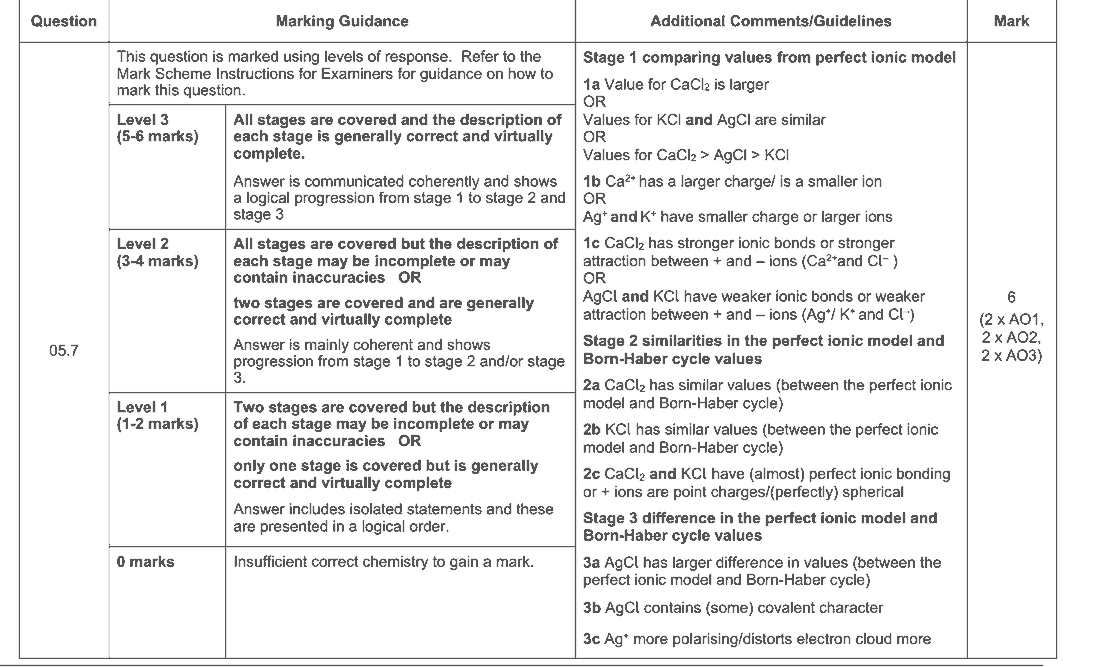
Discuss the values in Table 4.
In your answer you should
• compare the three values based on a perfect ionic model
• compare the values based on a perfect ionic model to the values from a
Born–Haber cycle for each compound.
[6 marks]
June 2023 · Paper 2 · Q04.2 6 marks AO1=3, AO3=3 6-mark level of response alkenesoptical isomerism
Earlier part of question 04 that this part usesEarlier part of June 2023 Paper 2 question 04
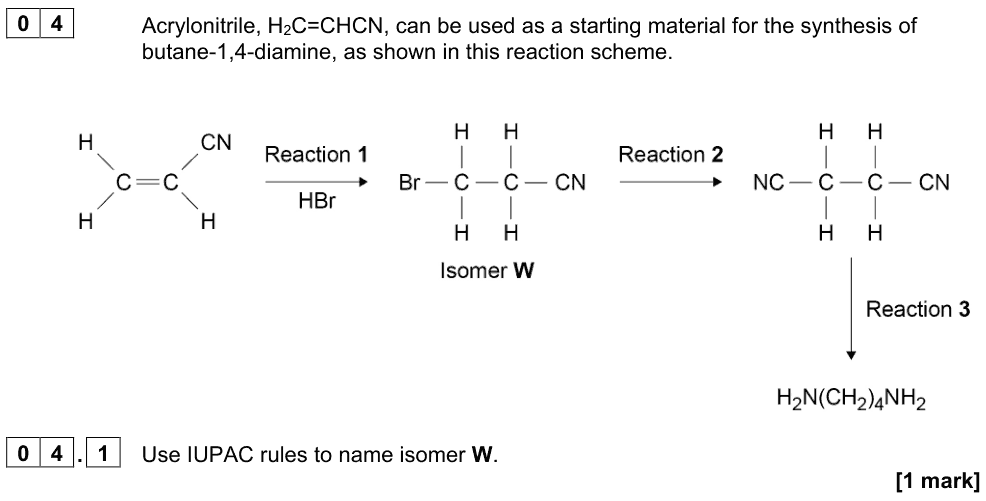
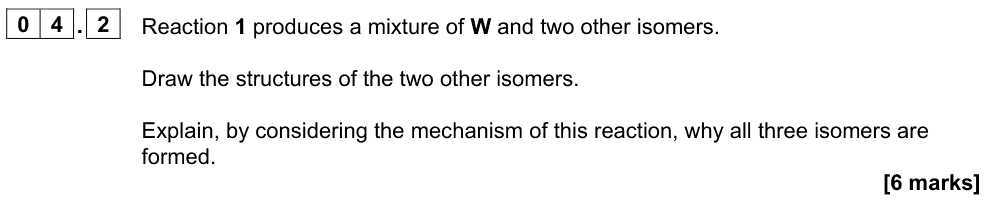
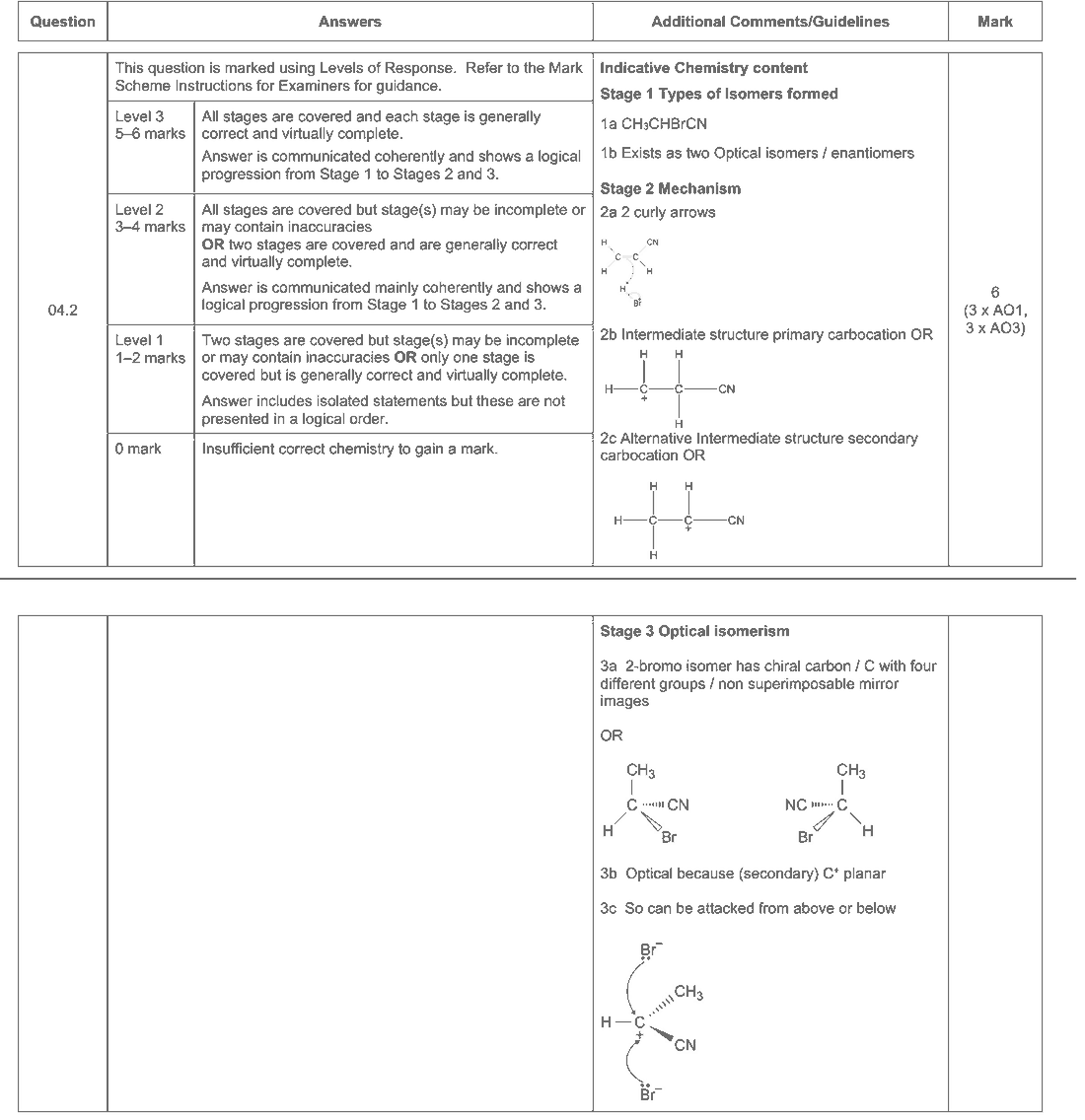
Reaction 1 produces a mixture of W and two other isomers.
Draw the structures of the two other isomers.
Explain, by considering the mechanism of this reaction, why all three isomers are
formed.
[6 marks]
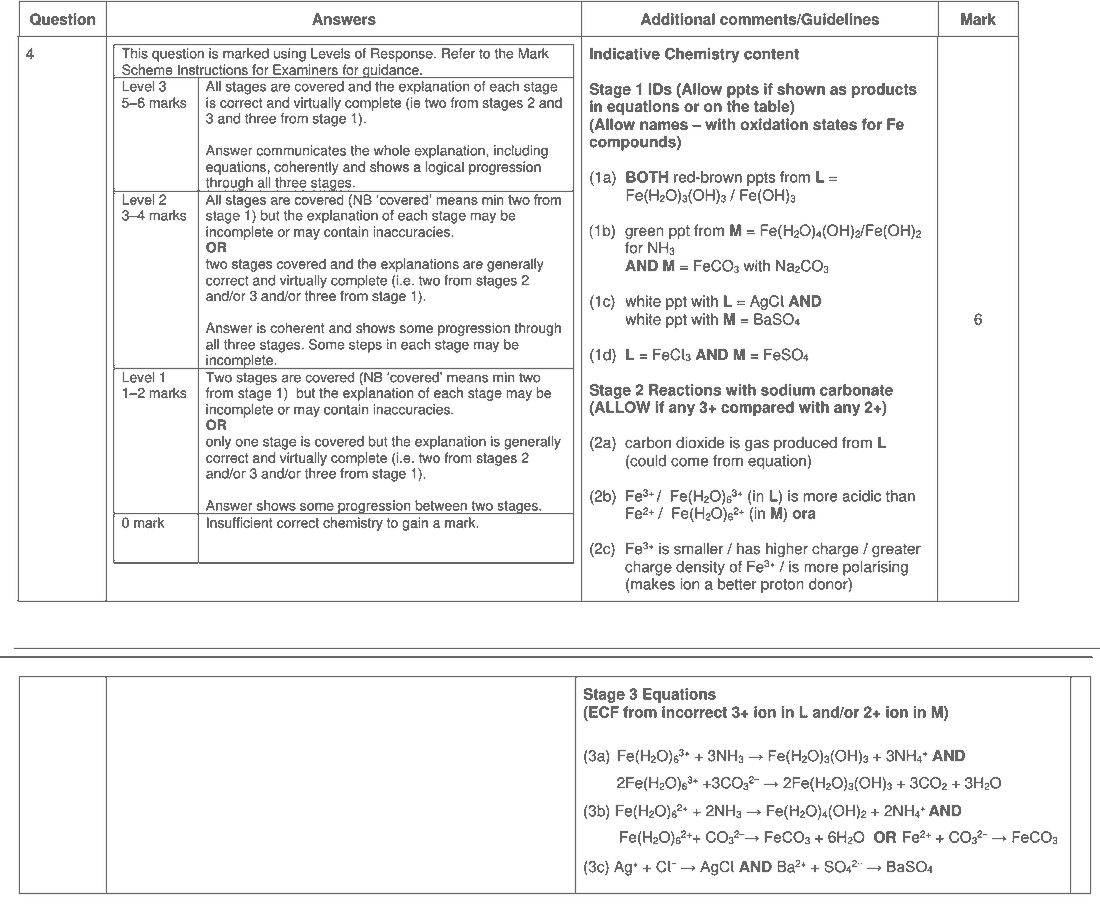
June 2023 · Paper 3 · Q04 6 marks 6-mark level of response Hard reactions of ions in aqueous solutiongroup 7 the halogens
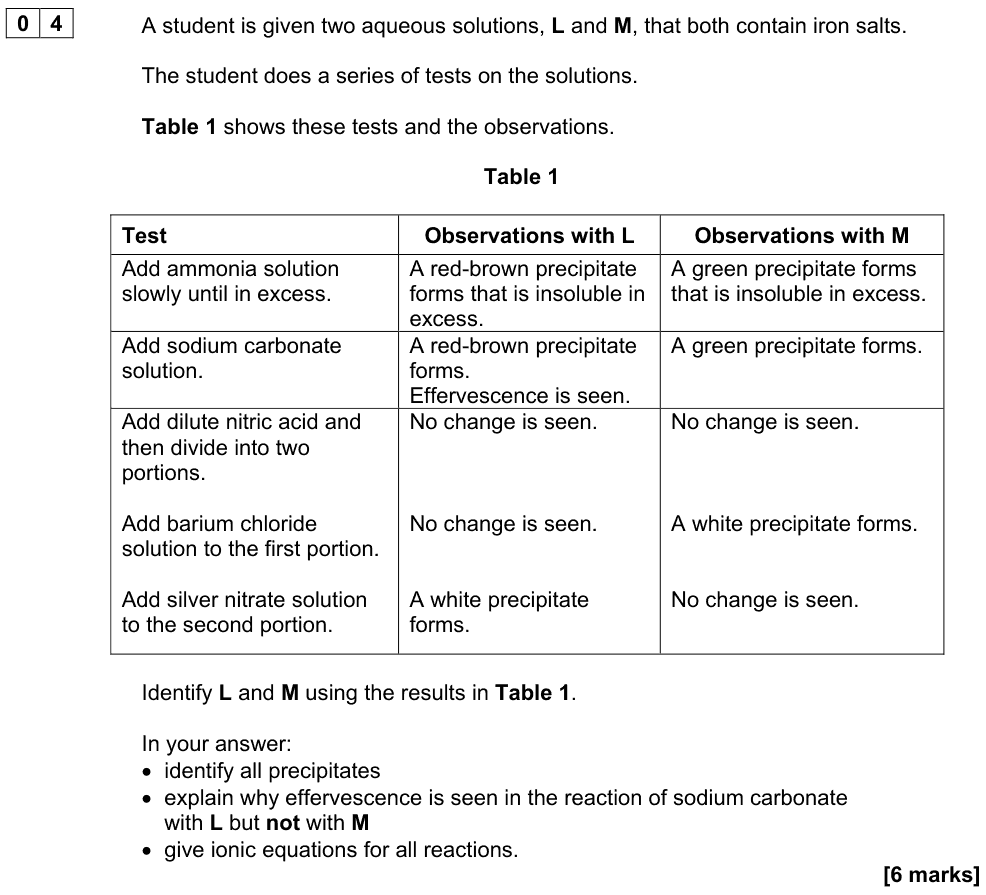
A student is given two aqueous solutions, L and M, that both contain iron salts.
The student does a series of tests on the solutions.
Table 1 shows these tests and the observations.
Table 1
Test
Observations with L
Observations with M
Add ammonia solution
slowly until in excess.
A red-brown precipitate
forms that is insoluble in
excess.
A green precipitate forms
that is insoluble in excess.
Add sodium carbonate
solution.
A red-brown precipitate
forms.
Effervescence is seen.
A green precipitate forms.
Add dilute nitric acid and
then divide into two
portions.
Add barium chloride
solution to the first portion.
Add silver nitrate solution
to the second portion.
No change is seen.
No change is seen.
A white precipitate
forms.
No change is seen.
A white precipitate forms.
No change is seen.
Identify L and M using the results in Table 1.
In your answer:
• identify all precipitates
• explain why effervescence is seen in the reaction of sodium carbonate
with L but not with M
• give ionic equations for all reactions.
[6 marks]
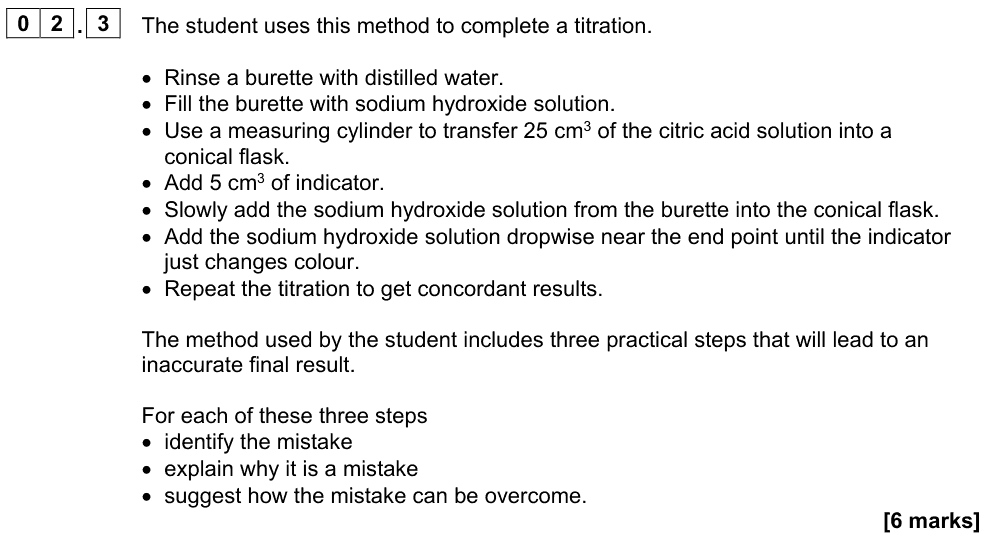
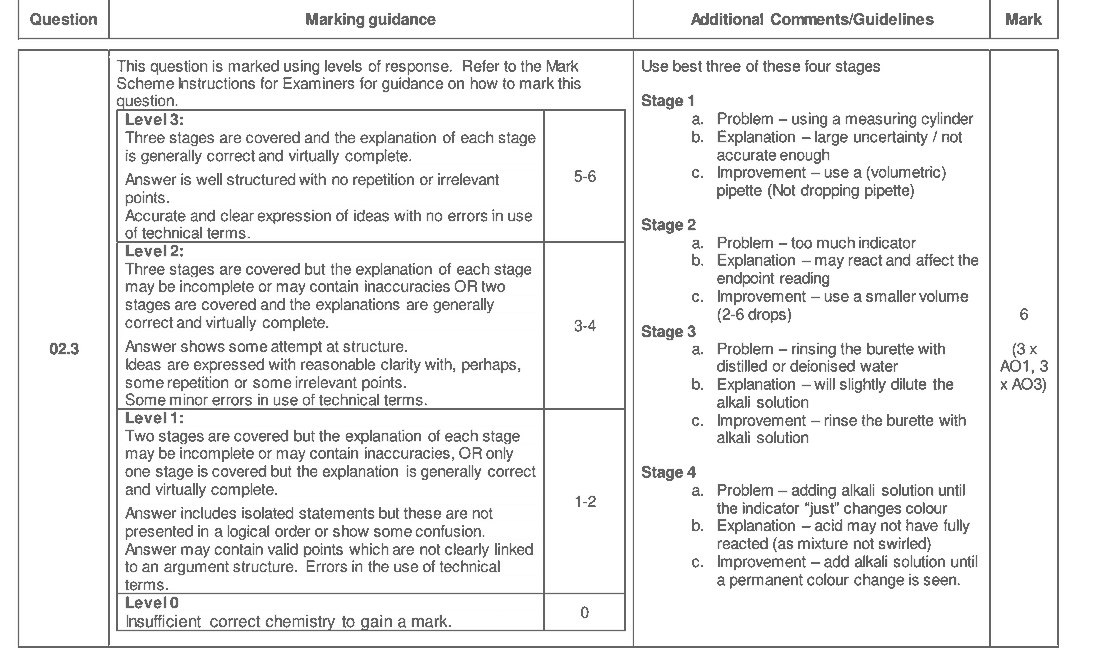
June 2022 · AS Paper 1 · Q02.3 6 marks AO1=3, AO3=3 6-mark level of response amount of substance
Earlier part of question 02 that this part usesEarlier part of June 2022 Paper 1 question 02
The student uses this method to complete a titration.
• Rinse a burette with distilled water.
• Fill the burette with sodium hydroxide solution.
• Use a measuring cylinder to transfer 25 cm3 of the citric acid solution into a
conical flask.
• Add 5 cm3 of indicator.
• Slowly add the sodium hydroxide solution from the burette into the conical flask.
• Add the sodium hydroxide solution dropwise near the end point until the indicator
just changes colour.
• Repeat the titration to get concordant results.
The method used by the student includes three practical steps that will lead to an
inaccurate final result.
For each of these three steps
• identify the mistake
• explain why it is a mistake
• suggest how the mistake can be overcome.
[6 marks]
June 2022 · AS Paper 2 · Q02 6 marks AO1=4, AO3=2 6-mark level of response organic analysisalcohols
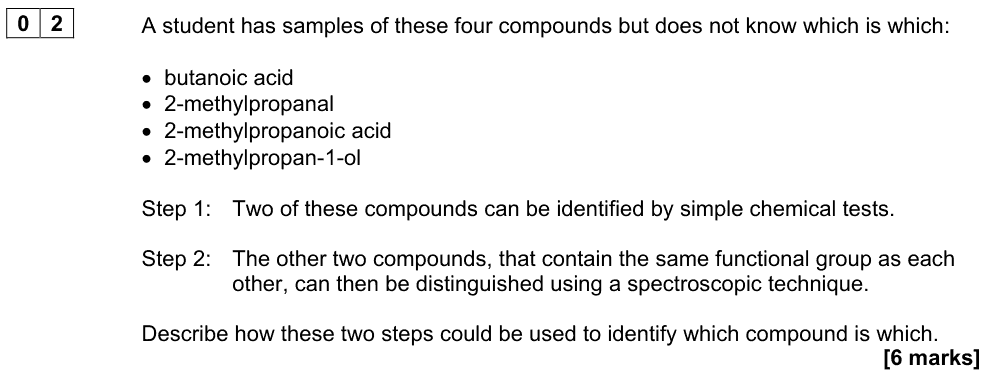
A student has samples of these four compounds but does not know which is which:
• butanoic acid
• 2-methylpropanal
• 2-methylpropanoic acid
• 2-methylpropan-1-ol
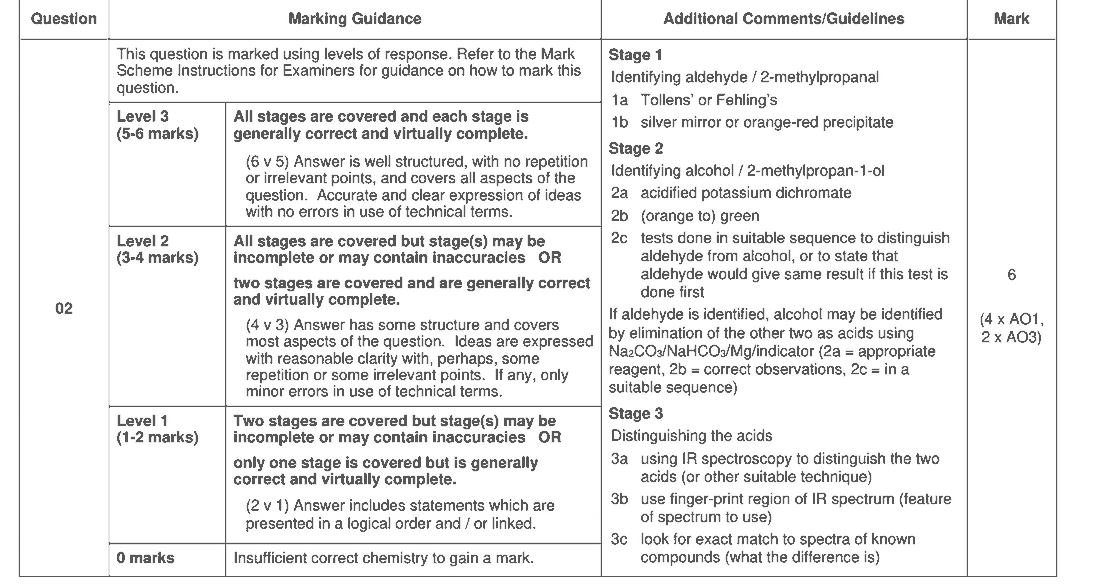
Step 1:   Two of these compounds can be identified by simple chemical tests.
Step 2:   The other two compounds, that contain the same functional group as each
other, can then be distinguished using a spectroscopic technique.
Describe how these two steps could be used to identify which compound is which.
[6 marks]
June 2022 · Paper 1 · Q05.7 6 marks 6-mark level of response Hard bonding
Earlier part of question 05 that this part usesEarlier part of June 2022 Paper 1 question 05
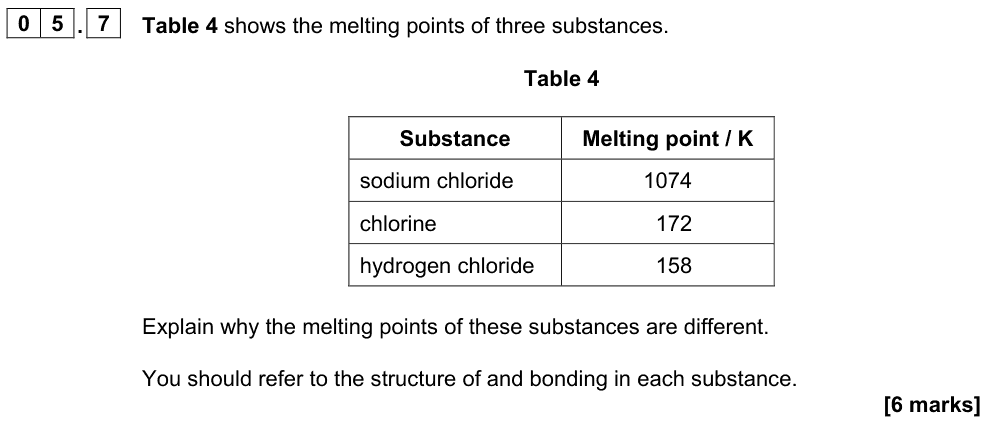
Table 4 shows the melting points of three substances.
Table 4
Substance
Melting point / K
sodium chloride
1074
chlorine
172
hydrogen chloride
158
Explain why the melting points of these substances are different.
You should refer to the structure of and bonding in each substance.
[6 marks]
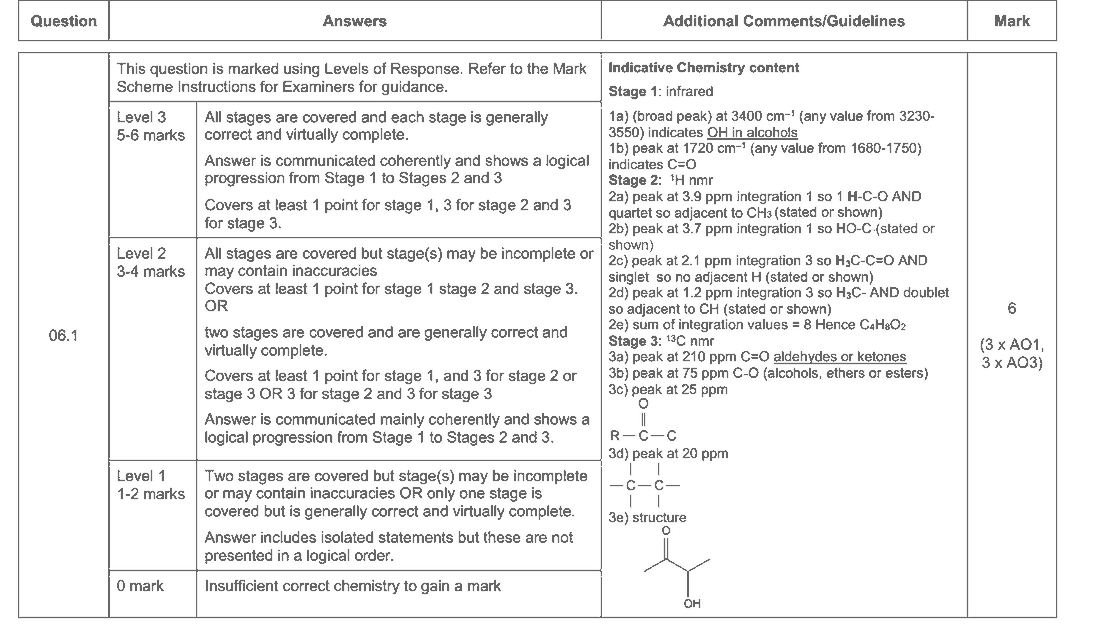
June 2022 · Paper 2 · Q06 6 marks AO1=3, AO3=3 6-mark level of response nmr spectroscopyorganic analysis
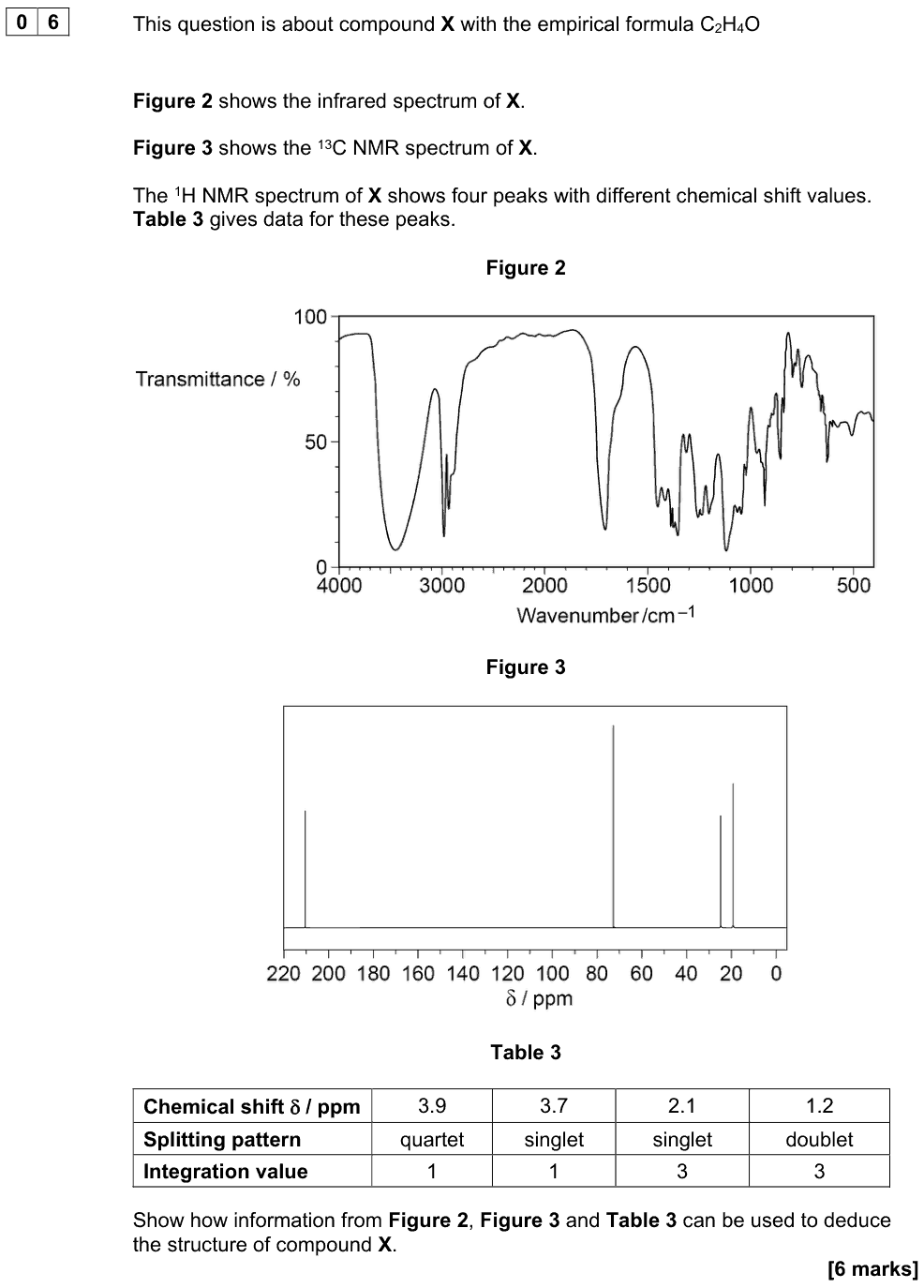
This question is about compound X with the empirical formula C2H4O
Figure 2 shows the infrared spectrum of X.
Figure 3 shows the 13C NMR spectrum of X.
The 1H NMR spectrum of X shows four peaks with different chemical shift values.
Table 3 gives data for these peaks.
Figure 2
Figure 3
Table 3
Chemical shift  / ppm
3.9
3.7
2.1
1.2
Splitting pattern
quartet
singlet
singlet
doublet
Integration value
1
1
3
3
Show how information from Figure 2, Figure 3 and Table 3 can be used to deduce
the structure of compound X.
[6 marks]
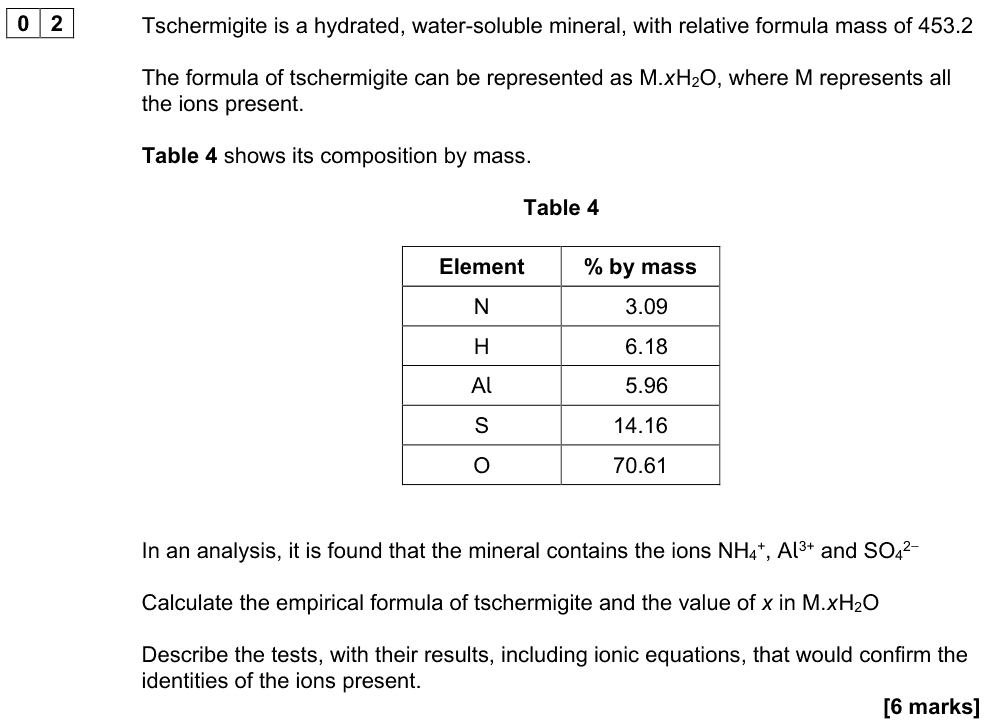
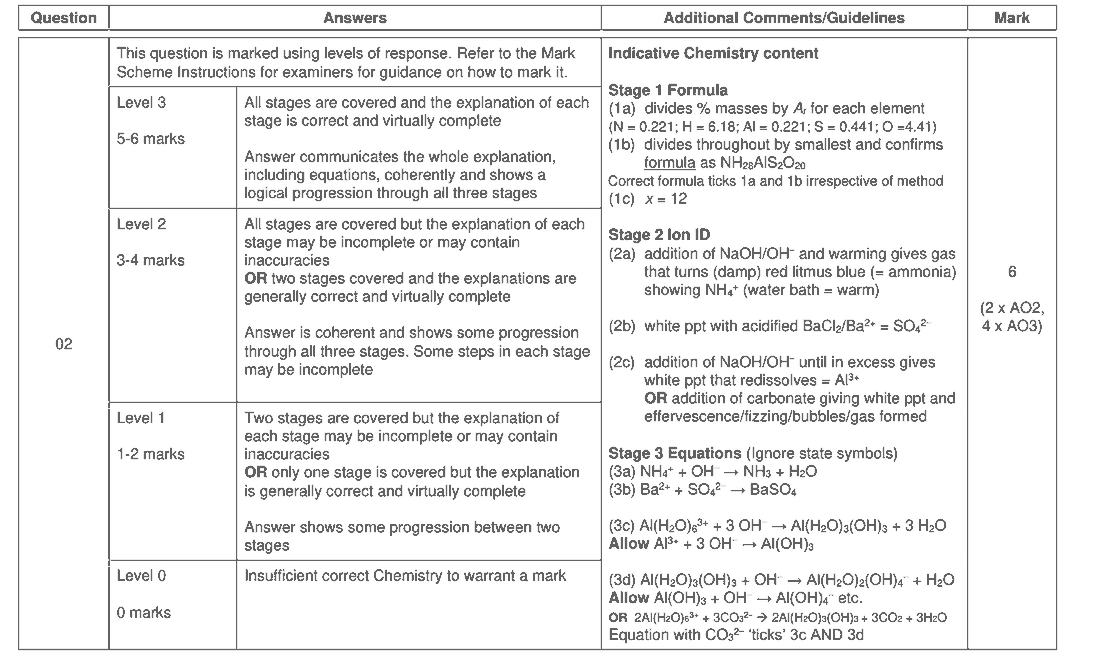
June 2022 · Paper 3 · Q02 6 marks AO2=2, AO3=4 6-mark level of response amount of substancegroup 7 the halogensreactions of ions in aqueous solution
Tschermigite is a hydrated, water-soluble mineral, with relative formula mass of 453.2
The formula of tschermigite can be represented as M.x H2O, where M represents all
the ions present.
Table 4 shows its composition by mass.
Table 4
Element
% by mass
N
3.09
H
6.18
Al
5.96
S
14.16
O
70.61
In an analysis, it is found that the mineral contains the ions NH4+, Al3+ and SO42−
Calculate the empirical formula of tschermigite and the value of x in M.x H2O
Describe the tests, with their results, including ionic equations, that would confirm the
identities of the ions present.
[6 marks]
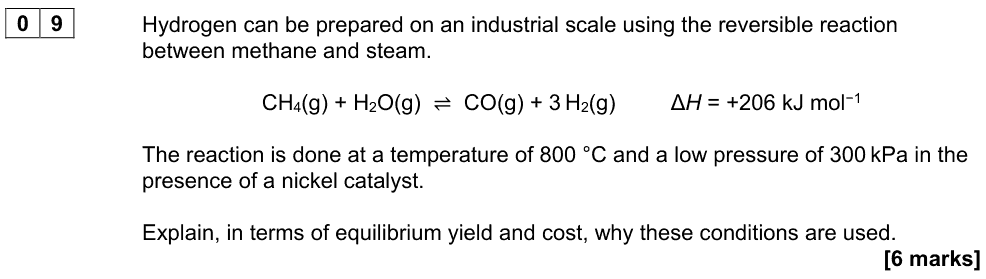
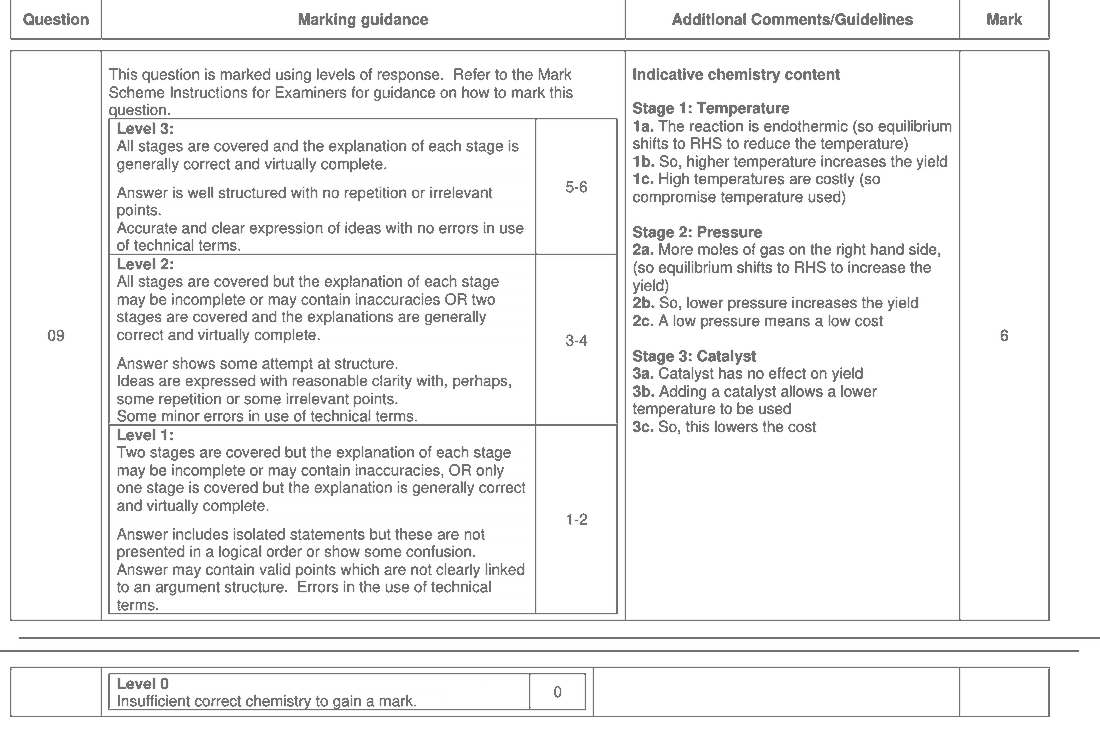
November 2021 · AS Paper 1 · Q09 6 marks 6-mark level of response chemical equilibria and kc
Hydrogen can be prepared on an industrial scale using the reversible reaction
between methane and steam.
CH4(g) + H2O(g)  ⇌  CO(g) + 3 H2(g)         ΔH = +206 kJ mol−1
The reaction is done at a temperature of 800 °C and a low pressure of 300 kPa in the
presence of a nickel catalyst.
Explain, in terms of equilibrium yield and cost, why these conditions are used.
[6 marks]
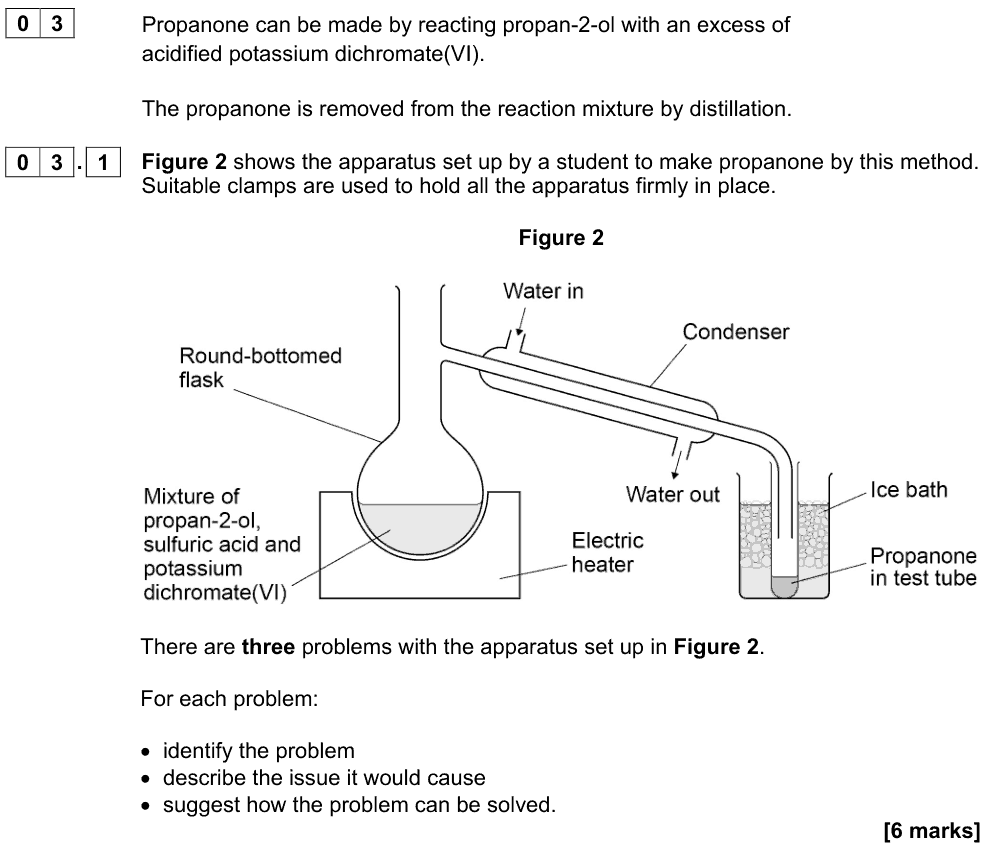
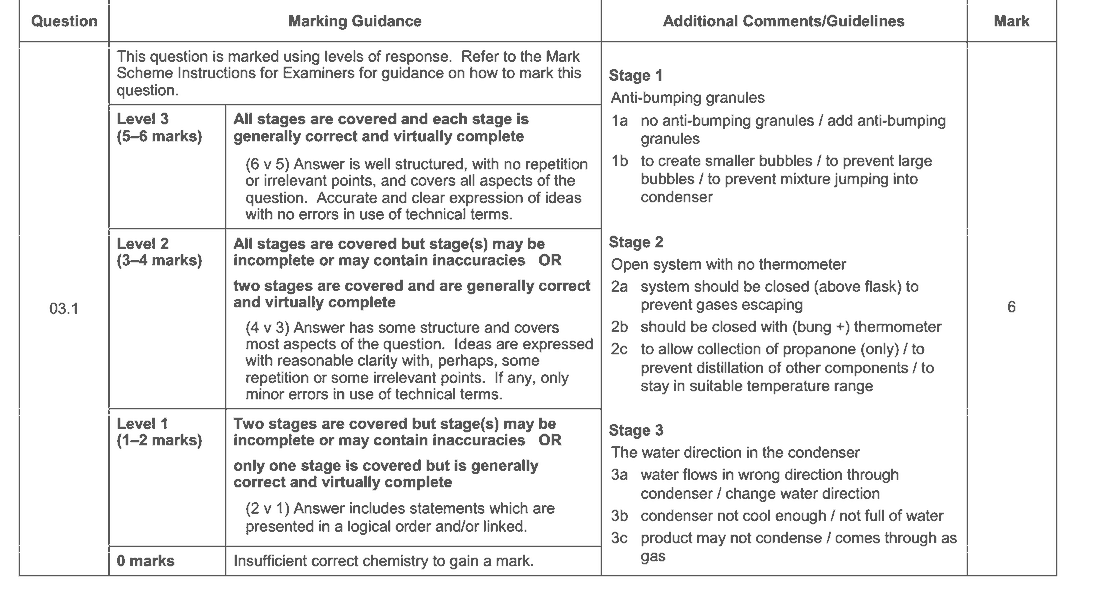
November 2021 · AS Paper 2 · Q03.1 6 marks 6-mark level of response alcohols
Propanone can be made by reacting propan-2-ol with an excess of
acidified potassium dichromate(VI).
The propanone is removed from the reaction mixture by distillation.
Figure 2 shows the apparatus set up by a student to make propanone by this method.
Suitable clamps are used to hold all the apparatus firmly in place.
Figure 2
There are three problems with the apparatus set up in Figure 2.
For each problem:
• identify the problem
• describe the issue it would cause
• suggest how the problem can be solved.
[6 marks]
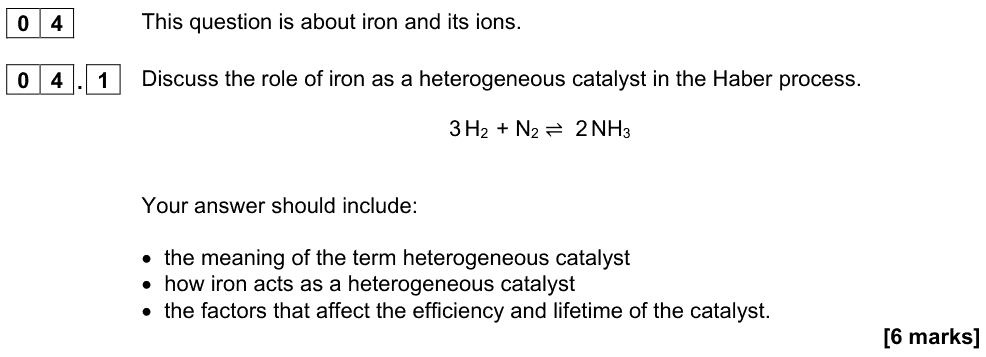
November 2021 · Paper 1 · Q04.1 6 marks 6-mark level of response transition metals
This question is about iron and its ions.
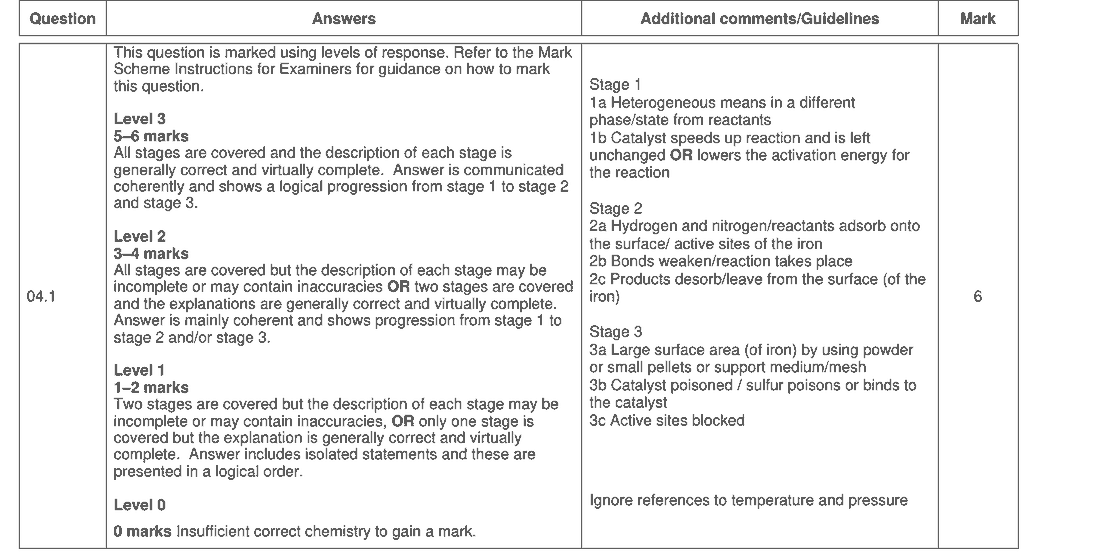
Discuss the role of iron as a heterogeneous catalyst in the Haber process.
3 H2  + N2 ⇌  2 NH3
Your answer should include:
• the meaning of the term heterogeneous catalyst
• how iron acts as a heterogeneous catalyst
• the factors that affect the efficiency and lifetime of the catalyst.
[6 marks]
November 2021 · Paper 2 · Q02.6 6 marks 6-mark level of response alcohols
Earlier part of question 02 that this part usesEarlier part of November 2021 Paper 2 question 02
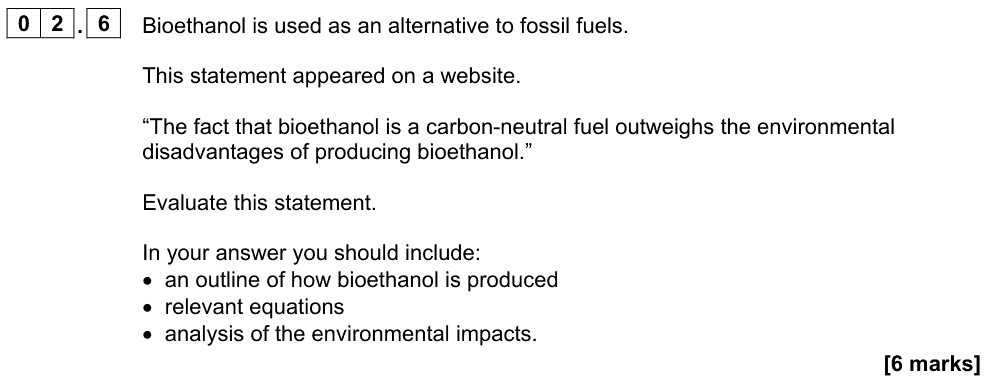
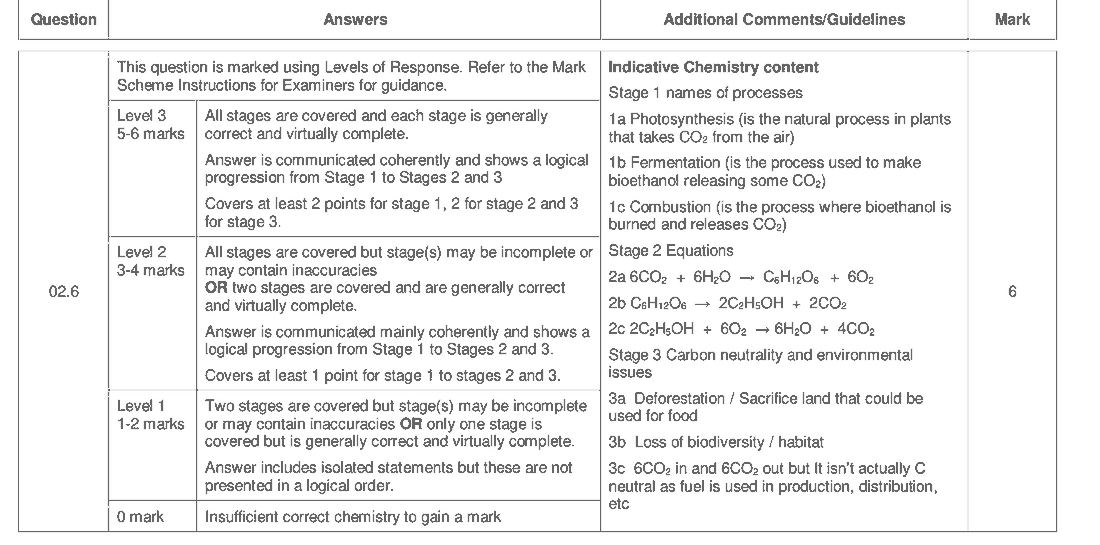
Bioethanol is used as an alternative to fossil fuels.
This statement appeared on a website.
“The fact that bioethanol is a carbon-neutral fuel outweighs the environmental
disadvantages of producing bioethanol.”
Evaluate this statement.
In your answer you should include:
• an outline of how bioethanol is produced
• relevant equations
• analysis of the environmental impacts.
[6 marks]
November 2021 · Paper 3 · Q01.8 6 marks 6-mark level of response transition metalsthermodynamics
Earlier part of question 01 that this part usesEarlier part of November 2021 Paper 3 question 01
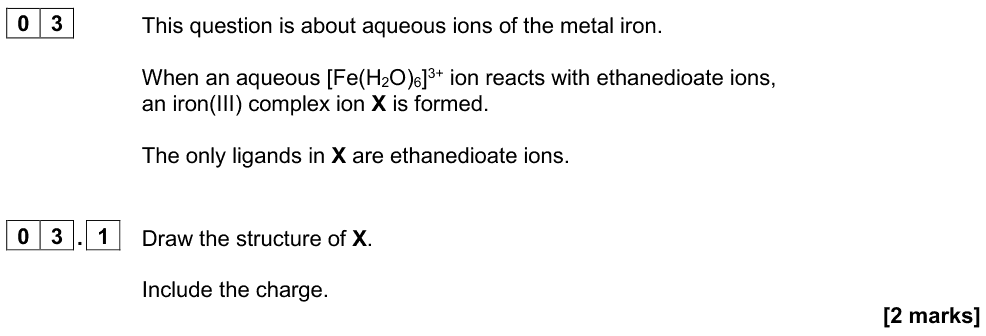
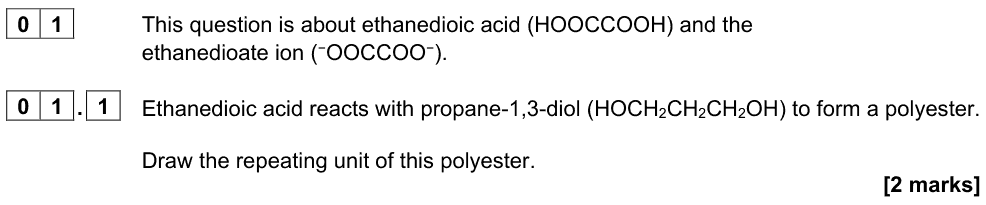
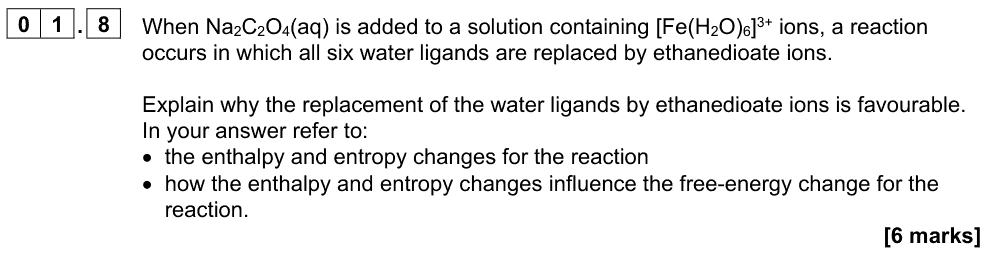
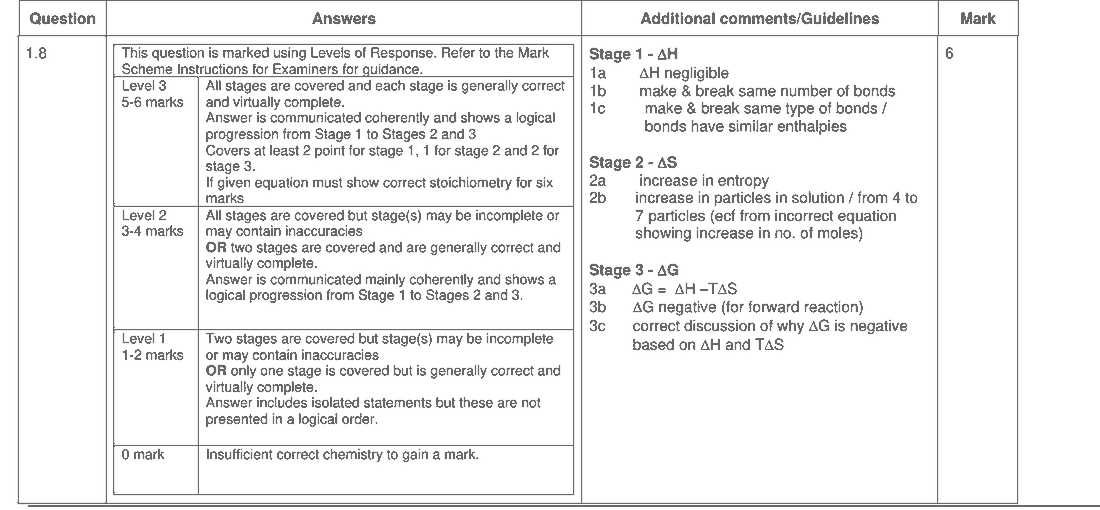
When Na2C2O4(aq) is added to a solution containing [Fe(H2O)6]3+ ions, a reaction
occurs in which all six water ligands are replaced by ethanedioate ions.
Explain why the replacement of the water ligands by ethanedioate ions is favourable.
In your answer refer to:
• the enthalpy and entropy changes for the reaction
• how the enthalpy and entropy changes influence the free-energy change for the
reaction.
[6 marks]
November 2020 · AS Paper 1 · Q04.2 6 marks 6-mark level of response energetics
Earlier part of question 04 that this part usesEarlier part of November 2020 Paper 1 question 04
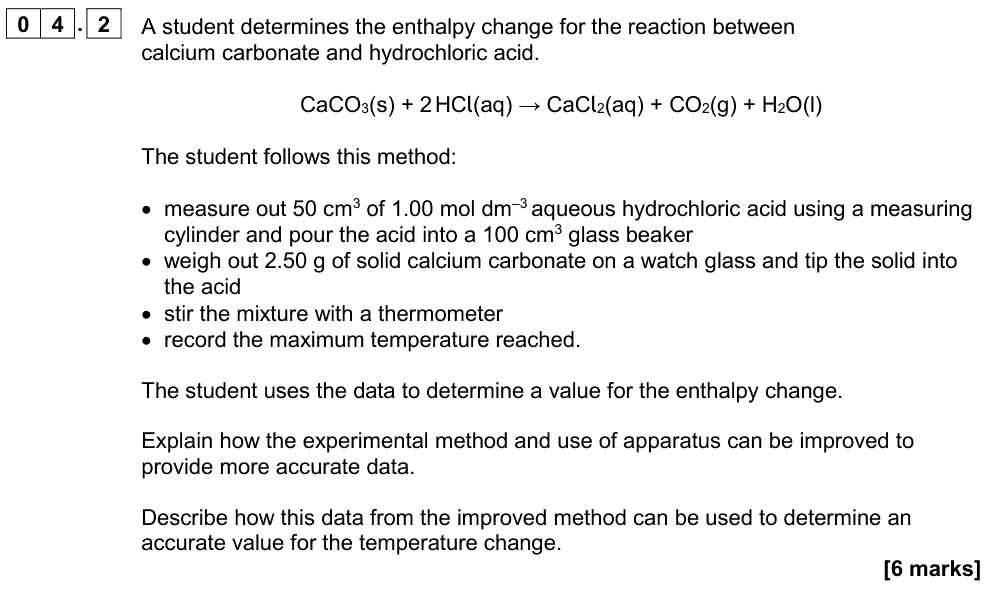
A student determines the enthalpy change for the reaction between
calcium carbonate and hydrochloric acid.
CaCO3(s) + 2 HCl(aq) → CaCl2(aq) + CO2(g) + H2O(l)
The student follows this method:
• measure out 50 cm3 of 1.00 mol dm–3 aqueous hydrochloric acid using a measuring
cylinder and pour the acid into a 100 cm3 glass beaker
• weigh out 2.50 g of solid calcium carbonate on a watch glass and tip the solid into
the acid
• stir the mixture with a thermometer
• record the maximum temperature reached.
The student uses the data to determine a value for the enthalpy change.
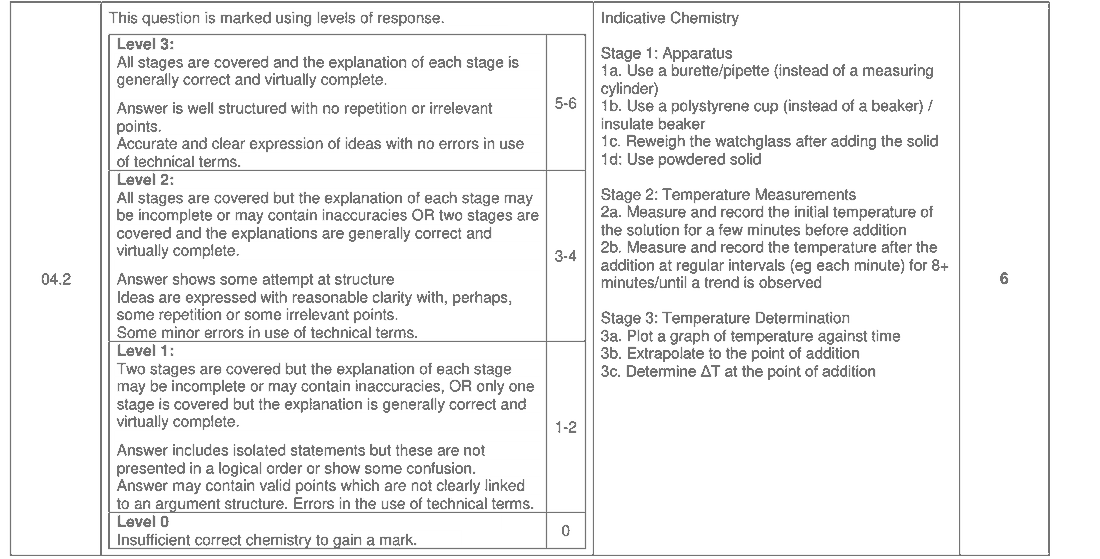
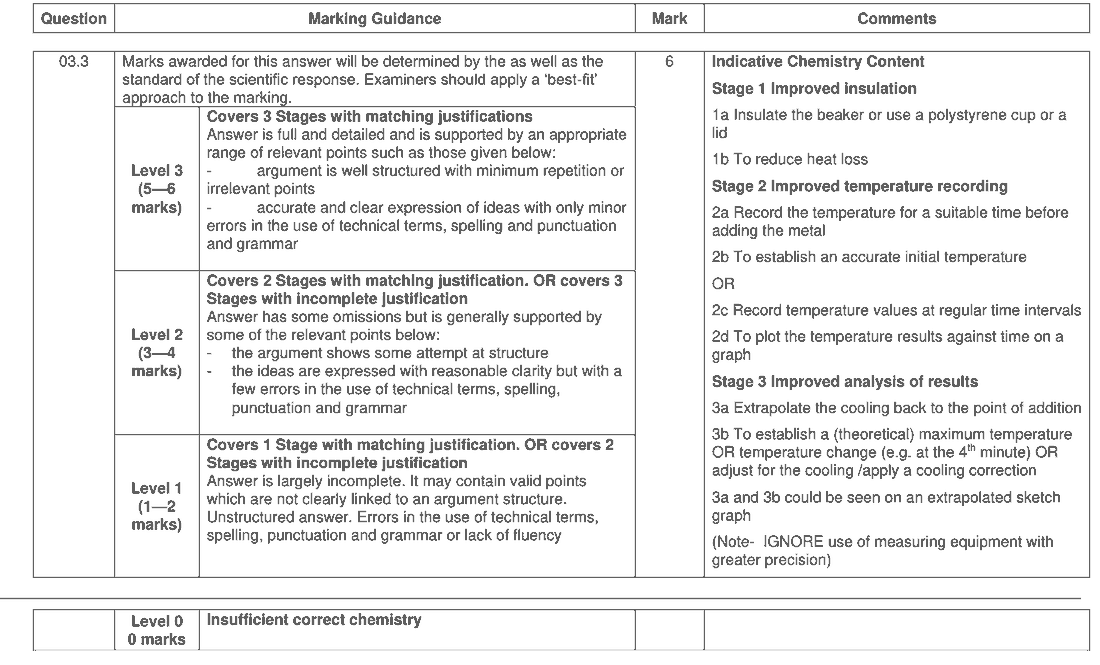
Explain how the experimental method and use of apparatus can be improved to
provide more accurate data.
Describe how this data from the improved method can be used to determine an
accurate value for the temperature change.
[6 marks]
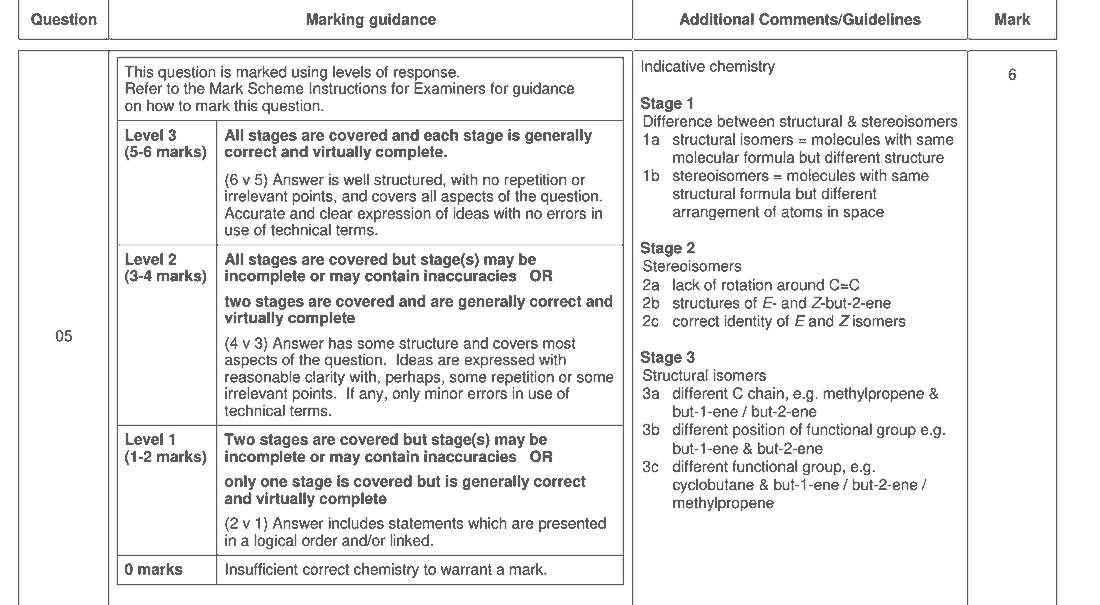
November 2020 · AS Paper 2 · Q05 6 marks 6-mark level of response introduction to organic chemistry
Explain the differences between structural isomerism and stereoisomerism.
Use examples to show how compounds with the molecular formula C4H8 exhibit
stereoisomerism and the three types of structural isomerism.
[6 marks]
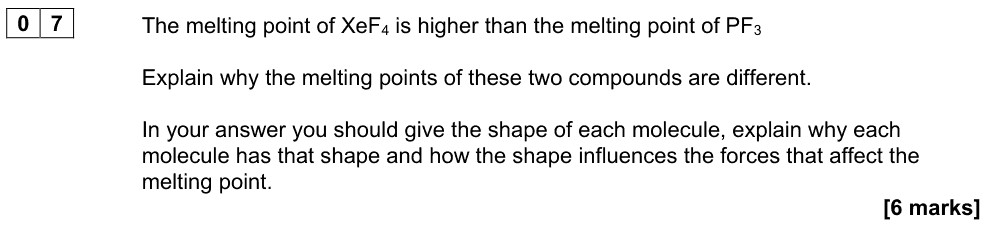
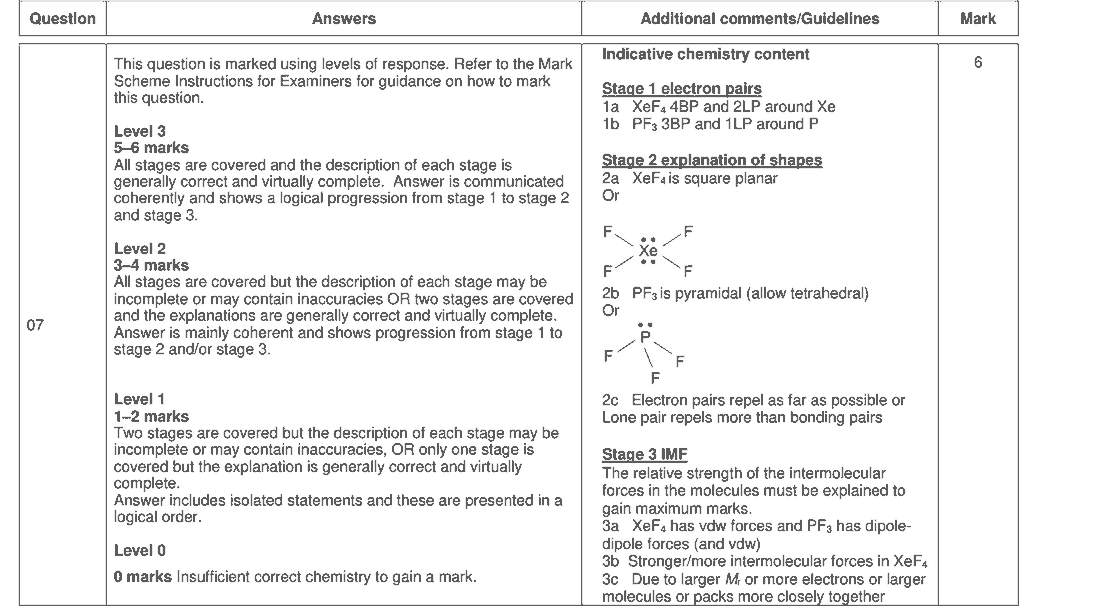
November 2020 · Paper 1 · Q07 6 marks 6-mark level of response bonding
The melting point of XeF4 is higher than the melting point of PF3
Explain why the melting points of these two compounds are different.
In your answer you should give the shape of each molecule, explain why each
molecule has that shape and how the shape influences the forces that affect the
melting point.
[6 marks]
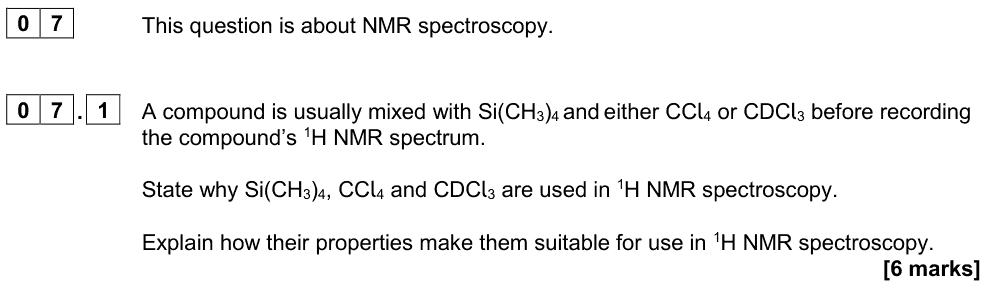
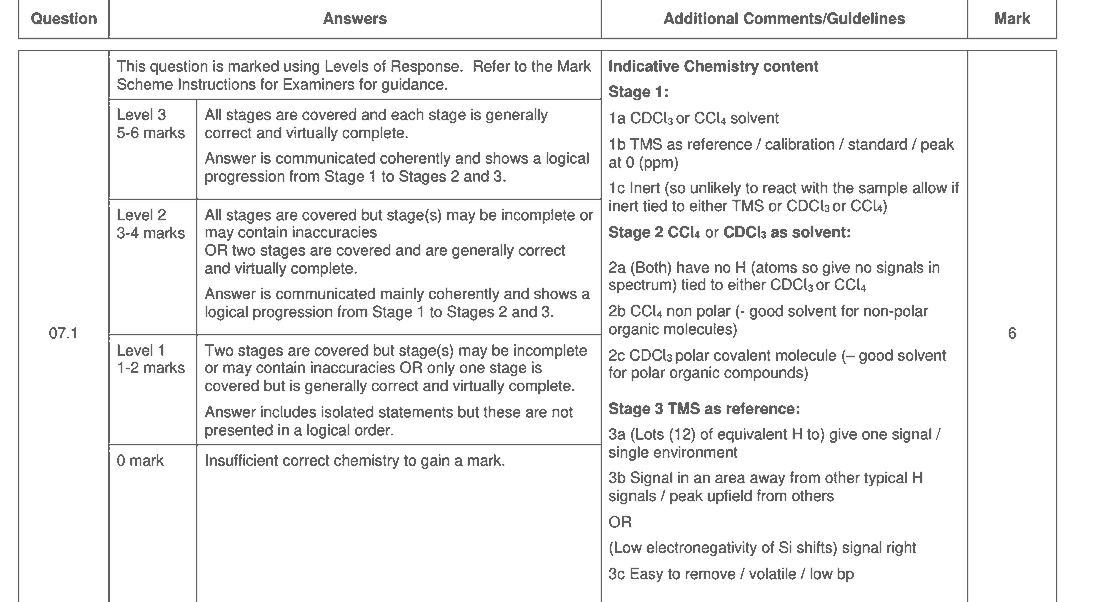
November 2020 · Paper 2 · Q07.1 6 marks 6-mark level of response Hard nmr spectroscopy
This question is about NMR spectroscopy.
A compound is usually mixed with Si(CH3)4 and either CCl4 or CDCl3 before recording
the compound’s 1H NMR spectrum.
State why Si(CH3)4, CCl4 and CDCl3 are used in 1H NMR spectroscopy.
Explain how their properties make them suitable for use in 1H NMR spectroscopy.
[6 marks]
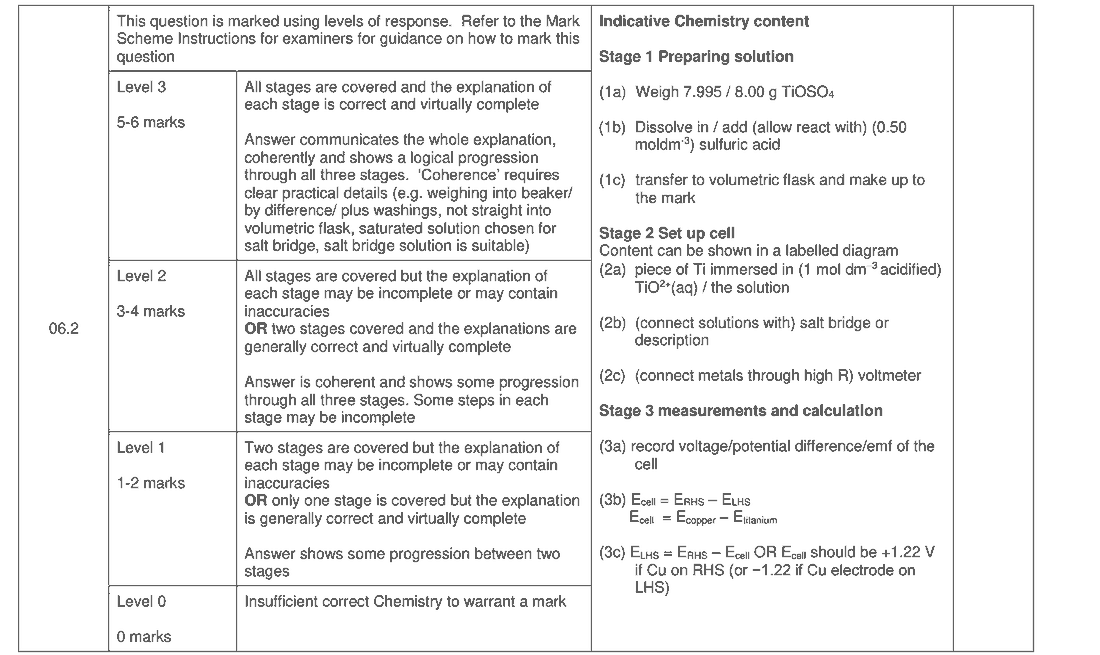
November 2020 · Paper 3 · Q06.2 6 marks 6-mark level of response Hard electrode potentials and cells
Earlier part of question 06 that this part usesEarlier part of November 2020 Paper 3 question 06
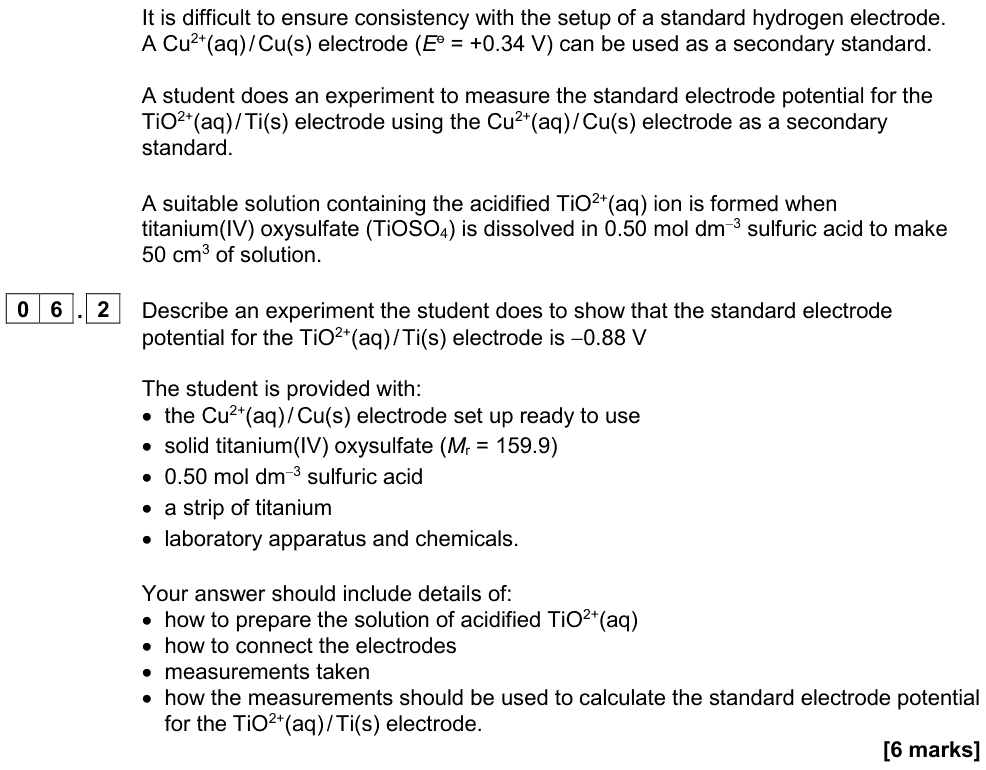
It is difficult to ensure consistency with the setup of a standard hydrogen electrode.
A Cu2+(aq) / Cu(s) electrode (Eo = +0.34 V) can be used as a secondary standard.
A student does an experiment to measure the standard electrode potential for the
TiO2+(aq) / Ti(s) electrode using the Cu2+(aq) / Cu(s) electrode as a secondary
standard.
A suitable solution containing the acidified TiO2+(aq) ion is formed when
titanium(IV) oxysulfate (TiOSO4) is dissolved in 0.50 mol dm−3 sulfuric acid to make
50 cm3 of solution.
Describe an experiment the student does to show that the standard electrode
potential for the TiO2+(aq) / Ti(s) electrode is −0.88 V
The student is provided with:
• the Cu2+(aq) / Cu(s) electrode set up ready to use
• solid titanium(IV) oxysulfate (Mr = 159.9)
• 0.50 mol dm−3 sulfuric acid
• a strip of titanium
• laboratory apparatus and chemicals.
Your answer should include details of:
• how to prepare the solution of acidified TiO2+(aq)
• how to connect the electrodes
• measurements taken
• how the measurements should be used to calculate the standard electrode potential
for the TiO2+(aq) / Ti(s) electrode.
[6 marks]
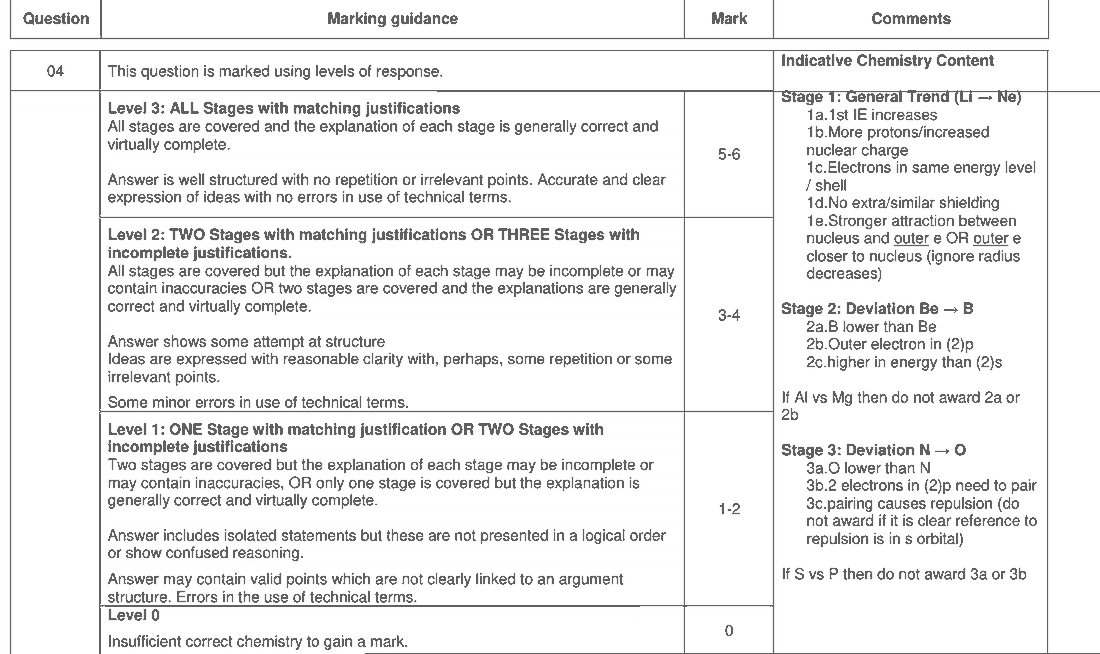
June 2019 · AS Paper 1 · Q04 6 marks 6-mark level of response atomic structureperiodicity
The first ionisation energies of the elements in Period 2 change as the atomic number
increases.
Explain the pattern in the first ionisation energies of the elements from lithium to neon.
[6 marks]
June 2019 · AS Paper 2 · Q05.3 6 marks 6-mark level of response chemical equilibria and kckinetics
Earlier part of question 05 that this part usesEarlier part of June 2019 Paper 2 question 05
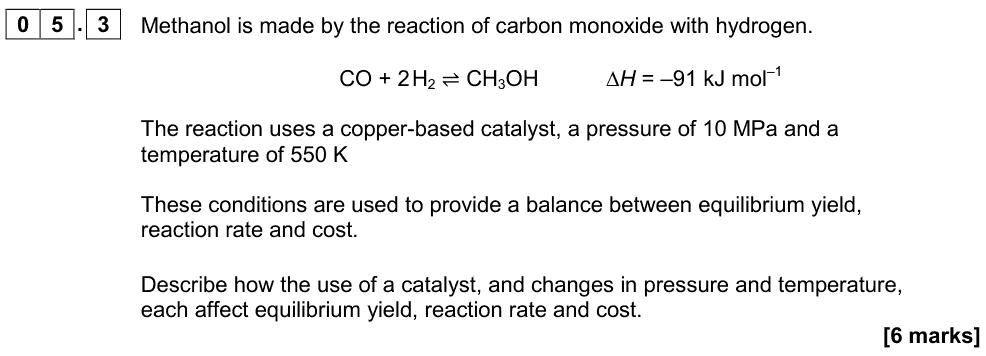
Methanol is made by the reaction of carbon monoxide with hydrogen.
CO + 2 H2 ⇌ CH3OH           ∆H = –91 kJ mol–1
The reaction uses a copper-based catalyst, a pressure of 10 MPa and a
temperature of 550 K
These conditions are used to provide a balance between equilibrium yield,
reaction rate and cost.
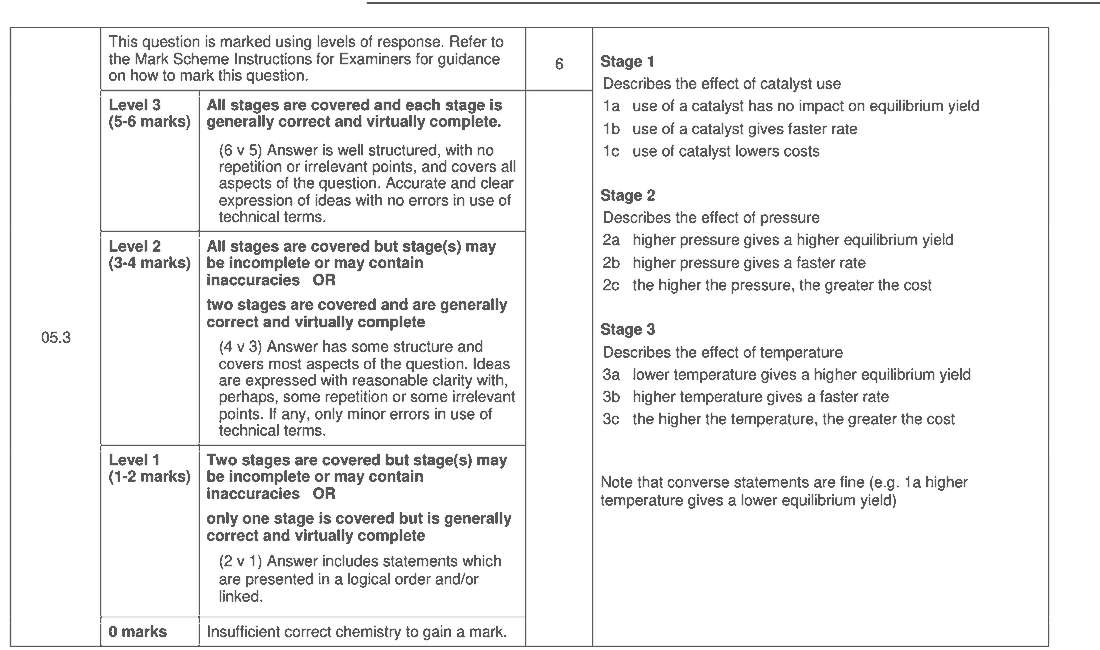
Describe how the use of a catalyst, and changes in pressure and temperature,
each affect equilibrium yield, reaction rate and cost.
[6 marks]
June 2019 · Paper 1 · Q04.5 6 marks 6-mark level of response transition metals
Earlier part of question 04 that this part usesEarlier part of June 2019 Paper 1 question 04
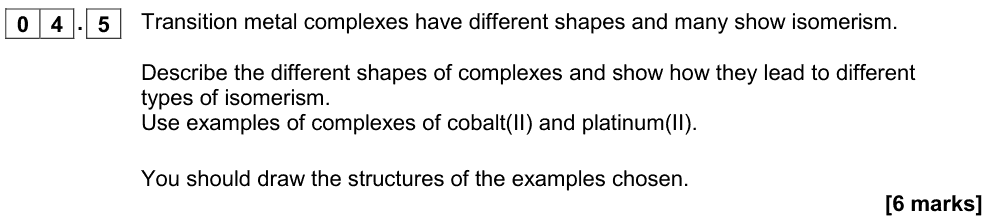
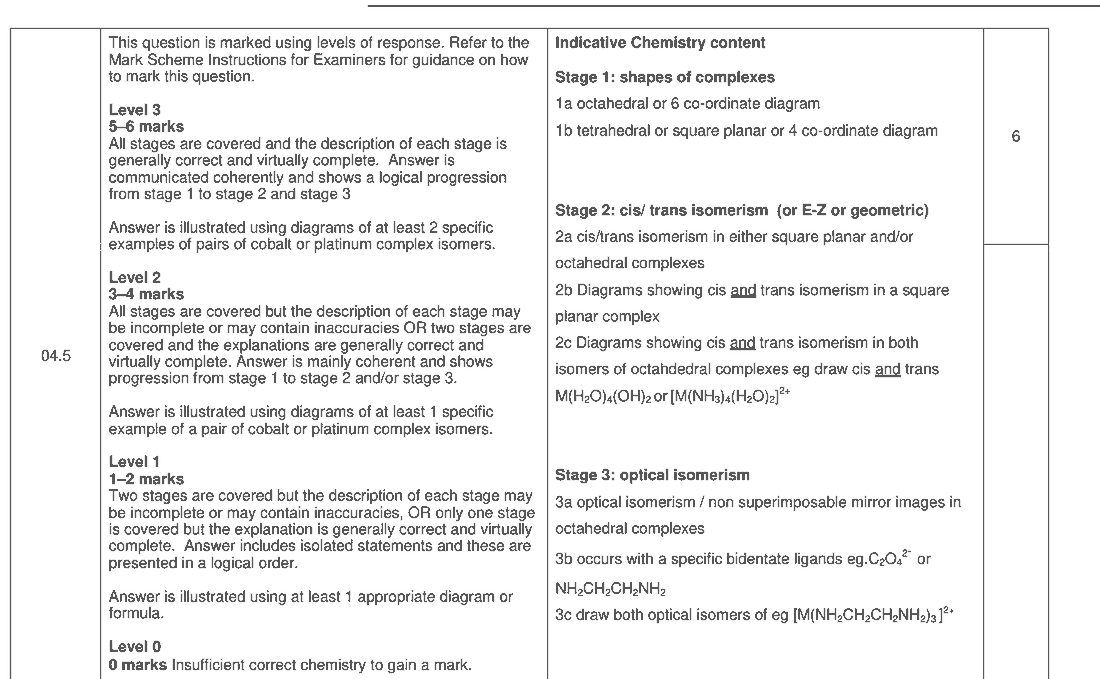
Transition metal complexes have different shapes and many show isomerism.
Describe the different shapes of complexes and show how they lead to different
types of isomerism.
Use examples of complexes of cobalt(II) and platinum(II).
You should draw the structures of the examples chosen.
[6 marks]
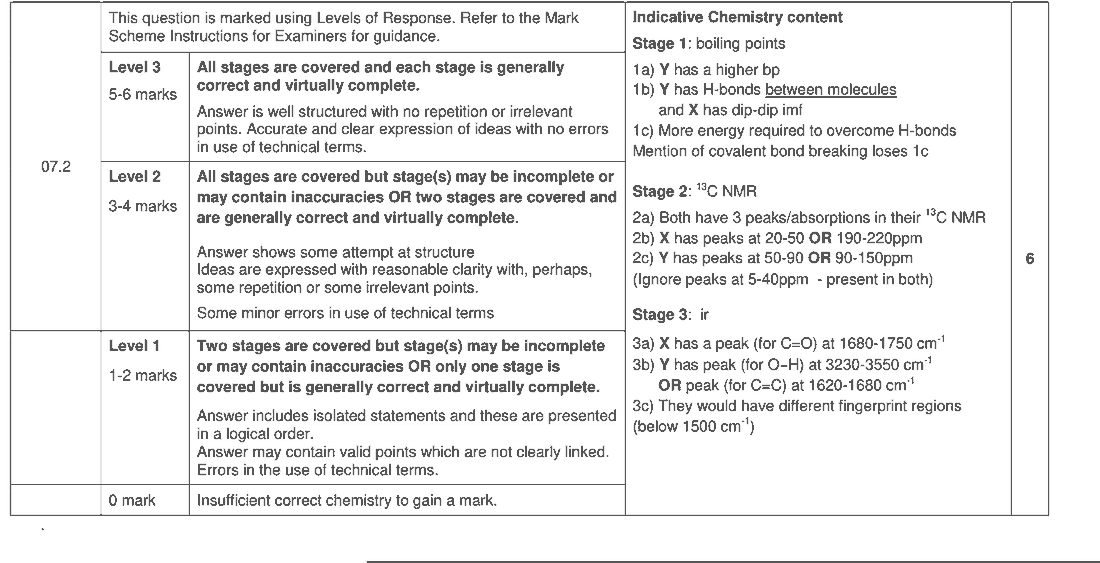
June 2019 · Paper 2 · Q07.2 6 marks 6-mark level of response bondingnmr spectroscopyorganic analysis
Earlier part of question 07 that this part usesEarlier part of June 2019 Paper 2 question 07
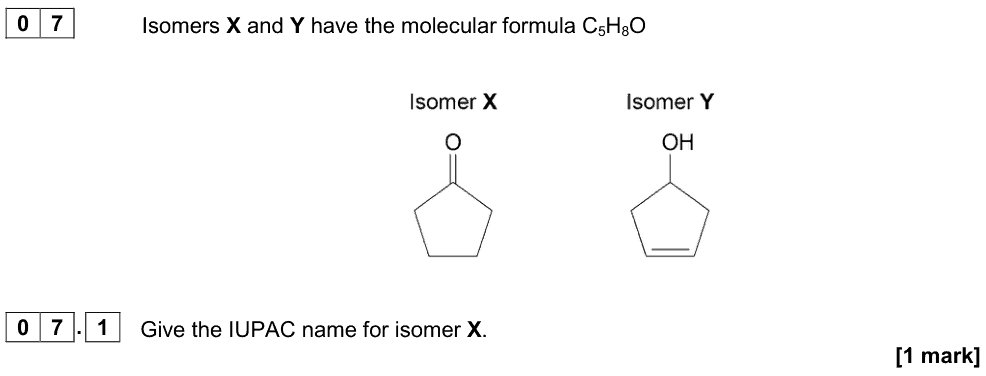
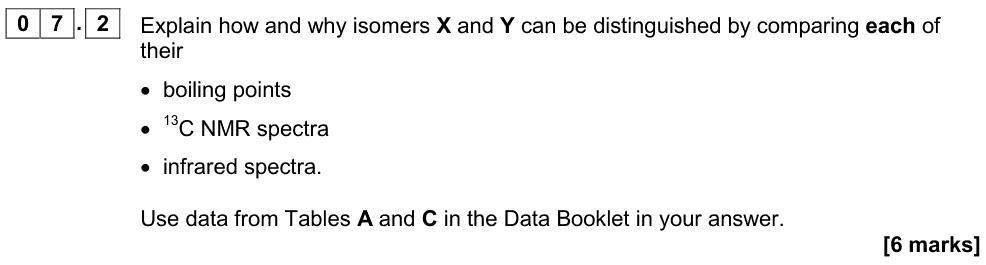
Explain how and why isomers X and Y can be distinguished by comparing each of
their
• boiling points
• 13C NMR spectra
• infrared spectra.
Use data from Tables A and C in the Data Booklet in your answer.
[6 marks]
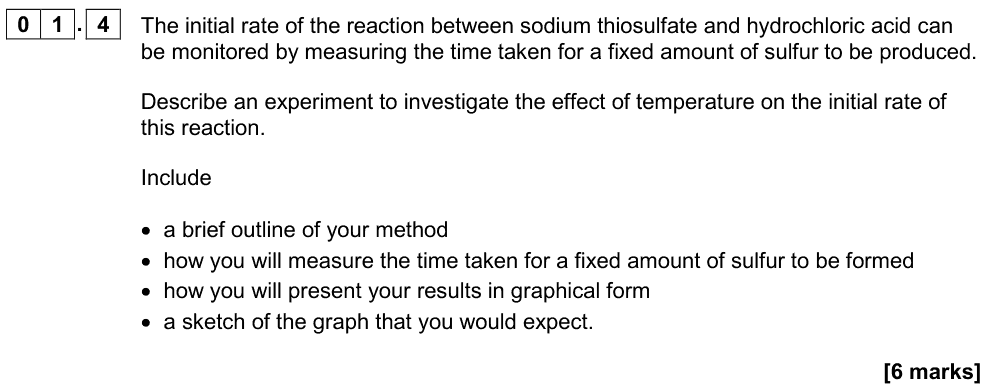
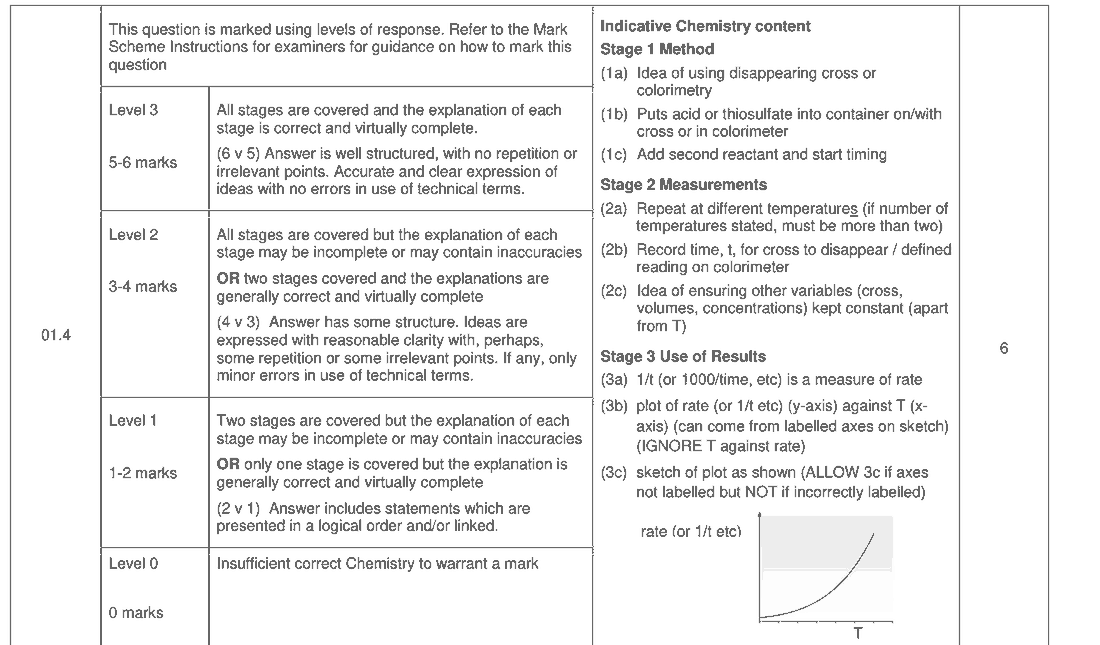
June 2019 · Paper 3 · Q01.4 6 marks 6-mark level of response Hard kinetics
Earlier part of question 01 that this part usesEarlier part of June 2019 Paper 3 question 01
The initial rate of the reaction between sodium thiosulfate and hydrochloric acid can
be monitored by measuring the time taken for a fixed amount of sulfur to be produced.
Describe an experiment to investigate the effect of temperature on the initial rate of
this reaction.
Include
• a brief outline of your method
• how you will measure the time taken for a fixed amount of sulfur to be formed
• how you will present your results in graphical form
• a sketch of the graph that you would expect.
[6 marks]
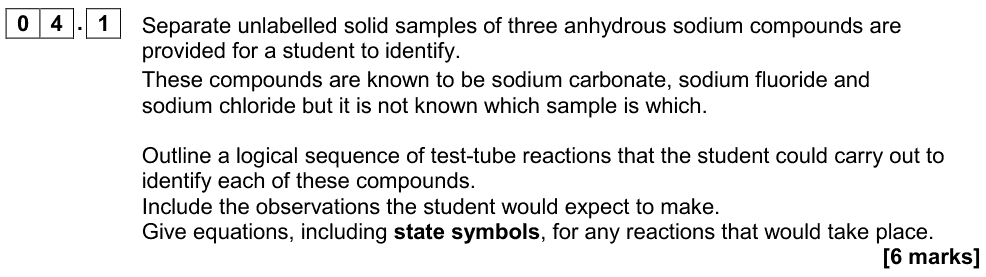
June 2018 · AS Paper 1 · Q04.1 6 marks 6-mark level of response group 7 the halogensamount of substance
Separate unlabelled solid samples of three anhydrous sodium compounds are
provided for a student to identify.
These compounds are known to be sodium carbonate, sodium fluoride and
sodium chloride but it is not known which sample is which.
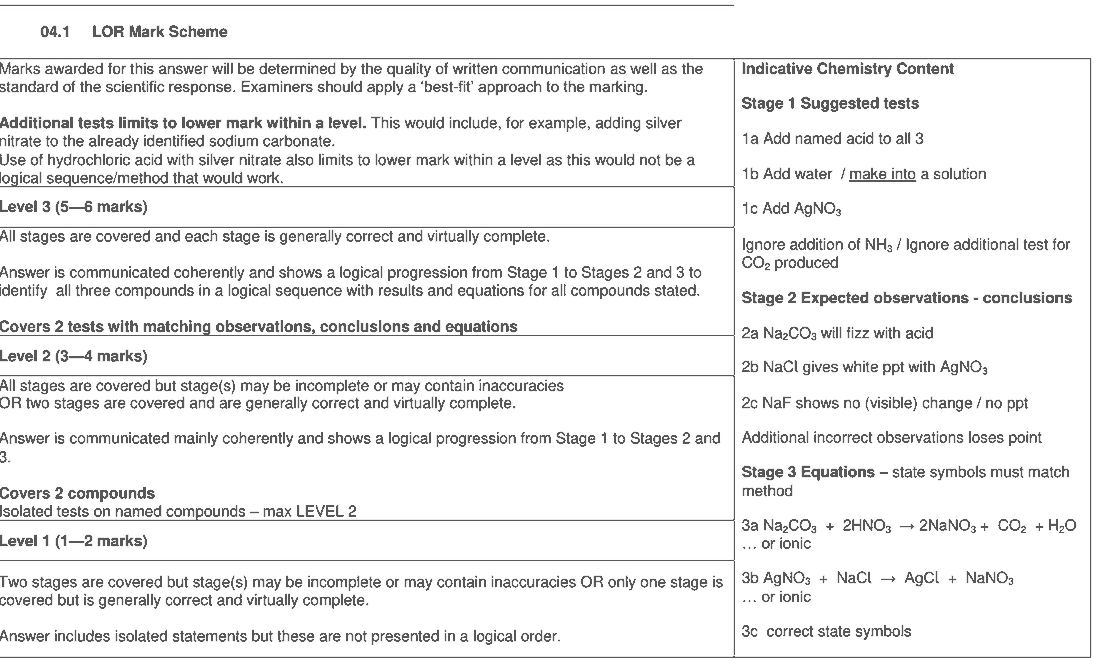
Outline a logical sequence of test-tube reactions that the student could carry out to
identify each of these compounds.
Include the observations the student would expect to make.
Give equations, including state symbols, for any reactions that would take place.
[6 marks]
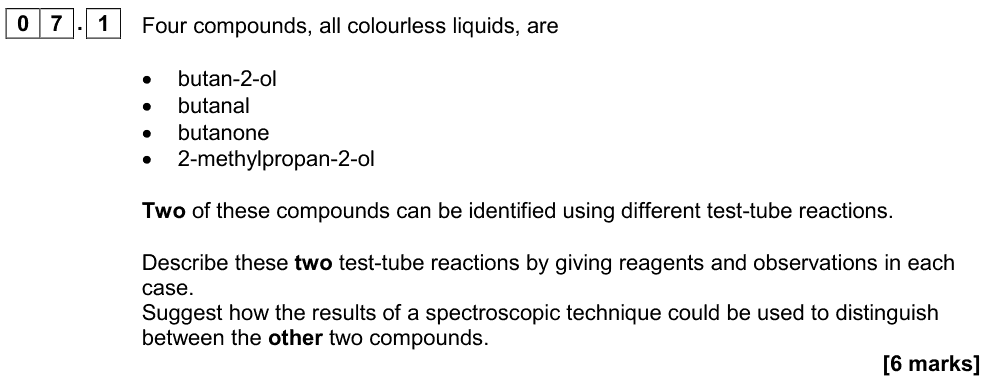
June 2018 · AS Paper 2 · Q07.1 6 marks 6-mark level of response organic analysisalcohols
Four compounds, all colourless liquids, are
•
butan-2-ol
•
butanal
•
butanone
•
2-methylpropan-2-ol
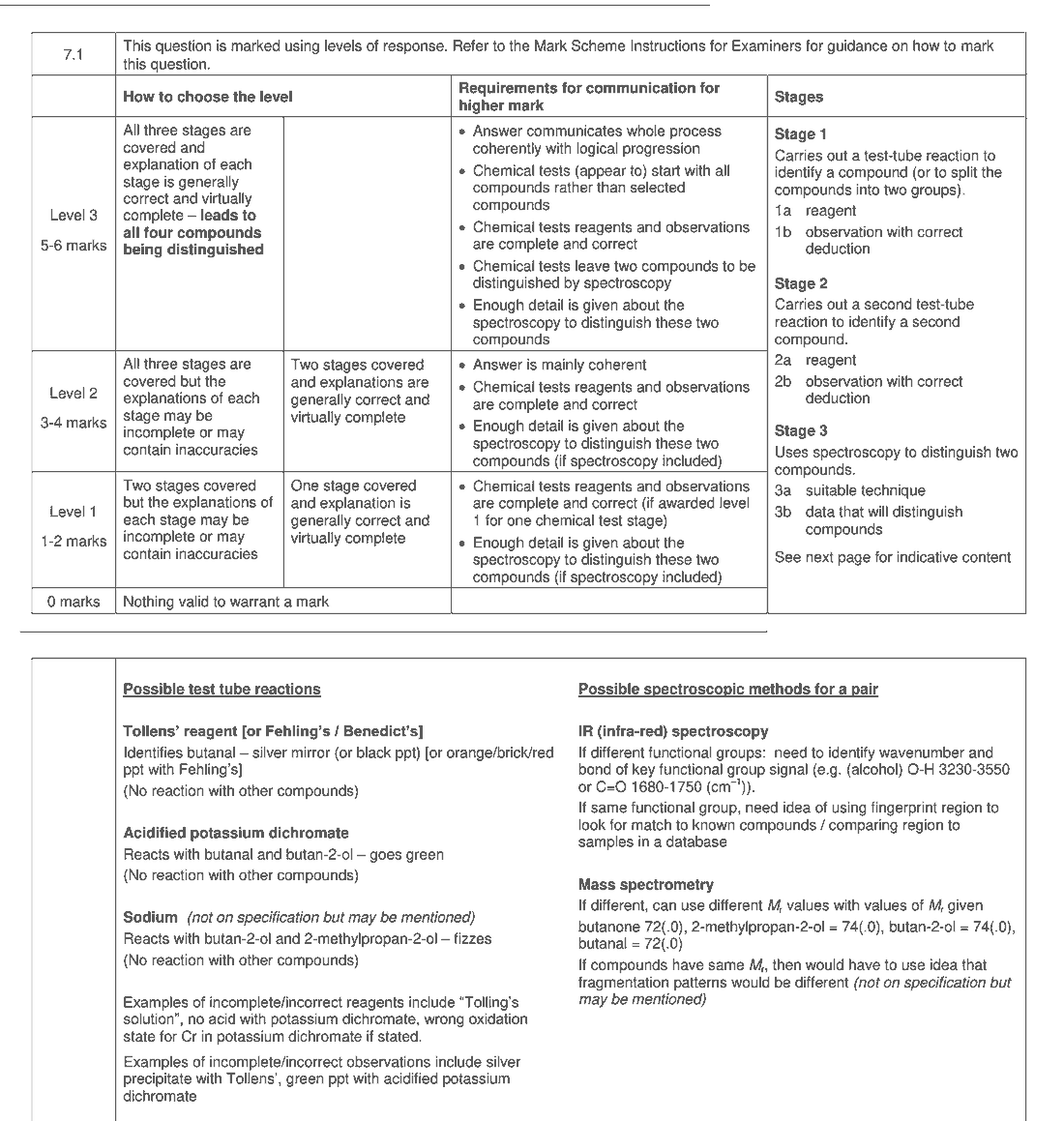
Two of these compounds can be identified using different test-tube reactions.
Describe these two test-tube reactions by giving reagents and observations in each
case.
Suggest how the results of a spectroscopic technique could be used to distinguish
between the other two compounds.
[6 marks]
June 2018 · Paper 1 · Q08.1 6 marks 6-mark level of response Hard bonding
This question is about sodium and some of its compounds.
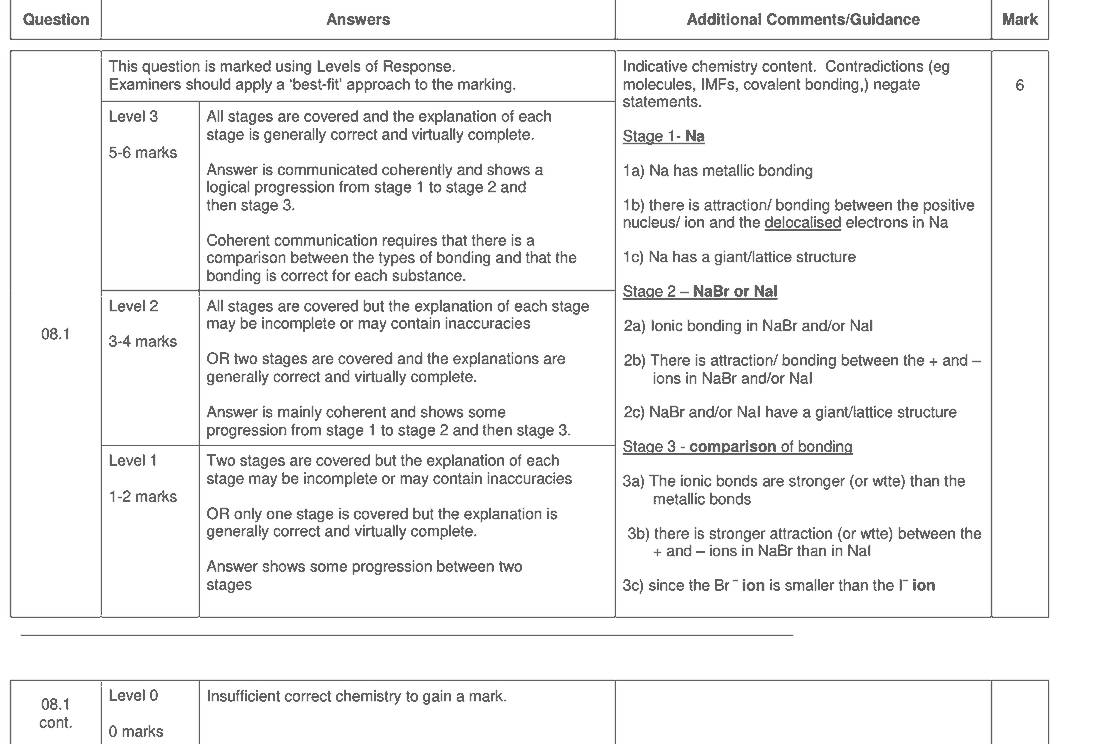
Use your knowledge of structure and bonding to explain why sodium bromide has a
melting point that is higher than that of sodium, and higher than that of sodium iodide.
[6 marks]
June 2018 · Paper 2 · Q06.1 6 marks 6-mark level of response Hard aromatic chemistry
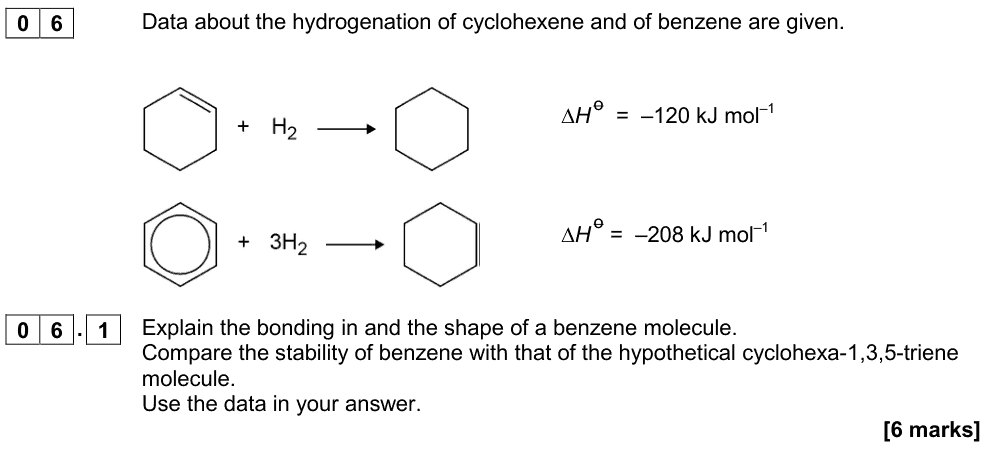
Data about the hydrogenation of cyclohexene and of benzene are given.
∆H o  =  –120 kJ mol–1
∆H o =  –208 kJ mol–1
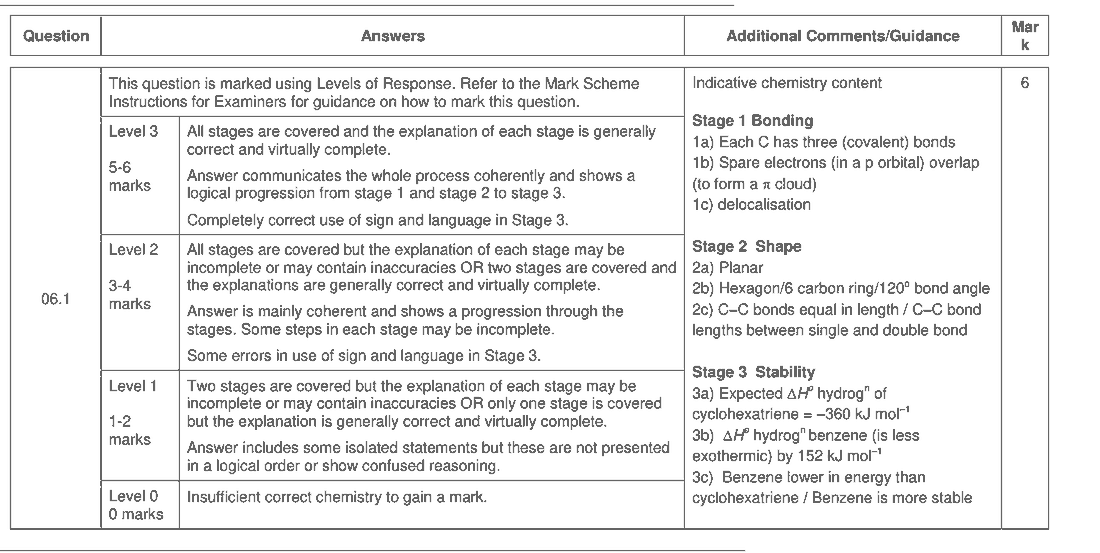
Explain the bonding in and the shape of a benzene molecule.
Compare the stability of benzene with that of the hypothetical cyclohexa-1,3,5-triene
molecule.
Use the data in your answer.
[6 marks]
June 2018 · Paper 3 · Q01.8 6 marks 6-mark level of response rate equations
Earlier part of question 01 that this part usesEarlier part of June 2018 Paper 3 question 01
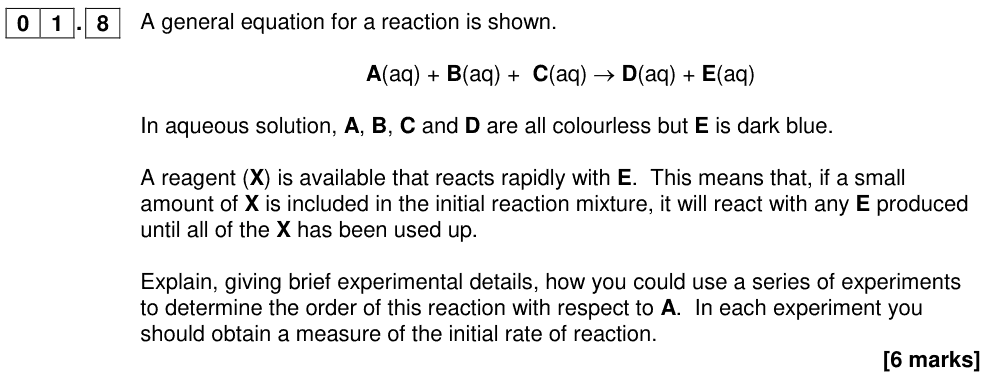
A general equation for a reaction is shown.
A(aq) + B(aq) +  C(aq) → D(aq) + E(aq)
In aqueous solution, A, B, C and D are all colourless but E is dark blue.
A reagent (X) is available that reacts rapidly with E.  This means that, if a small
amount of X is included in the initial reaction mixture, it will react with any E produced
until all of the X has been used up.
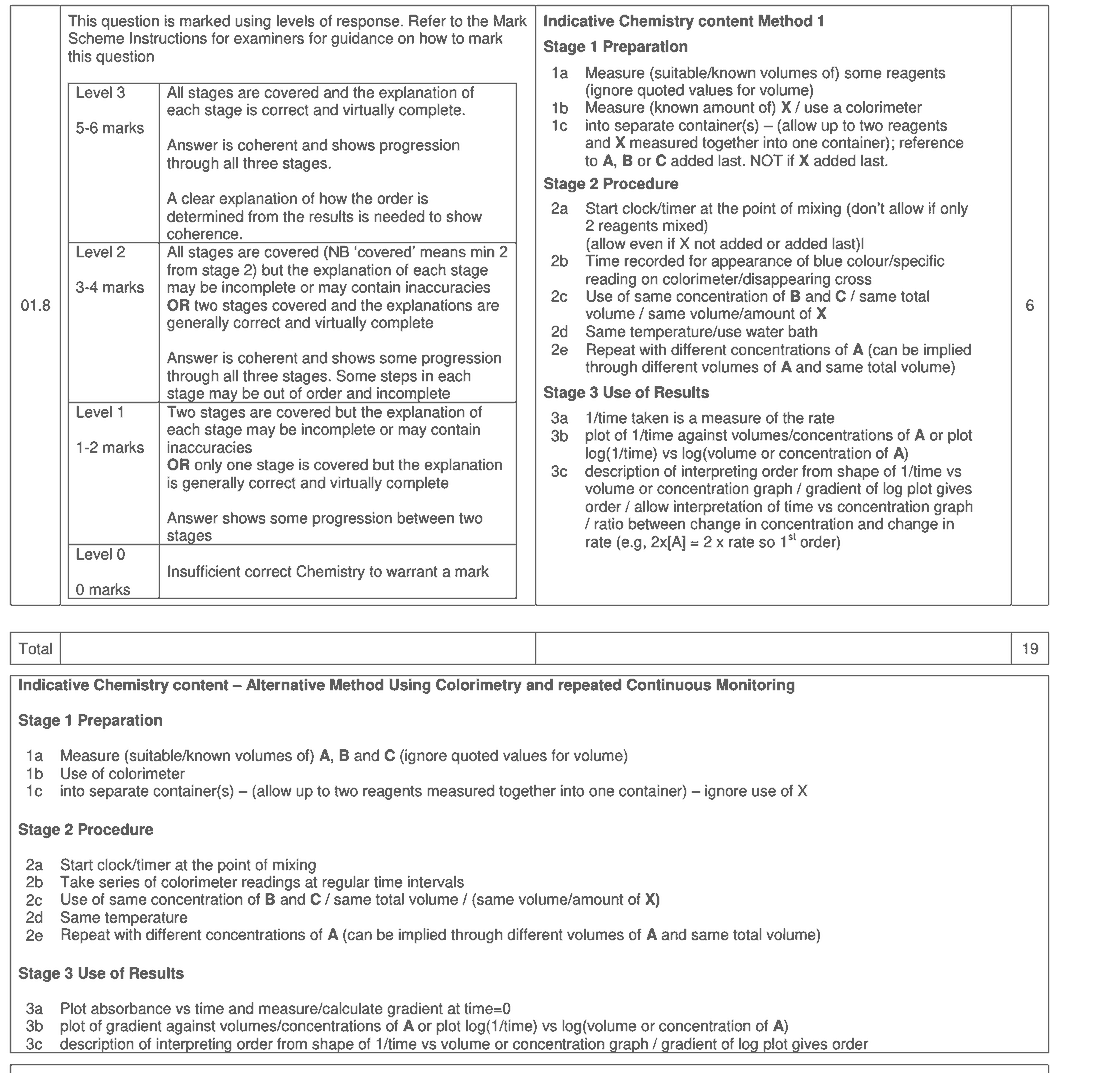
Explain, giving brief experimental details, how you could use a series of experiments
to determine the order of this reaction with respect to A.  In each experiment you
should obtain a measure of the initial rate of reaction.
[6 marks]
June 2017 · AS Paper 1 · Q03.3 6 marks 6-mark level of response energetics
Earlier part of question 03 that this part usesEarlier part of June 2017 Paper 1 question 03
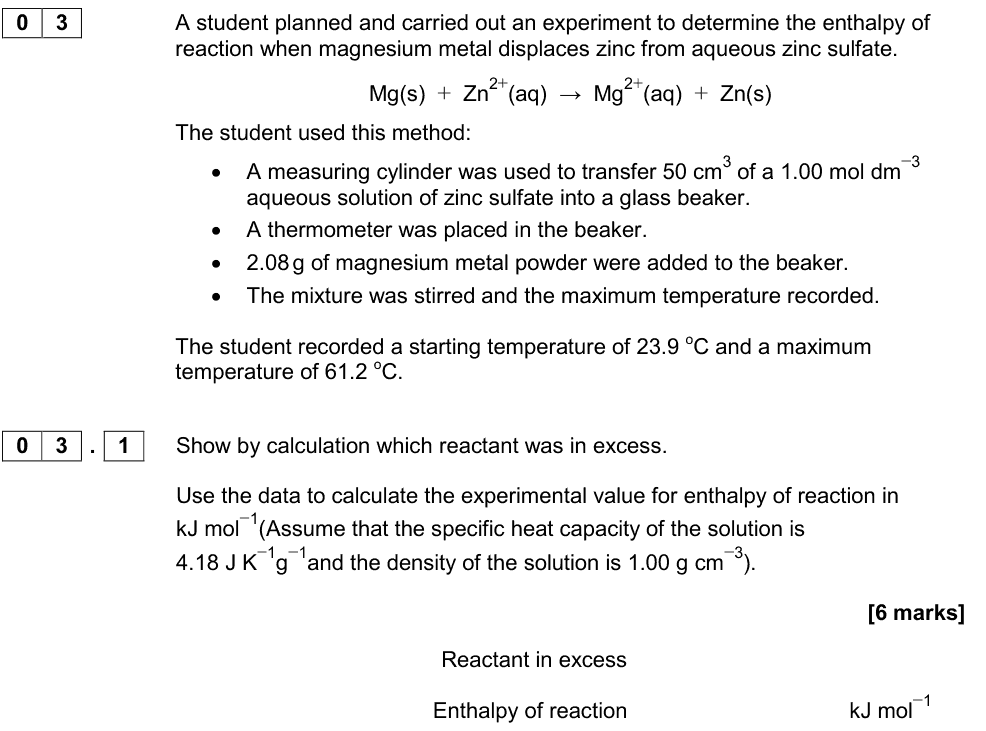
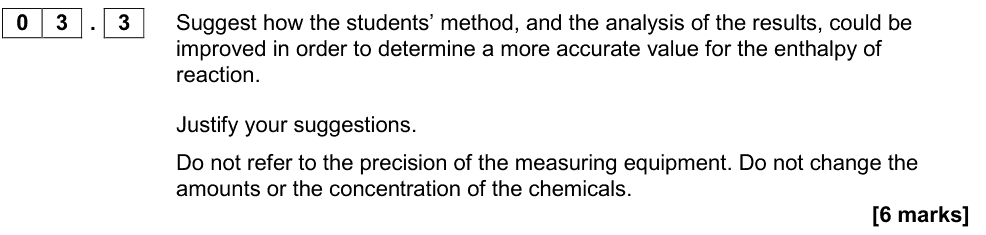
Suggest how the students’ method, and the analysis of the results, could be
improved in order to determine a more accurate value for the enthalpy of
reaction.
Justify your suggestions.
Do not refer to the precision of the measuring equipment. Do not change the
amounts or the concentration of the chemicals.
[6 marks]
June 2017 · AS Paper 2 · Q03.1 6 marks 6-mark level of response introduction to organic chemistryalkenes
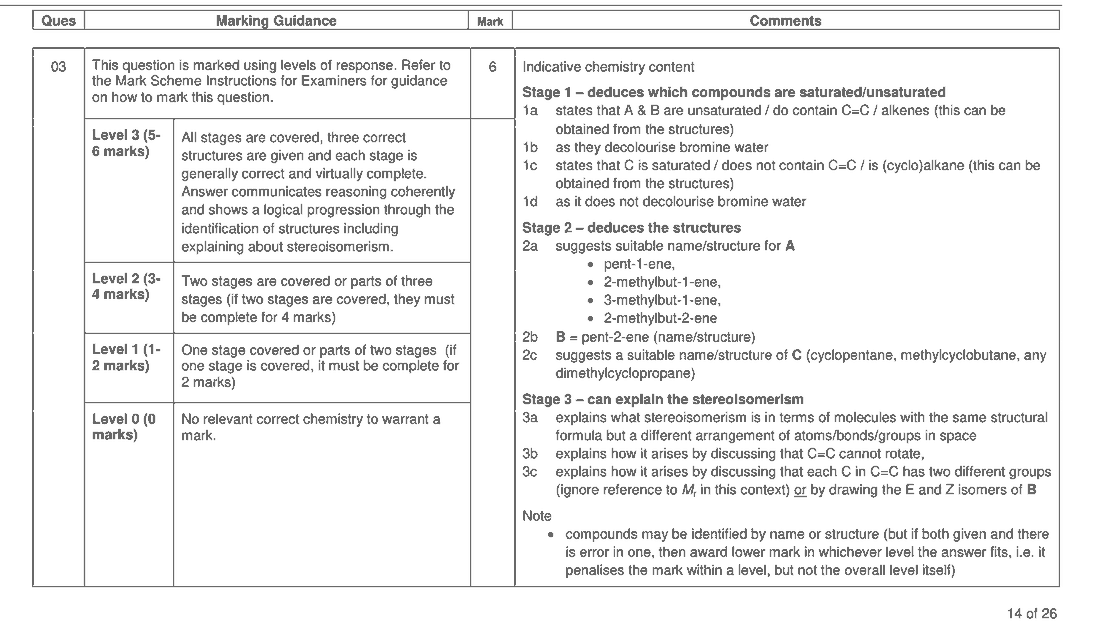
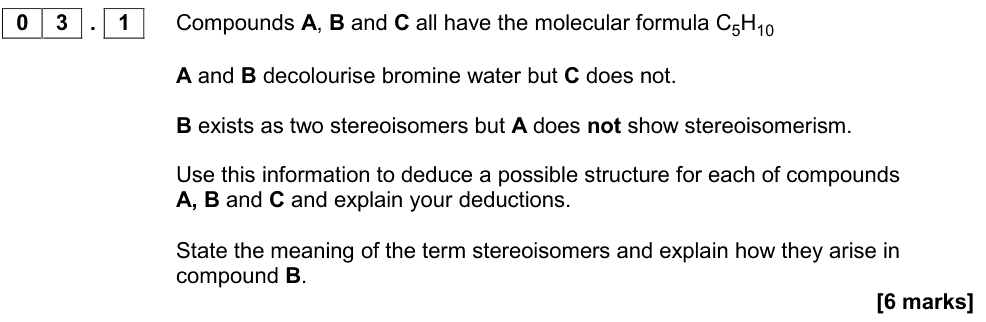
Compounds A, B and C all have the molecular formula C5H10
A and B decolourise bromine water but C does not.
B exists as two stereoisomers but A does not show stereoisomerism.
Use this information to deduce a possible structure for each of compounds
A, B and C and explain your deductions.
State the meaning of the term stereoisomers and explain how they arise in
compound B.
[6 marks]
June 2017 · Paper 1 · Q09.1 6 marks 6-mark level of response chemical equilibria and kc
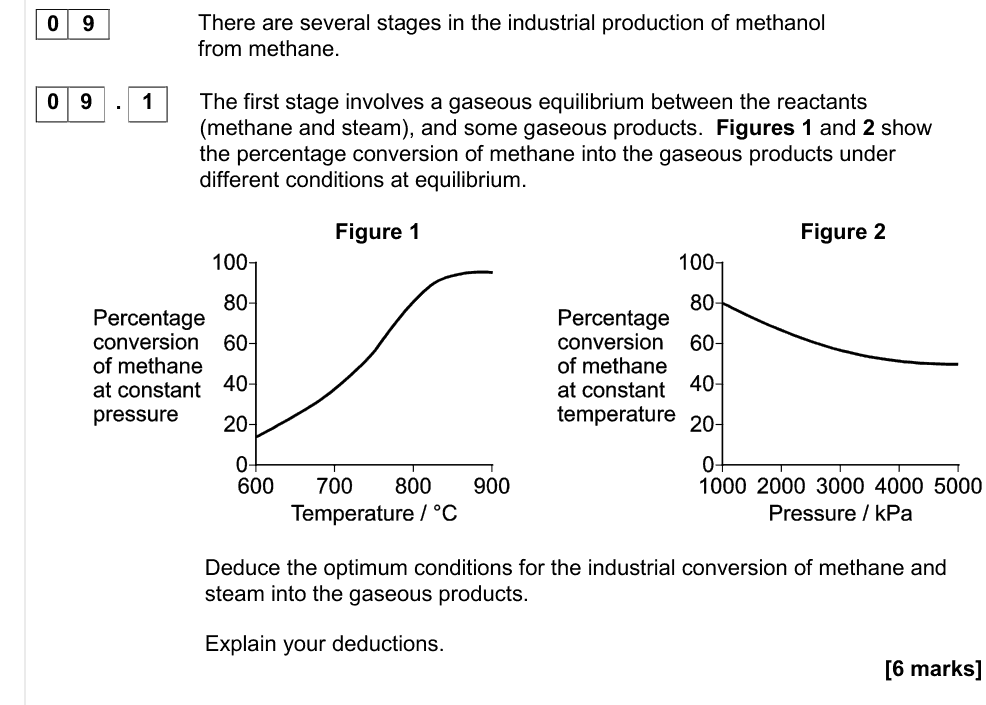
There are several stages in the industrial production of methanol
from methane.
The first stage involves a gaseous equilibrium between the reactants
(methane and steam), and some gaseous products.  Figures 1 and 2 show
the percentage conversion of methane into the gaseous products under
different conditions at equilibrium.
Figure 1                                                              Figure 2
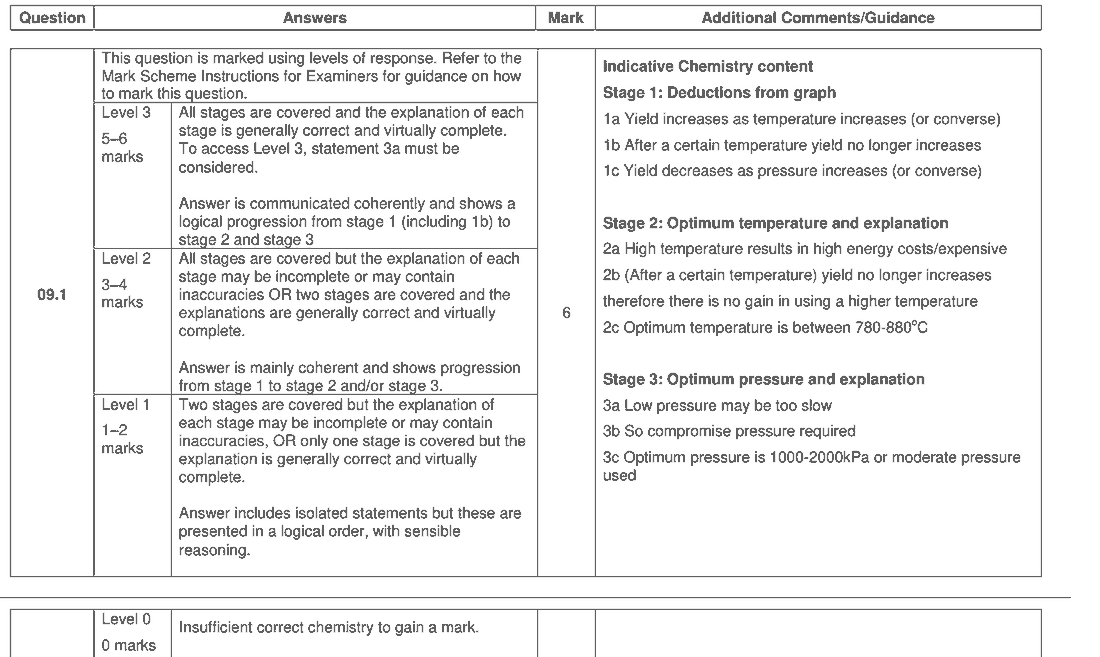
Deduce the optimum conditions for the industrial conversion of methane and
steam into the gaseous products.
Explain your deductions.
[6 marks]
June 2017 · Paper 2 · Q07.1 6 marks 6-mark level of response Hard organic analysisaldehydes and ketonescarboxylic acids and derivatives
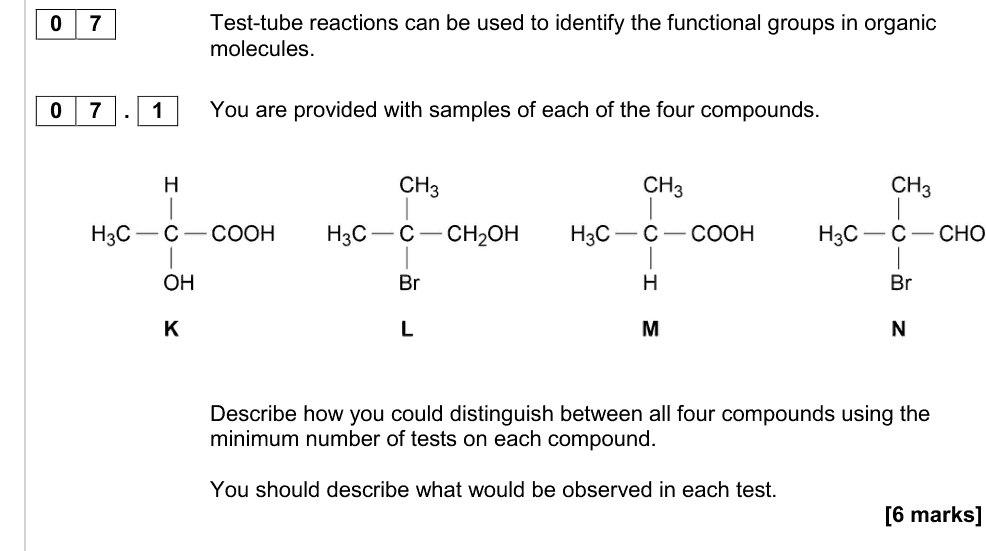
Test-tube reactions can be used to identify the functional groups in organic
molecules.
You are provided with samples of each of the four compounds.
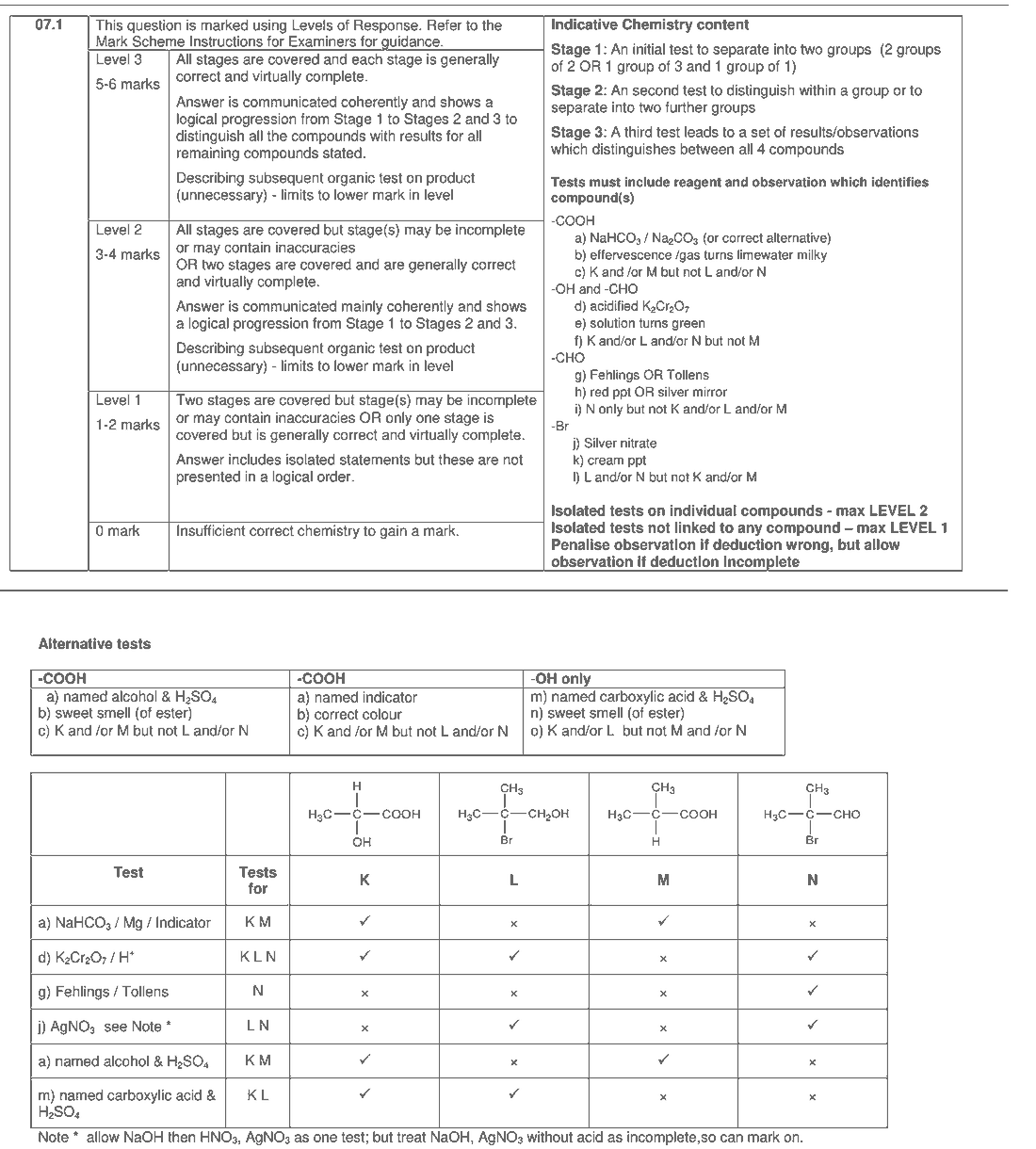
Describe how you could distinguish between all four compounds using the
minimum number of tests on each compound.
You should describe what would be observed in each test.
[6 marks]
June 2017 · Paper 3 · Q01.3 6 marks 6-mark level of response energetics
Earlier part of question 01 that this part usesEarlier part of June 2017 Paper 3 question 01
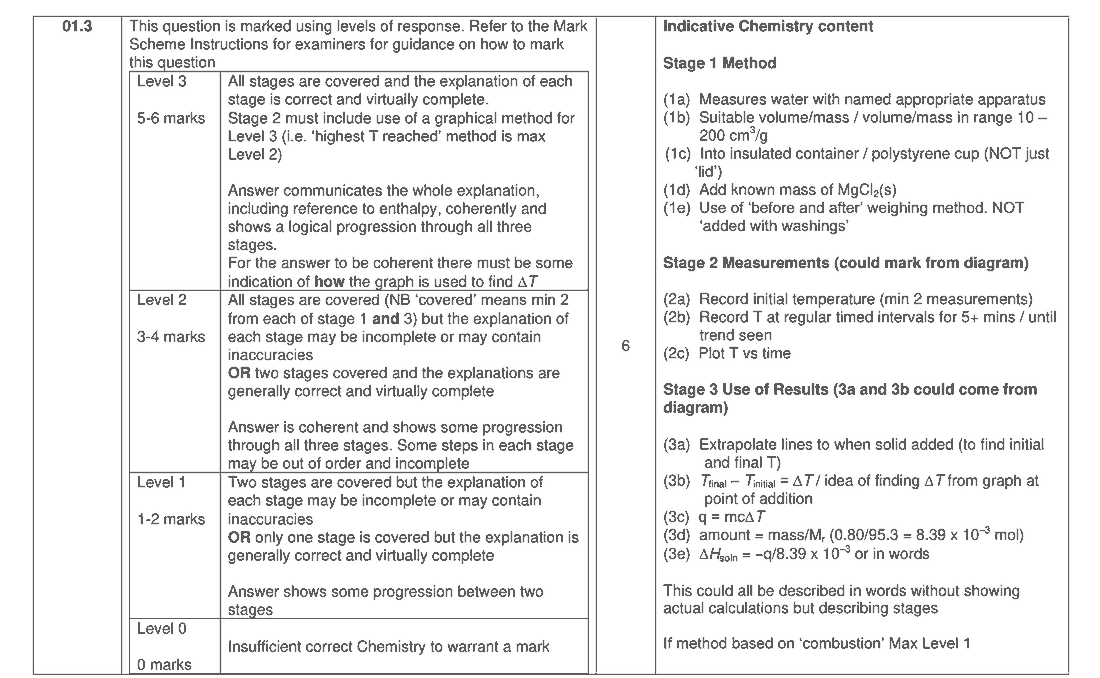
Describe how you would carry out an experiment to determine the enthalpy of solution
of anhydrous magnesium chloride.
You should use about 0.8 g of anhydrous magnesium chloride.
Explain how your results could be used to calculate the enthalpy of solution.
[6 marks]
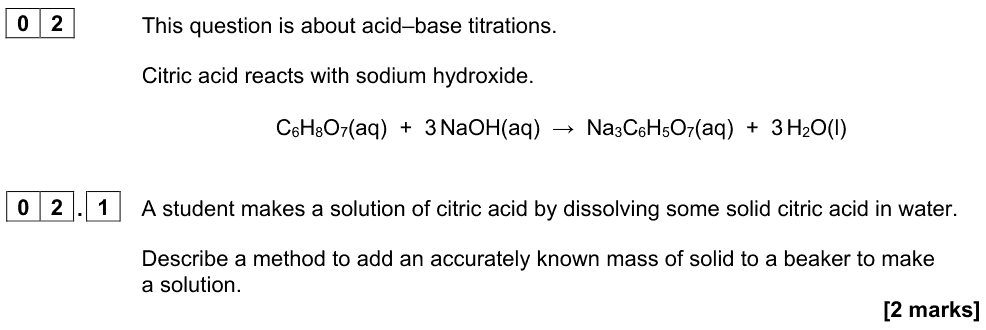
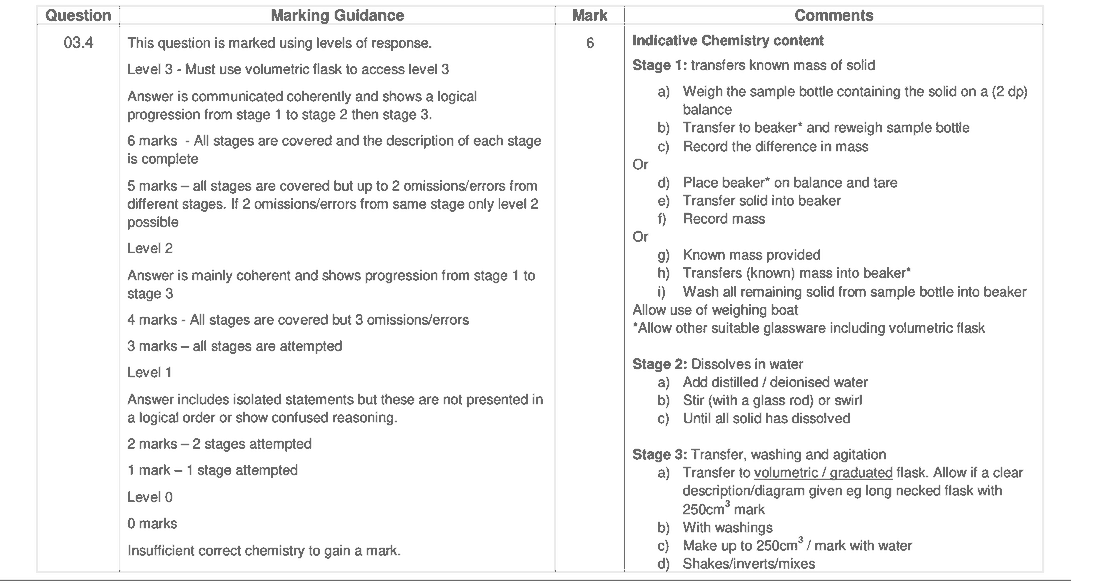
June 2016 · AS Paper 1 · Q03.4 6 marks 6-mark level of response amount of substance
Earlier part of question 03 that this part usesEarlier part of June 2016 Paper 1 question 03
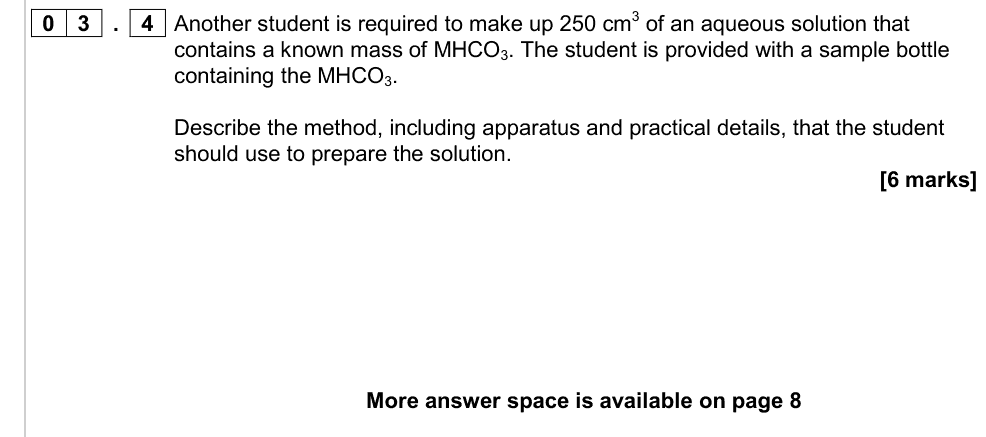
Another student is required to make up 250 cm3 of an aqueous solution that
contains a known mass of MHCO3. The student is provided with a sample bottle
containing the MHCO3.
Describe the method, including apparatus and practical details, that the student
should use to prepare the solution.
[6 marks]
More answer space is available on page 8
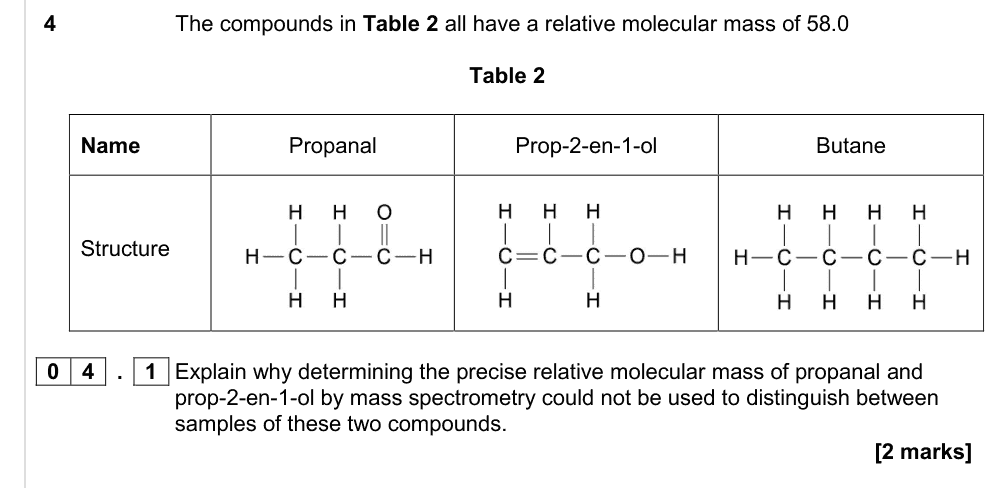
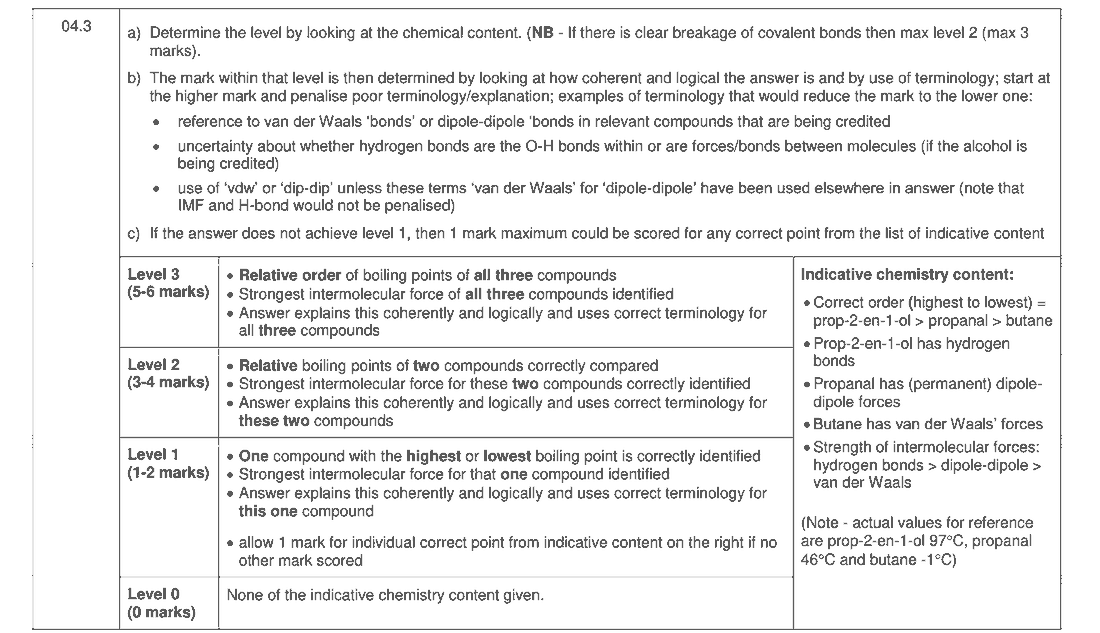
June 2016 · AS Paper 2 · Q04.3 6 marks 6-mark level of response bonding
Earlier part of question 04 that this part usesEarlier part of June 2016 Paper 2 question 04
Predict the relative boiling points of these three compounds from the highest to
the lowest boiling points.
Justify this order in terms of intermolecular forces.
[6 marks]
Specimen · Paper 1 · Q01.1 6 marks 6-mark level of response bonding
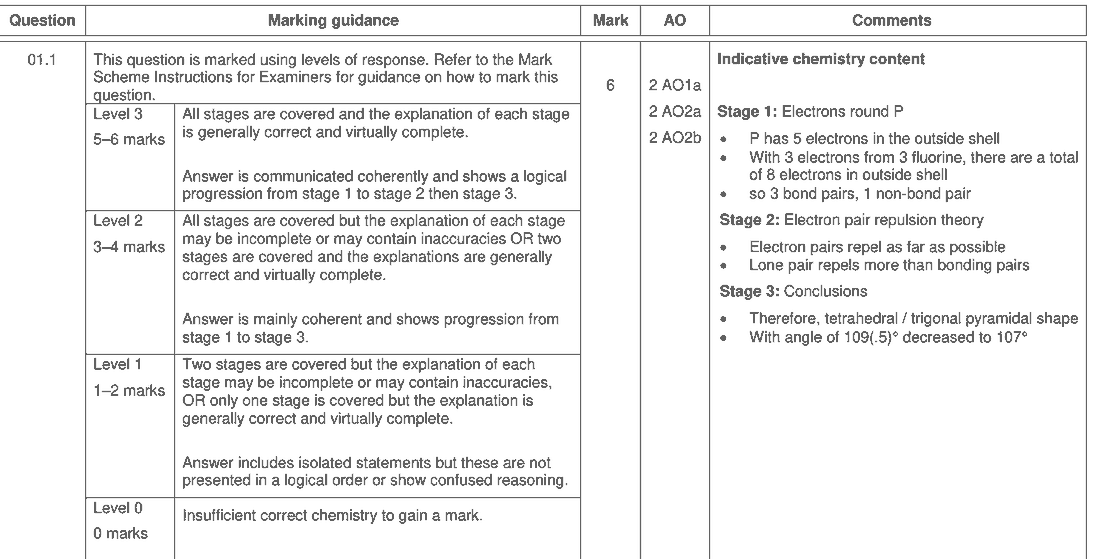
Explain how the electron pair repulsion theory can be used to deduce the shape of,
and the bond angle in, PF3
[6 marks]
Specimen · Paper 2 · Q11.2 6 marks 6-mark level of response optical isomerismaldehydes and ketones
Earlier part of question 11 that this part usesEarlier part of Specimen Paper 2 question 11
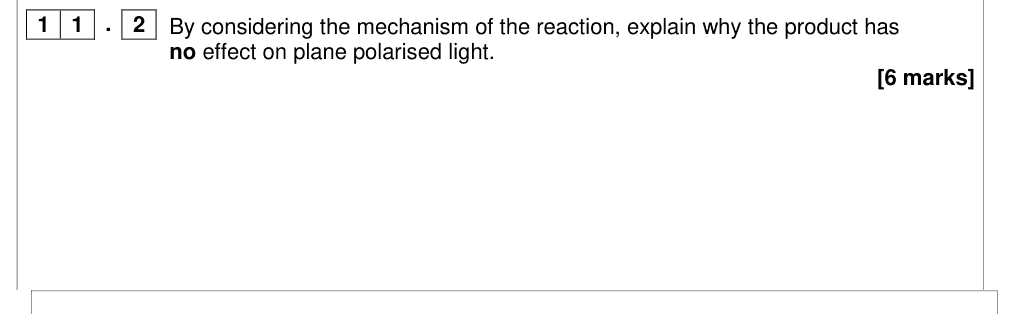
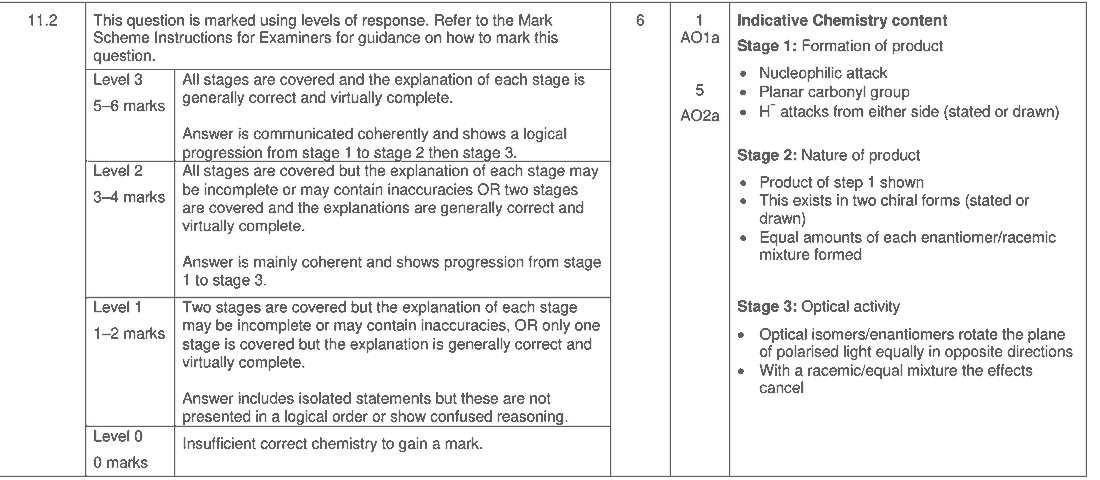
By considering the mechanism of the reaction, explain why the product has
no effect on plane polarised light.
[6 marks]
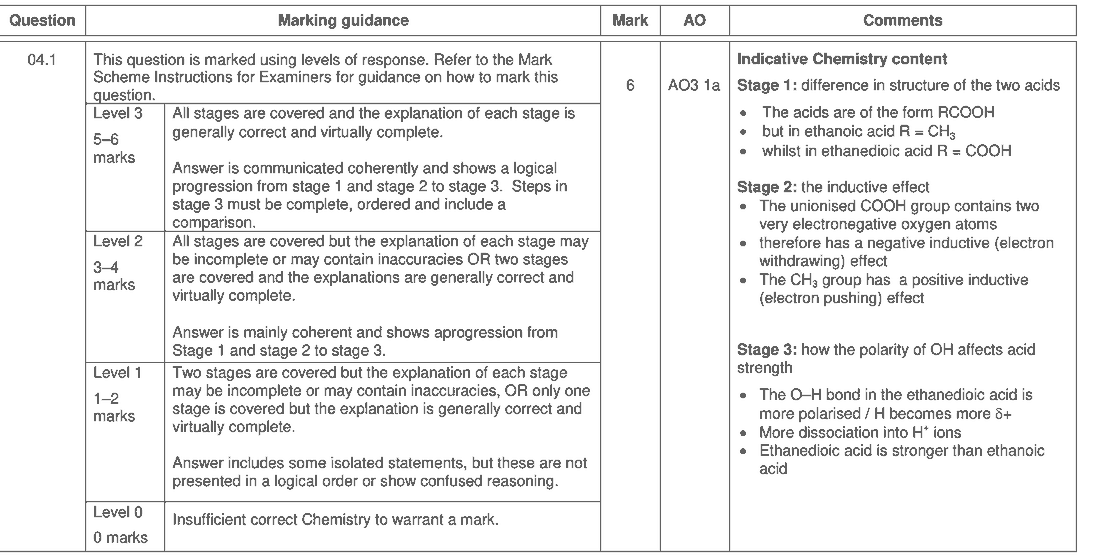
Specimen · Paper 3 · Q04.1 6 marks AO3=6 6-mark level of response acids and basesbonding
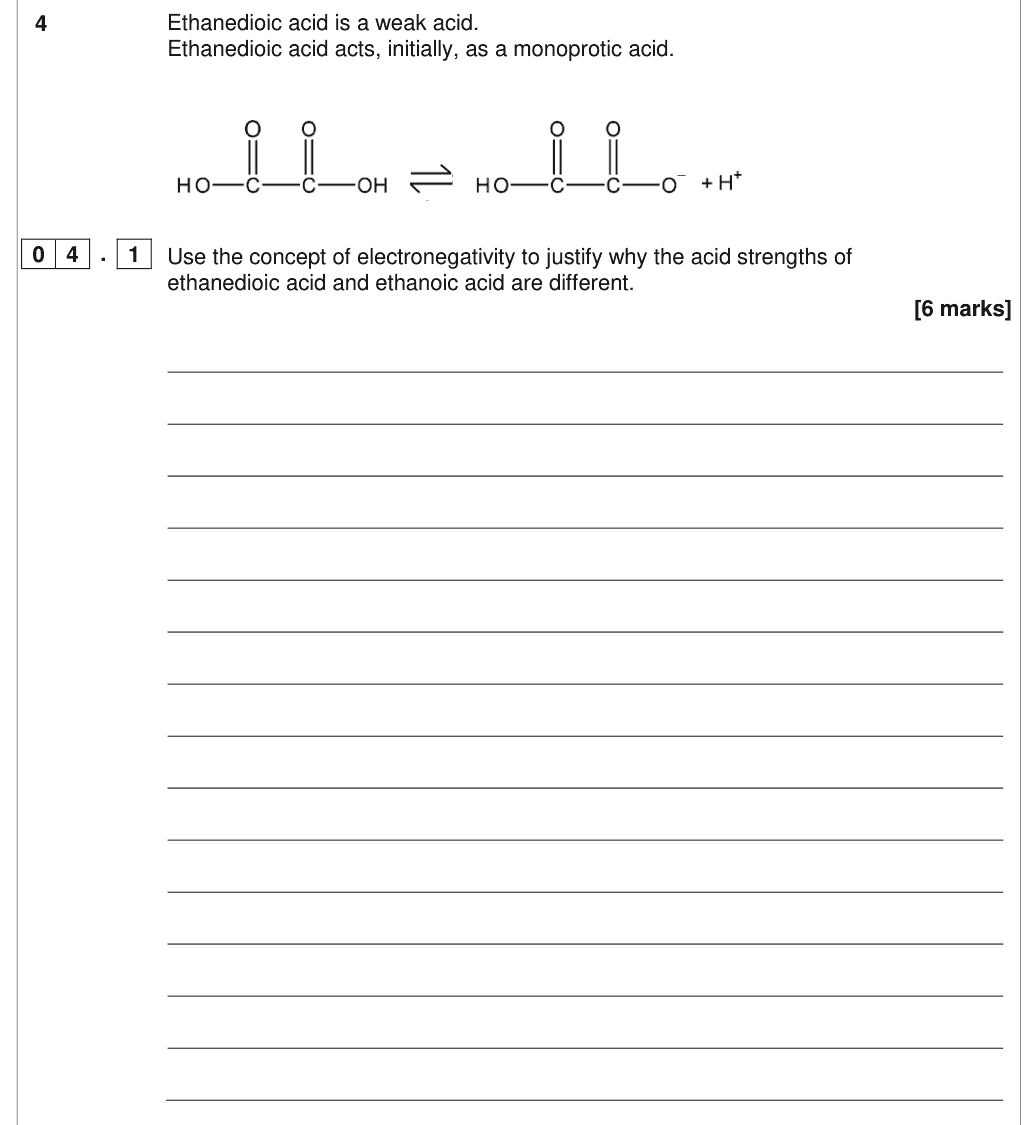
Ethanedioic acid is a weak acid.
Ethanedioic acid acts, initially, as a monoprotic acid.
Use the concept of electronegativity to justify why the acid strengths of
ethanedioic acid and ethanoic acid are different.
[6 marks]
–

Work with an A-level chemistry tutor

Dropping marks on calculations, mechanisms or the required practicals? Book a trial session with a specialist A-level chemistry tutor.

Prefer email? Send an enquiry

If you are under 18, please include a parent's contact details. Enquiries go to enquiries@chemistryaleveltutor.com and are deleted once handled. All tutoring is online.