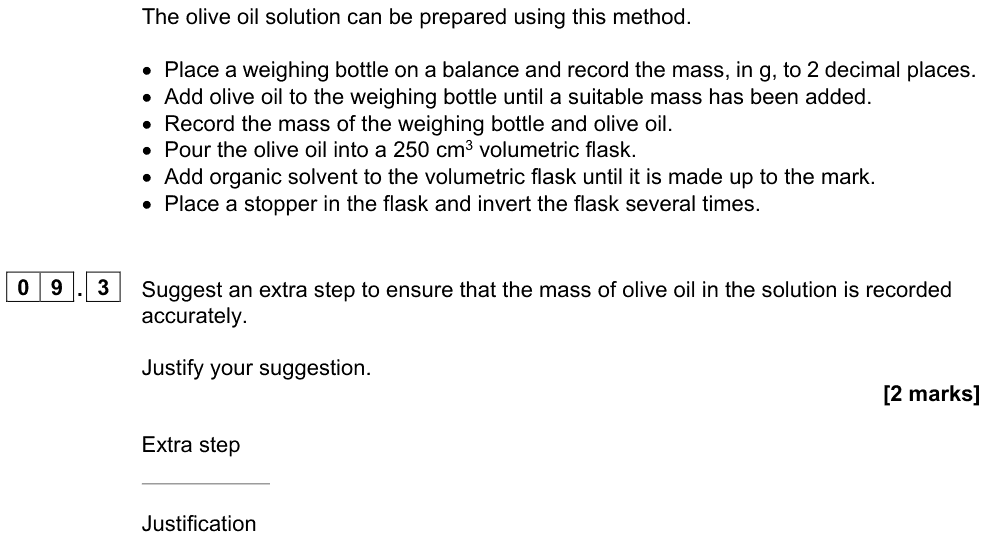
3.1.1.1-01 Appreciate that knowledge and understanding of atomic structure has evolved over time.
3.1.1.1-02 Protons, neutrons and electrons: relative charge and relative mass.
3.1.1.1-03 An atom consists of a nucleus containing protons and neutrons surrounded by electrons.
3.1.1.2-01 Mass number (A) and atomic (proton) number (Z).
3.1.1.2-02 Students should be able to: • determine the number of fundamental particles in atoms and ions using mass number, atomic number and charge • explain the existence of isotopes.
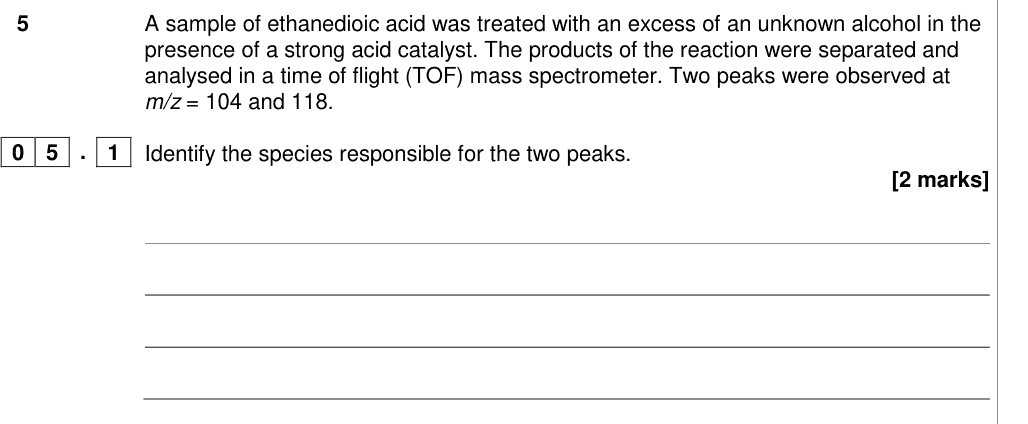
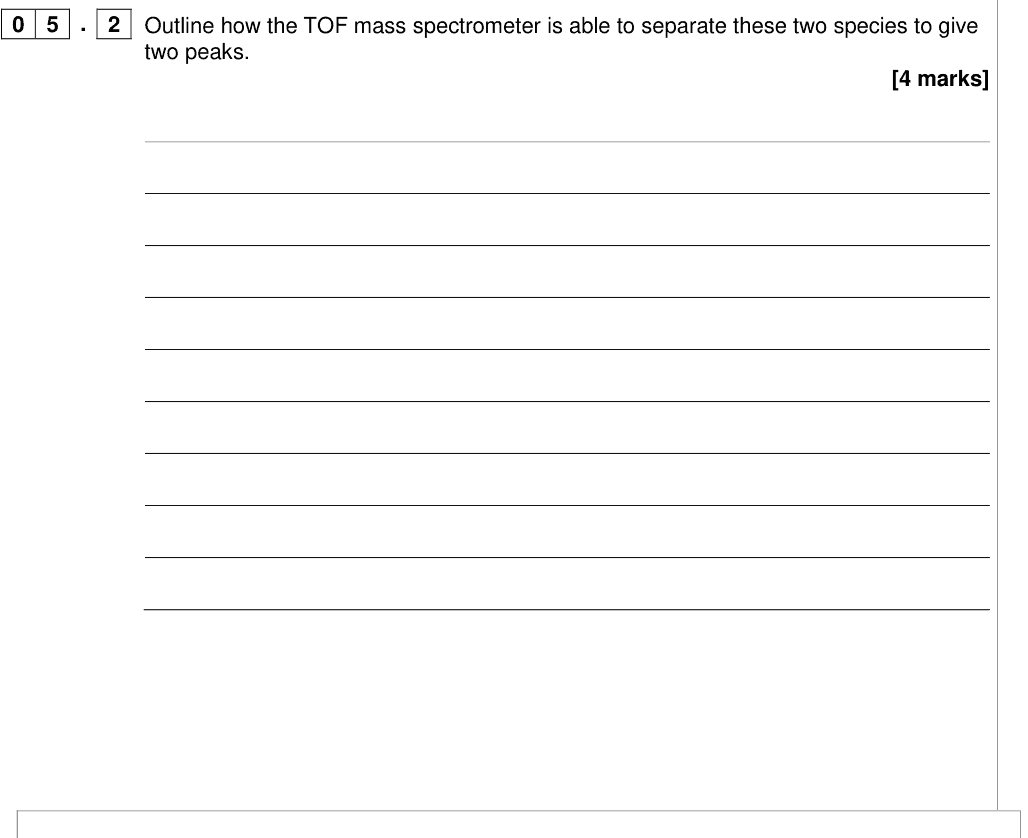
3.1.1.2-03 The principles of a simple time of flight (TOF) mass spectrometer, limited to ionisation, acceleration to give all ions constant kinetic energy, ion drift, ion detection, data analysis.
3.1.1.2-04 The mass spectrometer gives accurate information about relative isotopic mass and also about the relative abundance of isotopes.
3.1.1.2-05 Mass spectrometry can be used to identify elements.
3.1.1.2-06 Mass spectrometry can be used to determine relative molecular mass.
3.1.1.2-07 Students should be able to: • interpret simple mass spectra of elements • calculate relative atomic mass from isotopic abundance, limited to mononuclear ions.
3.1.1.3-01 Electron configurations of atoms and ions up to Z = 36 in terms of shells and sub-shells (orbitals) s, p and d.
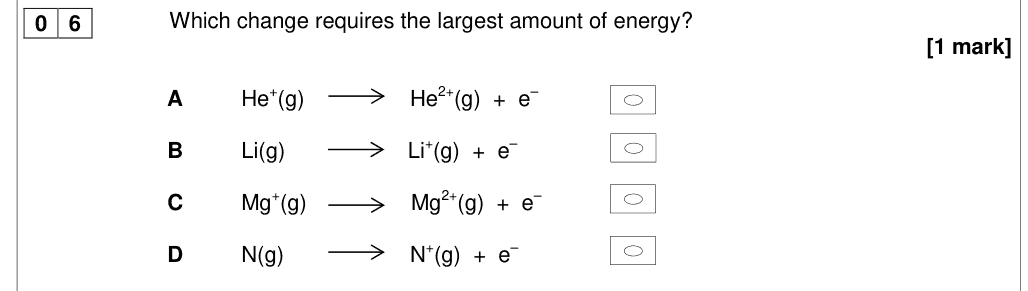
3.1.1.3-02 Ionisation energies.
3.1.1.3-03 Students should be able to: • define first ionisation energy • write equations for first and successive ionisation energies • explain how first and successive ionisation energies in Period 3 (Na–Ar) and in Group 2 (Be–Ba) give evidence for electron configuration in sub-shells and in shells.
Six-mark level of response questions on this topic
Tap a question to zoom it. Where a part needs a figure, table or structure from earlier in the question, that part folds out above it; the mark scheme and examiner's comment open underneath. Have AQA's Data Booklet (the Periodic Table and the spectroscopy tables) beside you.
June 2025 · Paper 1 · Q02.21 markAO1=1Equation writing
Earlier part of question 02 that this part uses
Mark scheme
Examiner's comment
Part 2 was well answered by the majority of students.
June 2025 · Paper 1 · Q02.31 markAO3=1Short answerHard
Earlier part of question 02 that this part uses
Mark scheme
Examiner's comment
In part 3, about one third of students correctly identified magnesium; argon, aluminium or silicon were common incorrect answers.
Notes from the mark scheme and report
Answer: magnesium. Its second electron is removed from 3s with the lowest nuclear charge of the elements losing a second outer-shell electron
sodium's second electron comes from the inner 2p level. Common wrong answers: argon, aluminium, silicon
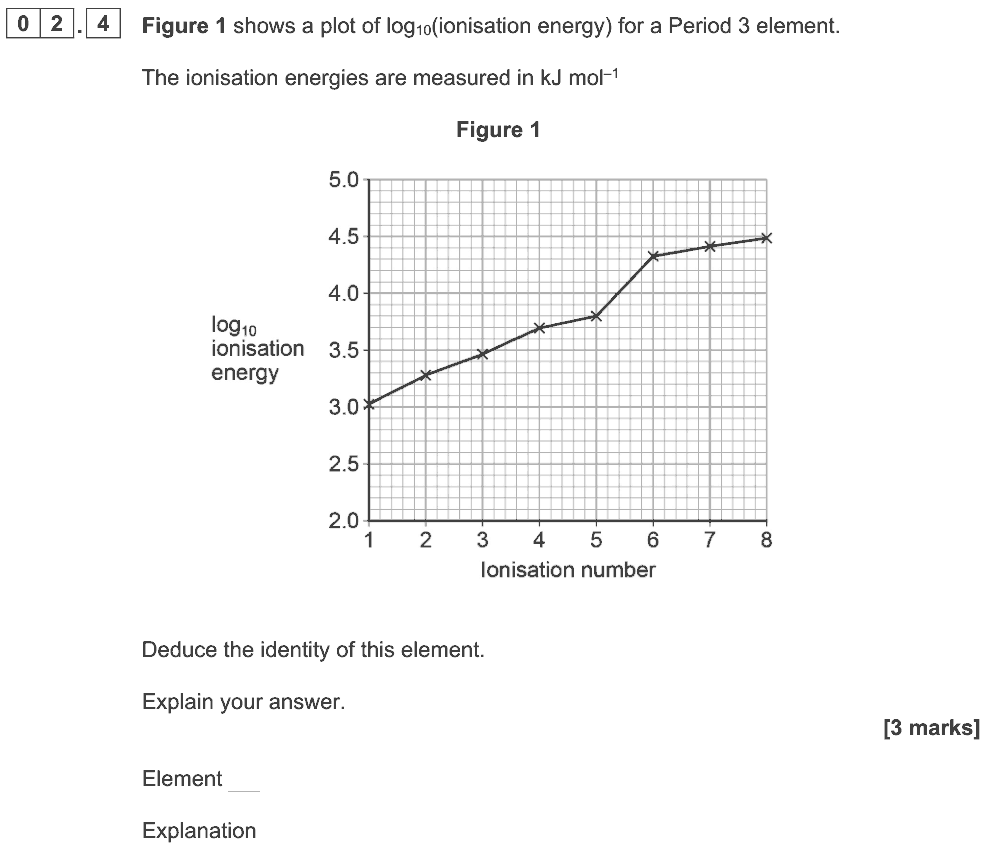
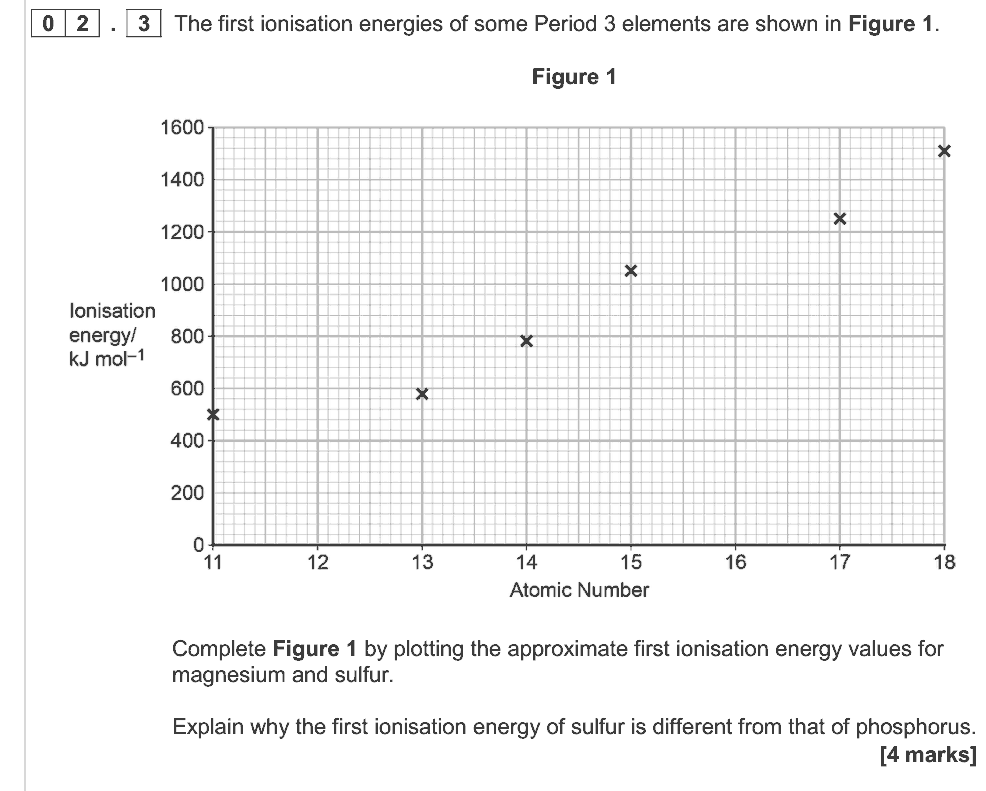
June 2025 · Paper 1 · Q02.43 marksAO1=2, AO2=1Explanation
Earlier part of question 02 that this part uses
Mark scheme
Examiner's comment
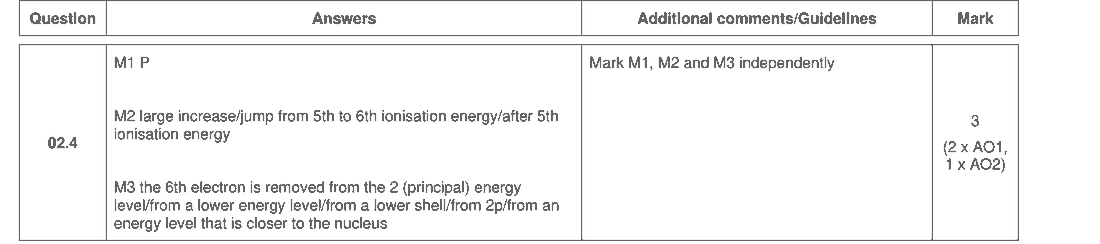
Phosphorus was regularly identified in part 4 and most students recognised the jump in ionisation energy from 5 → 6; many students did not explain that a jump in the ionisation energy meant that an electron was being removed from an inner energy level.
About half the
Notes from the mark scheme and report
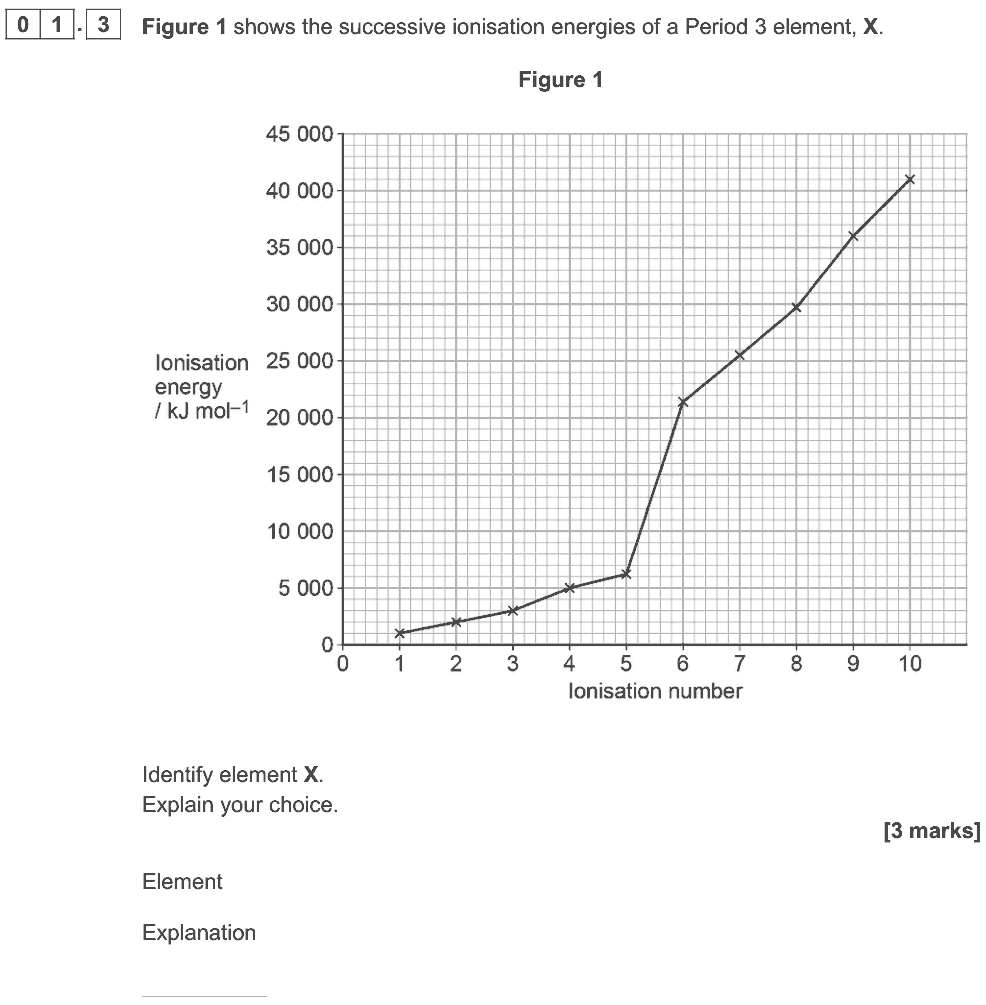
Phosphorus
there is a large jump after the fifth ionisation energy (from 5th to 6th)
the sixth electron is removed from a lower energy level (2p), closer to the nucleus. Three independent marks. Many did not say the jump means removal from an inner energy level
Skills: MS3.1 Translate information between graphical, numerical and algebraic forms
June 2025 · Paper 1 · Q02.51 markAO3=1Calculation
Earlier parts of question 02 that this part uses
Mark scheme
Examiner's comment
students scored the mark in part 5; common incorrect answers included log 3.5 = 0.54 and 3.16 × 10⁻⁴.
Notes from the mark scheme and report
Answer: about 2900 kJ mol–1 (any value from 2500 to 3200). Read log10(IE) of about 3.45 for the third ionisation and take 10^3.45. Common wrong answers: log 3.5 = 0.54 and 3.16 × 10^–4. Uses Figure 1 from 02.4
Skills: MS0.4 Use calculators to find and use power, exponential and logarithmic functions; MS2.5 Use logarithms in relation to quantities that range over several orders of magnitude; MS3.1 Translate information between graphical, numerical and algebraic forms
June 2025 · AS Paper 1 · Q03.11 markAO1=1Short answer
Mark scheme
Examiner's comment
3.1 This question was well answered with students correctly giving the full electron configuration of a fluoride ion.
Notes from the mark scheme and report
1s2 2s2 2p6
June 2025 · Paper 1 · Q03.11 markAO3=1Short answerEasy
Mark scheme
Examiner's comment
Just over 60% of students answered part 1 correctly.
Notes from the mark scheme and report
Answer: 1. Cu2+ is [Ar] 3d9, so four d orbitals are full and one holds a single electron
June 2025 · AS Paper 1 · Q03.21 markAO2=1Short answer
Earlier part of question 03 that this part uses
Mark scheme
Examiner's comment
3.2 This question was well answered with students correctly identifying Q. However, some students suggested other elements such as Sc or V or Co as the identity rather than Mn
Notes from the mark scheme and report
Mn (manganese): the atom is 3d5 4s2 and loses the two 4s electrons. Wrong answers included Sc, V and Co
June 2025 · AS Paper 1 · Q03.43 marksAO1=3Short answer
Earlier part of question 03 that this part uses
Mark scheme
Examiner's comment
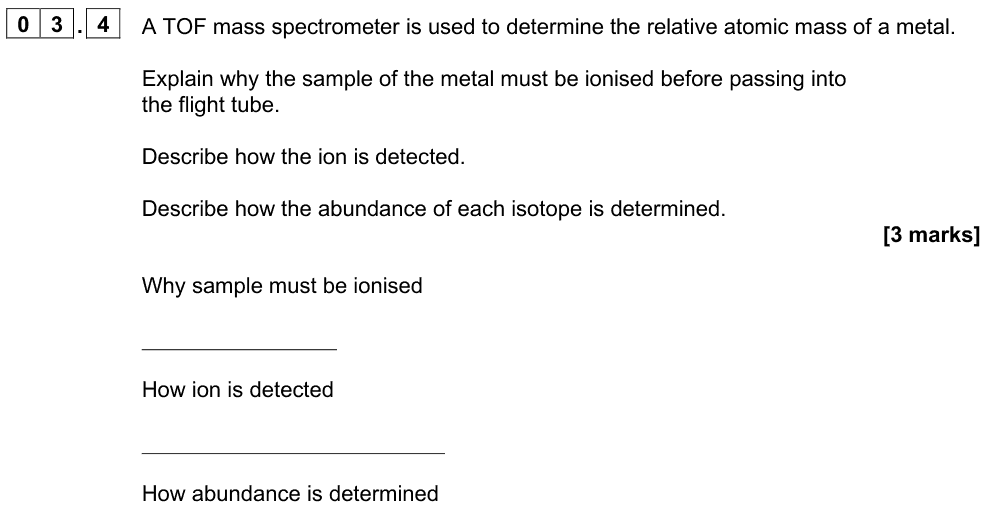
3.4 This question asked about the principles of a TOF mass spectrometer. Students were not always precise in their language. Students need to state that each ion gains an electron when it is detected and many did not clearly state that the abundance of each ion is proportional the to current.
Notes from the mark scheme and report
Ionised so that it can be accelerated (or detected). Detection: each ion hits the negative detector plate and gains an electron. Abundance: the current produced is proportional to the abundance. Answers were imprecise about the ion gaining an electron and about the current being proportional to abundance
June 2025 · AS Paper 1 · Q03.51 markAO3=1Short answer
Earlier part of question 03 that this part uses
Mark scheme
Examiner's comment
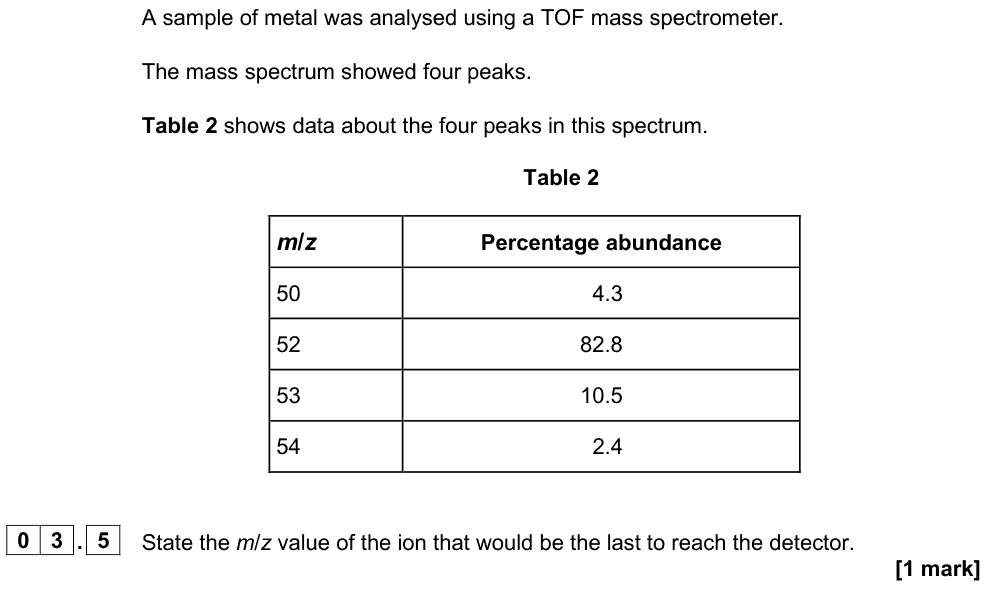
3.5 Students often suggested that the ion that would be last to reach the detector was that with the highest abundance rather than the heaviest ion.
Notes from the mark scheme and report
Answer: 54. All ions have the same kinetic energy, so the heaviest ion is slowest. Common error: choosing the most abundant ion (52)
June 2025 · AS Paper 1 · Q03.62 marksAO2=2Calculation
Earlier part of question 03 that this part uses
Mark scheme
Examiner's comment
3.6 Students were asked to calculate the relative atomic mass of a sample of metal. This was well answered, although some students just averaged the mass numbers rather than calculating the average mass.
Notes from the mark scheme and report
Answer: 52.1 (must be 1 decimal place). [(50 × 4.3) + (52 × 82.8) + (53 × 10.5) + (54 × 2.4)] ÷ 100. Uses Table 2 printed in 03.5. Error: averaging the four mass numbers
Skills: MS1.1 Use an appropriate number of significant figures; MS1.2 Find arithmetic means
June 2025 · AS Paper 1 · Q03.73 marksAO2=3Calculation
Earlier part of question 03 that this part uses
Mark scheme
Examiner's comment
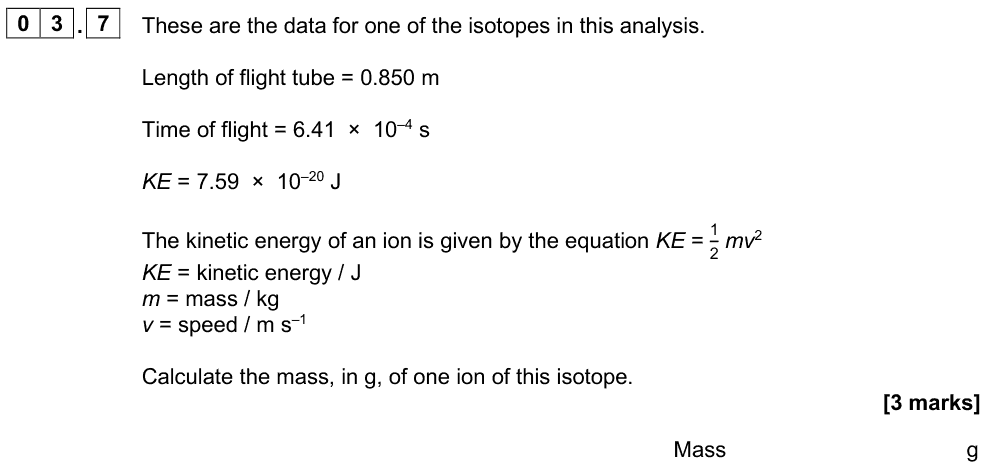
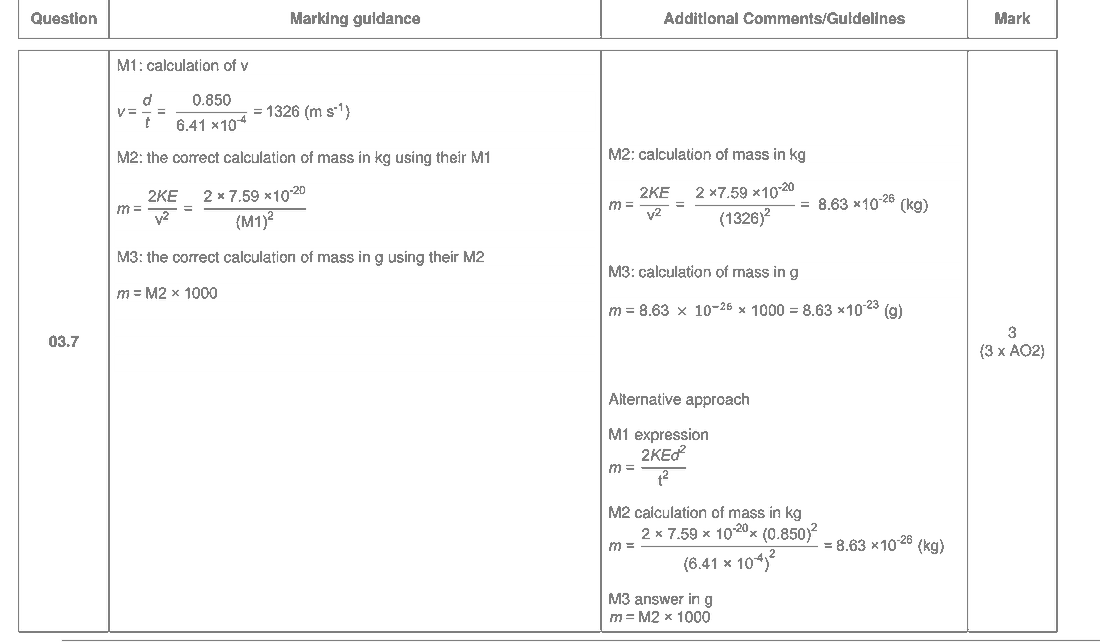
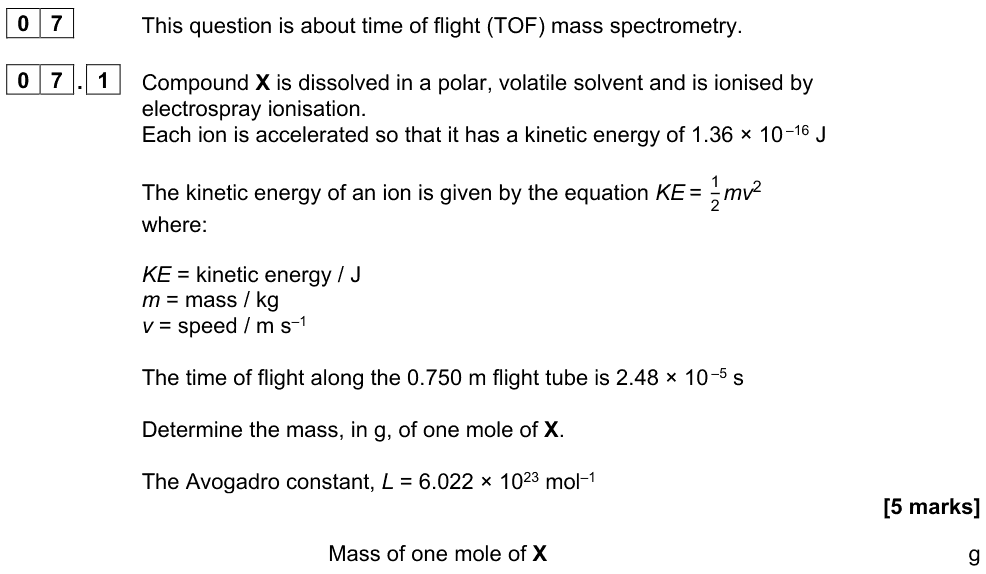
3.7 Students were asked to calculate the mas of one ion of an isotope using some data from time of flight mass spectrometry. The majority of students made good progress with this more challenging calculation. However, some students did not square their velocity whilst others did not convert the mass generated from using the expression KE = ½ mv2 into grams.
Notes from the mark scheme and report
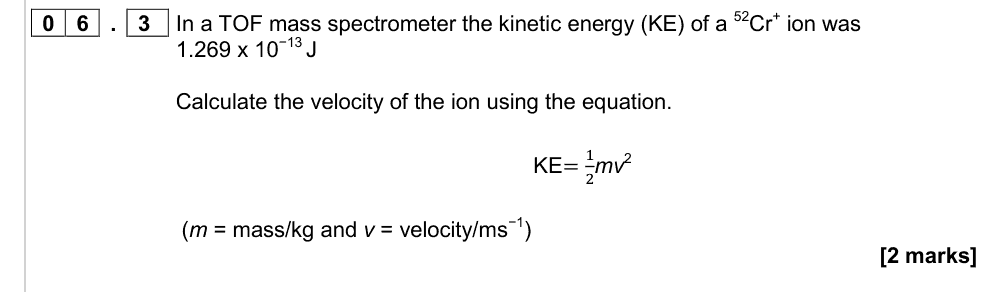
Answer: 8.63 × 10^–23 g. v = d ÷ t = 0.850 ÷ (6.41 × 10^–4) = 1326 m s–1
m = 2KE ÷ v² = 8.63 × 10^–26 kg
× 1000. Errors: not squaring the velocity
leaving the mass in kg
Skills: MS0.0 Recognise and make use of appropriate units in calculation; MS0.1 Recognise and use expressions in decimal and ordinary form; MS2.2 Change the subject of an equation; MS2.3 Substitute numerical values into algebraic equations using appropriate units for physical quantities
June 2025 · AS Paper 1 · Q04.41 markAO1=1Equation writing
Earlier part of question 04 that this part uses
Mark scheme
Examiner's comment
4.4 A good number of students were able to give an equation for the process that occurs when the second ionisation energy of calcium is measured. However, many students did not include correct state symbols.
Notes from the mark scheme and report
Ca+(g) → Ca2+(g) + e–. State symbols essential
they were often wrong or missing
June 2025 · AS Paper 1 · Q04.51 markAO1=1Short answer
Earlier part of question 04 that this part uses
Mark scheme
Examiner's comment
4.5 The vast majority of students were correctly able to identify the Group 2 metal with the lowest ionisation energy.
Notes from the mark scheme and report
Barium (allow radium)
June 2025 · Paper 1 · Q07.72 marksAO1=1, AO3=1Equation writing
Earlier part of question 07 that this part uses
Mark scheme
Examiner's comment
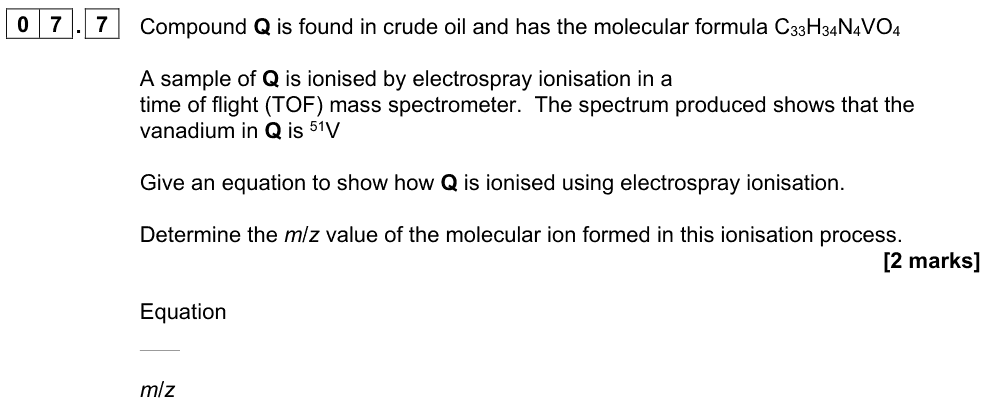
In part 7 many students were confused by the instruction to use the symbol Q and instead attempted to write equations using the molecular formula.
Many students used high energy electrons in their equation to knock an electron off the molecule and those who used the full formula did not add an H+ to the ion they formed or forgot to add the charge.
Equations such as Q + H+ → QH and Q + H+ → Q+ were common.
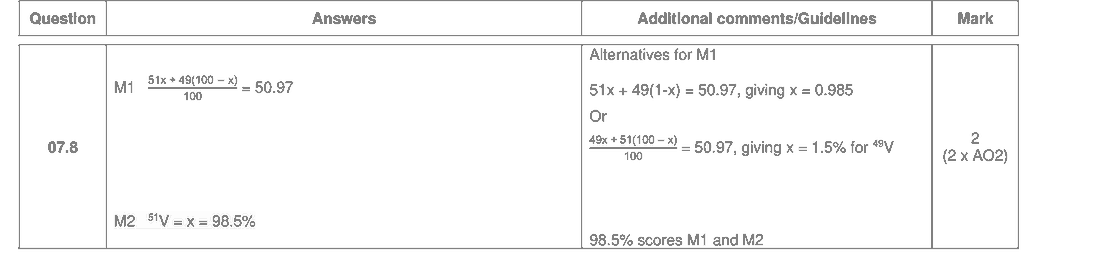
Few students gained M2, as many ignored the instruction to use a mass of 51 for vanadium.
Instead, they used the relative atomic mass from the Periodic Table, which led to an incorrect calculated value of 601.9 rather than the expected result based on the given mass.
Notes from the mark scheme and report
Q + H+ → QH+
m/z = 602 (396 + 34 + 56 + 51 + 64 = 601, plus 1 for the proton). Errors: electron impact equations
Q + H+ → QH or Q+
using Ar 50.9 for vanadium instead of 51 (gives 601.9)
June 2025 · Paper 1 · Q07.82 marksAO2=2CalculationEasy
Earlier part of question 07 that this part uses
Mark scheme
Examiner's comment
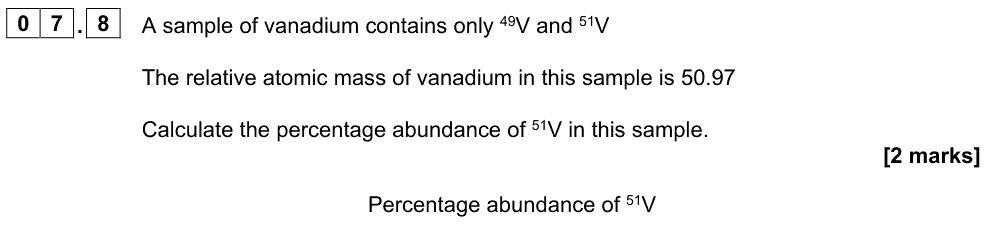
More than 60% of students gained both marks in part 8.
The students who found the question challenging could not give an expression linking the abundances of the two isotopes; 49x + 51y = 50.97 and 49x + 51x = 50.97 were common.
Some students did not add the abundances of their ions to give 100 (or 1).
Skills: MS0.2 Use ratios, fractions and percentages; MS1.2 Find arithmetic means; MS2.4 Solve algebraic equations
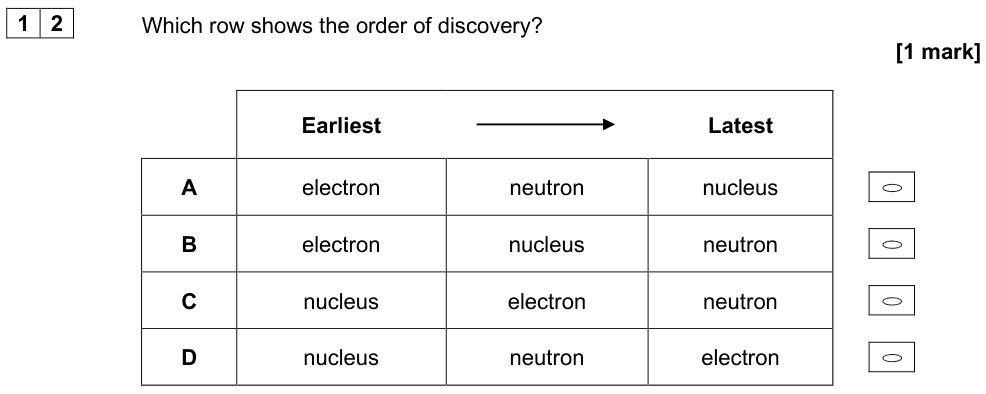
June 2025 · AS Paper 1 · Q121 markAO1=1Multiple choice
Answer
B
Mark scheme
Examiner's comment
This was answered correctly by a majority of students.
Notes from the mark scheme and report
Answer: B. Electron (Thomson), then the nucleus (Rutherford), then the neutron (Chadwick)
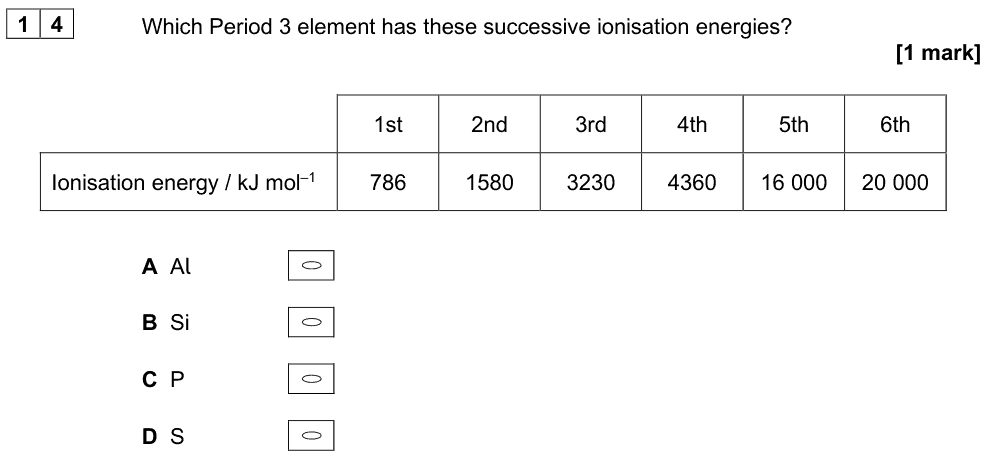
June 2025 · AS Paper 1 · Q141 markAO2=1Multiple choiceEasy
Answer
B
Mark scheme
Examiner's comment
This was answered correctly by about three-quarters of students.
Notes from the mark scheme and report
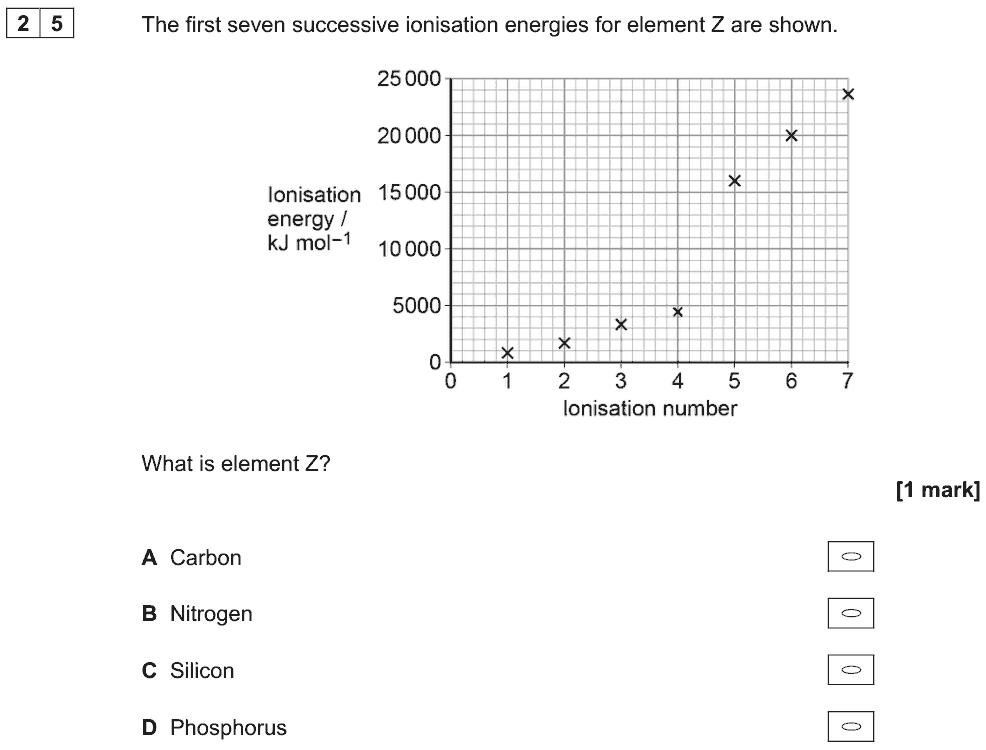
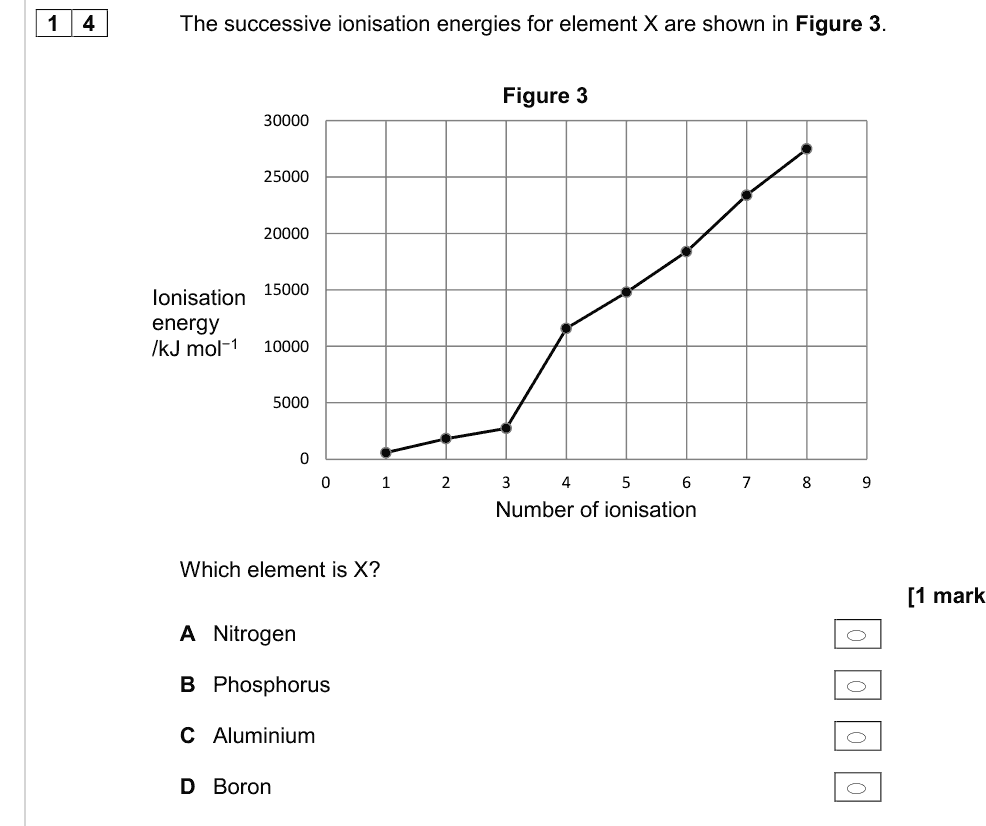
Answer: B. The large jump comes between the 4th and 5th ionisation energies, so there are four outer electrons: silicon
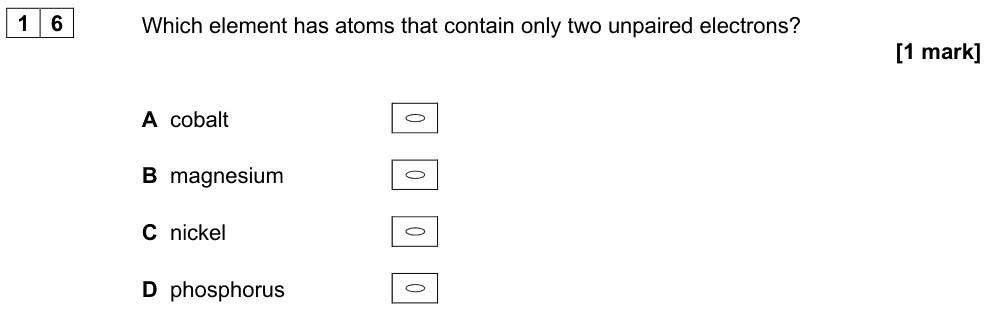
June 2025 · AS Paper 1 · Q161 markAO1=1Multiple choice
Answer
C
Mark scheme
Examiner's comment
About half the students were able to identify correctly the element that has atoms that contain only two unpaired electrons.
Notes from the mark scheme and report
Answer: C. Ni is [Ar] 3d8 4s2: three filled d orbitals and two singly occupied. Co has three unpaired electrons, Mg none, P three. About half were correct
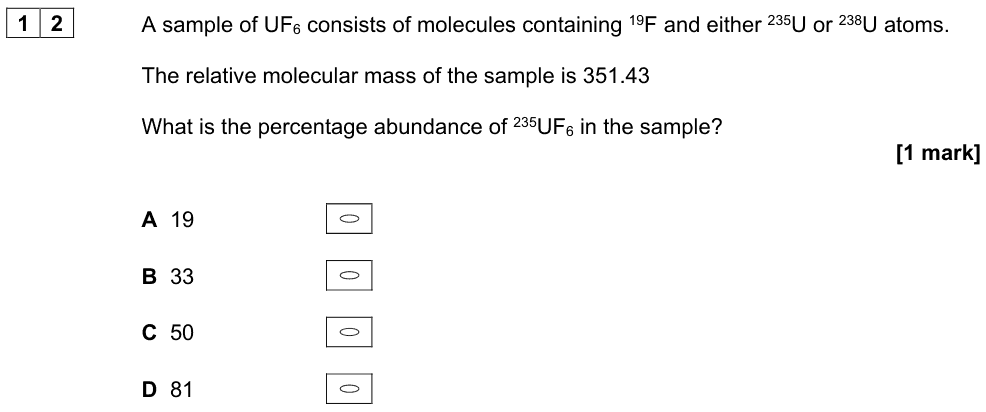
June 2025 · Paper 3 · Q121 markAO2=1Multiple choice
Answer
A
Mark scheme
Notes from the mark scheme and report
Answer: A. Mr values are 349 (235UF6) and 352 (238UF6): 349x + 352(1 – x) = 351.43, so x = 0.19. One of the least well answered questions (under 55% correct)
Skills: MS0.2 Use ratios, fractions and percentages; MS1.2 Find arithmetic means; MS2.4 Solve algebraic equations
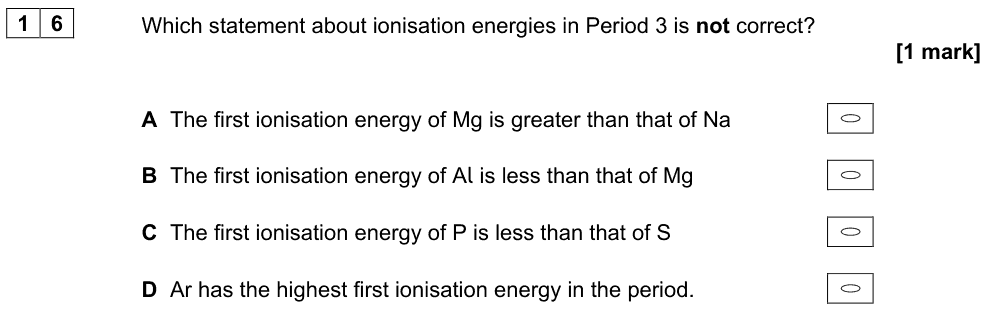
June 2025 · Paper 3 · Q161 markAO1=1Multiple choice
Answer
C
Mark scheme
Notes from the mark scheme and report
Answer: C. Phosphorus has a higher first ionisation energy than sulfur, because sulfur's paired 3p electrons repel
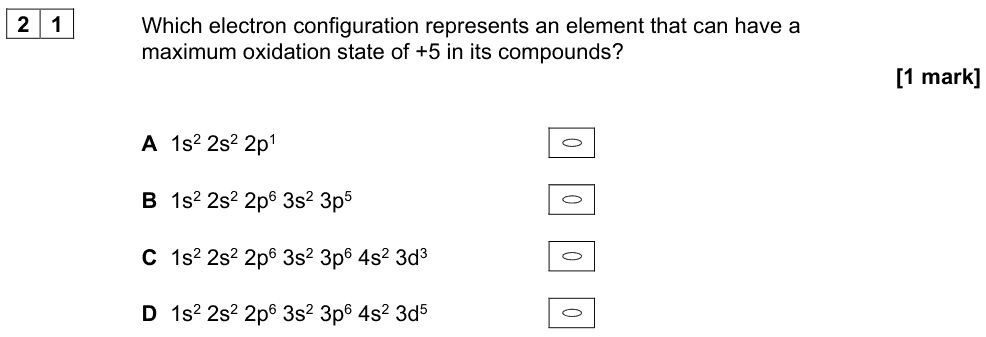
June 2025 · Paper 3 · Q211 markAO1=1Multiple choice
Answer
C
Mark scheme
Notes from the mark scheme and report
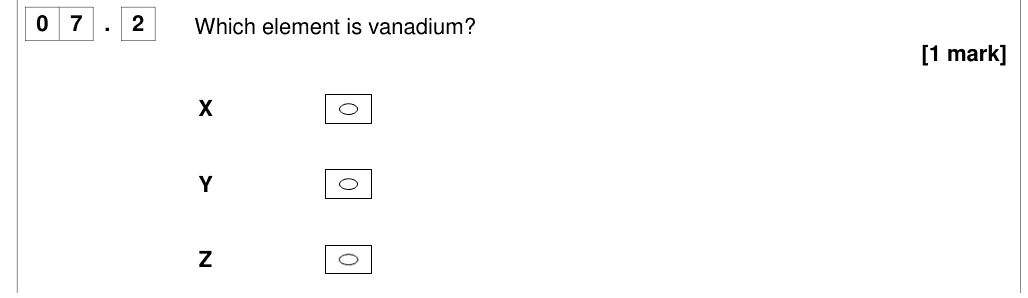
Answer: C. Vanadium (4s2 3d3) can use all five outer electrons, as in vanadate(V)
D is manganese (maximum +7) and B is chlorine (maximum +7). One of the least well answered questions (under 55% correct)
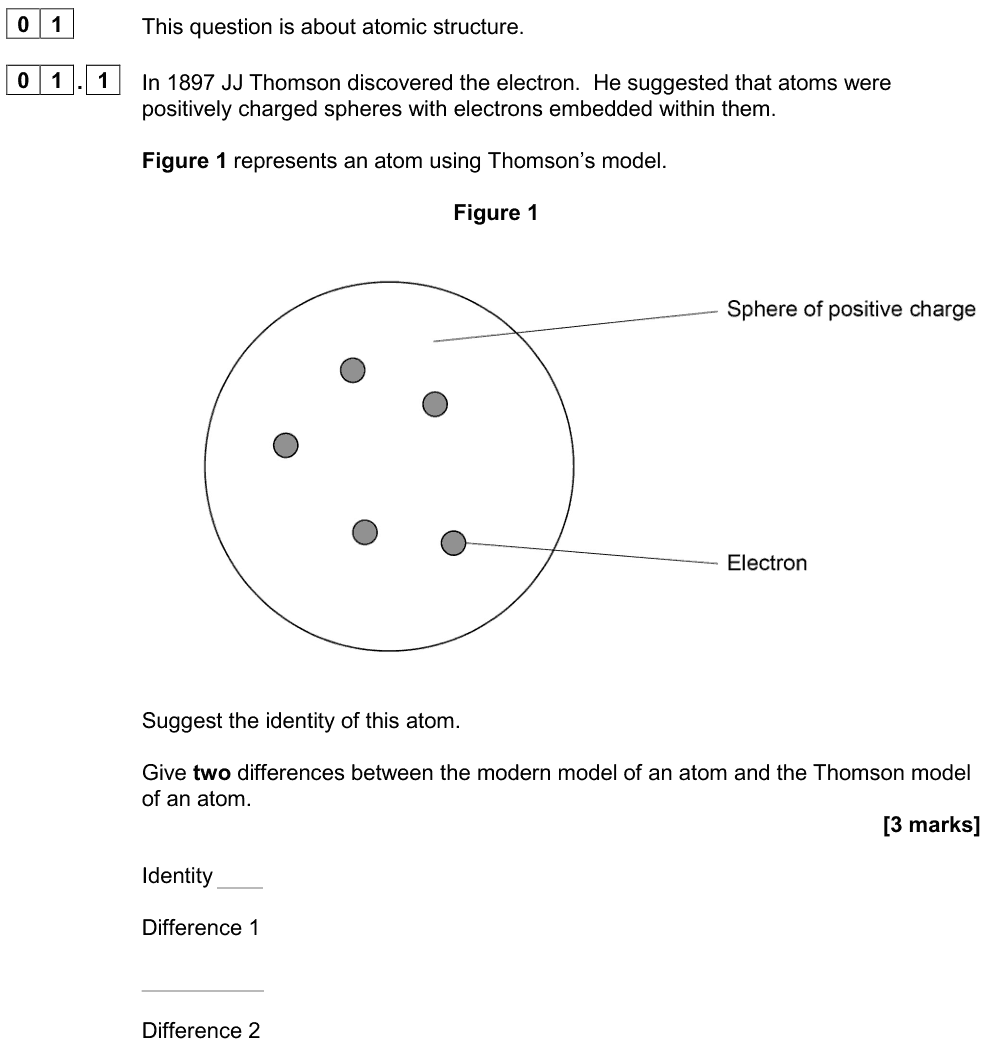
June 2024 · Paper 1 · Q01.13 marksAO1=3Short answer
Mark scheme
Examiner's comment
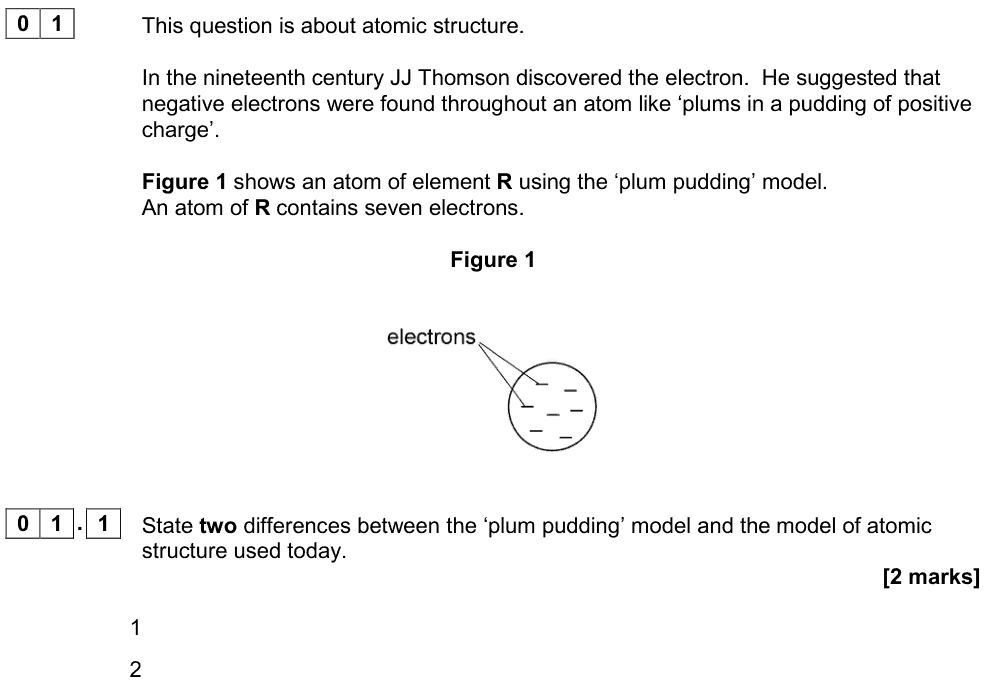
In part 1, 38% of students scored all three marks: plum-pudding model was a common insufficient answer.
Some students failed to gain marks as it was unclear, in their explanation, which model they were referring to: the question asked about the modern model.
Notes from the mark scheme and report
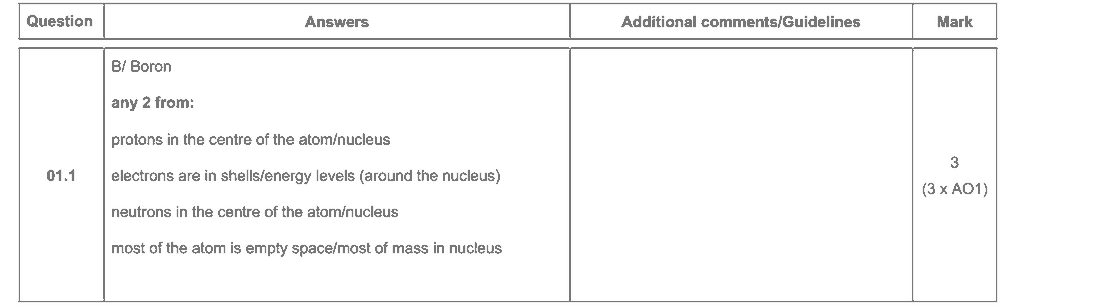
Answer: boron (five electrons shown). Any two differences: protons/neutrons in a central nucleus
electrons in shells or energy levels
most of the atom is empty space. Say which model you are describing
'plum pudding' alone was insufficient
June 2024 · Paper 1 · Q01.23 marksAO1=2, AO3=1Short answer
Earlier part of question 01 that this part uses
Mark scheme
Examiner's comment
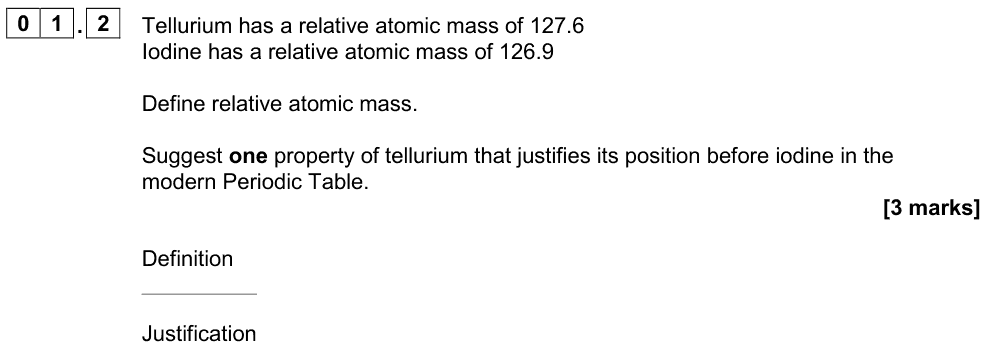
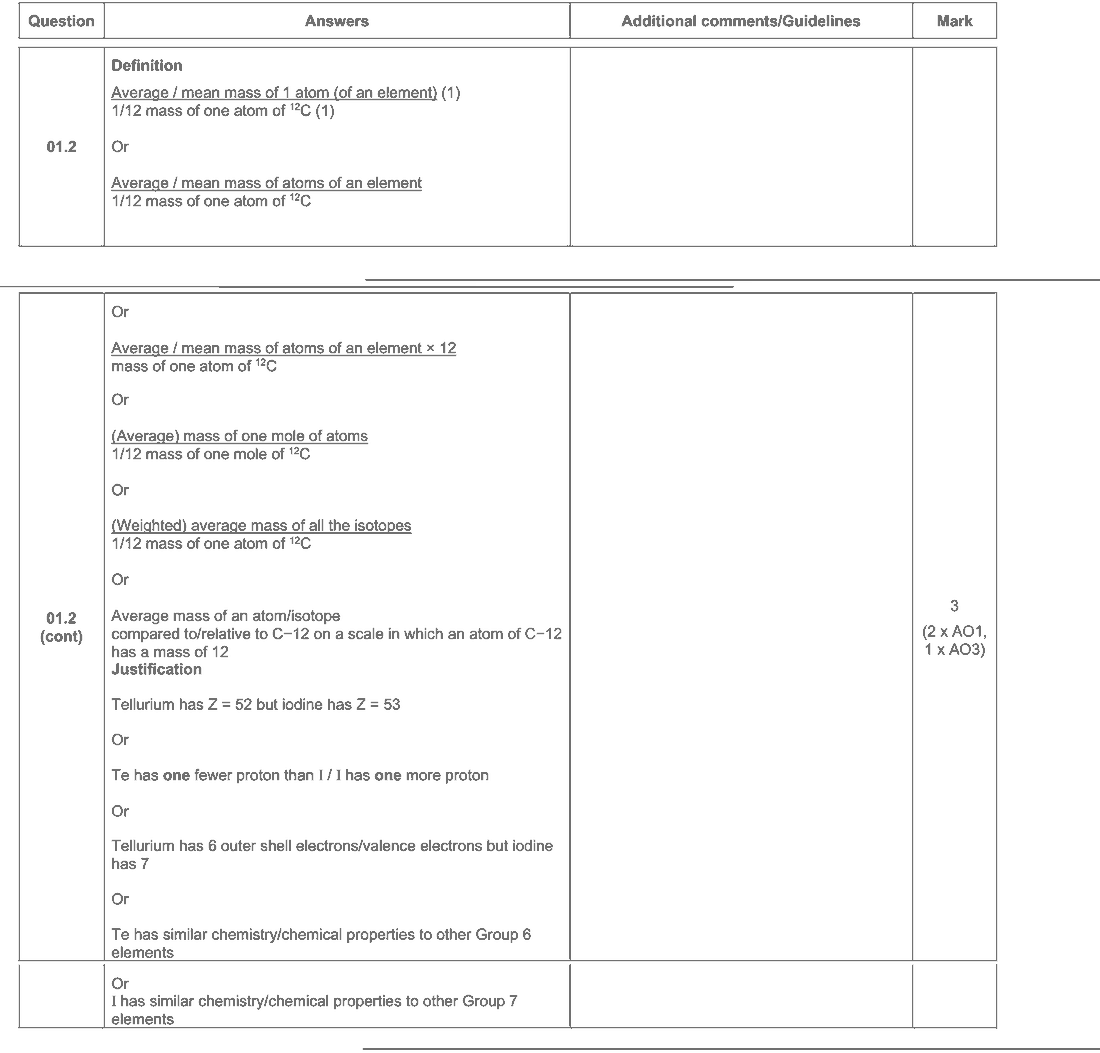
Few students scored both marks for the definition in part 2: mean (mass), mass or atom of 12C were often crucially missed out.
In the justification students failed to gain the mark by not being specific: Te has fewer protons was an insufficient answer.
Notes from the mark scheme and report
Definition: mean mass of an atom of an element divided by 1/12 of the mass of one atom of 12C. Justification: Te has Z = 52 and I has Z = 53 (one fewer proton). 'Mean' and 'atom of 12C' were often missed
'fewer protons' was not specific enough
June 2024 · Paper 1 · Q01.31 markAO1=1Equation writing
Earlier part of question 01 that this part uses
Mark scheme
Examiner's comment
The equation in part 3 was well done.
Notes from the mark scheme and report
Te(g) + e– → Te+(g) + 2e– or Te(g) → Te+(g) + e–. State symbols needed
June 2024 · Paper 1 · Q01.45 marksAO2=4, AO3=1CalculationHard
Earlier part of question 01 that this part uses
Mark scheme
Examiner's comment
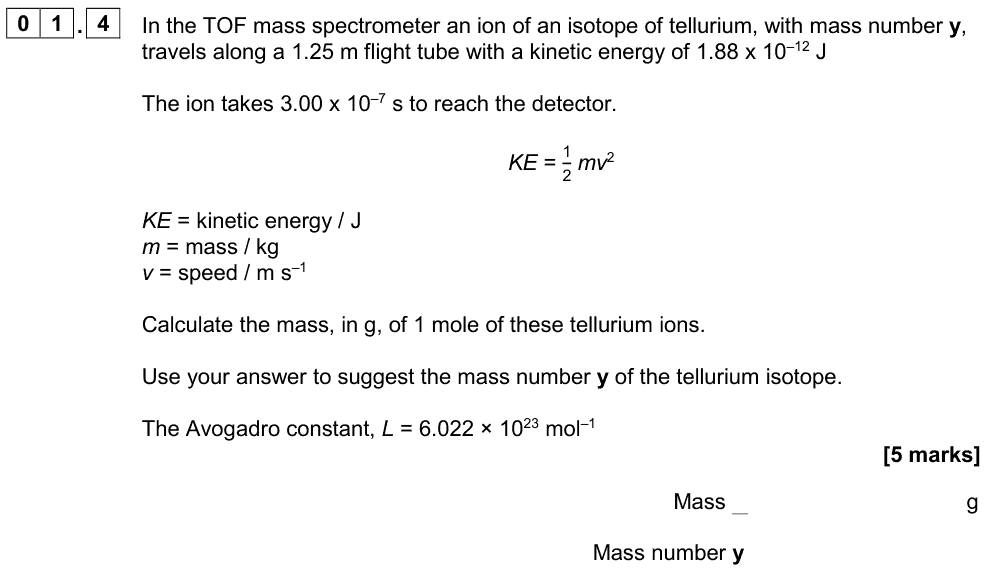
The calculation in part 4 discriminated well: 18% of students scored all the marks and over 85% of students scored at least 2 marks.
Common errors included giving the mass of 1 atom rather than the mass of one mole on the answer line and not realising that the mass number should be an integer.
Notes from the mark scheme and report
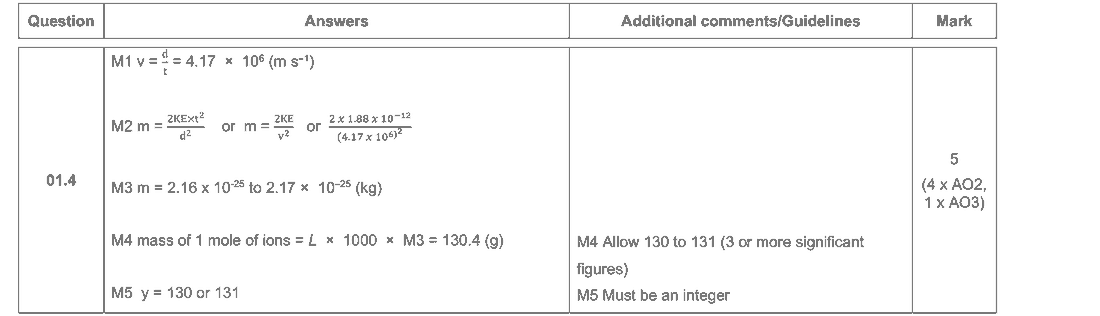
Answer: 130.4 g (allow 130 to 131)
y = 130 or 131. v = d/t = 4.17 × 10^6 m s–1
m = 2KE/v² = 2.16 × 10^–25 kg
× L × 1000. Common errors: mass of one atom on the answer line
y not an integer
Skills: MS0.0 Recognise and make use of appropriate units in calculation; MS0.1 Recognise and use expressions in decimal and ordinary form; MS2.2 Change the subject of an equation; MS2.3 Substitute numerical values into algebraic equations using appropriate units for physical quantities
June 2024 · Paper 1 · Q01.51 markAO1=1Short answer
Earlier part of question 01 that this part uses
Mark scheme
Examiner's comment
Part 5 was answered well.
Notes from the mark scheme and report
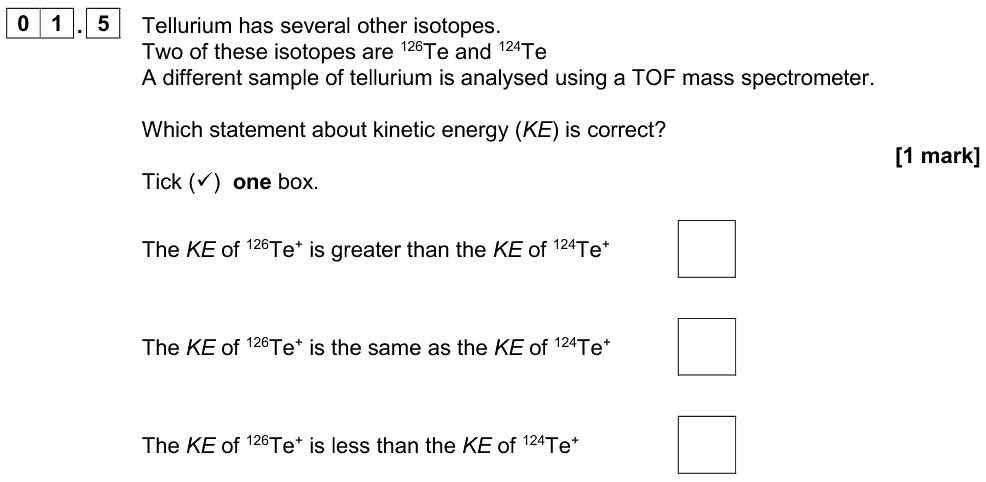
Answer: the KE of 126Te+ is the same as the KE of 124Te+ (all ions are accelerated to the same kinetic energy)
June 2024 · AS Paper 1 · Q02.13 marksAO2=3Explanation
Mark scheme
Examiner's comment
02.1 This question was well answered, and most students were able to explain that the third electron was being removed from the 1s orbital.
Notes from the mark scheme and report
The third electron is removed from the 1s orbital (not 2s)
it is lower in energy / closer to the nucleus / has less (no) shielding
so there is a stronger attraction between the nucleus and the electron. Three independent marks
June 2024 · AS Paper 1 · Q06.11 markAO1=1Short answer
Mark scheme
Notes from the mark scheme and report
1s2 2s2 2p6 3s2 3p6 3d10 4s2 4p5 (4s before 3d also accepted)
June 2024 · AS Paper 1 · Q06.21 markAO1=1Equation writing
Earlier part of question 06 that this part uses
Mark scheme
Notes from the mark scheme and report
Br2(g) → Br2+(g) + e– or Br2(g) + e– → Br2+(g) + 2e–. Common wrong answers formed Br+ or Br– ions
June 2024 · AS Paper 1 · Q06.33 marksAO2=3Diagram or structure
Earlier parts of question 06 that this part uses
Mark scheme
Notes from the mark scheme and report
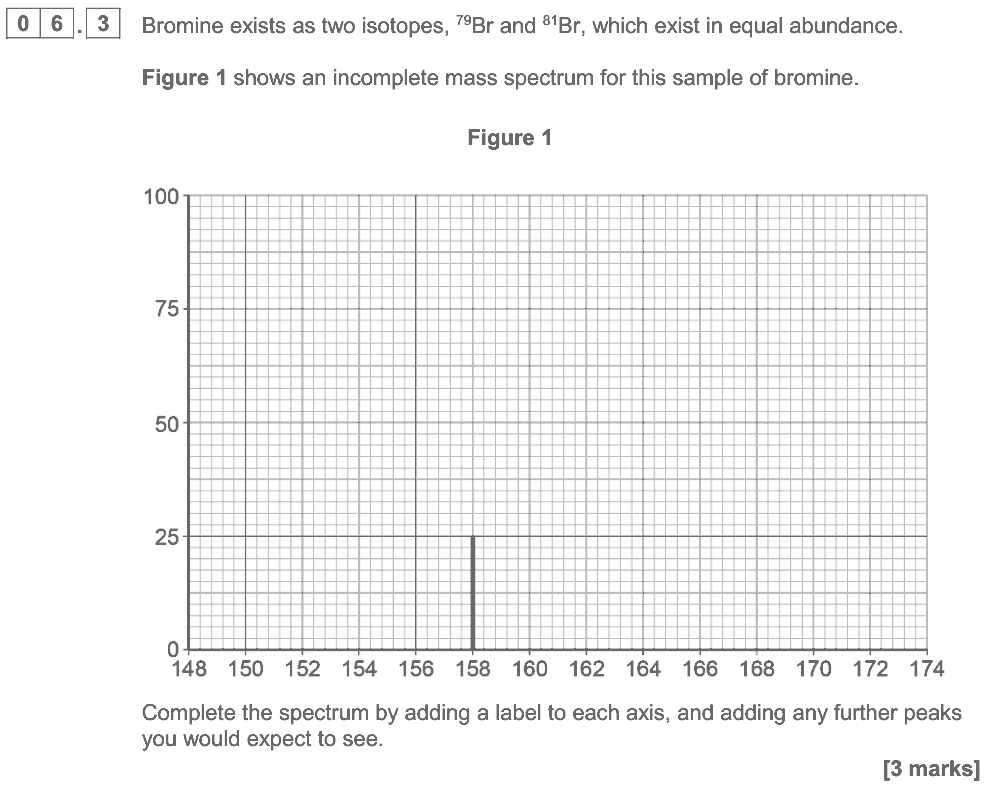
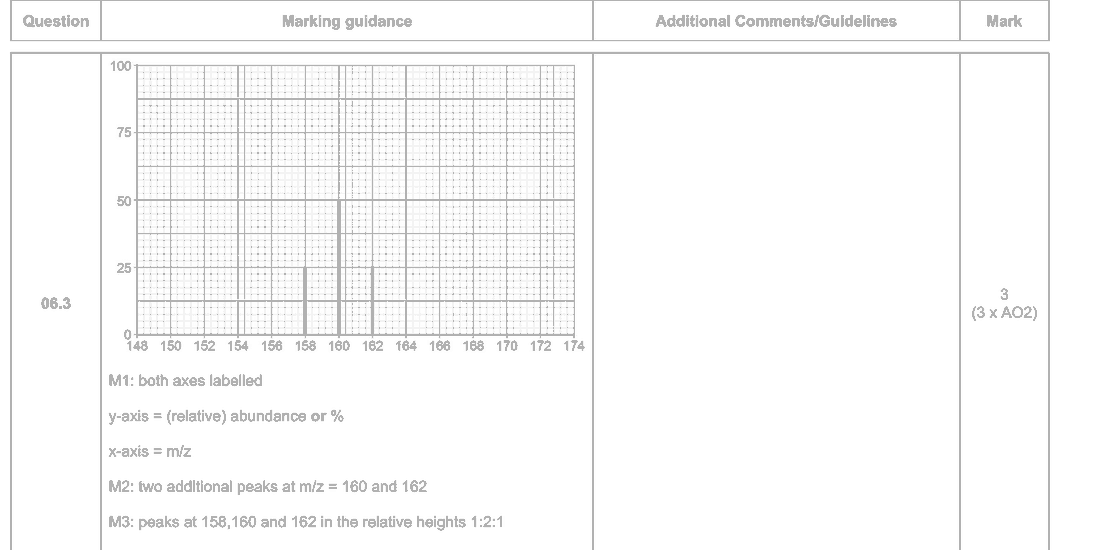
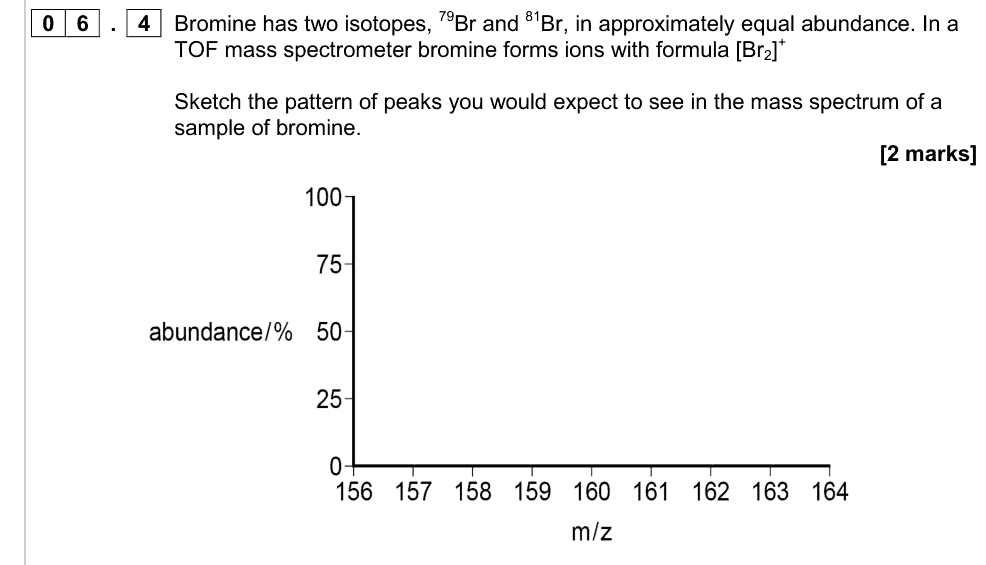
Label the y-axis (relative) abundance or % and the x-axis m/z (not Mr). Add peaks at m/z 160 and 162 so that 158, 160 and 162 are in the height ratio 1:2:1 (160 at 50, 162 at 25). Most added the 162 peak but missed the 160 peak of double height
Skills: MS0.2 Use ratios, fractions and percentages; MS3.1 Translate information between graphical, numerical and algebraic forms
June 2024 · AS Paper 1 · Q06.41 markAO1=1Short answer
Earlier part of question 06 that this part uses
Mark scheme
Notes from the mark scheme and report
The (relative) abundance is proportional to the size of the current produced at the detector. Misconception: that speed or time of flight gives abundance
June 2024 · AS Paper 1 · Q201 markAO1=1Multiple choiceEasy
Answer
D
Mark scheme
Examiner's comment
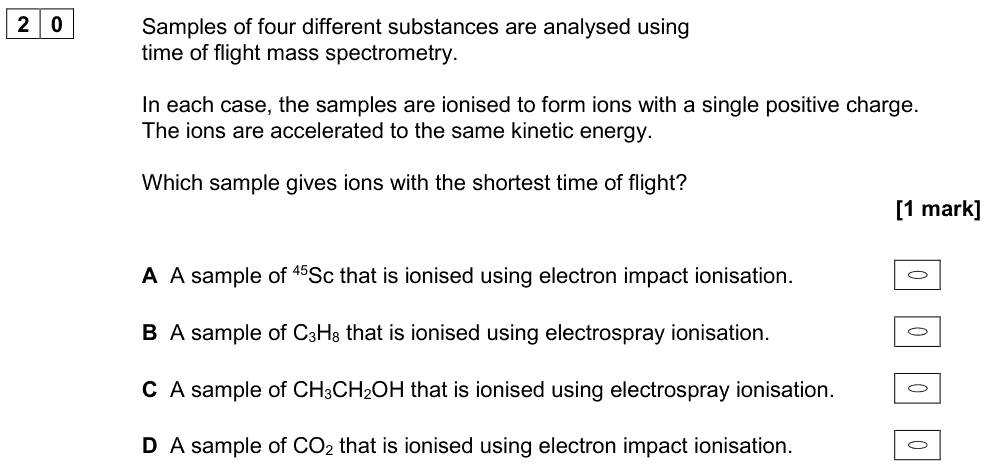
Time of flight mass spectrometry About two-thirds of students were able to identify which sample gave ions with the shortest time of flight.
Notes from the mark scheme and report
Answer: D. Same kinetic energy, so the lightest ion is fastest: CO2+ is 44
Sc+ is 45
electrospray adds H+, giving C3H9+ at 45 and C2H5OH2+ at 47
June 2024 · AS Paper 1 · Q211 markAO2=1Multiple choiceEasy
Answer
C
Mark scheme
Examiner's comment
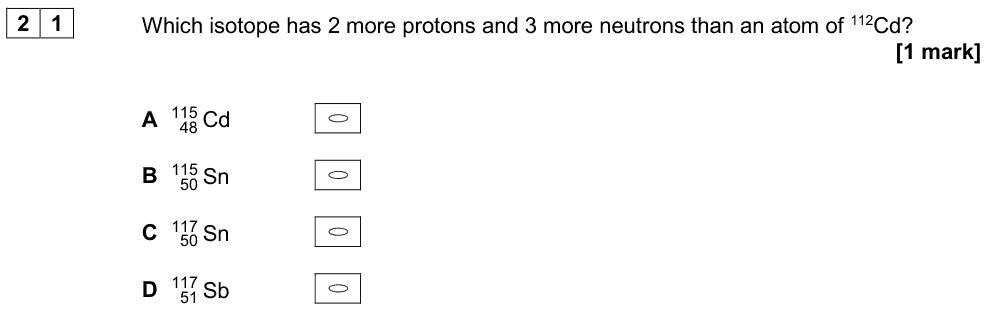
Atomic Structure This question was well answered with the majority of students (82%) identifying the correct isotope.
Notes from the mark scheme and report
Answer: C. 112Cd has 48 protons and 64 neutrons
50 protons is Sn and 67 neutrons gives mass number 117
June 2024 · AS Paper 1 · Q221 markAO2=1Multiple choiceEasy
Answer
C
Mark scheme
Examiner's comment
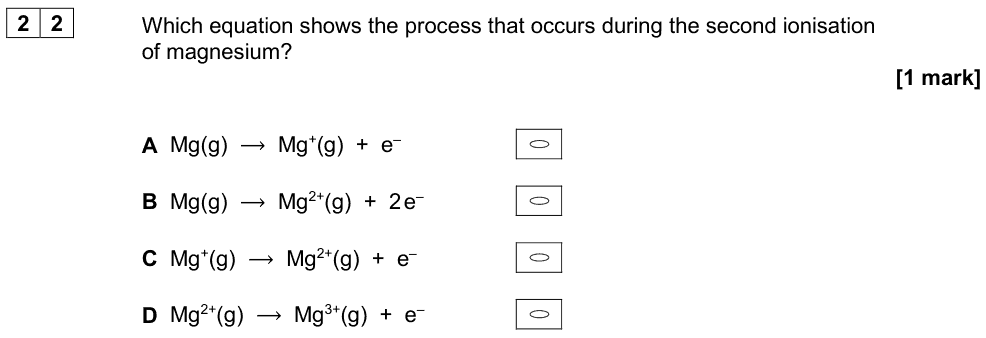
Second ionisation of Mg Nearly all students (over 90%) were able to correctly identify the equation that shows the process that occurs during the second ionisation of magnesium.
Notes from the mark scheme and report
Answer: C. Mg+(g) → Mg2+(g) + e–: the second electron is removed from the gaseous 1+ ion
June 2024 · AS Paper 1 · Q241 markAO1=1Multiple choice
Answer
C
Mark scheme
Examiner's comment
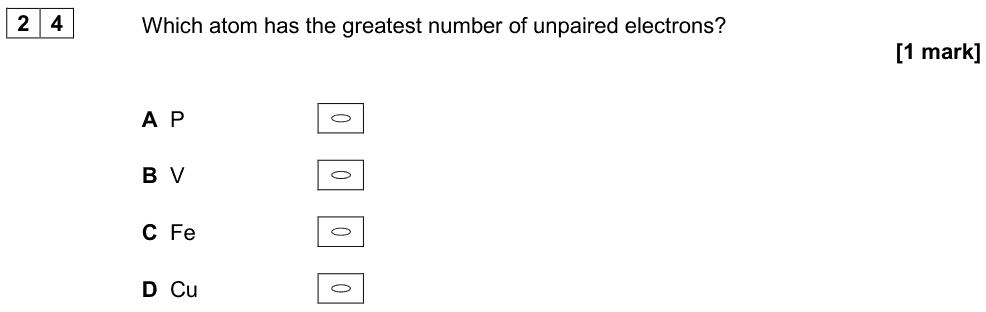
Electron configuration Students found this challenging with just over one third of students able to identify the atom that has the greatest number of unpaired electrons.
Notes from the mark scheme and report
Answer: C. Fe is [Ar] 4s2 3d6 with four unpaired electrons
P and V have three, Cu has one
June 2024 · Paper 3 · Q061 markAO2=1Multiple choice
Answer
C
Mark scheme
Notes from the mark scheme and report
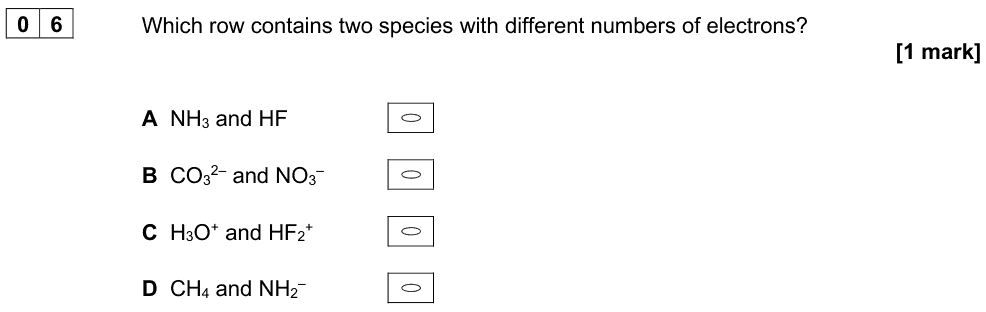
Answer: C. H3O+ has 10 electrons and HF2+ has 18
the other pairs match (10 and 10
32 and 32
10 and 10)
June 2024 · Paper 3 · Q071 markAO1=1Multiple choice
Answer
B
Mark scheme
Notes from the mark scheme and report
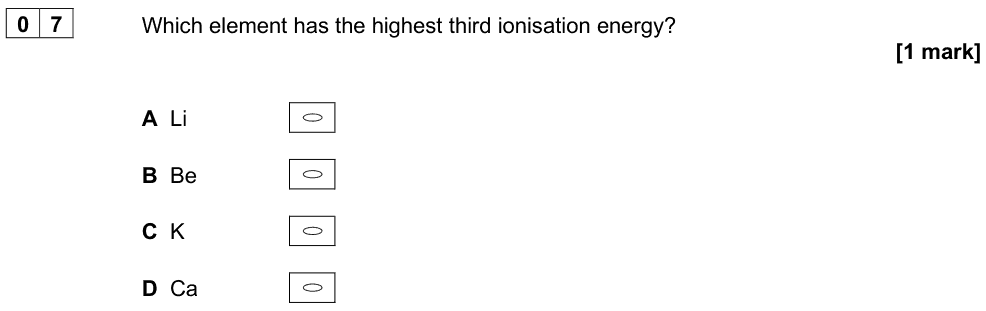
Answer: B. The third electron of Be is removed from the 1s shell, closest to the nucleus with no shielding and a higher nuclear charge than Li
June 2023 · AS Paper 1 · Q01.11 markAO1=1Short answer
Mark scheme
Examiner's comment
01.1 Many students were able to give the full electron configuration of the element in Period 3 with the highest first ionisation energy. However, some students provided electron configurations for Period 2 elements or for sodium/chlorine rather than for argon.
Notes from the mark scheme and report
Argon: 1s2 2s2 2p6 3s2 3p6. Common errors: configurations of Period 2 elements, or of sodium or chlorine
June 2023 · AS Paper 1 · Q01.21 markAO1=1Equation writingEasy
Earlier part of question 01 that this part uses
Mark scheme
Examiner's comment
01.2 This question was well answered with over two-thirds of students scoring the mark. However, the state symbols in the equation were sometimes missing. This was the most common cause of error.
Notes from the mark scheme and report
Na+(g) → Na2+(g) + e– (allow Na+(g) + e– → Na2+(g) + 2e–). State symbols essential on Na+ and Na2+
ignore the state symbol on the electron. Missing state symbols was the most common error
June 2023 · AS Paper 1 · Q01.33 marksAO2=2, AO3=1Explanation
Earlier part of question 01 that this part uses
Mark scheme
Examiner's comment
01.3 Students found this question more challenging. Whilst most were able to identify that a large jump between successive ionisation energies was important, the reason for this large jump was not always clear. Students did not always explain that the electron removed was closer to the nucleus. Another common cause of error was the incorrect statement that the large jump in ionisation energy was due to pairing of electrons.
Notes from the mark scheme and report
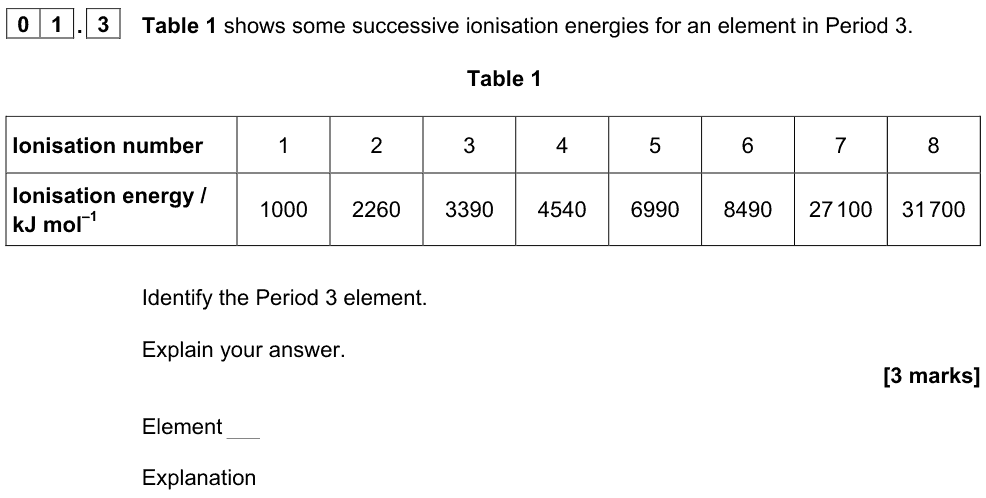
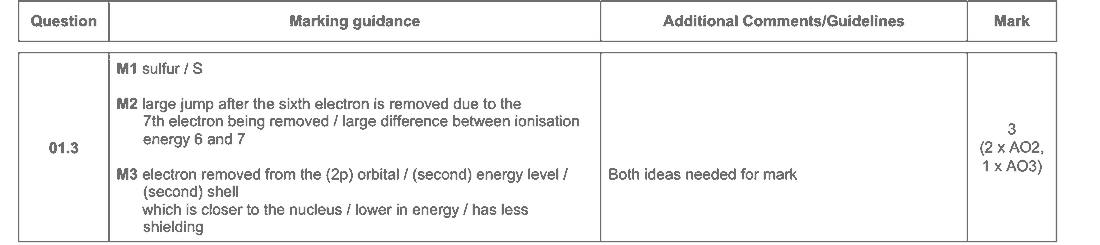
Sulfur. Large jump between the 6th and 7th ionisation energies
the 7th electron is removed from the 2p orbital / second shell, which is closer to the nucleus (or has less shielding): both ideas needed for M3. Common errors: not saying the electron is closer to the nucleus
blaming electron pairing
June 2023 · AS Paper 1 · Q02.54 marksAO2=4Calculation
Earlier part of question 02 that this part uses
Mark scheme
Examiner's comment
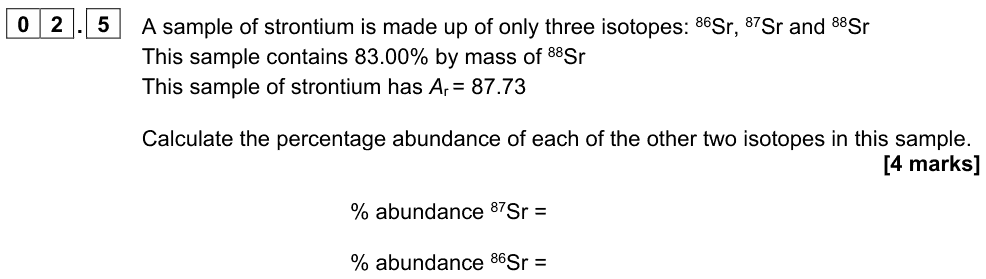
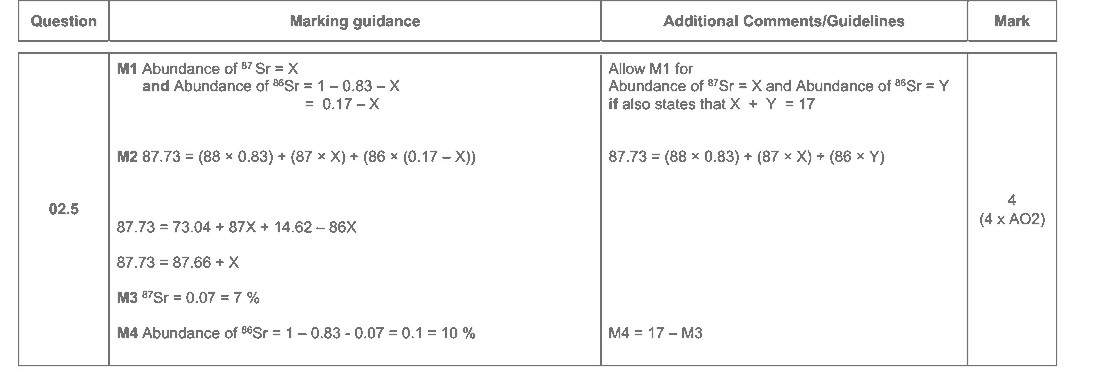
02.5 Just over half of the students scored all the marks on this calculation. However, a common cause of error was that some students did not realise that the combined abundance of 87Sr and of 86Sr was 17%.
Notes from the mark scheme and report
Answer: 87Sr = 7%, 86Sr = 10%. The two abundances total 17%
87.73 = (88 × 0.83) + 87x + 86(0.17 – x), so x = 0.07. Common error: not realising that 87Sr and 86Sr together make 17%
Skills: MS0.2 Use ratios, fractions and percentages; MS1.2 Find arithmetic means; MS2.4 Solve algebraic equations
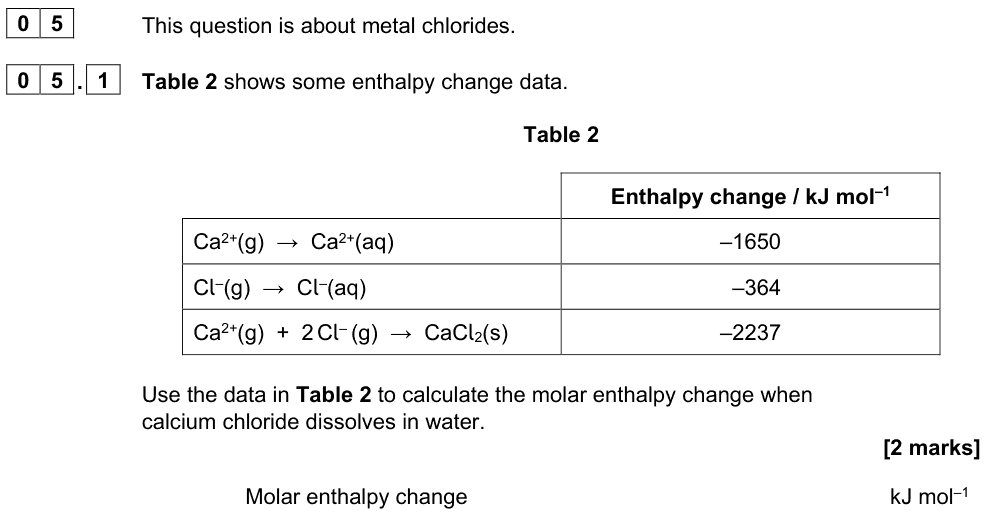
June 2023 · Paper 1 · Q05.61 markAO3=1Short answer
Earlier part of question 05 that this part uses
Mark scheme
Examiner's comment
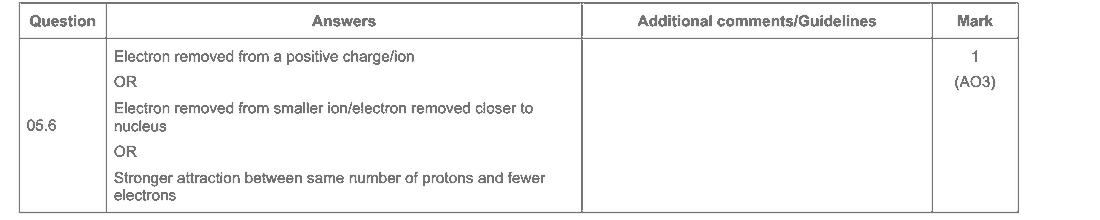
Answers to 05.6 were often vague and did not address the greater attraction between the electron removed and the more positive, smaller ion.
Notes from the mark scheme and report
The electron is removed from a positive ion (Ca+) / from a smaller ion, closer to the nucleus / same protons attract fewer electrons more strongly. Answers were often vague
June 2023 · AS Paper 1 · Q07.15 marksAO2=4, AO3=1Calculation
Mark scheme
Notes from the mark scheme and report
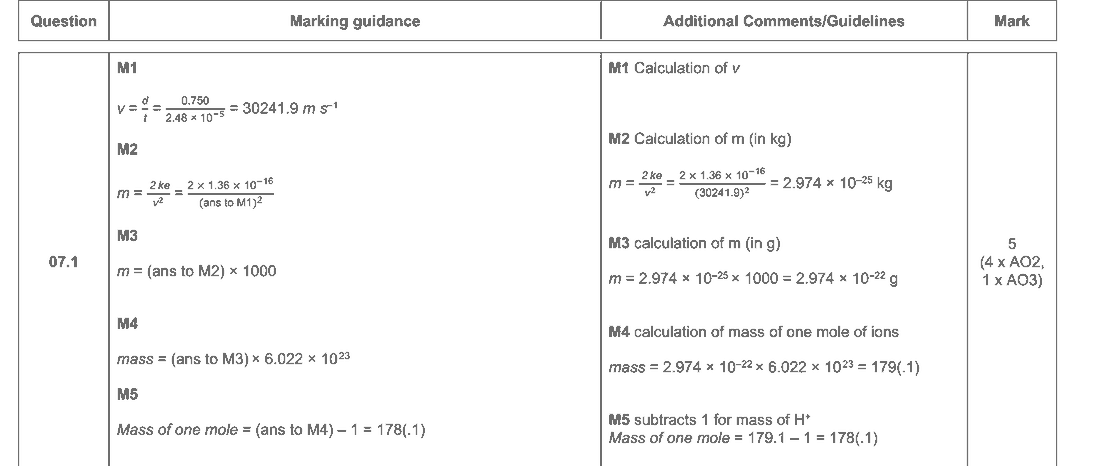
Answer: 178 g. v = d/t = 0.750 ÷ 2.48 × 10^–5 = 30 242 m s–1
m = 2KE/v² = 2.974 × 10^–25 kg
× 1000 for g
× L = 179.1
subtract 1 for the H+ gained in electrospray ionisation
Skills: MS0.0 Recognise and make use of appropriate units in calculation; MS0.1 Recognise and use expressions in decimal and ordinary form; MS2.2 Change the subject of an equation; MS2.3 Substitute numerical values into algebraic equations using appropriate units for physical quantities
June 2023 · Paper 1 · Q07.11 markAO1=1Short answer
Mark scheme
Examiner's comment
Answers to 07.1 were good.
Notes from the mark scheme and report
1s2 2s2 2p6
June 2023 · AS Paper 1 · Q07.21 markAO1=1Short answer
Earlier part of question 07 that this part uses
Mark scheme
Notes from the mark scheme and report
High-energy electrons (from an electron gun) knock an electron out of each atom or molecule
June 2023 · AS Paper 1 · Q07.32 marksAO3=2Short answer
Earlier part of question 07 that this part uses
Mark scheme
Notes from the mark scheme and report
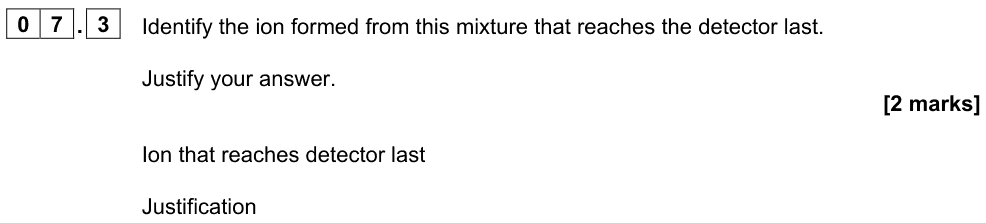
CO2+
it has the highest mass (mass to charge ratio), so it travels most slowly
June 2023 · AS Paper 1 · Q07.42 marksAO1=2Short answer
Earlier part of question 07 that this part uses
Mark scheme
Notes from the mark scheme and report
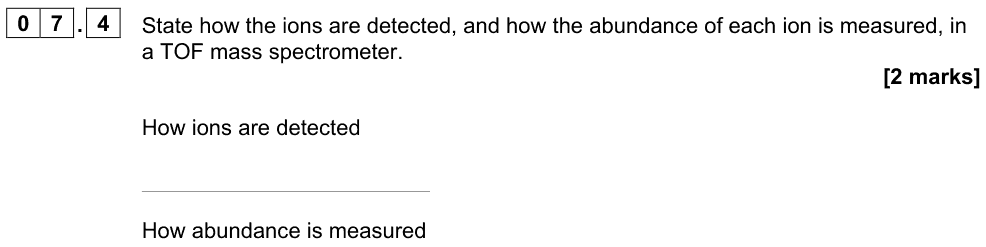
Each ion gains an electron at the detector, generating a current
the abundance is proportional to the size of the current
June 2023 · AS Paper 1 · Q091 markAO1=1Multiple choiceEasy
Answer
C
Mark scheme
Examiner's comment
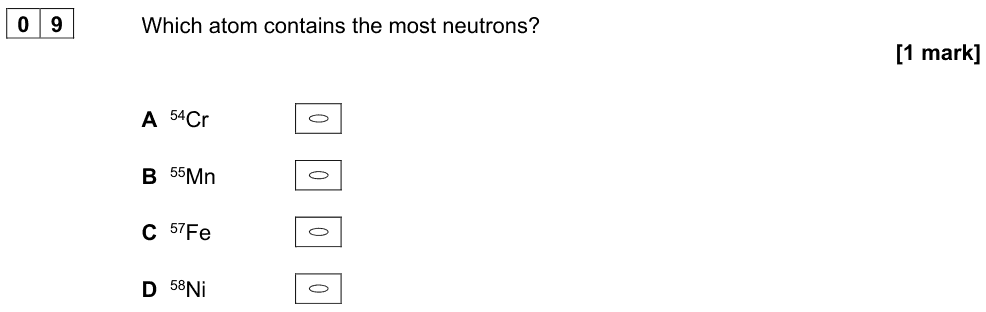
Atomic Structure The vast majority of students (86%) were able to deduce correctly the atom that contains the most neutrons.
Question 10 and Question 11: Titration About half of the students scored the mark on these questions. In question 10, some students decided, incorrectly, that rinsing the conical flask with vinegar (one of the reagents) between each titration would improve accuracy. In question 11, a number of students decided that rinsing with distilled water would decrease the percentage uncertainty.
Notes from the mark scheme and report
Answer: C. 57Fe has 57 – 26 = 31 neutrons
the other three have 30
June 2023 · Paper 1 · Q09.11 markAO1=1Equation writing
Mark scheme
Examiner's comment
The majority of students gave a correct equation in 09.1; common errors included missing or incorrect state symbols, eg Sr(s).
June 2023 · Paper 1 · Q09.25 marksAO1=1, AO2=4Calculation
Earlier part of question 09 that this part uses
Mark scheme
Examiner's comment
In 09.2, 36% of students gained all of the marks.
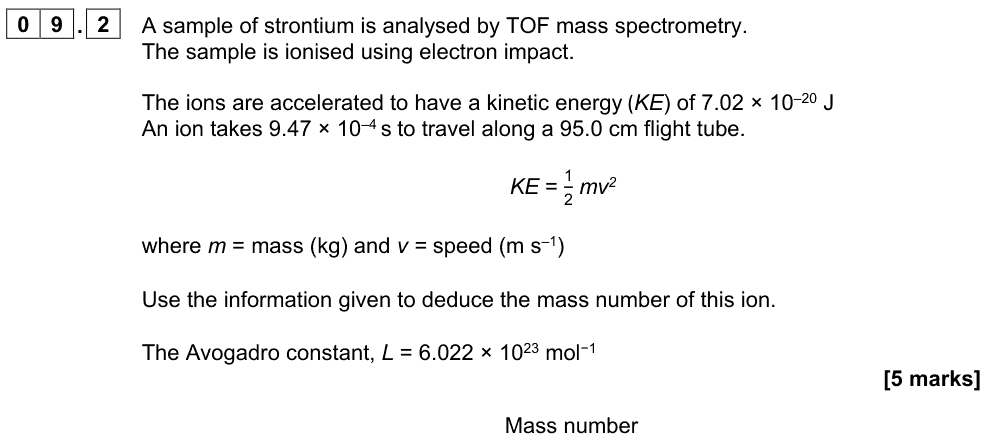
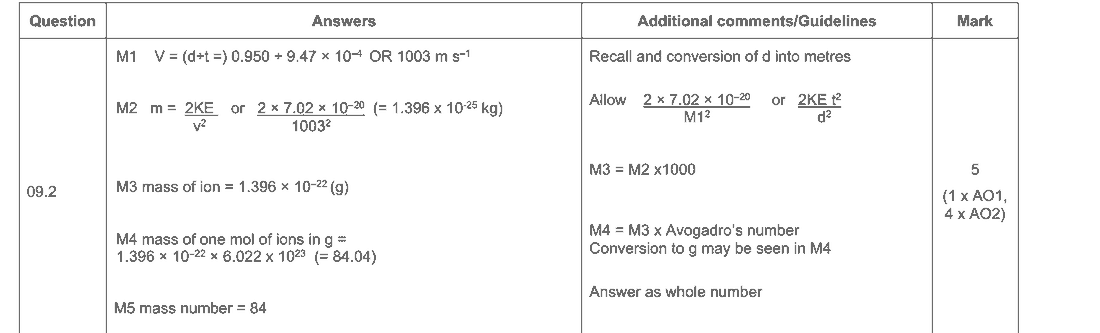
Common errors included rearranging the equation incorrectly, not converting cm to m, not converting kg to g, incorrect use of the Avogadro constant and not giving the mass number as an integer.
Notes from the mark scheme and report
Answer: 84. v = d/t = 0.950 ÷ 9.47 × 10^–4 = 1003 m s–1
m = 2KE/v² = 1.396 × 10^–25 kg = 1.396 × 10^–22 g
× 6.022 × 10^23 = 84.04. Errors: wrong rearrangement, cm not converted to m, kg not converted to g, misuse of L, answer not an integer (36% scored all 5)
Skills: MS0.0 Recognise and make use of appropriate units in calculation; MS0.1 Recognise and use expressions in decimal and ordinary form; MS2.2 Change the subject of an equation; MS2.3 Substitute numerical values into algebraic equations using appropriate units for physical quantities
June 2023 · Paper 1 · Q09.32 marksAO1=2Short answer
Earlier part of question 09 that this part uses
Mark scheme
Examiner's comment
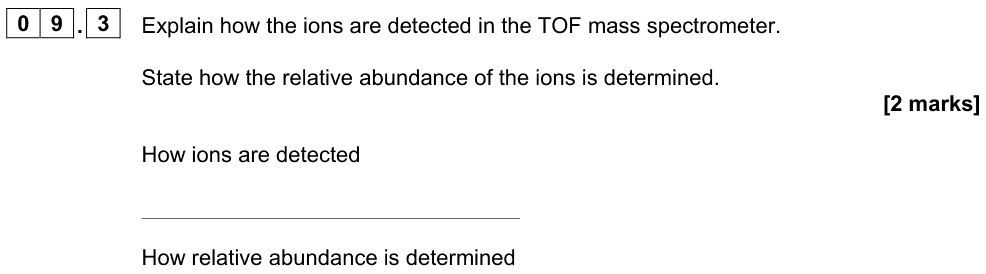
Question 09.3 was not well answered.
Many students stated that a current was produced but did not mention the ion gaining an electron to produce the current, and many students did not state that the current was proportional to the abundance of the ion.
Notes from the mark scheme and report
Each ion hits the detector and gains an electron, generating a current
the size of the current is proportional to the abundance. Many mentioned a current but not the ion gaining an electron
June 2023 · Paper 1 · Q09.43 marksAO2=2, AO3=1Calculation
Earlier part of question 09 that this part uses
Mark scheme
Examiner's comment
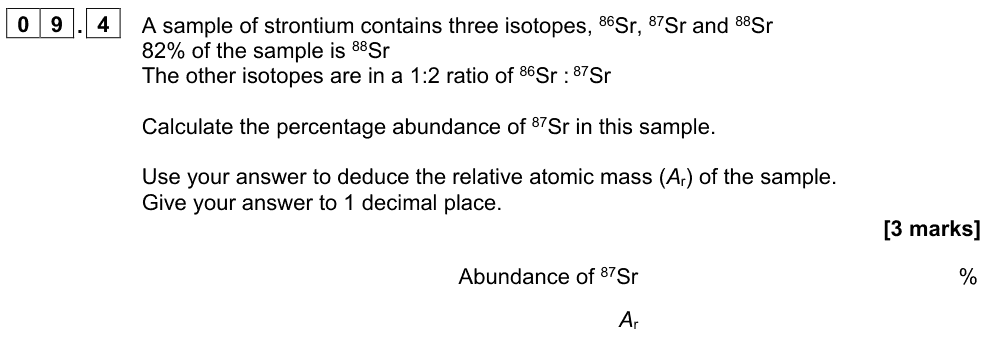
Answers to 09.4 were generally good; a small number of students did not use the 1:2 ratio of 86Sr to 87Sr and some did not give their answer to 1 decimal place.
Notes from the mark scheme and report
Answer: 12% of 87Sr
Ar = 87.8. The remaining 18% is split 1:2, so 6% 86Sr and 12% 87Sr
((82 × 88) + (12 × 87) + (6 × 86)) ÷ 100. Answer to 1 decimal place
Skills: MS0.2 Use ratios, fractions and percentages; MS1.1 Use an appropriate number of significant figures; MS1.2 Find arithmetic means
June 2023 · Paper 1 · Q09.51 markAO3=1Short answer
Earlier part of question 09 that this part uses
Mark scheme
Examiner's comment
In 09.5, many answers were insufficient and referred to the protein being denatured.
Notes from the mark scheme and report
So that the protein (ion) does not fragment / break up. 'Denatured' is not enough
June 2023 · Paper 3 · Q071 markAO2=1Multiple choice
Answer
C
Mark scheme
Notes from the mark scheme and report
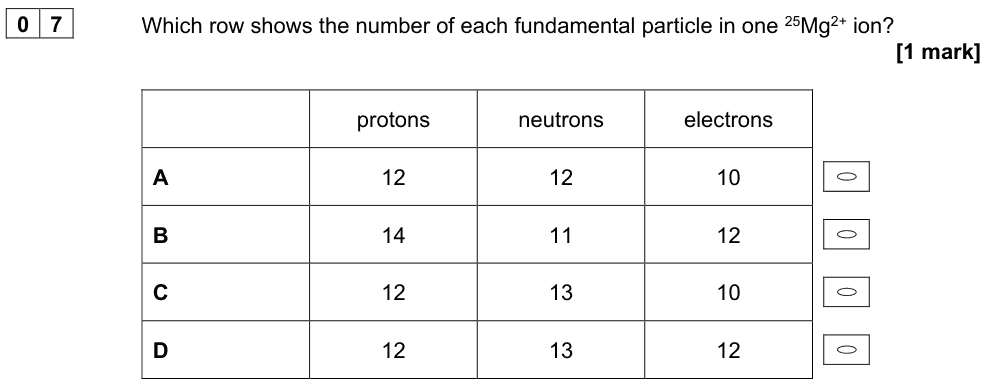
Answer: C. Mg has 12 protons
25 – 12 = 13 neutrons
the 2+ ion has 12 – 2 = 10 electrons
June 2022 · AS Paper 1 · Q01.21 markAO2=1Equation writingEasy
Earlier part of question 01 that this part uses
Mark scheme
Examiner's comment
01.2 This question was well answered with over two-thirds of students scoring the mark. However, state symbols in the equation were sometimes missing which was the most common cause of error.
Notes from the mark scheme and report
Mg2+(g) → Mg3+(g) + e– (or Mg2+(g) + e– → Mg3+(g) + 2e–). Missing state symbols was the most common error
June 2022 · AS Paper 1 · Q01.32 marksAO2=2Explanation
Earlier part of question 01 that this part uses
Mark scheme
Examiner's comment
01.3 Students found this question more challenging with many concluding that the electron was being removed from a full electron shell rather than discussing the idea that the outer electron was being removed from a lower energy level. Few answers discussed the effect of the change in shielding on the attraction for the outer electron.
Notes from the mark scheme and report
The third electron is removed from the 2p sub-shell / second energy level, which is closer to the nucleus
it is less shielded than a 3s electron. Many wrote only 'from a full shell'
few mentioned shielding
June 2022 · Paper 1 · Q02.22 marksAO2=2Calculation
Earlier part of question 02 that this part uses
Mark scheme
Examiner's comment
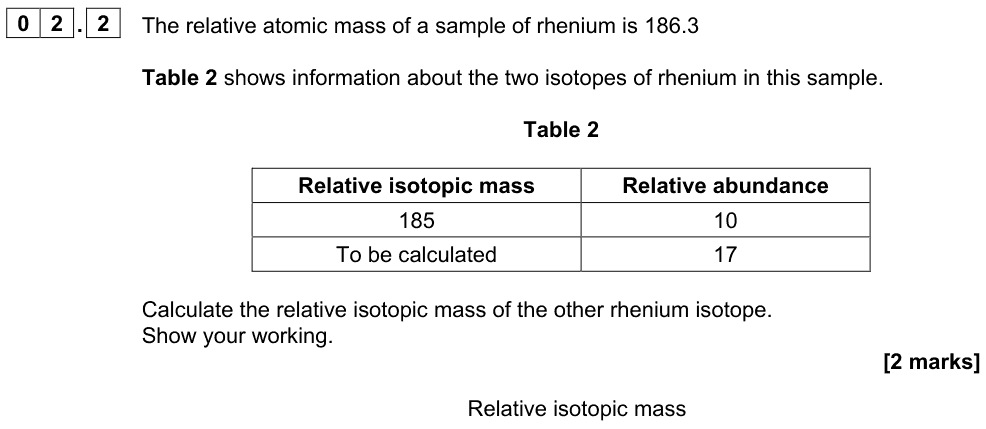
Question 02.2 was answered well by most students; the most common error was using 100 as the denominator.
Notes from the mark scheme and report
Answer: 187 (187.1). 186.3 = [(185 × 10) + (X × 17)] ÷ 27, so 17X = 5030.1 – 1850. Most common error: dividing by 100 instead of 27
Skills: MS1.2 Find arithmetic means; MS2.2 Change the subject of an equation
June 2022 · Paper 1 · Q02.31 markAO1=1Short answer
Earlier part of question 02 that this part uses
Mark scheme
Examiner's comment
Answers to 02.3 were good; some students unnecessarily added that the number of protons was the same and a few students did not refer to electrons and stated that chemical properties depend on the number of neutrons.
Notes from the mark scheme and report
Same electron configuration / same number of electrons. Ignore same number of protons
'same number of neutrons' is rejected
June 2022 · Paper 1 · Q02.45 marksCalculation
Earlier part of question 02 that this part uses
Mark scheme
Examiner's comment
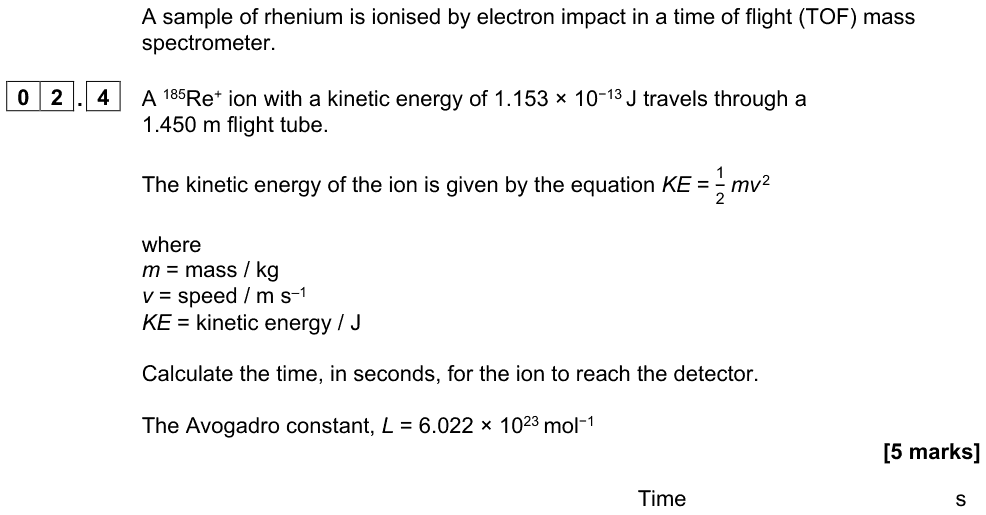
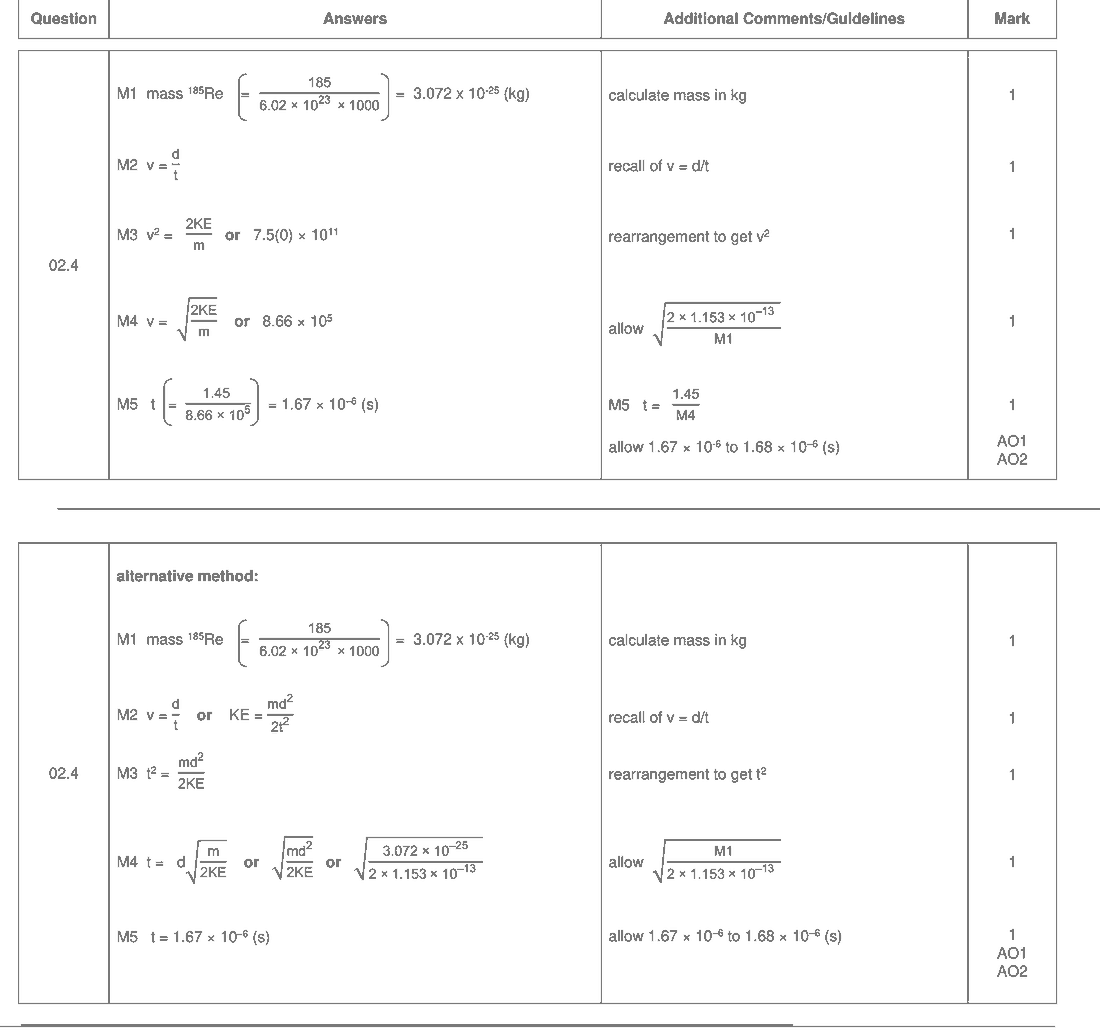
In 02.4 many students scored full marks; the main errors were calculating the mass of the Re+ ion in kg, omitting to take a square root and incorrect rearrangement of the equation.
Notes from the mark scheme and report
Answer: 1.67 × 10^–6 s (allow 1.67 to 1.68). m = 185 ÷ (6.022 × 10^23 × 1000) = 3.072 × 10^–25 kg
v = √(2KE ÷ m) = 8.66 × 10^5 m s–1
t = d ÷ v = 1.450 ÷ v. Errors: mass of the ion in kg, no square root, wrong rearrangement
Skills: MS0.0 Recognise and make use of appropriate units in calculation; MS0.1 Recognise and use expressions in decimal and ordinary form; MS2.2 Change the subject of an equation; MS2.3 Substitute numerical values into algebraic equations using appropriate units for physical quantities
June 2022 · Paper 1 · Q02.52 marksAO1=2Short answerHard
Earlier part of question 02 that this part uses
Mark scheme
Examiner's comment
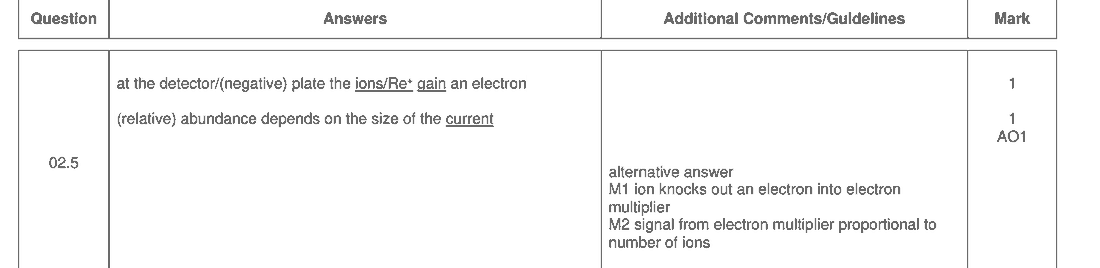
Answers to 02.5 were generally poor; only 21% of students scored both marks.
Many students did not refer to the ion gaining an electron at the detector and many simply stated that the number of ions reaching the detector gave the abundance of the ion without any reference to the current produced.
Notes from the mark scheme and report
At the detector (negative plate) each ion gains an electron
the relative abundance is proportional to the size of the current produced. Many omitted the electron gain or said the number of ions is counted without mentioning current
June 2022 · AS Paper 1 · Q055 marksAO2=5Calculation
Mark scheme
Examiner's comment
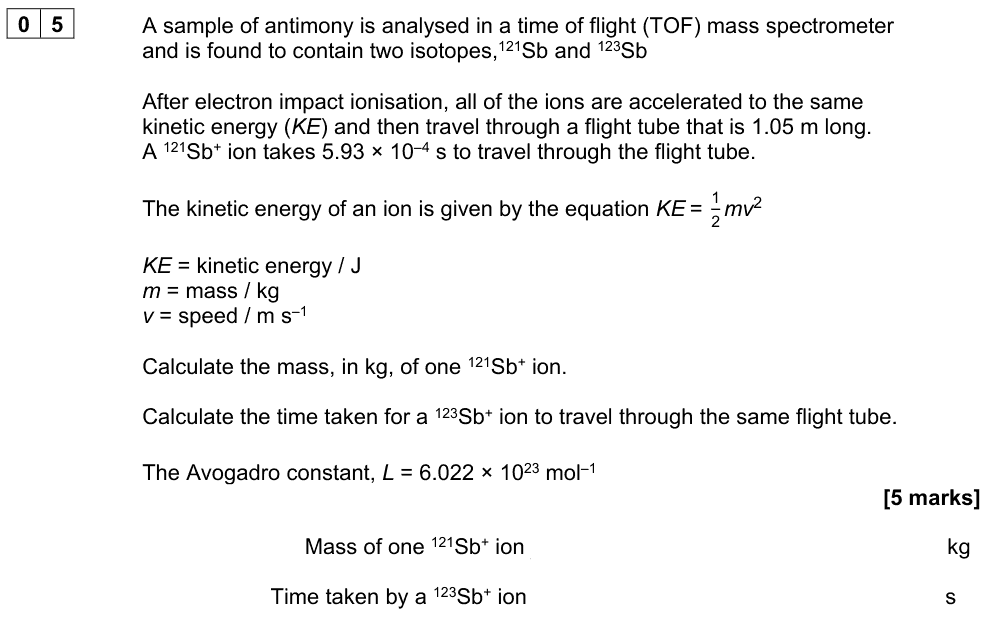
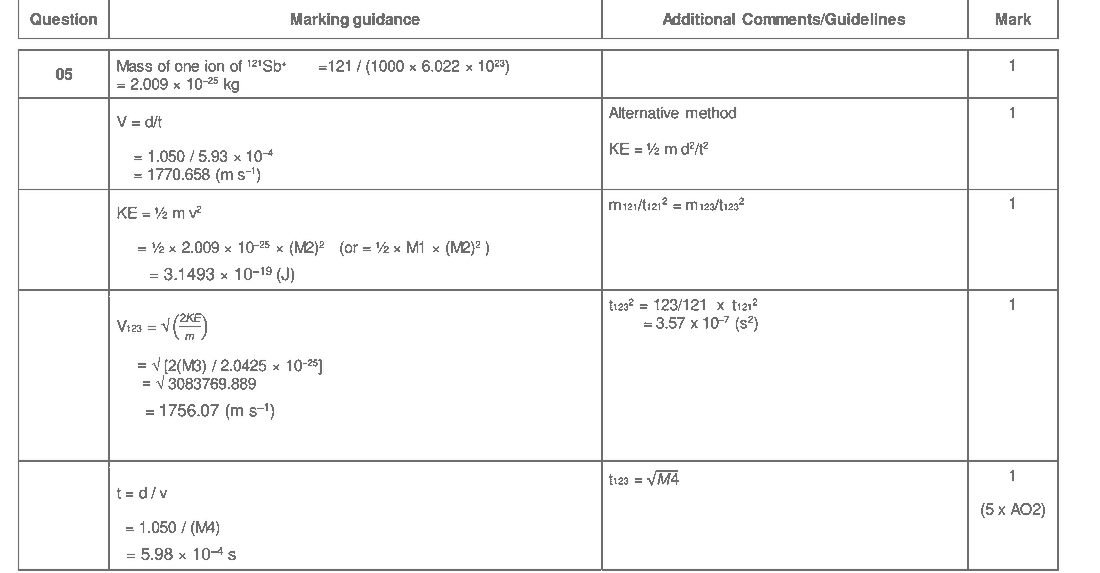
This was generally done well by students, although they should be encouraged to set out working with a clear explanation of each step in a calculation rather than just writing down a set of different numerical expressions. A common error was not converting the mass in grams to the mass in kilograms. There were a number of incorrect rearrangements of the expression involving kinetic energy and students appeared to be less comfortable when working on values in standard form.
Notes from the mark scheme and report
Answer: mass 2.009 × 10^–25 kg
time 5.98 × 10^–4 s. m = 121 ÷ (1000 × 6.022 × 10^23)
v = 1.05 ÷ 5.93 × 10^–4 = 1771 m s–1
KE = ½mv² = 3.149 × 10^–19 J
v(123) = √(2KE ÷ 2.0425 × 10^–25) = 1756 m s–1
t = d ÷ v. Short cut: t(123) = t(121) × √(123/121). Errors: mass left in grams
wrong rearrangement of KE = ½mv²
Skills: MS0.0 Recognise and make use of appropriate units in calculation; MS0.1 Recognise and use expressions in decimal and ordinary form; MS2.2 Change the subject of an equation; MS2.3 Substitute numerical values into algebraic equations using appropriate units for physical quantities
June 2022 · Paper 1 · Q05.42 marksAO3=2Short answer
Earlier part of question 05 that this part uses
Mark scheme
Examiner's comment
05.4. The equation in 05.5 was correctly given by 18% of students; many students did not know the products of the reaction or gave an equation starting from P2O5. Several students gave the correct molecule in 05.6 but did not give the displayed formula as asked for in the question. About 20% of answers to 05.7 scored marks at level 3 (5/6 marks). Often the indicative content was not well explained or was very muddled. Some students mixed up ions and molecules and some confused which bonds/intermolecular forces were being broken to measure the melting point; many thought that covalent bonds were broken in chlorine and hydrogen chloride, the two molecules.
Notes from the mark scheme and report
31P4+ (2 marks): the peak is from a P4 molecular ion, 4 × 31 = 124. P4+ alone scores 1
31P alone scores 1. Very few scored both marks
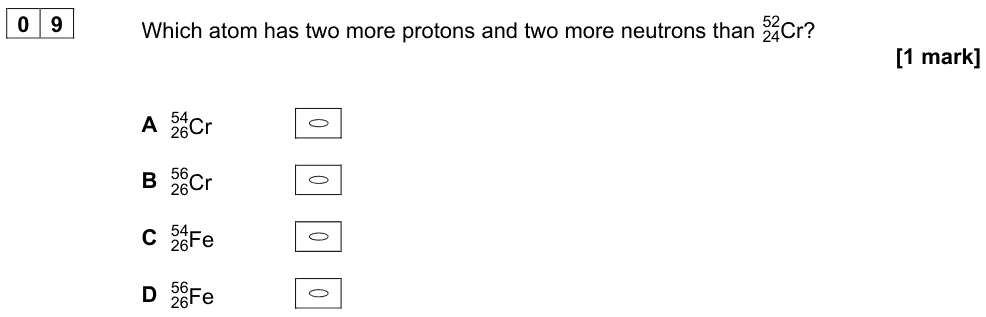
June 2022 · AS Paper 1 · Q091 markAO1=1Multiple choiceEasy
Answer
D
Mark scheme
Examiner's comment
Atomic Structure The majority of students (67%) were able to deduce the correct atom, although some did not recall that protons also contribute to the atomic mass.
Notes from the mark scheme and report
Answer: D. Two more protons gives Z = 26 (Fe)
two more neutrons as well raises the mass number by 4 to 56
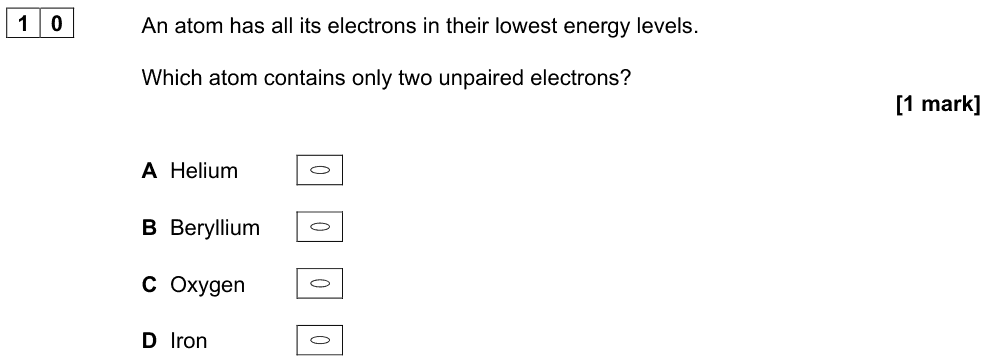
June 2022 · AS Paper 1 · Q101 markAO1=1Multiple choice
Answer
C
Mark scheme
Examiner's comment
Unpaired electrons About half the students were able to identify the atom with two unpaired electrons.
Notes from the mark scheme and report
Answer: C. Oxygen is 1s2 2s2 2p4, with two unpaired 2p electrons
He and Be have none and Fe (3d6) has four
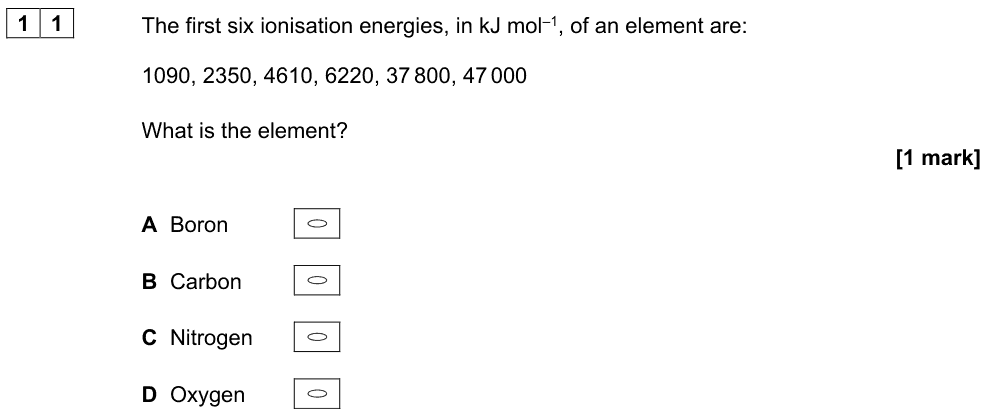
June 2022 · AS Paper 1 · Q111 markAO3=1Multiple choiceEasy
Answer
B
Mark scheme
Examiner's comment
Successive ionisation energies Most students (70%) were correctly able to identify an element from a list of successive ionisation energies
Notes from the mark scheme and report
Answer: B. The large jump comes after the fourth ionisation energy, so there are four outer electrons: carbon
June 2022 · AS Paper 1 · Q121 markAO1=1Multiple choice
Answer
C
Mark scheme
Examiner's comment
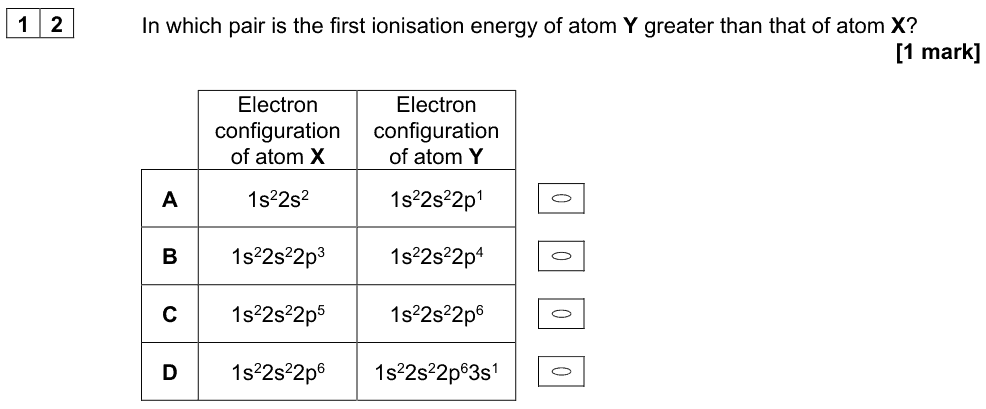
Comparing ionisation energies About half the students were able to compare the relative size of first ionisation energies based on electron configurations.
Notes from the mark scheme and report
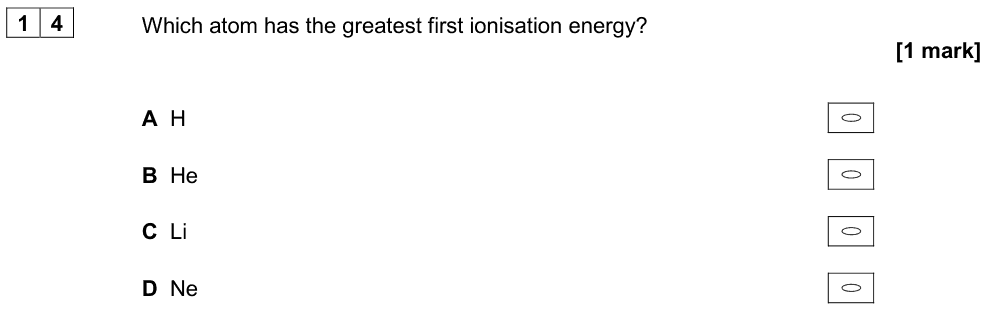
Answer: C. Y (neon) has one more proton than X (fluorine) with the electron removed from the same 2p sub-shell. In A, B and D the first ionisation energy falls (new 2p sub-shell, paired 2p electrons, new 3s shell)
June 2022 · AS Paper 1 · Q131 markAO1=1Multiple choiceEasy
Answer
C
Mark scheme
Examiner's comment
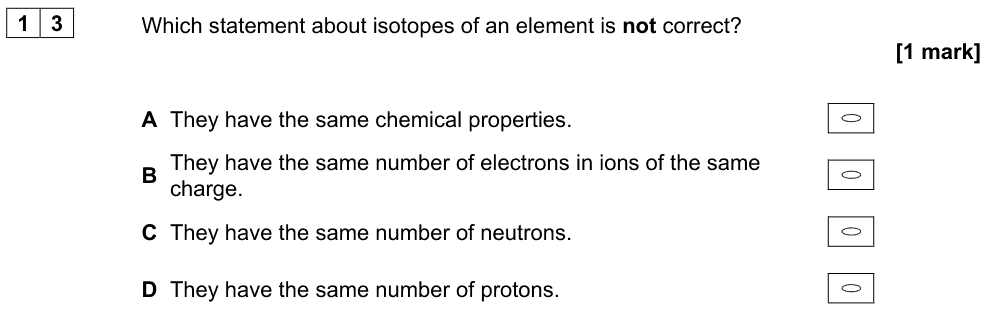
Isotopes This question was well answered, with most students (90%) understanding the concept of isotopes.
Notes from the mark scheme and report
Answer: C. Isotopes have the same number of protons but different numbers of neutrons
June 2022 · AS Paper 1 · Q171 markAO3=1Multiple choice
Answer
A
Mark scheme
Examiner's comment
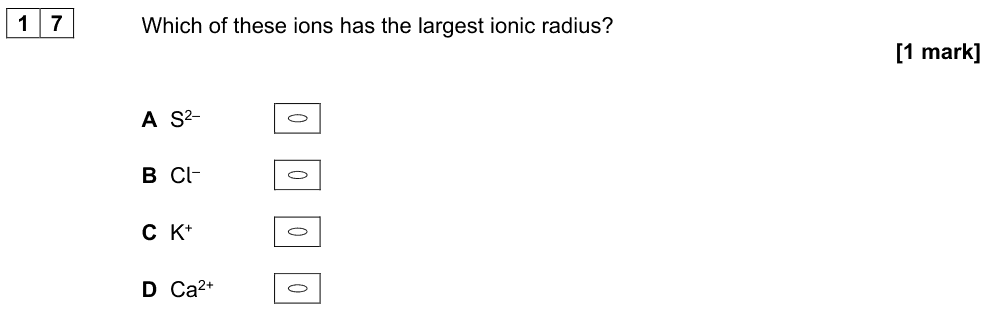
Ionic radius About half the students were able to identify the ion with the largest ionic radius. A particularly common incorrect answer was that with the smallest ionic radius.
Notes from the mark scheme and report
Answer: A. All four ions have 18 electrons
S2– has the fewest protons so the weakest attraction and the largest radius. The most common wrong answer was the smallest ion
June 2022 · Paper 2 · Q09.52 marksAO2=2Calculation
Earlier parts of question 09 that this part uses
Mark scheme
Examiner's comment
09.5 The question demanded that students show their working. Whilst it was well answered overall, many failed to score both marks. The first mark required students to show that the Mr was one less than 345, but this was often omitted despite the question stating that each molecule gains a hydrogen ion (H+) during electrospray ionisation.
Notes from the mark scheme and report
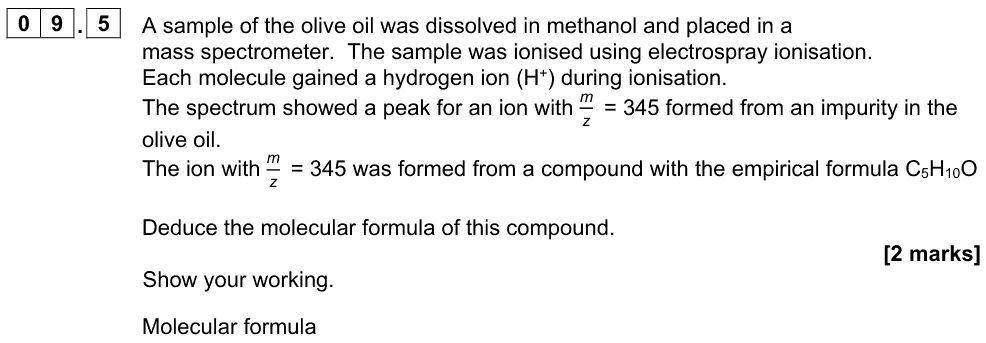
Answer: C20H40O4. Mr = 345 – 1 = 344 (the ion is MH+)
empirical formula mass of C5H10O = 86.0
344 ÷ 86 = 4. Working must be shown for both marks
subtracting 1 was often omitted
Skills: MS0.2 Use ratios, fractions and percentages
June 2022 · Paper 3 · Q061 markAO2=1Multiple choice
Answer
C
Mark scheme
Notes from the mark scheme and report
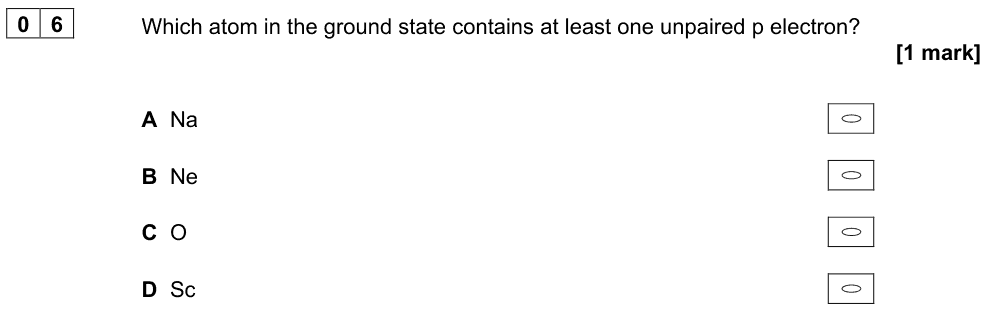
Answer: C. Oxygen is 1s2 2s2 2p4 with two unpaired 2p electrons
Na and Sc have no partly filled p sub-shell and Ne has all p electrons paired
June 2022 · Paper 3 · Q161 markAO2=1Multiple choice
Answer
A
Mark scheme
Notes from the mark scheme and report
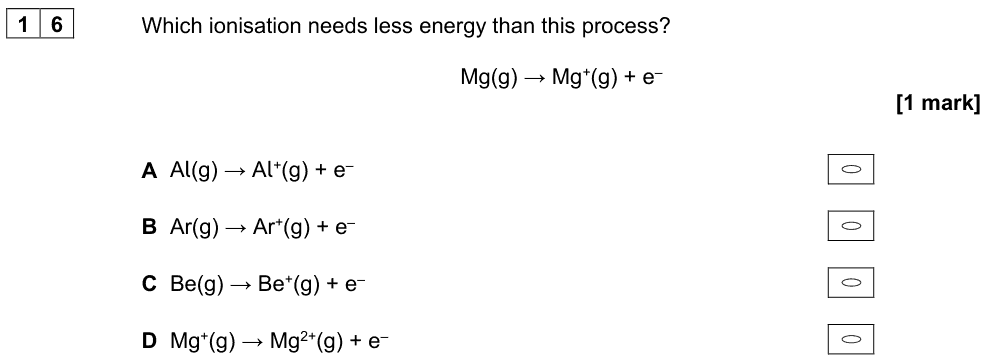
Answer: A. Aluminium's outer electron is in a 3p orbital, higher in energy and more shielded than magnesium's 3s electron. Ar and Be have higher first ionisation energies and a second ionisation always needs more
June 2022 · Paper 3 · Q171 markAO3=1Multiple choice
Answer
D
Mark scheme
Notes from the mark scheme and report
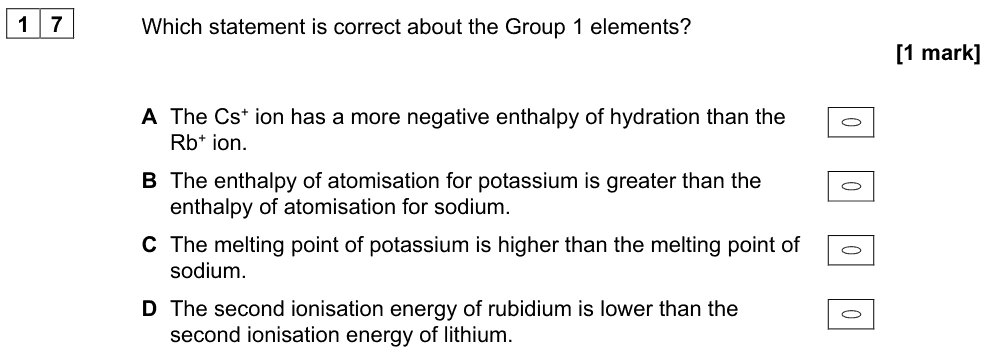
Answer: D. The second electron in Rb comes from a shell much further from the nucleus with more shielding than in Li (1s). Larger ions have less negative hydration enthalpies
metallic bonding weakens down the group so atomisation enthalpy and melting point fall
November 2021 · AS Paper 1 · Q01.12 marksShort answer
Mark scheme
Notes from the mark scheme and report
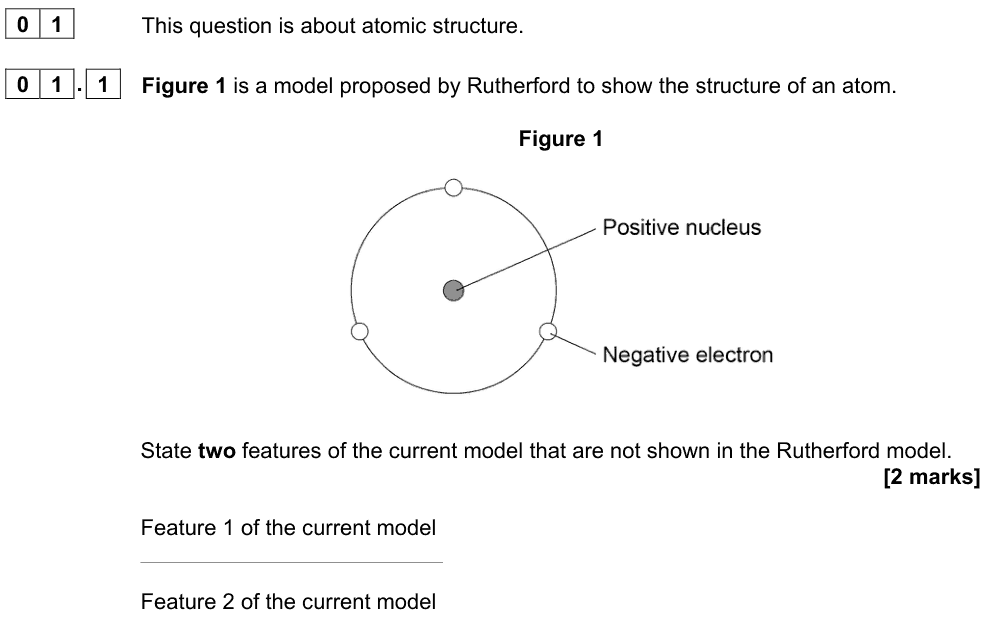
The current model has a nucleus made of protons and neutrons (Rutherford's shows only a positive nucleus)
electrons are in different energy levels / orbitals (Rutherford's shows them all in one orbit). Allow 'the first energy level holds only 2 electrons'
November 2021 · AS Paper 1 · Q01.24 marksCalculation
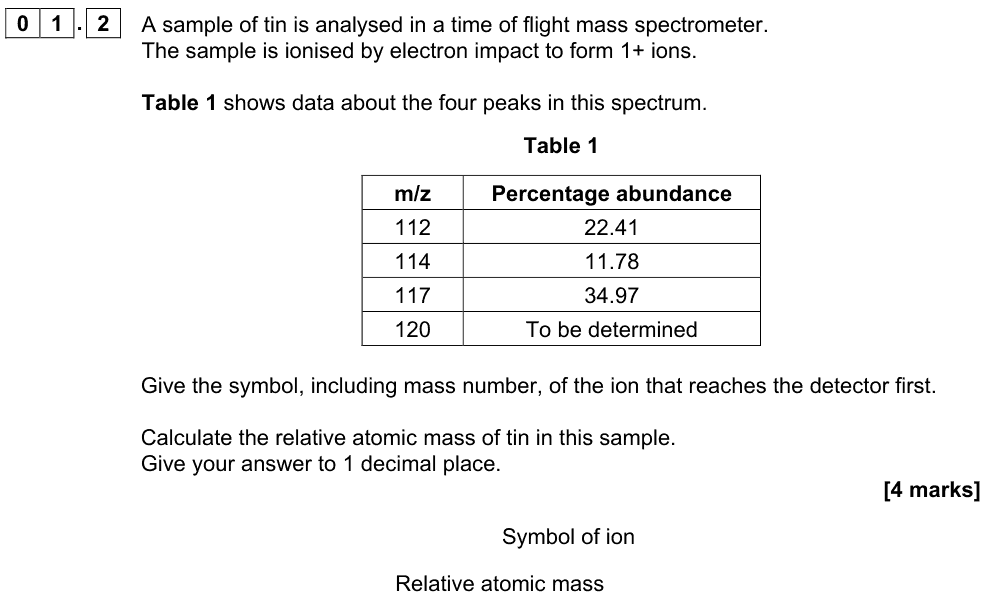
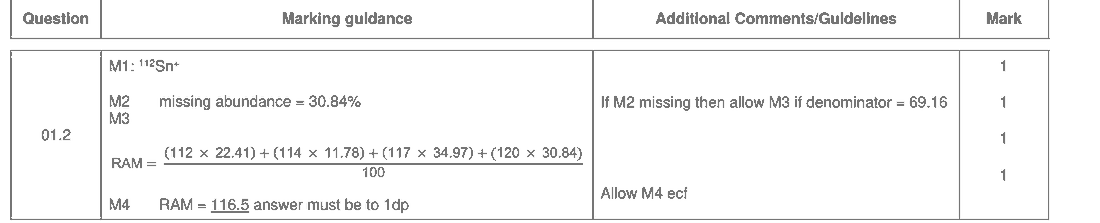
Ar = [(112 × 22.41) + (114 × 11.78) + (117 × 34.97) + (120 × 30.84)] ÷ 100. Answer must be to 1 decimal place. The lightest ion reaches the detector first and must be shown with its charge
Skills: MS0.2 Use ratios, fractions and percentages; MS1.1 Use an appropriate number of significant figures; MS1.2 Find arithmetic means
November 2021 · Paper 1 · Q02.11 markShort answer
Mark scheme
Examiner's comment
Many students answered question 02.1 well; a few students discussed the mass instead of the mass number, and some gave a definition of relative atomic mass.
Notes from the mark scheme and report
The number of protons plus neutrons (in the nucleus of the atom). No reference to mass or average. Some defined relative atomic mass instead
November 2021 · Paper 1 · Q02.22 marksShort answer
Earlier part of question 02 that this part uses
Mark scheme
Examiner's comment
In question 02.2, the most frequent error was the number of electrons in the ion.
Notes from the mark scheme and report
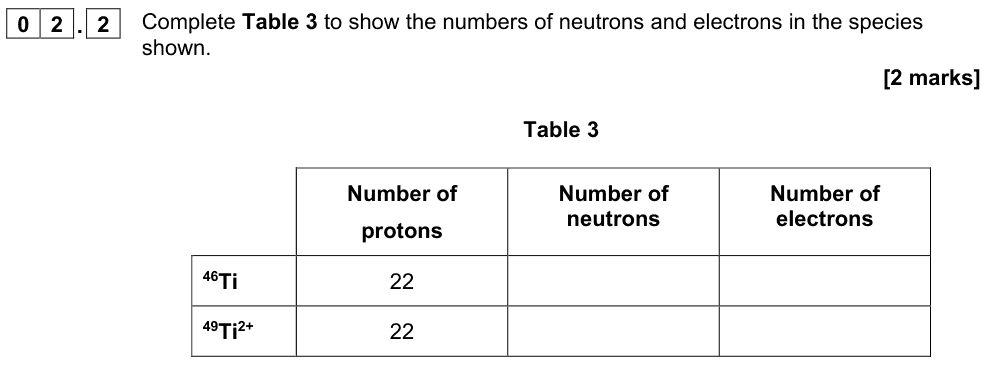
46Ti: 24 neutrons, 22 electrons. 49Ti2+: 27 neutrons, 20 electrons. One mark per row. Most frequent error: the number of electrons in the ion
November 2021 · Paper 1 · Q02.33 marksCalculation
Earlier part of question 02 that this part uses
Mark scheme
Examiner's comment
A significant number of students were unable to produce an appropriate algebraic expression in question 02.3 and many did not include a term for the 48Ti isotope.
Those who could write a correct expression went on to give the percentage of the 48Ti isotope and didn’t give the percentage of the 46Ti isotope.
Only the most able scored all the marks in this question.
Notes from the mark scheme and report
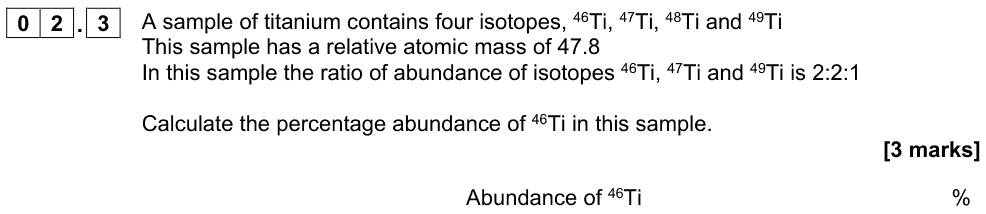
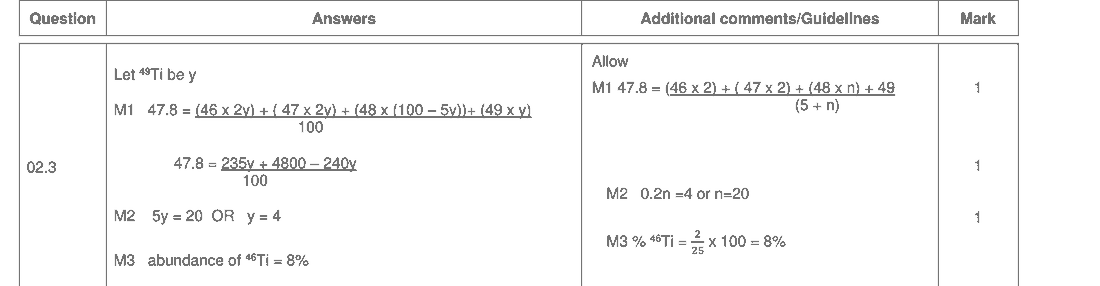
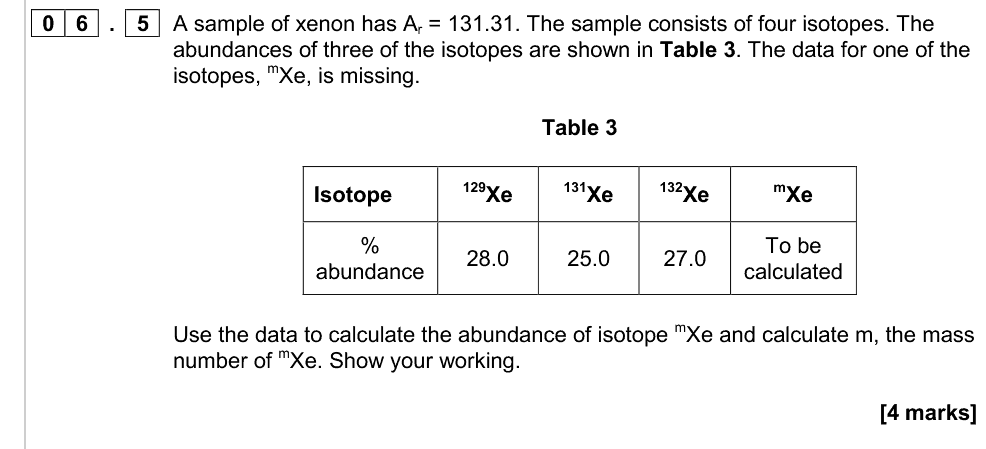
Answer: 8%. Let 49Ti = y: 47.8 = [(46 × 2y) + (47 × 2y) + 48(100 – 5y) + 49y] ÷ 100, so y = 4 and 46Ti = 2y. Errors: no term for 48Ti
giving the percentage of 48Ti instead
Skills: MS0.2 Use ratios, fractions and percentages; MS1.2 Find arithmetic means; MS2.4 Solve algebraic equations
November 2021 · AS Paper 1 · Q111 markMultiple choice
Answer
D
Mark scheme
Notes from the mark scheme and report
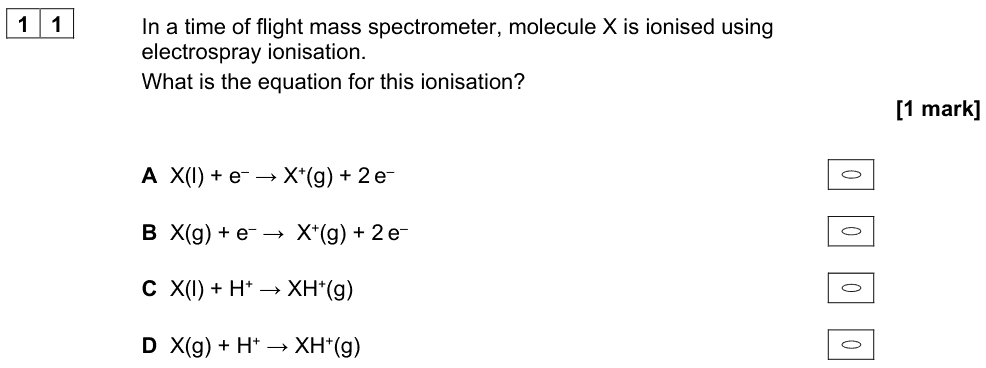
Answer: D. In electrospray ionisation the gaseous molecule gains a proton to form XH+
A and B describe electron impact
November 2021 · AS Paper 1 · Q121 markMultiple choice
Answer
A
Mark scheme
Notes from the mark scheme and report
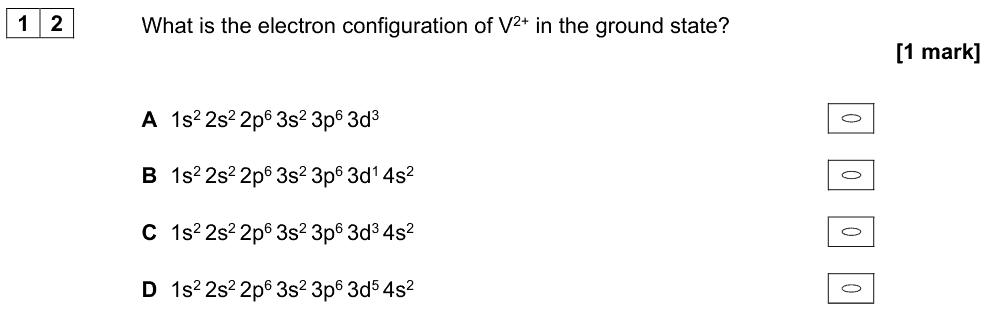
Answer: A. V is [Ar] 3d3 4s2
the two 4s electrons are lost first, leaving 3d3
November 2021 · AS Paper 1 · Q211 markMultiple choice
Answer
D
Mark scheme
Notes from the mark scheme and report
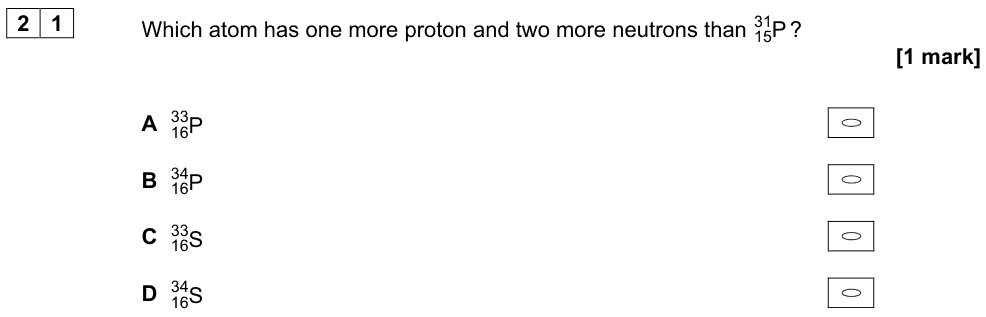
Answer: D. 16 protons is sulfur
neutrons 16 + 2 = 18, so the mass number is 34
November 2021 · AS Paper 1 · Q231 markMultiple choice
Answer
D
Mark scheme
Notes from the mark scheme and report
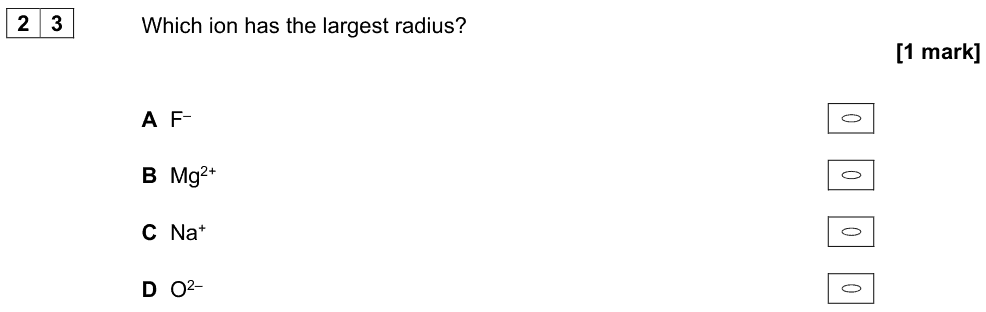
Answer: D. All four ions have the same electron configuration (1s2 2s2 2p6)
O2– has the fewest protons so the weakest attraction for its electrons
November 2021 · AS Paper 1 · Q241 markMultiple choice
Answer
D
Mark scheme
Notes from the mark scheme and report
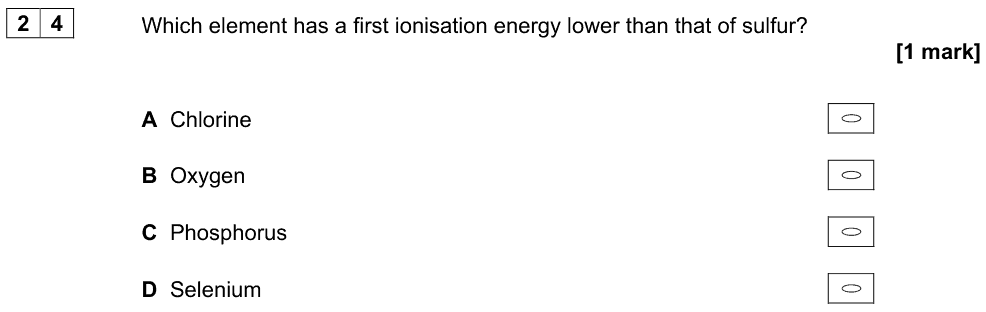
Answer: D. Selenium is below sulfur in the group: its outer electron is further from the nucleus and more shielded. Phosphorus is higher than sulfur because sulfur has a paired 3p electron
November 2021 · AS Paper 1 · Q251 markMultiple choice
Answer
C
Mark scheme
Notes from the mark scheme and report
Answer: C. The large jump after the fourth ionisation energy shows four outer electrons (Group 4)
seven ionisation energies are shown, so it cannot be carbon, which has only six electrons
Skills: MS3.1 Translate information between graphical, numerical and algebraic forms
November 2021 · Paper 3 · Q071 markMultiple choice
Answer
C
Mark scheme
Notes from the mark scheme and report
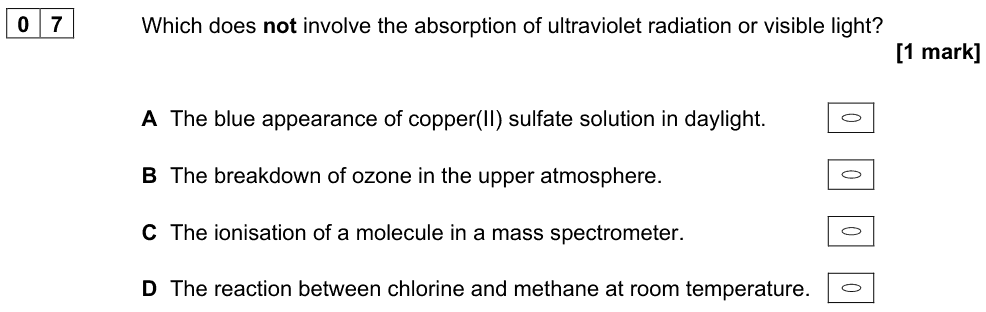
Answer: C. Ionisation in a mass spectrometer uses electron impact or electrospray, not light
the other three need visible or UV radiation
November 2021 · Paper 3 · Q101 markMultiple choice
Answer
C
Mark scheme
Notes from the mark scheme and report
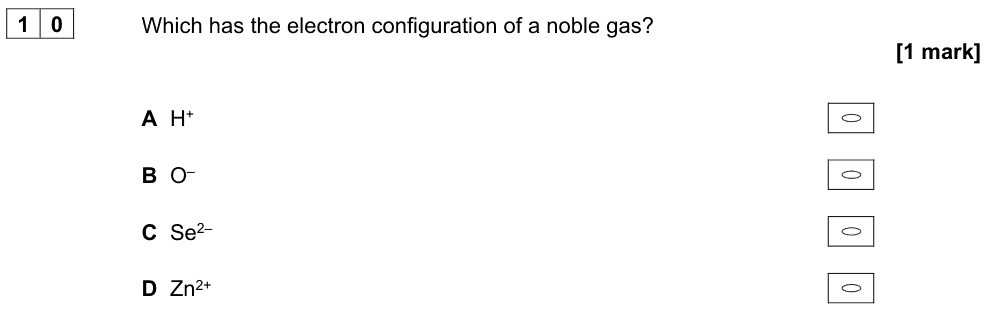
Answer: C. Se2– has 36 electrons, the krypton configuration
H+ has no electrons, O– has 9 and Zn2+ ends in 3d10
November 2020 · AS Paper 1 · Q01.13 marksExplanation
Mark scheme
Notes from the mark scheme and report
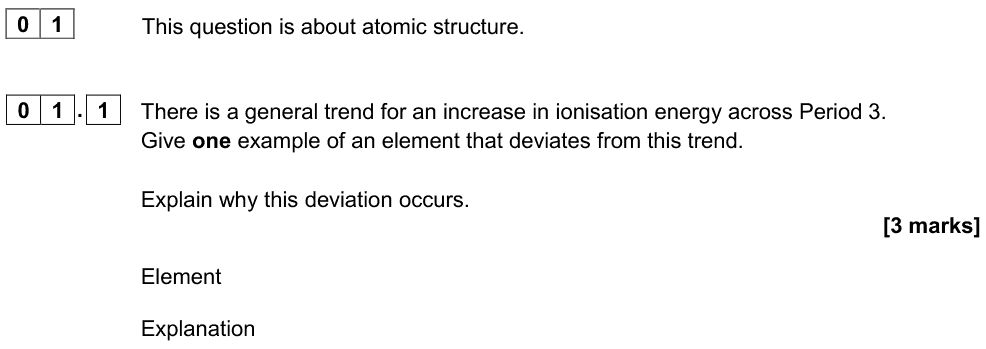
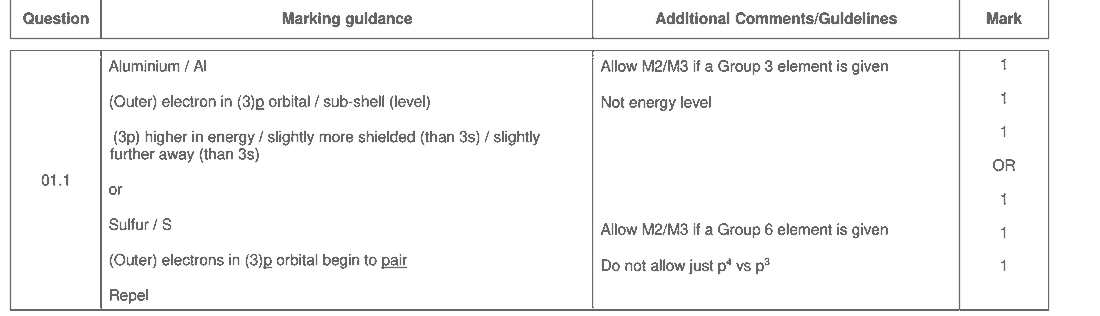
Aluminium: its outer electron is in a 3p sub-shell, which is higher in energy / slightly more shielded than 3s (in Mg). OR sulfur: outer electrons in a 3p orbital begin to pair, and the paired electrons repel. Not 'energy level' for sub-shell
'p4 versus p3' alone is not enough
November 2020 · AS Paper 1 · Q01.21 markEquation writing
Earlier part of question 01 that this part uses
Mark scheme
Notes from the mark scheme and report
Na2+(g) → Na3+(g) + e–. State symbols essential
November 2020 · AS Paper 1 · Q01.33 marksExplanation
Earlier part of question 01 that this part uses
Mark scheme
Notes from the mark scheme and report
Phosphorus. There is a large jump at the 6th ionisation energy (after five electrons are removed)
the 6th electron is removed from the second energy level / 2p / a shell closer to the nucleus
Skills: MS3.1 Translate information between graphical, numerical and algebraic forms
November 2020 · Paper 1 · Q02.24 marksCalculation
Earlier part of question 02 that this part uses
Mark scheme
Examiner's comment
In 02.2, most students deduced that the percentage of the missing isotopes added up to 13.9, but many students were unable to write an expression in terms of one unknown and could make no further progress.
Most students who calculated a value of the abundance for one isotope could find the percentage of the other.
Notes from the mark scheme and report
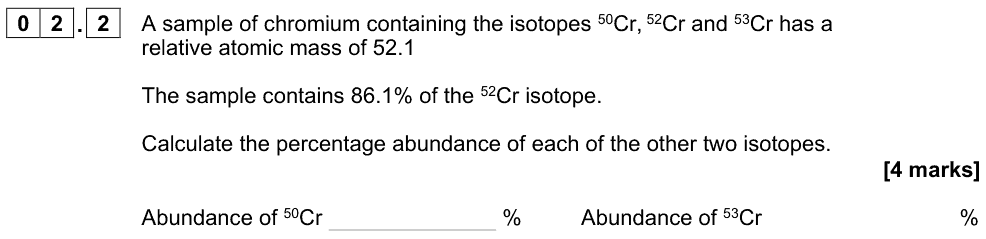
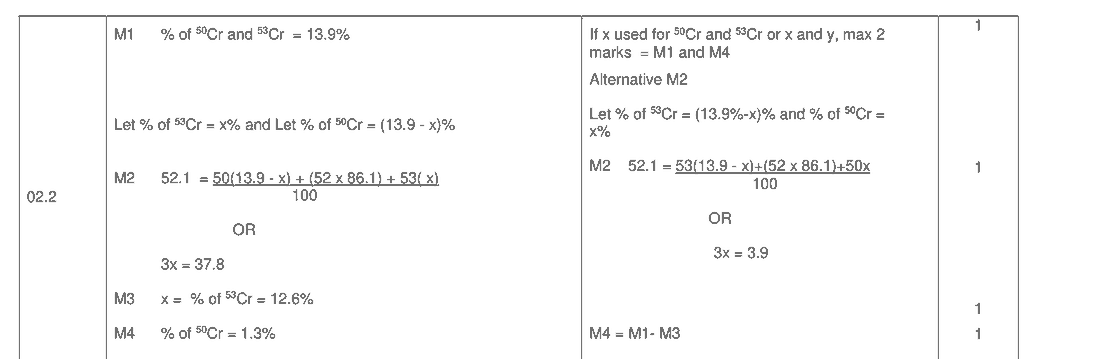
Answer: 50Cr 1.3%
53Cr 12.6%. The two total 13.9%
let 53Cr = x: 52.1 = [50(13.9 – x) + (52 × 86.1) + 53x] ÷ 100, so 3x = 37.8. Using two unknowns scores max 2. Many could not write an expression in one unknown
Skills: MS1.2 Find arithmetic means; MS2.4 Solve algebraic equations; MS0.2 Use ratios, fractions and percentages
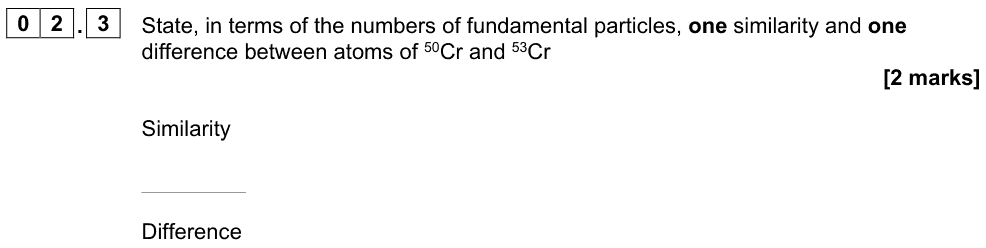
November 2020 · Paper 1 · Q02.32 marksShort answer
Earlier part of question 02 that this part uses
Mark scheme
Examiner's comment
Most students answered 02.3 well.
Notes from the mark scheme and report
Similarity: same number of protons (or electrons). Difference: different number of neutrons. Not 'same electron configuration'
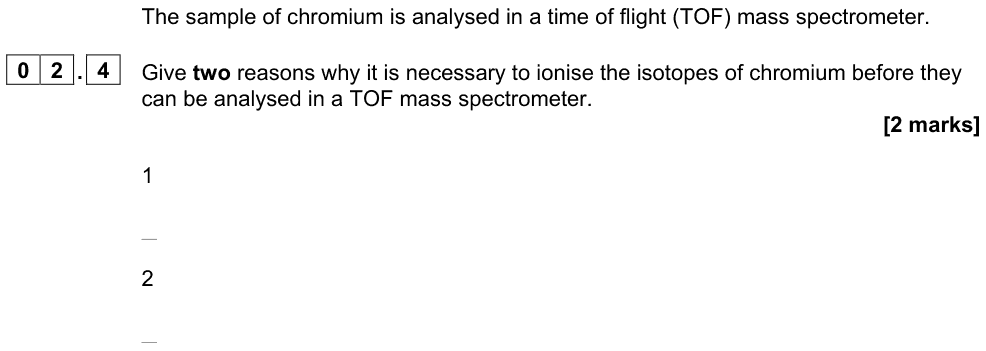
November 2020 · Paper 1 · Q02.42 marksShort answer
Earlier part of question 02 that this part uses
Mark scheme
Examiner's comment
In 02.4, most students stated that there had to be ions for detection but fewer talked about the need for acceleration; some students failed to gain marks through giving incorrect detail, eg acceleration by a magnetic field.
Notes from the mark scheme and report
So the ions can be accelerated by an electric field
so the ions produce a current at the detector / can be detected. Not 'magnetic field'. Acceleration was mentioned less often than detection
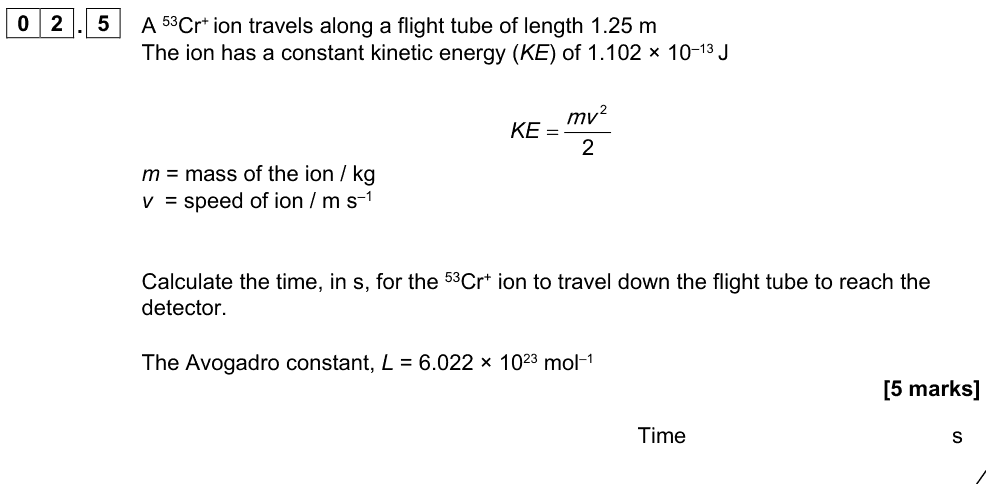
November 2020 · Paper 1 · Q02.55 marksCalculation
Earlier part of question 02 that this part uses
Mark scheme
Examiner's comment
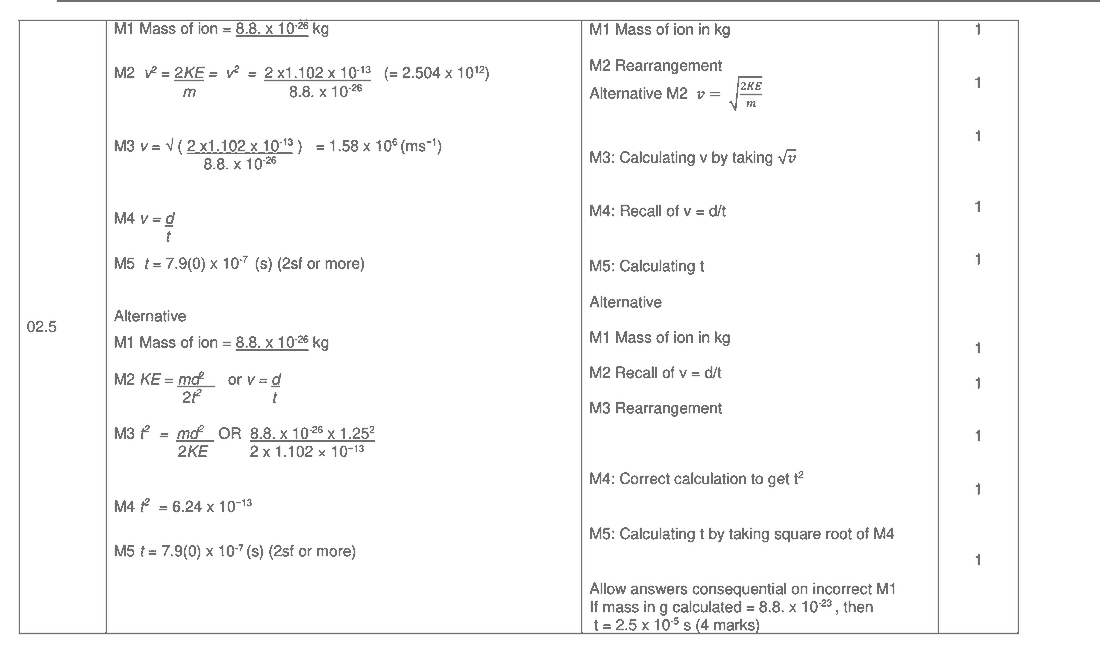
Although many students scored full marks in 02.5, common errors included a failure to calculate the mass of the ion in kg or a failure to use the Avogadro number correctly.
The kinetic energy was often transcribed incorrectly.
Notes from the mark scheme and report
Answer: 7.90 × 10^–7 s (2 sf or more). m = 53 ÷ (6.022 × 10^23 × 1000) = 8.80 × 10^–26 kg
v = √(2KE ÷ m) = 1.58 × 10^6 m s–1
t = d ÷ v = 1.25 ÷ v. Mass left in g gives 2.5 × 10^–5 s (4 marks). Errors: mass not in kg
misuse of L
KE copied wrongly
Skills: MS0.0 Recognise and make use of appropriate units in calculation; MS0.1 Recognise and use expressions in decimal and ordinary form; MS2.2 Change the subject of an equation; MS2.3 Substitute numerical values into algebraic equations using appropriate units for physical quantities
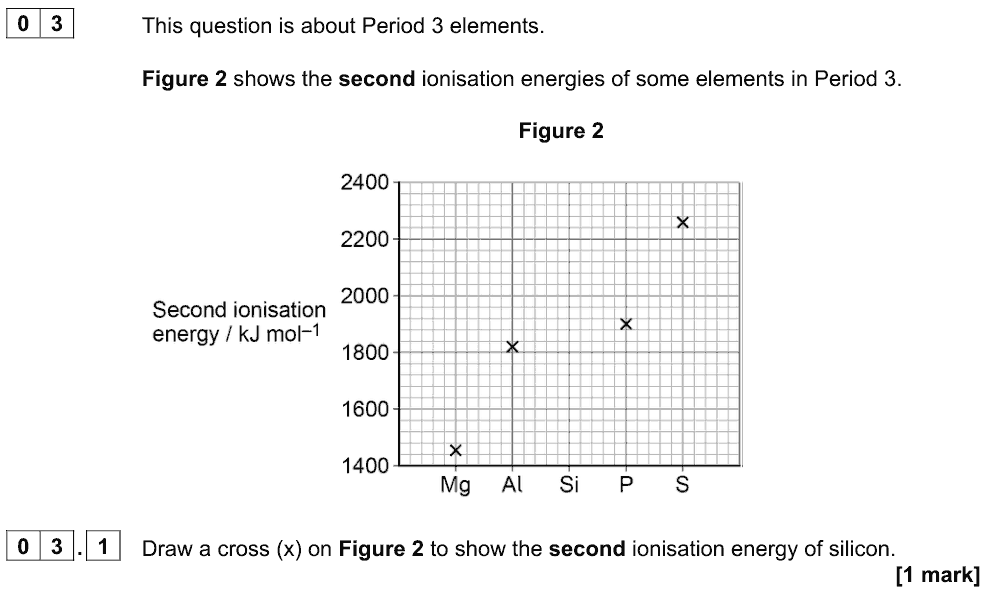
November 2020 · Paper 1 · Q03.11 markDiagram or structure
Mark scheme
Examiner's comment
Students were about equally divided over whether the second ionisation energy would be higher or lower than that of aluminium in 03.1.
Notes from the mark scheme and report
Cross at about 1580 kJ mol–1 (anywhere between the Mg and Al values). Si+ loses a 3p electron, which is higher in energy than the 3s electron lost by Al+. Students split evenly between higher and lower than Al
Skills: MS3.1 Translate information between graphical, numerical and algebraic forms
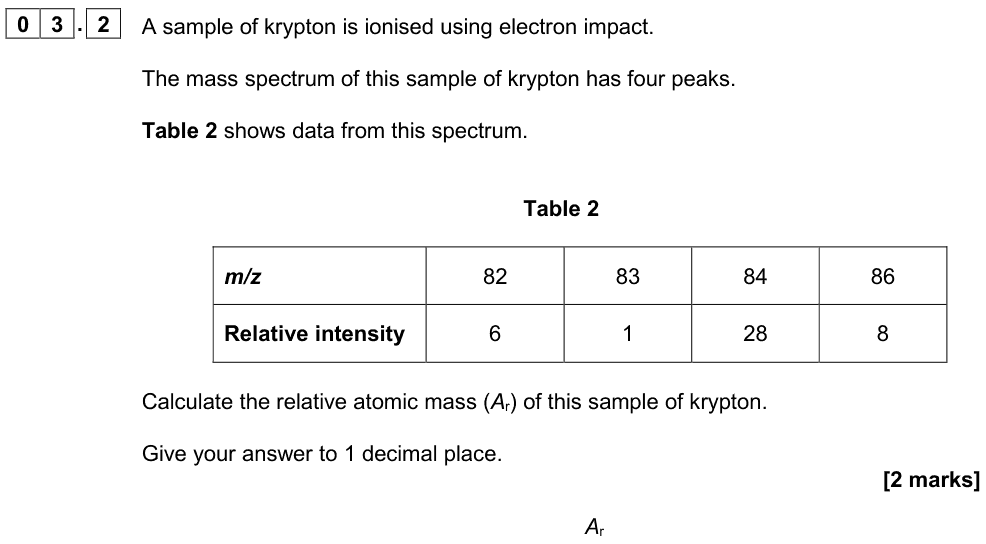
November 2020 · AS Paper 1 · Q03.22 marksCalculation
Earlier part of question 03 that this part uses
Mark scheme
Notes from the mark scheme and report
Answer: 84.1. ((82 × 6) + (83 × 1) + (84 × 28) + (86 × 8)) ÷ 43 = 3615 ÷ 43. One mark for working, one for the answer to 1 decimal place
Skills: MS1.1 Use an appropriate number of significant figures; MS1.2 Find arithmetic means
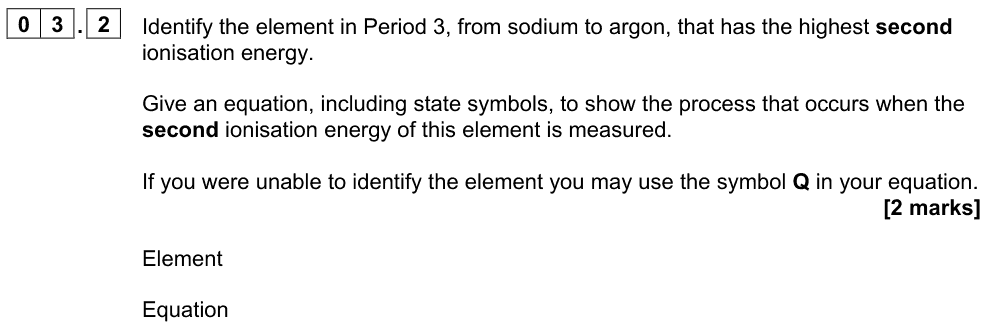
November 2020 · Paper 1 · Q03.22 marksEquation writing
Earlier part of question 03 that this part uses
Mark scheme
Examiner's comment
There were many different answers in 03.2; argon, sulfur and chlorine were common wrong answers.
In the equation the state symbols were often difficult to read and therefore ambiguous, so could not score the mark; sometimes the state symbols were missing.
Notes from the mark scheme and report
Sodium
Na+(g) → Na2+(g) + e– (state symbols essential
equation consequential on their element
Q allowed). The second electron of Na comes from the 2p inner shell. Common wrong elements: Ar, S, Cl
state symbols missing or illegible
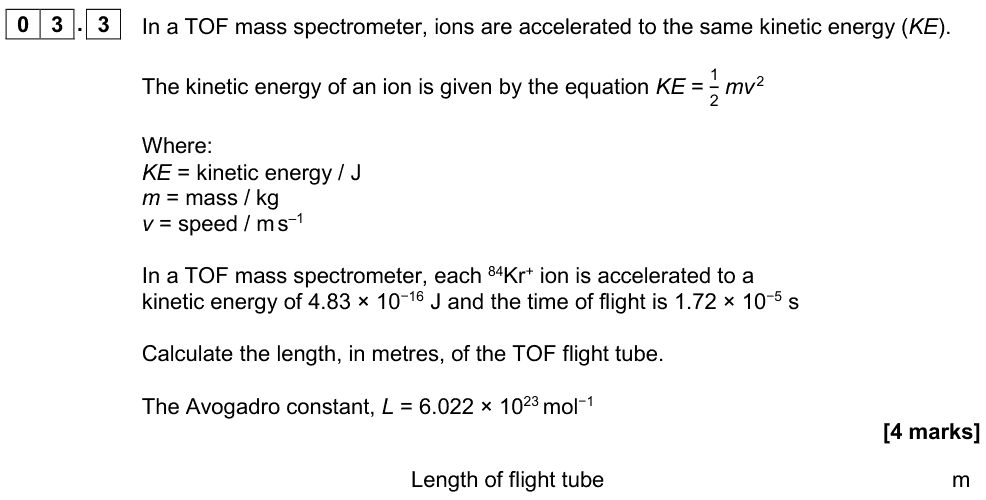
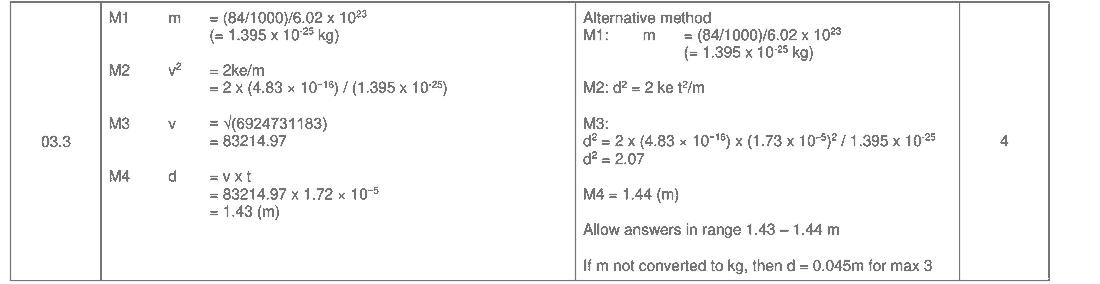
November 2020 · AS Paper 1 · Q03.34 marksCalculation
Earlier part of question 03 that this part uses
Mark scheme
Notes from the mark scheme and report
Answer: 1.43 m (allow 1.43 to 1.44). m = (84 ÷ 1000) ÷ 6.022 × 10^23 = 1.395 × 10^–25 kg
v² = 2KE/m
v = 8.32 × 10^4 m s–1
d = v × t. If mass is not converted to kg, d = 0.045 m scores max 3
Skills: MS0.0 Recognise and make use of appropriate units in calculation; MS0.1 Recognise and use expressions in decimal and ordinary form; MS2.2 Change the subject of an equation; MS2.3 Substitute numerical values into algebraic equations using appropriate units for physical quantities
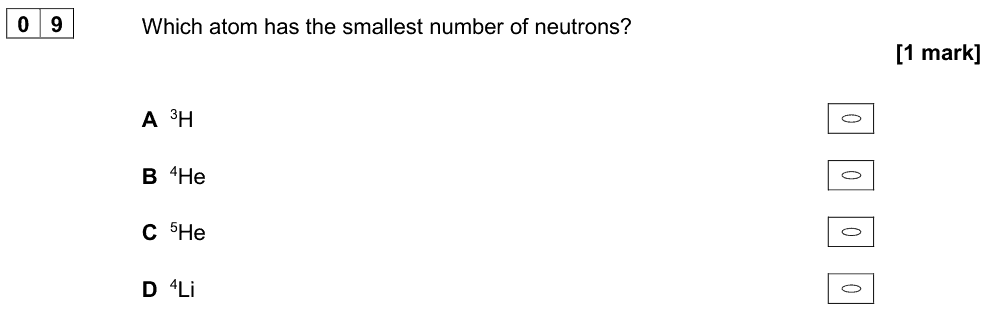
November 2020 · AS Paper 1 · Q091 markMultiple choice
Answer
D
Mark scheme
Notes from the mark scheme and report
Answer: D. 4Li has 4 – 3 = 1 neutron (3H has 2, 4He has 2, 5He has 3)
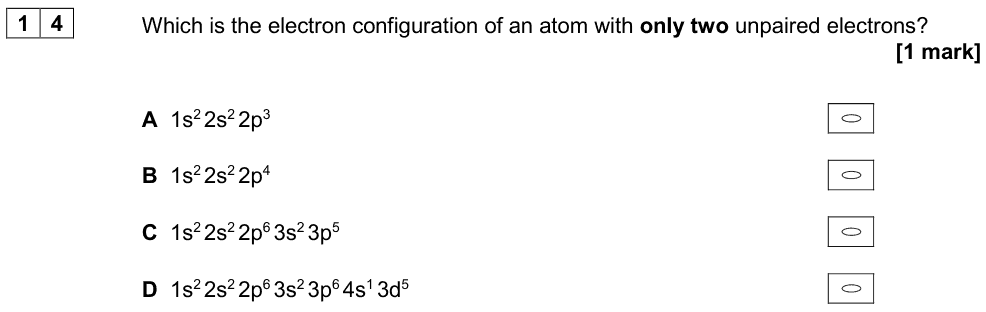
November 2020 · AS Paper 1 · Q141 markMultiple choice
Answer
B
Mark scheme
Notes from the mark scheme and report
Answer: B. 2p4 has one paired orbital and two unpaired electrons
2p3 has three, 3p5 has one, 4s1 3d5 has six
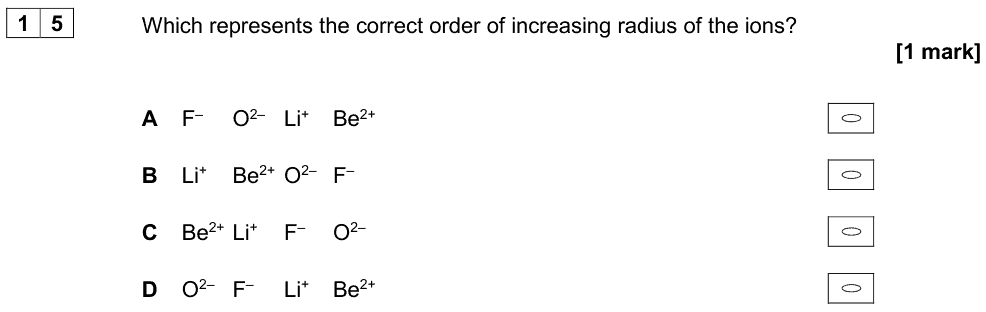
November 2020 · AS Paper 1 · Q151 markMultiple choice
Answer
C
Mark scheme
Notes from the mark scheme and report
Answer: C. Be2+ and Li+ have one shell (Be2+ has more protons so is smaller)
F– and O2– have two shells (F– has more protons so is smaller than O2–)
November 2020 · Paper 2 · Q03.61 markShort answer
Earlier part of question 03 that this part uses
Mark scheme
Examiner's comment
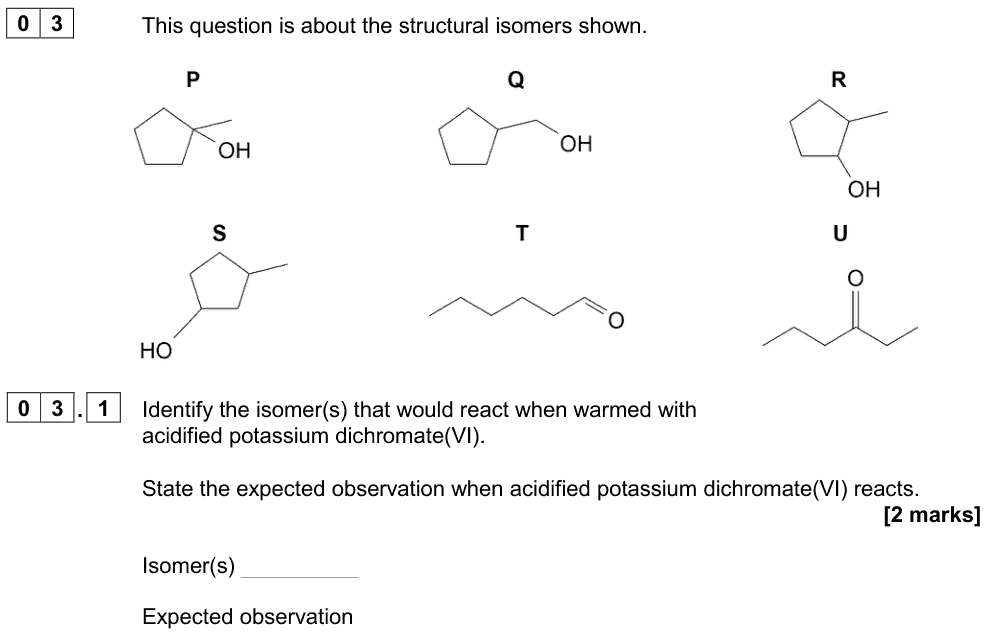
A common problem in this question was being unable to identify common features that linked some of the isomers. As such, many included isomers that did not fit the demand in each of the first three parts of the question. The expected observations for test tube reactions in 03.1 and 03.2 were well known. 03.3 proved more difficult with students finding it hard to identify neutralisation of excess acid as the reason why the esterification reaction mixture was poured into NaHCO3 solution. 03.4 was very well known. Large numbers of students could identify infrared absorptions that could be used to distinguish isomers in 03.5, but far fewer appreciated that the fingerprint region should be used to distinguish those that had common absorptions above 1500 cm–1.
Notes from the mark scheme and report
They are isomers, so all have the same Mr (same molecular formula) and give the same molecular ion m/z peak
November 2020 · Paper 3 · Q171 markMultiple choice
Answer
B
Mark scheme
Notes from the mark scheme and report
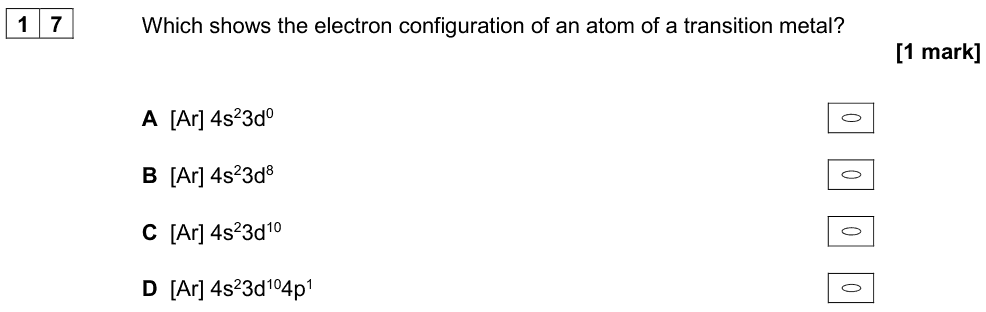
Answer: B. [Ar] 4s2 3d8 (nickel) has an incomplete d sub-level
A is calcium, C is zinc (full d sub-level), D is gallium
June 2019 · AS Paper 1 · Q01.12 marksExplanation
Mark scheme
Examiner's comment
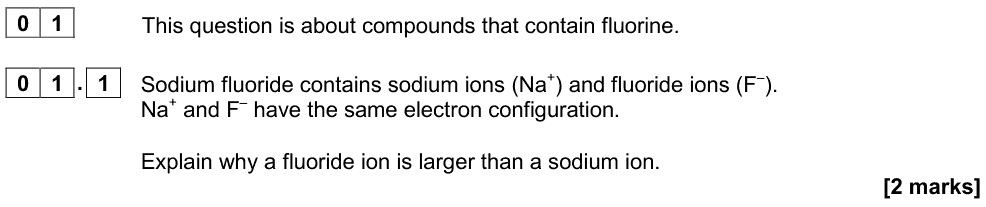
01.1 Many students understood that the key reason for the difference in size of the two isoelectronic ions was the difference in the number of protons. However, many students made reference to differences in atomic radius rather than ionic radius. Students did not always answer with an explanation of the difference in the attraction.
Notes from the mark scheme and report
The fluoride ion has (two) fewer protons / a lower nuclear charge, so there is weaker attraction between the nucleus and the (outer) electrons. Must refer to ions, not fluorine atoms
saying the ions have different numbers of electrons loses M1. Common errors: writing about atomic radius
not explaining the attraction
June 2019 · AS Paper 1 · Q02.13 marksShort answer
Mark scheme
Examiner's comment
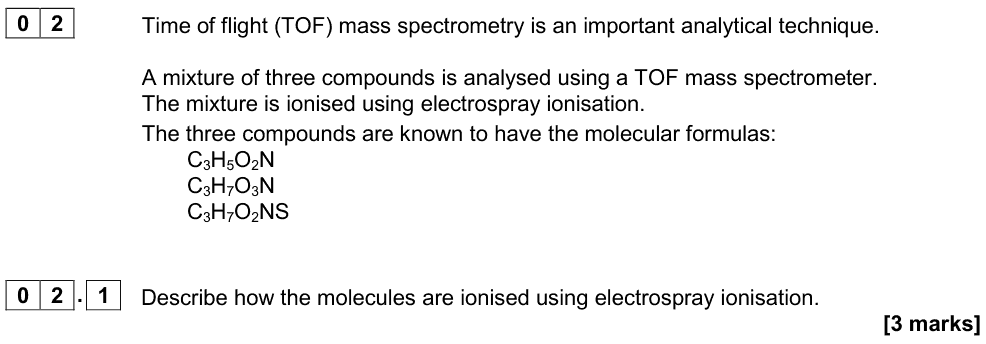
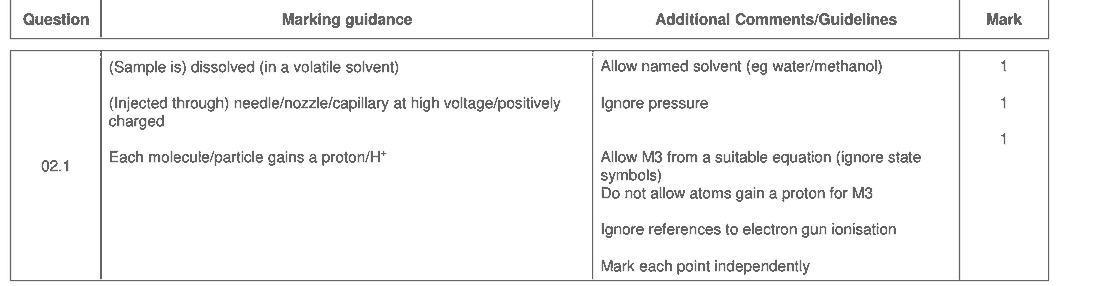
02.1 Students were not always able to describe the process for electrospray ionisation, with a large number describing the process for electron impact ionisation. Both ionisation methods are described in the student guide on the subject pages of the website.
Notes from the mark scheme and report
Sample dissolved in a volatile solvent
injected through a needle / nozzle at high voltage (positively charged)
each molecule gains a proton (H+). 'Atoms gain a proton' not allowed. Very common error: describing electron impact (electron gun) ionisation instead
June 2019 · Paper 1 · Q02.14 marksExplanation
Mark scheme
Examiner's comment
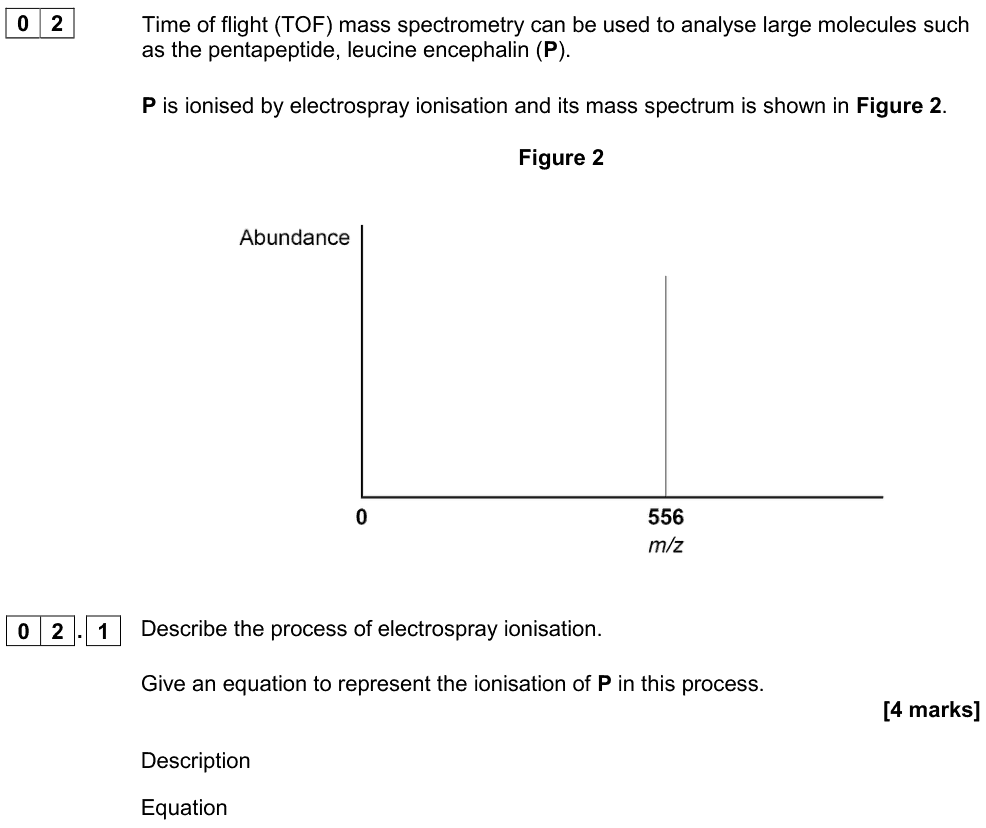
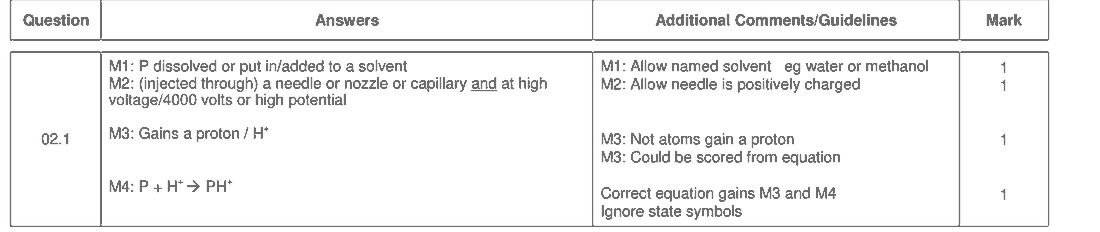
2.1 Only the more able students scored all the marks; students were not clear about how electrospray ionisation occurs, and many could not write the equation.
Notes from the mark scheme and report
The sample is dissolved in a (volatile) solvent
injected through a fine needle (nozzle) at high voltage / positively charged
each molecule gains a proton. P + H+ → PH+ (a correct equation also scores the 'gains a proton' mark). Only the more able scored all 4
June 2019 · AS Paper 1 · Q02.21 markShort answer
Earlier part of question 02 that this part uses
Mark scheme
Examiner's comment
02.2 Few students gave the formula of an ion in response to this question, although many appreciated that the lightest particle would reach the detector first.
Notes from the mark scheme and report
C3H6O2N+ (or C3H5O2NH+): the lightest molecule plus the proton gained in electrospray ionisation. Must be charged. Many knew the lightest particle arrives first but few gave the formula of an ion
June 2019 · Paper 1 · Q02.21 markShort answer
Earlier part of question 02 that this part uses
Mark scheme
Examiner's comment
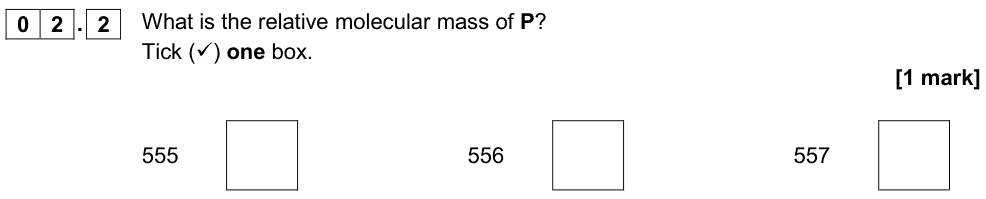
2.2 The most common incorrect answer was 556; students did not realise that the relative molecular mass of P would be 1 unit less than the peak shown in the mass spectrum.
Notes from the mark scheme and report
Answer: 555. The peak at m/z 556 is PH+, so the Mr of P is one less. Most common wrong answer: 556
June 2019 · AS Paper 1 · Q02.31 markEquation writing
Earlier part of question 02 that this part uses
Mark scheme
Examiner's comment
02.3 This question was answered well by students, with the majority scoring the mark, although there were a good number of cases where students did not include state symbols or gave incorrect state symbols.
Notes from the mark scheme and report
Ge(g) + e– → Ge+(g) + 2e– or Ge(g) → Ge+(g) + e–. State symbols essential
they were often missing or wrong
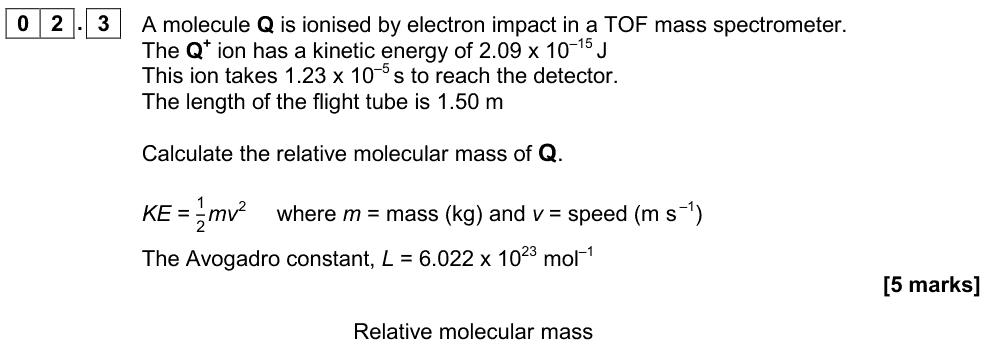
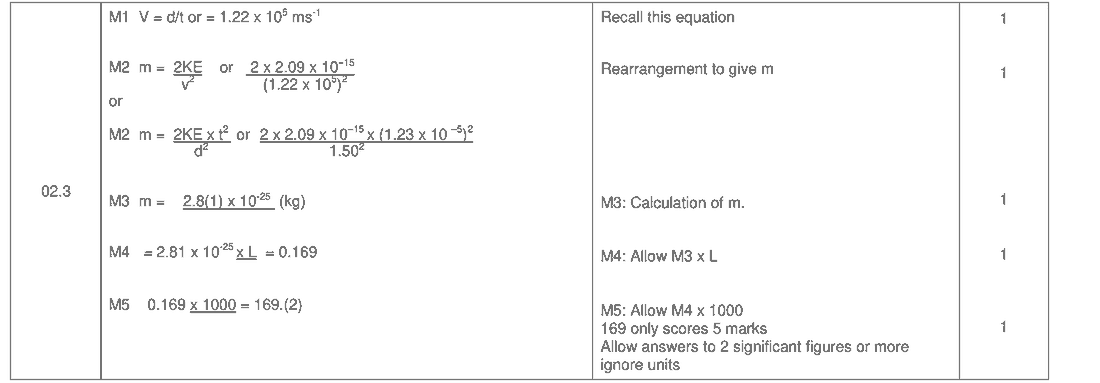
June 2019 · Paper 1 · Q02.35 marksCalculation
Earlier part of question 02 that this part uses
Mark scheme
Examiner's comment
2.3 About half the students scored all the marks in part 3. Common errors included dividing by Avogadro’s number or dividing by 1000; some students could not rearrange the equation to find the mass of an ion, and some had difficulty in calculating the speed of the ion from the distance and time.
Notes from the mark scheme and report
Answer: 169. v = d/t = 1.50 ÷ 1.23 × 10^–5 = 1.22 × 10^5 m s–1
m = 2KE/v² = 2.81 × 10^–25 kg
× 6.022 × 10^23 = 0.169 kg mol–1
× 1000. Errors: dividing by the Avogadro constant or by 1000
wrong rearrangement
wrong speed. About half scored all 5
Skills: MS0.1 Recognise and use expressions in decimal and ordinary form; MS2.2 Change the subject of an equation; MS2.3 Substitute numerical values into algebraic equations using appropriate units for physical quantities
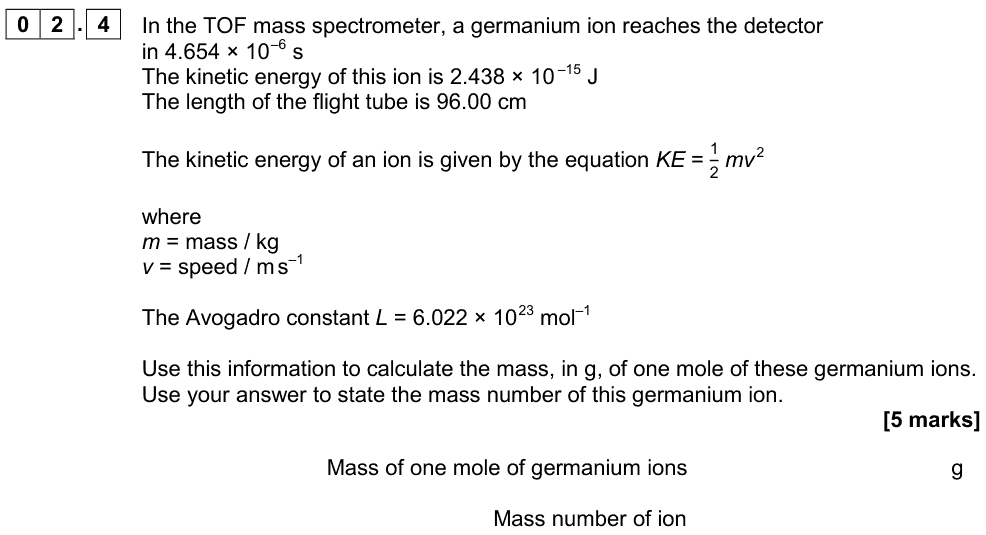
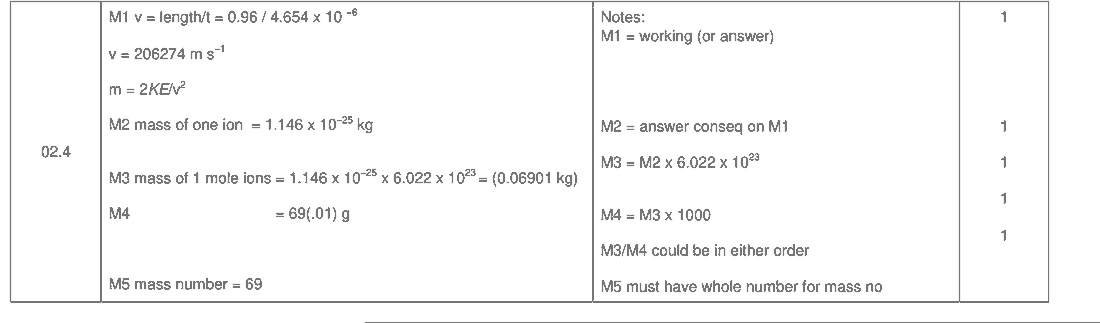
June 2019 · AS Paper 1 · Q02.45 marksCalculation
Earlier part of question 02 that this part uses
Mark scheme
Examiner's comment
02.4 This question proved challenging for students. The velocity was frequently calculated well, although a number of students did not convert the length of the flight tube into metres. Similarly, students were not always able to rearrange the expression for kinetic energy correctly to make mass the subject. Many students realised the need to convert the mass into grams by multiplying by 1000, but a good number were not able to use Avogadro’s constant correctly to determine the mass of one mole of ions; it appeared that the mass of a mole was not well understood by students. Most students who reached the end of the calculation realised that the mass number should be a whole number.
Notes from the mark scheme and report
Answer: 69.0 g
mass number 69. v = 0.9600 ÷ 4.654 × 10^–6 = 2.063 × 10^5 m s–1
m = 2KE/v² = 1.146 × 10^–25 kg
× 6.022 × 10^23 = 0.0690 kg
× 1000. Mass number must be a whole number. Errors: flight tube not converted to metres
KE equation rearranged wrongly
Avogadro constant not used correctly
Skills: MS0.0 Recognise and make use of appropriate units in calculation; MS0.1 Recognise and use expressions in decimal and ordinary form; MS2.2 Change the subject of an equation; MS2.3 Substitute numerical values into algebraic equations using appropriate units for physical quantities
June 2019 · AS Paper 1 · Q03.11 markShort answer
Mark scheme
Examiner's comment
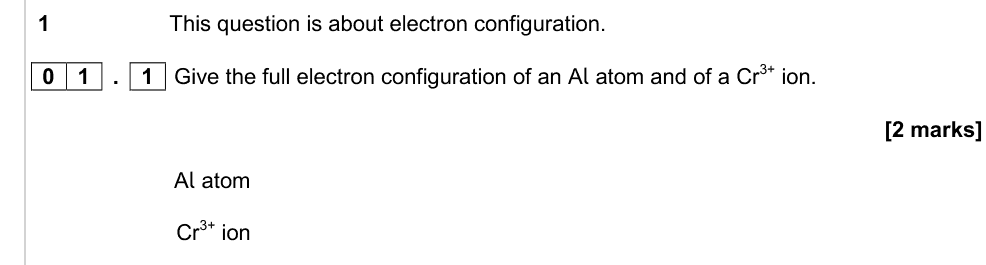
03.1 Many students were able to write the electron configuration of a chromium atom correctly, although a good number did not appreciate that a chromium atom only has one 4s electron.
Notes from the mark scheme and report
(1s2) 2s2 2p6 3s2 3p6 3d5 4s1 (4s1 3d5 also accepted). Common error: 3d4 4s2, not realising chromium has only one 4s electron
June 2019 · AS Paper 1 · Q03.21 markShort answer
Earlier part of question 03 that this part uses
Mark scheme
Examiner's comment
03.2 Students generally answered this question well, although a good number gave the relative atomic mass rather than the mass number of the atom.
Notes from the mark scheme and report
57Fe with atomic number 26 (mass number 57 as superscript, 26 as subscript). Common error: giving the relative atomic mass instead of the mass number
June 2019 · AS Paper 1 · Q03.33 marksCalculation
Earlier part of question 03 that this part uses
Mark scheme
Examiner's comment
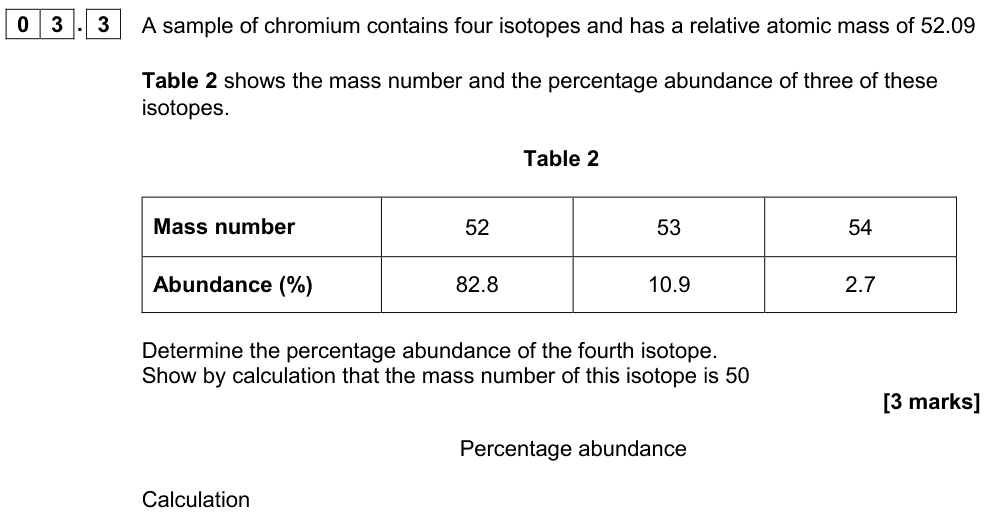
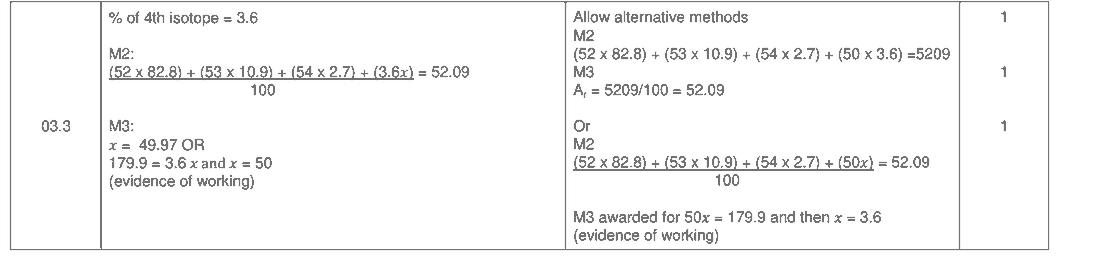
03.3 This question was well answered, with many students able to show that the mass number of the fourth isotope was 50, although working out was not always clear.
Notes from the mark scheme and report
Answer: 3.6%. [(52 × 82.8) + (53 × 10.9) + (54 × 2.7) + 3.6x] ÷ 100 = 52.09, so 3.6x = 179.9 and x = 49.97 = 50 (or substitute 50 and show Ar = 5209 ÷ 100 = 52.09). Working must be shown
it was not always clear
Skills: MS0.2 Use ratios, fractions and percentages; MS1.2 Find arithmetic means; MS2.4 Solve algebraic equations
June 2019 · AS Paper 1 · Q046 marks6-mark level of response
Mark scheme, with the levels and indicative content
Examiner's comment
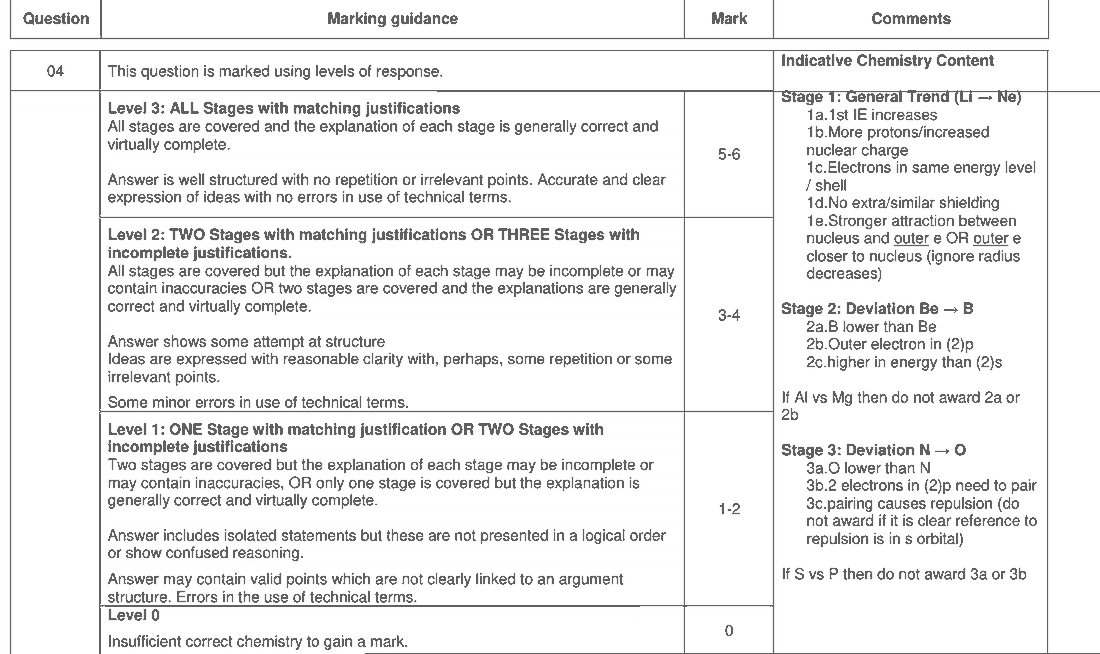
On this question a good number of students were able to explain the trend across the period in detail, giving explanations for the general trend as well as the two deviations in the trend. However, some students confused period 2 with Period 3 and referred to elements from period 3, or to 3s/3p sub-shells in their explanations. Equally, some students only explained the general trend across the period without reference to the deviations that occur between beryllium and boron and also between nitrogen and oxygen.
Notes from the mark scheme and report
Levels of response, three stages. Stage 1 general trend: first ionisation energy increases Li to Ne
more protons / greater nuclear charge
electrons in the same shell with similar shielding
stronger attraction between nucleus and outer electron. Stage 2: B is lower than Be
its outer electron is in 2p, which is higher in energy than 2s. Stage 3: O is lower than N
two electrons are paired in a 2p orbital and the pairing causes repulsion. Errors: using Period 3 elements or 3s/3p sub-shells (Mg/Al or P/S lose the deviation marks)
giving only the general trend
June 2019 · Paper 1 · Q06.41 markShort answer
Earlier part of question 06 that this part uses
Mark scheme
Examiner's comment
6.4 Part 4 was answered correctly by nearly 60% of students; the most common error was to lose the 3d electrons instead of the 4s electrons.
Notes from the mark scheme and report
1s2 2s2 2p6 3s2 3p6 3d9 ([Ar]3d9 not allowed). Common error: removing 3d electrons before 4s. Nearly 60% correct
June 2019 · Paper 3 · Q141 markMultiple choice
Answer
B
Mark scheme
Notes from the mark scheme and report
Answer: B. Helium: outer electrons in the first shell, closest to the nucleus with no shielding, and two protons
June 2018 · AS Paper 1 · Q01.12 marksShort answer
Mark scheme
Examiner's comment
01.1 Most students understood that electrons are now arranged in energy levels, although many didn’t make reference to sub-atomic particles in their answer. Students did not always make a comparison and it was not always clear which model they were referring to in their responses.
Notes from the mark scheme and report
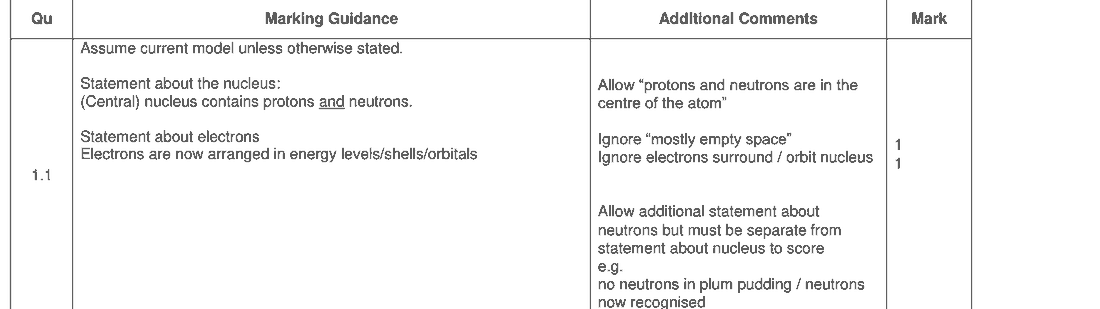
Two differences, one about the nucleus and one about electrons: today's model has a central nucleus containing protons and neutrons
electrons are arranged in energy levels / shells / orbitals. 'Mostly empty space' and 'electrons orbit the nucleus' are ignored. Make it clear which model is being described
many did not mention sub-atomic particles
June 2018 · AS Paper 1 · Q01.21 markShort answerEasy
Earlier part of question 01 that this part uses
Mark scheme
Examiner's comment
01.2 Almost all students (91.3%) were able to write the correct electron configuration in terms of shells and sub-shells, although a few students made no reference to sub-shells.
Notes from the mark scheme and report
1s2 2s2 2p3 (seven electrons, from the stem). Sub-shells must be shown
June 2018 · AS Paper 1 · Q02.43 marksExplanation
Earlier part of question 02 that this part uses
Mark scheme
Examiner's comment
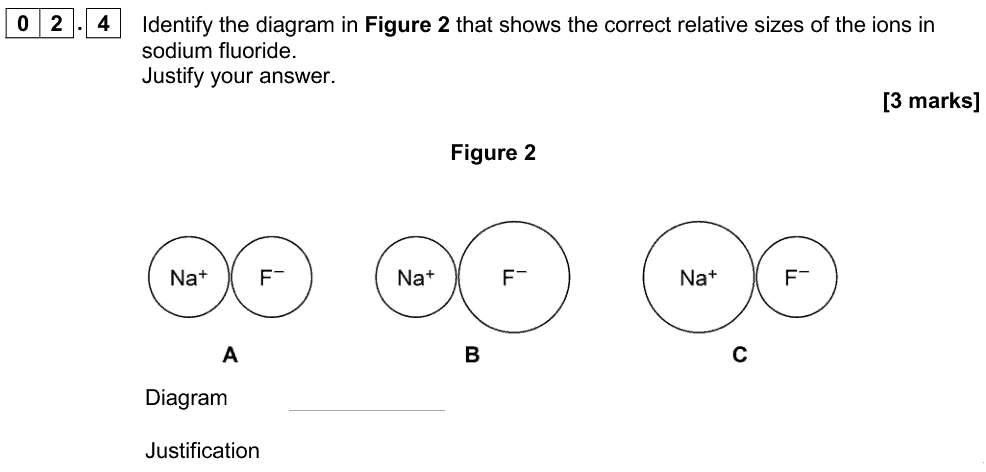
02.4 Many students were unable to identify the correct relative sizes – many stated that both ions were the same size because they had the same number of electrons, without considering the impact of the protons. Other students did not appreciate that both ions were isoelectronic.
Notes from the mark scheme and report
Answer: B (Na+ smaller than F–). Both ions have the same electron arrangement 1s2 2s2 2p6 (isoelectronic)
the sodium ion has more protons so attracts the outer electrons more strongly / closer. Electronegativity, molecules or intermolecular forces is a chemical error. Common error: same size because same number of electrons
June 2018 · Paper 1 · Q04.11 markShort answerEasy
Mark scheme
Examiner's comment
04.1 The electron configuration was well known (88.9% correct).
Notes from the mark scheme and report
1s2 2s2 2p6 3s2 3p6
June 2018 · Paper 1 · Q04.22 marksExplanationHard
Earlier part of question 04 that this part uses
Mark scheme
Examiner's comment
04.2 Only the best students gained both marks here (19%); many students focused on whether the electron was being removed from a full or partially full orbital instead of considering why the attraction between the nucleus and the electron might be different.
Notes from the mark scheme and report
The electron lost from Ca+ comes from the 4s orbital (fourth shell) but from K+ it comes from 3p (third shell), so in Ca+ it is further from the nucleus
and it is more shielded. Must be comparative. Many wrote about full or part-full orbitals instead
June 2018 · Paper 1 · Q04.31 markShort answer
Earlier part of question 04 that this part uses
Mark scheme
Examiner's comment
04.3 Less than half of the students (39.5%) could give the correct answer here; lithium was a common error.
Notes from the mark scheme and report
Beryllium. Common wrong answer: lithium
June 2018 · Paper 1 · Q04.64 marksCalculation
Earlier part of question 04 that this part uses
Mark scheme
Examiner's comment
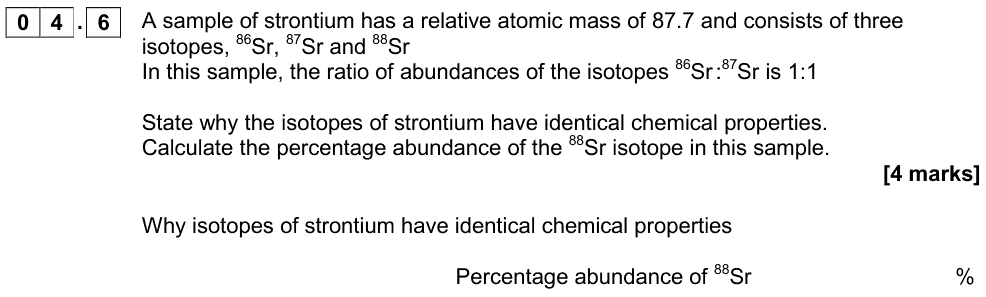
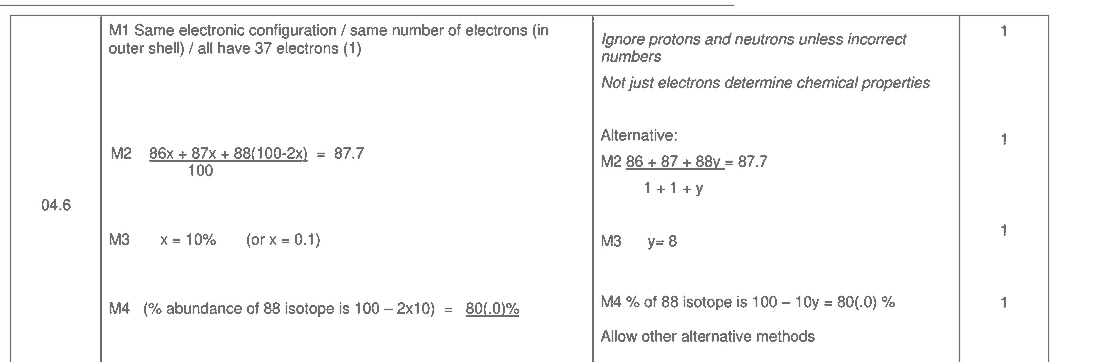
04.6 Most students could state why isotopes have the same chemical properties. In the calculation, many students gave an algebraic equation with two unknowns and could not proceed any further. The students who gave a correct algebraic expression with one unknown could work through the calculation and generally gained full marks. Some students answered the question by trial and error and this was also given full credit. Pleasingly, 43.7% of students gained all four marks available.
Notes from the mark scheme and report
Answer: 80.0%. Same electron configuration / same number of electrons (not just 'electrons determine chemical properties'). [86x + 87x + 88(100 – 2x)] ÷ 100 = 87.7 gives x = 10. Many wrote an equation with two unknowns and got stuck
trial and error was credited
Skills: MS0.2 Use ratios, fractions and percentages; MS1.2 Find arithmetic means; MS2.4 Solve algebraic equations
June 2018 · Paper 1 · Q04.71 markShort answerHard
Earlier part of question 04 that this part uses
Mark scheme
Examiner's comment
04.7 Most students deduced that the mass number of the ion would be 138 but less than 30% of students could give the correct formula for the ion including its charge.
Notes from the mark scheme and report
138Ba+. Most gave 138 but omitted the charge on the ion
June 2018 · Paper 1 · Q04.85 marksCalculation
Earlier part of question 04 that this part uses
Mark scheme
Examiner's comment
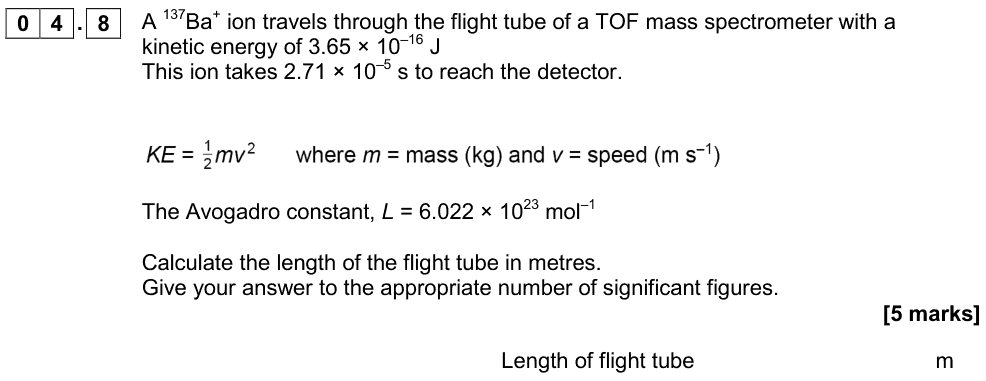
04.8 Some students answered this part very well (with 36.6% scoring full marks), but most students scored partial marks or no marks; common errors included failure to use the Avogadro constant, not converting mass to kg, and incorrect rearrangement of expressions.
Notes from the mark scheme and report
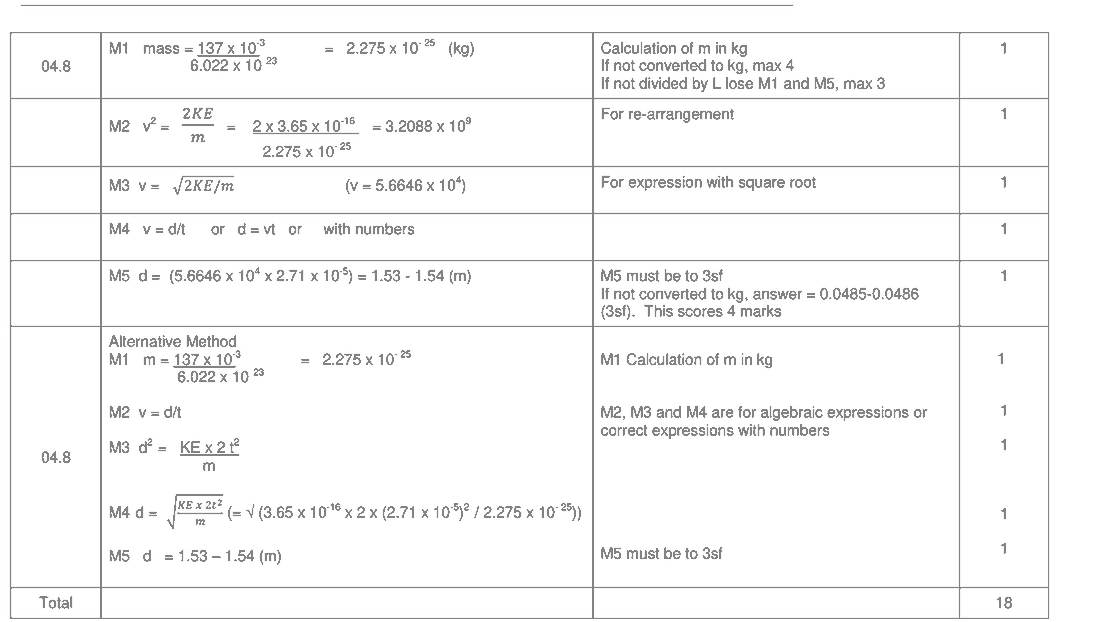
Answer: 1.53 m (1.53 to 1.54, must be 3 sf). m = 137 × 10^–3 ÷ L = 2.275 × 10^–25 kg
v = √(2KE/m) = 5.66 × 10^4 m s–1
d = vt. Errors: not dividing by L, mass not in kg (0.0485 scores 4), wrong rearrangement
Skills: MS0.0 Recognise and make use of appropriate units in calculation; MS0.1 Recognise and use expressions in decimal and ordinary form; MS1.1 Use an appropriate number of significant figures; MS2.2 Change the subject of an equation; MS2.3 Substitute numerical values into algebraic equations using appropriate units for physical quantities
June 2018 · AS Paper 1 · Q08.15 marksCalculation
Mark scheme
Examiner's comment
08.1 This question proved demanding for most students. A good number were able to calculate the mass of the 79Br+ ion. Very few students realised that most of the quantities cancelled down during the calculation and took time to calculate the velocity of the 79Br+ ion in order to then work out the kinetic energy. This velocity was frequently calculated well but the remaining marks then proved a challenge for students. Some completed numerous calculation steps only to give a time for the 81Br+ ion that was the same as the time for the 79Br+ ion.
Notes from the mark scheme and report
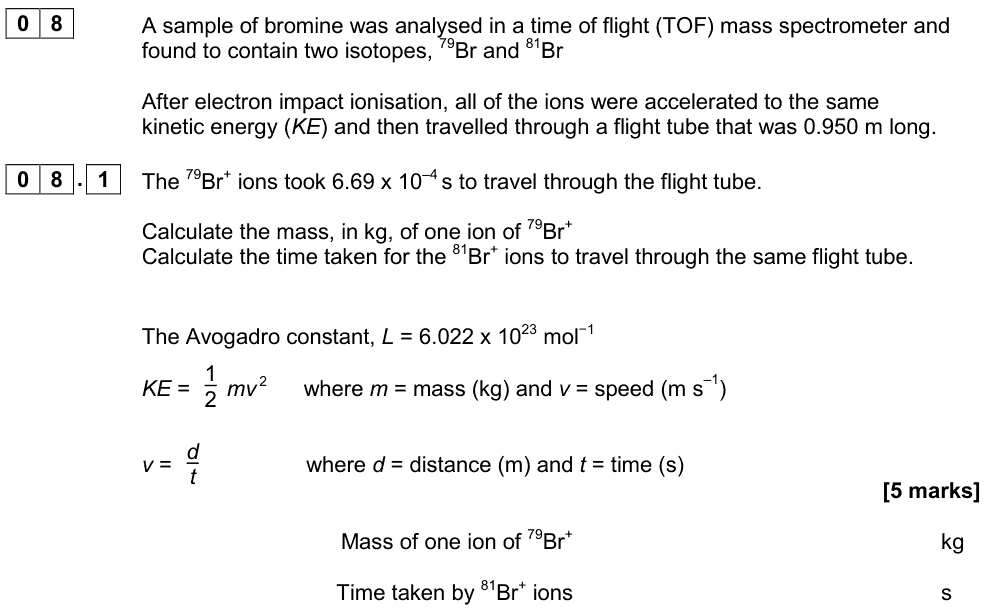
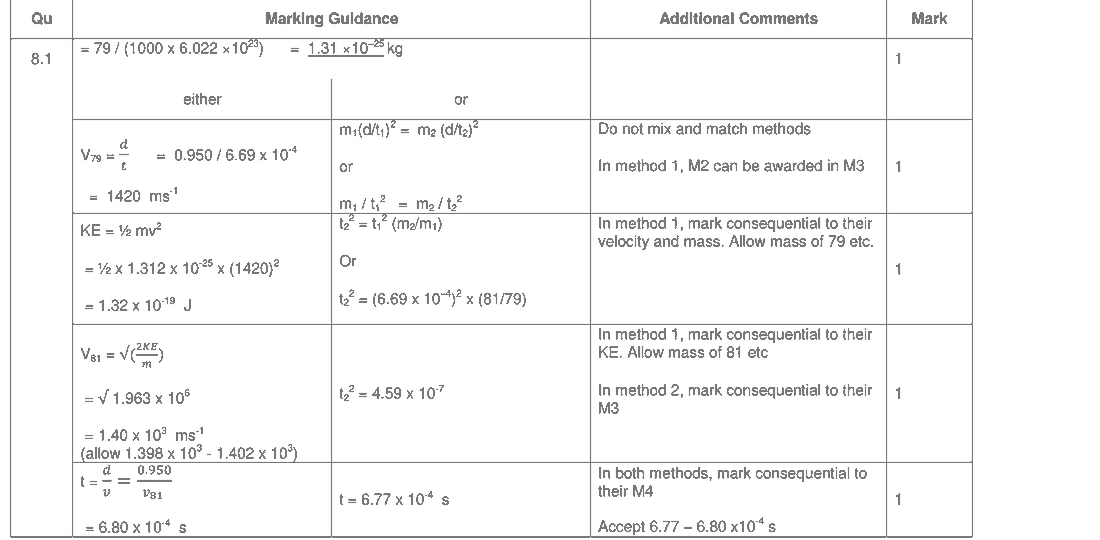
Answer: mass = 1.31 × 10^–25 kg
time = 6.77 × 10^–4 s (accept 6.77 to 6.80 × 10^–4). m = 79 ÷ (1000 × 6.022 × 10^23). Short method: same KE so t2² = t1² × (81/79). Long method: v = d/t = 1420 m s–1
KE = ½mv² = 1.32 × 10^–19 J
v(81) = √(2KE/m) = 1.40 × 10^3 m s–1
t = d/v. Few saw that most quantities cancel
some gave the same time for both ions
Skills: MS0.0 Recognise and make use of appropriate units in calculation; MS0.1 Recognise and use expressions in decimal and ordinary form; MS2.2 Change the subject of an equation; MS2.3 Substitute numerical values into algebraic equations using appropriate units for physical quantities
June 2018 · AS Paper 1 · Q08.22 marksExplanation
Earlier part of question 08 that this part uses
Mark scheme
Examiner's comment
08.2 Only a few students understood that when the ion reaches the detector it gains an electron, whereas many understood that the size of the current was proportional to the abundance of the ion.
Notes from the mark scheme and report
The ion hits the detector (negative plate) and gains an electron
the relative abundance is proportional to the size of the current produced. Not a positive plate. Few knew the ion gains an electron
June 2018 · AS Paper 1 · Q111 markMultiple choice
Answer
C
Mark scheme
Examiner's comment
The most common answer (D) was incorrect and was the value that was twice the correct answer.
Notes from the mark scheme and report
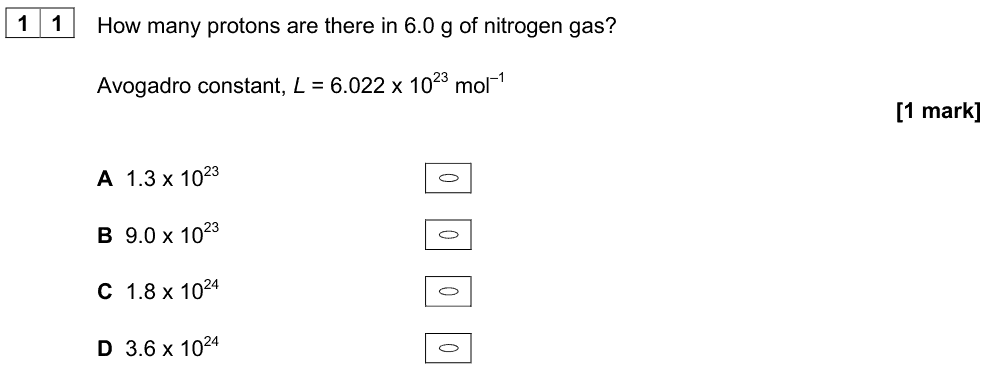
Answer: C. 6.0 ÷ 28.0 = 0.214 mol of N2
each molecule has 14 protons
0.214 × 14 × 6.022 × 10^23 = 1.8 × 10^24. Most common wrong answer D (twice the answer)
Skills: MS0.1 Recognise and use expressions in decimal and ordinary form
June 2018 · AS Paper 1 · Q181 markMultiple choice
Answer
B
Mark scheme
Examiner's comment
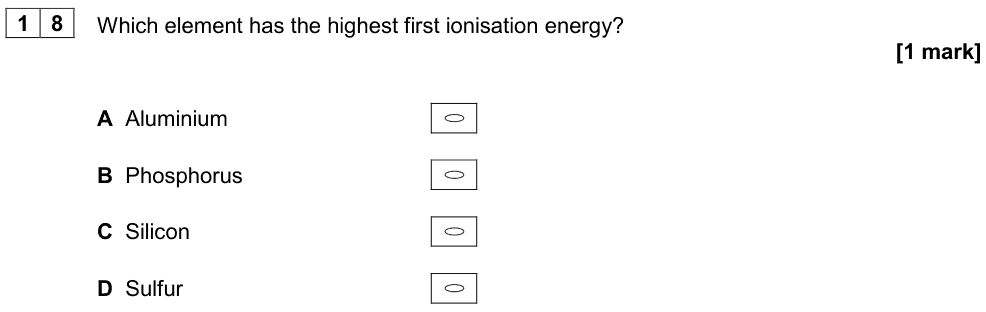
Some students (38.8%) were able to identify the element with the highest first ionisation energy, although many students thought that sulfur had the highest first ionisation energy.
Notes from the mark scheme and report
Answer: B. First ionisation energy rises Al to Si to P, then falls at S because of repulsion between the paired electrons in a 3p orbital. Common wrong answer: sulfur
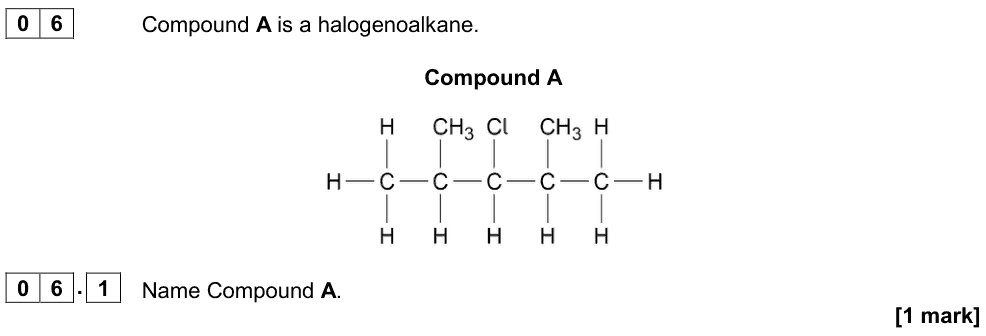
June 2018 · AS Paper 2 · Q06.22 marksDiagram or structureHard
Earlier part of question 06 that this part uses
Mark scheme
Examiner's comment
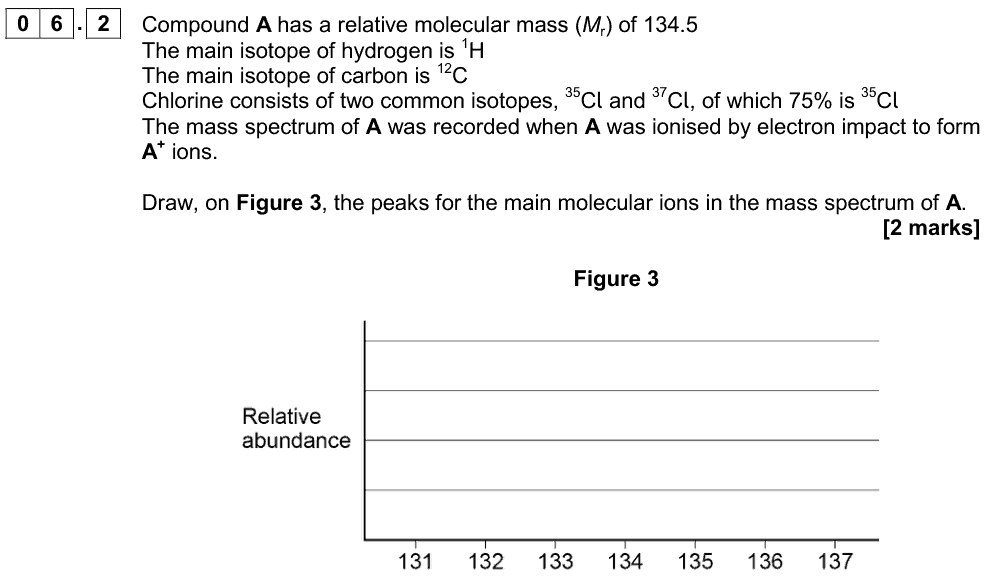
06.2 This question proved to be demanding. The calculation of the Mr of individual molecules containing different isotopes was a challenge for many students. 61.8% of students either failed to score or made no attempt; 33.4% did, however, score both marks.
Notes from the mark scheme and report
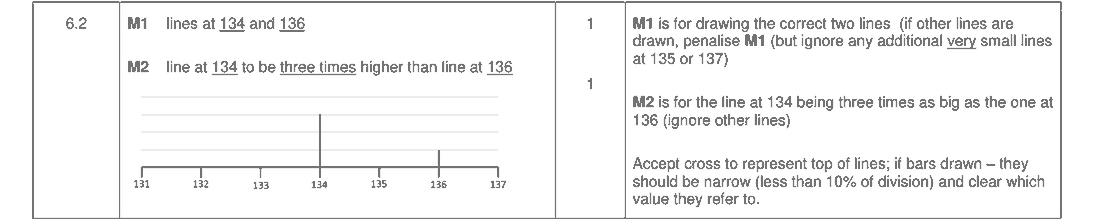
Lines at m/z 134 and 136 only (C7H15 35Cl and C7H15 37Cl)
the line at 134 three times the height of the line at 136 (75% : 25%). Extra lines lose M1. No peak at 134.5. 61.8% scored nothing or did not attempt it
Skills: MS0.2 Use ratios, fractions and percentages; MS3.1 Translate information between graphical, numerical and algebraic forms
June 2018 · Paper 3 · Q071 markMultiple choice
Answer
D
Mark scheme
Notes from the mark scheme and report
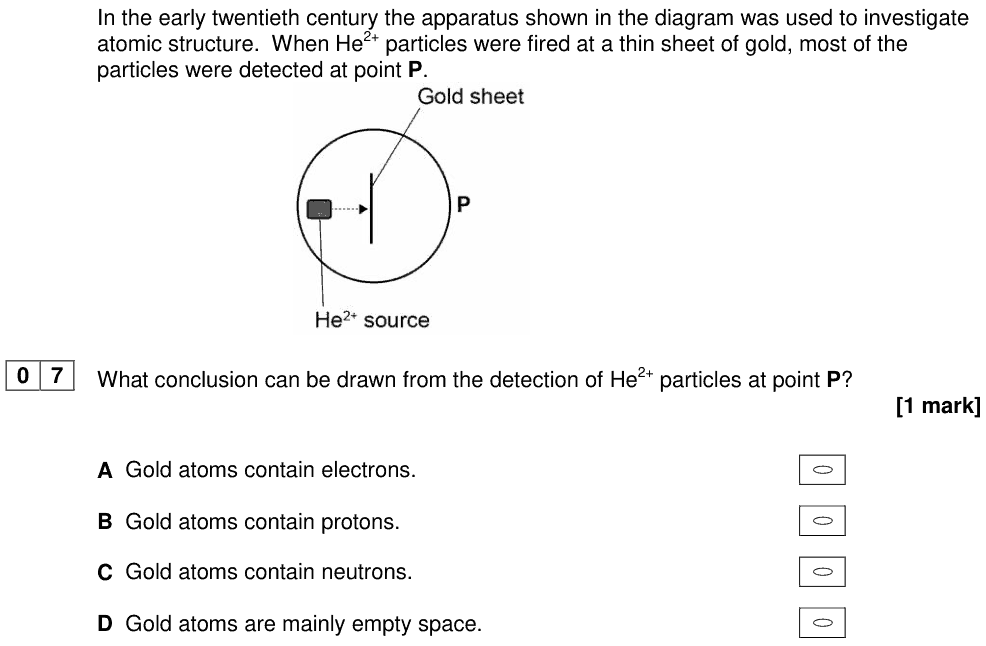
Answer: D. Most particles pass straight through to P, so atoms are mainly empty space. Needs the lead-in and diagram printed above the question. Commonest wrong answer A
June 2018 · Paper 3 · Q081 markMultiple choice
Answer
A
Mark scheme
Notes from the mark scheme and report
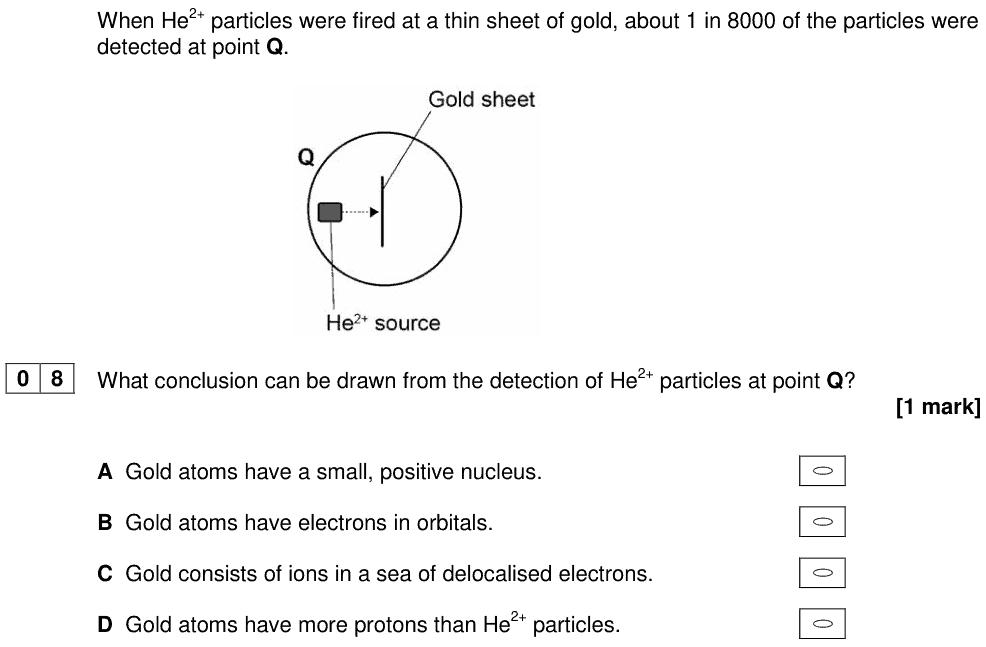
Answer: A. A very few positive He2+ particles are deflected back to Q, so the positive charge is concentrated in a small nucleus. Needs the lead-in and diagram printed above the question
June 2017 · AS Paper 1 · Q01.12 marksShort answer
Mark scheme
Examiner's comment
01.1 This was surprisingly poorly answered. Many students were unable to write the electronic configuration for Fe2+.
Notes from the mark scheme and report
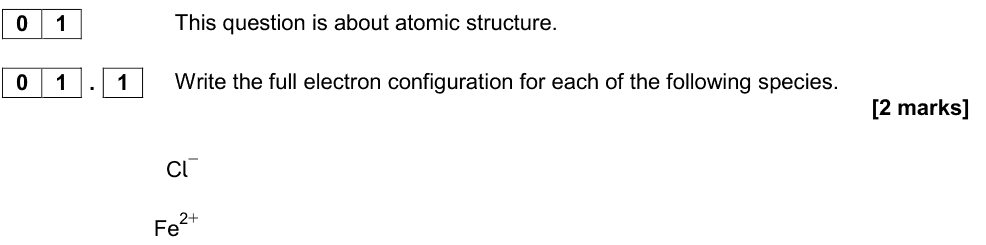
Cl–: 1s2 2s2 2p6 3s2 3p6. Fe2+: 1s2 2s2 2p6 3s2 3p6 3d6 (the 4s electrons are lost first
ignore 4s0). Using [Ne] or [Ar] limits the answer to 1 mark, and only if both are correct. Many could not write the configuration of Fe2+
June 2017 · AS Paper 1 · Q01.21 markEquation writing
Earlier part of question 01 that this part uses
Mark scheme
Examiner's comment
01.2 This question was generally well answered, but a significant number of answers had missing state symbols, despite the direct instruction to include them.
Notes from the mark scheme and report
Mn2+(g) → Mn3+(g) + e–. State symbols are required and the electron needs its negative charge. Missing state symbols were common
June 2017 · AS Paper 1 · Q01.33 marksExplanation
Earlier part of question 01 that this part uses
Mark scheme
Examiner's comment
01.3 This was a familiar question and quite well answered.
Notes from the mark scheme and report
Aluminium (Mg is CE = 0). Its outer electron is in a 3p sub-level or orbital (not just 'level' or 'shell'), which is higher in energy / further from the nucleus, so it is easier to remove. Ignore shielding
June 2017 · AS Paper 1 · Q01.43 marksCalculation
Earlier part of question 01 that this part uses
Mark scheme
Examiner's comment
01.4 The symbol including mass number was often incorrect. The calculation of Ar was straight- forward and done well by many students.
Notes from the mark scheme and report
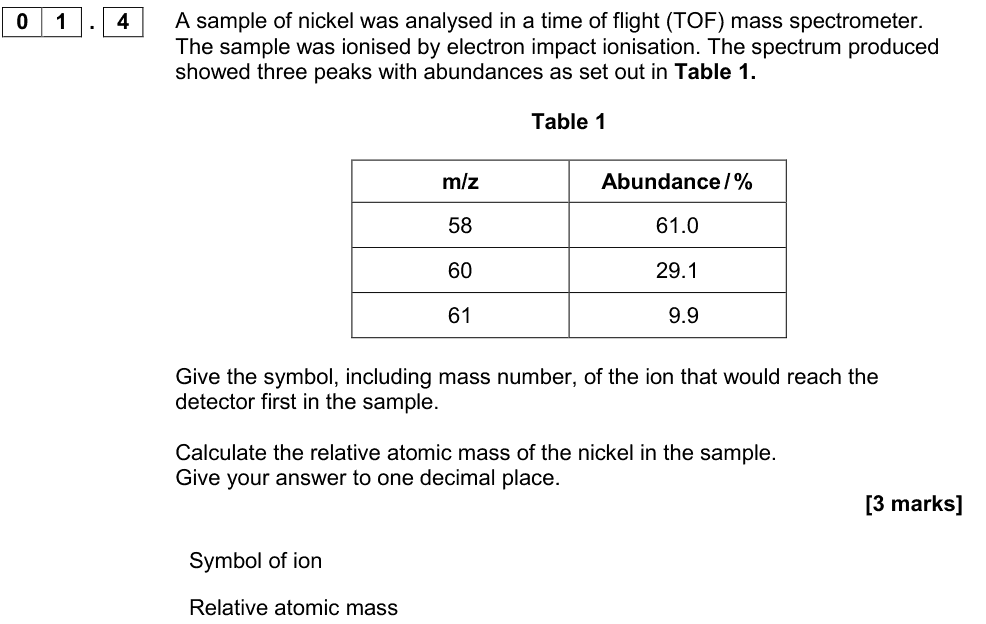
Answer: 58Ni+ reaches the detector first (mass number and charge both needed)
Ar = 58.9 (must be 1 decimal place). Ar = [(58 × 61.0) + (60 × 29.1) + (61 × 9.9)] ÷ 100. The symbol of the ion was often wrong
Skills: MS1.1 Use an appropriate number of significant figures; MS1.2 Find arithmetic means
June 2017 · Paper 1 · Q04.12 marksCalculation
Mark scheme
Examiner's comment
04.1 This was generally well answered, though a few students added the abundances incorrectly.
Skills: MS1.2 Find arithmetic means; MS0.2 Use ratios, fractions and percentages
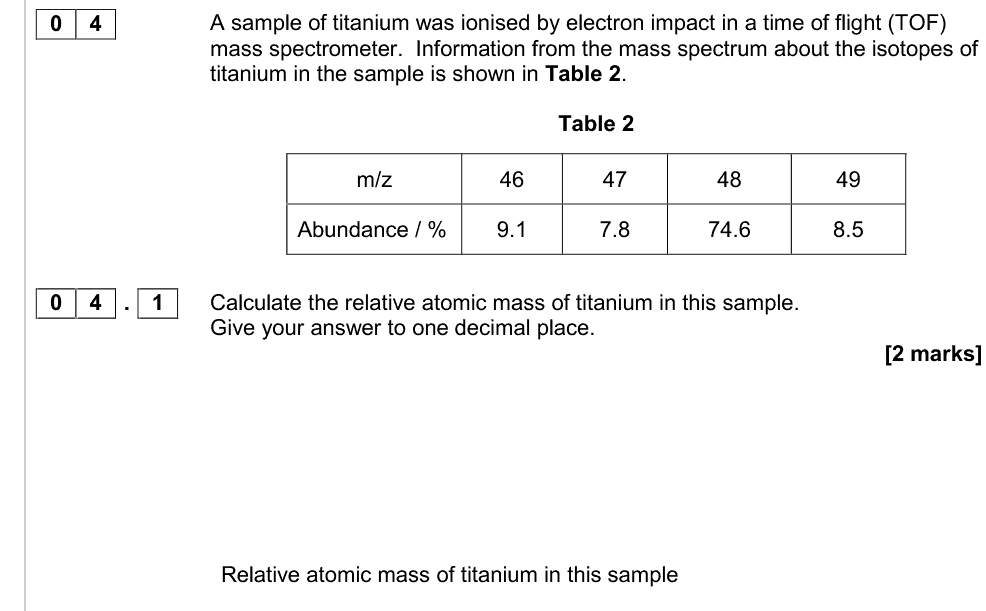
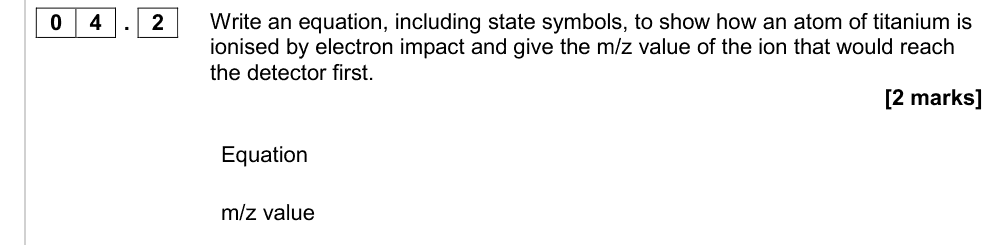
June 2017 · Paper 1 · Q04.22 marksEquation writing
Earlier part of question 04 that this part uses
Mark scheme
Examiner's comment
04.2 Most students gave the correct equation, but some used the wrong state symbols or omitted them. The identity of the isotope was well known but some students lost a mark by using the symbol for the atom rather than the m/z value.
m/z = 46 (the lightest ion arrives first). Errors: state symbols
giving the symbol of the atom rather than the m/z value
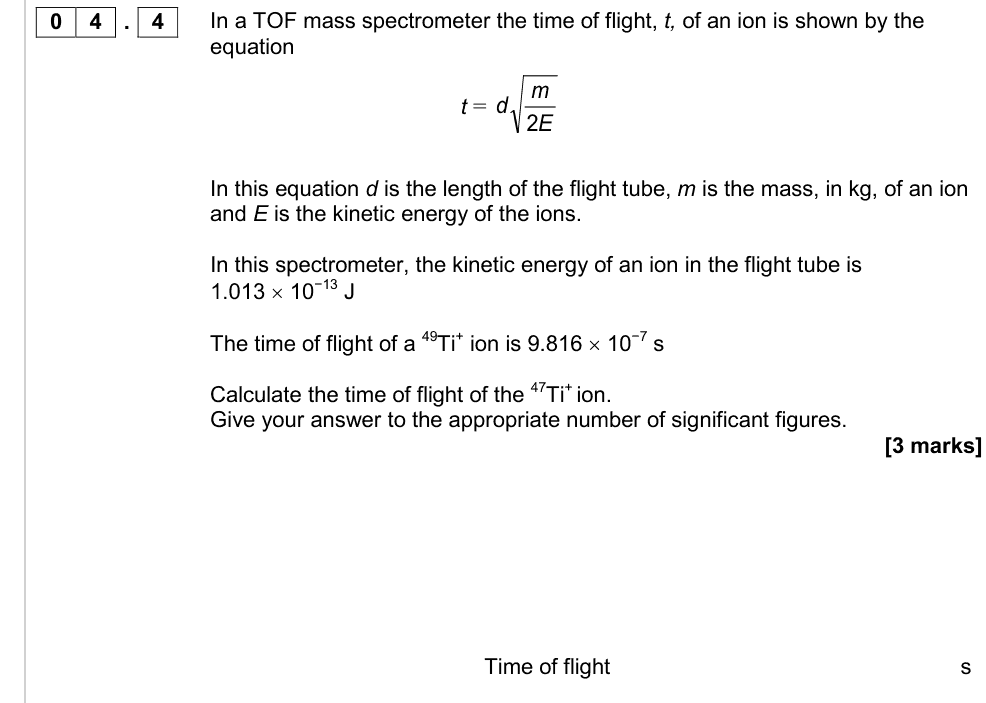
June 2017 · Paper 1 · Q04.43 marksCalculation
Earlier part of question 04 that this part uses
Mark scheme
Examiner's comment
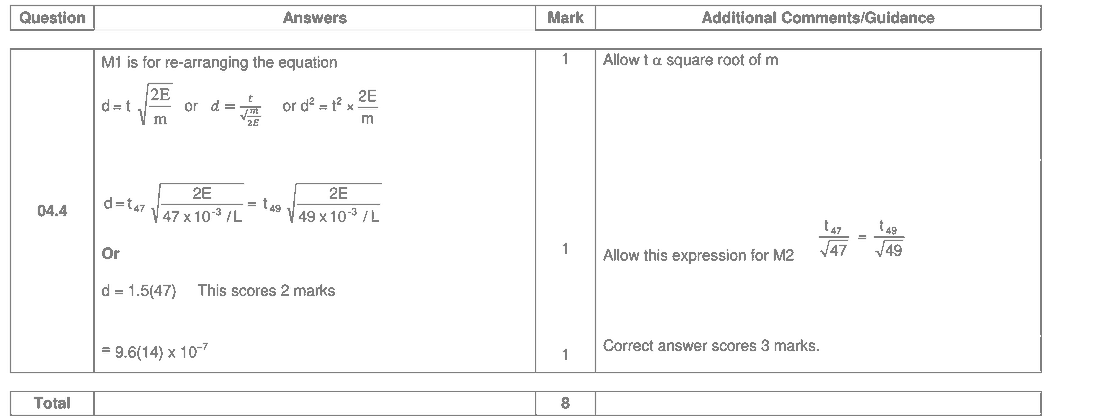
04.4 Only the best students gained all three marks. All marks were available, even for those students who had not answered question 04.3, or who had the wrong answer for it. Some students were unable to re-arrange the equation. Students who appreciated that the distance travelled was common to both ions usually went on to get the correct answer, but a large number of students scored zero or one mark.
Notes from the mark scheme and report
Answer: 9.614 × 10^–7 s (4 sf). d and E are the same for both ions, so t is proportional to √m: t(47) = 9.816 × 10^–7 × √(47/49). Or rearrange to d = t√(2E/m) = 1.547 m and substitute the mass of 47Ti+. Many could not rearrange the equation
a large number scored 0 or 1
Skills: MS0.1 Recognise and use expressions in decimal and ordinary form; MS1.1 Use an appropriate number of significant figures; MS2.2 Change the subject of an equation; MS2.3 Substitute numerical values into algebraic equations using appropriate units for physical quantities
June 2017 · AS Paper 1 · Q121 markMultiple choice
Answer
A
Mark scheme
Examiner's comment
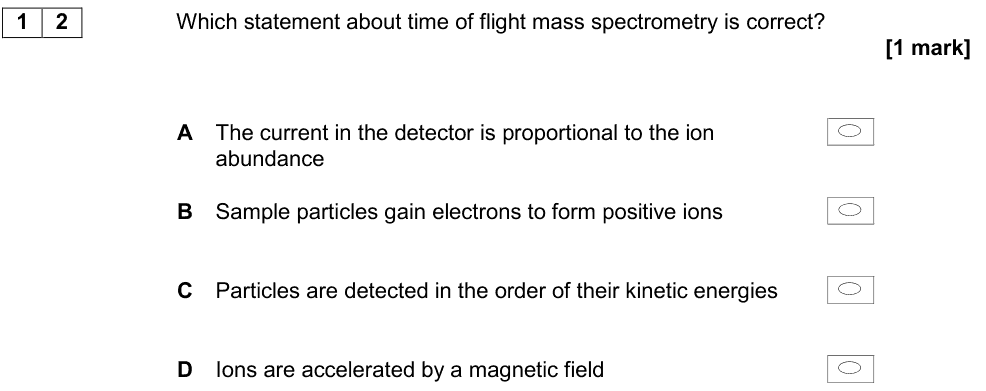
48.5% of students scored this mark; the most common wrong answer was D, showing that some students thought that a magnetic field is involved in TOF mass spectrometry.
Notes from the mark scheme and report
Answer: A. Each ion gains an electron at the detector, so the current is proportional to abundance. Ions form by losing electrons, all have the same kinetic energy, and are accelerated by an electric field. Most common wrong answer D (48.5% correct)
June 2017 · AS Paper 1 · Q131 markMultiple choiceHard
Answer
B
Mark scheme
Examiner's comment
Only 26.2% of students selected the correct answer here, with all three distractors attracting significant numbers of students. Although this example is commonly taught, there are clearly not many students who can either remember the example or work out the probabilities for themselves.
Notes from the mark scheme and report
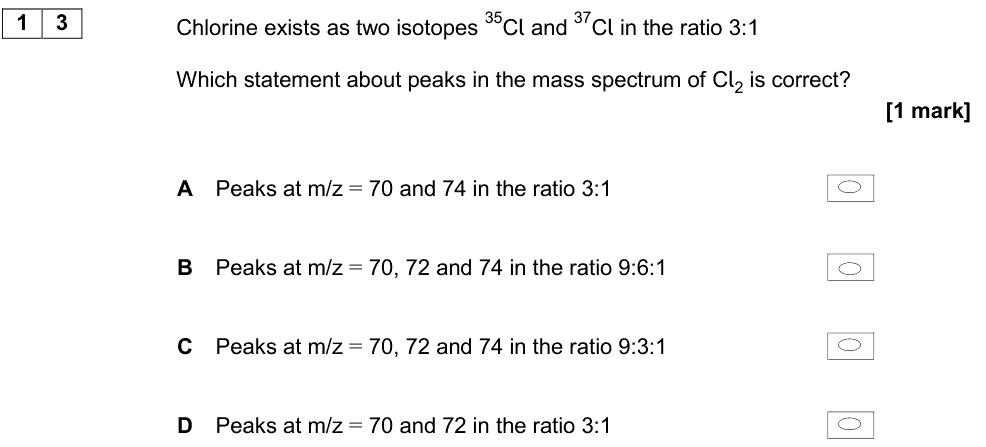
Answer: B. 35–35 (70): ¾ × ¾ = 9/16
35–37 (72): 2 × ¾ × ¼ = 6/16
37–37 (74): ¼ × ¼ = 1/16, so 9:6:1
Skills: MS0.2 Use ratios, fractions and percentages
June 2016 · AS Paper 1 · Q01.12 marksShort answer
Mark scheme
Notes from the mark scheme and report
Al: 1s2 2s2 2p6 3s2 3p1. Cr3+: 1s2 2s2 2p6 3s2 3p6 3d3 (ignore 4s0). Correct noble gas core used in both scores 1 only
June 2016 · AS Paper 1 · Q01.21 markShort answer
Earlier part of question 01 that this part uses
Mark scheme
Notes from the mark scheme and report
Sr2+ (allow Sr+2)
June 2016 · AS Paper 1 · Q01.31 markShort answer
Earlier part of question 01 that this part uses
Mark scheme
Notes from the mark scheme and report
Ca3P2 (Ca2+ and P3– both have the argon configuration). Allow the formula reversed or written as ions
June 2016 · AS Paper 1 · Q02.12 marksExplanation
Mark scheme
Examiner's comment
Most of this question was answered correctly but many students failed to appreciate that the ions compared in 2.1 had the same number of electrons therefore 1 mark was scored rather than 2.
Notes from the mark scheme and report
Mg2+ is smaller: it has more protons (greater nuclear charge) AND the same number of electrons / same shielding (isoelectronic). Na+ chosen scores 0. Many missed that the two ions have the same number of electrons, so scored 1
June 2016 · AS Paper 1 · Q02.21 markEquation writing
Earlier part of question 02 that this part uses
Mark scheme
Examiner's comment
Most of this question was answered correctly but many students failed to appreciate that the ions compared in 2.1 had the same number of electrons therefore 1 mark was scored rather than 2. It was pleasing to see over half the students scoring 3 or more marks on question 2.3
Notes from the mark scheme and report
Na(g) → Na+(g) + e–. Correct species and gaseous state symbols both needed
June 2016 · AS Paper 1 · Q02.34 marksExplanation
Earlier part of question 02 that this part uses
Mark scheme
Examiner's comment
It was pleasing to see over half the students scoring 3 or more marks on question 2.3
Notes from the mark scheme and report
Plot Mg between 600 and 800 and S between 800 and 1040 kJ mol–1 (S must be below P). Explanation: sulfur has a pair of electrons in a 3p orbital
the paired electrons repel, so less energy is needed to remove one. If S is not plotted below P only the Mg mark is available
Skills: MS3.2 Plot two variables from experimental or other data
June 2016 · AS Paper 1 · Q06.13 marksExplanation
Mark scheme
Examiner's comment
For Question 6.1 many students wrote a lot of unnecessary detail about aspects of a time of flight mass spectrometer but on the whole it was quite well answered.
Notes from the mark scheme and report
Accelerated by attraction to a negatively charged plate / electric field. Detected when the ions gain electrons at the detector. Abundance is given by the size of the current produced (proportional to the number of ions). Three independent marks
extra detail about other stages is not needed
June 2016 · AS Paper 1 · Q06.32 marksCalculation
Earlier part of question 06 that this part uses
Mark scheme
Examiner's comment
Questions 6.2 and 6.3 proved mathematically difficult for many although consequential marking allowed large numbers to score on 6.3.
take the square root. Error carried forward from 06.2 allowed
Skills: MS0.1 Recognise and use expressions in decimal and ordinary form; MS2.2 Change the subject of an equation; MS2.3 Substitute numerical values into algebraic equations using appropriate units for physical quantities
June 2016 · AS Paper 1 · Q06.42 marksDiagram or structureHard
Earlier part of question 06 that this part uses
Mark scheme
Examiner's comment
The use of probability to predict the ratio of peaks in question 6.4 proved very difficult for students.
Some scored 1 mark for giving three peaks but the 1:2:1 ratio was only seen from 11.3% of students.
Notes from the mark scheme and report
Three peaks at m/z 158, 160 and 162, in the ratio 1:2:1 (25%:50%:25%). Two independent marks. Many drew three peaks without the 1:2:1 ratio
Skills: MS0.2 Use ratios, fractions and percentages; MS3.1 Translate information between graphical, numerical and algebraic forms
June 2016 · AS Paper 1 · Q06.54 marksCalculationEasy
Earlier part of question 06 that this part uses
Mark scheme
Examiner's comment
Question 6.5 was answered well with over 60% of students scoring all 4 marks.