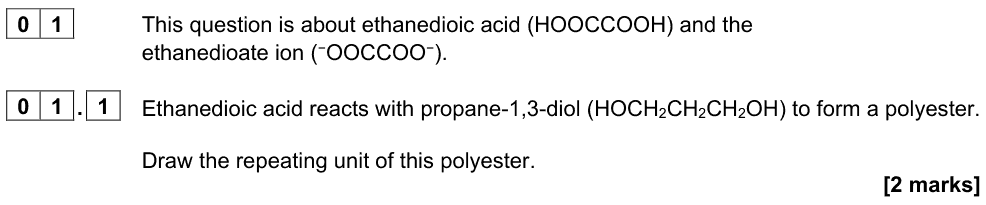
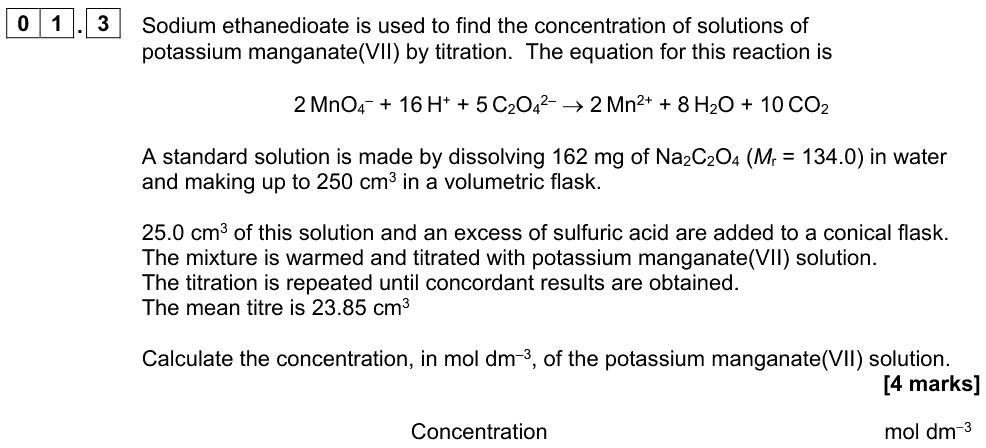
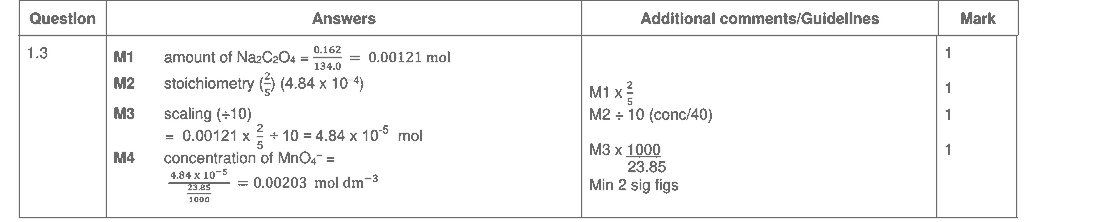
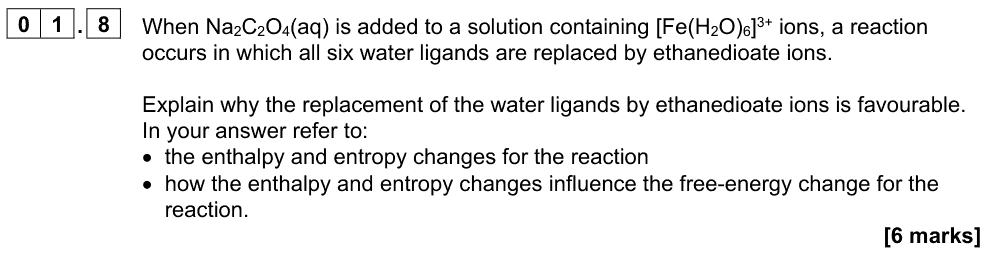
Notes and key-term cards for this topic are being written by our tutors. The past-paper questions below are ready now.
Specification statements
Show the 45 statements from the specification
3.2.5.1-01 Transition metal characteristics of elements Ti–Cu arise from an incomplete d sub-level in atoms or ions.
3.2.5.1-02 The characteristic properties include: • complex formation • formation of coloured ions • variable oxidation state • catalytic activity.
3.2.5.1-03 A ligand is a molecule or ion that forms a co-ordinate bond with a transition metal by donating a pair of electrons.
3.2.5.1-04 A complex is a central metal atom or ion surrounded by ligands.
3.2.5.1-05 Co-ordination number is number of co-ordinate bonds to the central metal atom or ion.
3.2.5.2-01 H2O, NH3 and Cl− can act as monodentate ligands.
3.2.5.2-02 The ligands NH3 and H2O are similar in size and are uncharged.
3.2.5.2-03 Exchange of the ligands NH3 and H2O occurs without change of co-ordination number (eg Co2+ and Cu2+).
3.2.5.2-04 Substitution may be incomplete (eg the formation of [Cu(NH3)4(H2O)2]2+).
3.2.5.2-05 The Cl− ligand is larger than the uncharged ligands NH3 and H2O
3.2.5.2-06 Exchange of the ligand H2O by Cl– can involve a change of co-ordination number (eg Co2+, Cu2+ and Fe3+).
3.2.5.2-07 Ligands can be bidentate (eg H2NCH2CH2NH2 and C2O42–).
3.2.5.2-08 Ligands can be multidentate (eg EDTA4–).
3.2.5.2-09 Haem is an iron(II) complex with a multidentate ligand.
3.2.5.2-10 Oxygen forms a co-ordinate bond to Fe(II) in haemoglobin, enabling oxygen to be transported in the blood.
3.2.5.2-11 Carbon monoxide is toxic because it replaces oxygen co- ordinately bonded to Fe(II) in haemoglobin.
3.2.5.2-12 Bidentate and multidentate ligands replace monodentate ligands from complexes. This is called the chelate effect.
3.2.5.2-13 Students should be able to: • explain the chelate effect, in terms of the balance between the entropy and enthalpy change in these reactions.
3.2.5.3-01 Transition metal ions commonly form octahedral complexes with small ligands (eg H2O and NH3).
3.2.5.3-02 Octahedral complexes can display cis–trans isomerism (a special case of E–Z isomerism) with monodentate ligands and optical isomerism with bidentate ligands.
3.2.5.3-03 Transition metal ions commonly form tetrahedral complexes with larger ligands (eg Cl–).
3.2.5.3-04 Square planar complexes are also formed and can display cis–trans isomerism.
3.2.5.3-05 Cisplatin is the cis isomer.
3.2.5.3-06 Ag+ forms the linear complex [Ag(NH3)2]+ as used in Tollens’ reagent.
3.2.5.4-01 Transition metal ions can be identified by their colour.
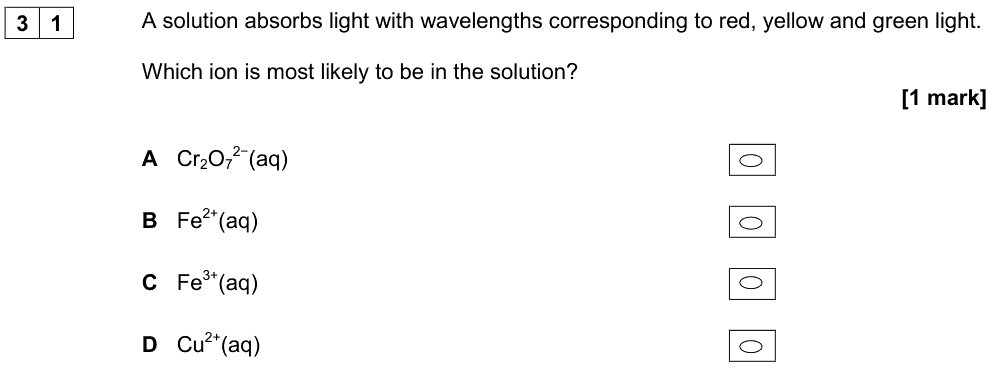
3.2.5.4-02 Colour arises when some of the wavelengths of visible light are absorbed and the remaining wavelengths of light are transmitted or reflected. d electrons move from the ground state to an excited state when light is absorbed.
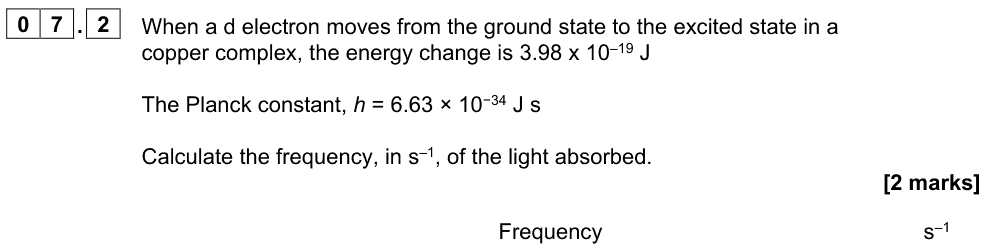
3.2.5.4-03 The energy difference between the ground state and the excited state of the d electrons is given by: ∆E = hν = hc/λ
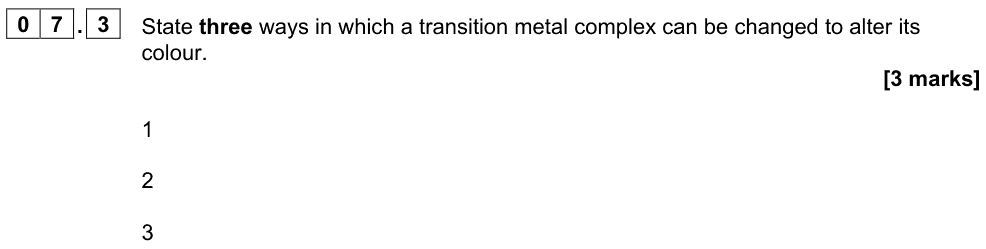
3.2.5.4-04 Changes in oxidation state, co-ordination number and ligand alter ∆E and this leads to a change in colour.
3.2.5.4-05 The absorption of visible light is used in spectroscopy.
3.2.5.4-06 A simple colorimeter can be used to determine the concentration of coloured ions in solution.
3.2.5.5-01 Transition elements show variable oxidation states.
3.2.5.5-02 Vanadium species in oxidation states IV, III and II are formed by the reduction of vanadate(V) ions by zinc in acidic solution.
3.2.5.5-03 The redox potential for a transition metal ion changing from a higher to a lower oxidation state is influenced by pH and by the ligand.
3.2.5.5-04 The reduction of [Ag(NH3)2]+ (Tollens’ reagent) to metallic silver is used to distinguish between aldehydes and ketones.
3.2.5.5-05 The redox titrations of Fe2+ and C2O42– with MnO4–
3.2.5.5-06 Students should be able to: • perform calculations for these titrations and similar redox reactions.
3.2.5.6-01 Transition metals and their compounds can act as heterogeneous and homogeneous catalysts.
3.2.5.6-02 A heterogeneous catalyst is in a different phase from the reactants and the reaction occurs at active sites on the surface.
3.2.5.6-03 The use of a support medium to maximise the surface area of a heterogeneous catalyst and minimise the cost.
3.2.5.6-04 V2O5 acts as a heterogeneous catalyst in the Contact process.
3.2.5.6-05 Fe is used as a heterogeneous catalyst in the Haber process.
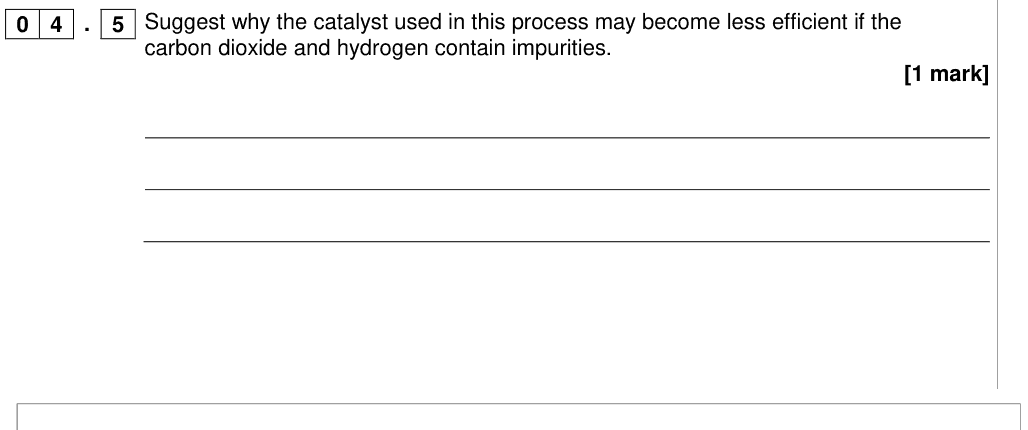
3.2.5.6-06 Heterogeneous catalysts can become poisoned by impurities that block the active sites and consequently have reduced efficiency; this has a cost implication.
3.2.5.6-07 A homogeneous catalyst is in the same phase as the reactants.
3.2.5.6-08 When catalysts and reactants are in the same phase, the reaction proceeds through an intermediate species.
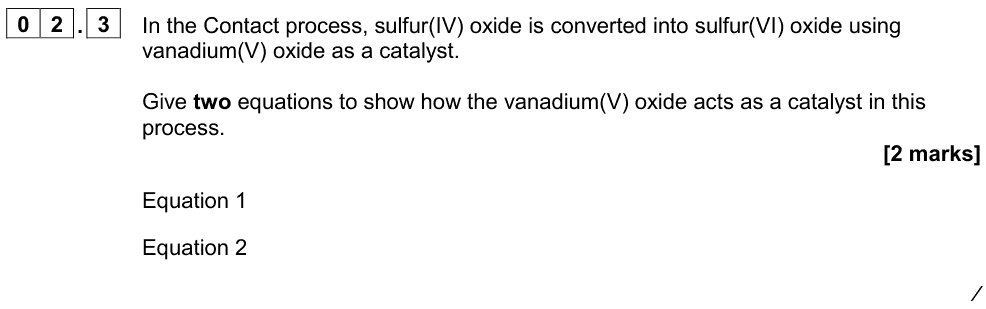
3.2.5.6-09 Students should be able to: • explain the importance of variable oxidation states in catalysis • explain, with the aid of equations, how V2O5 acts as a catalyst in the Contact process • explain, with the aid of equations, how Fe2+ ions catalyse the reaction between I− and S2O82– • explain, with the aid of equations, how Mn2+ ions autocatalyse the reaction between C2O42– and MnO4–
Six-mark level of response questions on this topic
Tap a question to zoom it. Where a part needs a figure, table or structure from earlier in the question, that part folds out above it; the mark scheme and examiner's comment open underneath. Have AQA's Data Booklet (the Periodic Table and the spectroscopy tables) beside you.
June 2025 · Paper 1 · Q03.21 markAO1=1Short answer
Earlier part of question 03 that this part uses
Mark scheme
Examiner's comment
In part 2 many students lost this mark by not identifying the electron pair/lone pair was donated from oxygen to copper.
Notes from the mark scheme and report
Water has a lone pair of electrons on the O atom, which it donates to the copper ion to form a co-ordinate bond. Many did not say the pair was donated from oxygen to copper
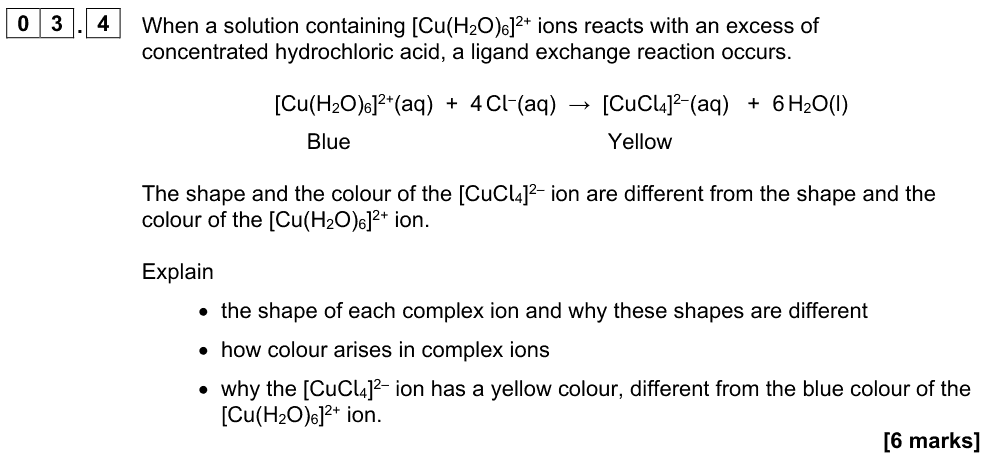
June 2025 · Paper 1 · Q03.46 marksAO1=2, AO2=2, AO3=26-mark level of response
Earlier part of question 03 that this part uses
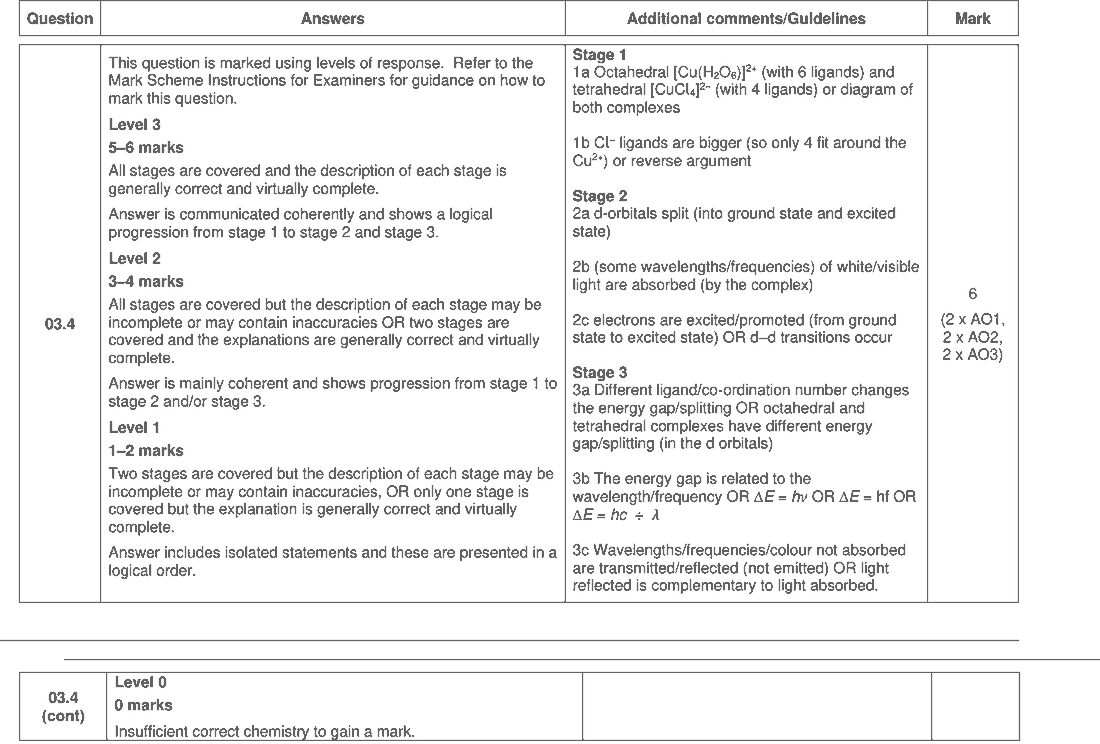
Mark scheme, with the levels and indicative content
Examiner's comment
In part 4 most students gave the correct shapes; the most common error was square planar instead of tetrahedral.
Some students did not refer to ligand size and instead gave ideas based on electron pair repulsion theory; some referred to chlorine atoms/molecules rather than chloride ions.
Some students did not refer to d orbital splitting.
Notes from the mark scheme and report
Levels of response, three stages. Shape: [Cu(H2O)6]2+ is octahedral with six ligands, [CuCl4]2– is tetrahedral with four
Cl– ligands are bigger, so only four fit round Cu2+. Colour: d orbitals split in energy
some wavelengths of visible light are absorbed
electrons are excited from the ground state to the excited state (d–d transitions). Different colour: changing the ligand and co-ordination number changes the energy gap
∆E = hν = hc/λ, so different wavelengths are absorbed
the colour seen is the light transmitted, not absorbed. Errors: square planar for [CuCl4]2–
electron pair repulsion instead of ligand size
chlorine atoms rather than chloride ions
no mention of d-orbital splitting or of visible light
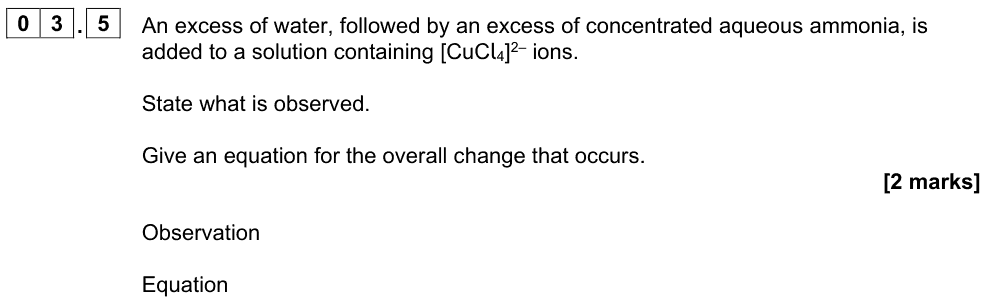
June 2025 · Paper 1 · Q03.52 marksAO1=1, AO2=1Equation writingHard
Earlier part of question 03 that this part uses
Mark scheme
Examiner's comment
Fewer than 20% scored both marks in part 5.
Many students gave an incorrect observation.
Students found the equation challenging; chlorine was often given as a product, some students had 2 mol of ammonia and 4 mol of water instead of the other way round and the copper complex often lacked a charge.
Notes from the mark scheme and report
Yellow solution turns to a deep blue solution
[CuCl4]2– + 4NH3 + 2H2O → [Cu(NH3)4(H2O)2]2+ + 4Cl–. Errors: chlorine as a product
2NH3 and 4H2O
charge missing from the complex
Skills: RP11 Carry out simple test-tube reactions to identify transition metal ions in aqueous solution
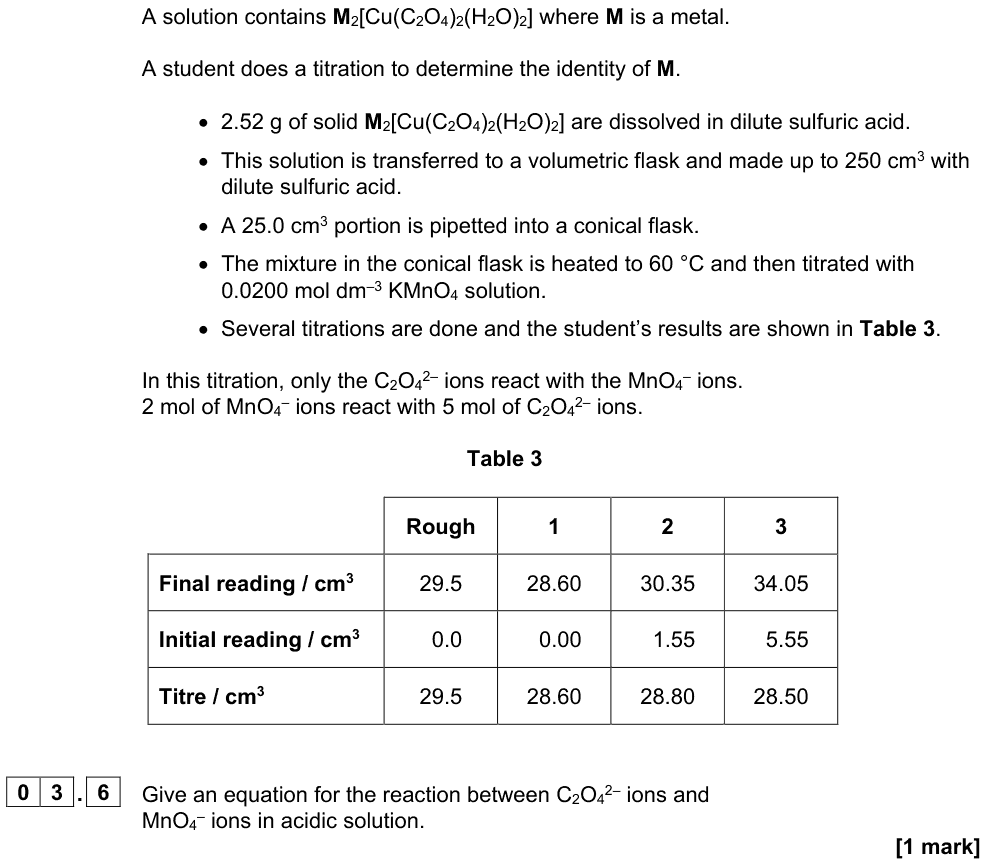
June 2025 · Paper 1 · Q03.61 markAO2=1Equation writing
Earlier part of question 03 that this part uses
Mark scheme
Examiner's comment
In part 6 many students could not give a balanced equation; H+ ions were often omitted from the left-hand side and water from the right-hand side.
Notes from the mark scheme and report
2MnO4– + 5C2O4 2– + 16H+ → 2Mn2+ + 10CO2 + 8H2O. Errors: H+ omitted from the left and water from the right
June 2025 · Paper 1 · Q03.71 markAO2=1Calculation
Earlier parts of question 03 that this part uses
Mark scheme
Examiner's comment
In part 7 most students gave the correct answer; a common error was to average three of the four titres instead of the two that were concordant.
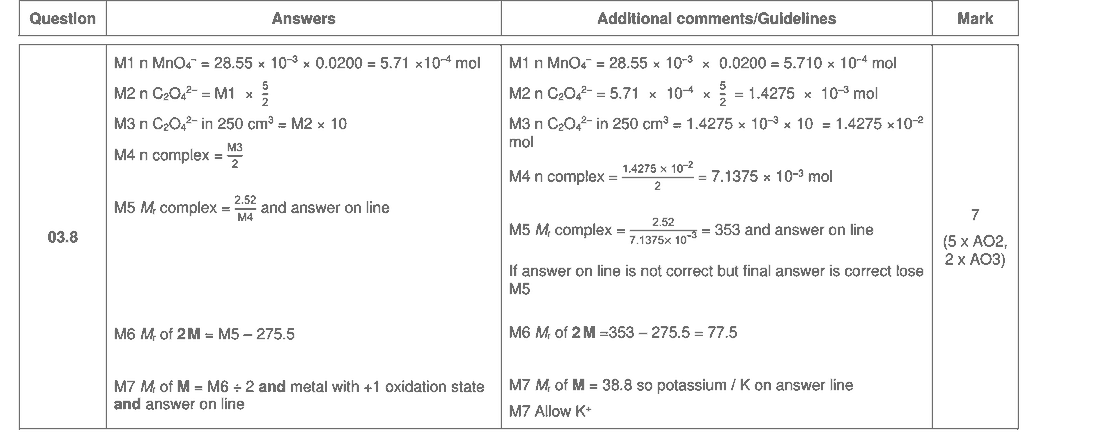
The calculation in part 7 proved challenging; most students were able to score the first three marks but then failed to divide by 2 and were not able to make progress.
Some students used 25.0 cm3 for their titre.
Students who had calculated an Mr greater than 275 usually divided this by 2 to get an Ar but often did not assign this to a metal with a +1 oxidation state.
Notes from the mark scheme and report
Answer: 28.55 cm3. Mean of the concordant titres 28.60 and 28.50 only. Common error: averaging three of the four titres. Uses Table 3 from 03.6
Skills: MS1.2 Find arithmetic means; PS3.2 Process and analyse data using appropriate mathematical skills as exemplified in the mathematical appendix for each science; ATd Use laboratory apparatus for a variety of experimental techniques including: titration, using burette and pipette; distillation and heating under reflux, including setting up glassware using retort stand and clamps; qualitative tests for ions and organic functional groups; filtration, including use of fluted filter paper, or filtration under reduced pressure
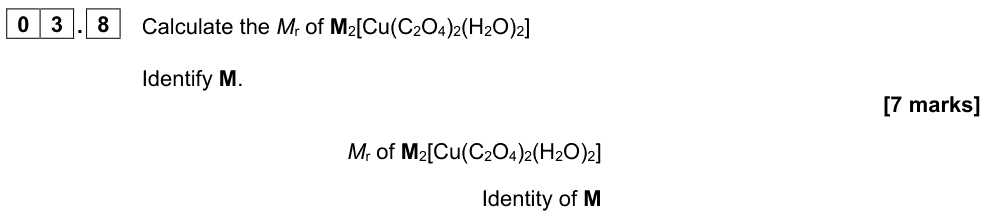
June 2025 · Paper 1 · Q03.87 marksAO2=5, AO3=2Calculation
Earlier parts of question 03 that this part uses
Mark scheme
Examiner's comment
Just over 60% of students answered part 1 correctly. In part 2 many students lost this mark by not identifying the electron pair/lone pair was donated from oxygen to copper. Many incorrect observations were seen in part 3. The students who started with CO32– usually gave a correct equation; ions with incorrect formula CO3– were common. In part 4 most students gave the correct shapes; the most common error was square planar instead of tetrahedral. Some students did not refer to ligand size and instead gave ideas based on electron pair repulsion theory; some referred to chlorine atoms/molecules rather than chloride ions. Some students did not refer to d orbital splitting.
Many students referred to light being absorbed but did not identify the light as visible or white. Many students knew that the colour seen was light that had not been absorbed. Few students were able to write about the energy gap and what was responsible for the change in the energy gap, although some did reference the equation ∆E = h𝜈𝜈. Fewer than 20% scored both marks in part 5. Many students gave an incorrect observation. Students found the equation challenging; chlorine was often given as a product, some students had 2 mol of ammonia and 4 mol of water instead of the other way round and the copper complex often lacked a charge.
In part 6 many students could not give a balanced equation; H+ ions were often omitted from the left-hand side and water from the right-hand side. In part 7 most students gave the correct answer; a common error was to average three of the four titres instead of the two that were concordant. The calculation in part 7 proved challenging; most students were able to score the first three marks but then failed to divide by 2 and were not able to make progress. Some students used 25.0 cm3 for their titre. Students who had calculated an Mr greater than 275 usually divided this by 2 to get an Ar but often did not assign this to a metal with a +1 oxidation state. Students found part 9 challenging; common errors were to have a 4- coordinate copper or to bond the copper to a C2O42– ion via 1 coordinate bond. Many students did not specifically draw the coordinate bonds originating from the O atom of the water.
Notes from the mark scheme and report
Answer: Mr = 353
M is potassium. n(MnO4–) = 28.55 × 10^–3 × 0.0200 = 5.71 × 10^–4 mol
n(C2O4 2–) = × 5/2 = 1.4275 × 10^–3 mol
× 10 = 1.4275 × 10^–2 mol in 250 cm3
n(complex) = ÷ 2 = 7.1375 × 10^–3 mol
Mr = 2.52 ÷ 7.1375 × 10^–3 = 353
353 – 275.5 = 77.5 for 2M
Ar = 38.8. Errors: not dividing by 2 for two ethanedioates per complex
using 25.0 cm3 as the titre
not choosing a metal with a +1 oxidation state. Uses the method and Table 3 from 03.6
Skills: MS0.0 Recognise and make use of appropriate units in calculation; MS0.2 Use ratios, fractions and percentages; MS2.2 Change the subject of an equation
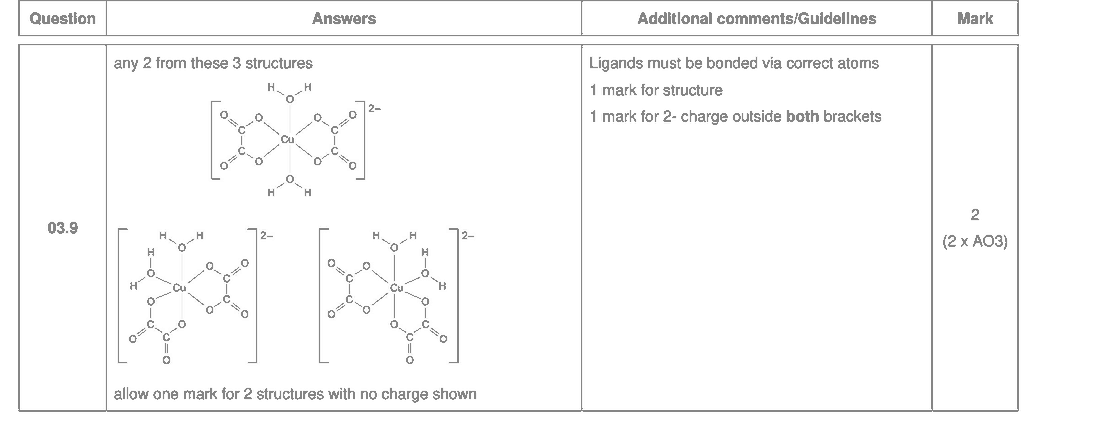
June 2025 · Paper 1 · Q03.92 marksAO3=2Diagram or structure
Earlier parts of question 03 that this part uses
Mark scheme
Examiner's comment
Students found part 9 challenging; common errors were to have a 4- coordinate copper or to bond the copper to a C2O42– ion via 1 coordinate bond.
Many students did not specifically draw the coordinate bonds originating from the O atom of the water.
Notes from the mark scheme and report
Any two of three octahedral structures of [Cu(C2O4)2(H2O)2]2–: the trans isomer (water ligands opposite) and the two mirror-image cis isomers (water ligands adjacent). Each ethanedioate bonds through two O atoms and each water through O
2– charge outside the brackets on both (two correct structures without charges score 1). Errors: 4-co-ordinate copper
ethanedioate joined by one bond only
water not bonded through O
Skills: MS4.2 Visualise and represent 2D and 3D forms including two-dimensional representations of 3D objects
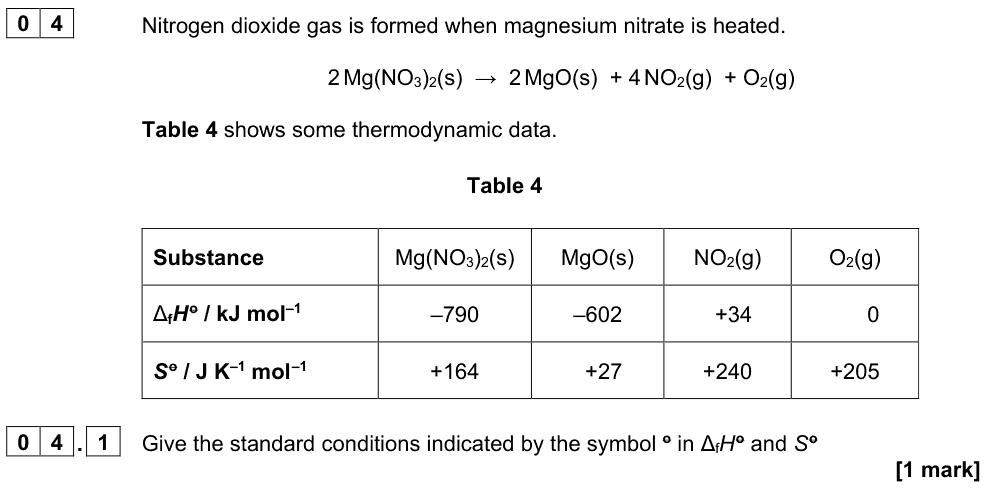
June 2025 · Paper 1 · Q04.41 markAO1=1Short answer
Earlier parts of question 04 that this part uses
Mark scheme
Examiner's comment
Answers to part 4 were generally good.
Notes from the mark scheme and report
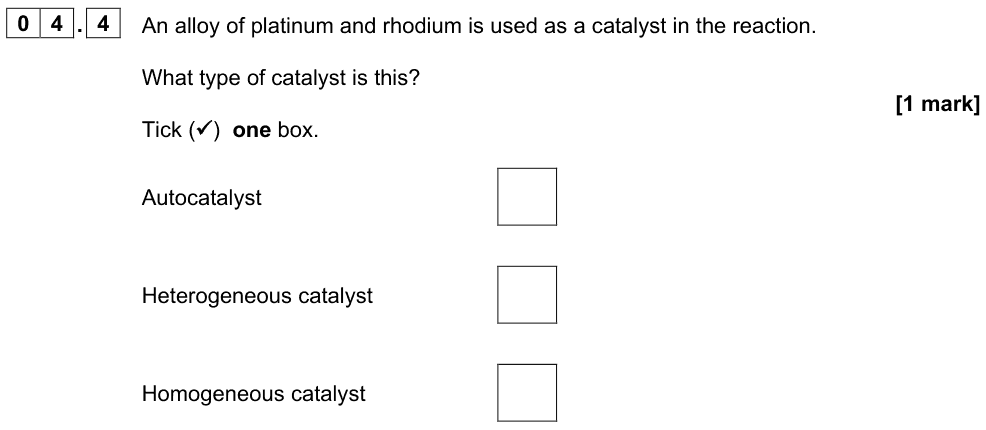
Answer: heterogeneous catalyst (a solid alloy with gaseous reactants)
June 2025 · Paper 1 · Q07.32 marksAO1=2Equation writing
Earlier part of question 07 that this part uses
Mark scheme
Examiner's comment
The equations in part 3 were generally well done; common errors included unbalanced equations with the correct species, or equations that had the wrong oxidation states for the vanadium oxides, many including positive ions e.g.
VO+.
Notes from the mark scheme and report
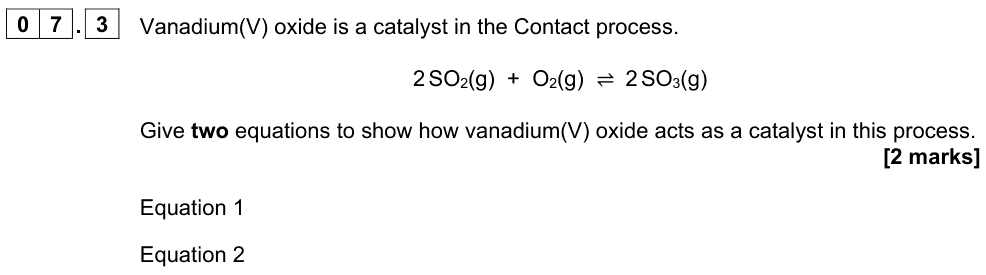
V2O5 + SO2 → V2O4 + SO3
then V2O4 + ½O2 → V2O5. Correct equations in the wrong order score 1. Errors: unbalanced
wrong vanadium oxides or ions such as VO+
June 2025 · Paper 1 · Q07.42 marksAO3=2Equation writing
Earlier part of question 07 that this part uses
Mark scheme
Examiner's comment
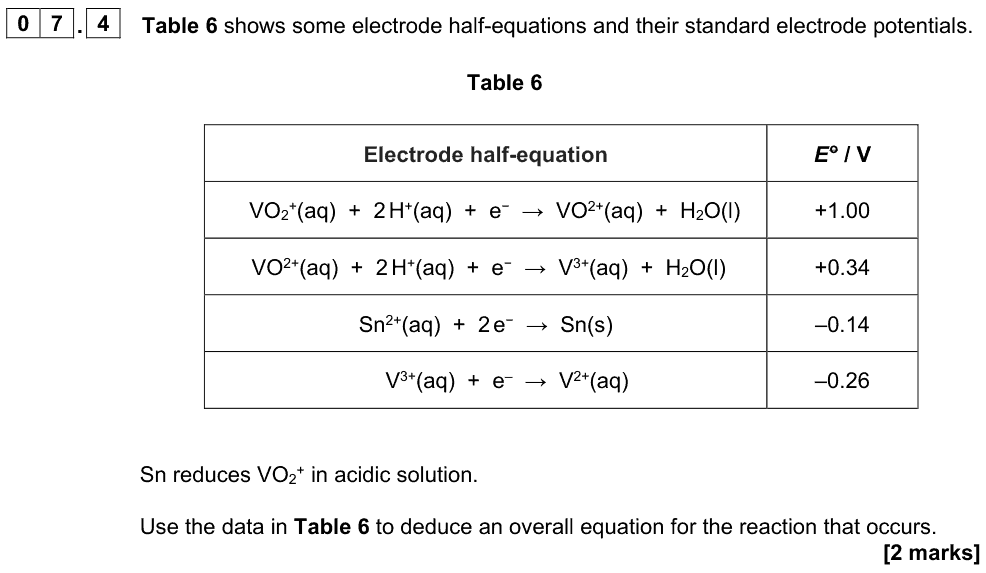
In part 4, the majority of students did not recognize that the reduction of the vanadium species with tin proceeds in two steps and stops at V(III).
A correct understanding of how EMF values determine the spontaneity of redox reactions was essential for full marks.
Many students who did start and end with the correct vanadium species did not balance the equation.
Notes from the mark scheme and report
VO2+ + 4H+ + Sn → V3+ + Sn2+ + 2H2O. Tin (E = –0.14 V) reduces VO2+ to VO 2+ and then to V3+ (+1.00 and +0.34 V are both more positive), but not to V2+ (–0.26 V is more negative). M1 is for V3+ as the only vanadium product. Most did not see that reduction goes in two steps and stops at V(III)
many correct species were left unbalanced
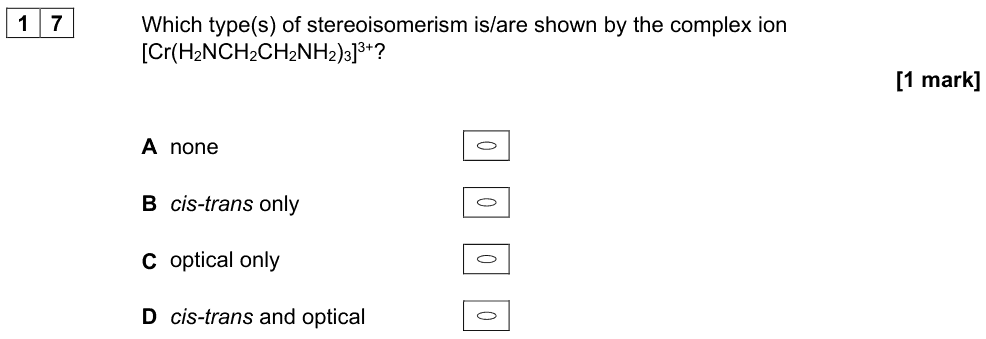
June 2025 · Paper 3 · Q171 markAO3=1Multiple choice
Answer
C
Mark scheme
Notes from the mark scheme and report
Answer: C. An octahedral complex with three identical bidentate ligands has two non-superimposable mirror-image forms
cis–trans needs different monodentate ligands
Skills: MS4.2 Visualise and represent 2D and 3D forms including two-dimensional representations of 3D objects; MS4.3 Understand the symmetry of 2D and 3D shapes
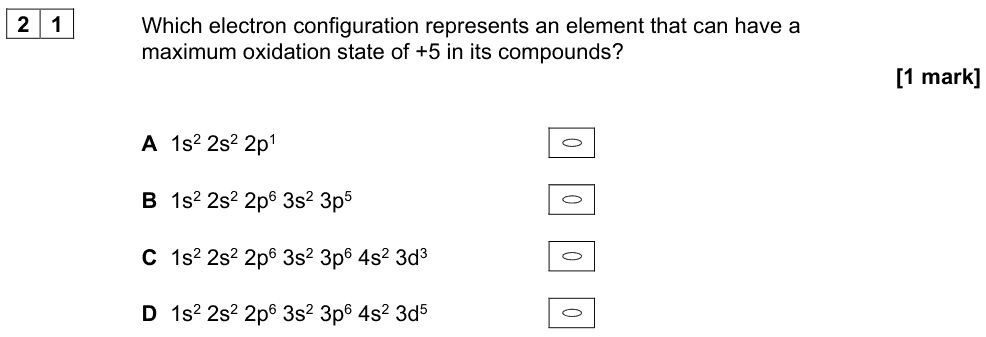
June 2025 · Paper 3 · Q211 markAO1=1Multiple choice
Answer
C
Mark scheme
Notes from the mark scheme and report
Answer: C. Vanadium (4s2 3d3) can use all five outer electrons, as in vanadate(V)
D is manganese (maximum +7) and B is chlorine (maximum +7). One of the least well answered questions (under 55% correct)
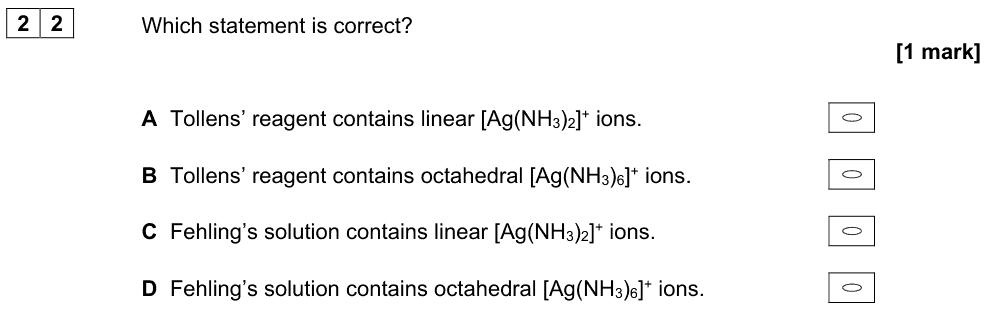
June 2025 · Paper 3 · Q221 markAO1=1Multiple choice
Answer
A
Mark scheme
Notes from the mark scheme and report
Answer: A. Tollens' reagent contains the linear [Ag(NH3)2]+ ion
Fehling's solution contains copper(II)
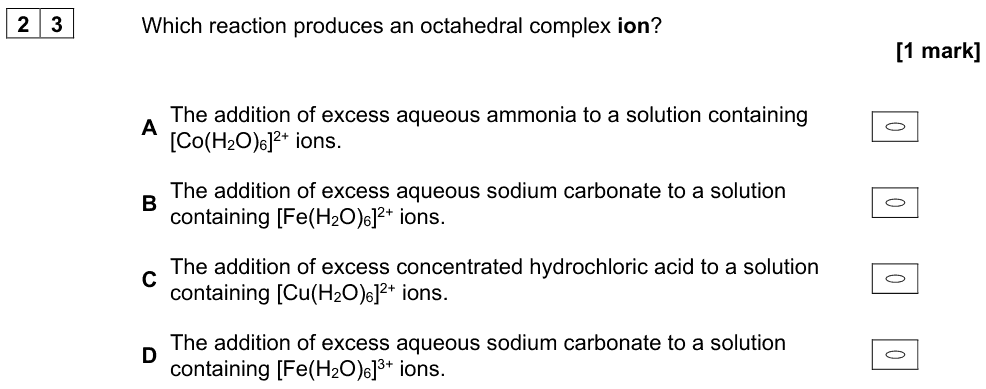
June 2025 · Paper 3 · Q231 markAO1=1Multiple choice
Answer
A
Mark scheme
Notes from the mark scheme and report
Answer: A. Excess ammonia gives octahedral [Co(NH3)6]2+
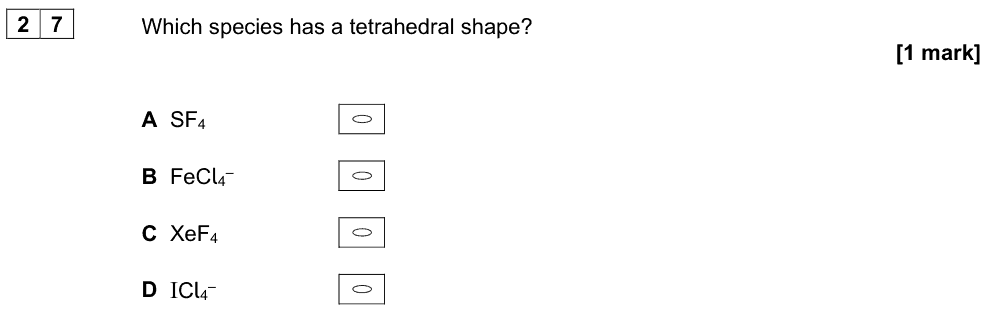
June 2025 · Paper 3 · Q271 markAO2=1Multiple choice
Answer
B
Mark scheme
Notes from the mark scheme and report
Answer: B. FeCl4– is a tetrahedral complex with four large Cl– ligands
SF4 has one lone pair, and XeF4 and ICl4– have two lone pairs (square planar)
Skills: MS4.1 Use angles and shapes in regular 2D and 3D structures
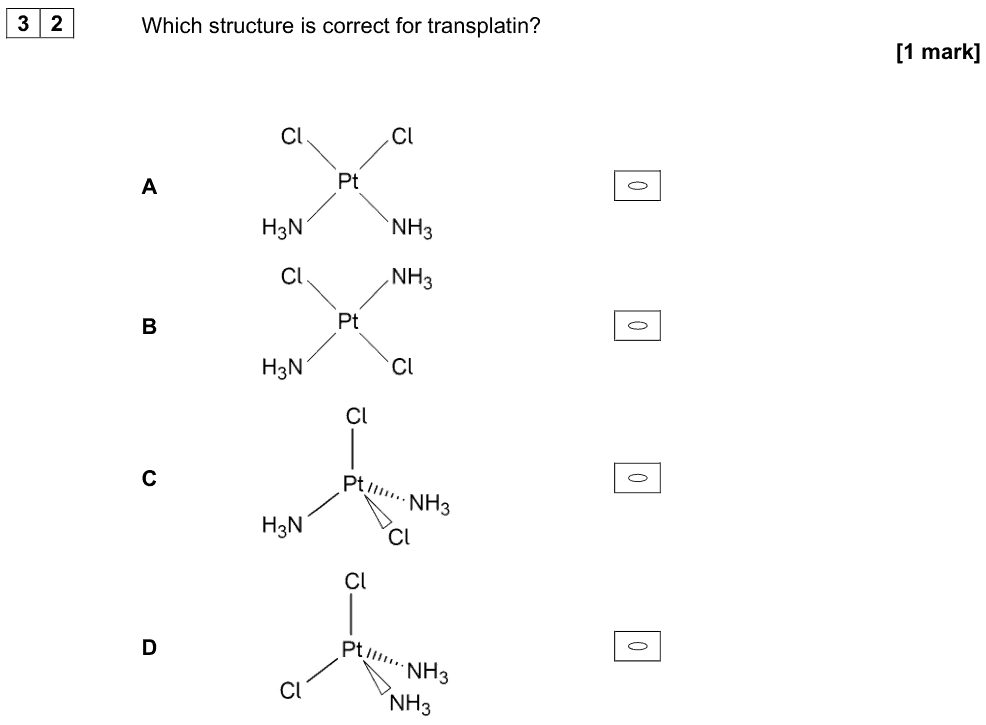
June 2025 · Paper 3 · Q321 markAO1=1Multiple choice
Answer
B
Mark scheme
Notes from the mark scheme and report
Answer: B. Square planar with the two Cl ligands opposite each other
A is cisplatin and C and D are drawn tetrahedral
Skills: MS4.2 Visualise and represent 2D and 3D forms including two-dimensional representations of 3D objects
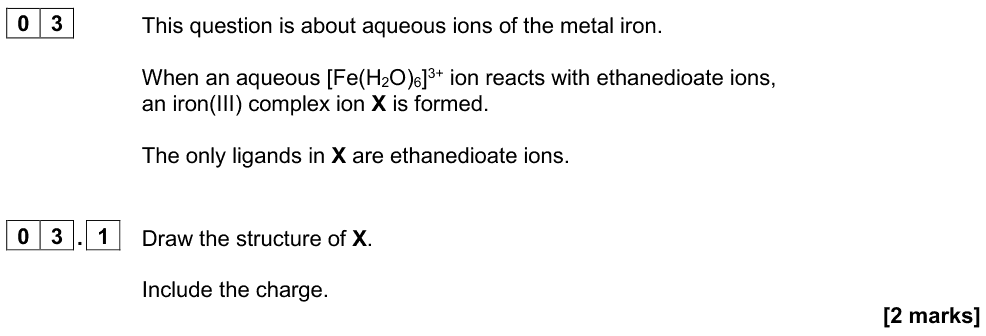
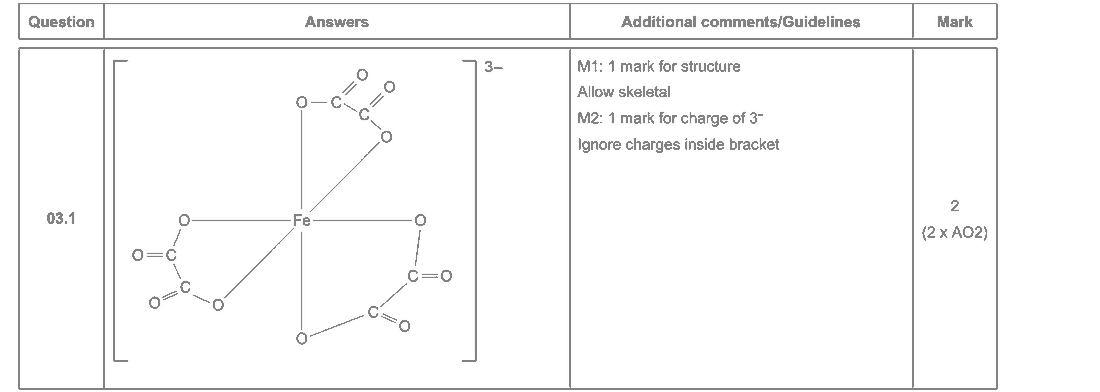
June 2024 · Paper 1 · Q03.12 marksAO2=2Diagram or structure
Mark scheme
Examiner's comment
In part 1 most students knew they needed an octahedral shape and bidentate ligands for the complex, but could not draw the ethanedioate ligands correctly: errors included missing C or O atoms or including C=C.
Notes from the mark scheme and report
[Fe(C2O4)3]3–: octahedral, three bidentate ethanedioate ligands each bonded through two O atoms
3– charge outside the bracket. Errors: ligands with missing C or O atoms, or C=C
Skills: MS4.2 Visualise and represent 2D and 3D forms including two-dimensional representations of 3D objects
June 2024 · Paper 1 · Q03.22 marksAO1=2Explanation
Earlier part of question 03 that this part uses
Mark scheme
Examiner's comment
Many students could not recall the chelate effect in part 2: some students stated that the complex formed is more stable because stronger bonds were formed.
Notes from the mark scheme and report
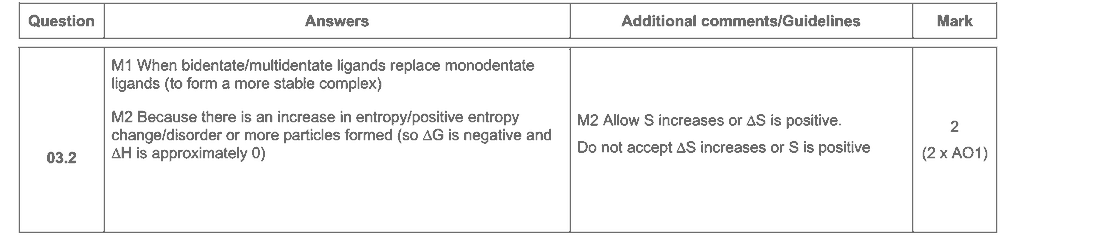
Bidentate or multidentate ligands replace monodentate ligands
more particles are formed so entropy increases. Not 'stronger bonds'
'∆S increases' is not accepted
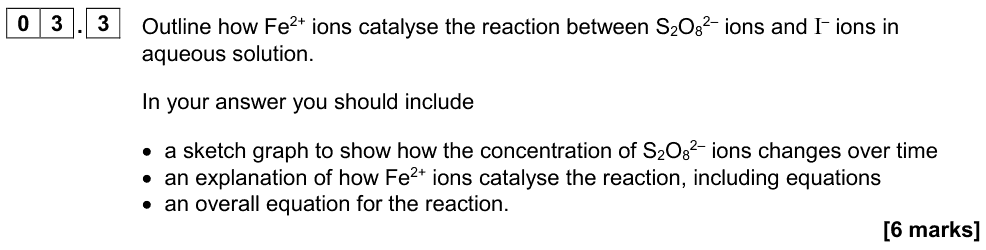
June 2024 · Paper 1 · Q03.36 marksAO1=2, AO2=2, AO3=26-mark level of responseHard
Earlier part of question 03 that this part uses
Mark scheme, with the levels and indicative content
Examiner's comment
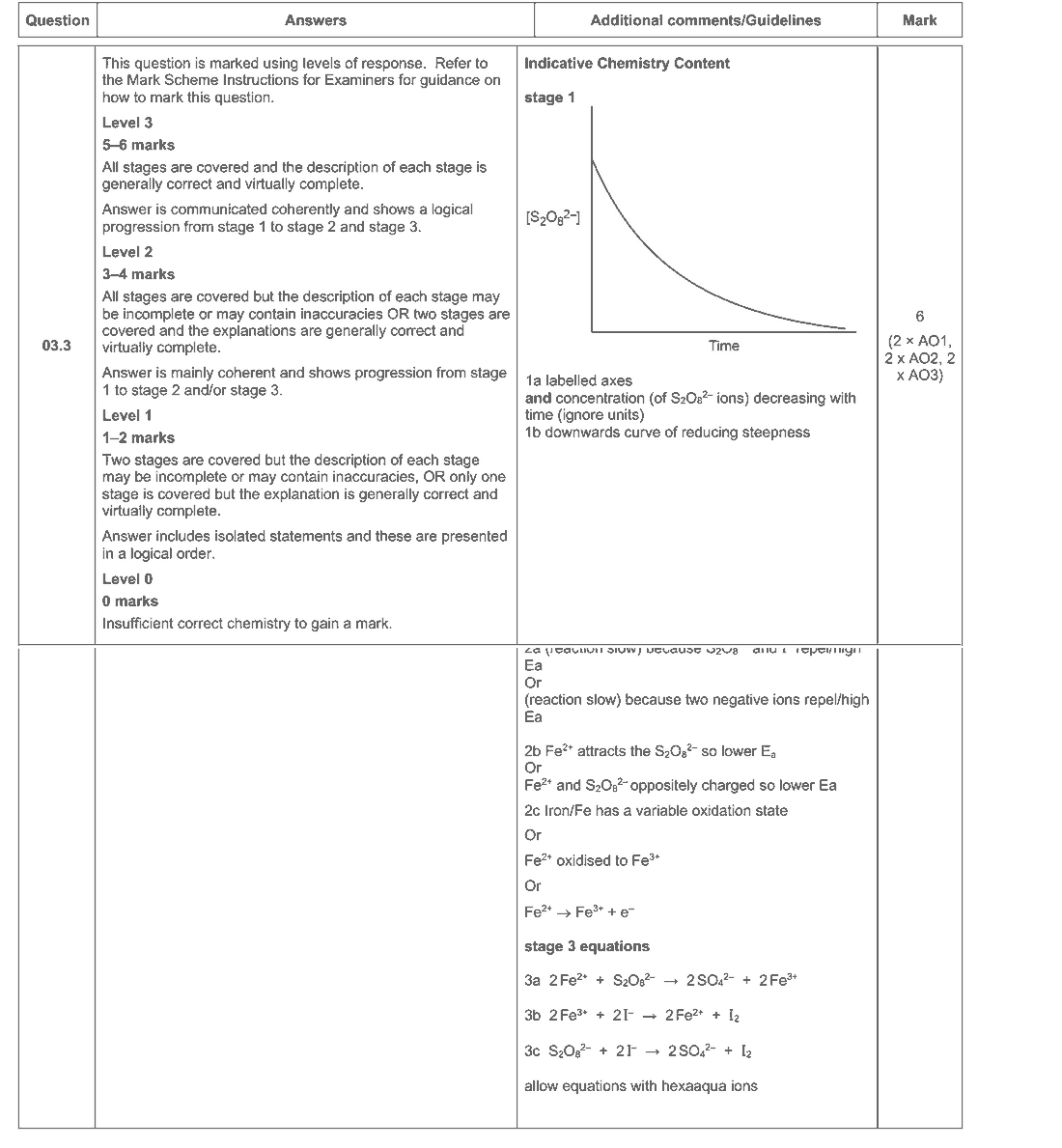
Part 3 discriminated well: 23% of students gave a level 3 answer and most gained 1 or 2 marks by drawing a graph with labelled axes.
Incorrect curves on the graph included a straight line down, a horizontal line at the start then a curve down of reducing steepness.
The repulsion between the negative ions was well understood by many students but the attraction between iron(II) ions and persulfate ions was only stated by the more able students.
The idea that variable oxidation states are important for transition metal catalysis is usually well known but few students stressed this in their answers.
The equations were often partially recalled with errors in balancing; SO4– was a common incorrect formula for the sulfate ion.
Invalid references to autocatalysis and heterogeneous catalysis were sometimes seen.
Notes from the mark scheme and report
Levels of response, three stages. Graph: labelled axes, concentration falling as a curve of decreasing steepness. Explanation: two negative ions repel (high Ea)
Fe2+ attracts S2O8 2– so Ea is lower
iron has variable oxidation states. Equations: 2Fe2+ + S2O8 2– → 2SO4 2– + 2Fe3+
2Fe3+ + 2I– → 2Fe2+ + I2
overall S2O8 2– + 2I– → 2SO4 2– + I2. Wrong curves: straight line down, or flat then curving
Skills: MS3.1 Translate information between graphical, numerical and algebraic forms
June 2024 · Paper 1 · Q06.12 marksAO3=2ExplanationHard
Mark scheme
Examiner's comment
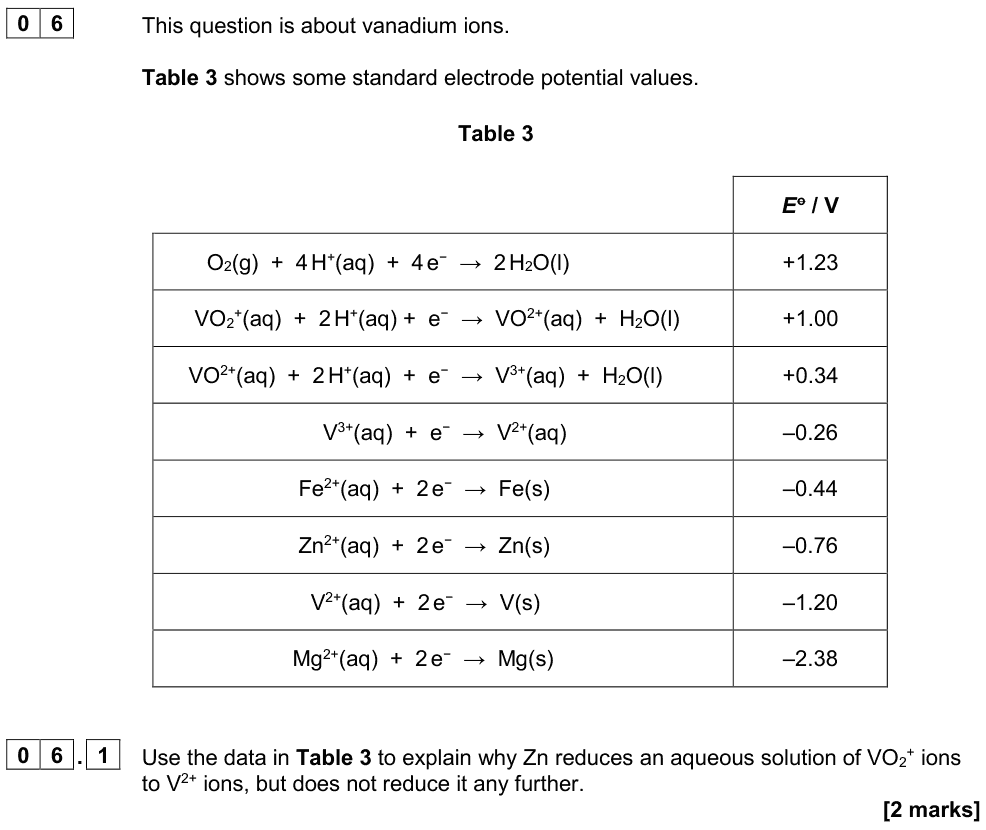
In part 1, 15% of students scored both marks.
Very few students answered in terms of the EꝊ of Zn2+.
Many students referred to the EꝊ of Zn and could not gain any marks.
Students who wrote about EꝊ of Zn2+ compared it to the EꝊ of VO2+ and not to the EꝊ of V3+.
There was a lack of understanding of the concept that while Zn is the reacting species, the electrode potential refers to the reduction of Zn2+.
Notes from the mark scheme and report
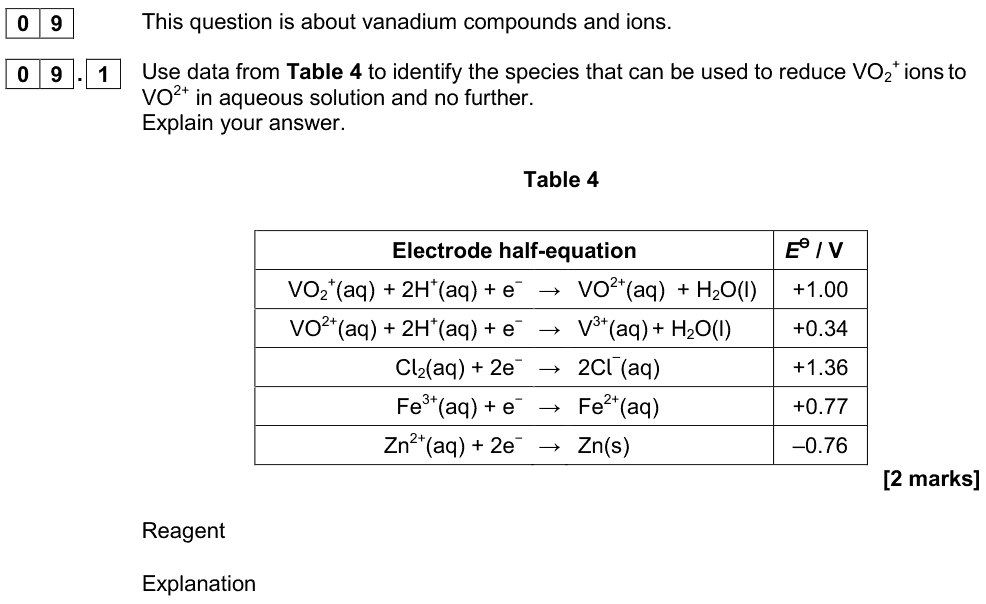
E(V3+/V2+) is more positive than E(Zn2+/Zn), so zinc reduces as far as V2+
E(V2+/V) is more negative than E(Zn2+/Zn), so no further. Refer to the electrode potential of Zn2+/Zn, not 'E of Zn', and compare with V3+, not VO2+
June 2024 · Paper 1 · Q06.44 marksAO2=4CalculationHard
Earlier part of question 06 that this part uses
Mark scheme
Examiner's comment
The calculation in part 4 proved challenging but 34% of students managed to score all the marks.
Many students used the reacting ratio correctly but then went on to use a second reacting ratio to calculate the amount, in moles, of vanadate(V) and lost the second mark.
Some students used an incorrect Mr in the calculation.
Notes from the mark scheme and report
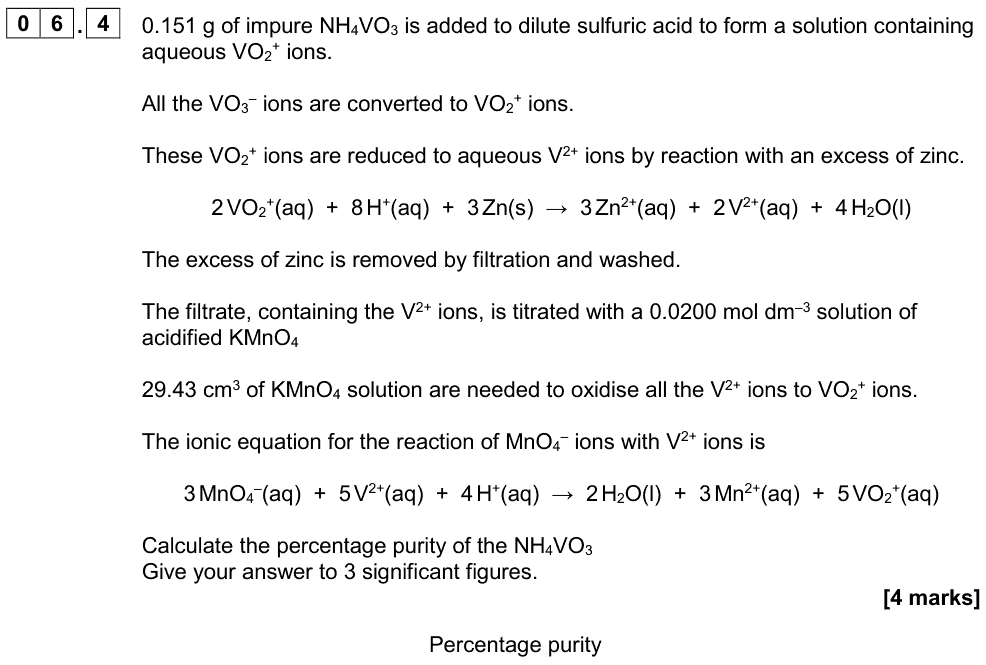
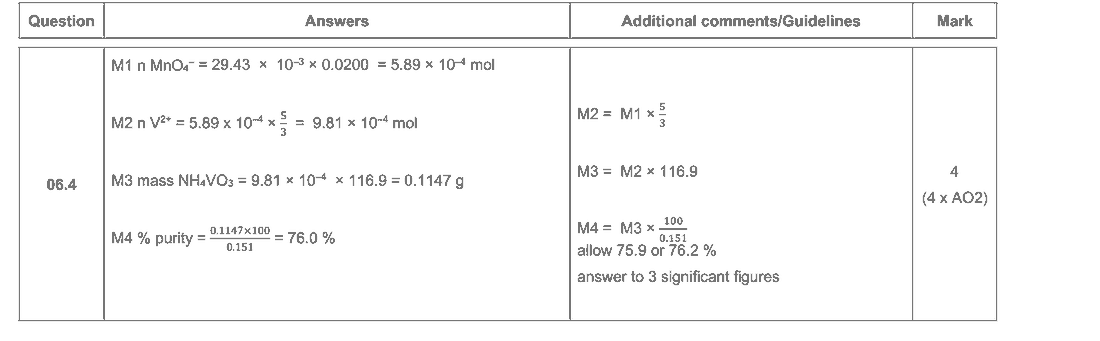
Answer: 76.0%. n(MnO4–) = 5.89 × 10^–4 mol
n(V2+) = × 5/3 = 9.81 × 10^–4 mol
mass of NH4VO3 = × 116.9 = 0.1147 g. Errors: applying a second mole ratio for the vanadate(V)
wrong Mr
Skills: MS0.0 Recognise and make use of appropriate units in calculation; MS0.2 Use ratios, fractions and percentages; MS1.1 Use an appropriate number of significant figures
June 2024 · Paper 3 · Q05.16 marksAO1=66-mark level of responseHard
Mark scheme, with the levels and indicative content
Examiner's comment
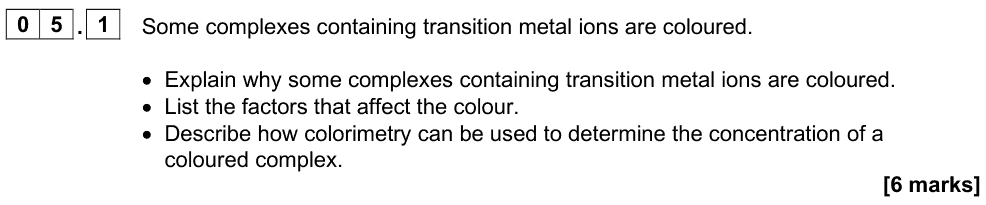
05.1 was the Levels of Response question and there was a significant improvement in performance with nearly 20% of Students able to access Level 3 and score 5 or 6 marks.
The main reason for an inability to access Level 3 was a lack of clarity in the description of the origin of colour in transition metal complexes.
Many students failed to be specific about the light absorbed being in the visible region of the spectrum and the idea of d-d splitting was poorly explained in many cases.
Misuse of terms such as orbital, subshell and shell contributed to a lack of clarity.
The key ideas should be that the ligand approach causes a split in energy of the orbitals in the 3d subshell and that electrons in the d subshell can then absorb some wavelengths of visible light and become excited into the higher energy d orbitals.
It is the remaining wavelengths of light that give the colour seen
Notes from the mark scheme and report
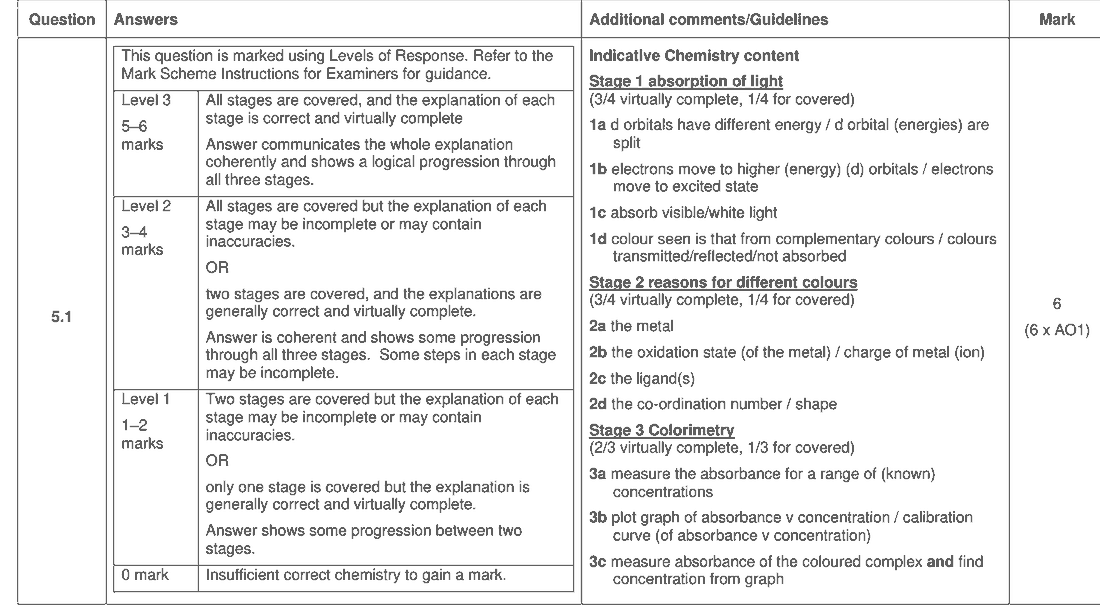
Levels of response, three stages. Absorption: d orbitals are split into different energies
electrons move to higher-energy d orbitals (excited state) by absorbing visible light
the colour seen is the light transmitted or reflected (complementary colour). Factors: the metal, its oxidation state, the ligand, the co-ordination number / shape. Colorimetry: measure absorbance for a range of known concentrations
plot a calibration graph of absorbance against concentration
measure the absorbance of the unknown and read its concentration from the graph. Errors: not saying visible light
loose use of orbital, sub-shell and shell
Skills: PS3.1 Plot and interpret graphs
June 2024 · Paper 3 · Q05.23 marksAO3=3Calculation
Earlier part of question 05 that this part uses
Mark scheme
Examiner's comment
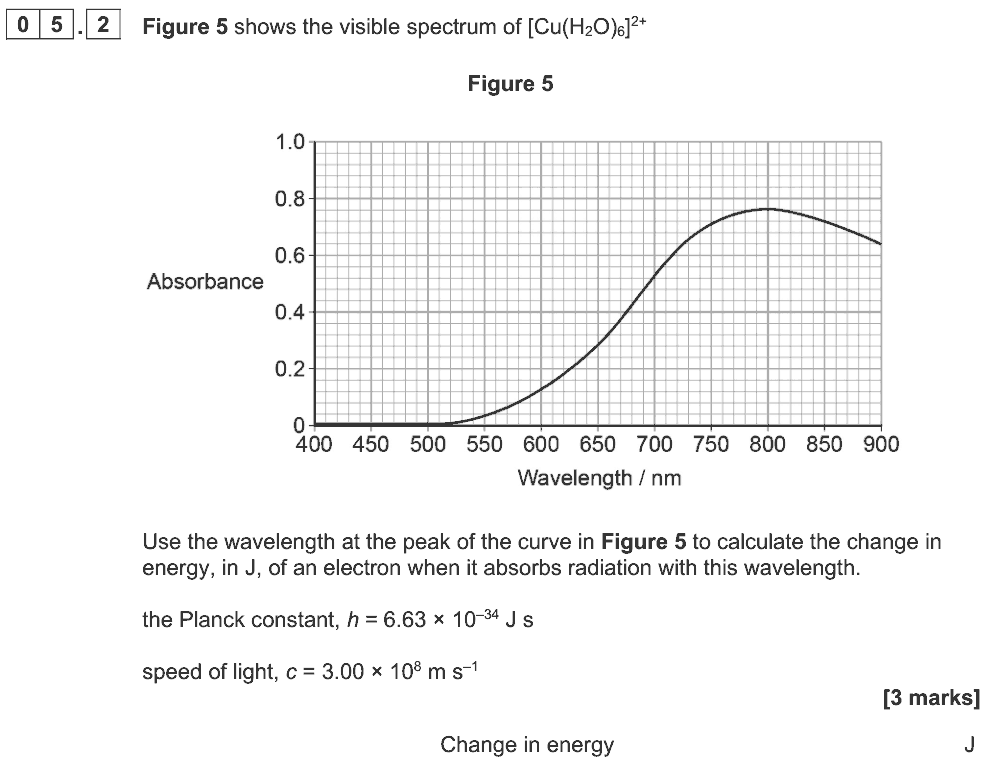
05.2 60% of students scored two or more marks for this question with the most common error being the mis-conversion of nm into m.
Some students read off the absorbance at the peak of the curve instead of the wavelength.
Notes from the mark scheme and report
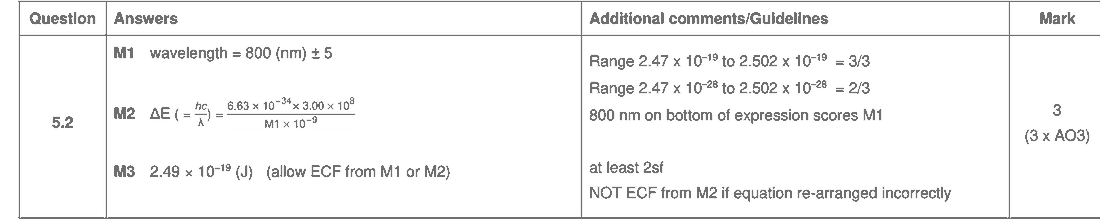
Answer: 2.49 × 10^–19 J (2.47 to 2.50 × 10^–19). Peak wavelength = 800 nm = 800 × 10^–9 m
∆E = hc/λ = (6.63 × 10^–34 × 3.00 × 10^8) ÷ 800 × 10^–9. Not converting nm to m gives × 10^–28 (2 marks)
some read the absorbance instead of the wavelength
Skills: MS0.0 Recognise and make use of appropriate units in calculation; MS0.1 Recognise and use expressions in decimal and ordinary form; MS2.3 Substitute numerical values into algebraic equations using appropriate units for physical quantities; MS3.1 Translate information between graphical, numerical and algebraic forms
June 2024 · Paper 3 · Q211 markAO1=1Multiple choice
Answer
C
Mark scheme
Notes from the mark scheme and report
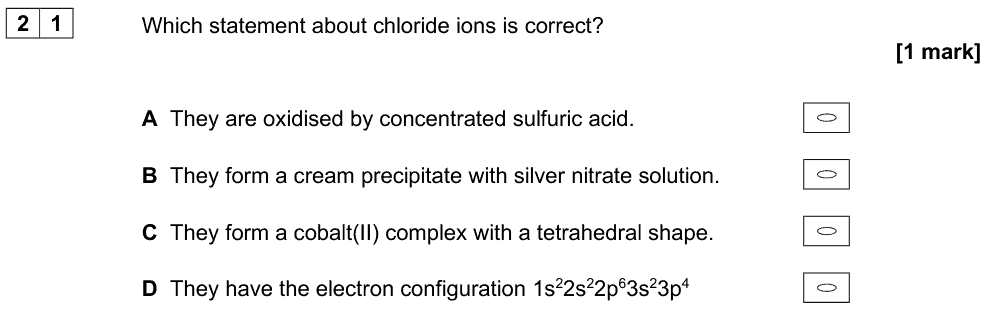
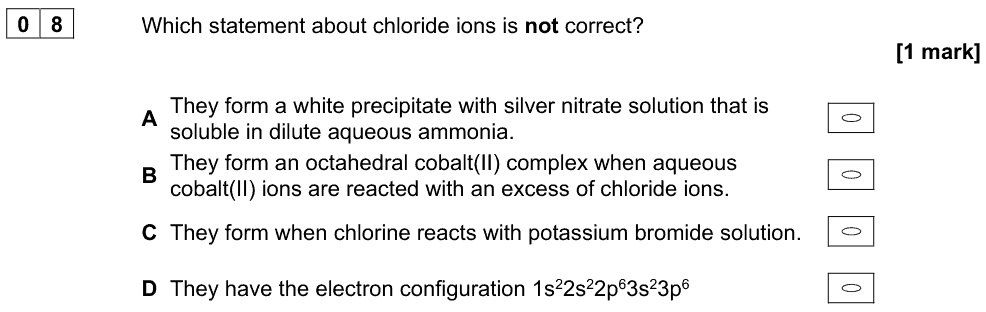
Answer: C. [CoCl4]2– is tetrahedral. Chloride is not oxidised by concentrated H2SO4, AgCl is white, and Cl– is 1s2 2s2 2p6 3s2 3p6
June 2023 · Paper 1 · Q01.11 markAO1=1Short answer
Mark scheme
Examiner's comment
Although many students gave the correct definition in 01.1, several answers did not refer to an atom or ion and many answers gave the definition of a transition metal instead of a transition metal complex.
Notes from the mark scheme and report
A central metal atom or ion surrounded by ligands. Common errors: no reference to an atom or ion
defining a transition metal instead of a complex
June 2023 · Paper 1 · Q01.63 marksAO2=3Diagram or structure
Earlier parts of question 01 that this part uses
Mark scheme
Examiner's comment
Many students gained partial marks in 01.6.
There were several errors seen in students’ answers, eg Cl2 as a ligand, omitting the charge on the ion, drawing two cis- or two trans-isomers, and attempts at drawing optical isomers.
Notes from the mark scheme and report
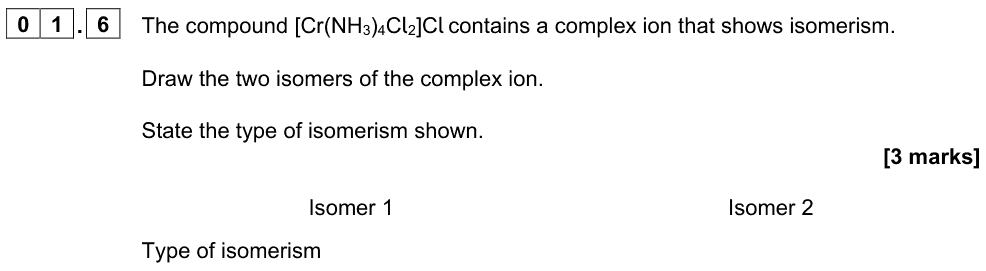
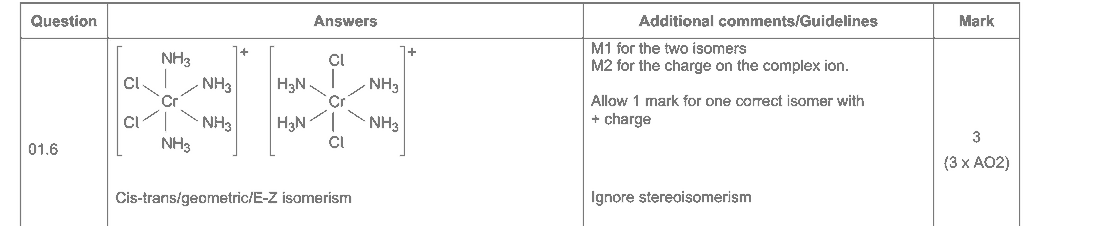
Octahedral [Cr(NH3)4Cl2]+ drawn twice: one with the two Cl ligands adjacent (cis) and one with them opposite (trans)
M1 both isomers, M2 the + charge on the complex ion
cis–trans / geometric / E–Z isomerism ('stereoisomerism' ignored). One correct isomer with + charge scores 1. Errors: Cl2 as a ligand, charge omitted, two cis or two trans drawings, optical isomers
Skills: MS4.2 Visualise and represent 2D and 3D forms including two-dimensional representations of 3D objects
June 2023 · Paper 1 · Q01.71 markAO3=1Equation writingHard
Earlier parts of question 01 that this part uses
Mark scheme
Examiner's comment
Students found 01.7 challenging; the correct equation was given by only 14% of students.
June 2023 · Paper 1 · Q07.41 markAO3=1Short answer
Earlier part of question 07 that this part uses
Mark scheme
Examiner's comment
Answers to 07.4 were quite good.
Notes from the mark scheme and report
The solution is colourless / does not absorb visible light (Al3+ has no d electrons, so no d–d transitions)
June 2023 · Paper 1 · Q07.72 marksAO1=2Short answer
Earlier part of question 07 that this part uses
Mark scheme
Examiner's comment
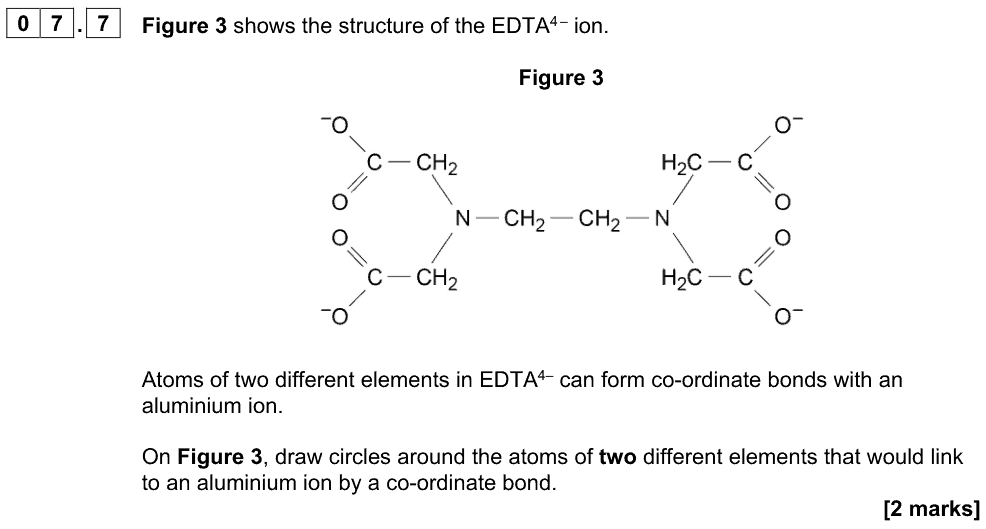
In 07.7, the nitrogen atoms were generally correctly identified; common errors included circling both O species.
Notes from the mark scheme and report
Circle one or more N atoms and one or more O– atoms (the atoms with lone pairs that are donated). Common error: circling both types of O (the C=O oxygen as well)
June 2023 · Paper 3 · Q231 markAO1=1Multiple choice
Answer
A
Mark scheme
Notes from the mark scheme and report
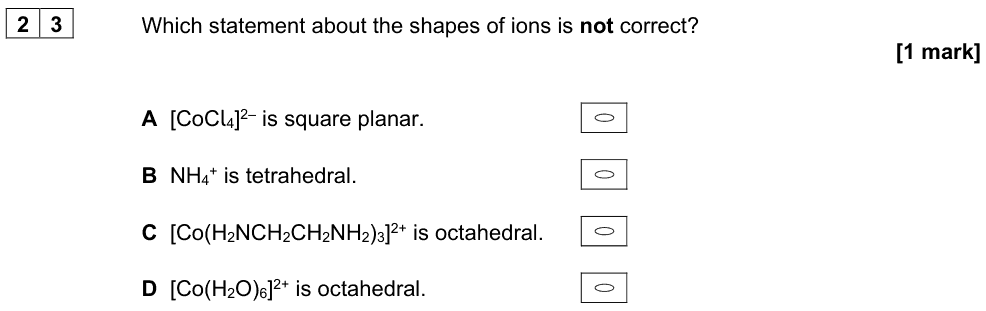
Answer: A. [CoCl4]2– is tetrahedral (large Cl– ligands), not square planar
Skills: MS4.1 Use angles and shapes in regular 2D and 3D structures
June 2023 · Paper 3 · Q241 markAO1=1Multiple choice
Answer
C
Mark scheme
Notes from the mark scheme and report
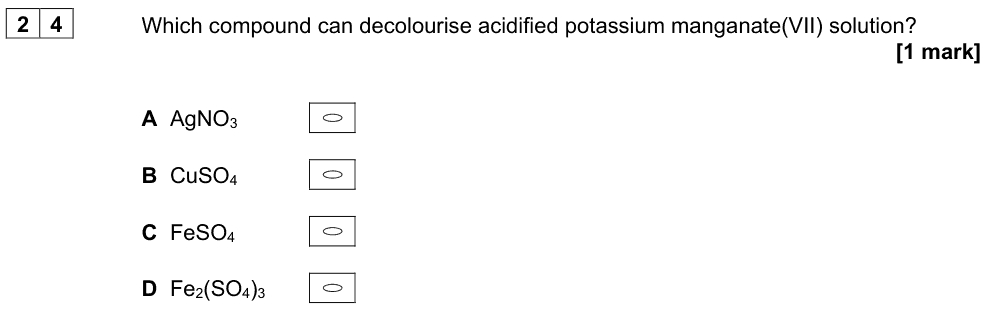
Answer: C. Fe2+ is oxidised to Fe3+ and reduces purple MnO4– to almost colourless Mn2+
Ag+, Cu2+ and Fe3+ cannot be oxidised further
June 2023 · Paper 3 · Q271 markAO1=1Multiple choice
Answer
C
Mark scheme
Notes from the mark scheme and report
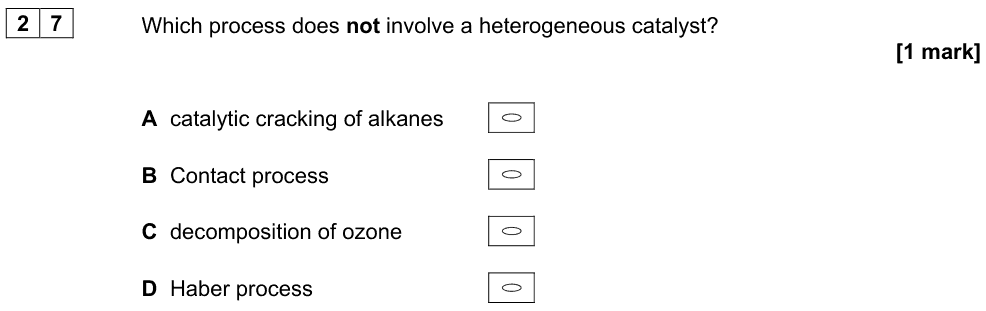
Answer: C. Chlorine atoms and ozone are both gases, so that catalysis is homogeneous
zeolite (cracking), V2O5 (Contact) and Fe (Haber) are solid catalysts for gas reactions
June 2022 · Paper 1 · Q03.15 marksAO2=5CalculationHard
Mark scheme
Examiner's comment
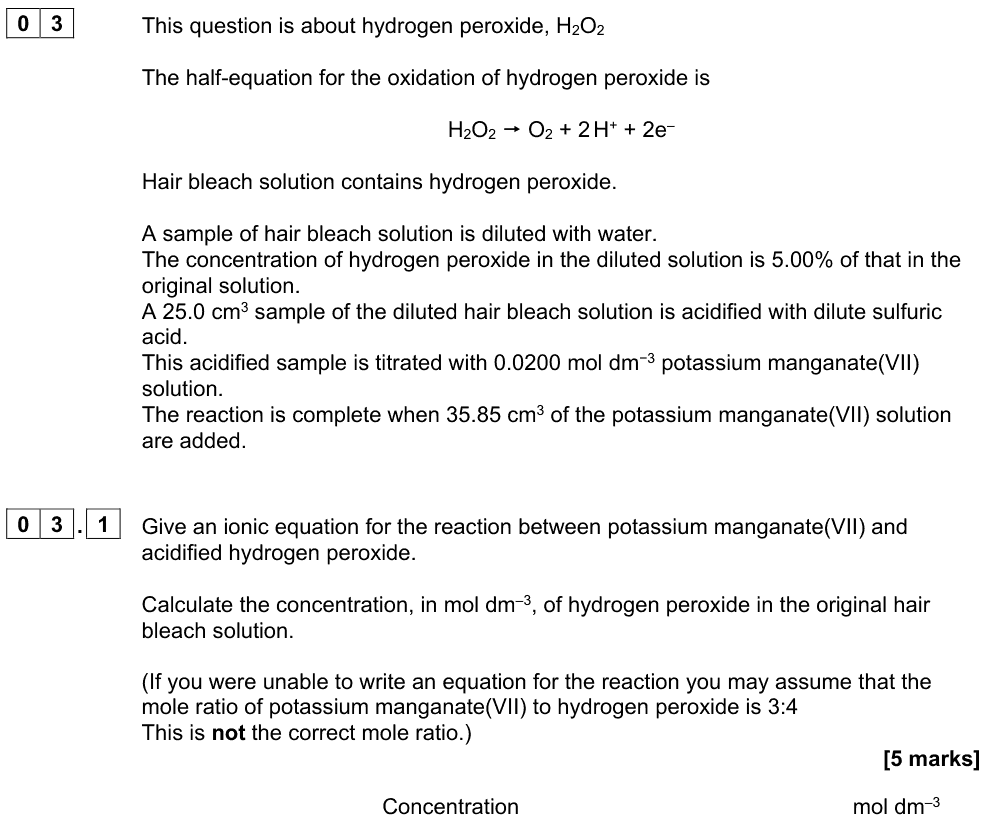
Most students could not give a correct equation in 03.1; if they did score the equation mark they generally carried on to complete the calculation correctly.
21% of students scored all the marks in this question.
A minority had an incorrect ratio in the equation that they then used correctly in the calculation, and so scored 4 marks.
The most common responses used the 3:4 ratio given in the question.
Converting 5% to 100% proved challenging for many so they could not score M5.
The question discriminated very well.
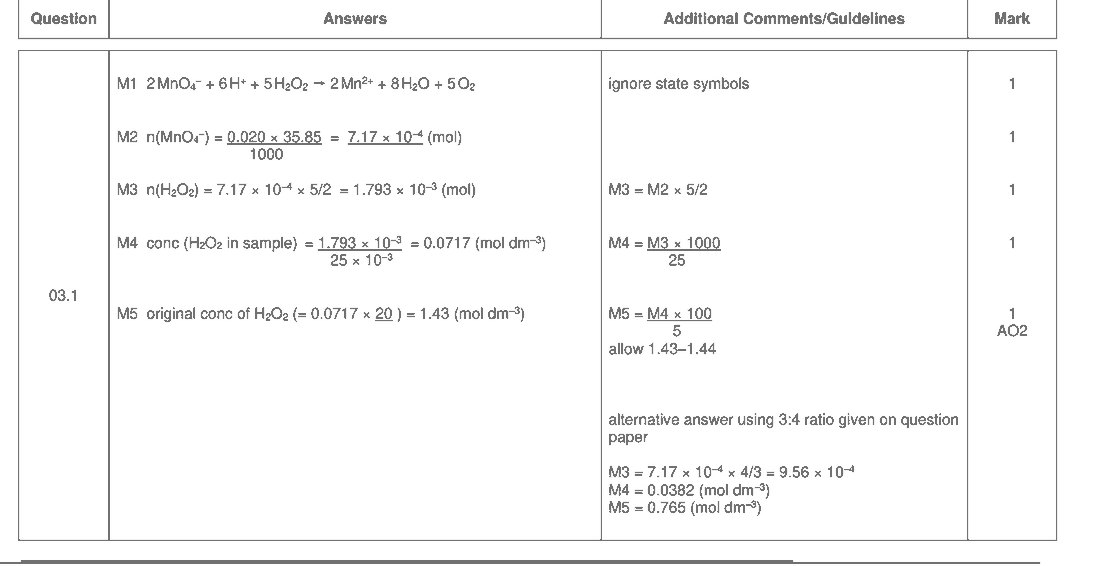
× 100/5 (× 20) for the original solution. Using the given 3:4 ratio gives 0.765 and max 4. Most could not write the equation
scaling 5% to 100% was a common failure
Skills: MS0.0 Recognise and make use of appropriate units in calculation; MS0.2 Use ratios, fractions and percentages
June 2022 · Paper 1 · Q03.21 markAO1=1Short answer
Earlier part of question 03 that this part uses
Mark scheme
Examiner's comment
Only the most able scored the mark in 03.2; many students referred to colour changes that were the wrong way round.
Very few understood the concept of self-indicating in the titration.
Notes from the mark scheme and report
Potassium manganate(VII) is self-indicating: the solution changes from colourless to (pale) pink at the end point, when MnO4– is no longer decolourised. Many gave the colour change the wrong way round
Skills: ATd Use laboratory apparatus for a variety of experimental techniques including: titration, using burette and pipette; distillation and heating under reflux, including setting up glassware using retort stand and clamps; qualitative tests for ions and organic functional groups; filtration, including use of fluted filter paper, or filtration under reduced pressure; PS4.1 Know and understand how to use a wide range of experimental and practical instruments, equipment and techniques appropriate to the knowledge and understanding included in the specification
June 2022 · Paper 1 · Q07.12 marksAO2=2Explanation
Mark scheme
Examiner's comment
43% of students scored both marks in 07.1.
More students gained the first mark for stating that light was absorbed; some did not score the second mark since they did not say that yellow light was reflected and a few stated that yellow light was emitted.
Notes from the mark scheme and report
(Visible) light is absorbed, exciting d electrons
only yellow light is transmitted (or reflected), the other colours being absorbed. 'Absorbs yellow light' and 'emitted' are rejected. 43% scored both marks
June 2022 · Paper 1 · Q07.22 marksAO2=2Calculation
Earlier part of question 07 that this part uses
Mark scheme
Examiner's comment
07.2 was answered well; some students gave the correct expression but then did not calculate correctly and a few did not rearrange the expression correctly.
Skills: MS0.1 Recognise and use expressions in decimal and ordinary form; MS2.2 Change the subject of an equation; MS2.3 Substitute numerical values into algebraic equations using appropriate units for physical quantities
June 2022 · Paper 1 · Q07.33 marksAO1=3Short answer
Earlier part of question 07 that this part uses
Mark scheme
Examiner's comment
Answers to 07.3 were generally good with many students gaining 2 or 3 marks.
Notes from the mark scheme and report
Change the oxidation state of the metal
change the ligand
change the co-ordination number (allow number of ligands)
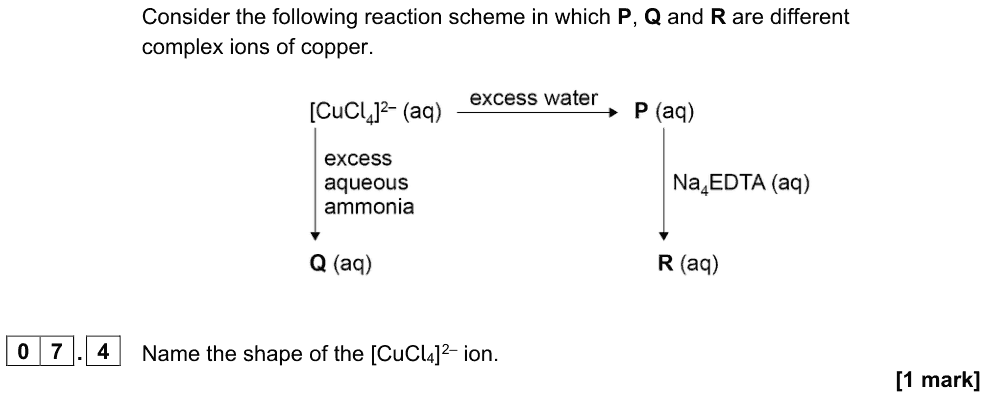
June 2022 · Paper 1 · Q07.41 markAO3=1Short answer
Earlier part of question 07 that this part uses
Mark scheme
Examiner's comment
Most students knew the shape in 07.4.
Notes from the mark scheme and report
Tetrahedral. (This crop also carries the reaction scheme needed for 07.5 to 07.7)
Skills: MS4.1 Use angles and shapes in regular 2D and 3D structures
June 2022 · Paper 1 · Q07.51 markAO3=1Equation writing
Earlier parts of question 07 that this part uses
Mark scheme
Examiner's comment
In 07.5, 50% of students gave the correct equation; a common error was to have 2 Cl2 as a product.
Notes from the mark scheme and report
[CuCl4]2– + 6H2O → [Cu(H2O)6]2+ + 4Cl– (P is the hexaaqua ion
co-ordination number changes from 4 to 6). Common error: 2Cl2 as a product. 50% correct. Uses the reaction scheme printed in 07.4
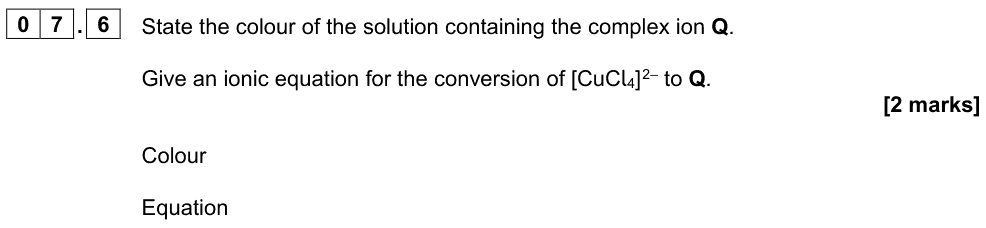
June 2022 · Paper 1 · Q07.62 marksAO3=2Equation writing
Earlier parts of question 07 that this part uses
Mark scheme
Examiner's comment
In 07.6, some students did not state that the solution was deep blue and many could not give a correct equation; many students gave complexes with six ammonia ligands and chlorine gas as a product.
chlorine gas as a product. Uses the reaction scheme printed in 07.4
June 2022 · Paper 1 · Q07.71 markAO3=1Short answer
Earlier parts of question 07 that this part uses
Mark scheme
Examiner's comment
The correct formula was given, in 07.7, by 53% of students; the most common error was a 2+ charge on the complex.
Notes from the mark scheme and report
[Cu(EDTA)]2– (EDTA4– replaces the six water ligands of [Cu(H2O)6]2+). Most common error: a 2+ charge. 53% correct. Uses the reaction scheme printed in 07.4
June 2022 · Paper 3 · Q05.12 marksAO1=1, AO2=1Short answer
Mark scheme
Examiner's comment
05.1 was well answered by most students.
Notes from the mark scheme and report
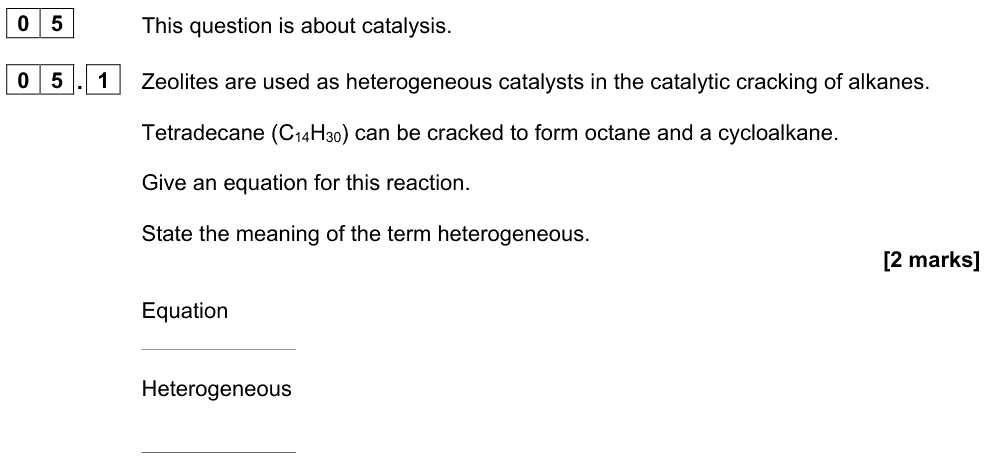
C14H30 → C8H18 + C6H12 (or C8H18 + 2C3H6). Heterogeneous: the catalyst is in a different phase (state) from the reactants
June 2022 · Paper 3 · Q05.26 marksAO1=6Explanation
Earlier part of question 05 that this part uses
Mark scheme
Examiner's comment
In 05.2 many students either did not notice that there were six marks available or were not able to work out how to access them as many answers were very brief and generic.
The question specifically asked for suitable equations to be included but these were often left out of answers.
Notes from the mark scheme and report
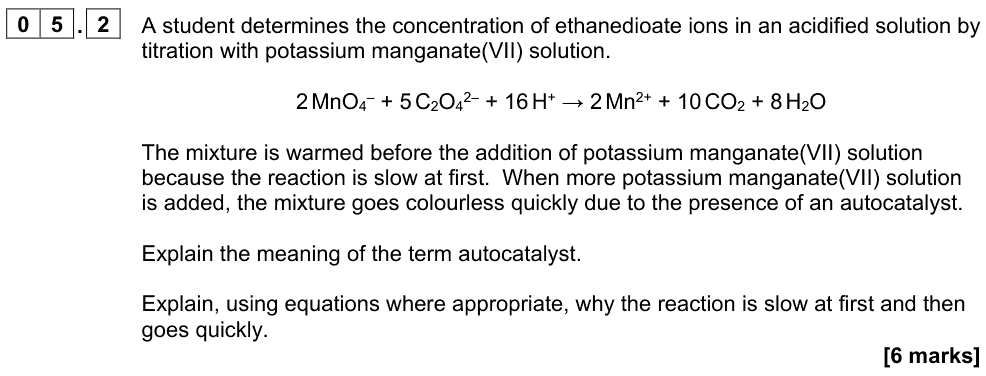
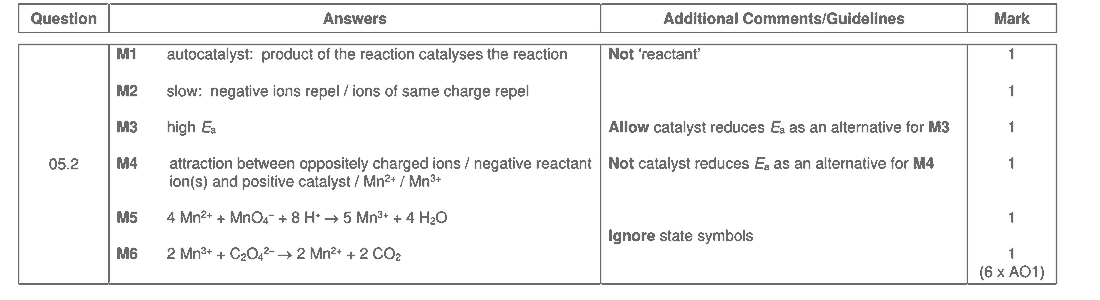
Autocatalyst: a product of the reaction catalyses the reaction. Slow at first: the two reacting ions are both negative and repel, so the activation energy is high. Fast later: Mn2+ (Mn3+) is positive and attracts the negative ions. 4Mn2+ + MnO4– + 8H+ → 5Mn3+ + 4H2O
2Mn3+ + C2O4 2– → 2Mn2+ + 2CO2. Six separate marks
many answers were brief and left out the equations
June 2022 · Paper 3 · Q05.33 marksAO3=3Explanation
Earlier part of question 05 that this part uses
Mark scheme
Examiner's comment
05.3 saw the greatest evidence of confusion in the use of correct terminology.
One of the key aspects of the topic on electrochemistry and electrode potentials is its reliance on conventional terms of reference.
When referring to an electrode potential it is advised that students stick to the conventional form.
Notes from the mark scheme and report
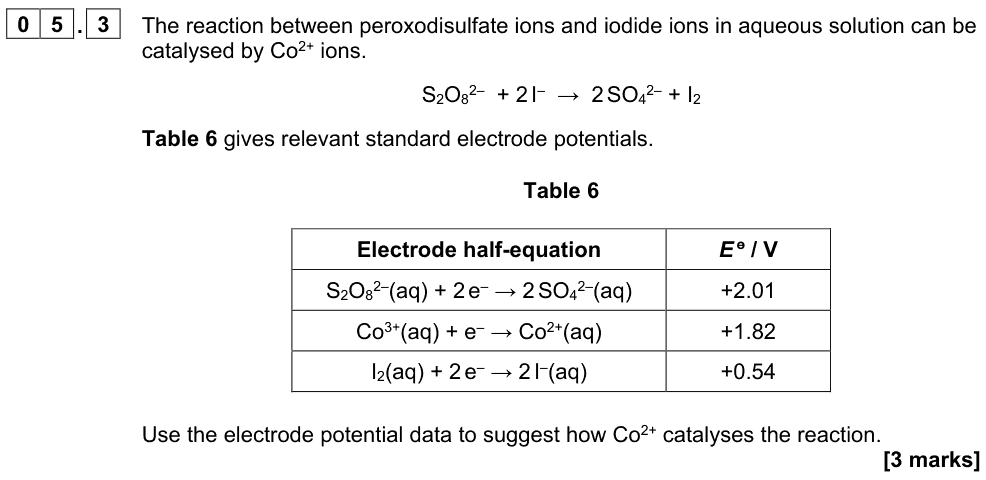
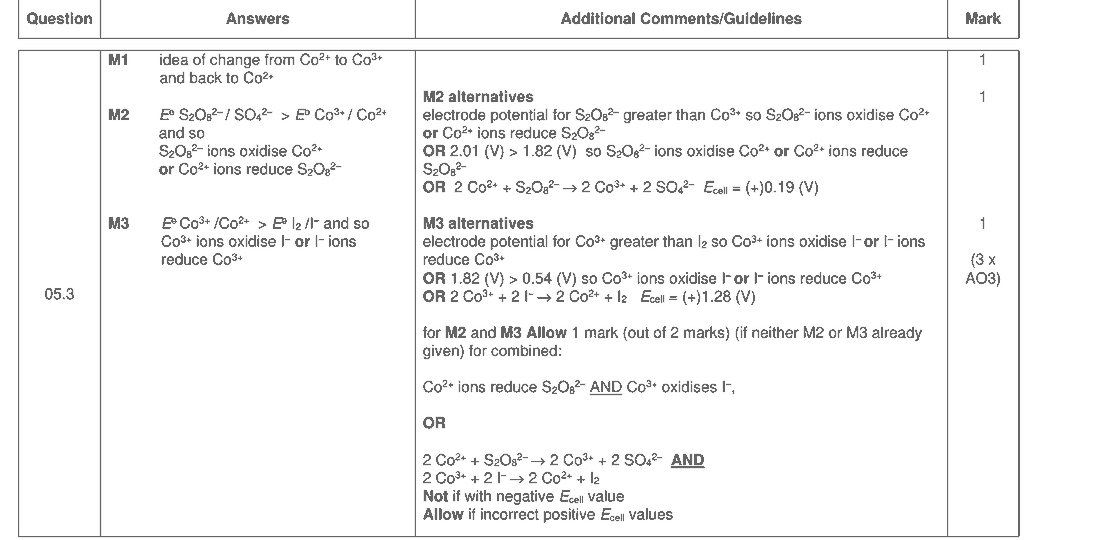
Co2+ is oxidised to Co3+ and then reduced back to Co2+. E(S2O8 2–/SO4 2–) is more positive than E(Co3+/Co2+), so S2O8 2– oxidises Co2+ (2Co2+ + S2O8 2– → 2Co3+ + 2SO4 2–, Ecell +0.19 V). E(Co3+/Co2+) is more positive than E(I2/I–), so Co3+ oxidises I– (2Co3+ + 2I– → 2Co2+ + I2, Ecell +1.28 V). Use conventional electrode-potential terminology
June 2022 · Paper 3 · Q191 markAO3=1Multiple choice
Answer
D
Mark scheme
Notes from the mark scheme and report
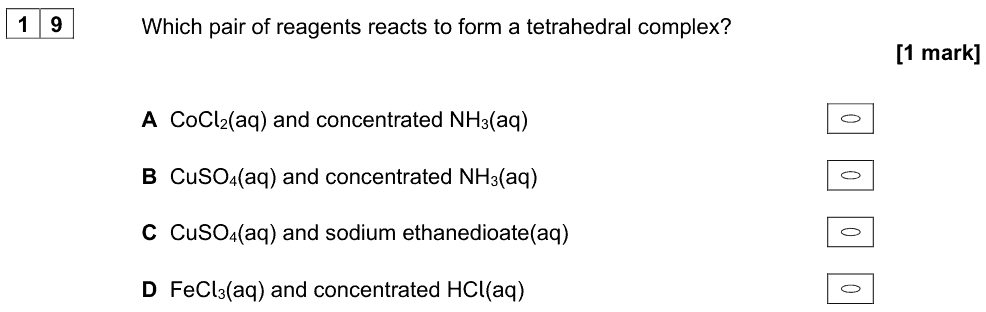
Answer: D. Excess Cl– gives tetrahedral [FeCl4]–. Ammonia and ethanedioate give octahedral complexes
Skills: MS4.1 Use angles and shapes in regular 2D and 3D structures
June 2022 · Paper 3 · Q201 markAO1=1Multiple choice
Answer
B
Mark scheme
Notes from the mark scheme and report
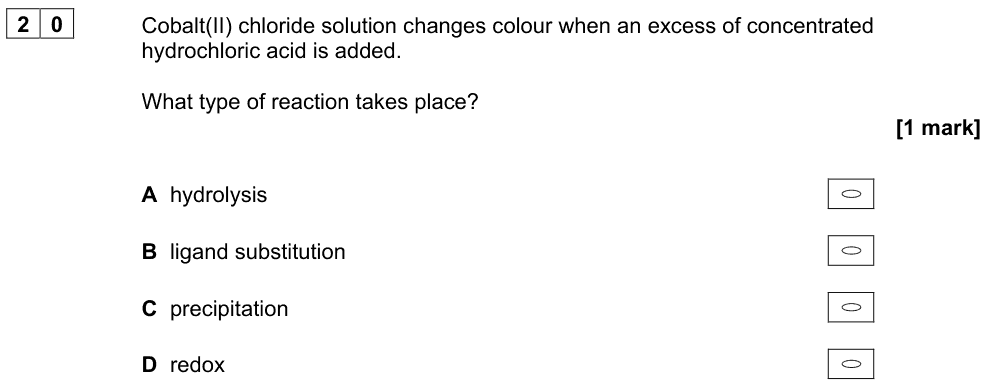
Answer: B. [Co(H2O)6]2+ (pink) + 4Cl– → [CoCl4]2– (blue) + 6H2O: water ligands are replaced by chloride ligands with no change in oxidation state
June 2022 · Paper 3 · Q211 markAO2=1Multiple choice
Answer
C
Mark scheme
Notes from the mark scheme and report
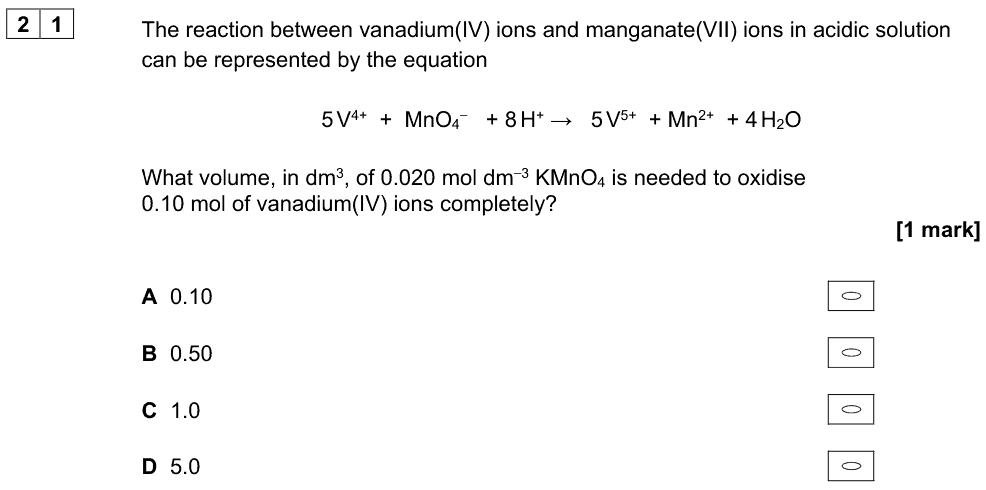
Answer: C. n(MnO4–) = 0.10 ÷ 5 = 0.020 mol
volume = 0.020 ÷ 0.020 = 1.0 dm3
Skills: MS0.2 Use ratios, fractions and percentages
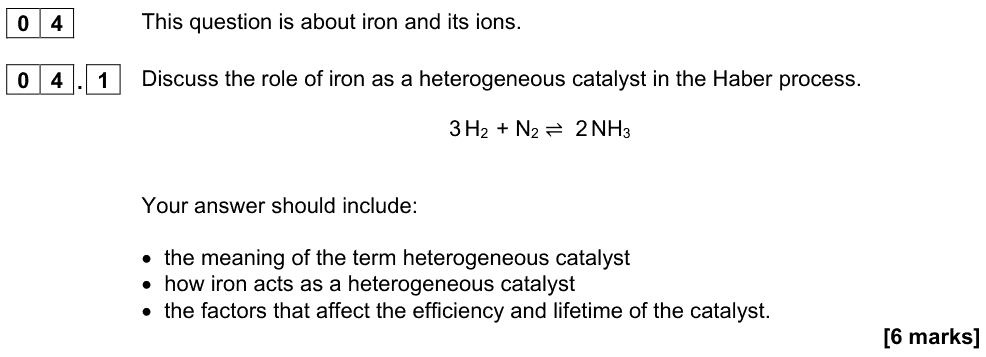
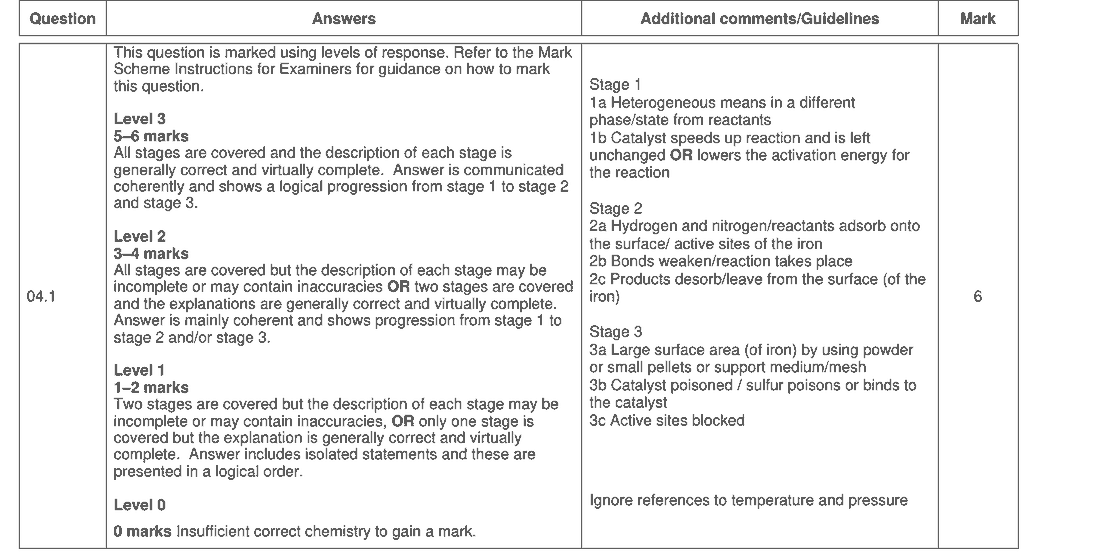
November 2021 · Paper 1 · Q04.16 marks6-mark level of response
Mark scheme, with the levels and indicative content
Examiner's comment
In question 04.1 most students stated that a heterogeneous catalyst is in a different phase to the reactants or described what a catalyst is or how it works.
Students gave better answers for stage 2 than for stage 3; in stage 3 many students knew that active sites were blocked but did not state that this was poisoning and didn’t explain how the efficiency of the catalyst could be improved.
Several students confused the efficiency of the catalyst with conditions needed to maximise the yield or to speed up the reaction.
Notes from the mark scheme and report
Levels of response, three stages. Stage 1: heterogeneous means in a different phase from the reactants
a catalyst speeds up the reaction and is unchanged / lowers the activation energy. Stage 2: hydrogen and nitrogen adsorb onto active sites on the iron surface
bonds weaken and reaction occurs
products desorb. Stage 3: large surface area (powder, small pellets or a support medium)
the catalyst is poisoned (eg by sulfur)
active sites are blocked. Temperature and pressure are ignored. Stage 3 was weakest
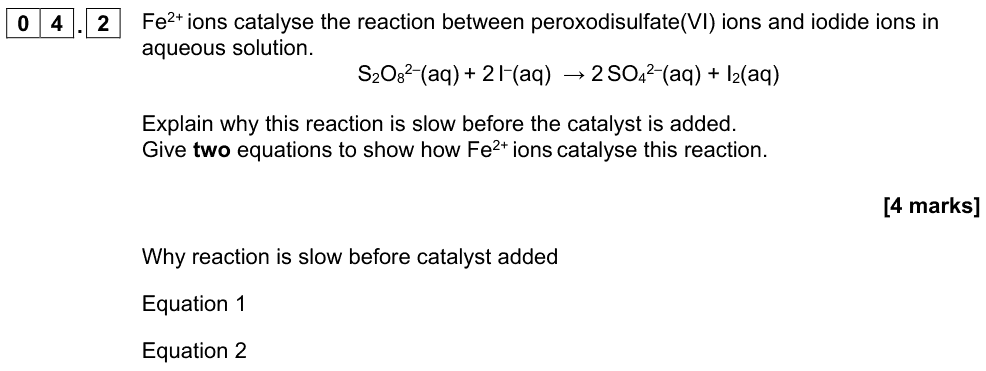
November 2021 · Paper 1 · Q04.24 marksEquation writing
Earlier part of question 04 that this part uses
Mark scheme
Examiner's comment
In question 04.2 most students stated that ions of the same charge would repel, but fewer stated that the activation energy would be high.
The equations were not well known.
Notes from the mark scheme and report
Two negative ions repel, so the activation energy is high. 2Fe2+ + S2O8 2– → 2SO4 2– + 2Fe3+
2Fe3+ + 2I– → 2Fe2+ + I2 (either order). Few said the activation energy is high
the equations were not well known
November 2021 · Paper 1 · Q04.31 markShort answer
Earlier part of question 04 that this part uses
Mark scheme
Examiner's comment
In question 04.3 many students stated that zinc had a full d sub-shell or had 3d10 configuration but did not explain how that related to the oxidation states of zinc.
Notes from the mark scheme and report
Zinc has only one oxidation state (cannot be oxidised to Zn3+). 'Full d sub-shell' alone is ignored
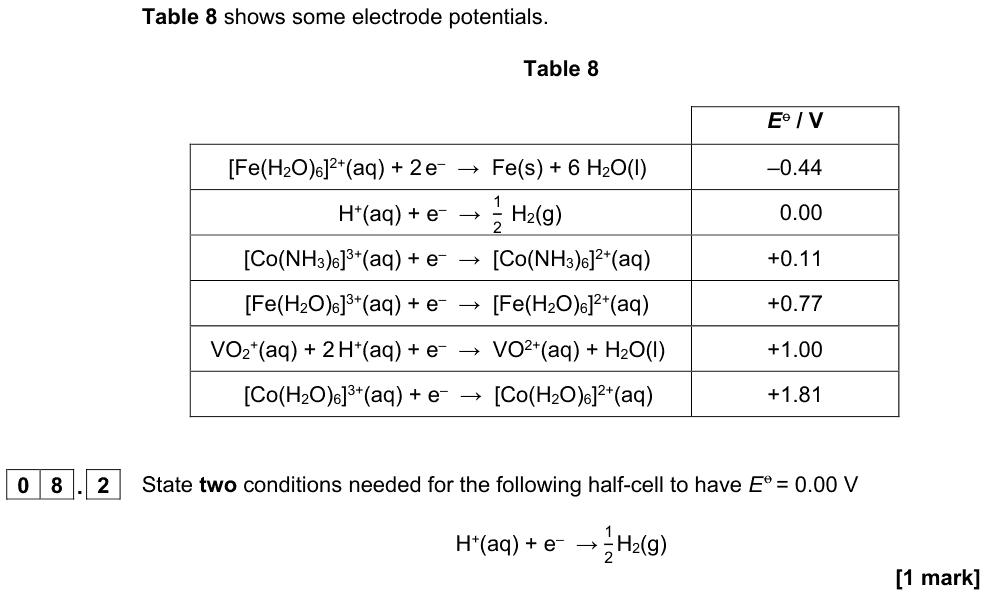
November 2021 · Paper 1 · Q08.61 markShort answer
Earlier parts of question 08 that this part uses
Mark scheme
Examiner's comment
In question 08.6 many students realised that the ligands were different.
Notes from the mark scheme and report
They have different ligands. Different concentrations or oxidation states are penalised. Uses Table 8 from 08.2
November 2021 · Paper 3 · Q01.34 marksCalculation
Earlier part of question 01 that this part uses
Mark scheme
Examiner's comment
The calculation in question 01.3 was quite well done with a majority of students scoring over half marks here.
Skills: MS0.0 Recognise and make use of appropriate units in calculation; MS0.2 Use ratios, fractions and percentages; MS2.3 Substitute numerical values into algebraic equations using appropriate units for physical quantities; RP1 Make up a volumetric solution and carry out a simple acid–base titration
November 2021 · Paper 3 · Q01.61 markPractical and data analysisHard
Earlier parts of question 01 that this part uses
Mark scheme
Examiner's comment
Questions 01.4 to 01.7 revealed weaknesses in awareness of practical ideas although it was surprising that nearly a quarter of students were unable to draw the meniscus in the right place on the diagram of a pipette.
01.6. Students should remember that, when a colour change is asked for, the colours before and after the end point should be given rather than just a single colour.
Notes from the mark scheme and report
Colourless to pale pink (pale purple). Not just 'purple'
not 'clear' for colourless
both the before and after colours are needed
Skills: ATd Use laboratory apparatus for a variety of experimental techniques including: titration, using burette and pipette; distillation and heating under reflux, including setting up glassware using retort stand and clamps; qualitative tests for ions and organic functional groups; filtration, including use of fluted filter paper, or filtration under reduced pressure; RP1 Make up a volumetric solution and carry out a simple acid–base titration
November 2021 · Paper 3 · Q01.86 marks6-mark level of response
Earlier part of question 01 that this part uses
Mark scheme, with the levels and indicative content
Examiner's comment
Most students were able to make a start on the Levels of Response question in 01.8 with about half of students able to access level 2 or above.
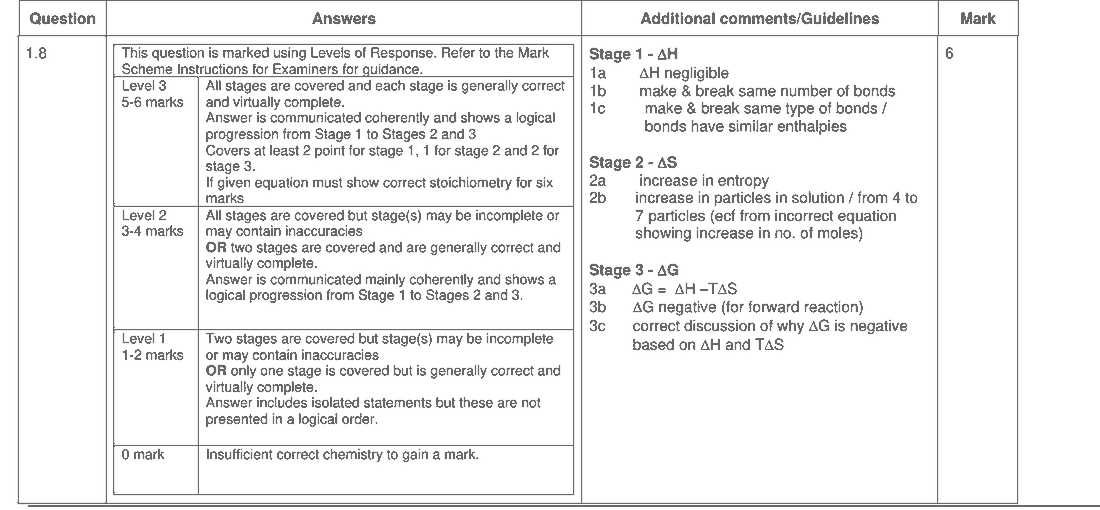
Most students recognised that the entropy would increase and that a favourable reaction is indicated by a negative free energy change.
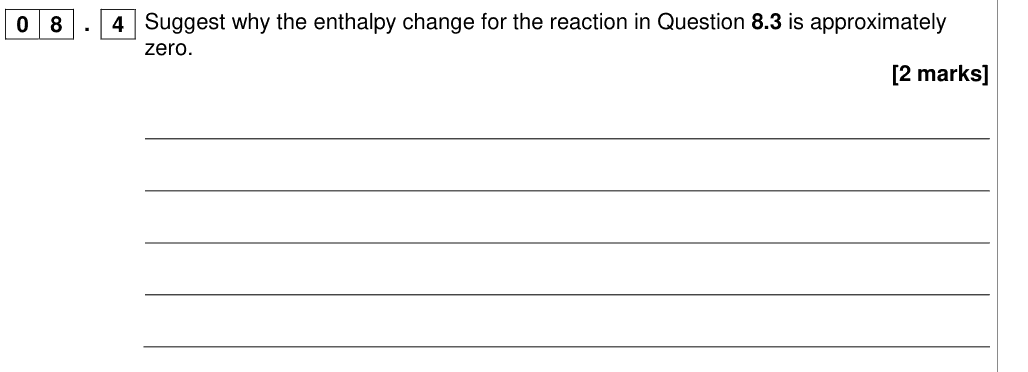
Discussion of the fact that the enthalpy change would be close to zero because 6 Fe-O bonds are made and 6 Fe-O bonds are broken was often not expressed well.
Notes from the mark scheme and report
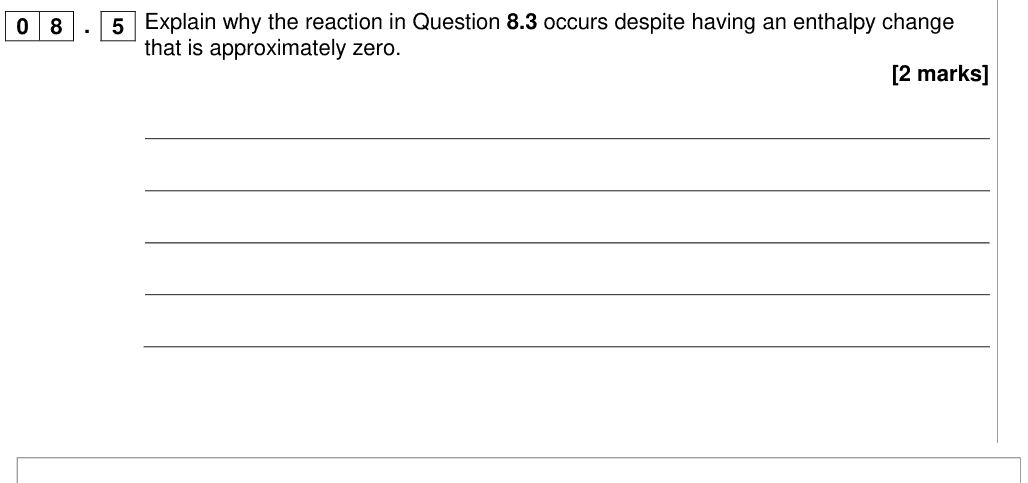
Levels of response, three stages. Stage 1 ∆H: negligible, because the same number (six) and the same type of bonds (Fe–O) are broken and made. Stage 2 ∆S: entropy increases because the number of particles in solution increases from 4 to 7 ([Fe(H2O)6]3+ + 3C2O4 2– → [Fe(C2O4)3]3– + 6H2O). Stage 3 ∆G: ∆G = ∆H – T∆S
with ∆H about zero and ∆S positive, ∆G is negative so the reaction is favourable. The ∆H argument was often poorly expressed
November 2021 · Paper 3 · Q081 markMultiple choice
Answer
B
Mark scheme
Notes from the mark scheme and report
Answer: B. The large Cl– ligand gives the tetrahedral complex [CoCl4]2–, not an octahedral one
November 2020 · Paper 1 · Q05.31 markShort answer
Earlier part of question 05 that this part uses
Mark scheme
Examiner's comment
05.3 proved challenging for many students.
Complex ions were given with a number of EDTA ligands attached to aluminium or a mixture of EDTA ligands and water ligands; the charge was often incorrect even for an otherwise correct complex.
Notes from the mark scheme and report
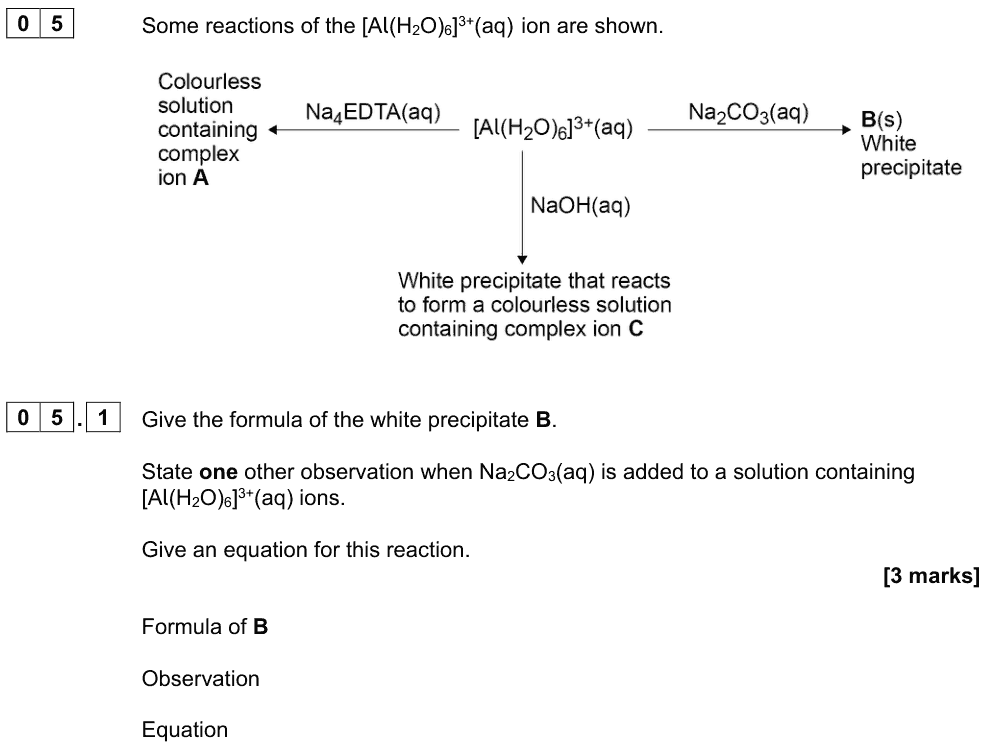
[Al(EDTA)]– (one EDTA4– replaces all six water ligands
3+ and 4– give 1–). Errors: several EDTA ligands, mixed EDTA and water, wrong charge
November 2020 · Paper 3 · Q01.42 marksShort answerHard
Earlier part of question 01 that this part uses
Mark scheme
Examiner's comment
In 01.4, 85% of students scored only one or no marks out of a possible two.
The commonest mistake was to attempt only a definition of ‘heterogeneous’ and not go on to define the meaning of the term ‘catalyst’.
Notes from the mark scheme and report
A catalyst in a different phase (state) from the reactants
that speeds up the reaction without being used up (or by lowering the activation energy). Not 'different phase from the products'
not 'does not take part'. Most defined 'heterogeneous' only and did not define 'catalyst'
November 2020 · Paper 3 · Q02.32 marksEquation writing
Earlier part of question 02 that this part uses
Mark scheme
Examiner's comment
In 02.3, the students who could give a correct answer for one of the equations could usually also give a second correct equation.
Notes from the mark scheme and report
V2O5 + SO2 → V2O4 + SO3
then V2O4 + ½O2 → V2O5. 1 mark if both are correct but in the wrong order
November 2020 · Paper 3 · Q03.13 marksExplanationHard
Mark scheme
Examiner's comment
In 03.1, a majority of students were able to score 2 or more marks but many answers were rather muddled.
There was often a failure to appreciate that only certain wavelengths or frequencies of light are absorbed (to excite d sub-shell electrons) and that the colour seen is the result of the remaining unabsorbed wavelengths or frequencies of light being reflected or transmitted.
Only 20% of students scored all three marks.
The equation needed was often incorrect with E = hcλ seen quite frequently.
Many students failed to convert 490 nm to metres (or did so incorrectly).
Notes from the mark scheme and report
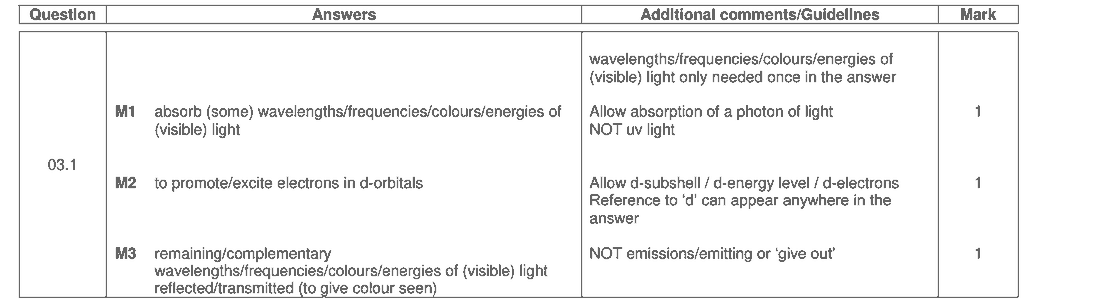
Some wavelengths (frequencies) of visible light are absorbed
to excite d electrons to a higher energy level
the remaining wavelengths are transmitted or reflected and give the colour seen. Not 'emitted'
not UV. Many answers were muddled about absorbed v transmitted light
November 2020 · Paper 3 · Q03.23 marksCalculation
Earlier part of question 03 that this part uses
Mark scheme
Examiner's comment
03.2 proved to be a very discriminating question.
Students should now be familiar with the fact that this paper contains a significant proportion of marks related to the description of practical scenarios.
The key to success with such questions is to be familiar with a wide range of practical techniques and to be able to write concise, accurate descriptions.
For example, in this case, a reference to plotting a graph of absorbance vs concentration needs to be preceded by a reference to taking a series of measurements of the absorbances for differing concentrations and it was not enough to simply repeat the question by saying ‘use the graph to find the unknown concentration’.
The examiners wanted to see a description of how the graph should be used.
Notes from the mark scheme and report
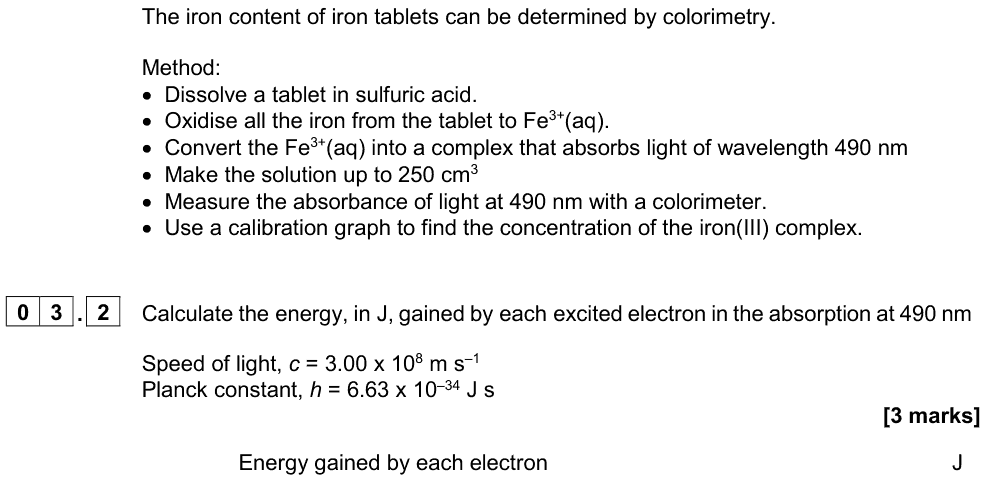
Answer: 4.06 × 10^–19 J. ∆E = hc ÷ λ = (6.63 × 10^–34 × 3.00 × 10^8) ÷ (490 × 10^–9). No nm to m conversion: 4.06 × 10^–n scores 2. Errors: E = hcλ (9.75 × 10^–32 scores 1)
nm not converted
Skills: MS0.0 Recognise and make use of appropriate units in calculation; MS0.1 Recognise and use expressions in decimal and ordinary form; MS2.3 Substitute numerical values into algebraic equations using appropriate units for physical quantities
November 2020 · Paper 3 · Q03.33 marksPractical and data analysis
Earlier parts of question 03 that this part uses
Mark scheme
Examiner's comment
In 03.1, a majority of students were able to score 2 or more marks but many answers were rather muddled. There was often a failure to appreciate that only certain wavelengths or frequencies of light are absorbed (to excite d sub-shell electrons) and that the colour seen is the result of the remaining unabsorbed wavelengths or frequencies of light being reflected or transmitted. Only 20% of students scored all three marks. The equation needed was often incorrect with E = hcλ seen quite frequently. Many students failed to convert 490 nm to metres (or did so incorrectly).
03.2 proved to be a very discriminating question. Students should now be familiar with the fact that this paper contains a significant proportion of marks related to the description of practical scenarios. The key to success with such questions is to be familiar with a wide range of practical techniques and to be able to write concise, accurate descriptions. For example, in this case, a reference to plotting a graph of absorbance vs concentration needs to be preceded by a reference to taking a series of measurements of the absorbances for differing concentrations and it was not enough to simply repeat the question by saying ‘use the graph to find the unknown concentration’. The examiners wanted to see a description of how the graph should be used.
It was encouraging to see many correct answers to 03.4 which proved to be one of the easiest questions on the paper
Notes from the mark scheme and report
Measure the absorbance of a range of solutions of known concentration
plot absorbance against concentration
read off the concentration that corresponds to the measured absorbance of the sample. Must describe taking the measurements and how the graph is used
'use the graph' alone repeats the question
Skills: PS3.1 Plot and interpret graphs; PS3.2 Process and analyse data using appropriate mathematical skills as exemplified in the mathematical appendix for each science; PS4.1 Know and understand how to use a wide range of experimental and practical instruments, equipment and techniques appropriate to the knowledge and understanding included in the specification; MS3.1 Translate information between graphical, numerical and algebraic forms
November 2020 · Paper 3 · Q04.22 marksEquation writing
Earlier part of question 04 that this part uses
Mark scheme
Examiner's comment
Students were expected to answer 04.2 by following the description in the question of a chloride ligand being replaced by a water molecule.
In many cases students failed to appreciate that replacement of a negative chloride ion by a neutral water molecule would result in a net charge (of 1+) on the resulting complex.
Notes from the mark scheme and report
[Pt(NH3)2Cl2] + H2O → [Pt(NH3)2Cl(H2O)]+ + Cl–. M1 formula and 1+ charge of B
M2 balanced with charges. Many missed that replacing Cl– by neutral water leaves a 1+ complex
November 2020 · Paper 3 · Q171 markMultiple choice
Answer
B
Mark scheme
Notes from the mark scheme and report
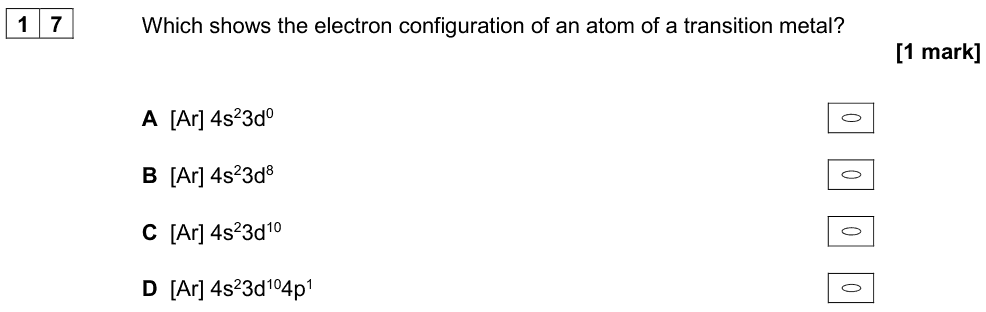
Answer: B. [Ar] 4s2 3d8 (nickel) has an incomplete d sub-level
A is calcium, C is zinc (full d sub-level), D is gallium
November 2020 · Paper 3 · Q181 markMultiple choice
Answer
A
Mark scheme
Notes from the mark scheme and report
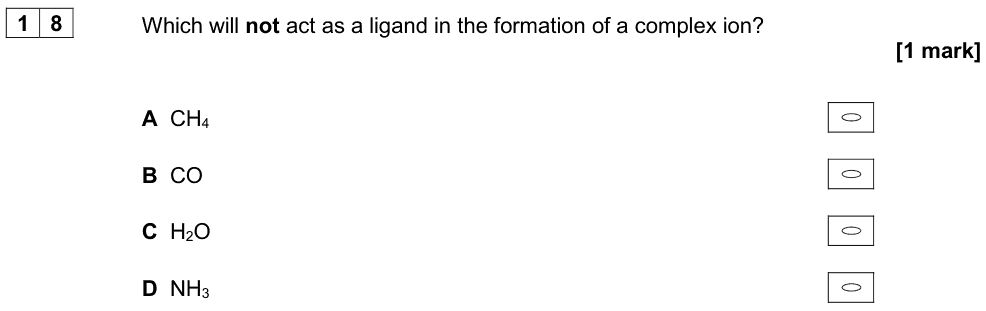
Answer: A. Methane has no lone pair to donate
CO, H2O and NH3 all have one
November 2020 · Paper 3 · Q191 markMultiple choice
Answer
D
Mark scheme
Notes from the mark scheme and report
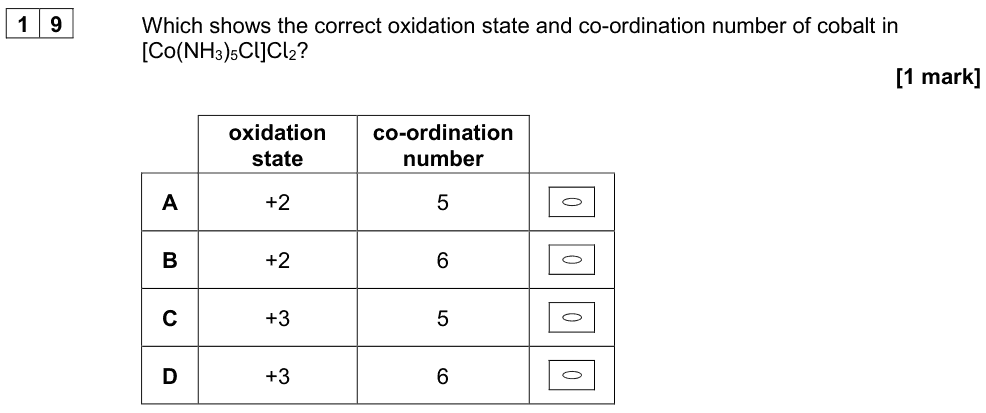
Answer: D. Three chloride ions in total and neutral NH3 make cobalt +3
five NH3 and one Cl– ligand give six co-ordinate bonds (the two outer Cl– are not ligands)
November 2020 · Paper 3 · Q201 markMultiple choice
Answer
A
Mark scheme
Notes from the mark scheme and report
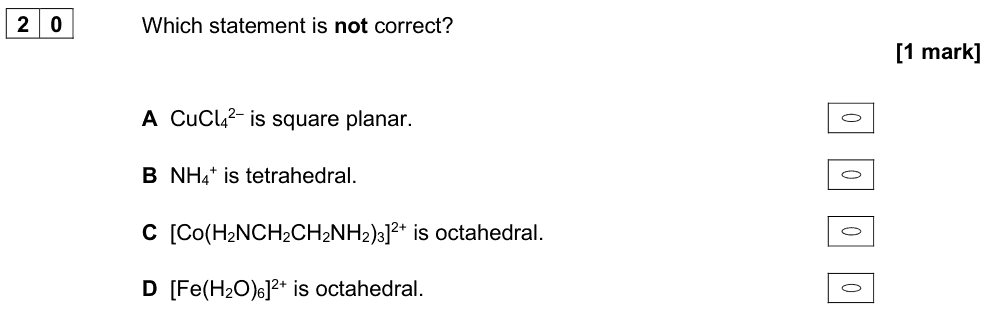
Answer: A. CuCl4 2– is tetrahedral (large Cl– ligands), not square planar
the other statements are correct
November 2020 · Paper 3 · Q211 markMultiple choice
Answer
C
Mark scheme
Notes from the mark scheme and report
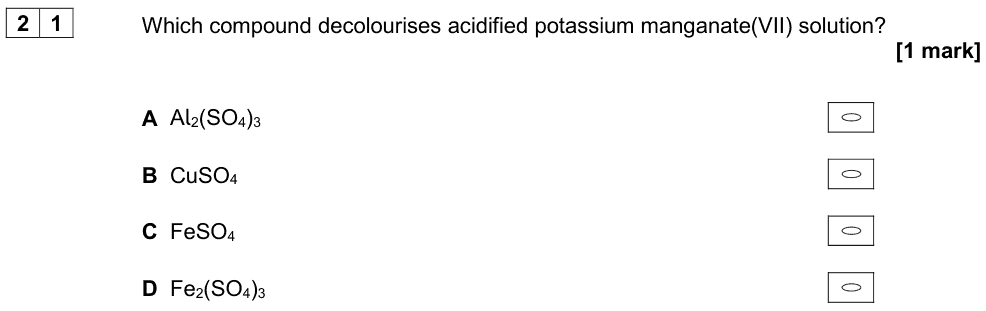
Answer: C. Fe2+ is oxidised to Fe3+ by MnO4–, which is reduced to colourless Mn2+
Al3+, Cu2+ and Fe3+ are not oxidised
November 2020 · Paper 3 · Q311 markMultiple choice
Answer
C
Mark scheme
Notes from the mark scheme and report
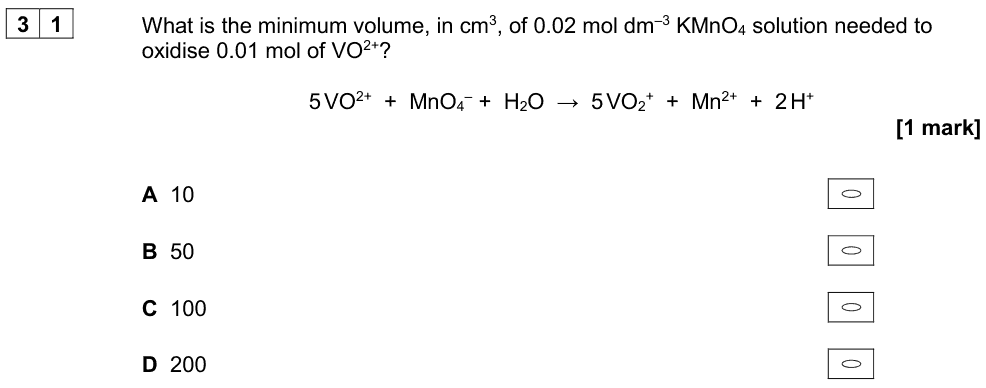
Answer: C. n(MnO4–) = 0.01 ÷ 5 = 0.002 mol
0.002 ÷ 0.02 = 0.1 dm3 = 100 cm3
Skills: MS0.0 Recognise and make use of appropriate units in calculation; MS0.2 Use ratios, fractions and percentages
June 2019 · Paper 1 · Q04.22 marksEquation writing
Earlier part of question 04 that this part uses
Mark scheme
Examiner's comment
4.2 The formula was generally well known. Some students used HCl in their equation but then failed to balance with hydrogen ions on the right-hand side.
Notes from the mark scheme and report
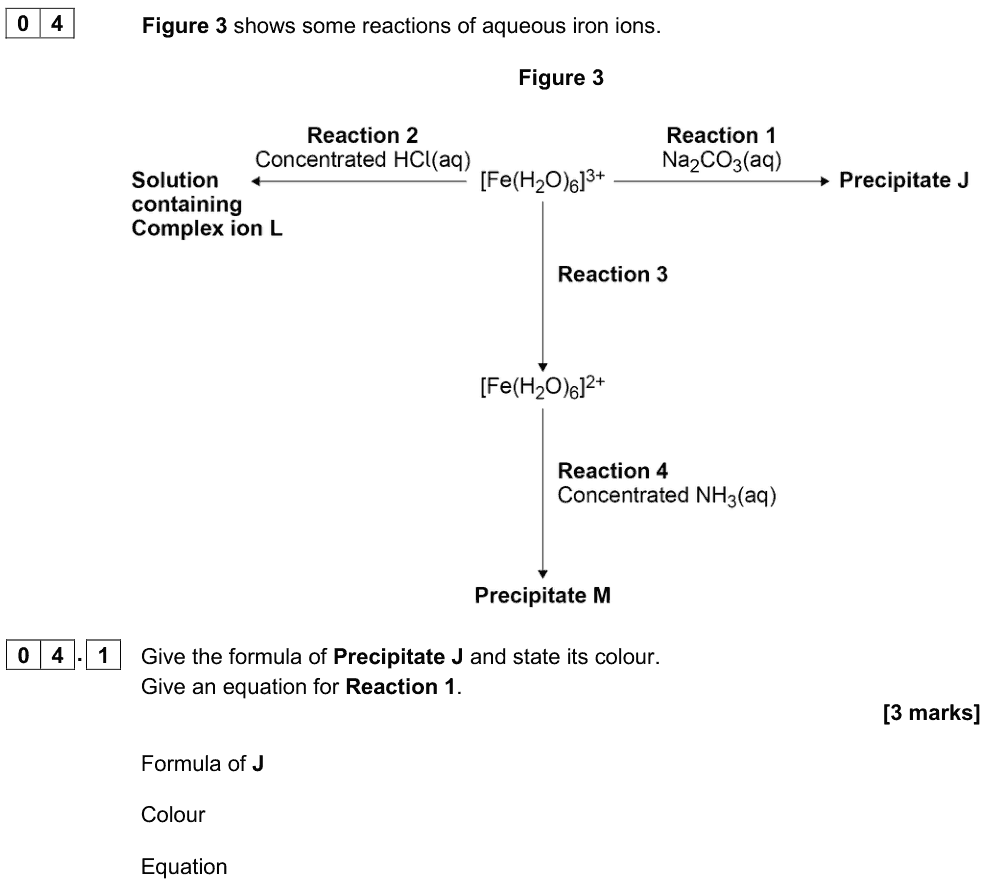
L is [FeCl4]–. [Fe(H2O)6]3+ + 4Cl– → [FeCl4]– + 6H2O. If HCl is used the equation must be balanced with H+ on the right
June 2019 · Paper 1 · Q04.31 markShort answer
Earlier part of question 04 that this part uses
Mark scheme
Examiner's comment
4.3 Very few students could give a correct reducing agent in part 3; some suggested iodide ions but this is not a reagent.
Notes from the mark scheme and report
Zinc (in acid such as HCl or H2SO4)
potassium iodide allowed. 'Iodide ions' is not a reagent. Very few correct
June 2019 · Paper 1 · Q04.56 marks6-mark level of response
Earlier part of question 04 that this part uses
Mark scheme, with the levels and indicative content
Examiner's comment
4.5 Students often scored well on this levels of response question. Shapes of complexes were well known and most students scored the first two marks. Geometric isomerism in square- planar platinum complexes was well known; cis-trans isomerism in octahedral complexes was less well known. Optical isomerism in octahedral complexes with bidentate ligands was less well understood. Students failed to score full marks by giving an incorrect formula of a bidentate ligand, or not drawing both stereoisomers.
Notes from the mark scheme and report
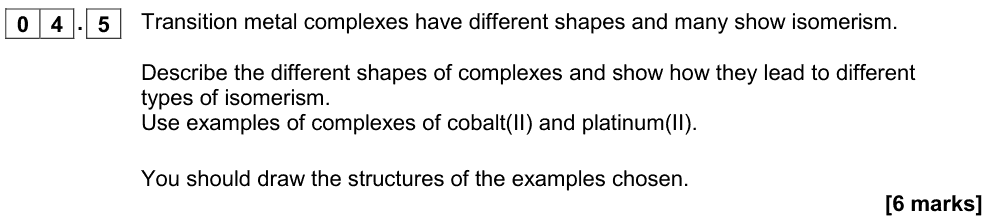
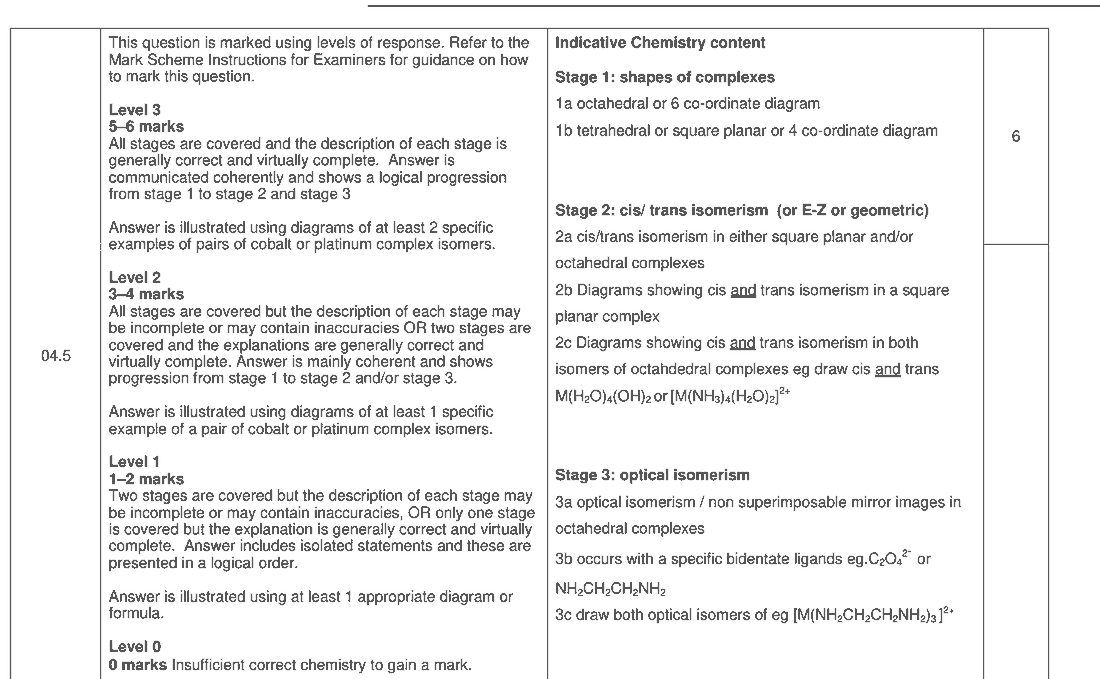
Levels of response, three stages. Shapes: octahedral (6 co-ordinate) and tetrahedral or square planar (4 co-ordinate), with diagrams. Cis–trans isomerism: in square planar complexes (eg cis and trans [Pt(NH3)2Cl2]) and octahedral complexes with monodentate ligands (eg [Co(NH3)4(H2O)2]2+), both isomers drawn. Optical isomerism: octahedral complexes with bidentate ligands (eg [Co(H2NCH2CH2NH2)3]2+ or with C2O4 2–), non-superimposable mirror images, both drawn. Errors: wrong formula for the bidentate ligand
only one stereoisomer drawn
Skills: MS4.2 Visualise and represent 2D and 3D forms including two-dimensional representations of 3D objects; MS4.3 Understand the symmetry of 2D and 3D shapes
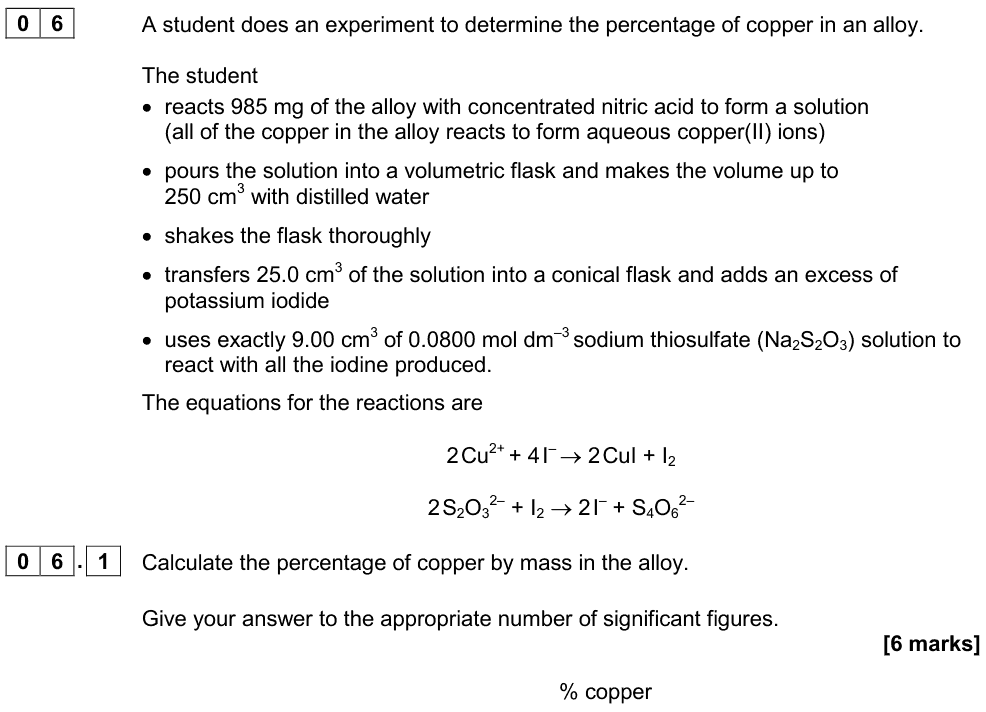
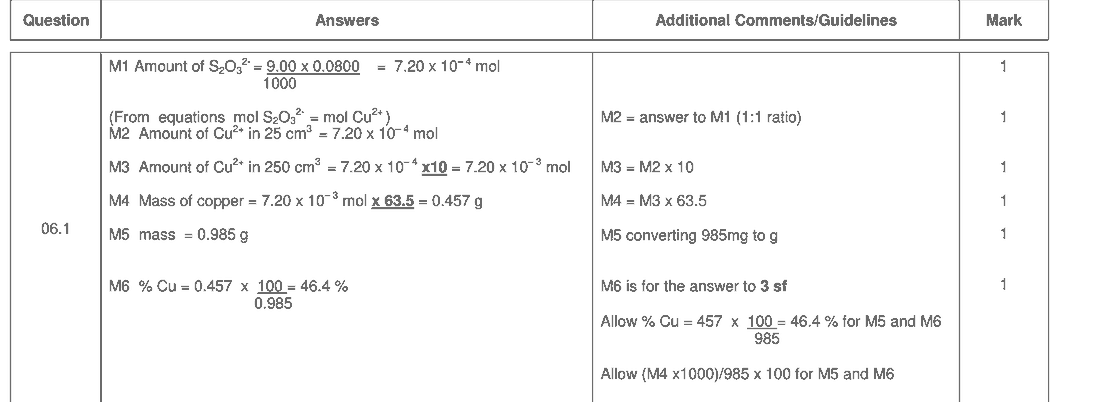
June 2019 · Paper 1 · Q06.16 marksCalculation
Mark scheme
Examiner's comment
6.1 More able students, who were able to transfer mole ratios between the two equations, generally performed well and gained full marks. The most common error was a lack of understanding of the stoichiometric ratio, with many students incorrectly assuming that the amount in moles of Cu2+ was either half or double the amount of S2O3
÷ 0.985 g × 100. Common error: taking Cu2+ as half or double the thiosulfate
Skills: MS0.0 Recognise and make use of appropriate units in calculation; MS0.2 Use ratios, fractions and percentages; MS1.1 Use an appropriate number of significant figures
June 2019 · Paper 1 · Q06.52 marksExplanation
Earlier part of question 06 that this part uses
Mark scheme
Examiner's comment
6.5 Students found this part challenging; most students did not recognise that the 3d sub-shell is full and therefore were unable to explain that d-d transitions are not possible and visible light is not absorbed.
Notes from the mark scheme and report
Cu+ has a full 3d sub-shell (3d10), so no d–d transitions are possible / visible light cannot be absorbed. Second mark depends on the first
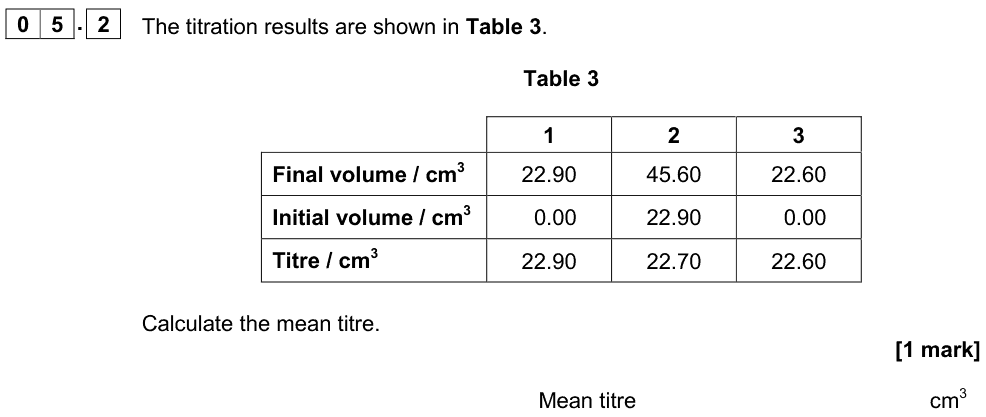
June 2019 · Paper 3 · Q05.21 markPractical and data analysis
Earlier part of question 05 that this part uses
Mark scheme
Examiner's comment
5.2 Most students knew to only include the concordant values in this average.
Notes from the mark scheme and report
Answer: 22.65 cm3 (mean of the concordant titres 22.70 and 22.60 only)
Skills: MS1.2 Find arithmetic means; PS3.2 Process and analyse data using appropriate mathematical skills as exemplified in the mathematical appendix for each science; ATd Use laboratory apparatus for a variety of experimental techniques including: titration, using burette and pipette; distillation and heating under reflux, including setting up glassware using retort stand and clamps; qualitative tests for ions and organic functional groups; filtration, including use of fluted filter paper, or filtration under reduced pressure; RP1 Make up a volumetric solution and carry out a simple acid–base titration
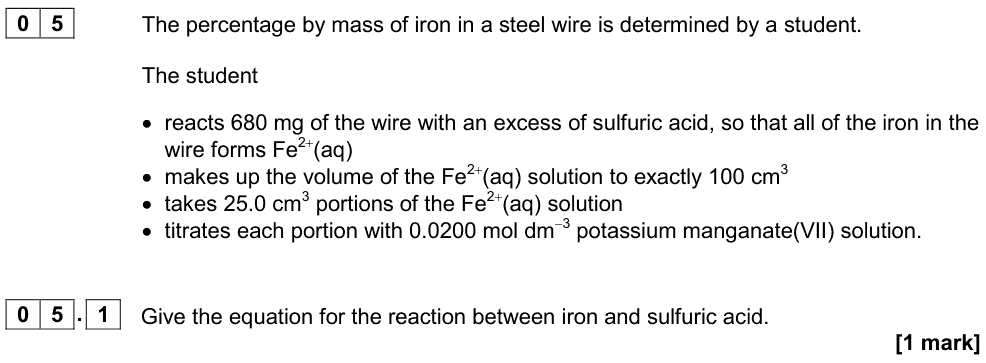
June 2019 · Paper 3 · Q05.31 markEquation writing
Earlier part of question 05 that this part uses
Mark scheme
Examiner's comment
5.3 Another equation that over half of students were unable to construct, despite the familiarity of acidified manganate(VII) as an oxidising agent.
Notes from the mark scheme and report
5Fe2+ + MnO4– + 8H+ → 5Fe3+ + Mn2+ + 4H2O. No electrons in the overall equation. Over half could not write it
June 2019 · Paper 3 · Q05.41 markPractical and data analysis
Earlier part of question 05 that this part uses
Mark scheme
Examiner's comment
5.4 Many students reversed the correct colour change for this answer, while others failed to recognise the need to mention both colours when describing a change. ‘Purple’ was not allowed as the final colour because the question asked for the colour change at the endpoint and seeing ‘purple’ would indicate that the endpoint had been overshot.
Notes from the mark scheme and report
Colourless (or pale green) to pale pink. Not 'to purple' (that means the end point has been overshot)
both colours needed
many reversed the change
Skills: ATd Use laboratory apparatus for a variety of experimental techniques including: titration, using burette and pipette; distillation and heating under reflux, including setting up glassware using retort stand and clamps; qualitative tests for ions and organic functional groups; filtration, including use of fluted filter paper, or filtration under reduced pressure; RP1 Make up a volumetric solution and carry out a simple acid–base titration
June 2019 · Paper 3 · Q181 markMultiple choice
Answer
D
Mark scheme
Examiner's comment
Questions that were substantially more challenging than the ‘average’ items included numbers 18 (around 40% correct), 22 (34%) and 34 (40%).
Notes from the mark scheme and report
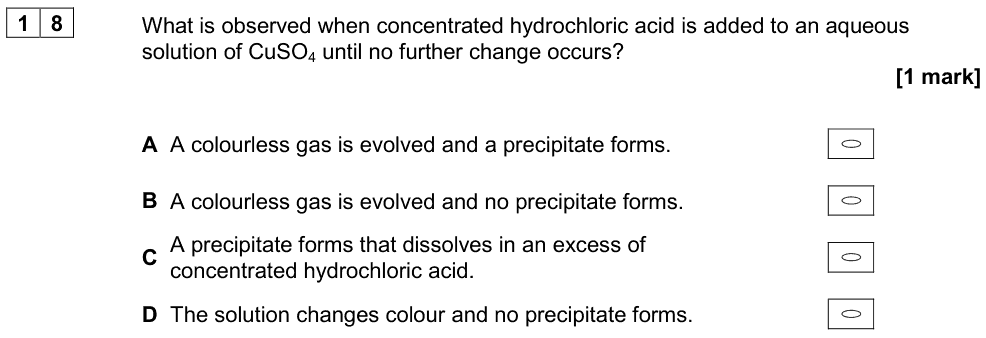
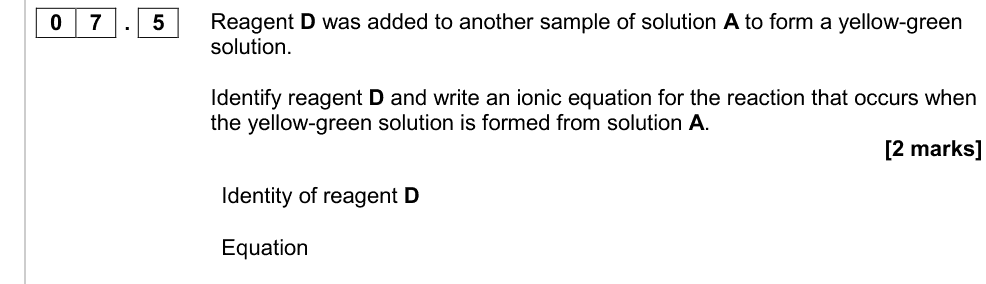
Answer: D. Ligand substitution forms [CuCl4]2–: the blue solution turns yellow-green with no gas and no precipitate
June 2018 · Paper 1 · Q03.43 marksExplanation
Earlier part of question 03 that this part uses
Mark scheme
Examiner's comment
03.4 Many students discussed the general principles of homogeneous catalysis or the lowering of activation energy rather than the reaction on the platinum surface. The mark most commonly missed was the idea that the product desorbed from or left the surface of the catalyst. Surprisingly, over 10% of students made no attempt at this question.
Notes from the mark scheme and report
Reactants are adsorbed onto the platinum surface / active sites
reaction (bond weakening/breaking and making) occurs on the surface
the products desorb. Desorption was the mark most often missed
many described homogeneous catalysis or just a lower activation energy
June 2018 · Paper 1 · Q09.32 marksDiagram or structure
Earlier part of question 09 that this part uses
Mark scheme
Examiner's comment
09.3 The structure was often given, incorrectly, as a mirror image and the type of isomerism as optical; only 37.2% of students scored both marks.
Notes from the mark scheme and report
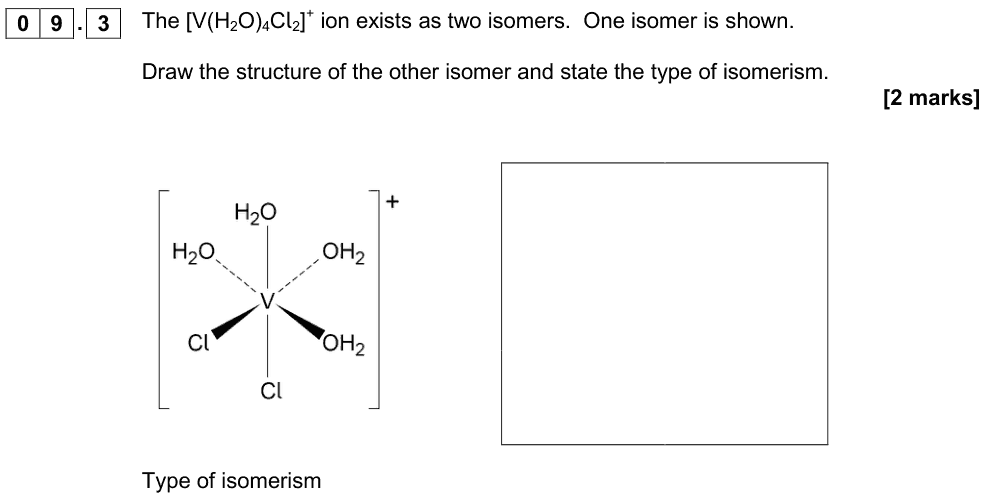
The trans isomer: octahedral with the two Cl ligands opposite each other (180°)
cis–trans (E–Z, geometric) isomerism. Common error: drawing a mirror image and calling it optical isomerism
Skills: MS4.2 Visualise and represent 2D and 3D forms including two-dimensional representations of 3D objects
June 2018 · Paper 1 · Q09.51 markEquation writing
Earlier part of question 09 that this part uses
Mark scheme
Examiner's comment
09.5 Over half of the students (55.6%) gave the correct equations; incorrect equations included charged vanadium species. Surprisingly, 12% of students were unable to make any attempt at this question.
Notes from the mark scheme and report
V2O5 + SO2 → V2O4 + SO3 then V2O4 + ½O2 → V2O5. Both needed, in this order, for the mark. Error: charged vanadium species
June 2018 · Paper 3 · Q261 markMultiple choiceEasy
Answer
C
Mark scheme
Examiner's comment
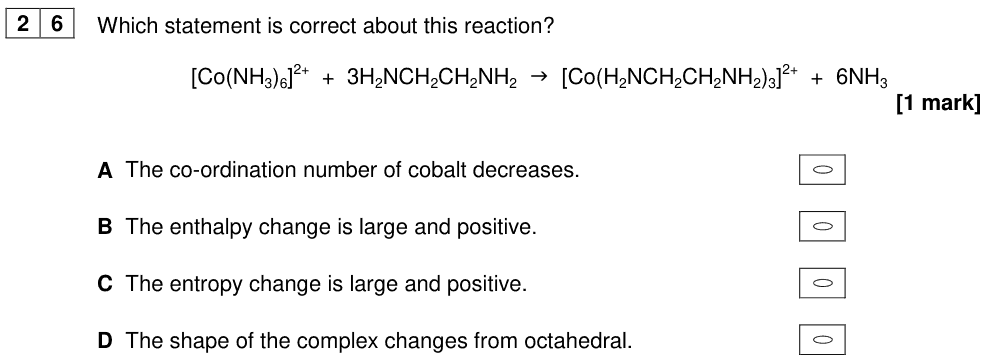
26 D was the commonest incorrect response; presumably the presence of only 3 ligand molecules in the product meant that some students did not realise that the cobalt still has a co-ordination number of 6. 73.9% of students did, however, give the correct response.
Notes from the mark scheme and report
Answer: C. Four particles become seven, so entropy increases greatly (chelate effect)
six Co–N bonds are broken and six made, so ∆H is close to zero
co-ordination number stays 6 and the shape stays octahedral
June 2018 · Paper 3 · Q271 markMultiple choice
Answer
B or C
Mark scheme
Examiner's comment
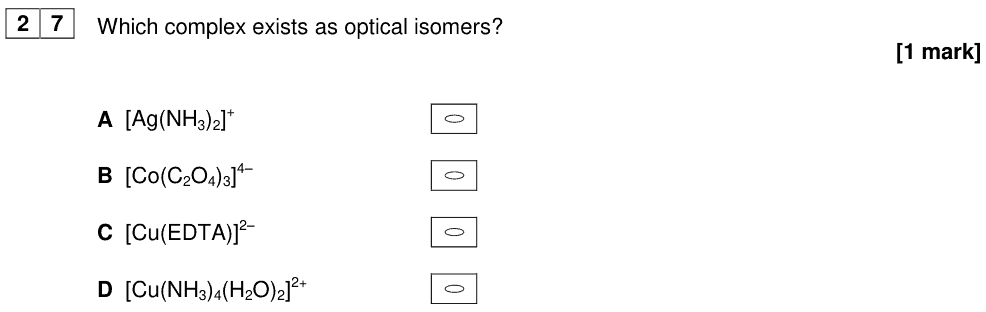
27 D was suggested as the answer more often than the correct response (B, identified by 36% of students). This suggests confusion between geometric and optical isomerism in transition metal complexes.
Notes from the mark scheme and report
Answer: B or C (the mark scheme accepts both). An octahedral complex with three bidentate ethanedioate ligands, or with the multidentate EDTA ligand wrapped round the ion, has non-superimposable mirror images. D shows cis–trans, not optical, isomerism and was chosen more often than B (36%)
June 2018 · Paper 3 · Q291 markMultiple choiceEasy
Answer
B
Mark scheme
Examiner's comment
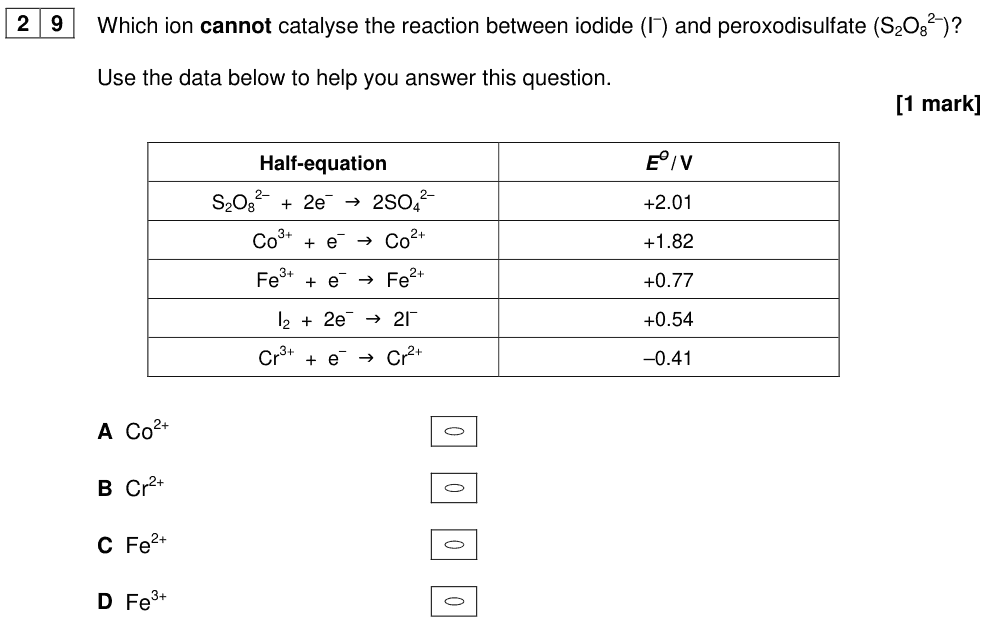
29 Just over two-thirds of students arrived at the correct answer. D (followed by A) was the commonest incorrect response.
Notes from the mark scheme and report
Answer: B. A catalyst couple needs E between +0.54 and +2.01 V. Cr2+ would be oxidised by S2O8 2– to Cr3+, but Cr3+ (–0.41 V) cannot oxidise I– back, so no cycle. The Co and Fe couples lie in the range, and Fe3+ works as well as Fe2+
June 2017 · Paper 1 · Q07.21 markShort answerEasy
Earlier part of question 07 that this part uses
Mark scheme
Examiner's comment
07.2 Students usually answered this correctly (71.2%); a common incorrect answer was that chloride ions did not have lone pairs.
Notes from the mark scheme and report
The chloride ions do not donate a lone pair / do not form a co-ordinate bond to Cu2+ (they are ionically bonded). Common wrong answer: chloride ions have no lone pairs
June 2017 · Paper 1 · Q07.32 marksEquation writing
Earlier part of question 07 that this part uses
Mark scheme
Examiner's comment
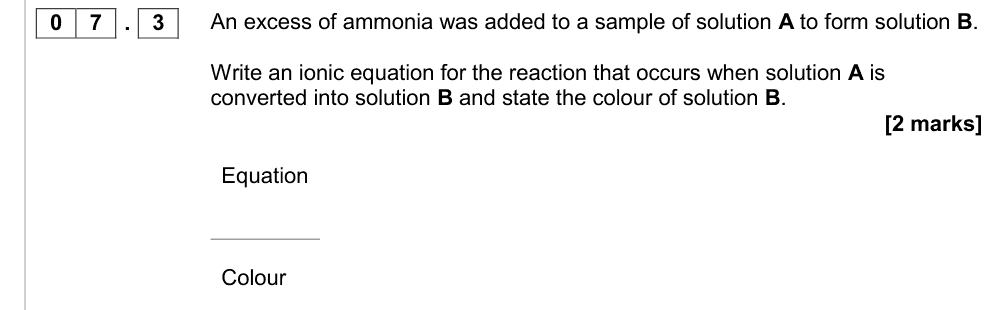
07.3 The colour of the solution formed was better known than the equation; many students could not give a correct ionic equation and [Cu(NH3)6]2+ was a common incorrect product.
Notes from the mark scheme and report
[Cu(H2O)6]2+ + 4NH3 → [Cu(NH3)4(H2O)2]2+ + 4H2O (the two-step route via [Cu(H2O)4(OH)2] is allowed)
deep blue solution. [Cu(NH3)6]2+ was a common wrong product
Skills: RP11 Carry out simple test-tube reactions to identify transition metal ions in aqueous solution
June 2017 · Paper 1 · Q07.52 marksEquation writing
Earlier part of question 07 that this part uses
Mark scheme
Examiner's comment
07.5 This question was generally answered well, with 59.4% of students gaining at least one mark. Hydrochloric acid was often given as the reagent; chlorine was the most common wrong answer. Equations were often unbalanced. A common incorrect product was CuCl4
Notes from the mark scheme and report
Hydrochloric acid (concentrated
a soluble chloride allowed). [Cu(H2O)6]2+ + 4Cl– → [CuCl4]2– + 6H2O. Marked independently. Chlorine was the most common wrong reagent
equations unbalanced
CuCl4 without a charge
June 2017 · Paper 1 · Q07.62 marksExplanation
Earlier part of question 07 that this part uses
Mark scheme
Examiner's comment
07.6 Students could often state that the electronic configuration was d10, but the effect on electron transitions was less well known. Students often failed to realise the importance of visible light being absorbed. Some students scored the mark by stating the complex was colourless.
Notes from the mark scheme and report
Cu+ is 3d10 (full d sub-shell)
so no d electron transitions, it cannot absorb visible light / it is colourless. Wrong principal quantum number is penalised. Many gave d10 but not the link to absorbing visible light
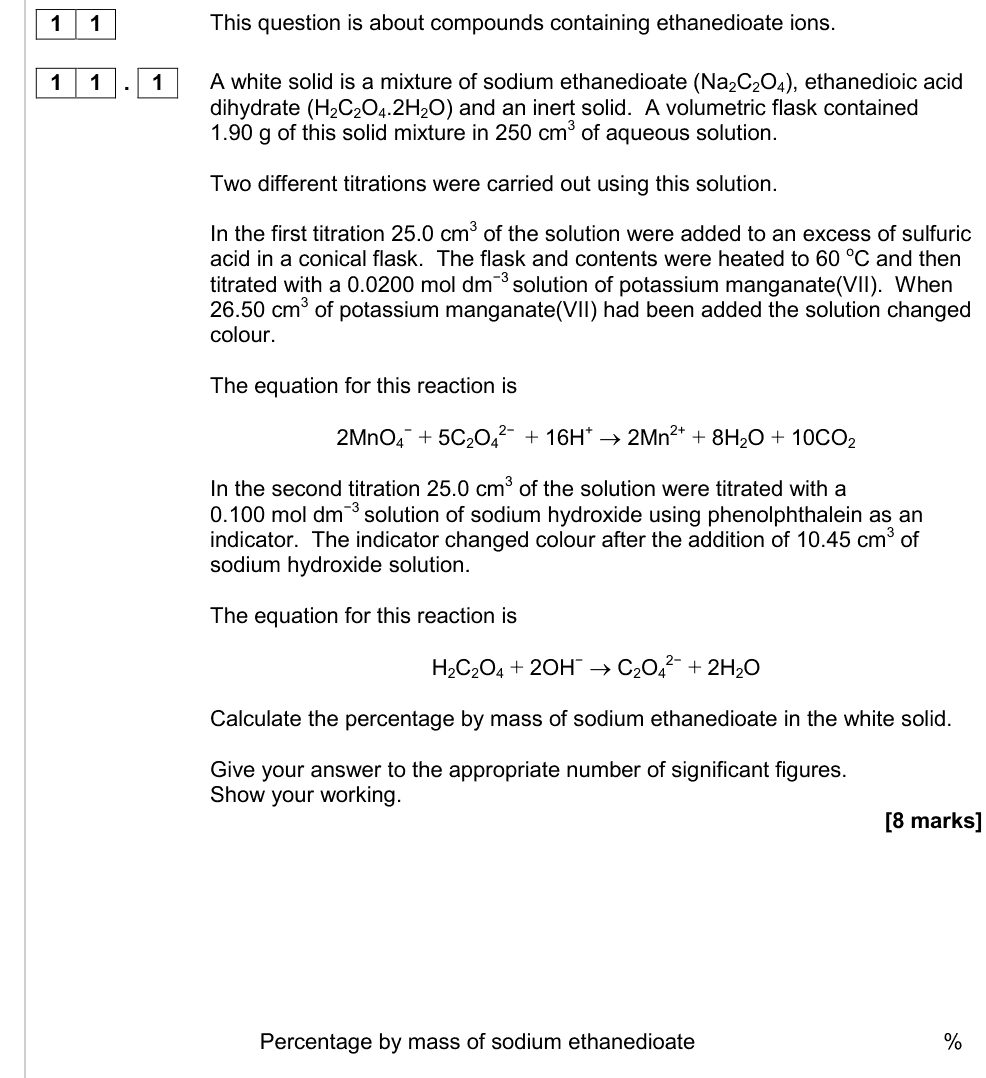
June 2017 · Paper 1 · Q11.18 marksCalculation
Mark scheme
Examiner's comment
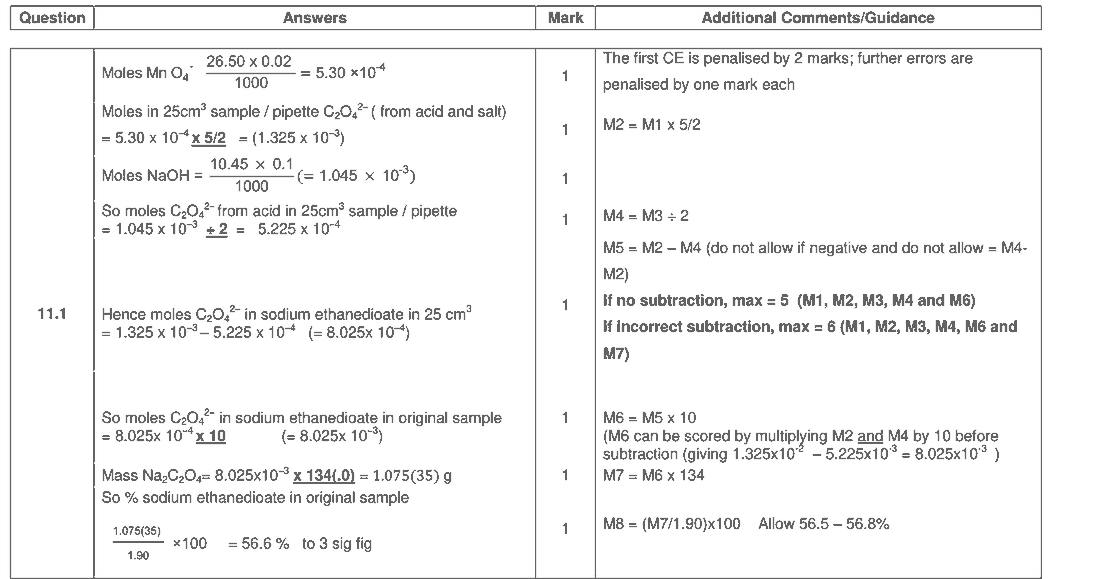
11.1 Only the best students got to the end of the calculation. Many students scored the first four marks, and some of these then realised that they needed to multiply by ten because of the dilution used. Very few students appreciated that the amount in moles of ethanedioic acid had to be taken away from the total amount in moles of ethanedioate ions to find the amount in moles of sodium ethanedioate. Those students who did, usually went on to get the right answer.
Notes from the mark scheme and report
Answer: 56.6% (allow 56.5 to 56.8
3 sf). n(MnO4–) = 5.30 × 10^–4
total n(C2O4 2–) in 25 cm3 = × 5/2 = 1.325 × 10^–3
÷ 1.90 × 100. No subtraction: max 5. Very few subtracted the acid from the total ethanedioate
some forgot the × 10
Skills: MS0.0 Recognise and make use of appropriate units in calculation; MS0.2 Use ratios, fractions and percentages; MS1.1 Use an appropriate number of significant figures
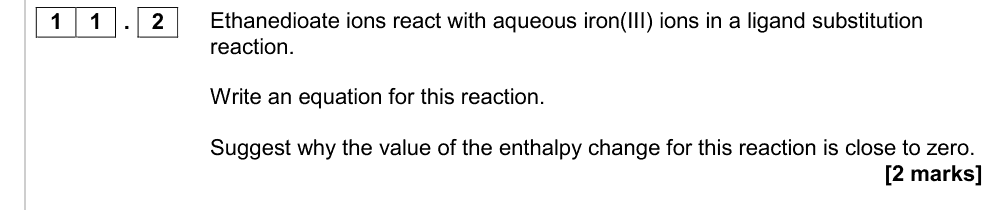
June 2017 · Paper 1 · Q11.22 marksEquation writing
Earlier part of question 11 that this part uses
Mark scheme
Examiner's comment
11.2 Students often failed to give a balanced equation; charges on the complex ions were often incorrect, and many did not give water as one of the products. Many students understood that the same number of bonds were broken and formed, but few could also state that they were the same type of bonds. Some stated that the bond enthalpies were similar, but could not explain why.
Notes from the mark scheme and report
[Fe(H2O)6]3+ + 3C2O4 2– → [Fe(C2O4)3]3– + 6H2O. Six Fe–O bonds are broken and six Fe–O bonds are made (same number and same type of bond). Errors: charges on the complexes, water missing
'same number' without 'same type'
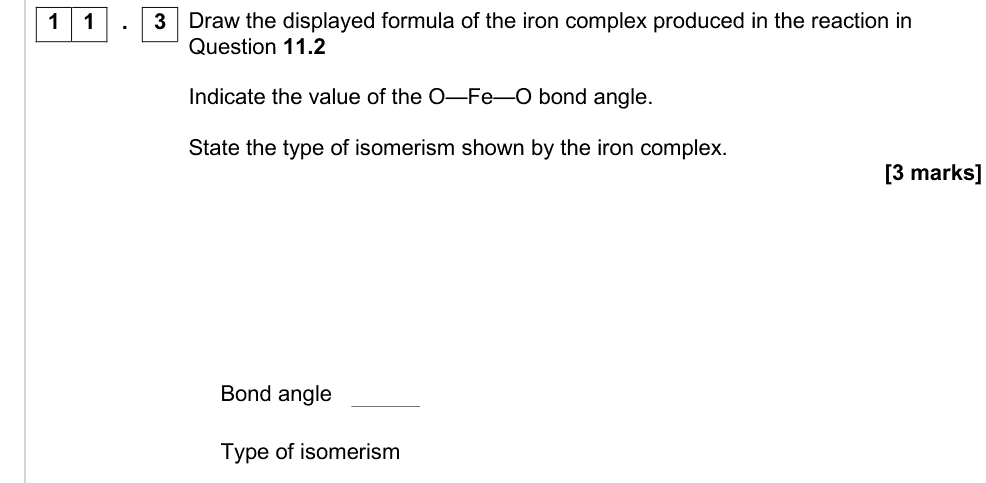
June 2017 · Paper 1 · Q11.33 marksDiagram or structure
Earlier part of question 11 that this part uses
Mark scheme
Examiner's comment
11.3 Many students struggled to draw the displayed formula; those who got close often omitted the carbon atoms from the ligand. Most students knew the bond angle, but some incorrectly gave 120° or 109.5°. The most common incorrect type of isomerism given was stereoisomerism or cis/trans.
Notes from the mark scheme and report
Fe with three bidentate ethanedioate ligands, each –O–C(=O)–C(=O)–O– bonded through two O atoms (charges and 3D shape not needed)
O–Fe–O 90° (or 180°)
optical isomerism. Errors: carbon atoms left out of the ligand
120° or 109.5°
'stereoisomerism' or cis–trans
Skills: MS4.1 Use angles and shapes in regular 2D and 3D structures; MS4.2 Visualise and represent 2D and 3D forms including two-dimensional representations of 3D objects
June 2017 · Paper 1 · Q11.41 markShort answer
Earlier part of question 11 that this part uses
Mark scheme
Examiner's comment
11.4 Common answers that did not score here included references to ethanedioate ions being indigestible, or being so firmly chelated to iron ions already that they were not free to be absorbed.
Notes from the mark scheme and report
Ethanedioate is present only in small quantities / low concentration in these foods. Not: indigestible, or already chelated to iron
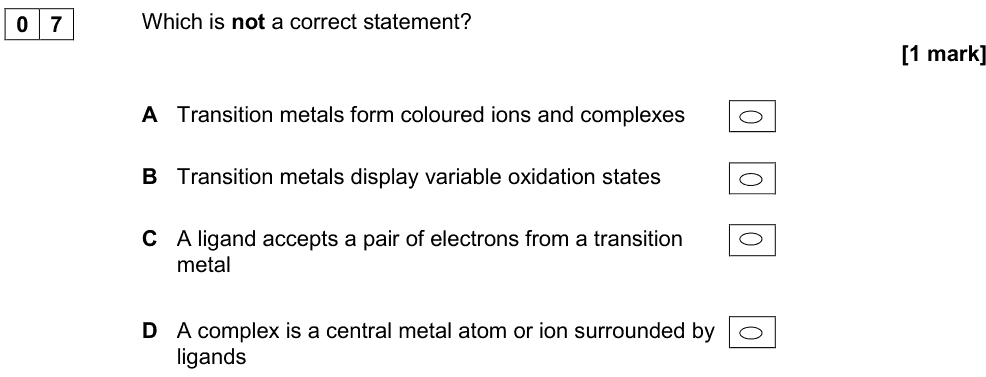
June 2017 · Paper 3 · Q071 markMultiple choice
Answer
C
Mark scheme
Notes from the mark scheme and report
Answer: C. A ligand donates a pair of electrons to the metal to form a co-ordinate bond
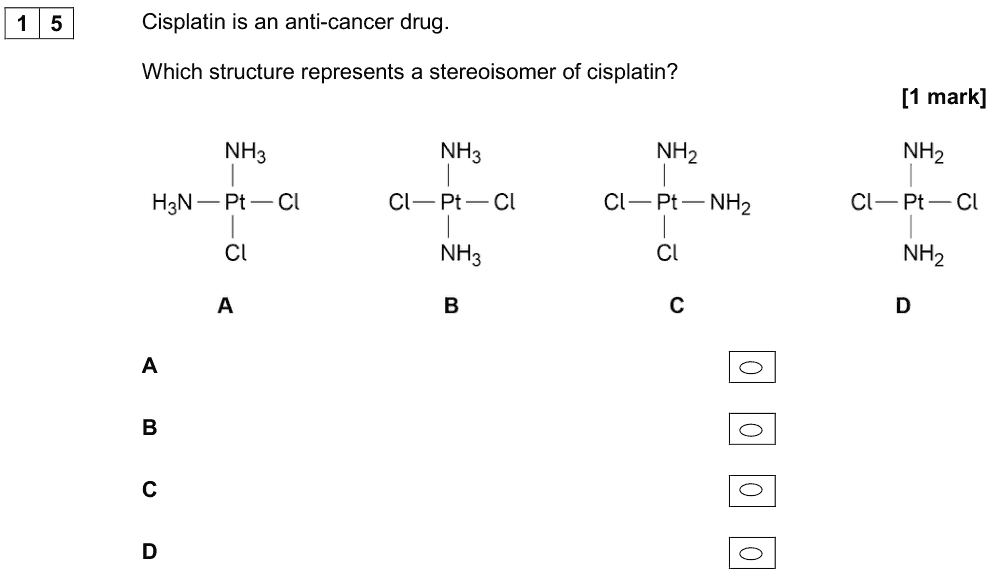
June 2017 · Paper 3 · Q151 markMultiple choice
Answer
B
Mark scheme
Notes from the mark scheme and report
Answer: B. The trans isomer of Pt(NH3)2Cl2, with the two Cl ligands opposite each other
A is cisplatin itself and C and D have NH2 instead of NH3
Skills: MS4.2 Visualise and represent 2D and 3D forms including two-dimensional representations of 3D objects
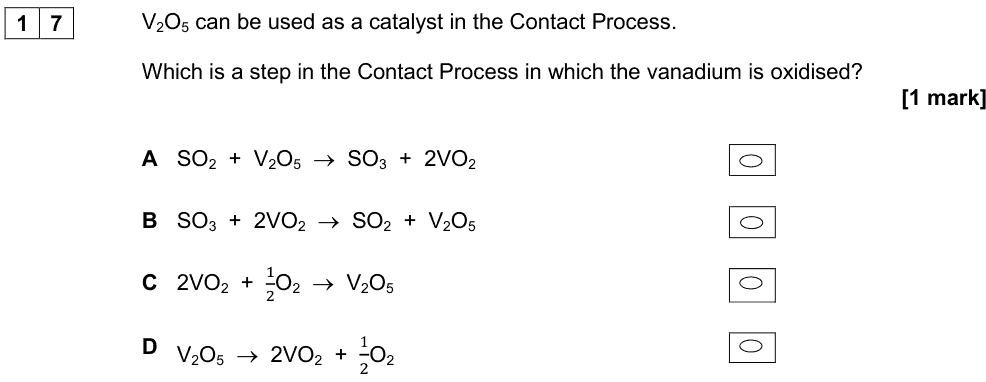
June 2017 · Paper 3 · Q171 markMultiple choice
Answer
C
Mark scheme
Notes from the mark scheme and report
Answer: C. Vanadium goes from +4 in VO2 back to +5 in V2O5 by reaction with oxygen
in A vanadium is reduced, and B and D are not steps in the process
June 2017 · Paper 3 · Q311 markMultiple choice
Answer
D
Mark scheme
Notes from the mark scheme and report
Answer: D. The light not absorbed (blue) is transmitted, so the solution is blue: Cu2+(aq)
Specimen · Paper 1 · Q01.42 marksShort answer
Earlier part of question 01 that this part uses
Mark scheme
Notes from the mark scheme and report
Tetrahedral
109.5° (allow 109°)
Skills: MS4.1 Use angles and shapes in regular 2D and 3D structures
Specimen · Paper 1 · Q04.51 markAO1=1Short answer
Earlier part of question 04 that this part uses
Mark scheme
Notes from the mark scheme and report
Impurities (eg sulfur compounds) block the active sites
allow 'the catalyst is poisoned'
Specimen · Paper 1 · Q07.42 marksExplanation
Earlier part of question 07 that this part uses
Mark scheme
Notes from the mark scheme and report
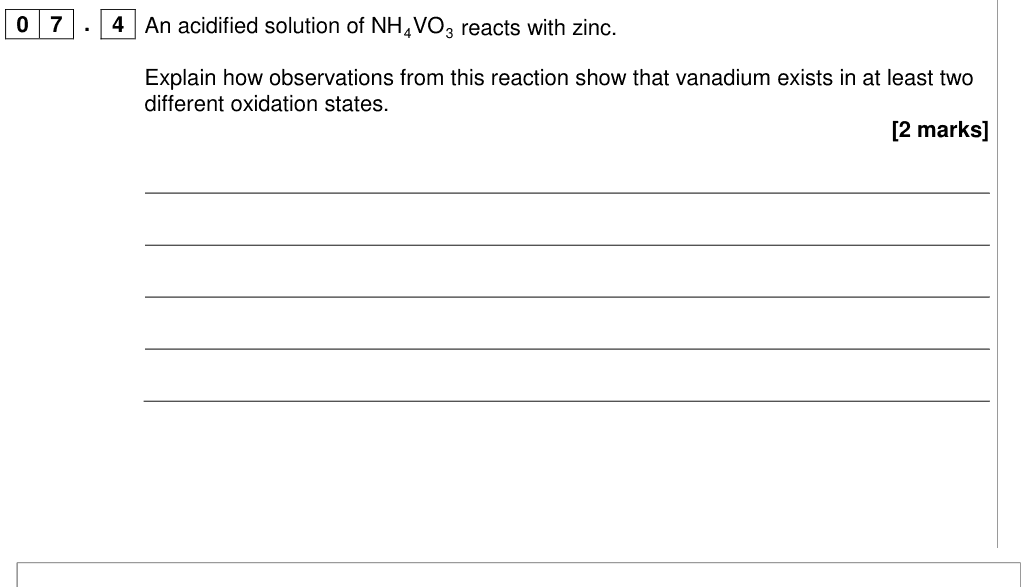
Two (or more) different colours of solution are seen, and each colour is due to vanadium in a different oxidation state
Specimen · Paper 1 · Q07.56 marksCalculation
Earlier part of question 07 that this part uses
Mark scheme
Notes from the mark scheme and report
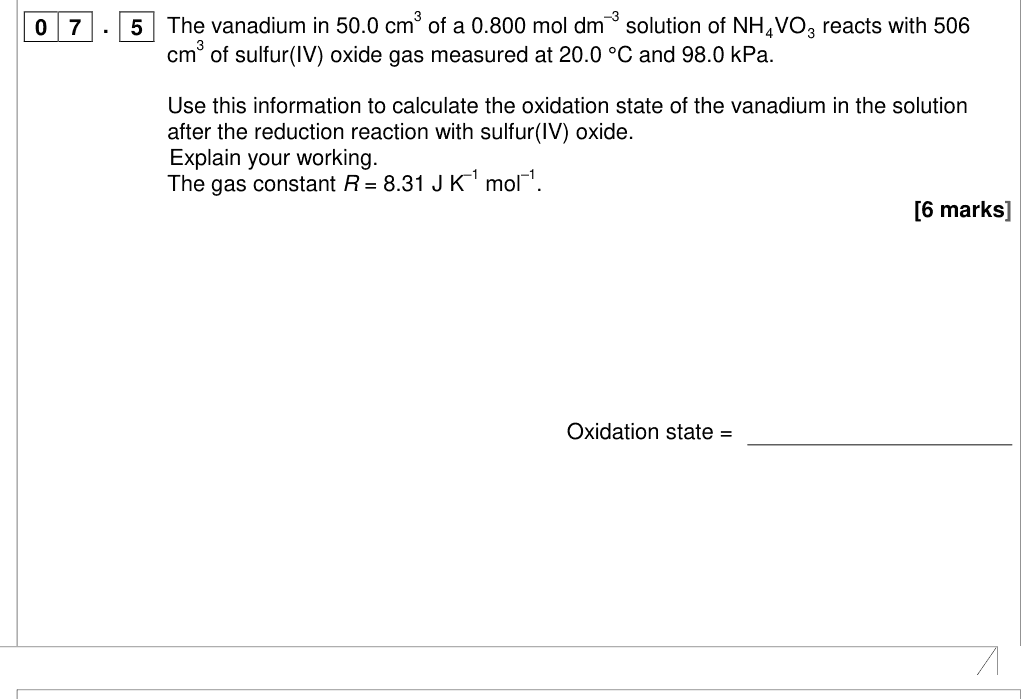
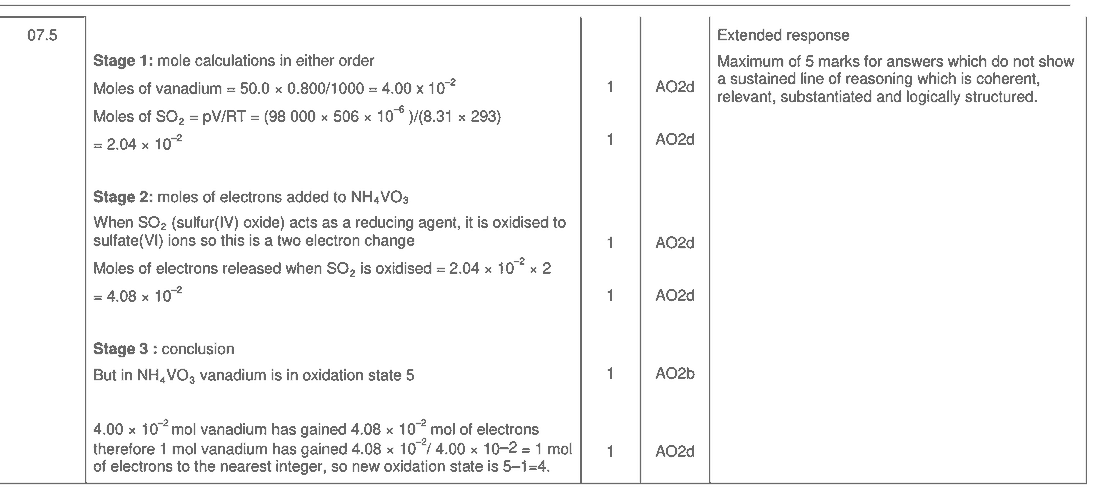
Answer: +4. n(V) = 50.0 × 0.800 ÷ 1000 = 4.00 × 10^–2 mol. n(SO2) = pV/RT = (98 000 × 506 × 10^–6) ÷ (8.31 × 293) = 2.04 × 10^–2 mol. SO2 is oxidised to sulfate(VI), a two-electron change, so electrons released = 4.08 × 10^–2 mol. Each V(V) gains 4.08 ÷ 4.00 = 1 electron, so 5 – 1 = 4. Six point marks
max 5 without a sustained line of reasoning
Skills: MS0.0 Recognise and make use of appropriate units in calculation; MS0.2 Use ratios, fractions and percentages; MS2.2 Change the subject of an equation; MS2.3 Substitute numerical values into algebraic equations using appropriate units for physical quantities
Specimen · Paper 1 · Q08.12 marksExplanation
Mark scheme
Notes from the mark scheme and report
A (lone) pair of electrons on the ligand is donated from the ligand to the central metal ion
Specimen · Paper 1 · Q08.24 marksEquation writing
Earlier part of question 08 that this part uses
Mark scheme
Notes from the mark scheme and report
A (pale) blue precipitate forms, which dissolves in excess to give a dark blue solution. [Cu(H2O)6]2+ + 2NH3 → [Cu(H2O)4(OH)2] + 2NH4+
Skills: ATd Use laboratory apparatus for a variety of experimental techniques including: titration, using burette and pipette; distillation and heating under reflux, including setting up glassware using retort stand and clamps; qualitative tests for ions and organic functional groups; filtration, including use of fluted filter paper, or filtration under reduced pressure; RP11 Carry out simple test-tube reactions to identify transition metal ions in aqueous solution
Specimen · Paper 1 · Q08.31 markAO2=1Equation writing