3.1.8.1-01 Lattice enthalpy can be defined as either enthalpy of lattice dissociation or enthalpy of lattice formation.
3.1.8.1-02 Born–Haber cycles are used to calculate lattice enthalpies using the following data: • enthalpy of formation • ionisation energy • enthalpy of atomisation • bond enthalpy • electron affinity.
3.1.8.1-03 Students should be able to: • define each of the above terms and lattice enthalpy • construct Born–Haber cycles to calculate lattice enthalpies using these enthalpy changes • construct Born–Haber cycles to calculate one of the other enthalpy changes • compare lattice enthalpies from Born–Haber cycles with those from calculations based on a perfect ionic model to provide evidence for covalent character in ionic compounds.
3.1.8.1-04 Cycles are used to calculate enthalpies of solution for ionic compounds from lattice enthalpies and enthalpies of hydration.
3.1.8.1-05 Students should be able to: • define the term enthalpy of hydration • perform calculations of an enthalpy change using these cycles.
3.1.8.2-01 ∆H, whilst important, is not sufficient to explain feasible change.
3.1.8.2-02 The concept of increasing disorder (entropy change, ∆S).
3.1.8.2-03 ∆S accounts for the above deficiency, illustrated by physical changes and chemical changes.
3.1.8.2-04 The balance between entropy and enthalpy determines the feasibility of a reaction given by the relationship: ∆G = ∆H – T∆S (derivation not required).
3.1.8.2-05 For a reaction to be feasible, the value of ∆G must be zero or negative.
3.1.8.2-06 Students should be able to: • calculate entropy changes from absolute entropy values • use the relationship ∆G = ∆H – T∆S to determine how ∆G varies with temperature • use the relationship ∆G = ∆H – T∆S to determine the temperature at which a reaction becomes feasible.
Six-mark level of response questions on this topic
Tap a question to zoom it. Where a part needs a figure, table or structure from earlier in the question, that part folds out above it; the mark scheme and examiner's comment open underneath. Have AQA's Data Booklet (the Periodic Table and the spectroscopy tables) beside you.
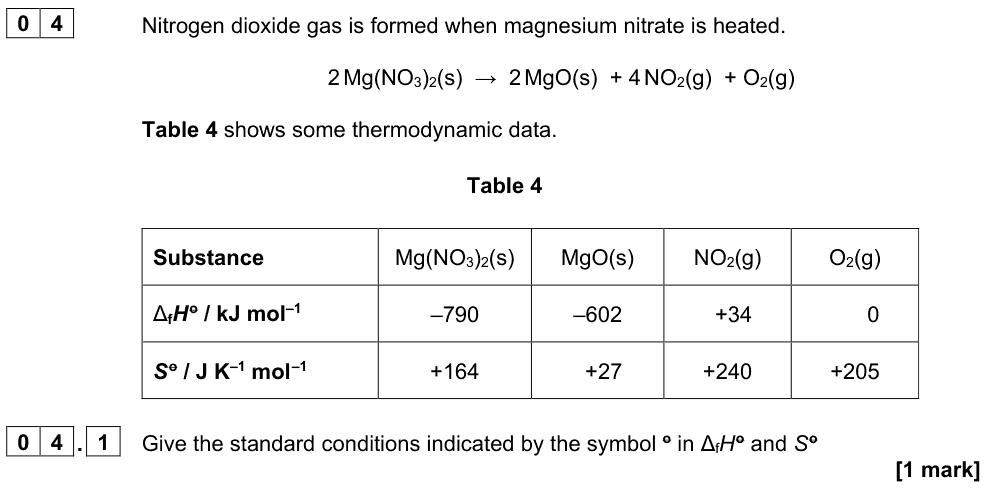
June 2025 · Paper 1 · Q04.25 marksAO1=1, AO2=4Calculation
Earlier part of question 04 that this part uses
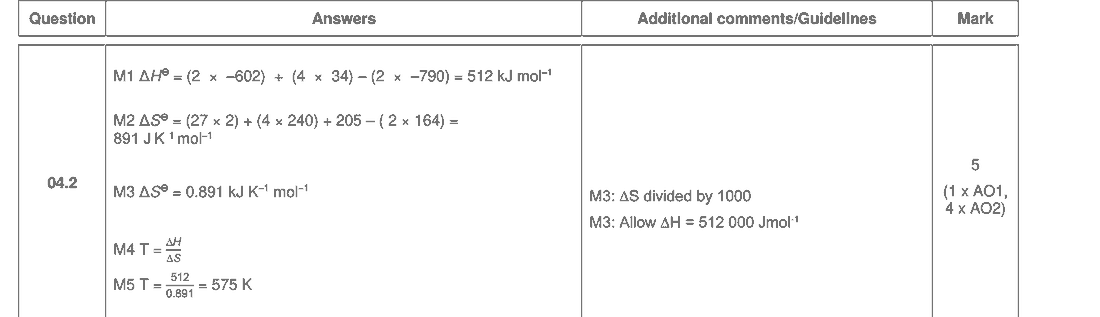
Mark scheme
Examiner's comment
Many students could do the calculation in part 2; common errors included not applying the stoichiometry in the equation to calculate ΔH and ΔS and failing to use the factor of 1000 to calculate ΔS in kJ K–1mol–1.
A few students could not rearrange the equation.
Some students gave negative temperatures which are not appropriate in kelvin.
Skills: MS0.0 Recognise and make use of appropriate units in calculation; MS2.2 Change the subject of an equation; MS2.3 Substitute numerical values into algebraic equations using appropriate units for physical quantities
June 2025 · Paper 3 · Q01.11 markAO1=1Equation writing
Mark scheme
Examiner's comment
1.1 This proved a relatively easy start with more than 50% of students achieving the mark. As with all enthalpy changes, the equation can be derived from the definition which in this case refers to the enthalpy change when one mole of an ionic compound is dissolved in water to form an infinitely dilute solution.
Notes from the mark scheme and report
KOH(s) → K+(aq) + OH–(aq) (or KOH(s) + aq → K+(aq) + OH–(aq)). State symbols essential
no H2O as a reactant or product
not a reversible arrow
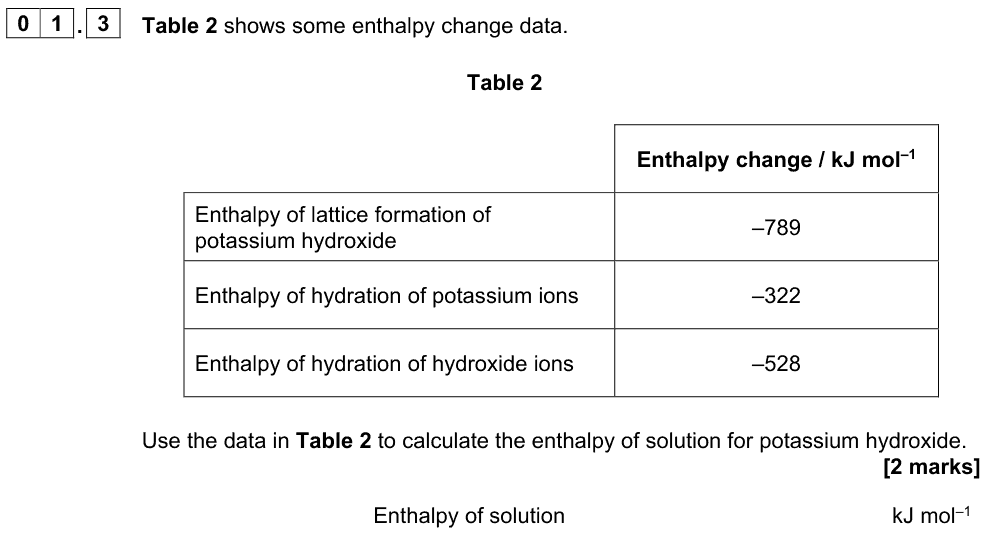
June 2025 · Paper 3 · Q01.32 marksAO2=2CalculationEasy
Earlier part of question 01 that this part uses
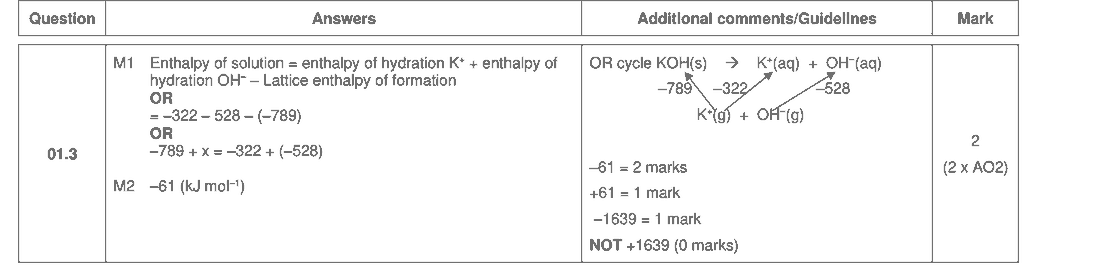
Mark scheme
Examiner's comment
1.3 Almost 75% of students scored 2/2 here so this calculation is generally well understood. Most who failed to score or only scored 1 mark were also those who did not start by drawing a cycle to show the relationship between the values given.
Notes from the mark scheme and report
Answer: –61 kJ mol–1. ∆sol H = –(lattice formation) + hydration of K+ + hydration of OH– = +789 – 322 – 528. +61 or –1639 scores 1. Draw the cycle first
Skills: MS2.4 Solve algebraic equations
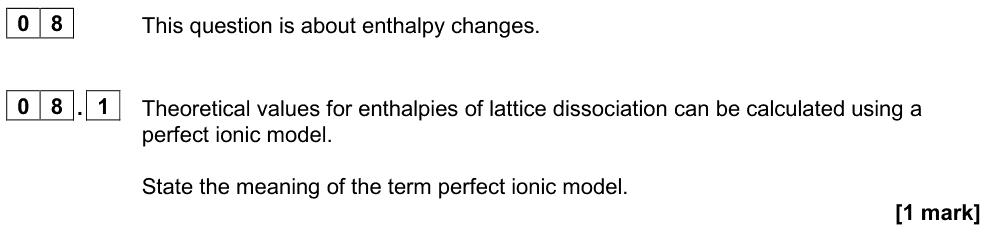
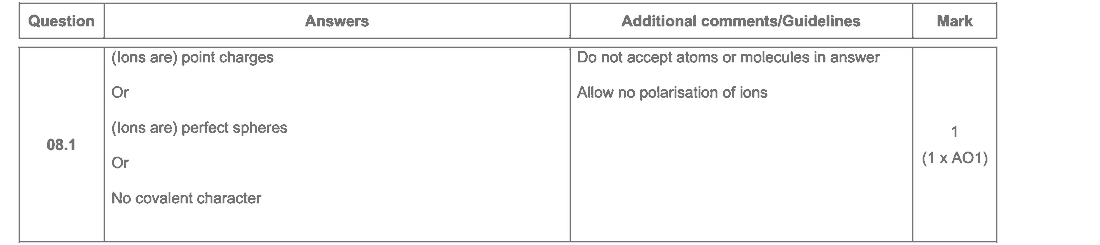
June 2024 · Paper 1 · Q08.11 markAO1=1Short answer
Mark scheme
Examiner's comment
Answers to part 1 were generally good: errors included confusion between ions, atoms, and molecules.
Notes from the mark scheme and report
Ions are point charges / perfect spheres / there is no covalent character. Must refer to ions, not atoms or molecules
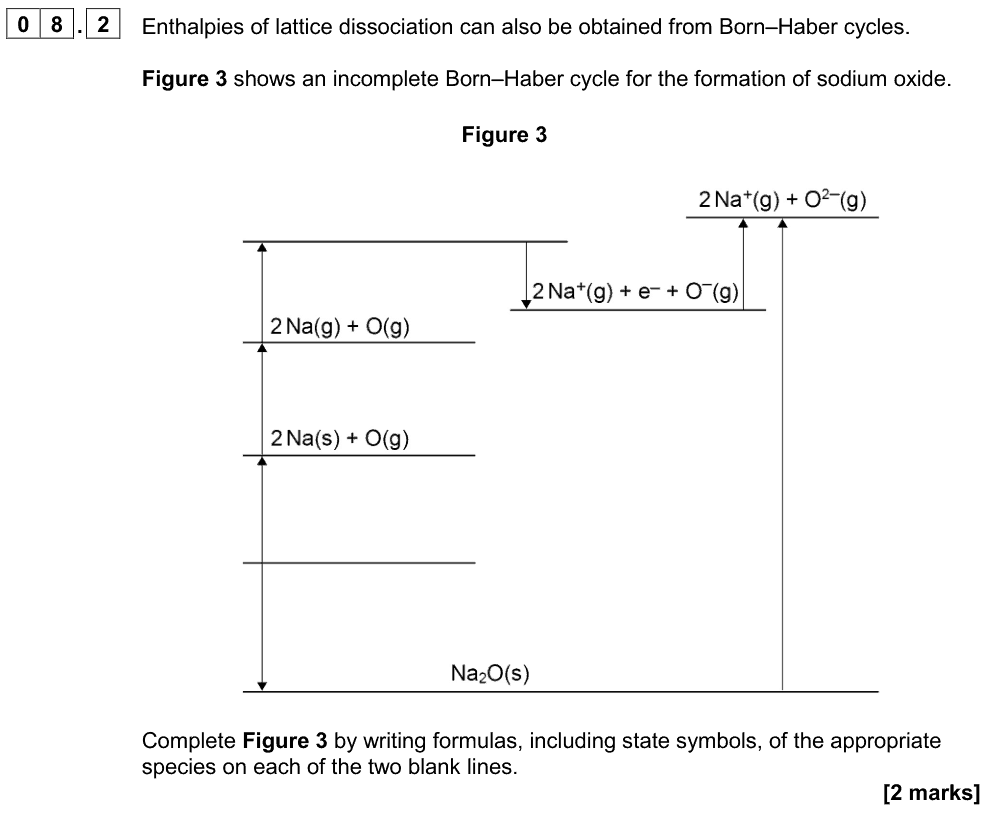
June 2024 · Paper 1 · Q08.22 marksAO2=2Diagram or structure
Earlier part of question 08 that this part uses
Mark scheme
Examiner's comment
49% of students gave both correct equations in part 2: errors included missing state symbols, missing mole ratios, and missing charges.
Another common error was O–(g).
Many students did not give 0.5 mol of O2(g) in the equation at the start of the cycle.
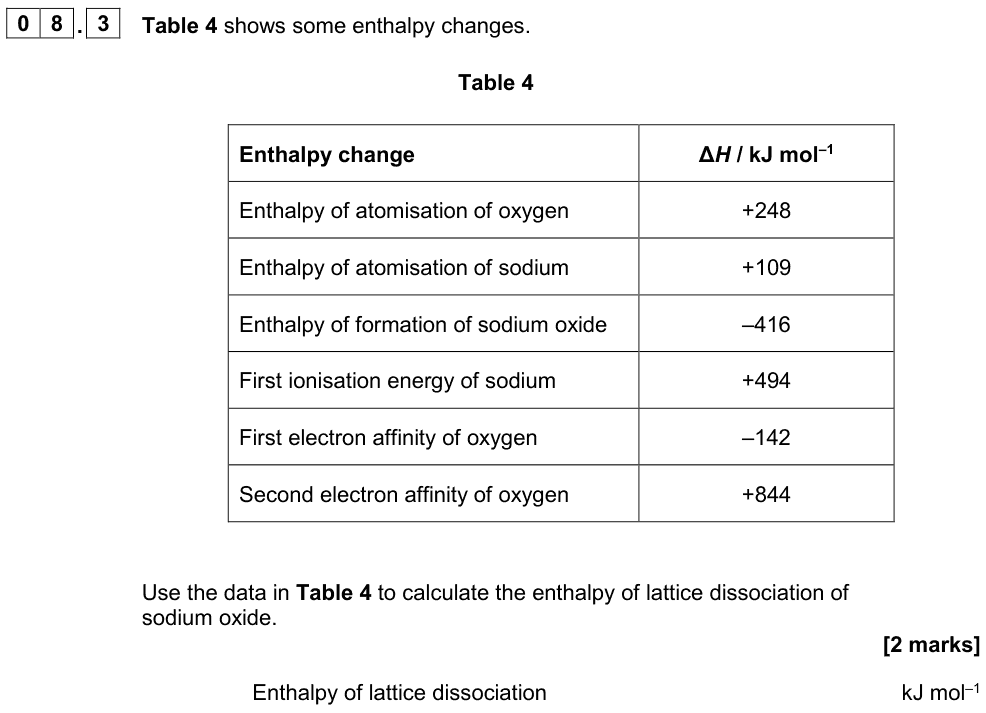
June 2024 · Paper 1 · Q08.32 marksAO2=2Calculation
Earlier part of question 08 that this part uses
Mark scheme
Examiner's comment
The calculation in part 3 was challenging: common errors were only including 1 mol of Na in enthalpy of atomisation (1 x 10⁹), only including 1 mol of Na in first ionisation energy (1 x 494) and halving the enthalpy of atomisation of oxygen (confusing this value with bond dissociation enthalpy).
Notes from the mark scheme and report
Answer: +2572 kJ mol–1 (–2572 scores 1). 248 + (2 × 10⁹) + (2 × 494) – 142 + 844 + 416. Errors: one Na only in atomisation or ionisation
halving the atomisation enthalpy of oxygen. Uses Figure 3 from 08.2
Skills: MS2.4 Solve algebraic equations
June 2024 · Paper 1 · Q08.41 markAO1=1ExplanationHard
Earlier part of question 08 that this part uses
Mark scheme
Examiner's comment
Students found part 4 challenging: only 31% of students gave a correct answer.
Many students identified that an electron was added to an O– ion but did not state that there is repulsion between them.
There was a common misconception that electrons were being removed and the repulsion made it easier to remove the electron.
Notes from the mark scheme and report
The electron is added to a negative O– ion, which repels it. Misconception: that an electron is being removed
June 2024 · Paper 1 · Q08.52 marksAO3=2Explanation
Earlier part of question 08 that this part uses
Mark scheme
Examiner's comment
In part 5 many students confused the electrostatic attraction in ionic compounds with covalent bonds and intermolecular forces.
Other errors included reference to the charge density of atoms or molecules.
Notes from the mark scheme and report
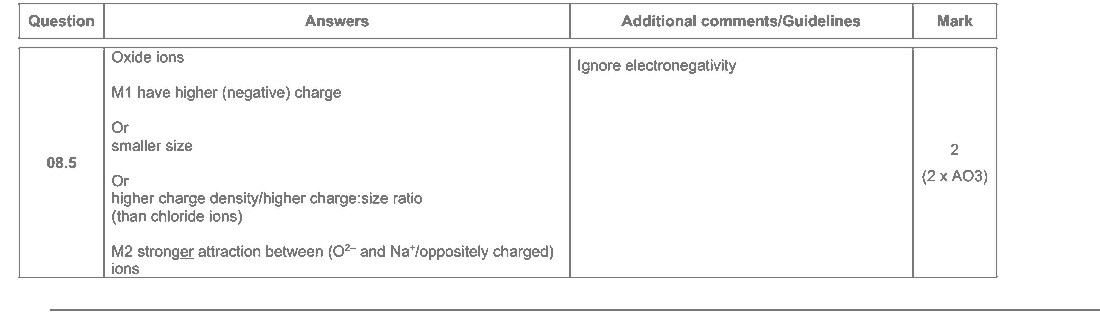
Oxide ions have a higher charge / are smaller than chloride ions, so the attraction to Na+ is stronger. Do not write about covalent bonds, intermolecular forces, atoms or molecules
June 2024 · Paper 1 · Q08.62 marksAO2=2Calculation
Earlier part of question 08 that this part uses
Mark scheme
Examiner's comment
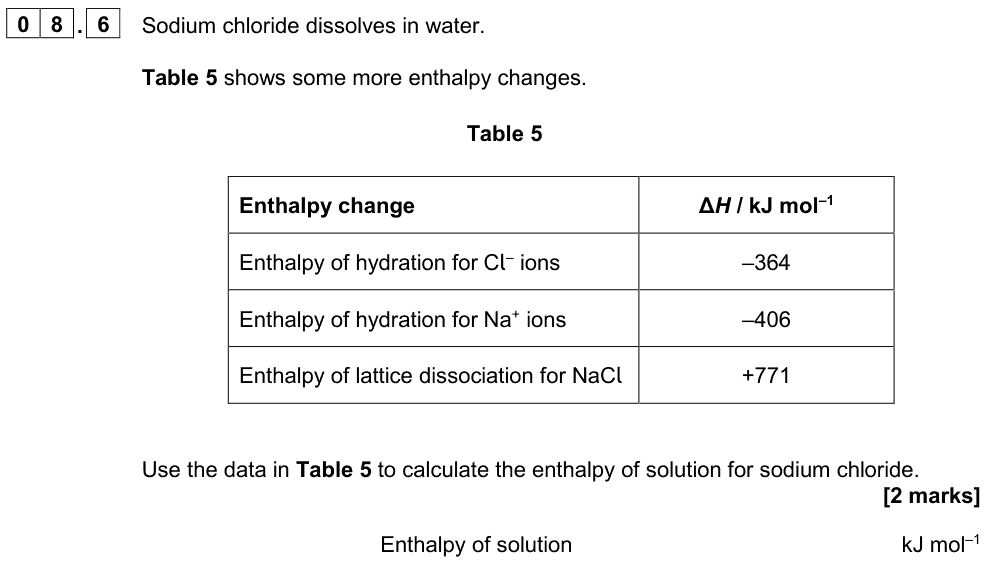
59% of students answered part 6 correctly: common incorrect answers included +1541 and –1541.
Notes from the mark scheme and report
Answer: +1 kJ mol–1 (771 – 406 – 364)
–1 scores 1. Common wrong answers: +1541 and –1541
Skills: MS2.4 Solve algebraic equations
June 2024 · Paper 1 · Q08.83 marksAO1=1, AO2=2Calculation
Earlier part of question 08 that this part uses
Mark scheme
Examiner's comment
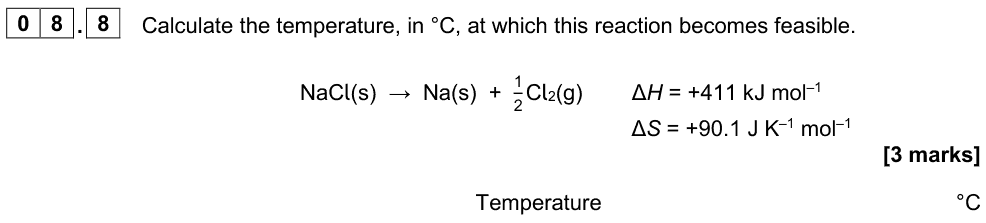
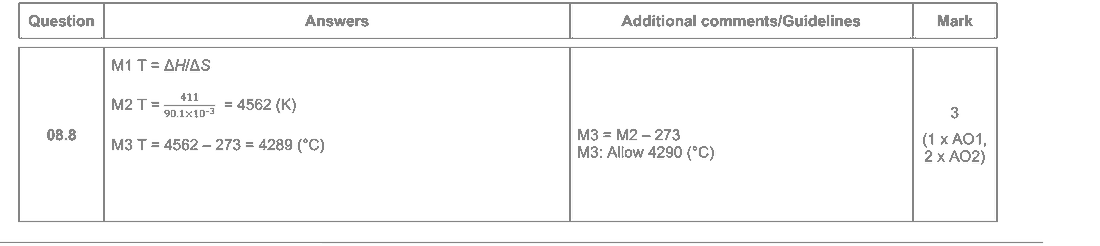
The calculation in part 8 was well done by most students: common errors included using the wrong units for entropy change and not subtracting 273 to convert Kelvin into Celsius.
Notes from the mark scheme and report
Answer: 4289 °C. T = ∆H/∆S = 411 ÷ 0.0901 = 4562 K
subtract 273. Errors: ∆S not converted to kJ
answer left in kelvin
Skills: MS0.0 Recognise and make use of appropriate units in calculation; MS2.2 Change the subject of an equation
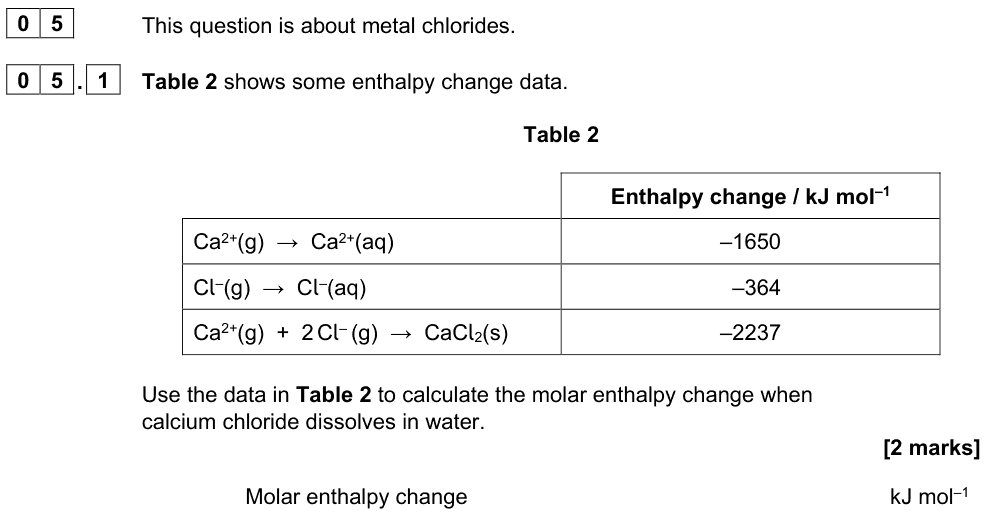
June 2023 · Paper 1 · Q05.12 marksAO2=2Calculation
Mark scheme
Examiner's comment
Many students answered 05.1 well; errors included omitting 2 × –364 and forgetting to reverse the sign of one of the values given in the table.
Notes from the mark scheme and report
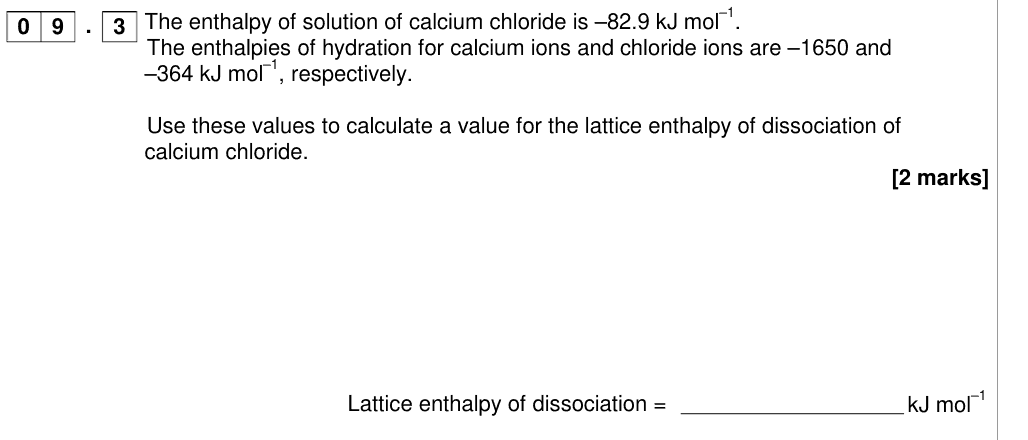
Answer: –141 kJ mol–1. Lattice dissociation + hydration enthalpies: +2237 – 1650 – (2 × 364). Errors: omitting the factor of 2 for Cl–
not reversing the sign of the lattice formation value
Skills: MS2.4 Solve algebraic equations
June 2023 · Paper 1 · Q05.32 marksAO1=2ExplanationHard
Earlier part of question 05 that this part uses
Mark scheme
Examiner's comment
Students found 05.3 challenging with only 12% gaining all the marks.
Many students knew that fluoride ions are smaller than chloride ions but failed to gain the mark because of confusion between atoms and ions (eg stating that “fluoride has a smaller atomic radius than chloride”).
For the second mark several students referred to the attraction of F– to Oδ- or H+ instead of Hδ+.
Notes from the mark scheme and report
Fluoride ions are smaller (higher charge density) than chloride ions, so there is a stronger attraction to the δ+ H of water. Must say ions, not atoms
not attraction to H+ or to Oδ–
not ionic bonds
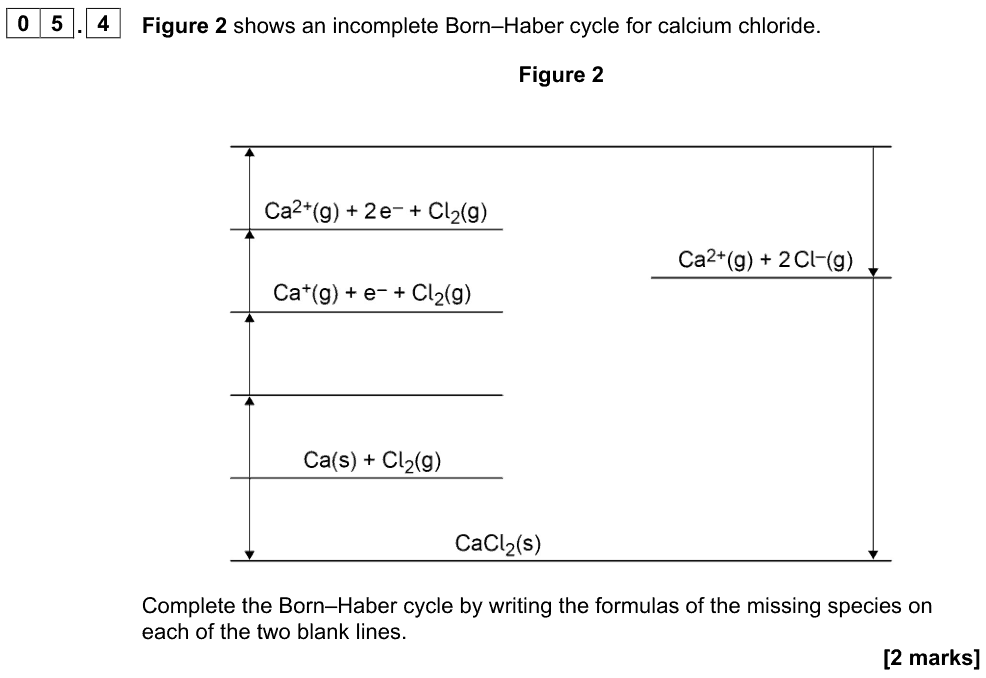
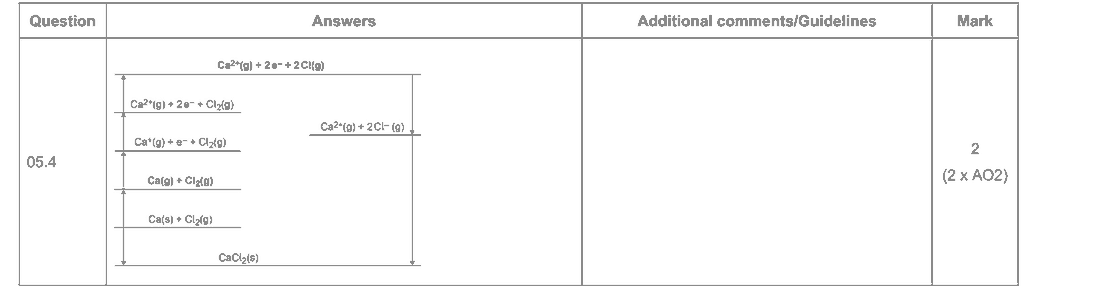
June 2023 · Paper 1 · Q05.42 marksAO2=2Diagram or structure
Earlier part of question 05 that this part uses
Mark scheme
Examiner's comment
Answers to 05.4 were generally good; some students missed electrons or state symbols or put Cl2 in the top equation rather than 2 Cl.
Notes from the mark scheme and report
Top blank line: Ca2+(g) + 2e– + 2Cl(g). Lower blank line: Ca(g) + Cl2(g). Errors: electrons or state symbols missing
Cl2 instead of 2Cl on the top line
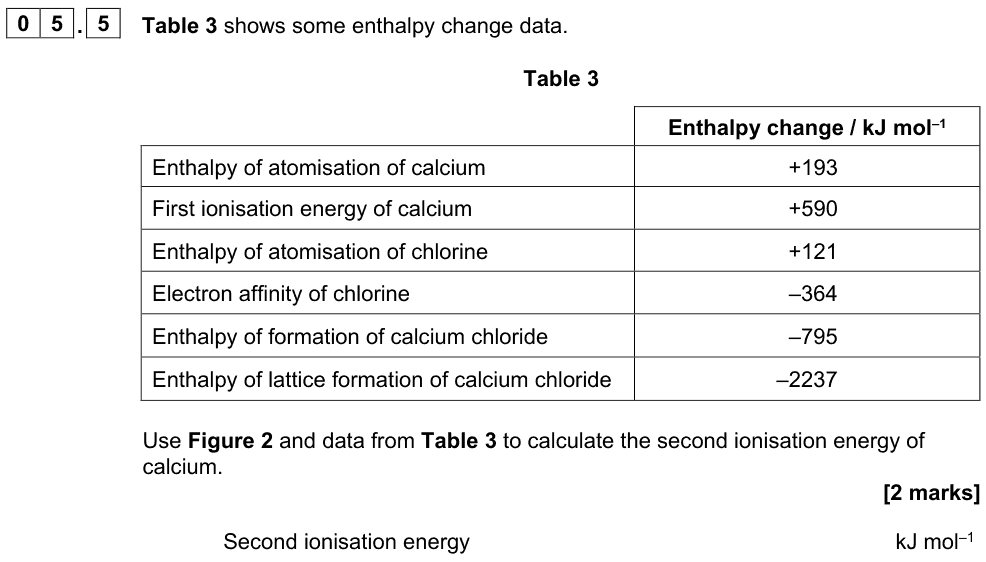
June 2023 · Paper 1 · Q05.52 marksAO2=2Calculation
Earlier parts of question 05 that this part uses
Mark scheme
Examiner's comment
Common errors in 05.5 included missing one or both of the factors of 2 for the atomisation and the electron affinity of chlorine.
A substantial number of students had problems evaluating the combination of positive and negative values.
Notes from the mark scheme and report
Answer: +1145 kJ mol–1. –795 = 193 + 590 + 2nd IE + (2 × 121) + (2 × –364) – 2237. Errors: missing the factors of 2 for chlorine atomisation and electron affinity
sign errors. Needs Figure 2 from 05.4
Skills: MS2.4 Solve algebraic equations
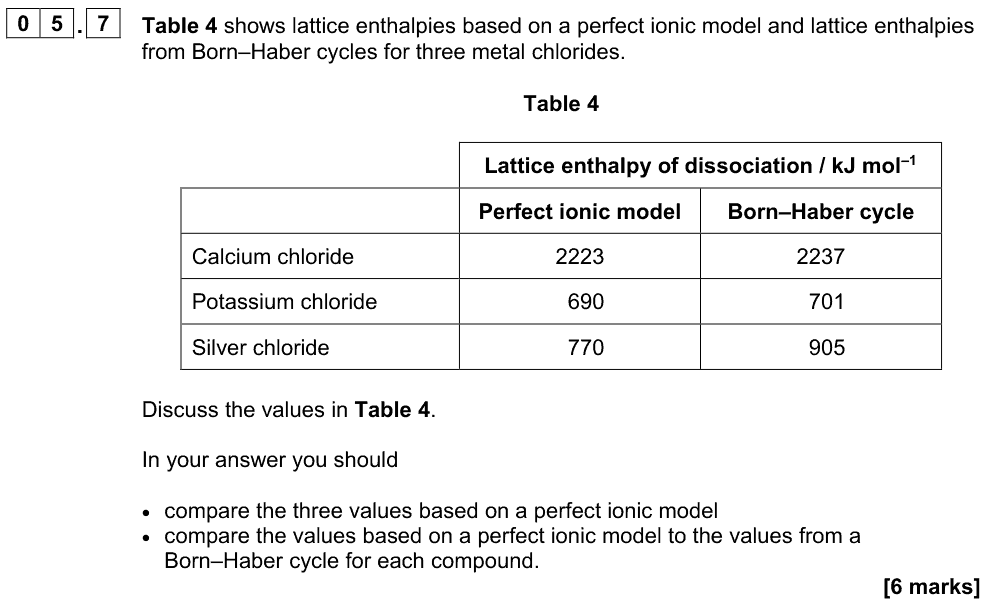
June 2023 · Paper 1 · Q05.76 marksAO1=2, AO2=2, AO3=26-mark level of responseHard
Earlier part of question 05 that this part uses
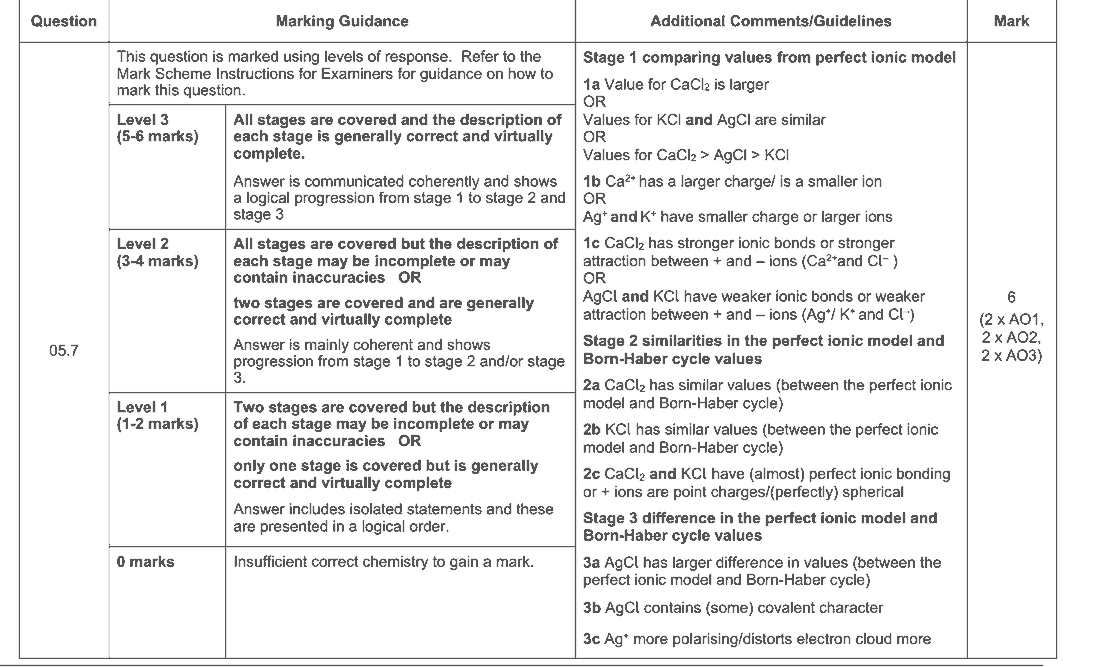
Mark scheme, with the levels and indicative content
Examiner's comment
There were some very good answers to 05.7 and 28% of students gave level 3 answers; many students began their answer by stating that the experimental values were all higher than the theoretical values and that the calcium chloride value was the highest for both the experimental and theoretical data.
They then went on to explain incorrectly that this was because of covalent character in calcium chloride and that the greater difference for silver chloride was because it had more covalent character.
Students who discussed the relative values for the three chlorides often lost credit because they confused atoms and molecules (eg calcium atoms are smaller than potassium atoms or calcium chloride molecules have stronger ionic bonds).
Notes from the mark scheme and report
Levels of response, three stages. Perfect ionic model values: CaCl2 much larger (KCl and AgCl similar) because Ca2+ has a higher charge / is smaller, so stronger attraction between Ca2+ and Cl– ions. Similar values: for CaCl2 and KCl the model and Born–Haber values agree, so bonding is almost perfectly ionic (ions are point charges / spherical). Different values: AgCl has a much larger Born–Haber value, so it has some covalent character
Ag+ is more polarising / distorts the chloride electron cloud. Errors: covalent character claimed for CaCl2
'calcium atoms' or 'CaCl2 molecules'
June 2022 · Paper 3 · Q01.12 marksAO1=2Short answer
Mark scheme
Examiner's comment
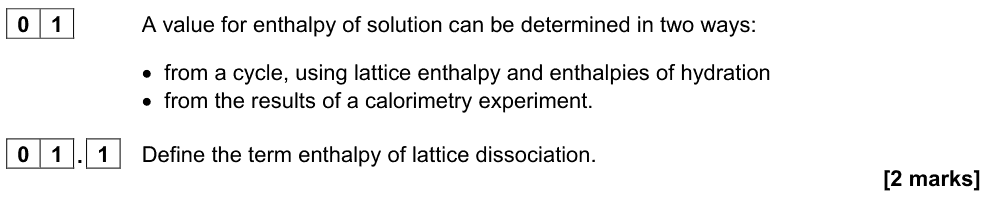
01.1 was intended to give a relatively straightforward start to the exam but, instead, it proved to be the first example of a situation where greater clarity was needed in giving a definition.
Repeated references to standard conditions were seen and, although they did not affect the marks awarded, were not necessary as the question did not ask for a definition of a ‘standard’ enthalpy change.
Marking point 1 (M1) was sometimes missed as a result of students failing to refer to an ionic compound and M2 was often missed when students referred to the formation of one mole of gaseous ions – the number of moles of ions formed will depend on the formula of the compound so the only quantity needed in the definition is that of one mole of the ionic compound.
Notes from the mark scheme and report
The enthalpy change when one mole of a (solid) ionic compound is dissociated into its gaseous ions. Not 'to form one mole of gaseous ions'
must say ionic compound
'standard conditions' not needed
June 2022 · Paper 3 · Q01.23 marksAO2=3Calculation
Earlier part of question 01 that this part uses
Mark scheme
Examiner's comment
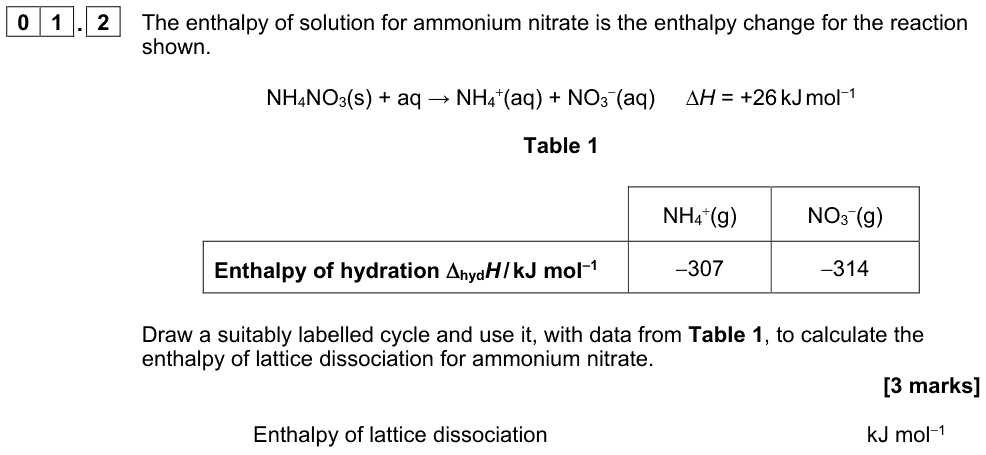
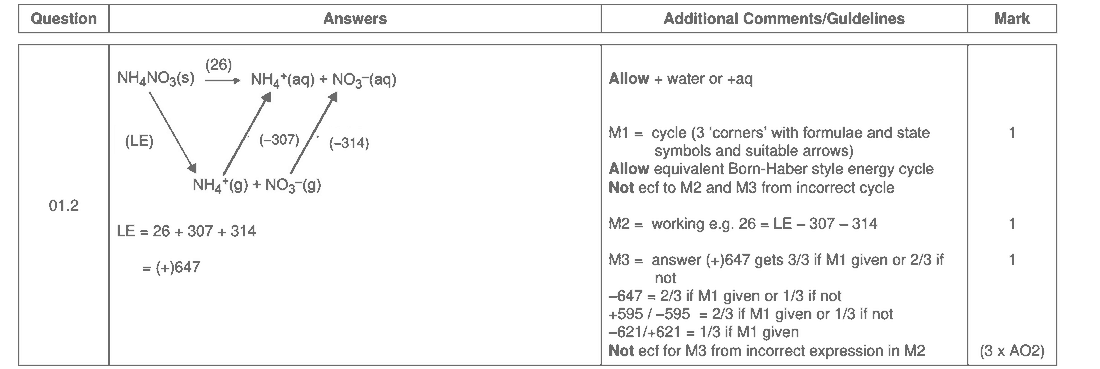
In 01.2 there was a mark awarded specifically for a properly labelled diagram which, as a minimum, needed correct formulae and state symbols at all three ‘corners’ of the cycle.
It is recommended that arrows in cycles are always drawn in the direction that matches the enthalpy change term being represented and any adjustments (e.g. of sign and direction) are left to the algebra.
Notes from the mark scheme and report
Answer: +647 kJ mol–1. Cycle with three corners: NH4NO3(s)
NH4+(g) + NO3–(g)
NH4+(aq) + NO3–(aq), with formulae, state symbols and arrows in the direction of each enthalpy change. 26 = LE – 307 – 314. –647 loses a mark
one mark is for the labelled cycle
Skills: MS2.4 Solve algebraic equations
June 2022 · Paper 3 · Q01.74 marksAO2=3, AO3=1Calculation
Earlier part of question 01 that this part uses
Mark scheme
Examiner's comment
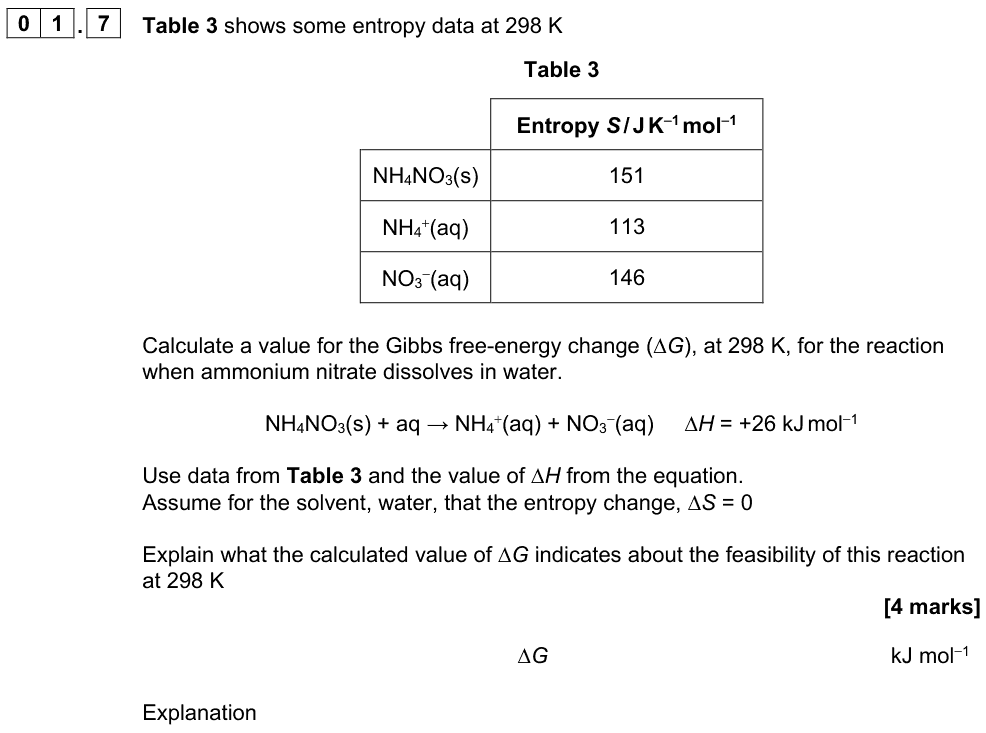
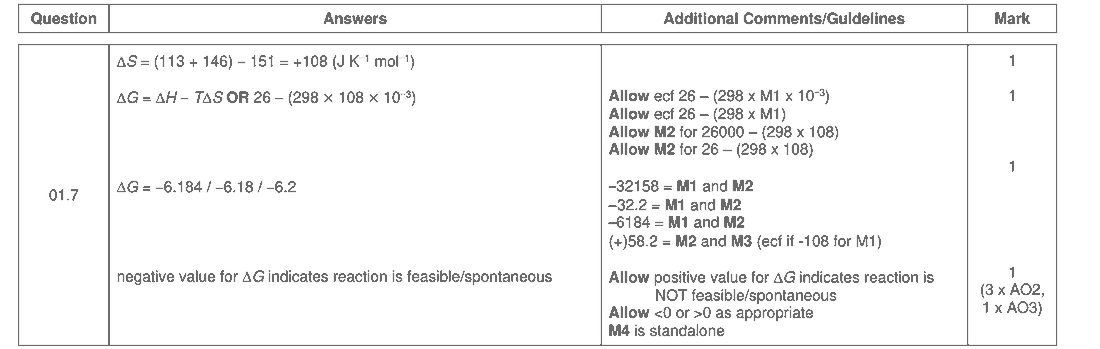
In 01.7 most students gained two or three marks, but the conversion of the entropy change into kJ was often forgotten.
Notes from the mark scheme and report
Answer: ∆G = –6.18 kJ mol–1
negative ∆G means the reaction is feasible (spontaneous). ∆S = (113 + 146) – 151 = +108 J K–1 mol–1
∆G = 26 – (298 × 108 × 10^–3). Common error: ∆S not converted to kJ
Skills: MS0.0 Recognise and make use of appropriate units in calculation; MS2.3 Substitute numerical values into algebraic equations using appropriate units for physical quantities
June 2022 · Paper 3 · Q01.82 marksAO2=2Calculation
Earlier part of question 01 that this part uses
Mark scheme
Examiner's comment
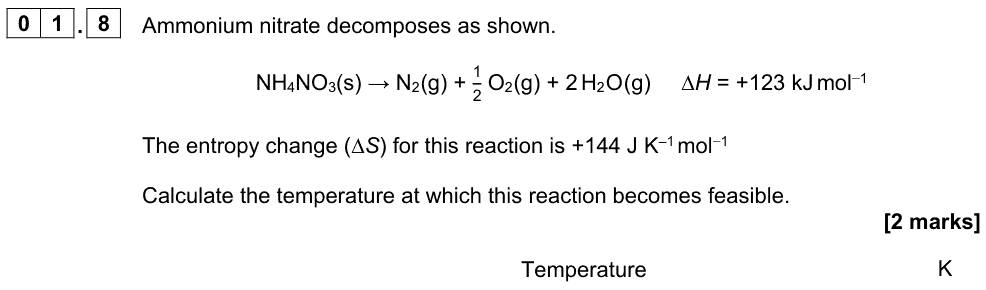
01.8 was well done although there were again some issues with the need to convert units between J and kJ for consistency in the calculation.
Notes from the mark scheme and report
Answer: 854 K. T = ∆H/∆S = 123 000 ÷ 144 (convert ∆H to J or ∆S to kJ). 0.854 scores 1
Skills: MS0.0 Recognise and make use of appropriate units in calculation; MS2.2 Change the subject of an equation
June 2022 · Paper 3 · Q171 markAO3=1Multiple choice
Answer
D
Mark scheme
Notes from the mark scheme and report
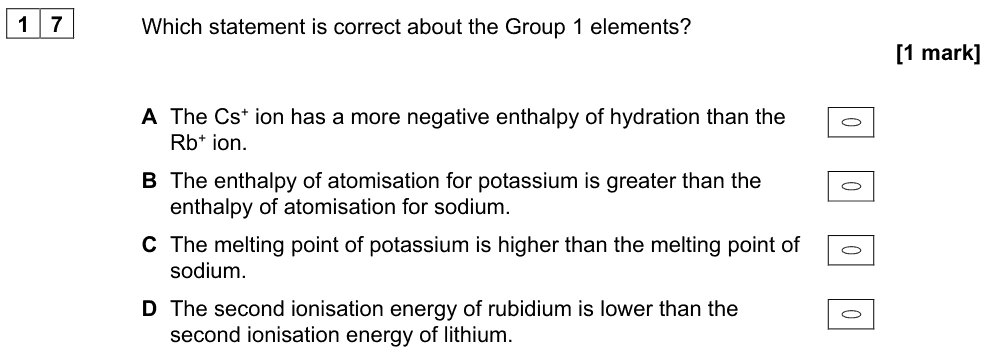
Answer: D. The second electron in Rb comes from a shell much further from the nucleus with more shielding than in Li (1s). Larger ions have less negative hydration enthalpies
metallic bonding weakens down the group so atomisation enthalpy and melting point fall
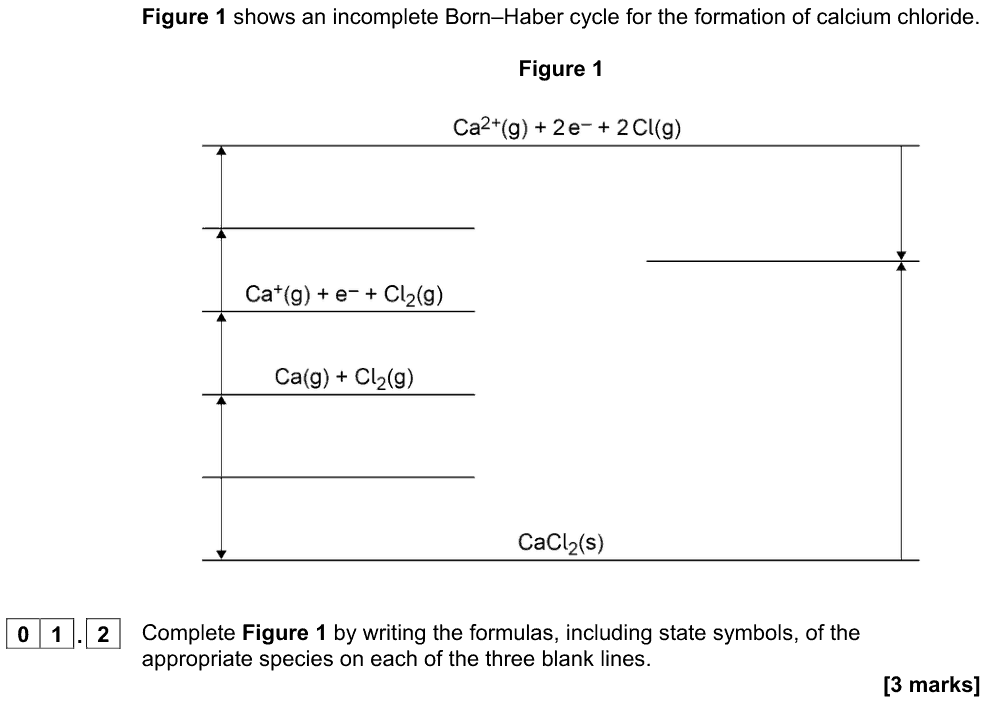
November 2021 · Paper 1 · Q01.23 marksDiagram or structure
Earlier part of question 01 that this part uses
Mark scheme
Examiner's comment
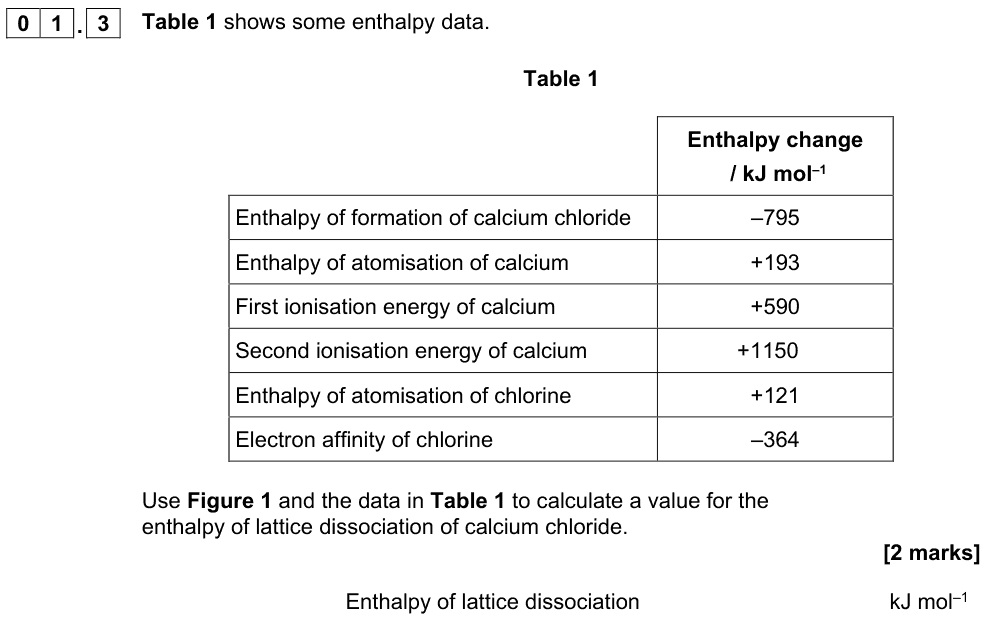
Question 01.2 was generally well answered; common errors involved lack of balancing charges and omission of state symbols.
In question 01.3 many students missed one or both factors of 2.
Notes from the mark scheme and report
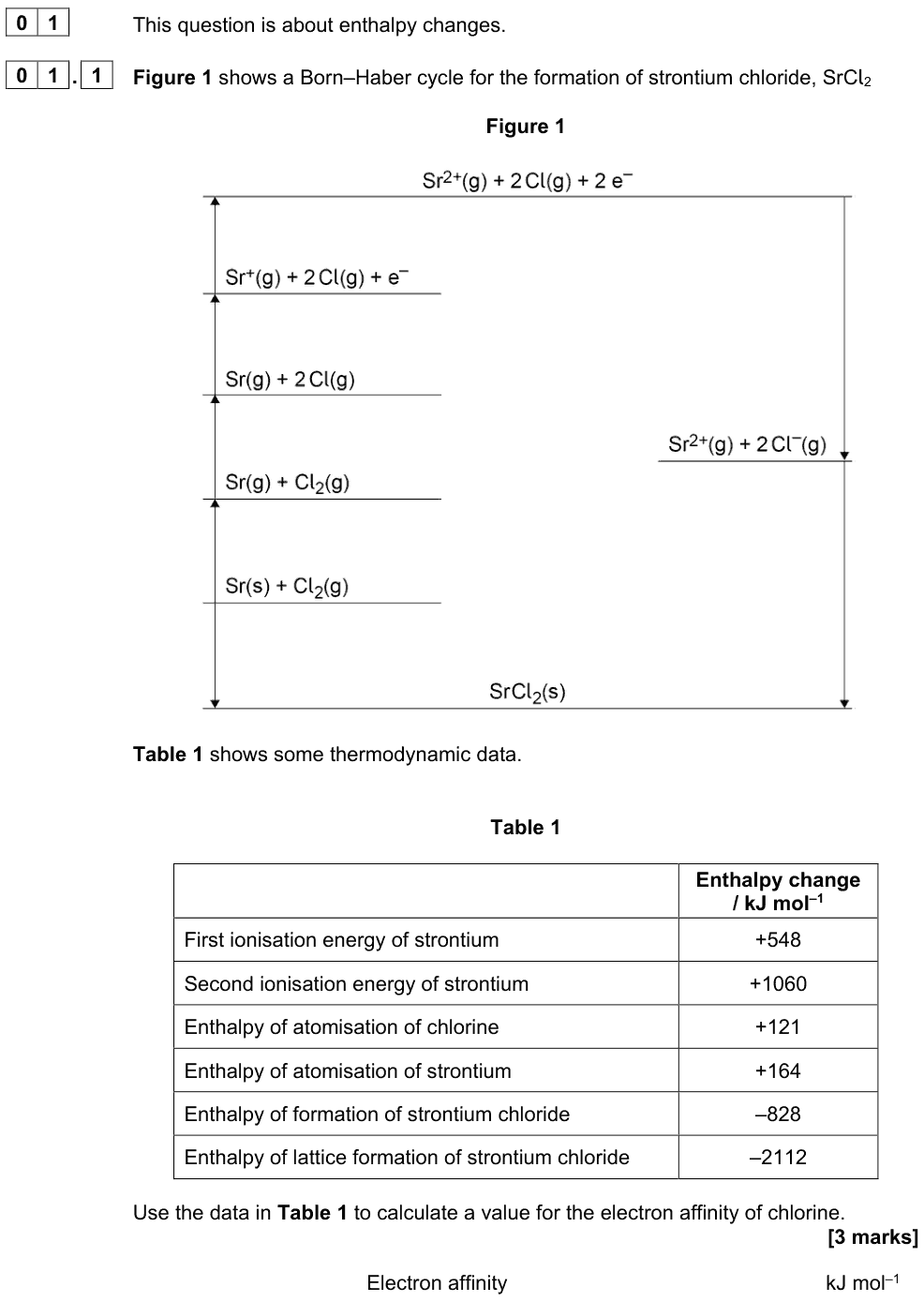
Answer: +2242 kJ mol–1. –795 + LE = 193 + 590 + 1150 + (2 × 121) + (2 × –364). One mark for 2485, 2121 or 2606 (a factor of 2 missed) or for –2242. Many missed one or both factors of 2. Uses Figure 1 from 01.2
Skills: MS2.4 Solve algebraic equations
November 2021 · Paper 1 · Q01.41 markEquation writing
Earlier parts of question 01 that this part uses
Mark scheme
Examiner's comment
Students found question 01.4 challenging; errors included lack of state symbols, equations written the wrong way around, enthalpy of lattice dissociation or formation equations, and equations with water not cancelled out.
Notes from the mark scheme and report
MgCl2(s) → Mg2+(aq) + 2Cl–(aq) (allow '+ aq' on the left). Errors: no state symbols
equation reversed
lattice enthalpy equations
water not cancelled
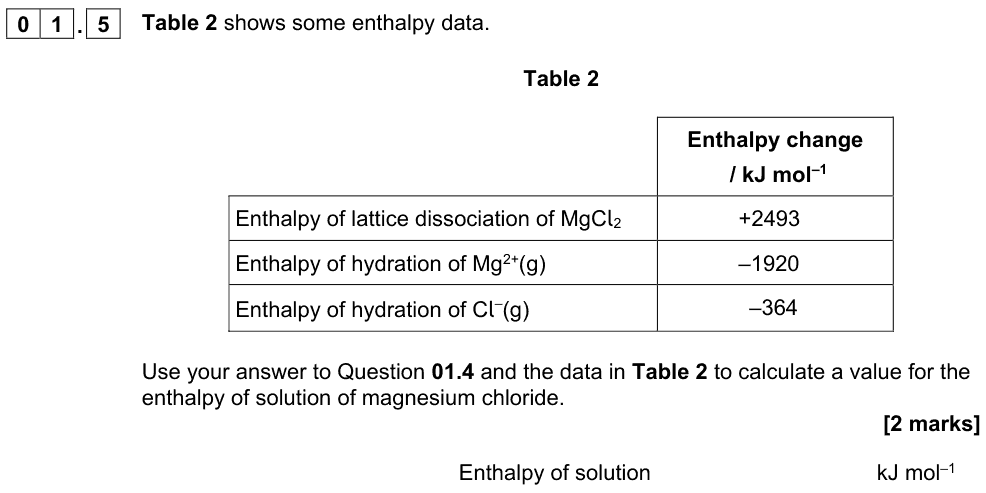
November 2021 · Paper 1 · Q01.52 marksCalculation
Earlier part of question 01 that this part uses
Mark scheme
Examiner's comment
Many students answered question 01.5 well.
Common errors in answers, however, included the wrong sign for the enthalpy change and omitting the factor of 2.
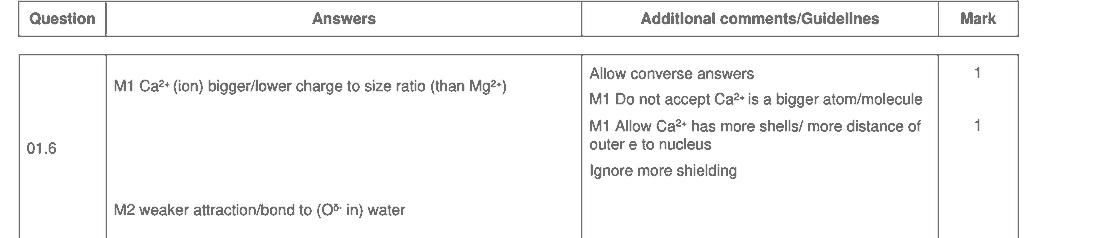
Few students scored both marks for question 01.6; common errors included discussing the atomic radii of the ions, shielding and the distance of outer electrons to the nucleus.
Very few students discussed the attraction of the ion to water.
Notes from the mark scheme and report
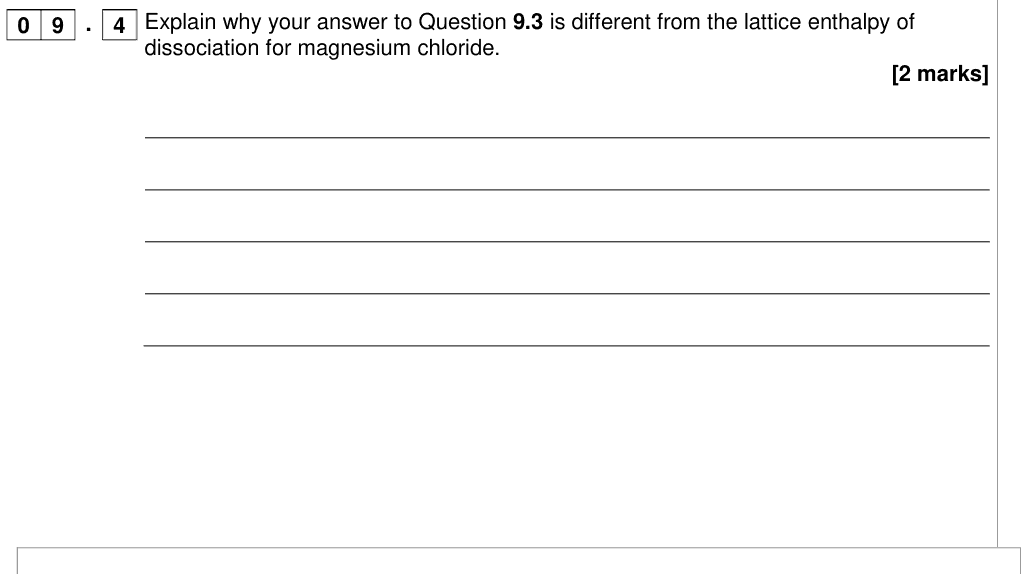
Ca2+ is a bigger ion / has a lower charge to size ratio than Mg2+, so it has a weaker attraction to (the δ– oxygen of) water. Not 'bigger atom'
shielding ignored. Very few mentioned the attraction to water
November 2021 · Paper 1 · Q07.11 markShort answer
Mark scheme
Examiner's comment
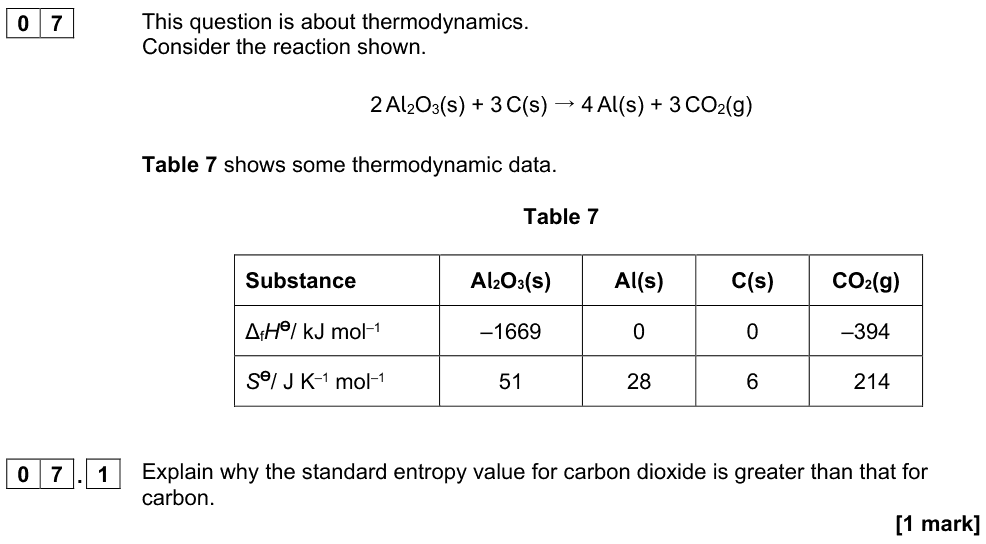
In question 07.1 most students explained that gases are more disordered; a few students explained the disorder in terms of the number of atoms in the molecule rather than using the physical state of the substances.
Notes from the mark scheme and report
Carbon dioxide is a gas, which is more disordered than a solid. Just stating the states is not enough
the number of atoms in the molecule is not the reason wanted
November 2021 · Paper 1 · Q07.21 markShort answer
Earlier part of question 07 that this part uses
Mark scheme
Examiner's comment
Answers to question 07.2 were poor; common errors included 0 with no units, 298 K and +/-273 K.
Notes from the mark scheme and report
0 K (absolute zero, –273 °C)
units essential. Errors: 0 with no unit, 298 K, ±273 K
November 2021 · Paper 1 · Q07.37 marksCalculation
Earlier part of question 07 that this part uses
Mark scheme
Examiner's comment
Question 07.3 discriminated well.
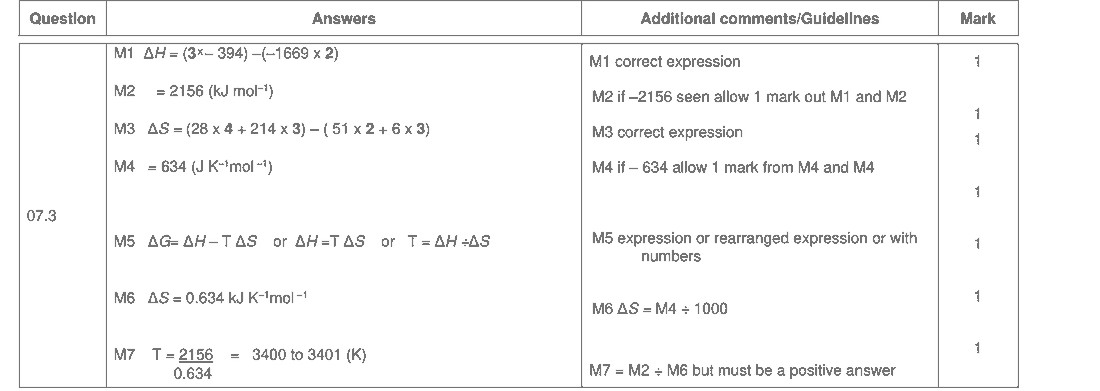
Several students reversed the expressions for change in enthalpy and change in entropy and gained negative values; some students did not convert the change in entropy to the correct units and some tried to convert the temperature in Kelvin into degrees Celsius.
Most students could give a correct expression involving ΔH, ΔS and T.
Notes from the mark scheme and report
Answer: 3400 K (3400 to 3401). ∆H = (3 × –394) – (2 × –1669) = +2156 kJ mol–1
Skills: MS0.0 Recognise and make use of appropriate units in calculation; MS2.2 Change the subject of an equation; MS2.3 Substitute numerical values into algebraic equations using appropriate units for physical quantities
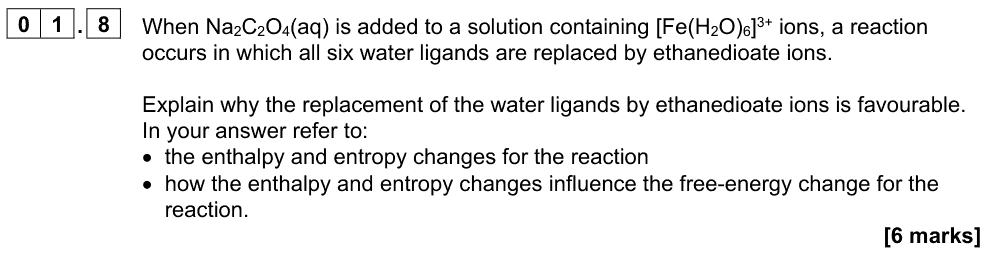
November 2021 · Paper 3 · Q01.86 marks6-mark level of response
Earlier part of question 01 that this part uses
Mark scheme, with the levels and indicative content
Examiner's comment
Most students were able to make a start on the Levels of Response question in 01.8 with about half of students able to access level 2 or above.
Most students recognised that the entropy would increase and that a favourable reaction is indicated by a negative free energy change.
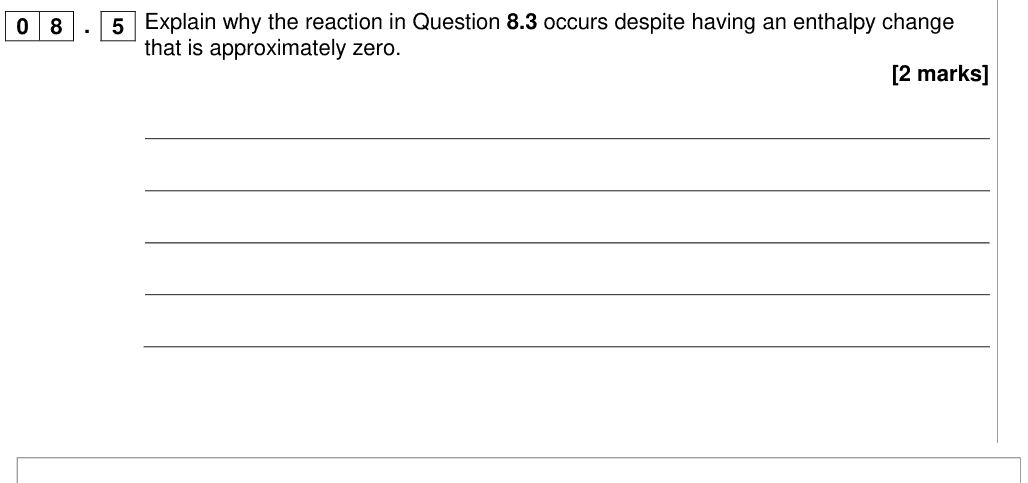
Discussion of the fact that the enthalpy change would be close to zero because 6 Fe-O bonds are made and 6 Fe-O bonds are broken was often not expressed well.
Notes from the mark scheme and report
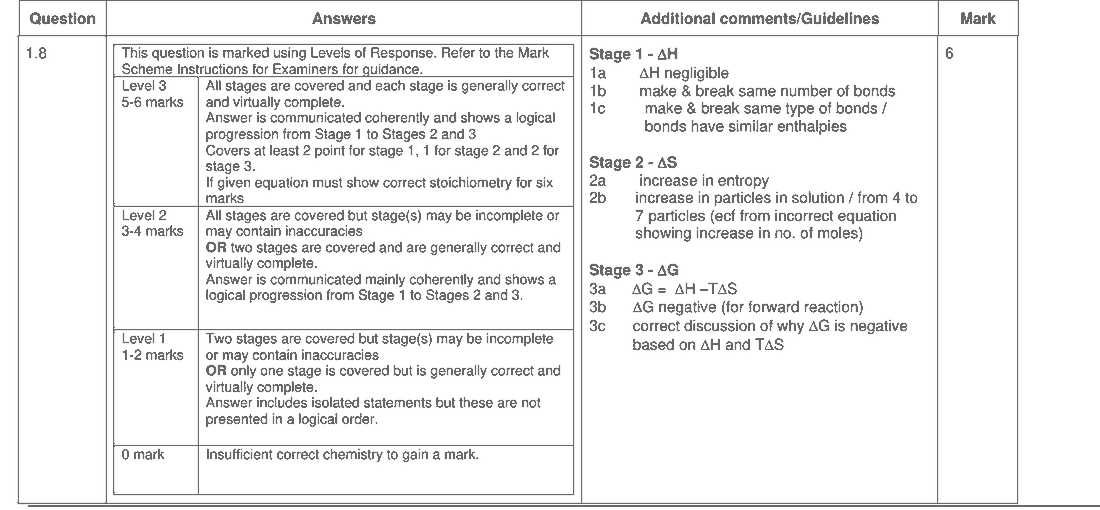
Levels of response, three stages. Stage 1 ∆H: negligible, because the same number (six) and the same type of bonds (Fe–O) are broken and made. Stage 2 ∆S: entropy increases because the number of particles in solution increases from 4 to 7 ([Fe(H2O)6]3+ + 3C2O4 2– → [Fe(C2O4)3]3– + 6H2O). Stage 3 ∆G: ∆G = ∆H – T∆S
with ∆H about zero and ∆S positive, ∆G is negative so the reaction is favourable. The ∆H argument was often poorly expressed
November 2020 · Paper 1 · Q01.13 marksCalculation
Mark scheme
Examiner's comment
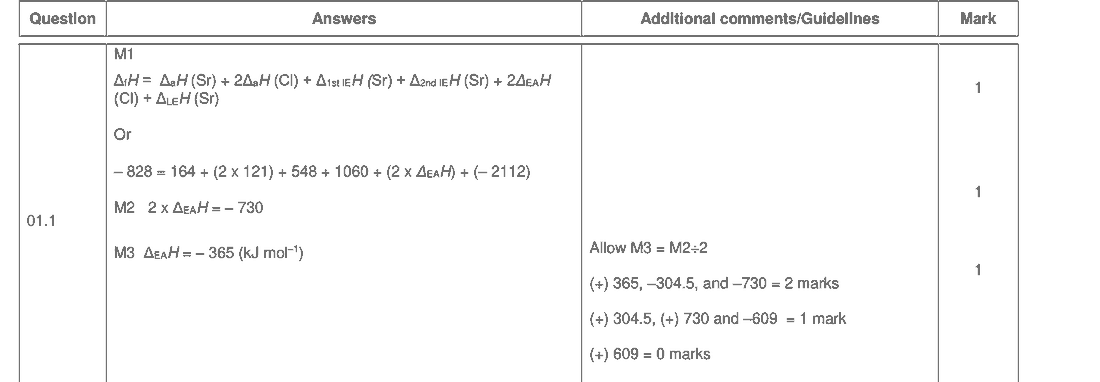
Many students failed to gain a mark in part 01.1 by failing to divide their final answer by two.
divide by 2. +365, –304.5 and –730 score 2. Many forgot to divide by two
Skills: MS2.4 Solve algebraic equations
November 2020 · Paper 1 · Q01.21 markShort answer
Earlier part of question 01 that this part uses
Mark scheme
Examiner's comment
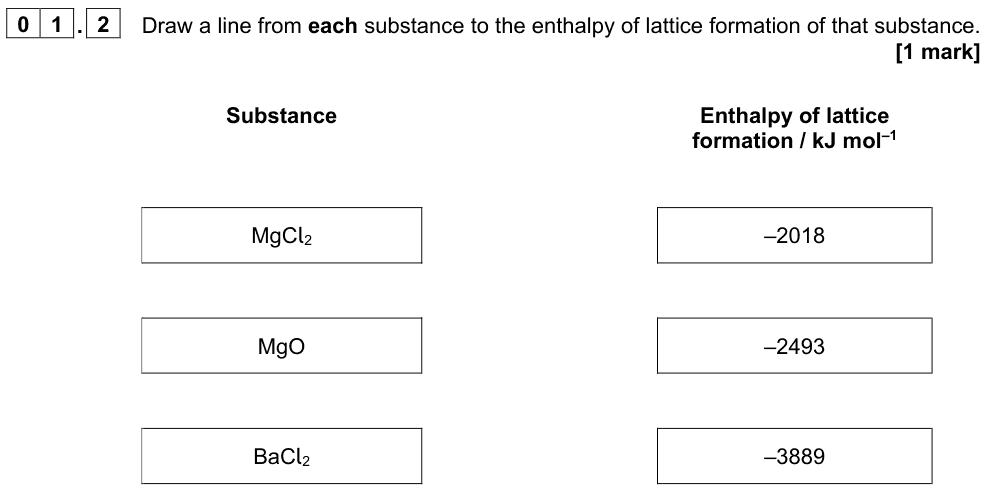
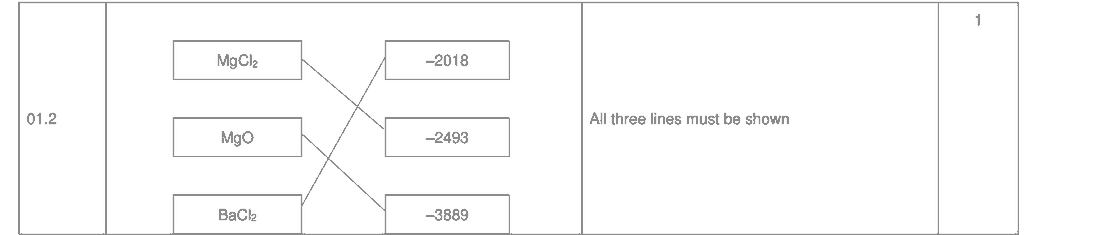
In 01.2, many different answers were seen; some students did correctly match the lattice energies to the correct substance.
Notes from the mark scheme and report
BaCl2 –2018
MgCl2 –2493
MgO –3889 (all three lines needed). Smaller ions and higher charges give stronger attraction, so a more exothermic lattice formation
November 2020 · Paper 1 · Q01.31 markShort answer
Earlier part of question 01 that this part uses
Mark scheme
Examiner's comment
Most students gave the correct answer in 01.3.
Notes from the mark scheme and report
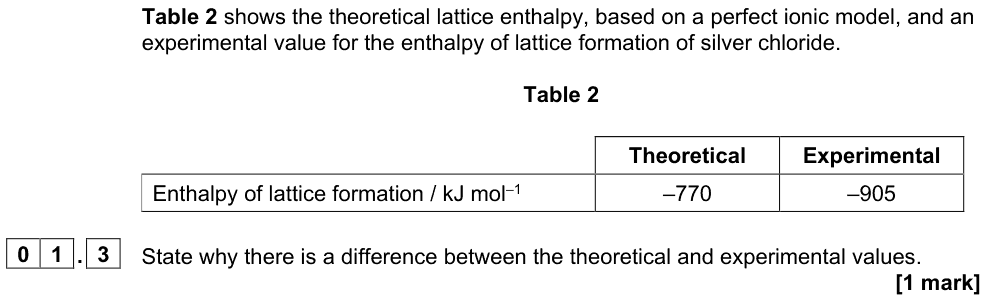
Silver chloride has some covalent character / partial covalent bonding (chloride ion polarised or distorted). Ignore 'not perfectly ionic' and 'ions are not spheres'
not 'molecules'
not 'it is covalently bonded'
November 2020 · Paper 1 · Q01.42 marksExplanation
Earlier parts of question 01 that this part uses
Mark scheme
Examiner's comment
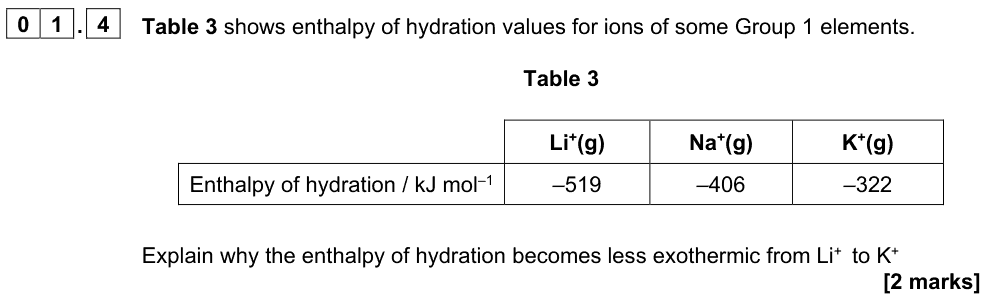
Question 01.4 was more challenging; many students failed to gain the first mark by referring to atoms rather than ions.
Very few students explained that the attraction
Notes from the mark scheme and report
The ions get larger from Li+ to K+ (charge density decreases)
so the attraction between the ion and the δ– oxygen (lone pair) of water is weaker. Must refer to ions and ionic radius, not atoms or atomic radius. Very few described the attraction to water
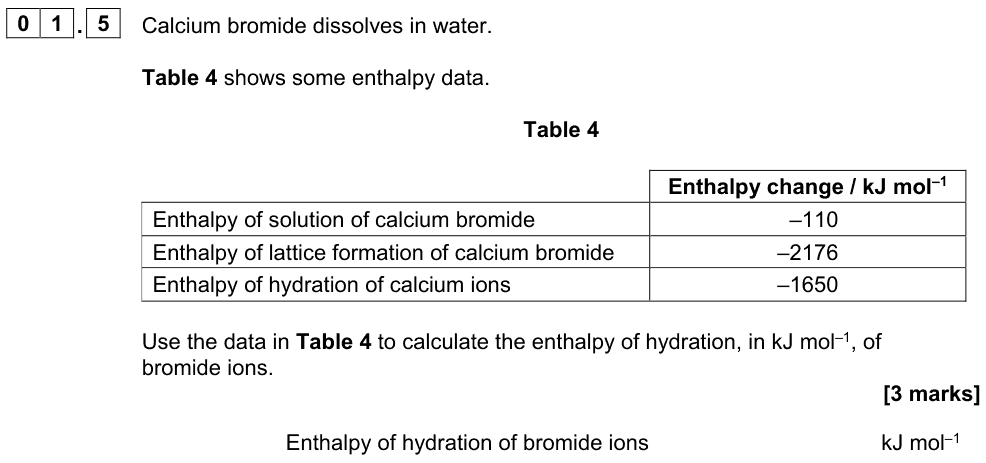
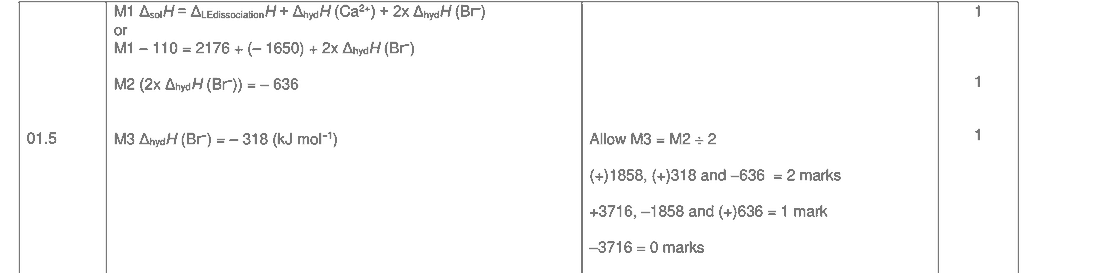
November 2020 · Paper 1 · Q01.53 marksCalculation
Earlier parts of question 01 that this part uses
Mark scheme
Examiner's comment
In 01.5, many students gained all the marks but some students could not construct a correct cycle and therefore struggled.
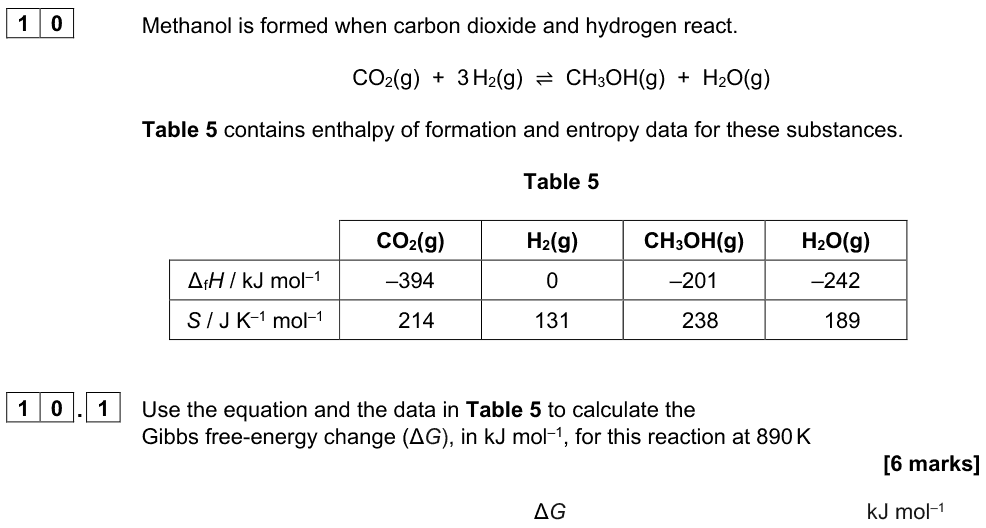
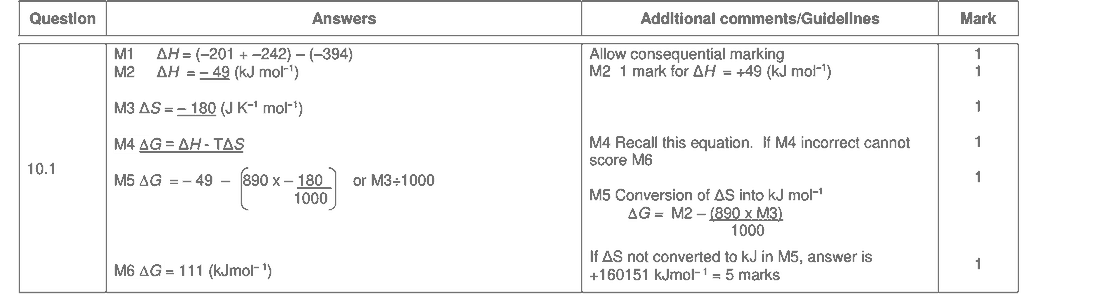
In 10.1, many students calculated the enthalpy change incorrectly as +49 kJ mol–1.
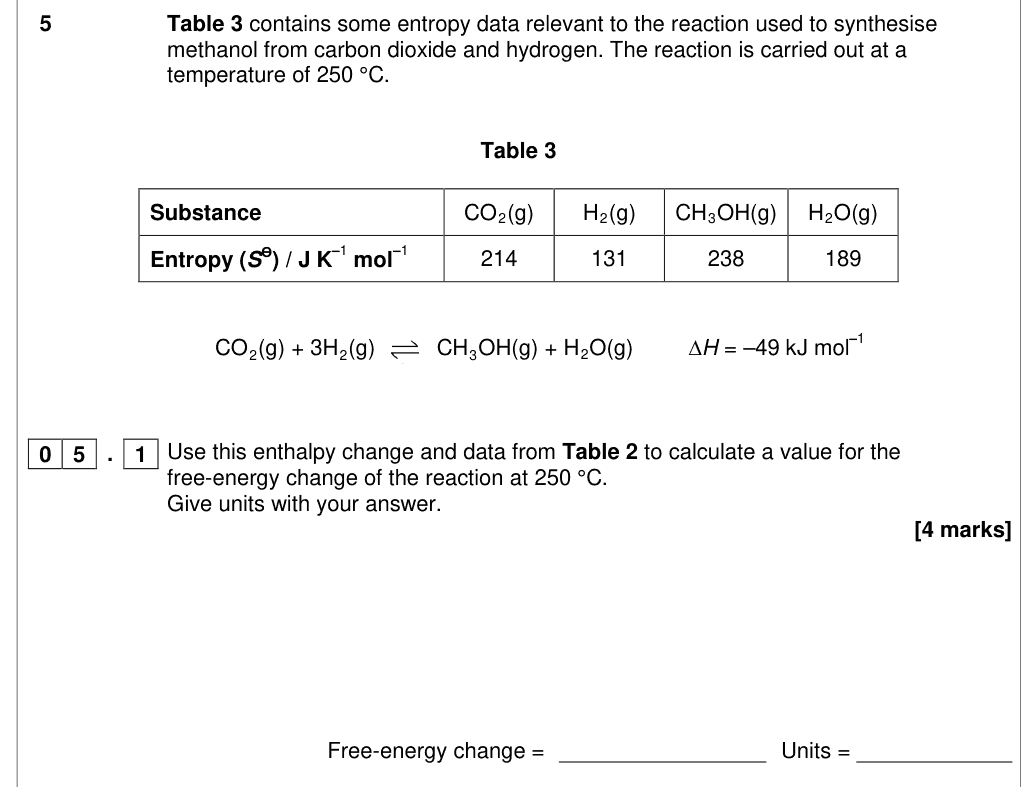
There were several different answers calculated for the entropy change and a few students omitted the conversion into kJ.
Most students knew the equation for the Gibbs free energy change and were thus able to calculate a value for the Gibbs free energy change with their values.
Skills: MS0.0 Recognise and make use of appropriate units in calculation; MS2.3 Substitute numerical values into algebraic equations using appropriate units for physical quantities
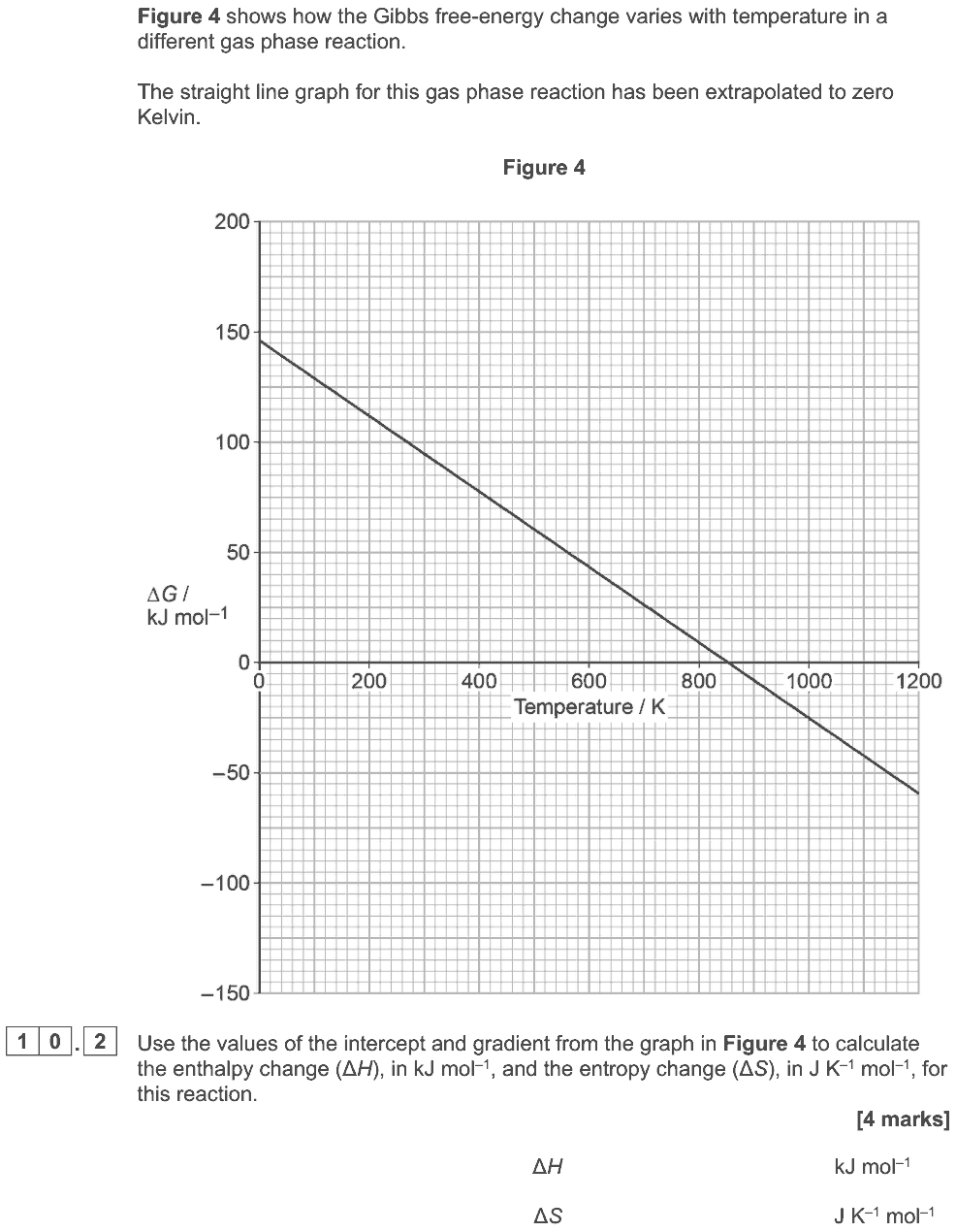
November 2020 · Paper 1 · Q10.24 marksCalculation
Earlier part of question 10 that this part uses
Mark scheme
Examiner's comment
Students found 10.2 challenging.
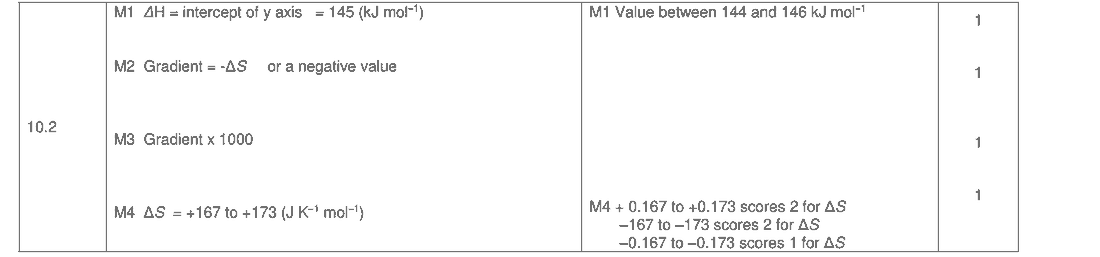
Some students realised that the y-intercept was equal to the ΔH of the reaction and knew that the gradient was –ΔS; these students read the axes carefully and calculated values for the thermodynamic quantities.
A few students interchanged the values for ΔH and ΔS.
× 1000. +0.17 or –170 scores 2 of the 3 ∆S marks. Some swapped ∆H and ∆S
Skills: MS3.1 Translate information between graphical, numerical and algebraic forms; MS3.3 Determine the slope and intercept of a linear graph; MS0.0 Recognise and make use of appropriate units in calculation
November 2020 · Paper 1 · Q10.31 markShort answer
Earlier parts of question 10 that this part uses
Mark scheme
Examiner's comment
Most students knew that a negative ΔG meant that a reaction would be feasible in 10.3.
Students often failed to gain the mark by giving a temperature of 840 K or below or, less commonly, above 860 K.
Notes from the mark scheme and report
The reaction is feasible above 845 K (allow 845 to 860), where ∆G becomes negative
not feasible below. 840 K or lower lost the mark. Uses Figure 4 from 10.2
Skills: MS3.1 Translate information between graphical, numerical and algebraic forms
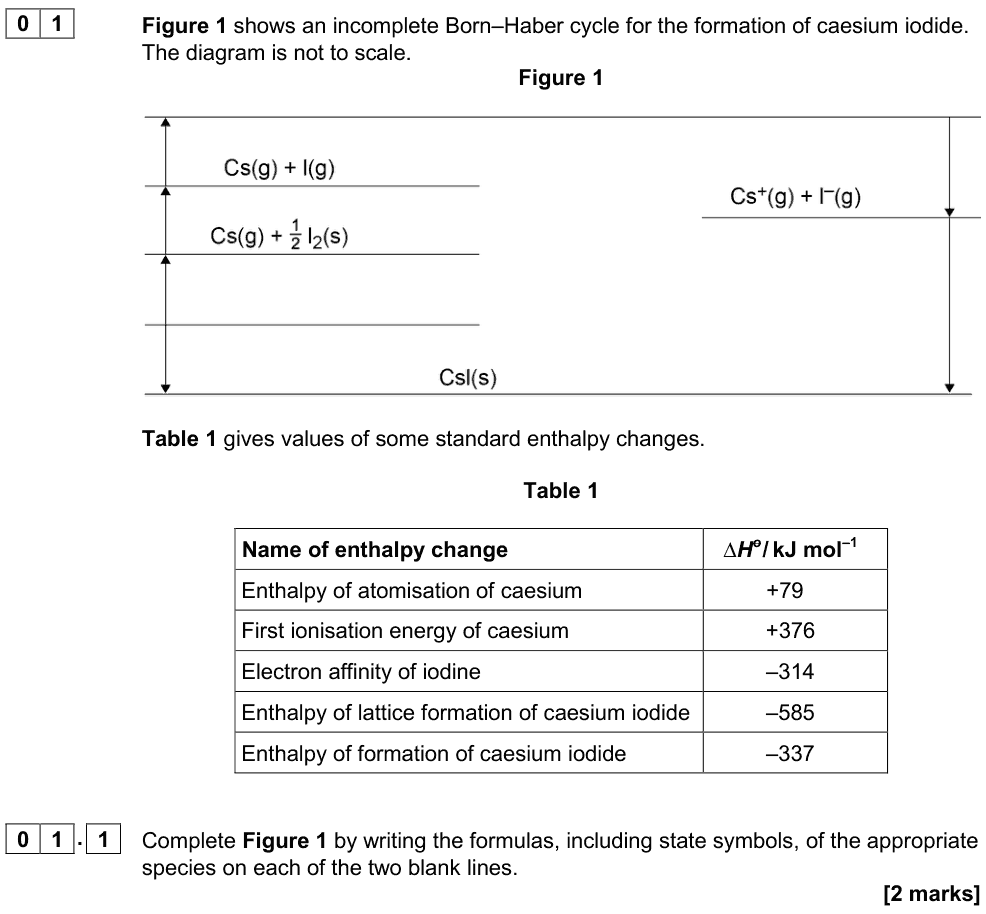
June 2019 · Paper 1 · Q01.12 marksDiagram or structure
Mark scheme
Examiner's comment
1.1 Most students were able to complete the Born−Haber cycle; the most common error was the omission of the electron on the top line.
Notes from the mark scheme and report
Top blank line: Cs+(g) + e– + I(g). Lower blank line: Cs(s) + ½I2(s). State symbols needed. Most common error: leaving out the electron on the top line
June 2019 · Paper 1 · Q01.22 marksCalculation
Earlier part of question 01 that this part uses
Mark scheme
Examiner's comment
1.2 Students found part 2 more difficult; many were able to allocate the correct values to the correct steps in the cycle, but incorrectly reversed the signs of some of the values. Some students either doubled or halved the electron affinity of iodine, and others multiplied the correct answer by 2 or halved it.
doubling or halving the electron affinity or the final answer
Skills: MS2.4 Solve algebraic equations
June 2019 · Paper 1 · Q01.31 markShort answer
Earlier part of question 01 that this part uses
Mark scheme
Examiner's comment
1.3 Here, many students did not realise that the difference between the experimental value and the theoretical value was minimal, and therefore the bonding is very close to purely ionic.
Notes from the mark scheme and report
The bonding is (almost) purely ionic / has very little covalent character, because the experimental (–585) and perfect ionic model (–582) values are nearly the same. Do not refer to atoms or molecules
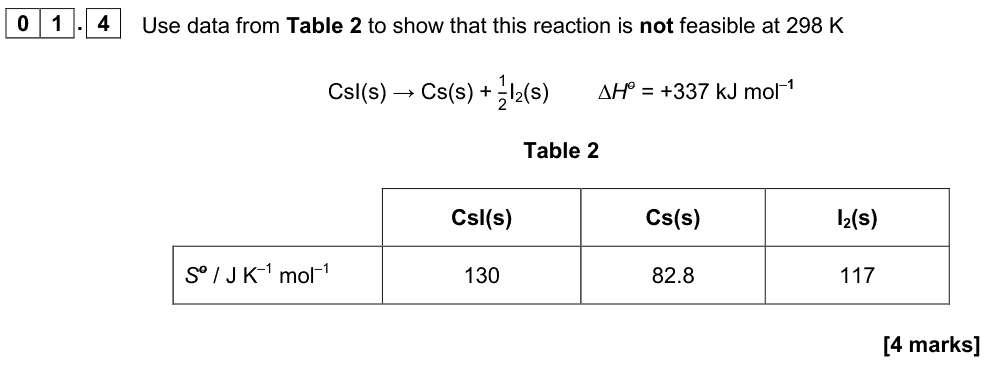
June 2019 · Paper 1 · Q01.44 marksCalculation
Earlier part of question 01 that this part uses
Mark scheme
Examiner's comment
1.4 Many students completed this calculation successfully; common errors included failing to halve the entropy value for iodine, omitting the conversion of temperature to Kelvin, or the conversion of ΔS into kJ mol−1. Some students elicited a correct answer but failed to give any units.
a negative answer loses the last mark. Errors: iodine entropy not halved
∆S not converted to kJ
no units
Skills: MS0.0 Recognise and make use of appropriate units in calculation; MS2.3 Substitute numerical values into algebraic equations using appropriate units for physical quantities
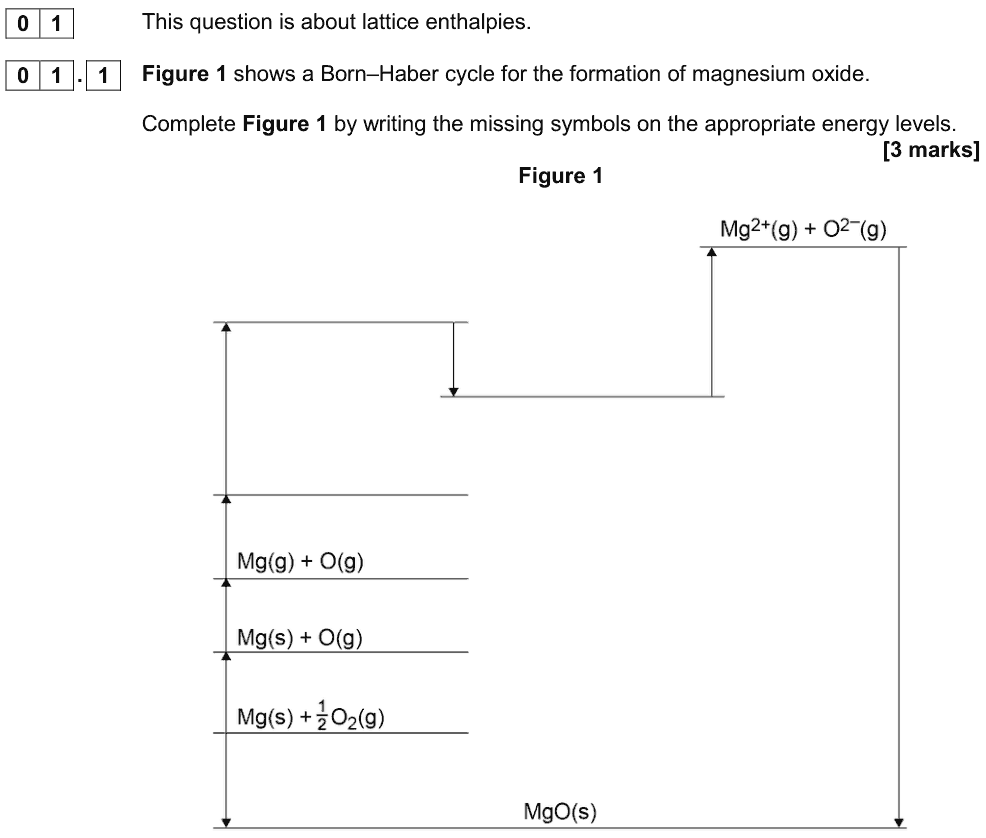
June 2018 · Paper 1 · Q01.13 marksDiagram or structure
Mark scheme
Examiner's comment
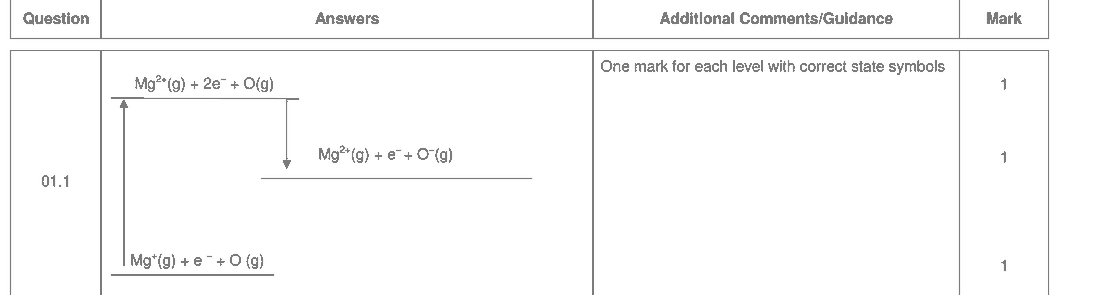
01.1 Over 50% of students answered this part correctly, but some failed to gain maximum marks by omitting state symbols or electrons in the equations.
Notes from the mark scheme and report
From the top of the cycle down: Mg2+(g) + 2e– + O(g)
Mg2+(g) + e– + O–(g)
Mg+(g) + e– + O(g). One mark per level
state symbols needed. Marks lost for omitting state symbols or electrons
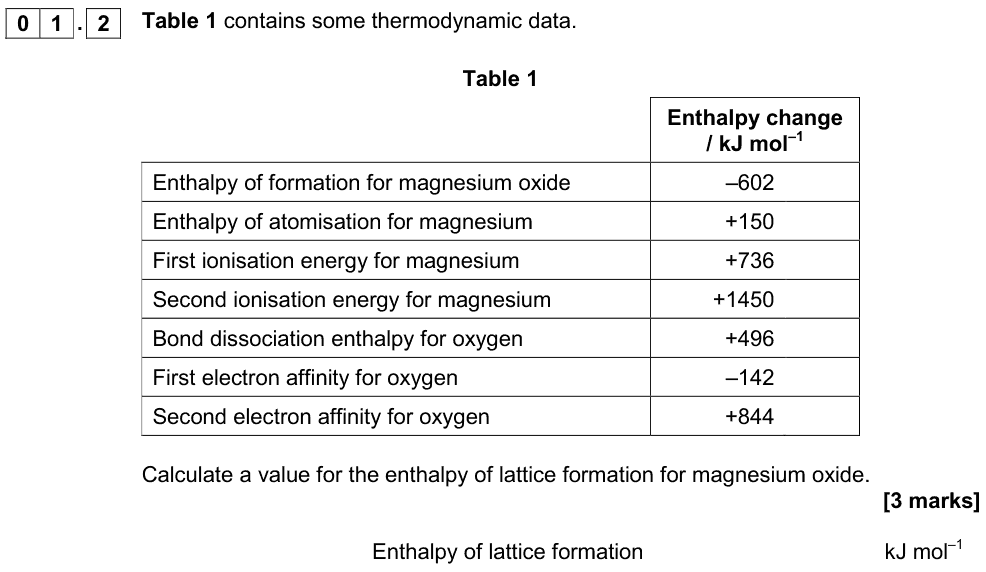
June 2018 · Paper 1 · Q01.23 marksCalculation
Earlier part of question 01 that this part uses
Mark scheme
Examiner's comment
01.2 This was answered less well with many students failing to divide the bond dissociation energy for oxygen by two. Some calculated the enthalpy of lattice dissociation rather than formation. Just over a third of students scored zero here.
Skills: MS2.3 Substitute numerical values into algebraic equations using appropriate units for physical quantities
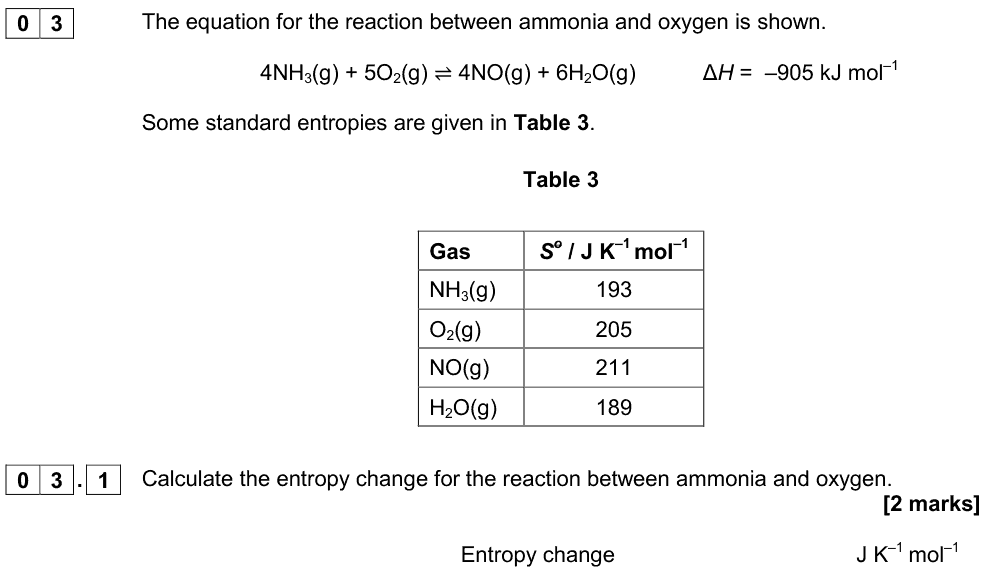
June 2018 · Paper 1 · Q03.22 marksCalculationEasy
Earlier part of question 03 that this part uses
Mark scheme
Examiner's comment
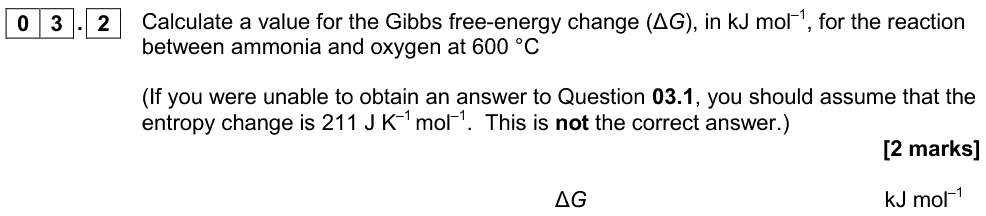
03.2 Although 73.9% of students scored two marks, common errors here included a failure to convert temperature into kelvin or using inconsistent energy units.
–1089 if 211 is used. Errors: temperature not converted to kelvin
∆S left in J
Skills: MS0.0 Recognise and make use of appropriate units in calculation; MS2.3 Substitute numerical values into algebraic equations using appropriate units for physical quantities
June 2018 · Paper 1 · Q03.32 marksExplanation
Earlier part of question 03 that this part uses
Mark scheme
Examiner's comment
03.3 Students found the explanation in part 03.3 more challenging and many could not state that the Gibbs free-energy would become more negative. Many students, however, scored the second mark for a correct reference to a change in entropy.
Notes from the mark scheme and report
∆G becomes more negative, because ∆S is positive so T∆S gets bigger (–T∆S more negative). 'Increases/decreases' is ignored. Consequential on the sign of ∆S in 03.1
June 2018 · Paper 3 · Q141 markMultiple choice
Answer
A
Mark scheme
Notes from the mark scheme and report
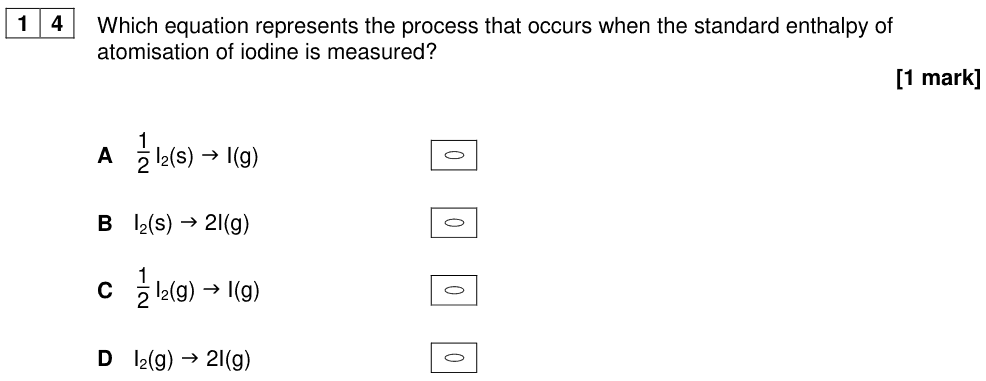
Answer: A. ½I2(s) → I(g): one mole of gaseous atoms from the element in its standard state (iodine is a solid). C starts from gas
B forms two moles of atoms
June 2018 · Paper 3 · Q331 markMultiple choiceHard
Answer
D
Mark scheme
Examiner's comment
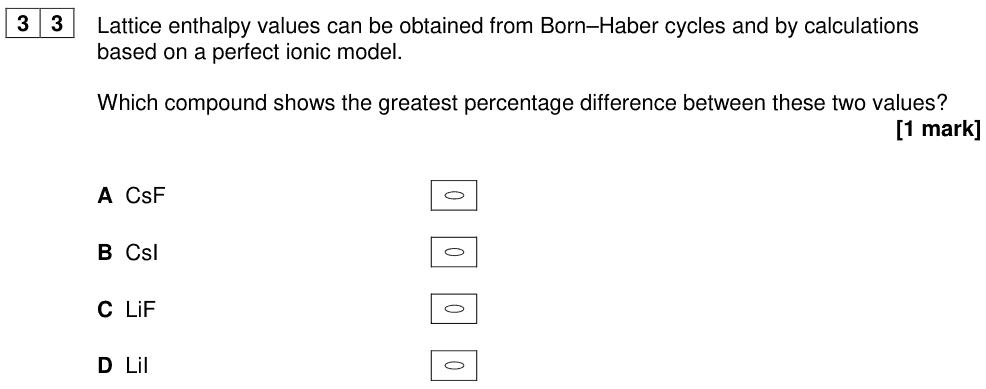
33 The correct response was only the third most ‘popular’ choice for this question, suggesting that this concept is not well known. Poor agreement between theoretical and experimental lattice energy values suggests that the ionic compound has covalent character. This is due to anion polarisation and is most likely when the cation is small with a high charge density and the anion is large (D, chosen by only 23.1% of students). A and C were chosen more often than the correct answer, but the fluoride ion is very resistant to polarisation due to its small size, so fluorides usually match the ionic model and have good agreement between theoretical and experimental values.
Notes from the mark scheme and report
Answer: D. The small, highly polarising Li+ ion distorts the large iodide ion, giving the most covalent character and so the largest gap between Born–Haber and perfect ionic model values
fluoride ions are hard to polarise
June 2017 · Paper 1 · Q01.12 marksShort answer
Mark scheme
Examiner's comment
01.1 The definition was only given by the best students. Some students gave definitions of other enthalpy changes, particularly the enthalpy of formation of a substance. Many students missed the idea that a solid was being formed and some thought that the solid ionic lattice was formed from one mole of gaseous ions.
Notes from the mark scheme and report
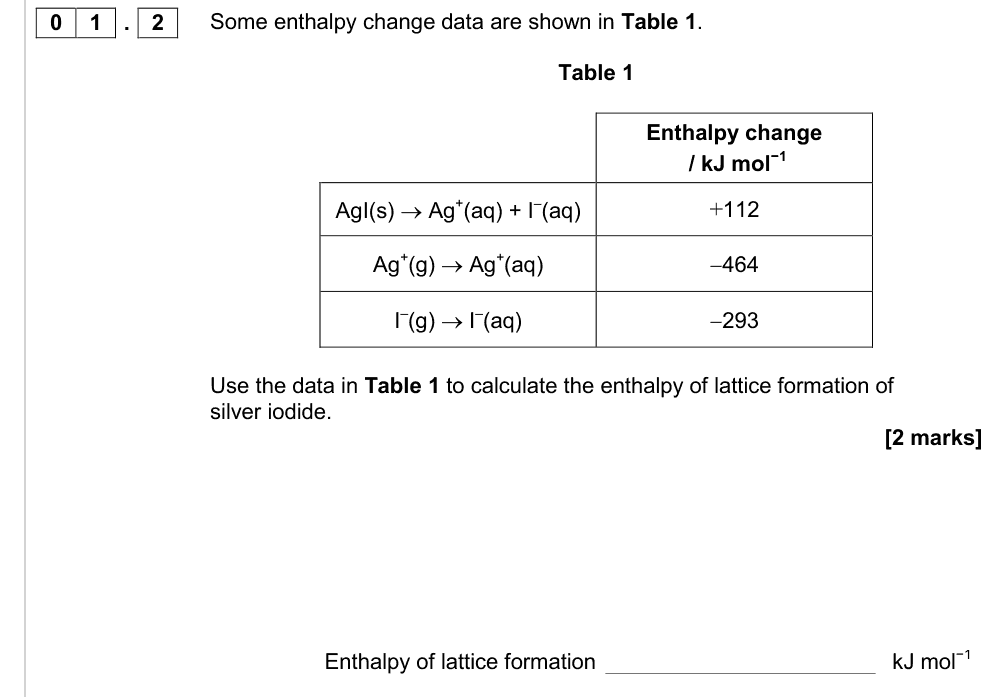
The enthalpy change when 1 mol of a solid ionic compound (ionic lattice) is formed
from its gaseous ions. Allow the equation Ag+(g) + I–(g) → AgI(s). 0/2 for the wrong process (lattice dissociation, enthalpy of formation, 'energy required'). Many missed that a solid is formed, or wrote 'from one mole of gaseous ions'
June 2017 · Paper 1 · Q01.22 marksCalculation
Earlier part of question 01 that this part uses
Mark scheme
Examiner's comment
01.2 Many students were uncertain about the sign of the enthalpy change for lattice formation and +869 kJ mol–1 was a common wrong answer.
lattice formation is the reverse. +869 scores 1 and was the common wrong answer
Skills: MS2.4 Solve algebraic equations
June 2017 · Paper 1 · Q01.32 marksExplanation
Earlier part of question 01 that this part uses
Mark scheme
Examiner's comment
01.3 Many students understood that the lattice was not perfectly ionic and had some covalent character. Linking the covalent character with stronger bonding eluded all but the strongest students.
Notes from the mark scheme and report
AgI has some covalent character (not perfectly ionic / ions distorted, not spherical)
so the forces holding the lattice together are stronger. 0/2 if atoms or molecules. Ignore 'covalent bonds are stronger than ionic'. Few linked covalent character to stronger bonding
June 2017 · Paper 1 · Q05.16 marksCalculation
Mark scheme
Examiner's comment
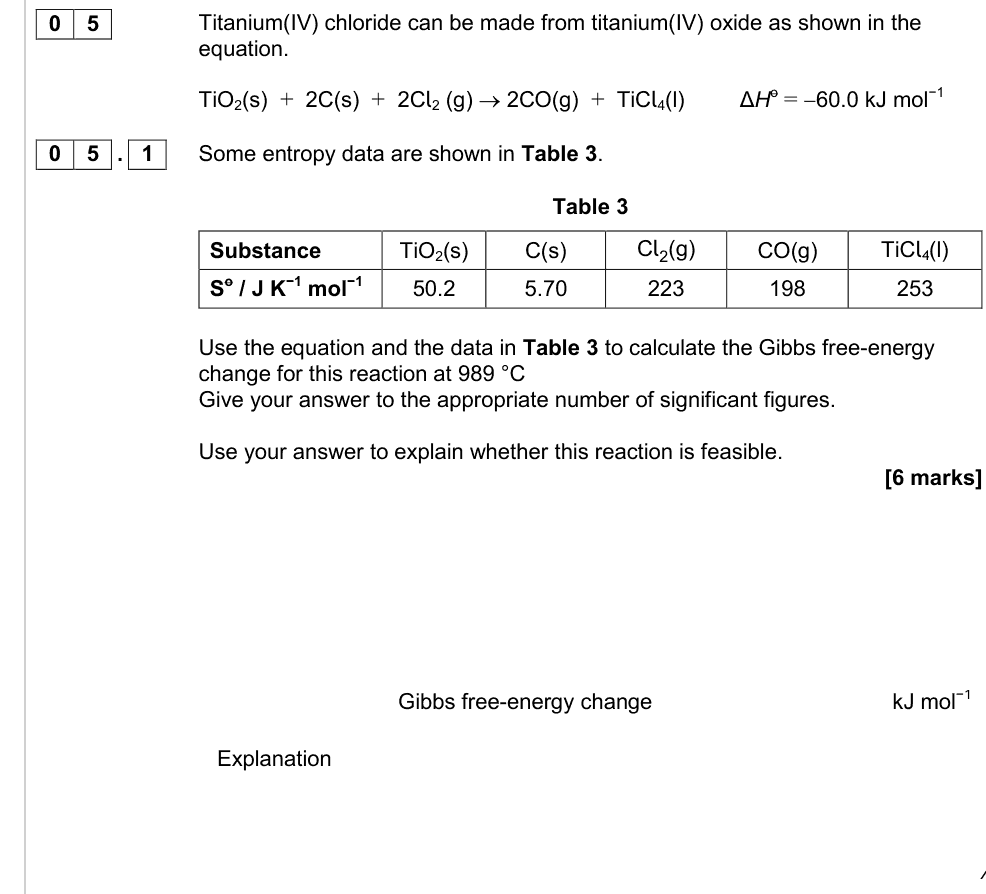
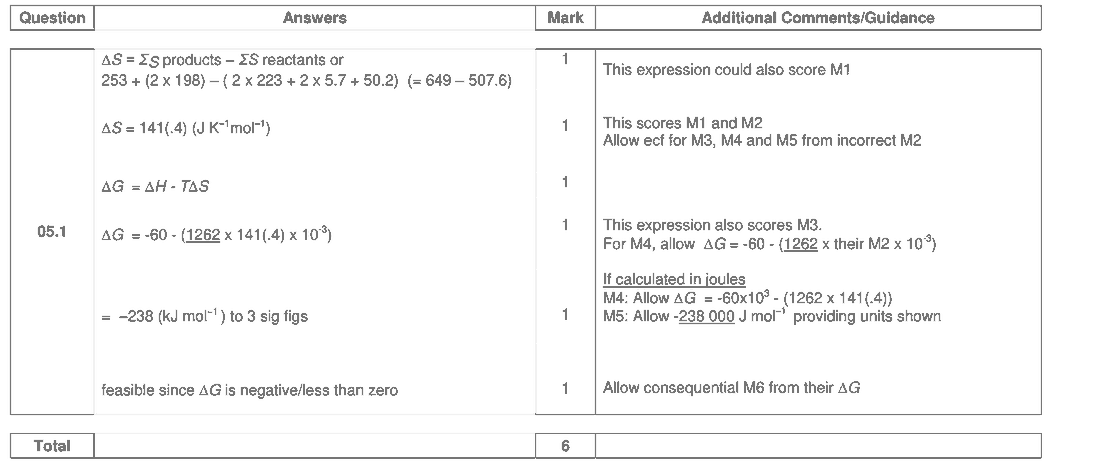
Most students calculated ΔS correctly and gave the correct expression for ΔG. Many students then went on to calculate the value of ΔG correctly. Some students failed to convert the temperature to a value in kelvin, some failed to convert the energy into kilojoules, and some did not give the value of ΔG to the required precision.
∆G = –60.0 – (1262 × 141.4 × 10^–3). Errors: temperature left in °C
∆S not converted to kJ
wrong precision
Skills: MS0.0 Recognise and make use of appropriate units in calculation; MS1.1 Use an appropriate number of significant figures; MS2.3 Substitute numerical values into algebraic equations using appropriate units for physical quantities
June 2017 · Paper 3 · Q01.45 marksCalculationHard
Earlier part of question 01 that this part uses
Mark scheme
Examiner's comment
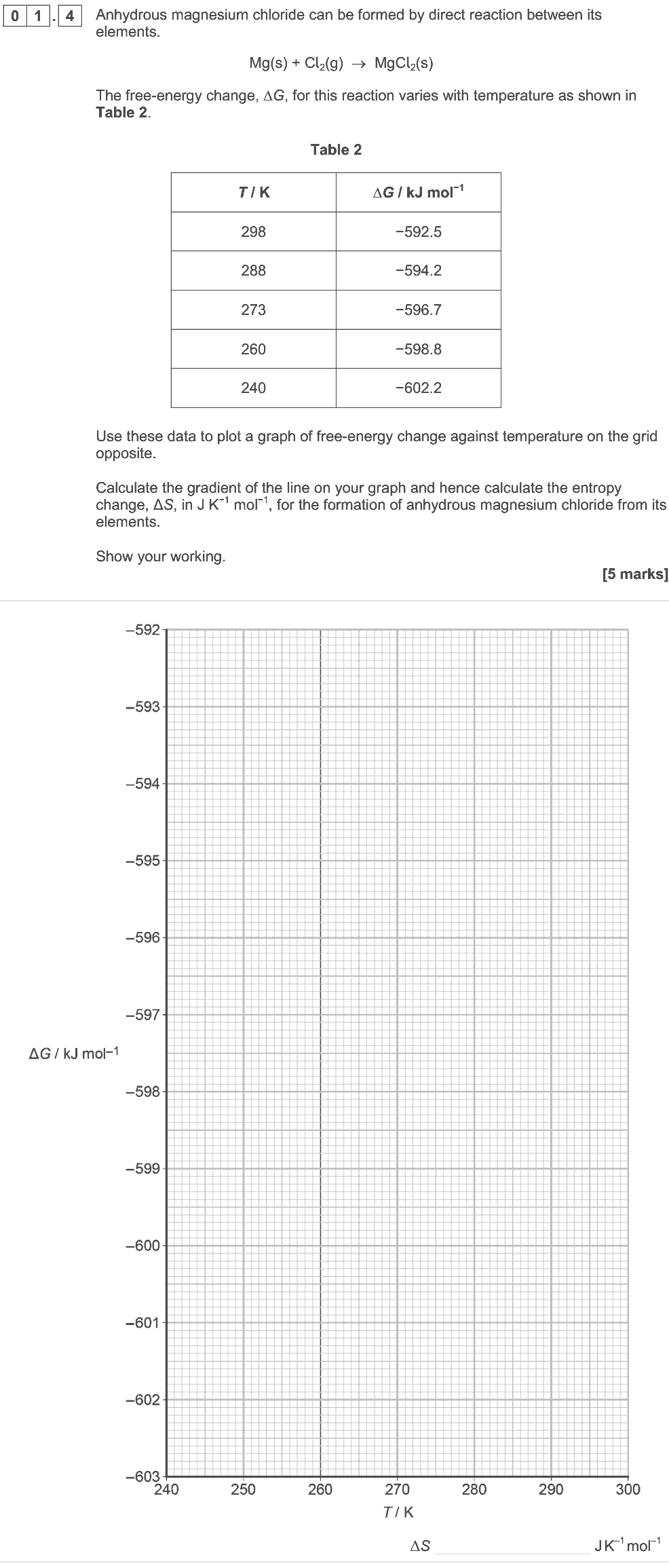
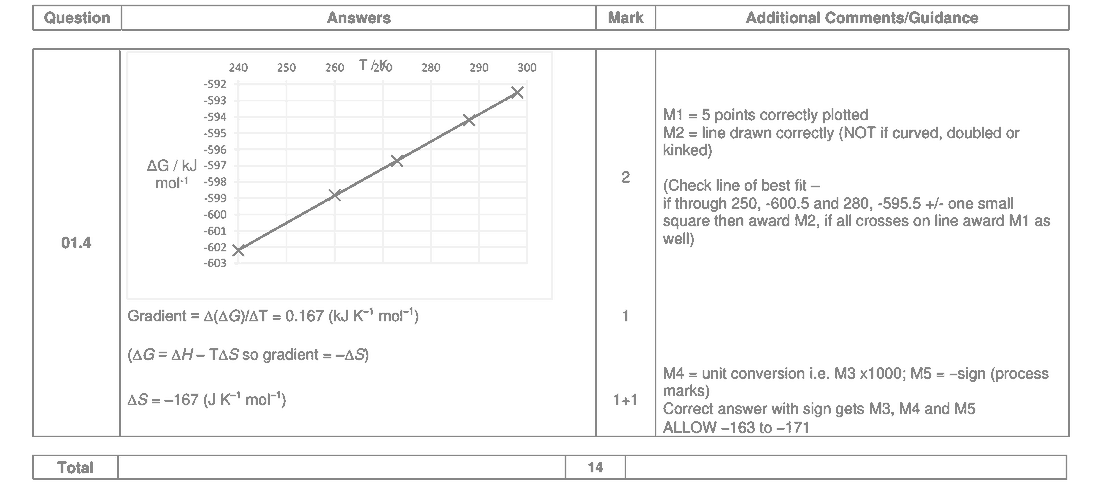
01.4 This was a challenging question but one for which it proved relatively easy to score two marks; nearly 20% of students scored full marks here. Most students could successfully plot the points and draw a best fit line, although the negative scale on the y-axis confused some. Most students were also able to calculate the gradient of their line, although, as mentioned previously, it was not always clear what their suggested answer was. The calculation of ∆S proved trickier, with many trying to use the relationship ∆G = ∆H − T∆S, and either ignoring their calculated gradient or substituting it in for ∆H. Relatively few students recognised that this equation can be taken as y = mx + c (y = c – xm in this case) so that this graph of ∆G (y) vs T (x) gives a straight line with a gradient of −∆S.
Notes from the mark scheme and report
Answer: ∆S = –167 J K–1 mol–1 (allow –163 to –171). Plot the five points and draw a straight best-fit line (2 marks)
gradient = ∆(∆G) ÷ ∆T = +0.167 kJ K–1 mol–1
since ∆G = ∆H – T∆S the gradient = –∆S
× 1000 for J, with the negative sign. Errors: substituting the gradient as ∆H
ignoring the gradient
unlabelled working
confusion over the negative y scale
Skills: MS0.0 Recognise and make use of appropriate units in calculation; MS3.1 Translate information between graphical, numerical and algebraic forms; MS3.2 Plot two variables from experimental or other data; MS3.3 Determine the slope and intercept of a linear graph
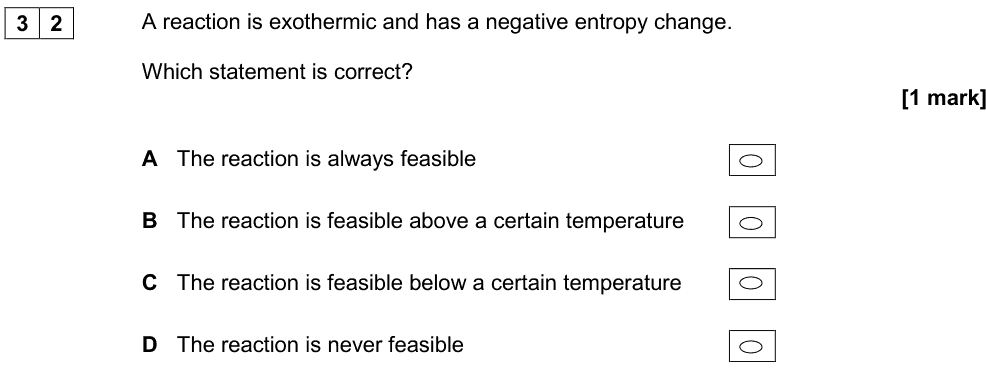
June 2017 · Paper 3 · Q321 markMultiple choice
Answer
C
Mark scheme
Notes from the mark scheme and report
Answer: C. ∆G = ∆H – T∆S with ∆H and ∆S both negative: –T∆S is positive, so ∆G is negative only at low temperatures
∆G = ∆H – T∆S = –49 – 523 × (–180 ÷ 1000). The question says Table 2 but the entropy data are in Table 3
Skills: MS0.0 Recognise and make use of appropriate units in calculation; MS2.3 Substitute numerical values into algebraic equations using appropriate units for physical quantities
Specimen · Paper 1 · Q05.22 marksCalculation
Earlier part of question 05 that this part uses
Mark scheme
Notes from the mark scheme and report
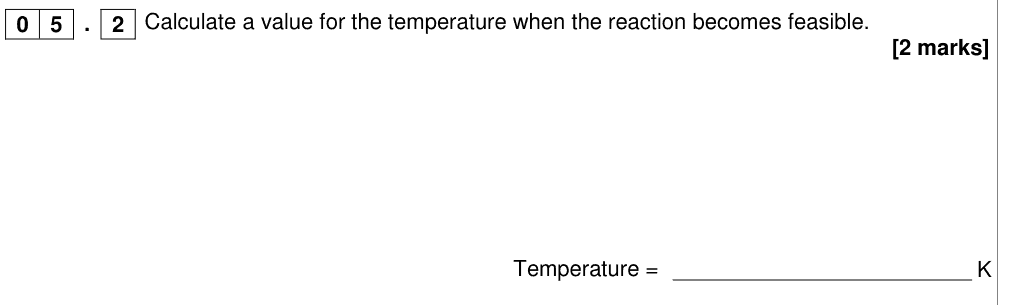
Answer: 272 K. When ∆G = 0, T = ∆H/∆S = (–49 × 1000) ÷ (–180). Error carried forward from ∆S in 05.1
Skills: MS2.2 Change the subject of an equation
Specimen · Paper 1 · Q08.52 marksExplanation
Earlier parts of question 08 that this part uses
Mark scheme
Notes from the mark scheme and report
3 particles form 5 particles, so disorder increases / the entropy change is positive
therefore the free-energy change is negative (∆G = ∆H – T∆S). Second mark only if the first is correct