Notes and key-term cards for this topic are being written by our tutors. The past-paper questions below are ready now.
Specification statements
Show the 4 statements from the specification
3.3.7-01 Optical isomerism is a form of stereoisomerism and occurs as a result of chirality in molecules, limited to molecules with a single chiral centre.
3.3.7-02 An asymmetric carbon atom is chiral and gives rise to optical isomers (enantiomers), which exist as non super- imposable mirror images and differ in their effect on plane polarised light.
3.3.7-03 A mixture of equal amounts of enantiomers is called a racemic mixture (racemate).
3.3.7-04 Students should be able to: • draw the structural formulas and displayed formulas of enantiomers • understand how racemic mixtures (racemates) are formed and why they are optically inactive.
Six-mark level of response questions on this topic
Tap a question to zoom it. Where a part needs a figure, table or structure from earlier in the question, that part folds out above it; the mark scheme and examiner's comment open underneath. Have AQA's Data Booklet (the Periodic Table and the spectroscopy tables) beside you.
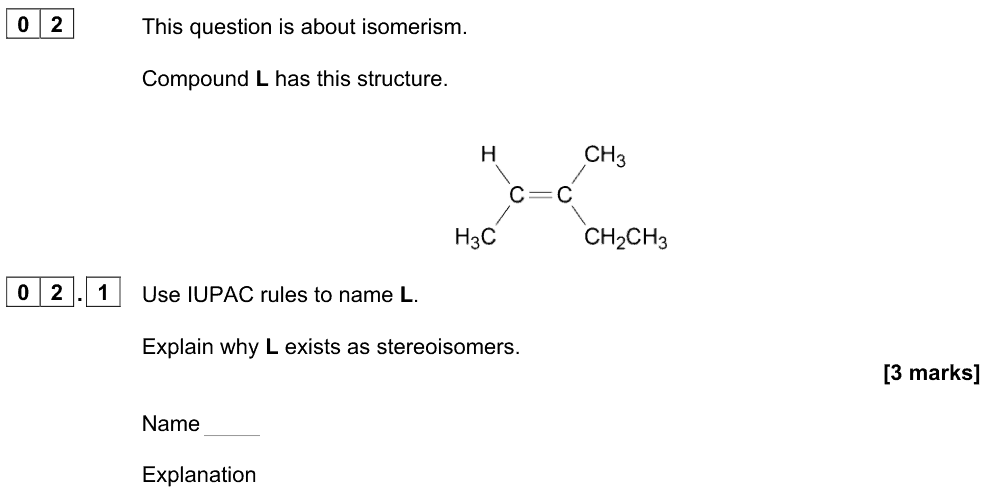
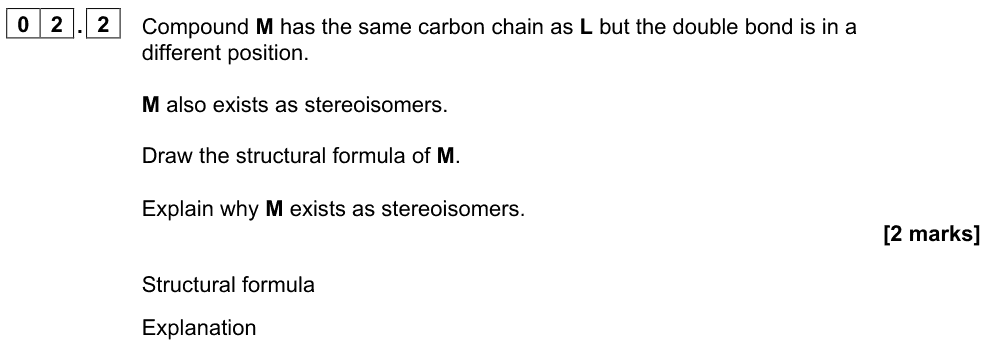
June 2025 · Paper 2 · Q02.22 marksAO2=2Diagram or structure
Earlier part of question 02 that this part uses
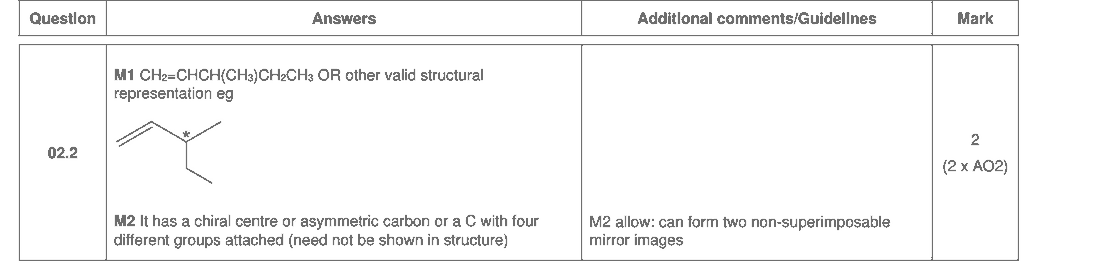
Mark scheme
Examiner's comment
2.2 This question required students to move the C=C double bond but keep the carbon skeleton the same to deduce that compound M existed as stereoisomers because it has a chiral centre. This proved very challenging and fewer than expected were able to get started here.
Notes from the mark scheme and report
M is 3-methylpent-1-ene, CH2=CHCH(CH3)CH2CH3
it has a chiral centre (a carbon with four different groups attached), so it forms non-superimposable mirror images. Found very challenging
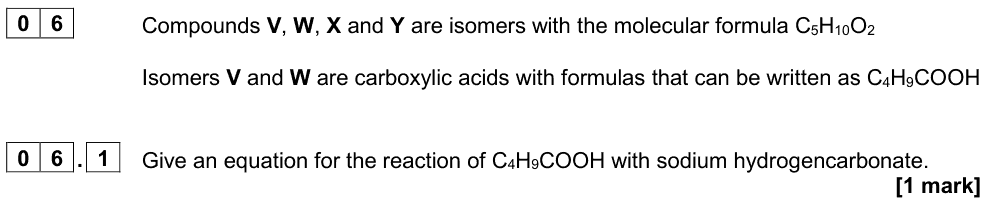
June 2024 · Paper 2 · Q06.21 markAO2=1Diagram or structure
Earlier part of question 06 that this part uses
Mark scheme
Examiner's comment
6.2 Again this was quite well answered with nearly 50% gaining the mark for a structure with an asymmetric carbon atom.
Notes from the mark scheme and report
CH3CH2CH(CH3)COOH (2-methylbutanoic acid): C2 carries four different groups
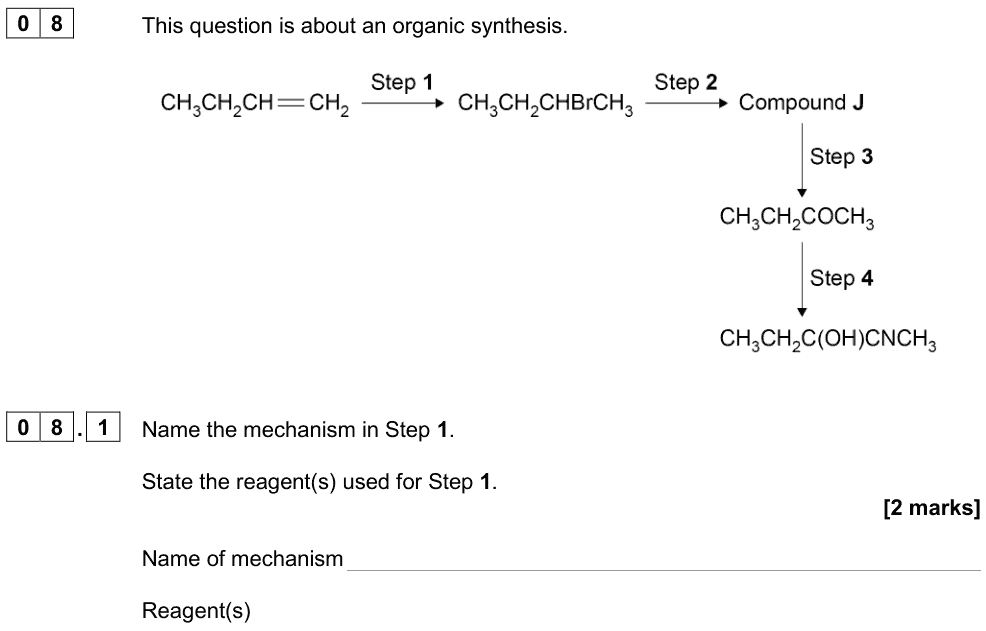
June 2024 · Paper 2 · Q08.43 marksAO2=3ExplanationHard
Earlier part of question 08 that this part uses
Mark scheme
Examiner's comment
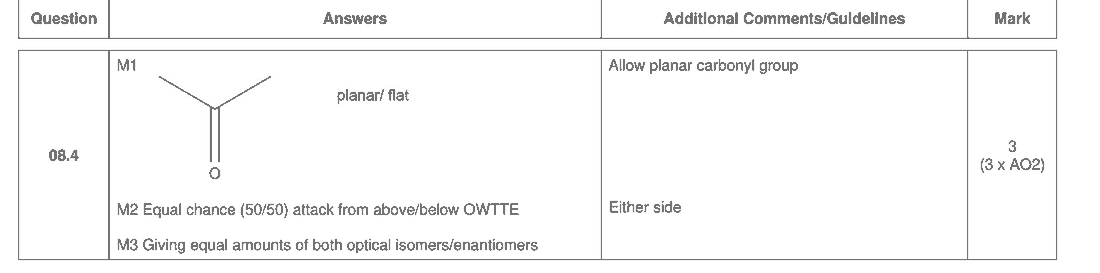
8.4 Students often stated that the C=O bond is planar without including the other atoms attached to the C. As such, M1 was often missed although M2 and M3 were available. As a consequence, only around 12% scored all 3 marks but over 43% scored 2 marks.
Notes from the mark scheme and report
The carbonyl group (the C=O carbon and the atoms bonded to it) is planar
so :CN– has an equal chance of attacking from above or below
giving equal amounts of the two enantiomers. Saying only that the C=O bond is planar missed M1
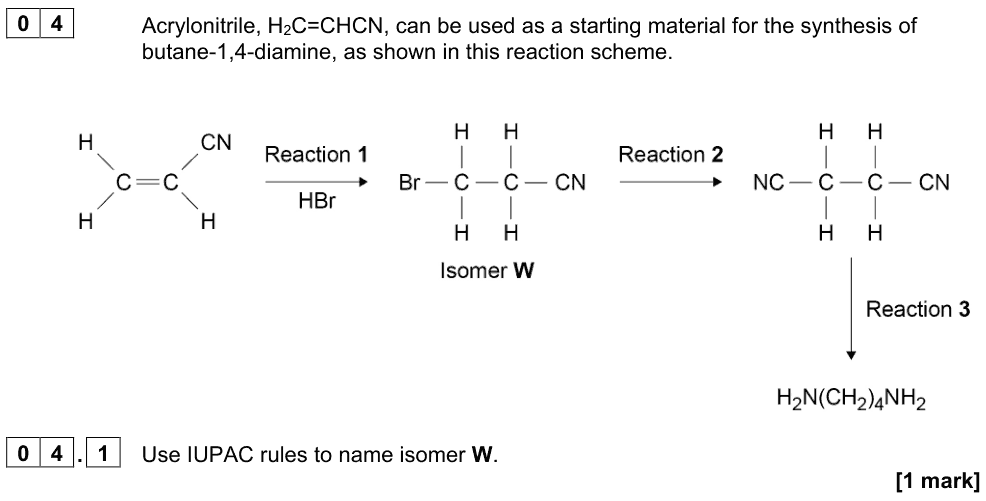
June 2023 · Paper 2 · Q04.26 marksAO1=3, AO3=36-mark level of response
Earlier part of question 04 that this part uses
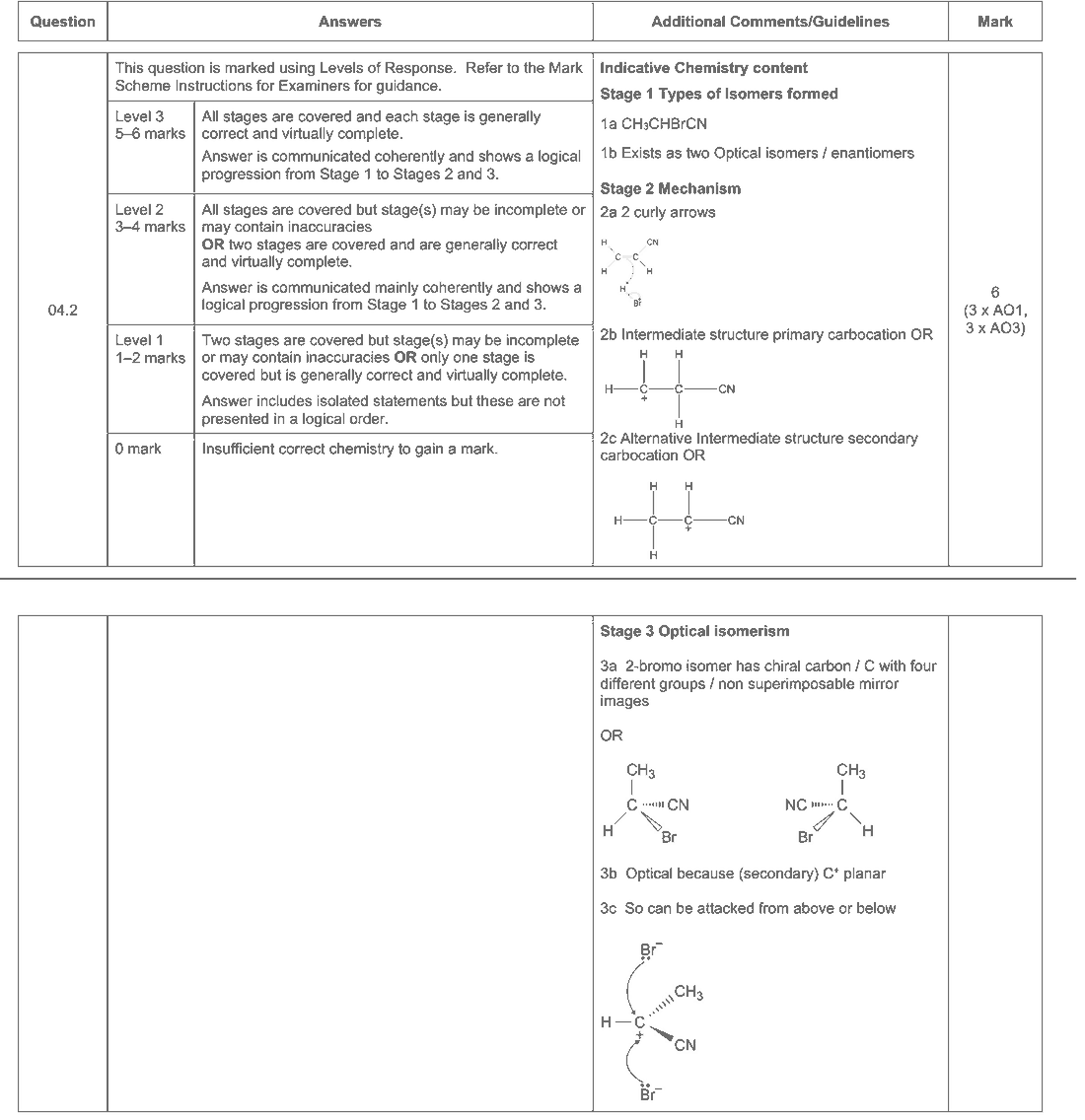
Mark scheme, with the levels and indicative content
Examiner's comment
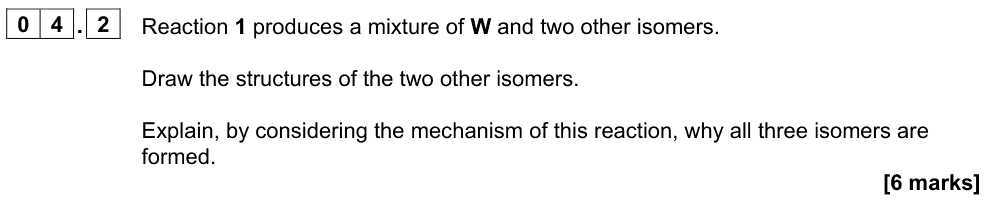
04.2 This was the levels of response question and the vast majority of students were able to get started, and access levels 1 or 2 by showing good knowledge of the electrophilic addition mechanism. Some students struggled because they did not show the mechanistic steps using curly arrows. The indicative content did allow for this and students could describe aspects of the mechanism in words, but it was much easier to do this via diagrams showing structures. Level 3 proved much more difficult, with many failing to recognise that optical isomers were possible as a result of attack on the planar secondary carbocation from above or below the plane.
Notes from the mark scheme and report
Levels of response, three stages. Isomers: CH3CHBrCN (2-bromopropanenitrile), which exists as two optical isomers (enantiomers). Mechanism (electrophilic addition): curly arrow from the C=C bond to H of H–Br and from the H–Br bond to Br
the primary carbocation +CH2CH2CN leads to W and the secondary carbocation CH3C+HCN leads to the 2-bromo isomer. Optical isomerism: the 2-bromo isomer has a chiral carbon with four different groups
the secondary carbocation is planar, so Br– can attack from above or below, giving both enantiomers. Most reached level 1 or 2
level 3 needed the planar carbocation argument. Mechanisms are easier to credit when drawn with curly arrows
June 2022 · Paper 3 · Q03.62 marksAO2=1, AO3=1Diagram or structure
Earlier part of question 03 that this part uses
Mark scheme
Examiner's comment
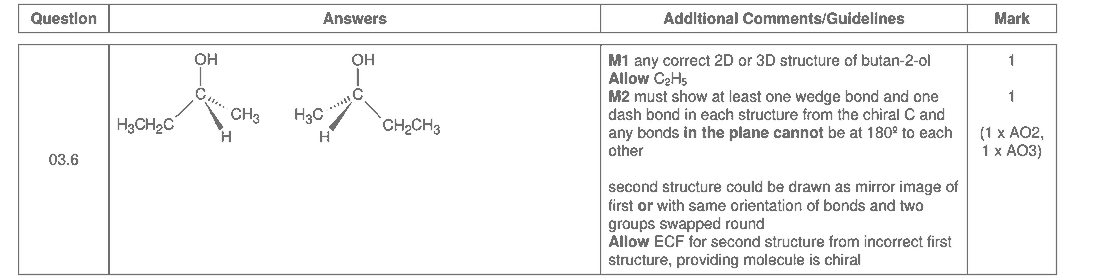
03.6 showed that more practice is needed by some students at drawing 3D representations in a conventional manner.
The recommended style is:
Notes from the mark scheme and report
Two tetrahedral drawings of butan-2-ol, CH3CH(OH)CH2CH3, around the chiral carbon, each with at least one wedge and one dashed bond (in-plane bonds not at 180°), drawn as mirror images (or with two groups swapped). One mark for a correct butan-2-ol structure, one for the 3D pair
Skills: MS4.2 Visualise and represent 2D and 3D forms including two-dimensional representations of 3D objects; MS4.3 Understand the symmetry of 2D and 3D shapes
November 2021 · Paper 2 · Q06.11 markDiagram or structure
Mark scheme
Examiner's comment
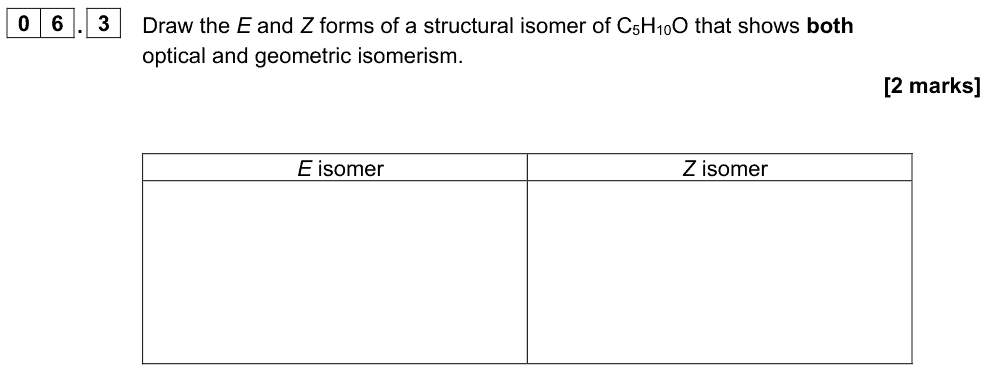
Answers to question 06.3 about the E and Z forms of a structure that shows both geometric and optical isomerism were very poor and over 70% of students failed to score either mark. Questions 06.2 and 06.4 proved more accessible.
Notes from the mark scheme and report
Skeletal formula of 2-methylbutanal, CH3CH2CH(CH3)CHO: the carbon next to the CHO group carries H, CH3, C2H5 and CHO, so it is a chiral centre
November 2021 · Paper 2 · Q06.22 marksShort answer
Earlier part of question 06 that this part uses
Mark scheme
Examiner's comment
Questions 06.2 and 06.4 proved more accessible.
Notes from the mark scheme and report
Pass plane polarised light through each sample
the enantiomers rotate the plane of polarisation in opposite directions
November 2021 · Paper 2 · Q06.32 marksDiagram or structureHard
Earlier part of question 06 that this part uses
Mark scheme
Examiner's comment
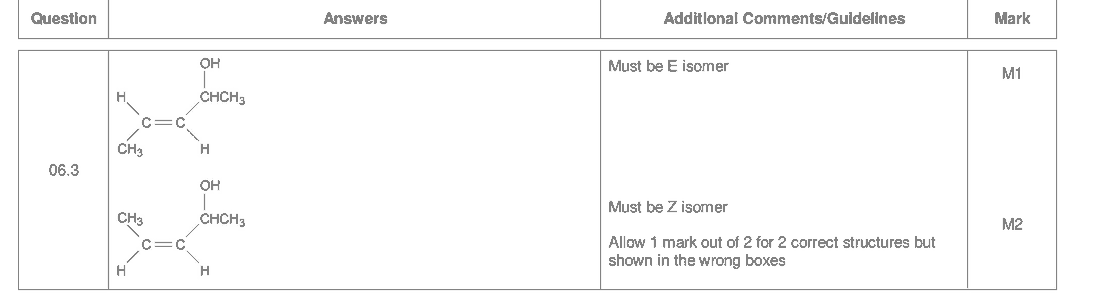
Answers to question 06.3 about the E and Z forms of a structure that shows both geometric and optical isomerism were very poor and over 70% of students failed to score either mark.
Notes from the mark scheme and report
Pent-3-en-2-ol, CH3CH=CHCH(OH)CH3 (C=C with different groups on each carbon plus a chiral C–OH carbon). E isomer: CH3 and CH(OH)CH3 on opposite sides of the C=C
Z isomer: on the same side. Two correct structures in the wrong boxes score 1
Skills: MS4.2 Visualise and represent 2D and 3D forms including two-dimensional representations of 3D objects
November 2020 · Paper 2 · Q02.11 markShort answer
Mark scheme
Examiner's comment
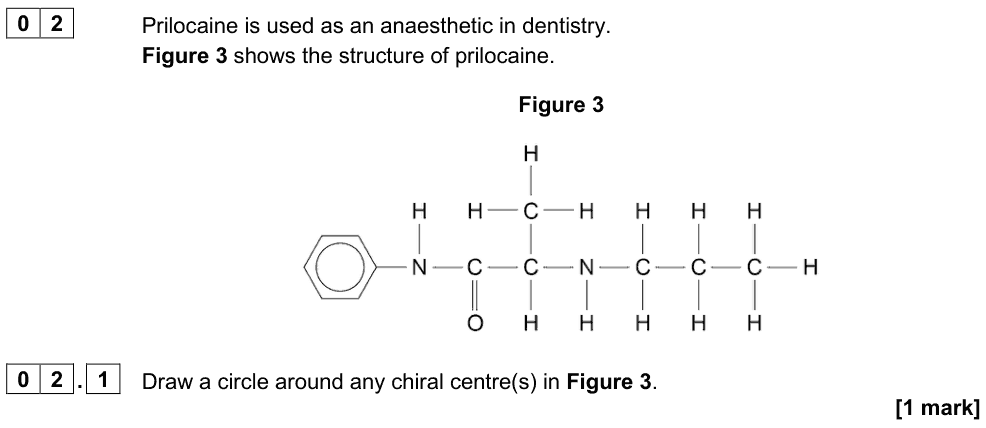
The chiral centre in 02.1 proved very accessible to students but a surprising number were unable, in 02.2, to identify the functional groups present.
The most common wrong answers showed that students thought that the molecule had a ketone functional group.
Others failed to recognise that the prilocaine contained an amine functional group.
Notes from the mark scheme and report
Circle only the carbon bonded to CH3, H, C=O and NH (the carbon between the amide C=O and the amine N)
Skills: MS4.3 Understand the symmetry of 2D and 3D shapes
November 2020 · Paper 3 · Q261 markMultiple choice
Answer
A
Mark scheme
Notes from the mark scheme and report
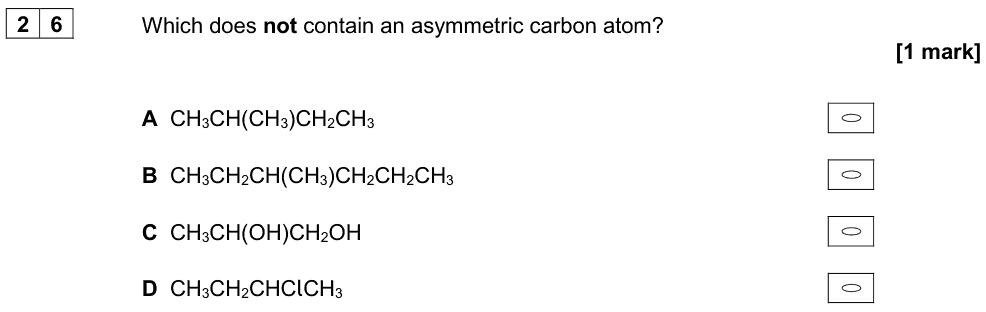
Answer: A. In 2-methylbutane C2 carries two identical CH3 groups
B (C3), C (C2) and D (C2) each have a carbon with four different groups
June 2019 · Paper 2 · Q01.51 markShort answer
Earlier part of question 01 that this part uses
Mark scheme
Examiner's comment
01.5 This part was answered well by most students.
Notes from the mark scheme and report
No carbon atom is attached to four different groups: the central carbon has two identical ethyl groups (the molecule is symmetrical)
June 2019 · Paper 3 · Q04.25 marksDiagram or structure
Earlier part of question 04 that this part uses
Mark scheme
Examiner's comment
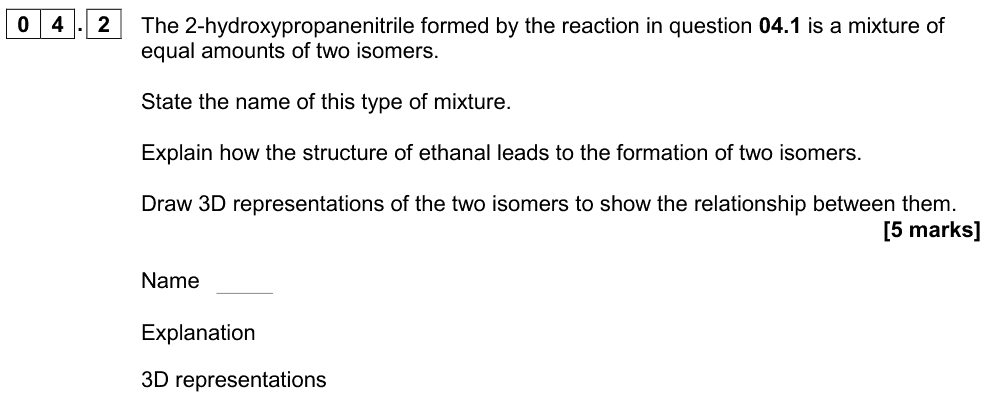
4.2 A key phrase in this question was “explain how the structure of ethanal leads to the formation of two isomers”. This wording was unfortunately missed by many students who instead referred to the structure of the product and wrote about the chiral carbon. Those who recognised the need to refer to the planar carbonyl group sometimes made the mistake of referring to ethanal itself as planar – which is not true for the whole molecule. There are many different ways of drawing 3D representations, but the style shown in the mark scheme is recommended for clarity. Enantiomers should either be shown by drawing the second image as a mirror of the first, or by drawing the same orientation as the first but with two groups swapped round.
Notes from the mark scheme and report
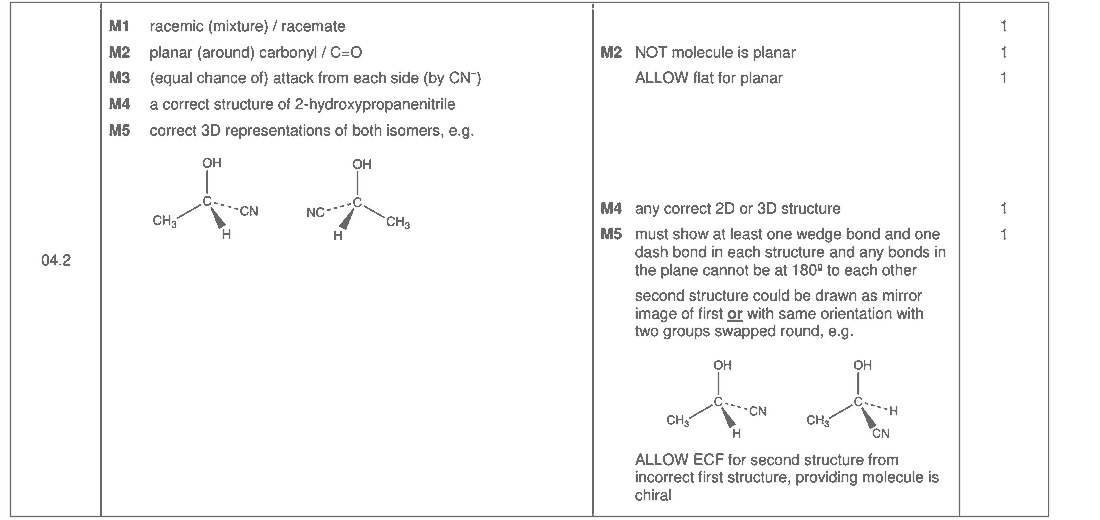
Racemic mixture (racemate)
the carbonyl group is planar
CN– has an equal chance of attacking from either side
a correct structure of CH3CH(OH)CN
two 3D drawings (wedge and dash bonds) that are mirror images, or the same orientation with two groups swapped. Not 'the molecule is planar'. Many wrote about the chiral carbon in the product instead of the structure of ethanal
Skills: MS4.2 Visualise and represent 2D and 3D forms including two-dimensional representations of 3D objects
June 2017 · Paper 2 · Q04.22 marksShort answer
Earlier part of question 04 that this part uses
Mark scheme
Examiner's comment
04.2 Although this question was answered well by most, an appreciable number of students were careless with language and appeared to say that the enantiomers themselves rotate, or that the plane polarised light is ‘refracted’ or ‘bent’ rather than ‘rotated in opposite directions’.
Notes from the mark scheme and report
Use plane polarised light
the two enantiomers rotate the plane in opposite directions. 'Different' alone is not enough
the light is rotated, not bent or refracted, and it is not the molecules that rotate
June 2017 · Paper 2 · Q04.33 marksExplanation
Earlier part of question 04 that this part uses
Mark scheme
Examiner's comment
04.3 The first mark was less commonly scored than expected as many students wrote about a planar molecule or a planar bond rather than planar carbonyl group; the other two marks were frequently awarded.
Notes from the mark scheme and report
The carbonyl group (C=O carbon) is planar
the CN– can attack from either side
with equal probability, giving equal amounts of the two enantiomers. Not 'planar molecule' or 'planar bond'
June 2017 · Paper 2 · Q04.42 marksDiagram or structure
Earlier part of question 04 that this part uses
Mark scheme
Examiner's comment
04.4 A significant number were not able to deduce the correct product and many incorrect products were seen. These included the cyanohydrin formed from pentanal. This showed a lack of care in reading the question.
Notes from the mark scheme and report
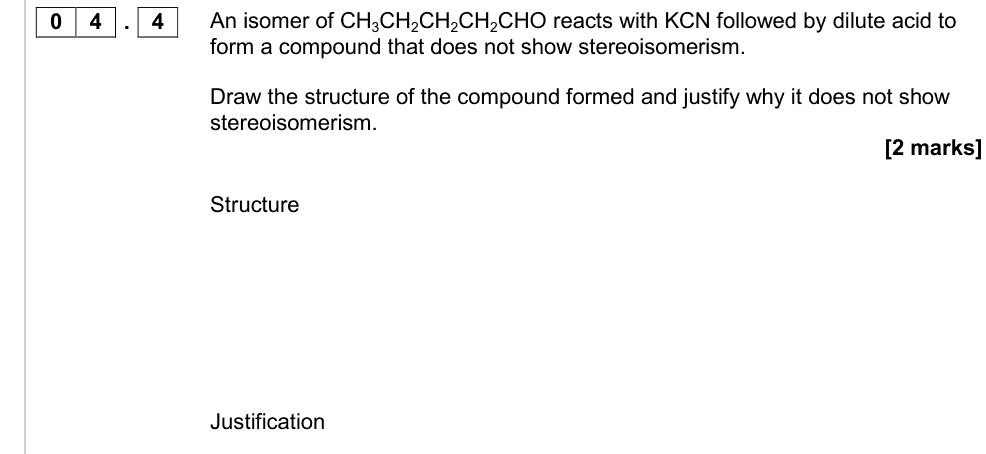
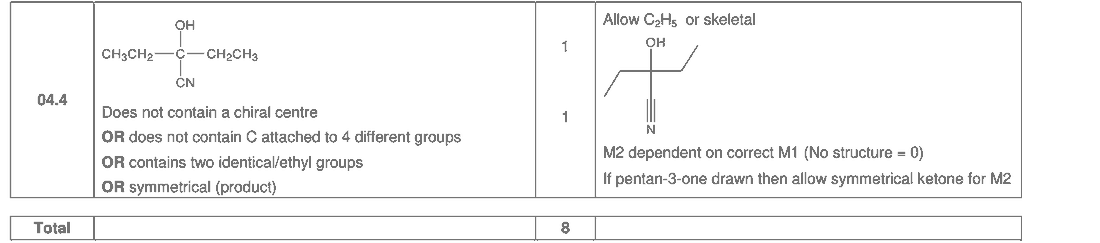
(CH3CH2)2C(OH)CN, from pentan-3-one
it has no chiral centre: the carbon has two identical ethyl groups, not four different groups. M2 depends on the correct structure. Common error: the hydroxynitrile from pentanal
June 2017 · Paper 3 · Q131 markMultiple choice
Answer
D
Mark scheme
Notes from the mark scheme and report
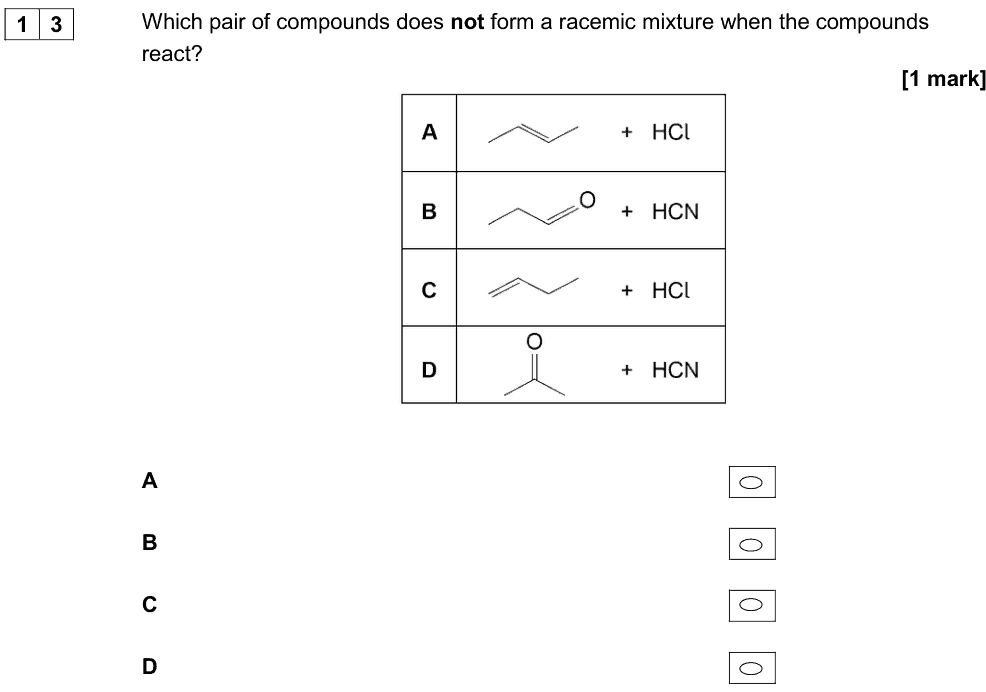
Answer: D. Propanone and HCN give 2-hydroxy-2-methylpropanenitrile, which has two identical methyl groups on the carbon and so no chiral centre. A and C both give 2-chlorobutane and B gives 2-hydroxybutanenitrile, each chiral and formed as a racemate
June 2017 · Paper 3 · Q241 markMultiple choice
Answer
D
Mark scheme
Notes from the mark scheme and report
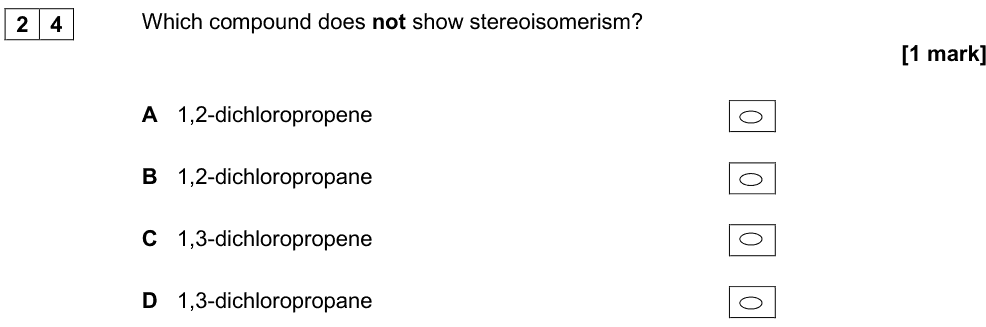
Answer: D. 1,3-dichloropropane has no C=C bond and no chiral carbon. The two dichloropropenes show E–Z isomerism and 1,2-dichloropropane has a chiral centre
Specimen · Paper 2 · Q03.52 marksDiagram or structure
Earlier part of question 03 that this part uses
Mark scheme
Notes from the mark scheme and report
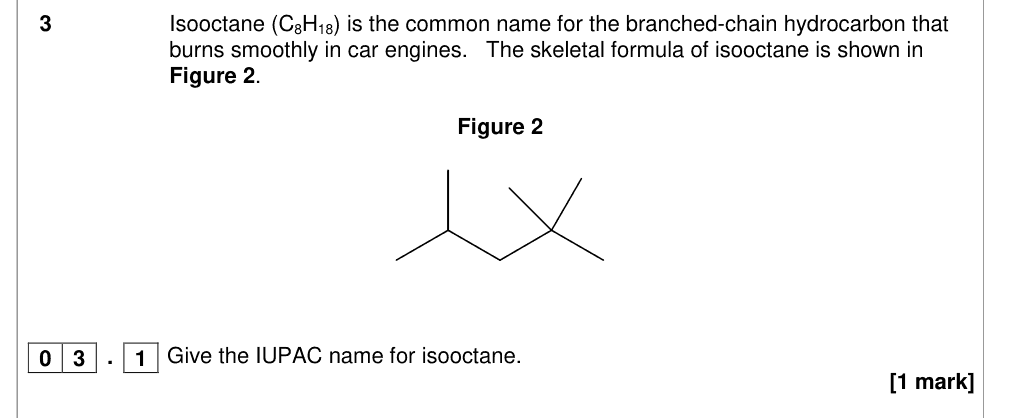
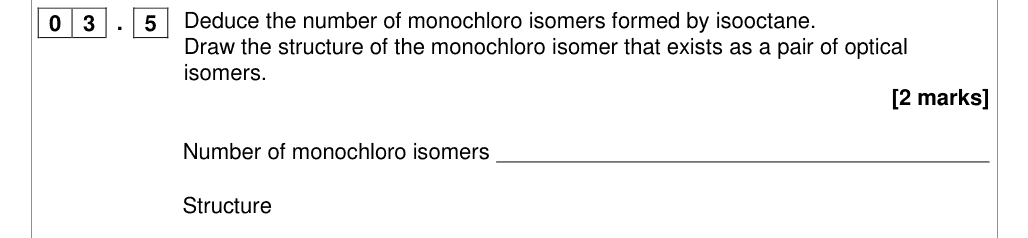
4 monochloro isomers. The optically active one shown in the scheme is (CH3)2CH–CHCl–C(CH3)3 (3-chloro-2,2,4-trimethylpentane): the CHCl carbon has four different groups
Specimen · Paper 2 · Q06.11 markAO2=1Short answer
Mark scheme
Notes from the mark scheme and report
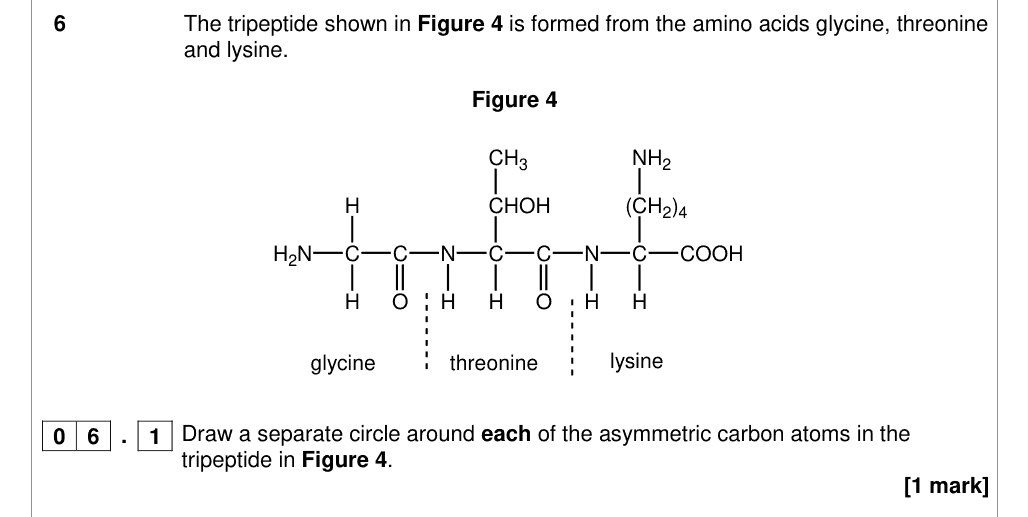
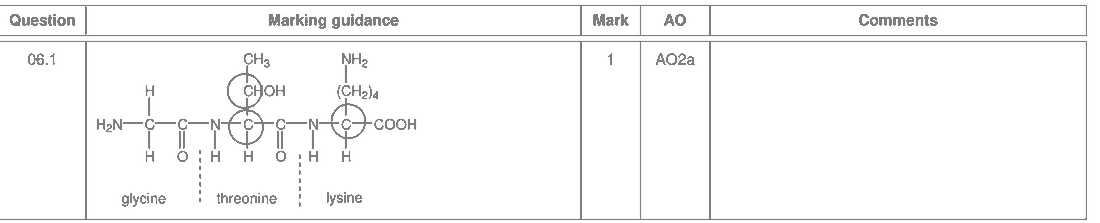
Three circles: the α-carbon of threonine, the CHOH carbon of threonine and the α-carbon of lysine (glycine's CH2 is not asymmetric).
Specimen · Paper 2 · Q11.26 marks6-mark level of response
Earlier part of question 11 that this part uses
Mark scheme, with the levels and indicative content
Notes from the mark scheme and report
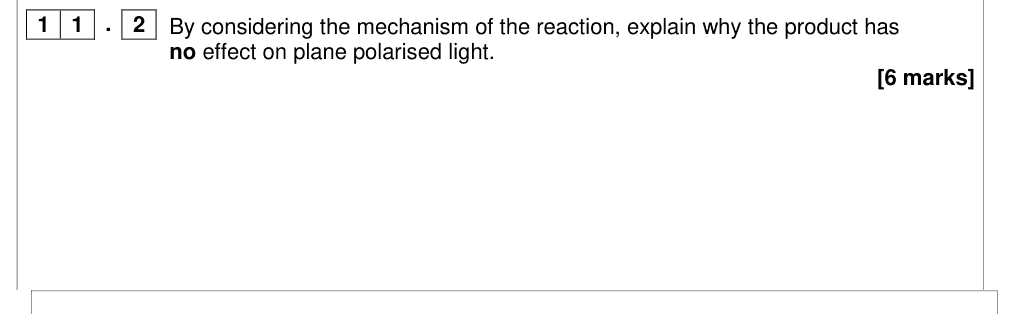
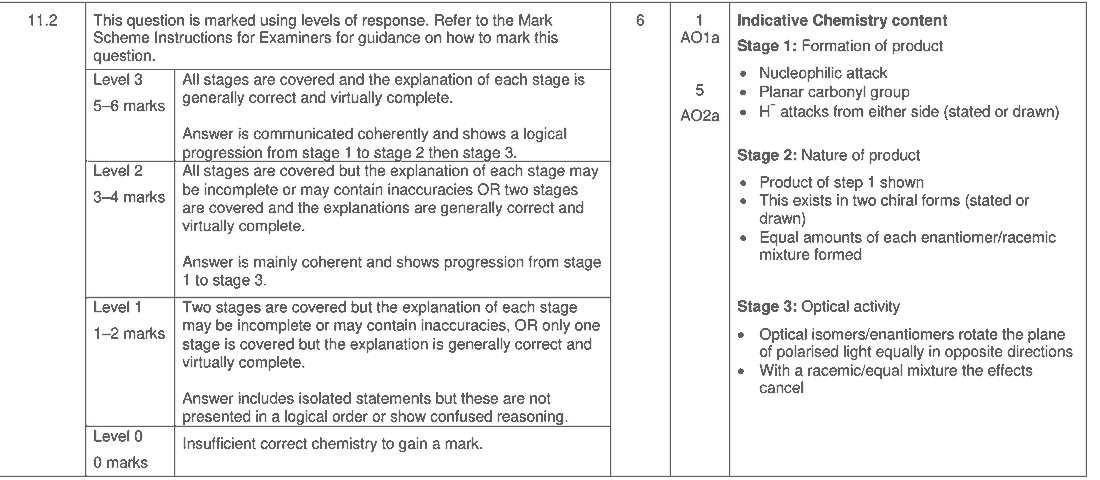
Levels of response, three stages. Formation: nucleophilic attack by H– on the planar carbonyl group, equally likely from either side. Product: butan-2-ol (the step 1 product shown) is chiral and exists as two enantiomers, formed in equal amounts: a racemic mixture. Optical activity: enantiomers rotate plane polarised light equally in opposite directions, so in an equal mixture the effects cancel
Specimen · Paper 2 · Q12.33 marksExplanation
Earlier part of question 12 that this part uses
Mark scheme
Notes from the mark scheme and report
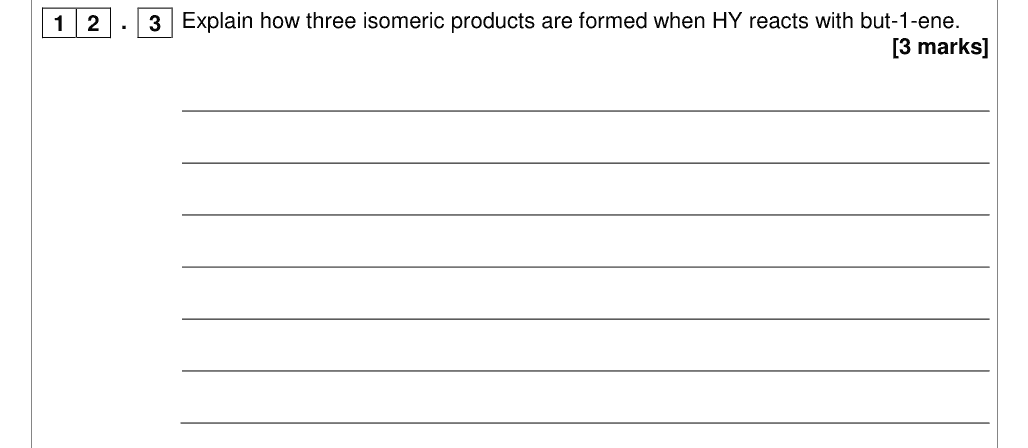
The major product (2-bromobutane) is chiral and exists as a pair of enantiomers
the third isomer is 1-bromobutane, the minor product, because it forms via the less stable primary carbocation
Specimen · Paper 3 · Q301 markAO3=1Multiple choice
Answer
D
Mark scheme
Notes from the mark scheme and report
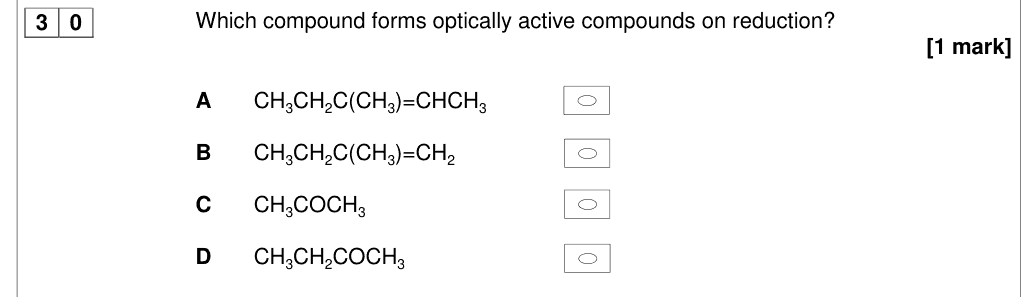
Answer: D. Butanone is reduced to butan-2-ol, which has a chiral carbon (CH3, C2H5, H, OH)
the products from A, B and C have no chiral centre
Specimen · Paper 3 · Q341 markAO3=1Multiple choice
Answer
C
Mark scheme
Notes from the mark scheme and report
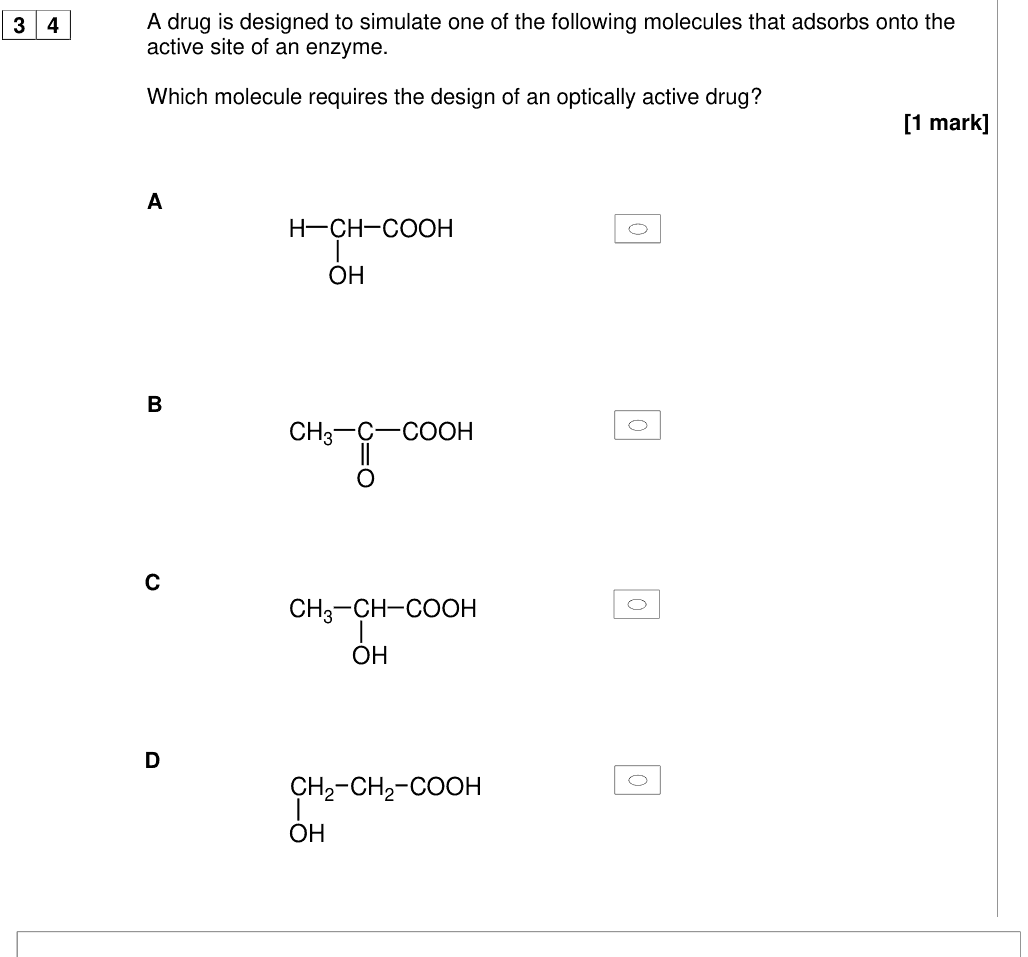
Answer: C. CH3CH(OH)COOH has a chiral carbon (four different groups), so only one enantiomer fits the stereospecific active site
Skills: MS4.3 Understand the symmetry of 2D and 3D shapes
Work with an A-level chemistry tutor
Dropping marks on calculations, mechanisms or the required practicals? Book a trial session with a specialist A-level chemistry tutor.