3.1.3.1-01 Ionic bonding involves electrostatic attraction between oppositely charged ions in a lattice.
3.1.3.1-02 The formulas of compound ions, eg sulfate, hydroxide, nitrate, carbonate and ammonium.
3.1.3.1-03 Students should be able to: • predict the charge on a simple ion using the position of the element in the Periodic Table • construct formulas for ionic compounds.
3.1.3.2-01 A single covalent bond contains a shared pair of electrons.
3.1.3.2-02 Multiple bonds contain multiple pairs of electrons.
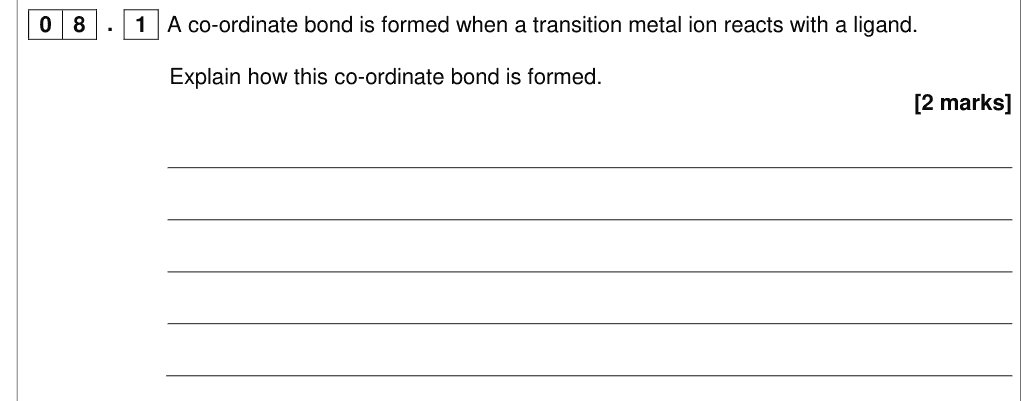
3.1.3.2-03 A co-ordinate (dative covalent) bond contains a shared pair of electrons with both electrons supplied by one atom.
3.1.3.2-04 Students should be able to represent: • a covalent bond using a line • a co-ordinate bond using an arrow.
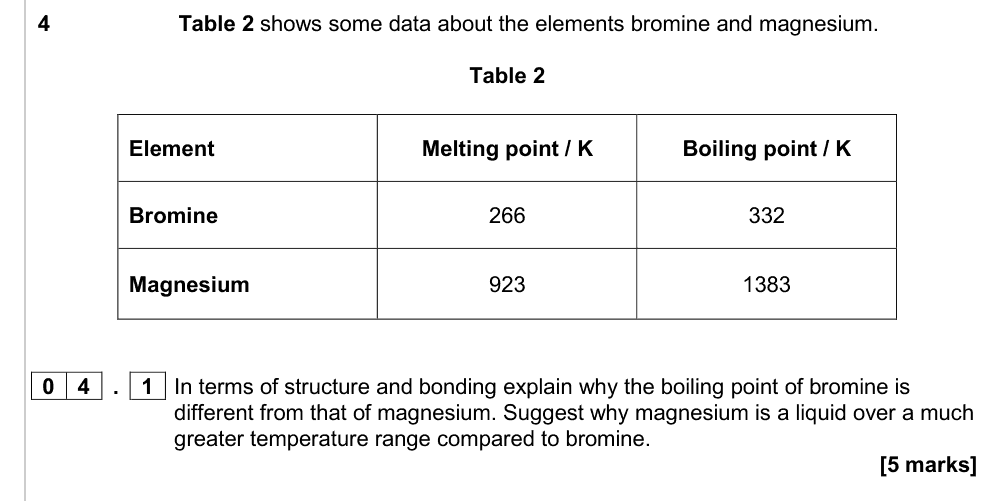
3.1.3.3-01 Metallic bonding involves attraction between delocalised electrons and positive ions arranged in a lattice.
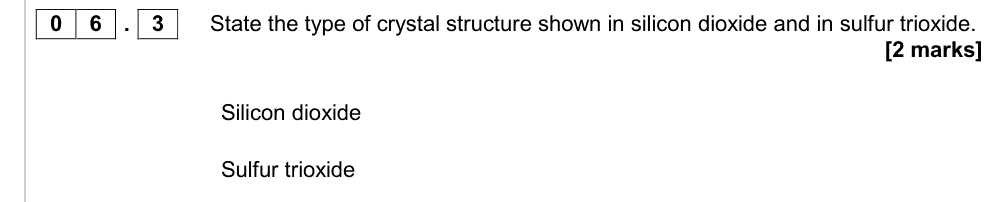
3.1.3.4-01 The four types of crystal structure: • ionic • metallic • macromolecular (giant covalent) • molecular.
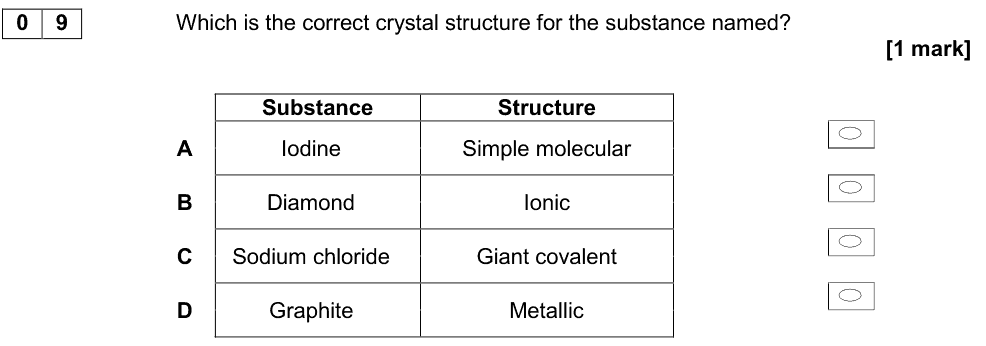
3.1.3.4-02 The structures of the following crystals as examples of these four types of crystal structure: • diamond • graphite • ice • iodine • magnesium • sodium chloride.
3.1.3.4-03 Students should be able to: • relate the melting point and conductivity of materials to the type of structure and the bonding present • explain the energy changes associated with changes of state • draw diagrams to represent these structures involving specified numbers of particles.
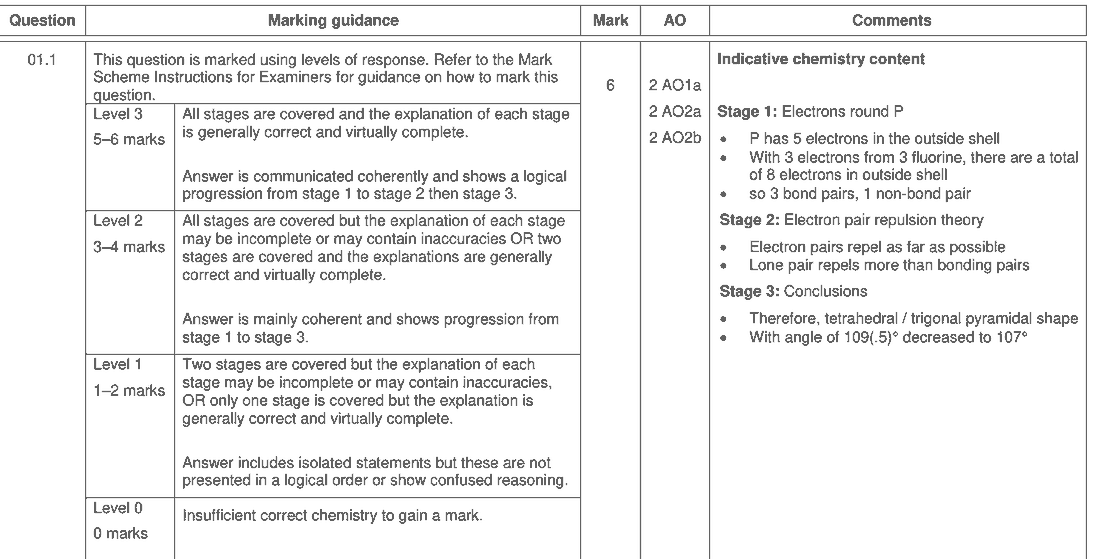
3.1.3.5-01 Bonding pairs and lone (non-bonding) pairs of electrons as charge clouds that repel each other.
3.1.3.5-02 Pairs of electrons in the outer shell of atoms arrange themselves as far apart as possible to minimise repulsion.
3.1.3.5-03 Lone pair–lone pair repulsion is greater than lone pair– bond pair repulsion, which is greater than bond pair–bond pair repulsion.
3.1.3.5-04 The effect of electron pair repulsion on bond angles.
3.1.3.5-05 Students should be able to: • explain the shapes of, and bond angles in, simple molecules and ions with up to six electron pairs (including lone pairs of electrons) surrounding the central atom.
3.1.3.6-01 Electronegativity as the power of an atom to attract the pair of electrons in a covalent bond.
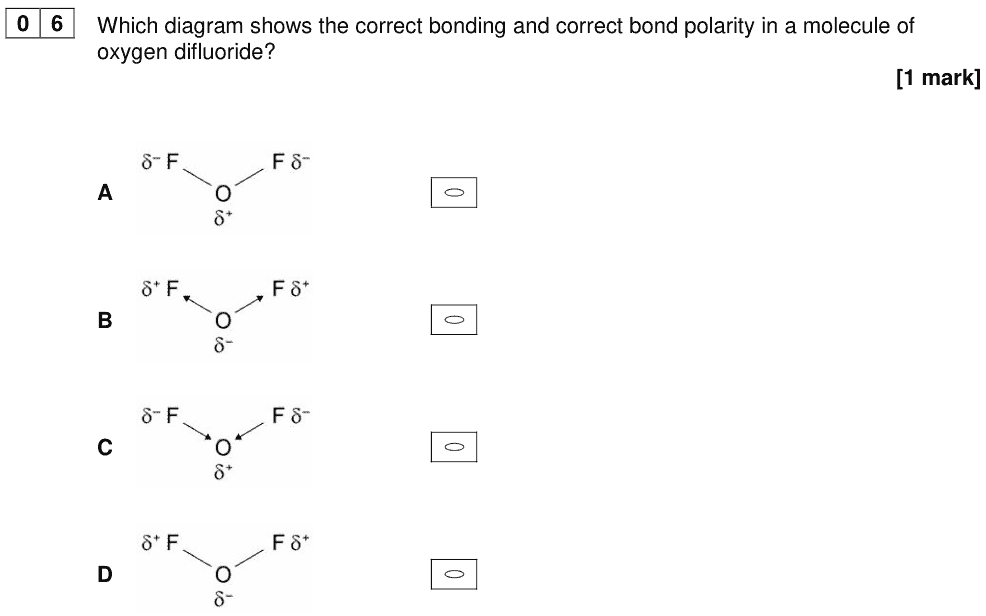
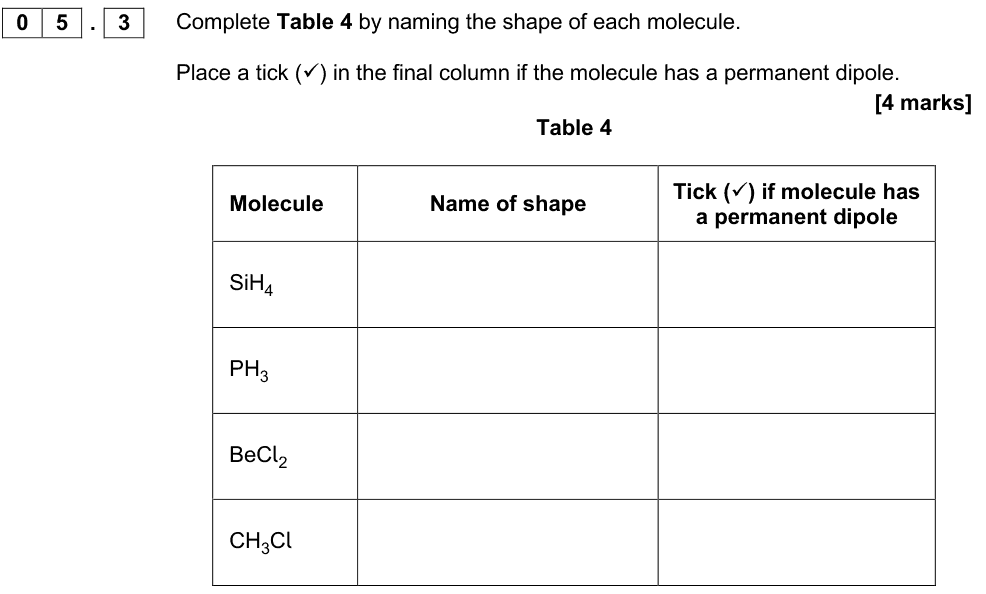
3.1.3.6-02 The electron distribution in a covalent bond between elements with different electronegativities will be unsymmetrical. This produces a polar covalent bond, and may cause a molecule to have a permanent dipole.
3.1.3.6-03 Students should be able to: • use partial charges to show that a bond is polar • explain why some molecules with polar bonds do not have a permanent dipole.
3.1.3.7-01 Forces between molecules: • permanent dipole–dipole forces • induced dipole–dipole (van der Waals, dispersion, London) forces • hydrogen bonding.
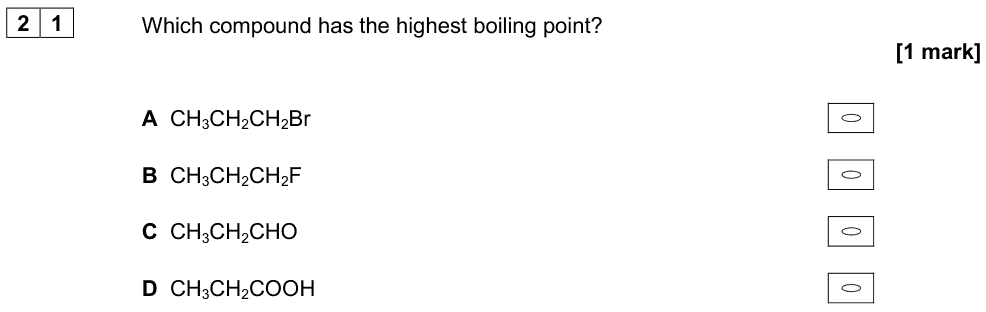
3.1.3.7-02 The melting and boiling points of molecular substances are influenced by the strength of these intermolecular forces.
3.1.3.7-03 The importance of hydrogen bonding in the low density of ice and the anomalous boiling points of compounds.
3.1.3.7-04 Students should be able to: • explain the existence of these forces between familiar and unfamiliar molecules • explain how melting and boiling points are influenced by these intermolecular forces.
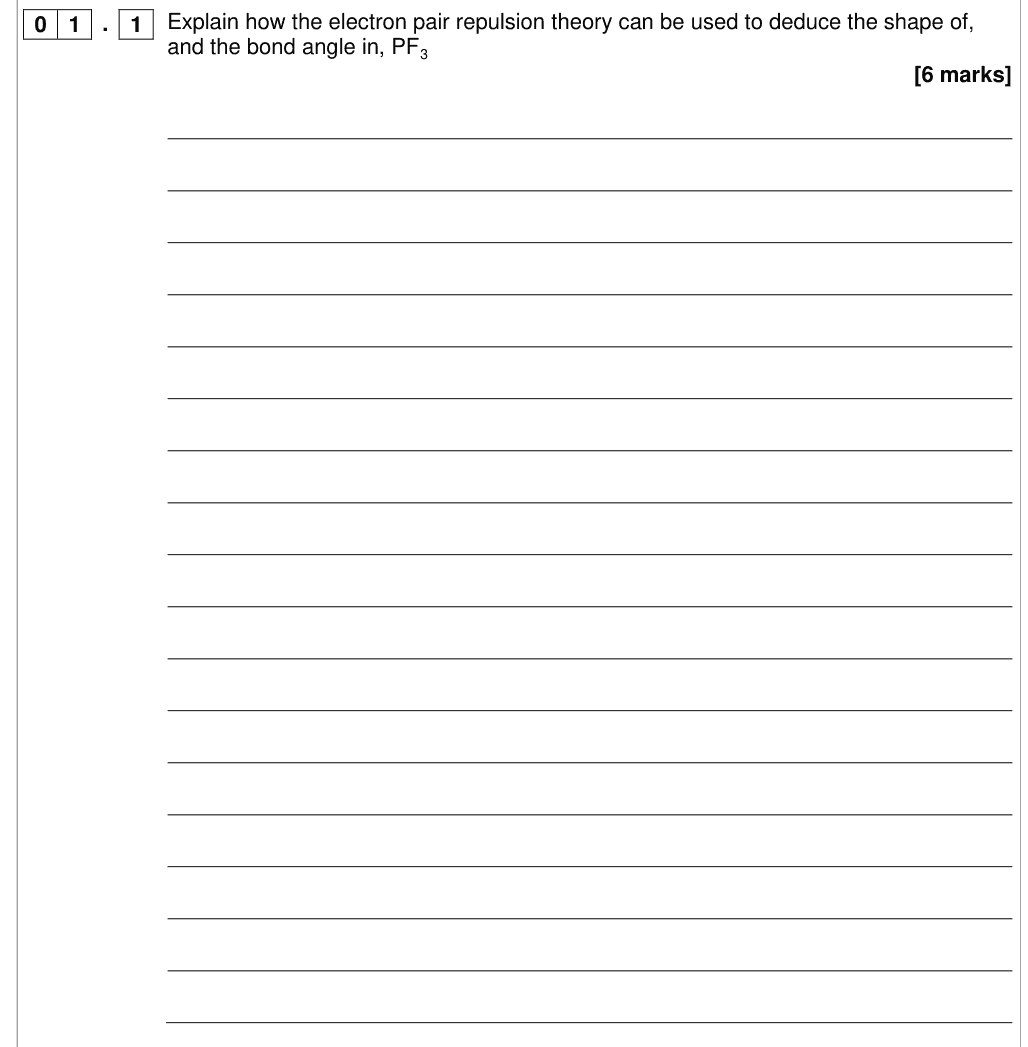
Six-mark level of response questions on this topic
Tap a question to zoom it. Where a part needs a figure, table or structure from earlier in the question, that part folds out above it; the mark scheme and examiner's comment open underneath. Have AQA's Data Booklet (the Periodic Table and the spectroscopy tables) beside you.
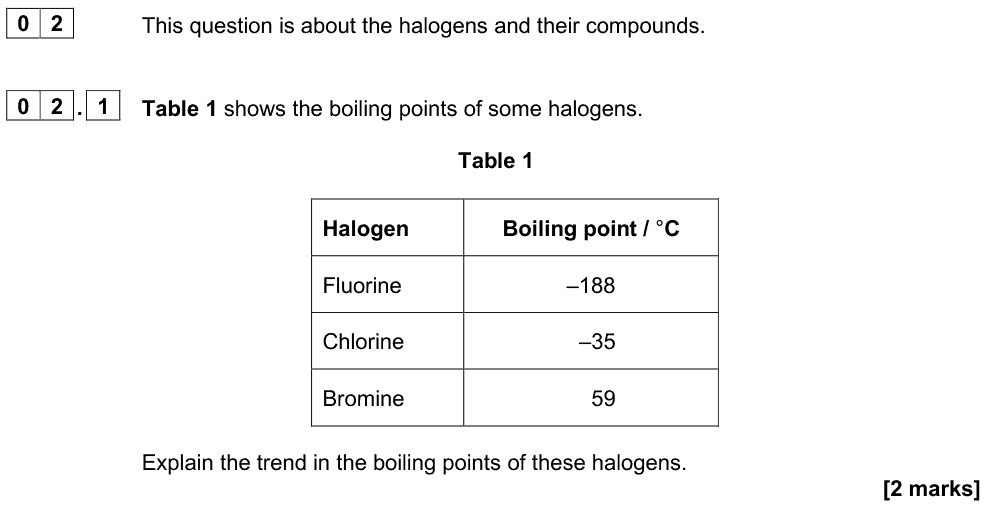
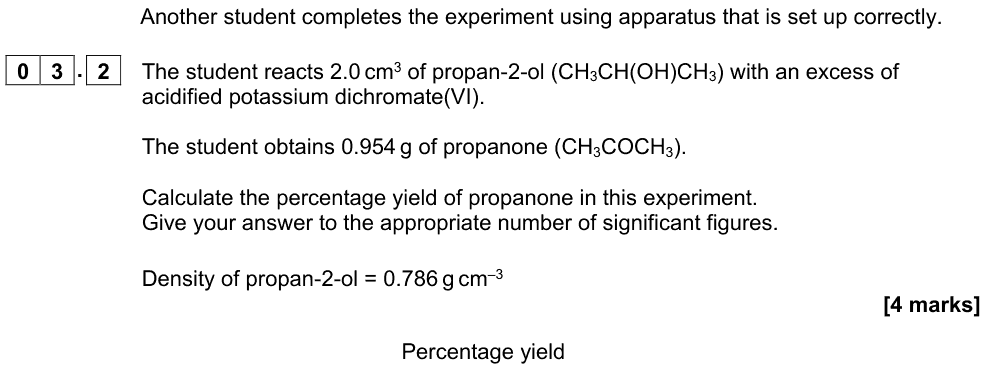
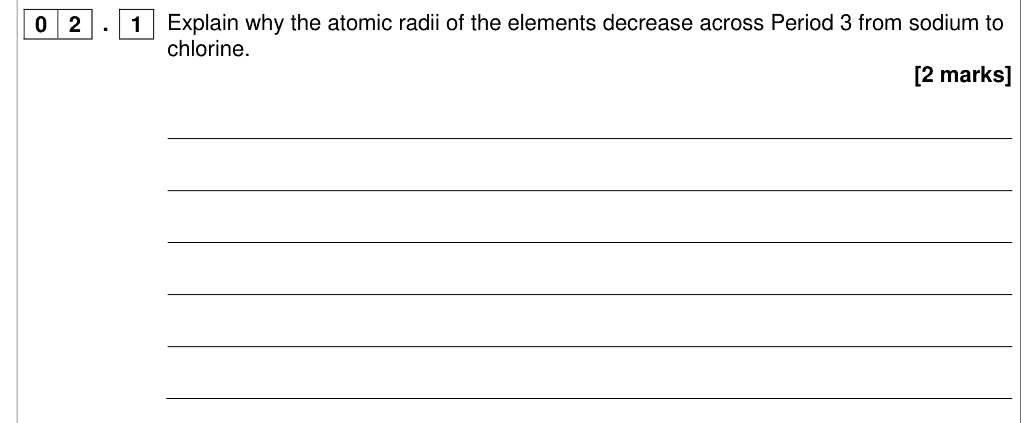
June 2025 · AS Paper 1 · Q02.12 marksAO1=2Explanation
Mark scheme
Examiner's comment
2.1 Students usually understood that the reason for increasing boiling points down the group was linked to the larger molecules. However, few students were able to be precise about the nature of the van der Waals’ forces (or induced dipole-dipole forces) between the molecules.
Notes from the mark scheme and report
Down the group the molecules are larger / have more electrons, so there are stronger van der Waals (induced dipole–dipole, London, dispersion) forces between molecules. If a wrong trend is stated the next mark is lost. Few were precise about the forces being between molecules
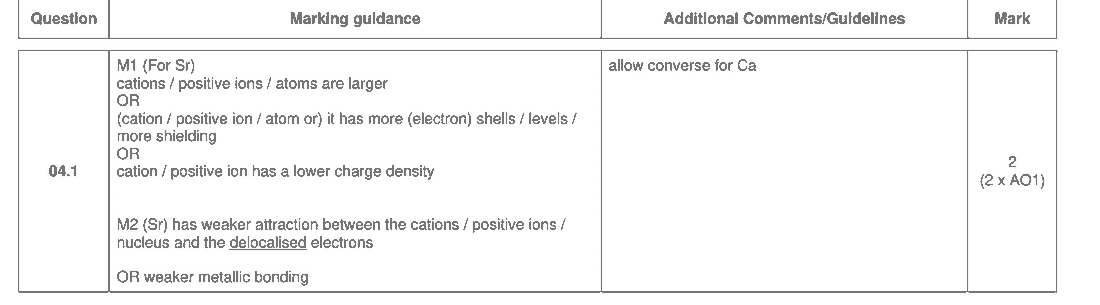
June 2025 · AS Paper 1 · Q04.12 marksAO1=2Explanation
Mark scheme
Examiner's comment
4.1 Students were asked to explain why strontium has a lower melting point than calcium. Many students understood that Sr2+ is a larger ion or an ion with a lower charge density. However, a large number of students did not explain that in Strontium there is a weaker attraction for the delocalised electrons and often made reference to the attraction for the outer electrons.
Notes from the mark scheme and report
Sr2+ ions are larger (more shells / lower charge density), so the attraction between the positive ions and the delocalised electrons is weaker (weaker metallic bonding). Many wrote about attraction for the outer electrons rather than the delocalised electrons
June 2025 · Paper 1 · Q05.12 marksAO1=2Explanation
Mark scheme
Examiner's comment
Many students failed to mention that van der Waals’ forces were between molecules in part 1; a few students referred to chloride and bromide ions.
Some students confused the boiling point with ionisation energy and wrote about higher nuclear charge in bromine so stronger attraction between the outer electrons and the nucleus.
A number of students thought that the covalent bonds break during a change of state and some students compared the reactivity of chlorine and bromine.
Notes from the mark scheme and report
Chlorine molecules are smaller / have fewer electrons (smaller Mr)
so the van der Waals forces between chlorine molecules are weaker and need less energy to overcome. Errors: not saying the forces are between molecules
chloride and bromide ions
breaking covalent bonds
nuclear attraction arguments
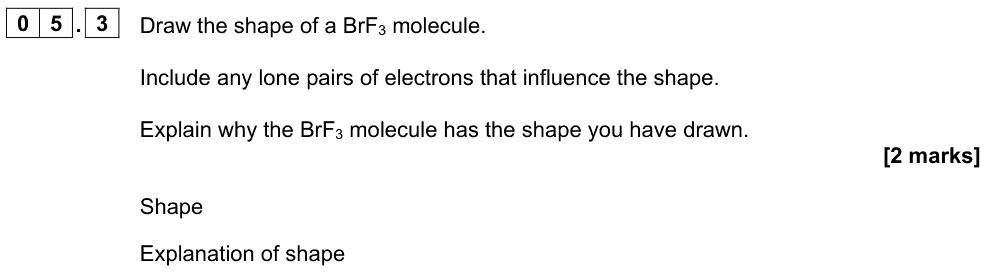
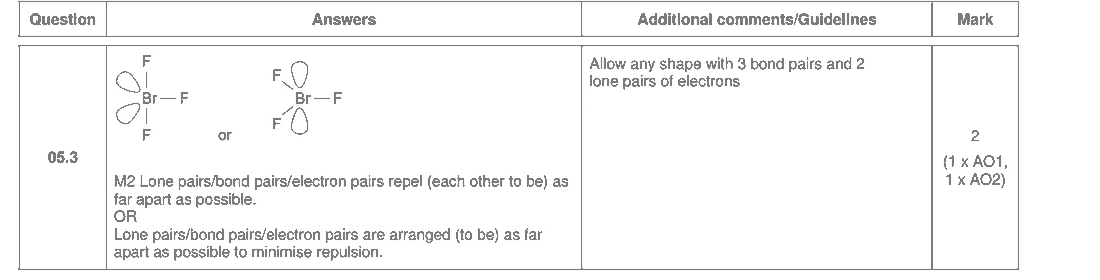
June 2025 · Paper 1 · Q05.32 marksAO1=1, AO2=1Diagram or structure
Earlier part of question 05 that this part uses
Mark scheme
Examiner's comment
Many students drew an acceptable diagram in part 3; a common wrong answer had three bonding pairs and one lone pair.
The explanation proved more challenging; some students mentioned electron pairs repelling, but few qualified this with the electron pairs repel to be as far apart as possible.
Notes from the mark scheme and report
Any shape showing three bonding pairs and two lone pairs on Br (T-shaped or trigonal planar arrangement of F). Electron pairs repel to be as far apart as possible (to minimise repulsion). Errors: only one lone pair
saying pairs repel without 'as far apart as possible'
Skills: MS4.1 Use angles and shapes in regular 2D and 3D structures; MS4.2 Visualise and represent 2D and 3D forms including two-dimensional representations of 3D objects
June 2025 · Paper 1 · Q07.21 markAO1=1Short answer
Earlier part of question 07 that this part uses
Mark scheme
Examiner's comment
In part 2 many students did not state that layers of atoms/ions can slide over each other; some students stated that metals were malleable or ductile or that vanadium was a metal.
Notes from the mark scheme and report
Layers of atoms / positive ions can slide over one another. 'It is malleable / ductile / a metal' does not score
June 2025 · Paper 1 · Q07.52 marksAO1=2Explanation
Earlier part of question 07 that this part uses
Mark scheme
Examiner's comment
In part 5 many students clearly explained that the high melting point of ionic compounds is due to the strong electrostatic attraction between oppositely charged ions.
Some students demonstrated confusion about the nature of the bonding; common errors included describing the bonding as molecular with van der Waals’ forces, macromolecular with covalent bonds, or metallic bonding.
Notes from the mark scheme and report
It contains oppositely charged ions (V3+ and SO4 2–)
with strong electrostatic attraction between them. Errors: describing molecules with van der Waals forces, macromolecular or metallic bonding
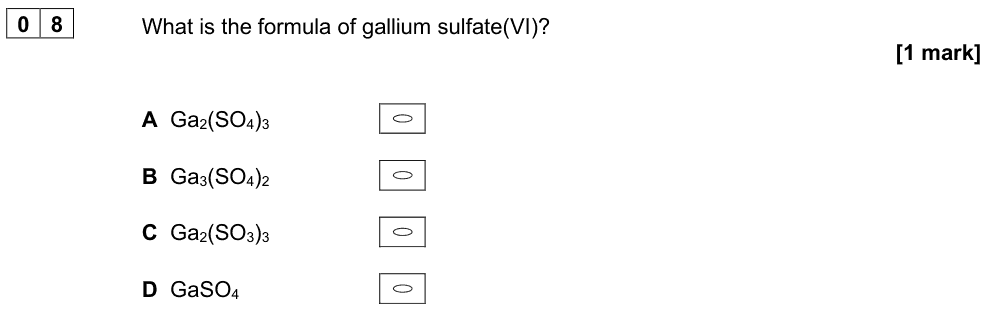
June 2025 · AS Paper 1 · Q081 markAO1=1Multiple choice
Answer
A
Mark scheme
Examiner's comment
This was answered correctly by a majority of students.
Notes from the mark scheme and report
Answer: A. Ga is in Group 3 so forms Ga3+
sulfate(VI) is SO4 2–
charges balance in Ga2(SO4)3
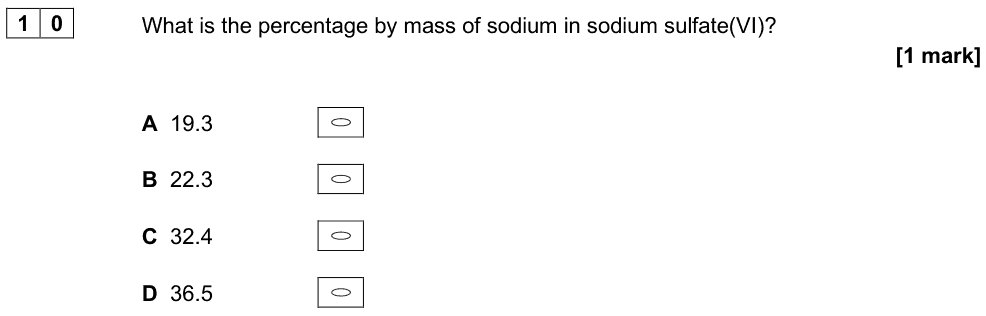
June 2025 · AS Paper 1 · Q101 markAO2=1Multiple choice
Answer
C
Mark scheme
Examiner's comment
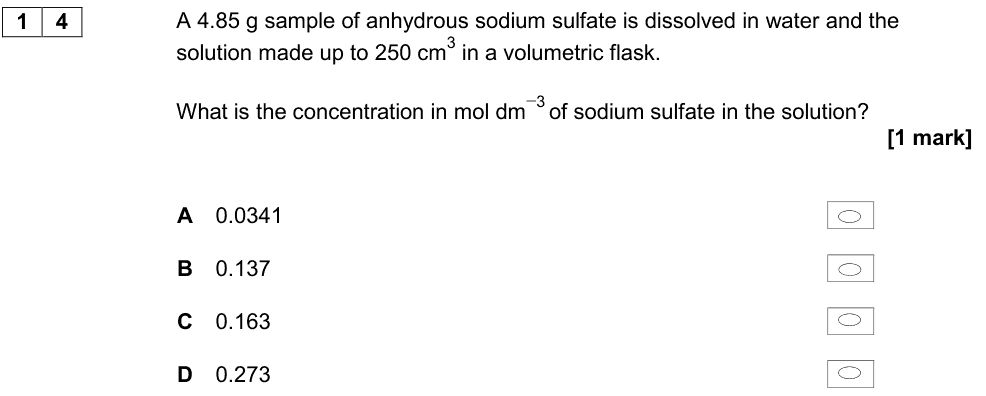
The correct answer was the most common answer, although many students had used an incorrect formula of sodium sulphate (VI) in their calculation.
Notes from the mark scheme and report
Answer: C. Na2SO4: (2 × 23.0) ÷ 142.1 × 100 = 32.4%. Many used an incorrect formula for sodium sulfate
Skills: MS0.2 Use ratios, fractions and percentages
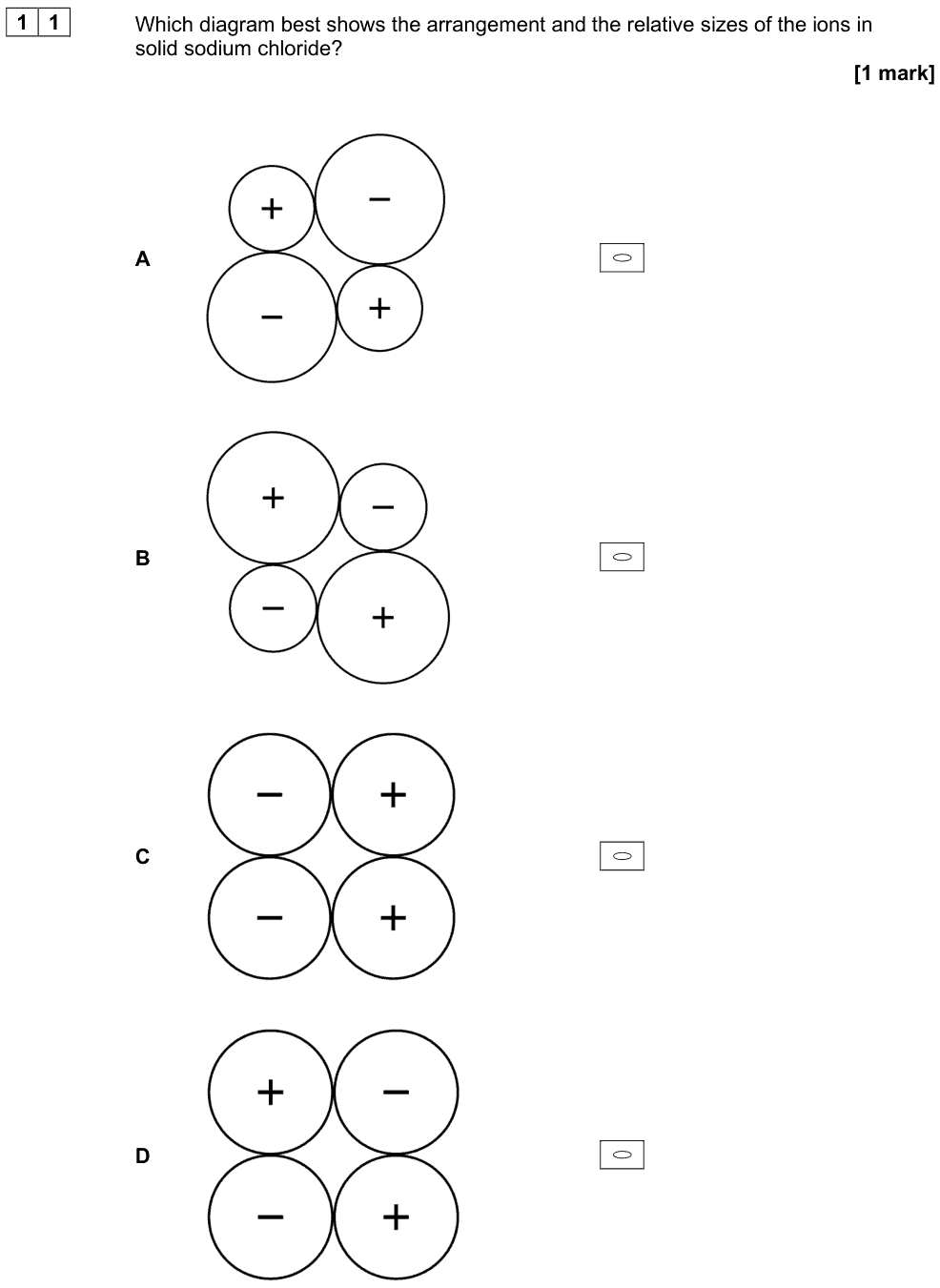
June 2025 · AS Paper 1 · Q111 markAO2=1Multiple choice
Answer
A
Mark scheme
Examiner's comment
Under half of the students could identify the relative sizes and arrangements of the sizes of the ions in sodium chloride. A large number of students thought that the sodium ion was larger than the chloride ion.
Notes from the mark scheme and report
Answer: A. Oppositely charged ions alternate and the chloride ion (–) is larger than the sodium ion (+). Under half were correct
many thought Na+ was the larger ion
Skills: MS4.2 Visualise and represent 2D and 3D forms including two-dimensional representations of 3D objects
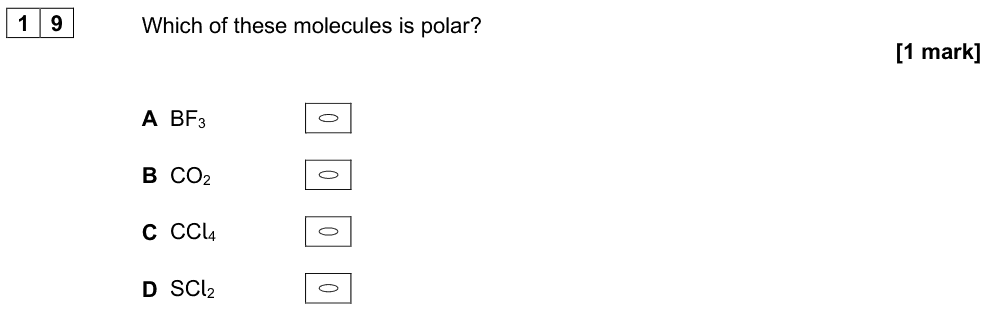
June 2025 · AS Paper 1 · Q191 markAO2=1Multiple choice
Answer
D
Mark scheme
Examiner's comment
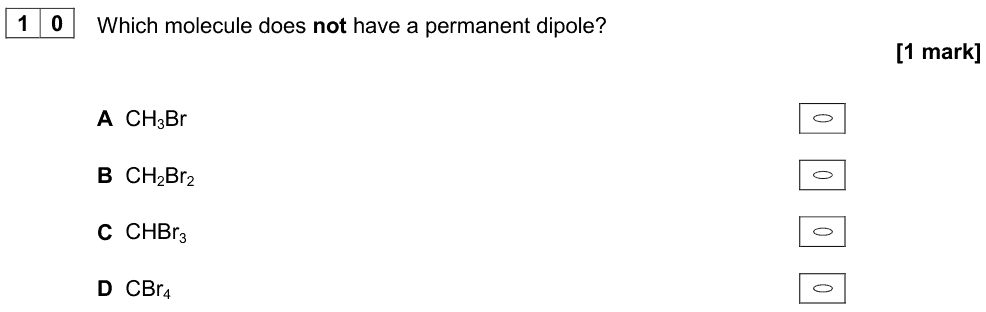
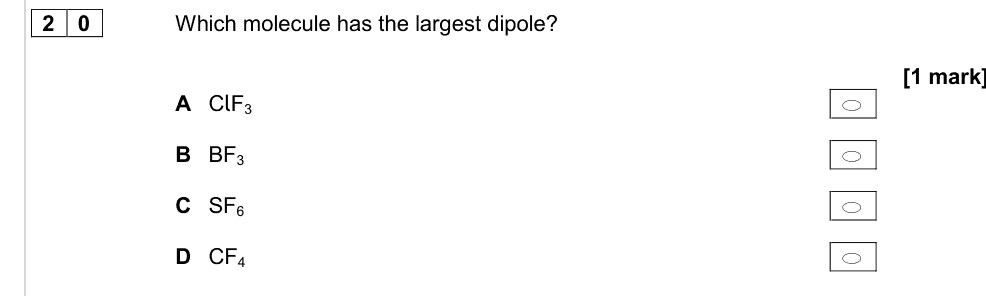
Just under half of students were able to identify which molecule is polar. Many students decided that BF3 was polar but didn’t appreciate that the dipoles in this molecule would cancel out.
Notes from the mark scheme and report
Answer: D. SCl2 is bent (two lone pairs on S) so the bond dipoles do not cancel
BF3, CO2 and CCl4 are symmetrical so their dipoles cancel. BF3 was a common wrong answer
just under half were correct
Skills: MS4.1 Use angles and shapes in regular 2D and 3D structures
June 2025 · AS Paper 2 · Q01.51 markAO3=1Short answer
Earlier part of question 01 that this part uses
Mark scheme
Examiner's comment
1.5 The question asked about the bond angle around the positive C atom in a carbocation. Students struggled with many assuming there was a tetrahedral shape rather than a trigonal planar shape with 120° bond angle.
Notes from the mark scheme and report
Answer: 120° (three bonding pairs and no lone pair: trigonal planar). Many assumed tetrahedral
Skills: MS4.1 Use angles and shapes in regular 2D and 3D structures
June 2025 · AS Paper 2 · Q01.62 marksAO1=1, AO2=1Explanation
Earlier part of question 01 that this part uses
Mark scheme
Examiner's comment
1.6 Students often had the idea of what a co-ordinate bond actually is but few were precise in their language to state from where and to where the lone pair was donated.
Notes from the mark scheme and report
A covalent bond in which both shared electrons come from one species: the lone pair on the C of CN– is donated to the C+ (central C) of the carbocation. Be precise about where the lone pair comes from and goes to
June 2025 · AS Paper 2 · Q02.33 marksAO2=3Diagram or structure
Earlier part of question 02 that this part uses
Mark scheme
Examiner's comment
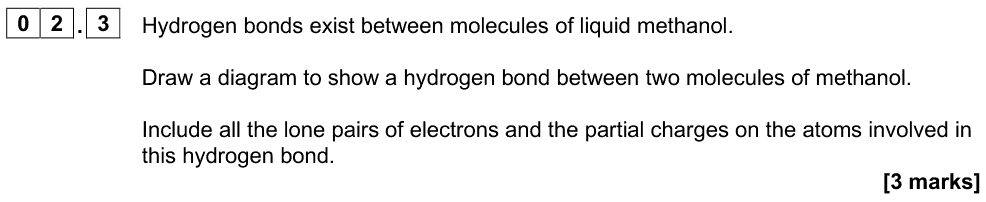
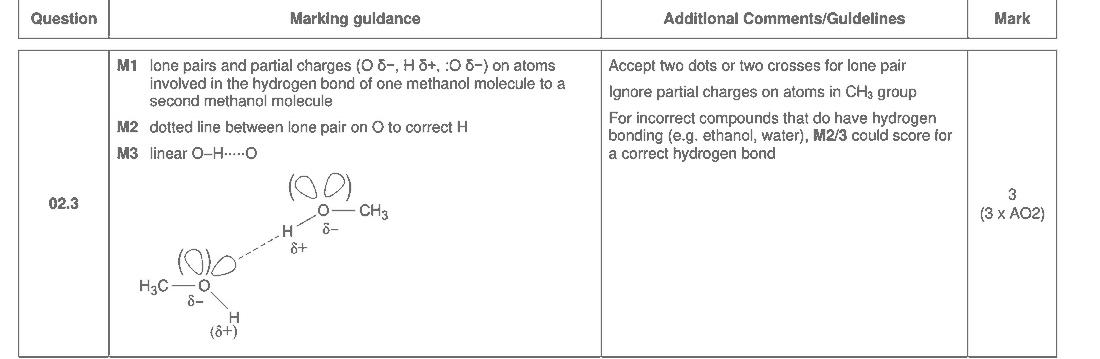
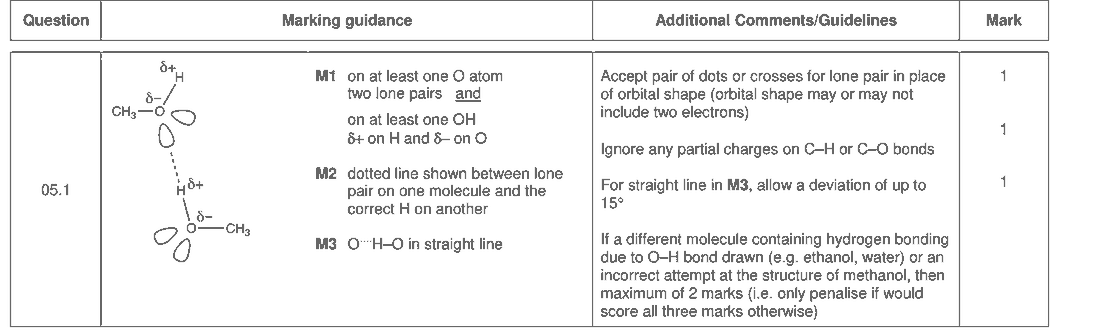
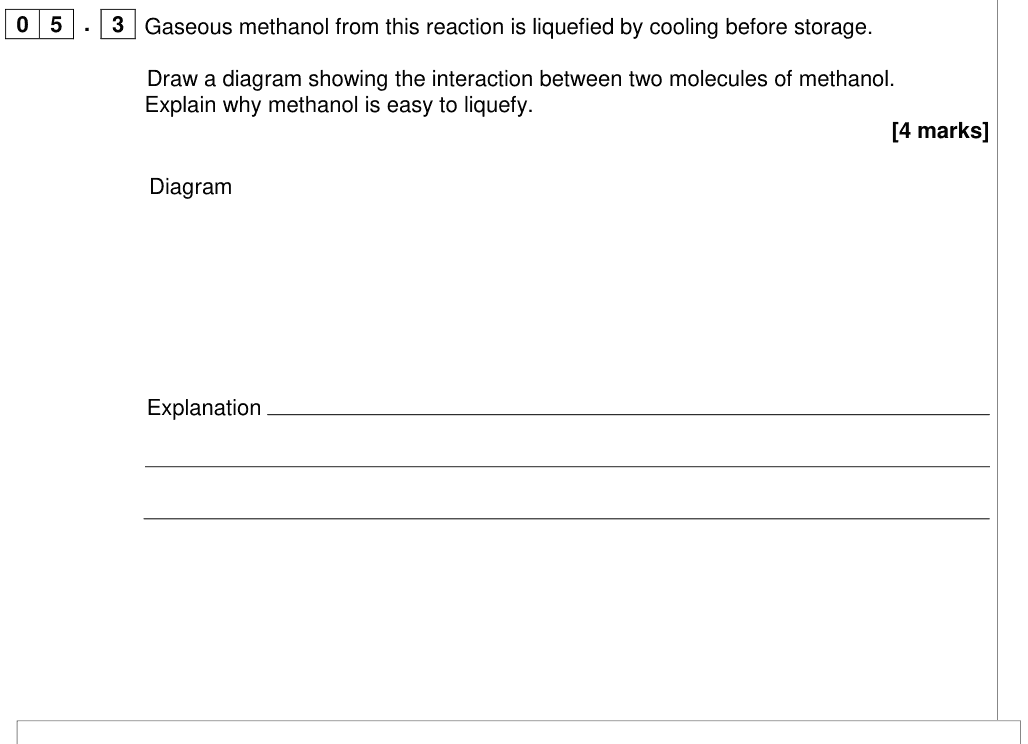
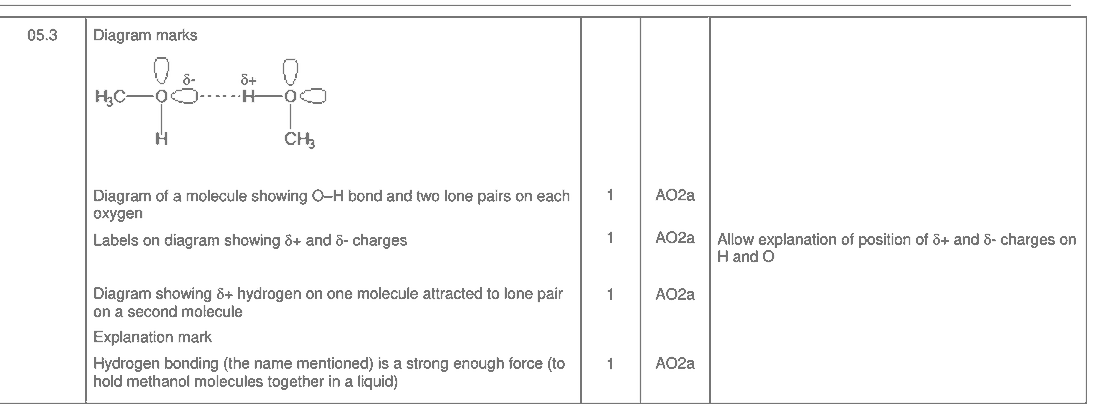
2.3 Students were asked to draw the hydrogen bond between two methanol molecules. Many made good progress but a large number of students had the atoms in methanol bonded O-H-C rather than H-O-C and others attempted to form a hydrogen bond to an H atom on the C.
Notes from the mark scheme and report
Two CH3OH molecules: lone pairs on O and partial charges Oδ–, Hδ+ and Oδ– on the atoms involved
a dotted line from a lone pair on O of one molecule to the H of the O–H of the other
O–H···O drawn linear. Errors: atoms bonded O–H–C
hydrogen bond drawn to an H of the CH3 group
Skills: MS4.2 Visualise and represent 2D and 3D forms including two-dimensional representations of 3D objects
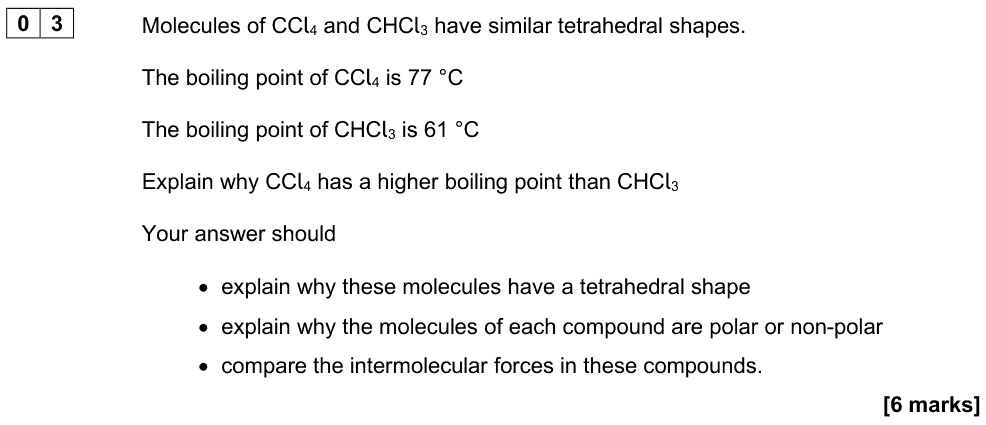
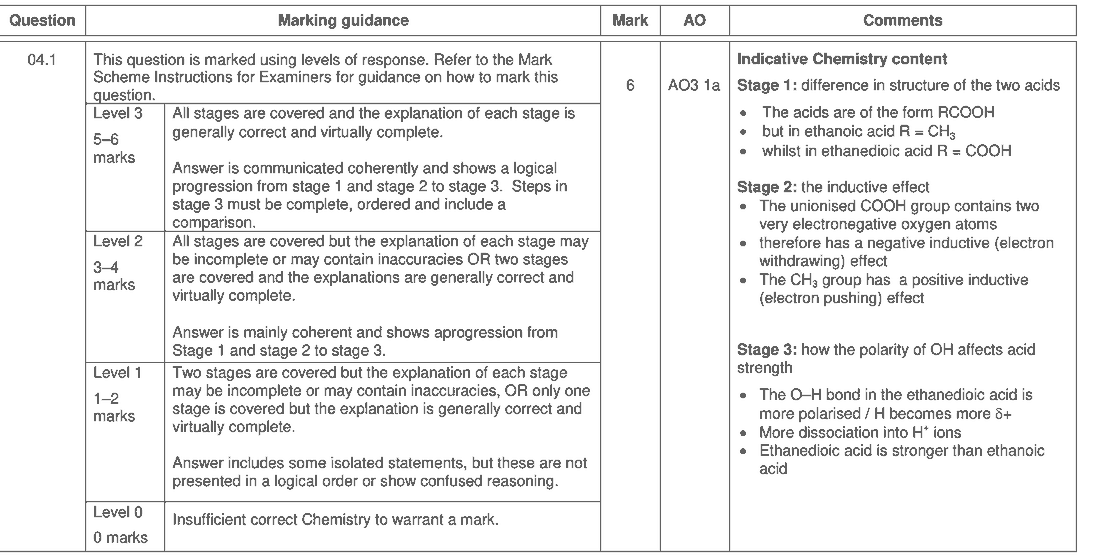
June 2025 · AS Paper 2 · Q036 marksAO1=1, AO2=3, AO3=26-mark level of response
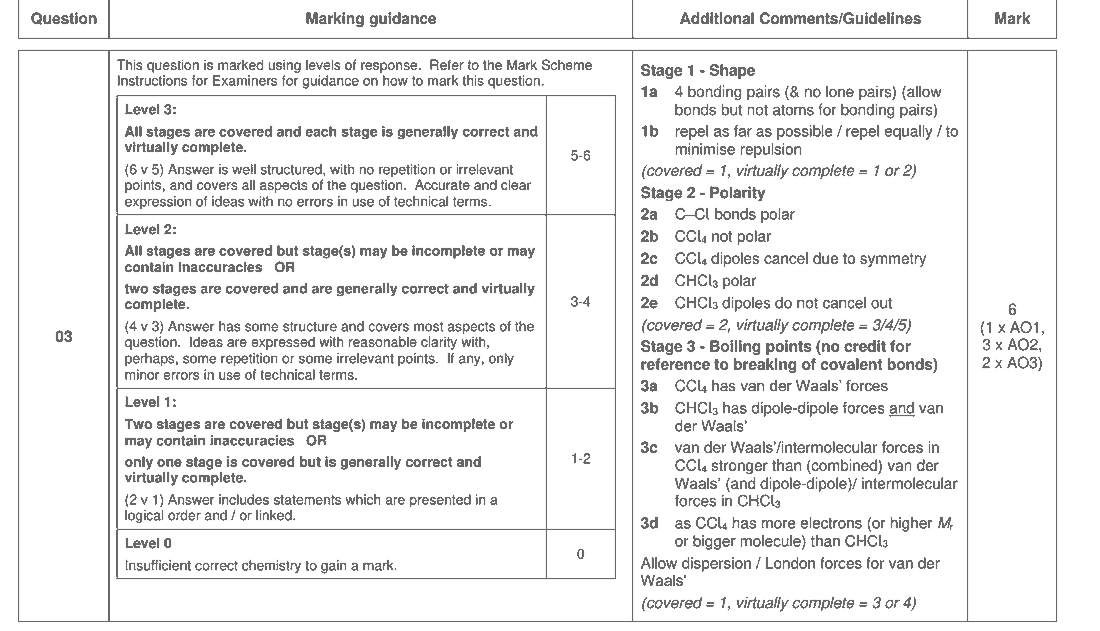
Mark scheme, with the levels and indicative content
Examiner's comment
Intermolecular forces
Students had to explain the shape of two organic molecules, deduce whether each molecule was polar and then explain their relative boiling points. This question was answered well on the whole with most students appreciating that CCl4 is non-polar while CHCl3 is polar, although fewer could explain this by discussing whether dipoles cancel out or not. Most students could identify the intermolecular forces and could justify why CCl4 has stronger intermolecular forces despite not having any dipole-dipole forces in the way that CHCl3 does. A few students thought that covalent bonds were broken when these compounds boil.
Notes from the mark scheme and report
Levels of response, three stages. Shape: four bonding pairs and no lone pairs around C, which repel equally / as far apart as possible. Polarity: C–Cl bonds are polar
CCl4 is non-polar because it is symmetrical and the dipoles cancel
CHCl3 is polar because the dipoles do not cancel. Boiling points: CCl4 has van der Waals forces only
CHCl3 has dipole–dipole and van der Waals forces
the van der Waals forces in CCl4 are stronger than the combined forces in CHCl3 because CCl4 has more electrons (bigger molecule / higher Mr). No credit for breaking covalent bonds
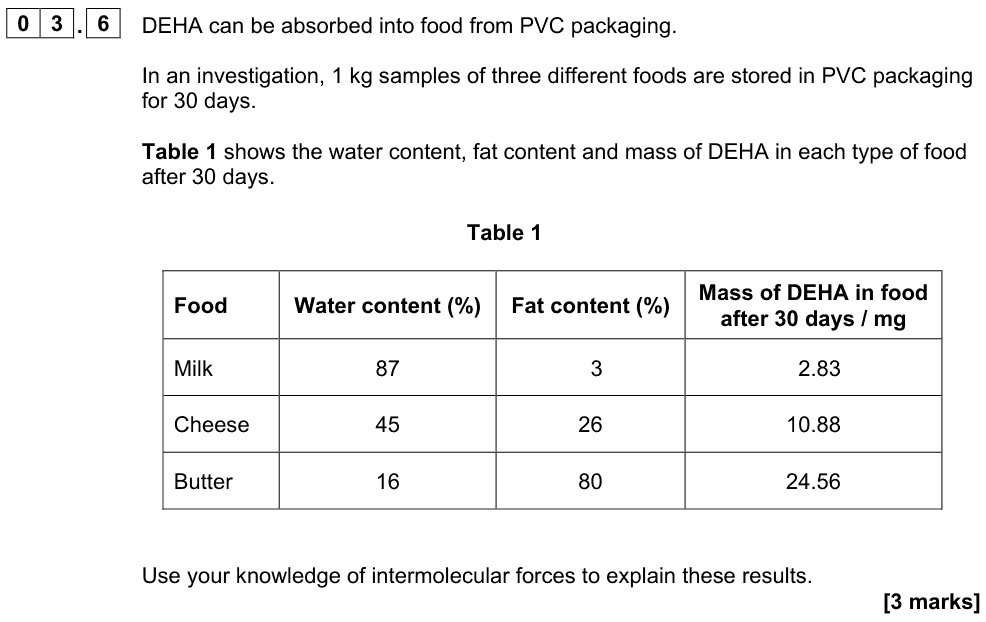
June 2025 · Paper 2 · Q03.63 marksAO1=1, AO3=2Explanation
Earlier part of question 03 that this part uses
Mark scheme
Examiner's comment
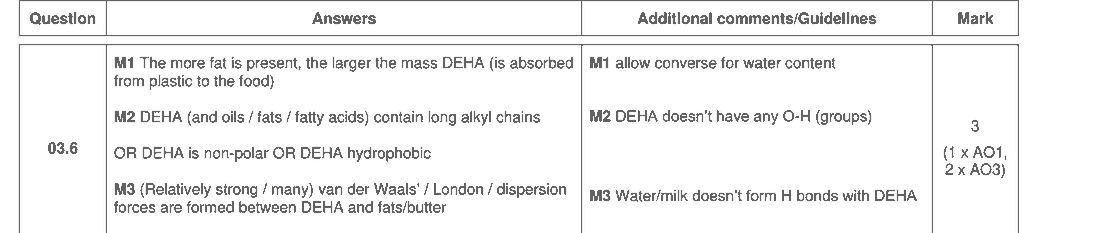
3.6 Students were given data about the mass of plasticiser absorbed by foods with different fat and water contents. Many could see the link between the amount of fat and the amount of plasticiser but far fewer were able identify that both fats and the plasiciser are non-polar and so form van der Waals’ forces between the molecules. The most common error was to focus on the ester links and state that the plasticiser was polar, or to say that hydrogen bonding between fat and plasiciser was the intermolecular force responsible for the trend shown.
Notes from the mark scheme and report
The higher the fat content, the larger the mass of DEHA absorbed (converse for water)
DEHA has long alkyl chains / is non-polar (hydrophobic, no O–H)
it forms relatively strong van der Waals forces with fats and cannot hydrogen bond with water. Common errors: calling DEHA polar because of the ester groups
hydrogen bonding between fat and DEHA
Skills: PS3.2 Process and analyse data using appropriate mathematical skills as exemplified in the mathematical appendix for each science
June 2025 · Paper 2 · Q09.62 marksAO2=2Explanation
Earlier part of question 09 that this part uses
Mark scheme
Examiner's comment
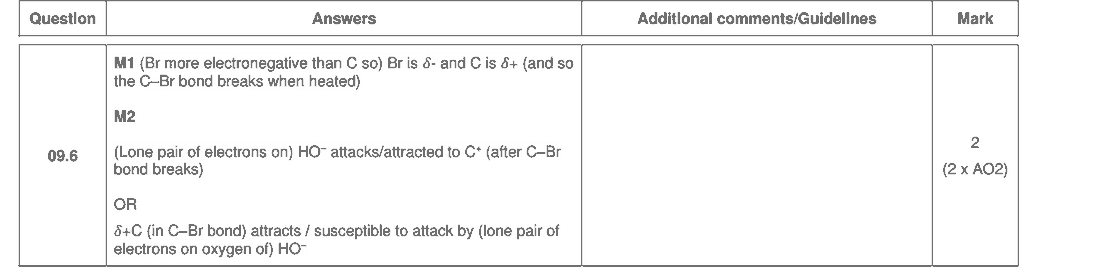
9.6 Students were asked to explain in terms of bond polarity why the bromoalkane and KOH react. Many scored at least 1 of the two marks for stating the correct polarity of the C-Br bond but some lost the mark because they just focused on the electronegativity difference without actually starting that carbon is delta positive and bromine is delta negative. The second mark was for explaining why the OH- ion is attracted either to the delta positive carbon or to the C+ formed in the mechanism in Q09.5. A common error here was to miss the negative sign in the formula of OH-
Notes from the mark scheme and report
Bromine is more electronegative than carbon, so C is δ+ and Br is δ–
the lone pair on HO– is attracted to / attacks the δ+ carbon (or the C+ formed). State the partial charges, not just the electronegativity difference
OH– needs its negative charge
June 2025 · AS Paper 2 · Q141 markAO1=1Multiple choice
Answer
D
Mark scheme
Examiner's comment
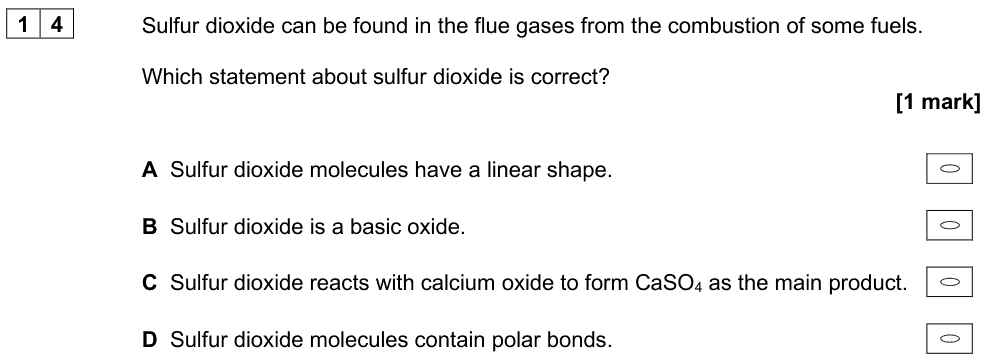
The most common answer was incorrect. SO2 reacts with CaO to form CaSO3 and not CaSO4 as the main product. Fewer students appreciated that SO2 contains polar bonds.
Notes from the mark scheme and report
Answer: D. S=O bonds are polar
SO2 is bent, is an acidic oxide and forms CaSO3 with CaO. The most common answer was C (CaSO4), which is wrong
June 2025 · Paper 3 · Q271 markAO2=1Multiple choice
Answer
B
Mark scheme
Notes from the mark scheme and report
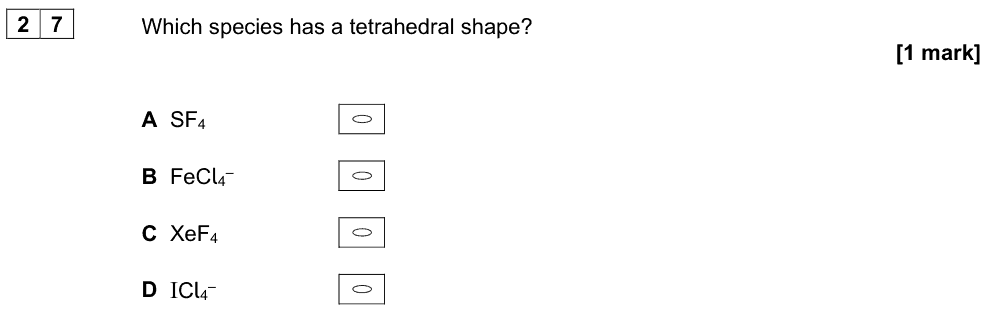
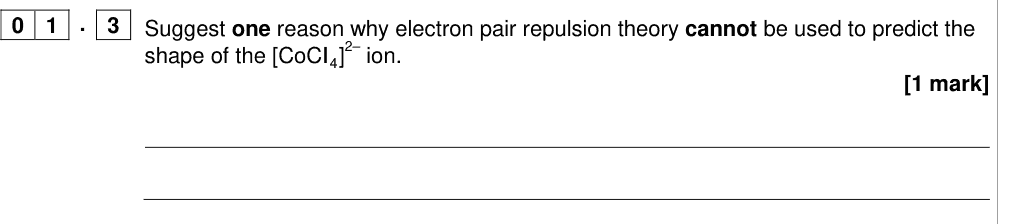
Answer: B. FeCl4– is a tetrahedral complex with four large Cl– ligands
SF4 has one lone pair, and XeF4 and ICl4– have two lone pairs (square planar)
Skills: MS4.1 Use angles and shapes in regular 2D and 3D structures
June 2025 · Paper 3 · Q311 markAO1=1Multiple choice
Answer
C
Mark scheme
Notes from the mark scheme and report
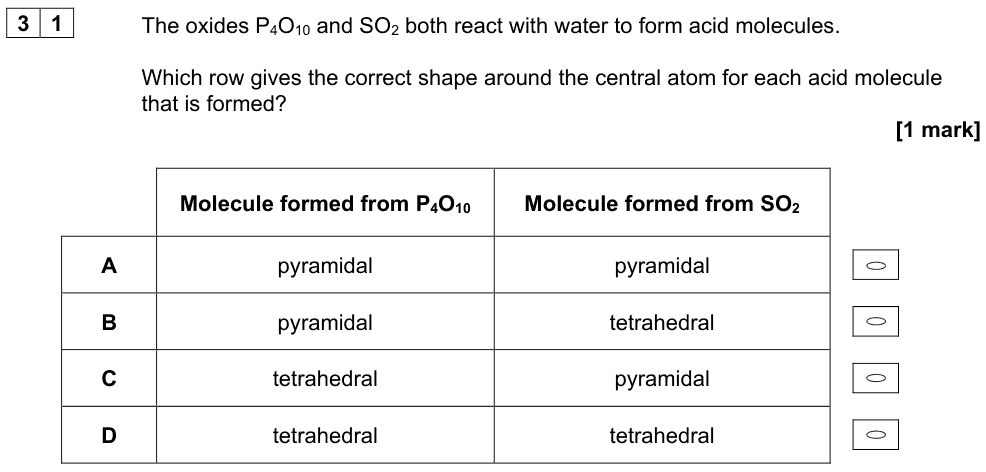
Answer: C. H3PO4 has four bonding regions round P and no lone pair (tetrahedral)
H2SO3 has three bonding regions and one lone pair on S (pyramidal). One of the least well answered questions (under 55% correct)
Skills: MS4.1 Use angles and shapes in regular 2D and 3D structures
June 2024 · AS Paper 1 · Q03.11 markAO1=1Short answer
Mark scheme
Examiner's comment
03.1 The definition of electronegativity was well known by students although a few did not refer to covalent bonds in their answers.
Notes from the mark scheme and report
The (relative) ability of an atom to attract the pair of electrons (electron density) in a covalent bond. 'Covalent bond' was sometimes missed
June 2024 · AS Paper 1 · Q03.22 marksAO2=2Explanation
Earlier part of question 03 that this part uses
Mark scheme
Examiner's comment
03.2 Most students understood that the atoms had different electronegativities but then many did not go onto explain why this difference causes polarity within a bond.
Notes from the mark scheme and report
Chlorine is more electronegative than carbon, so the electron density in the bond is unsymmetrical: Cl becomes δ– and C becomes δ+. Many stopped at 'different electronegativities'
June 2024 · AS Paper 1 · Q03.32 marksAO2=2Explanation
Earlier part of question 03 that this part uses
Mark scheme
Examiner's comment
03.3 The majority of students realised that the symmetry of the molecule led to the molecule being non-polar. However, only a few students were able to explain that this means that the dipoles cancel out. A large number of students incorrectly stated that the polar bonds would cancel out or that the partial charges cancelled.
Notes from the mark scheme and report
CCl4 is symmetrical (tetrahedral), so the dipoles cancel out. Not 'the polar bonds cancel' or 'the partial charges cancel'
Skills: MS4.1 Use angles and shapes in regular 2D and 3D structures
June 2024 · AS Paper 1 · Q03.43 marksAO1=3Explanation
Earlier part of question 03 that this part uses
Mark scheme
Examiner's comment
03.4 Students generally gave good explanations of what causes van der Waals’ forces, although many did not always explain that dipoles are induced in neighbouring molecules or that the induced dipoles cause molecules to attract each other.
Notes from the mark scheme and report
Random movement of electrons in one molecule creates a temporary dipole
this induces a dipole in a neighbouring molecule
the temporary dipoles (δ+ and δ–) in different molecules attract. The induced dipole and the attraction were often left out
June 2024 · AS Paper 1 · Q03.52 marksAO2=2Diagram or structure
Earlier part of question 03 that this part uses
Mark scheme
Examiner's comment
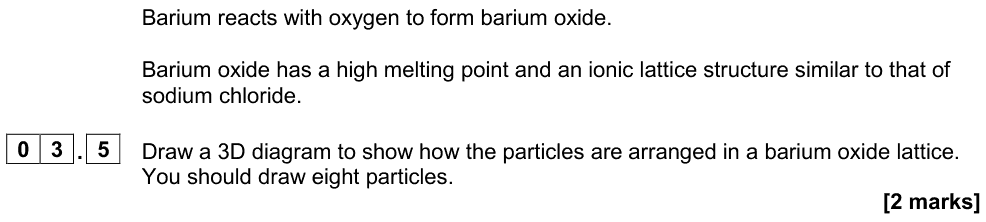
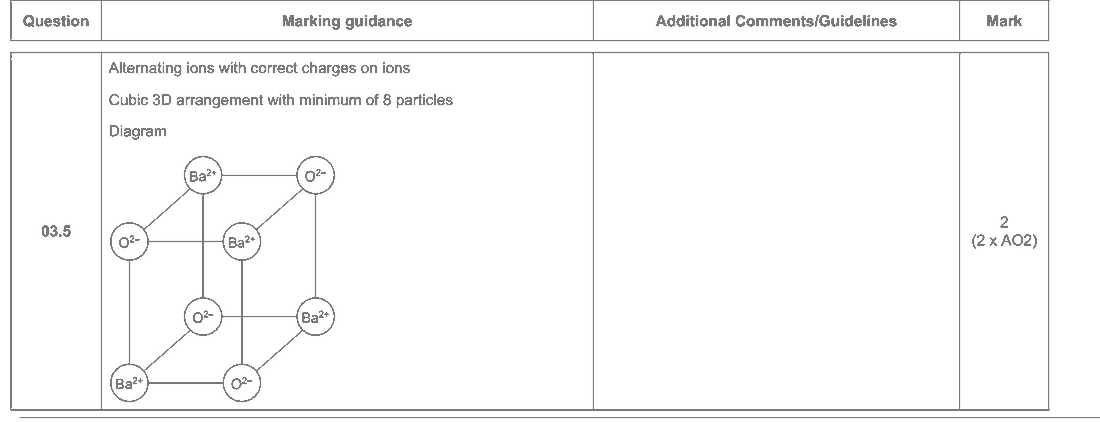
03.5 Most students understand that barium oxide contains Ba2+ and O2– ions. However, fewer students were able to draw a cubic 3D lattice with alternating ions.
Notes from the mark scheme and report
A cube of eight particles with Ba2+ and O2– ions alternating at the corners. One mark for alternating ions with correct charges, one for the cubic 3D arrangement. Fewer could draw the cubic lattice with alternating ions
Skills: MS4.2 Visualise and represent 2D and 3D forms including two-dimensional representations of 3D objects
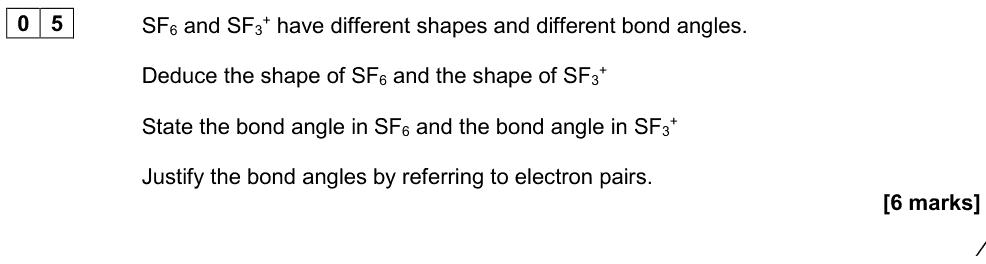
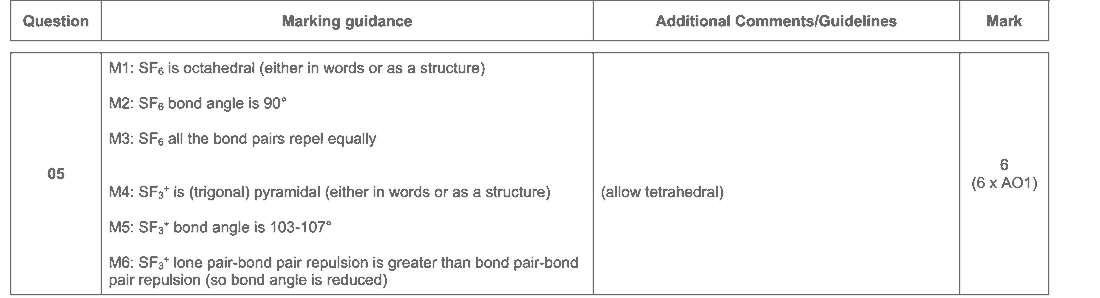
June 2024 · AS Paper 1 · Q056 marksAO1=6ExplanationHard
Mark scheme
Examiner's comment
05 About a quarter of students scored all the marks on this question. However, students did not always justify the octahedral bond angle by stating that all the bonding pairs of electrons would
repel equally. A good number of students also stated that SF3
+ was trigonal planar or trigonal bipyramidal rather than it being pyramidal.
Question 6: Atomic structure and mass spectrometry.
06.1 This question on electron configuration was well answered with over three quarters of students scoring this mark.
06.2 This question was not well answered by students. Rather than giving an equation to form a molecular ion that would have been produced during electron impact ionisation, students often gave equations to form Br+ or Br– ions.
06.3 Students did not always label the axes on the Figure, and often the x-axis was labelled Mr rather than m/z. Students generally realised that there would also be a peak at m/z = 162 due to the Br2+ ion where both bromine atoms were 81Br, but only about a quarter of students realised that there would be a Br2+ ion that contained one atom of each isotope, so would have m/z = 160 and that this ion would be twice as abundant as the ion that produced the m/z = 158 peak.
06.4 The majority of students did not appreciate that the relative abundance of the ion would be proportional to the size of the current in the detector. Common misconceptions included suggesting that speed or time of flight was linked to abundance.
Notes from the mark scheme and report
SF6: octahedral, 90°, six bonding pairs repel equally. SF3+: (trigonal) pyramidal, 103 to 107°, three bonding pairs and one lone pair
lone pair–bond pair repulsion is greater than bond pair–bond pair repulsion, so the angle is reduced. Common errors: SF3+ given as trigonal planar or trigonal bipyramidal
not saying the bonding pairs repel equally
Skills: MS4.1 Use angles and shapes in regular 2D and 3D structures
June 2024 · Paper 1 · Q05.51 markAO2=1Diagram or structure
Earlier part of question 05 that this part uses
Mark scheme
Examiner's comment
Students found part 5 challenging: errors included shapes with 0, 1 or 2 lone pairs or four chlorine atoms.
Notes from the mark scheme and report
Linear Cl–Cl–Cl with three lone pairs on the central chlorine. Errors: 0, 1 or 2 lone pairs, or four chlorine atoms
Skills: MS4.1 Use angles and shapes in regular 2D and 3D structures; MS4.2 Visualise and represent 2D and 3D forms including two-dimensional representations of 3D objects
June 2024 · Paper 1 · Q05.62 marksAO2=1, AO3=1ExplanationHard
Earlier part of question 05 that this part uses
Mark scheme
Examiner's comment
In part 6, 24% of students gained both marks.
Many students who gave the correct bond angle did not give a correct explanation: many responses referred to lone pairs repelling more than bond pairs.
Notes from the mark scheme and report
180°
the two bonding pairs repel to be as far apart as possible. Many gave the angle but then wrote about lone pairs
Skills: MS4.1 Use angles and shapes in regular 2D and 3D structures
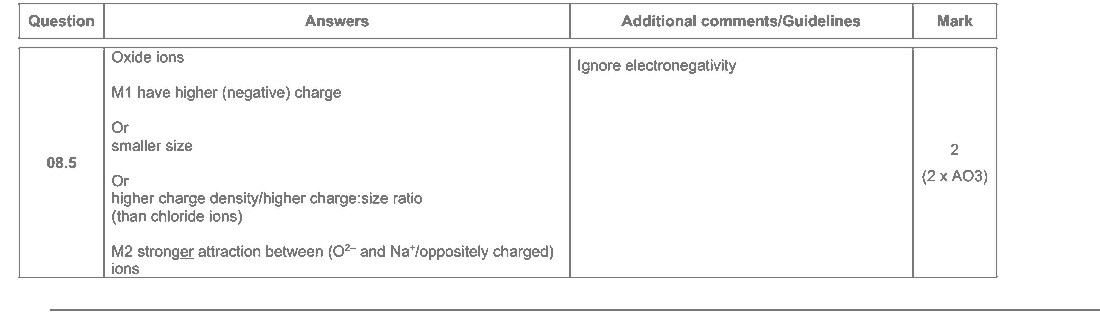
June 2024 · Paper 1 · Q08.52 marksAO3=2Explanation
Earlier part of question 08 that this part uses
Mark scheme
Examiner's comment
In part 5 many students confused the electrostatic attraction in ionic compounds with covalent bonds and intermolecular forces.
Other errors included reference to the charge density of atoms or molecules.
Notes from the mark scheme and report
Oxide ions have a higher charge / are smaller than chloride ions, so the attraction to Na+ is stronger. Do not write about covalent bonds, intermolecular forces, atoms or molecules
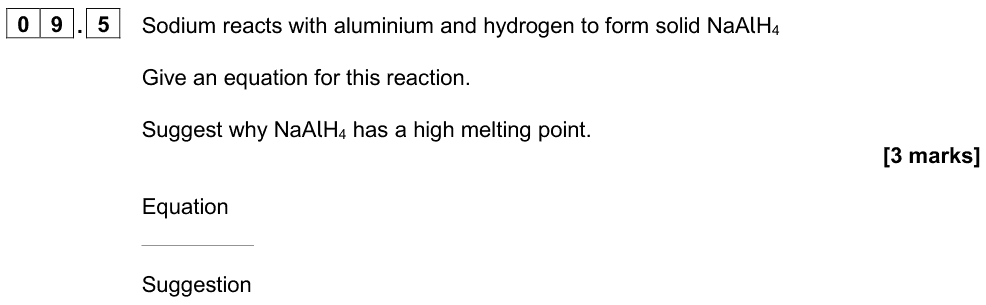
June 2024 · Paper 1 · Q09.53 marksAO2=2, AO3=1Explanation
Earlier part of question 09 that this part uses
Mark scheme
Examiner's comment
The equation in part 5 was generally correct: errors included using H instead of H2.
Very few students realised that there was ionic bonding in the compound and described metallic bonding or intermolecular forces.
Notes from the mark scheme and report
Na + Al + 2H2 → NaAlH4
it contains Na+ and AlH4– ions with strong attraction between the oppositely charged ions. Errors: H instead of H2
metallic bonding or intermolecular forces described
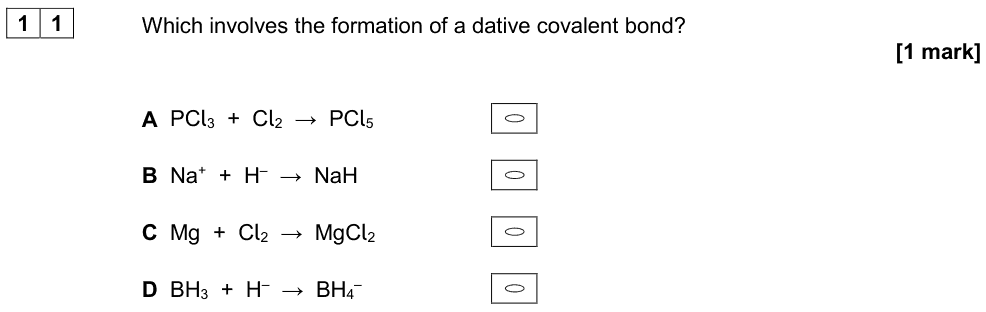
June 2024 · AS Paper 1 · Q111 markAO1=1Multiple choice
Answer
D
Mark scheme
Examiner's comment
Dative Covalent Bond Just over half of students (57%) were able to identify the reaction in which a dative covalent bond is formed.
Notes from the mark scheme and report
Answer: D. H– donates both electrons of the shared pair to the electron-deficient boron in BH3
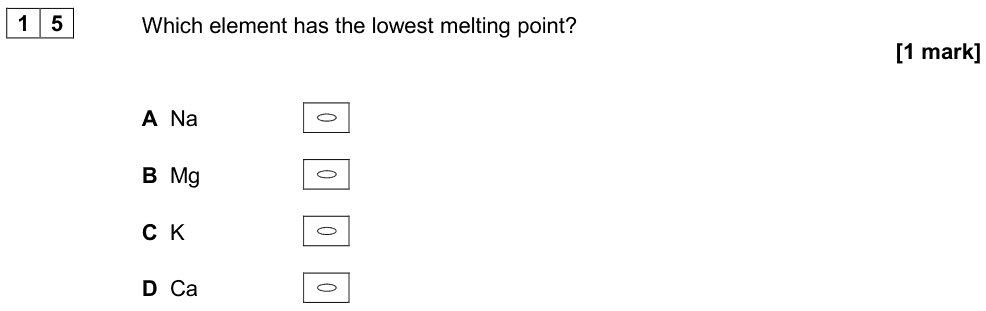
June 2024 · AS Paper 1 · Q151 markAO2=1Multiple choice
Answer
C
Mark scheme
Examiner's comment
Melting points of Period 3 and Group 2 elements Only about 40% of students were able to identify that potassium has the lowest melting point, with many students (about one third) incorrectly choosing sodium.
Notes from the mark scheme and report
Answer: C. K has the weakest metallic bonding: 1+ ions that are larger than Na+, with one delocalised electron per atom. About a third chose Na
June 2024 · AS Paper 2 · Q07.33 marksAO1=3Diagram or structure
Earlier part of question 07 that this part uses
Mark scheme
Examiner's comment
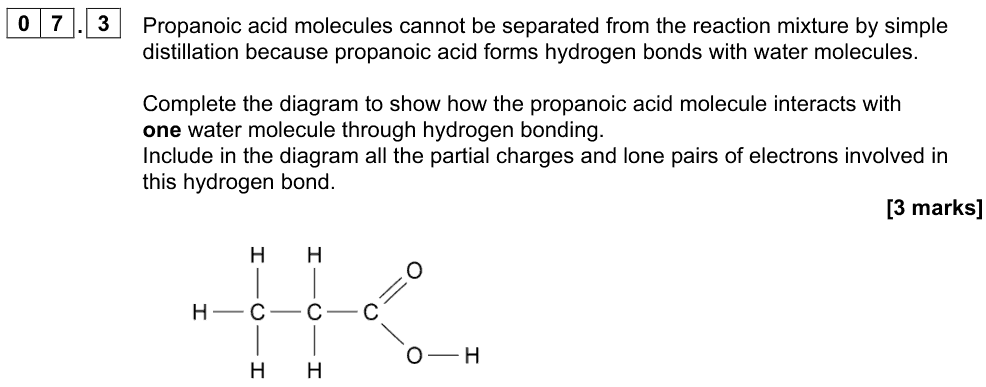
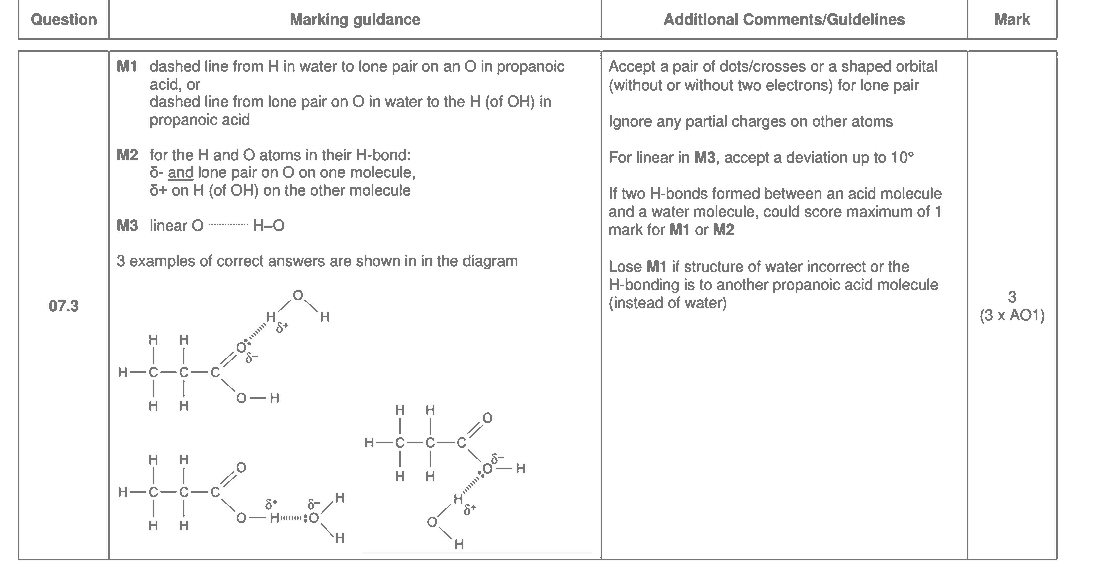
7.3 Many students could draw a hydrogen bond between a molecule of propanoic acid and a molecule of water. However, many did not show the oxygen lone pair in their hydrogen bond.
Notes from the mark scheme and report
Dashed line from a lone pair on an O of one molecule to the H of an O–H on the other (water H to an O of the acid, or water O to the acid's O–H hydrogen)
δ– and lone pair shown on that O and δ+ on that H
the O···H–O arrangement drawn linear. Two hydrogen bonds drawn: max 1. Many left out the oxygen lone pair
Skills: MS4.2 Visualise and represent 2D and 3D forms including two-dimensional representations of 3D objects
June 2024 · AS Paper 2 · Q171 markAO3=1Multiple choiceEasy
Answer
A
Mark scheme
Examiner's comment
This was answered correctly by a majority (67.1%) of students.
Q18 Use of high-resolution mass spectrometry to distinguish compounds
Students found this question harder, possibly failing to deduce the correct molecular formula of each compound from its name.
Notes from the mark scheme and report
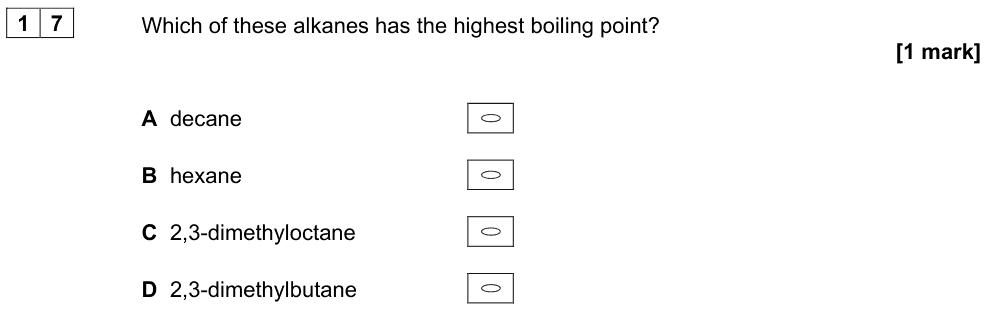
Answer: A. Decane has the longest unbranched chain: most electrons and greatest surface contact, so the strongest van der Waals forces. 2,3-dimethyloctane also has ten carbons but branching lowers the boiling point
June 2024 · Paper 3 · Q091 markAO1=1Multiple choice
Answer
B
Mark scheme
Notes from the mark scheme and report
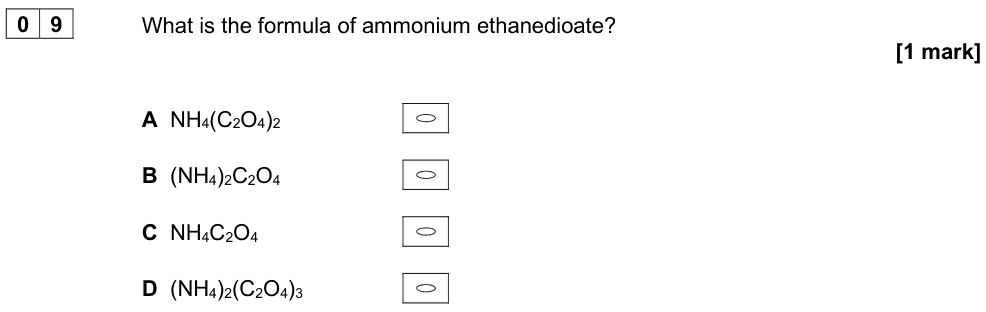
Answer: B. NH4+ and C2O4 2– give (NH4)2C2O4
June 2024 · Paper 3 · Q101 markAO2=1Multiple choice
Answer
C
Mark scheme
Notes from the mark scheme and report
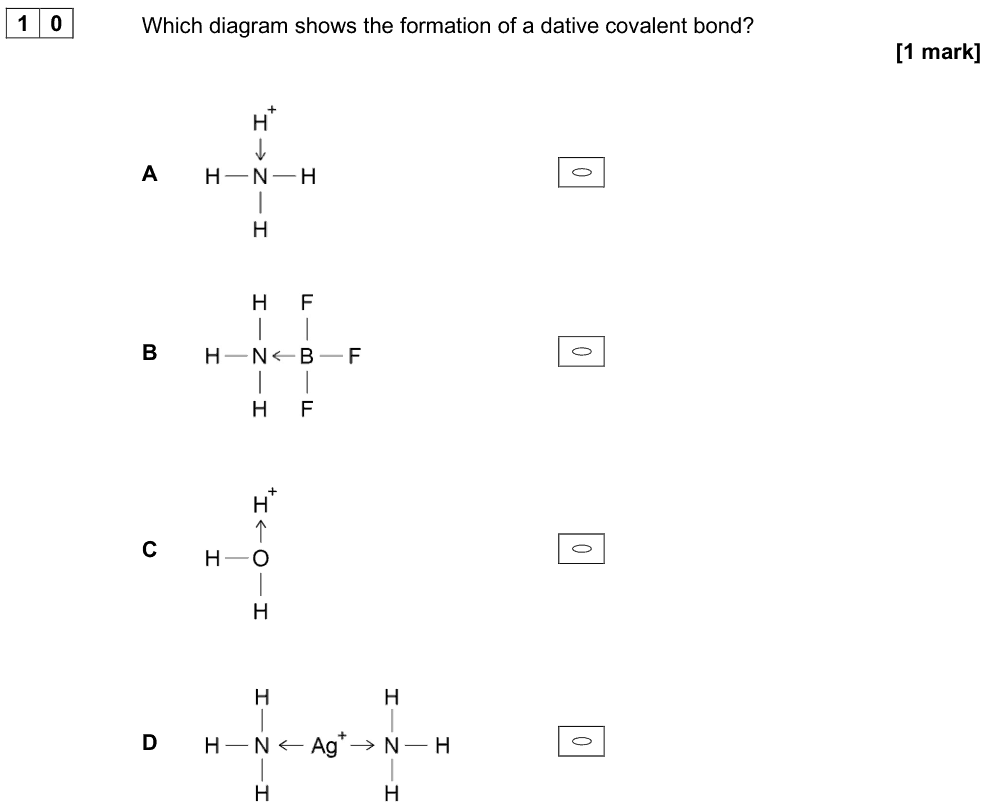
Answer: C. The arrow must point from the atom donating the lone pair (O of H2O) to the acceptor (H+)
in A, B and D the arrows point the wrong way
June 2024 · Paper 3 · Q111 markAO1=1Multiple choice
Answer
C
Mark scheme
Notes from the mark scheme and report
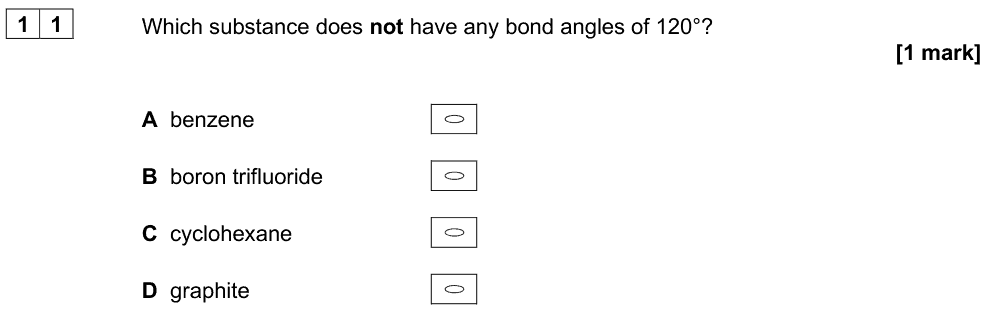
Answer: C. Cyclohexane carbons are tetrahedral (about 109.5°)
benzene, BF3 and graphite are trigonal planar at each atom (120°)
Skills: MS4.1 Use angles and shapes in regular 2D and 3D structures
June 2024 · Paper 3 · Q121 markAO2=1Multiple choice
Answer
D
Mark scheme
Notes from the mark scheme and report
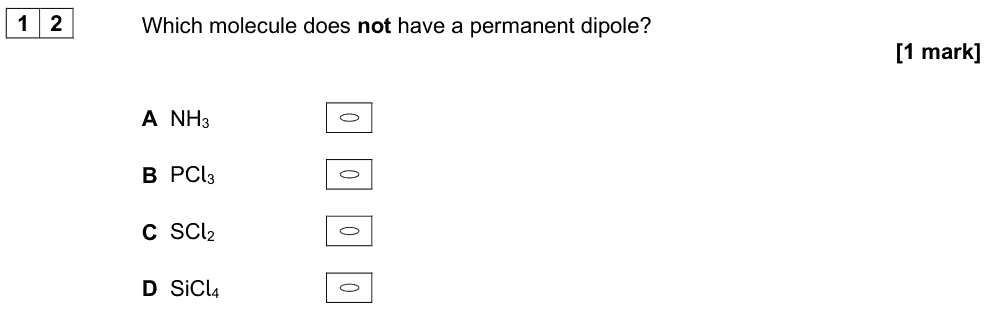
Answer: D. SiCl4 is tetrahedral and symmetrical so the bond dipoles cancel
NH3 and PCl3 are pyramidal and SCl2 is bent
June 2024 · Paper 3 · Q131 markAO2=1Multiple choice
Answer
A
Mark scheme
Notes from the mark scheme and report
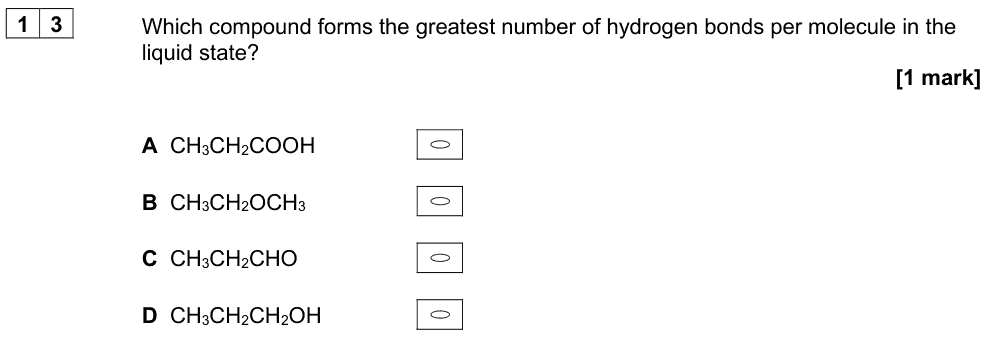
Answer: A. The carboxylic acid has an O–H hydrogen and two oxygen atoms with lone pairs, so it forms more hydrogen bonds per molecule than the alcohol
the ether and aldehyde have no O–H
June 2024 · Paper 3 · Q201 markAO1=1Multiple choice
Answer
A
Mark scheme
Notes from the mark scheme and report
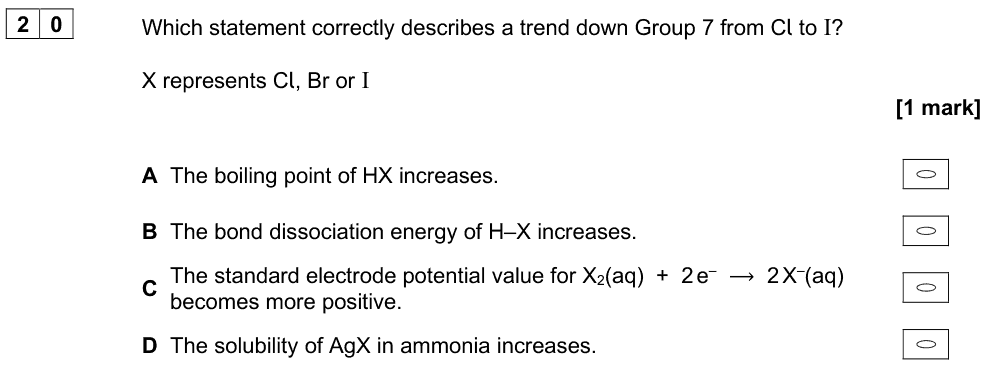
Answer: A. From HCl to HI the molecules have more electrons, so stronger van der Waals forces and higher boiling points
H–X bond enthalpy falls, E for X2/X– becomes less positive, and AgX becomes less soluble in ammonia
June 2023 · Paper 1 · Q01.22 marksAO1=1, AO2=1Diagram or structure
Earlier part of question 01 that this part uses
Mark scheme
Examiner's comment
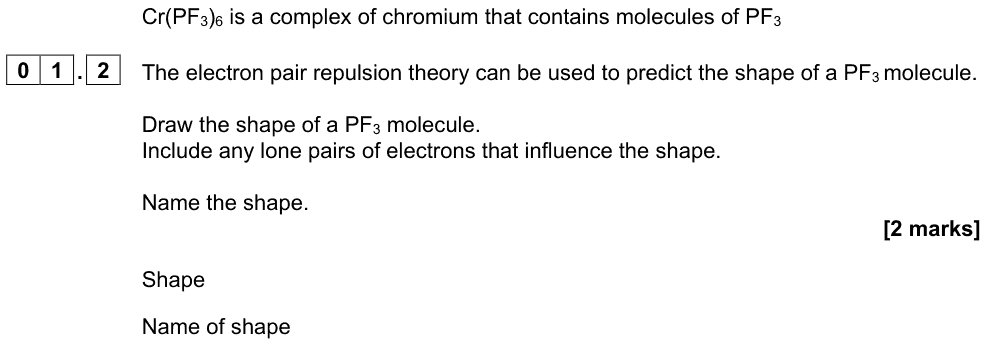
In 01.2, the name of the shape was often not known even if the diagram was correct; common errors included diagrams with no lone pairs.
Notes from the mark scheme and report
P with three bonds to F and one lone pair
pyramidal (allow triangular pyramid or tetrahedral). Errors: no lone pair drawn
name of shape not known
Skills: MS4.1 Use angles and shapes in regular 2D and 3D structures; MS4.2 Visualise and represent 2D and 3D forms including two-dimensional representations of 3D objects
June 2023 · Paper 1 · Q01.51 markAO3=1Short answer
Earlier part of question 01 that this part uses
Mark scheme
Examiner's comment
Many students gave the correct answer in 01.5; common errors were hydrogen bonds and dative covalent bonds.
Notes from the mark scheme and report
Covalent. Common wrong answers: hydrogen bond, dative covalent bond
June 2023 · AS Paper 1 · Q02.12 marksAO1=2Short answer
Mark scheme
Examiner's comment
02.1 Students did not always describe both the structure and bonding in magnesium. In particular, students did not describe the particles between which there is an attractive force.
Notes from the mark scheme and report
Giant lattice of Mg2+ ions (or atoms)
electrostatic attraction between the Mg2+ ions / nuclei and delocalised electrons. A wrong structure type loses M1. Many did not say which particles attract each other
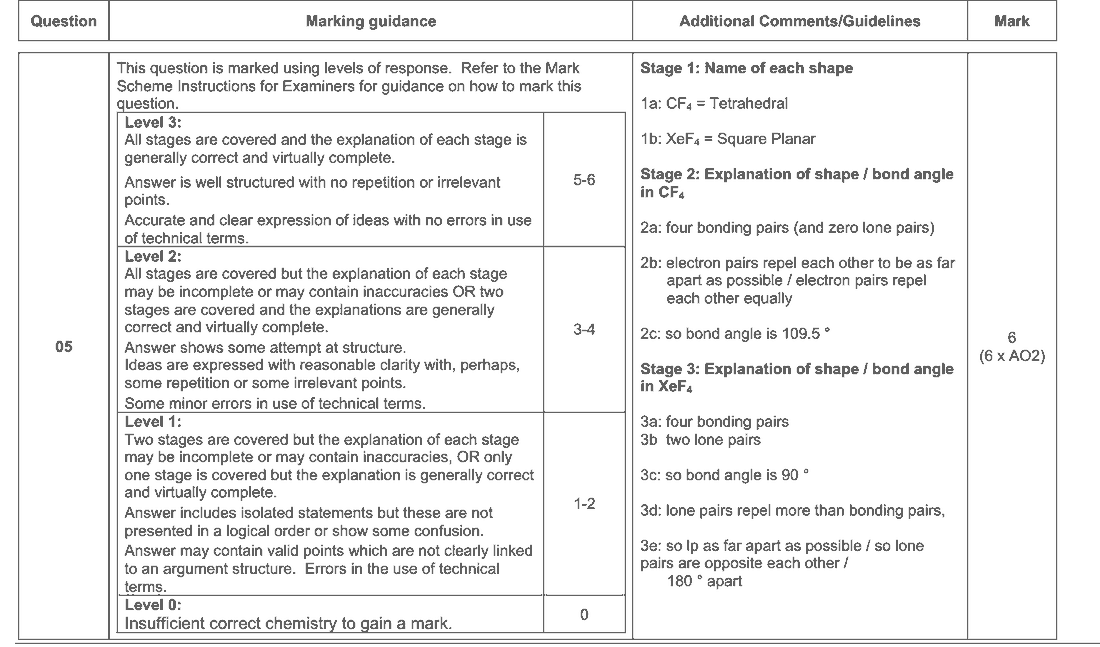
June 2023 · AS Paper 1 · Q056 marksAO2=66-mark level of responseHard
Mark scheme, with the levels and indicative content
Examiner's comment
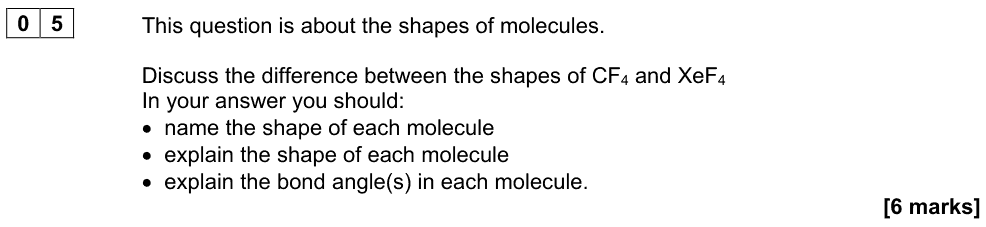
05 Just under a quarter of students scored all of the marks in this question. However, students did not always refer to electron pair repulsion theory when explaining the shape and bond angle in each molecule. Whilst most knew the name of the shape of CF4, fewer students were able to give the correct name for the shape of XeF4.
Notes from the mark scheme and report
Levels of response, three stages. Stage 1 names: CF4 tetrahedral
XeF4 square planar. Stage 2 CF4: four bonding pairs and no lone pairs
electron pairs repel equally / as far apart as possible
109.5°. Stage 3 XeF4: four bonding pairs and two lone pairs
lone pairs repel more than bonding pairs so they are opposite each other (180° apart)
bond angle 90°. Many did not use electron pair repulsion
square planar was less well known
Skills: MS4.1 Use angles and shapes in regular 2D and 3D structures
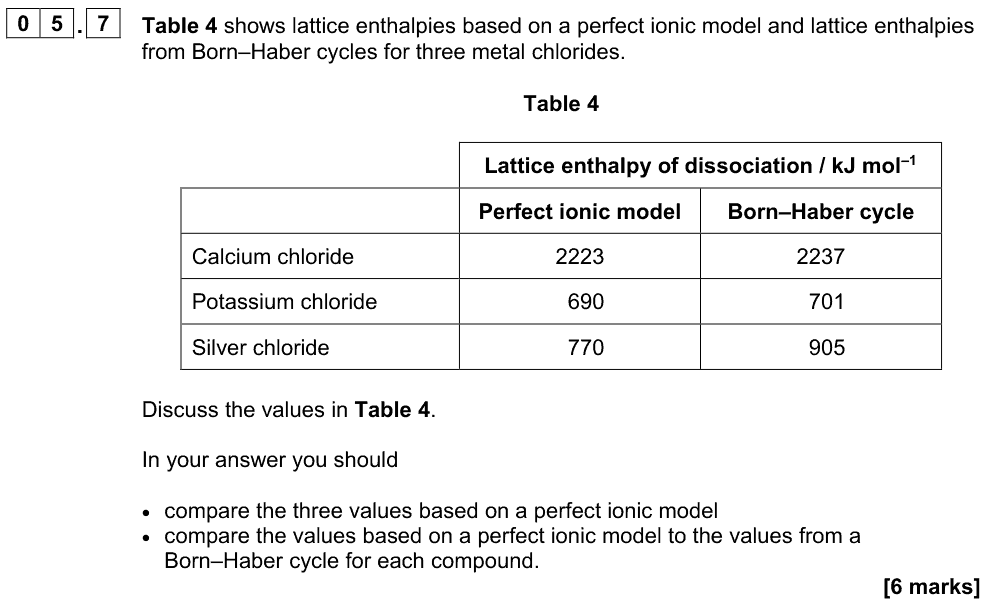
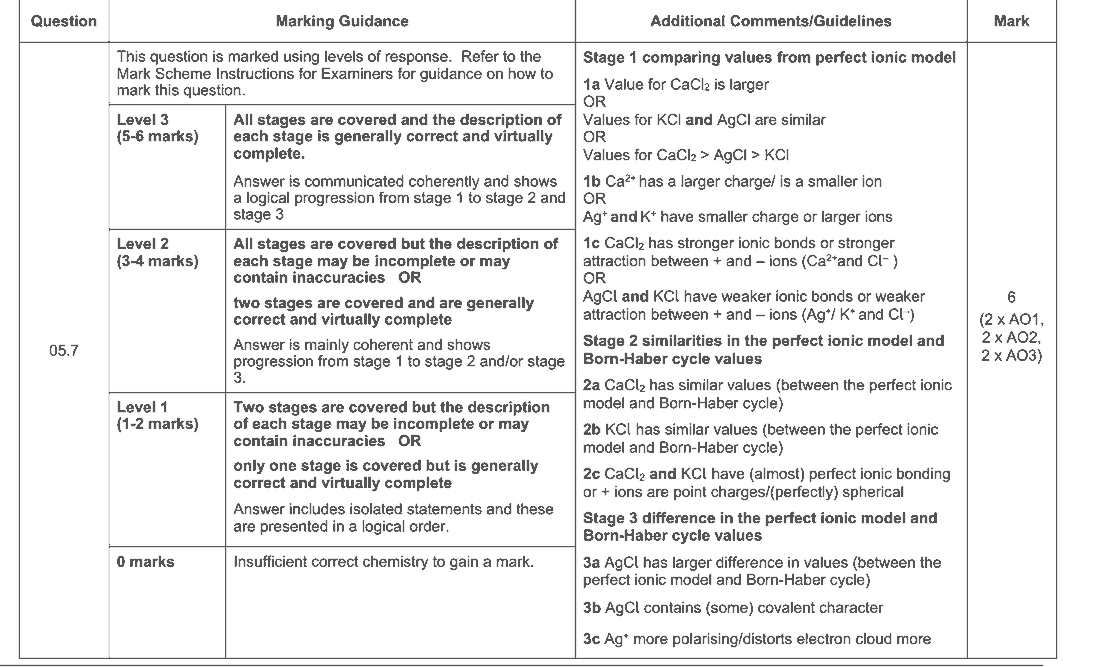
June 2023 · Paper 1 · Q05.76 marksAO1=2, AO2=2, AO3=26-mark level of responseHard
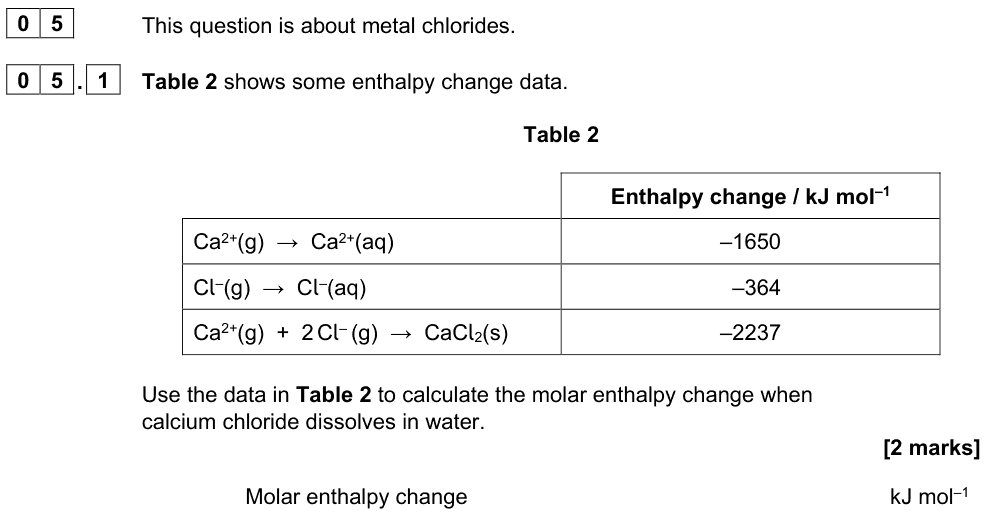
Earlier part of question 05 that this part uses
Mark scheme, with the levels and indicative content
Examiner's comment
There were some very good answers to 05.7 and 28% of students gave level 3 answers; many students began their answer by stating that the experimental values were all higher than the theoretical values and that the calcium chloride value was the highest for both the experimental and theoretical data.
They then went on to explain incorrectly that this was because of covalent character in calcium chloride and that the greater difference for silver chloride was because it had more covalent character.
Students who discussed the relative values for the three chlorides often lost credit because they confused atoms and molecules (eg calcium atoms are smaller than potassium atoms or calcium chloride molecules have stronger ionic bonds).
Notes from the mark scheme and report
Levels of response, three stages. Perfect ionic model values: CaCl2 much larger (KCl and AgCl similar) because Ca2+ has a higher charge / is smaller, so stronger attraction between Ca2+ and Cl– ions. Similar values: for CaCl2 and KCl the model and Born–Haber values agree, so bonding is almost perfectly ionic (ions are point charges / spherical). Different values: AgCl has a much larger Born–Haber value, so it has some covalent character
Ag+ is more polarising / distorts the chloride electron cloud. Errors: covalent character claimed for CaCl2
'calcium atoms' or 'CaCl2 molecules'
June 2023 · AS Paper 1 · Q06.12 marksAO1=2ExplanationHard
Mark scheme
Examiner's comment
06.1 Only about a quarter of students scored both marks on this question. Students generally referred to the attraction for outer electrons rather than the attraction for the bonding pair of electrons.
Notes from the mark scheme and report
Atoms get larger / more shells / more shielding, so the bonding pair is further from the nucleus
weaker attraction between the nucleus and the bonding (shared) pair of electrons. References to outer electrons are ignored: the common error
June 2023 · AS Paper 1 · Q131 markAO1=1Multiple choice
Answer
A
Mark scheme
Examiner's comment
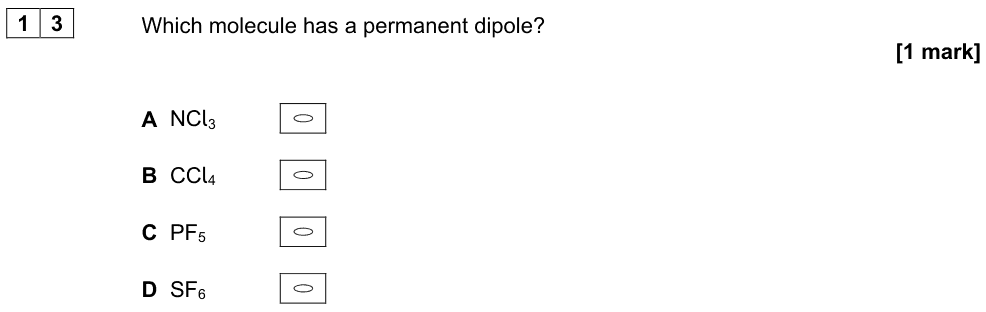
About half of the students were able to identify the molecule that has a permanent dipole.
Notes from the mark scheme and report
Answer: A. NCl3 is pyramidal (one lone pair) so its bond dipoles do not cancel
the others are symmetrical
Skills: MS4.1 Use angles and shapes in regular 2D and 3D structures
June 2023 · AS Paper 1 · Q141 markAO1=1Multiple choice
Answer
B
Mark scheme
Examiner's comment
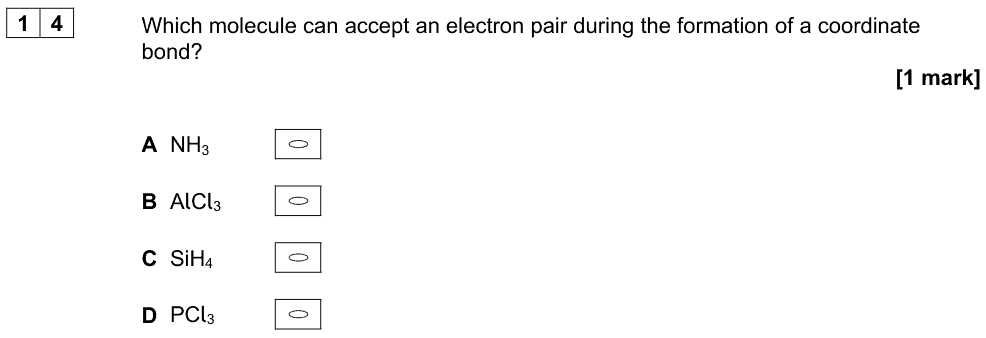
Just under half of the students were able to identify the molecule that can accept an electron pair during the formation of a coordinate bond. A common incorrect answer was the identification of a molecule that would donate the lone pair during the formation of a coordinate bond.
Notes from the mark scheme and report
Answer: B. Aluminium in AlCl3 is electron deficient (six outer electrons), so it accepts a lone pair. Common wrong answer: a molecule that donates a lone pair
June 2023 · AS Paper 2 · Q06.11 markAO1=1Short answer
Mark scheme
Examiner's comment
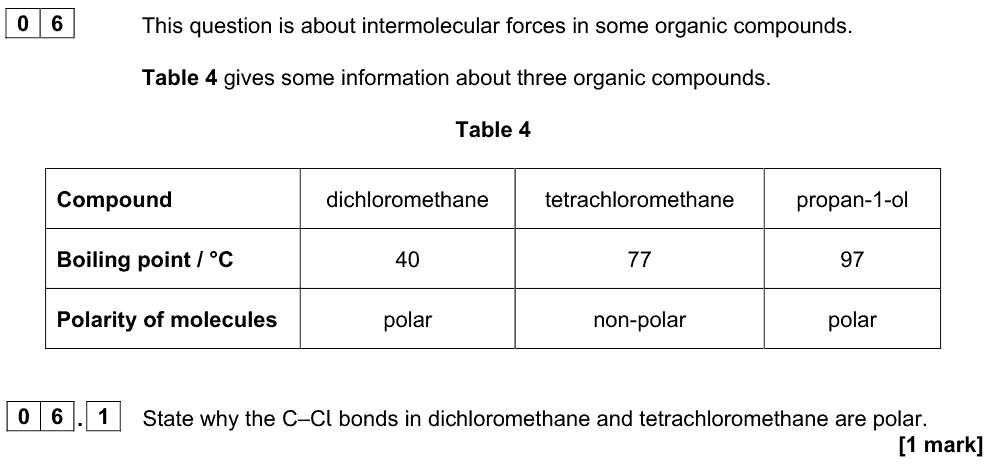
06.1 Students who referred to electronegativity usually scored the mark on this question.
Notes from the mark scheme and report
Chlorine is more electronegative than carbon (they have different electronegativities), so the bonding electrons are not shared equally
June 2023 · AS Paper 2 · Q06.21 markAO3=1Short answer
Earlier part of question 06 that this part uses
Mark scheme
Examiner's comment
06.2 Few students could use the idea of symmetry to explain why the compound was not polar.
Notes from the mark scheme and report
The molecule is symmetrical (tetrahedral), so the bond dipoles cancel out. Few used the idea of symmetry
Skills: MS4.1 Use angles and shapes in regular 2D and 3D structures
June 2023 · AS Paper 2 · Q06.32 marksAO2=2Explanation
Earlier part of question 06 that this part uses
Mark scheme
Examiner's comment
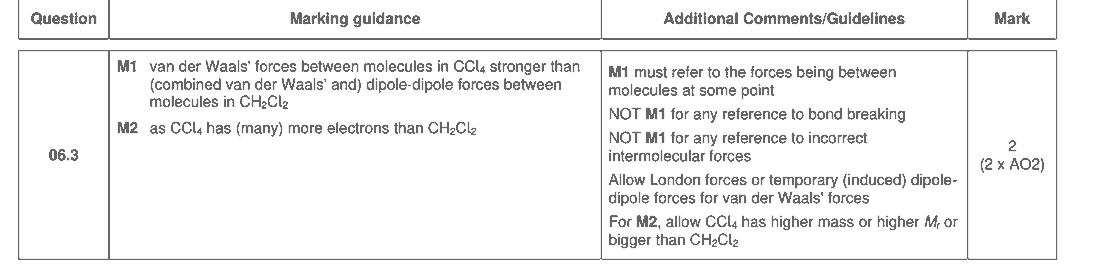
06.3 Students struggled with this question. Few used the information about polarity in questions 06.1 and 06.2 to inform their answer.
Notes from the mark scheme and report
The van der Waals forces between CCl4 molecules are stronger than the (van der Waals plus) dipole–dipole forces between CH2Cl2 molecules, because CCl4 has many more electrons (larger Mr). Must be forces between molecules
any mention of breaking bonds loses the first mark
June 2023 · AS Paper 2 · Q06.42 marksAO1=2Short answer
Earlier part of question 06 that this part uses
Mark scheme
Examiner's comment
06.4 Students struggled to describe the hydrogen bonding between molecules of propan-1-ol. Some students used a diagram and this often helped to achieve higher marks.
Notes from the mark scheme and report
Attraction between a lone pair on the O of one molecule and the δ+ H of the O–H group on another molecule. No marks if the hydrogen bond is said to be the O–H bond within a molecule
a labelled diagram can score
June 2023 · AS Paper 2 · Q151 markAO3=1Multiple choice
Answer
B
Mark scheme
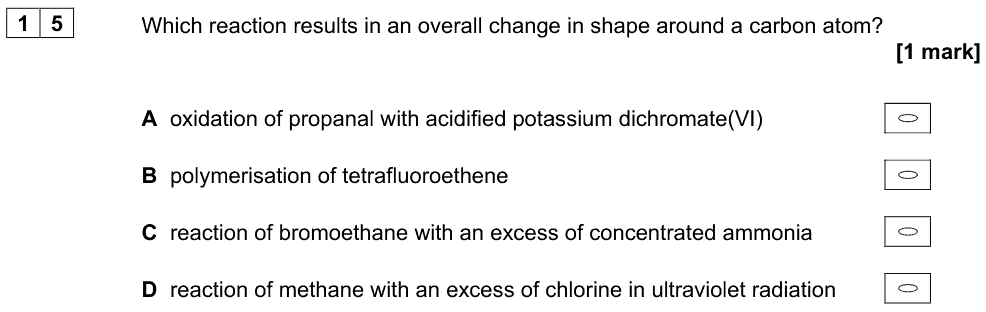
Examiner's comment
There was much to consider in this question and a range of answers was given by students. Just over 40% of students gave the correct answer.
Notes from the mark scheme and report
Answer: B. In CF2=CF2 each carbon is trigonal planar
in the polymer each carbon is tetrahedral. In the other reactions the carbon keeps its shape (planar C=O or tetrahedral)
Skills: MS4.1 Use angles and shapes in regular 2D and 3D structures
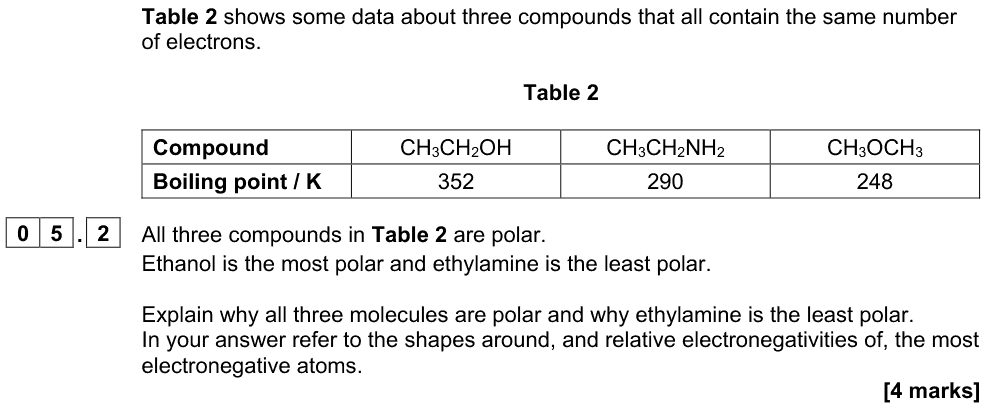
June 2023 · Paper 3 · Q05.24 marksExplanation
Earlier part of question 05 that this part uses
Mark scheme
Examiner's comment
In 05.2, there was significant evidence of confusion amongst many students about how to use the terminology needed.
The question also specifically asked for shapes to be referred to in the answer but many students ignored this, which effectively meant that they could only score a maximum of two marks.
A lot of answers gave the impression that students’ thinking is somehow ‘reversed’ in relation to these concepts, with many answers seeming to imply that polarity in a molecule is DUE to its ability to form hydrogen bonds.
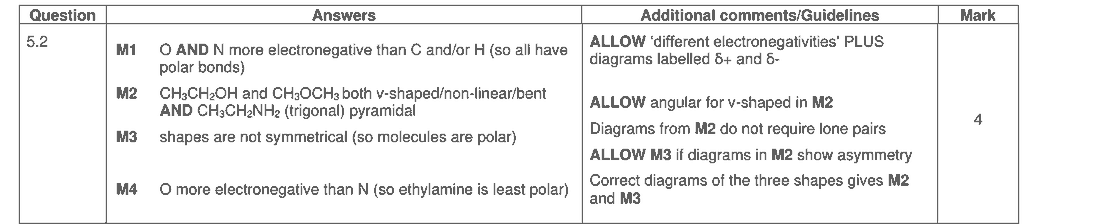
Notes from the mark scheme and report
O and N are more electronegative than C and H, so the bonds to them are polar
the shape around O in ethanol and in CH3OCH3 is bent (V-shaped) and around N in ethylamine is trigonal pyramidal
these shapes are not symmetrical, so the bond dipoles do not cancel
O is more electronegative than N, so ethylamine is the least polar. Answers ignoring the shapes were limited to 2
say which atom is the more electronegative
no need to discuss intermolecular forces here
Skills: MS4.1 Use angles and shapes in regular 2D and 3D structures
June 2023 · Paper 3 · Q05.33 marksExplanation
Earlier parts of question 05 that this part uses
Mark scheme
Examiner's comment
There was no need here to refer to intermolecular forces at all (that was required for 5.3).
This question was also a prime example of the need for greater precision in the language used for an explanation – many students referred to differences in electronegativity without explicitly stating which atoms the difference was between or which way round the difference was (ie. which atom had the greater electronegativity).
05.3 saw further confusion with the use of correct terminology and too many answers used phrases such as ‘the hydrogen bonds between oxygen and hydrogen’ – there is a real danger here of implying that it is a covalent bond that is being referred to (ie O-H) rather than an intermolecular force (ie ẟ-O-----Hẟ+).
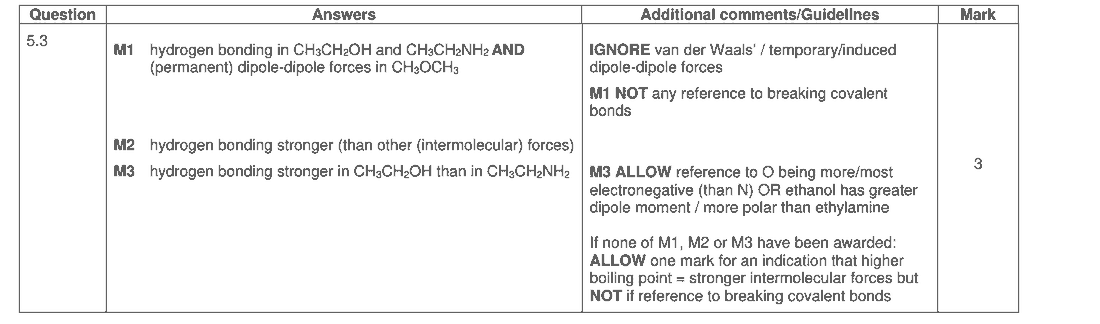
What was hoped for here was the recognition that the most significant intermolecular forces in both ethylamine and ethanol are hydrogen bonds (with those in ethanol being stronger), while CH3OCH3 cannot form hydrogen bonds.
The permanent dipole-permanent dipole forces are weaker than hydrogen bonds.
Notes from the mark scheme and report
Ethanol and ethylamine have hydrogen bonding between molecules, CH3OCH3 has only permanent dipole–dipole forces (as its strongest)
hydrogen bonds are stronger than dipole–dipole forces
hydrogen bonding is stronger in ethanol than in ethylamine because O is more electronegative than N. Any reference to breaking covalent bonds loses M1
do not describe hydrogen bonds as the O–H bond itself. Uses Table 2 printed in 05.2
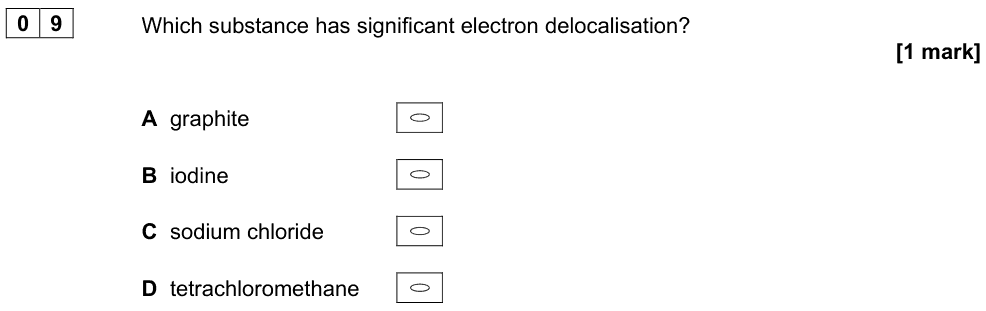
June 2023 · Paper 3 · Q091 markAO1=1Multiple choice
Answer
A
Mark scheme
Notes from the mark scheme and report
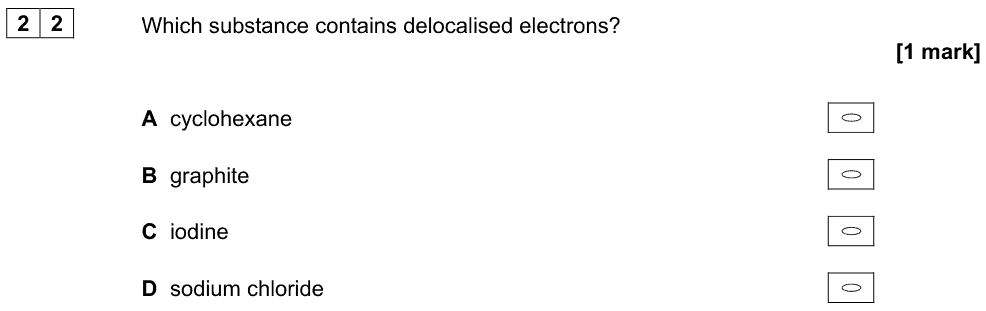
Answer: A. Each carbon in graphite forms three bonds and the fourth electron is delocalised between the layers
iodine and tetrachloromethane are simple molecular and sodium chloride is ionic
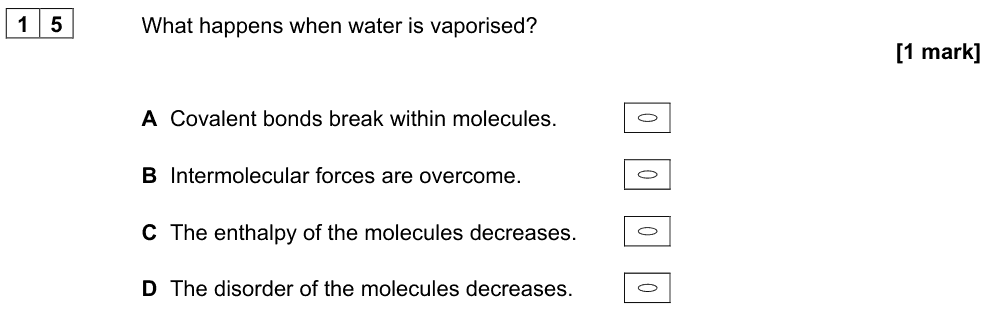
June 2023 · Paper 3 · Q151 markAO1=1Multiple choice
Answer
B
Mark scheme
Notes from the mark scheme and report
Answer: B. Vaporisation overcomes the intermolecular forces (hydrogen bonds) between water molecules
covalent bonds do not break, and enthalpy and disorder both increase
June 2022 · AS Paper 1 · Q033 marksAO1=3Diagram or structureHard
Mark scheme
Examiner's comment
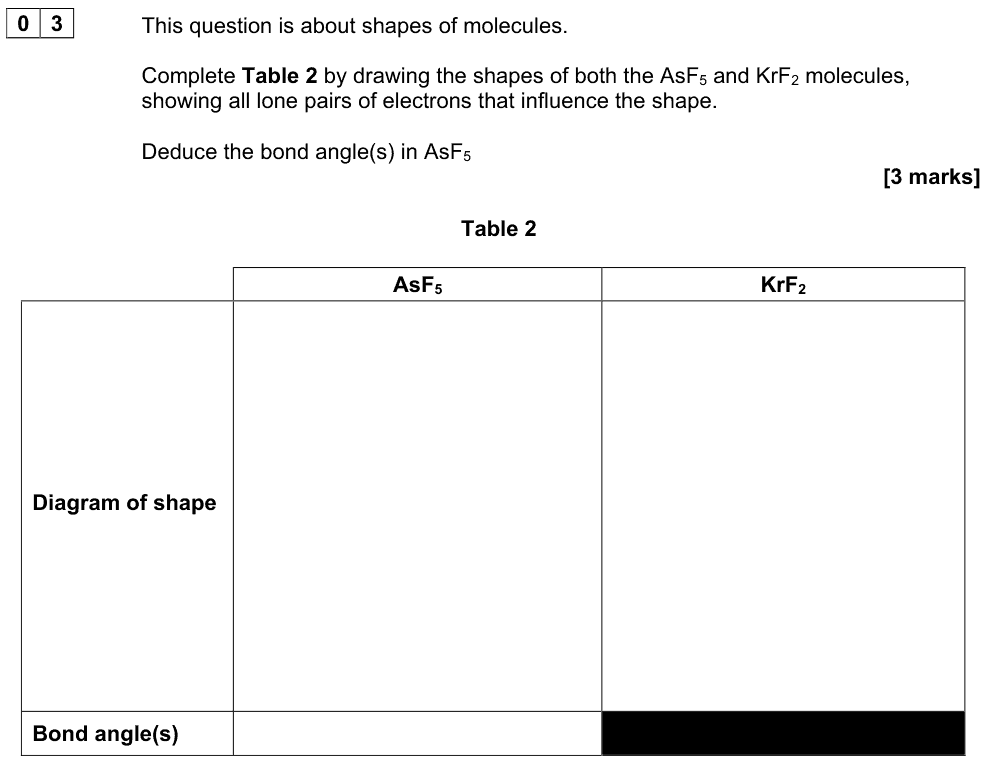
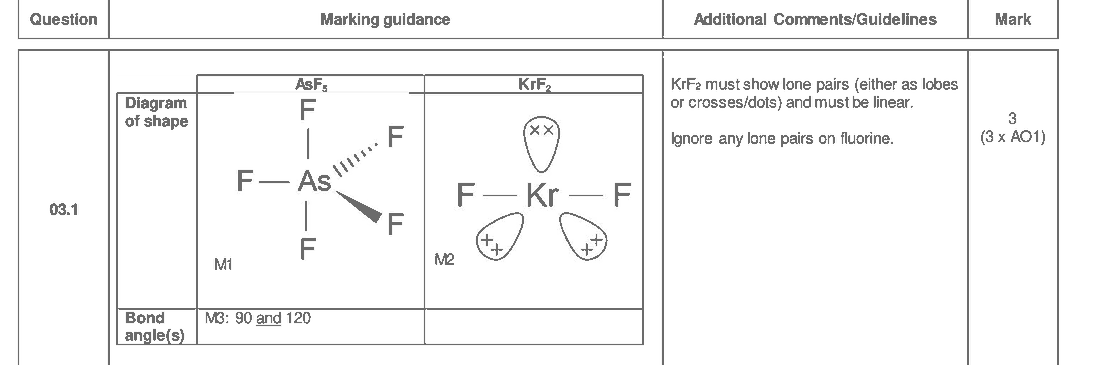
A good number of students (26.4%) scored all the marks on this question. However, many added extra lone pairs to the structure of AsF5 and/or missed including the necessary number of lone
pairs on the structure of KrF2. Students would benefit from being able to draw structures accurately using appropriate wedges to show the 3D nature of molecules and ions.
Notes from the mark scheme and report
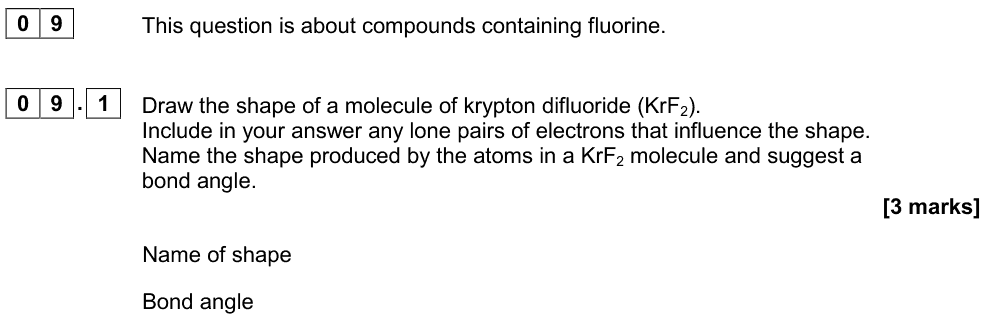
AsF5: trigonal bipyramid with no lone pairs, bond angles 90° and 120°. KrF2: linear with three lone pairs shown on Kr (ignore lone pairs on F). Errors: extra lone pairs on AsF5
too few lone pairs on KrF2
poor 3D drawing with wedges
Skills: MS4.1 Use angles and shapes in regular 2D and 3D structures; MS4.2 Visualise and represent 2D and 3D forms including two-dimensional representations of 3D objects
June 2022 · AS Paper 1 · Q04.13 marksAO2=3Diagram or structure
Mark scheme
Examiner's comment
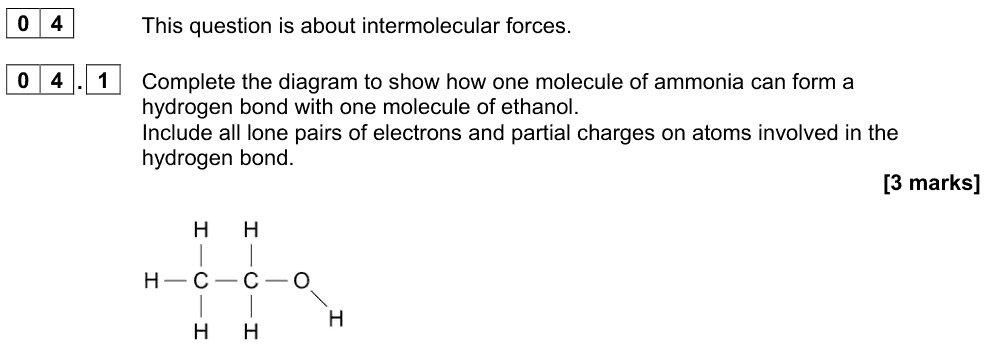
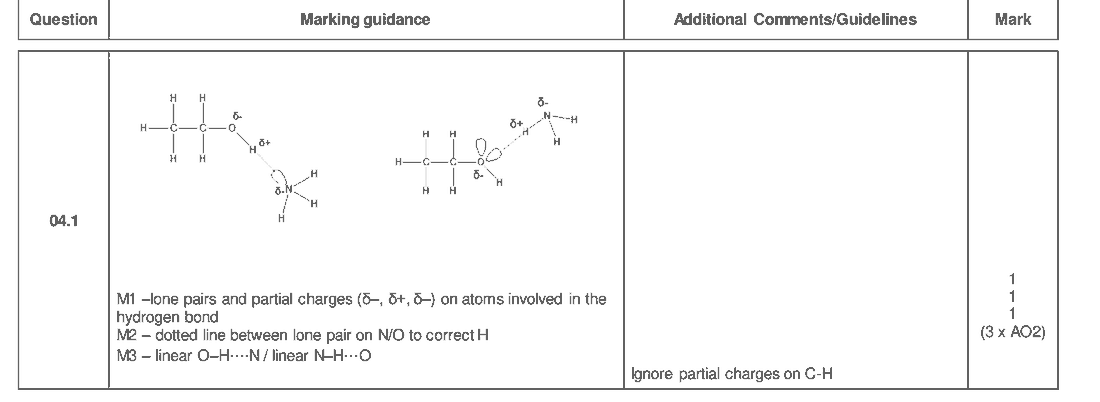
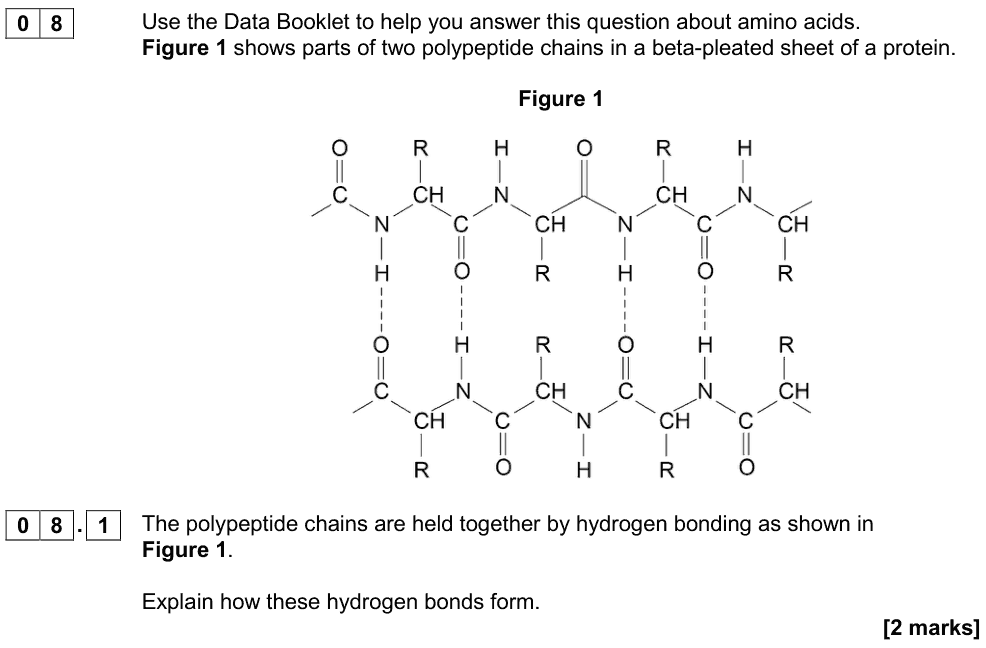
04.1 Students found this one of the more challenging questions. It was common for students to miss off partial charges and/or lone pairs from their diagrams. The hydrogen bond should be drawn from the lone pair to the δ+ H atom and this was not always shown very well. In a few cases students did not show the hydrogen bond between an ammonia molecule and an ethanol molecule.
Notes from the mark scheme and report
M1 lone pairs and partial charges (δ–, δ+, δ–) on the atoms in the hydrogen bond
M2 dotted line from the lone pair on N (or O) to the correct H
M3 O–H···N (or N–H···O) drawn linear. Common errors: partial charges or lone pairs missing
bond not drawn from the lone pair to the δ+ H
Skills: MS4.2 Visualise and represent 2D and 3D forms including two-dimensional representations of 3D objects
June 2022 · AS Paper 1 · Q04.21 markAO1=1Short answer
Earlier part of question 04 that this part uses
Mark scheme
Examiner's comment
04.2 This definition was well known, although some students referred incorrectly to the attraction for a lone pair rather than the bonding pair of electrons.
Notes from the mark scheme and report
The power of an atom to attract the pair of electrons (electron density) in a covalent bond. Not 'lone pair'
not 'element'
June 2022 · AS Paper 1 · Q04.31 markAO2=1Short answer
Earlier parts of question 04 that this part uses
Mark scheme
Examiner's comment
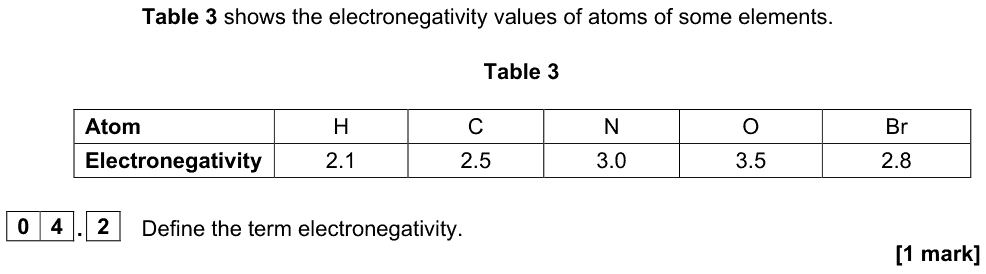
04.3 This was well understood and the majority of students correctly selected H and O as the atoms that would form the most polar bond.
Notes from the mark scheme and report
Answer: H and O (largest electronegativity difference, 3.5 – 2.1). Uses Table 3
June 2022 · AS Paper 1 · Q04.42 marksAO2=2Explanation
Earlier part of question 04 that this part uses
Mark scheme
Examiner's comment
04.4 A good number of students understood that symmetry was an important consideration in this question. However, very few students appreciated that it was the dipoles that cancel and often referred to the polar bonds cancelling each other out.
Notes from the mark scheme and report
The molecule is symmetrical / tetrahedral
so the dipoles cancel. Not 'the polar bonds cancel' or 'partial charges cancel'
Skills: MS4.3 Understand the symmetry of 2D and 3D shapes
June 2022 · AS Paper 1 · Q04.53 marksAO2=3Explanation
Earlier part of question 04 that this part uses
Mark scheme
Examiner's comment
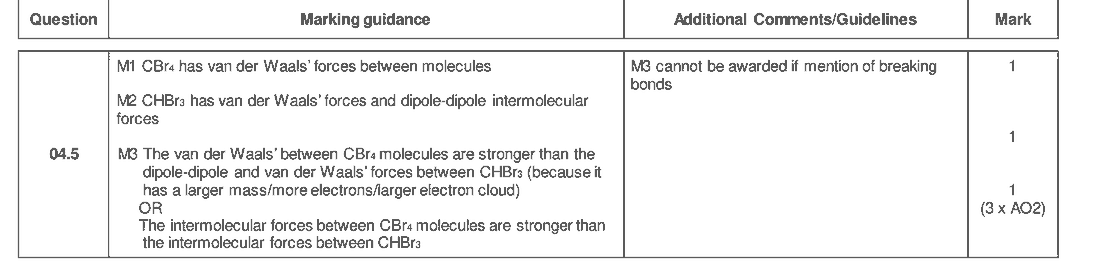
04.5 Students found this one of the more challenging questions and often did not appreciate that there are no dipole-dipole forces between molecules of CBr4. In addition, some answers incorrectly considered the idea of breaking covalent bonds rather than overcoming the intermolecular forces.
Notes from the mark scheme and report
CBr4 has only van der Waals forces between molecules
CHBr3 has van der Waals and permanent dipole–dipole forces
the van der Waals forces in CBr4 (more electrons / larger Mr) are stronger than the total intermolecular forces in CHBr3. No M3 if breaking covalent bonds is mentioned. Many thought CBr4 has dipole–dipole forces
June 2022 · Paper 1 · Q05.76 marks6-mark level of responseHard
Earlier part of question 05 that this part uses
Mark scheme, with the levels and indicative content
Examiner's comment
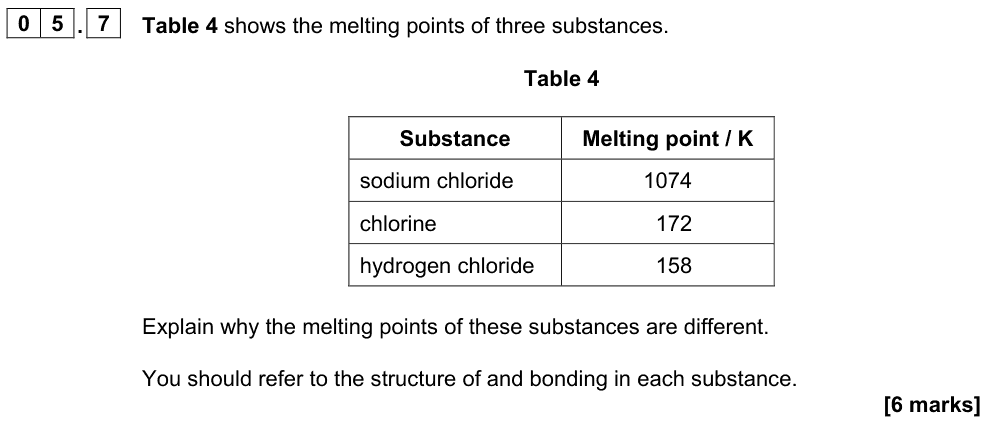
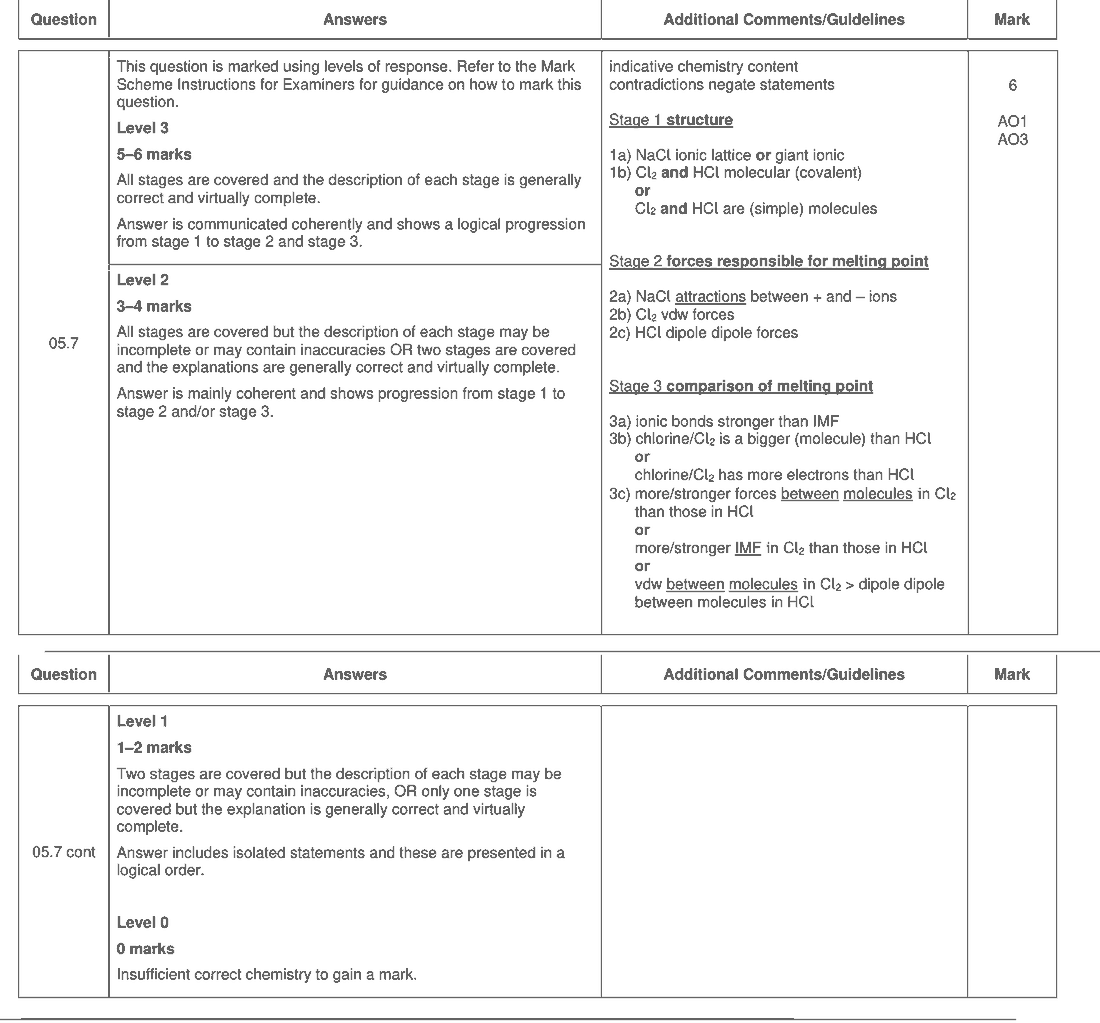
56% of students scored the mark in 05.1. The equation in 05.2 was more challenging, with many students not knowing the formula of aluminium oxide or aluminium sulfate; of those who did, many could not balance the equation. Question 05.3 proved challenging and only 13% of students scored all the marks. Common, incorrect reagents suggested were litmus, sodium hydroxide and limewater. Most students who scored 3 marks gave pH/universal indicator for the reagent and subsequent correct observations. Some students suggested barium chloride but then got the observations the wrong way around. Several students stated carbonate ions as the reagent, but this is an incomplete name so failed to gain the first mark. Very few students scored both marks in
05.4. The equation in 05.5 was correctly given by 18% of students; many students did not know the products of the reaction or gave an equation starting from P2O5. Several students gave the correct molecule in 05.6 but did not give the displayed formula as asked for in the question. About 20% of answers to 05.7 scored marks at level 3 (5/6 marks). Often the indicative content was not well explained or was very muddled. Some students mixed up ions and molecules and some confused which bonds/intermolecular forces were being broken to measure the melting point; many thought that covalent bonds were broken in chlorine and hydrogen chloride, the two molecules.
Notes from the mark scheme and report
Levels of response, three stages. Stage 1 structure: NaCl is a giant ionic lattice
Cl2 and HCl are simple molecular. Stage 2 forces overcome on melting: NaCl attraction between oppositely charged ions
Cl2 van der Waals forces
HCl permanent dipole–dipole forces (as well). Stage 3 comparison: ionic bonding is much stronger than intermolecular forces
Cl2 is a bigger molecule with more electrons than HCl, so the forces between Cl2 molecules are stronger than those between HCl molecules. Errors: confusing ions and molecules
saying covalent bonds break when Cl2 or HCl melt
June 2022 · Paper 1 · Q06.63 marksDiagram or structure
Earlier part of question 06 that this part uses
Mark scheme
Examiner's comment
36% of students gained all three marks in 06.6.
Many students gave structures with only one lone pair and explanations often stated that the lone pairs and bond pairs repelled each other without stating that the lone pair-lone pair repulsion was greater then the bond pair-bond pair repulsion.
Common incorrect bond angles were 120o and 180o.
About half the students gave a correct equation in
Notes from the mark scheme and report
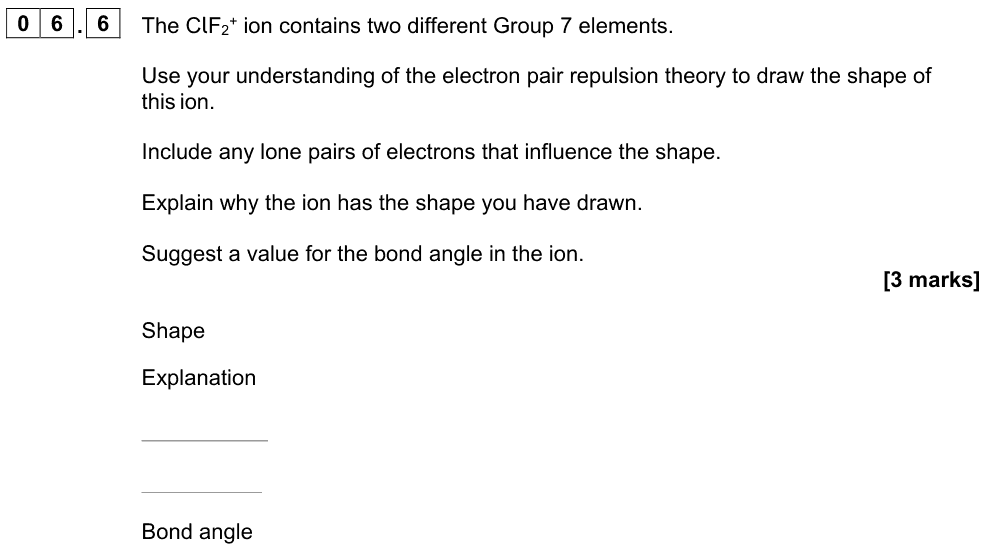
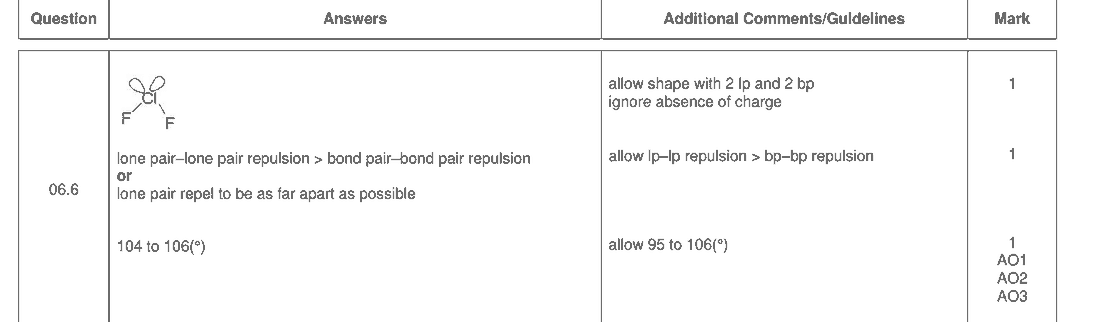
Bent (V-shaped) F–Cl–F with two lone pairs on the central Cl (two bonding pairs and two lone pairs). Lone pair–lone pair repulsion is greater than bond pair–bond pair repulsion (or the pairs repel to be as far apart as possible). Bond angle 104–106° (allow 95 to 106). Errors: only one lone pair
angles of 120° or 180°. 36% gained all three marks
Skills: MS4.1 Use angles and shapes in regular 2D and 3D structures; MS4.2 Visualise and represent 2D and 3D forms including two-dimensional representations of 3D objects
June 2022 · AS Paper 1 · Q151 markAO1=1Multiple choiceEasy
Answer
A
Mark scheme
Examiner's comment
Co-ordinate bonding A high number of students (80%) were able to identify the formation of a co-ordinate bond in a reaction.
Notes from the mark scheme and report
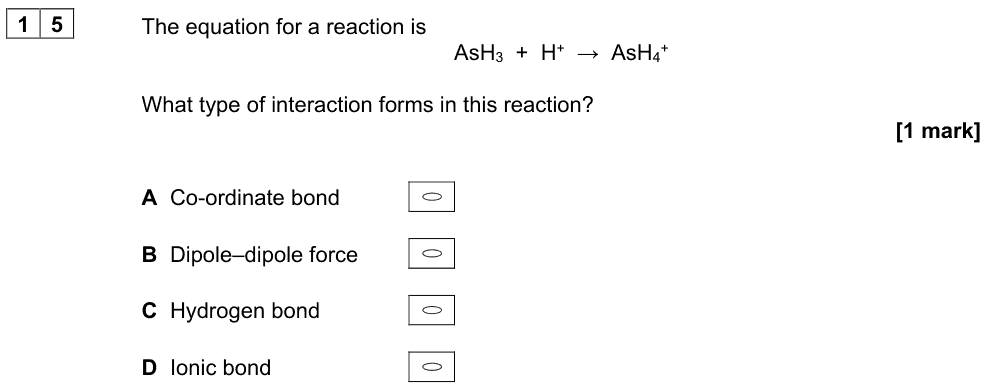
Answer: A. The lone pair on As is donated to H+, which has no electrons: a co-ordinate bond
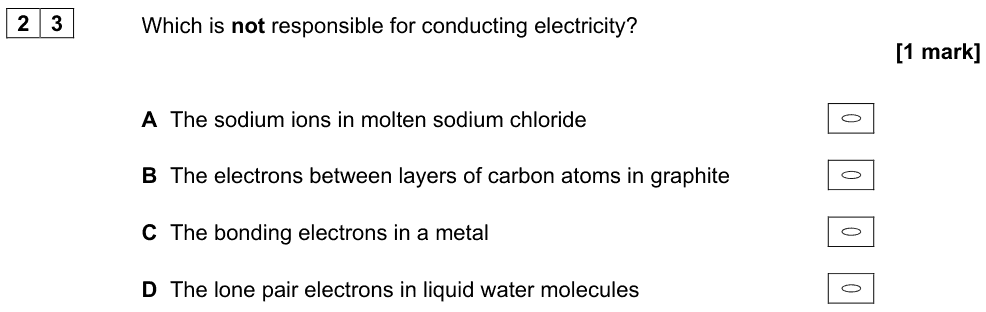
June 2022 · AS Paper 1 · Q231 markAO2=1Multiple choice
Answer
D
Mark scheme
Examiner's comment
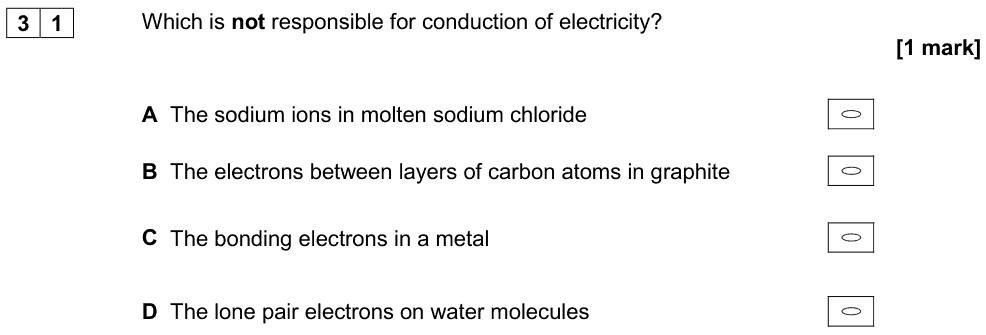
Conductivity Some students (43%) were able to consider correctly the particles in different substances that are responsible for conducting electricity.
Notes from the mark scheme and report
Answer: D. Lone pairs on water molecules are not free to move
mobile ions in molten NaCl and delocalised electrons in graphite and metals carry the current
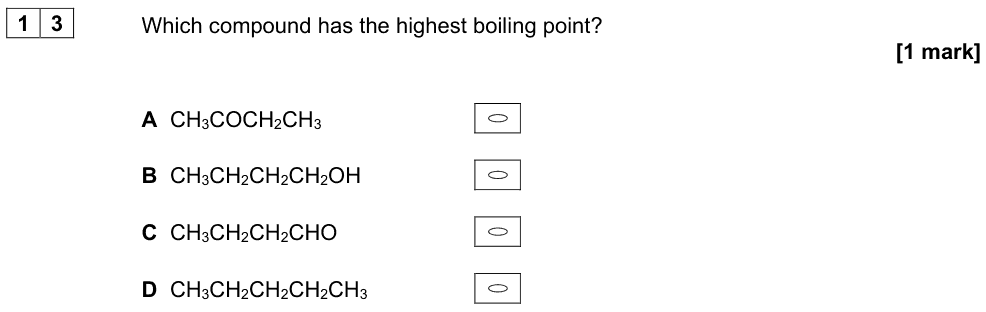
June 2022 · AS Paper 2 · Q131 markAO2=1Multiple choiceEasy
Answer
B
Mark scheme
Examiner's comment
This was answered correctly by a majority of students (66.8%).
Notes from the mark scheme and report
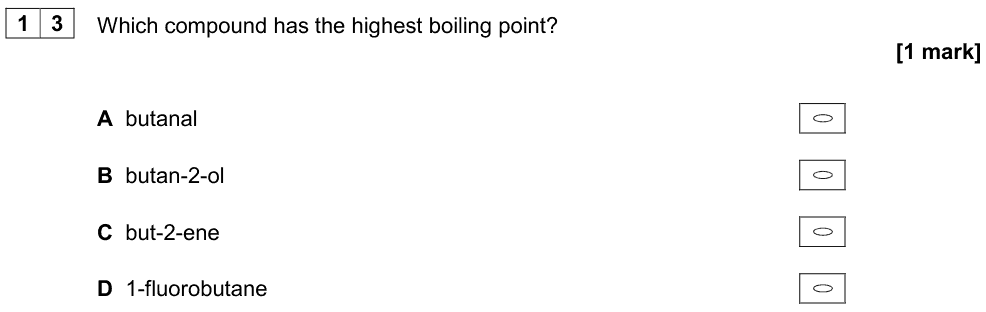
Answer: B. Butan-1-ol has hydrogen bonding between its molecules, the strongest intermolecular force here
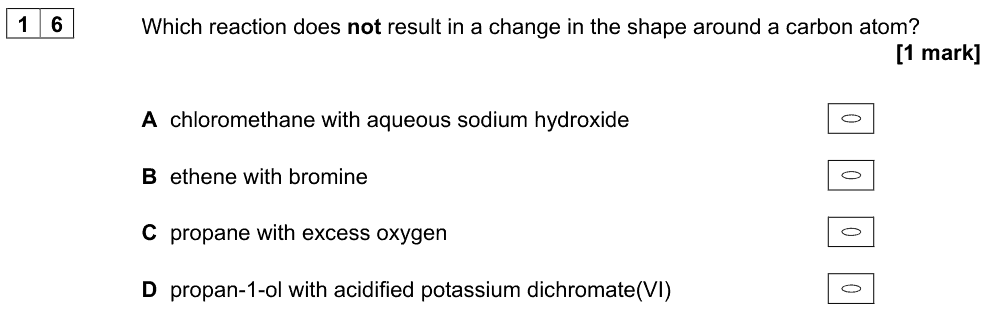
June 2022 · AS Paper 2 · Q161 markAO2=1Multiple choiceHard
Answer
A
Mark scheme
Examiner's comment
Students found this question challenging and struggled to work out whether the shape of an organic compound changes from the start to end of a reaction. Only 34.5% of students gained this mark.
Notes from the mark scheme and report
Answer: A. Carbon is tetrahedral in both chloromethane and methanol
in the other reactions a carbon changes between tetrahedral, planar or linear
Skills: MS4.1 Use angles and shapes in regular 2D and 3D structures
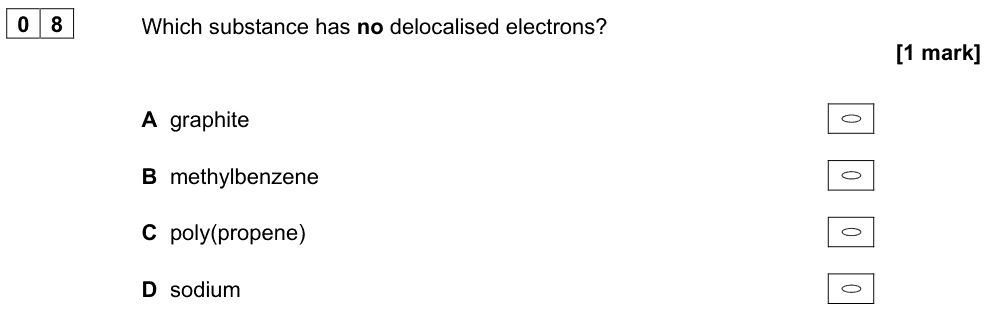
June 2022 · Paper 3 · Q081 markAO1=1Multiple choice
Answer
C
Mark scheme
Notes from the mark scheme and report
Answer: C. Poly(propene) has only localised single bonds
graphite, the benzene ring in methylbenzene and metallic sodium all have delocalised electrons
June 2022 · Paper 3 · Q171 markAO3=1Multiple choice
Answer
D
Mark scheme
Notes from the mark scheme and report
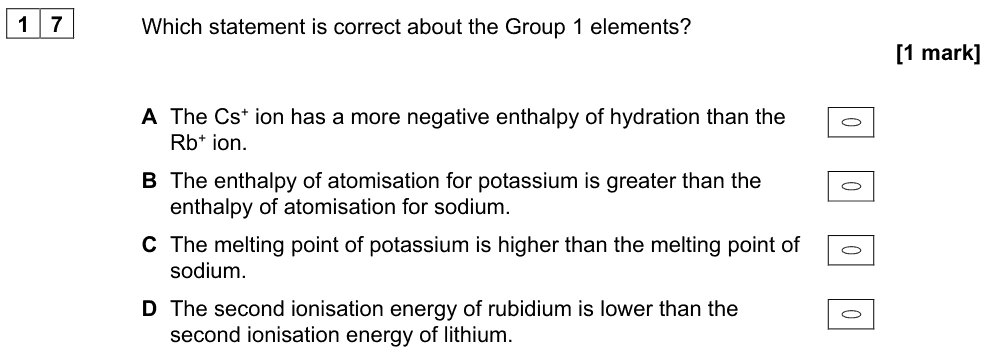
Answer: D. The second electron in Rb comes from a shell much further from the nucleus with more shielding than in Li (1s). Larger ions have less negative hydration enthalpies
metallic bonding weakens down the group so atomisation enthalpy and melting point fall
November 2021 · AS Paper 1 · Q02.22 marksShort answer
Earlier part of question 02 that this part uses
Mark scheme
Notes from the mark scheme and report
Attraction between (a lattice of) Mg2+ ions and delocalised (outer shell) electrons
November 2021 · AS Paper 1 · Q02.33 marksExplanation
Earlier part of question 02 that this part uses
Mark scheme
Notes from the mark scheme and report
Giant ionic lattice (many Mg2+ and Cl– ions)
strong electrostatic forces of attraction
between the oppositely charged ions (Mg2+ and Cl–)
November 2021 · AS Paper 1 · Q05.13 marksExplanation
Mark scheme
Notes from the mark scheme and report
Random movement of electrons in one molecule creates a temporary dipole
this induces a dipole in a neighbouring molecule
the temporary dipoles attract (δ+ to δ–)
November 2021 · AS Paper 1 · Q131 markMultiple choice
Answer
B
Mark scheme
Notes from the mark scheme and report
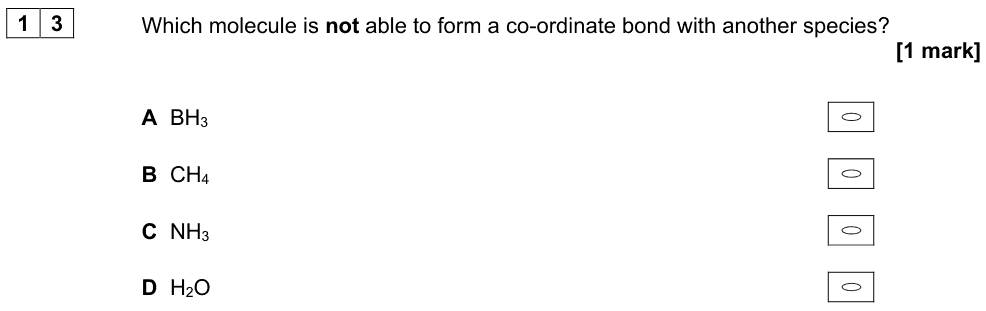
Answer: B. CH4 has no lone pair to donate and no empty orbital to accept a pair
NH3 and H2O have lone pairs and BH3 is electron deficient
November 2021 · AS Paper 1 · Q141 markMultiple choice
Answer
C
Mark scheme
Notes from the mark scheme and report
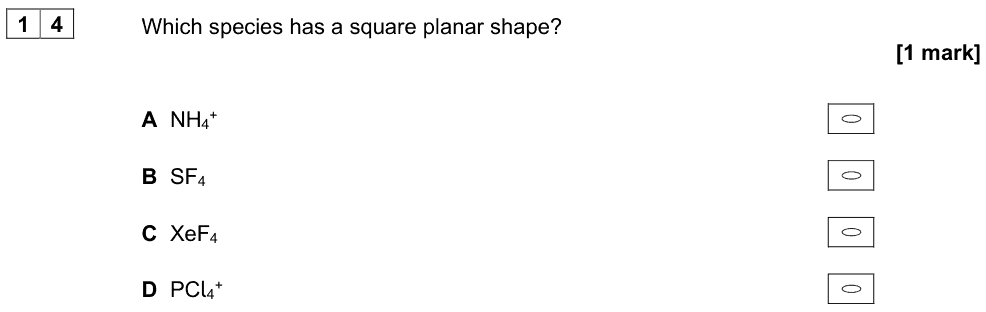
Answer: C. XeF4 has four bonding pairs and two lone pairs (six electron pairs), with the lone pairs opposite each other
NH4+ and PCl4+ are tetrahedral and SF4 has one lone pair
Skills: MS4.1 Use angles and shapes in regular 2D and 3D structures
November 2021 · AS Paper 1 · Q151 markMultiple choice
Answer
A
Mark scheme
Notes from the mark scheme and report
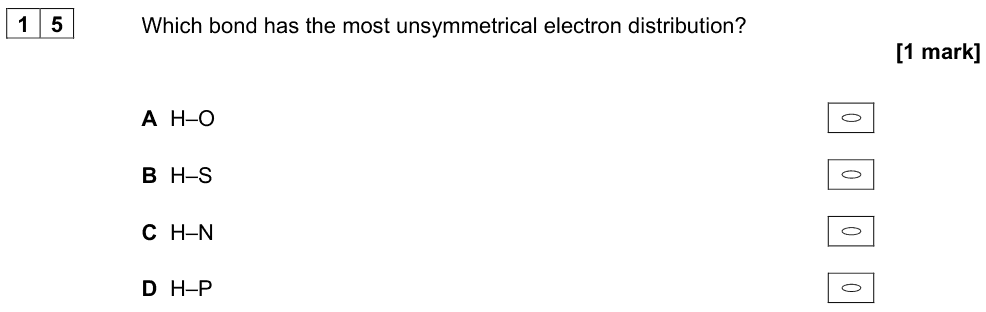
Answer: A. Oxygen is the most electronegative of O, S, N and P, so H–O has the largest electronegativity difference and is the most polar
November 2021 · Paper 2 · Q02.54 marksDiagram or structure
Earlier part of question 02 that this part uses
Mark scheme
Examiner's comment
In this question a surprisingly small proportion of students were able to state the meaning of the term fraction. In addition, very few were able to explain why C=O bonds in carbon dioxide absorb infrared radiation. A good range of answers was seen for the extended response question about the environmental impact of bioethanol as a fuel, but a significant number of students were unable to get started here.
Notes from the mark scheme and report
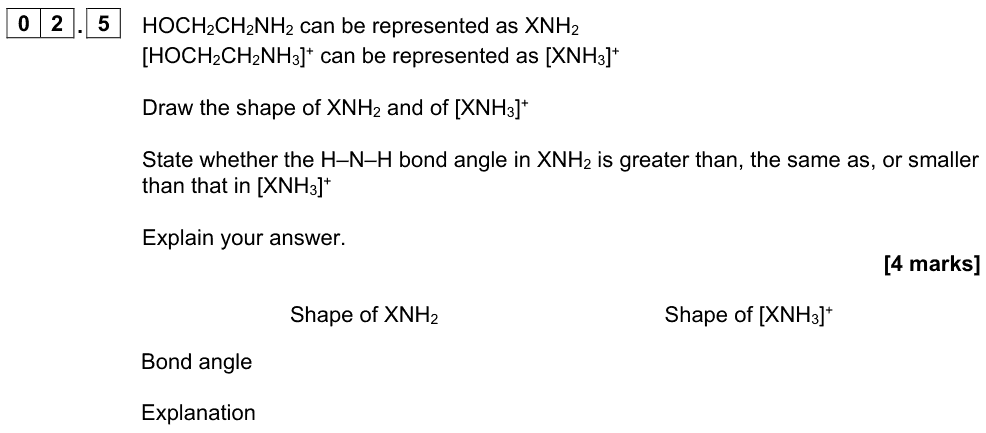
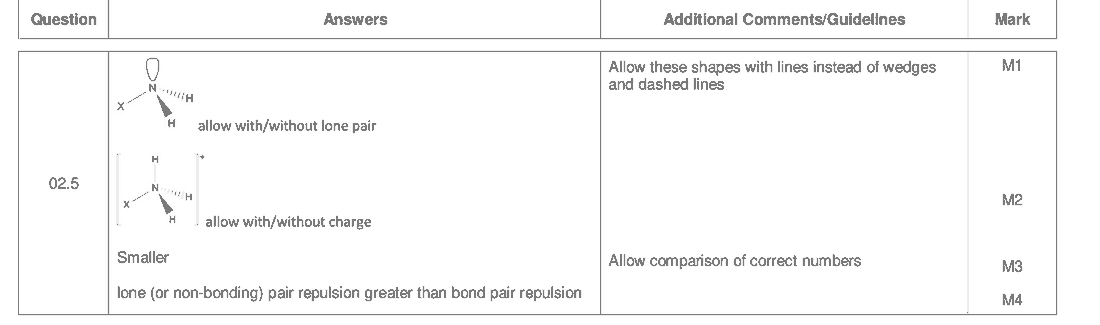
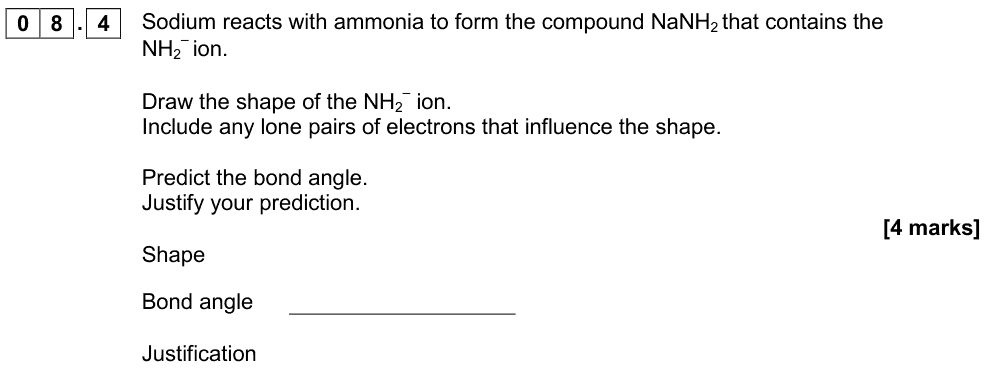
XNH2: trigonal pyramidal about N (three bonds, with or without the lone pair shown). [XNH3]+: tetrahedral about N (four bonds). The H–N–H angle in XNH2 is smaller (about 107° against 109.5°) because lone pair–bond pair repulsion is greater than bond pair–bond pair repulsion. Wedges and dashes not essential
Skills: MS4.1 Use angles and shapes in regular 2D and 3D structures; MS4.2 Visualise and represent 2D and 3D forms including two-dimensional representations of 3D objects
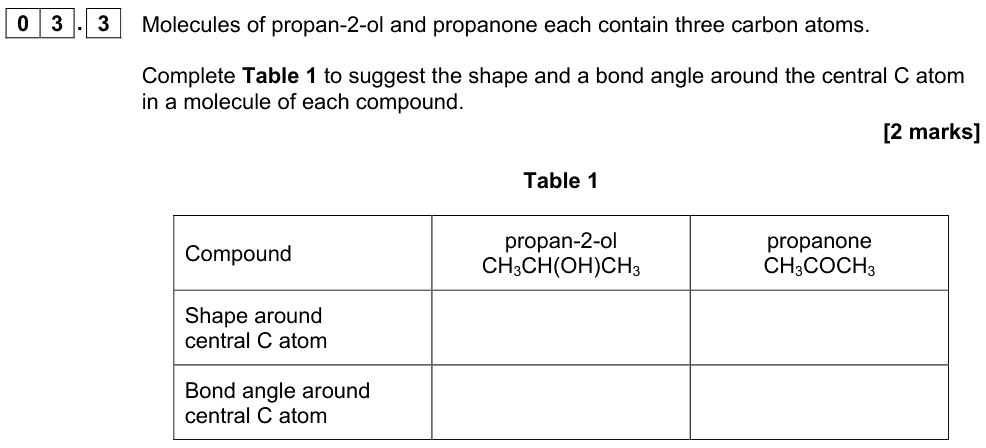
November 2021 · AS Paper 2 · Q03.32 marksShort answer
Earlier parts of question 03 that this part uses
Mark scheme
Notes from the mark scheme and report
Propan-2-ol: tetrahedral, 109.5° (allow 104 to 110). Propanone: trigonal planar, 120° (allow 115 to 123). Any two correct boxes score 1
Skills: MS4.1 Use angles and shapes in regular 2D and 3D structures
November 2021 · AS Paper 2 · Q03.43 marksExplanation
Earlier parts of question 03 that this part uses
Mark scheme
Notes from the mark scheme and report
Propan-2-ol has hydrogen bonds between molecules
propanone has only dipole–dipole (and van der Waals) forces
the intermolecular forces in propan-2-ol are stronger. Any mention of breaking covalent bonds loses M1 and M2
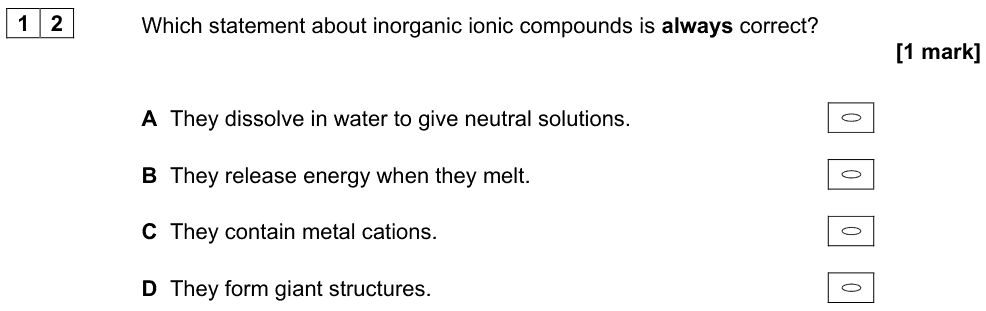
November 2021 · Paper 3 · Q121 markMultiple choice
Answer
D
Mark scheme
Notes from the mark scheme and report
Answer: D. Ionic compounds always form giant lattices
they need not contain a metal (eg ammonium salts), solutions are not always neutral and melting absorbs energy (report: one of five items answered correctly by fewer than 40%)
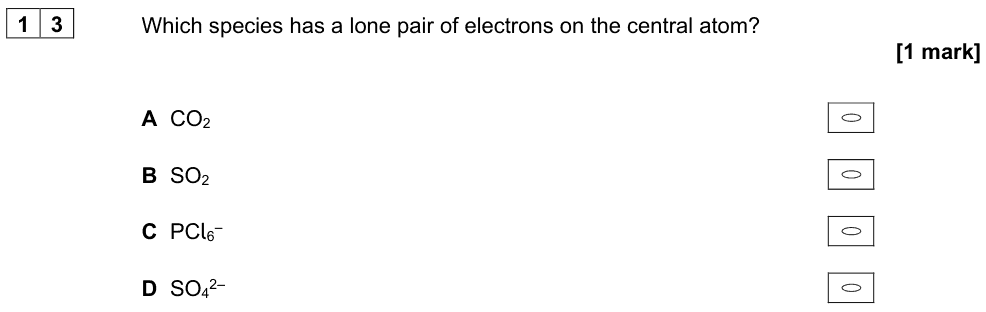
November 2021 · Paper 3 · Q131 markMultiple choice
Answer
B
Mark scheme
Notes from the mark scheme and report
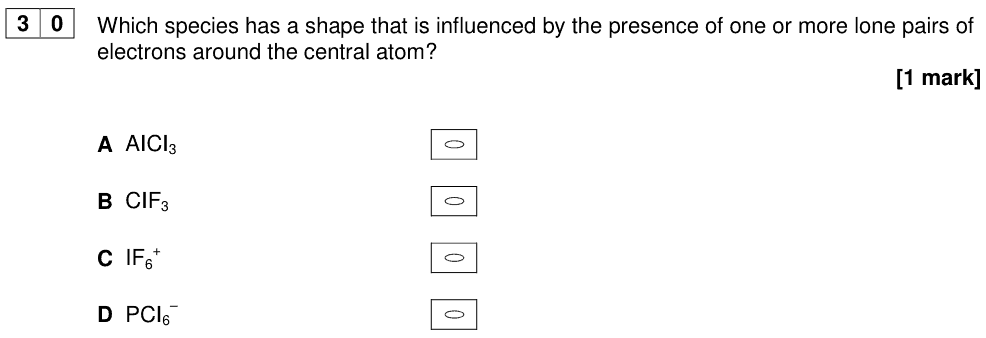
Answer: B. Sulfur in SO2 has one lone pair (bent molecule)
the central atoms in CO2, PCl6– and SO4 2– have none
Skills: MS4.1 Use angles and shapes in regular 2D and 3D structures
November 2021 · Paper 3 · Q141 markMultiple choice
Answer
D
Mark scheme
Notes from the mark scheme and report
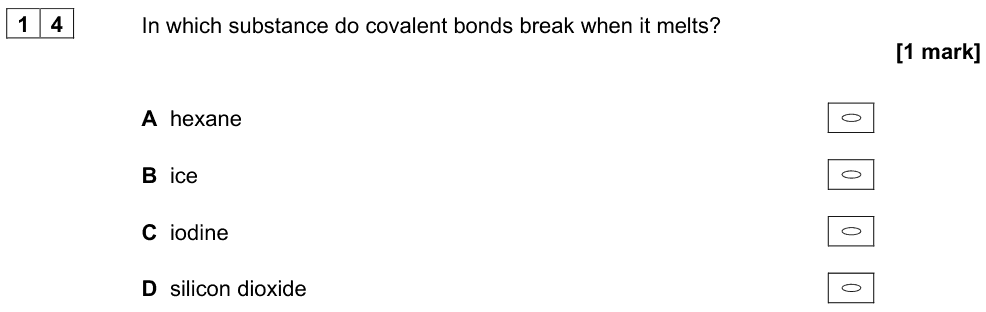
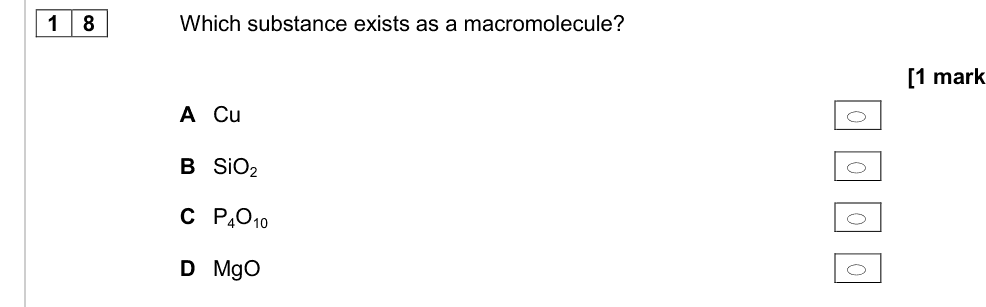
Answer: D. Silicon dioxide is macromolecular, so covalent bonds must break
the others are molecular and only intermolecular forces are overcome
November 2021 · Paper 3 · Q151 markMultiple choice
Answer
C
Mark scheme
Notes from the mark scheme and report
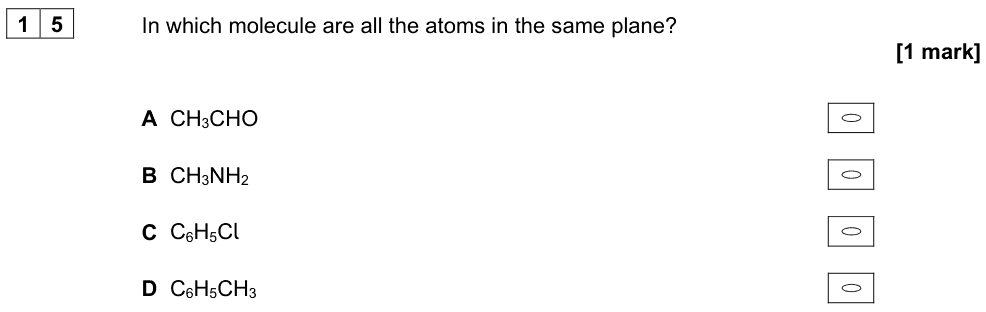
Answer: C. Chlorobenzene: the planar ring with Cl in the same plane
the others contain a tetrahedral CH3 group or a pyramidal nitrogen (report: one of five items answered correctly by fewer than 40%)
Skills: MS4.1 Use angles and shapes in regular 2D and 3D structures
November 2021 · Paper 3 · Q161 markMultiple choice
Answer
B
Mark scheme
Notes from the mark scheme and report
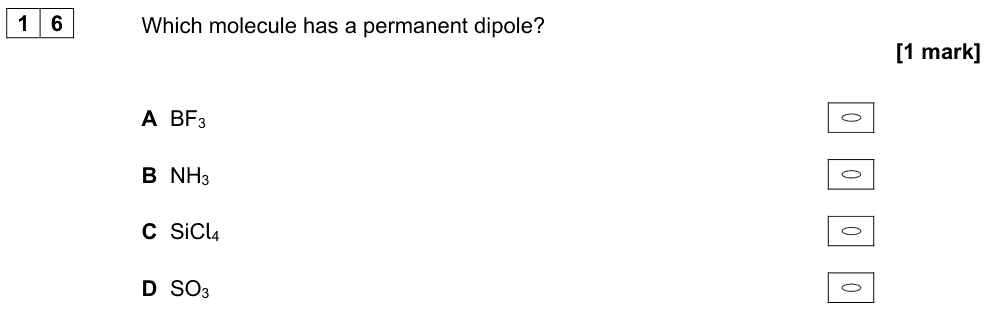
Answer: B. NH3 is pyramidal so the bond dipoles do not cancel
BF3, SiCl4 and SO3 are symmetrical
Skills: MS4.1 Use angles and shapes in regular 2D and 3D structures
November 2021 · Paper 3 · Q171 markMultiple choice
Answer
B
Mark scheme
Notes from the mark scheme and report
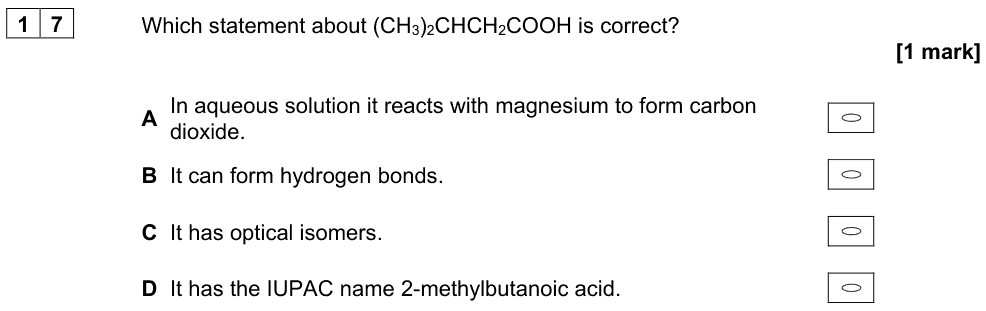
Answer: B. The –COOH group can hydrogen bond
with magnesium it gives hydrogen, it has no chiral carbon and its name is 3-methylbutanoic acid
November 2021 · Paper 3 · Q221 markMultiple choice
Answer
B
Mark scheme
Notes from the mark scheme and report
Answer: B. In graphite each carbon forms three bonds and the fourth electron is delocalised between the layers
November 2020 · Paper 1 · Q01.21 markShort answer
Earlier part of question 01 that this part uses
Mark scheme
Examiner's comment
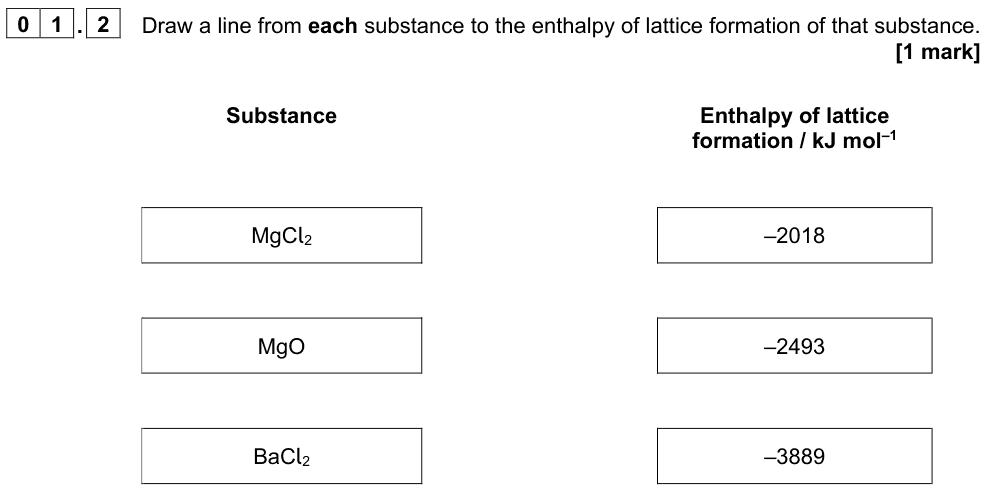
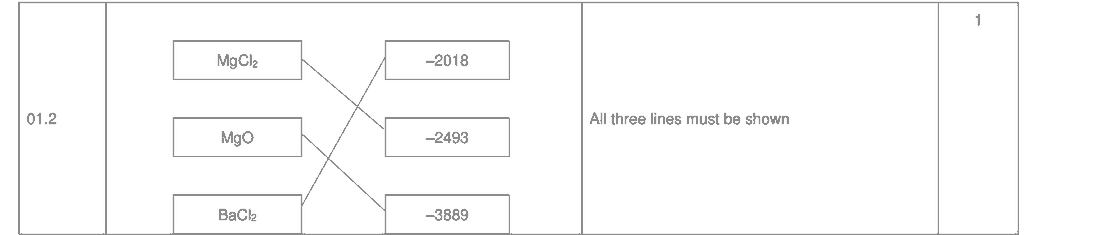
In 01.2, many different answers were seen; some students did correctly match the lattice energies to the correct substance.
Notes from the mark scheme and report
BaCl2 –2018
MgCl2 –2493
MgO –3889 (all three lines needed). Smaller ions and higher charges give stronger attraction, so a more exothermic lattice formation
November 2020 · Paper 1 · Q03.41 markShort answer
Earlier part of question 03 that this part uses
Mark scheme
Examiner's comment
Answers to 03.4 were well done.
Notes from the mark scheme and report
Answer: chlorine
November 2020 · AS Paper 1 · Q05.12 marksExplanation
Mark scheme
Notes from the mark scheme and report
Mg2+ has a higher charge than Na+ (or is smaller / has more delocalised electrons), so there is stronger attraction between the ions and the delocalised electrons / stronger metallic bonding. Not attraction for outer electrons
November 2020 · AS Paper 1 · Q065 marksDiagram or structure
Mark scheme
Notes from the mark scheme and report
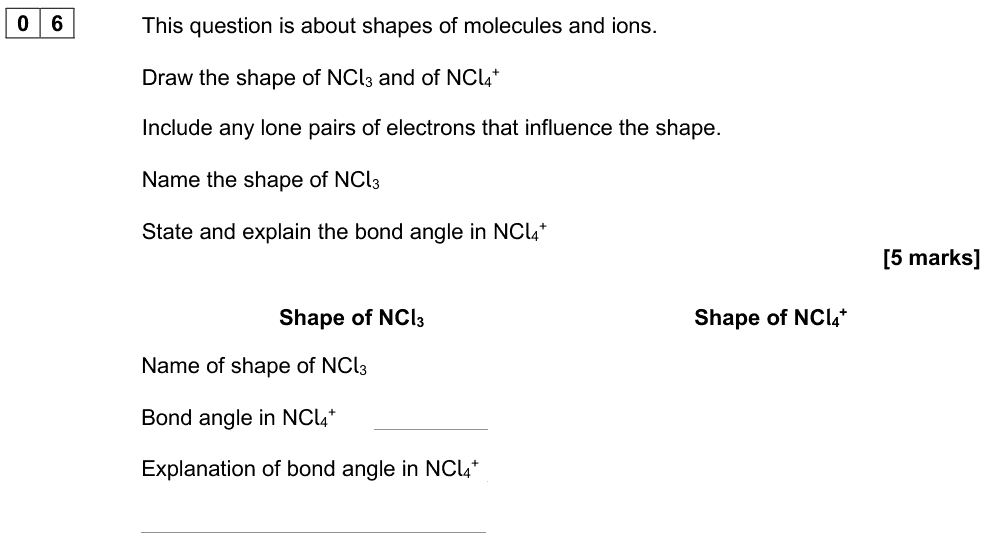
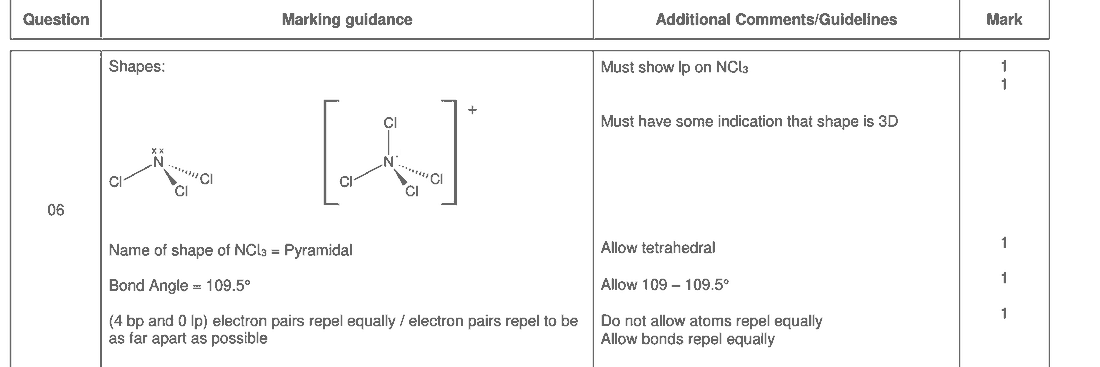
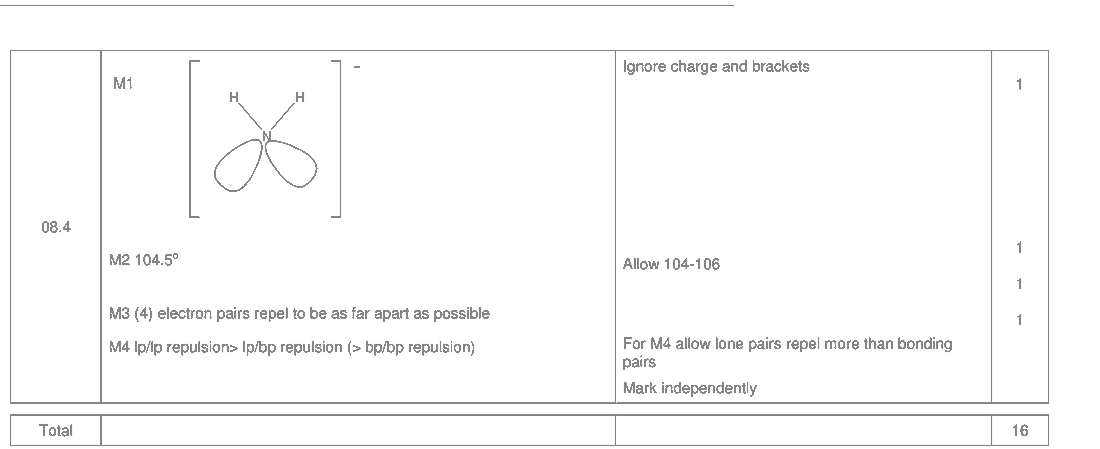
NCl3: three N–Cl bonds and one lone pair on N, drawn in 3D
shape pyramidal (the scheme's comments column also prints 'Allow tetrahedral' against the name). NCl4+: tetrahedral, four bonds, no lone pair
bond angle 109.5°
four bonding pairs repel equally / to be as far apart as possible. The lone pair on NCl3 must be shown
not 'atoms repel'
Skills: MS4.1 Use angles and shapes in regular 2D and 3D structures; MS4.2 Visualise and represent 2D and 3D forms including two-dimensional representations of 3D objects
November 2020 · Paper 1 · Q076 marks6-mark level of response
Mark scheme, with the levels and indicative content
Examiner's comment
Most students could work out the number of bonding pairs and lone pairs in the compounds; students who drew structures scored better generally than students who did not. More able students then went on to write correctly about intermolecular forces; most understood that XeF4 has stronger intermolecular forces because the molecule is bigger. Only the very best students realised that PF3 has dipole-dipole forces between molecules and these must nevertheless be weaker than the van der Waals intermolecular forces in XeF4.
Notes from the mark scheme and report
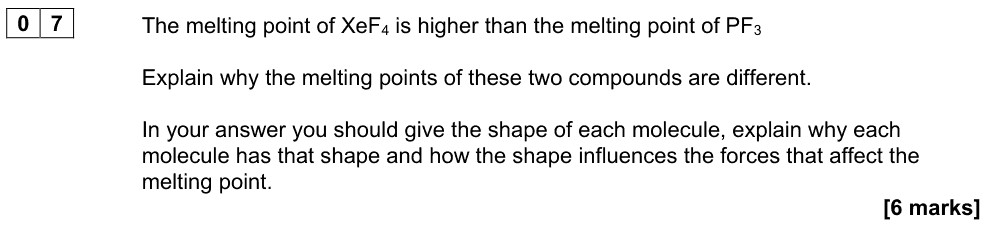
Levels of response, three stages. 1 Electron pairs: XeF4 has 4 bonding pairs and 2 lone pairs on Xe
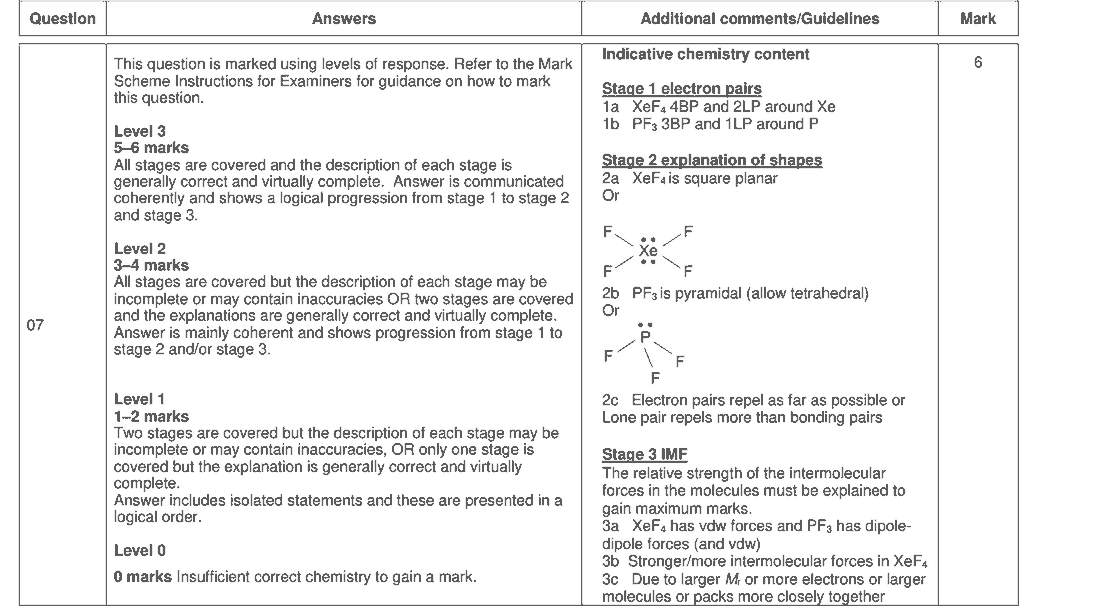
PF3 has 3 bonding pairs and 1 lone pair on P. 2 Shapes: XeF4 square planar, PF3 pyramidal
electron pairs repel to be as far apart as possible, lone pairs repel more than bonding pairs. 3 Forces: XeF4 (non-polar) has only van der Waals forces
PF3 has dipole–dipole forces as well
the intermolecular forces in XeF4 are stronger overall because it has more electrons / larger Mr (needed for full marks). Only the best saw that PF3 has dipole–dipole forces yet weaker forces overall
Skills: MS4.1 Use angles and shapes in regular 2D and 3D structures
November 2020 · AS Paper 1 · Q101 markMultiple choice
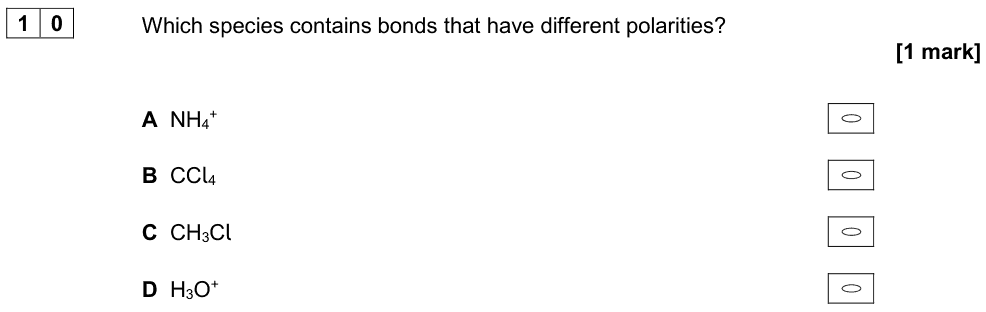
Answer
C
Mark scheme
Notes from the mark scheme and report
Answer: C. CH3Cl has C–H and C–Cl bonds, which differ in polarity
the others each contain one type of bond
November 2020 · AS Paper 1 · Q111 markMultiple choice
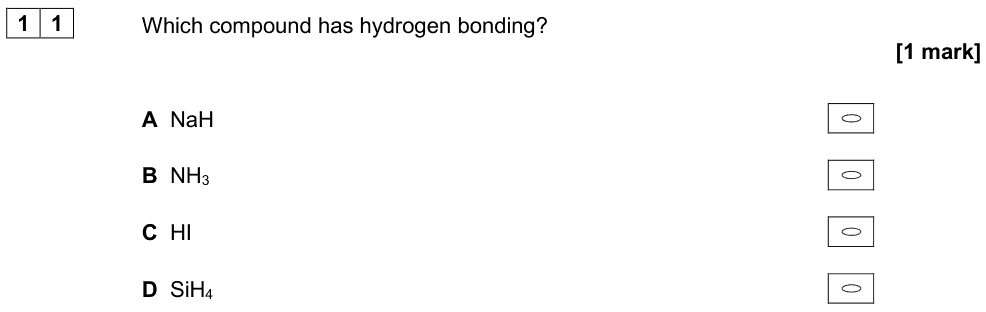
Answer
B
Mark scheme
Notes from the mark scheme and report
Answer: B. NH3 has H bonded to N, with a lone pair on N
NaH is ionic and I and Si are not electronegative enough
November 2020 · AS Paper 1 · Q161 markMultiple choice
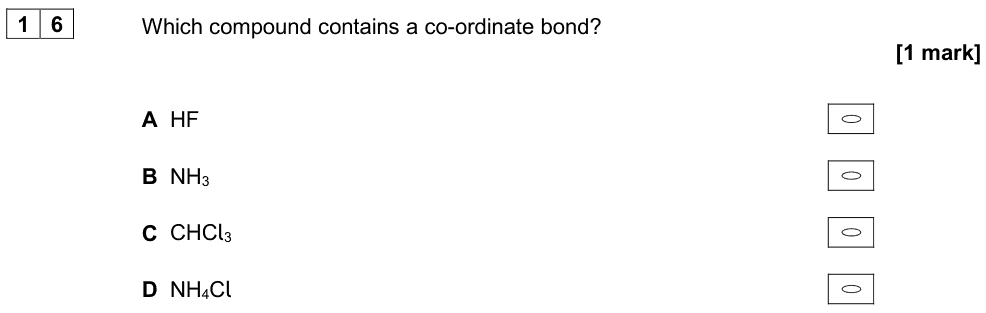
Answer
D
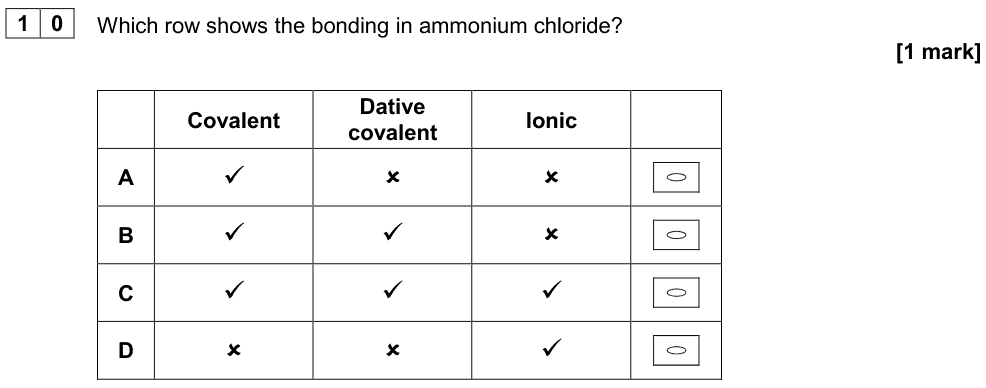
Mark scheme
Notes from the mark scheme and report
Answer: D. NH4+ in NH4Cl is formed when the lone pair on N in NH3 forms a co-ordinate bond to H+
November 2020 · AS Paper 1 · Q231 markMultiple choice
Answer
D
Mark scheme
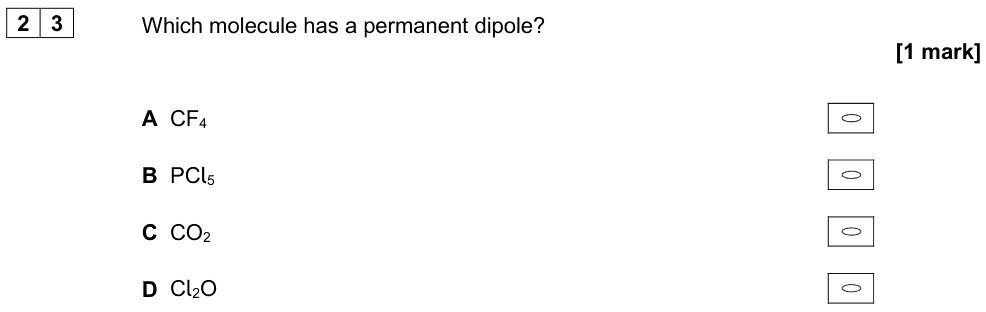
Notes from the mark scheme and report
Answer: D. Cl2O is bent (two lone pairs on O) so the bond dipoles do not cancel
CF4, PCl5 and CO2 are symmetrical
November 2020 · AS Paper 2 · Q01.41 markShort answer
Earlier part of question 01 that this part uses
Mark scheme
Notes from the mark scheme and report
The power of an atom to attract the pair of electrons in a covalent bond
November 2020 · AS Paper 2 · Q04.13 marksExplanation
Mark scheme
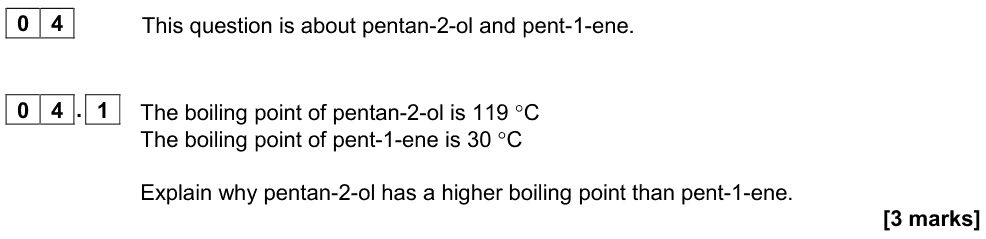
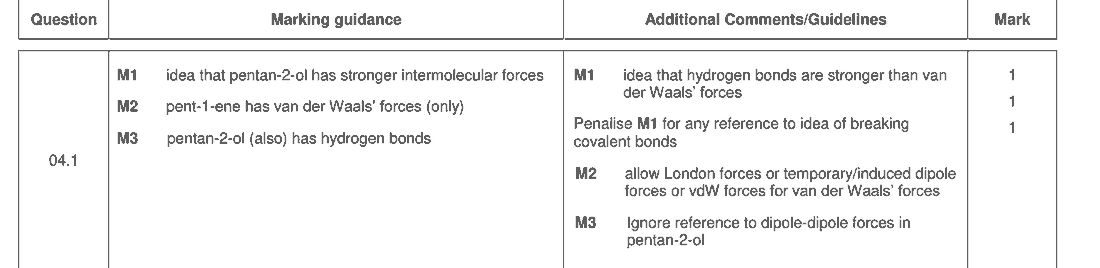
Notes from the mark scheme and report
Pentan-2-ol has stronger intermolecular forces
pent-1-ene has van der Waals forces only
pentan-2-ol also has hydrogen bonds (which are stronger). Any idea of breaking covalent bonds loses M1
November 2020 · Paper 2 · Q05.13 marksShort answer
Mark scheme
Examiner's comment
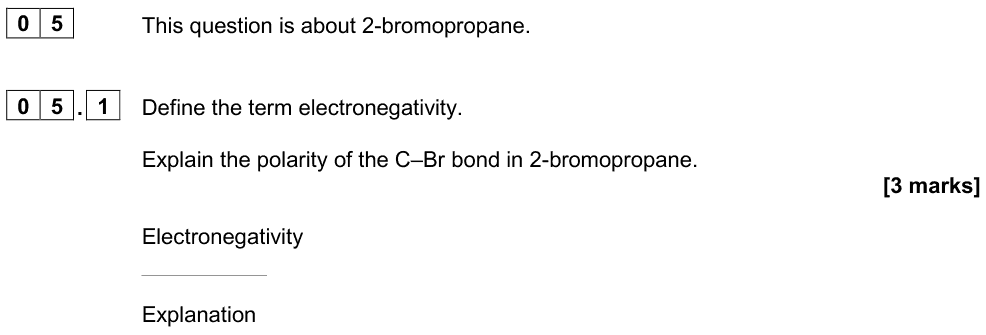
05.1 was well known and the majority of students gave good answers.
Notes from the mark scheme and report
The (relative) tendency of an atom to attract the pair of electrons in a covalent bond. Br is more electronegative than C, so Br is δ– and C is δ+
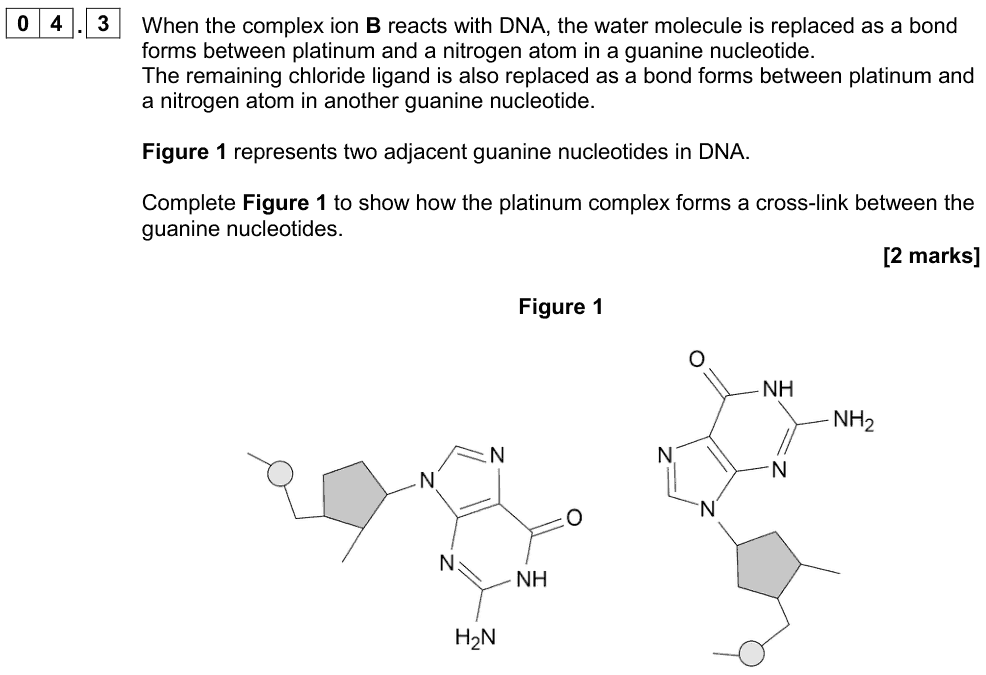
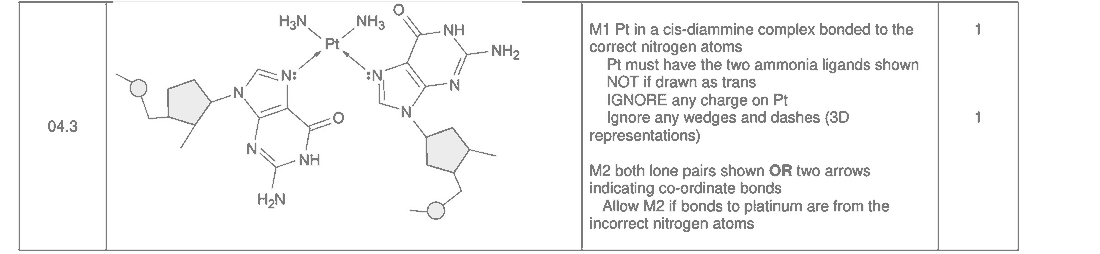
November 2020 · Paper 3 · Q04.32 marksDiagram or structure
Earlier parts of question 04 that this part uses
Mark scheme
Examiner's comment
04.3 proved to be very tricky for many students – perhaps due to the amount of reading needed to pick up on the clues in the question and to appreciate what was being asked.
Students are clearly more familiar with questions asking them to show hydrogen bonding between base pairs because that is what many tried to do – and they ignored the need to include the complex in their diagram.
Where the complex was included it was sometimes drawn as trans- rather than cis- and often without an indication that the bonds formed are co-ordinate bonds.
Notes from the mark scheme and report
Pt with its two NH3 ligands kept cis, bonded to the ring nitrogen atom (N with a lone pair, not N–H or NH2) of each guanine
the two bonds shown as co-ordinate bonds (arrows, or the lone pairs shown). Not trans. Many drew hydrogen bonds between the bases instead, or left out the complex
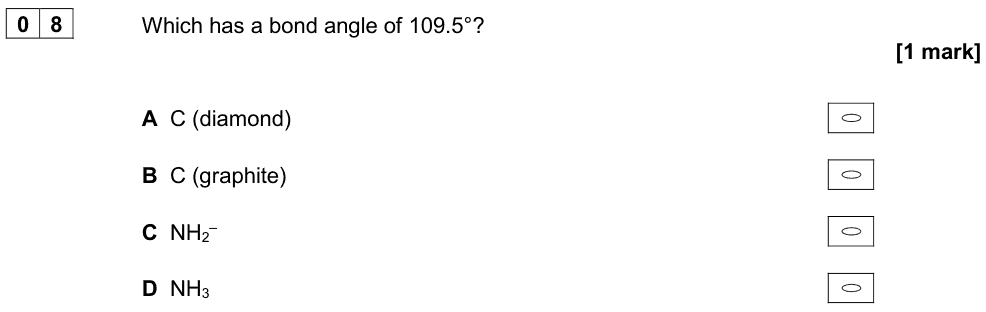
November 2020 · Paper 3 · Q081 markMultiple choice
Answer
A
Mark scheme
Notes from the mark scheme and report
Answer: A. Each carbon in diamond has four bonding pairs (tetrahedral)
graphite is 120°
NH3 (107°) and NH2– (about 104.5°) have lone pairs
Skills: MS4.1 Use angles and shapes in regular 2D and 3D structures
June 2019 · AS Paper 1 · Q01.22 marksExplanation
Earlier part of question 01 that this part uses
Mark scheme
Examiner's comment
01.2 A good number of students realised that the reason for the high melting point was the attraction between oppositely charged ions, but some students did not appreciate that sodium fluoride was ionic. Equally, students did not always appreciate that because the melting point is high, it shows that lots of energy is needed to melt the compound.
Notes from the mark scheme and report
Strong electrostatic attraction between oppositely charged ions (Na+ and F–)
a lot of energy is needed to overcome these forces. Any mention of intermolecular forces, covalent, macromolecular or metallic bonding loses both marks. Some did not realise NaF is ionic
June 2019 · AS Paper 1 · Q01.32 marksShort answer
Earlier part of question 01 that this part uses
Mark scheme
Examiner's comment
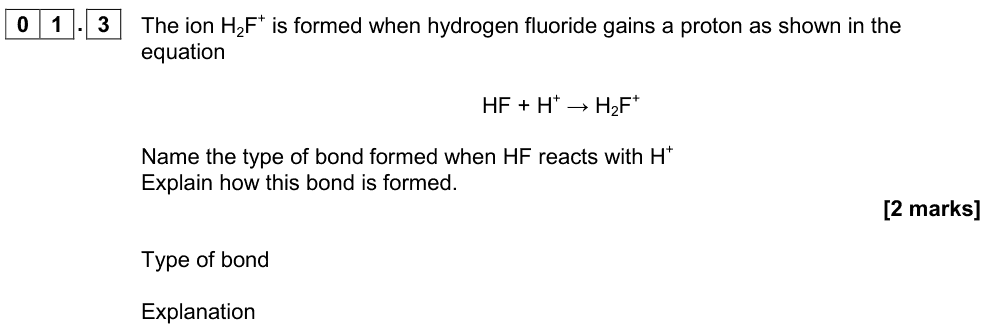
01.3 A high number of students did not appreciate that the type of bond formed was a co- ordinate bond. Instead, many described this as a hydrogen bond due to the interaction between a fluorine atom and a hydrogen atom. However, students who recognised this as a coordinate bond were able correctly to explain how this bond is formed.
Notes from the mark scheme and report
Co-ordinate (dative covalent) bond
a lone pair of electrons is donated from F (both electrons in the shared pair come from F). 'Covalent' alone loses M1. Very common wrong answer: hydrogen bond
June 2019 · AS Paper 1 · Q01.44 marksDiagram or structure
Earlier part of question 01 that this part uses
Mark scheme
Examiner's comment
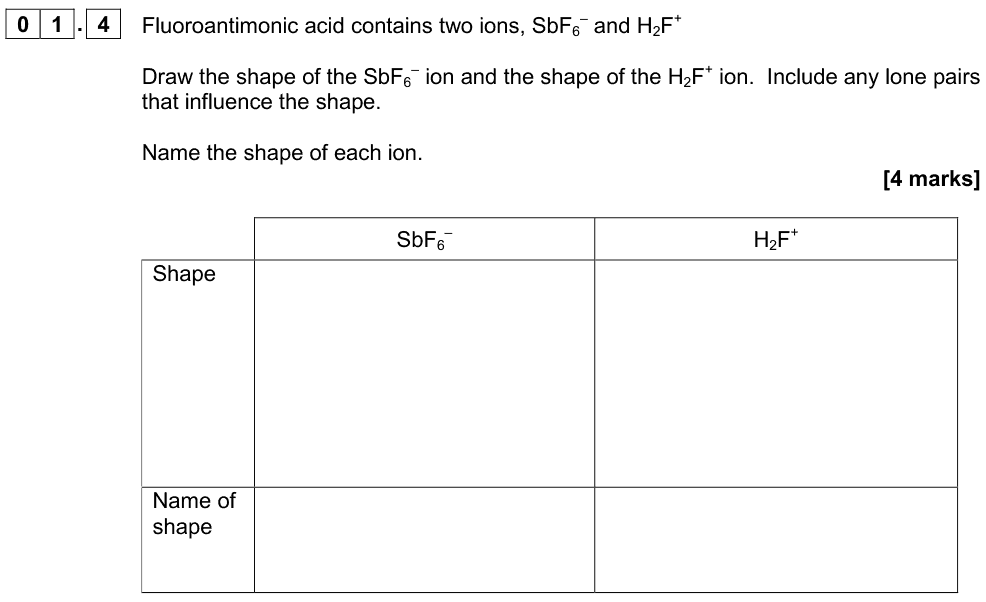
01.4 A good number of students were able to draw and name both shapes correctly, although many did not appreciate that there are two lone pairs on the H2F+ ion. Some students showed additional lone pairs and did not show the H2F+ ion as bent but drew the ion as linear.
Notes from the mark scheme and report
SbF6–: six bonds drawn as an octahedron, named octahedral. H2F+: bent with two lone pairs on F, named bent / V-shaped / angular. The lone pairs on H2F+ are essential
missing charges ignored. Errors: only one lone pair or extra lone pairs
H2F+ drawn linear
Skills: MS4.1 Use angles and shapes in regular 2D and 3D structures; MS4.2 Visualise and represent 2D and 3D forms including two-dimensional representations of 3D objects
June 2019 · Paper 1 · Q03.21 markShort answer
Earlier part of question 03 that this part uses
Mark scheme
Examiner's comment
3.2 This was answered correctly by most students.
Notes from the mark scheme and report
Bromine, Br (not Br2)
krypton also accepted
June 2019 · Paper 1 · Q08.13 marksDiagram or structure
Mark scheme
Examiner's comment
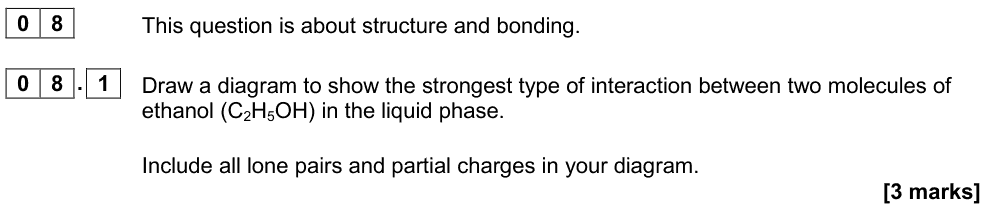
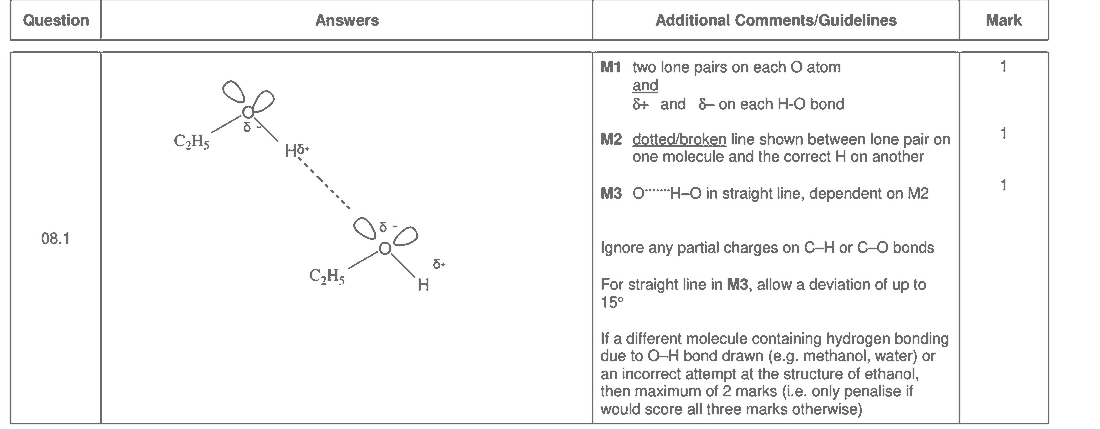
8.1 Answers to part 1 were poor. Many students omitted all the lone pairs on the oxygen atoms or the necessary partial charges; only the more able students appreciated the linear nature of hydrogen bonds.
Notes from the mark scheme and report
Two ethanol molecules with two lone pairs on each O and δ– on O, δ+ on H of each O–H
a dotted line from a lone pair on one O to the H of the other O–H
O···H–O in a straight line. Drawing a different molecule (water, methanol) scores max 2. Poorly answered: lone pairs or partial charges omitted
hydrogen bond not linear
Skills: MS4.2 Visualise and represent 2D and 3D forms including two-dimensional representations of 3D objects
June 2019 · Paper 1 · Q08.23 marksExplanation
Earlier part of question 08 that this part uses
Mark scheme
Examiner's comment
8.2 This was well answered; students were aware of the different intermolecular forces in the two molecules.
Notes from the mark scheme and report
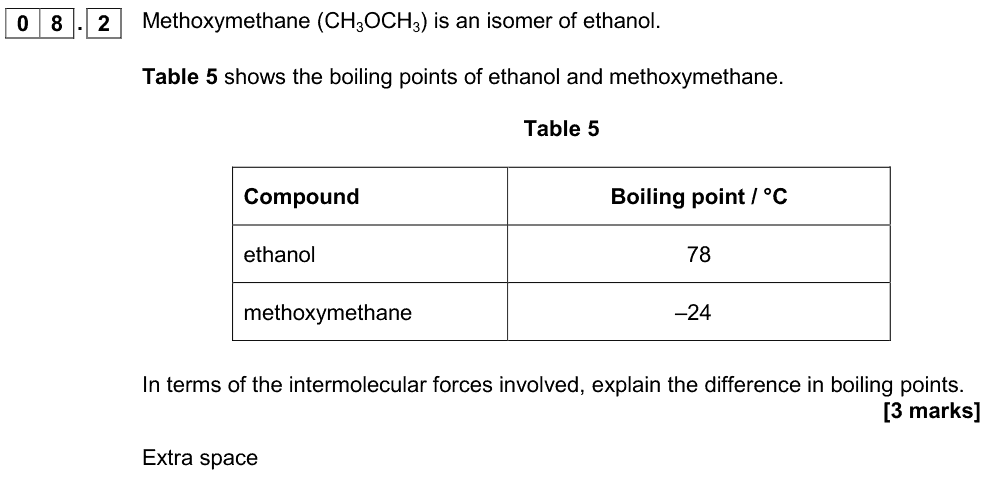
Ethanol has hydrogen bonds between molecules
methoxymethane has only (permanent) dipole–dipole / van der Waals forces
hydrogen bonds are the stronger intermolecular force, so more energy is needed to overcome them
June 2019 · Paper 1 · Q08.35 marksDiagram or structure
Earlier part of question 08 that this part uses
Mark scheme
Examiner's comment
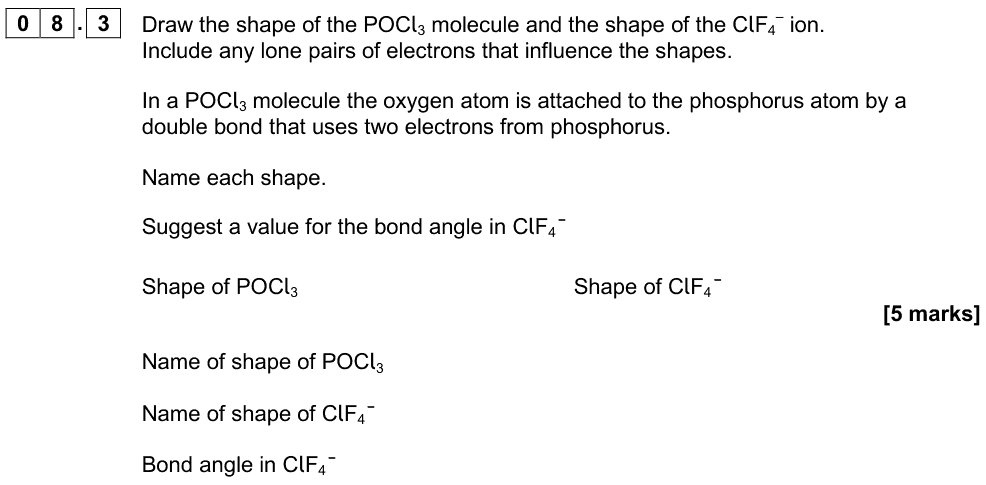
8.3 Only the most able students scored all the marks. Many students failed to show the double bond in POCl3 and many of the ClF4
Notes from the mark scheme and report
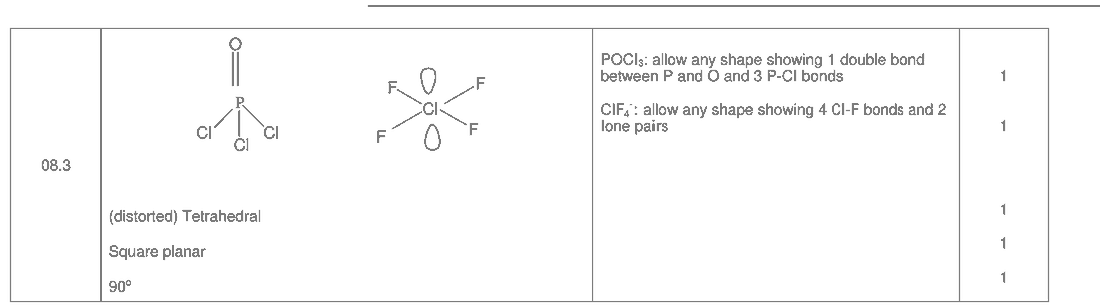
POCl3: one P=O double bond and three P–Cl bonds, no lone pair on P
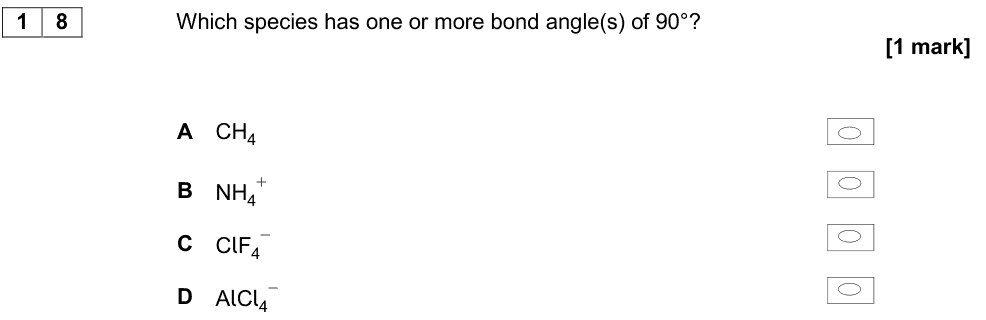
(distorted) tetrahedral. ClF4–: four Cl–F bonds in a plane with two lone pairs (above and below)
square planar
90°. Errors: no double bond in POCl3
ClF4– drawn without two lone pairs. Only the most able scored all 5
Skills: MS4.1 Use angles and shapes in regular 2D and 3D structures; MS4.2 Visualise and represent 2D and 3D forms including two-dimensional representations of 3D objects
June 2019 · AS Paper 1 · Q111 markMultiple choice
Answer
A
Mark scheme
Examiner's comment
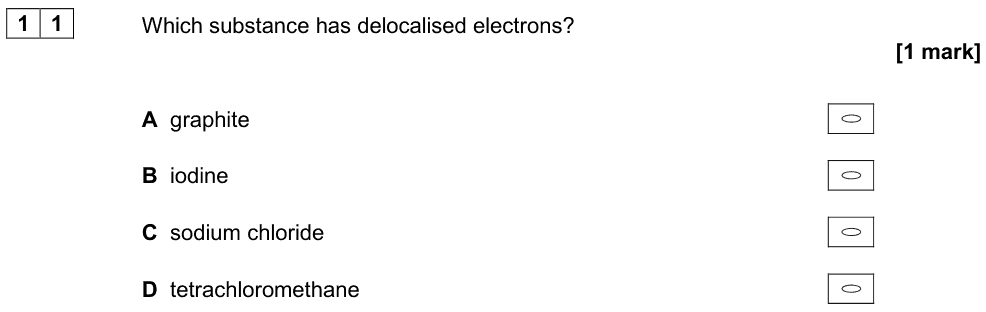
The vast majority of students were able to identify the substance that had delocalised electrons.
Notes from the mark scheme and report
Answer: A. Each carbon in graphite forms three covalent bonds, leaving one delocalised electron per atom
June 2019 · AS Paper 1 · Q121 markMultiple choice
Answer
D
Mark scheme
Examiner's comment
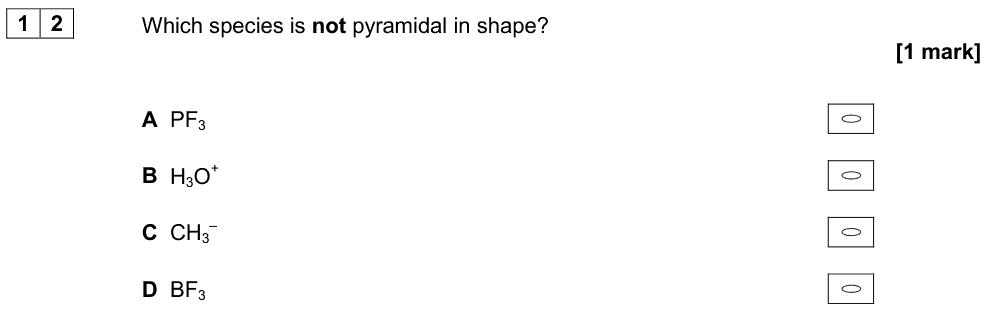
More than half of the students could identify the species that was not pyramidal.
Notes from the mark scheme and report
Answer: D. BF3 has three bonding pairs and no lone pair so is trigonal planar
the others have three bonding pairs and one lone pair
Skills: MS4.1 Use angles and shapes in regular 2D and 3D structures
June 2019 · AS Paper 1 · Q131 markMultiple choiceEasy
Answer
C
Mark scheme
Examiner's comment
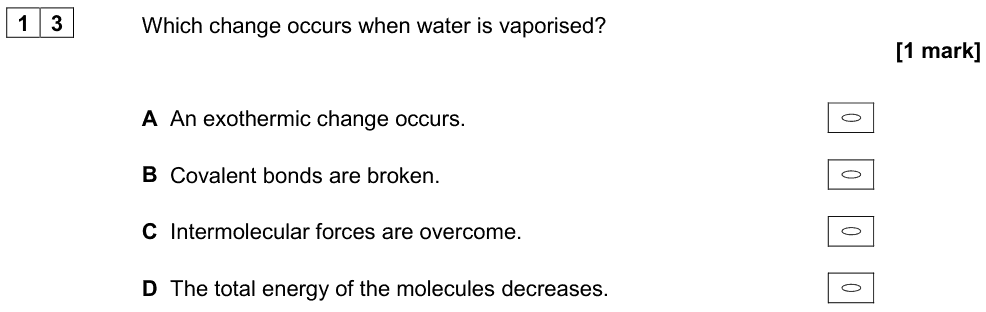
Around three-quarters of students understood the changes that occurred when a sample of water is vaporised.
Notes from the mark scheme and report
Answer: C. Vaporisation is endothermic
it overcomes the forces between molecules, not the covalent bonds within them
June 2019 · AS Paper 1 · Q161 markMultiple choice
Answer
C
Mark scheme
Examiner's comment
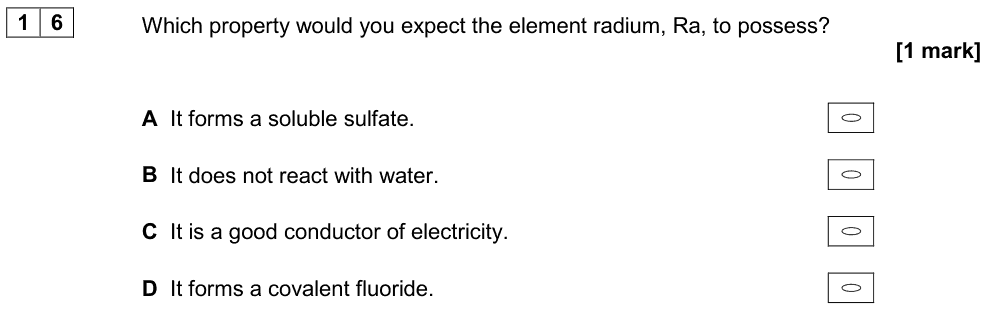
Half of the students were able to choose the correct property of the element radium.
Notes from the mark scheme and report
Answer: C. Radium is a Group 2 metal so has delocalised electrons and conducts
its sulfate would be insoluble, it would react vigorously with water and its fluoride would be ionic
June 2019 · AS Paper 2 · Q05.13 marksDiagram or structure
Mark scheme
Examiner's comment
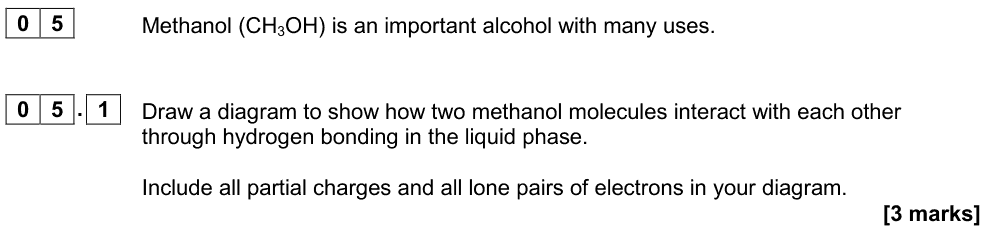
5.1 Students did not score well when asked to draw the hydrogen bond interaction between two methanol molecules. Some showed only one and not two lone pairs on the O atoms. Some showed the attraction going from the O to H bonded to C on a neighbouring molecule. Very few students drew a linear arrangement around the H in the hydrogen bond.
Notes from the mark scheme and report
M1 two lone pairs on an O atom, δ+ on H and δ– on O of an O–H
M2 dotted line from a lone pair on one molecule to the H of the O–H on the other
M3 O···H–O in a straight line. Errors: only one lone pair on O
bond drawn to an H on carbon
very few drew it linear
Skills: MS4.2 Visualise and represent 2D and 3D forms including two-dimensional representations of 3D objects
June 2019 · AS Paper 2 · Q05.21 markShort answer
Earlier part of question 05 that this part uses
Mark scheme
Examiner's comment
5.2 In this question, students had to explain why the H−O−C bond angle in methanol is less than 109.5°. Many could explain this, but some did not give a comparison between the repulsion from a lone pair of electrons and that from a bonding pair of electrons.
Notes from the mark scheme and report
Lone pairs repel more than bonding pairs (a comparison is essential)
Skills: MS4.1 Use angles and shapes in regular 2D and 3D structures
June 2019 · Paper 2 · Q07.26 marks6-mark level of response
Earlier part of question 07 that this part uses
Mark scheme, with the levels and indicative content
Examiner's comment
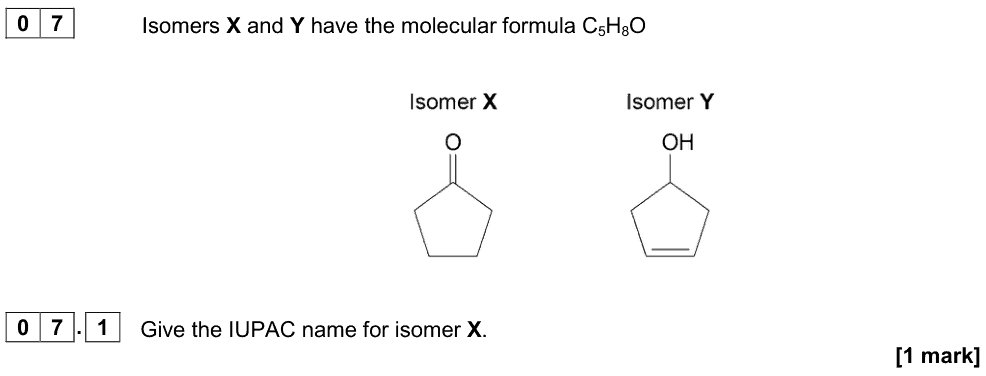
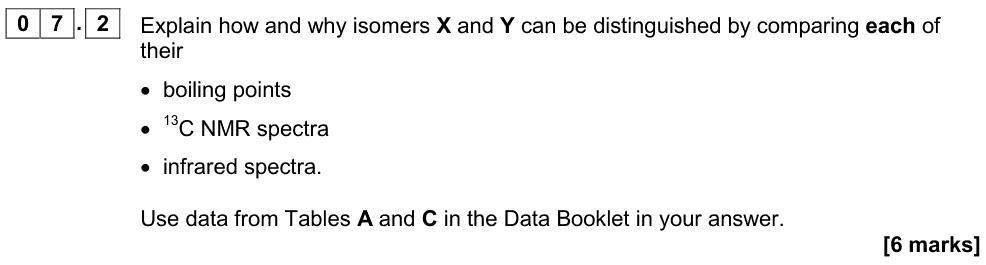
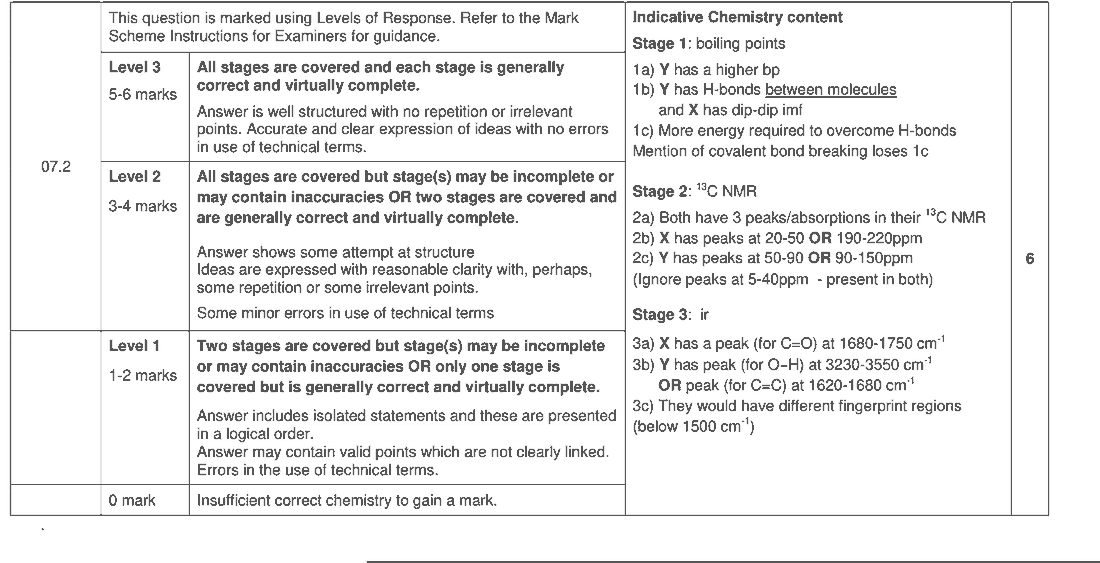
07.2 Overall, this question was well answered and approximately two-thirds of the students gained four or more marks. Some students stumbled in their explanations of the boiling point differences (Stage 1) and were therefore limited to level 2. Most students dealt with the characteristic observations from 13C NMR and IR spectroscopy (Stages 2 and 3) without much difficulty. For stage 1, most students correctly stated that compound Y has the higher boiling point. Explanations with reference to hydrogen bonding and permanent dipole- dipole forces in Y and X, respectively, sometimes fell short when there was a failure to mention the intermolecular nature of these forces. Typically students recovered the potential loss of a marking point by referring to the fact that more energy is required to overcome the H-bonds. Full and unnecessary discussions on how the two types of intermolecular forces arise were common, as was the discussion of (fractional) distillation of a mixture of the two liquids. Most students were able to report on the correct ranges of chemical shifts in 13C NMR spectra for both compounds. Some effective responses recognised three peaks for each compound, with detailed and comprehensive analyses of the types of carbon involved. Communication on IR spectra was generally good, with students correctly identifying absorptions and corresponding bond types. There was some use of non-technical language such as ‘dips and troughs’ to communicate absorption or low transmittance. Reference to the unique fingerprint regions appeared in very few responses.
Notes from the mark scheme and report
Levels of response, three stages. Stage 1 boiling point: Y (the alcohol) has the higher boiling point
Y has hydrogen bonds between molecules, X only dipole–dipole forces
more energy is needed to overcome hydrogen bonds (mention of breaking covalent bonds loses this). Stage 2 13C NMR: both have three peaks
X has peaks at 20–50 ppm or 190–220 ppm (C=O)
Y has peaks at 50–90 ppm (C–O) or 90–150 ppm (C=C). Stage 3 infrared: X has C=O at 1680–1750 cm–1
Y has O–H at 3230–3550 cm–1 or C=C at 1620–1680 cm–1
fingerprint regions differ. About two-thirds gained four or more marks
forces not described as intermolecular and fingerprint region rarely mentioned
June 2019 · AS Paper 2 · Q211 markMultiple choice
Answer
D
Mark scheme
Examiner's comment
This was answered correctly by a majority of students.
Notes from the mark scheme and report
Answer: D. Propanoic acid forms hydrogen bonds between molecules
the others have only van der Waals and dipole–dipole forces
June 2019 · Paper 3 · Q01.34 marksDiagram or structure
Earlier part of question 01 that this part uses
Mark scheme
Examiner's comment
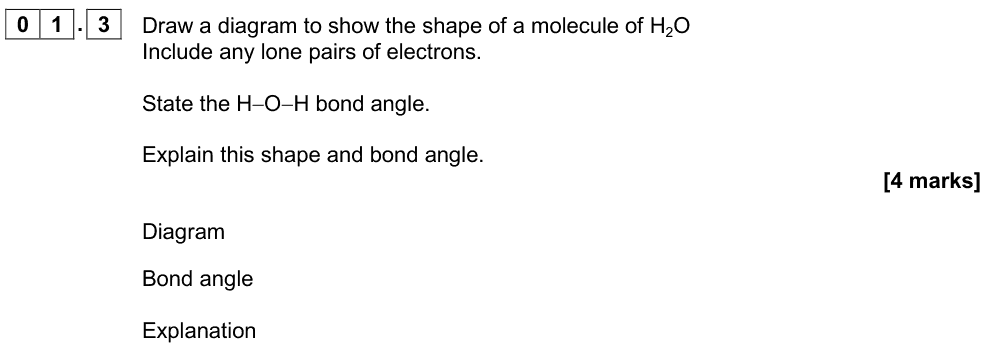
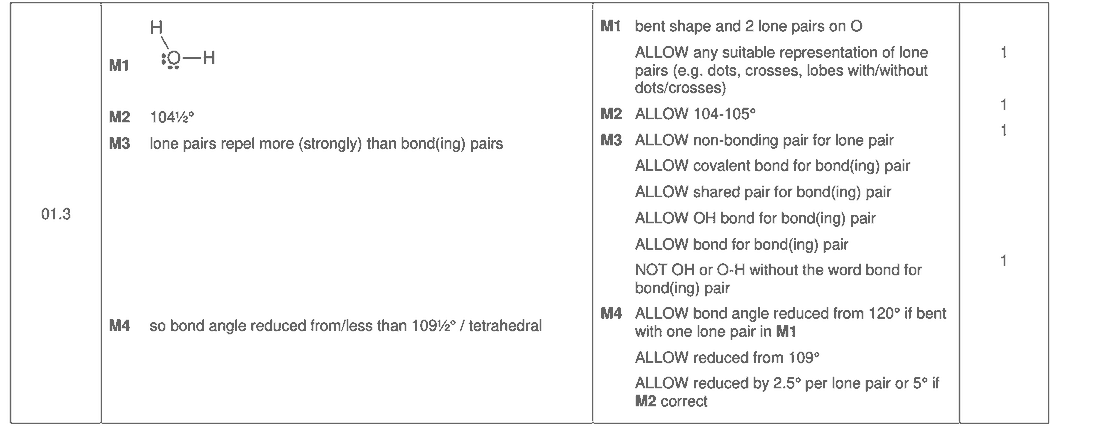
1.3 A significant minority of students showed either one lone pair or none on the O atom in the water molecule and quite a few based their explanation of the bond angle on a ‘starting point’ of 180°. Students should be reminded that the starting point for this discussion is the total number of electron pairs (4 = tetrahedral, 109.5°), with the final shape and angle depending on the balance between lone pairs and bond pairs plus the fact that repulsion due to lone pairs is greater than that due to bond pairs. In this case, the presence of two lone pairs reduces the angle from 109.5° to 104.5°.
Notes from the mark scheme and report
Bent molecule with two lone pairs on O
104.5° (allow 104 to 105)
lone pairs repel more strongly than bonding pairs
so the angle is reduced from the tetrahedral 109.5°. Errors: one or no lone pairs
starting the explanation from 180°
Skills: MS4.1 Use angles and shapes in regular 2D and 3D structures; MS4.2 Visualise and represent 2D and 3D forms including two-dimensional representations of 3D objects
June 2019 · Paper 3 · Q02.11 markDiagram or structure
Mark scheme
Examiner's comment
2.1 A clear majority of students were successful here, with the commonest omission being the bond between the O and H in each of the O−H groups.
Notes from the mark scheme and report
S with two S=O double bonds and two S–O–H groups, every bond shown including O–H. No lone pair on S. Most common omission: the O–H bonds
June 2019 · Paper 3 · Q171 markMultiple choice
Answer
A
Mark scheme
Notes from the mark scheme and report
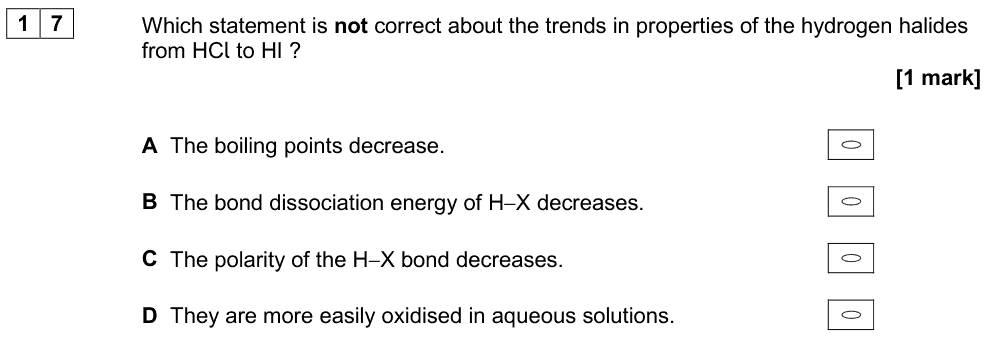
Answer: A. Boiling points increase from HCl to HI (larger molecules, stronger van der Waals forces)
the other statements are correct
June 2019 · Paper 3 · Q311 markMultiple choice
Answer
D
Mark scheme
Notes from the mark scheme and report
Answer: D. Lone pairs on water are localised on oxygen and cannot move through the liquid
ions and delocalised electrons carry charge
June 2018 · AS Paper 1 · Q01.31 markShort answer
Earlier part of question 01 that this part uses
Mark scheme
Examiner's comment
01.3 Many students were able to identify that the two elements were nitrogen and beryllium but many were then unable to write the correct formula of the compound formed between them.
Notes from the mark scheme and report
R is nitrogen
formula Be3N2 (Be 2+ and N 3–). Many identified nitrogen and beryllium but could not write the formula
June 2018 · Paper 1 · Q08.16 marks6-mark level of responseHard
Mark scheme, with the levels and indicative content
Examiner's comment
08.1 This levels-of-response question discriminated very well, with approximately one third of students scoring marks in each of the three levels. Some excellent answers were seen. Some students, however, answered very well initially but then used wrong terminology, for example wrong bonding and/or intermolecular forces in all/some of the substances, and showed contradictions in their answers.
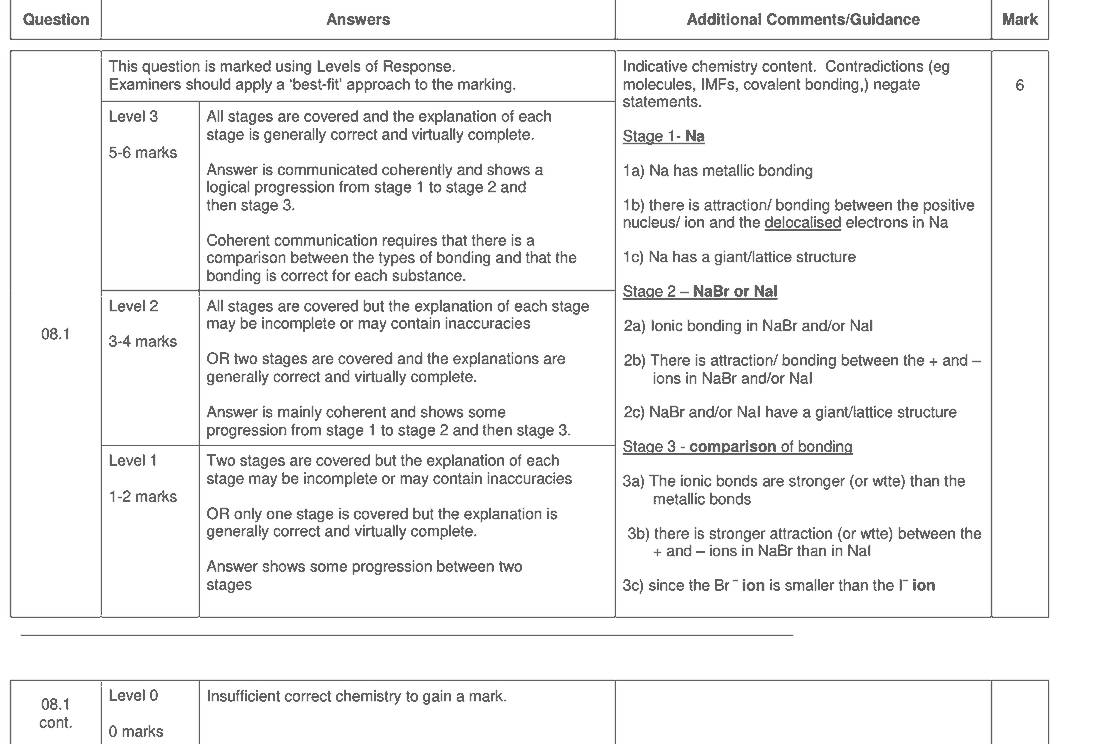
Notes from the mark scheme and report
Levels of response, three stages. Stage 1 sodium: metallic bonding
attraction between positive ions/nuclei and delocalised electrons
giant lattice. Stage 2 NaBr/NaI: ionic bonding
attraction between + and – ions
giant lattice. Stage 3 comparison: ionic bonds stronger than the metallic bonds
stronger attraction in NaBr than NaI because Br– is smaller than I–. Contradictions (molecules, intermolecular forces, covalent bonding) negate statements
June 2018 · Paper 1 · Q08.44 marksDiagram or structureHard
Earlier part of question 08 that this part uses
Mark scheme
Examiner's comment
08.4 This part discriminated well, though only a few students (7%) scored full marks. The structure often had the wrong number of lone pairs and/or the wrong bond angle. That lone pair-lone pair repulsion is greater than bond pair-bond pair repulsion was known by the majority of students.
Notes from the mark scheme and report
Bent (V-shaped) N with two H and two lone pairs
104.5° (allow 104 to 106)
four electron pairs repel to be as far apart as possible
lone pair–lone pair repulsion is greater than lone pair–bond pair. Errors: wrong number of lone pairs
wrong angle
Skills: MS4.1 Use angles and shapes in regular 2D and 3D structures; MS4.2 Visualise and represent 2D and 3D forms including two-dimensional representations of 3D objects
June 2018 · AS Paper 1 · Q09.13 marksDiagram or structure
Mark scheme
Examiner's comment
09.1 A good number of students realised that the KrF2 molecule has three lone pairs around the krypton but few were able to appreciate that this is a linear molecule. Some students did not show any lone pairs on their diagrams.
Notes from the mark scheme and report
F–Kr–F drawn with two bonds and three lone pairs on Kr
linear
180°. Errors: no lone pairs shown
not recognised as linear
Skills: MS4.1 Use angles and shapes in regular 2D and 3D structures; MS4.2 Visualise and represent 2D and 3D forms including two-dimensional representations of 3D objects
June 2018 · AS Paper 1 · Q09.22 marksExplanation
Earlier part of question 09 that this part uses
Mark scheme
Examiner's comment
09.2 Most students understood that lone pairs reduce the bond angle in a molecule so this was answered well.
Notes from the mark scheme and report
Lone pairs repel more than bonding pairs, so the bond angle is reduced (below the tetrahedral angle, 103° to 106°)
Skills: MS4.1 Use angles and shapes in regular 2D and 3D structures
June 2018 · AS Paper 1 · Q09.33 marksExplanationHard
Earlier part of question 09 that this part uses
Mark scheme
Examiner's comment
09.3 A good number of students realised that the intermolecular forces were van der Waals’ but were unable to describe accurately how these forces arise or why other intermolecular forces are not present between SiF4 molecules. Only 4.9% of students gained full marks.
Notes from the mark scheme and report
Van der Waals (induced dipole–dipole / London / dispersion) forces. An uneven distribution of electrons in one molecule induces a dipole in a neighbouring molecule. No other type because the molecule is symmetrical so the bond dipoles cancel (no permanent dipole), or no H is bonded to F so there is no hydrogen bonding. If van der Waals is not named, no further marks
June 2018 · AS Paper 1 · Q101 markMultiple choiceHard
Answer
C
Mark scheme
Examiner's comment
The most common answer was incorrect. Students did not appreciate the presence of the ionic bond between the ammonium ion and the chloride ion. Only 12.8% of students scored this mark.
Notes from the mark scheme and report
Answer: C. NH4Cl has covalent N–H bonds, one dative covalent bond in NH4+ and ionic bonding between NH4+ and Cl–. Most missed the ionic bond
June 2018 · Paper 2 · Q03.13 marksExplanationHard
Mark scheme
Examiner's comment
03.1 This question discriminated well: 28.3% of students correctly identified the types of intermolecular forces and noted that hydrogen bonding in the alcohol and the acid was stronger than dipole-dipole attractions between propanal molecules. Despite the request in the question to consider intermolecular forces, a few students still discussed the breaking of bonds in the molecules and so gained no marks, although fewer did this than is often the case in this type of question.
Notes from the mark scheme and report
Propanal has only dipole–dipole forces between molecules
propan-1-ol and propanoic acid both have hydrogen bonding
the intermolecular forces in propanal are weaker, so it has the lowest boiling point and distils off first. Any mention of covalent bonds breaking scores 0
Skills: RP5 Distillation of a product from a reaction
June 2018 · AS Paper 2 · Q04.22 marksExplanation
Earlier part of question 04 that this part uses
Mark scheme
Examiner's comment
04.2 A lot of students believed that covalent bonds break when alkanes are boiled. Other students lost a mark for poor use of terminology by not referring to forces between molecules. 62.2% of students failed to score on this question.
Notes from the mark scheme and report
Nonane has stronger van der Waals forces between its molecules
because the unbranched molecules pack closer together / have more surface contact. Any reference to breaking covalent bonds scores 0
'surface area' alone is ignored. 62.2% scored no marks: many thought covalent bonds break on boiling or did not say the forces are between molecules
June 2018 · Paper 2 · Q08.12 marksExplanation
Mark scheme
Examiner's comment
08.1 There were many good answers to this question. Most students scored the first mark for correctly identifying that the hydrogen on the nitrogen is electron deficient. The second mark proved to be more difficult and many failed to identify that the attraction was between the lone pair on the oxygen and the electron deficient hydrogen.
Notes from the mark scheme and report
The H bonded to N is electron deficient (δ+)
it attracts a lone pair of electrons on the O of the C=O in the other chain. 'Donation' of the lone pair is penalised
June 2018 · AS Paper 2 · Q101 markMultiple choiceEasy
Answer
D
Mark scheme
Examiner's comment
A significant majority of students (74.1%) could deduce that CBr4 had no overall dipole.
Notes from the mark scheme and report
Answer: D. CBr4 is a symmetrical tetrahedron, so the four C–Br bond dipoles cancel
Skills: MS4.3 Understand the symmetry of 2D and 3D shapes
June 2018 · AS Paper 2 · Q131 markMultiple choice
Answer
B
Mark scheme
Examiner's comment
Students found it hard to predict which compound had the highest boiling point. Many thought the fluoroalkane had the highest boiling point, possibly as they incorrectly believed it might contain hydrogen bonds between molecules.
Notes from the mark scheme and report
Answer: B. Only butan-2-ol has an O–H group and so hydrogen bonding between its molecules. Many chose 1-fluorobutane, which has no H bonded to F so cannot hydrogen bond
June 2018 · Paper 3 · Q061 markMultiple choice
Answer
A
Mark scheme
Notes from the mark scheme and report
Answer: A. Two ordinary covalent O–F bonds (lines, not co-ordinate arrows), with fluorine more electronegative so F is δ– and O is δ+. D has the polarity reversed
June 2018 · Paper 3 · Q301 markMultiple choiceEasy
Answer
B
Mark scheme
Examiner's comment
30 While 72% of students gave the correct answer, D and A were chosen with almost equal frequency as incorrect responses.
Notes from the mark scheme and report
Answer: B. ClF3 has three bonding pairs and two lone pairs on Cl (T-shaped)
AlCl3 (3 bonding pairs), IF6+ and PCl6– (6 bonding pairs) have no lone pairs on the central atom
Skills: MS4.1 Use angles and shapes in regular 2D and 3D structures
June 2017 · AS Paper 1 · Q05.11 markShort answer
Mark scheme
Examiner's comment
05.1 This was a straightforward definition that was reasonably well known, with 51.8% of students successful.
Notes from the mark scheme and report
The power of an atom to attract the pair of electrons in a covalent bond (allow bonding or shared pair). Not lone pair
not 'element'. 51.8% gained the mark
June 2017 · AS Paper 1 · Q05.22 marksExplanation
Earlier part of question 05 that this part uses
Mark scheme
Examiner's comment
05.2 The second mark was rarely scored, perhaps showing that students had not read the question carefully enough. The best answers often included a good diagram to shown the interaction between molecules.
Notes from the mark scheme and report
The difference in electronegativity (Cl more than H) makes the bond polar, so the molecule has a permanent dipole
the δ+ H of one molecule attracts the δ– Cl of another molecule. Mentioning chloride ions is CE = 0. The second mark was rarely scored
June 2017 · AS Paper 1 · Q05.34 marksShort answer
Earlier part of question 05 that this part uses
Mark scheme
Examiner's comment
05.3 The shapes were quite well known, but the link with overall polarity less so. This question was a good discriminator, with almost even proportions of students scoring 0, 1, 2, 3 and 4 marks.
Notes from the mark scheme and report
SiH4 tetrahedral, no tick. PH3 (trigonal) pyramidal, tick. BeCl2 linear, no tick. CH3Cl (distorted) tetrahedral, tick. Each mark needs the shape and the correct tick or blank. Shapes were known better than polarity
Skills: MS4.1 Use angles and shapes in regular 2D and 3D structures
June 2017 · Paper 1 · Q06.32 marksShort answer
Earlier part of question 06 that this part uses
Mark scheme
Examiner's comment
06.3 Most students answered this well, but “simple covalent” was a common incorrect, incomplete answer for sulfur dioxide.
Notes from the mark scheme and report
Silicon dioxide: macromolecular / giant covalent. Sulfur trioxide: (simple) molecular. 'Simple covalent' is not accepted and was common
June 2017 · Paper 1 · Q07.11 markShort answerEasy
Mark scheme
Examiner's comment
07.1 63.7% of candidates answered this correctly.
Notes from the mark scheme and report
Covalent. Not dative covalent / co-ordinate
June 2017 · AS Paper 1 · Q091 markMultiple choiceEasy
Answer
A
Mark scheme
Examiner's comment
85.7% of students scored here on this straightforward question about structure and bonding.
Notes from the mark scheme and report
Answer: A. Iodine is simple molecular
diamond and graphite are macromolecular and sodium chloride is ionic
June 2017 · AS Paper 1 · Q141 markMultiple choice
Answer
B
Mark scheme
Examiner's comment
38.1% of students were successful. The most popular answer was C which shows that an incorrect formula (NaSO4) must have been used by these students.
Notes from the mark scheme and report
Answer: B. Mr(Na2SO4) = 142.1
4.85 ÷ 142.1 = 0.0341 mol
÷ 0.250 dm3 = 0.137 mol dm–3. C comes from the wrong formula NaSO4 (38.1% correct)
Skills: MS0.0 Recognise and make use of appropriate units in calculation
June 2017 · AS Paper 1 · Q181 markMultiple choice
Answer
C
Mark scheme
Examiner's comment
Although 55.5% of students got this correct, a surprising number thought that methane (A) has a 90º bond angle – it was the most popular distractor.
Notes from the mark scheme and report
Answer: C. ClF4– has four bonding pairs and two lone pairs: square planar, 90°. The others are tetrahedral, 109.5°. CH4 was the most popular wrong answer (55.5% correct)
Skills: MS4.1 Use angles and shapes in regular 2D and 3D structures
June 2017 · AS Paper 2 · Q07.56 marksExplanation
Earlier part of question 07 that this part uses
Mark scheme
Examiner's comment
07.5 This question showed students’ confusion between covalent bonds within molecules and the forces between molecules, and their poor understanding that covalent bonds do not break when molecular substances change state. Other students failed to refer to hydrogen bonds and van der Waals’ forces acting between molecules. Some students focused on the practical procedure to separate the cyclohexene rather than on how the strength of the intermolecular forces affected the boiling points – it is important to answer the specific question that is asked.
Notes from the mark scheme and report
Cyclohexene: van der Waals forces between molecules. Cyclohexanol: hydrogen bonds between molecules. Phosphoric acid: hydrogen bonds between molecules. Cyclohexene has the weakest intermolecular forces, so the lowest boiling point
separate by distillation, cyclohexene boils off first. Max 5 if forces are not said to be between molecules
any reference to breaking covalent bonds is penalised. Some described the practical instead of the forces
Skills: ATd Use laboratory apparatus for a variety of experimental techniques including: titration, using burette and pipette; distillation and heating under reflux, including setting up glassware using retort stand and clamps; qualitative tests for ions and organic functional groups; filtration, including use of fluted filter paper, or filtration under reduced pressure; RP5 Distillation of a product from a reaction
June 2017 · AS Paper 2 · Q09.12 marksExplanation
Mark scheme
Examiner's comment
09.1 Many students believed incorrectly that covalent bonds break when PVC melts and failed to score on this question.
Notes from the mark scheme and report
PVC molecules are much larger (more electrons / bigger surface area / greater Mr), so there are stronger intermolecular (van der Waals / dipole–dipole) forces between molecules. A comparison is needed for 2 marks. Hydrogen bonds or breaking covalent bonds on melting = chemical error, scores 0
many made the covalent bond error
June 2017 · AS Paper 2 · Q131 markMultiple choice
Answer
A
Mark scheme
Examiner's comment
Many students (45%) could suggest the most likely bond angle around the oxygen atom in ethanol.
Notes from the mark scheme and report
Answer: A. Oxygen has two bonding pairs and two lone pairs, as in water, so about 104.5°
Skills: MS4.1 Use angles and shapes in regular 2D and 3D structures
June 2017 · Paper 3 · Q03.72 marksExplanationHard
Earlier part of question 03 that this part uses
Mark scheme
Examiner's comment
03.7 As mentioned previously, this proved to be the trickiest question on the paper, with only 1% of students earning both marks. Most could state that sodium benzoate is ionic – although there were also many incorrect references to it being ‘polar’ or ‘a molecule’. However, a proper description of why benzoic acid is insoluble was beyond most students. Many stated that it is non-polar, while others suggested that its ability to hydrogen-bond with itself is what prevents it dissolving. Very few were able to clearly explain that, despite the polarity (and hence the ability to form hydrogen bonds with water), the large non-polar benzene ring prevented dissolving.
Notes from the mark scheme and report
Sodium benzoate is ionic (so dissolves). Benzoic acid: although the COOH group is polar and can hydrogen bond with water, the large benzene ring is non-polar. Common weak answers: sodium benzoate is 'polar' or 'a molecule'
benzoic acid is simply non-polar. The hardest question on the paper
June 2017 · Paper 3 · Q051 markMultiple choice
Answer
A
Mark scheme
Notes from the mark scheme and report
Answer: A. Propan-1-ol has an O–H group so forms hydrogen bonds between molecules
the others have only dipole–dipole and van der Waals forces
June 2016 · AS Paper 1 · Q01.31 markShort answer
Earlier part of question 01 that this part uses
Mark scheme
Notes from the mark scheme and report
Ca3P2 (Ca2+ and P3– both have the argon configuration). Allow the formula reversed or written as ions
June 2016 · AS Paper 1 · Q04.15 marksExplanation
Mark scheme
Examiner's comment
Most candis scored some marks here but many made chemical errors such as referring to the breaking of bonds when discussing the boiling of bromine or suggesting that magnesium is ionic. Often, the simple molecular structure point was absent for both weak and strong students showing poor exam technique in terms of addressing the question.
Notes from the mark scheme and report
Bromine is simple molecular
magnesium is metallic (positive ions in a sea of delocalised electrons). Br2 has weak van der Waals forces between molecules
more energy is needed to overcome the stronger metallic bonds. Liquid range: the forces of attraction in liquid magnesium are still strong. Errors: saying covalent bonds in Br2 break (loses two marks)
calling Mg ionic or molecular
omitting 'simple molecular'
June 2016 · AS Paper 1 · Q07.13 marksDiagram or structure
Mark scheme
Examiner's comment
The fairly familiar shapes here proved quite easy for many students and the rest of the question also proved to be quite accessible except for Q7.3 where many were unable to explain the change in the Cl-Al-Cl bond angle.
Notes from the mark scheme and report
NH3: pyramidal with one lone pair on N, bond angle 107° (106 to 108). AlCl3: trigonal planar, no lone pair on Al, 120°. One mark for each diagram and one for both angles
names of shapes ignored
Skills: MS4.1 Use angles and shapes in regular 2D and 3D structures; MS4.2 Visualise and represent 2D and 3D forms including two-dimensional representations of 3D objects
June 2016 · AS Paper 1 · Q07.22 marksShort answer
Earlier part of question 07 that this part uses
Mark scheme
Examiner's comment
The fairly familiar shapes here proved quite easy for many students and the rest of the question also proved to be quite accessible except for Q7.3 where many were unable to explain the change in the Cl-Al-Cl bond angle.
Notes from the mark scheme and report
Co-ordinate (dative covalent) bond
both electrons of the shared pair come from the nitrogen (of NH3). Wrong bond type scores 0, but 'covalent' allows the explanation mark
June 2016 · AS Paper 1 · Q07.32 marksExplanation
Earlier part of question 07 that this part uses
Mark scheme
Examiner's comment
The fairly familiar shapes here proved quite easy for many students and the rest of the question also proved to be quite accessible except for Q7.3 where many were unable to explain the change in the Cl-Al-Cl bond angle.
Notes from the mark scheme and report
Aluminium now has four bonding pairs around it (tetrahedral), so the Cl–Al–Cl angle decreases from 120° to about 109.5° (107 to 111 allowed). Two independent marks. Many could not explain the change
Skills: MS4.1 Use angles and shapes in regular 2D and 3D structures
June 2016 · AS Paper 1 · Q181 markMultiple choice
Answer
B
Mark scheme
Examiner's comment
Questions 10-24 Multiple choice From this section of the paper items 10,11,15 and 18 were usually answered correctly. It was surprising to see that item 17 was answered poorly but it did give further evidence that redox ideas are not well understood by large numbers of students at this level. Item 20 proved difficult showing that the overall dipole possessed by a molecule clearly isn’t a well understood concept. Item 22 was also not answered correctly by most; this idea has not been tested often in the previous specification so students may not have had much prior experience of the type of question.
Notes from the mark scheme and report
Answer: B. SiO2 is macromolecular (giant covalent)
Cu is metallic, P4O10 molecular, MgO ionic (report: report says item 18 was usually answered correctly)
June 2016 · AS Paper 1 · Q201 markMultiple choice
Answer
A
Mark scheme
Examiner's comment
Questions 10-24 Multiple choice From this section of the paper items 10,11,15 and 18 were usually answered correctly. It was surprising to see that item 17 was answered poorly but it did give further evidence that redox ideas are not well understood by large numbers of students at this level. Item 20 proved difficult showing that the overall dipole possessed by a molecule clearly isn’t a well understood concept. Item 22 was also not answered correctly by most; this idea has not been tested often in the previous specification so students may not have had much prior experience of the type of question.
Notes from the mark scheme and report
Answer: A. ClF3 is not symmetrical (two lone pairs on Cl) so the bond dipoles do not cancel
BF3, SF6 and CF4 are symmetrical with no overall dipole (report: report says item 20 proved difficult)
Skills: MS4.1 Use angles and shapes in regular 2D and 3D structures
June 2016 · AS Paper 2 · Q04.36 marks6-mark level of response
Earlier part of question 04 that this part uses
Mark scheme, with the levels and indicative content
Examiner's comment
Q4.3 question proved challenging and discriminated well.
The best students could identify the correct order of boiling points, identify the correct intermolecular forces and use good language to communicate this in a structured way.
Many students could identify van der Waals’ forces in butane and hydrogen bonds in prop-2-en-1- ol, but few could identify permanent dipole-dipole forces in propanal.
Indeed, many students mistakenly thought that propanal had hydrogen bonding.
In addition, many students referred incorrectly to the breaking of covalent bonds and referred to the strength of the covalent bonds, rather than concentrating on intermolecular forces.
Notes from the mark scheme and report
Levels of response. Order, highest to lowest: prop-2-en-1-ol > propanal > butane. Prop-2-en-1-ol has hydrogen bonds between molecules
propanal has permanent dipole–dipole forces
butane has only van der Waals forces
strength of intermolecular forces: hydrogen bonds > dipole–dipole > van der Waals. Breaking covalent bonds limits the answer to level 2. Errors: propanal said to hydrogen bond
few identified its dipole–dipole forces.
Specimen · Paper 1 · Q01.16 marks6-mark level of response
Mark scheme, with the levels and indicative content
Notes from the mark scheme and report
Levels of response, three stages. Electrons round P: 5 outer electrons plus 3 from the fluorines = 8, so 3 bonding pairs and 1 lone pair. Repulsion theory: electron pairs repel to be as far apart as possible
the lone pair repels more than bonding pairs. Conclusion: (trigonal) pyramidal shape, based on tetrahedral, with the angle reduced from 109.5° to 107°
Skills: MS4.1 Use angles and shapes in regular 2D and 3D structures
Specimen · Paper 1 · Q01.31 markAO3=1Short answer
Earlier part of question 01 that this part uses
Mark scheme
Notes from the mark scheme and report
There are too many electrons in the d sub-shell / d orbitals (for the simple theory to deal with)
Specimen · Paper 1 · Q02.22 marksExplanation
Earlier part of question 02 that this part uses
Mark scheme
Notes from the mark scheme and report
S8 molecules are bigger than P4 molecules (larger Mr / surface area), so the van der Waals forces between molecules are stronger in sulfur
Specimen · Paper 1 · Q05.34 marksDiagram or structure
Earlier part of question 05 that this part uses
Mark scheme
Notes from the mark scheme and report
Diagram (3 marks): methanol molecules showing the O–H bond and two lone pairs on each oxygen
δ+ on H and δ– on O
the δ+ hydrogen of one molecule attracted to a lone pair on the oxygen of the other. Explanation: hydrogen bonding (named) is a strong enough intermolecular force to hold the molecules together as a liquid
Skills: MS4.2 Visualise and represent 2D and 3D forms including two-dimensional representations of 3D objects
Specimen · Paper 1 · Q08.12 marksExplanation
Mark scheme
Notes from the mark scheme and report
A (lone) pair of electrons on the ligand is donated from the ligand to the central metal ion
Specimen · Paper 1 · Q09.42 marksExplanation
Earlier part of question 09 that this part uses
Mark scheme
Notes from the mark scheme and report
The magnesium ion is smaller than the calcium ion, so it attracts the chloride ions more strongly (stronger ionic bonding
larger lattice enthalpy for MgCl2)
Specimen · Paper 2 · Q04.61 markAO3=1Short answer
Earlier part of question 04 that this part uses
Mark scheme
Notes from the mark scheme and report
C, B, A (alkene: van der Waals only
ketone: also dipole–dipole
alcohol: hydrogen bonding)
Specimen · Paper 2 · Q05.24 marksExplanation
Earlier part of question 05 that this part uses
Mark scheme
Notes from the mark scheme and report
Nitrogen and oxygen are very electronegative, so the C=O and N–H bonds are polar
a hydrogen bond forms between O and H, in which a lone pair on the oxygen is strongly attracted to the δ+ H of N–H
Specimen · Paper 3 · Q01.42 marksExplanation
Earlier part of question 01 that this part uses
Mark scheme
Notes from the mark scheme and report
Ethanol and ethanoic acid have hydrogen bonding between molecules
ethanal has none (only dipole–dipole forces), which are weaker than hydrogen bonds, so ethanal has the lowest boiling point
Specimen · Paper 3 · Q04.16 marksAO3=66-mark level of response
Mark scheme, with the levels and indicative content
Notes from the mark scheme and report
Levels of response, three stages. Structures: both are RCOOH
R is CH3 in ethanoic acid and COOH in ethanedioic acid. Inductive effect: the COOH group has two very electronegative oxygen atoms and is electron withdrawing (negative inductive effect)
CH3 is electron releasing (positive inductive effect). Acid strength: the O–H bond in ethanedioic acid is more polarised (H more δ+), so more dissociation into H+ ions
ethanedioic acid is the stronger acid
Specimen · Paper 3 · Q321 markAO3=1Multiple choice
Answer
C
Mark scheme
Notes from the mark scheme and report
Answer: C. CH3NH2 has hydrogen bonding between molecules (N–H)
CH3F has only dipole–dipole and the hydrocarbons only van der Waals forces
Work with an A-level chemistry tutor
Dropping marks on calculations, mechanisms or the required practicals? Book a trial session with a specialist A-level chemistry tutor.