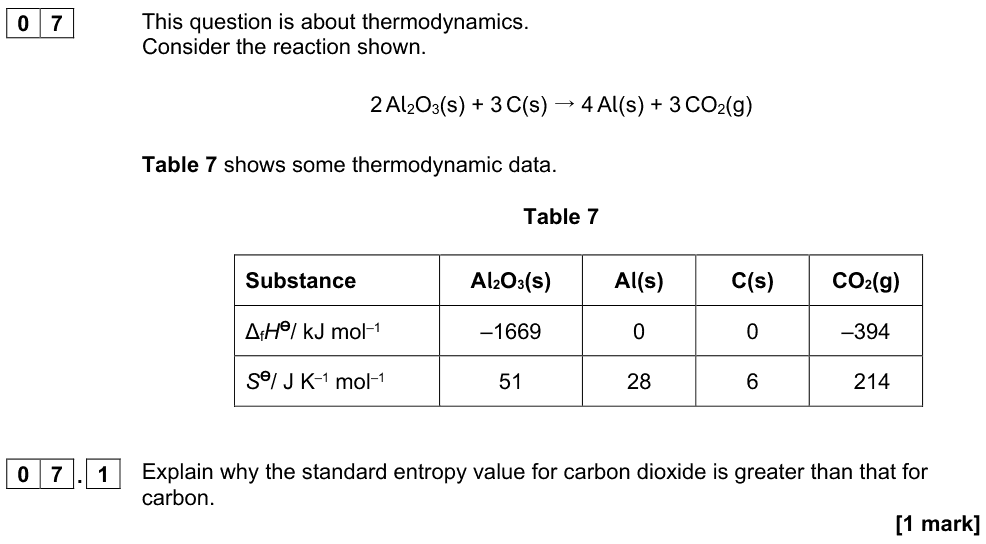
3.1.4.1-01 Reactions can be endothermic or exothermic.
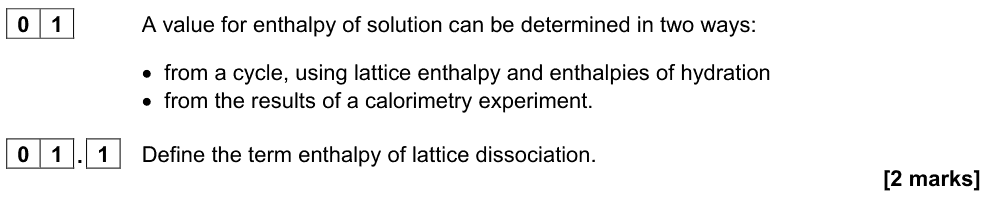
3.1.4.1-02 Enthalpy change (∆H) is the heat energy change measured under conditions of constant pressure.
3.1.4.1-03 Standard enthalpy changes refer to standard conditions, ie 100 kPa and a stated temperature (eg ∆H298Ɵ).
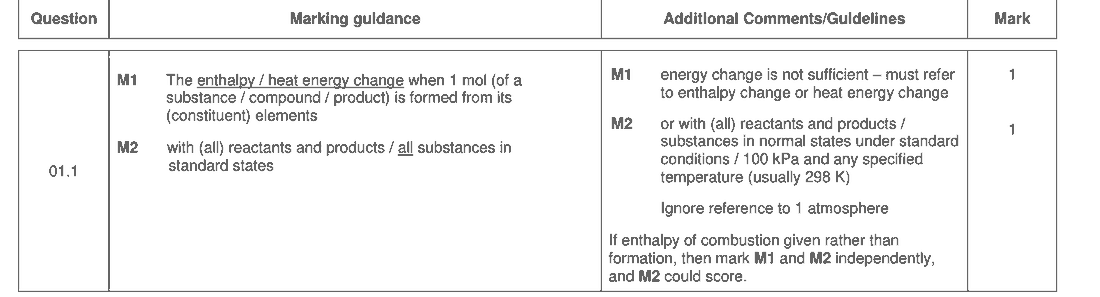
3.1.4.1-04 Students should be able to: • define standard enthalpy of combustion (∆cHƟ) • define standard enthalpy of formation (∆fHƟ).
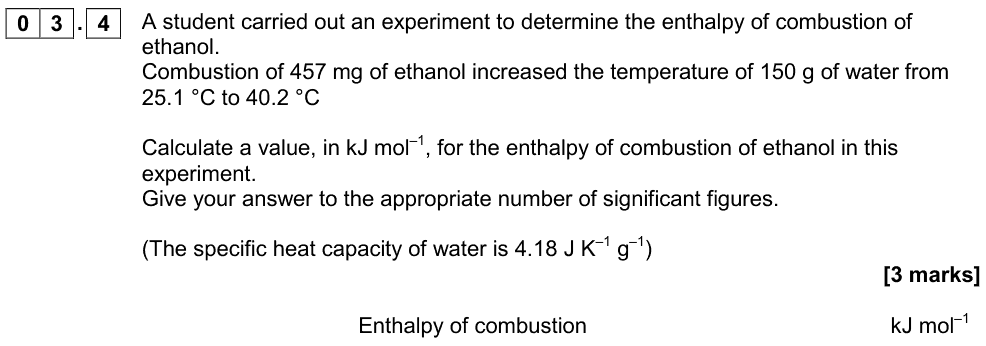
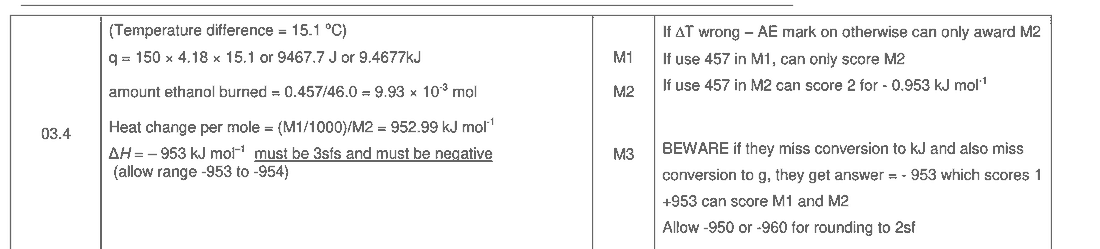
3.1.4.2-01 The heat change, q, in a reaction is given by the equation q = mc∆T where m is the mass of the substance that has a temperature change ∆T and a specific heat capacity c.
3.1.4.2-02 Students should be able to: • use this equation to calculate the molar enthalpy change for a reaction • use this equation in related calculations.
3.1.4.2-03 Students will not be expected to recall the value of the specific heat capacity, c, of a substance.
3.1.4.2-04 Required practical 2 Measurement of an enthalpy change.
3.1.4.3-01 Hess’s law.
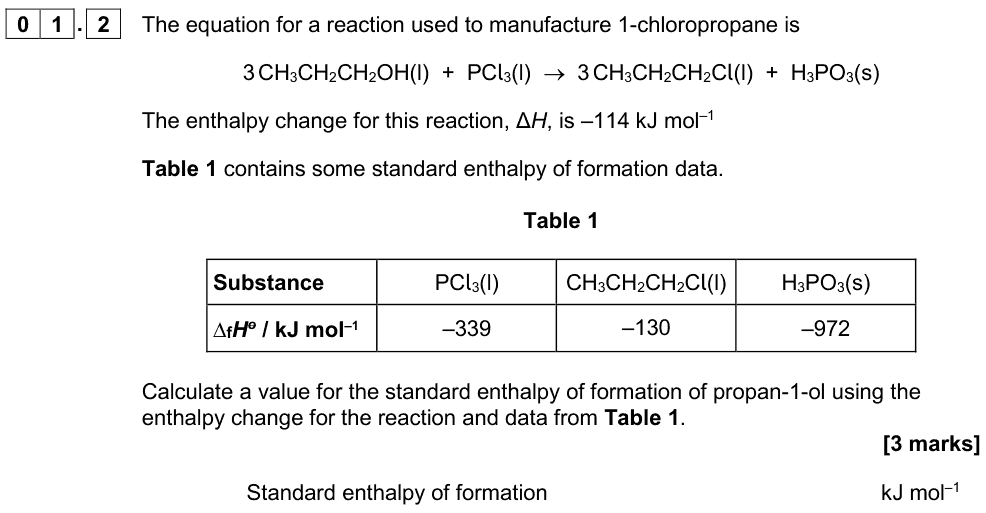
3.1.4.3-02 Students should be able to: • use Hess’s law to perform calculations, including calculation of enthalpy changes for reactions from enthalpies of combustion or from enthalpies of formation.
3.1.4.4-01 Mean bond enthalpy.
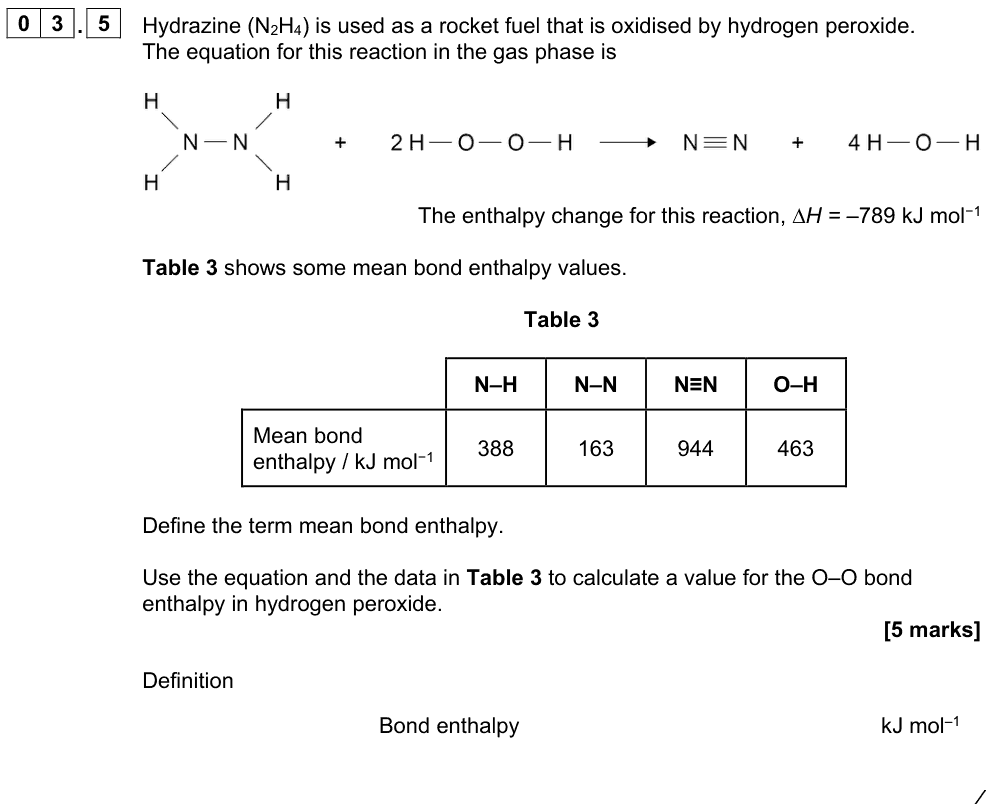
3.1.4.4-02 Students should be able to: • define the term mean bond enthalpy • use mean bond enthalpies to calculate an approximate value of ∆H for reactions in the gaseous phase • explain why values from mean bond enthalpy calculations differ from those determined using Hess’s law.
Six-mark level of response questions on this topic
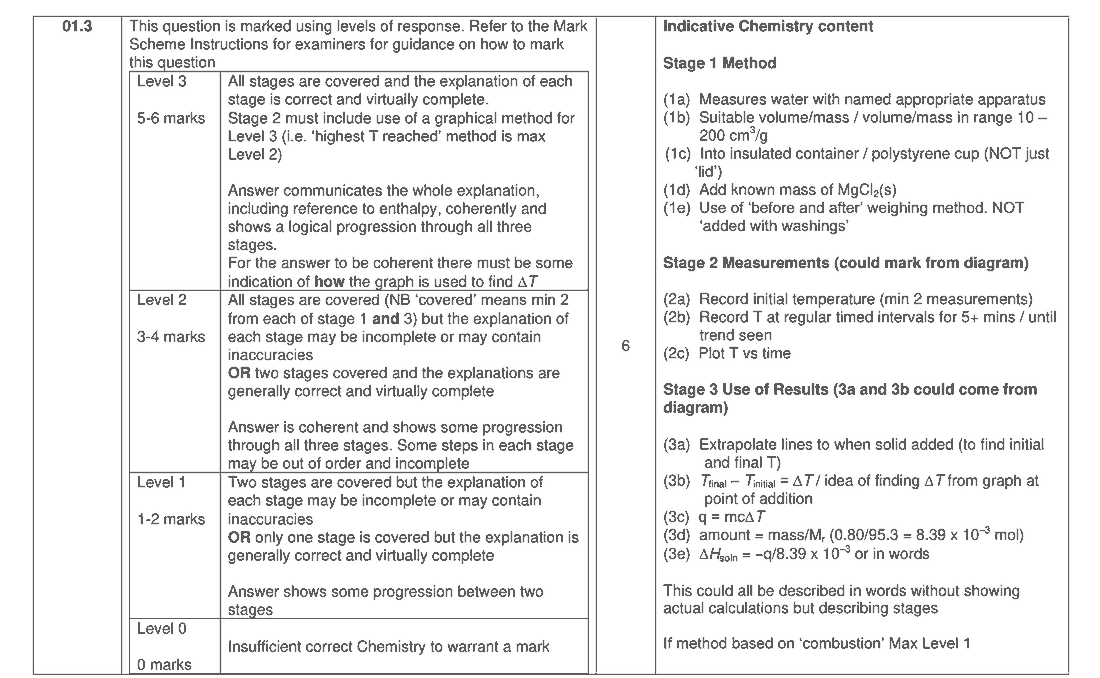
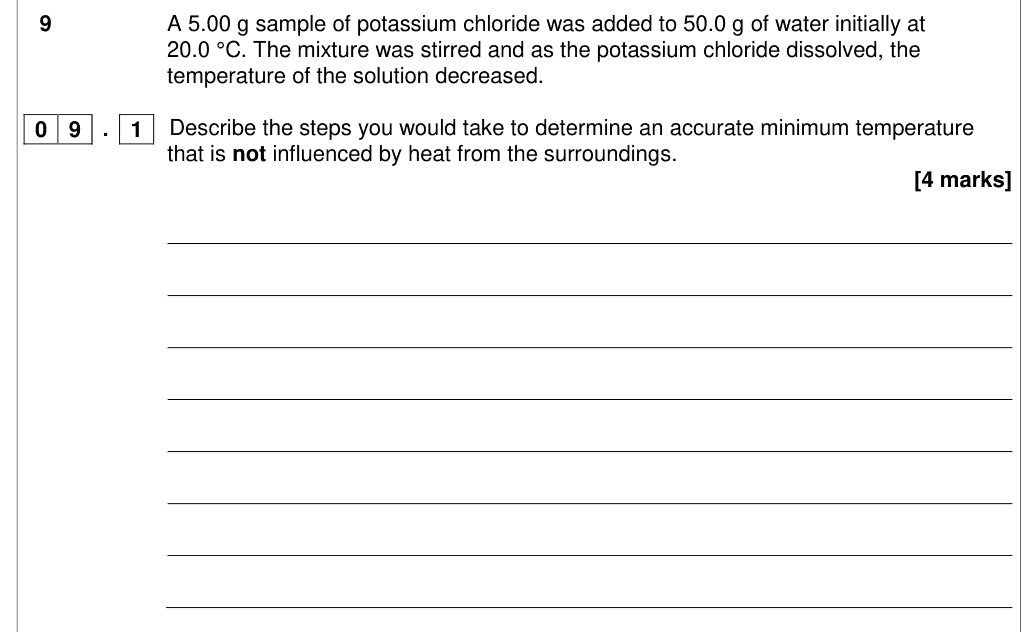
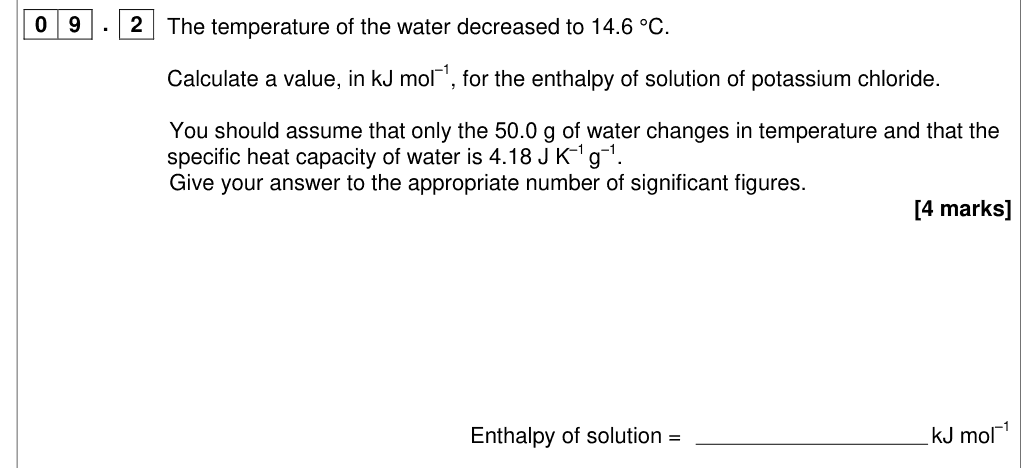
how you would carry out an experiment to determine the enthalpy of solution Explain how your results could be used to calculate the enthalpy of solution.
Tap a question to zoom it. Where a part needs a figure, table or structure from earlier in the question, that part folds out above it; the mark scheme and examiner's comment open underneath. Have AQA's Data Booklet (the Periodic Table and the spectroscopy tables) beside you.
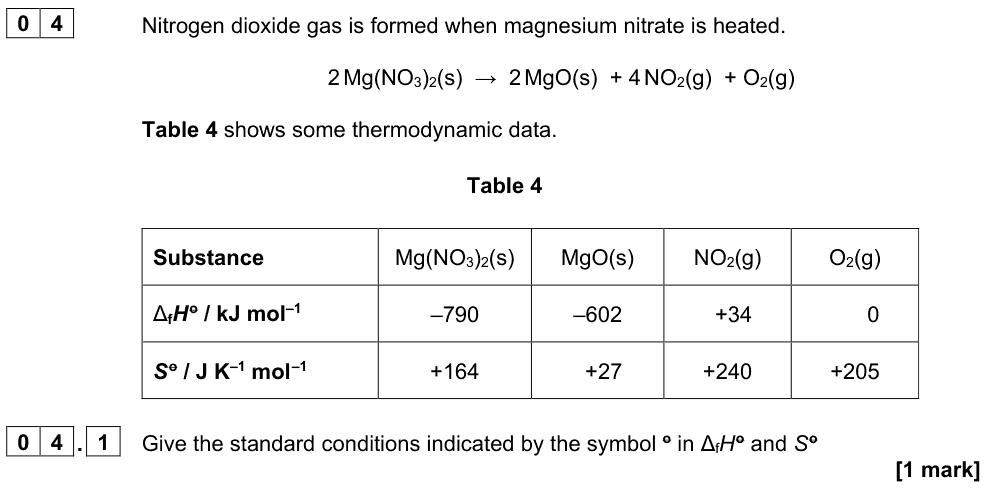
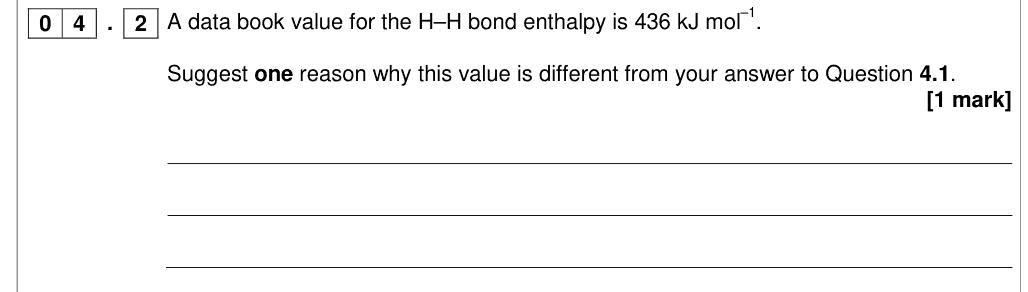
June 2025 · Paper 1 · Q04.11 markAO1=1Short answer
Mark scheme
Examiner's comment
About half the students answered part 1 correctly; many students lost the mark by adding extra incorrect information eg 1 mol dm–3 or all elements are in their standard states.
Some students stated 1 atmosphere instead of 100 kPa.
Notes from the mark scheme and report
100 kPa and a stated temperature (298 K). Not 1 atm. Extra wrong conditions such as 1 mol dm–3 or 'elements in their standard states' lost the mark
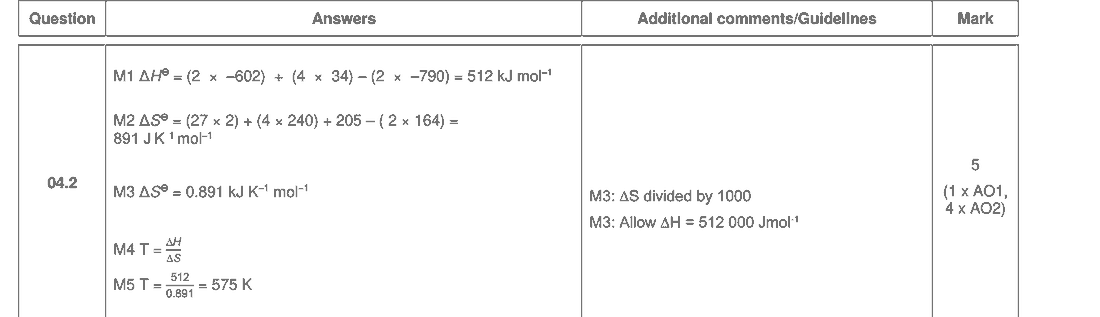
June 2025 · Paper 1 · Q04.25 marksAO1=1, AO2=4Calculation
Earlier part of question 04 that this part uses
Mark scheme
Examiner's comment
Many students could do the calculation in part 2; common errors included not applying the stoichiometry in the equation to calculate ΔH and ΔS and failing to use the factor of 1000 to calculate ΔS in kJ K–1mol–1.
A few students could not rearrange the equation.
Some students gave negative temperatures which are not appropriate in kelvin.
Skills: MS0.0 Recognise and make use of appropriate units in calculation; MS2.2 Change the subject of an equation; MS2.3 Substitute numerical values into algebraic equations using appropriate units for physical quantities
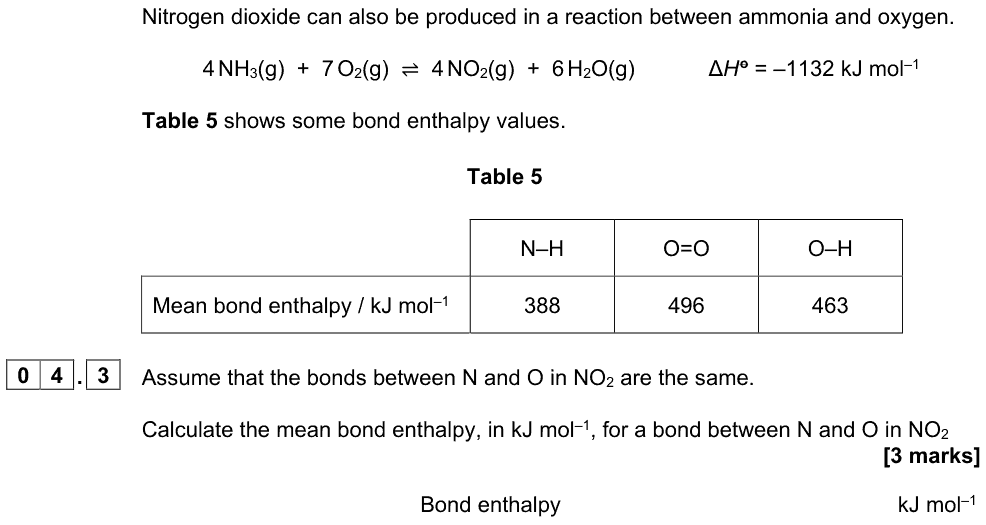
June 2025 · Paper 1 · Q04.33 marksAO2=3Calculation
Earlier part of question 04 that this part uses
Mark scheme
Examiner's comment
In part 3 about 40% of students gained all the marks; many students made an error with the signs in the equation.
8(N–O) = 8128 – 5556 + 1132 = 3704. Many made sign errors
Skills: MS2.2 Change the subject of an equation; MS2.4 Solve algebraic equations
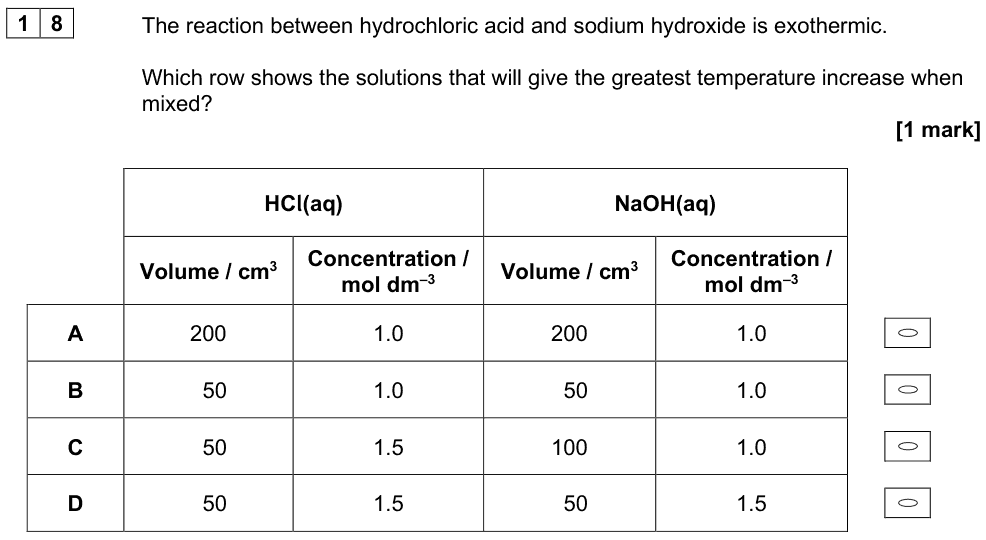
June 2025 · AS Paper 1 · Q181 markAO1=1Multiple choiceHard
Answer
D
Mark scheme
Examiner's comment
Students found this challenging with only about one third of students able to consider which combination of solutions would give the greatest temperature change. The most common answer was one where the students considered the maximum number of moles rather than considering that a lower total volume would also lead to a higher temperature rise.
Notes from the mark scheme and report
Answer: D. ∆T = q ÷ mc: D releases heat from 0.075 mol in only 100 cm3 (0.75 mol per dm3 of mixture)
A and B give 0.5 mol per dm3 and C 0.5 mol per dm3 (0.075 mol in 150 cm3). The common wrong answer picked the largest number of moles (A)
Skills: MS0.2 Use ratios, fractions and percentages
June 2025 · AS Paper 2 · Q07.11 markAO1=1Short answer
Mark scheme
Examiner's comment
7.1 Many students could define enthalpy change but a large number could not.
Notes from the mark scheme and report
Heat energy change at constant pressure
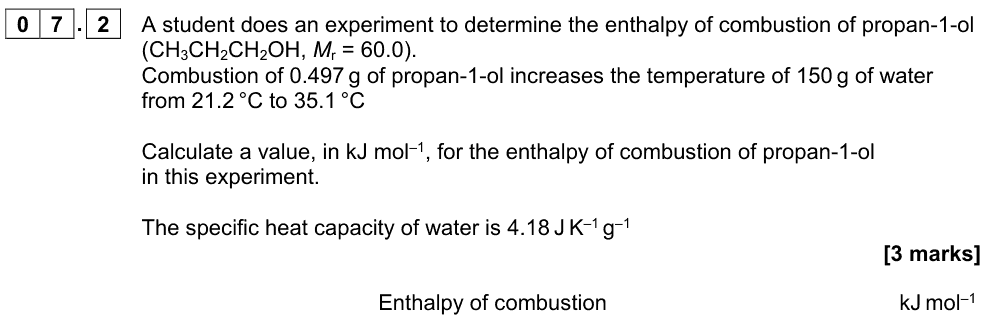
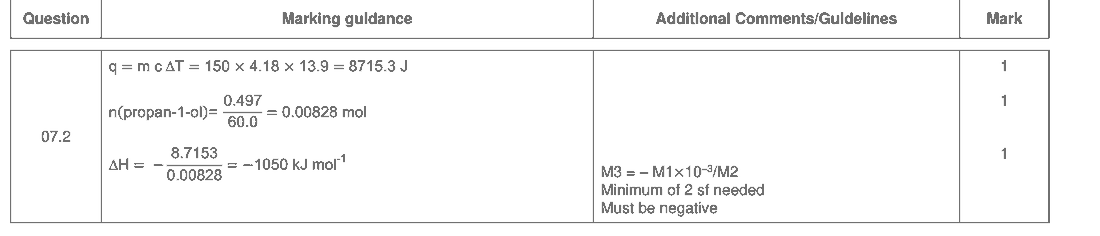
June 2025 · AS Paper 2 · Q07.25 marksAO1=1, AO3=4Calculation
Earlier part of question 07 that this part uses
Mark scheme
Examiner's comment
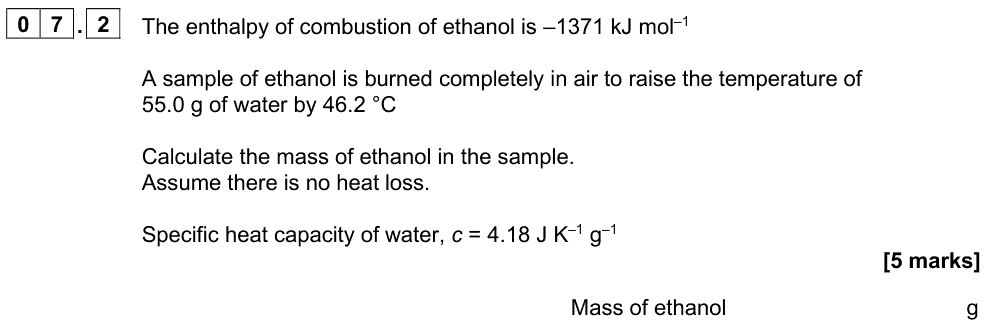
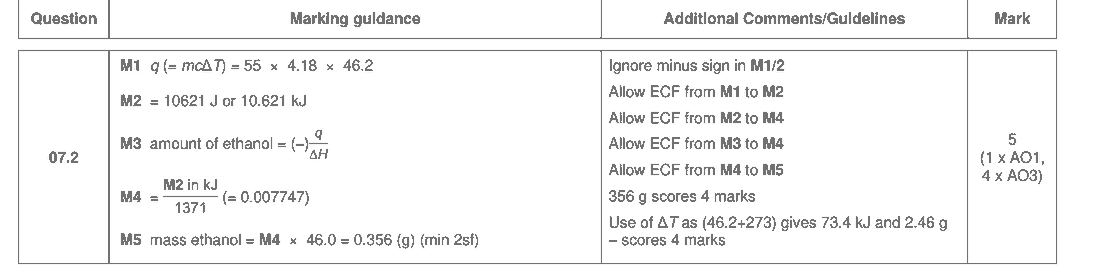
7.2 In this calculation, students were required to determine the mass of ethanol burned from the temperature change of water it heated on burning. Many students managed this successfully.
Skills: MS0.0 Recognise and make use of appropriate units in calculation; MS2.2 Change the subject of an equation; MS2.3 Substitute numerical values into algebraic equations using appropriate units for physical quantities
June 2025 · AS Paper 2 · Q07.31 markAO2=1Calculation
Earlier part of question 07 that this part uses
Mark scheme
Examiner's comment
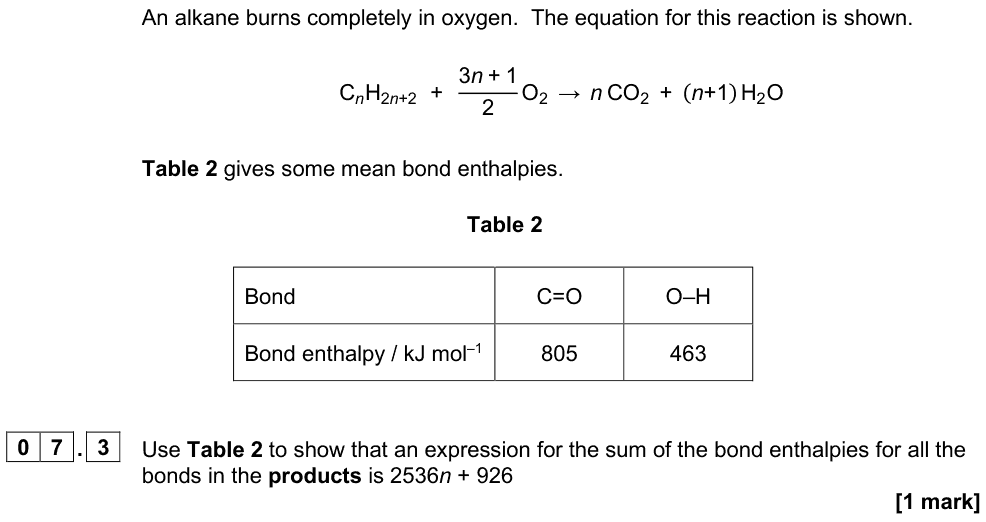
7.3 Students needed to show that the sum of the bond enthalpies for the products in a reaction equated to 2536n + 926. The best students could do this, but too many used brackets incorrectly in expressions that were mathematically incorrect.
Notes from the mark scheme and report
n CO2 has 2n C=O bonds and (n+1) H2O has 2(n+1) O–H bonds: 2n(805) + 2(n+1)(463) = 1610n + 926n + 926 = 2536n + 926. Brackets must be used correctly
many expressions were mathematically wrong
Skills: MS2.3 Substitute numerical values into algebraic equations using appropriate units for physical quantities
June 2025 · AS Paper 2 · Q07.43 marksAO3=3Calculation
Earlier parts of question 07 that this part uses
Mark scheme
Examiner's comment
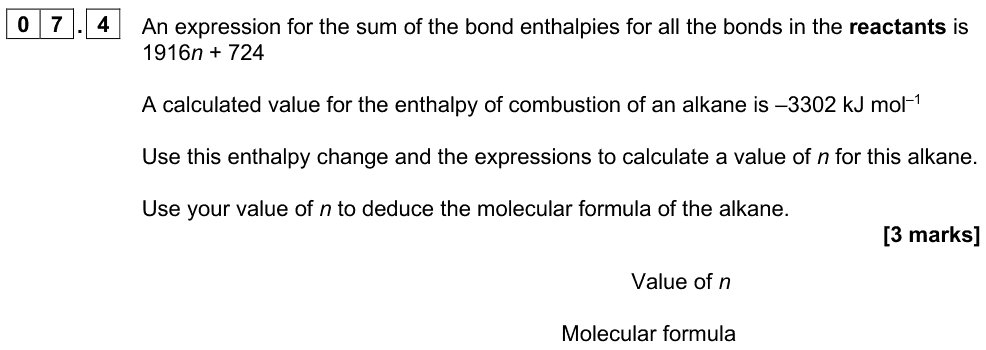
7.4 Students had to determine a value of n in an alkane and its formula using expressions for the sum of the bond enthalpies in both the reactants and products. A common error was to only use the sum for the products or the reactants and not both, or to have sum the wrong way round where it would equal +3302 not –3302.
Notes from the mark scheme and report
Answer: n = 5
C5H12. ∆H = bonds broken – bonds formed: –3302 = (1916n + 724) – (2536n + 926), so 620n = 3100. n must be an integer. Errors: using only one expression
subtracting the wrong way round (+3302)
Skills: MS2.2 Change the subject of an equation; MS2.4 Solve algebraic equations
June 2025 · AS Paper 2 · Q181 markAO2=1Multiple choice
Answer
A
Mark scheme
Examiner's comment
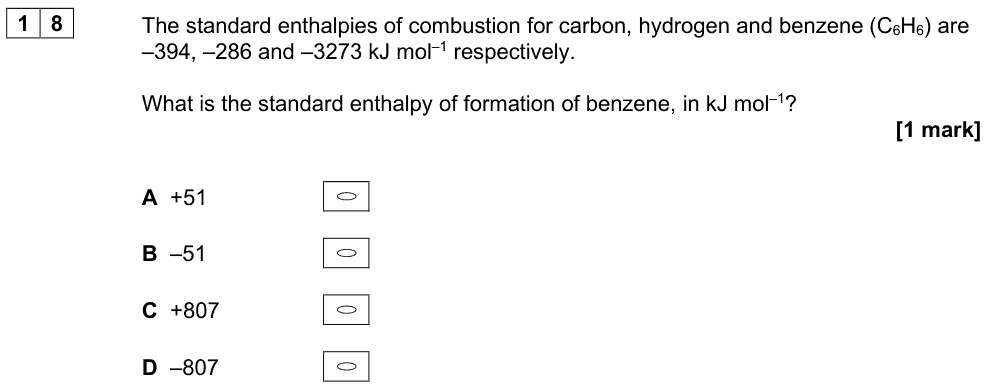
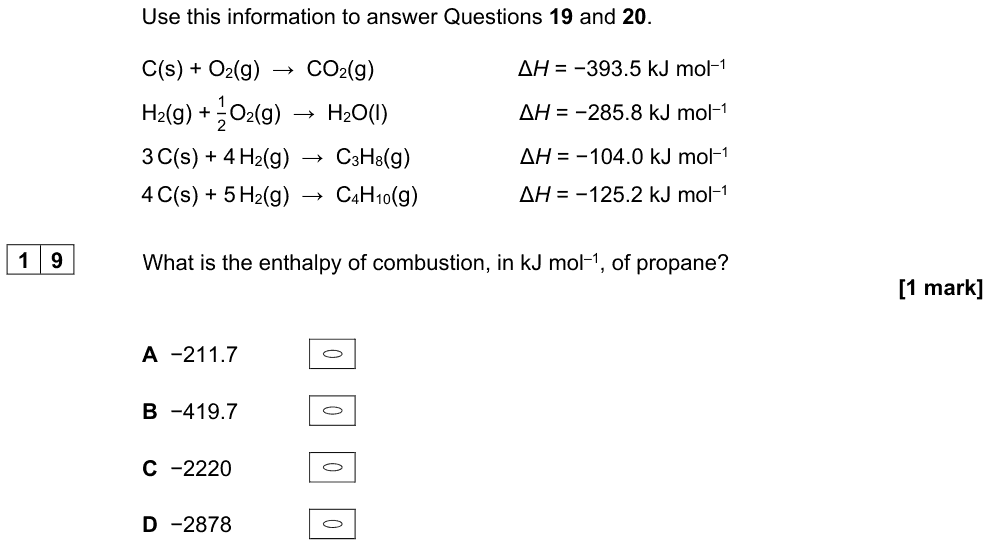
Students struggled with this question. Common errors were thinking that the cycle involved 6 x the enthalpy of combustion of hydrogen rather than 3 x, and/or making an error with sign for the required reaction.
Q19 Maxwell-Boltzmann distribution curve
This was answered correctly by a majority of students.
Notes from the mark scheme and report
Answer: A. 6C + 3H2 → C6H6: ∆fH = 6(–394) + 3(–286) – (–3273) = +51 kJ mol–1. Errors: using 6 × ∆cH of hydrogen
wrong sign
Skills: MS2.4 Solve algebraic equations
June 2025 · AS Paper 2 · Q221 markAO2=1Multiple choice
Answer
B
Mark scheme
Examiner's comment
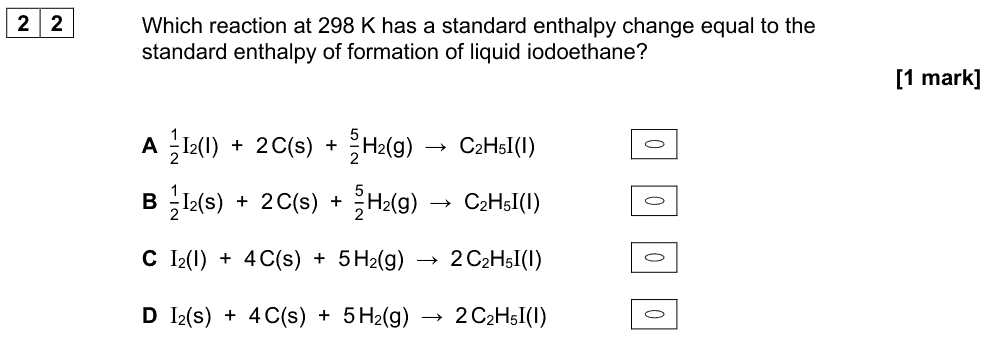
Students found this hard although the correct answer was the most common. Students struggled to appreciate that iodine is a solid and/or that the equation for the enthalpy of formation must form one mole of the compound.
Notes from the mark scheme and report
Answer: B. One mole of C2H5I(l) formed from its elements in their standard states
iodine is a solid at 298 K. Errors: iodine as a liquid
forming two moles
June 2025 · Paper 3 · Q01.25 marksAO2=4, AO3=1Calculation
Earlier part of question 01 that this part uses
Mark scheme
Examiner's comment
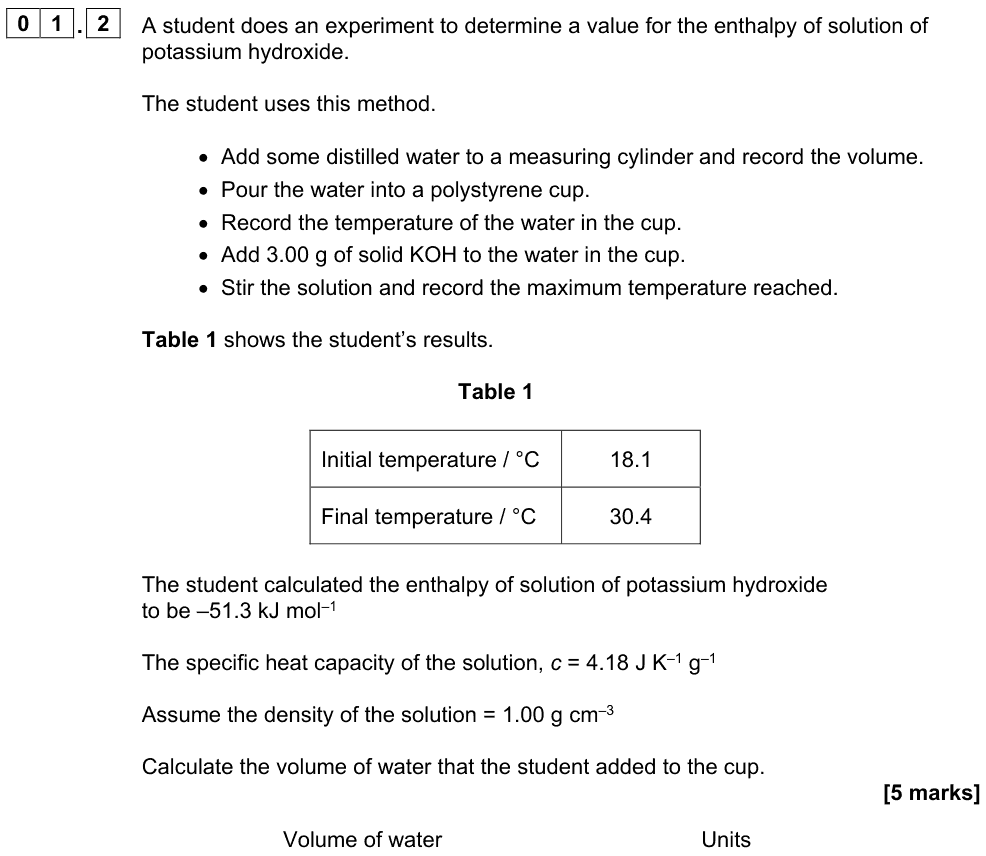
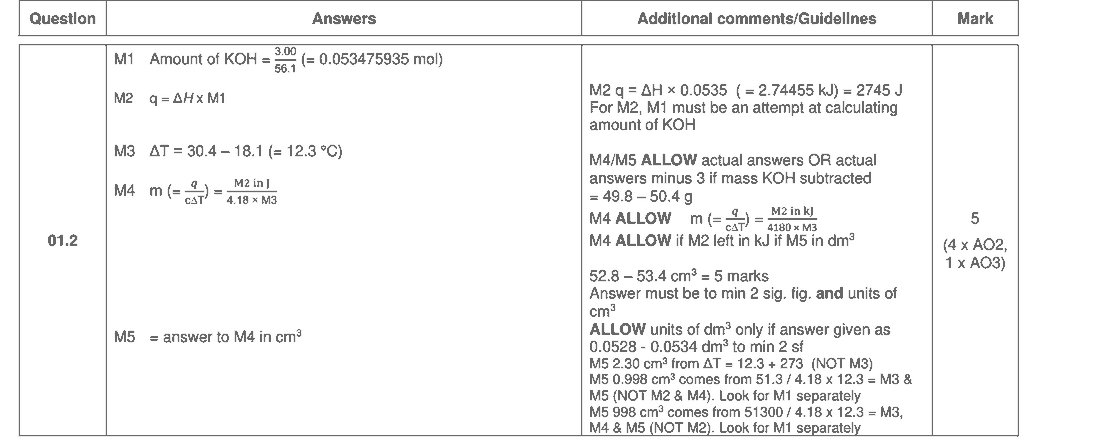
1.2 This calculation discriminated very well with more than 50% achieving full marks and less than 5% failing to score. Typical mistakes included omitting to use the amount of KOH and the enthalpy of solution to calculate q, with many students assuming that the enthalpy of solution was equal to q. A second mistake was seen in the work of those students who calculated the temperature change and then converted 12.3 into Kelvin by adding 273. Because this is a temperature change it can be calculated as either the difference between 30.4 and 18.1 or the difference between 303.4 and 291.1 – in both cases an answer of 12.3 is obtained. As in any question, ECF was possible from incorrect calculations of amount of KOH, of q and of ∆T – but, as mentioned above, this is only possible when the working is clear.
Notes from the mark scheme and report
Answer: 53.4 cm3 (allow 52.8 to 53.4, or 49.8 to 50.4 if the mass of KOH is subtracted). n(KOH) = 3.00 ÷ 56.1 = 0.0535 mol
q = 51.3 × 0.0535 = 2.745 kJ = 2745 J
∆T = 12.3 °C
m = q ÷ (c∆T) = 2745 ÷ (4.18 × 12.3) g. Units cm3 needed. Errors: taking q to equal the molar enthalpy of solution (998 cm3)
adding 273 to the temperature change. Under 5% scored 0
Skills: MS0.0 Recognise and make use of appropriate units in calculation; MS2.2 Change the subject of an equation; MS2.3 Substitute numerical values into algebraic equations using appropriate units for physical quantities; RP2 Measurement of an enthalpy change
June 2025 · Paper 3 · Q01.41 markAO3=1Practical and data analysis
Earlier part of question 01 that this part uses
Mark scheme
Examiner's comment
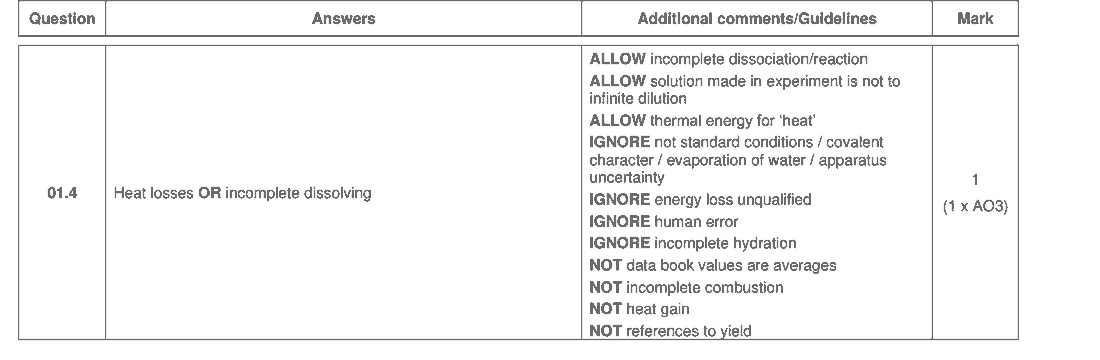
1.4 Over 50% of students correctly referred either to heat losses or incomplete dissolving of the solute. A common incorrect response referred to partial covalency, showing confusion between this situation and a Born-Haber cycle being compared with a theoretical lattice energy.
Notes from the mark scheme and report
Heat loss (to the surroundings) in the experiment, or the solid not dissolving completely (or the solution is not infinitely dilute). Non-standard conditions, covalent character, evaporation and 'human error' are ignored. Common wrong answer: partial covalent character (confusing this with Born–Haber against the perfect ionic model)
Skills: PS2.3 Evaluate results and draw conclusions with reference to measurement uncertainties and errors; RP2 Measurement of an enthalpy change
June 2024 · AS Paper 1 · Q08.12 marksAO1=2Short answerHard
Mark scheme
Examiner's comment
08.1 Around a quarter of students were correctly able to define the standard enthalpy of formation. Students did not always state that one mole of substance was being formed and also did not state that all substances should be in their standard states.
Notes from the mark scheme and report
The enthalpy change when one mole of a substance is formed from its elements, with all substances in their standard states (at 100 kPa and a stated temperature). 'One mole' and 'standard states' were often missing
June 2024 · AS Paper 1 · Q08.22 marksAO2=2Calculation
Earlier part of question 08 that this part uses
Mark scheme
Examiner's comment
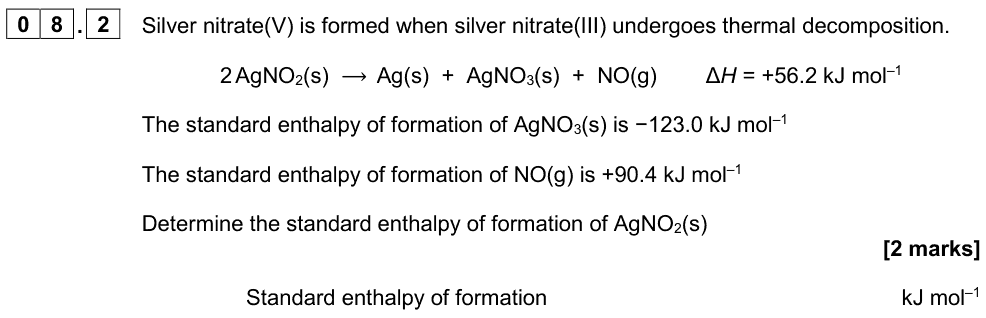
08.2 This calculation was generally done well although only slightly over a third of students realised that there were two moles of AgNO2 in the equation and so the value of their answer should be halved.
June 2024 · AS Paper 1 · Q08.31 markAO2=1Practical and data analysis
Earlier part of question 08 that this part uses
Mark scheme
Examiner's comment
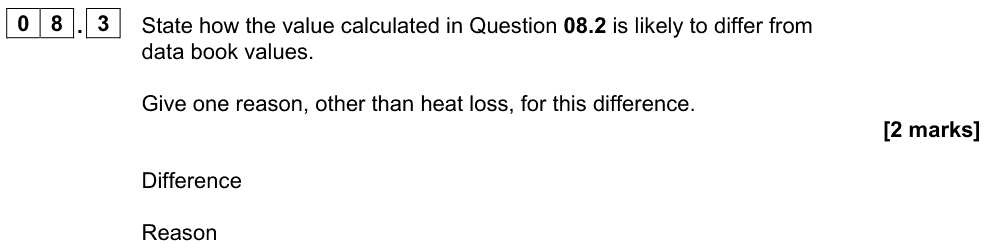
08.3 Students found this challenging with a very small number appreciating that it is not possible to measure the temperature of a solid, or that it was not possible to measure the temperature change of a reaction that is being heated.
Notes from the mark scheme and report
The solid has to be heated, so the temperature change caused by the reaction itself cannot be measured (or it is difficult to measure the temperature of a solid
AgNO3 may also decompose). Very few scored
Skills: PS2.1 Comment on experimental design and evaluate scientific methods; RP2 Measurement of an enthalpy change
June 2024 · AS Paper 1 · Q08.46 marksAO3=6Practical and data analysisHard
Earlier part of question 08 that this part uses
Mark scheme
Examiner's comment
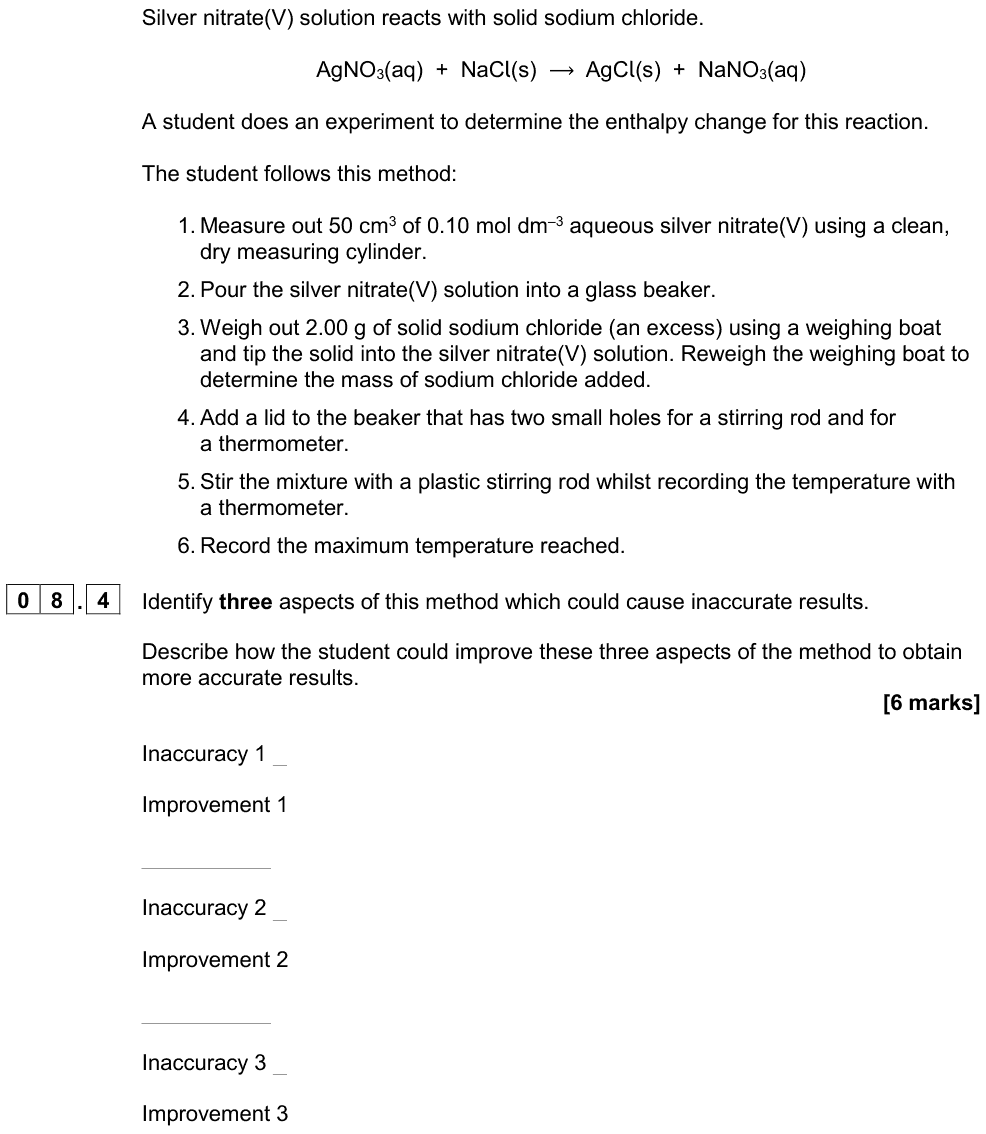
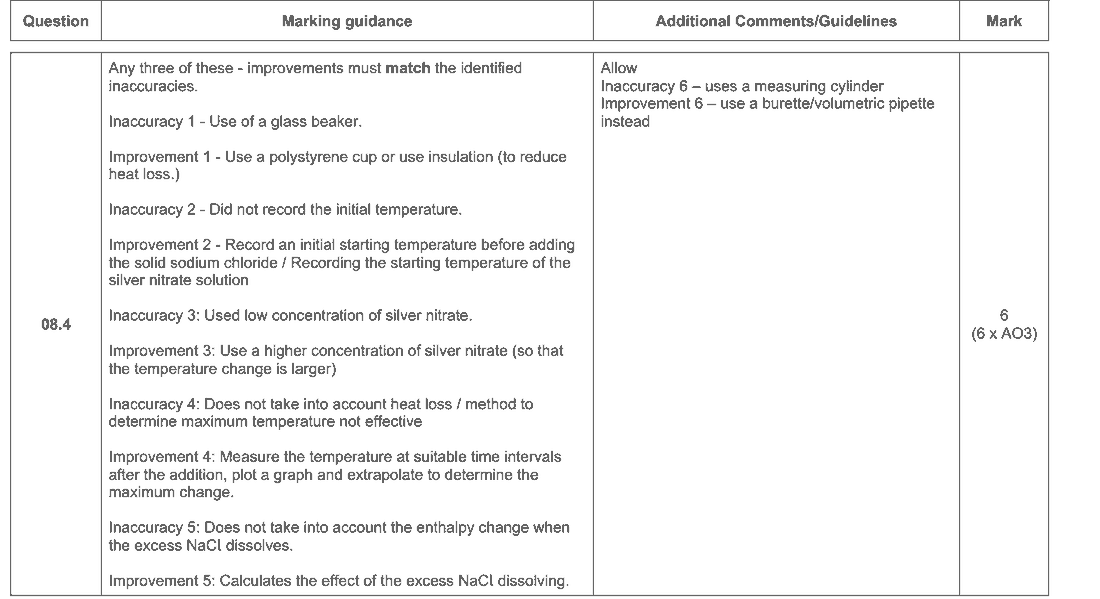
08.4 Most students scored some marks on this question, although only about a fifth of students correctly identified three different inaccuracies and three improvements. Students generally focussed on the use of the measuring cylinder, the glass beaker, and inaccuracies in the initial and/or maximum temperature in this reaction. Some students incorrectly suggested that washings should be added and that repeating the experiment would improve accuracy.
Notes from the mark scheme and report
Any three matched pairs. Glass beaker → polystyrene cup / insulation. No initial temperature recorded → record the starting temperature of the solution. Low concentration of AgNO3 → higher concentration for a bigger temperature change. Heat loss / maximum temperature not reliable → record temperature at intervals, plot a graph and extrapolate. Excess NaCl dissolving has its own enthalpy change → allow for it. Measuring cylinder → burette or pipette. Adding washings or just repeating does not score
Skills: PS2.1 Comment on experimental design and evaluate scientific methods; PS2.3 Evaluate results and draw conclusions with reference to measurement uncertainties and errors; ATa Use appropriate apparatus to record a range of measurements (to include mass, time, volume of liquids and gases, temperature); ATk Safely and carefully handle solids and liquids, including corrosive, irritant, flammable and toxic substances; RP2 Measurement of an enthalpy change
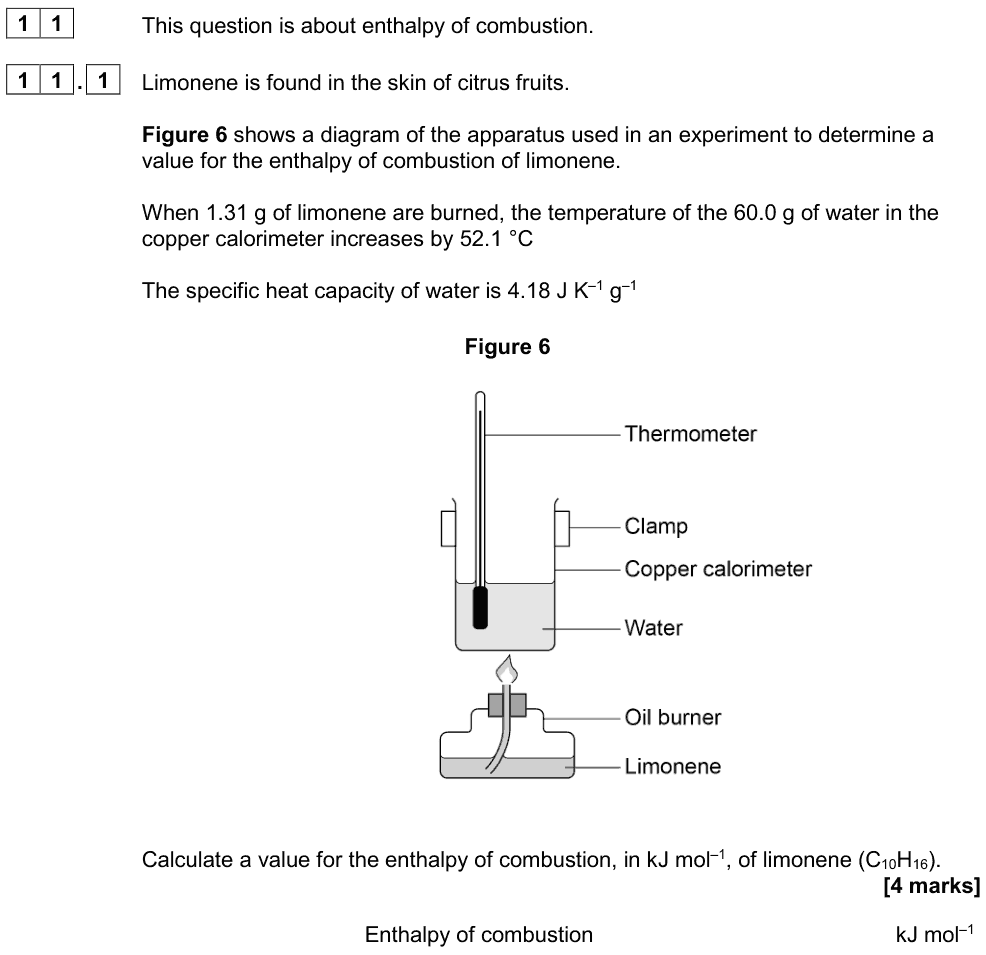
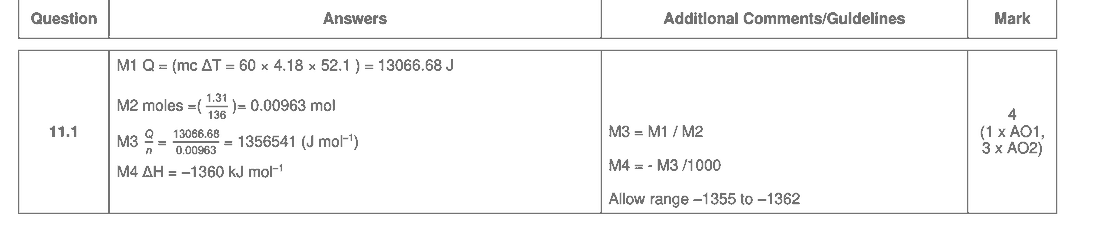
June 2024 · Paper 2 · Q11.14 marksAO1=1, AO2=3Calculation
Mark scheme
Examiner's comment
11.1 This relatively straightforward calorimetry calculation saw over 40% scoring all 4 marks. A significant number, however, failed to gain the final mark because the answer given was positive.
negative sign needed. Many lost the last mark by giving a positive value
Skills: MS0.0 Recognise and make use of appropriate units in calculation; MS2.3 Substitute numerical values into algebraic equations using appropriate units for physical quantities; PS3.2 Process and analyse data using appropriate mathematical skills as exemplified in the mathematical appendix for each science; RP2 Measurement of an enthalpy change
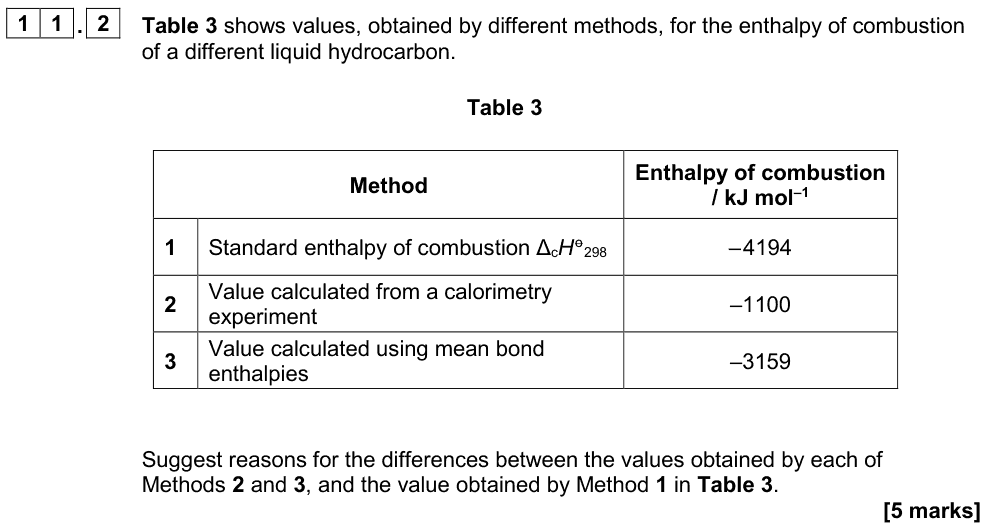
June 2024 · Paper 2 · Q11.25 marksAO3=5Explanation
Earlier part of question 11 that this part uses
Mark scheme
Examiner's comment
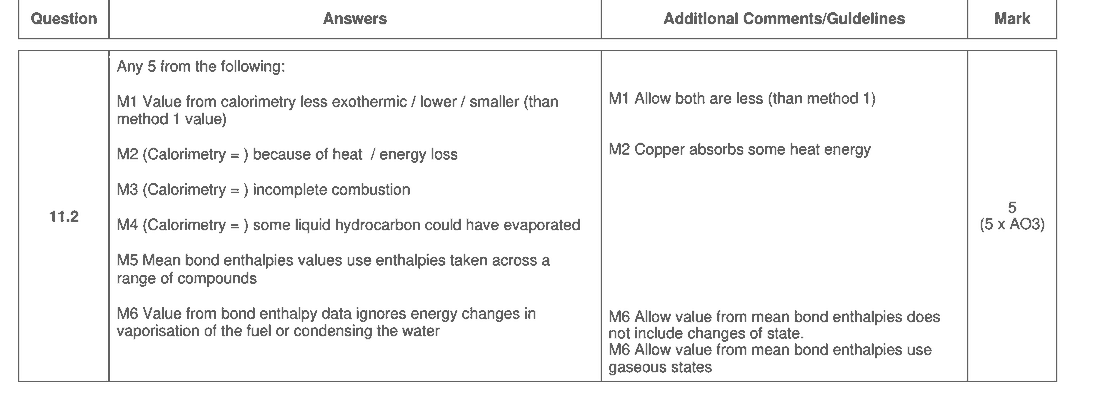
11.2 An extended response question with around 40% scoring at least 3 out of 5 marks. The comparison between standard enthalpy of combustion and a value derived from calorimetry was well done. Many also appreciated that mean bond enthalpies are derived from a range of compounds, but very few recognised that a calculation based on mean bond enthalpies does not account for the enthalpy changes in the transition from a liquid to a gaseous state and vice versa.
Notes from the mark scheme and report
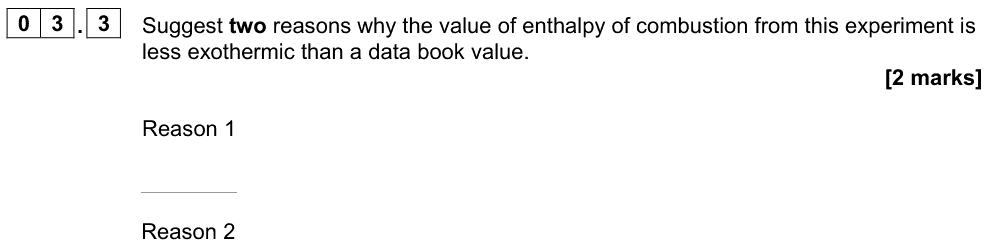
Any five: the calorimetry value is less exothermic than the standard value
because of heat loss to the surroundings (or to the copper)
incomplete combustion
evaporation of the fuel
mean bond enthalpies are averaged over a range of compounds
the bond enthalpy calculation applies to gaseous species so ignores vaporising the fuel and condensing the water. The last point was rarely seen
around 40% scored 3 or more
Skills: PS2.3 Evaluate results and draw conclusions with reference to measurement uncertainties and errors; RP2 Measurement of an enthalpy change
June 2024 · AS Paper 2 · Q191 markAO2=1Multiple choice
Answer
C
Mark scheme
Examiner's comment
This was answered correctly by a majority (57.1%) of students.
June 2023 · Paper 1 · Q05.21 markAO3=1Short answer
Earlier part of question 05 that this part uses
Mark scheme
Examiner's comment
Answers to 05.2 were generally good.
Notes from the mark scheme and report
Temperature increases (exothermic)
consequential on the sign of the answer to 05.1
June 2023 · AS Paper 1 · Q151 markAO1=1Multiple choiceEasy
Answer
D
Mark scheme
Examiner's comment
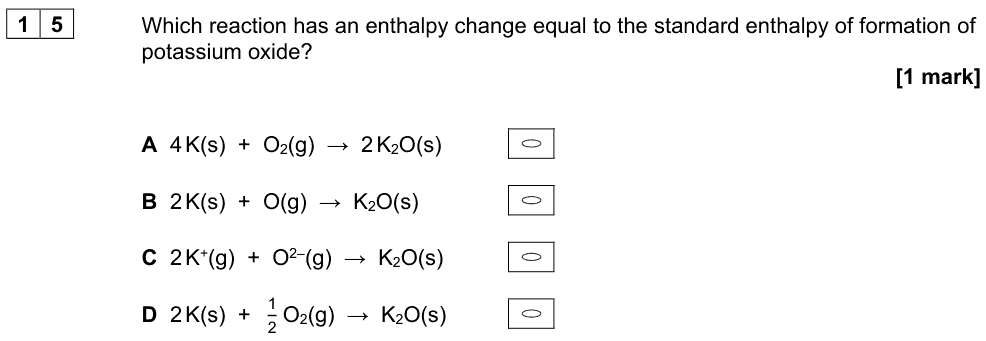
About two-thirds of students correctly identified the reaction that has an enthalpy change equal to the standard enthalpy of formation of potassium oxide.
Notes from the mark scheme and report
Answer: D. One mole of K2O formed from its elements in their standard states
June 2023 · AS Paper 2 · Q05.13 marksAO2=3Calculation
Mark scheme
Examiner's comment
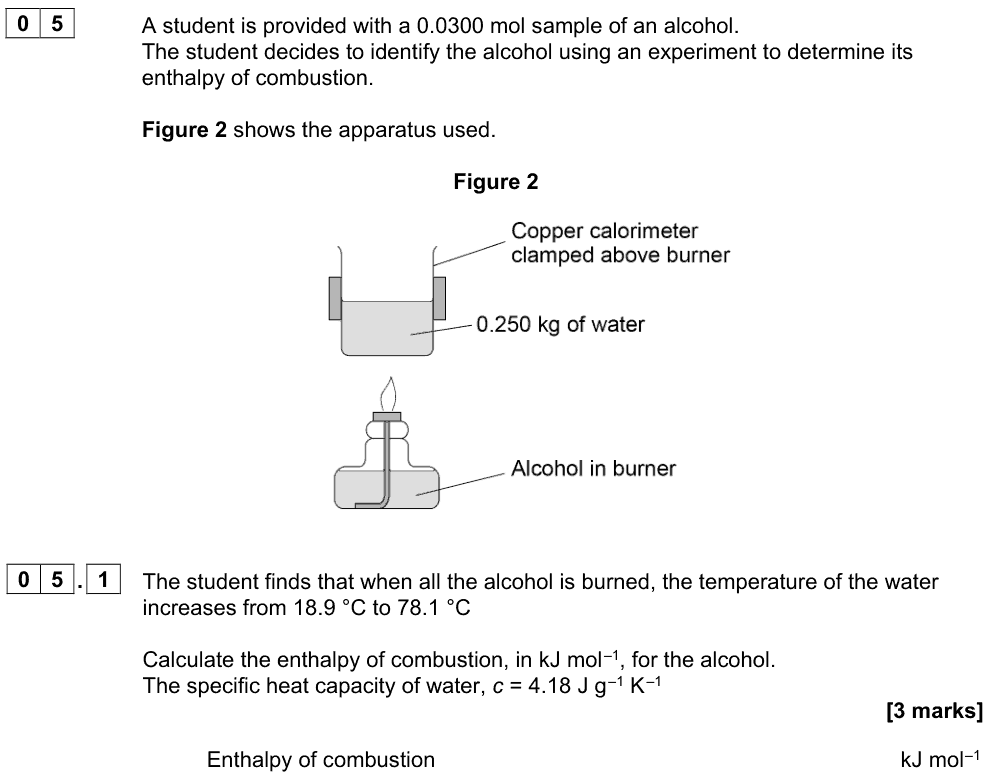
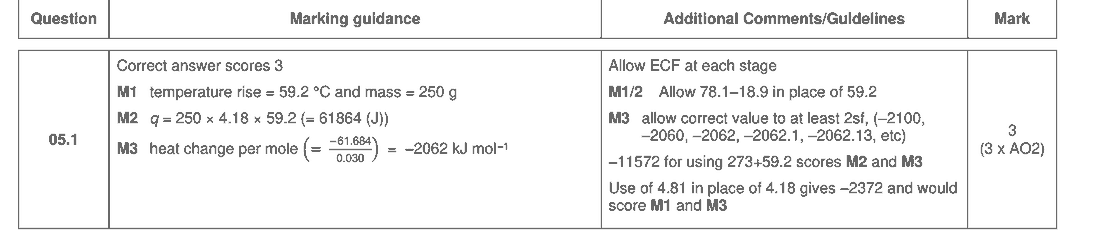
05.1 Students did very well on this question where they had to determine the enthalpy of combustion of a fuel from calorimetry data.
Notes from the mark scheme and report
Answer: –2062 kJ mol–1 (allow –2060 or –2100). ∆T = 59.2 °C
Skills: MS0.0 Recognise and make use of appropriate units in calculation; MS2.3 Substitute numerical values into algebraic equations using appropriate units for physical quantities; RP2 Measurement of an enthalpy change
June 2023 · AS Paper 2 · Q05.22 marksAO3=2Practical and data analysis
Earlier part of question 05 that this part uses
Mark scheme
Examiner's comment
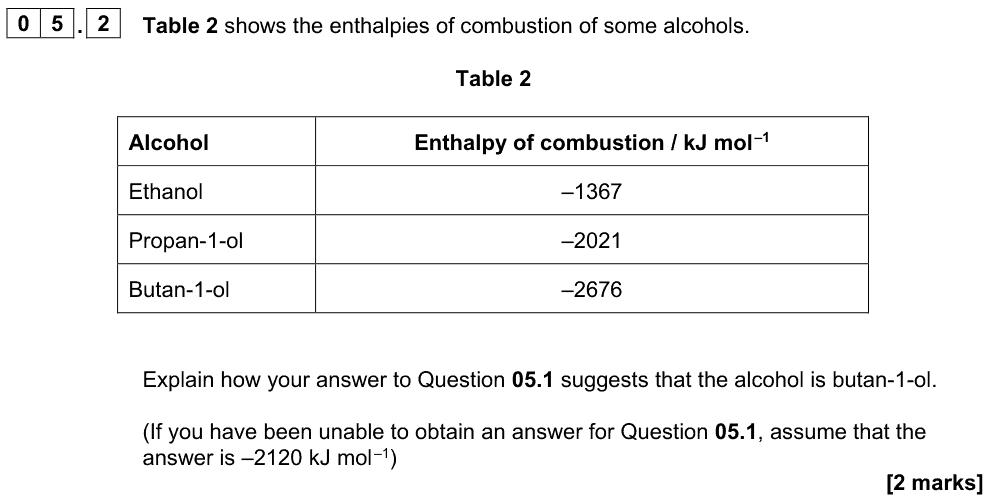
05.2 Many students did appreciate that the true enthalpy of combustion value would be more exothermic than the measured value from a calorimetry experiment. However, many students struggled to express their answer clearly and often wrote confusing statements. When referring to the relative magnitude of exothermic reactions, stating that a reaction is more or less exothermic than another is clearer than suggesting whether a value is bigger or smaller which can be ambiguous, especially when the enthalpy change is negative.
Notes from the mark scheme and report
The measured value is not accurate because of heat loss / incomplete combustion (or evaporation of alcohol), so the experimental value is less exothermic than the true value
the true value must be more exothermic than –2062, so it cannot be ethanol or propan-1-ol. Say 'more / less exothermic' rather than bigger or smaller
Skills: PS2.3 Evaluate results and draw conclusions with reference to measurement uncertainties and errors; PS2.1 Comment on experimental design and evaluate scientific methods; RP2 Measurement of an enthalpy change
June 2023 · AS Paper 2 · Q05.33 marksAO2=3Calculation
Earlier part of question 05 that this part uses
Mark scheme
Examiner's comment
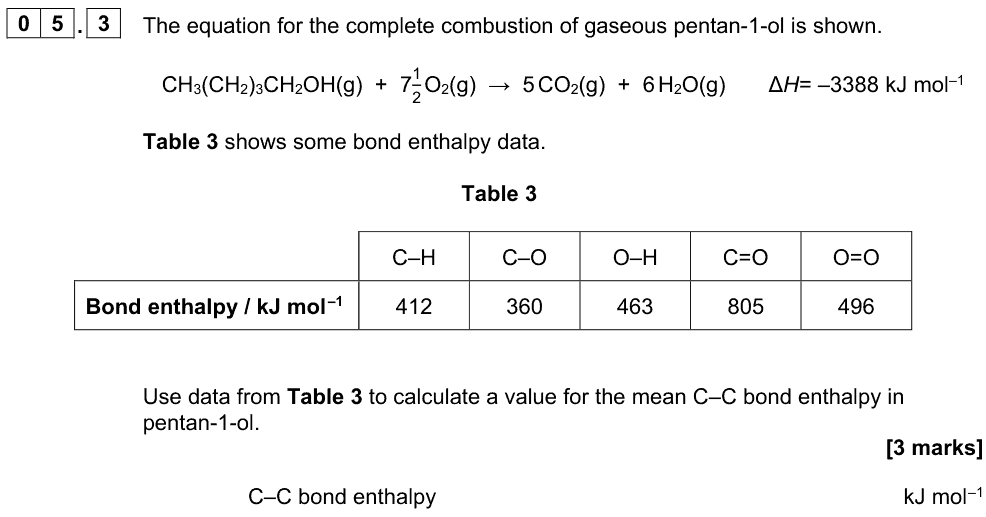
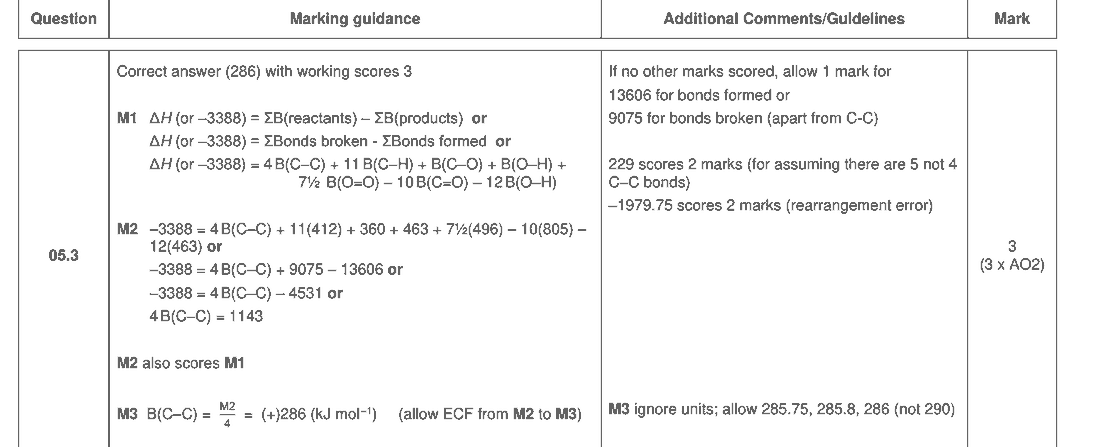
05.3 This bond enthalpy question was relatively complex, but many students did work through it successfully. Common mistakes were to omit bonds or to miscount the number of C-C bonds in the alcohol.
Skills: MS2.3 Substitute numerical values into algebraic equations using appropriate units for physical quantities; MS2.4 Solve algebraic equations
June 2023 · Paper 2 · Q08.25 marksAO2=5Calculation
Earlier part of question 08 that this part uses
Mark scheme
Examiner's comment
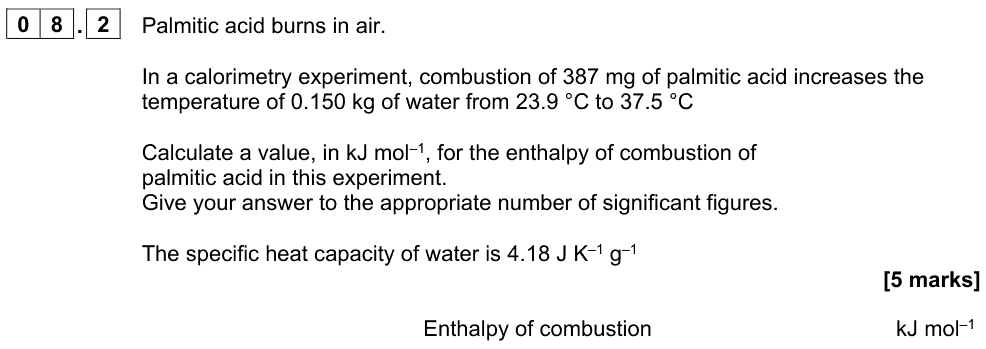
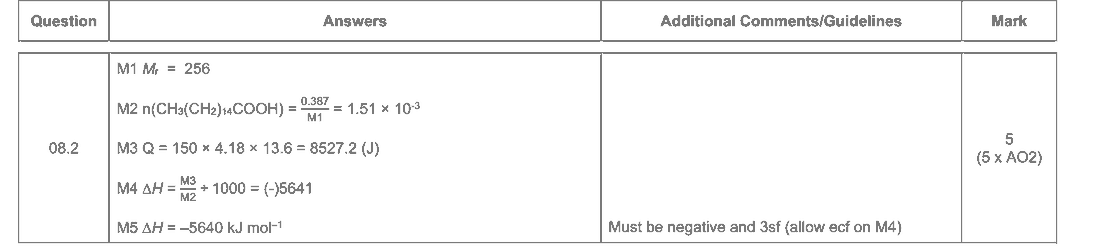
08.2 Weaker students were often able to get started with this extended but familiar style of calculation based on a calorimetry experiment. That said, the question had a high discrimination index showing that only the better students were able to score full marks. A common mistake was to use the mass of the acid in the Q = mcΔT step in the calculation, rather than the mass of water. Some lost the final mark either for failing to give the answer to 3 significant figures or failing to show that it was exothermic by including a negative sign for their final answer.
Notes from the mark scheme and report
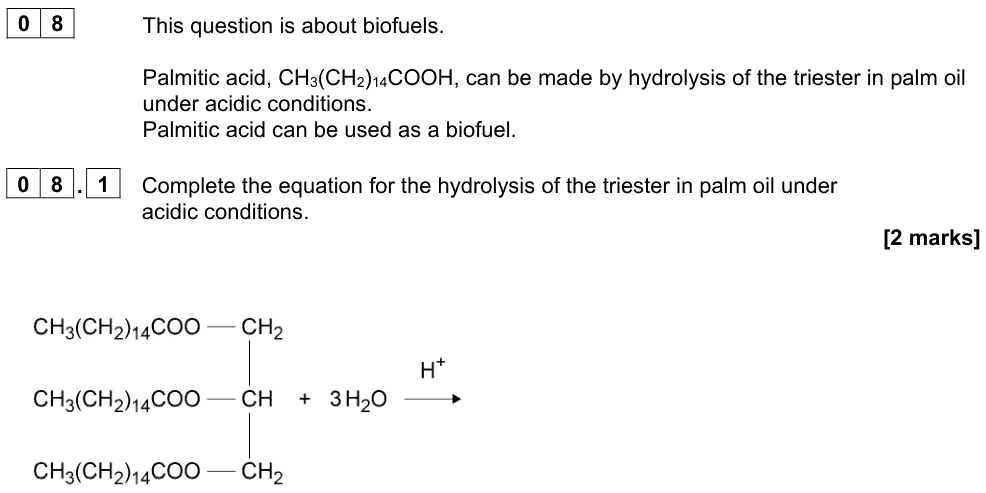
Answer: –5640 kJ mol–1. Mr = 256.0
n = 0.387 ÷ 256.0 = 1.51 × 10^–3 mol
q = 150 × 4.18 × 13.6 = 8527 J
∆H = –8.527 ÷ 1.51 × 10^–3. Must be negative and to 3 significant figures. Errors: using the mass of the acid instead of the water in q = mc∆T
no sign
wrong significant figures
Skills: MS0.0 Recognise and make use of appropriate units in calculation; MS1.1 Use an appropriate number of significant figures; MS2.3 Substitute numerical values into algebraic equations using appropriate units for physical quantities; RP2 Measurement of an enthalpy change
June 2023 · Paper 2 · Q08.32 marksAO2=2Practical and data analysis
Earlier part of question 08 that this part uses
Mark scheme
Examiner's comment
08.3 This was generally well answered.
Notes from the mark scheme and report
The experimental value is less exothermic (less negative)
because of incomplete combustion
Skills: PS2.3 Evaluate results and draw conclusions with reference to measurement uncertainties and errors; RP2 Measurement of an enthalpy change
June 2023 · Paper 2 · Q08.63 marksAO2=3Calculation
Earlier part of question 08 that this part uses
Mark scheme
Examiner's comment
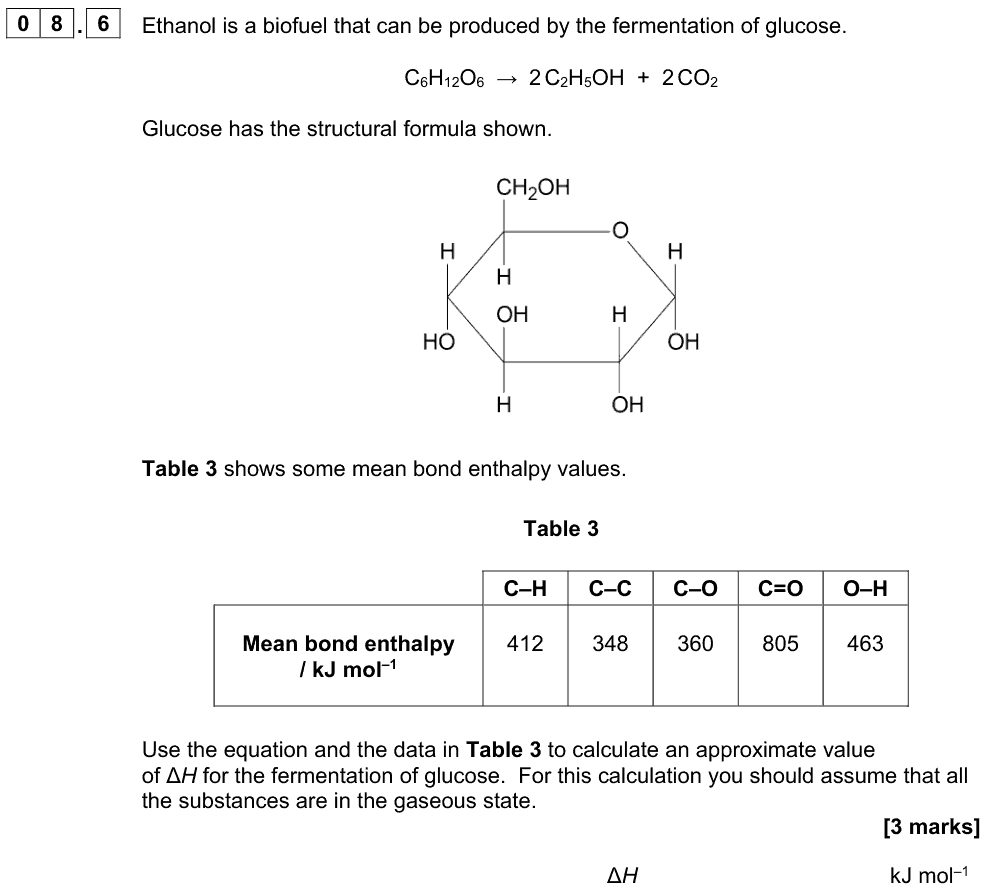
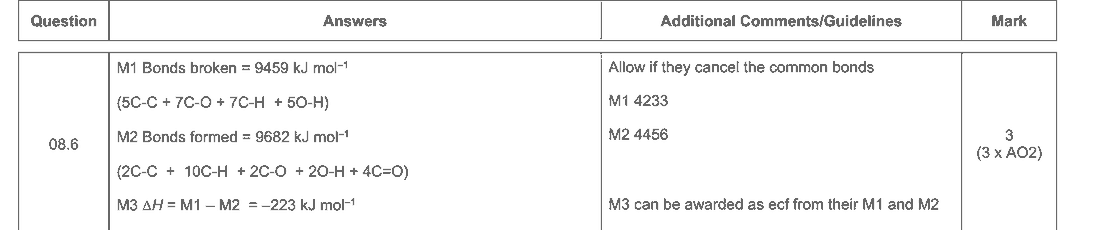
08.6 The most common issue with the answers to this question was the failure to show sufficient workings. Better students showed values for the sums of the bond enthalpies for bonds broken and bonds formed. Even if a mistake was made in these values the final mark could be scored consequentially for their correct use in calculating the approximate value for the enthalpy change. Over 70% were able to score at least one of the three marks available.
∆H = 9459 – 9682. Show the two totals so that error carried forward can be credited. Over 70% scored at least 1
Skills: MS2.3 Substitute numerical values into algebraic equations using appropriate units for physical quantities
June 2023 · Paper 2 · Q08.72 marksAO2=2Calculation
Earlier part of question 08 that this part uses
Mark scheme
Examiner's comment
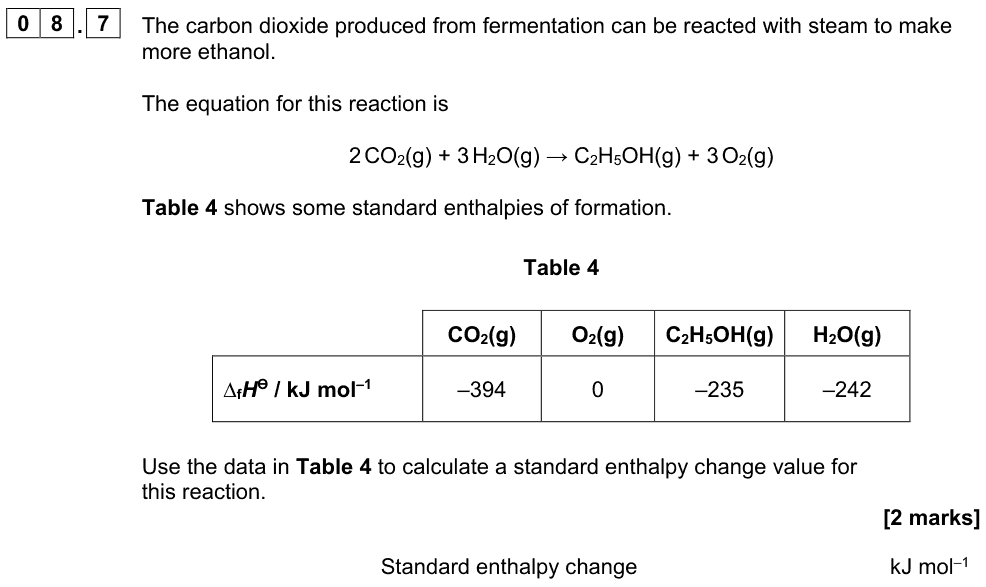
08.7 This question was generally well answered. The most common mistake was for an incorrect arrow direction in a Hess’s law cycle, resulting in a negative answer. Other mistakes included a failure to use the stoichiometry values from the given equation to multiply the enthalpies of formation by the correct factors.
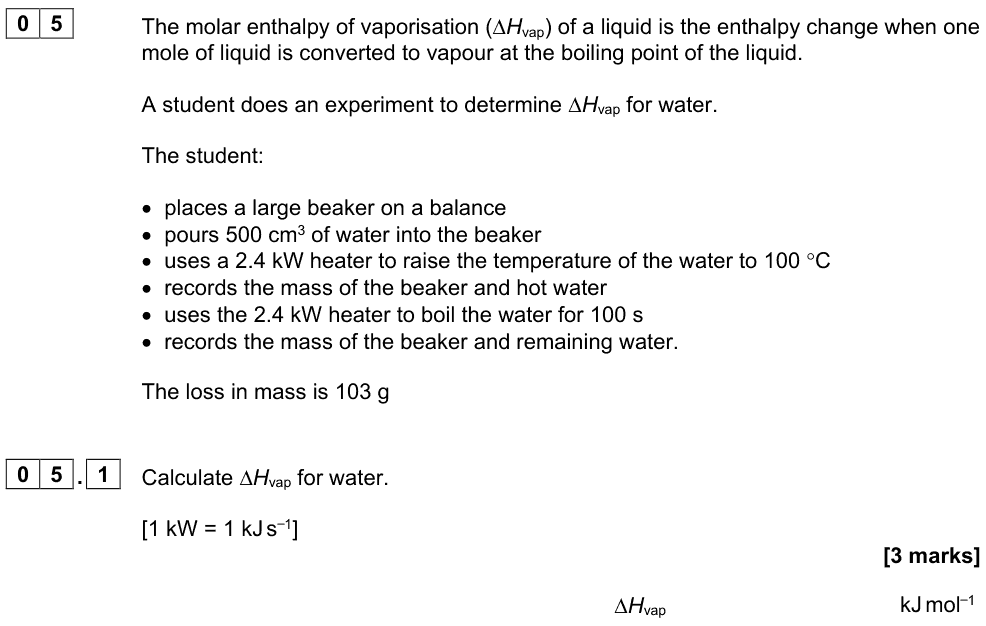
05.1 was reasonably well answered by most students, although there was some confusion about the mass of water to use in the calculation with some using 397 g instead of 103 g.
Notes from the mark scheme and report
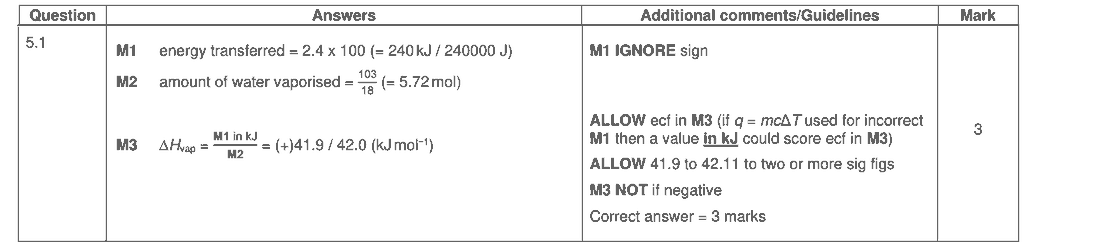
Answer: +41.9 kJ mol–1 (allow 41.9 to 42.1
negative loses M3). Energy supplied = 2.4 kJ s–1 × 100 s = 240 kJ
n(water vaporised) = 103 ÷ 18.0 = 5.72 mol
240 ÷ 5.72. Common error: using 397 g (the water left) instead of 103 g
Skills: MS0.0 Recognise and make use of appropriate units in calculation; MS0.2 Use ratios, fractions and percentages; PS3.2 Process and analyse data using appropriate mathematical skills as exemplified in the mathematical appendix for each science
June 2023 · Paper 3 · Q101 markAO1=1Multiple choice
Answer
C
Mark scheme
Notes from the mark scheme and report
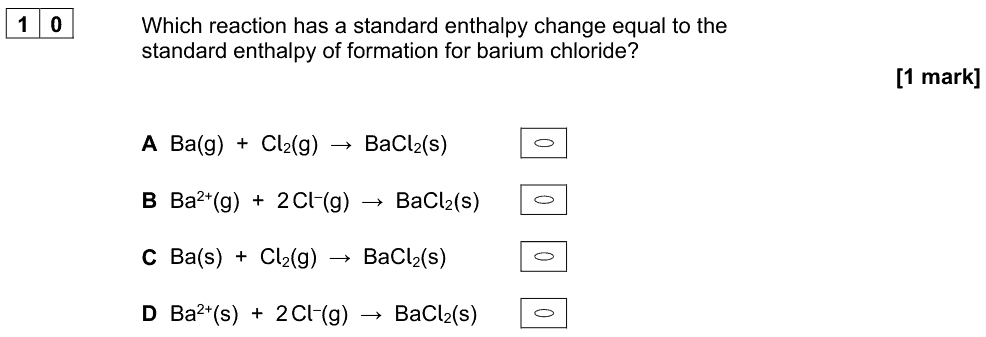
Answer: C. One mole of BaCl2 formed from its elements in their standard states: Ba(s) and Cl2(g)
June 2022 · Paper 1 · Q03.55 marksCalculationHard
Earlier part of question 03 that this part uses
Mark scheme
Examiner's comment
In 03.5, only 5% of students gained all the marks.
Most students did not give a correct definition; many referred to energy rather than enthalpy, many did not refer to 1 mol and many omitted stating that the value was averaged over many compounds.
Many found processing the bond breaking/bond forming data difficult but were able to access M5.
Notes from the mark scheme and report
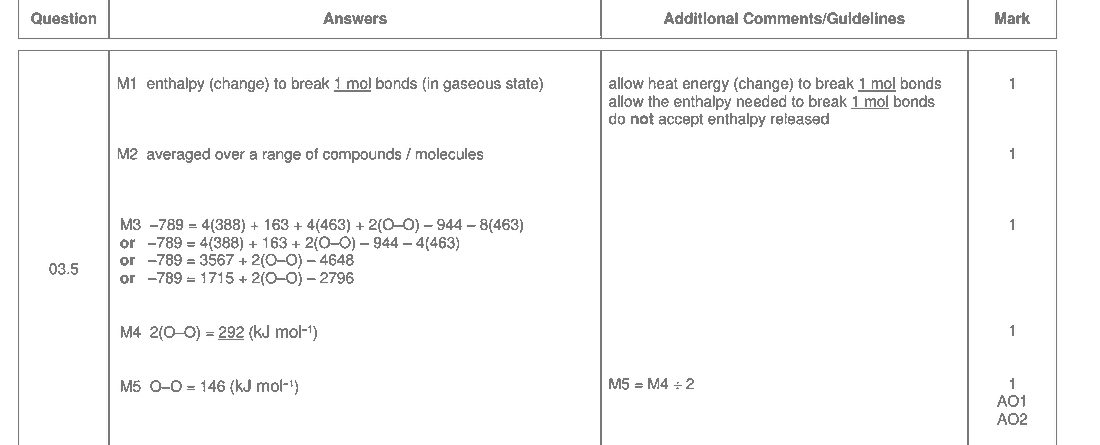
Answer: O–O = 146 kJ mol–1. Definition: the enthalpy change to break one mole of a covalent bond (gaseous), averaged over a range of compounds. –789 = [4(388) + 163 + 4(463) + 2(O–O)] – [944 + 8(463)], so 2(O–O) = 292. Definition errors: 'energy' instead of enthalpy, no reference to 1 mol, no averaging over different compounds
'enthalpy released' is rejected
Skills: MS2.4 Solve algebraic equations
June 2022 · AS Paper 2 · Q07.32 marksAO3=2Calculation
Earlier parts of question 07 that this part uses
Mark scheme
Examiner's comment
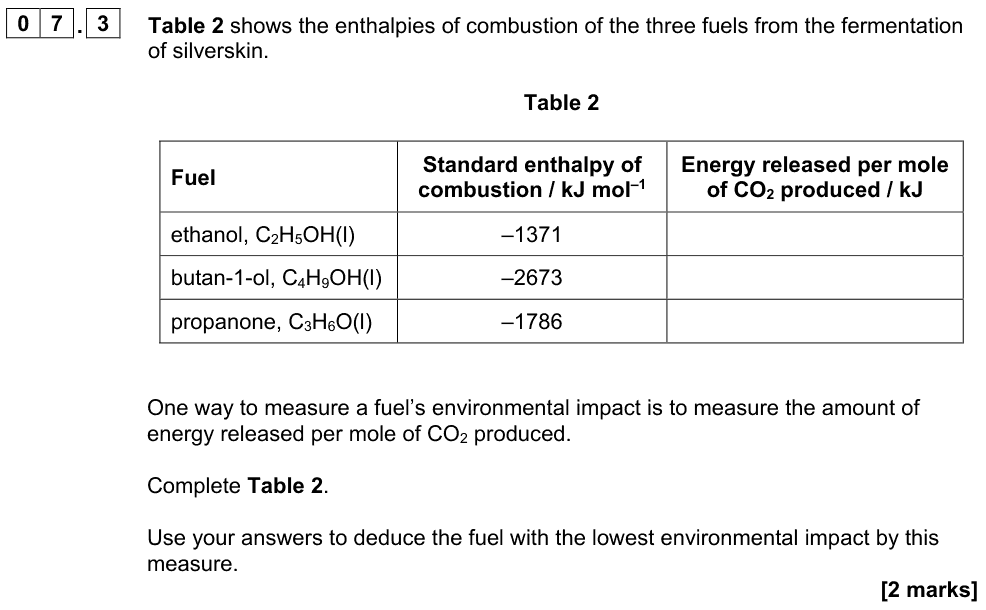
7.3 This question required students to use data to judge the relative environmental impact of some fuels. This required students to work out the energy released per mole of CO2 released, and many found it difficult to do this. Many also could not deduce that the fuel releasing the most energy per mole of CO2 formed was the one with the lowest environmental impact.
Notes from the mark scheme and report
Ethanol 685.5 (686), butan-1-ol 668, propanone 595 kJ per mole of CO2 (enthalpy of combustion ÷ number of carbon atoms)
lowest impact = most energy per mole of CO2 = ethanol. Many could not do the division or chose the smallest value
Skills: MS0.2 Use ratios, fractions and percentages; PS3.2 Process and analyse data using appropriate mathematical skills as exemplified in the mathematical appendix for each science
June 2022 · AS Paper 2 · Q07.44 marksAO2=4Calculation
Earlier parts of question 07 that this part uses
Mark scheme
Examiner's comment
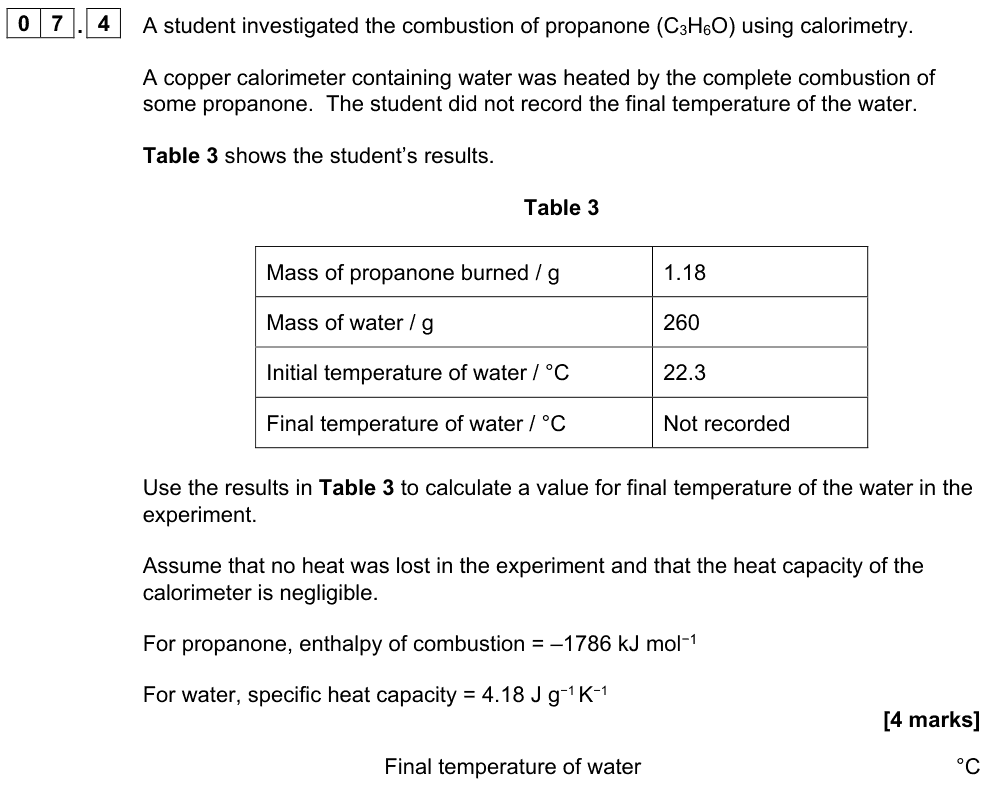
7.4 This question required students to calculate the final temperature of some water after being heated up by a burning fuel. Students answered this well, including unit conversions where applicable.
Notes from the mark scheme and report
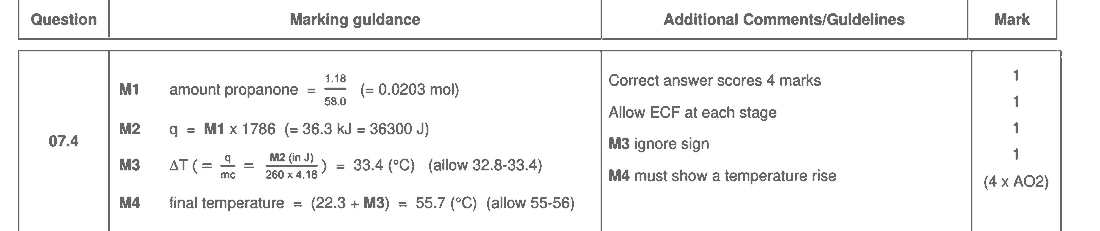
Answer: 55.7 °C (allow 55 to 56). n = 1.18 ÷ 58.0 = 0.0203 mol
q = 0.0203 × 1786 = 36.3 kJ = 36 300 J
∆T = q ÷ (260 × 4.18) = 33.4
22.3 + 33.4
Skills: MS0.0 Recognise and make use of appropriate units in calculation; MS2.2 Change the subject of an equation; MS2.3 Substitute numerical values into algebraic equations using appropriate units for physical quantities; PS3.2 Process and analyse data using appropriate mathematical skills as exemplified in the mathematical appendix for each science; RP2 Measurement of an enthalpy change
June 2022 · AS Paper 2 · Q07.53 marksAO2=3Calculation
Earlier part of question 07 that this part uses
Mark scheme
Examiner's comment
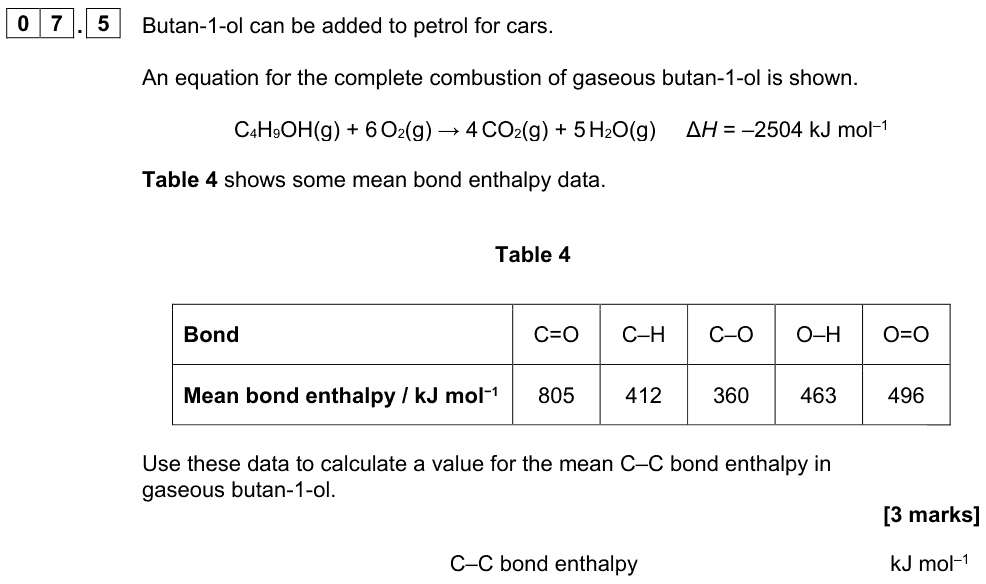
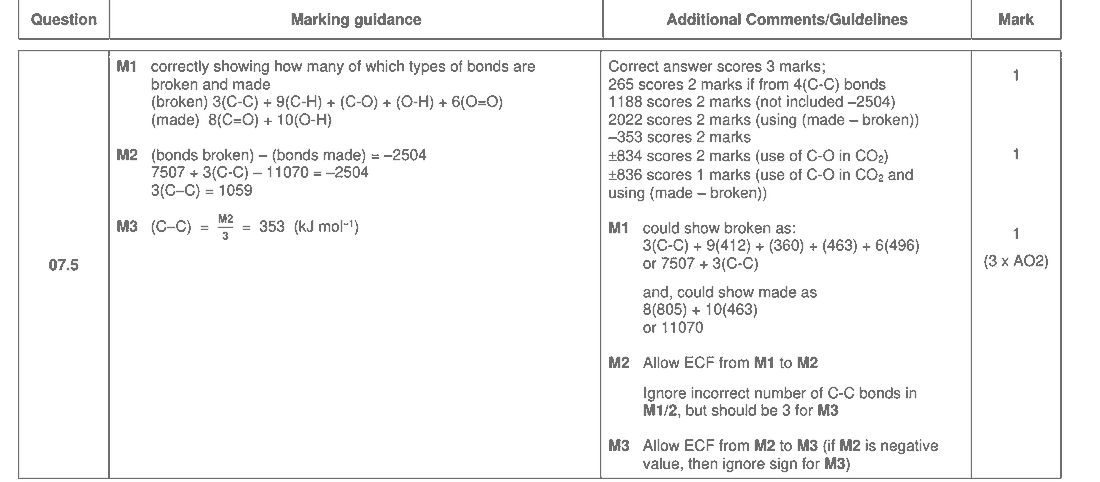
7.5 This question required students to calculate a mean bond enthalpy. Students struggled with this for a number of reasons. Some were not sure if making or breaking bonds released energy. Some omitted to use the overall enthalpy change. Some did not include all the bonds in the reactants/products. Some thought there were four, not three, C-C bonds in butan-1-ol.
7507 + 3(C–C) – 11 070 = –2504. 265 (four C–C bonds) and 1188 (–2504 left out) score 2. Errors: sign of bond breaking/making
bonds left out
four C–C bonds
Skills: MS2.2 Change the subject of an equation; MS2.4 Solve algebraic equations
June 2022 · Paper 3 · Q01.33 marksAO2=3Calculation
Earlier part of question 01 that this part uses
Mark scheme
Examiner's comment
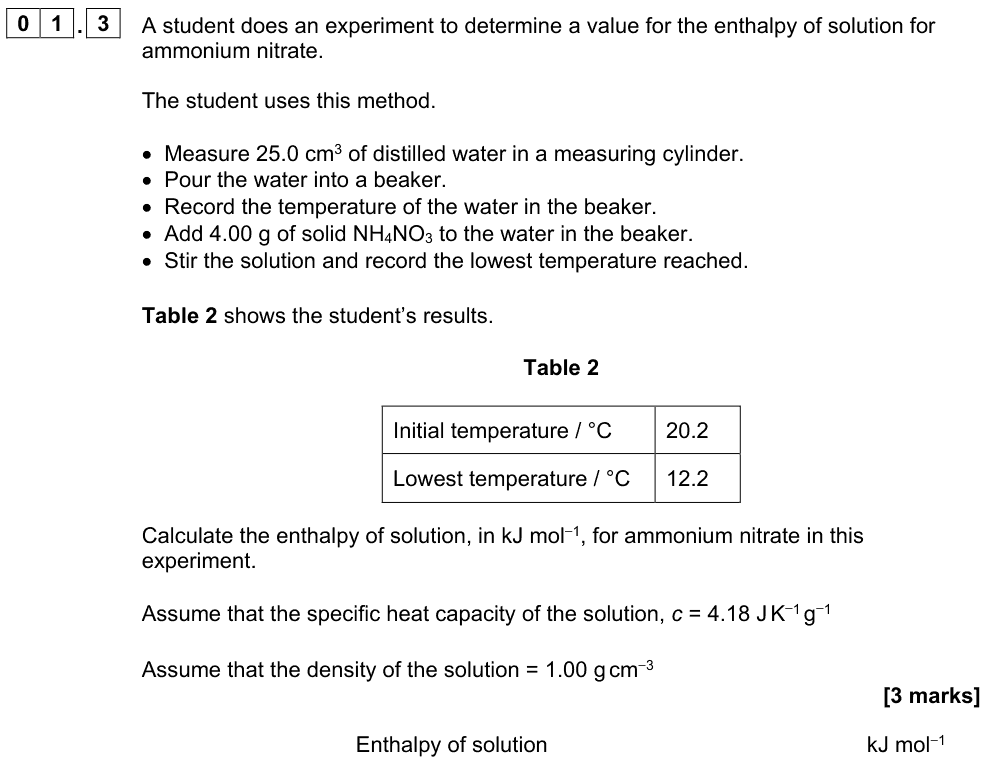
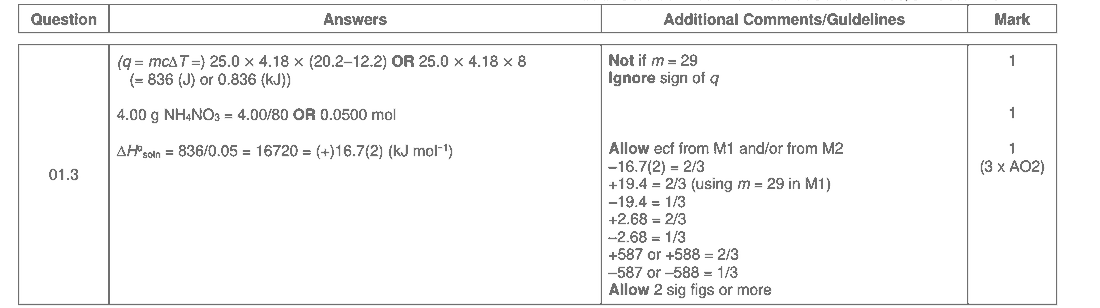
01.3 was generally done well although some students failed to recognise the need to convert to a molar quantity and stopped after M1 while others failed to convert from J to kJ.
Notes from the mark scheme and report
Answer: +16.7 kJ mol–1. q = 25.0 × 4.18 × 8.0 = 836 J (mass of water only, not 29 g)
Skills: MS0.0 Recognise and make use of appropriate units in calculation; MS2.3 Substitute numerical values into algebraic equations using appropriate units for physical quantities; RP2 Measurement of an enthalpy change
June 2022 · Paper 3 · Q01.41 markAO2=1Calculation
Earlier part of question 01 that this part uses
Mark scheme
Examiner's comment
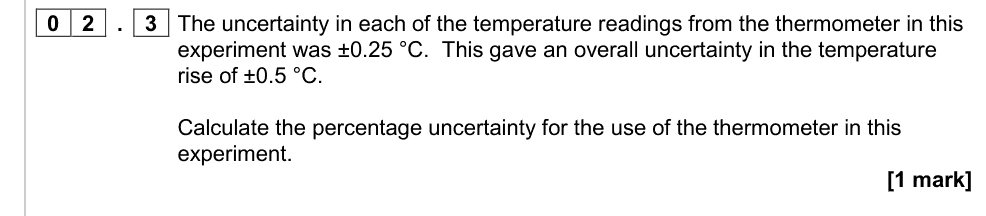
01.4 was expected to be easy but many students still forgot to multiply the apparatus uncertainty by two, as two readings are being taken.
Notes from the mark scheme and report
Answer: 2.5%. Two readings, so (2 × 0.1 ÷ 8.0) × 100. Many forgot to double the uncertainty
Skills: MS1.3 Identify uncertainties in measurements and use simple techniques to determine uncertainty when data are combined; MS0.2 Use ratios, fractions and percentages; PS2.3 Evaluate results and draw conclusions with reference to measurement uncertainties and errors; RP2 Measurement of an enthalpy change
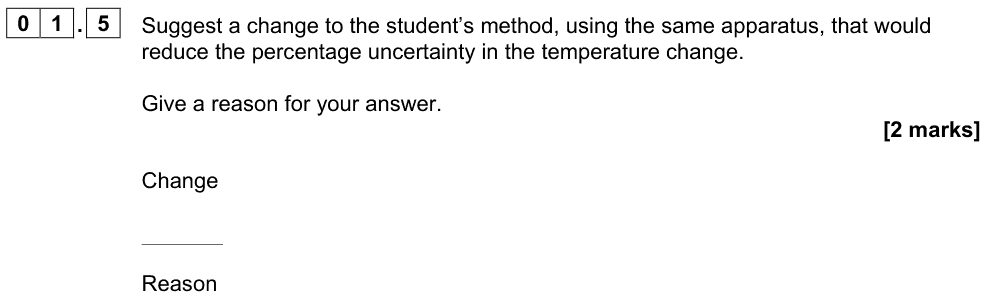
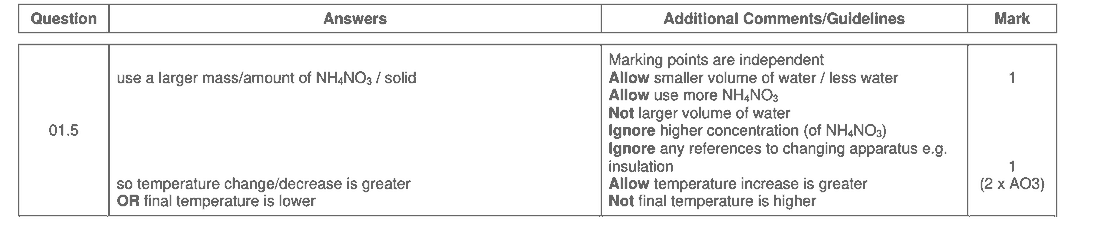
June 2022 · Paper 3 · Q01.52 marksAO3=2Practical and data analysis
Earlier part of question 01 that this part uses
Mark scheme
Examiner's comment
01.5 was done well although there was occasionally confusion between a larger mass/amount of the solid and a larger volume of the water.
Some students ignored the instruction in the question about the same apparatus being used and suggested a different thermometer or the addition of insulation.
Notes from the mark scheme and report
Use a larger mass of NH4NO3 (or a smaller volume of water), so that the temperature change is greater. Changing apparatus (insulation, different thermometer) is ignored
a larger volume of water is wrong
Skills: MS1.3 Identify uncertainties in measurements and use simple techniques to determine uncertainty when data are combined; PS2.1 Comment on experimental design and evaluate scientific methods; PS2.3 Evaluate results and draw conclusions with reference to measurement uncertainties and errors; RP2 Measurement of an enthalpy change
June 2022 · Paper 3 · Q01.61 markAO3=1Practical and data analysis
Earlier part of question 01 that this part uses
Mark scheme
Examiner's comment
In 01.6 the commonest error was to refer to heat loss – this is an endothermic reaction, so it is heat gain that is a potential source of error in an un-insulated container.
Notes from the mark scheme and report
Heat gained from the surroundings (the reaction is endothermic), or the solid did not all dissolve. 'Heat loss' is wrong
Skills: PS2.1 Comment on experimental design and evaluate scientific methods; PS2.3 Evaluate results and draw conclusions with reference to measurement uncertainties and errors; RP2 Measurement of an enthalpy change
November 2021 · Paper 1 · Q01.11 markShort answer
Mark scheme
Examiner's comment
Most students could not recall the definition in question 01.1; students rarely referred to constant pressure and many referenced energy but not heat.
Notes from the mark scheme and report
Heat (energy) change at constant pressure. 'Energy change' alone is ignored
constant pressure was rarely mentioned
November 2021 · AS Paper 1 · Q07.12 marksShort answer
Mark scheme
Notes from the mark scheme and report
The enthalpy change when one mole of a substance burns completely in oxygen
with all substances in their standard states (at a stated temperature and 100 kPa)
November 2021 · AS Paper 1 · Q07.23 marksCalculation
at least 2 significant figures. Use the mass of water, not the mass of fuel, in q = mc∆T
Skills: MS0.0 Recognise and make use of appropriate units in calculation; MS2.3 Substitute numerical values into algebraic equations using appropriate units for physical quantities; RP2 Measurement of an enthalpy change
November 2021 · AS Paper 1 · Q07.31 markPractical and data analysis
Earlier part of question 07 that this part uses
Mark scheme
Notes from the mark scheme and report
Incomplete combustion
or evaporation of the fuel
or the experiment was not done under standard conditions
Skills: PS2.3 Evaluate results and draw conclusions with reference to measurement uncertainties and errors; RP2 Measurement of an enthalpy change
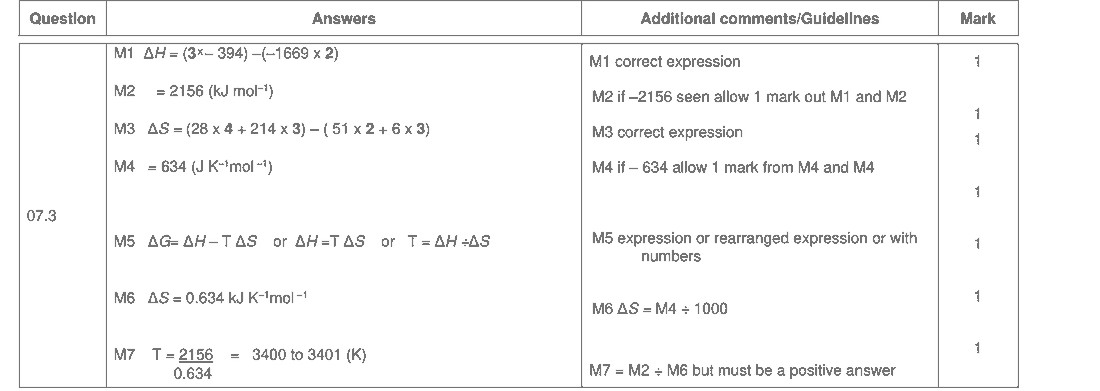
November 2021 · Paper 1 · Q07.37 marksCalculation
Earlier part of question 07 that this part uses
Mark scheme
Examiner's comment
Question 07.3 discriminated well.
Several students reversed the expressions for change in enthalpy and change in entropy and gained negative values; some students did not convert the change in entropy to the correct units and some tried to convert the temperature in Kelvin into degrees Celsius.
Most students could give a correct expression involving ΔH, ΔS and T.
Notes from the mark scheme and report
Answer: 3400 K (3400 to 3401). ∆H = (3 × –394) – (2 × –1669) = +2156 kJ mol–1
Skills: MS0.0 Recognise and make use of appropriate units in calculation; MS2.2 Change the subject of an equation; MS2.3 Substitute numerical values into algebraic equations using appropriate units for physical quantities
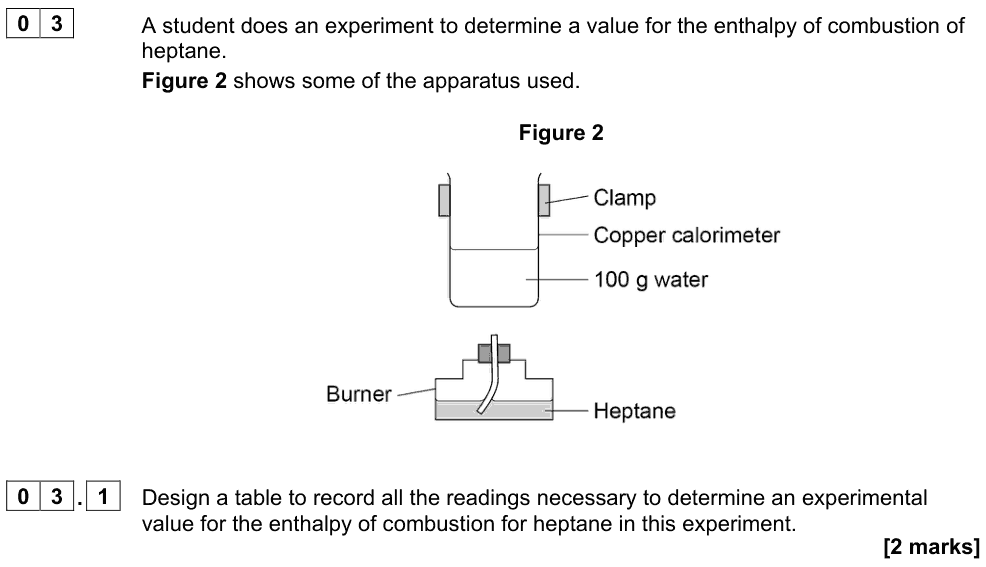
November 2021 · Paper 2 · Q03.12 marksPractical and data analysis
Mark scheme
Examiner's comment
The answers to question 03.1 were poor with a large majority of students unable to construct a good results table with clear headings including appropriate units.
Notes from the mark scheme and report
Table with headings and units: temperature / °C, initial and final (and ∆T)
mass of burner / g, before and after (and mass of heptane burned). M1 temperature data with unit, M2 burner mass data with unit
a missing unit gives max 1. A large majority could not construct a clear table with units
Skills: PS2.2 Present data in appropriate ways; ATa Use appropriate apparatus to record a range of measurements (to include mass, time, volume of liquids and gases, temperature); RP2 Measurement of an enthalpy change
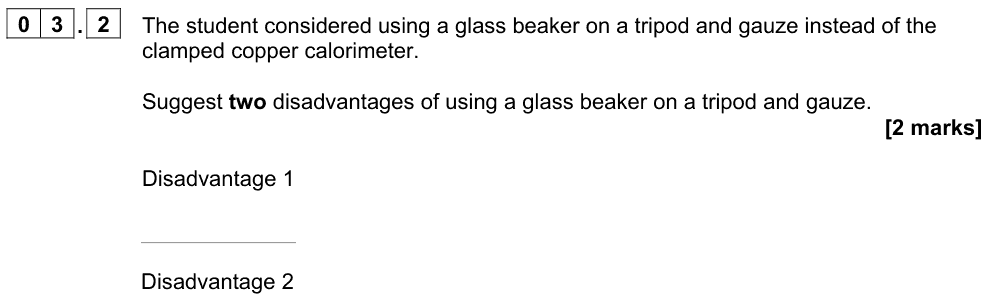
November 2021 · Paper 2 · Q03.22 marksPractical and data analysis
Earlier part of question 03 that this part uses
Mark scheme
Examiner's comment
In question 03.2 significant numbers of students didn’t score, with many focussing on potential breakage as a disadvantage of using a glass beaker.
Notes from the mark scheme and report
Any two: glass is a poorer conductor of heat than copper
the tripod and gauze absorb heat / reduce heat transfer to the water
the tripod fixes the height above the flame
glass has a higher heat capacity than the metal. Breakage is not credited (a common answer)
Skills: PS2.1 Comment on experimental design and evaluate scientific methods; PS4.1 Know and understand how to use a wide range of experimental and practical instruments, equipment and techniques appropriate to the knowledge and understanding included in the specification; RP2 Measurement of an enthalpy change
November 2021 · Paper 2 · Q03.32 marksPractical and data analysis
Earlier part of question 03 that this part uses
Mark scheme
Examiner's comment
Questions 03.3 and 03.4 proved more accessible.
Notes from the mark scheme and report
Heat loss to the surroundings (or to the copper calorimeter)
incomplete combustion of the heptane
Skills: PS2.3 Evaluate results and draw conclusions with reference to measurement uncertainties and errors; PS2.1 Comment on experimental design and evaluate scientific methods; RP2 Measurement of an enthalpy change
November 2021 · Paper 2 · Q03.41 markPractical and data analysis
Earlier part of question 03 that this part uses
Mark scheme
Examiner's comment
Questions 03.3 and 03.4 proved more accessible.
Notes from the mark scheme and report
Add a wind shield (draught screen) to reduce heat loss
allow a lid, or insulation round the sides of the calorimeter
Skills: PS2.1 Comment on experimental design and evaluate scientific methods; PS4.1 Know and understand how to use a wide range of experimental and practical instruments, equipment and techniques appropriate to the knowledge and understanding included in the specification; RP2 Measurement of an enthalpy change
November 2021 · Paper 2 · Q04.13 marksCalculationHard
Mark scheme
Examiner's comment
Question 04.1 gave a good range of scores and a third of students were able to score at least 2 marks.
The common errors included multiplying the value of enthalpy of atomisation for hydrogen by 3 rather than 6.
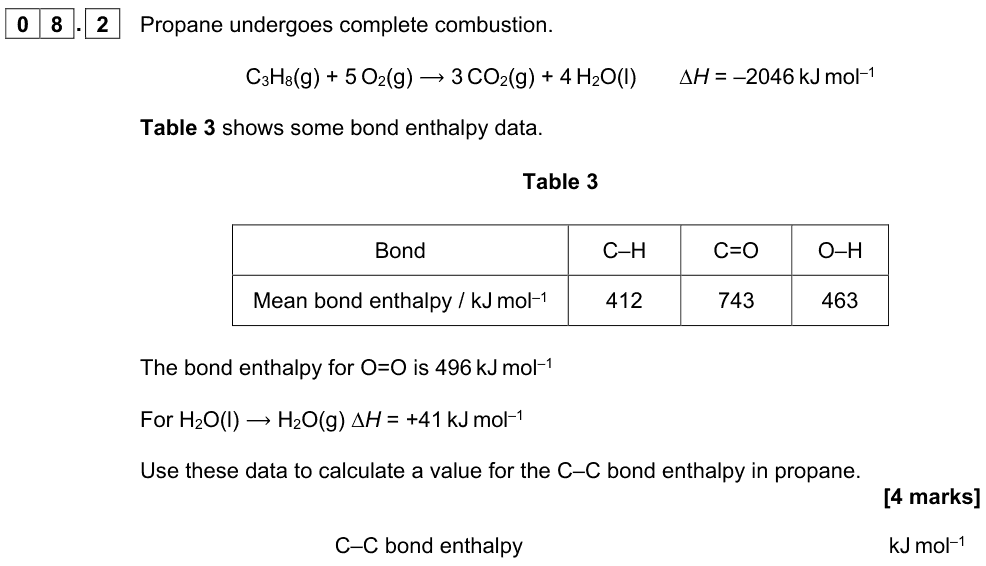
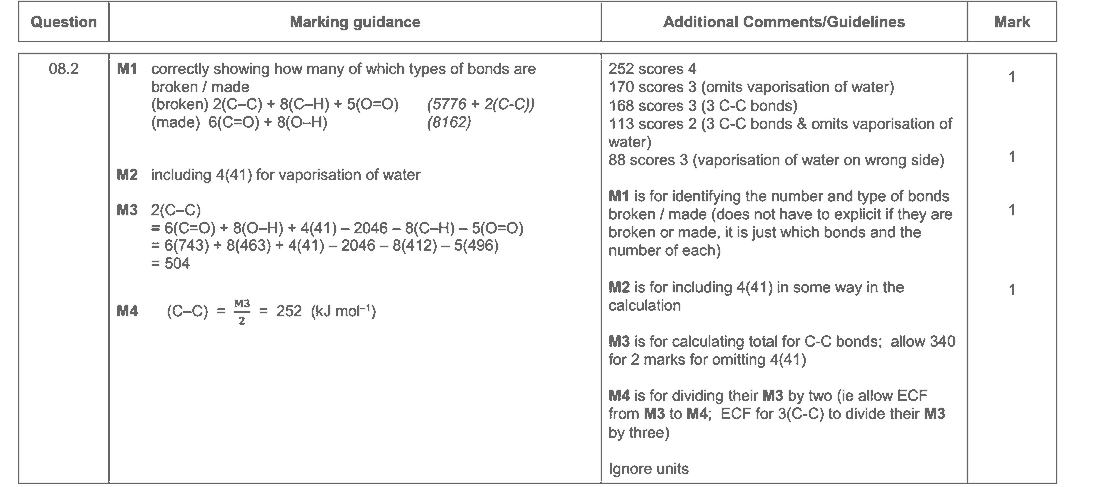
include 4 × 41 for condensing the water. 2(C–C) = 8162 + 164 – 2046 – 3296 – 2480 = 504. Part marks: 170 (no vaporisation term) 3
168 (three C–C bonds) 3
88 (vaporisation on the wrong side) 3
Skills: MS2.2 Change the subject of an equation; MS2.4 Solve algebraic equations
November 2021 · AS Paper 2 · Q08.31 markShort answer
Earlier part of question 08 that this part uses
Mark scheme
Notes from the mark scheme and report
The O=O bond occurs only in oxygen, O2, so there is no range of compounds to average over
November 2020 · AS Paper 1 · Q04.11 markShort answer
Mark scheme
Notes from the mark scheme and report
Heat energy change at constant pressure
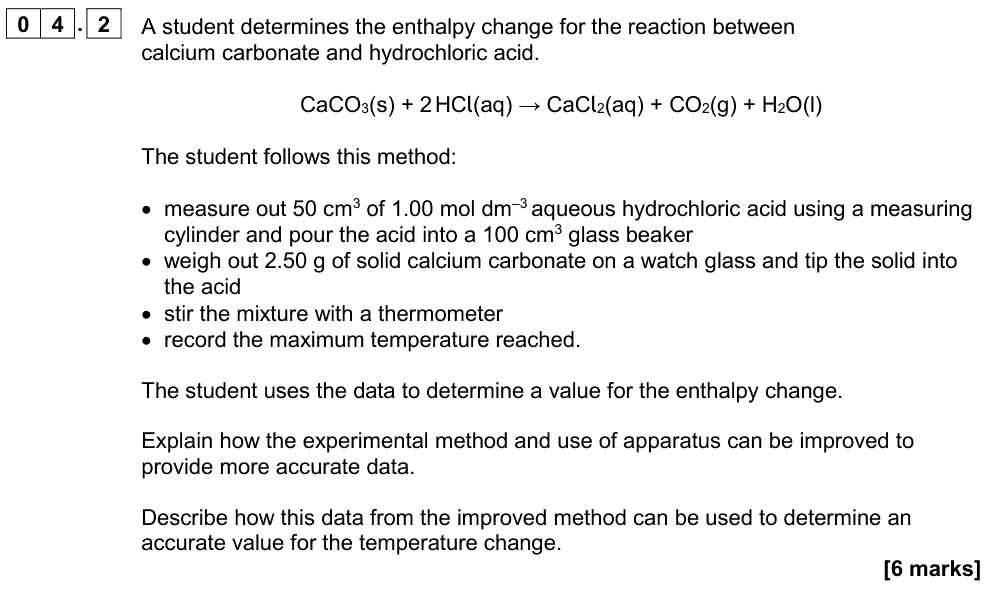
November 2020 · AS Paper 1 · Q04.26 marks6-mark level of response
Earlier part of question 04 that this part uses
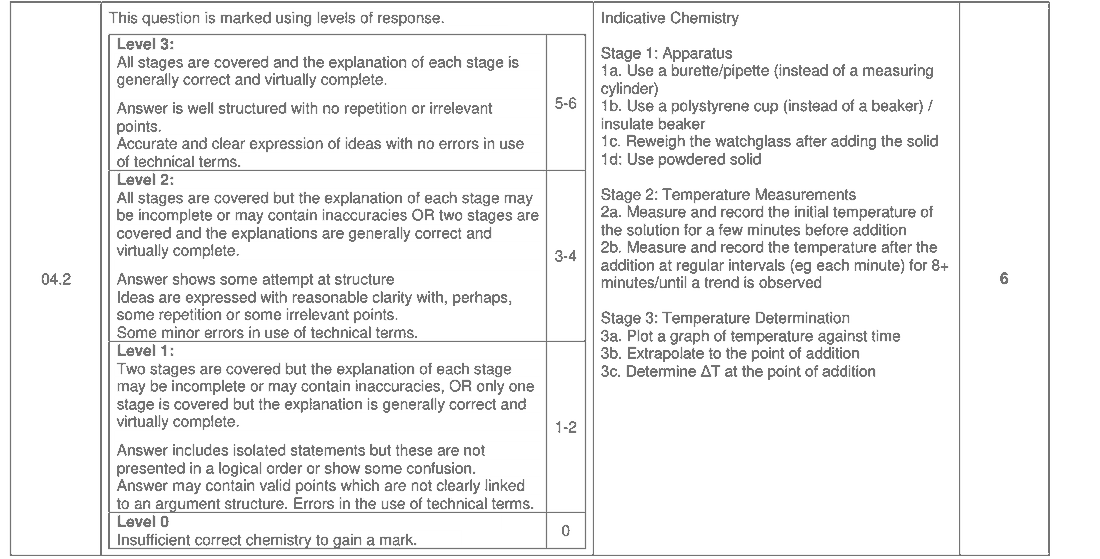
Mark scheme, with the levels and indicative content
Notes from the mark scheme and report
Levels of response, three stages. Apparatus: burette or pipette instead of a measuring cylinder
polystyrene cup or insulated beaker
reweigh the watch glass after adding the solid
use powdered solid. Temperature measurements: record the initial temperature of the acid for a few minutes before addition
after addition record at regular intervals (eg each minute) for 8+ minutes / until a trend is seen. Temperature determination: plot temperature against time
extrapolate back to the time of addition
read ∆T at the point of addition
Skills: ATa Use appropriate apparatus to record a range of measurements (to include mass, time, volume of liquids and gases, temperature); ATk Safely and carefully handle solids and liquids, including corrosive, irritant, flammable and toxic substances; PS2.1 Comment on experimental design and evaluate scientific methods; PS3.1 Plot and interpret graphs; MS3.2 Plot two variables from experimental or other data; RP2 Measurement of an enthalpy change
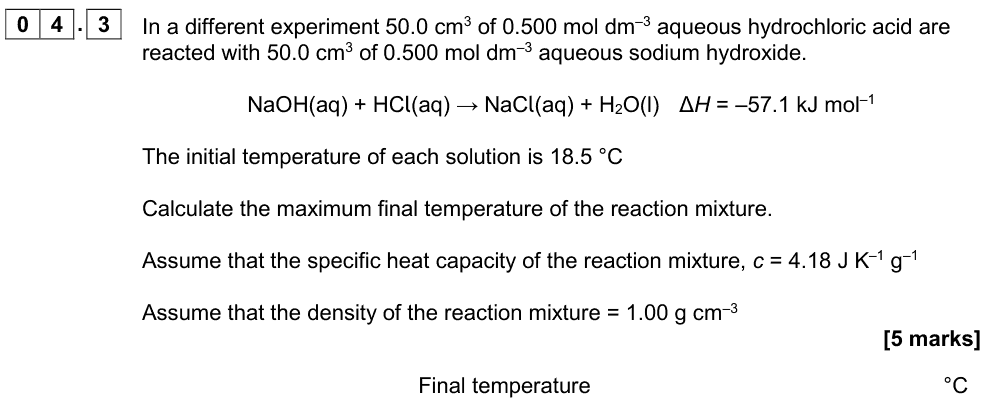
November 2020 · AS Paper 1 · Q04.35 marksCalculation
Earlier part of question 04 that this part uses
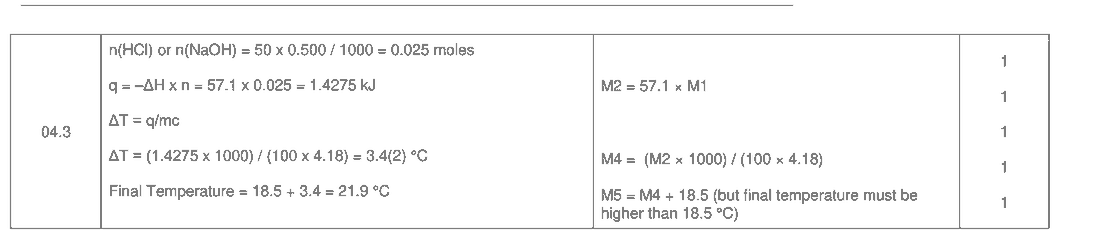
Mark scheme
Notes from the mark scheme and report
Answer: 21.9 °C. n = 50.0 × 0.500 ÷ 1000 = 0.0250 mol
q = 57.1 × 0.0250 = 1.4275 kJ
∆T = 1427.5 ÷ (100 × 4.18) = 3.4 °C
add to 18.5 °C. Mass is 100 g (both solutions)
the final temperature must be above 18.5 °C
Skills: MS0.0 Recognise and make use of appropriate units in calculation; MS2.2 Change the subject of an equation; MS2.3 Substitute numerical values into algebraic equations using appropriate units for physical quantities
November 2020 · AS Paper 1 · Q04.41 markPractical and data analysis
Earlier part of question 04 that this part uses
Mark scheme
Notes from the mark scheme and report
Increase the concentration of the solutions (gives a larger temperature change, so a smaller percentage uncertainty)
Skills: MS1.3 Identify uncertainties in measurements and use simple techniques to determine uncertainty when data are combined; PS3.3 Consider margins of error, accuracy and precision of data; RP2 Measurement of an enthalpy change
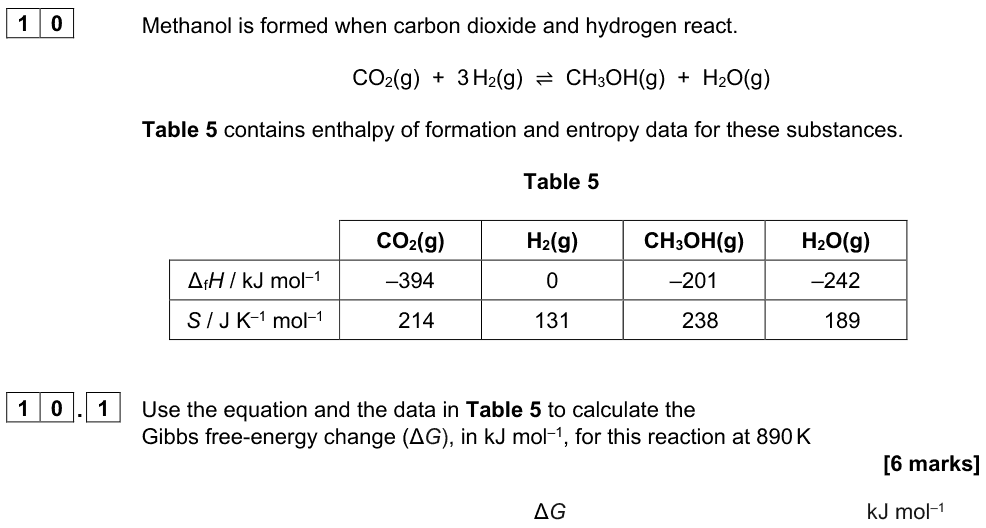
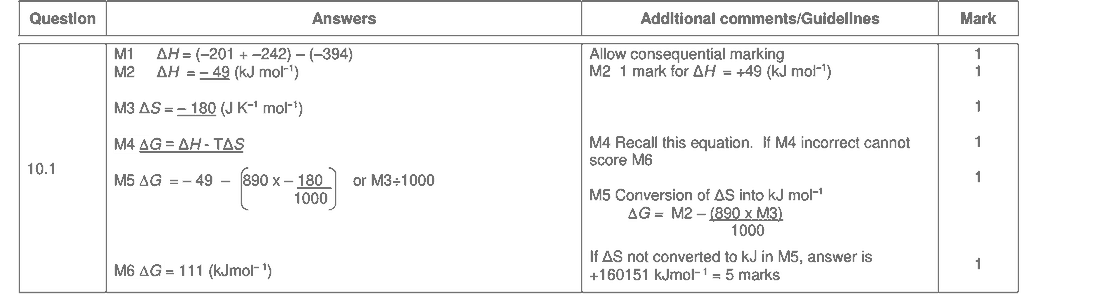
November 2020 · Paper 1 · Q10.16 marksCalculation
Mark scheme
Examiner's comment
In 10.1, many students calculated the enthalpy change incorrectly as +49 kJ mol–1.
There were several different answers calculated for the entropy change and a few students omitted the conversion into kJ.
Most students knew the equation for the Gibbs free energy change and were thus able to calculate a value for the Gibbs free energy change with their values.
Skills: MS0.0 Recognise and make use of appropriate units in calculation; MS2.3 Substitute numerical values into algebraic equations using appropriate units for physical quantities
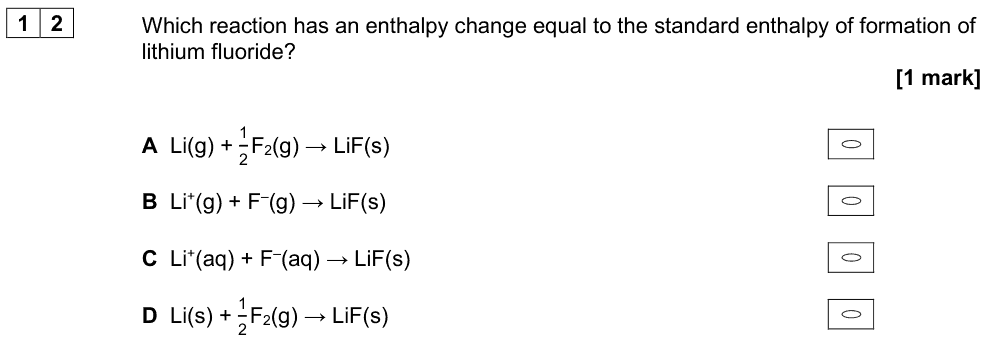
November 2020 · AS Paper 1 · Q121 markMultiple choice
Answer
D
Mark scheme
Notes from the mark scheme and report
Answer: D. One mole of LiF formed from its elements in their standard states: Li(s) and ½F2(g)
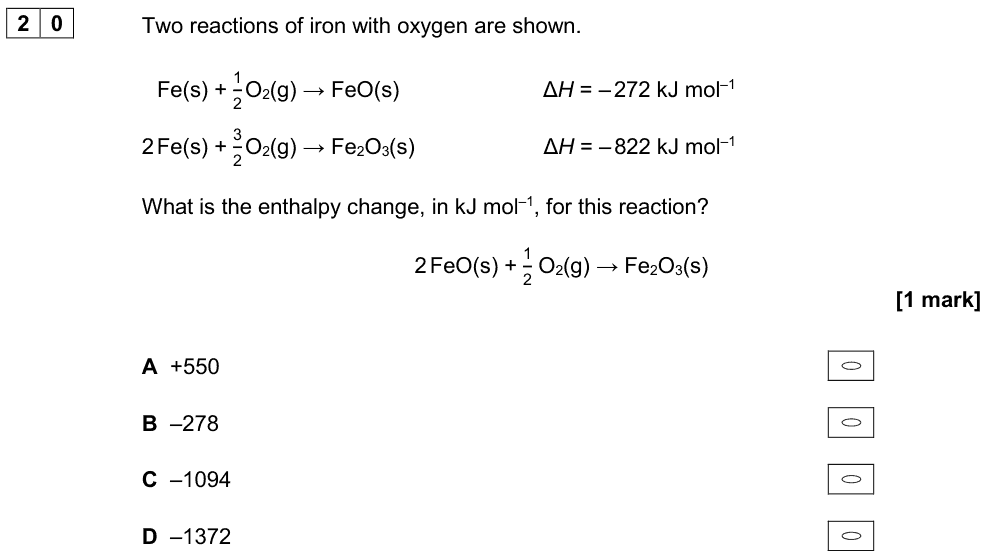
November 2020 · AS Paper 1 · Q201 markMultiple choice
Answer
B
Mark scheme
Notes from the mark scheme and report
Answer: B. ∆H = –822 – (2 × –272) = –278 kJ mol–1
Skills: MS2.4 Solve algebraic equations
November 2020 · AS Paper 2 · Q01.12 marksShort answer
Mark scheme
Notes from the mark scheme and report
The enthalpy (heat energy) change when 1 mol of a substance is formed from its elements
with all reactants and products in their standard states (under standard conditions, 100 kPa and a stated temperature). 'Energy change' alone is not enough
November 2020 · AS Paper 2 · Q01.23 marksCalculation
Skills: MS2.2 Change the subject of an equation; MS2.4 Solve algebraic equations
November 2020 · AS Paper 2 · Q211 markMultiple choice
Answer
D
Mark scheme
Notes from the mark scheme and report
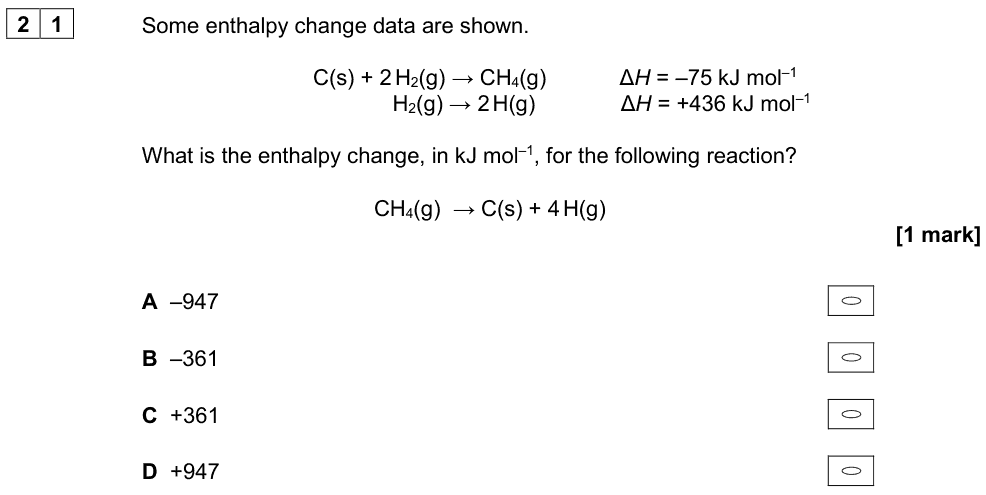
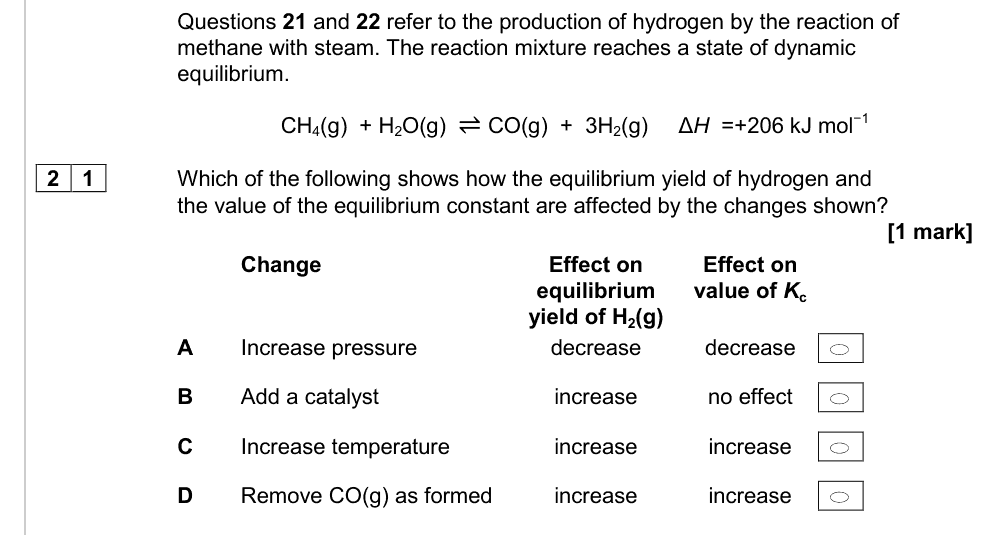
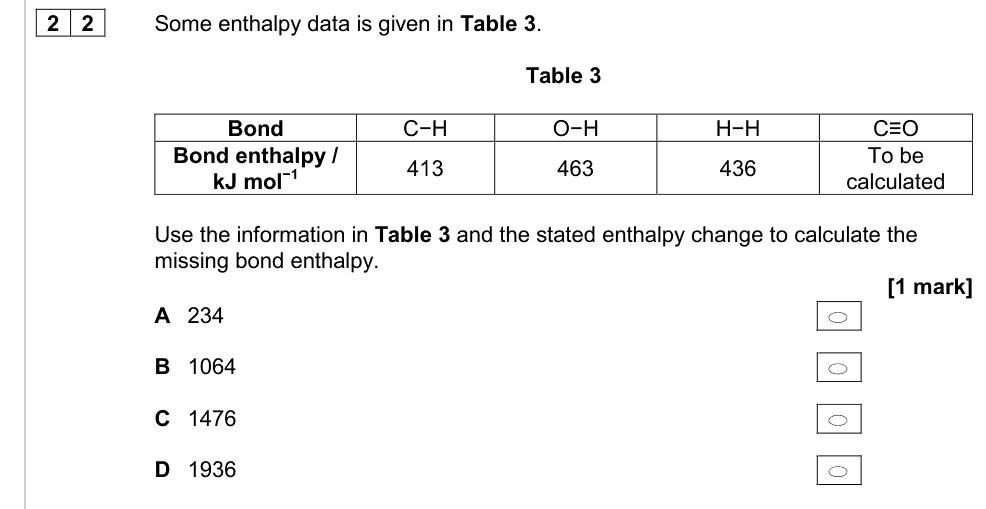
Answer: D. Reverse the formation of methane (+75) and add two lots of H2 → 2H (2 × 436): +75 + 872 = +947 kJ mol–1
Skills: MS2.4 Solve algebraic equations
November 2020 · AS Paper 2 · Q221 markMultiple choice
Answer
D
Mark scheme
Notes from the mark scheme and report
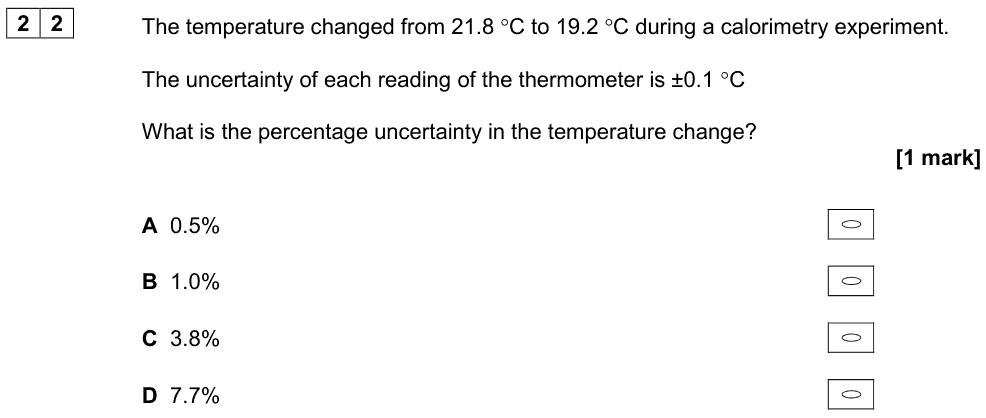
Answer: D. Two readings, so the uncertainty is 2 × 0.1 = 0.2 °C in a change of 2.6 °C
0.2 ÷ 2.6 × 100 = 7.7%
Skills: MS1.3 Identify uncertainties in measurements and use simple techniques to determine uncertainty when data are combined; PS3.3 Consider margins of error, accuracy and precision of data; RP2 Measurement of an enthalpy change
November 2020 · AS Paper 2 · Q231 markMultiple choice
Answer
A
Mark scheme
Notes from the mark scheme and report
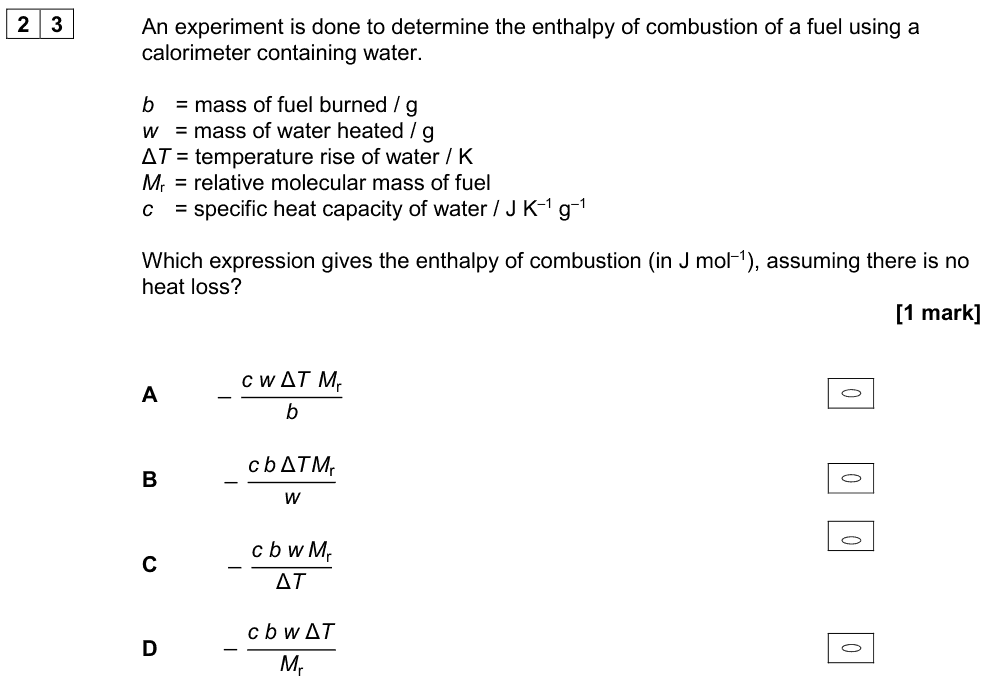
Answer: A. q = cw∆T (mass of water, not fuel)
moles of fuel = b ÷ Mr
∆H = –q ÷ n = –cw∆T Mr ÷ b
Skills: MS2.2 Change the subject of an equation; RP2 Measurement of an enthalpy change
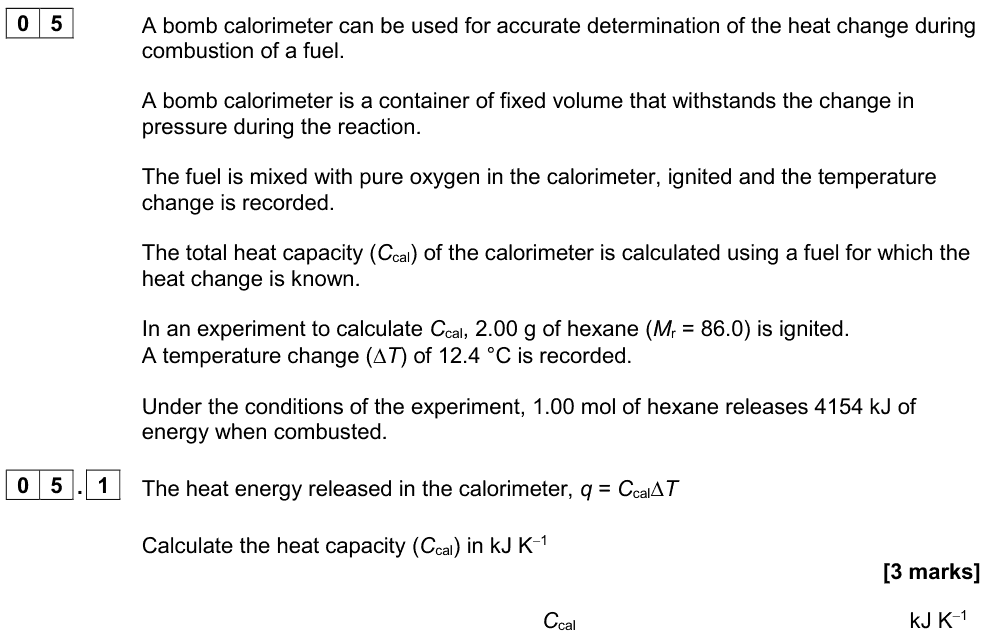
November 2020 · Paper 3 · Q05.13 marksCalculation
Mark scheme
Examiner's comment
In 05.1 most students were able, at the least, to calculate the amount of hexane but some then got confused and attempted to use the more familiar q = mc∆T instead of the relevant equation given in the question.
In some cases students erroneously converted the temperature change into Kelvin by adding 273.
If temperature was incorrectly converted into Kelvin, in 05.2 it was marked as ‘ecf’ from 05.1 to avoid a double penalty for the same error.
This enabled weaker students to score some marks.
Skills: MS0.0 Recognise and make use of appropriate units in calculation; MS2.2 Change the subject of an equation; MS2.3 Substitute numerical values into algebraic equations using appropriate units for physical quantities; RP2 Measurement of an enthalpy change
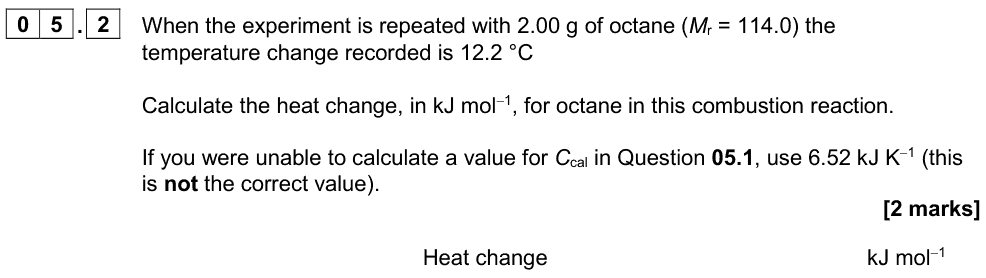
November 2020 · Paper 3 · Q05.22 marksCalculation
Earlier part of question 05 that this part uses
Mark scheme
Examiner's comment
If temperature was incorrectly converted into Kelvin, in 05.2 it was marked as ‘ecf’ from 05.1 to avoid a double penalty for the same error.
This enabled weaker students to score some marks.
Skills: MS0.0 Recognise and make use of appropriate units in calculation; MS2.3 Substitute numerical values into algebraic equations using appropriate units for physical quantities; RP2 Measurement of an enthalpy change
November 2020 · Paper 3 · Q05.31 markShort answer
Earlier part of question 05 that this part uses
Mark scheme
Examiner's comment
Most students seemingly failed to appreciate that question 05.3 was about why the value was not an ‘enthalpy change’ and, instead, offered answers that tried to explain why it was not a ‘standard’
Notes from the mark scheme and report
The pressure is not constant in a bomb calorimeter (enthalpy change is the heat change at constant pressure). Most explained instead why it is not a 'standard' value
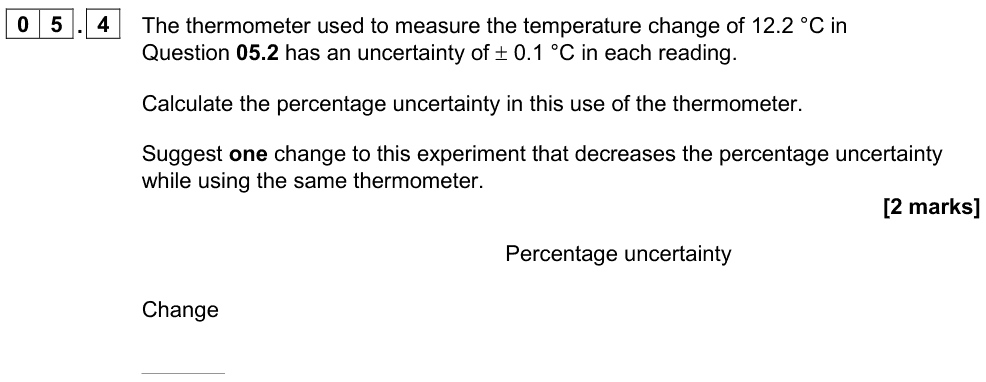
November 2020 · Paper 3 · Q05.42 marksPractical and data analysis
Earlier part of question 05 that this part uses
Mark scheme
Examiner's comment
In 05.4, many students did not appreciate the need to double the thermometer uncertainty because two thermometer readings are taken.
Notes from the mark scheme and report
Answer: 1.64% (0.2 ÷ 12.2 × 100
two readings so 2 × 0.1). Change: burn a larger mass of fuel so the temperature change is bigger. Many did not double the uncertainty
Skills: MS1.3 Identify uncertainties in measurements and use simple techniques to determine uncertainty when data are combined; PS2.1 Comment on experimental design and evaluate scientific methods; PS3.3 Consider margins of error, accuracy and precision of data; RP2 Measurement of an enthalpy change
November 2020 · Paper 3 · Q091 markMultiple choice
Answer
B
Mark scheme
Notes from the mark scheme and report
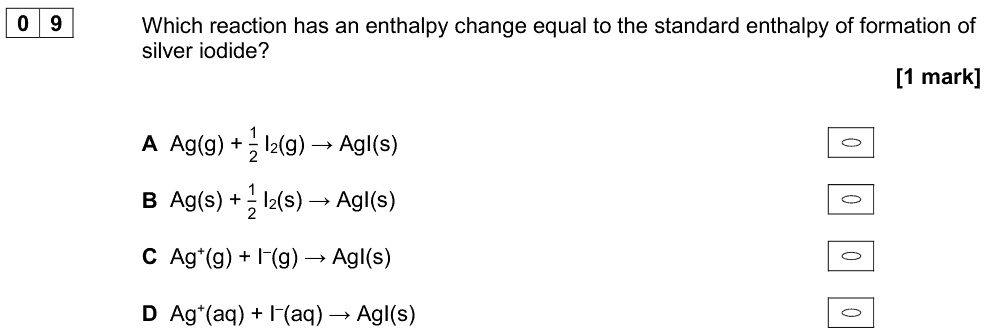
Answer: B. One mole of AgI(s) from its elements in their standard states: Ag(s) and ½I2(s)
November 2020 · Paper 3 · Q101 markMultiple choice
Answer
D
Mark scheme
Notes from the mark scheme and report
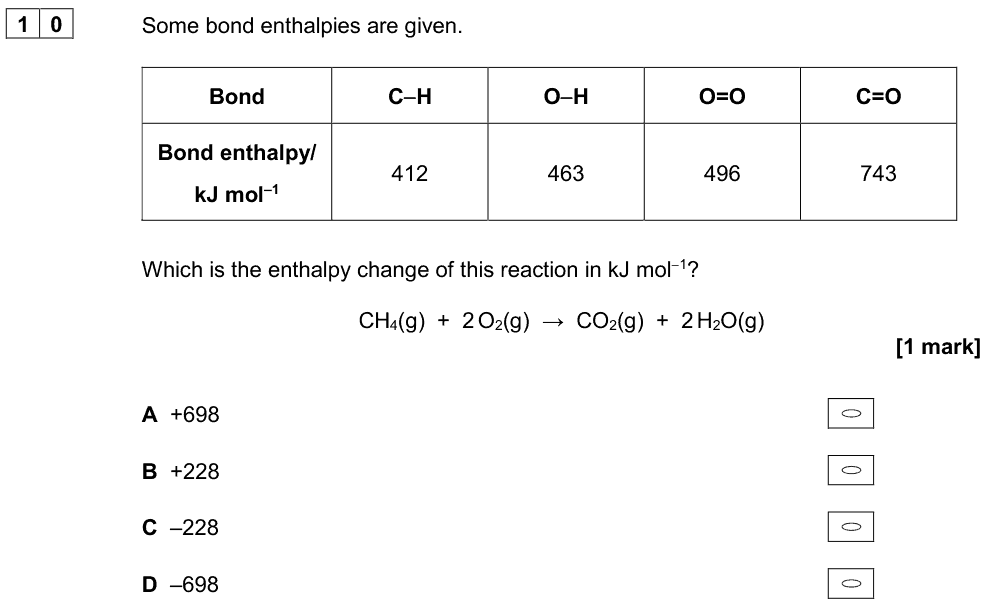
Answer: D. Broken: (4 × 412) + (2 × 496) = 2640
made: (2 × 743) + (4 × 463) = 3338
2640 – 3338 = –698 kJ mol–1
Skills: MS2.4 Solve algebraic equations
June 2019 · AS Paper 1 · Q01.53 marksCalculation
Earlier part of question 01 that this part uses
Mark scheme
Examiner's comment
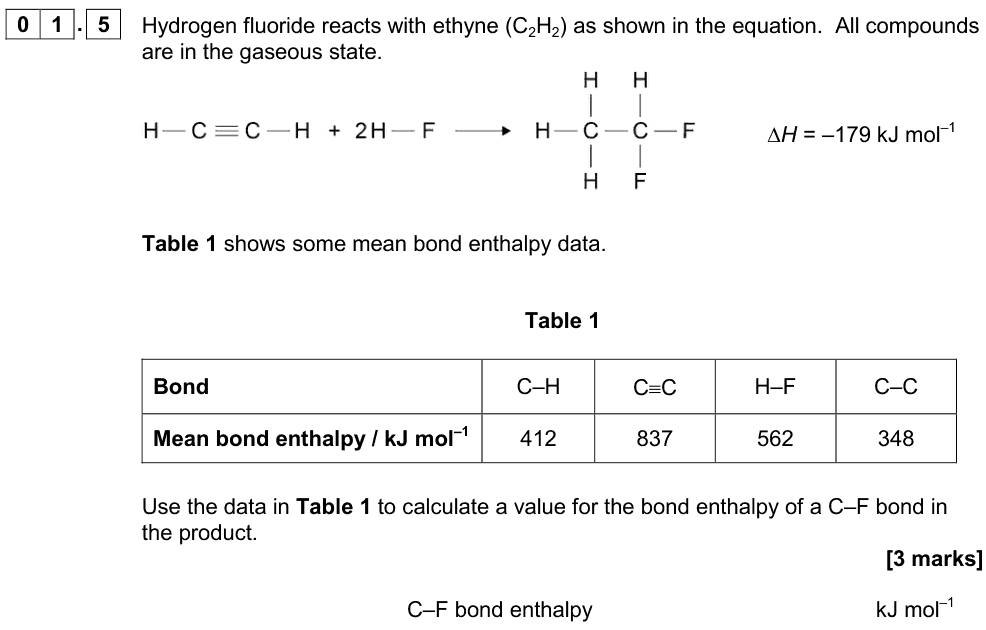
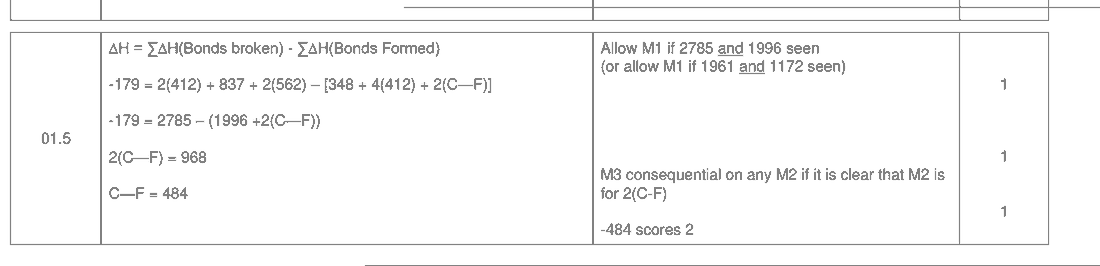
01.5 Many students coped well with this calculation and realised that there were two C–F bonds. However, a good number of students missed the C–C bond in the product. Calculations were not always well set out, with some students giving a string of numbers. It would be helpful for students to set out their calculations with a clear explanation of what each of their intermediate values represents.
2(C–F) = 968. Errors: missing the C–C bond in the product
only one C–F bond
unlabelled strings of numbers
Skills: MS2.2 Change the subject of an equation; MS2.4 Solve algebraic equations
June 2019 · AS Paper 1 · Q141 markMultiple choice
Answer
C
Mark scheme
Examiner's comment
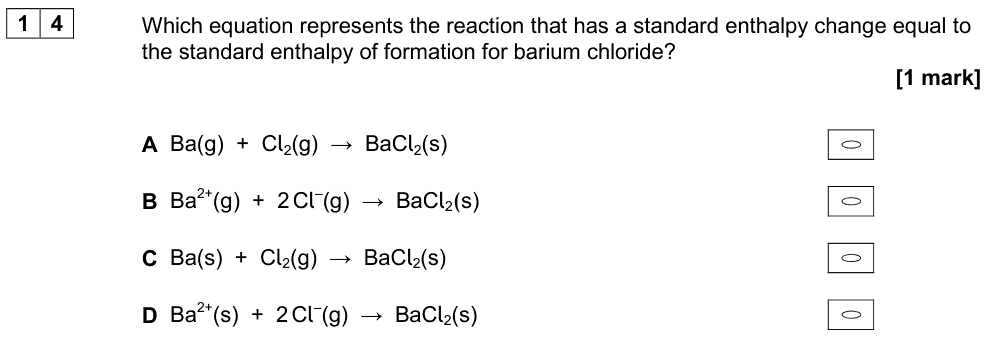
Nearly 60% of students were able to select the equation that correctly represented the standard enthalpy of formation of barium chloride.
Notes from the mark scheme and report
Answer: C. One mole of compound formed from its elements in their standard states: Ba(s) and Cl2(g)
June 2019 · AS Paper 1 · Q201 markMultiple choice
Answer
A
Mark scheme
Examiner's comment
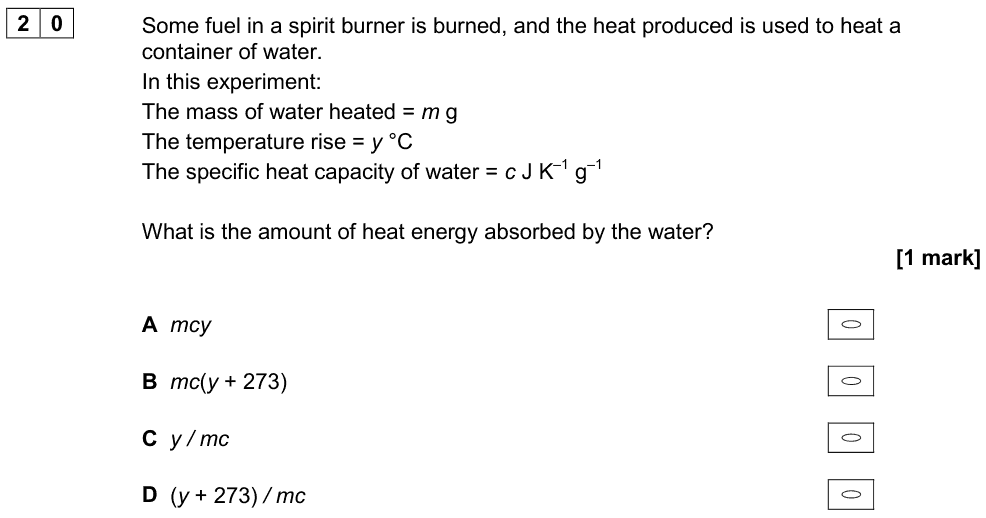
A good number of students were able to show the amount of energy absorbed by water in a calorimetry experiment. However, almost as many students thought that 273 should be added to the temperature change for this calculation.
Notes from the mark scheme and report
Answer: A. q = mc∆T with ∆T = y
a temperature change is the same in °C and K. Almost as many chose B, adding 273
Skills: MS2.3 Substitute numerical values into algebraic equations using appropriate units for physical quantities
June 2019 · AS Paper 2 · Q03.14 marksCalculation
Mark scheme
Examiner's comment
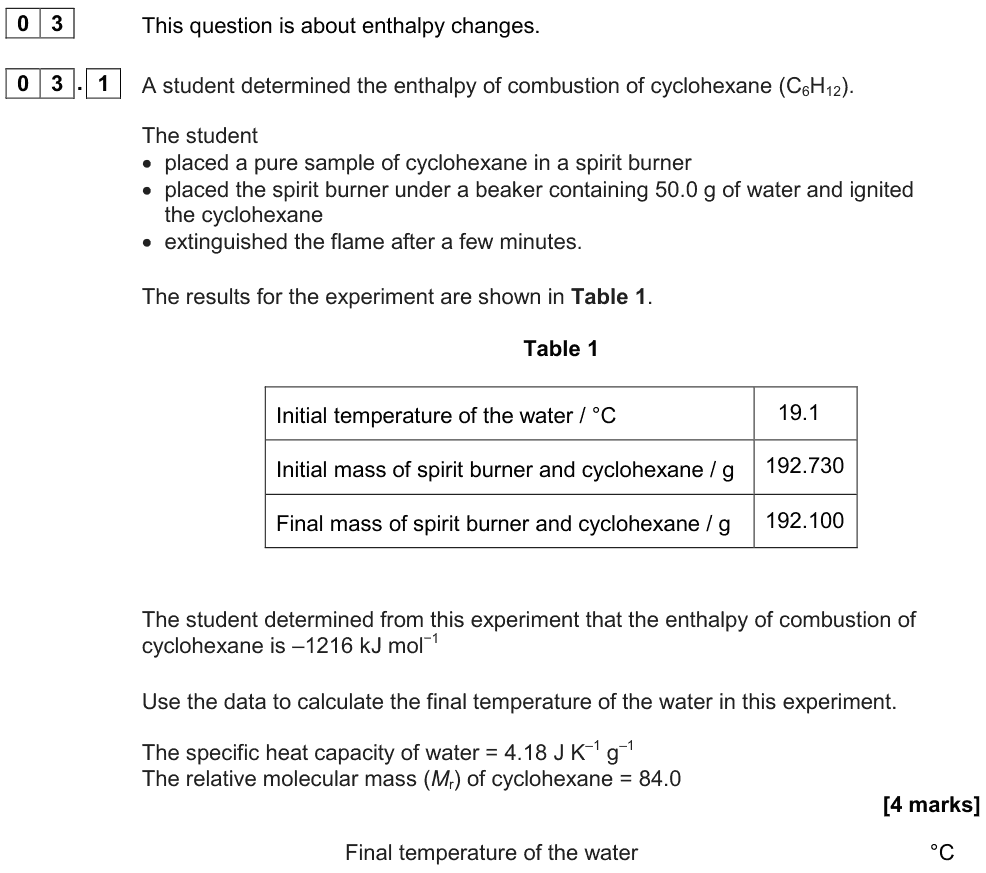
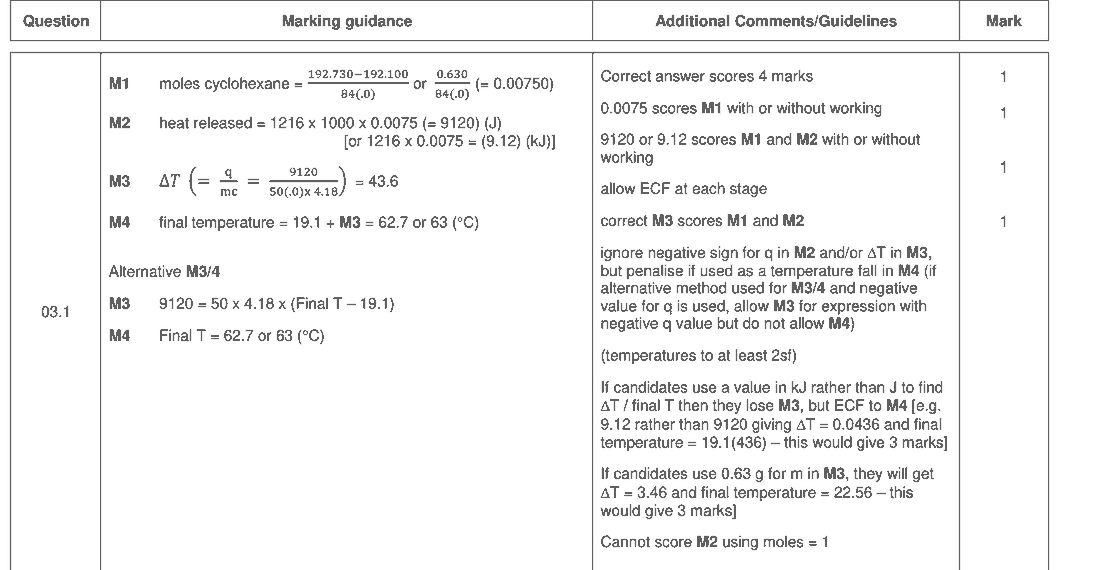
3.1 Students had to calculate the expected temperature rise in a calorimetry experiment. Most errors stemmed from not converting kJ to J at an appropriate time and/or using the mass of the cyclohexane in place of the mass of water heated in the equation q = mc∆T. Some students did not appreciate that this was an exothermic reaction and there would be a temperature rise.
Notes from the mark scheme and report
Answer: 62.7 °C (or 63). Mass burned 0.630 g
n = 0.630 ÷ 84.0 = 0.00750 mol
q = 1216 × 1000 × 0.00750 = 9120 J
∆T = 9120 ÷ (50.0 × 4.18) = 43.6
19.1 + 43.6. Errors: kJ not converted to J (gives 19.14, 3 marks)
mass of cyclohexane used for m (22.56, 3 marks)
treating it as a temperature fall
Skills: MS0.0 Recognise and make use of appropriate units in calculation; MS2.2 Change the subject of an equation; MS2.3 Substitute numerical values into algebraic equations using appropriate units for physical quantities; PS3.2 Process and analyse data using appropriate mathematical skills as exemplified in the mathematical appendix for each science; RP2 Measurement of an enthalpy change
June 2019 · AS Paper 2 · Q03.21 markPractical and data analysis
Earlier part of question 03 that this part uses
Mark scheme
Examiner's comment
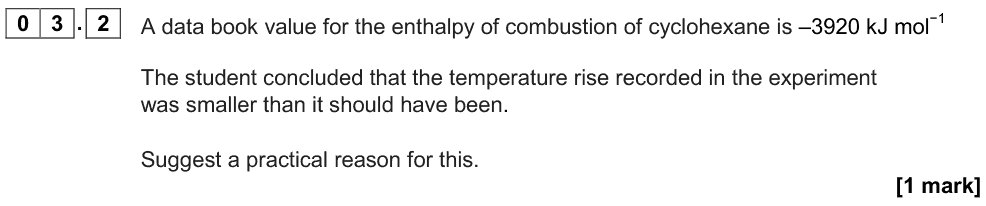
3.2 Most students could explain why the temperature rise recorded would be less than that expected, with most explaining it by heat loss.
Notes from the mark scheme and report
Heat loss to the surroundings (or incomplete combustion, evaporation of the fuel, heat taken in by the beaker / no lid or insulation)
Skills: PS2.1 Comment on experimental design and evaluate scientific methods; PS2.3 Evaluate results and draw conclusions with reference to measurement uncertainties and errors; RP2 Measurement of an enthalpy change
June 2019 · AS Paper 2 · Q03.33 marksCalculation
Earlier part of question 03 that this part uses
Mark scheme
Examiner's comment
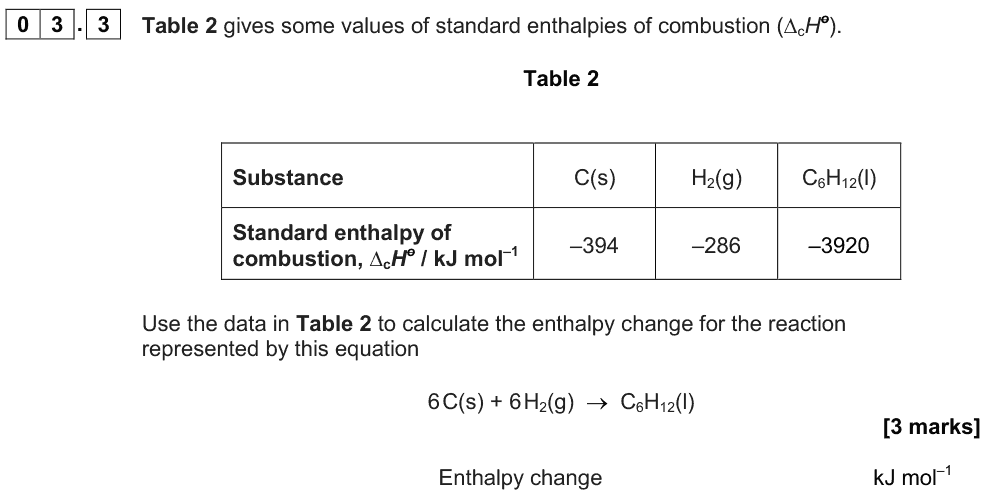
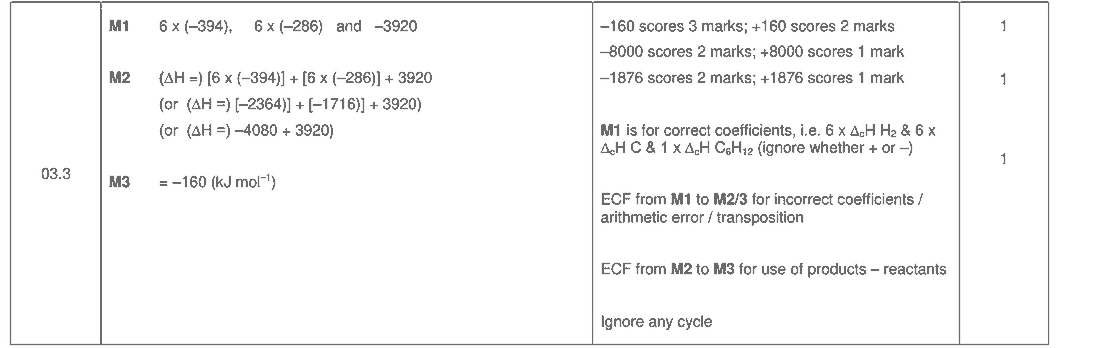
3.3 Students were asked to calculate an enthalpy change using enthalpies of combustion in a Hess cycle. This was done reasonably well.
Notes from the mark scheme and report
Answer: –160 kJ mol–1. ∆H = sum of ∆cH of reactants – ∆cH of product = [6 × (–394)] + [6 × (–286)] – (–3920) = –4080 + 3920. +160 scores 2
–8000 scores 2
Skills: MS2.4 Solve algebraic equations
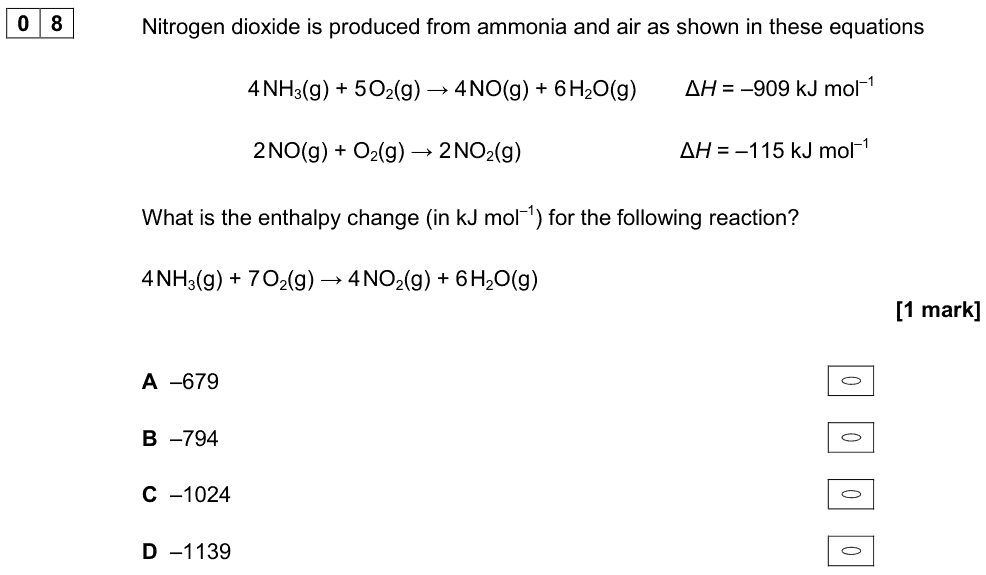
June 2019 · Paper 3 · Q081 markMultiple choice
Answer
D
Mark scheme
Notes from the mark scheme and report
Answer: D. –909 + (2 × –115) = –1139 kJ mol–1 (the second equation is needed twice)
Skills: MS2.4 Solve algebraic equations
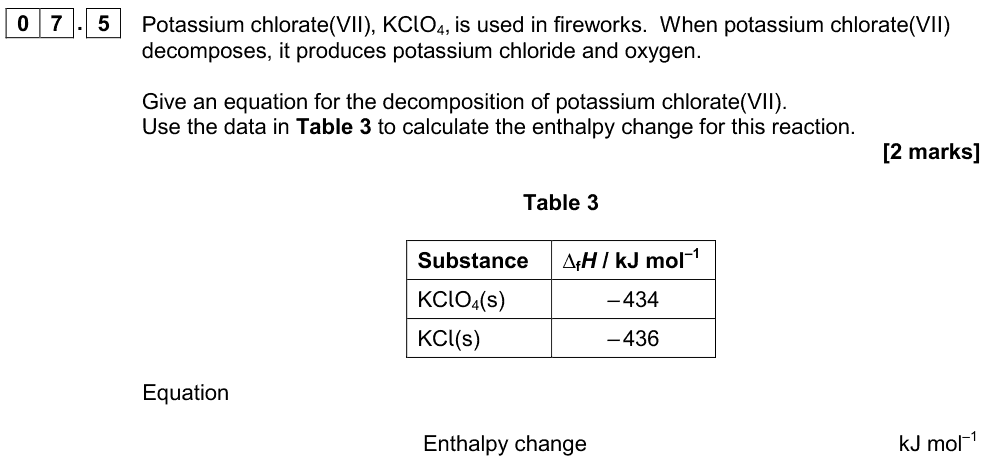
June 2018 · AS Paper 1 · Q07.52 marksCalculation
Earlier part of question 07 that this part uses
Mark scheme
Examiner's comment
07.5 Most students were able both to write the correct equation and calculate the enthalpy change. Only 8.4% of students were unable to score at least one mark.
Notes from the mark scheme and report
Answer: –2 kJ mol–1. KClO4 → KCl + 2O2
∆H = –436 – (–434)
the sign must be negative (∆fH of O2 is zero). Only 8.4% scored neither mark
Skills: MS2.4 Solve algebraic equations
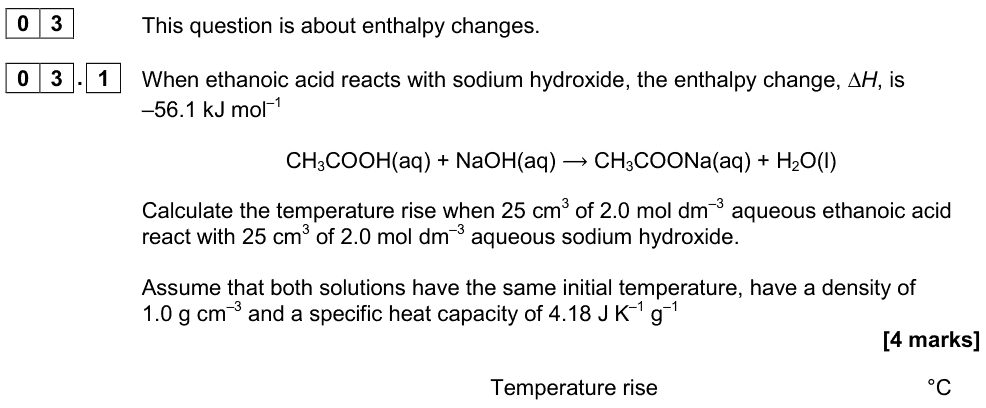
June 2018 · AS Paper 2 · Q03.14 marksCalculation
Mark scheme
Examiner's comment
03.1 Many students struggled with this question, though it did discriminate well. The main problem stemmed from an inability to find the heat released using the enthalpy change (per mole) and the amount in moles of the acid or alkali reacting. Many believed that q was the same as the enthalpy change. Some students also incorrectly thought that amount in moles reacting’ was the amount in moles of acid + moles of alkali.
Notes from the mark scheme and report
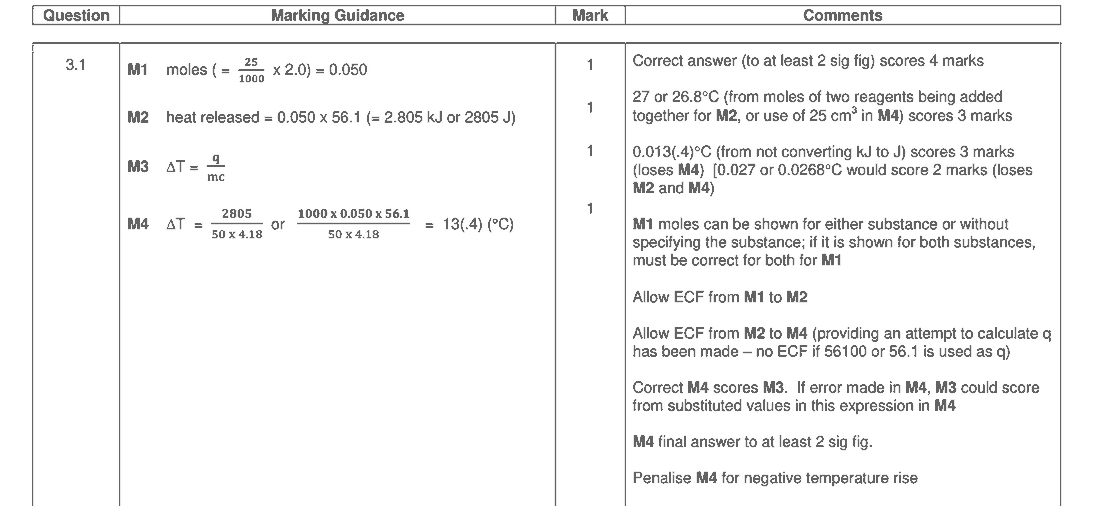
Answer: 13.4 °C. n = 25 ÷ 1000 × 2.0 = 0.050 mol
heat released = 0.050 × 56.1 = 2.805 kJ = 2805 J
∆T = q ÷ mc = 2805 ÷ (50 × 4.18). 26.8 °C (moles of acid and alkali added together, or 25 g used) scores 3
0.0134 °C (kJ not converted) scores 3. Common error: taking q as the molar enthalpy change itself
Skills: MS0.0 Recognise and make use of appropriate units in calculation; MS2.2 Change the subject of an equation; MS2.3 Substitute numerical values into algebraic equations using appropriate units for physical quantities
June 2018 · AS Paper 2 · Q03.22 marksPractical and data analysisHard
Earlier part of question 03 that this part uses
Mark scheme
Examiner's comment
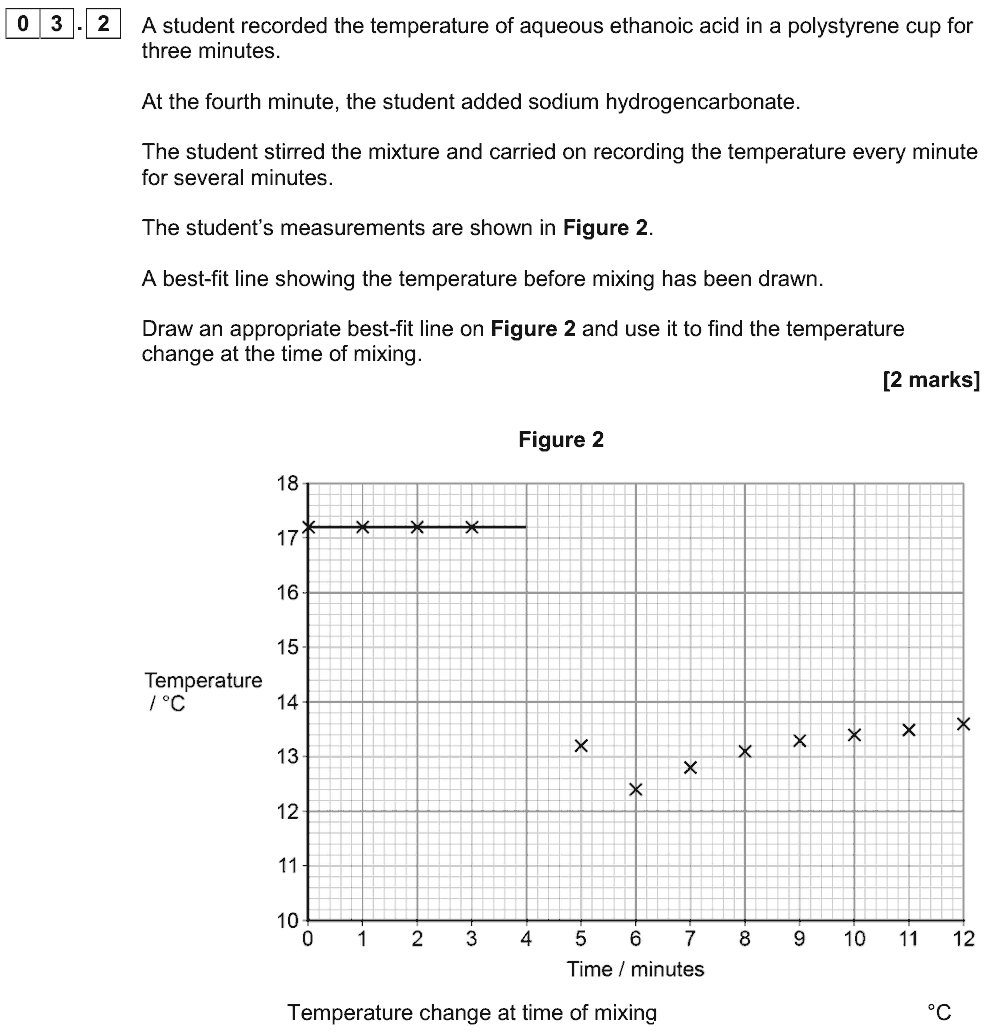
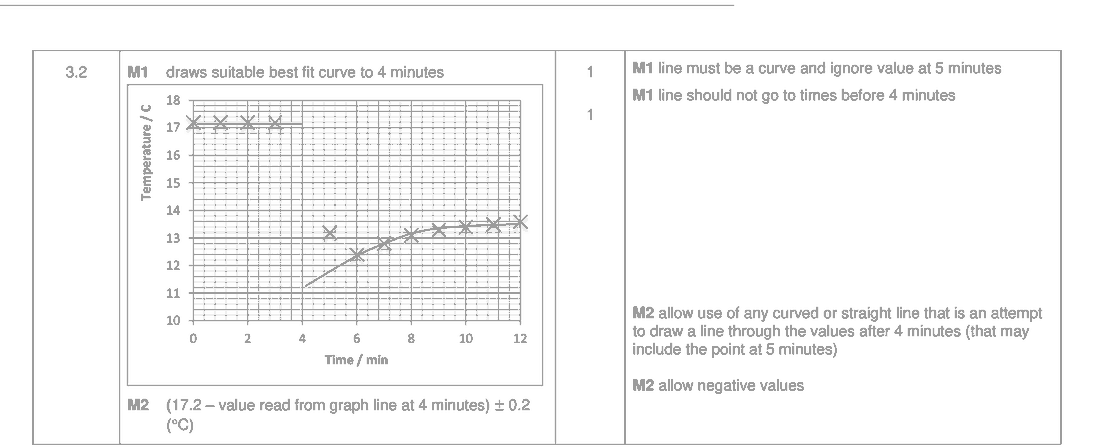
03.2 Very few students realised that the best-fit line was a curve and not a straight line. Some students also extrapolated to a time before the time of mixing. Only 3.8% of students gained both marks.
Notes from the mark scheme and report
Draw a smooth best-fit curve through the points after mixing (ignoring the reading at 5 minutes) and extrapolate it back to 4 minutes only
temperature change = 17.2 – the value of the line at 4 minutes (± 0.2 °C). The temperature falls. Errors: a straight line instead of a curve
extrapolating to before the time of mixing
Skills: MS3.1 Translate information between graphical, numerical and algebraic forms; MS3.2 Plot two variables from experimental or other data; PS3.1 Plot and interpret graphs; PS3.2 Process and analyse data using appropriate mathematical skills as exemplified in the mathematical appendix for each science; RP2 Measurement of an enthalpy change
June 2018 · Paper 2 · Q03.43 marksCalculation
Earlier part of question 03 that this part uses
Mark scheme
Examiner's comment
03.4 This question discriminated well and there was a good spread of marks. Sadly, some students did not quote their answers to three significant figures and/or remember the negative sign for their exothermic enthalpy change of combustion.
Skills: MS0.0 Recognise and make use of appropriate units in calculation; MS1.1 Use an appropriate number of significant figures; MS2.3 Substitute numerical values into algebraic equations using appropriate units for physical quantities; RP2 Measurement of an enthalpy change
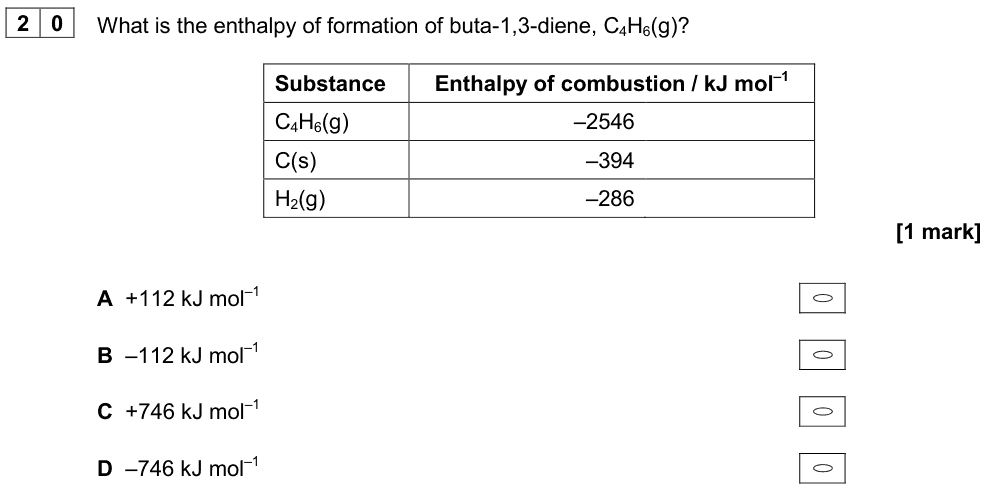
June 2018 · AS Paper 2 · Q201 markMultiple choice
Answer
A
Mark scheme
Examiner's comment
Just over a third of students calculated the correct answer of +112 kJ mol–1, but almost as many students gave –112 kJ mol–1. A possible reason for this wrong answer is that students may use summary equations in calculations such as these and may be uncertain whether these involve (products – reactants) or (reactants – products).
Notes from the mark scheme and report
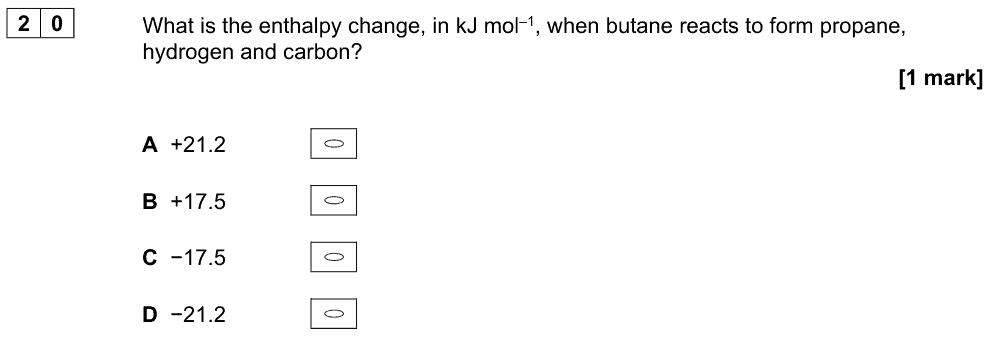
Answer: A. 4C + 3H2 → C4H6: ∆fH = 4(–394) + 3(–286) – (–2546) = +112 kJ mol–1 (combustion of reactants minus combustion of products). Almost as many chose –112 (report: just over a third chose the correct answer)
Skills: MS2.4 Solve algebraic equations
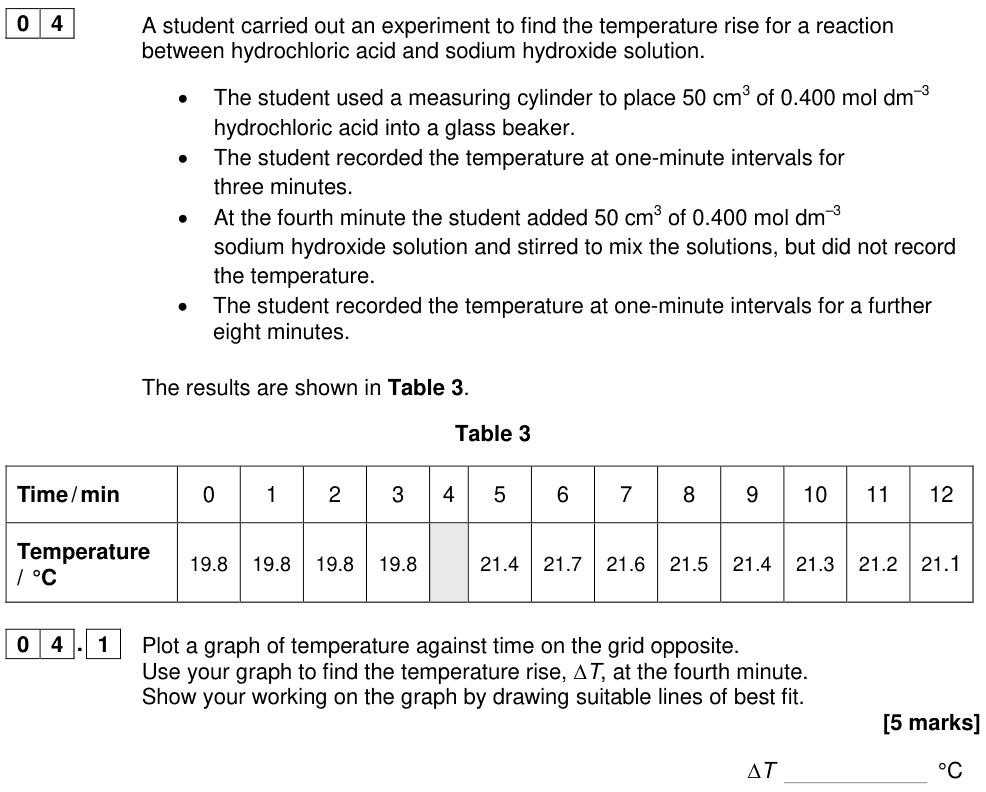
June 2018 · Paper 3 · Q04.15 marksPractical and data analysisHard
Mark scheme
Examiner's comment
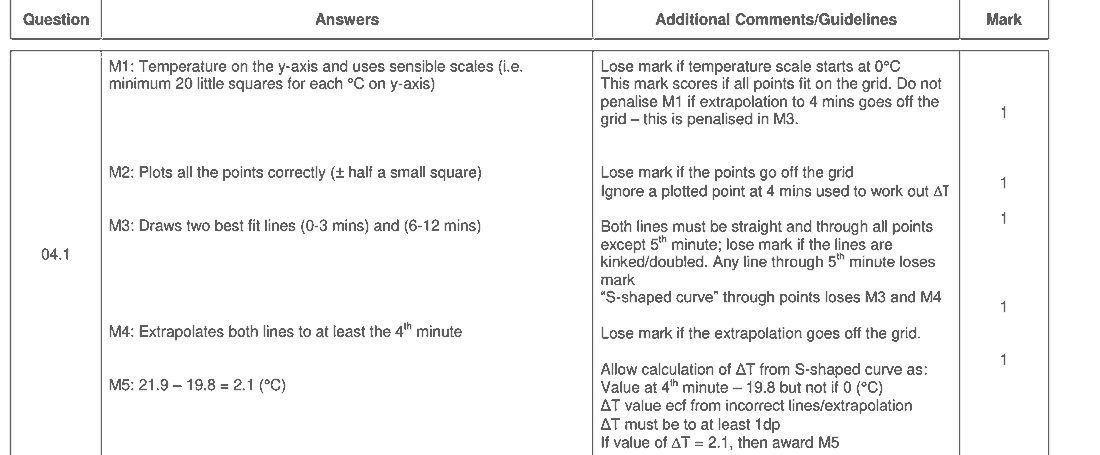
04.1 The usual advice is that a scale on a graph is ‘suitable’ if the plotted points take up more than half of the available space. In this case, the decision about the suitability of the scale was more ‘relaxed’ due to the need for students to allow space for the extrapolation to go higher than the highest plotted point. However, a significant number of students still managed to miss the mark by choosing scales that led to the plotted points being squeezed in to only a couple of squares on the vertical axis. There still seems to be a misconception amongst some students that all scales need to start at zero. Having plotted the points, most students recognised that their lines of best fit should ignore the point at 5 minutes. Although a lot of ‘S-shaped’ curves were seen (the reminder clue in the question was that candidates should draw suitable lines of best fit), some students failed to draw any line between 0 and 3 minutes, and the lines were sometimes not extrapolated to the 4th minute. A surprising number of students quoted the ‘final’ temperature at the 4th minute rather than giving ΔT. Pleasingly, 34.3% of students scored all five marks.
Notes from the mark scheme and report
Answer: ∆T = 2.1 °C (21.9 – 19.8). Temperature on the y-axis with a sensible scale (not starting at 0, points filling the grid)
all points plotted
two straight best-fit lines, one through 0 to 3 minutes and one through 6 to 12 minutes ignoring the point at 5 minutes
both extrapolated to the 4th minute
∆T read as the gap at 4 minutes. S-shaped curves lose the line marks
some quoted the final temperature instead of ∆T
Skills: MS3.2 Plot two variables from experimental or other data; MS3.1 Translate information between graphical, numerical and algebraic forms; PS2.2 Present data in appropriate ways; PS3.1 Plot and interpret graphs; PS3.2 Process and analyse data using appropriate mathematical skills as exemplified in the mathematical appendix for each science; RP2 Measurement of an enthalpy change
June 2018 · Paper 3 · Q04.21 markCalculationHard
Earlier part of question 04 that this part uses
Mark scheme
Examiner's comment
04.2 Far more students than expected failed to double the uncertainty given in the question to reflect the fact that two temperature readings are taken with the thermometer. As a result, only 19.3% of students were awarded this mark.
Notes from the mark scheme and report
Answer: 9.5% (0.2 ÷ 2.1 × 100
consequential on 04.1). Two temperature readings are used, so the uncertainty is 2 × 0.1
most did not double it
Skills: MS1.3 Identify uncertainties in measurements and use simple techniques to determine uncertainty when data are combined; PS3.3 Consider margins of error, accuracy and precision of data; RP2 Measurement of an enthalpy change
June 2018 · Paper 3 · Q04.31 markPractical and data analysisEasy
Earlier part of question 04 that this part uses
Mark scheme
Examiner's comment
04.3 As expected, this was the easiest question on the paper with the vast majority of candidates (90.7%) able to suggest a way to reduce heat loss.
Notes from the mark scheme and report
Use a polystyrene cup instead of the glass beaker / insulate the beaker / add a lid. Not a copper or bomb calorimeter
Skills: PS2.1 Comment on experimental design and evaluate scientific methods; PS1.1 Solve problems set in practical contexts; RP2 Measurement of an enthalpy change
June 2018 · Paper 3 · Q04.42 marksPractical and data analysis
Earlier part of question 04 that this part uses
Mark scheme
Examiner's comment
04.4 This was another example of a question where some students were let down by not reading the question, which clearly asked for a change that would reduce the percentage uncertainty in the use of the same thermometer. Given that percentage uncertainty is calculated as apparatus uncertainty divided by measurement made, it was hoped that more students would recognise the need to increase the size of the measurement made, i.e. the temperature change. Many students who did recognise the need to generate a bigger temperature change suggested doing so by using smaller volumes; they thus failed to appreciate that this would reduce the amounts of reactants as well as the volume, so that less heat would be given out and the change in temperature would be the same as in the larger scale experiment. 58% of students scored zero.
Notes from the mark scheme and report
Increase the concentration of the acid and alkali
so the temperature change is larger (the same uncertainty is then a smaller percentage). Changing the volumes does not work: less heat and less solution give the same ∆T. 58% scored 0
Skills: MS1.3 Identify uncertainties in measurements and use simple techniques to determine uncertainty when data are combined; PS2.1 Comment on experimental design and evaluate scientific methods; PS3.3 Consider margins of error, accuracy and precision of data; RP2 Measurement of an enthalpy change
June 2018 · Paper 3 · Q04.55 marksCalculationHard
Earlier part of question 04 that this part uses
Mark scheme
Examiner's comment
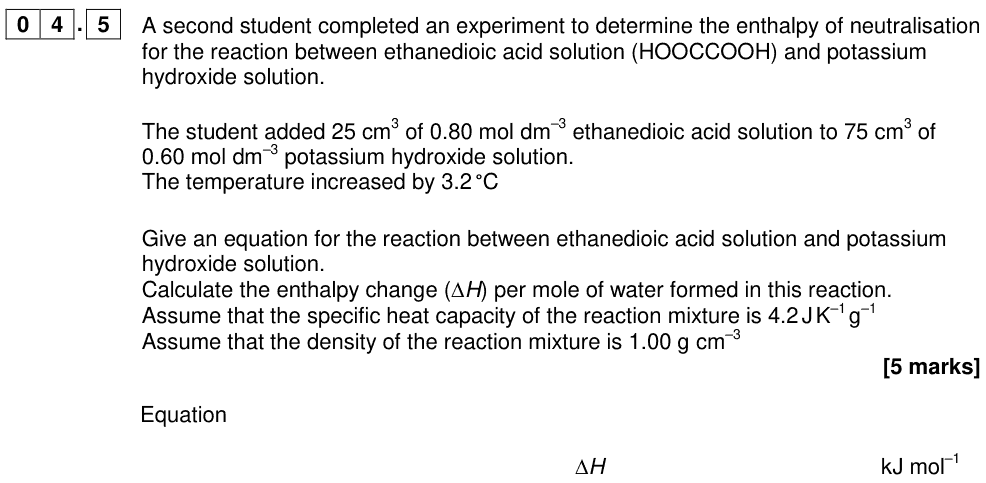
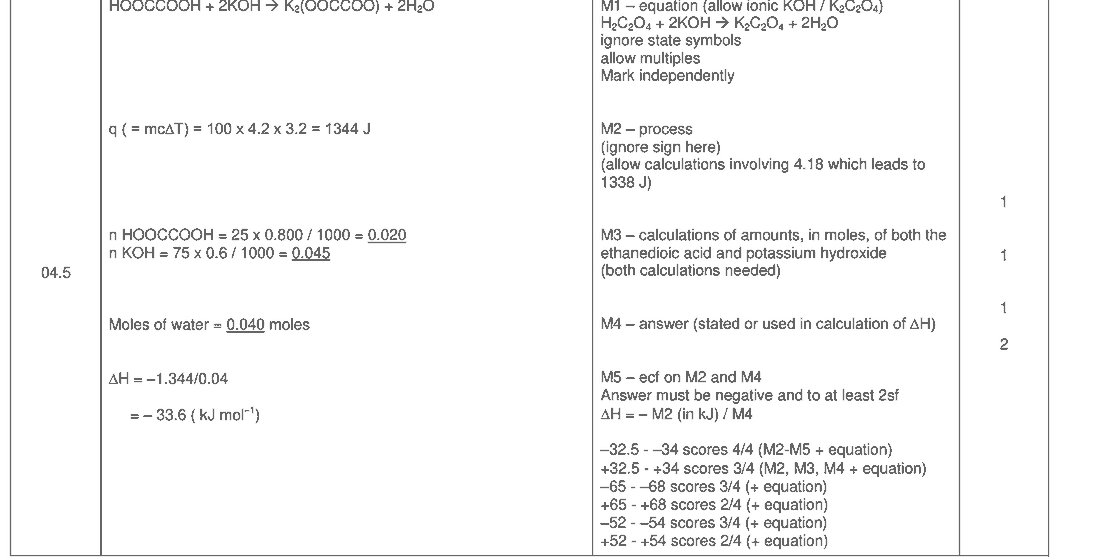
04.5 Despite the formula and name being given in the question, many students failed to recognise that ethanedioic acid is diprotic, which affected their equation and subsequent calculation. In the calculation, most were able to calculate the initial amounts of each reactant, but many then failed to recognise the idea that one is present in excess so that the other would be the limiting reagent and so determine the amount of water formed. Calculations involving adding 0.02 to 0.045, or subtracting 0.02 from 0.045, were frequently seen, although it was not always clear what students thought they were calculating when they did so, due to poor layout of calculations. There were also a lot of variations seen in the mass used for the mcΔT calculation. In any enthalpy change or calorimetry experiment of this type, it is the solution that is increasing in temperature, so it is the mass of solution that needs to be used (100 g here as 25 cm3 of one solution was added to 75 cm3 of another and all have a density of 1.00 g cm−3). This calculation discriminated extremely well between students of different abilities; 21.2% scored maximum marks and only 6.4% failed to score anything.
n(acid) = 0.020, n(KOH) = 0.045, so KOH is in excess and water formed = 0.040 mol
∆H = –1.344 ÷ 0.040. Errors: acid treated as monoprotic
limiting reagent not identified (–67 scores 3 of 4)
wrong mass in mc∆T
positive sign
Skills: MS0.0 Recognise and make use of appropriate units in calculation; MS0.2 Use ratios, fractions and percentages; MS2.3 Substitute numerical values into algebraic equations using appropriate units for physical quantities; PS3.2 Process and analyse data using appropriate mathematical skills as exemplified in the mathematical appendix for each science; RP2 Measurement of an enthalpy change
June 2017 · AS Paper 1 · Q02.11 markEquation writingHard
Mark scheme
Examiner's comment
02.1 This was poorly answered, with many students missing state symbols and balancing the equation incorrectly. Only the best students (24.6%) gained the mark here.
Notes from the mark scheme and report
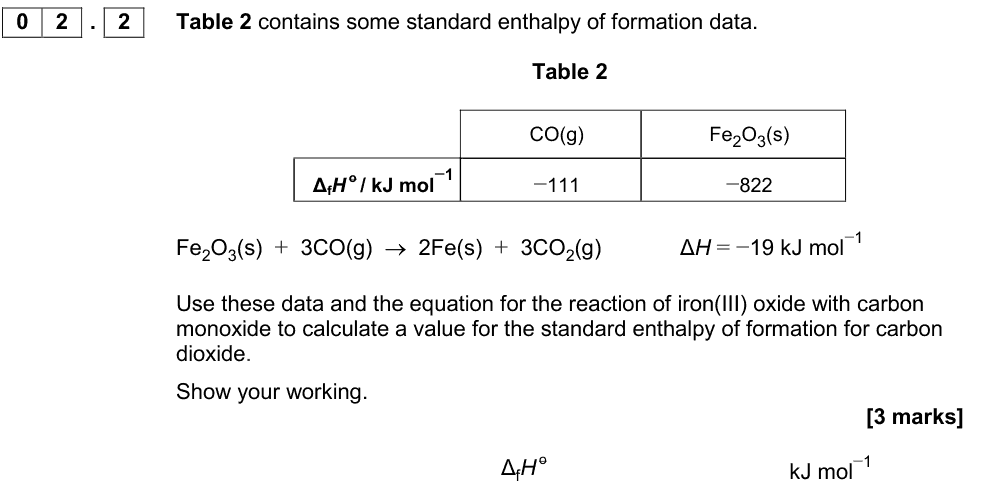
2Fe(s) + 3/2 O2(g) → Fe2O3(s) only: one mole of Fe2O3 formed, so no multiples
state symbols must be shown. Errors: missing state symbols and incorrect balancing
June 2017 · AS Paper 1 · Q02.23 marksCalculation
Earlier part of question 02 that this part uses
Mark scheme
Examiner's comment
02.2 This proved challenging compared to questions set in the previous specification from this topic area. 34.3% of students failed to pick up even one mark.
Notes from the mark scheme and report
Answer: –391 kJ mol–1. ∆H = sum of ∆fH(products) – sum of ∆fH(reactants): 3 × ∆fH(CO2) = –19 + (–822) + 3(–111) = –1174
divide by 3. –317 or +391 scores 1 mark. 34.3% scored no marks
Skills: MS2.4 Solve algebraic equations
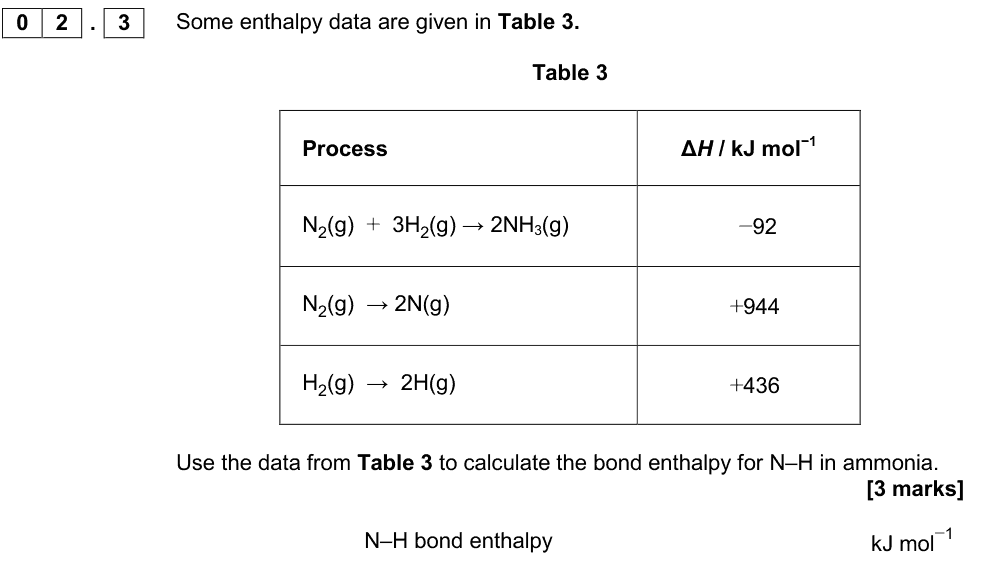
June 2017 · AS Paper 1 · Q02.33 marksCalculationHard
Earlier part of question 02 that this part uses
Mark scheme
Examiner's comment
02.3 Again challenging for all but the best students, only 26.3% scored more than one mark.
02.4 This was not as well answered as might have been expected. The fact that mean bond enthalpies are calculated using a range of compounds was not well understood.
Notes from the mark scheme and report
The data book value is a mean taken from a number of different compounds containing N–H bonds (not just from different NH3 molecules). This was not well understood
Skills: MS1.2 Find arithmetic means
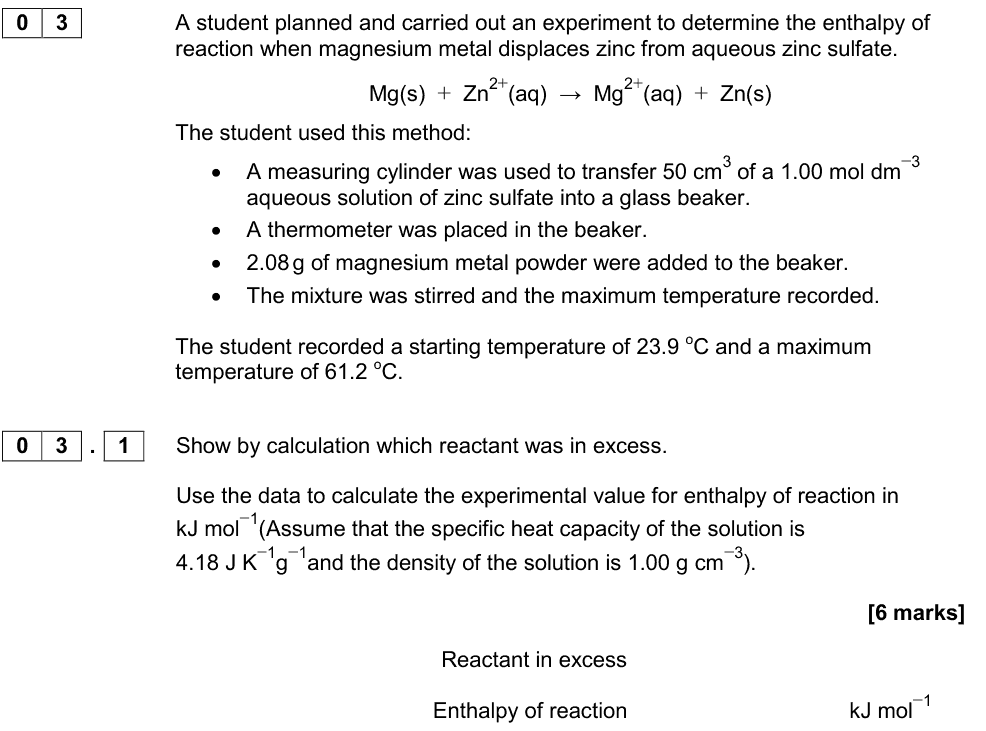
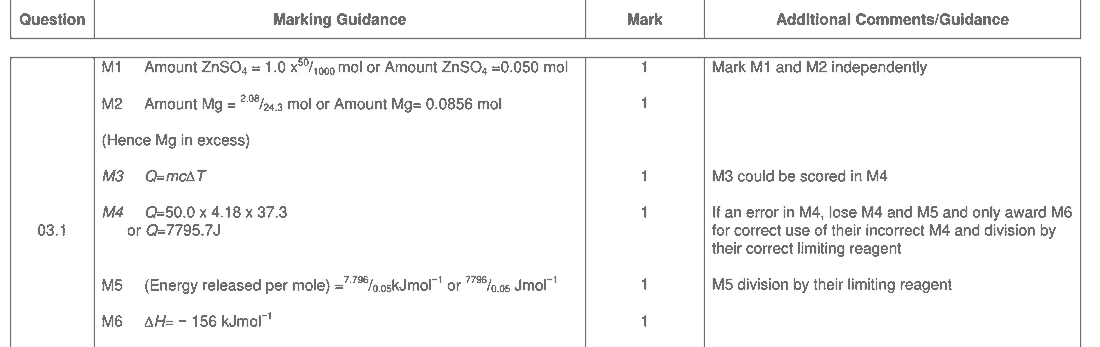
June 2017 · AS Paper 1 · Q03.16 marksCalculation
Mark scheme
Examiner's comment
03.1 In this extended calculation the correct limiting reagent had to be used to gain full marks. This proved difficult for many students. The less able students were expected to be able to calculate the numbers of moles of the two reagents and/or state that q = mc∆T, but this was not always the case.
divide by 0.050 mol (the limiting reagent) and give a negative sign. Using the wrong limiting reagent was the main difficulty
Skills: MS0.0 Recognise and make use of appropriate units in calculation; MS2.3 Substitute numerical values into algebraic equations using appropriate units for physical quantities; PS3.2 Process and analyse data using appropriate mathematical skills as exemplified in the mathematical appendix for each science; RP2 Measurement of an enthalpy change
June 2017 · AS Paper 1 · Q03.21 markPractical and data analysis
Earlier part of question 03 that this part uses
Mark scheme
Examiner's comment
03.2 58.1% of students gained the mark for this question about a well-known practical issue.
Notes from the mark scheme and report
Heat loss (to the surroundings / from the apparatus), so the experimental value is less exothermic than the data book value
Skills: PS2.3 Evaluate results and draw conclusions with reference to measurement uncertainties and errors; PS2.1 Comment on experimental design and evaluate scientific methods; RP2 Measurement of an enthalpy change
June 2017 · AS Paper 1 · Q03.36 marks6-mark level of response
Earlier part of question 03 that this part uses
Mark scheme, with the levels and indicative content
Examiner's comment
03.3 This practical question was marked using a levels of response mark scheme. There was a wide range of answers, showing that most had done this sort of practical during their course. Nearly all students were aware that insulation is the most obvious improvement to the technique but many students failed to read the question carefully. Many answers, even
Notes from the mark scheme and report
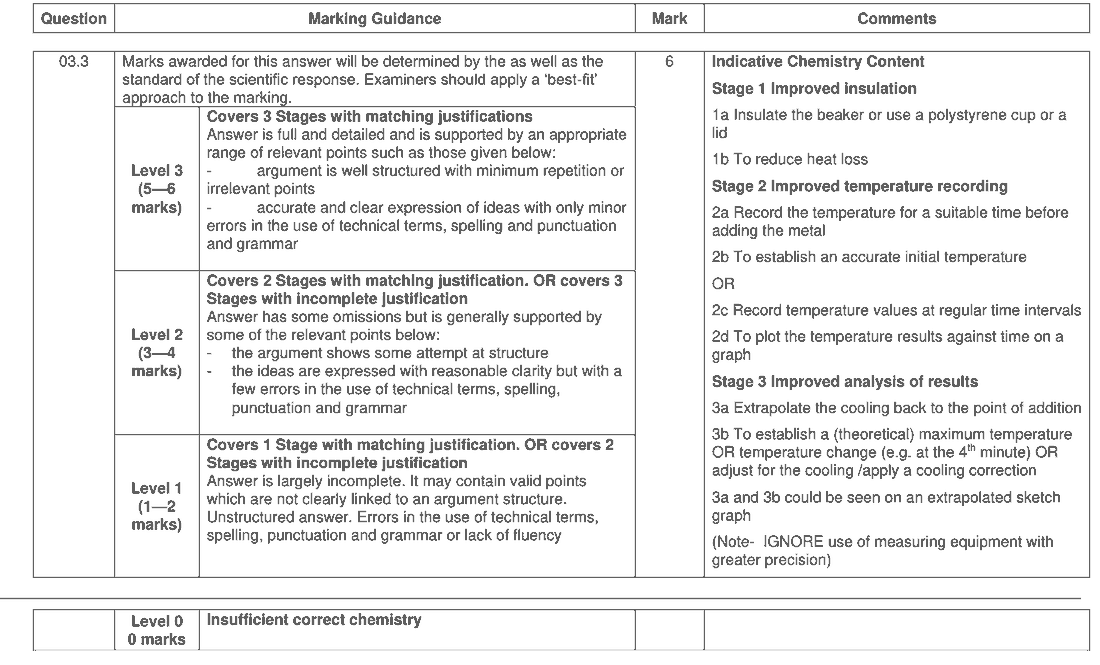
Levels of response, three stages each with a justification. Stage 1 insulation: insulate the beaker / use a polystyrene cup or a lid, to reduce heat loss. Stage 2 temperature recording: record the temperature for a suitable time before adding the metal to establish an accurate initial temperature, or record the temperature at regular time intervals to plot temperature against time. Stage 3 analysis: extrapolate the cooling curve back to the time of addition to find the theoretical maximum temperature / temperature change (a cooling correction). Ignore more precise measuring equipment and changes to amounts or concentrations (excluded by the question)
many did not read this
Skills: PS2.1 Comment on experimental design and evaluate scientific methods; PS3.1 Plot and interpret graphs; PS2.3 Evaluate results and draw conclusions with reference to measurement uncertainties and errors; ATa Use appropriate apparatus to record a range of measurements (to include mass, time, volume of liquids and gases, temperature); MS3.2 Plot two variables from experimental or other data; RP2 Measurement of an enthalpy change
June 2017 · AS Paper 2 · Q04.31 markShort answer
Earlier part of question 04 that this part uses
Mark scheme
Examiner's comment
04.3 Very few students appreciated that bond enthalpies are measured in the gaseous state and so the expression would not give an accurate value for a liquid alkane.
Notes from the mark scheme and report
The expression (bond enthalpies) applies to gaseous alkanes / all substances as gases
energy is needed to vaporise the liquid alkane. Heat loss, incomplete combustion and non-standard conditions are ignored. Very few knew this
June 2017 · AS Paper 2 · Q04.43 marksPractical and data analysis
Earlier part of question 04 that this part uses
Mark scheme
Examiner's comment
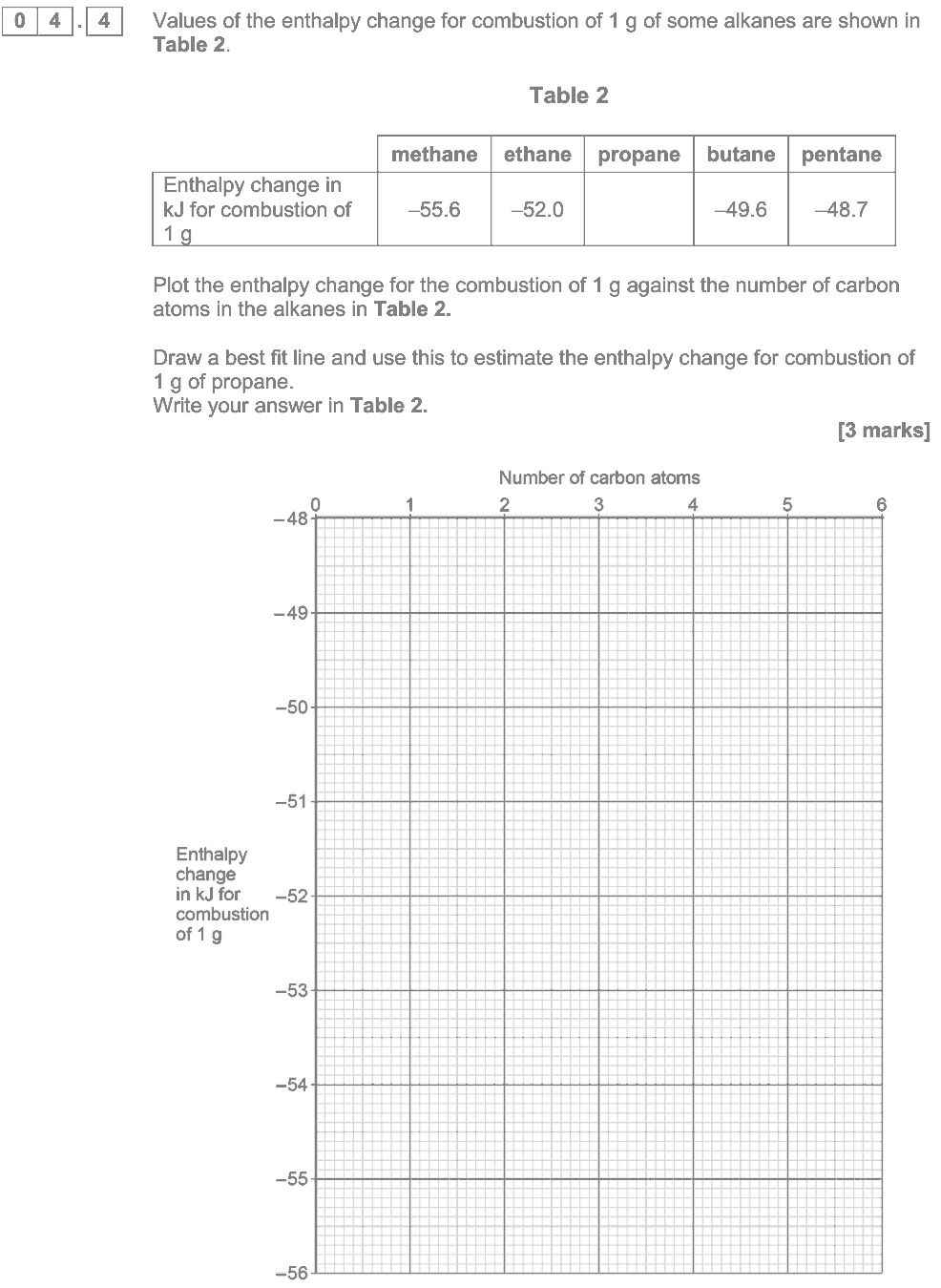
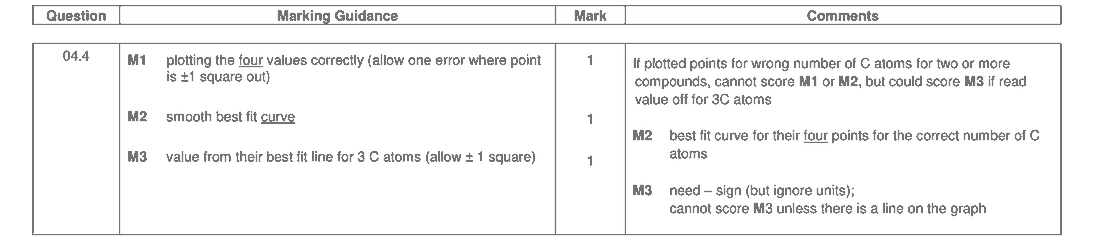
04.4 Most students plotted the points on the graph correctly, but a very significant proportion of them drew a best fit line that was straight rather than a curve. Most students read the value for propane off the graph, but some did not include the negative sign to show it was exothermic. Worryingly, some students did not know how many C atoms the alkanes contained and failed to score.
Notes from the mark scheme and report
Four points plotted at 1, 2, 4 and 5 carbon atoms
a smooth best-fit curve (not a straight line)
value read at 3 carbon atoms from their line (about –50.4 kJ), with the negative sign. Errors: straight line drawn
sign omitted
wrong number of carbon atoms for the alkanes
Skills: MS3.1 Translate information between graphical, numerical and algebraic forms; MS3.2 Plot two variables from experimental or other data; PS3.1 Plot and interpret graphs
June 2017 · AS Paper 2 · Q04.52 marksCalculation
Earlier part of question 04 that this part uses
Mark scheme
Examiner's comment
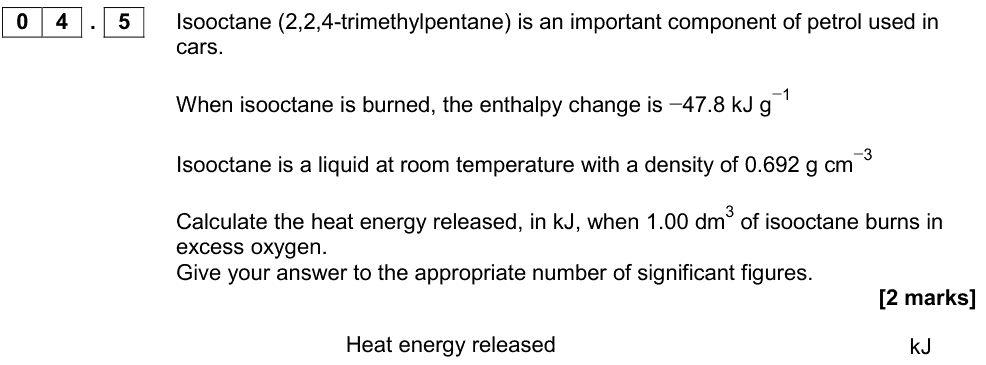
04.5 Many students failed to find the mass of 1 dm3 of isooctane, not appreciating that the density value given was in g cm–3 rather than g dm–3. Some students lost the second mark because they did not appreciate that the answer should be given to three significant figures.
Notes from the mark scheme and report
Answer: 3.31 × 10^4 kJ (33 100 kJ
3 significant figures only). Mass = 0.692 × 1000 = 692 g
× 47.8. Errors: density treated as g dm–3
wrong number of significant figures
Skills: MS0.0 Recognise and make use of appropriate units in calculation; MS1.1 Use an appropriate number of significant figures
June 2017 · Paper 3 · Q01.11 markPractical and data analysisHard
Mark scheme
Examiner's comment
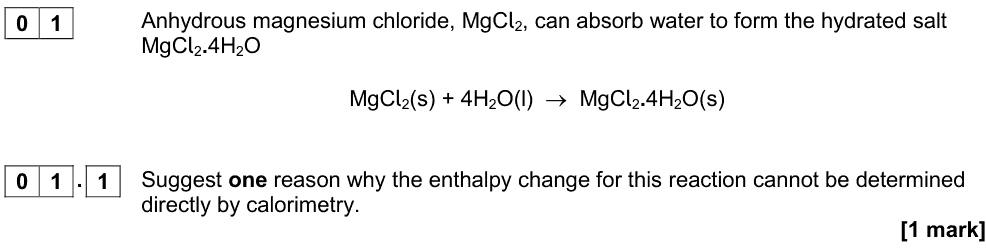
01.1 This proved to be a much tougher starter question than had been anticipated, with only 12% of students earning the mark. Students did not recognise that enthalpy change could not be measured directly. In this case, the enthalpy change was for the formation of a hydrated salt from an anhydrous one – with the expected answer being that it would be impossible to prevent some salt dissolving during the addition of water to the anhydrous salt. An alternative answer, related to the difficulty in measuring the temperature of a solid, was also allowed (but see question 01.3). Some students’ answers revealed confusion between calorimetry and colorimetry, with suggested answers including the fact that there is no colour change during the reaction. Some students also seemed to believe that calorimetry is only possible if something is being burned.
Notes from the mark scheme and report
It is not possible to stop some of the solid dissolving in the water (it is soluble / other hydrates may form)
the difficulty of measuring the temperature change of a solid was also allowed. Errors: confusing calorimetry with colorimetry ('no colour change')
thinking calorimetry needs something to burn
Skills: PS2.1 Comment on experimental design and evaluate scientific methods; RP2 Measurement of an enthalpy change
June 2017 · Paper 3 · Q01.22 marksCalculation
Earlier part of question 01 that this part uses
Mark scheme
Examiner's comment
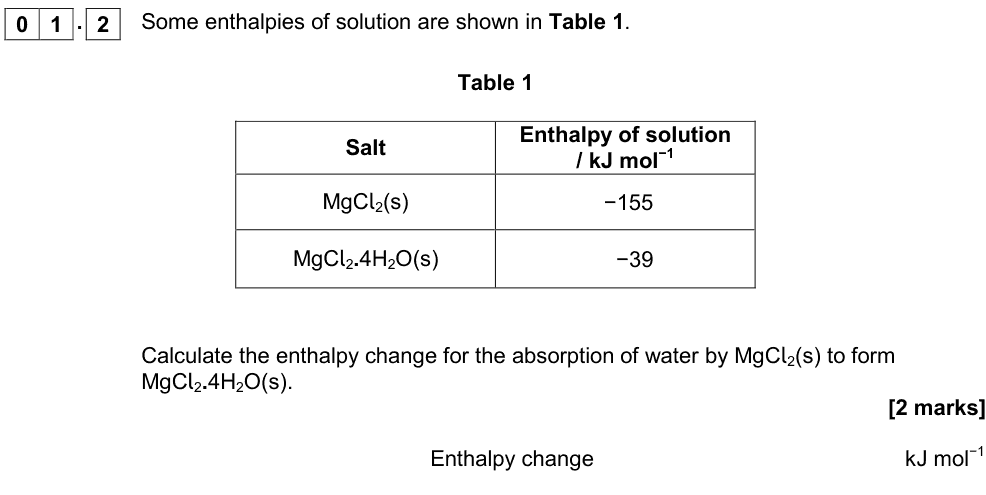
01.2 This calculation was answered reasonably well, with less than 20% of students failing to score. There was confusion about the ‘direction’ around the Hess Cycle, and evidence that many students think that an equation of the form ∆H = Σ∆Hf(products) - Σ∆Hf(reactants) can be used universally, when it only applies to the specific use of enthalpies of formation.
Notes from the mark scheme and report
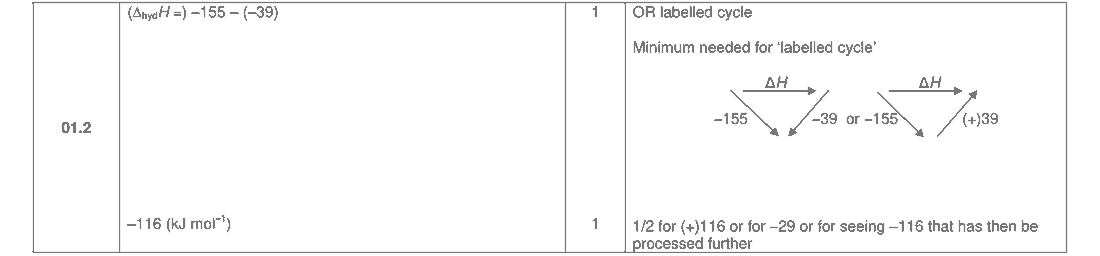
Answer: –116 kJ mol–1. Hess's law cycle through the solution: ∆H = –155 – (–39). +116 scores 1. 'Products minus reactants' applies only to enthalpies of formation
here it is the enthalpy of solution of the reactant minus that of the product
Skills: MS2.4 Solve algebraic equations
June 2017 · Paper 3 · Q01.36 marks6-mark level of response
Earlier part of question 01 that this part uses
Mark scheme, with the levels and indicative content
Examiner's comment
01.3 Most students’ encounter with this ‘extended response’ style of question produced a good spread of marks, although 37% of students failed to score. This was usually due to a completely inappropriate method being described, with incorrect answers seen that included: “making a solution of magnesium chloride”, “using it to fill a spirit burner and lighting it under a beaker of water” and “putting a solution of magnesium chloride in a polystyrene cup and heating it over a Bunsen burner”. Other incorrect answers included descriptions of the preparation of a standard solution followed by a titration, and the addition of magnesium chloride to acid instead of to water. This question was marked using a ‘levels of response’ mark scheme. The key to success was for students to concentrate first on the inclusion of as much correct chemistry as possible to ensure access to Level 3 (worth 5 or 6 marks). Within a level, the mark awarded depended on the clarity and coherence of an answer, together with a clear, logical progression through the description. Appropriate apparatus and quantities should have been mentioned as necessary. For example, rather than writing ‘add water to a container’, a good start to the answer would be to write ‘A measuring cylinder was used to measure 50 cm3 of water into a polystyrene cup’. Despite the fact that many students suggested, in question 01.1, that it is difficult to measure the temperature of a solid, many then suggested putting the magnesium chloride into the polystyrene cup first and then recording its initial temperature, before adding the water.
Notes from the mark scheme and report
Levels of response, three stages. Method: measure a stated volume of water (10–200 cm3) with a measuring cylinder / pipette into a polystyrene cup
add a known mass of MgCl2, found by weighing the container before and after adding. Measurements: record the initial temperature (at least twice) before adding
then record the temperature at regular intervals for 5 minutes or more
plot temperature against time. Use of results: extrapolate the lines to the time of addition to find ∆T
q = mc∆T
n = 0.80 ÷ 95.3 = 8.39 × 10^–3 mol
∆H = –q ÷ n. Level 3 needs the graphical method ('highest temperature reached' is max level 2)
a combustion method is max level 1. 37% scored 0, mostly for a wrong method (spirit burner, heating the solution, titration, adding to acid). Add the solid to the water, not water to the solid
Skills: ATa Use appropriate apparatus to record a range of measurements (to include mass, time, volume of liquids and gases, temperature); ATk Safely and carefully handle solids and liquids, including corrosive, irritant, flammable and toxic substances; PS2.2 Present data in appropriate ways; PS3.1 Plot and interpret graphs; PS4.1 Know and understand how to use a wide range of experimental and practical instruments, equipment and techniques appropriate to the knowledge and understanding included in the specification; RP2 Measurement of an enthalpy change
June 2016 · AS Paper 2 · Q02.14 marksCalculation
Mark scheme
Examiner's comment
Enthalpy of combustion & calorimetry
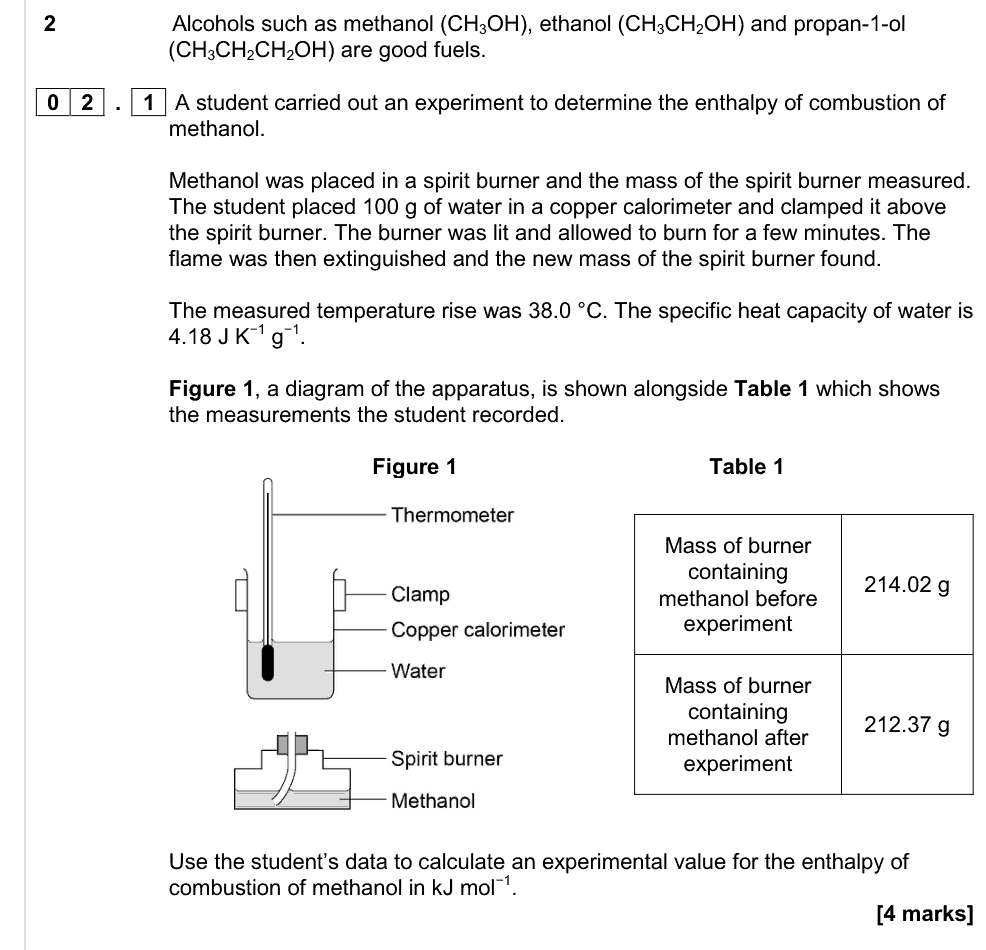
In the calculation of the enthalpy of combustion from the experimental data, many students used the mass of the fuel (rather than the water) when using q = mc∆T. Others incorrectly added 273 to the temperature rise. When finding the moles of methanol burned, some students rounded this to 1 significant figure which gave inaccurate answers. Some students failed to include the minus sign on their final answer to show that the reaction is exothermic. In Q2.2 many students referred to the problems already stated in the question rather than an additional one. Many students suggested mistakes made during the experiment rather than design features. Many students scored the mark for Q2.3 but many others did not know where to start. The calculation of apparatus percentage uncertainties should be an important and routine part of practical work. Few students realised that Q2.4 related to the size of the uncertainty in the temperature rise compared to the actual temperature rise and/or heat loss in the experiment. Many students were uncertain how to start the calculation in Q2.5, namely by using the density to find the mass of the ethanol. Others struggled to convert the volume in dm3 to cm3.
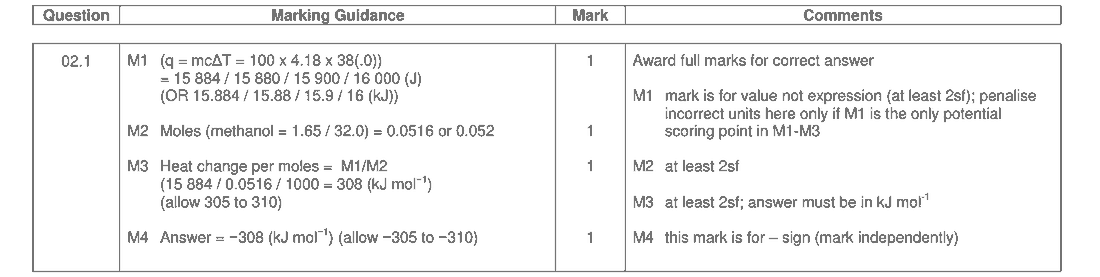
mass of methanol burned = 214.02 – 212.37 = 1.65 g
n = 1.65 ÷ 32.0 = 0.0516 mol
15.884 ÷ 0.0516
minus sign is a separate mark. Errors: using the mass of fuel in q = mc∆T, adding 273 to the temperature rise, rounding moles to 1 significant figure, no minus sign
Skills: MS0.0 Recognise and make use of appropriate units in calculation; MS2.3 Substitute numerical values into algebraic equations using appropriate units for physical quantities; PS3.2 Process and analyse data using appropriate mathematical skills as exemplified in the mathematical appendix for each science; ATa Use appropriate apparatus to record a range of measurements (to include mass, time, volume of liquids and gases, temperature); RP2 Measurement of an enthalpy change
June 2016 · AS Paper 2 · Q02.21 markPractical and data analysis
Earlier part of question 02 that this part uses
Mark scheme
Examiner's comment
In Q2.2 many students referred to the problems already stated in the question rather than an additional one.
Many students suggested mistakes made during the experiment rather than design features.
Notes from the mark scheme and report
Heat is used to warm the copper calorimeter / thermometer (their heat capacity is not taken into account)
or evaporation of methanol (or water)
or not done under standard conditions. Not human error, not impure methanol, and not the two reasons excluded in the question
Skills: PS2.1 Comment on experimental design and evaluate scientific methods; PS2.3 Evaluate results and draw conclusions with reference to measurement uncertainties and errors; RP2 Measurement of an enthalpy change
June 2016 · AS Paper 2 · Q02.31 markPractical and data analysis
Earlier part of question 02 that this part uses
Mark scheme
Examiner's comment
Many students scored the mark for Q2.3 but many others did not know where to start.
The calculation of apparatus percentage uncertainties should be an important and routine part of practical work.
Notes from the mark scheme and report
Answer: 1.3% (1.32%). 0.5 ÷ 38.0 × 100. Many did not know where to start
Skills: MS1.3 Identify uncertainties in measurements and use simple techniques to determine uncertainty when data are combined; MS0.2 Use ratios, fractions and percentages; PS3.3 Consider margins of error, accuracy and precision of data; RP2 Measurement of an enthalpy change
June 2016 · AS Paper 2 · Q02.41 markPractical and data analysis
Earlier part of question 02 that this part uses
Mark scheme
Examiner's comment
Few students realised that Q2.4 related to the size of the uncertainty in the temperature rise compared to the actual temperature rise and/or heat loss in the experiment.
Notes from the mark scheme and report
The temperature rise (38 °C) is much bigger than the uncertainty
or heat loss is a far more significant source of error than the thermometer. A comparison is required
Skills: PS3.3 Consider margins of error, accuracy and precision of data; PS2.3 Evaluate results and draw conclusions with reference to measurement uncertainties and errors; MS1.3 Identify uncertainties in measurements and use simple techniques to determine uncertainty when data are combined; RP2 Measurement of an enthalpy change
June 2016 · AS Paper 2 · Q221 markMultiple choice
Earlier part of question 22 that this part uses
Answer
B
Mark scheme
Notes from the mark scheme and report
Answer: B. ∆H = bonds broken – bonds made: +206 = [4(413) + 2(463)] – [E(C≡O) + 3(436)] = 2578 – 1308 – E, so E = 1064 kJ mol–1. Common error: using products minus reactants
Skills: MS2.3 Substitute numerical values into algebraic equations using appropriate units for physical quantities; MS2.4 Solve algebraic equations
Specimen · Paper 1 · Q04.21 markAO1=1Short answer
Earlier part of question 04 that this part uses
Mark scheme
Notes from the mark scheme and report
Mean bond enthalpies (averaged over many compounds) are not the same as the actual bond enthalpies in CO2, methanol and water
Specimen · Paper 1 · Q09.14 marksPractical and data analysis
Mark scheme
Notes from the mark scheme and report
Start a clock when the KCl is added
record the temperature every minute for about 5 minutes (at regular intervals until after all the solid has dissolved)
plot temperature against time
extrapolate the line back to the time of mixing and read off the temperature
Skills: ATa Use appropriate apparatus to record a range of measurements (to include mass, time, volume of liquids and gases, temperature); PS2.1 Comment on experimental design and evaluate scientific methods; PS3.1 Plot and interpret graphs; PS4.1 Know and understand how to use a wide range of experimental and practical instruments, equipment and techniques appropriate to the knowledge and understanding included in the specification; RP2 Measurement of an enthalpy change
positive because the temperature fell. Max 2 if 14.6 is used as ∆T
Skills: MS0.0 Recognise and make use of appropriate units in calculation; MS1.1 Use an appropriate number of significant figures; MS2.3 Substitute numerical values into algebraic equations using appropriate units for physical quantities; RP2 Measurement of an enthalpy change
Work with an A-level chemistry tutor
Dropping marks on calculations, mechanisms or the required practicals? Book a trial session with a specialist A-level chemistry tutor.