Notes and key-term cards for this topic are being written by our tutors. The past-paper questions below are ready now.
Specification statements
Show the 9 statements from the specification
3.3.6.1-01 The reactions of functional groups listed in the specification.
3.3.6.1-02 Students should be able to: • identify the functional groups using reactions in the specification.
3.3.6.1-03 Required practical 6 Tests for alcohol, aldehyde, alkene and carboxylic acid.
3.3.6.2-01 Mass spectrometry can be used to determine the molecular formula of a compound.
3.3.6.2-02 Students should be able to: • use precise atomic masses and the precise molecular mass to determine the molecular formula of a compound.
3.3.6.3-01 Bonds in a molecule absorb infrared radiation at characteristic wavenumbers.
3.3.6.3-02 ‘Fingerprinting’ allows identification of a molecule by comparison of spectra.
3.3.6.3-03 Students should be able to: • use infrared spectra and the Chemistry Data Sheet or Booklet to identify particular bonds, and therefore functional groups, and also to identify impurities.
3.3.6.3-04 The link between absorption of infrared radiation by bonds in CO2, methane and water vapour and global warming.
Six-mark level of response questions on this topic
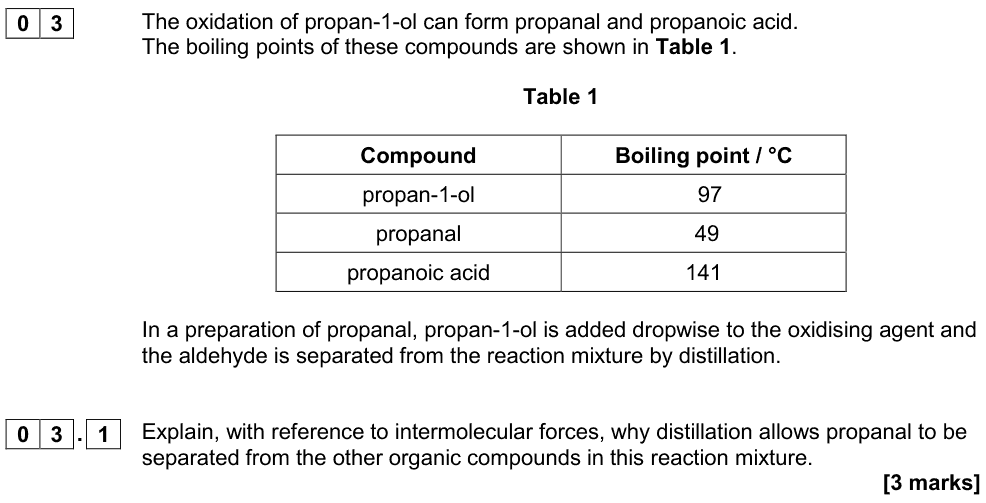
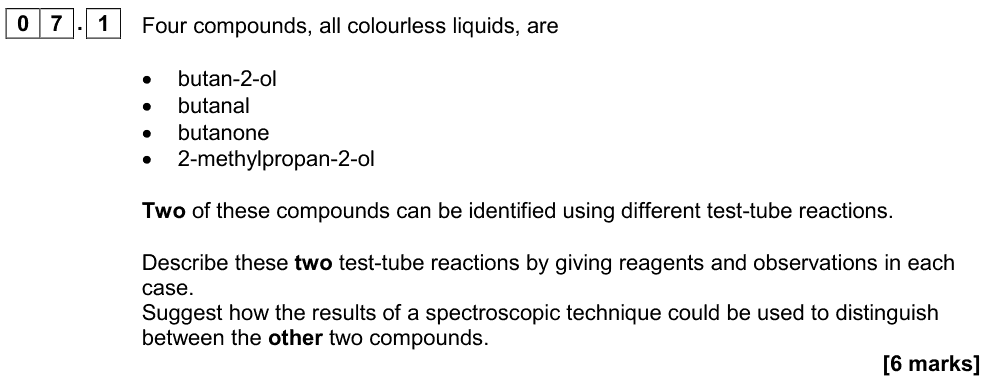
these two test-tube reactions by giving reagents and observations in each Suggest how the results of a spectroscopic technique could be used to distinguish
Tap a question to zoom it. Where a part needs a figure, table or structure from earlier in the question, that part folds out above it; the mark scheme and examiner's comment open underneath. Have AQA's Data Booklet (the Periodic Table and the spectroscopy tables) beside you.
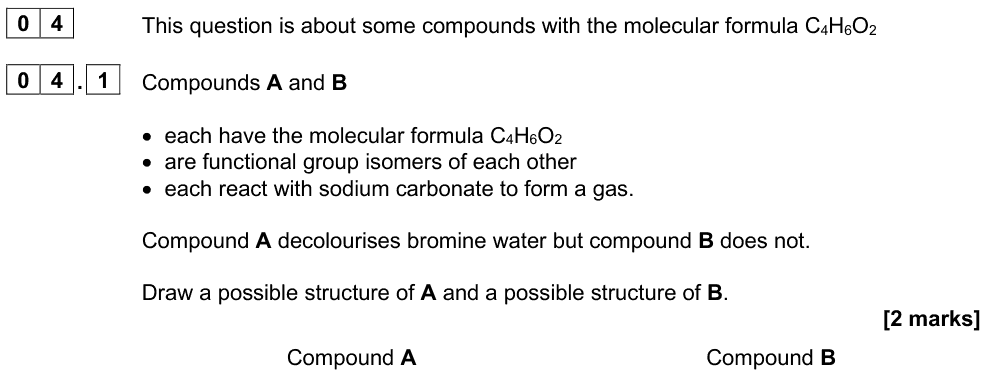
June 2025 · AS Paper 2 · Q04.12 marksAO3=2Diagram or structure
Mark scheme
Examiner's comment
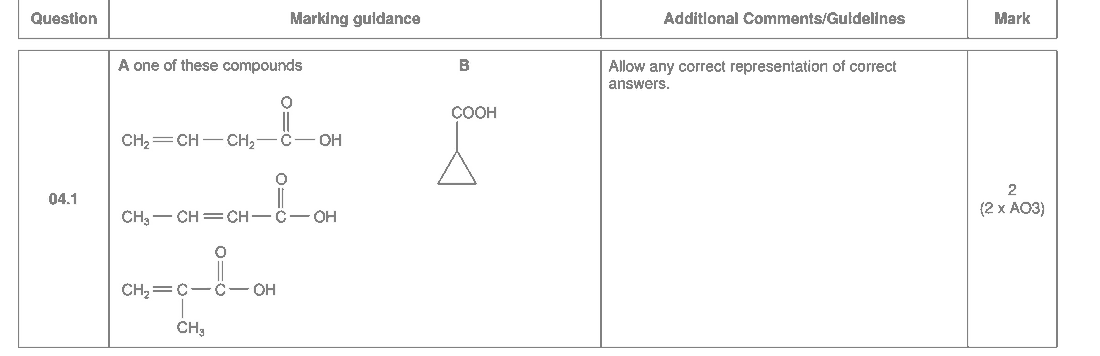
4.1 Students struggled to identify these two compounds, with many not appreciating that they were both carboxylic acids.
Notes from the mark scheme and report
Both are carboxylic acids (react with Na2CO3 to give CO2). A is an unsaturated acid: CH2=CHCH2COOH, CH3CH=CHCOOH or CH2=C(CH3)COOH. B is cyclopropanecarboxylic acid (a cyclopropane ring with COOH). Many did not see that both were carboxylic acids
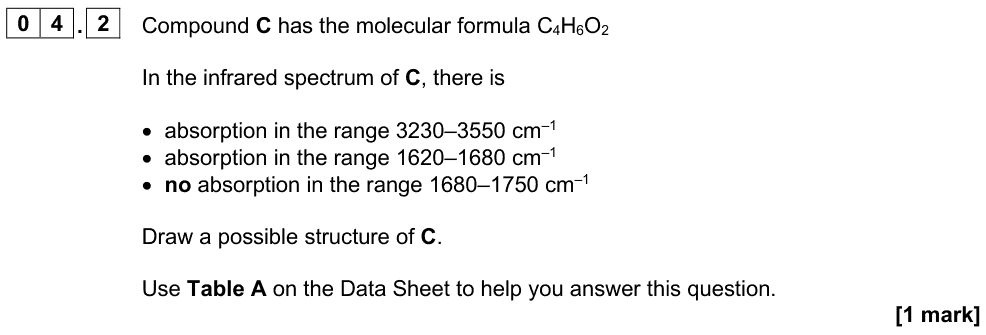
June 2025 · AS Paper 2 · Q04.21 markAO3=1Diagram or structure
Earlier part of question 04 that this part uses
Mark scheme
Examiner's comment
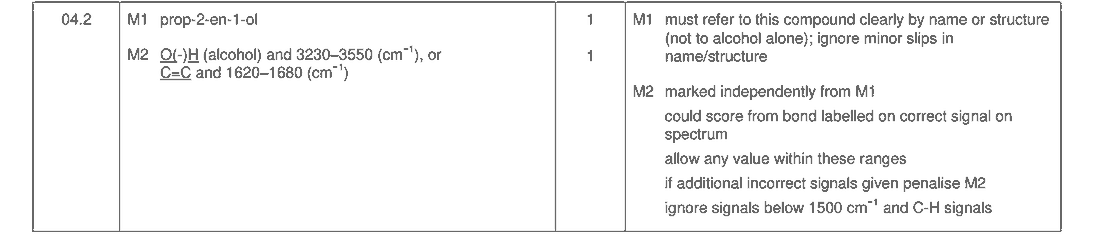
4.2 Students struggled to identify this compound, with many not being able to interpret the IR data.
Notes from the mark scheme and report
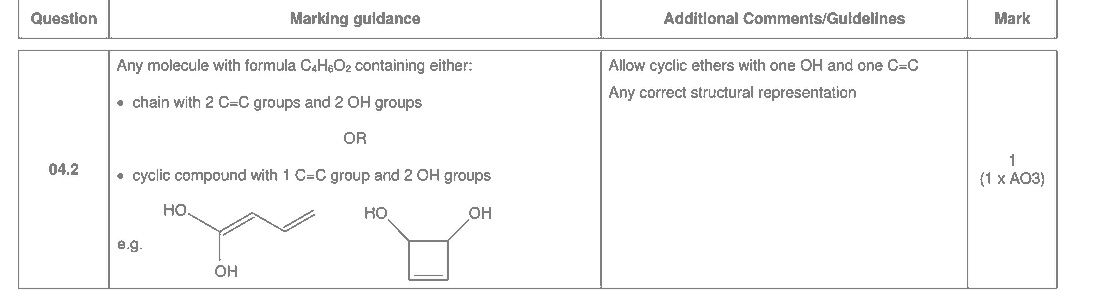
O–H (alcohol) and C=C present, no C=O: any C4H6O2 chain with two C=C and two OH groups (eg CH2=C(OH)C(OH)=CH2), or a ring with one C=C and two OH groups
cyclic ethers with one OH and one C=C are allowed. Many could not interpret the IR data
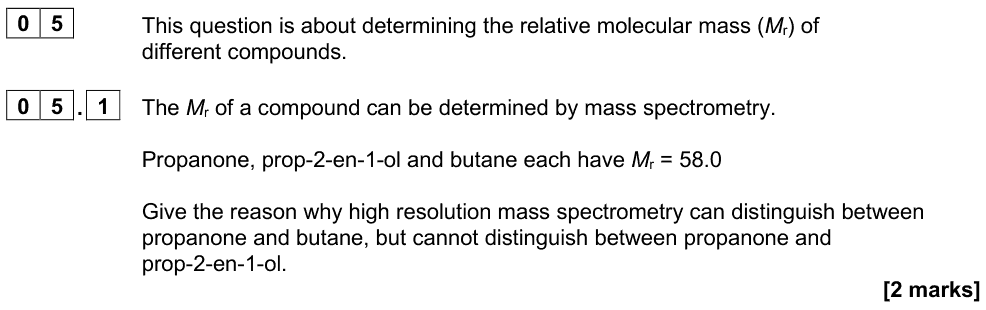
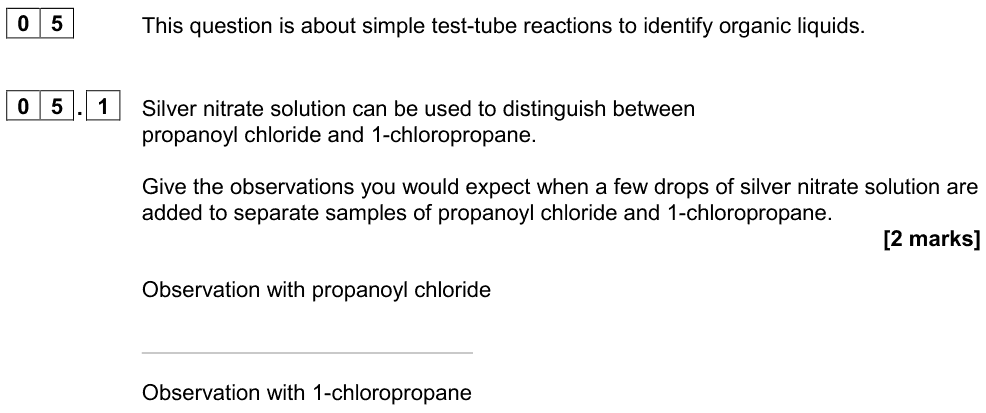
June 2025 · AS Paper 2 · Q05.12 marksAO2=2Explanation
Mark scheme
Examiner's comment
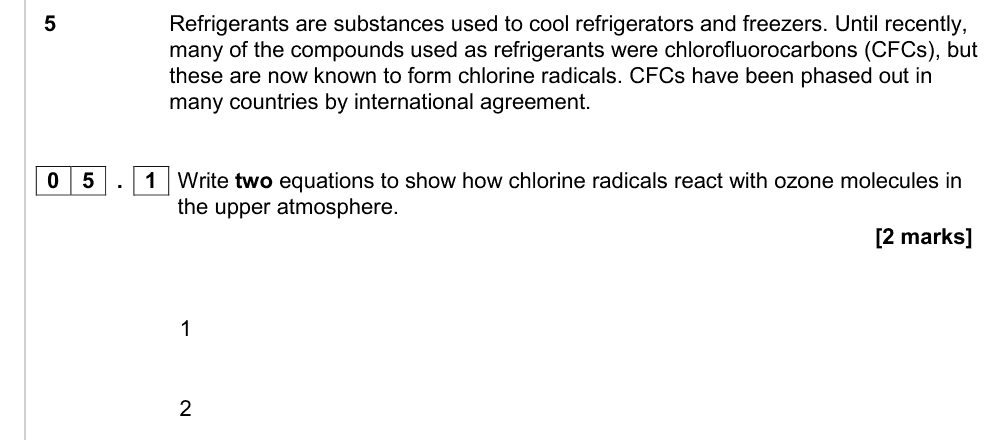
5.1 Students were unsure about the use of high-resolution mass spectrometry to distinguish some compounds. Few referred to whether the Mr was the same or not to several decimal places. Many confused the technique with IR spectroscopy.
Notes from the mark scheme and report
Butane (C4H10) and propanone (C3H6O) have different Mr values to several decimal places
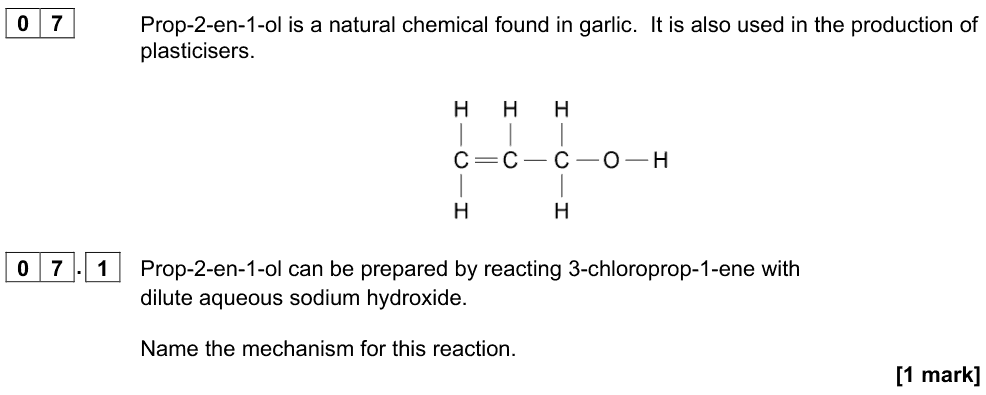
prop-2-en-1-ol and propanone have the same molecular formula (isomers), so the same precise Mr. Many confused this with IR spectroscopy or fragmentation
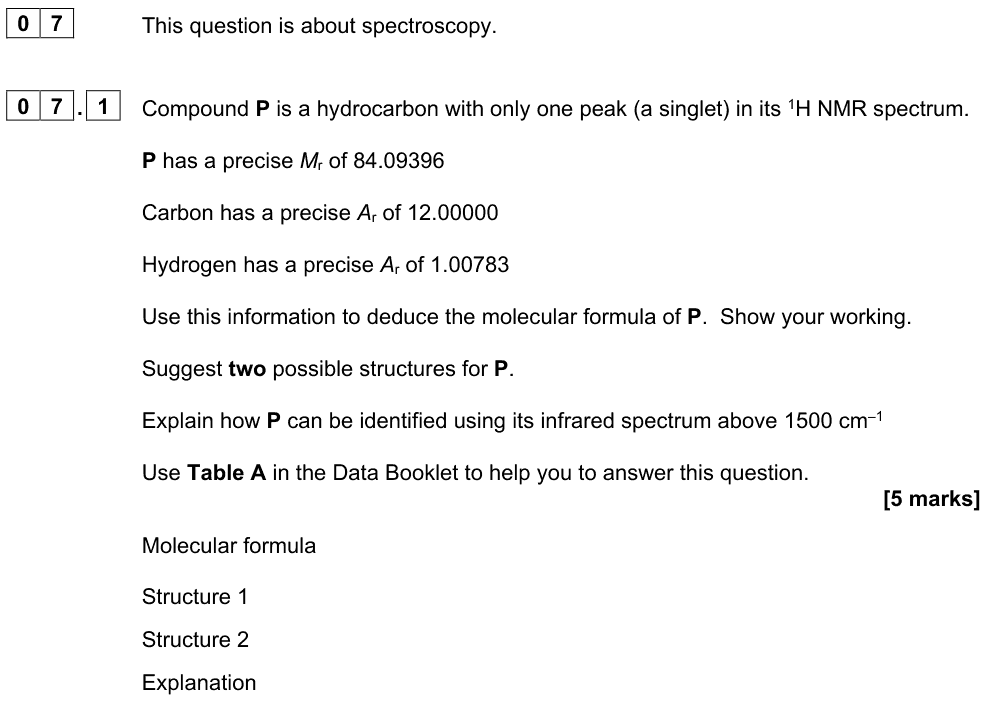
June 2025 · Paper 2 · Q07.15 marksAO1=2, AO2=3Explanation
Mark scheme
Examiner's comment
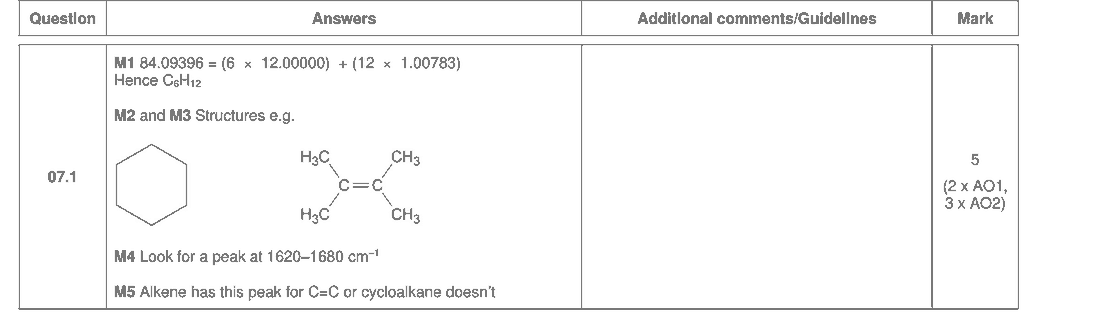
7.1 Students were given precise Mr data for an unknown hydrocarbon. Some were able to deduce the molecular formula but did not score as no workings were shown. Cyclohexane was the most commonly drawn correct structure but far fewer were able to deduce that 2,3-dimethylbut-2-ene was the other possible structure for C6H12 that gives only one singlet peak in its 1H NMR spectrum. The most common error was to give an alkene that had more than one peak in the 1H NMR spectrum. The final marks were quite well answered by suggesting the presence or absence of the C=C bond absorption at 1620-1680 cm-1 in the infrared spectrum.
Notes from the mark scheme and report
C6H12: (6 × 12.00000) + (12 × 1.00783) = 84.09396 (working needed). Structures with one hydrogen environment: cyclohexane and 2,3-dimethylbut-2-ene. Look for an absorption at 1620–1680 cm–1: the alkene has this C=C peak, cyclohexane does not. Common error: an alkene with more than one 1H peak
Skills: MS2.4 Solve algebraic equations
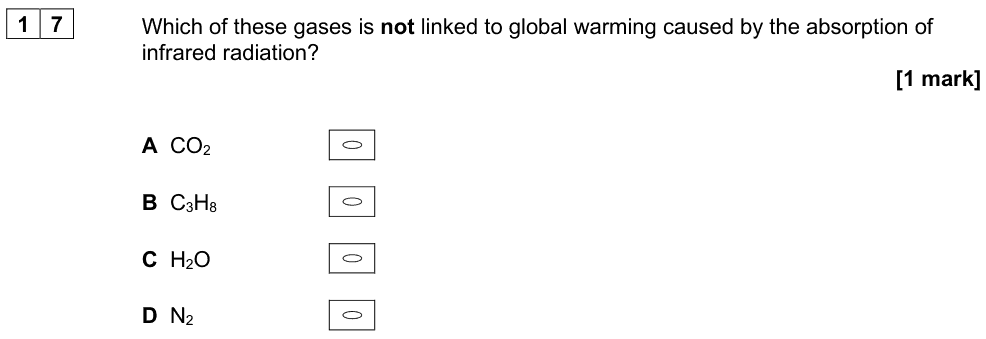
June 2025 · AS Paper 2 · Q171 markAO1=1Multiple choice
Answer
D
Mark scheme
Examiner's comment
This was answered correctly by a majority of students, but many thought that propane or water were not greenhouse gases.
Notes from the mark scheme and report
Answer: D. N2 does not absorb infrared radiation
CO2, hydrocarbons such as C3H8 and water vapour do
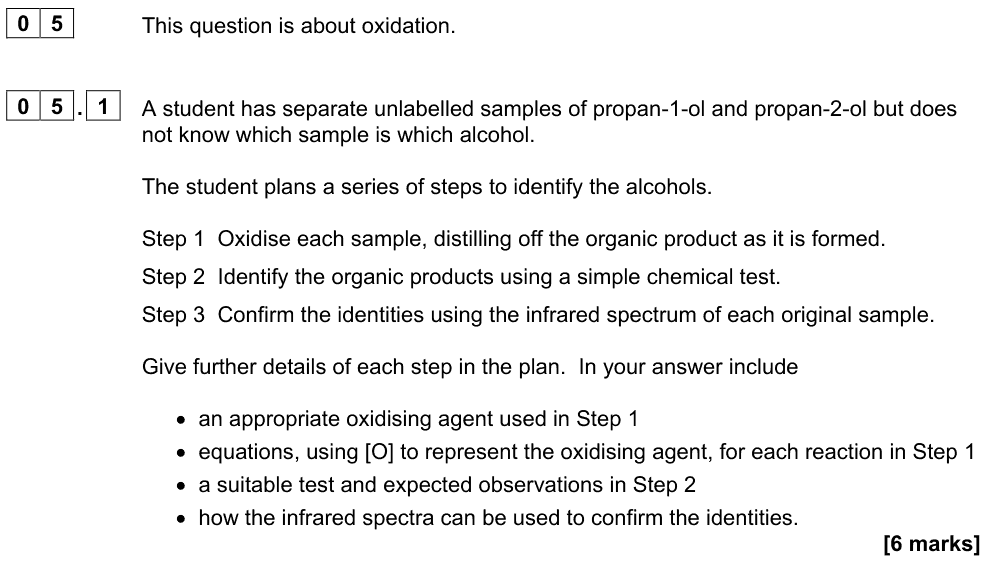
June 2025 · Paper 3 · Q05.16 marksAO3=66-mark level of responseHard
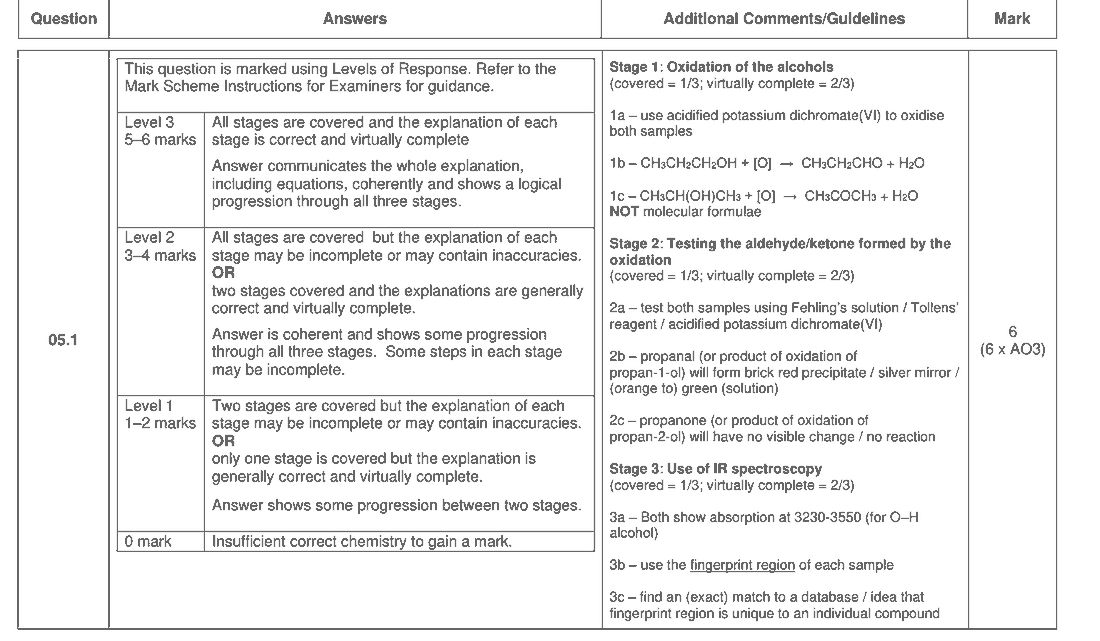
Mark scheme, with the levels and indicative content
Examiner's comment
5.1 This is the Levels of Response question and almost 25% of students were able to access level 3 while around 65% accessed Level 2 or above. Students were strong on stage 2, with most including all three pieces of indicative content in that stage. However, in stage 1 many students found it tricky to produce properly balanced equations for oxidation of the alcohols with [O] and many forgot water as the second product. In stage 3, as mentioned above, many students failed to read the question carefully enough and produced an answer that discussed the IR spectra of the carbonyls instead of the IR spectra of the original alcohols. 3b and 3c were still accessible in such cases for a clear description of how to use the fingerprint region.
Notes from the mark scheme and report
Levels of response, three stages. Oxidation: acidified potassium dichromate(VI)
CH3CH2CH2OH + [O] → CH3CH2CHO + H2O
CH3CH(OH)CH3 + [O] → CH3COCH3 + H2O (structural, not molecular, formulas). Test: Fehling's solution or Tollens' reagent on both distillates
propanal (from propan-1-ol) gives a brick-red precipitate / silver mirror
propanone gives no visible change. Infrared: both alcohols show O–H at 3230–3550 cm–1, so compare the fingerprint region of each original sample with a database for an exact match. Errors: unbalanced [O] equations or water left out
discussing the spectra of the carbonyl products instead of the original alcohols. About 65% reached level 2 or above
Skills: PS1.1 Solve problems set in practical contexts; PS4.1 Know and understand how to use a wide range of experimental and practical instruments, equipment and techniques appropriate to the knowledge and understanding included in the specification; RP6 Tests for alcohol, aldehyde, alkene and carboxylic acid
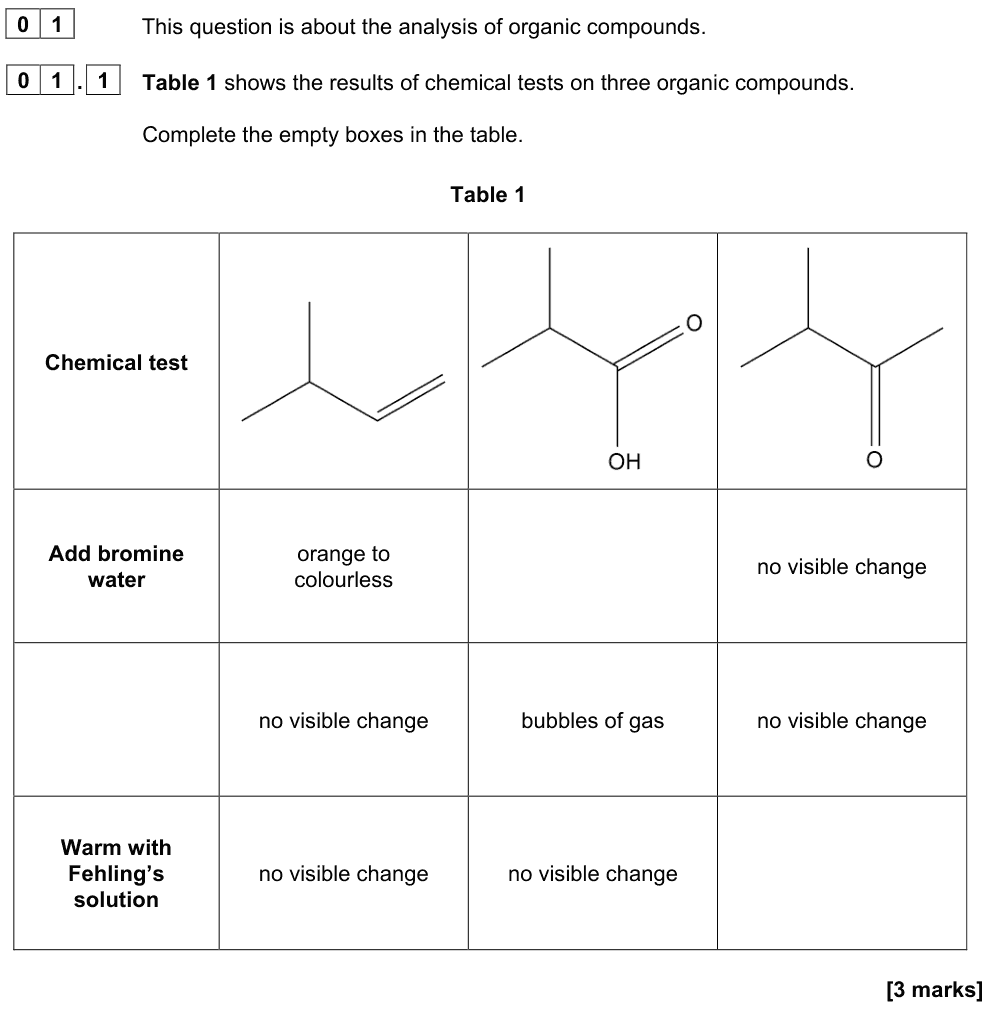
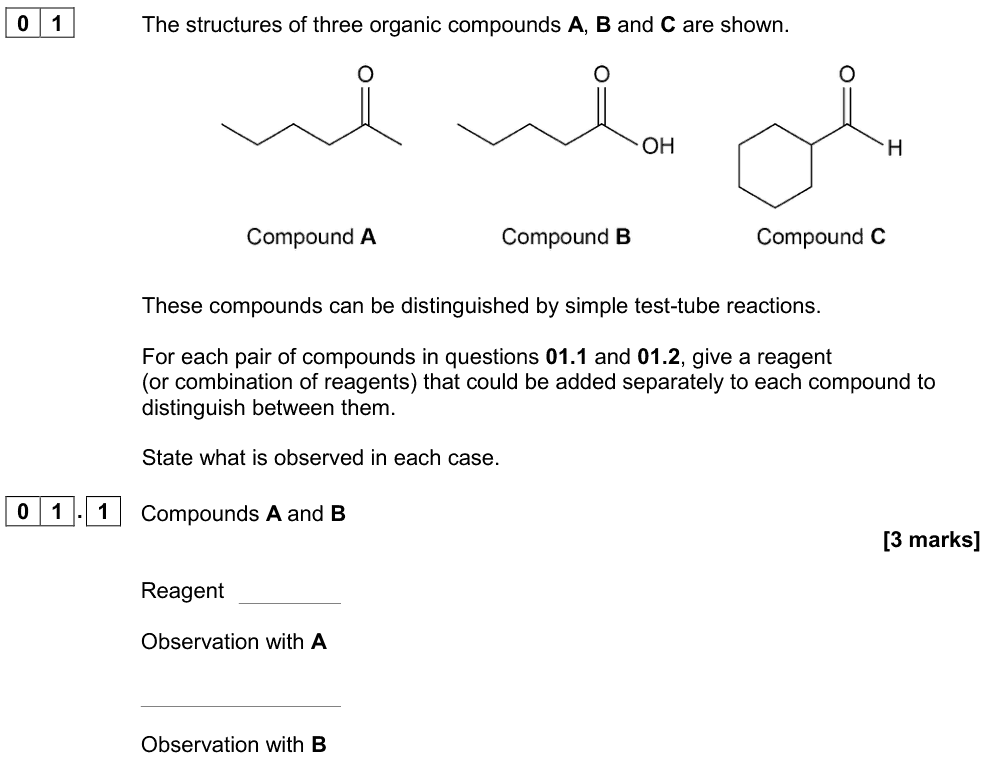
June 2024 · AS Paper 2 · Q01.13 marksAO1=3Practical and data analysis
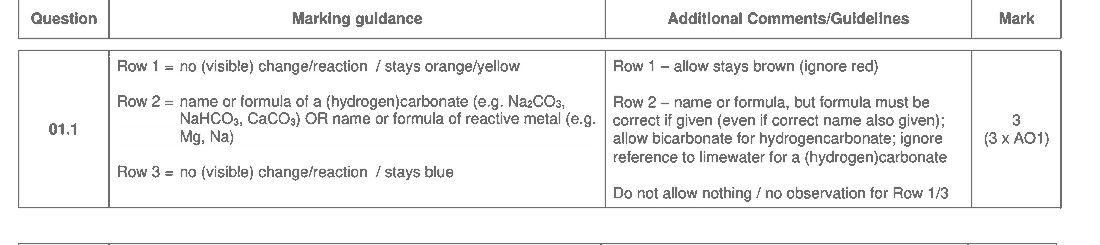
Mark scheme
Examiner's comment
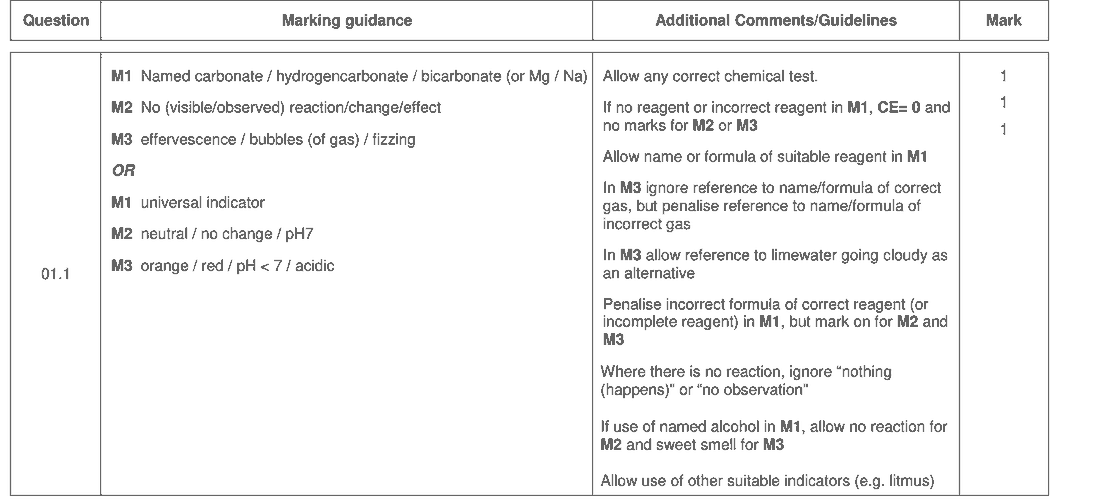
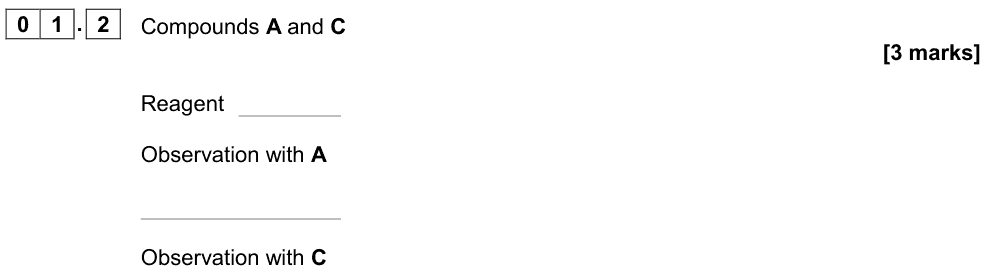
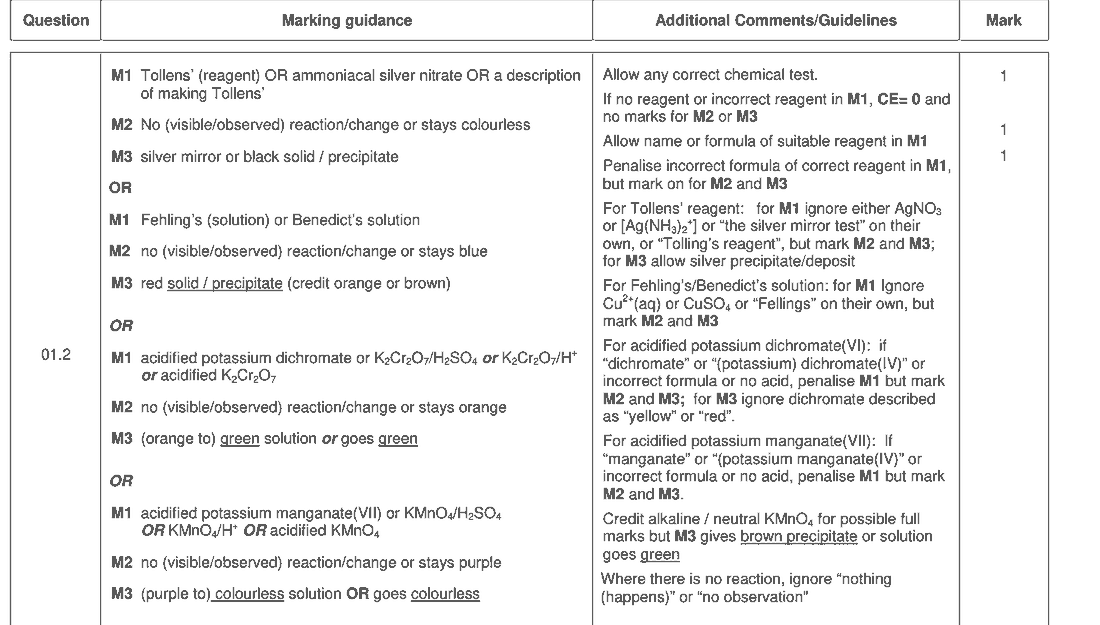
1.1 This question looked at chemical tests for common organic functional groups. Students answered this quite well, but some confused the test for aldehydes using Fehling’s solution with the Tollens’ test.
Notes from the mark scheme and report
Carboxylic acid with bromine water: no visible change (stays orange). Missing test giving bubbles only with the acid: add a named carbonate or hydrogencarbonate, for example Na2CO3 or NaHCO3 (or a reactive metal such as Mg). Ketone warmed with Fehling's solution: no visible change (stays blue). 'Nothing' or 'no observation' is not accepted
a formula must be correct. Some confused Fehling's with Tollens'
Skills: ATd Use laboratory apparatus for a variety of experimental techniques including: titration, using burette and pipette; distillation and heating under reflux, including setting up glassware using retort stand and clamps; qualitative tests for ions and organic functional groups; filtration, including use of fluted filter paper, or filtration under reduced pressure; PS4.1 Know and understand how to use a wide range of experimental and practical instruments, equipment and techniques appropriate to the knowledge and understanding included in the specification; RP6 Tests for alcohol, aldehyde, alkene and carboxylic acid
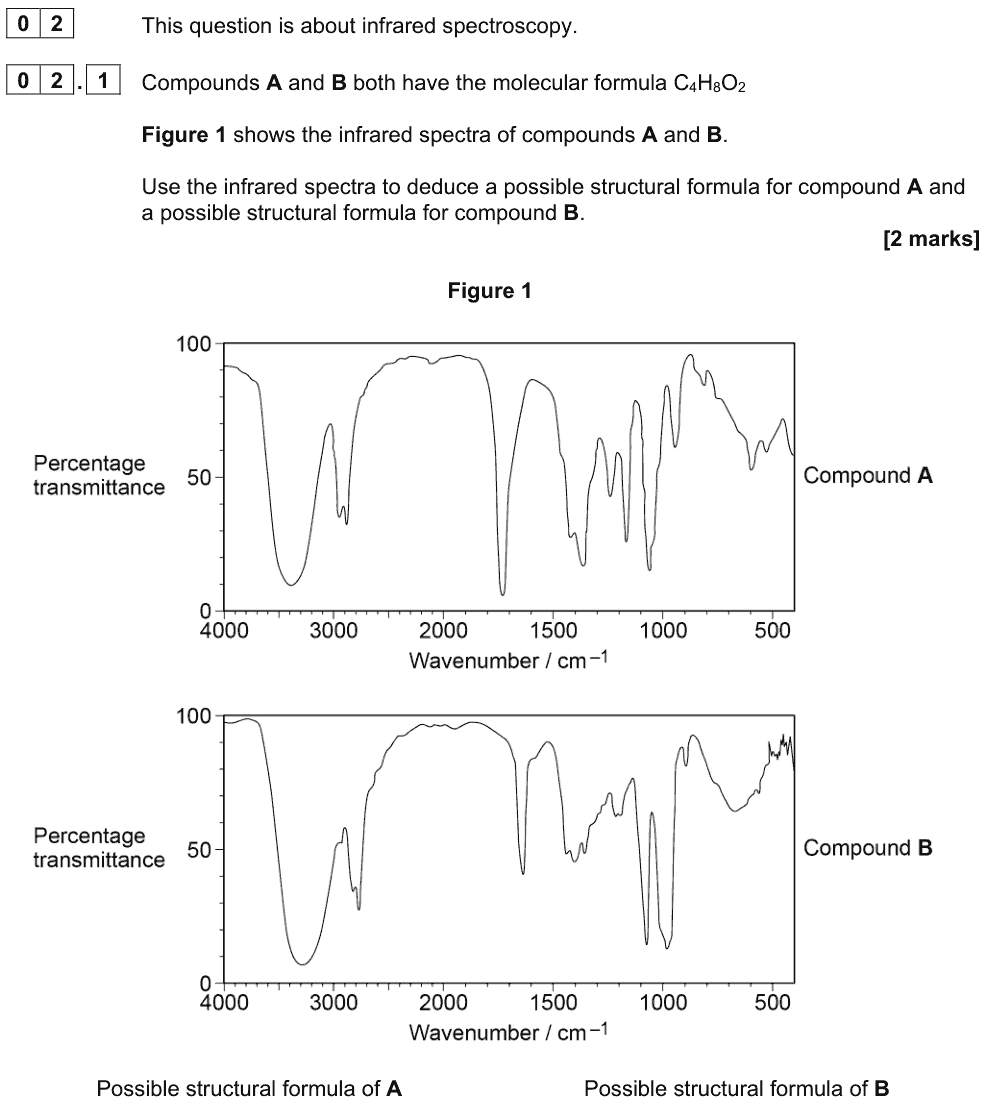
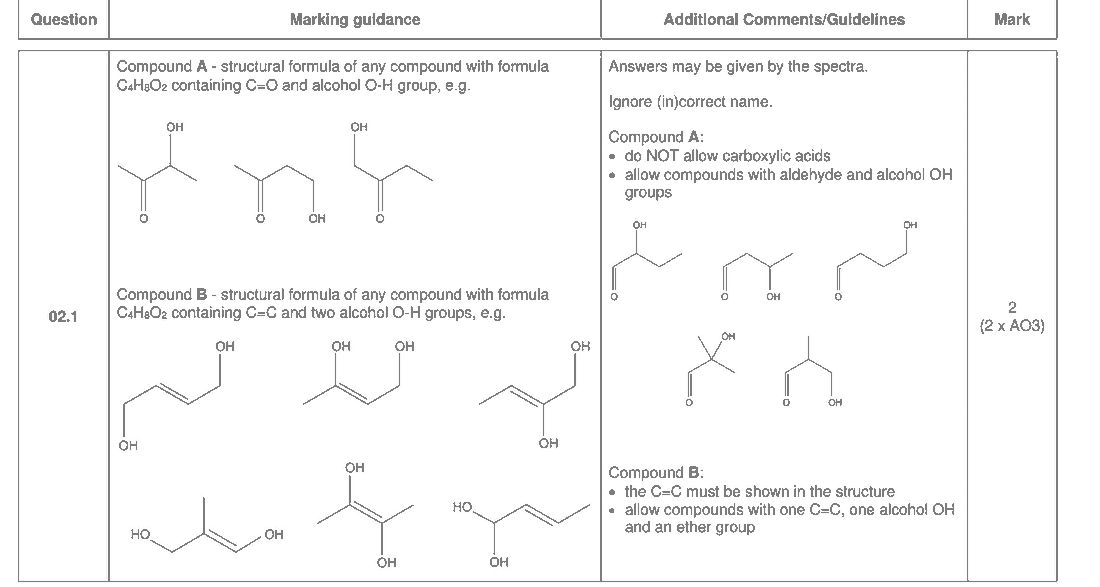
June 2024 · AS Paper 2 · Q02.12 marksAO3=2Diagram or structure
Mark scheme
Examiner's comment
2.1 Students struggled with this question which required them to identify functional groups from IR spectra and then suggest the structure of two compounds. Some confused the alcohol O-H signal with the carboxylic acid O-H peak, and some confused the C=O and C=C peaks. Also, some students did not appreciate that there are several ways to represent the structural formula of a compound. Many tried to write condensed formulas (e.g. HOCH2CH=CHCH2OH) but sometimes
Notes from the mark scheme and report
A shows alcohol O–H (3230–3550 cm–1) and C=O (1680–1750 cm–1): any C4H8O2 structure with a C=O and an alcohol OH, for example CH3COCH2CH2OH or CH3CH(OH)COCH3 (hydroxy-aldehydes allowed
not a carboxylic acid). B shows alcohol O–H and C=C (1620–1680 cm–1) with no C=O: for example HOCH2CH=CHCH2OH (C=C must be shown). Errors: alcohol O–H confused with the acid O–H
C=O confused with C=C
faulty condensed formulas
Skills: MS3.1 Translate information between graphical, numerical and algebraic forms
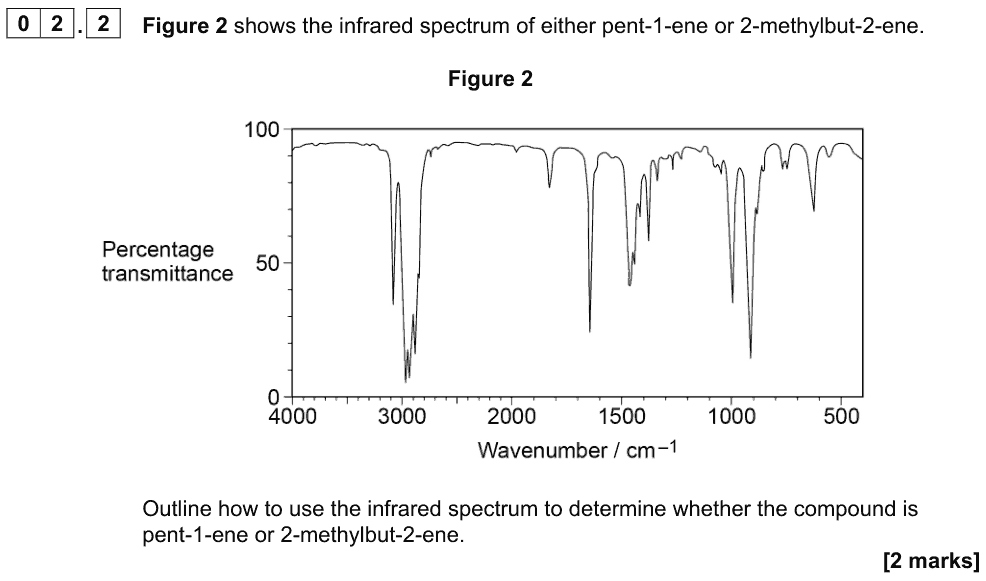
June 2024 · AS Paper 2 · Q02.22 marksAO1=2Short answer
Earlier part of question 02 that this part uses
Mark scheme
Examiner's comment
2.2 Many students did refer to the use of the fingerprint region of the IR spectrum to identify the compound, but some were mistaken as to where this region is, and few mentioned looking for an exact match of the fingerprint region to a known sample.
Notes from the mark scheme and report
Use the fingerprint region (below 1500 cm–1) and look for an exact match with the known spectrum of each compound. Few mentioned the exact match to a known spectrum
some placed the fingerprint region wrongly
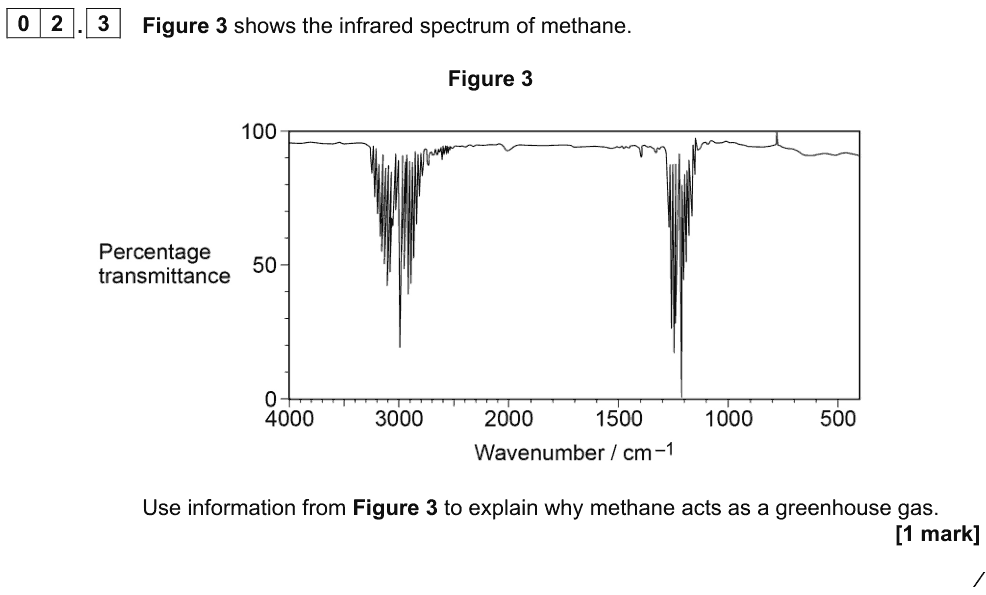
June 2024 · AS Paper 2 · Q02.31 markAO1=1Short answer
Earlier part of question 02 that this part uses
Mark scheme
Examiner's comment
2.3 This question required students to use the IR spectrum of methane to explain why methane acts as a greenhouse gas. Only a minority of students referred to the absorption of IR radiation. Some confused absorption and transmission, while others referred, incorrectly, to the absorption of UV light.
Notes from the mark scheme and report
Methane (its C–H bonds) absorbs infrared radiation, at about 3000 and 1300 cm–1 (the two absorptions in Figure 3
the mark scheme quotes 3000 and 1200). Must say absorbs IR
errors were confusing absorption with transmission, or saying UV
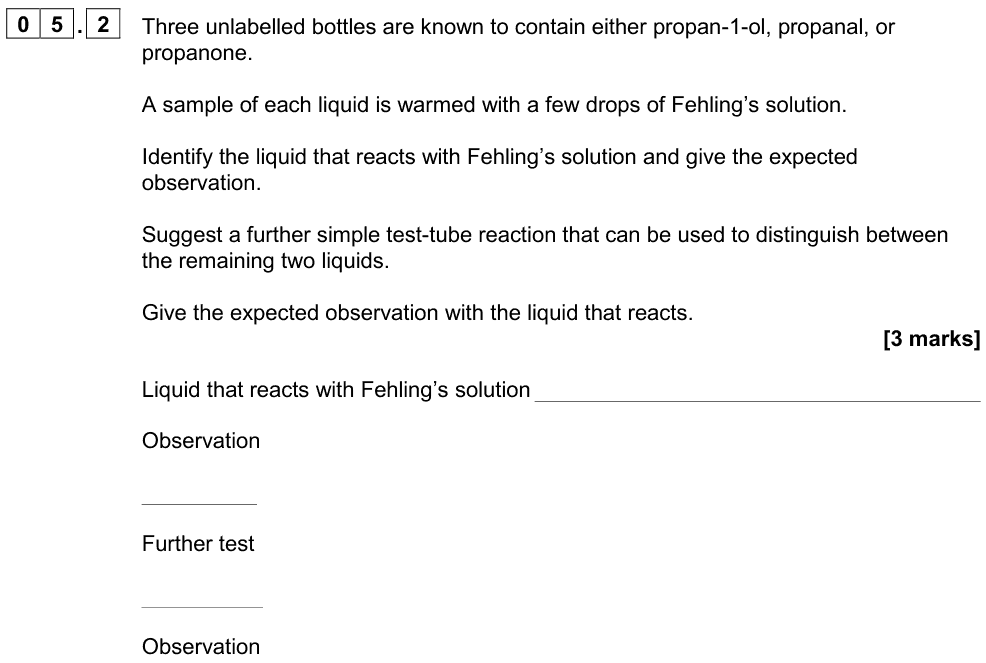
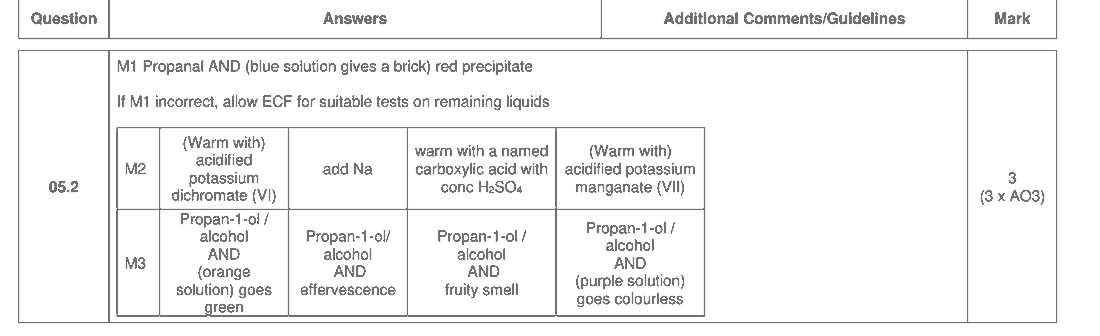
June 2024 · Paper 2 · Q05.23 marksAO3=3Practical and data analysis
Earlier part of question 05 that this part uses
Mark scheme
Examiner's comment
5.2 This was much better answered than Q5.1 and most students scored at least 2 of the 3 marks.
Notes from the mark scheme and report
Propanal: blue solution gives a brick-red precipitate. Further test: warm with acidified potassium dichromate(VI): propan-1-ol turns it from orange to green (propanone does not). Alternatives: sodium (effervescence with the alcohol)
carboxylic acid with concentrated H2SO4 (fruity smell)
acidified KMnO4 (purple to colourless)
Skills: ATd Use laboratory apparatus for a variety of experimental techniques including: titration, using burette and pipette; distillation and heating under reflux, including setting up glassware using retort stand and clamps; qualitative tests for ions and organic functional groups; filtration, including use of fluted filter paper, or filtration under reduced pressure; PS1.1 Solve problems set in practical contexts; RP6 Tests for alcohol, aldehyde, alkene and carboxylic acid
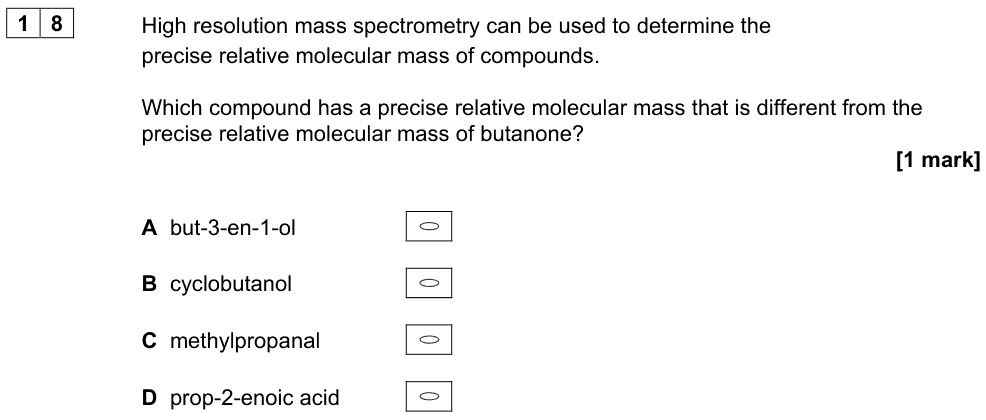
June 2024 · AS Paper 2 · Q181 markMultiple choice
Answer
D
Mark scheme
Notes from the mark scheme and report
Answer: D. Butanone, but-3-en-1-ol, cyclobutanol and methylpropanal are all C4H8O
prop-2-enoic acid is C3H4O2, so its precise Mr differs. Found harder, probably through not deducing the molecular formulas.
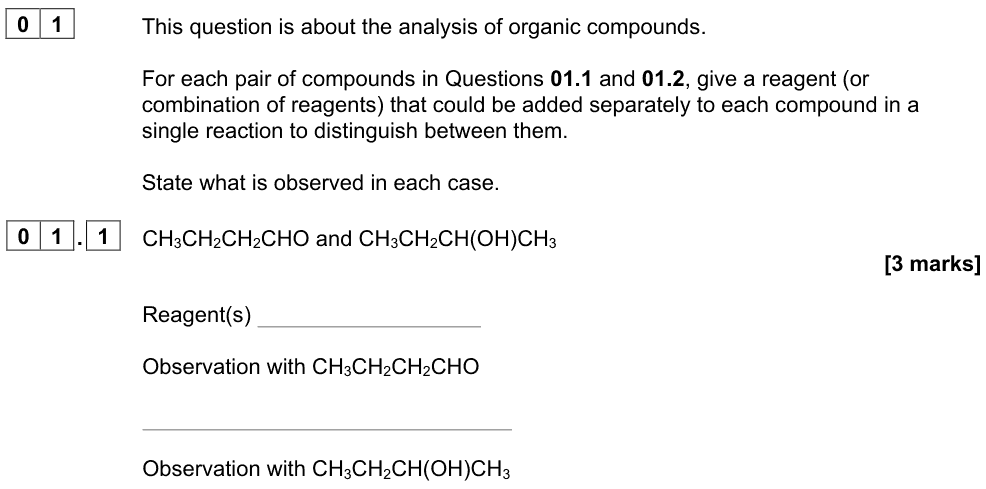
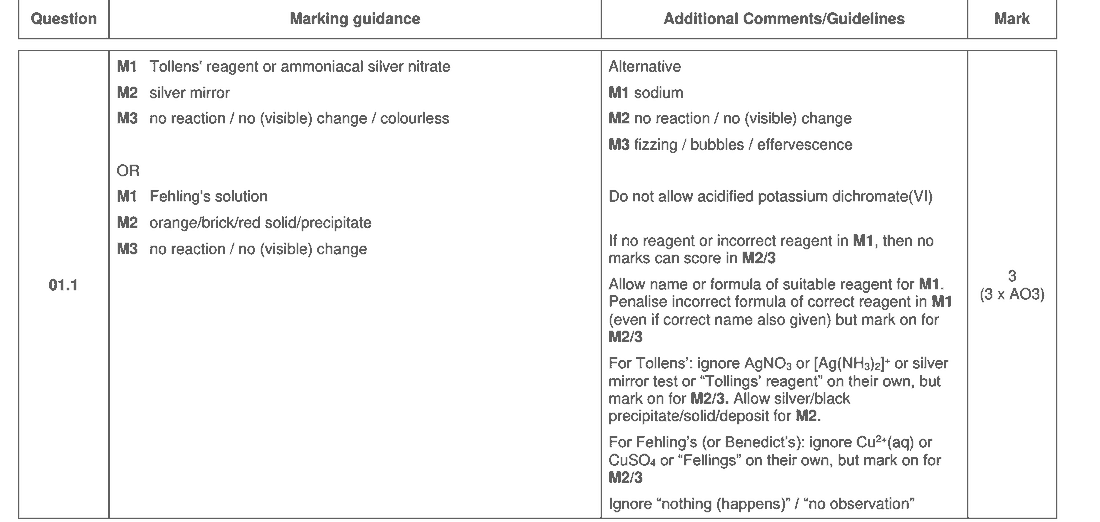
June 2023 · AS Paper 2 · Q01.13 marksAO3=3Practical and data analysis
Mark scheme
Examiner's comment
01.1 This question looked for a chemical test to distinguish between an aldehyde and a secondary alcohol. Many students scored well but the use of acidified potassium dichromate(VI), which would gave the same result with both compounds, was a common incorrect answer.
Notes from the mark scheme and report
Tollens' reagent (ammoniacal silver nitrate): silver mirror with the aldehyde, no visible change with the alcohol. Or Fehling's solution: brick-red precipitate with the aldehyde, no change with the alcohol. Or sodium: no change with the aldehyde, effervescence with the alcohol. Acidified potassium dichromate(VI) is not allowed (both turn it green)
no observation marks without a correct reagent
Skills: ATd Use laboratory apparatus for a variety of experimental techniques including: titration, using burette and pipette; distillation and heating under reflux, including setting up glassware using retort stand and clamps; qualitative tests for ions and organic functional groups; filtration, including use of fluted filter paper, or filtration under reduced pressure; PS1.1 Solve problems set in practical contexts; PS4.1 Know and understand how to use a wide range of experimental and practical instruments, equipment and techniques appropriate to the knowledge and understanding included in the specification; RP6 Tests for alcohol, aldehyde, alkene and carboxylic acid
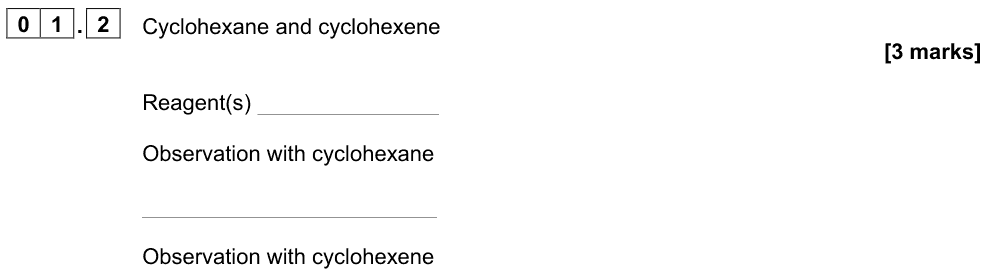
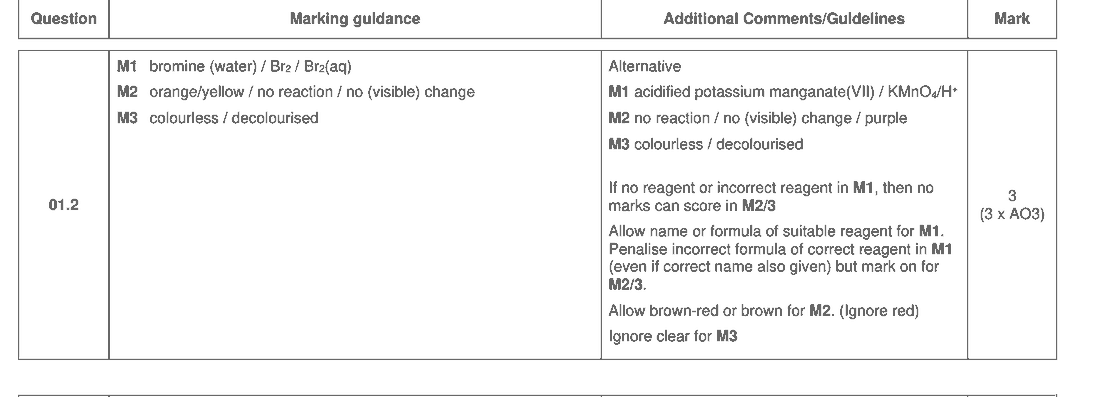
June 2023 · AS Paper 2 · Q01.23 marksAO3=3Practical and data analysisEasy
Earlier part of question 01 that this part uses
Mark scheme
Examiner's comment
01.2 This question looked for a chemical test to distinguish between a cycloalkane and a cycloalkene. Students did this well, with nearly three-quarters scoring full marks.
Notes from the mark scheme and report
Bromine water: stays orange / no visible change with cyclohexane
decolourised (orange to colourless) with cyclohexene. Alternative: acidified KMnO4, stays purple then decolourised. 'Clear' is ignored
Skills: ATd Use laboratory apparatus for a variety of experimental techniques including: titration, using burette and pipette; distillation and heating under reflux, including setting up glassware using retort stand and clamps; qualitative tests for ions and organic functional groups; filtration, including use of fluted filter paper, or filtration under reduced pressure; PS1.1 Solve problems set in practical contexts; PS4.1 Know and understand how to use a wide range of experimental and practical instruments, equipment and techniques appropriate to the knowledge and understanding included in the specification; RP6 Tests for alcohol, aldehyde, alkene and carboxylic acid
June 2023 · AS Paper 2 · Q01.33 marksAO2=3CalculationEasy
Earlier part of question 01 that this part uses
Mark scheme
Examiner's comment
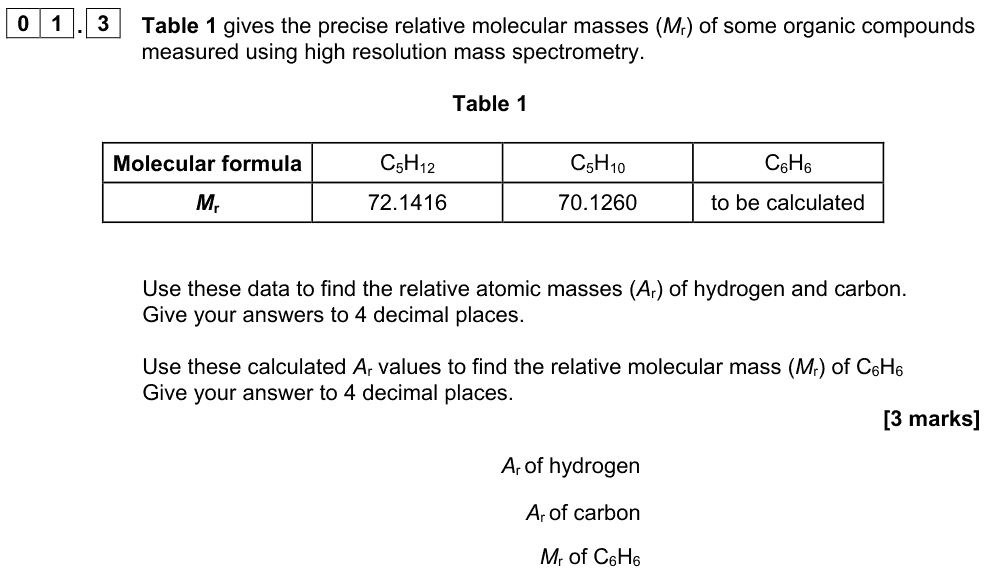
01.3 This question required students to use reasoning to work through a mathematical problem step by step based on data from high resolution mass spectrometry. Students did this well, with nearly two-thirds scoring all three marks.
Skills: MS2.4 Solve algebraic equations; MS0.0 Recognise and make use of appropriate units in calculation
June 2023 · AS Paper 2 · Q02.51 markAO1=1Short answer
Earlier part of question 02 that this part uses
Mark scheme
Examiner's comment
02.5 Students struggled to explain why carbon dioxide absorbs infrared radiation, with few describing the idea that radiation is absorbed at the frequency of the bond vibration.
Notes from the mark scheme and report
The C=O bonds vibrate at infrared frequencies (IR makes the bonds vibrate) / the C=O bonds are polar. Not 'CO2 is a polar molecule'. Few described bond vibration
June 2023 · Paper 2 · Q05.11 markAO1=1Short answer
Mark scheme
Examiner's comment
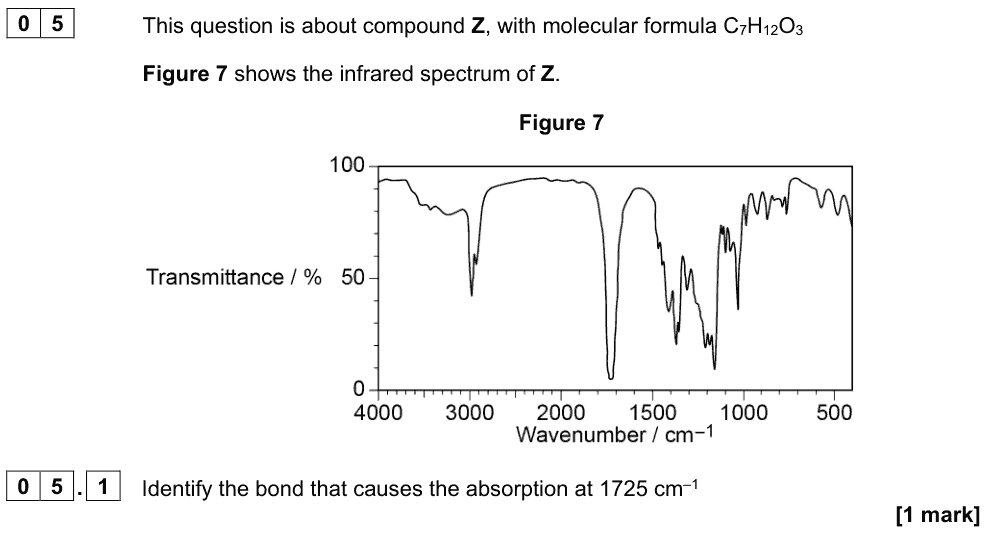
05.1 This was a very simple question requiring simple reference to the data sheet and so large numbers of students were able to score the mark.
Notes from the mark scheme and report
C=O (1680–1750 cm–1 on the data sheet)
June 2023 · Paper 2 · Q06.22 marksAO3=2Practical and data analysis
Earlier part of question 06 that this part uses
Mark scheme
Examiner's comment
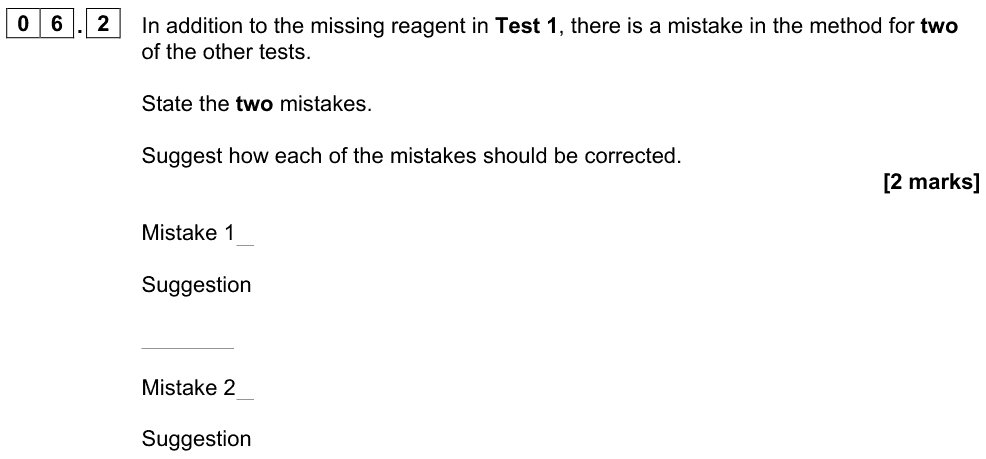
06.2 Around three-quarters of students were able to score at least 1 mark here. Some failed to score because, due to poor expression, they were unable to show clearly that the gas should be bubbled through limewater, or that simply observing effervescence would be enough to complete the test correctly.
Notes from the mark scheme and report
Test 2: should be warmed (in a water bath), not cooled in iced water. Test 3: the gas should not be tested with a lighted splint
bubble it through limewater (or just observe effervescence). Around three-quarters scored at least 1
poor expression lost marks
Skills: PS2.1 Comment on experimental design and evaluate scientific methods; ATb Use water bath or electric heater or sand bath for heating; RP6 Tests for alcohol, aldehyde, alkene and carboxylic acid
June 2023 · Paper 2 · Q06.38 marksAO3=8Practical and data analysis
Earlier part of question 06 that this part uses
Mark scheme
Examiner's comment
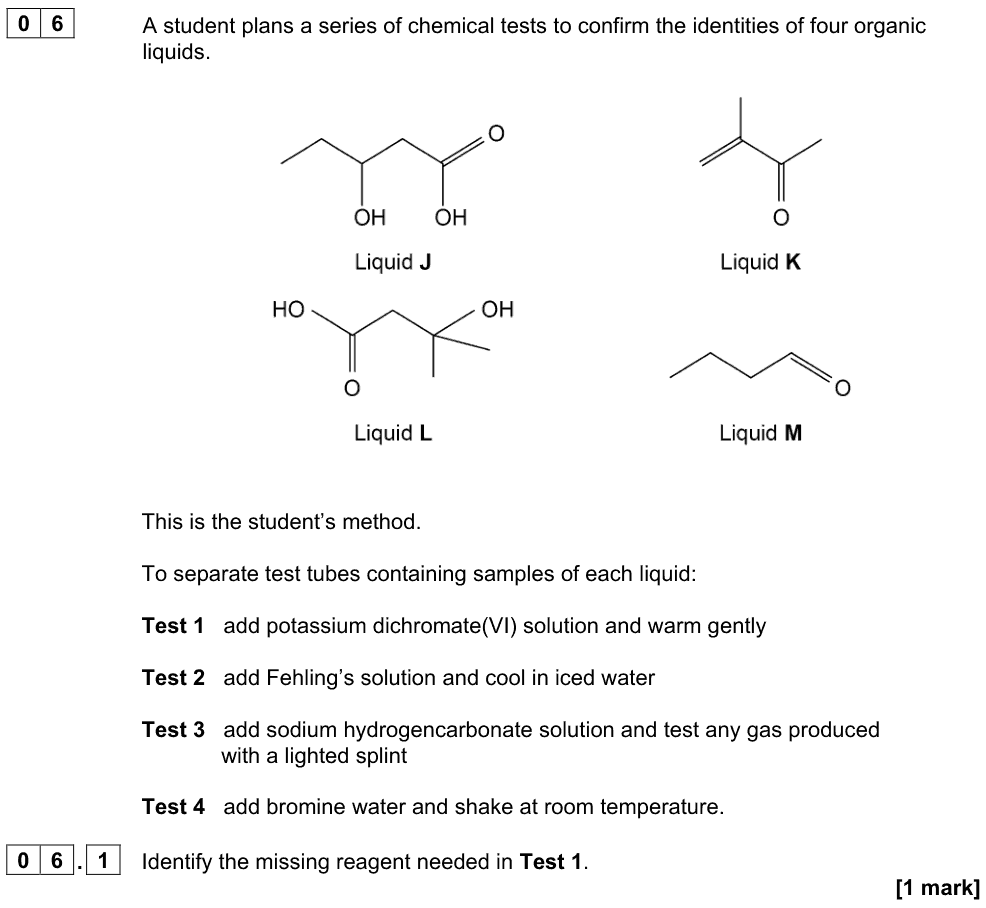
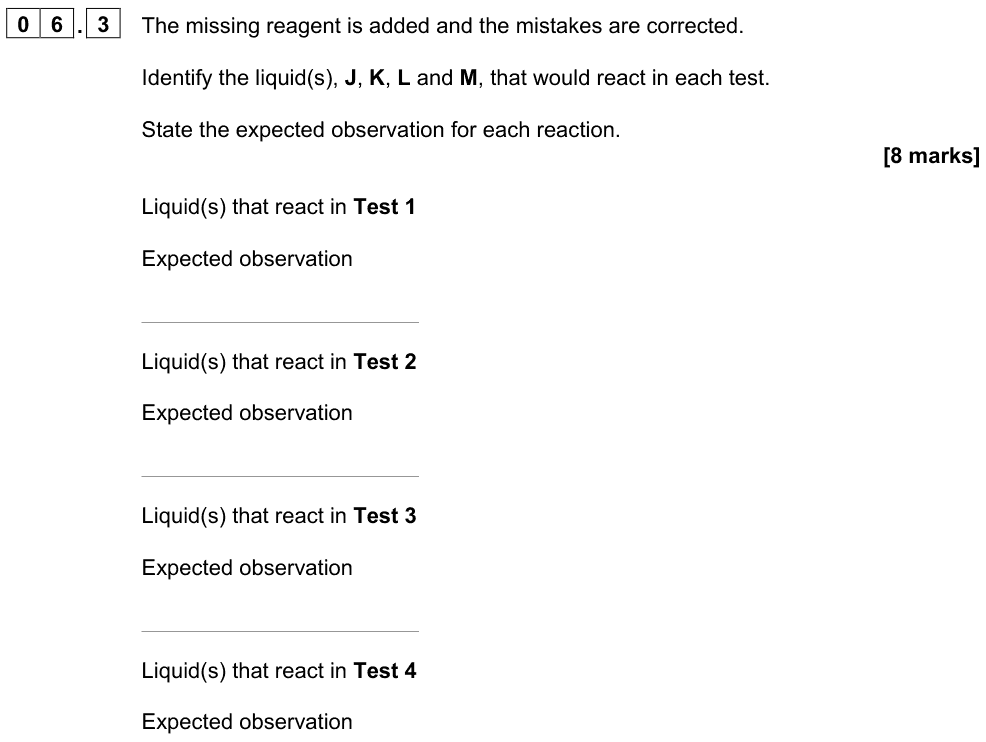
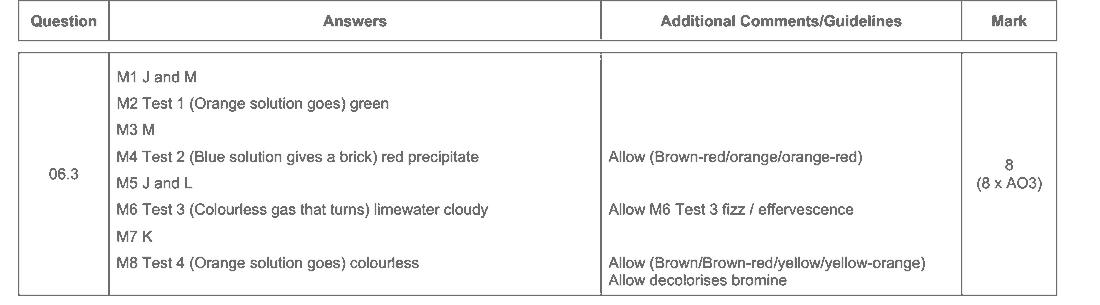
06.3 This question on familiar organic tests was answered quite well with around 80% able to score at least half marks. The observations for M2, M4, M6 and M8 were very well known, but the substances that would react in each test were less well understood. The question had a high discrimination index.
Notes from the mark scheme and report
Test 1: J and M (secondary alcohol and aldehyde)
orange solution turns green. Test 2: M only (aldehyde)
blue solution gives a brick-red precipitate. Test 3: J and L (carboxylic acids)
effervescence, gas turns limewater cloudy. Test 4: K only (C=C)
orange bromine water is decolourised. L's alcohol is tertiary so it is not oxidised
K is a ketone. Observations were well known
which liquids react was less well understood. About 80% scored at least half marks
Skills: PS1.2 Apply scientific knowledge to practical contexts; RP6 Tests for alcohol, aldehyde, alkene and carboxylic acid
June 2023 · AS Paper 2 · Q141 markAO2=1Multiple choice
Answer
B
Mark scheme
Examiner's comment
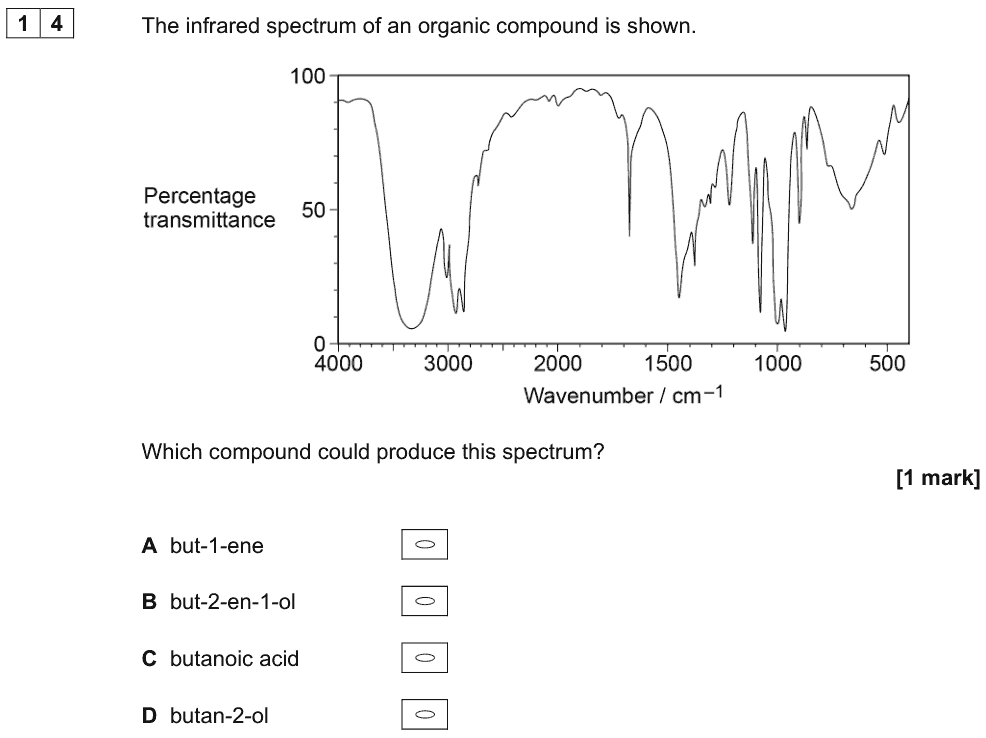
Many students incorrectly thought that the alcohol O-H group was a carboxylic acid O-H group.
Notes from the mark scheme and report
Answer: B. Broad alcohol O–H absorption at about 3230 to 3550 cm–1 and a C=C absorption at about 1650 cm–1
no C=O near 1700 and no very broad acid O–H. Many mistook the alcohol O–H for an acid O–H
Skills: MS3.1 Translate information between graphical, numerical and algebraic forms
June 2023 · Paper 3 · Q331 markAO1=1Multiple choice
Answer
A
Mark scheme
Notes from the mark scheme and report
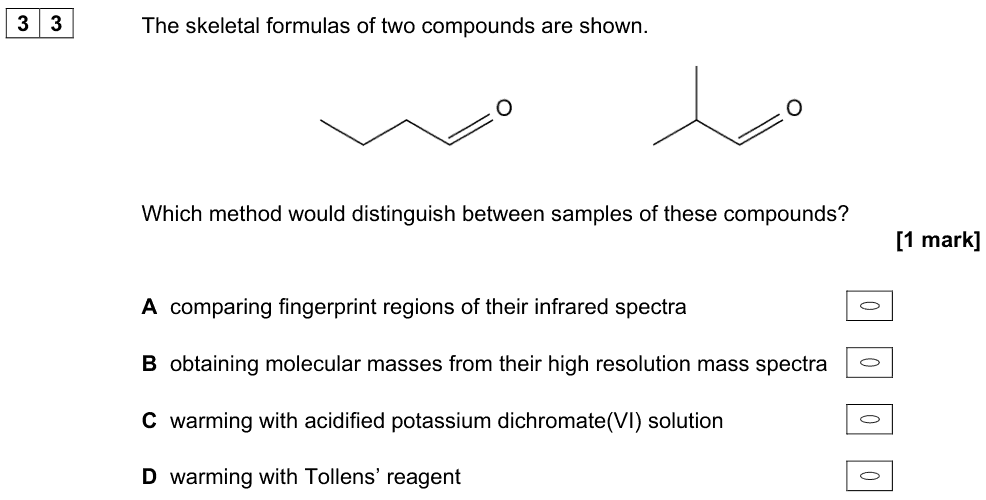
Answer: A. Butanal and methylpropanal are isomeric aldehydes: same precise Mr, both oxidised by dichromate and both give a silver mirror
only their infrared fingerprint regions differ
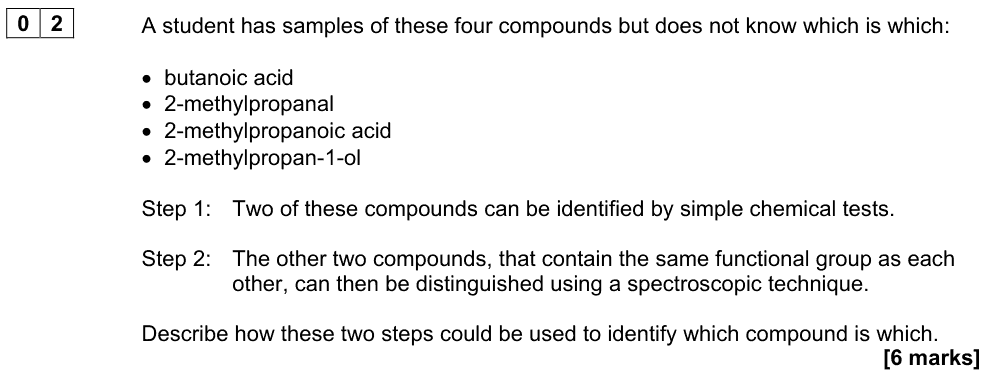
June 2022 · AS Paper 2 · Q026 marksAO1=4, AO3=26-mark level of response
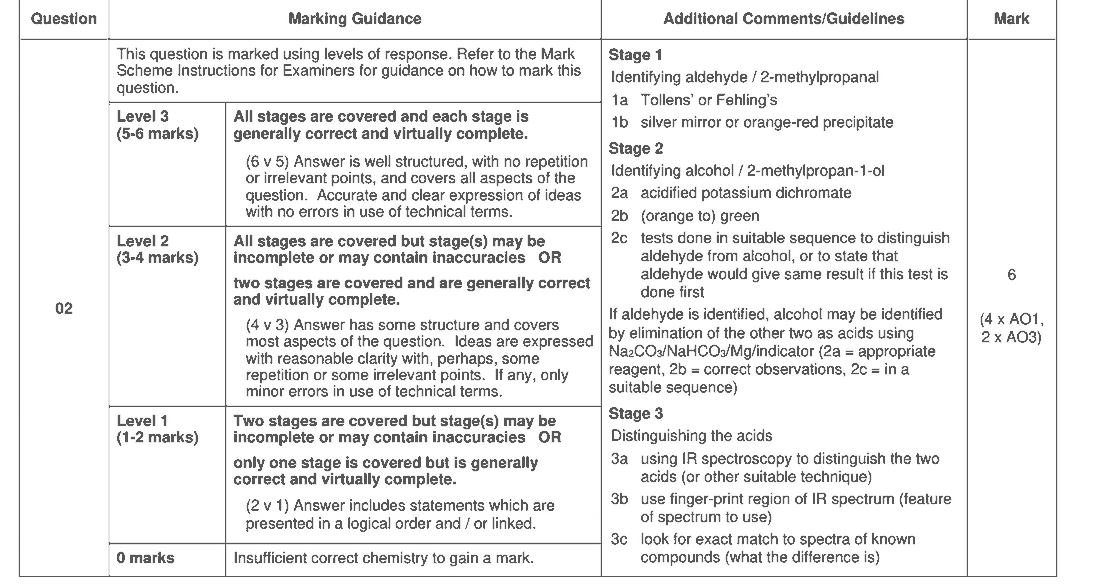
Mark scheme, with the levels and indicative content
Examiner's comment
Distinguishing organic compounds
This question looked for chemical tests and then the use of spectroscopy to distinguish four organic compounds. Some students did not read the question carefully enough and did chemical tests for the carboxylic acids which was not necessary. Other students did not appreciate that both the aldehyde and the alcohol would turn acidified potassium dichromate(VI) from orange to green. Some students mixed up IR spectroscopy and mass spectrometry, while others did not appreciate that the two acids had the same formula mass which negated the way they suggested using mass spectrometry.
Notes from the mark scheme and report
Levels of response, three stages. Stage 1 aldehyde (2-methylpropanal): Tollens' reagent gives a silver mirror or Fehling's solution gives an orange-red precipitate. Stage 2 alcohol (2-methylpropan-1-ol): acidified potassium dichromate turns orange to green, done in a sequence that separates it from the aldehyde (which gives the same result)
or by eliminating the two acids with Na2CO3/NaHCO3/Mg/indicator. Stage 3 the two acids: infrared spectroscopy, using the fingerprint region and looking for an exact match with spectra of known compounds. Errors: forgetting that both aldehyde and alcohol reduce dichromate
using mass spectrometry although the acids have the same Mr
Skills: PS1.1 Solve problems set in practical contexts; PS2.1 Comment on experimental design and evaluate scientific methods; RP6 Tests for alcohol, aldehyde, alkene and carboxylic acid
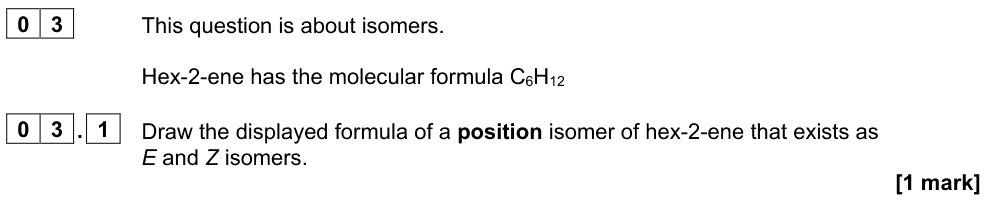
June 2022 · AS Paper 2 · Q03.31 markAO2=1Diagram or structure
Earlier part of question 03 that this part uses
Mark scheme
Examiner's comment
3.3 This question looked for the skeletal formula of a functional group isomer using IR data. This was answered reasonably well.
Notes from the mark scheme and report
Skeletal formula of butanone (C=O absorption at 1680–1750 cm–1
a ketone is the functional group isomer of the aldehyde)
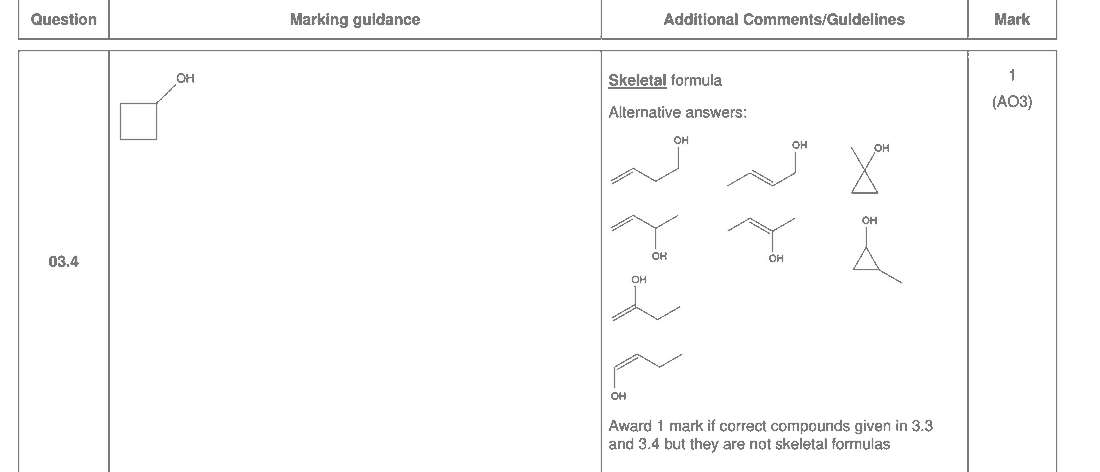
June 2022 · AS Paper 2 · Q03.41 markAO3=1Diagram or structure
Earlier parts of question 03 that this part uses
Mark scheme
Examiner's comment
3.4 This question looked for the skeletal formula of a structural isomer using IR data. Students found this more challenging to do than question 3.3.
Notes from the mark scheme and report
Skeletal formula of a C4H8O alcohol (O–H absorption at 3230–3550 cm–1): cyclobutanol, or alternatives such as but-3-en-1-ol, but-2-en-1-ol, but-3-en-2-ol, cyclopropylmethanol or a methylcyclopropanol. Found harder than 03.3
June 2022 · Paper 2 · Q066 marksAO1=3, AO3=36-mark level of response
Mark scheme, with the levels and indicative content
Examiner's comment
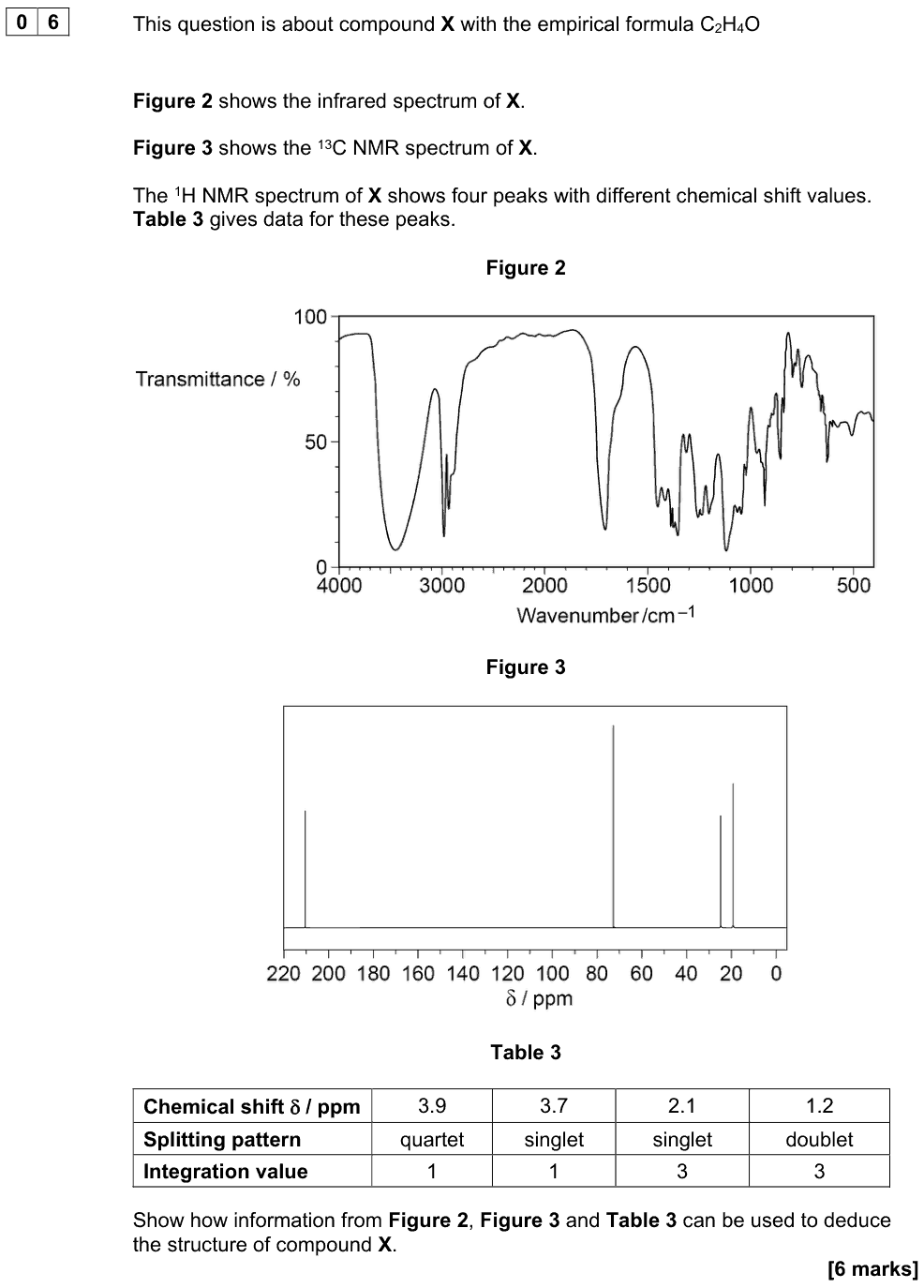
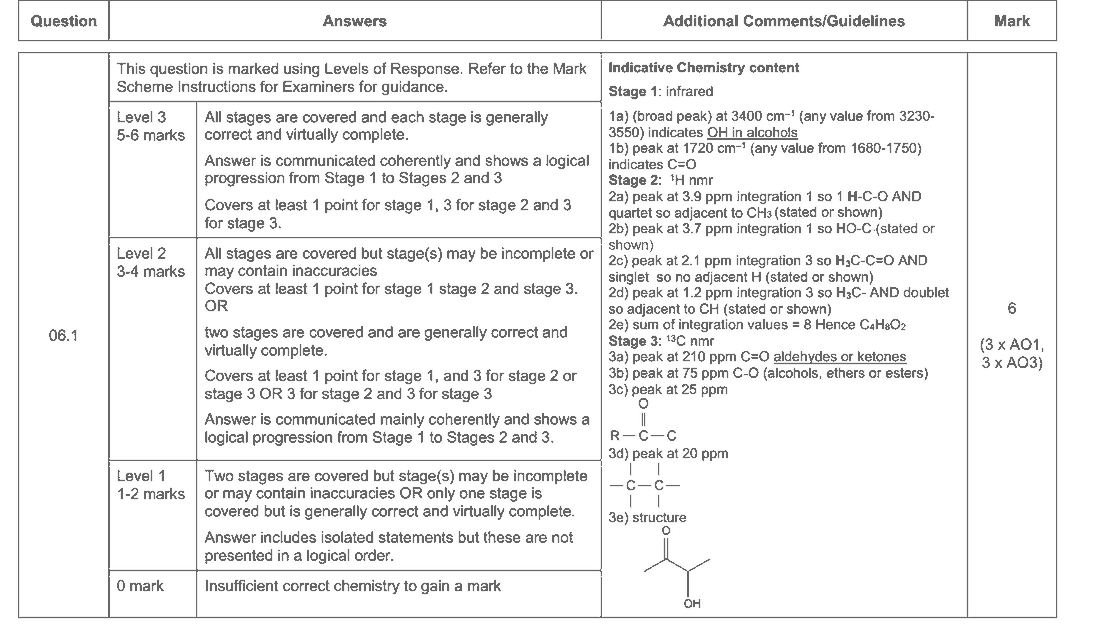
This question was marked using a levels of response mark scheme. Most students were able to get started and could identify some structural features using the infrared spectrum and the data
booklet. The best answers also showed a logical and systematic approach in analysis of each signal in the 13C NMR spectrum and the table of data relating to the 1H NMR spectrum. Students often failed to reach the highest level because their answers lacked sufficient detail, despite arriving at the correct overall structure.
Notes from the mark scheme and report
Levels of response, three stages. Infrared: broad absorption about 3400 cm–1 = O–H (alcohol)
about 1720 cm–1 = C=O. 1H NMR: 3.9 ppm, 1H, H–C–O, quartet so next to CH3
3.7 ppm, 1H, O–H
2.1 ppm, 3H, CH3–C=O, singlet so no adjacent H
1.2 ppm, 3H, CH3, doublet so next to CH
integration total 8 H so C4H8O2. 13C NMR: about 210 ppm C=O of a ketone or aldehyde
about 75 ppm C–O
about 25 ppm C next to C=O
about 20 ppm C–C. Structure: CH3COCH(OH)CH3 (3-hydroxybutan-2-one). Many reached the structure without enough supporting detail
November 2021 · Paper 2 · Q02.31 markShort answer
Earlier part of question 02 that this part uses
Mark scheme
Examiner's comment
In this question a surprisingly small proportion of students were able to state the meaning of the term fraction. In addition, very few were able to explain why C=O bonds in carbon dioxide absorb infrared radiation. A good range of answers was seen for the extended response question about the environmental impact of bioethanol as a fuel, but a significant number of students were unable to get started here.
Notes from the mark scheme and report
The C=O bonds vibrate at the same frequency as the infrared radiation (bond vibrations match the IR frequency)
allow 'C=O bonds are polar'. Very few could explain this
November 2021 · AS Paper 2 · Q04.62 marksExplanation
Earlier part of question 04 that this part uses
Mark scheme
Notes from the mark scheme and report
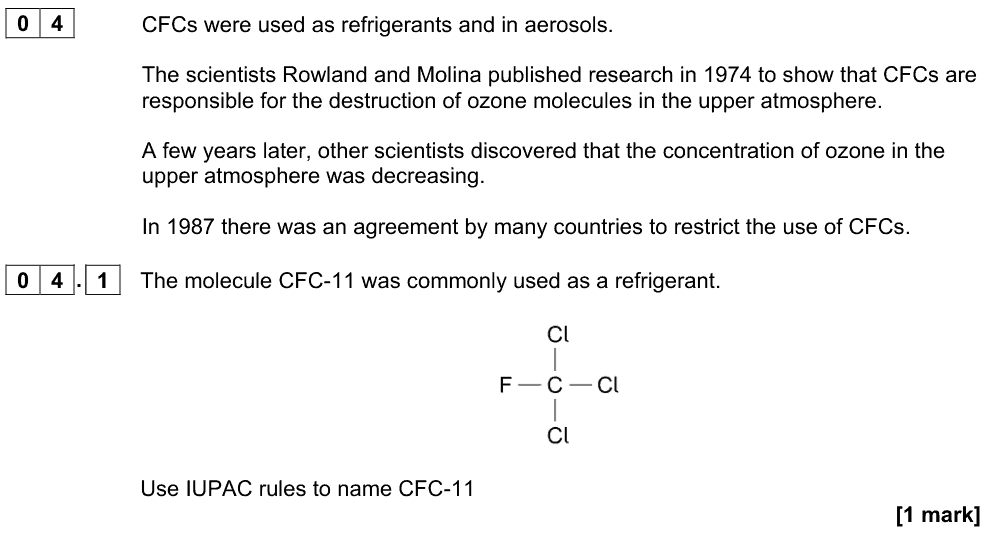
It absorbs infrared radiation
because the molecule has polar bonds (C–Cl, C–F)
November 2021 · Paper 2 · Q07.11 markShort answerEasy
Mark scheme
Examiner's comment
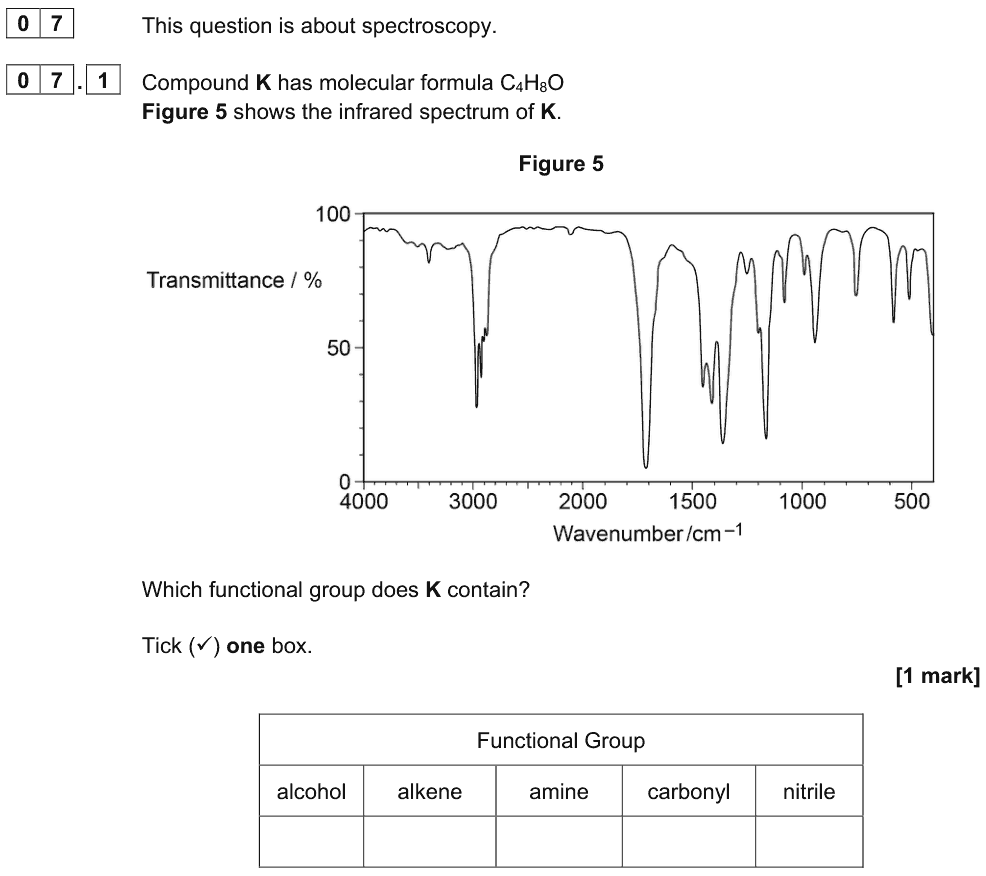
Over 75% of students scored the mark for question 07.1 and there was a good range of marks seen for question 07.2, with many able to score at least 1 mark here.
Notes from the mark scheme and report
Carbonyl (strong absorption at 1680–1750 cm–1
no broad O–H at 3230–3550 cm–1)
Skills: MS3.1 Translate information between graphical, numerical and algebraic forms
November 2021 · Paper 2 · Q07.23 marksShort answer
Earlier part of question 07 that this part uses
Mark scheme
Examiner's comment
Over 75% of students scored the mark for question 07.1 and there was a good range of marks seen for question 07.2, with many able to score at least 1 mark here.
Notes from the mark scheme and report
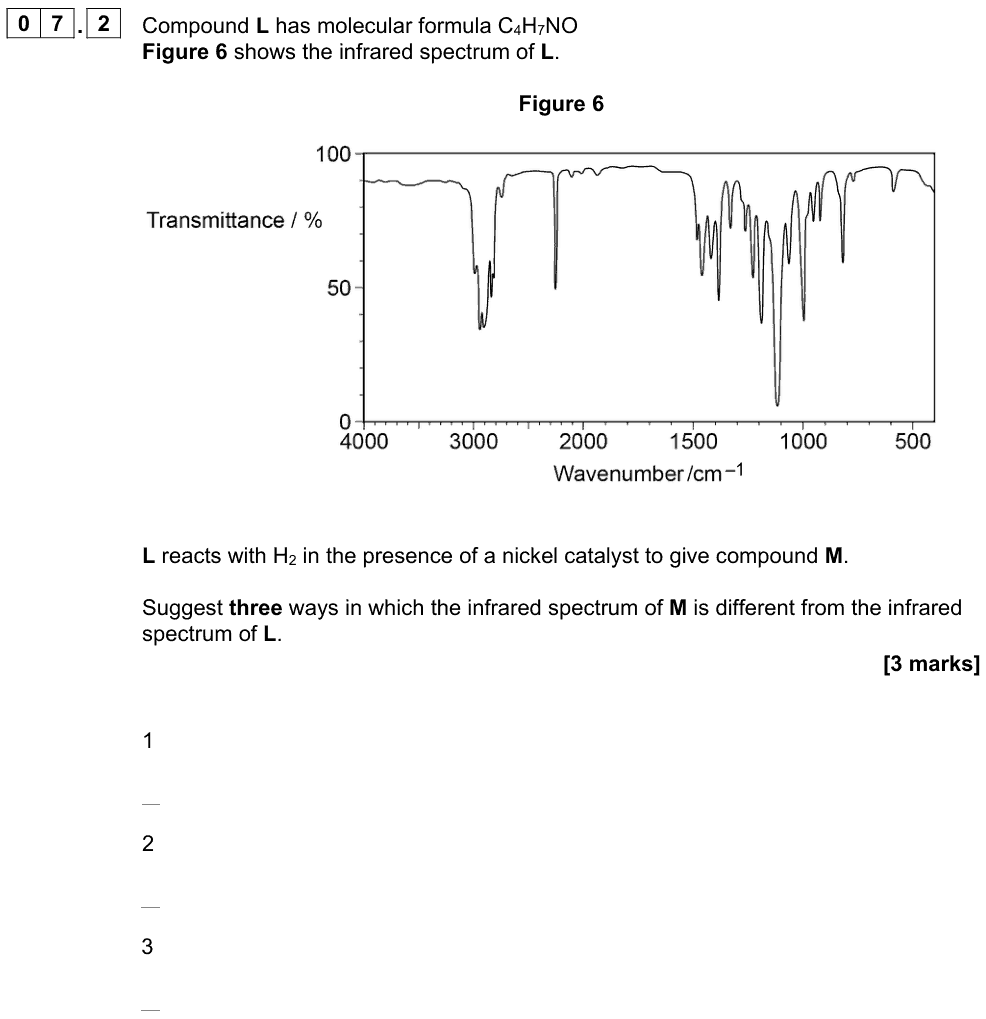
The C≡N absorption at 2220–2260 cm–1 disappears
an N–H absorption at 3300–3500 cm–1 appears (the nitrile is reduced to a primary amine)
the fingerprint region is different. Both changes stated without wavenumbers score 1 in total
Skills: MS3.1 Translate information between graphical, numerical and algebraic forms
November 2021 · AS Paper 2 · Q07.41 markDiagram or structure
Earlier part of question 07 that this part uses
Mark scheme
Notes from the mark scheme and report
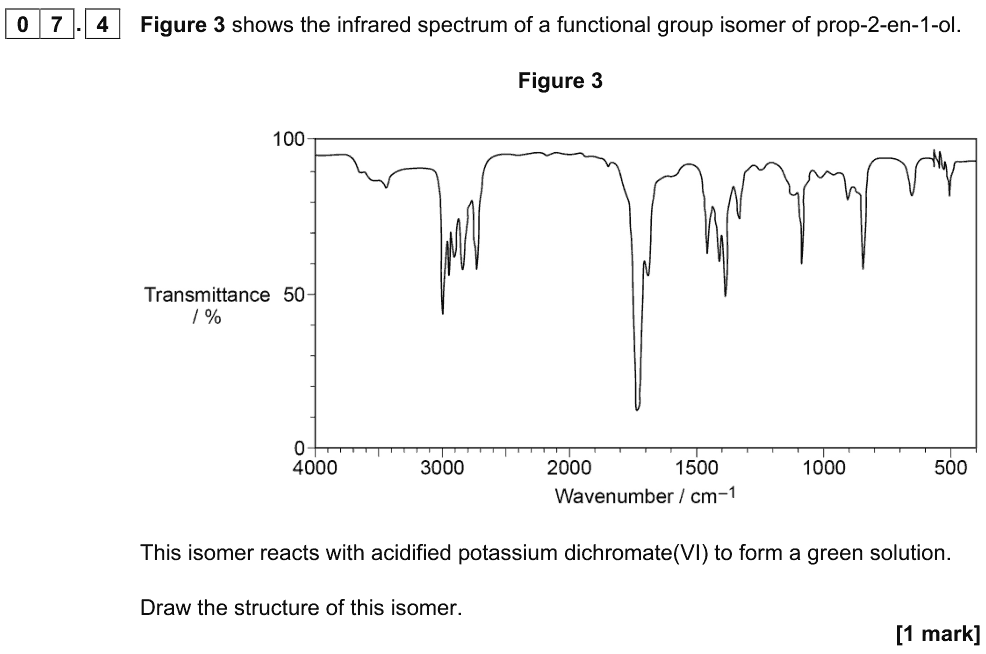
Propanal, CH3CH2CHO. The spectrum has a strong C=O absorption near 1700 cm–1 and no O–H absorption, and the isomer is oxidised by acidified dichromate, so it is an aldehyde (not propanone)
Skills: MS3.1 Translate information between graphical, numerical and algebraic forms
November 2021 · Paper 3 · Q06.63 marksPractical and data analysis
Earlier part of question 06 that this part uses
Mark scheme
Examiner's comment
Practical weaknesses and insufficient precision in answers let many students down here.
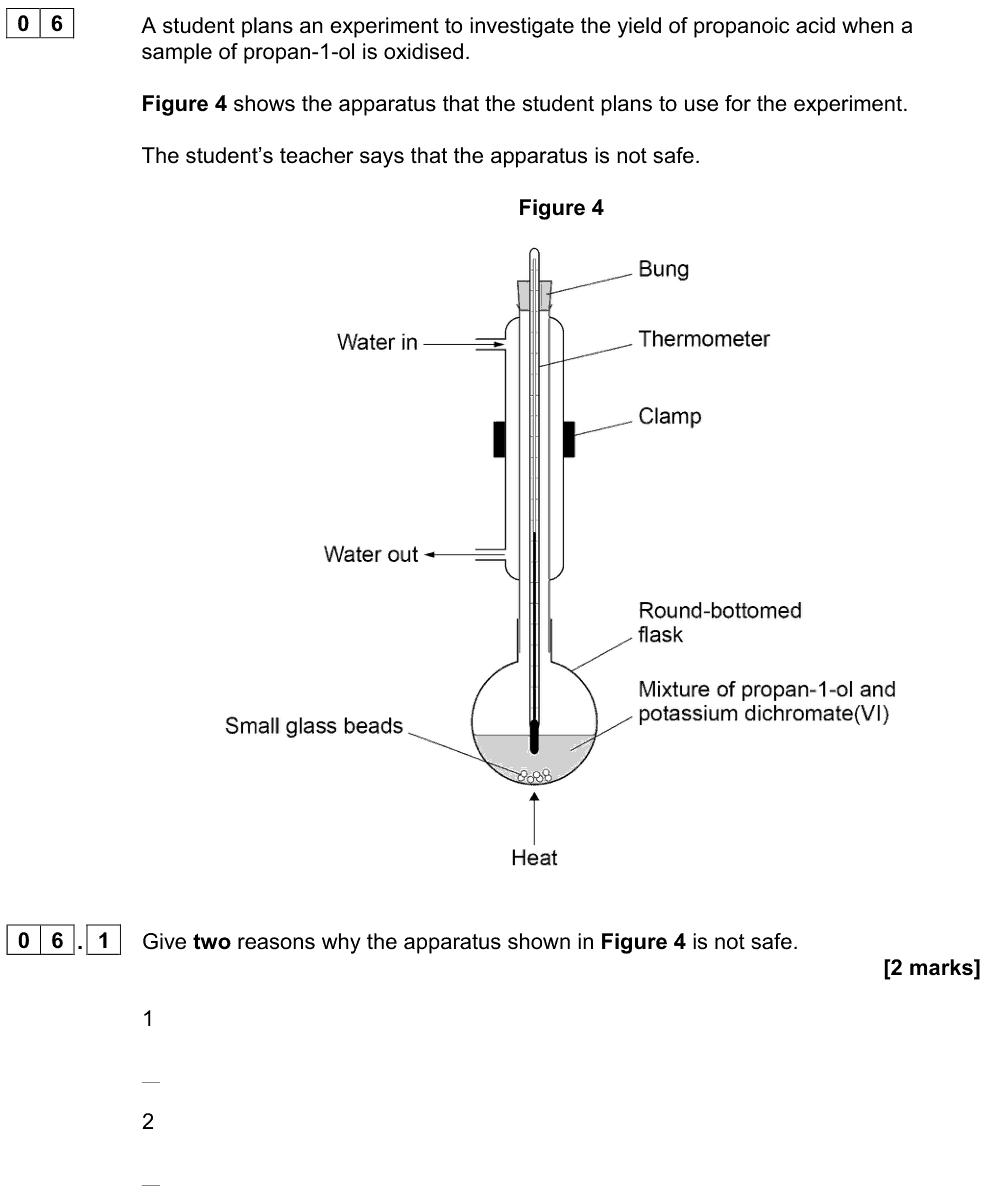
Question 06.1 specifically asked for safety concerns related to the apparatus diagram, with the hope that students would recognise that the bung should not be present (as it would mean a sealed apparatus is being heated) and that the flask is not clamped. Vague references to ‘the clamp being in the wrong place’ were not sufficient because a more specific response was needed.
Many students referred to the direction of the water flow being wrong because it should enter at the bottom of the condenser – but this is not a safety concern so could not be credited here. However, if it was mentioned in 06.1 but not then mentioned in 06.3, credit was still allowed for 06.3.
In question 06.3 many students failed to recognise that the thermometer is not needed at all and got confused with distillation by suggesting that the thermometer needed to be higher up in the apparatus.
Notes from the mark scheme and report
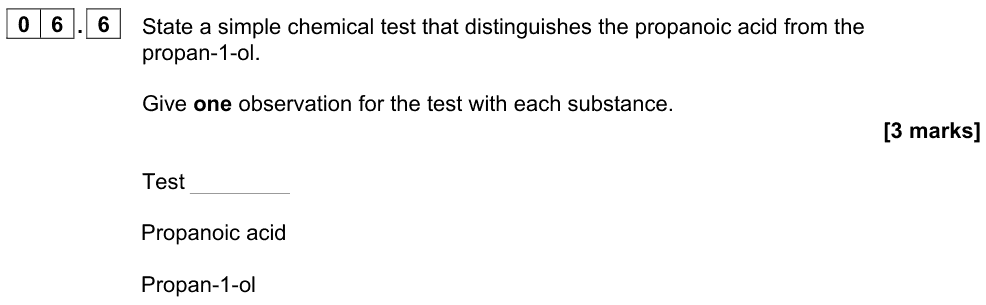
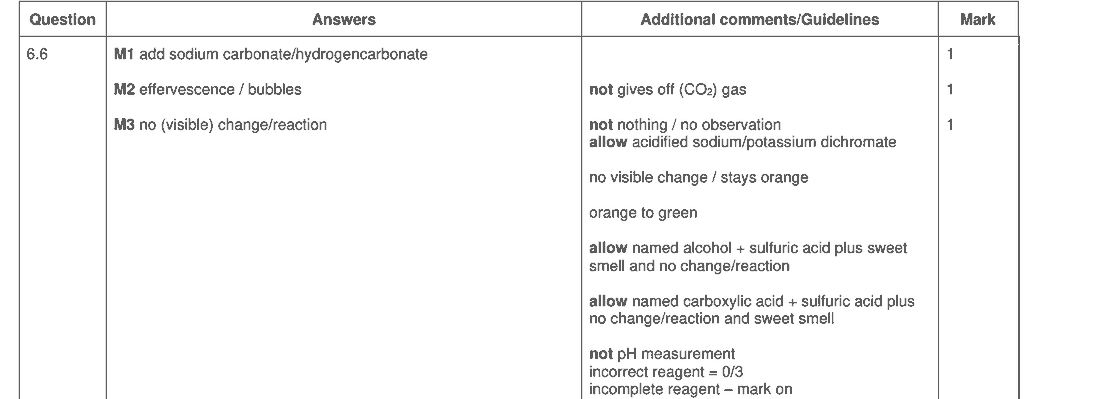
Add sodium carbonate or sodium hydrogencarbonate: effervescence with propanoic acid, no visible change with propan-1-ol. Or acidified potassium dichromate: stays orange with the acid, orange to green with the alcohol. 'Gives off CO2' and 'nothing' are not observations
pH measurement is not accepted
wrong reagent scores 0
Skills: PS1.1 Solve problems set in practical contexts; RP6 Tests for alcohol, aldehyde, alkene and carboxylic acid
November 2020 · Paper 2 · Q03.54 marksExplanation
Earlier part of question 03 that this part uses
Mark scheme
Examiner's comment
Large numbers of students could identify infrared absorptions that could be used to distinguish isomers in 03.5, but far fewer appreciated that the fingerprint region should be used to distinguish those that had common absorptions above 1500 cm–1.
Notes from the mark scheme and report
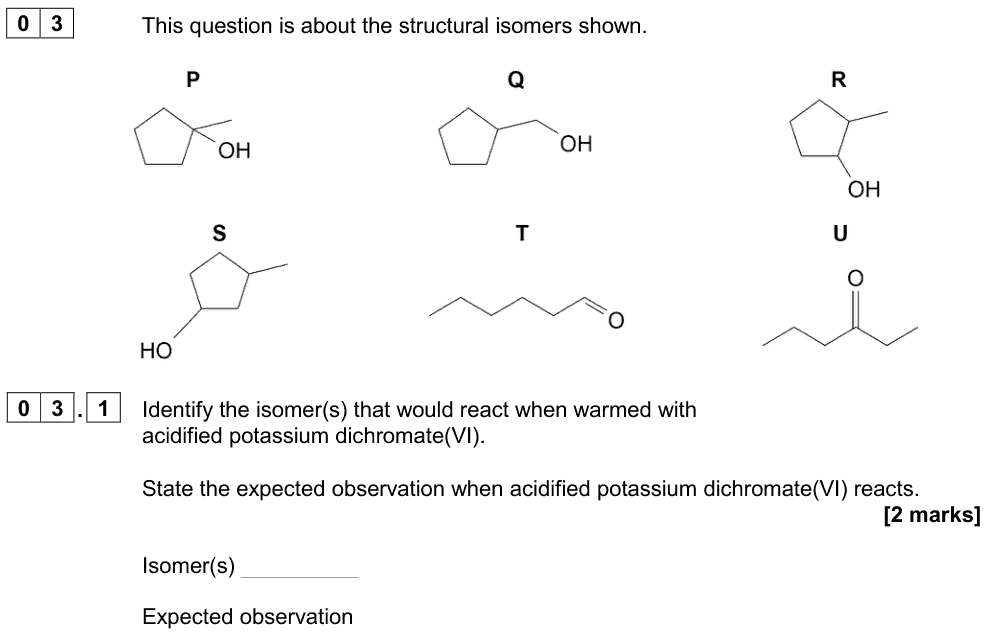
R and S show an O–H (alcohol) absorption at 3230 to 3550 cm–1
T shows C=O at 1680 to 1750 cm–1
R and S are told apart by their unique fingerprint regions (below 1500 cm–1), by comparing with spectra of known compounds in a database for an exact match. The fingerprint step was often missed
November 2020 · Paper 2 · Q03.61 markShort answer
Earlier part of question 03 that this part uses
Mark scheme
Examiner's comment
A common problem in this question was being unable to identify common features that linked some of the isomers. As such, many included isomers that did not fit the demand in each of the first three parts of the question. The expected observations for test tube reactions in 03.1 and 03.2 were well known. 03.3 proved more difficult with students finding it hard to identify neutralisation of excess acid as the reason why the esterification reaction mixture was poured into NaHCO3 solution. 03.4 was very well known. Large numbers of students could identify infrared absorptions that could be used to distinguish isomers in 03.5, but far fewer appreciated that the fingerprint region should be used to distinguish those that had common absorptions above 1500 cm–1.
Notes from the mark scheme and report
They are isomers, so all have the same Mr (same molecular formula) and give the same molecular ion m/z peak
November 2020 · AS Paper 2 · Q131 markMultiple choice
Answer
B
Mark scheme
Notes from the mark scheme and report
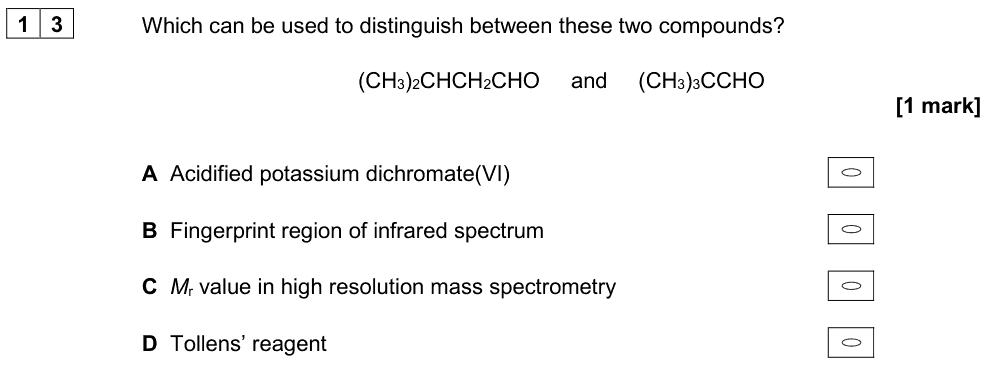
Answer: B. The two are isomeric aldehydes (same molecular formula, same precise Mr, same functional-group tests), so only the fingerprint region differs
June 2019 · AS Paper 2 · Q01.13 marksPractical and data analysis
Mark scheme
Examiner's comment
1.1 This question looked for a test to distinguish a ketone from a carboxylic acid. Some students thought that the ketone, shown by a skeletal structure, was an aldehyde and tested for an aldehyde rather than using a test for the carboxylic acid.
Notes from the mark scheme and report
Ketone (A) v carboxylic acid (B). Named carbonate or hydrogencarbonate (or Mg): A no visible change
B effervescence. Or universal indicator: A no change / neutral
B orange / red. Wrong or missing reagent = 0. Some took the skeletal ketone for an aldehyde and tested for that
Skills: ATd Use laboratory apparatus for a variety of experimental techniques including: titration, using burette and pipette; distillation and heating under reflux, including setting up glassware using retort stand and clamps; qualitative tests for ions and organic functional groups; filtration, including use of fluted filter paper, or filtration under reduced pressure; PS1.1 Solve problems set in practical contexts; RP6 Tests for alcohol, aldehyde, alkene and carboxylic acid
June 2019 · AS Paper 2 · Q01.23 marksPractical and data analysis
Earlier part of question 01 that this part uses
Mark scheme
Examiner's comment
1.2 This question looked for a test to distinguish a ketone from an aldehyde. This was answered well, but many who used Fehling’s solution referred to a colour change and did not include the idea that a precipitate was formed.
Notes from the mark scheme and report
Ketone (A) v aldehyde (C). Tollens' reagent: A no visible change
C silver mirror. Or Fehling's solution: A stays blue
C red precipitate. Or acidified potassium dichromate(VI): A stays orange
C goes green. Wrong reagent = 0. With Fehling's, many gave a colour change without saying a precipitate forms
Skills: ATd Use laboratory apparatus for a variety of experimental techniques including: titration, using burette and pipette; distillation and heating under reflux, including setting up glassware using retort stand and clamps; qualitative tests for ions and organic functional groups; filtration, including use of fluted filter paper, or filtration under reduced pressure; PS1.1 Solve problems set in practical contexts; RP6 Tests for alcohol, aldehyde, alkene and carboxylic acid
June 2019 · Paper 2 · Q06.13 marksPractical and data analysis
Mark scheme
Examiner's comment
06.1 The first part of this question was well answered. Acidified potassium dichromate was the usual oxidising agent, although the ‘acidified’ was sometimes omitted so that the first mark was not gained. The question asked for ‘a test-tube reaction’ − singular − so that students who used two reagents, often Tollens’ after the acidified
Notes from the mark scheme and report
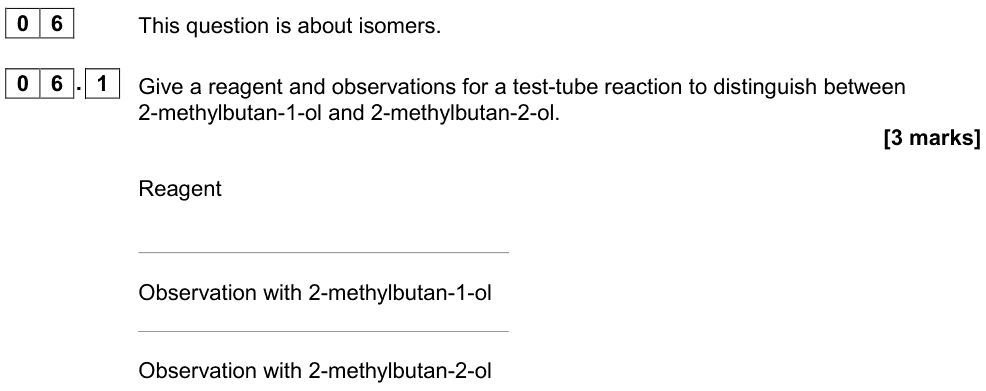
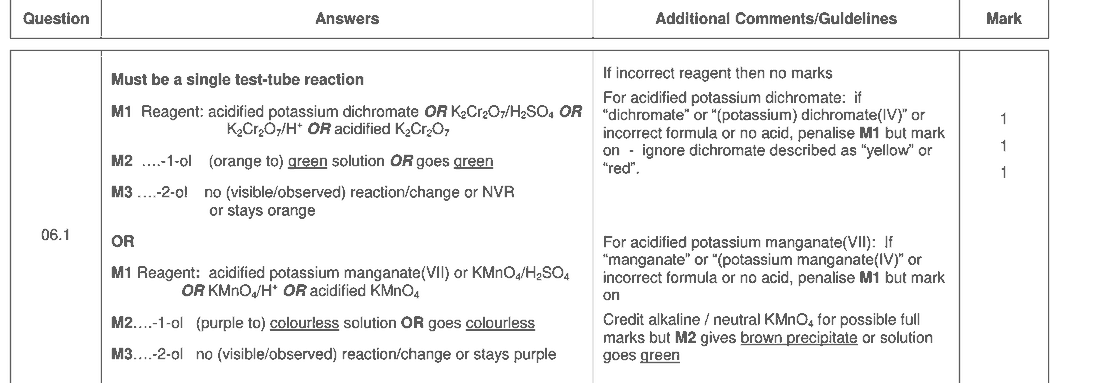
Acidified potassium dichromate(VI): 2-methylbutan-1-ol (primary) turns it from orange to green
2-methylbutan-2-ol (tertiary) gives no visible change (stays orange). Or acidified KMnO4: purple to colourless / stays purple. Must be a single test-tube reaction
'acidified' omitted loses M1
a wrong reagent scores 0. Some used two reagents (for example Tollens' afterwards)
Skills: ATd Use laboratory apparatus for a variety of experimental techniques including: titration, using burette and pipette; distillation and heating under reflux, including setting up glassware using retort stand and clamps; qualitative tests for ions and organic functional groups; filtration, including use of fluted filter paper, or filtration under reduced pressure; PS4.1 Know and understand how to use a wide range of experimental and practical instruments, equipment and techniques appropriate to the knowledge and understanding included in the specification; RP6 Tests for alcohol, aldehyde, alkene and carboxylic acid
June 2019 · Paper 2 · Q06.41 markShort answer
Earlier part of question 06 that this part uses
Mark scheme
Examiner's comment
06.4 Only the least able students did not gain the mark in this part.
Notes from the mark scheme and report
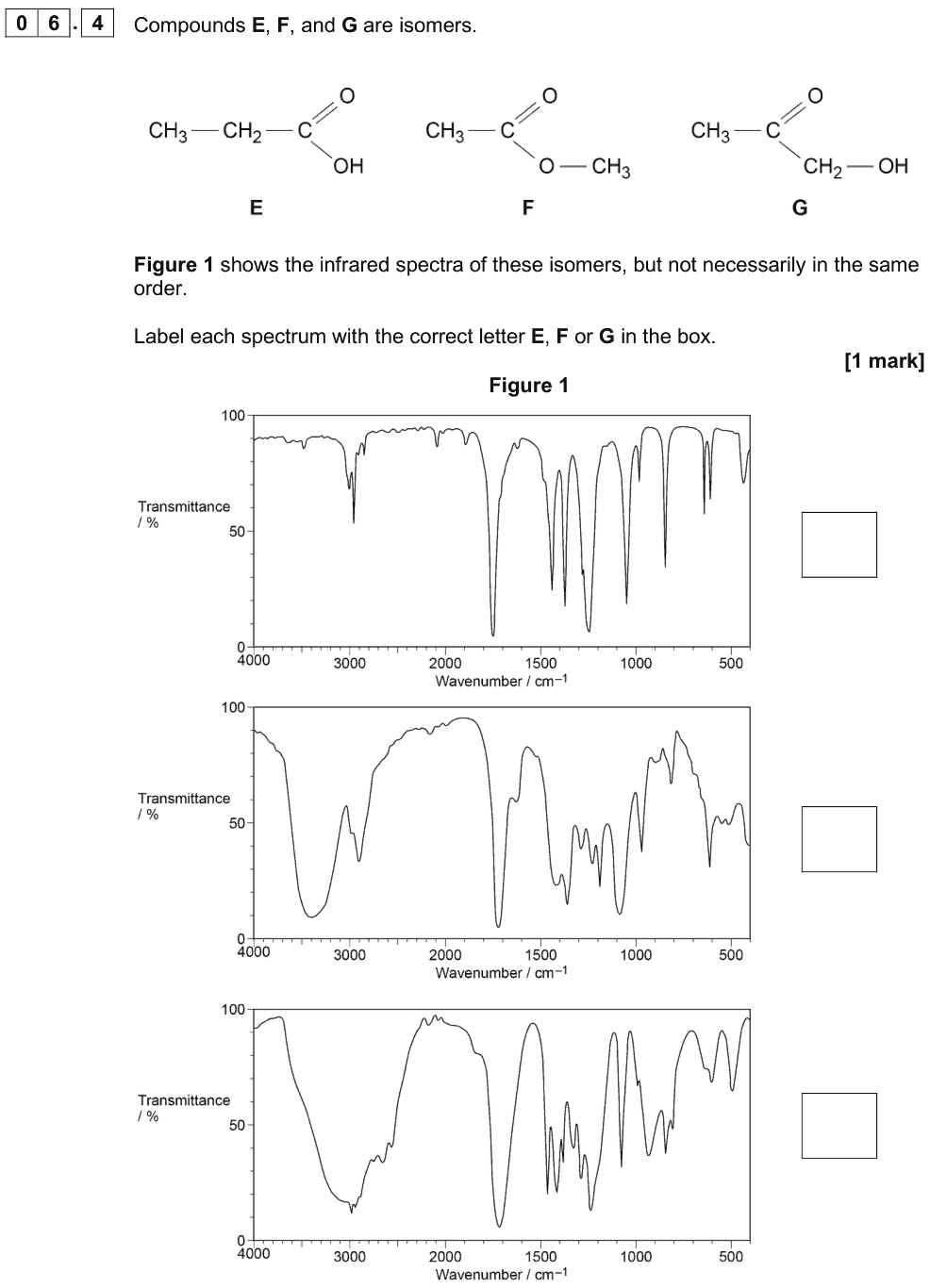
Answer, top to bottom: F, G, E. Top: C=O but no O–H, the ester F
middle: alcohol O–H at 3230–3550 cm–1 plus C=O, the hydroxyketone G
bottom: very broad acid O–H at 2500–3000 cm–1 plus C=O, the carboxylic acid E.
Skills: MS3.1 Translate information between graphical, numerical and algebraic forms
June 2019 · Paper 2 · Q07.26 marks6-mark level of response
Earlier part of question 07 that this part uses
Mark scheme, with the levels and indicative content
Examiner's comment
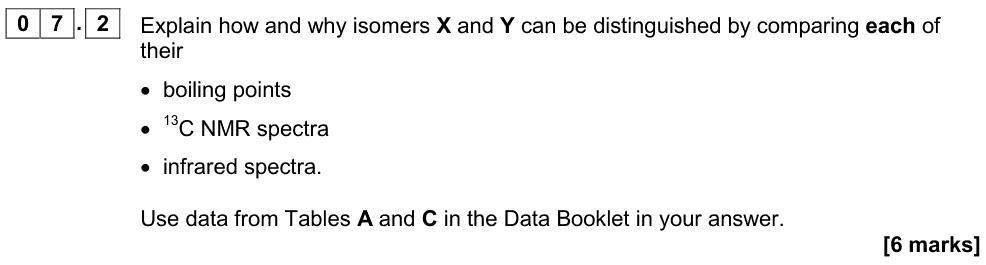
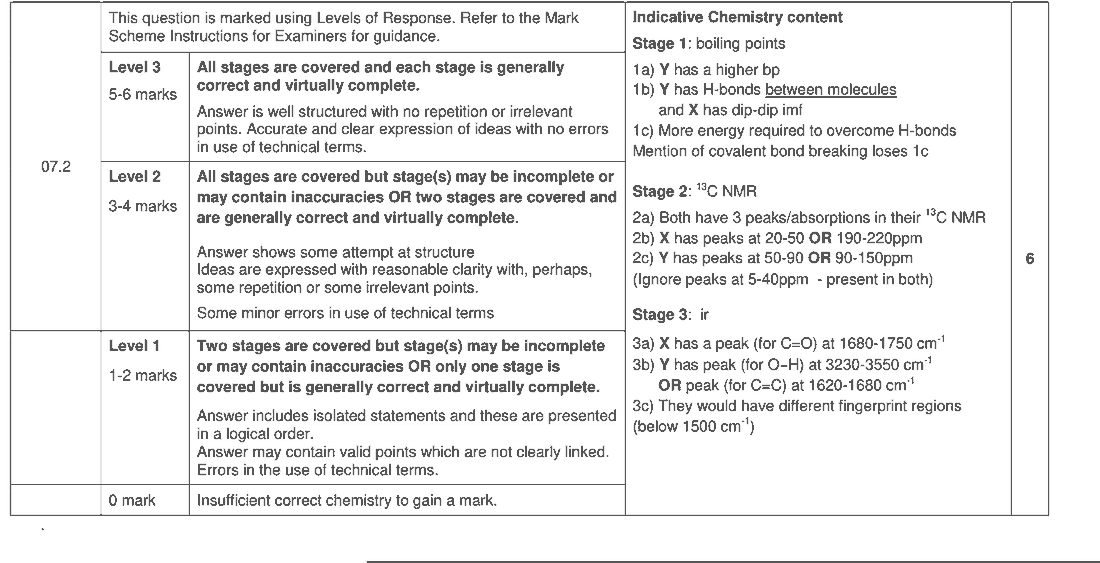
07.2 Overall, this question was well answered and approximately two-thirds of the students gained four or more marks. Some students stumbled in their explanations of the boiling point differences (Stage 1) and were therefore limited to level 2. Most students dealt with the characteristic observations from 13C NMR and IR spectroscopy (Stages 2 and 3) without much difficulty. For stage 1, most students correctly stated that compound Y has the higher boiling point. Explanations with reference to hydrogen bonding and permanent dipole- dipole forces in Y and X, respectively, sometimes fell short when there was a failure to mention the intermolecular nature of these forces. Typically students recovered the potential loss of a marking point by referring to the fact that more energy is required to overcome the H-bonds. Full and unnecessary discussions on how the two types of intermolecular forces arise were common, as was the discussion of (fractional) distillation of a mixture of the two liquids. Most students were able to report on the correct ranges of chemical shifts in 13C NMR spectra for both compounds. Some effective responses recognised three peaks for each compound, with detailed and comprehensive analyses of the types of carbon involved. Communication on IR spectra was generally good, with students correctly identifying absorptions and corresponding bond types. There was some use of non-technical language such as ‘dips and troughs’ to communicate absorption or low transmittance. Reference to the unique fingerprint regions appeared in very few responses.
Notes from the mark scheme and report
Levels of response, three stages. Stage 1 boiling point: Y (the alcohol) has the higher boiling point
Y has hydrogen bonds between molecules, X only dipole–dipole forces
more energy is needed to overcome hydrogen bonds (mention of breaking covalent bonds loses this). Stage 2 13C NMR: both have three peaks
X has peaks at 20–50 ppm or 190–220 ppm (C=O)
Y has peaks at 50–90 ppm (C–O) or 90–150 ppm (C=C). Stage 3 infrared: X has C=O at 1680–1750 cm–1
Y has O–H at 3230–3550 cm–1 or C=C at 1620–1680 cm–1
fingerprint regions differ. About two-thirds gained four or more marks
forces not described as intermolecular and fingerprint region rarely mentioned
June 2019 · Paper 2 · Q10.51 markShort answer
Earlier part of question 10 that this part uses
Mark scheme
Examiner's comment
10.5 This part was answered poorly. A very common error was to discuss fragmentation − a topic which is not required in this specification. Many muddled significant figures and decimal places and failed to say that when measured to several decimal places the relative molecular masses of the diols and the acid are different.
Notes from the mark scheme and report
Their precise relative molecular masses are different (when measured to several decimal places), because the molecular formulas differ. Discussing fragmentation is penalised (not on this specification)
many muddled significant figures and decimal places
June 2019 · Paper 2 · Q11.51 markShort answer
Earlier part of question 11 that this part uses
Mark scheme
Examiner's comment
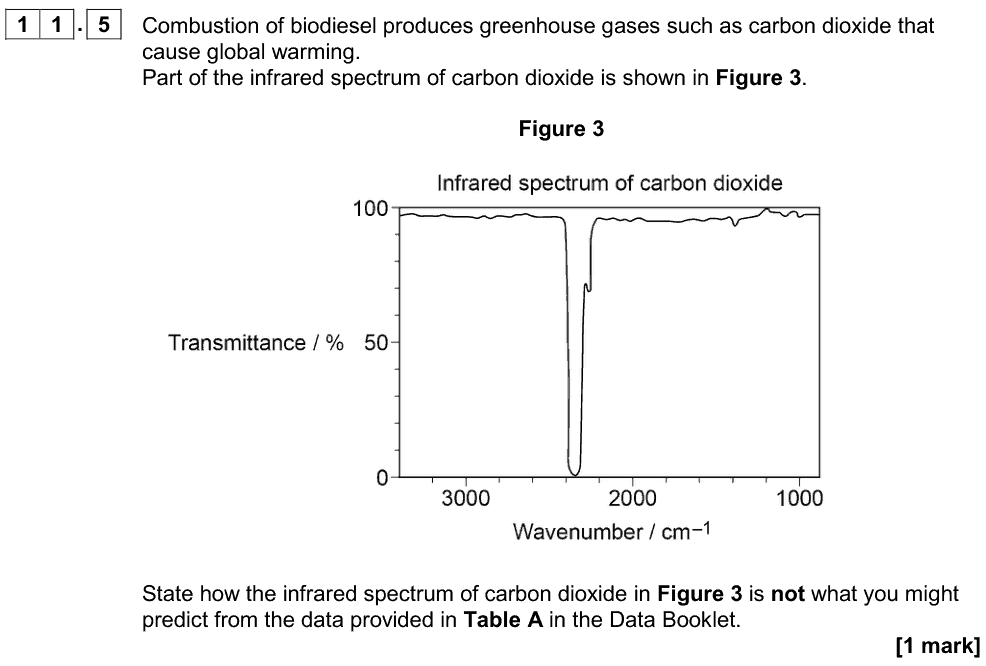
11.5 Most students answered this part correctly although some mentioned the C−O 1000−1300 cm−1 range rather than the expected range for C=O, 1680−1750 cm−1.
Notes from the mark scheme and report
The absorption is at about 2350 cm–1, not in the 1680–1750 cm–1 range given in the Data Booklet for C=O. Some quoted the C–O range (1000–1300 cm–1) instead
Skills: MS3.1 Translate information between graphical, numerical and algebraic forms
June 2019 · Paper 2 · Q11.62 marksExplanation
Earlier part of question 11 that this part uses
Mark scheme
Examiner's comment
11.6 This part was badly answered and many students gained neither mark. Wrong answers included reference to ultraviolet light and ozone as common themes. Common errors were not mentioning that the (vibrating) bonds in CO2 are responsible for absorbtion of infrared radiation. Very few students mentioned infrared radiation being emitted by the Earth. A common misconception is that global warming is caused by the destruction of the ozone layer.
Notes from the mark scheme and report
The C=O bonds in CO2 absorb infrared radiation
infrared radiation emitted by the Earth therefore does not escape from the atmosphere (the energy is passed to other molecules by collisions). Ignore 'reflected'. Badly answered: many wrote about ultraviolet light and the ozone layer
June 2019 · AS Paper 2 · Q231 markMultiple choice
Answer
B
Mark scheme
Examiner's comment
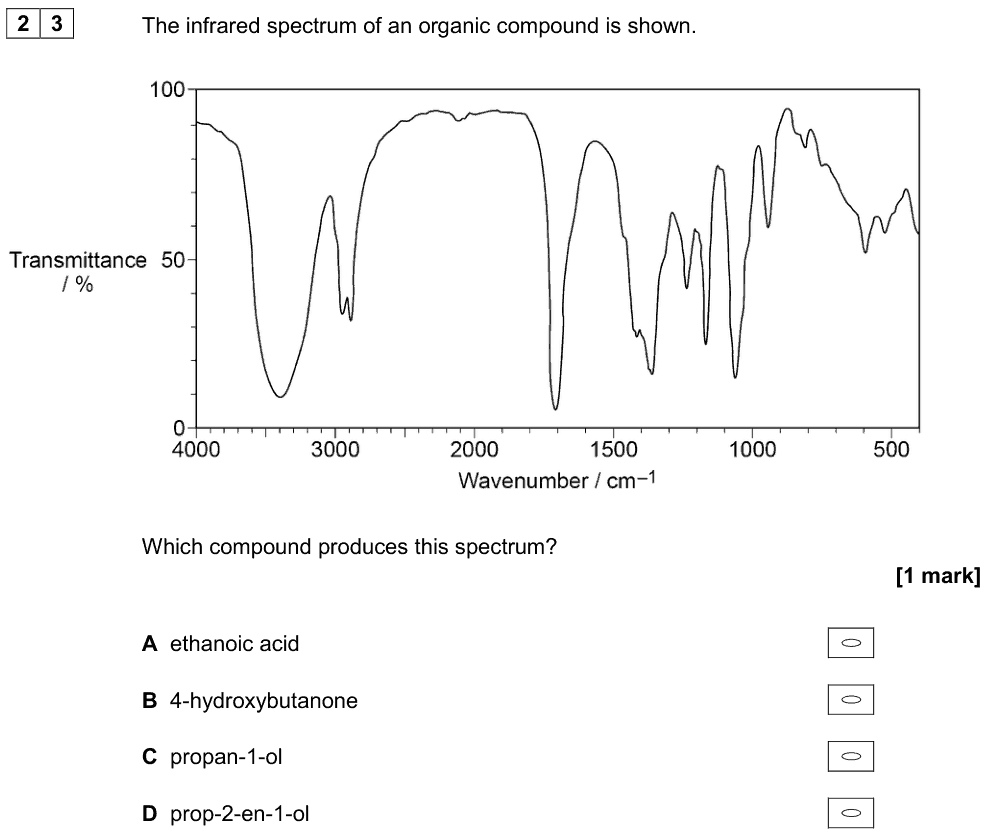
The infrared spectrum showed both a C=O stretch and an O−H stretch. Many students thought it was a carboxylic acid, but the peak centred on 3400 cm−1 should have been recognised as due to an alcohol O−H group not an acid O−H group.
Notes from the mark scheme and report
Answer: B. C=O absorption near 1700 cm–1 and an alcohol O–H absorption centred near 3400 cm–1 (an acid O–H would be much broader, 2500 to 3000 cm–1). Many chose ethanoic acid
Skills: MS3.1 Translate information between graphical, numerical and algebraic forms
June 2019 · Paper 3 · Q231 markMultiple choice
Answer
B
Mark scheme
Notes from the mark scheme and report
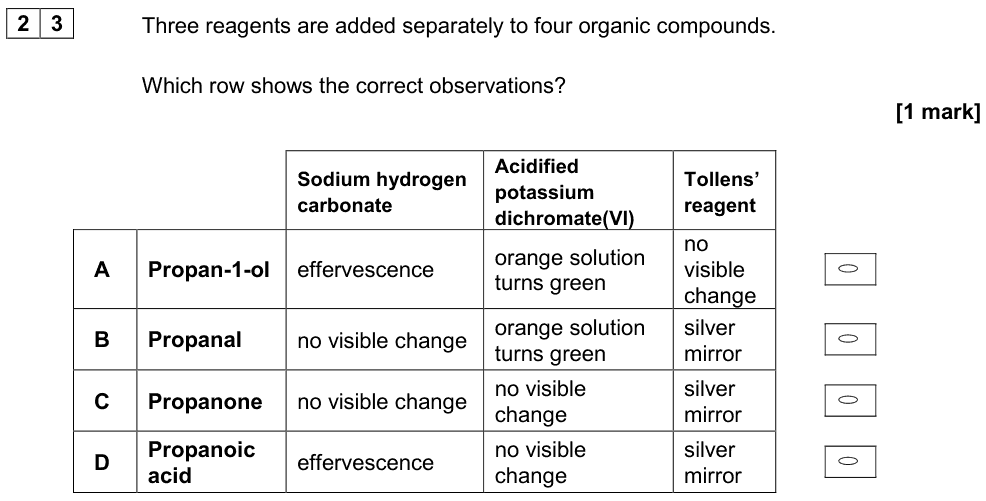
Answer: B. Propanal is not acidic, is oxidised by dichromate (orange to green) and gives a silver mirror with Tollens' reagent
Skills: RP6 Tests for alcohol, aldehyde, alkene and carboxylic acid
June 2018 · Paper 2 · Q02.31 markDiagram or structure
Earlier part of question 02 that this part uses
Mark scheme
Examiner's comment
02.3 This question was answered correctly by 39.4% of the students. Others identified the correct molecule but did not draw it as a displayed formula; −CH3 was the most common error here. Some students drew an −OH group and a −C=O group in the same molecule, rather than two aldehyde groups; another common mistake was to draw butanedial.
Notes from the mark scheme and report
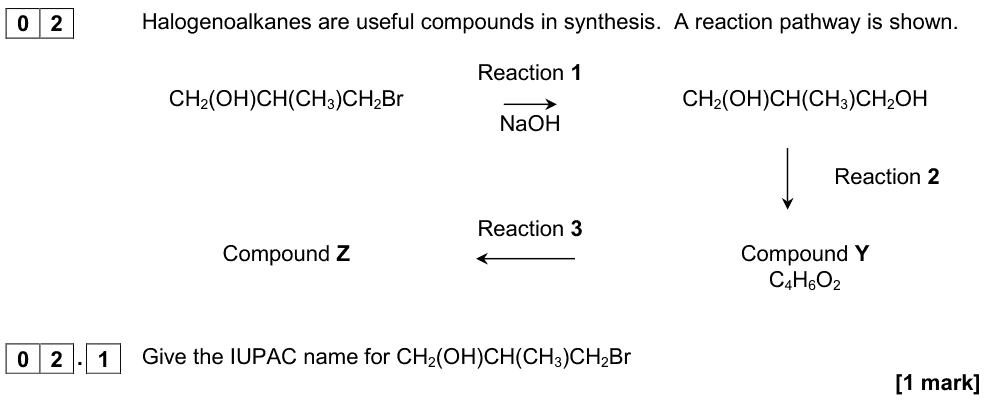
Y is methylpropanedial, OHC–CH(CH3)–CHO, drawn fully displayed with every bond shown (both CH2OH groups oxidised to CHO
C=O absorbs at 1680 to 1750 cm–1). Errors: –CH3 not displayed
one OH and one C=O
butanedial
June 2018 · Paper 2 · Q03.32 marksPractical and data analysisEasy
Earlier part of question 03 that this part uses
Mark scheme
Examiner's comment
03.3 This part was answered well by nearly two-thirds of the students. The main error was to test for the aldehyde rather than the acid.
Notes from the mark scheme and report
Add a named carbonate or hydrogencarbonate (eg NaHCO3), or magnesium, to a sample of the distillate
no effervescence shows that no acid is present (bubbles would confirm acid). Blue litmus staying blue also allowed. Common error: testing for the aldehyde instead
Skills: ATd Use laboratory apparatus for a variety of experimental techniques including: titration, using burette and pipette; distillation and heating under reflux, including setting up glassware using retort stand and clamps; qualitative tests for ions and organic functional groups; filtration, including use of fluted filter paper, or filtration under reduced pressure; PS4.1 Know and understand how to use a wide range of experimental and practical instruments, equipment and techniques appropriate to the knowledge and understanding included in the specification; RP6 Tests for alcohol, aldehyde, alkene and carboxylic acid
June 2018 · AS Paper 2 · Q06.51 markShort answer
Earlier part of question 06 that this part uses
Mark scheme
Examiner's comment
06.5 Just under half of students could determine that the IR spectrum was of an alkene rather than an alcohol and explain this by reference to the absorption for a bond and its wavenumber range.
Notes from the mark scheme and report
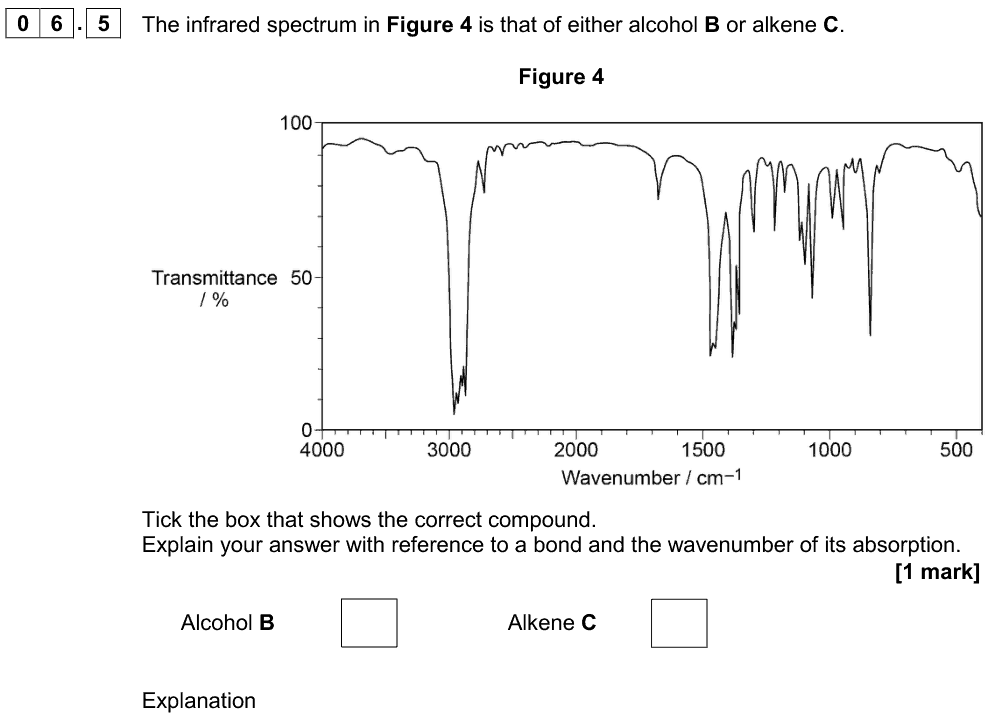
Alkene C: there is a C=C absorption at 1620–1680 cm–1, or there is no O–H absorption at 3230–3550 cm–1. Needs the correct compound plus the bond and its wavenumber
June 2018 · AS Paper 2 · Q07.16 marks6-mark level of response
Mark scheme, with the levels and indicative content
Examiner's comment
07.1 Many students approached this question as if they already knew which compound was which. They did not appreciate the need to carry out the first test with all four compounds to start to work out which is which. Many used the test with acidified potassium dichromate(VI) but did not realise that butanal as well as butan-2-ol would react. Few successfully identified two compounds using two test tube reactions, leaving the other two compounds to be distinguished by IR spectroscopy or mass spectrometry. Many did not explain how one of these spectroscopic methods could actually be used to distinguish the final two compounds. Overall, though, the question discriminated well.
Notes from the mark scheme and report
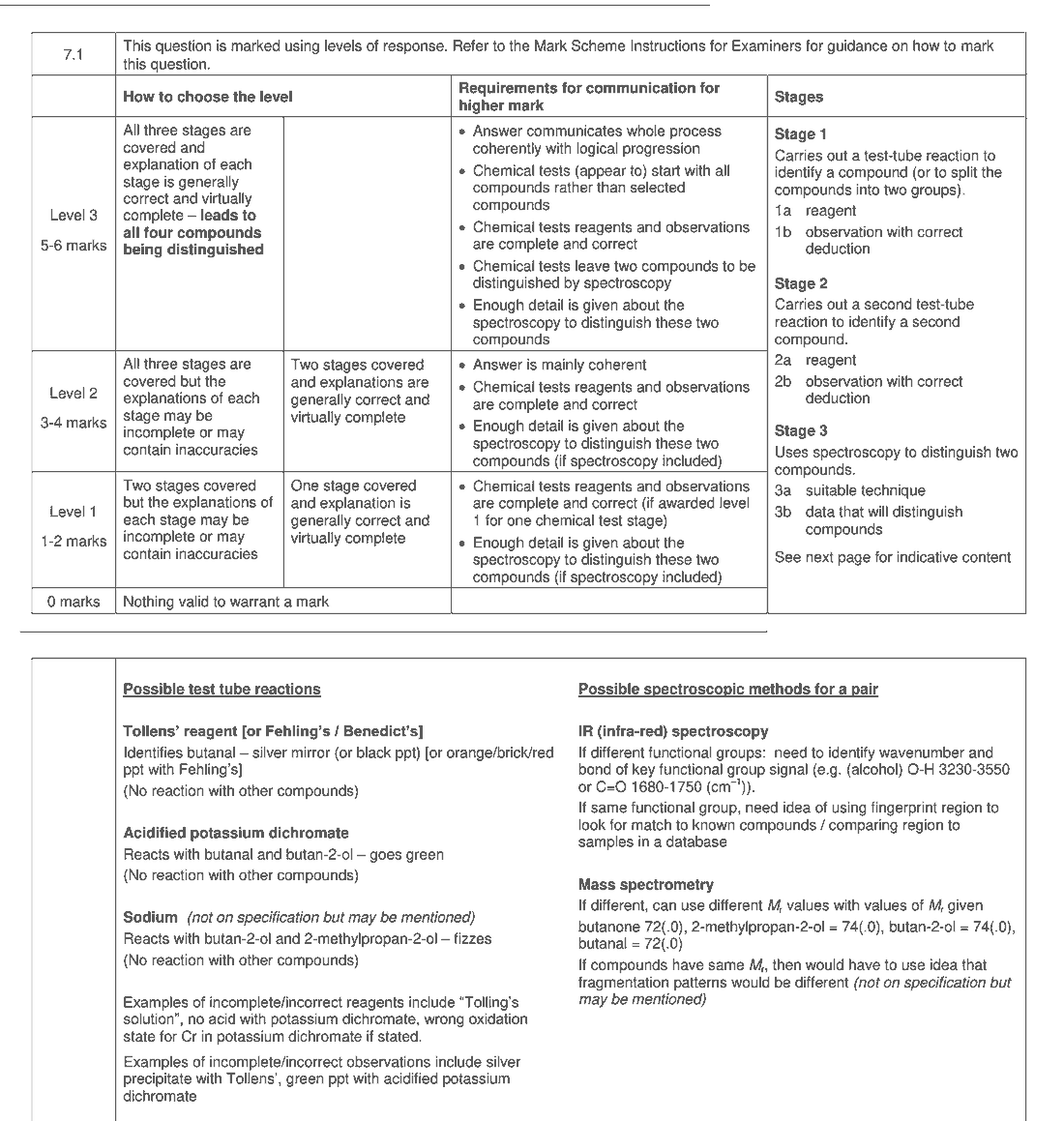
Levels of response, three stages
test all four liquids each time. Test 1: warm with Tollens' reagent (or Fehling's): only butanal gives a silver mirror (or brick-red precipitate). Test 2: warm with acidified potassium dichromate(VI): butanal and butan-2-ol turn it from orange to green, so butan-2-ol is the one that goes green but gave no silver mirror. Spectroscopy for butanone and 2-methylpropan-2-ol: infrared, C=O at 1680–1750 cm–1 for butanone and O–H at 3230–3550 cm–1 for the alcohol
or mass spectrometry, Mr 72 against 74. Errors: treating the compounds as already known
forgetting butanal also reacts with dichromate
'silver precipitate'
no acid with the dichromate
naming a technique without the data that distinguishes
Skills: PS1.1 Solve problems set in practical contexts; PS4.1 Know and understand how to use a wide range of experimental and practical instruments, equipment and techniques appropriate to the knowledge and understanding included in the specification; RP6 Tests for alcohol, aldehyde, alkene and carboxylic acid
June 2018 · Paper 2 · Q10.11 markShort answerEasy
Mark scheme
Examiner's comment
10.1 This was answered correctly by almost two-thirds of the students. The most common error was to confuse B and C.
Notes from the mark scheme and report
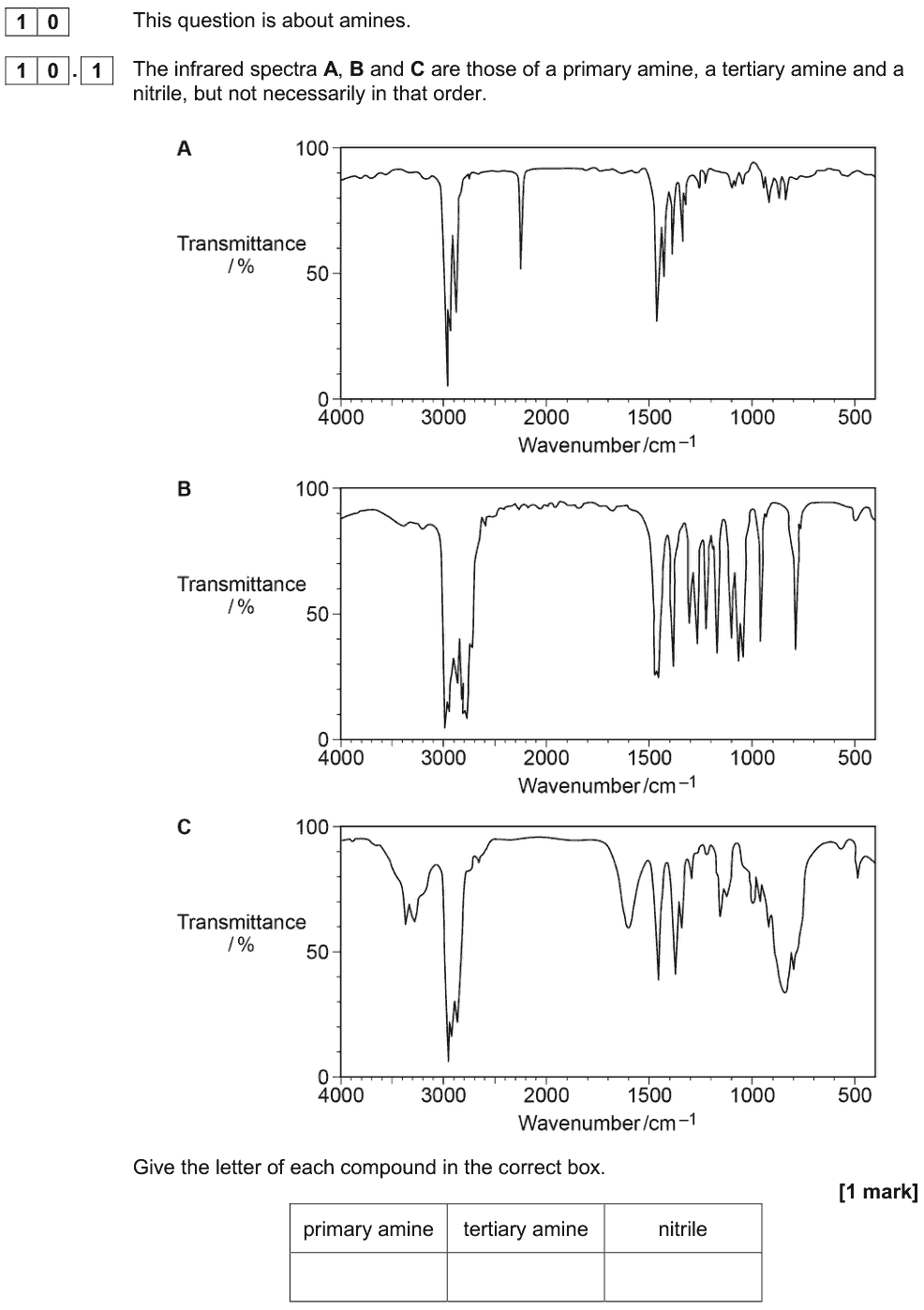
Answer: primary amine C, tertiary amine B, nitrile A (this order only). C has N–H absorptions at 3300 to 3500 cm–1
A has C≡N at 2220 to 2260 cm–1
B has neither. Most common error: B and C mixed up
June 2018 · Paper 3 · Q03.22 marksPractical and data analysisEasy
Earlier part of question 03 that this part uses
Mark scheme
Examiner's comment
03.2 Most students (70.2%) were able to suggest the use of bromine water, with only very few getting the colour change the wrong way round. The most common wrong answer was the suggestion of a test for the absence of alcohol rather than a positive test for the presence of an alkene.
Notes from the mark scheme and report
Add bromine water
it turns from orange to colourless (decolourised). Not 'discolours'
'clear' is ignored. Common wrong approach: testing for the absence of the alcohol
Skills: ATd Use laboratory apparatus for a variety of experimental techniques including: titration, using burette and pipette; distillation and heating under reflux, including setting up glassware using retort stand and clamps; qualitative tests for ions and organic functional groups; filtration, including use of fluted filter paper, or filtration under reduced pressure; PS1.1 Solve problems set in practical contexts; RP6 Tests for alcohol, aldehyde, alkene and carboxylic acid
June 2018 · Paper 3 · Q03.81 markShort answer
Earlier part of question 03 that this part uses
Mark scheme
Examiner's comment
03.8 Too many students failed to remember the need always to mention both the wavenumber range and the bond responsible in questions of this type. Most correctly stated that a peak in the range 3230−3550 would not be visible, but many then failed to state that this peak relates to the O−H bond in an alcohol. As a result, only 43.7% of students gained the mark.
Notes from the mark scheme and report
There would be no absorption at 3230 to 3550 cm–1 for the O–H (alcohol) bond
or the fingerprint region exactly matches that of pure cyclohexene. Both the wavenumber range and the bond are needed
many left out the bond
June 2017 · Paper 2 · Q07.16 marks6-mark level of responseHard
Mark scheme, with the levels and indicative content
Examiner's comment
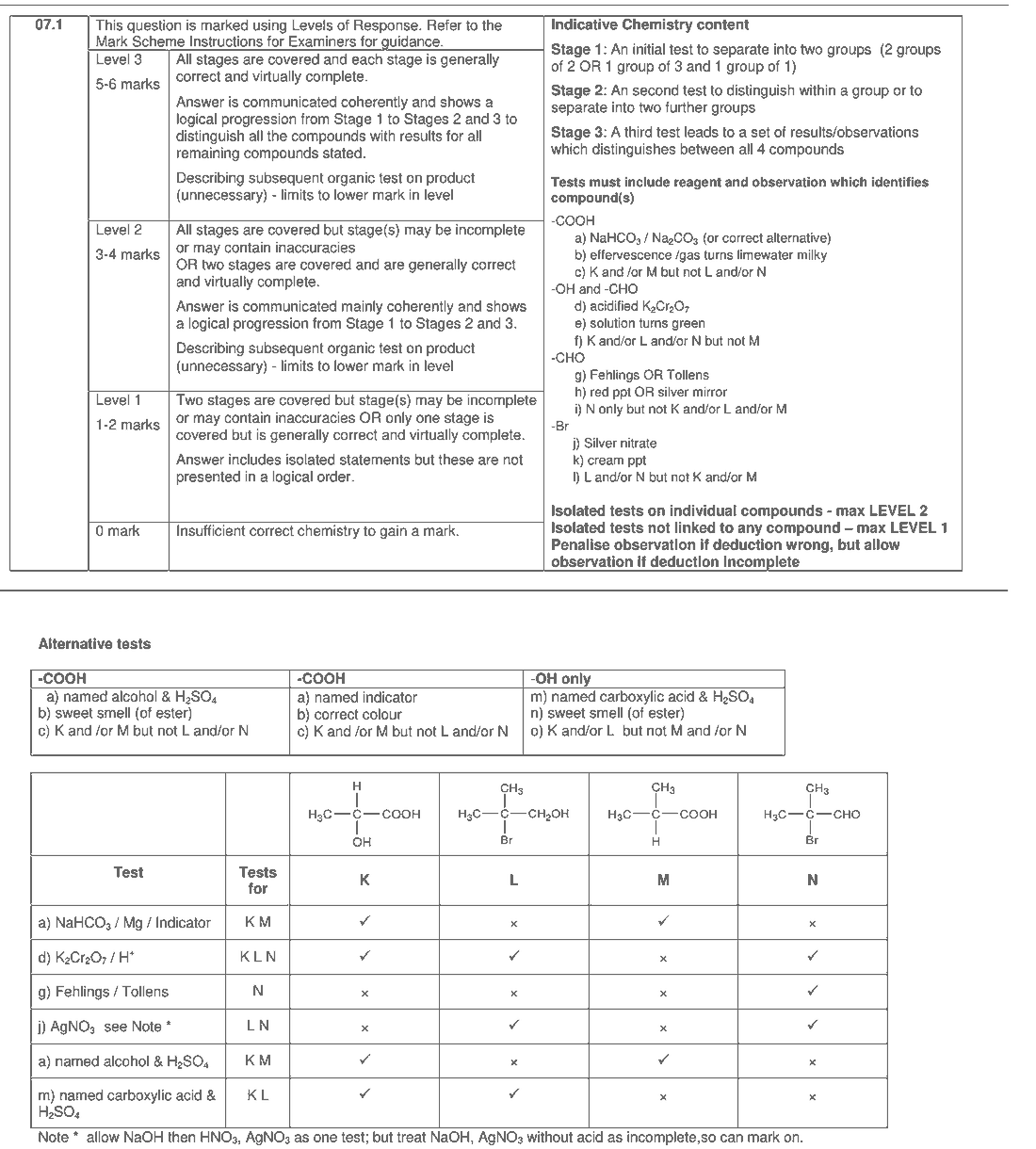
07.1 There were some very good answers to this question and nearly a fifth of the students scored full marks. The best answers followed a ‘stage approach’, in which a first test divided the four compounds into two groups. Subsequent tests were then made on each group.
Notes from the mark scheme and report
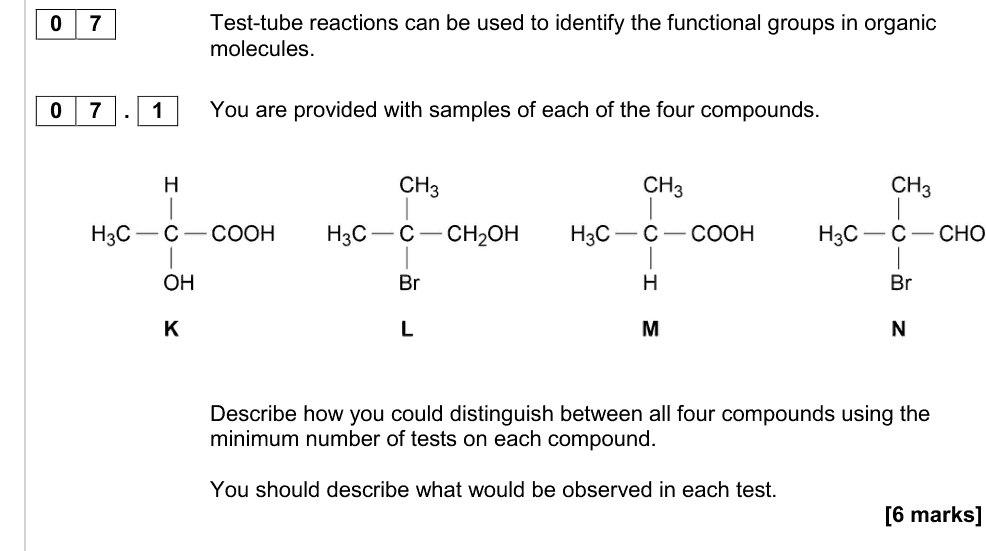
Levels of response: a first test splits the four into two groups, later tests separate within the groups, each with reagent, observation and which compounds respond. NaHCO3/Na2CO3: effervescence with the acids K and M only. Acidified K2Cr2O7: turns green with K, L and N but not M. Fehling's (red precipitate) or Tollens' (silver mirror): N only. Silver nitrate (after NaOH then HNO3): cream precipitate with L and N. Isolated tests not linked to a compound are limited to level 1
Skills: PS1.1 Solve problems set in practical contexts; PS2.1 Comment on experimental design and evaluate scientific methods; RP6 Tests for alcohol, aldehyde, alkene and carboxylic acid
June 2017 · Paper 2 · Q10.33 marksDiagram or structure
Earlier part of question 10 that this part uses
Mark scheme
Examiner's comment
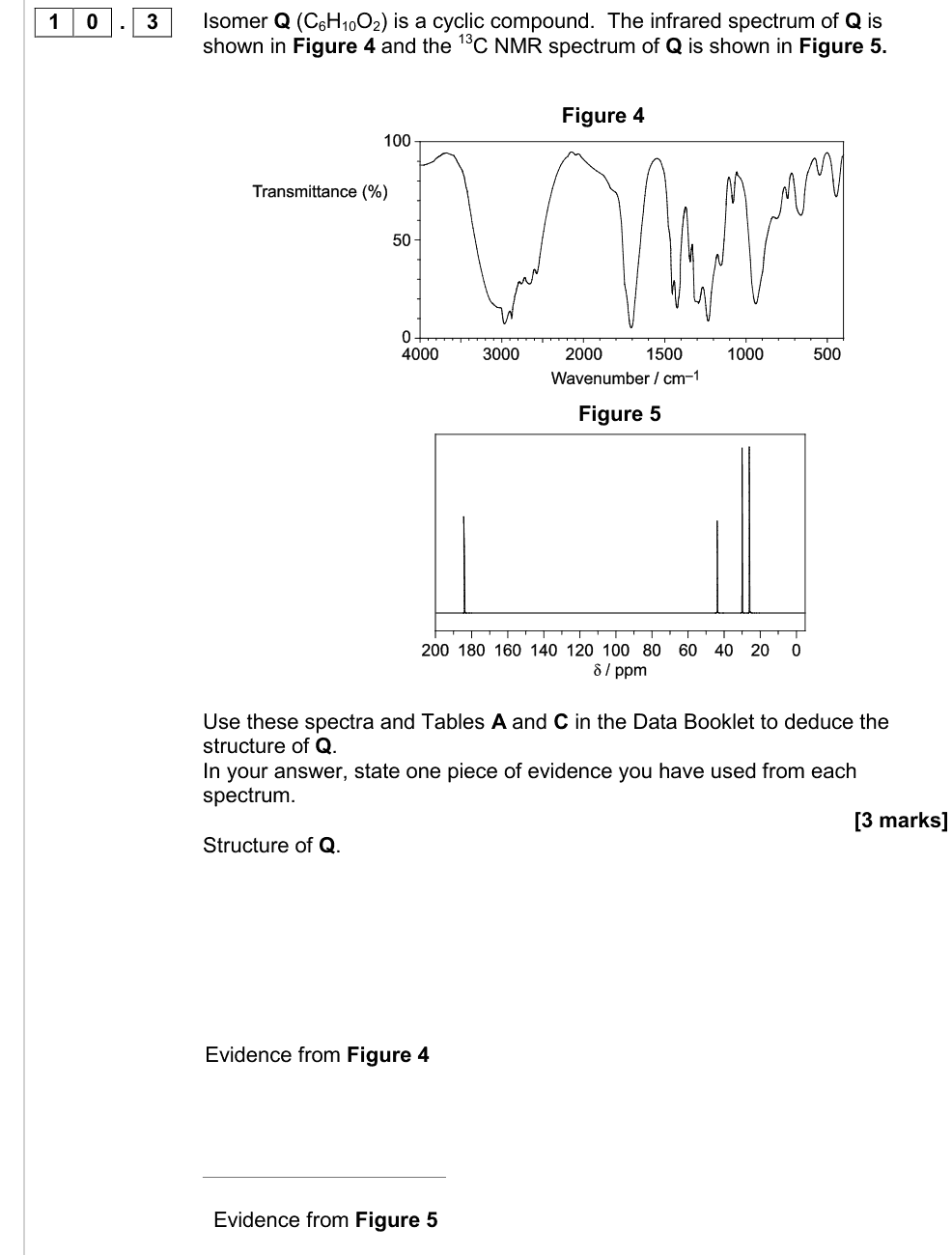
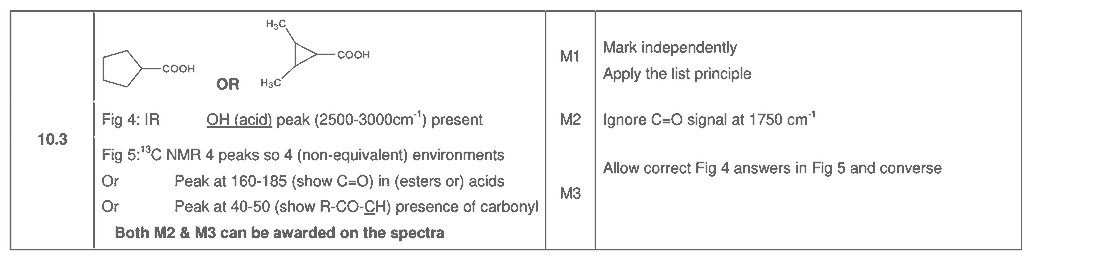
10.3 The identity of Q discriminated well. Many students were not able to relate an aspect of its structure to a peak/signal. In the evidence from Figure 4, many students failed to state that the infrared absorption between 2500 and 3000 cm-1 showed the presence of an O−H bond in an acid. In the 13C NMR evidence, many students thought that the structure was an aldehyde/ketone having been careless in reading the value of the chemical shift on the x- axis.
Notes from the mark scheme and report
Q is cyclopentanecarboxylic acid (or a dimethylcyclopropanecarboxylic acid with four carbon environments). IR: broad O–H (acid) absorption at 2500–3000 cm–1 (the C=O peak is ignored). 13C NMR: four peaks so four carbon environments, or the peak at 160–185 ppm for C=O in an acid, or the peak at 40–50 ppm for the C next to C=O. Common error: reading the shift as an aldehyde/ketone
June 2017 · AS Paper 2 · Q121 markMultiple choice
Answer
A
Mark scheme
Examiner's comment
Many students thought the spectrum represented a carboxylic acid rather than a ketone, even though there is no sign of an acid O-H peak at all. 42.3% of students gained the mark.
Notes from the mark scheme and report
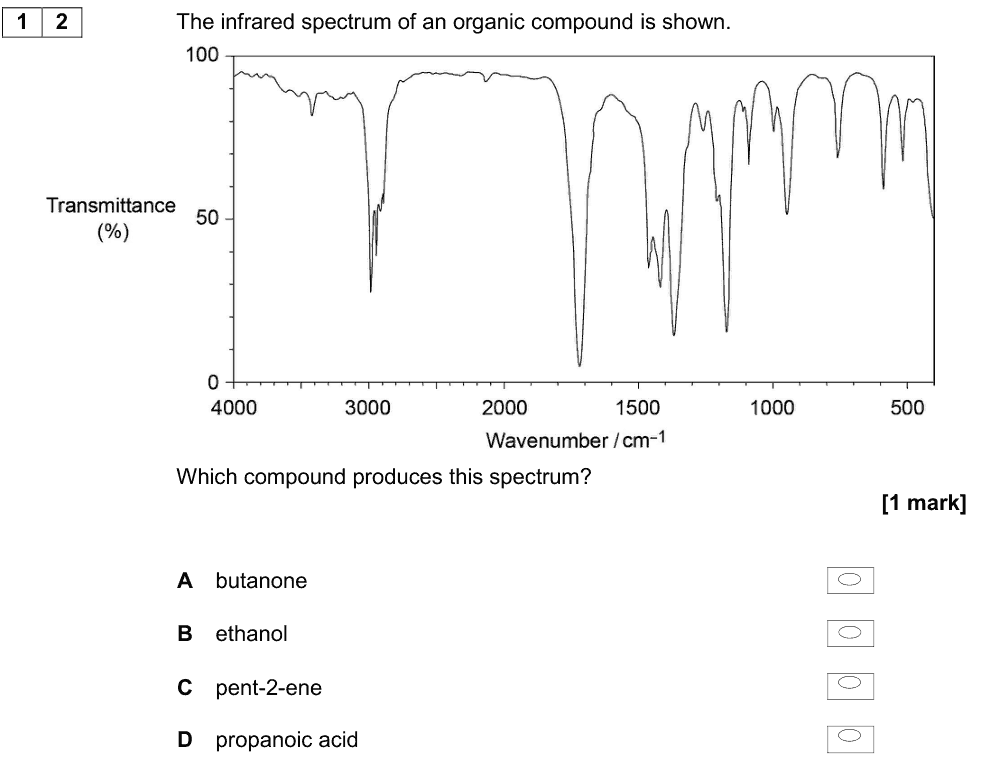
Answer: A. Strong C=O absorption near 1700 cm–1 and no O–H absorption (no broad acid O–H at 2500 to 3000, no alcohol O–H at 3230 to 3550), so a ketone. Many chose propanoic acid
June 2017 · AS Paper 2 · Q201 markMultiple choice
Answer
C
Mark scheme
Examiner's comment
Students also found this question challenging (41.8% correct), with many failing to appreciate that only one molecule did not contain any oxygen and so must have a different value from the others.
Notes from the mark scheme and report
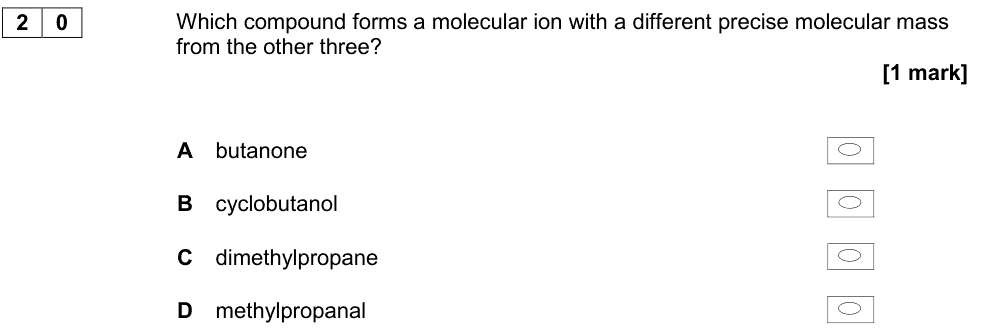
Answer: C. Butanone, cyclobutanol and methylpropanal are all C4H8O
dimethylpropane is C5H12, which has a different precise mass (same integer mass, 72)
June 2017 · Paper 3 · Q121 markMultiple choice
Answer
C
Mark scheme
Notes from the mark scheme and report
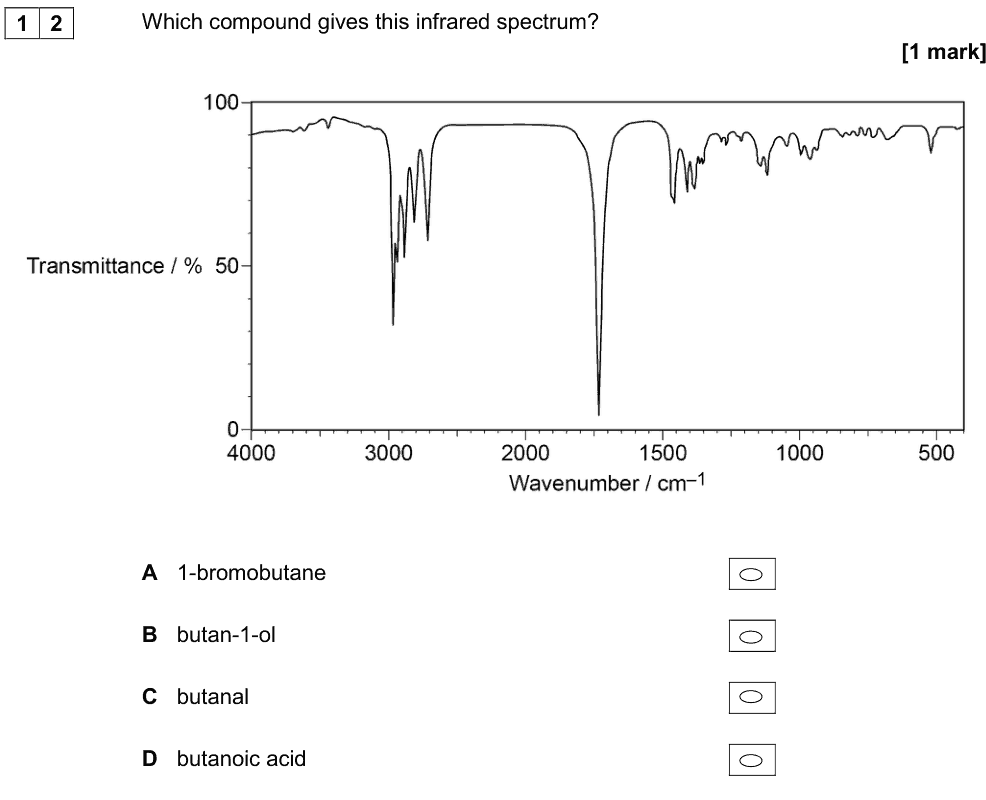
Answer: C. Strong C=O absorption near 1720 cm–1 with no broad O–H absorption, so an aldehyde rather than the alcohol, the acid or the bromoalkane
June 2016 · AS Paper 2 · Q03.72 marksPractical and data analysis
Earlier part of question 03 that this part uses
Mark scheme
Examiner's comment
Many students in Q3.7 knew the use of bromine (water) to show that a compound is unsaturated, but some referred to the mixture going from orange to clear rather than colourless.
Notes from the mark scheme and report
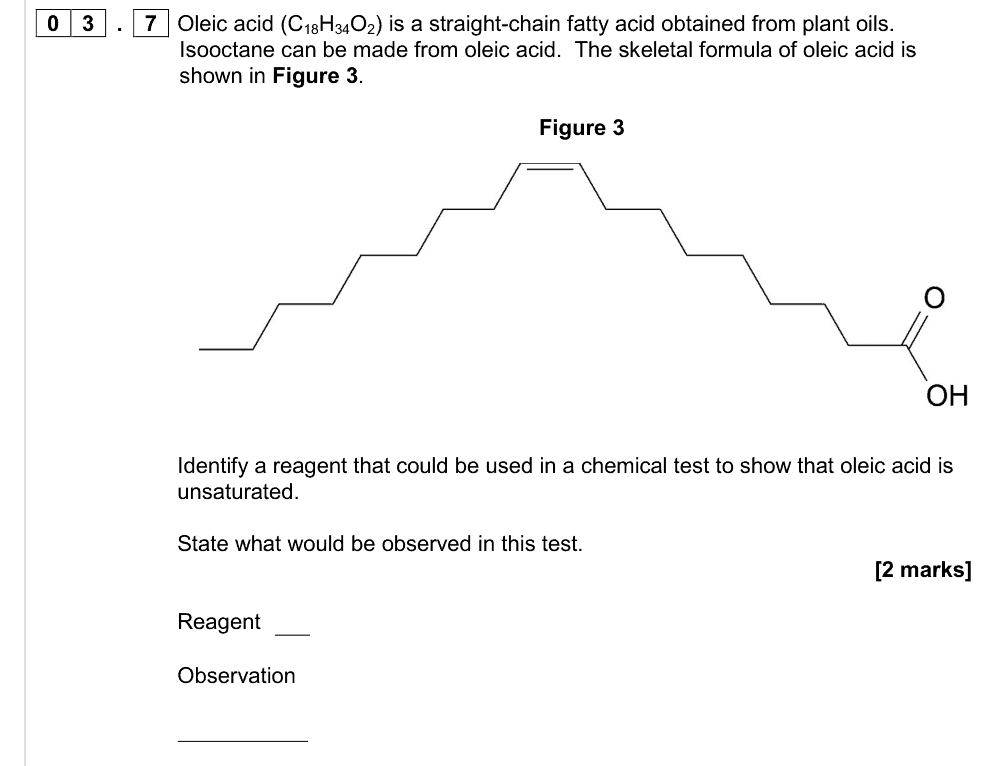
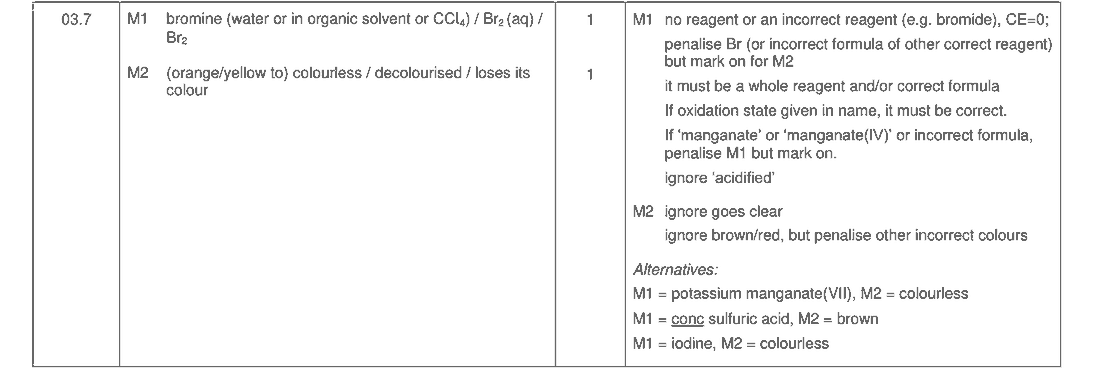
Bromine (water)
the orange / yellow solution is decolourised (turns colourless). 'Goes clear' is ignored and does not score
'bromide' or Br as the reagent is wrong. Alternative: acidified potassium manganate(VII), purple to colourless.
Skills: ATd Use laboratory apparatus for a variety of experimental techniques including: titration, using burette and pipette; distillation and heating under reflux, including setting up glassware using retort stand and clamps; qualitative tests for ions and organic functional groups; filtration, including use of fluted filter paper, or filtration under reduced pressure; PS4.1 Know and understand how to use a wide range of experimental and practical instruments, equipment and techniques appropriate to the knowledge and understanding included in the specification; RP6 Tests for alcohol, aldehyde, alkene and carboxylic acid
June 2016 · AS Paper 2 · Q04.12 marksExplanation
Mark scheme
Examiner's comment
Many students could knew in Q4.1 that the three molecules had the same molecular formula or were isomers, but few stated that they had identical relative formula masses.
Notes from the mark scheme and report
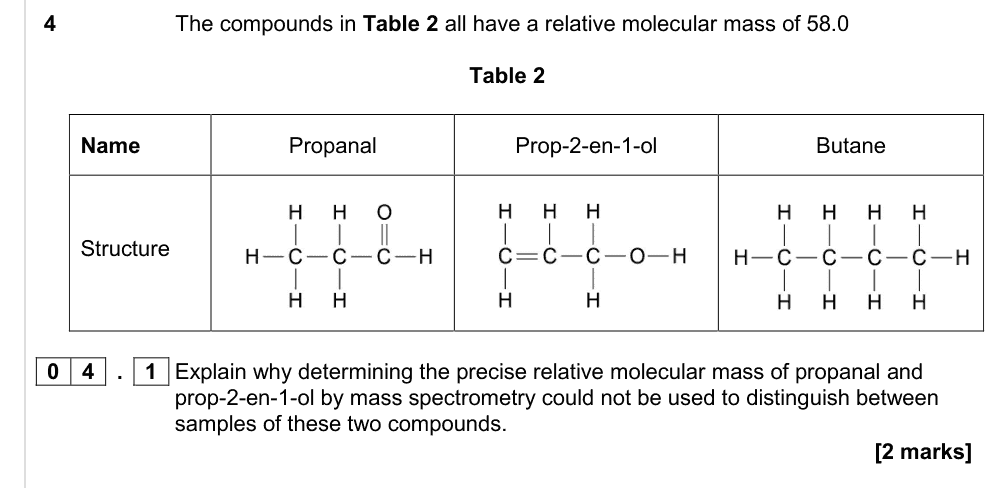
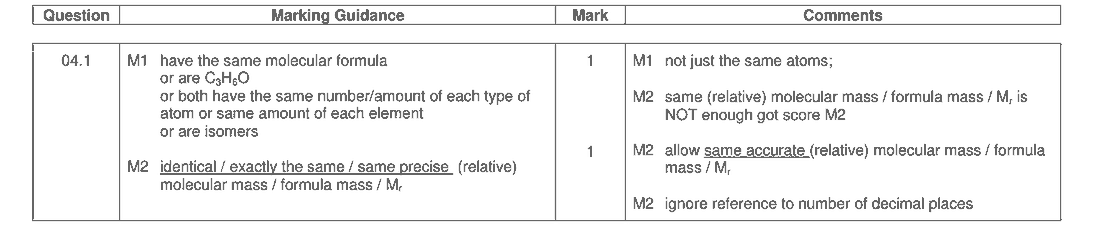
Propanal and prop-2-en-1-ol have the same molecular formula, C3H6O (they are isomers), so they have exactly the same precise relative molecular mass. 'Same Mr' alone is not enough for the second mark
June 2016 · AS Paper 2 · Q04.22 marksShort answer
Earlier part of question 04 that this part uses
Mark scheme
Examiner's comment
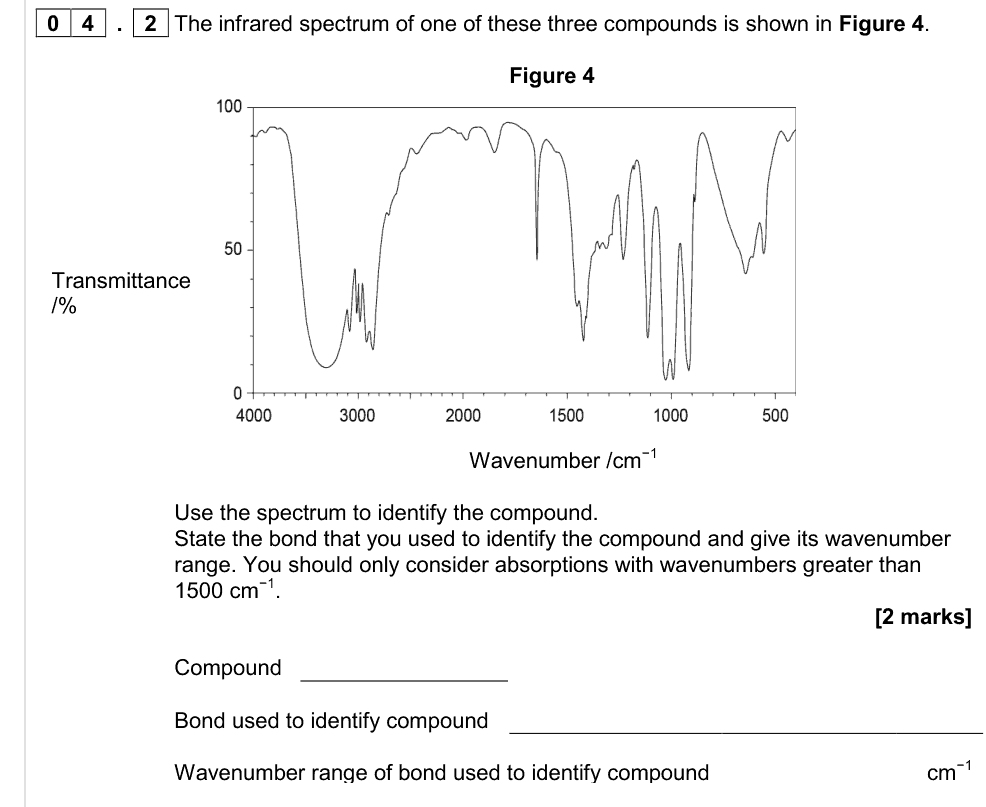
Most students in Q4.2 could identify the prop-2-en-1-ol using the IR spectrum stating the use of the O-H or C=C absorption to do so.
Notes from the mark scheme and report
Prop-2-en-1-ol
O–H (alcohol) absorption at 3230–3550 cm–1 (or C=C at 1620–1680 cm–1). There is no C=O absorption at 1680–1750 cm–1, so it is not propanal. The compound must be named, not just 'the alcohol'
Skills: MS3.1 Translate information between graphical, numerical and algebraic forms
June 2016 · AS Paper 2 · Q05.61 markShort answer
Earlier part of question 05 that this part uses
Mark scheme
Examiner's comment
Few students knew Q5.6 that molecules with vibrating polar bonds absorb IR radiation.
Notes from the mark scheme and report
The bonds vibrate (stretch / bend) at frequencies in the infrared region, or the bonds are polar. Not 'polar molecules'. Few knew this.
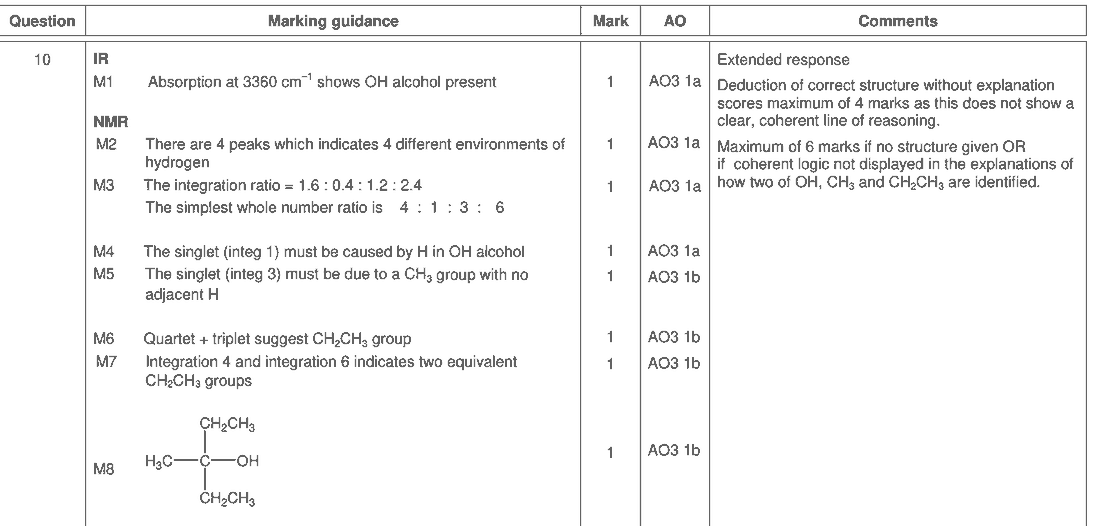
Specimen · Paper 2 · Q108 marksExplanation
Mark scheme
Notes from the mark scheme and report
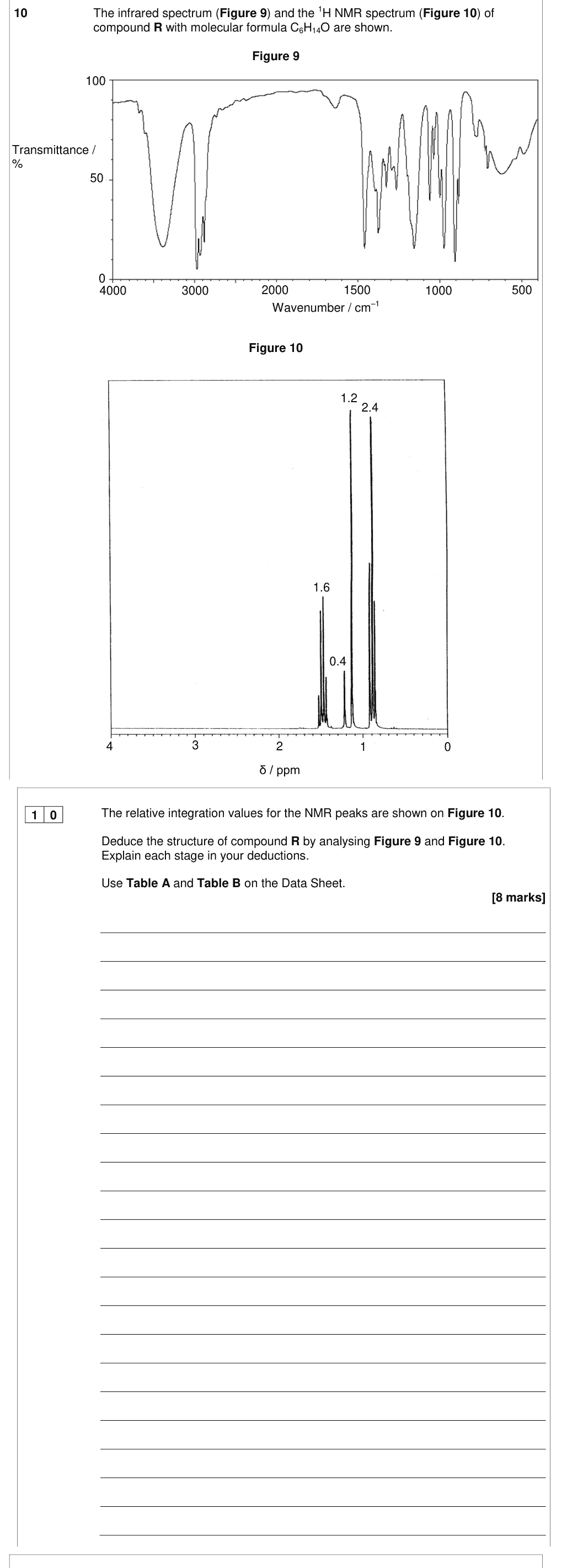
Eight marking points. IR: absorption at about 3360 cm–1 shows an alcohol O–H. NMR: four peaks = four hydrogen environments
integration 1.6 : 0.4 : 1.2 : 2.4 = 4 : 1 : 3 : 6
singlet (1H) is the OH
singlet (3H) is a CH3 with no adjacent H
quartet and triplet show CH2CH3
integrations 4 and 6 mean two equivalent CH2CH3 groups. Structure: CH3C(OH)(CH2CH3)2 (3-methylpentan-3-ol). Correct structure without explanation scores max 4
max 6 if no structure. (Figures 9 and 10 are not in the crop)
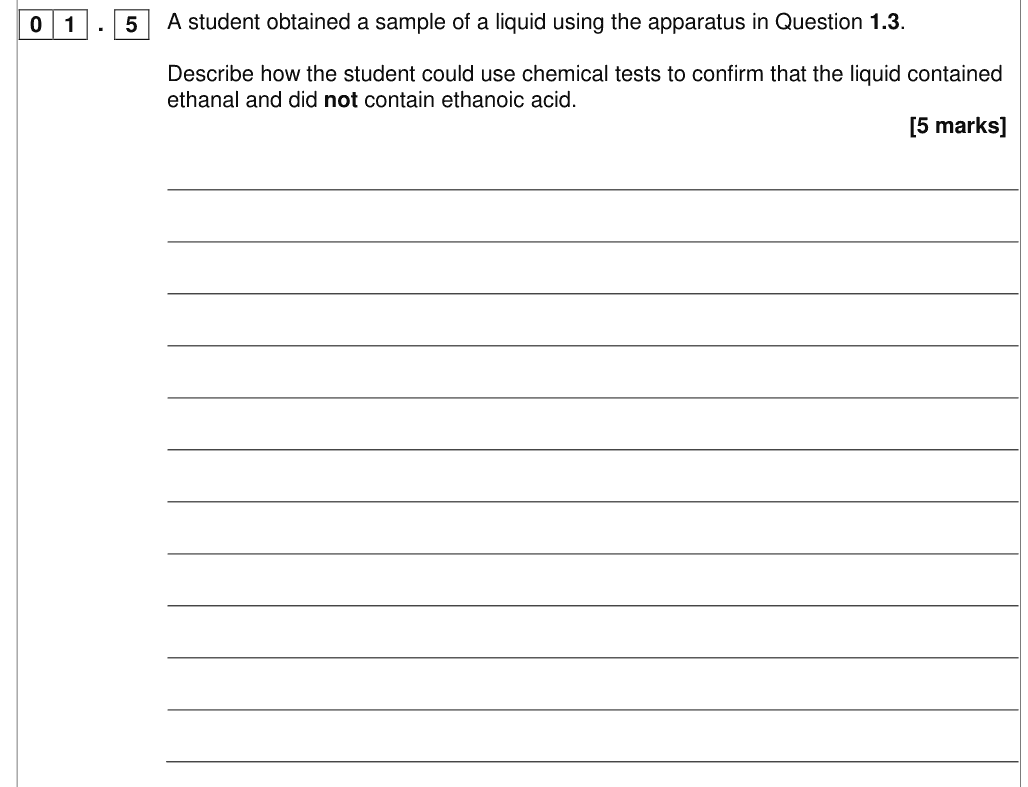
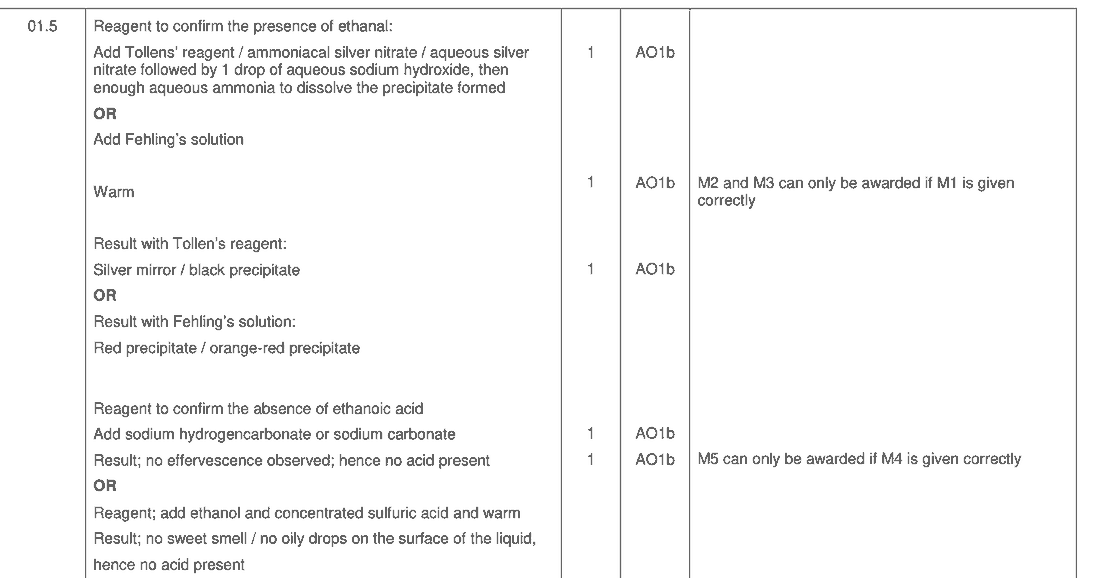
Specimen · Paper 3 · Q01.55 marksPractical and data analysis
or Fehling's solution and warm, red (orange-red) precipitate. No ethanoic acid: add sodium carbonate or hydrogencarbonate, no effervescence
or warm with ethanol and concentrated H2SO4, no sweet smell. Observation marks need the correct reagent
Skills: ATd Use laboratory apparatus for a variety of experimental techniques including: titration, using burette and pipette; distillation and heating under reflux, including setting up glassware using retort stand and clamps; qualitative tests for ions and organic functional groups; filtration, including use of fluted filter paper, or filtration under reduced pressure; PS4.1 Know and understand how to use a wide range of experimental and practical instruments, equipment and techniques appropriate to the knowledge and understanding included in the specification; PS2.3 Evaluate results and draw conclusions with reference to measurement uncertainties and errors; RP6 Tests for alcohol, aldehyde, alkene and carboxylic acid
Work with an A-level chemistry tutor
Dropping marks on calculations, mechanisms or the required practicals? Book a trial session with a specialist A-level chemistry tutor.