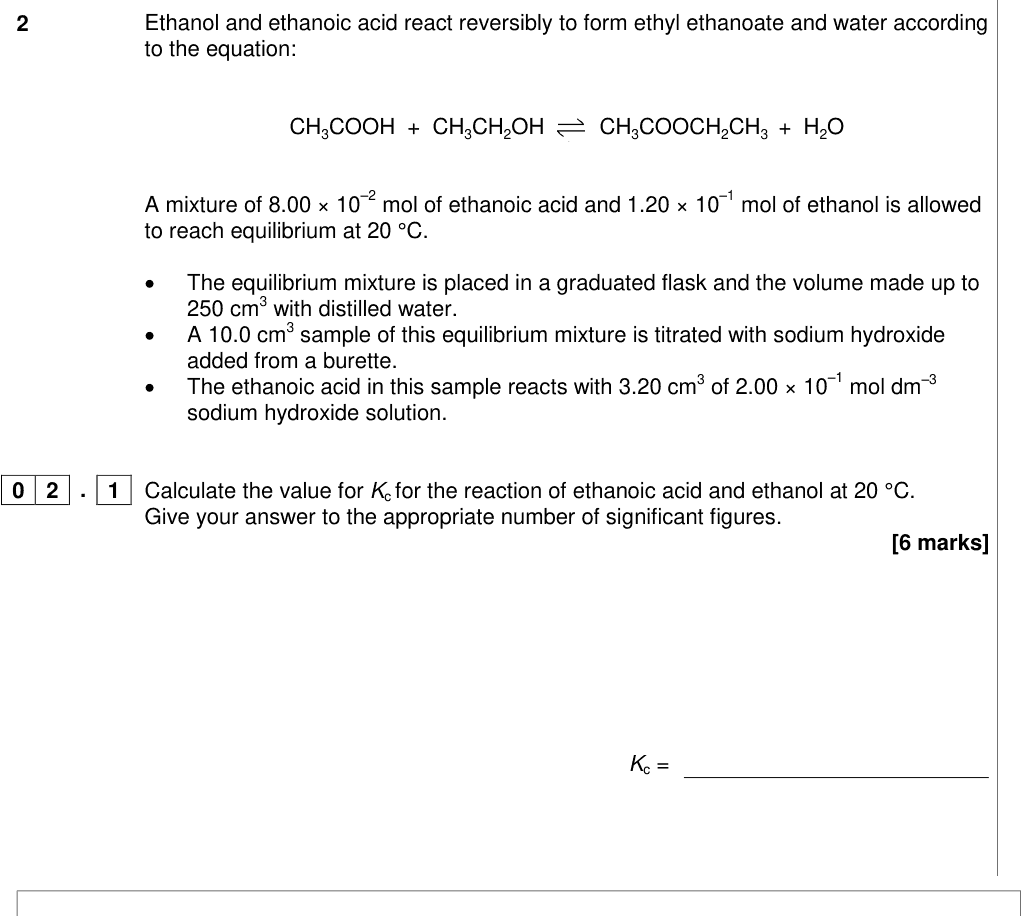
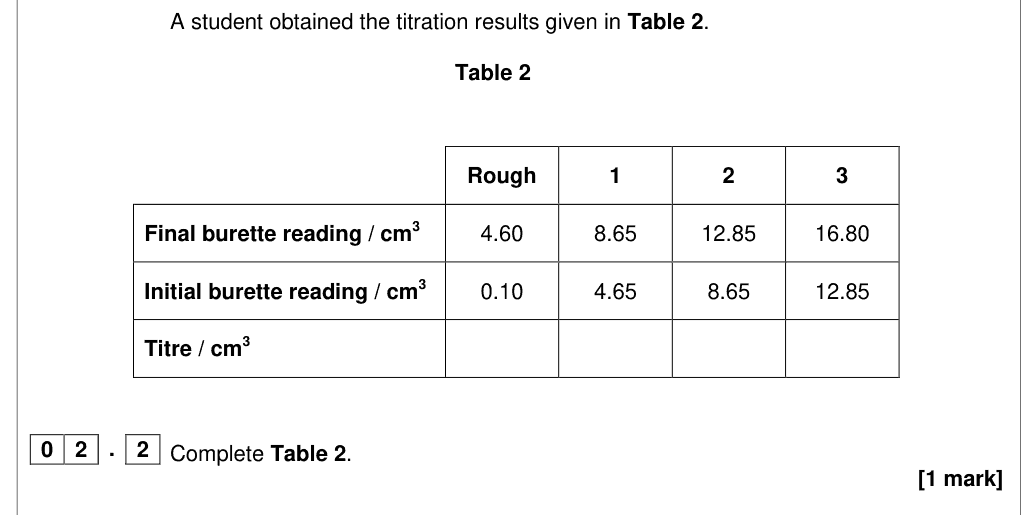
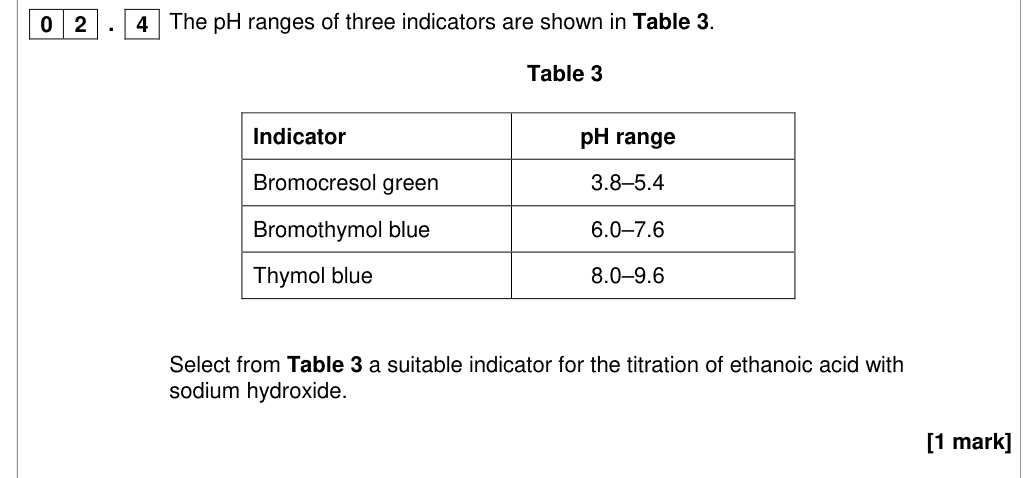
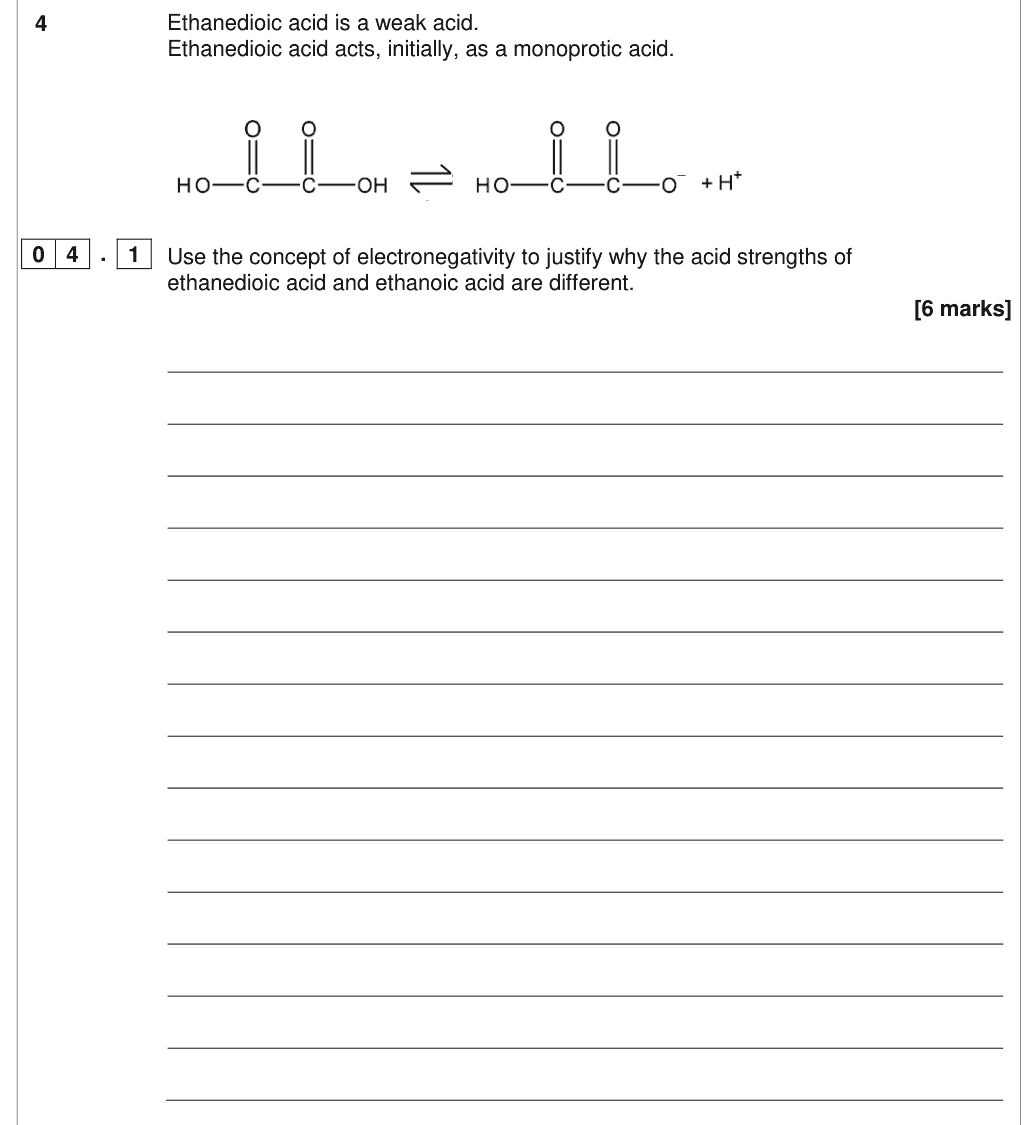
3.1.12.1-03 Acid–base equilibria involve the transfer of protons.
3.1.12.2-01 The concentration of hydrogen ions in aqueous solution covers a very wide range. Therefore, a logarithmic scale, the pH scale, is used as a measure of hydrogen ion concentration. pH = –log10[H+]
3.1.12.2-02 Students should be able to: • convert concentration of hydrogen ions into pH and vice versa • calculate the pH of a solution of a strong acid from its concentration.
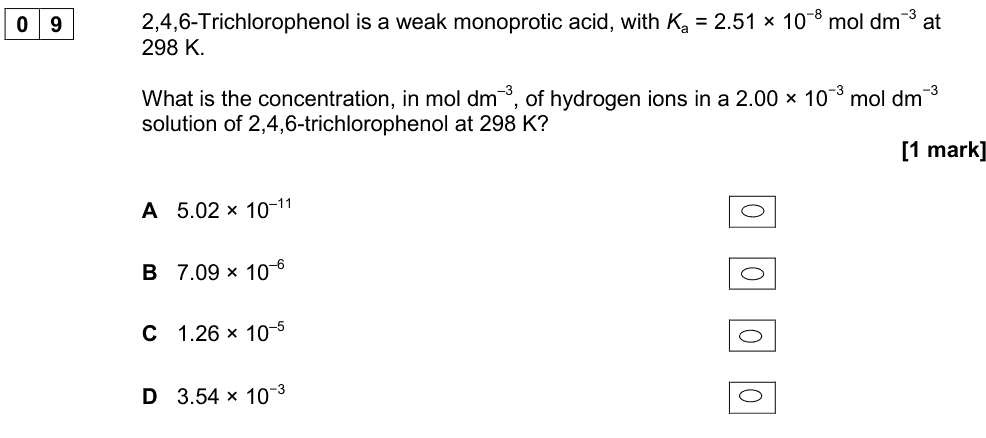
3.1.12.3-01 Water is slightly dissociated. Kw is derived from the equilibrium constant for this dissociation. Kw = [H+][OH–]
3.1.12.3-02 The value of Kw varies with temperature.
3.1.12.3-03 Students should be able to: • use Kw to calculate the pH of a strong base from its concentration.
3.1.12.4-01 Weak acids and weak bases dissociate only slightly in aqueous solution. Ka is the dissociation constant for a weak acid. pKa = –log10 Ka
3.1.12.4-02 Students should be able to: • construct an expression for Ka • perform calculations relating the pH of a weak acid to the concentration of the acid and the dissociation constant, Ka • convert Ka into pKa and vice versa.
3.1.12.5-01 Titrations of acids with bases.
3.1.12.5-02 Students should be able to: • perform calculations for these titrations based on experimental results.
3.1.12.5-03 Typical pH curves for acid–base titrations in all combinations of weak and strong monoprotic acids and bases.
3.1.12.5-04 Students should be able to: • sketch and explain the shapes of typical pH curves • use pH curves to select an appropriate indicator.
3.1.12.5-05 Required practical 9 Investigate how pH changes when a weak acid reacts with a strong base and when a strong acid reacts with a weak base.
3.1.12.6-01 A buffer solution maintains an approximately constant pH, despite dilution or addition of small amounts of acid or base.
3.1.12.6-02 Acidic buffer solutions contain a weak acid and the salt of that weak acid.
3.1.12.6-03 Basic buffer solutions contain a weak base and the salt of that weak base.
3.1.12.6-04 Applications of buffer solutions.
3.1.12.6-05 Students should be able to: • explain qualitatively the action of acidic and basic buffers • calculate the pH of acidic buffer solutions.
Six-mark level of response questions on this topic
Tap a question to zoom it. Where a part needs a figure, table or structure from earlier in the question, that part folds out above it; the mark scheme and examiner's comment open underneath. Have AQA's Data Booklet (the Periodic Table and the spectroscopy tables) beside you.
June 2025 · Paper 1 · Q08.12 marksAO1=1, AO2=1Calculation
Mark scheme
Examiner's comment
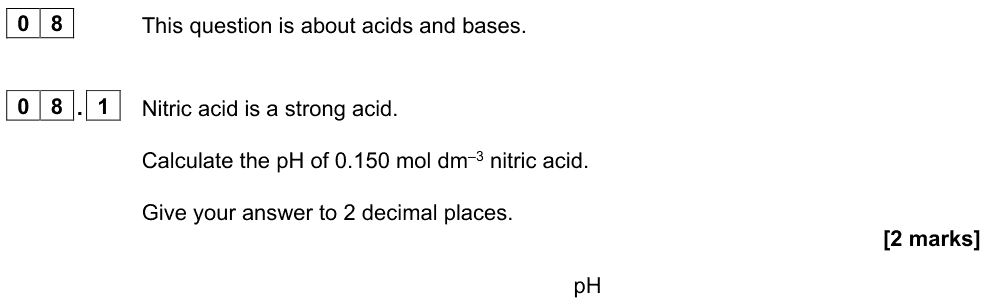
Most students gained two marks in part 1; a few students did not give their answer to 2 d.p. or doubled or halved the concentration of nitric acid to get their [H+].
Skills: MS0.4 Use calculators to find and use power, exponential and logarithmic functions; MS2.5 Use logarithms in relation to quantities that range over several orders of magnitude
June 2025 · Paper 1 · Q08.24 marksAO2=4Calculation
Earlier part of question 08 that this part uses
Mark scheme
Examiner's comment
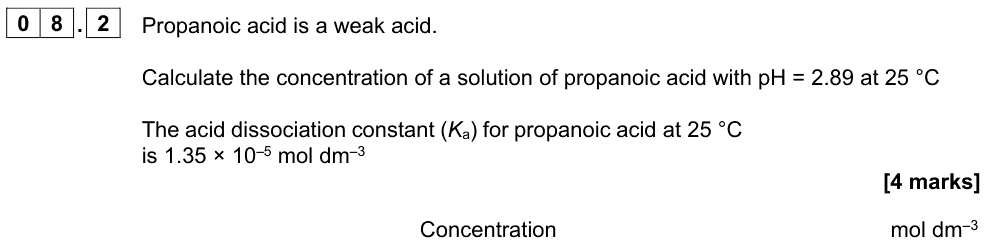
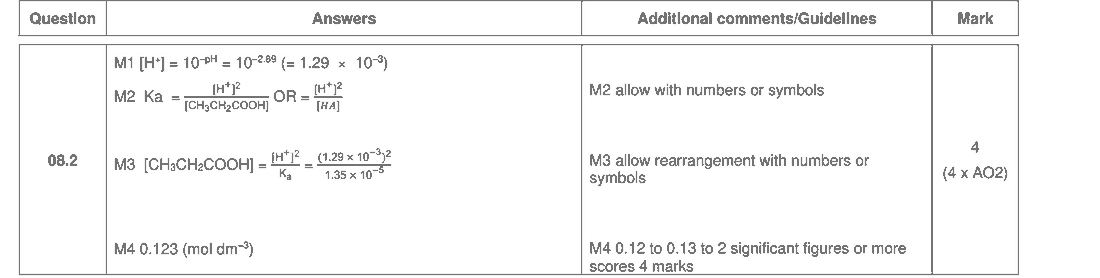
In part 2 most students could calculate the [H+] from the pH.
Students who could write the weak acid approximation generally went on to calculate the [CH3CH2COOH] correctly.
Skills: MS0.4 Use calculators to find and use power, exponential and logarithmic functions; MS2.2 Change the subject of an equation; MS2.5 Use logarithms in relation to quantities that range over several orders of magnitude
June 2025 · Paper 1 · Q08.31 markAO2=1Short answer
Earlier part of question 08 that this part uses
Mark scheme
Examiner's comment
Answers to parts 3 and 4 were generally good.
Notes from the mark scheme and report
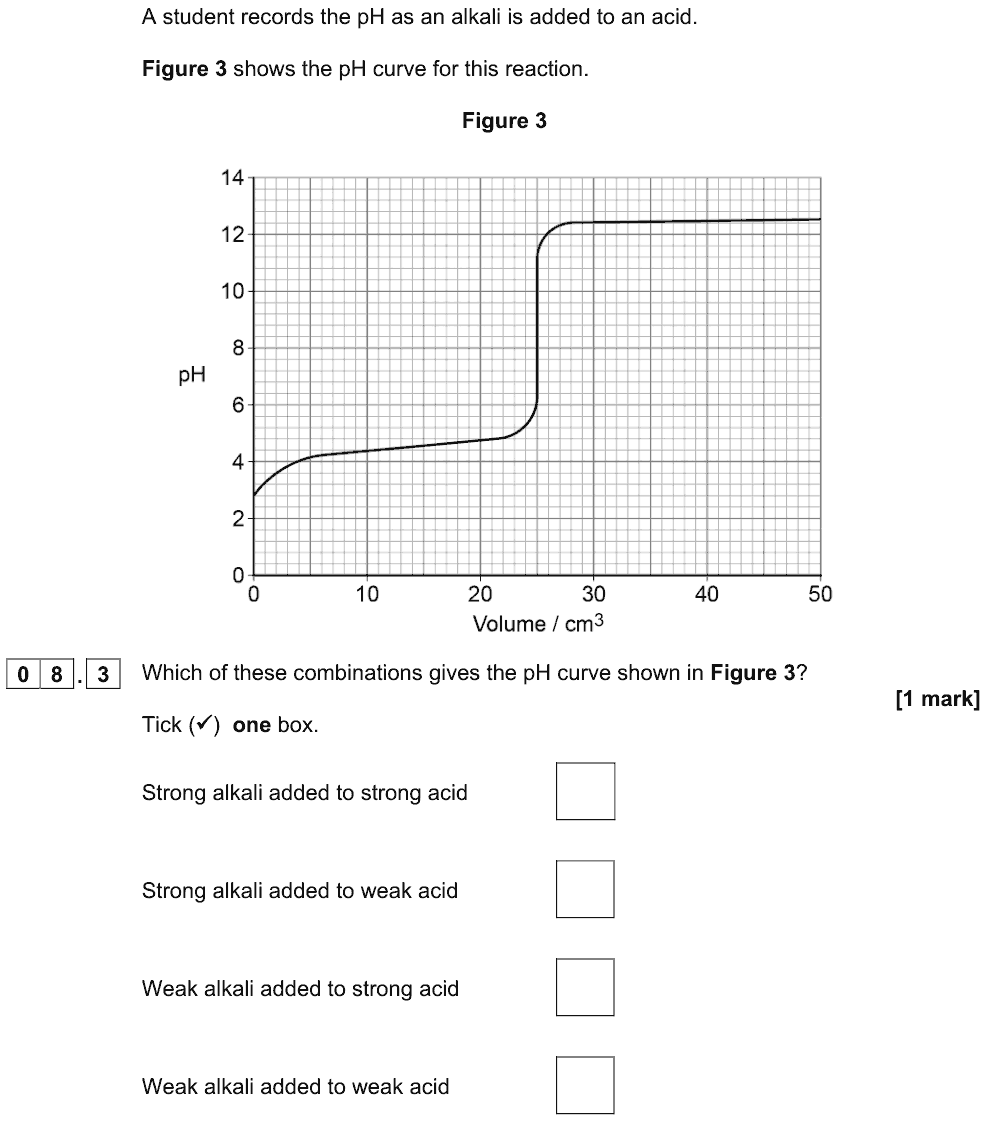
Answer: strong alkali added to weak acid. The curve starts near pH 3 with a buffer region, the vertical section is from about pH 6 to 12 and it finishes above pH 12
Skills: MS3.1 Translate information between graphical, numerical and algebraic forms; RP9 Investigate how pH changes when a weak acid reacts with a strong base and when a strong acid reacts with a weak base
June 2025 · Paper 1 · Q08.41 markAO3=1Short answer
Earlier parts of question 08 that this part uses
Mark scheme
Examiner's comment
Answers to parts 3 and 4 were generally good.
Notes from the mark scheme and report
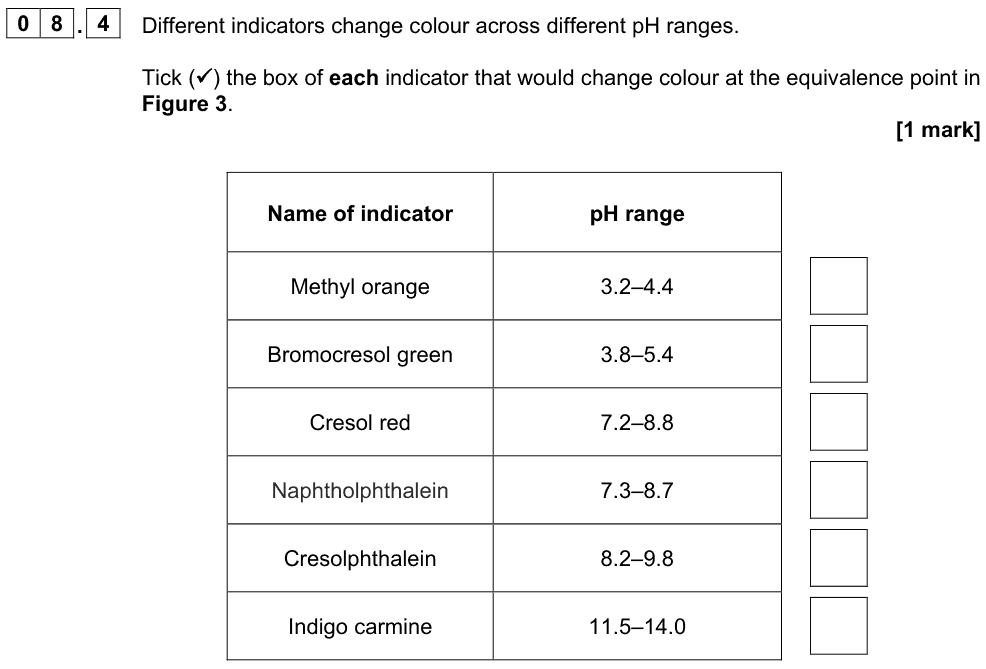
Answer: cresol red, naphtholphthalein and cresolphthalein (all three ticked). Their pH ranges lie wholly within the vertical section of the curve. Uses Figure 3 from 08.3
Skills: MS3.1 Translate information between graphical, numerical and algebraic forms; RP9 Investigate how pH changes when a weak acid reacts with a strong base and when a strong acid reacts with a weak base
June 2025 · Paper 1 · Q08.52 marksAO1=2Explanation
Earlier part of question 08 that this part uses
Mark scheme
Examiner's comment
Many students gave confused answers in part 5; those who wrote an equilibrium equation and then used that to explain the changes were more successful.
Many students referred to an equilibrium but did not identify the equation, so the answer was unclear.
Students who reacted their added hydroxide with the weak acid were often unsure how to proceed.
Very few students mentioned the ratio of the ethanoic acid and ethanoate ion concentrations being roughly constant.
Notes from the mark scheme and report
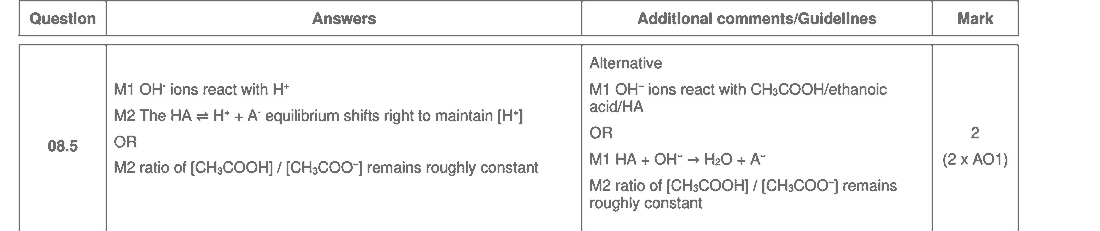
Added OH– ions react with H+ and the equilibrium CH3COOH ⇌ H+ + CH3COO– shifts right to replace them
or OH– reacts with CH3COOH (CH3COOH + OH– → CH3COO– + H2O) and the ratio [CH3COOH]/[CH3COO–] stays roughly constant. Write the equilibrium equation and use it
very few mentioned the ratio
June 2025 · Paper 1 · Q08.67 marksAO2=7Calculation
Earlier parts of question 08 that this part uses
Mark scheme
Examiner's comment
Part 6 discriminated well; nearly one third of
Notes from the mark scheme and report
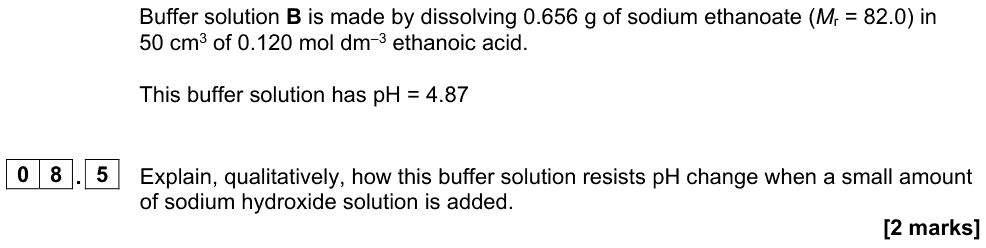
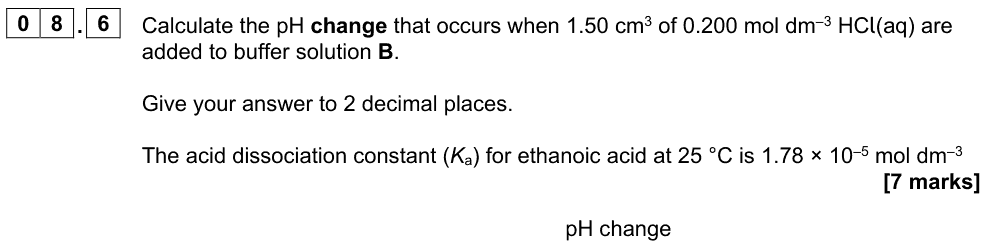
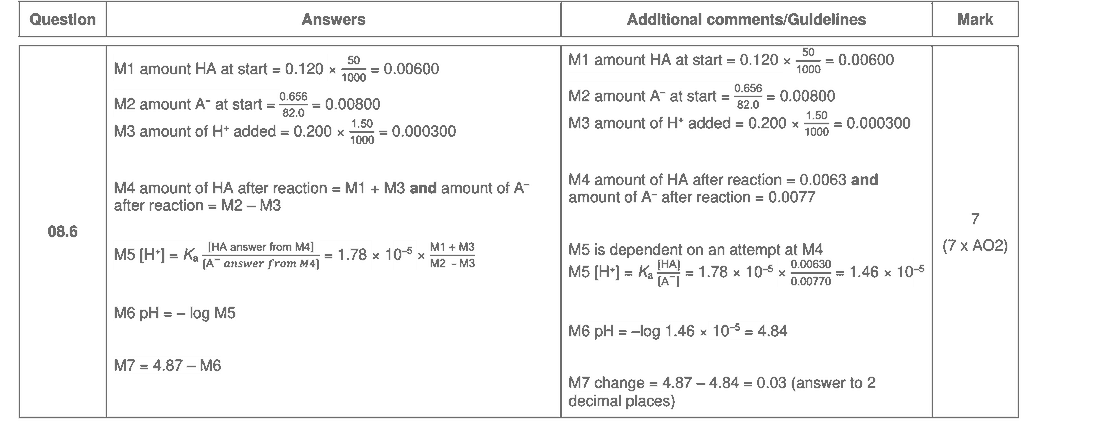
Answer: 0.03 (pH falls from 4.87 to 4.84). n(HA) = 0.120 × 50 ÷ 1000 = 6.00 × 10^–3 mol
n(A–) = 0.656 ÷ 82.0 = 8.00 × 10^–3 mol
n(H+) added = 3.00 × 10^–4 mol
after reaction HA = 6.30 × 10^–3 and A– = 7.70 × 10^–3 mol
[H+] = 1.78 × 10^–5 × 6.30/7.70 = 1.46 × 10^–5
pH = 4.84. Uses the buffer B data printed with 08.5
Skills: MS0.0 Recognise and make use of appropriate units in calculation; MS0.4 Use calculators to find and use power, exponential and logarithmic functions; MS2.2 Change the subject of an equation; MS2.5 Use logarithms in relation to quantities that range over several orders of magnitude
June 2024 · Paper 1 · Q05.42 marksAO1=1, AO3=1Equation writing
Earlier part of question 05 that this part uses
Mark scheme
Examiner's comment
In part 4, 39% of students scored both the marks: errors in the identification of the role of the chloride ion included acid, oxidising agent, reducing agent and catalyst.
Notes from the mark scheme and report
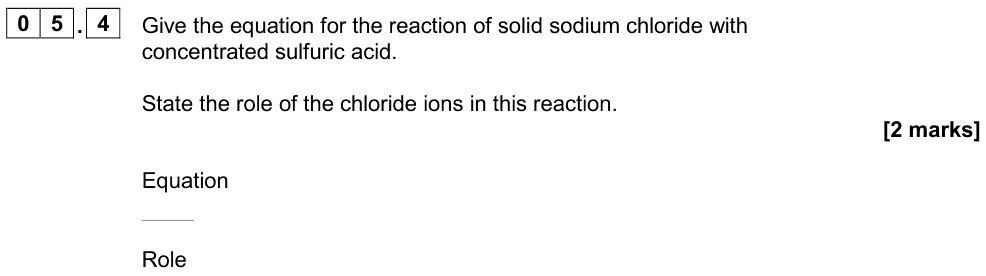
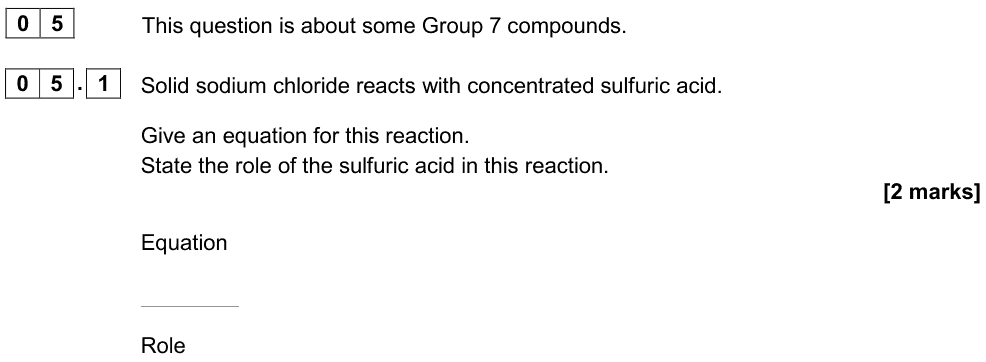
NaCl + H2SO4 → HCl + NaHSO4
the chloride ion is a base / proton acceptor. Wrong roles given: acid, oxidising agent, reducing agent, catalyst
June 2024 · Paper 1 · Q07.13 marksAO1=1, AO2=2Calculation
Mark scheme
Examiner's comment
Answers to part 1 were generally good.
Some student gave an incorrect expression for Kw: common errors included charges outside square brackets, using Kc instead of Kw or writing Kw = [H+]2 Errors in the calculation included forgetting to take the square root and not giving the answer to 2 decimal places.
Notes from the mark scheme and report
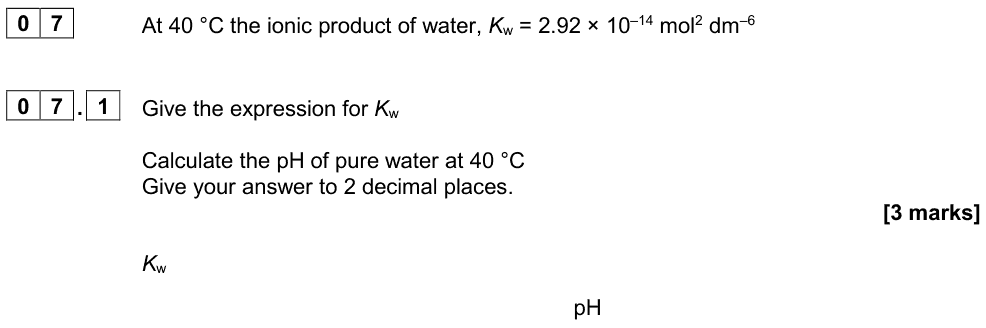
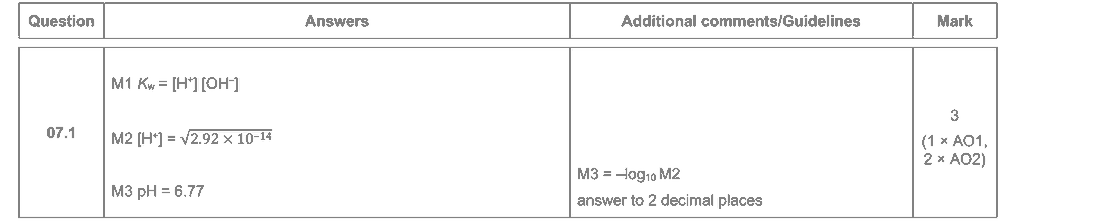
Answer: pH 6.77. Kw = [H+][OH–]
[H+] = √Kw. Errors: charges outside the square brackets, no square root, not 2 decimal places
Skills: MS0.4 Use calculators to find and use power, exponential and logarithmic functions; MS2.5 Use logarithms in relation to quantities that range over several orders of magnitude
June 2024 · Paper 1 · Q07.25 marksAO2=5Calculation
Earlier part of question 07 that this part uses
Mark scheme
Examiner's comment
In part 2, 48% of students scored all the marks, and nearly all scored some marks.
The question differentiated very well.
Errors in the calculation included missing the subtraction step, and not converting the amount, in moles, into a concentration.
The majority of students were able to convert [H+] into pH even if previous working was incorrect.
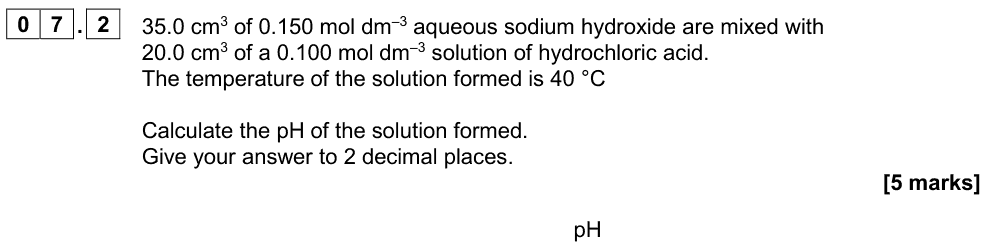
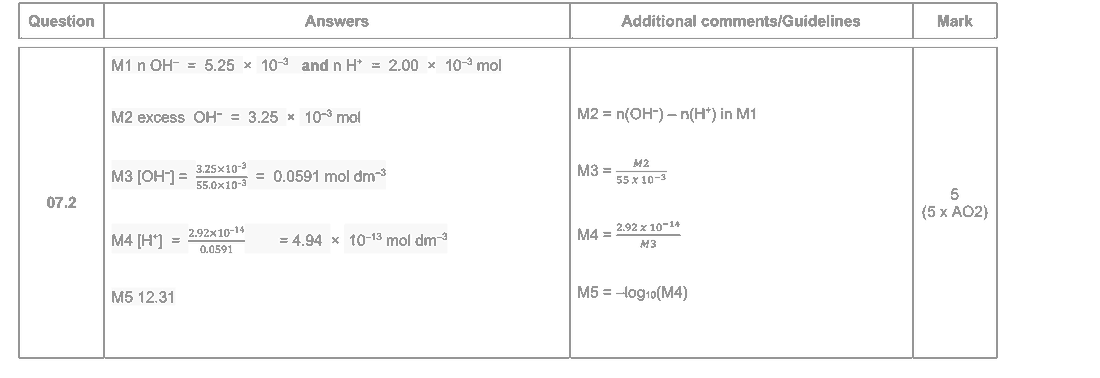
[H+] = Kw at 40 °C ÷ [OH–]. Errors: missing the subtraction
not converting moles to a concentration
Skills: MS0.0 Recognise and make use of appropriate units in calculation; MS0.4 Use calculators to find and use power, exponential and logarithmic functions; MS2.5 Use logarithms in relation to quantities that range over several orders of magnitude
June 2024 · Paper 3 · Q04.11 markAO1=1Short answerEasy
Mark scheme
Examiner's comment
In 04.1 over 80% of students were able to give the correct definition of ‘weak’ in the context of an acid.
Notes from the mark scheme and report
Only partially dissociates / ionises in aqueous solution (only a small fraction of molecules dissociate). Not 'the reaction is reversible'
June 2024 · Paper 3 · Q04.21 markAO3=1Practical and data analysis
Earlier part of question 04 that this part uses
Mark scheme
Examiner's comment
04.2 was a question where a lack of clarity in explanatory answers meant that many students failed to score.
Just suggesting that the dropwise addition is to help find (or avoid missing) the equivalence point is not enough.
The graph provided gives the underlying reason which is the rapid pH change for very little change in the volume of NaOH at the equivalence point.
Notes from the mark scheme and report
Because the pH changes very rapidly for a small addition of alkali near the equivalence point (steep section of the curve). 'So they do not miss the equivalence point' is not enough
Skills: ATc Measure pH using pH charts, or pH meter, or pH probe on a data logger; ATd Use laboratory apparatus for a variety of experimental techniques including: titration, using burette and pipette; distillation and heating under reflux, including setting up glassware using retort stand and clamps; qualitative tests for ions and organic functional groups; filtration, including use of fluted filter paper, or filtration under reduced pressure; PS2.1 Comment on experimental design and evaluate scientific methods; RP9 Investigate how pH changes when a weak acid reacts with a strong base and when a strong acid reacts with a weak base
June 2024 · Paper 3 · Q04.33 marksAO2=3Explanation
Earlier part of question 04 that this part uses
Mark scheme
Examiner's comment
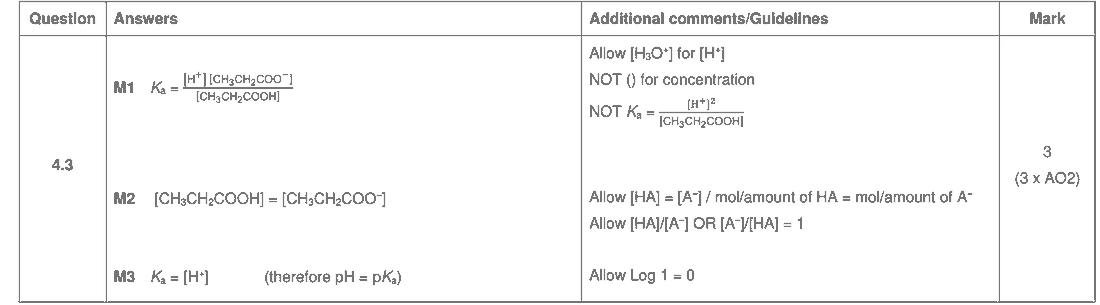
In 04.3, 80% of students were able to score one or more marks but relatively few produced a complete expression and an explanation.
Some students lost the mark for the expression by confusing the situation with the dissociation of a weak acid and showing Ka as equal to [H+]2 / [CH3COOH].
Students need to remember that the approximation of [H+] = [A–] only applies when a weak acid dissociates in aqueous solution.
In a buffer, the concentrations of H+ and A– are not equal.
Notes from the mark scheme and report
Ka = [H+][CH3CH2COO–] ÷ [CH3CH2COOH]. At half-neutralisation [CH3CH2COOH] = [CH3CH2COO–], so Ka = [H+] and pH = pKa. Not Ka = [H+]² ÷ [HA]: in a buffer [H+] ≠ [A–]. Square brackets needed
Skills: MS2.5 Use logarithms in relation to quantities that range over several orders of magnitude
June 2024 · Paper 3 · Q04.42 marksAO3=2Calculation
Earlier part of question 04 that this part uses
Mark scheme
Examiner's comment
In 04.4 students needed to use the information provided, that pH = pKa when half the propanoic acid has reacted, and find the pH at this point from the graph so that Ka could be calculated.
Notes from the mark scheme and report
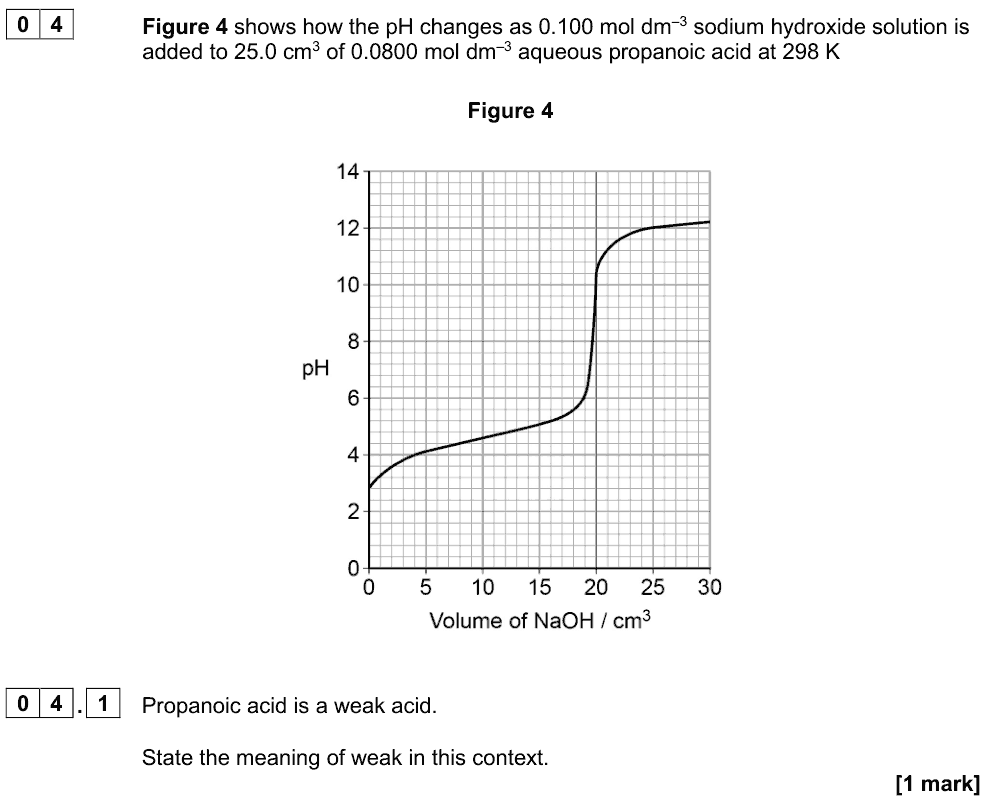
Answer: Ka about 2.5 × 10^–5 mol dm–3 (2.0 × 10^–5 to 4.0 × 10^–5). Equivalence at 20 cm3, so half-neutralisation is at 10 cm3, where pH is 4.4 to 4.7 (about 4.6)
Ka = 10^–pH. Using the starting pH (2.80) scores 0
Skills: MS0.4 Use calculators to find and use power, exponential and logarithmic functions; MS2.5 Use logarithms in relation to quantities that range over several orders of magnitude; MS3.1 Translate information between graphical, numerical and algebraic forms; RP9 Investigate how pH changes when a weak acid reacts with a strong base and when a strong acid reacts with a weak base
June 2024 · Paper 3 · Q04.52 marksAO1=2Explanation
Earlier part of question 04 that this part uses
Mark scheme
Examiner's comment
In 04.5 students often failed to give a full explanation and simply offered the idea that a buffer resists changes in pH.
The use of the command word ‘explain’ indicates that more detail is needed in an answer.
A second factor that prevented marks being earned were vague references to ‘the equilibrium’.
For example, a student’s answer such as ‘OH– reacts with H+ so the equilibrium moves to the right’ would only score one mark as it is not clear which equilibrium is being referred to.
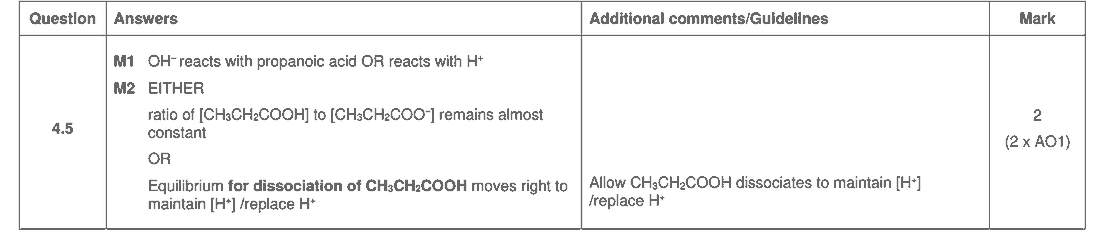
An ideal answer would show the relevant equilibrium as CH3CH2COOH ⇌ CH3CH2COO– + H+, then refer to the added OH– reacting with H+ which, in turn means that the equilibrium (shown) moves to the right to compensate for the change and keep [H+] approximately constant.
Notes from the mark scheme and report
Added OH– reacts with H+ (or with propanoic acid)
the equilibrium CH3CH2COOH ⇌ CH3CH2COO– + H+ moves right to replace the H+ (or the ratio [CH3CH2COOH] : [CH3CH2COO–] stays almost constant). State which equilibrium
'a buffer resists changes in pH' is not an explanation
June 2024 · Paper 3 · Q04.62 marksAO3=2Short answer
Earlier part of question 04 that this part uses
Mark scheme
Examiner's comment
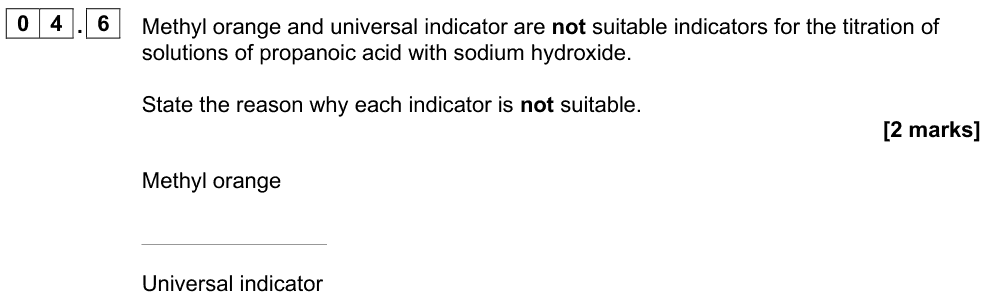
04.6 A lack of clarity in the explanations offered again hindered things in this question although a majority of students scored one or more marks. The key for methyl orange is to recognise that its pH range (the range of pH over which it changes colour) does not match the rapid pH change on the titration curve, whereas for Universal Indicator, the problem is that there are many colour changes as the pH changes.
Notes from the mark scheme and report
Methyl orange: its pH range does not match the rapid pH change / it changes colour before the equivalence point. Universal indicator: it shows a range of colours, so there is no distinct colour change at the end point
Skills: ATf Use acid–base indicators in titrations of weak/strong acids with weak/strong alkalis
June 2024 · Paper 3 · Q181 markAO3=1Multiple choice
Answer
A
Mark scheme
Notes from the mark scheme and report
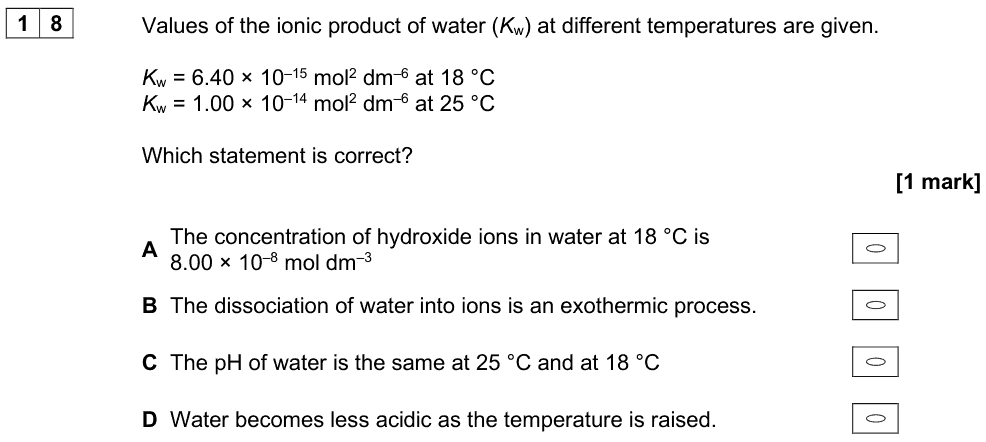
Answer: A. In pure water [OH–] = [H+] = √Kw = √(6.40 × 10^–15) = 8.00 × 10^–8 mol dm–3. Kw rises with temperature, so dissociation is endothermic and pH falls, but water stays neutral
Skills: MS0.4 Use calculators to find and use power, exponential and logarithmic functions
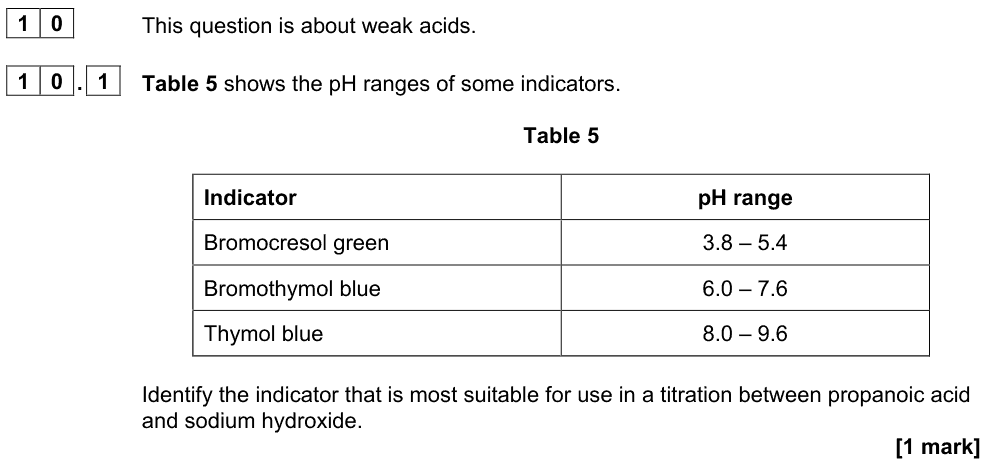
June 2023 · Paper 1 · Q10.11 markAO3=1Short answer
Mark scheme
Examiner's comment
Bromothymol blue was the most common incorrect answer in 10.1.
Notes from the mark scheme and report
Answer: thymol blue (weak acid with strong base: equivalence point above pH 7, so the range 8.0 to 9.6 lies in the vertical section). Common wrong answer: bromothymol blue
June 2023 · Paper 1 · Q10.21 markAO1=1Short answer
Earlier part of question 10 that this part uses
Mark scheme
Examiner's comment
The expression in 10.2 was well known.
Notes from the mark scheme and report
Ka = [H+][CH3CH2COO–] ÷ [CH3CH2COOH]. Square brackets essential
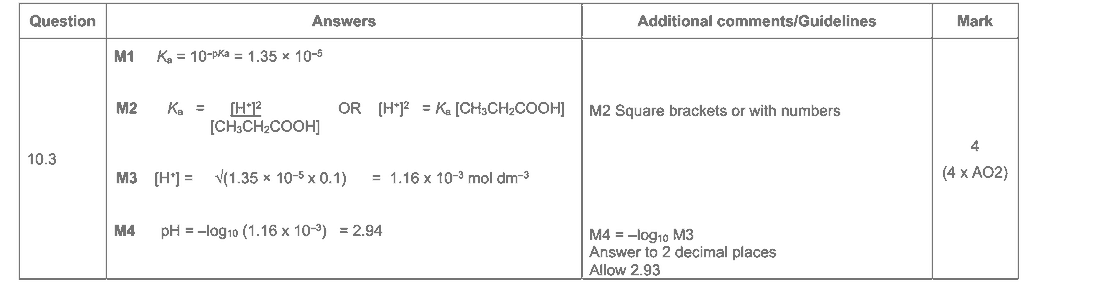
June 2023 · Paper 1 · Q10.34 marksAO2=4CalculationEasy
Earlier part of question 10 that this part uses
Mark scheme
Examiner's comment
Answers to 10.3 were good, with 63% of students gaining all the marks.
Common errors included not taking the square root or dividing by 0.1 (in M3 of the Mark Scheme) and not giving the answer to 2 decimal places.
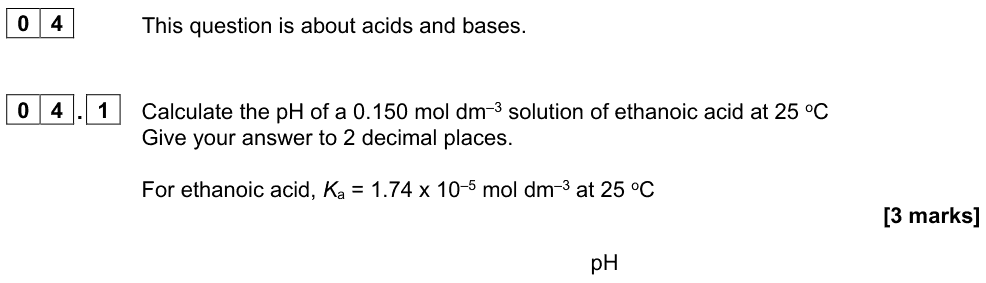
[H+] = √(Ka × 0.100) = 1.16 × 10^–3 mol dm–3. Errors: no square root, dividing by 0.1, not 2 decimal places
Skills: MS0.4 Use calculators to find and use power, exponential and logarithmic functions; MS1.1 Use an appropriate number of significant figures; MS2.5 Use logarithms in relation to quantities that range over several orders of magnitude
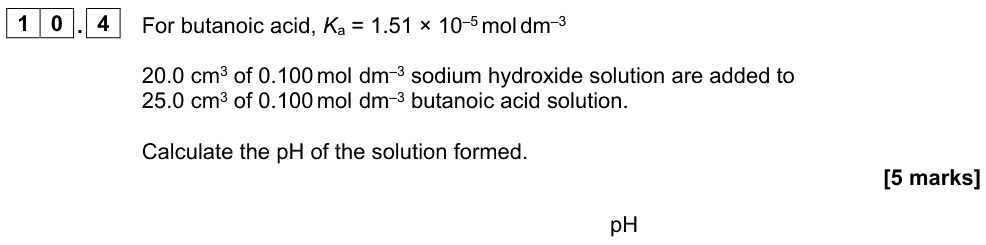
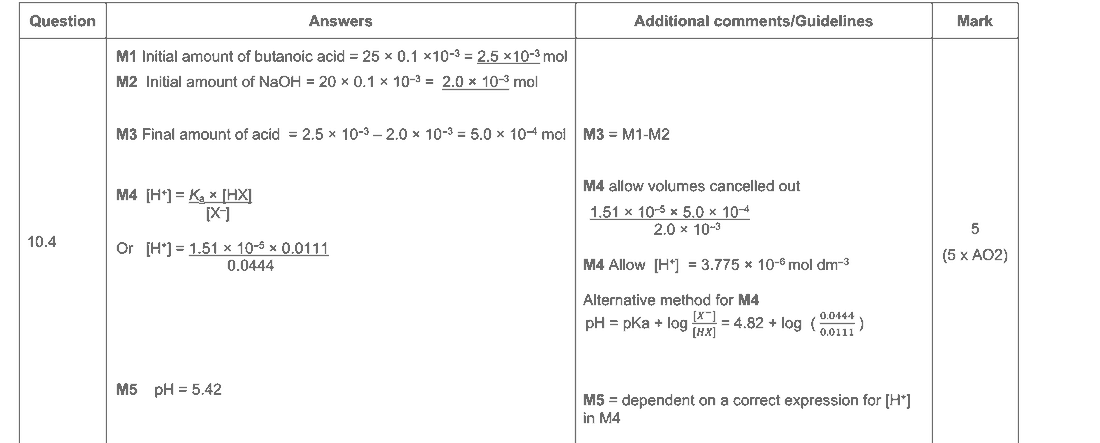
June 2023 · Paper 1 · Q10.45 marksAO2=5CalculationHard
Earlier part of question 10 that this part uses
Mark scheme
Examiner's comment
29% of students gained all of the marks in 10.4.
Many students did not identify that the reaction mixture was a buffer solution with an excess of a weak acid.
These students did not subtract the amount, in moles, of sodium hydroxide from the amount of butanoic acid to determine the excess of the weak acid.
Other errors included an attempt to use the weak acid approximation, [H+] = Ka × [C3H7COOH] to calculate pH.
acid left = 5.0 × 10^–4 mol, salt formed = 2.00 × 10^–3 mol (a buffer)
[H+] = Ka × [HX]/[X–] = 1.51 × 10^–5 × (5.0 × 10^–4 ÷ 2.00 × 10^–3) = 3.78 × 10^–6. Errors: not subtracting moles of NaOH
using the weak acid expression [H+]² = Ka[HX]
Skills: MS0.0 Recognise and make use of appropriate units in calculation; MS0.4 Use calculators to find and use power, exponential and logarithmic functions; MS2.5 Use logarithms in relation to quantities that range over several orders of magnitude
June 2023 · Paper 1 · Q10.52 marksAO3=2Explanation
Earlier part of question 10 that this part uses
Mark scheme
Examiner's comment
Explanations in 10.5 were generally poor; many students did not state that this was a weak acid - weak base titration and answers rarely referred to the gradual pH change; common errors included reference to the indicator having a small pH range or a gradual colour change or the equivalence point being too short.
Some students made reference to there being no steep section on the graph but with no explanation about the graph to which this statement referred.
Notes from the mark scheme and report
It is a weak acid–weak base titration, so the pH change at the equivalence point is too gradual (no vertical section on the pH curve) for an indicator to give a sharp colour change. Errors: 'indicator has a small pH range'
'no steep section' without saying of what
June 2023 · Paper 3 · Q06.25 marksCalculation
Earlier part of question 06 that this part uses
Mark scheme
Examiner's comment
The application of a generous mark scheme in 06.2 meant that many students were able to access some marks despite quite significant misunderstanding as to what was required.
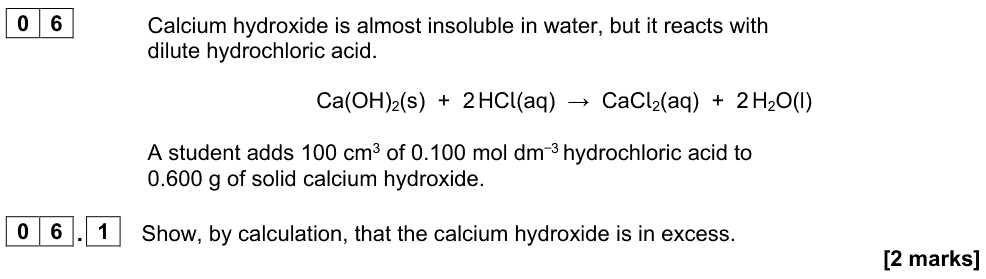
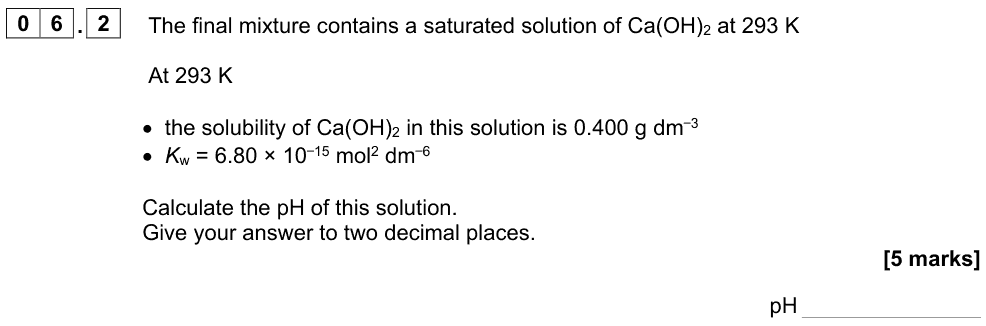
Many failed to realise that the concentration of Ca(OH)2 in the saturated solution could be found directly from the solubility data given.
pH = –log[H+]. Many did not see that the concentration comes directly from the solubility
Skills: MS0.0 Recognise and make use of appropriate units in calculation; MS0.4 Use calculators to find and use power, exponential and logarithmic functions; MS2.5 Use logarithms in relation to quantities that range over several orders of magnitude
June 2023 · Paper 3 · Q131 markAO2=1Multiple choice
Answer
D
Mark scheme
Notes from the mark scheme and report
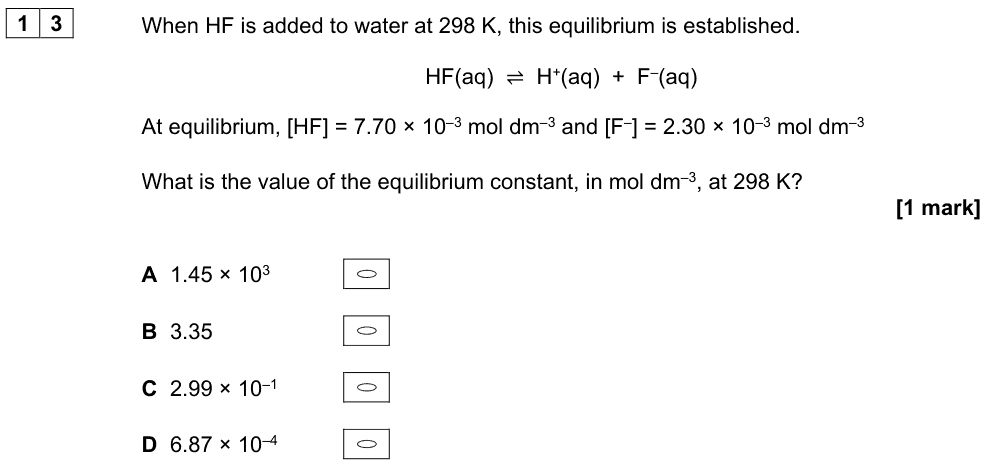
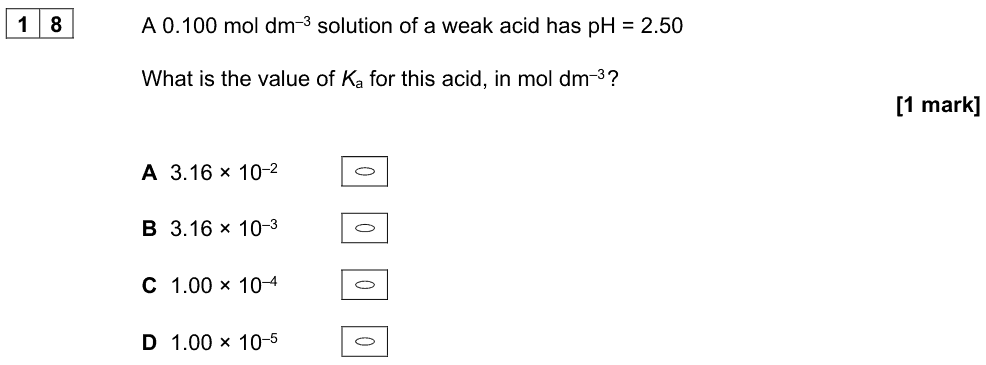
Answer: D. [H+] = [F–], so Ka = (2.30 × 10^–3)² ÷ (7.70 × 10^–3) = 6.87 × 10^–4 mol dm–3. C (0.299) comes from not squaring (report: listed among the trickiest questions, 40% or fewer correct)
Skills: MS0.1 Recognise and use expressions in decimal and ordinary form; MS2.3 Substitute numerical values into algebraic equations using appropriate units for physical quantities
June 2023 · Paper 3 · Q161 markAO1=1Multiple choice
Answer
B
Mark scheme
Notes from the mark scheme and report
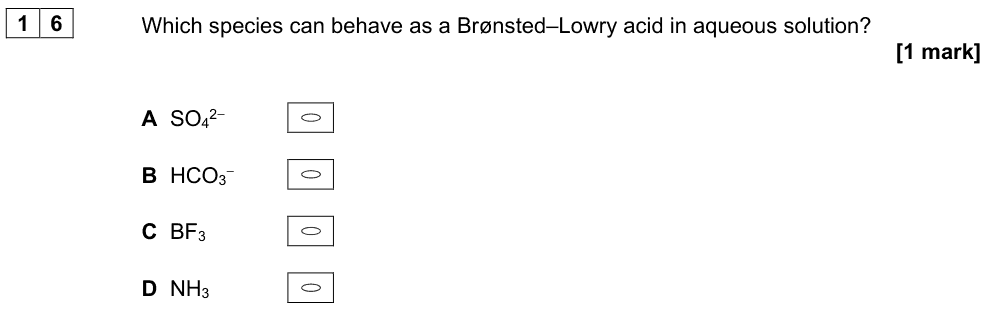
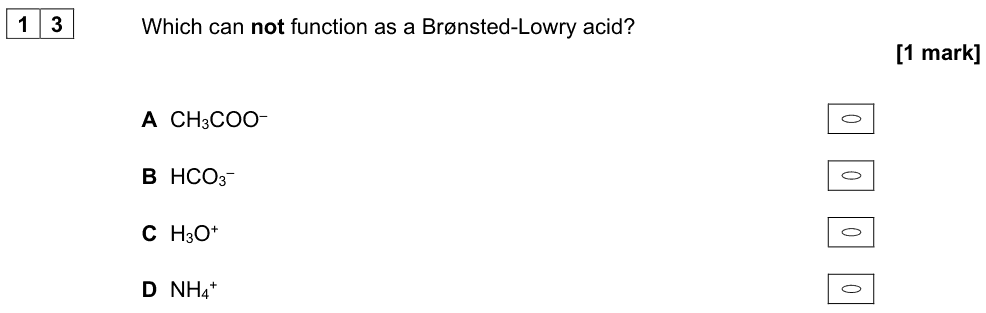
Answer: B. HCO3– can donate a proton (forming CO3 2–)
SO4 2– and BF3 have no proton to donate and NH3 acts as a base in water
June 2023 · Paper 3 · Q171 markAO2=1Multiple choice
Answer
D
Mark scheme
Notes from the mark scheme and report
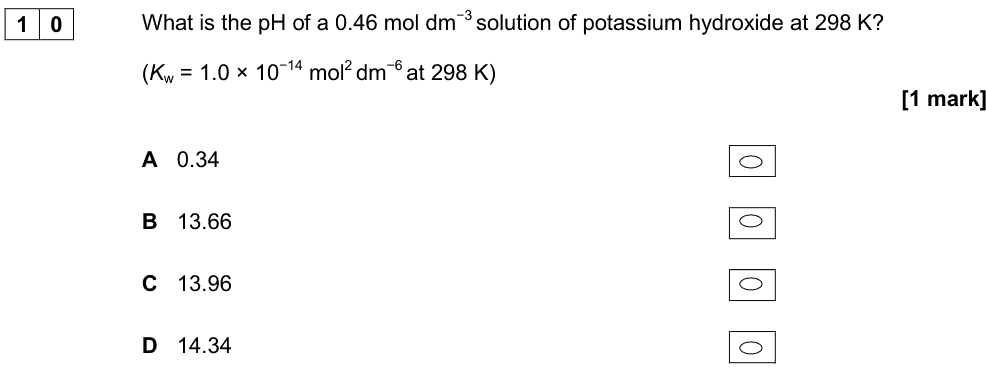
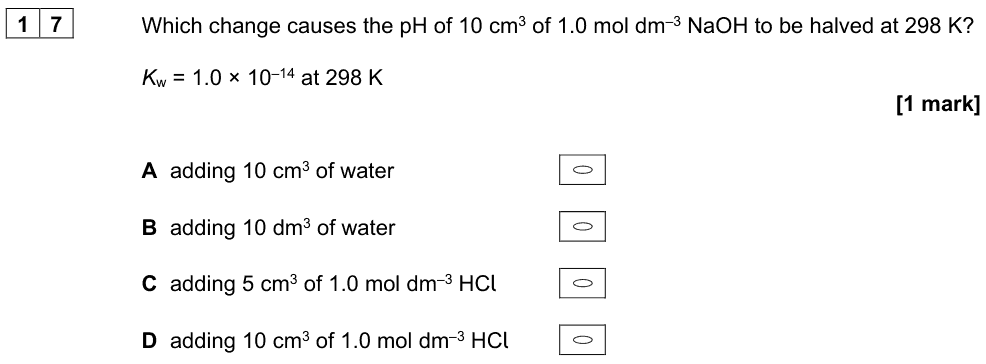
Answer: D. 1.0 mol dm–3 NaOH has pH 14.0
adding 10 cm3 of 1.0 mol dm–3 HCl neutralises it exactly, giving pH 7.0. Dilution changes the pH only slightly
Skills: MS0.4 Use calculators to find and use power, exponential and logarithmic functions; MS2.5 Use logarithms in relation to quantities that range over several orders of magnitude
June 2023 · Paper 3 · Q181 markAO2=1Multiple choice
Skills: MS0.4 Use calculators to find and use power, exponential and logarithmic functions; MS2.5 Use logarithms in relation to quantities that range over several orders of magnitude
June 2023 · Paper 3 · Q201 markAO1=1Multiple choice
Answer
A
Mark scheme
Notes from the mark scheme and report
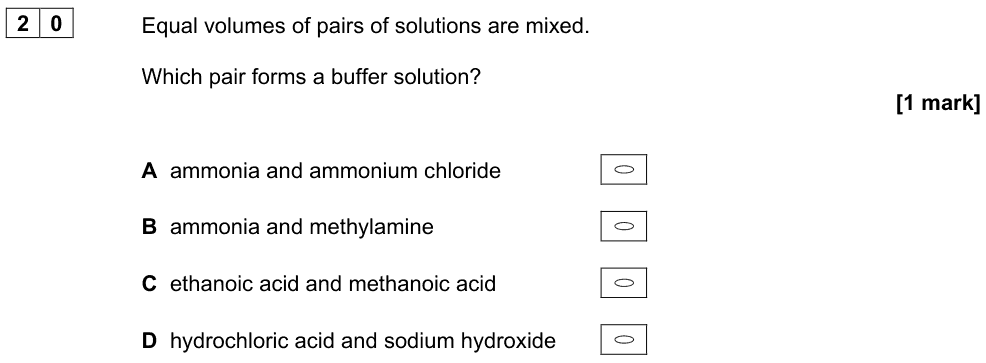
Answer: A. A basic buffer is a weak base with its salt: NH3 and NH4Cl
June 2022 · Paper 1 · Q04.13 marksAO2=3Calculation
Mark scheme
Examiner's comment
Most students scored well in 04.1; errors included not giving their answer to 2 decimal places or omitting to take the square root.
Skills: MS0.4 Use calculators to find and use power, exponential and logarithmic functions; MS2.5 Use logarithms in relation to quantities that range over several orders of magnitude
June 2022 · Paper 1 · Q04.23 marksAO2=3Calculation
Earlier part of question 04 that this part uses
Mark scheme
Examiner's comment
In 04.2, 49% of students scored all the marks.
The most common
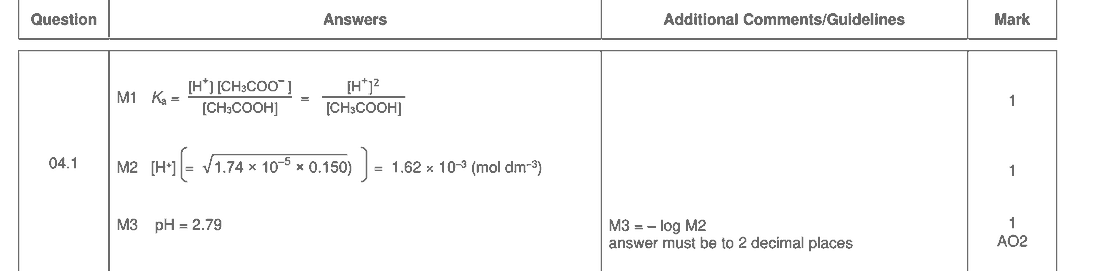
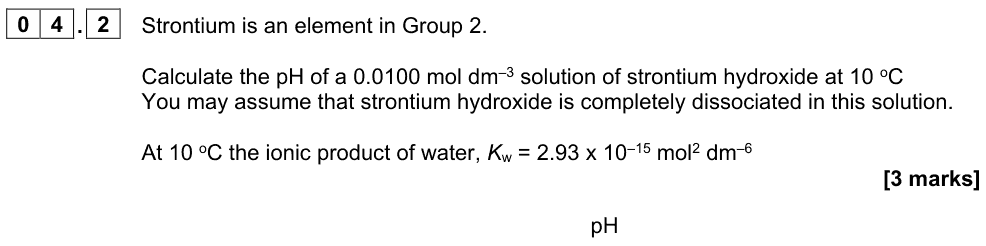
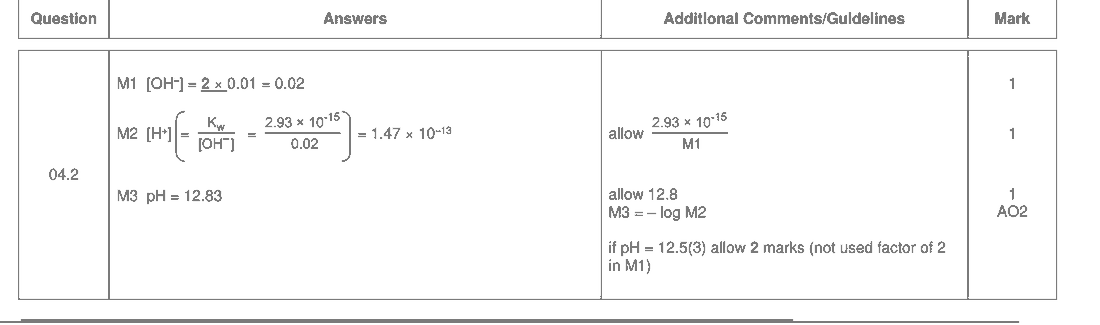
[H+] = Kw ÷ [OH–] = 2.93 × 10^–15 ÷ 0.0200 = 1.47 × 10^–13. pH 12.53 (factor of 2 missed) scores 2. 49% scored all 3 marks
Skills: MS0.4 Use calculators to find and use power, exponential and logarithmic functions; MS2.5 Use logarithms in relation to quantities that range over several orders of magnitude
June 2022 · Paper 1 · Q04.32 marksAO3=2Short answer
Earlier part of question 04 that this part uses
Mark scheme
Examiner's comment
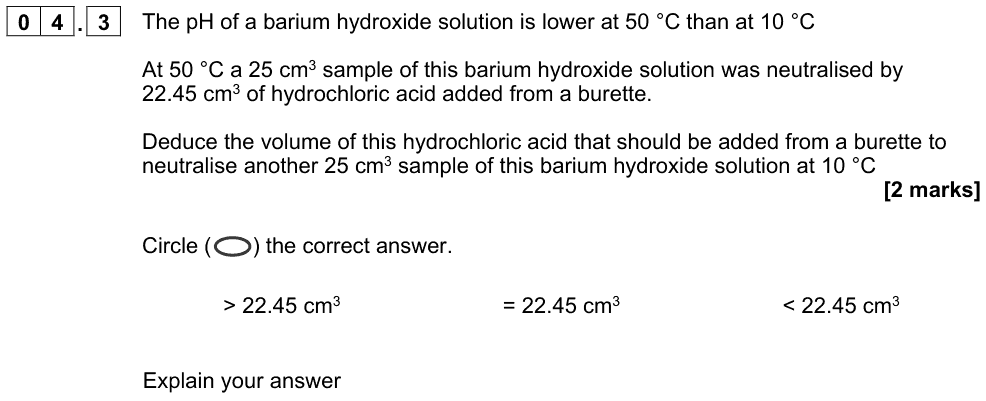
Question 04.3 was very challenging and very few students achieved both marks; most students did not realise that there was the same amount of hydroxide ions and therefore the volume of hydrochloric acid would be the same.
Notes from the mark scheme and report
Answer: = 22.45 cm3. The sample contains the same amount of OH– ions (same [OH–]) at both temperatures
the pH differs only because Kw changes with temperature. Very few scored both marks
June 2022 · Paper 1 · Q04.43 marksAO3=3Short answerHard
Earlier part of question 04 that this part uses
Mark scheme
Examiner's comment
Students found 04.4 challenging; only 5% scored all three marks.
Many scored intermediate marks.
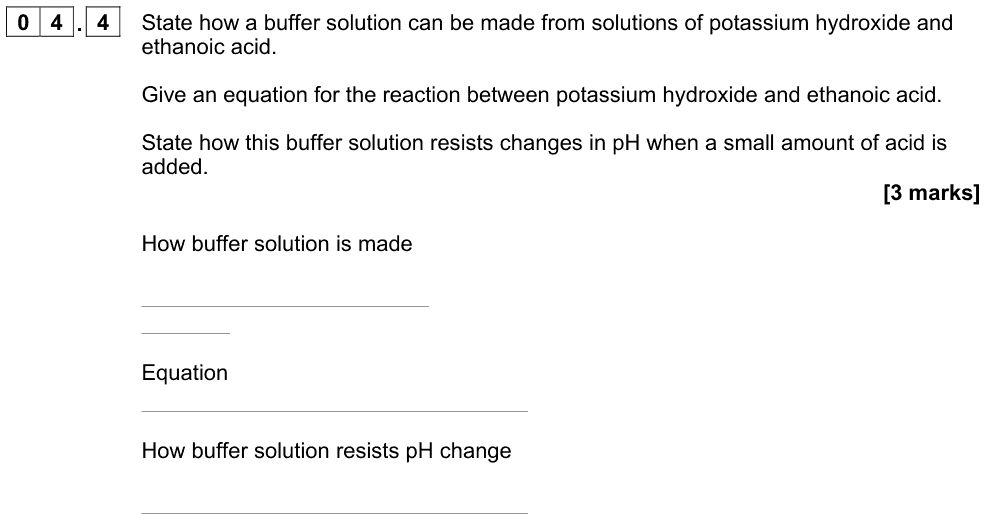
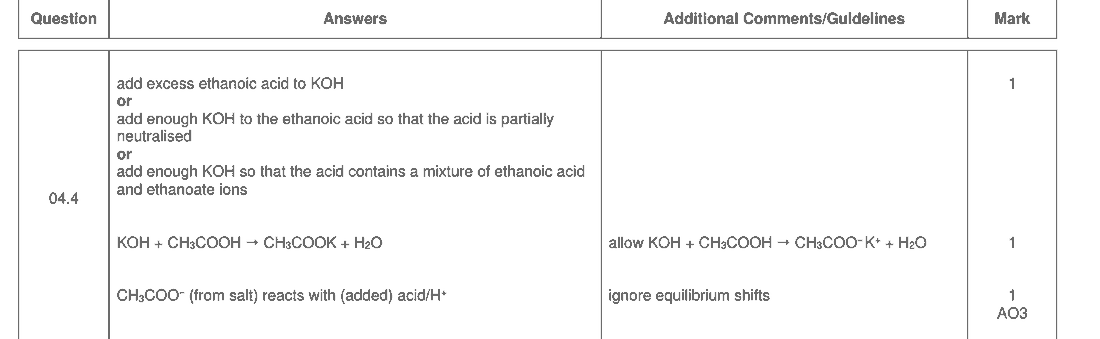
Although there was reasonable appreciation of the need to mix ethanoic acid with potassium hydroxide solution, far fewer acknowledged the need to leave the acid in excess.
The equation was the most likely mark to be achieved.
Only a minority could successfully account for the buffer’s resistance to pH change.
Some had OH– reacting with the added H+, whilst others referred to the shifting of an equilibrium without identifying it; very few stated that the added H+
Notes from the mark scheme and report
Add excess ethanoic acid to the KOH (partially neutralise the acid so that ethanoic acid and ethanoate ions are both present). KOH + CH3COOH → CH3COOK + H2O. The ethanoate ions CH3COO– react with the added H+. Ignore unspecified equilibrium shifts. Errors: acid not left in excess
OH– said to react with the added H+
June 2022 · Paper 1 · Q04.55 marksCalculation
Earlier part of question 04 that this part uses
Mark scheme
Examiner's comment
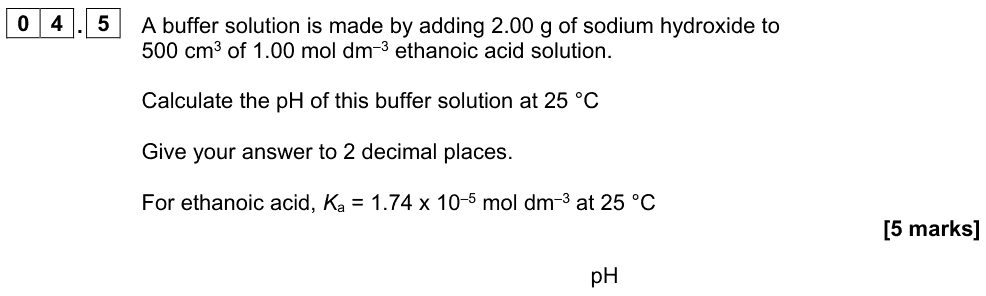
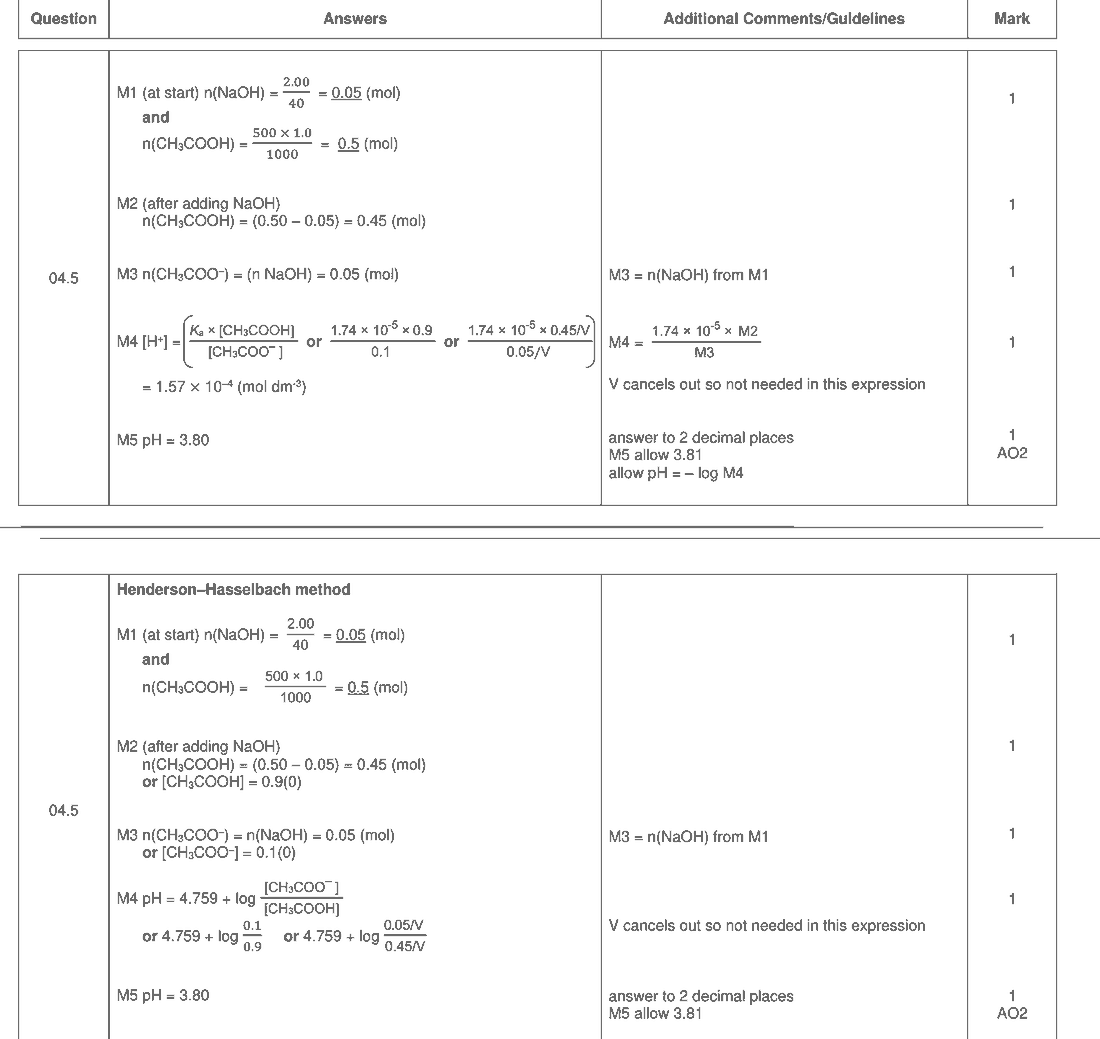
In 04.5, the correct answer was achieved by 40% of students.
Common errors in the extended calculation included failure to score the second mark for the amount, in moles, of CH3COOH after alkali addition, adding 0.5 to 0.05 to get an incorrect amount of salt and trying to use an equation with [H+]2/[HA].
This question discriminated very well.
n(CH3COOH) at start = 0.500 mol, remaining = 0.450 mol
n(CH3COO–) = 0.0500 mol
[H+] = Ka × 0.450 ÷ 0.0500 = 1.57 × 10^–4 (volume cancels). Errors: acid amount not reduced, adding 0.5 to 0.05 for the salt, using [H+]² ÷ [HA]. 40% reached the correct answer
Skills: MS0.2 Use ratios, fractions and percentages; MS0.4 Use calculators to find and use power, exponential and logarithmic functions; MS2.5 Use logarithms in relation to quantities that range over several orders of magnitude
June 2022 · Paper 3 · Q131 markAO3=1Multiple choice
Answer
A
Mark scheme
Notes from the mark scheme and report
Answer: A. CH3COO– has no ionisable hydrogen to donate (it is a base)
HCO3–, H3O+ and NH4+ can all donate a proton
June 2022 · Paper 3 · Q141 markAO2=1Multiple choice
Skills: MS0.4 Use calculators to find and use power, exponential and logarithmic functions; MS2.5 Use logarithms in relation to quantities that range over several orders of magnitude
June 2022 · Paper 3 · Q151 markAO3=1Multiple choice
Answer
B
Mark scheme
Notes from the mark scheme and report
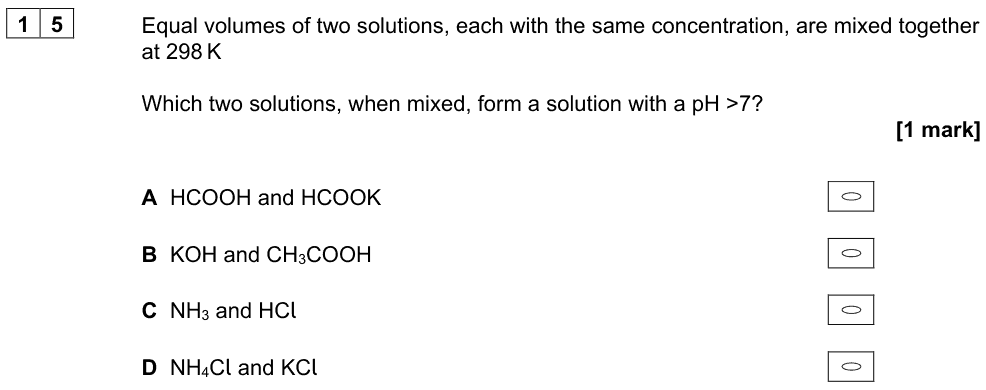
Answer: B. KOH neutralises CH3COOH exactly, leaving the salt of a strong base and a weak acid (ethanoate ions make it alkaline). A is an acidic buffer
C gives NH4Cl (acidic)
D is acidic / neutral
November 2021 · Paper 1 · Q06.11 markShort answer
Mark scheme
Examiner's comment
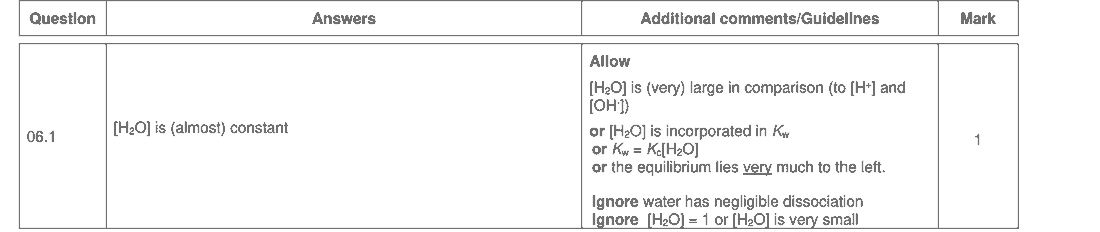
Students found question 06.1 challenging; many students stated that [H2O] is 1 or [H2O] has no effect.
Some students appreciated that the concentration of water is included in the equilibrium constant.
Notes from the mark scheme and report
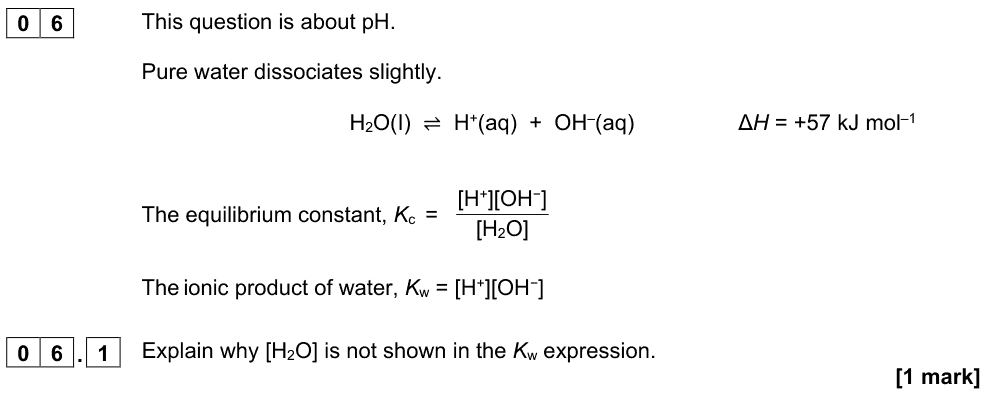
[H2O] is (almost) constant / very large compared with [H+] and [OH–], so it is incorporated into Kw (Kw = Kc[H2O]). '[H2O] = 1' and 'negligible dissociation' are ignored
November 2021 · Paper 1 · Q06.22 marksExplanation
Earlier part of question 06 that this part uses
Mark scheme
Examiner's comment
In question 06.2 some students realised that the reaction was endothermic but did not complete their answer with an explanation.
Some students tried to explain their answer in terms of kinetics.
Notes from the mark scheme and report
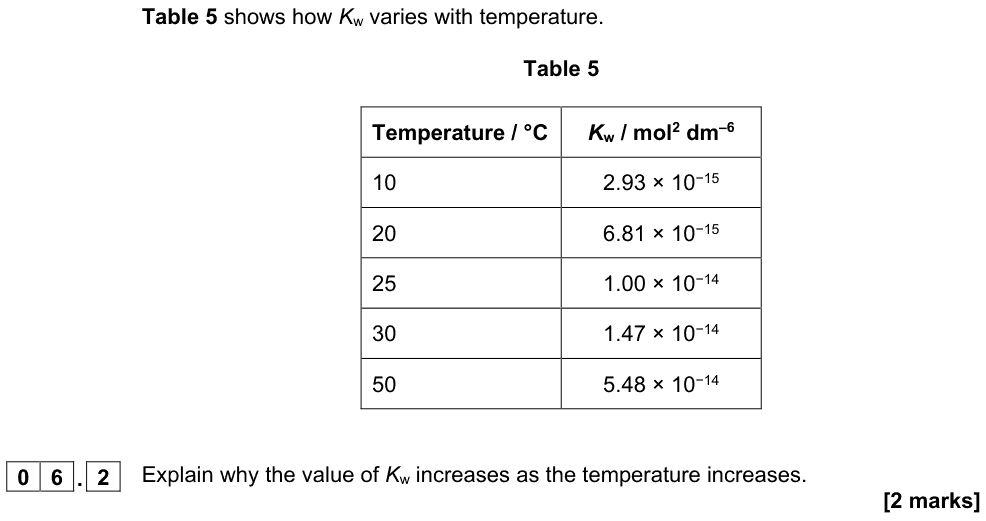
The dissociation is endothermic
the equilibrium shifts to the right to oppose the temperature increase. Kinetic arguments do not score
November 2021 · Paper 1 · Q06.34 marksCalculation
Earlier parts of question 06 that this part uses
Mark scheme
Examiner's comment
Answers to question 06.3 were generally well done; a few students used ( ) brackets in the expression rather than [ ] brackets and a few students did not give the pH to two decimal places.
Some students could not give a correct explanation.
Notes from the mark scheme and report
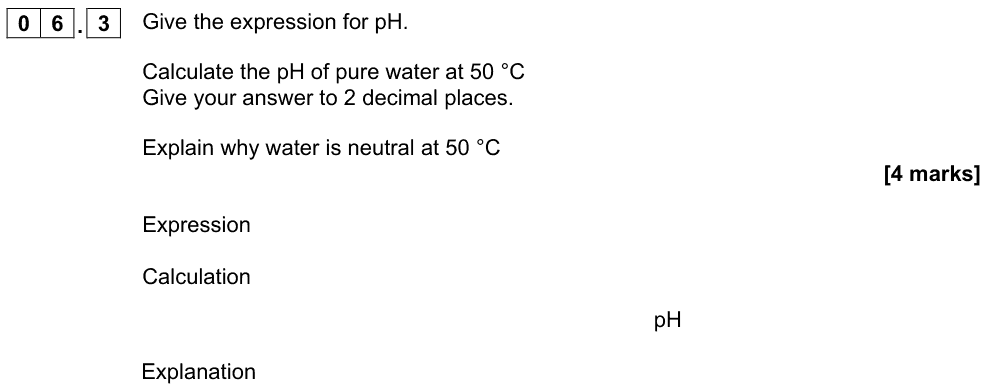
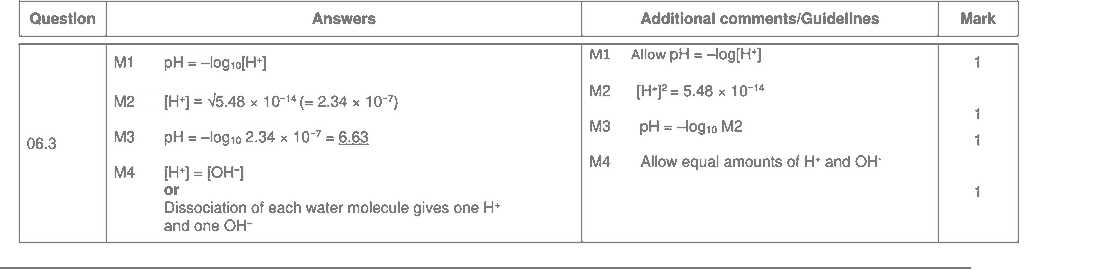
Answer: pH 6.63. pH = –log10[H+]
[H+] = √(5.48 × 10^–14) = 2.34 × 10^–7 mol dm–3
neutral because [H+] = [OH–]. Square brackets needed in the expression
2 d.p. Uses Kw at 50 °C from Table 5 in 06.2
Skills: MS0.1 Recognise and use expressions in decimal and ordinary form; MS2.5 Use logarithms in relation to quantities that range over several orders of magnitude
November 2021 · Paper 1 · Q06.41 markPractical and data analysis
Earlier part of question 06 that this part uses
Mark scheme
Examiner's comment
Almost all students answered question 06.4 correctly.
Notes from the mark scheme and report
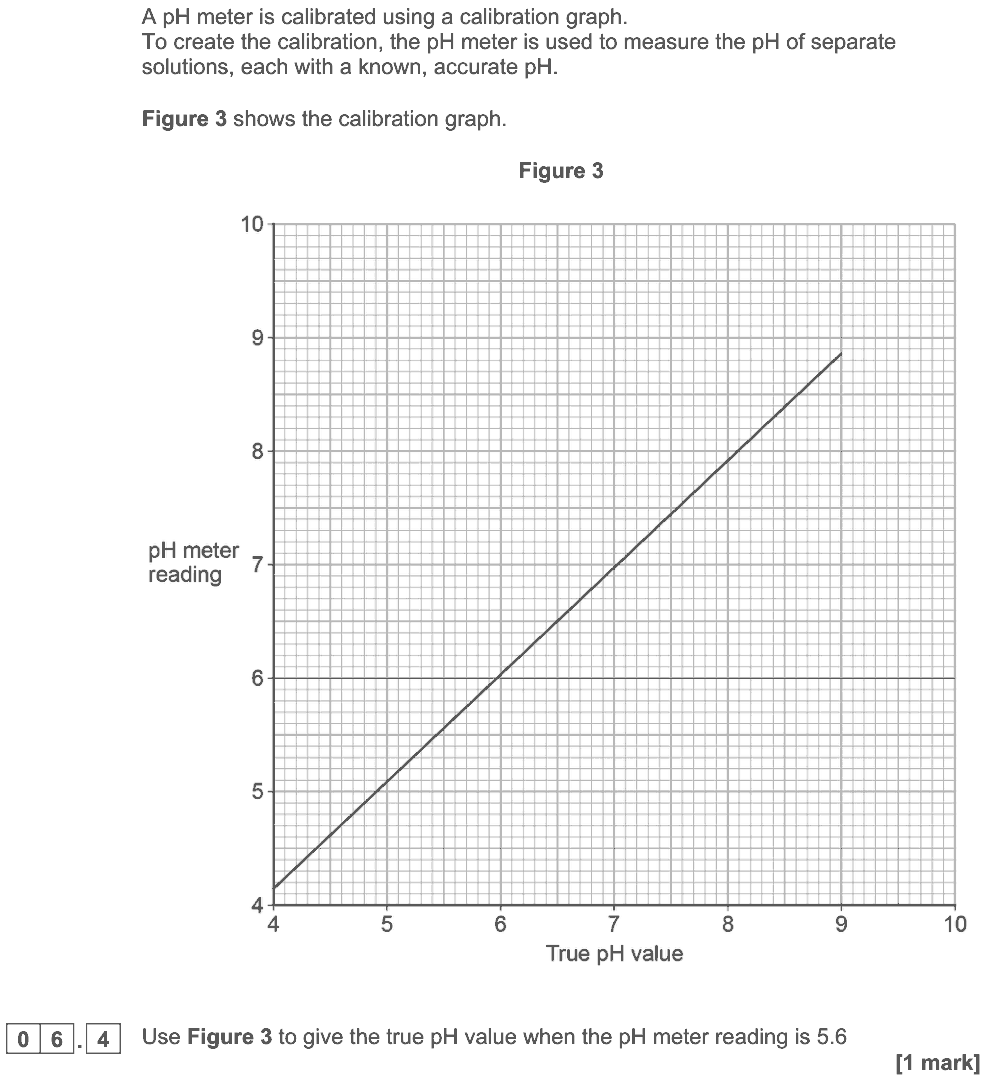
Answer: 5.55 (allow 5.5 to 5.6), read from the calibration graph
Skills: ATc Measure pH using pH charts, or pH meter, or pH probe on a data logger; MS3.1 Translate information between graphical, numerical and algebraic forms; PS3.1 Plot and interpret graphs; RP9 Investigate how pH changes when a weak acid reacts with a strong base and when a strong acid reacts with a weak base
November 2021 · Paper 1 · Q06.51 markPractical and data analysis
Earlier parts of question 06 that this part uses
Mark scheme
Examiner's comment
In question 06.5 most students knew that the solution would be contaminated.
Notes from the mark scheme and report
So that the solutions do not contaminate each other / to wash off residual solution that would affect the next reading. 'To neutralise' is ignored
Skills: ATc Measure pH using pH charts, or pH meter, or pH probe on a data logger; PS4.1 Know and understand how to use a wide range of experimental and practical instruments, equipment and techniques appropriate to the knowledge and understanding included in the specification; RP9 Investigate how pH changes when a weak acid reacts with a strong base and when a strong acid reacts with a weak base
November 2021 · Paper 1 · Q06.61 markPractical and data analysis
Earlier parts of question 06 that this part uses
Mark scheme
Examiner's comment
Students found question 06.6 very challenging; most students said the titration would be more precise or accurate.
Very few students explained clearly that a small volume of added alkali gives a large change in pH.
Notes from the mark scheme and report
To avoid missing the end point: near the end point a small volume of alkali gives a large change in pH. 'More accurate/precise' did not score
Skills: ATc Measure pH using pH charts, or pH meter, or pH probe on a data logger; ATd Use laboratory apparatus for a variety of experimental techniques including: titration, using burette and pipette; distillation and heating under reflux, including setting up glassware using retort stand and clamps; qualitative tests for ions and organic functional groups; filtration, including use of fluted filter paper, or filtration under reduced pressure; PS2.1 Comment on experimental design and evaluate scientific methods; RP9 Investigate how pH changes when a weak acid reacts with a strong base and when a strong acid reacts with a weak base
November 2021 · Paper 1 · Q06.71 markShort answer
Earlier parts of question 06 that this part uses
Mark scheme
Examiner's comment
In question 06.7 many students related the colour changes to the equivalence point or the endpoint without using the curve.
Notes from the mark scheme and report
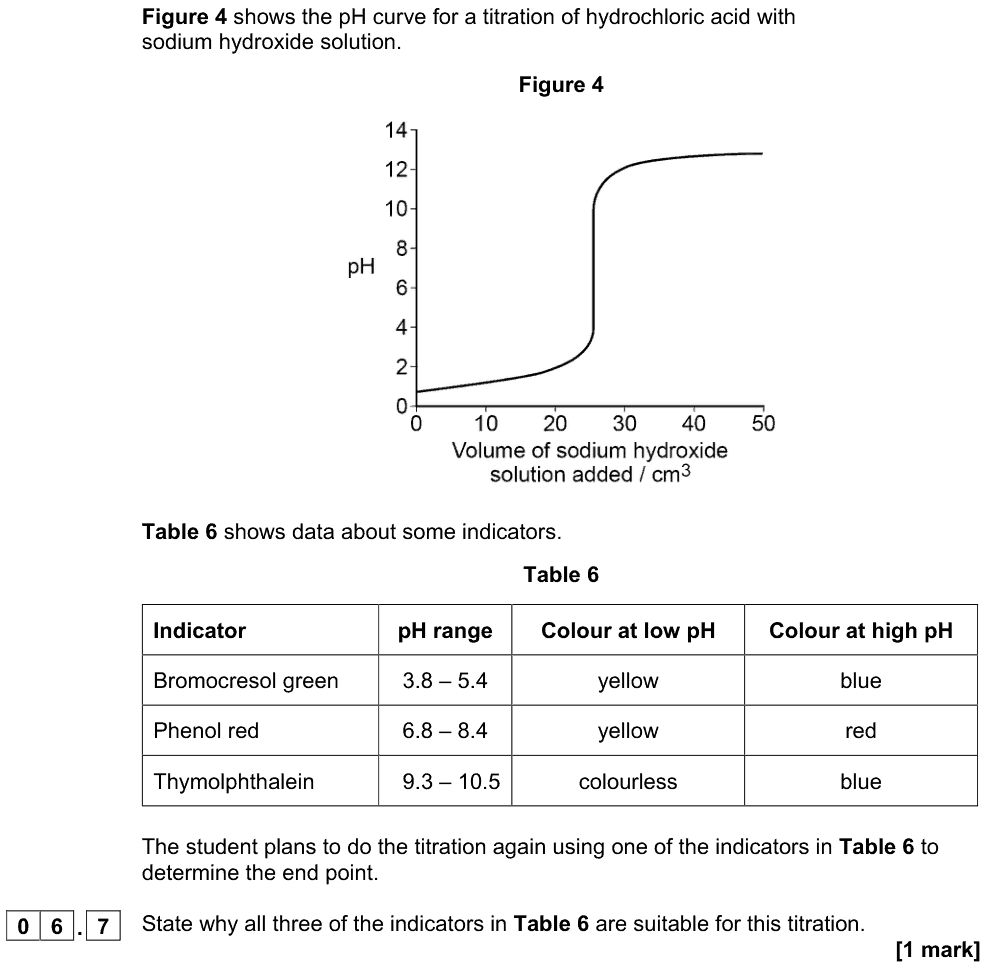
All three change colour (have a pH range) within the vertical part of the pH curve, between about pH 3 and 11. Must use the curve, not just 'at the equivalence point'
Skills: ATf Use acid–base indicators in titrations of weak/strong acids with weak/strong alkalis; MS3.1 Translate information between graphical, numerical and algebraic forms; RP9 Investigate how pH changes when a weak acid reacts with a strong base and when a strong acid reacts with a weak base
November 2021 · Paper 1 · Q06.85 marksCalculation
Earlier parts of question 06 that this part uses
Mark scheme
Examiner's comment
Most students calculated the amount of hydrogen and hydroxide ions correctly in question 06.8; common errors, however, included not calculating the excess amount of hydroxide ions and not dividing by the volume of solution.
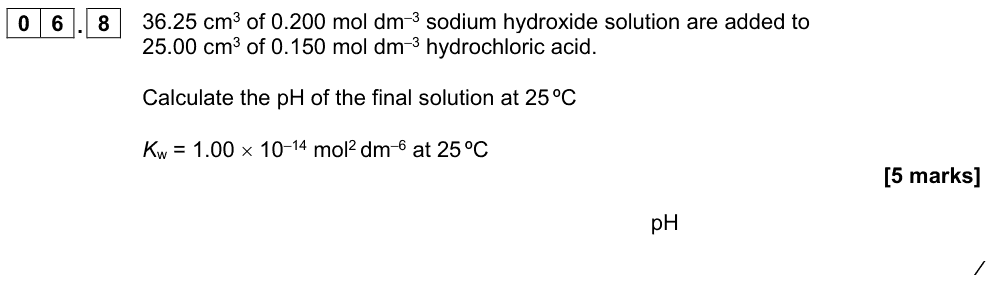
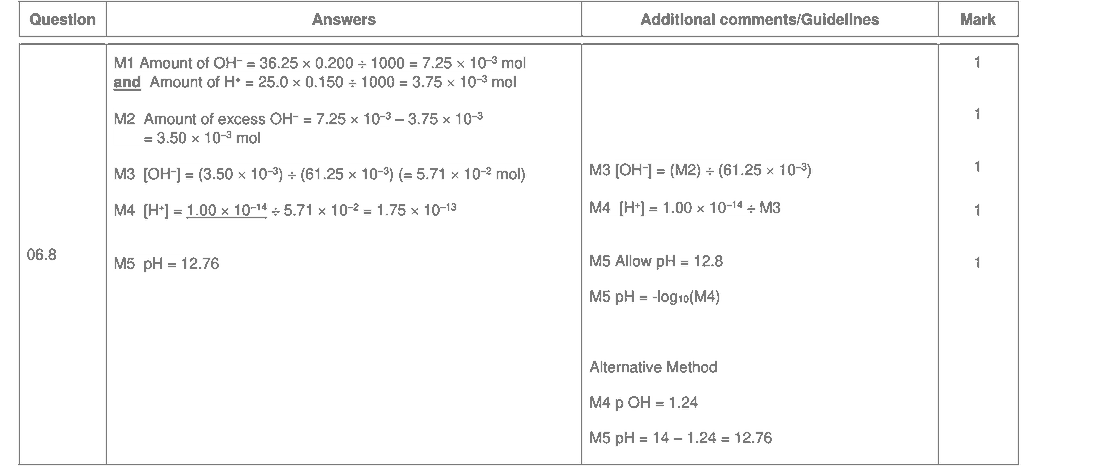
[H+] = 10^–14 ÷ 0.0571 = 1.75 × 10^–13. Errors: no subtraction for the excess
not dividing by the total volume
Skills: MS0.0 Recognise and make use of appropriate units in calculation; MS2.2 Change the subject of an equation; MS2.5 Use logarithms in relation to quantities that range over several orders of magnitude
November 2021 · Paper 3 · Q055 marksCalculation
Mark scheme
Examiner's comment
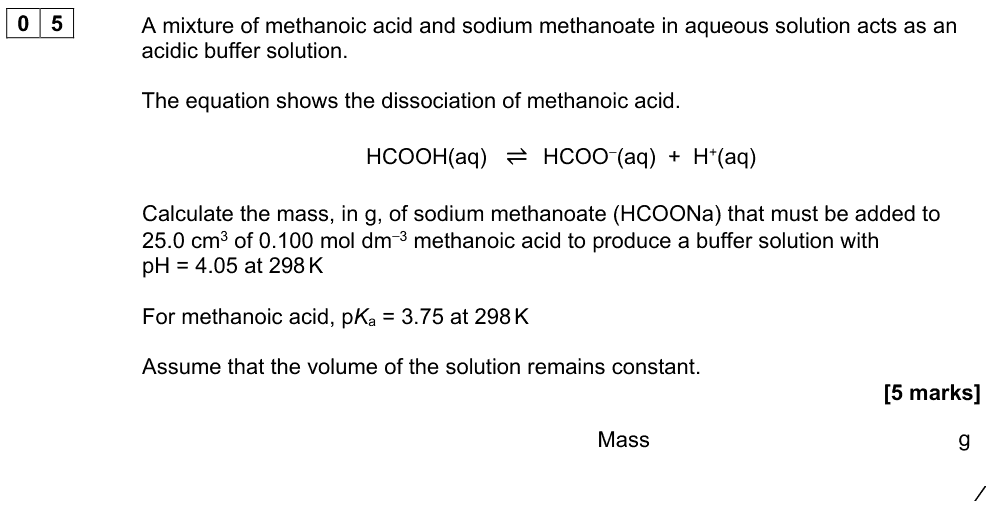
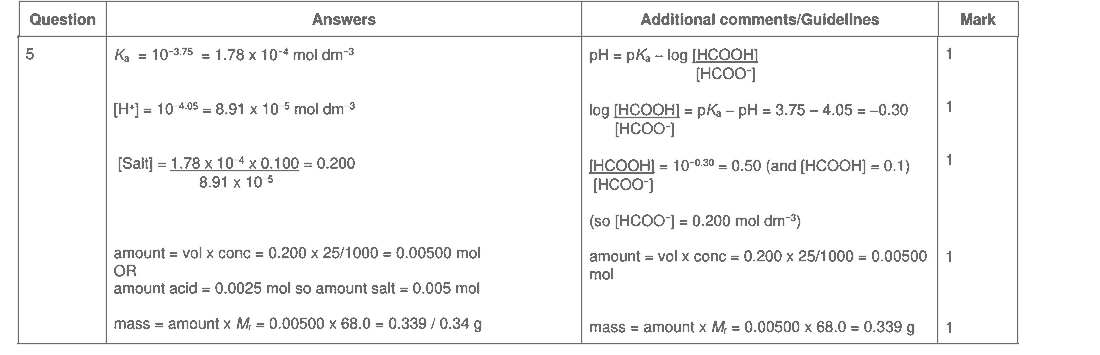
Most students were able to make a start on this calculation and many earned two marks for simply converting pH to [H+] and pKa to Ka even if they could not get any further. There was evidence of confusion between ‘concentration’ and ‘amount’ with a significant number of students converting the given concentration of methanoic acid into an amount and then trying to substitute that amount into the expression for Ka instead of using the given concentration.
Notes from the mark scheme and report
Answer: 0.34 g (0.339). Ka = 10^–3.75 = 1.78 × 10^–4
[H+] = 10^–4.05 = 8.91 × 10^–5
[HCOO–] = Ka × 0.100 ÷ [H+] = 0.200 mol dm–3
× 0.0250 dm3 = 5.00 × 10^–3 mol
× 68.0. Common error: putting an amount of acid, not its concentration, into the Ka expression
Skills: MS0.0 Recognise and make use of appropriate units in calculation; MS2.2 Change the subject of an equation; MS2.5 Use logarithms in relation to quantities that range over several orders of magnitude
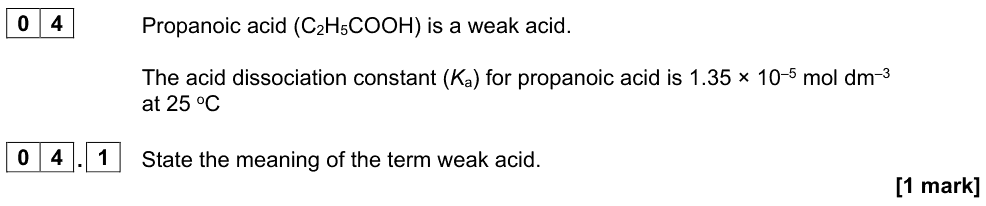
November 2020 · Paper 1 · Q04.11 markShort answer
Mark scheme
Examiner's comment
Most students scored the mark in 04.1.
Notes from the mark scheme and report
An acid that only partially (slightly) dissociates / ionises in water
November 2020 · Paper 1 · Q04.21 markShort answer
Earlier part of question 04 that this part uses
Mark scheme
Examiner's comment
Answers to 04.2 were well done but some students omitted the square brackets.
Notes from the mark scheme and report
Ka = [H+][C2H5COO–] ÷ [C2H5COOH]. Square brackets essential (round brackets not allowed)
[H3O+] allowed
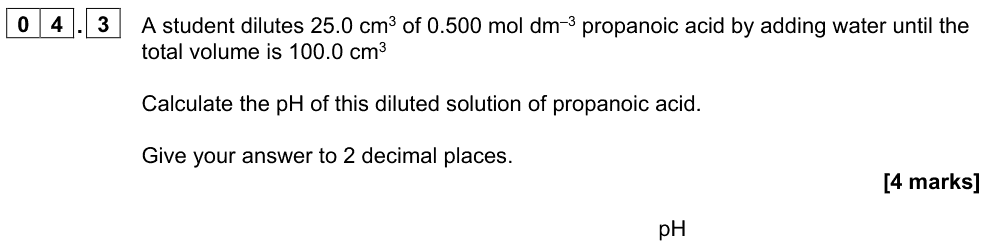
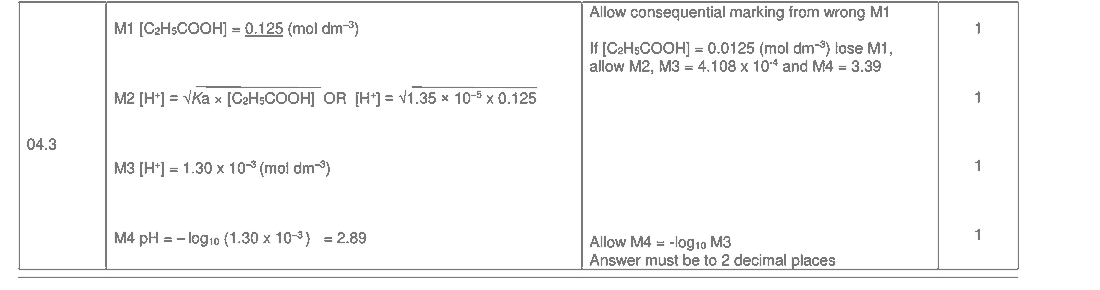
November 2020 · Paper 1 · Q04.34 marksCalculation
Earlier part of question 04 that this part uses
Mark scheme
Examiner's comment
Students found 04.3 more challenging.
Often the concentration of the diluted acid was incorrect and some students failed to take a square root in their calculation.
Most students could convert their concentration of H+ ions to a pH.
Skills: MS0.2 Use ratios, fractions and percentages; MS0.4 Use calculators to find and use power, exponential and logarithmic functions; MS2.5 Use logarithms in relation to quantities that range over several orders of magnitude
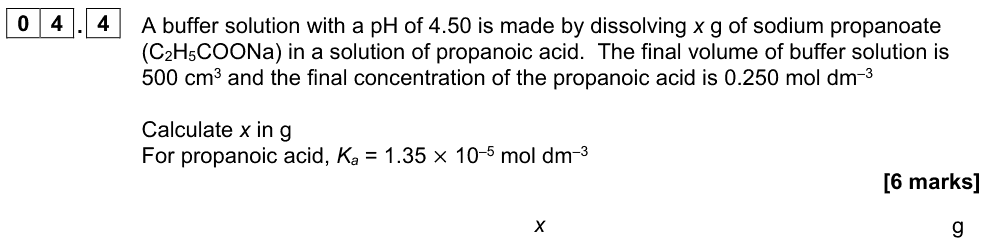
November 2020 · Paper 1 · Q04.46 marksCalculation
Earlier part of question 04 that this part uses
Mark scheme
Examiner's comment
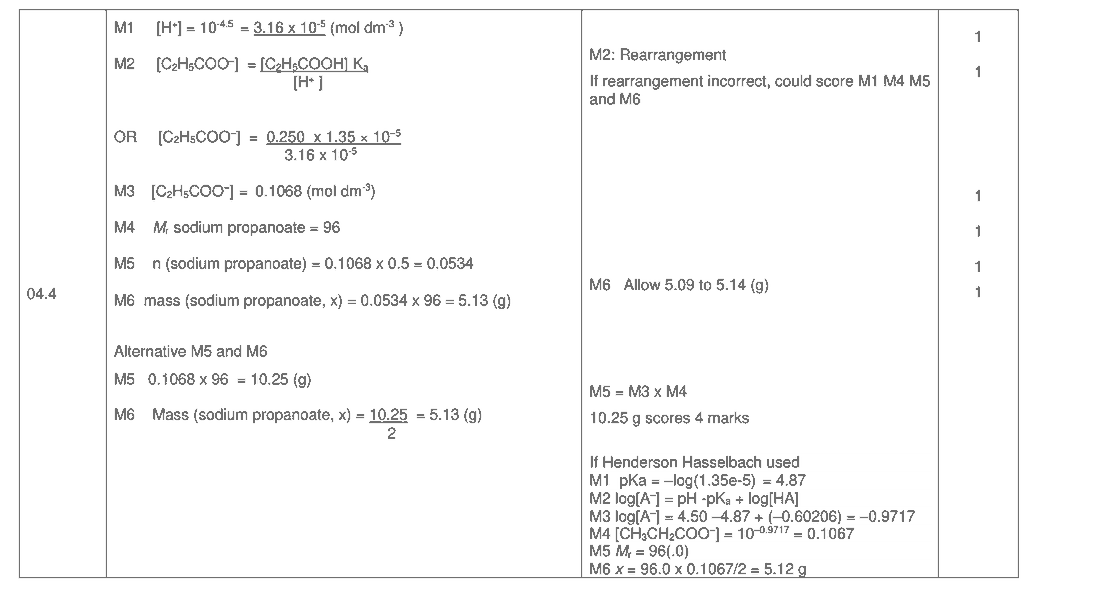
Some students scored full marks in 04.4 but for many the question presented several challenges.
Most students correctly calculated the concentration of H+ ions but then could not rearrange the expression to calculate the concentration of propanoate ions.
Some students failed to notice that only 500 cm3 of the buffer solution was used and a few did not use the correct Mr for sodium propanoate.
Notes from the mark scheme and report
Answer: x = 5.13 g (allow 5.09 to 5.14). [H+] = 10^–4.50 = 3.16 × 10^–5
[C2H5COO–] = Ka × 0.250 ÷ [H+] = 0.1068 mol dm–3
× 0.500 dm3 = 0.0534 mol
× Mr 96.0. 10.25 g (not halved) scores 4. Henderson–Hasselbalch allowed. Errors: rearranging Ka
ignoring the 500 cm3
wrong Mr
Skills: MS0.4 Use calculators to find and use power, exponential and logarithmic functions; MS2.2 Change the subject of an equation; MS2.5 Use logarithms in relation to quantities that range over several orders of magnitude
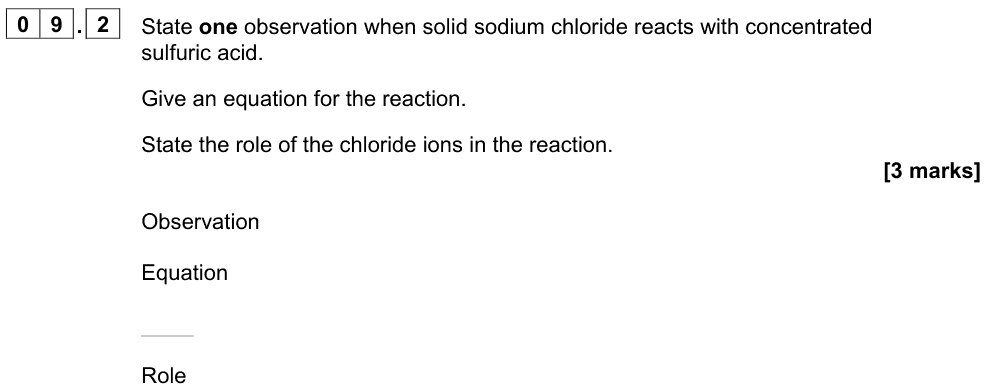
November 2020 · Paper 1 · Q09.23 marksEquation writing
Earlier part of question 09 that this part uses
Mark scheme
Examiner's comment
In 09.2, most students gave a correct observation and the correct equation was often seen; the role of the chloride ion was less well understood.
chloride ions act as a base / proton acceptor. The role was the least well known
November 2020 · Paper 3 · Q131 markMultiple choice
Answer
B
Mark scheme
Notes from the mark scheme and report
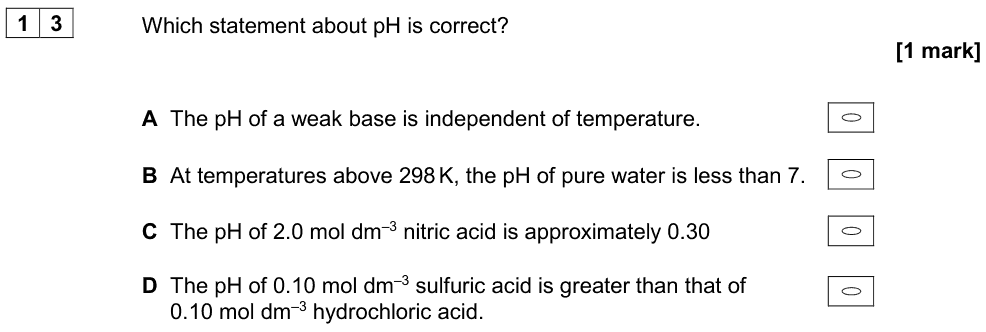
Answer: B. Dissociation of water is endothermic, so Kw and [H+] increase above 298 K and the pH of pure water falls below 7 (it is still neutral). 2.0 mol dm–3 HNO3 has pH –0.30
H2SO4 gives the lower pH (report: success rate under 40% (listed among the hardest))
November 2020 · Paper 3 · Q141 markMultiple choice
Answer
A
Mark scheme
Notes from the mark scheme and report
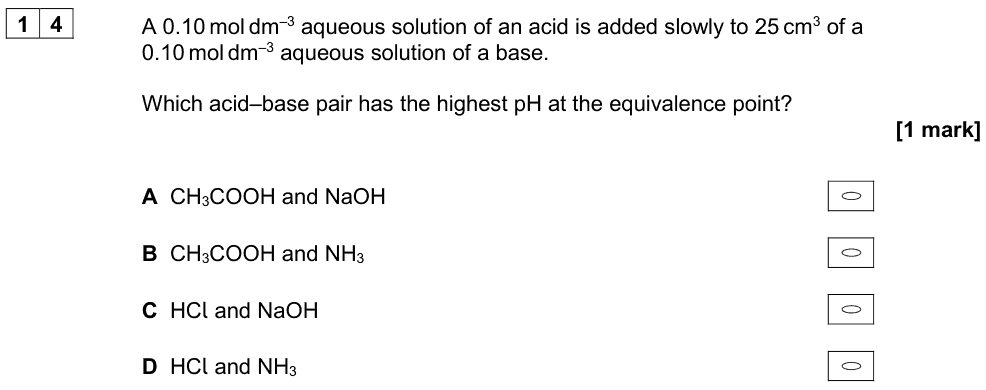
Answer: A. Weak acid with strong base gives a basic salt solution, so the equivalence point is above pH 7
strong/strong is 7, weak/weak about 7, strong acid/weak base below 7
November 2020 · Paper 3 · Q321 markMultiple choice
Answer
D
Mark scheme
Notes from the mark scheme and report
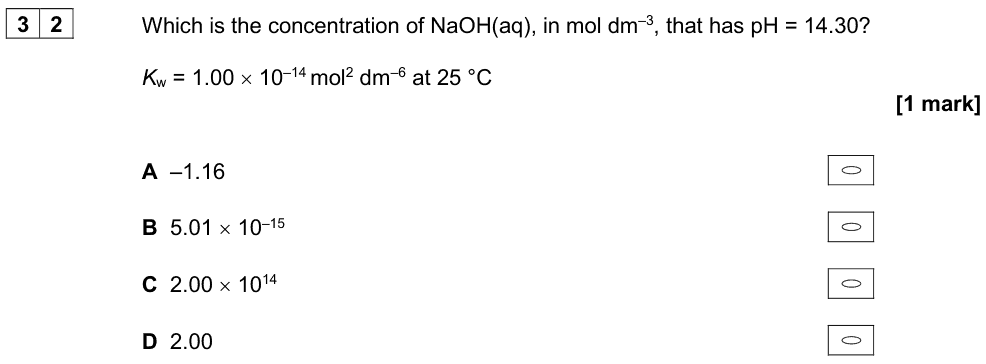
Answer: D. [H+] = 10^–14.30 = 5.01 × 10^–15
[OH–] = Kw ÷ [H+] = 2.00 mol dm–3
Skills: MS0.4 Use calculators to find and use power, exponential and logarithmic functions; MS2.5 Use logarithms in relation to quantities that range over several orders of magnitude
November 2020 · Paper 3 · Q341 markMultiple choice
Answer
C
Mark scheme
Notes from the mark scheme and report
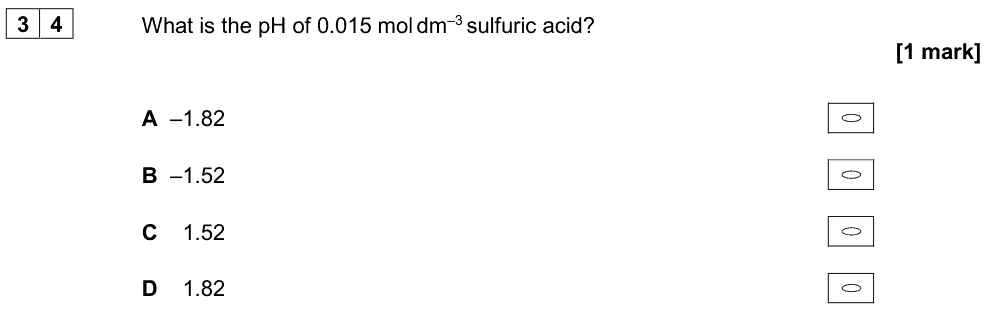
Answer: C. Sulfuric acid is treated as fully diprotic: [H+] = 0.030 mol dm–3
pH = –log 0.030 = 1.52
Skills: MS0.4 Use calculators to find and use power, exponential and logarithmic functions; MS2.5 Use logarithms in relation to quantities that range over several orders of magnitude
June 2019 · Paper 1 · Q05.12 marksEquation writing
Mark scheme
Examiner's comment
5.1 Most students gave a correct equation in part 1 but the second mark was gained less frequently, with the role being defined incorrectly.
Notes from the mark scheme and report
NaCl + H2SO4 → NaHSO4 + HCl (allow 2NaCl + H2SO4 → Na2SO4 + 2HCl). Sulfuric acid is a proton donor (acid). The role was often wrong
June 2019 · Paper 1 · Q09.14 marksCalculation
Mark scheme
Examiner's comment
9.1 Part 1 was answered well; students were familiar with the relationship between pH and [H+].
Notes from the mark scheme and report
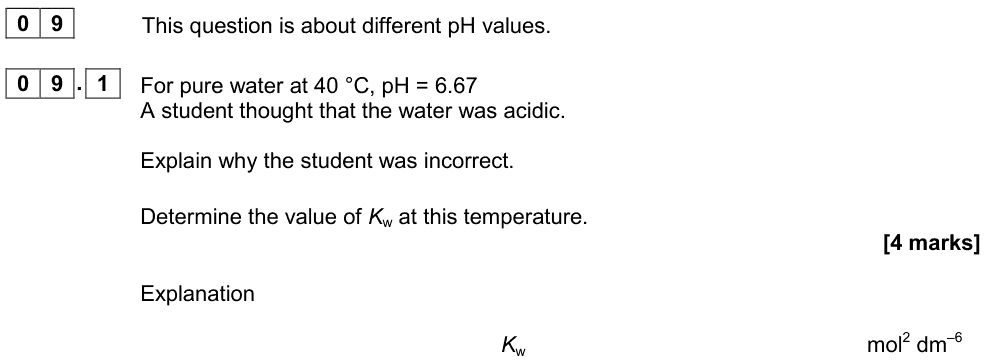
Answer: Kw = 4.57 × 10^–14 mol2 dm–6. The water is neutral because [H+] = [OH–]. [H+] = 10^–6.67 = 2.14 × 10^–7 mol dm–3
Kw = [H+]²
Skills: MS0.4 Use calculators to find and use power, exponential and logarithmic functions; MS2.5 Use logarithms in relation to quantities that range over several orders of magnitude
June 2019 · Paper 1 · Q09.23 marksCalculation
Earlier part of question 09 that this part uses
Mark scheme
Examiner's comment
9.2 Answers to this part were poor. Very few students suggested finding the pH at half- equivalence and from those who did, there was a tendency to quote a value for pH from the full equivalence part of the graph. Some students had more success by using the initial pH and following the weak acid approximation route to find Ka.
Notes from the mark scheme and report
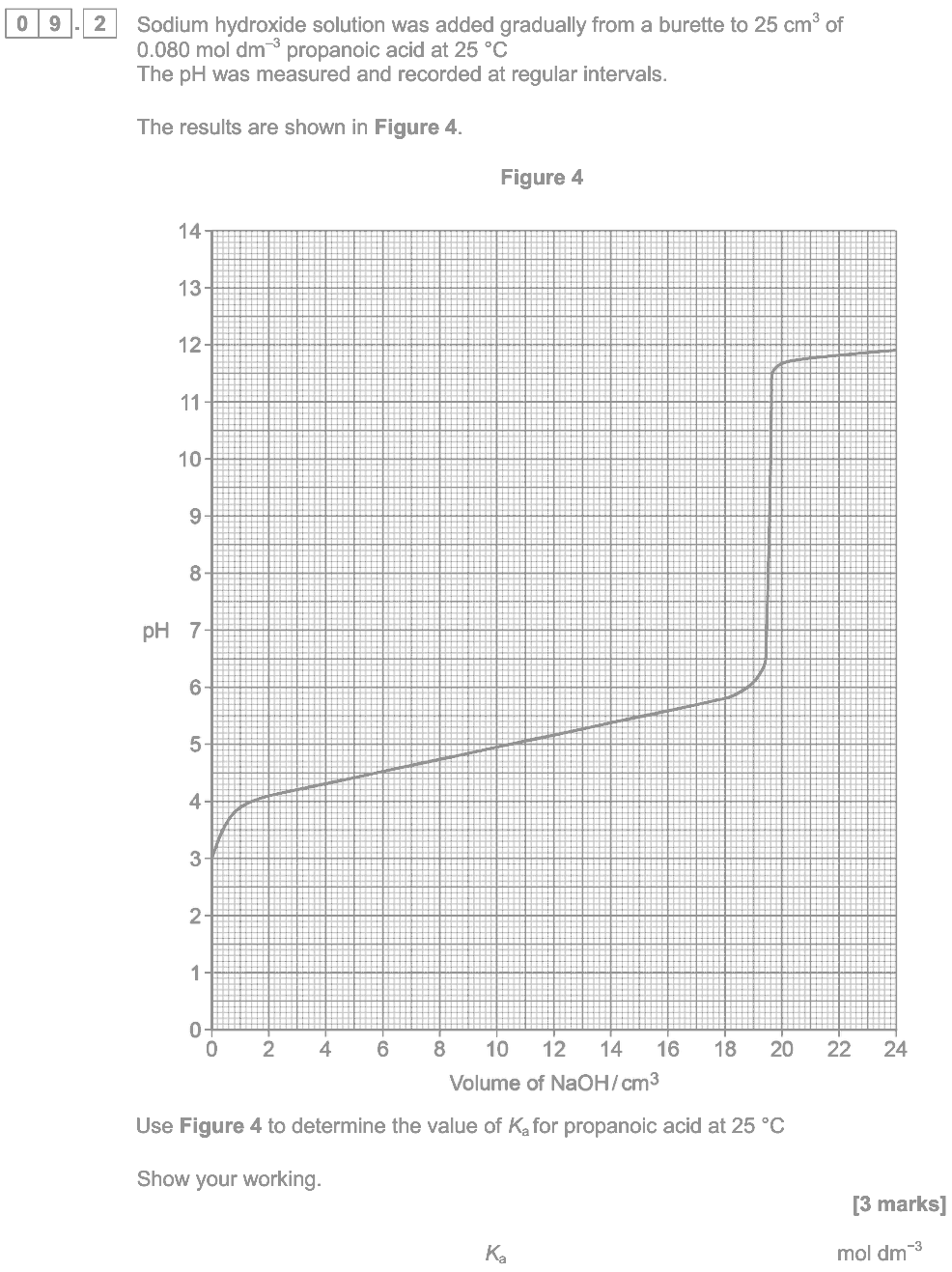
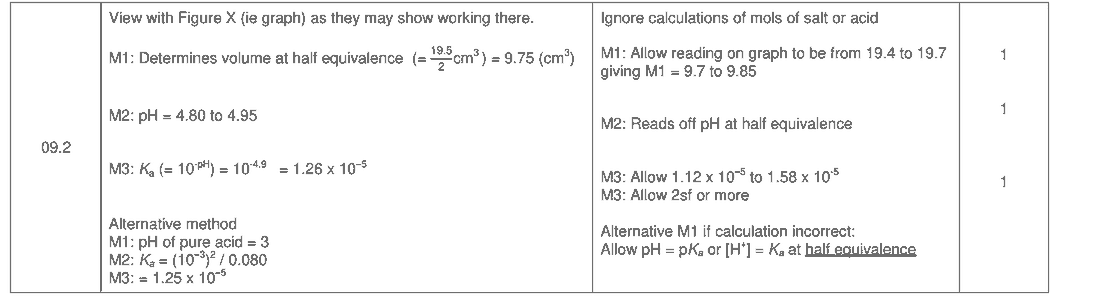
Answer: Ka = 1.26 × 10^–5 mol dm–3 (allow 1.12 to 1.58 × 10^–5). Equivalence at 19.5 cm3, so half-equivalence is 9.75 cm3
read pH there (4.80 to 4.95) = pKa
Ka = 10^–pH. Alternative: initial pH 3, Ka = (10^–3)² ÷ 0.080 = 1.25 × 10^–5. Poorly answered: few used half-equivalence
some read the pH at full equivalence
Skills: MS2.5 Use logarithms in relation to quantities that range over several orders of magnitude; MS3.1 Translate information between graphical, numerical and algebraic forms; PS3.1 Plot and interpret graphs; RP9 Investigate how pH changes when a weak acid reacts with a strong base and when a strong acid reacts with a weak base
June 2019 · Paper 1 · Q09.31 markShort answer
Earlier part of question 09 that this part uses
Mark scheme
Examiner's comment
9.3 Most students could identify the most appropriate indicator.
Notes from the mark scheme and report
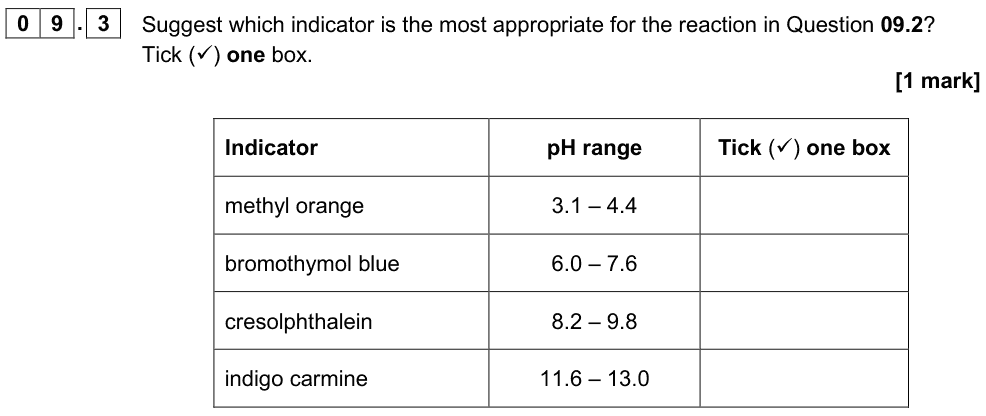
Answer: cresolphthalein (range 8.2 to 9.8 lies within the vertical part of the curve, about pH 6.5 to 11.5)
Skills: RP9 Investigate how pH changes when a weak acid reacts with a strong base and when a strong acid reacts with a weak base
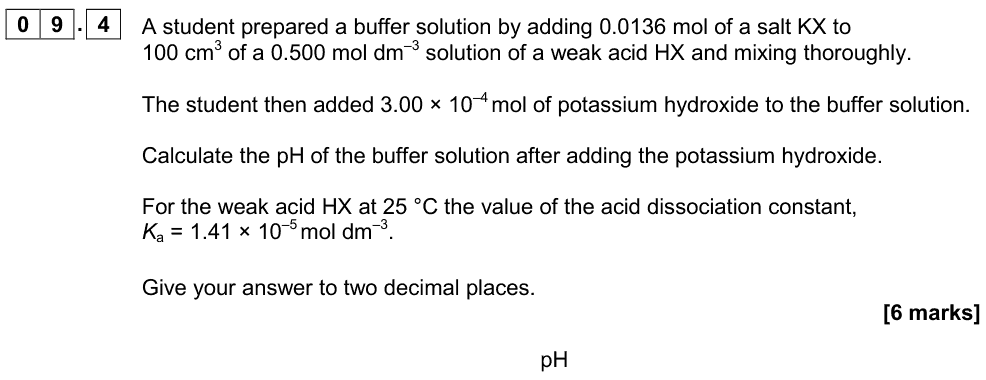
June 2019 · Paper 1 · Q09.46 marksCalculation
Earlier part of question 09 that this part uses
Mark scheme
Examiner's comment
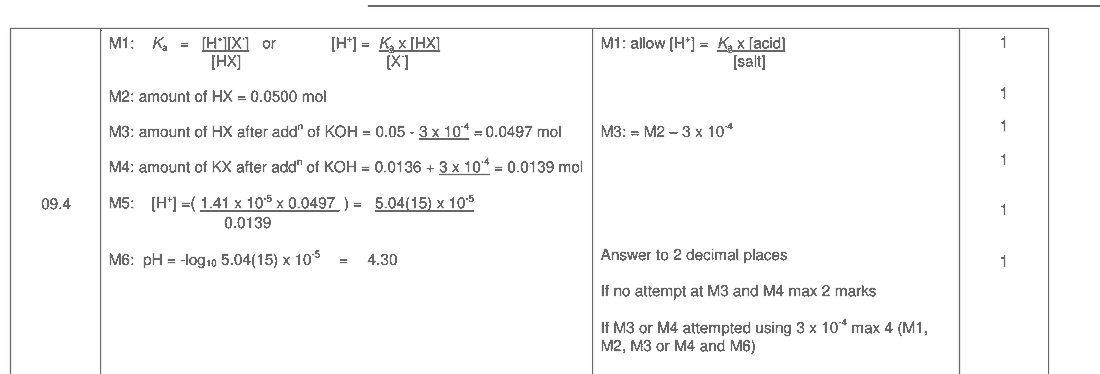
9.4 Most students were awarded the two marks for a Ka expression and calculating the amount in moles of HX. A significant number of students subtracted the amount of anion present at the start from the amount, in moles, of acid but only some attempted to change the amount of weak acid and/or anion after the addition of KOH. Those students who had the correct values after the addition of KOH, could generally re-arrange the expression for Ka to gain a pH value and almost invariably gave this to 2 d.p.
pH = –log[H+]. Without adjusting for the KOH, max 2. Error: subtracting the salt from the acid
Skills: MS0.4 Use calculators to find and use power, exponential and logarithmic functions; MS2.2 Change the subject of an equation; MS2.5 Use logarithms in relation to quantities that range over several orders of magnitude
June 2019 · Paper 1 · Q09.51 markShort answer
Earlier part of question 09 that this part uses
Mark scheme
Examiner's comment
9.5 Only a very small number of students could give a correct mathematical expression.
Notes from the mark scheme and report
[H+] = Ka × [HX] ÷ [X–]: on dilution the ratio [HX]/[X–] stays (almost) constant. Very few gave a correct expression
Skills: MS0.2 Use ratios, fractions and percentages
June 2019 · Paper 3 · Q02.22 marksEquation writing
Earlier part of question 02 that this part uses
Mark scheme
Examiner's comment
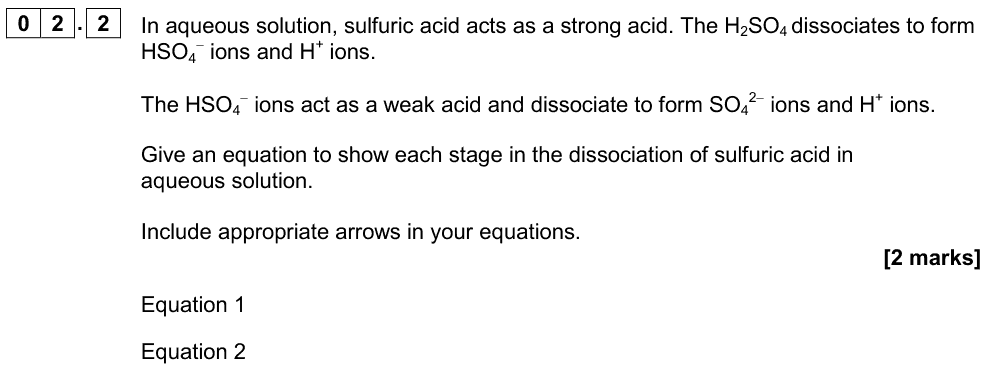
2.2 The stem of the question clearly stated that H2SO4 is a strong acid and HSO4
Notes from the mark scheme and report
H2SO4 → HSO4– + H+ (single arrow, not reversible)
HSO4– ⇌ SO4 2– + H+ (reversible arrow required). Versions with H2O and H3O+ allowed
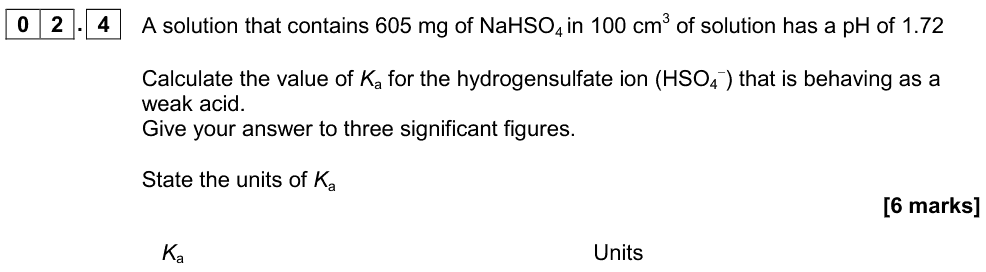
June 2019 · Paper 3 · Q02.46 marksCalculation
Earlier part of question 02 that this part uses
Mark scheme
Examiner's comment
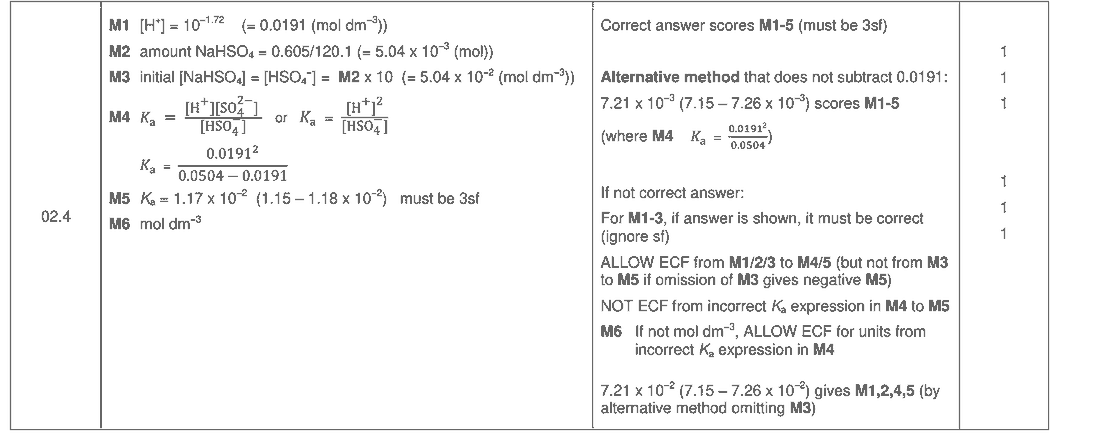
2.4 Hardly any students scored full marks for this question. Very few students seemed to appreciate that, when calculating pH using an expression of the form Ka = [H+]2/(c-x), the value of ‘x’ must be much smaller than the value of ‘c’ if it is to be ignored. In this case, the [H+] can be calculated from the pH and it is equal to x, the concentration of sulfate ions. The equilibrium concentration of hydrogensulfate ions can be calculated by subtracting x from the initial [HSO4
Notes from the mark scheme and report
Answer: Ka = 1.17 × 10^–2 mol dm–3 (1.15 to 1.18, 3 sf). [H+] = 10^–1.72 = 0.0191
n(NaHSO4) = 0.605 ÷ 120.1 = 5.04 × 10^–3 mol
initial [HSO4–] = 0.0504 mol dm–3
Ka = 0.0191² ÷ (0.0504 – 0.0191). 7.21 × 10^–3 (no subtraction) scores M1 to M5. Hardly any scored full marks
Skills: MS0.0 Recognise and make use of appropriate units in calculation; MS1.1 Use an appropriate number of significant figures; MS2.3 Substitute numerical values into algebraic equations using appropriate units for physical quantities; MS2.5 Use logarithms in relation to quantities that range over several orders of magnitude
June 2019 · Paper 3 · Q02.52 marksExplanation
Earlier part of question 02 that this part uses
Mark scheme
Examiner's comment
2.5 With around 50% of students failing to score, this question proved trickier than expected. Many students failed to realise that this should be answered with reference to the equilibrium equation from earlier in the question. There was also evidence of confusion between the direction of change in pH and the corresponding direction of change in [H+], with many suggesting that an increase in pH represents an increase in [H+]. Explanations for an increase in pH also often featured the suggestion that [OH–] must be increasing – a misconception perhaps derived from the GCSE idea that an alkali contains OH– ions and that this explains high pH values. At A-level it would be hoped that students recognise that the pH scale is a measure of [H+] and that high values represent low [H+].
Notes from the mark scheme and report
The equilibrium HSO4– ⇌ SO4 2– + H+ shifts to the left (to remove the added SO4 2–)
so [H+] decreases. Misconceptions: higher pH means higher [H+]
[OH–] must increase
June 2018 · Paper 1 · Q05.11 markShort answerEasy
Mark scheme
Examiner's comment
05.1 86.2% of students gave the correct definition.
Notes from the mark scheme and report
Completely dissociates / ionises (to form H+ ions)
June 2018 · Paper 1 · Q05.26 marksCalculationHard
Earlier part of question 05 that this part uses
Mark scheme
Examiner's comment
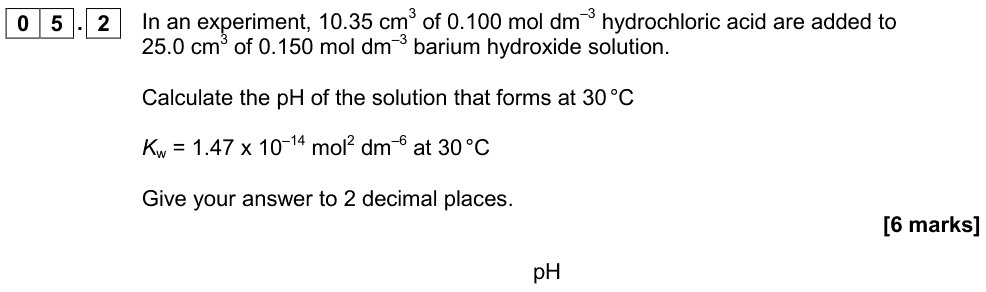
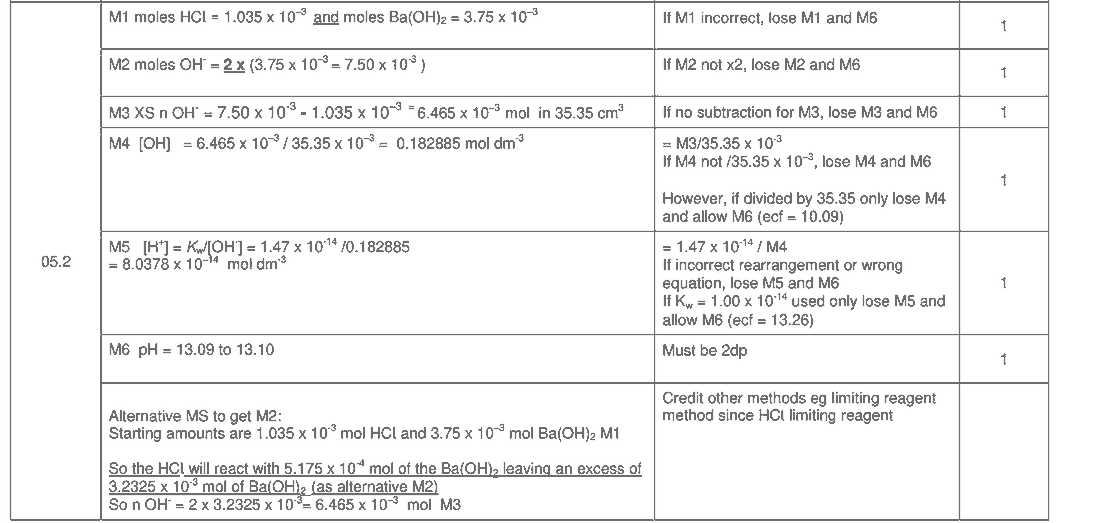
05.2 Most students calculated the amounts, in moles, of the reactants but often did not multiply the amount of barium hydroxide by two to give the amount of hydroxide ions. Some students did not convert the amount in moles to concentration and some did not quote their pH to two decimal places. This part of the question discriminated very well, with just over 20% of students scoring full marks.
[H+] = Kw ÷ [OH–] = 8.04 × 10^–14. Errors: not doubling for Ba(OH)2
not converting moles to concentration
not 2 d.p.
Skills: MS0.0 Recognise and make use of appropriate units in calculation; MS0.1 Recognise and use expressions in decimal and ordinary form; MS2.2 Change the subject of an equation; MS2.5 Use logarithms in relation to quantities that range over several orders of magnitude
June 2018 · Paper 1 · Q05.31 markShort answerEasy
Earlier part of question 05 that this part uses
Mark scheme
Examiner's comment
05.3 81.8% of students gave the correct reason here.
Notes from the mark scheme and report
[H+] = [OH–]
June 2018 · Paper 1 · Q05.51 markShort answerEasy
Earlier part of question 05 that this part uses
Mark scheme
Examiner's comment
05.5 91% of students could give the correct expression for Ka.
Notes from the mark scheme and report
Ka = [CH3COO–][H+] ÷ [CH3COOH]
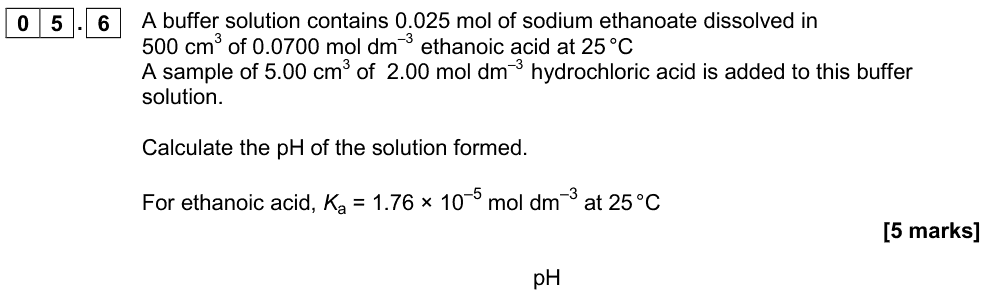
June 2018 · Paper 1 · Q05.65 marksCalculation
Earlier part of question 05 that this part uses
Mark scheme
Examiner's comment
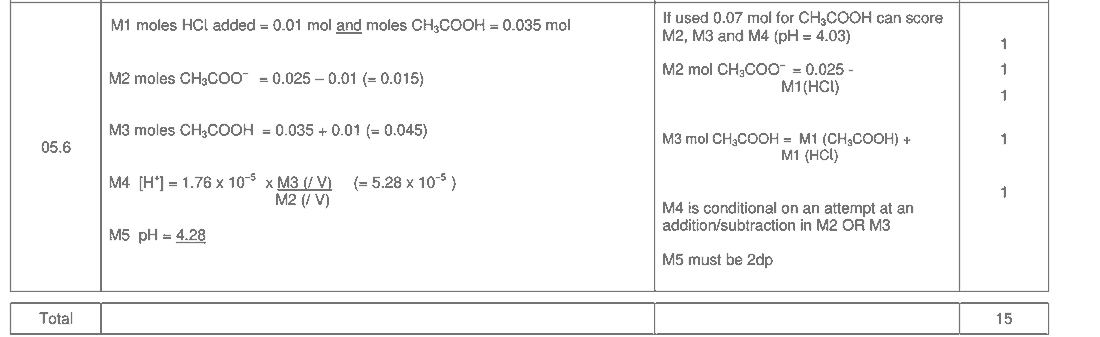
05.6 Most students could calculate the amount, in moles, of hydrochloric acid and of ethanoic acid, but many were unsure of how to use these numbers. Many students failed to recognise the need to increase the amount of acid and decrease the amount of salt due to the shift in the equilibrium when H+ ions are added. Many added and subtracted the wrong way round or managed one process but not the other. Students could generally rearrange the Ka expression correctly; just over 40% of students scored full marks for this part of the question.
Notes from the mark scheme and report
Answer: pH 4.28 (2 d.p.). n(HCl) = 0.010 mol
n(CH3COOH) = 0.035 + 0.010 = 0.045
n(CH3COO–) = 0.025 – 0.010 = 0.015
[H+] = 1.76 × 10^–5 × 0.045 ÷ 0.015 = 5.28 × 10^–5. Using 0.07 mol of acid gives 4.03 (max 3 of the method marks). Errors: adding and subtracting the wrong way round, or doing only one adjustment
Skills: MS0.0 Recognise and make use of appropriate units in calculation; MS2.2 Change the subject of an equation; MS2.5 Use logarithms in relation to quantities that range over several orders of magnitude
June 2018 · Paper 1 · Q07.21 markEquation writingHard
Earlier part of question 07 that this part uses
Mark scheme
Examiner's comment
07.2 Only a small proportion of students (22.6%) could give a correct equation here; many did not include protonation of water, as implied in the question. A surprisingly high proportion of students (10.8%) failed even to attempt this question.
Notes from the mark scheme and report
[Al(H2O)6]3+ + H2O → [Al(H2O)5(OH)]2+ + H3O+ (water must be shown accepting the proton). Many did not protonate water
June 2018 · Paper 3 · Q04.62 marksExplanationHard
Earlier part of question 04 that this part uses
Mark scheme
Examiner's comment
04.6 This was expected to be a high-level discriminator and that certainly proved to be the case for the second mark (achieved by only 3.3% of students). Although many gained a mark for referring to the fact that sulfuric acid is a stronger acid than ethanedioic acid, the second half of their answer often then incorrectly referred to ideas such as “it therefore reacts with more KOH”, “more water is produced”, and “bonds between K+ and sulfate are stronger than between K+ and ethanedioate”. Only the best students recognised that the overall enthalpy change is the net result of the difference between ‘energy supplied’ and ‘energy released’. In this case, the ‘energy released’ will be the same for both acids. Therefore, the difference in the enthalpies of neutralisation must be due to ethanedioic acid needing more energy to be supplied, in order to break O−H bonds during the neutralisation reaction (whereas the sulfuric acid is already fully dissociated).
Notes from the mark scheme and report
Ethanedioic acid is a weak acid, only partially dissociated (sulfuric acid is strong, fully dissociated)
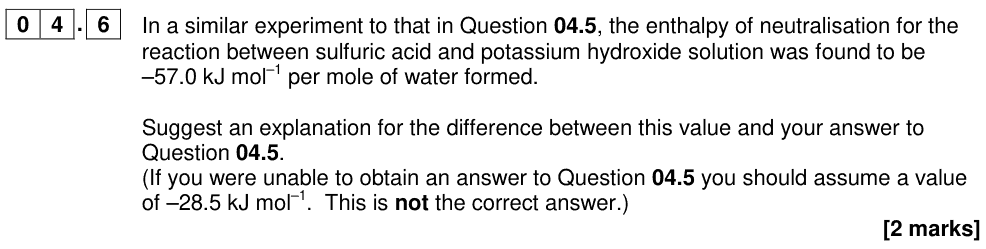
so energy is needed to complete its dissociation (bond breaking is endothermic), making the overall change less exothermic. Heat loss is ignored. Many gave the first point only
Skills: RP2 Measurement of an enthalpy change
June 2018 · Paper 3 · Q231 markMultiple choice
Answer
A
Mark scheme
Examiner's comment
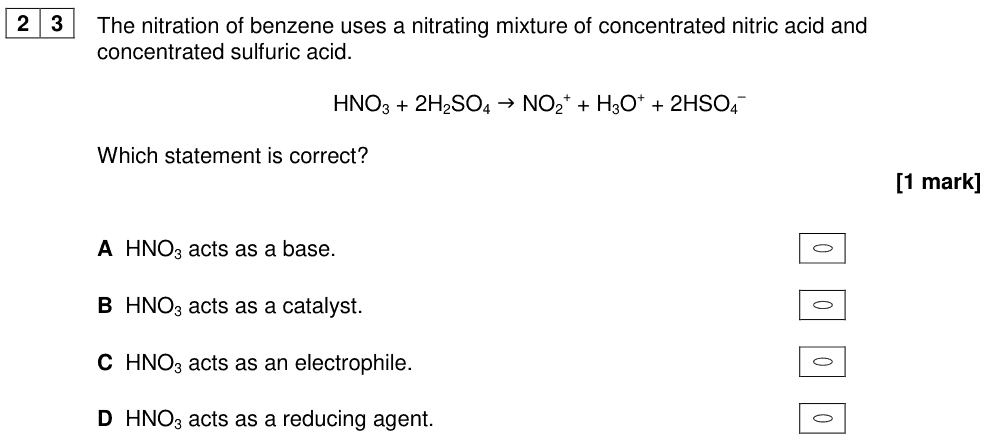
23 46% of students scored here. Three-quarters of the incorrect responses were D, but there are no changes of oxidation state in this reaction, so it is not a redox reaction. The H2SO4 transfers a proton to the HNO3 so the HNO3 acts as a base.
Notes from the mark scheme and report
Answer: A. HNO3 accepts a proton from H2SO4 (then loses water to give NO2+), so it acts as a base
no oxidation states change, so it is not a redox reaction (D was the main wrong answer)
June 2018 · Paper 3 · Q321 markMultiple choice
Answer
B
Mark scheme
Examiner's comment
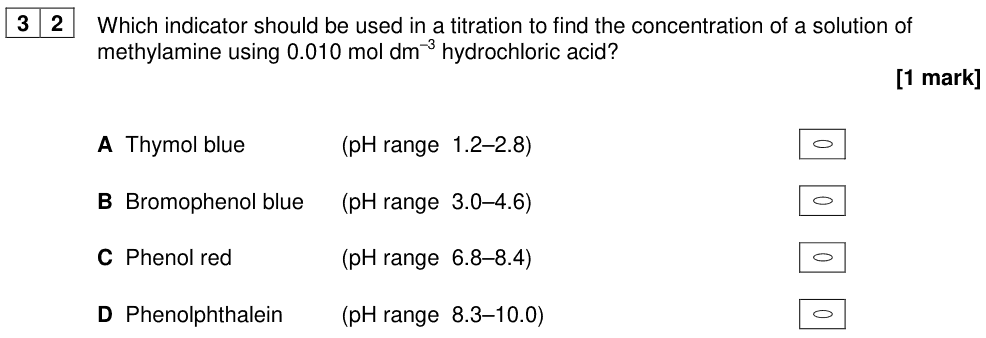
32 C (followed by A) was the commonest incorrect response, suggesting that students failed to realise how low the pH is when the plot ceases to be vertical in a strong acid-weak base titration. The success rate was 41.9%.
Notes from the mark scheme and report
Answer: B. Weak base with strong acid: the vertical part of the pH curve is in the acidic region (about pH 3 to 6), so the indicator must change between 3.0 and 4.6. C then A were the common wrong answers
June 2017 · Paper 1 · Q02.13 marksCalculation
Mark scheme
Examiner's comment
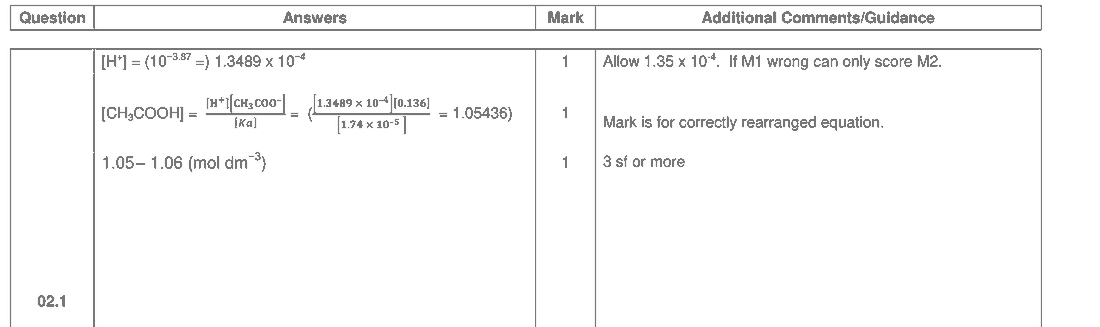
02.1 This question was answered well by many students. A common incorrect answer was 0.958, where students had re-arranged the expression upside-down.
Notes from the mark scheme and report
Answer: 1.05 mol dm–3 (allow 1.05 to 1.06, 3 sf or more). [H+] = 10^–3.87 = 1.349 × 10^–4
Skills: MS0.4 Use calculators to find and use power, exponential and logarithmic functions; MS1.1 Use an appropriate number of significant figures; MS2.2 Change the subject of an equation; MS2.5 Use logarithms in relation to quantities that range over several orders of magnitude
June 2017 · Paper 1 · Q02.26 marksCalculationHard
Earlier part of question 02 that this part uses
Mark scheme
Examiner's comment
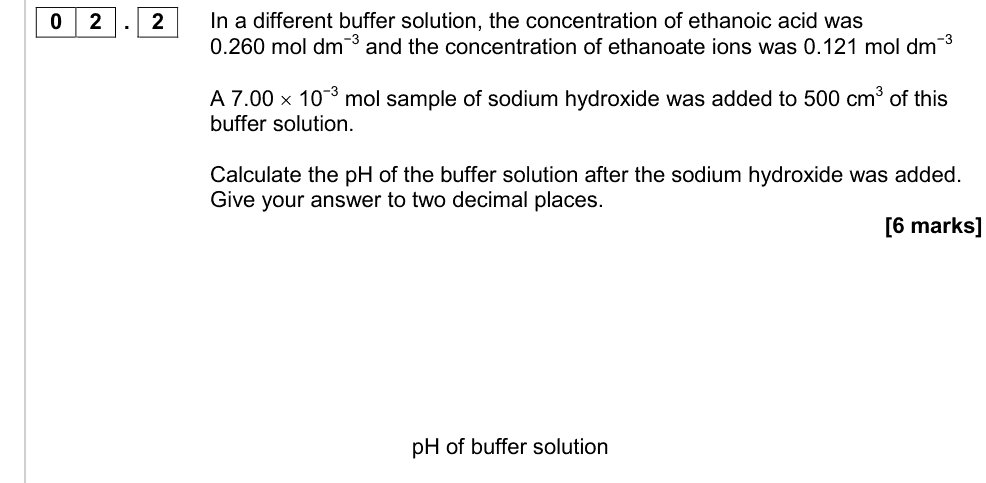
02.2 Although 34.4% of students scored full marks, the question differentiated well overall. Common errors involved either failure to add/subtract the correct amount in moles of sodium hydroxide or to add/subtract the wrong way round.
Notes from the mark scheme and report
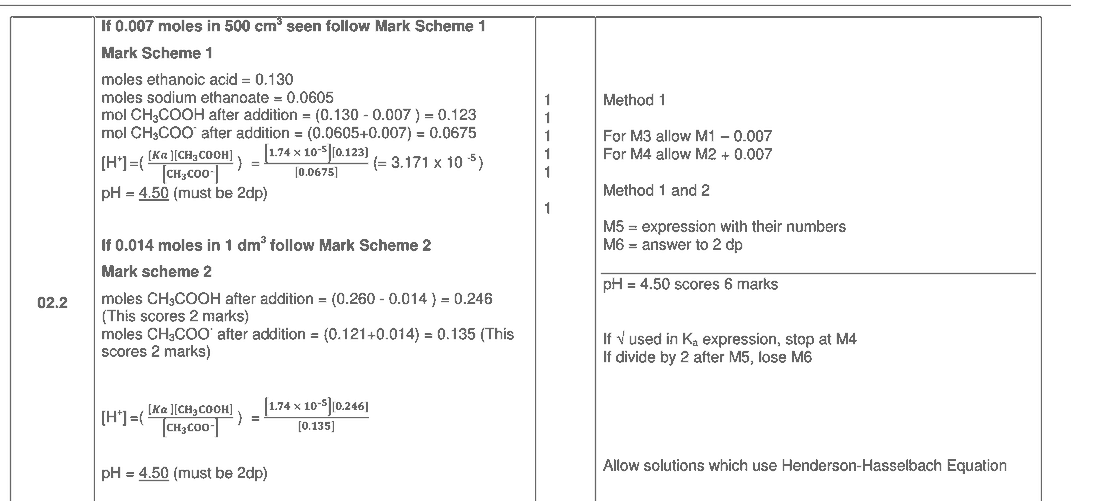
Answer: pH 4.50 (must be 2 dp). In 500 cm3: n(CH3COOH) = 0.130, n(CH3COO–) = 0.0605
after NaOH: acid 0.130 – 0.007 = 0.123 mol, salt 0.0605 + 0.007 = 0.0675 mol
[H+] = Ka × 0.123 ÷ 0.0675 = 3.17 × 10^–5. Alternative per dm3 with 0.014 mol. Henderson–Hasselbalch allowed. Errors: not adding/subtracting the NaOH, or doing it the wrong way round
Skills: MS0.0 Recognise and make use of appropriate units in calculation; MS0.4 Use calculators to find and use power, exponential and logarithmic functions; MS2.2 Change the subject of an equation; MS2.5 Use logarithms in relation to quantities that range over several orders of magnitude
June 2017 · Paper 1 · Q03.11 markShort answerEasy
Mark scheme
Examiner's comment
03.1 This question was answered well (89.5% correct).
Notes from the mark scheme and report
Answer: C, Kw = [H+][OH–] ([H2O] is effectively constant and is not included)
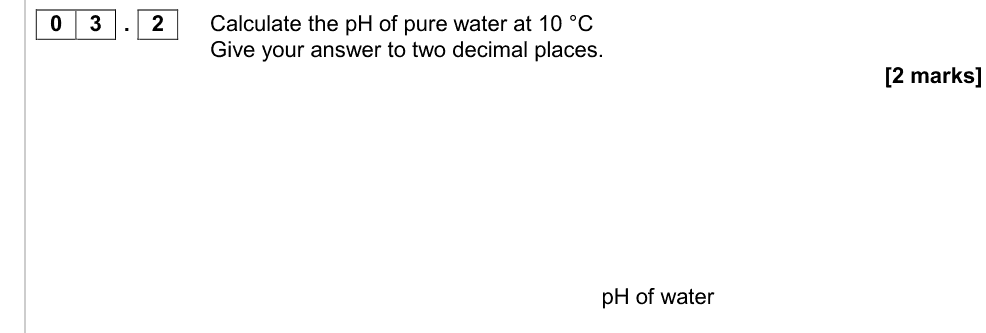
June 2017 · Paper 1 · Q03.22 marksCalculation
Earlier part of question 03 that this part uses
Mark scheme
Examiner's comment
03.2 Many students scored both marks here, although some did not give the answer to two decimal places and thereby lost a mark; some students failed to take the square root of Kw.
Skills: MS0.4 Use calculators to find and use power, exponential and logarithmic functions; MS2.5 Use logarithms in relation to quantities that range over several orders of magnitude
June 2017 · Paper 1 · Q03.31 markShort answer
Earlier part of question 03 that this part uses
Mark scheme
Examiner's comment
03.3 The answer to this question was generally well known, although some students appeared to believe that a pH of 7.27 was not sufficiently alkaline.
Notes from the mark scheme and report
[H+] = [OH–] (equal amounts of H+ and OH–). Some thought pH 7.27 was 'not alkaline enough'
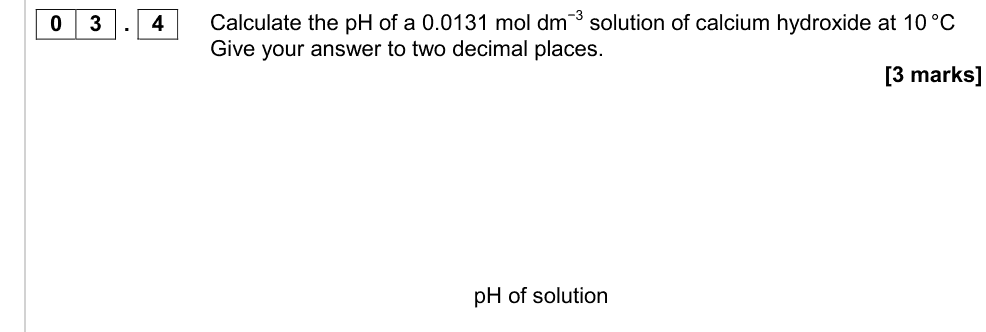
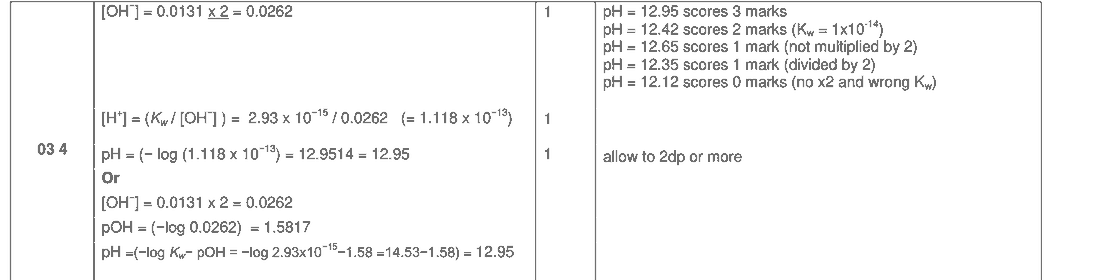
June 2017 · Paper 1 · Q03.43 marksCalculation
Earlier part of question 03 that this part uses
Mark scheme
Examiner's comment
03.4 This question differentiated well. Many students failed to appreciate that calcium hydroxide is dibasic and an answer of 12.65 was common. Some students used Kw = 1.00 x 10⁻¹⁴ and a few students failed to give the answer to two decimal places.
12.35 (÷ 2) scores 1. Uses Kw at 10 °C from the question opening
Skills: MS0.4 Use calculators to find and use power, exponential and logarithmic functions; MS2.2 Change the subject of an equation; MS2.5 Use logarithms in relation to quantities that range over several orders of magnitude
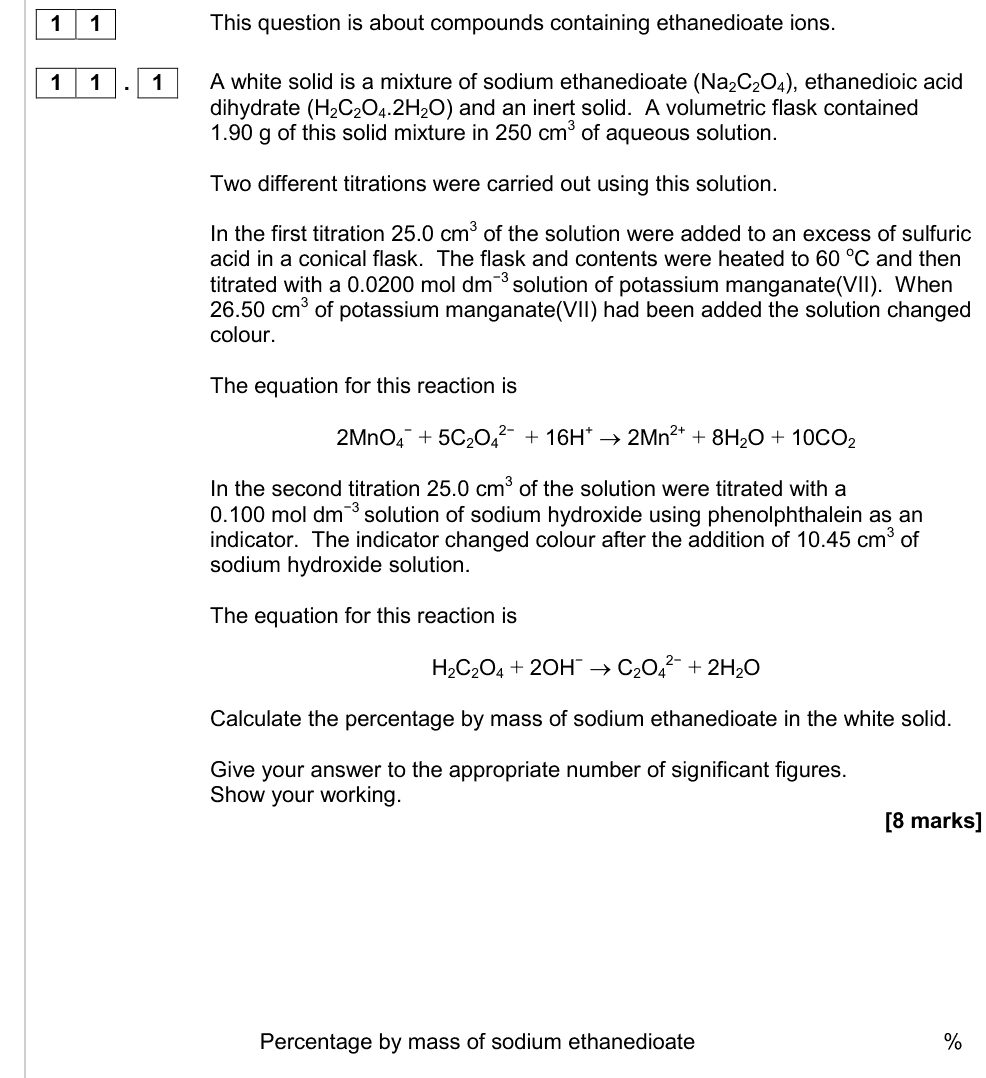
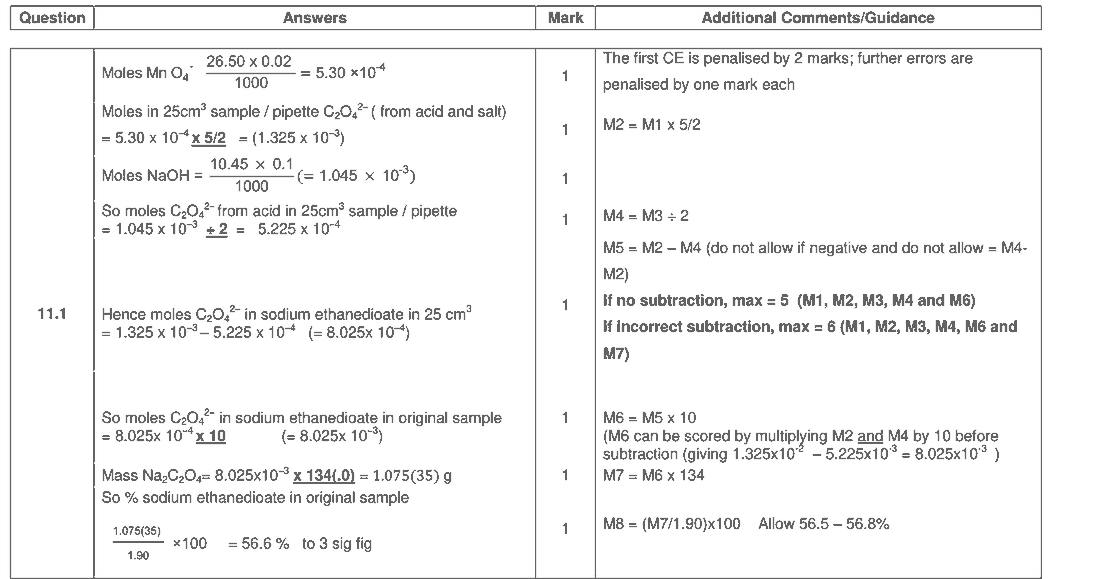
June 2017 · Paper 1 · Q11.18 marksCalculation
Mark scheme
Examiner's comment
11.1 Only the best students got to the end of the calculation. Many students scored the first four marks, and some of these then realised that they needed to multiply by ten because of the dilution used. Very few students appreciated that the amount in moles of ethanedioic acid had to be taken away from the total amount in moles of ethanedioate ions to find the amount in moles of sodium ethanedioate. Those students who did, usually went on to get the right answer.
Notes from the mark scheme and report
Answer: 56.6% (allow 56.5 to 56.8
3 sf). n(MnO4–) = 5.30 × 10^–4
total n(C2O4 2–) in 25 cm3 = × 5/2 = 1.325 × 10^–3
÷ 1.90 × 100. No subtraction: max 5. Very few subtracted the acid from the total ethanedioate
some forgot the × 10
Skills: MS0.0 Recognise and make use of appropriate units in calculation; MS0.2 Use ratios, fractions and percentages; MS1.1 Use an appropriate number of significant figures
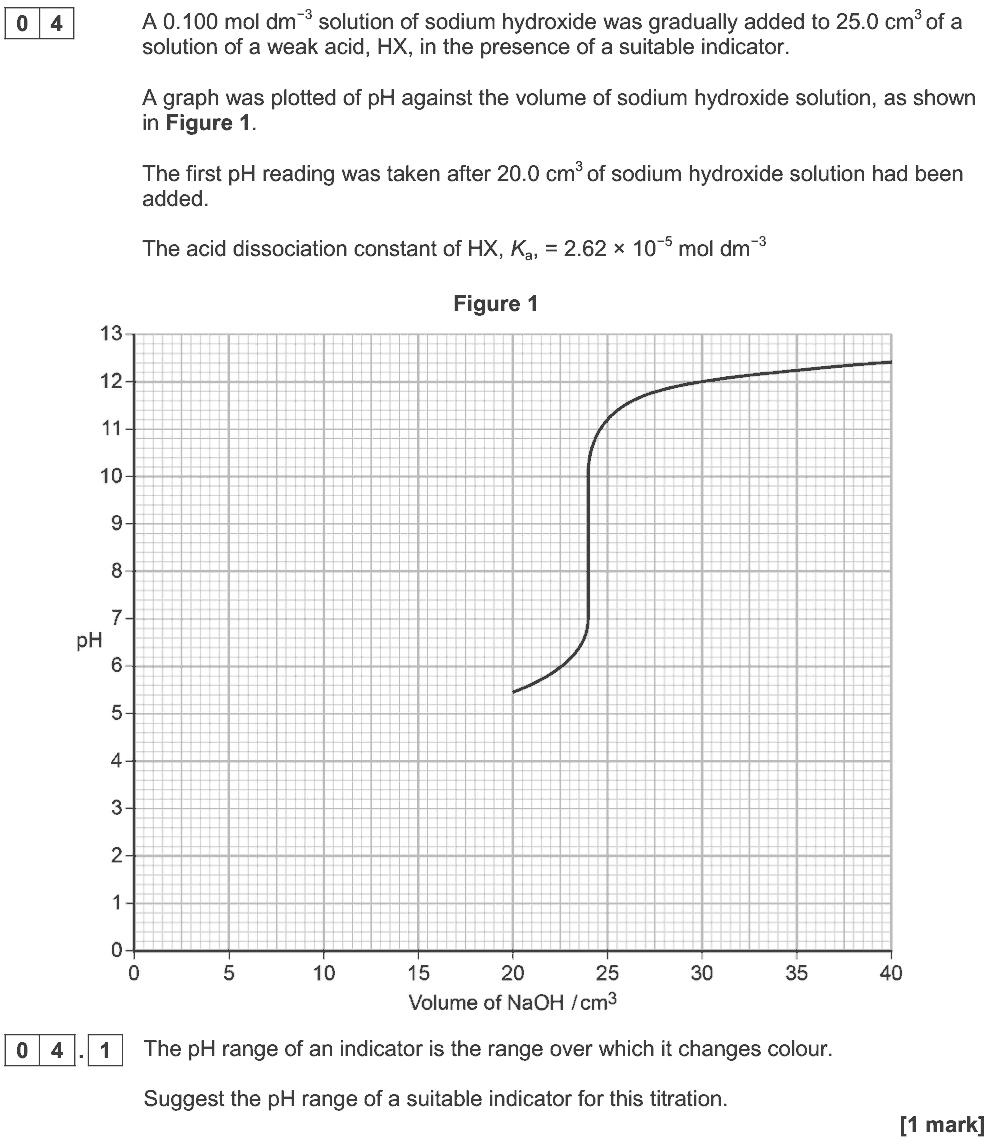
June 2017 · Paper 3 · Q04.11 markShort answer
Mark scheme
Examiner's comment
04.1 Nearly 60% of students recognised that the working range should correspond to the vertical section of the titration curve.
Notes from the mark scheme and report
Any range lying within pH 7 to 10.2 (the vertical section of the curve)
Skills: MS3.1 Translate information between graphical, numerical and algebraic forms; RP9 Investigate how pH changes when a weak acid reacts with a strong base and when a strong acid reacts with a weak base
June 2017 · Paper 3 · Q04.21 markShort answerEasy
Earlier part of question 04 that this part uses
Mark scheme
Examiner's comment
04.2 Over 80% of students recognised this expression, with the commonest error being to show it as [H+]2/[HX].
Notes from the mark scheme and report
Ka = [H+][X–] ÷ [HX]. Square brackets essential
[H+]² ÷ [HX] is not accepted as the expression
June 2017 · Paper 3 · Q04.32 marksCalculation
Earlier part of question 04 that this part uses
Mark scheme
Examiner's comment
04.3 This question was another that illustrated the importance of paying attention to the information in the stem of a question. A significant number of students attempted to answer this question using the expression for Ka, instead of recognising that this is a titration and that the end-point allows the amount of NaOH to be calculated, and hence the amount and concentration of the acid. Perhaps students did not recognise that that the end point of the titration could be obtained easily from Figure 1.
Notes from the mark scheme and report
Answer: 0.0960 mol dm–3. The equivalence point is at 24.0 cm3: n(NaOH) = 24.0 × 0.100 ÷ 1000 = 2.40 × 10^–3 mol = n(HX)
÷ 0.0250 dm3. Many tried to use Ka instead of reading the end point from Figure 1
Skills: MS0.0 Recognise and make use of appropriate units in calculation; MS3.1 Translate information between graphical, numerical and algebraic forms; RP9 Investigate how pH changes when a weak acid reacts with a strong base and when a strong acid reacts with a weak base
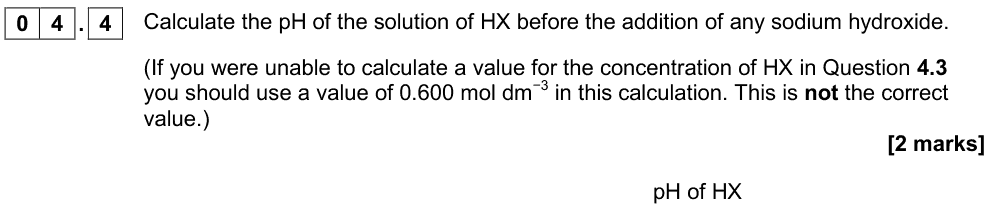
June 2017 · Paper 3 · Q04.42 marksCalculation
Earlier part of question 04 that this part uses
Mark scheme
Examiner's comment
04.4 The provision of alternative data ensured that students who had difficulty with question 04.3 were not disadvantaged here and over 50% gained full marks. Data in the stem were again crucial here.
Notes from the mark scheme and report
Answer: pH 2.80. [H+] = √(Ka × [HX]) = √(2.62 × 10^–5 × 0.0960) = 1.59 × 10^–3 mol dm–3. With the alternative 0.600 mol dm–3, pH = 2.40. Two decimal places needed. Ka is given in the question opening
Skills: MS0.4 Use calculators to find and use power, exponential and logarithmic functions; MS2.2 Change the subject of an equation; MS2.5 Use logarithms in relation to quantities that range over several orders of magnitude
June 2017 · Paper 3 · Q04.51 markCalculationHard
Earlier part of question 04 that this part uses
Mark scheme
Examiner's comment
04.5 The idea that pH = pKa at half-equivalence was not recognised by many, so only 26% of students gained this mark.
Notes from the mark scheme and report
Answer: pH 4.58. At half-neutralisation [HX] = [X–], so pH = pKa = –log(2.62 × 10^–5)
Skills: MS0.4 Use calculators to find and use power, exponential and logarithmic functions; MS2.5 Use logarithms in relation to quantities that range over several orders of magnitude
June 2017 · Paper 3 · Q04.62 marksDiagram or structureHard
Earlier part of question 04 that this part uses
Mark scheme
Examiner's comment
04.6 A mark was often lost as a result of students assuming that half-equivalence was at 10 or 15 cm3 and so plotting incorrectly. Many also failed to remember the need to show an initial steep section before buffering ‘levels off’ the curve.
Notes from the mark scheme and report
Plot pH 2.80 at 0 cm3 and pH 4.58 at 12.0 cm3 (half of 24.0 cm3) and draw the curve through both points to join the given curve at 20 cm3
the curve rises steeply at first and then levels off (buffer region). Errors: plotting half-equivalence at 10 or 15 cm3
no initial steep section
Skills: MS3.1 Translate information between graphical, numerical and algebraic forms; MS3.2 Plot two variables from experimental or other data; RP9 Investigate how pH changes when a weak acid reacts with a strong base and when a strong acid reacts with a weak base
Skills: MS0.4 Use calculators to find and use power, exponential and logarithmic functions; MS2.5 Use logarithms in relation to quantities that range over several orders of magnitude
June 2017 · Paper 3 · Q221 markMultiple choice
Answer
B
Mark scheme
Notes from the mark scheme and report
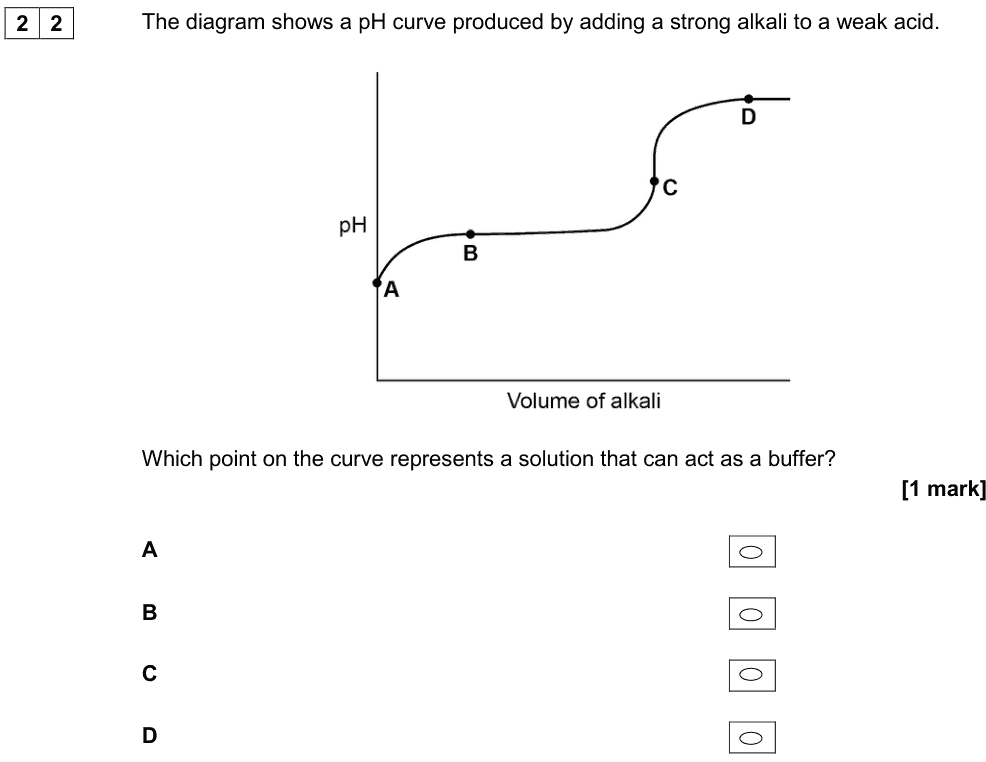
Answer: B. In the flat region before the equivalence point the solution contains both the weak acid and its salt
Skills: MS3.1 Translate information between graphical, numerical and algebraic forms
June 2017 · Paper 3 · Q271 markMultiple choice
Answer
B
Mark scheme
Notes from the mark scheme and report
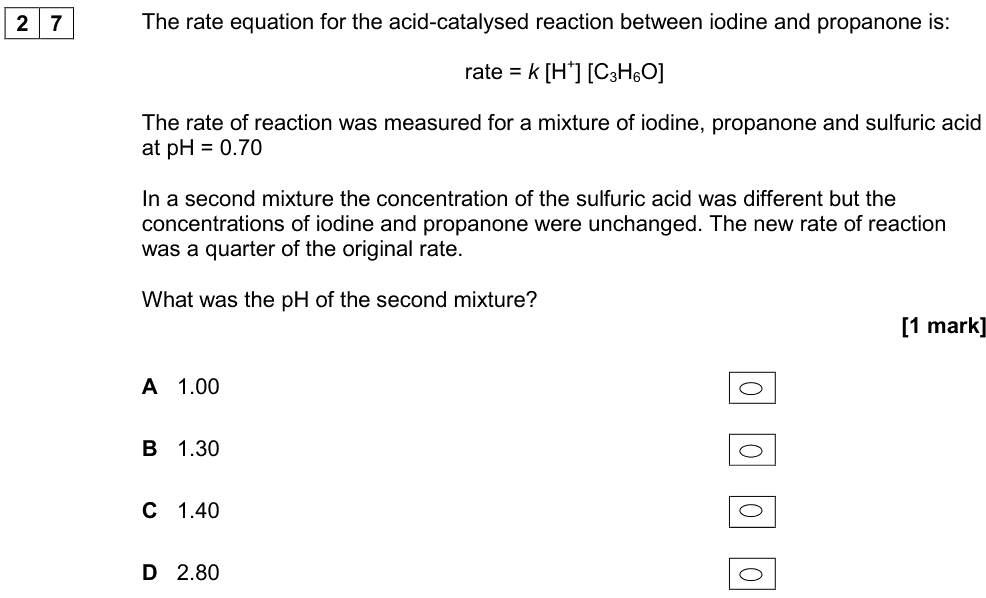
Answer: B. Rate is first order in H+, so [H+] is a quarter: 10^–0.70 = 0.200
÷ 4 = 0.0499 mol dm–3
pH = 1.30
Skills: MS0.4 Use calculators to find and use power, exponential and logarithmic functions; MS2.5 Use logarithms in relation to quantities that range over several orders of magnitude
Specimen · Paper 1 · Q06.12 marksPractical and data analysis
Mark scheme
Notes from the mark scheme and report
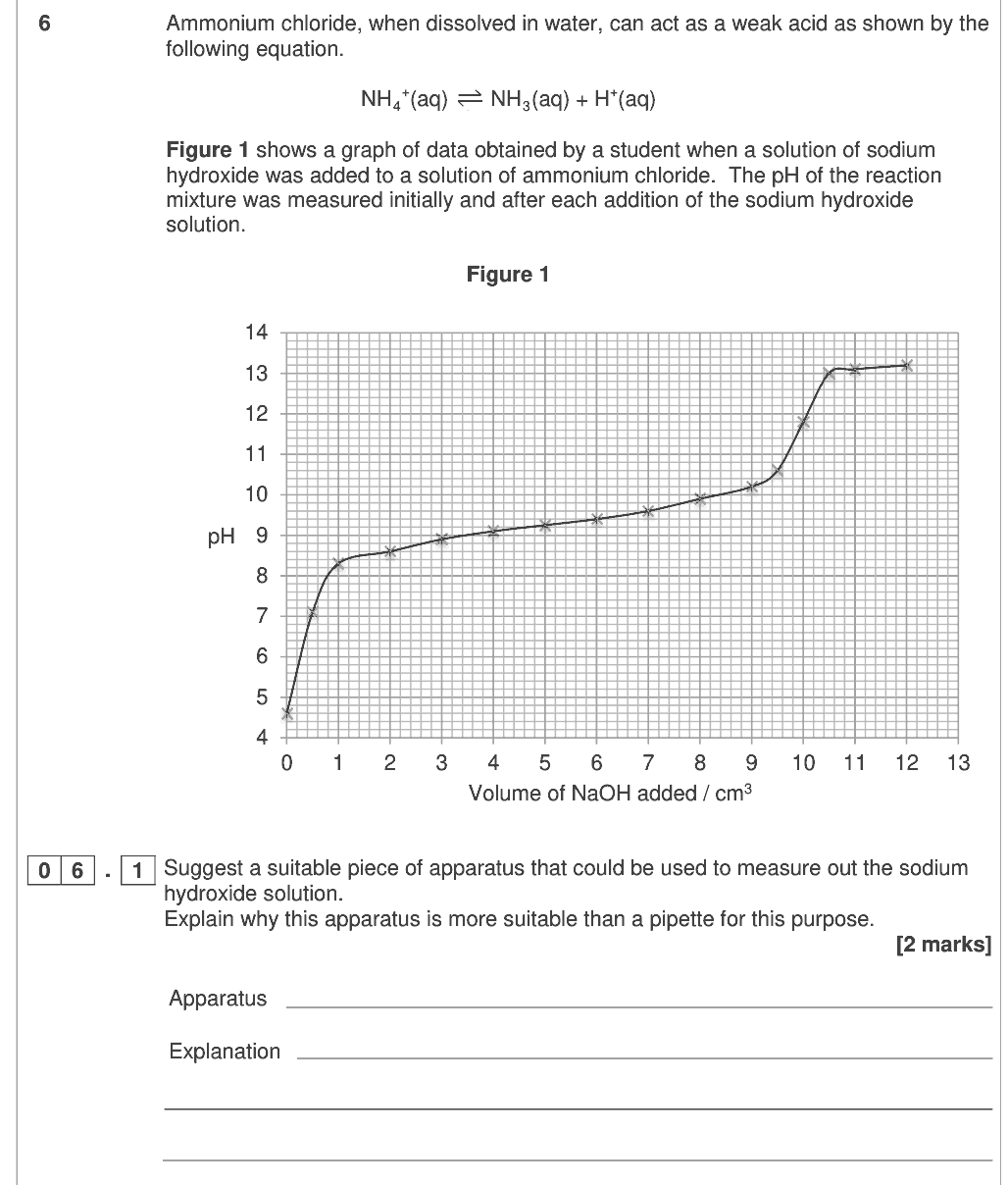
Burette, because it can deliver variable volumes (a pipette delivers one fixed volume)
Skills: ATd Use laboratory apparatus for a variety of experimental techniques including: titration, using burette and pipette; distillation and heating under reflux, including setting up glassware using retort stand and clamps; qualitative tests for ions and organic functional groups; filtration, including use of fluted filter paper, or filtration under reduced pressure; PS4.1 Know and understand how to use a wide range of experimental and practical instruments, equipment and techniques appropriate to the knowledge and understanding included in the specification; RP9 Investigate how pH changes when a weak acid reacts with a strong base and when a strong acid reacts with a weak base
Specimen · Paper 1 · Q06.22 marksExplanation
Earlier part of question 06 that this part uses
Mark scheme
Notes from the mark scheme and report
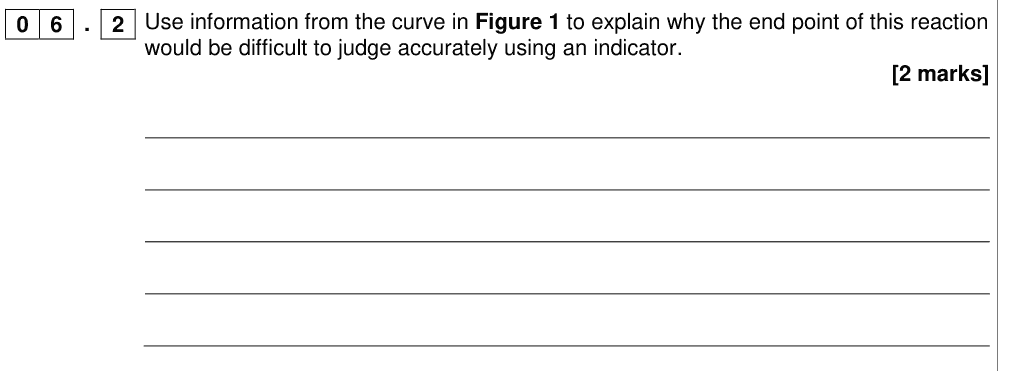
The change in pH at the end point is gradual, not rapid (no steep vertical section), so an indicator would change colour over a range of volumes of NaOH rather than with a few drops
Skills: PS3.1 Plot and interpret graphs; ATf Use acid–base indicators in titrations of weak/strong acids with weak/strong alkalis; RP9 Investigate how pH changes when a weak acid reacts with a strong base and when a strong acid reacts with a weak base
Skills: MS0.4 Use calculators to find and use power, exponential and logarithmic functions; MS2.2 Change the subject of an equation; MS2.5 Use logarithms in relation to quantities that range over several orders of magnitude
Specimen · Paper 1 · Q06.43 marksCalculation
Earlier part of question 06 that this part uses
Mark scheme
Notes from the mark scheme and report
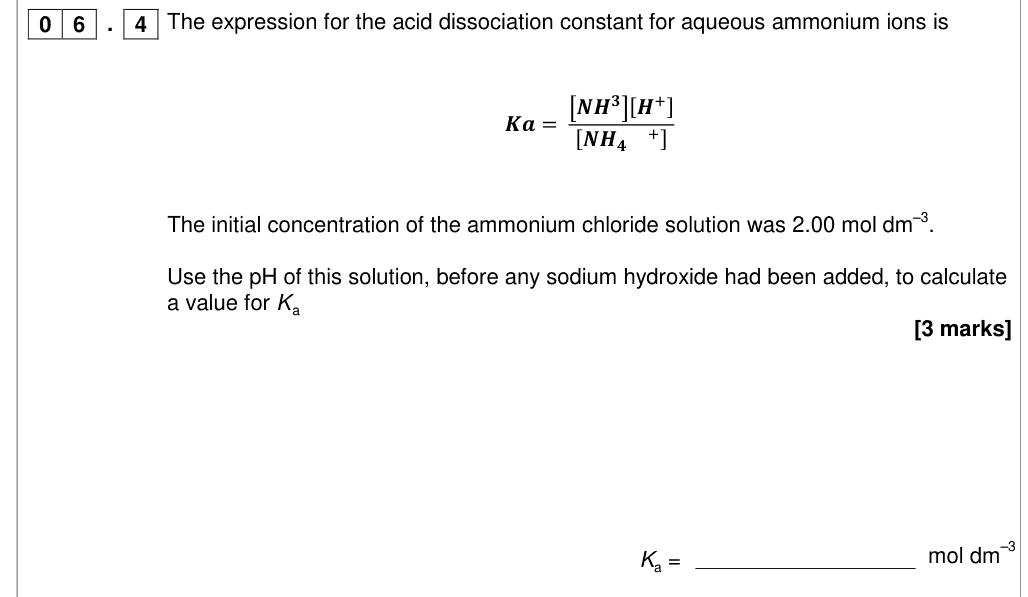
Answer: Ka = 3.15 × 10^–10 mol dm–3 (allow 3.15 to 3.16). Initial pH from Figure 1 is 4.6
[NH3] = [H+], so Ka = [H+]² ÷ [NH4+]
[H+] = 10^–4.6 = 2.51 × 10^–5
(2.51 × 10^–5)² ÷ 2.00. The Ka expression as printed on the paper shows NH3 with a superscript 3 (misprint for [NH3])
Skills: MS0.4 Use calculators to find and use power, exponential and logarithmic functions; MS2.3 Substitute numerical values into algebraic equations using appropriate units for physical quantities; MS2.5 Use logarithms in relation to quantities that range over several orders of magnitude; MS3.1 Translate information between graphical, numerical and algebraic forms
Specimen · Paper 1 · Q06.52 marksCalculation
Earlier part of question 06 that this part uses
Mark scheme
Notes from the mark scheme and report
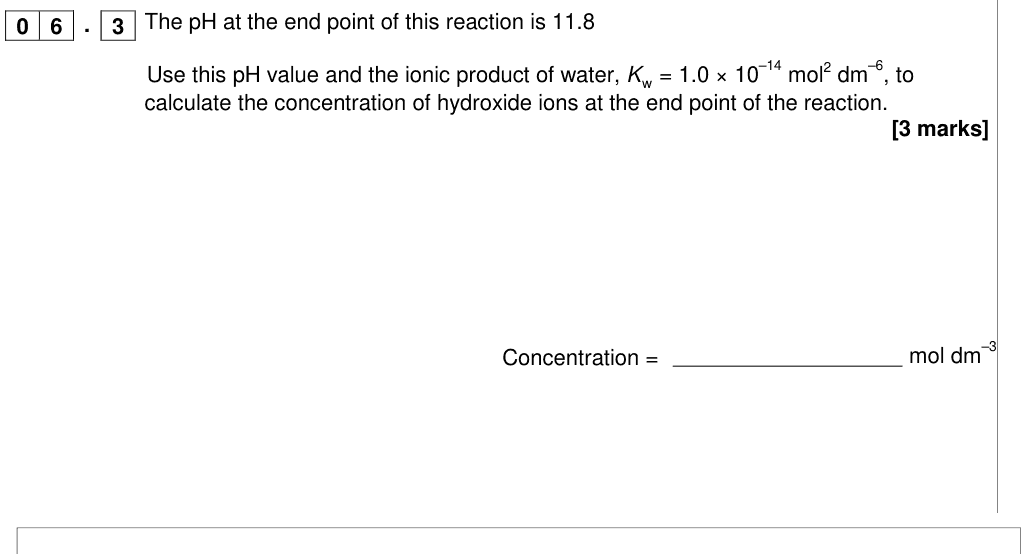
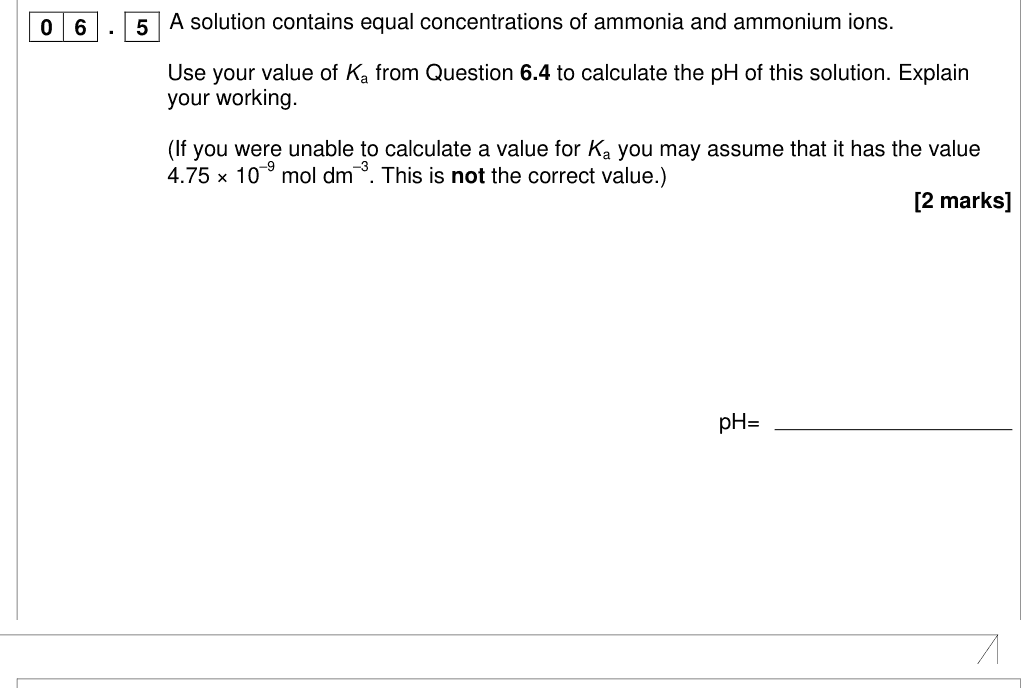
Answer: pH 9.50 (8.32 with the alternative Ka). When [NH3] = [NH4+], Ka = [H+], so pH = pKa = –log(3.15 × 10^–10). Consequential on 06.4
Skills: MS2.5 Use logarithms in relation to quantities that range over several orders of magnitude
Specimen · Paper 3 · Q02.41 markShort answer
Earlier parts of question 02 that this part uses
Mark scheme
Notes from the mark scheme and report
Answer: thymol blue (weak acid–strong base titration: the equivalence point is above pH 7, so the range 8.0 to 9.6 falls in the vertical part of the curve)
Skills: ATf Use acid–base indicators in titrations of weak/strong acids with weak/strong alkalis; RP9 Investigate how pH changes when a weak acid reacts with a strong base and when a strong acid reacts with a weak base
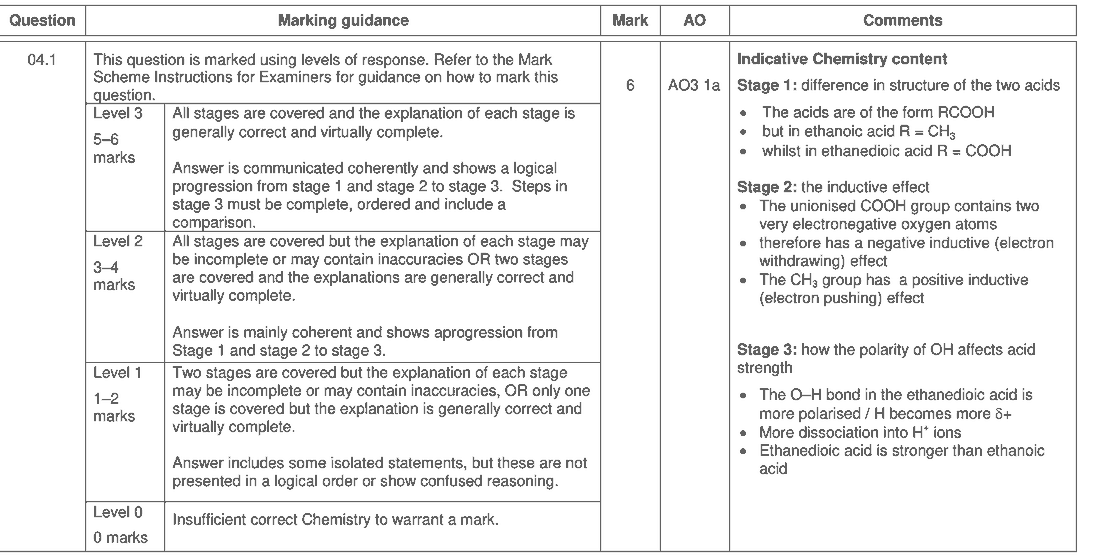
Specimen · Paper 3 · Q04.16 marksAO3=66-mark level of response
Mark scheme, with the levels and indicative content
Notes from the mark scheme and report
Levels of response, three stages. Structures: both are RCOOH
R is CH3 in ethanoic acid and COOH in ethanedioic acid. Inductive effect: the COOH group has two very electronegative oxygen atoms and is electron withdrawing (negative inductive effect)
CH3 is electron releasing (positive inductive effect). Acid strength: the O–H bond in ethanedioic acid is more polarised (H more δ+), so more dissociation into H+ ions
Skills: MS0.4 Use calculators to find and use power, exponential and logarithmic functions; MS1.1 Use an appropriate number of significant figures; MS2.2 Change the subject of an equation; MS2.5 Use logarithms in relation to quantities that range over several orders of magnitude
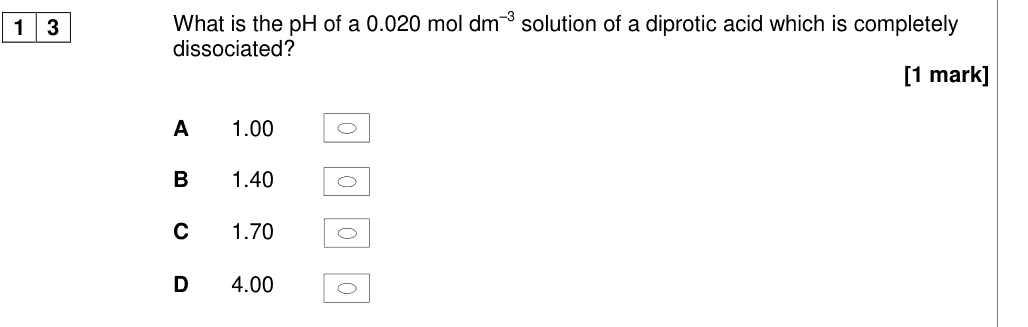
Specimen · Paper 3 · Q131 markAO2=1Multiple choice
Answer
B
Mark scheme
Notes from the mark scheme and report
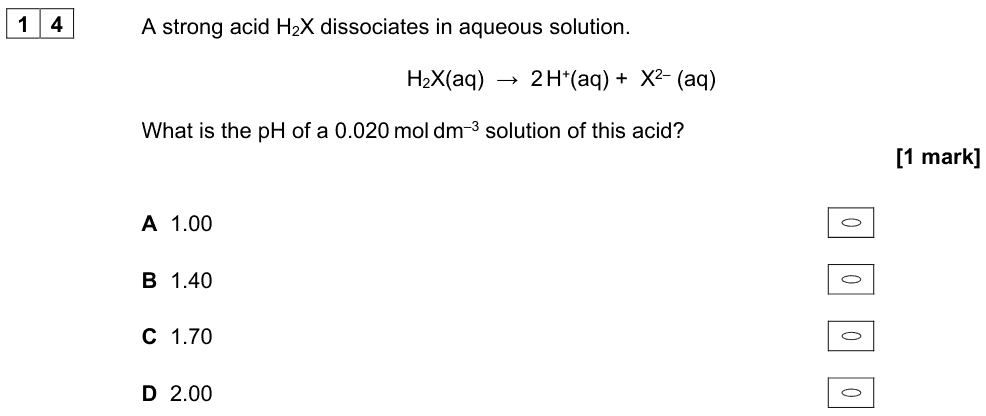
Answer: B. [H+] = 2 × 0.020 = 0.040 mol dm–3
pH = 1.40
Skills: MS0.4 Use calculators to find and use power, exponential and logarithmic functions; MS2.5 Use logarithms in relation to quantities that range over several orders of magnitude
Specimen · Paper 3 · Q141 markAO2=1Multiple choice
Skills: MS0.4 Use calculators to find and use power, exponential and logarithmic functions; MS2.5 Use logarithms in relation to quantities that range over several orders of magnitude
Work with an A-level chemistry tutor
Dropping marks on calculations, mechanisms or the required practicals? Book a trial session with a specialist A-level chemistry tutor.



































































![This question is about acidic solutions.
The acid dissociation constant, Ka, for ethanoic acid is given by the expression
Ka =
COOH]
[CH
]
[H
]
COO
[CH
3
3
+
−
The value of Ka for ethanoic acid is 1.74 × 10⁻⁵ mol dm−3 at 25 °C
A buffer solution with a pH of 3.87 was prepared using ethanoic acid and
sodium ethanoate. In the buffer solution, the concentration of ethanoate ions
was 0.136 mol dm−3
Calculate the concentration of the ethanoic acid in the buffer solution.
Give your answer to three significant figures.
[3 marks]
Concentration of acid
mol dm−3](/img/JUN17_74051/JUN17_74051_02.1.webp)
![The ionic product of water, Kw = 2.93 × 10⁻¹⁵ mol2 dm−6 at 10 °C
Which is the correct expression for Kw?
Tick () one box.
[1 mark]
A Kw =
]
][OH
[H
O]
[H2
−
+
B Kw = [H+][H2O]
C Kw = [H+][OH−]
D Kw =
O]
[H
]
][OH
[H
2
−
+](/img/JUN17_74051/JUN17_74051_03.1.webp)