Notes and key-term cards for this topic are being written by our tutors. The past-paper questions below are ready now.
Specification statements
Show the 6 statements from the specification
3.2.4-01 The reactions of Na and Mg with water.
3.2.4-02 The trends in the reactions of the elements Na, Mg, Al, Si, P and S with oxygen, limited to the formation of Na2O, MgO, Al2O3, SiO2, P4O10, SO2 and SO3
3.2.4-03 The trend in the melting point of the highest oxides of the elements Na–S
3.2.4-04 The reactions of the oxides of the elements Na–S with water, limited to Na2O, MgO, Al2O3, SiO2, P4O10, SO2 and SO3, and the pH of the solutions formed.
3.2.4-05 The structures of the acids and the anions formed when P4O10, SO2 and SO3 react with water.
3.2.4-06 Students should be able to: • explain the trend in the melting point of the oxides of the elements Na–S in terms of their structure and bonding • explain the trends in the reactions of the oxides with water in terms of the type of bonding present in each oxide • write equations for the reactions that occur between the oxides of the elements Na–S and given acids and bases.
Tap a question to zoom it. Where a part needs a figure, table or structure from earlier in the question, that part folds out above it; the mark scheme and examiner's comment open underneath. Have AQA's Data Booklet (the Periodic Table and the spectroscopy tables) beside you.
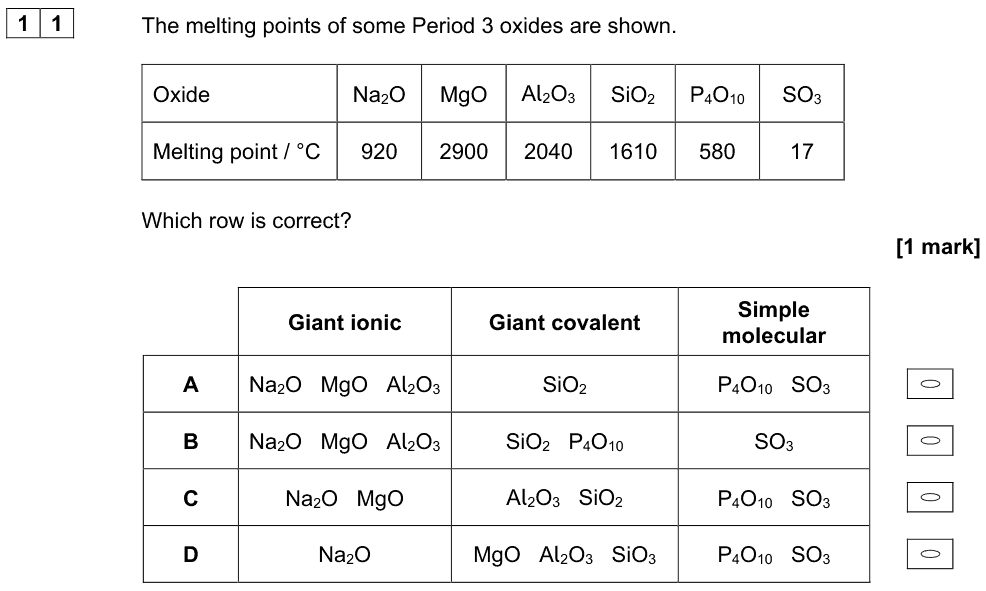
June 2025 · Paper 3 · Q111 markAO1=1Multiple choiceEasy
Answer
A
Mark scheme
Examiner's comment
Unfortunately, an erratum notice had to be issued for Question 11 due to a typo in one of the distractors, option D: SiO2 had to be substituted for the incorrect SiO3. The vast majority of students thankfully had the erratum notice delivered to them; detailed analyses showed that there was no discernible difference in the performance on this question between that majority of students and the small minority who were not told about the error. The question, answered correctly by just over 75% of students, had one of the best discrimination indices of all the Section B questions, and so functioned well.
Notes from the mark scheme and report
Answer: A. Na2O, MgO and Al2O3 are ionic lattices
SiO2 is macromolecular
P4O10 and SO3 are simple molecular. (Option D printed SiO3 in error
an erratum was issued)
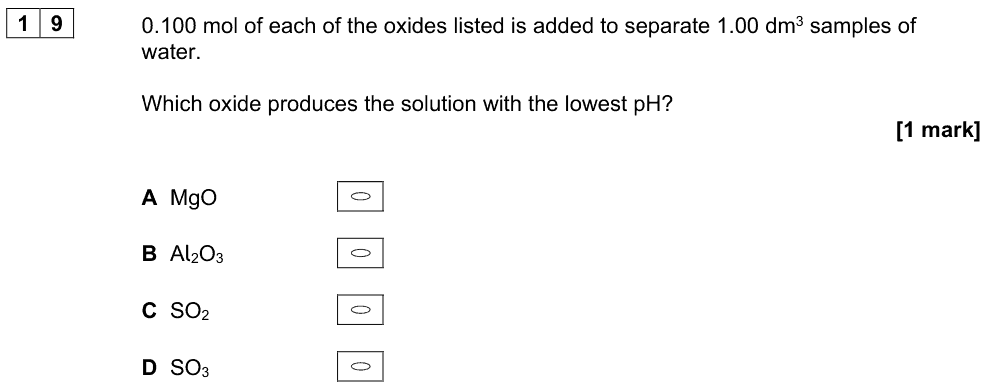
June 2025 · Paper 3 · Q191 markAO1=1Multiple choice
Answer
D
Mark scheme
Notes from the mark scheme and report
Answer: D. SO3 gives H2SO4, a strong acid
SO2 gives weak H2SO3
MgO is slightly alkaline and Al2O3 is insoluble
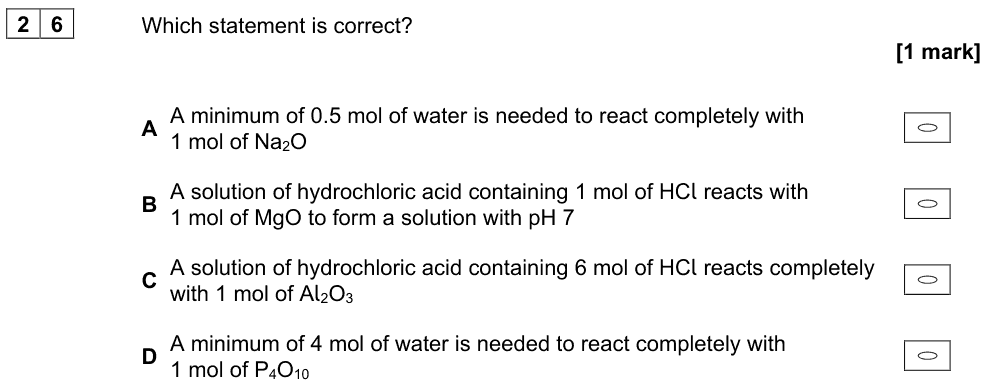
June 2025 · Paper 3 · Q261 markAO2=1Multiple choice
Answer
C
Mark scheme
Notes from the mark scheme and report
Answer: C. Al2O3 + 6HCl → 2AlCl3 + 3H2O. Na2O needs 1 mol of water, MgO needs 2 mol of HCl, and P4O10 needs 6 mol of water
Skills: MS0.2 Use ratios, fractions and percentages
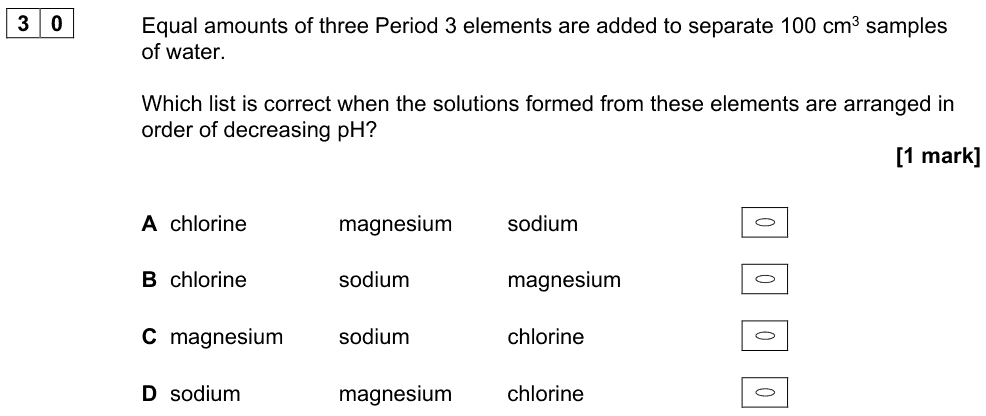
June 2025 · Paper 3 · Q301 markAO1=1Multiple choice
Answer
D
Mark scheme
Notes from the mark scheme and report
Answer: D. Sodium gives strongly alkaline NaOH
magnesium reacts very slowly to give sparingly soluble Mg(OH)2
chlorine gives an acidic solution (HCl and HClO)
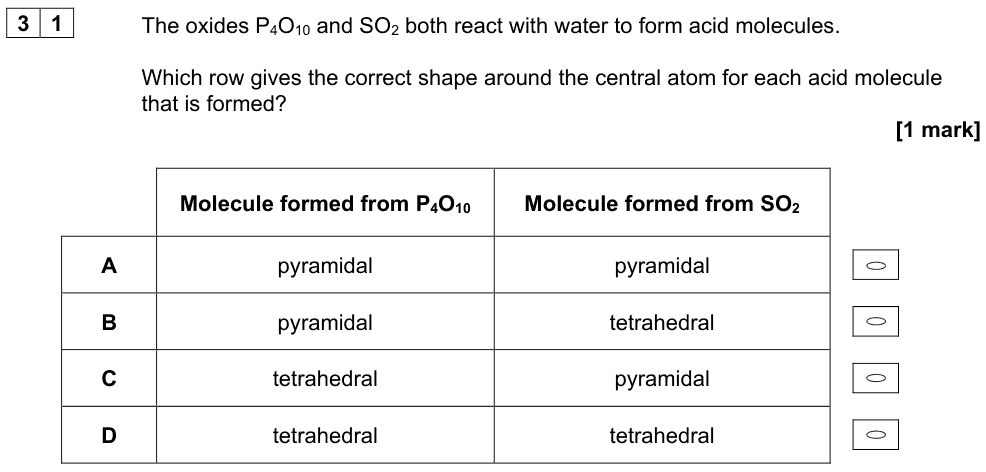
June 2025 · Paper 3 · Q311 markAO1=1Multiple choice
Answer
C
Mark scheme
Notes from the mark scheme and report
Answer: C. H3PO4 has four bonding regions round P and no lone pair (tetrahedral)
H2SO3 has three bonding regions and one lone pair on S (pyramidal). One of the least well answered questions (under 55% correct)
Skills: MS4.1 Use angles and shapes in regular 2D and 3D structures
June 2024 · Paper 1 · Q08.71 markAO3=1Short answer
Earlier part of question 08 that this part uses
Mark scheme
Examiner's comment
In part 7 very few students knew that sodium oxide reacts with water: common incorrect answers included sodium oxide being insoluble in water or the reaction was too difficult to measure.
Notes from the mark scheme and report
Sodium oxide reacts with water (forming NaOH)
'it dissolves' is not accepted. Common wrong answer: it is insoluble
June 2024 · Paper 1 · Q09.61 markAO3=1Equation writing
Earlier part of question 09 that this part uses
Mark scheme
Examiner's comment
The correct equation in part 6 was given by 47% of students: common errors included using one mole of NaOH or not balancing the equation.
Notes from the mark scheme and report
3NaOH + H3PO4 → Na3PO4 + 3H2O. Errors: one mole of NaOH
not balanced
June 2023 · Paper 1 · Q03.11 markAO1=1Equation writing
Mark scheme
Examiner's comment
The equation in 03.1 was well known.
Notes from the mark scheme and report
P4 + 5O2 → P4O10 (allow 4P + 5O2 → P4O10)
June 2023 · Paper 1 · Q03.21 markAO1=1Equation writing
Earlier part of question 03 that this part uses
Mark scheme
Examiner's comment
The equation in 03.2 was less well known; some students gave H2SO4 as the product.
Notes from the mark scheme and report
SO2 + H2O → H2SO3 (or → H+ + HSO3–, or → 2H+ + SO3 2–). Not H2SO4
June 2023 · Paper 1 · Q03.31 markAO1=1Diagram or structure
Earlier part of question 03 that this part uses
Mark scheme
Examiner's comment
Many students found 03.3 difficult and did not draw the displayed formula of the anion.
Notes from the mark scheme and report
Displayed SO4 2–: S with two S=O double bonds and two S–O– single bonds (allow HSO4– with one O–H and one O–). Many did not draw a displayed formula of the anion
Skills: MS4.2 Visualise and represent 2D and 3D forms including two-dimensional representations of 3D objects
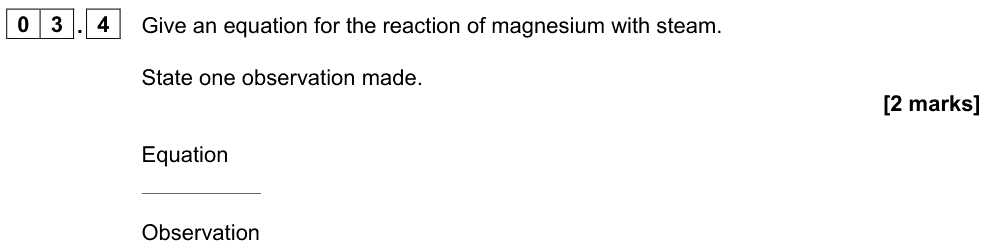
June 2023 · Paper 1 · Q03.42 marksAO1=2Equation writing
Earlier part of question 03 that this part uses
Mark scheme
Examiner's comment
In 03.4 several students did not give the correct equation; the most common errors were to form magnesium hydroxide and hydrogen or to give the observation as fizzing or a white precipitate.
Notes from the mark scheme and report
Mg + H2O → MgO + H2. Observation: white solid / white powder, or bright white light / flame. Not a white precipitate, not effervescence. Common error: Mg(OH)2 as the product
June 2023 · Paper 1 · Q03.51 markAO1=1Equation writing
Earlier part of question 03 that this part uses
Mark scheme
Examiner's comment
If students knew the formula of the product in 03.5 they invariably gave a correct equation; many students did not know the formula of magnesium phosphate and therefore could not give a balanced equation.
Notes from the mark scheme and report
3MgO + 2H3PO4 → Mg3(PO4)2 + 3H2O. Many did not know the formula of magnesium phosphate
June 2022 · Paper 1 · Q05.21 markAO2=1Equation writing
Earlier part of question 05 that this part uses
Mark scheme
Examiner's comment
The equation in 05.2 was more challenging, with many students not knowing the formula of aluminium oxide or aluminium sulfate; of those who did, many could not balance the equation.
Notes from the mark scheme and report
Al2O3 + 3H2SO4 → Al2(SO4)3 + 3H2O. Errors: wrong formula for aluminium oxide or aluminium sulfate
not balanced
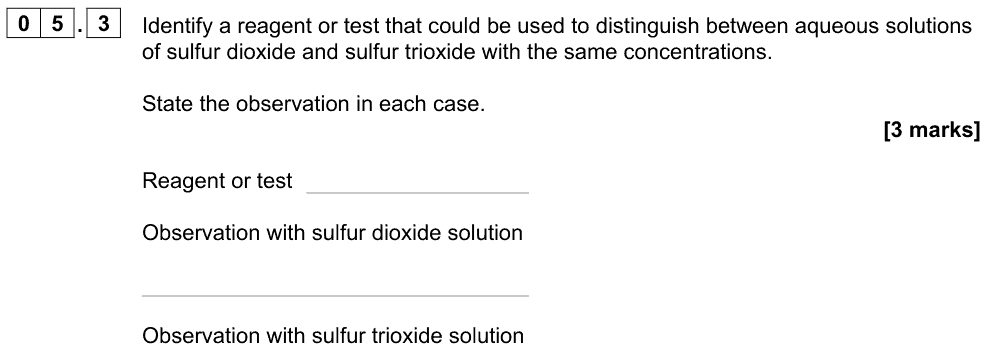
June 2022 · Paper 1 · Q05.33 marksAO3=3Practical and data analysisHard
Earlier part of question 05 that this part uses
Mark scheme
Examiner's comment
Question 05.3 proved challenging and only 13% of students scored all the marks.
Common, incorrect reagents suggested were litmus, sodium hydroxide and limewater.
Most students who scored 3 marks gave pH/universal indicator for the reagent and subsequent correct observations.
Some students suggested barium chloride but then got the observations the wrong way around.
Several students stated carbonate ions as the reagent, but this is an incomplete name so failed to gain the first mark.
Very few students scored both marks in
Notes from the mark scheme and report
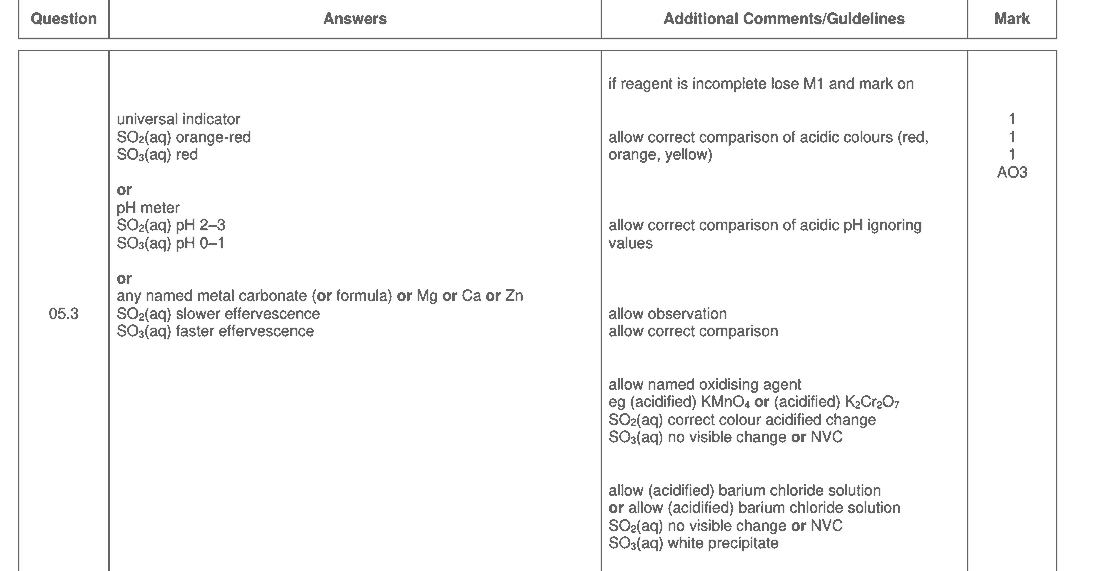
Universal indicator: SO2(aq) orange-red, SO3(aq) red
or pH meter: pH 2–3 and pH 0–1 (H2SO3 is a weaker acid than H2SO4). Alternatives: a named metal carbonate or Mg/Ca/Zn, slower then faster effervescence
acidified KMnO4 or K2Cr2O7, colour change with SO2 only
acidified BaCl2, white precipitate with SO3 only. Incomplete reagent ('carbonate ions') loses M1. Wrong reagents: litmus, NaOH, limewater
BaCl2 observations reversed
Skills: ATc Measure pH using pH charts, or pH meter, or pH probe on a data logger; ATd Use laboratory apparatus for a variety of experimental techniques including: titration, using burette and pipette; distillation and heating under reflux, including setting up glassware using retort stand and clamps; qualitative tests for ions and organic functional groups; filtration, including use of fluted filter paper, or filtration under reduced pressure; PS1.1 Solve problems set in practical contexts
June 2022 · Paper 1 · Q05.51 markAO1=1Equation writingHard
Earlier part of question 05 that this part uses
Mark scheme
Examiner's comment
56% of students scored the mark in 05.1. The equation in 05.2 was more challenging, with many students not knowing the formula of aluminium oxide or aluminium sulfate; of those who did, many could not balance the equation. Question 05.3 proved challenging and only 13% of students scored all the marks. Common, incorrect reagents suggested were litmus, sodium hydroxide and limewater. Most students who scored 3 marks gave pH/universal indicator for the reagent and subsequent correct observations. Some students suggested barium chloride but then got the observations the wrong way around. Several students stated carbonate ions as the reagent, but this is an incomplete name so failed to gain the first mark. Very few students scored both marks in
05.4. The equation in 05.5 was correctly given by 18% of students; many students did not know the products of the reaction or gave an equation starting from P2O5. Several students gave the correct molecule in 05.6 but did not give the displayed formula as asked for in the question. About 20% of answers to 05.7 scored marks at level 3 (5/6 marks). Often the indicative content was not well explained or was very muddled. Some students mixed up ions and molecules and some confused which bonds/intermolecular forces were being broken to measure the melting point; many thought that covalent bonds were broken in chlorine and hydrogen chloride, the two molecules.
Notes from the mark scheme and report
P4O10 + 12NaOH → 4Na3PO4 + 6H2O (acid salts also allowed, for example P4O10 + 8NaOH → 4Na2HPO4 + 2H2O). Errors: products not known
starting from P2O5
June 2022 · Paper 1 · Q05.61 markAO2=1Diagram or structure
Earlier part of question 05 that this part uses
Mark scheme
Examiner's comment
56% of students scored the mark in 05.1. The equation in 05.2 was more challenging, with many students not knowing the formula of aluminium oxide or aluminium sulfate; of those who did, many could not balance the equation. Question 05.3 proved challenging and only 13% of students scored all the marks. Common, incorrect reagents suggested were litmus, sodium hydroxide and limewater. Most students who scored 3 marks gave pH/universal indicator for the reagent and subsequent correct observations. Some students suggested barium chloride but then got the observations the wrong way around. Several students stated carbonate ions as the reagent, but this is an incomplete name so failed to gain the first mark. Very few students scored both marks in
05.4. The equation in 05.5 was correctly given by 18% of students; many students did not know the products of the reaction or gave an equation starting from P2O5. Several students gave the correct molecule in 05.6 but did not give the displayed formula as asked for in the question. About 20% of answers to 05.7 scored marks at level 3 (5/6 marks). Often the indicative content was not well explained or was very muddled. Some students mixed up ions and molecules and some confused which bonds/intermolecular forces were being broken to measure the melting point; many thought that covalent bonds were broken in chlorine and hydrogen chloride, the two molecules.
Notes from the mark scheme and report
Phosphoric(V) acid, H3PO4: P with one P=O double bond and three P–O–H groups
all bonds, including each O–H, must be shown. Several gave the right molecule but not as a displayed formula
Skills: MS4.2 Visualise and represent 2D and 3D forms including two-dimensional representations of 3D objects
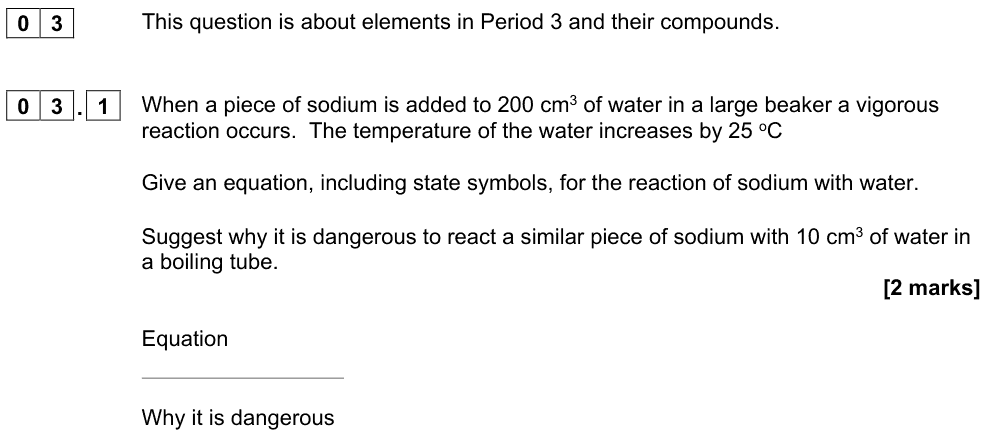
November 2021 · Paper 1 · Q03.12 marksEquation writing
Mark scheme
Examiner's comment
Some students omitted the state symbols from the equation or missed out one of the state symbols in an otherwise correct equation in question 03.1; some students incorrectly gave oxygen or sodium oxide as a product.
Most students appreciated that the reaction would be more violent and that the glass might shatter.
Notes from the mark scheme and report
2Na(s) + 2H2O(l) → 2NaOH(aq) + H2(g), state symbols needed. Danger: the temperature rise is much greater / the mixture could shoot out of the tube / the glass could shatter / hydrogen could ignite. 'Exothermic' or 'vigorous' alone is ignored. Errors: oxygen or sodium oxide as a product
Skills: PS1.2 Apply scientific knowledge to practical contexts; ATk Safely and carefully handle solids and liquids, including corrosive, irritant, flammable and toxic substances
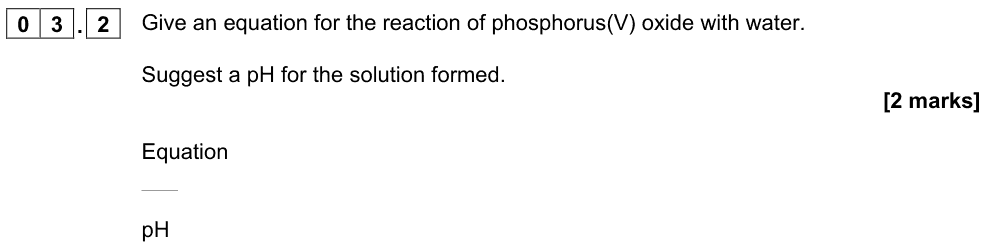
November 2021 · Paper 1 · Q03.22 marksEquation writing
Earlier part of question 03 that this part uses
Mark scheme
Examiner's comment
In question 03.2 some students started from P2O5 and some gave H3PO3 as a product.
Many gave the pH to be 2 which wasn’t low enough to be given a mark.
Notes from the mark scheme and report
P4O10 + 6H2O → 4H3PO4
pH –1 to +1. Not from P2O5
H3PO3 is wrong
pH 2 was not low enough
November 2021 · Paper 1 · Q03.34 marksExplanation
Earlier part of question 03 that this part uses
Mark scheme
Examiner's comment
Answers to question 03.3 were generally quite good.
The structure and bonding in silicon dioxide was generally well done but some students discussed forces between silicon dioxide molecules.
The structure for phosphorus(V) oxide was less well known; the term molecular was given only in the best answers.
Some students did not state that van der Waals’ forces were between molecules.
Notes from the mark scheme and report
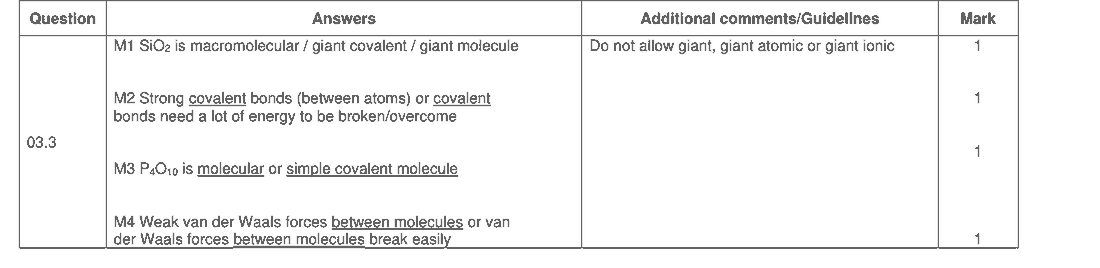
SiO2 is macromolecular (giant covalent) with strong covalent bonds between atoms that need a lot of energy to break
P4O10 is molecular (simple covalent) with weak van der Waals forces between molecules. Not 'giant' alone or giant ionic. Errors: forces between SiO2 molecules
not saying the forces are between molecules
November 2021 · Paper 1 · Q03.42 marksEquation writing
Earlier part of question 03 that this part uses
Mark scheme
Examiner's comment
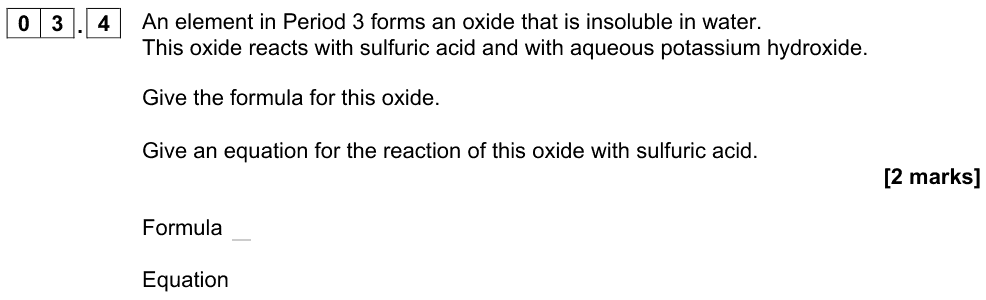
Students found question 03.4 challenging.
A range of answers was seen for the oxide; students who gave the correct formula of aluminium oxide often failed to give a correct balanced equation.
Notes from the mark scheme and report
Al2O3
Al2O3 + 3H2SO4 → Al2(SO4)3 + 3H2O (or Al2O3 + 6H+ → 2Al3+ + 3H2O). Those with the right oxide often could not balance the equation
November 2020 · Paper 1 · Q03.51 markEquation writing
Earlier part of question 03 that this part uses
Mark scheme
Examiner's comment
In 03.5, many students gave P2O5 instead of P4O10 as the product and some students did not attempt to balance the equation.
Notes from the mark scheme and report
4P + 5O2 → P4O10 (or P4 + 5O2 → P4O10). P2O5 is not accepted and was common
some equations were unbalanced
November 2020 · Paper 3 · Q02.12 marksExplanation
Mark scheme
Examiner's comment
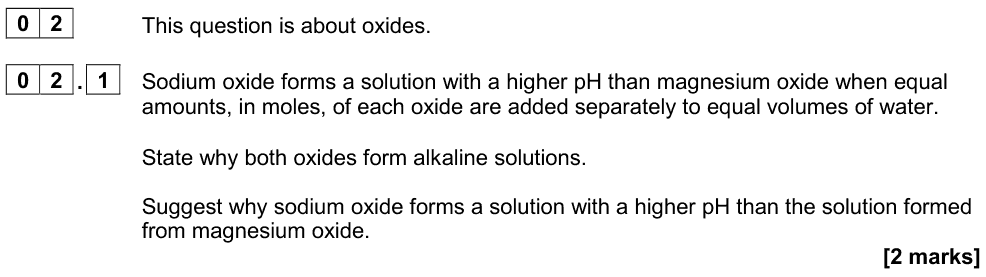
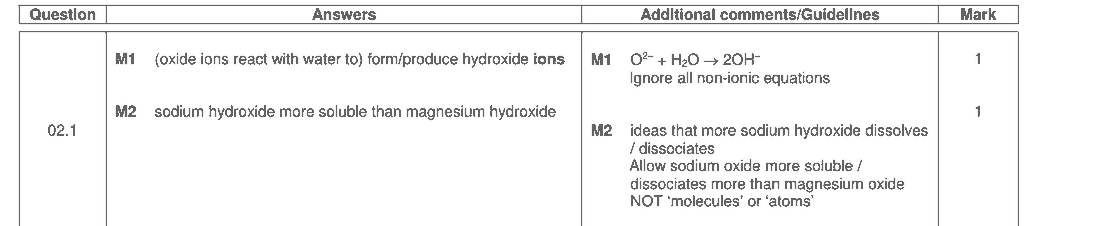
Some answers to 02.1 were too vague, with alkalinity being explained for example by the statement that Na and Mg are both alkali metals.
About two-thirds of students scored the first mark by mentioning hydroxide ions but the second mark for a mention of the difference in solubility of the hydroxides was often missing.
It was difficult to understand why a significant minority of students tried to explain the difference in terms of sodium hydroxide having ‘two hydroxide ions’ by comparison with magnesium hydroxide having only one.
Notes from the mark scheme and report
Both: the oxide ions react with water to form hydroxide ions (O2– + H2O → 2OH–). Sodium hydroxide is more soluble than magnesium hydroxide, so the OH– concentration is higher. Not 'molecules' or 'atoms'. About two-thirds got the first mark
the solubility point was often missing
November 2020 · Paper 3 · Q02.21 markEquation writing
Earlier part of question 02 that this part uses
Mark scheme
Examiner's comment
02.2 was answered correctly by about 40% of students.
A common mistake was to use the wrong formula for phosphorus(V) oxide.
Students were expected to use P4O10.
Notes from the mark scheme and report
P4O10 + 6H2O → 4H3PO4. P2O5 is not accepted and was the common error
June 2019 · Paper 3 · Q01.22 marksEquation writing
Earlier part of question 01 that this part uses
Mark scheme
Examiner's comment
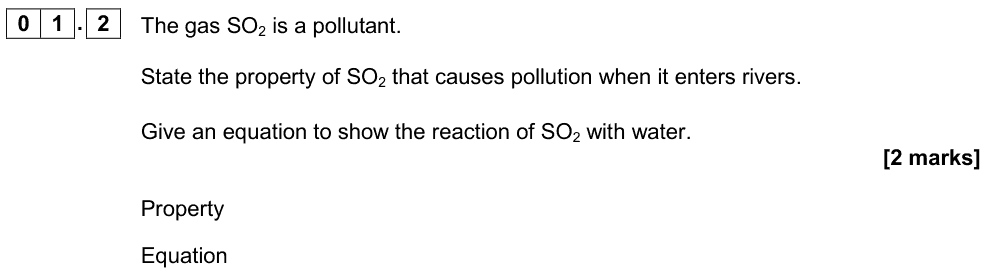
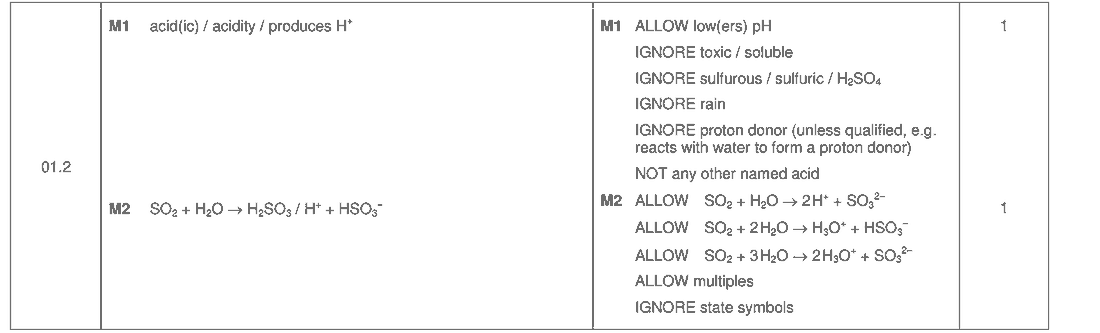
1.2 A reference to ‘acidity’ was often seen for the first mark, but a correct equation was much less commonly seen. Many students attempted to write an equation showing the formation of H2SO4 instead of H2SO3.
Notes from the mark scheme and report
It is acidic (lowers the pH)
SO2 + H2O → H2SO3 (or H+ + HSO3–). Toxic/soluble ignored. Common error: an equation forming H2SO4
June 2019 · Paper 3 · Q02.11 markDiagram or structure
Mark scheme
Examiner's comment
2.1 A clear majority of students were successful here, with the commonest omission being the bond between the O and H in each of the O−H groups.
Notes from the mark scheme and report
S with two S=O double bonds and two S–O–H groups, every bond shown including O–H. No lone pair on S. Most common omission: the O–H bonds
June 2018 · Paper 1 · Q05.41 markShort answerEasy
Earlier part of question 05 that this part uses
Mark scheme
Examiner's comment
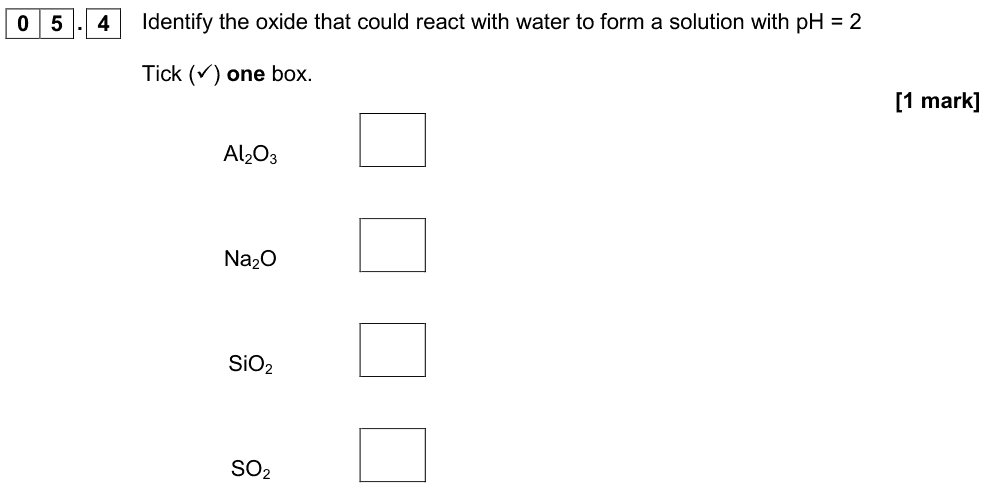
05.4 78.5% correctly identified sulphur dioxide.
Notes from the mark scheme and report
Answer: SO2 (an acidic oxide that reacts with water to give an acidic solution)
June 2018 · Paper 3 · Q02.12 marksEquation writingHard
Mark scheme
Examiner's comment
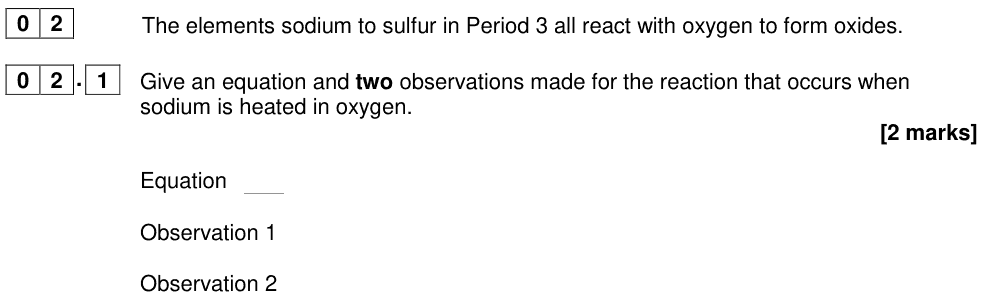
02.1 This was expected to be a straightforward question on a familiar equation and set of observations. However, many students were unable to balance the equation, with 2Na + O2 Na2O seen frequently. Incorrect observations included numerous mentions of a ‘red’ flame and of the formation of a ‘precipitate’. Only 23.6% of students scored both marks.
Notes from the mark scheme and report
4Na + O2 → 2Na2O (allow 2Na + O2 → Na2O2)
yellow / orange flame AND white solid / smoke (both needed for the second mark). Not 'precipitate'
red flame was a common error
2Na + O2 → Na2O is unbalanced
June 2018 · Paper 3 · Q02.22 marksEquation writing
Earlier part of question 02 that this part uses
Mark scheme
Examiner's comment
02.2 The need for only a single observation probably resulted in the higher marks here than in 02.1 (39.4% fully correct). The formula of the oxide was usually correct, but incorrect reference to a ‘precipitate’ was again seen frequently.
Notes from the mark scheme and report
4P + 5O2 → P4O10 (or P4 + 5O2 → P4O10
P4O6 versions allowed)
white flame or white smoke / solid. Not P2O5
not 'precipitate'
June 2018 · Paper 3 · Q02.32 marksExplanation
Earlier part of question 02 that this part uses
Mark scheme
Examiner's comment
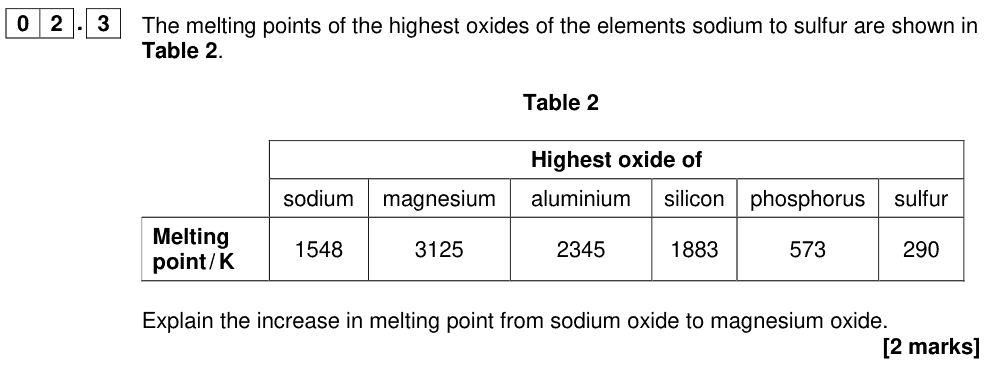
02.3 This was another example where reading the question was key; many students incorrectly gave a comparison of sodium and magnesium (rather than their oxides), while others wasted time and space discussing the trend across the whole period. Any references to metallic bonding, or any suggestion of the presence of ‘molecules’, made it impossible to award credit in this question. 38.7% of students were able, however, to score both marks.
Notes from the mark scheme and report
The Mg2+ ion has a higher charge (and is smaller) / higher charge density than Na+
so the attraction between the oppositely charged ions is stronger. 0 if molecules, intermolecular forces or metallic bonding are mentioned
compare the oxides, not the metals
June 2018 · Paper 3 · Q02.43 marksExplanation
Earlier part of question 02 that this part uses
Mark scheme
Examiner's comment
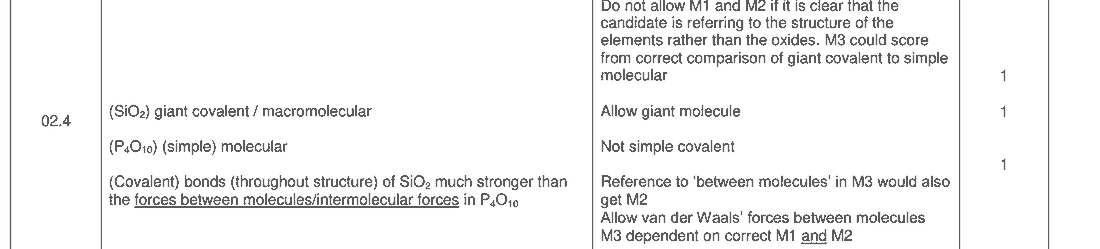
02.4 The confusion in students’ minds between ‘molecular’ and ‘giant’ structures was evident in many of the answers to this question. Contradictions were frequently seen, such as “silicon dioxide has a macromolecular structure with strong covalent bonds between the molecules”. An ideal answer would be structured with clear statements that silicon dioxide is giant covalent (or macromolecular) and phosphorous oxide is (simple) molecular, followed by the statement that the covalent bonds between the atoms in silicon dioxide are much stronger then the intermolecular forces in phosphorous oxide. Use of the word ‘bonds’ should be avoided when referring to intermolecular forces (apart from the specific case of hydrogen bonds, not relevant in the answer to this question).
Notes from the mark scheme and report
SiO2 is macromolecular / giant covalent
P4O10 is (simple) molecular
the covalent bonds in SiO2 are much stronger than the intermolecular (van der Waals) forces between P4O10 molecules. Not 'simple covalent'
avoid 'bonds' for intermolecular forces
contradictions such as 'covalent bonds between the molecules' were common
June 2018 · Paper 3 · Q251 markMultiple choice
Answer
A
Mark scheme
Examiner's comment
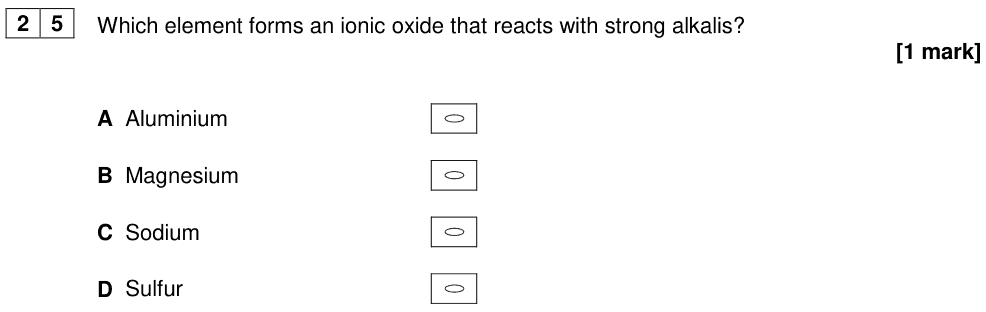
25 In a question where just under half of students arrived at the correct answer, D was the commonest incorrect response. This was presumably because sulfur forms an acidic oxide that reacts with alkali – but sulfur oxides are molecular, not ionic.
Notes from the mark scheme and report
Answer: A. Al2O3 is ionic and amphoteric, so it reacts with strong alkalis
MgO and Na2O are basic
sulfur oxides react with alkali but are molecular (commonest wrong answer D)
June 2017 · Paper 1 · Q06.11 markEquation writingEasy
Mark scheme
Examiner's comment
06.1 Students generally scored the mark for the equation (78.8% correct), though some students used P2 or gave P2O5 as the product and lost the mark.
Notes from the mark scheme and report
P4 + 5O2 → P4O10 (allow 4P + 5O2 → P4O10). Errors: P2, or P2O5 as the product
June 2017 · Paper 1 · Q06.23 marksPractical and data analysis
Earlier part of question 06 that this part uses
Mark scheme
Examiner's comment
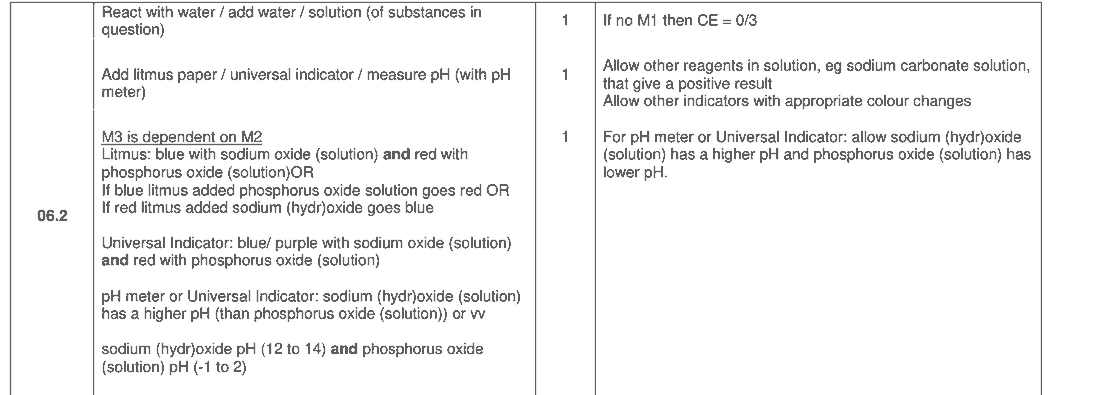
06.2 Many students failed to realise that water was all that was required; those students who used water mostly went on to give a correct method for testing the solution.
Notes from the mark scheme and report
Add water to each (essential: no water = 0/3)
add universal indicator / litmus or measure pH
sodium oxide solution is alkaline (blue/purple, pH 12 to 14) and phosphorus oxide solution is acidic (red, pH –1 to 2). Many did not realise water was all that was needed
Skills: ATc Measure pH using pH charts, or pH meter, or pH probe on a data logger; ATd Use laboratory apparatus for a variety of experimental techniques including: titration, using burette and pipette; distillation and heating under reflux, including setting up glassware using retort stand and clamps; qualitative tests for ions and organic functional groups; filtration, including use of fluted filter paper, or filtration under reduced pressure; PS1.1 Solve problems set in practical contexts
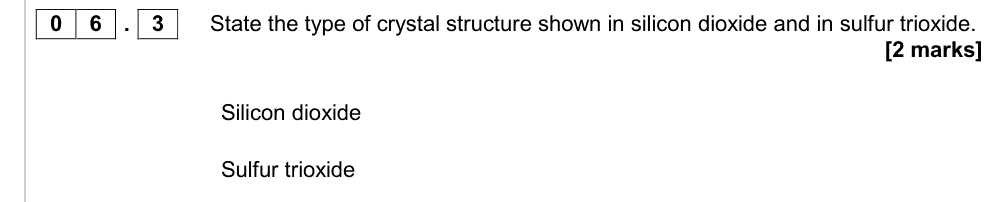
June 2017 · Paper 1 · Q06.32 marksShort answer
Earlier part of question 06 that this part uses
Mark scheme
Examiner's comment
06.3 Most students answered this well, but “simple covalent” was a common incorrect, incomplete answer for sulfur dioxide.
Notes from the mark scheme and report
Silicon dioxide: macromolecular / giant covalent. Sulfur trioxide: (simple) molecular. 'Simple covalent' is not accepted and was common
June 2017 · Paper 1 · Q06.44 marksExplanation
Earlier part of question 06 that this part uses
Mark scheme
Examiner's comment
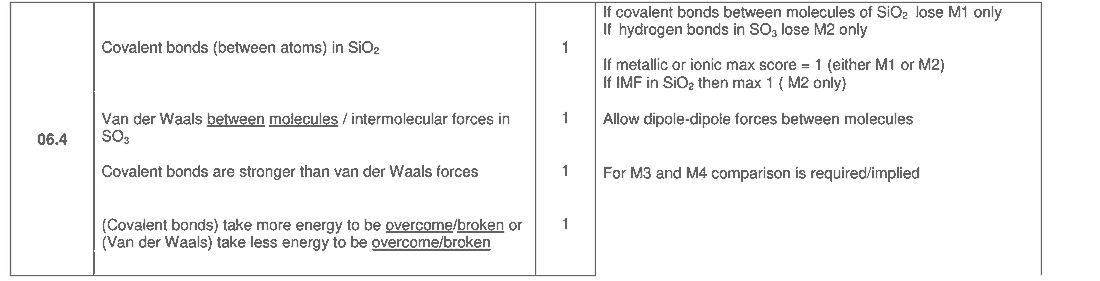
06.4 Most students understood that covalent bonds were broken for silicon dioxide and that intermolecular forces were overcome for sulfur trioxide. Some students lost marks because they thought intermolecular forces were also overcome in silicon dioxide. There were only a few examples where students got the type of bonding completely wrong.
Notes from the mark scheme and report
SiO2 has covalent bonds between atoms
SO3 has van der Waals (intermolecular) forces between molecules
covalent bonds are stronger than van der Waals forces
so more energy is needed to break them (comparison needed for M3 and M4). Intermolecular forces in SiO2 limits to 1
hydrogen bonds in SO3 loses M2
June 2017 · Paper 1 · Q06.51 markEquation writing
Earlier part of question 06 that this part uses
Mark scheme
Examiner's comment
06.5 Many students struggled with the equation here and gave the products as potassium oxide and sulfuric acid.
Notes from the mark scheme and report
SO3 + 2KOH → K2SO4 + H2O (or SO3 + KOH → KHSO4
ionic versions allowed). Common wrong products: potassium oxide and sulfuric acid
June 2017 · Paper 1 · Q06.61 markEquation writing
Earlier part of question 06 that this part uses
Mark scheme
Examiner's comment
06.6 Many students found the formula of magnesium phosphate challenging and hence could not write a correct balanced equation. Often, students failed to pick up on the information that magnesium oxide was in excess and gave magnesium hydrogenphosphate as the product.
Notes from the mark scheme and report
3MgO + 2H3PO4 → Mg3(PO4)2 + 3H2O. Excess MgO means the acid is fully neutralised
magnesium hydrogenphosphate was a common wrong product
formula of magnesium phosphate was often wrong
June 2017 · Paper 1 · Q06.71 markDiagram or structure
Earlier part of question 06 that this part uses
Mark scheme
Examiner's comment
06.7 Many students found this question quite challenging; sulfuric(VI) acid was often thought to be the product. Very few students gave a correct fully displayed formula.
Notes from the mark scheme and report
Sulfurous acid, H2SO3 (sulfuric(IV) acid): S with one S=O and two S–O–H, all bonds shown (lone pair on S ignored). Sulfuric(VI) acid was the common wrong answer
few gave a fully displayed formula
Specimen · Paper 1 · Q02.32 marksExplanation
Earlier part of question 02 that this part uses
Mark scheme
Notes from the mark scheme and report
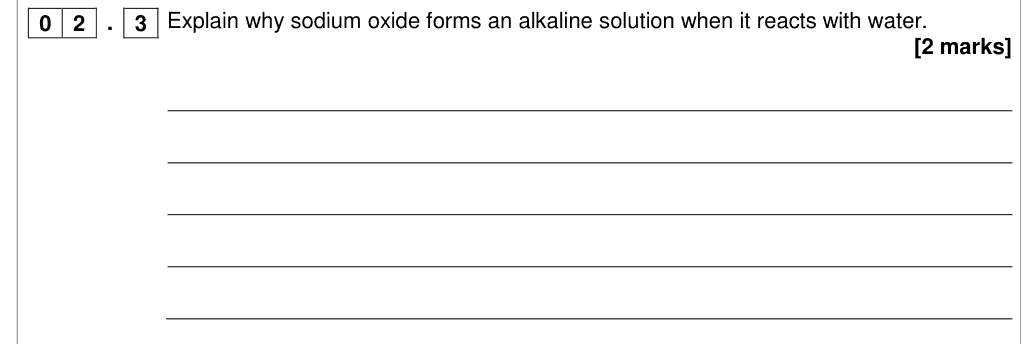
Sodium oxide contains O2– ions, which react with water to form OH– ions. O2– + H2O → 2OH– scores both marks
Specimen · Paper 1 · Q02.41 markAO2=1Equation writing
Earlier part of question 02 that this part uses
Mark scheme
Notes from the mark scheme and report
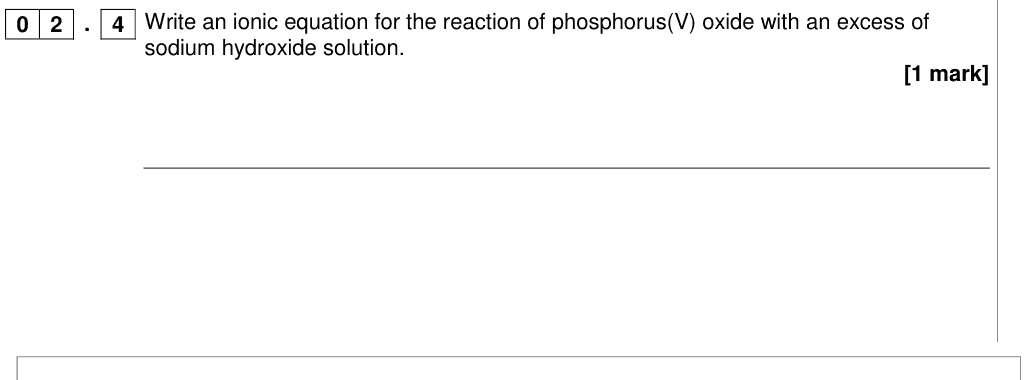
P4O10 + 12OH– → 4PO4 3– + 6H2O
Work with an A-level chemistry tutor
Dropping marks on calculations, mechanisms or the required practicals? Book a trial session with a specialist A-level chemistry tutor.