Notes and key-term cards for this topic are being written by our tutors. The past-paper questions below are ready now.
Specification statements
Show the 8 statements from the specification
3.3.12.1-01 Condensation polymers are formed by reactions between: • dicarboxylic acids and diols • dicarboxylic acids and diamines • amino acids.
3.3.12.1-02 The repeating units in polyesters (eg Terylene) and polyamides (eg nylon 6,6 and Kevlar) and the linkages between these repeating units.
3.3.12.1-03 Typical uses of these polymers.
3.3.12.1-04 Students should be able to: • draw the repeating unit from monomer structure(s) • draw the repeating unit from a section of the polymer chain • draw the structure(s) of the monomer(s) from a section of the polymer • explain the nature of the intermolecular forces between molecules of condensation polymers.
3.3.12.2-01 Polyalkenes are chemically inert and non-biodegradable.
3.3.12.2-02 Polyesters and polyamides can be broken down by hydrolysis and are biodegradable.
3.3.12.2-03 The advantages and disadvantages of different methods of disposal of polymers, including recycling.
3.3.12.2-04 Students should be able to: • explain why polyesters and polyamides can be hydrolysed but polyalkenes cannot.
Tap a question to zoom it. Where a part needs a figure, table or structure from earlier in the question, that part folds out above it; the mark scheme and examiner's comment open underneath. Have AQA's Data Booklet (the Periodic Table and the spectroscopy tables) beside you.
June 2025 · Paper 2 · Q03.21 markAO2=1Short answer
Earlier part of question 03 that this part uses
Mark scheme
Examiner's comment
3.2 Students were asked to state why PVC is not biodegradable. Many were able to identify the strong non-polar C-C bonds as the reason but significant numbers were unable to see this and suggested incorrectly that strong C-H or C-Cl bonds were responsible.
Notes from the mark scheme and report
The chain is made of C–C bonds, which are non-polar / strong, so they are not attacked by nucleophiles and cannot be hydrolysed. Common error: strong C–H or C–Cl bonds
June 2024 · Paper 3 · Q281 markAO2=1Multiple choice
Answer
C
Mark scheme
Notes from the mark scheme and report
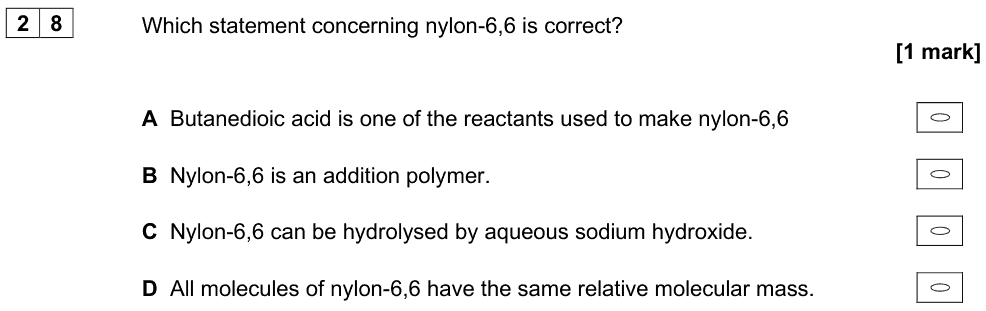
Answer: C. Polyamides are hydrolysed at the amide link by aqueous NaOH
nylon-6,6 is a condensation polymer of hexanedioic acid and hexane-1,6-diamine, with chains of varying length
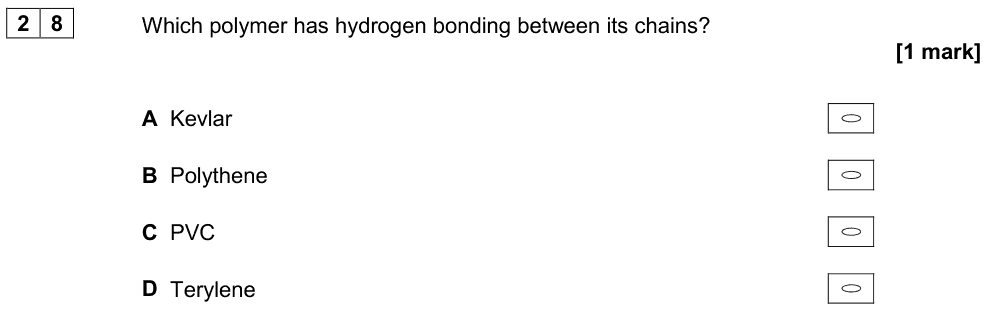
June 2024 · Paper 3 · Q311 markAO1=1Multiple choice
Answer
A
Mark scheme
Notes from the mark scheme and report
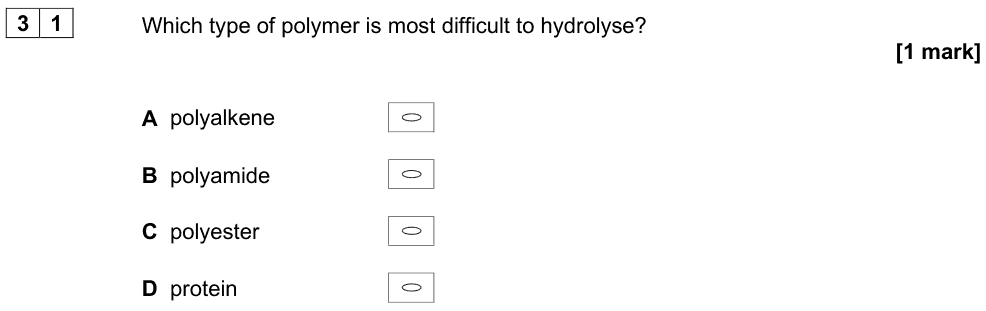
Answer: A. Polyalkenes have only non-polar C–C and C–H bonds, so they are not attacked by nucleophiles
June 2024 · Paper 3 · Q321 markAO3=1Multiple choice
Answer
B
Mark scheme
Notes from the mark scheme and report
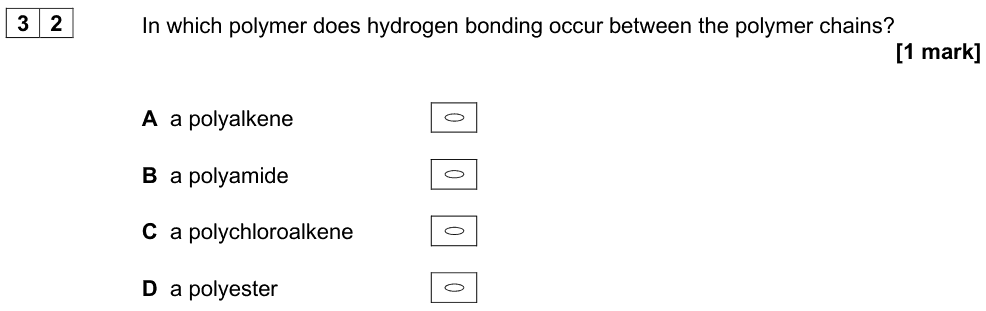
Answer: B. Polyamides have N–H groups that hydrogen bond to C=O on neighbouring chains
polyesters have no H on N or O
June 2023 · Paper 2 · Q04.52 marksAO1=2Short answer
Earlier parts of question 04 that this part uses
Mark scheme
Examiner's comment
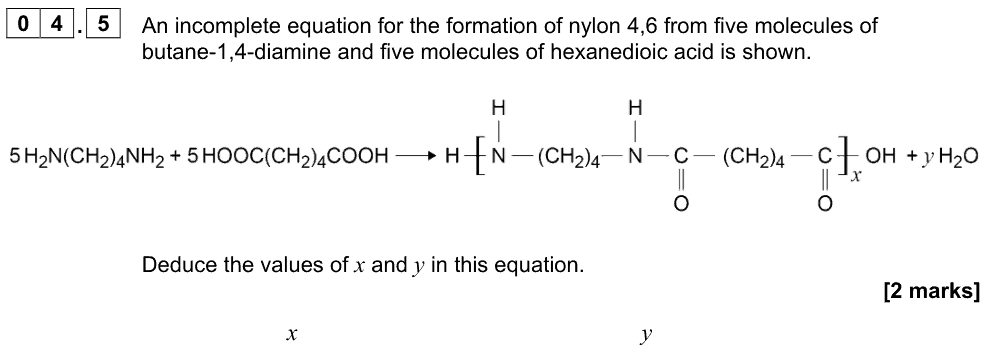
04.5 Many were able to deduce the value of 𝑥 as 5 but far fewer were able to work out that 𝑦 was 9 because the functional groups at each end of this molecule had not reacted to produce a water molecule.
Notes from the mark scheme and report
Answer: x = 5
y = 9. Ten monomer molecules form nine amide links, so nine H2O
the –H and –OH end groups have not reacted. Many gave y = 10
June 2023 · Paper 2 · Q04.62 marksAO2=2Diagram or structure
Earlier parts of question 04 that this part uses
Mark scheme
Examiner's comment
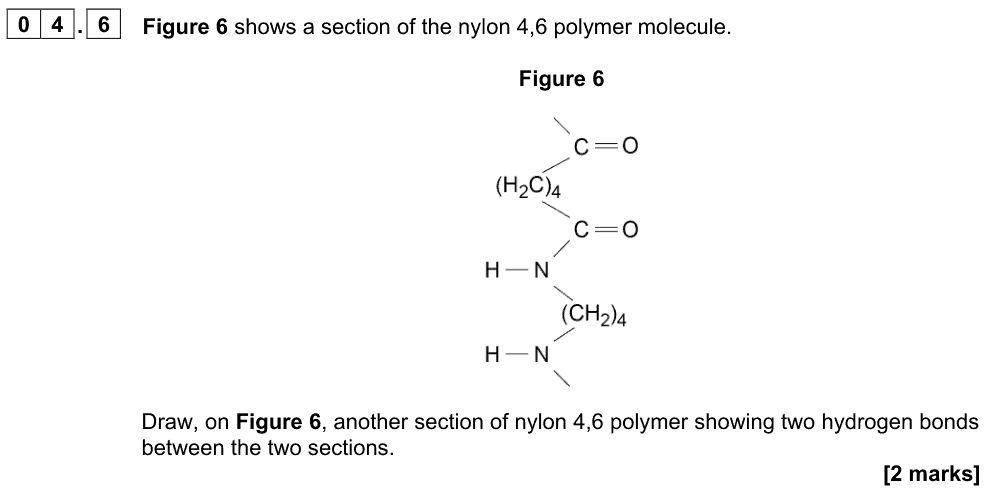
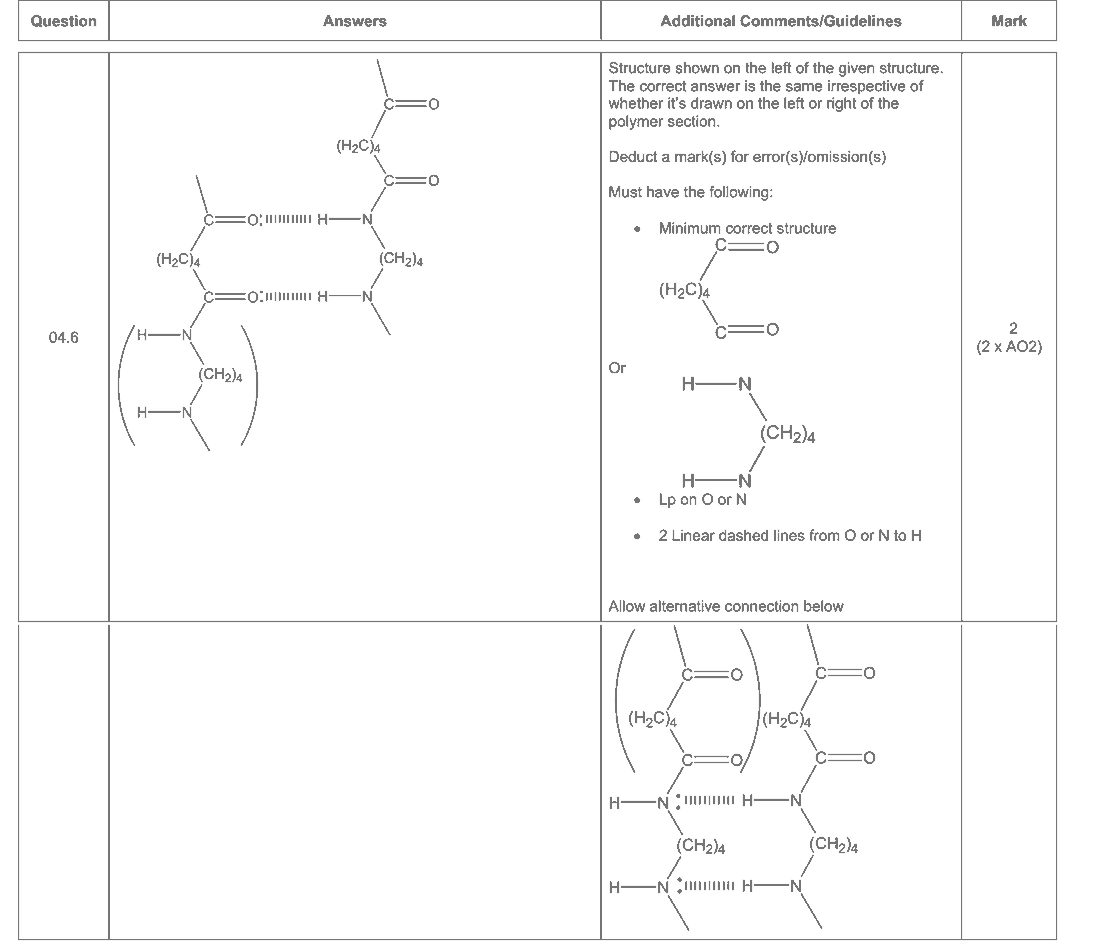
04.6 This question discriminated well. Despite several previous questions that required students to draw hydrogen bonds, a surprising number failed to show the lone pair of electrons involved in each H bond. The mark scheme allowed students to score full marks for H bonds between adjacent N-H groups, despite the fact that the H bonds in this case would be between adjacent C=O: and H-N groups. The linearity of the H bond and the single covalent bond from H to N was better known than in similar previous questions.
Notes from the mark scheme and report
Draw a second chain section alongside with its C=O groups facing the N–H groups: lone pair on each O (or N), and two dashed hydrogen bonds from the lone pair to H of N–H, with the O···H–N atoms in a straight line. Many left out the lone pairs
Skills: MS4.2 Visualise and represent 2D and 3D forms including two-dimensional representations of 3D objects
June 2022 · Paper 3 · Q271 markAO2=1Multiple choice
Answer
A
Mark scheme
Notes from the mark scheme and report
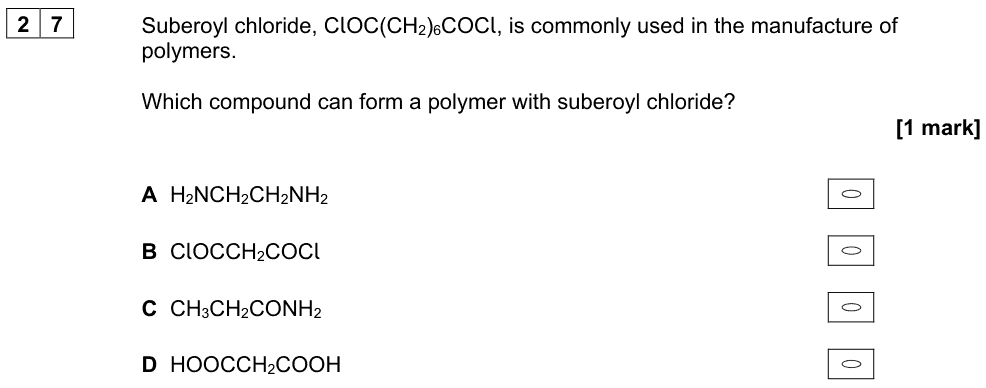
Answer: A. A diacyl chloride needs a second monomer with two nucleophilic groups: the diamine H2NCH2CH2NH2 gives a polyamide
June 2022 · Paper 3 · Q281 markAO3=1Multiple choice
Answer
C
Mark scheme
Notes from the mark scheme and report
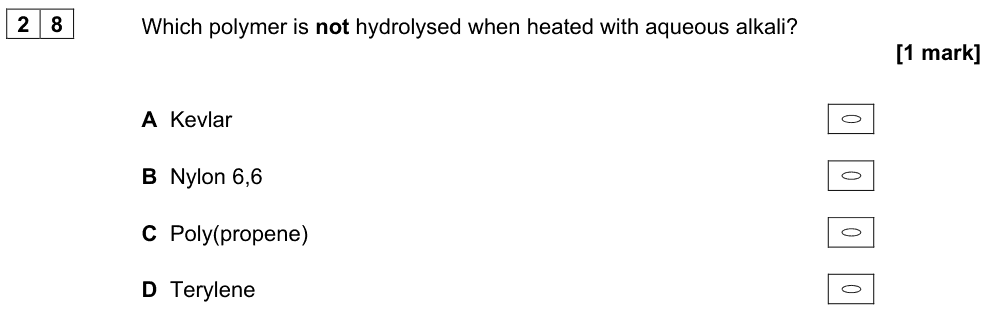
Answer: C. Poly(propene) has only non-polar C–C and C–H bonds
polyamides (Kevlar, nylon 6,6) and polyesters (Terylene) have polar links that are hydrolysed (report: report lists question 28 as particularly challenging)
November 2021 · Paper 3 · Q01.12 marksDiagram or structure
Mark scheme
Examiner's comment
The start of this question was expected to give a relatively easy introduction to the paper but proved trickier than expected with considerable confusion about drawing the repeating unit of the polymer and a lack of specificity in answers to question 01.2; simply stating that polyesters are polar was not sufficient. An A-level standard answer requires more detail such as a specific reference to the polarity of the C=O bond. A significant number of students referred to C=C bonds in polyalkenes and overlooked the fact that it is the monomers that are unsaturated while the polymers are saturated.
The calculation in question 01.3 was quite well done with a majority of students scoring over half marks here.
Questions 01.4 to 01.7 revealed weaknesses in awareness of practical ideas although it was surprising that nearly a quarter of students were unable to draw the meniscus in the right place on the diagram of a pipette.
Surprisingly, only a quarter of students were able to give the correct colour change in question
01.6. Students should remember that, when a colour change is asked for, the colours before and after the end point should be given rather than just a single colour.
Most students were able to make a start on the Levels of Response question in 01.8 with about half of students able to access level 2 or above. Most students recognised that the entropy would increase and that a favourable reaction is indicated by a negative free energy change. Discussion of the fact that the enthalpy change would be close to zero because 6 Fe-O bonds are made and 6 Fe-O bonds are broken was often not expressed well.
Notes from the mark scheme and report
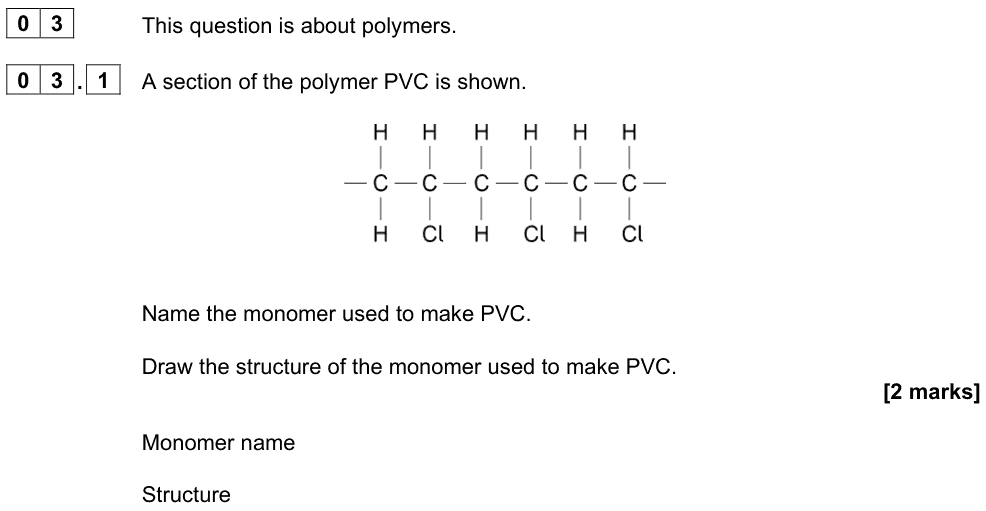
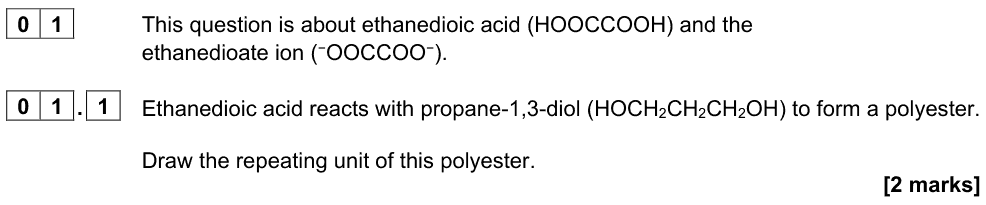
–OC–CO–O–CH2CH2CH2–O– with trailing bonds: one mark for the ester link including C–O–C, one for the rest of a single repeating unit. More than one repeating unit loses M2. Proved trickier than expected
November 2021 · Paper 3 · Q01.22 marksExplanation
Earlier part of question 01 that this part uses
Mark scheme
Examiner's comment
The start of this question was expected to give a relatively easy introduction to the paper but proved trickier than expected with considerable confusion about drawing the repeating unit of the polymer and a lack of specificity in answers to question 01.2; simply stating that polyesters are polar was not sufficient.
An A-level standard answer requires more detail such as a specific reference to the polarity of the C=O bond.
A significant number of students referred to C=C bonds in polyalkenes and overlooked the fact that it is the monomers that are unsaturated while the polymers are saturated.
Notes from the mark scheme and report
Polyesters have polar C=O / C–O bonds, polyalkenes have only non-polar C–C bonds in the chain
so polyesters can be attacked by nucleophiles / hydrolysed. 'Polyesters are polar' alone is not enough
mentioning C=C in polyalkenes loses M1 (the polymer is saturated)
November 2021 · Paper 3 · Q241 markMultiple choice
Answer
A
Mark scheme
Notes from the mark scheme and report
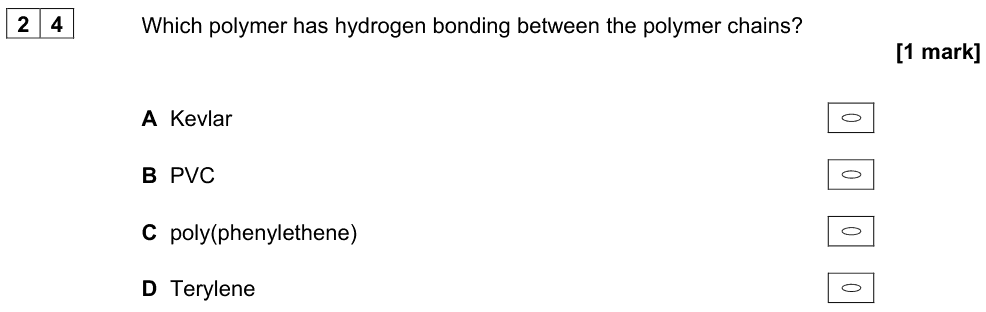
Answer: A. Kevlar is a polyamide: N–H groups hydrogen bond to C=O groups on other chains
November 2021 · Paper 3 · Q331 markMultiple choice
Answer
D
Mark scheme
Notes from the mark scheme and report
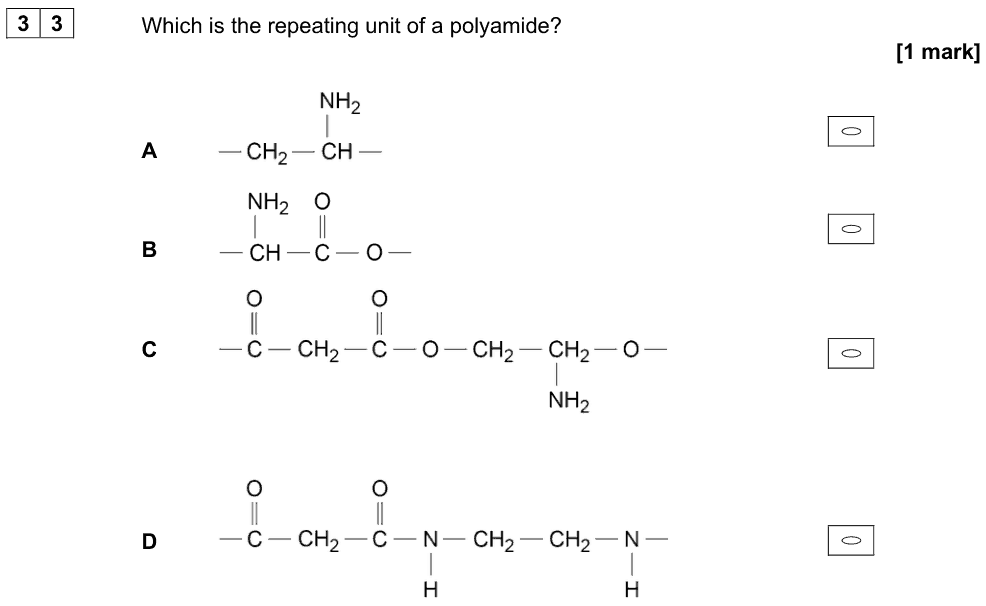
Answer: D. It contains the amide link –CO–NH– at both ends of the diamine unit, from a dicarboxylic acid and a diamine
November 2021 · Paper 3 · Q341 markMultiple choice
Answer
A
Mark scheme
Notes from the mark scheme and report
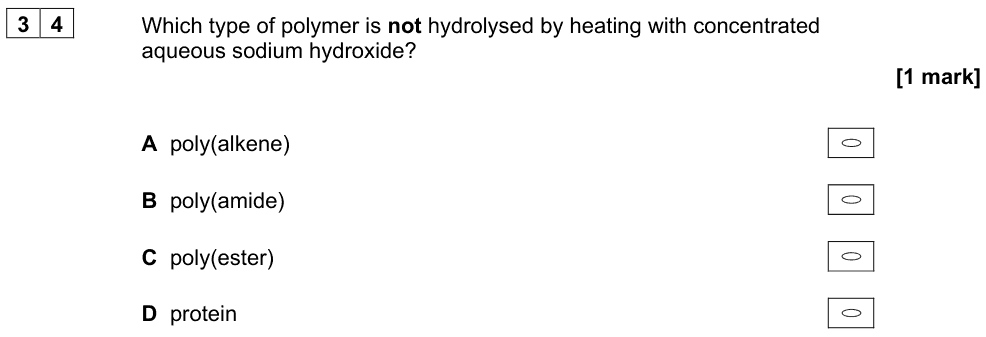
Answer: A. Poly(alkenes) have only non-polar C–C bonds in the chain, which are not attacked by OH–
amide and ester links are hydrolysed
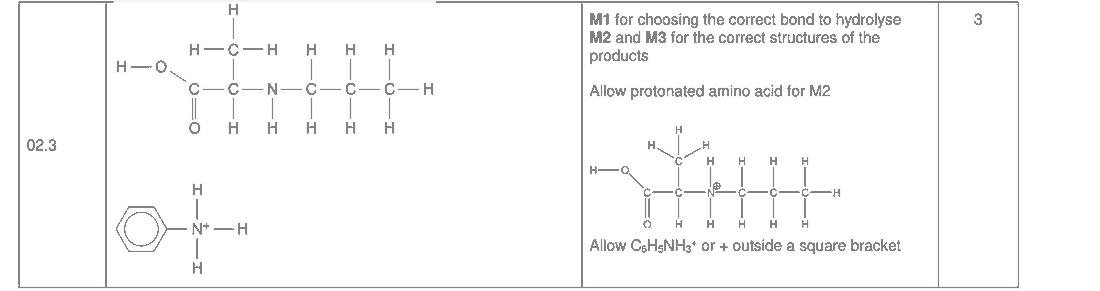
November 2020 · Paper 2 · Q02.33 marksDiagram or structure
Earlier part of question 02 that this part uses
Mark scheme
Examiner's comment
02.3 proved very challenging and many students struggled to access these marks, with many unable to identify the amide link as the site where hydrolysis would take place.
Notes from the mark scheme and report
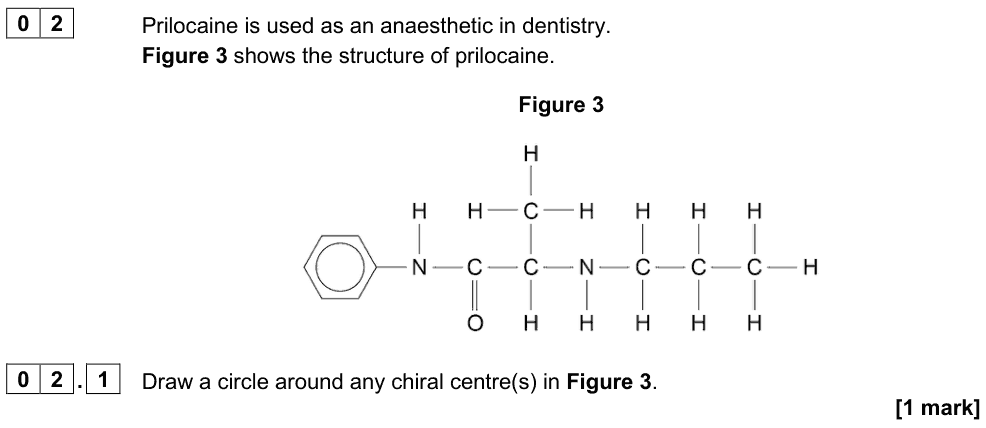
Hydrolyse the amide C–N bond. Products: CH3CH(NHCH2CH2CH3)COOH (the amine N may be shown protonated) and phenylammonium ion C6H5NH3+ (acid conditions). One mark for the correct bond broken, one for each structure. Many did not see the amide link as the site of hydrolysis
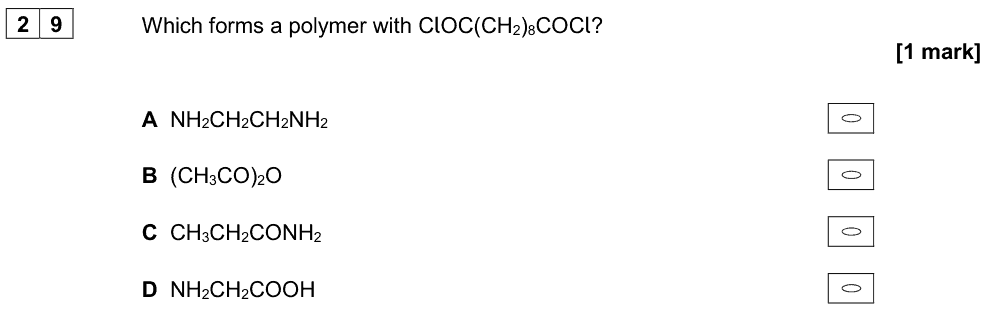
November 2020 · Paper 3 · Q291 markMultiple choice
Answer
A
Mark scheme
Notes from the mark scheme and report
Answer: A. A diacyl chloride needs a monomer with two reactive groups: the diamine H2NCH2CH2NH2 gives a polyamide
June 2019 · Paper 2 · Q03.41 markShort answer
Earlier part of question 03 that this part uses
Mark scheme
Examiner's comment
03.4 Although there were many successful answers to this final part, a large proportion of the other attempts were too general to score and did not specify that it was the C−C bonds that were non-polar or too strong to be hydrolysed.
Notes from the mark scheme and report
The polymer chains contain only C–C bonds, which are non-polar / too strong and so are not attacked by nucleophiles and cannot be hydrolysed. Answers must specify the carbon–carbon bonds
many were too general
June 2019 · Paper 3 · Q281 markMultiple choice
Answer
A
Mark scheme
Notes from the mark scheme and report
Answer: A. Kevlar is a polyamide: N–H groups hydrogen bond to C=O groups on neighbouring chains
June 2018 · Paper 2 · Q11.21 markDiagram or structure
Earlier part of question 11 that this part uses
Mark scheme
Examiner's comment
11.2 This was the most familiar of the three isomers required and was correctly answered by 55.3% of students. The most common errors seen were cyclic or aromatic structures or those with an incorrect number of carbon atoms in the chain. A disappointing proportion of students (17.5%) made no attempt to answer the question.
Notes from the mark scheme and report
H2N(CH2)6NH2, hexane-1,6-diamine (not –C6H12–). Errors: cyclic or aromatic structures
wrong chain length. 55.3% correct
17.5% did not attempt it
June 2018 · Paper 3 · Q211 markMultiple choice
Answer
C
Mark scheme
Notes from the mark scheme and report
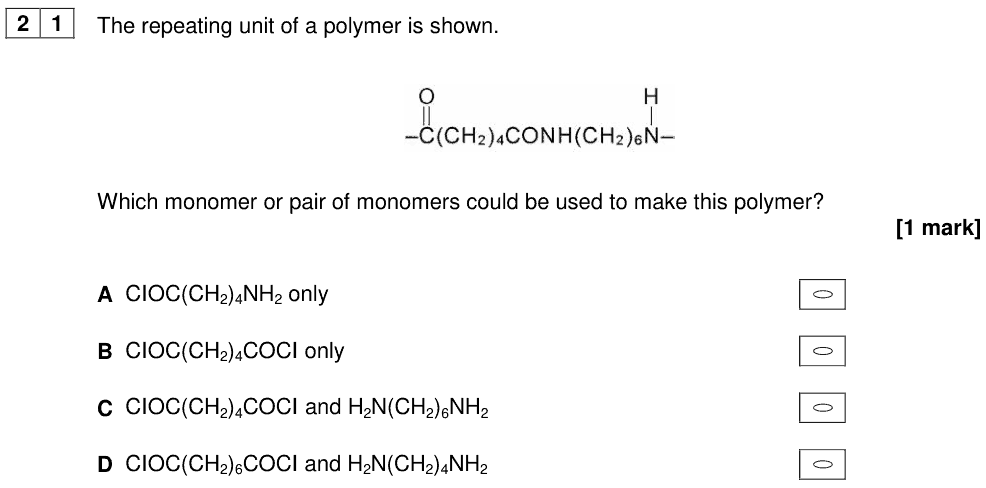
Answer: C. The repeating unit has a –CO(CH2)4CO– part from the diacyl chloride and an –NH(CH2)6NH– part from the diamine
June 2018 · Paper 3 · Q221 markMultiple choice
Answer
B
Mark scheme
Examiner's comment
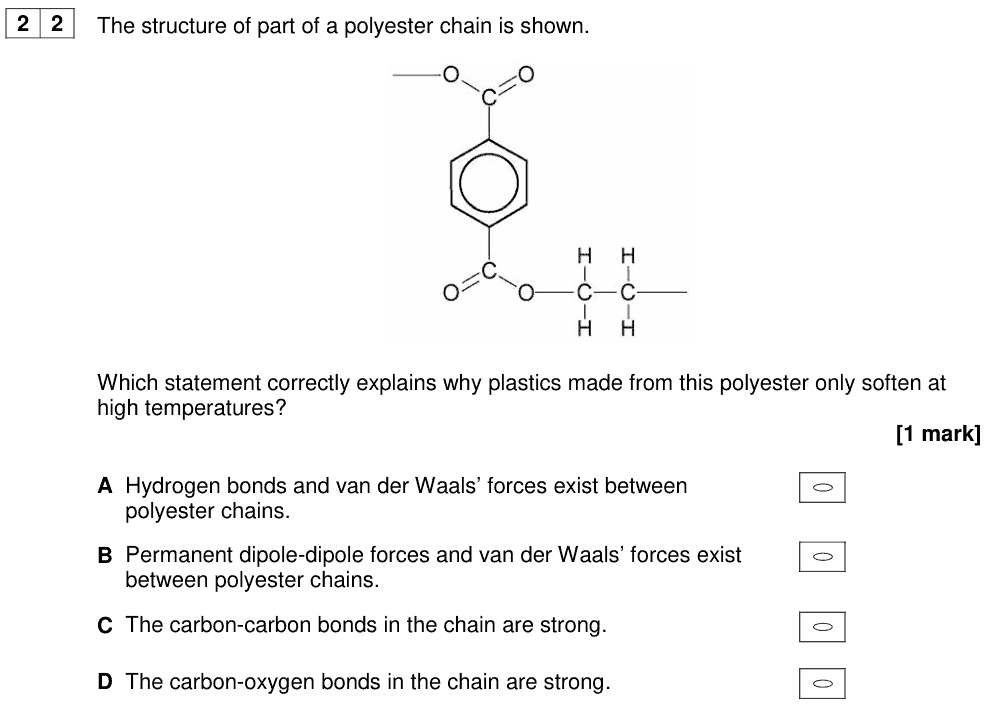
22 A was the commonest incorrect response suggesting that students failed to realise that hydrogen must be directly attached to an electronegative atom in order to take part in hydrogen bonding. 51.2% of students gained this mark.
Notes from the mark scheme and report
Answer: B. The polar C=O and C–O groups give permanent dipole–dipole forces between chains as well as van der Waals forces
there is no H bonded to O or N so no hydrogen bonding (commonest wrong answer A)
June 2017 · Paper 2 · Q10.63 marksDiagram or structure
Earlier part of question 10 that this part uses
Mark scheme
Examiner's comment
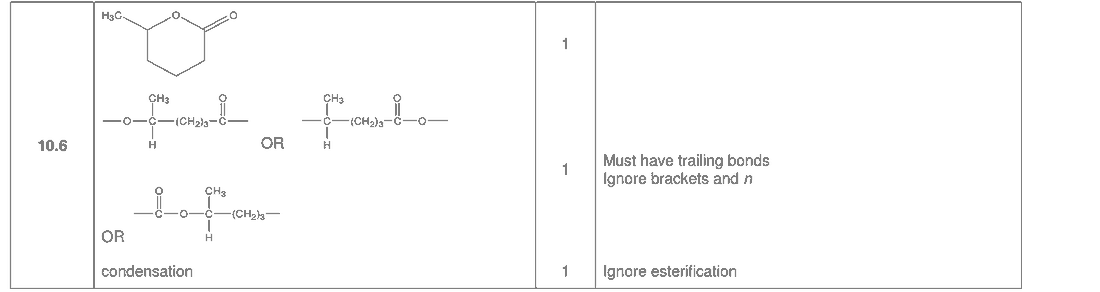
10.6 The two structures were found difficult, particularly that of T, and the polyester repeating unit was often shown as a double unit. The type of polymerisation, however, was well known.
Notes from the mark scheme and report
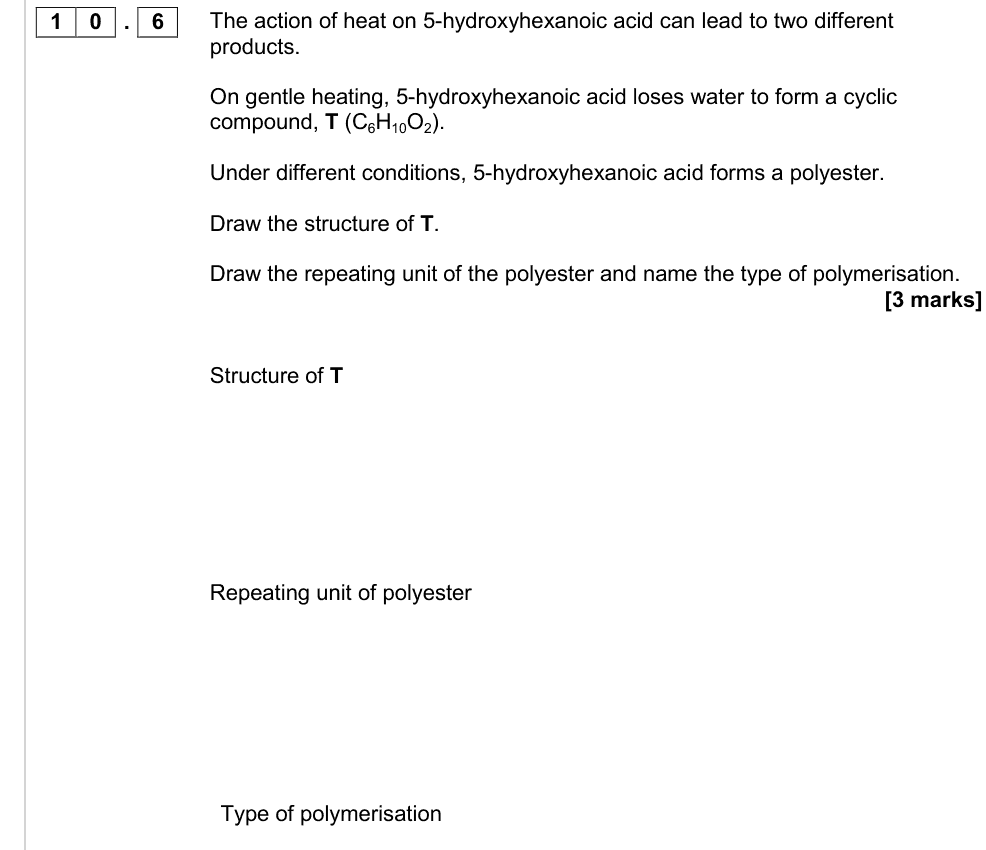
T is the cyclic ester: a six-membered ring containing one O next to a C=O, with a CH3 on the ring carbon attached to the ring O. Repeating unit –O–CH(CH3)–(CH2)3–CO– with trailing bonds (a single unit, not doubled). Condensation polymerisation ('esterification' is ignored)
June 2017 · Paper 2 · Q10.73 marksDiagram or structure
Earlier part of question 10 that this part uses
Mark scheme
Examiner's comment
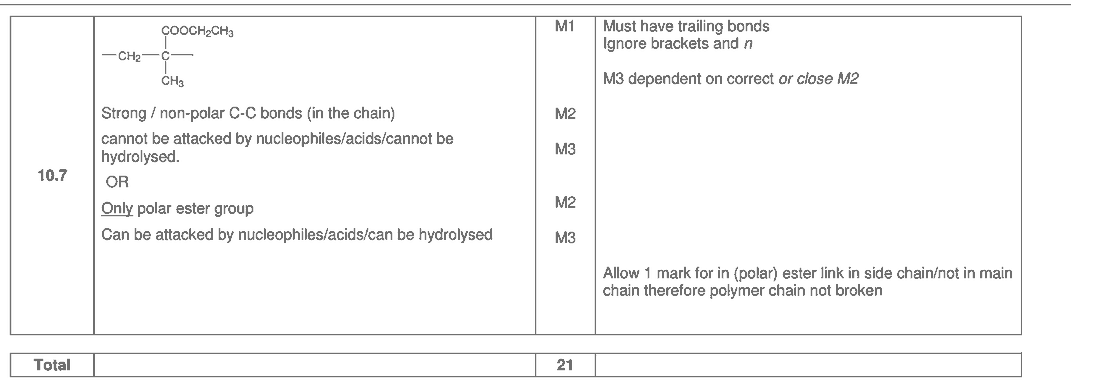
10.7 The question was not attempted by 7% of the students. Of those who did answer, only the best scored all three marks. Many answers were vague and missed the required comparison of the position of the ester group. Large numbers either only gained the first mark or alternatively did not score, because their repeating unit was incorrect.
Notes from the mark scheme and report
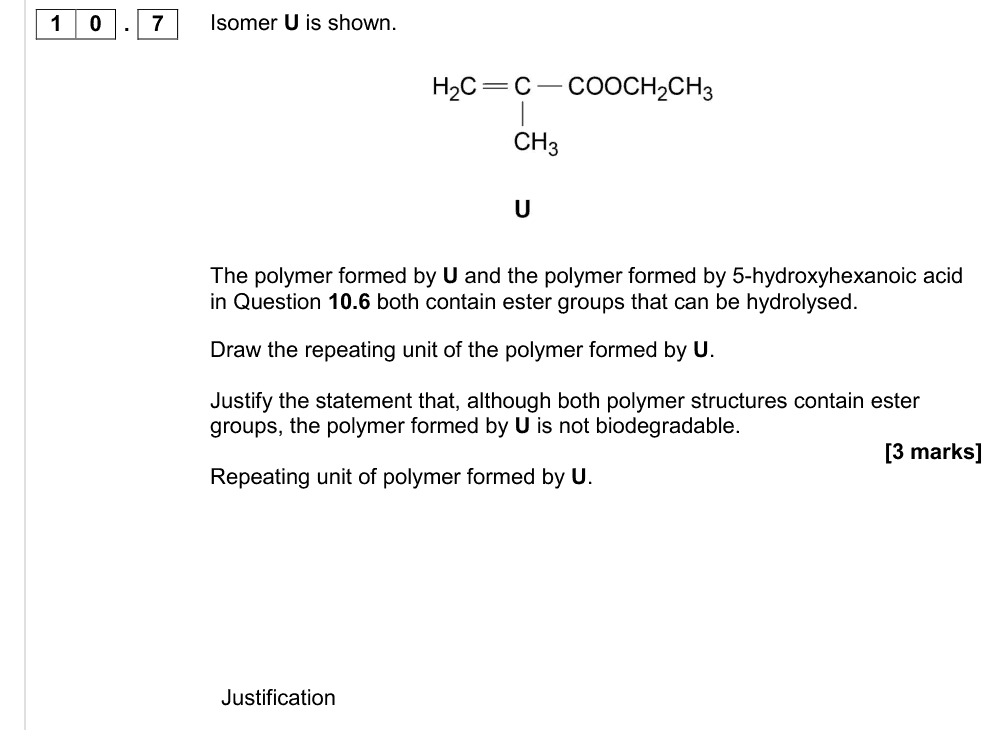
Repeating unit –CH2–C(CH3)(COOCH2CH3)– with trailing bonds. The polymer chain is made of strong non-polar C–C bonds that cannot be attacked by nucleophiles / hydrolysed
the polar ester group is in the side chain, not in the main chain, so hydrolysis does not break the chain. Many answers missed the position of the ester group
June 2017 · Paper 3 · Q251 markMultiple choice
Answer
C
Mark scheme
Notes from the mark scheme and report
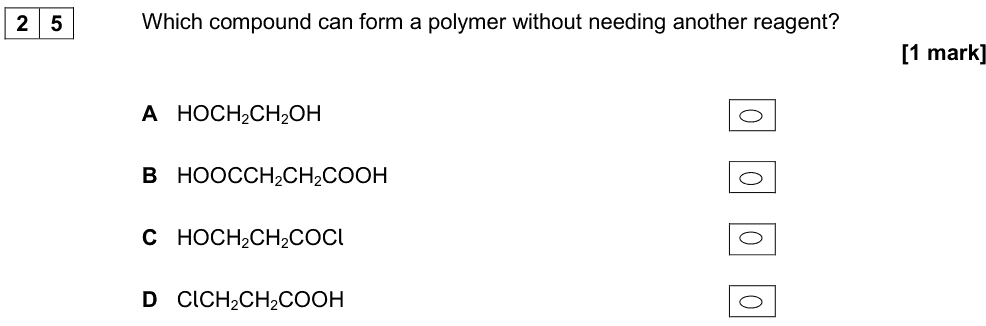
Answer: C. It has an –OH group and an acyl chloride group in the same molecule, so molecules can react together to form a polyester
Specimen · Paper 2 · Q07.22 marksDiagram or structure
Earlier part of question 07 that this part uses
Mark scheme
Notes from the mark scheme and report
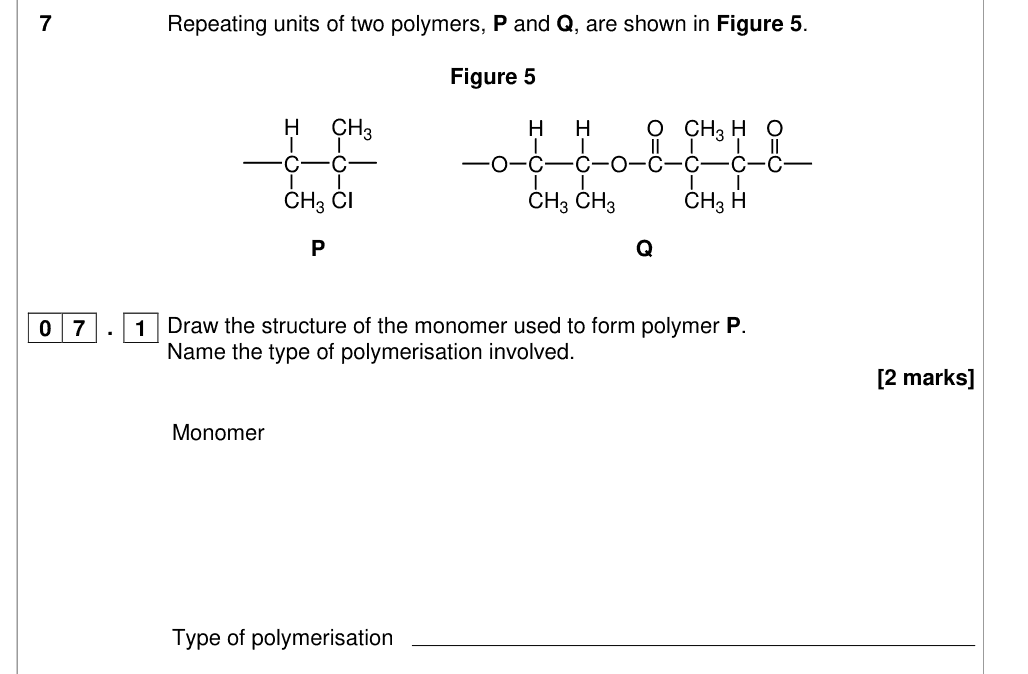
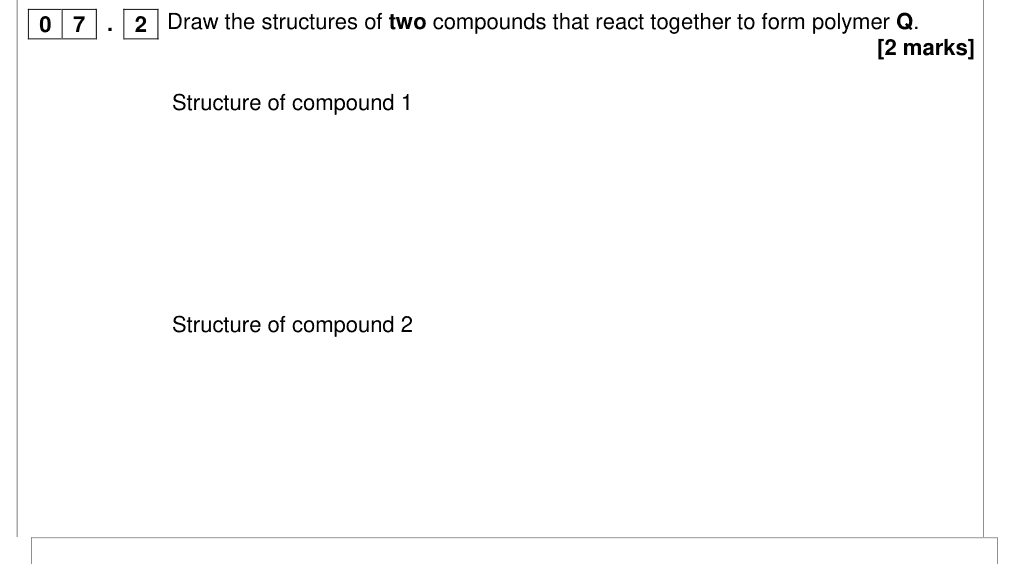
Diol HOCH(CH3)CH(CH3)OH (butane-2,3-diol) and dicarboxylic acid HOOC–C(CH3)2–CH2–COOH (2,2-dimethylbutanedioic acid) or its diacyl chloride ClOC–C(CH3)2–CH2–COCl
Specimen · Paper 2 · Q07.33 marksExplanation
Earlier part of question 07 that this part uses
Mark scheme
Notes from the mark scheme and report
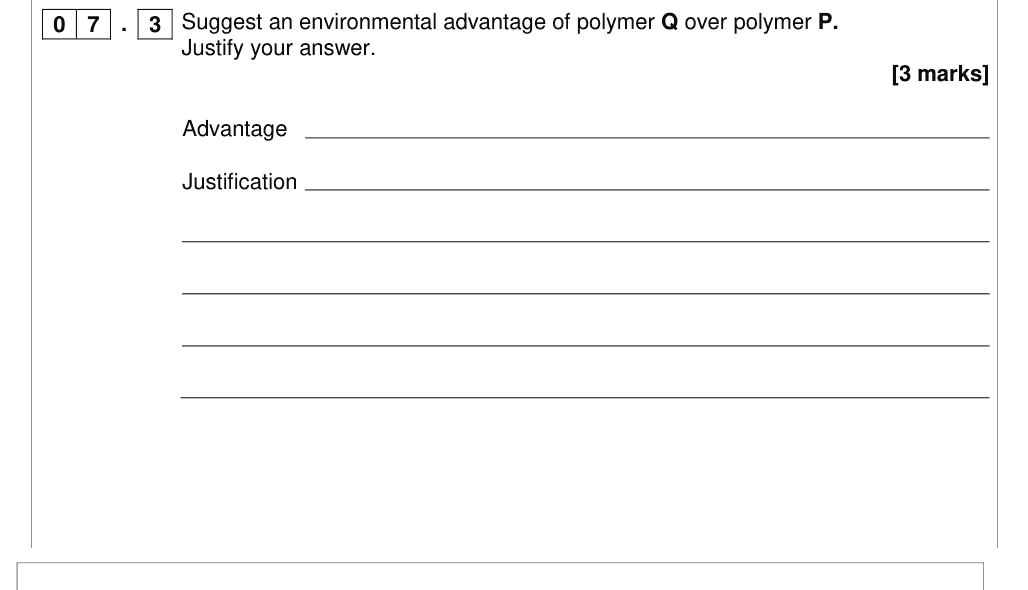
Q is biodegradable. Q has polar C=O groups (δ+ carbon), P does not
so Q can be attacked by nucleophiles (hydrolysed), leading to breakdown
Specimen · Paper 2 · Q09.71 markAO3=1Short answer
Earlier parts of question 09 that this part uses
Mark scheme
Notes from the mark scheme and report
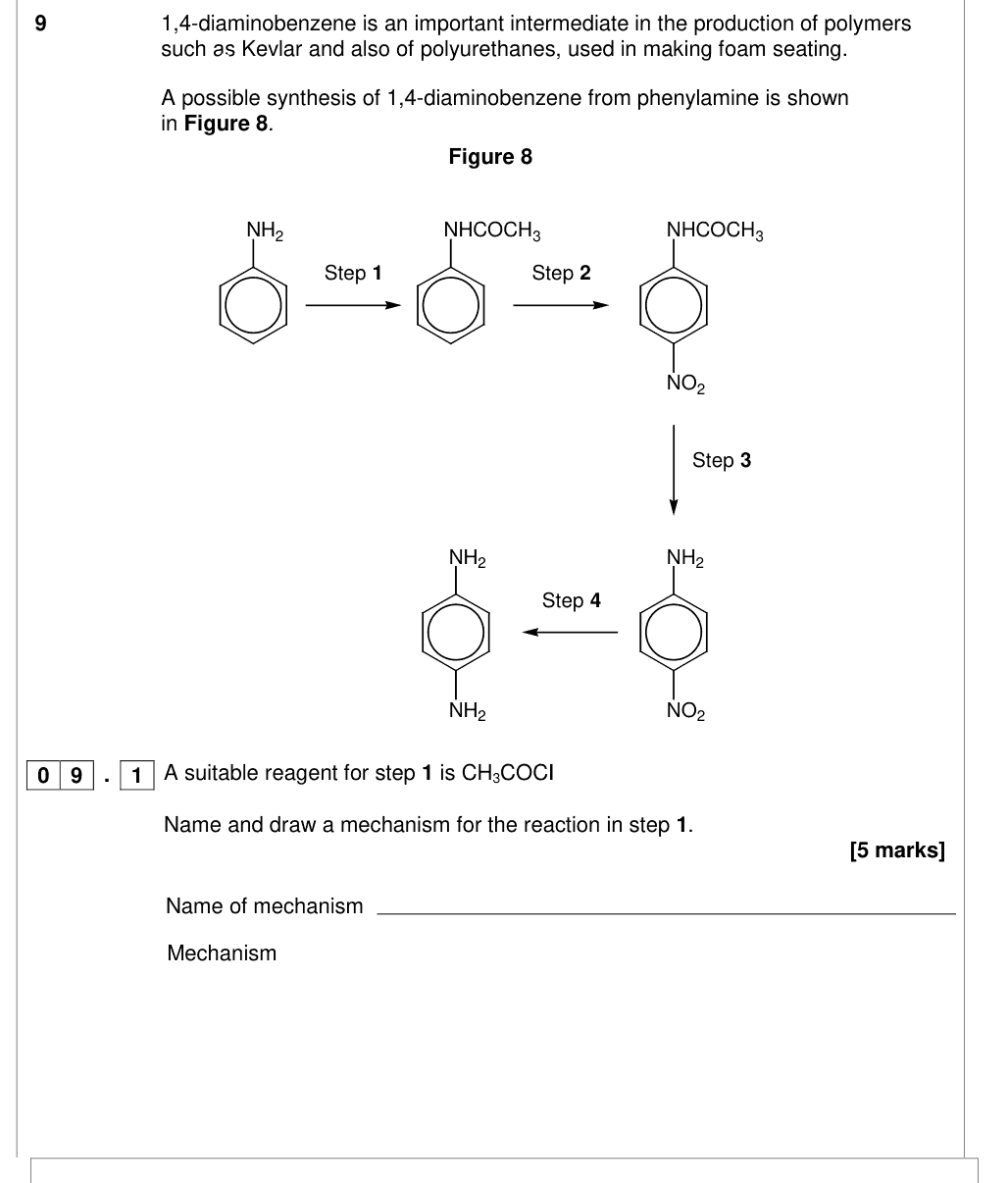
Hydrolysis (of the amide link)
Specimen · Paper 3 · Q331 markAO2=1Multiple choice
Answer
D
Mark scheme
Notes from the mark scheme and report
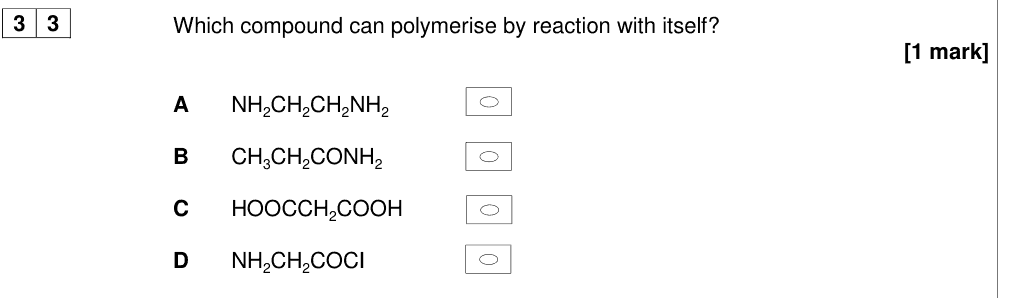
Answer: D. NH2CH2COCl has an amine group and an acyl chloride group in the same molecule, so it can form a polyamide with itself
Work with an A-level chemistry tutor
Dropping marks on calculations, mechanisms or the required practicals? Book a trial session with a specialist A-level chemistry tutor.