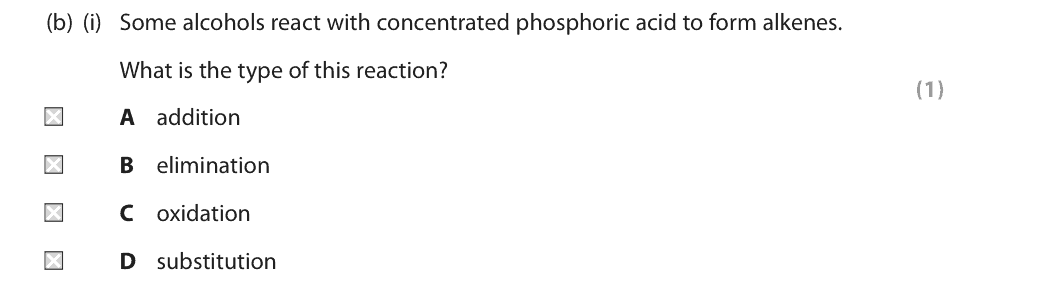
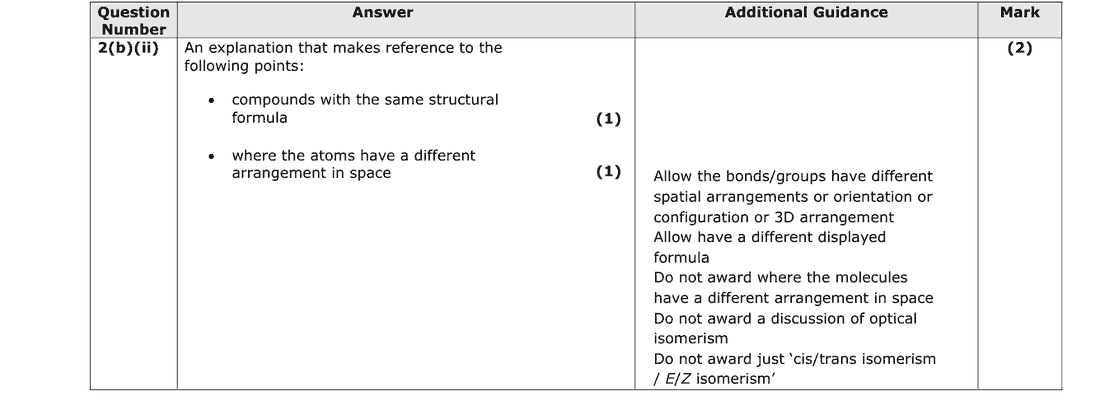
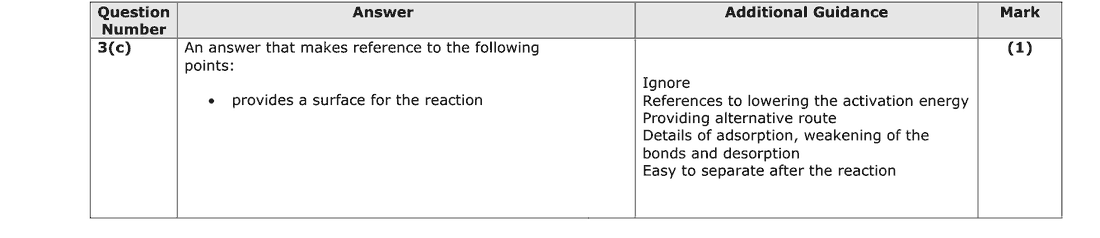
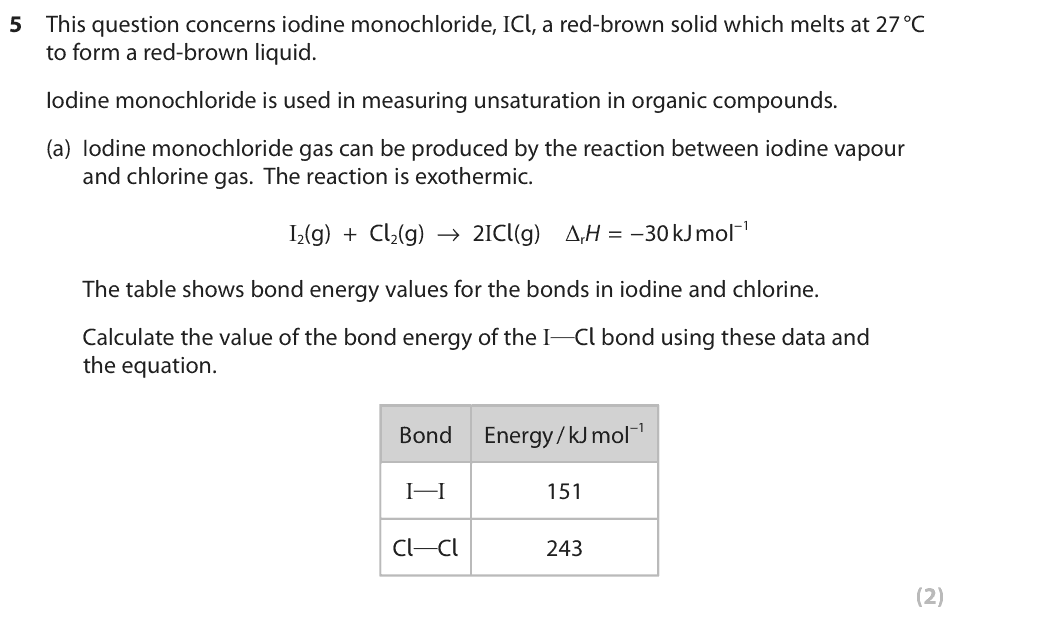
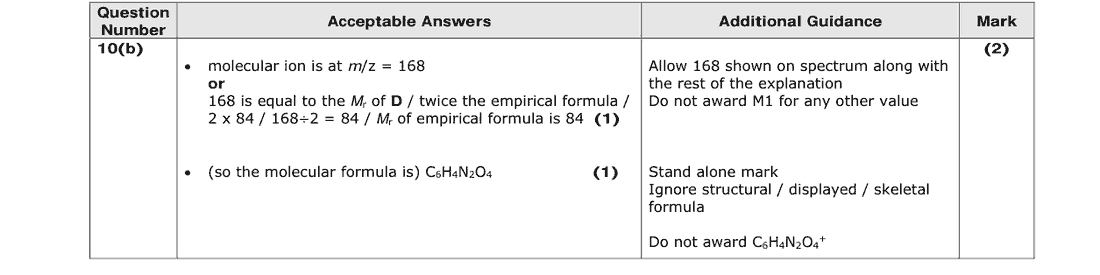
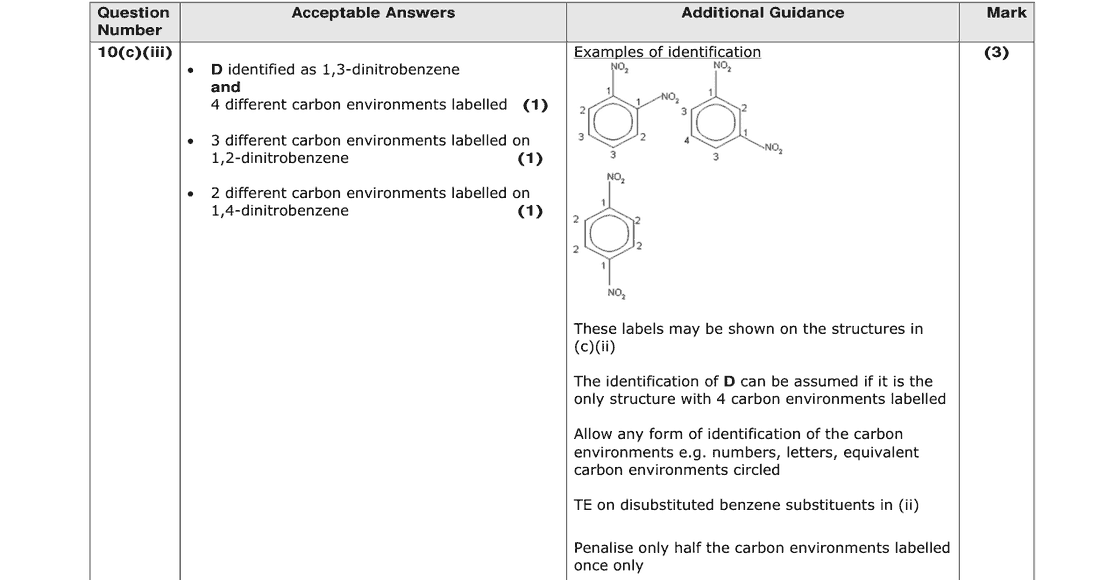
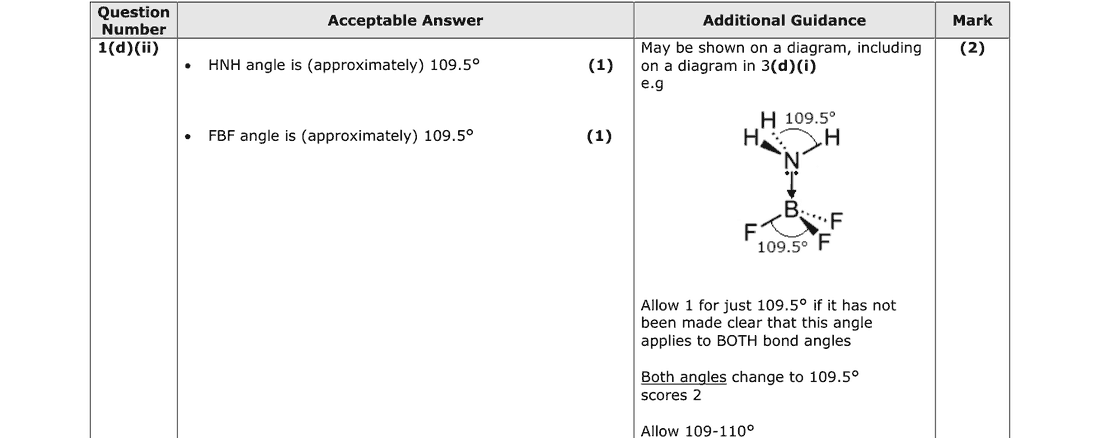
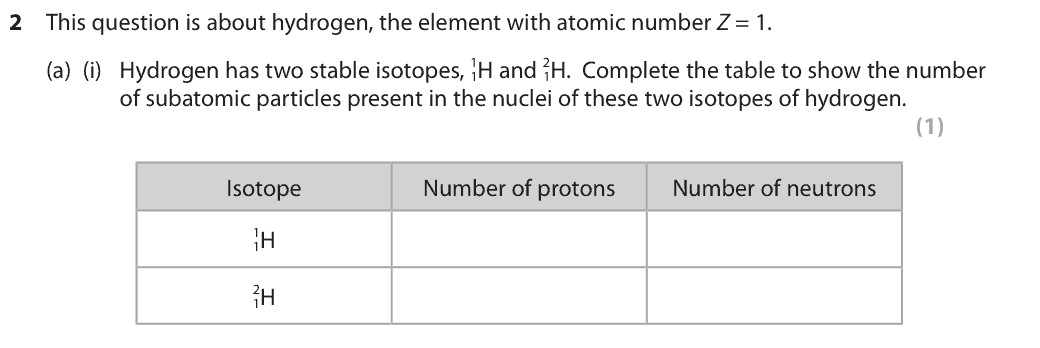
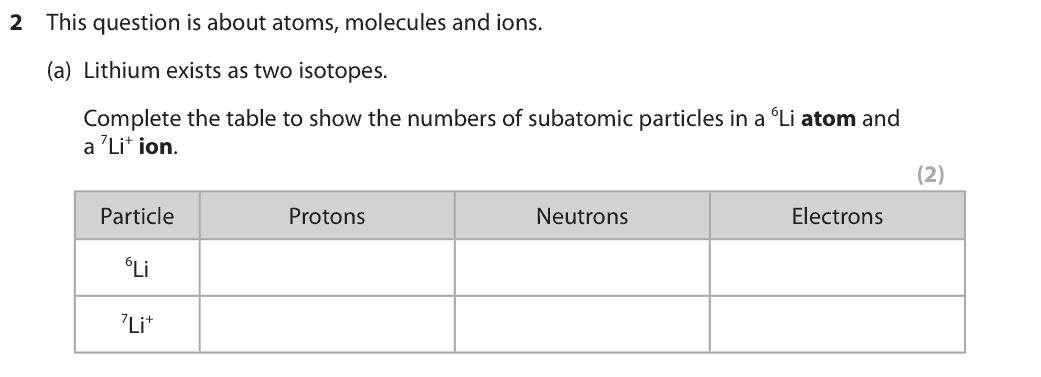
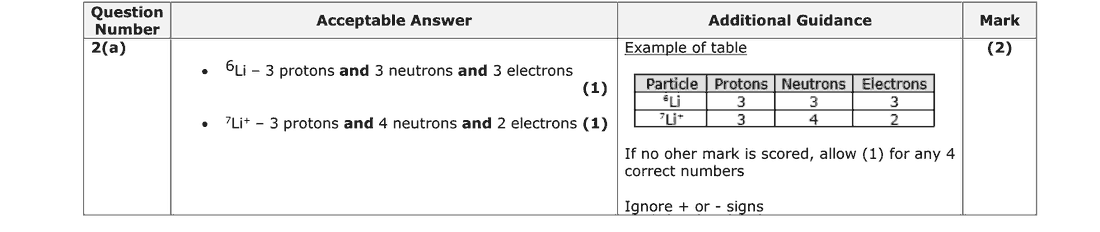
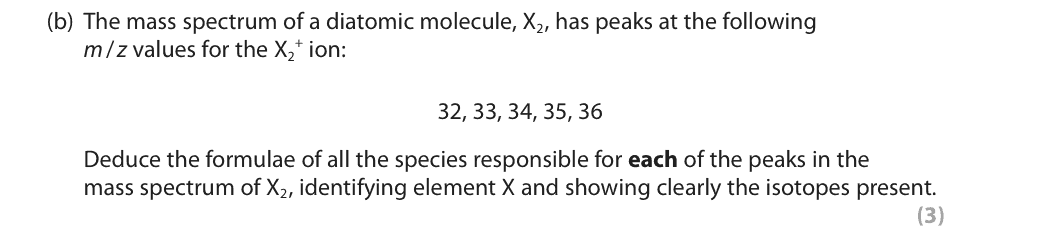
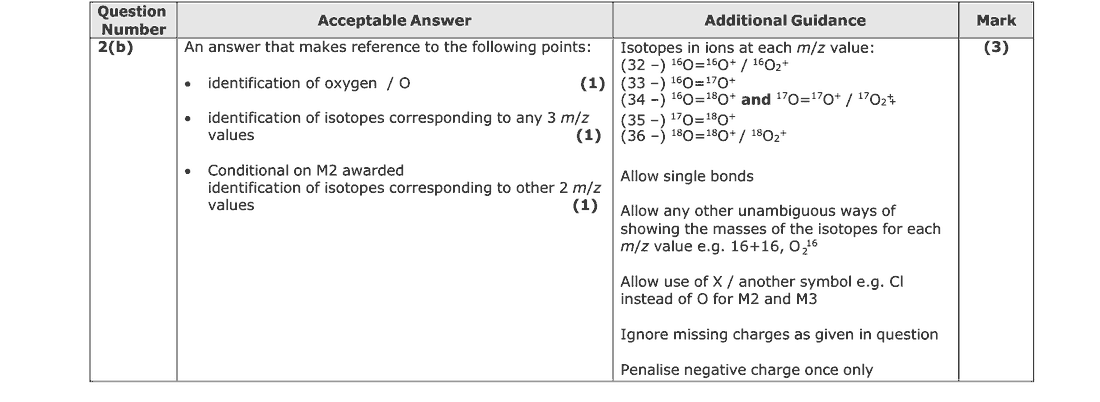
Short-answer questions

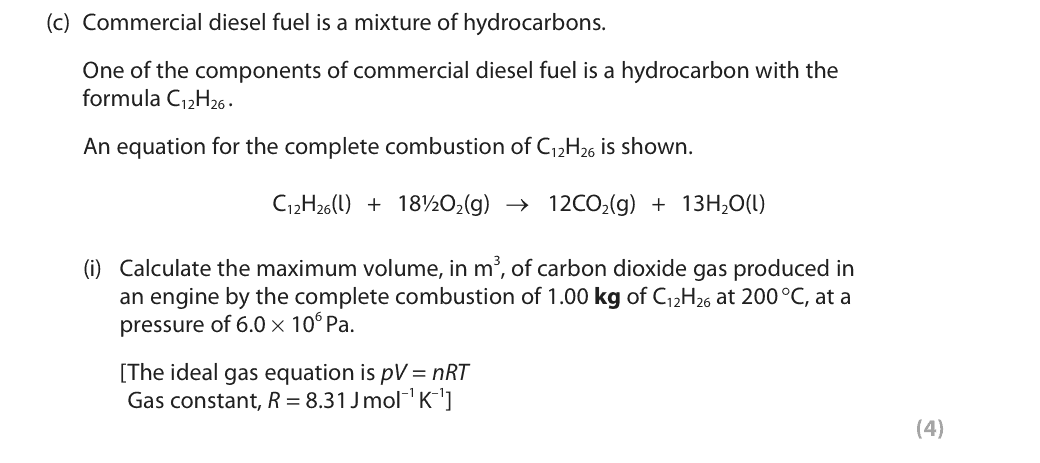
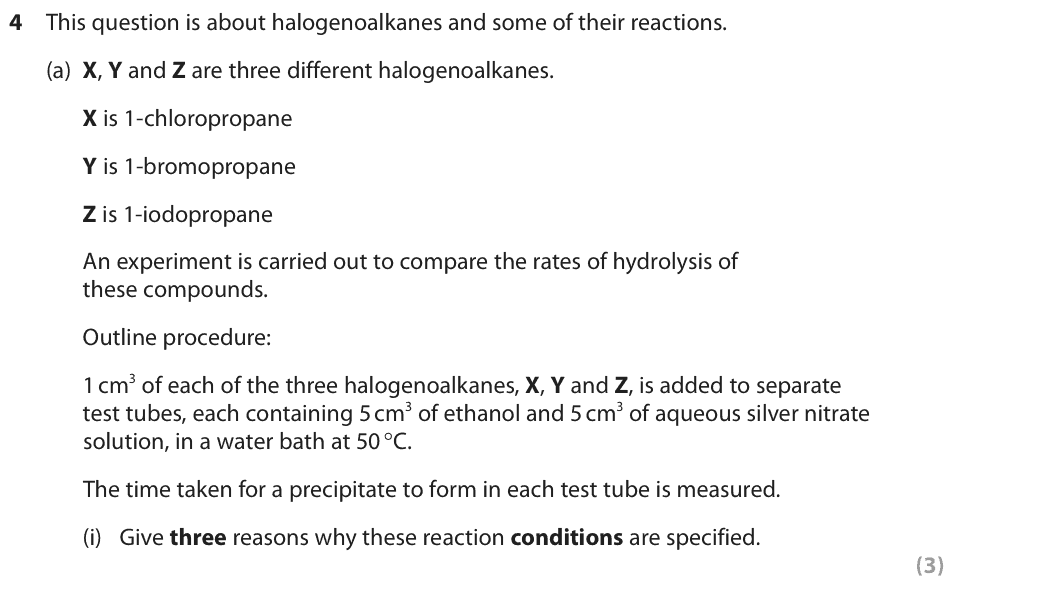
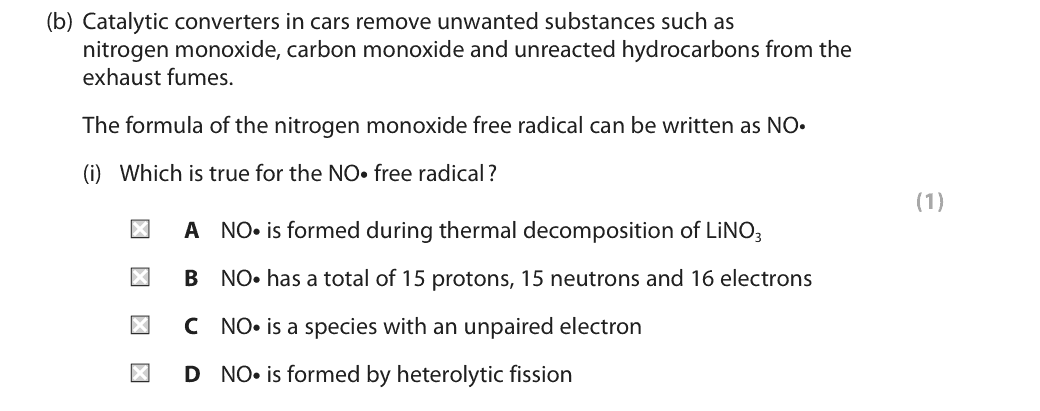
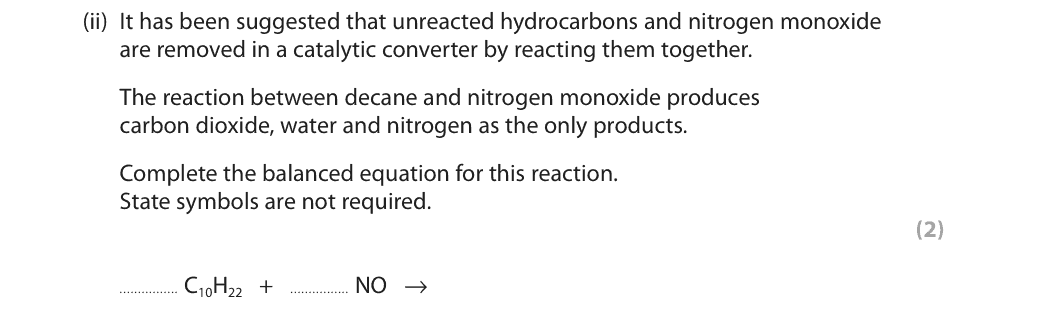
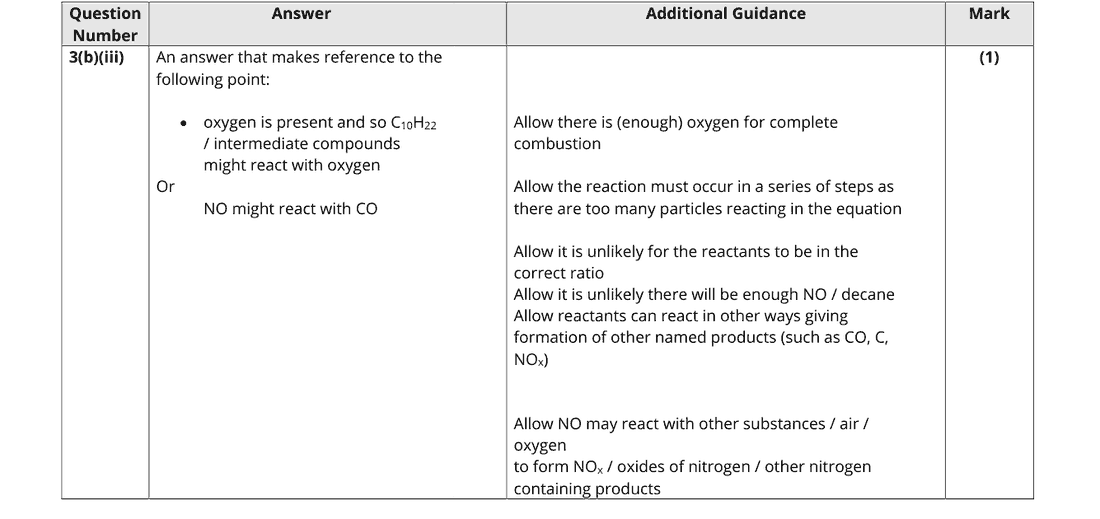
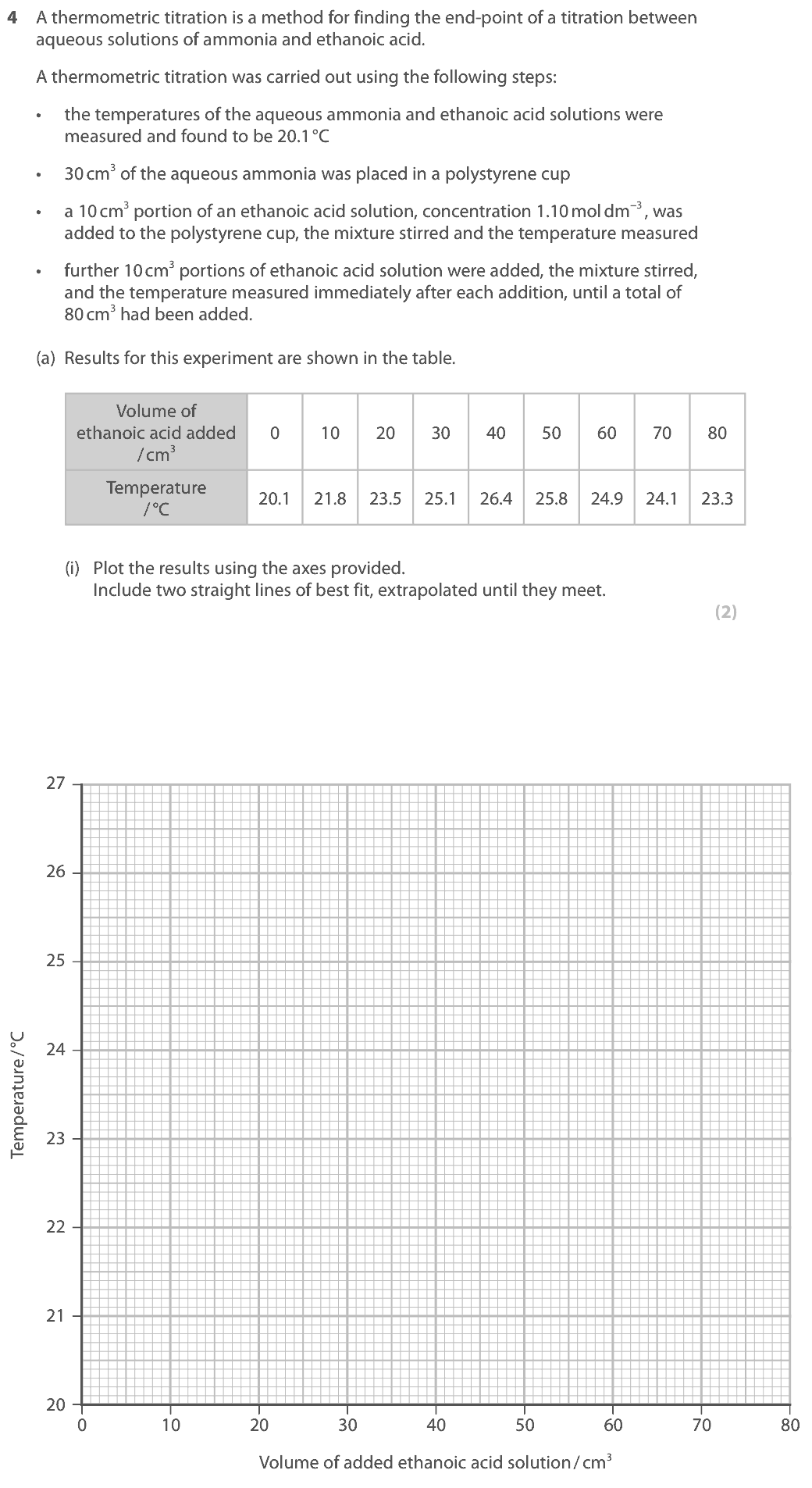
The state, give, name, identify and suggest questions that make up much of every paper. 434 questions.

Other types: Multiple-choice questions · Calculation questions · Equation questions · Mechanism questions · Structure and diagram questions · Explanation questions · Six-mark extended-response questions · Practical questions

June 2025 · AS Paper 1 · Q2(a)(ii) 2 marks Short answer bonding
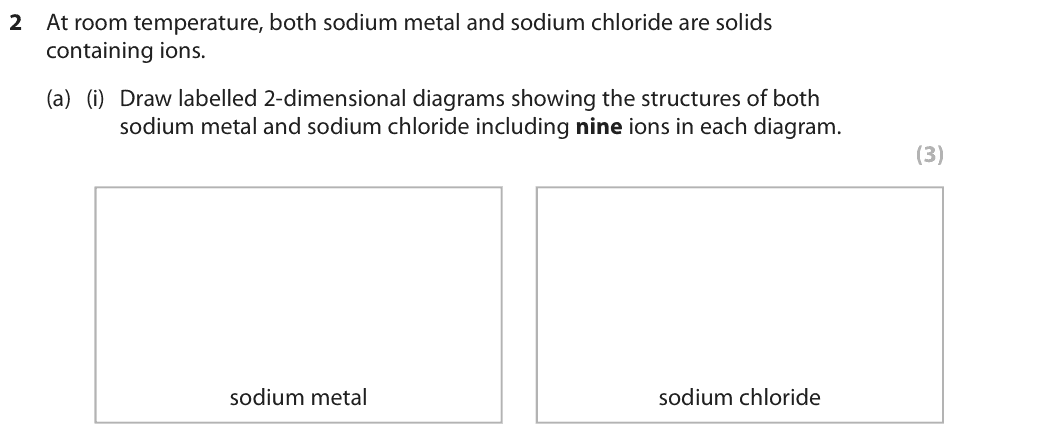
Earlier part of question 2 that this part usesEarlier part of June 2025 Paper 1 question 2
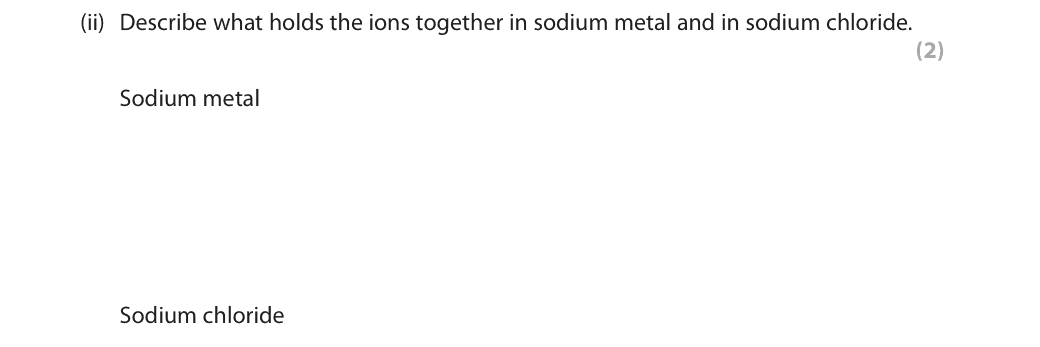
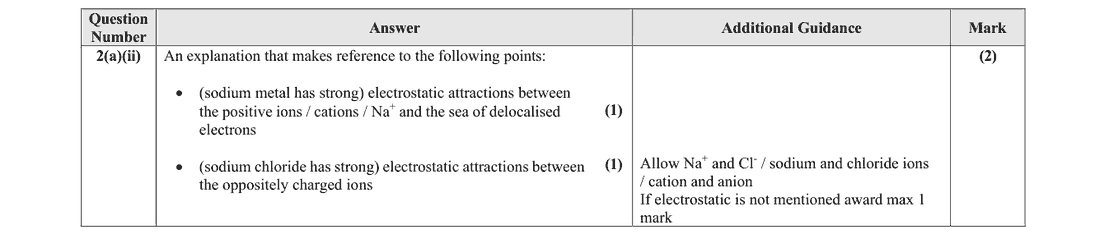
Describe what holds the ions together in sodium metal and in sodium chloride.
Sodium metal
Sodium chloride
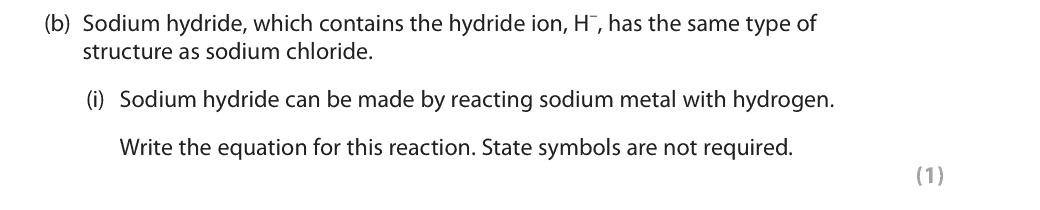
June 2025 · AS Paper 1 · Q2(a)(iii) 1 mark Short answer structure
Earlier part of question 2 that this part usesEarlier part of June 2025 Paper 1 question 2
The melting temperature of sodium chloride is much higher than that of
sodium metal.
State what this information shows about the bonding in these
two substances.
June 2025 · AS Paper 1 · Q2(b)(iii) 2 marks Short answer bonding
Earlier parts of question 2 that this part usesEarlier part of June 2025 Paper 1 question 2Earlier part of June 2025 Paper 1 question 2
H → Al represents one of the bonds in AlH 4
– .
State the name of this type of bond and how the bond forms in this ion.
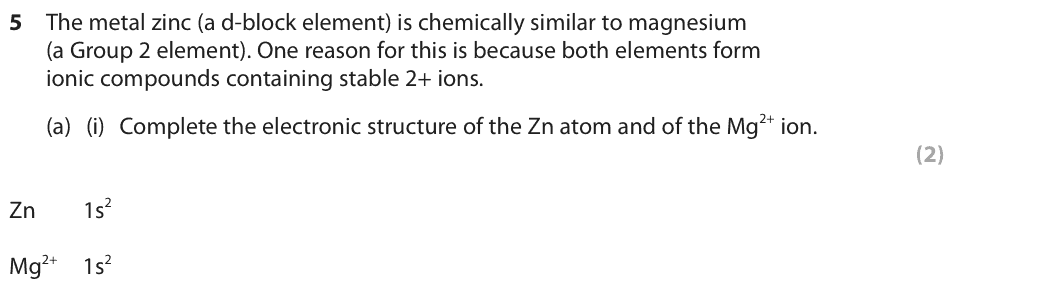
June 2025 · AS Paper 1 · Q5(a)(i) 2 marks Short answer Easy atomic structure and the periodic table
The metal zinc (a d-block element) is chemically similar to magnesium
(a Group 2 element). One reason for this is because both elements form
ionic compounds containing stable 2+ ions.
Complete the electronic structure of the Zn atom and of the Mg2+ ion.
Zn
1s2
Mg2+
1s2
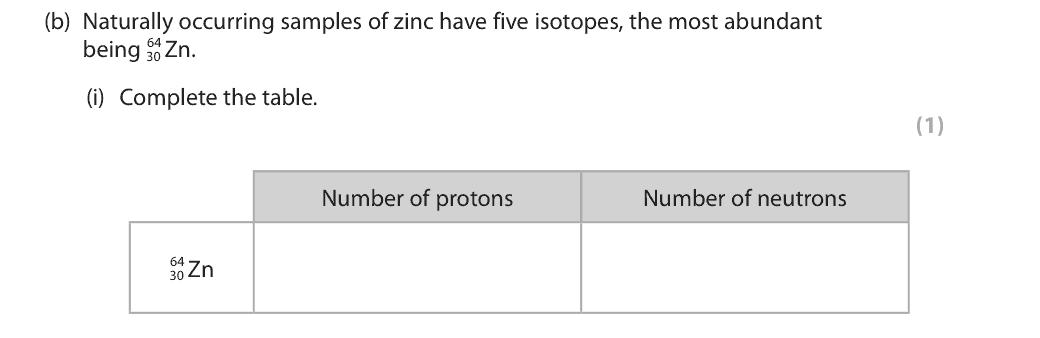
June 2025 · AS Paper 1 · Q5(b)(i) 1 mark Short answer Easy atomic structure and the periodic table
Earlier part of question 5 that this part usesEarlier part of June 2025 Paper 1 question 5
Naturally occurring samples of zinc have five isotopes, the most abundant
being 30
64 Zn.
Complete the table.
Number of protons
Number of neutrons
64 Zn
30
64 Zn = 63.929.
June 2025 · AS Paper 1 · Q5(b)(ii) 1 mark Short answer Hard atomic structure and the periodic table
Earlier parts of question 5 that this part usesEarlier part of June 2025 Paper 1 question 5Earlier part of June 2025 Paper 1 question 5
The relative isotopic mass of 30
Give the reason why the relative isotopic mass is not exactly 64.
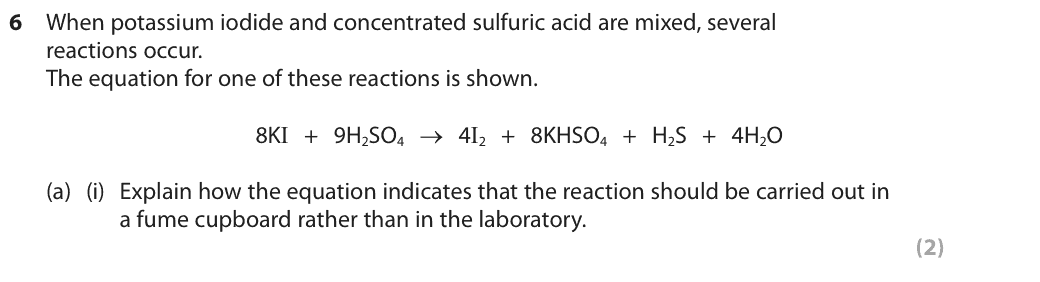
June 2025 · AS Paper 1 · Q6(d)(i) 1 mark Short answer group 7 the halogens
Earlier part of question 6 that this part usesEarlier part of June 2025 Paper 1 question 6
When potassium chloride and concentrated sulfuric acid are mixed, misty fumes
are observed from the only reaction that occurs.
Identify, by name or formula, the misty fumes.
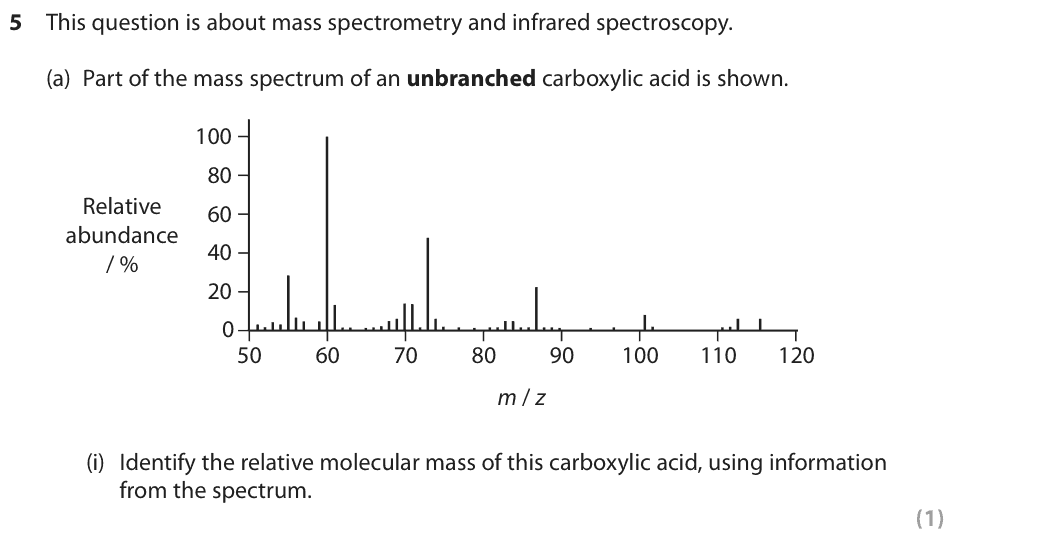
June 2025 · AS Paper 2 · Q5(a)(i) 1 mark Short answer mass spectrometry and infrared spectroscopy
This question is about mass spectrometry and infrared spectroscopy.
Part of the mass spectrum of an unbranched carboxylic acid is shown.
100
80
Relative
60
abundance
40
/ %
20
0
50
60
70
80
90
100
110
120
m / z
Identify the relative molecular mass of this carboxylic acid, using information
from the spectrum.
June 2025 · AS Paper 2 · Q5(a)(ii) 2 marks Short answer mass spectrometry and infrared spectroscopy
Earlier part of question 5 that this part usesEarlier part of June 2025 Paper 2 question 5
Write the formula of a possible fragment ion with a peak at m / z = 15.
June 2025 · AS Paper 2 · Q5(a)(iii) 1 mark Short answer mass spectrometry and infrared spectroscopy
Earlier part of question 5 that this part usesEarlier part of June 2025 Paper 2 question 5
Identify, by name or formula, this carboxylic acid.
June 2025 · AS Paper 2 · Q5(b)(ii) 1 mark Short answer mass spectrometry and infrared spectroscopy
Earlier part of question 5 that this part usesEarlier part of June 2025 Paper 2 question 5
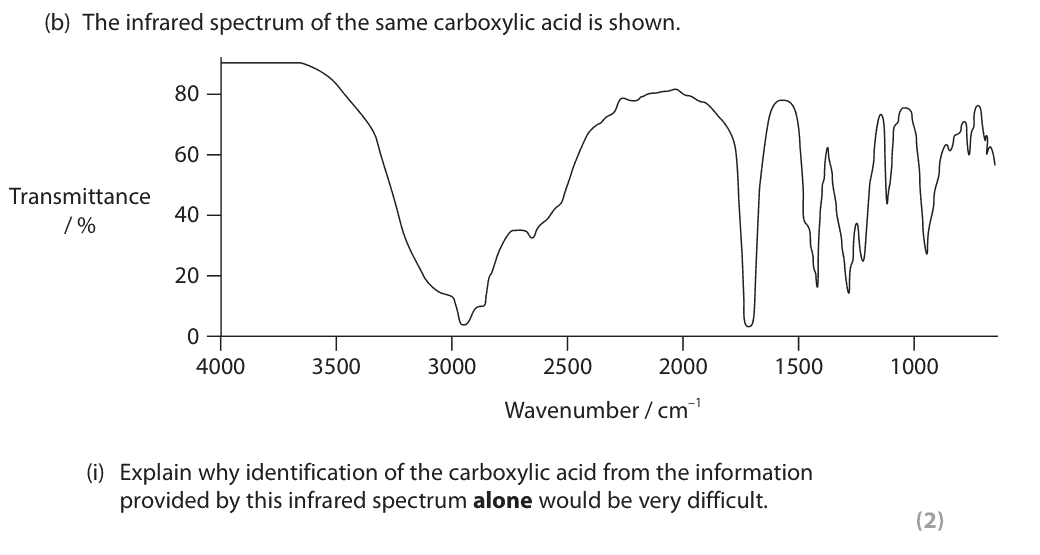
Identify the bond responsible for the absorption in the range 1725–1700 cm–1
in this infrared spectrum.
June 2025 · AS Paper 2 · Q6(e) 2 marks Short answer alcoholsintroduction to organic chemistry
Earlier parts of question 6 that this part usesEarlier part of June 2025 Paper 2 question 6Earlier part of June 2025 Paper 2 question 6
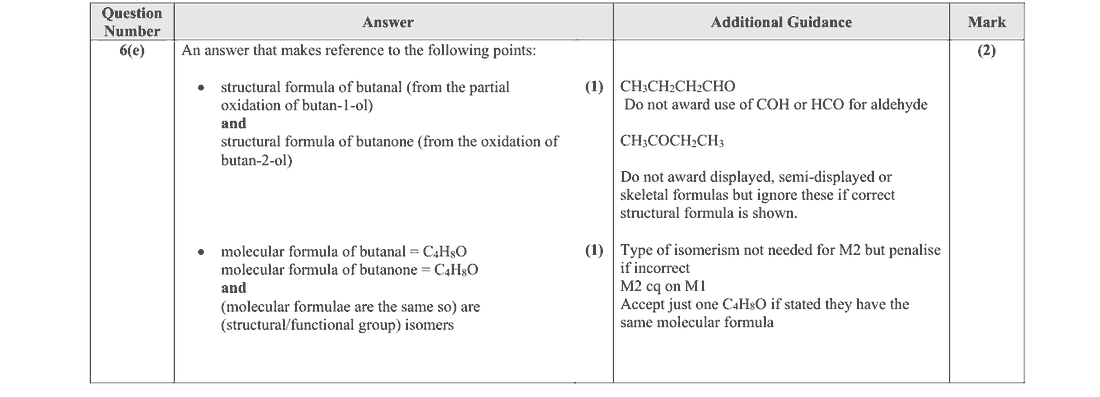
The organic product formed when butan‑1‑ol is partially oxidised is isomeric with
the butanone synthesised in (b).
Give the structural and molecular formulae of these two products stating how
they are isomeric.
June 2025 · AS Paper 2 · Q8(b)(i) 1 mark Short answer kinetics i
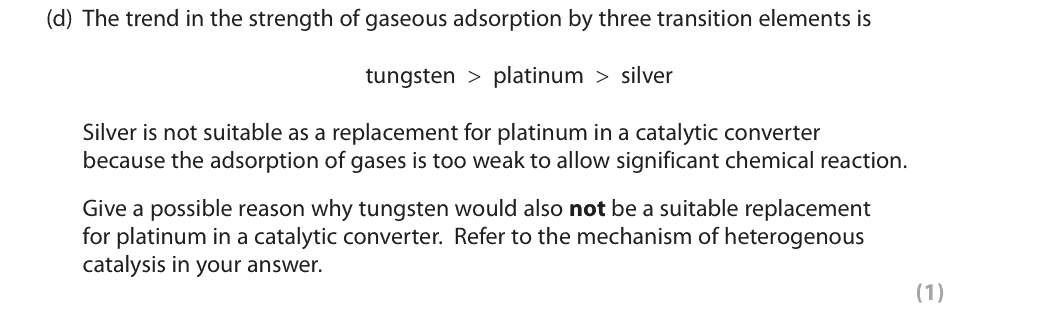
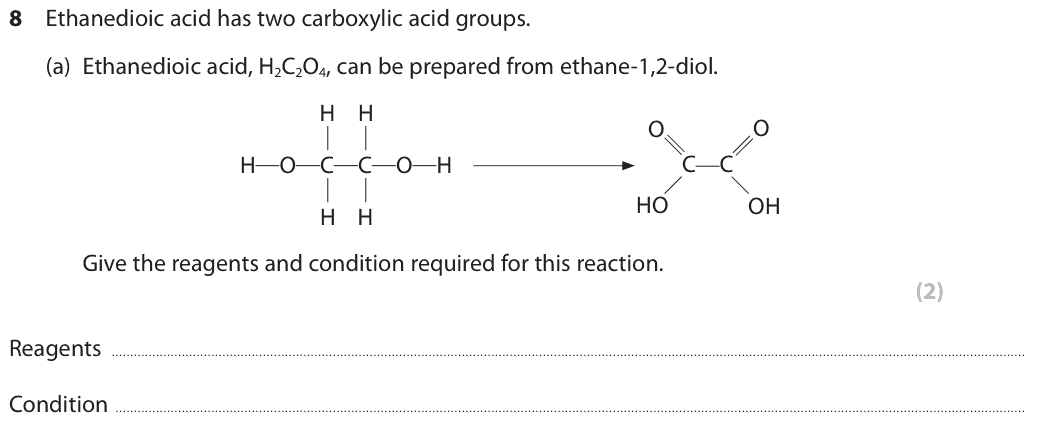
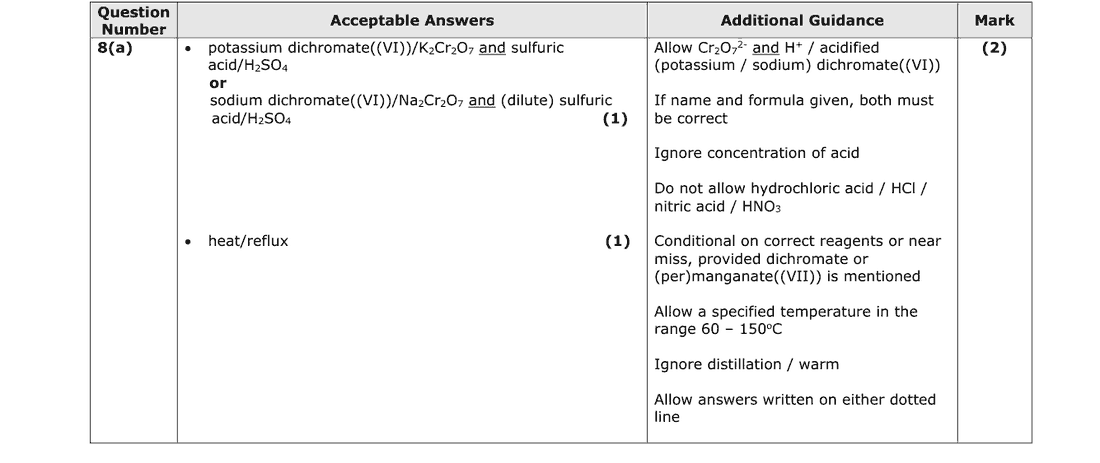
Vehicle exhaust systems contain catalysts to decrease the quantity of
pollutants emitted.
State what is meant by a heterogeneous catalyst.
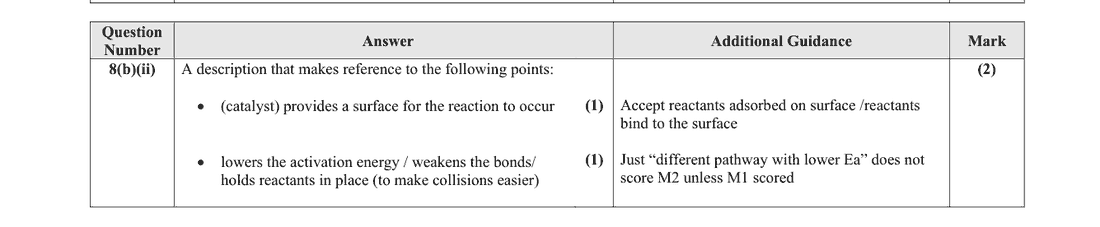
June 2025 · AS Paper 2 · Q8(b)(ii) 2 marks Short answer kinetics i
Earlier part of question 8 that this part usesEarlier part of June 2025 Paper 2 question 8
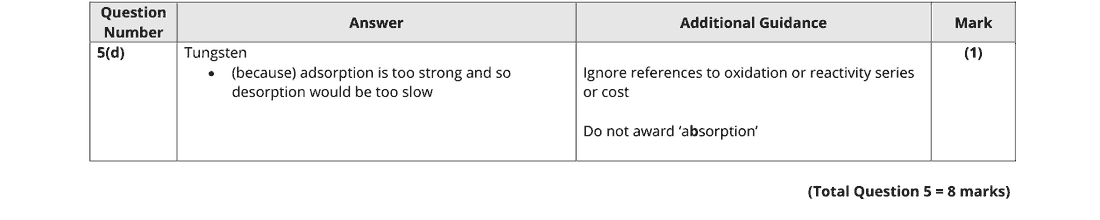
Describe how a heterogeneous catalyst is able to increase the rate of reaction
in a vehicle exhaust system.
June 2025 · AS Paper 2 · Q8(b)(iii) 3 marks Short answer Easy alkanes
Earlier part of question 8 that this part usesEarlier part of June 2025 Paper 2 question 8
Identify three of the major pollutants and the products they form having
passed over the heterogeneous catalyst.
June 2025 · AS Paper 2 · Q9(b) 2 marks Short answer energetics i
State the relevant conditions indicated by the standard symbol in the expression
for the standard enthalpy change of combustion of butane, ΔcH d[butane].
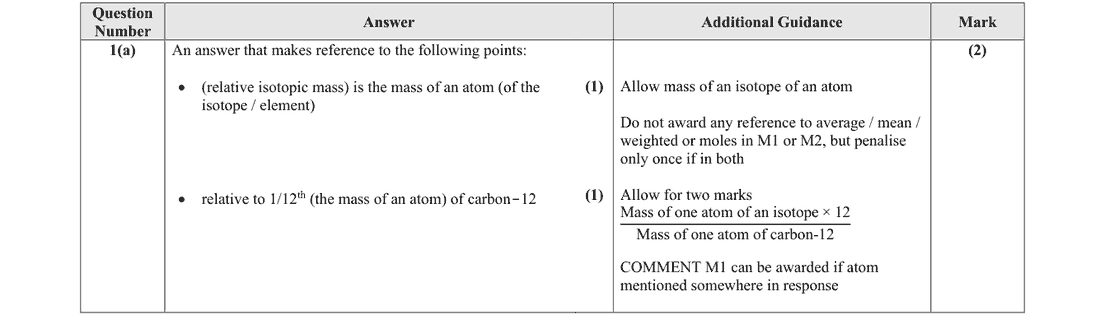
June 2025 · Paper 1 · Q1(a) 2 marks Short answer atomic structure and the periodic table
The table shows data for the three stable isotopes of argon.
Isotope
Relative isotopic mass
Percentage abundance
36Ar
35.97
0.337
38Ar
37.96
0.063
40Ar
39.96
99.600
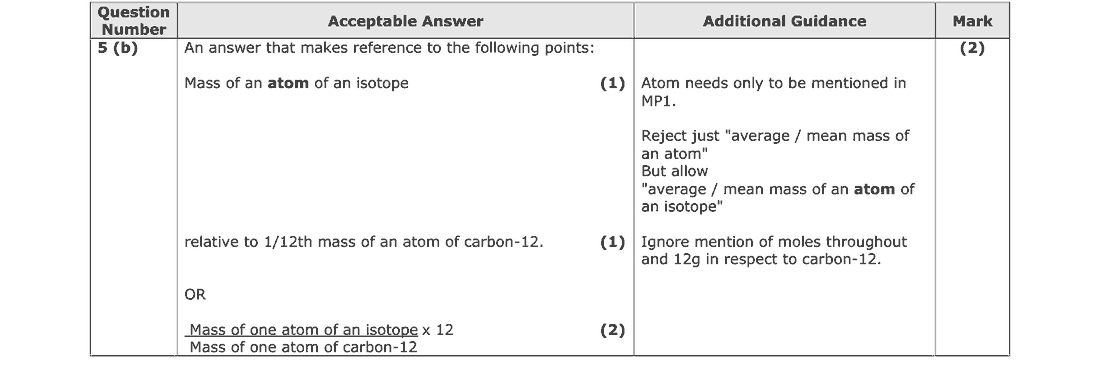
State what is meant by the term ‘relative isotopic mass’.
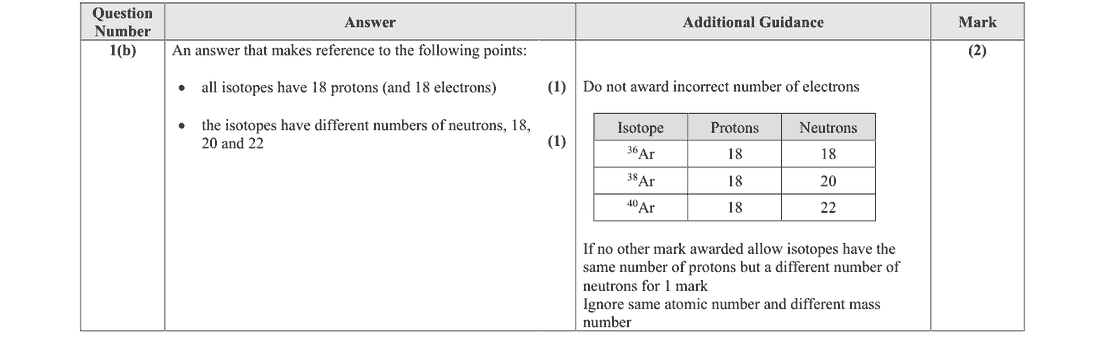
June 2025 · Paper 1 · Q1(b) 2 marks Short answer atomic structure and the periodic table
Earlier part of question 1 that this part usesEarlier part of June 2025 Paper 1 question 1
State what is meant by the term ‘isotope’.
Illustrate your answer by referring to the numbers of sub‑atomic particles in these
isotopes of argon.
June 2025 · Paper 1 · Q3(b)(i) 1 mark Short answer energetics i
Earlier part of question 3 that this part usesEarlier part of June 2025 Paper 1 question 3
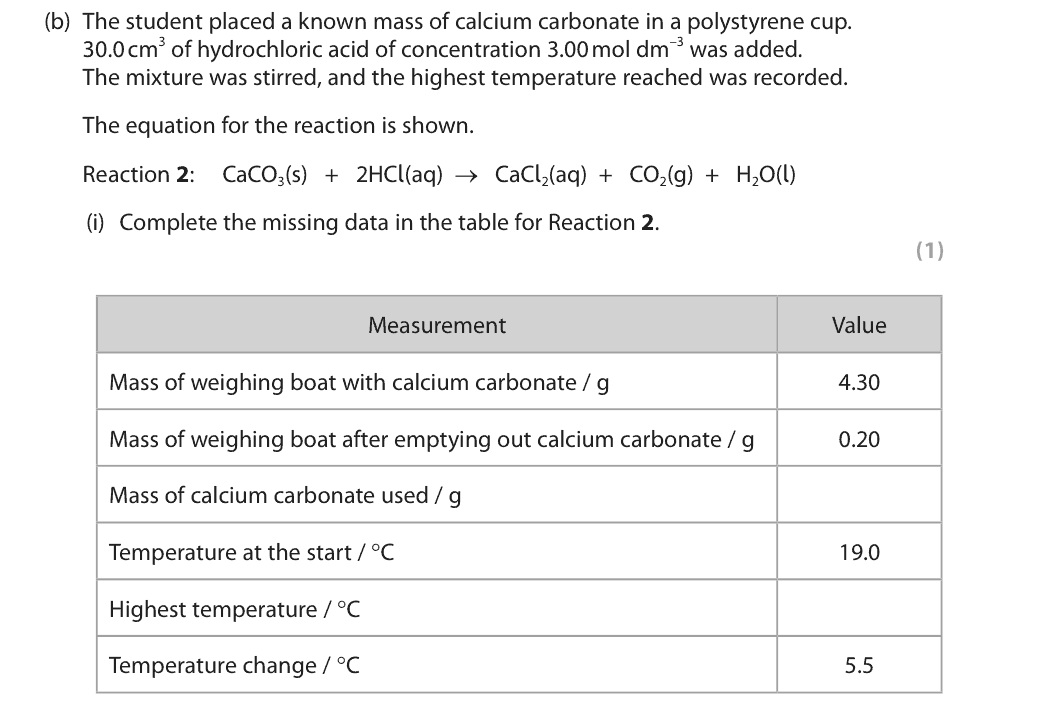
The student placed a known mass of calcium carbonate in a polystyrene cup.
30.0 cm3 of hydrochloric acid of concentration 3.00 mol dm–3 was added.
The mixture was stirred, and the highest temperature reached was recorded.
The equation for the reaction is shown.
Reaction 2:     CaCO3(s)   +   2HCl(aq)  →   CaCl2(aq)  +   CO2(g)  +   H2O(l)
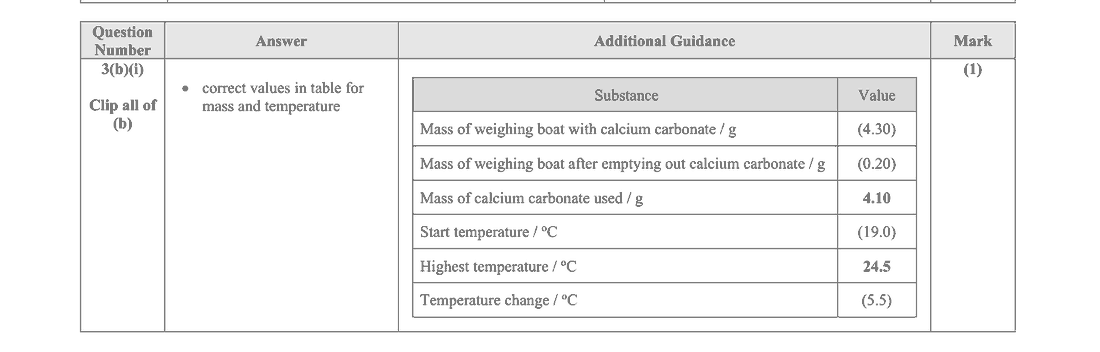
Complete the missing data in the table for Reaction 2.
Measurement
Value
Mass of weighing boat with calcium carbonate / g
4.30
Mass of weighing boat after emptying out calcium carbonate / g
0.20
Mass of calcium carbonate used / g
Temperature at the start / °C
19.0
Highest temperature / °C
Temperature change / °C
5.5
June 2025 · Paper 1 · Q5(b) 1 mark Short answer acid base equilibria
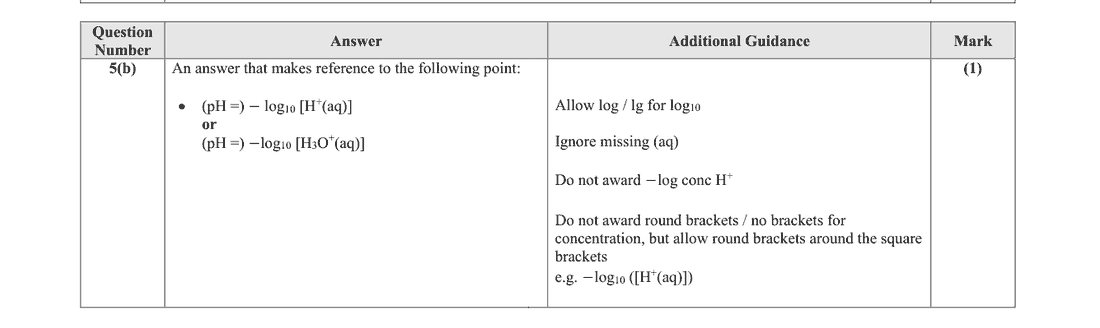
State the expression that defines the pH of a solution.
June 2025 · Paper 1 · Q6(a)(ii) 1 mark Short answer transition metals principles
Earlier part of question 6 that this part usesEarlier part of June 2025 Paper 1 question 6
State why chromium is classified as a transition metal.
June 2025 · Paper 1 · Q6(b)(ii) 1 mark Short answer transition metals principles
Earlier part of question 6 that this part usesEarlier part of June 2025 Paper 1 question 6
Name the shape of the [Cr(H2O)6]3+(aq) complex ion.
June 2025 · Paper 1 · Q6(d) 1 mark Short answer transition metals reactions
Name the type of reaction that occurs when chromium(III) hydroxide reacts with
excess aqueous ammonia.
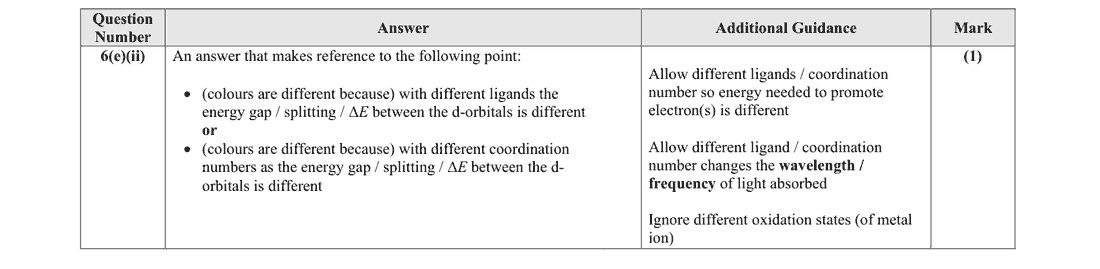
June 2025 · Paper 1 · Q6(e)(ii) 1 mark Short answer transition metals principles
Earlier part of question 6 that this part usesEarlier part of June 2025 Paper 1 question 6
Give the reason why the solutions of [Cr(H2O)6]3+ and [CrCl4]– are
different colours.
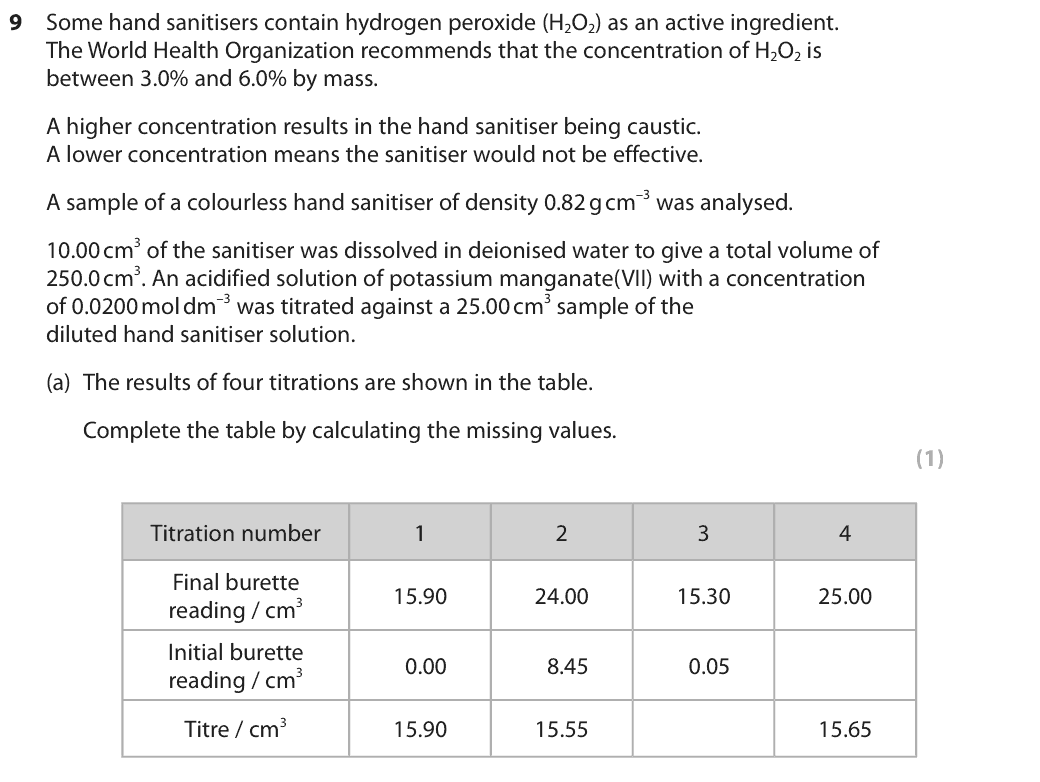
June 2025 · Paper 1 · Q9(a) 1 mark Short answer redox ii
Some hand sanitisers contain hydrogen peroxide (H2O2) as an active ingredient.
The World Health Organization recommends that the concentration of H2O2 is
between 3.0% and 6.0% by mass.
A higher concentration results in the hand sanitiser being caustic.
A lower concentration means the sanitiser would not be effective.
A sample of a colourless hand sanitiser of density 0.82 g cm–3 was analysed.
10.00 cm3 of the sanitiser was dissolved in deionised water to give a total volume of
250.0 cm3. An acidified solution of potassium manganate(VII) with a concentration
of 0.0200 mol dm–3 was titrated against a 25.00 cm3 sample of the
diluted hand sanitiser solution.
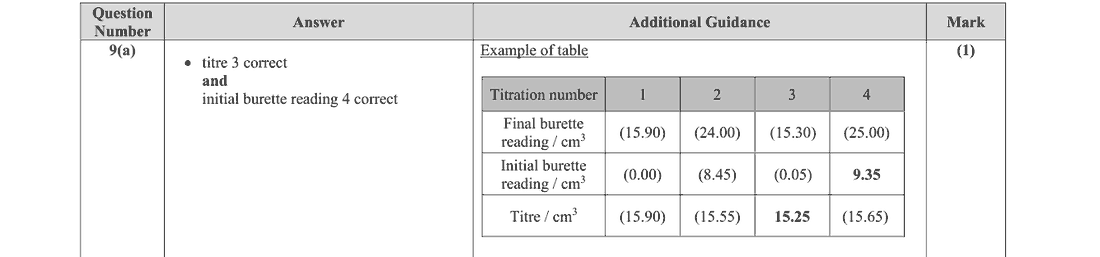
The results of four titrations are shown in the table.
Complete the table by calculating the missing values.
Titration number
1
2
3
4
Final burette
15.90
24.00
15.30
25.00
reading / cm3
Initial burette
0.00
8.45
0.05
reading / cm3
Titre / cm3
15.90
15.55
15.65
June 2025 · Paper 2 · Q4(a)(ii) 2 marks Short answer alkanes
Earlier part of question 4 that this part usesEarlier part of June 2025 Paper 2 question 4
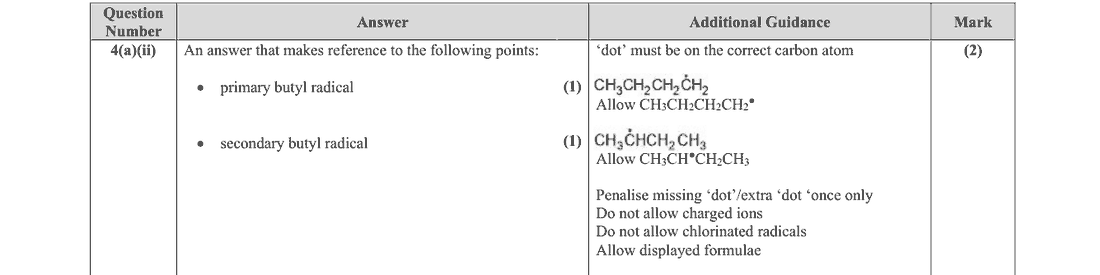
In the reaction of chlorine with butane, the propagation stage produces two
different butyl radicals.
Write the structural formulae of these two radicals.
June 2025 · Paper 2 · Q5(b) 1 mark Short answer Easy kinetics i
Earlier part of question 5 that this part usesEarlier part of June 2025 Paper 2 question 5
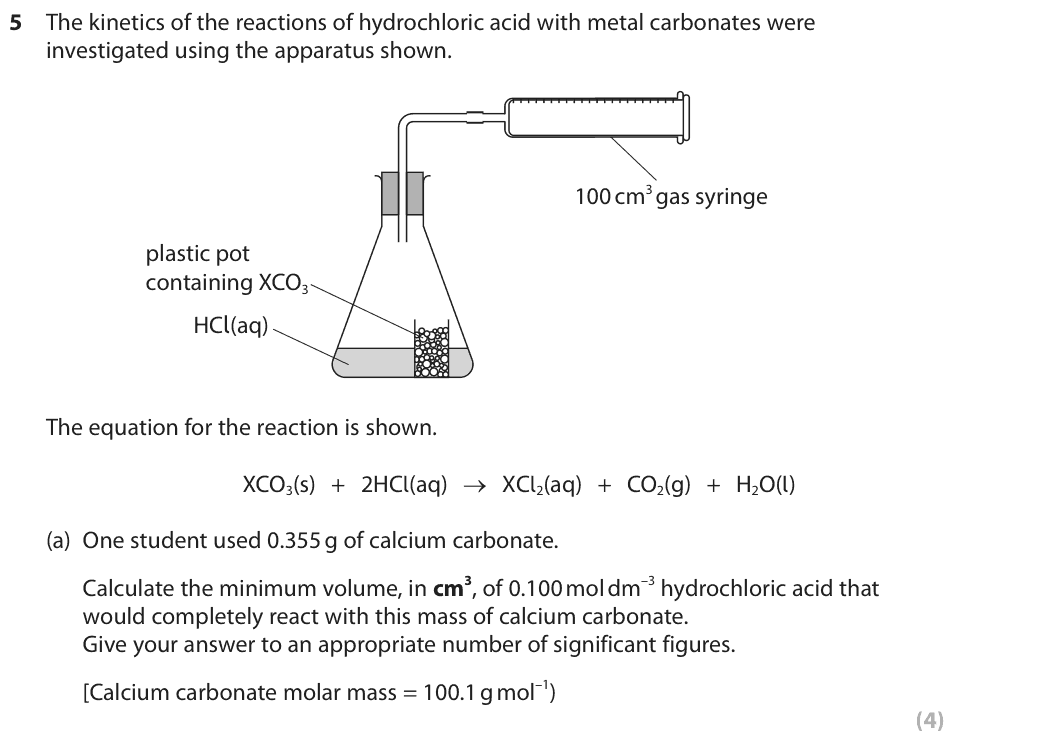
State why powdered metal carbonate reacts faster than large lumps.
June 2025 · Paper 2 · Q8(a) 1 mark Short answer introduction to organic chemistry
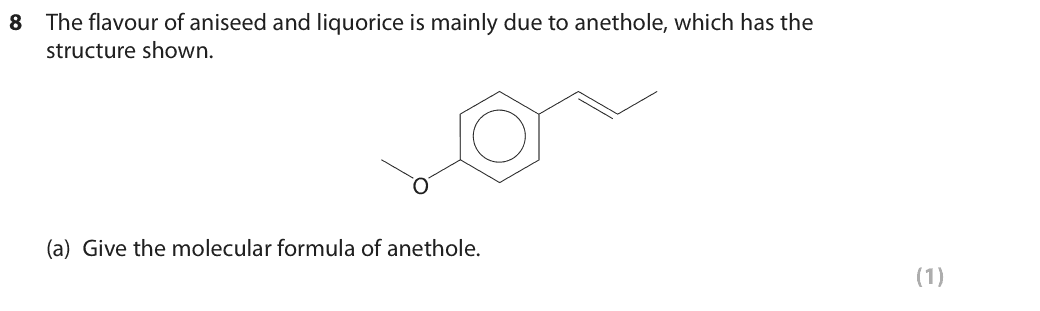
The flavour of aniseed and liquorice is mainly due to anethole, which has the
structure shown.
O
Give the molecular formula of anethole.
June 2025 · Paper 2 · Q8(c) 1 mark Short answer introduction to organic chemistry
Earlier part of question 8 that this part usesEarlier part of June 2025 Paper 2 question 8
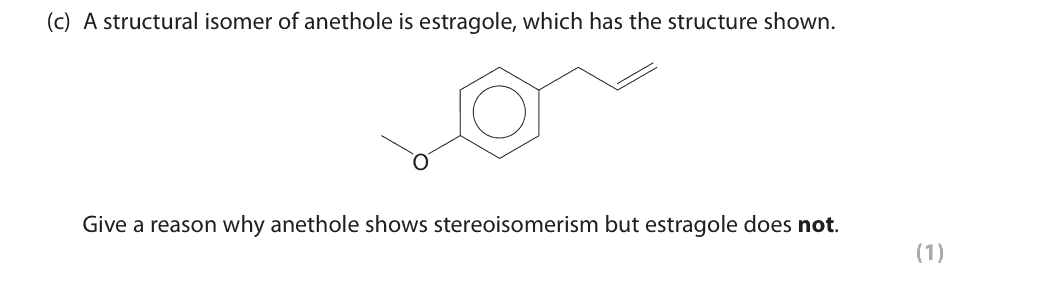
A structural isomer of anethole is estragole, which has the structure shown.
O
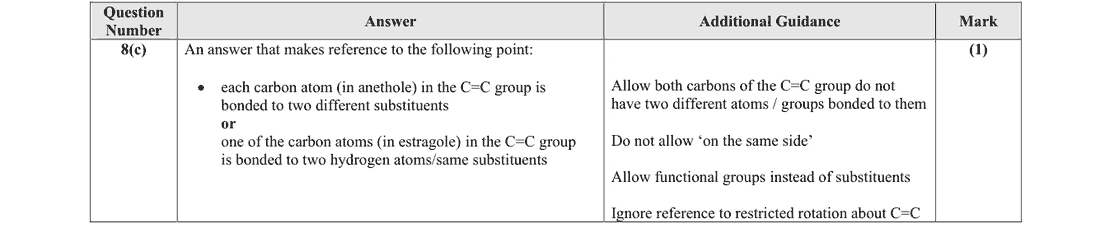
Give a reason why anethole shows stereoisomerism but estragole does not.
June 2025 · Paper 2 · Q9(b)(ii) 1 mark Short answer kinetics ii
Earlier parts of question 9 that this part usesEarlier part of June 2025 Paper 2 question 9Earlier part of June 2025 Paper 2 question 9
State how your mechanism is consistent with the rate of reaction being
independent of hydroxide ion concentration.
June 2025 · Paper 3 · Q1(a) 2 marks Short answer atomic structure and the periodic table
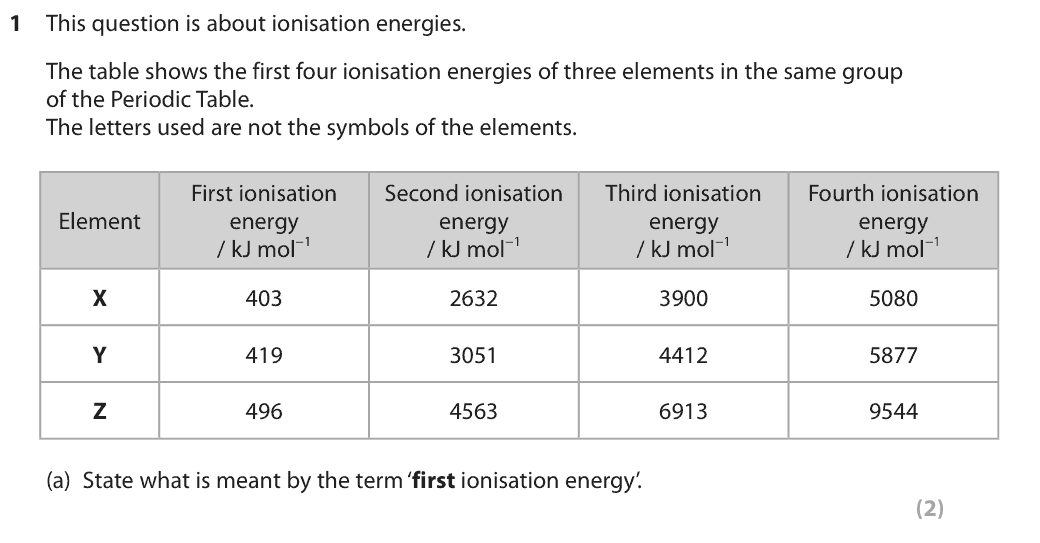
This question is about ionisation energies.
The table shows the first four ionisation energies of three elements in the same group
of the Periodic Table.
The letters used are not the symbols of the elements.
First ionisation
Second ionisation
Third ionisation
Fourth ionisation
Element
energy
energy
energy
energy
/ kJ mol−1
/ kJ mol−1
/ kJ mol−1
/ kJ mol−1
X
403
2632
3900
5080
Y
419
3051
4412
5877
Z
496
4563
6913
9544
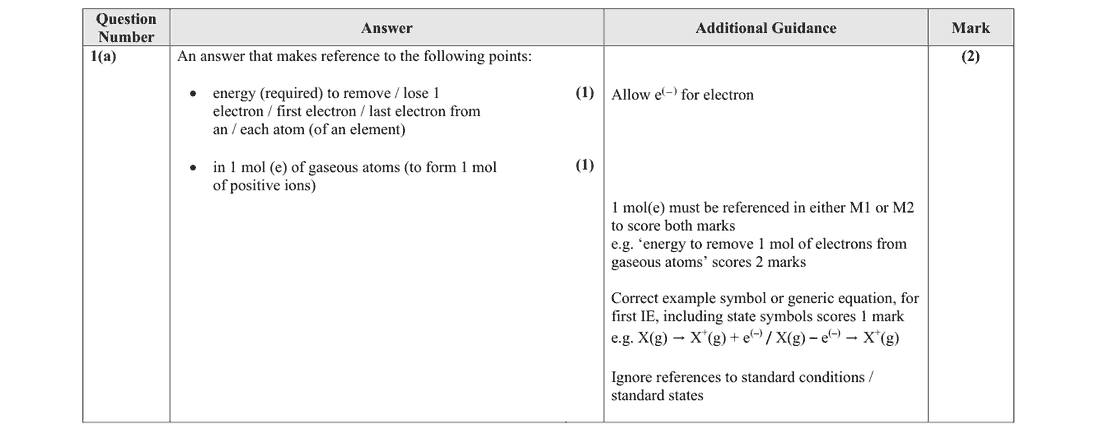
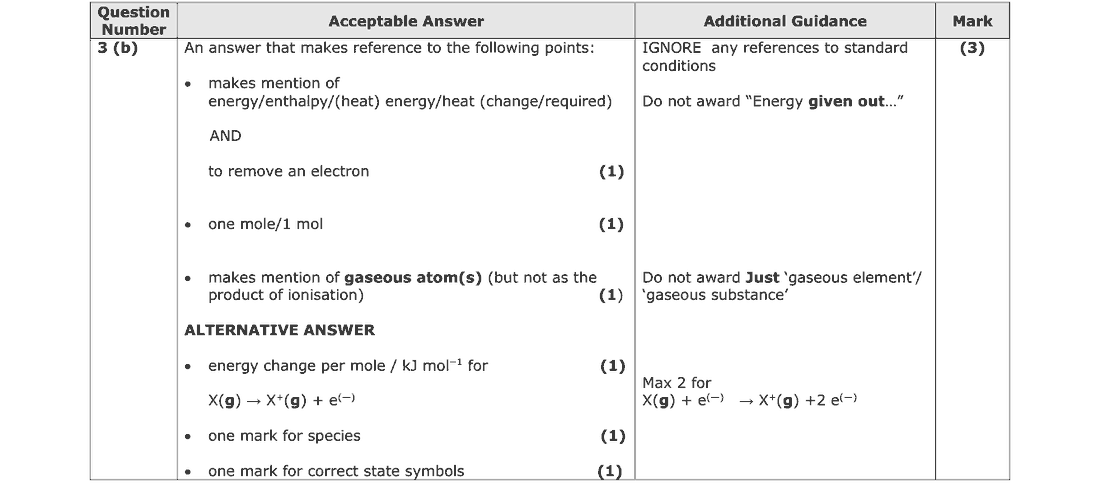
State what is meant by the term ‘first ionisation energy’.
June 2025 · Paper 3 · Q2(d)(i) 1 mark Short answer introduction to organic chemistry
Earlier part of question 2 that this part usesEarlier part of June 2025 Paper 3 question 2
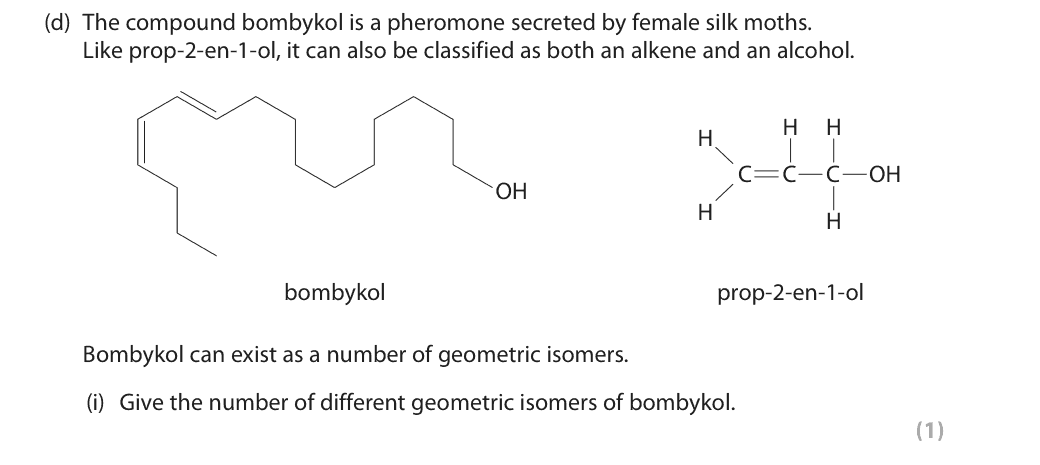
The compound bombykol is a pheromone secreted by female silk moths.
Like prop-2-en-1-ol, it can also be classified as both an alkene and an alcohol.
H
H
H
C
C
C
OH
OH
H
H
bombykol
prop-2-en-1-ol
Bombykol can exist as a number of geometric isomers.
Give the number of different geometric isomers of bombykol.
June 2025 · Paper 3 · Q2(d)(ii) 1 mark Short answer introduction to organic chemistry
Earlier parts of question 2 that this part usesEarlier part of June 2025 Paper 3 question 2Earlier part of June 2025 Paper 3 question 2
Give the reason why prop-2-en-1-ol does not exhibit geometric isomerism.
June 2025 · Paper 3 · Q4(e)(ii) 1 mark Short answer kinetics ii
Earlier parts of question 4 that this part usesEarlier part of June 2025 Paper 3 question 4Earlier part of June 2025 Paper 3 question 4
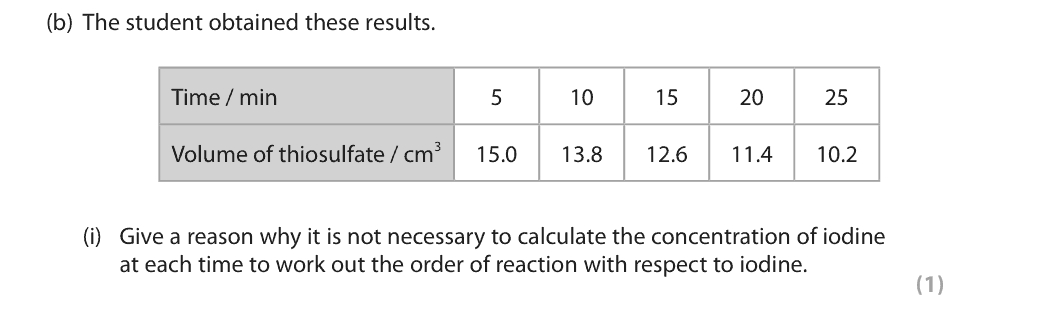
Give the reason why it is not necessary to calculate the concentration of
iodine so that the order can be deduced.
June 2025 · Paper 3 · Q4(e)(iii) 2 marks Short answer kinetics ii
Earlier parts of question 4 that this part usesEarlier part of June 2025 Paper 3 question 4Earlier part of June 2025 Paper 3 question 4Earlier part of June 2025 Paper 3 question 4
Deduce the order with respect to iodine. Justify your answer.
June 2025 · Paper 3 · Q5(b)(i) 2 marks Short answer equilibrium i
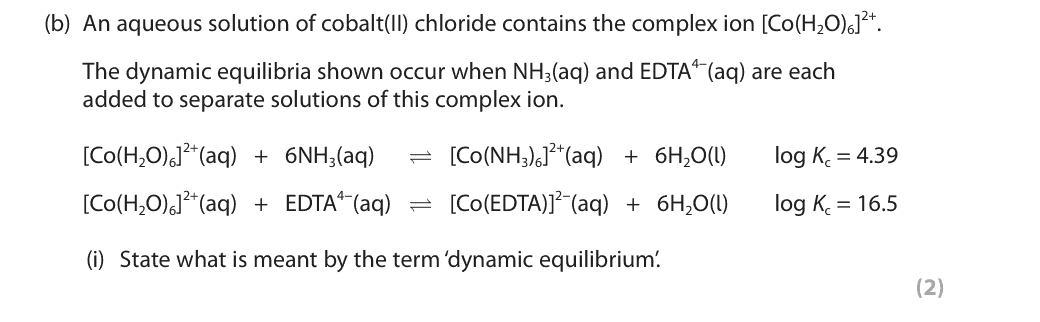
An aqueous solution of cobalt(II) chloride contains the complex ion [Co(H2O)6]2+.
The dynamic equilibria shown occur when NH3(aq) and EDTA4−(aq) are each
added to separate solutions of this complex ion.
[Co(H2O)6]2+(aq)   +   6NH3(aq)
   [Co(NH3)6]2+(aq)  +   6H2O(l)
log Kc = 4.39
[Co(H2O)6]2+(aq)   +   EDTA4−(aq)     [Co(EDTA)]2−(aq)   +   6H2O(l)
log Kc = 16.5
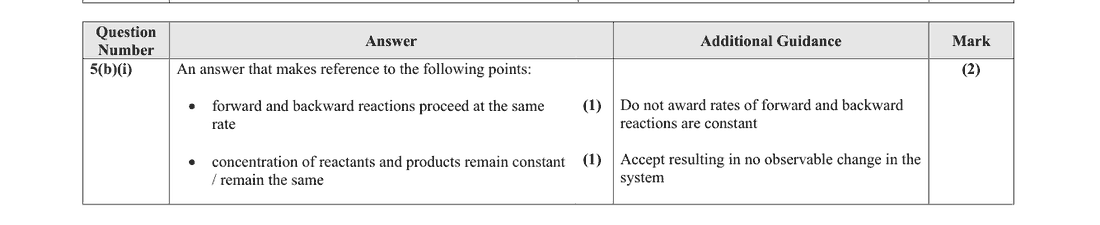
State what is meant by the term ‘dynamic equilibrium’.
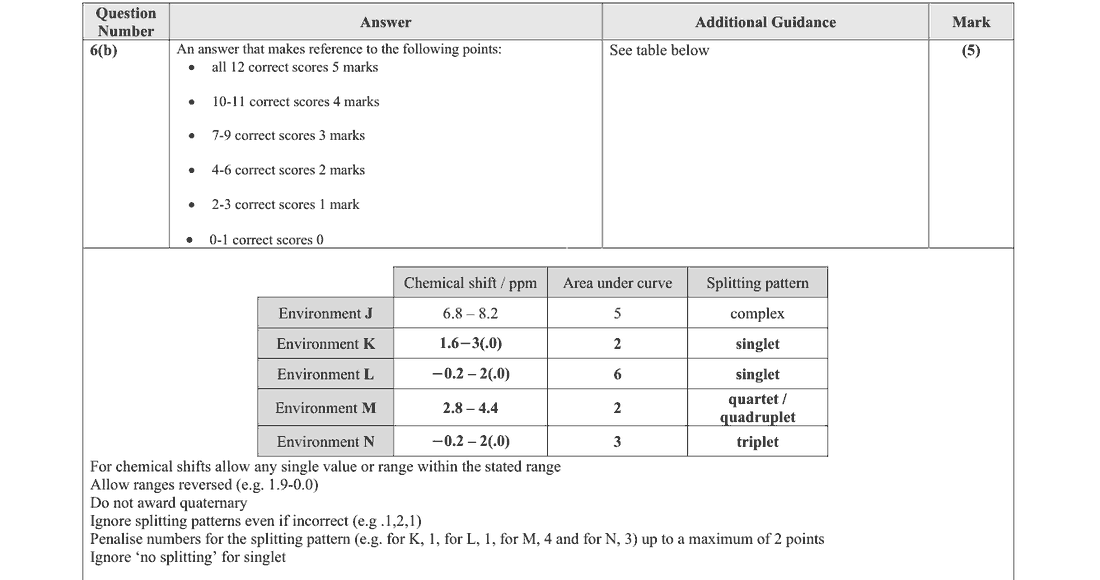
June 2025 · Paper 3 · Q6(b) 5 marks Short answer nmr mass spectrometry and chromatography
Earlier part of question 6 that this part usesEarlier part of June 2025 Paper 3 question 6
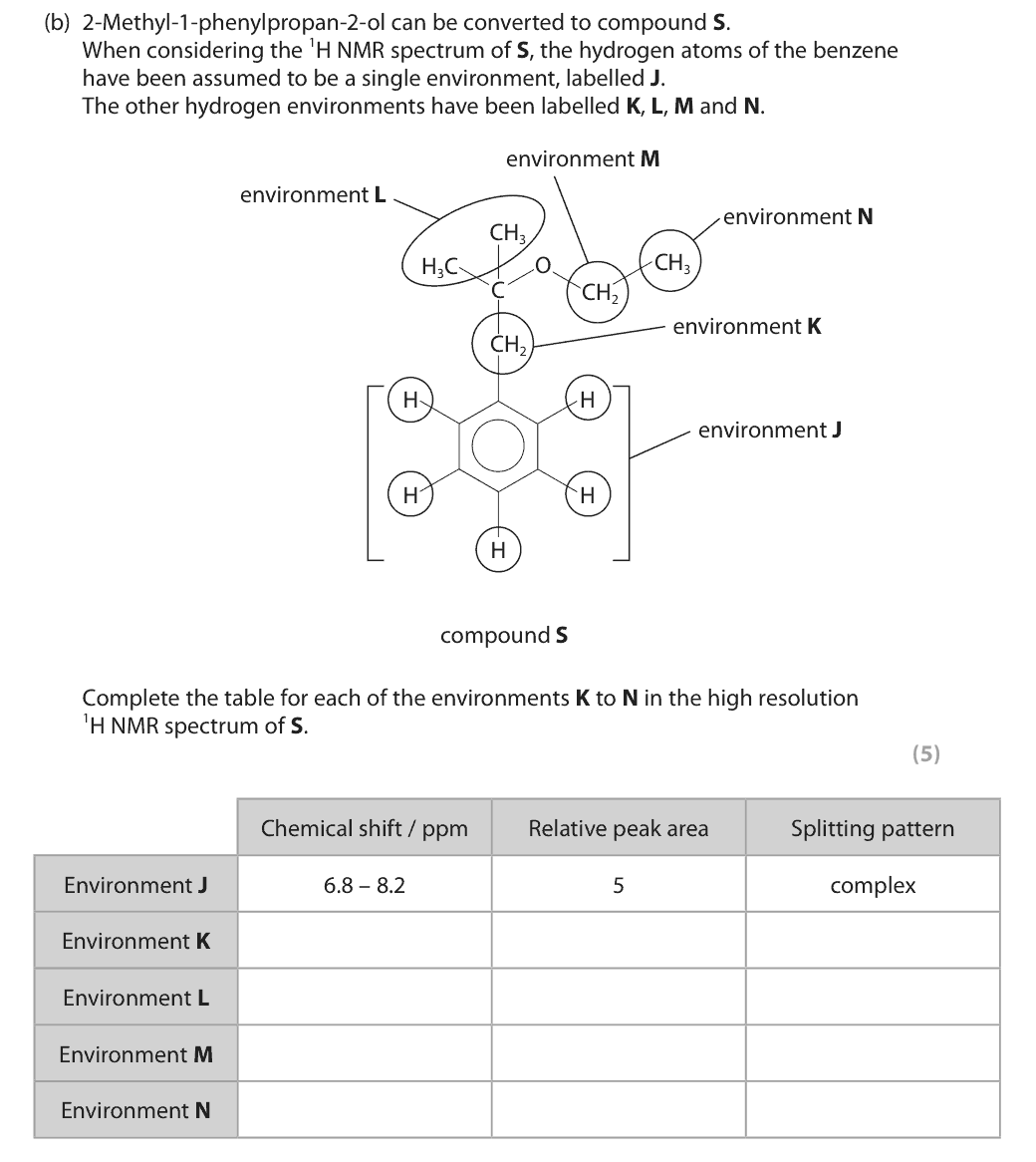
2-Methyl-1-phenylpropan-2-ol can be converted to compound S.
When considering the 1H NMR spectrum of S, the hydrogen atoms of the benzene
have been assumed to be a single environment, labelled J.
The other hydrogen environments have been labelled K, L, M and N.
environment M
environment L
environment N
CH3
CH3
H3C
O
C
CH2
environment K
CH2
H
H
environment J
H
H
H
compound S
Complete the table for each of the environments K to N in the high resolution
1H NMR spectrum of S.
Chemical shift / ppm
Relative peak area
Splitting pattern
Environment J
6.8 – 8.2
5
complex
Environment K
Environment L
Environment M
Environment N
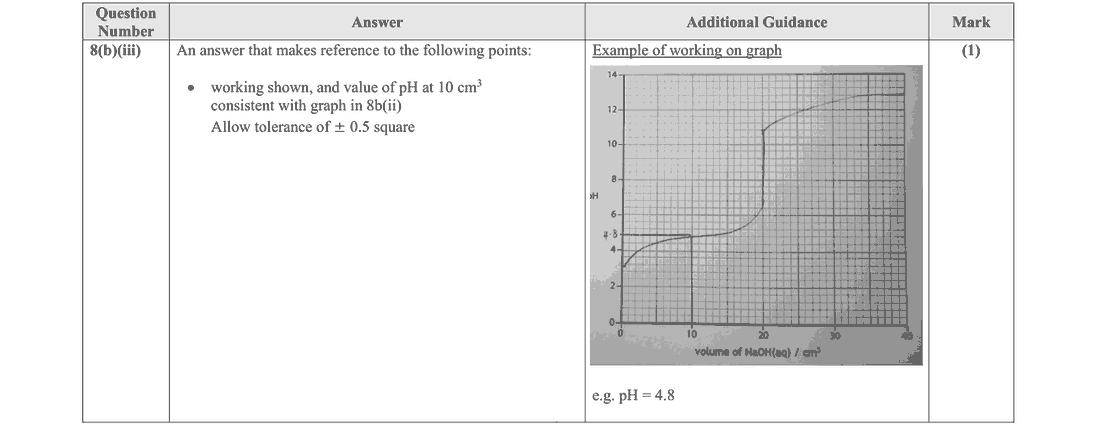
June 2025 · Paper 3 · Q8(b)(iii) 1 mark Short answer acid base equilibria
Earlier parts of question 8 that this part usesEarlier part of June 2025 Paper 3 question 8Earlier part of June 2025 Paper 3 question 8
Give an estimate of the pH value at the half-equivalence point.
Show your working on the titration curve.
June 2024 · AS Paper 1 · Q6(d) 1 mark Short answer atomic structure and the periodic table
Earlier part of question 6 that this part usesEarlier part of June 2024 Paper 1 question 6
The mass spectrum of another compound, D, is shown.
100
80
60
Relative
intensity
40
20
0
10
20
30
40
50
60
70
80
90
100
110
m / z
Use the spectrum to determine the relative molecular mass of compound D.
June 2024 · AS Paper 1 · Q9(b)(i) 1 mark Short answer Hard redox i
Earlier part of question 9 that this part usesEarlier part of June 2024 Paper 1 question 9
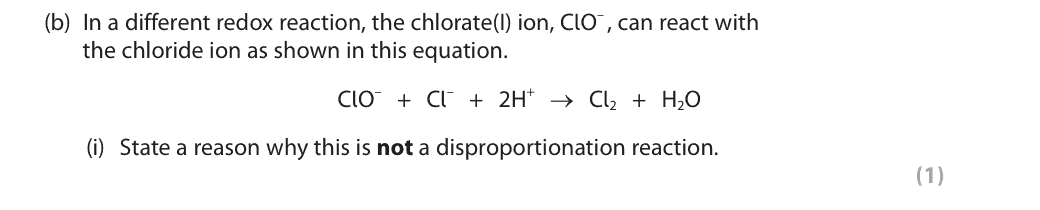
In a different redox reaction, the chlorate(I) ion, ClO– , can react with
the chloride ion as shown in this equation.
ClO–   +   Cl–   +   2H+   →   Cl2   +   H2O
State a reason why this is not a disproportionation reaction.
June 2024 · AS Paper 1 · Q9(b)(ii) 1 mark Short answer redox i
Earlier parts of question 9 that this part usesEarlier part of June 2024 Paper 1 question 9Earlier part of June 2024 Paper 1 question 9
Identify the reducing agent in this reaction.
June 2024 · AS Paper 2 · Q3(a) 1 mark Short answer Easy introduction to organic chemistryformulae equations and amounts of substance
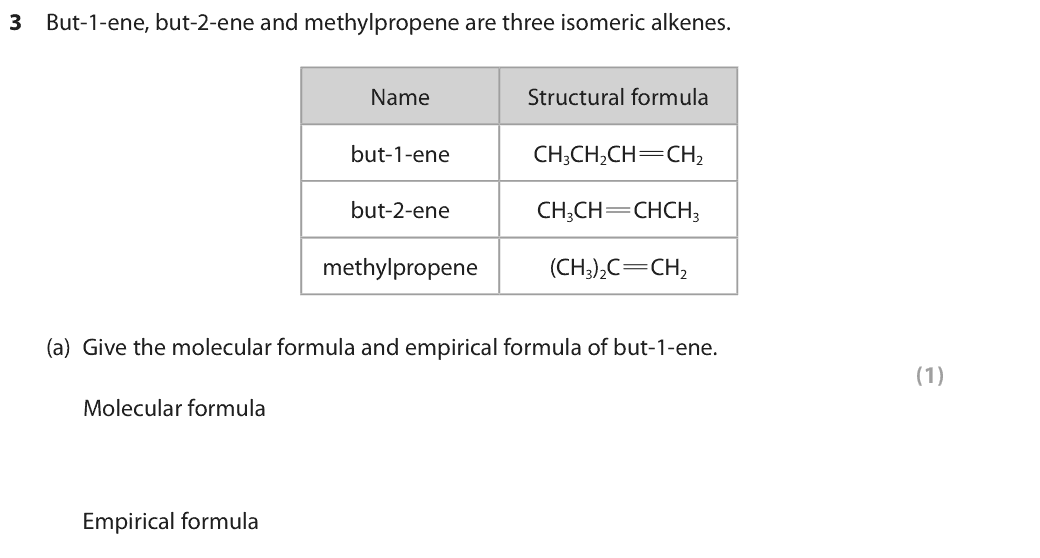
But‑1‑ene, but‑2‑ene and methylpropene are three isomeric alkenes.
Name
Structural formula
but‑1‑ene
CH3CH2CH
CH2
but‑2‑ene
CH3CH
CHCH3
methylpropene
(CH3)2C
CH2
Give the molecular formula and empirical formula of but‑1‑ene.
Molecular formula
Empirical formula
June 2024 · AS Paper 2 · Q3(b)(iv) 1 mark Short answer alkenes
Earlier parts of question 3 that this part usesEarlier part of June 2024 Paper 2 question 3Earlier part of June 2024 Paper 2 question 3Earlier part of June 2024 Paper 2 question 3
State what a curly arrow represents in your diagram of the mechanism
in (b)(ii).
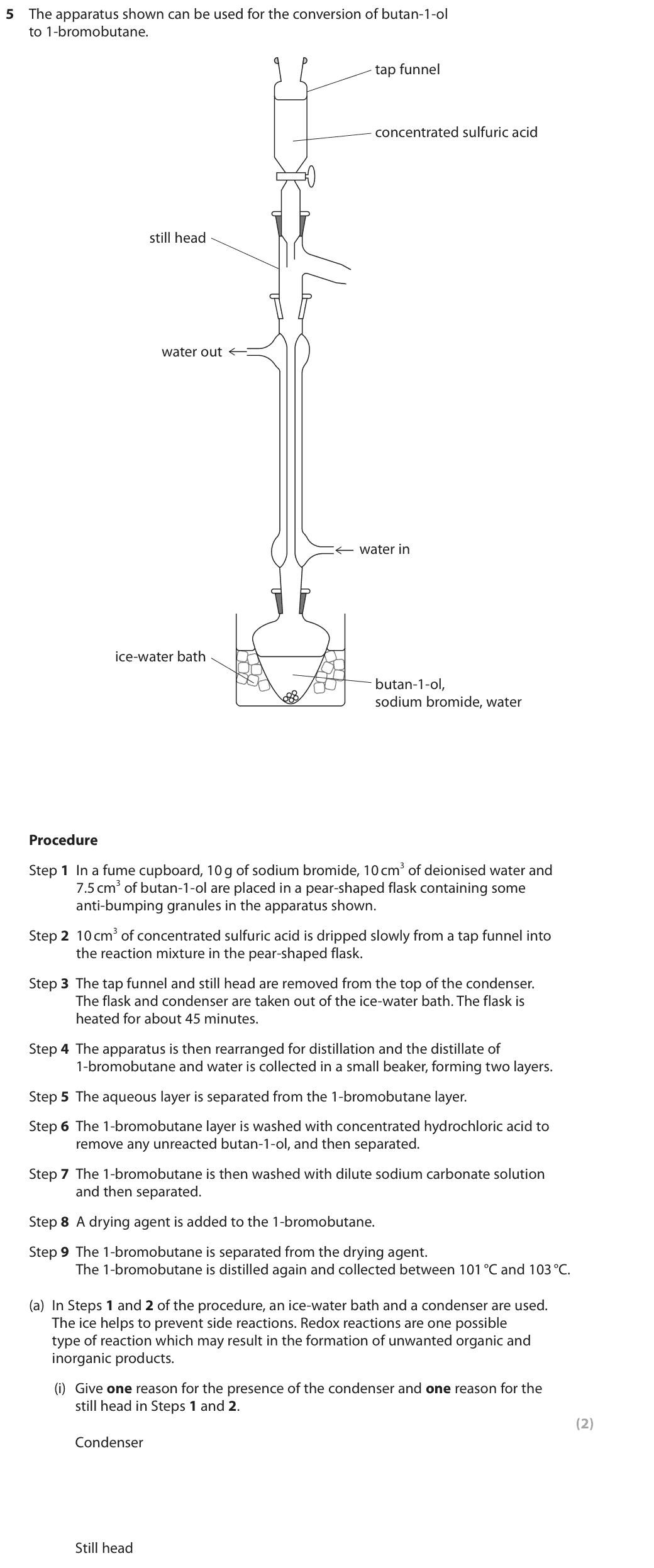
June 2024 · AS Paper 2 · Q5(a)(ii) 1 mark Short answer Hard alcohols
Earlier part of question 5 that this part usesEarlier part of June 2024 Paper 2 question 5
Give the name or formula of the oxidising agent responsible for the unwanted
redox reactions.
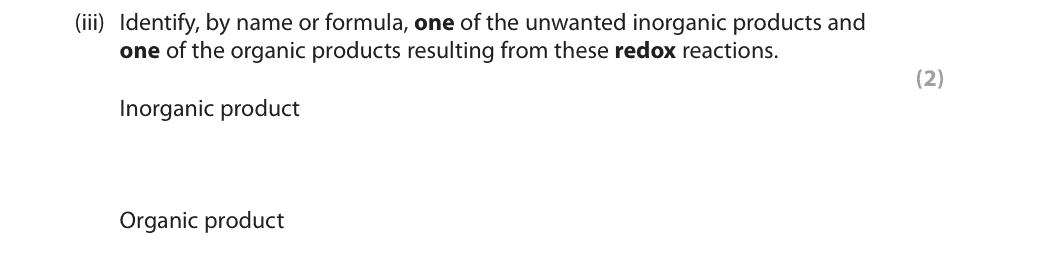
June 2024 · AS Paper 2 · Q5(a)(iii) 2 marks Short answer Hard alcohols
Earlier part of question 5 that this part usesEarlier part of June 2024 Paper 2 question 5
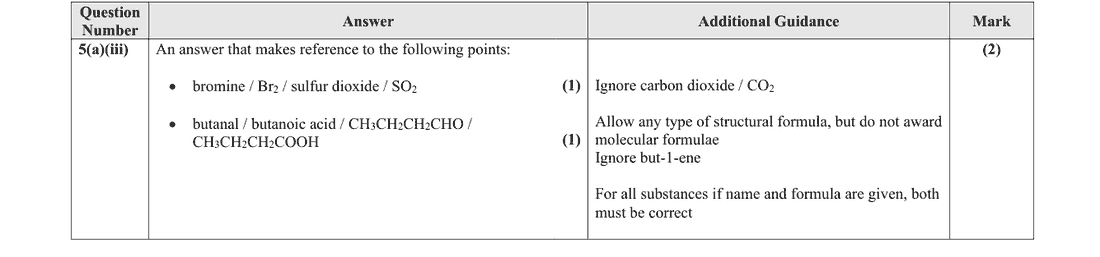
Identify, by name or formula, one of the unwanted inorganic products and
one of the organic products resulting from these redox reactions.
Inorganic product
Organic product
June 2024 · AS Paper 2 · Q5(a)(iv) 1 mark Short answer kinetics i
Earlier part of question 5 that this part usesEarlier part of June 2024 Paper 2 question 5
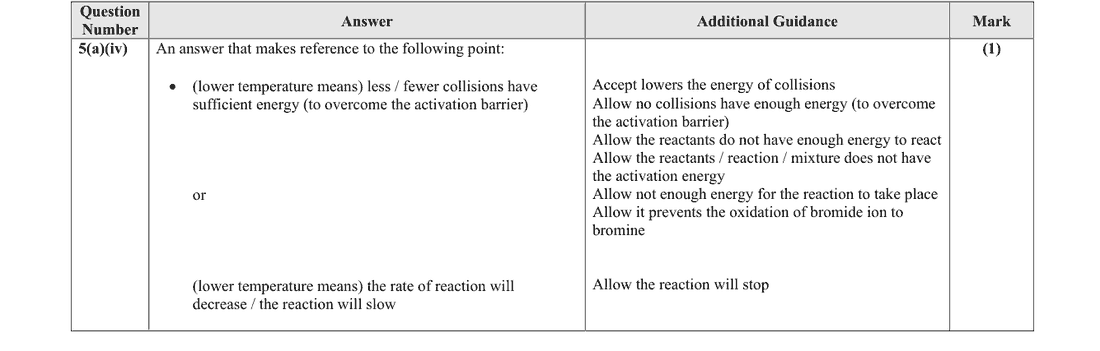
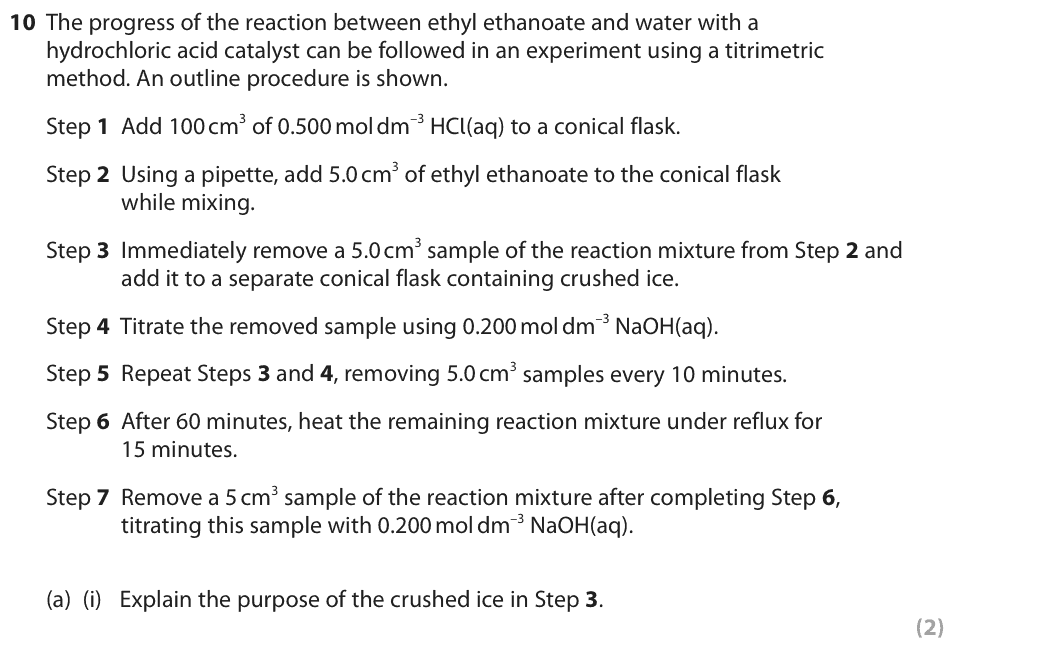
Give a reason why ice helps to prevent the formation of these redox products.
June 2024 · AS Paper 2 · Q6(c)(ii) 1 mark Short answer Hard kinetics i
Earlier parts of question 6 that this part usesEarlier part of June 2024 Paper 2 question 6Earlier part of June 2024 Paper 2 question 6
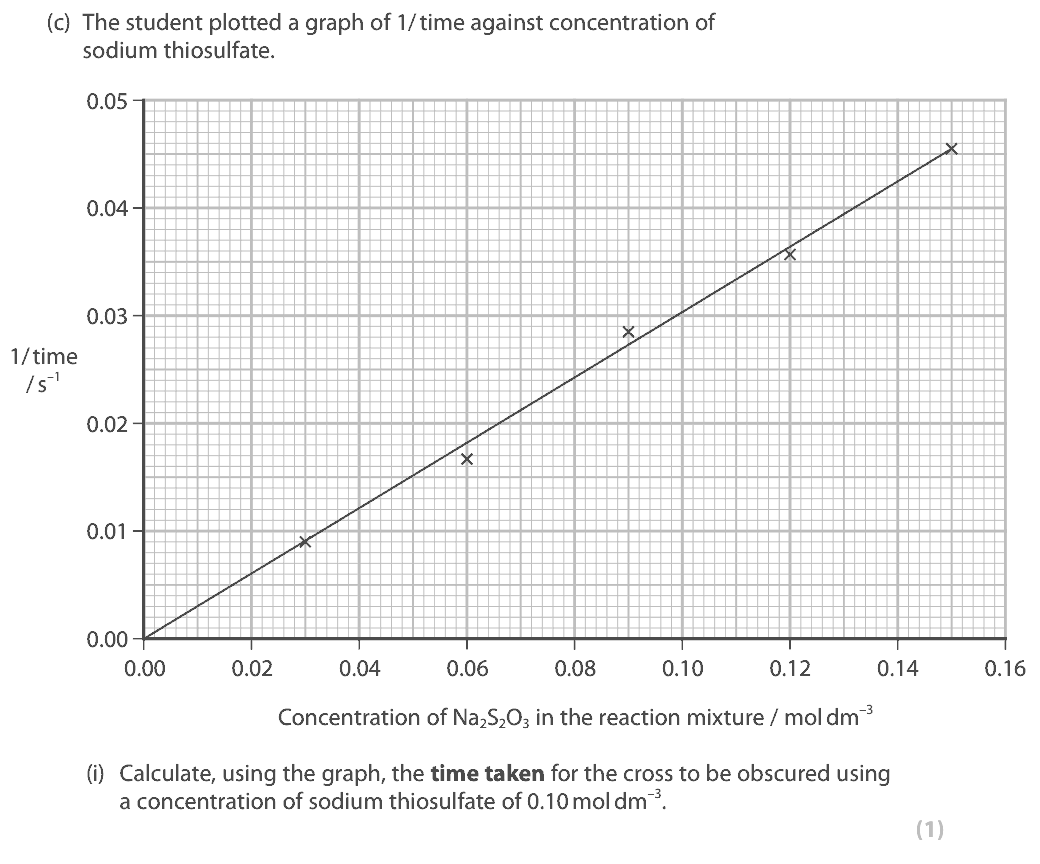
State and justify the relationship between the rate of reaction and the
concentration of sodium thiosulfate as shown by the graph.
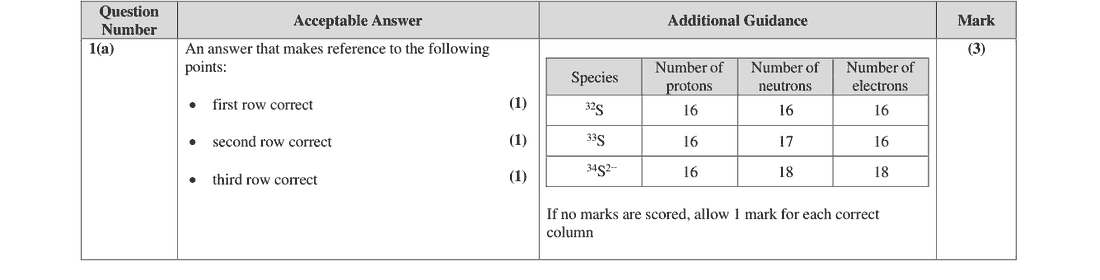
June 2024 · Paper 1 · Q1(a) 3 marks Short answer atomic structure and the periodic table
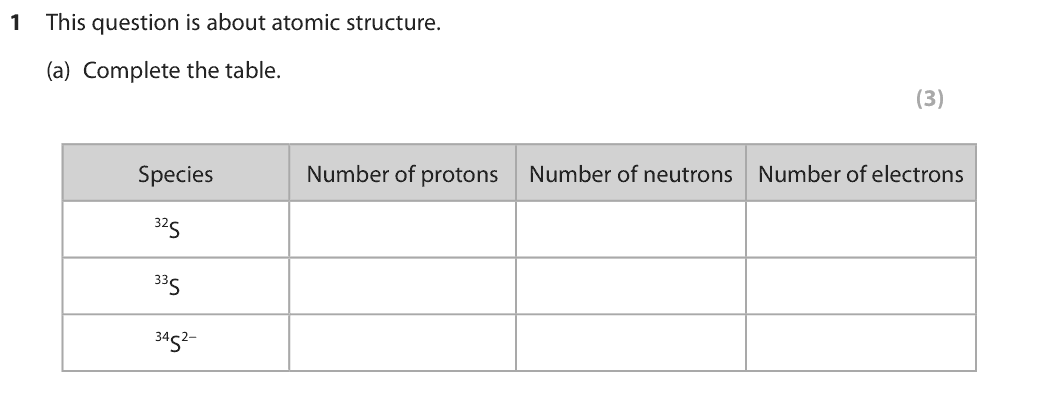
This question is about atomic structure.
Complete the table.
Species
Number of protons
Number of neutrons
Number of electrons
32S
33S
34S2−
June 2024 · Paper 1 · Q4(a) 1 mark Short answer acid base equilibria
This question is about acids, bases and buffers.
State what is meant by a Brønsted−Lowry acid.
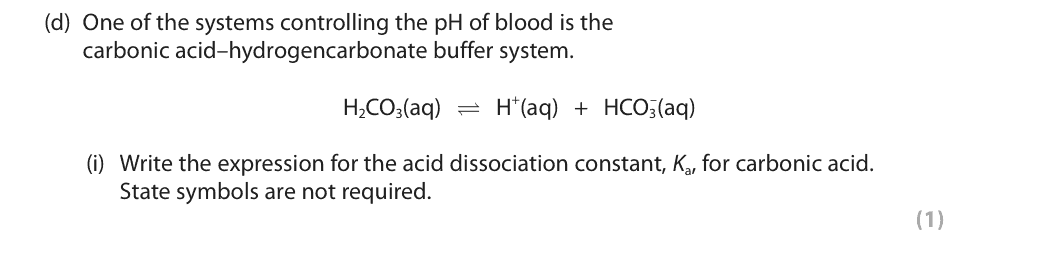
June 2024 · Paper 1 · Q4(d)(i) 1 mark Short answer acid base equilibria
Earlier part of question 4 that this part usesEarlier part of June 2024 Paper 1 question 4
One of the systems controlling the pH of blood is the
carbonic acid–hydrogencarbonate buffer system.
H2CO3(aq)      H+(aq)   +   HCO3
–(aq)
Write the expression for the acid dissociation constant, Ka, for carbonic acid.
State symbols are not required.
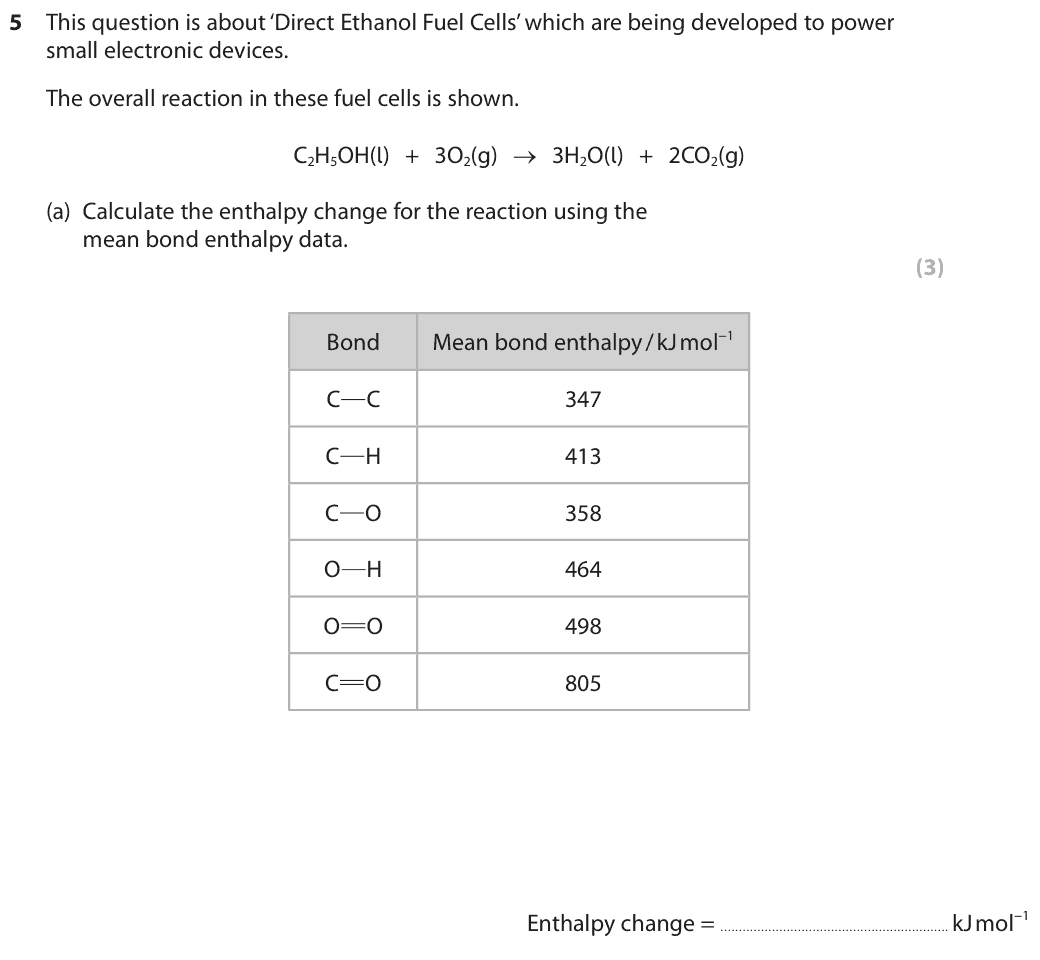
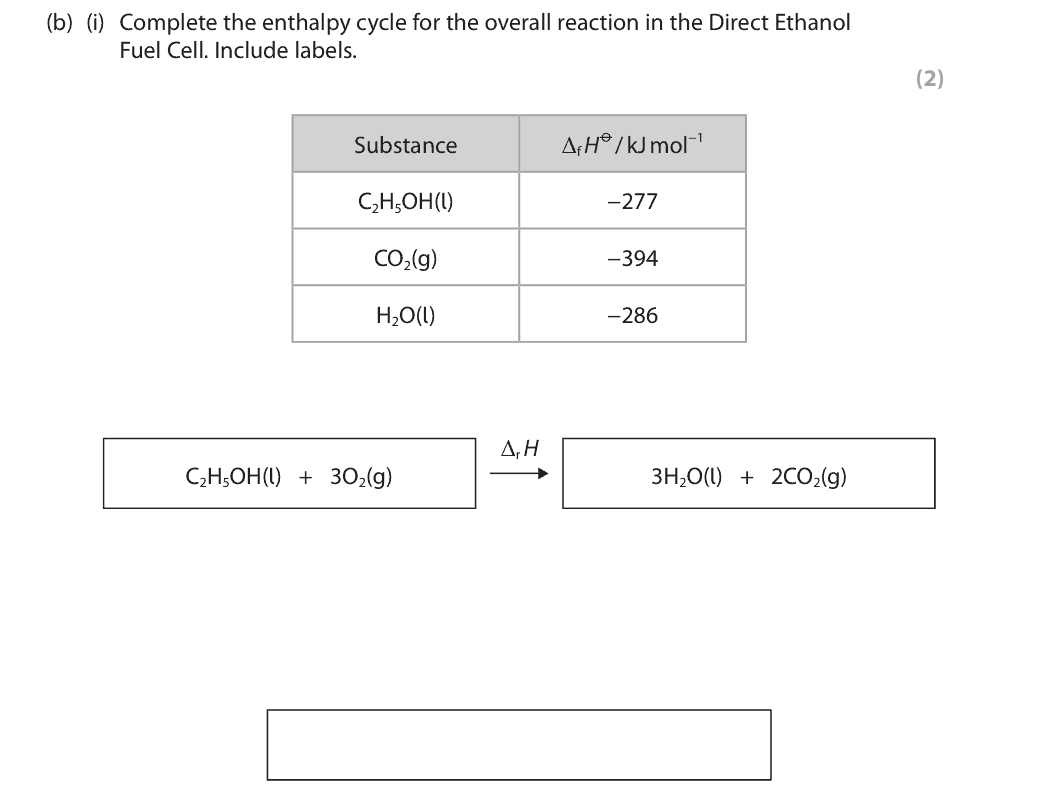
June 2024 · Paper 1 · Q5(c) 2 marks Short answer energetics i
Earlier parts of question 5 that this part usesEarlier part of June 2024 Paper 1 question 5Earlier part of June 2024 Paper 1 question 5Earlier part of June 2024 Paper 1 question 5
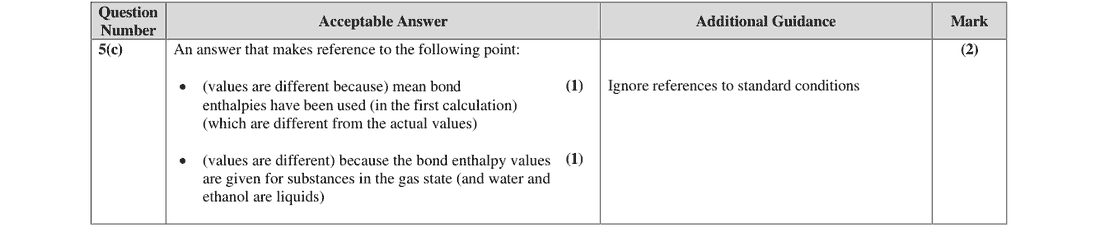
Give two reasons for the difference between your calculated values in (a) and (b).
June 2024 · Paper 2 · Q2(b) 1 mark Short answer organic synthesis
Earlier part of question 2 that this part usesEarlier part of June 2024 Paper 2 question 2
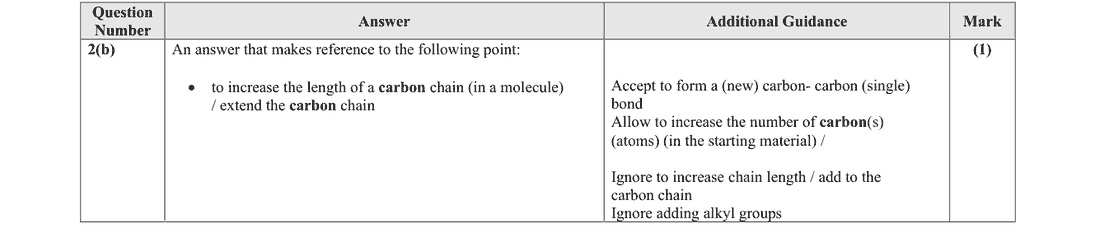
State the use of Grignard reagents in organic synthesis.
June 2024 · Paper 2 · Q3(c)(i) 2 marks Short answer kinetics ii
Earlier part of question 3 that this part usesEarlier part of June 2024 Paper 2 question 3
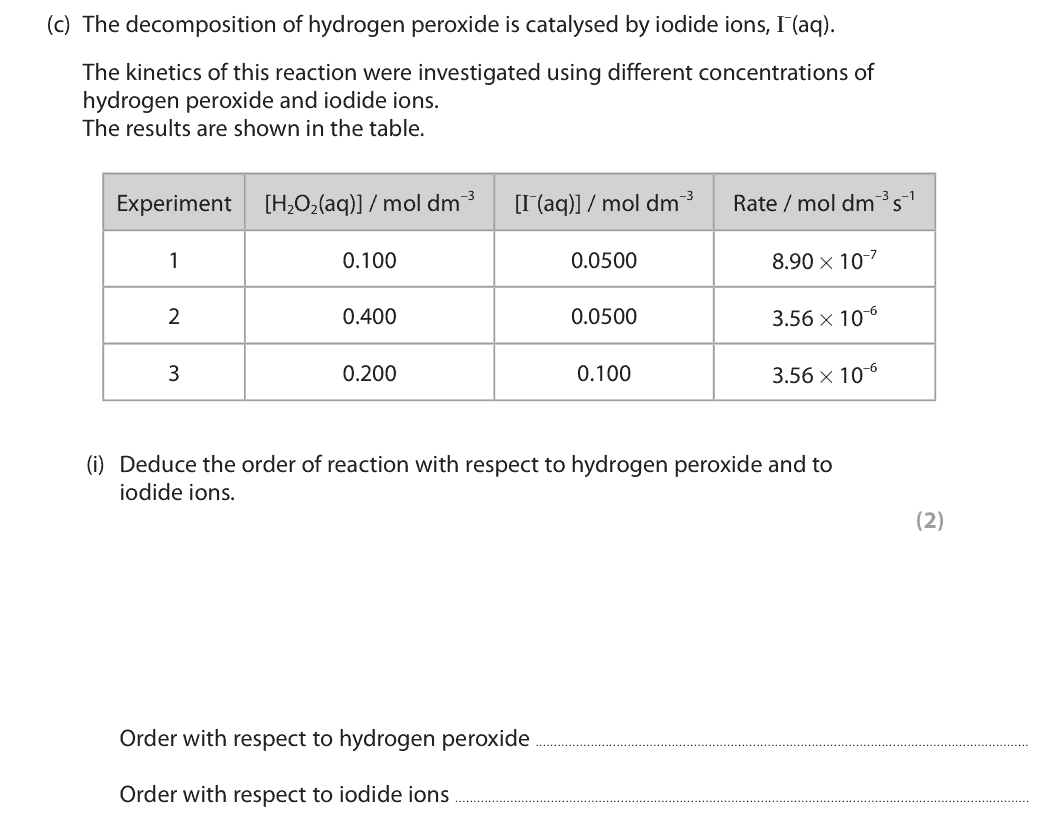
The decomposition of hydrogen peroxide is catalysed by iodide ions, I–(aq).
The kinetics of this reaction were investigated using different concentrations of
hydrogen peroxide and iodide ions.
The results are shown in the table.
[I–(aq)] / mol dm–3
Experiment
[H2O2(aq)] / mol dm–3
Rate / mol dm–3 s–1
1
0.100
0.0500
8.90 × 10–7
2
0.400
0.0500
3.56 × 10–6
3
0.200
0.100
3.56 × 10–6
Deduce the order of reaction with respect to hydrogen peroxide and to
iodide ions.
Order with respect to hydrogen peroxide 
Order with respect to iodide ions
June 2024 · Paper 2 · Q3(c)(ii) 1 mark Short answer kinetics ii
Earlier parts of question 3 that this part usesEarlier part of June 2024 Paper 2 question 3Earlier part of June 2024 Paper 2 question 3
Write the rate equation for the reaction using your answer to (c)(i).
June 2024 · Paper 2 · Q5(a) 1 mark Short answer alkanes
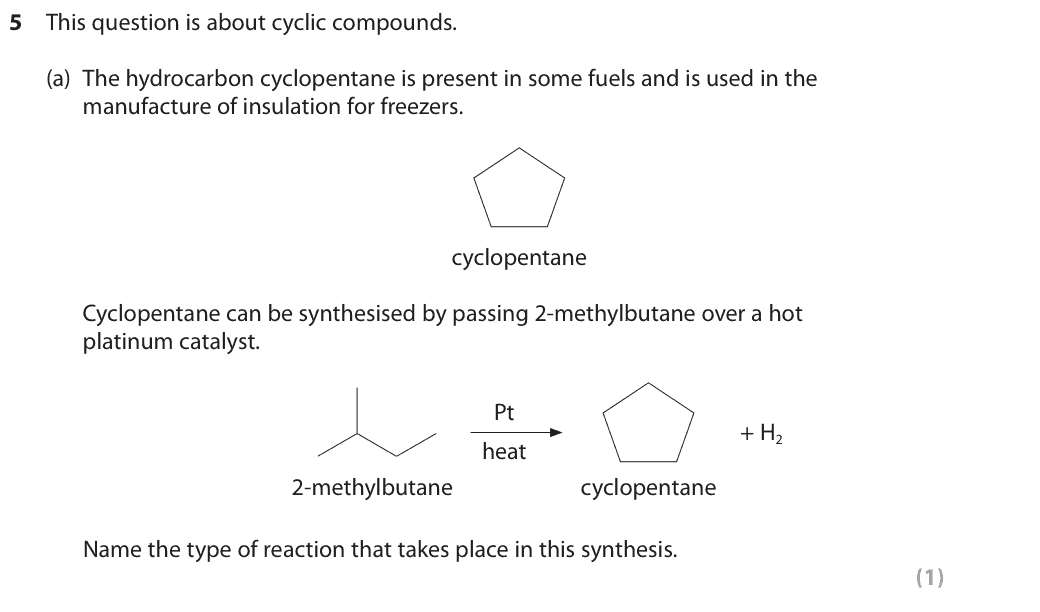
This question is about cyclic compounds.
The hydrocarbon cyclopentane is present in some fuels and is used in the
manufacture of insulation for freezers.
cyclopentane
Cyclopentane can be synthesised by passing 2‑methylbutane over a hot
platinum catalyst.
Pt
+ H2
heat
2‑methylbutane
cyclopentane
Name the type of reaction that takes place in this synthesis.
June 2024 · Paper 2 · Q5(c)(i) 1 mark Short answer alkanes
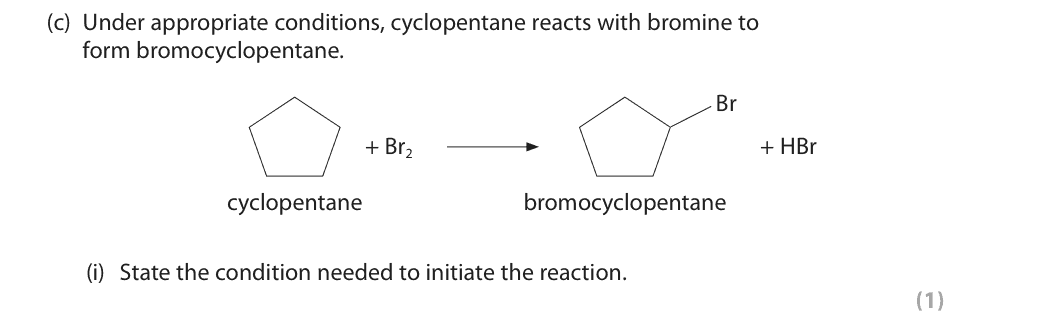
Under appropriate conditions, cyclopentane reacts with bromine to
form bromocyclopentane.
Br
+ Br2
+ HBr
cyclopentane
bromocyclopentane
State the condition needed to initiate the reaction.
June 2024 · Paper 2 · Q5(d)(ii) 1 mark Short answer introduction to organic chemistryhalogenoalkanes
Earlier parts of question 5 that this part usesEarlier part of June 2024 Paper 2 question 5Earlier part of June 2024 Paper 2 question 5
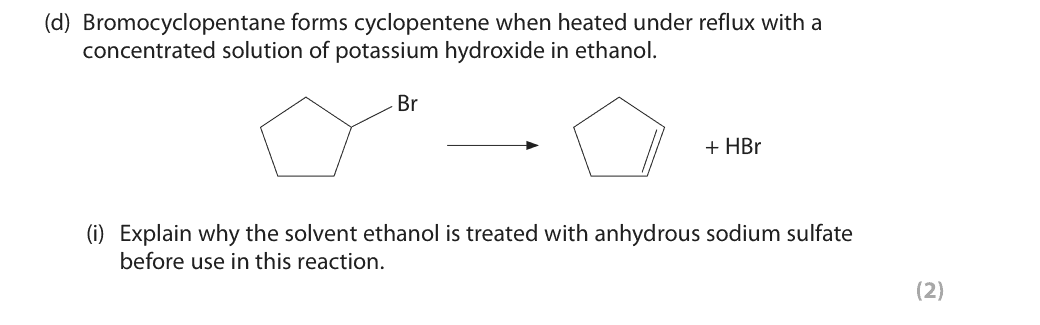
Give the name of the reaction shown in the equation.
June 2024 · Paper 2 · Q6(c)(i) 1 mark Short answer amines amides amino acids and proteins
A secondary amine, Q, has the molecular formula C6H15N.
The low resolution 1H NMR spectrum of Q has three peaks.
State what is meant by the term ‘secondary amine’.
June 2024 · Paper 2 · Q7(c)(iii) 1 mark Short answer alkenes
Earlier parts of question 7 that this part usesEarlier part of June 2024 Paper 2 question 7Earlier part of June 2024 Paper 2 question 7
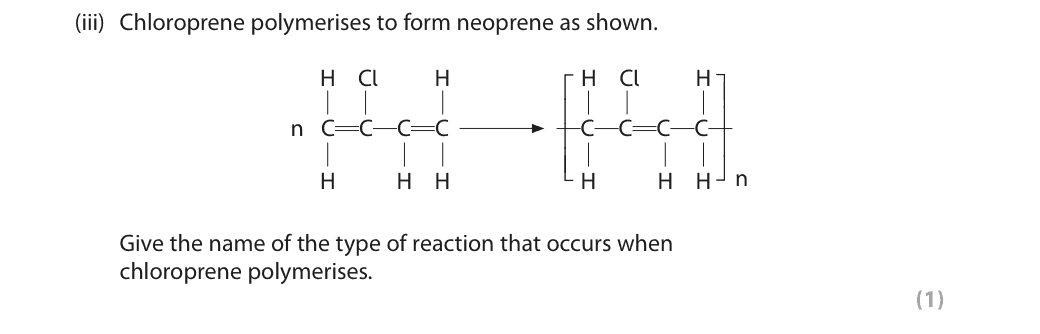
Chloroprene polymerises to form neoprene as shown.
H
Cl
H
H
Cl
H
n
C
C
C
C
C
C
C
C
n
H
H
H
H
H
H
Give the name of the type of reaction that occurs when
chloroprene polymerises.
June 2024 · Paper 2 · Q8(a)(i) 1 mark Short answer chirality
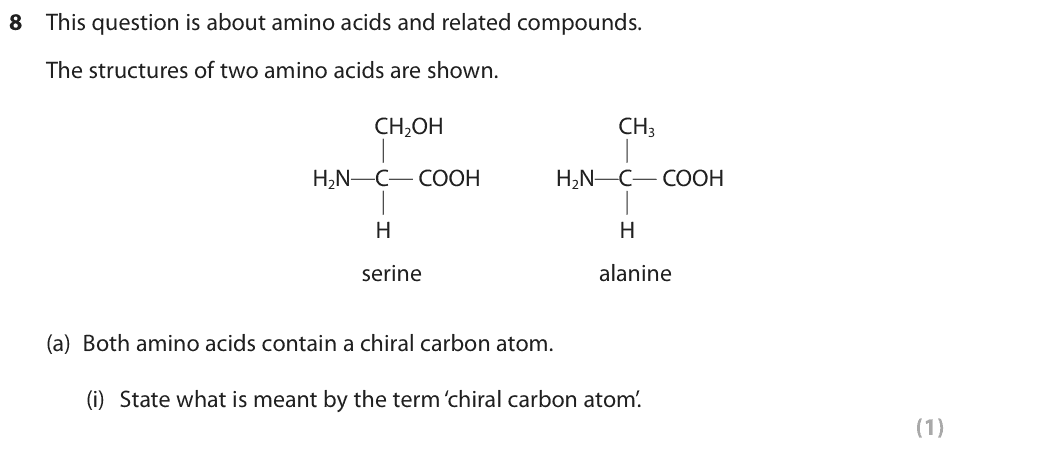
This question is about amino acids and related compounds.
The structures of two amino acids are shown.
CH2OH
CH3
H2N
C
COOH
H2N
C
COOH
H
H
serine
alanine
Both amino acids contain a chiral carbon atom.
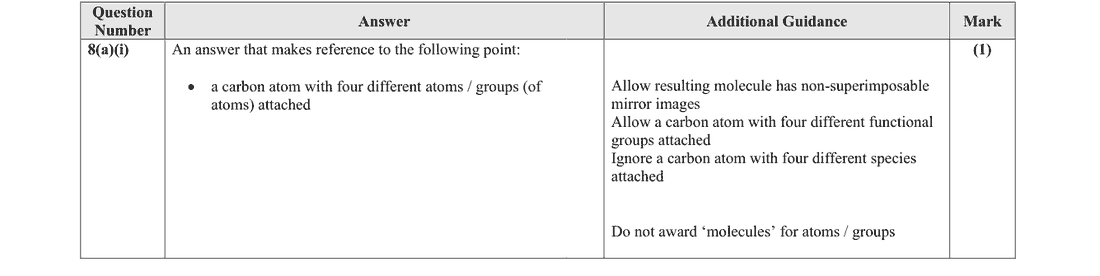
State what is meant by the term ‘chiral carbon atom’.
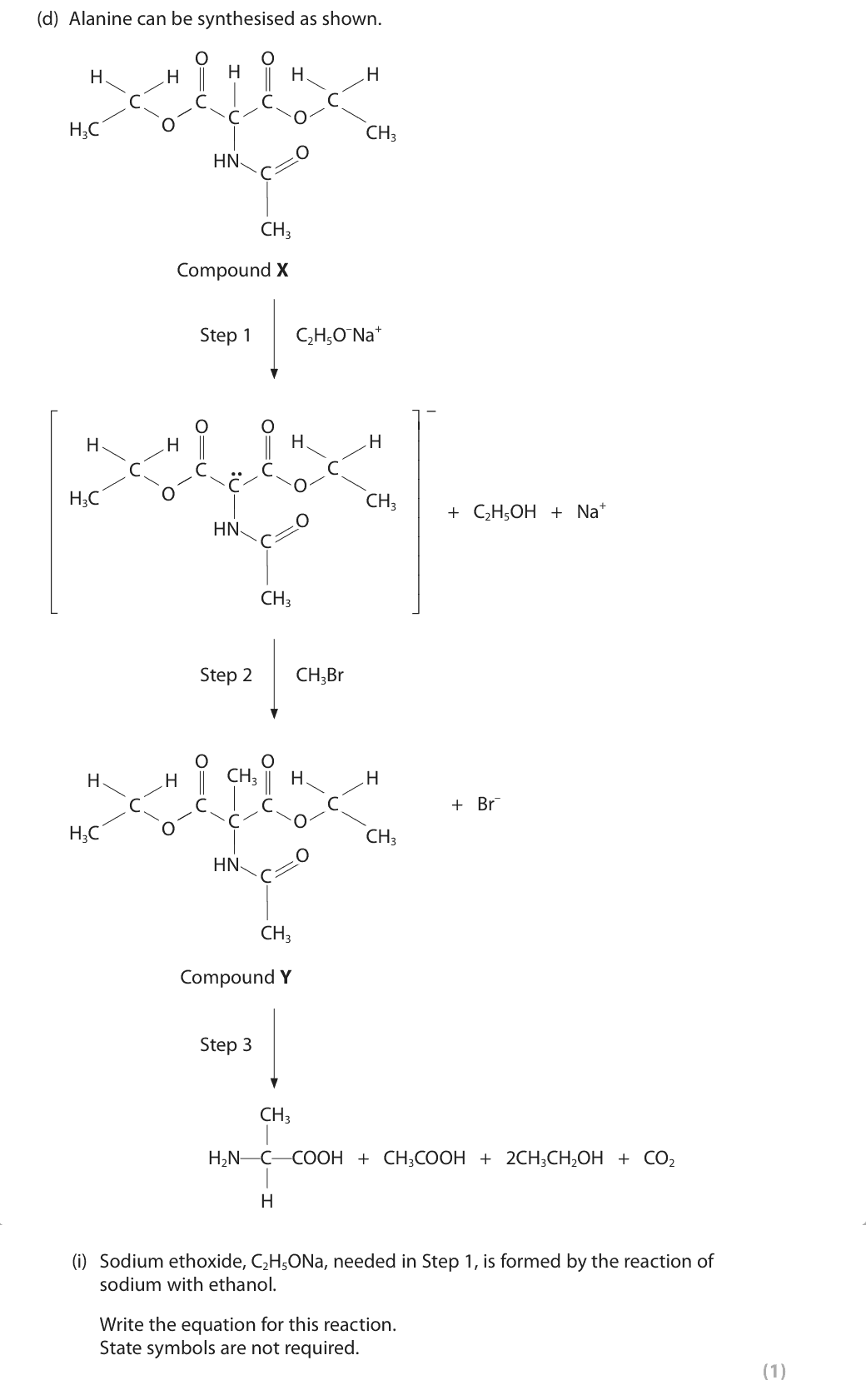
June 2024 · Paper 2 · Q8(d)(ii) 2 marks Short answer carboxylic acidsamines amides amino acids and proteins
Earlier parts of question 8 that this part usesEarlier part of June 2024 Paper 2 question 8Earlier part of June 2024 Paper 2 question 8
Name the two functional groups present in Compound Y.
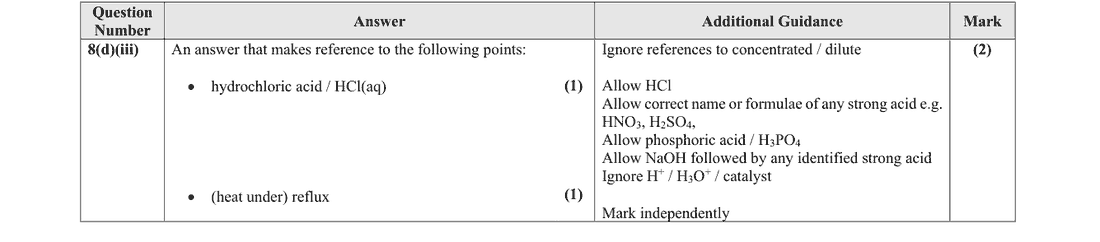
June 2024 · Paper 2 · Q8(d)(iii) 2 marks Short answer carboxylic acids
Earlier parts of question 8 that this part usesEarlier part of June 2024 Paper 2 question 8Earlier part of June 2024 Paper 2 question 8
Give the reagent needed and conditions required for Step 3.
June 2024 · Paper 3 · Q1(a) 2 marks Short answer atomic structure and the periodic table
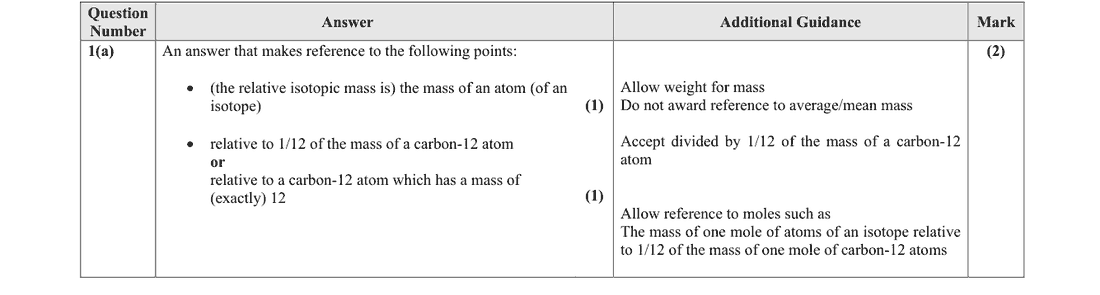
Relative isotopic mass is an important concept in chemistry.
Define relative isotopic mass.
June 2024 · Paper 3 · Q1(b) 1 mark Short answer Hard atomic structure and the periodic table
A sample of hydrogen gas is formed from atoms of three isotopes, 1H, 2H and 3H.
Deduce the number of peaks due to molecular ions, H2
+, in the mass spectrum of
this sample.
June 2024 · Paper 3 · Q6(b)(iii) 3 marks Short answer nmr mass spectrometry and chromatography
Earlier parts of question 6 that this part usesEarlier part of June 2024 Paper 3 question 6Earlier part of June 2024 Paper 3 question 6
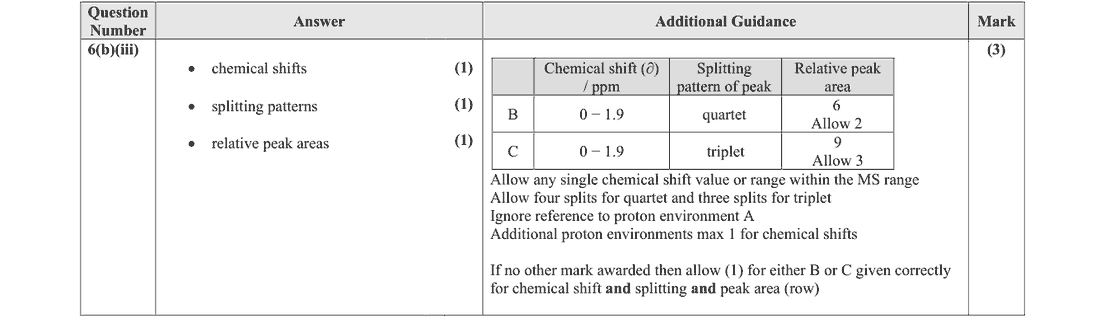
Predict the chemical shifts, relative peak areas and splitting patterns in the
high resolution proton NMR spectrum, due to the proton environments you
have labelled.
Do not consider proton environment A.
June 2024 · Paper 3 · Q7(b) 5 marks Short answer organic synthesishalogenoalkanesalcohols
Earlier part of question 7 that this part usesEarlier part of June 2024 Paper 3 question 7
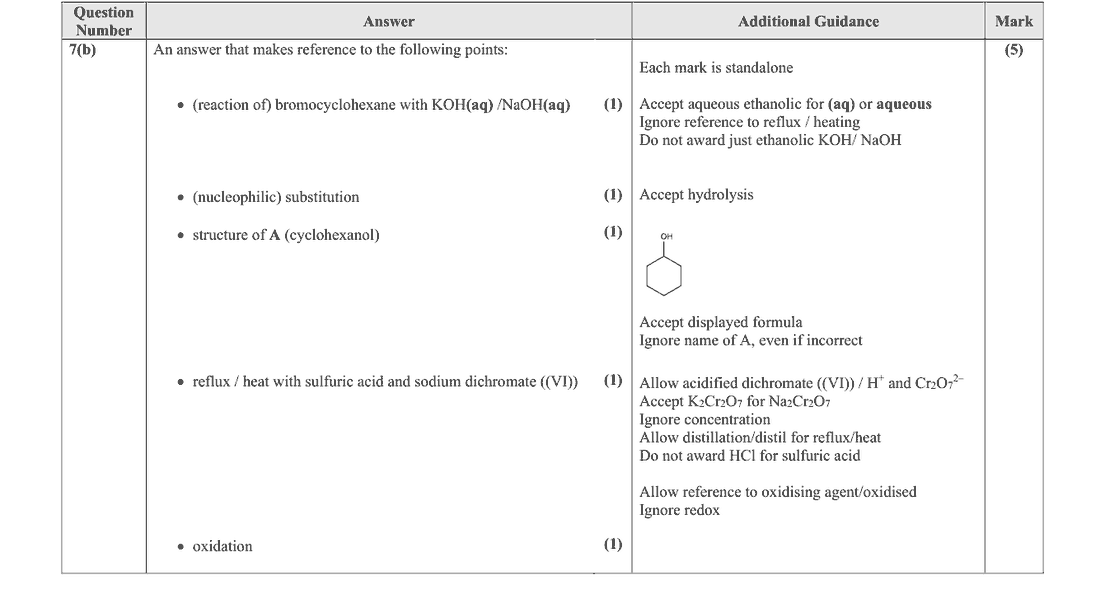
Devise a reaction scheme for Step 2 and Step 3 of the synthesis.
Include in your answer all reagents and conditions, the type of reaction in each
step, and the structure of A.
June 2024 · Paper 3 · Q7(c)(i) 1 mark Short answer organic synthesis
Earlier part of question 7 that this part usesEarlier part of June 2024 Paper 3 question 7
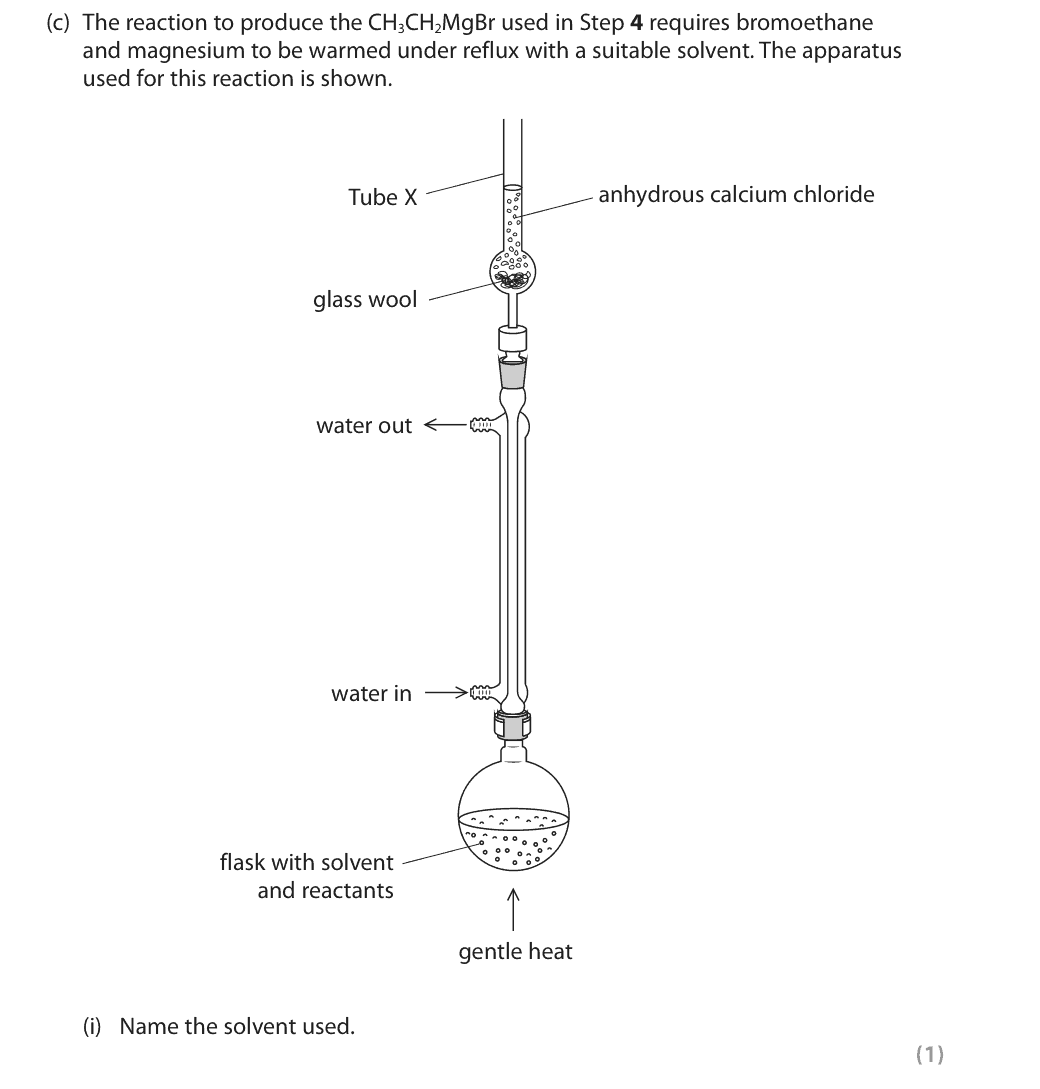
The reaction to produce the CH3CH2MgBr used in Step 4 requires bromoethane
and magnesium to be warmed under reflux with a suitable solvent. The apparatus
used for this reaction is shown.
Tube X
anhydrous calcium chloride
glass wool
water out
water in
flask with solvent
and reactants
gentle heat
Name the solvent used.
June 2024 · Paper 3 · Q8(a)(iii) 3 marks Short answer acid base equilibria
Earlier part of question 8 that this part usesEarlier part of June 2024 Paper 3 question 8
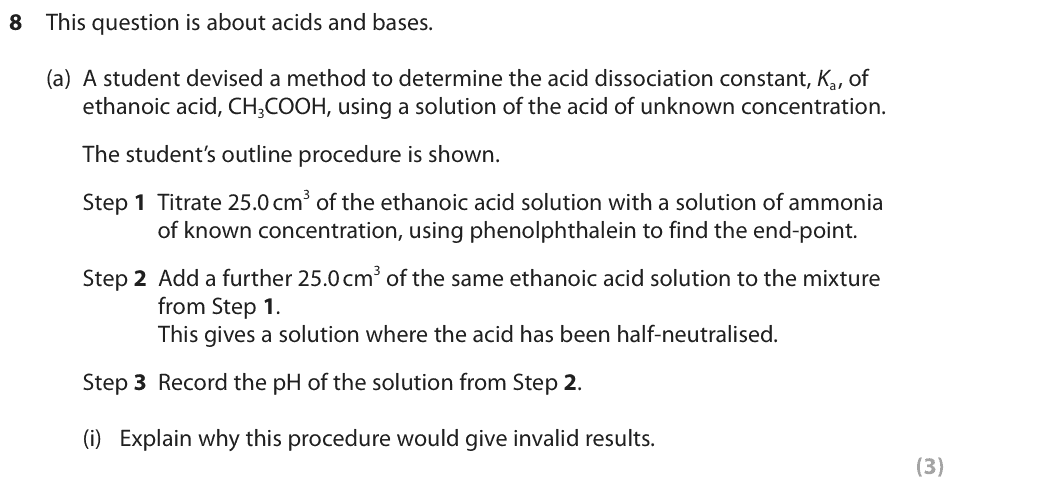
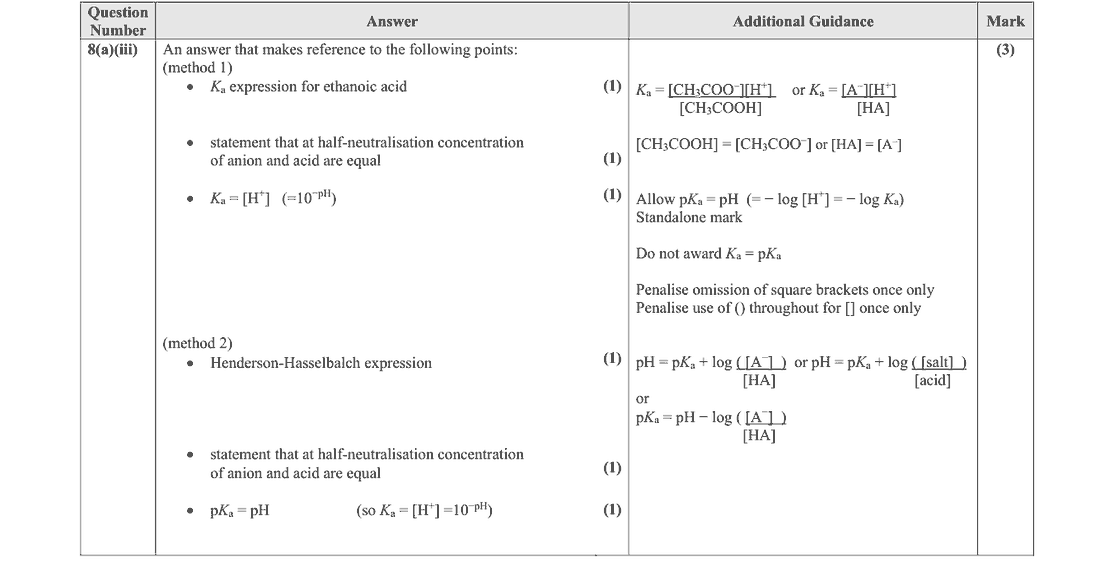
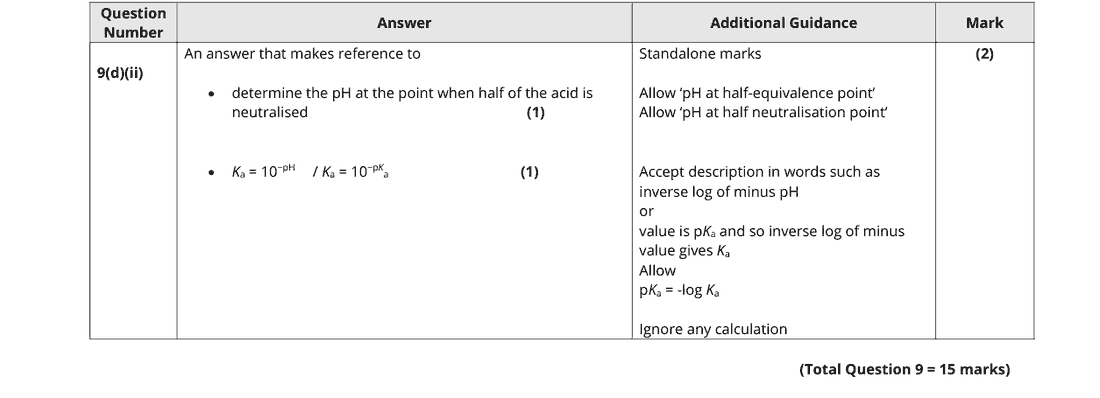
Show that when the solution has been half-neutralised, the acid dissociation
constant is given by the expression
Ka = 10–pH
June 2024 · Paper 3 · Q10(b)(iii) 2 marks Short answer kinetics ii
Earlier parts of question 10 that this part usesEarlier part of June 2024 Paper 3 question 10Earlier part of June 2024 Paper 3 question 10Earlier part of June 2024 Paper 3 question 10
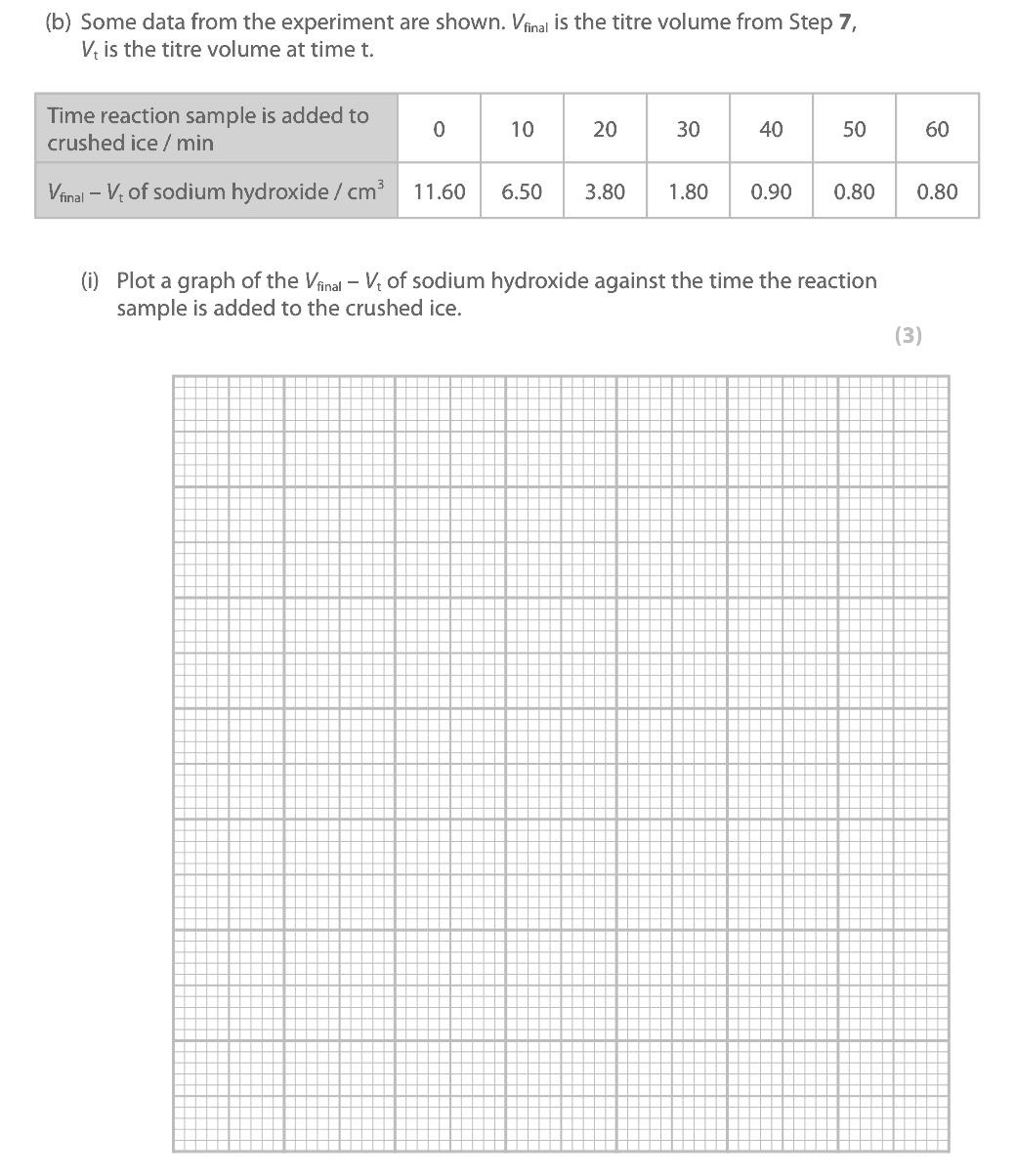
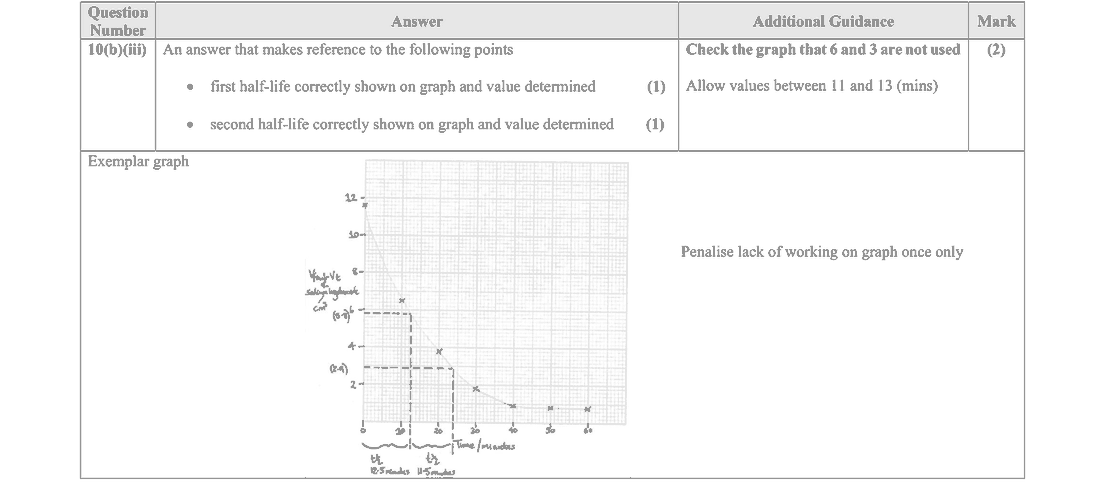
Determine two half-lives for the reaction, showing your working on the graph.
June 2024 · Paper 3 · Q10(b)(iv) 1 mark Short answer kinetics ii
Earlier parts of question 10 that this part usesEarlier part of June 2024 Paper 3 question 10Earlier part of June 2024 Paper 3 question 10Earlier part of June 2024 Paper 3 question 10Earlier part of June 2024 Paper 3 question 10
Deduce the order of the reaction, using your answer from (b)(iii) to justify
your deduction.
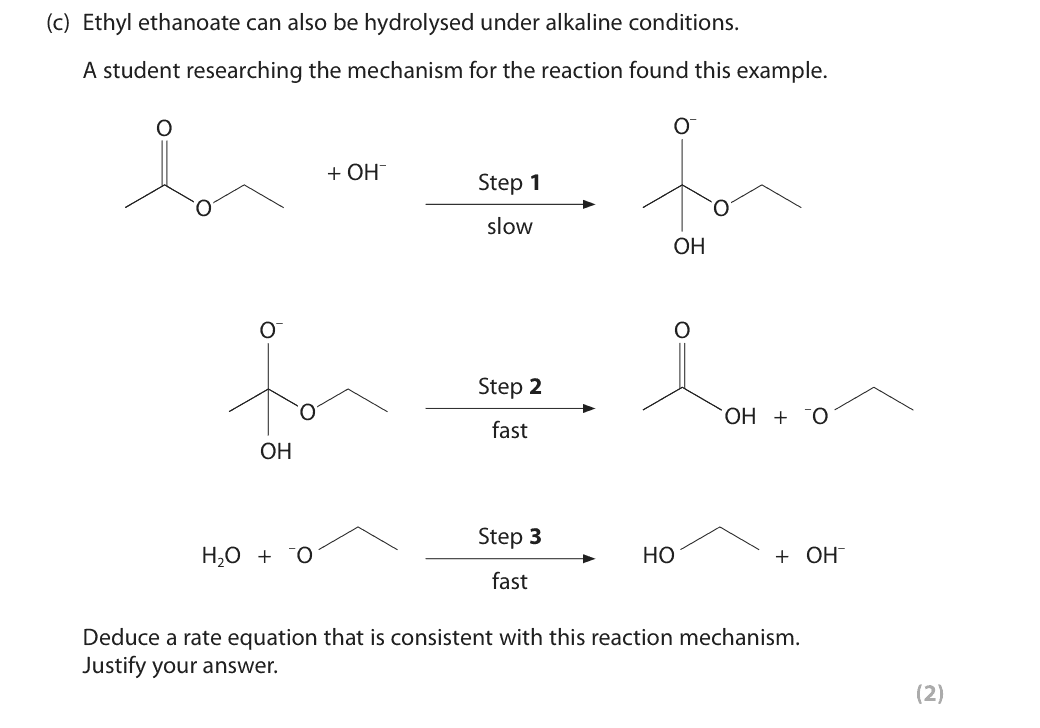
June 2024 · Paper 3 · Q10(c) 2 marks Short answer kinetics ii
Earlier part of question 10 that this part usesEarlier part of June 2024 Paper 3 question 10
Ethyl ethanoate can also be hydrolysed under alkaline conditions.
A student researching the mechanism for the reaction found this example.
O–
O
+ OH–
Step 1
O
O
slow
OH
O–
O
Step 2
O
OH   +   –O
fast
OH
Step 3
H2O   +   –O
HO
+   OH–
fast
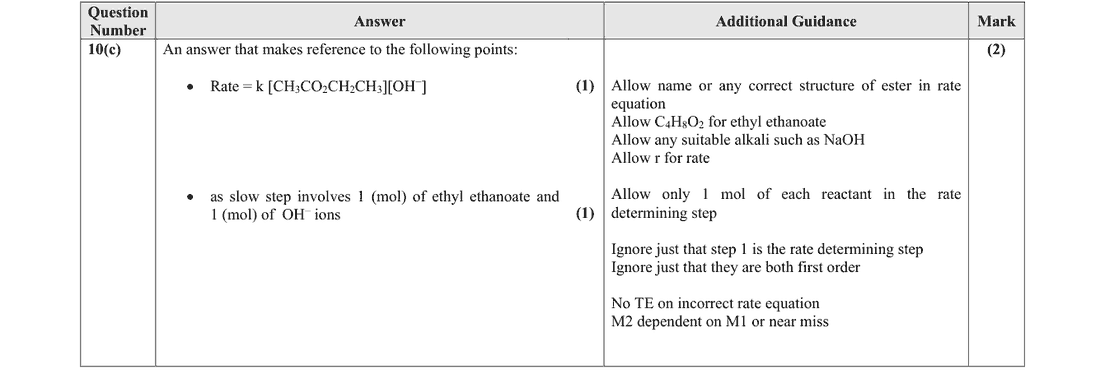
Deduce a rate equation that is consistent with this reaction mechanism.
Justify your answer.
June 2023 · AS Paper 1 · Q1(b)(i) 1 mark Short answer atomic structure and the periodic table
State the shape of the 2s orbital of a silicon atom.
June 2023 · AS Paper 1 · Q1(b)(ii) 1 mark Short answer atomic structure and the periodic table
Earlier part of question 1 that this part usesEarlier part of June 2023 Paper 1 question 1
State the difference between the two subatomic particles in the 2s orbital.
June 2023 · AS Paper 1 · Q1(d) 1 mark Short answer atomic structure and the periodic table
Earlier part of question 1 that this part usesEarlier part of June 2023 Paper 1 question 1
Give the symbol, including the mass number and atomic number, for an atom of
element X that has four fewer protons and three fewer neutrons than an atom
of 14
28Si.
June 2023 · AS Paper 1 · Q2(a)(i) 1 mark Short answer atomic structure and the periodic table
This question is about the double salt K2Mg(SO4)2.6H2O.
A double salt is a salt containing more than one cation or more than one anion.
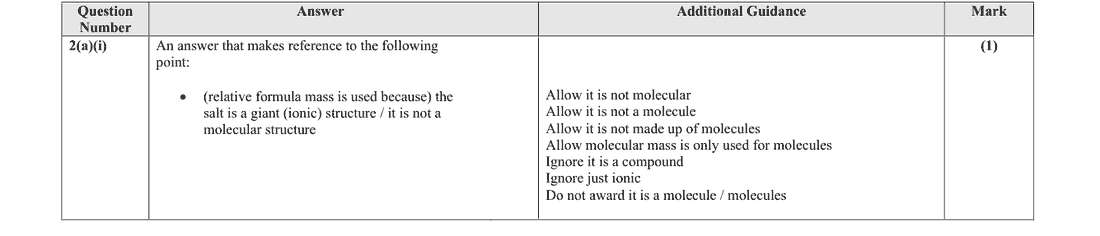
Give the reason why the term relative formula mass is used, rather than
relative molecular mass, when discussing K2Mg(SO4)2.6H2O.
June 2023 · AS Paper 1 · Q2(a)(ii) 1 mark Short answer atomic structure and the periodic table
Earlier part of question 2 that this part usesEarlier part of June 2023 Paper 1 question 2
Give the reason why relative formula mass has no mathematical units.
June 2023 · AS Paper 1 · Q3(a)(iv) 1 mark Short answer redox i
Earlier part of question 3 that this part usesEarlier part of June 2023 Paper 1 question 3
Platinum metal reacts with fluorine to give a compound of platinum with an
oxidation number of +6.
Give the formula of this compound of platinum.
June 2023 · AS Paper 1 · Q5(a) 1 mark Short answer bonding
The question is about electronegativity and its influence on bonding.
State what is meant by the term electronegativity.
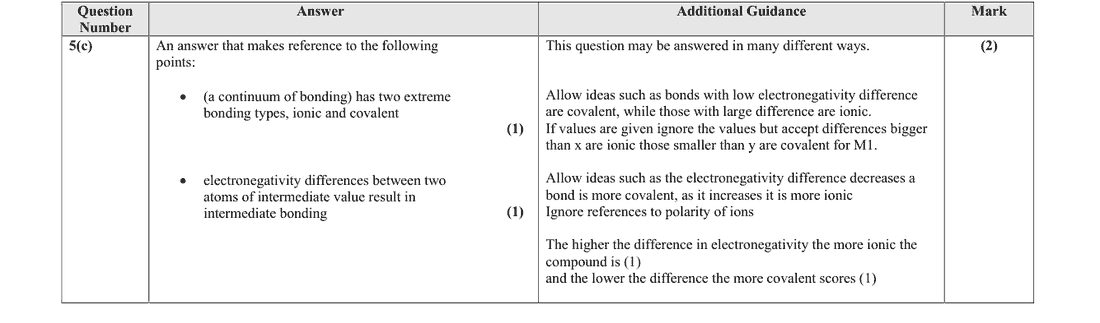
June 2023 · AS Paper 1 · Q5(c) 2 marks Short answer Hard bonding
Describe what you understand by the term ‘continuum of bonding type’ in
relation to electronegativities.
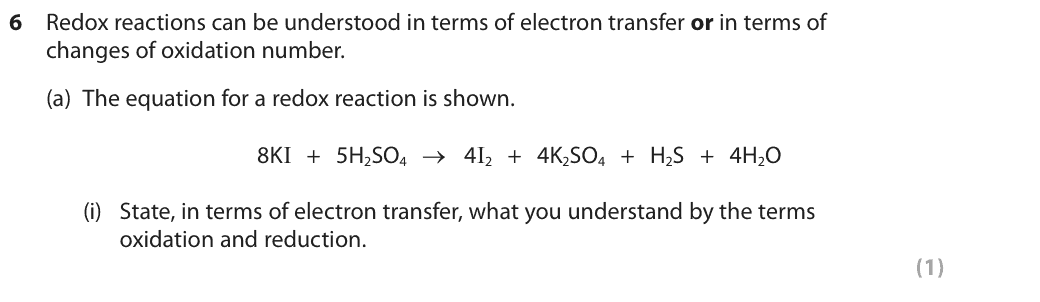
June 2023 · AS Paper 1 · Q6(a)(i) 1 mark Short answer Easy redox i
Redox reactions can be understood in terms of electron transfer or in terms of
changes of oxidation number.
The equation for a redox reaction is shown.
8KI   +   5H2SO4   →   4I2   +   4K2SO4   +   H2S   +   4H2O
State, in terms of electron transfer, what you understand by the terms
oxidation and reduction.
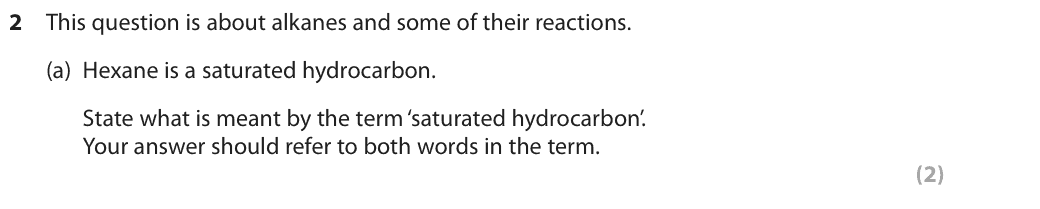
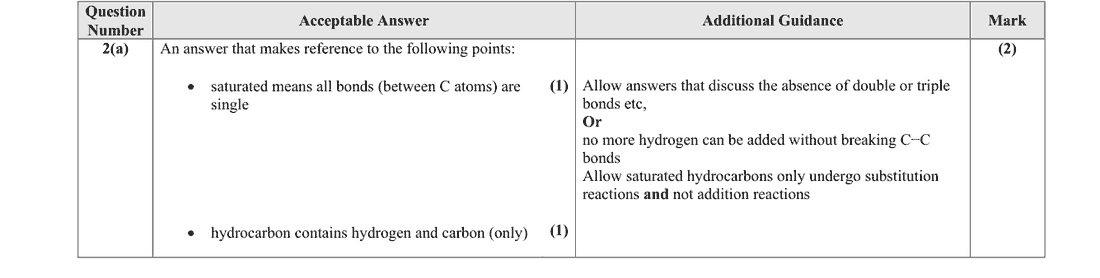
June 2023 · AS Paper 2 · Q2(a) 2 marks Short answer alkanesintroduction to organic chemistry
This question is about alkanes and some of their reactions.
Hexane is a saturated hydrocarbon.
State what is meant by the term ‘saturated hydrocarbon’.
Your answer should refer to both words in the term.
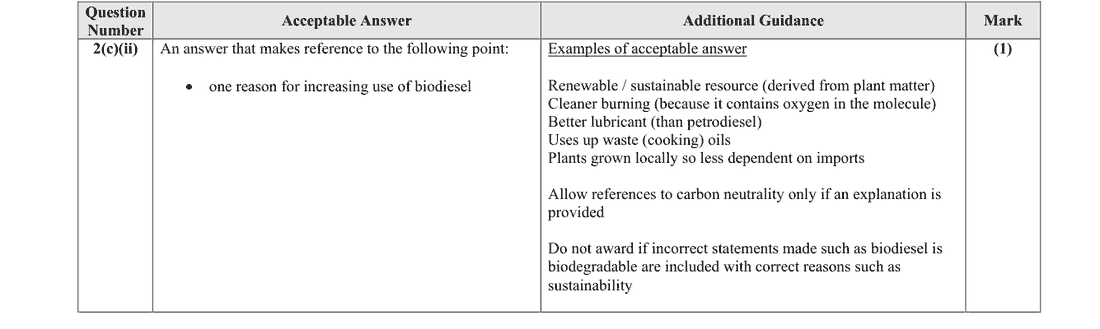
June 2023 · AS Paper 2 · Q2(c)(ii) 1 mark Short answer alkanes
Earlier part of question 2 that this part usesEarlier part of June 2023 Paper 2 question 2
Biodiesel is derived from plants and petrodiesel is derived from crude oil.
Biodiesel is increasingly widely used, although it is more expensive and
provides less energy per kg when burned than petrodiesel.
Give one reason why biodiesel is now preferred to petrodiesel.
June 2023 · AS Paper 2 · Q3(h)(i) 1 mark Short answer alkenes
Various methods are used to reduce the problem of plastic waste, including the
incineration, recycling and introduction of biodegradable polymers.
Describe how the toxic gas hydrogen chloride produced during the
incineration of poly(chloroethene) could be removed.
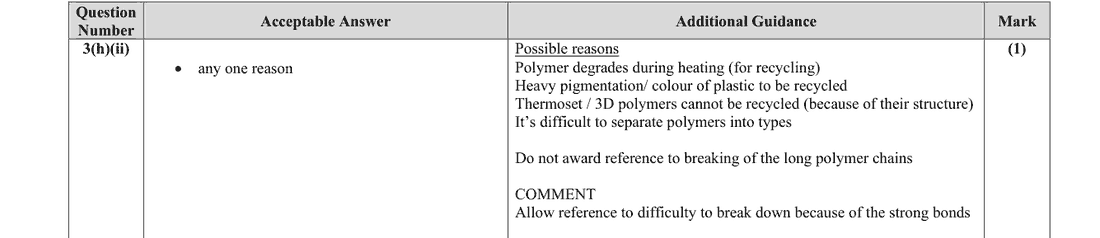
June 2023 · AS Paper 2 · Q3(h)(ii) 1 mark Short answer alkenes
Earlier part of question 3 that this part usesEarlier part of June 2023 Paper 2 question 3
Give a reason why some polymers cannot be recycled.
June 2023 · AS Paper 2 · Q4(b) 1 mark Short answer halogenoalkanes
Earlier part of question 4 that this part usesEarlier part of June 2023 Paper 2 question 4
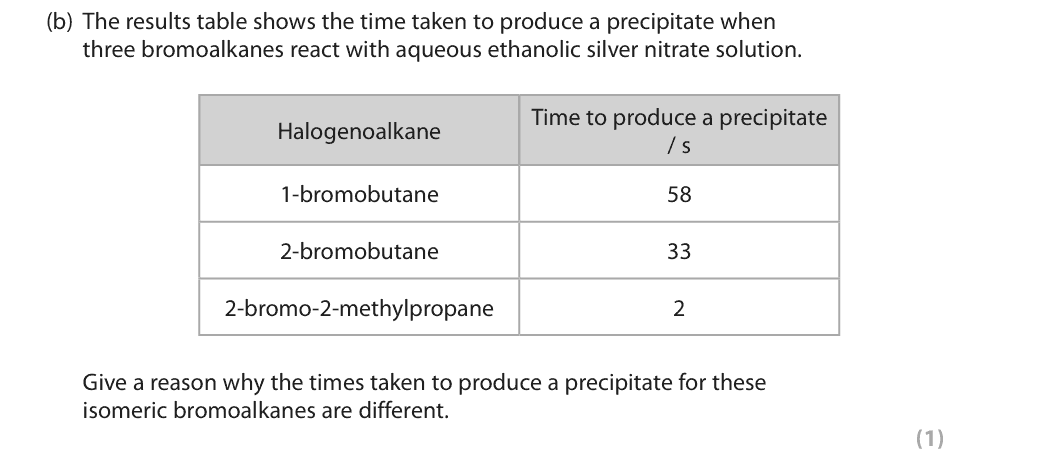
The results table shows the time taken to produce a precipitate when
three bromoalkanes react with aqueous ethanolic silver nitrate solution.
Time to produce a precipitate
Halogenoalkane
/ s
1‑bromobutane
58
2‑bromobutane
33
2‑bromo‑2‑methylpropane
2
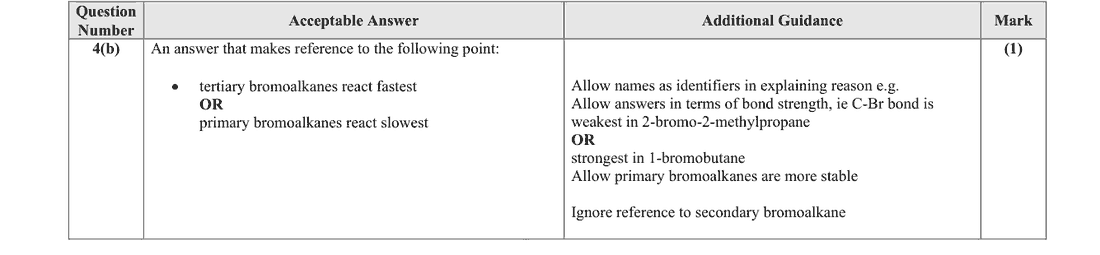
Give a reason why the times taken to produce a precipitate for these
isomeric bromoalkanes are different.
June 2023 · AS Paper 2 · Q4(c)(ii) 1 mark Short answer halogenoalkanes
Earlier part of question 4 that this part usesEarlier part of June 2023 Paper 2 question 4
Write the formula of the final inorganic product of the reaction of
1‑bromopropane with excess ammonia.
June 2023 · AS Paper 2 · Q4(d)(i) 2 marks Short answer formulae equations and amounts of substance
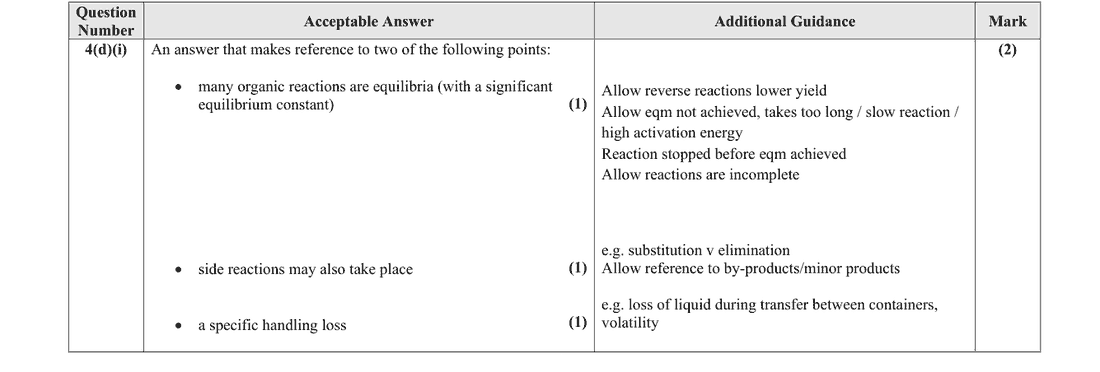
1-bromopropane undergoes reactions when heated with different reagents.
Give two reasons why organic reactions are often heated for a long time but
the yield is frequently low.
June 2023 · AS Paper 2 · Q4(d)(ii) 2 marks Short answer halogenoalkanes
Earlier part of question 4 that this part usesEarlier part of June 2023 Paper 2 question 4
Give the name or formula of the reagent and the condition, other than heat,
used to increase the carbon chain length by one carbon atom, starting from
1-bromopropane.
June 2023 · AS Paper 2 · Q4(d)(iii) 2 marks Short answer halogenoalkanes
Earlier parts of question 4 that this part usesEarlier part of June 2023 Paper 2 question 4Earlier part of June 2023 Paper 2 question 4
1-bromopropane, CH3CH2CH2CH2Br, can be converted into
but-1-ene, CH3CH2CH
CH2 .
Give the name or formula of the reagent and the condition, other than heat,
used for this reaction.
June 2023 · AS Paper 2 · Q7(c)(ii) 1 mark Short answer alcohols
Earlier part of question 7 that this part usesEarlier part of June 2023 Paper 2 question 7
State how to produce butanal in high yield when butan‑1‑ol reacts
with acidified potassium dichromate(VI).
June 2023 · AS Paper 2 · Q8(a) 2 marks Short answer energetics i
A data book gave the following information.
H2(g)   +   ½O2(g)   →   H2O(l)       ΔH d = –285.8 kJ mol–1
State the two conditions denoted by the standard symbol d for this reaction.
June 2023 · Paper 1 · Q1(b) 1 mark Short answer atomic structure and the periodic table
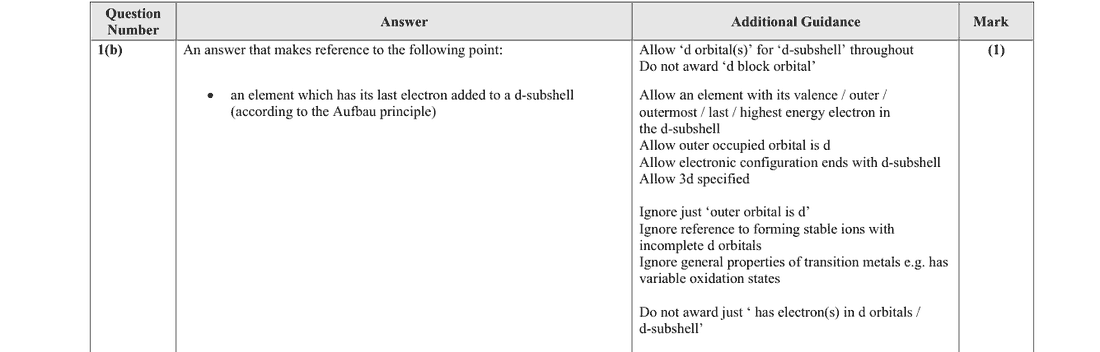
State what is meant by the term d‑block element.
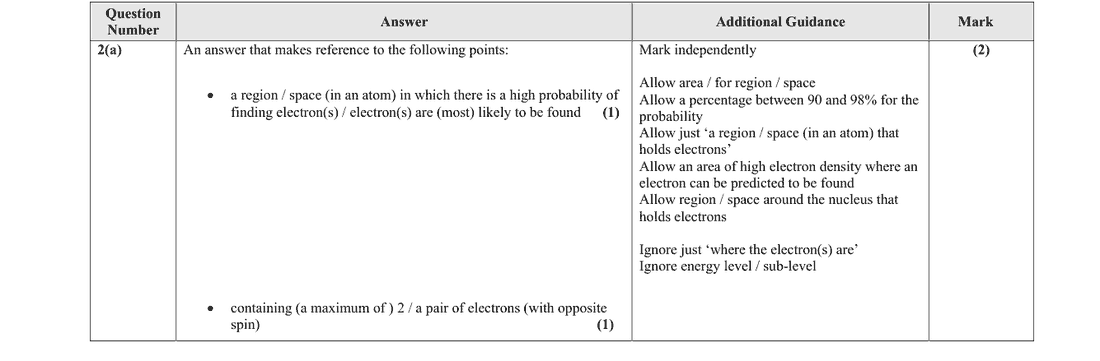
June 2023 · Paper 1 · Q2(a) 2 marks Short answer atomic structure and the periodic table
Chemists often use the term ‘orbital’ when considering atomic structure.
State what is meant by the term orbital.
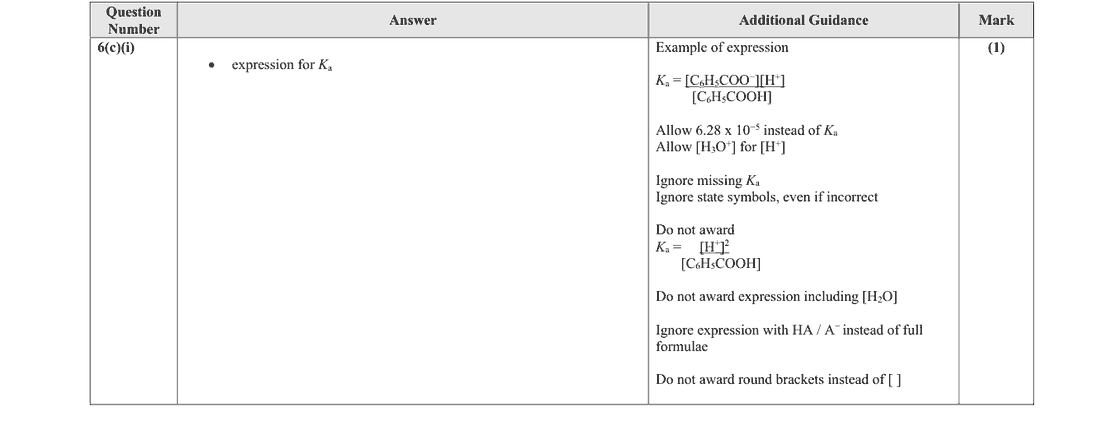
June 2023 · Paper 1 · Q6(c)(i) 1 mark Short answer acid base equilibria
Earlier part of question 6 that this part usesEarlier part of June 2023 Paper 1 question 6
The value of Ka for benzoic acid = 6.28 × 10–5 mol dm–3.
Write the expression for the acid dissociation constant, Ka , of benzoic acid.
June 2023 · Paper 1 · Q7(a) 2 marks Short answer Easy atomic structure and the periodic table
This question is about chromium and chromium compounds.
Naturally occurring chromium has four isotopes, 50Cr, 52Cr, 53Cr and 54Cr.
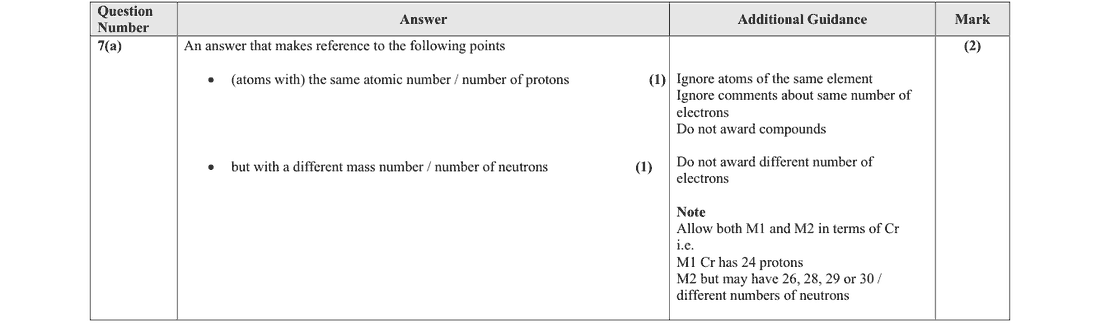
State what is meant by the term isotopes.
June 2023 · Paper 1 · Q7(b)(i) 1 mark Short answer transition metals principles
Both chromium and calcium can form ions with a +2 charge.
Complete the electronic configuration of a Cr2+ ion.
1s2
June 2023 · Paper 1 · Q7(c)(i) 1 mark Short answer transition metals principles
Earlier part of question 7 that this part usesEarlier part of June 2023 Paper 1 question 7
Chromium(III) sulfate, Cr2(SO4)3 , dissolves in water to form the
complex ion [Cr(H2O)6]3+(aq).
State the colour of this complex ion.
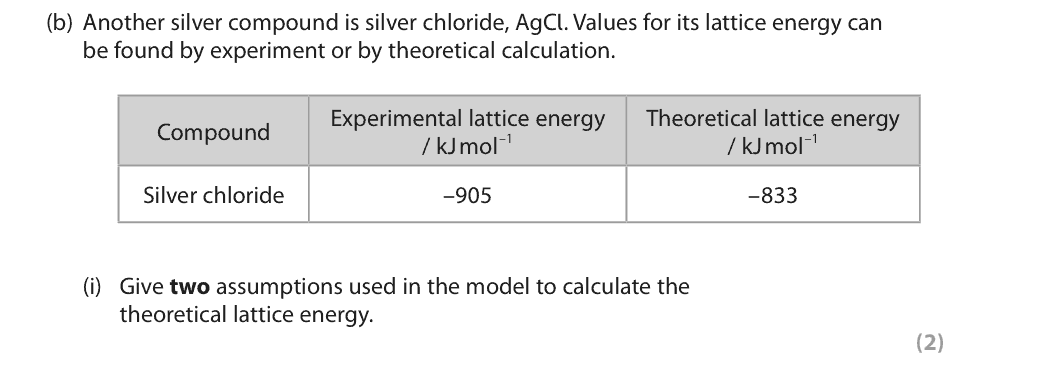
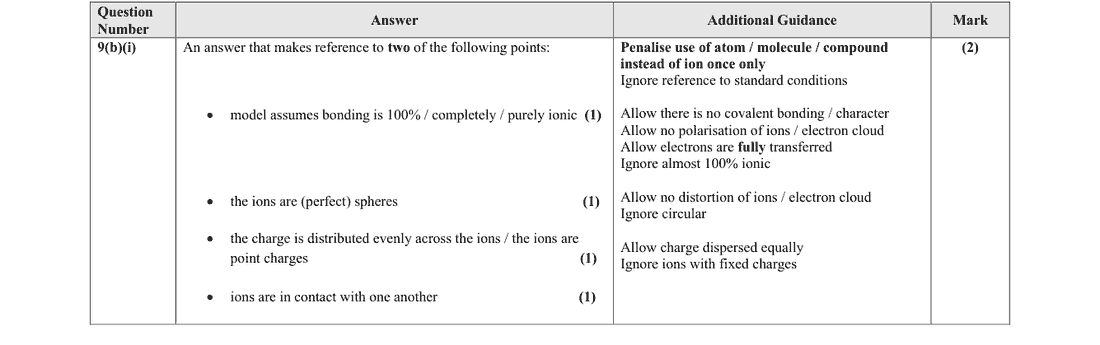
June 2023 · Paper 1 · Q9(b)(i) 2 marks Short answer lattice energy
Another silver compound is silver chloride, AgCl. Values for its lattice energy can
be found by experiment or by theoretical calculation.
Experimental lattice energy
Theoretical lattice energy
Compound
/ kJ mol–1
/ kJ mol–1
Silver chloride
–905
–833
Give two assumptions used in the model to calculate the
theoretical lattice energy.
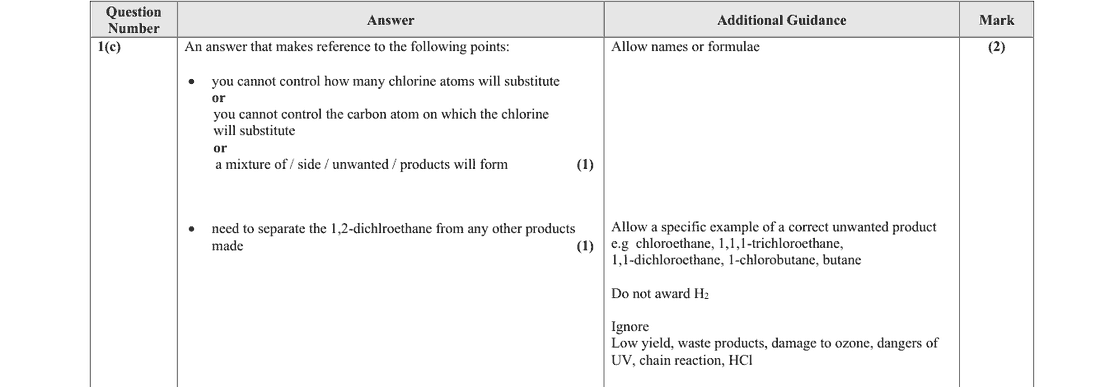
June 2023 · Paper 2 · Q1(c) 2 marks Short answer alkanes
A student is asked to devise a laboratory synthesis of 1,2‑dichloroethane.
The student suggests reacting ethane with chlorine in the presence of
ultraviolet radiation.
Give two reasons why this is not a good method to prepare 1,2‑dichloroethane.
June 2023 · Paper 2 · Q2(c) 1 mark Short answer alcohols
Identify, by name or formula, the reagent(s) needed to convert propan‑1‑ol
into 1‑iodopropane.
June 2023 · Paper 2 · Q2(d)(ii) 1 mark Short answer nmr mass spectrometry and chromatography
Earlier part of question 2 that this part usesEarlier part of June 2023 Paper 2 question 2
State the number of peaks in the 13C NMR spectrum of propan‑2‑ol.
June 2023 · Paper 2 · Q5(a)(i) 1 mark Short answer kinetics ii
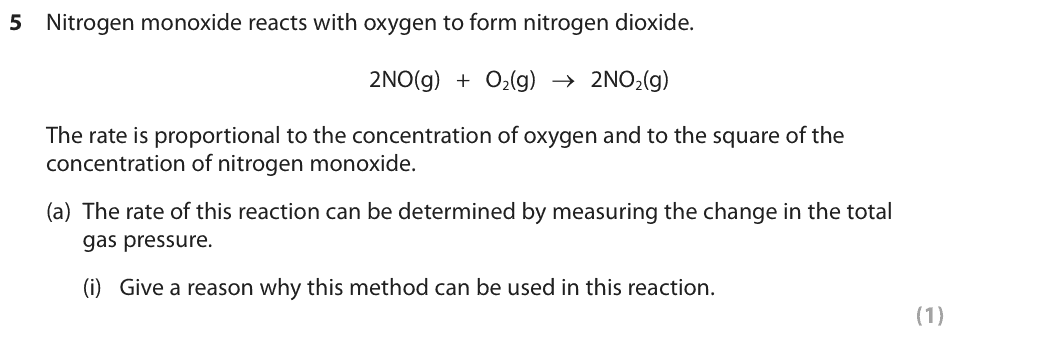
Nitrogen monoxide reacts with oxygen to form nitrogen dioxide.
2NO(g)   +   O2(g)   →   2NO2(g)
The rate is proportional to the concentration of oxygen and to the square of the
concentration of nitrogen monoxide.
The rate of this reaction can be determined by measuring the change in the total
gas pressure.
Give a reason why this method can be used in this reaction.
June 2023 · Paper 2 · Q5(a)(ii) 1 mark Short answer kinetics ii
Earlier part of question 5 that this part usesEarlier part of June 2023 Paper 2 question 5
State two factors, other than initial amounts of reactants, that must be kept
constant for this method to work.
June 2023 · Paper 2 · Q6(b)(iii) 1 mark Short answer kinetics ii
Earlier parts of question 6 that this part usesEarlier part of June 2023 Paper 2 question 6Earlier part of June 2023 Paper 2 question 6Earlier part of June 2023 Paper 2 question 6
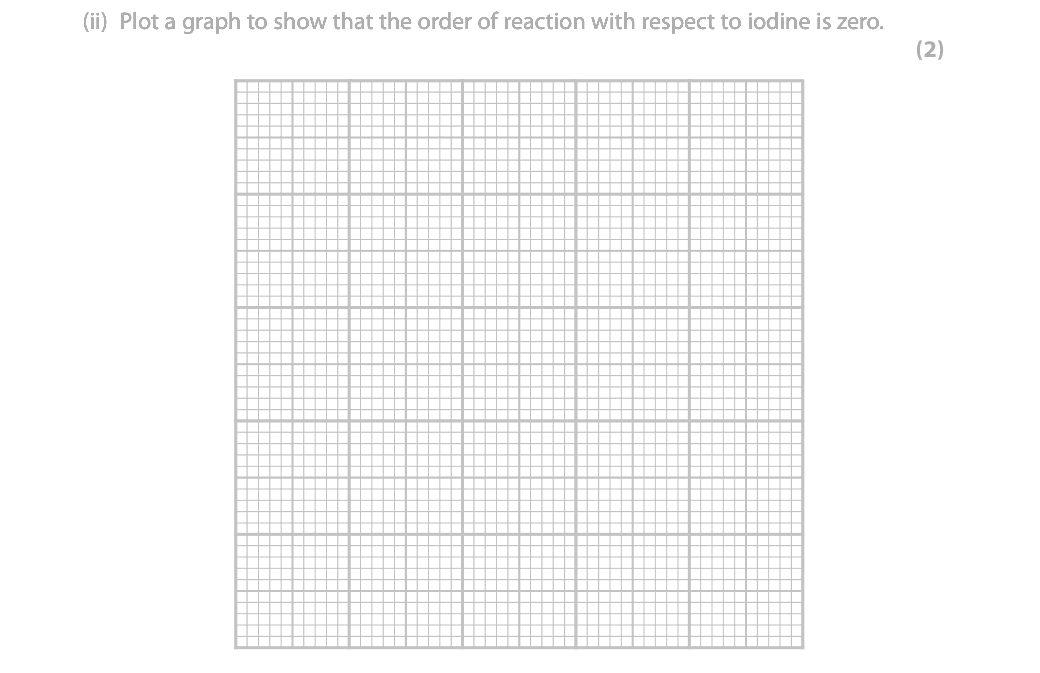
Give a reason why the graph shows that the order of reaction with respect to
iodine is zero.
June 2023 · Paper 2 · Q7(c)(ii) 2 marks Short answer carbonyl compoundsmass spectrometry and infrared spectroscopy
Earlier parts of question 7 that this part usesEarlier part of June 2023 Paper 2 question 7Earlier part of June 2023 Paper 2 question 7
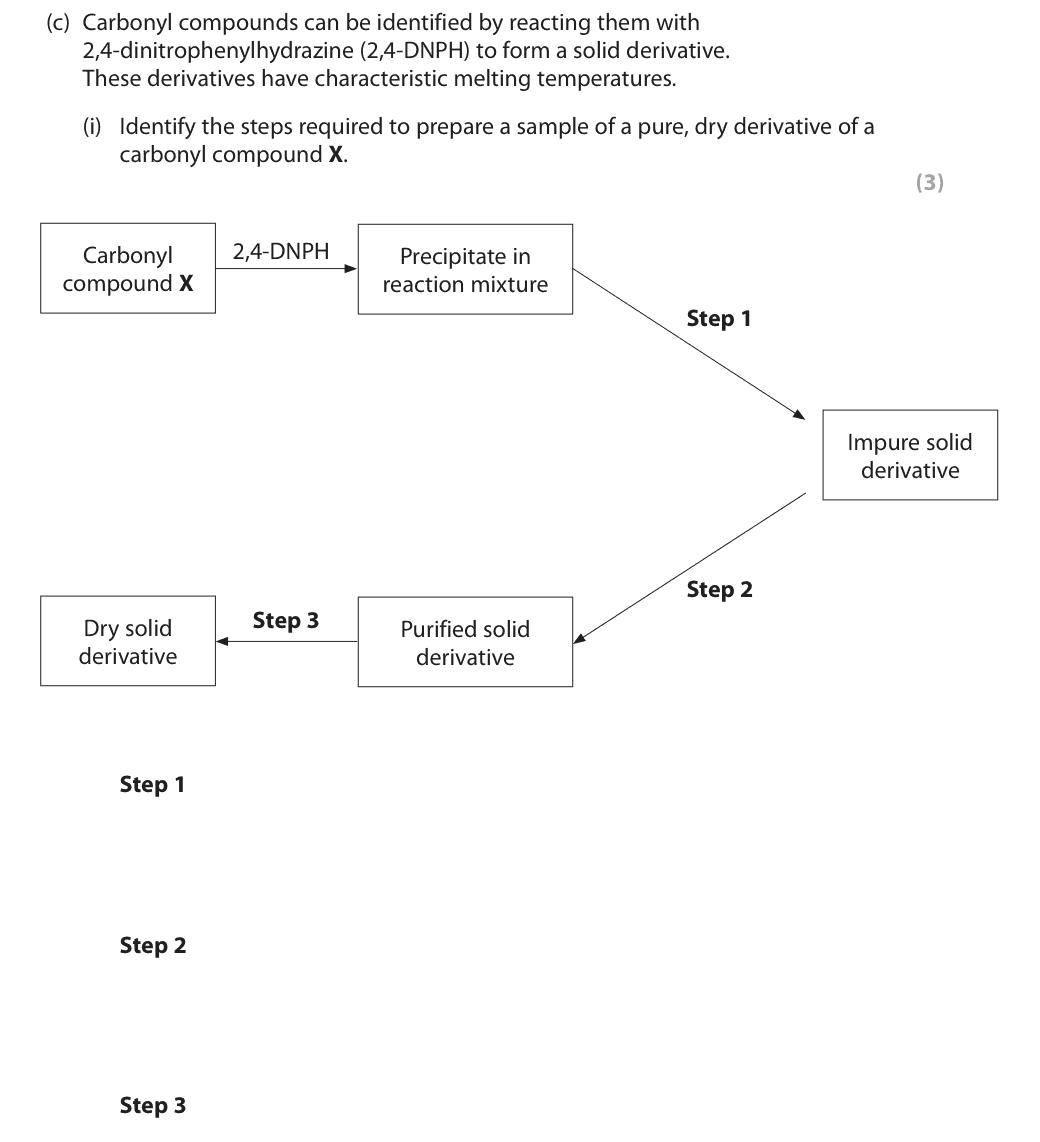
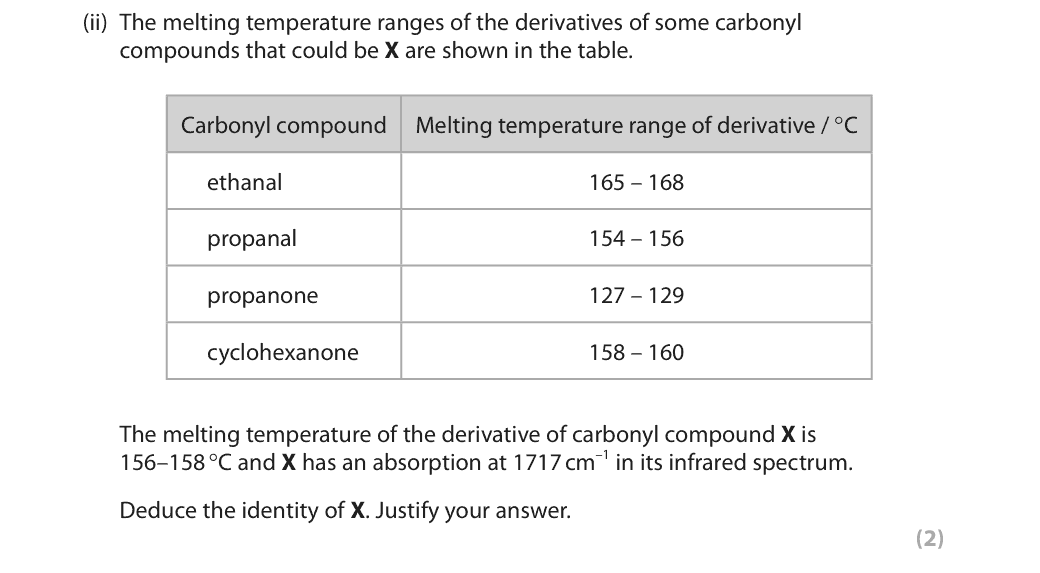
The melting temperature ranges of the derivatives of some carbonyl
compounds that could be X are shown in the table.
Carbonyl compound
Melting temperature range of derivative / °C
ethanal
165 – 168
propanal
154 – 156
propanone
127 – 129
cyclohexanone
158 – 160
The melting temperature of the derivative of carbonyl compound X is
156–158 °C and X has an absorption at 1717 cm–1 in its infrared spectrum.
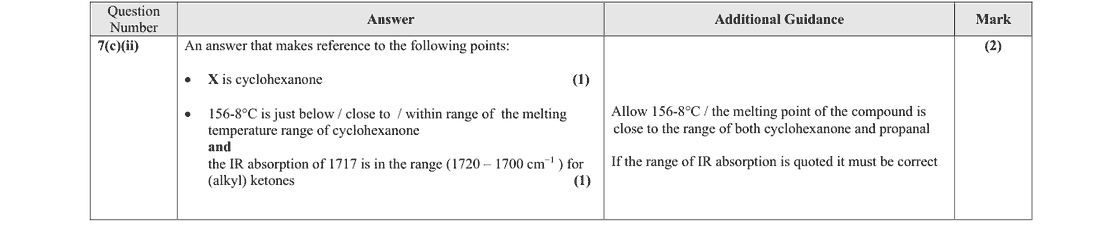
Deduce the identity of X. Justify your answer.
June 2023 · Paper 2 · Q7(c)(iii) 2 marks Short answer nmr mass spectrometry and chromatography
Earlier parts of question 7 that this part usesEarlier part of June 2023 Paper 2 question 7Earlier part of June 2023 Paper 2 question 7
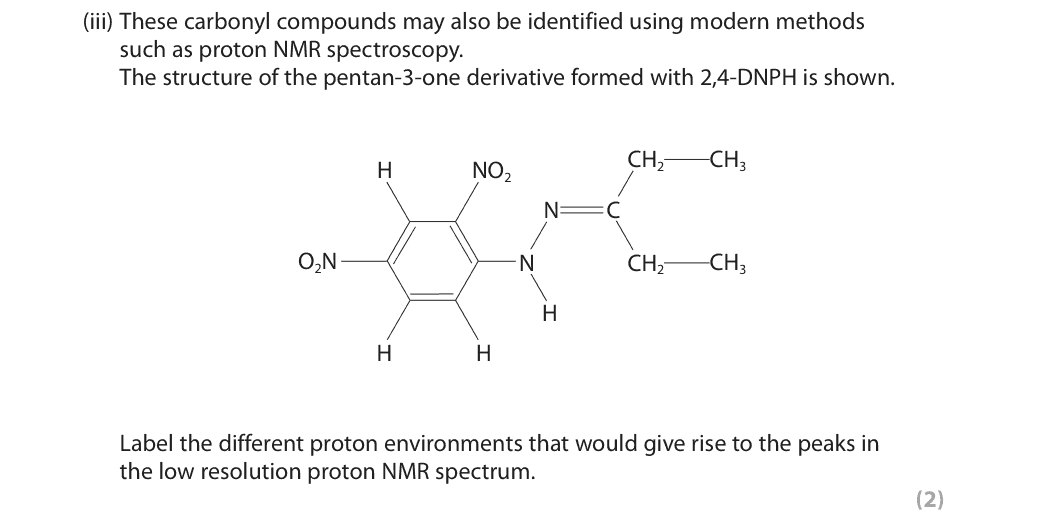
These carbonyl compounds may also be identified using modern methods
such as proton NMR spectroscopy.
The structure of the pentan‑3‑one derivative formed with 2,4‑DNPH is shown.
CH2
CH3
H
NO2
N
C
O2N
N
CH2
CH3
H
H
H
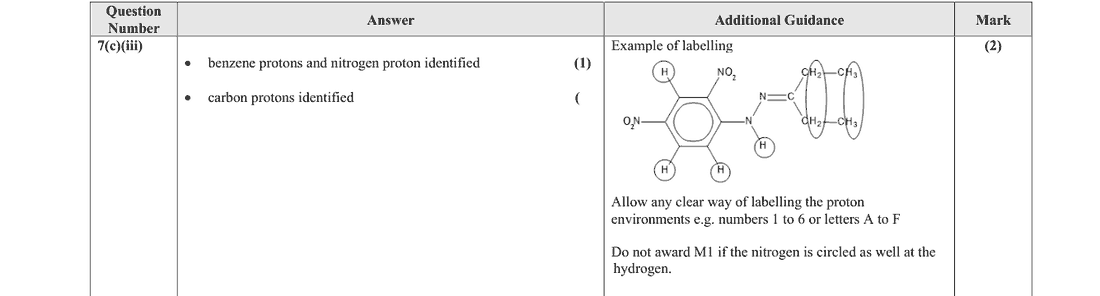
Label the different proton environments that would give rise to the peaks in
the low resolution proton NMR spectrum.
June 2023 · Paper 2 · Q9(a) 5 marks Short answer organic synthesis
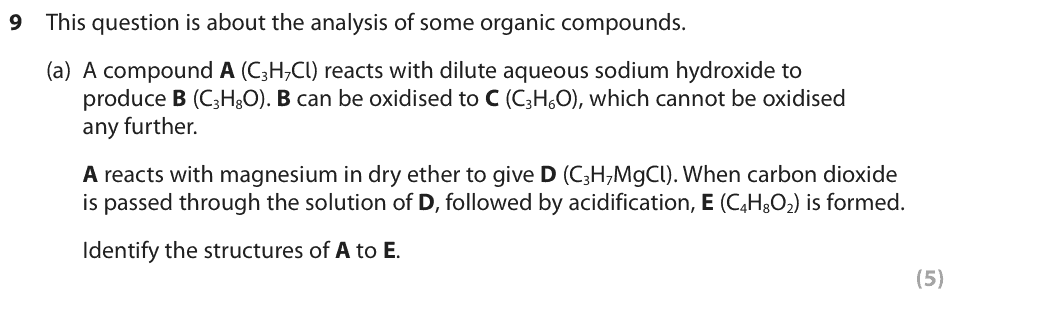
This question is about the analysis of some organic compounds.
A compound A (C3H7Cl) reacts with dilute aqueous sodium hydroxide to
produce B (C3H8O). B can be oxidised to C (C3H6O), which cannot be oxidised
any further.
A reacts with magnesium in dry ether to give D (C3H7MgCl). When carbon dioxide
is passed through the solution of D, followed by acidification, E (C4H8O2) is formed.
Identify the structures of A to E.
June 2023 · Paper 3 · Q1(b) 2 marks Short answer Easy alkanes
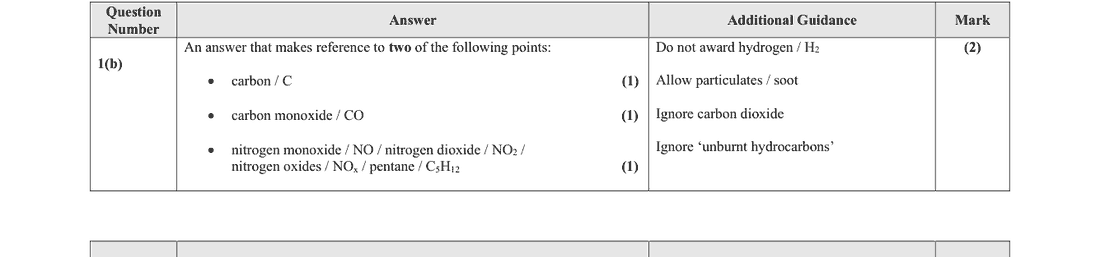
Identify two pollutants produced from the incomplete combustion of a pure
sample of pentane.
June 2023 · Paper 3 · Q2(b)(i) 1 mark Short answer groups 1 and 2
Earlier part of question 2 that this part usesEarlier part of June 2023 Paper 3 question 2
State the trend in solubility of the Group 2 sulfates.
June 2023 · Paper 3 · Q2(c)(iii) 2 marks Short answer redox i
Earlier parts of question 2 that this part usesEarlier part of June 2023 Paper 3 question 2Earlier part of June 2023 Paper 3 question 2
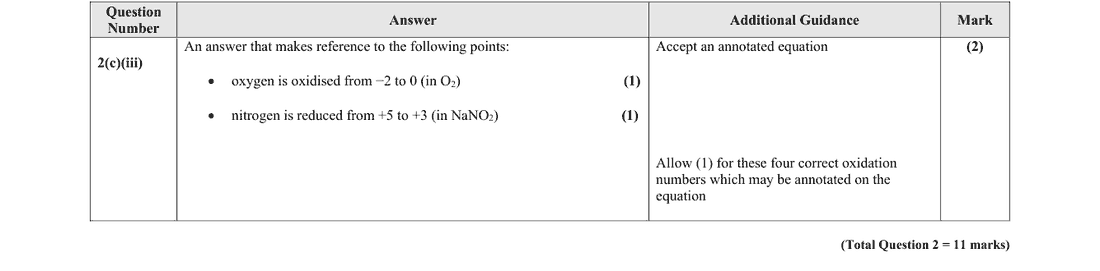
Show, by reference to oxidation number changes, that the decomposition of
sodium nitrate is a redox reaction.
June 2023 · Paper 3 · Q3(b) 1 mark Short answer redox i
Earlier part of question 3 that this part usesEarlier part of June 2023 Paper 3 question 3
Give the formula of phosphoric(V) acid.
June 2023 · Paper 3 · Q5(e) 1 mark Short answer Easy redox ii
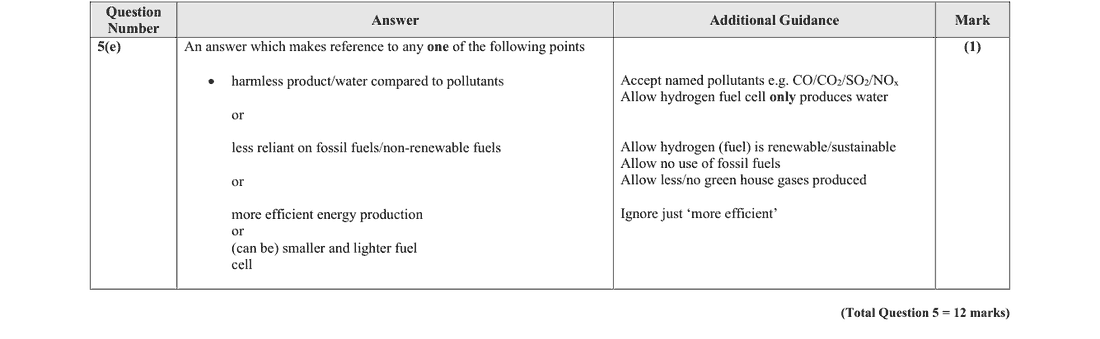
State one advantage of the hydrogen‑oxygen fuel cell over the use of petrol as
fuel in a vehicle.
June 2023 · Paper 3 · Q6(a) 1 mark Short answer nmr mass spectrometry and chromatography
Amino acids can be separated using chromatography.
State how chromatography separates the components of a mixture.
June 2023 · Paper 3 · Q6(b)(i) 1 mark Short answer amines amides amino acids and proteins
Earlier part of question 6 that this part usesEarlier part of June 2023 Paper 3 question 6
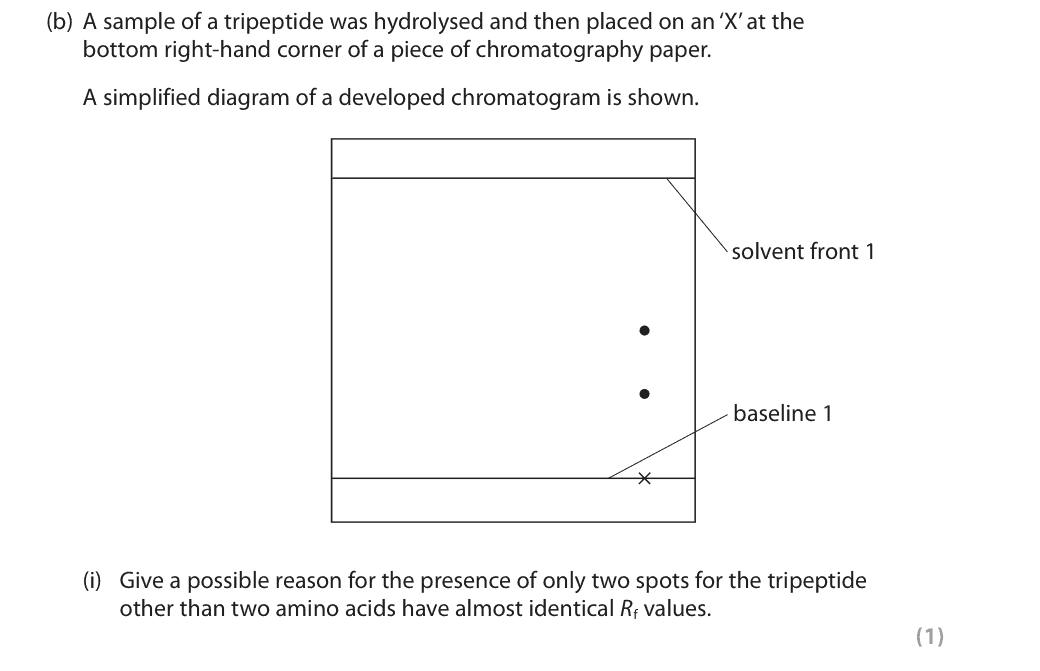
A sample of a tripeptide was hydrolysed and then placed on an ‘X’ at the
bottom right‑hand corner of a piece of chromatography paper.
A simplified diagram of a developed chromatogram is shown.
solvent front 1
baseline 1
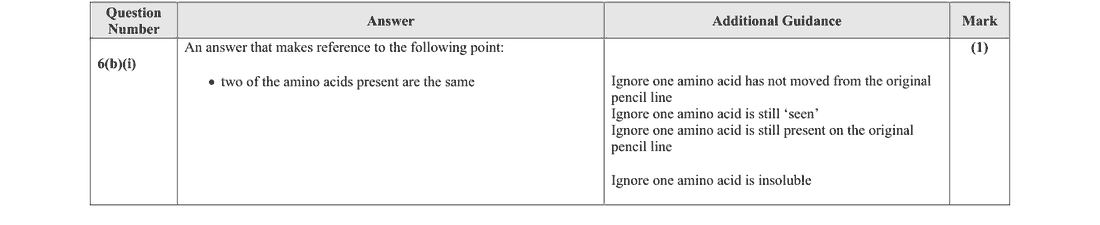
Give a possible reason for the presence of only two spots for the tripeptide
other than two amino acids have almost identical Rf values.
June 2023 · Paper 3 · Q6(b)(iii) 1 mark Short answer amines amides amino acids and proteins
Earlier part of question 6 that this part usesEarlier part of June 2023 Paper 3 question 6
Name a reagent that locates colourless amino acids by producing a
coloured compound.
June 2023 · Paper 3 · Q6(c) 1 mark Short answer nmr mass spectrometry and chromatography
State the technique that is used in conjunction with gas chromatography (GC)
when carrying out forensic testing.
June 2023 · Paper 3 · Q7(c)(ii) 1 mark Short answer transition metals principles
Earlier parts of question 7 that this part usesEarlier part of June 2023 Paper 3 question 7Earlier part of June 2023 Paper 3 question 7
State the number of water molecules needed to complete this complex.
June 2023 · Paper 3 · Q8(a)(ii) 1 mark Short answer kinetics ii
Earlier part of question 8 that this part usesEarlier part of June 2023 Paper 3 question 8
The iodate(V) reaction has the rate determining step
IO3
–   +   3HSO3
–   →   I–   +   3HSO4
–
Give a possible reason why this is the slowest step.
June 2023 · Paper 3 · Q8(a)(iii) 1 mark Short answer kinetics ii
Earlier part of question 8 that this part usesEarlier part of June 2023 Paper 3 question 8
The chlorate(V) reaction has the rate determining step
–   +   2H+   +   I–   →   HIO   +   HClO2
ClO3
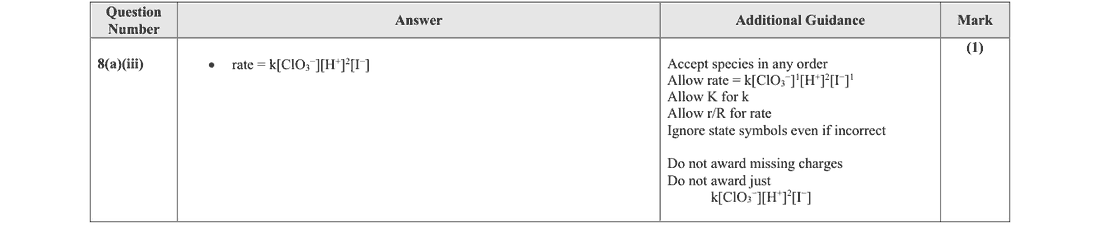
Deduce the rate equation for this iodine clock reaction.
June 2023 · Paper 3 · Q9(a)(i) 1 mark Short answer carboxylic acids
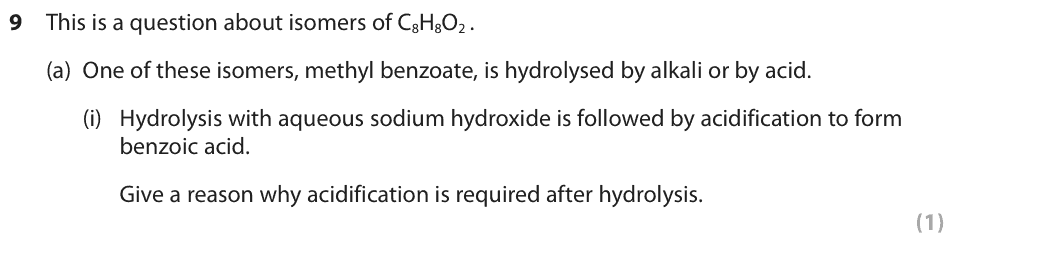
This is a question about isomers of C8H8O2 .
One of these isomers, methyl benzoate, is hydrolysed by alkali or by acid.
Hydrolysis with aqueous sodium hydroxide is followed by acidification to form
benzoic acid.
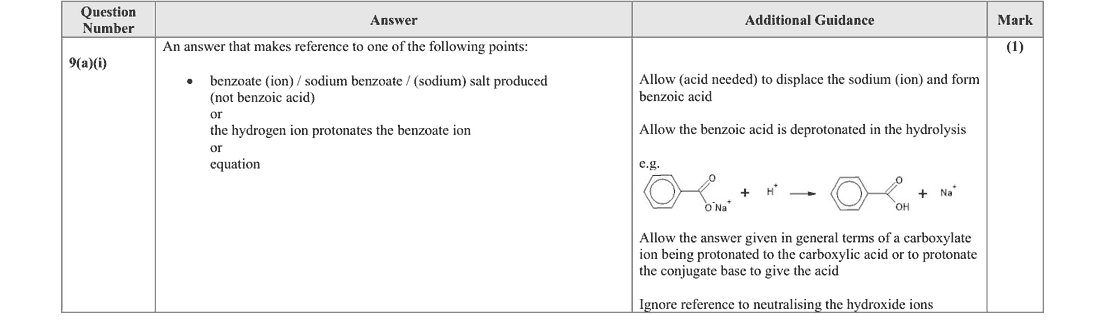
Give a reason why acidification is required after hydrolysis.
June 2023 · Paper 3 · Q10(a) 1 mark Short answer transition metals principles
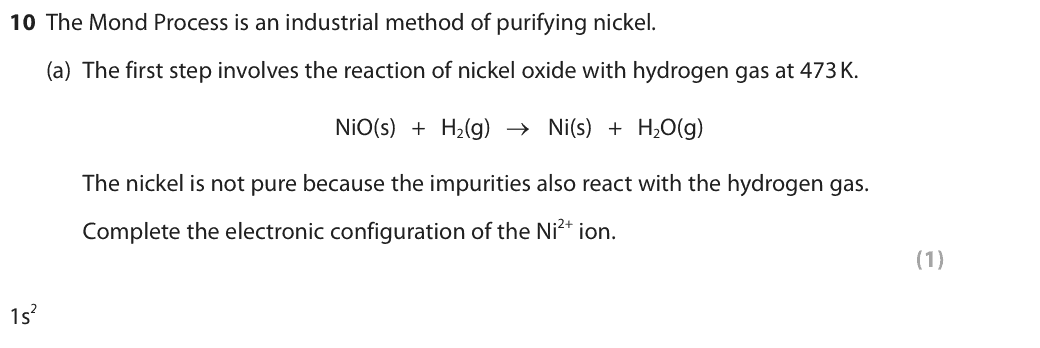
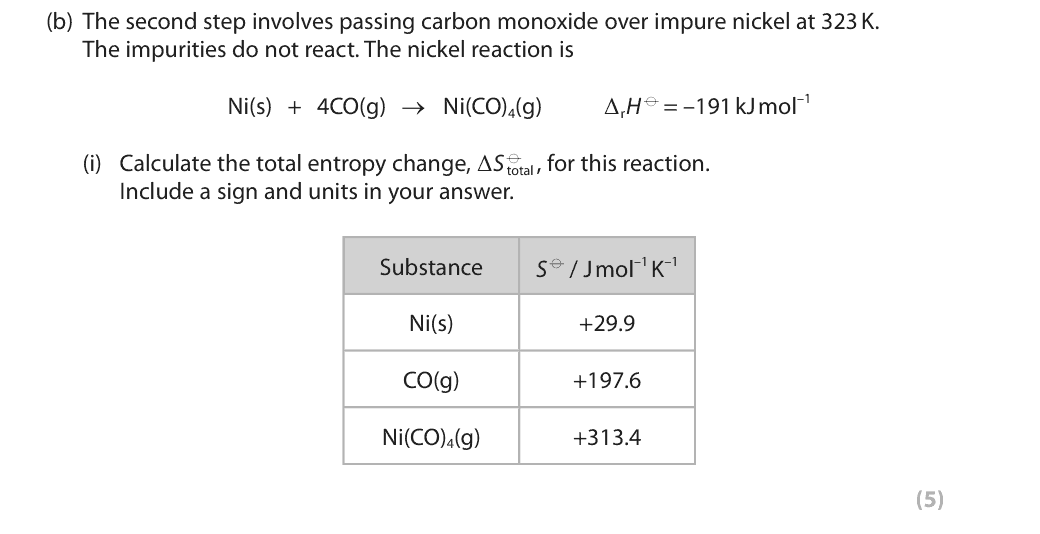
The Mond Process is an industrial method of purifying nickel.
The first step involves the reaction of nickel oxide with hydrogen gas at 473 K.
NiO(s)   +   H2(g)   →   Ni(s)   +   H2O(g)
The nickel is not pure because the impurities also react with the hydrogen gas.
Complete the electronic configuration of the Ni2+ ion.
1s2
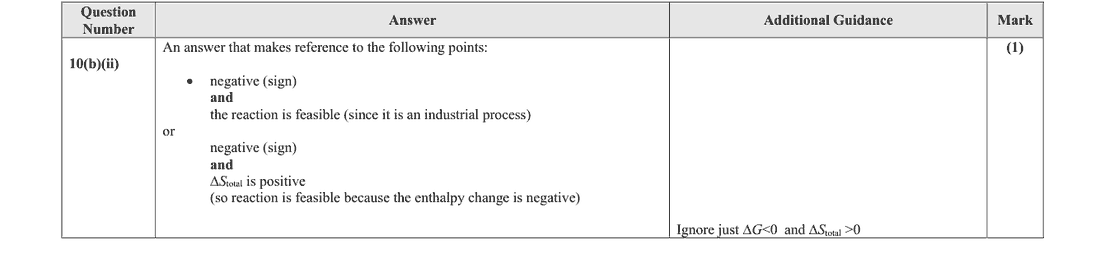
June 2023 · Paper 3 · Q10(b)(ii) 1 mark Short answer entropy
Earlier parts of question 10 that this part usesEarlier part of June 2023 Paper 3 question 10Earlier part of June 2023 Paper 3 question 10
Predict the sign of the Gibbs Free Energy change, ΔG, for this reaction and
justify your choice. No calculation is required.
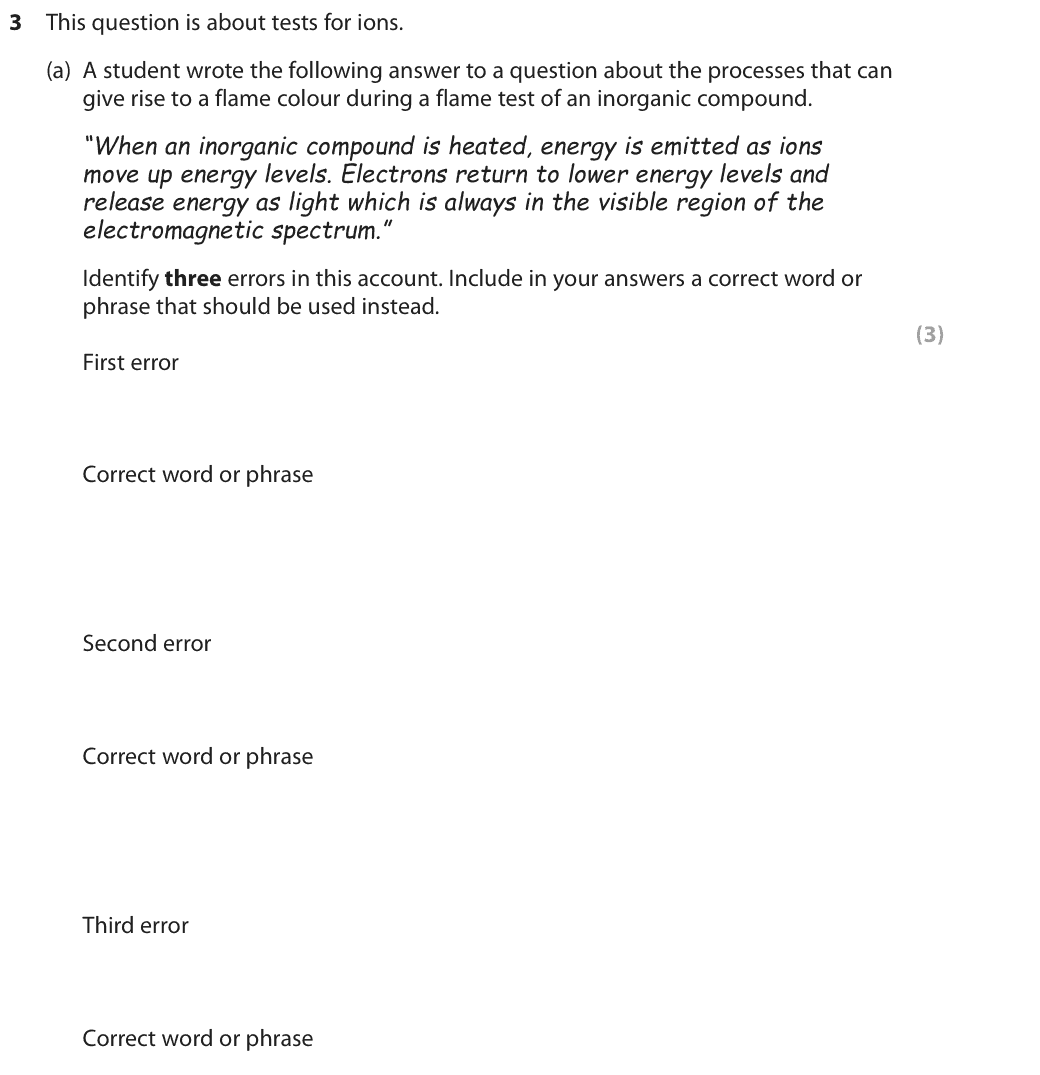
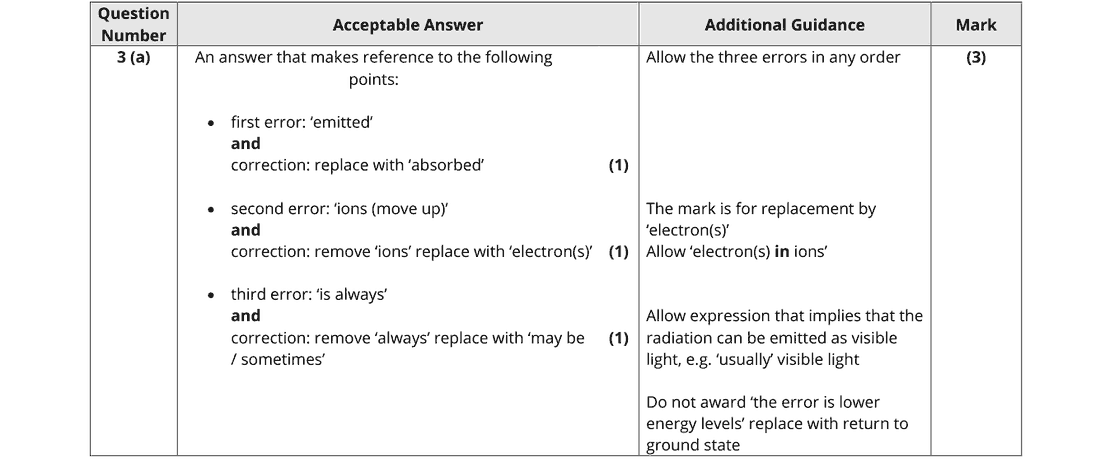
June 2022 · AS Paper 1 · Q3(a) 3 marks Short answer groups 1 and 2
This question is about tests for ions.
A student wrote the following answer to a question about the processes that can
give rise to a flame colour during a flame test of an inorganic compound.
“When an inorganic compound is heated, energy is emitted as ions
move up energy levels. Electrons return to lower energy levels and
release energy as light which is always in the visible region of the
electromagnetic spectrum.”
Identify three errors in this account. Include in your answers a correct word or
phrase that should be used instead.
First error
Correct word or phrase
Second error
Correct word or phrase
Third error
Correct word or phrase
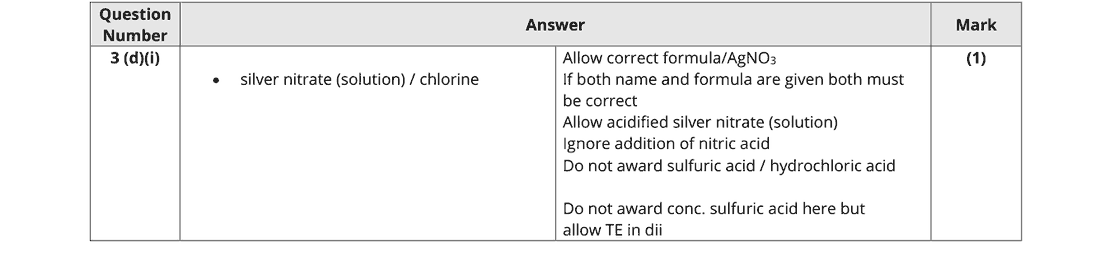
June 2022 · AS Paper 1 · Q3(d)(i) 1 mark Short answer group 7 the halogens
An aqueous solution is suspected to be potassium bromide and is tested for the
presence of the anion.
Write the name of the reagent used to test for the anion.
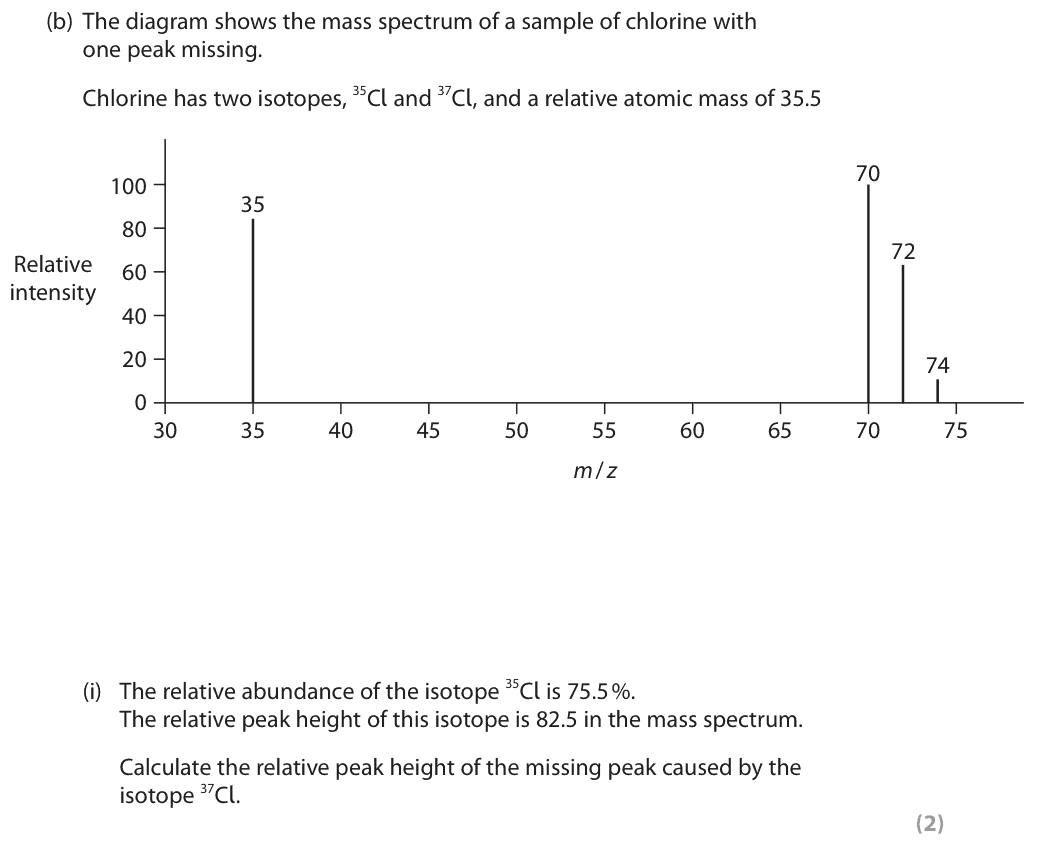
June 2022 · AS Paper 1 · Q4(b)(ii) 1 mark Short answer atomic structure and the periodic table
Earlier parts of question 4 that this part usesEarlier part of June 2022 Paper 1 question 4Earlier part of June 2022 Paper 1 question 4
Give a reason for the presence of the three peaks at 70, 72 and 74.
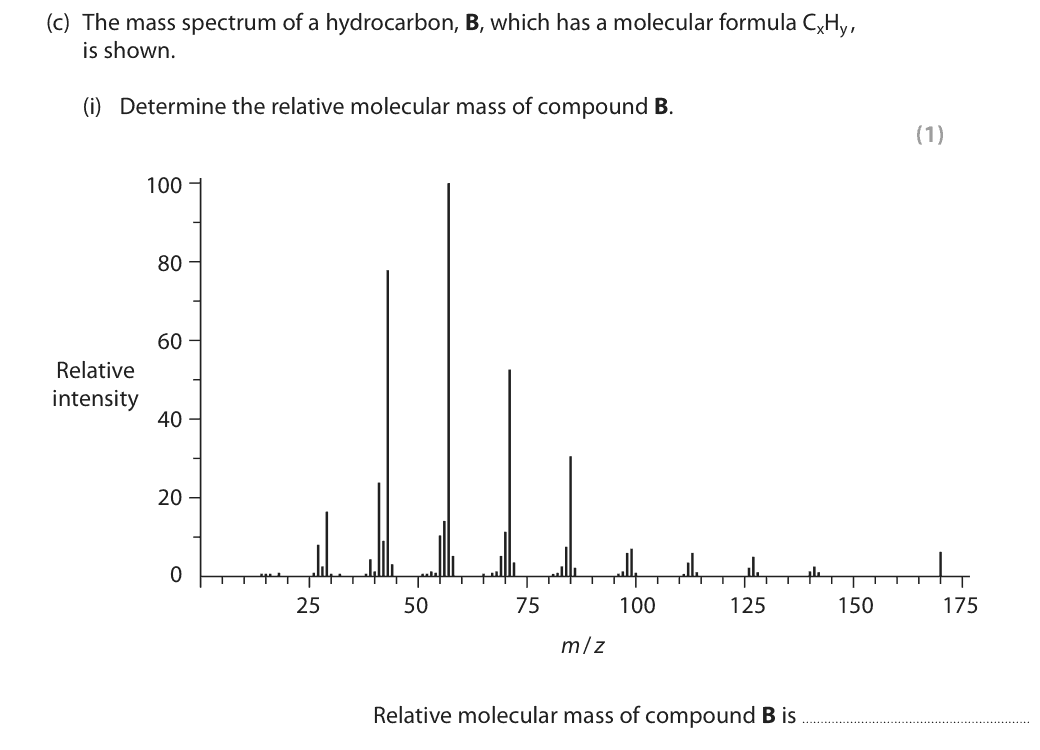
June 2022 · AS Paper 1 · Q4(c)(i) 1 mark Short answer atomic structure and the periodic table
Earlier part of question 4 that this part usesEarlier part of June 2022 Paper 1 question 4
The mass spectrum of a hydrocarbon, B, which has a molecular formula CxHy ,
is shown.
Determine the relative molecular mass of compound B.
100
80
60
Relative
intensity
40
20
0
25
50
75
100
125
150
175
m / z
Relative molecular mass of compound B is
June 2022 · AS Paper 1 · Q4(c)(ii) 1 mark Short answer atomic structure and the periodic tableformulae equations and amounts of substance
Earlier parts of question 4 that this part usesEarlier part of June 2022 Paper 1 question 4Earlier part of June 2022 Paper 1 question 4
Deduce the molecular formula of hydrocarbon B.
June 2022 · AS Paper 1 · Q5(a) 1 mark Short answer bonding
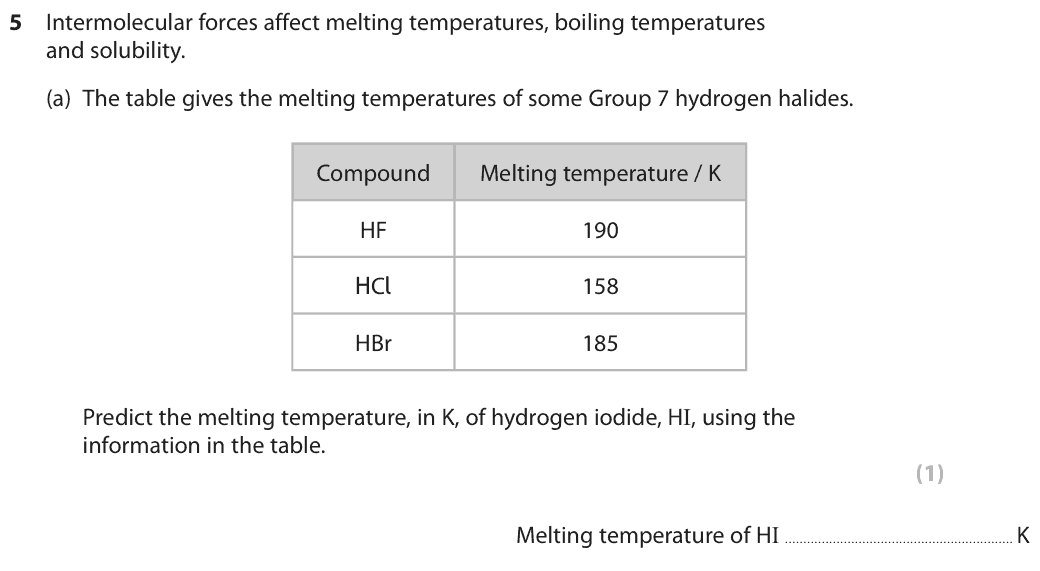
Intermolecular forces affect melting temperatures, boiling temperatures
and solubility.
The table gives the melting temperatures of some Group 7 hydrogen halides.
Compound
Melting temperature / K
HF
190
HCl
158
HBr
185
Predict the melting temperature, in K, of hydrogen iodide, HI, using the
information in the table.
Melting temperature of HI  K
June 2022 · AS Paper 1 · Q6(a) 2 marks Short answer Hard structure
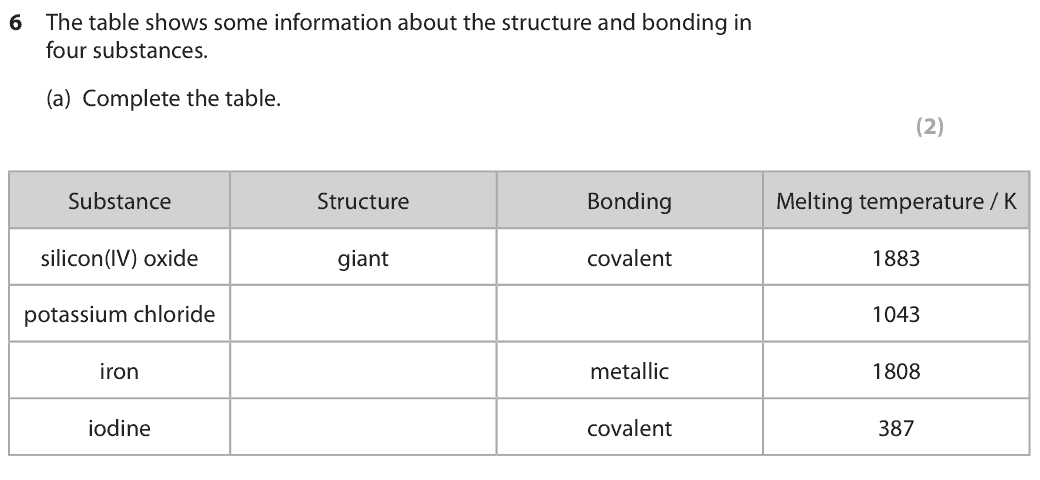
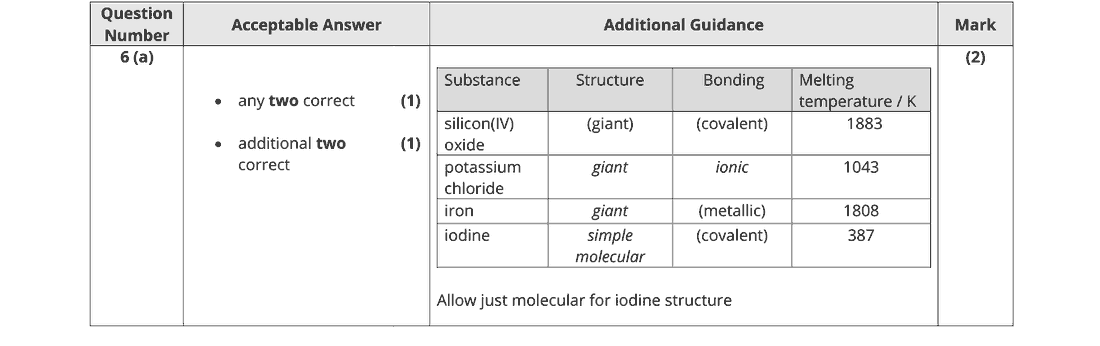
The table shows some information about the structure and bonding in
four substances.
Complete the table.
Substance
Structure
Bonding
Melting temperature / K
silicon(IV) oxide
giant
covalent
1883
potassium chloride
1043
iron
metallic
1808
iodine
covalent
387
June 2022 · AS Paper 1 · Q8(b)(i) 1 mark Short answer Hard group 7 the halogens
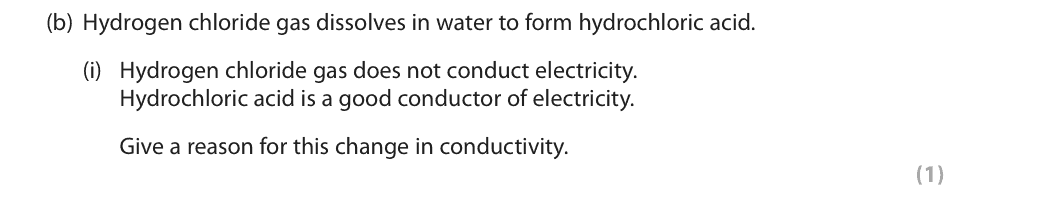
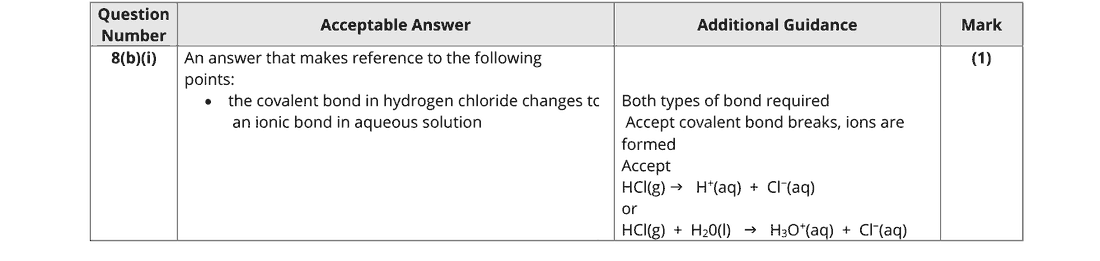
Hydrogen chloride gas dissolves in water to form hydrochloric acid.
Hydrogen chloride gas does not conduct electricity.
Hydrochloric acid is a good conductor of electricity.
Give a reason for this change in conductivity.
June 2022 · AS Paper 2 · Q1(b)(ii) 1 mark Short answer kinetics i
Earlier part of question 1 that this part usesEarlier part of June 2022 Paper 2 question 1
State how a catalyst increases the rate of a chemical reaction.
June 2022 · AS Paper 2 · Q2(a) 2 marks Short answer alkenes
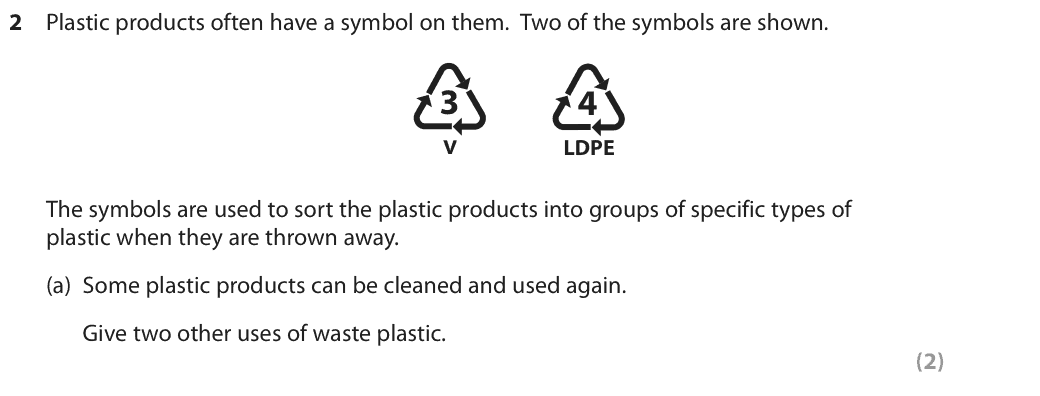
Plastic products often have a symbol on them.  Two of the symbols are shown.
3
4
v
LDPE
The symbols are used to sort the plastic products into groups of specific types of
plastic when they are thrown away.
Some plastic products can be cleaned and used again.
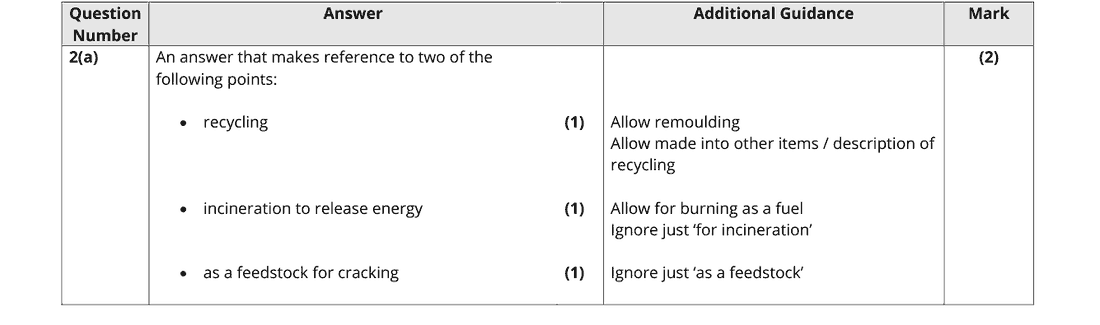
Give two other uses of waste plastic.
June 2022 · AS Paper 2 · Q2(b) 1 mark Short answer alkenes
Earlier part of question 2 that this part usesEarlier part of June 2022 Paper 2 question 2
The V on the symbol with the number 3 stands for vinyl or vinyl chloride.
The V is sometimes replaced by PVC, standing for polyvinyl chloride.
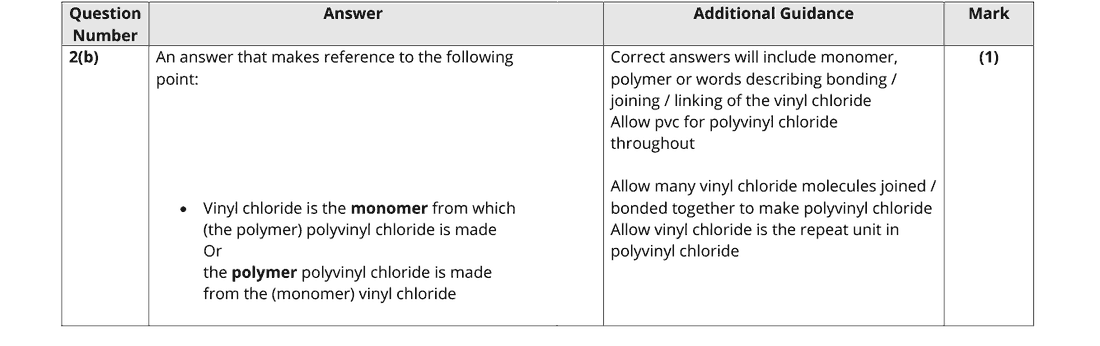
State the link between vinyl chloride and polyvinyl chloride.
June 2022 · AS Paper 2 · Q3(a)(ii) 2 marks Short answer energetics i
Earlier part of question 3 that this part usesEarlier part of June 2022 Paper 2 question 3
A data book value for the enthalpy change of combustion of decane
is  −6 778 kJ mol−1 .
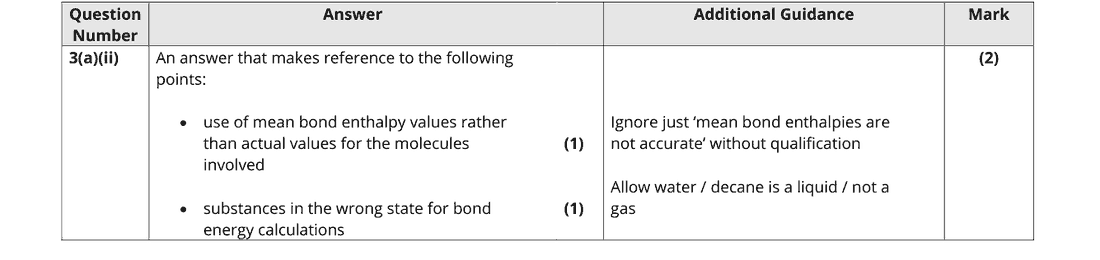
Give two reasons for the difference between your answer to (a)(i) and
this value.
June 2022 · AS Paper 2 · Q3(b)(iii) 1 mark Short answer alkanes
Earlier parts of question 3 that this part usesEarlier part of June 2022 Paper 2 question 3Earlier part of June 2022 Paper 2 question 3Earlier part of June 2022 Paper 2 question 3
Give a possible reason why this reaction might not proceed according to the
equation in (b)(ii).
June 2022 · AS Paper 2 · Q4(b)(ii) 1 mark Short answer Hard energetics i
Earlier parts of question 4 that this part usesEarlier part of June 2022 Paper 2 question 4Earlier part of June 2022 Paper 2 question 4
Give the main reason why, after the end‑point was reached, the temperature
of the solution decreased.
June 2022 · AS Paper 2 · Q5(a)(i) 1 mark Short answer alkenes
Chloroalkanes can be formed from both alkenes and alkanes.
Ethene can be converted into chloroethane.
Identify, by name or formula, the reagent for this conversion.
June 2022 · AS Paper 2 · Q5(b)(i) 1 mark Short answer alkanes
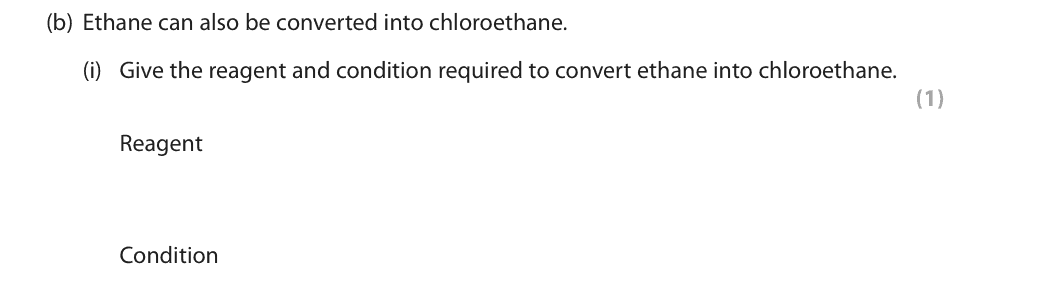
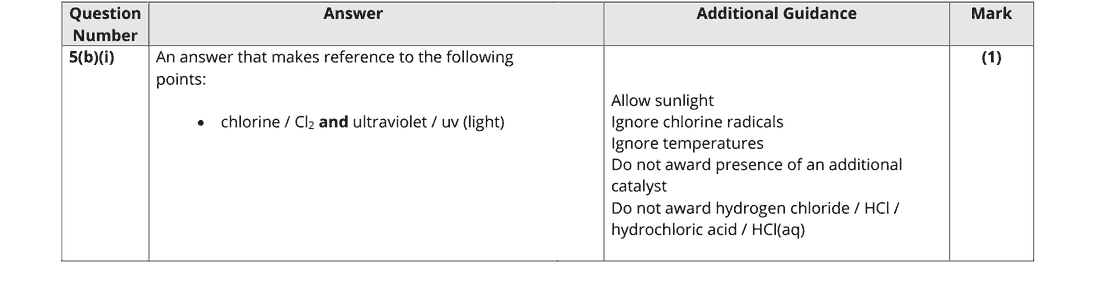
Ethane can also be converted into chloroethane.
Give the reagent and condition required to convert ethane into chloroethane.
Reagent
Condition
June 2022 · AS Paper 2 · Q5(b)(iv) 2 marks Short answer mass spectrometry and infrared spectroscopy
Earlier parts of question 5 that this part usesEarlier part of June 2022 Paper 2 question 5Earlier part of June 2022 Paper 2 question 5
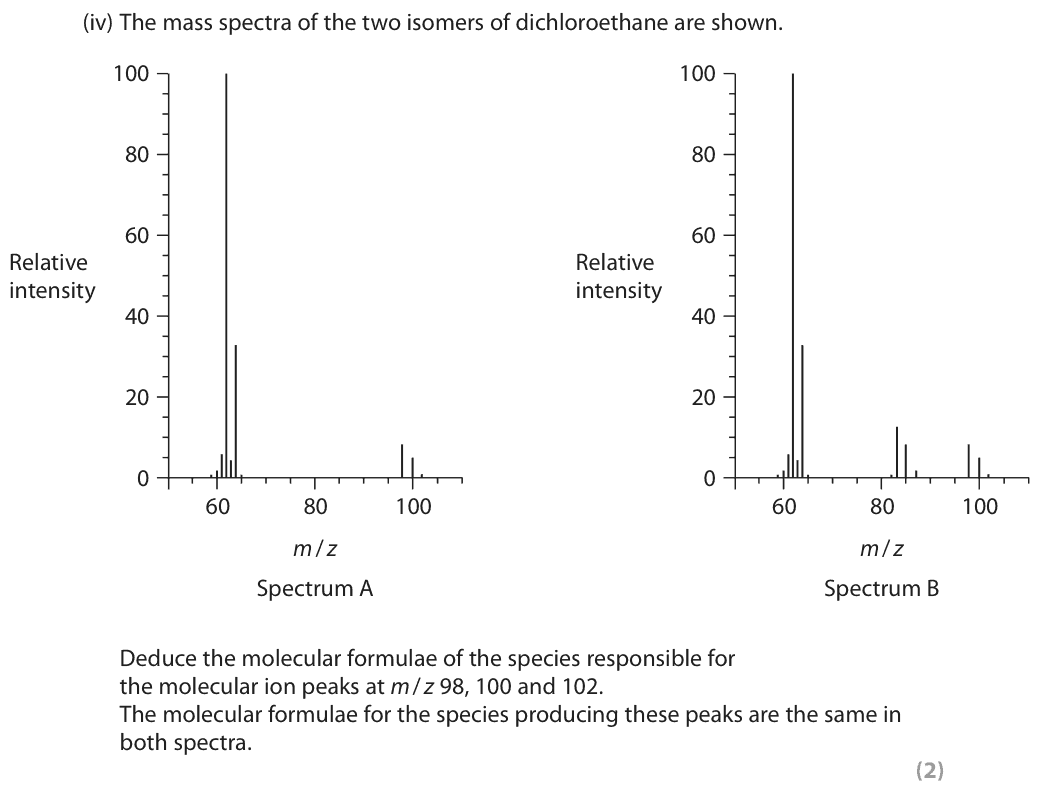
The mass spectra of the two isomers of dichloroethane are shown.
100
100
80
80
60
60
Relative
Relative
intensity
intensity
40
40
20
20
0
0
60
80
100
60
80
100
m / z
m / z
Spectrum A
Spectrum B
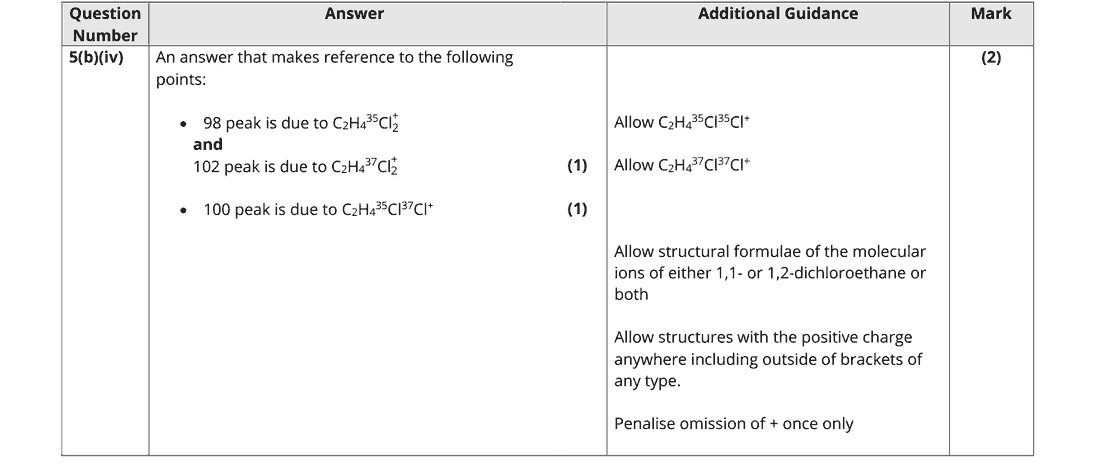
Deduce the molecular formulae of the species responsible for
the molecular ion peaks at m / z 98, 100 and 102.
The molecular formulae for the species producing these peaks are the same in
both spectra.
June 2022 · AS Paper 2 · Q5(b)(v) 1 mark Short answer mass spectrometry and infrared spectroscopyatomic structure and the periodic table
Earlier parts of question 5 that this part usesEarlier part of June 2022 Paper 2 question 5Earlier part of June 2022 Paper 2 question 5
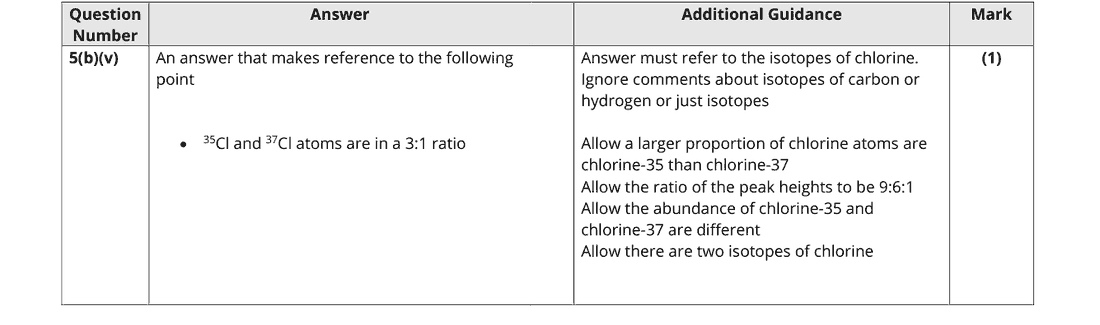
State why in both spectra the peaks at 98, 100 and 102 have different
relative intensities.
June 2022 · AS Paper 2 · Q6(a) 1 mark Short answer alcohols
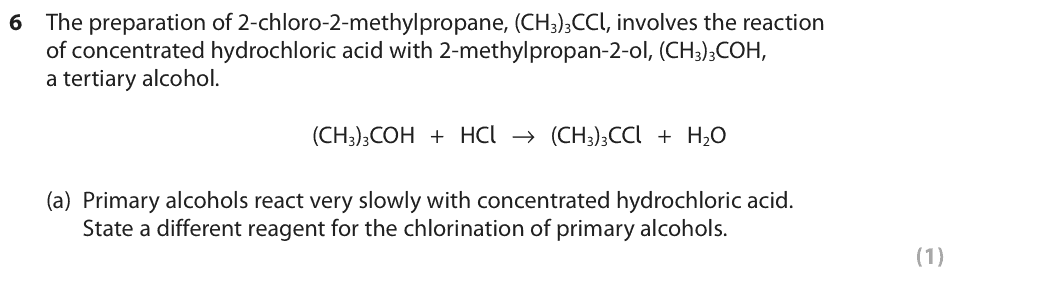
The preparation of 2‑chloro‑2‑methylpropane, (CH3)3CCl, involves the reaction
of concentrated hydrochloric acid with 2‑methylpropan‑2‑ol, (CH3)3COH,
a tertiary alcohol.
(CH3)3COH   +   HCl   →   (CH3)3CCl   +   H2O
Primary alcohols react very slowly with concentrated hydrochloric acid.
State a different reagent for the chlorination of primary alcohols.
June 2022 · AS Paper 2 · Q6(c)(i) 1 mark Short answer formulae equations and amounts of substance
Earlier part of question 6 that this part usesEarlier part of June 2022 Paper 2 question 6
After separation, the organic layer was shaken with
sodium hydrogencarbonate solution. Fizzing was observed.
Identify, by name or formula, the gas that was given off.
June 2022 · AS Paper 2 · Q6(c)(ii) 1 mark Short answer formulae equations and amounts of substance
Earlier parts of question 6 that this part usesEarlier part of June 2022 Paper 2 question 6Earlier part of June 2022 Paper 2 question 6
Give the formula of the ion that reacted with the hydrogencarbonate ion to
form the gas.
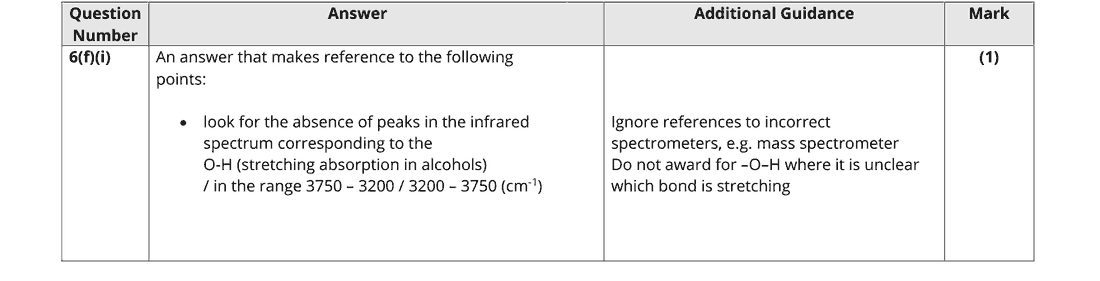
June 2022 · AS Paper 2 · Q6(f)(i) 1 mark Short answer mass spectrometry and infrared spectroscopy
Earlier part of question 6 that this part usesEarlier part of June 2022 Paper 2 question 6
Infrared spectroscopy can be used to determine the purity of a substance.
State how infrared spectroscopy could be used to show that no
2‑methylpropan‑2‑ol was present in the distillate.
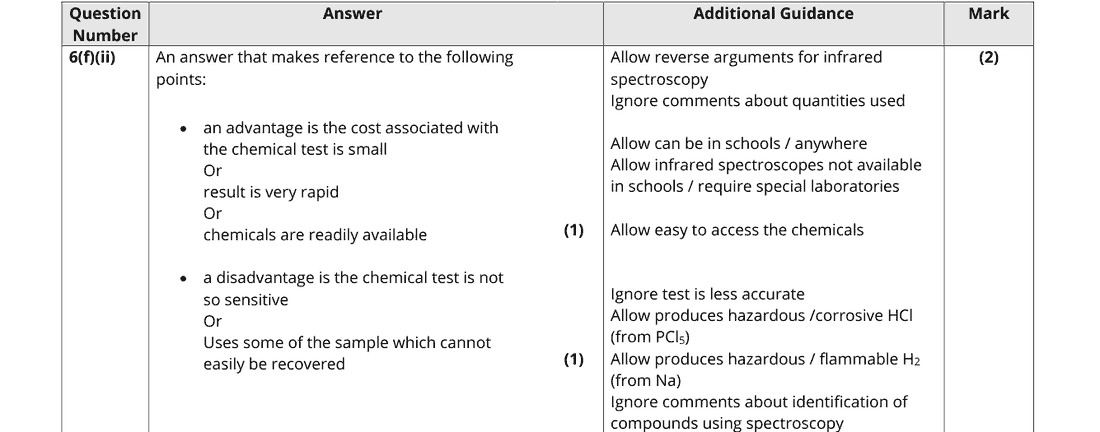
June 2022 · AS Paper 2 · Q6(f)(ii) 2 marks Short answer mass spectrometry and infrared spectroscopy
Earlier parts of question 6 that this part usesEarlier part of June 2022 Paper 2 question 6Earlier part of June 2022 Paper 2 question 6
Give one advantage and one disadvantage of using a chemical test
rather than infrared spectroscopy to determine whether any of the
2‑methylpropan‑2‑ol remained.
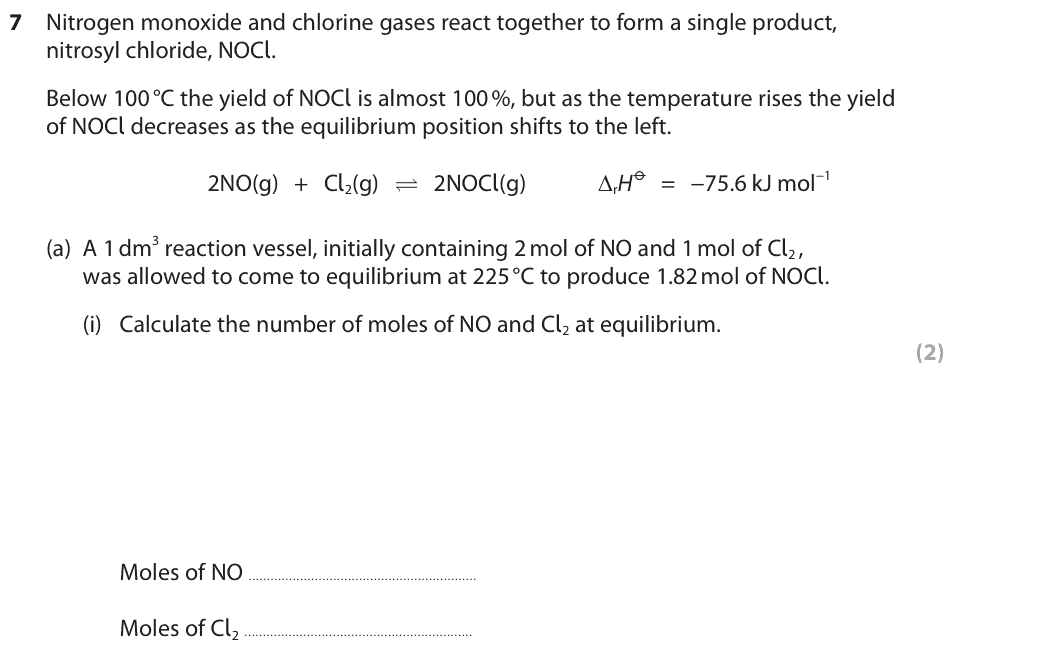
June 2022 · AS Paper 2 · Q7(a)(iv) 1 mark Short answer equilibrium i
Earlier part of question 7 that this part usesEarlier part of June 2022 Paper 2 question 7
Give the reason why the equilibrium yield of NOCl decreases when the
temperature changes from 25 °C to 225 °C.
The enthalpy change for the reaction at 25 °C is −75.6 kJ mol−1 .
June 2022 · Paper 1 · Q1(a) 2 marks Short answer atomic structure and the periodic table
This question is about atomic structure and the Periodic Table.
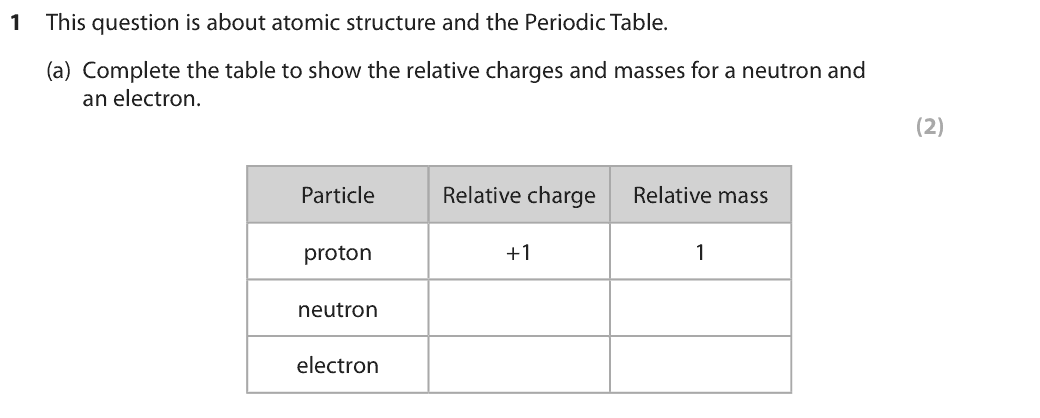
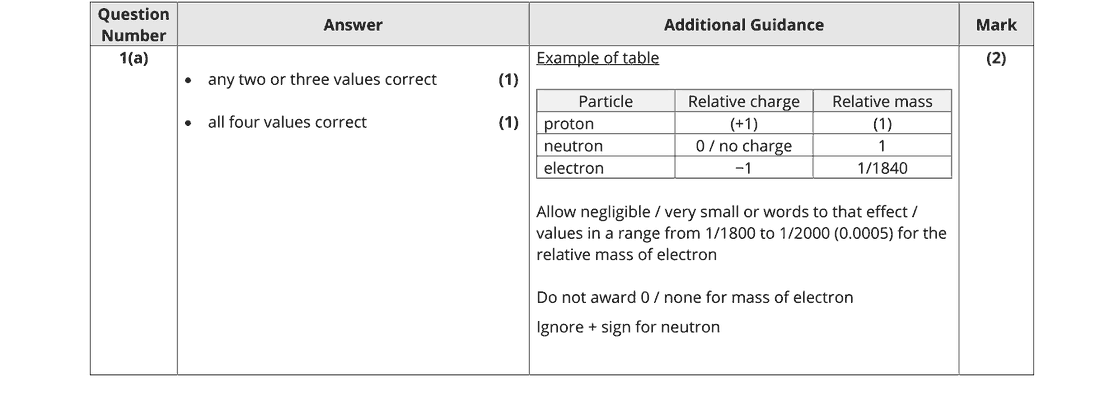
Complete the table to show the relative charges and masses for a neutron and
an electron.
Particle
Relative charge
Relative mass
proton
+1
1
neutron
electron
June 2022 · Paper 1 · Q3(c) 1 mark Short answer atomic structure and the periodic table
Earlier part of question 3 that this part usesEarlier part of June 2022 Paper 1 question 3
The halogens can form halide ions during reactions.
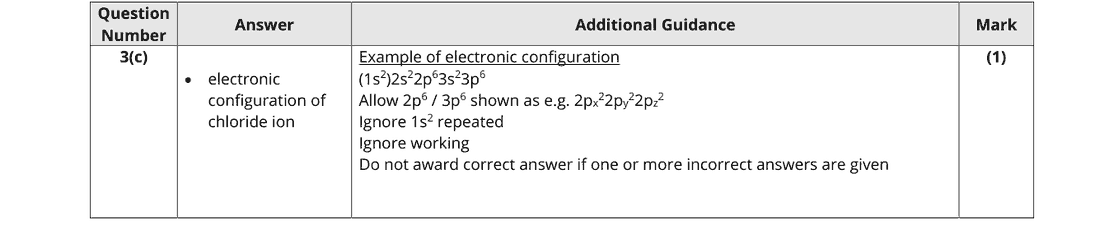
Complete the electronic configuration of the chloride ion.
1s2
June 2022 · Paper 1 · Q3(d)(ii) 1 mark Short answer Hard redox ii
Earlier parts of question 3 that this part usesEarlier part of June 2022 Paper 1 question 3Earlier part of June 2022 Paper 1 question 3
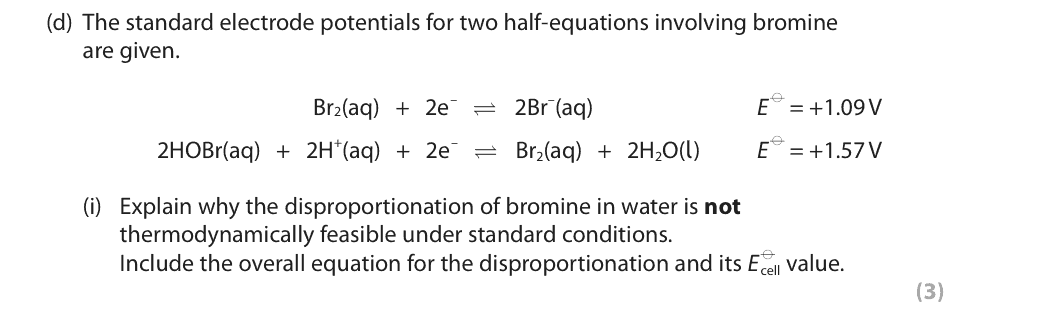
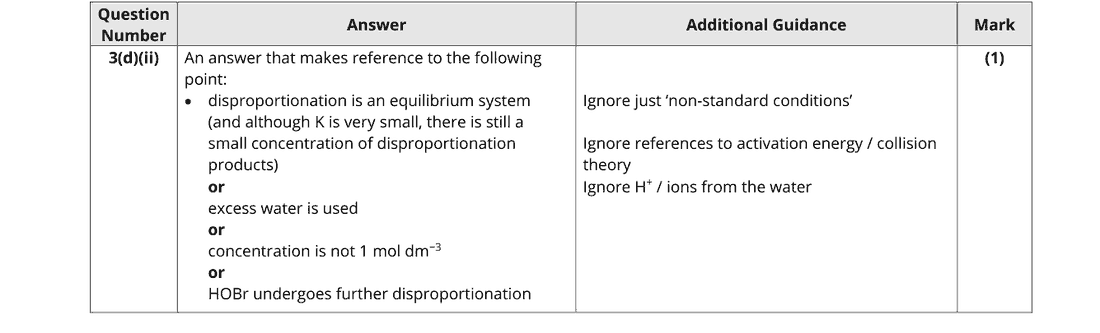
Bromine disproportionates in water to a small extent at 298 K.
Give a possible reason why this reaction occurs.
June 2022 · Paper 1 · Q4(b) 2 marks Short answer bonding
Earlier part of question 4 that this part usesEarlier part of June 2022 Paper 1 question 4
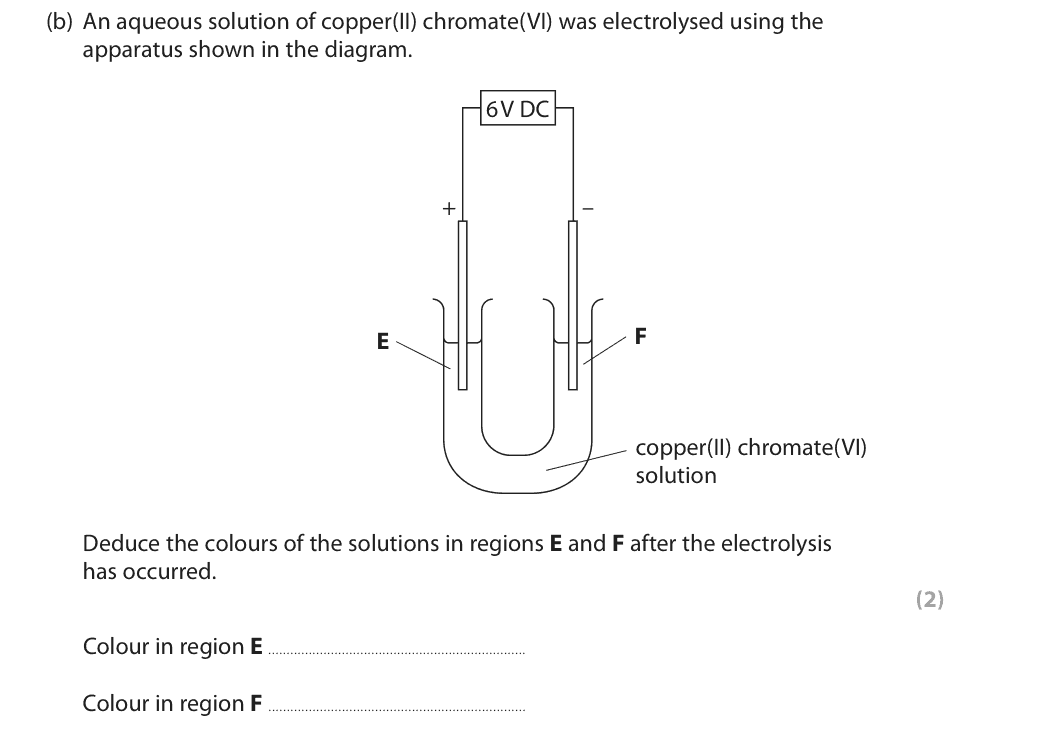
An aqueous solution of copper(II) chromate(VI) was electrolysed using the
apparatus shown in the diagram.
6 V DC
+
–
E
F
copper(II) chromate(VI)
solution
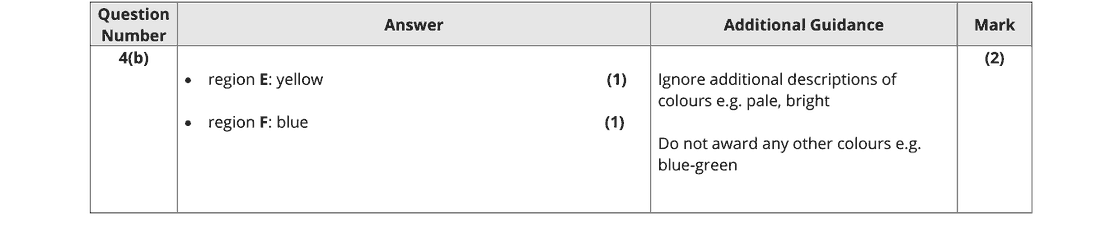
Deduce the colours of the solutions in regions E and F after the electrolysis
has occurred.
Colour in region E 
Colour in region F
June 2022 · Paper 1 · Q4(c) 1 mark Short answer bonding
Earlier part of question 4 that this part usesEarlier part of June 2022 Paper 1 question 4
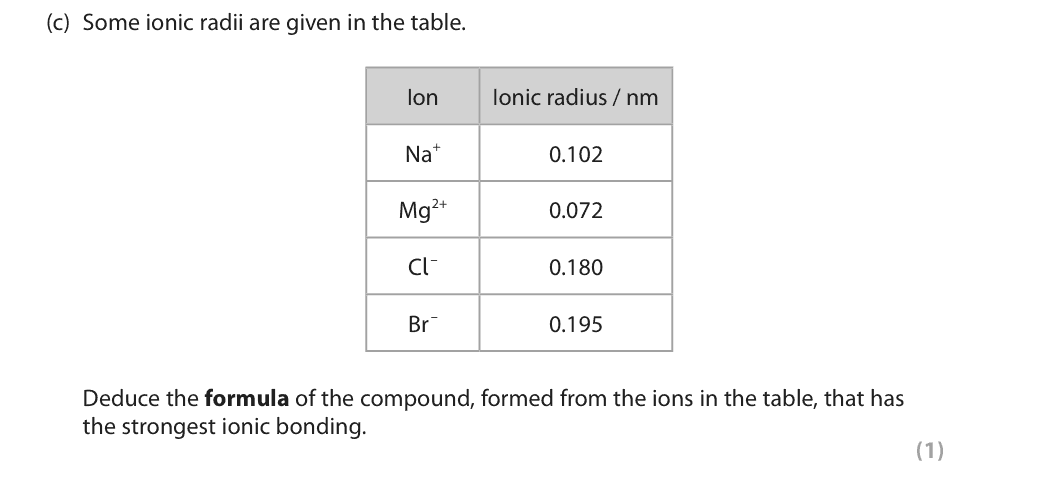
Some ionic radii are given in the table.
Ion
Ionic radius / nm
Na+
0.102
Mg2+
0.072
Cl–
0.180
Br–
0.195
Deduce the formula of the compound, formed from the ions in the table, that has
the strongest ionic bonding.
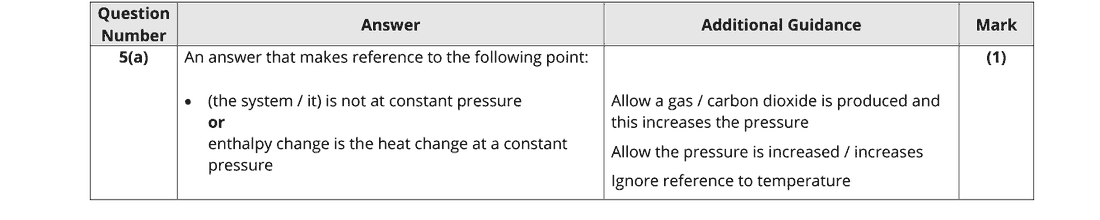
June 2022 · Paper 1 · Q5(a) 1 mark Short answer energetics i
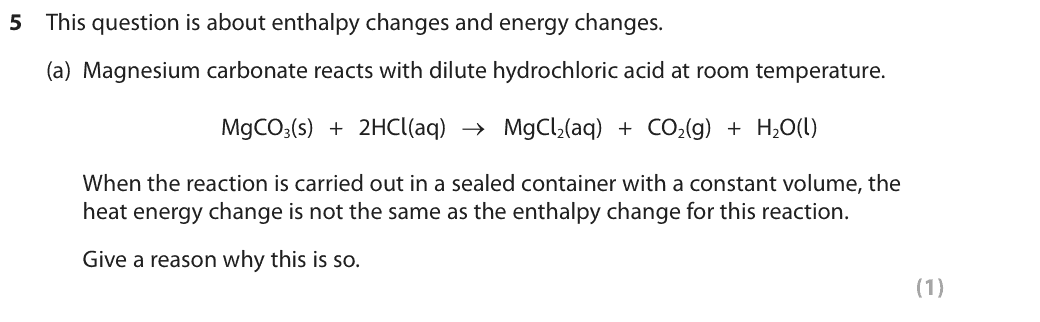
This question is about enthalpy changes and energy changes.
Magnesium carbonate reacts with dilute hydrochloric acid at room temperature.
MgCO3(s)   +   2HCl(aq)   →   MgCl2(aq)   +   CO2(g)   +   H2O(l)
When the reaction is carried out in a sealed container with a constant volume, the
heat energy change is not the same as the enthalpy change for this reaction.
Give a reason why this is so.
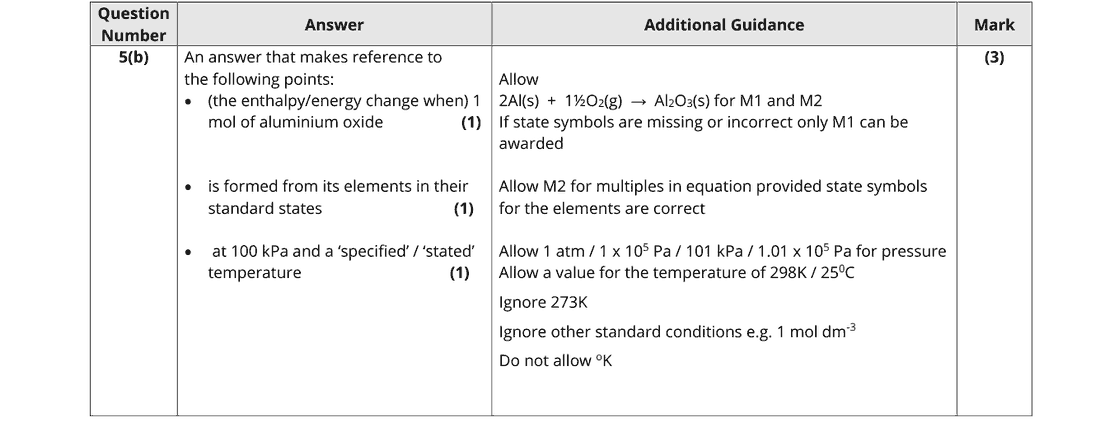
June 2022 · Paper 1 · Q5(b) 3 marks Short answer energetics i
State what is meant by the standard enthalpy change of formation of
aluminium oxide, Al2O3(s).  Include standard conditions.
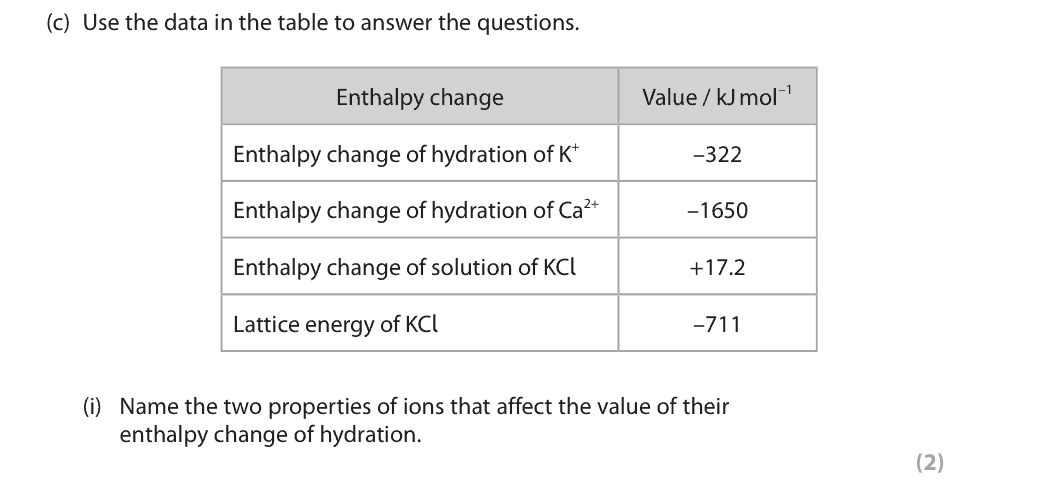
June 2022 · Paper 1 · Q5(c)(i) 2 marks Short answer lattice energy
Use the data in the table to answer the questions.
Value / kJ mol–1
Enthalpy change
Enthalpy change of hydration of K+
–322
Enthalpy change of hydration of Ca2+
–1650
Enthalpy change of solution of KCl
+17.2
Lattice energy of KCl
–711
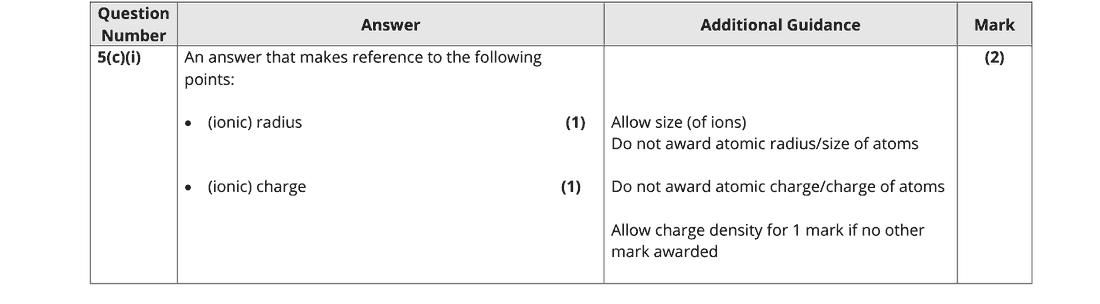
Name the two properties of ions that affect the value of their
enthalpy change of hydration.
June 2022 · Paper 1 · Q6(a) 1 mark Short answer acid base equilibria
This question is about acids and bases.
State what is meant by a Brønsted‑Lowry base.
June 2022 · Paper 1 · Q6(f)(i) 2 marks Short answer acid base equilibria
Earlier part of question 6 that this part usesEarlier part of June 2022 Paper 1 question 6
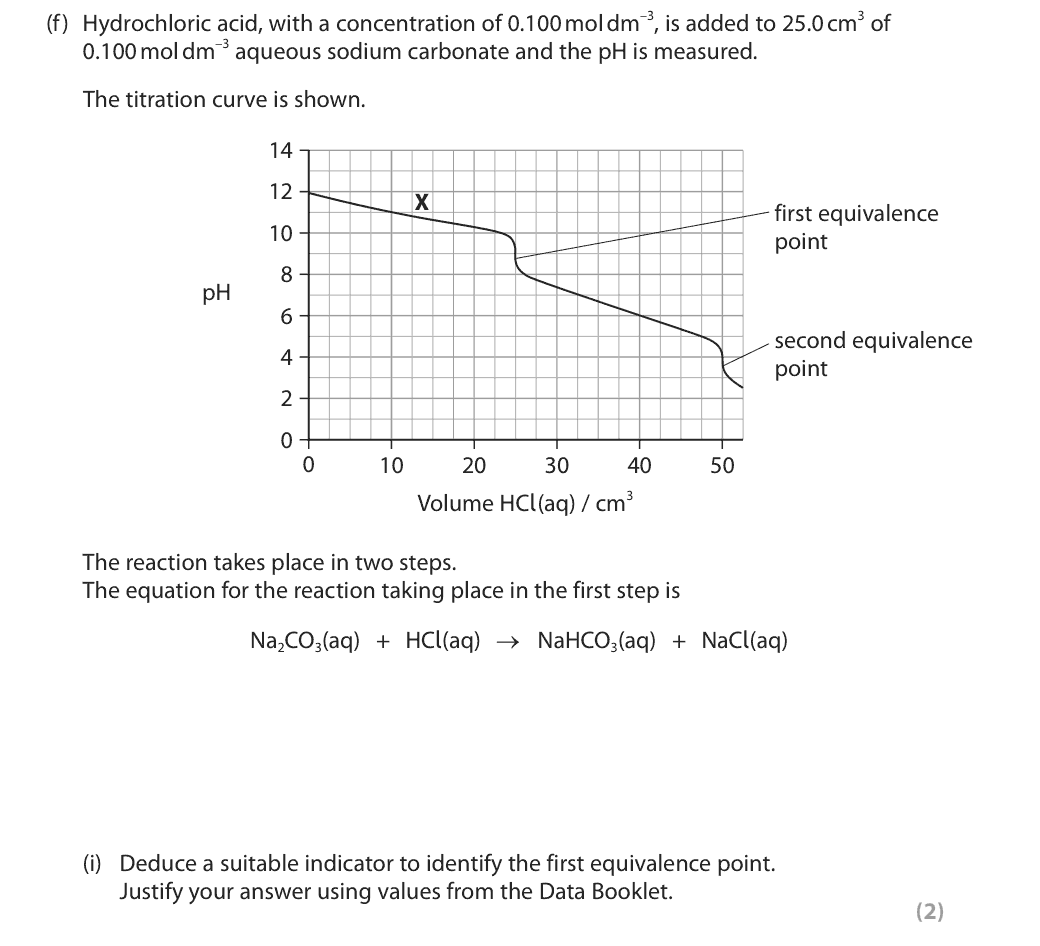
Hydrochloric acid, with a concentration of 0.100 mol dm–3, is added to 25.0 cm3 of
0.100 mol dm–3 aqueous sodium carbonate and the pH is measured.
The titration curve is shown.
14
12
X
first equivalence
10
point
8
pH
6
second equivalence
4
point
2
0
0
10
20
30
40
50
Volume HCl(aq) / cm3
The reaction takes place in two steps.
The equation for the reaction taking place in the first step is
Na2CO3(aq)   +   HCl(aq)   →   NaHCO3(aq)   +   NaCl(aq)
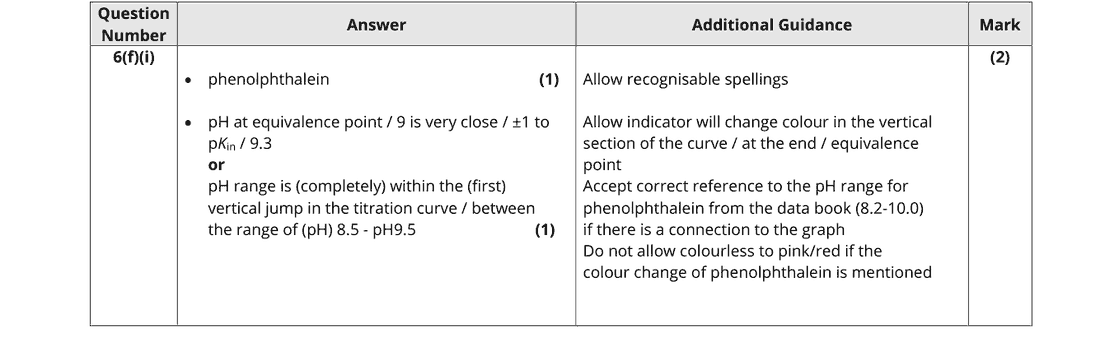
Deduce a suitable indicator to identify the first equivalence point.
Justify your answer using values from the Data Booklet.
June 2022 · Paper 1 · Q7(a) 1 mark Short answer transition metals principles
This question is about chromium and some of its compounds.
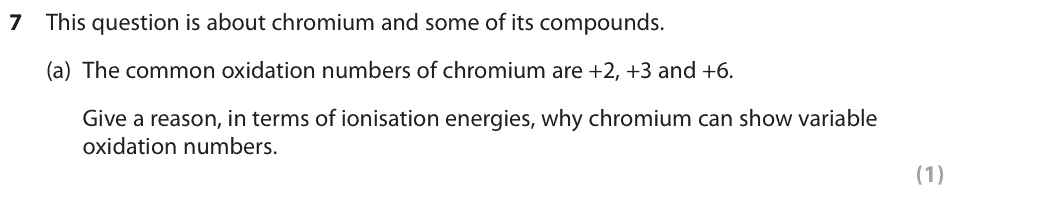
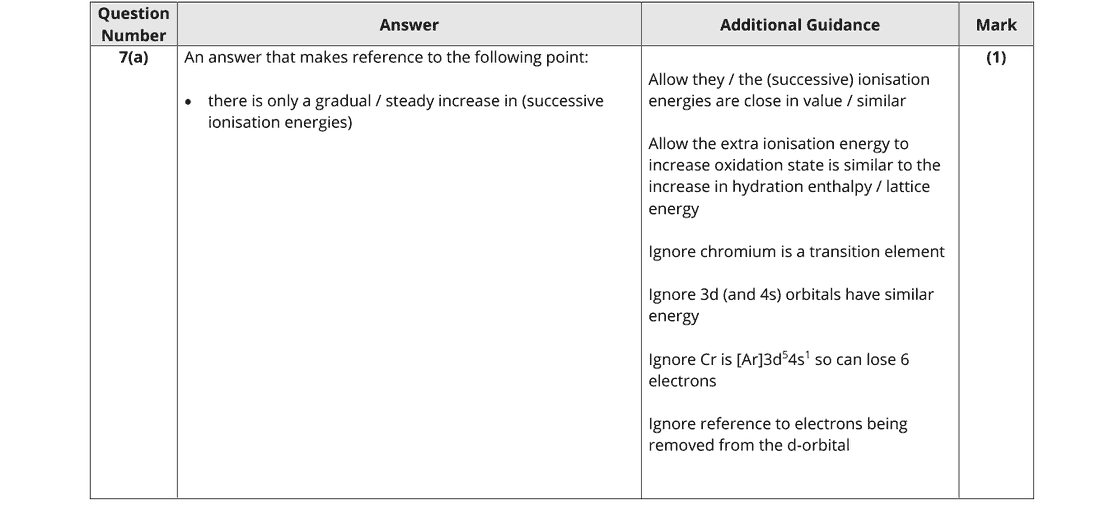
The common oxidation numbers of chromium are +2, +3 and +6.
Give a reason, in terms of ionisation energies, why chromium can show variable
oxidation numbers.
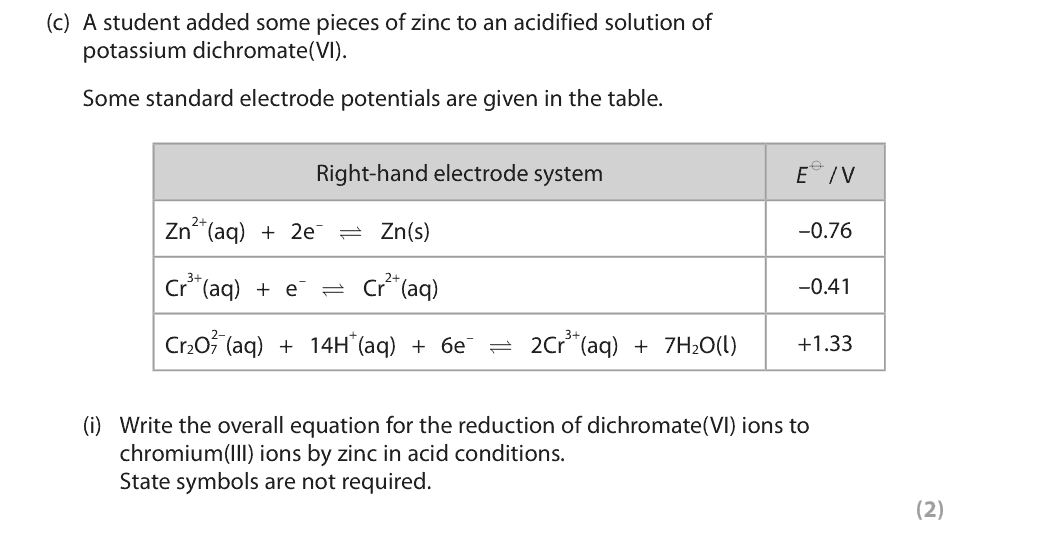
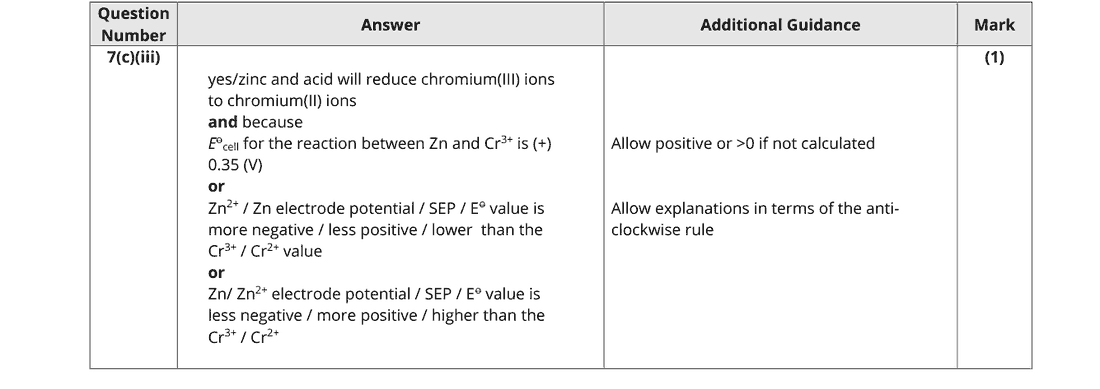
June 2022 · Paper 1 · Q7(c)(iii) 1 mark Short answer transition metals reactionsredox ii
Earlier parts of question 7 that this part usesEarlier part of June 2022 Paper 1 question 7Earlier part of June 2022 Paper 1 question 7Earlier part of June 2022 Paper 1 question 7
Predict whether or not a further reduction of chromium(III) ions to
chromium(II) ions will occur.  Justify your answer.
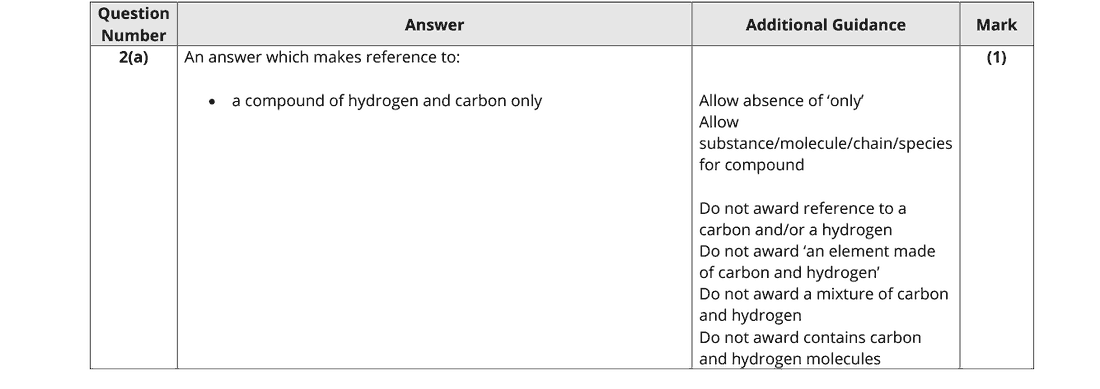
June 2022 · Paper 2 · Q2(a) 1 mark Short answer introduction to organic chemistry
This is a question about hydrocarbons.
State what is meant by the term hydrocarbon.
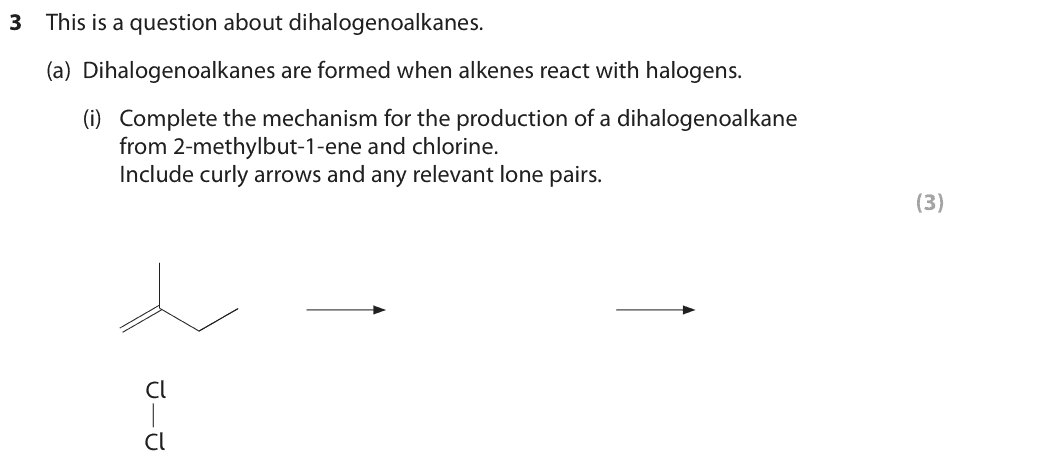
June 2022 · Paper 2 · Q3(a)(ii) 1 mark Short answer introduction to organic chemistry
Earlier part of question 3 that this part usesEarlier part of June 2022 Paper 2 question 3
Give the name of the dihalogenoalkane produced.
June 2022 · Paper 2 · Q4(a)(ii) 1 mark Short answer redox i
Earlier part of question 4 that this part usesEarlier part of June 2022 Paper 2 question 4
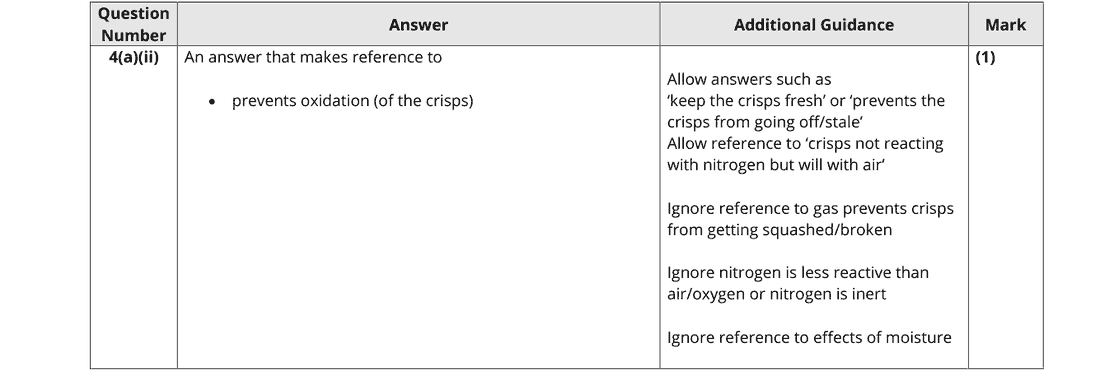
Give a possible reason why nitrogen gas and not air is used in packets
of crisps.
June 2022 · Paper 2 · Q5(a) 2 marks Short answer Easy bonding
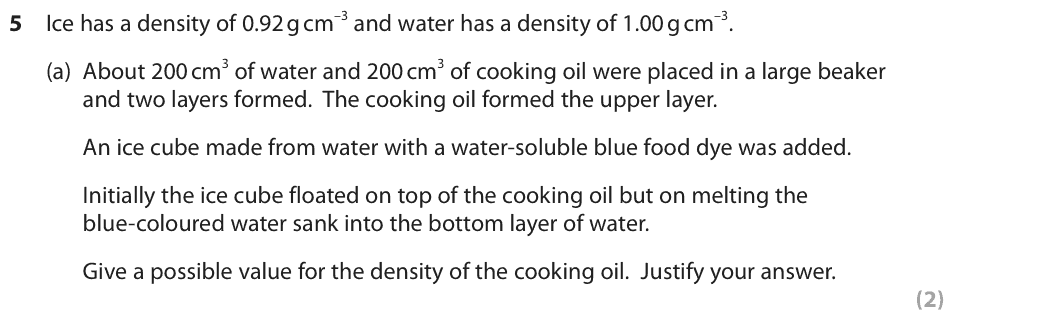
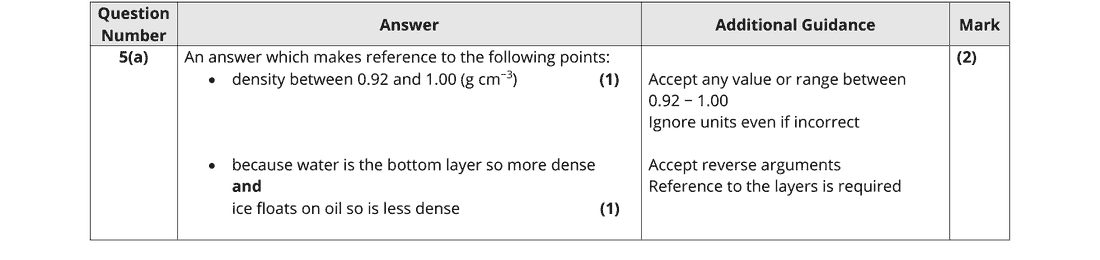
Ice has a density of 0.92 g cm–3 and water has a density of 1.00 g cm–3.
About 200 cm3 of water and 200 cm3 of cooking oil were placed in a large beaker
and two layers formed.  The cooking oil formed the upper layer.
An ice cube made from water with a water‑soluble blue food dye was added.
Initially the ice cube floated on top of the cooking oil but on melting the
blue‑coloured water sank into the bottom layer of water.
Give a possible value for the density of the cooking oil.  Justify your answer.
June 2022 · Paper 2 · Q6(c)(ii) 1 mark Short answer redox i
Earlier part of question 6 that this part usesEarlier part of June 2022 Paper 2 question 6
The oxidising agent is acidified Na2Cr2O7 .
State the oxidation number of chromium in Na2Cr2O7 .
June 2022 · Paper 2 · Q7(a)(i) 2 marks Short answer amines amides amino acids and proteins
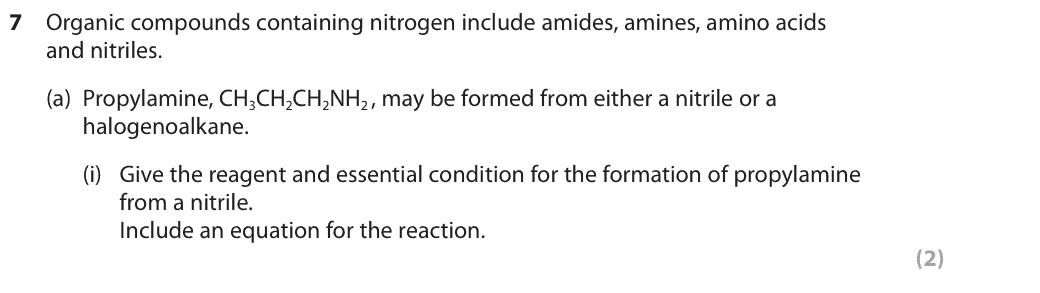
Organic compounds containing nitrogen include amides, amines, amino acids
and nitriles.
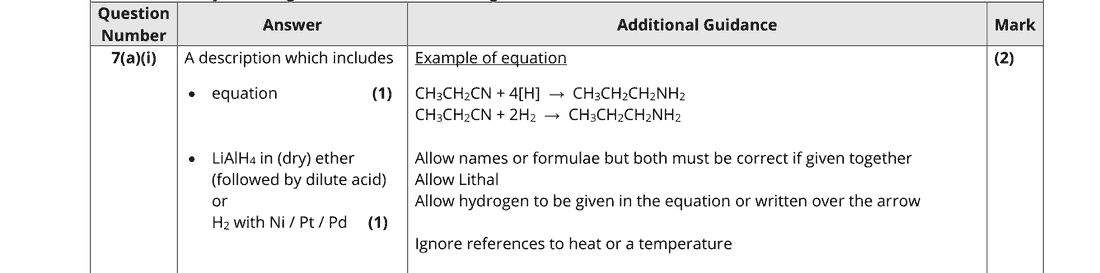
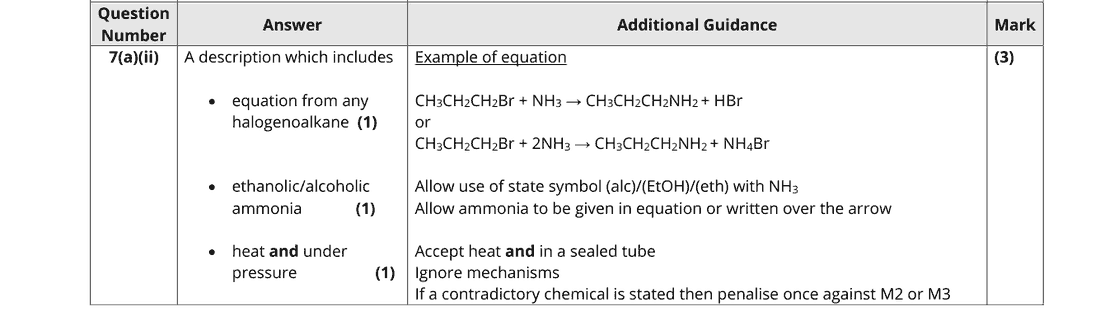
Propylamine, CH3CH2CH2NH2 , may be formed from either a nitrile or a
halogenoalkane.
Give the reagent and essential condition for the formation of propylamine
from a nitrile.
Include an equation for the reaction.
June 2022 · Paper 2 · Q7(a)(ii) 3 marks Short answer amines amides amino acids and proteinshalogenoalkanes
Earlier part of question 7 that this part usesEarlier part of June 2022 Paper 2 question 7
Give the reagent and essential conditions for the formation of propylamine
from a halogenoalkane.
Include an equation for the reaction.
June 2022 · Paper 2 · Q8(b) 1 mark Short answer introduction to organic chemistry
Earlier part of question 8 that this part usesEarlier part of June 2022 Paper 2 question 8
State the molecular formula of amyl acetate.
June 2022 · Paper 2 · Q8(c) 1 mark Short answer Easy carboxylic acids
Earlier part of question 8 that this part usesEarlier part of June 2022 Paper 2 question 8
Deduce the structural formula of the carboxylic acid that could be used to form
both isoamyl acetate and amyl acetate.
June 2022 · Paper 2 · Q8(d) 1 mark Short answer introduction to organic chemistry
Earlier part of question 8 that this part usesEarlier part of June 2022 Paper 2 question 8
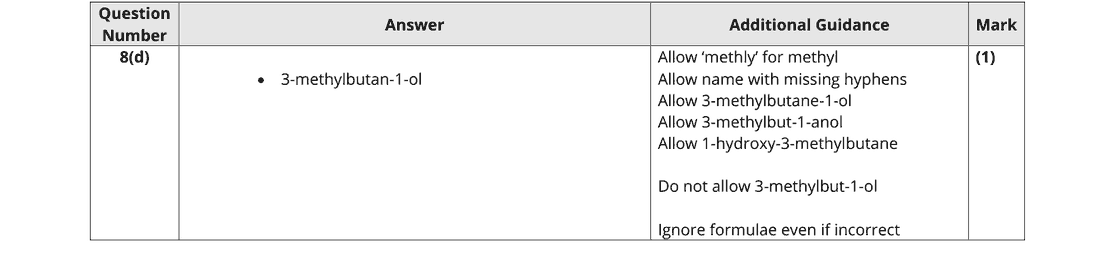
Deduce the name of the alcohol that forms isoamyl acetate.
June 2022 · Paper 2 · Q8(e) 1 mark Short answer introduction to organic chemistry
Earlier part of question 8 that this part usesEarlier part of June 2022 Paper 2 question 8
Give the systematic name for amyl acetate.
June 2022 · Paper 2 · Q9(a) 1 mark Short answer kinetics ii
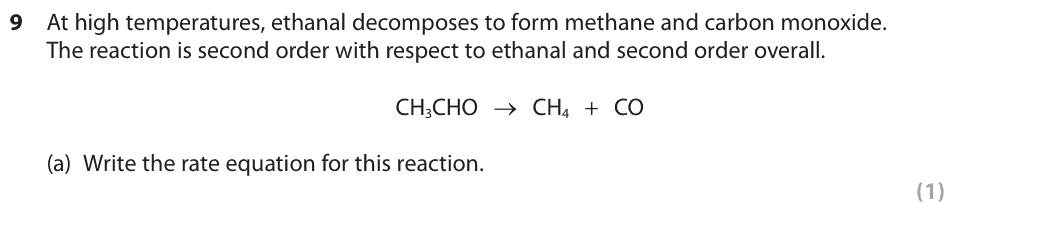
At high temperatures, ethanal decomposes to form methane and carbon monoxide.
The reaction is second order with respect to ethanal and second order overall.
CH3CHO   →   CH4   +   CO
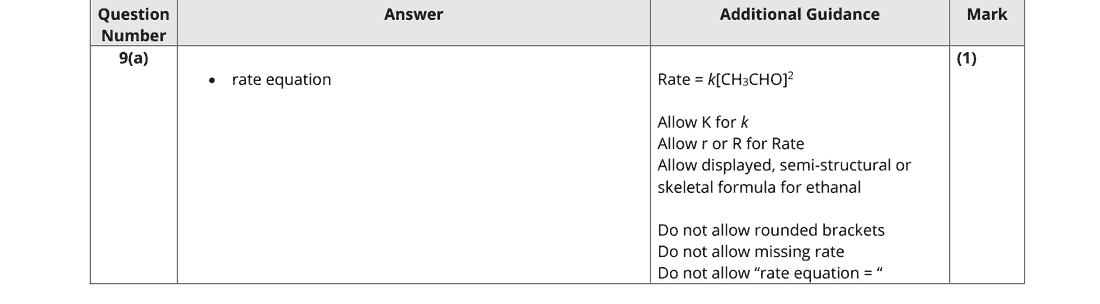
Write the rate equation for this reaction.
June 2022 · Paper 2 · Q9(b) 1 mark Short answer kinetics ii
Earlier part of question 9 that this part usesEarlier part of June 2022 Paper 2 question 9
Deduce the units of the rate constant given that the units of rate are mol dm–3 s–1.
June 2022 · Paper 3 · Q1(a) 2 marks Short answer atomic structure and the periodic table
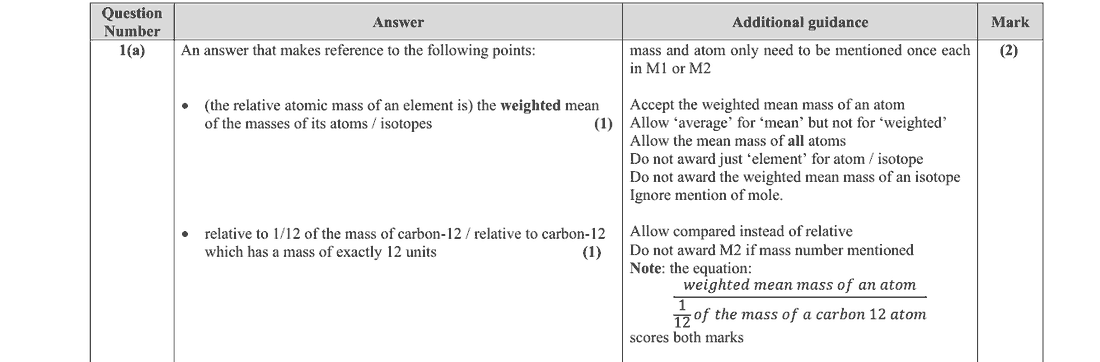
Relative atomic mass is an important concept in chemistry.
Define the term relative atomic mass.
June 2022 · Paper 3 · Q3(b)(ii) 1 mark Short answer analysis of inorganic compounds
Earlier parts of question 3 that this part usesEarlier part of June 2022 Paper 3 question 3Earlier part of June 2022 Paper 3 question 3Earlier part of June 2022 Paper 3 question 3
Deduce the formula of X, using your answers to (a)(ii) and (b)(i).
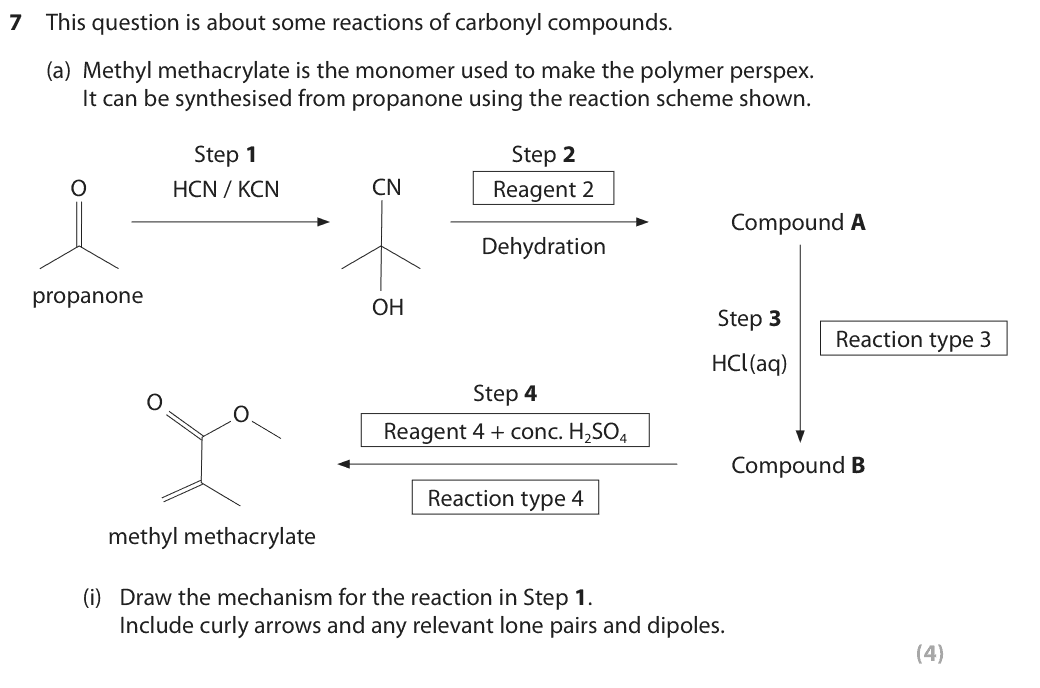
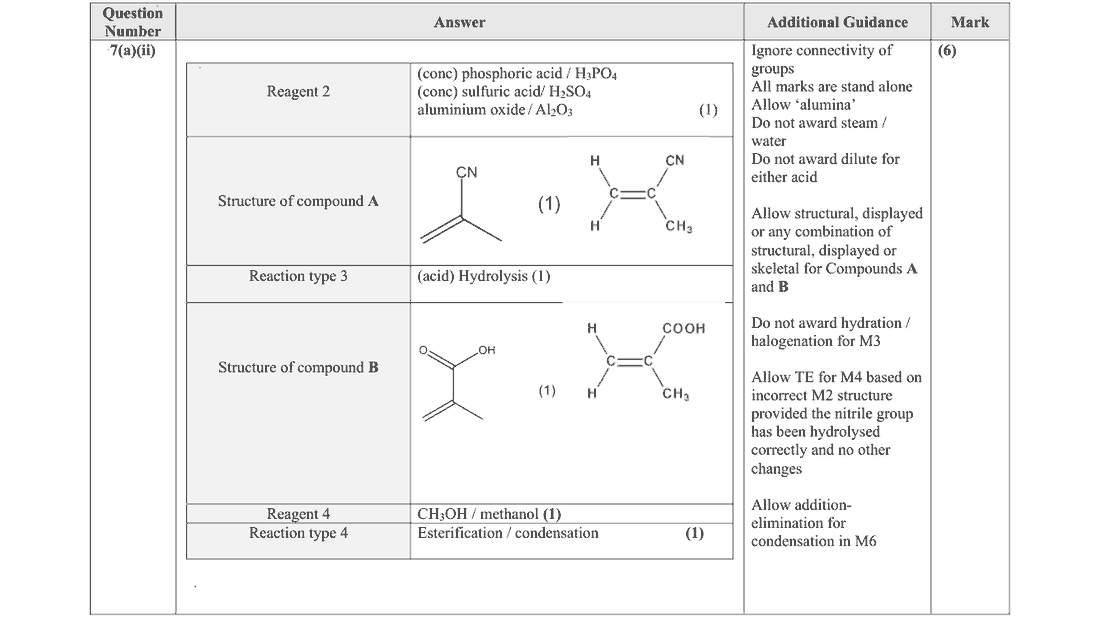
June 2022 · Paper 3 · Q7(a)(ii) 6 marks Short answer alcoholscarboxylic acids
Earlier part of question 7 that this part usesEarlier part of June 2022 Paper 3 question 7
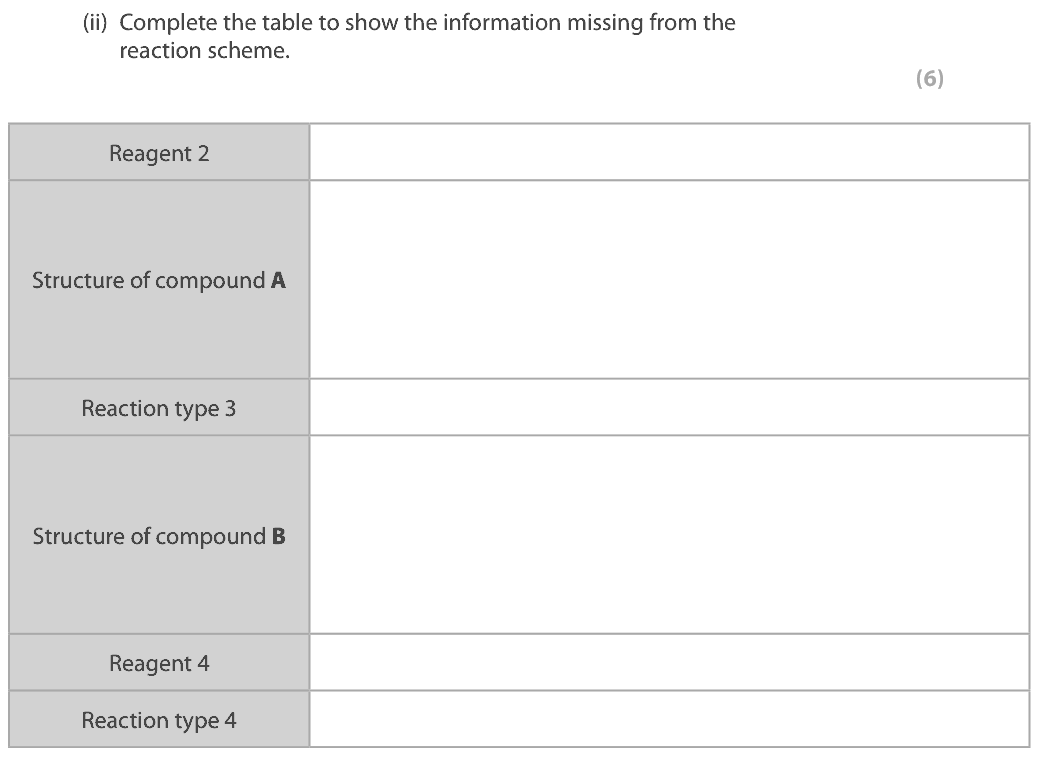
Complete the table to show the information missing from the
reaction scheme.
Reagent 2
Structure of compound A
Reaction type 3
Structure of compound B
Reagent 4
Reaction type 4
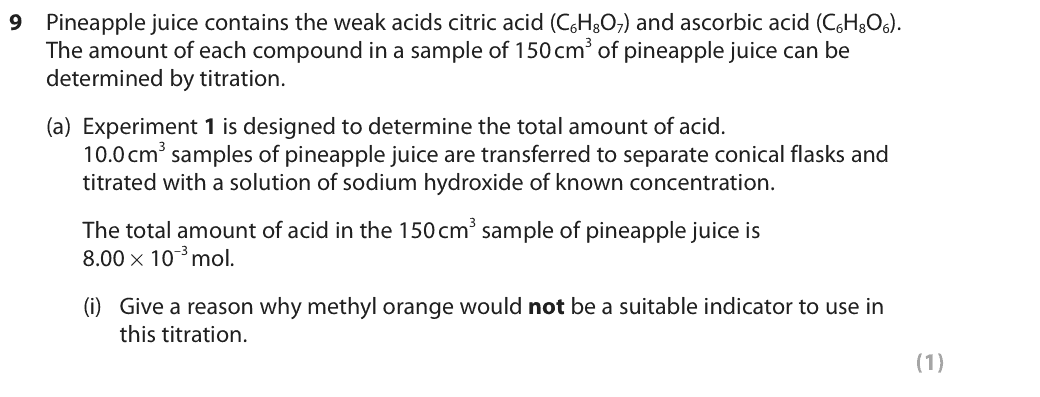
June 2022 · Paper 3 · Q9(a)(i) 1 mark Short answer acid base equilibria
Pineapple juice contains the weak acids citric acid (C6H8O7) and ascorbic acid (C6H8O6).
The amount of each compound in a sample of 150 cm3 of pineapple juice can be
determined by titration.
Experiment 1 is designed to determine the total amount of acid.
10.0 cm3 samples of pineapple juice are transferred to separate conical flasks and
titrated with a solution of sodium hydroxide of known concentration.
The total amount of acid in the 150 cm3 sample of pineapple juice is
8.00 × 10–3 mol.
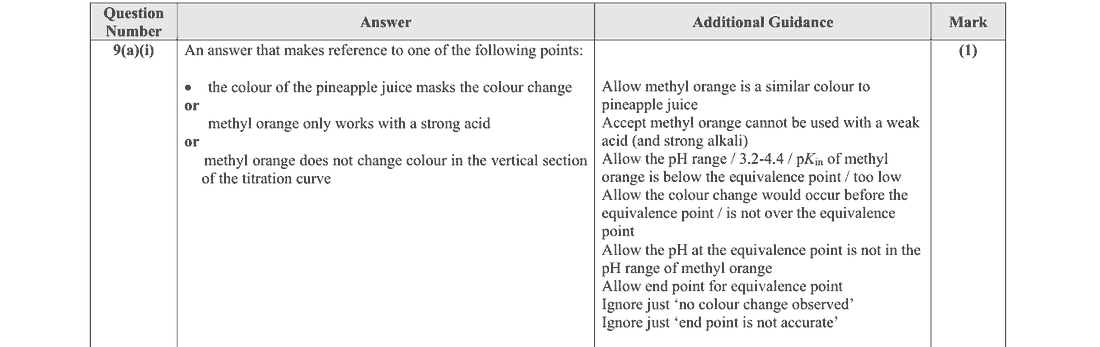
Give a reason why methyl orange would not be a suitable indicator to use in
this titration.
June 2022 · Paper 3 · Q10(c)(i) 2 marks Short answer kinetics ii
Earlier part of question 10 that this part usesEarlier part of June 2022 Paper 3 question 10
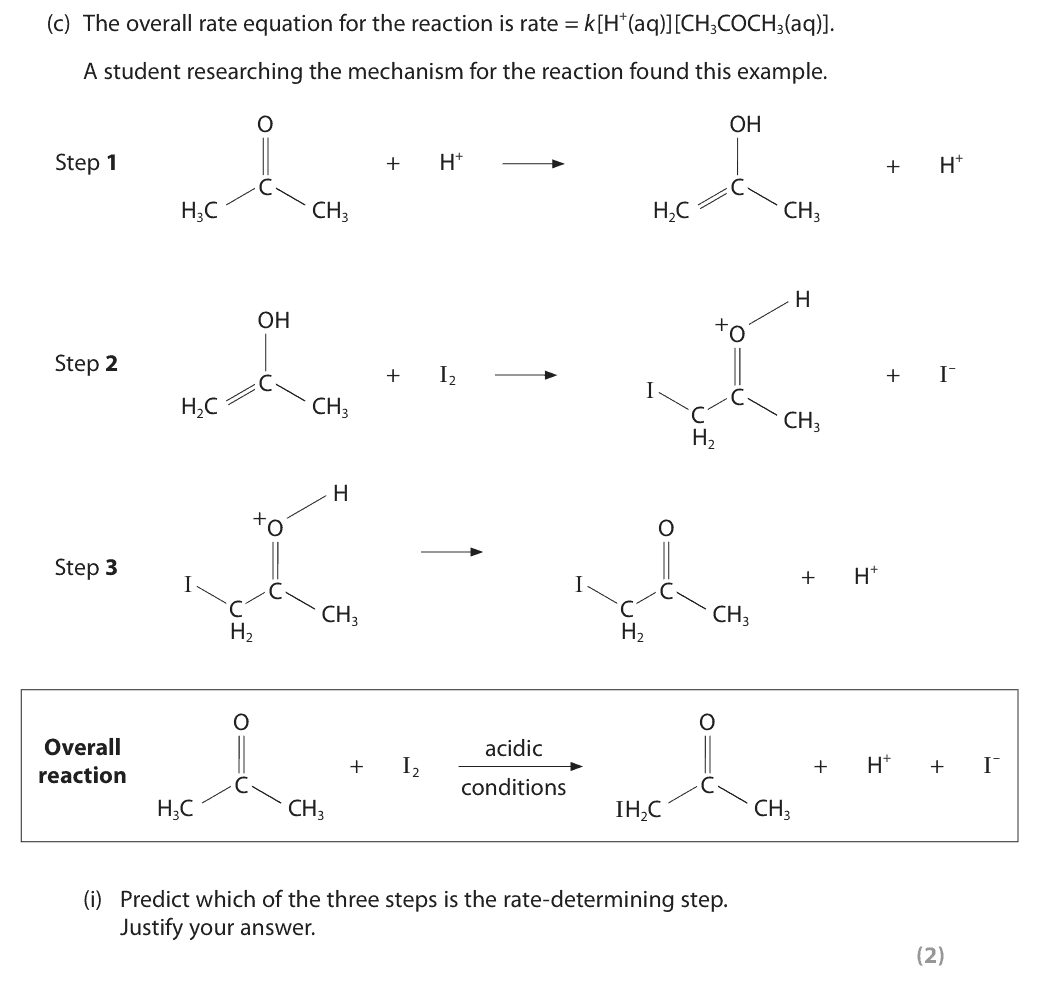
The overall rate equation for the reaction is rate = k[H+(aq)][CH3COCH3(aq)].
A student researching the mechanism for the reaction found this example.
O
OH
Step 1
+       H+
+       H+
C
C
H3C
CH3
H2C
CH3
H
OH
+
O
Step 2
+       I2
+       I–
C
I
C
H2C
CH3
C
CH3
H2
H
+
O
O
Step 3
+       H+
I
I
C
C
C
C
CH3
CH3
H2
H2
O
O
Overall
acidic
+       I2
+       H+       +       I–
reaction
C
conditions
C
H3C
CH3
IH2C
CH3
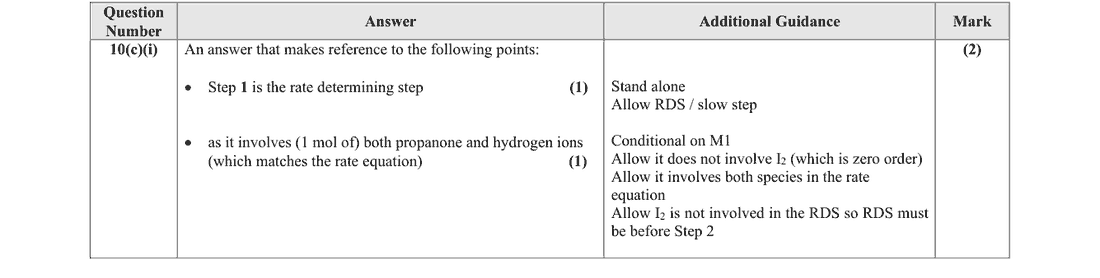
Predict which of the three steps is the rate‑determining step.
Justify your answer.
November 2021 · AS Paper 1 · Q1(a) 2 marks Short answer Easy atomic structure and the periodic table
Bromine exists as two stable isotopes. The two isotopes are represented by the
symbols 35
79Br and 35
81Br.
Give one similarity and one difference between these two isotopes by referring to
the number of particles in the nuclei of the two isotopes.
November 2021 · AS Paper 1 · Q1(b)(i) 1 mark Short answer atomic structure and the periodic table
Earlier part of question 1 that this part usesEarlier part of November 2021 Paper 1 question 1
The relative abundance of the two isotopes in a sample cannot be found in a
chemical test.
Give the reason why, despite the difference in atomic structure, the isotopes
have the same chemical reactions.
November 2021 · AS Paper 1 · Q1(b)(ii) 2 marks Short answer atomic structure and the periodic table
Earlier parts of question 1 that this part usesEarlier part of November 2021 Paper 1 question 1Earlier part of November 2021 Paper 1 question 1
State how the relative abundance of the two isotopes can be found.
November 2021 · AS Paper 1 · Q1(c)(i) 1 mark Short answer Easy atomic structure and the periodic table
Earlier part of question 1 that this part usesEarlier part of November 2021 Paper 1 question 1
Complete the electronic configuration of a bromine atom.
1s2 2s2
November 2021 · AS Paper 1 · Q3(b) 1 mark Short answer Hard formulae equations and amounts of substance
Give a possible reason why samples of sodium amide are stored in oil.
November 2021 · AS Paper 1 · Q4(c)(ii) 1 mark Short answer bonding
Earlier parts of question 4 that this part usesEarlier part of November 2021 Paper 1 question 4Earlier part of November 2021 Paper 1 question 4
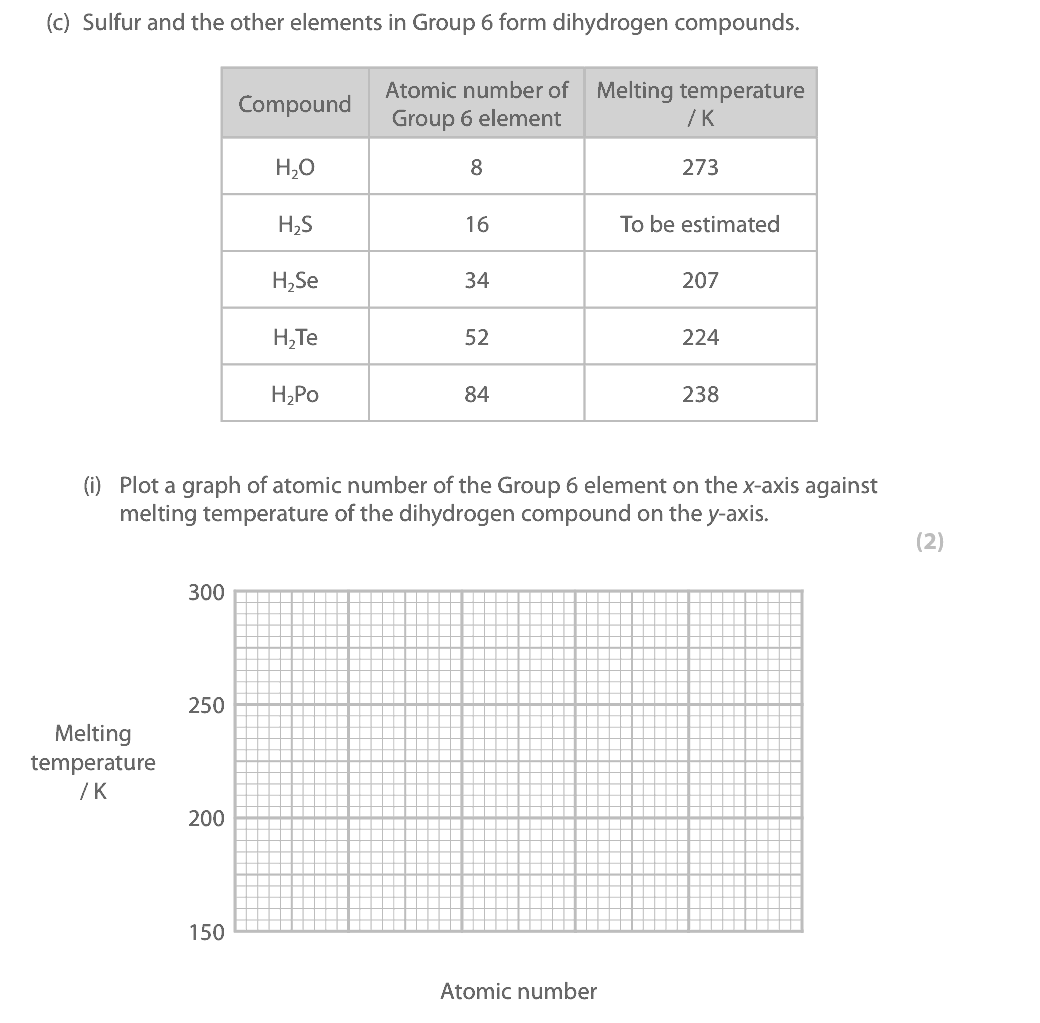
Give an estimate of the melting temperature of H2S.
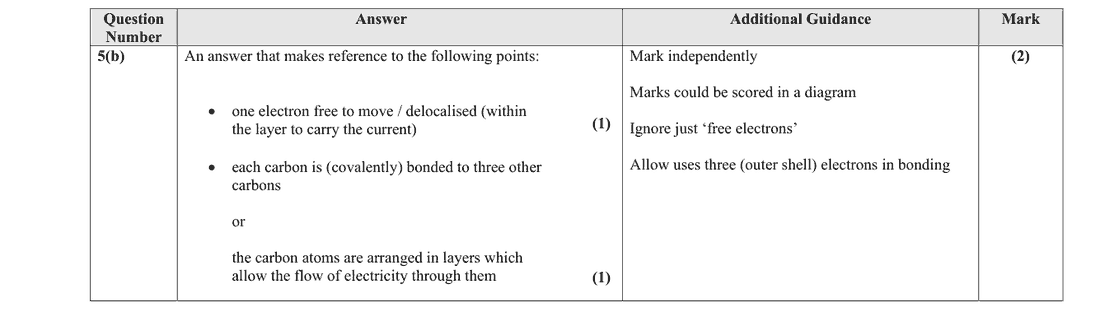
November 2021 · AS Paper 1 · Q5(b) 2 marks Short answer structure
Graphite is also a crystalline solid at room temperature.
Unlike diamond, graphite conducts electricity.
Describe the key feature of the bonding of the carbon atoms in graphite that
results in it being an electrical conductor.
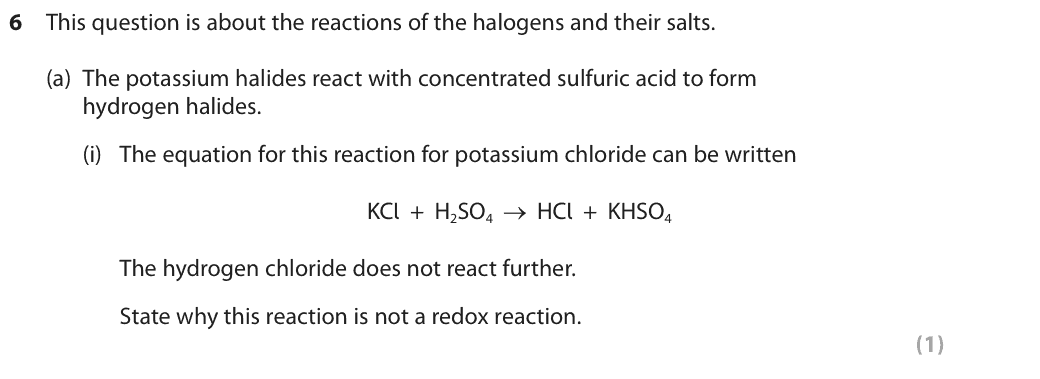
November 2021 · AS Paper 1 · Q6(a)(i) 1 mark Short answer redox i
This question is about the reactions of the halogens and their salts.
The potassium halides react with concentrated sulfuric acid to form
hydrogen halides.
The equation for this reaction for potassium chloride can be written
KCl  +  H2SO4  →  HCl  +  KHSO4
The hydrogen chloride does not react further.
State why this reaction is not a redox reaction.
November 2021 · AS Paper 1 · Q7(a) 2 marks Short answer bonding
The nitrates of lithium, rubidium and strontium are all white solids. The compounds
are held together by ionic bonds.
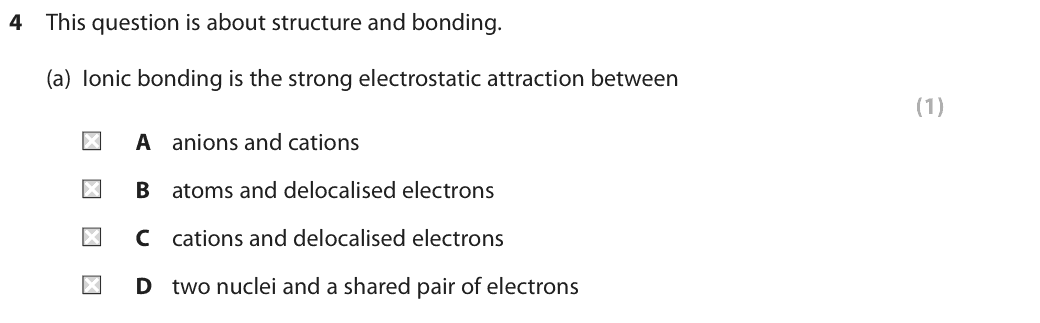
State the meaning of the term ‘ionic bond’.
November 2021 · AS Paper 2 · Q6(d)(i) 2 marks Short answer Hard halogenoalkanes
Earlier part of question 6 that this part usesEarlier part of November 2021 Paper 2 question 6
Under different conditions, 2‑chloro‑2‑methylpropane can react to produce
2‑methylpropene, (CH3)2C
CH2 .
State the reagent and conditions needed for this reaction.
November 2021 · AS Paper 2 · Q7(a) 1 mark Short answer introduction to organic chemistry
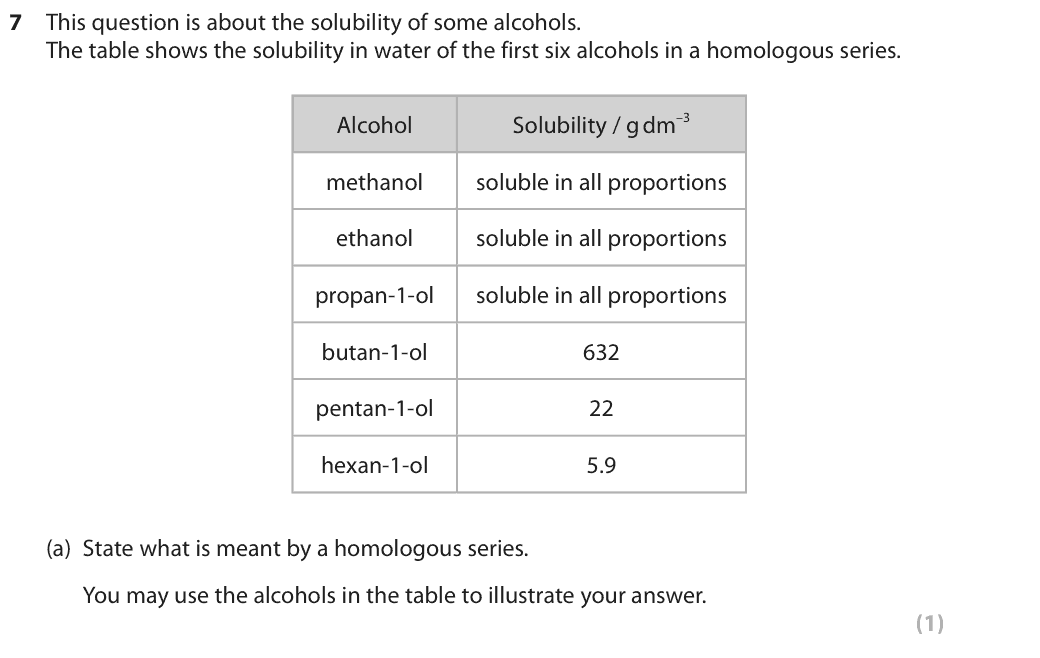
This question is about the solubility of some alcohols.
The table shows the solubility in water of the first six alcohols in a homologous series.
Alcohol
Solubility / g dm–3
methanol
soluble in all proportions
ethanol
soluble in all proportions
propan-1‑ol
soluble in all proportions
butan-1‑ol
632
pentan-1‑ol
22
hexan-1‑ol
5.9
State what is meant by a homologous series.
You may use the alcohols in the table to illustrate your answer.
November 2021 · AS Paper 2 · Q8(b)(i) 2 marks Short answer alcoholsintroduction to organic chemistry
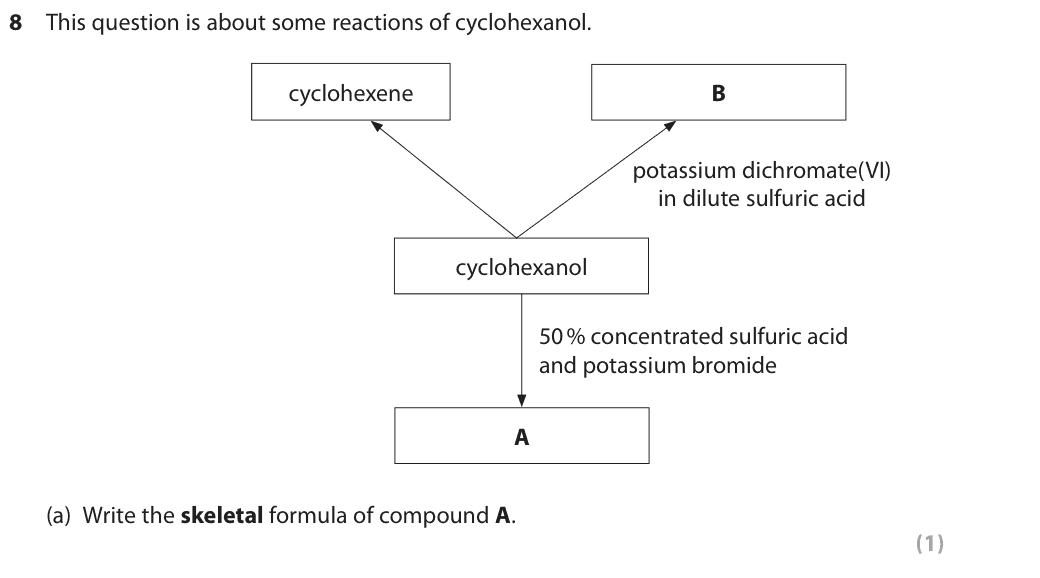
Earlier part of question 8 that this part usesEarlier part of November 2021 Paper 2 question 8
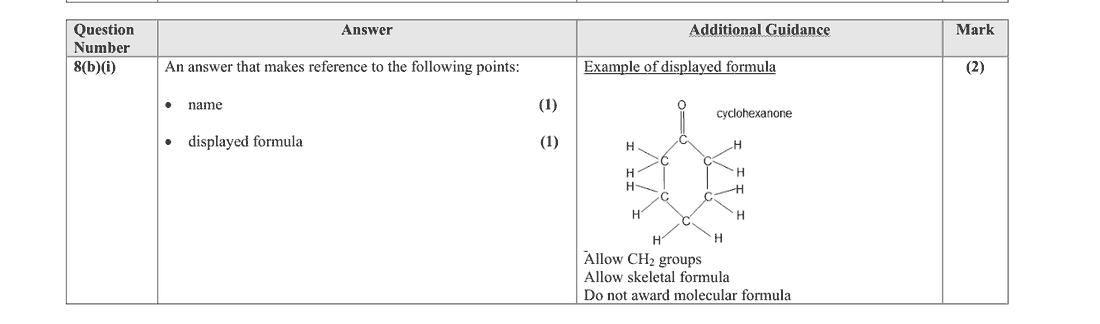
Give the name and displayed formula of compound B.
November 2021 · AS Paper 2 · Q8(b)(ii) 2 marks Short answer mass spectrometry and infrared spectroscopy
Earlier parts of question 8 that this part usesEarlier part of November 2021 Paper 2 question 8Earlier part of November 2021 Paper 2 question 8
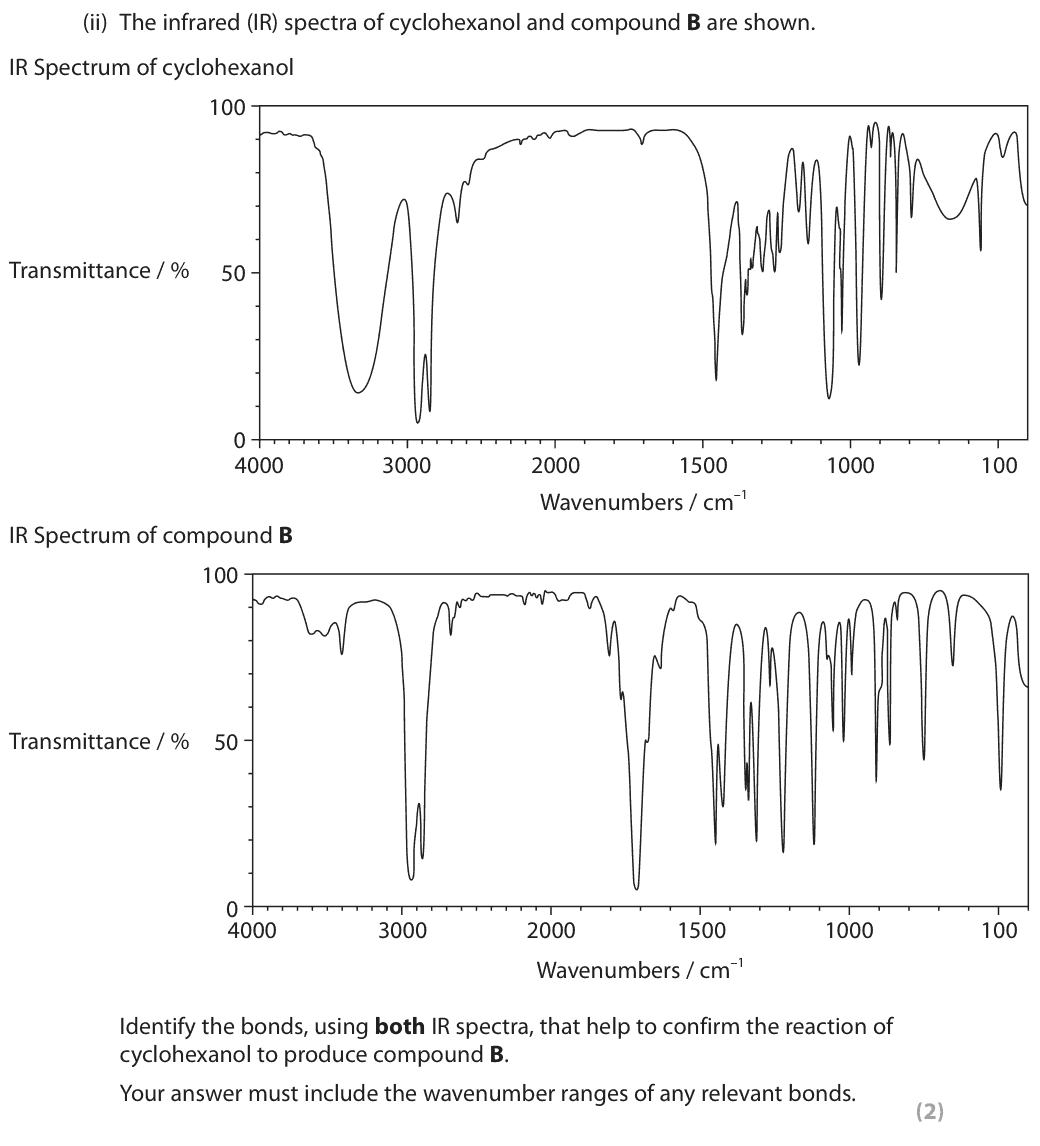
The infrared (IR) spectra of cyclohexanol and compound B are shown.
IR Spectrum of cyclohexanol
100
Transmittance / %
50
0
4000
3000
2000
1500
1000
100
Wavenumbers / cm–1
IR Spectrum of compound B
100
Transmittance / %
50
0
4000
3000
2000
1500
1000
100
Wavenumbers / cm–1
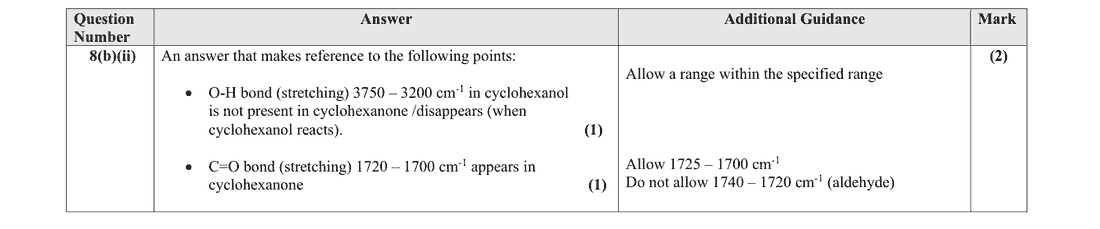
Identify the bonds, using both IR spectra, that help to confirm the reaction of
cyclohexanol to produce compound B.
Your answer must include the wavenumber ranges of any relevant bonds.
November 2021 · AS Paper 2 · Q8(b)(iii) 1 mark Short answer mass spectrometry and infrared spectroscopy
Earlier parts of question 8 that this part usesEarlier part of November 2021 Paper 2 question 8Earlier part of November 2021 Paper 2 question 8Earlier part of November 2021 Paper 2 question 8
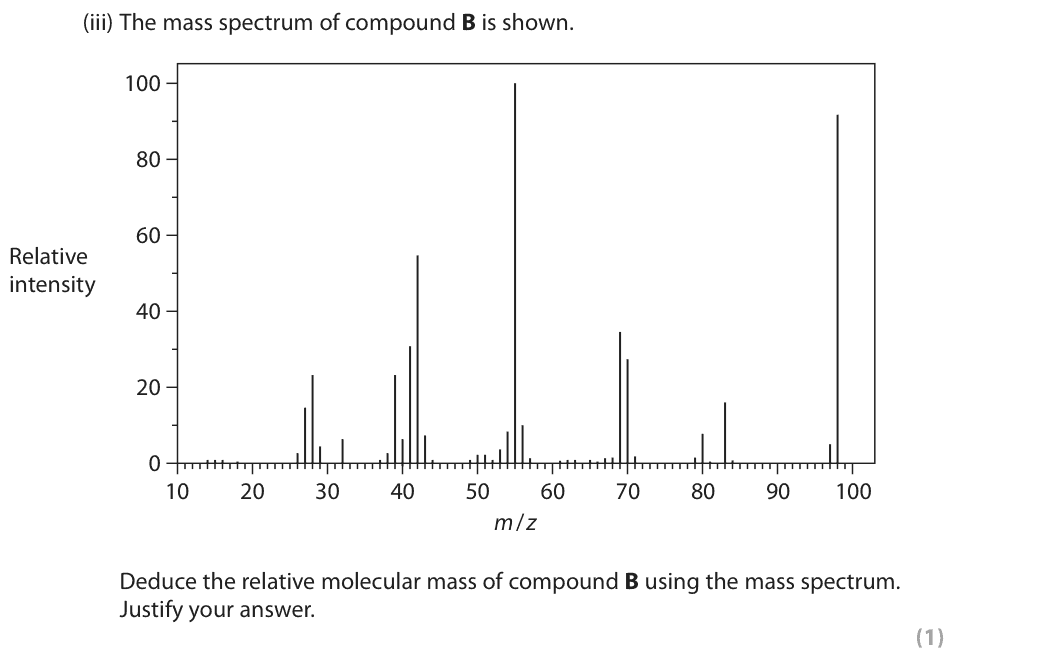
The mass spectrum of compound B is shown.
100
80
60
Relative
intensity
40
20
0
10
20
30
40
50
60
70
80
90
100
m/z
Deduce the relative molecular mass of compound B using the mass spectrum.
Justify your answer.
November 2021 · AS Paper 2 · Q8(b)(iv) 2 marks Short answer mass spectrometry and infrared spectroscopy
Earlier parts of question 8 that this part usesEarlier part of November 2021 Paper 2 question 8Earlier part of November 2021 Paper 2 question 8
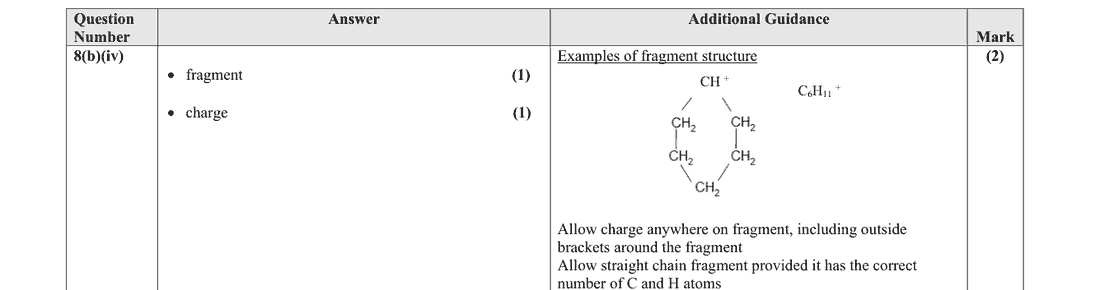
In the mass spectrum of cyclohexanol, there is a peak at m/z = 83.
Give the formula of a fragment that could be responsible for this peak.
November 2021 · AS Paper 2 · Q9(a)(ii) 2 marks Short answer energetics i
Earlier part of question 9 that this part usesEarlier part of November 2021 Paper 2 question 9
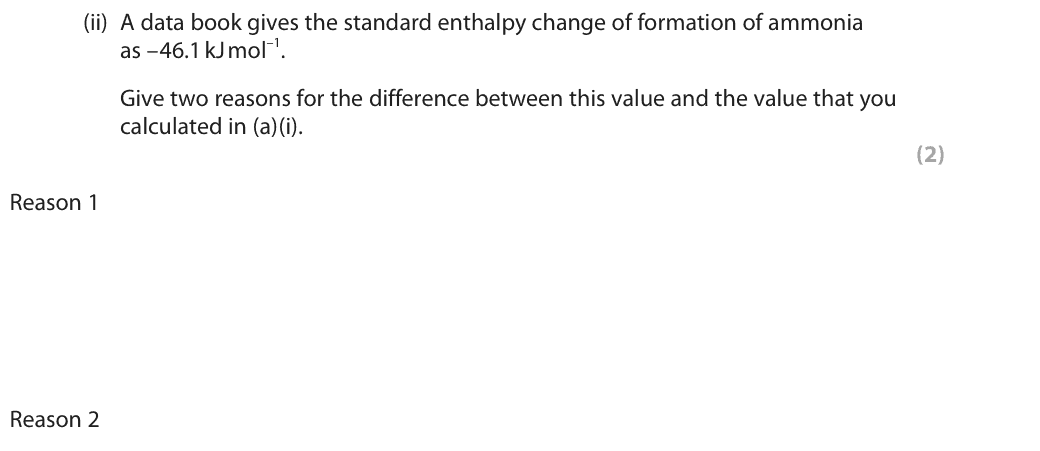
A data book gives the standard enthalpy change of formation of ammonia
as –46.1 kJ mol–1.
Give two reasons for the difference between this value and the value that you
calculated in (a)(i).
Reason 1
Reason 2
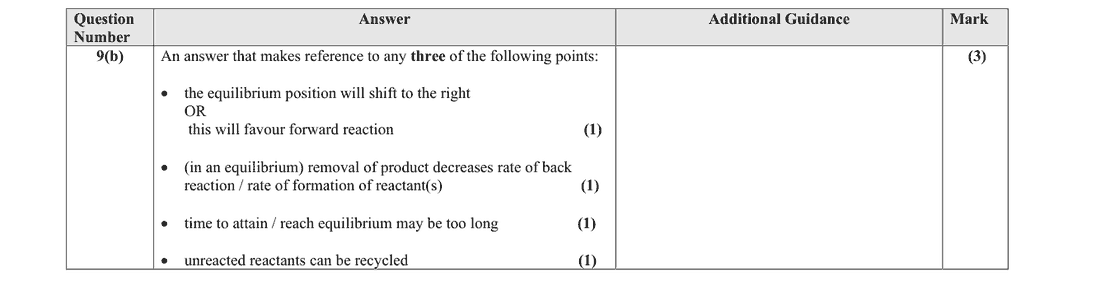
November 2021 · AS Paper 2 · Q9(b) 3 marks Short answer equilibrium i
Earlier part of question 9 that this part usesEarlier part of November 2021 Paper 2 question 9
In the chemical industry, many processes involve reversible reactions. The product
is often removed before equilibrium is attained.
Give three reasons why the product may be removed before its maximum
concentration is achieved.
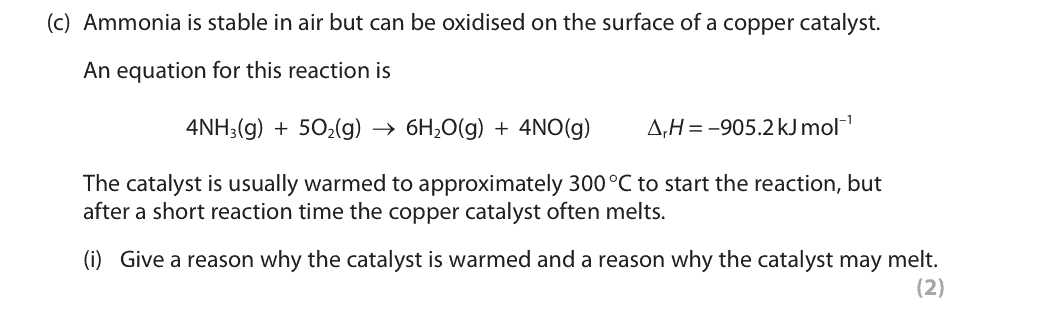
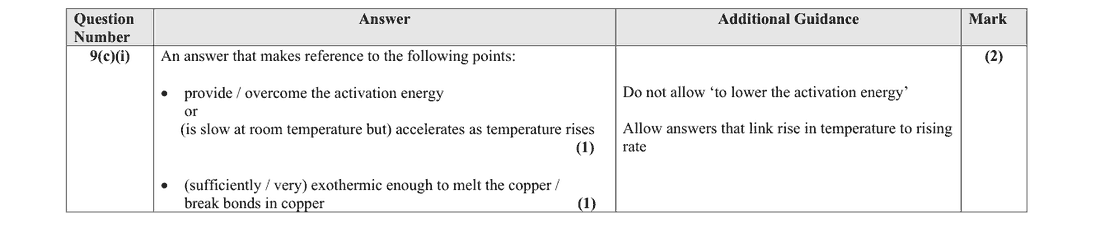
November 2021 · AS Paper 2 · Q9(c)(i) 2 marks Short answer kinetics i
Earlier part of question 9 that this part usesEarlier part of November 2021 Paper 2 question 9
Ammonia is stable in air but can be oxidised on the surface of a copper catalyst.
An equation for this reaction is
4NH3(g)  +  5O2(g)  →  6H2O(g)  +  4NO(g)           ΔrH = –905.2 kJ mol–1
The catalyst is usually warmed to approximately 300 °C to start the reaction, but
after a short reaction time the copper catalyst often melts.
Give a reason why the catalyst is warmed and a reason why the catalyst may melt.
November 2021 · AS Paper 2 · Q9(c)(iii) 3 marks Short answer kinetics i
Earlier parts of question 9 that this part usesEarlier part of November 2021 Paper 2 question 9Earlier part of November 2021 Paper 2 question 9
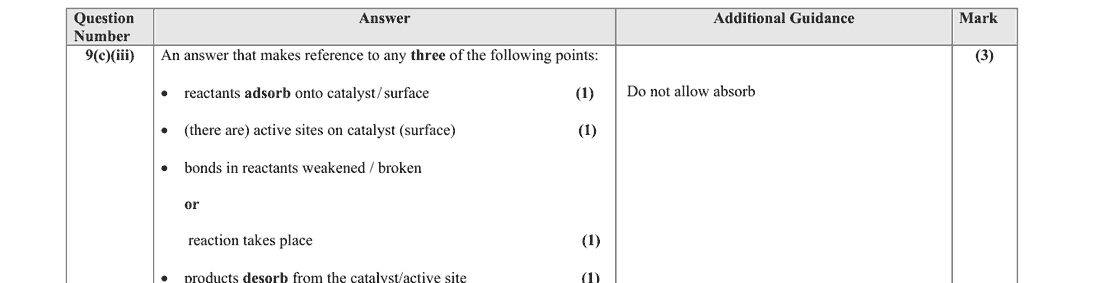
Describe the processes that occur on the surface of a heterogeneous catalyst
during the oxidation of ammonia in air.
November 2021 · Paper 1 · Q3(a) 2 marks Short answer bonding
This question is about catalytic converters.
Catalytic converters contain metals such as platinum.
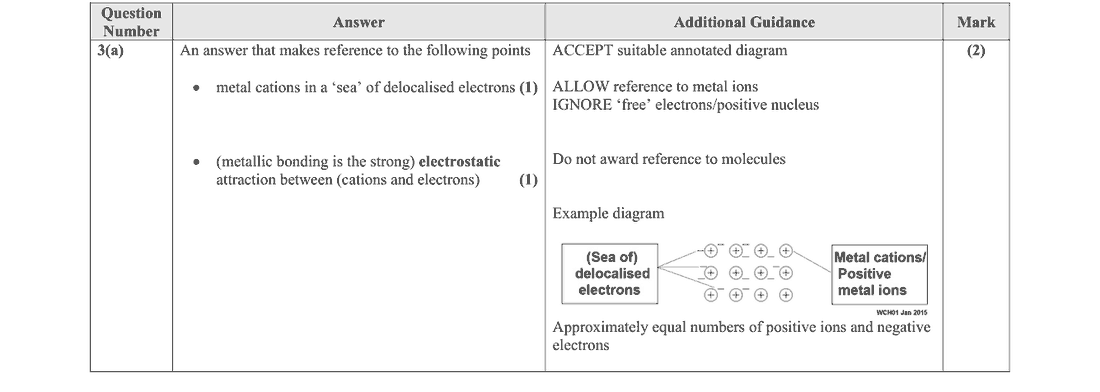
Describe the bonding in platinum.
You may include a diagram in your answer.
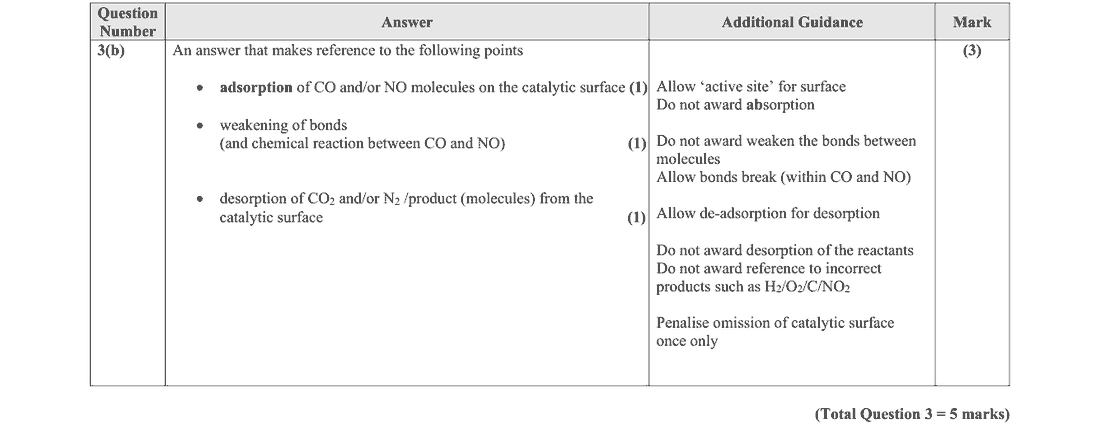
November 2021 · Paper 1 · Q3(b) 3 marks Short answer transition metals reactions
A catalytic converter decreases the emissions of gases, such as carbon monoxide
and nitrogen monoxide, from an internal combustion engine.
Describe the stages in a catalytic converter that result in this decrease.
No equations are required.
November 2021 · Paper 1 · Q4(a) 2 marks Short answer atomic structure and the periodic table
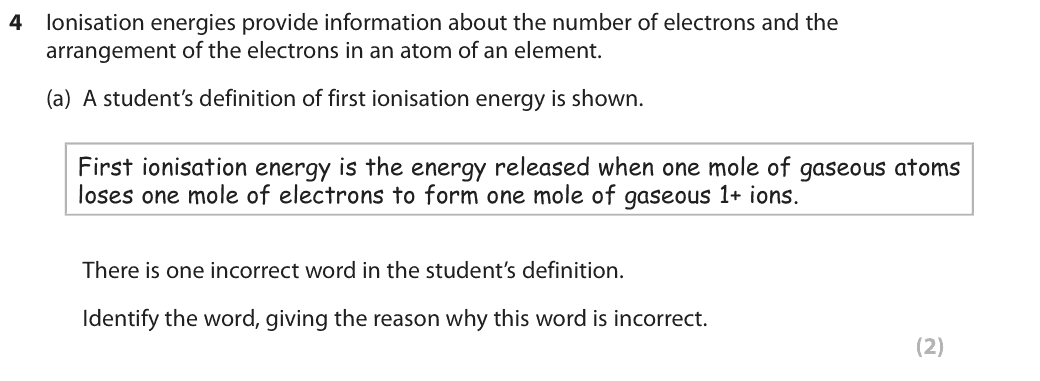
Ionisation energies provide information about the number of electrons and the
arrangement of the electrons in an atom of an element.
A student’s definition of first ionisation energy is shown.
First ionisation energy is the energy released when one mole of gaseous atoms
loses one mole of electrons to form one mole of gaseous 1+ ions.
There is one incorrect word in the student’s definition.
Identify the word, giving the reason why this word is incorrect.
November 2021 · Paper 1 · Q4(d)(ii) 1 mark Short answer atomic structure and the periodic table
Earlier parts of question 4 that this part usesEarlier part of November 2021 Paper 1 question 4Earlier part of November 2021 Paper 1 question 4
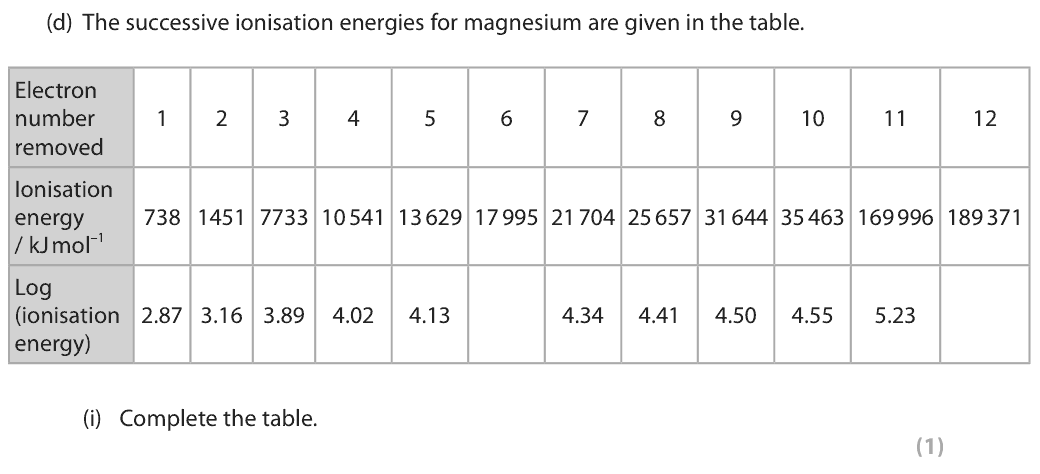
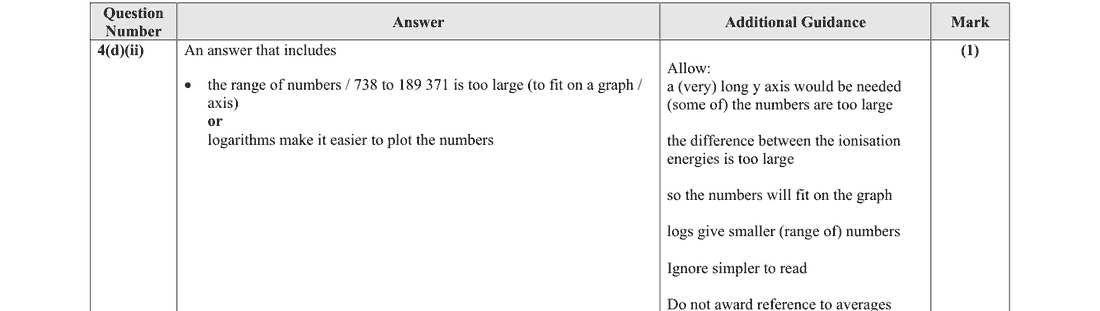
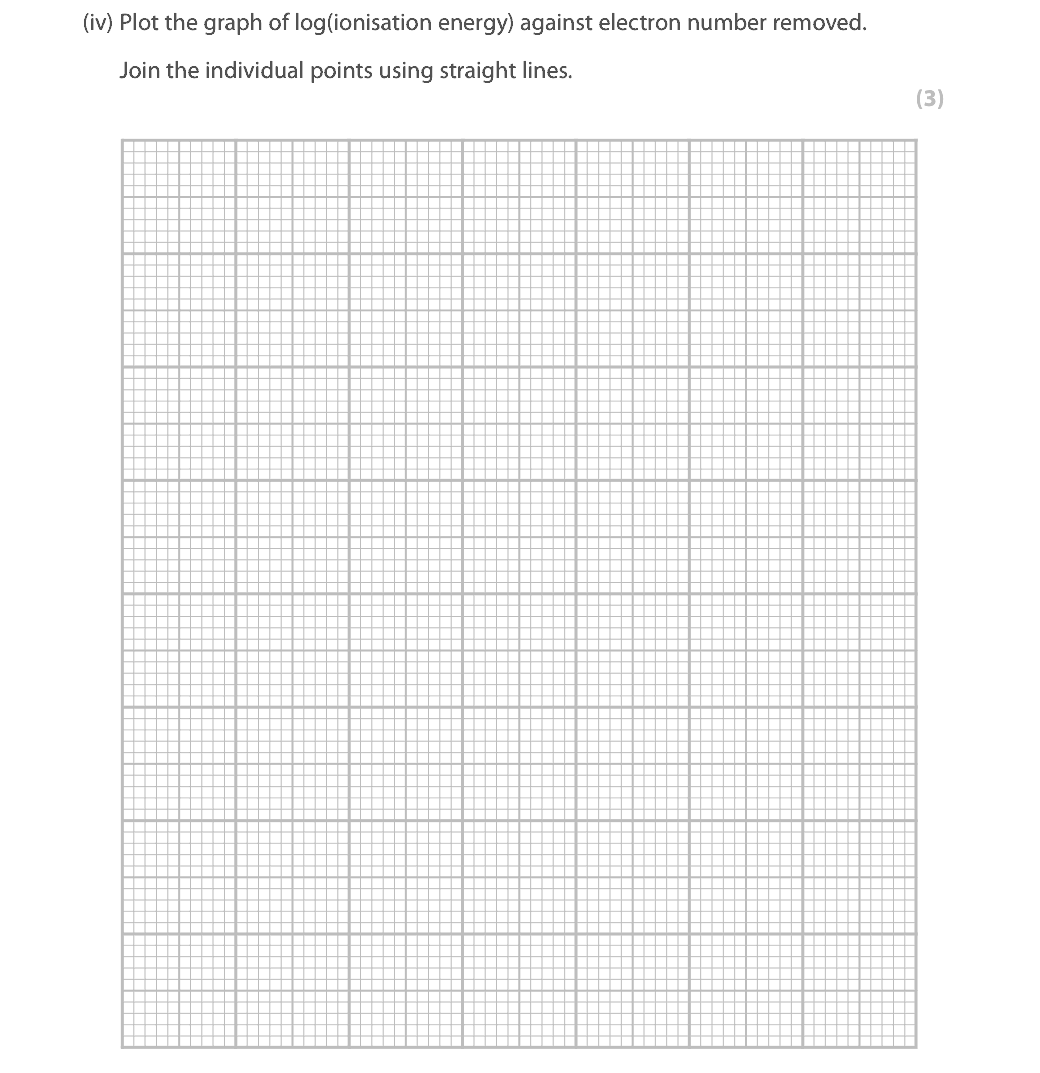
Give a reason why the logarithm of the ionisation energy, rather than just the
ionisation energy, is used to plot a graph.
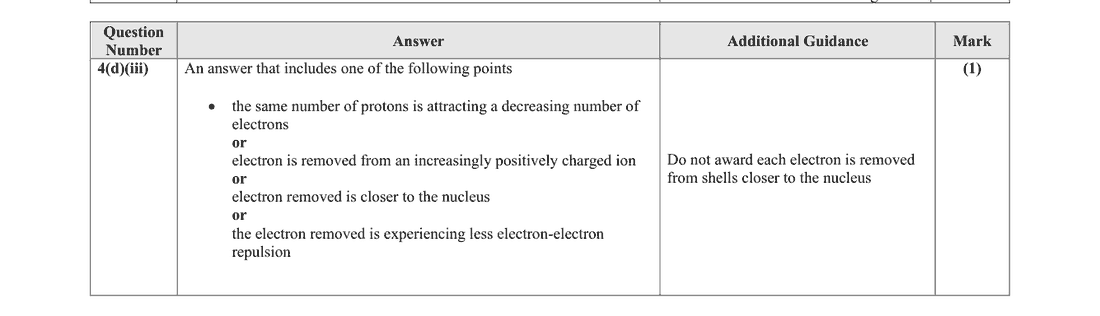
November 2021 · Paper 1 · Q4(d)(iii) 1 mark Short answer atomic structure and the periodic table
Earlier parts of question 4 that this part usesEarlier part of November 2021 Paper 1 question 4Earlier part of November 2021 Paper 1 question 4
Give a reason why the successive ionisation energies increase.
November 2021 · Paper 1 · Q4(d)(v) 1 mark Short answer atomic structure and the periodic table
Earlier parts of question 4 that this part usesEarlier part of November 2021 Paper 1 question 4Earlier part of November 2021 Paper 1 question 4Earlier part of November 2021 Paper 1 question 4Earlier part of November 2021 Paper 1 question 4Earlier part of November 2021 Paper 1 question 4
Identify on the graph, using a circle, the points that represent the removal of
the electrons in the outermost energy level of magnesium.
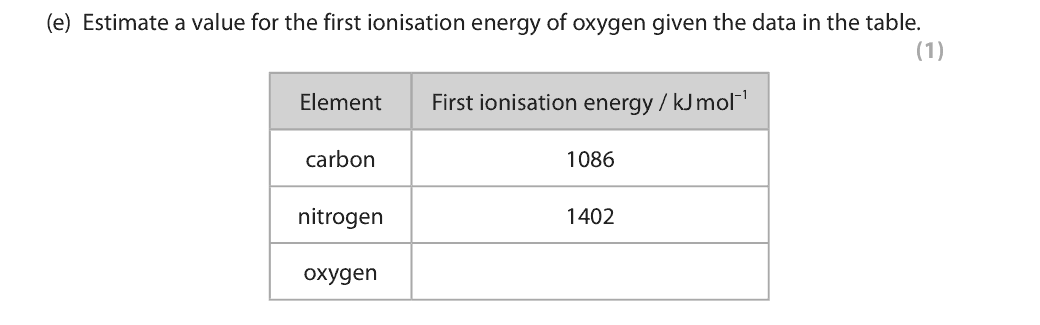
November 2021 · Paper 1 · Q4(e) 1 mark Short answer Hard atomic structure and the periodic table
Earlier part of question 4 that this part usesEarlier part of November 2021 Paper 1 question 4
Estimate a value for the first ionisation energy of oxygen given the data in the table.
Element
First ionisation energy / kJ mol–1
carbon
1086
nitrogen
1402
oxygen
November 2021 · Paper 1 · Q5(a)(ii) 1 mark Short answer energetics i
Earlier part of question 5 that this part usesEarlier part of November 2021 Paper 1 question 5
Give a reason why bond enthalpy values are always positive.
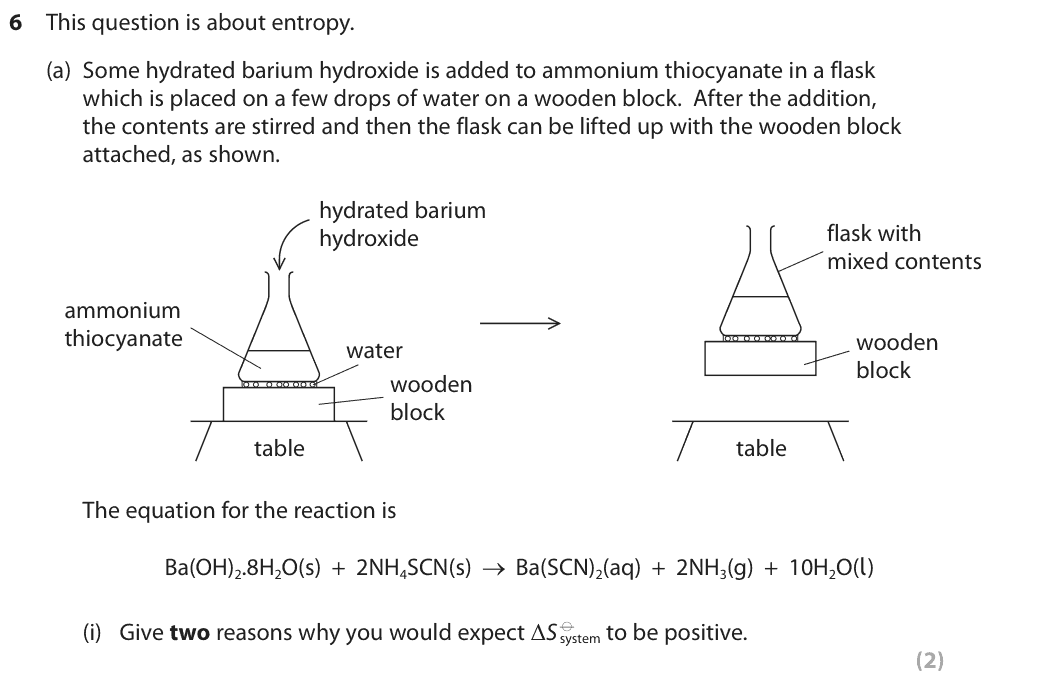
November 2021 · Paper 1 · Q6(a)(i) 2 marks Short answer entropy
This question is about entropy.
Some hydrated barium hydroxide is added to ammonium thiocyanate in a flask
which is placed on a few drops of water on a wooden block.  After the addition,
the contents are stirred and then the flask can be lifted up with the wooden block
attached, as shown.
hydrated barium
flask with
hydroxide
mixed contents
ammonium
thiocyanate
wooden
water
block
wooden
block
table
table
The equation for the reaction is
Ba(OH)2.8H2O(s)  +  2NH4SCN(s)  →  Ba(SCN)2(aq)  +  2NH3(g)  +  10H2O(l)
Give two reasons why you would expect ΔS d
system to be positive.
November 2021 · Paper 1 · Q7(a) 1 mark Short answer acid base equilibriabonding
This question is about acids and buffer solutions.
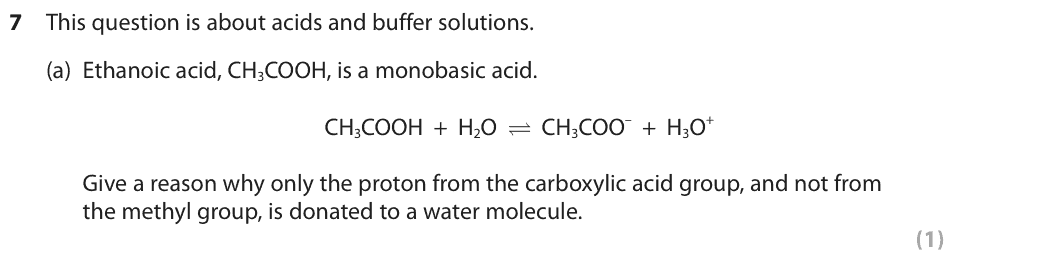
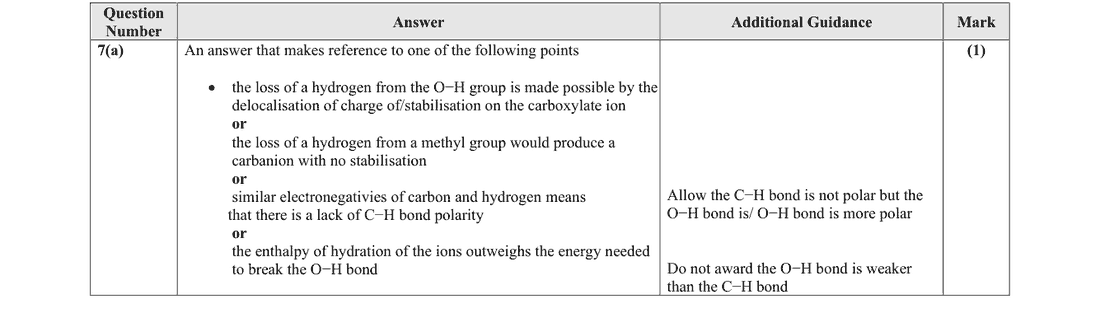
Ethanoic acid, CH3COOH, is a monobasic acid.
CH3COOH  +  H2O    CH3COO–  +  H3O+
Give a reason why only the proton from the carboxylic acid group, and not from
the methyl group, is donated to a water molecule.
November 2021 · Paper 1 · Q7(d)(ii) 2 marks Short answer acid base equilibria
Earlier part of question 7 that this part usesEarlier part of November 2021 Paper 1 question 7
State two assumptions that you made in the calculation in d(i).
November 2021 · Paper 1 · Q8(a)(i) 1 mark Short answer transition metals principles
Transition metals form complex ions.
Complex ions have a central metal ion surrounded by ligands.
Give a reason why the ammonium ion cannot act as a ligand.
November 2021 · Paper 1 · Q8(d) 2 marks Short answer Hard transition metals principlesformulae equations and amounts of substance
Earlier part of question 8 that this part usesEarlier part of November 2021 Paper 1 question 8
Hydrated chromium(III) chloride, CrCl3.6H2O, dissolves in water to form a number
of different complex ions containing both chloride and water ligands.
The general formula of these complex ions is [Cr(H2O)x(Cl)y](3–y)+
In an experiment, 0.10 mol of a complex reacted with excess silver nitrate solution
to produce 0.20 mol of silver chloride.
Chloride ions which are ligands within the complex do not react with
silver nitrate.
Deduce the formula of this chromium(III) complex ion.  Justify your answer.
November 2021 · Paper 1 · Q9(a)(i) 1 mark Short answer lattice energy
This question is about lattice energies.
The table shows the theoretical and experimental lattice energy values of
two compounds.
Theoretical lattice energy
Experimental lattice energy
Compound
/ kJ mol–1
/ kJ mol–1
magnesium iodide
–1944
–2327
barium iodide
–1831
–1877
State what can be deduced by the close similarity of the lattice energy values
for barium iodide.
November 2021 · Paper 2 · Q5(a) 2 marks Short answer carboxylic acidsintroduction to organic chemistry
Compound X is a component of synthetic oils used as lubricants, for instance in the
gearboxes of ships.
O
OH
OH
O
compound X
Name the three functional groups present in compound X.
November 2021 · Paper 2 · Q5(b) 1 mark Short answer carboxylic acids
Earlier part of question 5 that this part usesEarlier part of November 2021 Paper 2 question 5
The effectiveness of this synthetic oil is much reduced if it is
contaminated with water.
Give, in terms of a chemical reaction, a possible reason for this.
November 2021 · Paper 2 · Q6(d)(i) 1 mark Short answer kinetics ii
Earlier part of question 6 that this part usesEarlier part of November 2021 Paper 2 question 6
Haemoglobin (Hb) found in red blood cells reacts almost irreversibly with
carbon monoxide.
Initial rate experiments were carried out to investigate the effect of the
concentrations of Hb and CO on the rate of this reaction.
Experiment
[Hb] / mol dm−3
[CO] / mol dm–3
Rate / mol dm−3 s−1
1
2.09 × 10 –6
1.40 × 10 –6
8.20 × 10–7
2
4.18 × 10 –6
1.40 × 10 –6
1.64 × 10 –6
3
3.26 × 10 –6
2.80 × 10 –6
2.56 × 10 –6
Deduce the order of reaction with respect to haemoglobin.
November 2021 · Paper 2 · Q6(d)(ii) 2 marks Short answer kinetics ii
Earlier parts of question 6 that this part usesEarlier part of November 2021 Paper 2 question 6Earlier part of November 2021 Paper 2 question 6
Determine the order with respect to carbon monoxide using your answer to
(d)(i) and the data in the table.
Justify your answer.
November 2021 · Paper 2 · Q6(d)(iii) 1 mark Short answer kinetics ii
Earlier parts of question 6 that this part usesEarlier part of November 2021 Paper 2 question 6Earlier part of November 2021 Paper 2 question 6Earlier part of November 2021 Paper 2 question 6
Write the rate equation for this reaction using your answers to (d)(i) and (d)(ii).
November 2021 · Paper 2 · Q7(b) 3 marks Short answer alkenes
Give three ways in which waste polymers can be utilised to improve
their sustainability.
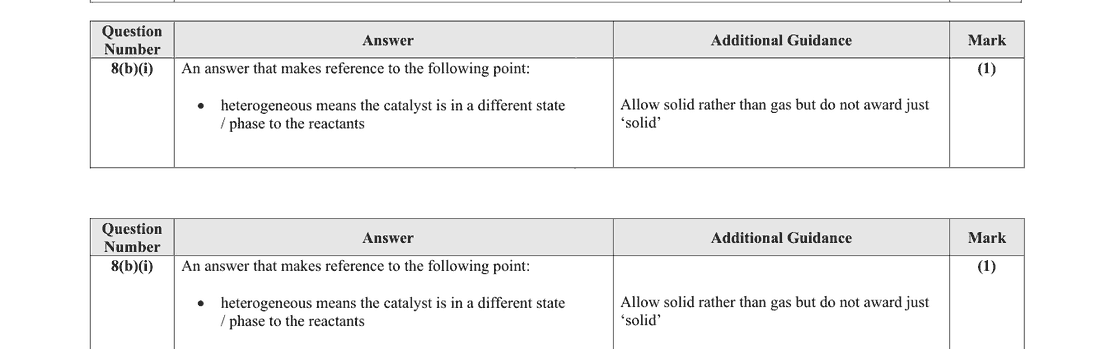
November 2021 · Paper 2 · Q9(a) 2 marks Short answer nmr mass spectrometry and chromatography
The painkiller paracetamol can be synthesised from phenol in three steps.
The percentage yield for each step is shown.
OH
OH
OH
OH
Step 1
Step 2
Step 3
32%
85%
70%
NO2
NH2
NHCOCH3
phenol
paracetamol
In Step 1 another product also forms. The two products can be distinguished
using their 13C NMR spectra.
Complete the table to show the number of peaks in each 13C NMR spectrum.
OH
OH
NO2
Product
NO2
Number of peaks in the
13C NMR spectrum
November 2021 · Paper 2 · Q9(c)(ii) 1 mark Short answer chirality
Earlier parts of question 9 that this part usesEarlier part of November 2021 Paper 2 question 9Earlier part of November 2021 Paper 2 question 9
Draw a circle around each of the chiral carbon atoms in glutathione.
SH
O
O
O
H
N
N
OH
HO
H
O
NH2
November 2021 · Paper 2 · Q10(b) 2 marks Short answer amines amides amino acids and proteins
Earlier part of question 10 that this part usesEarlier part of November 2021 Paper 2 question 10
Give the name and structural formula of the compound needed to react with
butylamine in Reaction 2.
Name 
Structural formula
November 2021 · Paper 2 · Q11(b) 2 marks Short answer kinetics ii
Earlier part of question 11 that this part usesEarlier part of November 2021 Paper 2 question 11
State the order with respect to hydroxide ions.
Justify your answer by reference to your graph in (a).
November 2021 · Paper 2 · Q11(c) 2 marks Short answer kinetics ii
Earlier part of question 11 that this part usesEarlier part of November 2021 Paper 2 question 11
Deduce the type of mechanism occurring.
Justify your answer.
November 2021 · Paper 2 · Q11(d) 1 mark Short answer kinetics ii
Earlier part of question 11 that this part usesEarlier part of November 2021 Paper 2 question 11
Give the classification of the chloroalkane in this reaction.
November 2021 · Paper 2 · Q12 6 marks Short answer Hard organic synthesis
The alcohol 2,2-dimethylbutan-1-ol has the structure
CH3
H2
H2
C
C
H3C
C
OH
CH3
Devise a reaction scheme for a synthesis of this alcohol starting from
2-bromo-2-methylbutane.
Include in your answer all reagents and conditions and the structures of any
intermediate compounds.
November 2021 · Paper 3 · Q1(a)(i) 2 marks Short answer atomic structure and the periodic table
This question is about chlorine.
Chlorine has two isotopes with mass numbers 35 and 37.
Complete the table to show the numbers of subatomic particles in a 35Cl atom
and a 37Cl− ion.
Particle
Protons
Neutrons
Electrons
35Cl atom
37Cl− ion
November 2021 · Paper 3 · Q1(b) 1 mark Short answer redox i
Write the formula of potassium chlorate(V).
November 2021 · Paper 3 · Q1(d)(i) 1 mark Short answer redox ii
The standard electrode potential for the chlorine / chloride ion half-cell is
½Cl2(aq) + e− ⇌ Cl−(aq)  E
cell = +1.36 V
O
Identify an oxidising agent from the Data Booklet that will convert
chloride ions into chlorine under standard conditions.
November 2021 · Paper 3 · Q2(c) 3 marks Short answer mass spectrometry and infrared spectroscopy
Earlier part of question 2 that this part usesEarlier part of November 2021 Paper 3 question 2
Another student suggests that the compound could contain an aldehyde and
an alcohol functional group, with structure C.
HOCH2CH2CH2CHO
C
Complete the table to show how the infrared spectra of A, B and C would be
expected to differ in the wavenumber range 1800-1600 cm−1.
Use information from the Data Booklet.
Absorbance
Wavenumber range / cm−1
Absorbance expected in infrared spectrum
of A but not in B or C
Absorbance expected in infrared spectrum
of B but not in A or C
Absorbance expected in infrared spectrum
of C but not in A or B
November 2021 · Paper 3 · Q3(a) 1 mark Short answer Easy atomic structure and the periodic table
This question is about aluminium chloride.
Complete the electronic configuration of an aluminium atom.
1s2 …………………………………………………………………………………………………………………………
November 2021 · Paper 3 · Q3(b)(ii) 2 marks Short answer bonding
Earlier part of question 3 that this part usesEarlier part of November 2021 Paper 3 question 3
Predict the shape of an AlCl3 molecule and the Cl−Al−Cl bond angle.
Shape of AlCl3
Cl−Al−Cl bond angle
November 2021 · Paper 3 · Q3(c)(ii) 1 mark Short answer bonding
Earlier part of question 3 that this part usesEarlier part of November 2021 Paper 3 question 3
State the type of bond that joins the two AlCl3 molecules together.
November 2021 · Paper 3 · Q5(a)(iii) 1 mark Short answer transition metals principles
Earlier part of question 5 that this part usesEarlier part of November 2021 Paper 3 question 5
Give a reason why the green precipitate turns brown on the top after a
few minutes.
November 2021 · Paper 3 · Q5(b)(ii) 1 mark Short answer Hard transition metals reactions
Earlier parts of question 5 that this part usesEarlier part of November 2021 Paper 3 question 5Earlier part of November 2021 Paper 3 question 5
Give the formula of the complex ion present in the deep blue solution at the
end of Test 3.
November 2021 · Paper 3 · Q6(b) 1 mark Short answer amines amides amino acids and proteins
Earlier part of question 6 that this part usesEarlier part of November 2021 Paper 3 question 6
State the type of reagent needed to convert 4-nitrophenol into 4-aminophenol in
Stage 2.
November 2021 · Paper 3 · Q6(d)(i) 1 mark Short answer introduction to organic chemistry
Earlier part of question 6 that this part usesEarlier part of November 2021 Paper 3 question 6
The percentage by mass of paracetamol in three brands of paracetamol tablets
are shown in the table.
Percentage by mass of
Brand of tablet
paracetamol
P
92.1
Q
93.6
R
99.7
The amount of paracetamol in a tablet can be determined using a titration with
cerium(IV) ions.
The tablets are crushed and then hydrolysed in acid to form 4-aminophenol.
H
O
HO
N
C
CH3  +  H2O
HO
NH2  +  CH3COOH
4-aminophenol is oxidised by cerium(IV) ions.
NH2  +  2Ce4+
NH   +  2Ce3+  +  2H+
HO
O
A tablet from one of the three brands of paracetamol was analysed following the
outline procedure.
•
one of the tablets was crushed and 0.500 g of the powder was added to
dilute sulfuric acid
•
the mixture was heated under reflux until the hydrolysis was complete
•
the solution was made up to 100.0 cm3 in a volumetric flask
•
25.0 cm3 portions of the solution were titrated against 0.100 mol dm−3 Ce4+
using ferroin as indicator
Result
The mean titre was 16.50 cm3.
Give the molecular formula of paracetamol.
November 2021 · Paper 3 · Q7(a)(i) 1 mark Short answer energetics i
The enthalpy change for the decomposition of sodium hydrogencarbonate can be
determined indirectly using Hess’s Law.
∆rH
2NaHCO3(s)
Na2CO3(s) + H2O(l) + CO2(g)
A student carried out two experiments.
Experiment 1 involved the reaction between sodium hydrogencarbonate and
hydrochloric acid.
The student used the following procedure:
•
use a measuring cylinder to measure 50 cm3 of 2.00 mol dm−3
hydrochloric acid and pour it into a polystyrene cup
•
measure the initial temperature of the acid
•
weigh the test tube containing sodium hydrogencarbonate
•
tip the sodium hydrogencarbonate into the hydrochloric acid in the
polystyrene cup, stir the mixture and record the lowest temperature reached
•
weigh the empty test tube.
Results
Measurement
Value
Mass of test tube + NaHCO3 / g
21.23
Mass of empty test tube / g
15.61
Mass of NaHCO3 used / g
Initial temperature / °C
21.0
Final temperature / °C
14.4
Temperature fall / °C
Complete the table.
October 2020 · AS Paper 1 · Q1(b)(i) 1 mark Short answer atomic structure and the periodic table
Earlier part of question 1 that this part usesEarlier part of October 2020 Paper 1 question 1
The electronic configuration of a phosphorus atom can be written
1s22s22p63s23p3
An alternative way to express the electronic configuration is
1s2
2s2
2p6
3s2
3p3
State what is meant by the two arrows in the first box.
October 2020 · AS Paper 1 · Q1(b)(ii) 1 mark Short answer atomic structure and the periodic table
Earlier parts of question 1 that this part usesEarlier part of October 2020 Paper 1 question 1Earlier part of October 2020 Paper 1 question 1
State why the arrows are all pointing in the same direction in the 3p boxes.
October 2020 · AS Paper 1 · Q2(b)(ii) 2 marks Short answer atomic structure and the periodic table
Earlier parts of question 2 that this part usesEarlier part of October 2020 Paper 1 question 2Earlier part of October 2020 Paper 1 question 2
The successive ionisation energies of sodium are shown on the graph.
Successive ionisation energies of sodium
5.5
5.0
4.5
Log
ionisation
4.0
energy
3.5
3.0
2.5
0
1
2
3
4
5
6
7
8
9
10
11
Number of electrons removed
State what deductions can be made from this graph.
October 2020 · AS Paper 1 · Q3(a)(i) 2 marks Short answer bonding
Nitrogen forms several hydrides.  In addition to ammonia, NH3 , it forms hydrazine, N2H4 ,
in which the two nitrogen atoms are covalently bonded together.
Explain what is meant by a covalent bond.
October 2020 · AS Paper 1 · Q3(a)(iii) 1 mark Short answer bonding
Earlier part of question 3 that this part usesEarlier part of October 2020 Paper 1 question 3
Estimate the H
N
H bond angle in hydrazine.
Bond angle =
October 2020 · AS Paper 1 · Q3(c) 2 marks Short answer formulae equations and amounts of substance
Earlier part of question 3 that this part usesEarlier part of October 2020 Paper 1 question 3
Hydrazine has been used as a rocket fuel.
It is a powerful reducing agent and will react very exothermically with oxidising agents
such as hydrogen peroxide.
The equation for the reaction of hydrazine with hydrogen peroxide is
N2H4(l)  +  2H2O2(l)  →  N2(g)  +  4H2O(g)
Give two reasons why hydrazine is a good rocket fuel when reacted with
hydrogen peroxide.
October 2020 · AS Paper 1 · Q4(a)(i) 3 marks Short answer atomic structure and the periodic table
This question is about isotopes.
The table shows data for some isotopes of potassium.
Isotope
Relative isotopic mass
Abundance %
39K
38.9637
93.218
40K
39.9340
0.012
41K
40.9618
6.770
State what is meant by the terms ‘relative isotopic mass’ and ‘relative atomic mass’.
October 2020 · AS Paper 1 · Q4(a)(ii) 2 marks Short answer atomic structure and the periodic table
Earlier part of question 4 that this part usesEarlier part of October 2020 Paper 1 question 4
State what is meant by the term ‘isotopes’.  Illustrate your answer by referring to
the isotopes of potassium.
October 2020 · AS Paper 1 · Q4(b)(i) 1 mark Short answer atomic structure and the periodic table
Earlier part of question 4 that this part usesEarlier part of October 2020 Paper 1 question 4
The relative isotopic abundances of an element can be measured using a mass spectrometer.
A simplified and incompletely labelled diagram of a mass spectrometer is shown.
+
A
X
vaporised
sample
B
C
to vacuum
pump
detector
Name the feature of the mass spectrometer responsible for the behaviour of
the ions in the region indicated by the arrow X.
October 2020 · AS Paper 1 · Q4(b)(iii) 1 mark Short answer Hard atomic structure and the periodic table
Earlier part of question 4 that this part usesEarlier part of October 2020 Paper 1 question 4
Give a reason why the mass spectrometer must be operated under vacuum.
October 2020 · AS Paper 1 · Q7(a) 3 marks Short answer Hard atomic structure and the periodic table
Give the meaning of the term ‘periodicity’.
Illustrate your answer by referring to the atomic radii of the Period 2 and Period 3 elements.
Specific values of atomic radii are not required.
October 2020 · AS Paper 1 · Q8(c)(ii) 1 mark Short answer bonding
Earlier parts of question 8 that this part usesEarlier part of October 2020 Paper 1 question 8Earlier part of October 2020 Paper 1 question 8
Name all the types of bond present in calcium carbonate.
October 2020 · AS Paper 1 · Q8(c)(iii) 1 mark Short answer Hard groups 1 and 2
Earlier parts of question 8 that this part usesEarlier part of October 2020 Paper 1 question 8Earlier part of October 2020 Paper 1 question 8
Give a reason, in terms of the bonding, why a high decomposition
temperature is required.
October 2020 · AS Paper 2 · Q1(a) 1 mark Short answer introduction to organic chemistry
This question is about organic compounds containing fluorine and chlorine.
The use of chlorofluorocarbons as refrigerants has ceased due to concerns about
their effects on the ozone layer.  One such compound is dichlorodifluoromethane.
Give the molecular formula of dichlorodifluoromethane.
October 2020 · AS Paper 2 · Q1(b)(ii) 1 mark Short answer mass spectrometry and infrared spectroscopy
Earlier parts of question 1 that this part usesEarlier part of October 2020 Paper 2 question 1Earlier part of October 2020 Paper 2 question 1
Use the mass spectrum to show that the empirical and the molecular formulae
of this compound are the same.
100
80
60
relative
intensity
40
20
0
0
20
40
60
80
100
120
m / z
October 2020 · AS Paper 2 · Q1(b)(iii) 1 mark Short answer mass spectrometry and infrared spectroscopy
Earlier parts of question 1 that this part usesEarlier part of October 2020 Paper 2 question 1Earlier part of October 2020 Paper 2 question 1
Suggest the species responsible for the peak at m / z = 69 .
October 2020 · AS Paper 2 · Q2(a) 2 marks Short answer introduction to organic chemistry
This question is about alcohols and their reactions.
The table gives some of the names and skeletal formulae of isomers having the
formula C4H9OH.
Complete the table.
Name
Skeletal formula
OH
OH
butan‑2‑ol
2‑methylpropan‑1‑ol
OH
2‑methylpropan‑2‑ol
October 2020 · AS Paper 2 · Q2(b)(ii) 2 marks Short answer introduction to organic chemistry
Earlier parts of question 2 that this part usesEarlier part of October 2020 Paper 2 question 2Earlier part of October 2020 Paper 2 question 2
When butan‑2‑ol reacts with concentrated phosphoric acid, two stereoisomers
are formed.
Explain what is meant by the term stereoisomers.
October 2020 · AS Paper 2 · Q2(b)(iv) 1 mark Short answer introduction to organic chemistry
Earlier parts of question 2 that this part usesEarlier part of October 2020 Paper 2 question 2Earlier part of October 2020 Paper 2 question 2
Name this type of stereoisomerism.
October 2020 · AS Paper 2 · Q3(c) 1 mark Short answer kinetics i
State why a solid (heterogeneous) catalyst is suitable for a reaction in the gas phase.
October 2020 · AS Paper 2 · Q5(c)(iii) 1 mark Short answer alkenesbonding
Earlier parts of question 5 that this part usesEarlier part of October 2020 Paper 2 question 5Earlier part of October 2020 Paper 2 question 5
Give a reason why the reaction of iodine monochloride is significantly faster
than the reaction of iodine.
October 2020 · Paper 1 · Q1(d) 1 mark Short answer atomic structure and the periodic table
Give the formula of a stable ion that is isoelectronic with the
magnesium ion, Mg2+.
October 2020 · Paper 1 · Q3(b)(i) 1 mark Short answer transition metals principles
Earlier part of question 3 that this part usesEarlier part of October 2020 Paper 1 question 3
When chromium(III) sulfate dissolves in water, a green solution containing the
[Cr(H2O)6]3+ ion forms.
Give the shape of this complex ion.
October 2020 · Paper 1 · Q3(d)(ii) 2 marks Short answer transition metals reactions
Earlier parts of question 3 that this part usesEarlier part of October 2020 Paper 1 question 3Earlier part of October 2020 Paper 1 question 3
State the initial and final colours you would see as the chlorine bubbles
through the aqueous vanadium(II) chloride, VCl2(aq).
October 2020 · Paper 1 · Q7(a)(i) 1 mark Short answer Easy equilibrium i
A mixture of ethanoic acid, ethanol and a catalyst was left for several days
to reach equilibrium.
CH3COOH(l) + CH3CH2OH(l)  ⇌  CH3COOCH2CH3(l) + H2O(l)
The equilibrium constant, Kc , under these conditions, was 0.28.
Write the expression for the equilibrium constant, Kc .
October 2020 · Paper 1 · Q8(b)(ii) 1 mark Short answer redox i
Earlier parts of question 8 that this part usesEarlier part of October 2020 Paper 1 question 8Earlier part of October 2020 Paper 1 question 8
Determine the oxidation number of carbon in the ethanedioate ion, C2O4
October 2020 · Paper 1 · Q8(d) 2 marks Short answer Hard redox ii
Earlier part of question 8 that this part usesEarlier part of October 2020 Paper 1 question 8
This redox reaction could be used in an electrochemical cell.
The cell half-equations are
2CO2(g) + 2e− ⇌ C2O4
2−(aq)
−(aq) + 5e−  ⇌ Mn2+(aq) + 4H2O(l)
8H+(aq) + MnO4
Write a cell diagram for this cell using the conventional representation.
October 2020 · Paper 2 · Q1(b) 1 mark Short answer bonding
Predict which bond has the shortest bond length in a molecule of methanol.
October 2020 · Paper 2 · Q1(c)(i) 1 mark Short answer Easy bonding
Methanol is soluble in water.
State the strongest type of intermolecular force that occurs between
molecules of methanol and water.
October 2020 · Paper 2 · Q2(c) 3 marks Short answer alkenes
Earlier part of question 2 that this part usesEarlier part of October 2020 Paper 2 question 2
Two reactions of ethene are shown.
H
H
C
C
H
H
Reaction 1
Reaction 2
HBr
H
H
Product
H
C
C
OH
H
H
Complete the table.
Reaction
Reagent and condition
Product
1
HBr at room temperature
H
H
2
H
C
C
OH
H
H
October 2020 · Paper 2 · Q4(b) 6 marks Short answer organic synthesiscarbonyl compoundscarboxylic acids
Earlier part of question 4 that this part usesEarlier part of October 2020 Paper 2 question 4
Compound T, C4H10O, is oxidised by acidified potassium dichromate(VI) to form
compound U, C4H8O .
U gives an orange precipitate with 2,4-dinitrophenylhydrazine (Brady’s reagent)
but does not give a red precipitate when heated with Fehling’s solution.
T reacts with ethanoyl chloride to form compound V, C6H12O2 .
Deduce the structures of compounds T, U and V.  Justify your answers.
October 2020 · Paper 2 · Q6(a) 1 mark Short answer halogenoalkanes
A bromoalkane, RBr, reacts with aqueous hydroxide ions in a nucleophilic substitution
reaction.
RBr  +  OH−  →  R
OH  +  Br−
This reaction is first order with respect to the bromoalkane and the rate equation is
rate  =  k[RBr]1[OH−]x
where x is the order of the reaction with respect to hydroxide ions.
In an experiment, a sample of the bromoalkane was added to a large excess
of aqueous sodium hydroxide and the concentration of the bromoalkane was
determined at regular time intervals.
Results
Time / s
[RBr] / mol dm–3
0
0.100
30
0.065
60
0.042
90
0.028
120
0.019
150
0.014
This experiment is carried out using the bromoalkane dissolved in ethanol and
the hydroxide ions dissolved in water.
Give a reason why a solution of hydroxide ions dissolved in pure ethanol should
not be used.
October 2020 · Paper 2 · Q6(d)(i) 1 mark Short answer Easy kinetics ii
Earlier part of question 6 that this part usesEarlier part of October 2020 Paper 2 question 6
The experiment was repeated using equal concentrations of RBr and varying the
concentration of hydroxide ions.
A graph was plotted of the results.
Rate
/ mol dm−3 s−1
[OH−] / mol dm−3
Deduce the value of x in the rate equation.
rate = k[RBr]1[OH−]x
October 2020 · Paper 2 · Q7(a)(i) 1 mark Short answer carbonyl compoundshalogenoalkanes
This question is about the synthesis of organic compounds.
A student suggested the following plan for the synthesis of pentanoic acid from
but-2-en-1-ol.
Step 1
OH
OH
LiAlH4 in
but-2-en-1-ol
dry ether
butan-1-ol
Step 2
KCN
in aqueous ethanol
O
Step 3
CN
heat under reflux
OH
with NaOH(aq)
pentanoic acid
LiAlH4 is a source of hydride ions, H−.
Give a possible reason why LiAlH4 cannot be used to reduce alkenes.
October 2020 · Paper 2 · Q7(a)(ii) 2 marks Short answer alkenes
Earlier part of question 7 that this part usesEarlier part of October 2020 Paper 2 question 7
Give a suitable reagent and condition for Step 1.
October 2020 · Paper 2 · Q7(a)(iii) 1 mark Short answer halogenoalkanesorganic synthesis
Earlier part of question 7 that this part usesEarlier part of October 2020 Paper 2 question 7
Step 2 is incorrect because alcohols can only be converted to nitriles via an
intermediate compound.
Identify a suitable intermediate compound by name or formula.
October 2020 · Paper 2 · Q7(a)(iv) 1 mark Short answer carboxylic acids
Earlier part of question 7 that this part usesEarlier part of October 2020 Paper 2 question 7
Step 3 involves the hydrolysis of a nitrile.
Give the additional reagent that should be added after heating under reflux
with aqueous sodium hydroxide, to produce pentanoic acid.
October 2020 · Paper 2 · Q7(b) 7 marks Short answer organic synthesisarenes benzenecarboxylic acids
Devise a four-step synthesis, involving the use of a Grignard reagent, to convert
benzene into benzoyl chloride.
O
C
Cl
Include the reagents and conditions for each step in the synthesis and the structures
of the intermediates.
October 2020 · Paper 2 · Q8(a)(ii) 2 marks Short answer mass spectrometry and infrared spectroscopy
Earlier part of question 8 that this part usesEarlier part of October 2020 Paper 2 question 8
The infrared spectrum of X contains major absorption wavenumber ranges at
3300–2500 cm−1, 1725–1700 cm−1 and 1669–1645 cm−1.
Identify the two functional groups in X.
October 2020 · Paper 2 · Q9(a)(i) 1 mark Short answer kinetics i
This question is about the effect of temperature on the rate of decomposition of
nitrogen(V) oxide.
2N2O5(g)  →  2N2O4(g)  +  O2(g)
The diagram shows the Maxwell-Boltzmann distribution of molecular energies for
nitrogen(V) oxide at a temperature T1 .
Ea is the activation energy of this reaction.
T1
Ea
Energy, E
Give the label for the vertical axis.
October 2020 · Paper 3 · Q3(c)(ii) 1 mark Short answer acid base equilibria
Earlier parts of question 3 that this part usesEarlier part of October 2020 Paper 3 question 3Earlier part of October 2020 Paper 3 question 3
Complete the table, with a tick (✓) or a cross (✗), to show whether or not the
indicator would be suitable for use in this titration.
Indicator
pH range
Tick or Cross
Bromocresol purple
5.2 – 6.8
Thymol blue
8.0 – 9.6
Thymolphthalein
8.3 – 10.6
Alizarin yellow R
10.1 – 13.0
October 2020 · Paper 3 · Q3(d)(i) 1 mark Short answer formulae equations and amounts of substance
Earlier part of question 3 that this part usesEarlier part of October 2020 Paper 3 question 3
Each student used a pipette to measure 25.0 cm3 of the ethanoic acid solution
into four separate conical flasks and added an indicator.
The results of one student’s titrations are shown in the table.
Titration number
1
2
3
4
Final burette reading / cm3
13.00
25.50
37.90
50.00
Initial burette reading / cm3
0.25
13.00
25.50
37.90
Titre / cm3
Concordant titres (✓)
Complete the table.
October 2020 · Paper 3 · Q6(b)(ii) 1 mark Short answer arenes benzene
Earlier parts of question 6 that this part usesEarlier part of October 2020 Paper 3 question 6Earlier part of October 2020 Paper 3 question 6
Give the expected observation when these aromatic compounds undergo
incomplete combustion.
October 2020 · Paper 3 · Q6(b)(iii) 1 mark Short answer arenes benzene
Earlier parts of question 6 that this part usesEarlier part of October 2020 Paper 3 question 6Earlier part of October 2020 Paper 3 question 6Earlier part of October 2020 Paper 3 question 6
Identify another type of organic compound which will also produce the same
observation as in (b)(ii).
October 2020 · Paper 3 · Q6(c)(ii) 3 marks Short answer nmr mass spectrometry and chromatography
Earlier parts of question 6 that this part usesEarlier part of October 2020 Paper 3 question 6Earlier part of October 2020 Paper 3 question 6
Predict the number of peaks present, and their chemical shifts, in the
13C nuclear magnetic resonance (NMR) spectrum of phenylmethanol.
Use the information in the Data Booklet to help you.
H
H
C
OH
H
C
H
C
C
C
C
H
C
H
H
phenylmethanol
October 2020 · Paper 3 · Q6(c)(iii) 2 marks Short answer mass spectrometry and infrared spectroscopy
Earlier parts of question 6 that this part usesEarlier part of October 2020 Paper 3 question 6Earlier part of October 2020 Paper 3 question 6
Give the formula of a fragment ion, with its m/z value, that you would expect
to be present in the mass spectrum of benzoic acid but not in the mass
spectrum of phenol or the mass spectrum of phenylmethanol.
October 2020 · Paper 3 · Q9(a) 3 marks Short answer Hard amines amides amino acids and proteins
This question is about amines.
Phenylamine is an aromatic amine and butylamine is an aliphatic amine.
Phenylamine can be prepared from nitrobenzene.
NO2
NH2
Butylamine can be prepared from butanenitrile.
C3H7CN    →    C4H9NH2
Compare and contrast these two preparations of amines.
October 2020 · Paper 3 · Q9(d) 1 mark Short answer amines amides amino acids and proteins
Earlier part of question 9 that this part usesEarlier part of October 2020 Paper 3 question 9
A section of a polyamide is shown.
H
O
N
N
O
H
Identify, by name or formula, the amine monomer that reacts to form this
polyamide.
October 2020 · Paper 3 · Q10(a)(ii) 2 marks Short answer carboxylic acids
Earlier part of question 10 that this part usesEarlier part of October 2020 Paper 3 question 10
In an experiment, the oxygen atom in ethanol is replaced by the oxygen-18
isotope, 18O.
The products of the esterification are
H
O
H
H
H
C
C
and
H
O
H
O
C
C
H
H
H
H
Label the 18O oxygen atom in one of the products.
Justify your answer.
October 2020 · Paper 3 · Q10(b) 3 marks Short answer carboxylic acids
Earlier part of question 10 that this part usesEarlier part of October 2020 Paper 3 question 10
Ethyl ethanoate can also be formed by reacting ethanol with ethanoyl chloride, CH3COCl.
Identify three differences in the esterification reaction when ethanoyl chloride is
used instead of ethanoic acid.
June 2019 · AS Paper 1 · Q3(a) 2 marks Short answer atomic structure and the periodic table
This question is about isotopes.
State, in terms of subatomic particles, what is meant by the term isotopes.
June 2019 · AS Paper 1 · Q6(a)(iii) 1 mark Short answer groups 1 and 2
Earlier part of question 6 that this part usesEarlier part of June 2019 Paper 1 question 6
Give a reason why the magnesium ion does not produce a flame colour.
June 2019 · AS Paper 1 · Q6(a)(iv) 1 mark Short answer groups 1 and 2
Earlier part of question 6 that this part usesEarlier part of June 2019 Paper 1 question 6
Give a reason why the lack of a flame colour is not a positive test for the
magnesium ion.
June 2019 · AS Paper 1 · Q6(b)(i) 1 mark Short answer group 7 the halogens
Earlier part of question 6 that this part usesEarlier part of June 2019 Paper 1 question 6
Give the formula of a reagent that would produce a cream-coloured
precipitate when added to an aqueous solution of magnesium bromide.
June 2019 · AS Paper 1 · Q8(d) 2 marks Short answer structure
Earlier part of question 8 that this part usesEarlier part of June 2019 Paper 1 question 8
Deduce two possible reasons why the density of iron (7.86 g cm−3) is much greater
than the density of graphite (2.2 to 2.8 g cm−3).
June 2019 · AS Paper 1 · Q8(e) 2 marks Short answer structurebonding
Earlier part of question 8 that this part usesEarlier part of June 2019 Paper 1 question 8
The compressive strength is a measure of the energy required to break
some of the bonds within a substance.
Deduce possible reasons why there are two widely different values for the compressive
strength of graphite.
Both the values (2.3 and 15.3 GPa) are valid experimental results.
June 2019 · AS Paper 2 · Q1(a)(i) 1 mark Short answer introduction to organic chemistry
Some alkanes are used as fuels for transport.  Crude oil, which is a mixture of
hydrocarbons, is the major source of these alkanes.  Crude oil is processed by
fractional distillation, cracking and reforming.
Fractional distillation produces fractions which contain molecules of a similar
boiling temperature.  Molecules containing six carbon atoms are found in both
the petrol fraction and the higher boiling kerosene fraction.
Identify, by name or structural formula, the unbranched alkane with six
carbon atoms found in kerosene.
June 2019 · AS Paper 2 · Q2(a)(i) 2 marks Short answer introduction to organic chemistry
This question is about organic compounds.
Organic compounds can be grouped together in homologous series.
Describe two characteristics of a homologous series.
June 2019 · AS Paper 2 · Q2(a)(ii) 1 mark Short answer introduction to organic chemistry
Earlier part of question 2 that this part usesEarlier part of June 2019 Paper 2 question 2
Name the homologous series to which propene belongs.
June 2019 · AS Paper 2 · Q2(b)(i) 1 mark Short answer alkenes
Propene can be converted into a mixture of 1-chloropropane and
2-chloropropane, in which 2-chloropropane is the major product.
Give the reagent required for this reaction.
June 2019 · AS Paper 2 · Q2(c)(ii) 2 marks Short answer Easy introduction to organic chemistry
Earlier part of question 2 that this part usesEarlier part of June 2019 Paper 2 question 2
Under appropriate conditions, 2-chloropropane can be converted into a
structural isomer of butanenitrile.
State what is meant by the term ‘structural isomer’.
June 2019 · AS Paper 2 · Q3(a)(i) 2 marks Short answer energetics i
This question is about enthalpy changes.
State what is meant by the term ‘standard enthalpy change of combustion’.
June 2019 · AS Paper 2 · Q4(a) 2 marks Short answer equilibrium i
Methanol is manufactured from a mixture of carbon monoxide and hydrogen.
CO(g) + 2H2(g) U CH3OH(g)   ¨H = –90.8 kJ mol–1
Give two characteristics of all reactions at equilibrium.
June 2019 · AS Paper 2 · Q5(e)(i) 1 mark Short answer introduction to organic chemistry
Earlier part of question 5 that this part usesEarlier part of June 2019 Paper 2 question 5
Another compound formed from 1-bromobutane under these conditions is butan-1-ol.
Identify the type of reaction taking place to form butan-1-ol.
June 2019 · AS Paper 2 · Q6(a)(iv) 1 mark Short answer formulae equations and amounts of substance
Earlier part of question 6 that this part usesEarlier part of June 2019 Paper 2 question 6
State what is meant by the term ‘concordant results’ as applied to a titration experiment.
June 2019 · AS Paper 2 · Q8(a)(ii) 4 marks Short answer kinetics i
Earlier part of question 8 that this part usesEarlier part of June 2019 Paper 2 question 8
Describe how you would find a numerical value for the initial rate of reaction
and for the maximum rate of reaction in this experiment from the graph.
No actual calculations are required.
June 2019 · AS Paper 2 · Q8(c) 1 mark Short answer Hard kinetics i
Earlier part of question 8 that this part usesEarlier part of June 2019 Paper 2 question 8
Give a reason why the measurement of the initial rate of reaction is likely to be
less accurate than the measurement of the maximum rate.
June 2019 · Paper 1 · Q2(a)(iii) 1 mark Short answer group 7 the halogens
Earlier part of question 2 that this part usesEarlier part of June 2019 Paper 1 question 2
Aqueous potassium bromide was added to aqueous iodine, instead of
chlorine water.  There was no reaction.
Give a reason why no reaction occurred.
June 2019 · Paper 1 · Q5(a)(i) 1 mark Short answer transition metals reactions
This is a question about catalysis.
The reaction between iodide ions and peroxodisulfate ions is catalysed by iron(II) ions.
Fe2+
2I– + S2O8
2– o
I2 + 2SO4
2–
Give a reason why the reaction between iodide ions and peroxodisulfate ions
has a high activation energy and is therefore very slow without a catalyst.
June 2019 · Paper 1 · Q5(d) 1 mark Short answer transition metals reactions
Earlier part of question 5 that this part usesEarlier part of June 2019 Paper 1 question 5
The trend in the strength of gaseous adsorption by three transition elements is
tungsten ! platinum ! silver
Silver is not suitable as a replacement for platinum in a catalytic converter
because the adsorption of gases is too weak to allow significant chemical reaction.
Give a possible reason why tungsten would also not be a suitable replacement
for platinum in a catalytic converter.  Refer to the mechanism of heterogenous
catalysis in your answer.
June 2019 · Paper 1 · Q6(d)(ii) 2 marks Short answer Hard acid base equilibria
Earlier part of question 6 that this part usesEarlier part of June 2019 Paper 1 question 6
Predict, with a reason, whether water is acidic, alkaline or neutral at 310 K.
June 2019 · Paper 1 · Q6(d)(iii) 1 mark Short answer equilibrium ii
Earlier parts of question 6 that this part usesEarlier part of June 2019 Paper 1 question 6Earlier part of June 2019 Paper 1 question 6
Predict, with a reason, the sign of the enthalpy change for the ionisation of water.
June 2019 · Paper 1 · Q8(a)(i) 2 marks Short answer lattice energy
Sodium hydride, NaH, can be used to generate hydrogen for fuel cells.
In order to calculate the first electron affinity of hydrogen, a student was asked to
draw a Born-Haber cycle for sodium hydride.
The cycle had two errors but the numerical data were correct.
Na+(g) + e– + H(g)
Half of the enthalpy change
First electron affinity of hydrogen
of atomisation of hydrogen
+218 kJ mol–1
Na+(g) + H–(g)
Na+(g) + e– + ½H2(g)
First ionisation energy of sodium
+496 kJ mol–1
Na(g) + ½H2(g)
Enthalpy change of atomisation
Lattice energy
of sodium
–804 kJ mol–1
of sodium
+107 kJ mol–1
hydride
Na(s) + ½H2(g)
Enthalpy change of formation
of sodium hydride
–56 kJ mol–1
NaH(s)
Identify and correct the two errors in this Born-Haber cycle.
June 2019 · Paper 1 · Q9(d)(ii) 2 marks Short answer acid base equilibria
Earlier parts of question 9 that this part usesEarlier part of June 2019 Paper 1 question 9Earlier part of June 2019 Paper 1 question 9
Describe, without calculation, how you would use your curve to determine
the value of Ka for propanoic acid.
June 2019 · Paper 2 · Q4(b)(i) 2 marks Short answer nmr mass spectrometry and chromatography
Earlier part of question 4 that this part usesEarlier part of June 2019 Paper 2 question 4
A sample of methyl cinnamate was analysed by high resolution proton NMR spectroscopy.
A simplified spectrum is shown.
relative peak area
relative peak areas [1]
1]
10
8
6
4
2
8
pp m
(ppm)
Name the compound responsible for the peak at a chemical shift of 0 ppm,
stating its purpose.
June 2019 · Paper 2 · Q4(b)(ii) 3 marks Short answer nmr mass spectrometry and chromatography
Earlier parts of question 4 that this part usesEarlier part of June 2019 Paper 2 question 4Earlier part of June 2019 Paper 2 question 4
Identify the proton environment that causes the peak at a chemical shift of
3.8 ppm by circling it on the diagram shown. Fully justify your answer.
a
om
June 2019 · Paper 2 · Q6(a) 1 mark Short answer chirality
The compound flavan-3-ol is found in tea, fruit and wine.
O
©
OH
Clearly label all the chiral . carbon atoms in . flavan-3-ol.
June 2019 · Paper 2 · Q6(b) 1 mark Short answer introduction to organic chemistry
Earlier part of question 6 that this part usesEarlier part of June 2019 Paper 2 question 6
Give the molecular formula for flavan-3-ol.
June 2019 · Paper 3 · Q1(a) 1 mark Short answer acid base equilibria
This question is about acids and bases.
State what is meant by a Brønsted-Lowry acid.
June 2019 · Paper 3 · Q1(b) 1 mark Short answer acid base equilibria
Earlier part of question 1 that this part usesEarlier part of June 2019 Paper 3 question 1
Identify the acid-base conjugate pairs in this reaction.
CH3COOH  +  HCOOH  o  CH3COOH2
+  +  HCOO–
June 2019 · Paper 3 · Q1(c) 1 mark Short answer acid base equilibria
Write the expression that defines the pH of a solution.
June 2019 · Paper 3 · Q2(a)(i) 1 mark Short answer redox ii
This question is about the Ag+(aq)|Ag(s) half-cell.
A student was asked to plan an experiment to measure the standard electrode potential
of the Ag+(aq)|Ag(s) half-cell.
State the conditions of temperature and pressure under which
standard electrode potentials are measured.
June 2019 · Paper 3 · Q3(a) 5 marks Short answer organic synthesishalogenoalkanescarboxylic acids
This question is about esters with the molecular formula C6H12O2.
Propyl propanoate has the structure shown.
H
H
O
H
H
H
H
C
C
C
O
C
C
C
H
H
H
H
H
H
Devise a synthetic pathway to prepare propyl propanoate starting with
1-bromopropane as the only organic compound.
Include the reagents for each step in the synthesis, and the names or structures of
the intermediate compounds.
June 2019 · Paper 3 · Q4(a)(ii) 1 mark Short answer redox i
Earlier part of question 4 that this part usesEarlier part of June 2019 Paper 3 question 4
Use the results of the tests in (a)(i) to give a formula of C.
Do not include water of crystallisation.
June 2019 · Paper 3 · Q4(c) 1 mark Short answer transition metals reactions
Earlier part of question 4 that this part usesEarlier part of June 2019 Paper 3 question 4
State the type of reaction occurring in Test 2.
June 2019 · Paper 3 · Q5(a) 1 mark Short answer Hard redox i
This question is about redox reactions.
3–.  Include the relevant oxidation number.
Name the ion with formula PO3
June 2019 · Paper 3 · Q5(b) 1 mark Short answer redox i
Earlier part of question 5 that this part usesEarlier part of June 2019 Paper 3 question 5
State what happens to a reducing agent during a reaction, in terms of oxidation number
and electrons.
June 2019 · Paper 3 · Q5(c) 1 mark Short answer redox ii
Earlier part of question 5 that this part usesEarlier part of June 2019 Paper 3 question 5
Identify the species that is the strongest reducing agent from the list of standard
electrode potentials in the Data Booklet.
– , react in alkaline
June 2019 · Paper 3 · Q5(d)(ii) 1 mark Short answer redox i
Earlier parts of question 5 that this part usesEarlier part of June 2019 Paper 3 question 5Earlier part of June 2019 Paper 3 question 5
Give a reason why this reaction is not disproportionation.
June 2019 · Paper 3 · Q6(a)(i) 1 mark Short answer transition metals principles
This question is about transition metals and their ions.
The shape of a complex ion formed from Cr3+ ions is shown.
Cl
H2N
NH2
H2C
CH2
Cr
H2C
CH2
H2N
NH2
Cl
State the coordination number of Cr3+ in this complex ion.
June 2019 · Paper 3 · Q6(a)(ii) 1 mark Short answer transition metals principles
Earlier part of question 6 that this part usesEarlier part of June 2019 Paper 3 question 6
State the overall charge on this complex ion.
June 2019 · Paper 3 · Q6(b) 3 marks Short answer transition metals principlestransition metals reactions
The complex ions of transition metals have different colours in aqueous solution.
Two factors that affect the colour of the solution are the oxidation number of the
central metal ion, and the ligands present.
Give examples to illustrate these factors by referring to complex ions
of iron and/or copper.  Include the formula and colour of each complex.
An explanation of why transition metal ions are coloured is not required.
June 2019 · Paper 3 · Q6(c)(ii) 2 marks Short answer kinetics ii
Earlier parts of question 6 that this part usesEarlier part of June 2019 Paper 3 question 6Earlier part of June 2019 Paper 3 question 6
Deduce the rate equation for this reaction by using your graph in (c)(i).
Justify your answer.
June 2019 · Paper 3 · Q6(c)(iv) 3 marks Short answer transition metals reactions
Earlier part of question 6 that this part usesEarlier part of June 2019 Paper 3 question 6
Describe the stages in the catalytic decomposition of ammonia by tungsten.
June 2019 · Paper 3 · Q10(b) 2 marks Short answer mass spectrometry and infrared spectroscopyorganic synthesis
Earlier part of question 10 that this part usesEarlier part of June 2019 Paper 3 question 10
Part of the mass spectrum of D is shown.
100
80
60
Relative
intensity
40
20
0
70
80
90
100
110
120
130
140
150
160
170
m / z
Deduce the molecular formula of D.  Justify your answer.
June 2019 · Paper 3 · Q10(c)(i) 1 mark Short answer mass spectrometry and infrared spectroscopy
Earlier part of question 10 that this part usesEarlier part of June 2019 Paper 3 question 10
Compound D contains a benzene ring.
Give the molecular formula of the species that causes the peak at  m / z = 76 in
the mass spectrum of D.
June 2019 · Paper 3 · Q10(c)(iii) 3 marks Short answer nmr mass spectrometry and chromatography
Earlier parts of question 10 that this part usesEarlier part of June 2019 Paper 3 question 10Earlier part of June 2019 Paper 3 question 10Earlier part of June 2019 Paper 3 question 10
The 13C NMR spectrum of compound D has four peaks.
Identify the structure of D.  Justify your answer by labelling the different
carbon environments in all the structures drawn in (c)(ii).
June 2018 · AS Paper 1 · Q1(a) 2 marks Short answer bonding
This question is about covalent bonds.
State what is meant by the term covalent bond.
June 2018 · AS Paper 1 · Q1(d)(ii) 2 marks Short answer bonding
Earlier parts of question 1 that this part usesEarlier part of June 2018 Paper 1 question 1Earlier part of June 2018 Paper 1 question 1
During this reaction, the bond angles about the nitrogen atom and the
boron atom change.
State the new H
N
H and F
B
F bond angles.
June 2018 · AS Paper 1 · Q2(a)(i) 1 mark Short answer Easy atomic structure and the periodic table
This question is about hydrogen, the element with atomic number Z = 1.
Hydrogen has two stable isotopes, 1
1H and 2
1H.  Complete the table to show the number
of subatomic particles present in the nuclei of these two isotopes of hydrogen.
Isotope
Number of protons
Number of neutrons
1
1H
1H
2
June 2018 · AS Paper 1 · Q2(b)(i) 1 mark Short answer atomic structure and the periodic table
Earlier part of question 2 that this part usesEarlier part of June 2018 Paper 1 question 2
The relative atomic mass of hydrogen in the Periodic Table is 1.0.
This is correct to two significant figures.
The table gives data for the relative isotopic mass and natural abundance of the
two stable isotopes of hydrogen.
Isotope
Relative isotopic mass
Percentage abundance
1
1H
1.007825
99.9885
1H
2
2.014101
0.0115
Using the data in the table, give a reason why it can be estimated that the
relative atomic mass of hydrogen is greater than 1.0.
June 2018 · AS Paper 1 · Q2(d) 3 marks Short answer atomic structure and the periodic table
Hydrogen can be placed in several different positions in periodic tables.  One is
immediately above lithium in Group 1.  Another is in the centre of the first row, as
shown in the Periodic Table on the back cover.
Criticise the position of hydrogen immediately above lithium by giving
one reason in favour and two against.
June 2018 · AS Paper 1 · Q6(a)(i) 1 mark Short answer Easy atomic structure and the periodic table
Chlorine and iodine are in the same group in the Periodic Table.
Complete the electronic configuration of chlorine using the s, p, d notation.
1s2
June 2018 · AS Paper 1 · Q6(b)(i) 2 marks Short answer redox i
Earlier part of question 6 that this part usesEarlier part of June 2018 Paper 1 question 6
Members of the same group sometimes react in different ways.
2−.
Iodine and chlorine react differently with thiosulfate ions, S2O3
Iodine gives S4O6
2−, whilst chlorine gives SO4
2−.
Complete the table by identifying the oxidation numbers of sulfur in the three
sulfur-containing ions.
Ion
Oxidation number of sulfur
2−
S2O3
SO4
2−
2−
S4O6
June 2018 · AS Paper 1 · Q6(b)(ii) 1 mark Short answer redox i
Earlier parts of question 6 that this part usesEarlier part of June 2018 Paper 1 question 6Earlier part of June 2018 Paper 1 question 6
The equation for the reaction of iodine with thiosulfate ions is
2S2O3
2− + I2 → 2I− + S4O6
2−
State, in terms of electrons, why iodine is classified as an oxidising agent in
this reaction.
June 2018 · AS Paper 1 · Q6(b)(iii) 1 mark Short answer redox i
Earlier parts of question 6 that this part usesEarlier part of June 2018 Paper 1 question 6Earlier part of June 2018 Paper 1 question 6Earlier part of June 2018 Paper 1 question 6
Use your answer to b(i) to show that chlorine is a stronger oxidising agent
than iodine.
June 2018 · AS Paper 2 · Q3(a) 2 marks Short answer equilibrium i
This question is about the oxidation of ammonia.
One equation for the oxidation of ammonia is
4NH3(g) + 3O2(g)  2N2(g) + 6H2O(g)
Write the expression, including units, for the equilibrium constant Kc for this reaction.
Expression
Units
June 2018 · AS Paper 2 · Q3(c)(iii) 2 marks Short answer kinetics iequilibrium i
Earlier parts of question 3 that this part usesEarlier part of June 2018 Paper 2 question 3Earlier part of June 2018 Paper 2 question 3Earlier part of June 2018 Paper 2 question 3
The platinum-rhodium catalyst used in this reaction is a heterogeneous catalyst.
State what is meant by the term ‘heterogeneous’ and why a catalyst has no effect
on the yield of the products in the reaction.
June 2018 · AS Paper 2 · Q4(a)(i) 2 marks Short answer halogenoalkanes
This question concerns halogenoalkanes.
1-chloropropane can react to form organic products as shown in the reaction scheme:
CH3
CH
CH2
CH3
CH2
CH2
C
N
Reaction 1
Reaction 2
CH3
CH2
CH2
Cl
Reaction 3
concentrated ammonia solution
heated in a sealed tube
CH3
CH2
CH2
NH2
State the reagent and conditions used in Reaction 1.
June 2018 · AS Paper 2 · Q4(a)(ii) 2 marks Short answer halogenoalkanes
Earlier part of question 4 that this part usesEarlier part of June 2018 Paper 2 question 4
Identify a suitable reagent for Reaction 2 and include a reason why this is a
particularly useful type of reaction in organic chemistry.
Reagent 
Reason
June 2018 · AS Paper 2 · Q4(a)(iv) 1 mark Short answer halogenoalkanes
Earlier part of question 4 that this part usesEarlier part of June 2018 Paper 2 question 4
Write the structural formula of the product that will be formed if
1-chloropropane is refluxed with aqueous potassium hydroxide solution.
June 2018 · AS Paper 2 · Q5(c)(i) 2 marks Short answer equilibrium i
Earlier part of question 5 that this part usesEarlier part of June 2018 Paper 2 question 5
Chloroethene can be manufactured by a two-stage process.
In stage 1, chlorine is reacted with ethene at a temperature between 50 °C and 80 °C
Cl2 + CH2
CH2  CH2Cl
CH2Cl                ΔH = −178 kJ mol−1
Give one reason why a temperature below 50 °C and another reason, apart
from costs, why a temperature above 80 °C would not be used for this process.
June 2018 · AS Paper 2 · Q6(a)(i) 2 marks Short answer alkenes
This question is about the synthesis and reactions of butane-1,4-diol.
Butane-1,4-diol can be synthesised from but-2-ene-1,4-diol, by reaction with a
reagent, B.
O
H
O
H
O
H
O
H
CH2
CH2
+    B    →
CH2
CH2
CH
CH
CH2
CH2
but-2-ene-1,4-diol
butane-1,4-diol
Identify reagent B and state suitable conditions for this reaction.
June 2018 · AS Paper 2 · Q6(a)(iii) 1 mark Short answer alkenes
Earlier part of question 6 that this part usesEarlier part of June 2018 Paper 2 question 6
Name one other commercially important product that can be manufactured
by this type of reaction with the alkene group.
June 2018 · AS Paper 2 · Q8(b)(i) 1 mark Short answer mass spectrometry and infrared spectroscopy
Earlier part of question 8 that this part usesEarlier part of June 2018 Paper 2 question 8
The mass spectrum of 2-methylpropan-2-ol is shown.
100
80
60
40
20
0
10
15
20
25
30
35
40
45
50
55
60
65
70
75
m / z
The relative molecular mass of 2-methylpropan-2-ol is 74.  Give a possible reason
why there is no molecular ion peak in the mass spectrum of 2-methylpropan-2-ol.
June 2018 · AS Paper 2 · Q8(b)(ii) 1 mark Short answer mass spectrometry and infrared spectroscopy
Earlier parts of question 8 that this part usesEarlier part of June 2018 Paper 2 question 8Earlier part of June 2018 Paper 2 question 8
Write the formula for a species that could be responsible for the peak at m / z = 59.
June 2018 · AS Paper 2 · Q8(c)(iii) 1 mark Short answer energetics i
Earlier parts of question 8 that this part usesEarlier part of June 2018 Paper 2 question 8Earlier part of June 2018 Paper 2 question 8Earlier part of June 2018 Paper 2 question 8
A Data Book value for the enthalpy change of combustion of 2-methylpropan-2-ol
is −2643.8 kJ mol−1.  Give the main reason for the difference between this value
and your answer to part 8(c)(i).
June 2018 · Paper 1 · Q1(a) 2 marks Short answer analysis of inorganic compoundsgroup 7 the halogens
An inorganic salt A contains one cation and one anion.
The results of two tests on salt A are shown in the table.
Test
Observation
Add aqueous sodium hydroxide to solid A.
Warm the mixture.
A gas was evolved.
Test any gas evolved with damp red
The gas turned red litmus paper blue.
litmus paper.
Add dilute nitric acid followed by aqueous
A cream precipitate formed.
silver nitrate to an aqueous solution of A.
Deduce the name of salt A.
June 2018 · Paper 1 · Q2(a) 2 marks Short answer Easy atomic structure and the periodic table
This question is about atoms, molecules and ions.
Lithium exists as two isotopes.
Complete the table to show the numbers of subatomic particles in a 6Li atom and
a 7Li+ ion.
Particle
Protons
Neutrons
Electrons
6Li
7Li+
June 2018 · Paper 1 · Q2(b) 3 marks Short answer atomic structure and the periodic table
Earlier part of question 2 that this part usesEarlier part of June 2018 Paper 1 question 2
The mass spectrum of a diatomic molecule, X2, has peaks at the following
m / z values for the X2
+ ion:
32, 33, 34, 35, 36
Deduce the formulae of all the species responsible for each of the peaks in the
mass spectrum of X2, identifying element X and showing clearly the isotopes present.
June 2018 · Paper 1 · Q2(c) 3 marks Short answer atomic structure and the periodic table
Complete the table to show the maximum number of electrons which can fill
each region of an atom.
Region
Maximum number of electrons
the 1s orbital
the 2p subshell
the third quantum shell
June 2018 · Paper 1 · Q5(b)(ii) 1 mark Short answer redox ii
Earlier parts of question 5 that this part usesEarlier part of June 2018 Paper 1 question 5Earlier part of June 2018 Paper 1 question 5
Give a possible reason why the salt bridge cannot be replaced by an
unreactive metal wire.
June 2018 · Paper 1 · Q6(b)(i) 1 mark Short answer Hard equilibrium i
Earlier part of question 6 that this part usesEarlier part of June 2018 Paper 1 question 6
When excess magnesium hydroxide is added to water and shaken, a saturated
solution is formed and the mixture reaches equilibrium.
Mg(OH)2(s) 
 Mg2+(aq) + 2OH−(aq)
The equilibrium constant, Kc , for this reaction is
Kc = [Mg2+(aq)][OH−(aq)]2
Give a reason why the magnesium hydroxide is not included in the expression
for Kc .
June 2018 · Paper 1 · Q6(b)(ii) 1 mark Short answer equilibrium ii
Earlier parts of question 6 that this part usesEarlier part of June 2018 Paper 1 question 6Earlier part of June 2018 Paper 1 question 6
Give the units for Kc .
June 2018 · Paper 1 · Q7(d)(ii) 2 marks Short answer acid base equilibria
Earlier part of question 7 that this part usesEarlier part of June 2018 Paper 1 question 7
State any assumptions you made in your calculation in (d)(i).
June 2018 · Paper 1 · Q8(a)(i) 2 marks Short answer atomic structure and the periodic table
This question is about ions and ionic compounds.
The first three ionisation energies of calcium are shown in the table.
First ionisation
Second ionisation
Third ionisation
Ionisation energy
590
1145
4912
/ kJ mol−1
Orbital
Complete the table by identifying the specific orbital from which each
electron is removed.
June 2018 · Paper 1 · Q9(a) 2 marks Short answer entropy
This question is about entropy and free energy.
Complete the table by giving the sign of the entropy change of the system,
∆Ssystem , for each reaction.
Reaction
Sign of ∆Ssystem
CO2(s) → CO2(g)
NaCl(s) + aq → NaCl(aq)
N2(g) + 3H2(g) → 2NH3(g)
June 2018 · Paper 2 · Q3(a)(ii) 3 marks Short answer amines amides amino acids and proteins
Earlier part of question 3 that this part usesEarlier part of June 2018 Paper 2 question 3
Identify by name the two amino acids present in the tripeptide, giving a
reason for the lack of a third spot.
June 2018 · Paper 2 · Q3(a)(iii) 2 marks Short answer nmr mass spectrometry and chromatography
Earlier part of question 3 that this part usesEarlier part of June 2018 Paper 2 question 3
Give two reasons why different amino acids have different Rf values.
June 2018 · Paper 2 · Q3(b)(i) 1 mark Short answer Easy nmr mass spectrometry and chromatography
Gas chromatography can be used both to separate the components in a mixture
and to determine the amount of each present.
State why argon and nitrogen are suitable carrier gases for gas chromatography.
June 2018 · Paper 2 · Q4(b) 3 marks Short answer redox iformulae equations and amounts of substance
Earlier part of question 4 that this part usesEarlier part of June 2018 Paper 2 question 4
The second reaction in the airbag is between the sodium produced in the
reaction (a)(i) and potassium nitrate.
Na   +    KNO3   →    K2O   +    Na2O   +    N2
Balance the above equation, justifying your answer in terms of the changes in
oxidation numbers.
June 2018 · Paper 2 · Q7(a) 5 marks Short answer organic synthesisarenes benzenecarbonyl compounds
Phenylethene, commonly known as styrene, is an important substance in the
production of polystyrene which is used for some types of plastic packaging.
Phenylethene can be made from benzene in a three-step synthesis.
Step 1
Step 2
Step 3
A
B
Some of the following compounds can be used to make phenylethene from benzene.
Aluminium chloride
Chloroethane
Ethanal
Ethanol
Ethanoic acid
Ethanoyl chloride
Ethene
Ether
Hydrochloric acid,
Lithium
Phosphoric acid,
Sulfuric acid,
concentrated
tetrahydridoaluminate(III)
concentrated
concentrated
Selecting only from these compounds, devise a synthetic pathway for converting
benzene into phenylethene, clearly identifying compounds A and B and stating
the appropriate conditions for each step.
June 2018 · Paper 2 · Q7(d) 2 marks Short answer alkenes
Earlier part of question 7 that this part usesEarlier part of June 2018 Paper 2 question 7
Give one advantage and one disadvantage of the disposal of polystyrene by
incineration.
June 2018 · Paper 2 · Q9(a) 1 mark Short answer Hard kinetics ii
This question is about the reaction kinetics of an ‘iodine clock’ reaction.
One example of an ‘iodine clock’ reaction that involves the iodate(V) ions and
iodide ions in acidic solution is
IO3
−(aq)  +  5I−(aq)  +  6H+(aq)  →  3I2(aq)  +  3H2O(l)
State why the order of reaction with respect to iodide ions cannot be five, even
though 5 mol of iodide ions are shown in the equation.
June 2018 · Paper 2 · Q9(b)(iii) 2 marks Short answer kinetics ii
Earlier parts of question 9 that this part usesEarlier part of June 2018 Paper 2 question 9Earlier part of June 2018 Paper 2 question 9Earlier part of June 2018 Paper 2 question 9
Deduce the order of reaction with respect to the iodate(V) ions.  Justify your answer.
June 2018 · Paper 2 · Q9(d)(ii) 1 mark Short answer Easy kinetics ii
Earlier parts of question 9 that this part usesEarlier part of June 2018 Paper 2 question 9Earlier part of June 2018 Paper 2 question 9
Give a reason for the point at ln k = −7 not being included in the line drawn
on the graph.
June 2018 · Paper 3 · Q1(a)(i) 3 marks Short answer bonding
This question is about some halogens and their compounds.
The intermolecular attractions between halogen molecules are London forces.
Describe how London forces form between halogen molecules.
June 2018 · Paper 3 · Q2(a) 7 marks Short answer organic synthesiscarbonyl compoundscarboxylic acids
This question is about lactic acid (2-hydroxypropanoic acid), CH3CH(OH)COOH.
Lactic acid is used to make biodegradable polymers.
Lactic acid can be made in a two-step synthesis starting from ethanal, CH3CHO.
Devise a reaction scheme for a two-step synthesis.
Include in your answer all reagents and conditions, the type of reaction occurring
at each step, and a balanced equation for each reaction.
State symbols are not required.
June 2018 · Paper 3 · Q2(b)(i) 1 mark Short answer carboxylic acids
Earlier part of question 2 that this part usesEarlier part of June 2018 Paper 3 question 2
Polymerisation of lactic acid forms poly(lactic acid) as shown in the diagram.
CH3
H
CH3
H
O
O
O
HO
C
O
C
O
C
polymerisation
OH
O
C
O
C
H CH3
H CH3
O
H CH3
O
State the type of polymerisation occurring in this reaction.
June 2018 · Paper 3 · Q4(a)(i) 1 mark Short answer nmr mass spectrometry and chromatography
This question is about the use of NMR spectroscopy to distinguish between isomers
of C6H12O2.
Tetramethylsilane (TMS) is a compound used as a standard when recording both
1H and 13C NMR spectra.
Give the structural formula of TMS.
June 2018 · Paper 3 · Q4(a)(ii) 2 marks Short answer nmr mass spectrometry and chromatography
Earlier part of question 4 that this part usesEarlier part of June 2018 Paper 3 question 4
TMS is an inert and non-toxic compound.  State two other reasons why TMS is
suitable for use as a standard when recording NMR spectra.
June 2018 · Paper 3 · Q5(a) 1 mark Short answer redox i
This question is about the properties of transition elements, their ions and their complexes.
Give the oxidation state of vanadium in the compound NH4VO3.
June 2018 · Paper 3 · Q6(a)(i) 2 marks Short answer Easy mass spectrometry and infrared spectroscopy
This question is about the analysis of an unknown carboxylic acid X by three students.
The students analyse the mass spectrum of X and find that it has a molecular ion
peak at m / z = 116.
The three students each propose a different structural formula for compound X.
Structure 1
HOOCCH
CHCOOH
Structure 2
HOCH2CH
CHCH2COOH
Structure 3
CH3CH2CH2CH2CH2COOH
The students are given the infrared spectrum of X.
State two wavenumber ranges of the infrared absorptions providing evidence
that compound X is a carboxylic acid.  Include the bonds responsible.
June 2018 · Paper 3 · Q6(d)(ii) 2 marks Short answer formulae equations and amounts of substancecarboxylic acids
Earlier parts of question 6 that this part usesEarlier part of June 2018 Paper 3 question 6Earlier part of June 2018 Paper 3 question 6
Deduce the value that would have been obtained for the mean titre if the
structural formula of X had been structure 2.
Justify your answer.
June 2018 · Paper 3 · Q6(f)(ii) 2 marks Short answer introduction to organic chemistry
Earlier parts of question 6 that this part usesEarlier part of June 2018 Paper 3 question 6Earlier part of June 2018 Paper 3 question 6
State why HOOCCH
CHCOOH has E/Z isomers.
June 2018 · Paper 3 · Q8(a) 1 mark Short answer carboxylic acids
This question is about an experiment to determine the equilibrium constant, Kc , for
an esterification reaction producing propyl ethanoate.
The equation for the reaction is
CH3COOH(l)
+ CH3CH2CH2OH(l)
 CH3COOCH2CH2CH3(l)
+ H2O(l)
ethanoic acid
propan-1-ol
propyl ethanoate
In an experiment to determine the equilibrium constant, Kc , the following steps were
carried out.
•
6.0 cm3 of ethanoic acid (0.105 mol), 6.0 cm3 of propan-1-ol (0.080 mol) and
2.0 cm3 of dilute hydrochloric acid were mixed together in a sealed boiling tube.
In this pre-equilibrium mixture, there is 0.111 mol of water
•
The mixture was left for one week, at room temperature and pressure,
to reach equilibrium
•
The equilibrium mixture and washings were transferred to a volumetric flask and
the solution made up to exactly 250.0 cm3 using distilled water
•
25.0 cm3 samples of the diluted equilibrium mixture were titrated with a solution
of sodium hydroxide, concentration 0.200 mol dm−3, using phenolphthalein as the
indicator
•
The mean titre was 23.60 cm3 of 0.200 mol dm−3 sodium hydroxide solution.
State the role of the hydrochloric acid in the esterification reaction.
June 2018 · Paper 3 · Q8(d)(i) 1 mark Short answer equilibrium i
Earlier part of question 8 that this part usesEarlier part of June 2018 Paper 3 question 8
Write the expression for the equilibrium constant, Kc , for this reaction.
CH3COOH(l) + CH3CH2CH2OH(l)  CH3COOCH2CH2CH3(l) + H2O(l)
June 2018 · Paper 3 · Q8(g) 2 marks Short answer equilibrium ii
Earlier parts of question 8 that this part usesEarlier part of June 2018 Paper 3 question 8Earlier part of June 2018 Paper 3 question 8
A student repeated the experiment, but left the mixture in a water bath at 40 °C
until equilibrium was reached.
CH3COOH(l) + CH3CH2CH2OH(l)  CH3COOCH2CH2CH3(l) + H2O(l)        ∆rH   = +21.4 kJ mol−1
Deduce the effect, if any, on this student’s value for Kc compared with that
obtained in part (d)(iii).
June 2017 · AS Paper 1 · Q1(b) 2 marks Short answer groups 1 and 2analysis of inorganic compounds
Earlier part of question 1 that this part usesEarlier part of June 2017 Paper 1 question 1
A flame test on a white powder gave a lilac flame colour.  Dilute hydrochloric acid
was added to a second sample of the same powder in a boiling tube and the gas
produced bubbled into limewater.  The limewater turned cloudy.
Give a possible formula for the white powder.
June 2017 · AS Paper 1 · Q3(b) 3 marks Short answer atomic structure and the periodic table
State what is meant by the term first ionisation energy.
June 2017 · AS Paper 1 · Q4(b) 2 marks Short answer Easy group 7 the halogensredox i
A different ion containing chlorine is formed if the solution of aqueous hydroxide ions
is hot.
Give the formula of the chlorine-containing ion and the oxidation number of
chlorine in this ion.
June 2017 · AS Paper 1 · Q5(a)(i) 1 mark Short answer Easy atomic structure and the periodic table
This question is about magnesium.
Complete the electronic structure of a magnesium atom.
1s2
June 2017 · AS Paper 1 · Q5(b) 2 marks Short answer atomic structure and the periodic table
Magnesium exists as three stable isotopes.  One isotope has a relative
isotopic mass of 25.0.
State what is meant by the term relative isotopic mass.
June 2017 · AS Paper 1 · Q8(b)(ii) 1 mark Short answer formulae equations and amounts of substance
Earlier parts of question 8 that this part usesEarlier part of June 2017 Paper 1 question 8Earlier part of June 2017 Paper 1 question 8
State how your graph supports the idea that the volume of gas produced
depends directly on the mass of calcium carbonate added.
June 2017 · AS Paper 2 · Q4(a) 2 marks Short answer introduction to organic chemistryformulae equations and amounts of substance
The characteristic smell of pine wood is due, partly, to the presence of a group of
compounds called terpenes.  One of the simpler terpenes is a compound called geraniol,
which is an oily liquid at room temperature and pressure.  The structure of geraniol is
OH
Deduce the molecular formula of geraniol.  Use your answer to calculate the
molar mass of geraniol in g mol–1.
June 2017 · AS Paper 2 · Q4(b)(i) 1 mark Short answer mass spectrometry and infrared spectroscopy
Earlier part of question 4 that this part usesEarlier part of June 2017 Paper 2 question 4
The mass spectrum of geraniol is shown.
100
80
60
40
20
0.0
0.0
40
80
120
160
m / z
Show that this mass spectrum can be used to confirm the molar mass of geraniol.
June 2017 · AS Paper 2 · Q4(b)(ii) 1 mark Short answer mass spectrometry and infrared spectroscopy
Earlier parts of question 4 that this part usesEarlier part of June 2017 Paper 2 question 4Earlier part of June 2017 Paper 2 question 4
Identify an ion that could be responsible for the peak at m / z = 69.
June 2017 · AS Paper 2 · Q4(c) 2 marks Short answer mass spectrometry and infrared spectroscopy
Earlier part of question 4 that this part usesEarlier part of June 2017 Paper 2 question 4
The infrared spectrum of geraniol is shown.
100
50
0
4000
3000
2000
1500
1000
500
Wavenumber / cm–1
Using the table of absorptions from the Data Booklet and the infrared spectrum,
give the names of the two functional groups present in geraniol.
To confirm these functional groups, give the wavenumber ranges and their
corresponding bonds.
First functional group  
Second functional group
June 2017 · AS Paper 2 · Q4(e) 2 marks Short answer introduction to organic chemistry
Earlier part of question 4 that this part usesEarlier part of June 2017 Paper 2 question 4
Some plants are able to make terpenes by linking together several molecules of
2-methylbuta-1,3-diene, also known as isoprene.
The skeletal formula of  2-methylbuta-1,3-diene is
Predict the number of isoprene molecules that would be needed to make a single
geraniol molecule.  Justify your answer.
June 2017 · AS Paper 2 · Q5(a) 1 mark Short answer formulae equations and amounts of substance
State what is meant by the term molar volume of a gas.
June 2017 · AS Paper 2 · Q5(b)(ii) 2 marks Short answer formulae equations and amounts of substance
Earlier parts of question 5 that this part usesEarlier part of June 2017 Paper 2 question 5Earlier part of June 2017 Paper 2 question 5
The student repeated the experiment with 100 cm3 of the gas using a
100 cm3 syringe.
The total uncertainty for this larger syringe was also ±0.5 cm3.
Determine the effect, if any, on the volume and mass uncertainties.
June 2017 · AS Paper 2 · Q6(c)(i) 1 mark Short answer equilibrium i
Earlier part of question 6 that this part usesEarlier part of June 2017 Paper 2 question 6
Write the expression for the equilibrium constant Kc for this reaction.
2SO2(g)  +  O2(g)  `
_  2SO3(g)
June 2017 · AS Paper 2 · Q8(c)(iv) 1 mark Short answer formulae equations and amounts of substance
Earlier part of question 8 that this part usesEarlier part of June 2017 Paper 2 question 8
Give one reason why the yield calculated in (iii) is less than 100%.
June 2017 · Paper 1 · Q1(c) 2 marks Short answer atomic structure and the periodic table
Phosphorus has one naturally occurring isotope with mass number 31.
Chlorine exists as two isotopes with mass numbers 35 and 37.
Give the formulae and mass/charge ratio of the ions responsible for the
molecular ion peaks in the mass spectrum of phosphorus(III) chloride, PCl3.
June 2017 · Paper 1 · Q6(a)(ii) 1 mark Short answer Easy structure
Earlier part of question 6 that this part usesEarlier part of June 2017 Paper 1 question 6
State all the conditions under which magnesium bromide conducts electricity.
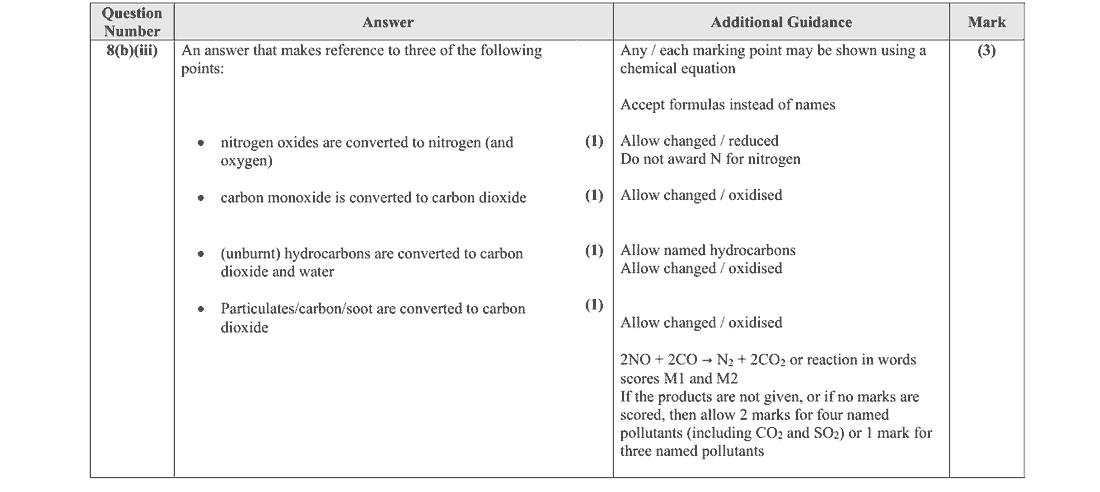
June 2017 · Paper 1 · Q8(c)(i) 3 marks Short answer Easy acid base equilibria
Earlier part of question 8 that this part usesEarlier part of June 2017 Paper 1 question 8
The titration curve for adding glycolic acid to 25.0 cm3 of 0.100 mol dm–3 sodium hydroxide
is shown.
14 –
12 –
10 –
8 –
pH
6 –
4 –
2 –
0
5
10
15
20
25
30
35
40
Volume of glycolic acid / cm3
Use the information given in your Data Booklet to select a suitable indicator
for this titration, including the colour change you would expect to see.
Justify your selection.
June 2017 · Paper 1 · Q10(a)(i) 1 mark Short answer equilibrium ii
Hydrogen is produced on a large scale by several different processes.
One process for producing hydrogen involves reacting white-hot carbon with steam.
C(s) + H2O(g) U H2(g) + CO(g)  ¨H = +131 kJ mol–1
The expression for the equilibrium constant, Kp , is
—
Kp =  p(H2) p(CO)
p(H2O)
Give a reason why the partial pressure of carbon is not included in the expression.
June 2017 · Paper 2 · Q4(a)(ii) 1 mark Short answer formulae equations and amounts of substance
Earlier part of question 4 that this part usesEarlier part of June 2017 Paper 2 question 4
During a car journey, the tyres become warm.  Use the Ideal Gas Equation to
deduce the effect that this has on the pressure in the tyres.
June 2017 · Paper 2 · Q5(a)(ii) 3 marks Short answer kinetics i
Earlier part of question 5 that this part usesEarlier part of June 2017 Paper 2 question 5
Describe the stages by which the reaction in (a)(i) occurs in a catalytic converter.
June 2017 · Paper 2 · Q6(b) 2 marks Short answer amines amides amino acids and proteins
Earlier part of question 6 that this part usesEarlier part of June 2017 Paper 2 question 6
Deduce the two monomers needed to produce the polyamide shown.
H
O
N
N
O
H
and
June 2017 · Paper 2 · Q6(c) 1 mark Short answer amines amides amino acids and proteins
Earlier part of question 6 that this part usesEarlier part of June 2017 Paper 2 question 6
Deduce the single monomer that could be used to produce the polyamide shown.
O
N
H
June 2017 · Paper 2 · Q6(d)(ii) 1 mark Short answer chirality
Earlier part of question 6 that this part usesEarlier part of June 2017 Paper 2 question 6
State how separate samples of these two enantiomers could be distinguished
in a laboratory.
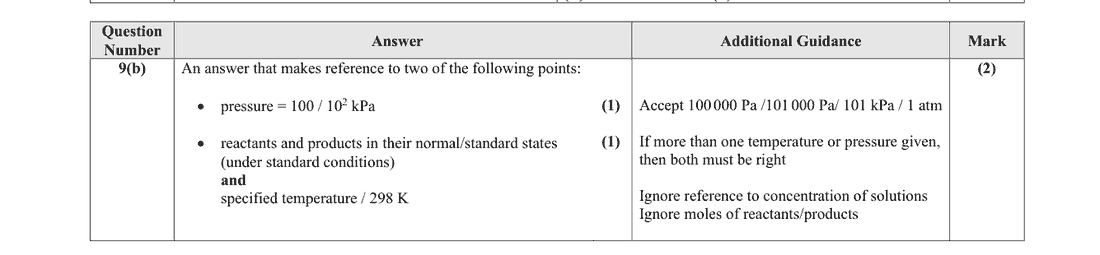
June 2017 · Paper 2 · Q6(d)(iii) 1 mark Short answer alkenes
Earlier part of question 6 that this part usesEarlier part of June 2017 Paper 2 question 6
Biodegradable polyesters break down naturally.
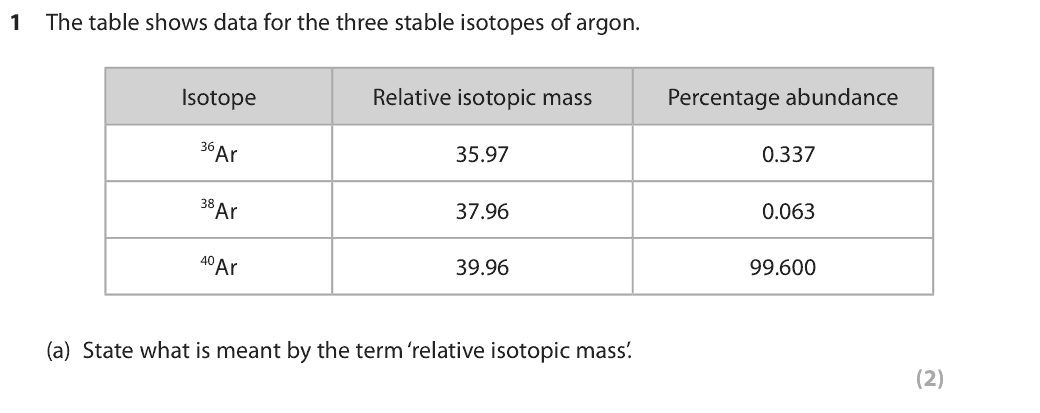
State why this is an advantage.
June 2017 · Paper 2 · Q7(a) 5 marks Short answer organic synthesisarenes benzeneamines amides amino acids and proteins
Antifebrin was the trade name for N-phenylethanamide which was used as a
painkiller until paracetamol was discovered.
O
N
C
H
CH3
Antifebrin
Some of the following reagents can be used to produce Antifebrin from benzene.
•
Aluminium chloride
•
Hydrochloric acid, dilute
•
Ammonia, concentrated
•
Iron
•
Benzene
•
Nitric acid, concentrated
•
Ethanal
•
Nitric acid, dilute
•
Ethanoic acid
•
Propanone
•
Ethanol
•
Sodium chloride
•
Ethanoyl chloride
•
Sulfuric acid, concentrated
•
Hydrochloric acid, concentrated
•
Tin
Selecting from only these reagents, devise a three-step synthetic pathway to
convert benzene into Antifebrin. You should include the structures of the two
intermediate compounds and the reaction conditions.
June 2017 · Paper 2 · Q8(c) 2 marks Short answer carbonyl compounds
Earlier part of question 8 that this part usesEarlier part of June 2017 Paper 2 question 8
The compound 1-phenylethanol can be formed from phenylethanone.
HO
CH3
CH
Give the reagent and conditions that would be used to form 1-phenylethanol.
June 2017 · Paper 2 · Q9(b)(i) 3 marks Short answer Easy kinetics ii
Earlier part of question 9 that this part usesEarlier part of June 2017 Paper 2 question 9
The ‘initial rates’ method was used to investigate the orders of reaction with
respect to reactants X, Y and Z. The table shows the results obtained.
Initial concentration / mol dm−3
Initial rate
Run
/ mol dm−3 s−1
X
Y
Z
1
0.00100
0.00300
0.00600
2.17 × 10⁻⁶
2
0.00100
0.00600
0.00600
8.68 × 10⁻⁶
3
0.00050
0.00600
0.00600
4.34 × 10⁻⁶
4
0.00300
0.00300
0.00300
6.51 × 10⁻⁶
Calculate the orders with respect to X, Y and Z.
X 
Y 
Z
June 2017 · Paper 3 · Q2(c)(i) 1 mark Short answer alcohols
Earlier part of question 2 that this part usesEarlier part of June 2017 Paper 3 question 2
Once the essential changes are made to the apparatus, the pear-shaped flask is
heated.  The distillate formed is collected in the conical flask.
On testing the distillate with pH paper, it is found that its pH is 2.
The student suggests that this pH is due to the formation of 3-methylbutanoic acid.
Give a reason why 3-methylbutanoic acid cannot be formed in the reaction.
June 2017 · Paper 3 · Q2(c)(ii) 1 mark Short answer alcohols
Earlier parts of question 2 that this part usesEarlier part of June 2017 Paper 3 question 2Earlier part of June 2017 Paper 3 question 2
Deduce the formula of the compound that could cause the distillate to have a
pH value of 2.
June 2017 · Paper 3 · Q2(d)(i) 2 marks Short answer mass spectrometry and infrared spectroscopy
Earlier part of question 2 that this part usesEarlier part of June 2017 Paper 3 question 2
The organic mixture was separated from the aqueous layer and dried.
The infrared spectrum of the organic mixture is shown.
100
50
0
4000
3000
2000
1500
1000
500
wavenumber / cm–1
By reference to any relevant peak(s), deduce how the infrared spectrum shows
that the mixture contains 3-methylbutan-2-one.
June 2017 · Paper 3 · Q2(e)(i) 1 mark Short answer mass spectrometry and infrared spectroscopy
Earlier part of question 2 that this part usesEarlier part of June 2017 Paper 3 question 2
The mass spectrum of pure 3-methylbutan-2-one is shown.
100
80
60
40
20
0
10
20
30
40
50
60
70
80
90
m/z
State how you would find the molar mass of 3-methylbutan-2-one from the
mass spectrum.
June 2017 · Paper 3 · Q3(a) 1 mark Short answer Hard introduction to organic chemistry
Alanine and lysine are amino acids.
H
H
H2N
C
COOH
H2N
C
COOH
CH3
CH2(CH2)3NH2
alanine
lysine
Give the systematic (IUPAC) name for lysine.
June 2017 · Paper 3 · Q4(a) 2 marks Short answer energetics i
This question is about the enthalpy change of combustion of methanol.
A teacher asked two students to carry out a practical task to determine the enthalpy
change of combustion of methanol.
Both students were provided with the same apparatus and chemicals.
The following procedure was provided for the students.
Procedure
•
Measure out 150 cm3 of distilled water, using a 250 cm3 measuring cylinder.
•
Transfer the water to a copper calorimeter and note the initial temperature of the
water (to the nearest 0.5°C) in Table 1.
•
Weigh the spirit burner containing methanol and record its mass in Table 1.
•
Place the spirit burner under the copper calorimeter, as shown in the diagram.
•
Ignite the spirit burner and burn the methanol, whilst stirring the water with the
thermometer.
•
After heating the water for three minutes, extinguish the flame and immediately
record the highest temperature reached by the water.
•
As soon as possible, reweigh the spirit burner containing the methanol and
record its mass in Table 1.
thermometer
copper calorimeter
water
spirit burner
methanol
The results of Student 1 are recorded in Table 1.
Mass of spirit burner plus methanol before burning / g
213.47
Mass of spirit burner plus methanol after burning / g
211.87
Mass of methanol burned / g
Highest temperature of the water  / °C
64.5
Initial temperature of the water / °C
22.0
Temperature change of the water / °C
Table 1
Complete Table 1, giving the values to an appropriate number of decimal places.
June 2017 · Paper 3 · Q5(b)(ii) 1 mark Short answer introduction to organic chemistry
Earlier parts of question 5 that this part usesEarlier part of June 2017 Paper 3 question 5Earlier part of June 2017 Paper 3 question 5
Name the organic product in (b)(i).
June 2017 · Paper 3 · Q5(c) 2 marks Short answer organic synthesishalogenoalkanes
Earlier part of question 5 that this part usesEarlier part of June 2017 Paper 3 question 5
Identify, by using ticks, two boxes in the table to select appropriate terms that
describe a Grignard reagent.
acid
electrophile
nucleophile
oxidising agent
reducing agent
June 2017 · Paper 3 · Q5(d) 1 mark Short answer organic synthesis
Earlier part of question 5 that this part usesEarlier part of June 2017 Paper 3 question 5
The solvent used for Grignard reagents has to be completely dry.
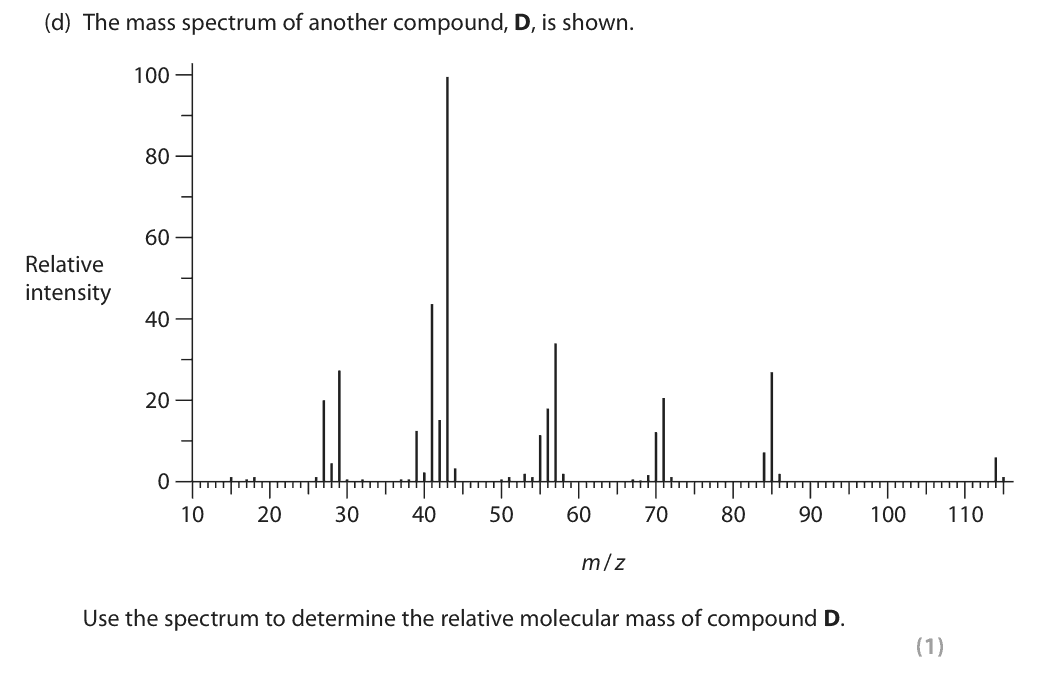
By considering the dipole on the O—H bonds in water, predict the identity of the organic
product that forms if water is added to the Grignard compound in part (a).

June 2017 · Paper 3 · Q6(a) 2 marks Short answer redox ii

A student carried out an investigation to determine the value of x in hydrated
magnesium nitrate(III), Mg(NO2)2•xH2O, using three different methods.
Method 1
•
The student prepared an aqueous solution by dissolving 1.15 g of Mg(NO2)2•xH2O
in distilled water, making up the solution to 250.0 cm3 in a volumetric flask and
shaking the mixture.
•
The student titrated this solution against 25.0 cm3 portions of an acidified
solution of 0.0200 mol dm−3 potassium manganate(VII), KMnO4(aq).
Method 2
•
The student mixed a solution of Mg(NO2)2•xH2O with an excess of aqueous
sodium carbonate solution, Na2CO3(aq).
•
The student obtained a precipitate of magnesium carbonate, MgCO3(s), and
determined the mass of this precipitate.
Method 3
•
The student heated a known mass of Mg(NO2)2•xH2O(s).
•
The student determined the mass of the anhydrous residue formed.
Method 1 – Titration
The student filled the burette with the solution made from Mg(NO2)2•xH2O.
In each titration
•
25.0 cm3 of 0.0200 mol dm−3 KMnO4(aq) was transferred to a conical flask

using a pipette.
•
An excess of dilute sulfuric acid was added to the conical flask and the mixture heated.
•
Mg(NO2)2(aq) was added from the burette until the end-point was reached.

The student’s titration results are shown in the table (the rough titration results have
not been included in the table).
Titration number
1
2
3
Final burette reading / cm3
23.95
48.05
23.85
Initial burette reading / cm3
0.80
24.50
0.65
Titre / cm3
Concordant titres (9)
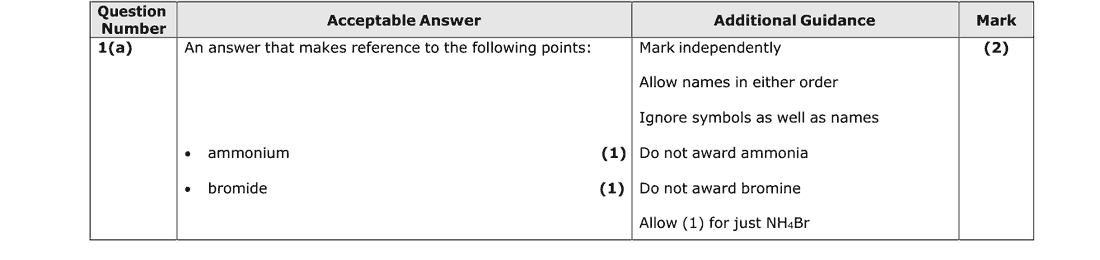
Mean titre / cm3
Complete the table.
June 2017 · Paper 3 · Q9(a)(i) 1 mark Short answer Easy equilibrium i
The gas phase reaction between hydrogen and iodine is reversible.
H2(g)  +  I2(g)  U  2HI(g)
Write the expression for the equilibrium constant, Kc, for this reaction.
June 2017 · Paper 3 · Q9(a)(ii) 2 marks Short answer equilibrium i
Earlier part of question 9 that this part usesEarlier part of June 2017 Paper 3 question 9
If the starting concentration of both hydrogen and iodine was a mol dm−3
and it was found that 2y mol dm−3 of hydrogen iodide had formed once
equilibrium had been established, write the Kc expression in terms of a and y.
June 2017 · Paper 3 · Q9(d) 2 marks Short answer kinetics iequilibrium ii
Earlier parts of question 9 that this part usesEarlier part of June 2017 Paper 3 question 9Earlier part of June 2017 Paper 3 question 9Earlier part of June 2017 Paper 3 question 9Earlier part of June 2017 Paper 3 question 9Earlier part of June 2017 Paper 3 question 9
One of the experiments in part (b) was repeated using the same molar quantities
of hydrogen and iodine but in a 500 cm3 flask instead of the 1 dm3 flask.
Deduce the effect, if any, that this would have on the rate of reaction and on the
value of Kc calculated.
June 2016 · AS Paper 1 · Q1(a)(i) 1 mark Short answer group 7 the halogens
This question is about Group 7 elements and their compounds.
Give the physical states of chlorine and iodine at room temperature and
pressure.
June 2016 · AS Paper 1 · Q1(a)(ii) 1 mark Short answer group 7 the halogens
Earlier part of question 1 that this part usesEarlier part of June 2016 Paper 1 question 1
Predict the physical state of astatine under these conditions.  Justify your
answer.
June 2016 · AS Paper 1 · Q2(a) 2 marks Short answer Easy atomic structure and the periodic table
This question is about the structure of the atom and isotopes.
The following excerpt is taken from the book Inorganic Chemistry by Bailey and
Snellgrove, fourth impression 1938.
“Some of the electrons are also contained in the nucleus, whilst the
remainder are ..... arranged in rings revolving round the nucleus .....  The two
isotopes [of chlorine] have therefore 18 and 20 electrons respectively in the
nucleus and 17 [electrons] external to it.”
Identify and correct two errors in the excerpt.
June 2016 · AS Paper 1 · Q2(c)(i) 2 marks Short answer Easy atomic structure and the periodic table
Earlier part of question 2 that this part usesEarlier part of June 2016 Paper 1 question 2
State what is meant by the term relative atomic mass.
June 2016 · AS Paper 2 · Q1(d)(iii) 1 mark Short answer alkanes
Earlier part of question 1 that this part usesEarlier part of June 2016 Paper 2 question 1
State how some butane, C4H10, is formed in the reaction.
June 2016 · AS Paper 2 · Q2(c)(i) 1 mark Short answer equilibrium i
Earlier part of question 2 that this part usesEarlier part of June 2016 Paper 2 question 2
Ethene reacts with steam to form ethanol in a reversible reaction.
C2H4(g) + H2O(g) U C2H5OH(g)     ¨H = –45 kJ mol–1
At 300 oC and a pressure of 65 atm, the equilibrium yield of ethanol is 5%.
State the effect, if any, on the yield of ethanol when the temperature is
increased.
June 2016 · AS Paper 2 · Q2(c)(ii) 1 mark Short answer equilibrium i
Earlier parts of question 2 that this part usesEarlier part of June 2016 Paper 2 question 2Earlier part of June 2016 Paper 2 question 2
State the effect, if any, on the yield of ethanol when the pressure is decreased.
June 2016 · AS Paper 2 · Q4(c)(iii) 1 mark Short answer Hard energetics i
Earlier part of question 4 that this part usesEarlier part of June 2016 Paper 2 question 4
A data book value for the standard enthalpy change of combustion of ethanol
is −1367.3 kJ mol−1.
Give the main reason why the value you calculated in (b)(i) is different from
this data book value.
June 2016 · AS Paper 2 · Q7(b)(i) 1 mark Short answer alcohols
When alcohol X is oxidised, a carboxylic acid is formed.
State what information this gives about alcohol X.
June 2016 · AS Paper 2 · Q7(b)(iv) 2 marks Short answer mass spectrometry and infrared spectroscopyintroduction to organic chemistry
Earlier parts of question 7 that this part usesEarlier part of June 2016 Paper 2 question 7Earlier part of June 2016 Paper 2 question 7
Alcohol X has a branched chain.
Identify alcohol X, explaining your reasoning.
June 2016 · AS Paper 2 · Q8(a) 2 marks Short answer alcohols
Ethanedioic acid has two carboxylic acid groups.
Ethanedioic acid, H2C2O4, can be prepared from ethane-1,2-diol.
H
H
O
O
H
O
C
C
O
H
C
C
HO
OH
H
H
Give the reagents and condition required for this reaction.
Reagents  
Condition

Work with an A-level chemistry tutor

Dropping marks on calculations, mechanisms or the core practicals? Book a trial session with an A-level chemistry tutor.

Prefer email? Send an enquiry

If you are under 18, please include a parent's contact details. Enquiries go to enquiries@chemistryaleveltutor.com and are deleted once handled. All tutoring is online.