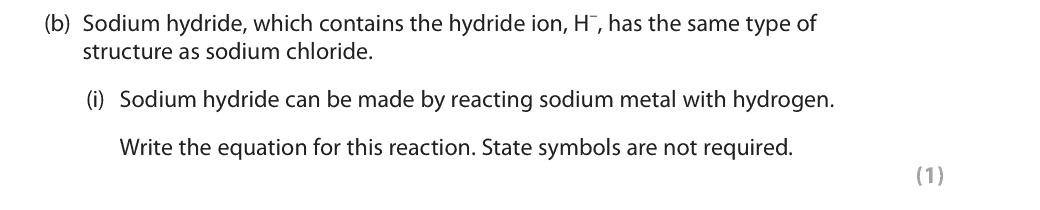
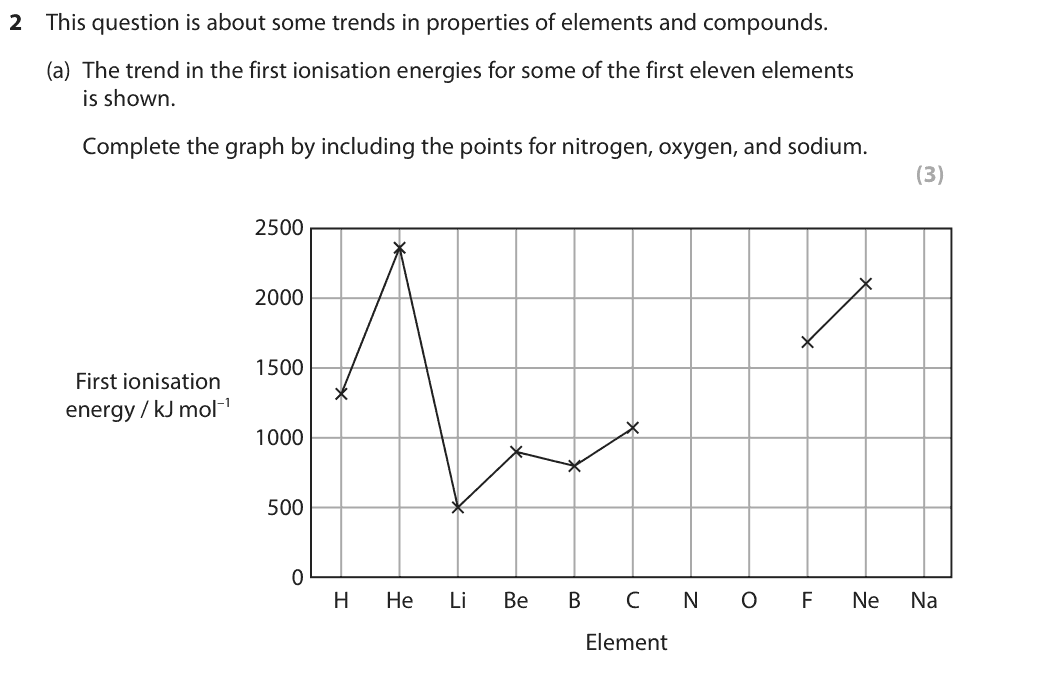
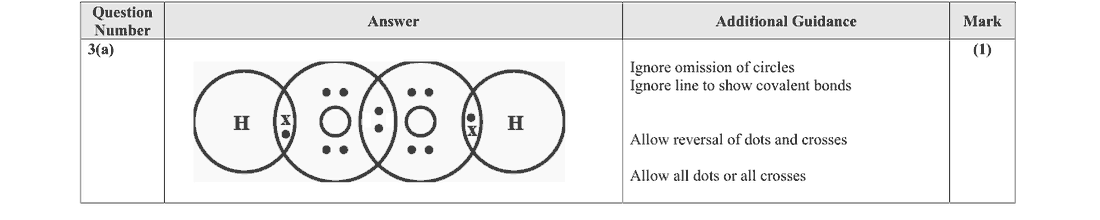
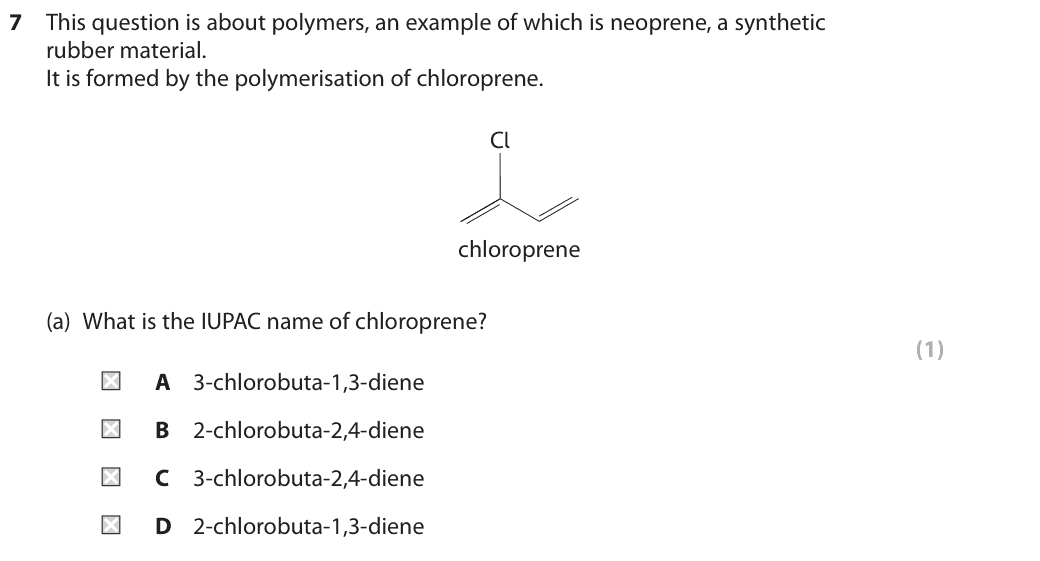
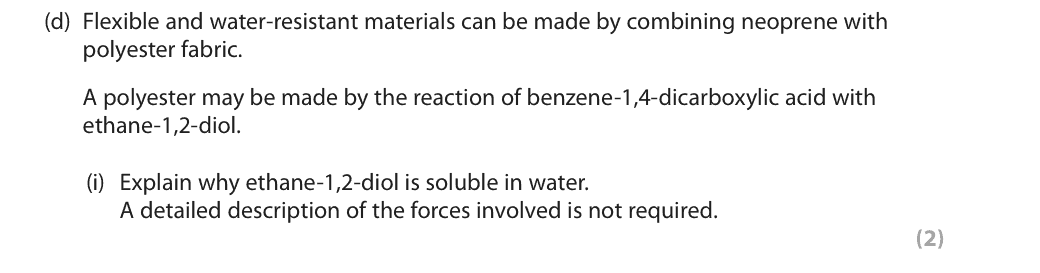
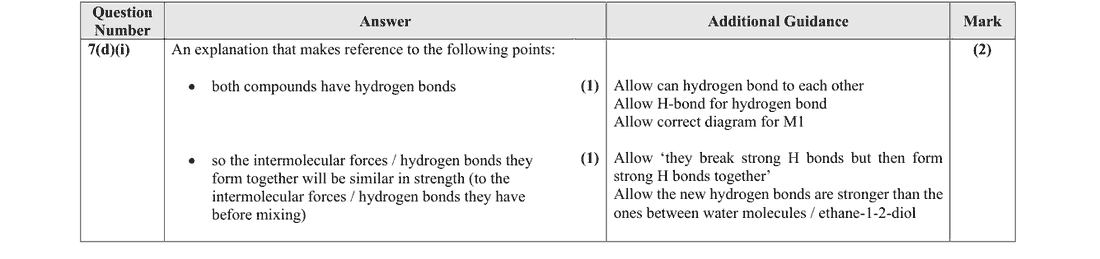
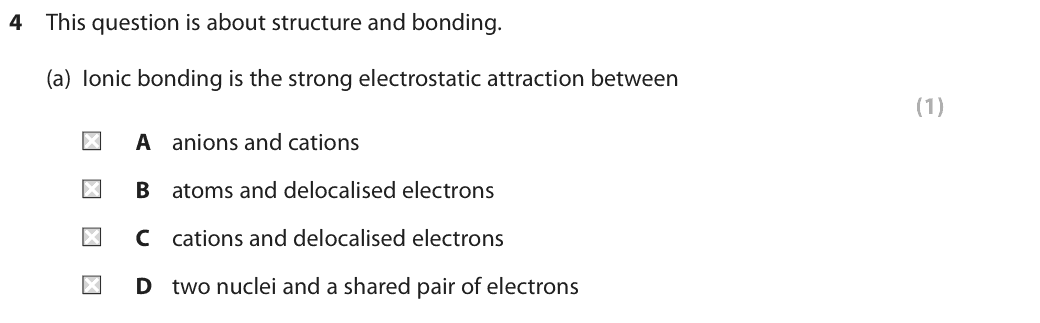
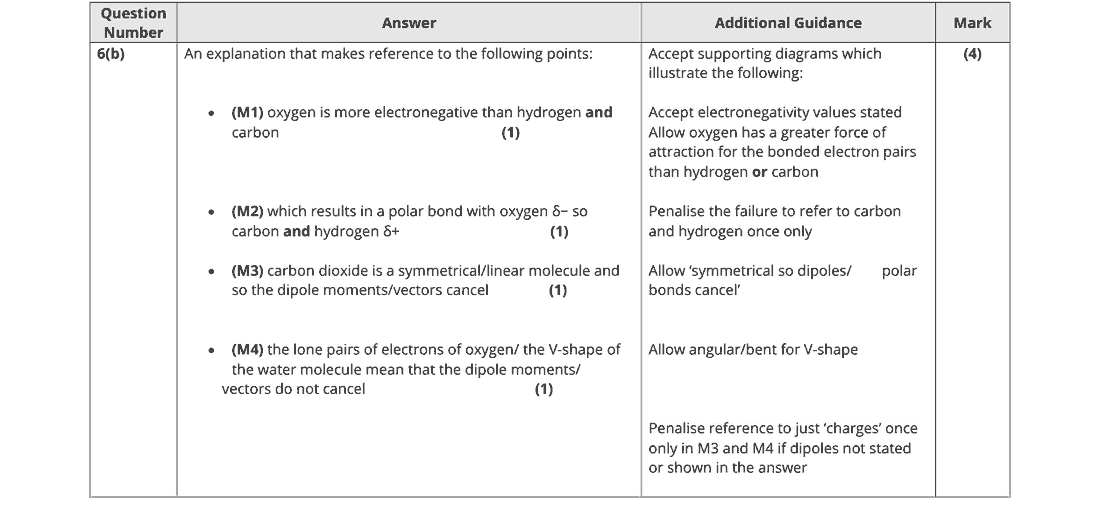
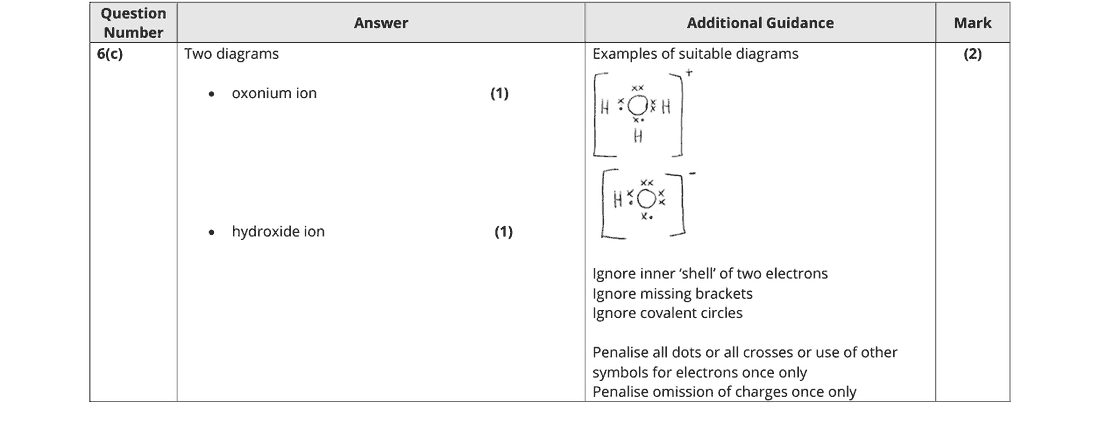
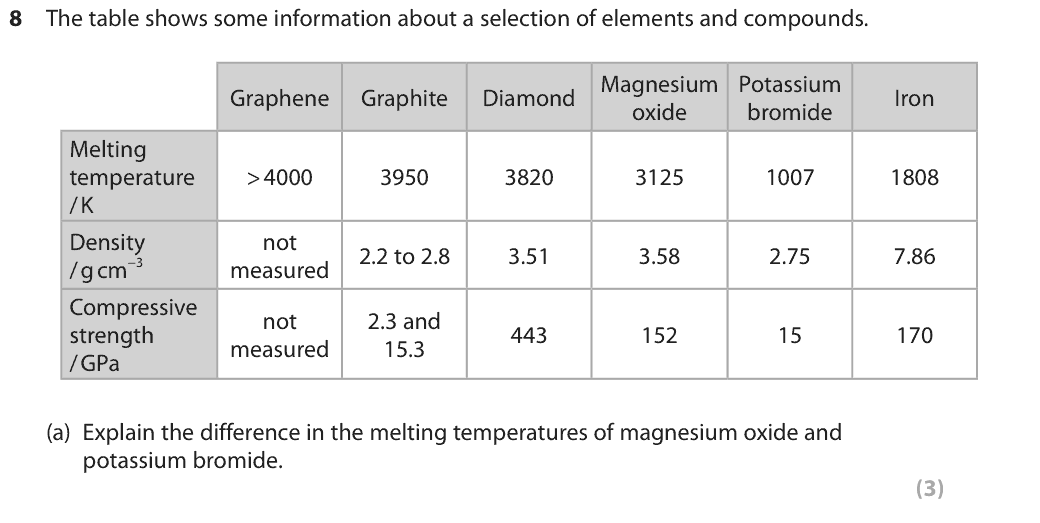
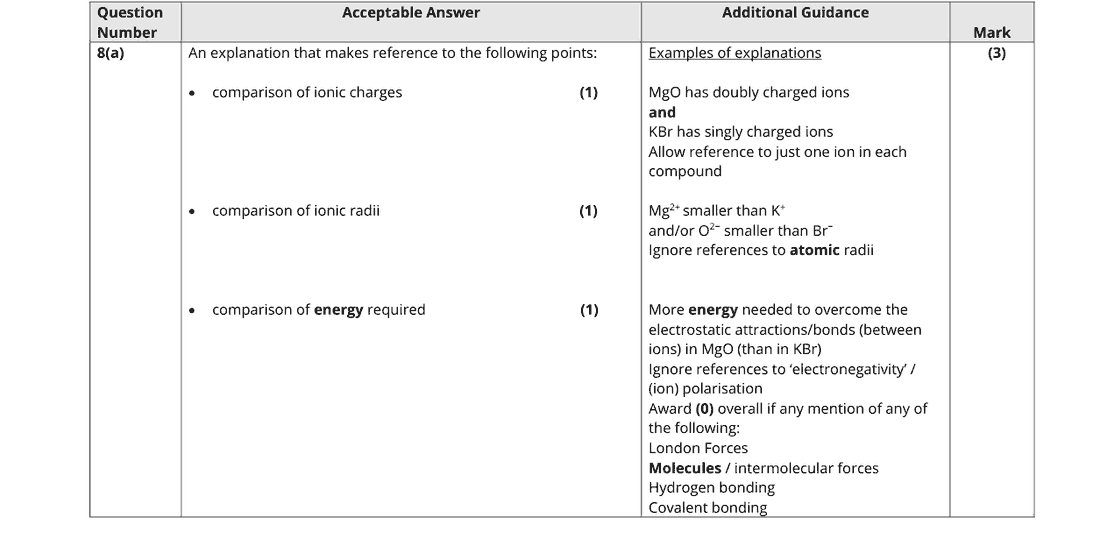
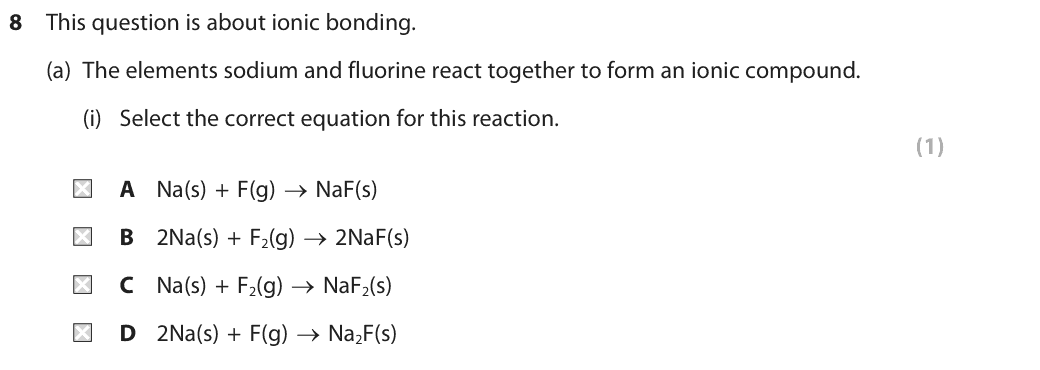
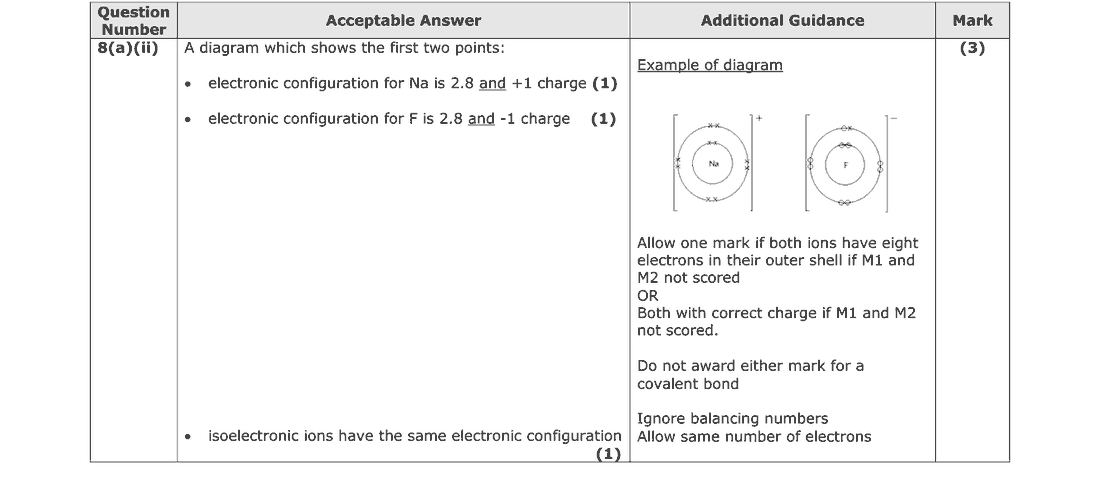
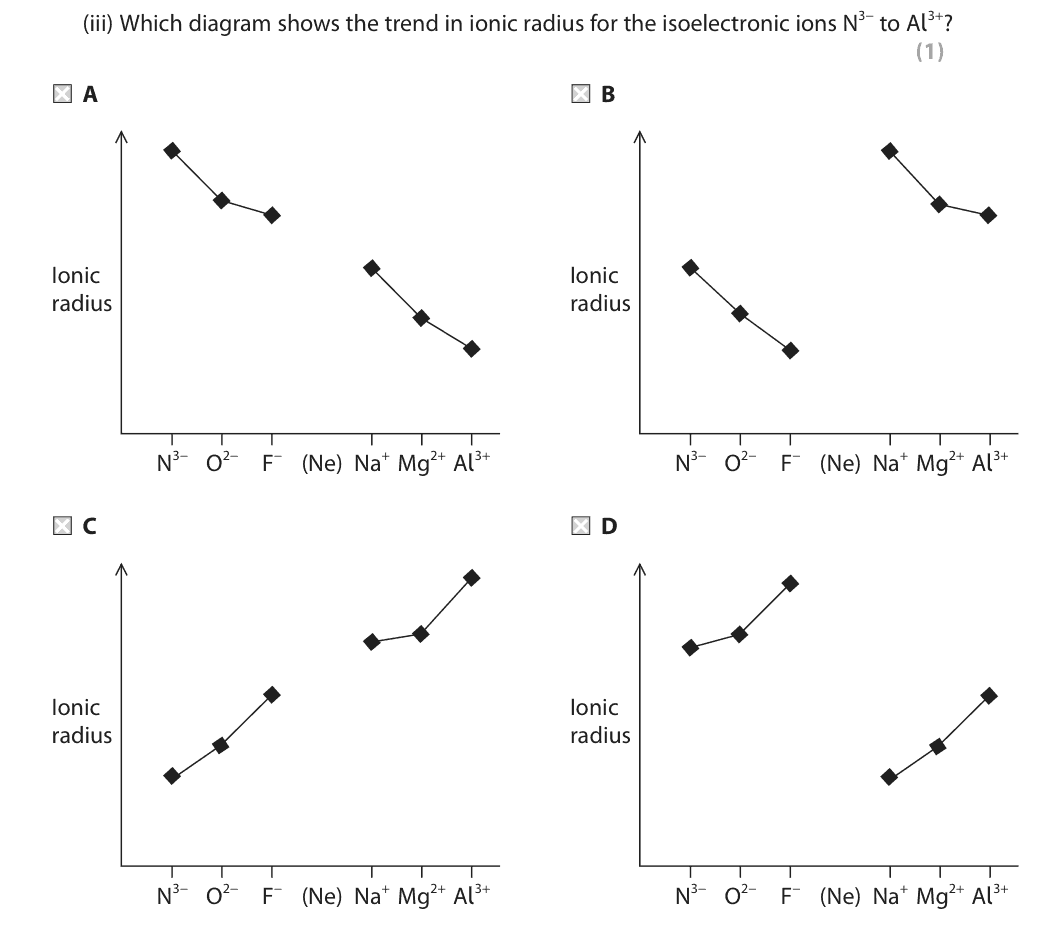
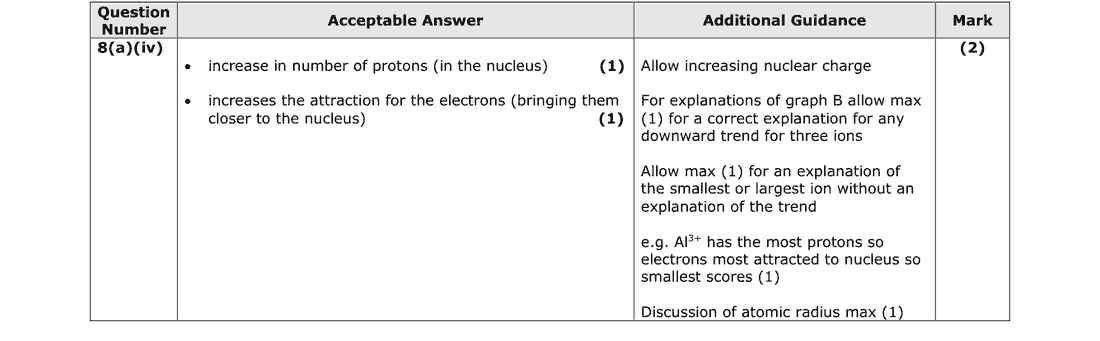
2.1 know that ionic bonding is the strong electrostatic attraction between oppositely charged ions
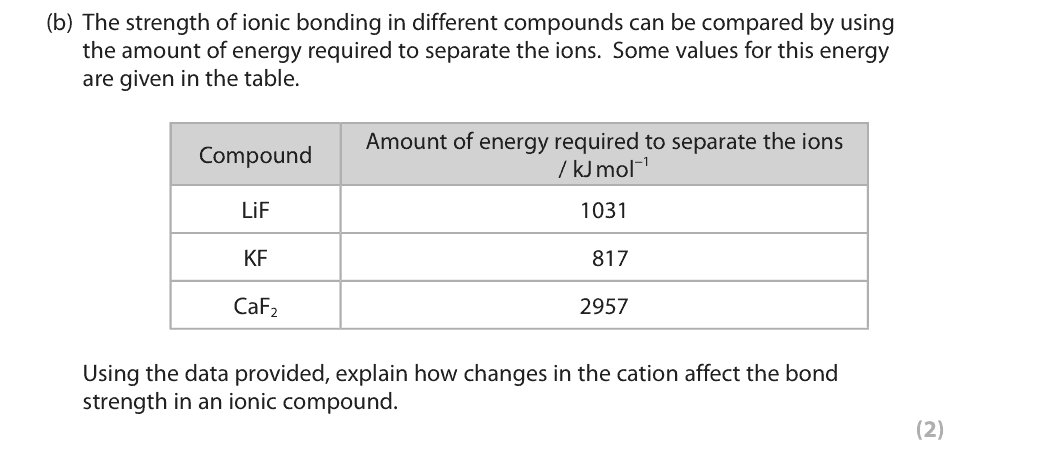
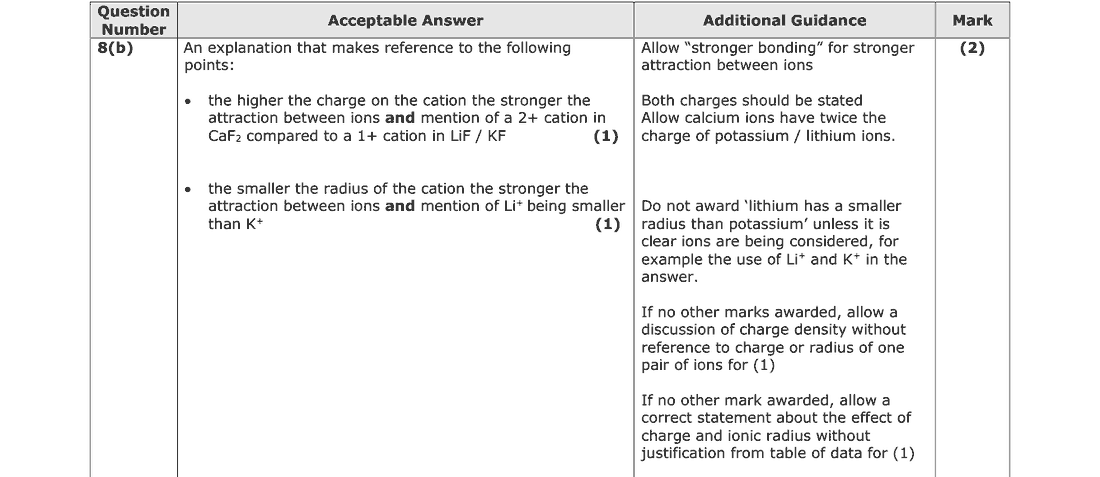
2.2 understand the effects that ionic radius and ionic charge have on the strength of ionic bonding
2.3 understand the formation of ions in terms of electron loss or gain
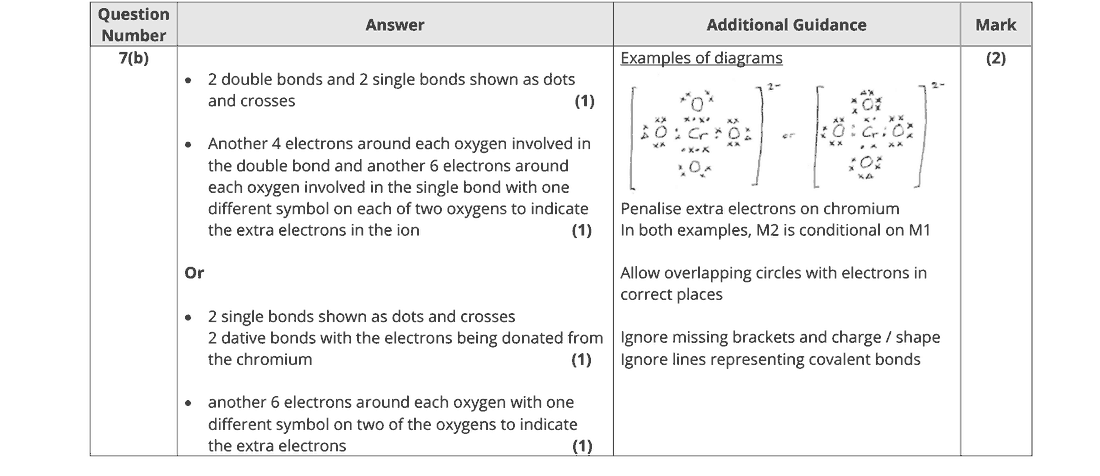
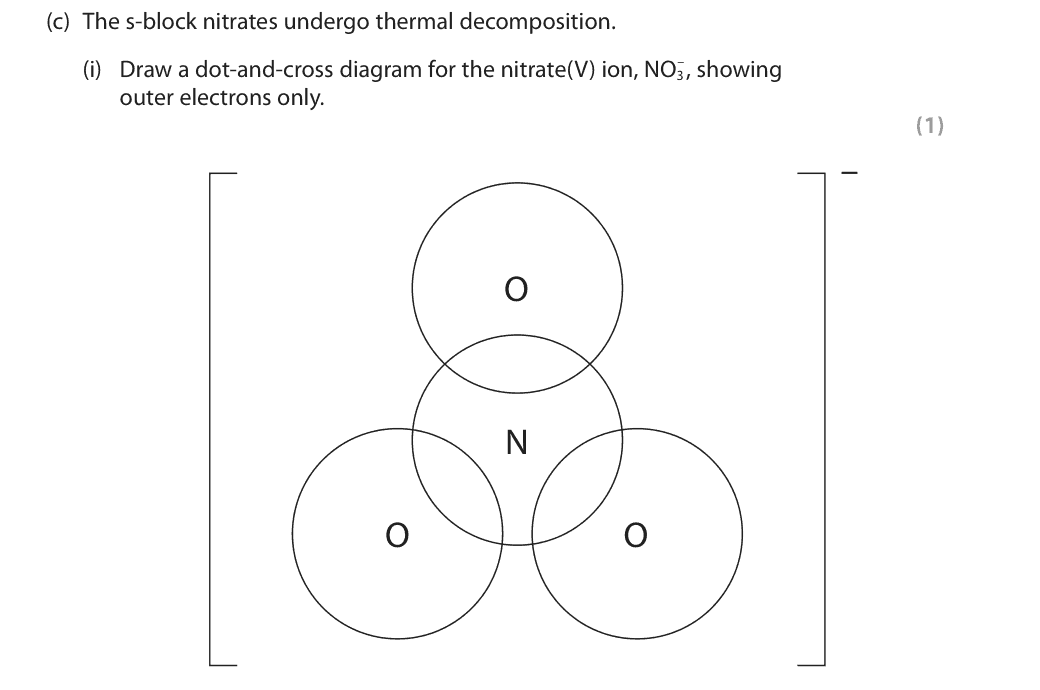
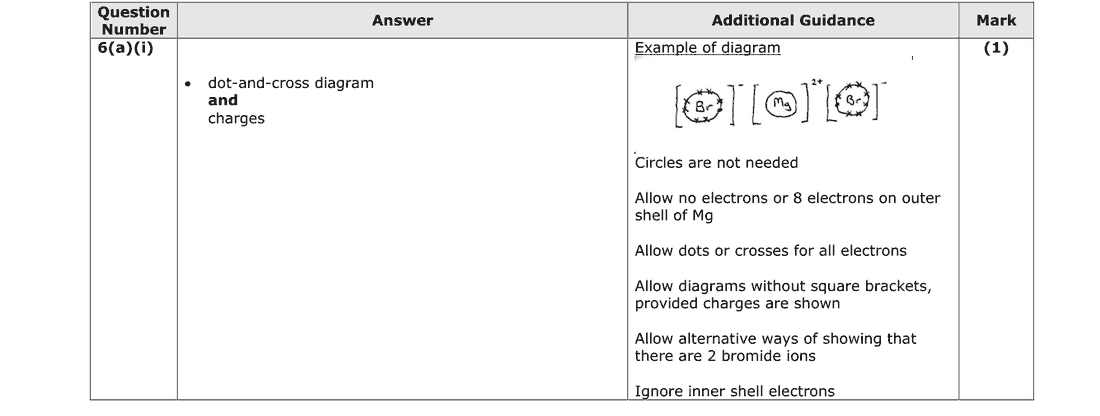
2.4 be able to draw electronic configuration diagrams of cations and anions using dot-and-cross diagrams
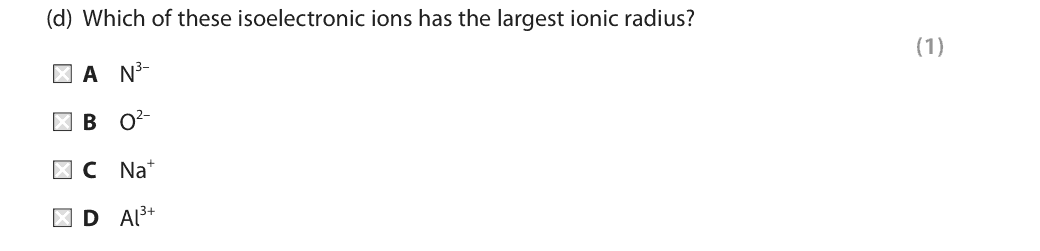
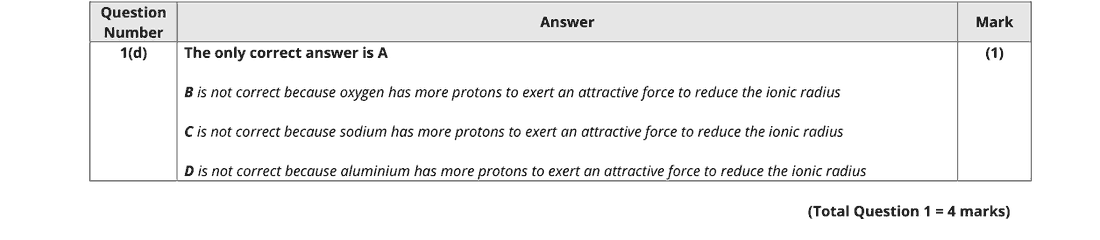
2.5 understand reasons for the trends in ionic radii down a group and for a set of isoelectronic ions, e.g. N^3– to Al^3+
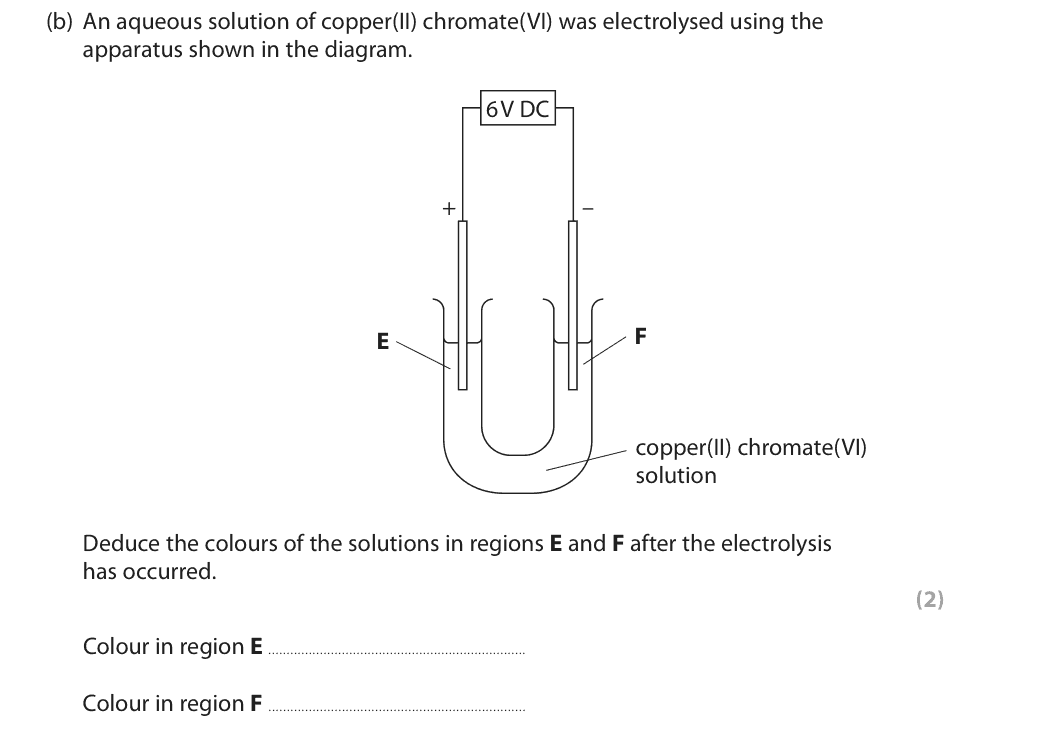
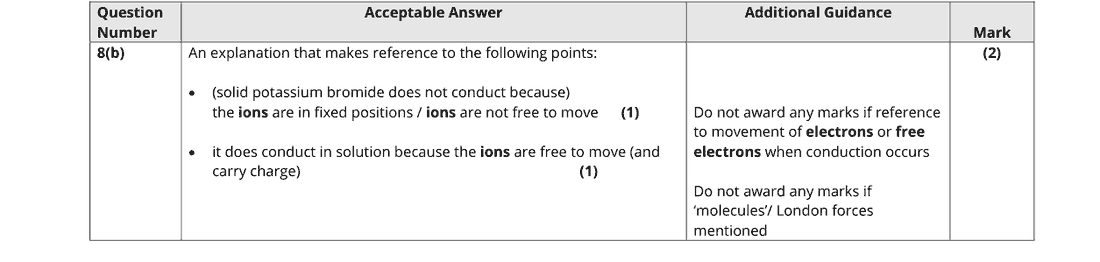
2.6 understand that the physical properties of ionic compounds and the migration of ions provide evidence for the existence of ions
2.7 know that a covalent bond is the strong electrostatic attraction between two nuclei and the shared pair of electrons between them
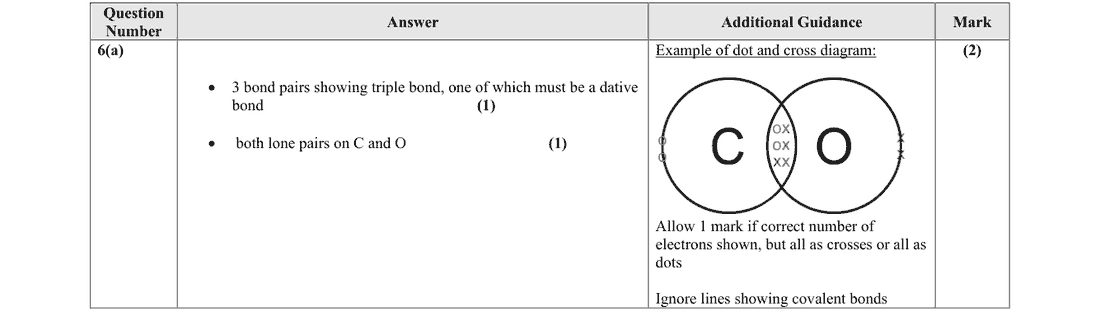
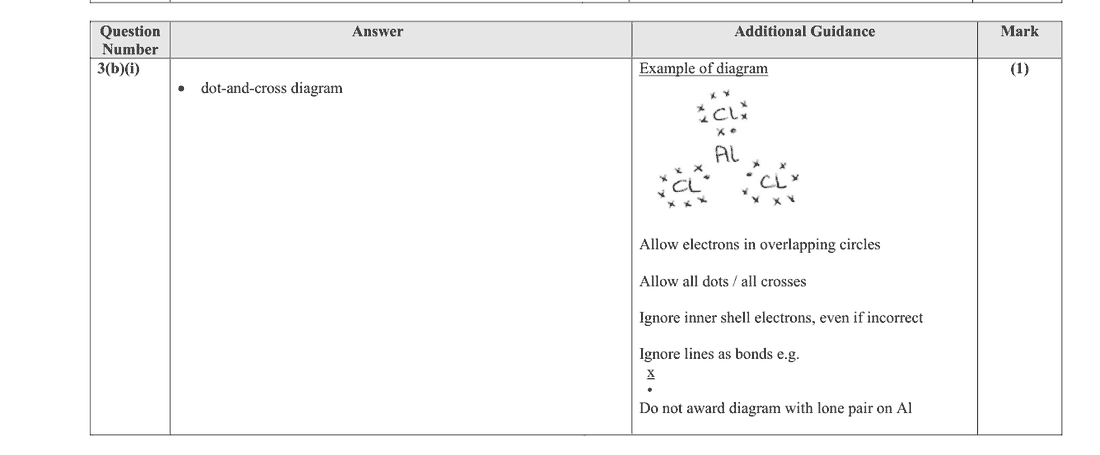
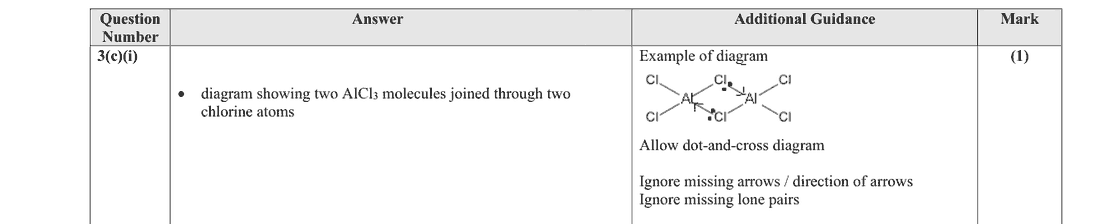
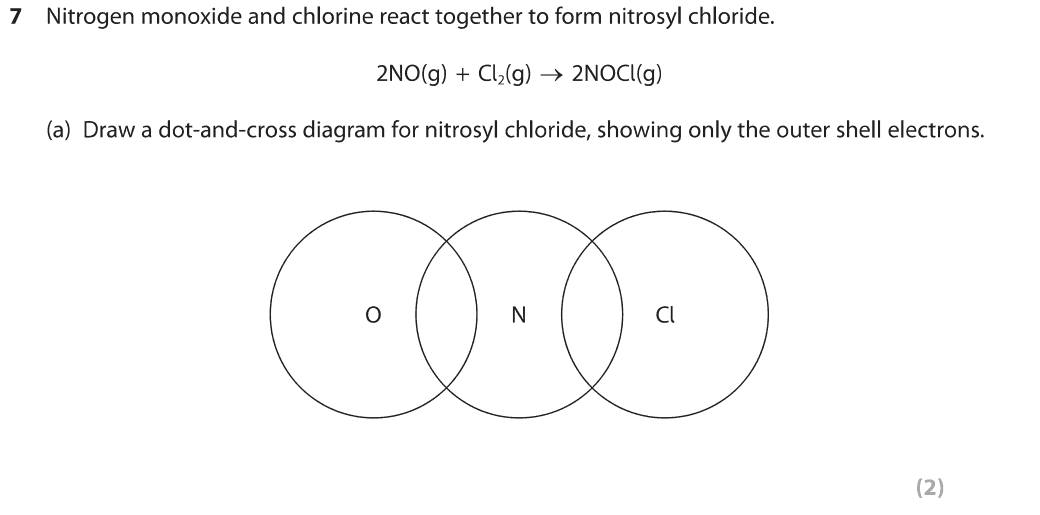
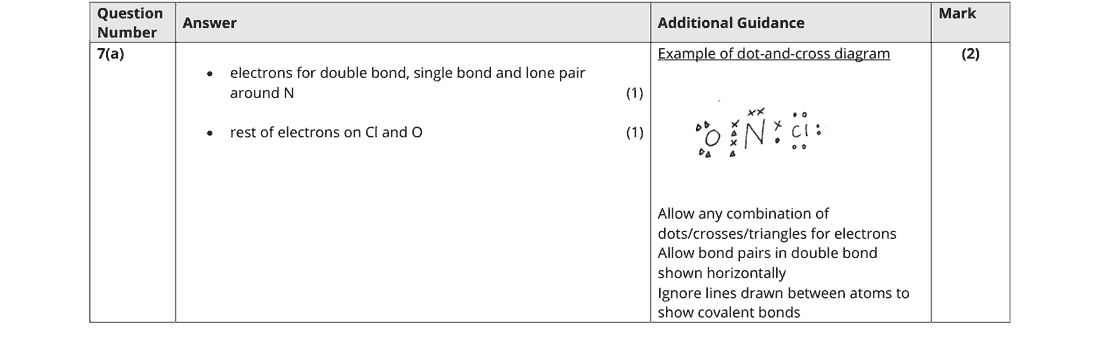
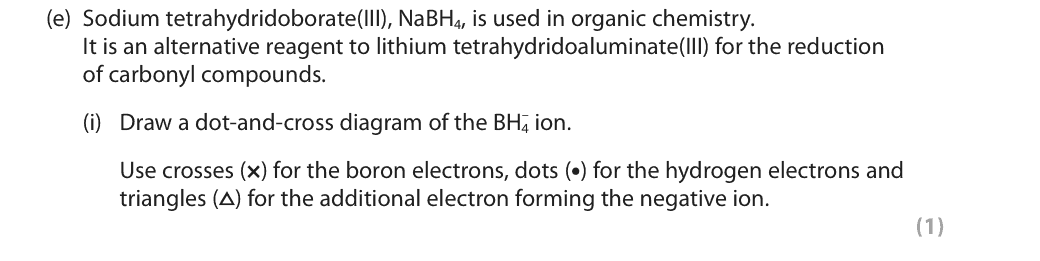
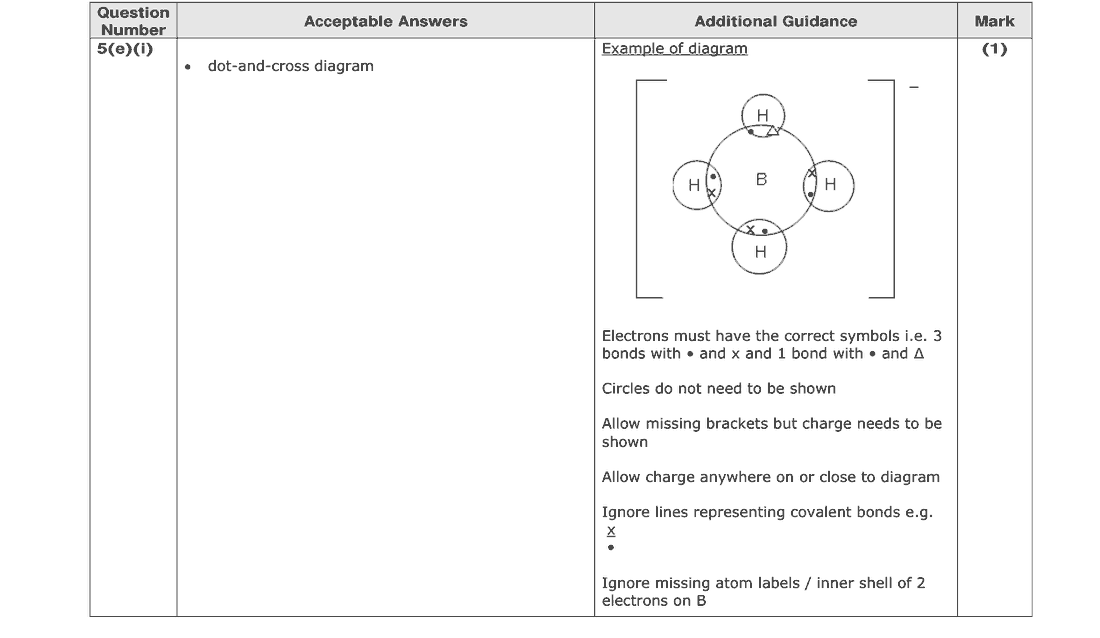
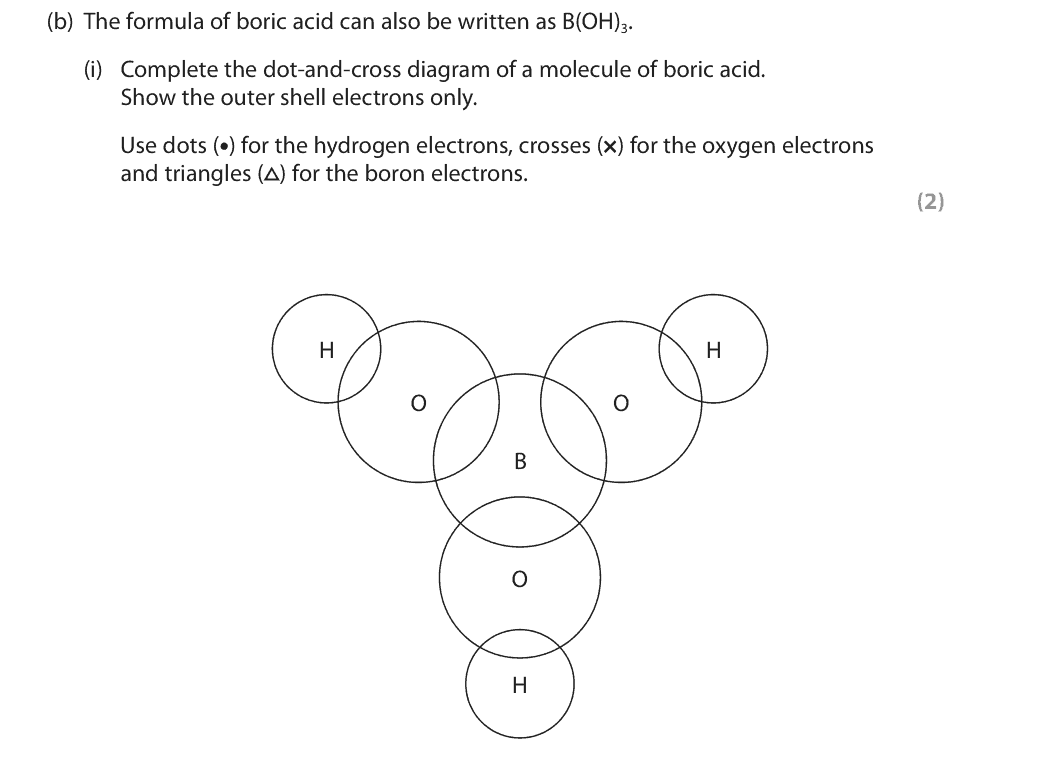
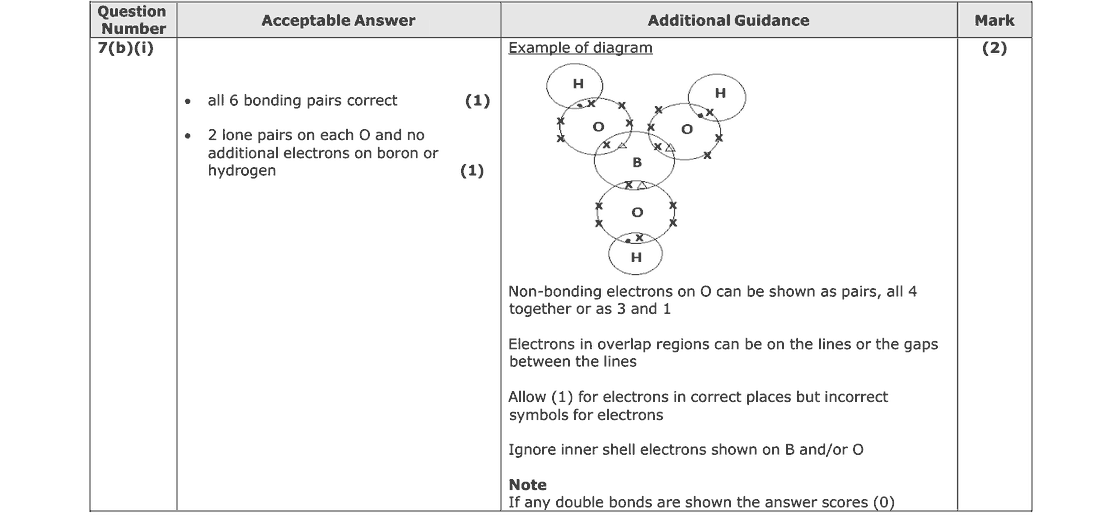
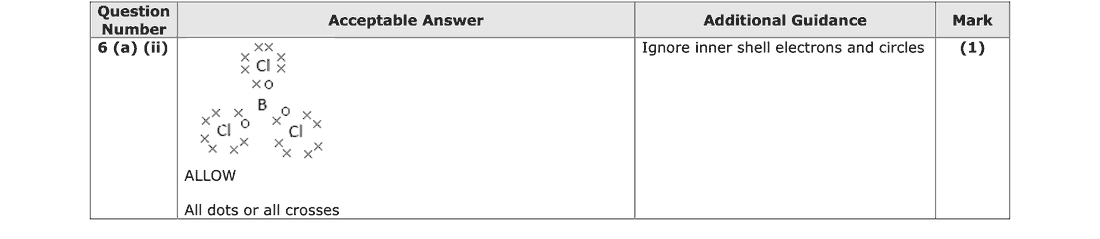
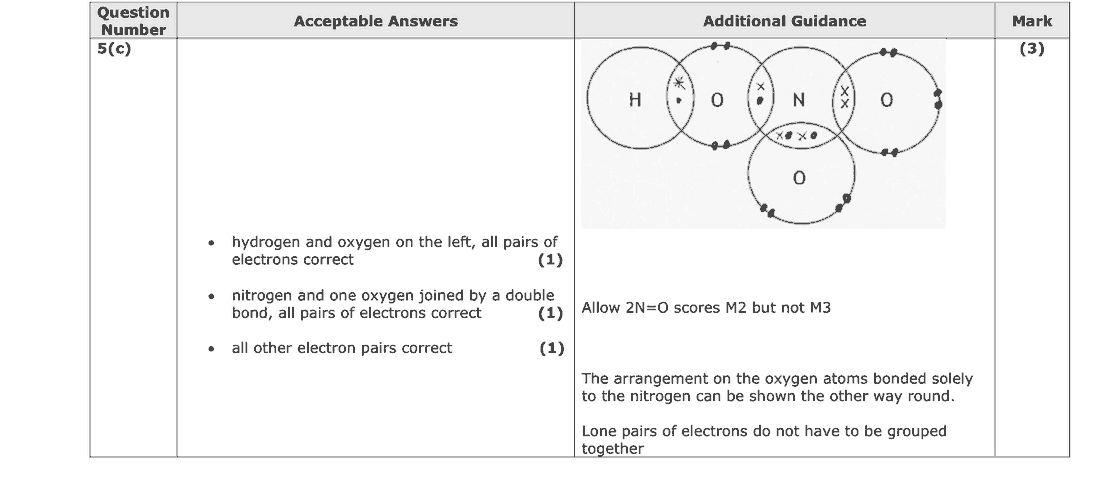
2.8 be able to draw dot-and-cross diagrams to show electrons in covalent substances, including: • i molecules with single, double and triple bonds • ii species exhibiting dative covalent (coordinate) bonding, including Al2Cl6 and ammonium ion
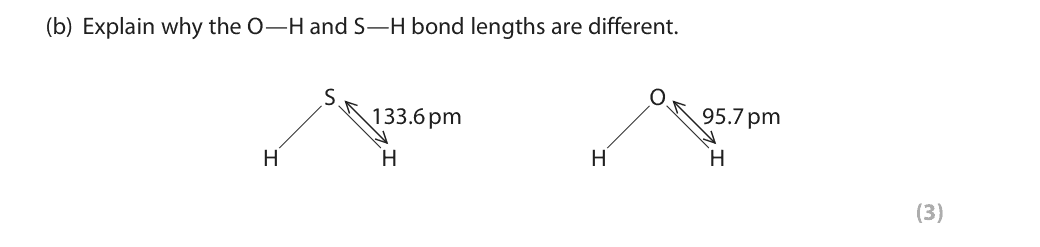
2.9 understand the relationship between bond lengths and bond strengths for covalent bonds
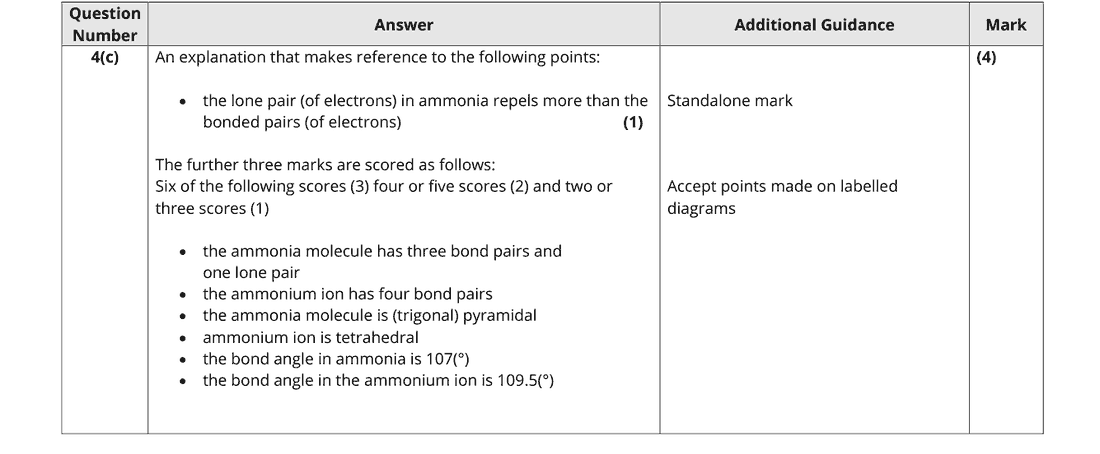
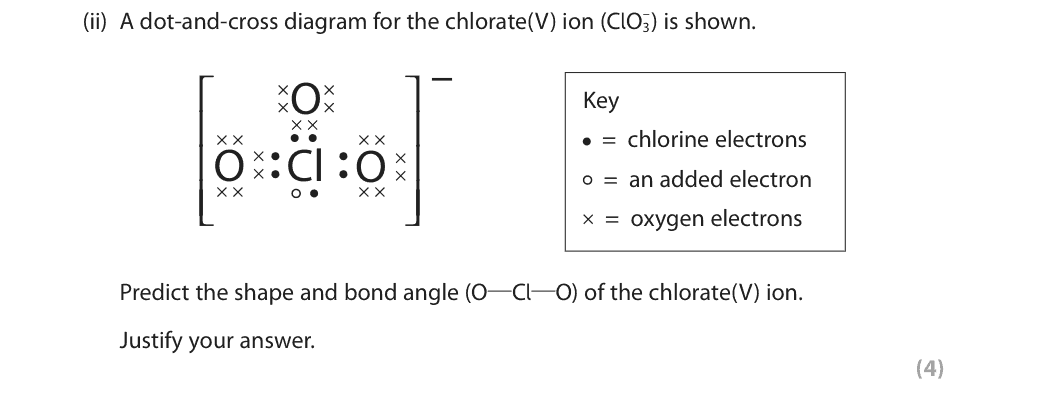
2.10 understand that the shape of a simple molecule or ion is determined by the repulsion between the electron pairs that surround a central atom
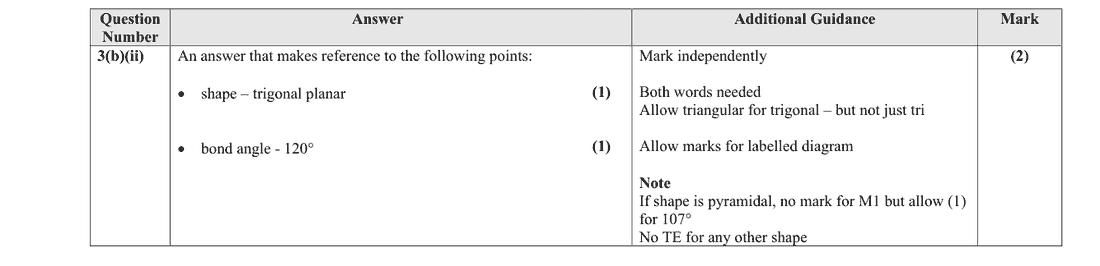
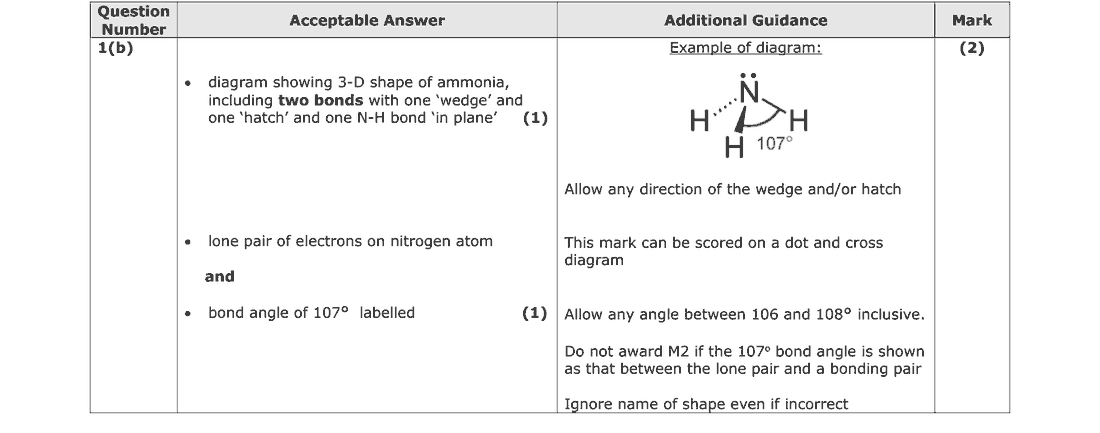
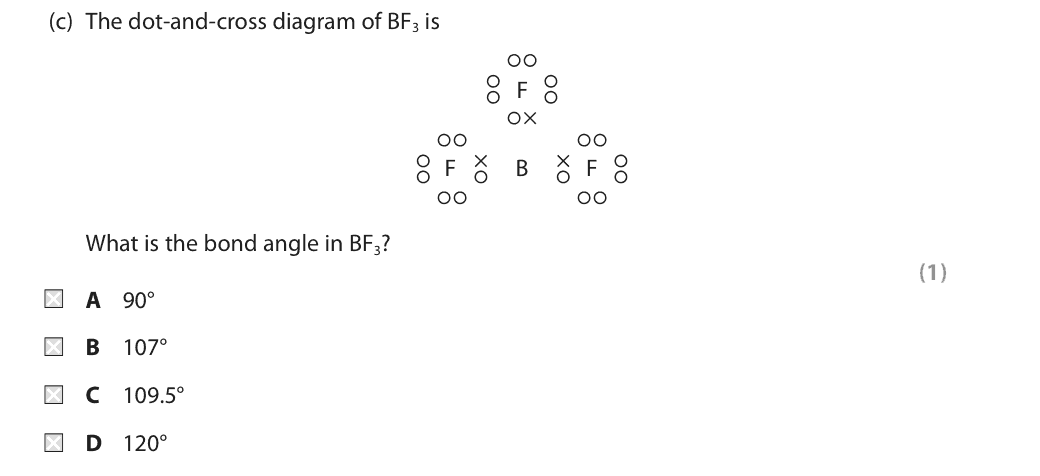
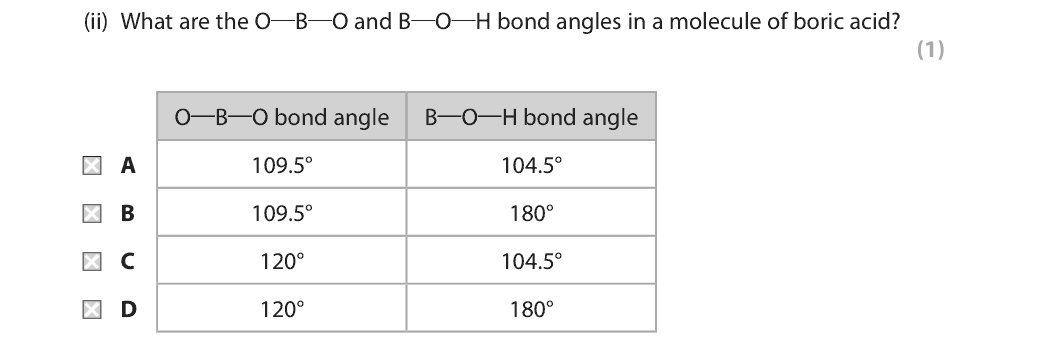
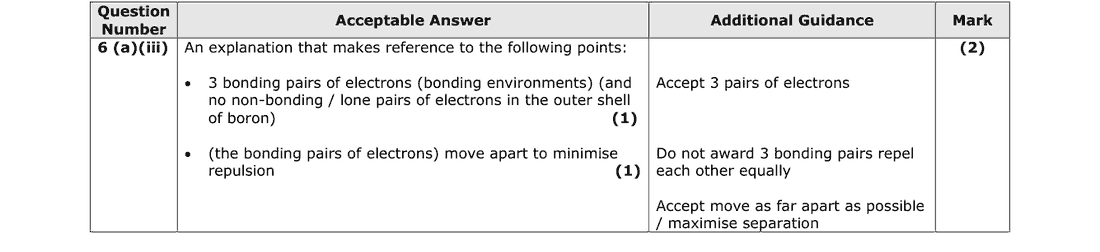
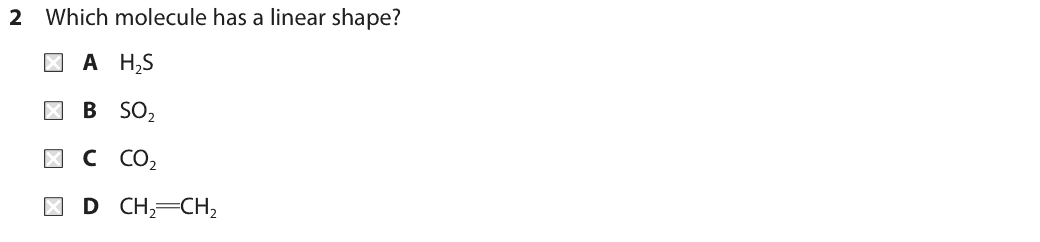
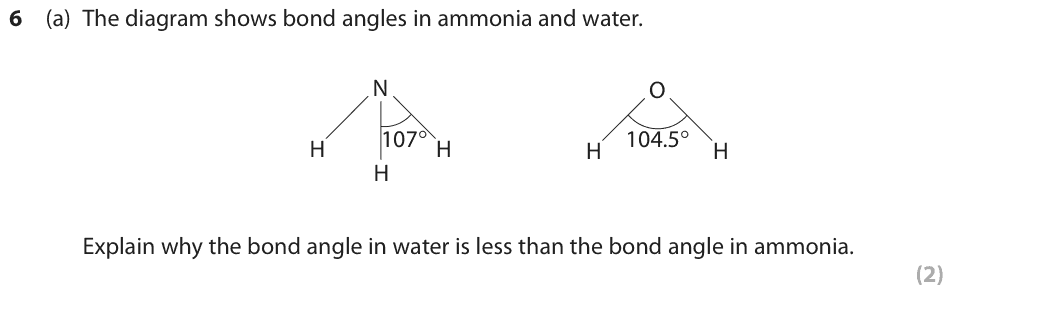
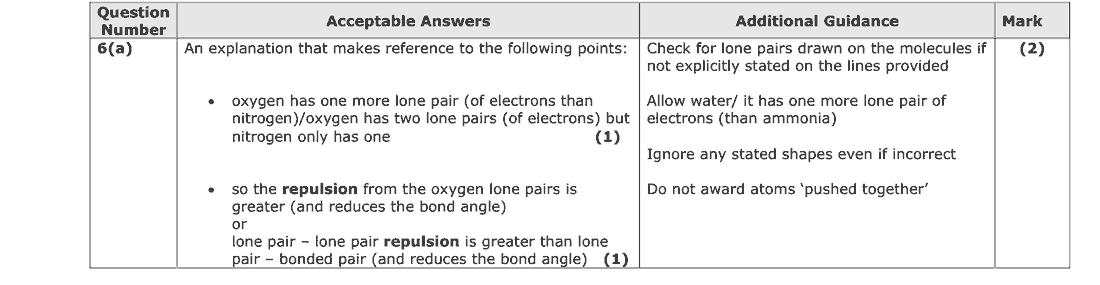
2.11 understand reasons for the shapes of, and bond angles in, simple molecules and ions with up to six outer pairs of electrons (any combination of bonding pairs and lone pairs) [Examples should include BeCl2, BCl3, CH4, NH3, NH4^+, H2O, CO2, PCl5(g) and SF6(g) and related molecules and ions; as well as simple organic molecules in this specification.]
2.12 be able to predict the shapes of, and bond angles in, simple molecules and ions analogous to those specified above using electron-pair repulsion theory
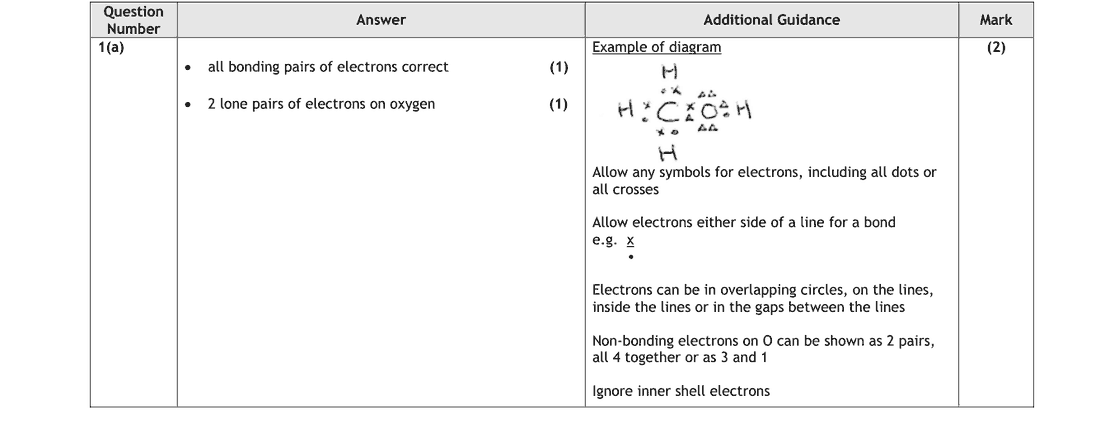
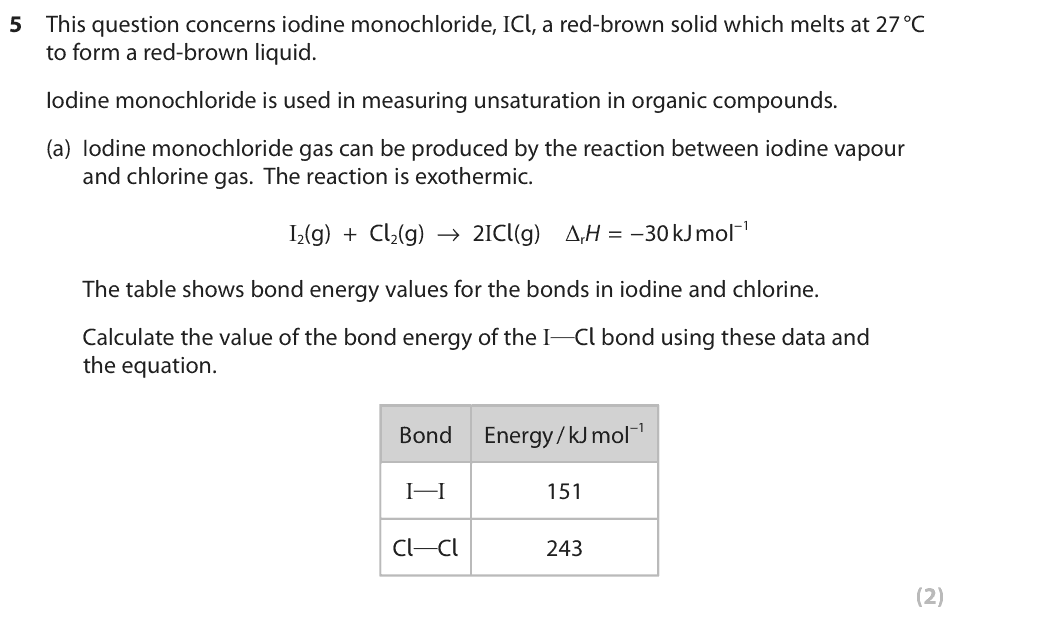
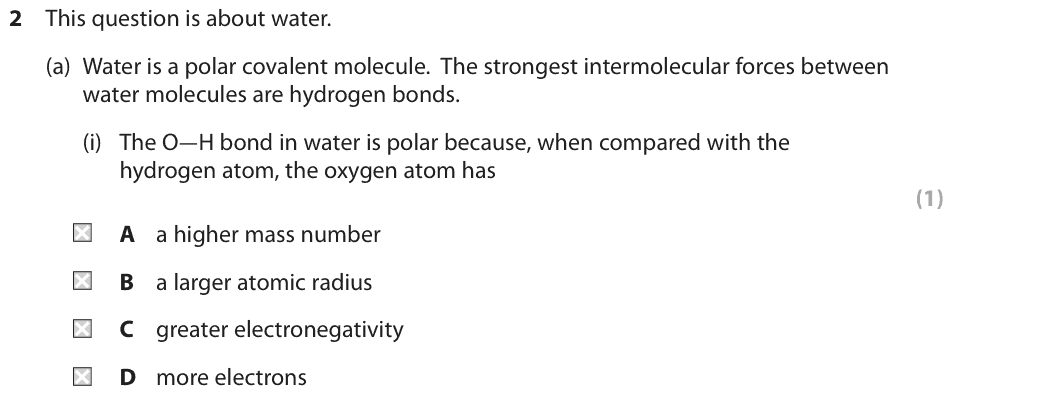
2.13 know that electronegativity is the ability of an atom to attract the bonding electrons in a covalent bond
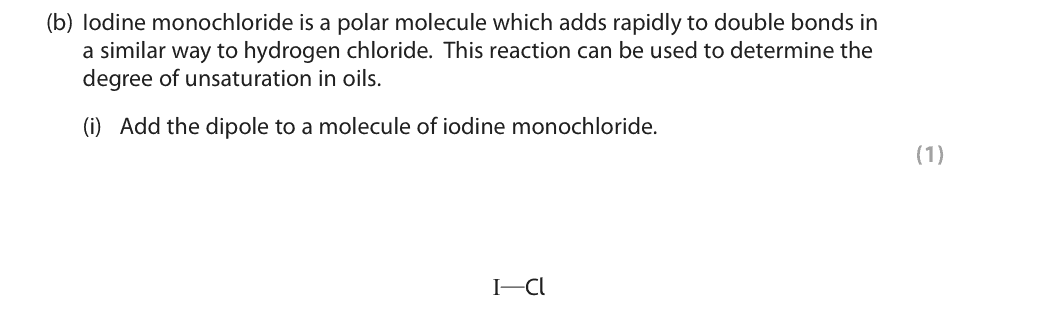
2.14 know that ionic and covalent bonding are the extremes of a continuum of bonding type and that electronegativity differences lead to bond polarity in bonds and molecules
2.15 understand that molecules with polar bonds may not be polar molecules and be able to predict whether or not a given molecule is likely to be polar
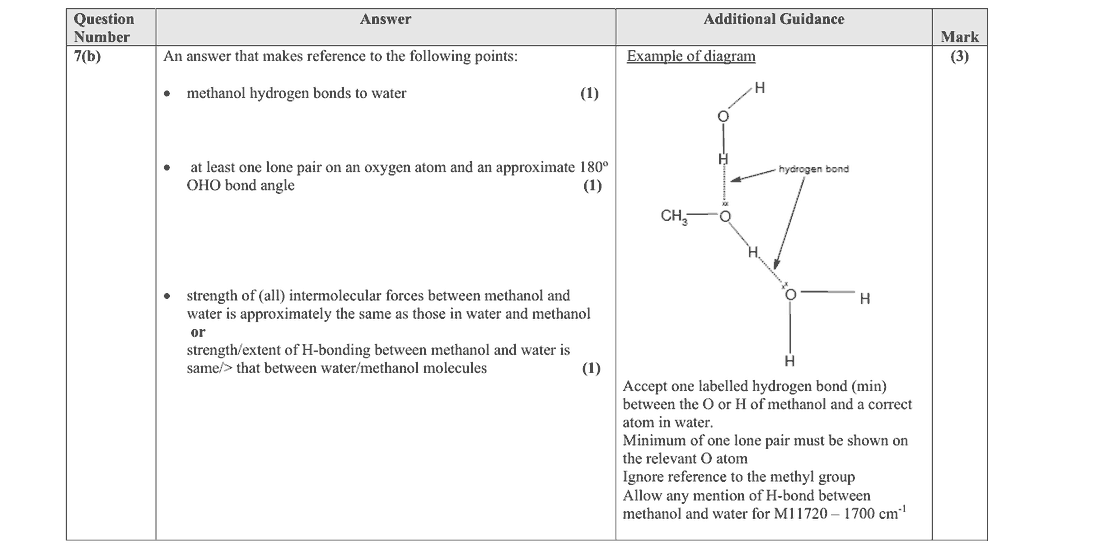
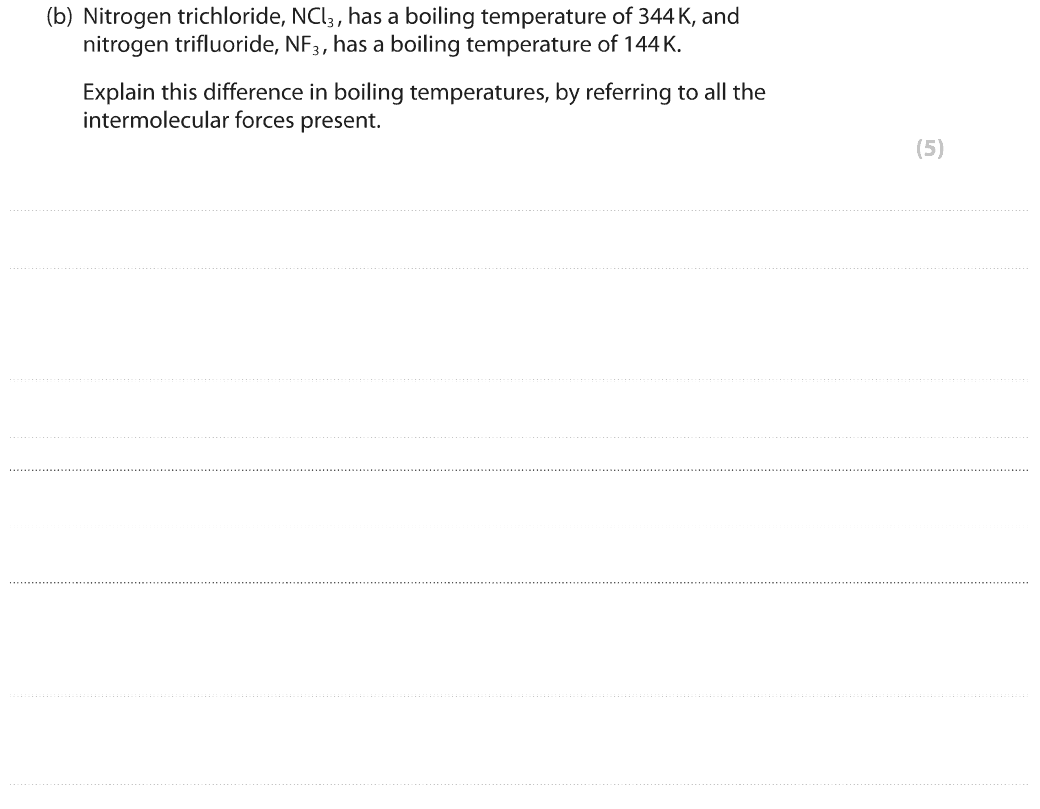
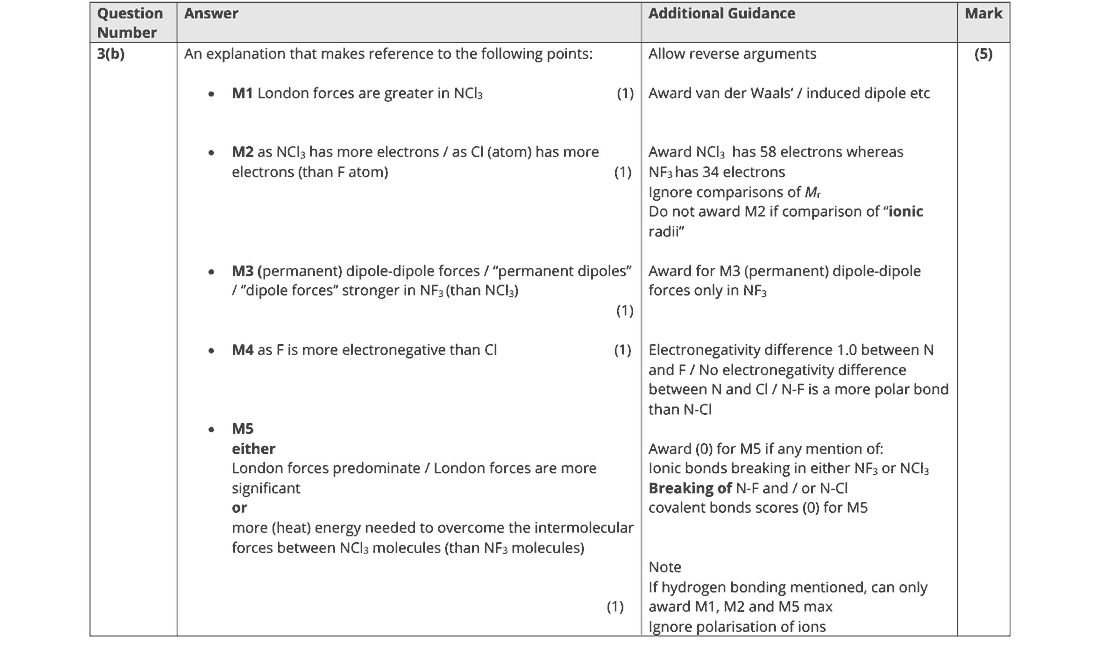
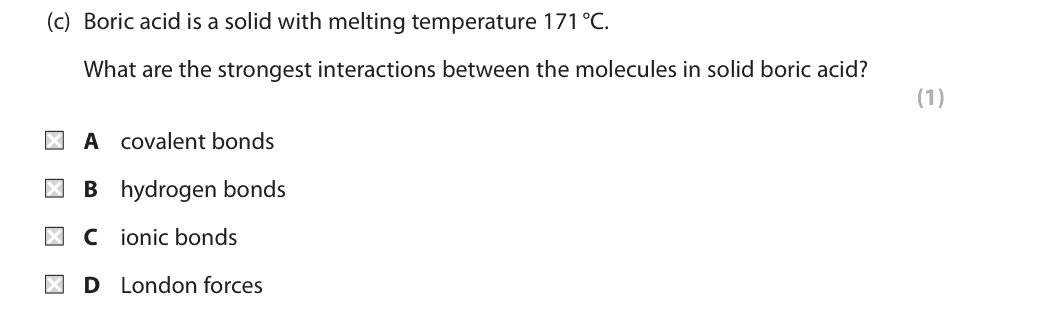
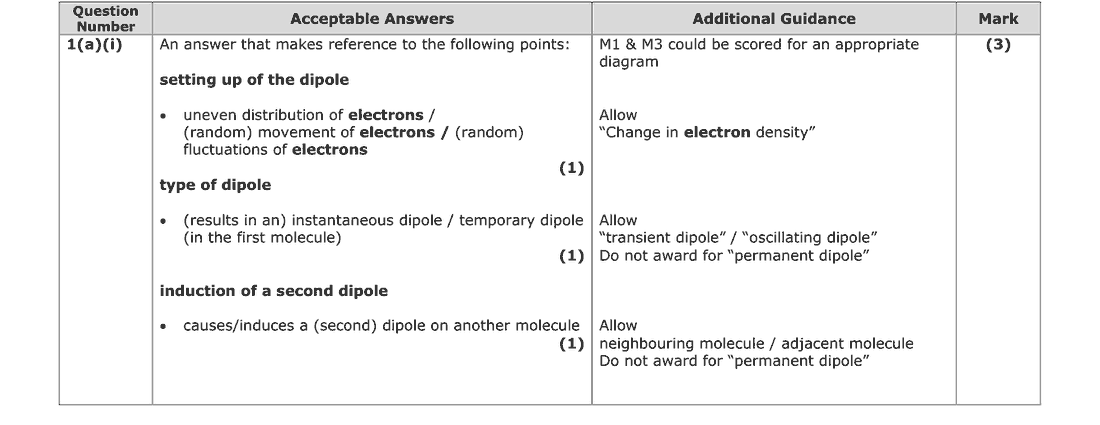
2.16 understand the nature of intermolecular forces resulting from the following interactions: • i London forces (instantaneous dipole – induced dipole) • ii permanent dipoles • iii hydrogen bonds
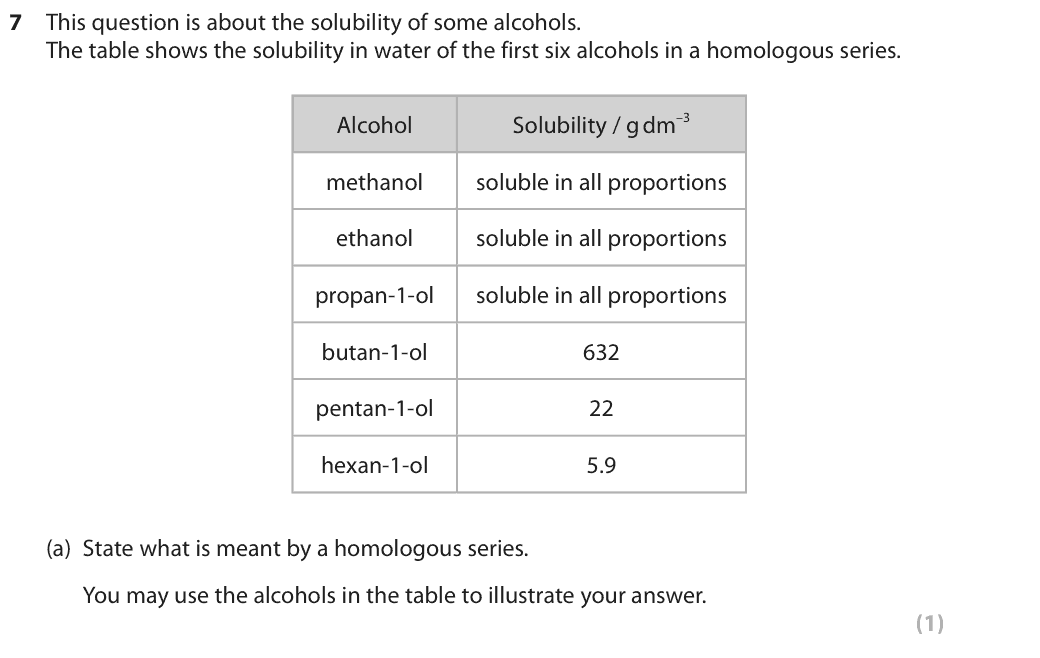
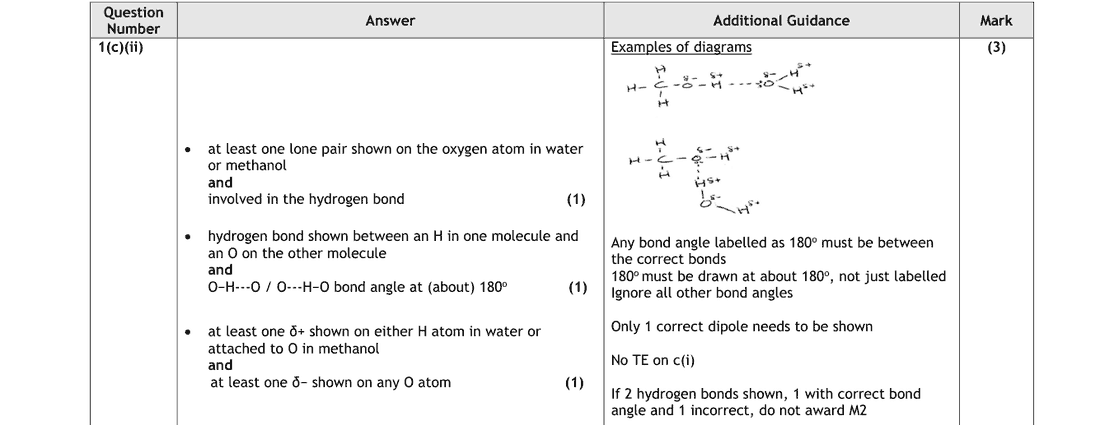
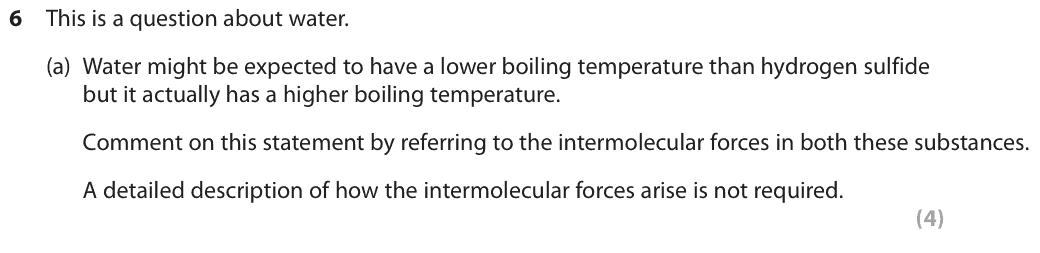
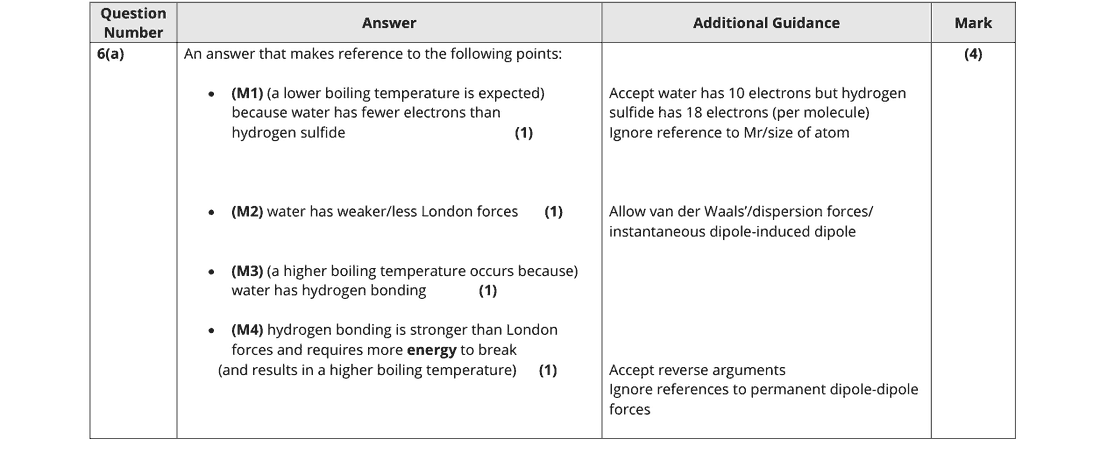
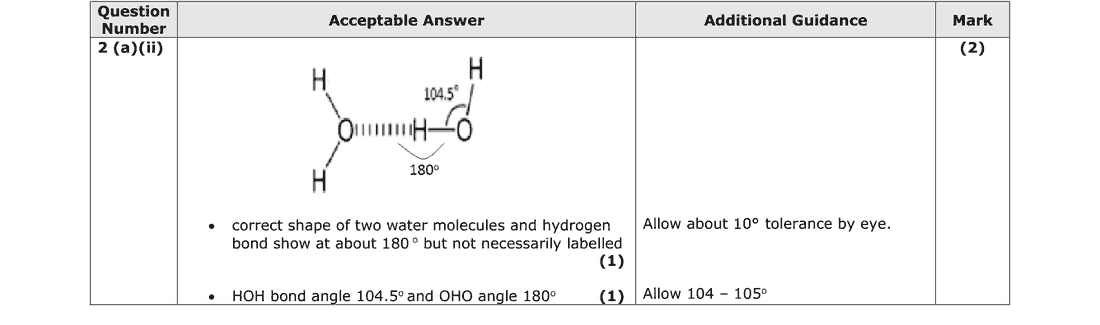
2.17 understand the interactions in molecules, such as H2O, liquid NH3 and liquid HF, which give rise to hydrogen bonding
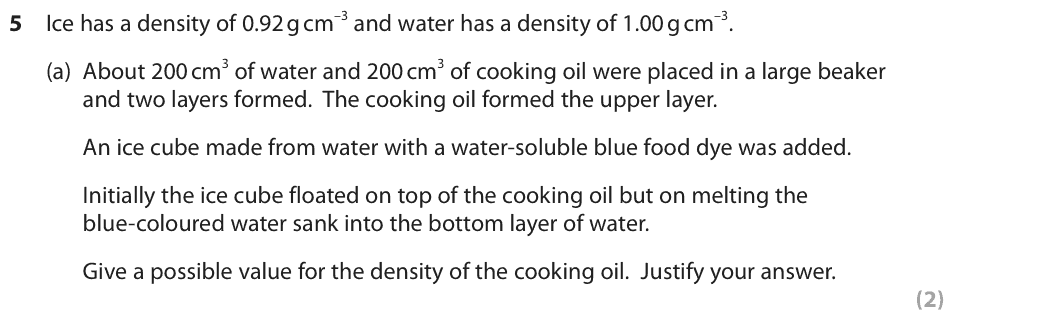
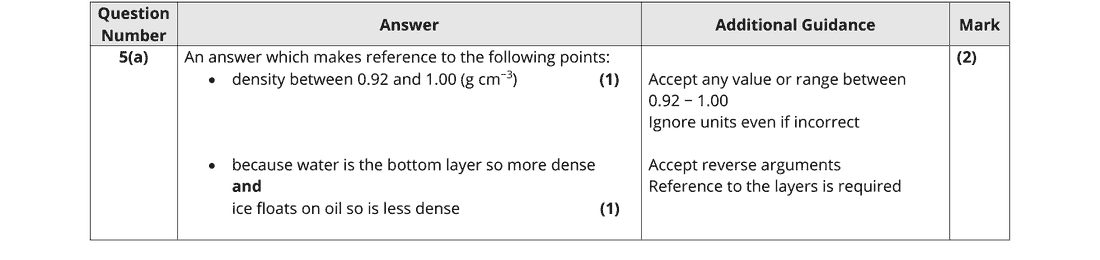
2.18 understand the following anomalous properties of water resulting from hydrogen bonding: • i its relatively high melting temperature and boiling temperature • ii the density of ice compared to that of water
2.19 be able to predict the presence of hydrogen bonding in molecules analogous to those mentioned above
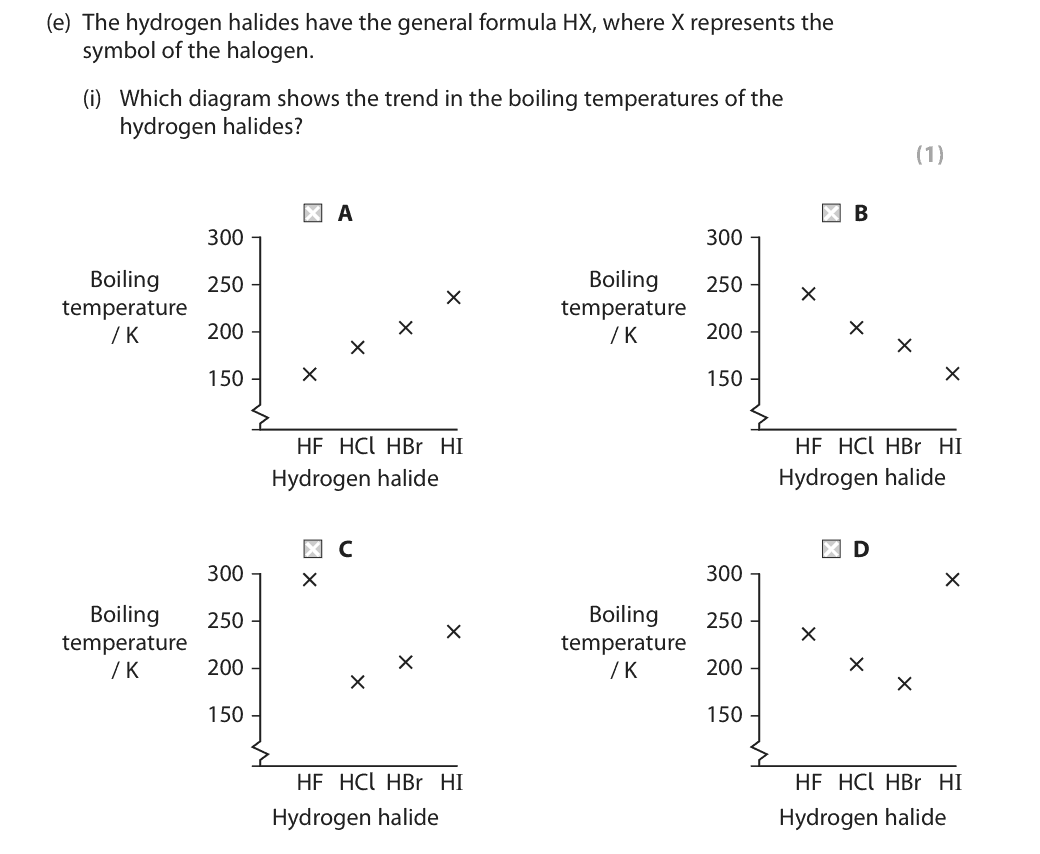
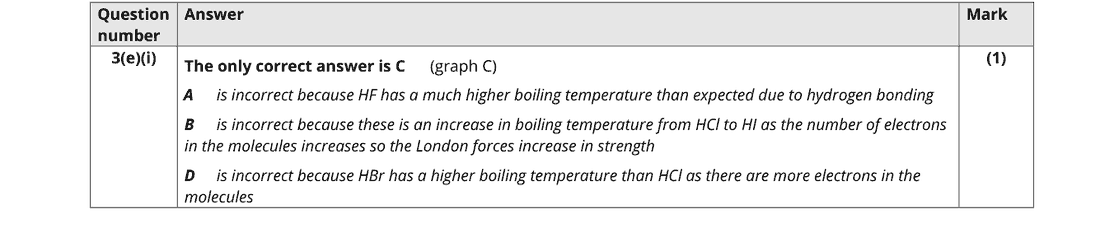
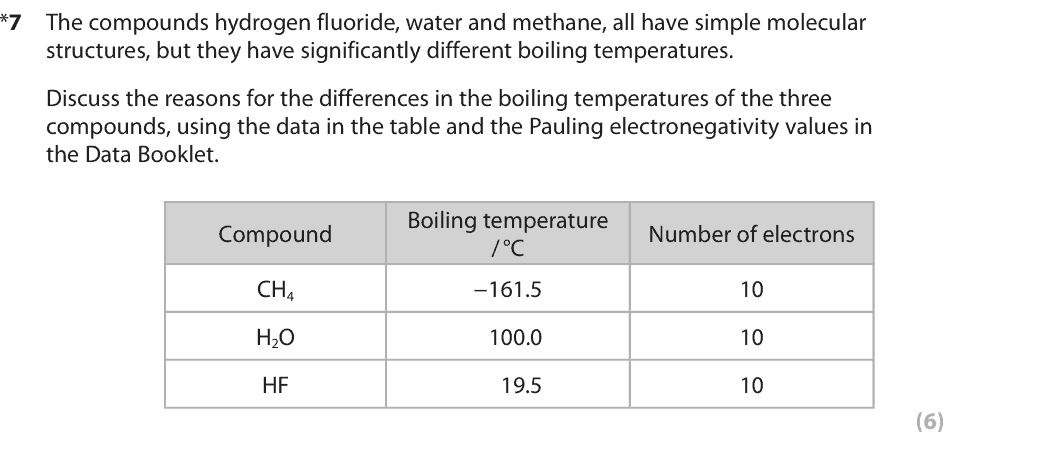
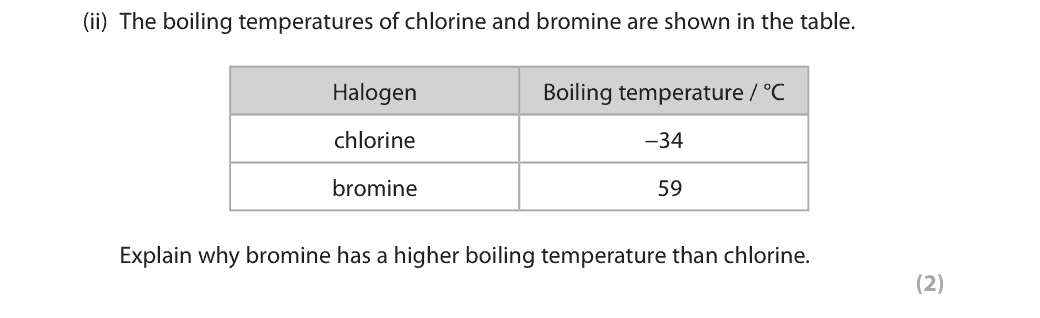
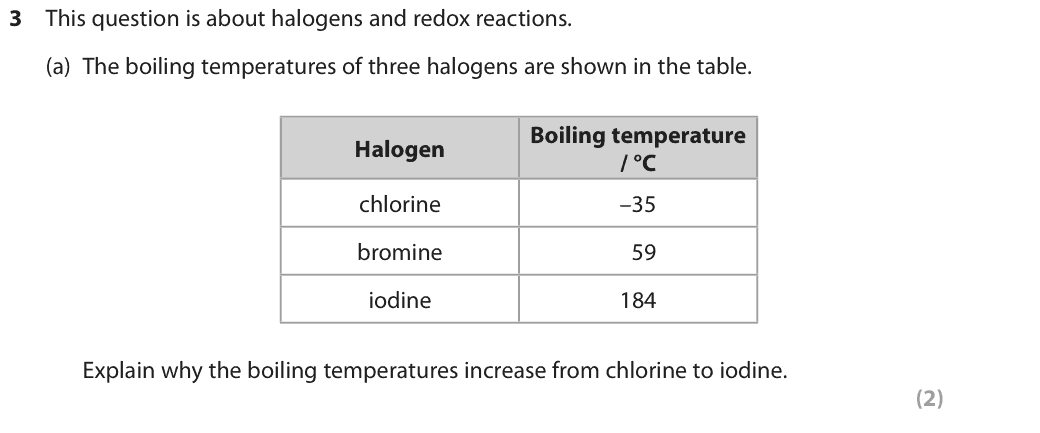
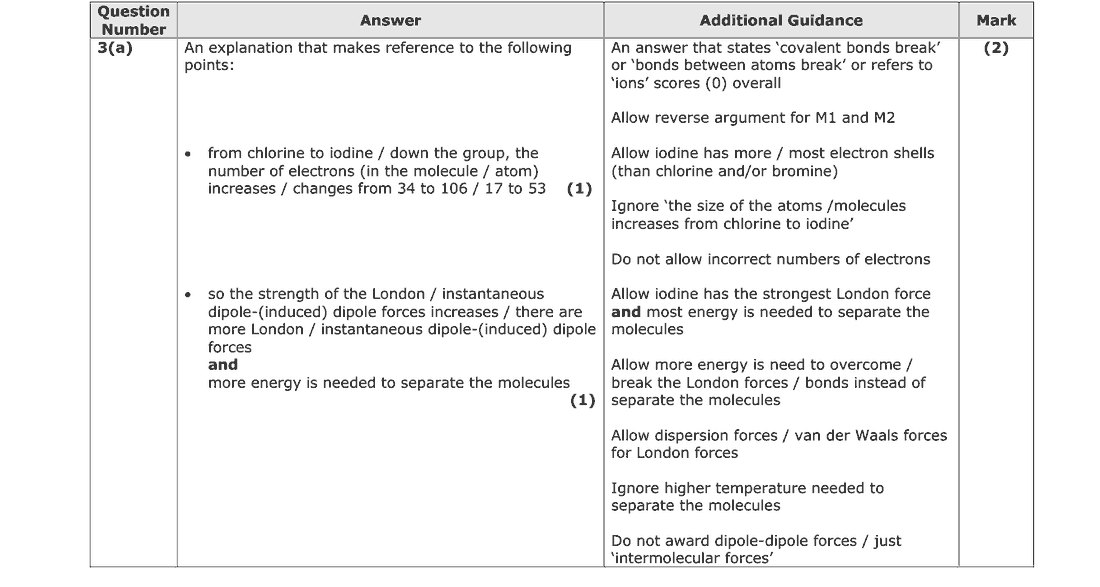
2.20 understand, in terms of intermolecular forces, physical properties shown by materials, including: • i the trends in boiling temperatures of alkanes with increasing chain length • ii the effect of branching in the carbon chain on the boiling temperatures of alkanes • iii the relatively low volatility (higher boiling temperatures) of alcohols compared to alkanes with a similar number of electrons • iv the trends in boiling temperatures of the hydrogen halides, HF to HI
2.21 understand factors that influence the choice of solvents, including: • i water, to dissolve some ionic compounds, in terms of the hydration of the ions • ii water, to dissolve simple alcohols, in terms of hydrogen bonding • iii water, as a poor solvent for compounds (to include polar molecules such as halogenoalkanes), in terms of inability to form hydrogen bonds • iv non-aqueous solvents, for compounds that have similar intermolecular forces to those in the solvent
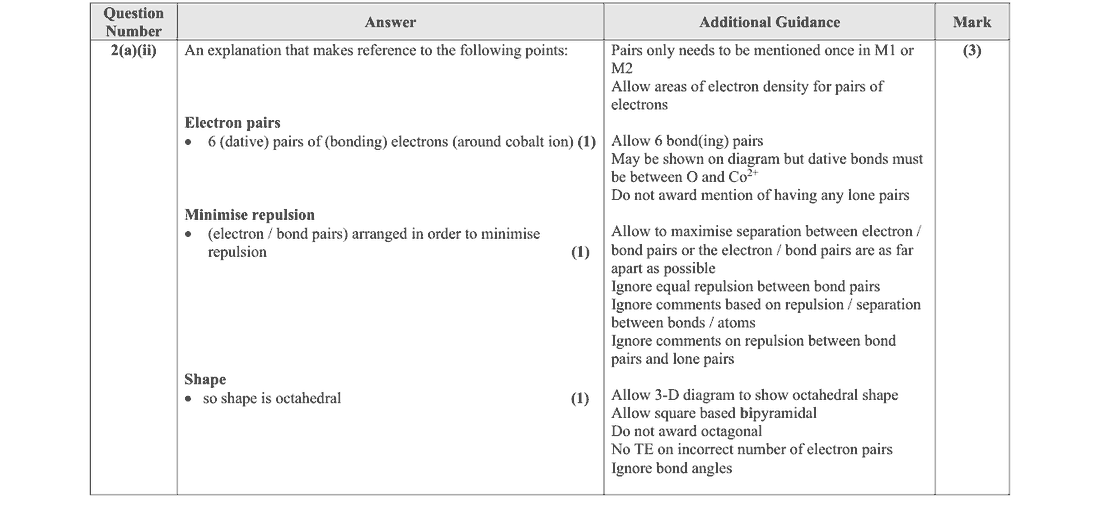
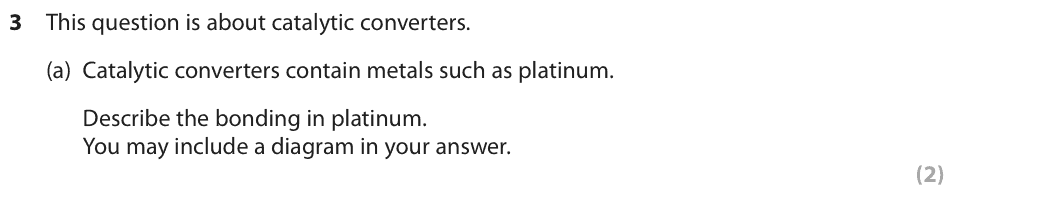
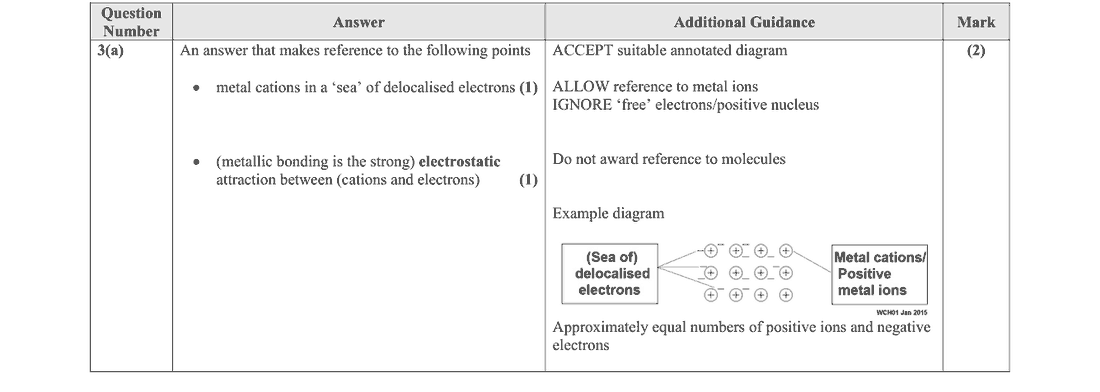
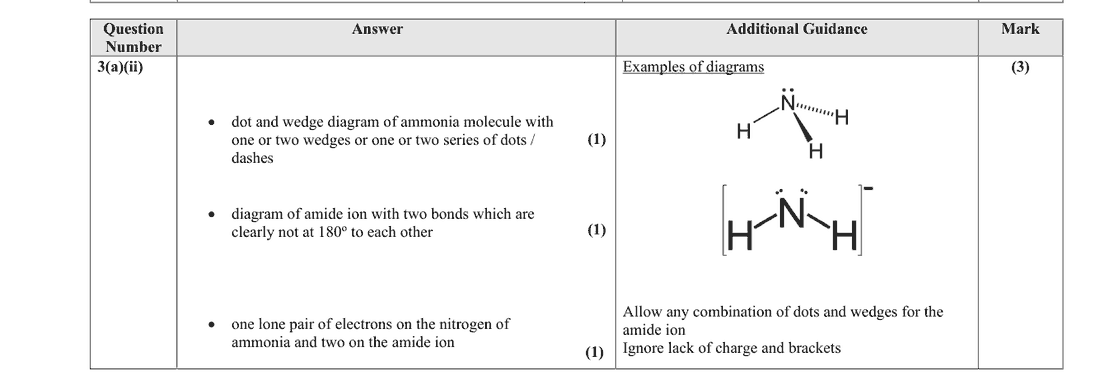
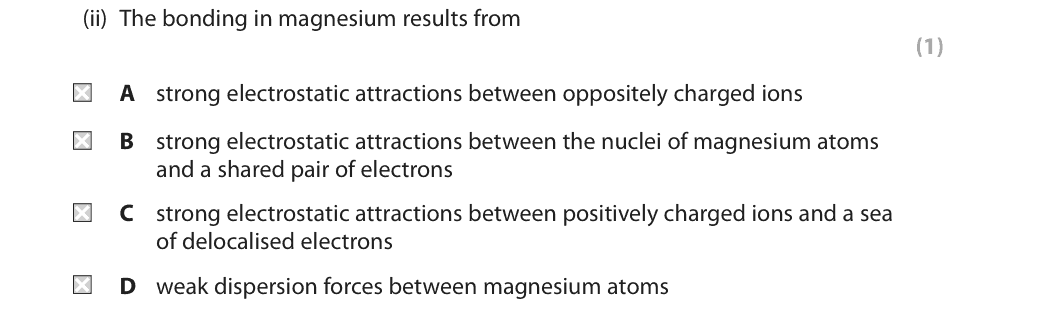
2.22 know that metallic bonding is the strong electrostatic attraction between metal ions and the delocalised electrons
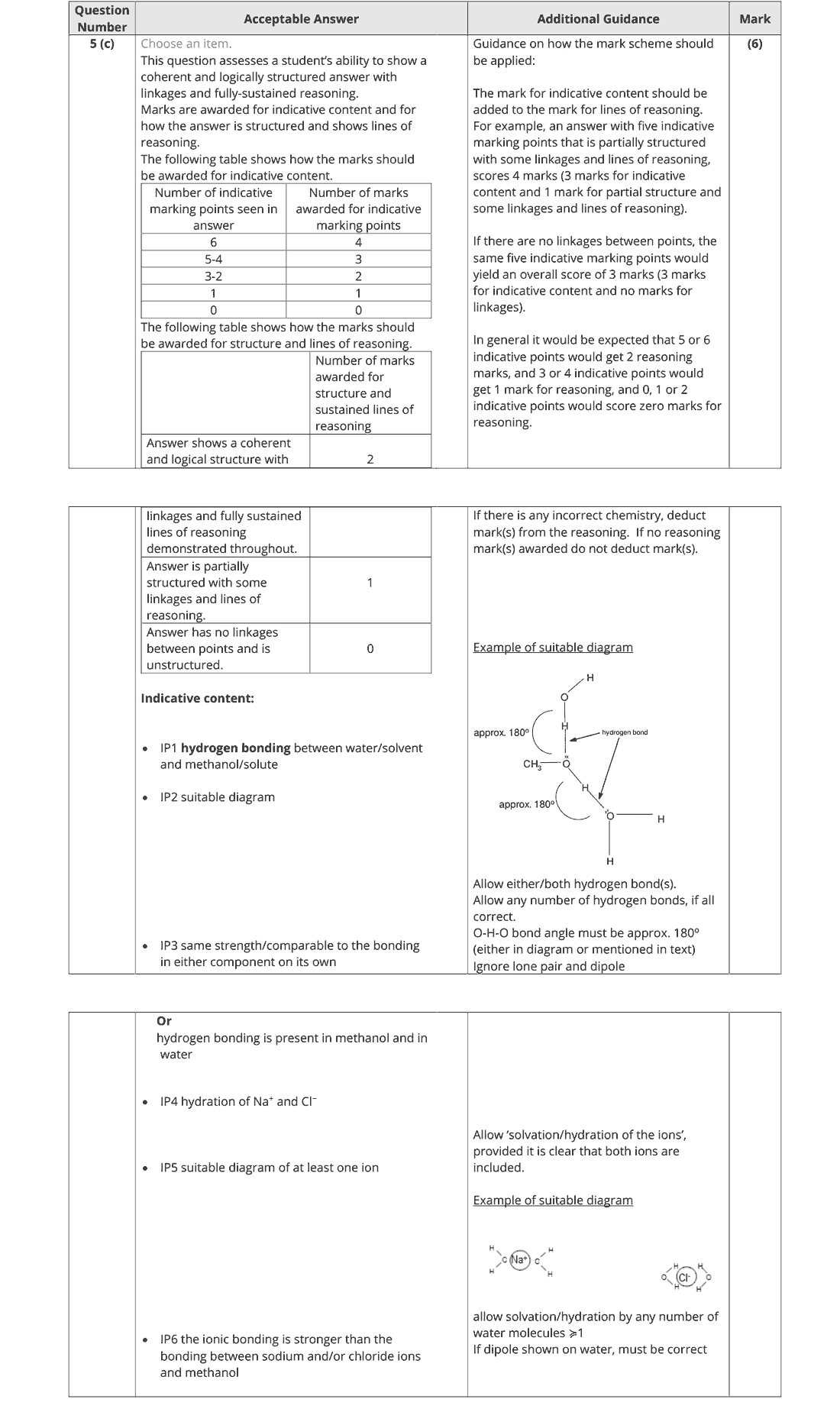
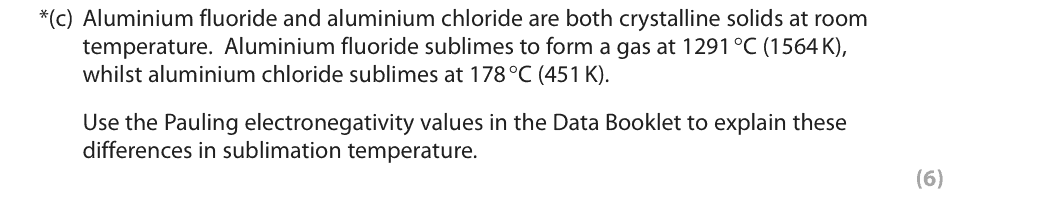
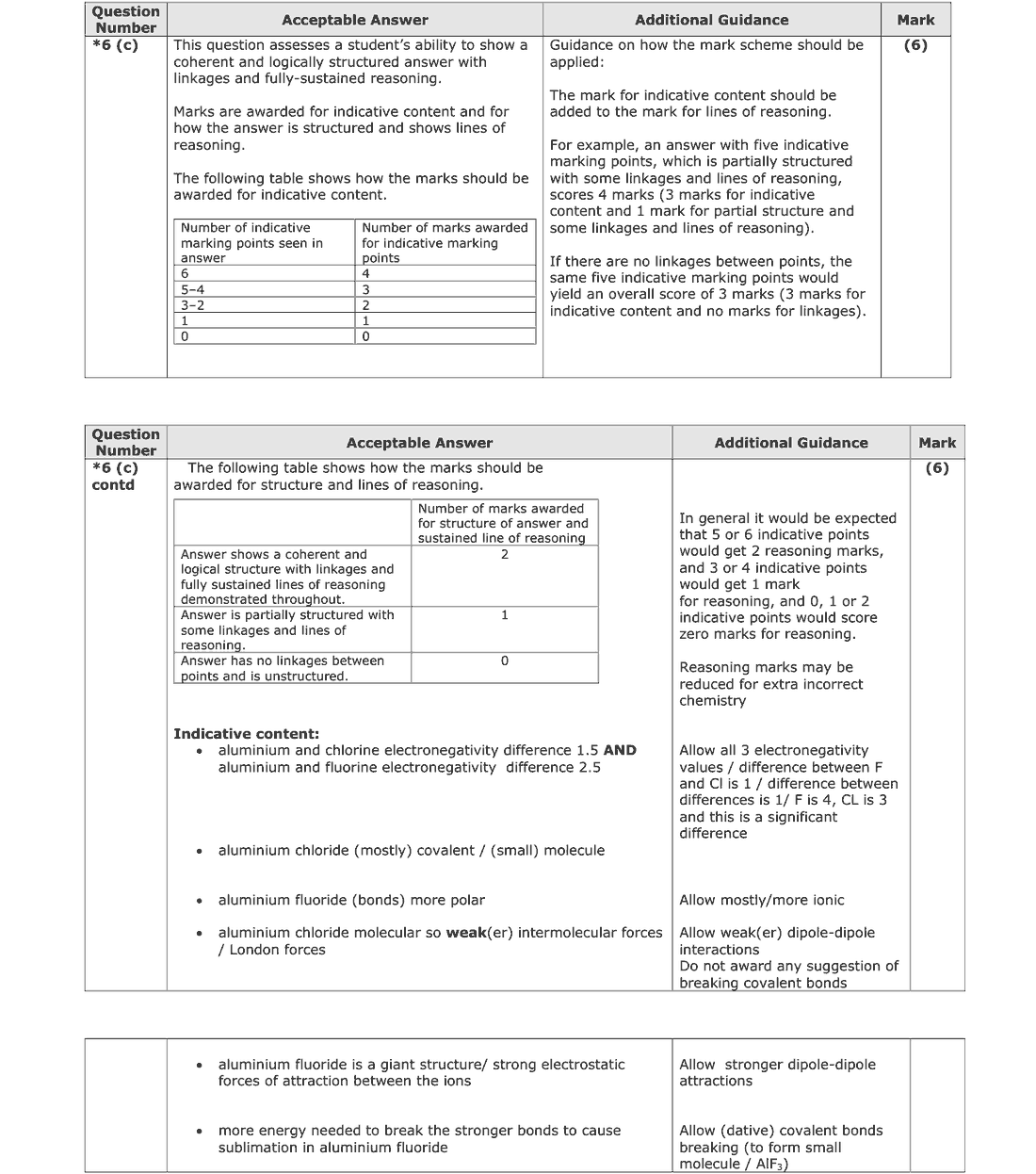
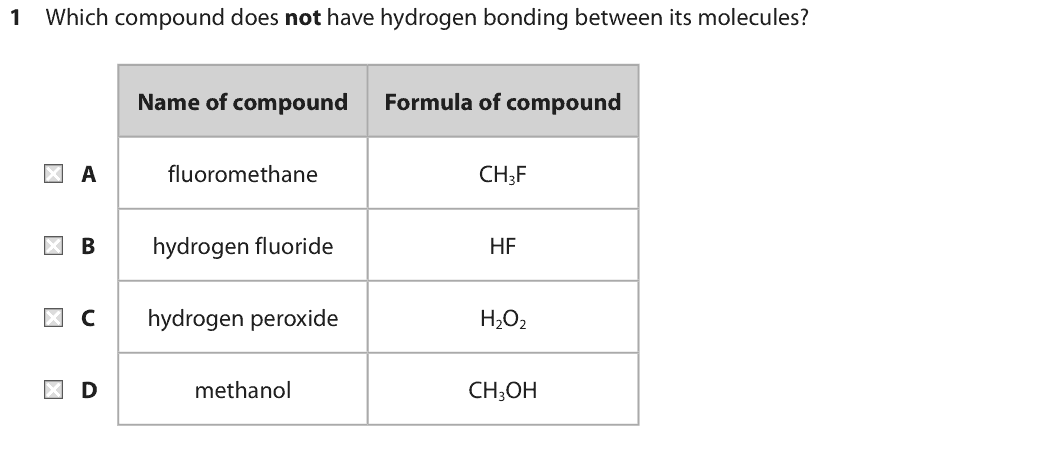
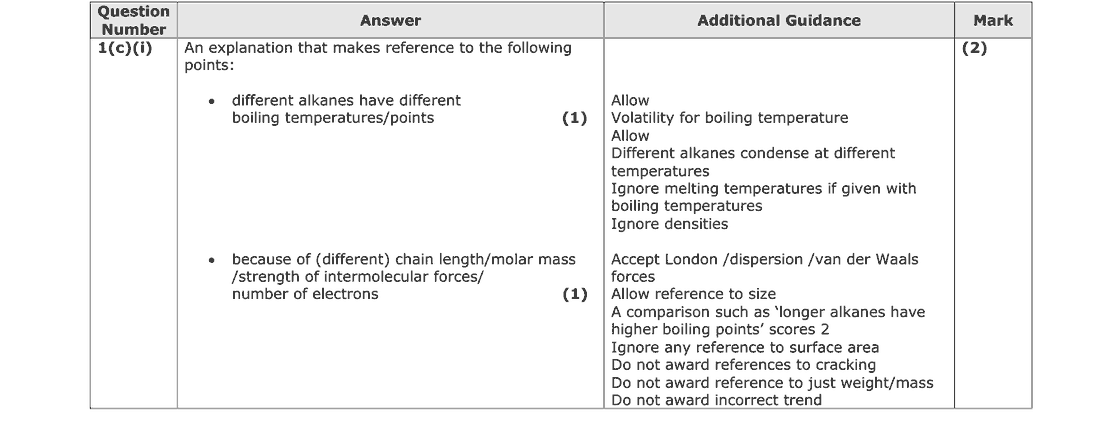
Six-mark extended response questions on this topic
Tap a question to zoom it. Where a part needs a figure, table or structure from earlier in the question, that part folds out above it; the mark scheme and examiner's comment open underneath. Have Edexcel's Data Booklet beside you; the Periodic Table is on the back page of every paper.
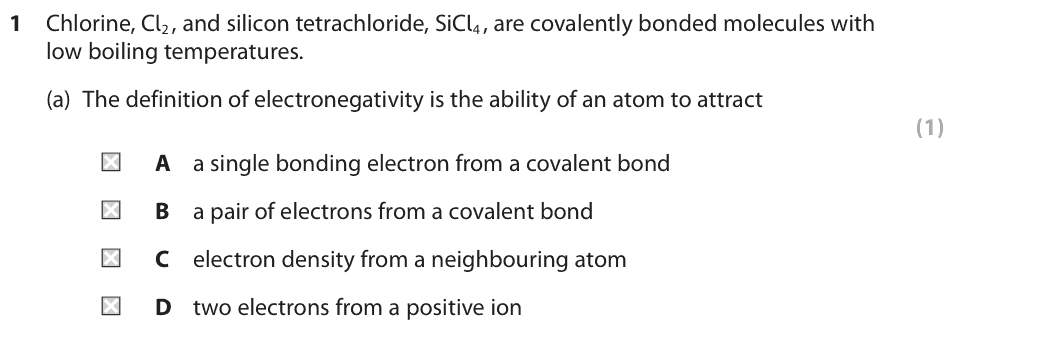
June 2025 · AS Paper 1 · Q1(a)1 markMultiple choice
Answer
B
Mark scheme
Examiner's comment
Q1a multiple choice required candidates to define electronegativity. This question was answered well, with over 80% of candidates getting it correct.
Notes from the mark scheme and report
Answer: B. Electronegativity is the ability of an atom to attract the bonding pair of electrons in a covalent bond. A refers to a single electron
C and D do not refer to a covalent bond
June 2025 · AS Paper 1 · Q1(b)2 marksDiagram or structure
Earlier part of question 1 that this part uses
Mark scheme
Examiner's comment
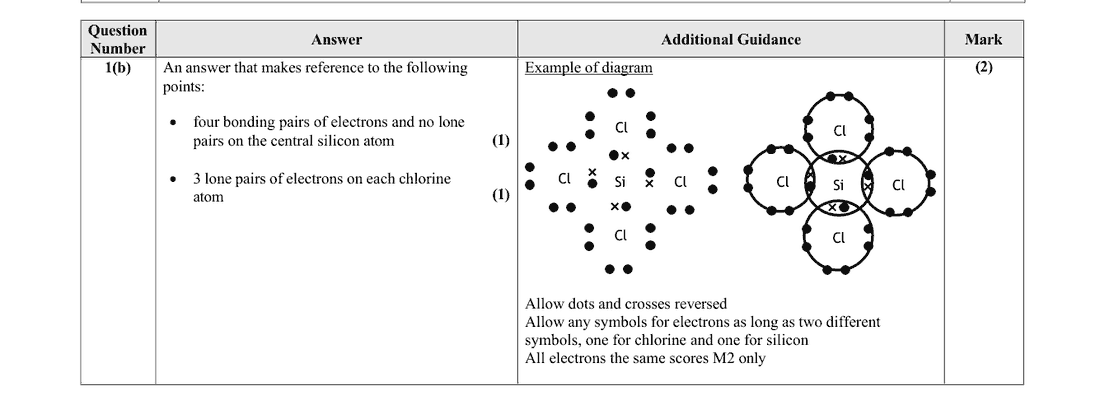
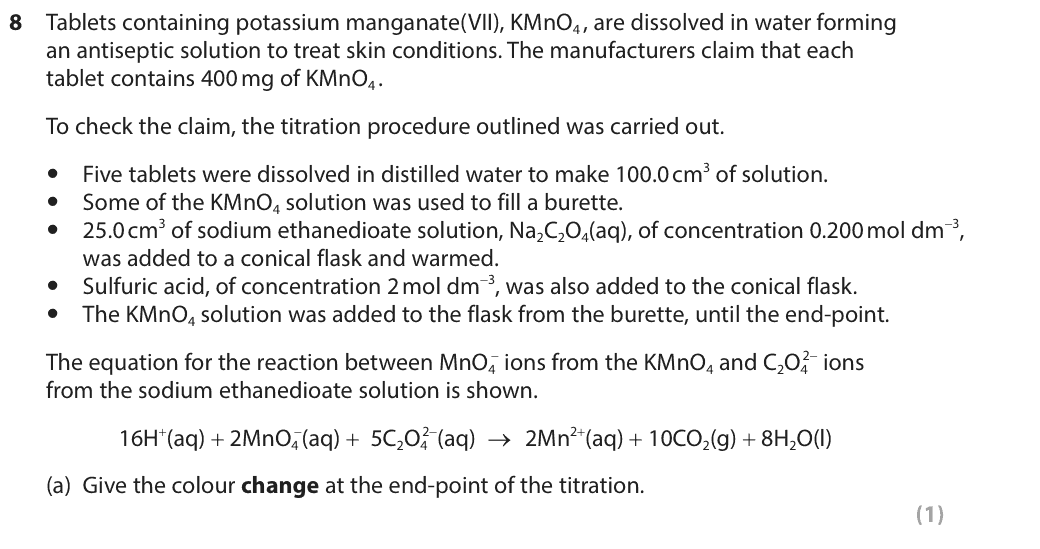
Q1b required candidates to draw a dot-and-cross diagram of silicon tetrachloride. This question was answered well with most candidates losing marks for either only drawing three chlorines bonded or not drawing all the electrons on the chlorine atoms.
Notes from the mark scheme and report
Four bonding pairs and no lone pairs around the central silicon (1)
three lone pairs on each chlorine (1). Dots and crosses may be reversed
any two different symbols allowed. All electrons shown with the same symbol scores the second mark only. Common errors: only three chlorines
not all the electrons shown on the chlorine atoms
June 2025 · AS Paper 1 · Q1(c)3 marksExplanation
Earlier part of question 1 that this part uses
Mark scheme
Examiner's comment
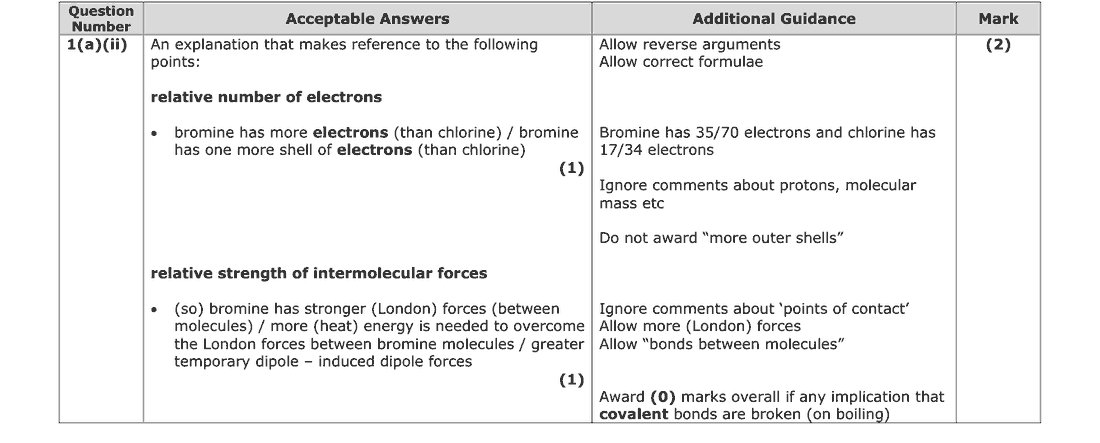
Q1c required candidates to explain polarity of molecules in chlorine and silicon tetrachloride. Most candidates could recognise that chlorine was non- polar because it has no difference in electronegativity, although some referred to the dipoles cancelling out, which is incorrect. They struggled to explain that the chlorine-silicon bond is polar due to the difference in electronegativity of the atoms and many stating the difference and quoting that it is too small to create a dipole. Lots of candidates referred to the symmetrical nature of silicon tetrachloride causing the dipoles to cancel out.
Notes from the mark scheme and report
Uses Data Booklet electronegativity values only. Chlorine molecules are non-polar because there is no electronegativity difference between the two atoms (so no dipole)
the Si–Cl bond is polar (chlorine 3.0 is more electronegative than silicon 1.9)
but the molecule is symmetrical (allow tetrahedral) so the dipoles cancel. Common errors: saying the dipoles 'cancel out' in Cl2
saying the Si–Cl difference is too small to give a dipole
June 2025 · AS Paper 1 · Q1(d)2 marksExplanation
Earlier part of question 1 that this part uses
Mark scheme
Examiner's comment
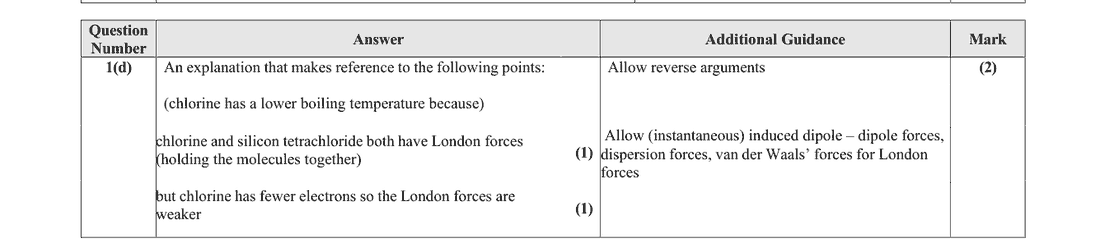
Q1d was answered reasonably well. It required candidates to explain the difference in boiling temperature of chlorine and silicon tetrachloride. Most candidates lost marks for referring to the covalent bonds being broken in silicon tetrachloride or by referring to the incorrect bonding. Some candidates compared the size of the London forces but did not explain that it is due to the number of electrons in the molecule.
Notes from the mark scheme and report
Both chlorine and silicon tetrachloride have London forces between their molecules (allow dispersion, van der Waals, instantaneous dipole–induced dipole)
chlorine has fewer electrons so its London forces are weaker. Reverse argument allowed. Common errors: covalent bonds broken in silicon tetrachloride
wrong type of bonding
comparing the size of the London forces without linking it to the number of electrons
June 2025 · AS Paper 1 · Q2(a)(i)3 marksDiagram or structure
Mark scheme
Examiner's comment
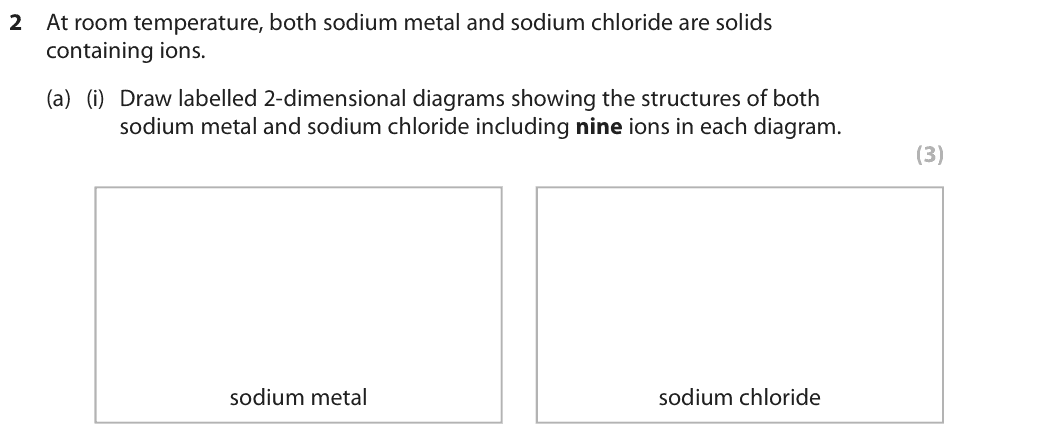
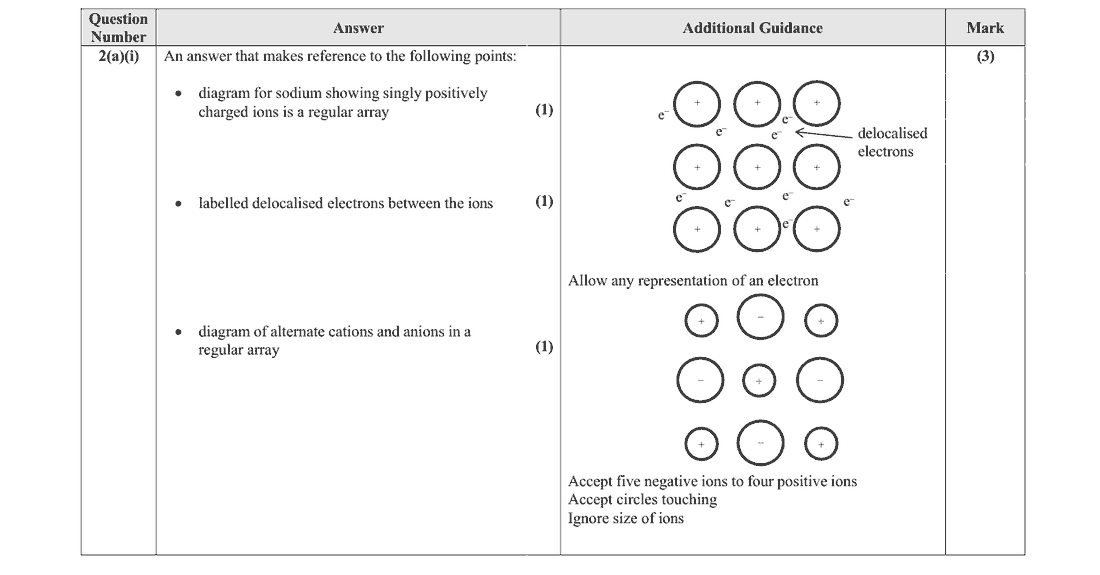
Q2ai required candidates to draw a labelled diagram of the metallic bonding in sodium and the ionic bonding in sodium chloride. Considering this is GCSE content, it was not answered considerably well. Candidates must ensure the diagram is labelled or they will lose marks, and the question asks for nine ions in each example - any other number of ions will lose marks. They should read the question carefully. In addition, candidates lost marks for charges missing on the ions, the ions not being in a regular arrangement and drawn randomly, and for drawing the incorrect type of bonding.
Notes from the mark scheme and report
Sodium: positive ions (1+) in a regular array (1), with labelled delocalised electrons between them (1). Sodium chloride: alternating cations and anions in a regular array (1) (five of one ion and four of the other
circles may touch
size of ions ignored). Nine ions were asked for in each diagram. Marks lost for: no labels
a number of ions other than nine
charges missing
ions drawn at random
the wrong type of bonding
Skills: MS4.2 Visualise and represent 2D and 3D forms including two- dimensional representations of 3D objects
June 2025 · AS Paper 1 · Q2(a)(ii)2 marksShort answer
Earlier part of question 2 that this part uses
Mark scheme
Examiner's comment
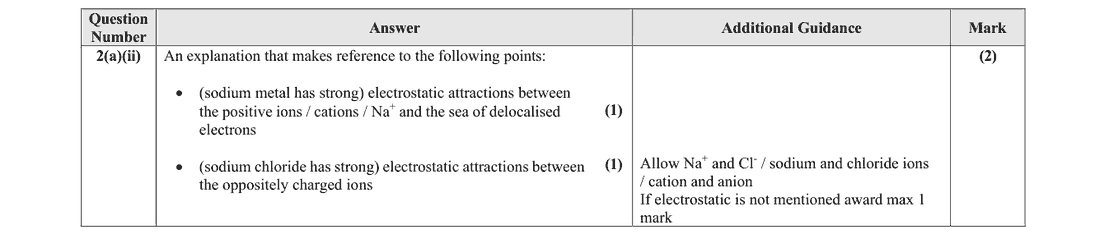
Q2aii required candidates to describe the bonding in sodium and sodium chloride. This was answered better than part i, with most candidates correctly describing the bonding. Some candidates lost marks for missing the word ‘electrostatic’ in their answers or describing the incorrect bonding.
Notes from the mark scheme and report
Sodium metal: electrostatic attraction between the positive ions (Na+) and the sea of delocalised electrons. Sodium chloride: electrostatic attraction between the oppositely charged ions (Na+ and Cl–). If 'electrostatic' is not mentioned, maximum 1 mark. Answered better than (i)
marks lost for leaving out 'electrostatic' or describing the wrong bonding
June 2025 · AS Paper 1 · Q2(a)(iv)3 marksExplanation
Earlier part of question 2 that this part uses
Mark scheme
Examiner's comment
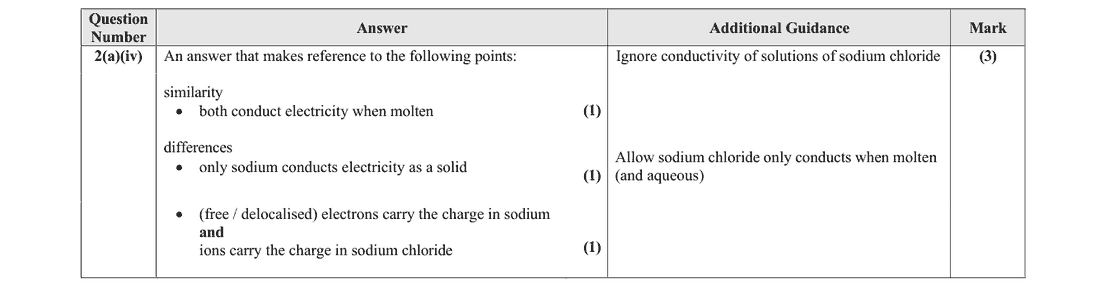
Q2aiv required candidates to compare and contrast the electrical conductivity of sodium and sodium chloride. As a compare and contrast question, candidates were required to list similarities and differences. Most candidates stated that sodium conducts, however they needed to specify the states it conducts in to compare with the sodium chloride. Most candidates achieved the mark for the charge carriers, although a small number of candidates talked about delocalised electrons for sodium chloride, which is incorrect.
Notes from the mark scheme and report
Similarity: both conduct when molten. Difference: only sodium conducts as a solid (allow sodium chloride conducts only when molten or aqueous). Charge carriers: (delocalised) electrons in sodium AND ions in sodium chloride. Conductivity of sodium chloride solution is ignored. Many said sodium conducts without giving the states
a few gave delocalised electrons for sodium chloride
June 2025 · AS Paper 1 · Q2(b)(iii)2 marksShort answer
Earlier parts of question 2 that this part uses
Mark scheme
Examiner's comment
Q2biii required candidates to identify and explain dative covalent bonding in aluminium hydride. This was answered reasonably well. Some candidates explained dative covalent bonding in general and did not specify that it was the hydride donating the pair of electrons, so did not achieve full marks.
Notes from the mark scheme and report
Dative (covalent) / coordinate bond
a (lone) pair of electrons is donated from the hydride ion, H–, to the aluminium. General descriptions of dative bonding that did not say the hydride ion donates the pair did not score the second mark
June 2025 · AS Paper 1 · Q2(b)(iv)1 markMultiple choice
Earlier parts of question 2 that this part uses
Answer
D
Mark scheme
Examiner's comment
Q2biv multiple choice required candidates to identify the name and diagram of the bonding in aluminium hydride. This was answered reasonably well, with approximately 60% of candidates answering correctly.
Notes from the mark scheme and report
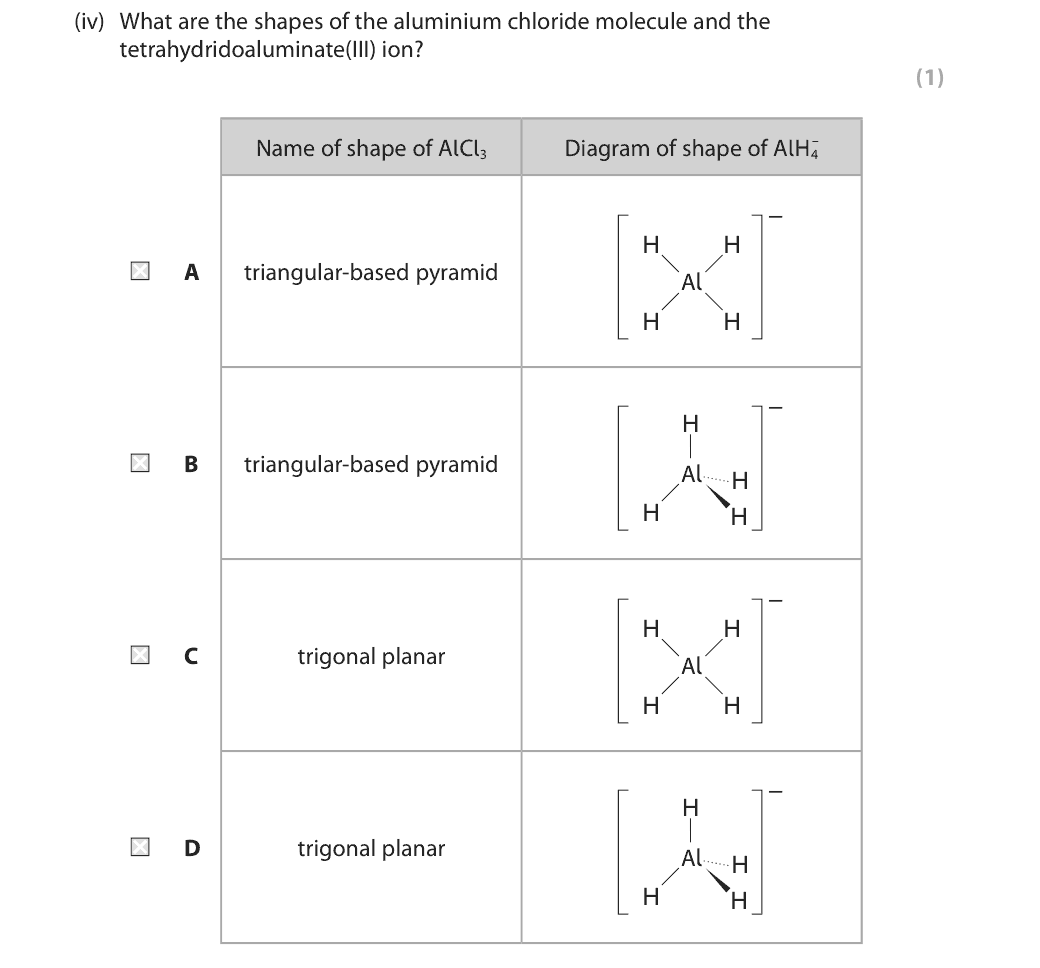
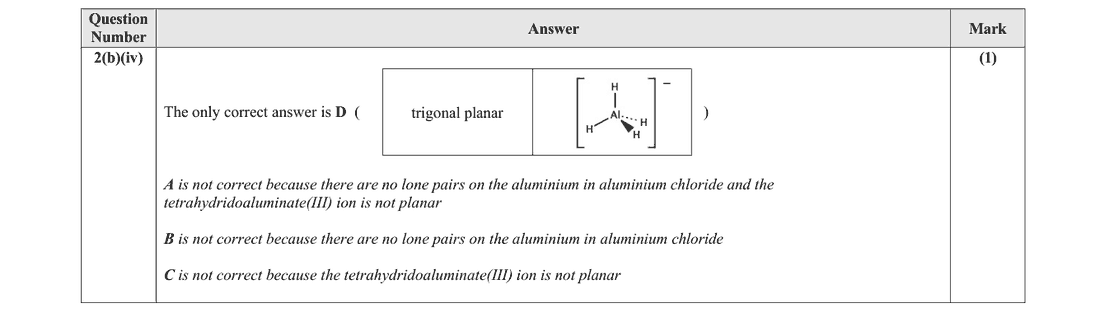
Answer: D. AlCl3 has three bonding pairs and no lone pairs on aluminium, so it is trigonal planar
AlH4– has four bonding pairs, so it is tetrahedral (the diagram with wedge and dashed bonds). A and B give a pyramidal AlCl3
A and C show a planar AlH4–
Skills: MS4.1 Appreciate angles and shapes in regular 2D and 3D structures.; MS4.2 Visualise and represent 2D and 3D forms including two- dimensional representations of 3D objects
June 2025 · Paper 1 · Q2(e)1 markMultiple choice
Answer
A
Mark scheme
Notes from the mark scheme and report
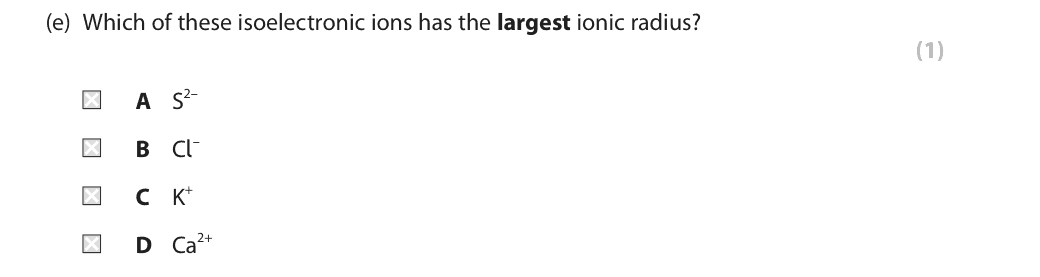
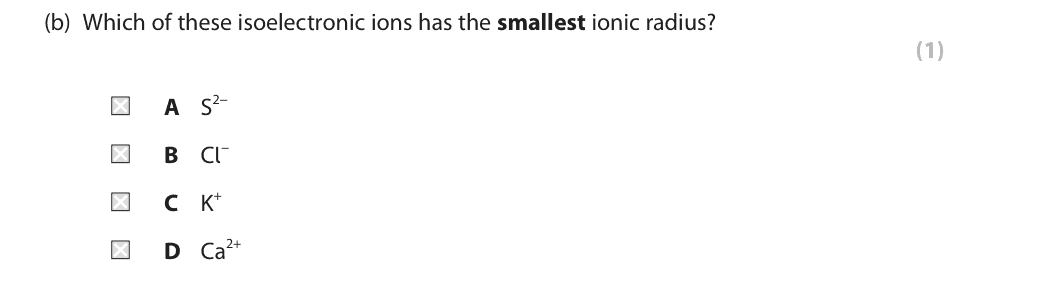
Answer: A (S2–). All four ions have the same number of electrons and S2– has the fewest protons, so the weakest attraction and the largest radius
Ca2+ has the most protons and is the smallest
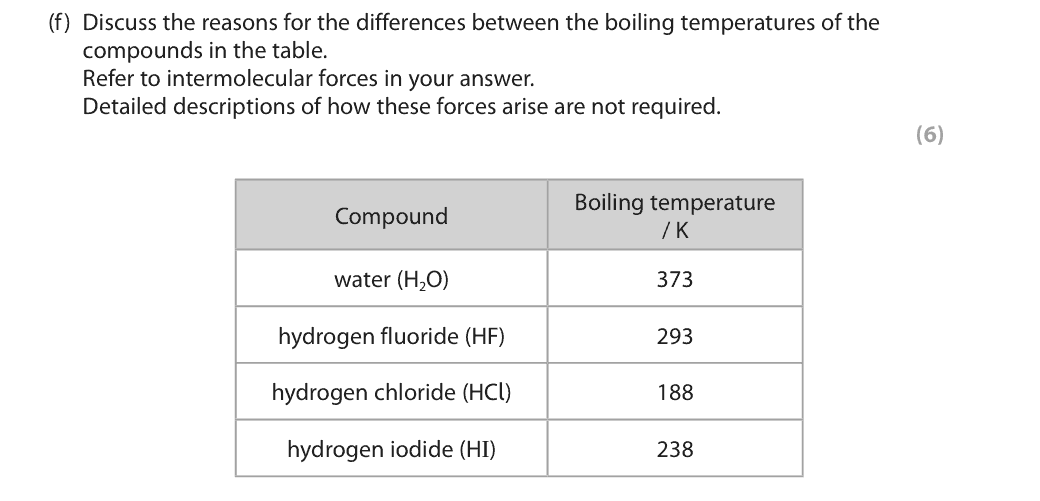
June 2025 · Paper 1 · Q2(f)6 marksExplanation
Earlier part of question 2 that this part uses
Mark scheme
Examiner's comment
This proved to be a challenging question for many candidates. They were required to explain the trend in boiling temperatures for H2O, HF, HCl and HI in terms of the intermolecular forces between the compounds.
Permanent dipole - dipole interactions were often missed or if mentioned there was no indication if they were stronger or weaker than hydrogen bonding. There was also some confusion around the halogen hydrides in terms of covalency vs ionic, and quite which bonds are broken when a substance boils.
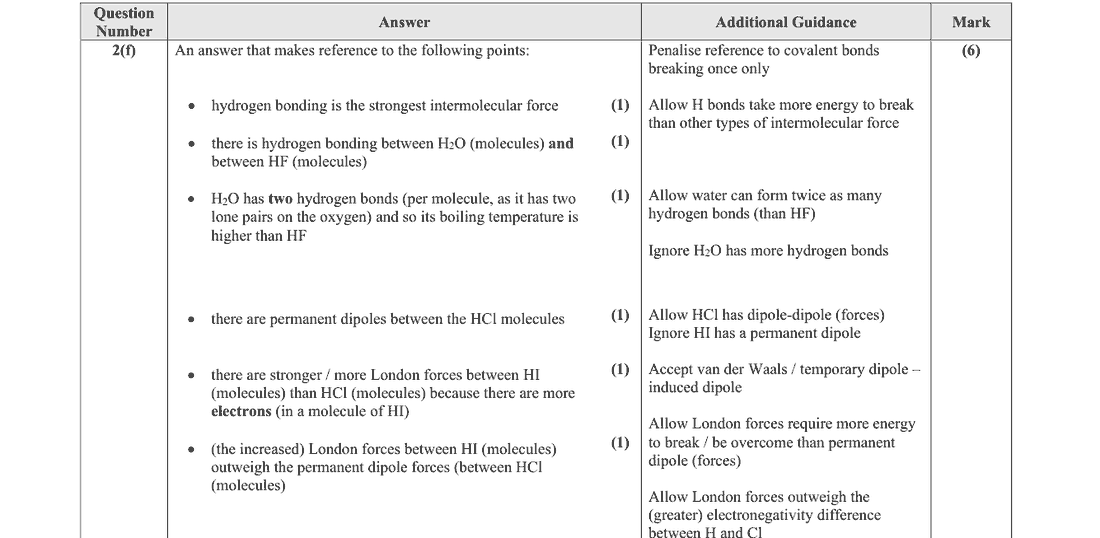
Notes from the mark scheme and report
Six points: hydrogen bonding is the strongest intermolecular force
H2O and HF both have hydrogen bonding between their molecules
H2O can form two hydrogen bonds per molecule (twice as many as HF), so it boils higher than HF
HCl has permanent dipole forces between its molecules
London forces are stronger between HI molecules than between HCl molecules because HI has more electrons
these stronger London forces in HI outweigh the permanent dipole forces in HCl. Reference to covalent bonds breaking is penalised once. Common weaknesses: permanent dipoles missed or not ranked against hydrogen bonding
confusion over which bonds break on boiling
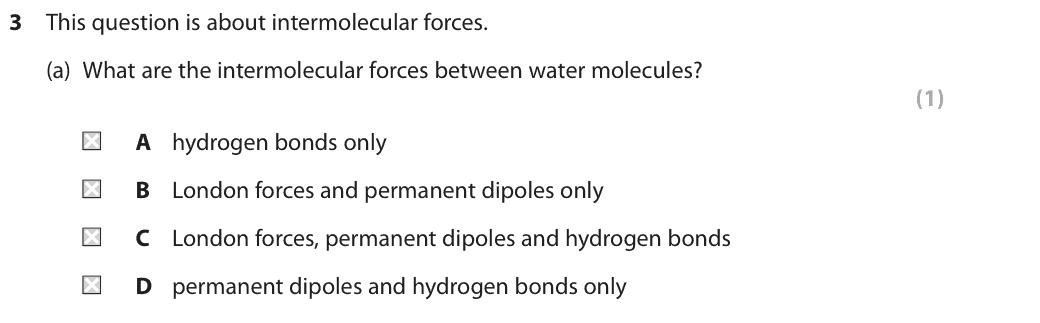
June 2025 · AS Paper 1 · Q3(a)1 markMultiple choice
Answer
C
Mark scheme
Examiner's comment
Q3a multiple choice required candidates to identify the bonding between water molecules. This was answered well, with 75% of candidates answering correctly.
Notes from the mark scheme and report
Answer: C. Water molecules have London forces, permanent dipole interactions and hydrogen bonds. London forces are present between all molecules, which rules out A and D
B leaves out the hydrogen bonds
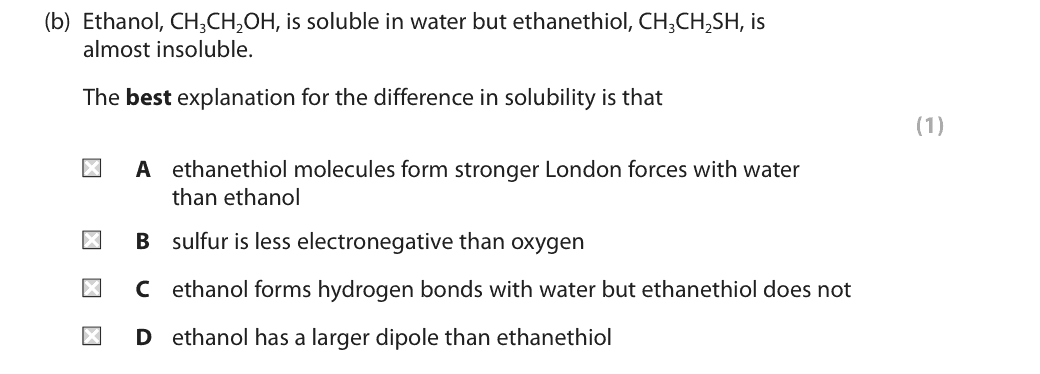
June 2025 · AS Paper 1 · Q3(b)1 markMultiple choice
Answer
C
Mark scheme
Examiner's comment
Q3b multiple choice required candidates to explain the difference in solubility between ethanol and ethanethiol. This was answered well, with over 80% of candidates answering correctly.
Notes from the mark scheme and report
Answer: C. Ethanol forms hydrogen bonds with water but ethanethiol does not. A, B and D are true statements but do not explain the difference in solubility
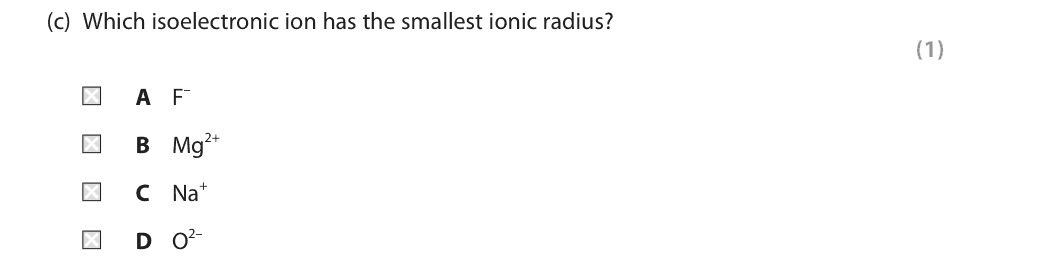
June 2025 · AS Paper 1 · Q7(c)1 markMultiple choice
Answer
B
Mark scheme
Examiner's comment
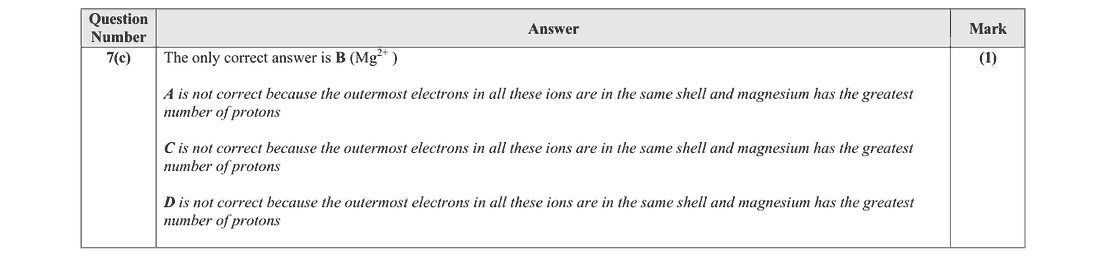
Q7c required candidates to state the ion with the smallest radius. This question was answered reasonably well, with approximately 50% of candidates getting the mark.
Notes from the mark scheme and report
Answer: B. All four ions have the same electron arrangement, and Mg2+ has the most protons, so its electrons are pulled in most strongly. About half chose correctly
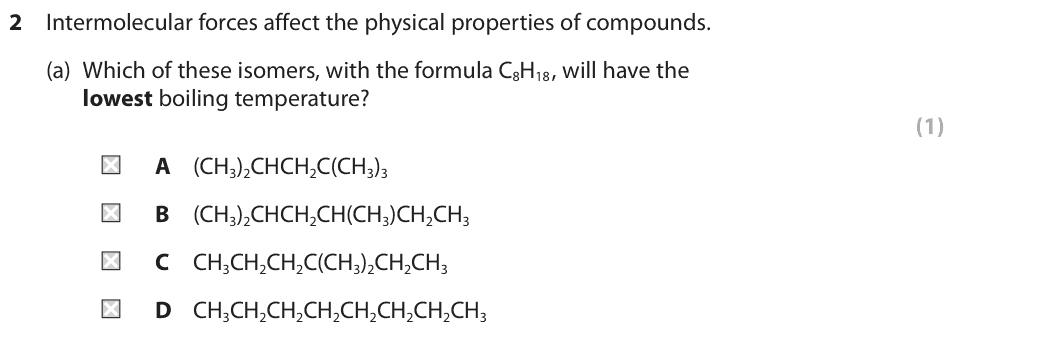
June 2025 · Paper 2 · Q2(a)1 markMultiple choice
Answer
A
Mark scheme
Notes from the mark scheme and report
Answer: A, the most branched isomer (three branches), so the weakest London forces. B and C have only two branches
D is unbranched and has the highest boiling temperature
June 2025 · Paper 2 · Q2(b)2 marksExplanation
Mark scheme
Examiner's comment
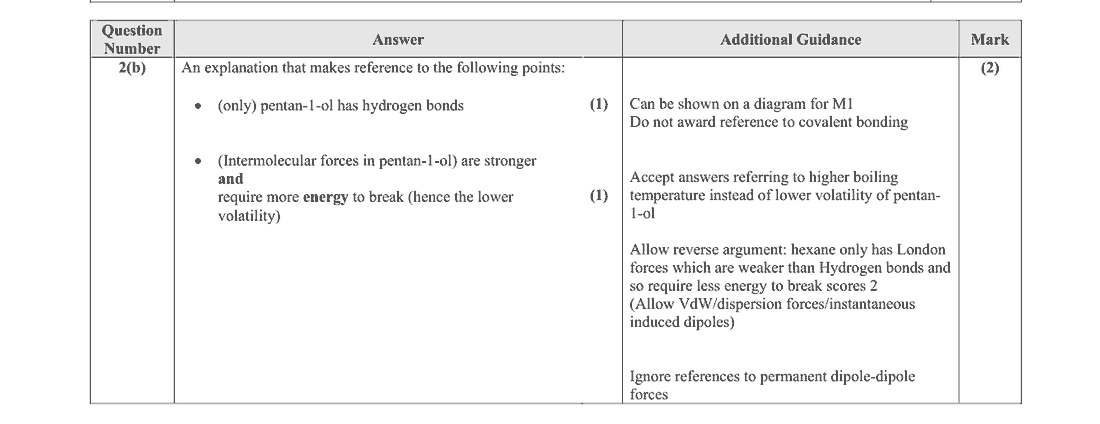
Many candidates correctly identified the strongest intermolecular forces between propan-1-ol as being hydrogen bonds and so scored M1. Some candidates either did not make it clear that hydrogen bonding was stronger and so requires more energy to break and so did not score the second marking point. Probably the most frequent error was either neglecting to mention that the hydrogen bonding required most energy to overcome, or not mentioning that the hydrogen bonding is the strongest intermolecular force of attraction. Both statements were required for M2.
Notes from the mark scheme and report
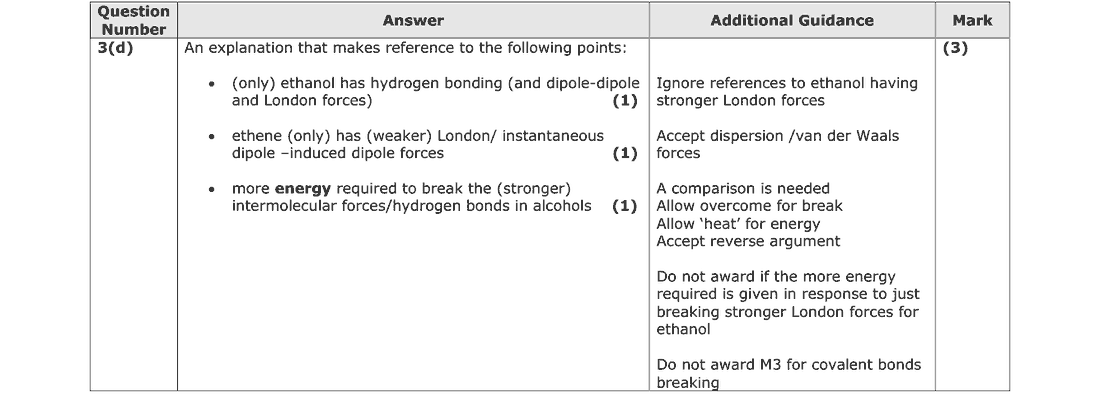
(Only) pentan-1-ol has hydrogen bonds
these intermolecular forces are stronger (than the London forces in hexane) and need more energy to break. Both 'stronger' and 'more energy' are needed for the second mark. Reverse argument for hexane scores 2. No credit for covalent bonds breaking. The usual loss was leaving out either that hydrogen bonds are the strongest force or that they need more energy to overcome
June 2025 · Paper 2 · Q2(c)1 markMultiple choice
Answer
C
Mark scheme
Notes from the mark scheme and report
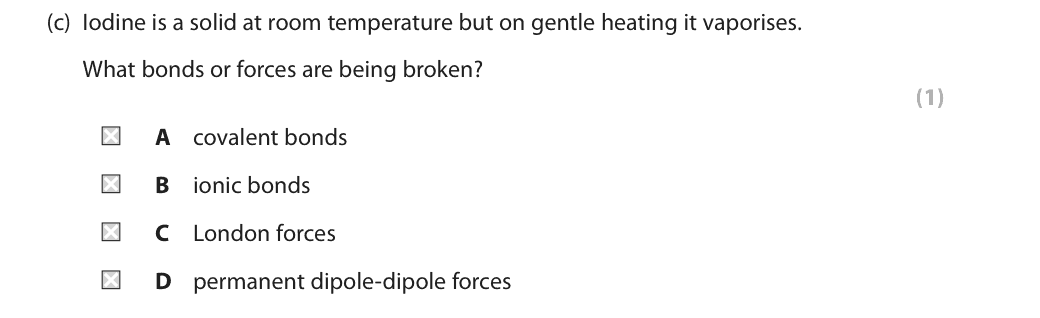
Answer: C (London forces between I2 molecules). No covalent or ionic bonds are broken when iodine vaporises, and iodine has no permanent dipole
June 2025 · Paper 2 · Q2(d)4 marksExplanation
Mark scheme
Examiner's comment
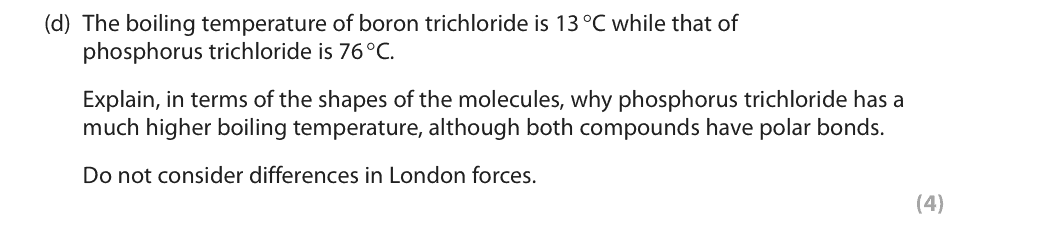
Most candidates were able to successfully identify the shape of the two molecules and so scored two marks which was also the mode and mean of this question. Many gave detailed explanations of the VSEPR theory to justify the shape and this was not required to explain the difference in boiling temperature.
Candidates found it more challenging to explain how the shape influenced the type of intermolecular forces and gave rise to permanent dipole-dipole interactions.
Notes from the mark scheme and report
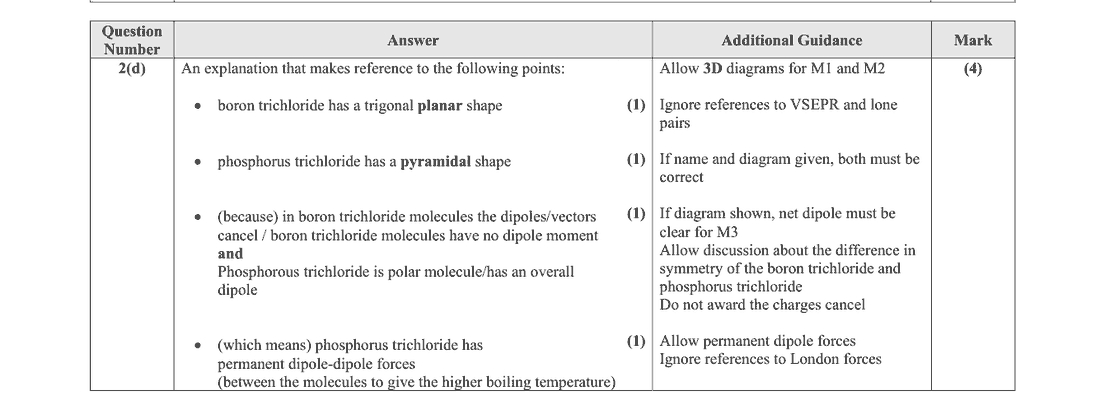
BCl3 is trigonal planar
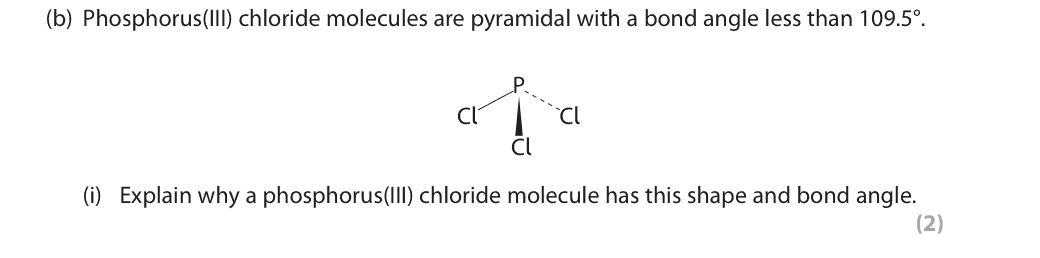
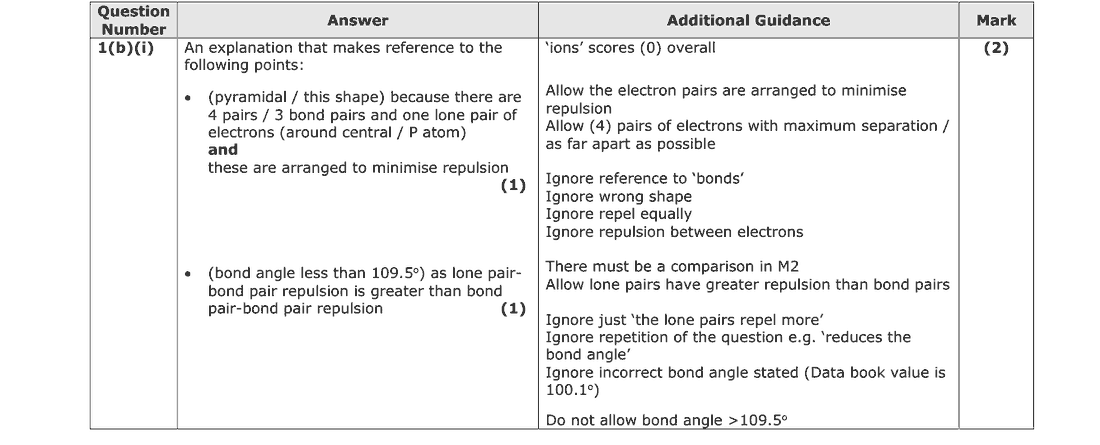
PCl3 is (trigonal) pyramidal
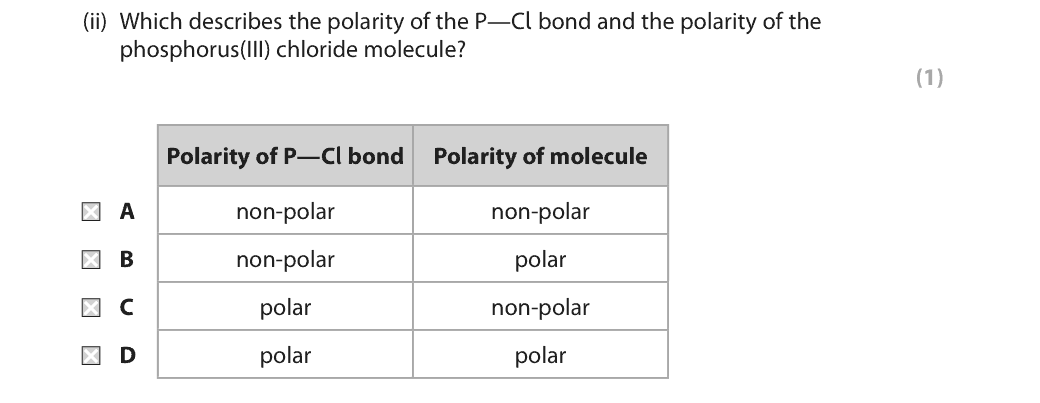
in BCl3 the bond dipoles cancel (symmetrical, no overall dipole) but PCl3 is a polar molecule with an overall dipole (not 'the charges cancel')
so PCl3 has permanent dipole–dipole forces between its molecules. VSEPR reasoning and London forces ignored. Most scored the two shape marks
linking shape to the type of intermolecular force was harder
Skills: MS4.1 Appreciate angles and shapes in regular 2D and 3D structures.
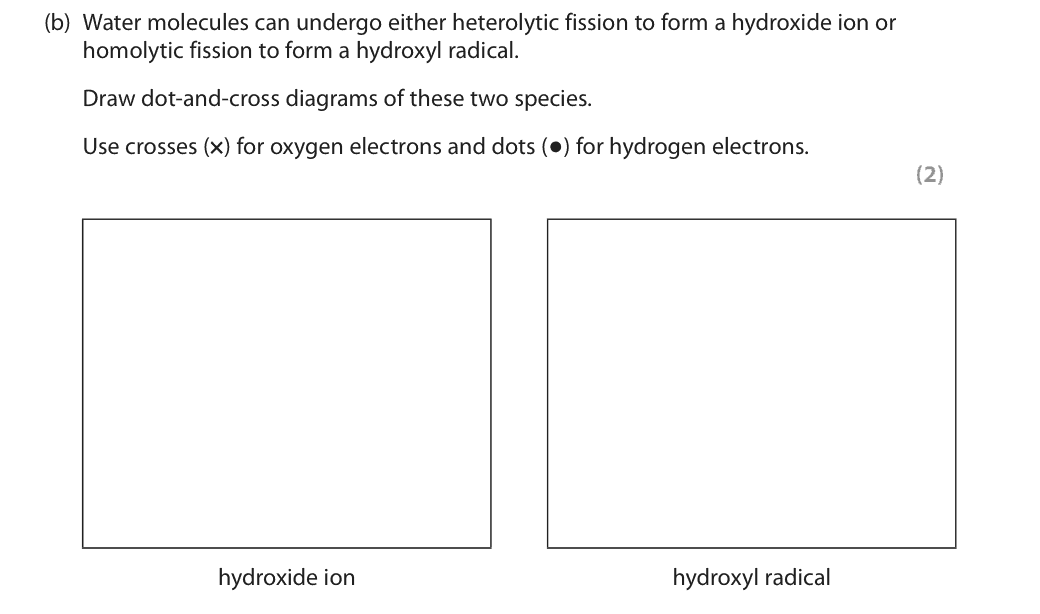
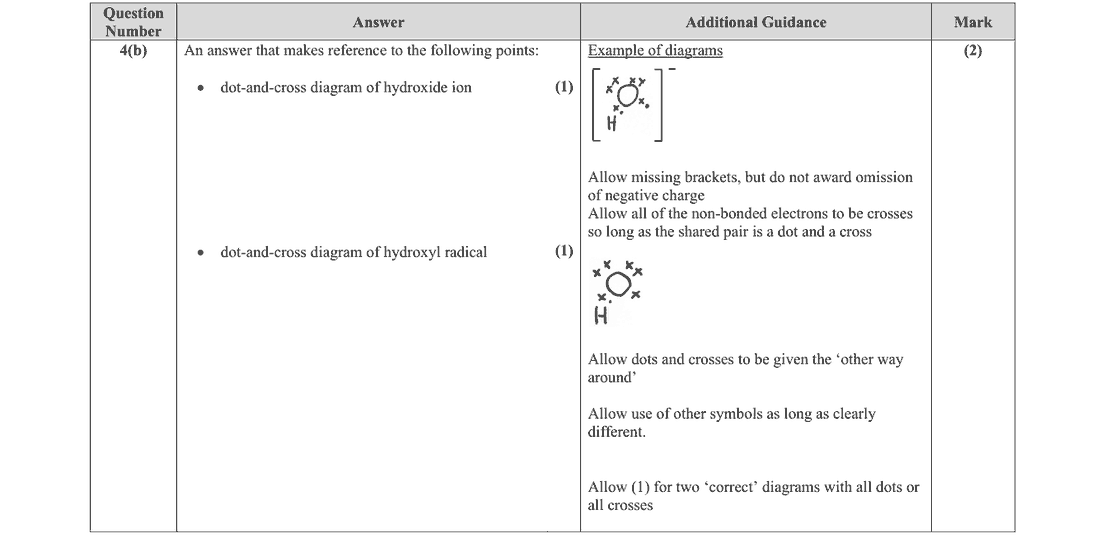
June 2025 · Paper 2 · Q4(b)2 marksDiagram or structure
Mark scheme
Examiner's comment
This was generally very well answered by candidates with the structure of the hydroxide ion almost always being correct.
The structure of the radical proved to be more challenging for some with candidates commonly adding too many electrons, an extra 'dot', or a charge, and so not scoring the mark.
Notes from the mark scheme and report
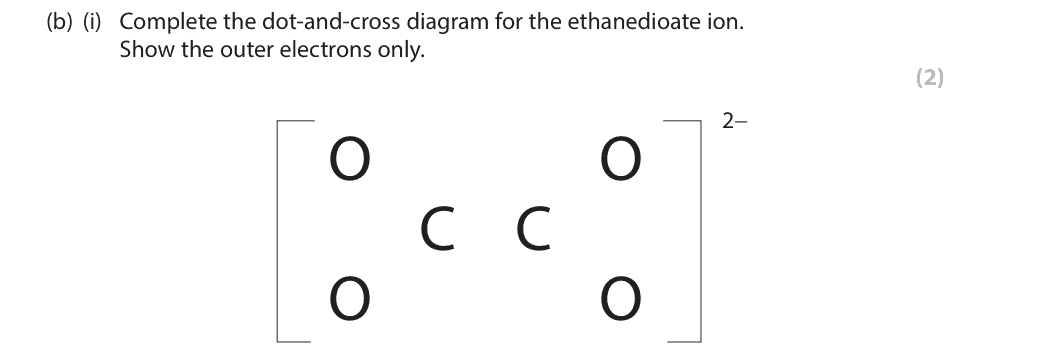
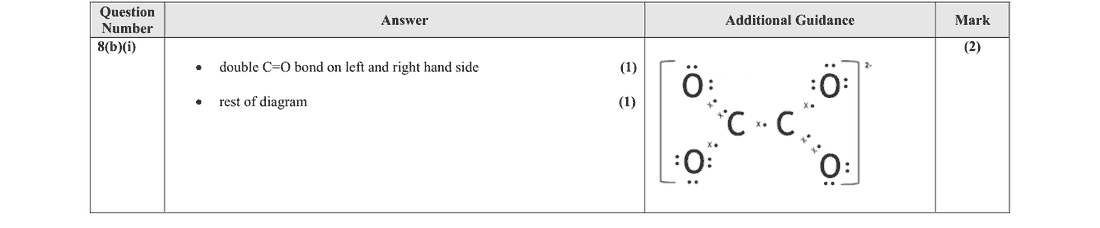
Hydroxide ion: one shared pair (dot and cross) and three lone pairs on oxygen, with the negative charge (brackets not needed
no mark without the charge). Hydroxyl radical: one shared pair and five other oxygen electrons (two lone pairs and one unpaired electron), no charge. 1 mark if both are right but all dots or all crosses. The hydroxide ion was almost always correct
the radical often had too many electrons, an extra dot or a charge
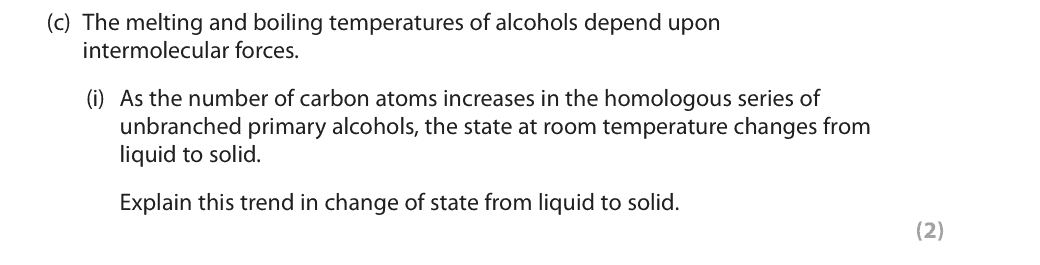
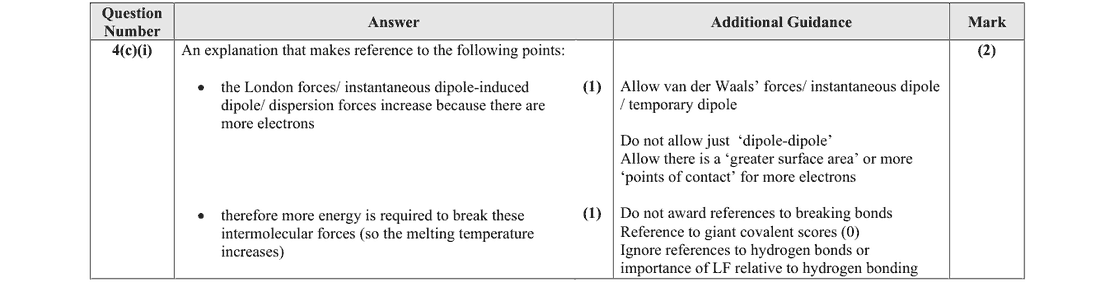
June 2025 · AS Paper 2 · Q4(c)(i)2 marksExplanation
Mark scheme
Examiner's comment
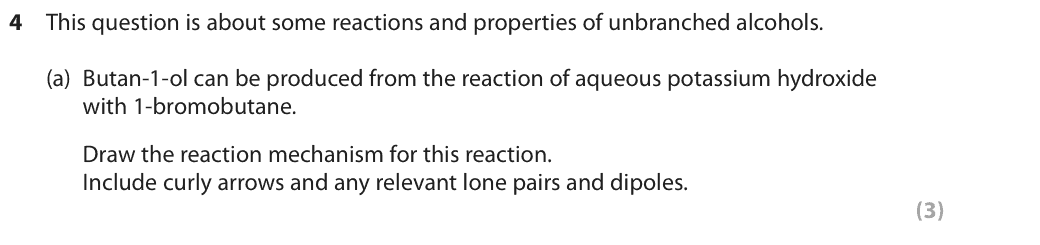
This question was concerned with the reactions and properties of alcohols. (a) Many knew the mechanism for the reaction of 1-bromobutane with aqueous potassium hydroxide and, on the whole, placed arrows and lone pairs carefully. However, some treated KOH as covalent and attempted to include K in the mechanism, which led to many incorrect answers. Leaving an unbalanced product by missing Br- or adding a previously unseen K+ lost many a mark. Scores were widely distributed, and 3 was the most common. (b) This question proved to be surprisingly challenging, and half of the candidates scored no marks. Most labelled the y-axis correctly, although a significant number wrote “Energy change” Common mistakes were failure to balance the equation correctly (omitting water and HBr or writing the wrong product) and not labelling ΔH or including double headed arrows. Some exothermic reactions were seen, and some labelled Ea as ΔH. (ci) London forces were generally well understood but many failed to explain why these increase with chain length. Some marks were lost by referring to intermolecular forces as “bonds”. (cii) There were many references to 1⁰, 2⁰,3⁰ (which did not necessarily lose the marks) - the correlation with branching was well known and often, but not always, adequately explained. Stability of primary, secondary and tertiary alcohols featured regularly.
Notes from the mark scheme and report
The London forces increase because there are more electrons (larger surface area / more points of contact allowed)
so more energy is needed to overcome these intermolecular forces and the melting temperature rises. Not just 'dipole-dipole'
no credit for breaking bonds
hydrogen bonding is ignored. Many did not say why the London forces increase, and some called the intermolecular forces 'bonds'
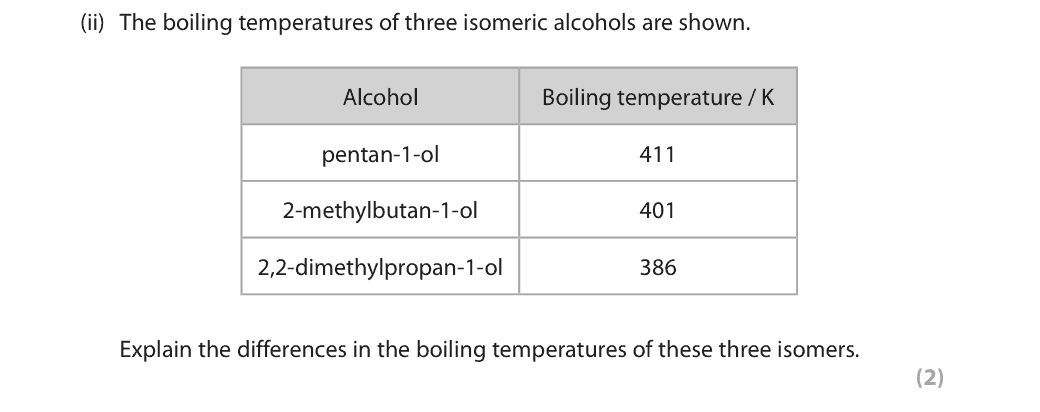
June 2025 · AS Paper 2 · Q4(c)(ii)2 marksExplanation
Earlier parts of question 4 that this part uses
Mark scheme
Examiner's comment
This question was concerned with the reactions and properties of alcohols. (a) Many knew the mechanism for the reaction of 1-bromobutane with aqueous potassium hydroxide and, on the whole, placed arrows and lone pairs carefully. However, some treated KOH as covalent and attempted to include K in the mechanism, which led to many incorrect answers. Leaving an unbalanced product by missing Br- or adding a previously unseen K+ lost many a mark. Scores were widely distributed, and 3 was the most common. (b) This question proved to be surprisingly challenging, and half of the candidates scored no marks. Most labelled the y-axis correctly, although a significant number wrote “Energy change” Common mistakes were failure to balance the equation correctly (omitting water and HBr or writing the wrong product) and not labelling ΔH or including double headed arrows. Some exothermic reactions were seen, and some labelled Ea as ΔH. (ci) London forces were generally well understood but many failed to explain why these increase with chain length. Some marks were lost by referring to intermolecular forces as “bonds”. (cii) There were many references to 1⁰, 2⁰,3⁰ (which did not necessarily lose the marks) - the correlation with branching was well known and often, but not always, adequately explained. Stability of primary, secondary and tertiary alcohols featured regularly.
Notes from the mark scheme and report
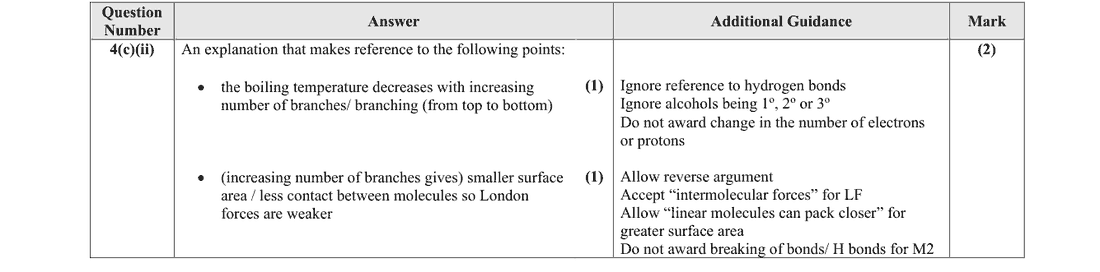
Boiling temperature falls as the branching increases (from pentan-1-ol to 2,2-dimethylpropan-1-ol)
more branching gives a smaller surface area / less contact between molecules, so the London forces are weaker. Hydrogen bonding and primary / secondary / tertiary labels are ignored
a change in the number of electrons is not credited
not breaking bonds
June 2025 · AS Paper 2 · Q5(b)(iii)2 marksExplanation
Earlier part of question 5 that this part uses
Mark scheme
Examiner's comment
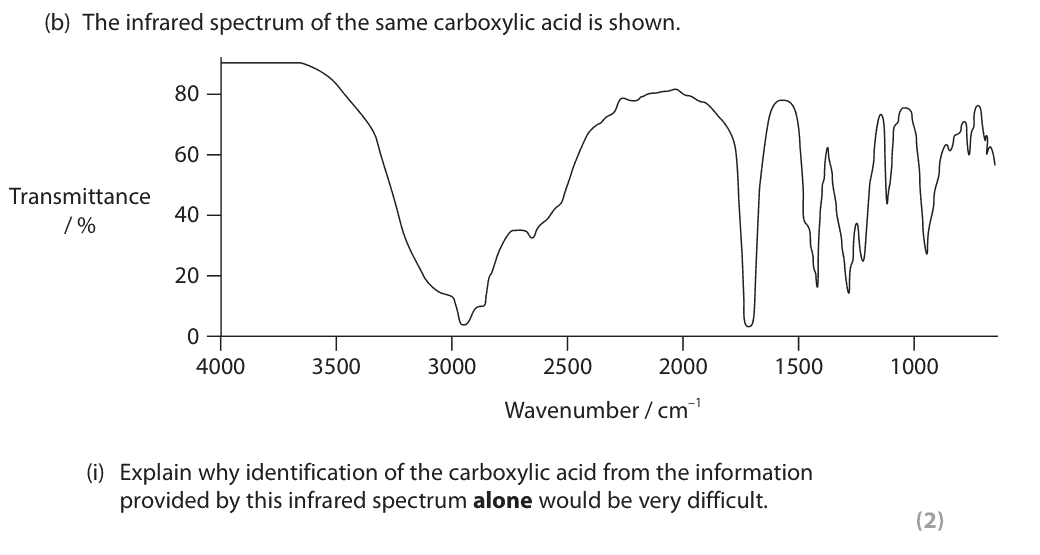
This question is about the use of mass spectrometry and infrared spectroscopy as methods to identify organic compounds. (ai) Many candidates answered correctly. A common error was giving 115 as the relative molecular mass. (aii) Over half scored full marks. Many missed the requirement for a positive ion, and a minority gave negative ions or inappropriate fragments such as OH- or H+
(aiii) Many scored the mark, though some lost it by giving both name and formula, with one being incorrect. A common incorrect answer was pentanoic acid.
(bi) Many candidates did not read the question carefully or misunderstood what was being asked. They had to explain why a specific carboxylic acid would be difficult to identify based solely on the spectrum. Whilst some responses correctly noted that peaks were broad or could overlap, this did not address the question so did not score. However, there were also some excellent responses that demonstrated clear understanding and precise reasoning. (bii) Most candidates identified the bond correctly as C=O but many just said ‘carboxylic acid alkyl’ so did not score. (biii) Most identified O-H as the relevant bond and many recognised the role of hydrogen bonding here. However, many answers did not refer to the peak in the question and just described the intermolecular forces present in carboxylic acids. About a third scored full marks.
Notes from the mark scheme and report
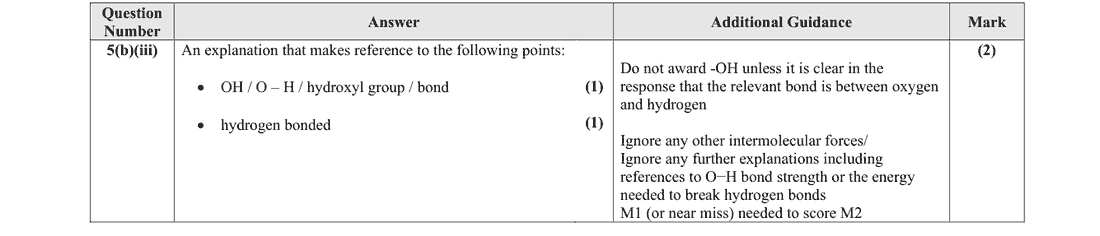
The peak is due to the O–H bond
which is hydrogen bonded (to other acid molecules). It must be clear that the bond is between O and H
the second mark needs the first or a near miss. Many described the intermolecular forces in carboxylic acids without referring to the peak. About a third scored both marks
June 2025 · Paper 2 · Q8(f)3 marksExplanation
Earlier part of question 8 that this part uses
Mark scheme
Examiner's comment
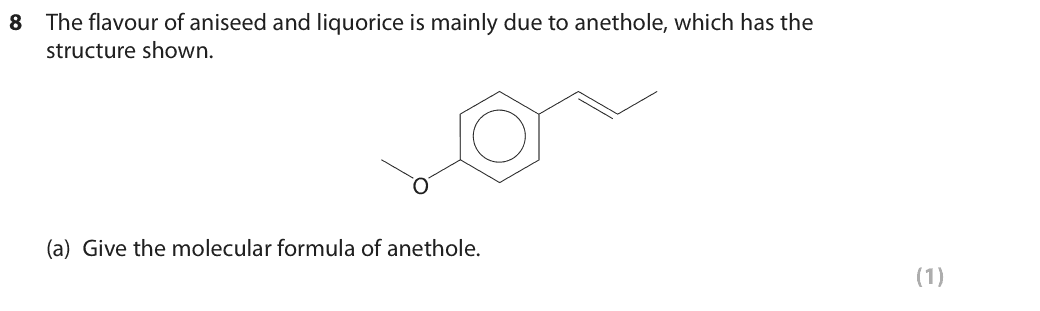
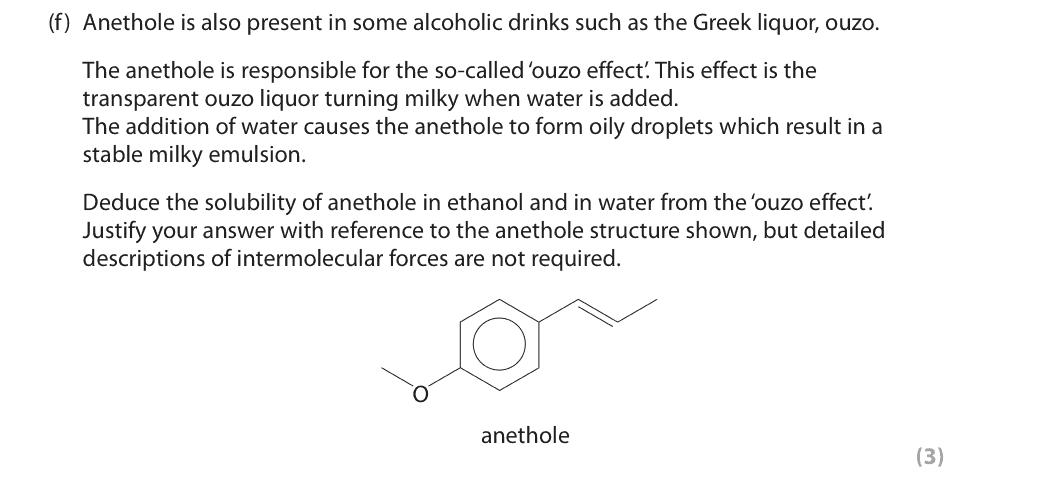
Most candidates were able to identify that the anethole is more soluble in ethanol than in water and so scored the two marks.
For M3, explaining why this was the case in terms of molecular structures and intermolecular forces was seen less often. A comparison between the factors affecting solubility of anethole in the two different solvents was required.
Notes from the mark scheme and report
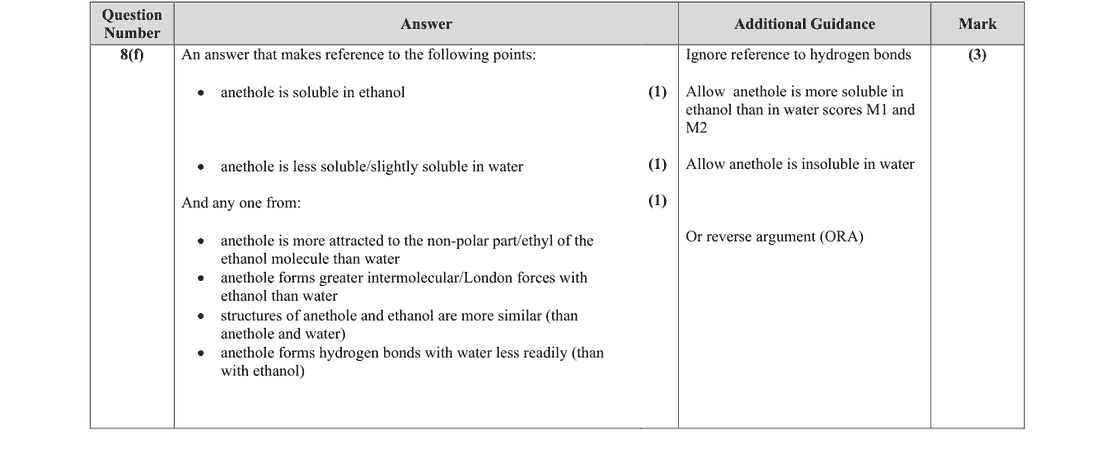
Anethole is soluble in ethanol
it is insoluble / only slightly soluble in water ('more soluble in ethanol than in water' scores both)
plus one reason: anethole is attracted more to the non-polar ethyl part of ethanol than to water / forms stronger London forces with ethanol than with water / is more similar in structure to ethanol / forms hydrogen bonds with water less readily. Most scored the two solubility marks
the reason needed a comparison between the two solvents and was seen less often
June 2025 · Paper 3 · Q2(d)(iii)3 marksExplanation
Earlier parts of question 2 that this part uses
Mark scheme
Examiner's comment
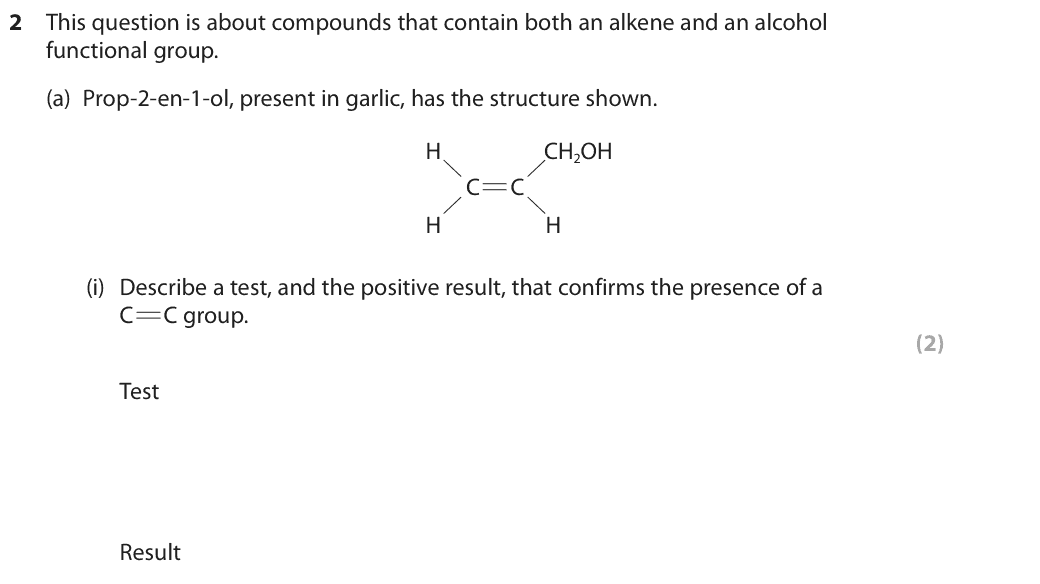
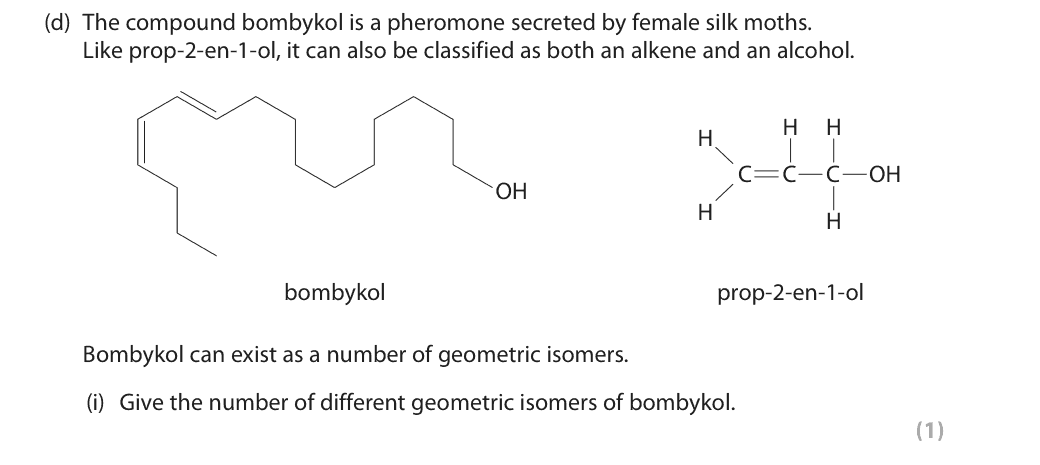
The first part of this question, Q02(d)(i), was quite well answered, with a lot of candidates realising that the double C=C bond in the molecule would give rise to 4 geometric isomers of bombykol.
Candidates found part Q02(d)(ii) more difficult, with many failing to give clear answers relating to the fact that there are two hydrogen atoms in the carbon of the double bond. References to the same atoms being on the double bond were too vague to be awarded any marks.
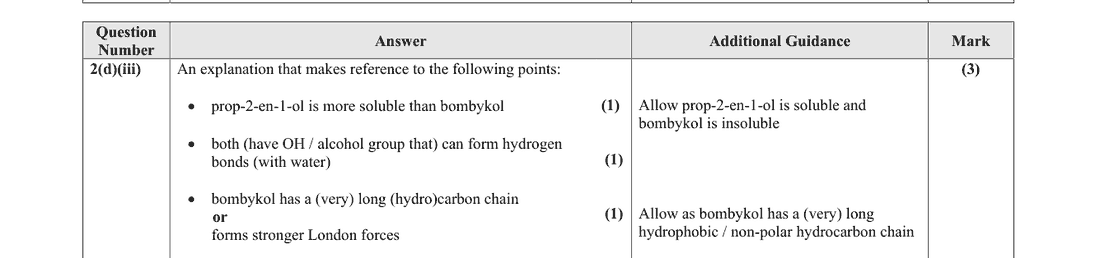
Many candidates were able to gain at least one mark on part Q02(d)(iii) for either recognising that the prop-2-en-1-ol would be more soluble than the bombykol, or that both would form hydrogen bonds with water. M3 was less frequently awarded due to imprecise use of language - such as 'bombykol has a long chain and so will not dissolve.'
Notes from the mark scheme and report
Prop-2-en-1-ol is more soluble than bombykol (allow soluble against insoluble)
both have an OH group that can form hydrogen bonds with water
bombykol has a (very) long non-polar hydrocarbon chain / stronger London forces. M3 was often lost through vague wording such as 'bombykol has a long chain so will not dissolve'
June 2024 · Paper 1 · Q2(b)1 markMultiple choice
Answer
D
Mark scheme
Notes from the mark scheme and report
Answer: D. The ions have the same number of electrons and Ca2+ has the most protons, so the smallest radius
June 2024 · AS Paper 1 · Q5(d)1 markMultiple choice
Earlier part of question 5 that this part uses
Answer
D
Mark scheme
Examiner's comment
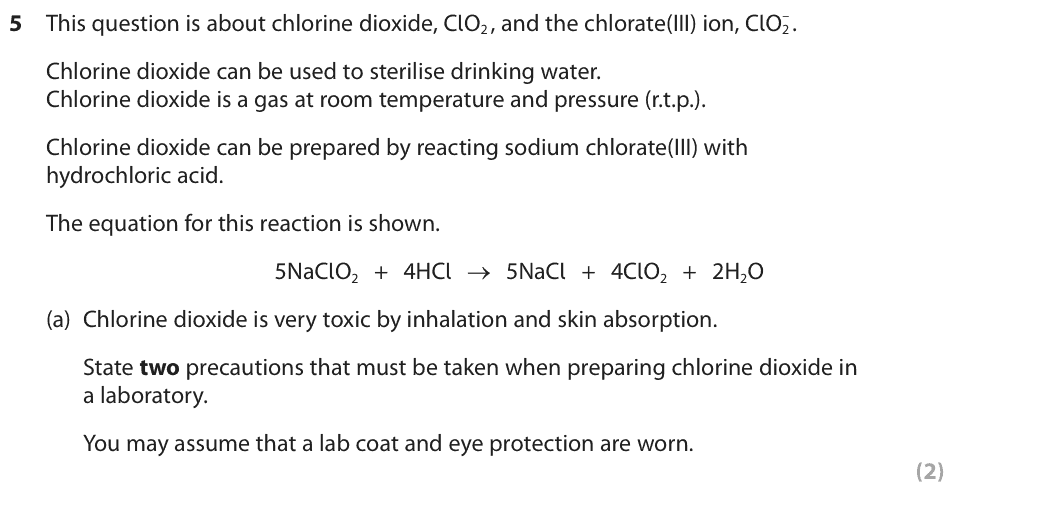
This question was answered poorly, with many candidates either not reading the question and giving covalent bonding as an answer or thinking that hydrogen bonding was present in chlorine dioxide.
Notes from the mark scheme and report
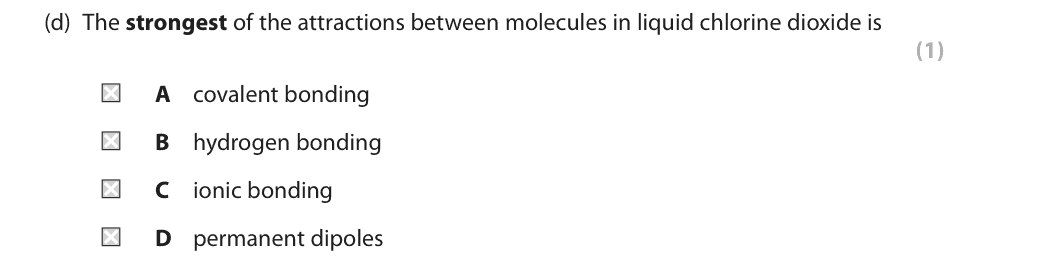
Answer: D (permanent dipoles). Covalent and ionic bonds are not forces between molecules, and there is no hydrogen in ClO2 so no hydrogen bonding. Answered poorly: many chose covalent bonding or hydrogen bonding
June 2024 · AS Paper 1 · Q5(e)(i)2 marksDiagram or structure
Earlier part of question 5 that this part uses
Mark scheme
Examiner's comment
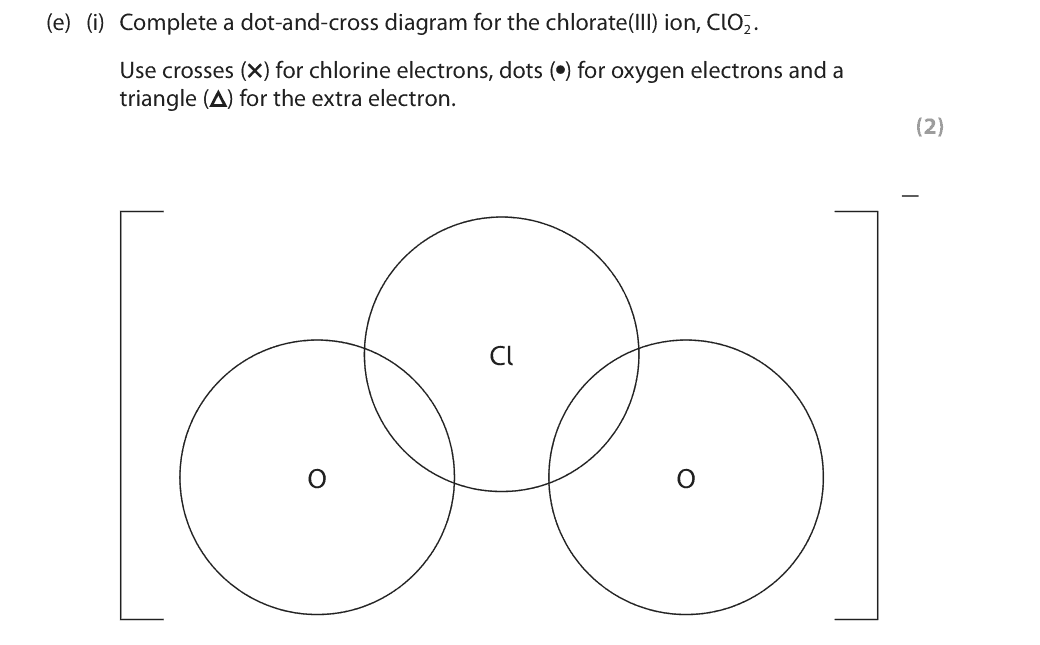
Q5ei) Candidates answered this question relatively well. Many candidates lost marks for either putting the extra electron as a bonding electron or having the incorrect number of x’s or o’x for each chlorine or oxygen. Some candidates left unpaired electrons. Q5eii) Similarly to question 5ei, candidates answered this question relatively well. A variety of angles were stated. Many candidates stated that lone pair repulsion was greater than bonding pair repulsion but failed to mention the number of lone pair and bonding pairs of electrons around the chlorine atoms.
Notes from the mark scheme and report
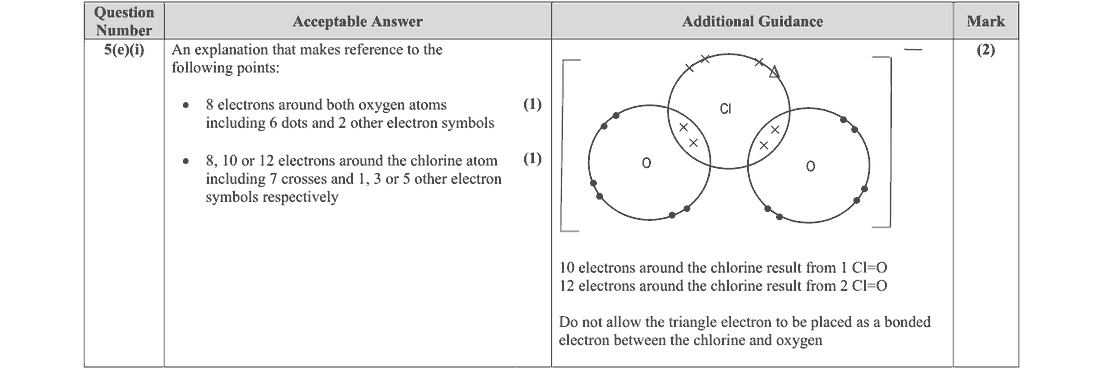
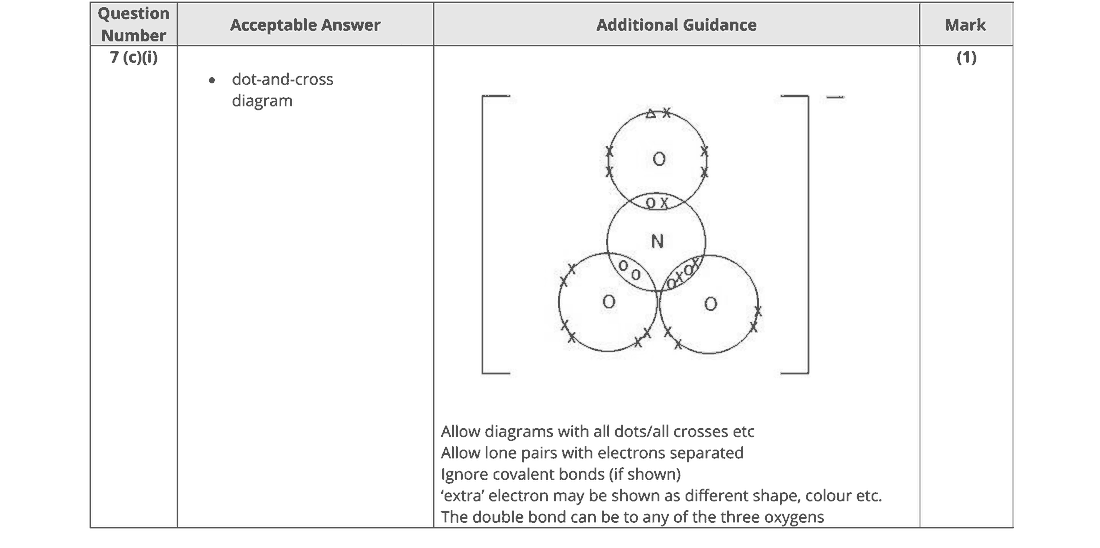
M1: eight electrons around each oxygen, made of six dots and two other symbols. M2: 8, 10 or 12 electrons around chlorine, made of seven crosses and 1, 3 or 5 other symbols (10 and 12 arise from one or two Cl=O double bonds). The triangle (extra electron) must not be placed in a bond between chlorine and oxygen. Common errors: extra electron used as a bonding electron
wrong numbers of crosses or dots
unpaired electrons left
June 2024 · AS Paper 1 · Q5(e)(ii)3 marksExplanation
Earlier parts of question 5 that this part uses
Mark scheme
Examiner's comment
Q5ei) Candidates answered this question relatively well. Many candidates lost marks for either putting the extra electron as a bonding electron or having the incorrect number of x’s or o’x for each chlorine or oxygen. Some candidates left unpaired electrons. Q5eii) Similarly to question 5ei, candidates answered this question relatively well. A variety of angles were stated. Many candidates stated that lone pair repulsion was greater than bonding pair repulsion but failed to mention the number of lone pair and bonding pairs of electrons around the chlorine atoms.
Notes from the mark scheme and report
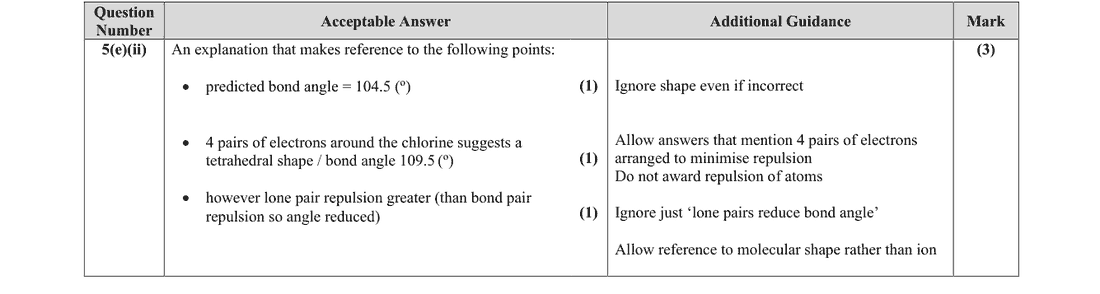
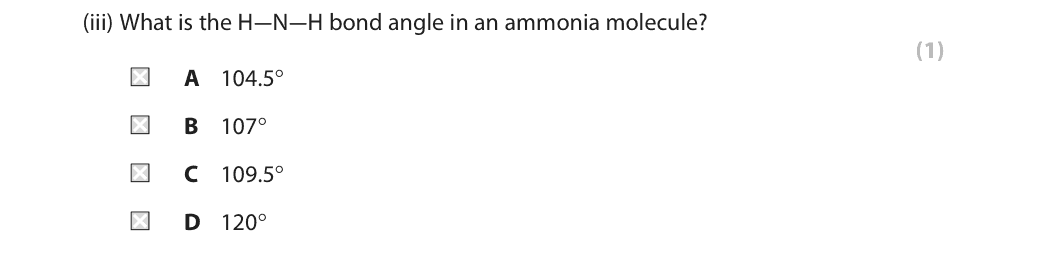
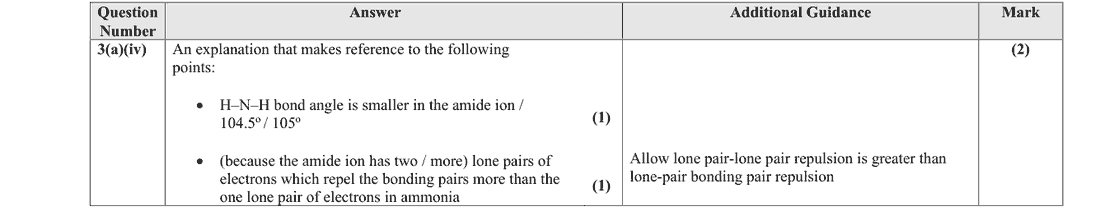
Answer: 104.5°. Four pairs of electrons around the chlorine would give a tetrahedral arrangement / 109.5° (allow four pairs arranged to minimise repulsion
not repulsion of atoms)
lone pairs repel more than bonding pairs, so the angle is reduced. Name of shape ignored
just 'lone pairs reduce the bond angle' is ignored. Many gave the repulsion idea without stating the numbers of lone and bonding pairs
a variety of angles was seen
Skills: MS4.1 Appreciate angles and shapes in regular 2D and 3D structures.
June 2024 · Paper 1 · Q8(a)2 marksDiagram or structure
Mark scheme
Examiner's comment
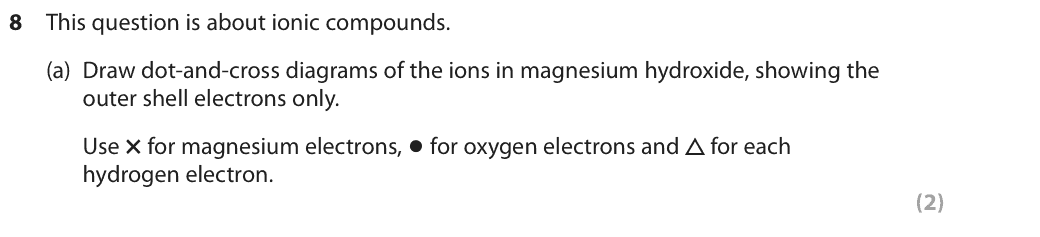
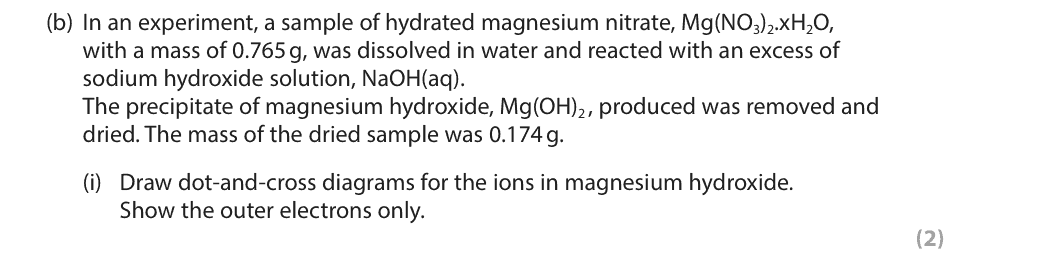
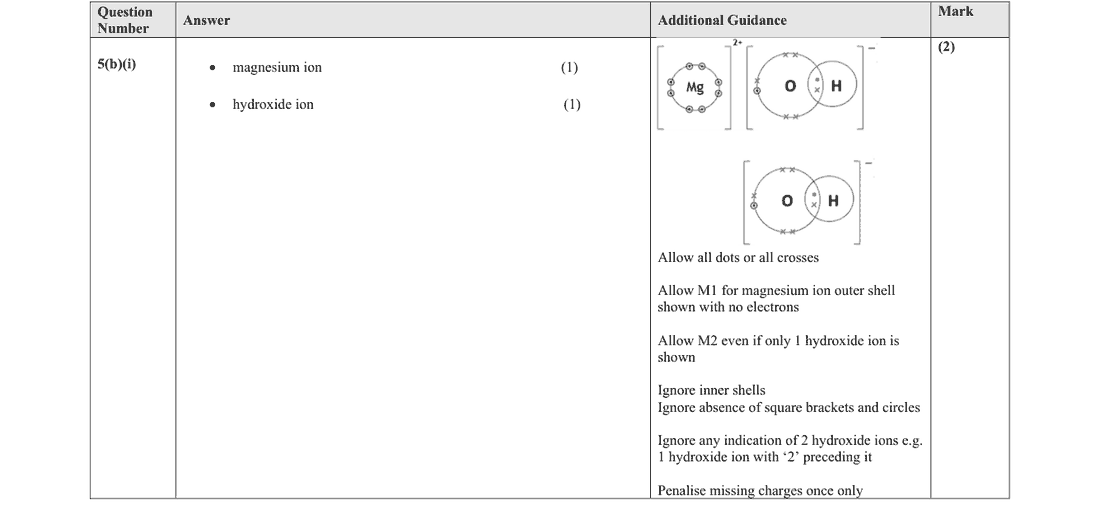
This question required candidates to draw dot-and-cross diagrams of the ions in magnesium hydroxide.
Whilst most candidates drew ions, there were a significant number of candidates who drew covalent bonding diagrams.
The Mg2+ ion was generally drawn correctly, with most of the errors seen being with the hydroxide ion. On occasion the charges were omitted and some candidates only gave one hydroxide ion instead of two.
Notes from the mark scheme and report
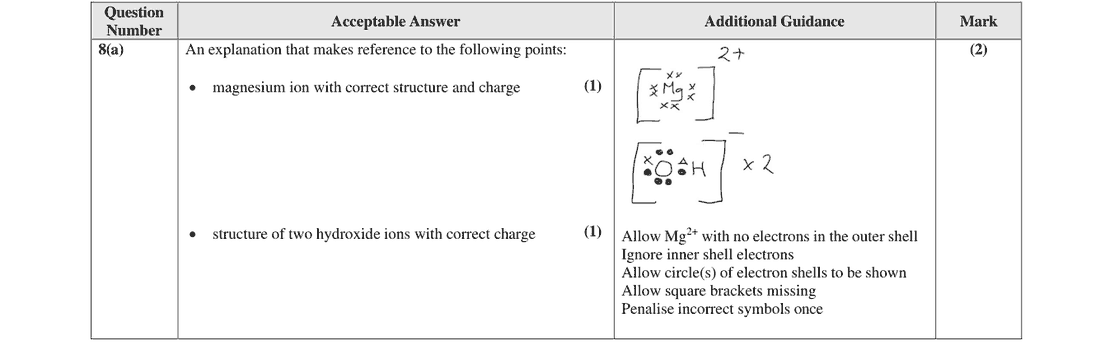
Mg2+ with eight outer electrons (or none shown) and the 2+ charge
two OH– ions, each with three lone pairs and one bonding pair on oxygen, including one extra electron, with the – charge. Many drew covalent bonding between Mg and OH
charges were left off
only one hydroxide ion drawn
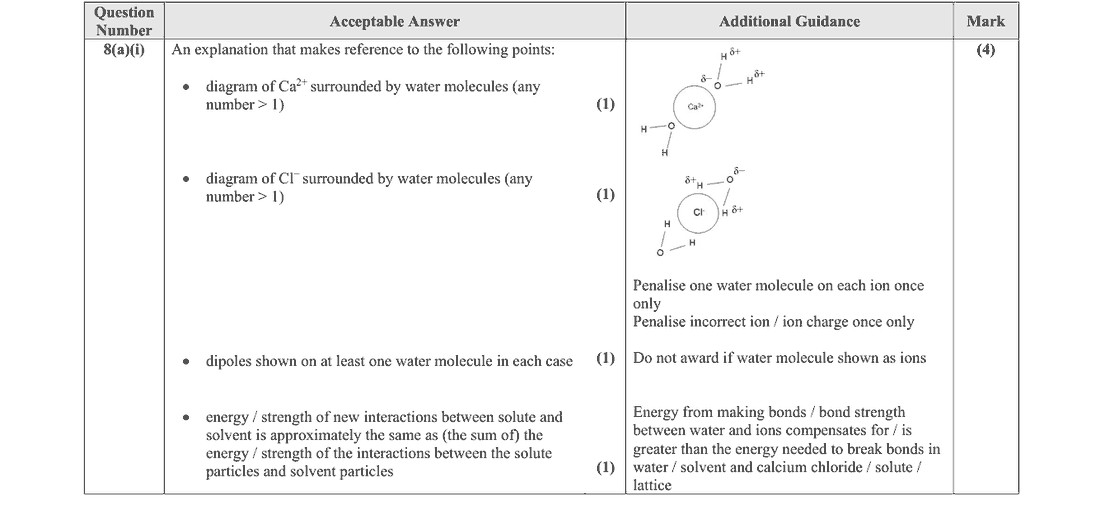
June 2024 · AS Paper 1 · Q8(a)(i)4 marksDiagram or structureHard
Mark scheme
Examiner's comment
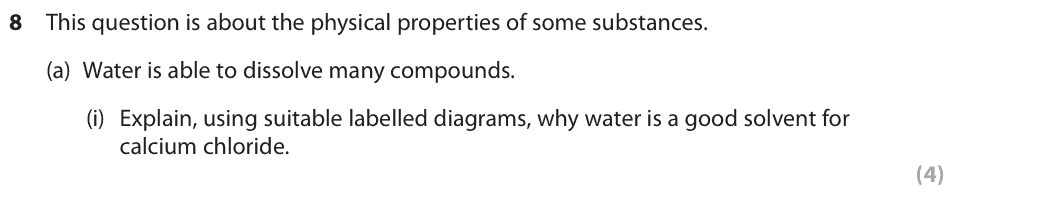
Q8ai) Overall, this question was answered poorly, with only 40% of candidates achieving any marks. 20% of candidates achieved 3 marks for the diagram. Most candidates lost marks for not drawing enough water molecules or the correct dipoles and not separating the ions from their lattice. Less than 5% of candidates could explain the energy to achieve M4. Q8aii) This question was answered relatively well. Most candidates could identify hydrogen bonding; however, some candidates did not achieve M1 as they did not identify the hydrogen bonding as between water and methanol molecules. The diagram was answered poorly, with most candidates either not labelling the hydrogen bond, not drawing the lone pair of electrons on the oxygen or not drawing the OHO bond at 180o. Some candidates drew methanol incorrectly or drew the hydrogen bond with the C-H instead of the O-H.
Notes from the mark scheme and report
M1: diagram of Ca2+ surrounded by more than one water molecule. M2: diagram of Cl– surrounded by more than one water molecule. M3: dipoles (δ+ on H, δ– on O) shown on at least one water molecule in each case, with oxygen towards Ca2+ and hydrogen towards Cl–. M4: the energy released / strength of the new ion–water interactions is about the same as (or compensates for) the energy needed to separate the ions in the lattice and the water molecules. Only one water molecule per ion, or a wrong ion charge, is penalised once. 20% scored the three diagram marks
fewer than 5% scored M4. Common errors: too few water molecules
wrong dipoles
ions not separated from the lattice
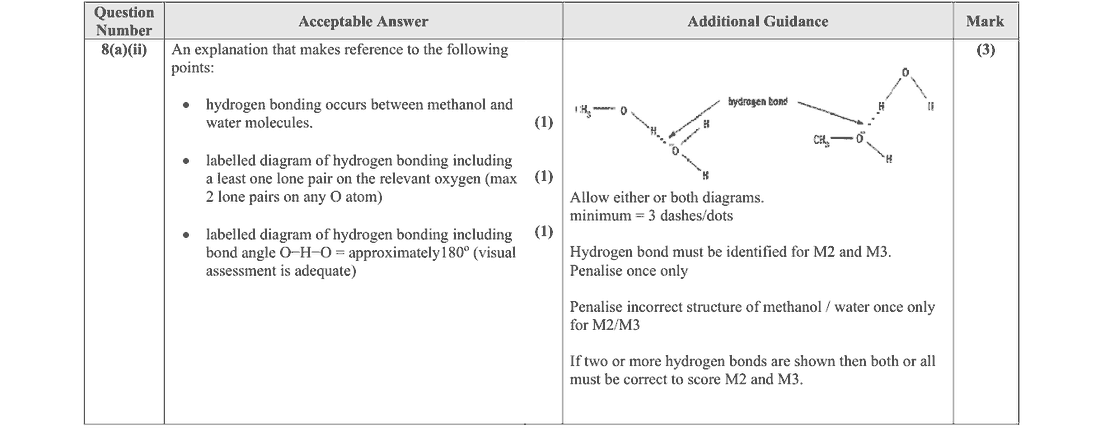
June 2024 · AS Paper 1 · Q8(a)(ii)3 marksDiagram or structure
Earlier part of question 8 that this part uses
Mark scheme
Examiner's comment
Q8ai) Overall, this question was answered poorly, with only 40% of candidates achieving any marks. 20% of candidates achieved 3 marks for the diagram. Most candidates lost marks for not drawing enough water molecules or the correct dipoles and not separating the ions from their lattice. Less than 5% of candidates could explain the energy to achieve M4. Q8aii) This question was answered relatively well. Most candidates could identify hydrogen bonding; however, some candidates did not achieve M1 as they did not identify the hydrogen bonding as between water and methanol molecules. The diagram was answered poorly, with most candidates either not labelling the hydrogen bond, not drawing the lone pair of electrons on the oxygen or not drawing the OHO bond at 180o. Some candidates drew methanol incorrectly or drew the hydrogen bond with the C-H instead of the O-H.
Notes from the mark scheme and report
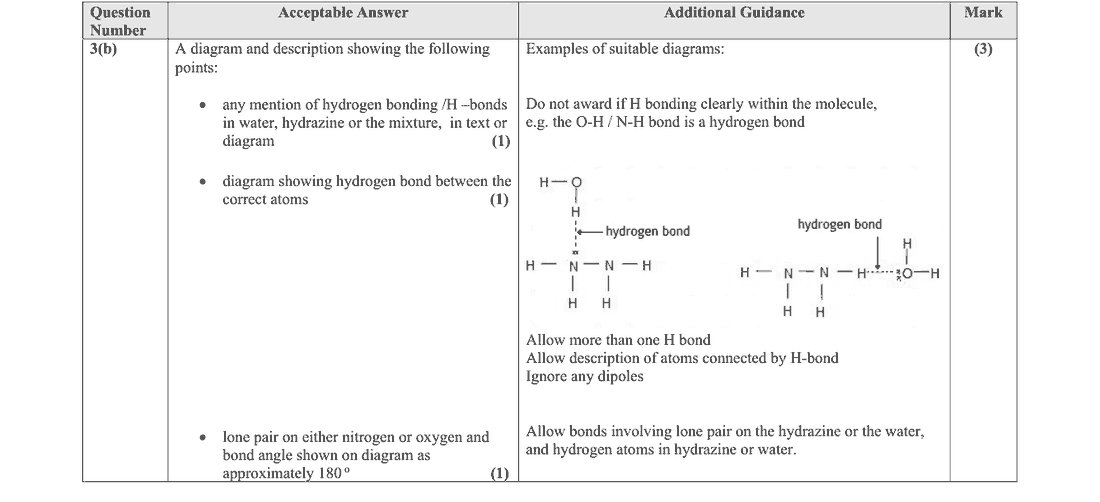
M1: hydrogen bonding occurs between methanol and water molecules. M2: labelled diagram of the hydrogen bond with at least one lone pair on the relevant oxygen. M3: the O–H---O angle drawn at about 180°. The hydrogen bond must be identified
a wrong structure for methanol or water is penalised once
if more than one hydrogen bond is drawn, all must be correct. Most identified hydrogen bonding but some did not say it is between methanol and water
diagrams were poor (no label, no lone pair, not 180°, or the bond drawn to a C–H hydrogen)
Skills: MS4.1 Appreciate angles and shapes in regular 2D and 3D structures.
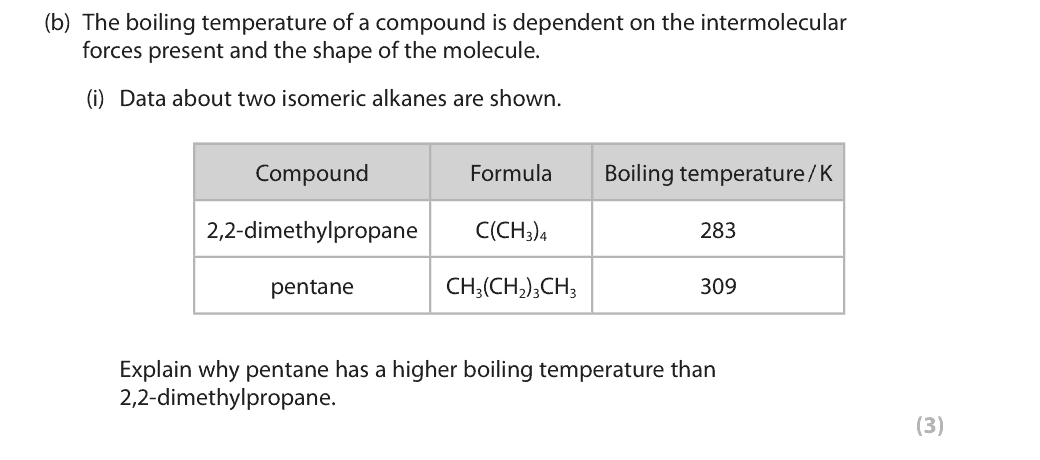
June 2024 · AS Paper 1 · Q8(b)(i)3 marksExplanation
Earlier part of question 8 that this part uses
Mark scheme
Examiner's comment
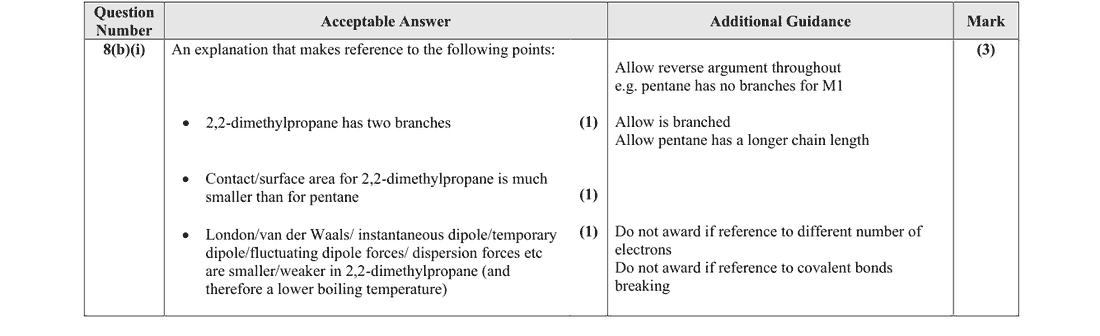
Q8bi) This question was answered well. Most candidates identified 2,2-dimethylpropane as being branched and therefore had weaker London forces. Many candidates lost M2 for either not mentioning surface area or saying that the molecules will be packed closer together. M3 was lost on occasion due to candidates stating that propane had more electrons which is why the London forces were stronger. Q8bii) Question 8bii was answered relatively well. Many candidates compared the Si=O double covalent bond strength with the Si-Cl single covalent bond strength. When candidates did correctly identify the structures of the two silicon compounds, they normally achieved full marks.
Notes from the mark scheme and report
2,2-dimethylpropane is branched / has two branches (allow pentane is unbranched or has a longer chain)
so the contact / surface area between its molecules is smaller than for pentane
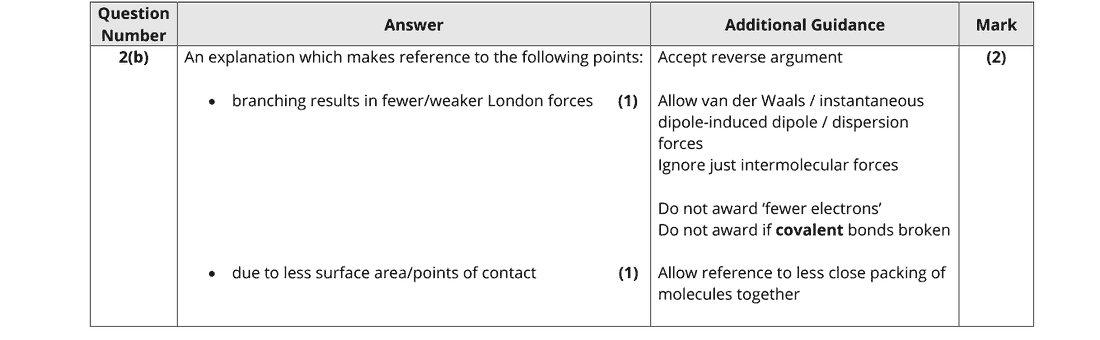
so its London forces are weaker (lower boiling temperature). M3 is lost for saying the molecules have different numbers of electrons or for breaking covalent bonds. Reverse argument allowed. Many lost M2 for not mentioning surface area or for saying the molecules pack closer together
June 2024 · Paper 2 · Q3(a)1 markDiagram or structure
Mark scheme
Examiner's comment
The best answers went beyond the requirements of the mark scheme, providing a key to make it clear where each electron originated from. However, use of a double bond between two oxygen atoms, resulting in an oxygen outer shell containing nine electrons, was the most common error.
Notes from the mark scheme and report
H–O–O–H: one shared pair in each O–H bond, one shared pair between the two oxygen atoms and two lone pairs on each oxygen. All dots, all crosses or reversed symbols allowed
circles need not be drawn. Commonest error: a double bond between the oxygen atoms, giving nine electrons round an oxygen
June 2024 · Paper 2 · Q7(d)(i)2 marksExplanation
Earlier part of question 7 that this part uses
Mark scheme
Examiner's comment
Many candidates appreciated the link between solubility of an organic compound in water to its ability to form hydrogen bonds with water. However far fewer considered the relative strength of the forces between solute-solute and solvent-solvent, compared with solute-solvent forces. In this case, just the notion that the resultant forces were of similar strength to the forces in each separate component of the mixture would have been sufficient.
Notes from the mark scheme and report
M1 both ethane-1,2-diol and water have hydrogen bonds / they can hydrogen bond to each other (a correct diagram can score). M2 so the hydrogen bonds formed between them are similar in strength to (or stronger than) those in the separate liquids before mixing. Many scored M1
far fewer compared the strength of the solute–solvent forces with those being broken
June 2024 · Paper 3 · Q2(a)3 marksExplanation
Mark scheme
Examiner's comment
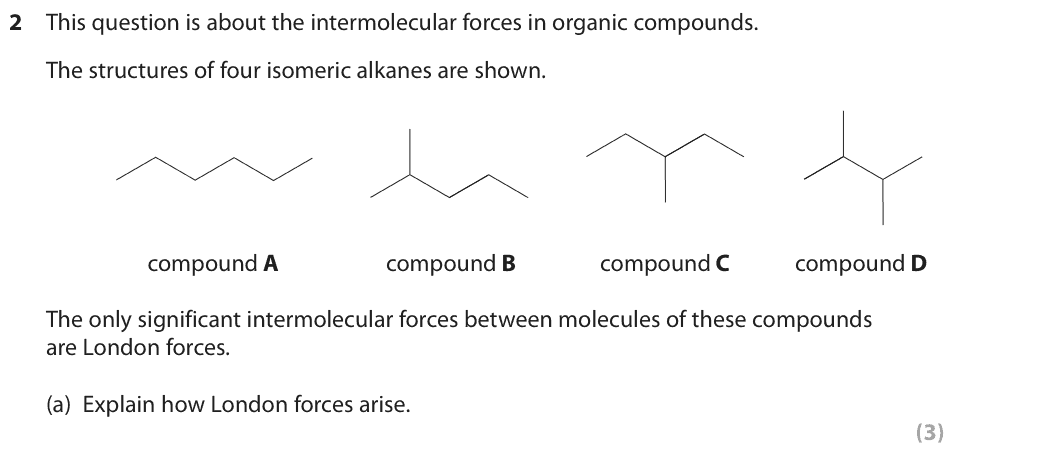
In part (a) it was pleasing to see a large number of candidates clearly and succintly explained how London forces arise. Two common errors were stating that the initial instantaneous dipole was induced, and omitting the reference to other/adjacent molecules for the induced dipole. The majority of candidates in part (b) could correctly identified compound A as having the highest boiling temperature and were able to explain why. Occasionally some candidates failed to link the branching to the strength of London forces and so lost M1. Candidates are advised against using non-standard abbrevations, such as LDF presumably for London forces and SA for surface area. These may not gain credit. It was good to see some well-reasoned responses to the deflection experiment in part (c). However an orderly and clear response was not always seen. Many had the tendency to state that a molecule was non-polar/polar without explaining why or only focussed on bond polarity and molecular shape for one of the molecules rather than all three. It was evident that some candidates misunderstood the labelling of the charged rod and referred to chloride ions in the chlorinated alkanes.
Notes from the mark scheme and report
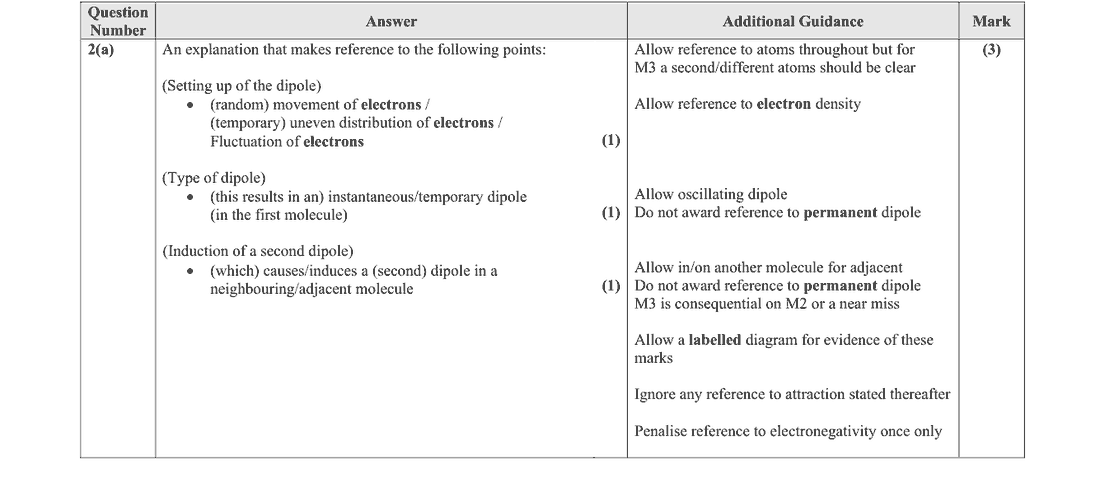
Random movement / uneven distribution of electrons (1)
gives an instantaneous (temporary) dipole in one molecule (1)
which induces a dipole in a neighbouring molecule (1). Third mark depends on the second. Not permanent dipoles
electronegativity penalised once
a labelled diagram can score. Common errors: calling the first dipole induced
not mentioning another / adjacent molecule for the induced dipole
June 2024 · Paper 3 · Q2(b)2 marksExplanation
Earlier part of question 2 that this part uses
Mark scheme
Examiner's comment
In part (a) it was pleasing to see a large number of candidates clearly and succintly explained how London forces arise. Two common errors were stating that the initial instantaneous dipole was induced, and omitting the reference to other/adjacent molecules for the induced dipole. The majority of candidates in part (b) could correctly identified compound A as having the highest boiling temperature and were able to explain why. Occasionally some candidates failed to link the branching to the strength of London forces and so lost M1. Candidates are advised against using non-standard abbrevations, such as LDF presumably for London forces and SA for surface area. These may not gain credit. It was good to see some well-reasoned responses to the deflection experiment in part (c). However an orderly and clear response was not always seen. Many had the tendency to state that a molecule was non-polar/polar without explaining why or only focussed on bond polarity and molecular shape for one of the molecules rather than all three. It was evident that some candidates misunderstood the labelling of the charged rod and referred to chloride ions in the chlorinated alkanes.
Notes from the mark scheme and report
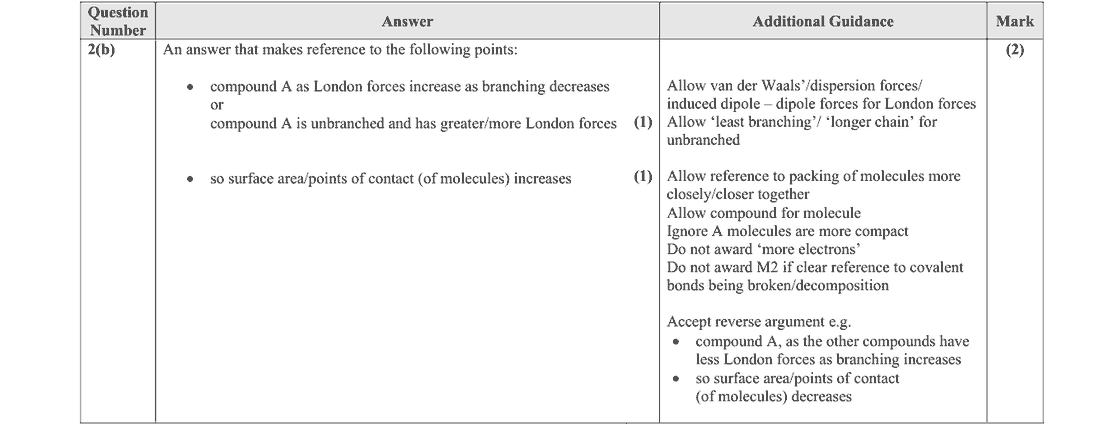
Compound A, because it is unbranched and so has the strongest London forces (1)
more surface area / more points of contact between molecules (1). Not 'more electrons' (they are isomers)
no second mark if covalent bonds are said to break. Reverse argument allowed. Some did not link branching to the strength of the London forces
non-standard abbreviations (LDF, SA) may not be credited
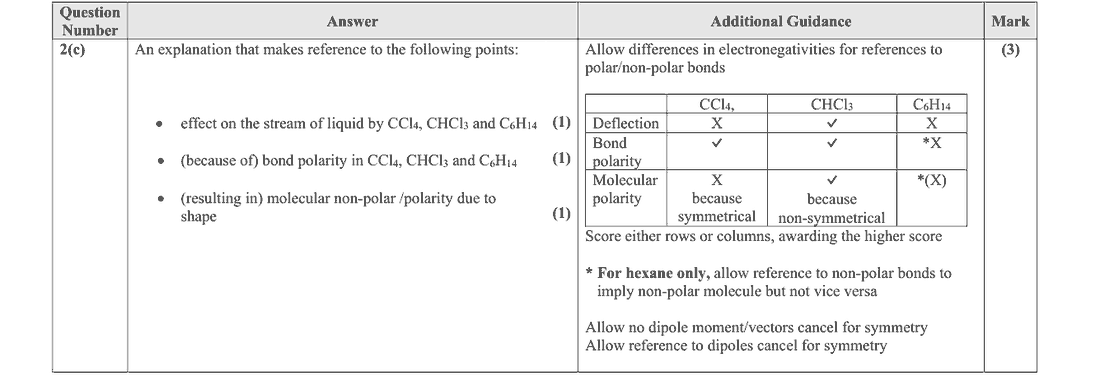
June 2024 · Paper 3 · Q2(c)3 marksExplanation
Earlier part of question 2 that this part uses
Mark scheme
Examiner's comment
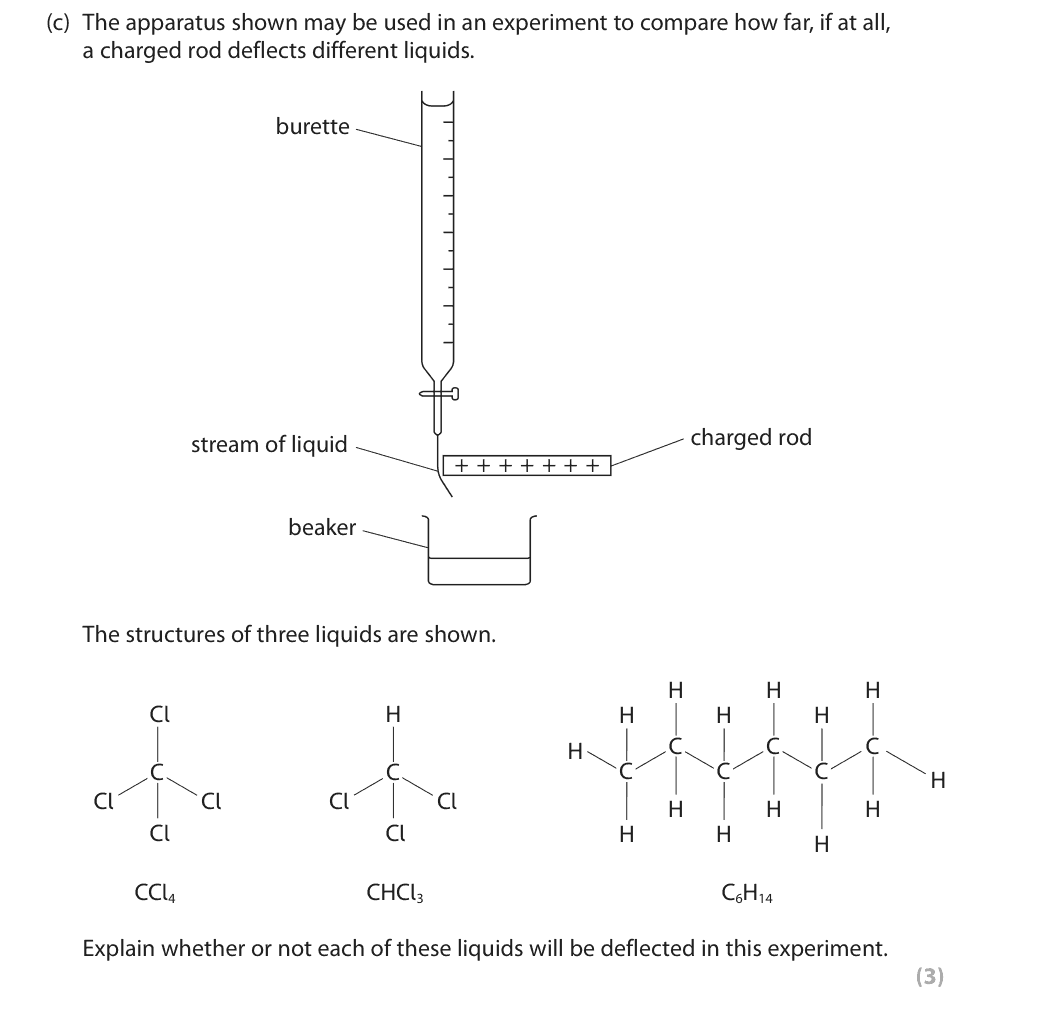
In part (a) it was pleasing to see a large number of candidates clearly and succintly explained how London forces arise. Two common errors were stating that the initial instantaneous dipole was induced, and omitting the reference to other/adjacent molecules for the induced dipole. The majority of candidates in part (b) could correctly identified compound A as having the highest boiling temperature and were able to explain why. Occasionally some candidates failed to link the branching to the strength of London forces and so lost M1. Candidates are advised against using non-standard abbrevations, such as LDF presumably for London forces and SA for surface area. These may not gain credit. It was good to see some well-reasoned responses to the deflection experiment in part (c). However an orderly and clear response was not always seen. Many had the tendency to state that a molecule was non-polar/polar without explaining why or only focussed on bond polarity and molecular shape for one of the molecules rather than all three. It was evident that some candidates misunderstood the labelling of the charged rod and referred to chloride ions in the chlorinated alkanes.
Notes from the mark scheme and report
Deflection: CHCl3 is deflected
CCl4 and C6H14 are not (1). Bond polarity: C–Cl bonds are polar in CCl4 and CHCl3
the bonds in hexane are non-polar (1). Molecular polarity: CCl4 is symmetrical so the dipoles cancel (non-polar molecule)
CHCl3 is not symmetrical so the molecule is polar (1). Scored by rows or by columns, whichever is higher. Common errors: stating polar / non-polar with no reason
discussing only one of the three molecules
referring to chloride ions
Skills: MS4.3 Understand the symmetry of 2D and 3D shapes
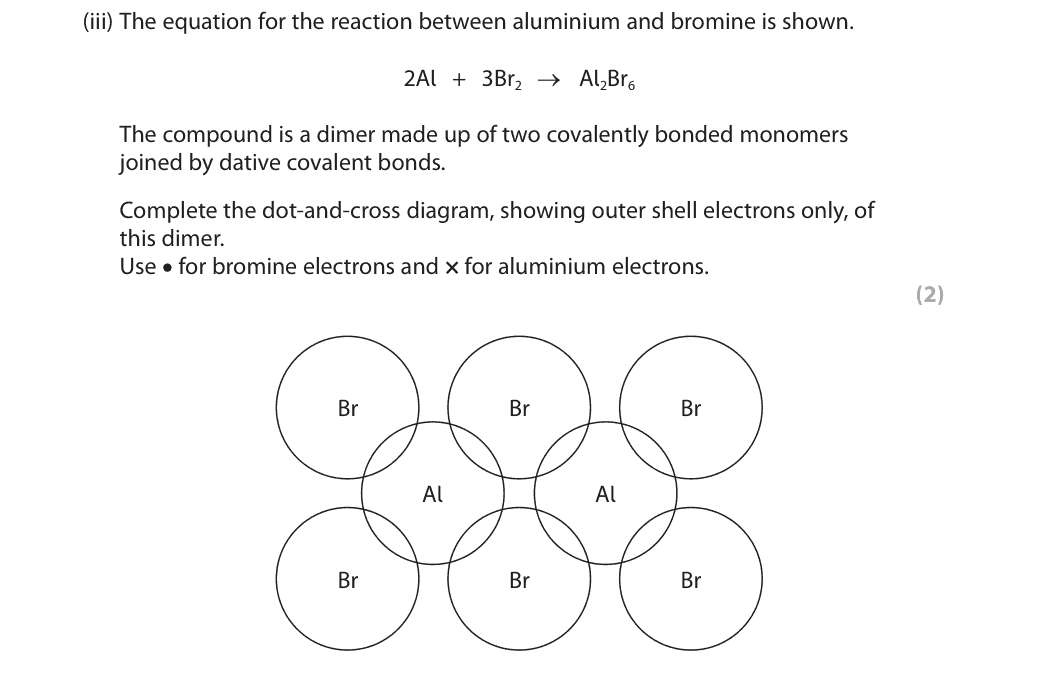
June 2023 · AS Paper 1 · Q3(a)(iii)2 marksDiagram or structure
Earlier part of question 3 that this part uses
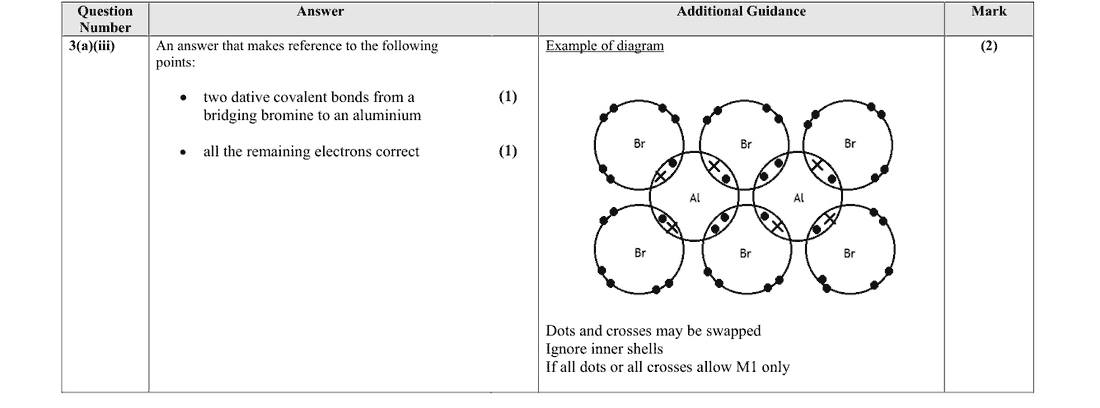
Mark scheme
Examiner's comment
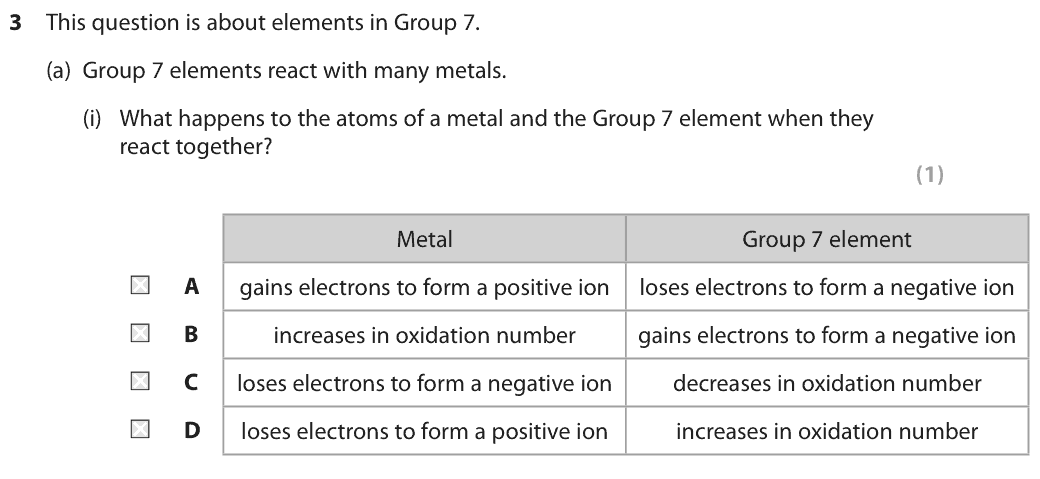
(a)(i) Approximately 75% of candidates were able to give B as the correct answer. (a)(ii) Approximately 50% of candidates scored the mark. (a)(iii) The most common mistake was to have on dative covalent bond from a bridging bromine and the other from a terminal one. Candidates could still score for having pairs of electrons in all the bonding environments and the correct numbers of lone pairs. Some candidates who focussed only on the bonding pairs of electrons so could not score the second mark. The majority of candidates scored 2 marks on this item.
(a)(iv) Incorrect responses here included the use of incorrect symbols, e.g., P or Fl. Some answered by keeping the fluorine as a pair, e.g., Pt(F2)3. Others included the oxidation state in their answer. Overall, however, this was relatively well answered. (a)(v) Empirical formula calculations are a good source of marks on AS papers, with most candidates able to carry these out successfully. Again, there were some approaches which gave the correct answer which did not follow the route in the mark scheme, but these were able to score full marks. It is vital, particularly on calculation of inorganic empirical formulae, that all working is shown, as these formulae can often be deduced or guessed. Full marks cannot be scored on these items without working.
(b)(i) Common errors were to talk about the bond enthalpy rather than the bond strength. Full marks here required an understanding that the bond enthalpy and the bond strength were linked. (b)(ii) This reaction, the displacement of a halide of a less reactive halogen by a more reactive one, is commonly tested both at this level and at GCSE. The idea here, to see if candidates could describe the practical techniques as well as the observation and equation for the reaction, proved a very challenging one. Many candidate reacted the solid halide with chlorine gas, failing to realise this really needs to be in solution to be effective. The use of bromine and potassium bromide as an intermediate halogen, though not required by the mark scheme, was able to score full credit. The shear amount of work to describe two tests rather than one and give the correct observations to establish the relative reactivity of iodine and chlorine made this approach harder, however.
Notes from the mark scheme and report
M1 two dative covalent bonds, each from a bridging bromine to an aluminium (both electrons in that shared pair are bromine dots). M2 all remaining electrons correct: a dot and a cross in each of the other six Al–Br bonds, three lone pairs on each terminal bromine and two lone pairs on each bridging bromine. Dots and crosses may be swapped
all dots or all crosses scores M1 only. Commonest error: one dative bond from a bridging bromine and the other from a terminal one. The majority scored 2
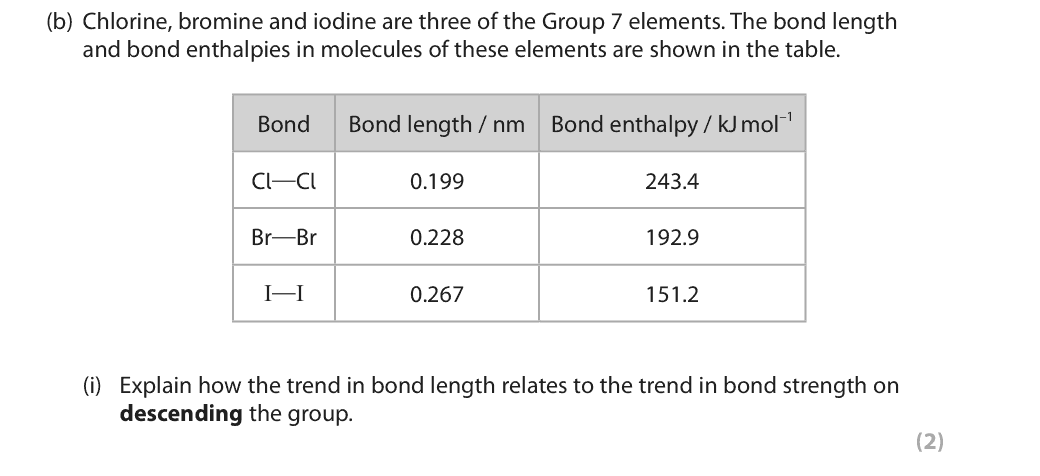
June 2023 · AS Paper 1 · Q3(b)(i)2 marksExplanation
Earlier part of question 3 that this part uses
Mark scheme
Examiner's comment
(a)(i) Approximately 75% of candidates were able to give B as the correct answer. (a)(ii) Approximately 50% of candidates scored the mark. (a)(iii) The most common mistake was to have on dative covalent bond from a bridging bromine and the other from a terminal one. Candidates could still score for having pairs of electrons in all the bonding environments and the correct numbers of lone pairs. Some candidates who focussed only on the bonding pairs of electrons so could not score the second mark. The majority of candidates scored 2 marks on this item.
(a)(iv) Incorrect responses here included the use of incorrect symbols, e.g., P or Fl. Some answered by keeping the fluorine as a pair, e.g., Pt(F2)3. Others included the oxidation state in their answer. Overall, however, this was relatively well answered. (a)(v) Empirical formula calculations are a good source of marks on AS papers, with most candidates able to carry these out successfully. Again, there were some approaches which gave the correct answer which did not follow the route in the mark scheme, but these were able to score full marks. It is vital, particularly on calculation of inorganic empirical formulae, that all working is shown, as these formulae can often be deduced or guessed. Full marks cannot be scored on these items without working.
(b)(i) Common errors were to talk about the bond enthalpy rather than the bond strength. Full marks here required an understanding that the bond enthalpy and the bond strength were linked. (b)(ii) This reaction, the displacement of a halide of a less reactive halogen by a more reactive one, is commonly tested both at this level and at GCSE. The idea here, to see if candidates could describe the practical techniques as well as the observation and equation for the reaction, proved a very challenging one. Many candidate reacted the solid halide with chlorine gas, failing to realise this really needs to be in solution to be effective. The use of bromine and potassium bromide as an intermediate halogen, though not required by the mark scheme, was able to score full credit. The shear amount of work to describe two tests rather than one and give the correct observations to establish the relative reactivity of iodine and chlorine made this approach harder, however.
Notes from the mark scheme and report
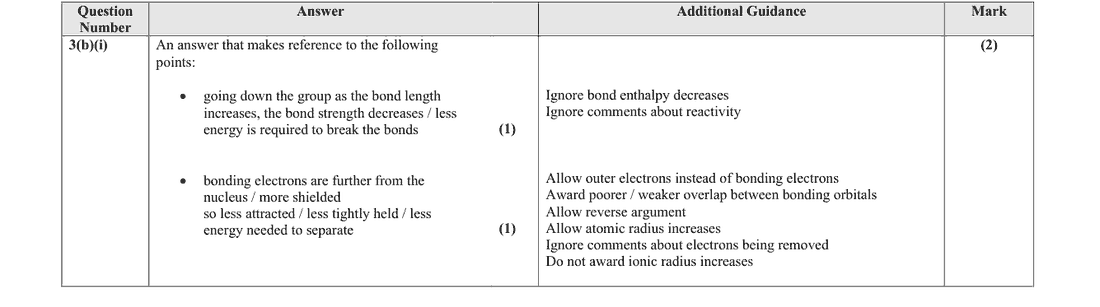
M1 down the group the bond length increases and the bond strength decreases / less energy is needed to break the bond ('bond enthalpy decreases' alone is ignored: it must be linked to strength). M2 the bonding electrons are further from the nuclei / more shielded, so less strongly attracted (allow atomic radius increases
allow weaker overlap of the bonding orbitals
not ionic radius). Common error: restating the bond enthalpy trend without mentioning bond strength
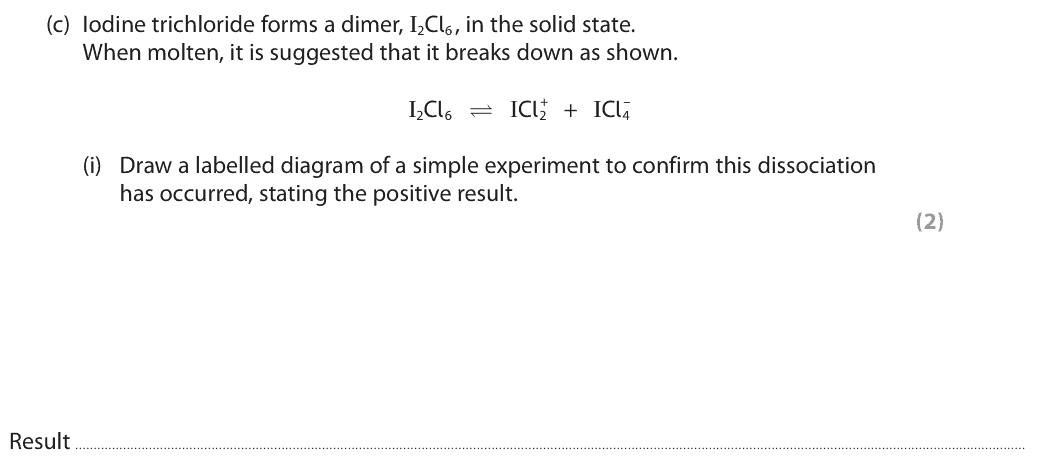
June 2023 · Paper 1 · Q3(c)(i)2 marksPractical and data analysis
Earlier part of question 3 that this part uses
Mark scheme
Examiner's comment
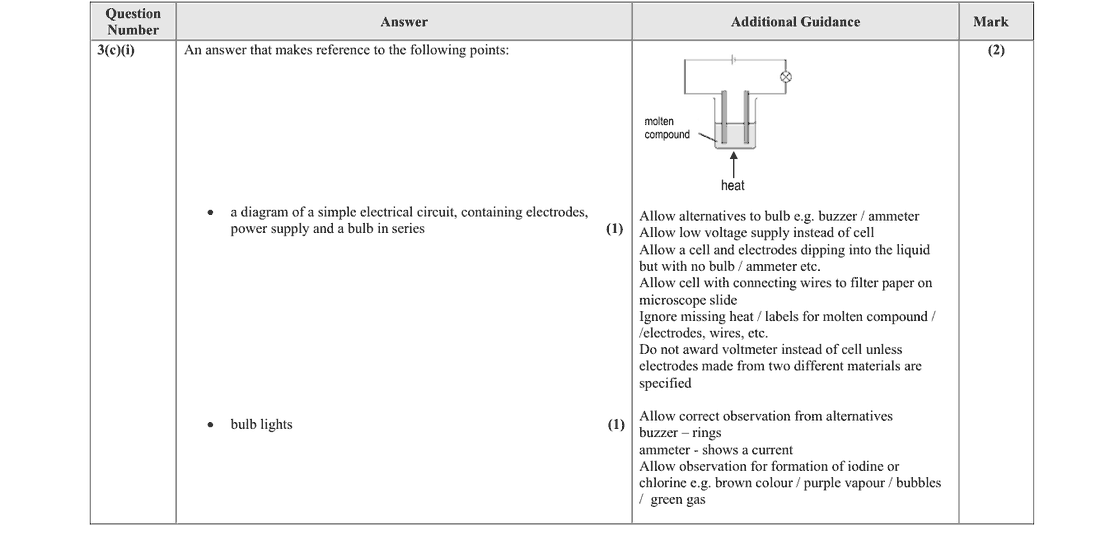
Many candidates struggled to deduce a simple experiment to show that ions are produced in the dissociation of I2Cl6. There were examples of heating to obtain gases and adding
solutions to form precipitates. Candidates should read the question carefully as the ions are shown in the equation, so the experiment needs to test whether the molten compound conducts an electric current. Some very poor circuit diagrams were seen, including many with a missing cell or power supply. The result of the experiment was often missing or vague, such as two different colours form. The simplest observation is to include a bulb in the circuit and it will light up if ions are present. However, many other observations were accepted.
Notes from the mark scheme and report
M1: a diagram of a simple circuit: two electrodes dipping into the molten compound, connected in series to a cell / power supply and a bulb (ammeter or buzzer allowed
the meter may be missing if cell and electrodes are shown). M2: the bulb lights (ammeter shows a current
or an observation of iodine or chlorine forming at an electrode). No voltmeter in place of the cell. Many did not see that ions are being tested for and described heating to collect gases or adding solutions
circuits often had no cell
results were missing or vague
June 2023 · Paper 1 · Q3(c)(ii)1 markMultiple choice
Earlier part of question 3 that this part uses
Answer
B
Mark scheme
Notes from the mark scheme and report
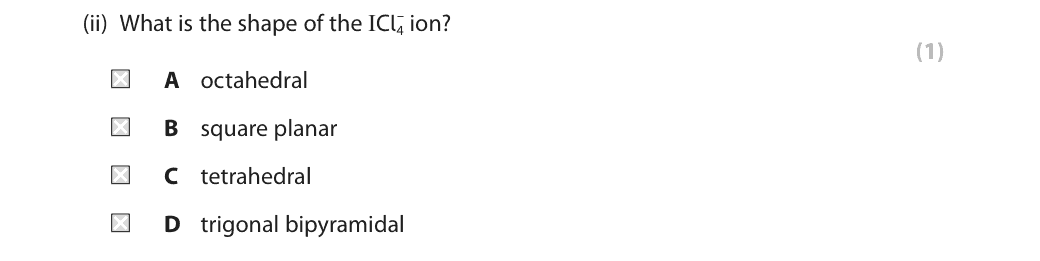
Answer: B (square planar). Iodine has four bond pairs and two lone pairs: six electron pairs arranged octahedrally with the lone pairs opposite each other. C ignores the lone pairs
Skills: MS4.1 Appreciate angles and shapes in regular 2D and 3D structures.
June 2023 · Paper 1 · Q46 marksExplanation
Mark scheme
Examiner's comment
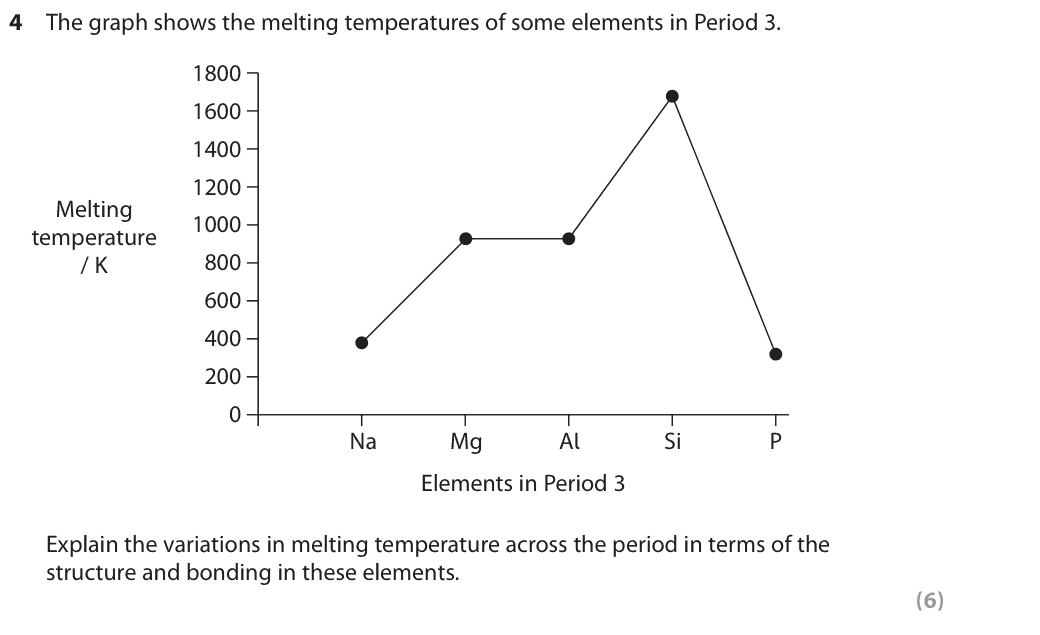
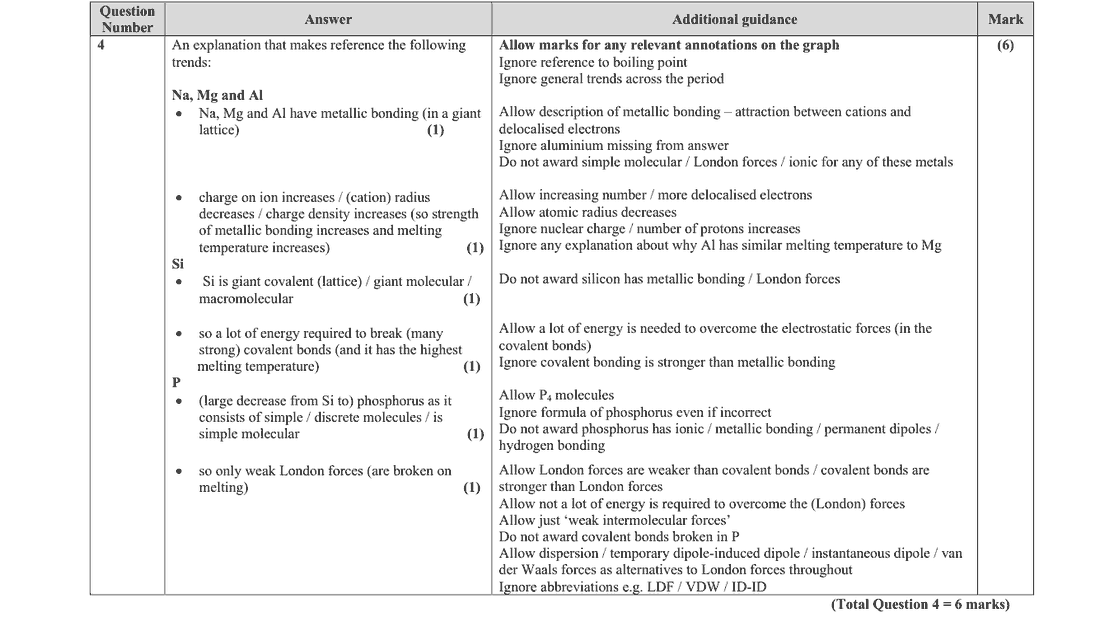
Candidates who had a good knowledge and understanding of how melting temperatures are affected by structure and bonding scored high marks for this question. Unfortunately, there were many candidates who did not understand structure and bonding and they used poor terminology, for example, referring to molecules of sodium. Many candidates referred to London forces in all of the elements. A significant minority thought that the weak covalent bonds in phosphorus would be broken when it melts and some thought that it had ionic bonding. Some candidates thought that melting temperature is affected by ionisation energy and they discussed how easy it is for those elements to lose an electron.
Notes from the mark scheme and report
Six marks, point marked (not an asterisk question). Na, Mg, Al: M1 metallic bonding (giant lattice)
M2 the charge on the ion increases / ionic radius decreases / more delocalised electrons, so the metallic bonding gets stronger. Si: M3 giant covalent lattice
M4 a lot of energy is needed to break the many strong covalent bonds, so the highest value. P: M5 simple molecular (P4 molecules)
M6 only weak London forces are overcome on melting. Annotations on the graph count. No credit for London forces or simple molecules in the metals, metallic bonding in silicon, or covalent bonds breaking in phosphorus
abbreviations such as LDF or VDW are ignored
ignore nuclear charge. Common errors: 'molecules of sodium'
London forces in every element
covalent bonds broken or ionic bonding in phosphorus
arguing from ionisation energy
Skills: MS3.1 Translate information between graphical, numerical and algebraic forms
June 2023 · AS Paper 1 · Q4(a)2 marksExplanation
Mark scheme
Examiner's comment
(a) Metallic bonding is reasonably well understood at this level with almost all candidates scoring the second mark but the significance of the structure, the giant lattice of positive ions and sea of delocalised electrons, was sometimes not discussed. (b) This calculation was well understood, and the correct value was often obtained, but the significant figures were very often not considered. There are two aspects to this, firstly the mathematical significance which candidates are now quite good at realising, but also the significance associated with the concept. In this case measuring a volume of concentrated acid to more than one decimal place is not practical. (c) A different way to ask a question about hazard warning labels proved quite challenging. All four possible answers were given. The correct answer was scored by only 14% of candidates. This meant that one or more of the alternative answers proved more popular than the correct answer, as candidates, very sensibly, rarely leave multiple choice questions blank.
Notes from the mark scheme and report
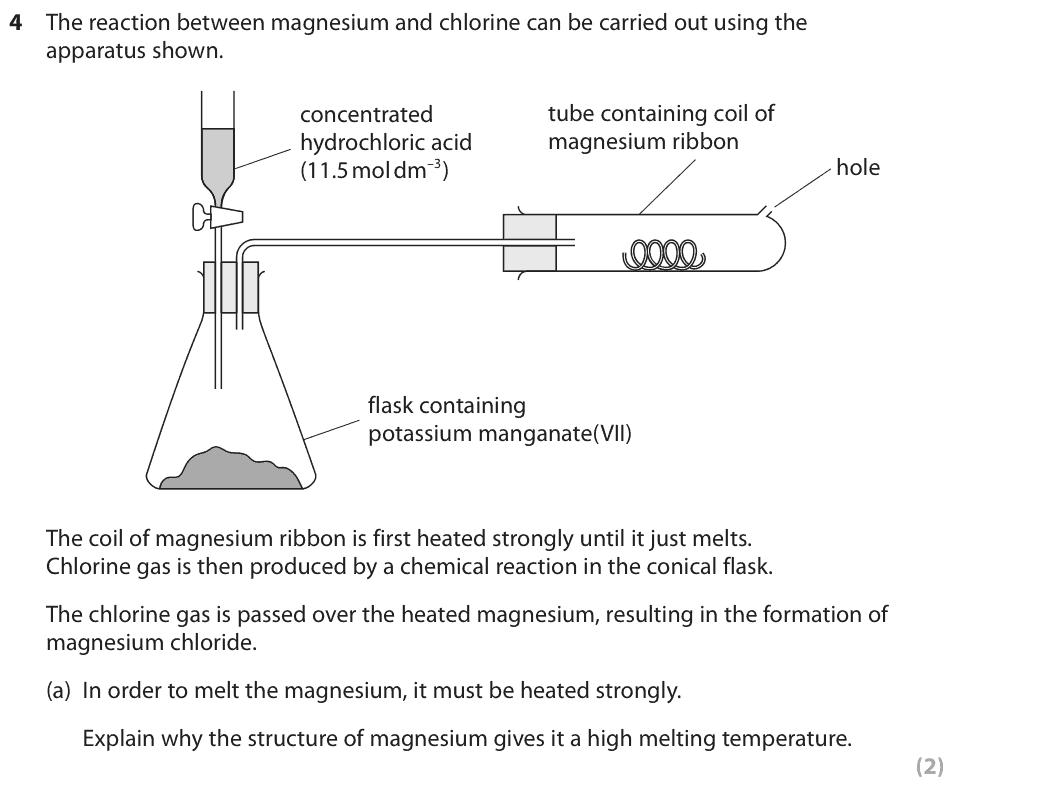
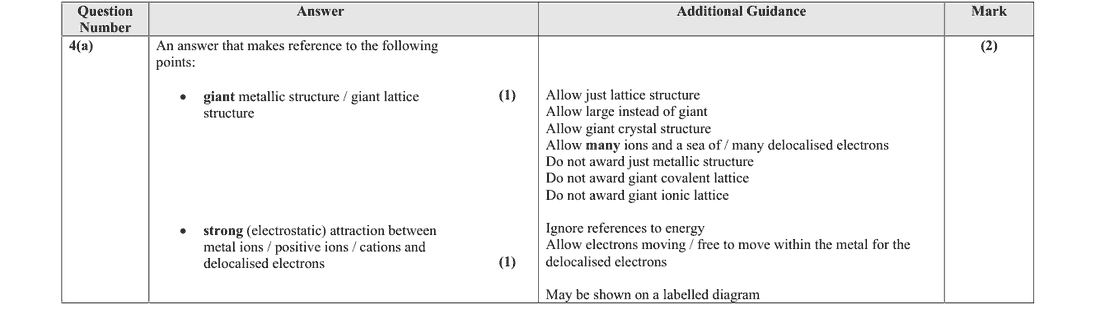
M1 giant metallic structure / giant lattice (allow 'many ions and a sea of delocalised electrons'
not just 'metallic structure'
not giant covalent or giant ionic). M2 strong (electrostatic) attraction between the positive metal ions and the delocalised electrons. A labelled diagram can score. Almost all scored M2
the giant structure was often not mentioned
June 2023 · AS Paper 1 · Q5(a)1 markShort answer
Mark scheme
Examiner's comment
(a) This question was correctly answered by just over half of candidates. (b) The majority of candidates either know the trend in electronegativity or used their data booklets to look up the trend in the values. Explanations often included comment on both the significant features of increasing distance from the nucleus and the increasing shielding, with many candidates quite rightly comparing these to the increasing charge on the nucleus. This was not required by the mark scheme for this item, but it was good to see. The concept of effective charge is still used quite regularly, but is still quite a difficult idea to get correct and some candidates would have been better to stick to a more straightforward approach. (c) Continuum of bonding has not often been examined quite as directly as it was in this paper, and candidates, perhaps because they had not seen this type of question before, found the wording of their answers quite challenging. There were many different approaches to the answer including those in the mark scheme. Some candidates were able to score one mark, but scoring two marks on this item was rare.
(d) Selecting appropriate examples of the idea of continuum of bonding from the available data proved quite difficult, with few candidates scoring all three marks. The idea that sodium chloride and magnesium chloride were metallically bonded was disappointingly common. Silicon tetrachloride was quite commonly thought to be a giant covalent structure, presumably confused with silicon dioxide or with silicon itself, even though it has a very low melting temperature. Identifying the properties of aluminium chloride as the intermediate structure was the biggest challenge. Those that did recognise the types of bonding present did not always say how these were demonstrated in the available data.
Notes from the mark scheme and report
The ability of an atom to attract the bonding (shared) pair of electrons in a covalent bond. 'An electron' instead of the pair / bonding electrons does not score. Just over half were correct
June 2023 · AS Paper 1 · Q5(c)2 marksShort answerHard
Mark scheme
Examiner's comment
(a) This question was correctly answered by just over half of candidates. (b) The majority of candidates either know the trend in electronegativity or used their data booklets to look up the trend in the values. Explanations often included comment on both the significant features of increasing distance from the nucleus and the increasing shielding, with many candidates quite rightly comparing these to the increasing charge on the nucleus. This was not required by the mark scheme for this item, but it was good to see. The concept of effective charge is still used quite regularly, but is still quite a difficult idea to get correct and some candidates would have been better to stick to a more straightforward approach. (c) Continuum of bonding has not often been examined quite as directly as it was in this paper, and candidates, perhaps because they had not seen this type of question before, found the wording of their answers quite challenging. There were many different approaches to the answer including those in the mark scheme. Some candidates were able to score one mark, but scoring two marks on this item was rare.
(d) Selecting appropriate examples of the idea of continuum of bonding from the available data proved quite difficult, with few candidates scoring all three marks. The idea that sodium chloride and magnesium chloride were metallically bonded was disappointingly common. Silicon tetrachloride was quite commonly thought to be a giant covalent structure, presumably confused with silicon dioxide or with silicon itself, even though it has a very low melting temperature. Identifying the properties of aluminium chloride as the intermediate structure was the biggest challenge. Those that did recognise the types of bonding present did not always say how these were demonstrated in the available data.
Notes from the mark scheme and report
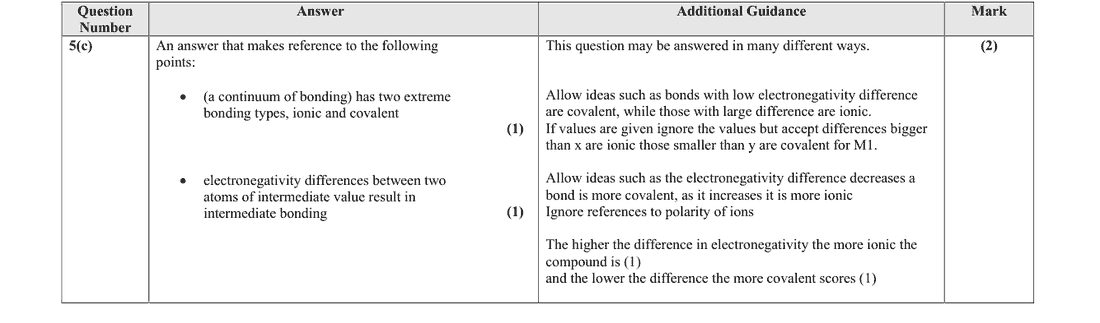
M1 the continuum has two extremes, ionic and covalent bonding (allow: a large electronegativity difference gives ionic, a small one covalent). M2 intermediate electronegativity differences give intermediate bonding (allow: the larger the difference the more ionic, the smaller the more covalent, which scores both marks). Any numerical cut-off values are ignored. Candidates found this hard to put into words
June 2023 · AS Paper 1 · Q5(d)3 marksExplanationHard
Earlier part of question 5 that this part uses
Mark scheme
Examiner's comment
(a) This question was correctly answered by just over half of candidates. (b) The majority of candidates either know the trend in electronegativity or used their data booklets to look up the trend in the values. Explanations often included comment on both the significant features of increasing distance from the nucleus and the increasing shielding, with many candidates quite rightly comparing these to the increasing charge on the nucleus. This was not required by the mark scheme for this item, but it was good to see. The concept of effective charge is still used quite regularly, but is still quite a difficult idea to get correct and some candidates would have been better to stick to a more straightforward approach. (c) Continuum of bonding has not often been examined quite as directly as it was in this paper, and candidates, perhaps because they had not seen this type of question before, found the wording of their answers quite challenging. There were many different approaches to the answer including those in the mark scheme. Some candidates were able to score one mark, but scoring two marks on this item was rare.
(d) Selecting appropriate examples of the idea of continuum of bonding from the available data proved quite difficult, with few candidates scoring all three marks. The idea that sodium chloride and magnesium chloride were metallically bonded was disappointingly common. Silicon tetrachloride was quite commonly thought to be a giant covalent structure, presumably confused with silicon dioxide or with silicon itself, even though it has a very low melting temperature. Identifying the properties of aluminium chloride as the intermediate structure was the biggest challenge. Those that did recognise the types of bonding present did not always say how these were demonstrated in the available data.
Notes from the mark scheme and report
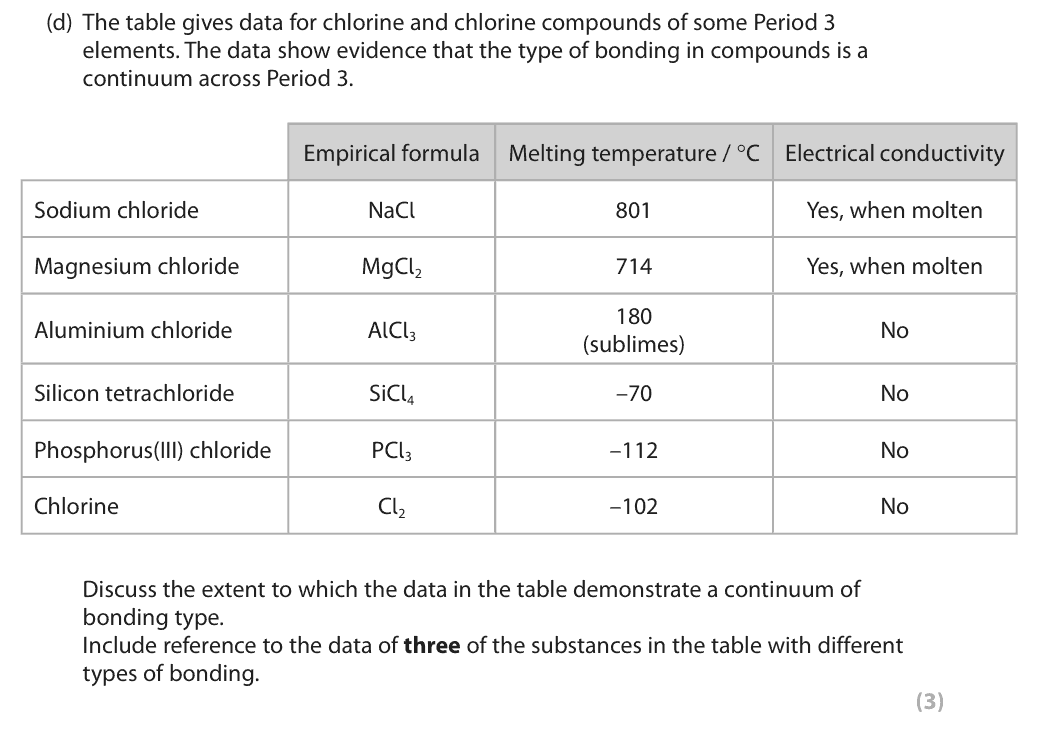
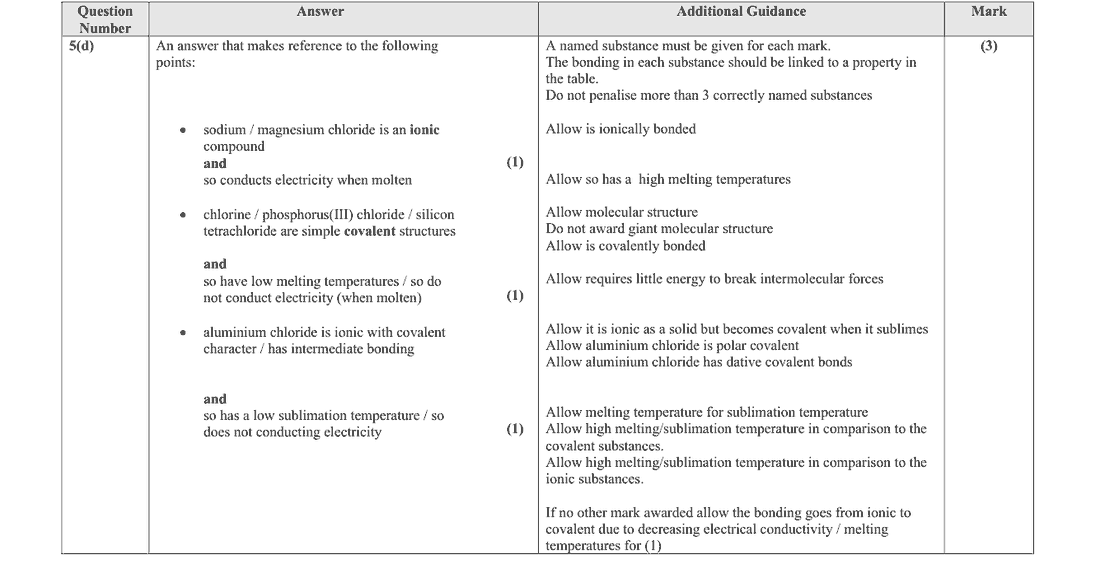
Each mark needs a named substance with its bonding linked to data in the table. M1 sodium chloride / magnesium chloride is ionic, so conducts when molten (or has a high melting temperature). M2 chlorine / PCl3 / SiCl4 are simple covalent (molecular), so have low melting temperatures / do not conduct. M3 aluminium chloride is intermediate (ionic with covalent character / polar covalent), shown by its low sublimation temperature / not conducting. If nothing else scores, 1 mark for 'bonding goes from ionic to covalent as conductivity / melting temperature falls'. Common errors: NaCl and MgCl2 called metallic
SiCl4 called giant covalent despite its low melting temperature
aluminium chloride was the hardest to place
June 2023 · Paper 1 · Q6(b)2 marksExplanationHard
Earlier part of question 6 that this part uses
Mark scheme
Examiner's comment
This question was quite poorly answered. Many candidates knew that the ionic radius of the sodium ions is less than that of the potassium ions, but they were then unable to deduce that there would be a stronger attraction between the sodium ion and the benzoate ion than between the potassium ion and the benzoate ion. Some candidates referred to the ionic radius of sodium benzoate and others referred to atomic radius, even though the question stated that these are ionic salts. Some discussed the attraction between the nucleus and the outer electron in sodium.
A significant minority discussed polarisation of the benzoate ion, although they were not penalised for this.
Notes from the mark scheme and report
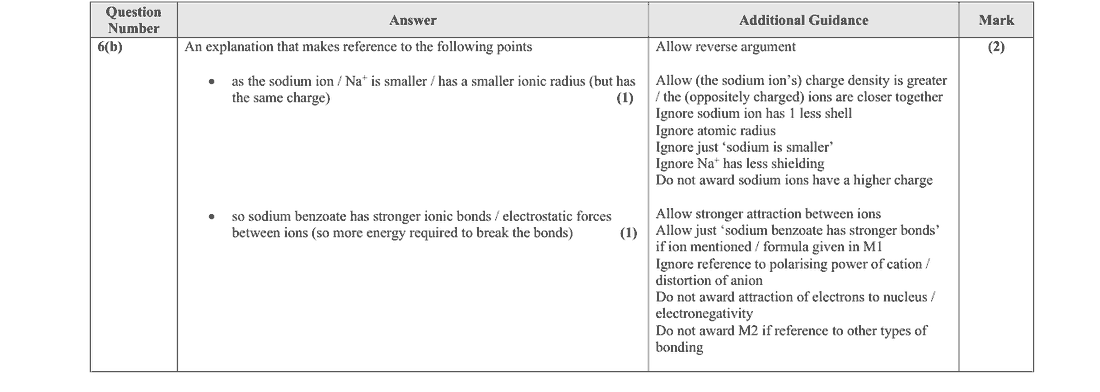
M1: the sodium ion is smaller than the potassium ion (same charge
higher charge density
ions closer together). M2: so the ionic bonds / electrostatic attraction between the ions are stronger in sodium benzoate and need more energy to break. Ignore atomic radius, 'sodium is smaller', shielding, and polarisation of the anion
not 'sodium ions have a higher charge'
not attraction between nucleus and electrons
no M2 if another type of bonding is named. Many gave the size of the ions but could not go on to the stronger attraction
some wrote of the 'ionic radius of sodium benzoate' or of atomic radius
June 2023 · AS Paper 1 · Q7(a)1 markDiagram or structure
Mark scheme
Examiner's comment
(a) A disappointing proportion of candidates drew diagrams of covalently bonded molecules. A few drew the correct electronic structures but swapped around the charges on the ions. Surprisingly only 65% of candidates were able to draw this straightforward dot-and-cross diagram correctly. (b) The main challenge here was to recognise that the three smaller ions were isoelectronic, and then deduce their relative size based on the number of protons in the nucleus. Some candidates relied heavily on their knowledge of the change in ion size down a group, which of course worked well in identifying bromide as a larger ion than chloride ion, and across a period. This gave those candidates a good chance of recognising the relative size of calcium and potassium ions but was not helpful with comparing these to chlorine and bromine. As mentioned earlier the idea of effective charge is a difficult one, lacking clarity and explanation, and generally was not helpful in this question. The best candidates, however, gave very clear and well written answers which clearly explained the relative sizes of the ions.
(c) This question scored well.
Notes from the mark scheme and report
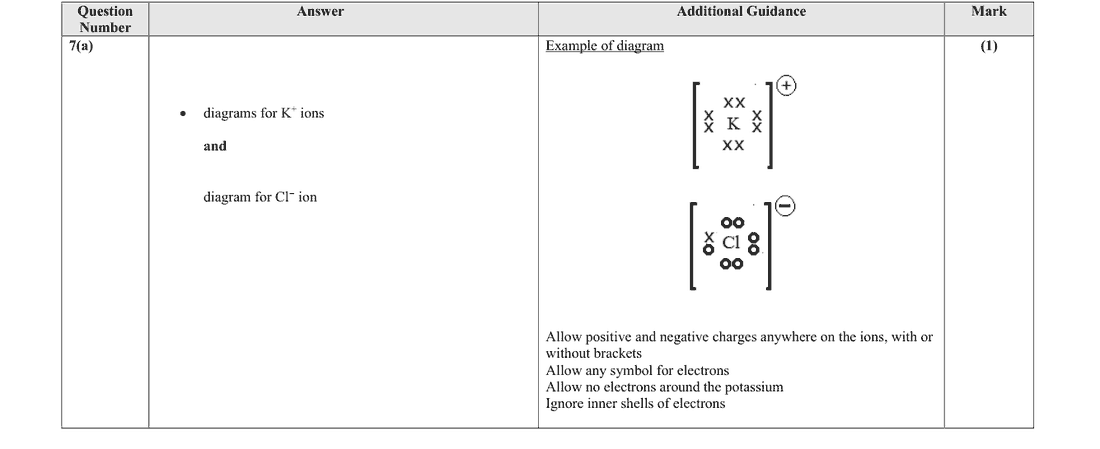
K+ with eight outer electrons (or none shown) and Cl– with eight outer electrons, one of them shown as coming from potassium
charges anywhere, with or without brackets. Any symbols for the electrons
inner shells ignored. 65% correct
a disappointing number drew a covalent molecule and a few swapped the charges
June 2023 · AS Paper 1 · Q7(b)4 marksExplanation
Mark scheme
Examiner's comment
(a) A disappointing proportion of candidates drew diagrams of covalently bonded molecules. A few drew the correct electronic structures but swapped around the charges on the ions. Surprisingly only 65% of candidates were able to draw this straightforward dot-and-cross diagram correctly. (b) The main challenge here was to recognise that the three smaller ions were isoelectronic, and then deduce their relative size based on the number of protons in the nucleus. Some candidates relied heavily on their knowledge of the change in ion size down a group, which of course worked well in identifying bromide as a larger ion than chloride ion, and across a period. This gave those candidates a good chance of recognising the relative size of calcium and potassium ions but was not helpful with comparing these to chlorine and bromine. As mentioned earlier the idea of effective charge is a difficult one, lacking clarity and explanation, and generally was not helpful in this question. The best candidates, however, gave very clear and well written answers which clearly explained the relative sizes of the ions.
(c) This question scored well.
Notes from the mark scheme and report
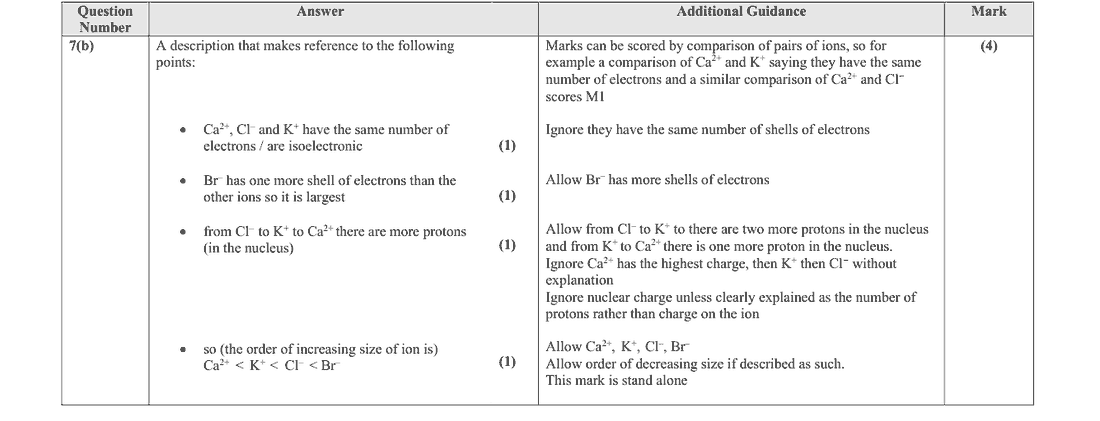
Answer: Ca2+ < K+ < Cl– < Br– (stand-alone mark). M1 Ca2+, K+ and Cl– have the same number of electrons (isoelectronic)
M2 Br– has one more shell of electrons so is the largest
M3 from Cl– to K+ to Ca2+ the number of protons increases (so the electrons are held more closely). 'Same number of shells', and ionic charge quoted without explanation, are ignored. Candidates who relied on group and period trends could not compare the cations with the anions
'effective charge' arguments rarely helped
June 2023 · Paper 1 · Q10(a)1 markDiagram or structure
Mark scheme
Examiner's comment
The majority of candidates could draw a correct dot-and-cross diagram for an oxygen molecule. A small number of candidates did not include a double covalent bond and some showed three lone pairs of electrons on each oxygen.
Notes from the mark scheme and report
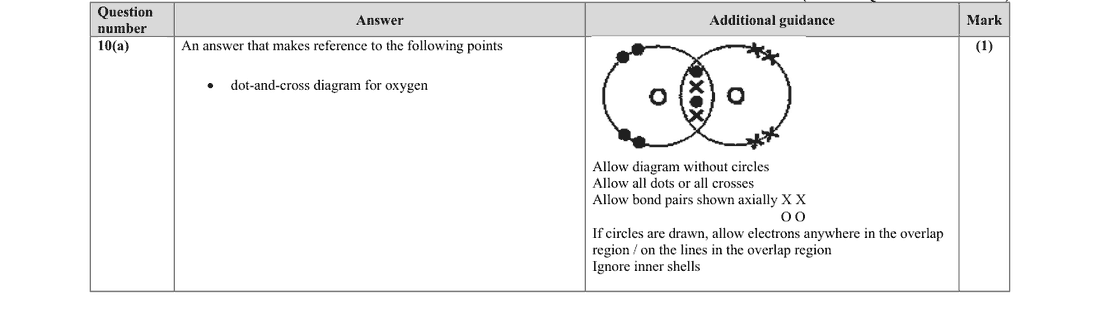
Two shared pairs (a double bond) between the oxygen atoms and two lone pairs on each. All dots or all crosses allowed
circles not needed. Errors: no double bond
three lone pairs on each oxygen
June 2023 · Paper 1 · Q10(b)4 marksExplanation
Earlier part of question 10 that this part uses
Mark scheme
Examiner's comment
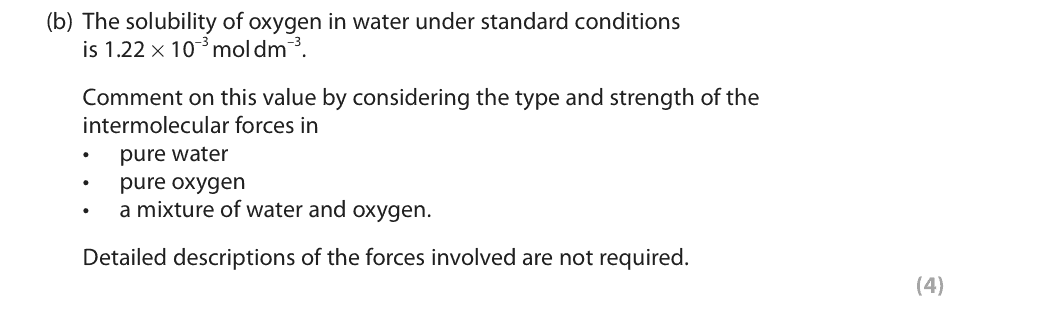
Many candidates could identify the intermolecular forces present in pure water and in pure oxygen. Only a minority of candidates referred to the low solubility of oxygen in water and deduced that there must only be London forces between oxygen and water molecules. Some
candidates thought that the value of 1.22 x 10⁻³ mol dm-3 indicates a high solubility.
Notes from the mark scheme and report
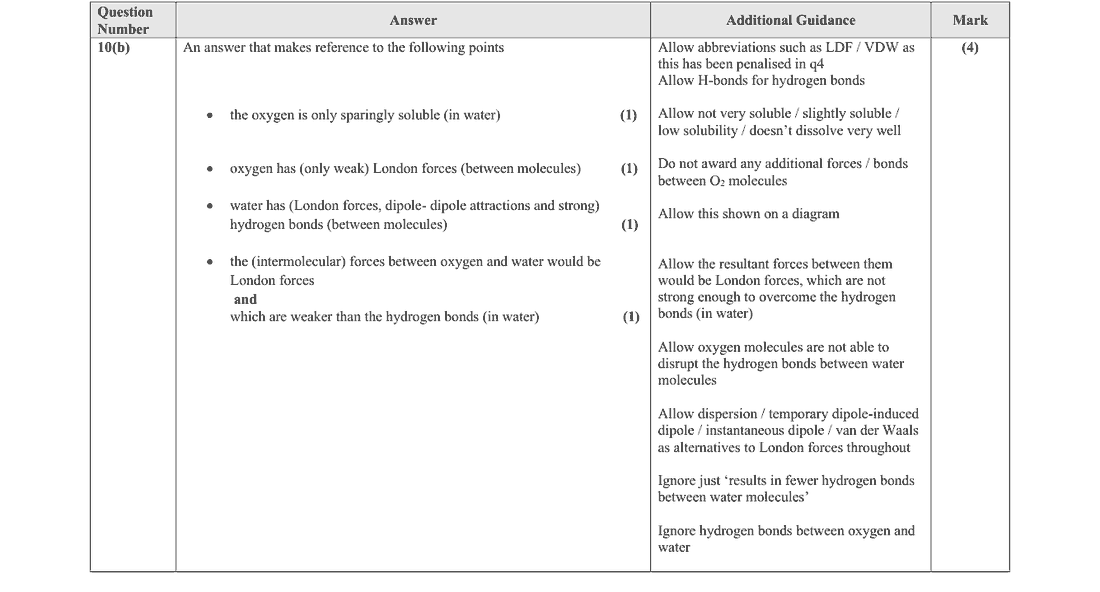
M1: oxygen is only sparingly soluble in water (the value is small). M2: oxygen has only (weak) London forces between its molecules. M3: water has hydrogen bonds between its molecules. M4: the forces between oxygen and water molecules would be London forces, which are weaker than (cannot overcome) the hydrogen bonds in water. Ignore hydrogen bonds between oxygen and water. Many identified the forces in the two pure substances
only a minority commented on the low solubility and the forces in the mixture
some read 1.22 × 10^–3 mol dm–3 as a high solubility
June 2023 · AS Paper 2 · Q7(a)1 markMultiple choice
Answer
C
Mark scheme
Notes from the mark scheme and report
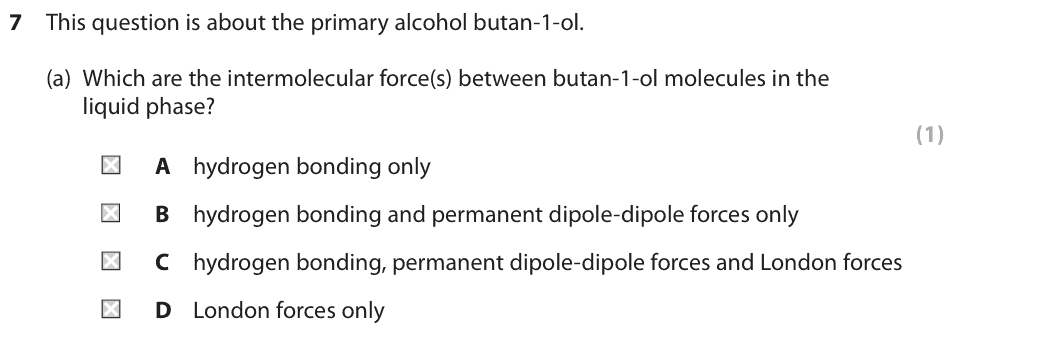
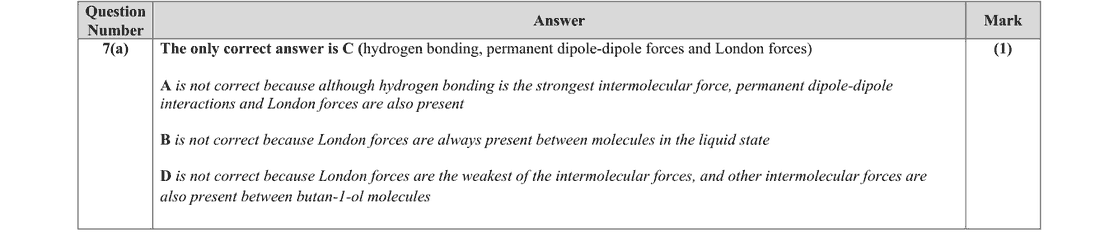
Answer: C. Hydrogen bonding, permanent dipole–dipole forces and London forces are all present
London forces always act between molecules
June 2023 · Paper 3 · Q3(c)2 marksDiagram or structure
Earlier part of question 3 that this part uses
Mark scheme
Examiner's comment
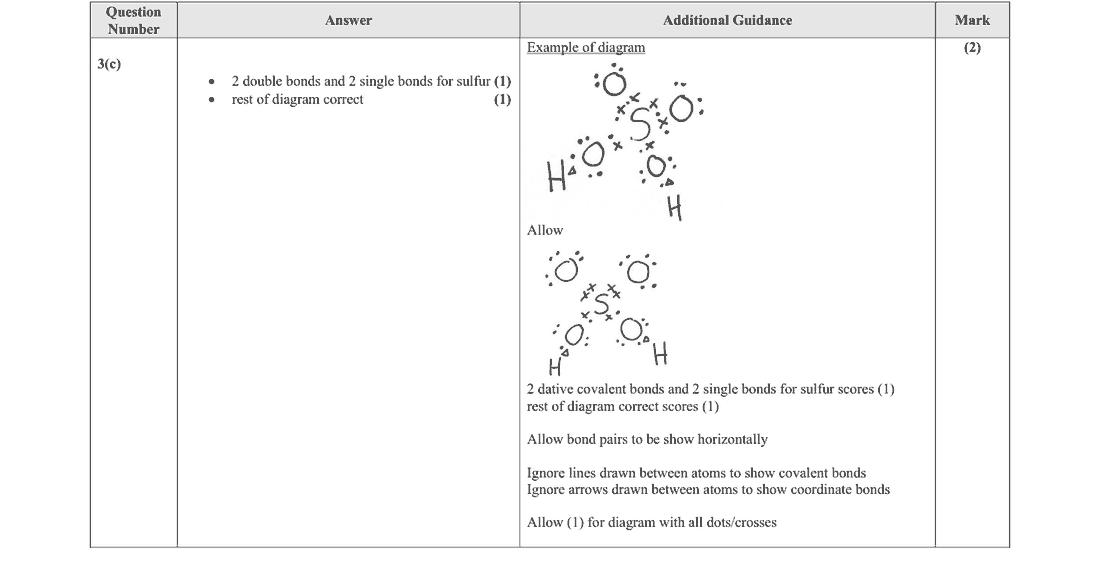
Many scored one mark for the electron pairs around the sulfur, but the second mark for a completely correct diagram was seen less often.
Notes from the mark scheme and report
Sulfur with two double bonds (to two O atoms) and two single bonds (to the two O–H oxygens): 1 mark
rest of the diagram correct, with lone pairs on oxygen and O–H bonds: 1 mark. Version with two dative bonds and two single bonds allowed. All dots or all crosses scores 1. Many got the pairs round sulfur
a fully correct diagram was less common
June 2022 · Paper 1 · Q3(e)(i)1 markMultiple choice
Earlier part of question 3 that this part uses
Answer
C
Mark scheme
Notes from the mark scheme and report
Answer: C. HF is much the highest because of hydrogen bonding
then the boiling temperature rises from HCl to HBr to HI as the number of electrons, and so the London forces, increase. A has HF lowest
B falls from HF to HI
D has HI above HF and HBr below HCl
Skills: MS3.1 Translate information between graphical, numerical and algebraic forms
June 2022 · Paper 1 · Q4(a)1 markMultiple choice
Answer
A
Mark scheme
Notes from the mark scheme and report
Answer: A. Ionic bonding is the attraction between oppositely charged ions (anions and cations). C describes metallic bonding and D covalent bonding
June 2022 · Paper 1 · Q4(b)2 marksShort answer
Earlier part of question 4 that this part uses
Mark scheme
Examiner's comment
This question required candidates to know the colours of the transition metal ions in
aqueous solutions and then to work out which ion migrated to each electrode. The Cu2+ ion
would migrate to the negative electrode and give a blue colour, whereas the CrO42- ion
would migrate to the positive electrode and give a yellow colour. Many candidates knew that one of the colours that would be seen would be blue, although they did not always identify the correct electrode. Fewer candidates knew the correct colour of the chromate ion, with answers of green or orange seen relatively frequently.
Notes from the mark scheme and report
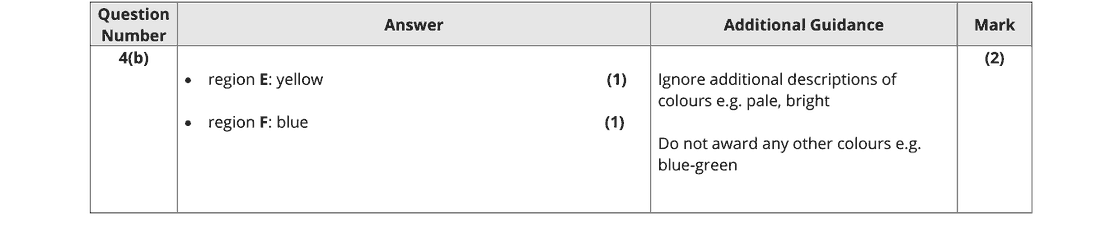
Answer: E yellow
F blue. Chromate(VI) ions, CrO4 2–, are yellow and move to the positive electrode (E)
Cu2+ ions are blue and move to the negative electrode (F). No other colours (not blue-green). Many knew blue but put it at the wrong electrode
green or orange was often given for chromate
June 2022 · Paper 1 · Q4(c)1 markShort answer
Earlier part of question 4 that this part uses
Mark scheme
Examiner's comment
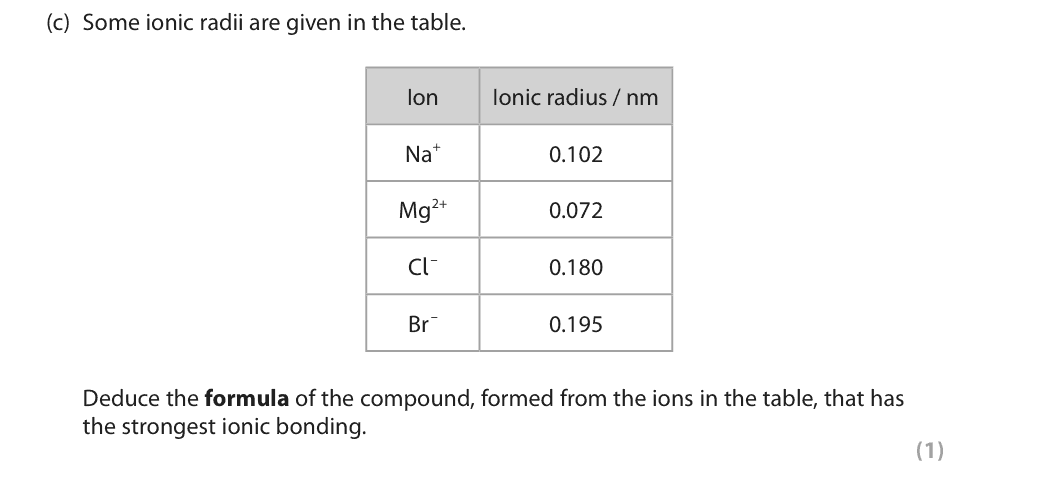
The question required the candidates to apply their knowledge of factors that affect the strength of an ionic bond and to select appropriate ions from a table that would form a compound with the strongest ionic bonding. Candidates would be expected to know that the smaller the ion, the stronger the bond and the larger the charge, the stronger the bond and
therefore to select Mg2+ and Cl- from the table. They then had to combine these into the appropriate formula. Most candidates, if they correctly selected the ions then derived the correct formula of MgCl2
Notes from the mark scheme and report
Answer: MgCl2. The smallest and most highly charged cation (Mg2+) with the smaller anion (Cl–) gives the strongest ionic bonding. Not MgCl
June 2022 · Paper 1 · Q4(e)6 marks6-mark extended response
Mark scheme, with the indicative content and the marks for reasoning
Examiner's comment
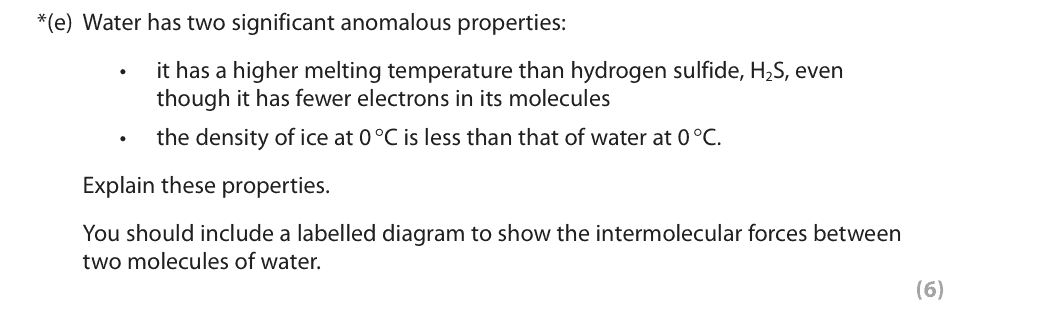
This question assessed the candidate's knowledge of factors that affect the properties of water compared to hydrogen sulfide. Many candidates recognised that there was hydrogen bonding present in water and most made an attempt at a diagram to show the hydrogen bonding present between two water molecules. To score the marks for the diagram it was necessary to show the dipoles, the lone pair on the oxygen that was joined to the second
molecule by the hydrogen bond, and for the bond angle to be 180o. The most common feature that was omitted was the lone pair on the oxygen. The next step in the answer was to consider the factors causing the difference in the melting temperature of the molecules. Most candidates noted that the hydrogen bonding in water would be stronger than the intermolecular forces between hydrogen sulfide molecules. Fewer picked up on the information about the number of electrons in each molecule and linked it to the fact that there would be stronger London forces between hydrogen sulfide molecules. The final step
was to explain why ice had a lower density than water at 0oC. Many candidates scored just one of the two marks for commenting that in ice the water molecules were arranged in a hexagonal lattice with spaces in the structure with fewer noting that liquid water would be more dense as the molecules were closer together. Some candidates mixed up their comments for these two points, saying that ice would be more dense than water.
Notes from the mark scheme and report
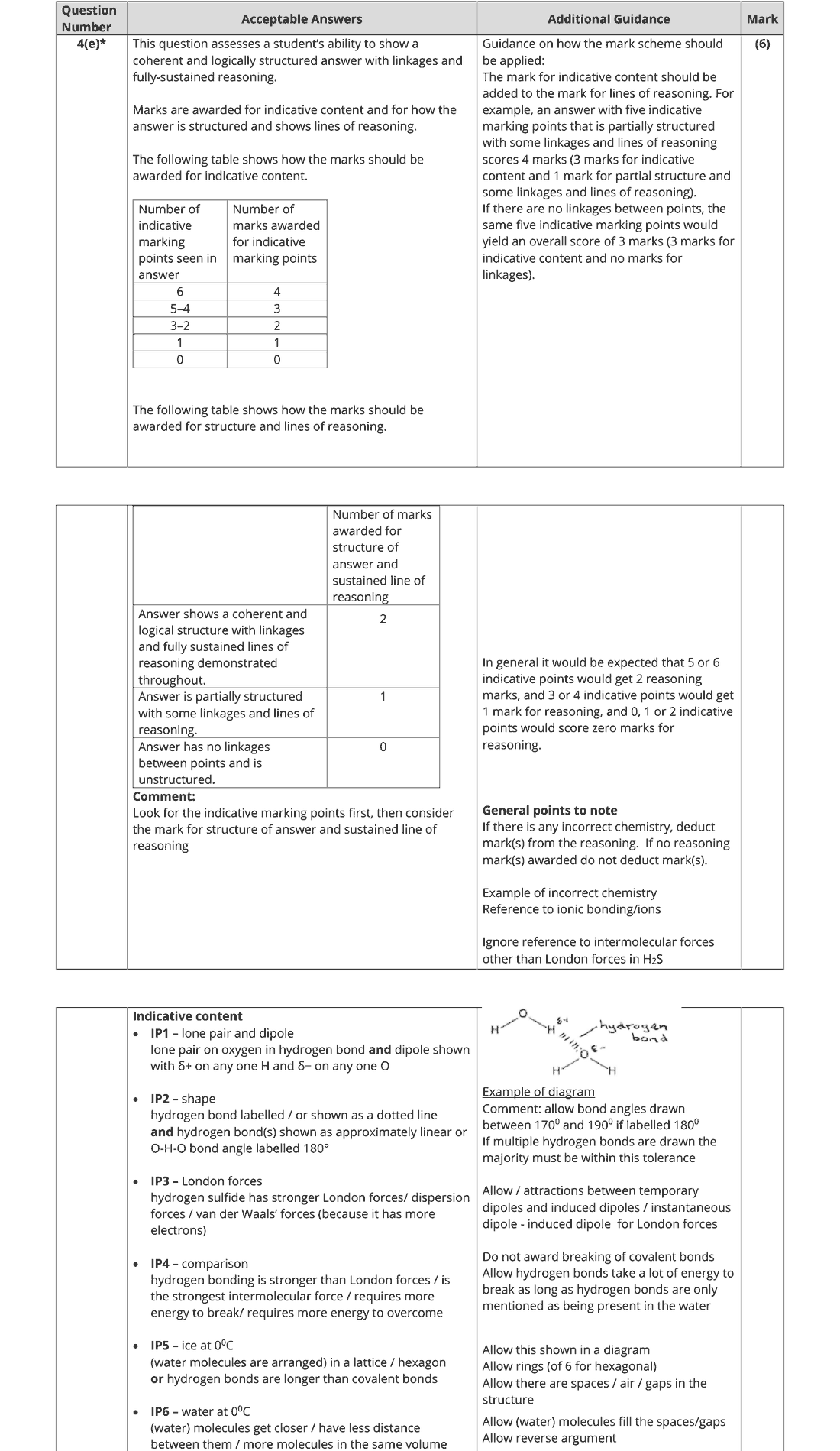
Six indicative points plus two marks for reasoning. IP1 diagram with a lone pair on the oxygen in the hydrogen bond, and δ+ on H and δ– on O
IP2 the hydrogen bond labelled or dotted, and drawn about linear (O–H---O 180°)
IP3 hydrogen sulfide has stronger London forces (more electrons)
IP4 but hydrogen bonding is stronger than London forces / needs more energy to overcome
IP5 in ice the molecules are held in an open lattice (hexagonal rings) with spaces
IP6 in liquid water the molecules are closer together. Reasoning marks are lost for ionic bonding or breaking covalent bonds. Most often missing: the lone pair on oxygen
the stronger London forces in H2S
that molecules are closer in liquid water. Some said ice is denser than water
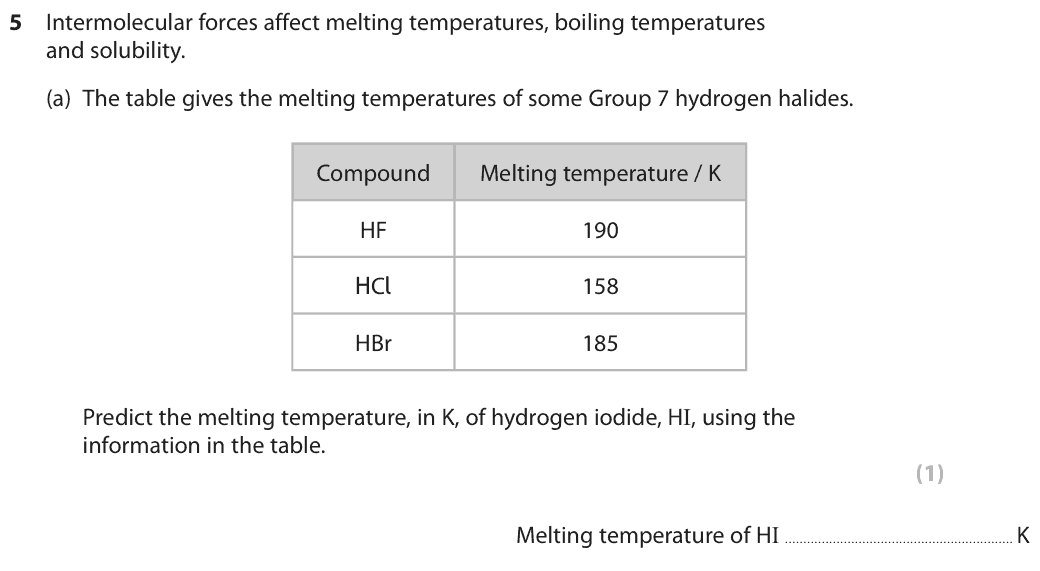
June 2022 · AS Paper 1 · Q5(a)1 markShort answer
Mark scheme
Examiner's comment
This question required the student to identify a melting temperature trend from the data provided and also to recognise that hydrogen bonding would not be significant factor in the melting temperature of HI, as it is for HF.
Notes from the mark scheme and report
Answer: 222 K
any value from 200 to 240 K is accepted. The trend from HCl to HBr rises (more electrons, stronger London forces), so HI is higher than HBr
HF is out of line because of hydrogen bonding and should not be used for the trend
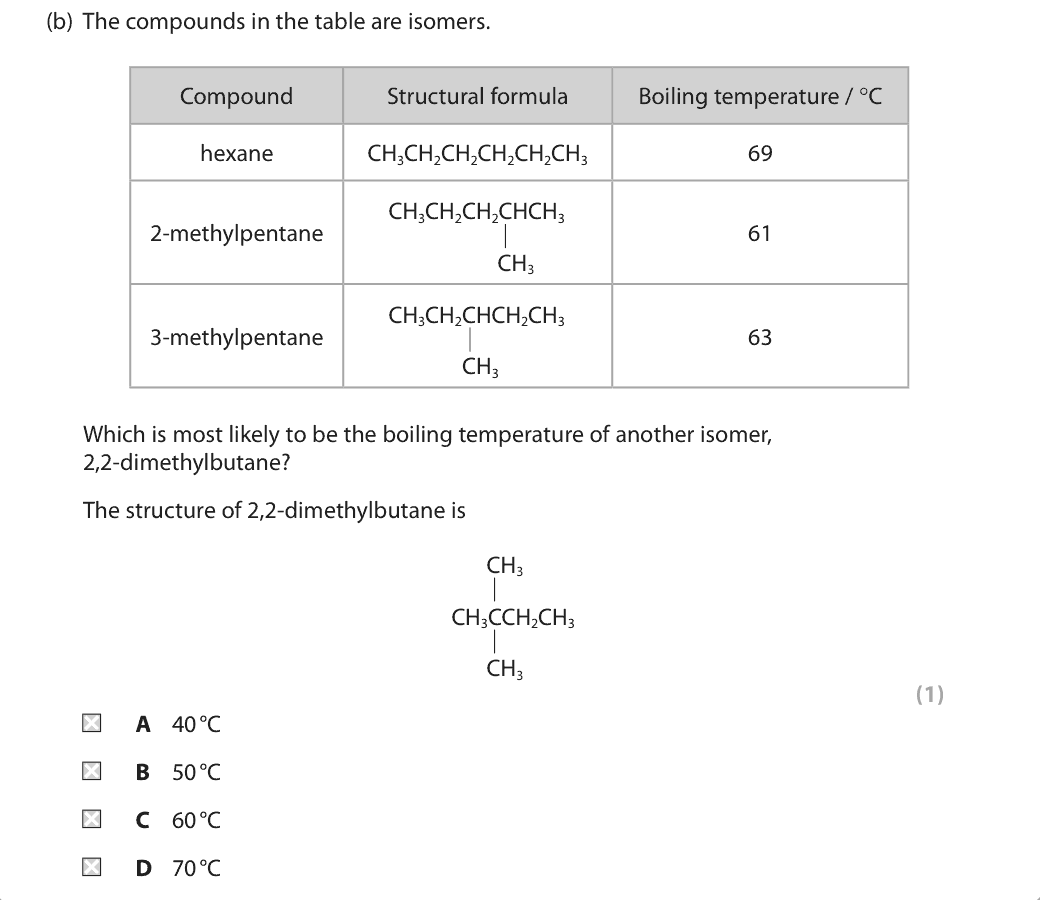
June 2022 · AS Paper 1 · Q5(b)1 markMultiple choice
Earlier part of question 5 that this part uses
Answer
B
Mark scheme
Examiner's comment
This question required students to recognise the effect of branching and the shape of molecules generally on boiling temperatures. The structure of the
target molecule was provided to avoid testing the ability to relate names to structure in the same question. Some answers implied that some students had been seduced by the similarity in the boiling temperatures of the isomers shown in the table. The effect of branching had been ignored in these responses.
Notes from the mark scheme and report
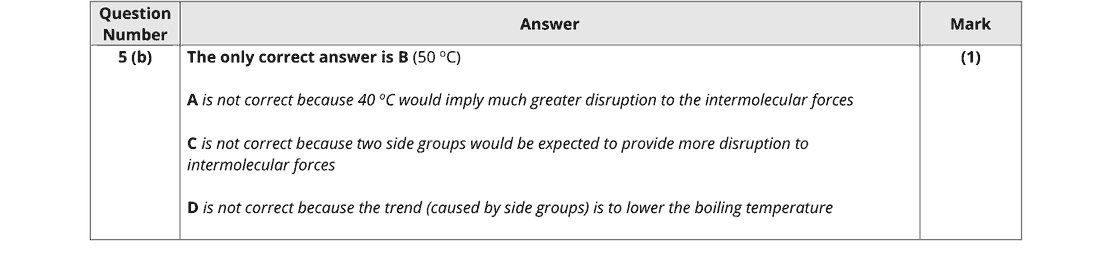
Answer: B. More branching means less surface contact between molecules and weaker London forces, so a lower boiling temperature: one branch lowers it to 61–63 °C, and two branches should lower it further, to about 50 °C. C is too close to the single-branch isomers
D is higher than hexane
A implies a much bigger disruption
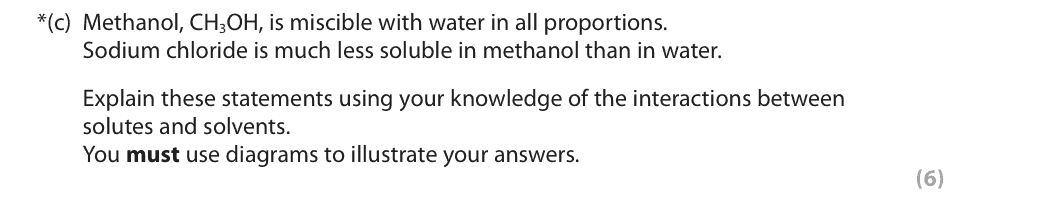
June 2022 · AS Paper 1 · Q5(c)6 marks6-mark extended response
Earlier part of question 5 that this part uses
Mark scheme, with the indicative content and the marks for reasoning
Examiner's comment
This question was the free response item in this paper. As expected, it provided a wide range of marks, ranging from those who chose not to attempt it to well-constructed answers that were awarded full marks. Given the length of the typical response to this item, legibility was a significant factor in some scripts. The question tested the student’s ability to recognise when hydrogen bonding can occur and the ability of ionic compounds to dissolve by forming hydrated ions in water. Some students failed to provide diagrams in spite of an instruction to do so and space that had clearly been provided on the paper. Many scored IP1, recognising that hydrogen bonding occurs between water and methanol. For IP2, the diagram of hydrogen bonding required a clear approximation to bond angle for the H-bond, or an equivalent statement in the text. This was absent from some responses – usually the diagram was inaccurately drawn. Some students thought, erroneously, that the hydrogen atoms in methanol’s methyl group could take part in hydrogen bonding. IP3 related to a comparison of the strength of bonding in methanol and water and a mixture of the two, or to a statement of hydrogen bonding in methanol and water separately. IP3 was less commonly scored. IP4 and IP5 related to the solvation of sodium and chloride ions. The terms ‘solvation’ or ‘hydration’ were rarely used but there were sometimes accurate descriptions, however there were many acceptable diagrams. IP6 required an explanation, in terms of the relative strength of bonding, of why sodium chloride is relatively insoluble in methanol. This marking point was rarely scored. Students should be aware that a dotted line conventionally means a hydrogen bond, similarly a solid line conventionally means a covalent bond; in this question a line between Na and Cl implies a covalent bond. In general terms, relatively few answers were well constructed. Many were a jumble of ideas, lacking continuity and, in several scripts, the writing was very difficult to read.
Notes from the mark scheme and report
Indicative points: hydrogen bonding between water and methanol
a suitable diagram of it (the O–H---O angle about 180°, shown or stated)
these hydrogen bonds are of comparable strength to those in water or methanol alone, or hydrogen bonding is present in both liquids
Na+ and Cl– ions are hydrated (both ions must be clear)
a suitable diagram of at least one hydrated ion (any dipoles shown must be right)
the ionic bonding in sodium chloride is stronger than the attraction between the ions and methanol. Many scored the first point
the third was less common
the sixth was rarely scored. Errors: no diagrams
hydrogen bonds drawn from the methyl hydrogens
a line between Na and Cl (implies a covalent bond)
few well-constructed answers
June 2022 · Paper 1 · Q7(b)2 marksDiagram or structure
Mark scheme
Examiner's comment
The question required candidates to draw a dot-and-cross diagram to show the bonding in chromate (VI) ions. Many fully correct answers were seen, some with symbols to depict the origin of the electrons, although this was not required. Errors included missing electrons on the oxygens and additional electrons on the chromium.
Notes from the mark scheme and report
Either two Cr=O double bonds and two Cr–O single bonds as dots and crosses (1), with four more electrons on each double-bonded oxygen and six more on each single-bonded oxygen, one of them a different symbol on two oxygens for the extra electrons of the 2– charge (1). Or two single bonds and two dative bonds from chromium (1), with six more electrons on each oxygen (1). Second mark depends on the first
extra electrons on chromium penalised
brackets and charge ignored. Common errors: electrons missing from the oxygens
extra electrons on chromium
June 2022 · AS Paper 1 · Q7(c)(i)1 markDiagram or structureHard
Earlier part of question 7 that this part uses
Mark scheme
Examiner's comment
Most students struggled with this dot-and-cross diagram, although it was made easier by allowing diagrams with all dots/all crosses etc. However, students should be aware that examiners will sometimes require the origin of the electrons to be identified. Common errors:
absence of any double bond inclusion of two or three double bonds, ie to more than one oxygen
atom. absence of non-bonding electrons on one, two or three oxygen atoms some (usually two) nitrogen electrons not involved in bonding absence of the ‘extra’ electron (which should be present because the
nitrate ion is negative)
Notes from the mark scheme and report
Nitrogen with one double bond, one single bond and one dative bond to the three oxygens
all oxygens with full outer shells
the extra electron present (24 outer electrons in all). All dots or all crosses allowed
the double bond can be to any oxygen
lone-pair electrons may be separated. Common errors: no double bond
two or three double bonds
missing lone pairs on oxygen
nitrogen electrons not used in bonding
the extra electron left out
June 2022 · Paper 2 · Q2(b)2 marksExplanation
Mark scheme
Examiner's comment
It was pleasing to see only a few answers referred to the breaking of covalent bond instead of intermolecular forces. Many candidates appreciated that branching reduces the strength of the London forces between the molecules because of the decreased surface area contact.
Notes from the mark scheme and report
Branching gives weaker / fewer London forces
because there is less surface area / fewer points of contact between molecules (cannot pack as closely). Reverse argument accepted. Just 'intermolecular forces' ignored
not 'fewer electrons'
no marks if covalent bonds are broken. Only a few wrote about breaking covalent bonds
June 2022 · Paper 2 · Q4(b)2 marksDiagram or structure
Mark scheme
Examiner's comment
It was disappointing that many candidates did not follow the clear instructions in the question for the use of symbols to represent the sodium and the nitrogen electrons. Whilst it is true that electrons from different atoms are indistinguishable, it is a well-established convention that different symbols are used in order to show clearly where such originate.
The nitrogen molecule was more often drawn correctly and the mode was 2 marks so many candidates did well on this question.
Notes from the mark scheme and report
Nitrogen molecule: three shared pairs (triple bond) and one lone pair on each atom. Nitride ion: eight outer electrons, five dots (nitrogen) and three crosses (from sodium). Brackets and charge on the ion not required. Many did not use the dots and crosses as instructed
the nitrogen molecule was more often correct
June 2022 · Paper 2 · Q4(c)4 marksExplanation
Mark scheme
Examiner's comment
Many answered this well with the mode being 4 and the overall mean being 2.48
The provision of blank space was there for candidates to include diagrams and invariably these helped the candidates who drew them. However diagrams were not essential and all four marks could be obtained through prose. Nonetheless it often proved to be harder for candidates to score all marks since it is seemed easier to annotate both diagrams with shapes and bond angles than to include both in a written answer.
It was surprising that a sizeable number of candidates thought that ammonia is trigonal planar. A further significant number of candidates incorrectly stated ammonia was trigonal bi-pyramidal. In addition some candidates got slightly confused with their bond angles as
evidenced by ammonia being given as 107.5o and the ammonium ion as 109o instead of 107o
and 109.5o.
Notes from the mark scheme and report
Stand-alone mark: the lone pair in ammonia repels more than the bonding pairs. Then six points (6 for 3 marks, 4 or 5 for 2, 2 or 3 for 1): ammonia has three bond pairs and one lone pair
ammonium has four bond pairs
ammonia is (trigonal) pyramidal
ammonium is tetrahedral
107° in ammonia
109.5° in ammonium. Labelled diagrams accepted. Errors: ammonia called trigonal planar or trigonal bipyramidal
107.5° and 109°
Skills: MS4.1 Appreciate angles and shapes in regular 2D and 3D structures.
June 2022 · Paper 2 · Q5(a)2 marksShort answerEasy
Mark scheme
Examiner's comment
It was pleasing that the vast majority of candidates understood this practical demonstration and almost all candidates could give a suitable estimate of the density of the oil, with many explaining their logic lucidly. The less able candidates failed to explain why the density was in between the two given densities.
Notes from the mark scheme and report
Answer: any value between 0.92 and 1.00 g cm–3
because the oil floats on water (water is the bottom layer, so denser than the oil) and ice floats on the oil (so ice is less dense than the oil). The justification must refer to the layers. Weaker candidates did not explain why the value lies between the two densities
June 2022 · Paper 3 · Q2(a)(ii)3 marksExplanation
Earlier part of question 2 that this part uses
Mark scheme
Examiner's comment
The majority of candidates knew that complex ions with six ligands are octahedral, although incorrect terms such as octagonal, hexagonal and hexahedral were seen. Fewer candidates were able to explain the shape in terms of the number of pairs of electrons and the idea of minimising repulsion between them. Some candidates just wrote about six ligands or bonds and did not refer to the bond pairs and some wrote about lone pair-lone pair repulsion being greater than bond pair-bond pair repulsion, even though that was not relevant here. A few candidates were confused and wrote about minimum separation and maximum repulsion. Candidates should revise the names of the basic shapes of molecules and ions and the reasons why they are these shapes.
Notes from the mark scheme and report
Six (dative) bonding pairs of electrons around the cobalt ion
the electron pairs are arranged to minimise repulsion (as far apart as possible)
so the shape is octahedral. No mention of lone pairs on the cobalt
not octagonal. Bond angles ignored. Most knew octahedral but fewer explained it: 'six ligands' or 'six bonds' without bond pairs, irrelevant lone pair repulsion, 'minimum separation'
Skills: MS4.1 Appreciate angles and shapes in regular 2D and 3D structures.
November 2021 · Paper 1 · Q3(a)2 marksShort answer
Mark scheme
Examiner's comment
The description of metallic bonding in part (a) proved to be an opportunity for most candidates
to score at least one mark with about half of all resposnes referring to the electrostatic
attraction between the metal cations and the delocalised ‘sea’ of electrons. One mistake seen
was the reference to the attraction between the positively-charged nuclei and the electrons
which reflected a misunderstanding of the situation. Another mistake was the omission of the
“electrostatic atttraction” between the cations and electrons which could have been more of a
lack of understanding of the question demand rather than the situation. A significant number
of candidates gave a drawing of metallic bonding which was acceptable. A point worthy of note
is that there should be an approximately equal number of electrons to that of the positive
charges on the metal ions. Occasionally an excessive number of either electrons or cations was
seen.
It was evident that the three stages of the heterogenous catalyst required in (b) had been
taught effectively as they were generally well-described. It was pleasing to see very few
references to ‘absorption’. The most noteworthy error was reference to incorrect gases being
formed by the catalytic converter. Nitrogen dioxide was frequently seen and often stated to be
a harmless gas which is incorrect.
Notes from the mark scheme and report
M1: metal cations (positive ions) in a 'sea' of delocalised electrons
an annotated diagram is accepted, with roughly equal numbers of positive charges and electrons. M2: metallic bonding is the strong electrostatic attraction between the cations and the delocalised electrons. Ignore 'free' electrons
not molecules. Most scored at least one
about half gave the electrostatic attraction. Errors: attraction between 'positive nuclei' and electrons
leaving out the attraction altogether
far too many electrons or cations in the diagram
November 2021 · AS Paper 1 · Q3(a)(ii)3 marksDiagram or structure
Earlier part of question 3 that this part uses
Mark scheme
Examiner's comment
This question concerned the shape of ammonia molecules and the amide ion. 3(a)(i) This balanced equation was approached with confidence and some good answers were seen. 3(a)(ii) The diagrams were less well understood than the equation, with the wrong numbers of lone pairs of electrons quite common. 3(a)(iii)-(iv) The bond angles formed by the two species was relatively well known by those candidates that knew the numbers of lone pairs, with candidates recognising the pattern of 2.5 degree reductions in bond angle with each additional lone pair of electrons. 3(b) This was a challenging item with few candidates able to suggest that the sodium amide would react vigorously with water or oxygen.
Notes from the mark scheme and report
M1: ammonia drawn in 3-D with one or two wedges or one or two dotted / dashed bonds. M2: amide ion with two bonds clearly not at 180° to each other. M3: one lone pair on nitrogen in ammonia and two on the amide ion. Charge and brackets not needed. A wrong number of lone pairs was quite common
Skills: MS4.1 Appreciate angles and shapes in regular 2D and 3D structures.; MS4.2 Visualise and represent 2D and 3D forms including two- dimensional representations of 3D objects
November 2021 · AS Paper 1 · Q3(a)(iii)1 markMultiple choice
Earlier part of question 3 that this part uses
Answer
B
Mark scheme
Examiner's comment
This question concerned the shape of ammonia molecules and the amide ion. 3(a)(i) This balanced equation was approached with confidence and some good answers were seen. 3(a)(ii) The diagrams were less well understood than the equation, with the wrong numbers of lone pairs of electrons quite common. 3(a)(iii)-(iv) The bond angles formed by the two species was relatively well known by those candidates that knew the numbers of lone pairs, with candidates recognising the pattern of 2.5 degree reductions in bond angle with each additional lone pair of electrons. 3(b) This was a challenging item with few candidates able to suggest that the sodium amide would react vigorously with water or oxygen.
Notes from the mark scheme and report
Answer: B (107°). Three bonding pairs and one lone pair. A (104.5°) is for two bonding and two lone pairs
C (109.5°) for four bonding pairs
D (120°) for three bonding pairs and no lone pair
Skills: MS4.1 Appreciate angles and shapes in regular 2D and 3D structures.
November 2021 · AS Paper 1 · Q3(a)(iv)2 marksExplanation
Earlier part of question 3 that this part uses
Mark scheme
Examiner's comment
This question concerned the shape of ammonia molecules and the amide ion. 3(a)(i) This balanced equation was approached with confidence and some good answers were seen. 3(a)(ii) The diagrams were less well understood than the equation, with the wrong numbers of lone pairs of electrons quite common. 3(a)(iii)-(iv) The bond angles formed by the two species was relatively well known by those candidates that knew the numbers of lone pairs, with candidates recognising the pattern of 2.5 degree reductions in bond angle with each additional lone pair of electrons. 3(b) This was a challenging item with few candidates able to suggest that the sodium amide would react vigorously with water or oxygen.
Notes from the mark scheme and report
The H–N–H angle is smaller in the amide ion (104.5° / 105°)
because it has two lone pairs, which repel the bonding pairs more than the single lone pair in ammonia (allow lone pair–lone pair repulsion is greater than lone pair–bonding pair). Those who knew the numbers of lone pairs generally knew the 2.5° reduction per lone pair
Skills: MS4.1 Appreciate angles and shapes in regular 2D and 3D structures.
November 2021 · AS Paper 1 · Q4(c)(i)2 marksDiagram or structure
Earlier part of question 4 that this part uses
Mark scheme
Examiner's comment
Questions were about ionisation energy requiring consideration of the attraction between the nucleus of the atom or ion and the electron being removed. This is affected by the number of protons in the nucleus, the distance of the electron from the nucleus, the number of shells of elctrons repelling or shielding the electron and whether the electron is alone in an orbital or paired with another electron with opposite spin. Some of these factors will be the same when comparing the ionisation energy of two different atoms or ions. 4(a)(i) This multiple choice question was well answered. 4(a)(ii) In this question, the key feature was the increased shielding and distance of the electron from the nucleus. 4(a)(iii) Candidates who were able to identify the importance of the number of protons in the nucleus in a comparison of first ionisation energies of sulfur and chlorine scored well. 4(a)(iv) It was the pairing of electrons in an orbital which explained the ionisation energy difference. 4(b) This calculation provided considerable challenge with relatively few candidates able to work their way to the final answer. 4(c) The graph, which was expected to be familiar to candidates, proved quite challenging. The use of a suitable scale and plotting of points in 4(c)(i) was well attempted, but the estimation of melting temperature in 4(c)(ii) proved more challenging.
Notes from the mark scheme and report
M1: the four known points (8, 273), (34, 207), (52, 224), (84, 238) plotted to within one square. M2: an x-axis scale chosen so the points cover at least half the grid in both directions. Lines joining the points are ignored. Scale and plotting were well attempted
Skills: MS3.2 Plot two variables from experimental or other data
November 2021 · AS Paper 1 · Q4(c)(ii)1 markShort answer
Earlier parts of question 4 that this part uses
Mark scheme
Examiner's comment
Questions were about ionisation energy requiring consideration of the attraction between the nucleus of the atom or ion and the electron being removed. This is affected by the number of protons in the nucleus, the distance of the electron from the nucleus, the number of shells of elctrons repelling or shielding the electron and whether the electron is alone in an orbital or paired with another electron with opposite spin. Some of these factors will be the same when comparing the ionisation energy of two different atoms or ions. 4(a)(i) This multiple choice question was well answered. 4(a)(ii) In this question, the key feature was the increased shielding and distance of the electron from the nucleus. 4(a)(iii) Candidates who were able to identify the importance of the number of protons in the nucleus in a comparison of first ionisation energies of sulfur and chlorine scored well. 4(a)(iv) It was the pairing of electrons in an orbital which explained the ionisation energy difference. 4(b) This calculation provided considerable challenge with relatively few candidates able to work their way to the final answer. 4(c) The graph, which was expected to be familiar to candidates, proved quite challenging. The use of a suitable scale and plotting of points in 4(c)(i) was well attempted, but the estimation of melting temperature in 4(c)(ii) proved more challenging.
Notes from the mark scheme and report
Answer: any value below 200 K but above 170 K (actual value 188 K). May be given as a point on the graph or a number in the table. The estimate follows the trend of H2Se, H2Te and H2Po back, not the anomalous value for water. Found harder than the plotting
Skills: MS3.1 Translate information between graphical, numerical and algebraic forms
November 2021 · AS Paper 1 · Q7(a)2 marksShort answer
Mark scheme
Examiner's comment
7(a) Candidates were able to recall the definition of an ionic bond and so scored marks here. 7(b) This multiple choice item also scored relatively well. 7(c) These multiple choice questions also proved accessible to many candidates, with the answer to (c)(ii) proving the most straightforward. 7(d) This proved very challenging with few candidates scoring any marks for the idea that solutions containing Group 2 metal ions would give precipitates on addition of, for example, sodium hydroxide or sodium sulfate. The action of heat on a nitrate was understood a little better.
Notes from the mark scheme and report
(Strong) electrostatic attraction
between oppositely charged ions. Candidates were able to recall this definition
November 2021 · Paper 1 · Q7(a)1 markShort answer
Mark scheme
Examiner's comment
The reasoning required in part (a) is challenging and this question was targetting the more able
and this proved to be the case. The only MS alternative seen was the reference to the
difference in the bond polarity between the carbon-hydrogen bond and the oxygen-hydrogen
bond.
Misunderstandings of the term ‘acid-conjugate base pair’ was evident in a significant number of
candidates chosing distractor D (H2O – NH4+). Dilution tasks such as part (c) can prove
challenging for candidates but many correctly carried out the calculation and it was pleasing
that there was little evidence of candidates being perturbed by the resultant negative pH.
The calculation of the pH of the weak acid in (d) was generally done well and the majority of
candidates knew the necessary assumptions. A common error was to give two statements of
the same assumption by referring to the hydrogen ions and the acid salt concentrations were
the same and to add that the ionisation of water was negligible. This is the reasoning behind
the concentrations being equal and so such answers only scored 1 mark.
The pH calculation of the buffer in part (e)(i) was often incorrect because of a failure to read the
question correctly. The introduction stated that the buffer was made from simply mixing the
acid and its conjugate base or salt. This is not the situation where the buffer is made by the
partial neutralisation of the weak acid and which therefore requires a substraction to
determine the concentration of the weak acid.
The explanation of the action of a buffer in (e)(ii) was poorly answered. The question stated an
equation or equations were required and the most common one seen was for the partial
ionisation of the weak acid. This equation is useful in the general explantion of buffer action
but more is needed to illustrate the effect of addition of a base. The equations which did
include sodium hydroxide or hydroxide ions did not always make chemical ‘sense’ as they were
often unbalanced for atoms, for charge or for both. Some candidates gave the equation for the
reaction between hydrogen ions and the hydroxide ions from the base which was allowed with
some explanation. However, it is worth emphasising that the weak acid is in a much higher
concentration that the hydrogen ions, so it is a much better answer to refer to the weak acid
reacting with the base.
Notes from the mark scheme and report
One of: the carboxylate ion left when the O–H hydrogen is lost is stabilised by delocalisation of its charge
loss of H+ from the methyl group would leave a carbanion with no such stabilisation
carbon and hydrogen have similar electronegativities so the C–H bond is not polar, whereas the O–H bond is polar
the hydration enthalpy of the ions outweighs the energy needed to break the O–H bond. Not 'the O–H bond is weaker than the C–H bond'. A demanding question aimed at the most able
bond polarity was the only alternative seen
November 2021 · AS Paper 2 · Q5(c)1 markDiagram or structure
Mark scheme
Examiner's comment
The chemistry in this question, concerning the combustion of fossil fuels, was quite basic.
(a) This should have been an easy question at this level, requiring recall of the formulae of
methane, carbon monoxide and water.
(b)(i) This was a question involving application of basic chemical principles to an unfamiliar
situation, the combustion of fossil fuels
(b)(ii) This question also supplied candidates with information that they were required to apply to
an unfamiliar situation. In this instance they were asked to interpret two (given) equations that are
relevant in flue gas desulfurisation
(c) It was expected that the dot and cross diagram of sulfur dioxide would provide a challenge for
candidates. It was, however, answered well and many candidates were successful in scoring the
mark.
Notes from the mark scheme and report
Sulfur in the middle with a double bond (two shared pairs) to each oxygen and one lone pair on sulfur, each oxygen with two lone pairs
or one S=O double bond and one dative bond from sulfur to the other oxygen, which then has three lone pairs. All dots or all crosses allowed
no three-electron S–O bonds. The report says this was answered better than expected
November 2021 · Paper 2 · Q5(c)(ii)2 marksExplanation
Earlier parts of question 5 that this part uses
Mark scheme
Examiner's comment
In (a) many candidates mistook the ester group for a carbonyl / ketone group, so could only
score a maximum of one mark. Others focused on the left of the structure and omitted the
alkene group. In (b) the hint of ‘a chemical reaction’ seemed to be missed by many, who
framed there response exclusively around the idea of hydrogen bonds with water. Those
candidates who realised a hydrolysis reaction could occur, not all linked it to the ester
functional group. In (c)(i) fractional distillation was correctly suggested by nearly all
candidates. In (b) the majority recognised that X had the ability to form hydrogen bonds, but
some missed out on the first mark as they didn’t link this statement to a structural feature on
compound X. Others, however, made a comparison to the London forces in a similar
hydrocarbon, so were able to access both marks. Despite the stem making it clear the
hydrocarbon had a similar mass and shape to compound X, it was fairly common to see
answers trying make the point that compound X had greater London forces.
Notes from the mark scheme and report
Either: the OH groups in X can form hydrogen bonds
so more energy is needed to break the intermolecular forces / vaporise X. Or: hydrocarbons have only London forces but X also has hydrogen bonds
hydrogen bonds are stronger than London forces. Breaking covalent bonds loses the second mark. Some did not link hydrogen bonding to the OH groups
others claimed X has stronger London forces although the mass and shape are similar
November 2021 · Paper 2 · Q6(a)2 marksDiagram or structure
Mark scheme
Examiner's comment
The unfamiliar ‘dot and cross’ diagram in (a) was interesting in the sense that there didn’t
seem to be a correlation between ability on the rest of the paper, and gaining credit here. It
was common to see a double bond between the carbon and the oxygen, with candidates then
either leaving the carbon atom electron deficient or incorrectly introducing additional
electrons.
The very familiar atom economy calculation in (b) was accessible to the majority, perhaps not
surprising as it also forms part of the GCSE specification. The manipulation of data to find an
activation energy was more challenging in (c). The best candidates processed the data
successfully, nearly always using the simple method of finding the difference in ln rate and
the difference in 1/T. However, a significant number simply inputted a set of data into the
expression, but then did not realise how to deal with the constant, c. A small number of
candidates, with high levels of numeracy, were able to put both sets of data into the Arrhenius
equation, cancel out the constant and hence derive the activation energy. In (d) many
candidates could deduce the order with respect to haemoglobin in (i). The increased demand
of having to process a change in two variables to find the order with respect to carbon
monoxide led to many candidates ignoring the change in haemoglobin concentration. Hence,
the mark for the justification of first order tended to discriminate effectively at the higher
boundaries. The allowance of transferred error marks in (iii) and (iv) allowed resilient
candidates to gain credit, though surprisingly some candidates struggled to rearrange their
equation to find k.
Notes from the mark scheme and report
Triple bond of three shared pairs, one of them dative (both electrons from oxygen)
plus one lone pair on C and one on O. One mark if the electron count is right but all dots or all crosses. The common error was a double bond, leaving carbon short of electrons or adding extra ones
November 2021 · AS Paper 2 · Q7(b)3 marksExplanation
Earlier part of question 7 that this part uses
Mark scheme
Examiner's comment
This was a question about the solubility of alcohols in water.
(a) This slightly oblique question asked about a homologous series. Whilst it was clear that most
candidates knew what was meant by the term ‘homologous series’, many found it difficult to
express their understanding in writing, without ambiguity.
(b) This question explored the candidates’ understanding of intermolecular forces, specifically the
hydrogen bonding that allows methanol to dissolve in water. It was expected that students would
use diagrams to explain and there was in instruction to this effect, however, some students chose
to ignore the instruction and struggled with a written description.
Notes from the mark scheme and report
M1 methanol forms hydrogen bonds with water (any mention scores)
M2 a diagram with at least one lone pair on the relevant oxygen and an O–H---O angle of about 180°
M3 the intermolecular forces between methanol and water are about as strong as (or stronger than) those in water alone and in methanol alone. Some ignored the instruction to include a diagram and struggled with a written description
November 2021 · Paper 3 · Q3(b)(i)1 markDiagram or structure
Mark scheme
Examiner's comment
The vast majority of candidates completed the electronic configuration of an aluminium atom,
with just a small number including electrons in d orbitals. The dot-and-cross diagram for
aluminium chloride was shown clearly by many candidates, although some included a lone
pair of electrons on the aluminium atom and others showed ions. The shape and bond angle
of aluminium chloride were correct in many responses, but some candidates did not use their
dot-and-cross diagram to help and others suggested shapes with a different number of
atoms, e.g. tetrahedral which would show the presence of four chlorine atoms. The
mechanism for the alkylation of benzene was answered well by many candidates, with slips
such as not starting and ending curly arrows in the correct places or poorly drawn
intermediate. Some candidates would benefit with much more practise at drawing organic
mechanisms accurately. Many candidates seemed unfamiliar with how two aluminium
chloride molecules join together to form a dimer and many bonds between aluminium atoms
were seen. Some candidates knew that dative covalent bonding was involved but some
showed the lone pair of electrons donated from an aluminium atom to a chlorine atom.
Notes from the mark scheme and report
Three bonding pairs between Al and the three Cl atoms, each Cl with three lone pairs, and no lone pair on Al (six electrons round aluminium). All dots or all crosses allowed. Errors: a lone pair on Al
drawing ions
November 2021 · Paper 3 · Q3(b)(ii)2 marksShort answer
Earlier part of question 3 that this part uses
Mark scheme
Examiner's comment
The vast majority of candidates completed the electronic configuration of an aluminium atom,
with just a small number including electrons in d orbitals. The dot-and-cross diagram for
aluminium chloride was shown clearly by many candidates, although some included a lone
pair of electrons on the aluminium atom and others showed ions. The shape and bond angle
of aluminium chloride were correct in many responses, but some candidates did not use their
dot-and-cross diagram to help and others suggested shapes with a different number of
atoms, e.g. tetrahedral which would show the presence of four chlorine atoms. The
mechanism for the alkylation of benzene was answered well by many candidates, with slips
such as not starting and ending curly arrows in the correct places or poorly drawn
intermediate. Some candidates would benefit with much more practise at drawing organic
mechanisms accurately. Many candidates seemed unfamiliar with how two aluminium
chloride molecules join together to form a dimer and many bonds between aluminium atoms
were seen. Some candidates knew that dative covalent bonding was involved but some
showed the lone pair of electrons donated from an aluminium atom to a chlorine atom.
Notes from the mark scheme and report
Answer: trigonal planar (both words
triangular allowed)
120°. Marked independently
pyramidal with 107° scores the angle mark only. Some did not use their dot-and-cross diagram, or gave shapes for a different number of atoms such as tetrahedral
Skills: MS4.1 Appreciate angles and shapes in regular 2D and 3D structures.
November 2021 · Paper 3 · Q3(c)(i)1 markDiagram or structure
Mark scheme
Examiner's comment
The vast majority of candidates completed the electronic configuration of an aluminium atom,
with just a small number including electrons in d orbitals. The dot-and-cross diagram for
aluminium chloride was shown clearly by many candidates, although some included a lone
pair of electrons on the aluminium atom and others showed ions. The shape and bond angle
of aluminium chloride were correct in many responses, but some candidates did not use their
dot-and-cross diagram to help and others suggested shapes with a different number of
atoms, e.g. tetrahedral which would show the presence of four chlorine atoms. The
mechanism for the alkylation of benzene was answered well by many candidates, with slips
such as not starting and ending curly arrows in the correct places or poorly drawn
intermediate. Some candidates would benefit with much more practise at drawing organic
mechanisms accurately. Many candidates seemed unfamiliar with how two aluminium
chloride molecules join together to form a dimer and many bonds between aluminium atoms
were seen. Some candidates knew that dative covalent bonding was involved but some
showed the lone pair of electrons donated from an aluminium atom to a chlorine atom.
Notes from the mark scheme and report
Two AlCl3 units joined through two bridging chlorine atoms (each bridging Cl bonded to both Al atoms), so each Al has four bonds. Arrows and lone pairs need not be shown. Many drew Al–Al bonds
Skills: MS4.2 Visualise and represent 2D and 3D forms including two- dimensional representations of 3D objects
November 2021 · Paper 3 · Q3(c)(ii)1 markShort answer
Earlier part of question 3 that this part uses
Mark scheme
Examiner's comment
The vast majority of candidates completed the electronic configuration of an aluminium atom,
with just a small number including electrons in d orbitals. The dot-and-cross diagram for
aluminium chloride was shown clearly by many candidates, although some included a lone
pair of electrons on the aluminium atom and others showed ions. The shape and bond angle
of aluminium chloride were correct in many responses, but some candidates did not use their
dot-and-cross diagram to help and others suggested shapes with a different number of
atoms, e.g. tetrahedral which would show the presence of four chlorine atoms. The
mechanism for the alkylation of benzene was answered well by many candidates, with slips
such as not starting and ending curly arrows in the correct places or poorly drawn
intermediate. Some candidates would benefit with much more practise at drawing organic
mechanisms accurately. Many candidates seemed unfamiliar with how two aluminium
chloride molecules join together to form a dimer and many bonds between aluminium atoms
were seen. Some candidates knew that dative covalent bonding was involved but some
showed the lone pair of electrons donated from an aluminium atom to a chlorine atom.
Notes from the mark scheme and report
Answer: dative (covalent) / coordinate bond. May be labelled on the diagram in (i)
not awarded if the dative arrows in (i) start from aluminium. Some showed the lone pair donated from Al to Cl
November 2021 · Paper 3 · Q6(a)(ii)2 marksExplanationHard
Earlier part of question 6 that this part uses
Mark scheme
Examiner's comment
Some candidates gave clear and concise explanations for why phenol can be nitrated using
milder conditions than benzene while others seemed unfamiliar with this concept or gave
partial answers. Some referred to the lone pair of electrons on the OH group rather than the
oxygen atom. Many candidates struggled to explain the difference in boiling temperatures of
the two isomers and did not refer to intermolecular forces as requested in the question.
Many answers did not mention hydrogen bonding. Many candidates knew that a reducing
agent is needed to convert 4-nitrophenol into 4-aminophenol, although some did not read the
question and gave a specific reagent rather than the type of reagent. There were many poor
diagrams drawn for filtration under reduced pressure, with folded filter paper and no
perforations in the Buchner funnel. Most candidates would benefit from more practise in
drawing clear labelled diagrams of the common practical techniques in the specification. A
few candidates gave clear descriptions of the recrystallisation procedure, but most put steps
in the wrong order, missed out steps such as hot filtration and were generally confused. A
common error in producing dry crystals was to suggest adding an anhydrous salt as a drying
agent. Although this works well for drying liquids as it is easy to separate the substances, it
does not work for drying crystals unless the drying agent is specified as being in a desiccator.
Many candidates knew that impurities lower the melting temperature of a substance and it
will melt over a range of temperatures rather than having a sharp melting point, but many
omitted one of these from their answer. Many candidates were able to work out the
molecular formula of paracetamol but quite a lot had an incorrect number of hydrogen atoms
and some candidates were not aware of the meaning of molecular formula. The calculation in
(d)(ii) was carried out correctly by many candidates. Some omitted to use the mole ratio and
others omitted the use of a 100.0 cm3 volumetric flask. Some candidates calculated a mass
higher than the original 0.500 g of paracetamol and reversed the percentage calculation to
obtain a value less than 100%. These candidates should be advised to check their working to
see where they have made an error instead of doing this.
Notes from the mark scheme and report
Both form hydrogen bonds
in 4-nitrophenol the hydrogen bonds are between molecules (at opposite ends, giving chains, so stronger intermolecular forces), whereas 2-nitrophenol forms intramolecular hydrogen bonds between the adjacent OH and NO2 groups, so has fewer intermolecular hydrogen bonds. Can be shown in diagrams. Many did not refer to intermolecular forces or mention hydrogen bonding at all
October 2020 · Paper 1 · Q3(a)4 marksExplanation
Mark scheme
Examiner's comment
Most candidates had some knowledge of metallic structure, and the candidates with an eye
for written detail and who took care with any diagrams where able to score full marks.
Probably the most common issue with diagrams was inconsistencies with the number of
electrons shown. For instance the ion would be shown as Cr3+, but too few electrons where
then evident in the diagram. Written answers did not always refer to the regular arrangement
/ lattice of ions, hence without a diagram to support the comments, the first mark could not
be awarded. Some confusion persists with the electrostatic attraction in the model. Many
referred to an attraction between the nucleus and the outer electrons hence it was not always
clear whether the discussion was based around ionisation of metallic bonding.
A small number of candidates needed to take care when reading the question as they
described bonding in chromium complexes and tried to justify a high melting temperature in
this context.
In (b) most candidates could describe the shape of the context, but once again some did not
read the question and gave its formula. In (ii) most candidates realised that the d-orbitals /
subshell splits in a complex ion. A number were imprecise with language though and did not
score the first mark as they described a singular ‘d-orbital’ as splitting. Many understood the
colour was linked to electron promotion, though disappointingly many linked this to the
return of the electron to the ground state and subsequent emission of light, as in a flame test.
Most candidates recognised the increases in entropy in (c), linking it to the increases in the
number of moles of particles, though far fewer appreciated that the value of the equilibrium
constant meant the complex was stable or the equilibrium position was far to the right.
The calculation in (d) allowed nearly all candidates to access some credit, with the first
2 marks often awarded. Although the molar volume of a gas was given in the question, a
number of candidates attempted to find the moles of chlorine using the ideal gas equation,
making life more difficult for themselves. The ability to link the transfer of electrons to the
ratio was discriminating, and such candidates often went on to score full marks in (i) and (ii).
Some answers found in difficult to process the idea that this was an oxidation from +2 to +5,
and focused on the more usual reduction from +5 to +2, giving the colours the wrong way
round.
Notes from the mark scheme and report
Lattice / regular arrangement of positive ions (1)
in a sea of delocalised electrons (1)
strong forces of attraction between the ions and the delocalised electrons (1)
so a lot of energy is needed to overcome them (1). The first two marks can come from a labelled diagram with at least four ions and a number of electrons roughly matching the charge (2+ or 3+ allowed). Common errors: too few electrons for the charge shown
no mention of a regular arrangement
attraction between the nucleus and outer electrons
describing bonding in chromium complexes
October 2020 · AS Paper 1 · Q3(a)(i)2 marksShort answer
Mark scheme
Examiner's comment
3ai Mistakes and vague thinking were prevalent in this question about the covalent bond: common
mistakes included the use of atoms (rather than nuclei) and mention of a single shared electron
(rather than a pair).
3aii Although students would not have been familiar with hydrazine they were provided with
enough information to apply simple rules and, by analogy with ammonia, the majority of students
were able to produce a correct dot-and-cross diagram.
3aiii Estimation of the bond angle also required an analogy with ammonia.
3b This 3 mark question related to hydrogen bonding. Most students mentioned hydrogen
bonding. Common errors in the diagrams usually involved omission of the relevant lone pair, or the
bond angle was clearly not 180o.
3c This question asked students to recognise the significance of states in an unfamiliar chemical
equation, (i.e. look at the states of reactants and products), and to recognise the nature of the
products.
Notes from the mark scheme and report
M1 (electrostatic) attraction between two nuclei
M2 and a shared pair of electrons (allow a pair of electrons between the nuclei). Common errors: 'atoms' in place of nuclei
a single shared electron instead of a pair
October 2020 · AS Paper 1 · Q3(a)(ii)1 markDiagram or structure
Earlier part of question 3 that this part uses
Mark scheme
Examiner's comment
3ai Mistakes and vague thinking were prevalent in this question about the covalent bond: common
mistakes included the use of atoms (rather than nuclei) and mention of a single shared electron
(rather than a pair).
3aii Although students would not have been familiar with hydrazine they were provided with
enough information to apply simple rules and, by analogy with ammonia, the majority of students
were able to produce a correct dot-and-cross diagram.
3aiii Estimation of the bond angle also required an analogy with ammonia.
3b This 3 mark question related to hydrogen bonding. Most students mentioned hydrogen
bonding. Common errors in the diagrams usually involved omission of the relevant lone pair, or the
bond angle was clearly not 180o.
3c This question asked students to recognise the significance of states in an unfamiliar chemical
equation, (i.e. look at the states of reactants and products), and to recognise the nature of the
products.
Notes from the mark scheme and report
H2N–NH2: a shared pair between the two nitrogen atoms, a shared pair in each of the four N–H bonds and one lone pair on each nitrogen. All dots, all crosses or reversed symbols allowed
H in any position round N
circles, inner electrons and bond lines ignored. The majority drew it correctly by analogy with ammonia
October 2020 · AS Paper 1 · Q3(a)(iii)1 markShort answer
Earlier part of question 3 that this part uses
Mark scheme
Examiner's comment
3ai Mistakes and vague thinking were prevalent in this question about the covalent bond: common
mistakes included the use of atoms (rather than nuclei) and mention of a single shared electron
(rather than a pair).
3aii Although students would not have been familiar with hydrazine they were provided with
enough information to apply simple rules and, by analogy with ammonia, the majority of students
were able to produce a correct dot-and-cross diagram.
3aiii Estimation of the bond angle also required an analogy with ammonia.
3b This 3 mark question related to hydrogen bonding. Most students mentioned hydrogen
bonding. Common errors in the diagrams usually involved omission of the relevant lone pair, or the
bond angle was clearly not 180o.
3c This question asked students to recognise the significance of states in an unfamiliar chemical
equation, (i.e. look at the states of reactants and products), and to recognise the nature of the
products.
Notes from the mark scheme and report
Answer: 107 degrees (allow 105 to 108). Each nitrogen has three bonding pairs and one lone pair, as in ammonia
Skills: MS4.1 Appreciate angles and shapes in regular 2D and 3D structures.
October 2020 · AS Paper 1 · Q3(b)3 marksDiagram or structure
Earlier part of question 3 that this part uses
Mark scheme
Examiner's comment
3ai Mistakes and vague thinking were prevalent in this question about the covalent bond: common
mistakes included the use of atoms (rather than nuclei) and mention of a single shared electron
(rather than a pair).
3aii Although students would not have been familiar with hydrazine they were provided with
enough information to apply simple rules and, by analogy with ammonia, the majority of students
were able to produce a correct dot-and-cross diagram.
3aiii Estimation of the bond angle also required an analogy with ammonia.
3b This 3 mark question related to hydrogen bonding. Most students mentioned hydrogen
bonding. Common errors in the diagrams usually involved omission of the relevant lone pair, or the
bond angle was clearly not 180o.
3c This question asked students to recognise the significance of states in an unfamiliar chemical
equation, (i.e. look at the states of reactants and products), and to recognise the nature of the
products.
Notes from the mark scheme and report
M1 any mention of hydrogen bonding, in text or diagram (not if the N–H or O–H covalent bond is called the hydrogen bond)
M2 diagram showing a hydrogen bond between the correct atoms (H on N to O of water, or H of water to N)
M3 a lone pair shown on the N or O involved AND the bond angle about the hydrogen drawn at about 180 degrees. More than one hydrogen bond allowed
dipoles ignored. Most mentioned hydrogen bonding
the usual errors were leaving out the lone pair or an angle clearly not 180
Skills: MS4.1 Appreciate angles and shapes in regular 2D and 3D structures.
October 2020 · Paper 1 · Q4(c)6 marks6-mark extended responseHard
Earlier part of question 4 that this part uses
Mark scheme, with the indicative content and the marks for reasoning
Examiner's comment
Parts (a) and (b) were accessible to most candidates, but part (c) provided a significant degree
of challenge for all. The best answers took time to structure their response into discrete
sections, in each case considering correctly the types and relative strength of forces present in
the solute and solvent individually and any potential resultant solute-solvent forces.
However, a number of responses didn’t develop much beyond the idea of ‘like dissolves like’
so struggled to access the higher marks. Those who did discuss the forces often made
mistakes. For instance, it was common to see the alkanes described as having London forces
and dipole-dipole attractions and many described potassium bromide as a polar molecule
often frustratingly in the same paragraph as discussing it’s ions. Few candidates releasing that
water molecules would hydrate the ions, with a number explaining its solubility with the claim
the London forces between the ions and water would compensate for the breakdown of the
lattice.
Notes from the mark scheme and report
Six indicative points plus two marks for reasoning. IP1 2-methylpentane is insoluble in water because it cannot form hydrogen bonds with water
IP2 it is soluble in hexane because both have London forces (of similar strength)
IP3 so the forces in the mixture are similar in size to those in each liquid
IP4 potassium bromide is soluble in water because its ions are hydrated
IP5 the enthalpy of hydration compensates for the energy needed to break up the lattice
IP6 it is insoluble in hexane because any London forces formed with hexane are much weaker than the forces between the ions. If IP1 and IP2 are both missing, 'like dissolves like' earns one point. Common errors: not going beyond 'like dissolves like'
giving alkanes dipole–dipole forces
calling potassium bromide a polar molecule
London forces between the ions and water
few mentioned hydration of the ions
October 2020 · Paper 1 · Q5(b)(i)2 marksDiagram or structure
Mark scheme
Examiner's comment
Nearly all candidates could suggest at least one relevant observation in (a)(i), with brown gas
and white solid probably the most common creditworthy answers. Effervescence alone was
not worth credit in this context and a number described the test for oxygen, which did not
score, as essentially the candidate seemed to be making up their own question.
In (ii) the first two marks linked to ionic size and polarising power were common. Pleasingly
there seemed to be fewer answers referring only to atoms than in previous series. Perhaps as
expected the third mark was discriminating. Of the candidates who discussed the impact of
the polarisation of the anion on bonding, the view persists that it is the impact on the ionic
bond between the ions rather than the covalent bond(s) within the anion that explains the
trend in thermal stability.
In (b)(i) the dot-and-cross diagram was drawn accurately by many, with some candidates
taking great care to show the origin of the electrons. A number of candidates scored only
1 mark as they split the hydroxide ion into separate oxide and hydrogen ions, whilst others
drew a shell of 8 electrons around a central ‘OH’ rather than show the bond pair between
them. Even with a reference to ions in the question, covalent dot-and-cross diagrams were
seen more often than one would like.
The calculation in (ii) allowed many candidates to show a range of elegant solutions, with the
calculation of the relative formula mass of the hydrated salt and subsequent deduction of the
relative mass of water molecules present being the most common route. Even less able
candidates could access marks 1 and 2 , though after then errors started to creep in, most
commonly the calculation of the mass of water, or when working out the relative mass of
anhydrous magnesium nitrate.
Notes from the mark scheme and report
Mg2+ with eight outer electrons (or an empty outer shell) and the 2+ charge (1)
OH– with one bonding pair between O and H and three lone pairs on oxygen, and the – charge (1). All dots or all crosses allowed
one hydroxide ion is enough
missing charges penalised once. Common errors: splitting hydroxide into separate oxide and hydrogen ions
eight electrons round a single 'OH' with no bonding pair
covalent diagrams
October 2020 · Paper 1 · Q7(b)(i)1 markMultiple choice
Earlier part of question 7 that this part uses
Answer
C
Mark scheme
Examiner's comment
The majority of candidates could write the correct equilibrium expression in (a)(i), with the
most common error being the omission of water. However, the unfamiliar style of calculation
in (ii) proved challenging for all but the most able. Most candidates did not consider that the
number of moles of product formed could be linked back to the moles of reactant remaining
and simply assumed that 1.2 mol of each reactant will still be left at equilibrium. Some did
appreciate the link, deducing 1.2 – x mol of reactant would remain, where x = the number of
moles product formed. Only a small number then realised they could input their findings into
equilibrium expression and simplify it by taking square roots, without the need for a quadratic
equation. Most candidates who scored 3 marks did so by writing and solving the quadratic
equation.
Questions similar in format to (b)(iii) have been asked many times, and the simplest answers
where often the highest scoring, based on the idea that only temperature affects Kp. Some of
those who started to discuss the position of the equilibrium moving to the right made the
mistake of thinking this would increase Kp, though perhaps more than in the past linked this
movement as a way of keeping Kp constant.
Notes from the mark scheme and report
Answer: C. Angle x is at the C=O carbon, which has three regions of electron density: 120°. Angle y is at the CH3 carbon, which has four bonding pairs: 109.5°
Skills: MS4.1 Appreciate angles and shapes in regular 2D and 3D structures.
October 2020 · Paper 1 · Q8(b)(i)2 marksDiagram or structure
Earlier part of question 8 that this part uses
Mark scheme
Examiner's comment
The colour change in (a) proved to be more challenging than imagined with a number only
giving one colour or giving the reverse answer. A few didn’t appreciate that at the end-point
only a very small amount of potassium manganate(VII) will be in excess and hence thought
the reaction mixture would be purple, rather than pale pink.
In (b) the covalent dot-and-cross diagram was found difficult by many. Some seemed to have
recalled the displayed formula of the ion and translated the bonds accordingly. However,
some others simply added lines to the diagram, without showing electron pairs. Others didn’t
manage to deduce the correct number of electrons, forgetting the two extra electrons or
simply not adding correctly. Perhaps the most frustrating 1 mark answers showed all the
bonding electrons correctly but omitted the non-bonding electrons.
In (c), despite the equation in the stem, many thought the sulfuric acid was a catalyst.
The cell diagram in (d) was presented correctly by a small number of candidates. Some
confused the idea of a cell diagram with a diagram of the apparatus needed to set up the cell,
whereas others mixed up the use of solid lines, showing several in their diagram, rather than
the two needed to separate the platinum electrodes from the rest of the cell diagram.
The R-O-O-R convention was not always implemented and the majority of answers did not
include key cell reactants such as H+ ions and H2O.
In (e), a disappointing number of unforced errors were seen in the table. Most common was
the use of 1 decimal place for titration data, whilst other candidates did not recognise
concordant results, so calculated the mean of Runs 1, 2 and 3. Once again nearly all
candidates gained some credit for the calculation in (ii), though sometimes the ratio for the
second mark was inverted. Several candidates calculated the concentration of the KMnO4, an
unnecessary step which then confused many of this cohort. Stronger candidates were able to
get back on track, by calculation the moles in 100 cm3, whilst the best candidates didn’t
calculation the concentration, but simply scaled from 10cm3 to 100 cm3. Some otherwise
good answers missed out on credit in marks 4 and 5, either by missing potassium when
determining the relative formula mass of potassium manganate(VII) or by not converting their
answer to mg. In (iii) most answers recognised the role of Mn2+ as an autocatalyst, and many
linked the slow initial reaction to the repulsion of two negative ions or the resultant high
activation energy. The most effective way to score marks 3 and 4 was to write equations for
the appropriate reactions using the half cell data. Those who tried to justify in prose often
gave answers that lacked clarity, with descriptions that confused the key reactions, for
instance describing Mn2+ as oxidizing the MnO4− ions. Ecell was also used ineffectively, either
because candidates simply calculated a value of + 0.87 V for the overall reaction, or because
they did not relate + 0.85 V or + 0.02 V to the appropriate reaction. A small but noticeable
number tried to link Ecell values to rate, confusing thermodynamic and kinetic stability.
Notes from the mark scheme and report
A C=O double bond (two shared pairs) on the left and on the right (1)
rest of the diagram: C–C single bond, two C–O single bonds, lone pairs on every oxygen, including the two extra electrons of the 2– charge (1). Common errors: lines for bonds with no electron pairs
wrong total of electrons (the two extra electrons forgotten)
bonding electrons right but the non-bonding electrons left out
October 2020 · AS Paper 1 · Q8(c)(ii)1 markShort answer
Earlier parts of question 8 that this part uses
Mark scheme
Examiner's comment
8a This question asked for two equations: for the thermal decomposition of a group 1 nitrate and
for the thermal decomposition of a group 2 nitrate. Disappointingly, very few fully correct answers
were seen for either nitrate. Although CaO was often recognized as a product in the second
equation, the other products were usually incorrect. A correct equation for the thermal
decomposition of sodium nitrate seemed to be particularly challenging.
8b The effect of a cation on the thermal stability of anions has proved to be a challenging question
on previous papers. While there were a few correct comments on the relative polarizing powers of
Na+ and Cs+,, students had difficulty in linking this polarizing power to the distortion of electron
clouds (or bonds) in the nitrate anion. The answers to this question were generally poor, perhaps
indicating that students were fatiguing towards the end of the paper.
8ci This equation was correctly recalled (or deduced) by the majority of students.
8cii Most students recognized the presence of ionic bonding but relatively few seemed aware of
covalent bonding within the carbonate ion.
8ciii Disappointingly few candidates were able to link high decomposition temperatures with the
need to break strong bonds within the carbonate ion. Many attributed the high decomposition
temperature to the presence of ionic bonding, thus neglecting the production of ionic bonds in one
of the products.
Notes from the mark scheme and report
Answer: ionic and covalent (both needed for the mark). Single / double / dative ignored. Most gave ionic but relatively few knew there is covalent bonding within the carbonate ion
October 2020 · Paper 2 · Q1(a)2 marksDiagram or structureEasy
Mark scheme
Examiner's comment
The vast majority of students could draw a dot-and-cross diagram to show the bonding in
methanol. A few omitted the lone pairs on the oxygen atom so they scored 1 mark and a very
small number tried to show ionic bonding. Many candidates realised that the O-H bond would
have the shortest bond length, although a few lost the mark as they wrote C-O-H, showing
two bonds. Almost all candidates knew that the strongest intermolecular attraction that
occurs between methanol and water molecules is hydrogen bonding, but not all of them
could draw a correct diagram to show this interaction. Some omitted the lone pair of
electrons on oxygen, some of those who included the lone pair did not show the hydrogen
bond starting from it, some omitted to show at least one correct dipole and some did not
show the linear arrangement of atoms through the central hydrogen in the hydrogen bond.
Some candidates drew more than one hydrogen bond and did not score a mark if there was
an error, such as an incorrect bond angle, in one of them. A few candidates showed hydrogen
bonding between two methanol molecules instead of between methanol and water.
Notes from the mark scheme and report
Carbon with four bonding pairs (three C–H and one C–O), and a bonding pair for O–H, all correct
two lone pairs on the oxygen. Any symbols for the electrons
inner shells ignored. A few left out the lone pairs on oxygen
a very small number tried to show ionic bonding
October 2020 · Paper 2 · Q1(b)1 markShort answer
Mark scheme
Examiner's comment
The vast majority of students could draw a dot-and-cross diagram to show the bonding in
methanol. A few omitted the lone pairs on the oxygen atom so they scored 1 mark and a very
small number tried to show ionic bonding. Many candidates realised that the O-H bond would
have the shortest bond length, although a few lost the mark as they wrote C-O-H, showing
two bonds. Almost all candidates knew that the strongest intermolecular attraction that
occurs between methanol and water molecules is hydrogen bonding, but not all of them
could draw a correct diagram to show this interaction. Some omitted the lone pair of
electrons on oxygen, some of those who included the lone pair did not show the hydrogen
bond starting from it, some omitted to show at least one correct dipole and some did not
show the linear arrangement of atoms through the central hydrogen in the hydrogen bond.
Some candidates drew more than one hydrogen bond and did not score a mark if there was
an error, such as an incorrect bond angle, in one of them. A few candidates showed hydrogen
bonding between two methanol molecules instead of between methanol and water.
Notes from the mark scheme and report
Answer: O–H (may be shown on the diagram in (a)). Not –O–H or C–O–H, which shows two bonds
October 2020 · Paper 2 · Q1(c)(i)1 markShort answerEasy
Mark scheme
Examiner's comment
The vast majority of students could draw a dot-and-cross diagram to show the bonding in
methanol. A few omitted the lone pairs on the oxygen atom so they scored 1 mark and a very
small number tried to show ionic bonding. Many candidates realised that the O-H bond would
have the shortest bond length, although a few lost the mark as they wrote C-O-H, showing
two bonds. Almost all candidates knew that the strongest intermolecular attraction that
occurs between methanol and water molecules is hydrogen bonding, but not all of them
could draw a correct diagram to show this interaction. Some omitted the lone pair of
electrons on oxygen, some of those who included the lone pair did not show the hydrogen
bond starting from it, some omitted to show at least one correct dipole and some did not
show the linear arrangement of atoms through the central hydrogen in the hydrogen bond.
Some candidates drew more than one hydrogen bond and did not score a mark if there was
an error, such as an incorrect bond angle, in one of them. A few candidates showed hydrogen
bonding between two methanol molecules instead of between methanol and water.
Notes from the mark scheme and report
Answer: hydrogen bonding
October 2020 · Paper 2 · Q1(c)(ii)3 marksDiagram or structure
Earlier part of question 1 that this part uses
Mark scheme
Examiner's comment
The vast majority of students could draw a dot-and-cross diagram to show the bonding in
methanol. A few omitted the lone pairs on the oxygen atom so they scored 1 mark and a very
small number tried to show ionic bonding. Many candidates realised that the O-H bond would
have the shortest bond length, although a few lost the mark as they wrote C-O-H, showing
two bonds. Almost all candidates knew that the strongest intermolecular attraction that
occurs between methanol and water molecules is hydrogen bonding, but not all of them
could draw a correct diagram to show this interaction. Some omitted the lone pair of
electrons on oxygen, some of those who included the lone pair did not show the hydrogen
bond starting from it, some omitted to show at least one correct dipole and some did not
show the linear arrangement of atoms through the central hydrogen in the hydrogen bond.
Some candidates drew more than one hydrogen bond and did not score a mark if there was
an error, such as an incorrect bond angle, in one of them. A few candidates showed hydrogen
bonding between two methanol molecules instead of between methanol and water.
Notes from the mark scheme and report
M1 a lone pair shown on the oxygen (of water or methanol) and involved in the hydrogen bond
M2 hydrogen bond drawn between an H of one molecule and the O of the other, with the O–H---O angle drawn at about 180°
M3 at least one δ+ on an H attached to O and one δ– on an O. If two hydrogen bonds are drawn and one has a wrong angle, no M2. Common errors: no lone pair, or the hydrogen bond not starting from it
no dipole
atoms not in a straight line
hydrogen bonding drawn between two methanol molecules
Skills: MS4.1 Appreciate angles and shapes in regular 2D and 3D structures.
October 2020 · AS Paper 2 · Q5(b)(i)1 markDiagram or structure
Earlier part of question 5 that this part uses
Mark scheme
Examiner's comment
This question had an unusual context with candidates having to apply their knowledge of
reaction mechanisms to an unusual electrophile in iodine monochloride. Where the learners
understood how to do this their answers were clear and diagrams well-constructed. The initial
part of the calculation that followed was more traditional but the second again required the
candidates to apply their knowledge. This final part of the question proved quite challenging.
Notes from the mark scheme and report
δ+ on iodine and δ– on chlorine (chlorine is the more electronegative)
October 2020 · AS Paper 2 · Q5(c)(iii)1 markShort answer
Earlier parts of question 5 that this part uses
Mark scheme
Examiner's comment
This question had an unusual context with candidates having to apply their knowledge of
reaction mechanisms to an unusual electrophile in iodine monochloride. Where the learners
understood how to do this their answers were clear and diagrams well-constructed. The initial
part of the calculation that followed was more traditional but the second again required the
candidates to apply their knowledge. This final part of the question proved quite challenging.
Notes from the mark scheme and report
Iodine monochloride has a permanent dipole but iodine does not (ICl is more polar)
or the δ+ iodine makes it a better electrophile. It must be a comparison: just 'ICl is polar' is not enough. Bond strength arguments are ignored
October 2020 · AS Paper 2 · Q7(a)(i)1 markPractical and data analysis
Mark scheme
Examiner's comment
This question had a number of questions which were practically orientated. Learners found
these quite difficult and answers were often lacking in detail and precision. The final question
which required logical reasoning and explanation was not well answered by most candidates
only a few realising the detail required to get good marks, although most could manage to
score something by making a start at the question.
Notes from the mark scheme and report
Ethanol dissolves both the halogenoalkane and the water (or silver nitrate solution) so that they mix / form a homogeneous mixture (a co-solvent). Not credited: dissolving only one of the two
just 'ethanol is a solvent'
Skills: PT4 use laboratory apparatus for a variety of experimental techniques, including: titration, using burette and pipette; distillation and heating under reflux, including setting up glassware using retort stand and clamps; qualitative tests for ions and organic functional groups; filtration, including use of fluted filter paper, or filtration under reduced pressure; CP4 Core practical 4: Investigation of the rates of hydrolysis of some halogenoalkanes
June 2019 · Paper 1 · Q1(d)1 markMultiple choice
Answer
A
Mark scheme
Notes from the mark scheme and report
Answer: A (N3–). All four ions have the same number of electrons
N3– has the fewest protons, so the weakest attraction on them and the largest radius
June 2019 · Paper 1 · Q6(a)4 marksExplanation
Mark scheme
Examiner's comment
The full range of marks was awarded for this question, with only a small number of candidates scoring zero. There were some lengthy responses which largely failed to address the necessary points and often only scored one mark for the reference to the hydrogen bonding between water molecules. There was some difficulty or possible evidence of some confusion in candidates' minds, between intramolecular covalent bonds and intermolecular forces. Centres and their candidates are well-advised to take care when referring to the breaking of bonds so that it is clear that the intermolecular forces are being broken and not the covalent bonds.
Notes from the mark scheme and report
M1: a lower boiling temperature is expected because water has fewer electrons than hydrogen sulfide (10 against 18). M2: so water has weaker London forces. M3: but water has hydrogen bonding. M4: hydrogen bonds are stronger than London forces and need more energy to break. Ignore Mr, size of atom and permanent dipole forces. Long answers often scored only the hydrogen bonding mark
some confused covalent bonds with intermolecular forces
June 2019 · Paper 1 · Q6(b)4 marksExplanationHard
Mark scheme
Examiner's comment
It was rare to see a fully complete answer scoring four marks. The majority of candidates focused on the reason for the polarity of the water molecule and non-polarity of the carbon dioxide molecule rather than the reason for the polar bonds. Hence, the most common score was 2 marks. Answers relating to 'dipoles cancelling out' were allowed on this occasion but it is worth noting that it is the 'dipole moment' which does or does not cancel out is the correct statement. The dipoles always cancel out because there is a delta plus and a delta minus.
Those candidates that did address the difference in electronegativity as being the reason for the bond polarities, frequently failed to state which element was the more electronegative. It was wondered if this is such an obvious point in the minds of candidates that it was not necessary to state it. Centres and their candidates are reminded that assumptions cannot be made by examiners as to the meaning of a response and explicit statements about the meaning of a response is essential to be confident about gaining credit.
Notes from the mark scheme and report
M1: oxygen is more electronegative than both hydrogen and carbon. M2: so the bonds are polar, with oxygen δ– and carbon and hydrogen δ+. M3: carbon dioxide is linear / symmetrical so the dipole moments cancel. M4: water is V-shaped (lone pairs on oxygen) so the dipole moments do not cancel. Diagrams accepted
just 'charges' penalised once. Most dealt only with the polarity of the molecules, not the reason for the polar bonds, so 2 was the usual score
many did not say which element is the more electronegative
Skills: MS4.1 Appreciate angles and shapes in regular 2D and 3D structures.
June 2019 · Paper 1 · Q6(c)2 marksDiagram or structureHard
Mark scheme
Examiner's comment
The standard of dot and cross diagrams was somewhat disappointing as about two thirds of candidates failed to gain any credit. It was not unusual to see the oxonium ion having an oxygen atom with three bonds to the hydrogen atoms with a dot and a cross, namely that there was no dative covalent bond. The problem with this is that the oxygen then has only five crosses or electrons. Similarly in the hydroxide ion, oxygen was often given with 7 crosses or electrons in order to complete an octet. Candidates appeared to have a disconnect with their knowledge of oxygen being in Group 6 and so having six electrons in its outer energy level or shell and the need for the oxygen atom in the molecule or ion to have eight electrons in the outer shell. More practice would be beneficial.
Notes from the mark scheme and report
H3O+: three bonding pairs, one of them dative (both electrons from oxygen), and one lone pair on oxygen, so six crosses and two dots, with a + charge. OH–: one bonding pair and three lone pairs, with six crosses and two dots (one dot is the extra electron), with a – charge. All dots or all crosses penalised once
missing charges penalised once. Common errors: three ordinary dot-and-cross bonds in H3O+, leaving oxygen with five electrons of its own
seven crosses on the oxygen in OH–
June 2019 · AS Paper 1 · Q8(a)3 marksExplanation
Mark scheme
Examiner's comment
(a) Candidates struggled with this question, often scoring just one mark from the
available three.
MP1 was most frequently awarded for relating charge on the ions, although well-
constructed answers were quite rare.
MP2 was scored relatively infrequently. Of those who discussed radii, there was often
confusion between ionic radius, atomic radius and even metallic radius.
MP3 was frequently lost because the wrong type of bonding was assumed to be present
- hydrogen bonding and covalent bonding were relatively common.
(b) Responses to this question tended to produce a mark of 2 or 0 depending on
whether the charge carriers were thought to be ions or electrons. Many candidates
thought that delocalised electrons are present in ionic compounds but that these
electrons are unable to flow in the solid state. A significant number thought that these
delocalised electrons would be unable to force their way through a solid lattice of ions
but would be able to move through a liquid because the movement of ions would let
the electrons pass.
(c) It was apparent that most candidates were very familiar with diamond and graphite
but less familiar with graphene, to the extent that some completely omitted any
reference to graphene. IP5 and IP6 (diamond structure and electrical conductivity) were
scored by most candidates. IP4 was also scored frequently (delocalised electrons in
graphite). However, IP3 required two responses (the structure and bonding in graphite),
the point was therefore sometimes not awarded because one of these two statements
had been omitted. Given that some candidates were unfamiliar with graphene, it was
unsurprising that IP1 and IP2 were not awarded so frequently. Graphene was often
recognised as similar to graphite so IP2 (relating to delocalised electrons in graphene)
was awarded. But IP1 (a reference to the single layer/sheet structure of graphene) was
often missing.
This question amply illustrated the need for legible writing. The second half of the two
words ‘graphene’ and ‘graphite’ sometimes tailed off into an illegible squiggle so that it
was impossible to be sure which of the two substances was being discussed.
(d) The majority of candidates scored just one of the available two marks.
MP2 was awarded quite frequently, with most candidates discussing the close packing
in iron rather than the idea of space (between the atoms/layers) in graphite.
MP1 was awarded relatively infrequently, perhaps because the previous question
related to structure, so few candidates thought about the mass of the individual
particles.
(e) This question presented candidates with unusual information and asked them to
relate this to the structure of graphite. The response was disappointing. Some
candidates seemed aware of the presence of weak and strong bonds, but failed to
relate this to the structure, let alone name the types of bonding present. Considerable
flexibility was allowed (particularly for MP1) in describing the type of bonds present.
Notes from the mark scheme and report
Ionic charges compared: MgO has 2+ and 2– ions, KBr has 1+ and 1– (one ion from each compound is enough)
ionic radii compared: Mg2+ is smaller than K+ and/or O2– is smaller than Br– (atomic radii ignored)
so more energy is needed to overcome the electrostatic attraction between the ions in MgO. Zero overall for any mention of London forces, molecules or intermolecular forces, hydrogen bonding or covalent bonding. Electronegativity and polarisation ignored
June 2019 · AS Paper 1 · Q8(b)2 marksExplanation
Earlier part of question 8 that this part uses
Mark scheme
Examiner's comment
(a) Candidates struggled with this question, often scoring just one mark from the
available three.
MP1 was most frequently awarded for relating charge on the ions, although well-
constructed answers were quite rare.
MP2 was scored relatively infrequently. Of those who discussed radii, there was often
confusion between ionic radius, atomic radius and even metallic radius.
MP3 was frequently lost because the wrong type of bonding was assumed to be present
- hydrogen bonding and covalent bonding were relatively common.
(b) Responses to this question tended to produce a mark of 2 or 0 depending on
whether the charge carriers were thought to be ions or electrons. Many candidates
thought that delocalised electrons are present in ionic compounds but that these
electrons are unable to flow in the solid state. A significant number thought that these
delocalised electrons would be unable to force their way through a solid lattice of ions
but would be able to move through a liquid because the movement of ions would let
the electrons pass.
(c) It was apparent that most candidates were very familiar with diamond and graphite
but less familiar with graphene, to the extent that some completely omitted any
reference to graphene. IP5 and IP6 (diamond structure and electrical conductivity) were
scored by most candidates. IP4 was also scored frequently (delocalised electrons in
graphite). However, IP3 required two responses (the structure and bonding in graphite),
the point was therefore sometimes not awarded because one of these two statements
had been omitted. Given that some candidates were unfamiliar with graphene, it was
unsurprising that IP1 and IP2 were not awarded so frequently. Graphene was often
recognised as similar to graphite so IP2 (relating to delocalised electrons in graphene)
was awarded. But IP1 (a reference to the single layer/sheet structure of graphene) was
often missing.
This question amply illustrated the need for legible writing. The second half of the two
words ‘graphene’ and ‘graphite’ sometimes tailed off into an illegible squiggle so that it
was impossible to be sure which of the two substances was being discussed.
(d) The majority of candidates scored just one of the available two marks.
MP2 was awarded quite frequently, with most candidates discussing the close packing
in iron rather than the idea of space (between the atoms/layers) in graphite.
MP1 was awarded relatively infrequently, perhaps because the previous question
related to structure, so few candidates thought about the mass of the individual
particles.
(e) This question presented candidates with unusual information and asked them to
relate this to the structure of graphite. The response was disappointing. Some
candidates seemed aware of the presence of weak and strong bonds, but failed to
relate this to the structure, let alone name the types of bonding present. Considerable
flexibility was allowed (particularly for MP1) in describing the type of bonds present.
Notes from the mark scheme and report
In the solid the ions are in fixed positions / not free to move
in solution the ions are free to move (and carry the charge). No marks if conduction is put down to electrons or free electrons, or if molecules or London forces are mentioned
June 2019 · AS Paper 1 · Q8(e)2 marksShort answer
Earlier part of question 8 that this part uses
Mark scheme
Examiner's comment
(a) Candidates struggled with this question, often scoring just one mark from the
available three.
MP1 was most frequently awarded for relating charge on the ions, although well-
constructed answers were quite rare.
MP2 was scored relatively infrequently. Of those who discussed radii, there was often
confusion between ionic radius, atomic radius and even metallic radius.
MP3 was frequently lost because the wrong type of bonding was assumed to be present
- hydrogen bonding and covalent bonding were relatively common.
(b) Responses to this question tended to produce a mark of 2 or 0 depending on
whether the charge carriers were thought to be ions or electrons. Many candidates
thought that delocalised electrons are present in ionic compounds but that these
electrons are unable to flow in the solid state. A significant number thought that these
delocalised electrons would be unable to force their way through a solid lattice of ions
but would be able to move through a liquid because the movement of ions would let
the electrons pass.
(c) It was apparent that most candidates were very familiar with diamond and graphite
but less familiar with graphene, to the extent that some completely omitted any
reference to graphene. IP5 and IP6 (diamond structure and electrical conductivity) were
scored by most candidates. IP4 was also scored frequently (delocalised electrons in
graphite). However, IP3 required two responses (the structure and bonding in graphite),
the point was therefore sometimes not awarded because one of these two statements
had been omitted. Given that some candidates were unfamiliar with graphene, it was
unsurprising that IP1 and IP2 were not awarded so frequently. Graphene was often
recognised as similar to graphite so IP2 (relating to delocalised electrons in graphene)
was awarded. But IP1 (a reference to the single layer/sheet structure of graphene) was
often missing.
This question amply illustrated the need for legible writing. The second half of the two
words ‘graphene’ and ‘graphite’ sometimes tailed off into an illegible squiggle so that it
was impossible to be sure which of the two substances was being discussed.
(d) The majority of candidates scored just one of the available two marks.
MP2 was awarded quite frequently, with most candidates discussing the close packing
in iron rather than the idea of space (between the atoms/layers) in graphite.
MP1 was awarded relatively infrequently, perhaps because the previous question
related to structure, so few candidates thought about the mass of the individual
particles.
(e) This question presented candidates with unusual information and asked them to
relate this to the structure of graphite. The response was disappointing. Some
candidates seemed aware of the presence of weak and strong bonds, but failed to
relate this to the structure, let alone name the types of bonding present. Considerable
flexibility was allowed (particularly for MP1) in describing the type of bonds present.
Notes from the mark scheme and report
The lower value (2.3 GPa) relates to the weak London / van der Waals forces between the layers (allow weak intermolecular forces or 'pi-bonds' between layers)
the higher value (15.3 GPa) relates to the strong covalent C–C bonds within each layer (allow sigma bonds)
June 2019 · AS Paper 1 · Q9(a)(ii)4 marksExplanation
Earlier part of question 9 that this part uses
Mark scheme
Examiner's comment
(a)(i) The optional responses to this question were, on reflection, perhaps a little too
obvious. Candidates had perhaps been taught to expect the paper to include something
on disproportionation.
(a)(ii) This question discriminated well with few able to score all four marks but most
able to gain at least one or two marks.
MP1 required naming the structure, so that drawing skills were not tested (at this level,
many candidates found 3D structures difficult to draw).
MP2 was awarded to candidates that measured bond angle on this compound and
found it to be greater than the tetrahedral bond angle. Candidates were simply
expected to apply VSEPR principles and predict an angle slightly less than the
tetrahedral bond angle. The experimentally determined bond angle was not seen in the
range of answers given.
MP3 was awarded for a broad attempt to illustrate the principles used to predict the
bond angle (MP2).
MP4 was awarded for reference to a position of minimum repulsion/maximum
separation. For an answer at this level, there was no insistence on a link to electron
pairs.
(b)(i) Although the numbers are larger than would have been familiar to some, this
question was answered well. The responses were evenly divided between those who
omitted any number before the KCl and those who inserted a (1). Either response was
acceptable.
(b)(ii) Very few good answers scoring all 3 marks were seen because most candidates
were unable to interpret the data supplied. They were confused by the negative indices.
Their confusion was compounded by the inclusion of data for a second solvent
(ethanol). Consequently, few used water alone as the solvent, most opting for a
combination of water and ethanol.
Considerable leniency was applied for the mention of filtration of undissolved
potassium chlorate (VII) at any stage. However, the mark was not awarded for those
who thought that potassium chloride would be filtered off, i.e. failed to understand that
potassium chloride is the most soluble component in either solvent.
(c) This question asked candidates to calculate the moles of chlorine (Cl2) in a swimming
pool. The meaning of ppm was described in the question so that no prior knowledge
was required. The question also made it clear that chlorine was required as Cl2, not just
Cl. There are several different ways to calculate the answer, but in summary they all
break down to three operations; conversion of the pool volume to cm3 or g, application
of 2ppm, conversion of the mass of chlorine to moles.
It was essential that candidates should set out their answers logically for this question
because there is a possibility that two errors can cancel the marks. If the 2ppm is not
applied (for MP2) and 35.5 is used (instead of 71) for the molar mass of chlorine (MP3),
the final answer can still be 70.4. Hence the MS does not specify, ‘final answer with or
without working scores 3 marks.
(d) Many candidates did not use the equation to reach their conclusions, restricting their
answers simply to the effects of more/less chlorine in solution. These answers were not
awarded any marks. Zero marks were quite common for this question.
MP1/MP2 required recognition of the variation in HClO (concentration), and its effect on
disinfection of the water.
MP3/MP4 required recognition of the variation in HCl (concentration), and its effect on
the acidity of the pool.
(e)(i) There was a marked difference in quality of answers between those who were
familiar with the solvation of ions, and those who were trying to work out the answer
from first principles. Many of the latter suggested hydrogen bonds or attempted to
show solvation of both irons by a single water molecule.
The dipoles were often omitted altogether.
(e)(ii) Almost all candidates scored MP1 (for hydrogen bonds with ethanol). Very few
candidates were awarded MP2 because in chloroethane either the dipole-dipole
attractions or the London forces were recognised, but rarely both.
(f) Frequently the mark awarded for this question was 2 of the available 3. Almost all
candidates ignored the fact that one mole of Ca(ClO)2 contains two moles of ClO− ions.
Therefore, the answer was given as 0.80, and M2 was not scored.
Notes from the mark scheme and report
Shape named as (trigonal) pyramidal
bond angle 107° (allow 106.5 to 107.5, or the actual value 110°
may be on a diagram)
three bonding pairs / groups and one lone pair, or lone pair–bond pair repulsion is greater than bond pair–bond pair repulsion
the electron pairs repel to positions of minimum repulsion / maximum separation. Few scored all four marks but most gained at least one or two
Skills: MS4.1 Appreciate angles and shapes in regular 2D and 3D structures.
June 2019 · AS Paper 1 · Q9(b)(ii)3 marksPractical and data analysisHard
Earlier parts of question 9 that this part uses
Mark scheme
Examiner's comment
(a)(i) The optional responses to this question were, on reflection, perhaps a little too
obvious. Candidates had perhaps been taught to expect the paper to include something
on disproportionation.
(a)(ii) This question discriminated well with few able to score all four marks but most
able to gain at least one or two marks.
MP1 required naming the structure, so that drawing skills were not tested (at this level,
many candidates found 3D structures difficult to draw).
MP2 was awarded to candidates that measured bond angle on this compound and
found it to be greater than the tetrahedral bond angle. Candidates were simply
expected to apply VSEPR principles and predict an angle slightly less than the
tetrahedral bond angle. The experimentally determined bond angle was not seen in the
range of answers given.
MP3 was awarded for a broad attempt to illustrate the principles used to predict the
bond angle (MP2).
MP4 was awarded for reference to a position of minimum repulsion/maximum
separation. For an answer at this level, there was no insistence on a link to electron
pairs.
(b)(i) Although the numbers are larger than would have been familiar to some, this
question was answered well. The responses were evenly divided between those who
omitted any number before the KCl and those who inserted a (1). Either response was
acceptable.
(b)(ii) Very few good answers scoring all 3 marks were seen because most candidates
were unable to interpret the data supplied. They were confused by the negative indices.
Their confusion was compounded by the inclusion of data for a second solvent
(ethanol). Consequently, few used water alone as the solvent, most opting for a
combination of water and ethanol.
Considerable leniency was applied for the mention of filtration of undissolved
potassium chlorate (VII) at any stage. However, the mark was not awarded for those
who thought that potassium chloride would be filtered off, i.e. failed to understand that
potassium chloride is the most soluble component in either solvent.
(c) This question asked candidates to calculate the moles of chlorine (Cl2) in a swimming
pool. The meaning of ppm was described in the question so that no prior knowledge
was required. The question also made it clear that chlorine was required as Cl2, not just
Cl. There are several different ways to calculate the answer, but in summary they all
break down to three operations; conversion of the pool volume to cm3 or g, application
of 2ppm, conversion of the mass of chlorine to moles.
It was essential that candidates should set out their answers logically for this question
because there is a possibility that two errors can cancel the marks. If the 2ppm is not
applied (for MP2) and 35.5 is used (instead of 71) for the molar mass of chlorine (MP3),
the final answer can still be 70.4. Hence the MS does not specify, ‘final answer with or
without working scores 3 marks.
(d) Many candidates did not use the equation to reach their conclusions, restricting their
answers simply to the effects of more/less chlorine in solution. These answers were not
awarded any marks. Zero marks were quite common for this question.
MP1/MP2 required recognition of the variation in HClO (concentration), and its effect on
disinfection of the water.
MP3/MP4 required recognition of the variation in HCl (concentration), and its effect on
the acidity of the pool.
(e)(i) There was a marked difference in quality of answers between those who were
familiar with the solvation of ions, and those who were trying to work out the answer
from first principles. Many of the latter suggested hydrogen bonds or attempted to
show solvation of both irons by a single water molecule.
The dipoles were often omitted altogether.
(e)(ii) Almost all candidates scored MP1 (for hydrogen bonds with ethanol). Very few
candidates were awarded MP2 because in chloroethane either the dipole-dipole
attractions or the London forces were recognised, but rarely both.
(f) Frequently the mark awarded for this question was 2 of the available 3. Almost all
candidates ignored the fact that one mole of Ca(ClO)2 contains two moles of ClO− ions.
Therefore, the answer was given as 0.80, and M2 was not scored.
Notes from the mark scheme and report
Use water only as the solvent (1)
add the mixture of solids to a solvent (water, ethanol, or both) (1) (water only scores both of these)
filter off the undissolved potassium chlorate(VII) (allow 'the insoluble / less soluble solid', 'the precipitate') (1). Potassium chloride is about 37 times more soluble in water than KClO4, so it dissolves and the KClO4 stays behind. A separating funnel or electrolysis scores 0. Most candidates were confused by the negative indices and by the ethanol data, and used a mixture of water and ethanol
some thought potassium chloride would be filtered off
Skills: PT4 use laboratory apparatus for a variety of experimental techniques, including: titration, using burette and pipette; distillation and heating under reflux, including setting up glassware using retort stand and clamps; qualitative tests for ions and organic functional groups; filtration, including use of fluted filter paper, or filtration under reduced pressure
June 2019 · AS Paper 1 · Q9(e)(i)2 marksDiagram or structure
Mark scheme
Examiner's comment
(a)(i) The optional responses to this question were, on reflection, perhaps a little too
obvious. Candidates had perhaps been taught to expect the paper to include something
on disproportionation.
(a)(ii) This question discriminated well with few able to score all four marks but most
able to gain at least one or two marks.
MP1 required naming the structure, so that drawing skills were not tested (at this level,
many candidates found 3D structures difficult to draw).
MP2 was awarded to candidates that measured bond angle on this compound and
found it to be greater than the tetrahedral bond angle. Candidates were simply
expected to apply VSEPR principles and predict an angle slightly less than the
tetrahedral bond angle. The experimentally determined bond angle was not seen in the
range of answers given.
MP3 was awarded for a broad attempt to illustrate the principles used to predict the
bond angle (MP2).
MP4 was awarded for reference to a position of minimum repulsion/maximum
separation. For an answer at this level, there was no insistence on a link to electron
pairs.
(b)(i) Although the numbers are larger than would have been familiar to some, this
question was answered well. The responses were evenly divided between those who
omitted any number before the KCl and those who inserted a (1). Either response was
acceptable.
(b)(ii) Very few good answers scoring all 3 marks were seen because most candidates
were unable to interpret the data supplied. They were confused by the negative indices.
Their confusion was compounded by the inclusion of data for a second solvent
(ethanol). Consequently, few used water alone as the solvent, most opting for a
combination of water and ethanol.
Considerable leniency was applied for the mention of filtration of undissolved
potassium chlorate (VII) at any stage. However, the mark was not awarded for those
who thought that potassium chloride would be filtered off, i.e. failed to understand that
potassium chloride is the most soluble component in either solvent.
(c) This question asked candidates to calculate the moles of chlorine (Cl2) in a swimming
pool. The meaning of ppm was described in the question so that no prior knowledge
was required. The question also made it clear that chlorine was required as Cl2, not just
Cl. There are several different ways to calculate the answer, but in summary they all
break down to three operations; conversion of the pool volume to cm3 or g, application
of 2ppm, conversion of the mass of chlorine to moles.
It was essential that candidates should set out their answers logically for this question
because there is a possibility that two errors can cancel the marks. If the 2ppm is not
applied (for MP2) and 35.5 is used (instead of 71) for the molar mass of chlorine (MP3),
the final answer can still be 70.4. Hence the MS does not specify, ‘final answer with or
without working scores 3 marks.
(d) Many candidates did not use the equation to reach their conclusions, restricting their
answers simply to the effects of more/less chlorine in solution. These answers were not
awarded any marks. Zero marks were quite common for this question.
MP1/MP2 required recognition of the variation in HClO (concentration), and its effect on
disinfection of the water.
MP3/MP4 required recognition of the variation in HCl (concentration), and its effect on
the acidity of the pool.
(e)(i) There was a marked difference in quality of answers between those who were
familiar with the solvation of ions, and those who were trying to work out the answer
from first principles. Many of the latter suggested hydrogen bonds or attempted to
show solvation of both irons by a single water molecule.
The dipoles were often omitted altogether.
(e)(ii) Almost all candidates scored MP1 (for hydrogen bonds with ethanol). Very few
candidates were awarded MP2 because in chloroethane either the dipole-dipole
attractions or the London forces were recognised, but rarely both.
(f) Frequently the mark awarded for this question was 2 of the available 3. Almost all
candidates ignored the fact that one mole of Ca(ClO)2 contains two moles of ClO− ions.
Therefore, the answer was given as 0.80, and M2 was not scored.
Notes from the mark scheme and report
Diagram with both Na+ and ClO– surrounded by water molecules (more than one around each ion) (1)
water molecules correctly orientated, with a dipole shown on at least one water for each ion: δ– oxygen towards Na+, δ+ hydrogen towards ClO– (1) (this mark can be given with just one water molecule beside each ion). One mark for one ion fully correct. A written description alone scores at most 1. Zero overall for mentioning hydrogen bonding, drawing water as HO2 or showing NaClO as covalent. Weaker answers suggested hydrogen bonds, used one water molecule to solvate both ions, or left out the dipoles
June 2019 · AS Paper 1 · Q9(e)(ii)2 marksExplanation
Earlier parts of question 9 that this part uses
Mark scheme
Examiner's comment
(a)(i) The optional responses to this question were, on reflection, perhaps a little too
obvious. Candidates had perhaps been taught to expect the paper to include something
on disproportionation.
(a)(ii) This question discriminated well with few able to score all four marks but most
able to gain at least one or two marks.
MP1 required naming the structure, so that drawing skills were not tested (at this level,
many candidates found 3D structures difficult to draw).
MP2 was awarded to candidates that measured bond angle on this compound and
found it to be greater than the tetrahedral bond angle. Candidates were simply
expected to apply VSEPR principles and predict an angle slightly less than the
tetrahedral bond angle. The experimentally determined bond angle was not seen in the
range of answers given.
MP3 was awarded for a broad attempt to illustrate the principles used to predict the
bond angle (MP2).
MP4 was awarded for reference to a position of minimum repulsion/maximum
separation. For an answer at this level, there was no insistence on a link to electron
pairs.
(b)(i) Although the numbers are larger than would have been familiar to some, this
question was answered well. The responses were evenly divided between those who
omitted any number before the KCl and those who inserted a (1). Either response was
acceptable.
(b)(ii) Very few good answers scoring all 3 marks were seen because most candidates
were unable to interpret the data supplied. They were confused by the negative indices.
Their confusion was compounded by the inclusion of data for a second solvent
(ethanol). Consequently, few used water alone as the solvent, most opting for a
combination of water and ethanol.
Considerable leniency was applied for the mention of filtration of undissolved
potassium chlorate (VII) at any stage. However, the mark was not awarded for those
who thought that potassium chloride would be filtered off, i.e. failed to understand that
potassium chloride is the most soluble component in either solvent.
(c) This question asked candidates to calculate the moles of chlorine (Cl2) in a swimming
pool. The meaning of ppm was described in the question so that no prior knowledge
was required. The question also made it clear that chlorine was required as Cl2, not just
Cl. There are several different ways to calculate the answer, but in summary they all
break down to three operations; conversion of the pool volume to cm3 or g, application
of 2ppm, conversion of the mass of chlorine to moles.
It was essential that candidates should set out their answers logically for this question
because there is a possibility that two errors can cancel the marks. If the 2ppm is not
applied (for MP2) and 35.5 is used (instead of 71) for the molar mass of chlorine (MP3),
the final answer can still be 70.4. Hence the MS does not specify, ‘final answer with or
without working scores 3 marks.
(d) Many candidates did not use the equation to reach their conclusions, restricting their
answers simply to the effects of more/less chlorine in solution. These answers were not
awarded any marks. Zero marks were quite common for this question.
MP1/MP2 required recognition of the variation in HClO (concentration), and its effect on
disinfection of the water.
MP3/MP4 required recognition of the variation in HCl (concentration), and its effect on
the acidity of the pool.
(e)(i) There was a marked difference in quality of answers between those who were
familiar with the solvation of ions, and those who were trying to work out the answer
from first principles. Many of the latter suggested hydrogen bonds or attempted to
show solvation of both irons by a single water molecule.
The dipoles were often omitted altogether.
(e)(ii) Almost all candidates scored MP1 (for hydrogen bonds with ethanol). Very few
candidates were awarded MP2 because in chloroethane either the dipole-dipole
attractions or the London forces were recognised, but rarely both.
(f) Frequently the mark awarded for this question was 2 of the available 3. Almost all
candidates ignored the fact that one mole of Ca(ClO)2 contains two moles of ClO− ions.
Therefore, the answer was given as 0.80, and M2 was not scored.
Notes from the mark scheme and report
Ethanol forms hydrogen bonds with water
chloroethane forms (permanent) dipole–dipole attractions AND London forces with water (both needed). 'Chloroethane does not form hydrogen bonds with water' is ignored. Almost all scored the ethanol mark
very few scored the second because they gave only one of the two forces for chloroethane
June 2019 · AS Paper 2 · Q1(a)(ii)3 marksExplanation
Earlier part of question 1 that this part uses
Mark scheme
Examiner's comment
This question about fuels began with a nomenclature question which the majority of candidates were able to answer correctly. The main error was to give the molecular formula for the answer rather that a structural formula or name. The molecular formula does not show that the molecule is an unbranched chain. Most learners recognised that the next item required an understanding of intermolecular forces, but some believed that bonds were broken in the molecules and that branches of the chain resulted in weaker bonds. The common misconception that boiling involves bond breaking rather that the separation of molecules by the breaking of intermolecular forces is one which would benefit from further work for many learners. The advantages of cracking were reasonably well known with the idea that smaller molecules were of more use commonly seen, but the formation of alkenes and therefore the possiblity of carrying out reactions of these to produce new and more useful products such as plastics was less common. The first multiple choice question proved challenging with more incorrect answers than correct ones.
Notes from the mark scheme and report
The isomers in the petrol fraction have branched chains
branched chains have a lower surface area / fewer points of contact / do not pack so closely
so the London (intermolecular) forces are weaker and the boiling temperature is lower. 'Smaller or shorter molecule' is ignored
cyclic or geometric isomers and alkenes are not credited
the forces must clearly be between molecules. An answer that plainly has bonds within the molecules breaking can score only the first mark, and this was the common misconception (branches 'weaken the bonds')
June 2019 · Paper 2 · Q3(a)(i)3 marksExplanation
Mark scheme
Notes from the mark scheme and report
M1 (trigonal) pyramidal
M2 three bond pairs and one lone pair around P (M1 and M2 can be shown on diagrams)
M3 the electron pairs repel to positions of minimum repulsion / maximum separation. No M3 for 'bonds repel' or 'atoms repel'. Bond angles ignored
Skills: MS4.1 Appreciate angles and shapes in regular 2D and 3D structures.
June 2019 · Paper 2 · Q3(a)(ii)3 marksDiagram or structure
Earlier part of question 3 that this part uses
Mark scheme
Examiner's comment
Drawing the 3-dimensional shape of a molecule is a skill many candidates should practice. Although the majority could name the shapes, the diagrams varied in quality, with many examples failing to resemble any of the shapes identified on the specification. The best answers showed three chlorine atoms in the central plane, with the use of one hatch and one wedge to stress the idea of three dimensions. Not all candidates who managed this could label the angles appropriately. The most common error was to label the angle between the central plane and the one of the vertical chlorine atoms as 120°.
Notes from the mark scheme and report
M1 trigonal bipyramidal diagram with the three-dimensional shape shown by two wedges, or one wedge and one hatch, in the central plane
M2 (needs M1) 90° and 120° angles labelled, with no wrong angle shown (180° ignored)
M3 the name trigonal bipyramidal (stands alone). Most could name the shape but the diagrams were often poor
the common error was labelling the angle between the central plane and a vertical chlorine as 120°
Skills: MS4.1 Appreciate angles and shapes in regular 2D and 3D structures.; MS4.2 Visualise and represent 2D and 3D forms including two- dimensional representations of 3D objects
June 2019 · Paper 2 · Q3(b)5 marksExplanation
Earlier part of question 3 that this part uses
Mark scheme
Examiner's comment
This question produced a wide range of marks, with a degree of discrimination between candidates. There were a lot of good answers linking London forces to the number of electrons and subsequent energy needed to break these forces. Only a few that clearly stated that covalent or ionic bonds were broken.
A number of candidates believe that London forces are the weakest regardless of the context and do not realise that it is possible for them to be greater than other intermolecular forces in molecules. This led to several candidates trying to explain why dipole-dipole forces were weaker in nitrogen trifluoride and losing the associated marks. Some candidates missed out on marks through their use of imprecise chemical terminology, most commonly with chloride ions being referred to as having more electrons.
Notes from the mark scheme and report
M1 London forces are greater in NCl3
M2 because NCl3 has more electrons (58 against 34
Mr ignored)
M3 permanent dipole–dipole forces are stronger in (or only in) NF3
M4 because F is more electronegative than Cl / N–F is more polar than N–Cl
M5 London forces predominate, or more energy is needed to overcome the intermolecular forces between NCl3 molecules. M5 is lost for breaking covalent or ionic bonds
if hydrogen bonding is mentioned only M1, M2 and M5 are available. Common errors: assuming London forces are always the weakest and so arguing that dipole forces are weaker in NF3
saying chloride ions have more electrons
June 2019 · Paper 2 · Q7(a)2 marksDiagram or structure
Mark scheme
Examiner's comment
Most candidates could draw the correct dot-and-cross diagram. When full credit was not scored it was generally because:
The lone pair on the central nitrogen was omitted.
Only electrons around the central nitrogen were shown.
Oxygen was shown with 10 electrons in its outer shell.
A single bond was shown between the nitrogen and oxygen atoms.
A minority of candidates show electrons singly rather than in pairs. Whilst this still would be credited if the numbers were correct, it must make it more difficult for them to check their work, opening up the potential for a slip, and hence a lost mark.
Notes from the mark scheme and report
Dot-and-cross diagram of O=N–Cl: M1 around N, a double bond to O, a single bond to Cl and one lone pair
M2 the remaining electrons, two lone pairs on O and three on Cl. Any mix of dots and crosses allowed. Most were correct
errors were no lone pair on N, only showing the electrons around N, ten electrons on O, and a single N–O bond
June 2019 · Paper 3 · Q5(e)(i)1 markDiagram or structure
Earlier part of question 5 that this part uses
Mark scheme
Examiner's comment
- ion, there were many careless errors seen that lost the mark. Common errors included: omitting the negative charge, using incorrect symbols for the electrons, showing four electrons from the boron atom, adding the extra electron to an already full shell containing eight electrons and adding a lone pair of electrons.
Although many candidates could draw the correct dot-and-cross diagram of the BH4
Notes from the mark scheme and report
Boron with four bonding pairs to hydrogen: three pairs of a cross and a dot and one pair of a triangle and a dot
negative charge shown (brackets optional). No lone pairs. Common errors: charge missing
wrong symbols
four boron electrons
the extra electron added to an already full shell
a lone pair added
June 2018 · AS Paper 1 · Q1(a)2 marksShort answer
Mark scheme
Examiner's comment
On this question, a number of students were able to respond with answers which mentioned sharing a pair of electrons, an idea which is common at GCSE level, but must be developed further for AS. To score, students need to recognise that the bond was an attraction between the nucleii of the two atoms bonded together and the shared pair of electrons.
Notes from the mark scheme and report
(Strong electrostatic) attraction
between two nuclei and the shared / bonding pair of electrons. Just 'a shared pair of electrons' (the GCSE answer) does not score: the attraction between the nuclei and the shared pair is needed
June 2018 · AS Paper 1 · Q1(b)2 marksDiagram or structure
Mark scheme
Examiner's comment
Drawing three dimensional diagrams to show the shape of molecules is an important chemical skill. Three dimensional shapes involve the use of 'dot' or 'hash' bonds and 'wedge' bonds. These show the direction of bonds going behind or in front of the plane of the paper respectively. A normal line shows a bond in the plane of the paper. Many students scored marks for good diagrams, but some simply did dot-and-cross bonding diagrams or diagrams using just lines which limited their ability to score marks.
Drawing 3 dimensional diagrams is an important skill needed to show the shape of molecules. A number of standard bond angles needs to be learnt and applied to both familiar and unfamiliar molecules.
Notes from the mark scheme and report
M1: 3-D diagram of NH3 with one wedge bond, one hatched bond and one N–H bond in the plane (any orientation). M2: lone pair on nitrogen and the H–N–H angle labelled 107° (allow 106 to 108°)
M2 can be scored on a dot-and-cross diagram but not if 107° is shown between the lone pair and a bonding pair. Name of shape ignored. Some drew only dot-and-cross or line diagrams, which limited the marks
Skills: MS4.1 Appreciate angles and shapes in regular 2D and 3D structures.; MS4.2 Visualise and represent 2D and 3D forms including two- dimensional representations of 3D objects
June 2018 · AS Paper 1 · Q1(c)1 markMultiple choice
Answer
D
Mark scheme
Notes from the mark scheme and report
Answer: D. Three bonding pairs and no lone pairs on boron, so trigonal planar, 120°. A (90°) is roughly the angle as drawn in the dot-and-cross diagram
B (107°) is for three bonds plus a lone pair
C (109.5°) is for four bonding pairs
Skills: MS4.1 Appreciate angles and shapes in regular 2D and 3D structures.
June 2018 · AS Paper 1 · Q1(d)(i)2 marksExplanation
Earlier part of question 1 that this part uses
Mark scheme
Examiner's comment
In part 1 (d)(i), the question asked for the features of the molecules which allowed them to join via a dative covalent bond. The nitrogen in ammonia has a lone pair of electrons, and the boron in boron trifluoride is electron deficient, with 6 electrons in its outer shell. The nitrogen can therefore donate its' lone pair and hence form a dative bond. This question was well answered by many students. In (d)(ii) many students knew the correct bond angles, but a range of incorrect values were also seen.
This question was well answered by many students, although some did not include all the necessary detail to achieve full marks. Dative covalent bond formation requires the use of a lone pair of electrons from one atom and a second atom which is able to accept these electrons. Nitrogen has the lone pair here and boron is electron deficient, it is two electrons short of a full outer shell, and so can accept these and share them with the Nitrogen to form the bond.
Notes from the mark scheme and report
M1: the lone pair on nitrogen / ammonia is donated (allow 'shared'
allow non-bonding pair). M2: to the boron atom, which is electron deficient / has only six outer electrons / has an empty orbital / can accept two electrons to complete its octet. Just 'nitrogen shares its lone pair with boron' does not get M2
donation to F atoms scores M1 only. M1 can come from a diagram. Some answers lacked the detail needed for both marks
June 2018 · AS Paper 1 · Q1(d)(ii)2 marksShort answer
Earlier parts of question 1 that this part uses
Mark scheme
Examiner's comment
In part 1 (d)(i), the question asked for the features of the molecules which allowed them to join via a dative covalent bond. The nitrogen in ammonia has a lone pair of electrons, and the boron in boron trifluoride is electron deficient, with 6 electrons in its outer shell. The nitrogen can therefore donate its' lone pair and hence form a dative bond. This question was well answered by many students. In (d)(ii) many students knew the correct bond angles, but a range of incorrect values were also seen.
This question was well answered by many students, although some did not include all the necessary detail to achieve full marks. Dative covalent bond formation requires the use of a lone pair of electrons from one atom and a second atom which is able to accept these electrons. Nitrogen has the lone pair here and boron is electron deficient, it is two electrons short of a full outer shell, and so can accept these and share them with the Nitrogen to form the bond.
Notes from the mark scheme and report
Answer: H–N–H 109.5° and F–B–F 109.5° (allow 109 to 110°). Both atoms now have four bonding pairs. One mark for a single 109.5° if it is not clear it applies to both angles. May be shown on a diagram. Many knew the angles but a range of wrong values was seen
Skills: MS4.1 Appreciate angles and shapes in regular 2D and 3D structures.
June 2018 · AS Paper 1 · Q4(a)(iii)1 markMultiple choice
Earlier part of question 4 that this part uses
Answer
C
Mark scheme
Notes from the mark scheme and report
Answer: C (+2). The ions are in a 1 : 1 ratio and the anion is SO4 2–, so the cation is 2+. A does not fit a 1 : 1 ratio
B and D are negative and cations are positive
June 2018 · AS Paper 1 · Q76 marks6-mark extended response
Mark scheme, with the indicative content and the marks for reasoning
Examiner's comment
This 6 mark question was accessible to most students, but resulted in a good range of marks being scored. The most common of the indicative points to be missed was the idea that the same number of electrons would result in a very similar contribution to the boiling temperature from London forces for all three molecules. As a result 5 indicative points was a quite common score for good students.
Notes from the mark scheme and report
Six indicative points plus two marks for reasoning. IP1 the same number of electrons, so similar London forces in all three
IP2 large electronegativity differences in H–F and O–H and a small one in C–H (values F 4.0, O 3.5, C 2.5, H 2.1
differences 1.9, 1.4, 0.4)
IP3 methane has only (weak) London forces
IP4 HF and H2O both have hydrogen bonding (methane does not)
IP5 water forms more hydrogen bonds per molecule than HF (on average twice as many)
IP6 more energy is needed to overcome stronger intermolecular forces. IP6 is lost for any suggestion that covalent or ionic bonds break. Electronegativity values come from the Data Booklet. IP1 was the point most often missed, so five points was a common score for good students
June 2018 · Paper 1 · Q7(b)(i)2 marksDiagram or structure
Earlier part of question 7 that this part uses
Mark scheme
Examiner's comment
Many correct answers scoring 2 marks were seen for this question. Some candidates included a double bond between boron and one of the oxygen atoms and some put a lone pair on the boron atom. Candidates should realise that boron and aluminium have 3 electrons in their outer shells so can form covalent compounds where they have an empty orbital. A small minority of candidates did not use the correct symbols for the electrons and lost an easy mark.
Notes from the mark scheme and report
Six bonding pairs correct, each B–O pair one triangle and one cross, each O–H pair one cross and one dot (1)
two lone pairs on each oxygen and no extra electrons on boron or hydrogen (1). One mark if the electrons are in the right places with the wrong symbols
any double bond scores 0. Common errors: a B=O double bond
a lone pair on boron
June 2018 · Paper 1 · Q7(b)(ii)1 markMultiple choice
Earlier parts of question 7 that this part uses
Answer
C
Mark scheme
Notes from the mark scheme and report
Answer: C. Three bonding pairs and no lone pairs round boron give 120°
two bonding pairs and two lone pairs round each oxygen give 104.5°
Skills: MS4.1 Appreciate angles and shapes in regular 2D and 3D structures.
June 2018 · Paper 1 · Q7(c)1 markMultiple choice
Earlier part of question 7 that this part uses
Answer
B
Mark scheme
Notes from the mark scheme and report
Answer: B. Hydrogen bonds form between the O–H groups of neighbouring molecules. Covalent bonds are within the molecules, not between them
there are no ions
London forces are present but are not the strongest
June 2018 · AS Paper 1 · Q8(a)(ii)3 marksDiagram or structure
Earlier part of question 8 that this part uses
Mark scheme
Examiner's comment
Provided that they had read the question with care and gave diagrams showing all the electrons rather than just the outer shells, this question was well answered. Some students did not know, and could not work out, what isoelectronic meant and so only scored marks for the diagrams.
Notes from the mark scheme and report
M1: Na+ shown as 2.8 with a + charge. M2: F– shown as 2.8 with a – charge. M3: isoelectronic means the ions have the same electronic configuration (allow the same number of electrons). If M1 and M2 are not scored, allow one mark for eight outer electrons on both ions or for both charges correct. No diagram marks if a covalent bond is drawn. Common errors: showing only the outer shells when all electrons were asked for
not knowing what isoelectronic means
June 2018 · AS Paper 1 · Q8(a)(iii)1 markMultiple choice
Earlier part of question 8 that this part uses
Answer
A
Mark scheme
Notes from the mark scheme and report
Answer: A. Ionic radius falls steadily from N3– to Al3+, with the anions larger than the cations. B and C show the cations larger than the anions
D has the trends in the wrong direction
Skills: MS3.1 Translate information between graphical, numerical and algebraic forms
June 2018 · AS Paper 1 · Q8(a)(iv)2 marksExplanation
Earlier parts of question 8 that this part uses
Mark scheme
Examiner's comment
This question was well answered by those students who knew the correct trend. This should have also helped them if they were struggling with the idea of what isoelectronic meant in part (a)(ii).
Notes from the mark scheme and report
The number of protons / nuclear charge increases (from N3– to Al3+, with the same number of electrons)
so the attraction for the electrons increases, pulling them closer to the nucleus. Max 1 for explaining only the smallest or largest ion, for explaining a downward trend if graph B was chosen, or for discussing atomic radius. Well answered by those who knew the trend
June 2018 · AS Paper 1 · Q8(b)2 marksExplanation
Earlier part of question 8 that this part uses
Mark scheme
Examiner's comment
The final question proved challenging as many students did not recognise there were two factors to consider, the charge on the ion and its radius, and did not read the question carefully enough and so did not use the examples they had been given of lithium, potassium and calcium fluoride to explain their answers. Some students clearly knew the factors involved but did not answer the question they had been set.
Notes from the mark scheme and report
M1: the higher the charge on the cation, the stronger the attraction between the ions, with reference to the 2+ ion in CaF2 against the 1+ ion in LiF / KF (both charges stated). M2: the smaller the cation, the stronger the attraction, with reference to Li+ being smaller than K+ (ions, not atoms). One mark only for charge density with no data, or for correct statements about charge and radius not tied to the table. Many considered only one factor or did not use the three compounds given
June 2018 · Paper 3 · Q1(a)(i)3 marksShort answer
Mark scheme
Examiner's comment
Nearly all candidates realised the involvement of electrons in the formation of London forces, though it was relatively commonplace to see answers represented only in terms of numbers of electrons, without considering how the electrons were involved in the process. Candidates who did this often went on to use the same argument, in the correct context of 1(a)(ii), essentially giving the same answer to the first two questions on the paper.
Those who focused on the formation of the forces, often realised that random movement of the electrons initiated the process. The terms ‘instantaneous’ and ‘temporary’ to describe the dipole formed were regularly seen; however a minority seemed to have learnt these phrases, but struggled to use them in a correct context. Similarly the use of the phrase ‘induced dipole’ was common, but to score the mark, it needed to be in the context of a second molecule.
Notes from the mark scheme and report
Uneven distribution or random movement of electrons in one molecule
this gives an instantaneous / temporary dipole
which induces a dipole in a neighbouring molecule. A suitable diagram can score the first and third points. Not 'permanent dipole'. Many wrote only about the number of electrons (the answer to (a)(ii))
'induced dipole' had to be placed on a second molecule
June 2018 · Paper 3 · Q1(a)(ii)2 marksExplanation
Earlier part of question 1 that this part uses
Mark scheme
Examiner's comment
Candidates were on familiar ground with this question, nearly always linking the number of electrons to stronger London forces. Those who didn’t manage to gain full credit generally focused only on the link between molar mass and London forces, or misinterpreted the question and discussed the attraction between the electrons and the nucleus.
Notes from the mark scheme and report
Bromine has more electrons (or one more shell of electrons) than chlorine
so the London forces between bromine molecules are stronger and need more energy to overcome. Not 'more outer shells'
zero overall if covalent bonds are said to break. Protons and molecular mass ignored: answers resting only on molar mass, or on attraction between electrons and the nucleus, lost credit. The data table is not needed
June 2017 · Paper 1 · Q1(b)(i)2 marksExplanation
Mark scheme
Examiner's comment
It was disappointing to see many poor answers to this question on a fundamental AS topic. Too many candidates discussed repulsion between electrons, bonds or atoms and some even thought that phosphorus(III) chloride is ionic. Few candidates explained that the shape was due to minimising repulsion or maximum separation between electron pairs, although some confused these terms and wrote about maximising repulsion. However, more candidates scored the second point as they did realise that lone pairs of electrons repel more than bonding pairs.
Notes from the mark scheme and report
M1: there are four electron pairs (three bond pairs and one lone pair) around P, arranged to minimise repulsion / as far apart as possible. M2 (must be a comparison): lone pair–bond pair repulsion is greater than bond pair–bond pair repulsion. Any reference to ions scores 0
ignore repulsion between 'bonds', 'electrons' or 'atoms'
just 'lone pairs repel more' is not enough. Many poor answers: few said minimum repulsion (some wrote 'maximise repulsion')
the second mark was scored more often
Skills: MS4.1 Appreciate angles and shapes in regular 2D and 3D structures.
June 2017 · Paper 1 · Q1(b)(ii)1 markMultiple choice
Earlier part of question 1 that this part uses
Answer
D
Mark scheme
Notes from the mark scheme and report
Answer: D. The P–Cl bond is polar (different electronegativities) and the pyramidal molecule is not symmetrical, so the dipoles do not cancel and the molecule is polar. C wrongly treats the molecule as symmetrical
June 2017 · AS Paper 1 · Q2(a)(i)1 markMultiple choice
Answer
C
Mark scheme
Notes from the mark scheme and report
Answer: C. Oxygen is more electronegative than hydrogen so it attracts the bonding pair more strongly. Oxygen does have a higher mass number, larger radius and more electrons, but none of these causes the polarity
June 2017 · AS Paper 1 · Q2(a)(ii)2 marksDiagram or structure
Earlier part of question 2 that this part uses
Mark scheme
Examiner's comment
Some of the diagrams here were extremely good. The bonding in water and intermolecular forces between water molecules had clearly been studied by many candidates, though they were not necessarily able to identify the angle of the bonds in the question. A particularly common mistake was to put the arc for the 180o hydrogen bond angle solely on the hydrogen bond.
Notes from the mark scheme and report
M1 two correctly shaped (bent) water molecules with the hydrogen bond from H of one to O of the other, drawn at about 180 degrees (10 degree tolerance by eye
need not be labelled). M2 H–O–H angle 104.5 (allow 104 to 105) and O–H–O angle 180. Common error: drawing the 180 degree arc on the hydrogen bond alone instead of across O–H–O
Skills: MS4.1 Appreciate angles and shapes in regular 2D and 3D structures.; MS4.2 Visualise and represent 2D and 3D forms including two- dimensional representations of 3D objects
June 2017 · AS Paper 1 · Q2(a)(iii)2 marksExplanation
Earlier part of question 2 that this part uses
Mark scheme
Examiner's comment
A number of candidates were able to explain how the hydrogen bonds resulted in a greater space between the molecules as they were arranged in a lattice arrangement. One or two thought that the spaces between the molecules, however, were filled with air and that it was this that made the ice less dense which prevented them from scoring this mark. A number of scripts referred to the hydrogen bonds taking up more space but made no reference to the molecules of water.
Notes from the mark scheme and report
Any two of: ice has a more open structure / more space between the molecules
because of the (three-dimensional) lattice or ring structure in ice
the hydrogen bonds are longer than the covalent bonds. Reverse argument for liquid water allowed
a diagram can score. No M1 if the gaps are said to be full of air. Some said the hydrogen bonds take up more space without mentioning the water molecules
June 2017 · Paper 1 · Q3(a)2 marksExplanation
Mark scheme
Examiner's comment
There were many excellent answers to this question as the majority of candidates were aware of the link between the increasing number of electrons and the strength of the London forces. A small number of candidates did not relate the strength of the London forces to the energy needed to overcome these forces and separate the molecules. A few candidates just referred to intermolecular forces, without specifying the type of force and a few stated or implied that the covalent bonds break.
Notes from the mark scheme and report
M1: the number of electrons (per molecule) increases from chlorine to iodine (34 to 106). M2: so the London (instantaneous dipole–induced dipole) forces are stronger and more energy is needed to separate the molecules. 'Covalent bonds break' or reference to ions scores 0
just 'intermolecular forces' or dipole–dipole forces not credited
ignore size of atoms or molecules. Common errors: not linking the strength of the forces to the energy needed
not naming the type of force
June 2017 · AS Paper 1 · Q5(a)(ii)1 markMultiple choice
Earlier part of question 5 that this part uses
Answer
C
Mark scheme
Notes from the mark scheme and report
Answer: C. Metallic bonding: attraction between positive ions and delocalised electrons. A describes ionic bonding, B covalent bonding and D intermolecular forces
June 2017 · Paper 1 · Q6(a)(i)1 markDiagram or structure
Mark scheme
Examiner's comment
Although many candidates scored a mark for this simple question, it was disappointing that a significant minority showed a covalent molecule, even though they were told it is ionic in the first sentence!
Notes from the mark scheme and report
Mg2+ (no outer electrons, or eight) and two Br– ions each with eight outer electrons, one of them shown as transferred, with the charges. Brackets not essential if the charges are shown
any clear way of showing two bromide ions. A significant minority drew a covalent molecule even though told it is ionic
June 2017 · AS Paper 1 · Q6(a)(ii)1 markDiagram or structure
Earlier part of question 6 that this part uses
Mark scheme
Examiner's comment
Recognition that boron could have an incomplete octet in its outer shell was necessary for this question. Most candidates were able to realise this, but some lost marks by not including the outer shell electrons in the boron. Some believed that boron had a lone pair, but still stated confidently that it did not in part (iii) so were still able to score both marks for the shape of the boron trichloride.
Notes from the mark scheme and report
Boron with three shared pairs (one electron from B and one from Cl in each) and no lone pair, so six electrons round boron
each chlorine with three lone pairs. All dots or all crosses allowed
inner shells and circles ignored. Errors: leaving out boron's outer electrons
giving boron a lone pair
June 2017 · AS Paper 1 · Q6(a)(iii)2 marksExplanation
Earlier part of question 6 that this part uses
Mark scheme
Examiner's comment
Recognition that boron could have an incomplete octet in its outer shell was necessary for this question. Most candidates were able to realise this, but some lost marks by not including the outer shell electrons in the boron. Some believed that boron had a lone pair, but still stated confidently that it did not in part (iii) so were still able to score both marks for the shape of the boron trichloride.
Notes from the mark scheme and report
M1 boron has three bonding pairs of electrons (and no lone pairs)
M2 the electron pairs move as far apart as possible to minimise repulsion. 'Three bonding pairs repel each other equally' does not score M2. Candidates who drew a lone pair in (ii) could still score both here
Skills: MS4.1 Appreciate angles and shapes in regular 2D and 3D structures.
June 2017 · AS Paper 1 · Q6(c)6 marks6-mark extended response
Earlier part of question 6 that this part uses
Mark scheme, with the indicative content and the marks for reasoning
Examiner's comment
Candidates were not expected to know that AlF3 is a giant covalent structure; they were expected to deduce from the high sublimation temperature that it was a giant structure, perhaps ionic. They know the structure of Al2Cl6 and were expected to deduce that AlCl3 was also covalent. They were also expected to know that the shape of BCl3 is the same as that of AlCl3, trigonal planar, so it would be non-polar. Instead a range of scenarios were presented for the bonding and structure of the two substances and hence the reason for their sublimation temperatures. Most candidates sensibly quoted and used the electronegativity data so gained some credit.
Notes from the mark scheme and report
Uses the Data Booklet only. Six indicative points plus two marks for reasoning. IP1 electronegativity difference is 1.5 for Al and Cl and 2.5 for Al and F (allow the three values, or F 4.0 and Cl 3.0 as a significant difference)
IP2 aluminium chloride is (mostly) covalent / small molecules
IP3 aluminium fluoride bonds are more polar (allow mostly / more ionic)
IP4 aluminium chloride is molecular, so only weak intermolecular (London) forces to overcome (no suggestion of breaking covalent bonds)
IP5 aluminium fluoride is a giant structure with strong electrostatic attraction between ions
IP6 more energy is needed to break the stronger bonds in aluminium fluoride for it to sublime. Most quoted and used the electronegativity values
a wide range of wrong structures was offered for the two solids
June 2017 · AS Paper 2 · Q11 markMultiple choice
Answer
A
Mark scheme
Notes from the mark scheme and report
Answer: A. Fluoromethane has no hydrogen bonded to a small, highly electronegative atom (its H atoms are all on carbon), so there is no hydrogen bonding between its molecules. HF has H bonded to F with a suitable lone pair
hydrogen peroxide and methanol both contain O–H and hydrogen bond like water
June 2017 · Paper 2 · Q1(c)(i)2 marksExplanation
Mark scheme
Examiner's comment
Reference to the differing boiling temperatures of alkanes without an explanation was often given in weaker responses, while in stronger responses candidates added a justification which drew attention to the carbon chain length and/or the strength of the London forces. On rare occasions there was an incorrect reference to hydrogen bonding as being the intermolecular forces between alkanes. This lost marks and serves to emphasise the need to use the right chemical terms when giving an explanation.
Notes from the mark scheme and report
Different alkanes have different boiling temperatures (allow volatility, or condense at different temperatures)
because of different chain length / molar mass / number of electrons / strength of London forces. 'Longer alkanes have higher boiling points' scores 2. Not just weight or mass, not cracking, not a wrong trend
ignore densities and surface area. Weaker answers gave boiling temperature with no reason
a few wrote hydrogen bonding
June 2017 · AS Paper 2 · Q21 markMultiple choice
Answer
C
Mark scheme
Notes from the mark scheme and report
Answer: C. CO2 has two double bonds and no lone pairs on carbon, so it is linear. H2S is bent like water
SO2 is not linear because of the lone pair on sulfur as well as the two double bonds
ethene is planar but not linear
Skills: MS4.1 Appreciate angles and shapes in regular 2D and 3D structures.
June 2017 · Paper 2 · Q3(d)3 marksExplanation
Mark scheme
Examiner's comment
This was a high-scoring question with over 60% of candidates scoring all three points. The marking point most likely to be missing was the failure to refer to the extra "energy" that would be required to break the hydrogen bonding between ethanol molecules because these are stronger than the London forces between the ethene molecules. On occasion candidates noted that ethanol would also have stronger London forces than ethene because it has more electrons but this would not be responsible for the huge difference in the boiling temperatures between the molecules.
Notes from the mark scheme and report
Ethanol has hydrogen bonding
ethene has only (weaker) London forces
more energy is needed to break the stronger intermolecular forces / hydrogen bonds in ethanol (a comparison is needed
not covalent bonds breaking). Stronger London forces in ethanol is ignored and does not earn M3 on its own. Over 60% scored all three
the mark most often lost was the reference to energy
June 2017 · AS Paper 2 · Q7(a)(ii)1 markPractical and data analysis
Earlier part of question 7 that this part uses
Mark scheme
Notes from the mark scheme and report
Ethanol dissolves the halogenoalkane / increases its solubility so that the reactants are miscible (a co-solvent, or solvent for both reactants). Just 'a good solvent' is not credited
'to allow mixing' and 'to stop layers forming' are ignored
Skills: PT4 use laboratory apparatus for a variety of experimental techniques, including: titration, using burette and pipette; distillation and heating under reflux, including setting up glassware using retort stand and clamps; qualitative tests for ions and organic functional groups; filtration, including use of fluted filter paper, or filtration under reduced pressure; CP4 Core practical 4: Investigation of the rates of hydrolysis of some halogenoalkanes
June 2017 · Paper 3 · Q5(a)1 markDiagram or structure
Mark scheme
Examiner's comment
Some candidates perhaps overlooked part (a) since a number were blank. Those who did could not see past Cδ+ used frequently in other parts of the specification. Many who had the required negative charge did not complete the dipole on magnesium to score the mark.
Writing the systematic name in part (b) was more discriminating than expected, with the most common being numbering of the methyl group, which was often given the positional prefix of 4. Other candidates drew the correct alcohol. However, they then named it using whatever portion of the chain was shown horizontally on their diagram, which did not always consist of 5 carbons. This was a shame at it seemed that they had done the more difficult task, then lost a mark for essentially an AS-level skill.
Notes from the mark scheme and report
δ– on the central carbon and δ+ on Mg of the C–Mg bond. Full charges not accepted
δ– on Br ignored. A number left it blank
many wrote the familiar Cδ+, or gave δ– on carbon without the δ+ on magnesium
June 2016 · AS Paper 1 · Q1(d)3 marksExplanation
Mark scheme
Examiner's comment
The most surprising, and disappointing, aspect of this question was that a significant minority of candidates clearly did not read the question but just focused on the chemical formula of the substance. This was evidently the case because some candidates wrote about carbon and iodine with fluorine but the name of the substance, chlorine trifluoride, was clearly and purposely given in the question instruction.
In addition the word 'bonds' was emboldened because there was no credit for comments on the overall polarity of the chlorine trifluoride molecule. This point was also missed by a large number of candidates.
Less able candidates were often able to gain the mark for the definition of electronegativity but no more. The second mark for the greater electronegativity of the fluorine in comparison to the chlorine proved accessible to many, and the third mark for the correct dipoles seemed to be only awarded to the very able candidates. In this way the question served as an excellent discriminator.
It would be useful for candidates to practice the use of provided data to support their explanations.
Notes from the mark scheme and report
Electronegativity is the (relative) ability of an atom to attract the bonding electrons in a covalent bond (allow 'element' but not 'species')
fluorine is more electronegative than chlorine (allow 4.0 against 3.0)
so fluorine is δ– and chlorine is δ+ (can be on a diagram
no error carried forward from a wrong second point). Fluoride / chloride / molecules penalised once. Comments on the overall polarity of the molecule are ignored. A significant minority wrote about carbon and iodine from misreading ClF3
many discussed the polarity of the molecule instead of the bonds
the dipole mark went mainly to the most able
June 2016 · AS Paper 1 · Q5(c)3 marksDiagram or structure
Earlier part of question 5 that this part uses
Mark scheme
Examiner's comment
A more challenging dot-and-cross diagram than perhaps many candidates had been used to doing. Responses were possibly centre-specific because the mean at the grade A boundary was only 1.87 but over 12% of candidates scored all three marks.
A single, a double and a dative covalent bond were all required for the successful completion of the diagram. There was no evidence of candidate confusion or difficulty over the use of the different symbols for the electrons.
Notes from the mark scheme and report
H–O single bond with both pairs of electrons on that oxygen correct
N=O double bond to one oxygen with all its pairs correct
all other pairs correct, which means a dative covalent bond from nitrogen to the third oxygen (both electrons shown as nitrogen's crosses). Two N=O double bonds scores the second mark but not the third. Lone pairs need not be grouped. The diagram needs a single, a double and a dative bond
just over 12 % scored all three
June 2016 · AS Paper 1 · Q6(a)2 marksExplanation
Mark scheme
Examiner's comment
The more able candidates were able to correctly make the necessary two points to explain the bond angles in the two molecules. The mark scheme allowed, in this instance, reference to the lone pairs in the molecules rather than lone pairs on the oxygen in water and on nitrogen in ammonia. The more able candidates did not need this allowance and the quality of their answer was distinctly higher.
Notes from the mark scheme and report
Oxygen (in water) has two lone pairs but nitrogen (in ammonia) has only one
so the repulsion from the lone pairs is greater in water, or lone pair–lone pair repulsion is greater than lone pair–bonding pair repulsion, which reduces the bond angle. Lone pairs may be shown on a diagram. Stated shapes ignored. Not atoms 'pushed together'
Skills: MS4.1 Appreciate angles and shapes in regular 2D and 3D structures.
June 2016 · AS Paper 1 · Q6(b)3 marksExplanationHard
Earlier part of question 6 that this part uses
Mark scheme
Examiner's comment
The mean for part (c) was actually less than that for part (b) even though more marks were available in total, which illustrates that candidates found this question the harder of the two. Even those at the grade A boundary had a mean of 0.96 and so this proved to be a challenging question for all. Occasionally correct comments about radii were negated by reference to ions. Candidates have a heightened need for care in their choice of words and terms used in this type of question.
Notes from the mark scheme and report
Sulfur is a larger atom / has a larger atomic radius / has more shells of electrons than oxygen
so sulfur has more (inner-shell) shielding
which reduces the attraction of the nucleus for the bonding electrons, giving a longer bond. Reverse argument allowed
points marked independently. Electronegativity is ignored. Not ionic radius or any reference to ions
not nuclear charge. Correct points about radius were often negated by referring to ions
June 2016 · AS Paper 1 · Q8(c)4 marksExplanationEasy
Earlier part of question 8 that this part uses
Mark scheme
Examiner's comment
This was a very straightforward question requiring candidates to also draw on their GCSE knowledge and understanding with the result that marks of three or four out of four were the most common ones awarded. There was no evidence that the candidates had 'run out of time' at the end of the paper and so these marks were as equally accessible as all the others on the paper.
There continues to be the use of the term 'free' electrons rather than 'delocalised' and this former term is not creditworthy at this level. A small number of candidates also spoilt their answers by referring to intermolecular forces.
Notes from the mark scheme and report
Any two properties, each with its explanation (the explanation mark depends on the property): high melting / boiling temperature (allow hardness, strength), because of the strong electrostatic attraction between metal ions and delocalised electrons (not attraction to the nucleus)
good electrical or thermal conductivity, because the delocalised electrons are mobile (movement must be mentioned)
malleable / ductile, because the layers of ions or atoms can slide over each other
high density, because the ions are tightly packed. Appearance (lustre) and reactivity with water are ignored. 'Free' electrons instead of 'delocalised' is not credited
some spoilt answers by mentioning intermolecular forces
Work with an A-level chemistry tutor
Dropping marks on calculations, mechanisms or the core practicals? Book a trial session with an A-level chemistry tutor.