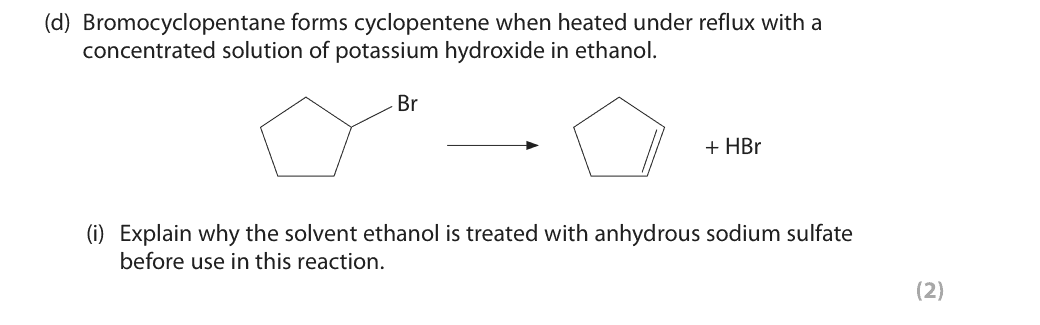
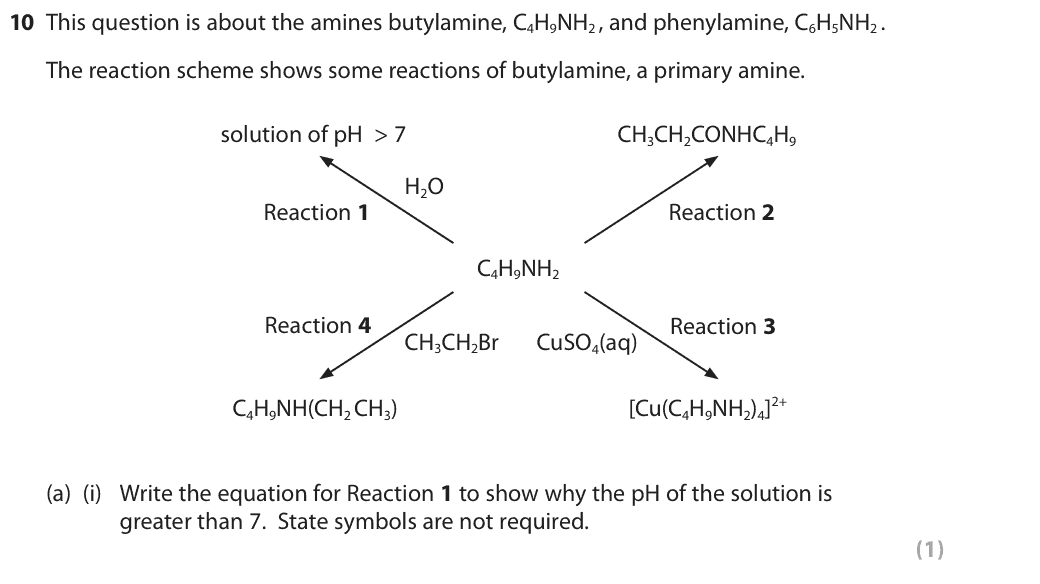
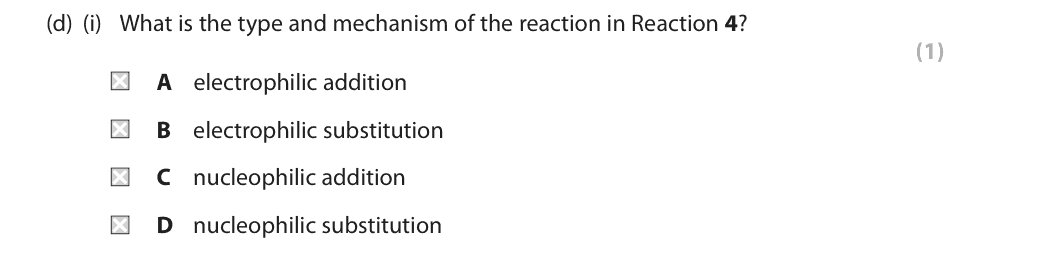
Mechanisms

39 past-paper questions that ask you to name, outline or complete a mechanism, by topic, each with the mark scheme's own mechanism behind the button. A curly arrow shows the movement of a pair of electrons: it must start at a bond or a lone pair and finish at the atom or bond where the electrons go. Most of the marks lost here are for arrows that start or end in the wrong place, and for missing lone pairs and charges.

The mechanisms you must be able to outline

MechanismLevelWhat the mark scheme looks forQuestions
Radical substitutionASAn alkane with chlorine or bromine in UV light. Initiation (homolytic fission of the halogen molecule into two radicals), two propagation steps, and termination. Radicals are shown with a dot; curly half-arrows are not expected. Write an equation for each step, and know why further substitution limits the method.topic page
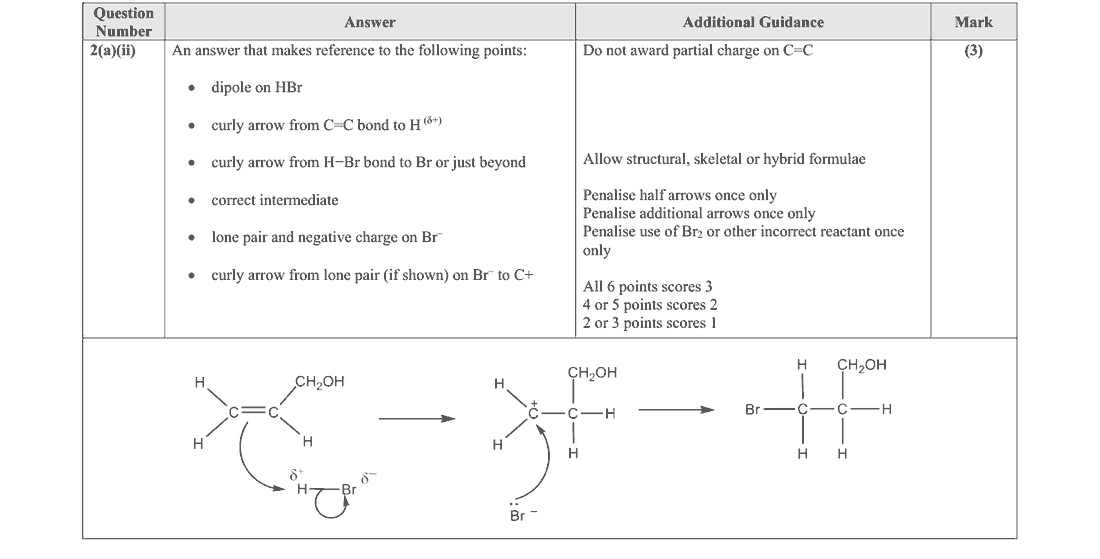
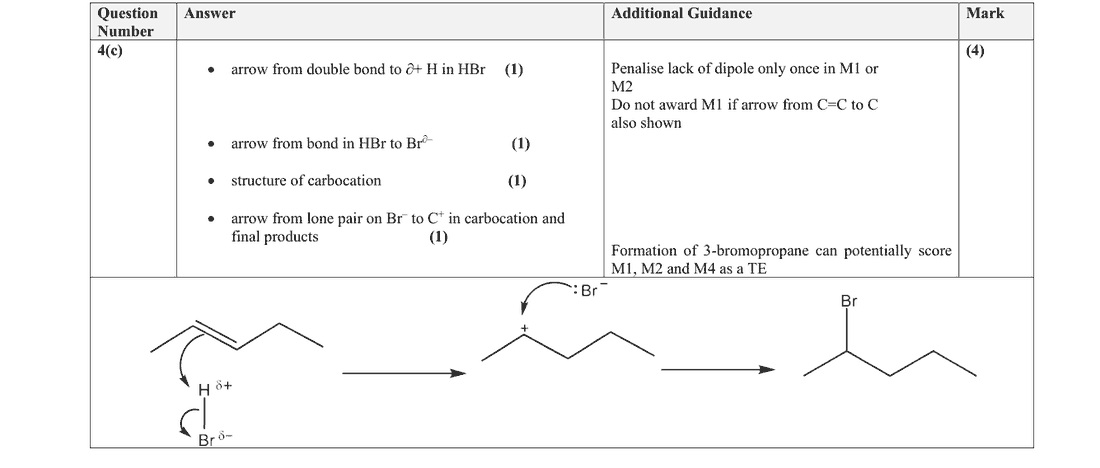
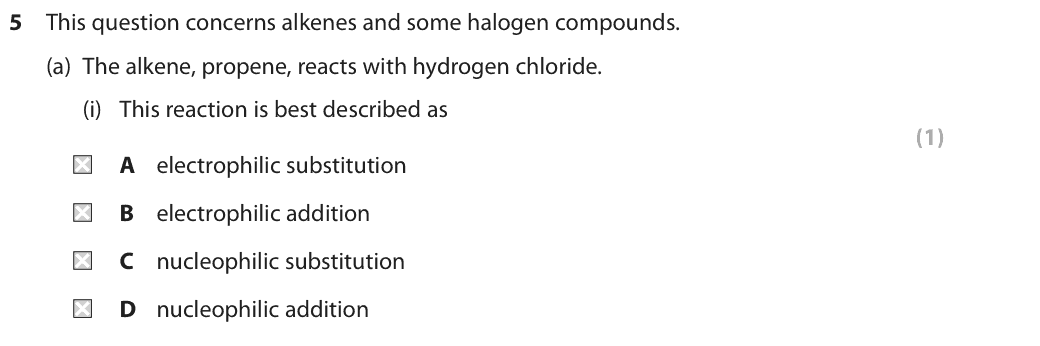
Electrophilic additionASAn alkene with a halogen, a hydrogen halide or another given binary compound. Arrow from the C=C bond to the electrophile, arrow from the H–Br (or Br–Br) bond to the atom that leaves, the carbocation, then an arrow from a lone pair on the anion to C⁺. With an unsymmetrical alkene the major product comes from the more stable carbocation (tertiary > secondary > primary).15 here
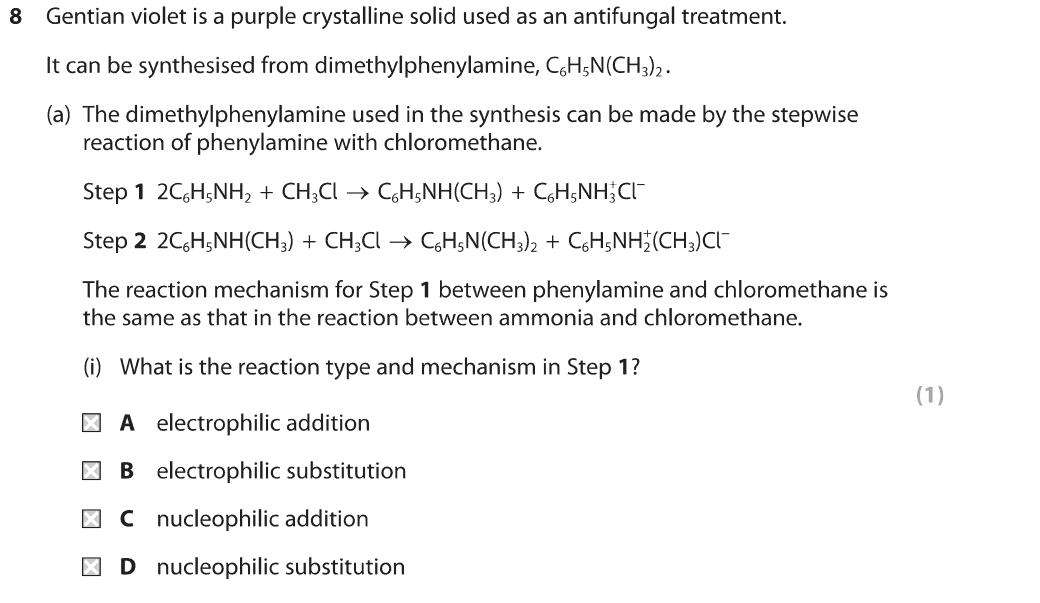
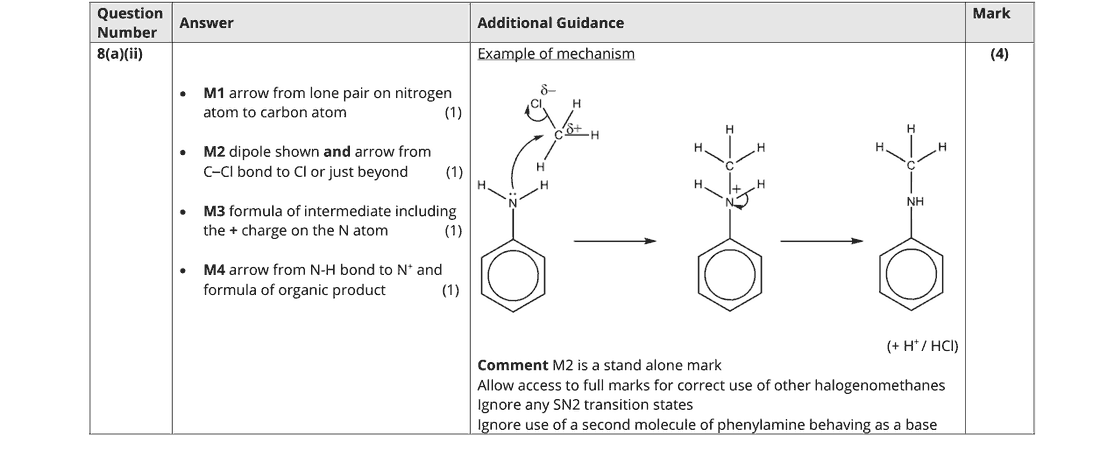
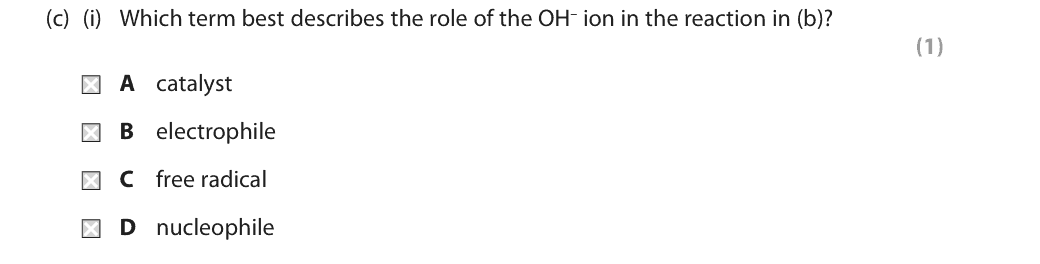
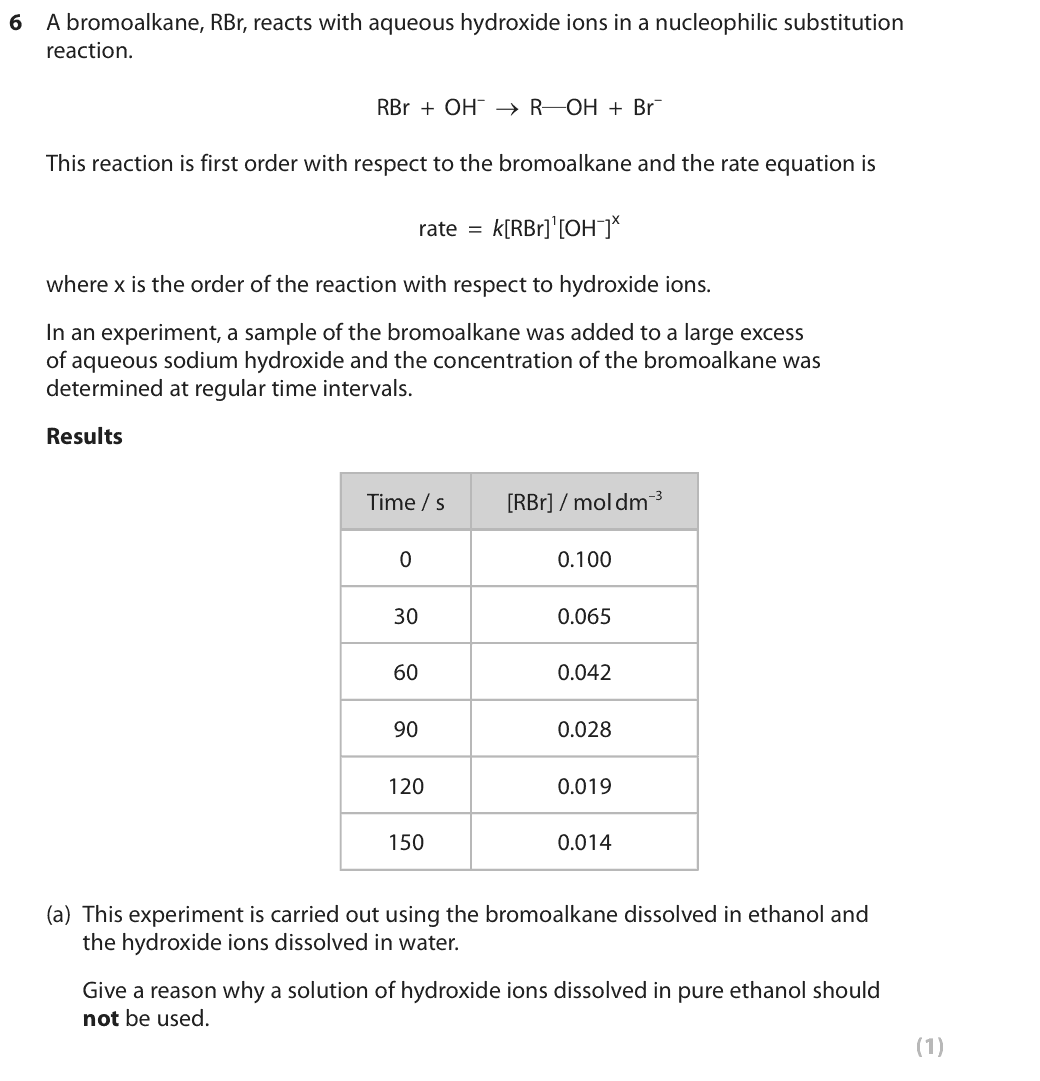
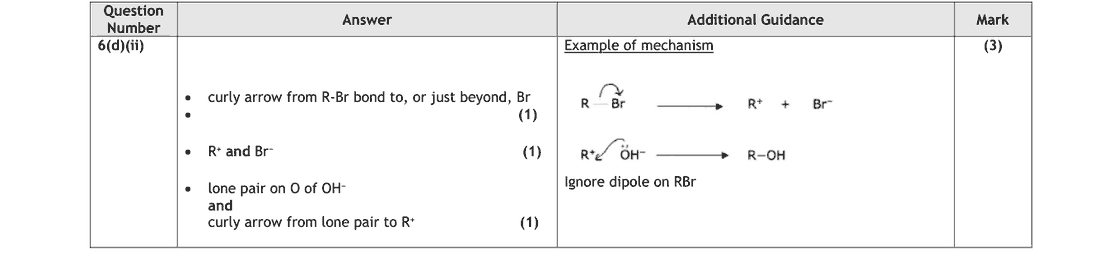
Nucleophilic substitutionASA primary halogenoalkane with aqueous potassium hydroxide or with ammonia. Arrow from the lone pair on the nucleophile to the δ+ carbon, and an arrow from the C–X bond to the halogen. With ammonia a second molecule removes H⁺ from the intermediate.9 here
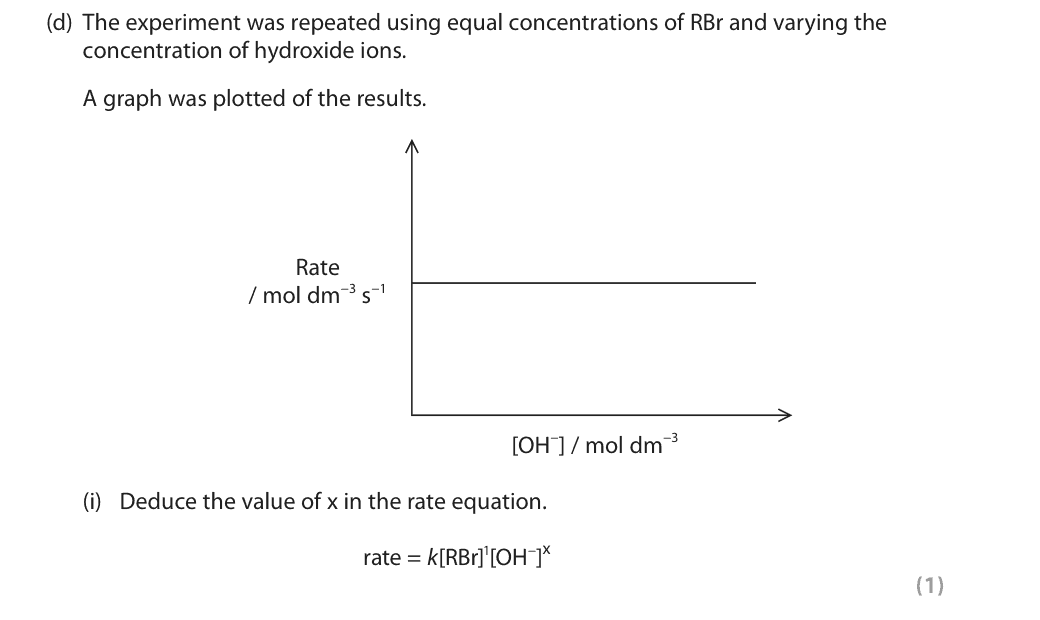
SN1 and SN2A levelPrimary halogenoalkanes are hydrolysed in one step involving both species (SN2, rate = k[RX][OH⁻]); tertiary halogenoalkanes ionise first to a carbocation in the slow step (SN1, rate = k[RX]). The rate equation is the evidence for the mechanism, and so is optical activity: SN1 through a planar carbocation gives a racemic mixture.2 here
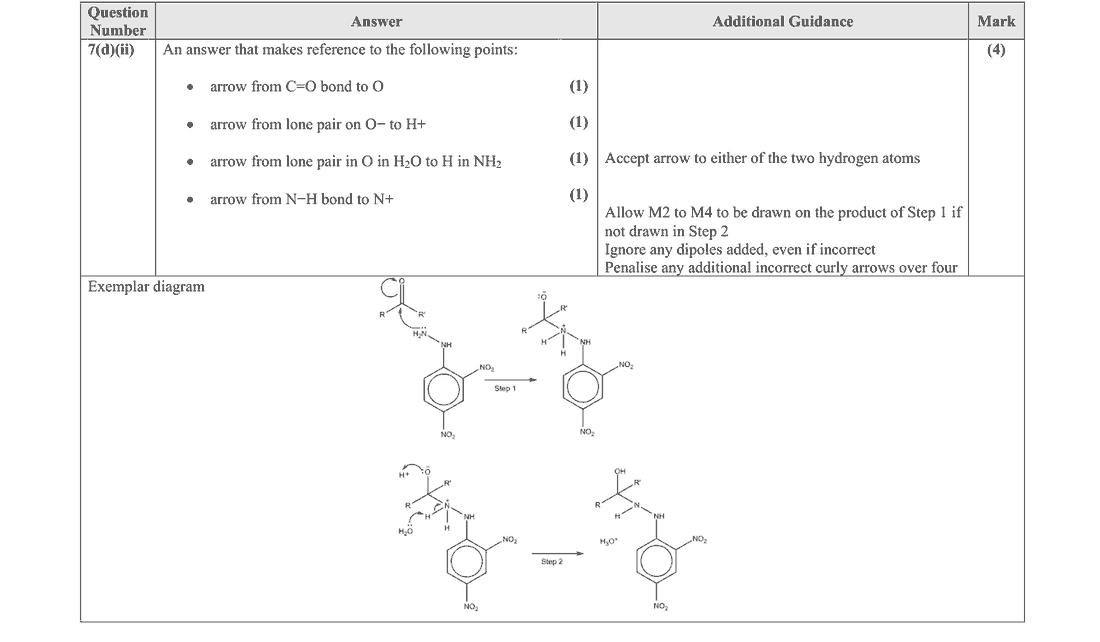
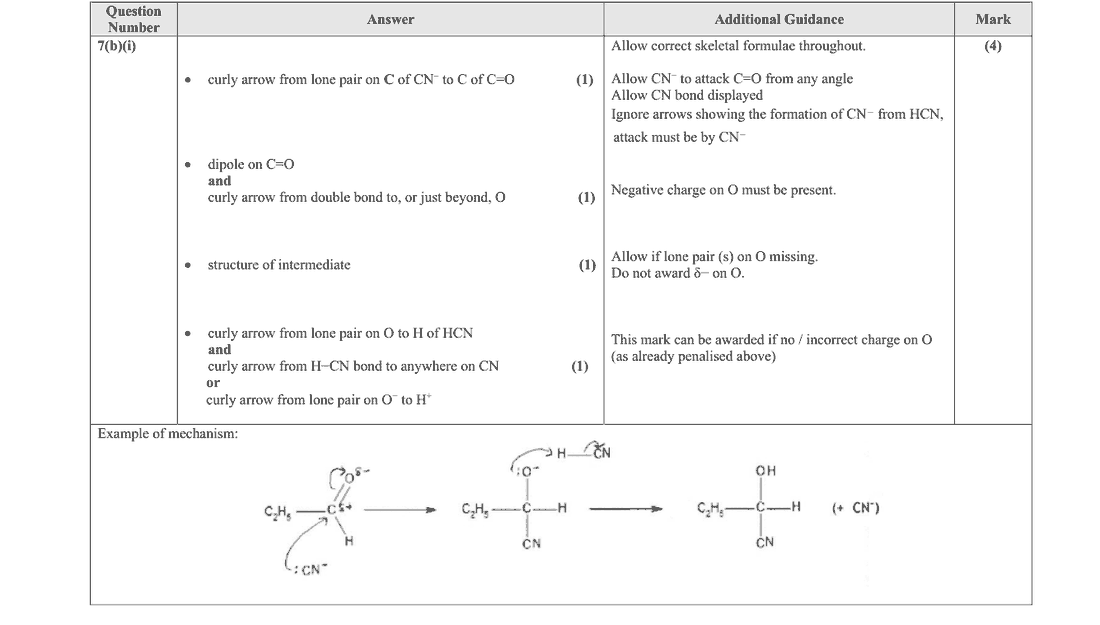
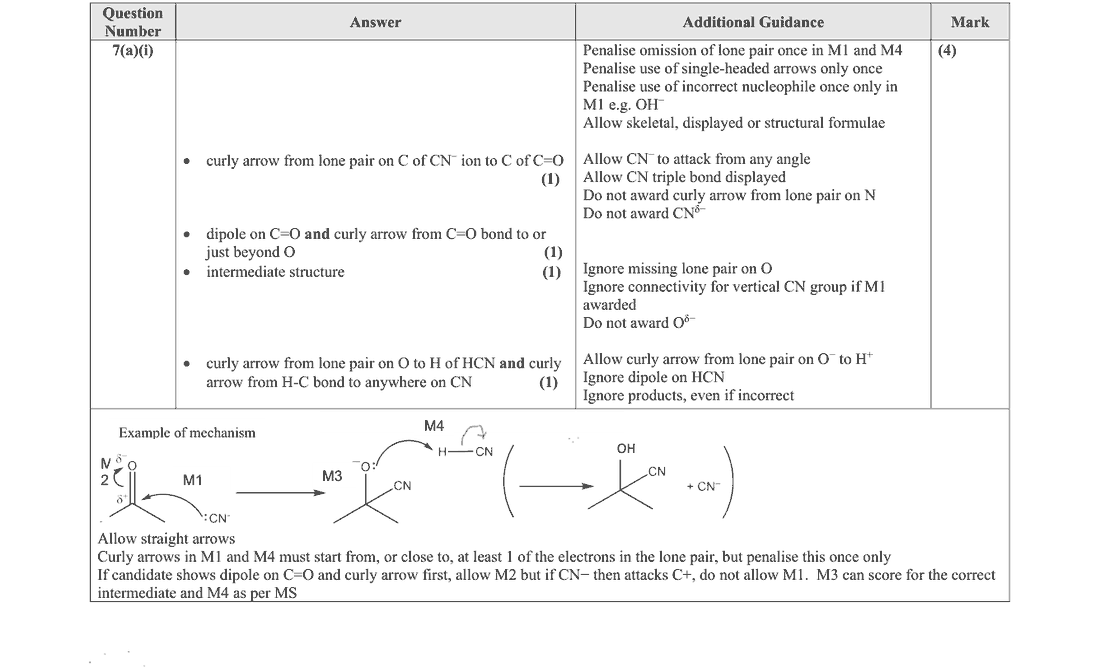
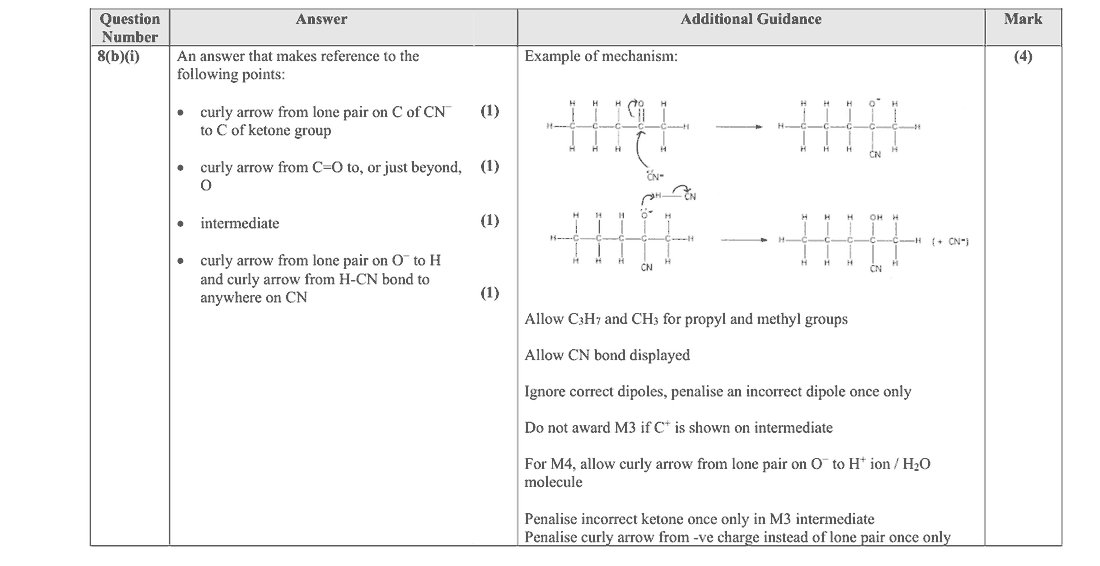
Nucleophilic additionA levelAn aldehyde or ketone with HCN in the presence of KCN. Arrow from the lone pair on the carbon of ⁻CN to the δ+ carbonyl carbon, arrow from the C=O bond to O, then the O⁻ takes H⁺ from HCN. Show the lone pairs and dipoles. Attack from either side of the planar carbonyl group gives a racemic mixture.5 here
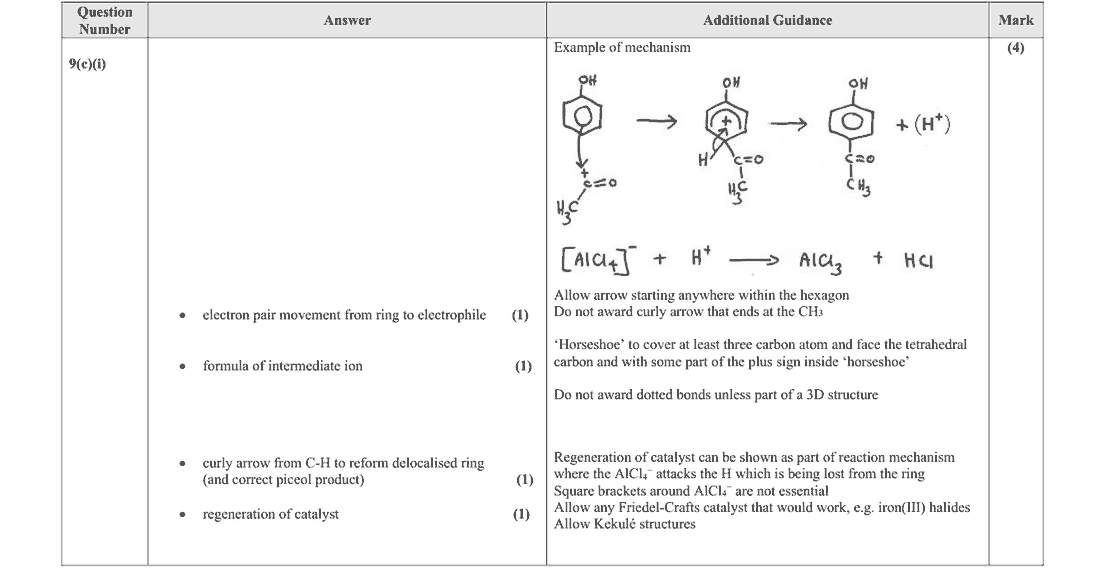
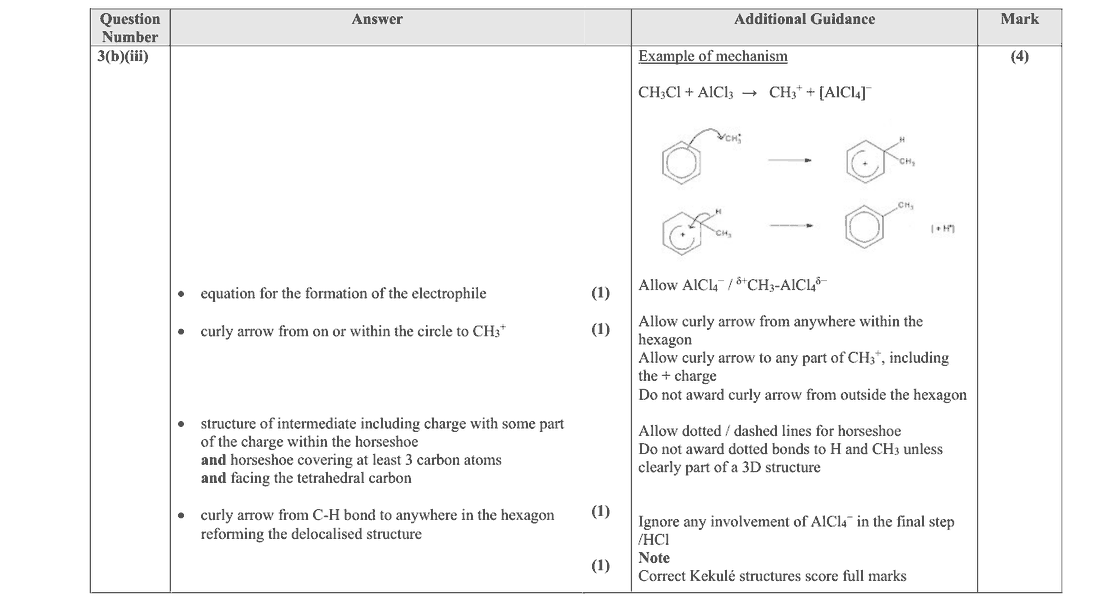
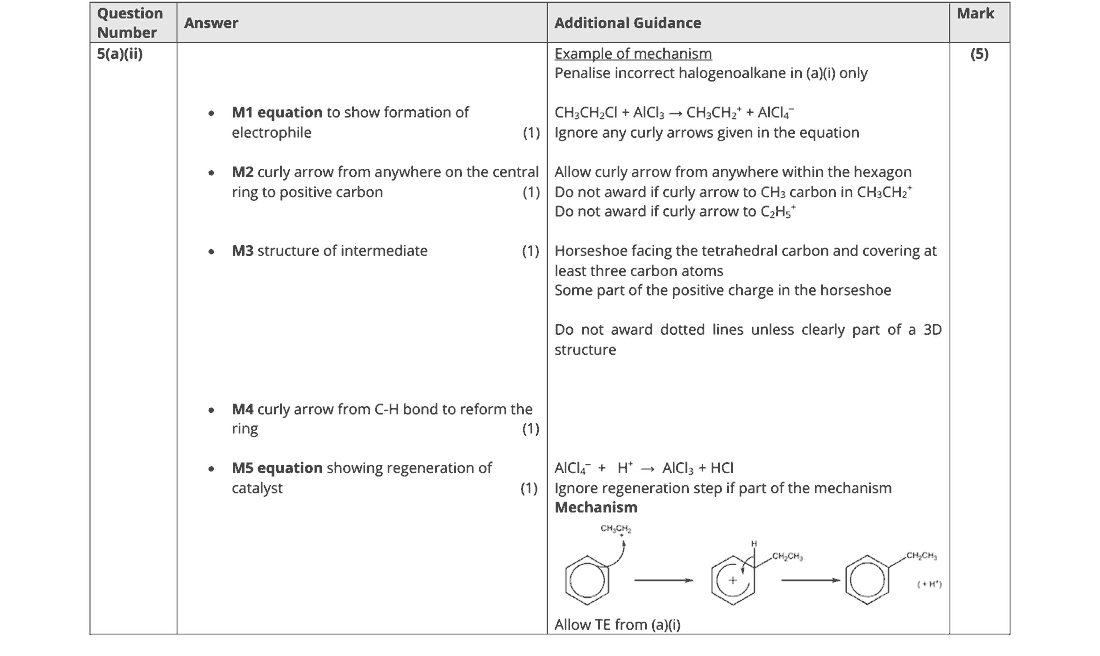
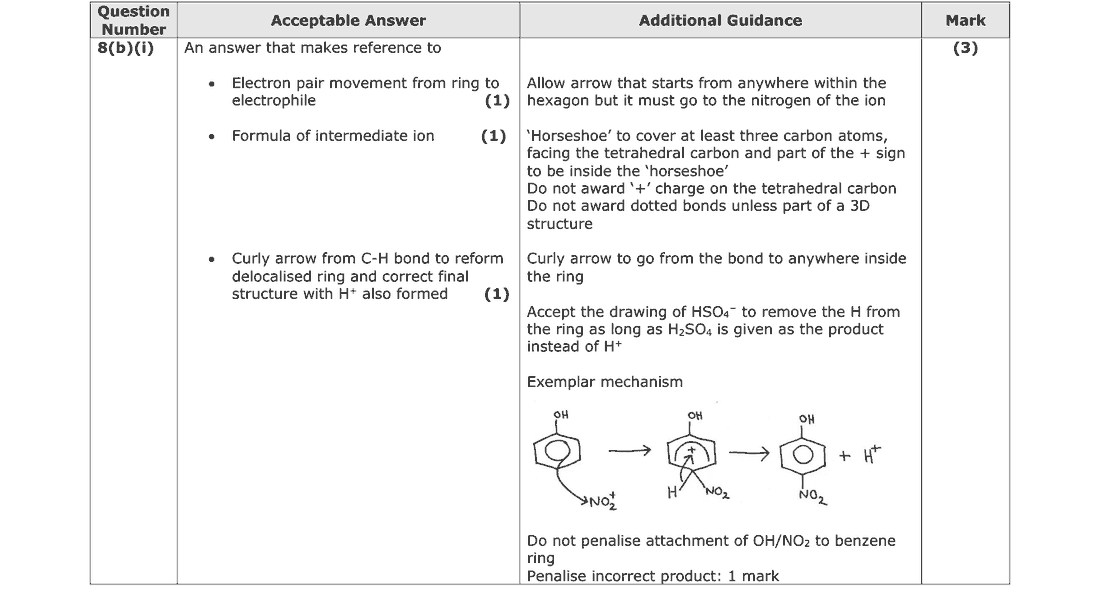
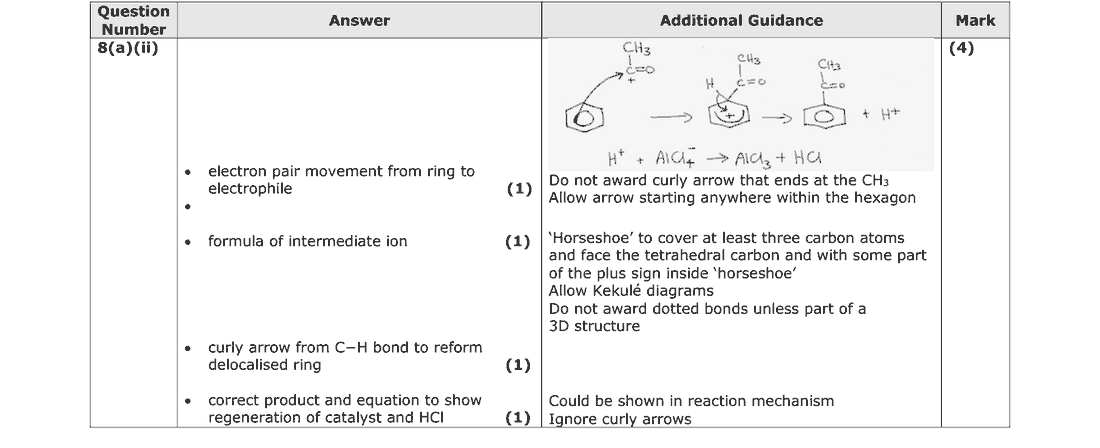
Electrophilic substitutionA levelBenzene: halogenation with a halogen carrier, nitration (NO₂⁺ from concentrated nitric and sulfuric acids) and Friedel–Crafts alkylation and acylation. Arrow from the ring to the electrophile, the intermediate with a broken ring and a + charge, then an arrow from the C–H bond back into the ring as H⁺ is lost. Include the equation that makes the electrophile.6 here

The papers also ask you to complete or deduce unfamiliar mechanisms by analogy, and to deduce a mechanism from a rate equation (Topic 16): the same rules for arrows, lone pairs and charges apply. Written by the site from the specification and the mark schemes; being checked by our tutor.

Every mechanism question, by topic

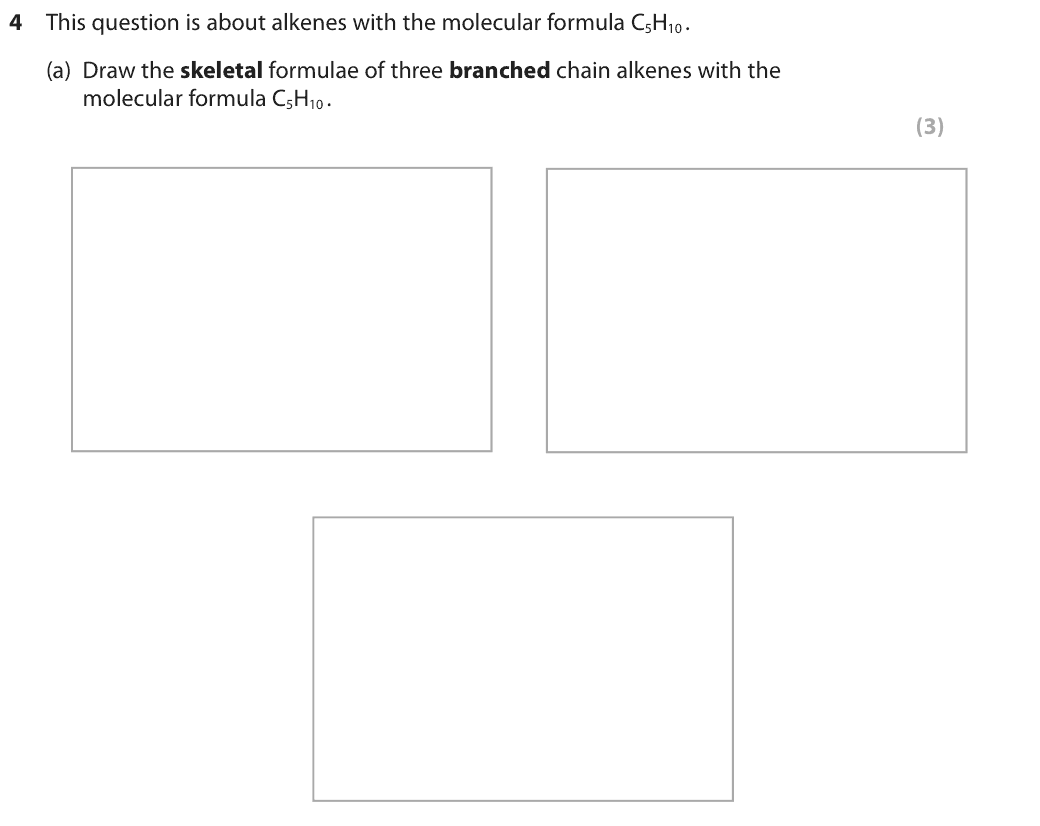
Alkenes (15)

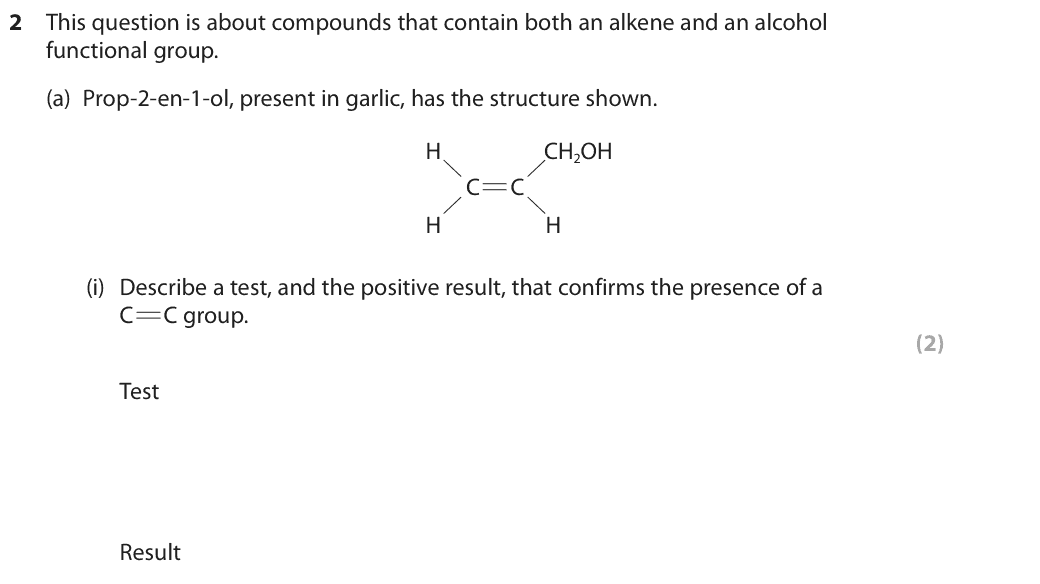
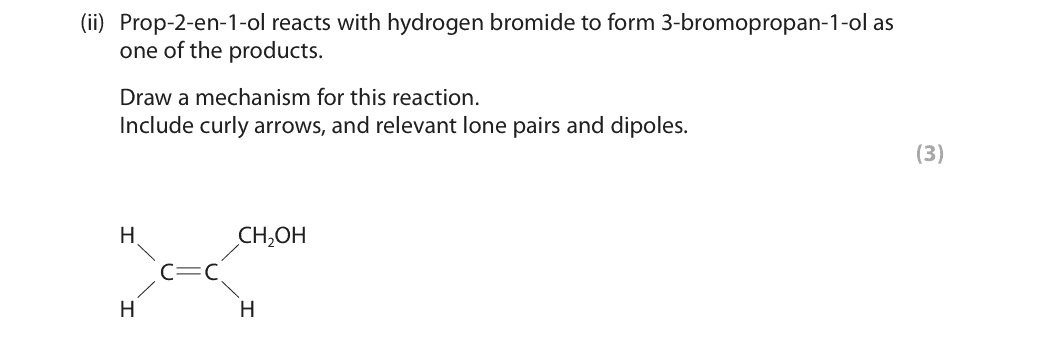
June 2025 · Paper 3 · Q2(a)(ii) 3 marks Mechanism
Earlier part of question 2 that this part usesEarlier part of June 2025 Paper 3 question 2
Prop-2-en-1-ol reacts with hydrogen bromide to form 3-bromopropan-1-ol as
one of the products.
Draw a mechanism for this reaction.
Include curly arrows, and relevant lone pairs and dipoles.
H
CH2OH
C
C
H
H
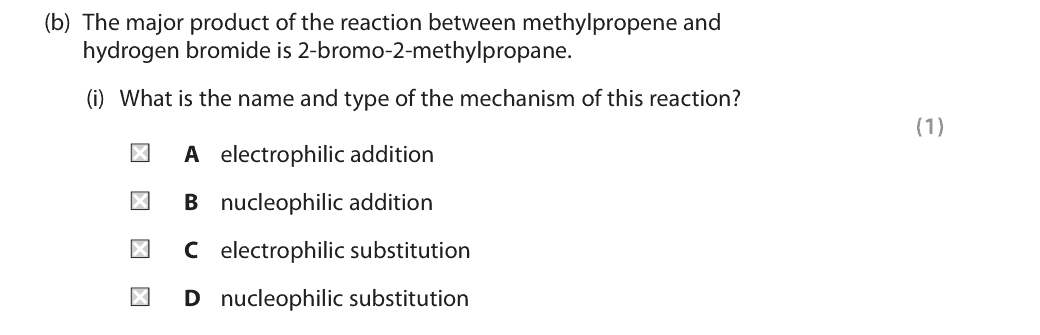
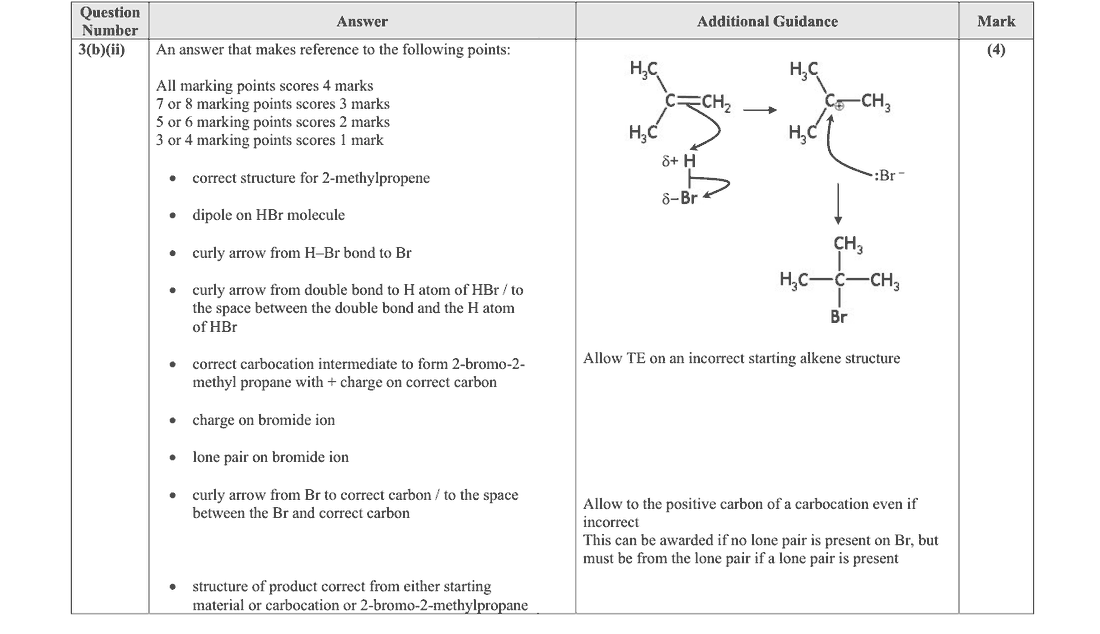
June 2024 · AS Paper 2 · Q3(b)(ii) 4 marks Mechanism Easy
Earlier parts of question 3 that this part usesEarlier part of June 2024 Paper 2 question 3Earlier part of June 2024 Paper 2 question 3
Draw the mechanism for the formation of 2‑bromo‑2‑methylpropane.
Include curly arrows, and any relevant charges, dipoles and lone pairs.
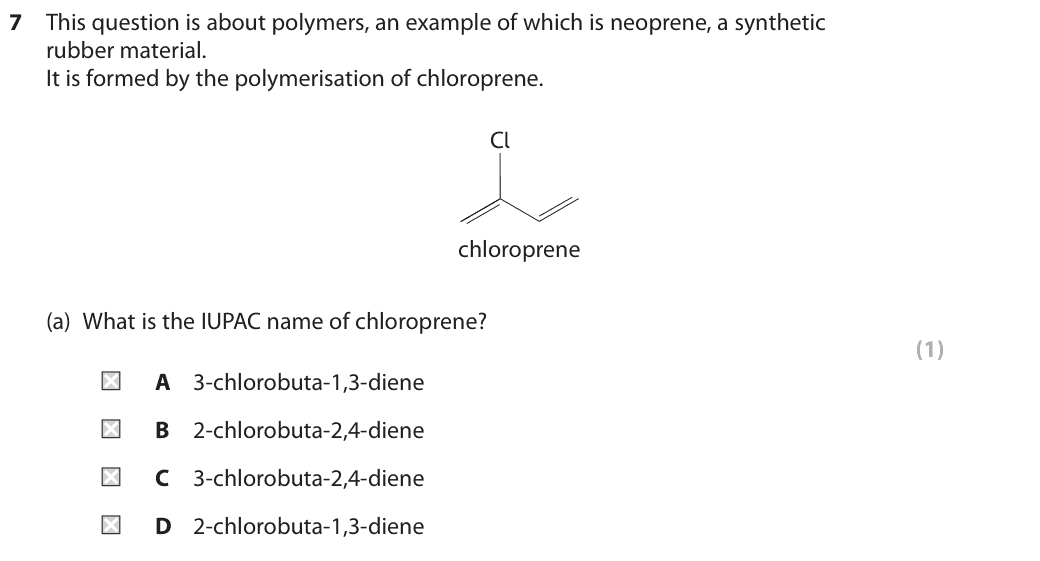
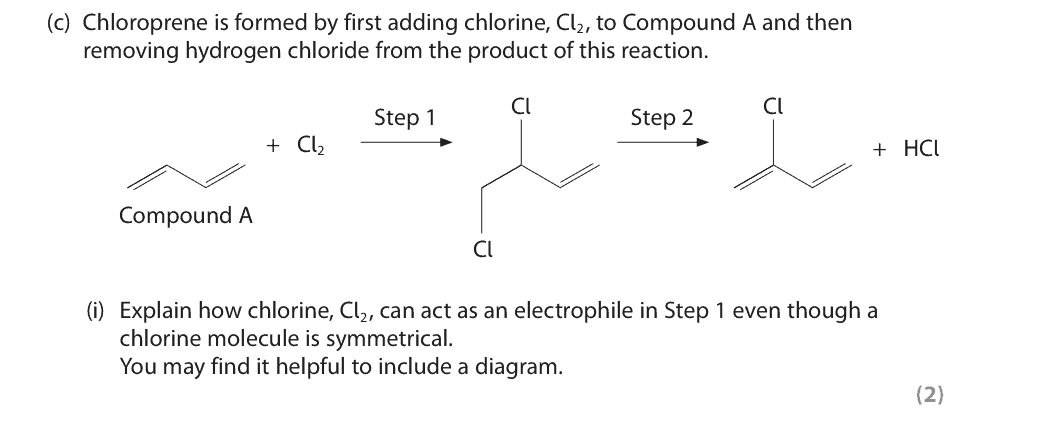
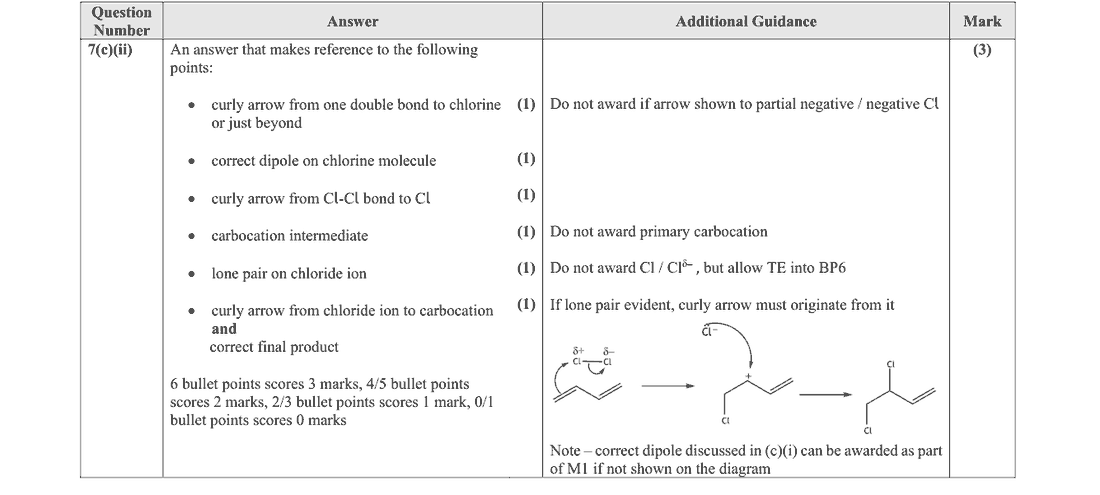
June 2024 · Paper 2 · Q7(c)(ii) 3 marks Mechanism
Earlier parts of question 7 that this part usesEarlier part of June 2024 Paper 2 question 7Earlier part of June 2024 Paper 2 question 7
Draw the mechanism for Step 1.
Include curly arrows, and any relevant lone pairs and dipoles.
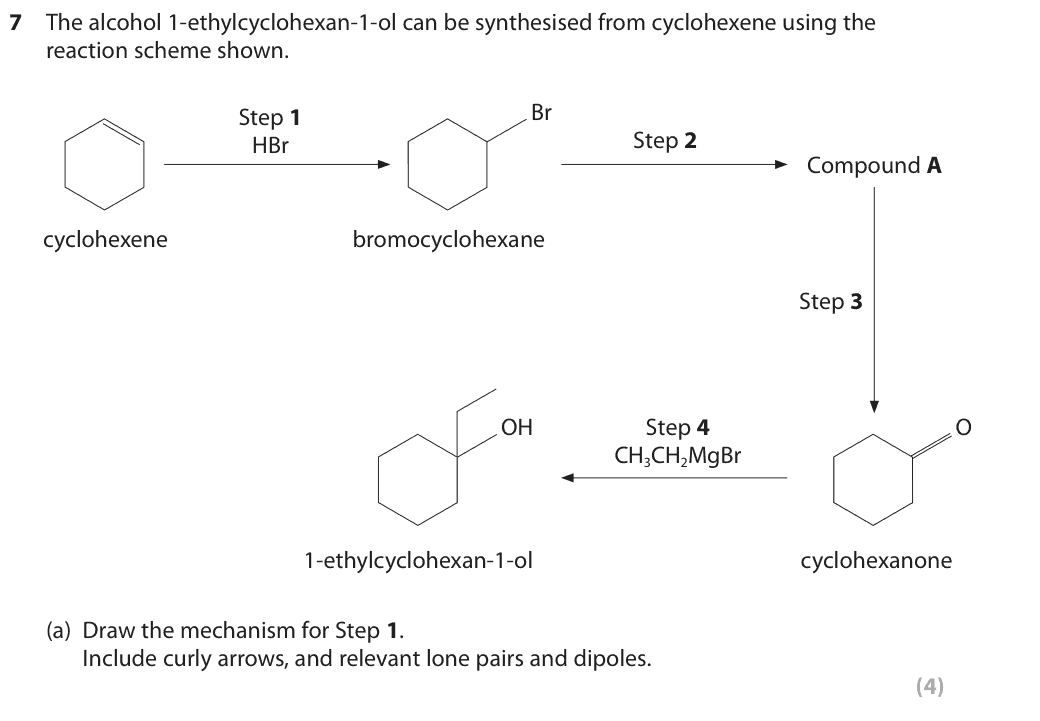
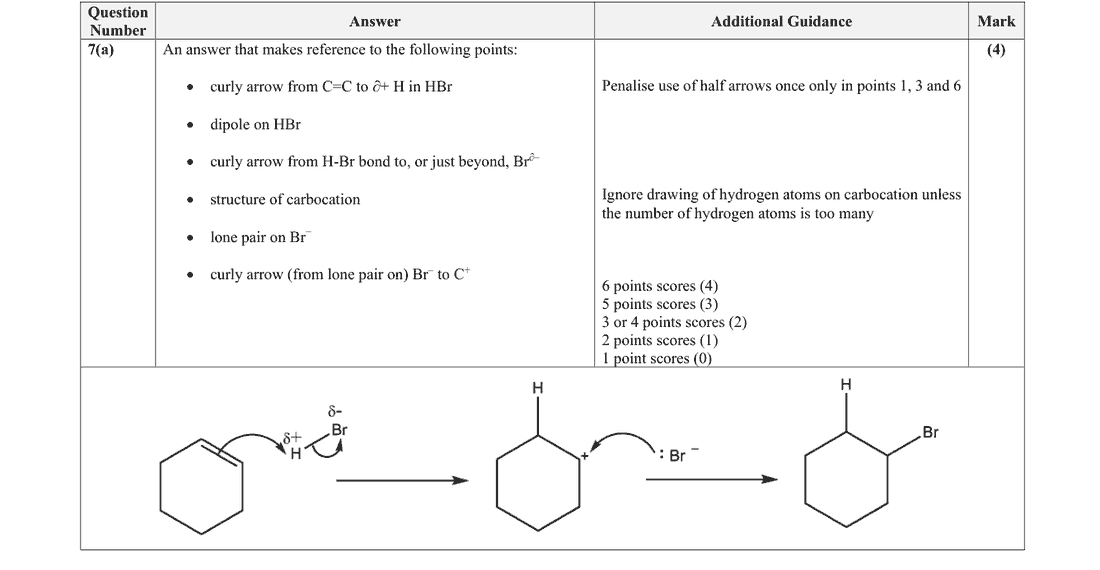
June 2024 · Paper 3 · Q7(a) 4 marks Mechanism
The alcohol 1-ethylcyclohexan-1-ol can be synthesised from cyclohexene using the
reaction scheme shown.
Br
Step 1
Step 2
HBr
Compound A
cyclohexene
bromocyclohexane
Step 3
Step 4
OH
O
CH3CH2MgBr
1-ethylcyclohexan-1-ol
cyclohexanone
Draw the mechanism for Step 1.
Include curly arrows, and relevant lone pairs and dipoles.
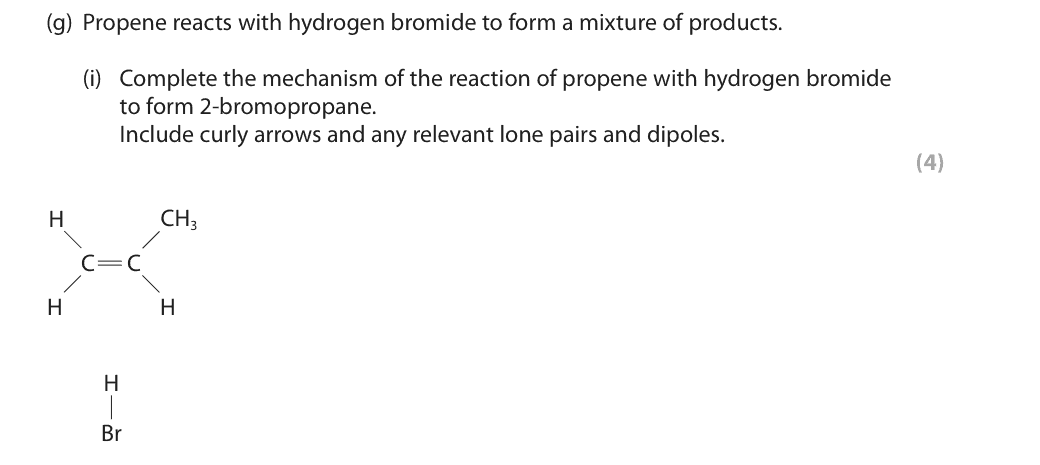
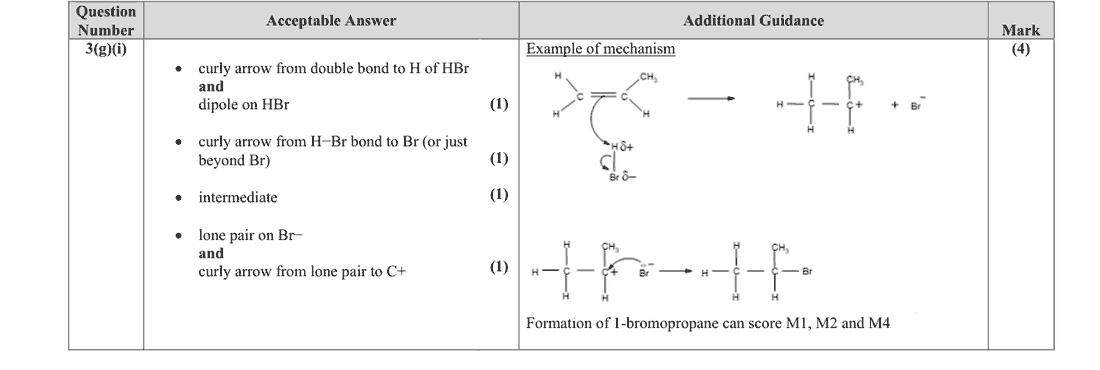
June 2023 · AS Paper 2 · Q3(g)(i) 4 marks Mechanism Easy
Earlier part of question 3 that this part usesEarlier part of June 2023 Paper 2 question 3
Propene reacts with hydrogen bromide to form a mixture of products.
Complete the mechanism of the reaction of propene with hydrogen bromide
to form 2‑bromopropane.
Include curly arrows and any relevant lone pairs and dipoles.
H
CH3
C
C
H
H
H
Br
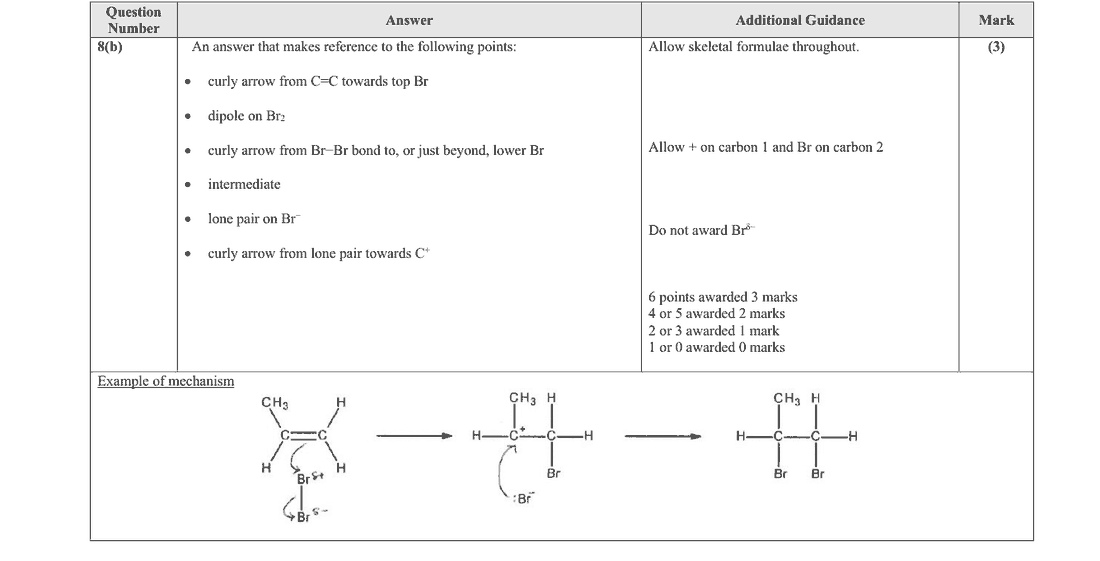
June 2023 · Paper 2 · Q8(b) 3 marks Mechanism
Propene reacts with bromine to form 1,2‑dibromopropane as the only product.
Draw the mechanism for the reaction between propene and bromine.
Include curly arrows and any relevant lone pairs and dipoles.
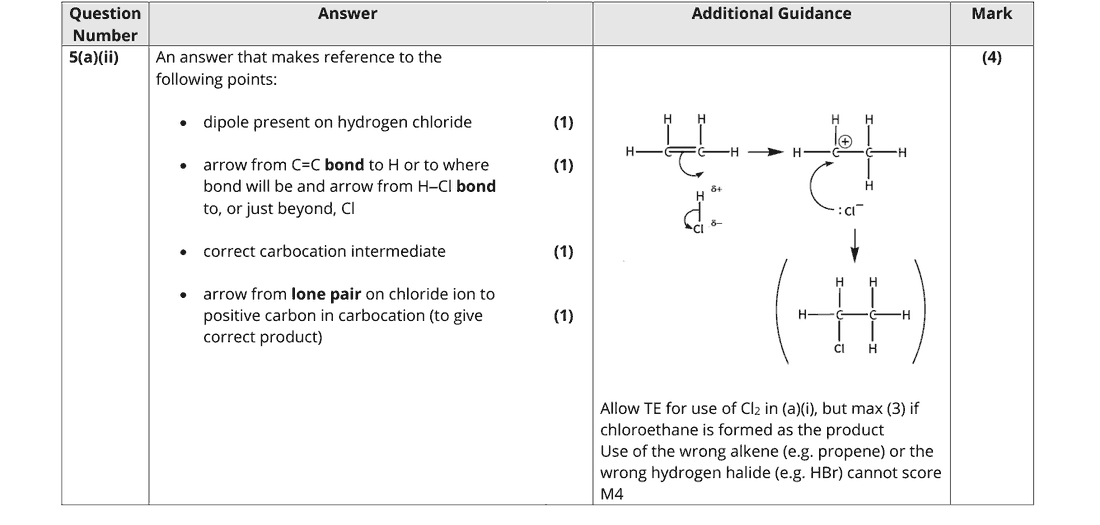
June 2022 · AS Paper 2 · Q5(a)(ii) 4 marks Mechanism
Earlier part of question 5 that this part usesEarlier part of June 2022 Paper 2 question 5
Draw the mechanism for the conversion of ethene into chloroethane.
Include curly arrows, and any relevant lone pairs and dipoles.
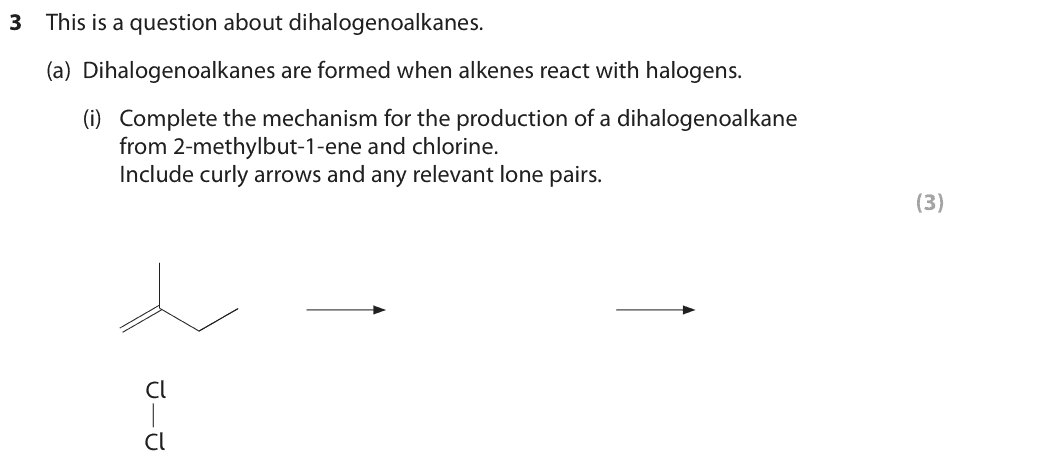
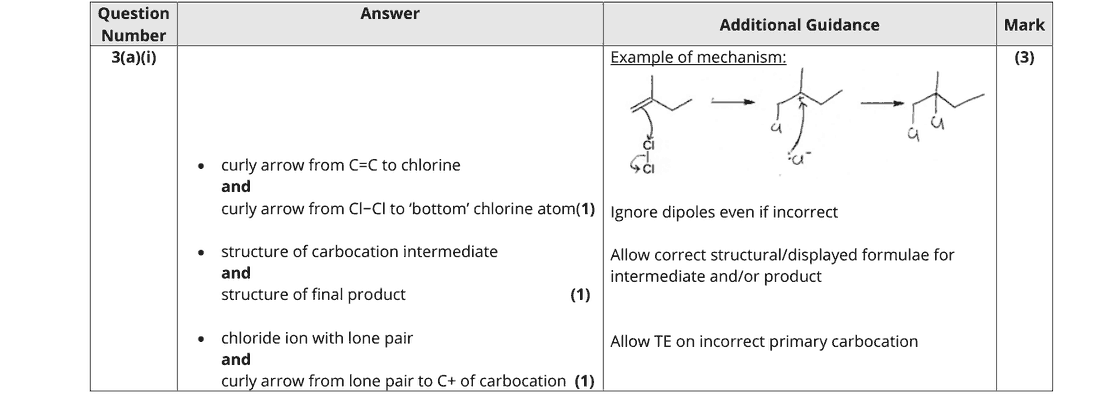
June 2022 · Paper 2 · Q3(a)(i) 3 marks Mechanism
This is a question about dihalogenoalkanes.
Dihalogenoalkanes are formed when alkenes react with halogens.
Complete the mechanism for the production of a dihalogenoalkane
from 2‑methylbut‑1‑ene and chlorine.
Include curly arrows and any relevant lone pairs.
Cl
Cl
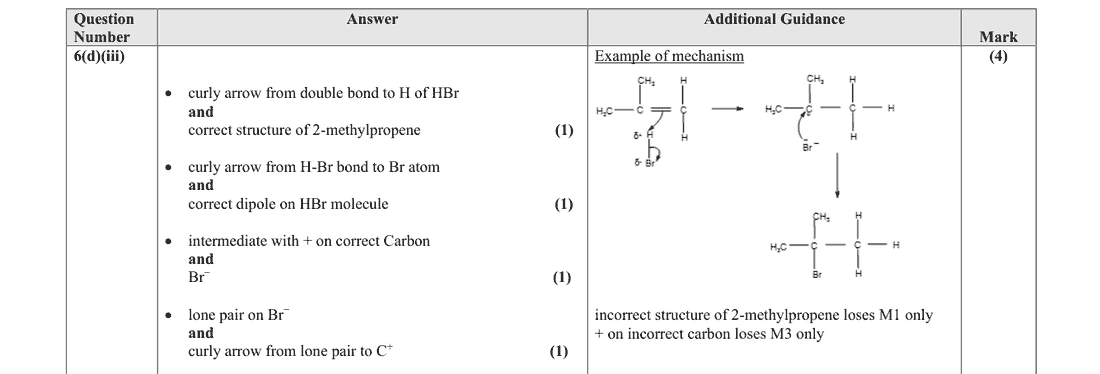
November 2021 · AS Paper 2 · Q6(d)(iii) 4 marks Mechanism
Earlier parts of question 6 that this part usesEarlier part of November 2021 Paper 2 question 6Earlier part of November 2021 Paper 2 question 6
Draw a mechanism for the addition of hydrogen bromide, HBr, to 2‑methylpropene
to form 2‑bromo‑2‑methylpropane.
Include curly arrows, and any relevant dipoles and lone pairs.
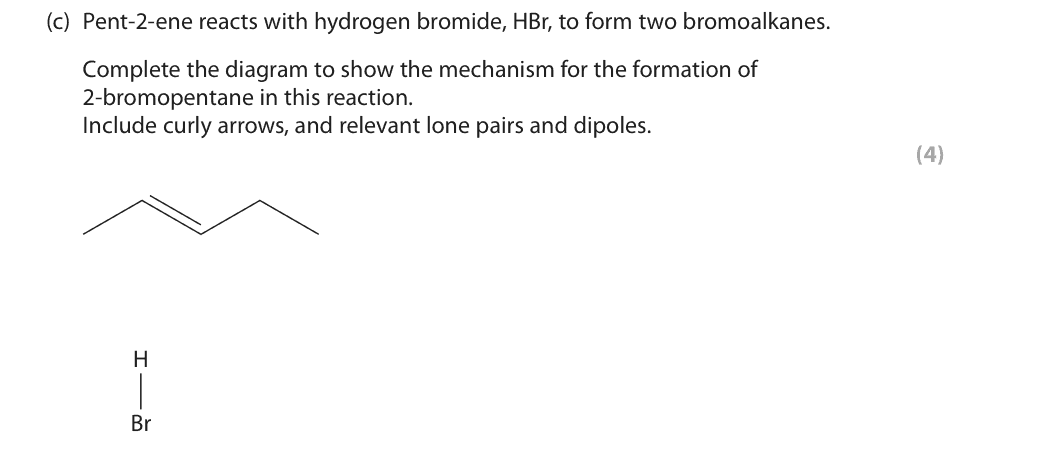
November 2021 · Paper 2 · Q4(c) 4 marks Mechanism
Earlier part of question 4 that this part usesEarlier part of November 2021 Paper 2 question 4
Pent-2-ene reacts with hydrogen bromide, HBr, to form two bromoalkanes.
Complete the diagram to show the mechanism for the formation of
2-bromopentane in this reaction.
Include curly arrows, and relevant lone pairs and dipoles.
H
Br
October 2020 · AS Paper 2 · Q5(b)(ii) 3 marks Mechanism
Earlier parts of question 5 that this part usesEarlier part of October 2020 Paper 2 question 5Earlier part of October 2020 Paper 2 question 5
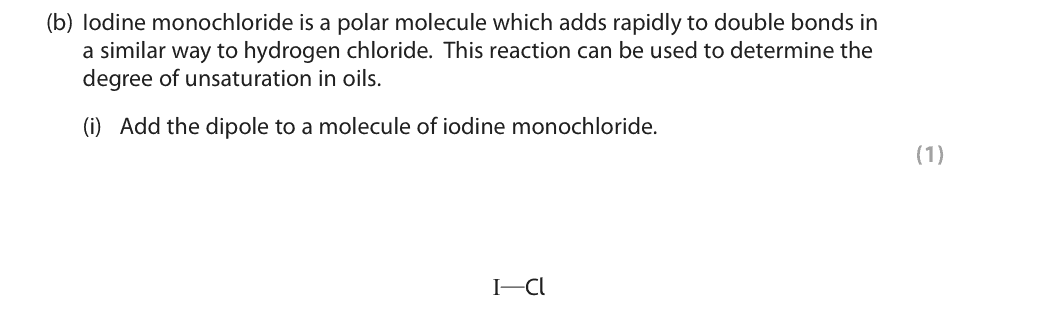
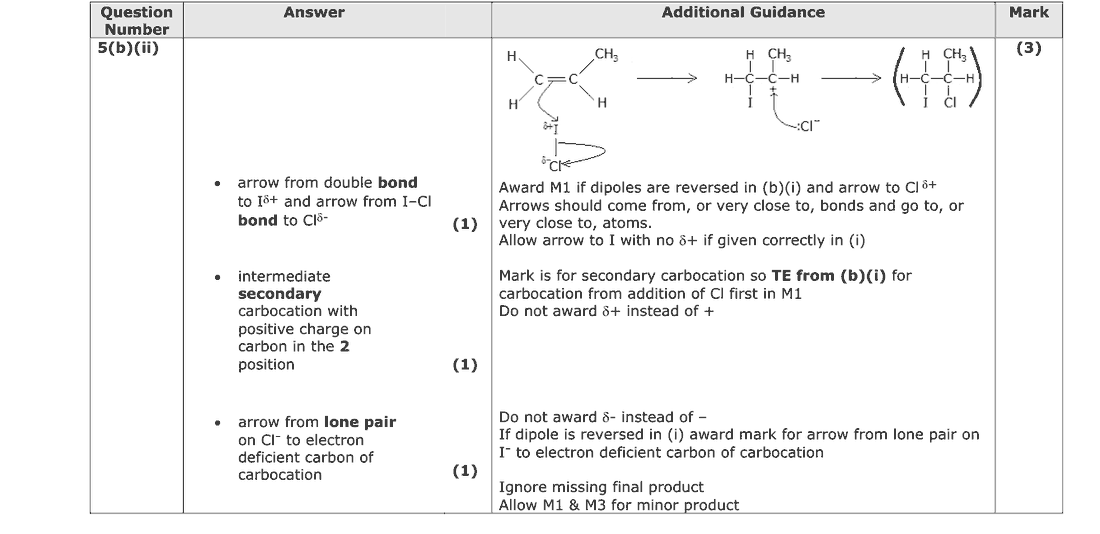
Draw the mechanism for the addition of iodine monochloride to propene.
You should include all curly arrows and relevant lone pairs and dipoles.
October 2020 · Paper 2 · Q5(e) 4 marks Mechanism
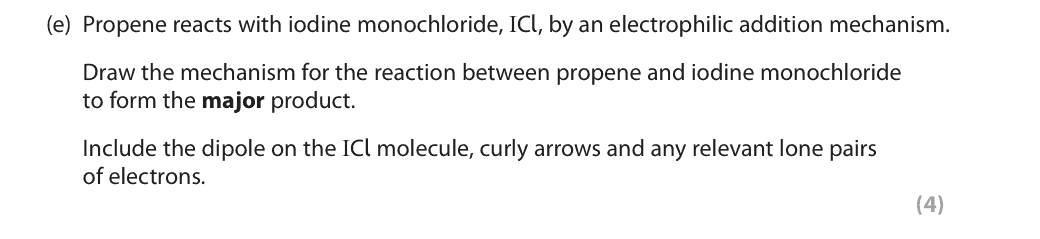
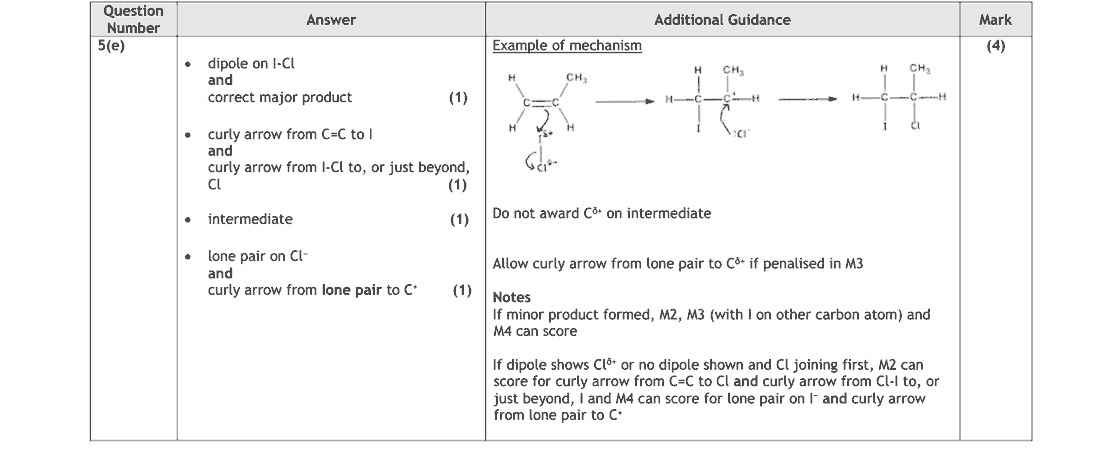
Propene reacts with iodine monochloride, ICl, by an electrophilic addition mechanism.
Draw the mechanism for the reaction between propene and iodine monochloride
to form the major product.
Include the dipole on the ICl molecule, curly arrows and any relevant lone pairs
of electrons.
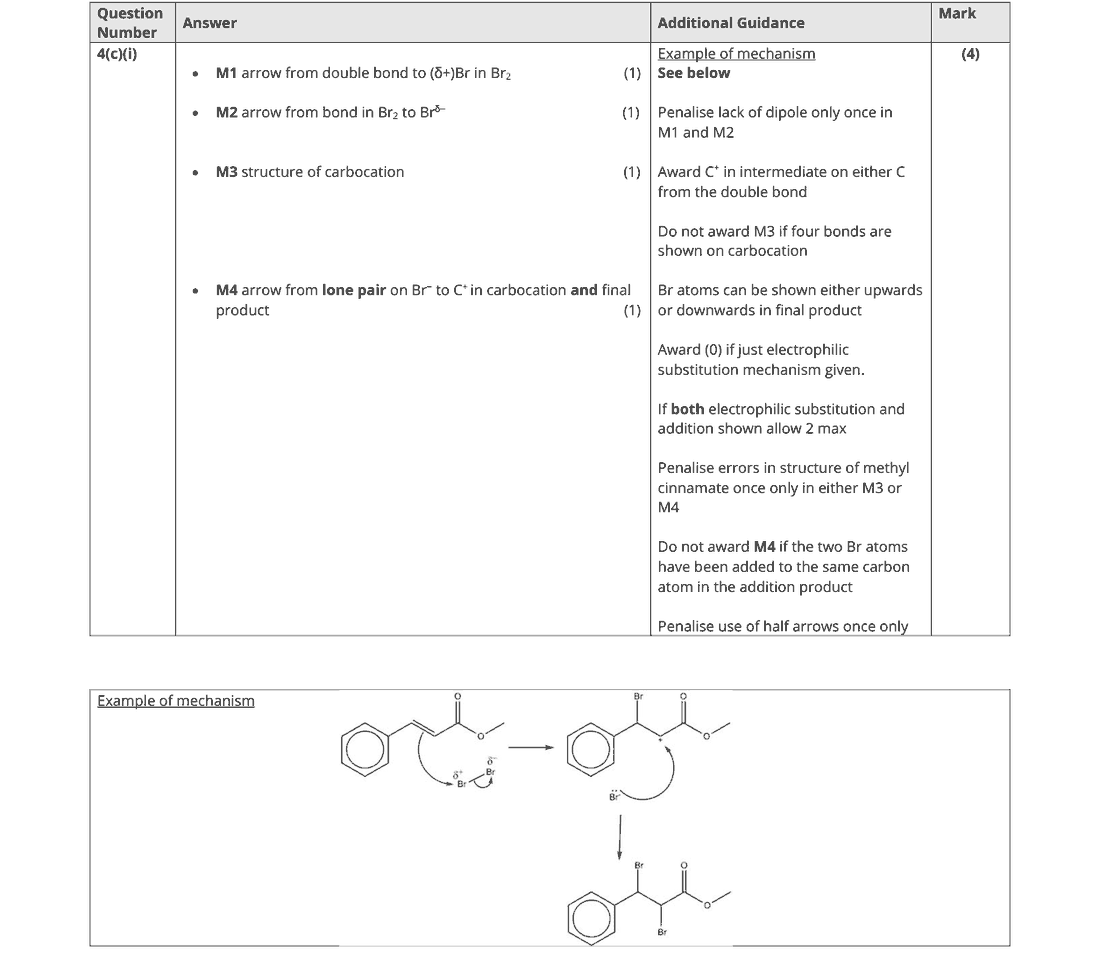
June 2019 · Paper 2 · Q4(c)(i) 4 marks Mechanism
Earlier part of question 4 that this part usesEarlier part of June 2019 Paper 2 question 4
Methyl cinnamate undergoes an addition reaction in the dark with bromine.
Draw the mechanism for the reaction between methyl cinnamate and
bromine, Br.
Include curly arrows, and relevant lone pairs and dipoles.
June 2018 · AS Paper 2 · Q5(a)(iii) 4 marks Mechanism
Earlier part of question 5 that this part usesEarlier part of June 2018 Paper 2 question 5
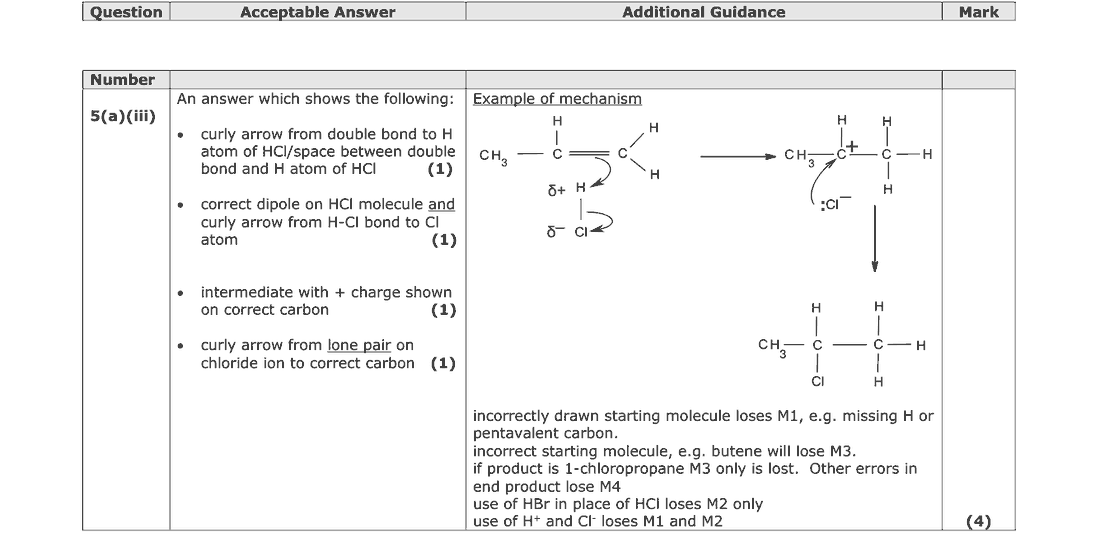
Draw the mechanism for the reaction of propene with hydrogen chloride to
produce 2-chloropropane.  Include curly arrows, and any relevant dipoles and
lone pairs.
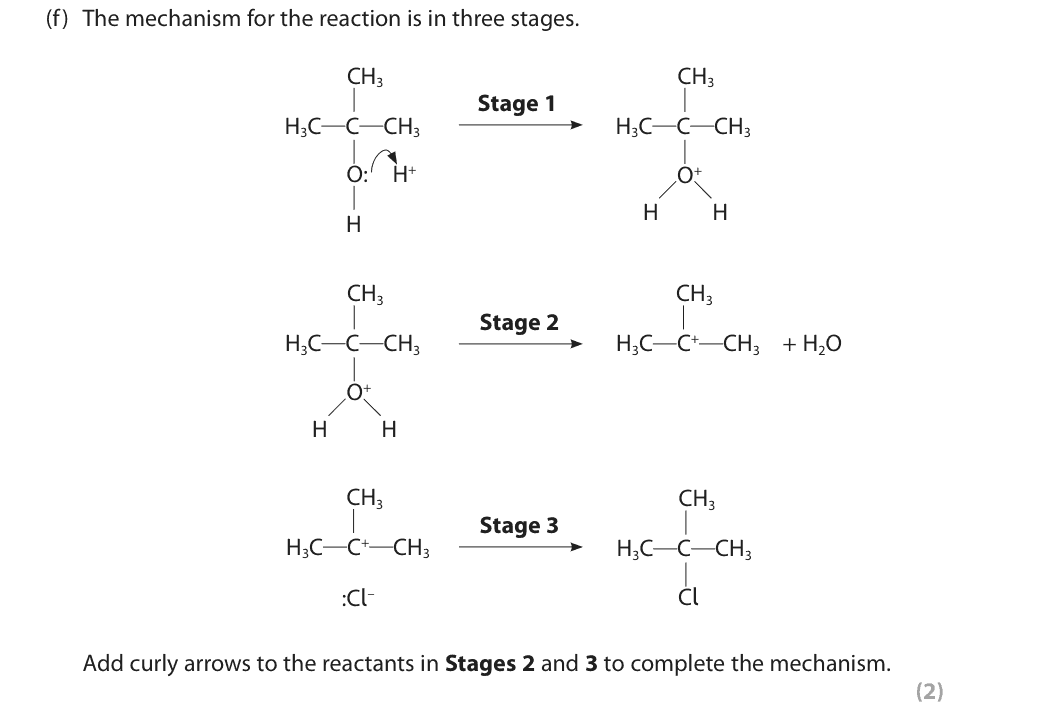
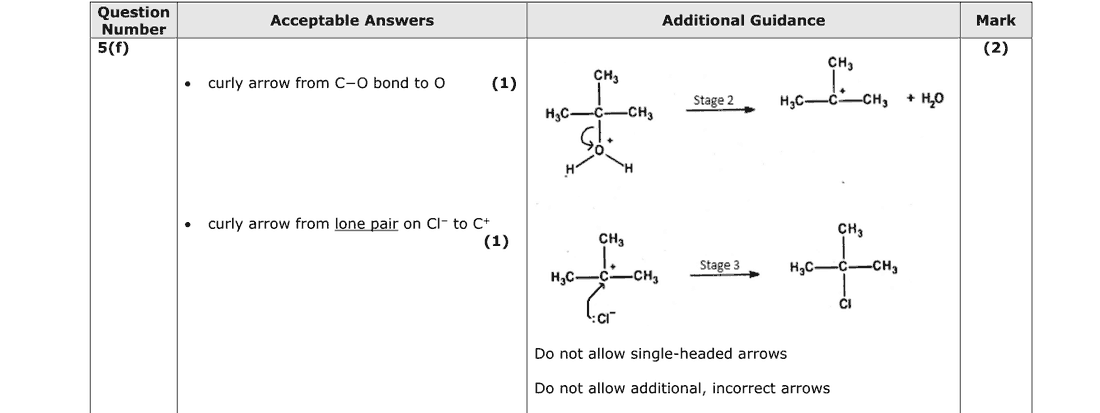
June 2016 · AS Paper 2 · Q5(f) 2 marks Mechanism
Earlier part of question 5 that this part usesEarlier part of June 2016 Paper 2 question 5
The mechanism for the reaction is in three stages.
CH3
CH3
Stage 1
H3C
C
CH3
H3C
C
CH3
O:
H+
O+
H
H
CH3
CH3
Stage 2
H3C
C
CH3
H3C
C+
CH3       + H2O
O+
H
CH3
CH3
Stage 3
H3C
C+
CH3
H3C
C
CH3
:Cl–
Cl
Add curly arrows to the reactants in Stages 2 and 3 to complete the mechanism.

Halogenoalkanes (9)

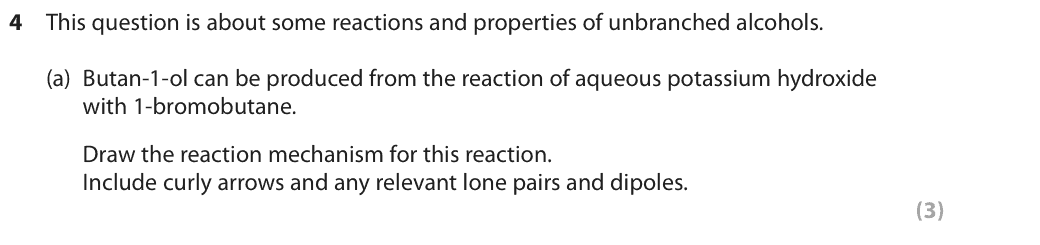
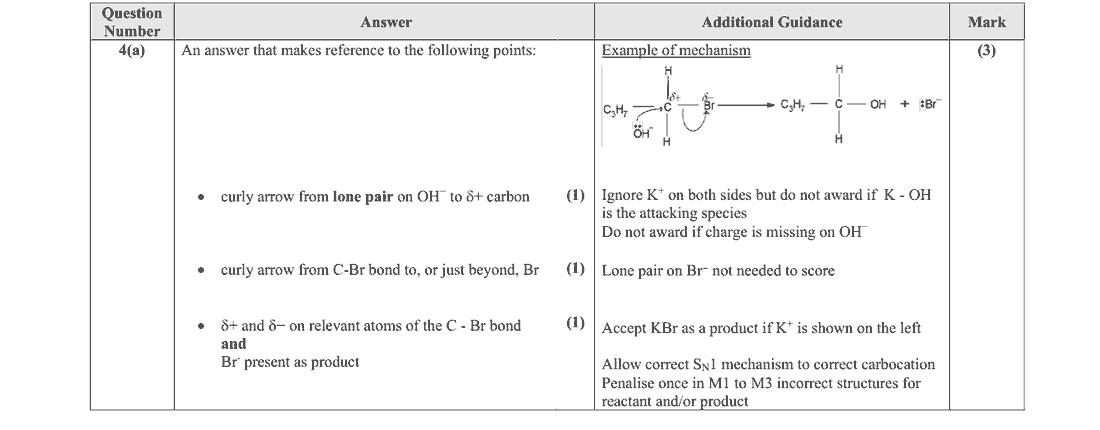
June 2025 · AS Paper 2 · Q4(a) 3 marks Mechanism
This question is about some reactions and properties of unbranched alcohols.
Butan-1-ol can be produced from the reaction of aqueous potassium hydroxide
with 1-bromobutane.
Draw the reaction mechanism for this reaction.
Include curly arrows and any relevant lone pairs and dipoles.
June 2024 · Paper 2 · Q5(d)(iii) 1 mark Mechanism
Earlier parts of question 5 that this part usesEarlier part of June 2024 Paper 2 question 5Earlier part of June 2024 Paper 2 question 5
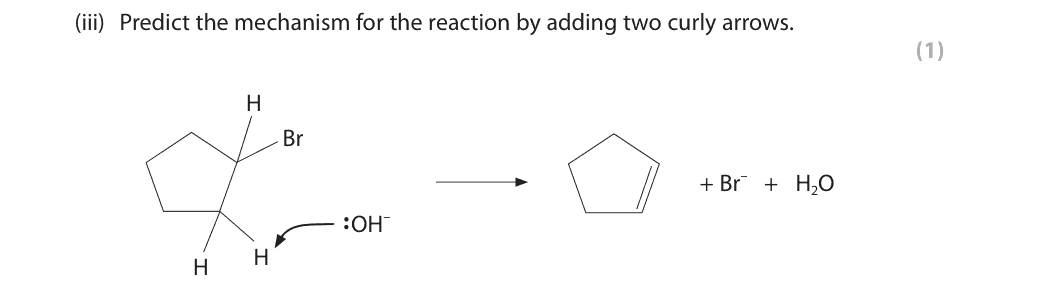
Predict the mechanism for the reaction by adding two curly arrows.
H
Br
+ Br–   +   H2O
:OH–
H
H
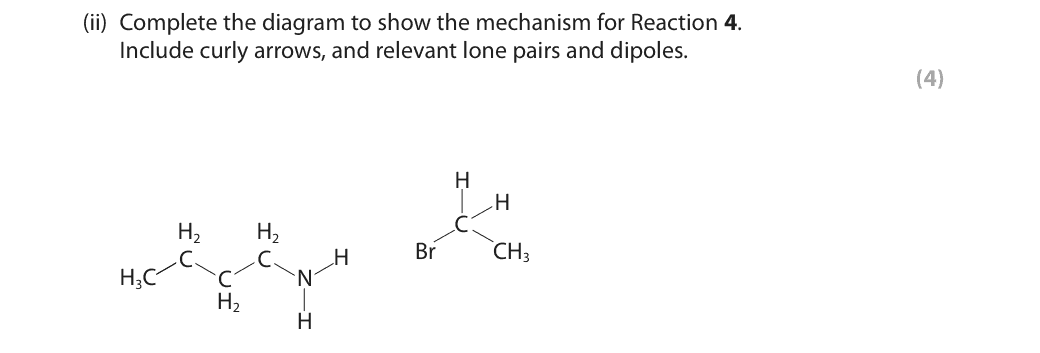
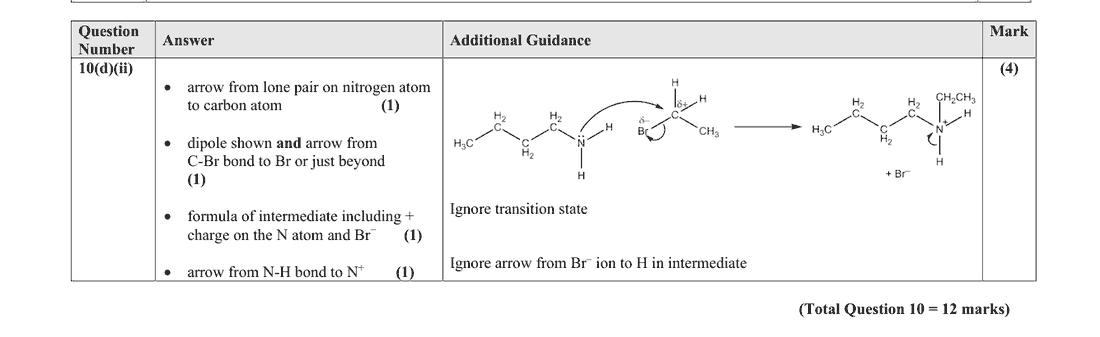
November 2021 · Paper 2 · Q10(d)(ii) 4 marks Mechanism
Earlier parts of question 10 that this part usesEarlier part of November 2021 Paper 2 question 10Earlier part of November 2021 Paper 2 question 10
Complete the diagram to show the mechanism for Reaction 4.
Include curly arrows, and relevant lone pairs and dipoles.
H
H
C
H2
H2
Br
CH3
C
H
C
H3C
C
N
H2
H
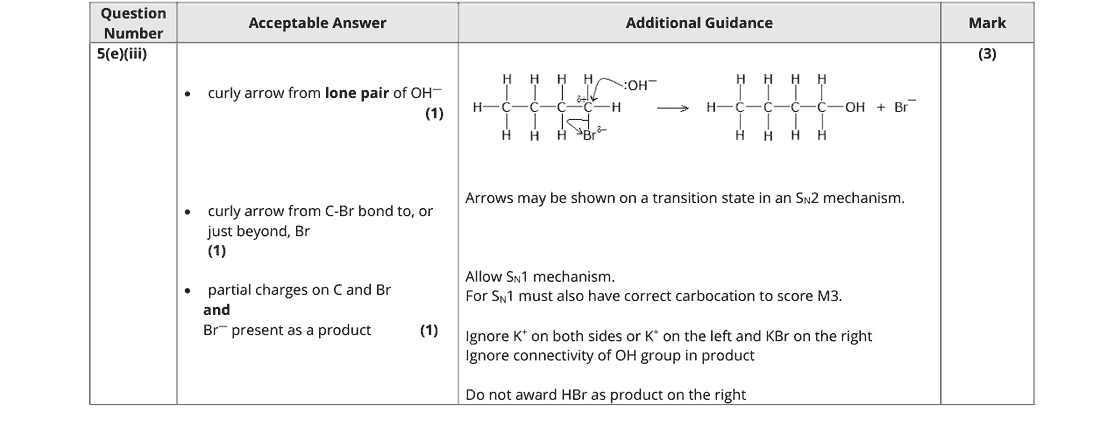
June 2019 · AS Paper 2 · Q5(e)(iii) 3 marks Mechanism
Earlier parts of question 5 that this part usesEarlier part of June 2019 Paper 2 question 5Earlier part of June 2019 Paper 2 question 5
Draw the mechanism for the reaction of 1-bromobutane with hydroxide ions
to form butan-1-ol.
Include curly arrows, and any appropriate lone pairs and dipoles.
June 2019 · Paper 2 · Q8(a)(ii) 4 marks Mechanism
Earlier part of question 8 that this part usesEarlier part of June 2019 Paper 2 question 8
Draw the mechanism for the reaction in Step 1.
Include curly arrows, and relevant lone pairs and dipoles.
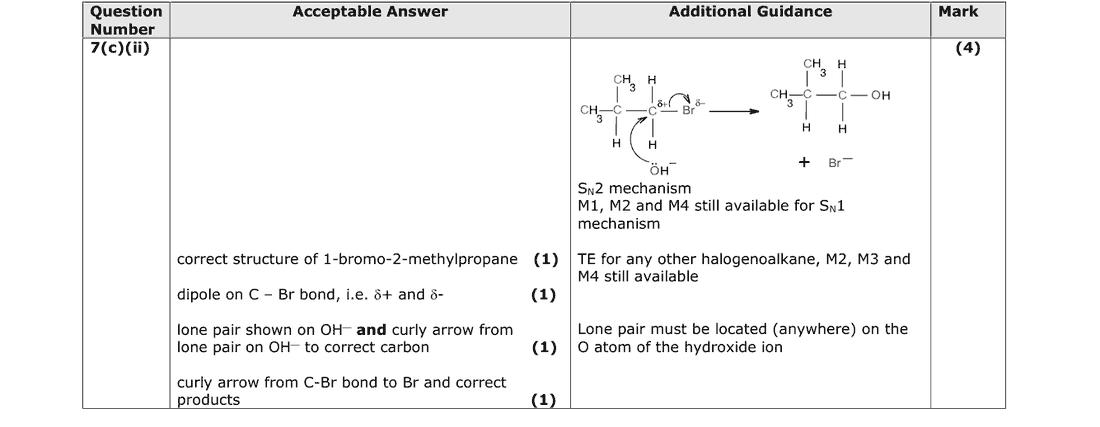
June 2017 · AS Paper 2 · Q7(c)(ii) 4 marks Mechanism
Earlier parts of question 7 that this part usesEarlier part of June 2017 Paper 2 question 7Earlier part of June 2017 Paper 2 question 7
Draw a diagram to show the mechanism for the hydrolysis of
1-bromo-2-methylpropane by the hydroxide ion.
Include any appropriate lone pairs and dipoles.
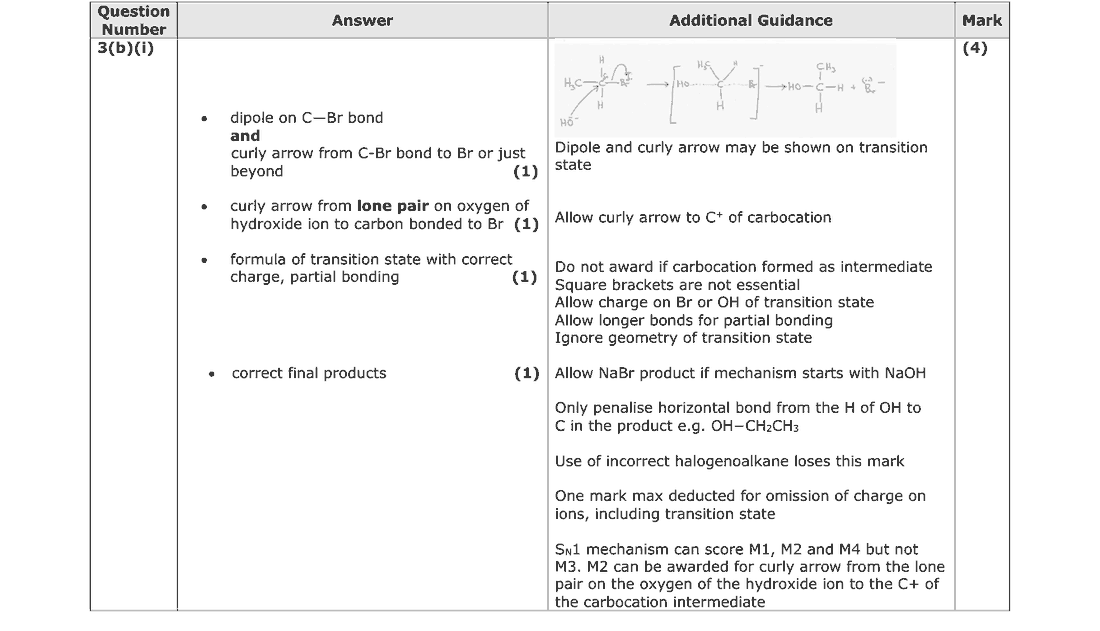
June 2017 · Paper 2 · Q3(b)(i) 4 marks Mechanism
In aqueous sodium hydroxide, 1-bromoethane reacts to produce ethanol.
Write the mechanism for this reaction, including all relevant curly arrows,
lone pairs and dipoles. Include the transition state.
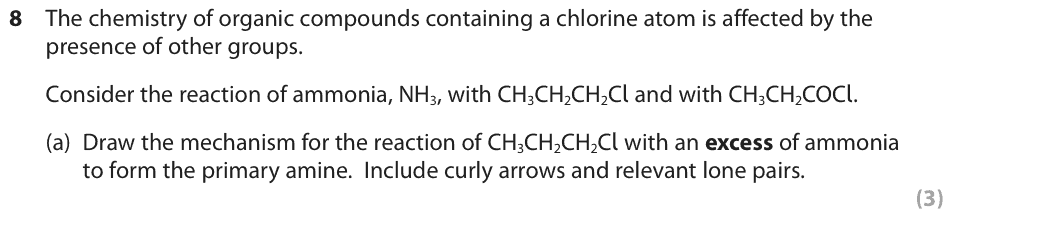
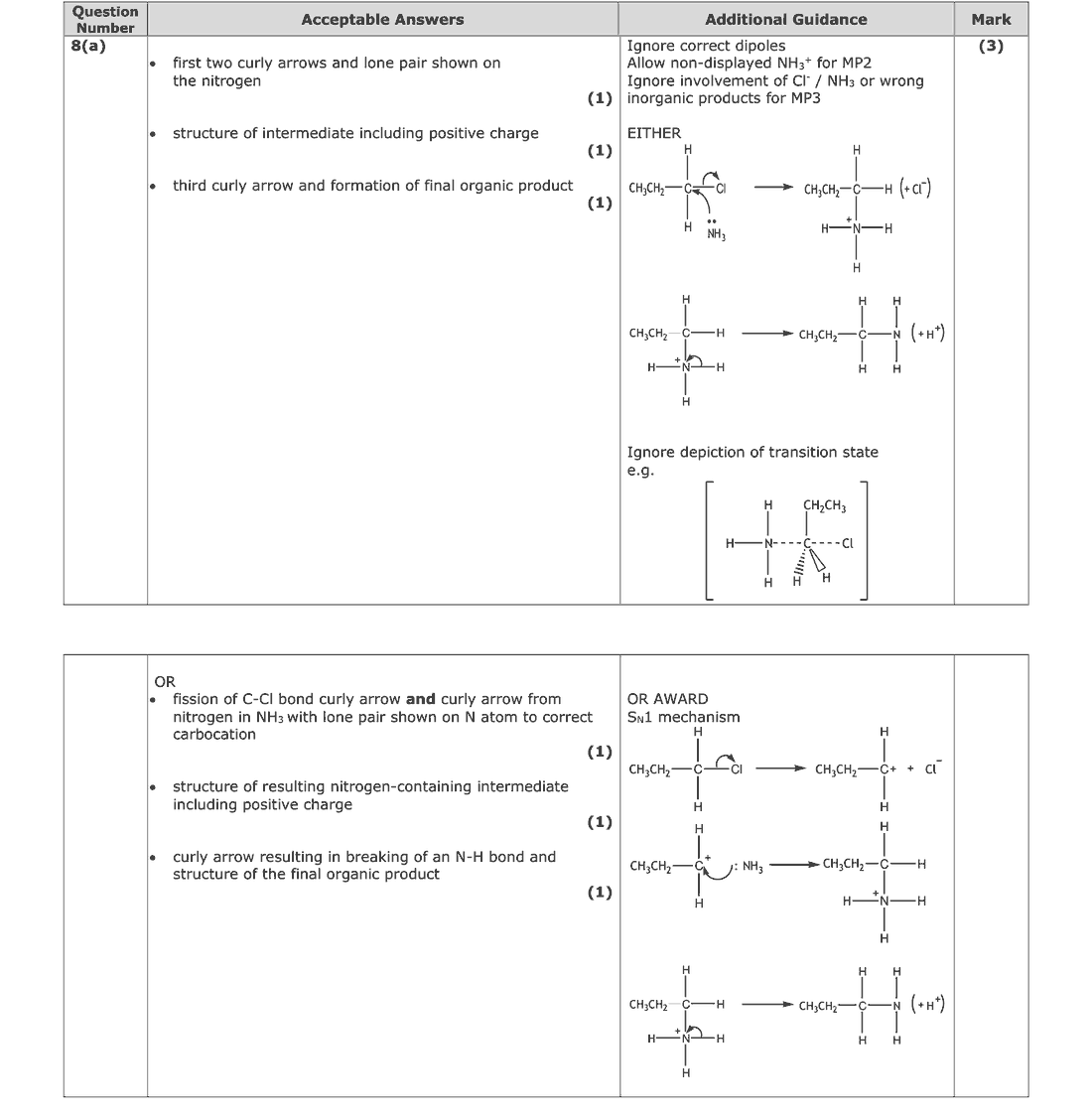
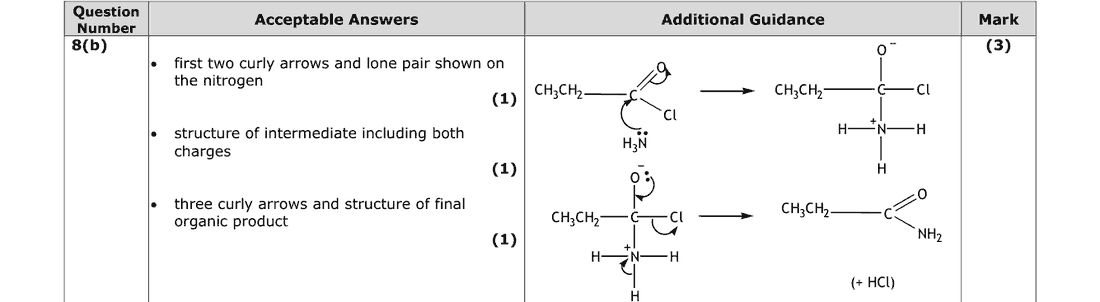
June 2017 · Paper 3 · Q8(a) 3 marks Mechanism
The chemistry of organic compounds containing a chlorine atom is affected by the
presence of other groups.
Consider the reaction of ammonia, NH3, with CH3CH2CH2Cl and with CH3CH2COCl.
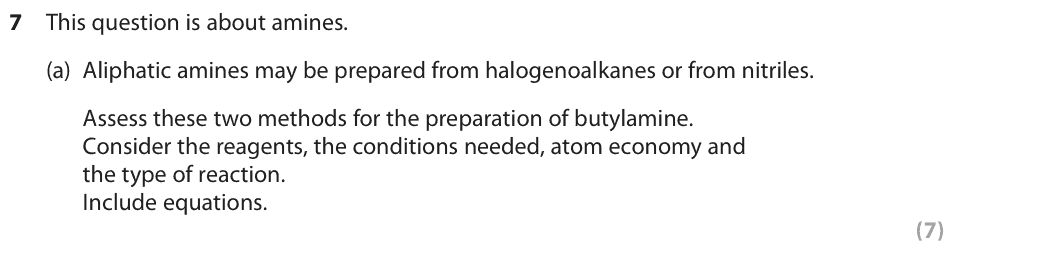
Draw the mechanism for the reaction of CH3CH2CH2Cl with an excess of ammonia
to form the primary amine.  Include curly arrows and relevant lone pairs.
June 2016 · AS Paper 2 · Q5(f) 2 marks Mechanism
Earlier part of question 5 that this part usesEarlier part of June 2016 Paper 2 question 5
The mechanism for the reaction is in three stages.
CH3
CH3
Stage 1
H3C
C
CH3
H3C
C
CH3
O:
H+
O+
H
H
CH3
CH3
Stage 2
H3C
C
CH3
H3C
C+
CH3       + H2O
O+
H
CH3
CH3
Stage 3
H3C
C+
CH3
H3C
C
CH3
:Cl–
Cl
Add curly arrows to the reactants in Stages 2 and 3 to complete the mechanism.

Arenes: benzene (6)

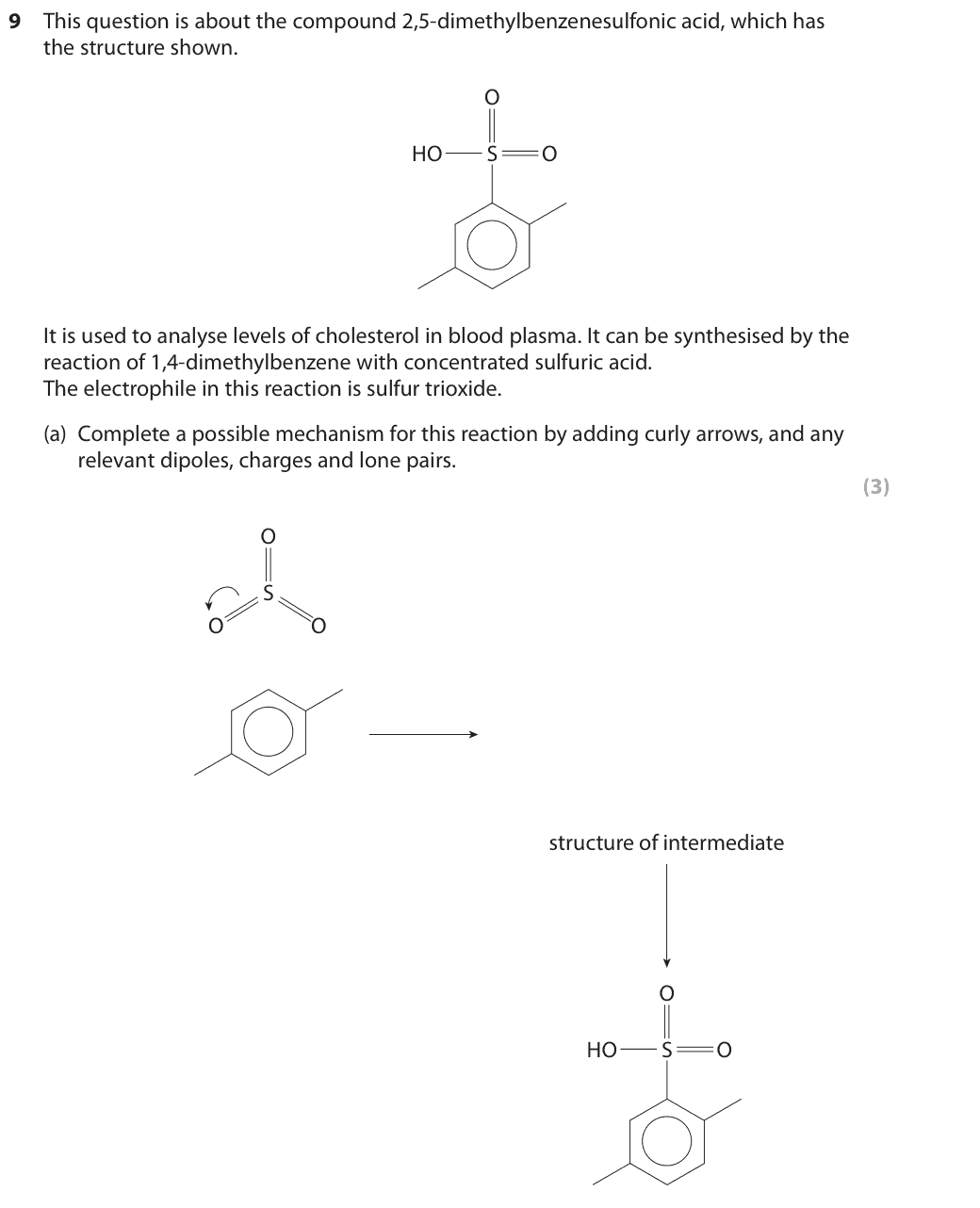
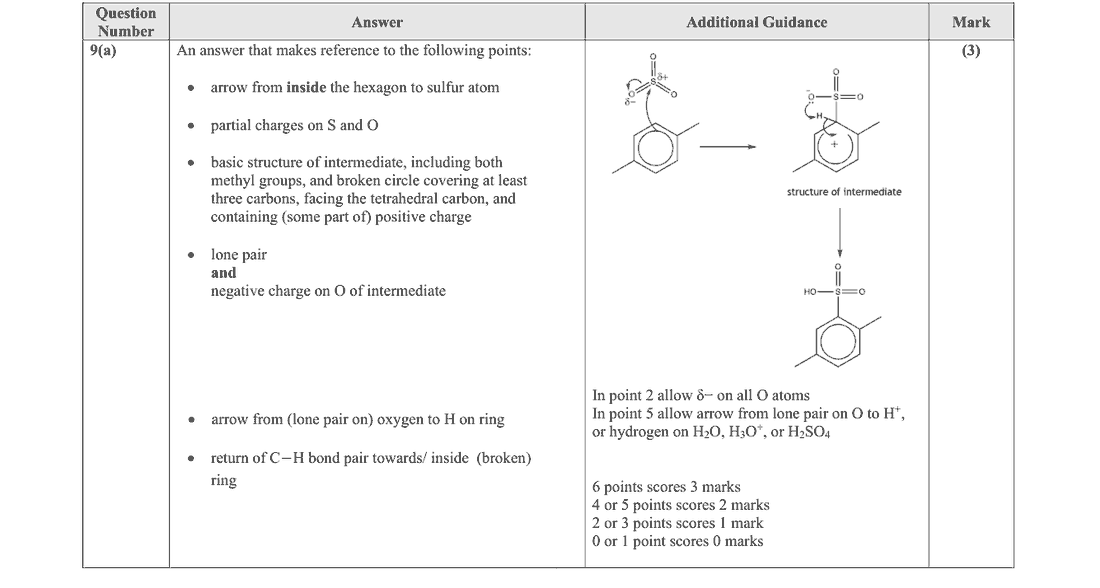
June 2025 · Paper 3 · Q9(a) 3 marks Mechanism
This question is about the compound 2,5-dimethylbenzenesulfonic acid, which has
the structure shown.
O
S
O
HO
It is used to analyse levels of cholesterol in blood plasma. It can be synthesised by the
reaction of 1,4-dimethylbenzene with concentrated sulfuric acid.
The electrophile in this reaction is sulfur trioxide.
Complete a possible mechanism for this reaction by adding curly arrows, and any
relevant dipoles, charges and lone pairs.
O
S
O
O
structure of intermediate
O
HO
S
O
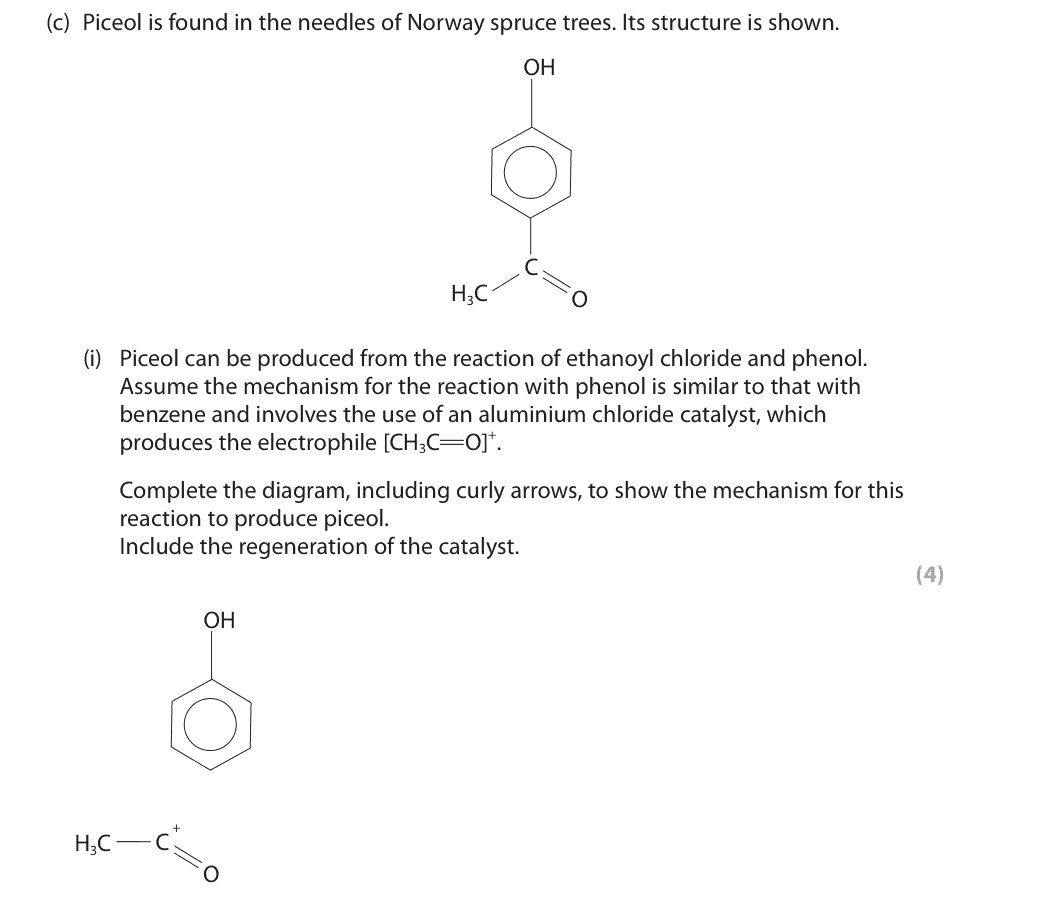
June 2023 · Paper 3 · Q9(c)(i) 4 marks Mechanism
Earlier part of question 9 that this part usesEarlier part of June 2023 Paper 3 question 9
Piceol is found in the needles of Norway spruce trees. Its structure is shown.
OH
C
H3C
O
Piceol can be produced from the reaction of ethanoyl chloride and phenol.
Assume the mechanism for the reaction with phenol is similar to that with
benzene and involves the use of an aluminium chloride catalyst, which
produces the electrophile [CH3C
O]+.
Complete the diagram, including curly arrows, to show the mechanism for this
reaction to produce piceol.
Include the regeneration of the catalyst.
OH
+
H3C
C
O
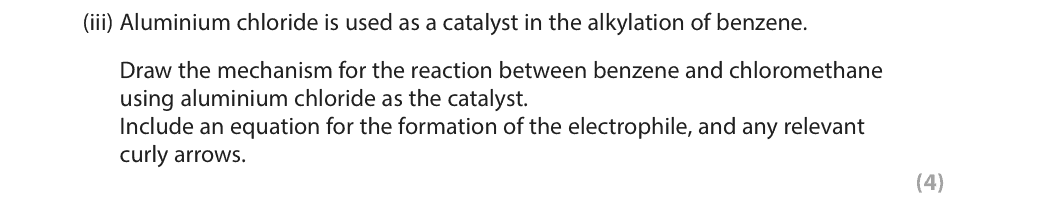
November 2021 · Paper 3 · Q3(b)(iii) 4 marks Mechanism
Earlier part of question 3 that this part usesEarlier part of November 2021 Paper 3 question 3
Aluminium chloride is used as a catalyst in the alkylation of benzene.
Draw the mechanism for the reaction between benzene and chloromethane
using aluminium chloride as the catalyst.
Include an equation for the formation of the electrophile, and any relevant
curly arrows.
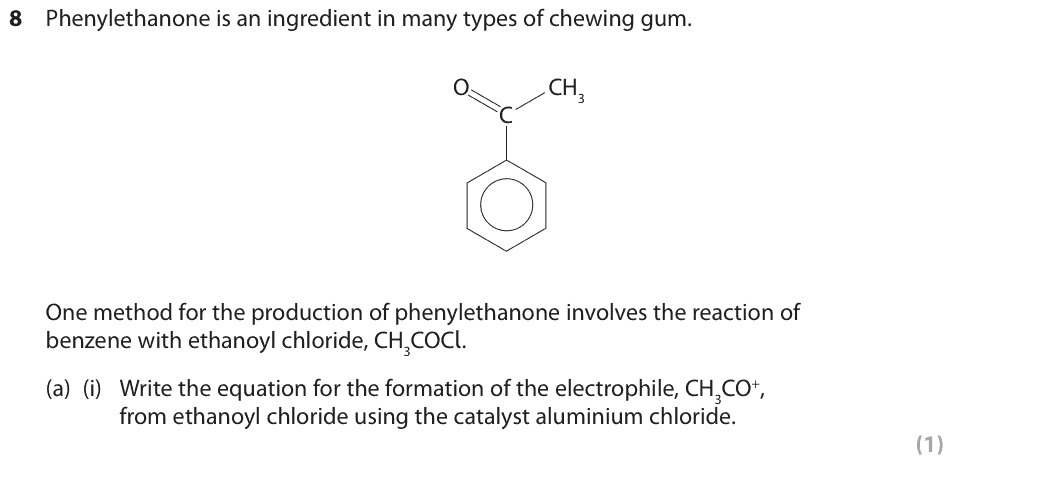
June 2019 · Paper 2 · Q5(a)(ii) 5 marks Mechanism
Earlier part of question 5 that this part usesEarlier part of June 2019 Paper 2 question 5
Draw the mechanism for this reaction.
Include equations showing the role of the catalyst and how it is regenerated.
June 2018 · Paper 2 · Q8(b)(i) 3 marks Mechanism
Earlier part of question 8 that this part usesEarlier part of June 2018 Paper 2 question 8
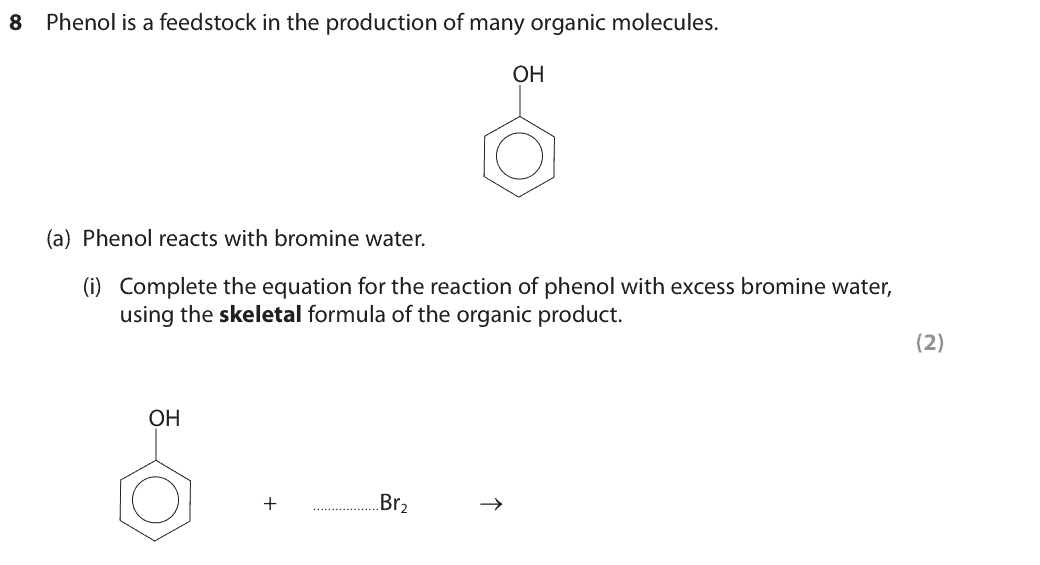
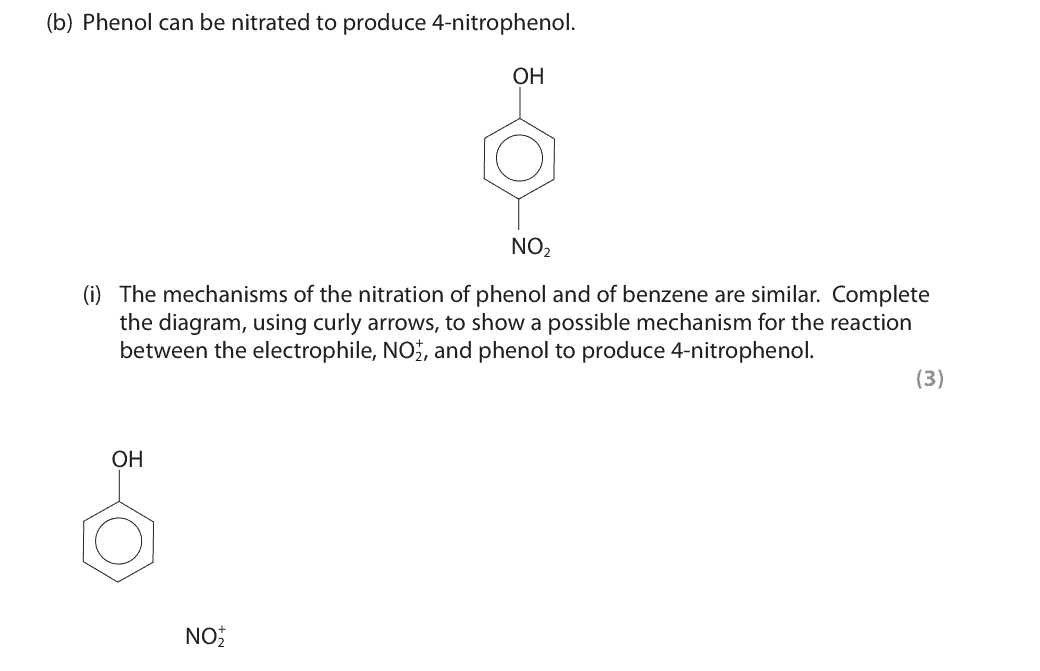
Phenol can be nitrated to produce 4-nitrophenol.
OH
NO2
The mechanisms of the nitration of phenol and of benzene are similar.  Complete
the diagram, using curly arrows, to show a possible mechanism for the reaction
+, and phenol to produce 4-nitrophenol.
between the electrophile, NO2
OH
NO2
+
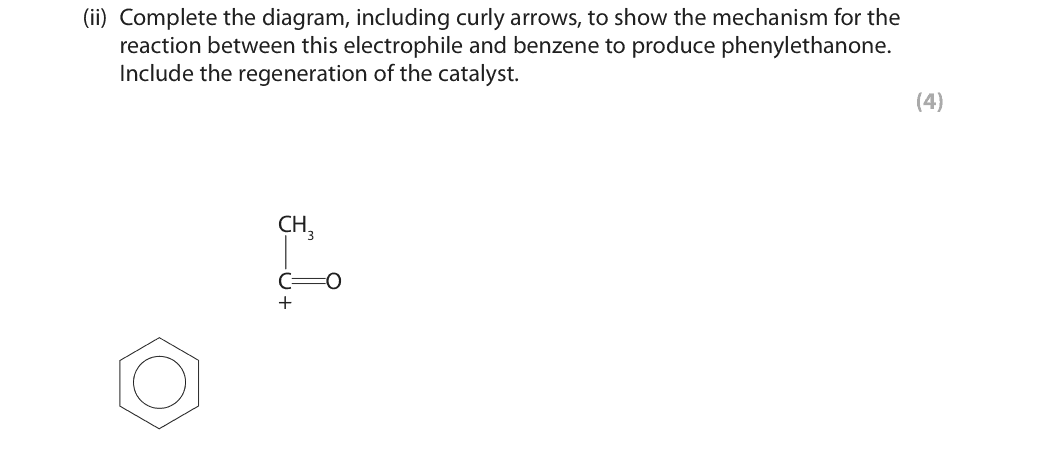
June 2017 · Paper 2 · Q8(a)(ii) 4 marks Mechanism
Earlier part of question 8 that this part usesEarlier part of June 2017 Paper 2 question 8
Complete the diagram, including curly arrows, to show the mechanism for the
reaction between this electrophile and benzene to produce phenylethanone.
Include the regeneration of the catalyst.
CH3
C
O
+

Carbonyl compounds (5)

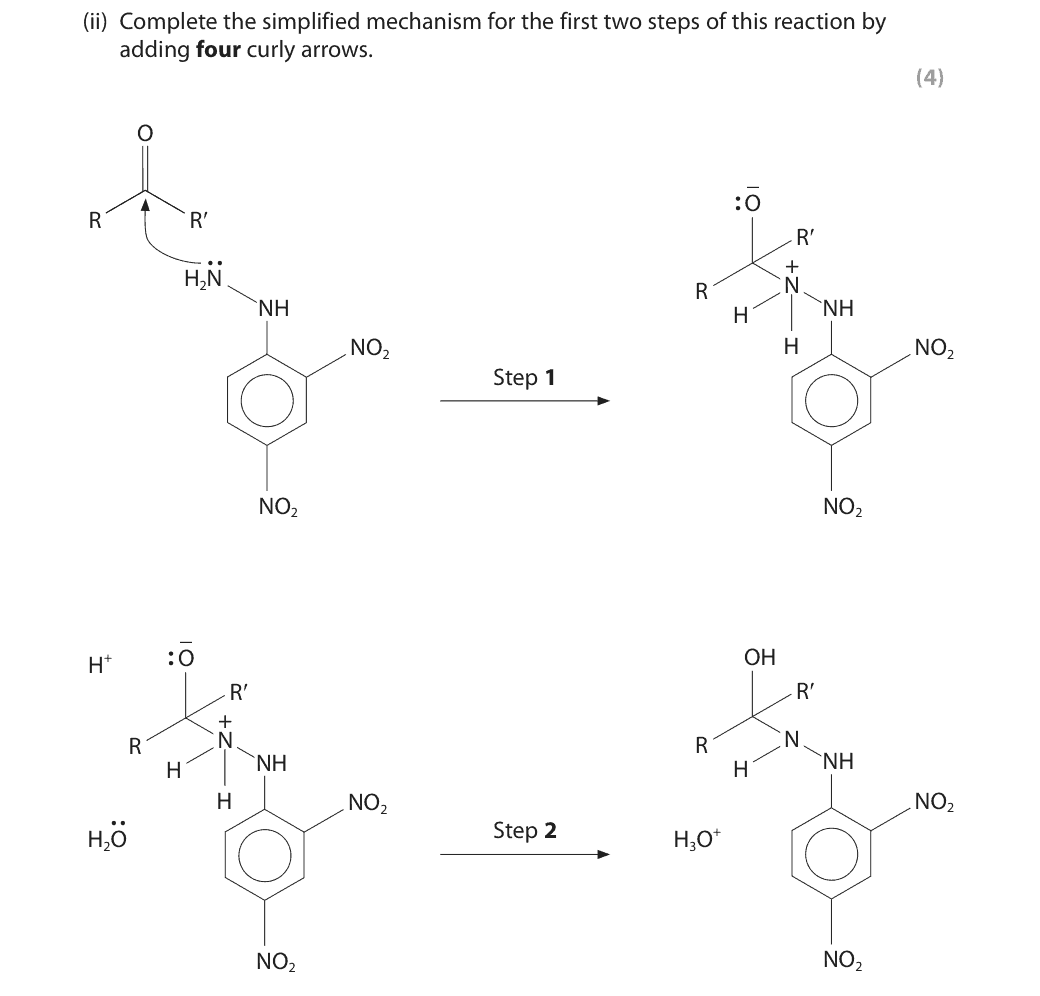
June 2024 · Paper 3 · Q7(d)(ii) 4 marks Mechanism
Earlier parts of question 7 that this part usesEarlier part of June 2024 Paper 3 question 7Earlier part of June 2024 Paper 3 question 7
Complete the simplified mechanism for the first two steps of this reaction by
adding four curly arrows.
O
_
O
R′
R
R′
. .
+
H2N
N
R
NH
NH
H
NO2
H
NO2
Step 1
NO2
NO2
_
O
OH
H+
R′
R′
+
N
N
R
R
NH
NH
H
H
NO2
H
NO2
. .
Step 2
H2O
H3O+
NO2
NO2
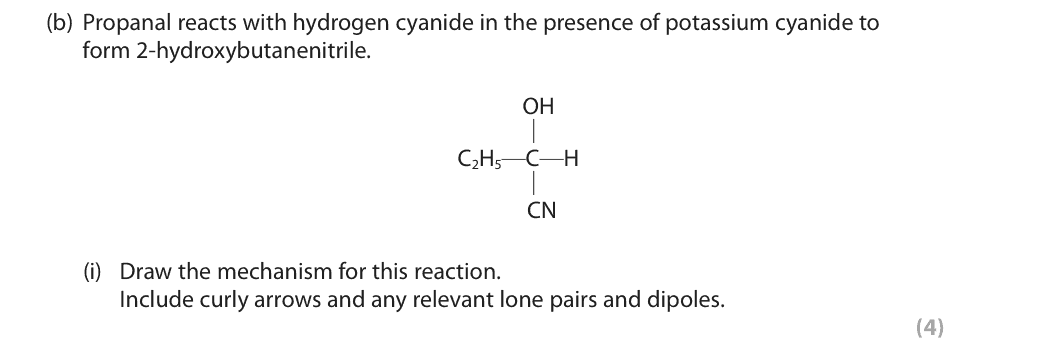
June 2023 · Paper 2 · Q7(b)(i) 4 marks Mechanism
Propanal reacts with hydrogen cyanide in the presence of potassium cyanide to
form 2‑hydroxybutanenitrile.
OH
C2H5
C
H
CN
Draw the mechanism for this reaction.
Include curly arrows and any relevant lone pairs and dipoles.
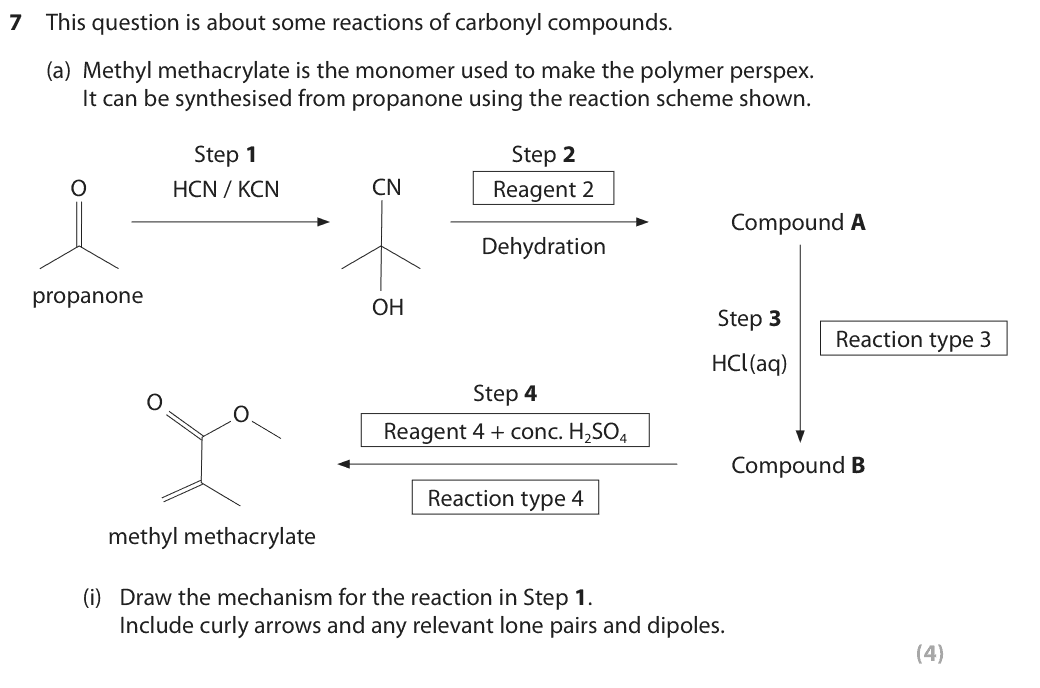
June 2022 · Paper 3 · Q7(a)(i) 4 marks Mechanism
This question is about some reactions of carbonyl compounds.
Methyl methacrylate is the monomer used to make the polymer perspex.
It can be synthesised from propanone using the reaction scheme shown.
Step 1
Step 2
CN
O
HCN / KCN
Reagent 2
Compound A
Dehydration
propanone
OH
Step 3
Reaction type 3
HCl(aq)
Step 4
O
O
Reagent 4 + conc. H2SO4
Compound B
Reaction type 4
methyl methacrylate
Draw the mechanism for the reaction in Step 1.
Include curly arrows and any relevant lone pairs and dipoles.
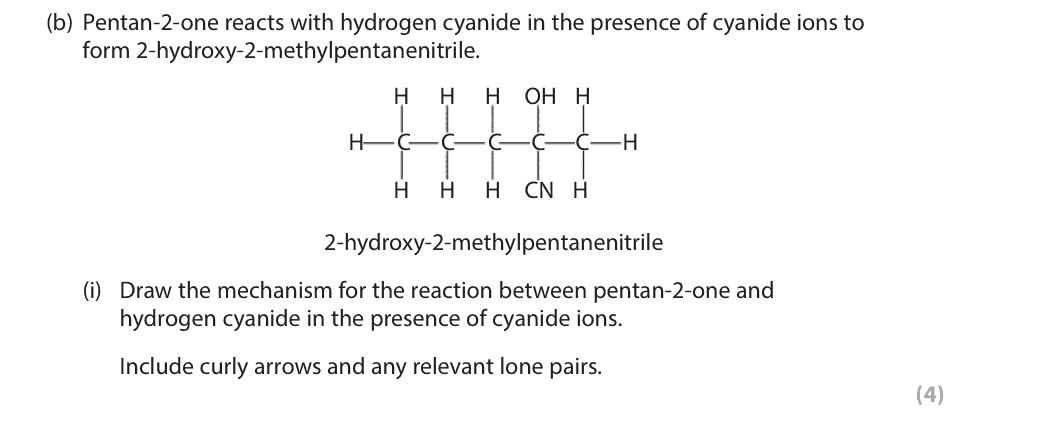
November 2021 · Paper 3 · Q8(b)(i) 4 marks Mechanism
Pentan-2-one reacts with hydrogen cyanide in the presence of cyanide ions to
form 2-hydroxy-2-methylpentanenitrile.
H    H    H  OH      H
H     C    C     C    C    C     H
H    H    H  CN      H
2-hydroxy-2-methylpentanenitrile
Draw the mechanism for the reaction between pentan-2-one and
hydrogen cyanide in the presence of cyanide ions.
Include curly arrows and any relevant lone pairs.
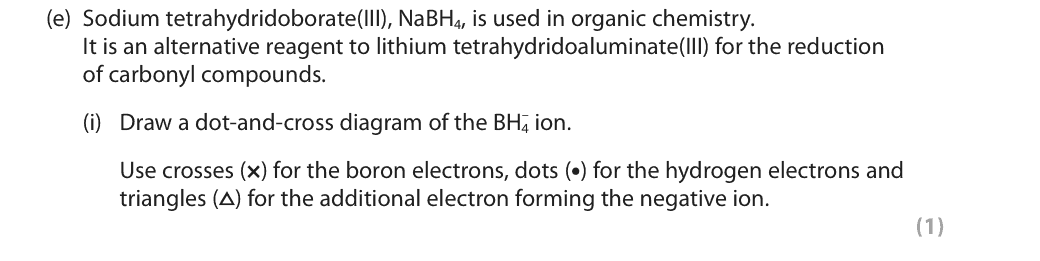
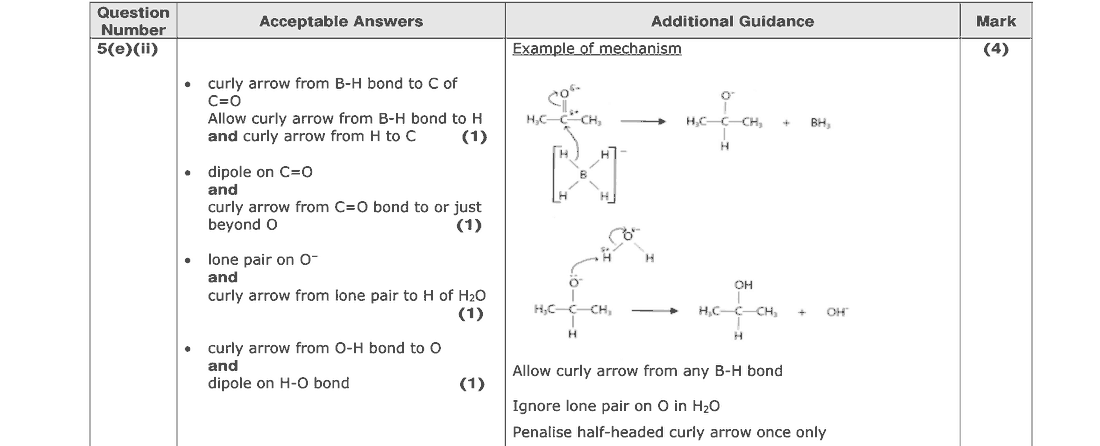
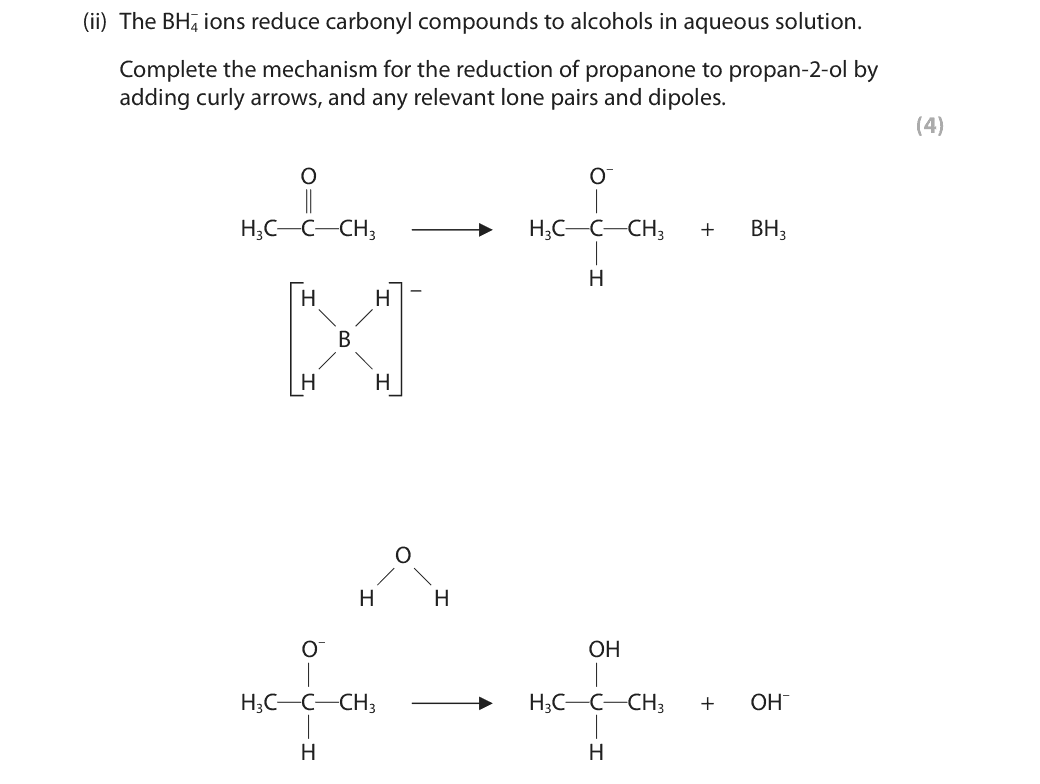
June 2019 · Paper 3 · Q5(e)(ii) 4 marks Mechanism
Earlier parts of question 5 that this part usesEarlier part of June 2019 Paper 3 question 5Earlier part of June 2019 Paper 3 question 5
The BH4
Complete the mechanism for the reduction of propanone to propan-2-ol by
adding curly arrows, and any relevant lone pairs and dipoles.
O–
O
H3C
C
CH3
H3C
C
CH3   +   BH3
H
–
H
H
B
H
H
O
H
H
O–
OH
H3C
C
CH3
H3C
C
CH3   +   OH–
H
H

Carboxylic acids (3)

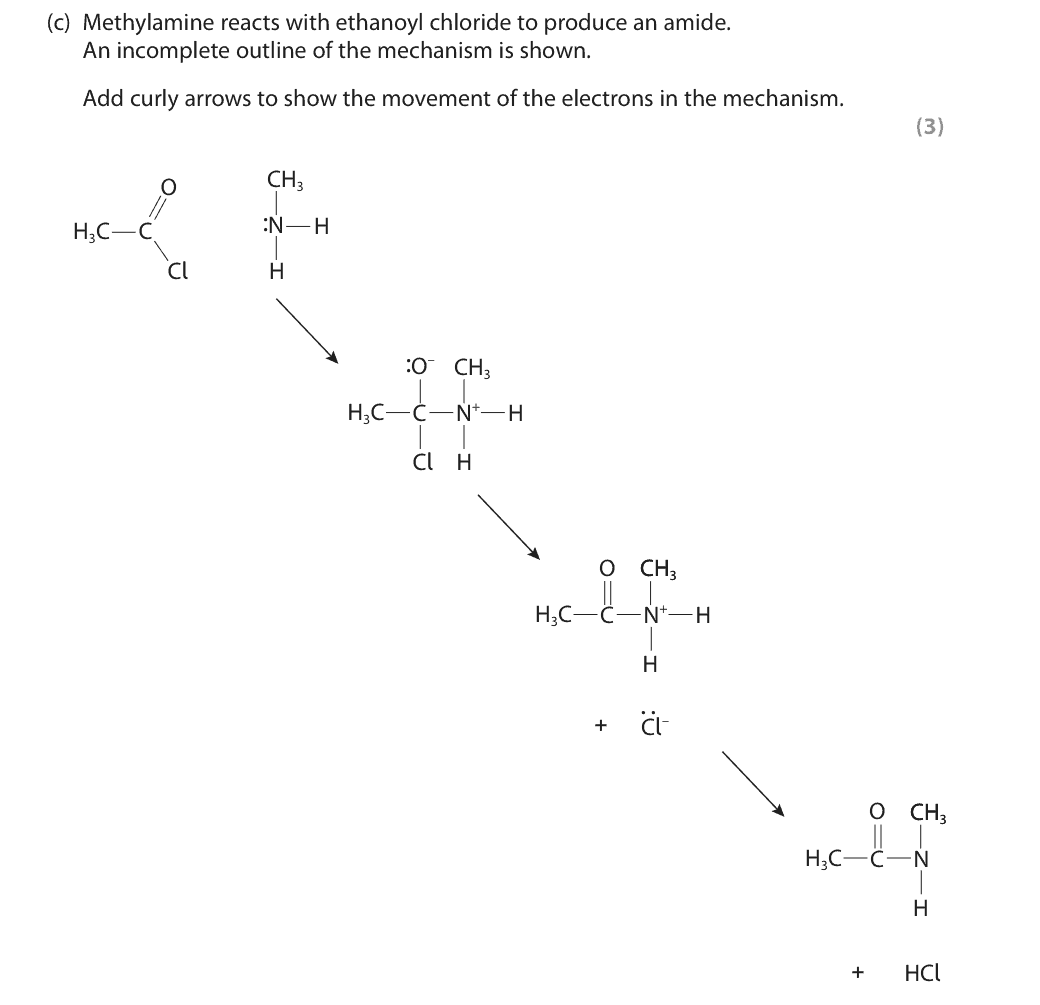
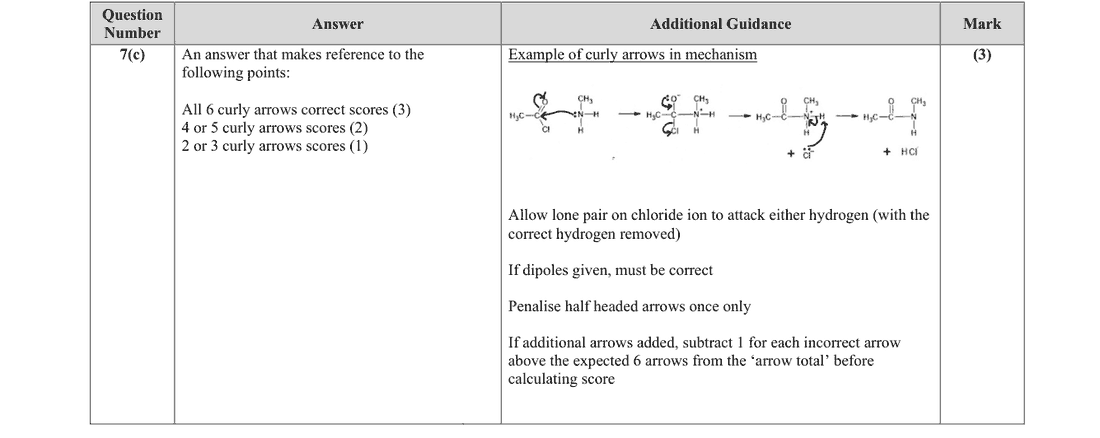
June 2025 · Paper 2 · Q7(c) 3 marks Mechanism
Earlier part of question 7 that this part usesEarlier part of June 2025 Paper 2 question 7
Methylamine reacts with ethanoyl chloride to produce an amide.
An incomplete outline of the mechanism is shown.
Add curly arrows to show the movement of the electrons in the mechanism.
CH3
O
:N
H
H3C
C
Cl
H
:O–
CH3
H3C
C
N+
H
Cl
H
O
CH3
CH3
H3C
C
N+
H
H
+
Cl–
O
CH3
CH3
H3C
C
N
H
+
HCl
October 2020 · Paper 3 · Q10(a)(i) 4 marks Mechanism
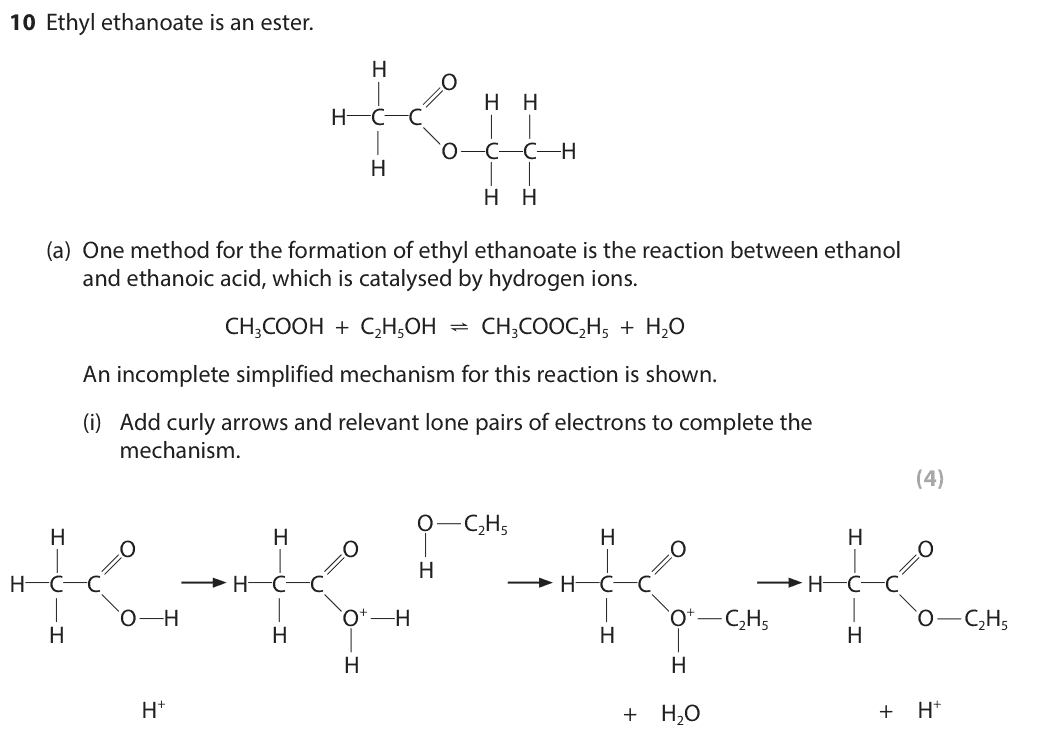
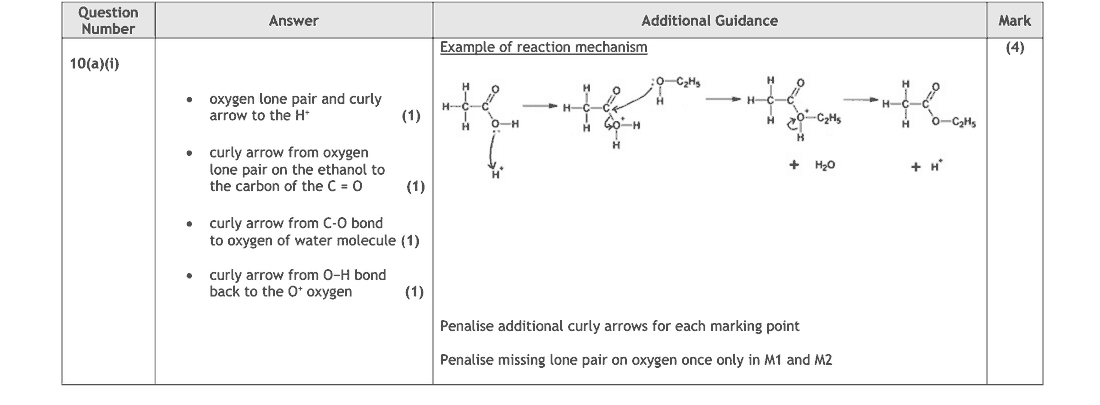
Ethyl ethanoate is an ester.
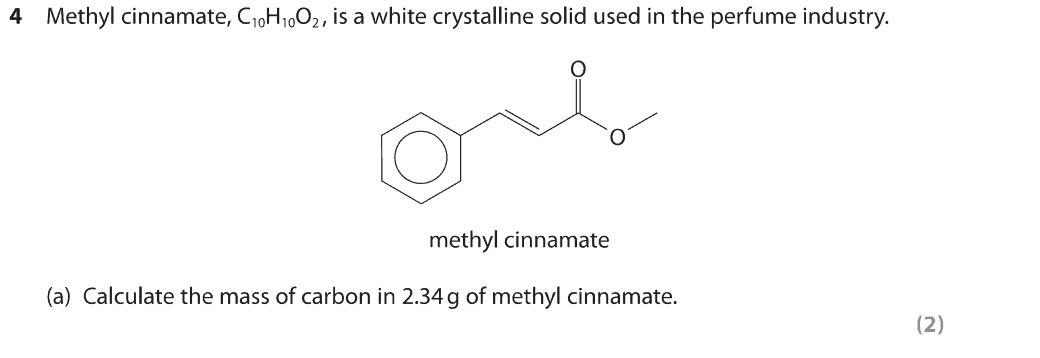
H
O
H
H
H
C
C
O
C
C
H
H
H
H
One method for the formation of ethyl ethanoate is the reaction between ethanol
and ethanoic acid, which is catalysed by hydrogen ions.
CH3COOH  +  C2H5OH  ⇌  CH3COOC2H5  +  H2O
An incomplete simplified mechanism for this reaction is shown.
Add curly arrows and relevant lone pairs of electrons to complete the
mechanism.
O
C2H5
H
H
H
H
O
O
O
O
H
H
C
C
H
C
C
H
C
C
H
C
C
O
H
O+
H
O+
C2H5
O
C2H5
H
H
H
H
H
H
H+
+  H2O
+  H+
June 2017 · Paper 3 · Q8(b) 3 marks Mechanism Hard
Earlier part of question 8 that this part usesEarlier part of June 2017 Paper 3 question 8
Predict the mechanism for the reaction of CH3CH2COCl with ammonia.
Include curly arrows and relevant lone pairs.

Kinetics II (2)

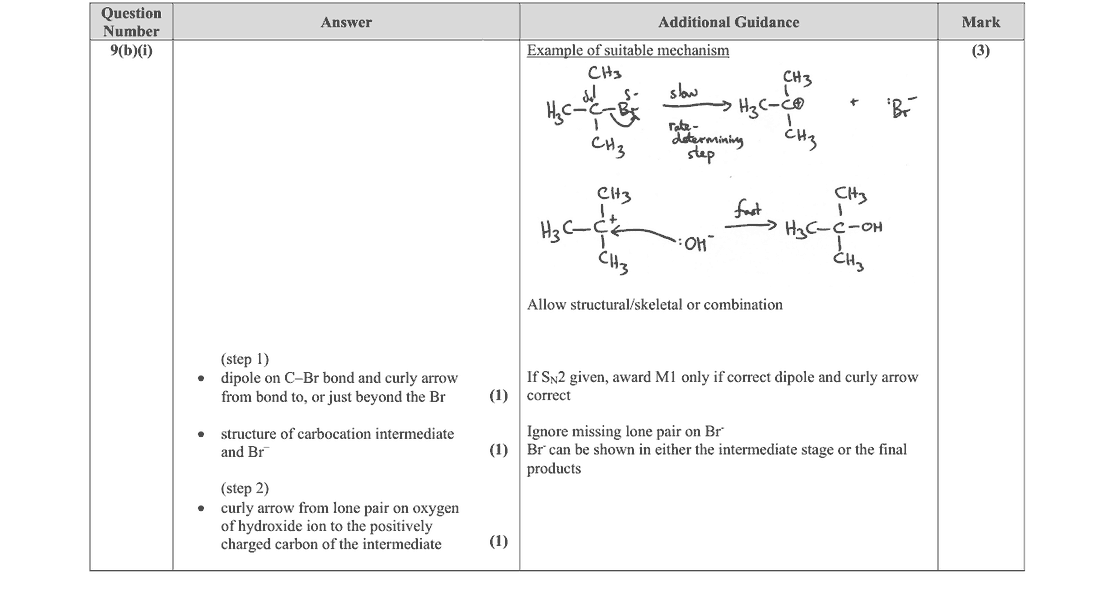
June 2025 · Paper 2 · Q9(b)(i) 3 marks Mechanism
The rate of reaction for the hydrolysis of 2‑bromo‑2‑methylpropane by
aqueous hydroxide ions is independent of the concentration of hydroxide ions.
Draw the SN1 reaction mechanism for this hydrolysis.
Include curly arrows and any relevant dipoles and lone pairs of electrons.
October 2020 · Paper 2 · Q6(d)(ii) 3 marks Mechanism
Earlier parts of question 6 that this part usesEarlier part of October 2020 Paper 2 question 6Earlier part of October 2020 Paper 2 question 6
Give the mechanism for the reaction that is consistent with the orders of reaction
with respect to R
Br and hydroxide ions.
Include curly arrows and relevant lone pairs.

Amines, amides, amino acids and proteins (1)

June 2025 · Paper 2 · Q7(c) 3 marks Mechanism
Earlier part of question 7 that this part usesEarlier part of June 2025 Paper 2 question 7
Methylamine reacts with ethanoyl chloride to produce an amide.
An incomplete outline of the mechanism is shown.
Add curly arrows to show the movement of the electrons in the mechanism.
CH3
O
:N
H
H3C
C
Cl
H
:O–
CH3
H3C
C
N+
H
Cl
H
O
CH3
CH3
H3C
C
N+
H
H
+
Cl–
O
CH3
CH3
H3C
C
N
H
+
HCl

Work with an A-level chemistry tutor

Curly arrows starting in the wrong place? It is one of the quickest things a tutor can put right.

Prefer email? Send an enquiry

If you are under 18, please include a parent's contact details. Enquiries go to enquiries@chemistryaleveltutor.com and are deleted once handled. All tutoring is online.