Notes and key-term cards for this topic are being written by our tutors. The past-paper questions below are ready now.
Specification statements
Show the 7 statements from the specification
6.30 know that halogenoalkanes can be classified as primary, secondary or tertiary
6.31 understand what is meant by the term ‘nucleophile’
6.32 understand the reactions of halogenoalkanes with: • i aqueous potassium hydroxide to produce alcohols (where the hydroxide ion acts as a nucleophile) • ii aqueous silver nitrate in ethanol (where water acts as a nucleophile) • iii potassium cyanide to produce nitriles (where the cyanide ion acts as a nucleophile) • iv ammonia to produce primary amines (where the ammonia molecule acts as a nucleophile) • v ethanolic potassium hydroxide to produce alkenes (where the hydroxide ion acts as a base) [Students should know this as an example of increasing the length of the carbon chain.]
6.33 understand that experimental observations and data can be used to compare the relative rates of hydrolysis of: • i primary, secondary and tertiary halogenoalkanes • ii chloro-, bromo-, and iodoalkanes using aqueous silver nitrate in ethanol
6.34 know the trend in reactivity of primary, secondary and tertiary halogenoalkanes
6.35 understand, in terms of bond enthalpy, the trend in reactivity of chloro-, bromo-, and iodoalkanes
6.36 understand the mechanisms of the nucleophilic substitution reactions between primary halogenoalkanes and: • i aqueous potassium hydroxide • ii ammonia
Six-mark extended response questions on this topic
Tap a question to zoom it. Where a part needs a figure, table or structure from earlier in the question, that part folds out above it; the mark scheme and examiner's comment open underneath. Have Edexcel's Data Booklet beside you; the Periodic Table is on the back page of every paper.
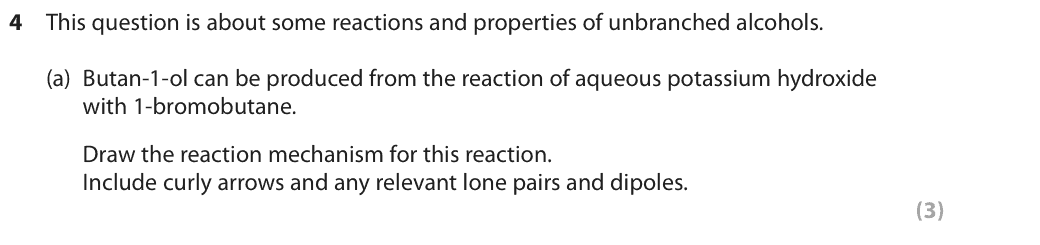
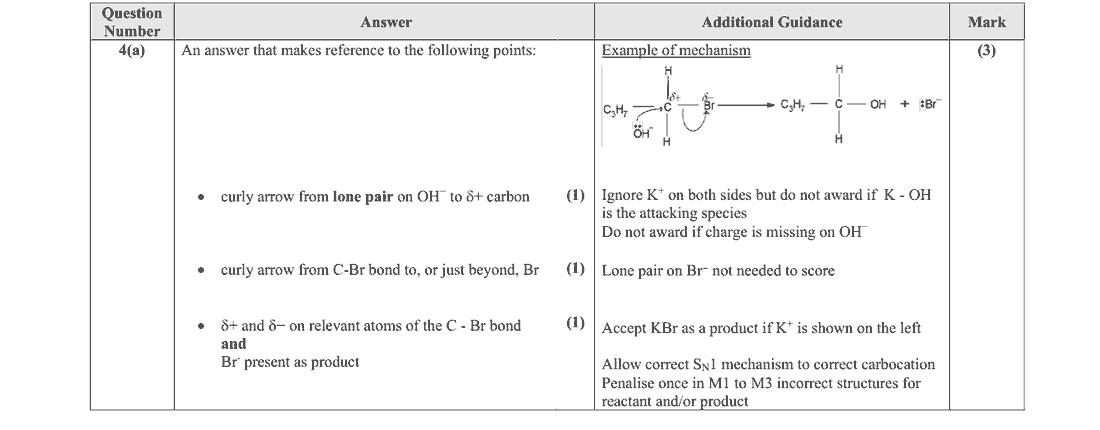
June 2025 · AS Paper 2 · Q4(a)3 marksMechanism
Mark scheme
Examiner's comment
This question was concerned with the reactions and properties of alcohols. (a) Many knew the mechanism for the reaction of 1-bromobutane with aqueous potassium hydroxide and, on the whole, placed arrows and lone pairs carefully. However, some treated KOH as covalent and attempted to include K in the mechanism, which led to many incorrect answers. Leaving an unbalanced product by missing Br- or adding a previously unseen K+ lost many a mark. Scores were widely distributed, and 3 was the most common. (b) This question proved to be surprisingly challenging, and half of the candidates scored no marks. Most labelled the y-axis correctly, although a significant number wrote “Energy change” Common mistakes were failure to balance the equation correctly (omitting water and HBr or writing the wrong product) and not labelling ΔH or including double headed arrows. Some exothermic reactions were seen, and some labelled Ea as ΔH. (ci) London forces were generally well understood but many failed to explain why these increase with chain length. Some marks were lost by referring to intermolecular forces as “bonds”. (cii) There were many references to 1⁰, 2⁰,3⁰ (which did not necessarily lose the marks) - the correlation with branching was well known and often, but not always, adequately explained. Stability of primary, secondary and tertiary alcohols featured regularly.
Notes from the mark scheme and report
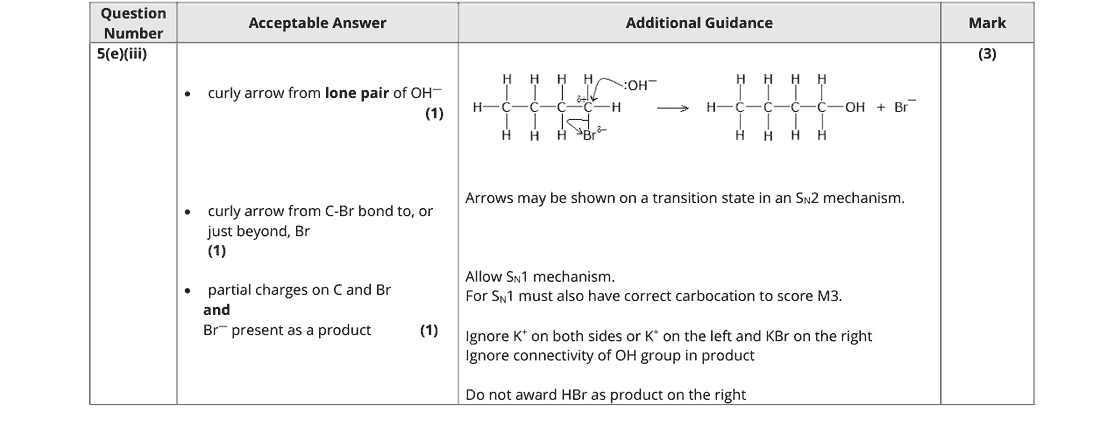
Curly arrow from a lone pair on OH– (with its charge) to the δ+ carbon
curly arrow from the C–Br bond to (or just beyond) the Br
δ+ on C and δ– on Br, with Br– shown as a product. K+ on both sides is ignored but K–OH must not be the attacking species. A correct SN1 mechanism is allowed. Common errors: treating KOH as covalent
leaving out Br– or adding an unbalanced K+. Three marks was the commonest score
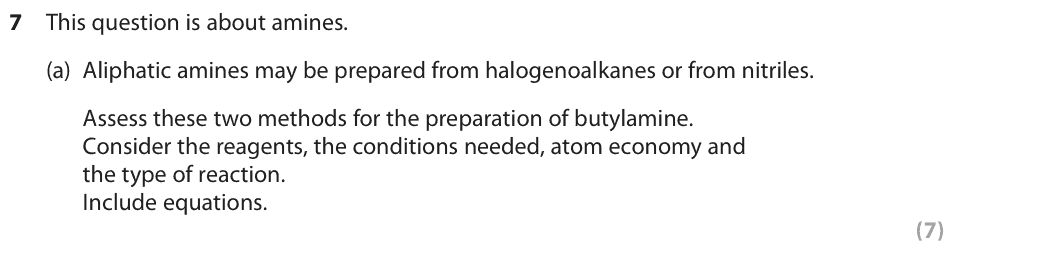
June 2025 · Paper 2 · Q7(a)7 marksExplanation
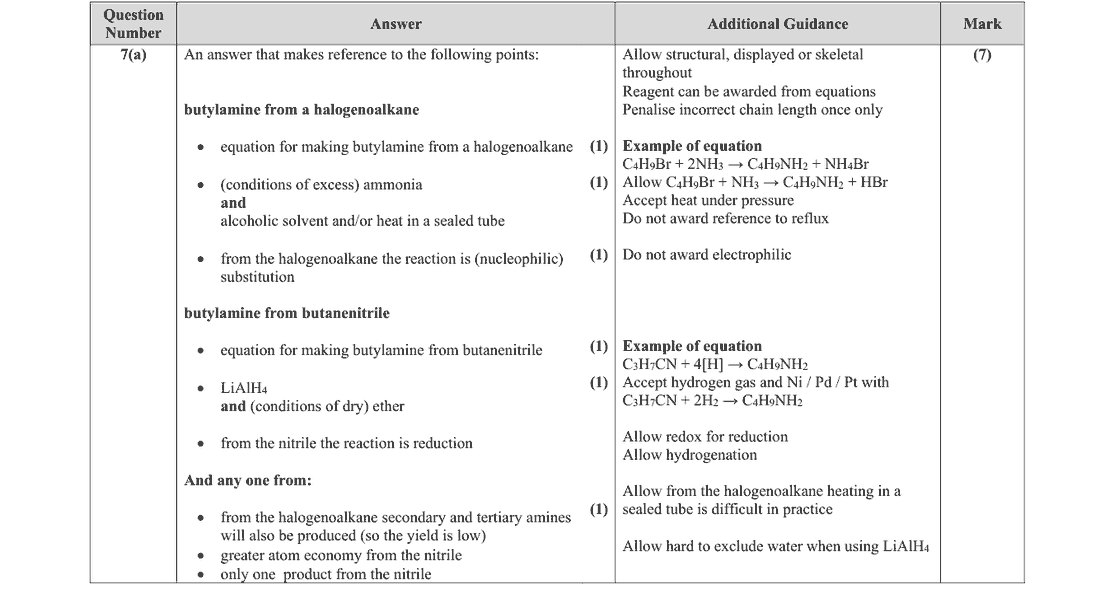
Mark scheme
Examiner's comment
This question attracted the full range of marks with many candidates scoring at least five marks out of the available seven.
Most were able to identify the (nucleophilic) substitution for producing the amine from the halogenoalkane and also for the reduction of the nitrile.
A large proportion were also able to identify the reduction of the nitrile having a higher atom economy.
Candidates generally struggled with the balanced equation and included the reactants above the arrow. Reactants always appear on the left and products on the right hand side, leaving the arrow for conditions and catalysts.
Notes from the mark scheme and report
From a halogenoalkane: C4H9Br + 2NH3 → C4H9NH2 + NH4Br (or + NH3 → amine + HBr)
(excess) ammonia in an alcoholic solvent and/or heated in a sealed tube (under pressure
not reflux)
(nucleophilic) substitution. From butanenitrile: C3H7CN + 4[H] → C4H9NH2
LiAlH4 in dry ether (or hydrogen with Ni / Pt / Pd, + 2H2)
reduction. Plus one of: secondary and tertiary amines also form from the halogenoalkane (lower yield)
the nitrile route has the higher atom economy
only one product from the nitrile. Wrong chain length penalised once. Many scored at least five
equations were the weak point, with reactants written above the arrow
June 2024 · Paper 2 · Q1(a)1 markMultiple choice
Answer
D
Mark scheme
Notes from the mark scheme and report
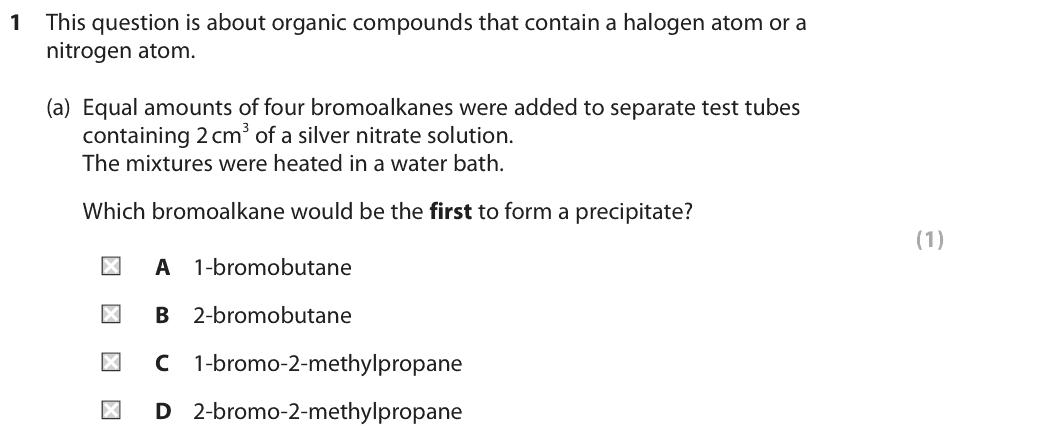
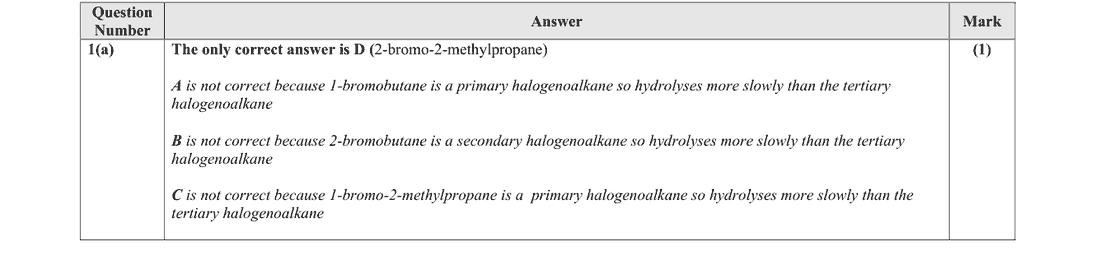
Answer: D. 2-bromo-2-methylpropane is a tertiary halogenoalkane, so it is hydrolysed fastest and gives the silver bromide precipitate first. A and C are primary and B is secondary, so all hydrolyse more slowly
Skills: CP4 Core practical 4: Investigation of the rates of hydrolysis of some halogenoalkanes
June 2024 · Paper 2 · Q1(c)(i)3 marksExplanation
Earlier part of question 1 that this part uses
Mark scheme
Examiner's comment
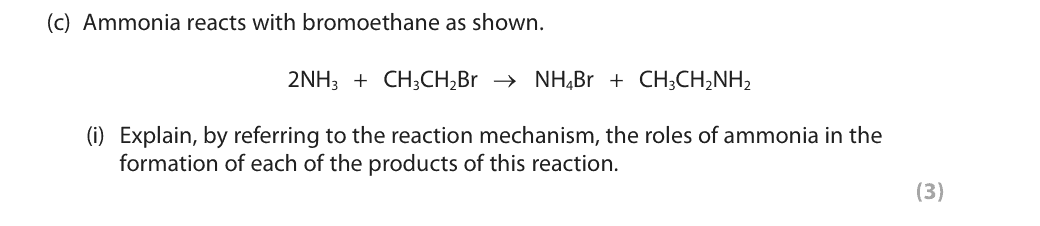
Previous exam sessions have shown that candidates are often able to accurately recall diagrams to show mechanisms in organic chemistry. However, chemists need to be literate as well, and this question tested the ability of candidates to both recall and explain what is happening in the reaction. Many candidates correctly identified both roles of ammonia in the reaction. However, some answers showed a misunderstanding of basic behaviour by linking it to the acceptance of a bromide ion. Some candidates didn’t make it clear which carbon atom was attacked by the nucleophilic ammonia, and others described the removal of a hydrogen, rather than hydrogen ion, with no clear reference to the source of this ion.
Notes from the mark scheme and report
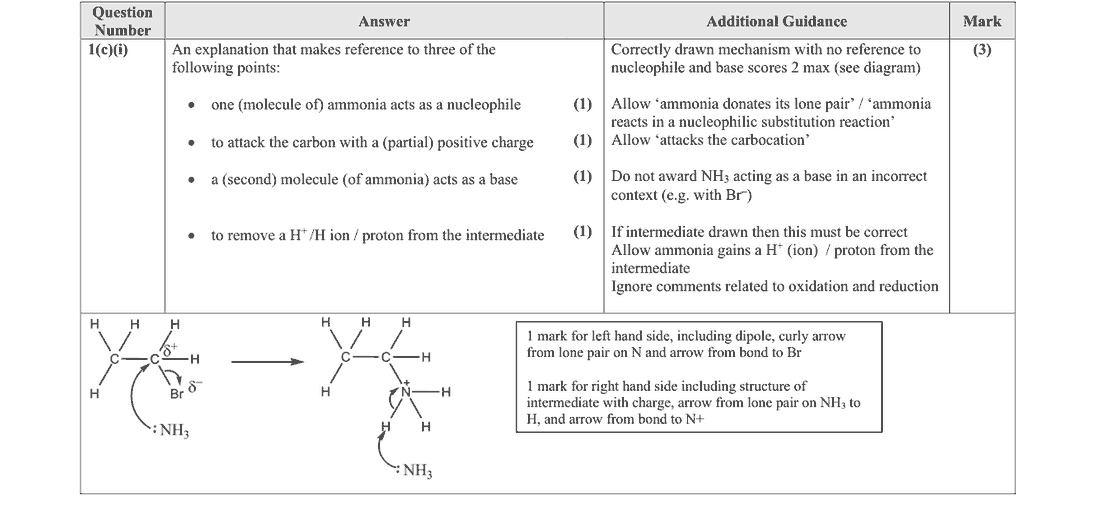
Any three of: one ammonia molecule acts as a nucleophile (allow donates its lone pair)
attacking the carbon atom with the partial positive charge
a second ammonia molecule acts as a base
removing a proton (H+) from the intermediate (CH3CH2NH3+), giving the amine and NH4+. A correctly drawn mechanism with no mention of nucleophile and base scores at most 2. Ammonia acting as a base towards Br– is not credited. Errors: not saying which carbon is attacked
'removes a hydrogen' rather than a hydrogen ion, with no source given
June 2024 · Paper 2 · Q1(c)(ii)1 markMultiple choice
Earlier parts of question 1 that this part uses
Answer
A
Mark scheme
Notes from the mark scheme and report
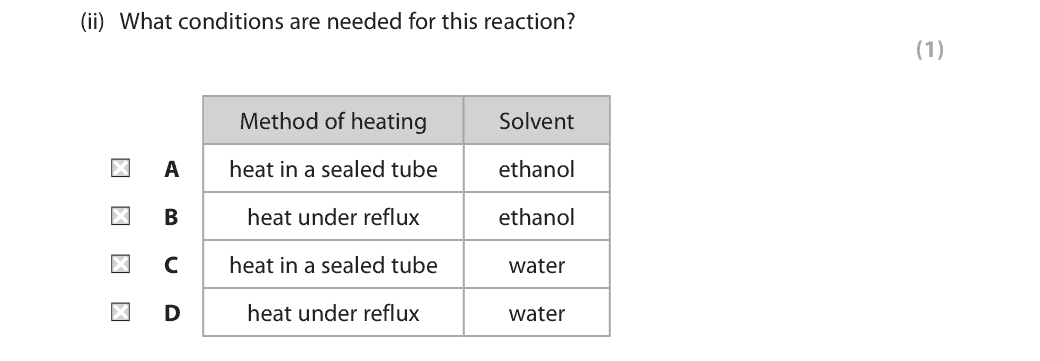
Answer: A. Heat in a sealed tube with ethanol as the solvent: the system must be closed, so not reflux (B, D), and bromoethane is not soluble in water (C, D)
June 2024 · Paper 2 · Q5(d)(i)2 marksExplanation
Mark scheme
Examiner's comment
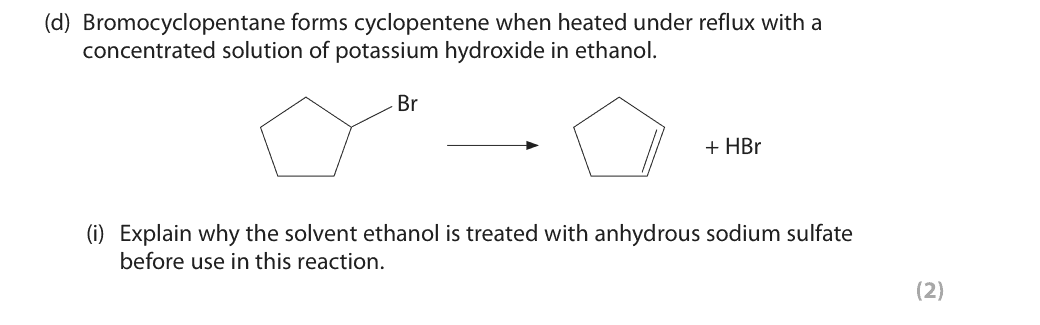
This was another case of linking ideas from one part of the specification to another context, a vital skill for candidates hoping to obtain the higher grades. Recognition of anhydrous sodium sulfate as a drying agent was common, but a number of candidates didn’t then link this to the idea that it was there to remove water from the solvent. Only a small number of those that managed this made the connection to the fact that the presence of water would favour a substitution reaction / production of an alcohol.
Notes from the mark scheme and report
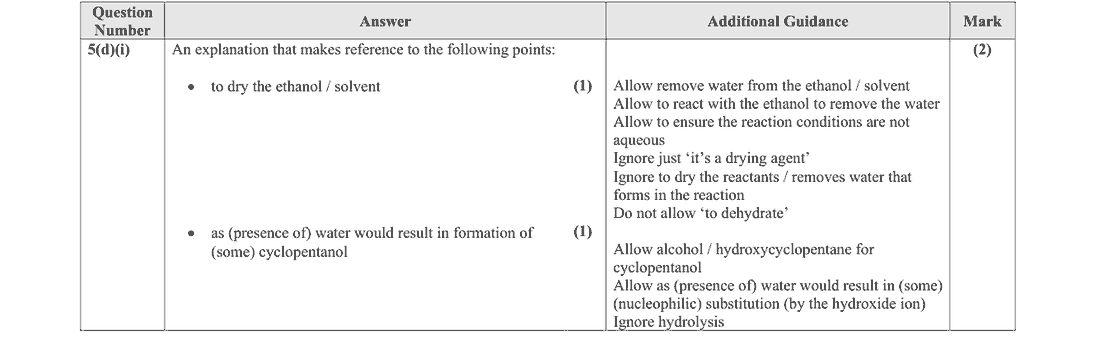
M1 to dry the ethanol / remove water from the solvent (just 'it is a drying agent', or drying the reactants, is ignored
'to dehydrate' not allowed). M2 because water would lead to (nucleophilic) substitution, forming some cyclopentanol instead of the alkene. Many recognised the drying agent without linking it to the solvent
only a small number made the link to substitution
June 2024 · Paper 2 · Q5(d)(ii)1 markShort answer
Earlier parts of question 5 that this part uses
Mark scheme
Examiner's comment
Most candidates could recall the name of the reaction here. Some candidates included unnecessary references to electrophiles and nucleophiles, or confused the mechanism with nucleophilic addition-elimination.
Notes from the mark scheme and report
Answer: elimination (allow dehydrohalogenation). Adding nucleophilic, electrophilic or free-radical loses the mark
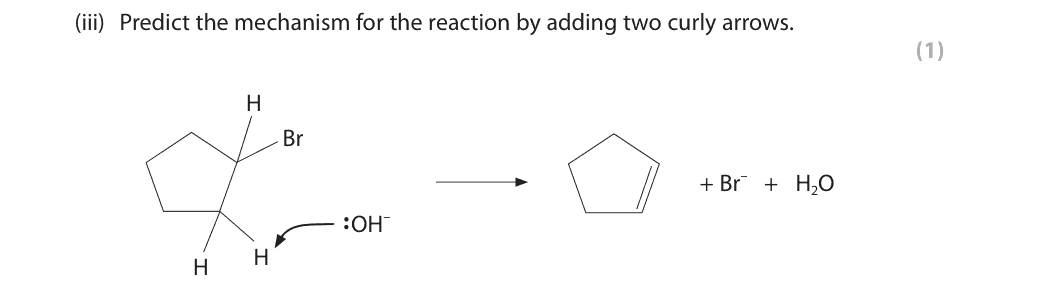
June 2024 · Paper 2 · Q5(d)(iii)1 markMechanism
Earlier parts of question 5 that this part uses
Mark scheme
Examiner's comment
Just over 40% of candidates answered this correctly, suggesting that the understanding of curly arrows is not as well embedded as the recall of curly arrows in familiar mechanisms. Amongst the work not given credit were some near misses. These included the C-H bond pair of electrons moving directly to a carbon atom and the same bond pair being moved into the centre of the cyclic ring. The latter mistake fits with the narrative that a small number of the cohort mistook the cyclic alkane for an arene.
Notes from the mark scheme and report
One mark for both arrows: a curly arrow from the C–H bond (of the H being removed by OH–) to the adjacent C–C bond to form the double bond, AND a curly arrow from the C–Br bond to Br. Dipoles ignored. Just over 40% were right
near misses took the C–H electron pair to a carbon atom or into the middle of the ring
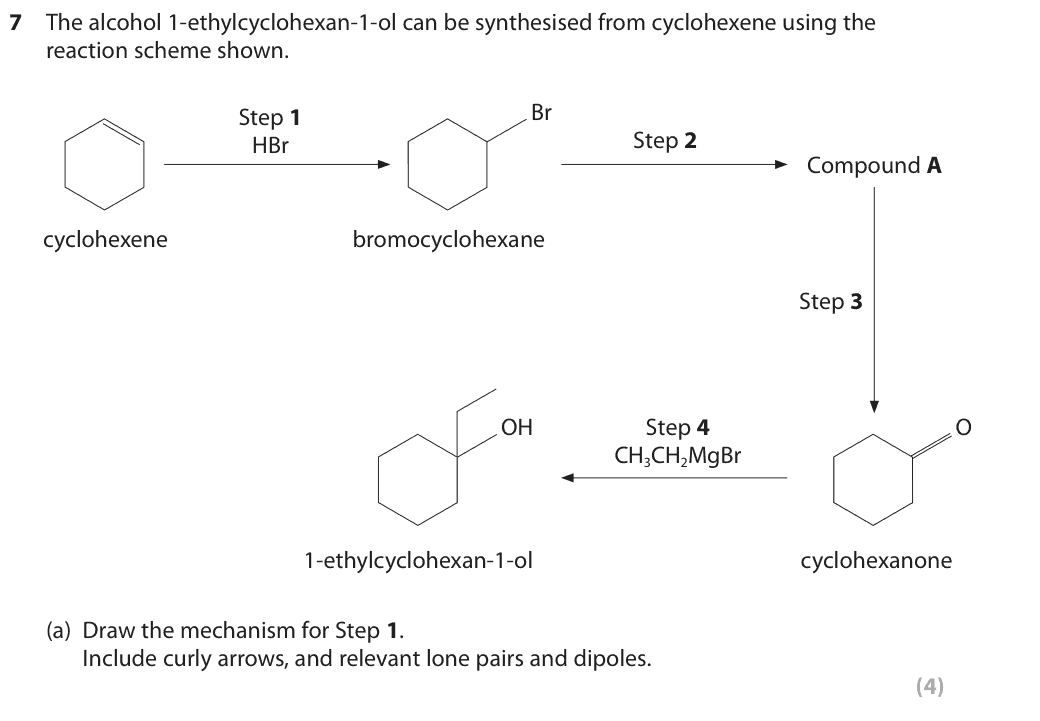
June 2024 · Paper 3 · Q7(b)5 marksShort answer
Earlier part of question 7 that this part uses
Mark scheme
Examiner's comment
The drawing of a reaction mechanism with curly arrows has improved over recent years and many responses scoring full marks were seen to part (a). It is possible that the use of skeletal formulae benefitted candidates because the inclusion or omission of the additional hydrogen on the carbocation intermediate was ignored. A small minority of candidates appeared to think that cyclohexene was aromatic and tried to draw an electrophilc substitution reaction mechanism. The organic synthetic pathway required in part (b) was also an improvement on previous years. There were less instances of inappropriate reagent pairings such as the use of sodium hydroxide for Step 1 but quoted with sulfuric acid. This question well illustrates the need for candidates to check their answer after re-reading the question because marks were lost due to missing conditions and reaction types. Furthermore, some candidates quoted both the name and the chemical formula but if so then both must be correct to score the mark. Unfortunatley some candidates gave the wrong formula for potassium/sodium dichromate(VI). A reminder that there is often some leeway with the spelling of a chemical name such a too many ‘t’s in potassium but there is no such leeway for a chemical formula.
It was good to see that the answers to part (c)(i) were all names as per the question rubric. It was surprising at times to see solid compounds rather than liquids suggested for the Grignard reagent solvent. In part (c)(ii) the vast majority of candidates knew that anhydrous calcium chloride is a drying agent but oftentimes incorrectly referred to the absoprtion of water from the reaction or from the solvent. The diagram of the apparatus on the facing page clearly shows ‘Tube X’ a long way away from the flask with the solvent at the top of the condenser and with an open top. It should have been clear to candidates that it was to prevent water vapour from getting into the apparatus. Nonetheless it was good to see that many candidates understood the need to keep the Grignard reagent away from water to avoid hydrolysis to the alkane. Likewise many candidates in part (c)(iii) knew that the corrrect water flow in the condenser from the bottom up means that it will avoid air bubbles and be filled with water for efficient condensation. The colour of the precipitate in part (d)(i) was almost universally given correctly and the completion of the simplified mechanism in part (d)(ii) allowed candidates of all abilities to gain credit. It is pleasing to see that candidates seem to be getting better at drawing curly arrows for a novel organic mechanism. The descriptions given for the recystallistion process in part (d)(iii) varied significantly. There were some excellent, logical descriptions with additional details of a ‘hot filtration’ to remove insoluble impurities which showed that these candidates were very well prepared. However there were many other responses which unfortunatley made little practical sense. For example, it was not unusual to see the response begin with the dissolving of the impure precipitate and then this being immediately filtered, washed and patted dry without there being any mention of cooling to form a purified precipitate. These responses were not given credit for statements that were impractical.
Notes from the mark scheme and report
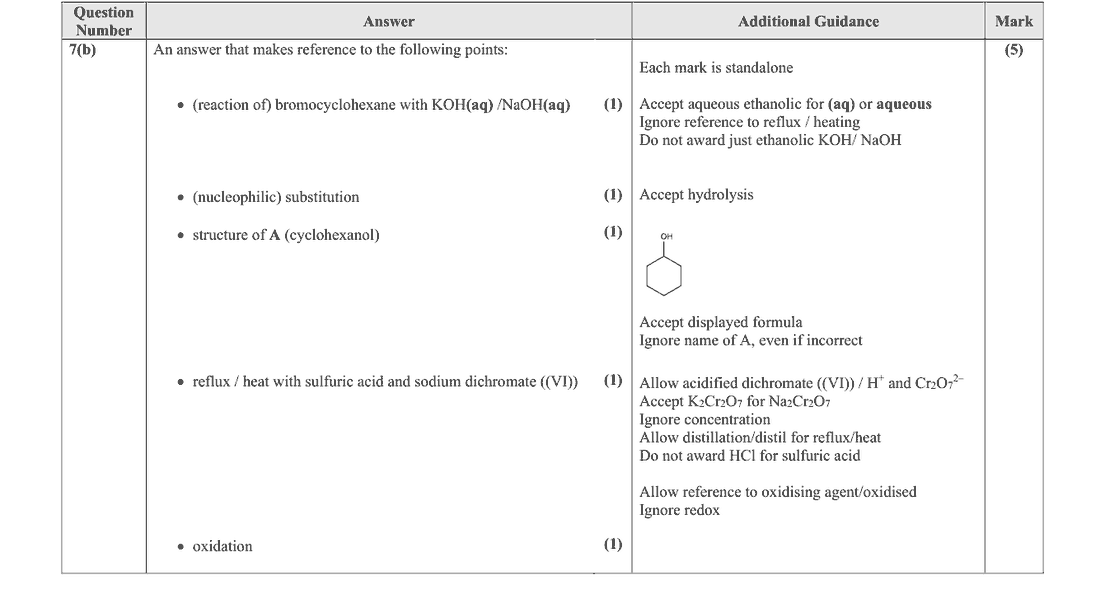
Step 2: aqueous KOH or NaOH (not just ethanolic) (1)
nucleophilic substitution / hydrolysis (1)
A is cyclohexanol, structure drawn (1). Step 3: heat / reflux with sulfuric acid and sodium (or potassium) dichromate(VI) (not HCl) (1)
oxidation (1). Each mark stands alone. Common errors: conditions or reaction types left out
a wrong formula for the dichromate when name and formula were both given (both must be right)
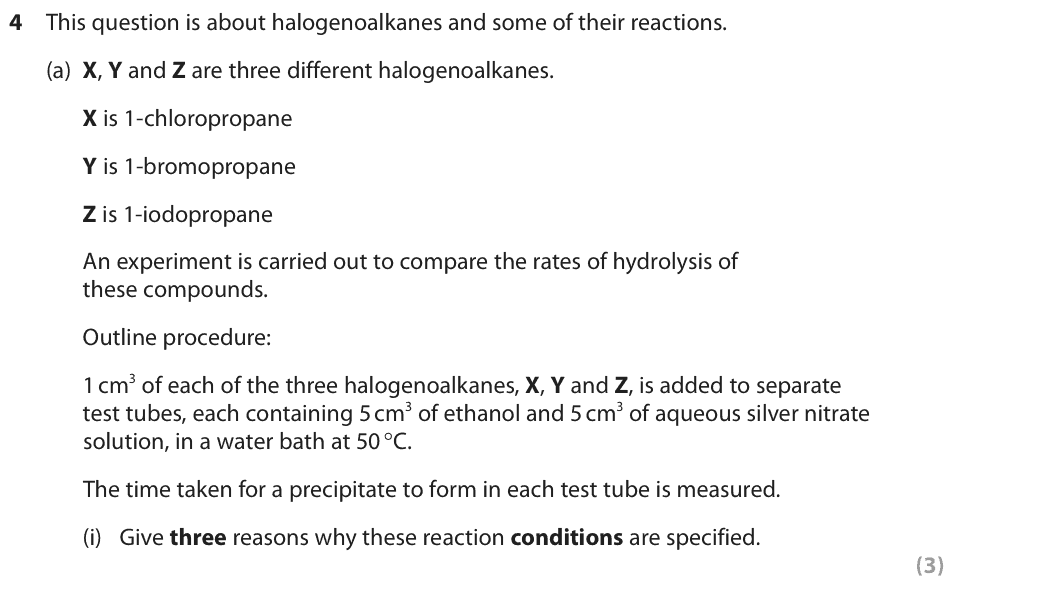
June 2023 · AS Paper 2 · Q4(a)(i)3 marksPractical and data analysis
Mark scheme
Examiner's comment
Many candidates missed MP1, which was about dissolving the halogenoalkane. It was clear from the responses that many candidates had heard the term
‘fair test’ but were unsure of the meaning.
Notes from the mark scheme and report
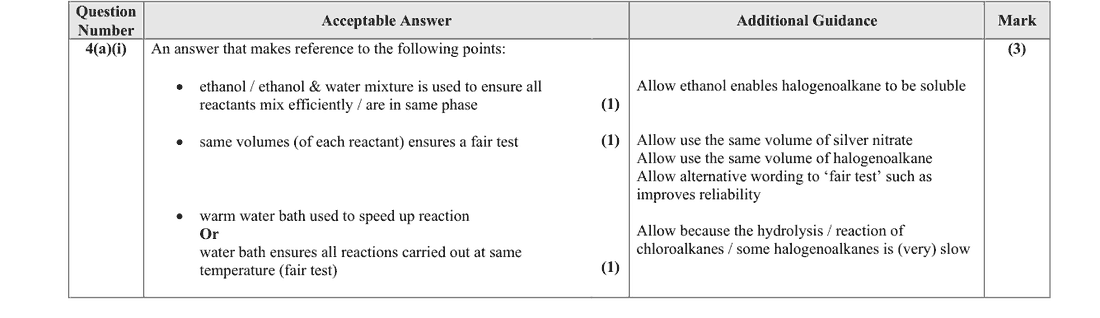
Ethanol (ethanol and water mixture) makes the reactants mix / puts them in the same phase (dissolves the halogenoalkane)
the same volumes of each reactant make it a fair test
the warm water bath speeds up the (slow) reaction, or keeps all the reactions at the same temperature. Many missed the ethanol point
'fair test' was used without understanding
Skills: PT2 use water bath or electric heater or sand bath for heating; PT4 use laboratory apparatus for a variety of experimental techniques, including: titration, using burette and pipette; distillation and heating under reflux, including setting up glassware using retort stand and clamps; qualitative tests for ions and organic functional groups; filtration, including use of fluted filter paper, or filtration under reduced pressure; CP4 Core practical 4: Investigation of the rates of hydrolysis of some halogenoalkanes
June 2023 · AS Paper 2 · Q4(a)(ii)2 marksExplanation
Earlier part of question 4 that this part uses
Mark scheme
Examiner's comment
Very few candidates seemed to be aware of the role of water in releasing the halide ion. Many answers reacted the silver (ions) with halogenoalkane.
Notes from the mark scheme and report
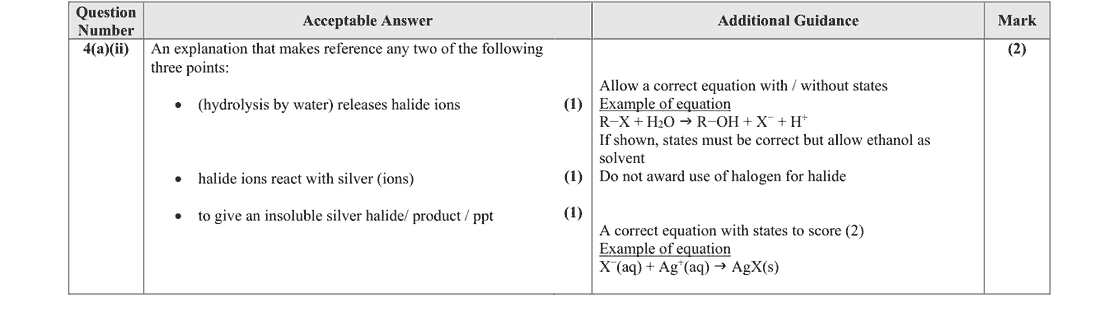
Any two of: hydrolysis by water releases halide ions (R–X + H2O → R–OH + X– + H+)
the halide ions react with silver ions
giving an insoluble silver halide (precipitate). The equation X–(aq) + Ag+(aq) → AgX(s) with state symbols scores 2. 'Halogen' for halide is not accepted. Very few knew the role of water in releasing the halide ion
many had silver ions reacting with the halogenoalkane itself
Skills: CP4 Core practical 4: Investigation of the rates of hydrolysis of some halogenoalkanes
June 2023 · AS Paper 2 · Q4(a)(iii)1 markMultiple choice
Earlier part of question 4 that this part uses
Answer
A
Mark scheme
Notes from the mark scheme and report
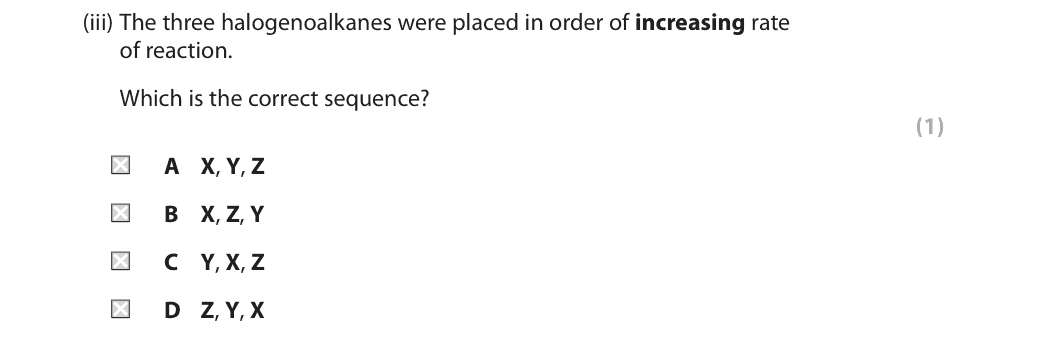
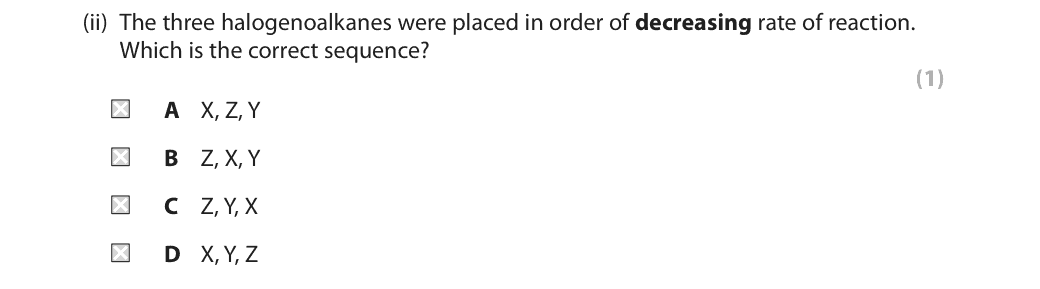
Answer: A (X, Y, Z). The chloroalkane hydrolyses slowest and the iodoalkane fastest (C–I is the weakest bond). D is the order of decreasing rate
Skills: CP4 Core practical 4: Investigation of the rates of hydrolysis of some halogenoalkanes
June 2023 · AS Paper 2 · Q4(b)1 markShort answer
Earlier part of question 4 that this part uses
Mark scheme
Examiner's comment
This question was generally answered well, with very few being unsure of how to answer it at all.
Notes from the mark scheme and report
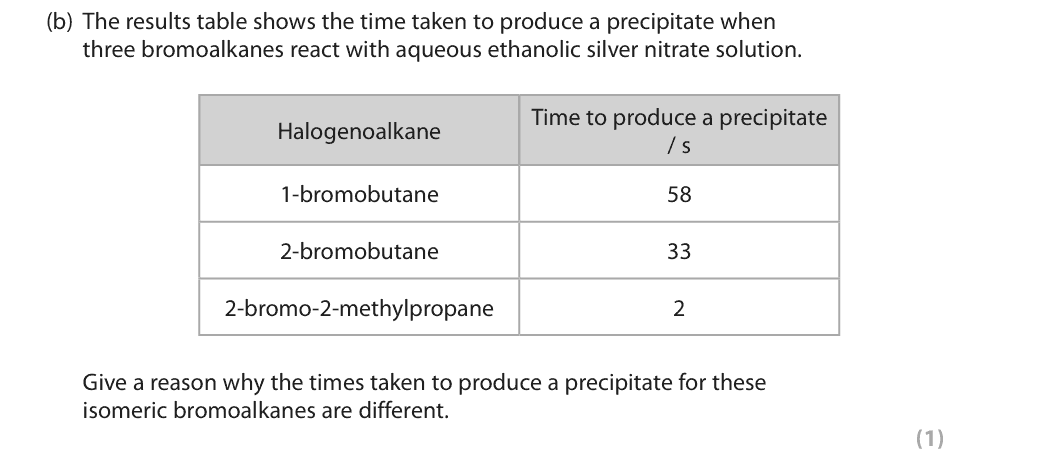
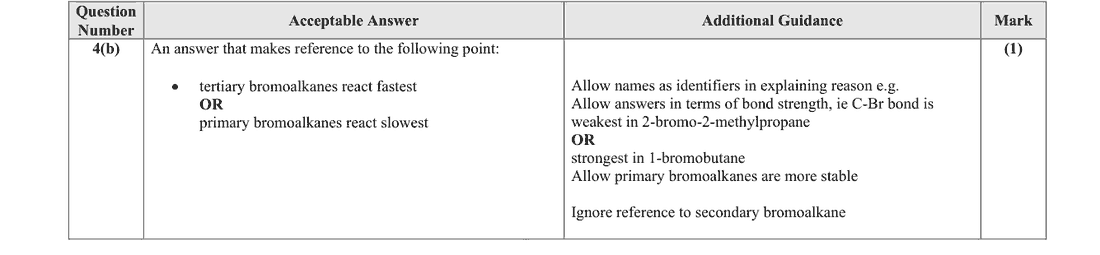
Tertiary bromoalkanes react fastest, or primary bromoalkanes react slowest (names of the compounds may be used). Also allowed: the C–Br bond is weakest in 2-bromo-2-methylpropane or strongest in 1-bromobutane
Skills: CP4 Core practical 4: Investigation of the rates of hydrolysis of some halogenoalkanes
June 2023 · AS Paper 2 · Q4(c)(i)1 markMultiple choice
Answer
B
Mark scheme
Examiner's comment
Many correct responses were seen, however, some candidates incorrectly selected distractor ‘A’.
Notes from the mark scheme and report
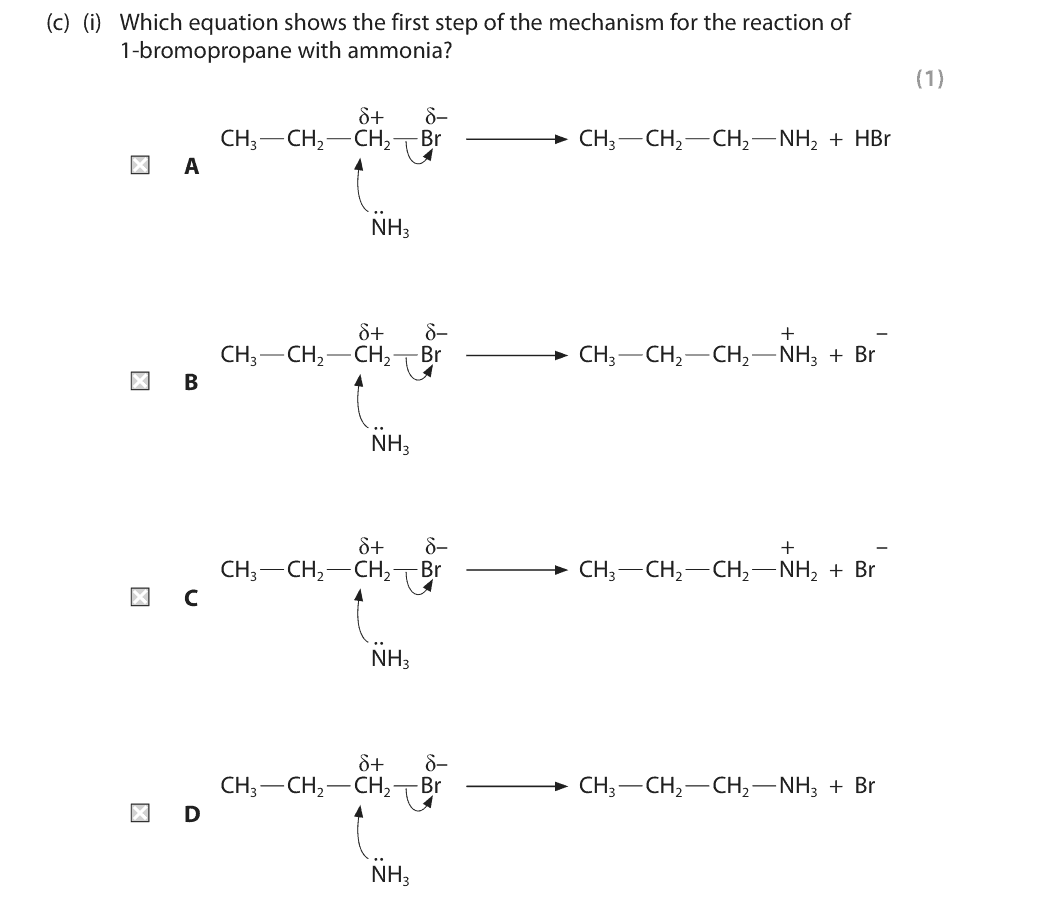
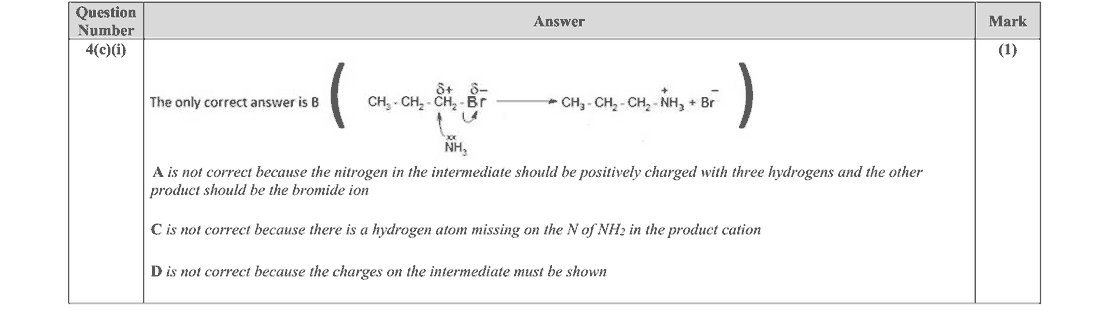
Answer: B. In B the lone pair on N attacks the δ+ carbon and the C–Br bond breaks, giving CH3CH2CH2NH3+ and Br–. A is wrong because the nitrogen should be positively charged with three hydrogens and the other product is the bromide ion
C has a hydrogen missing from the nitrogen of the cation
D has no charges. Distractor A was the usual wrong choice
June 2023 · AS Paper 2 · Q4(c)(ii)1 markShort answer
Earlier part of question 4 that this part uses
Mark scheme
Examiner's comment
Many candidates missed, or were unaware of, ‘inorganic’ and gave an amine as their answer.
Notes from the mark scheme and report
Answer: NH4Br (NH4+ Br–). HBr and the name ammonium bromide are ignored. Many overlooked 'inorganic' and gave an amine
June 2023 · AS Paper 2 · Q4(d)(ii)2 marksShort answer
Earlier part of question 4 that this part uses
Mark scheme
Examiner's comment
The reagents were quite widely known. The conditions were more of a Challenge for candidates.
Notes from the mark scheme and report
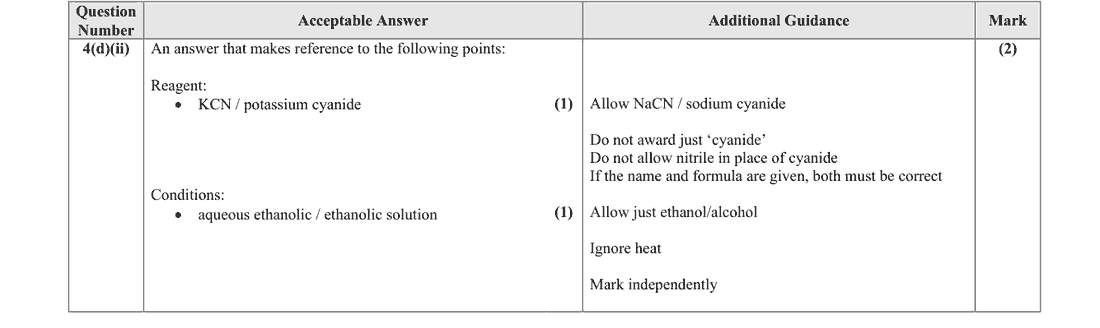
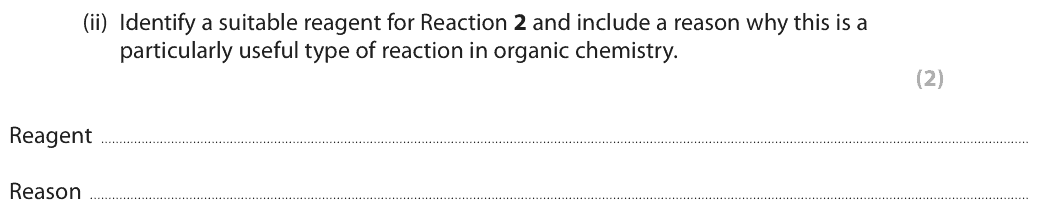
Reagent: potassium cyanide, KCN (NaCN allowed
not just 'cyanide', not 'nitrile'). Condition: ethanolic / aqueous ethanolic solution. Marked independently
heat ignored. The reagent was widely known
the condition was harder
June 2023 · AS Paper 2 · Q4(d)(iii)2 marksShort answer
Earlier parts of question 4 that this part uses
Mark scheme
Examiner's comment
The reagents were quite widely known. The conditions were more of a Challenge for candidates.
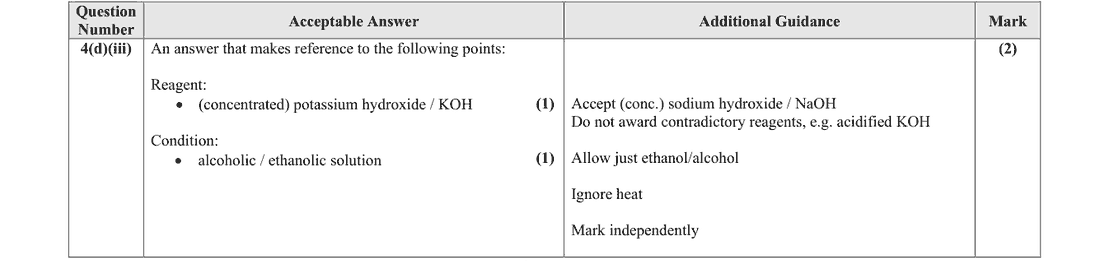
not acidified KOH). Condition: ethanolic / alcoholic solution. Marked independently
heat ignored. The reagent was widely known
the condition was harder. Note the question prints the name 1-bromopropane with the formula of 1-bromobutane
June 2022 · Paper 2 · Q3(b)1 markMultiple choice
Earlier part of question 3 that this part uses
Answer
A
Mark scheme
Notes from the mark scheme and report
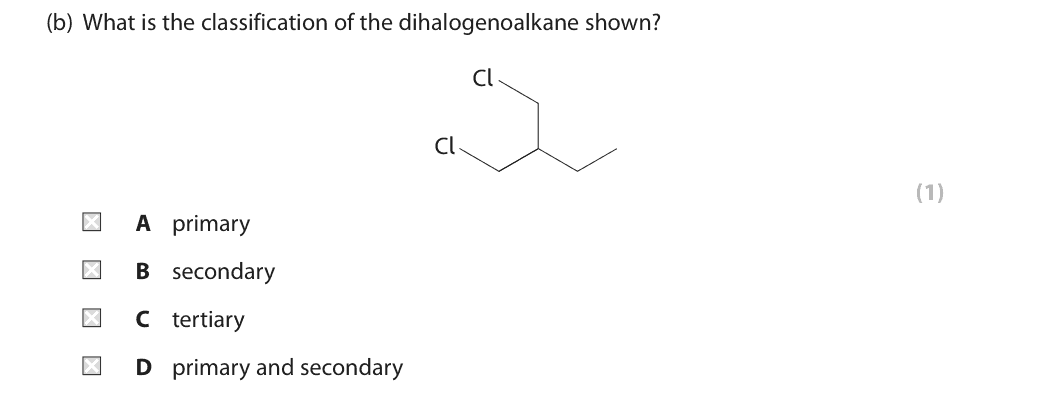
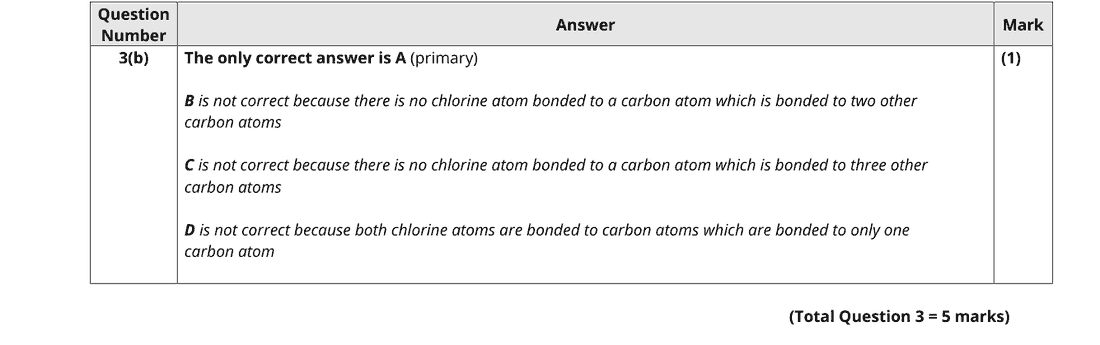
Answer: A (primary). Each chlorine is on a carbon atom that is bonded to only one other carbon atom
June 2022 · Paper 2 · Q4(d)4 marksExplanationHard
Earlier part of question 4 that this part uses
Mark scheme
Examiner's comment
This proved to be one of the more challenging questions on the paper. The definition of a Bronsted-Lowry base was frequently the mark gained but a large number of candidates lost this mark by stating the acyl chloride was an acid and donated the proton.
It was also disappointing that so few candidates gave a clear definition of a nucleophile and also thought that it attacked a carbocation. Candidates were expected to know that there is no carbocation in the mechanism but rather that the nucleophile attacks the delta positive carbon of the C=O bond.
Very few candidates referred to the production of HCl which would immediately react with the excess ethylamine.
Notes from the mark scheme and report
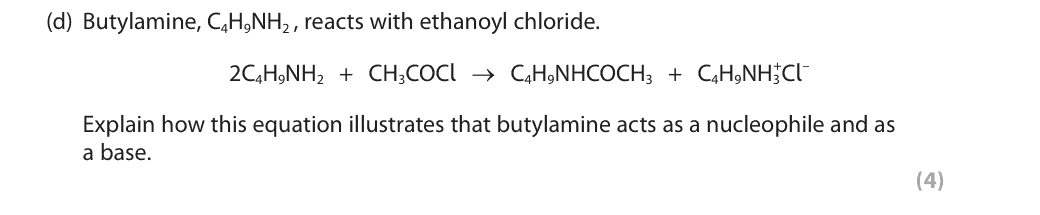
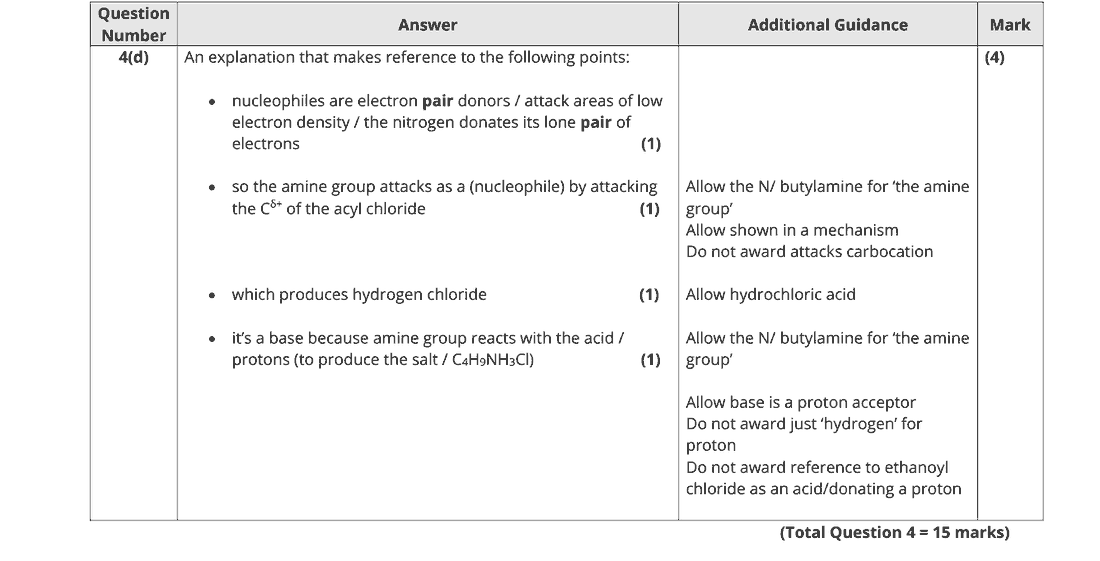
Nucleophile: the nitrogen donates its lone pair of electrons (electron pair donor)
it attacks the Cδ+ of the acyl chloride (not a carbocation)
this produces hydrogen chloride
base: a second butylamine reacts with the acid / accepts a proton to give the salt C4H9NH3Cl. Not 'hydrogen' for proton
not ethanoyl chloride as the acid donating a proton. The base definition was the mark most often gained
few defined a nucleophile clearly
very few mentioned HCl
June 2022 · Paper 2 · Q7(a)(ii)3 marksShort answer
Earlier part of question 7 that this part uses
Mark scheme
Examiner's comment
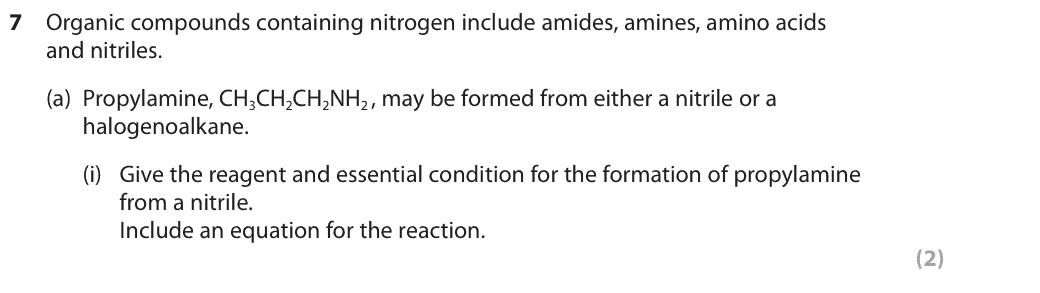
In part (i) candidates needed to realise that they had to start from propanenitrile, with some starting from butanenitrile. The reagent was usually known – and the solvent – but the equation was often not balanced correctly with [H] rather than 4[H] or H2 rather than 2H2.
In part (ii) the equation was often correct as was the reagent, but reference to the 'ethanolic' solvent was often omitted, as was the need for an elevated pressure. The stock answer 'heat under reflux' was also seen but this will not work because the ammonia gas would not condense and escape out of the top of the condenser.
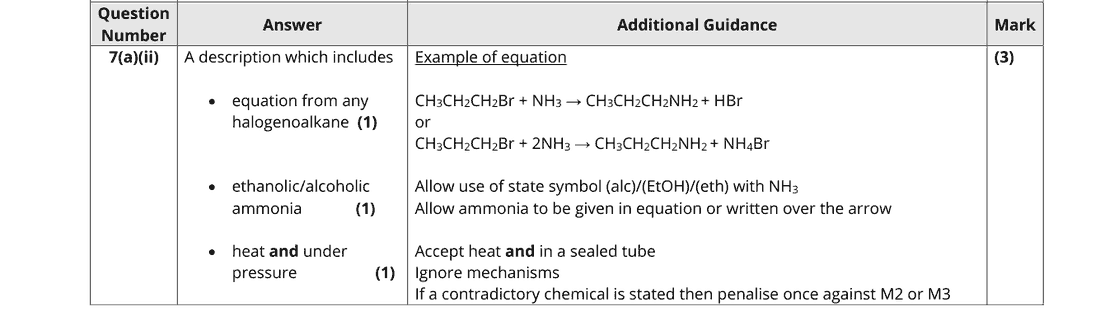
heat under pressure (in a sealed tube). 'Ethanolic' and the pressure were often left out
'heat under reflux' does not work because the ammonia gas would escape
November 2021 · AS Paper 2 · Q6(b)1 markMultiple choice
Earlier part of question 6 that this part uses
Answer
D
Mark scheme
Examiner's comment
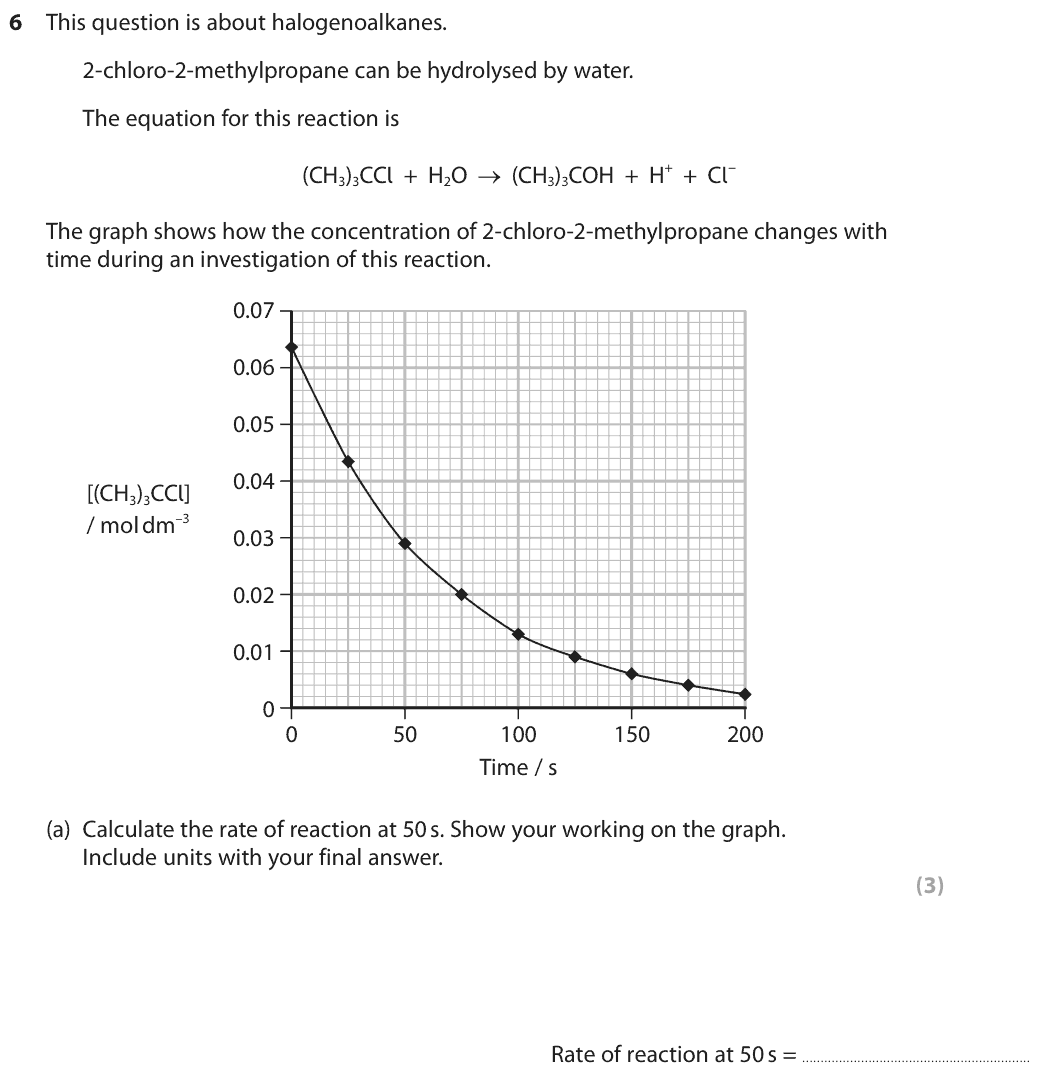
(a) This question involved the use of a tangent to a curve as a means of measuring reaction rate at
a given time. This question has been presented in this format several times in recent years. Most
candidates were familiar with the procedure although the manipulation of the numerical data was
less successful.
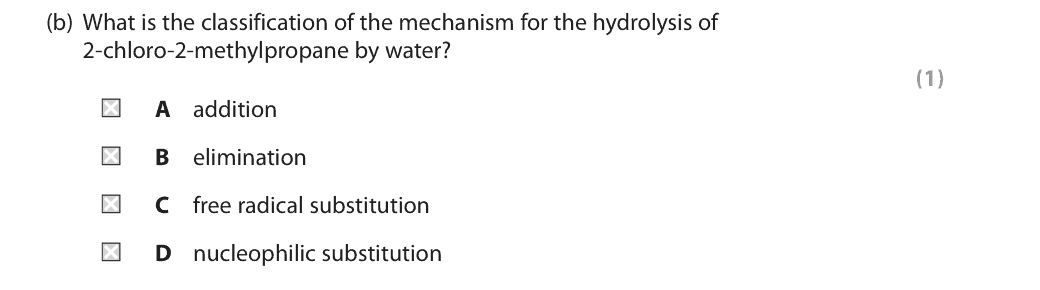
(b) This multiple-choice question addressed the classification of a hydrolysis mechanism. Most
candidates were successful in scoring the mark.
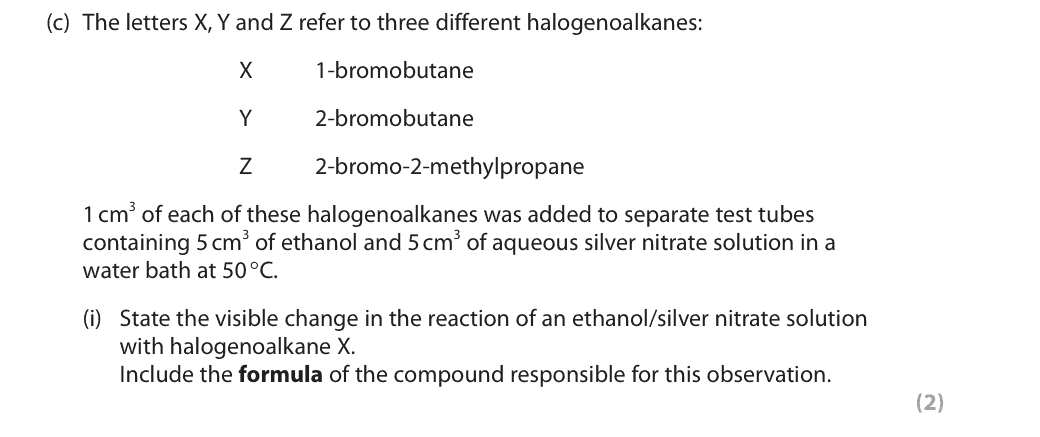
(c) Parts (i) and (ii) of this question related to the rates of, and conditions for, the hydrolysis of
halogenoalkanes. Both of these questions have appeared frequently in past papers and should
have been familiar to candidates.
(d) This question involved the conversion of a halogenoalkane to an alkene. (d)(i) was a simple
recall of reaction conditions. Most candidates did not achieve marks. In (d)(ii) candidates struggled
with the repeat unit of a polymer. Common errors included the retention of a C=C in the backbone
of the polymer, and the inclusion of one or both side groups in the backbone. This is relatively easy
chemistry but it does require practice in writing the repeat unit. The errors seen are common with
questions relating to repeat units. Part (iii) was a more challenging question and there was
considerable success by many candidates. Candidates are becoming familiar with the requirement
for a mechanism, and it would seem to be a specification topic that has been well taught.
Notes from the mark scheme and report
Answer: D (nucleophilic substitution). Water acts as the nucleophile and OH replaces Cl. Not addition (there is more than one product), not elimination, and no radicals are involved
November 2021 · AS Paper 2 · Q6(c)(i)2 marksPractical and data analysis
Earlier part of question 6 that this part uses
Mark scheme
Examiner's comment
(a) This question involved the use of a tangent to a curve as a means of measuring reaction rate at
a given time. This question has been presented in this format several times in recent years. Most
candidates were familiar with the procedure although the manipulation of the numerical data was
less successful.
(b) This multiple-choice question addressed the classification of a hydrolysis mechanism. Most
candidates were successful in scoring the mark.
(c) Parts (i) and (ii) of this question related to the rates of, and conditions for, the hydrolysis of
halogenoalkanes. Both of these questions have appeared frequently in past papers and should
have been familiar to candidates.
(d) This question involved the conversion of a halogenoalkane to an alkene. (d)(i) was a simple
recall of reaction conditions. Most candidates did not achieve marks. In (d)(ii) candidates struggled
with the repeat unit of a polymer. Common errors included the retention of a C=C in the backbone
of the polymer, and the inclusion of one or both side groups in the backbone. This is relatively easy
chemistry but it does require practice in writing the repeat unit. The errors seen are common with
questions relating to repeat units. Part (iii) was a more challenging question and there was
considerable success by many candidates. Candidates are becoming familiar with the requirement
for a mechanism, and it would seem to be a specification topic that has been well taught.
Notes from the mark scheme and report
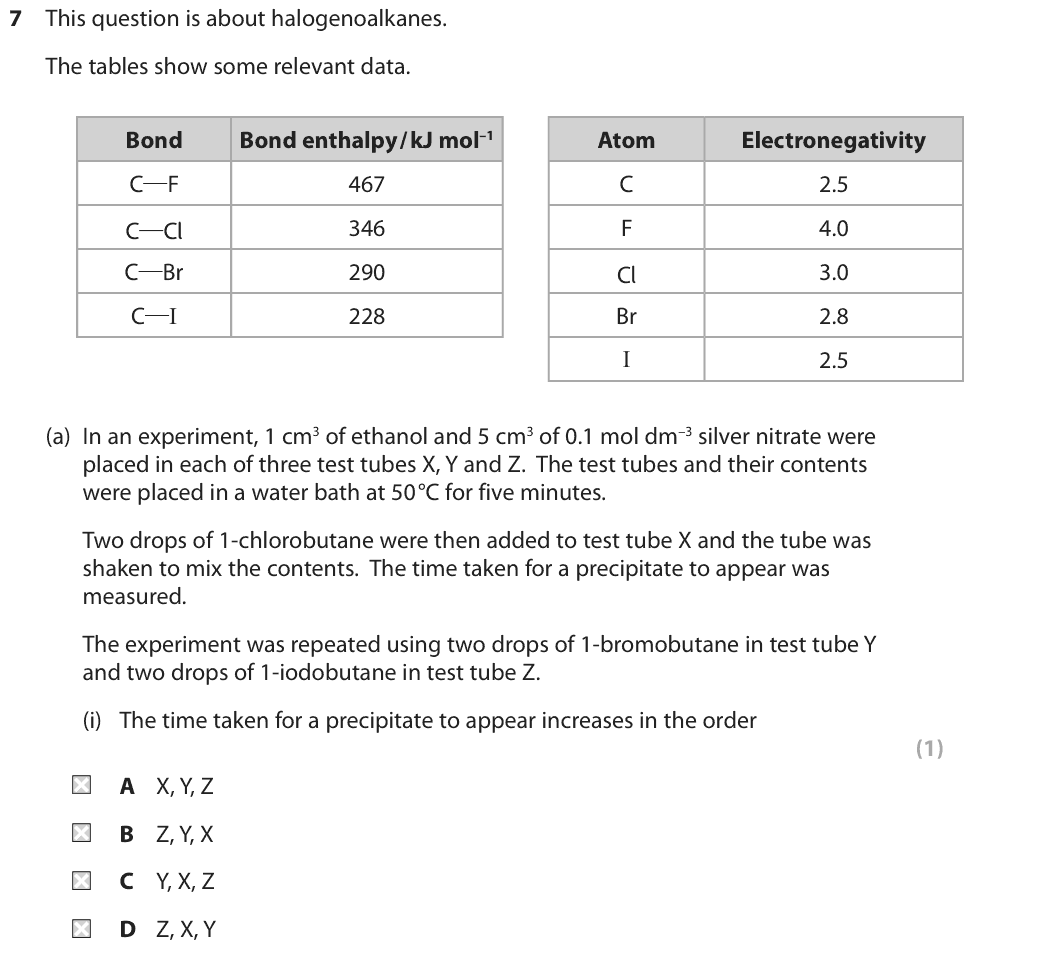
Cream precipitate (allow off-white or very pale yellow
not just yellow)
AgBr. The name silver bromide alone does not get the formula mark
Skills: PT4 use laboratory apparatus for a variety of experimental techniques, including: titration, using burette and pipette; distillation and heating under reflux, including setting up glassware using retort stand and clamps; qualitative tests for ions and organic functional groups; filtration, including use of fluted filter paper, or filtration under reduced pressure; CP4 Core practical 4: Investigation of the rates of hydrolysis of some halogenoalkanes
November 2021 · AS Paper 2 · Q6(c)(ii)1 markMultiple choice
Earlier parts of question 6 that this part uses
Answer
C
Mark scheme
Examiner's comment
(a) This question involved the use of a tangent to a curve as a means of measuring reaction rate at
a given time. This question has been presented in this format several times in recent years. Most
candidates were familiar with the procedure although the manipulation of the numerical data was
less successful.
(b) This multiple-choice question addressed the classification of a hydrolysis mechanism. Most
candidates were successful in scoring the mark.
(c) Parts (i) and (ii) of this question related to the rates of, and conditions for, the hydrolysis of
halogenoalkanes. Both of these questions have appeared frequently in past papers and should
have been familiar to candidates.
(d) This question involved the conversion of a halogenoalkane to an alkene. (d)(i) was a simple
recall of reaction conditions. Most candidates did not achieve marks. In (d)(ii) candidates struggled
with the repeat unit of a polymer. Common errors included the retention of a C=C in the backbone
of the polymer, and the inclusion of one or both side groups in the backbone. This is relatively easy
chemistry but it does require practice in writing the repeat unit. The errors seen are common with
questions relating to repeat units. Part (iii) was a more challenging question and there was
considerable success by many candidates. Candidates are becoming familiar with the requirement
for a mechanism, and it would seem to be a specification topic that has been well taught.
Notes from the mark scheme and report
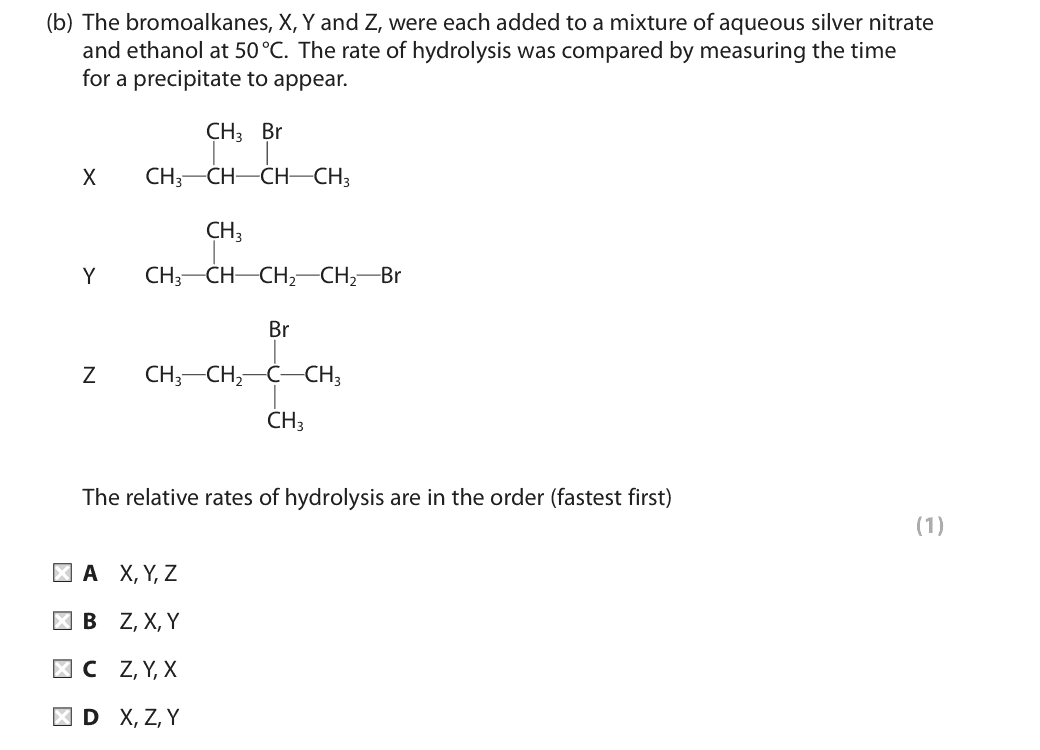
Answer: C (Z, Y, X). Tertiary (Z) is hydrolysed fastest, then secondary (Y)
the primary halogenoalkane (X) is slowest
Skills: CP4 Core practical 4: Investigation of the rates of hydrolysis of some halogenoalkanes
November 2021 · AS Paper 2 · Q6(d)(i)2 marksShort answerHard
Earlier part of question 6 that this part uses
Mark scheme
Examiner's comment
(a) This question involved the use of a tangent to a curve as a means of measuring reaction rate at
a given time. This question has been presented in this format several times in recent years. Most
candidates were familiar with the procedure although the manipulation of the numerical data was
less successful.
(b) This multiple-choice question addressed the classification of a hydrolysis mechanism. Most
candidates were successful in scoring the mark.
(c) Parts (i) and (ii) of this question related to the rates of, and conditions for, the hydrolysis of
halogenoalkanes. Both of these questions have appeared frequently in past papers and should
have been familiar to candidates.
(d) This question involved the conversion of a halogenoalkane to an alkene. (d)(i) was a simple
recall of reaction conditions. Most candidates did not achieve marks. In (d)(ii) candidates struggled
with the repeat unit of a polymer. Common errors included the retention of a C=C in the backbone
of the polymer, and the inclusion of one or both side groups in the backbone. This is relatively easy
chemistry but it does require practice in writing the repeat unit. The errors seen are common with
questions relating to repeat units. Part (iii) was a more challenging question and there was
considerable success by many candidates. Candidates are becoming familiar with the requirement
for a mechanism, and it would seem to be a specification topic that has been well taught.
Notes from the mark scheme and report
Potassium hydroxide (allow sodium hydroxide)
in ethanol / alcohol and heated under reflux (allow just 'heat'). Marked independently. Aqueous ethanol not credited
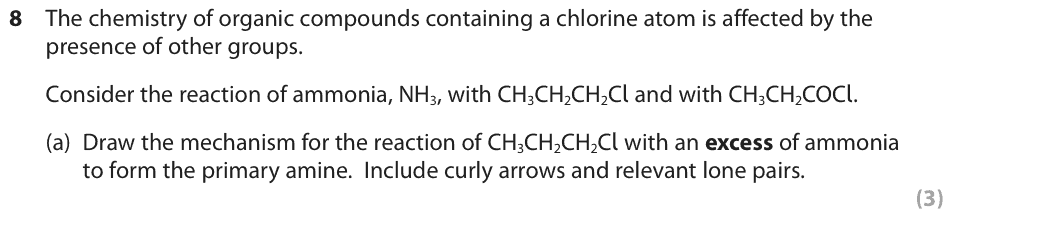
November 2021 · Paper 2 · Q10(d)(ii)4 marksMechanism
Earlier parts of question 10 that this part uses
Mark scheme
Examiner's comment
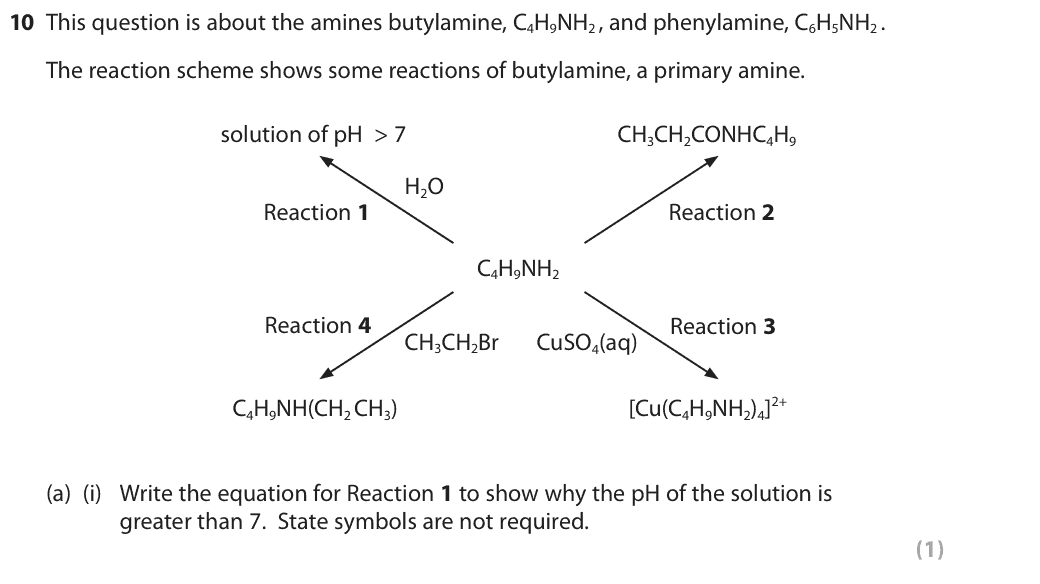
Many were able to construct the equation in (a)(i) correctly, but a number showed
C4H9NH3+OH– as a single product. In previous series, the majority of candidates have been
able to use ideas based around the electron density of an arene ring to explain differences in
reactivity between phenol and benzene. In (a)(ii), use of a similar model could be used to
explain the difference in basicity, and those who used this approach often scored two or three
marks. The reagent in (b) was well known, though some candidates only scored one mark, by
either using propanoic acid or by using an acyl chloride with an incorrect number of carbons.
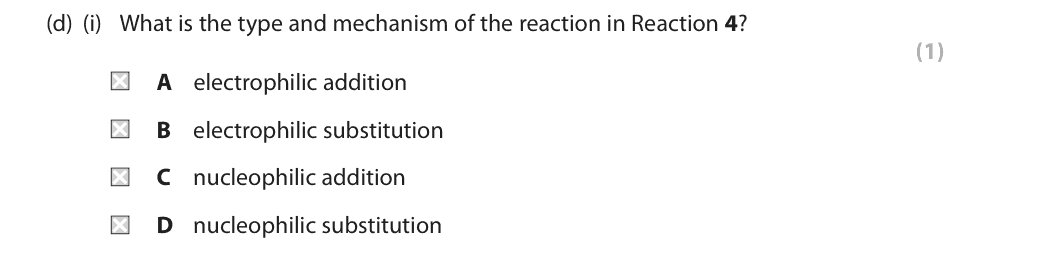
Whilst many recognised the reaction as nucleophilic substitution in (d)(ii), far fewer could
construct the mechanism. Whilst some excellent answers were seen, others revealed little
understanding of curly arrows, with contradictions such as arrows pointing to lone pairs or
bonds evident.
Notes from the mark scheme and report
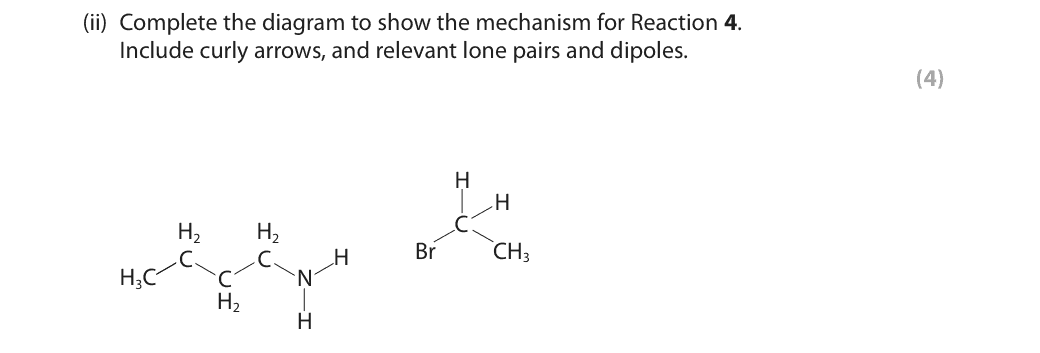
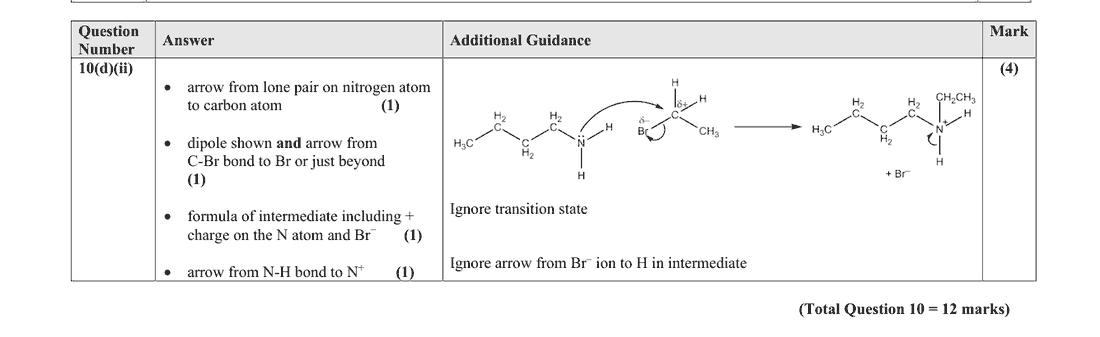
M1 curly arrow from the lone pair on N to the carbon bonded to Br
M2 dipole on C–Br and curly arrow from the C–Br bond to Br
M3 intermediate with + on N, and Br–
M4 curly arrow from an N–H bond to N+. Transition states ignored. Many named the mechanism but far fewer could draw it
arrows pointing to lone pairs or bonds were seen
October 2020 · AS Paper 2 · Q2(c)1 markMultiple choice
Earlier part of question 2 that this part uses
Answer
D
Mark scheme
Examiner's comment
This question tested knowledge of the alcohols and their reactions. The pattern here followed
the pattern of question 1 with candidates answering well the questions which tested
knowledge which is perhaps more commonly seen and tested at this level. Less commonly
tested ideas, such as that of stereoisomerism proved more challenging.
Notes from the mark scheme and report
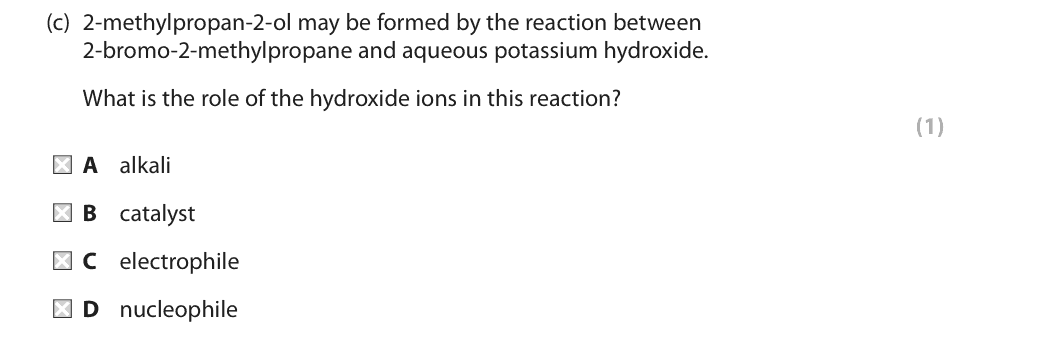
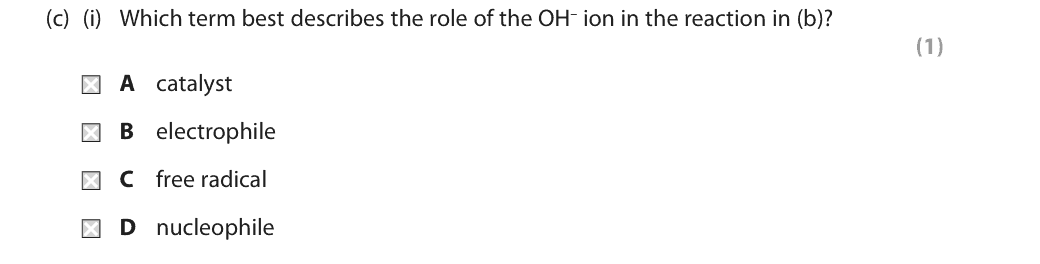
Answer: D (nucleophile). OH– attacks the electron-deficient carbon. It is not neutralising an acid (A), it is used up so is not a catalyst (B), and it does not seek an electron-rich site (C)
October 2020 · Paper 2 · Q6(a)1 markShort answer
Mark scheme
Examiner's comment
It was surprising that only a minority of candidates knew that ethanolic sodium hydroxide
reacts with halogenoalkanes to produce an alkene in an elimination reaction. The vast
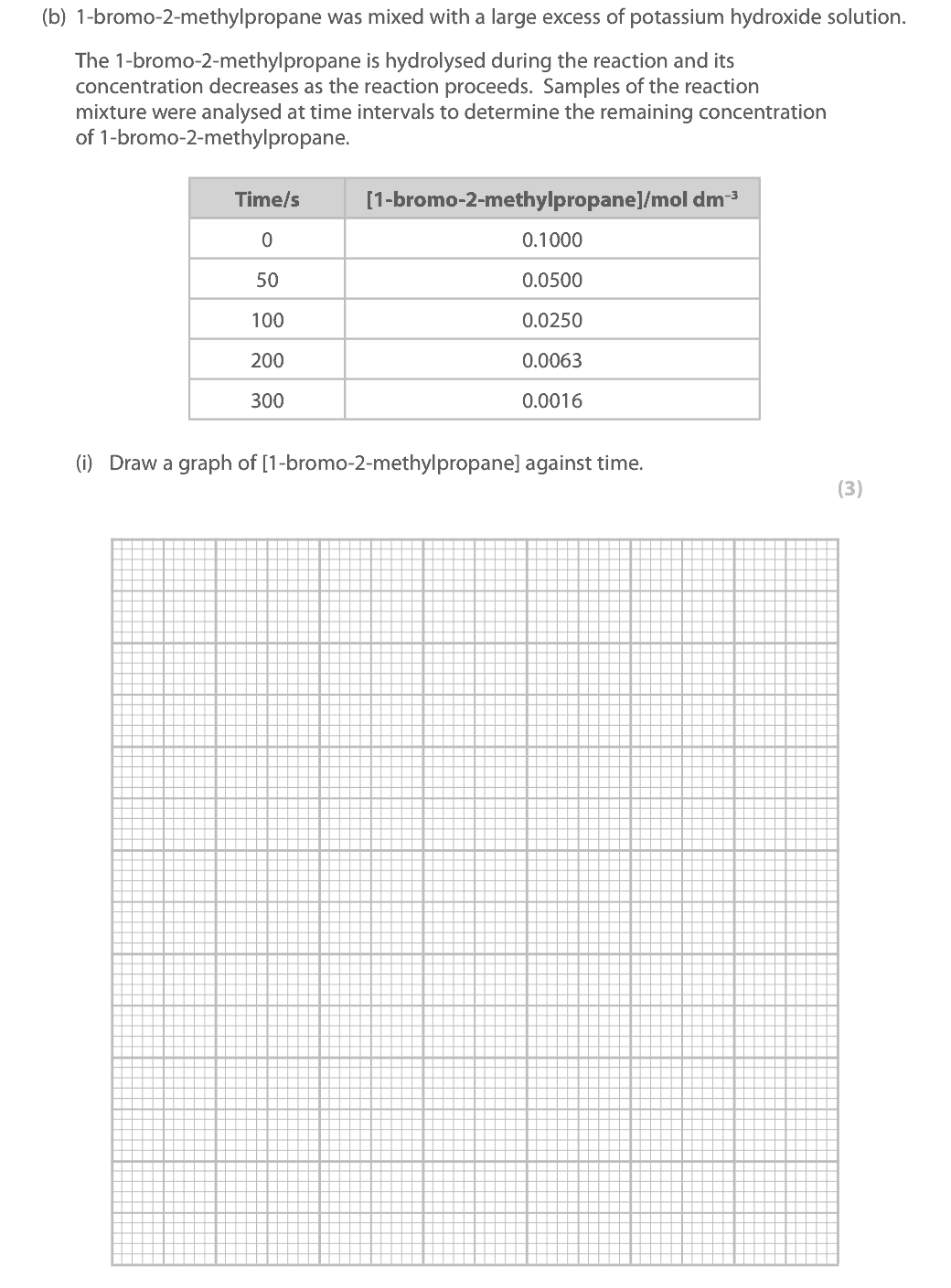
majority of candidates could plot a correct graph in (b), with just a few omitting to label the
axes or plotting time on the y axis. Many candidates were confused about the half-life of a
reaction and they would benefit from more experience in working these out from graphs of
first order reactions. The vast majority deduced that the reaction was zero order with respect
to hydroxide ions in (d)(i) but many were unable to use this to give the SN1 mechanism for the
reaction between RBr and hydroxide ions. Many candidates showed the SN2 mechanism even
though the kinetics showed that hydroxide ions are not involved in the rate determining step.
Some candidates showed a hybrid of SN1 and SN2 and many omitted to show the bromide
ions formed. It was pleasing to see many candidates giving a clear explanation why the
product of the reaction is not optically active. The most common cause of a mark loss was not
stating that the intermediate is planar around the positive carbon.
Notes from the mark scheme and report
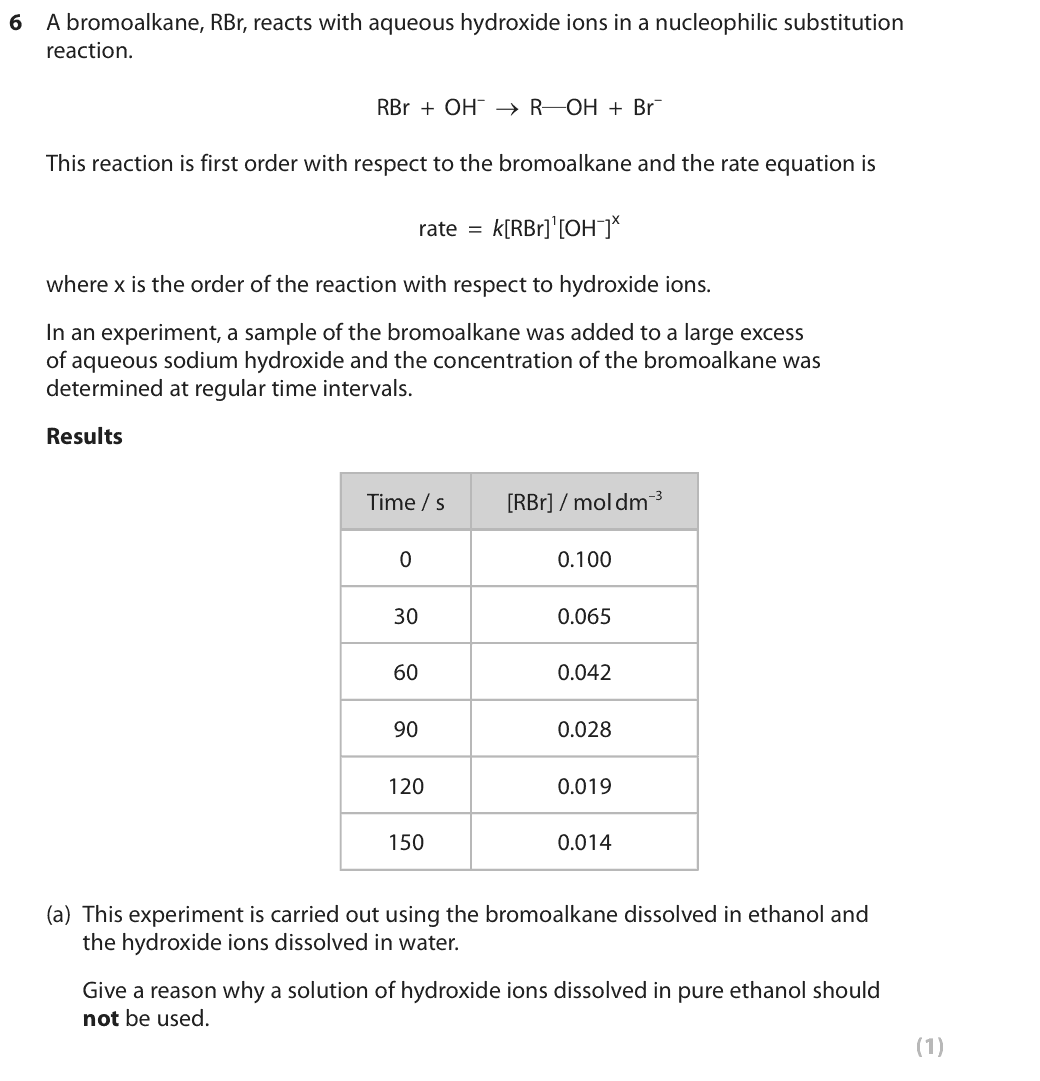
Hydroxide ions in ethanol would give an elimination reaction (an alkene would form). Solubility arguments and 'causes another reaction' ignored. Only a minority knew that ethanolic hydroxide gives elimination
October 2020 · AS Paper 2 · Q7(a)(i)1 markPractical and data analysis
Mark scheme
Examiner's comment
This question had a number of questions which were practically orientated. Learners found
these quite difficult and answers were often lacking in detail and precision. The final question
which required logical reasoning and explanation was not well answered by most candidates
only a few realising the detail required to get good marks, although most could manage to
score something by making a start at the question.
Notes from the mark scheme and report
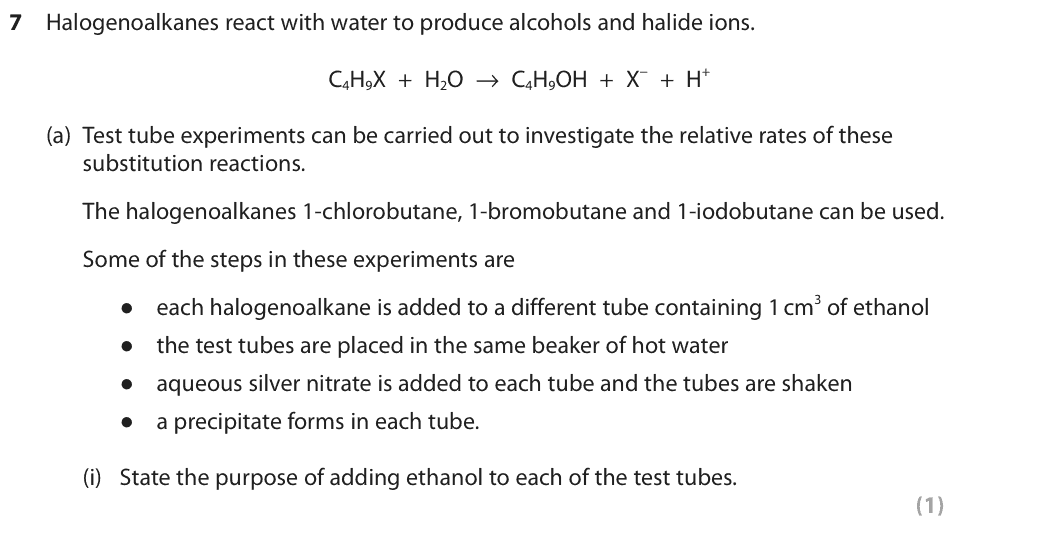
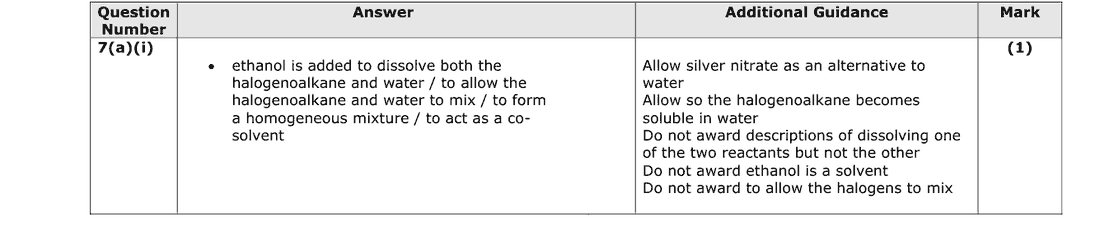
Ethanol dissolves both the halogenoalkane and the water (or silver nitrate solution) so that they mix / form a homogeneous mixture (a co-solvent). Not credited: dissolving only one of the two
just 'ethanol is a solvent'
Skills: PT4 use laboratory apparatus for a variety of experimental techniques, including: titration, using burette and pipette; distillation and heating under reflux, including setting up glassware using retort stand and clamps; qualitative tests for ions and organic functional groups; filtration, including use of fluted filter paper, or filtration under reduced pressure; CP4 Core practical 4: Investigation of the rates of hydrolysis of some halogenoalkanes
October 2020 · Paper 2 · Q7(a)(i)1 markShort answer
Mark scheme
Examiner's comment
Many candidates realised that hydride ions would be repelled by the high electron density of
the double bond in an alkene or knew that alkenes react by electrophilic addition and hydride
ions are nucleophiles. There were many correct answers giving a suitable reagent and
condition, but some candidates had not learnt the basic reagents and conditions for the
organic chemistry reactions in the specification. Only a minority of candidates knew that
potassium cyanide in ethanol react with halogenoalkanes to form nitriles. Unfortunately a few
candidates lost this mark as they did not give a specific halogenoalkane, for example, 1-
bromobutane. The majority of candidates knew that an acid needs to be added to the salt to
form pentanoic acid. There were many excellent answers to the synthetic route in (b) showing
those students had practised this style of question and they knew the organic chemistry
reactions. Candidates should realise that they need to make a Grignard reagent from a
halogenocompound so should start by forming bromobenzene. Some candidates knew that
they needed benzoic acid to react with phosphorus(V) chloride to form benzoyl chloride and
they received credit for this.
Notes from the mark scheme and report
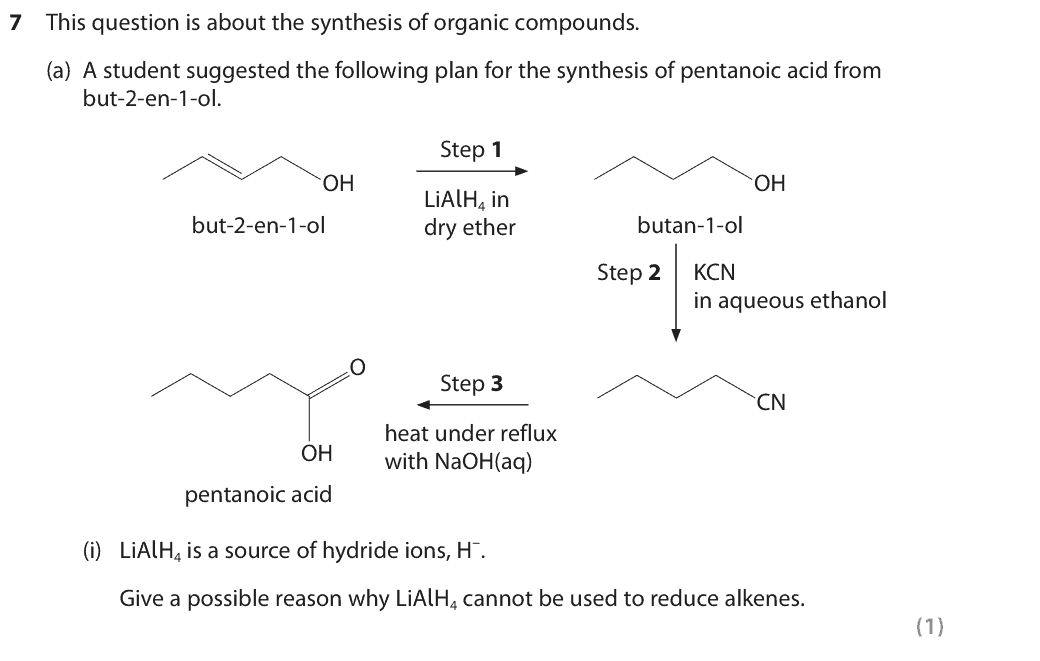
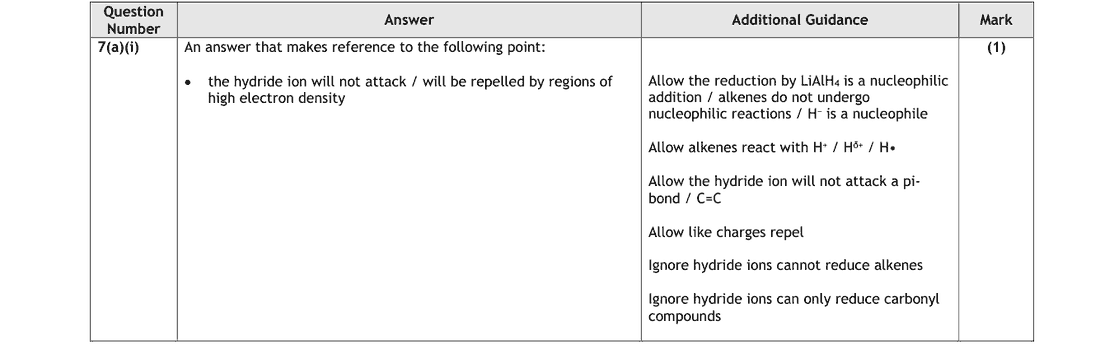
The hydride ion is a nucleophile, so it is repelled by / will not attack the region of high electron density in the C=C (π bond)
alkenes react with electrophiles. 'Hydride ions cannot reduce alkenes' or 'only reduce carbonyl compounds' is ignored
October 2020 · AS Paper 2 · Q7(a)(ii)1 markPractical and data analysis
Earlier part of question 7 that this part uses
Mark scheme
Examiner's comment
This question had a number of questions which were practically orientated. Learners found
these quite difficult and answers were often lacking in detail and precision. The final question
which required logical reasoning and explanation was not well answered by most candidates
only a few realising the detail required to get good marks, although most could manage to
score something by making a start at the question.
Notes from the mark scheme and report
So that all the tubes are at the same temperature, or so that only the type of halogen affects the rate. 'Fair test' and 'constant conditions' are ignored
Skills: PT2 use water bath or electric heater or sand bath for heating; CP4 Core practical 4: Investigation of the rates of hydrolysis of some halogenoalkanes
October 2020 · AS Paper 2 · Q7(a)(iii)1 markPractical and data analysis
Earlier part of question 7 that this part uses
Mark scheme
Examiner's comment
This question had a number of questions which were practically orientated. Learners found
these quite difficult and answers were often lacking in detail and precision. The final question
which required logical reasoning and explanation was not well answered by most candidates
only a few realising the detail required to get good marks, although most could manage to
score something by making a start at the question.
Notes from the mark scheme and report
To make sure the reactants are thoroughly mixed (homogeneous mixture). 'So the particles collide' and 'to form the precipitate' are ignored
references to the kinetic energy of the molecules are not credited
Skills: CP4 Core practical 4: Investigation of the rates of hydrolysis of some halogenoalkanes
October 2020 · Paper 2 · Q7(a)(iii)1 markShort answer
Earlier part of question 7 that this part uses
Mark scheme
Examiner's comment
Many candidates realised that hydride ions would be repelled by the high electron density of
the double bond in an alkene or knew that alkenes react by electrophilic addition and hydride
ions are nucleophiles. There were many correct answers giving a suitable reagent and
condition, but some candidates had not learnt the basic reagents and conditions for the
organic chemistry reactions in the specification. Only a minority of candidates knew that
potassium cyanide in ethanol react with halogenoalkanes to form nitriles. Unfortunately a few
candidates lost this mark as they did not give a specific halogenoalkane, for example, 1-
bromobutane. The majority of candidates knew that an acid needs to be added to the salt to
form pentanoic acid. There were many excellent answers to the synthetic route in (b) showing
those students had practised this style of question and they knew the organic chemistry
reactions. Candidates should realise that they need to make a Grignard reagent from a
halogenocompound so should start by forming bromobenzene. Some candidates knew that
they needed benzoic acid to react with phosphorus(V) chloride to form benzoyl chloride and
they received credit for this.
Notes from the mark scheme and report
Answer: 1-bromobutane, CH3CH2CH2CH2Br (chloro- or iodo- allowed). If both name and formula are given, both must be right. Only a minority knew that KCN reacts with a halogenoalkane to give a nitrile
some lost the mark by not naming a specific halogenoalkane
October 2020 · AS Paper 2 · Q7(b)(i)1 markPractical and data analysis
Earlier parts of question 7 that this part uses
Mark scheme
Examiner's comment
This question had a number of questions which were practically orientated. Learners found
these quite difficult and answers were often lacking in detail and precision. The final question
which required logical reasoning and explanation was not well answered by most candidates
only a few realising the detail required to get good marks, although most could manage to
score something by making a start at the question.
Notes from the mark scheme and report
Chloride gives a white precipitate, bromide a cream precipitate and iodide a yellow precipitate (all three needed). Off-white or very pale yellow is accepted for bromide
'pale yellow' is not accepted for iodide. Writing chlorine, bromine, iodine for the ions is penalised once across (b)(i) and (b)(ii)
Skills: PT4 use laboratory apparatus for a variety of experimental techniques, including: titration, using burette and pipette; distillation and heating under reflux, including setting up glassware using retort stand and clamps; qualitative tests for ions and organic functional groups; filtration, including use of fluted filter paper, or filtration under reduced pressure; CP4 Core practical 4: Investigation of the rates of hydrolysis of some halogenoalkanes; CP7 Core practical 7: Analysis of some inorganic and organic unknowns
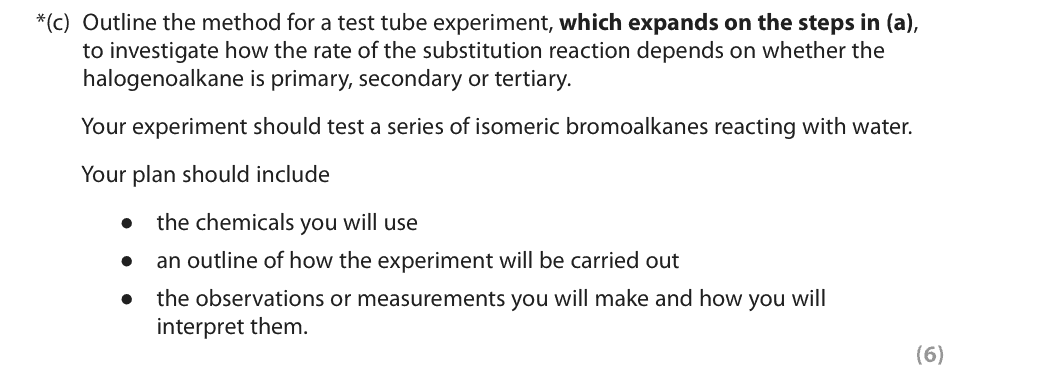
October 2020 · AS Paper 2 · Q7(c)6 marks6-mark extended responseHard
Earlier parts of question 7 that this part uses
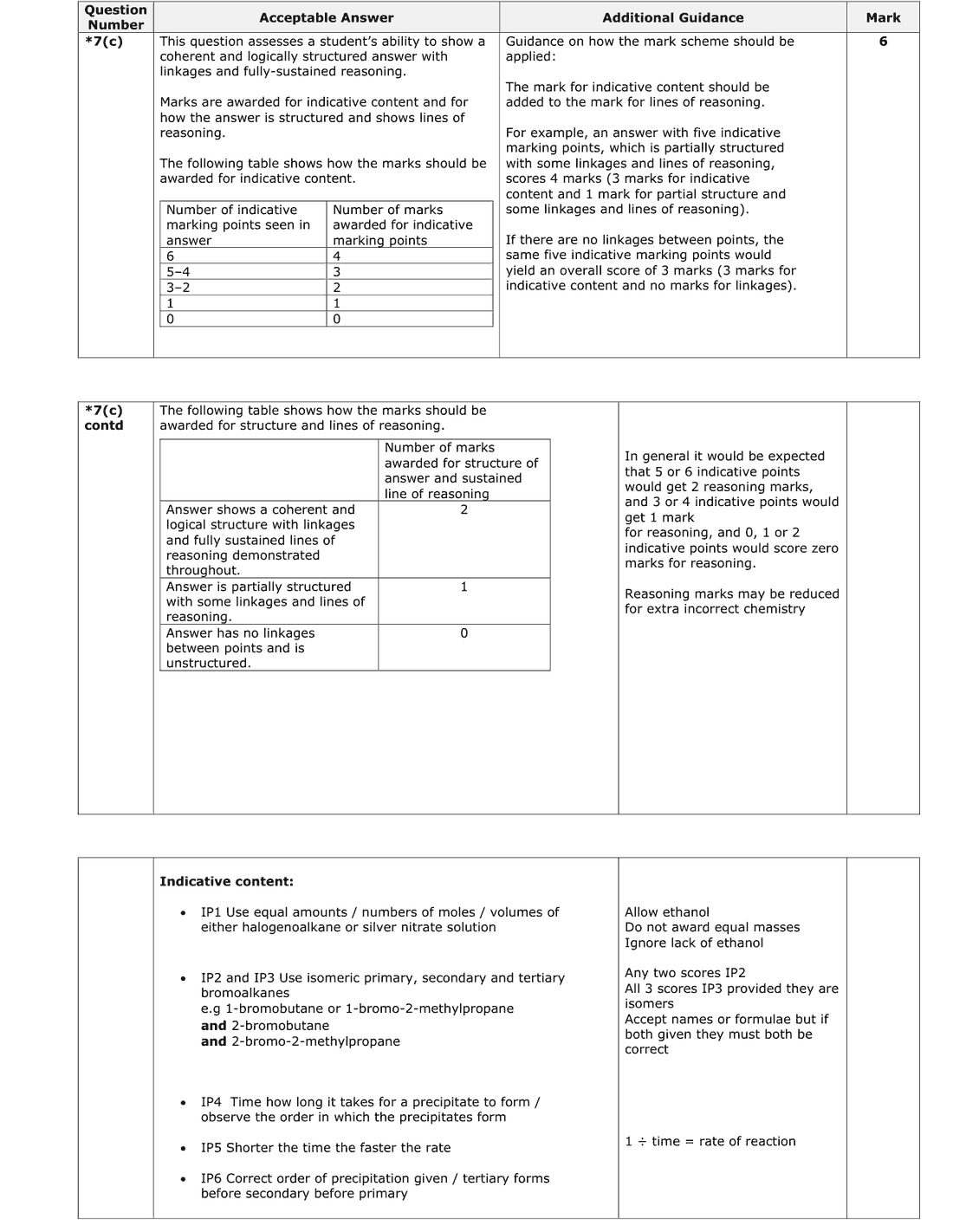
Mark scheme, with the indicative content and the marks for reasoning
Examiner's comment
This question had a number of questions which were practically orientated. Learners found
these quite difficult and answers were often lacking in detail and precision. The final question
which required logical reasoning and explanation was not well answered by most candidates
only a few realising the detail required to get good marks, although most could manage to
score something by making a start at the question.
Notes from the mark scheme and report
Six indicative points plus two marks for reasoning. IP1 use equal amounts / moles / volumes of the halogenoalkanes or of silver nitrate solution (not equal masses)
IP2 and IP3 use isomeric primary, secondary and tertiary bromoalkanes, e.g. 1-bromobutane (or 1-bromo-2-methylpropane), 2-bromobutane and 2-bromo-2-methylpropane (any two score IP2, all three isomers IP3)
IP4 time how long each takes to form a precipitate, or note the order in which precipitates form
IP5 the shorter the time, the faster the rate (rate = 1 ÷ time)
IP6 tertiary forms a precipitate before secondary before primary. The report says answers lacked detail and precision, though most scored something
Skills: PT1 use appropriate apparatus to record a range of measurements (to include mass, time, volume of liquids and gases, temperature); PT4 use laboratory apparatus for a variety of experimental techniques, including: titration, using burette and pipette; distillation and heating under reflux, including setting up glassware using retort stand and clamps; qualitative tests for ions and organic functional groups; filtration, including use of fluted filter paper, or filtration under reduced pressure; CP4 Core practical 4: Investigation of the rates of hydrolysis of some halogenoalkanes
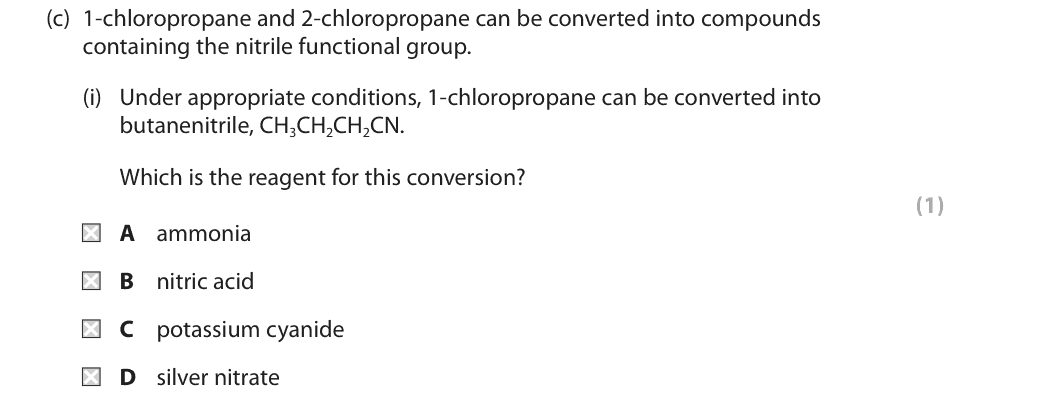
June 2019 · AS Paper 2 · Q2(c)(i)1 markMultiple choice
Answer
C
Mark scheme
Examiner's comment
The first six items of this question were well answered by most candidates. Some learners mentioned both the fact that a homologous series contained molecules with the same functional group and had the same chemical reactivity. Since the latter comes as a result of the former, these were considered to be the same marking point and so only one mark was scored unless a further characteristic was supplied. Most knew that propene was an alkene and that hydrogen chloride was the reagent in (b)(i). Hydrochloric acid would not work here and a minority of candidates did not score the mark because of this. Many knew that the reaction was an electrophilic addition. In (c), most learners knew or worked out that potassium cyanide was the correct reagent and most also scored 2 for their understanding of the term ‘structural isomer’. The structure and name for the isomer in (c)(iii) proved much more
challenging. Most candidates drew all the bonds including bonds between the C and the N of the functional group, though not all knew that this was a triple bond. A significant minority drew the structure of butanenitrile, for which the structural formula had been given in (c)(i), suggesting that the question in (c)(iii) had not been read with sufficient care. It is good practice to read each question twice to ensure that the correct question is answered. Where the correct structure was given the name was often incorrect. Both marks in this part were usually only scored by candidates who would go on to achieve an A grade.
Notes from the mark scheme and report
Answer: C (potassium cyanide). Ammonia would give an amine, nitric acid does not react and silver nitrate gives silver chloride and an alcohol
June 2019 · AS Paper 2 · Q5(e)(iii)3 marksMechanism
Earlier parts of question 5 that this part uses
Mark scheme
Examiner's comment
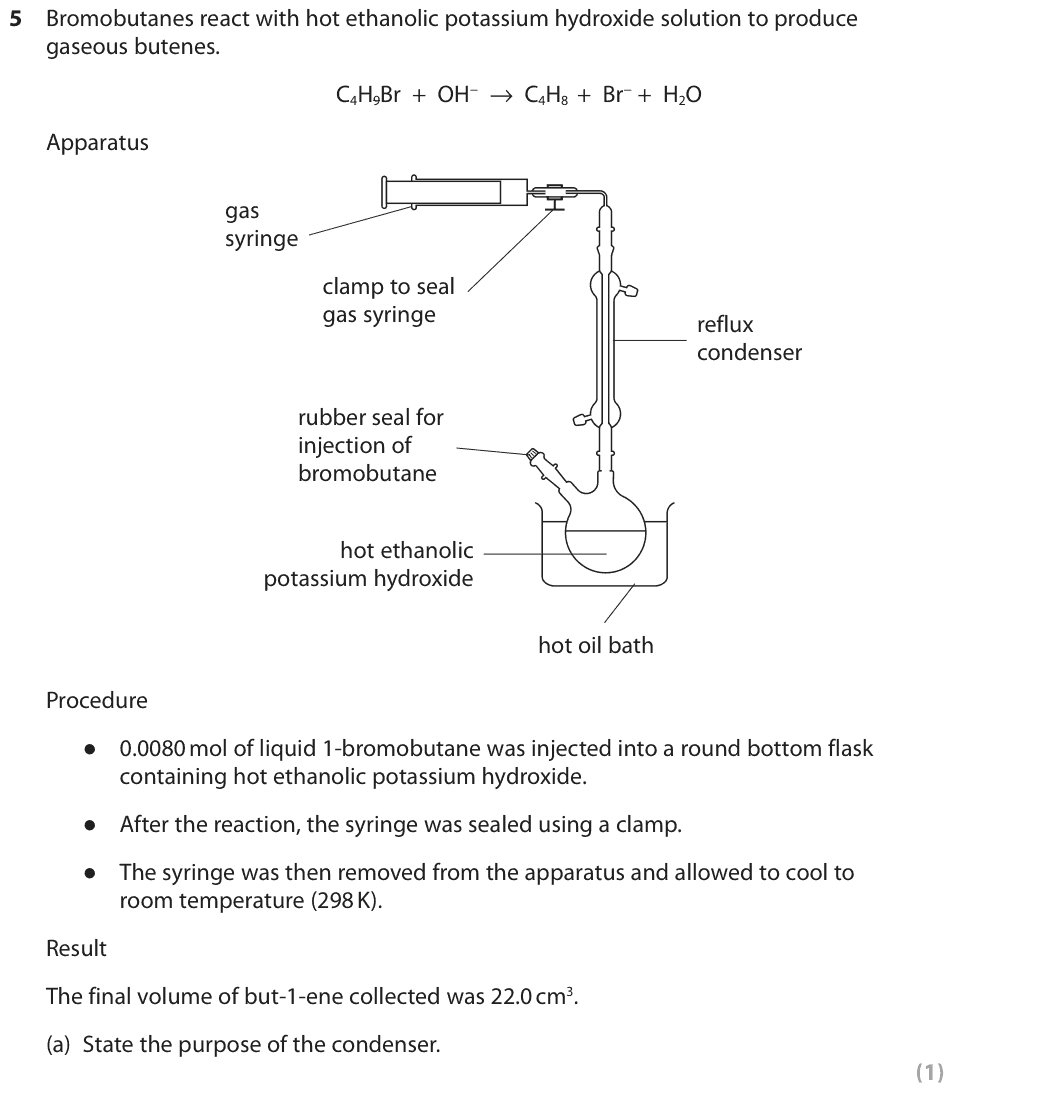
A lack of precision in (a) resulted in the loss of the mark for some. Many answers described condensing products back in the the reaction mixture. This is true for butan-1-ol but not for the but-1-ene which is collected in the gas syringe. The use of bromine water as a test for unsaturation was well known. In (c) the percentage yield calculation was very well understood by higher ability candidates, however lower scoring learners seemed unsure where to begin and failed to score. The unusual calculation in 5(d) proved challenging for all. Some candidates clearly understood what to do, showing working indicating they understood that the number of moles and pressure were constant so the volume depended only on the temperature before correctly completing the calculation. Some candidates made an assumption that the pressure was standard pressure (either 100 or 101 kPa) and then did two pV = nRT calculations to find an answer which was close to the correct one. These candidates were awarded one of the two marks. In (e) those who knew the mechanism of the reaction often scored all 5 marks. The answer to (e)(i), substitution, was often accompanied by nucleophilic, which was correct but not required, or electrophilic which was incorrect and lost the mark. The type of reaction is substitution and it is a nucleophilic mechanism. The test for the –OH group in the alcohol and the expected observation were well known. The mechanism scored well for some learners, with careful positioned arrows and all the relevant lone pairs and dipoles included. Marks were lost through the lack of the dipole on OH‒ or the lack of its charge. Dipoles in the 1-bromobutane were not always included. Some did not include the product bromide ion. As a result a range of marks were scored. Some candidates were clearly unsure where to start and so scored 0. The final part of this question was challenging as many learners did not appreciate that, as well as but-1-ene, but-2-ene would be formed. This compound exists as both cis- and trans- isomers and so the number of isomeric alkene products was, in fact, three.
Notes from the mark scheme and report
Curly arrow from a lone pair on the OH– to the carbon bonded to Br
curly arrow from the C–Br bond to (or just beyond) the Br
partial charges δ+ on C and δ– on Br, with Br– shown as a product. Arrows may be shown on an SN2 transition state
SN1 allowed if the correct carbocation is drawn. Not HBr as a product. Common errors: no lone pair or no charge on the hydroxide ion
no dipole on the C–Br bond
no bromide ion as a product
June 2019 · AS Paper 2 · Q5(f)1 markMultiple choice
Earlier part of question 5 that this part uses
Answer
C
Mark scheme
Examiner's comment
A lack of precision in (a) resulted in the loss of the mark for some. Many answers described condensing products back in the the reaction mixture. This is true for butan-1-ol but not for the but-1-ene which is collected in the gas syringe. The use of bromine water as a test for unsaturation was well known. In (c) the percentage yield calculation was very well understood by higher ability candidates, however lower scoring learners seemed unsure where to begin and failed to score. The unusual calculation in 5(d) proved challenging for all. Some candidates clearly understood what to do, showing working indicating they understood that the number of moles and pressure were constant so the volume depended only on the temperature before correctly completing the calculation. Some candidates made an assumption that the pressure was standard pressure (either 100 or 101 kPa) and then did two pV = nRT calculations to find an answer which was close to the correct one. These candidates were awarded one of the two marks. In (e) those who knew the mechanism of the reaction often scored all 5 marks. The answer to (e)(i), substitution, was often accompanied by nucleophilic, which was correct but not required, or electrophilic which was incorrect and lost the mark. The type of reaction is substitution and it is a nucleophilic mechanism. The test for the –OH group in the alcohol and the expected observation were well known. The mechanism scored well for some learners, with careful positioned arrows and all the relevant lone pairs and dipoles included. Marks were lost through the lack of the dipole on OH‒ or the lack of its charge. Dipoles in the 1-bromobutane were not always included. Some did not include the product bromide ion. As a result a range of marks were scored. Some candidates were clearly unsure where to start and so scored 0. The final part of this question was challenging as many learners did not appreciate that, as well as but-1-ene, but-2-ene would be formed. This compound exists as both cis- and trans- isomers and so the number of isomeric alkene products was, in fact, three.
Notes from the mark scheme and report
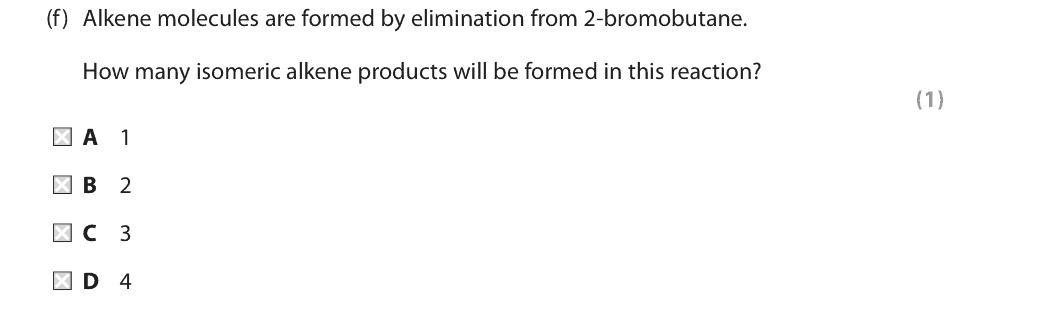
Answer: C (3). Elimination from 2-bromobutane gives but-1-ene and both the cis (Z) and trans (E) isomers of but-2-ene. Many did not see that but-2-ene would form as well
June 2019 · Paper 2 · Q8(a)(i)1 markMultiple choice
Answer
D
Mark scheme
Notes from the mark scheme and report
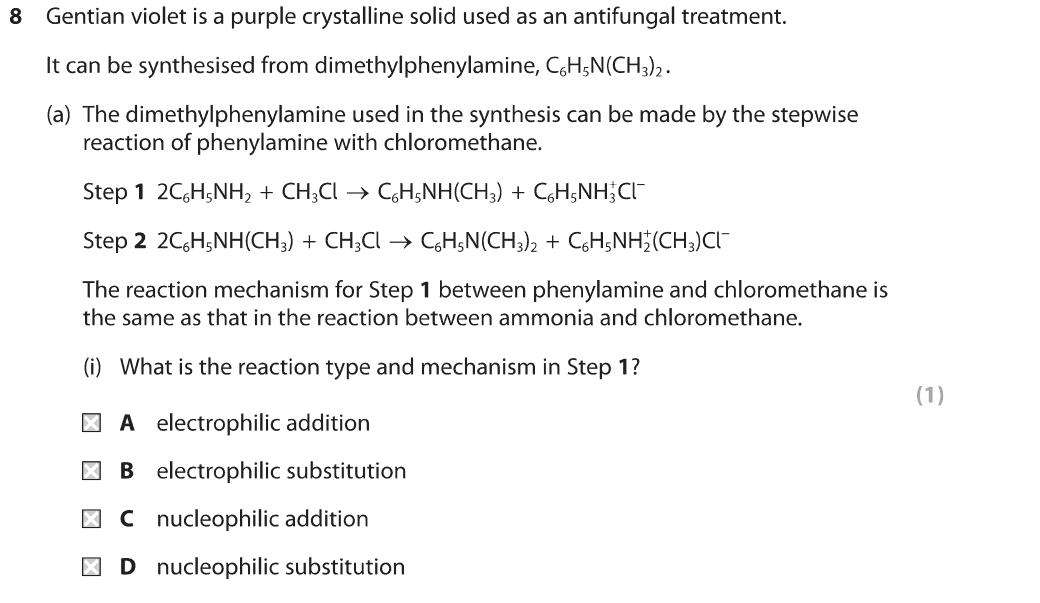
Answer: D. Phenylamine acts as a nucleophile (lone pair on N) and replaces the chlorine of chloromethane: nucleophilic substitution, as with ammonia
June 2019 · Paper 2 · Q8(a)(ii)4 marksMechanism
Earlier part of question 8 that this part uses
Mark scheme
Examiner's comment
Of the three mechanisms on the paper, this was the most effective discriminator. Some candidates had clearly not remembered the reaction of ammonia with halogenoalkanes, so found it difficult to know where to start. Others either did not look at the structural formulae or could not interpret them so showed the halogenoalkane attacking the ring. Many of the more able candidates could link their knowledge from year 1 of the course to this mechanism, so scores of 3 or 4 marks were commonplace in this region. The previous comments on precision of arrow placement, as well as the importance of including relevant lone pairs apply here as well as Q5 (a)(ii) and Q4 (c)(i).
Notes from the mark scheme and report
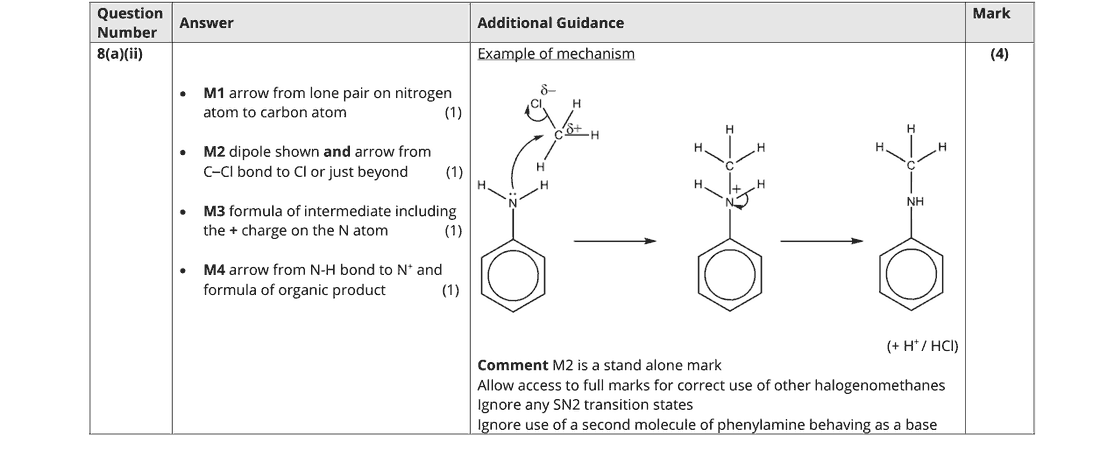
M1 curly arrow from the lone pair on N to the carbon of CH3Cl
M2 (stands alone) dipole on C–Cl and curly arrow from the C–Cl bond to Cl
M3 intermediate C6H5NH2CH3 with + on N
M4 curly arrow from an N–H bond to N+ and the product C6H5NHCH3 (+ H+ / HCl). SN2 transition states and a second phenylamine acting as base are ignored. Described as the best discriminator of the three mechanisms
some could not start, and others attacked the benzene ring with the halogenoalkane
June 2019 · Paper 3 · Q3(a)5 marksShort answer
Mark scheme
Examiner's comment
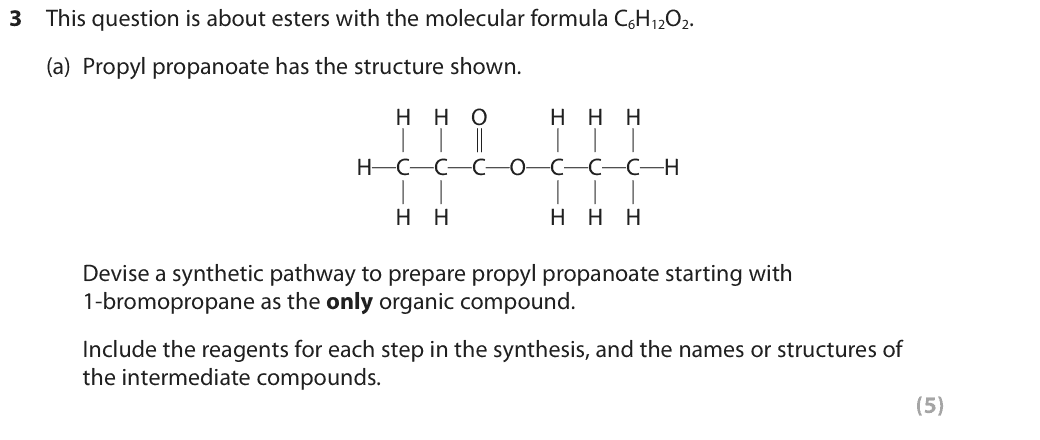
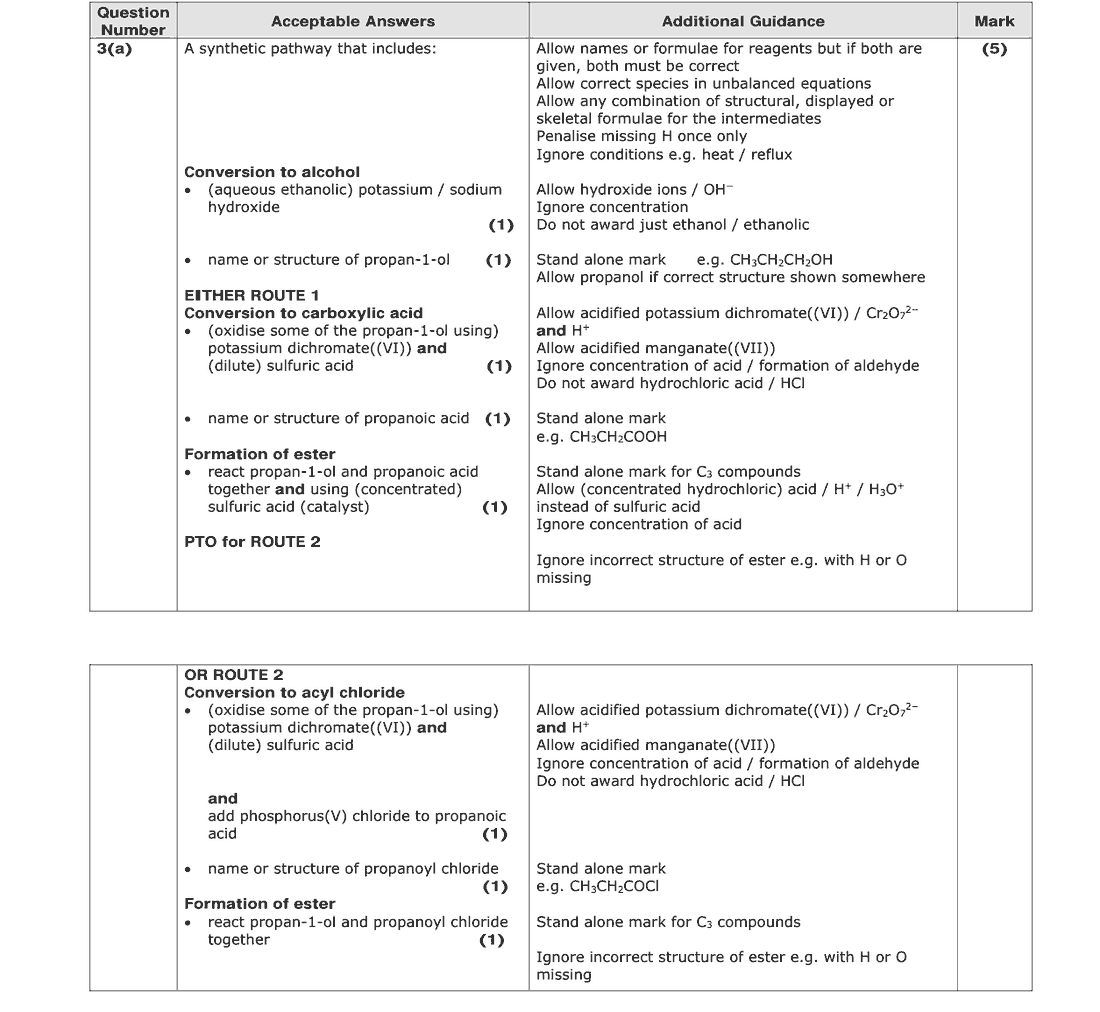
Many candidates realised that propan-1-ol and propanoic acid or propanoyl chloride react together to form propyl propanoate so they were able to devise a correct synthetic pathway. Some candidates lost a mark for converting 1-bromopropane to propan-1-ol as they used ethanolic potassium hydroxide and this would favour the elimination reaction to form prop-1-ene. Some candidates just referred to propanol instead of stating or showing the position of the OH group. Some candidates were careless when drawing structures and it was not unusual to see hydrogen atoms omitted or the OH group incorrectly attached to a carbon atom through the hydrogen atom. Many candidates who made the ester from propanoic acid and propan-1-ol omitted the acid catalyst and some omitted the acid with the dichromate in the oxidation of propan-1-ol. A small number of candidates used a Grignard reagent but that occurs later in the paper and they are told in the question that it is used to add one or more carbon atoms to the compound.
Notes from the mark scheme and report
Step 1: aqueous potassium or sodium hydroxide (not ethanolic alone) gives propan-1-ol. Route 1: oxidise some propan-1-ol with potassium dichromate(VI) and dilute sulfuric acid to propanoic acid, then react propan-1-ol with propanoic acid and a (concentrated) sulfuric acid catalyst. Route 2: oxidise as before and add PCl5 to give propanoyl chloride, then react it with propan-1-ol. Marks for reagents and for the named or drawn intermediates (stand-alone). Common losses: ethanolic KOH (favours elimination)
'propanol' with no position
missing H atoms
no acid catalyst for esterification
no acid with the dichromate
June 2018 · AS Paper 2 · Q11 markMultiple choice
Answer
A
Mark scheme
Notes from the mark scheme and report
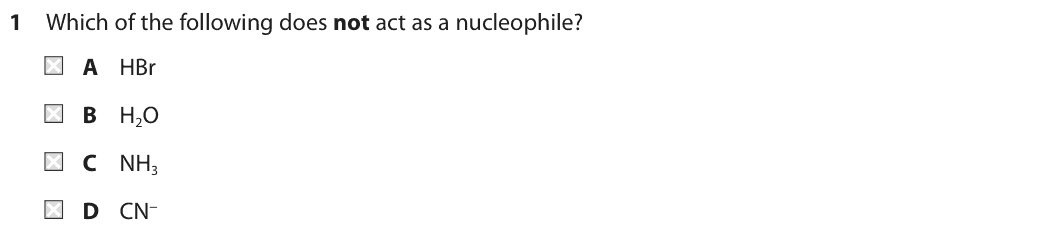
Answer: A. HBr has no lone pair available to donate to an electron-deficient carbon
it reacts as an electrophile. H2O, NH3 and CN– are all nucleophiles through their lone pairs
June 2018 · AS Paper 2 · Q4(a)(i)2 marksShort answer
Mark scheme
Examiner's comment
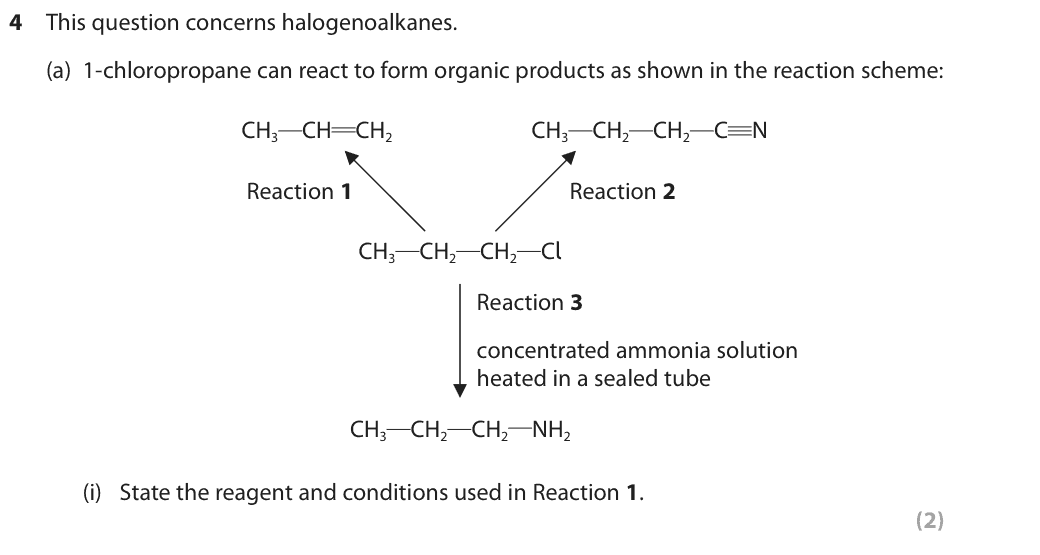
M1 was awarded for the correct reagent. M2 for the correct conditions (heating and ethanolic).
M1 was dependent on M2 except for a 'near miss' with the reagent, e.g. use of just OH-.
Notes from the mark scheme and report
Reagent: (concentrated) NaOH or KOH
conditions: ethanol as solvent and heat / warm (allow reflux). Not just OH– or 'hydroxide'
no reagent mark if 'acidified'. The conditions mark depends on the reagent mark except after a near miss such as OH–
June 2018 · AS Paper 2 · Q4(a)(ii)2 marksShort answer
Earlier part of question 4 that this part uses
Mark scheme
Examiner's comment
M1 was awarded for the correct reagent. Conditions, if given, were ignored. Just 'cyanide' or the formula of the cyanide ion were not sufficient.
Notes from the mark scheme and report
Reagent: KCN or NaCN (potassium or sodium cyanide)
solvent and conditions ignored. Reason: it increases the length of the carbon chain. Just 'cyanide', CN– or HCN was not enough
June 2018 · AS Paper 2 · Q4(a)(iii)2 marksExplanation
Earlier part of question 4 that this part uses
Mark scheme
Examiner's comment
The question carried the word 'heated' and 'sealed' in bold to emphasise the need to address both of these two matters.
The mark allocation is also a good indication that two ideas will be required for a complete answer.
Notes from the mark scheme and report
Heating increases the rate of reaction
the tube is sealed because otherwise ammonia (gas) / the reactants would escape. Ignore activation energy, 'to start the reaction', endothermic, and toxicity. Both words in bold in the question need to be addressed
June 2018 · AS Paper 2 · Q4(a)(iv)1 markShort answer
Earlier part of question 4 that this part uses
Mark scheme
Examiner's comment
Additional inorganic products were ignored.
The formula C3H7OH was not accepted because this would include the branched chain isomer.
Notes from the mark scheme and report
Answer: CH3CH2CH2OH (propan-1-ol). Displayed, structural or skeletal formula allowed
name ignored
inorganic products ignored. C3H7OH not credited because it could be the branched isomer
June 2018 · AS Paper 2 · Q4(b)1 markMultiple choice
Earlier part of question 4 that this part uses
Answer
B
Mark scheme
Notes from the mark scheme and report
Answer: B (Z, X, Y). Z is tertiary so is hydrolysed fastest, X is secondary, Y is primary so slowest
Skills: CP4 Core practical 4: Investigation of the rates of hydrolysis of some halogenoalkanes
June 2018 · Paper 2 · Q6(a)5 marksPractical and data analysis
Mark scheme
Examiner's comment
A significant number of candidates used sodium hydroxide instead of water for hydrolysis and so the reaction would be almost instantaneous. Hence no mark could be awarded for the timing factor of the experiment. Further, the addition of silver nitrate to a mixture of halogenoalkane and sodium hydroxide would form a precipitate of silver hydroxide instead of a silver halide precipitate. Thus the mark for the use of silver nitrate was not awarded without the neutralisation of the sodium hydroxide by an acid, commonly nitric acid.
It was pleasing to see high calibre candidates using ethanol as a co-solvent and a water bath to control temperature. Some responses did refer to controlling temperature but without the means to do so which did not score.
Notes from the mark scheme and report
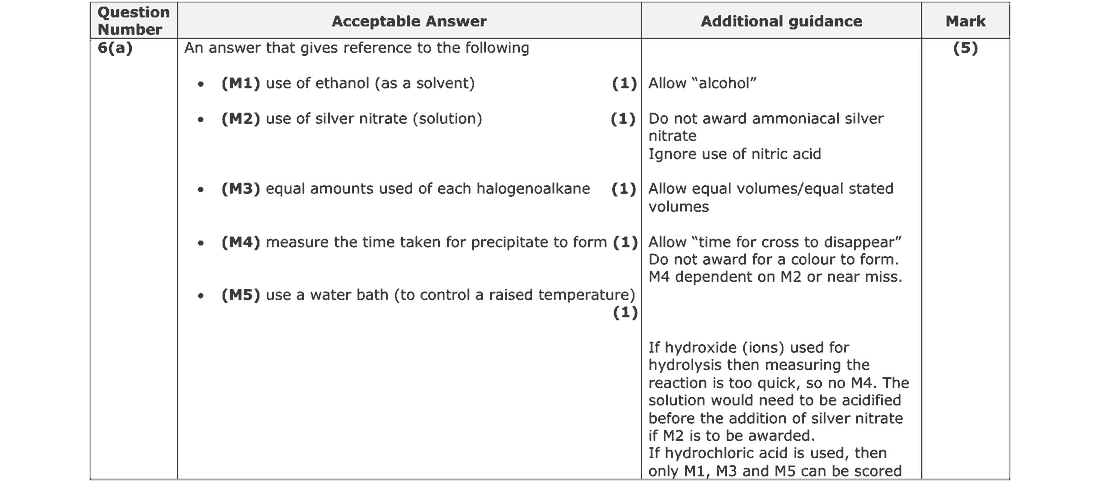
M1 ethanol as the solvent
M2 add silver nitrate solution (not ammoniacal)
M3 equal amounts / volumes of each halogenoalkane
M4 time how long the precipitate takes to form (depends on M2
not a colour)
M5 water bath to control the temperature. If hydroxide ions are used, no M4 (too fast) and M2 needs the mixture acidified first
with hydrochloric acid only M1, M3 and M5 can score. Many used sodium hydroxide
some controlled temperature without saying how
Skills: PT1 use appropriate apparatus to record a range of measurements (to include mass, time, volume of liquids and gases, temperature); PT2 use water bath or electric heater or sand bath for heating; CP4 Core practical 4: Investigation of the rates of hydrolysis of some halogenoalkanes
June 2018 · Paper 2 · Q6(b)2 marksExplanation
Mark scheme
Examiner's comment
Approximately two-thirds of candidates correctly stated the trend of hydrolysis of the halogenoalkanes and explained the reason in terms of the carbon-halogen bond strength. Candidates would benefit from making it clearer that a trend is involved by using comparative expressions such as 'faster' and 'weaker'.
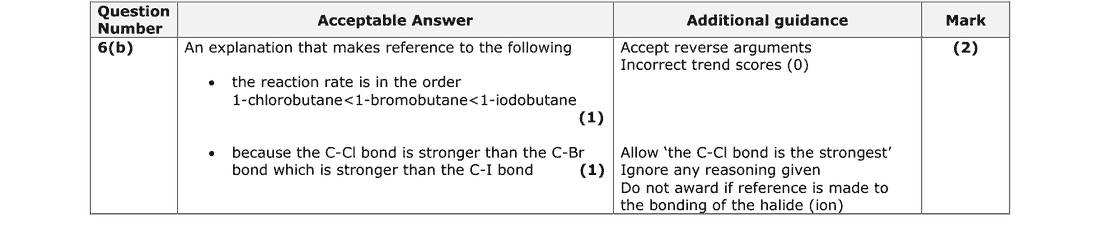
because the C–Cl bond is stronger than C–Br, which is stronger than C–I. A wrong trend scores 0
no mark if the bonding of the halide ion is mentioned. About two-thirds scored both
comparative words (faster, weaker) are needed
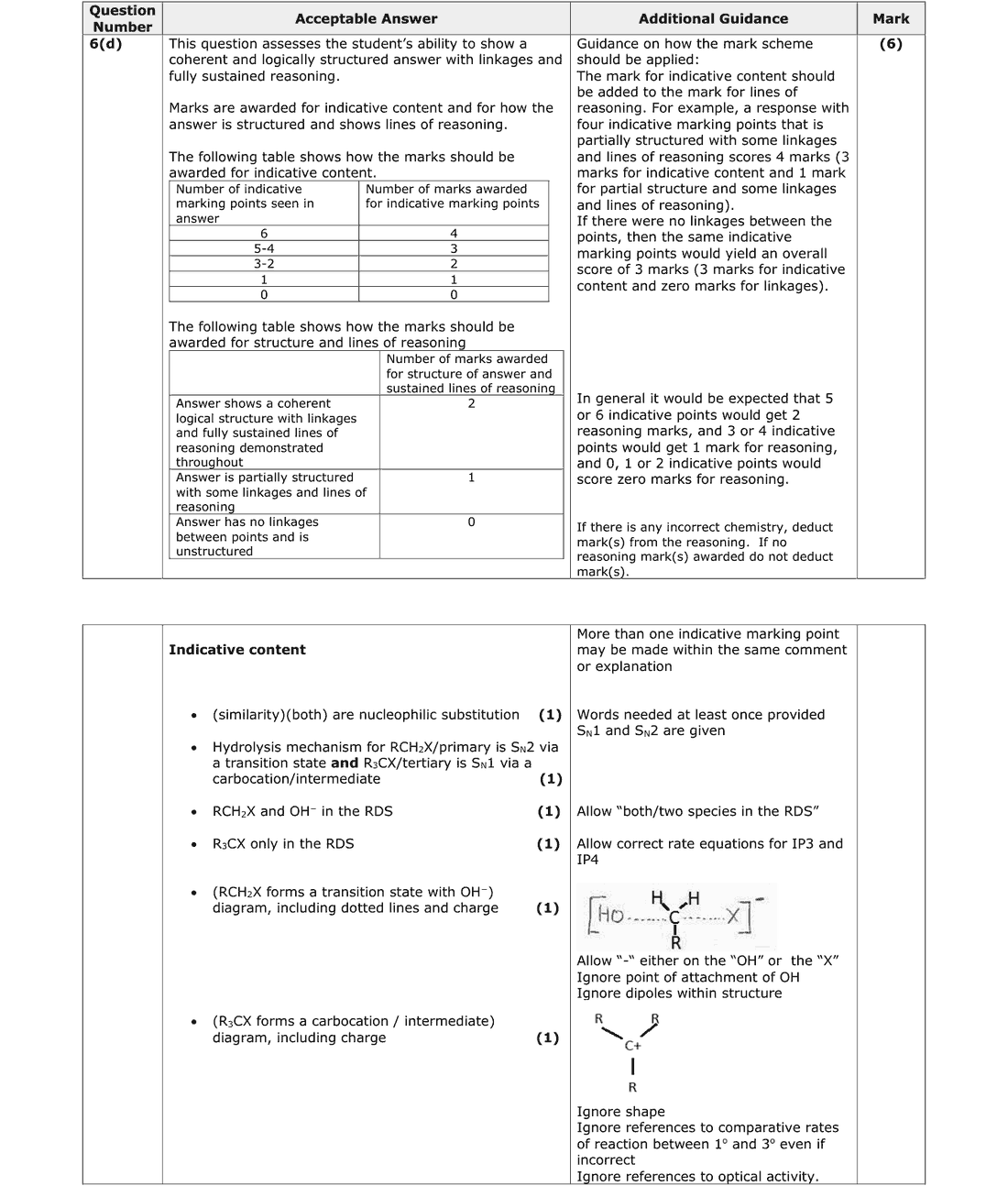
June 2018 · Paper 2 · Q6(d)6 marks6-mark extended response
Mark scheme, with the indicative content and the marks for reasoning
Examiner's comment
If there was any evidence of structuring this response or some type of planning then invariably the response scored highly. This is something that candidates would be well-advised to do when answering the 6 mark extended open response type of question. This activity is more typical of the better candidates and the performance of the candidates on this question in general was likewise commensurate with their overall ability.
Attention to detail and care with terminology is always important and failure to do so resulted in frequent loss of marks. For example, many responses drew the transition state for the SN2 primary halogenalkane mechanism but omitted the overall negative charge or the partial bonding between the incoming OH and outgoing Br. A further mark was often lost by incorrectly referring to the transition state as an intermediate or reference to the carbocation as a transition state. Another terminology error was to say that in the SN2 mechanism there are two 'molecules' in the rate- determining step but one of the species is the hydroxide ion and so this was not credited. Likewise, when referring to the SN1 mechanism it was not uncommon to see the response stating that only one reactant is in the rate-determining step but this is not the same as stating that only one species is in this step. One reactant could be the only one in the rate determining step but be second order.
Many candidates spent some time and effort discussing the difference in optical activity of the products of each type of reaction mechanism. Unfortunately this did not gain any credit because the example of the tertiary halogenoalkane given in the question was R3X and so all of the R groups could have been identical and so no optical activity would have been observed. It is worth reminding candidates that not all tertiary halogenoalkanes exhibit optical activity, only those with four different atoms/groups attached to the central carbon.
Notes from the mark scheme and report
Six indicative points plus two marks for reasoning. IP1 both are nucleophilic substitution
IP2 primary RCH2X is SN2 via a transition state and tertiary R3CX is SN1 via a carbocation intermediate
IP3 RCH2X and OH– are both in the rate-determining step
IP4 only R3CX is in the rate-determining step (rate equations allowed for IP3 and IP4)
IP5 diagram of the transition state with dotted (partial) bonds and the negative charge
IP6 diagram of the carbocation with its charge. Optical activity and relative rates ignored. Common errors: transition state drawn without the charge or partial bonds
calling the transition state an intermediate (or the carbocation a transition state)
two 'molecules' in the SN2 step
'one reactant' rather than one species for SN1
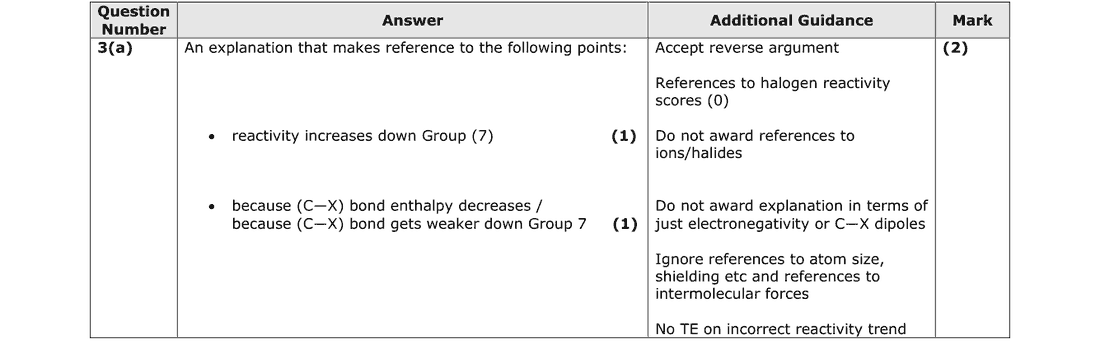
June 2017 · Paper 2 · Q3(a)2 marksExplanation
Mark scheme
Examiner's comment
About 60% of the candidates could give an effective reasoned argument concerning the trend in hydrolysis of halogenoalkanes and its relation to the carbon-halogen bond strength rather than the carbon-halogen bond polarity, and thus were able to score both marks. However there were a small number of responses referring to the reactivity trend of the halogens rather than halogenoalkanes. Candidates need to make sure that the correct terms are used so that there is no ambiguity over the substances that they are referring to. In addition, occasionally responses referred to ions or ionic radius as part of an explanation of the trend in hydrolysis of halogenoalkanes but this is an incorrect use of the term 'ion' as halogenoalkanes are covalent. It is likely that candidates did not actually think that the halogenoalkanes are ionic but need to be more careful in the phrasing of their response.
Notes from the mark scheme and report
Reactivity increases from chloro- to bromo- to iodoalkane (down Group 7)
because the C–X bond enthalpy decreases / the bond gets weaker. Reverse argument accepted. Reactivity of the halogens themselves scores 0
no credit for ions or halides, or for just electronegativity or bond polarity
no mark for the reason on a wrong trend. About 60% scored both
some described halogen reactivity or wrote about ions
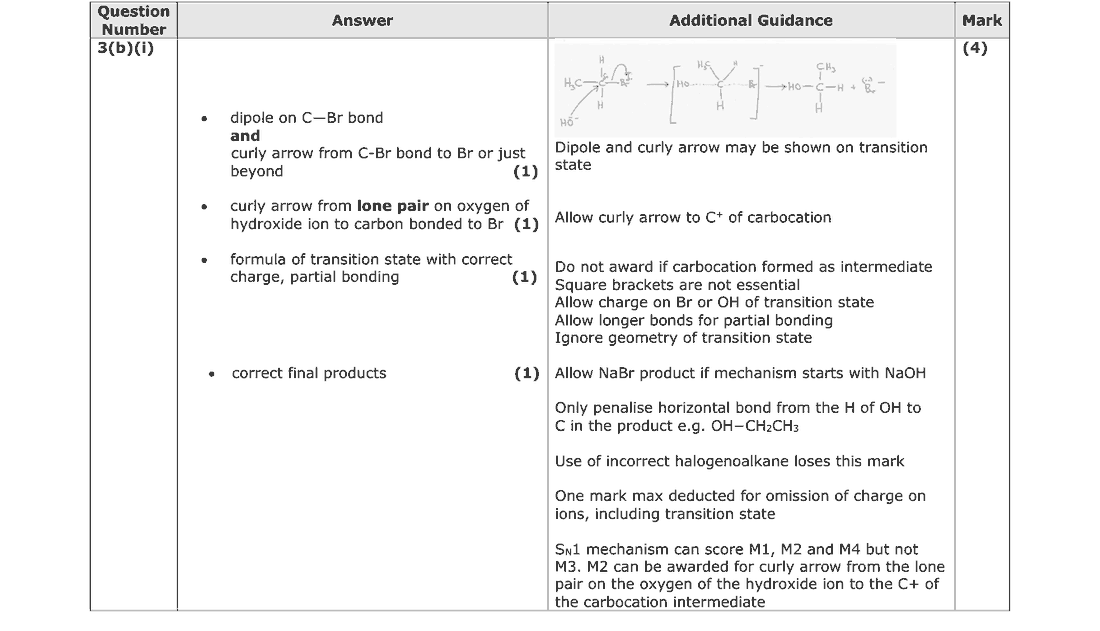
June 2017 · Paper 2 · Q3(b)(i)4 marksMechanism
Mark scheme
Examiner's comment
The majority of candidates could write the mechanism for this nucleophilic substitution reaction in part (i) in a clear and effective manner. The usual errors/omissions for a mechanism of this kind were seen, such as missing bond dipoles, missing species charges (particularly so for the transition state), missing lone pairs of electrons and missing bromide ion product. The question was very specific in requesting lone pairs and dipole so candidates needed to ensure that these are included in their mechanisms.
In stronger responses to part (ii), candidates demonstrated their understanding but frequently the use of nitric acid was missed by others. It was pleasing, although unnecessary in this instance, for an explanation for the use of nitric acid to be given. Further, these candidates appreciated that the acid could not be hydrochloric acid or sulfuric acid because these produce precipitates themselves with silver nitrate.
It was not uncommon for candidates to give additional information in part (ii) on the use of ammonia solutions to confirm the precipitate as silver bromide.
Notes from the mark scheme and report
M1 dipole on C–Br and curly arrow from the C–Br bond to Br
M2 curly arrow from a lone pair on the O of OH– to the carbon bonded to Br
M3 transition state with partial bonds and a negative charge (brackets not essential)
M4 products CH3CH2OH and Br– (NaBr if NaOH used). An SN1 route can score M1, M2 and M4 only. One mark at most lost for missing charges. Usual errors: missing dipoles, lone pairs, charge on the transition state, and the bromide ion product
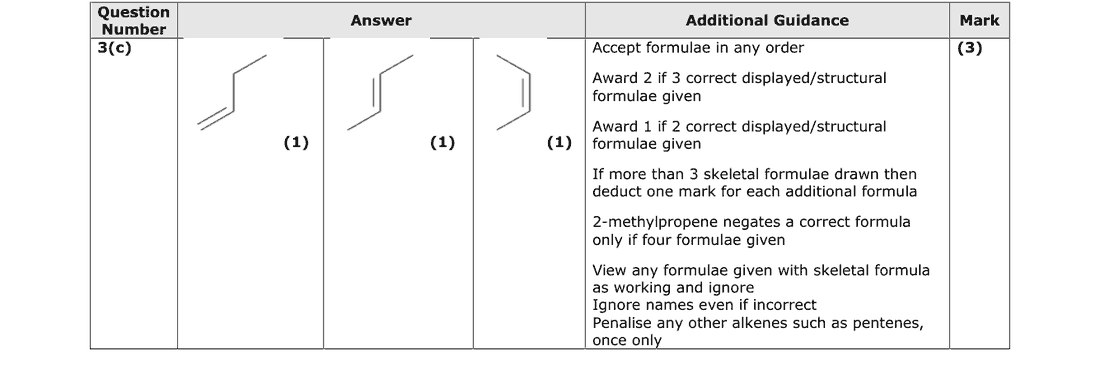
June 2017 · Paper 2 · Q3(c)3 marksDiagram or structure
Mark scheme
Examiner's comment
This question produced a wide spread of marks. In the better responses, candidates appreciated that with three marks available it was likely that there would be three formulae required. They were able to draw the E/Z isomers of but-2-ene. It was most common to see the formulae for but-1-ene and E-but-2-ene. Occasionally the formula for the branched 2-methylpropene was drawn but this is not possible to produce from a linear halogenoalkane so did not score.
Notes from the mark scheme and report
Three skeletal formulae: but-1-ene, E-but-2-ene and Z-but-2-ene, one mark each. Three correct displayed or structural formulae score 2, two score 1. Each extra formula beyond three loses a mark
2-methylpropene is not possible from a straight-chain halogenoalkane. But-1-ene and E-but-2-ene were the usual pair given
the Z isomer was often missed
Skills: MS4.2 Visualise and represent 2D and 3D forms including two- dimensional representations of 3D objects
June 2017 · AS Paper 2 · Q7(a)(i)1 markMultiple choice
Answer
B
Mark scheme
Notes from the mark scheme and report
Answer: B (Z, Y, X). The C–I bond is the weakest so 1-iodobutane hydrolyses fastest and gives a precipitate in the shortest time
1-chlorobutane takes longest. A is the order of increasing rate, not of time taken
Skills: CP4 Core practical 4: Investigation of the rates of hydrolysis of some halogenoalkanes
June 2017 · AS Paper 2 · Q7(a)(ii)1 markPractical and data analysis
Earlier part of question 7 that this part uses
Mark scheme
Notes from the mark scheme and report
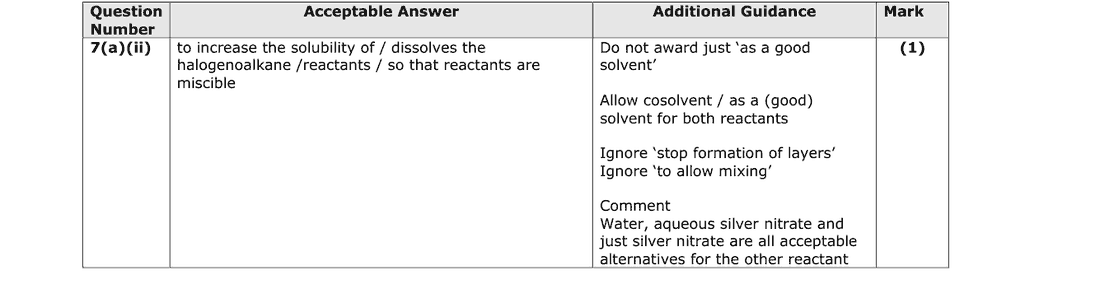
Ethanol dissolves the halogenoalkane / increases its solubility so that the reactants are miscible (a co-solvent, or solvent for both reactants). Just 'a good solvent' is not credited
'to allow mixing' and 'to stop layers forming' are ignored
Skills: PT4 use laboratory apparatus for a variety of experimental techniques, including: titration, using burette and pipette; distillation and heating under reflux, including setting up glassware using retort stand and clamps; qualitative tests for ions and organic functional groups; filtration, including use of fluted filter paper, or filtration under reduced pressure; CP4 Core practical 4: Investigation of the rates of hydrolysis of some halogenoalkanes
June 2017 · AS Paper 2 · Q7(a)(iii)1 markPractical and data analysis
Earlier part of question 7 that this part uses
Mark scheme
Examiner's comment
The question relates to the need for a 'fair test'. The three test tubes must all be at the same temperature at the start of the experiment.
Incorrect answers sometimes focused on the elevated temperature rather than the time to equilibrate. These answers then referred to rate rather than equilibration.
Notes from the mark scheme and report
So that the solutions reach the same / the required temperature (50 °C). 'To keep the temperature constant' is not credited
references to rate and fair testing are ignored
Skills: PT2 use water bath or electric heater or sand bath for heating; CP4 Core practical 4: Investigation of the rates of hydrolysis of some halogenoalkanes
June 2017 · AS Paper 2 · Q7(a)(iv)2 marksExplanation
Earlier part of question 7 that this part uses
Mark scheme
Examiner's comment
The first mark was awarded for recognition that the halogenoalkane is hydrolysed by water. A common error was to identify the hydroxide ion as the nucleophile.
The second mark was for the breakage of the C-Hal bond. Some answers referred to covalent bond breakage but did not specify that the C-Hal bond breaks. A few good answers also commented on the heterolytic nature of the bond breakage (although this was not required for the mark).
Notes from the mark scheme and report
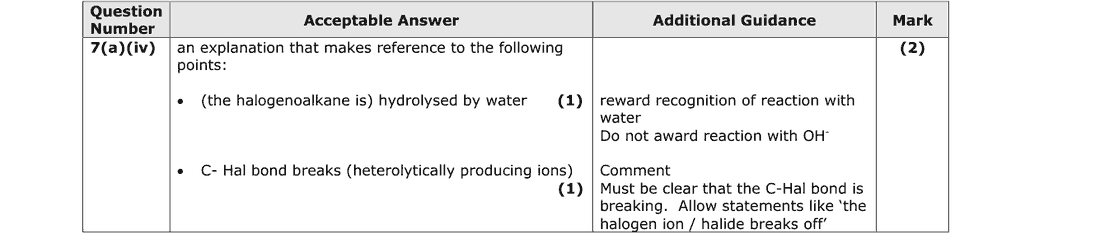
The halogenoalkane is hydrolysed by (reacts with) water
the C–halogen bond breaks (heterolytically), giving halide ions. Reaction with OH– is not credited and was a common error. It must be clear that it is the carbon–halogen bond that breaks, not just 'a covalent bond'
Skills: CP4 Core practical 4: Investigation of the rates of hydrolysis of some halogenoalkanes
June 2017 · AS Paper 2 · Q7(c)(i)1 markMultiple choice
Earlier parts of question 7 that this part uses
Answer
D
Mark scheme
Notes from the mark scheme and report
Answer: D (nucleophile). OH– is used up so is not a catalyst
it is negatively charged so not an electrophile
it has no unpaired electron so is not a free radical
June 2017 · AS Paper 2 · Q7(c)(ii)4 marksMechanism
Earlier parts of question 7 that this part uses
Mark scheme
Examiner's comment
Nearly all candidates were able to gain some marks on this question. Although the mechanism is Sn2, an Sn1 mechanism could still gain 3 of the available 4 marks.
Very few candidates were unable to draw a correct structure for 1-bromo-2-methylpropane.
There was an occasional lack of precision with the destination of the arrow in M3.
The most frequent mistake was an incorrect start or finish point for the final curly arrow (M4). Some candidates also omitted the methyl group when writing the structure of the product alcohol.
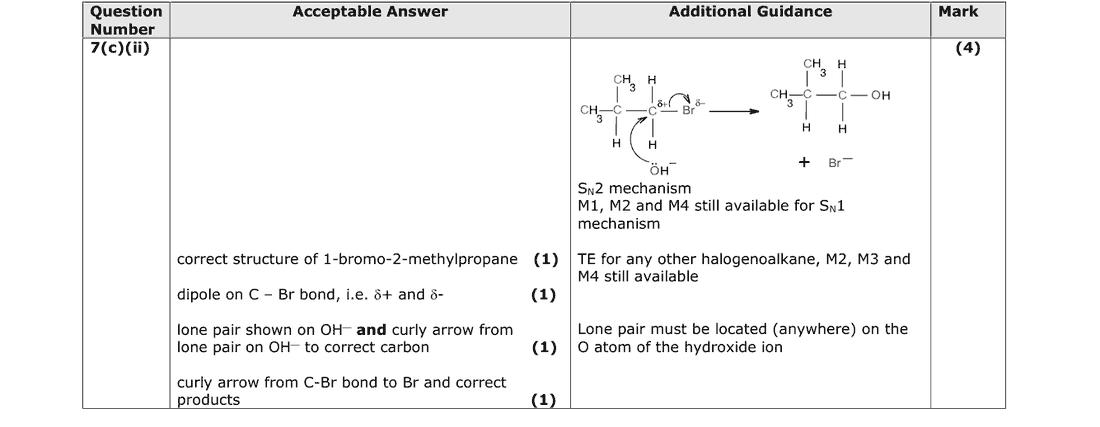
Notes from the mark scheme and report
SN2 mechanism: correct structure of 1-bromo-2-methylpropane
δ+ on C and δ– on Br
a lone pair on the O of OH– with a curly arrow from it to the carbon bonded to Br
a curly arrow from the C–Br bond to Br, with the products 2-methylpropan-1-ol and Br–. An SN1 mechanism can still score three marks. Most frequent mistake: the start or finish of the C–Br arrow
some left the methyl group off the alcohol
June 2017 · Paper 3 · Q5(c)2 marksShort answer
Earlier part of question 5 that this part uses
Mark scheme
Examiner's comment
Quite a few candidates seemed to guess an answer to part (c).
Some candidates did show great ingenuity in identifying propane in part (d), but the majority assumed it would be an alcohol or gave a structure containing MgOHBr.
Notes from the mark scheme and report
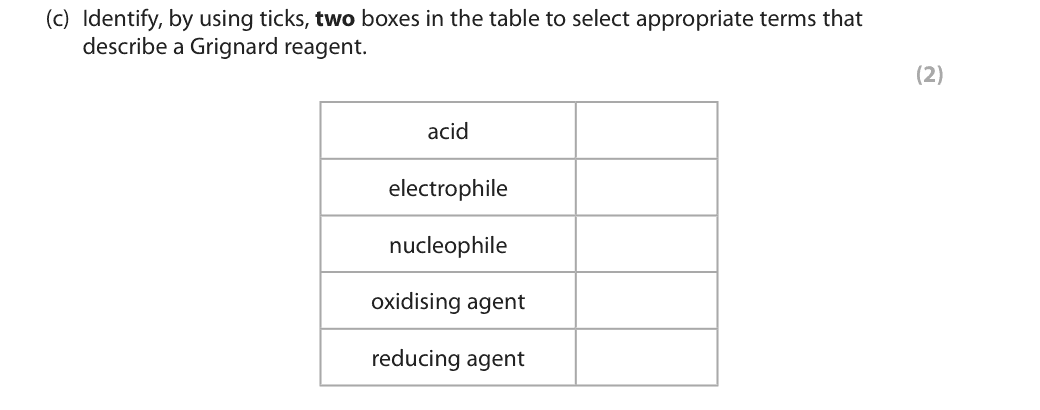
Answer: ticks beside nucleophile and reducing agent, one mark each. More than two ticks scores zero. Quite a few appeared to guess
June 2017 · Paper 3 · Q8(a)3 marksMechanism
Mark scheme
Examiner's comment
This question is on the nucleophilic substitution mechanism. Candidates were precise about the positioning of arrows.
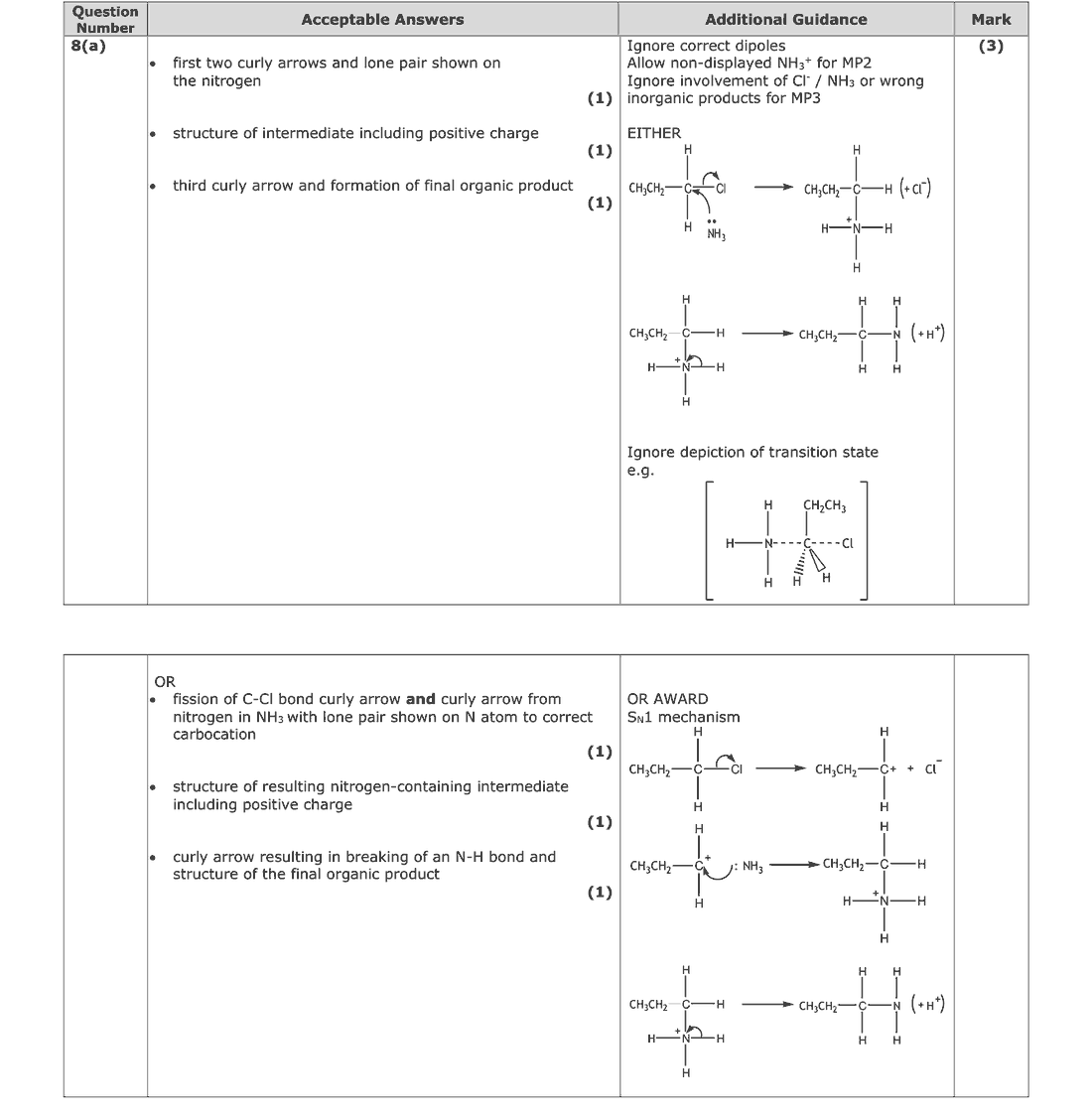
The use of correct charges on the intermediate and the final arrow from the N-H bond suggested that such candidates understood the principle of the curly arrow. In weaker responses the final arrow often went incorrectly to the hydrogen, which perhaps indicates candidates having a ‘rote learning’ approach to mechanisms.
The majority of candidates used the SN2 mechanism.
Notes from the mark scheme and report
Nucleophilic substitution (SN2 expected, SN1 allowed). M1 curly arrow from the lone pair on N of NH3 to the carbon and curly arrow from the C–Cl bond to Cl
M2 intermediate CH3CH2CH2NH3+ with its positive charge
M3 curly arrow from an N–H bond to N+ giving CH3CH2CH2NH2. Dipoles and a drawn transition state ignored. In weaker answers the last arrow went to the hydrogen instead of coming from the N–H bond
June 2016 · AS Paper 2 · Q3(a)(i)1 markEquation writing
Mark scheme
Examiner's comment
Many candidates found it difficult to write the ionic equation for the hydrolysis of 2-bromobutane and they would benefit from more practice at this skill.
Notes from the mark scheme and report
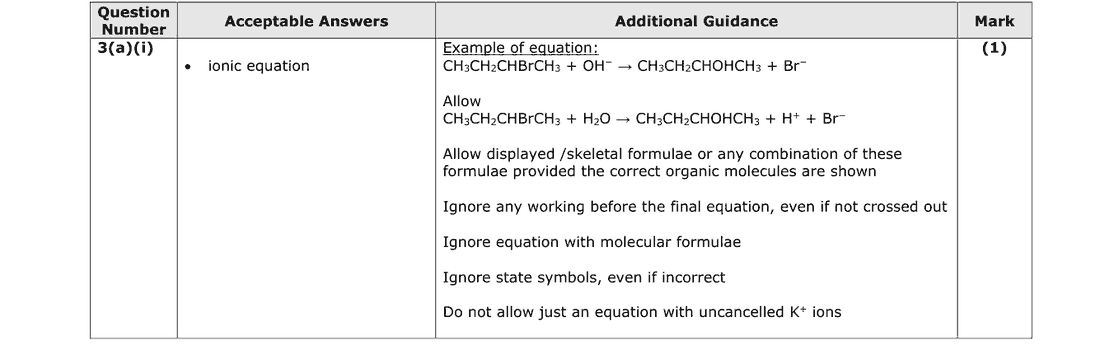
CH3CH2CHBrCH3 + OH– → CH3CH2CH(OH)CH3 + Br–. Allowed with H2O giving the alcohol + H+ + Br–
displayed or skeletal formulae allowed
molecular formulae are not
an equation with uncancelled K+ ions does not score. Many found the ionic equation difficult
June 2016 · AS Paper 2 · Q3(a)(ii)6 marks6-mark extended response
Earlier part of question 3 that this part uses
Mark scheme, with the indicative content and the marks for reasoning
Examiner's comment
There was a fairly even spread of marks from 0 to 6 for this item. Those candidates who had carried out a similar Core Practical and revised it carefully scored high marks. Some candidates seemed to be unfamiliar with this experiment and many different reagents were suggested, such as the addition of acidified potassium dichromate(VI) or carrying out a titration with sodium hydroxide. Many candidates omitted to use ethanol as a solvent and some did not mention any controls to make it a fair test. A common error was to add potassium hydroxide as well as silver nitrate solution and candidates did not realise that the water in the silver nitrate solution would hydrolyse the halogenoalkanes and that potassium hydroxide would also react with silver nitrate to form a precipitate. Some candidates did not explain the trend in the rates of reaction clearly enough. Some just discussed the carbon- iodine bond and did not compare it with the carbon-chlorine bond. A few candidates just wrote about bond length and polarity and did not mention the strengths of the bonds.
Notes from the mark scheme and report
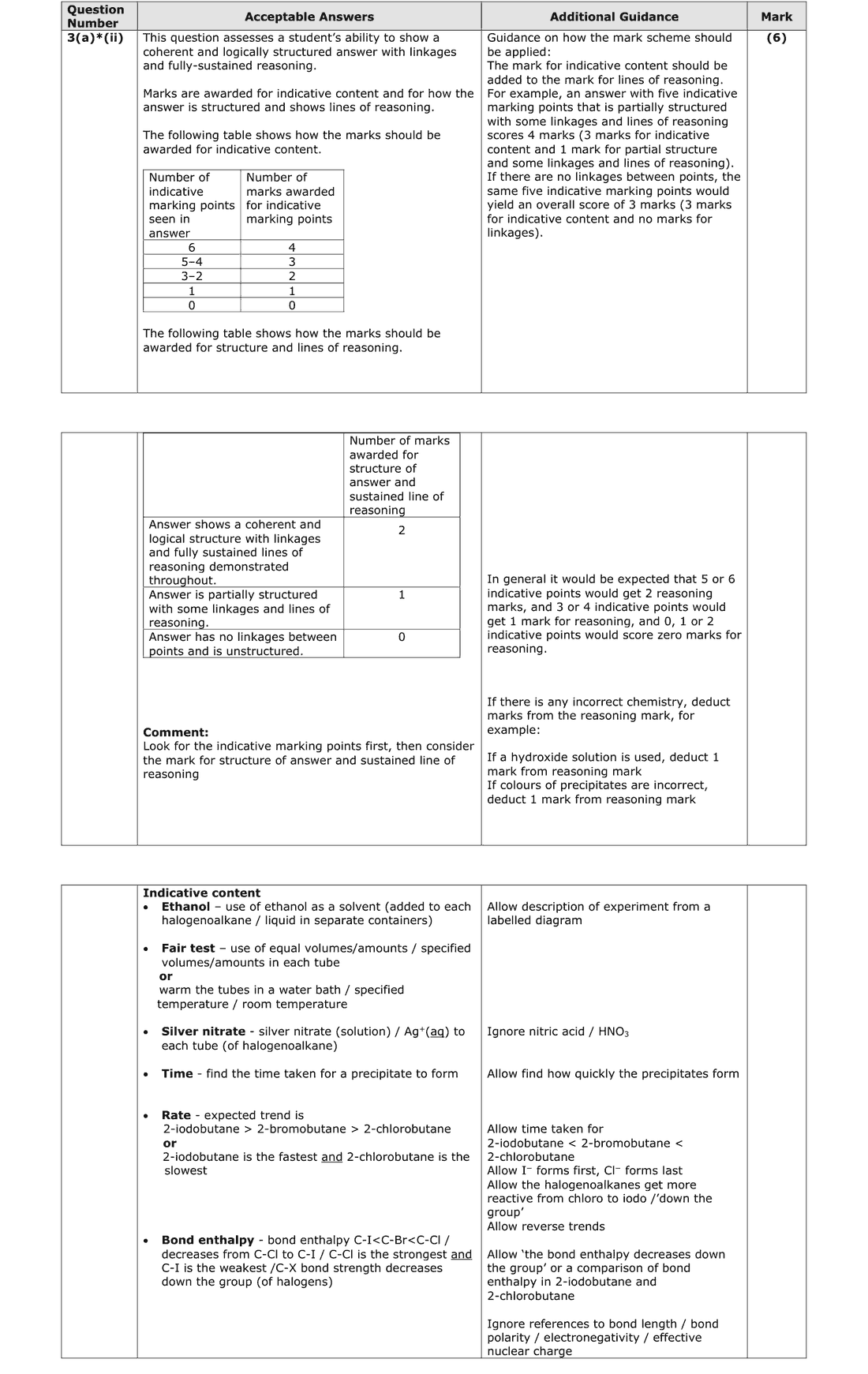
Six indicative points plus two marks for reasoning. IP1 ethanol as a solvent, added to each halogenoalkane in separate tubes
IP2 fair test: equal volumes / amounts, or the tubes warmed in a water bath at a set temperature
IP6 bond enthalpy C–I < C–Br < C–Cl. Bond length, polarity and electronegativity are ignored. A reasoning mark is lost for using a hydroxide solution or for wrong precipitate colours. Common errors: no ethanol
no controls
adding potassium hydroxide with the silver nitrate
other reagents (acidified dichromate, a titration)
only the C–I bond discussed with no comparison
Skills: PT2 use water bath or electric heater or sand bath for heating; PT12 measure rates of reaction by at least two different methods, for example: an initial rate method such as a clock reaction; a continuous monitoring method; CP4 Core practical 4: Investigation of the rates of hydrolysis of some halogenoalkanes
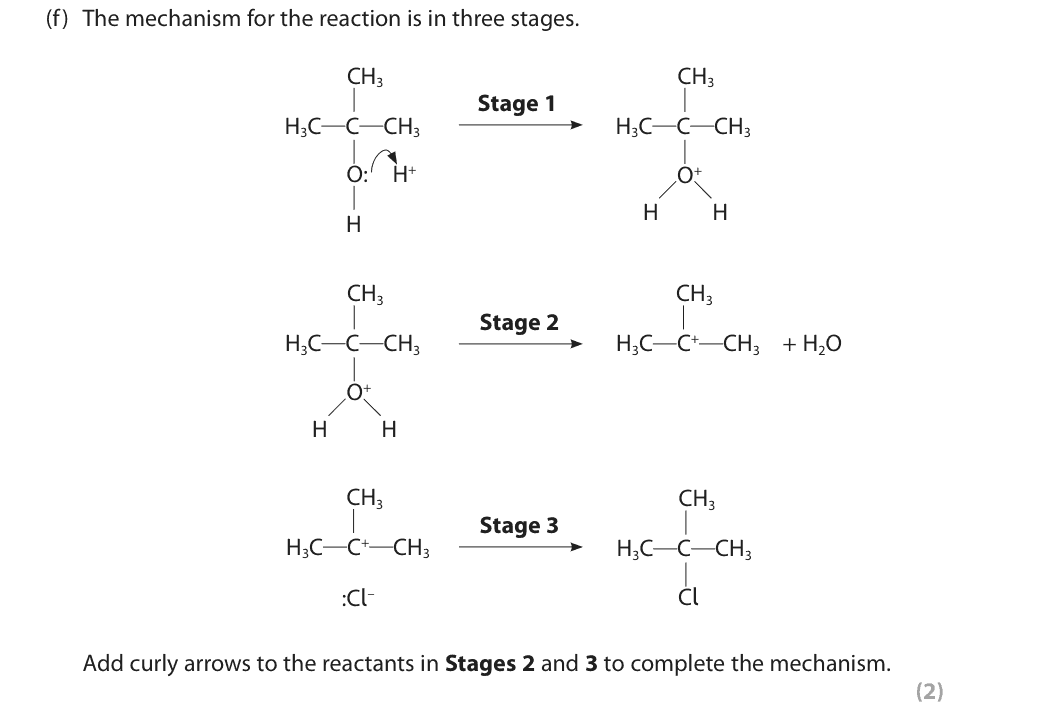
June 2016 · AS Paper 2 · Q5(f)2 marksMechanism
Earlier part of question 5 that this part uses
Mark scheme
Examiner's comment
This question involved a mechanism that is not in the specification but the candidates were expected to apply their knowledge of other mechanisms to this new situation. It tested whether they knew that a curly arrow must start from a covalent bond or a lone pair of electrons and where it ends. A far greater proportion of candidates could draw the curly arrow starting at the lone pair of electrons on the chloride ion. The accuracy of the starting and finishing points of the curly arrow from the C-O bond was much poorer, with it starting from an atom, a space or even the wrong atom.
Notes from the mark scheme and report
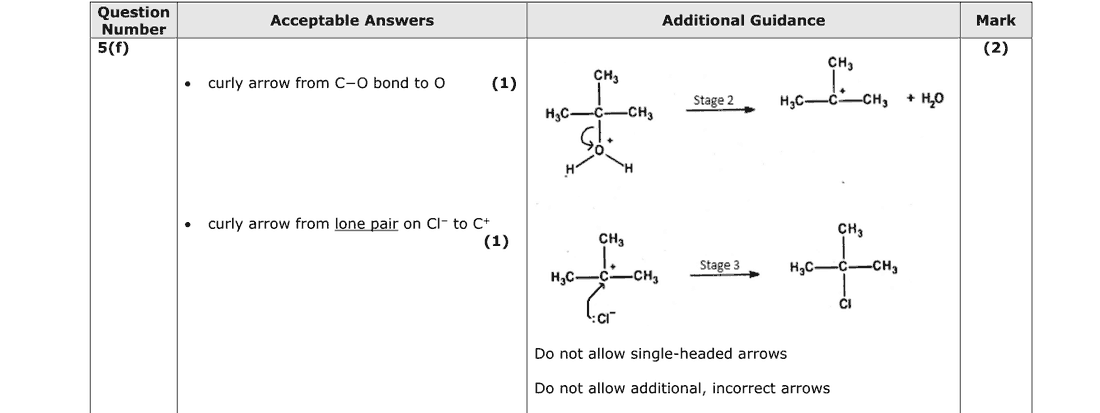
Stage 2: curly arrow from the C–O bond to the O (of the –OH2+ group). Stage 3: curly arrow from the lone pair on Cl– to the C+. No single-headed arrows
no extra incorrect arrows. The mechanism is not on the specification: it tests where curly arrows start and finish. The arrow from the chloride lone pair was done far better
the C–O arrow often started from an atom, a space or the wrong atom
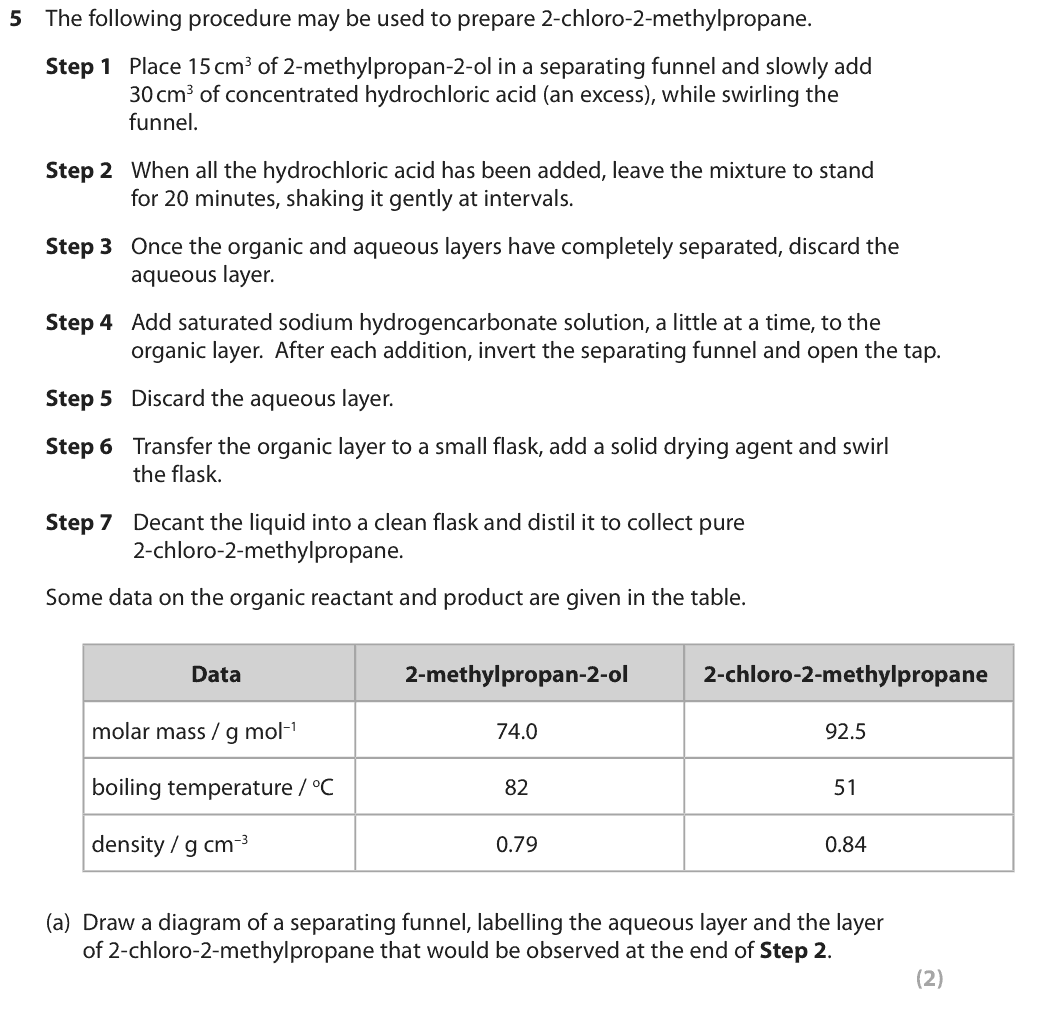
Skills: CP6 Core practical 6: Chlorination of 2-methylpropan-2-ol using concentrated hydrochloric acid
Work with an A-level chemistry tutor
Dropping marks on calculations, mechanisms or the core practicals? Book a trial session with an A-level chemistry tutor.