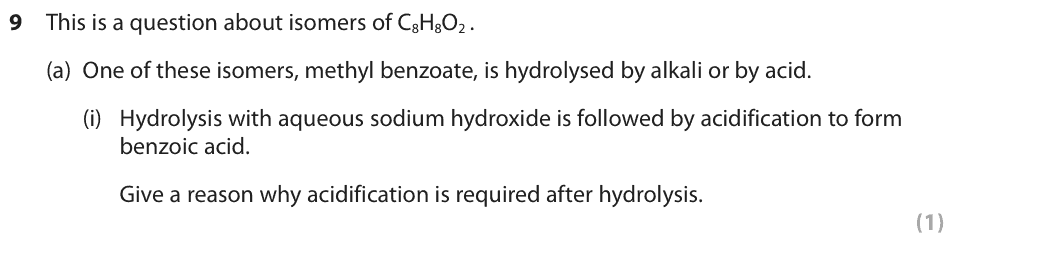
Notes and key-term cards for this topic are being written by our tutors. The past-paper questions below are ready now.
Specification statements
Show the 3 statements from the specification
17.6 be able to identify the aldehyde and ketone functional groups
17.7 understand that aldehydes and ketones: • i do not form intermolecular hydrogen bonds and this affects their physical properties • ii can form hydrogen bonds with water and this affects their solubility
17.8 understand the reactions of carbonyl compounds with: • i Fehling’s or Benedict’s solution, Tollens’ reagent and acidified dichromate(VI) ions • ii lithium tetrahydridoaluminate (lithium aluminium hydride) in dry ether • iii HCN, in the presence of KCN, as a nucleophilic addition reaction, using curly arrows, relevant lone pairs, dipoles and evidence of optical activity to show the mechanism • iv 2,4-dinitrophenylhydrazine (2,4-DNPH), as a qualitative test for the presence of a carbonyl group and to identify a carbonyl compound given data for the melting temperatures of derivatives • v iodine in the presence of alkali [In equations, the oxidising agent can be represented as [O] In equations, the reducing agent can be represented as [H] The equation for this reaction is not required]
Six-mark extended response questions on this topic
Tap a question to zoom it. Where a part needs a figure, table or structure from earlier in the question, that part folds out above it; the mark scheme and examiner's comment open underneath. Have Edexcel's Data Booklet beside you; the Periodic Table is on the back page of every paper.
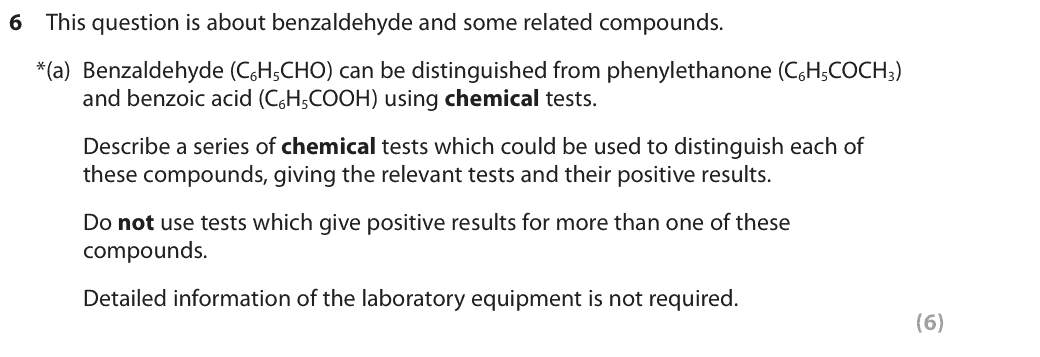
June 2025 · Paper 2 · Q6(a)6 marks6-mark extended response
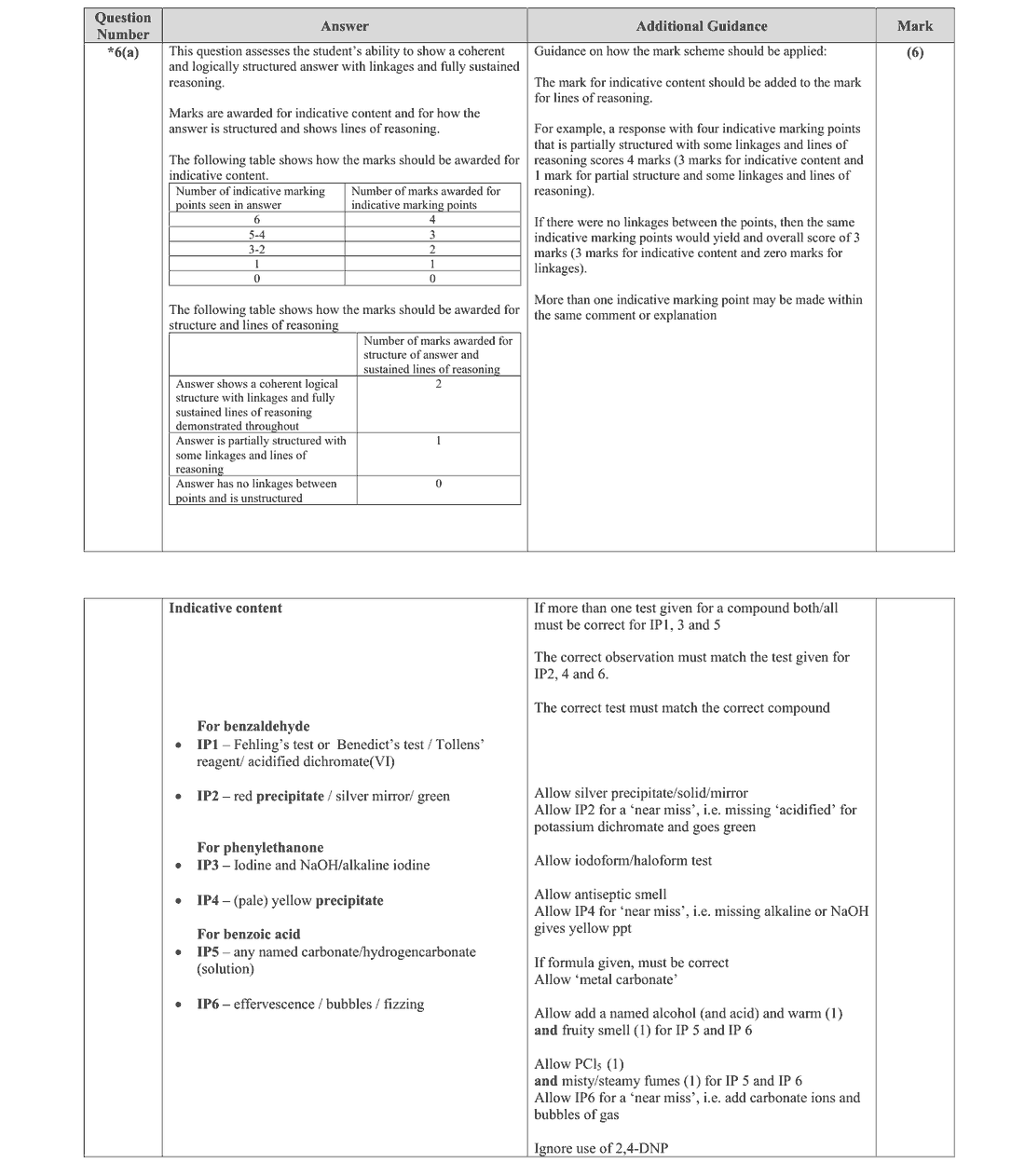
Mark scheme, with the indicative content and the marks for reasoning
Examiner's comment
This question attracted the full range of marks with many candidates able to give at least one of the relevant tests to distinguish the three compounds.
Many candidates gave more than one test for the benzaldehyde, usually losing credit for insufficient detail for one or more of the tests or for giving incomplete observations.
The team of examiners commented on the quality of some of the responses which scored full marks.
A few candidates thought that giving tests for two of the substances and deducing the third by elimination would be enough for full credit.
Notes from the mark scheme and report
Six indicative points plus two marks for reasoning. Benzaldehyde: IP1 Fehling's or Benedict's solution / Tollens' reagent / acidified dichromate(VI)
IP2 red precipitate / silver mirror / turns green. Phenylethanone: IP3 iodine with sodium hydroxide (alkaline iodine)
IP4 (pale) yellow precipitate. Benzoic acid: IP5 a named carbonate or hydrogencarbonate
IP6 effervescence (also allowed: named alcohol with acid, warm, fruity smell
or PCl5, misty fumes). The observation must match the test and the test must match the compound
2,4-DNPH ignored. If more than one test is given for a compound, all must be correct. Common errors: several tests for benzaldehyde with incomplete detail or observations
testing only two compounds and deducing the third by elimination
Skills: PT4 use laboratory apparatus for a variety of experimental techniques, including: titration, using burette and pipette; distillation and heating under reflux, including setting up glassware using retort stand and clamps; qualitative tests for ions and organic functional groups; filtration, including use of fluted filter paper, or filtration under reduced pressure; CP15 Core practical 15: Analysis of some inorganic and organic unknowns
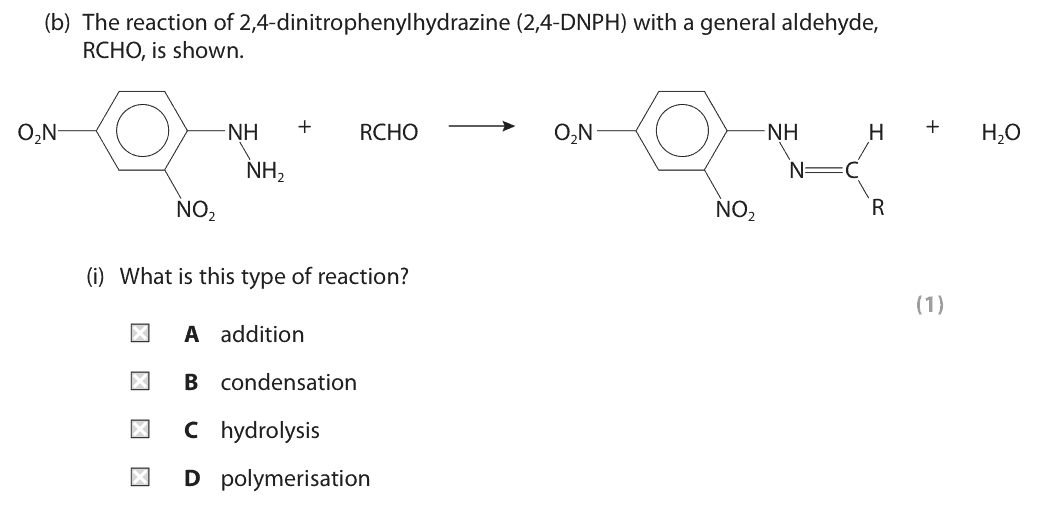
June 2025 · Paper 2 · Q6(b)(i)1 markMultiple choice
Earlier part of question 6 that this part uses
Answer
B
Mark scheme
Notes from the mark scheme and report
Answer: B (condensation): two molecules join and water is eliminated. Not addition (water is a product)
not hydrolysis (water would be a reactant)
no polymer is formed
June 2025 · Paper 2 · Q6(b)(ii)1 markDiagram or structureEasy
Earlier parts of question 6 that this part uses
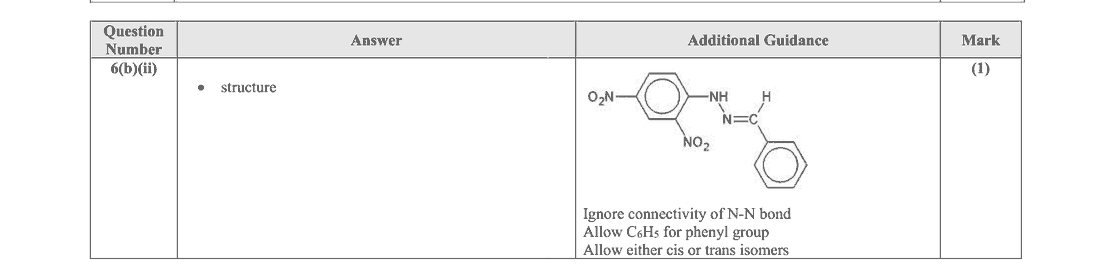
Mark scheme
Examiner's comment
This question was answered correctly for most candidates.
The most common errors were the omission of an NO2 group or a second nitrogen atom joined by a double bond to the benzene ring.
Notes from the mark scheme and report
2,4-dinitrophenylhydrazone of benzaldehyde: (O2N)2C6H3–NH–N=CH–C6H5. C6H5 allowed for the phenyl group
either geometric isomer. Common errors: an NO2 group left out
the second nitrogen joined to the benzene ring by a double bond
June 2024 · Paper 3 · Q7(d)(i)1 markPractical and data analysis
Earlier part of question 7 that this part uses
Mark scheme
Examiner's comment
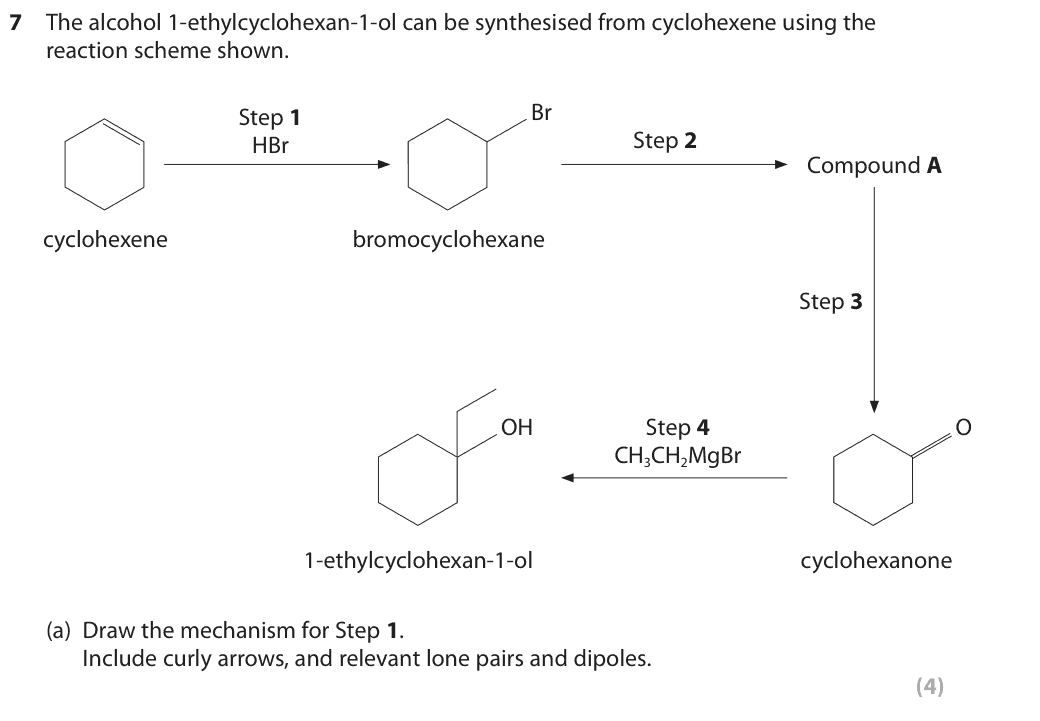
The drawing of a reaction mechanism with curly arrows has improved over recent years and many responses scoring full marks were seen to part (a). It is possible that the use of skeletal formulae benefitted candidates because the inclusion or omission of the additional hydrogen on the carbocation intermediate was ignored. A small minority of candidates appeared to think that cyclohexene was aromatic and tried to draw an electrophilc substitution reaction mechanism. The organic synthetic pathway required in part (b) was also an improvement on previous years. There were less instances of inappropriate reagent pairings such as the use of sodium hydroxide for Step 1 but quoted with sulfuric acid. This question well illustrates the need for candidates to check their answer after re-reading the question because marks were lost due to missing conditions and reaction types. Furthermore, some candidates quoted both the name and the chemical formula but if so then both must be correct to score the mark. Unfortunatley some candidates gave the wrong formula for potassium/sodium dichromate(VI). A reminder that there is often some leeway with the spelling of a chemical name such a too many ‘t’s in potassium but there is no such leeway for a chemical formula.
It was good to see that the answers to part (c)(i) were all names as per the question rubric. It was surprising at times to see solid compounds rather than liquids suggested for the Grignard reagent solvent. In part (c)(ii) the vast majority of candidates knew that anhydrous calcium chloride is a drying agent but oftentimes incorrectly referred to the absoprtion of water from the reaction or from the solvent. The diagram of the apparatus on the facing page clearly shows ‘Tube X’ a long way away from the flask with the solvent at the top of the condenser and with an open top. It should have been clear to candidates that it was to prevent water vapour from getting into the apparatus. Nonetheless it was good to see that many candidates understood the need to keep the Grignard reagent away from water to avoid hydrolysis to the alkane. Likewise many candidates in part (c)(iii) knew that the corrrect water flow in the condenser from the bottom up means that it will avoid air bubbles and be filled with water for efficient condensation. The colour of the precipitate in part (d)(i) was almost universally given correctly and the completion of the simplified mechanism in part (d)(ii) allowed candidates of all abilities to gain credit. It is pleasing to see that candidates seem to be getting better at drawing curly arrows for a novel organic mechanism. The descriptions given for the recystallistion process in part (d)(iii) varied significantly. There were some excellent, logical descriptions with additional details of a ‘hot filtration’ to remove insoluble impurities which showed that these candidates were very well prepared. However there were many other responses which unfortunatley made little practical sense. For example, it was not unusual to see the response begin with the dissolving of the impure precipitate and then this being immediately filtered, washed and patted dry without there being any mention of cooling to form a purified precipitate. These responses were not given credit for statements that were impractical.
Notes from the mark scheme and report
Answer: orange / yellow (red, or any combination of the three, allowed). Almost always correct
Skills: PT4 use laboratory apparatus for a variety of experimental techniques, including: titration, using burette and pipette; distillation and heating under reflux, including setting up glassware using retort stand and clamps; qualitative tests for ions and organic functional groups; filtration, including use of fluted filter paper, or filtration under reduced pressure; CP15 Core practical 15: Analysis of some inorganic and organic unknowns
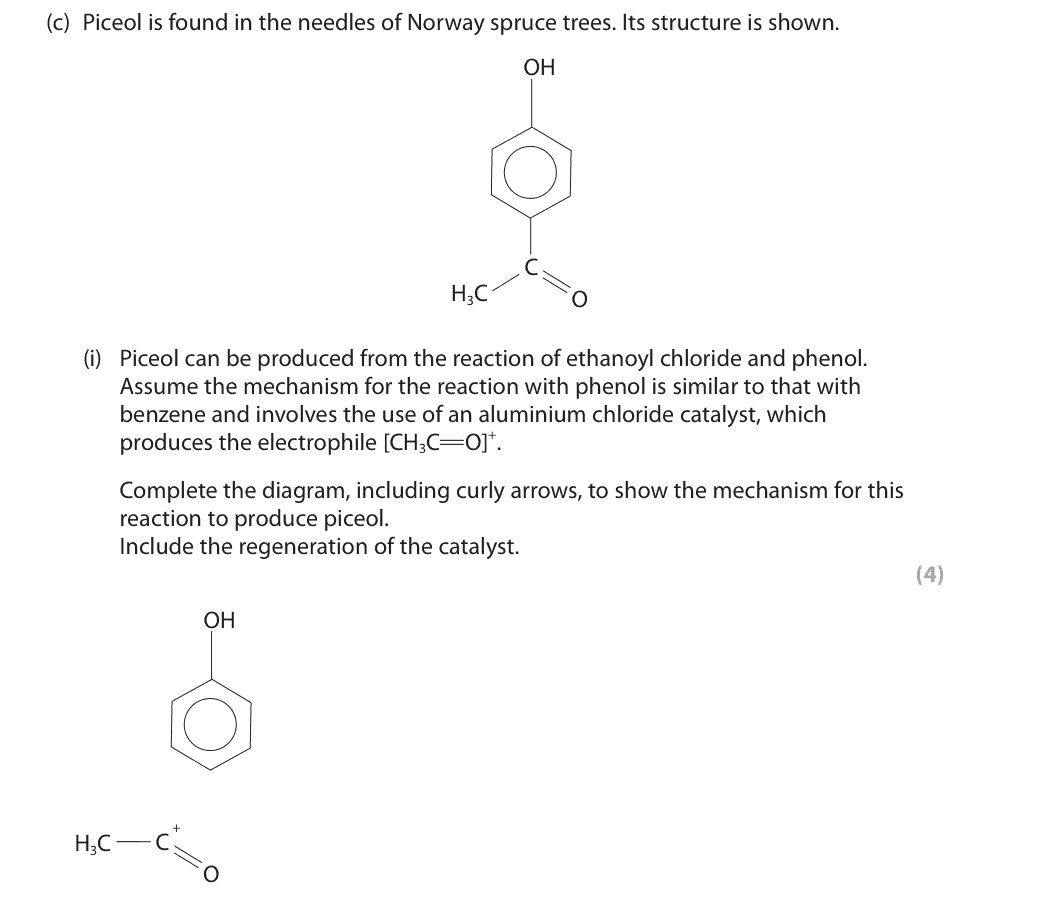
June 2024 · Paper 3 · Q7(d)(ii)4 marksMechanism
Earlier parts of question 7 that this part uses
Mark scheme
Examiner's comment
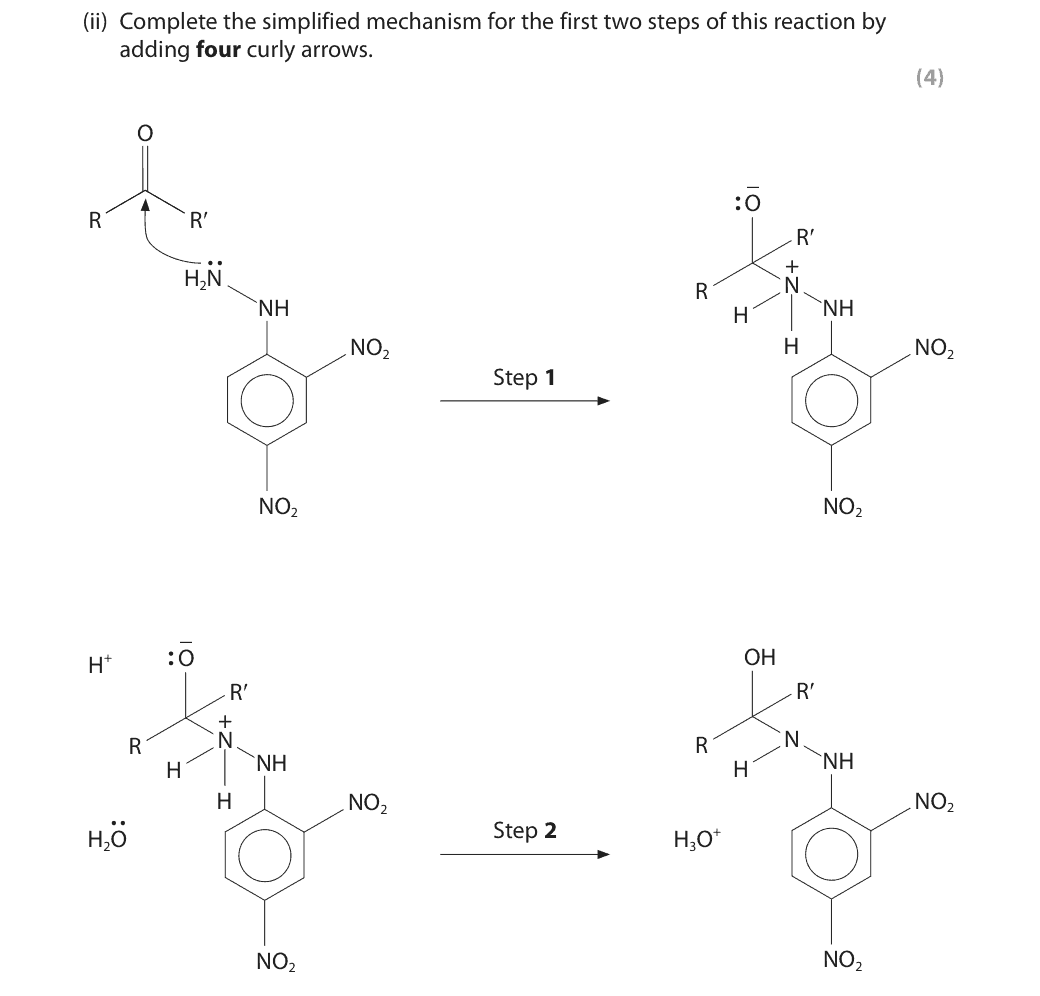
The drawing of a reaction mechanism with curly arrows has improved over recent years and many responses scoring full marks were seen to part (a). It is possible that the use of skeletal formulae benefitted candidates because the inclusion or omission of the additional hydrogen on the carbocation intermediate was ignored. A small minority of candidates appeared to think that cyclohexene was aromatic and tried to draw an electrophilc substitution reaction mechanism. The organic synthetic pathway required in part (b) was also an improvement on previous years. There were less instances of inappropriate reagent pairings such as the use of sodium hydroxide for Step 1 but quoted with sulfuric acid. This question well illustrates the need for candidates to check their answer after re-reading the question because marks were lost due to missing conditions and reaction types. Furthermore, some candidates quoted both the name and the chemical formula but if so then both must be correct to score the mark. Unfortunatley some candidates gave the wrong formula for potassium/sodium dichromate(VI). A reminder that there is often some leeway with the spelling of a chemical name such a too many ‘t’s in potassium but there is no such leeway for a chemical formula.
It was good to see that the answers to part (c)(i) were all names as per the question rubric. It was surprising at times to see solid compounds rather than liquids suggested for the Grignard reagent solvent. In part (c)(ii) the vast majority of candidates knew that anhydrous calcium chloride is a drying agent but oftentimes incorrectly referred to the absoprtion of water from the reaction or from the solvent. The diagram of the apparatus on the facing page clearly shows ‘Tube X’ a long way away from the flask with the solvent at the top of the condenser and with an open top. It should have been clear to candidates that it was to prevent water vapour from getting into the apparatus. Nonetheless it was good to see that many candidates understood the need to keep the Grignard reagent away from water to avoid hydrolysis to the alkane. Likewise many candidates in part (c)(iii) knew that the corrrect water flow in the condenser from the bottom up means that it will avoid air bubbles and be filled with water for efficient condensation. The colour of the precipitate in part (d)(i) was almost universally given correctly and the completion of the simplified mechanism in part (d)(ii) allowed candidates of all abilities to gain credit. It is pleasing to see that candidates seem to be getting better at drawing curly arrows for a novel organic mechanism. The descriptions given for the recystallistion process in part (d)(iii) varied significantly. There were some excellent, logical descriptions with additional details of a ‘hot filtration’ to remove insoluble impurities which showed that these candidates were very well prepared. However there were many other responses which unfortunatley made little practical sense. For example, it was not unusual to see the response begin with the dissolving of the impure precipitate and then this being immediately filtered, washed and patted dry without there being any mention of cooling to form a purified precipitate. These responses were not given credit for statements that were impractical.
Notes from the mark scheme and report
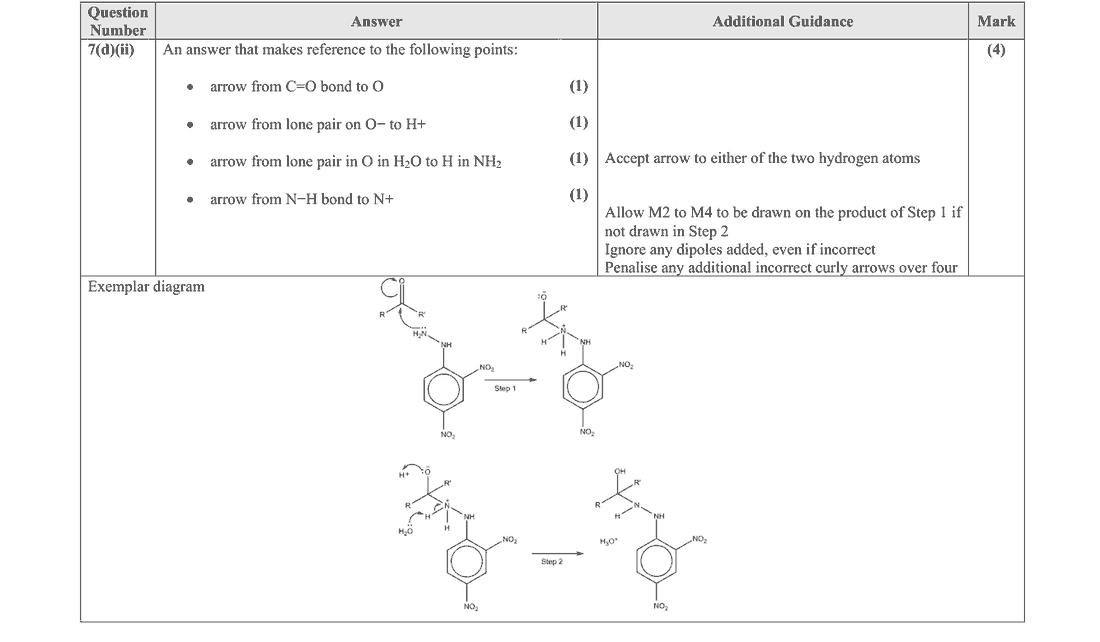
Four curly arrows. Step 1: from the C=O bond to the oxygen (the arrow from the nitrogen lone pair to the carbon is already printed). Step 2: from a lone pair on O– to H+
from the lone pair on the oxygen of H2O to a hydrogen on the N+
from that N–H bond to N+. Arrows 2 to 4 may be drawn on the product of Step 1. Extra incorrect arrows are penalised. Candidates of all abilities gained credit
June 2023 · Paper 2 · Q7(a)4 marksExplanation
Mark scheme
Examiner's comment
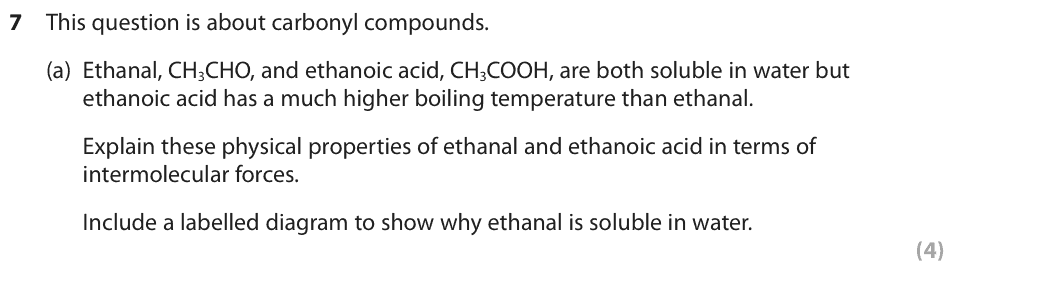
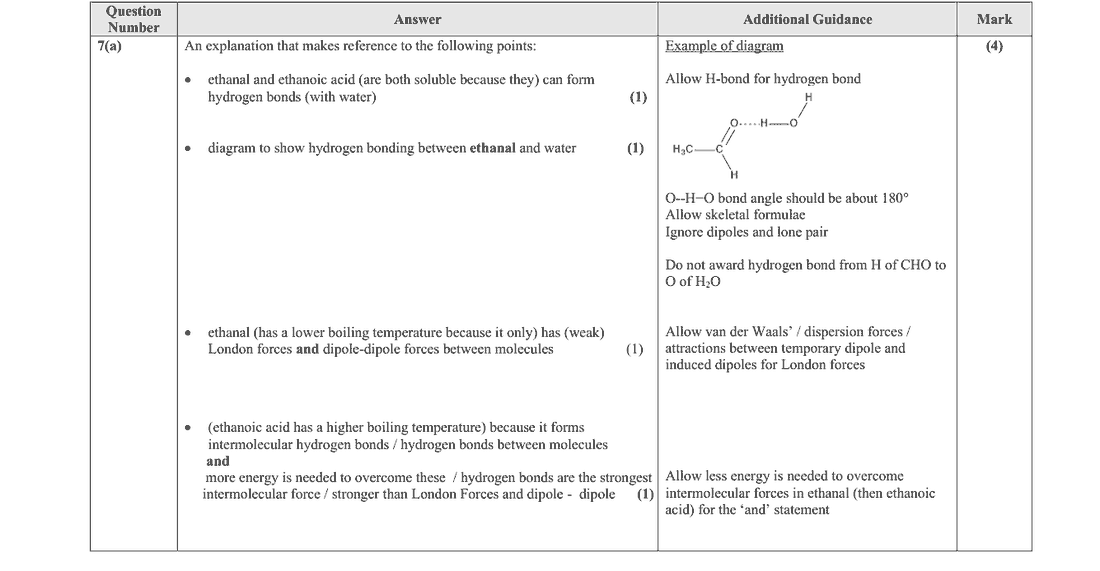
This question required candidates to explain the solubility of ethanal and ethanoic acid in water and also the difference in boiling point between the two compounds. There was also a requirement to draw a diagram showing why ethanal is soluble in water. The vast majority of candidates drew a diagram showing ethanal hydrogen bonding with water, with many showing the oxygen of the aldehyde hydrogen bonded to the hydrogen of a water molecule with an angle of 180°. However, some showed the hydrogen bond originating from one of the hydrogen atoms of ethanal and bonding to the oxygen of water which is incorrect. There was a good understanding of how these substances dissolved in water by forming hydrogen bonds.
The second part of the question concerned intermolecular forces with most candidates realising that ethanoic acid would form intermolecular hydrogen bonds which would be the strongest intermolecular forces and therefore take a lot of energy to break. However, some candidates also stated that ethanal would form intermolecular hydrogen bonds which is incorrect. There was also some mention of the relative strengths of the London Forces between molecules of ethanal and between molecules of ethanoic acid, but these would not be relevant in the context of the strong hydrogen bonds between ethanoic acid molecules.
Notes from the mark scheme and report
M1 both are soluble because they form hydrogen bonds with water
M2 diagram of a hydrogen bond from the O of ethanal's C=O to an H of water, O---H–O about 180° (not from the H of CHO to the O of water)
M3 ethanal has only London forces and dipole–dipole forces between its molecules
M4 ethanoic acid forms hydrogen bonds between its molecules, and these need more energy to overcome / are the strongest intermolecular force. The diagram was usually right
some drew the bond from a hydrogen of ethanal, and some said ethanal hydrogen bonds with itself
June 2023 · Paper 2 · Q7(b)(i)4 marksMechanism
Mark scheme
Examiner's comment
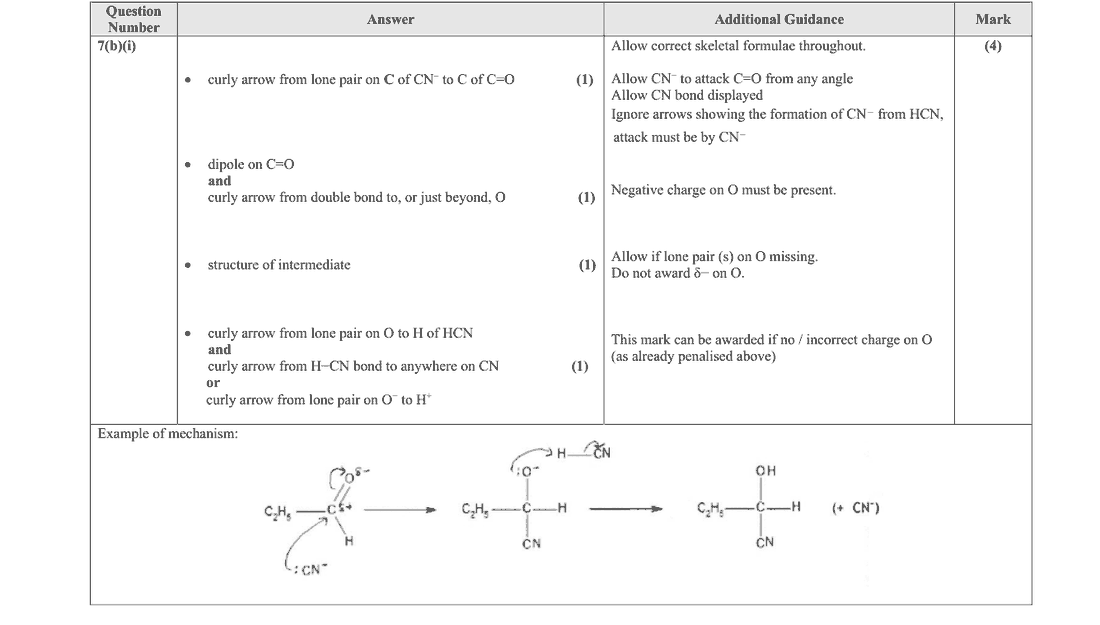
Those who could recall the mechanism for this reaction gave some excellent answers. The main errors seen were the long pair on the nitrogen instead of the carbon atom or omitting the charge on the cyanide ion. The intermediate was sometimes shown with a positive charge on the central carbon or on the nitrogen atom, or with a partial negative charge on the oxygen. Other marks were lost for poor placing of curly arrows or arrows drawn in the wrong direction.
Notes from the mark scheme and report
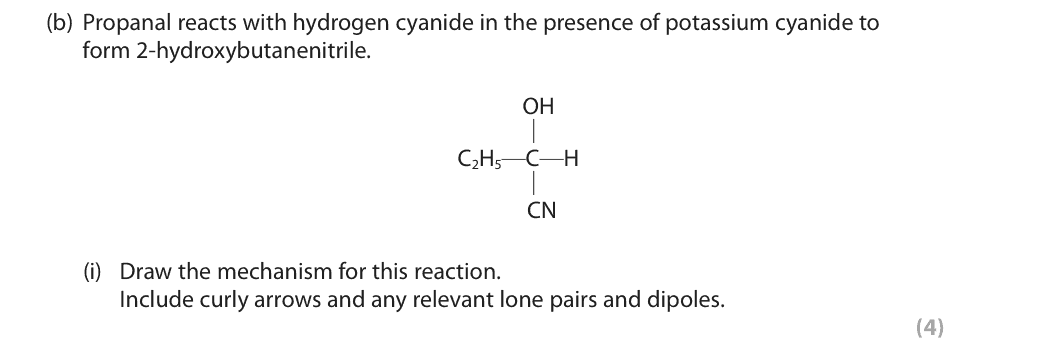
M1 curly arrow from the lone pair on the C of CN– to the carbonyl carbon
M2 dipole on C=O and curly arrow from the C=O bond to O
M3 intermediate with a full negative charge on O (not δ–)
M4 curly arrow from a lone pair on O– to the H of HCN and from the H–CN bond to CN (or lone pair on O– to H+). Errors: lone pair on N instead of C
no charge on cyanide
wrong charges on the intermediate
arrows badly placed or reversed
June 2023 · Paper 2 · Q7(b)(ii)3 marksExplanation
Earlier part of question 7 that this part uses
Mark scheme
Examiner's comment
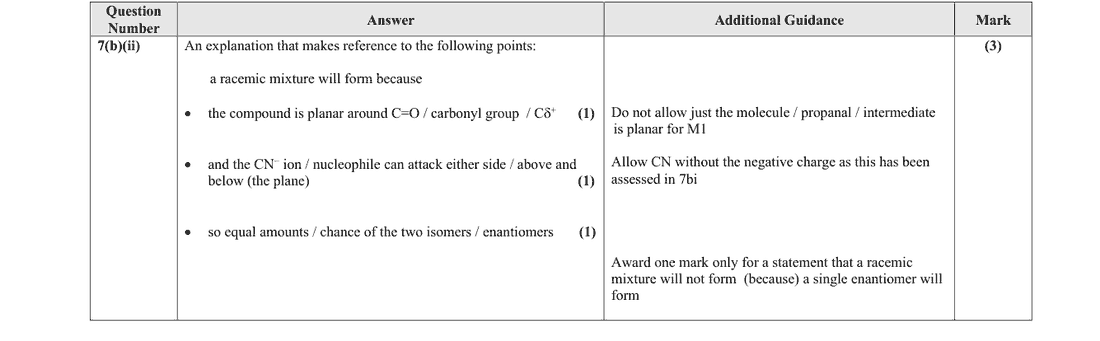
Many candidates understood the principle behind this question and gained some credit. There was a general understanding that a racemic mixture would be formed as two enantiomers would be formed in equal amounts. Marks were lost for stating that the whole propanal molecule was planar instead of referencing the C=O as being planar.
Notes from the mark scheme and report
A racemic mixture forms: M1 the molecule is planar around the C=O (carbonyl) group (not just 'propanal is planar')
M2 so CN– can attack from either side / above and below the plane
M3 giving equal amounts of the two enantiomers. One mark only for arguing that a single enantiomer forms. Marks were lost for saying the whole molecule is planar
June 2023 · Paper 2 · Q7(c)(i)3 marksPractical and data analysisHard
Earlier part of question 7 that this part uses
Mark scheme
Examiner's comment
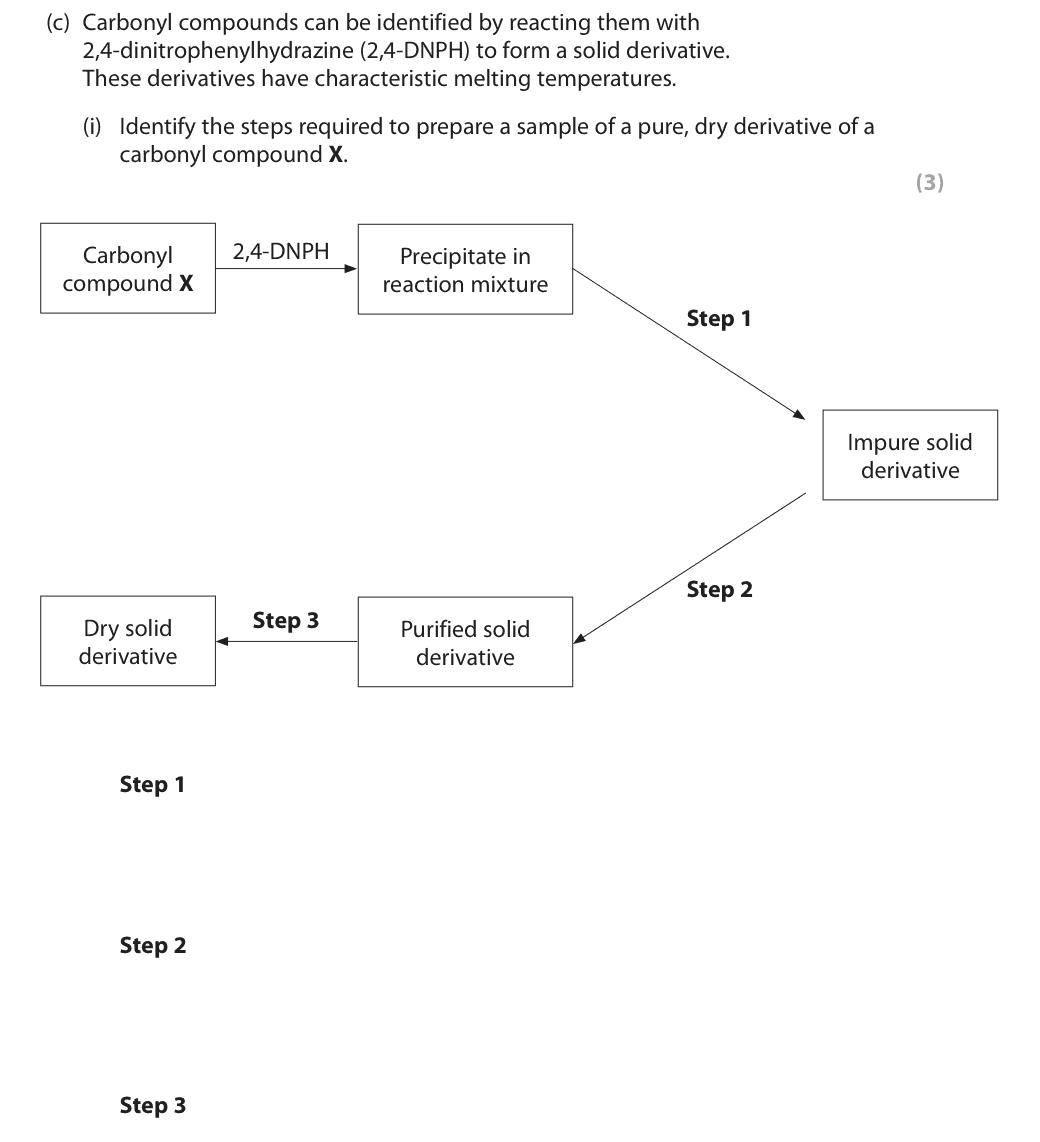
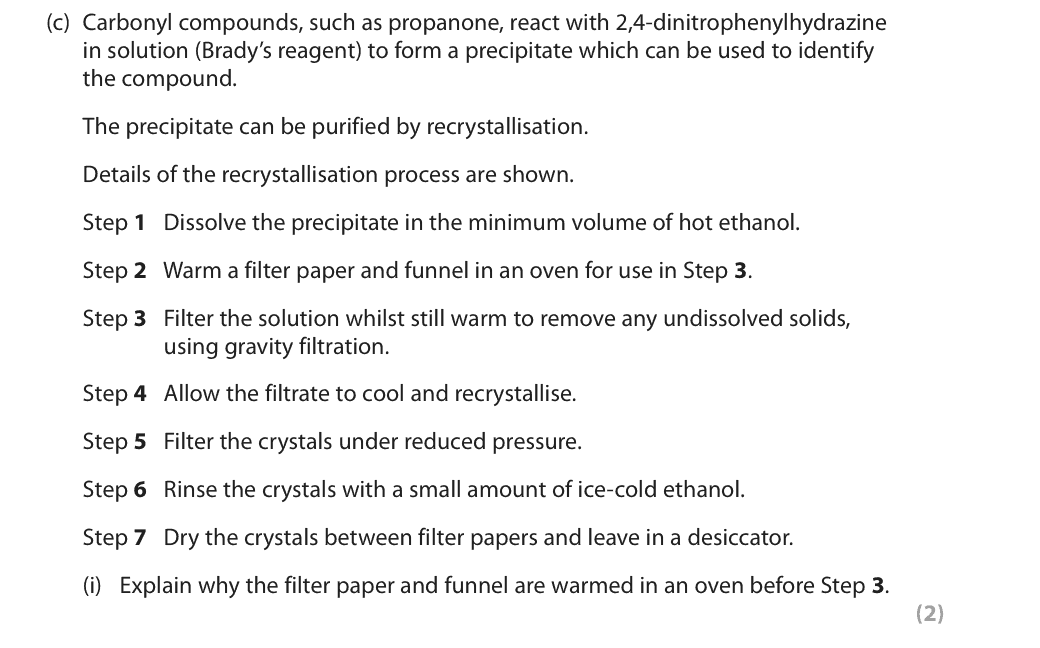
This question was not well-answered, especially with the amount of information given in the question. Many candidates did not make the link between the description of the method for making the derivative and the steps required for the answer. Some candidates just wrote 'filtration' in every box. Descriptions of the recrystallisation process were often incorrect. 'Drying', for the third step, was given in the question and should have prompted candidates to consider a more detailed answer. Some candidates mentioned adding a drying agent directly to the product instead of into a desiccator.
Notes from the mark scheme and report
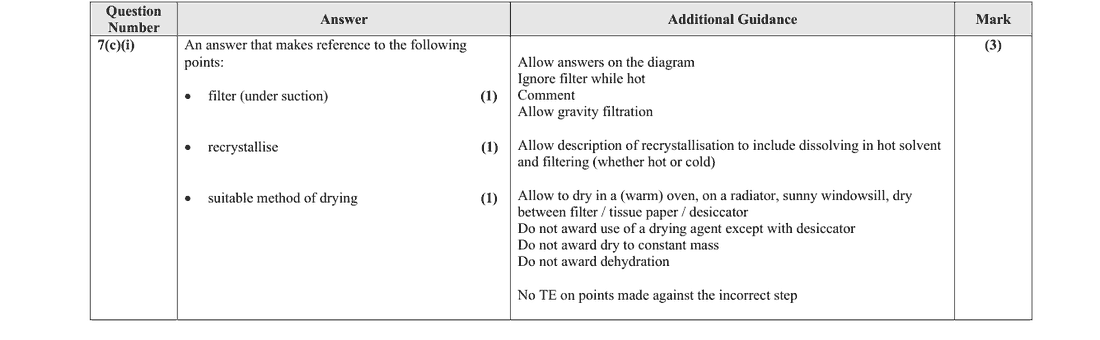
Step 1 filter (under suction
gravity filtration allowed)
Step 2 recrystallise (a description, dissolving in hot solvent, is allowed)
Step 3 a suitable way of drying: warm oven, between filter papers, desiccator. Not a drying agent added to the solid, not 'dry to constant mass', not dehydration. Some wrote 'filtration' in every box
recrystallisation was often described wrongly
Skills: PT4 use laboratory apparatus for a variety of experimental techniques, including: titration, using burette and pipette; distillation and heating under reflux, including setting up glassware using retort stand and clamps; qualitative tests for ions and organic functional groups; filtration, including use of fluted filter paper, or filtration under reduced pressure; PT7 purify: a solid product by recrystallization; a liquid product, including use of separating funnel
June 2023 · Paper 2 · Q7(c)(ii)2 marksShort answer
Earlier parts of question 7 that this part uses
Mark scheme
Examiner's comment
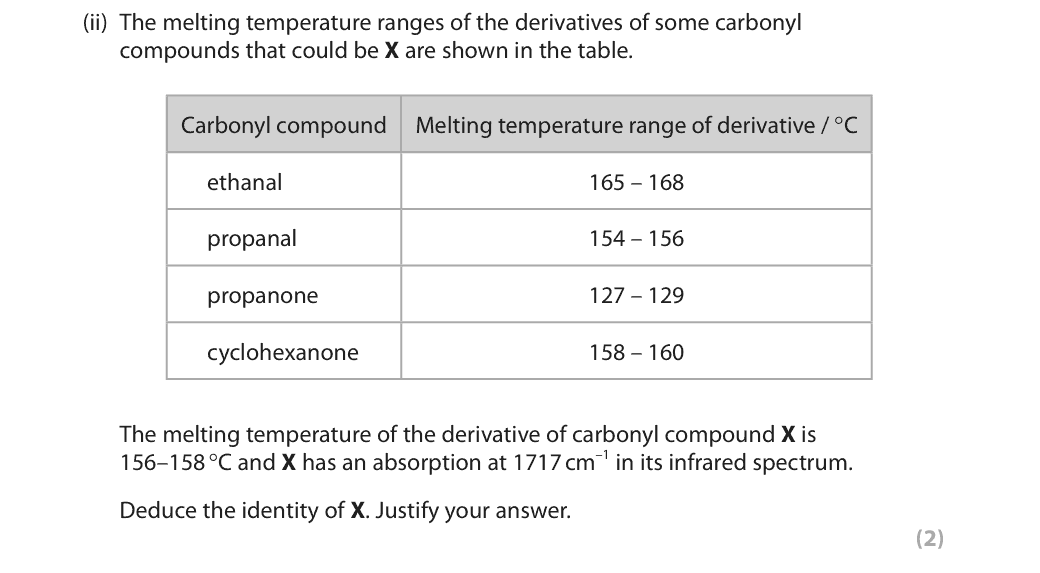
This question was generally well-answered, although some candidates identified the wrong infrared absorption and some had not read the question correctly and identified substances that were not one of the options. A few thought that cyclohexanone would be aromatic and so quoted the wrong range for the infrared absorption.
Notes from the mark scheme and report
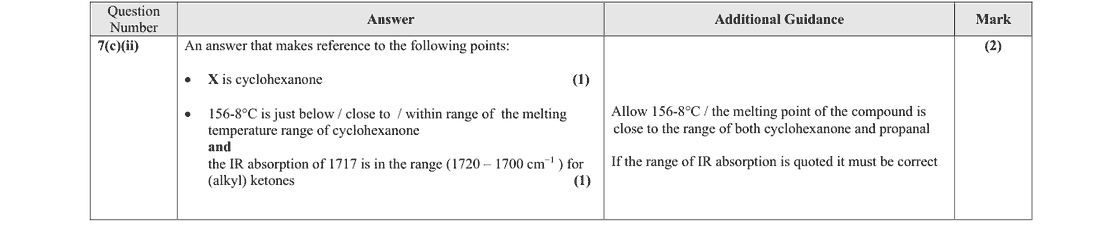
X is cyclohexanone
because 156–158 °C is just below / close to its derivative's range (158–160 °C) and 1717 cm–1 lies in the ketone C=O range (1720–1700 cm–1), not the aldehyde range, which rules out propanal. An IR range, if quoted, must be right. Generally well answered
some used the wrong IR range or took cyclohexanone to be aromatic
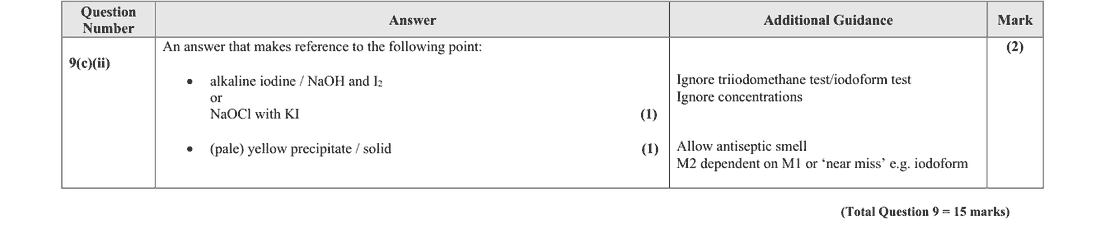
June 2023 · Paper 3 · Q9(c)(ii)2 marksPractical and data analysisHard
Earlier parts of question 9 that this part uses
Mark scheme
Examiner's comment
The majority of candidates did not score on this question. The request for a reagent resulted in all manner of different chemical reagents being suggested. The most common of these reagents was Brady's reagent but this cannot be used to distinguish piceol from the compared aldehyde. The iodoform test was needed and generally if this was identified then the positive result was also given. Occasionally just iodine was given without the necessary alkaline conditions and this was viewed as a 'near miss' and the second mark, though not the first, could be awarded.
Notes from the mark scheme and report
Iodine with alkali (NaOH and I2), or NaOCl with KI
(pale) yellow precipitate (allow antiseptic smell). Piceol is a methyl ketone
the other compound is an aldehyde without the CH3CO group. M2 depends on M1 or a near miss such as 'iodoform test' or iodine without alkali. Brady's reagent, the commonest wrong answer, does not distinguish them
Skills: PT4 use laboratory apparatus for a variety of experimental techniques, including: titration, using burette and pipette; distillation and heating under reflux, including setting up glassware using retort stand and clamps; qualitative tests for ions and organic functional groups; filtration, including use of fluted filter paper, or filtration under reduced pressure; CP15 Core practical 15: Analysis of some inorganic and organic unknowns
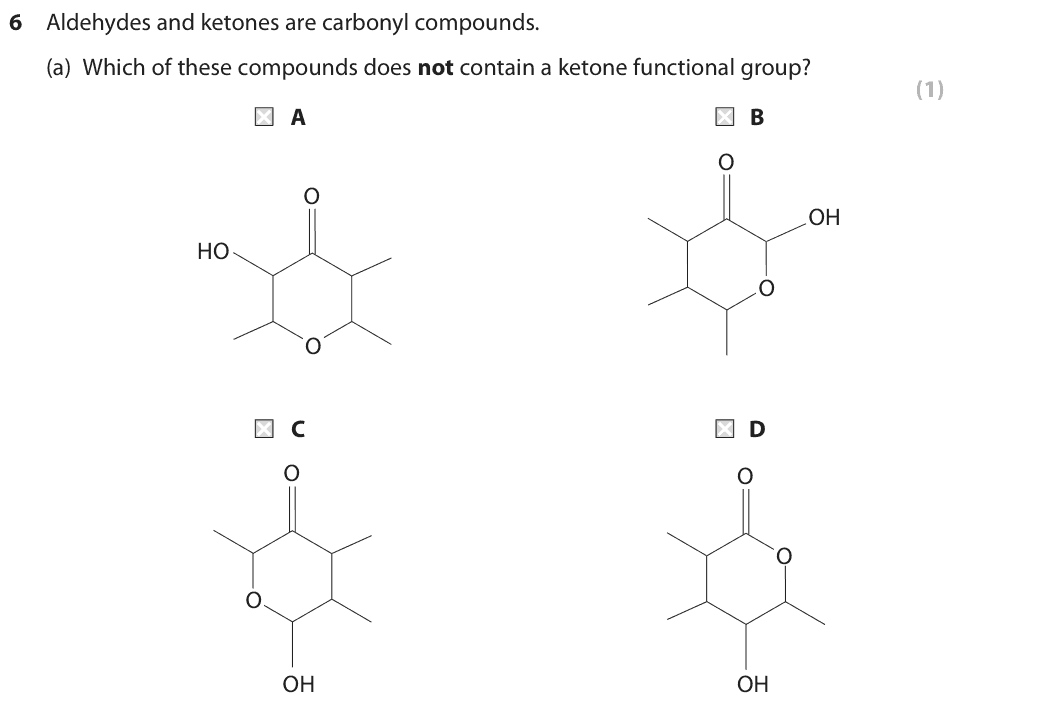
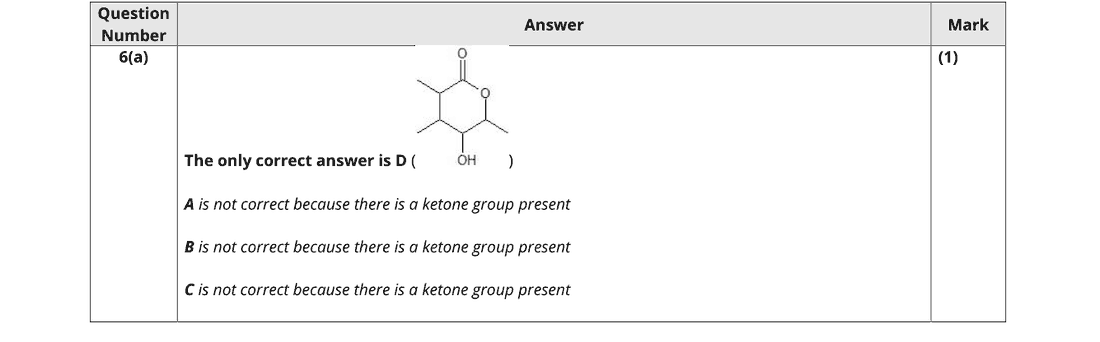
June 2022 · Paper 2 · Q6(a)1 markMultiple choice
Answer
D
Mark scheme
Notes from the mark scheme and report
Answer: D. The C=O in D is next to the ring oxygen, so it is an ester (a lactone), not a ketone. A, B and C each have a C=O with a carbon atom on both sides
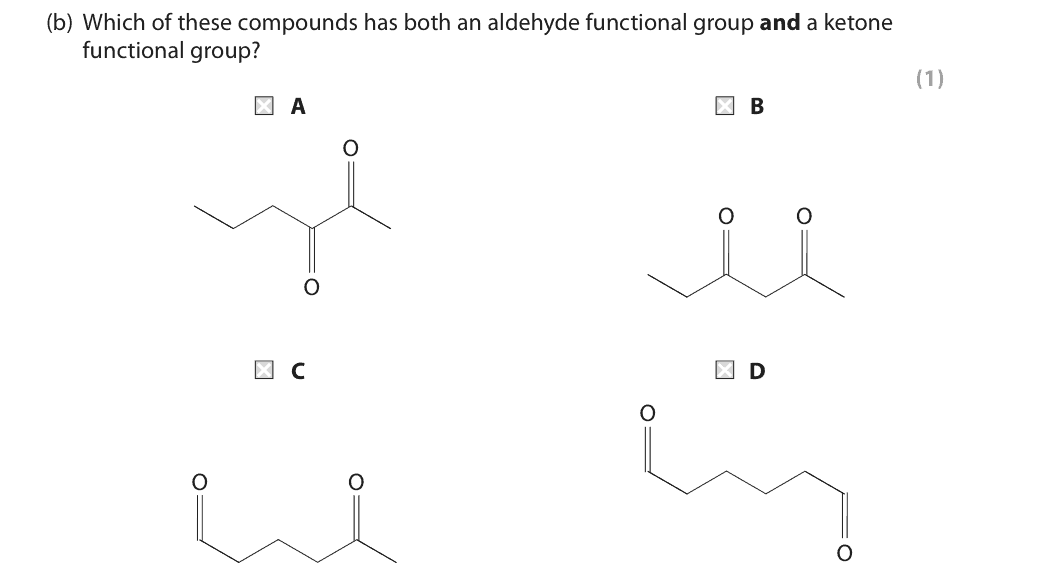
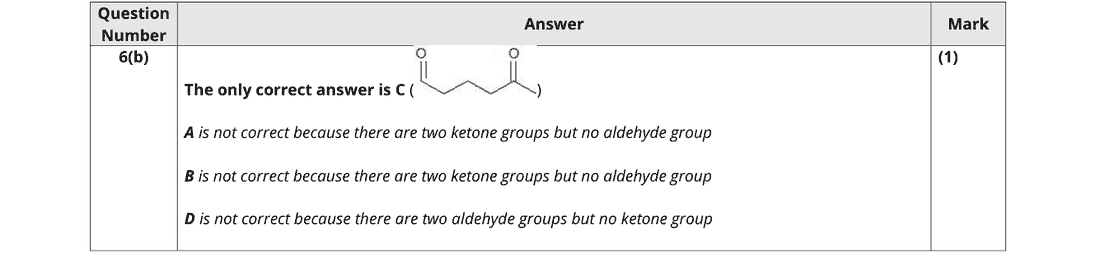
June 2022 · Paper 2 · Q6(b)1 markMultiple choice
Answer
C
Mark scheme
Notes from the mark scheme and report
Answer: C. C has one C=O at the end of the chain (aldehyde) and one within it (ketone). A and B have two ketone groups
D has two aldehyde groups
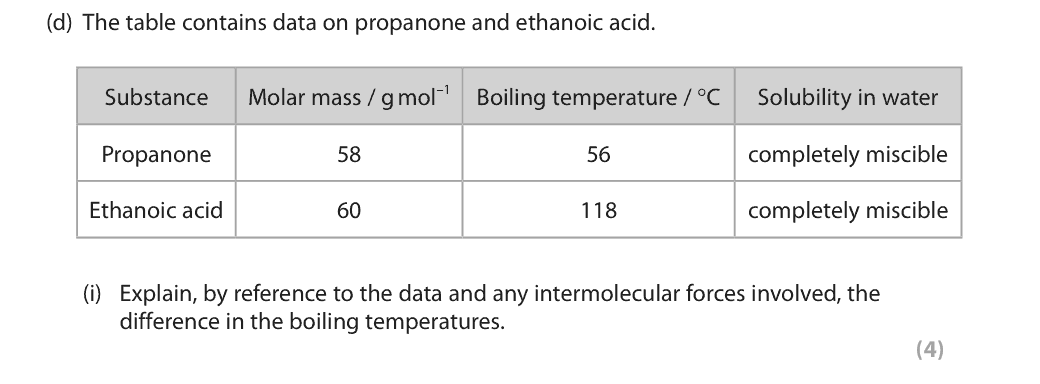
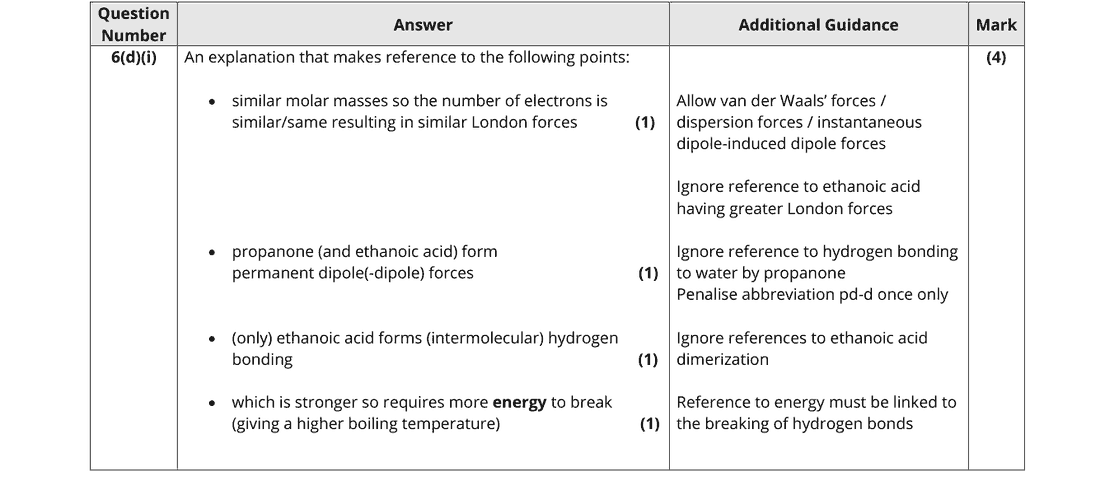
June 2022 · Paper 2 · Q6(d)(i)4 marksExplanation
Earlier part of question 6 that this part uses
Mark scheme
Examiner's comment
A disappointing performance by candidates of lower ability on this intermolecular forces question. One mark for hydrogen bonding by ethanoic acid should have been achievable for the grade E boundary but occasionally was negated by comments that propanone can also form hydrogen bonding as well, although weaker ones.
A sizeable number of candidates identified the small difference in molar masses between propanone and ethanoic acid but then still went on to infer that this was part of the reason for the large difference in boiling temperatures. Only the more able candidates were able to appreciate that the similarity of London forces given the equal number of electrons in propanone and ethanoic acid would mean that these could be discounted from the reason for the difference in boiling temperatures.
Similarly the reference to propanone having permanent dipole – dipole forces was indicative of candidates at the higher grade A boundary.
There was some evidence of candidates not reading the question properly as seen by comments on miscibility in water which should have been made in part (ii).
Notes from the mark scheme and report
Similar molar masses, so similar numbers of electrons and similar London forces
both have permanent dipole forces
only ethanoic acid forms (intermolecular) hydrogen bonds
these are stronger, so more energy is needed to break them (higher boiling temperature). Dimerisation ignored. Errors: propanone said to form (weaker) hydrogen bonds with itself
the small difference in molar mass given as part of the reason
writing about miscibility, which belongs in (ii)
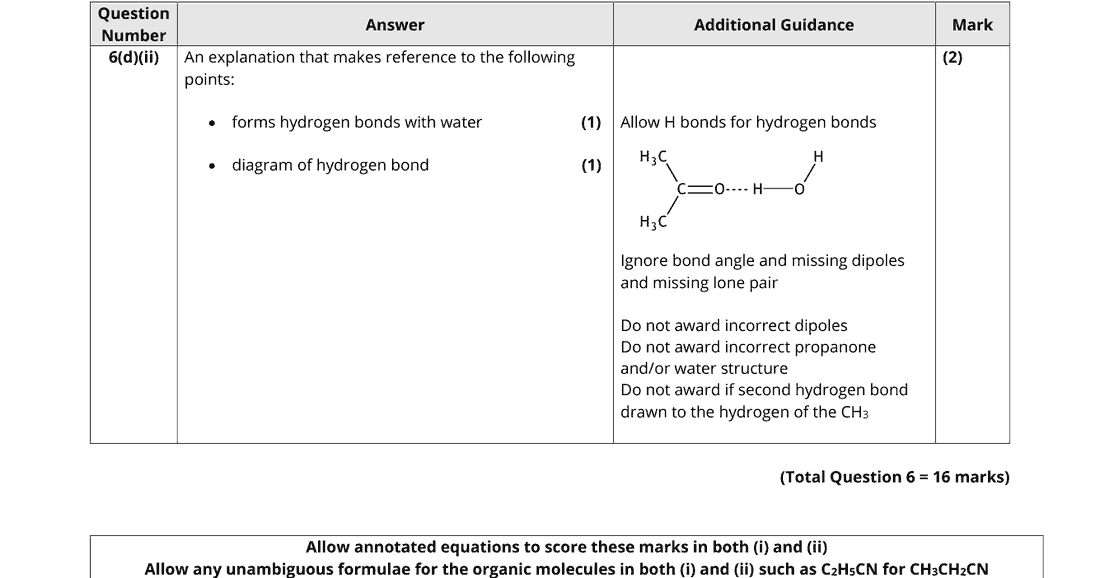
June 2022 · Paper 2 · Q6(d)(ii)2 marksExplanation
Earlier part of question 6 that this part uses
Mark scheme
Examiner's comment
It was disappointing that some candidates drew the hydrogen bond between the oxygen atom of the water molecule and a hydrogen atom of the methyl group of propanone. Incorrect structures of propanone and of water (HO2) were also seen.
The mark awarded for the diagram of the hydrogen bond was generously given since the angle and the inclusion of the oxygen lone pair of electrons was judged on paper 1. Hence this was not penalised on two occasions.
Notes from the mark scheme and report
Propanone forms hydrogen bonds with water
diagram showing a hydrogen bond from the O of the C=O in propanone to an H of water. Bond angle, dipoles and lone pair not required here
not with wrong dipoles or wrong structures, and not with a hydrogen bond drawn to an H of a CH3 group. Errors: hydrogen bond from water's oxygen to a methyl hydrogen
water drawn as HO2
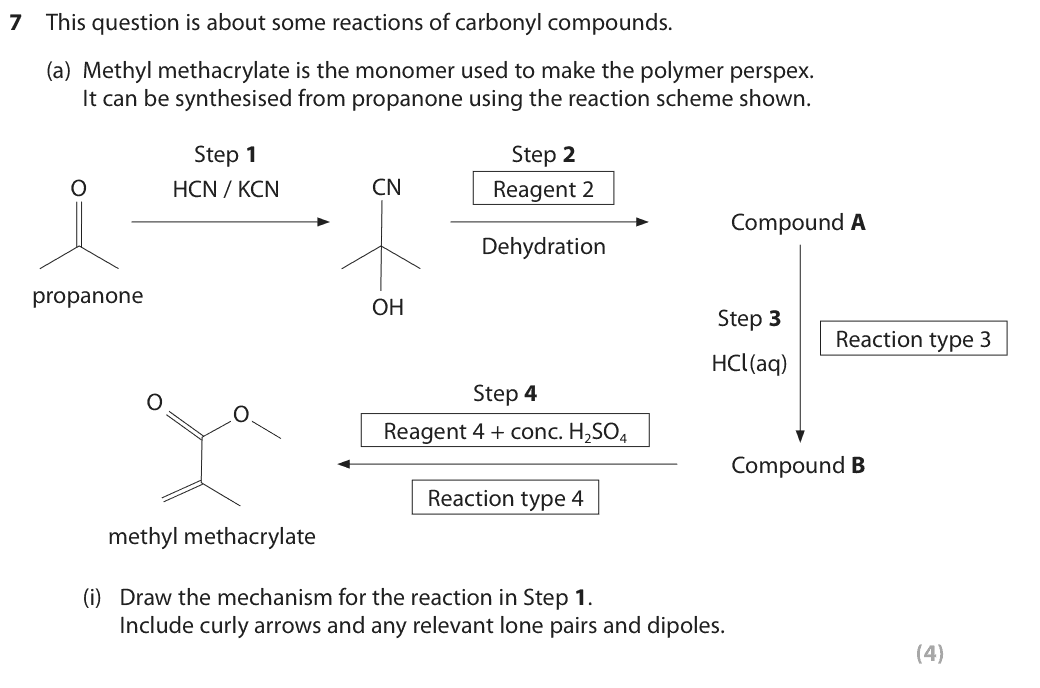
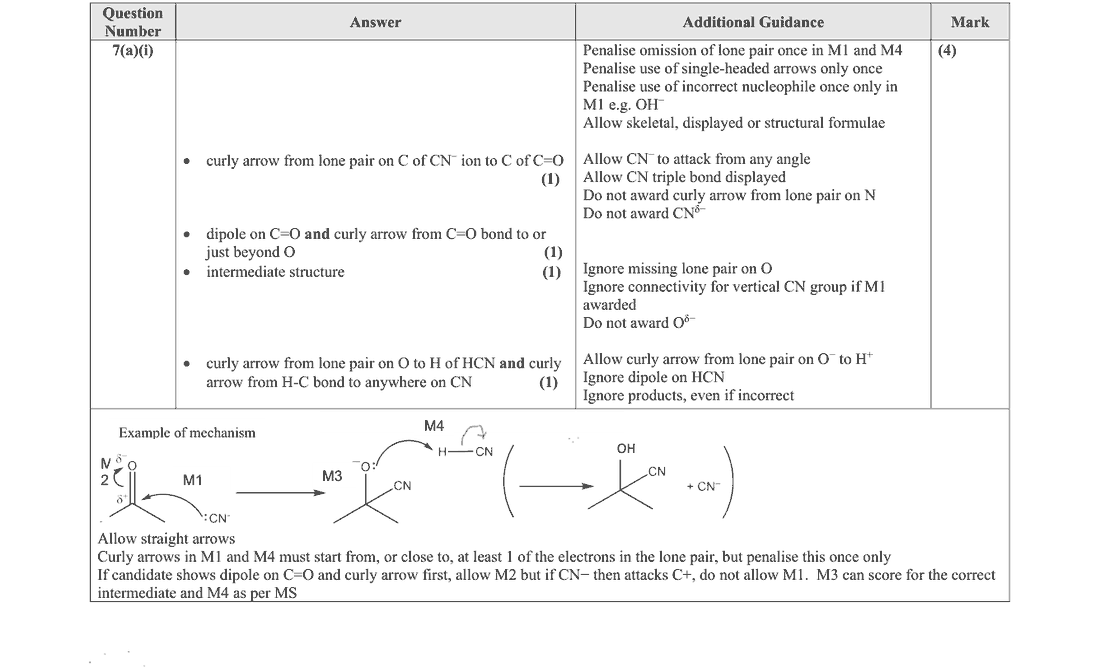
June 2022 · Paper 3 · Q7(a)(i)4 marksMechanism
Mark scheme
Examiner's comment
Organic mechanisms always separate out the candidates into those who understand the meaning of a curly arrow and those who try to rote learn, with little or no understanding. Candidates should understand that a curly arrow represents the movement of a pair of electrons so should start from a lone pair of electrons or a covalent bond. Many candidates lost marks by omitting the dipole on the C=O bond and/or the charge on the oxygen in the intermediate and many candidates did not know whether to include full or partial charges.
Some candidates showed the first curly arrow drawn from the nitrogen atom in the CN- ion, showing that they had not looked at the structure of the product where the carbon atom was attached.
Notes from the mark scheme and report
Curly arrow from the lone pair on the C of CN– to the carbonyl carbon
dipole on C=O and curly arrow from the C=O bond to the O
intermediate with O–
curly arrow from the lone pair on O– to the H of HCN and from the H–C bond to CN (or to H+). Not an arrow from the N of cyanide. Missing lone pairs penalised once. Common errors: no dipole on C=O
no charge on the oxygen of the intermediate
full and partial charges confused
first arrow drawn from nitrogen
June 2022 · Paper 3 · Q7(c)(iii)2 marksPractical and data analysis
Earlier part of question 7 that this part uses
Mark scheme
Examiner's comment
Many candidates knew that the carbonyl compound could be identified by measuring the melting point of the pure crystalline product and comparing it with values in a data book. A few candidates suggested measuring the boiling point and some suggested just looking at the colour of the crystals would be sufficient to identify them. Some suggested using qualitative tests, for example, using Tollens' reagent or Fehling's solution.
Notes from the mark scheme and report
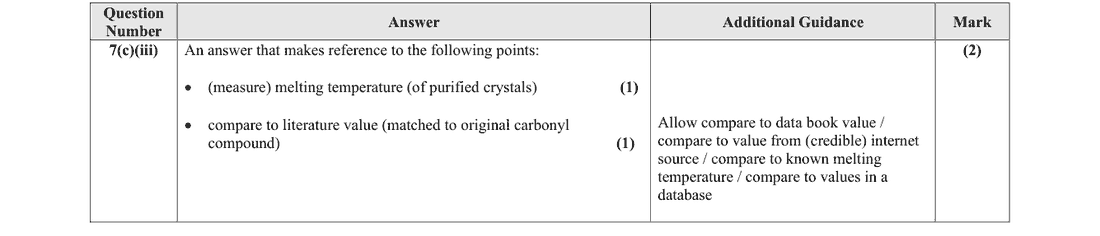
Measure the melting temperature of the purified crystals
compare it with literature (data book / database) values for the derivatives. Wrong answers: boiling temperature
colour of the crystals
Tollens' reagent or Fehling's solution
Skills: PT8 use melting point apparatus
November 2021 · Paper 3 · Q8(a)2 marksPractical and data analysis
Mark scheme
Examiner's comment
Many candidates were familiar with the ‘iodoform’ test to identify a methyl ketone, although
some lost a mark as they did not mention the reagents as aqueous iodine and aqueous
sodium hydroxide. The mechanism was well drawn by a few candidates, but many made a
mistake such as not starting a curly arrow from a lone pair or a bond or drawing an incorrect
intermediate. Some candidates seemed unfamiliar with this mechanism and produced a
carbocation before attacking with cyanide ions. Many candidates realised that the
nucleophile could attack the intermediate from either side but most omitted to mention that
the intermediate is planar around the carbonyl carbon. Many candidates used the data to
identify the correct aldehyde, but they did not score full marks unless they justified their
answer using all of the data. For example, many did not show the three carbon environments
and two hydrogen environments. The extended open response question was answered well
by many candidates, showing that they had a good knowledge and understanding of the
redox reactions of carbonyl compounds. Some candidates lost marks as they did not draw
the structures of the products, did not show five of carbon atoms in the products, confused
oxidation and reduction and omitted part of the oxidising agent or reducing agent, for
example the acid from potassium dichromate or the dry ether from lithium
tetrahydridoaluminate. Some candidates showed a lack of understanding and referred to
pantan-3-one as a tertiary ketone and reduced it to pentan-2-ol instead of pentan-3-ol.
Notes from the mark scheme and report
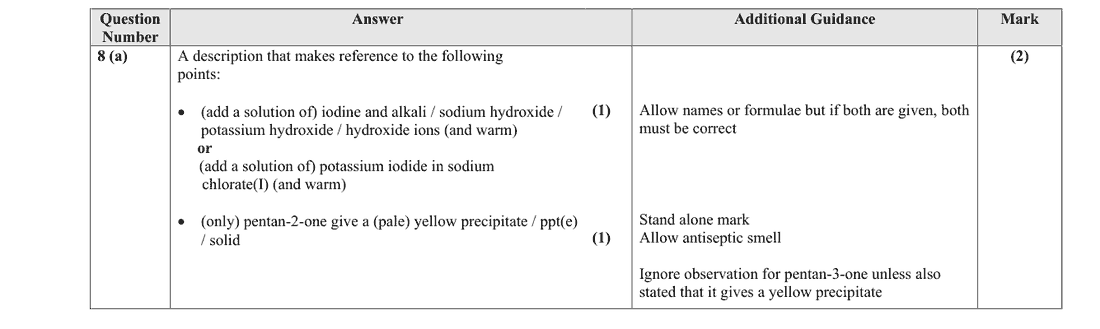
Iodine and alkali (sodium hydroxide), warm (or potassium iodide in sodium chlorate(I))
only pentan-2-one, the methyl ketone, gives a (pale) yellow precipitate (allow antiseptic smell
stand-alone mark). Many knew the iodoform test but lost a mark for incomplete reagents
Skills: PT4 use laboratory apparatus for a variety of experimental techniques, including: titration, using burette and pipette; distillation and heating under reflux, including setting up glassware using retort stand and clamps; qualitative tests for ions and organic functional groups; filtration, including use of fluted filter paper, or filtration under reduced pressure; CP15 Core practical 15: Analysis of some inorganic and organic unknowns
November 2021 · Paper 3 · Q8(b)(i)4 marksMechanism
Mark scheme
Examiner's comment
Many candidates were familiar with the ‘iodoform’ test to identify a methyl ketone, although
some lost a mark as they did not mention the reagents as aqueous iodine and aqueous
sodium hydroxide. The mechanism was well drawn by a few candidates, but many made a
mistake such as not starting a curly arrow from a lone pair or a bond or drawing an incorrect
intermediate. Some candidates seemed unfamiliar with this mechanism and produced a
carbocation before attacking with cyanide ions. Many candidates realised that the
nucleophile could attack the intermediate from either side but most omitted to mention that
the intermediate is planar around the carbonyl carbon. Many candidates used the data to
identify the correct aldehyde, but they did not score full marks unless they justified their
answer using all of the data. For example, many did not show the three carbon environments
and two hydrogen environments. The extended open response question was answered well
by many candidates, showing that they had a good knowledge and understanding of the
redox reactions of carbonyl compounds. Some candidates lost marks as they did not draw
the structures of the products, did not show five of carbon atoms in the products, confused
oxidation and reduction and omitted part of the oxidising agent or reducing agent, for
example the acid from potassium dichromate or the dry ether from lithium
tetrahydridoaluminate. Some candidates showed a lack of understanding and referred to
pantan-3-one as a tertiary ketone and reduced it to pentan-2-ol instead of pentan-3-ol.
Notes from the mark scheme and report
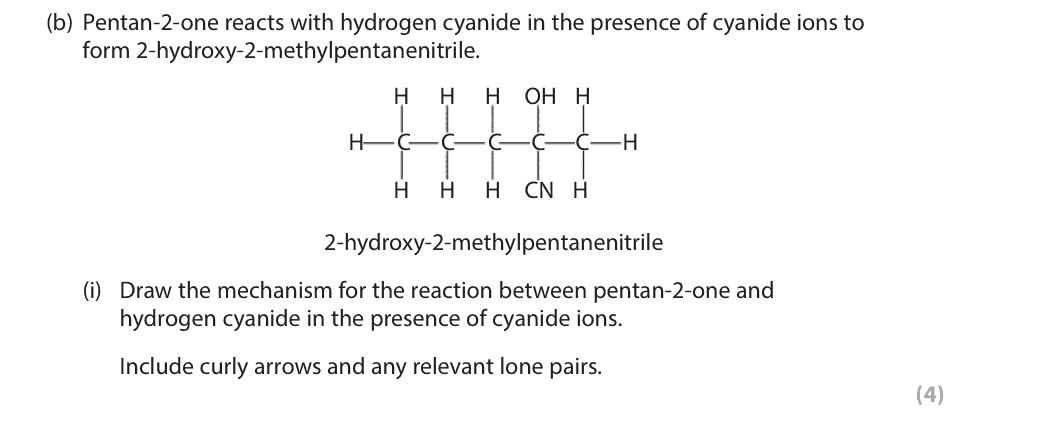
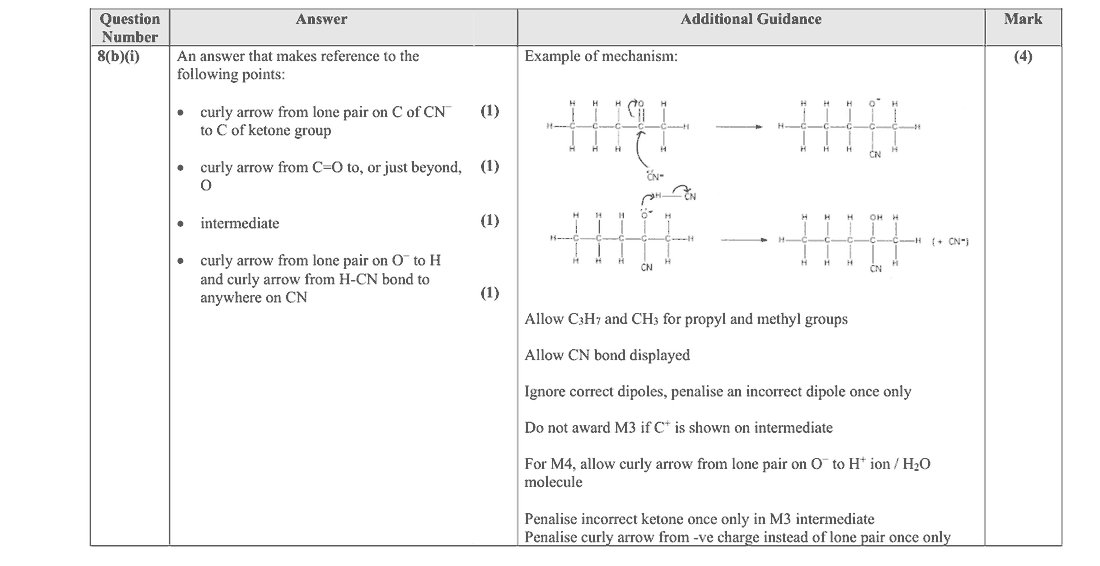
Nucleophilic addition. M1 curly arrow from the lone pair on C of CN– to the carbonyl carbon
M2 curly arrow from the C=O bond to O
M3 intermediate with O– (not if a C+ is shown)
M4 curly arrow from a lone pair on O– to H of HCN and from the H–CN bond to CN (allow to H+ or H2O). Arrow from the negative charge instead of a lone pair penalised once. Errors: arrows not starting from a lone pair or bond
wrong intermediate
forming a carbocation first
November 2021 · Paper 3 · Q8(b)(ii)2 marksExplanation
Earlier part of question 8 that this part uses
Mark scheme
Examiner's comment
Many candidates were familiar with the ‘iodoform’ test to identify a methyl ketone, although
some lost a mark as they did not mention the reagents as aqueous iodine and aqueous
sodium hydroxide. The mechanism was well drawn by a few candidates, but many made a
mistake such as not starting a curly arrow from a lone pair or a bond or drawing an incorrect
intermediate. Some candidates seemed unfamiliar with this mechanism and produced a
carbocation before attacking with cyanide ions. Many candidates realised that the
nucleophile could attack the intermediate from either side but most omitted to mention that
the intermediate is planar around the carbonyl carbon. Many candidates used the data to
identify the correct aldehyde, but they did not score full marks unless they justified their
answer using all of the data. For example, many did not show the three carbon environments
and two hydrogen environments. The extended open response question was answered well
by many candidates, showing that they had a good knowledge and understanding of the
redox reactions of carbonyl compounds. Some candidates lost marks as they did not draw
the structures of the products, did not show five of carbon atoms in the products, confused
oxidation and reduction and omitted part of the oxidising agent or reducing agent, for
example the acid from potassium dichromate or the dry ether from lithium
tetrahydridoaluminate. Some candidates showed a lack of understanding and referred to
pantan-3-one as a tertiary ketone and reduced it to pentan-2-ol instead of pentan-3-ol.
Notes from the mark scheme and report
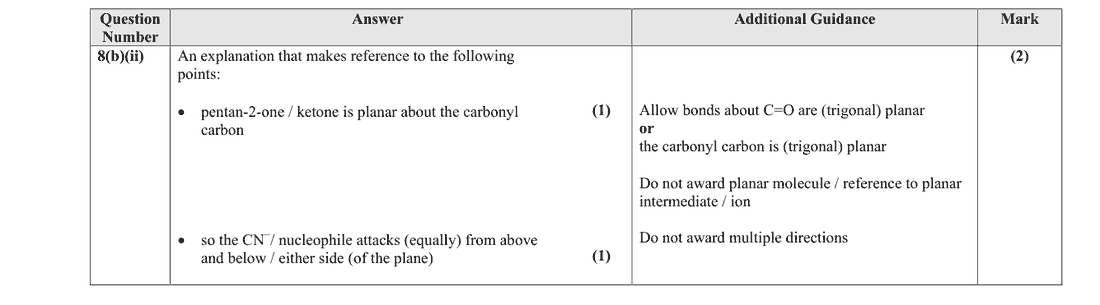
The ketone is planar about the carbonyl carbon (not 'planar molecule', not a planar intermediate or ion)
so the CN– nucleophile attacks equally from above and below the plane (either side). Many gave attack from either side but did not say the carbonyl carbon is planar
November 2021 · Paper 3 · Q8(d)6 marks6-mark extended response
Mark scheme, with the indicative content and the marks for reasoning
Examiner's comment
Many candidates were familiar with the ‘iodoform’ test to identify a methyl ketone, although
some lost a mark as they did not mention the reagents as aqueous iodine and aqueous
sodium hydroxide. The mechanism was well drawn by a few candidates, but many made a
mistake such as not starting a curly arrow from a lone pair or a bond or drawing an incorrect
intermediate. Some candidates seemed unfamiliar with this mechanism and produced a
carbocation before attacking with cyanide ions. Many candidates realised that the
nucleophile could attack the intermediate from either side but most omitted to mention that
the intermediate is planar around the carbonyl carbon. Many candidates used the data to
identify the correct aldehyde, but they did not score full marks unless they justified their
answer using all of the data. For example, many did not show the three carbon environments
and two hydrogen environments. The extended open response question was answered well
by many candidates, showing that they had a good knowledge and understanding of the
redox reactions of carbonyl compounds. Some candidates lost marks as they did not draw
the structures of the products, did not show five of carbon atoms in the products, confused
oxidation and reduction and omitted part of the oxidising agent or reducing agent, for
example the acid from potassium dichromate or the dry ether from lithium
tetrahydridoaluminate. Some candidates showed a lack of understanding and referred to
pantan-3-one as a tertiary ketone and reduced it to pentan-2-ol instead of pentan-3-ol.
Notes from the mark scheme and report
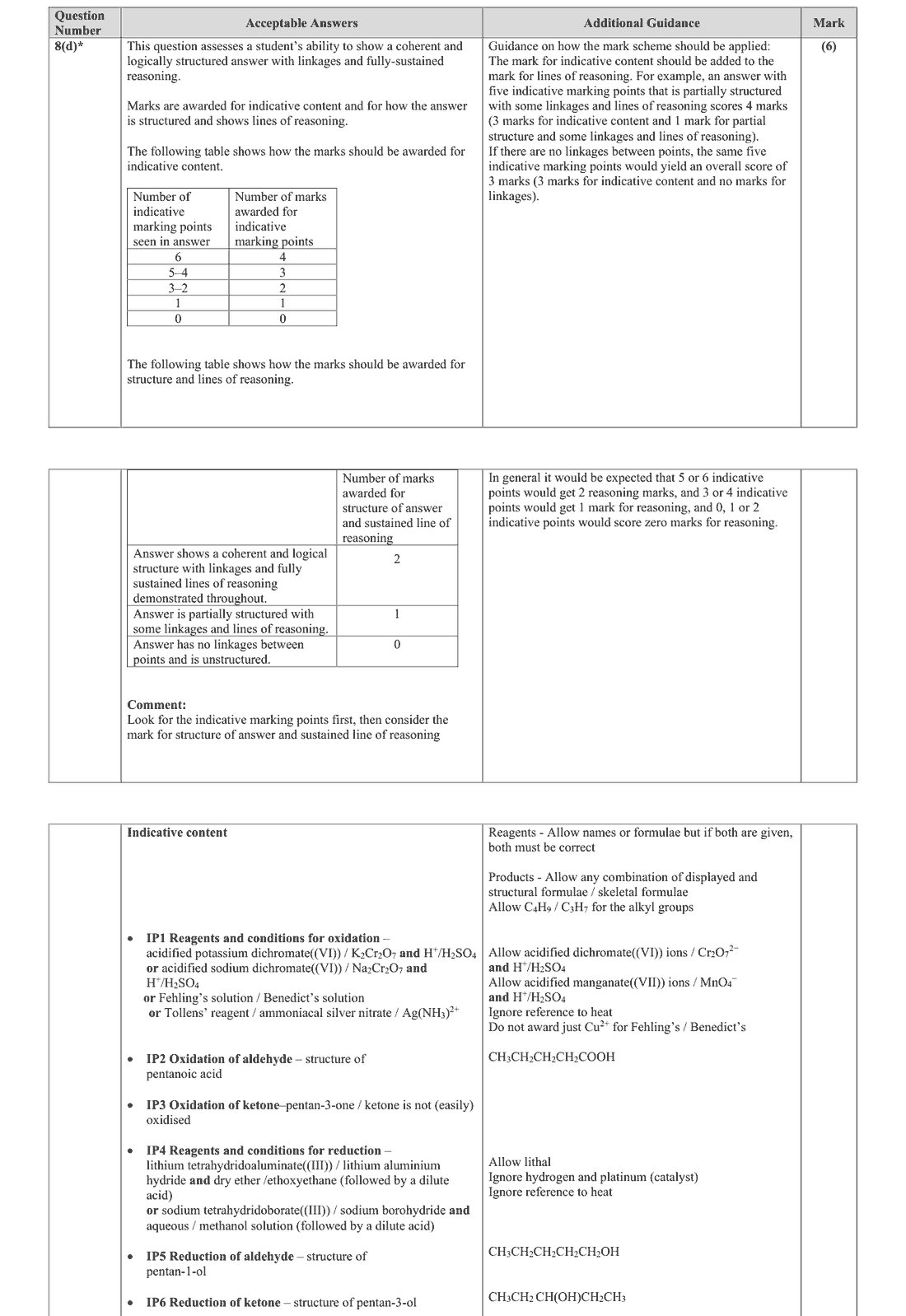
Six indicative points plus two marks for reasoning. IP1 oxidising agent: acidified potassium dichromate(VI) (K2Cr2O7 and H2SO4), or Fehling's / Benedict's solution, or Tollens' reagent
IP2 pentanal is oxidised to pentanoic acid, CH3CH2CH2CH2COOH
IP3 pentan-3-one is not (easily) oxidised
IP4 reducing agent: lithium tetrahydridoaluminate in dry ether (or sodium tetrahydridoborate in aqueous / methanol solution)
IP5 pentanal is reduced to pentan-1-ol, CH3CH2CH2CH2CH2OH
IP6 pentan-3-one is reduced to pentan-3-ol, CH3CH2CH(OH)CH2CH3. Common losses: no structures
products without five carbons
oxidation and reduction confused
the acid left off the dichromate or the dry ether off the hydride
pentan-3-one reduced to pentan-2-ol
October 2020 · Paper 2 · Q4(b)6 marksShort answer
Earlier part of question 4 that this part uses
Mark scheme
Examiner's comment
It was pleasing to see many candidates scoring high marks for (b). Many candidates gave the
three correct structures for T, U and V and most could explain their reasoning in terms of the
reactions. A common error was to show T as butan-2-ol but to show V as the ester formed
from butan-1-ol. A few candidates thought that butan-1-ol would be oxidised to butanal and
then further oxidised to butanone. Some candidates thought that V was a carboxylic acid.
Notes from the mark scheme and report
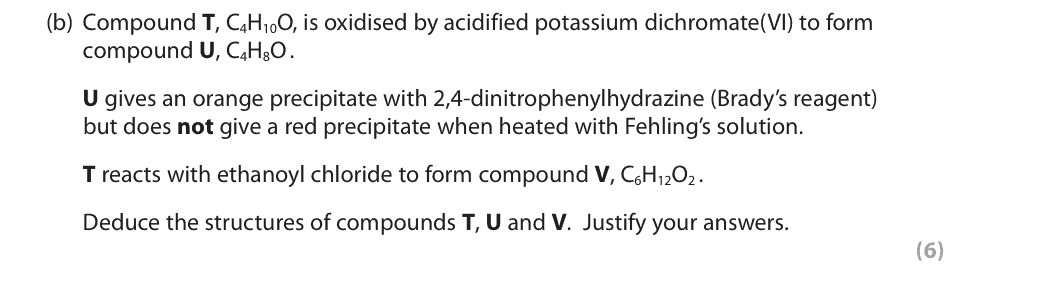
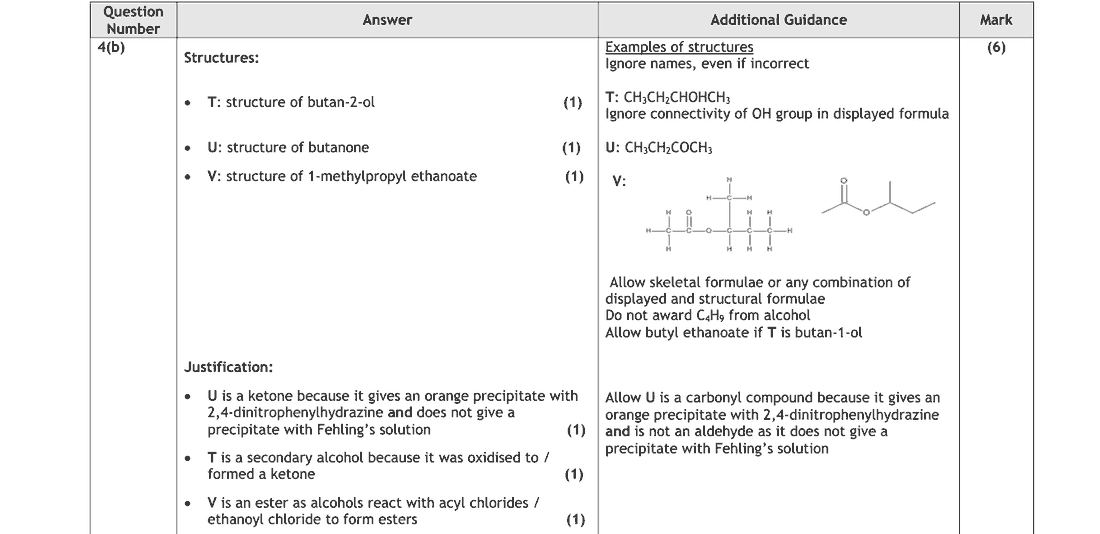
Structures: T is butan-2-ol, CH3CH2CH(OH)CH3
U is butanone, CH3CH2COCH3
V is 1-methylpropyl ethanoate, CH3COOCH(CH3)CH2CH3 (butyl ethanoate allowed if T was butan-1-ol
C4H9 not accepted). Justification: U is a ketone because it gives an orange precipitate with 2,4-dinitrophenylhydrazine but no precipitate with Fehling's solution
T is a secondary alcohol because it is oxidised to a ketone
V is an ester because alcohols react with acyl chlorides to form esters. Common errors: T as butan-2-ol but V drawn from butan-1-ol
butan-1-ol oxidised via butanal to butanone
V as a carboxylic acid
October 2020 · Paper 2 · Q7(a)(i)1 markShort answer
Mark scheme
Examiner's comment
Many candidates realised that hydride ions would be repelled by the high electron density of
the double bond in an alkene or knew that alkenes react by electrophilic addition and hydride
ions are nucleophiles. There were many correct answers giving a suitable reagent and
condition, but some candidates had not learnt the basic reagents and conditions for the
organic chemistry reactions in the specification. Only a minority of candidates knew that
potassium cyanide in ethanol react with halogenoalkanes to form nitriles. Unfortunately a few
candidates lost this mark as they did not give a specific halogenoalkane, for example, 1-
bromobutane. The majority of candidates knew that an acid needs to be added to the salt to
form pentanoic acid. There were many excellent answers to the synthetic route in (b) showing
those students had practised this style of question and they knew the organic chemistry
reactions. Candidates should realise that they need to make a Grignard reagent from a
halogenocompound so should start by forming bromobenzene. Some candidates knew that
they needed benzoic acid to react with phosphorus(V) chloride to form benzoyl chloride and
they received credit for this.
Notes from the mark scheme and report
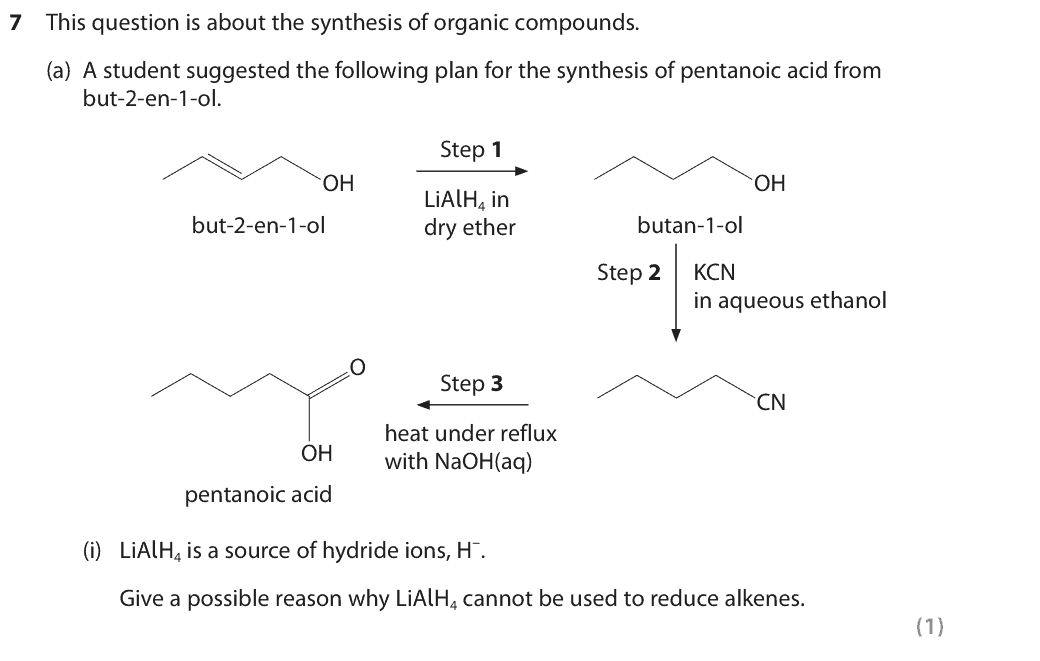
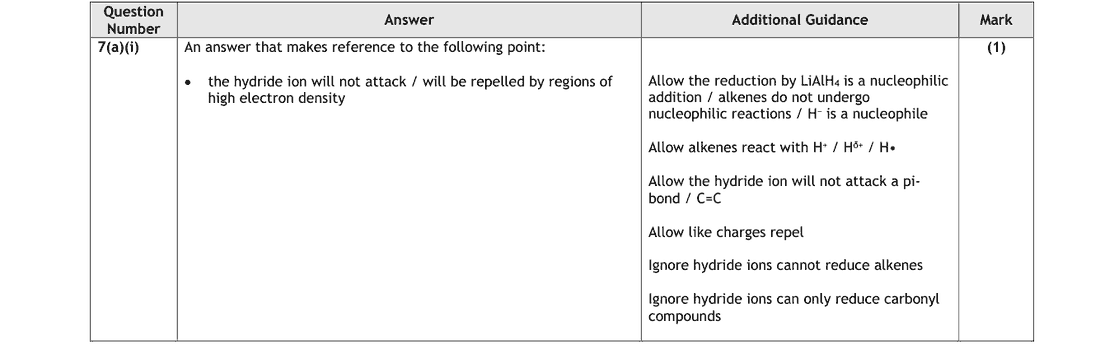
The hydride ion is a nucleophile, so it is repelled by / will not attack the region of high electron density in the C=C (π bond)
alkenes react with electrophiles. 'Hydride ions cannot reduce alkenes' or 'only reduce carbonyl compounds' is ignored
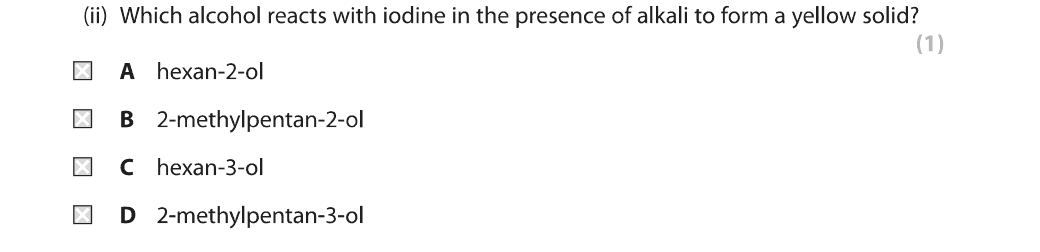
June 2019 · Paper 2 · Q1(a)(ii)1 markMultiple choice
Earlier part of question 1 that this part uses
Answer
A
Mark scheme
Notes from the mark scheme and report
Answer: A. Hexan-2-ol contains the CH3CH(OH) group, so it gives the yellow solid with iodine and alkali. B is tertiary
C and D have no CH3CH(OH) group
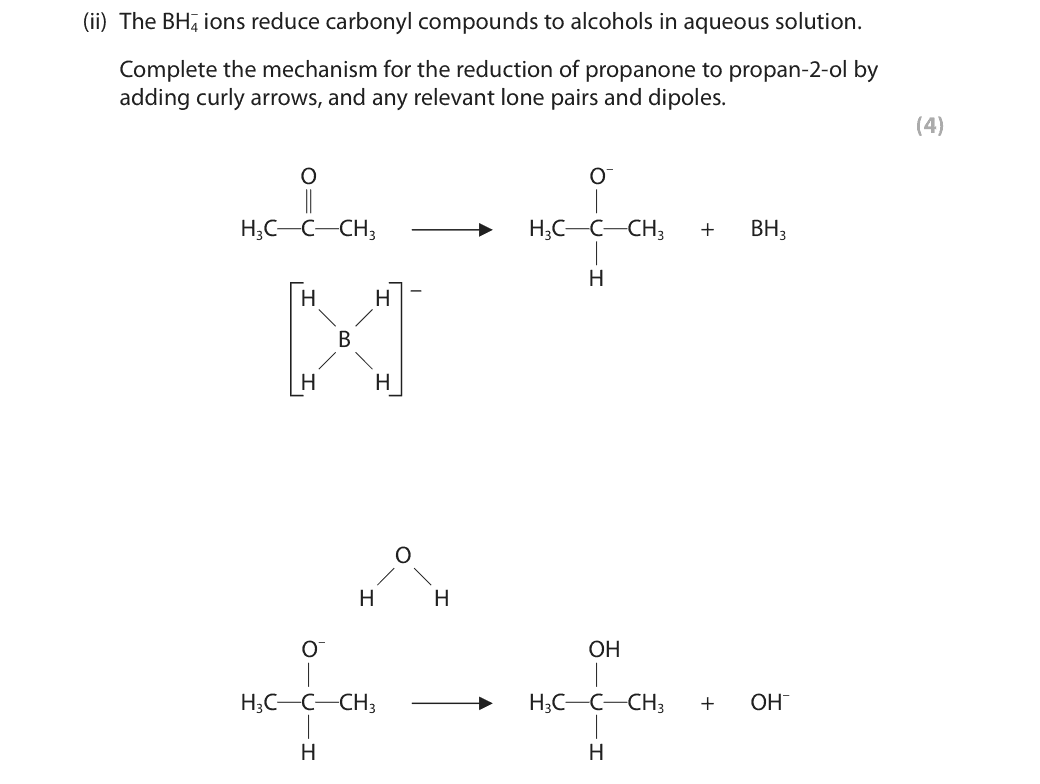
June 2019 · Paper 3 · Q5(e)(ii)4 marksMechanism
Earlier parts of question 5 that this part uses
Mark scheme
Examiner's comment
Candidates are not expected to know this mechanism for the reduction of propanone to propan-2-ol but they should be able to apply their knowledge of other mechanisms, e.g. the nucleophilic addition of HCN to carbonyl compounds. Candidates should know that oxygen is more electronegative than carbon and hydrogen so should be able to include relevant dipoles. They should also know that oxygen atoms have lone pairs. Some answers seemed to contain a random arrangement of curly arrows, including some with half arrow-heads, that showed those candidates did not understand that a curly arrow represents the movement of a pair of electrons so must start from a bond or a lone pair. Many candidates would benefit from gaining a clear understanding of organic reaction mechanisms, rather than trying to rote learn them.
Notes from the mark scheme and report
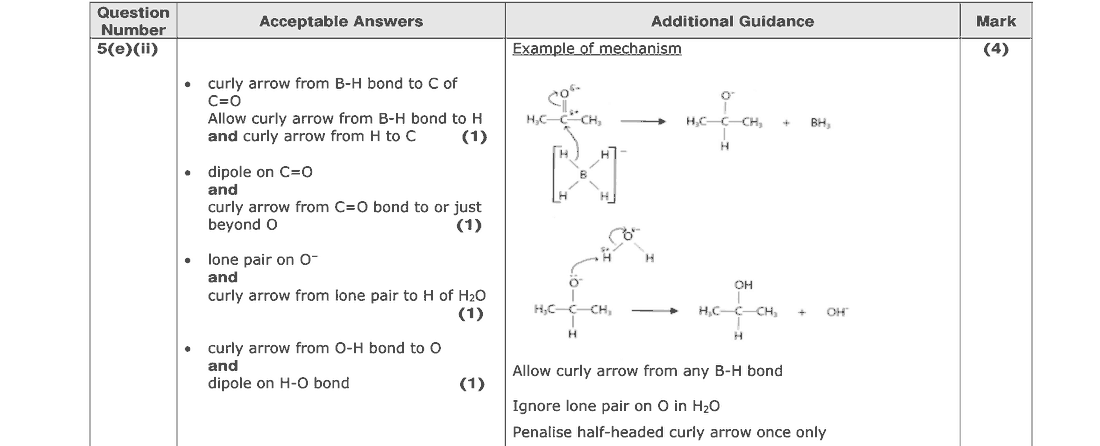
M1 curly arrow from a B–H bond to the carbon of C=O. M2 dipole on C=O (Cδ+ Oδ–) and curly arrow from the C=O bond to O. M3 lone pair on O– and curly arrow from it to an H of water. M4 curly arrow from that O–H bond to O, and the dipole on the H–O bond. Half-headed arrows penalised once. Unfamiliar mechanism to be worked out from nucleophilic addition of HCN
some answers had arrows placed at random, not starting from a bond or lone pair
June 2018 · Paper 2 · Q7(a)5 marksShort answer
Mark scheme
Examiner's comment
Another question with discriminated across the ability range and thus produced a wide spread of marks. The decision was made to make the mark scheme strictly adhering to correct chemistry, so simply stating a suitable reagent did not score if it was given in an incorrect chemical context. This served to distinguish between candidates who were guessing from the table of reagents provided and those who deduced more carefully the appropriate reagent for the respective conversion.
Additionally the responses served to emphasise the need for double-checking of work once completed because some otherwise excellent reaction pathways were spoiled by structural errors such as missing hydrogen atoms or pentavalent carbon atoms.
Notes from the mark scheme and report
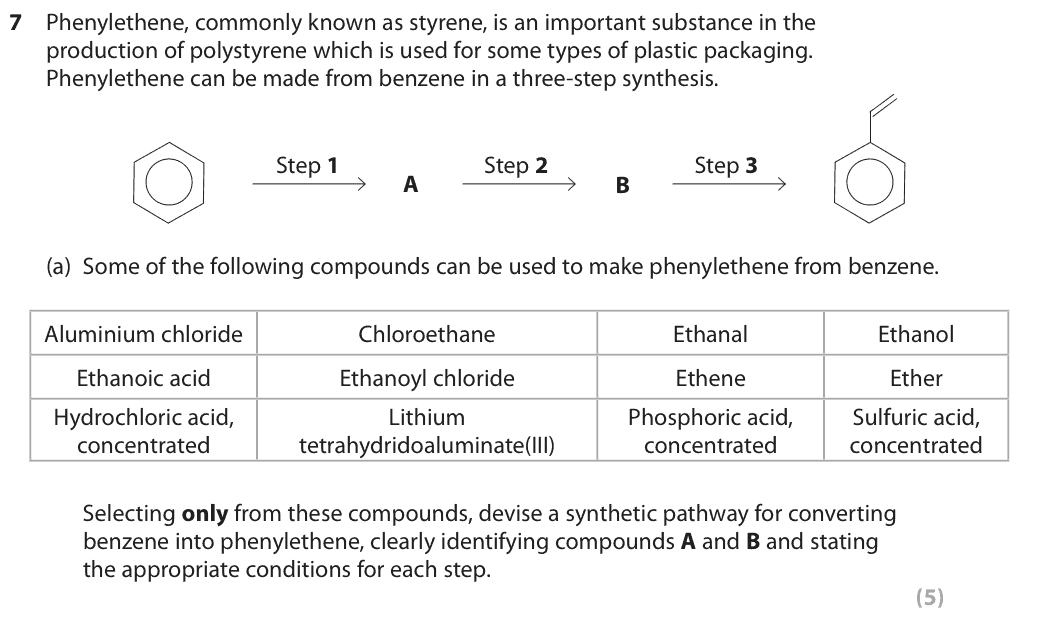
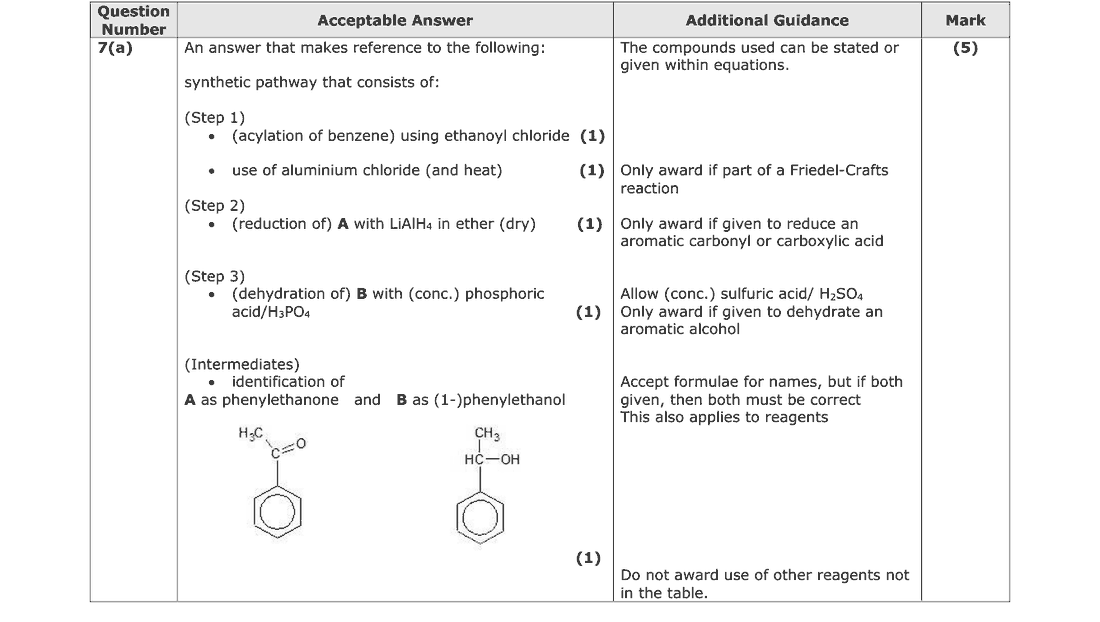
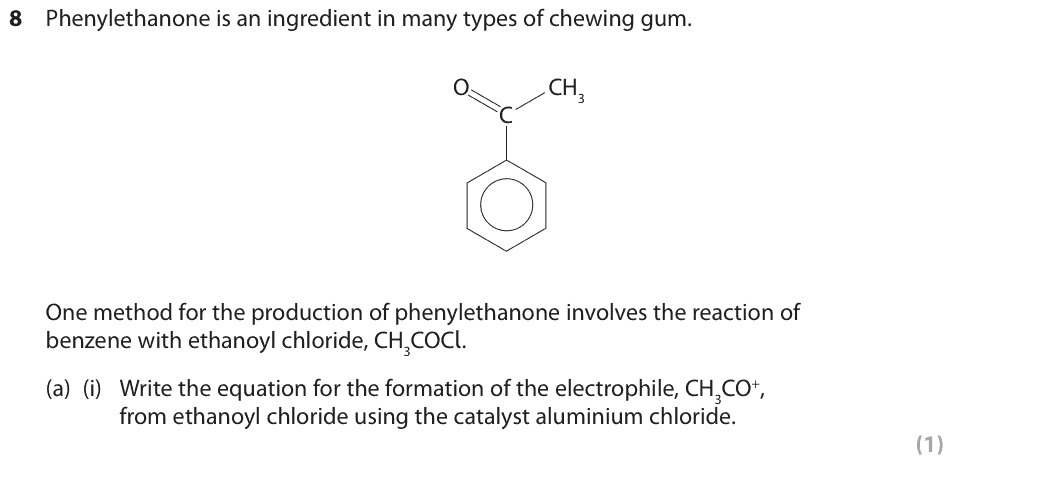
Step 1: ethanoyl chloride
with aluminium chloride (and heat) (Friedel–Crafts acylation). Step 2: reduce A with lithium tetrahydridoaluminate(III) in (dry) ether. Step 3: dehydrate B with concentrated phosphoric acid (concentrated sulfuric acid allowed). A is phenylethanone and B is 1-phenylethanol. A reagent only scores in the correct chemical context, and only reagents from the table. Good routes were often spoiled by structures with missing hydrogens or five-bonded carbons
June 2018 · Paper 3 · Q2(a)7 marksShort answer
Mark scheme
Examiner's comment
Nearly all students attempted to outline a synthetic route. However weaker responses got into difficulty at the first stage, either because they tried to synthesise a Grignard reagent from ethanal or they oxidised the ethanal into ethanoic acid. Those who recognised the need to extend the carbon chain via the formation of a hydroxynitrile often went on to successfully suggest how to form lactic acid. Otherwise good answers tended to lose credit by omission of the reaction type. Use of reaction schemes often made it difficult to award the balanced equation marks. The best answers used reaction schemes to highlight reagents and conditions, but then subsequently wrote separate balanced equations for the two reactions.
Notes from the mark scheme and report
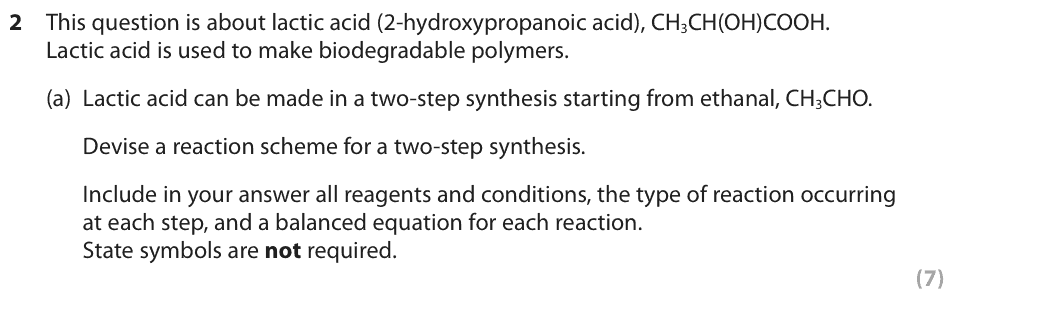
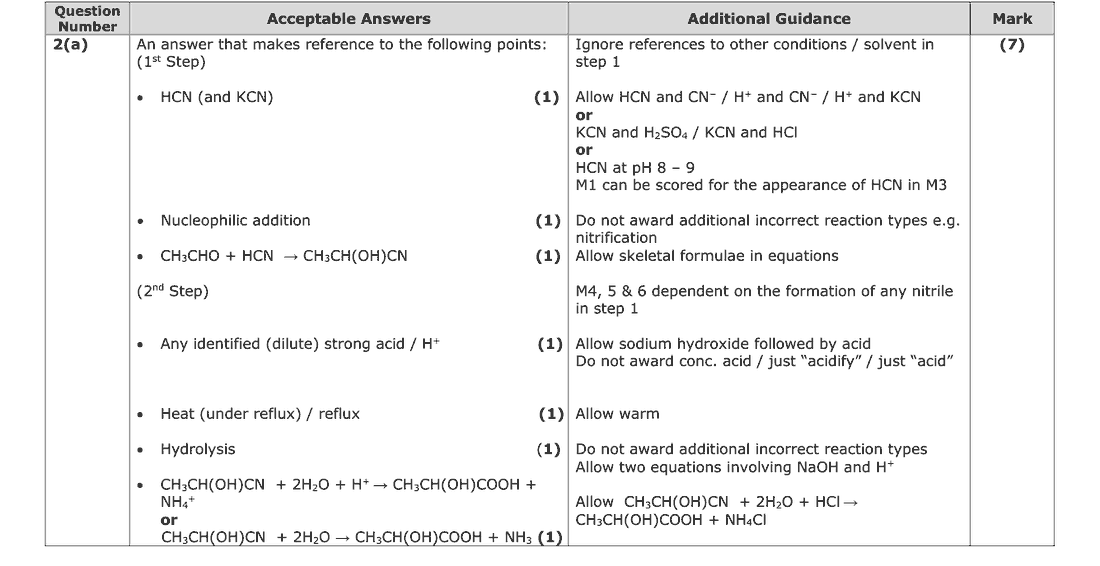
Step 1: HCN (and KCN)
nucleophilic addition
CH3CHO + HCN → CH3CH(OH)CN. Step 2 (marks depend on a nitrile from step 1): a named dilute strong acid or H+ (not concentrated, not just 'acid' or 'acidify')
heat under reflux
hydrolysis
CH3CH(OH)CN + 2H2O + H+ → CH3CH(OH)COOH + NH4+ (or + HCl giving NH4Cl). NaOH followed by acid allowed. Weaker answers tried a Grignard reagent from ethanal or oxidised ethanal to ethanoic acid
reaction types were often left out
reaction schemes made the balanced-equation marks hard to award
June 2017 · Paper 2 · Q8(b)(i)1 markMultiple choice
Earlier part of question 8 that this part uses
Answer
B
Mark scheme
Notes from the mark scheme and report
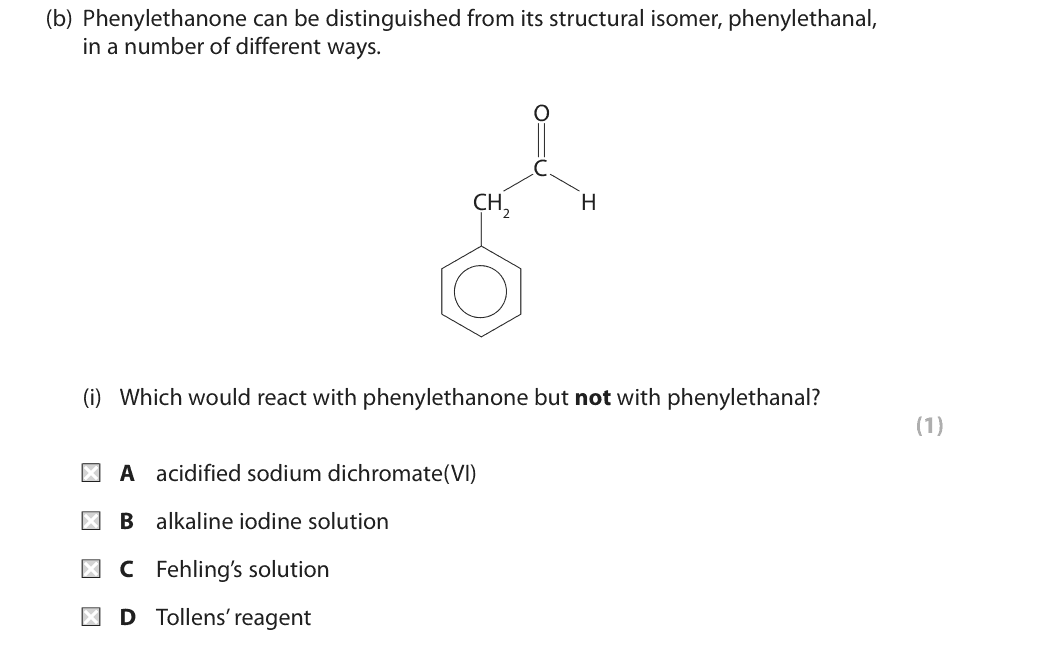
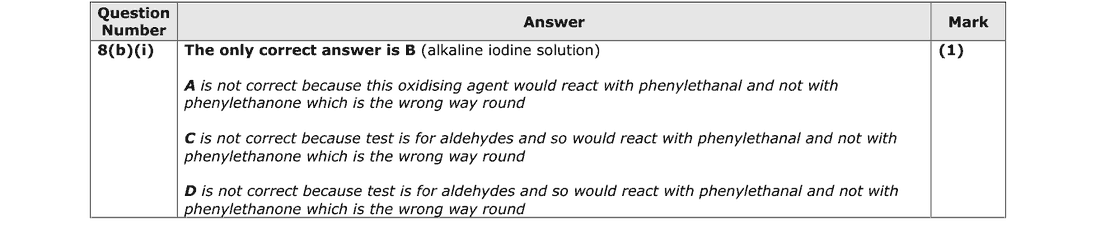
Answer: B. Alkaline iodine reacts with phenylethanone (a methyl ketone, CH3CO–) but not with phenylethanal. Acidified dichromate(VI), Fehling's and Tollens' all react with the aldehyde and not the ketone
June 2017 · Paper 2 · Q8(b)(ii)4 marksPractical and data analysis
Earlier parts of question 8 that this part uses
Mark scheme
Examiner's comment
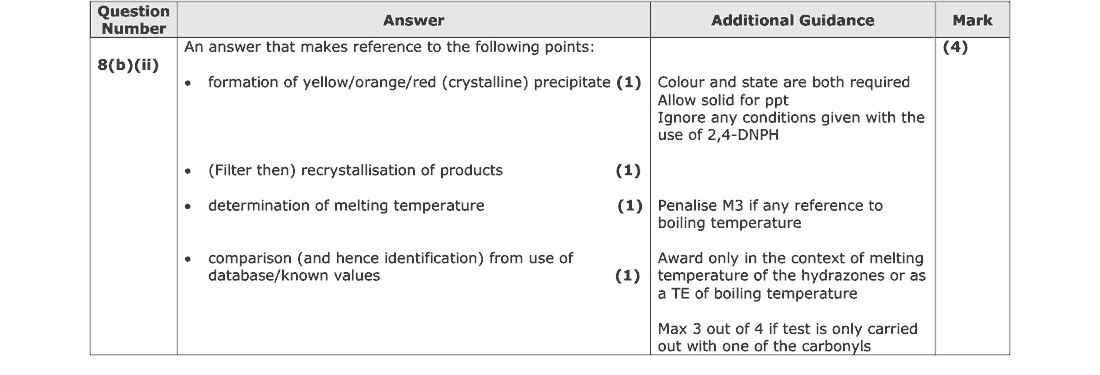
This question produced a wide range of marks. In the less successful responses, candidates appreciated that both compounds would form a yellow/orange precipitate but were then not able to describe how this could be used to differentiate the compounds. In better responses, the candidates knew that the melting point of the crystals was the property which could be used to identify the unknown sample by referring to a database. Only in the very best of responses did candidates appreciate the need to recrystalise the initial precipitate in order to have a pure sample for the determination of the melting temperature. A small number incorrectly referred to the boiling temperature of the crystals and this resulted in the loss of marking point 3, even if it was seen in conjunction with the melting temperature, because it is not what is done.
Notes from the mark scheme and report
Both give a yellow / orange / red precipitate (colour and state both needed)
(filter and) recrystallise the product
measure its melting temperature (any mention of boiling temperature loses this mark)
compare with known / database values for the derivatives. Maximum 3 if only one carbonyl compound is tested. Weaker answers stopped at the precipitate
only the best mentioned recrystallisation
Skills: PT4 use laboratory apparatus for a variety of experimental techniques, including: titration, using burette and pipette; distillation and heating under reflux, including setting up glassware using retort stand and clamps; qualitative tests for ions and organic functional groups; filtration, including use of fluted filter paper, or filtration under reduced pressure; PT7 purify: a solid product by recrystallization; a liquid product, including use of separating funnel; PT8 use melting point apparatus
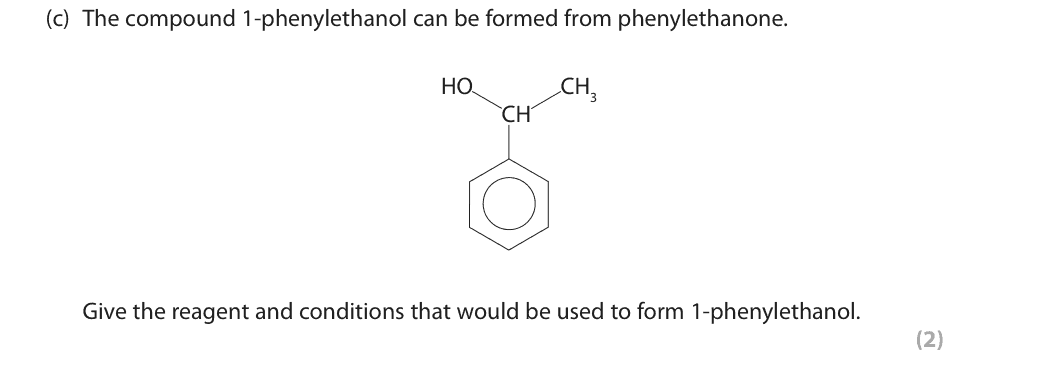
June 2017 · Paper 2 · Q8(c)2 marksShort answer
Earlier part of question 8 that this part uses
Mark scheme
Examiner's comment
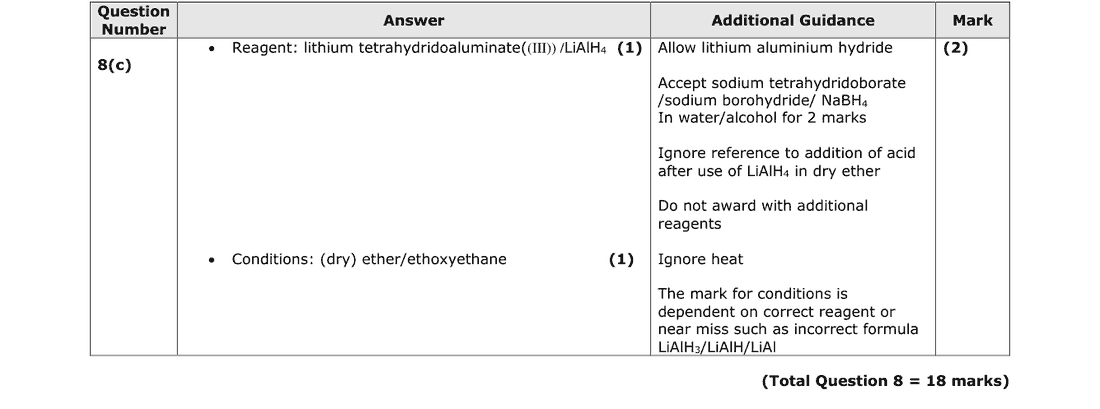
High-performing candidates found this a straightforward question and confidently gave the reagent and conditions required. However candidates do need to take care when expressing their answer because occasionally some candidates gave additional information which could negate their correct answer. The reagent required was lithium tetrahydridoaluminate (III) and the conditions for its use are 'dry ether'. This was all that was required. If this reagent is actually used in an experiment then, after the reaction has been carried out, either water or acid is added to hydrolyse any unreacted reducing reagent. If a candidate referred to this then it had to be made clear that the addition of water/acid was after or following the use of LiAlH4 in dry ether. On occasion responses were seen where the water/acid were additional reagents, and if used at the same time as LiAlH4 then this would mean that the procedure would not work, which lost credit.
Notes from the mark scheme and report
Reagent: lithium tetrahydridoaluminate (LiAlH4)
conditions: (dry) ether. NaBH4 in water or alcohol also scores 2. Conditions mark depends on the reagent or a near miss (e.g. LiAlH3). No reagent mark with extra reagents: water or acid must clearly be added afterwards, not at the same time
Work with an A-level chemistry tutor
Dropping marks on calculations, mechanisms or the core practicals? Book a trial session with an A-level chemistry tutor.