Notes and key-term cards for this topic are being written by our tutors. The past-paper questions below are ready now.
Specification statements
Show the 8 statements from the specification
17.9 be able to identify the carboxylic acid functional group
17.10 understand that hydrogen bonding affects the physical properties of carboxylic acids, in relation to their boiling temperatures and solubility
17.11 understand that carboxylic acids can be prepared by the oxidation of alcohols or aldehydes, and the hydrolysis of nitriles
17.12 understand the reactions of carboxylic acids with: • i lithium tetrahydridoaluminate (lithium aluminium hydride) in dry ether • ii bases to produce salts • iii phosphorus(V) chloride (phosphorus pentachloride) • iv alcohols in the presence of an acid catalyst
17.13 be able to identify the acyl chloride and ester functional groups
17.14 understand the reactions of acyl chlorides with: • i water • ii alcohols • iii concentrated ammonia • iv amines
17.15 understand the hydrolysis reactions of esters, in acidic and alkaline solution
17.16 understand how polyesters are formed by condensation polymerisation reactions
Six-mark extended response questions on this topic
Tap a question to zoom it. Where a part needs a figure, table or structure from earlier in the question, that part folds out above it; the mark scheme and examiner's comment open underneath. Have Edexcel's Data Booklet beside you; the Periodic Table is on the back page of every paper.
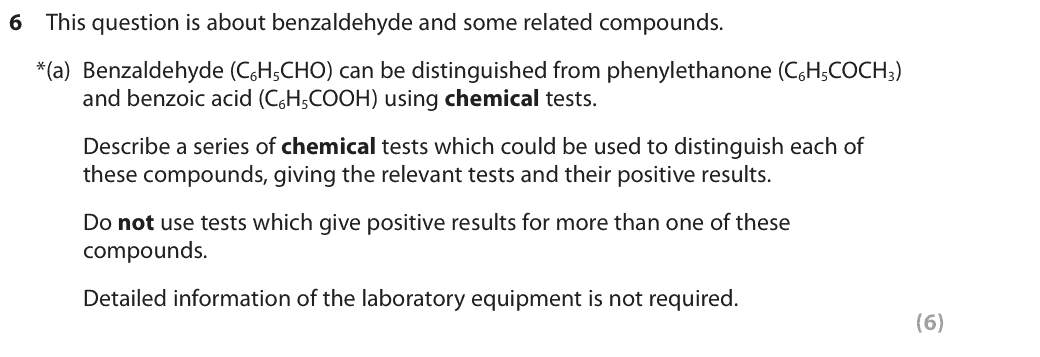
June 2025 · Paper 2 · Q6(a)6 marks6-mark extended response
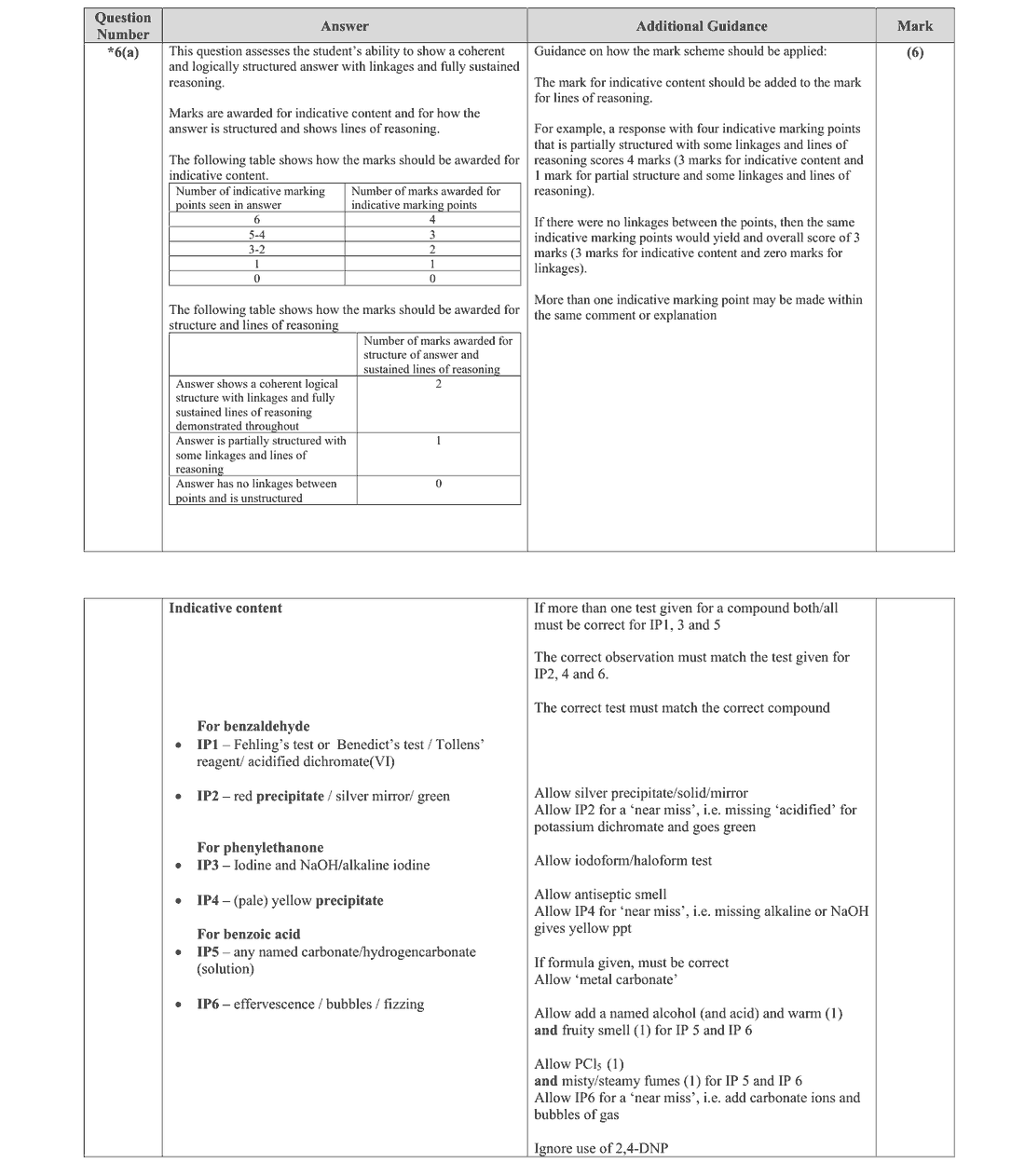
Mark scheme, with the indicative content and the marks for reasoning
Examiner's comment
This question attracted the full range of marks with many candidates able to give at least one of the relevant tests to distinguish the three compounds.
Many candidates gave more than one test for the benzaldehyde, usually losing credit for insufficient detail for one or more of the tests or for giving incomplete observations.
The team of examiners commented on the quality of some of the responses which scored full marks.
A few candidates thought that giving tests for two of the substances and deducing the third by elimination would be enough for full credit.
Notes from the mark scheme and report
Six indicative points plus two marks for reasoning. Benzaldehyde: IP1 Fehling's or Benedict's solution / Tollens' reagent / acidified dichromate(VI)
IP2 red precipitate / silver mirror / turns green. Phenylethanone: IP3 iodine with sodium hydroxide (alkaline iodine)
IP4 (pale) yellow precipitate. Benzoic acid: IP5 a named carbonate or hydrogencarbonate
IP6 effervescence (also allowed: named alcohol with acid, warm, fruity smell
or PCl5, misty fumes). The observation must match the test and the test must match the compound
2,4-DNPH ignored. If more than one test is given for a compound, all must be correct. Common errors: several tests for benzaldehyde with incomplete detail or observations
testing only two compounds and deducing the third by elimination
Skills: PT4 use laboratory apparatus for a variety of experimental techniques, including: titration, using burette and pipette; distillation and heating under reflux, including setting up glassware using retort stand and clamps; qualitative tests for ions and organic functional groups; filtration, including use of fluted filter paper, or filtration under reduced pressure; CP15 Core practical 15: Analysis of some inorganic and organic unknowns
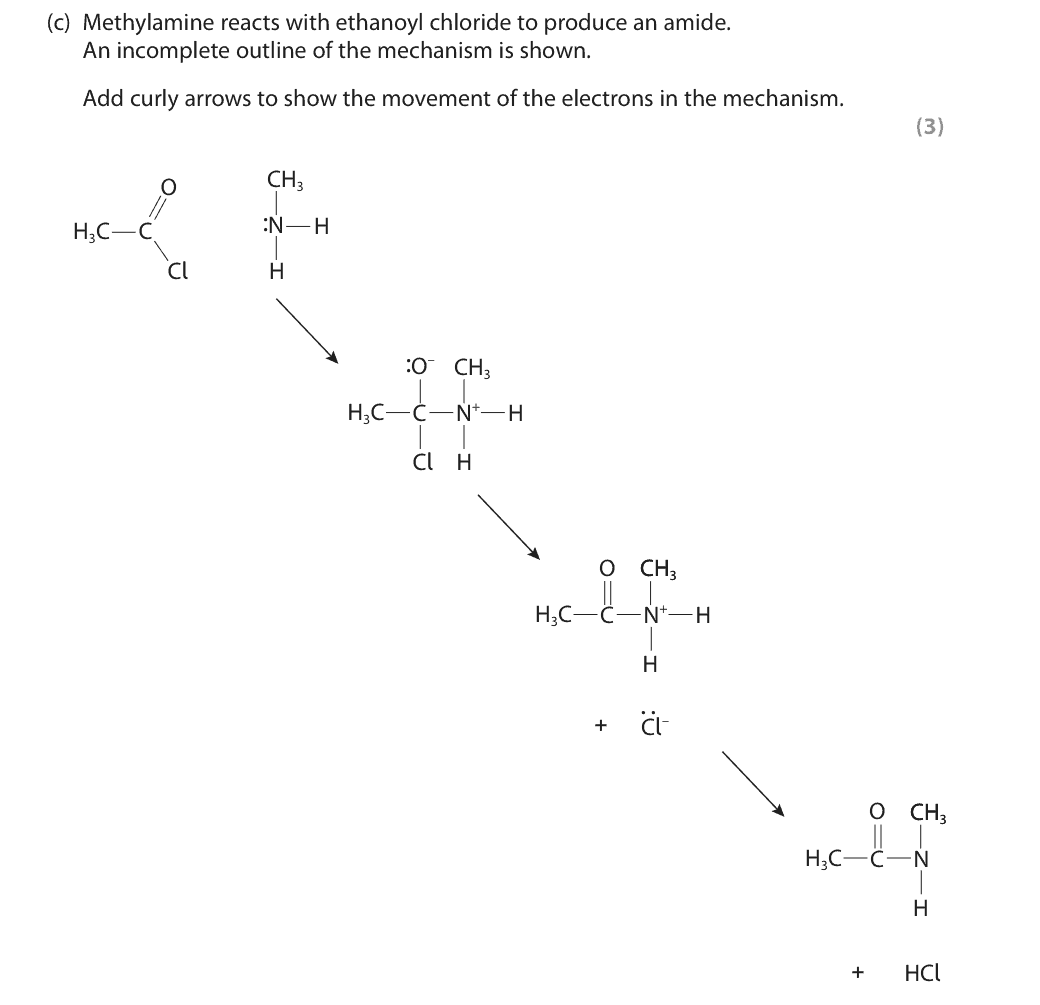
June 2025 · Paper 2 · Q7(c)3 marksMechanism
Earlier part of question 7 that this part uses
Mark scheme
Examiner's comment
This question was generally well answered showing a good understanding of curly arrows in mechanisms.
Common errors included arrows not clearly originating from a lone pair of electrons or going to an ambiguous area.
Notes from the mark scheme and report
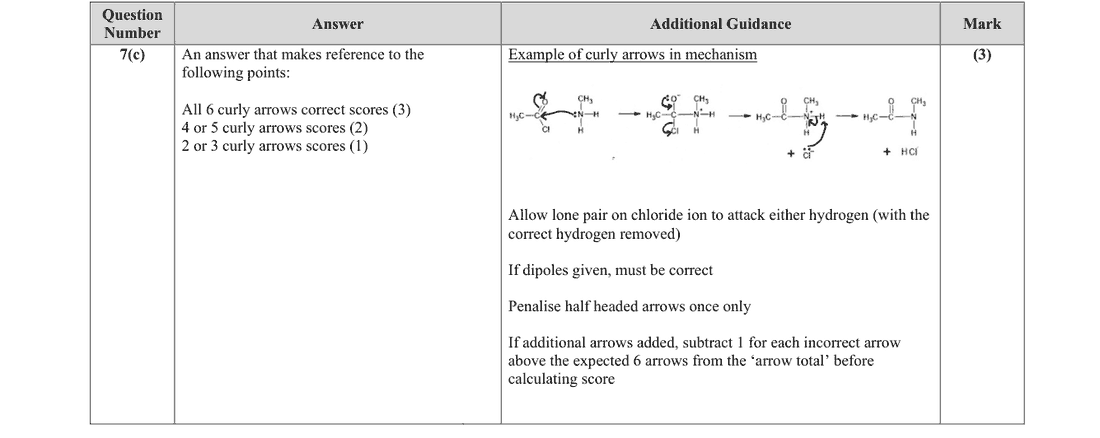
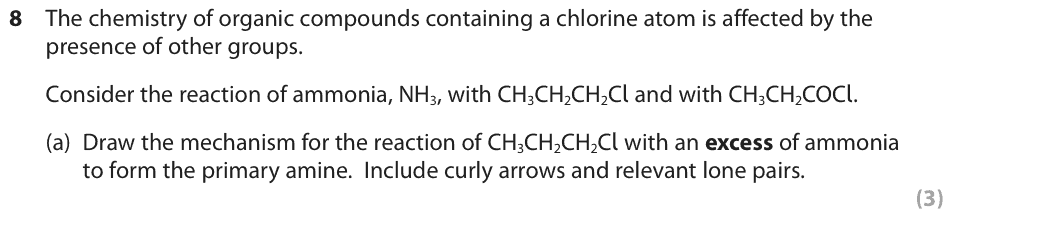
Six curly arrows: N lone pair to the carbonyl carbon and C=O bond to O
O– lone pair back to re-form C=O and C–Cl bond to Cl
Cl– lone pair to H and N–H bond to N+. All six score 3
four or five score 2
two or three score 1. Each extra wrong arrow is subtracted from the total
half-headed arrows penalised once. Common errors: arrows not clearly starting at a lone pair, or ending in an ambiguous place
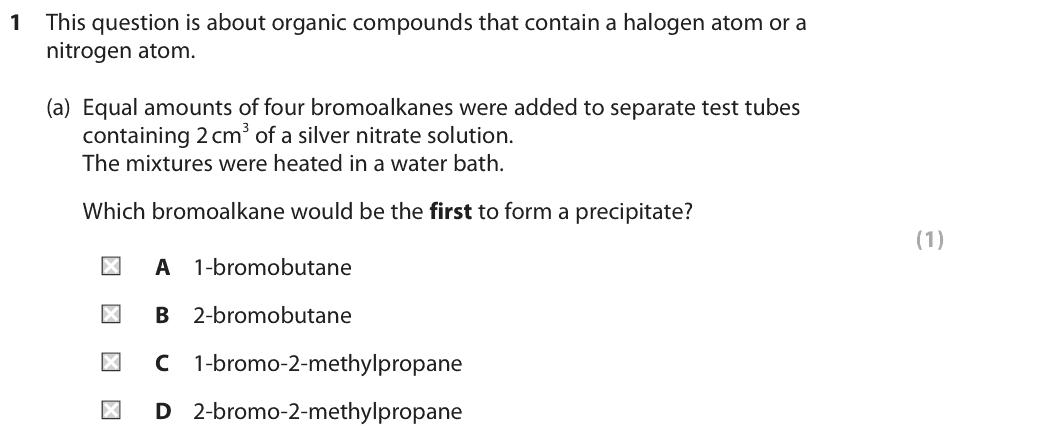
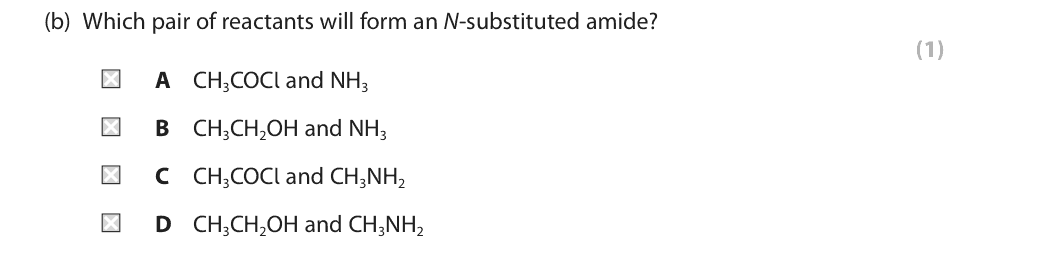
June 2024 · Paper 2 · Q1(b)1 markMultiple choice
Earlier part of question 1 that this part uses
Answer
C
Mark scheme
Notes from the mark scheme and report
Answer: C. An acyl chloride with a primary amine (CH3COCl and CH3NH2) gives an N-substituted amide. A gives a primary amide
the alcohol in B and D does not react
June 2024 · Paper 2 · Q7(d)(iii)1 markMultiple choice
Earlier parts of question 7 that this part uses
Answer
B
Mark scheme
Notes from the mark scheme and report
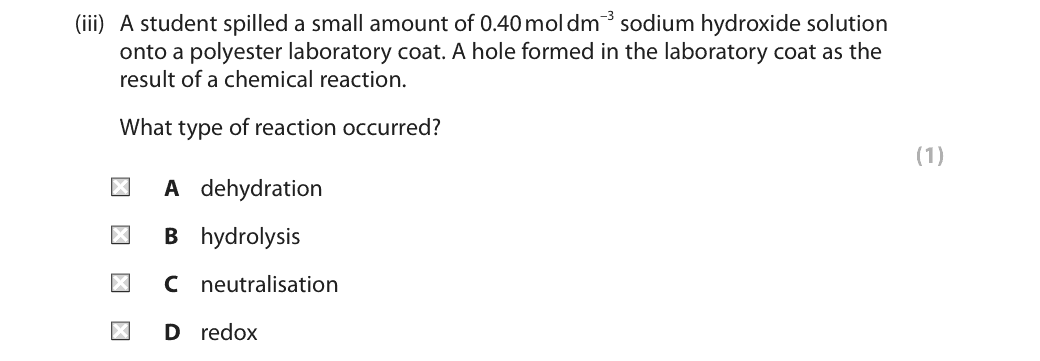
Answer: B (hydrolysis). The alkali hydrolyses the ester links of the polyester. It is not dehydration (removal of water), neutralisation (acid with base) or redox
June 2024 · Paper 2 · Q8(d)(ii)2 marksShort answer
Earlier parts of question 8 that this part uses
Mark scheme
Examiner's comment
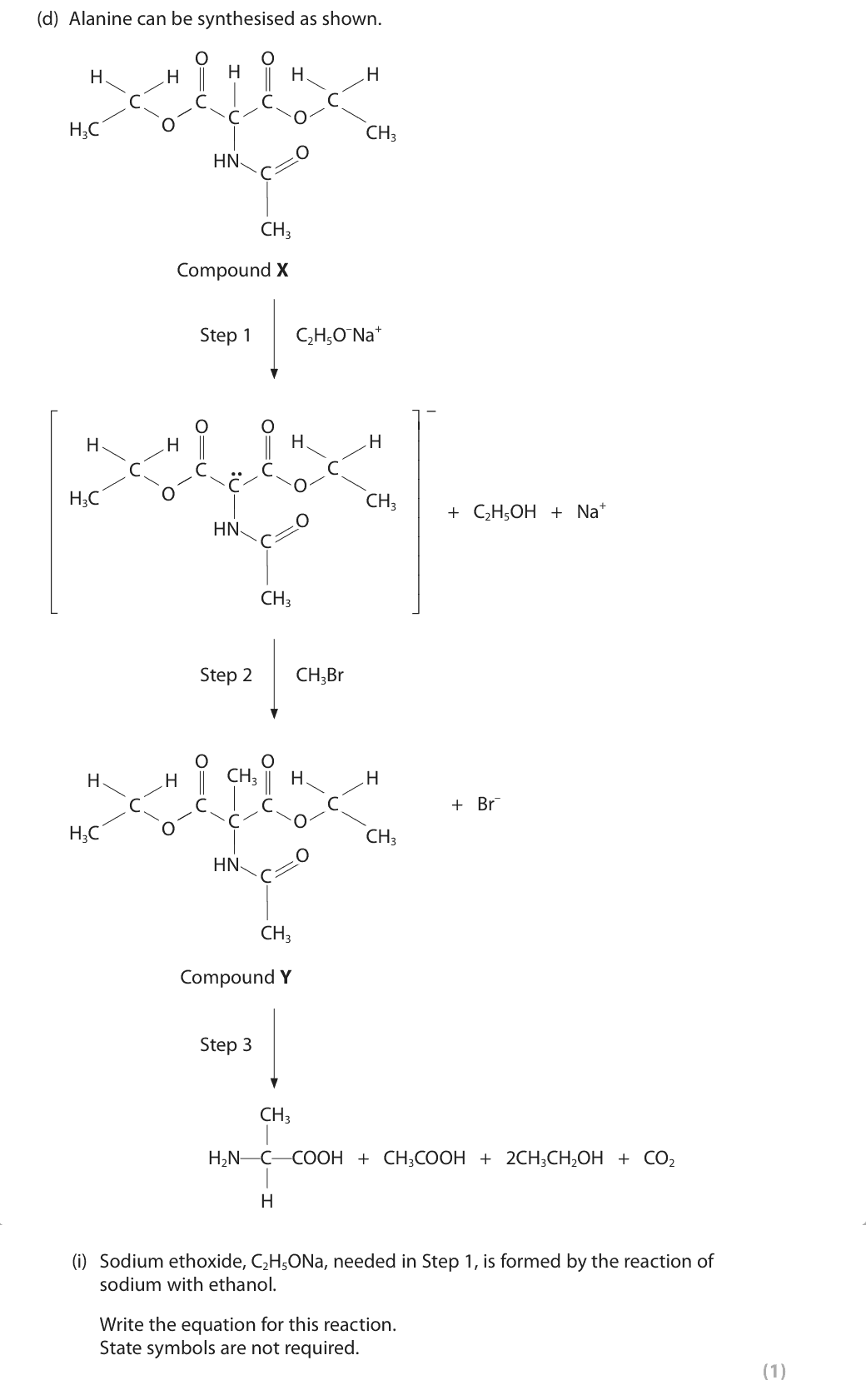
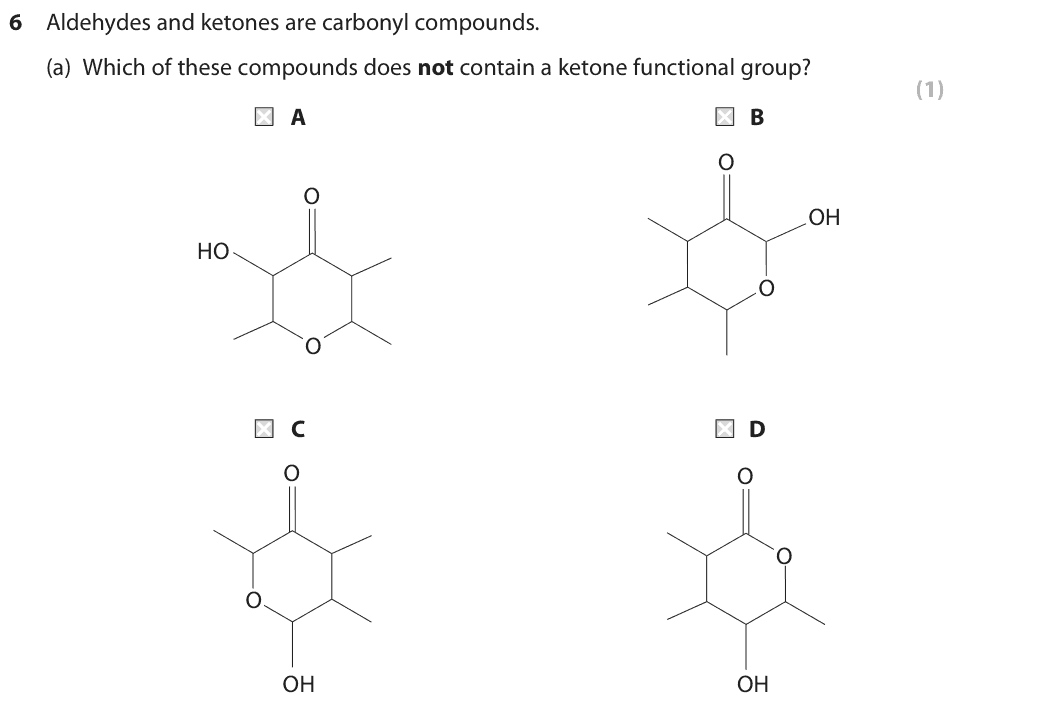
Compound Y was unfamiliar, and some candidates found it difficult to unpick the detail of the structure and name the functional groups. As a result a significant proportion of candidates discussed ketones or aldehydes, drawn by the carbonyl bond, but not taking note of the neighbouring atoms.
Notes from the mark scheme and report
Answer: ester and (N-substituted) amide, one mark each. Three answers with two correct scores 1
four or more answers scores 0. Many were drawn by the C=O groups to ketone or aldehyde
June 2024 · Paper 2 · Q8(d)(iii)2 marksShort answer
Earlier parts of question 8 that this part uses
Mark scheme
Examiner's comment
Although most candidates appreciated the need for acidic conditions and heat, a lack of detail prevented the award of full marks for some candidates, such as the name or formula of a specific strong acid, or the need to heat under reflux, to enable long periods of heating.
Notes from the mark scheme and report
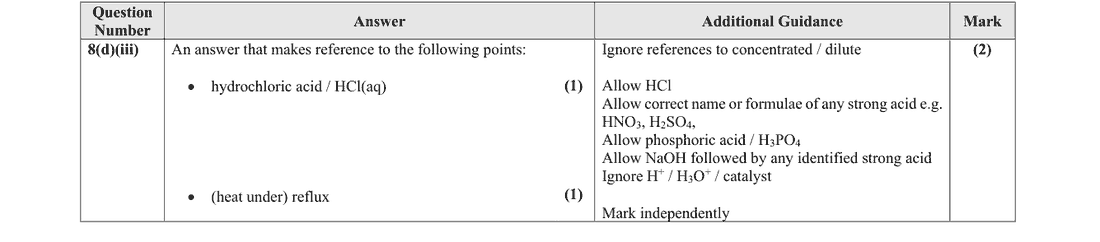
M1 hydrochloric acid (any named strong acid, or phosphoric acid
or NaOH followed by a named strong acid). Just H+ / H3O+ / 'catalyst' is ignored. M2 heat under reflux. Marked independently. Marks were lost by not naming a specific acid or by writing 'heat' without reflux
Skills: PT4 use laboratory apparatus for a variety of experimental techniques, including: titration, using burette and pipette; distillation and heating under reflux, including setting up glassware using retort stand and clamps; qualitative tests for ions and organic functional groups; filtration, including use of fluted filter paper, or filtration under reduced pressure
June 2023 · Paper 2 · Q7(a)4 marksExplanation
Mark scheme
Examiner's comment
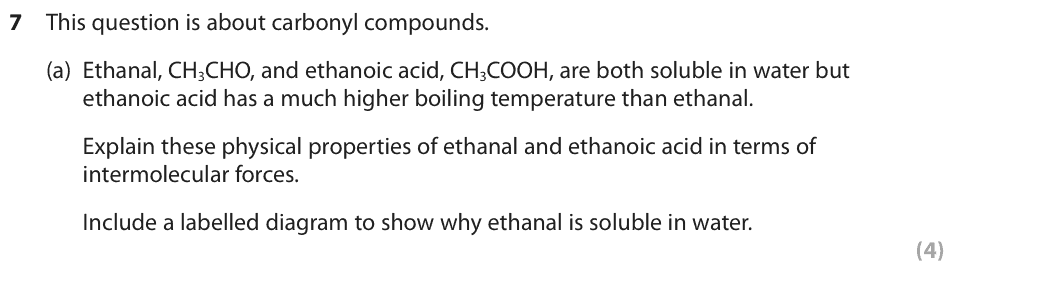
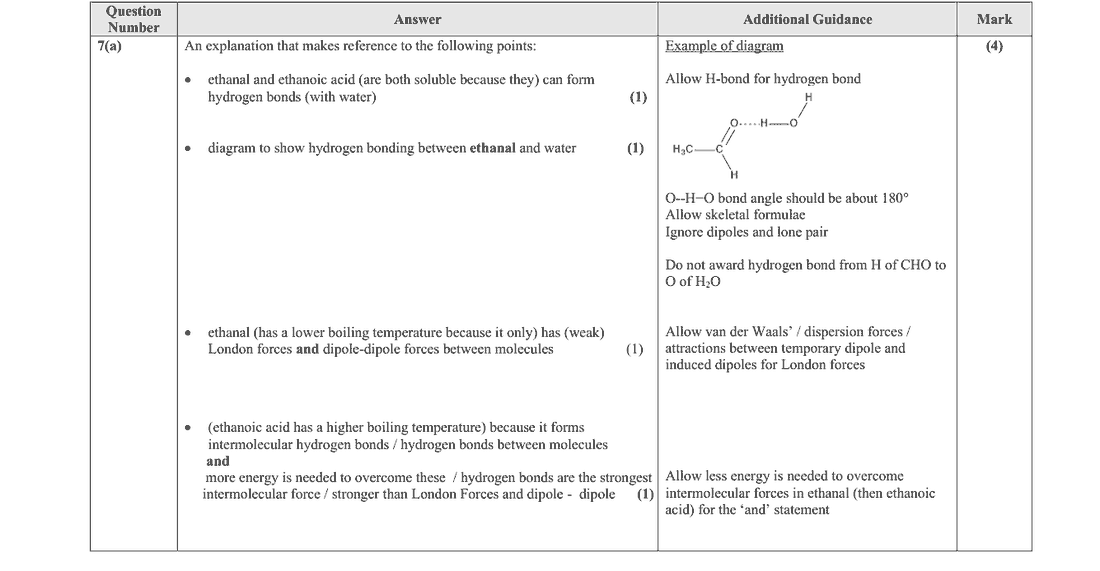
This question required candidates to explain the solubility of ethanal and ethanoic acid in water and also the difference in boiling point between the two compounds. There was also a requirement to draw a diagram showing why ethanal is soluble in water. The vast majority of candidates drew a diagram showing ethanal hydrogen bonding with water, with many showing the oxygen of the aldehyde hydrogen bonded to the hydrogen of a water molecule with an angle of 180°. However, some showed the hydrogen bond originating from one of the hydrogen atoms of ethanal and bonding to the oxygen of water which is incorrect. There was a good understanding of how these substances dissolved in water by forming hydrogen bonds.
The second part of the question concerned intermolecular forces with most candidates realising that ethanoic acid would form intermolecular hydrogen bonds which would be the strongest intermolecular forces and therefore take a lot of energy to break. However, some candidates also stated that ethanal would form intermolecular hydrogen bonds which is incorrect. There was also some mention of the relative strengths of the London Forces between molecules of ethanal and between molecules of ethanoic acid, but these would not be relevant in the context of the strong hydrogen bonds between ethanoic acid molecules.
Notes from the mark scheme and report
M1 both are soluble because they form hydrogen bonds with water
M2 diagram of a hydrogen bond from the O of ethanal's C=O to an H of water, O---H–O about 180° (not from the H of CHO to the O of water)
M3 ethanal has only London forces and dipole–dipole forces between its molecules
M4 ethanoic acid forms hydrogen bonds between its molecules, and these need more energy to overcome / are the strongest intermolecular force. The diagram was usually right
some drew the bond from a hydrogen of ethanal, and some said ethanal hydrogen bonds with itself
June 2023 · Paper 3 · Q9(a)(i)1 markShort answer
Mark scheme
Examiner's comment
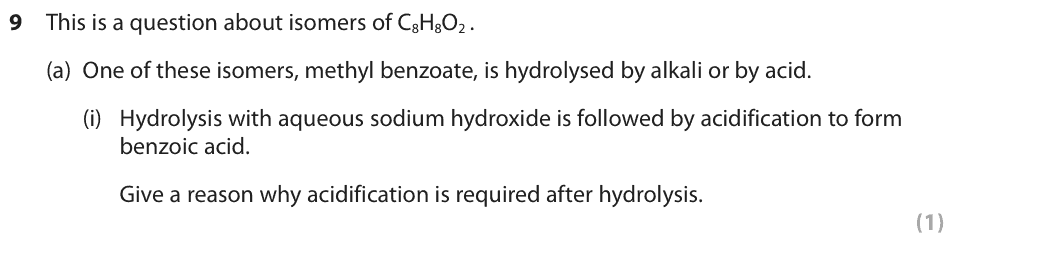
This question has been asked in a variety of different forms over recent times and it was evident that the understanding of the need for acidification has much improved. Only a few incorrect responses were seen which simply mentioned the neutralisation of the alkali, which was good.
Notes from the mark scheme and report
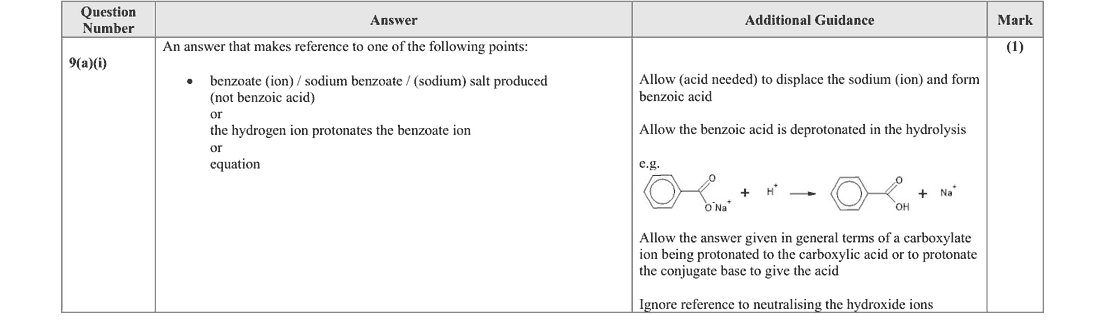
Alkaline hydrolysis gives the benzoate ion / sodium benzoate, not benzoic acid
the acid (H+) protonates the benzoate ion to give benzoic acid. Just 'to neutralise the hydroxide ions' is ignored
June 2023 · Paper 3 · Q9(a)(ii)1 markEquation writingHard
Earlier part of question 9 that this part uses
Mark scheme
Examiner's comment
It was disappointing that this question was one of the eight questions classified by the statistics as hard because this shouldn't have been the case. It is possible that because the equation for the acidic hydrolysis was asked immediately after the alkaline hydrolysis was considered that candidates got confused. However, there were only a few responses which gave the wrong equation. More frequent errors were in the structural formulae and the balancing of the equations.
Notes from the mark scheme and report
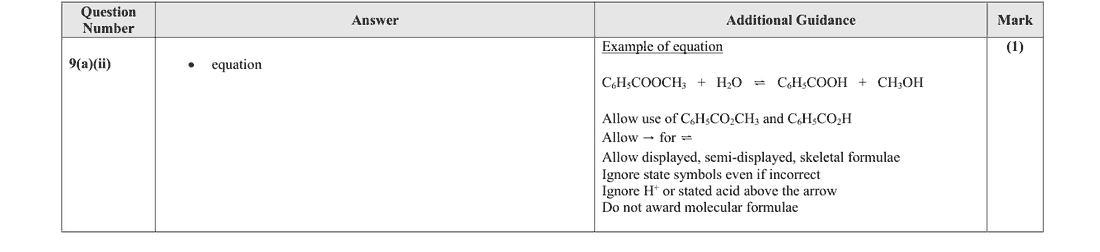
C6H5COOCH3 + H2O ⇌ C6H5COOH + CH3OH (→ allowed
H+ over the arrow ignored
not molecular formulae). Errors were mainly in the structural formulae and balancing
June 2022 · Paper 2 · Q1(c)1 markMultiple choice
Answer
B
Mark scheme
Notes from the mark scheme and report
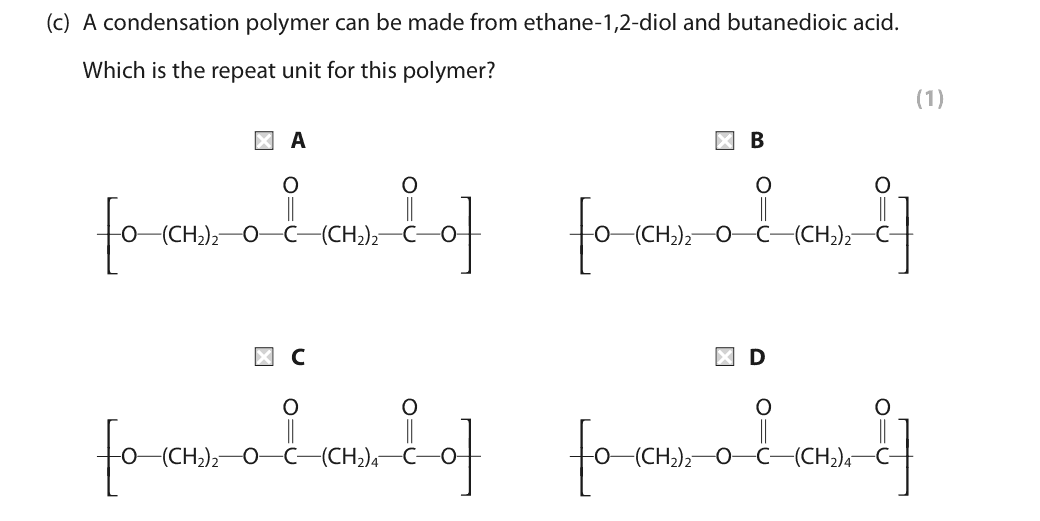
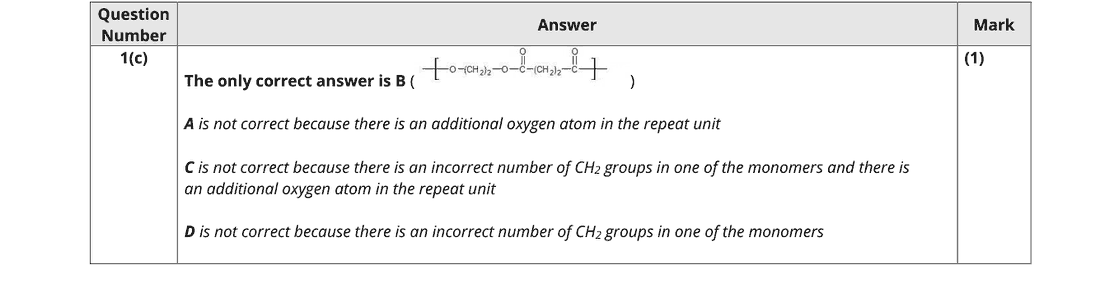
Answer: B, –O–(CH2)2–O–CO–(CH2)2–CO–. A and C have an extra oxygen atom
C and D have (CH2)4, which is the wrong number of CH2 groups for butanedioic acid
June 2022 · Paper 2 · Q6(d)(i)4 marksExplanation
Earlier part of question 6 that this part uses
Mark scheme
Examiner's comment
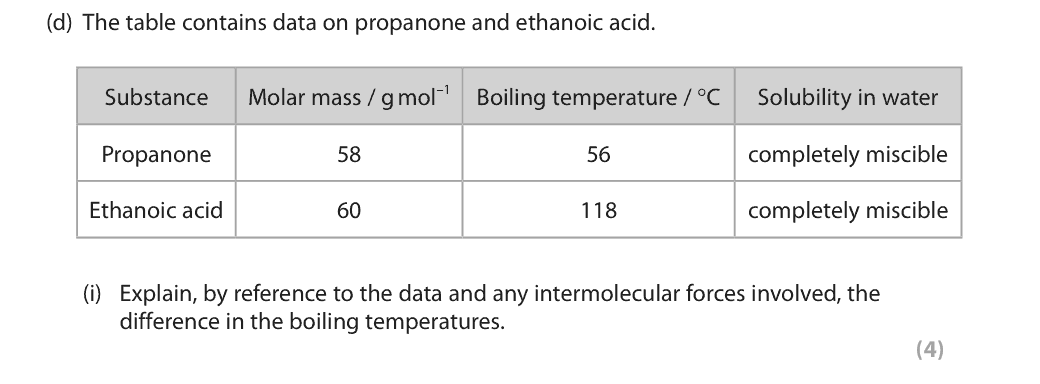
A disappointing performance by candidates of lower ability on this intermolecular forces question. One mark for hydrogen bonding by ethanoic acid should have been achievable for the grade E boundary but occasionally was negated by comments that propanone can also form hydrogen bonding as well, although weaker ones.
A sizeable number of candidates identified the small difference in molar masses between propanone and ethanoic acid but then still went on to infer that this was part of the reason for the large difference in boiling temperatures. Only the more able candidates were able to appreciate that the similarity of London forces given the equal number of electrons in propanone and ethanoic acid would mean that these could be discounted from the reason for the difference in boiling temperatures.
Similarly the reference to propanone having permanent dipole – dipole forces was indicative of candidates at the higher grade A boundary.
There was some evidence of candidates not reading the question properly as seen by comments on miscibility in water which should have been made in part (ii).
Notes from the mark scheme and report
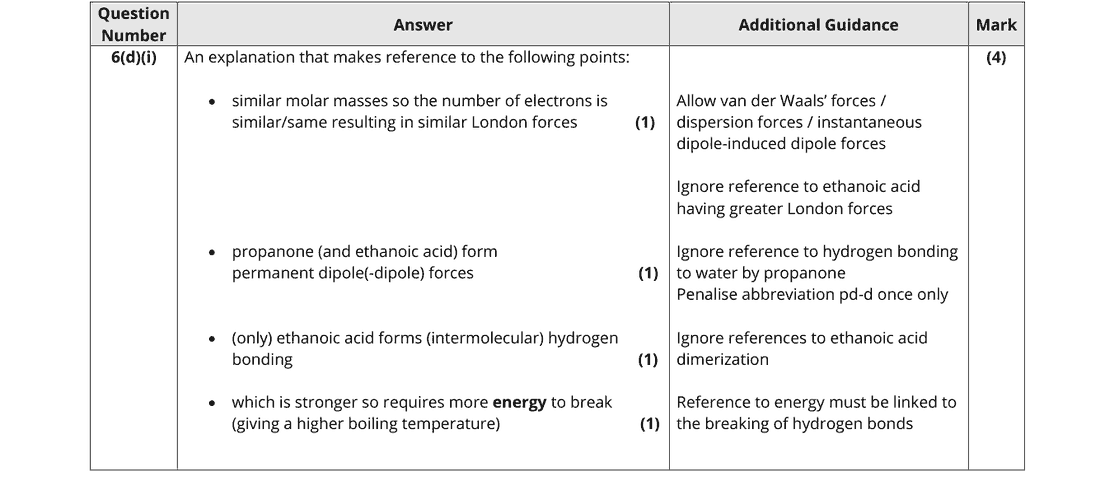
Similar molar masses, so similar numbers of electrons and similar London forces
both have permanent dipole forces
only ethanoic acid forms (intermolecular) hydrogen bonds
these are stronger, so more energy is needed to break them (higher boiling temperature). Dimerisation ignored. Errors: propanone said to form (weaker) hydrogen bonds with itself
the small difference in molar mass given as part of the reason
writing about miscibility, which belongs in (ii)
June 2022 · Paper 2 · Q8(c)1 markShort answerEasy
Earlier part of question 8 that this part uses
Mark scheme
Examiner's comment
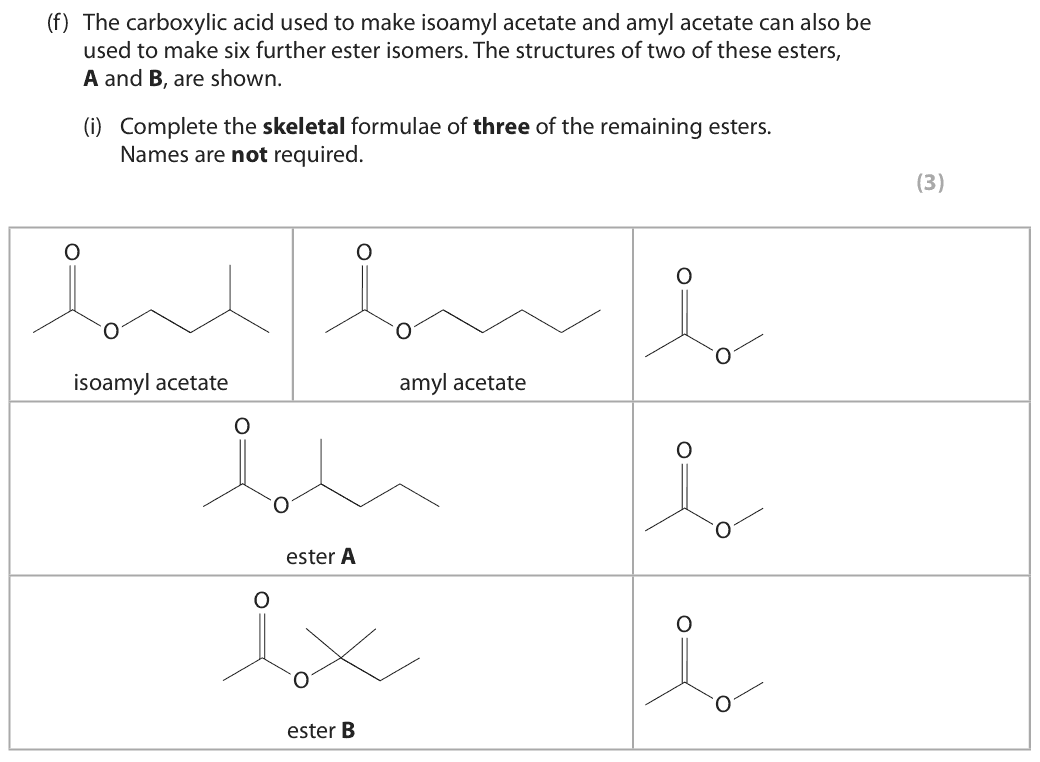
The vast majority of candidates could deduce the structural formula of the carboxylic acid that would be used to form the two esters stated in the question.
Notes from the mark scheme and report
Answer: CH3COOH (displayed or skeletal allowed
not a molecular formula)
June 2022 · Paper 2 · Q8(f)(ii)2 marksEquation writing
Earlier parts of question 8 that this part uses
Mark scheme
Examiner's comment
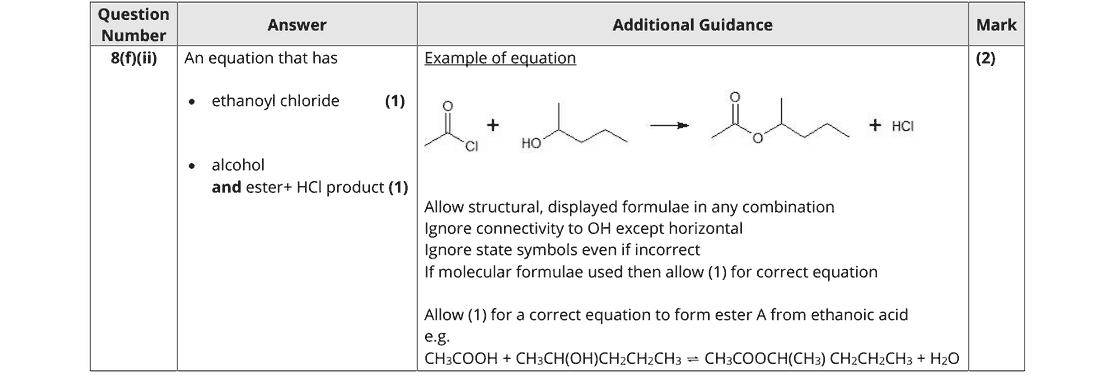
The majority of candidates scored on this question but only about a third scored both marks. The most common error was the failure to include the HCl product but also errors in the structure of the alcohol to make the branched chained ester were often seen.
Notes from the mark scheme and report
CH3COCl + CH3CH(OH)CH2CH2CH3 → CH3COOCH(CH3)CH2CH2CH3 + HCl. One mark for ethanoyl chloride
one for pentan-2-ol with the ester and HCl. Molecular formulae, or a correct equation from ethanoic acid, score 1. Only about a third scored both: HCl was often left out and the alcohol structure was often wrong
June 2022 · Paper 2 · Q8(g)4 marksExplanation
Earlier part of question 8 that this part uses
Mark scheme
Examiner's comment
There were some good answers seen to this answer on ester hydrolysis. The main criticism is that many candidates failed to give a proper comparison.
For example if there are only two options such as one reaction is an equilibrium whilst the other is irreversible, then it is fine to state that 'one is and the other is not'. However this was only the case with one of the three differences. To illustrate, a comment which states the acid hydrolysis produces the carboxylic acid is a good start but there are large numbers of other organic molecules and so to simply state that alkaline hydrolysis doesn't produce the carboxylic acid is insufficient. It fails to state what is made instead.
Similarly it was not enough to state the the acid is a catalyst whereas the alkali is not. There needed to be a positive statement that the alkali is a reactant. This was the marking point that was often missing.
Notes from the mark scheme and report
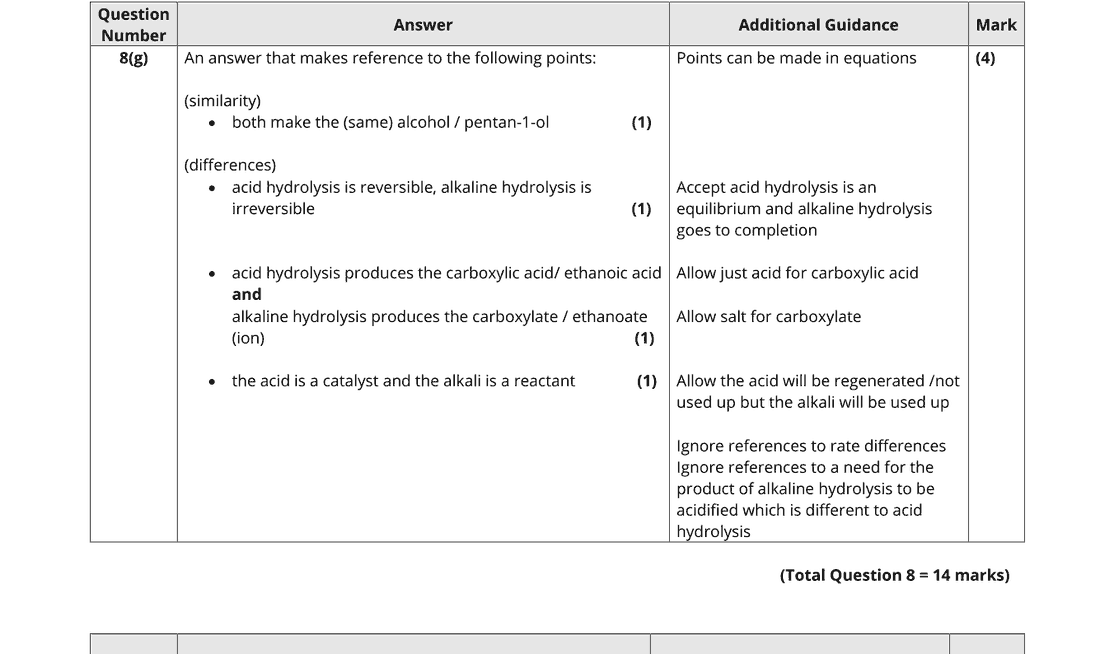
Similarity: both give the same alcohol, pentan-1-ol. Differences: acid hydrolysis is reversible (an equilibrium) and alkaline hydrolysis is irreversible (goes to completion)
acid hydrolysis gives the carboxylic acid (ethanoic acid) and alkaline hydrolysis gives the carboxylate salt (ethanoate)
the acid is a catalyst and the alkali is a reactant (used up). Rate differences ignored. Both halves of each comparison must be stated: saying the alkali 'is not a catalyst', or that alkaline hydrolysis 'does not give the acid', is not enough
June 2022 · Paper 3 · Q7(a)(ii)6 marksShort answer
Earlier part of question 7 that this part uses
Mark scheme
Examiner's comment
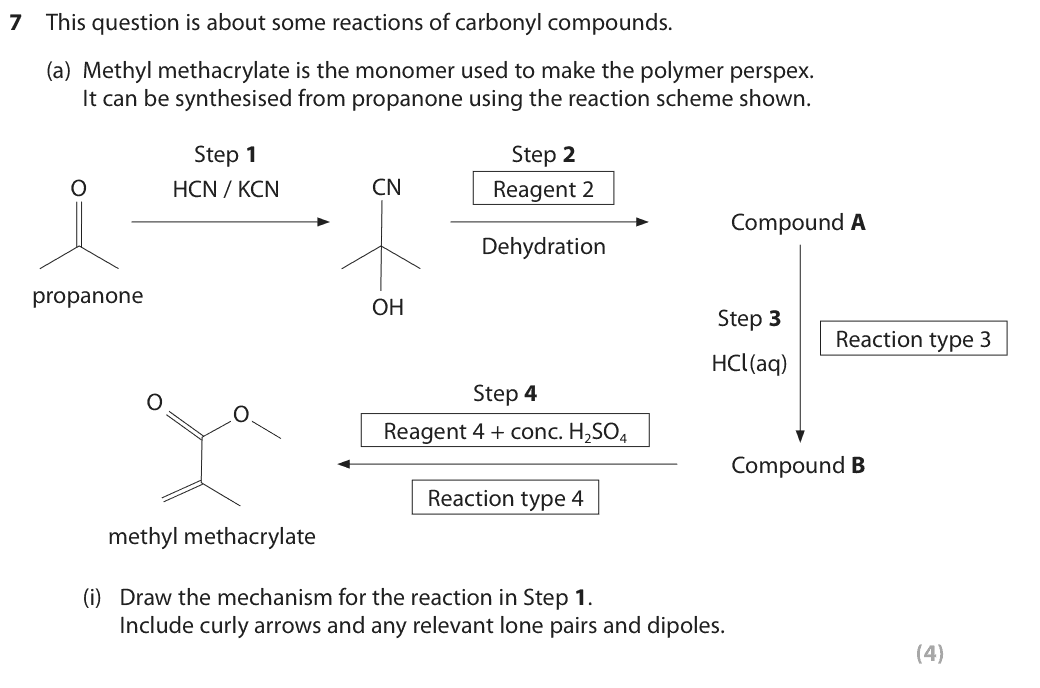
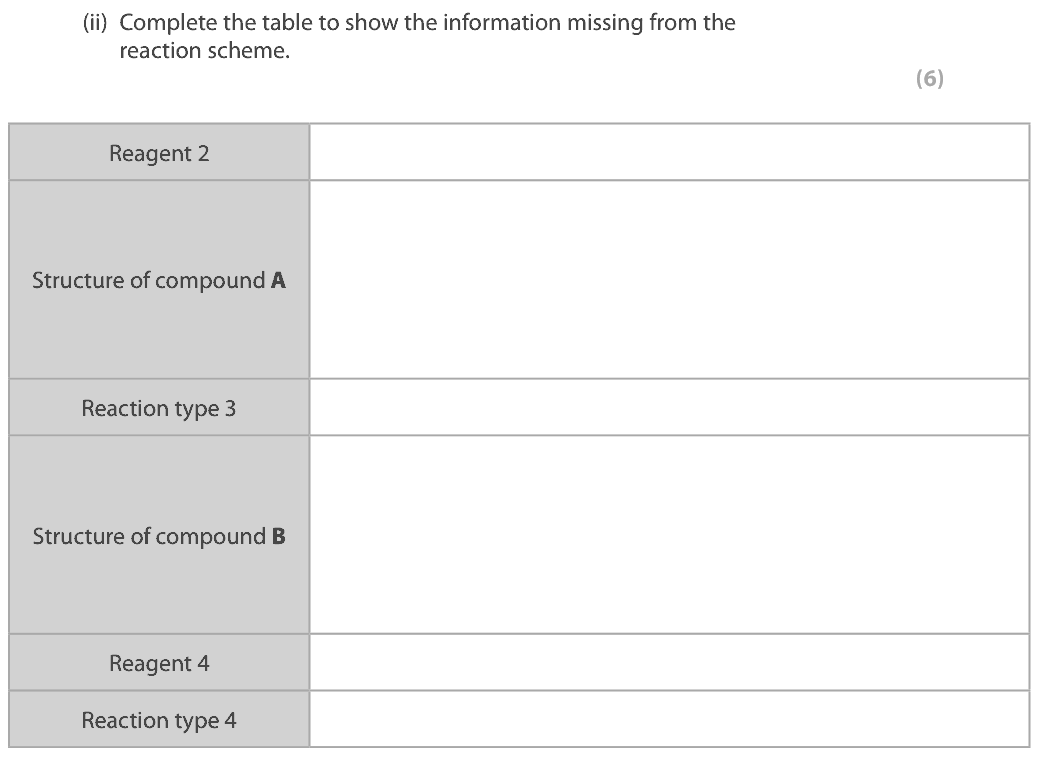
There were many errors in completing the reagents, types of reaction and structures of products in the table. Many candidates had not revised these reactions carefully enough to score high marks. The esterification in Reaction 4 was more familiar to candidates than the hydrolysis in Reaction 4. Many candidates were careless in drawing structures using skeletal formulae. Unless a question specifically asks for a skeletal formula, it is acceptable to use structural or displayed formulae, provided the functional groups are clear. Some candidates included steam with phosphoric acid for reagent 2 and had not looked carefully enough at the reaction scheme to notice that this reaction had been labelled as dehydration. A common incorrect reagent was LiAlH4.
Notes from the mark scheme and report
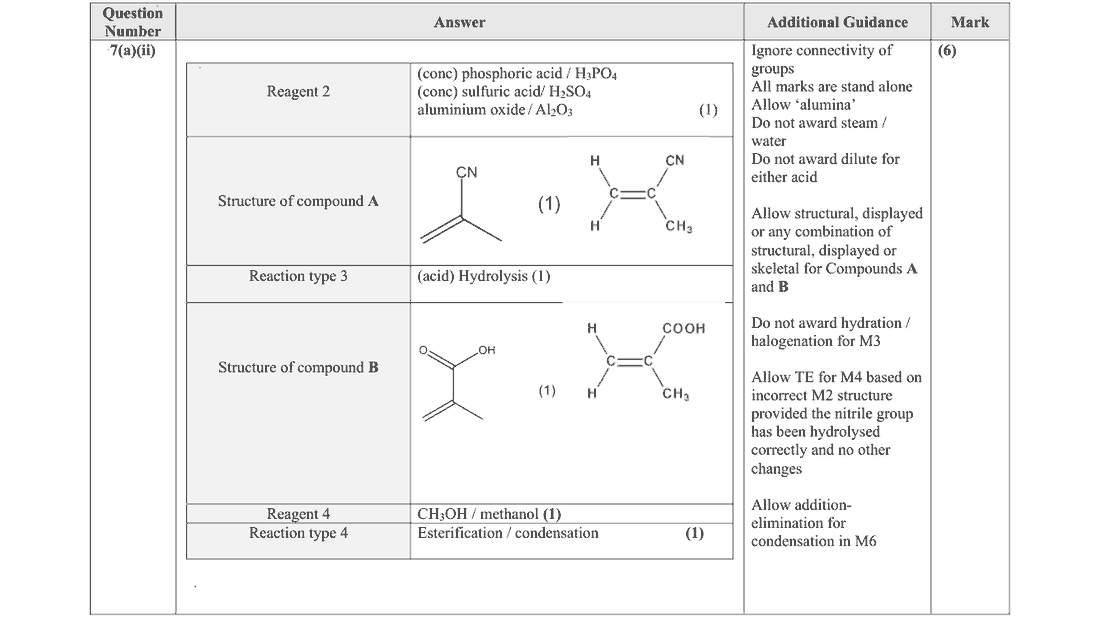
Reagent 2: concentrated phosphoric acid (or concentrated sulfuric acid, or aluminium oxide), not dilute, not steam
compound A: CH2=C(CH3)CN
reaction type 3: (acid) hydrolysis, not hydration
compound B: CH2=C(CH3)COOH
reagent 4: methanol
reaction type 4: esterification / condensation. All marks stand alone. Many errors: careless skeletal formulae
steam added with phosphoric acid
LiAlH4 as a reagent
esterification was better known than the hydrolysis
June 2022 · Paper 3 · Q9(c)3 marksExplanation
Earlier parts of question 9 that this part uses
Mark scheme
Examiner's comment
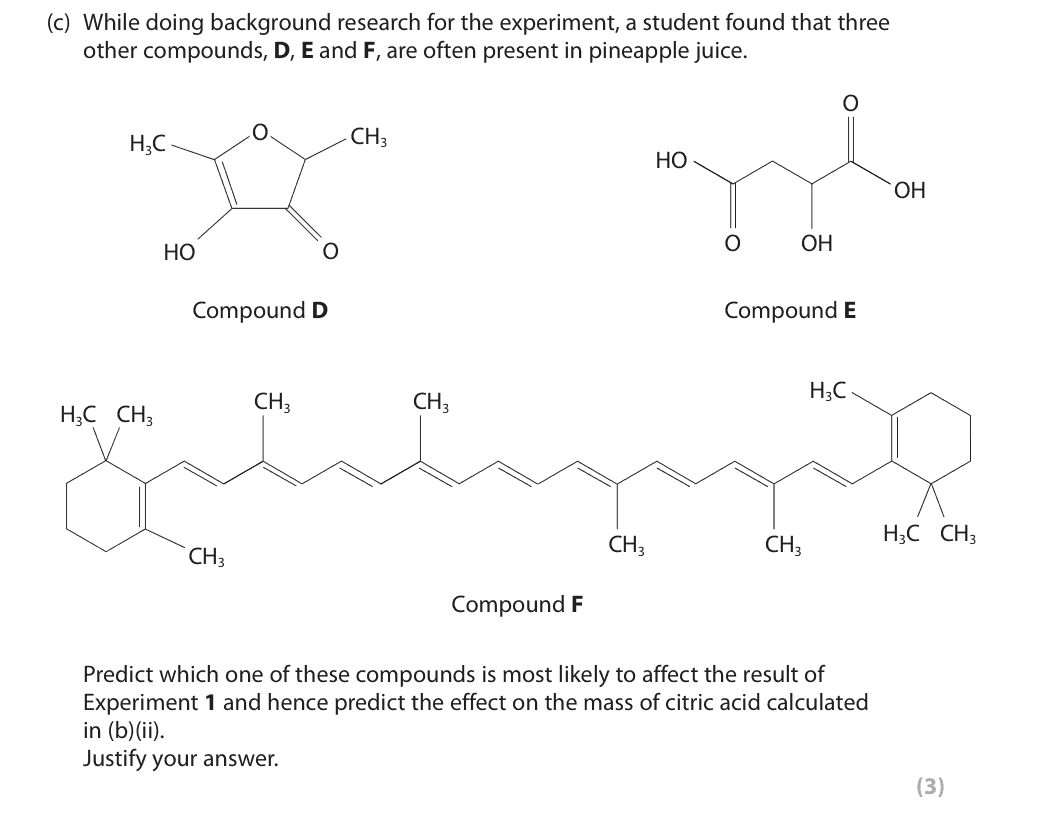
Many candidates realised that compound E contained carboxylic acid groups so it would also react with sodium hydroxide during the titration in Experiment 1 so the final mass of citric acid calculated would be greater than the true amount. Some candidates thought that the OH groups would react with sodium hydroxide.
Notes from the mark scheme and report
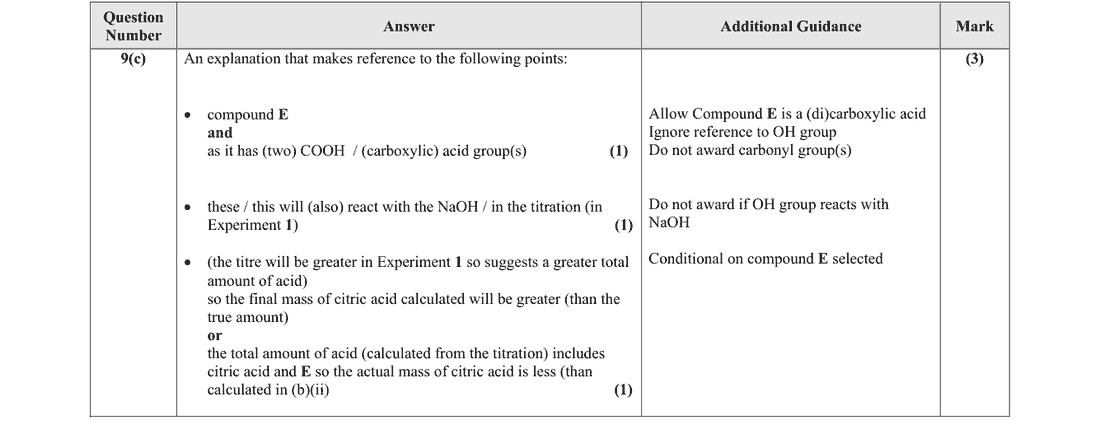
Compound E, because it has (two) carboxylic acid groups
these also react with the sodium hydroxide in Experiment 1
so the total amount of acid is overestimated and the calculated mass of citric acid is greater than the true mass. Not carbonyl groups
no credit if the OH group is said to react with NaOH, which some candidates thought
November 2021 · Paper 2 · Q5(a)2 marksShort answer
Mark scheme
Examiner's comment
In (a) many candidates mistook the ester group for a carbonyl / ketone group, so could only
score a maximum of one mark. Others focused on the left of the structure and omitted the
alkene group. In (b) the hint of ‘a chemical reaction’ seemed to be missed by many, who
framed there response exclusively around the idea of hydrogen bonds with water. Those
candidates who realised a hydrolysis reaction could occur, not all linked it to the ester
functional group. In (c)(i) fractional distillation was correctly suggested by nearly all
candidates. In (b) the majority recognised that X had the ability to form hydrogen bonds, but
some missed out on the first mark as they didn’t link this statement to a structural feature on
compound X. Others, however, made a comparison to the London forces in a similar
hydrocarbon, so were able to access both marks. Despite the stem making it clear the
hydrocarbon had a similar mass and shape to compound X, it was fairly common to see
answers trying make the point that compound X had greater London forces.
Notes from the mark scheme and report
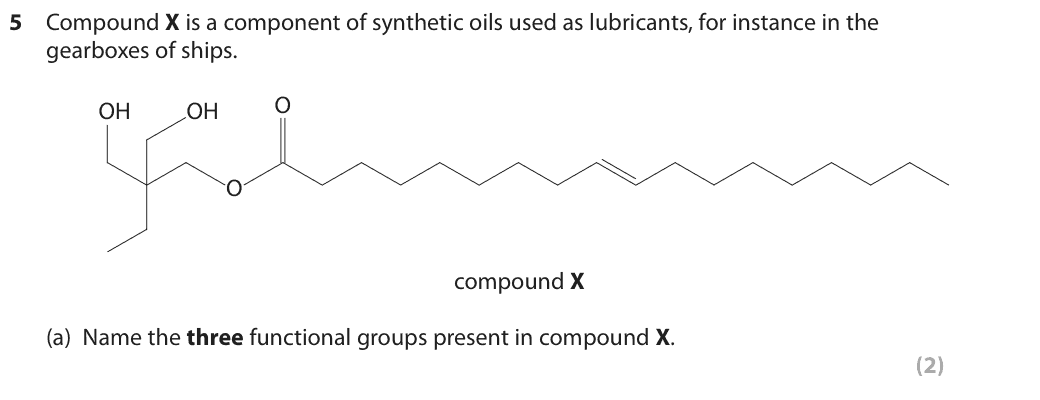
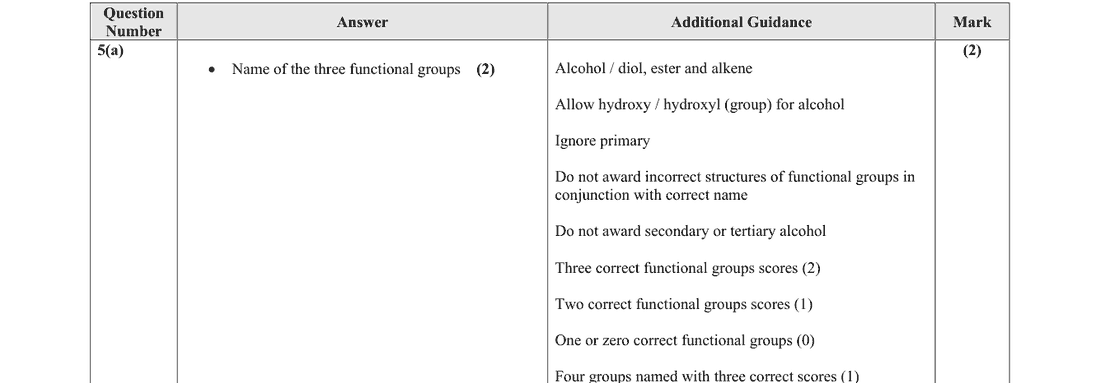
Answer: alcohol (allow hydroxy / hydroxyl or diol), ester and alkene. All three score 2
two score 1
four groups named with three right scores 1. Not secondary or tertiary alcohol. Many took the ester for a ketone / carbonyl
others missed the alkene
November 2021 · Paper 2 · Q5(b)1 markShort answer
Earlier part of question 5 that this part uses
Mark scheme
Examiner's comment
In (a) many candidates mistook the ester group for a carbonyl / ketone group, so could only
score a maximum of one mark. Others focused on the left of the structure and omitted the
alkene group. In (b) the hint of ‘a chemical reaction’ seemed to be missed by many, who
framed there response exclusively around the idea of hydrogen bonds with water. Those
candidates who realised a hydrolysis reaction could occur, not all linked it to the ester
functional group. In (c)(i) fractional distillation was correctly suggested by nearly all
candidates. In (b) the majority recognised that X had the ability to form hydrogen bonds, but
some missed out on the first mark as they didn’t link this statement to a structural feature on
compound X. Others, however, made a comparison to the London forces in a similar
hydrocarbon, so were able to access both marks. Despite the stem making it clear the
hydrocarbon had a similar mass and shape to compound X, it was fairly common to see
answers trying make the point that compound X had greater London forces.
Notes from the mark scheme and report
The ester group reacts with the water / is hydrolysed. Hydrogen bonding between water and the OH groups is ignored. Many missed 'chemical reaction' and wrote only about hydrogen bonds
some who gave hydrolysis did not link it to the ester
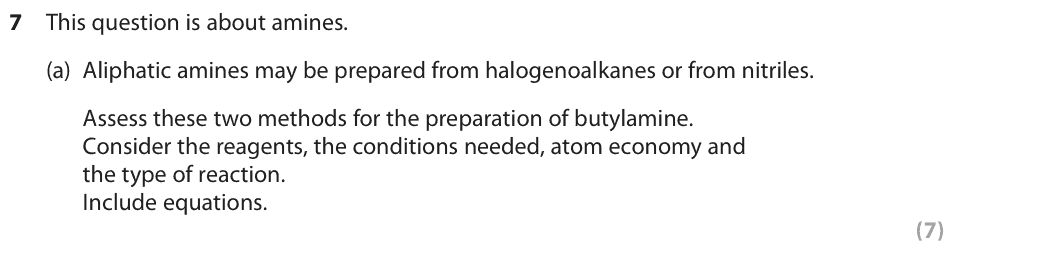
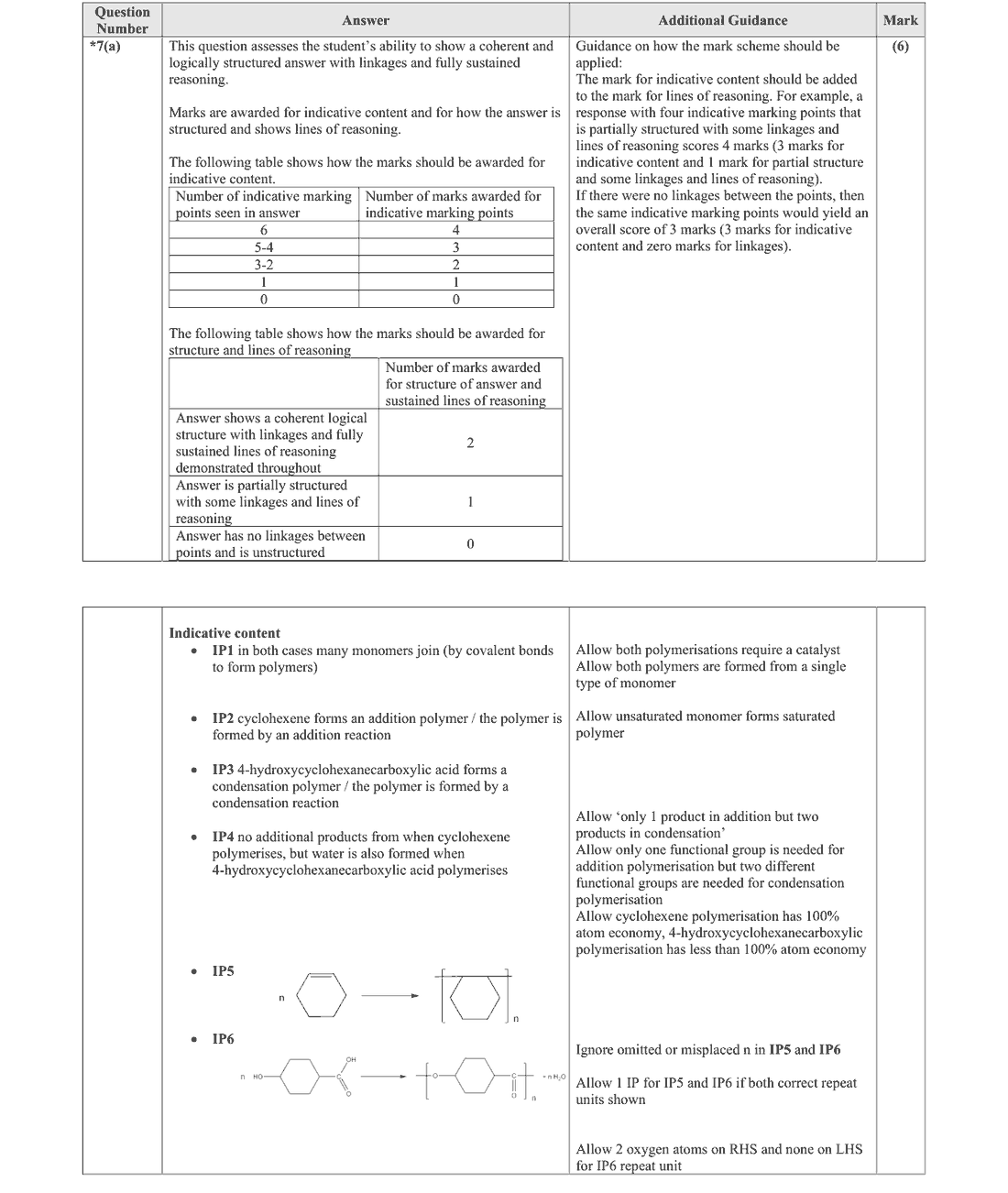
November 2021 · Paper 2 · Q7(a)6 marks6-mark extended response
Mark scheme, with the indicative content and the marks for reasoning
Examiner's comment
Although the monomers may have been unfamiliar to many, the chemistry involved in the
polymerisation reactions in (a) is relatively simple, and consistent with the GCSE specification.
Hence it was disappointing to see many low scores. The most accessible marks were for
linking the monomers to the type of polymerisation. Despite guidance in the stem of the
question, few were able to construct equations for each reaction, though some were able to
give the formulae of the repeat units. The most common error was showing the extension
bonds on poly(cyclohexene) emanating from positions 1 and 4 on the carbon ring. Whilst
many recognised the production of water in the condensation reaction, only a few, as
demanded by the command word, contrasted this with the addition reaction. Most
candidates were able to score at least a mark in (b), nearly always for the idea of recycling
/reusing the polymers. A number framed their answer in the context of how chemists can
limit the problems caused by polymer disposal, rather than the more sustainable use of the
materials, demanded by the question.
Notes from the mark scheme and report
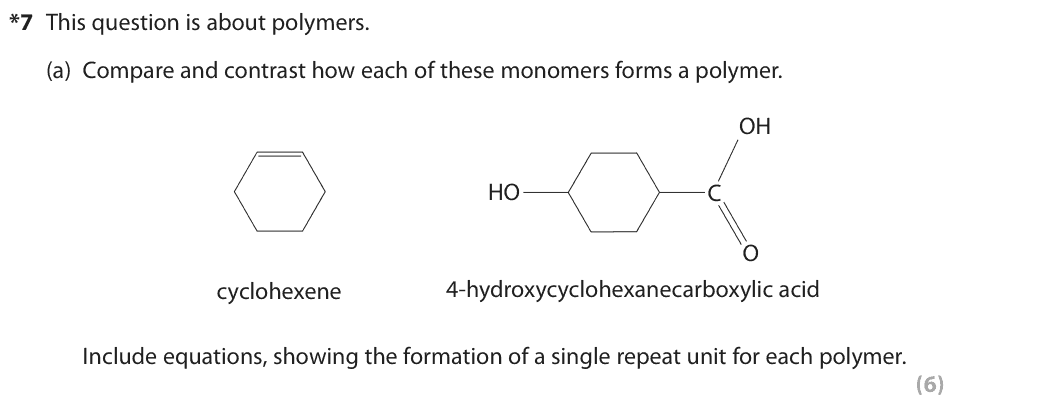
Six indicative points plus two marks for reasoning. IP1 in both, many monomers join to form the polymer
IP2 cyclohexene forms an addition polymer
IP3 4-hydroxycyclohexanecarboxylic acid forms a condensation polymer (polyester)
IP4 no other product from cyclohexene, but water also forms from the hydroxy acid (or one functional group against two different ones
or 100% atom economy against less)
IP5 equation giving the poly(cyclohexene) repeat unit, bonds from adjacent ring carbons
IP6 equation giving the polyester repeat unit –O–C6H10–CO– and water. n is ignored
two correct repeat units without equations score one point. Many low scores: few wrote equations
extension bonds were drawn from ring positions 1 and 4
water was noted but seldom contrasted with addition
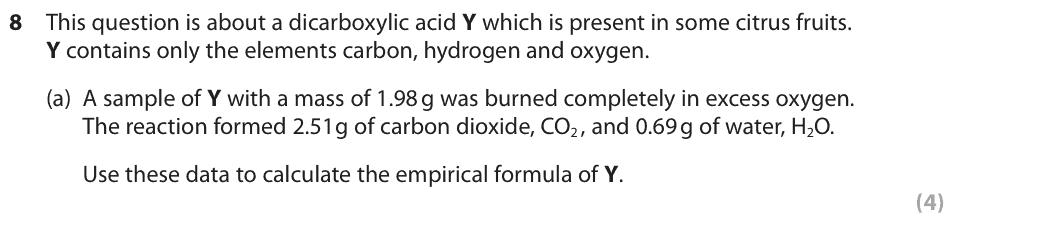
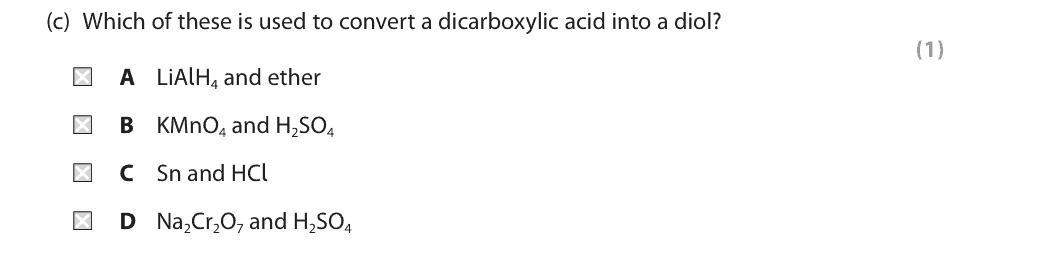
November 2021 · Paper 2 · Q8(c)1 markMultiple choice
Earlier part of question 8 that this part uses
Answer
A
Mark scheme
Examiner's comment
Candidates who approached this question in a systematic, logical fashion by determining the
mass, moles and ratio of the three elements found this problem straightforward. However,
many adopted a ‘scattergun’ approach based on finding the moles of carbon dioxide and
water. Only a few such candidates then managed to determine the moles of carbon and
hydrogen, and then found it difficult to use their work to find the mass or moles of oxygen. A
number confused the mass of oxygen in Y with the mass of molecular oxygen involved in the
combustion of Y.
Some candidates, who perhaps found the unstructured nature of (b) difficult, were able to
look for amounts in moles to calculate, and scored the first mark. Even then, a number of
candidates did not read the stem of the question with enough attention and used an incorrect
volume for the sodium hydroxide solution. Others worked through the calculation with care,
with the most common omission being the realisation that a dicarboxylic acid has a 1:2 ratio
with sodium hydroxide solution, leading to answer of 52 g mol–1. The candidates who could
find the molar mass of Y were often able to propose a correct structure, irrespective of their
answer to (a).
Notes from the mark scheme and report
Answer: A. LiAlH4 in (dry) ether reduces carboxylic acid groups to alcohols. B and D are oxidising agents
Sn and HCl is too mild a reducing agent
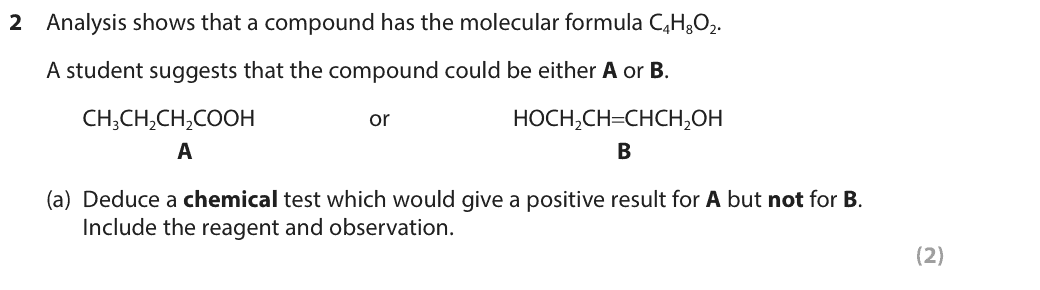
November 2021 · Paper 3 · Q2(a)2 marksPractical and data analysisHard
Mark scheme
Examiner's comment
A low number of candidates knew a chemical test for a carboxylic acid. Some suggested the
use of phosphorus(V) chloride but that would also give a positive result for the OH group in
substance B. The use of an indicator is not classed as a chemical test so was not given full
credit. A larger number of candidates knew how to test for an alkene using bromine water.
The majority of candidates could select the correct wave number ranges from the Data
Booklet for (c). However, some did not read the question carefully and wrote ranges outside
of the 1800-1600 cm−1 range specified.
Notes from the mark scheme and report
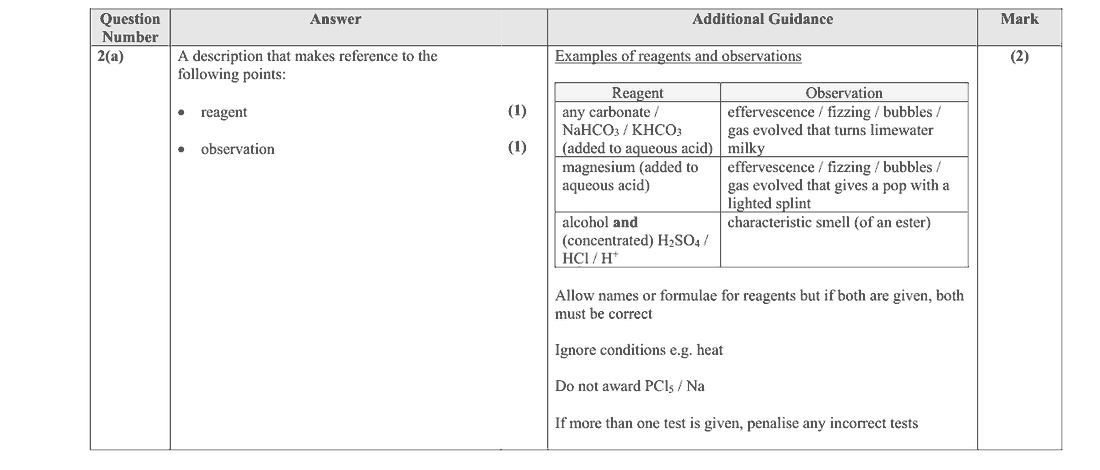
Reagent then observation: any carbonate or hydrogencarbonate, effervescence (gas turns limewater milky)
or magnesium, effervescence (gas pops with a lighted splint)
or an alcohol with concentrated H2SO4, characteristic ester smell. Not PCl5 or sodium, which also react with the OH groups in B
an indicator is not a chemical test. Extra wrong tests are penalised
Skills: PT4 use laboratory apparatus for a variety of experimental techniques, including: titration, using burette and pipette; distillation and heating under reflux, including setting up glassware using retort stand and clamps; qualitative tests for ions and organic functional groups; filtration, including use of fluted filter paper, or filtration under reduced pressure; CP15 Core practical 15: Analysis of some inorganic and organic unknowns
October 2020 · Paper 2 · Q4(a)(i)1 markMultiple choice
Answer
B
Mark scheme
Examiner's comment
It was pleasing to see many candidates scoring high marks for (b). Many candidates gave the
three correct structures for T, U and V and most could explain their reasoning in terms of the
reactions. A common error was to show T as butan-2-ol but to show V as the ester formed
from butan-1-ol. A few candidates thought that butan-1-ol would be oxidised to butanal and
then further oxidised to butanone. Some candidates thought that V was a carboxylic acid.
Notes from the mark scheme and report
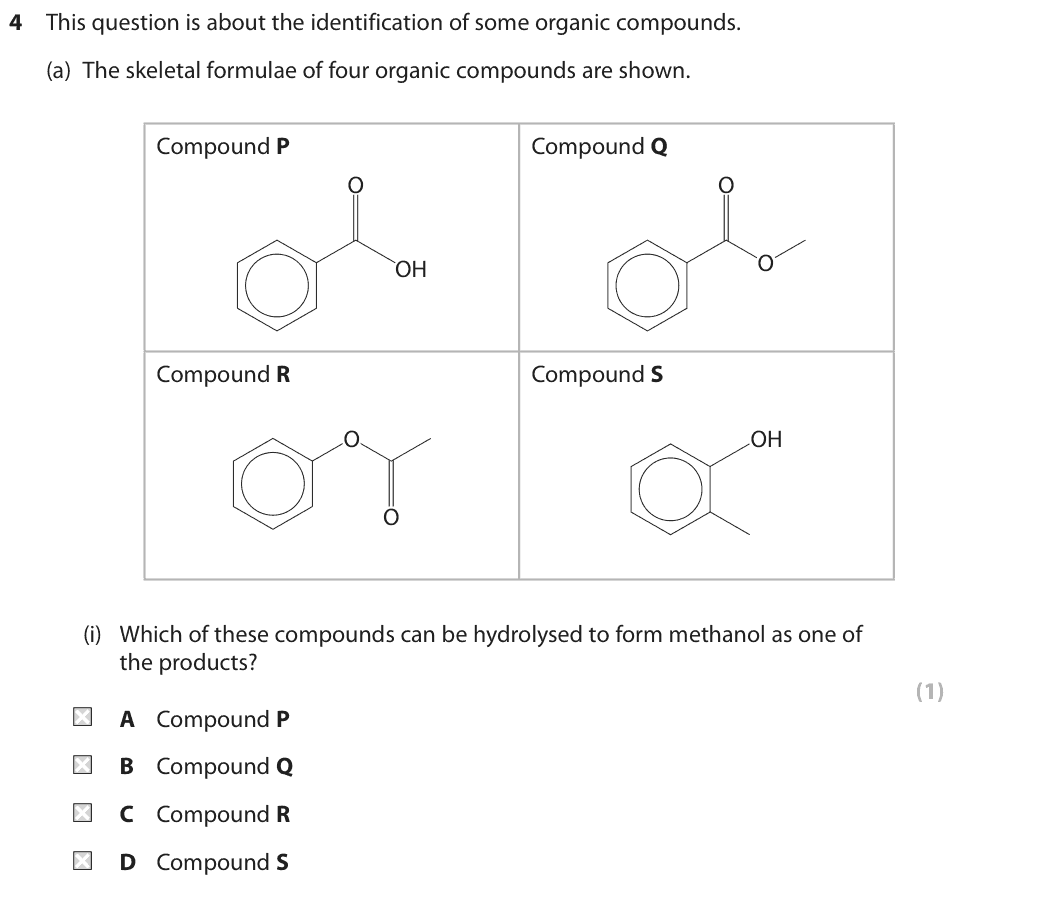
Answer: B (compound Q, methyl benzoate, a methyl ester). P (a carboxylic acid) and S (a phenol) are not hydrolysed
R (phenyl ethanoate) hydrolyses to phenol and ethanoic acid
October 2020 · Paper 2 · Q4(a)(ii)1 markMultiple choice
Earlier part of question 4 that this part uses
Answer
A
Mark scheme
Examiner's comment
It was pleasing to see many candidates scoring high marks for (b). Many candidates gave the
three correct structures for T, U and V and most could explain their reasoning in terms of the
reactions. A common error was to show T as butan-2-ol but to show V as the ester formed
from butan-1-ol. A few candidates thought that butan-1-ol would be oxidised to butanal and
then further oxidised to butanone. Some candidates thought that V was a carboxylic acid.
Notes from the mark scheme and report
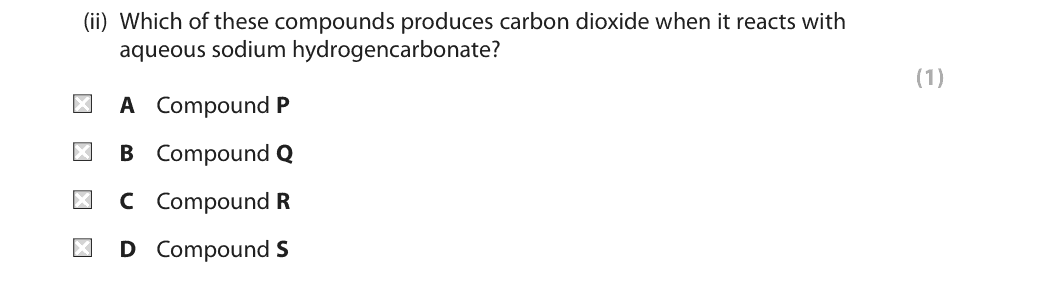
Answer: A (compound P, benzoic acid). Q and R are esters and do not react
S (a phenol) is not acidic enough to react with sodium hydrogencarbonate
October 2020 · Paper 2 · Q4(b)6 marksShort answer
Earlier part of question 4 that this part uses
Mark scheme
Examiner's comment
It was pleasing to see many candidates scoring high marks for (b). Many candidates gave the
three correct structures for T, U and V and most could explain their reasoning in terms of the
reactions. A common error was to show T as butan-2-ol but to show V as the ester formed
from butan-1-ol. A few candidates thought that butan-1-ol would be oxidised to butanal and
then further oxidised to butanone. Some candidates thought that V was a carboxylic acid.
Notes from the mark scheme and report
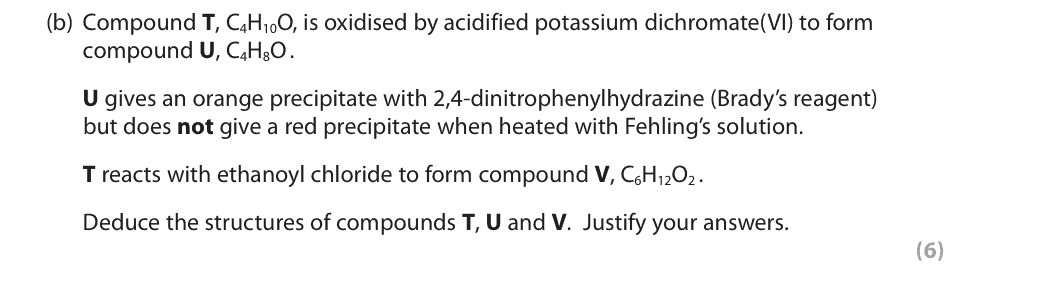
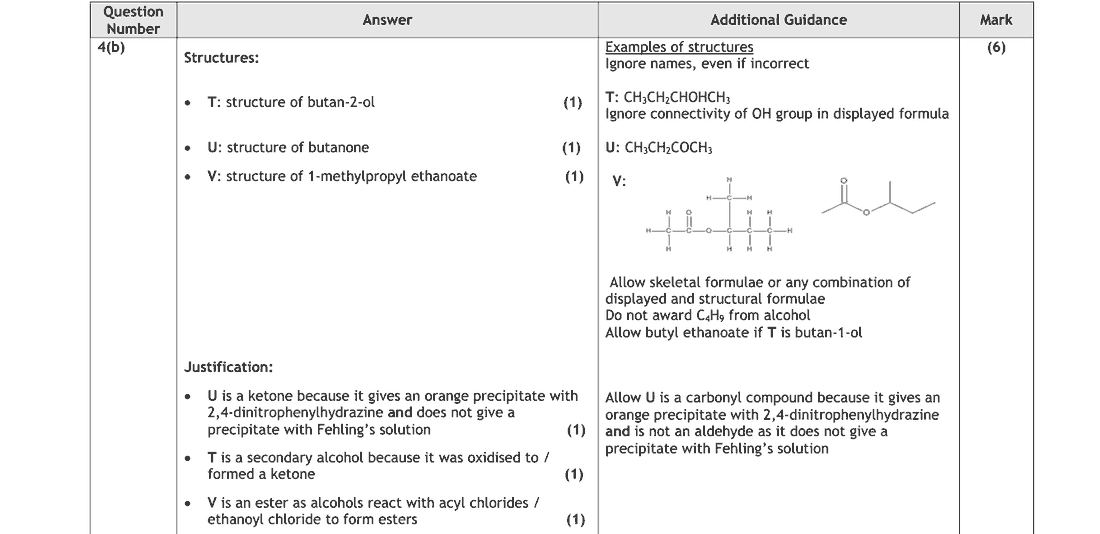
Structures: T is butan-2-ol, CH3CH2CH(OH)CH3
U is butanone, CH3CH2COCH3
V is 1-methylpropyl ethanoate, CH3COOCH(CH3)CH2CH3 (butyl ethanoate allowed if T was butan-1-ol
C4H9 not accepted). Justification: U is a ketone because it gives an orange precipitate with 2,4-dinitrophenylhydrazine but no precipitate with Fehling's solution
T is a secondary alcohol because it is oxidised to a ketone
V is an ester because alcohols react with acyl chlorides to form esters. Common errors: T as butan-2-ol but V drawn from butan-1-ol
butan-1-ol oxidised via butanal to butanone
V as a carboxylic acid
October 2020 · Paper 2 · Q7(a)(iv)1 markShort answer
Earlier part of question 7 that this part uses
Mark scheme
Examiner's comment
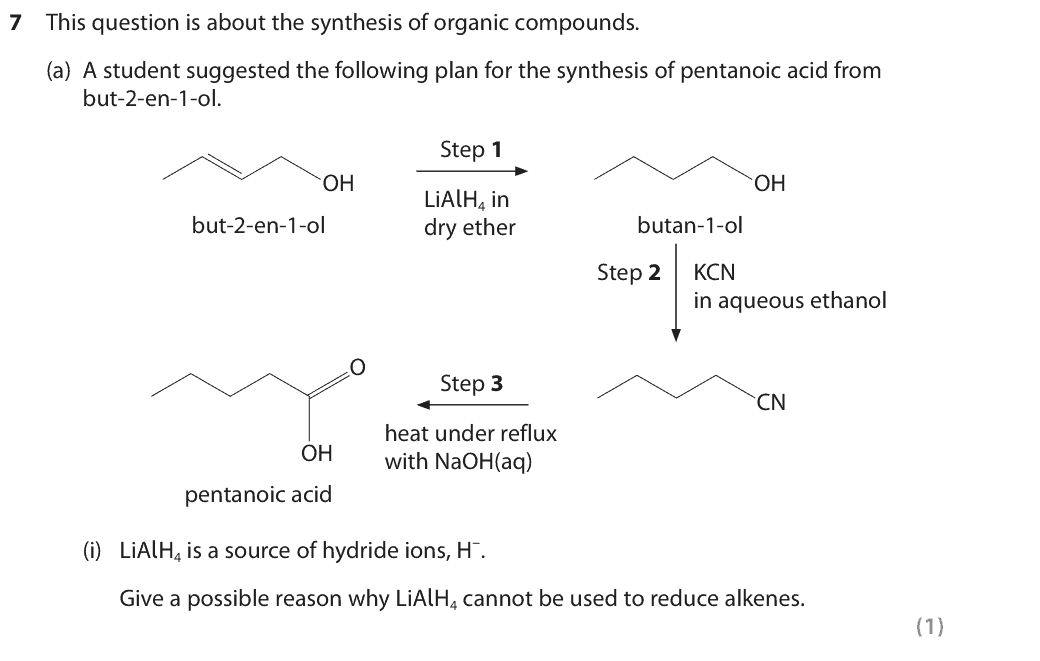
Many candidates realised that hydride ions would be repelled by the high electron density of
the double bond in an alkene or knew that alkenes react by electrophilic addition and hydride
ions are nucleophiles. There were many correct answers giving a suitable reagent and
condition, but some candidates had not learnt the basic reagents and conditions for the
organic chemistry reactions in the specification. Only a minority of candidates knew that
potassium cyanide in ethanol react with halogenoalkanes to form nitriles. Unfortunately a few
candidates lost this mark as they did not give a specific halogenoalkane, for example, 1-
bromobutane. The majority of candidates knew that an acid needs to be added to the salt to
form pentanoic acid. There were many excellent answers to the synthetic route in (b) showing
those students had practised this style of question and they knew the organic chemistry
reactions. Candidates should realise that they need to make a Grignard reagent from a
halogenocompound so should start by forming bromobenzene. Some candidates knew that
they needed benzoic acid to react with phosphorus(V) chloride to form benzoyl chloride and
they received credit for this.
Notes from the mark scheme and report
Answer: hydrochloric acid (any dilute strong acid, H+), to convert the salt into pentanoic acid. Not a weak acid. The majority knew an acid is needed
October 2020 · Paper 2 · Q7(b)7 marksShort answer
Mark scheme
Examiner's comment
Many candidates realised that hydride ions would be repelled by the high electron density of
the double bond in an alkene or knew that alkenes react by electrophilic addition and hydride
ions are nucleophiles. There were many correct answers giving a suitable reagent and
condition, but some candidates had not learnt the basic reagents and conditions for the
organic chemistry reactions in the specification. Only a minority of candidates knew that
potassium cyanide in ethanol react with halogenoalkanes to form nitriles. Unfortunately a few
candidates lost this mark as they did not give a specific halogenoalkane, for example, 1-
bromobutane. The majority of candidates knew that an acid needs to be added to the salt to
form pentanoic acid. There were many excellent answers to the synthetic route in (b) showing
those students had practised this style of question and they knew the organic chemistry
reactions. Candidates should realise that they need to make a Grignard reagent from a
halogenocompound so should start by forming bromobenzene. Some candidates knew that
they needed benzoic acid to react with phosphorus(V) chloride to form benzoyl chloride and
they received credit for this.
Notes from the mark scheme and report
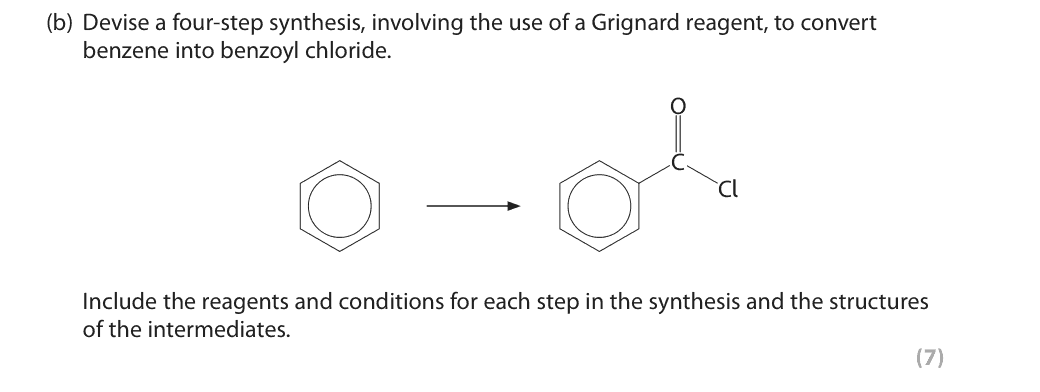
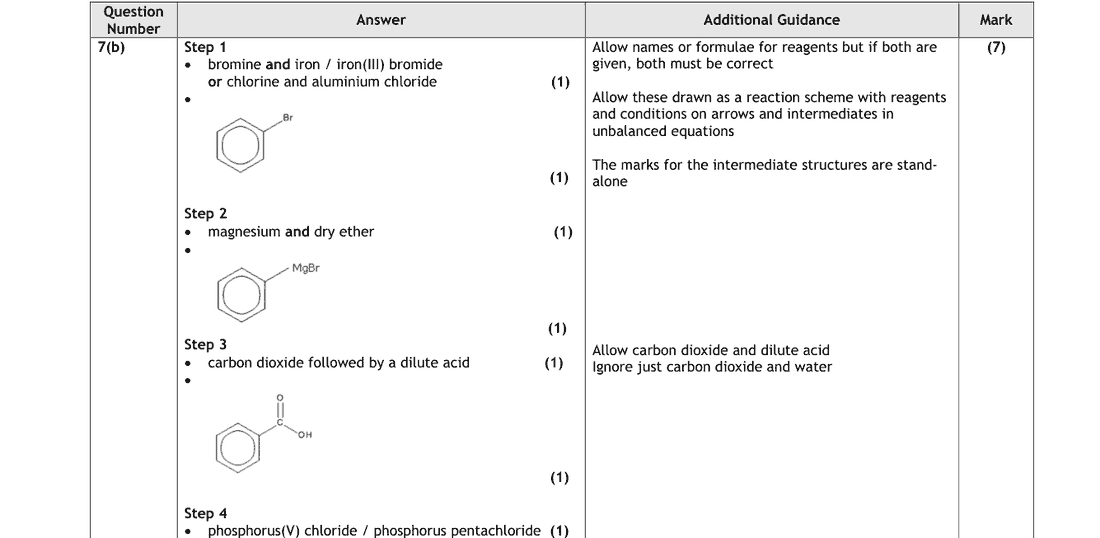
Step 1 bromine with iron / iron(III) bromide (or chlorine with aluminium chloride)
bromobenzene. Step 2 magnesium in dry ether
phenylmagnesium bromide, C6H5MgBr. Step 3 carbon dioxide then dilute acid
benzoic acid. Step 4 phosphorus(V) chloride. One mark for each reagent set and one for each of the three intermediate structures (stand-alone). Just 'carbon dioxide and water' not enough for Step 3. Candidates need to see that a Grignard reagent is made from a halogeno compound, so start by making bromobenzene
some got credit just for benzoic acid with PCl5
October 2020 · Paper 3 · Q5(a)2 marksEquation writing
Mark scheme
Examiner's comment
In (a) more candidates had difficulty with the formula of the sodium benzoate rather than the
inorganic species. At times an oxygen was missing from the benzoate and at other times the
sodium ion was incorrectly shown with a covalent bond to the oxygen.
It was pleasing to see in (b) that most students seemed to have some experience of practical
equipment, although it was not uncommon to see reference to the tap being opened without
the separating funnel being inverted.
The answers seen for parts (d) and (e) revealed a poor understanding of the reasons for these
practical steps which are similar to those in one of the core practicals. Centres are always
encouraged to ensure that their candidates understand the reason for the practical steps that
are taken. Reference to the solvent extraction of the sodium benzoate was needed in (d) and
the protonation of the benzoate ion which resulted in lower solubility in (e).
Likewise centres are advised to practice drawing typical apparatus used with their candidates.
From the diagrams seem it was evident that this is an area which requires more work. The
need for a source of vacuum was the most common mark awarded but very few drew the
perforated base of the Buchner funnel but instead drew perforations in the filter paper.
The calculation in (g) was generally well-answered. The most common error seen was the use
of an incorrect molar mass value. Excessive significant figures were occasionally seen and
must be avoided.
It was pleasing to see the majority of candidates understood that the presence of impurities
lowers the melting temperature of crystals.
Notes from the mark scheme and report
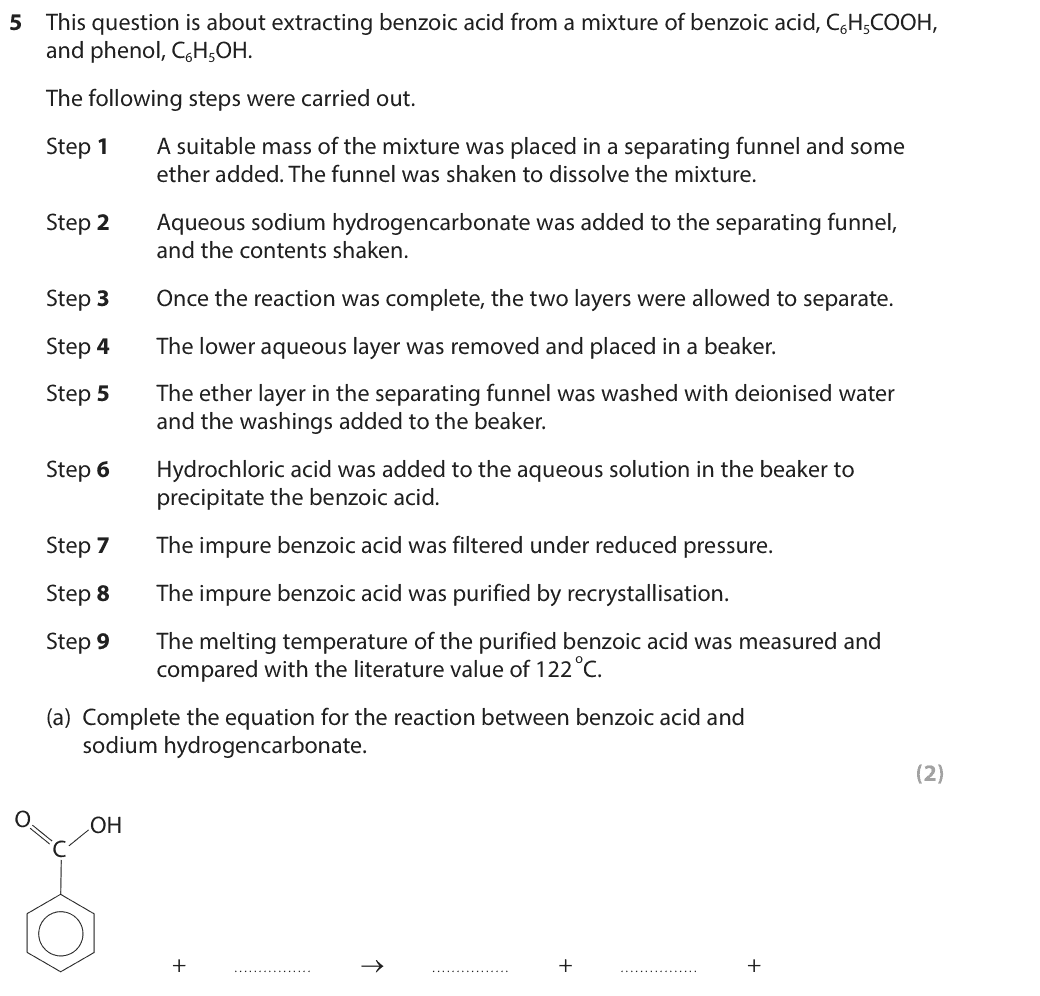
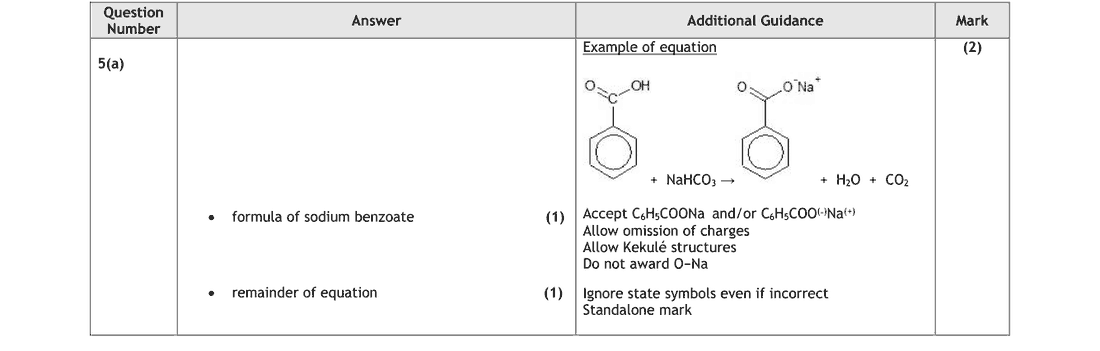
C6H5COOH + NaHCO3 → C6H5COONa + H2O + CO2. One mark for the formula of sodium benzoate (charges may be shown or left out
no covalent O–Na bond)
one stand-alone mark for the rest. The benzoate formula was the harder part: an oxygen missing or a covalent O–Na bond
October 2020 · Paper 3 · Q5(e)2 marksExplanation
Earlier part of question 5 that this part uses
Mark scheme
Examiner's comment
In (a) more candidates had difficulty with the formula of the sodium benzoate rather than the
inorganic species. At times an oxygen was missing from the benzoate and at other times the
sodium ion was incorrectly shown with a covalent bond to the oxygen.
It was pleasing to see in (b) that most students seemed to have some experience of practical
equipment, although it was not uncommon to see reference to the tap being opened without
the separating funnel being inverted.
The answers seen for parts (d) and (e) revealed a poor understanding of the reasons for these
practical steps which are similar to those in one of the core practicals. Centres are always
encouraged to ensure that their candidates understand the reason for the practical steps that
are taken. Reference to the solvent extraction of the sodium benzoate was needed in (d) and
the protonation of the benzoate ion which resulted in lower solubility in (e).
Likewise centres are advised to practice drawing typical apparatus used with their candidates.
From the diagrams seem it was evident that this is an area which requires more work. The
need for a source of vacuum was the most common mark awarded but very few drew the
perforated base of the Buchner funnel but instead drew perforations in the filter paper.
The calculation in (g) was generally well-answered. The most common error seen was the use
of an incorrect molar mass value. Excessive significant figures were occasionally seen and
must be avoided.
It was pleasing to see the majority of candidates understood that the presence of impurities
lowers the melting temperature of crystals.
Notes from the mark scheme and report
The benzoate ion is protonated by the hydrochloric acid (the acid reacts to form benzoic acid)
benzoic acid is less soluble in water than its sodium salt (allow insoluble). The reasons for this step were poorly understood
October 2020 · Paper 3 · Q9(c)2 marksEquation writing
Mark scheme
Examiner's comment
The few correct answers to (a) on the preparation of amines suggests that this is a topic area
not well-studied or understood. Candidates need to remember that ‘compare and contrast’
question need at least one similarity and one difference. The similarity of both reactions being
that of reduction was rarely given and instead vague or feeble answers such as both require
heat were seen.
The comparison of the basicity of the two amines in (b) was answered much better. However
it is worth highlighting that candidates would be well-advised to ensure that when answering
questions of this type that terms such as ‘base’ are clearly stated. The lone pair of electrons on
the nitrogen is the key aspect of this subject and how it is able to form a coordinate bond with
a proton and thus act as a base. Only the better candidates made this clear. It was not
uncommon to see a response where the proton was not mentioned at all.
It is worth reiterating that questions further along in the paper get more demanding. This was
clearly evident in part (c). The equation for the reaction warranted only one mark. Common
errors were the use of molecular formulae and the omission of the product HCl. The name of
the amide was also problematic for all but the more able.
Polymers continue to be challenging for candidates and centres would be helpful to provide
even more practice. The name of the amine monomer given was not always the systematic
name but credit was attempted to be given where it was unambiguous.
Notes from the mark scheme and report
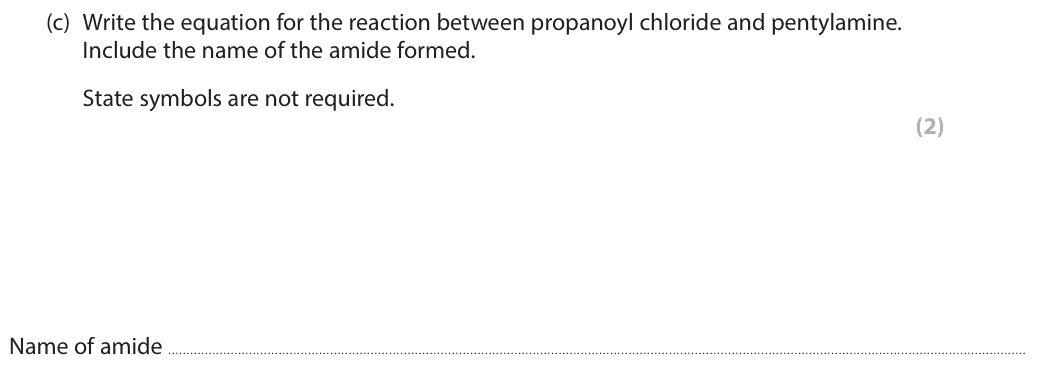
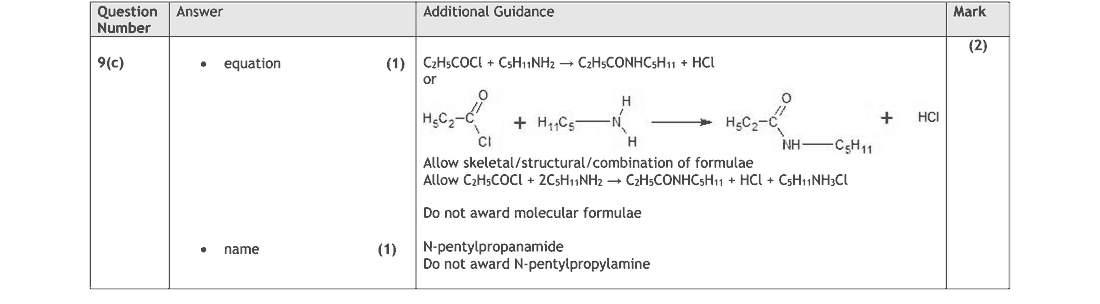
C2H5COCl + C5H11NH2 → C2H5CONHC5H11 + HCl (the version with 2C5H11NH2 giving C5H11NH3Cl is allowed)
name N-pentylpropanamide. Structural or skeletal formulae allowed, molecular formulae not. Common errors: molecular formulae
HCl left out
the name was hard for all but the more able
October 2020 · Paper 3 · Q10(a)(i)4 marksMechanism
Mark scheme
Examiner's comment
The need to add curly arrows in (a)(i) revealed that many candidates have failed to grasp that
these arrows should start from a lone pair of electrons or a covalent bond and show the
movement of an electron pair. The lack of understanding of this crucial key point was most
clearly seen in the first step where the curly arrow was often drawn originating from the
proton instead of the oxygen lone pair. However this did prove to be a most effective
discriminator and enabled those candidates who really understand this topic to score highly.
The justification required in (a)(ii) was often very superficial, such as ‘the oxygen comes from
the ethanol’. This was another question aimed at the more able and this category of
candidates were able to either refer to the nucleophilic action of the ethanol oxygen or that
the carbon-oxygen bond in the carboxylic acid was the one broken.
It may be due to the lengthy nature of paper 3 that many candidates did not progress further
in the entropy calculation of part (a)(iii) beyond the M1 mark. The rearrangement of the Gibbs
Free Energy equation proved beyond many and it was disappointing that the instruction to
include sign and units in the final answer was frequently ignored. Nonetheless there were a
significant number of candidates that scored full marks.
The final question (b) required three differences and so it was not sufficient to simply state
that one reaction for example produced hydrogen chloride. It was necessary for the response
to state that the other reaction, namely with ethanoic acid, produced water and so clearly
state the difference. The hardest of the three marks proved to be that an acid catalyst is
required with ethanoic acid with few candidates going on to state that the reaction with
ethanoyl chloride is faster/does not need heating and so does not need a catalyst.
Notes from the mark scheme and report
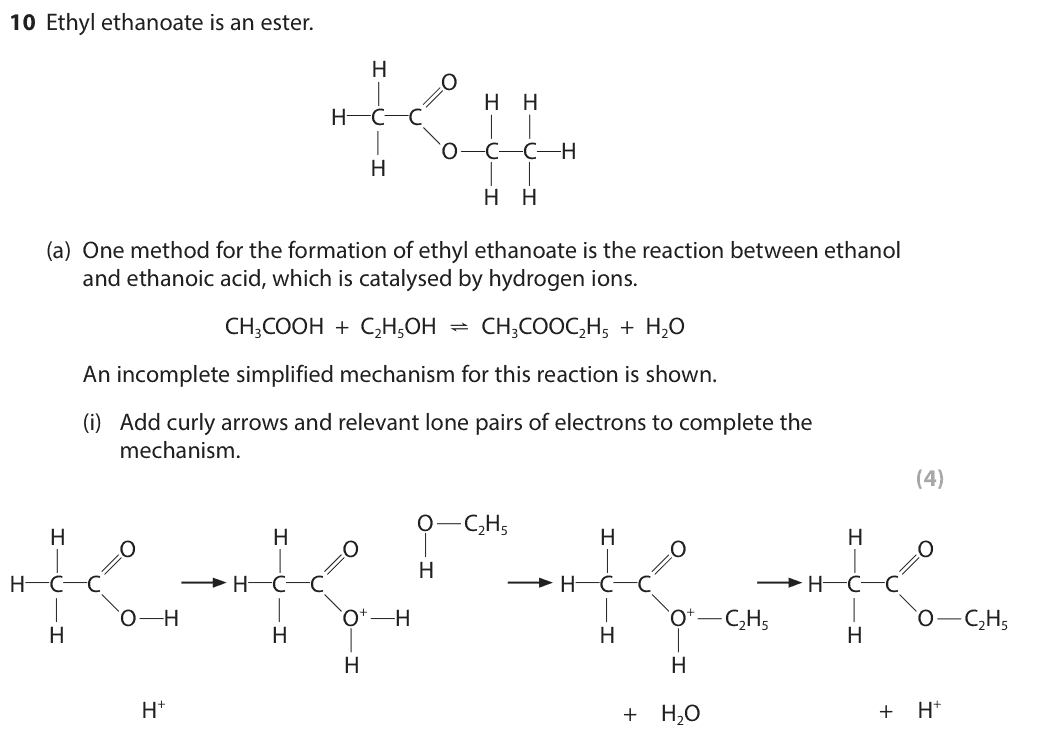
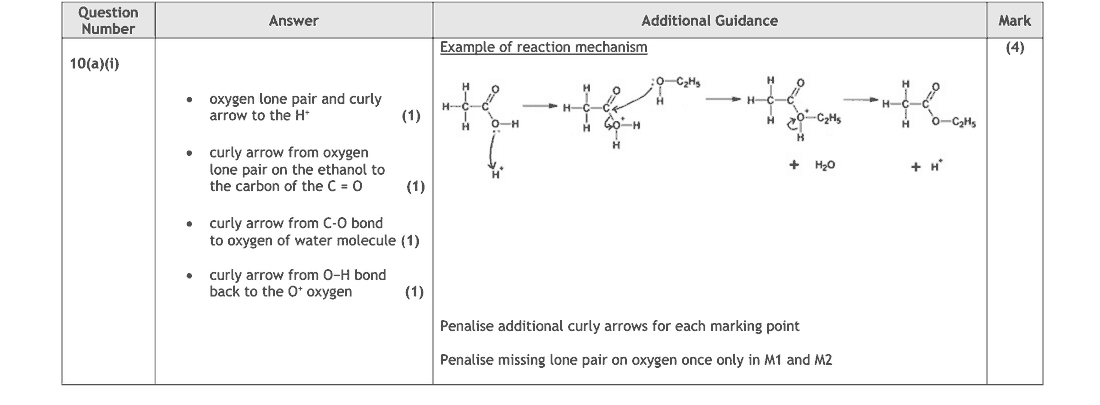
Four curly arrows: from a lone pair on the OH oxygen of the acid to H+
from a lone pair on the ethanol oxygen to the carbon of the C=O group
from the C–O bond to the oxygen that leaves as water
from the O–H bond back to the O+ oxygen. Extra arrows penalised per marking point
a missing lone pair penalised once. The usual error was an arrow starting from the proton instead of from the oxygen lone pair
October 2020 · Paper 3 · Q10(a)(ii)2 marksShort answer
Earlier part of question 10 that this part uses
Mark scheme
Examiner's comment
The need to add curly arrows in (a)(i) revealed that many candidates have failed to grasp that
these arrows should start from a lone pair of electrons or a covalent bond and show the
movement of an electron pair. The lack of understanding of this crucial key point was most
clearly seen in the first step where the curly arrow was often drawn originating from the
proton instead of the oxygen lone pair. However this did prove to be a most effective
discriminator and enabled those candidates who really understand this topic to score highly.
The justification required in (a)(ii) was often very superficial, such as ‘the oxygen comes from
the ethanol’. This was another question aimed at the more able and this category of
candidates were able to either refer to the nucleophilic action of the ethanol oxygen or that
the carbon-oxygen bond in the carboxylic acid was the one broken.
It may be due to the lengthy nature of paper 3 that many candidates did not progress further
in the entropy calculation of part (a)(iii) beyond the M1 mark. The rearrangement of the Gibbs
Free Energy equation proved beyond many and it was disappointing that the instruction to
include sign and units in the final answer was frequently ignored. Nonetheless there were a
significant number of candidates that scored full marks.
The final question (b) required three differences and so it was not sufficient to simply state
that one reaction for example produced hydrogen chloride. It was necessary for the response
to state that the other reaction, namely with ethanoic acid, produced water and so clearly
state the difference. The hardest of the three marks proved to be that an acid catalyst is
required with ethanoic acid with few candidates going on to state that the reaction with
ethanoyl chloride is faster/does not need heating and so does not need a catalyst.
Notes from the mark scheme and report
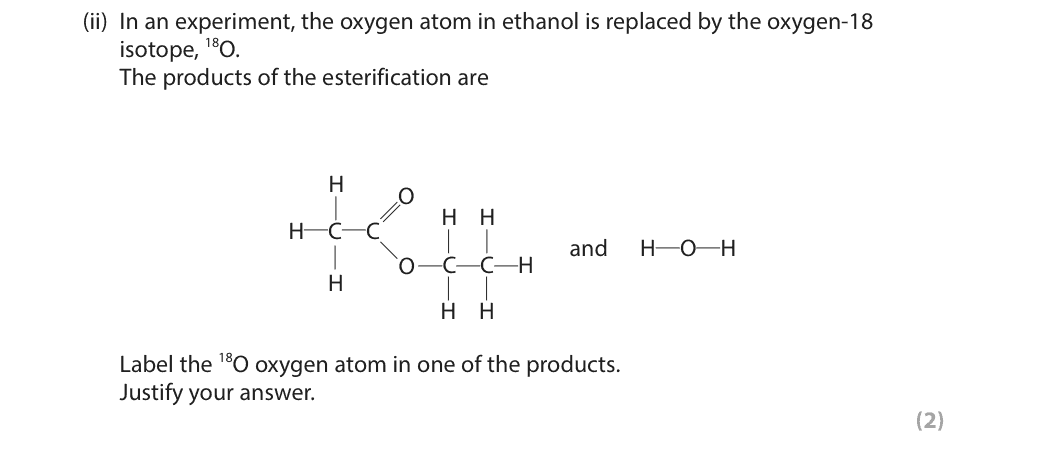
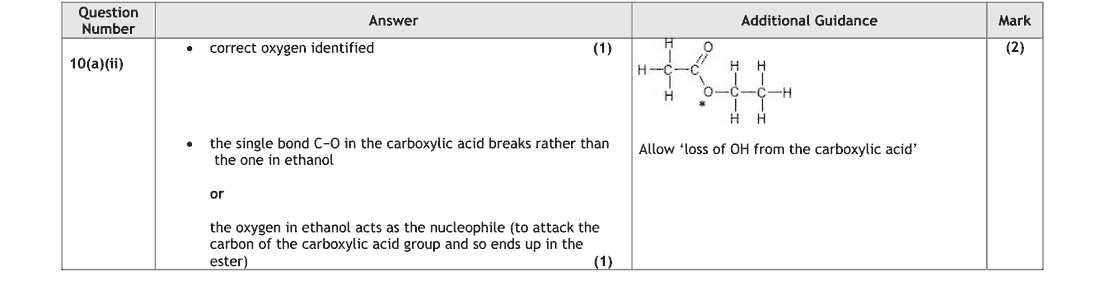
The single-bonded (C–O–C) oxygen of the ester is labelled
because the C–O single bond of the carboxylic acid breaks (the acid loses OH), or because the oxygen of ethanol acts as the nucleophile and ends up in the ester. 'The oxygen comes from the ethanol' was too superficial
October 2020 · Paper 3 · Q10(b)3 marksShort answer
Earlier part of question 10 that this part uses
Mark scheme
Examiner's comment
The need to add curly arrows in (a)(i) revealed that many candidates have failed to grasp that
these arrows should start from a lone pair of electrons or a covalent bond and show the
movement of an electron pair. The lack of understanding of this crucial key point was most
clearly seen in the first step where the curly arrow was often drawn originating from the
proton instead of the oxygen lone pair. However this did prove to be a most effective
discriminator and enabled those candidates who really understand this topic to score highly.
The justification required in (a)(ii) was often very superficial, such as ‘the oxygen comes from
the ethanol’. This was another question aimed at the more able and this category of
candidates were able to either refer to the nucleophilic action of the ethanol oxygen or that
the carbon-oxygen bond in the carboxylic acid was the one broken.
It may be due to the lengthy nature of paper 3 that many candidates did not progress further
in the entropy calculation of part (a)(iii) beyond the M1 mark. The rearrangement of the Gibbs
Free Energy equation proved beyond many and it was disappointing that the instruction to
include sign and units in the final answer was frequently ignored. Nonetheless there were a
significant number of candidates that scored full marks.
The final question (b) required three differences and so it was not sufficient to simply state
that one reaction for example produced hydrogen chloride. It was necessary for the response
to state that the other reaction, namely with ethanoic acid, produced water and so clearly
state the difference. The hardest of the three marks proved to be that an acid catalyst is
required with ethanoic acid with few candidates going on to state that the reaction with
ethanoyl chloride is faster/does not need heating and so does not need a catalyst.
Notes from the mark scheme and report
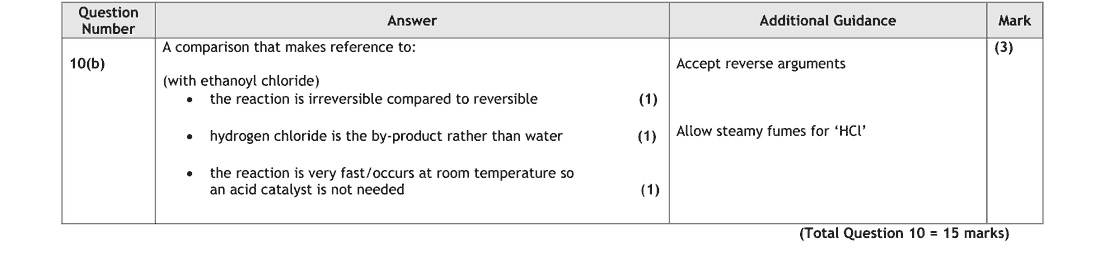
With ethanoyl chloride: the reaction is irreversible (not reversible)
hydrogen chloride (steamy fumes) is the by-product instead of water
the reaction is fast at room temperature so no acid catalyst (or heating) is needed. Each point must state the difference for both reactions. The catalyst point was the hardest
June 2019 · Paper 2 · Q6(c)6 marks6-mark extended response
Earlier part of question 6 that this part uses
Mark scheme, with the indicative content and the marks for reasoning
Examiner's comment
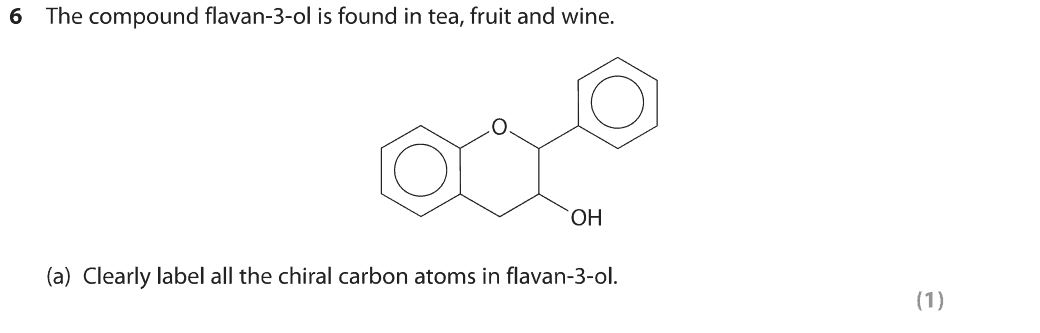
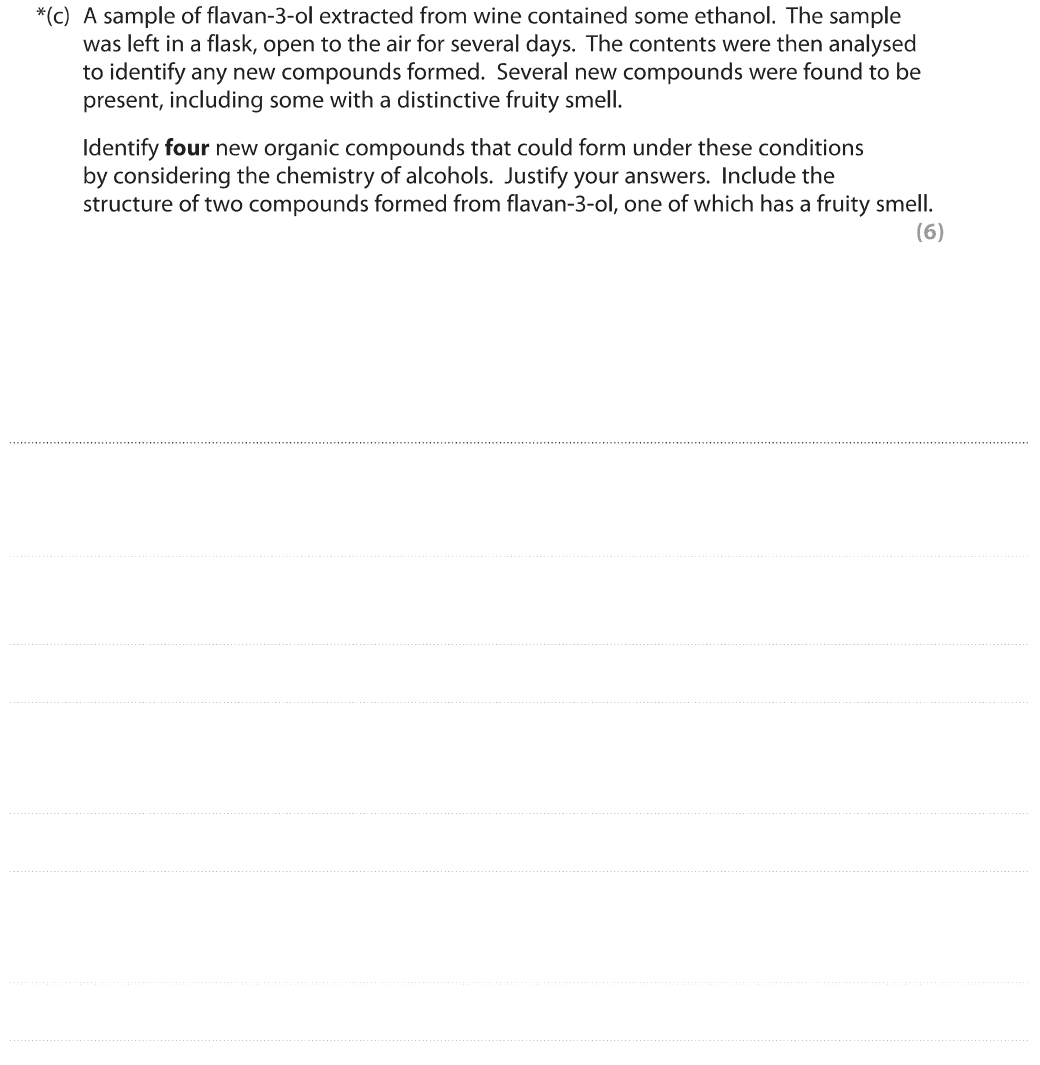
Examiners felt that this was the most discriminatory question on the paper with the full range of marks seen regularly. Weaker candidates tended to either discuss reactions of alcohols in entirely generic terms or scored 1 or 2 marks for discussion of oxidation of the ethanol to either ethanal or ethanoic acid. In the mid-range, oxidation of the flavan-3-ol was more evident, though sometimes the product was described as an aldehyde. Others didn’t realise the -OH group in flavan-3-ol was secondary and insisted it could be oxidised to a carboxylic acid. The use of the term ‘fruity smell’ keyed many candidates into the notion that esters would form, though ethyl ethanoate was seen less frequently than the ester formed from ethanoic acid and flavan-3-ol. Fortunately, most candidates resisted the urge to include significant amounts of additional, potentially incorrect, chemistry. Hence, mistakes tended to prevent the award of marks linked to indicative points rather than lines of reasoning.
Notes from the mark scheme and report
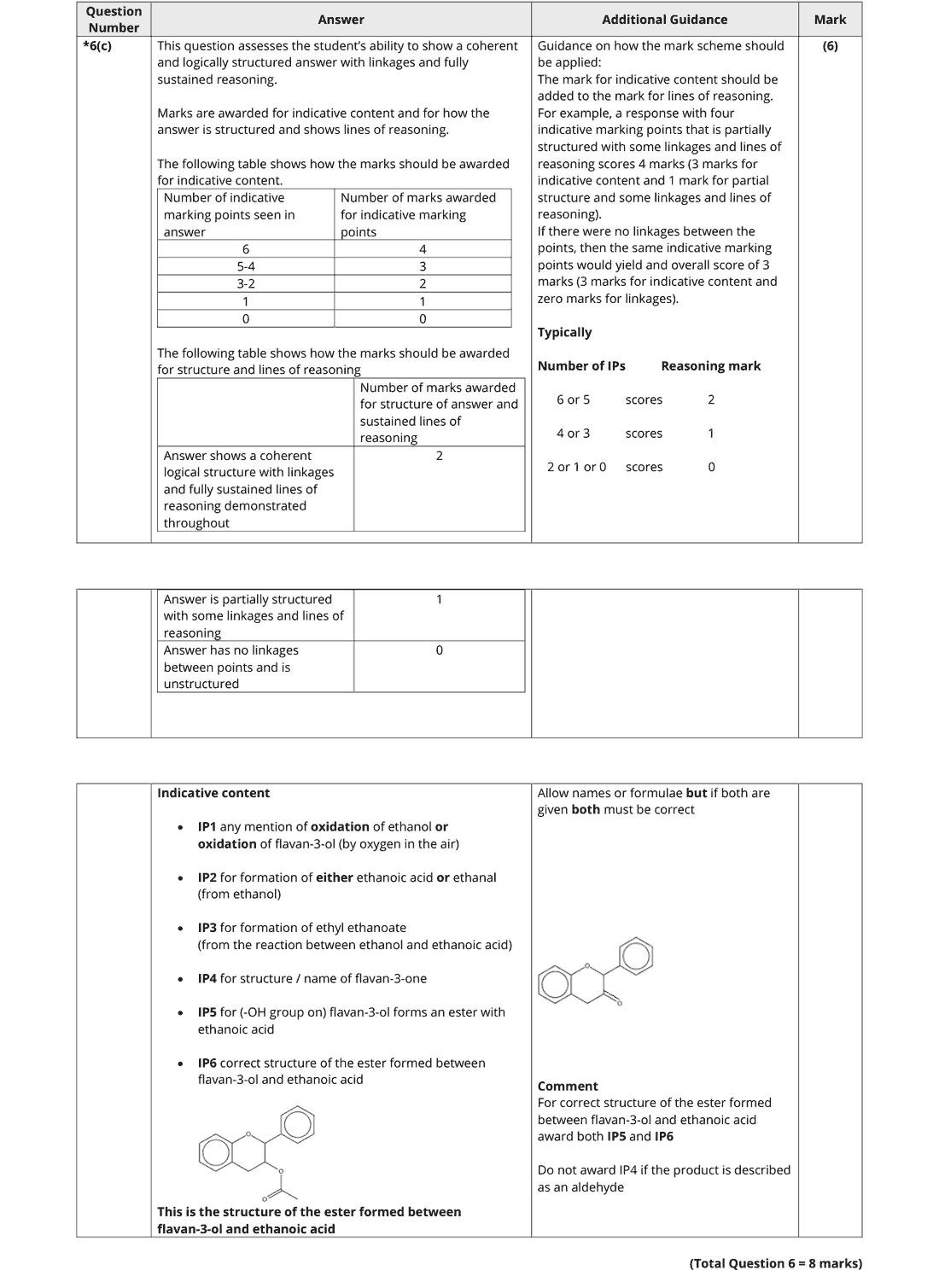
Six indicative points plus two marks for reasoning. IP1 oxidation of ethanol or of flavan-3-ol by oxygen in the air
IP2 ethanal or ethanoic acid formed from ethanol
IP3 ethyl ethanoate from ethanol and ethanoic acid
IP4 structure or name of flavan-3-one (not if called an aldehyde)
IP5 the OH of flavan-3-ol forms an ester with ethanoic acid
IP6 correct structure of that ester (which also earns IP5). Names or formulae allowed, but both must be right if both are given. Called the most discriminating question on the paper. Weaker answers were generic or stopped at oxidising ethanol
some called the ketone an aldehyde or oxidised the secondary OH to a carboxylic acid
ethyl ethanoate was seen less often than the flavan-3-ol ester
June 2019 · Paper 3 · Q3(a)5 marksShort answer
Mark scheme
Examiner's comment
Many candidates realised that propan-1-ol and propanoic acid or propanoyl chloride react together to form propyl propanoate so they were able to devise a correct synthetic pathway. Some candidates lost a mark for converting 1-bromopropane to propan-1-ol as they used ethanolic potassium hydroxide and this would favour the elimination reaction to form prop-1-ene. Some candidates just referred to propanol instead of stating or showing the position of the OH group. Some candidates were careless when drawing structures and it was not unusual to see hydrogen atoms omitted or the OH group incorrectly attached to a carbon atom through the hydrogen atom. Many candidates who made the ester from propanoic acid and propan-1-ol omitted the acid catalyst and some omitted the acid with the dichromate in the oxidation of propan-1-ol. A small number of candidates used a Grignard reagent but that occurs later in the paper and they are told in the question that it is used to add one or more carbon atoms to the compound.
Notes from the mark scheme and report
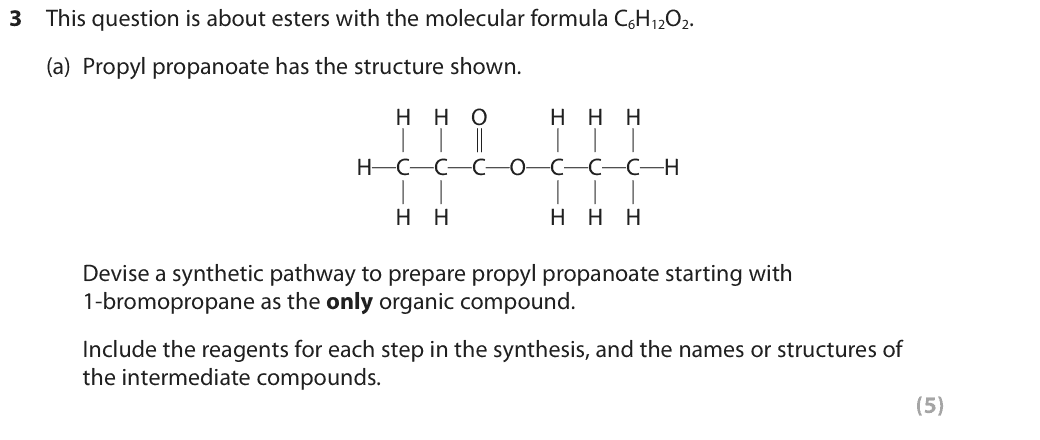
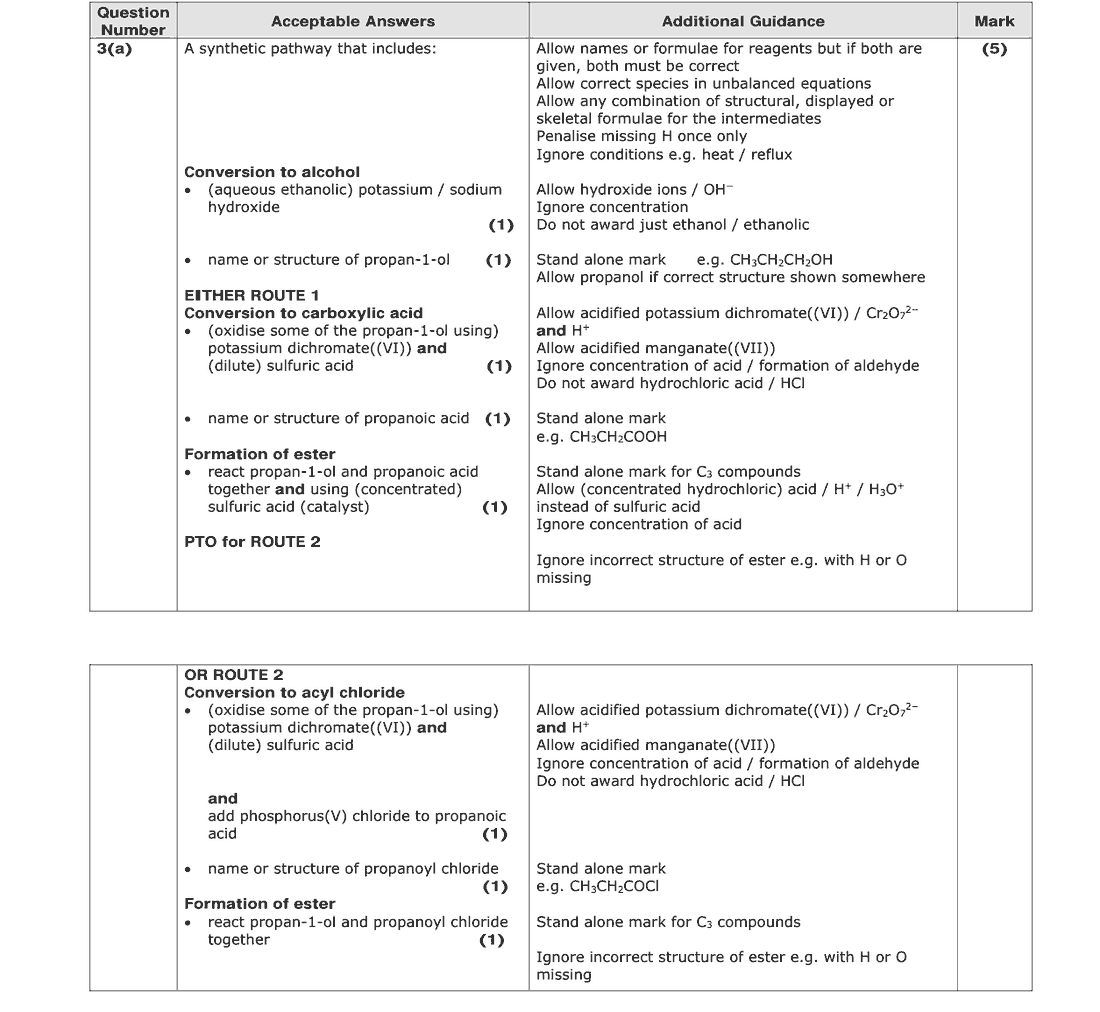
Step 1: aqueous potassium or sodium hydroxide (not ethanolic alone) gives propan-1-ol. Route 1: oxidise some propan-1-ol with potassium dichromate(VI) and dilute sulfuric acid to propanoic acid, then react propan-1-ol with propanoic acid and a (concentrated) sulfuric acid catalyst. Route 2: oxidise as before and add PCl5 to give propanoyl chloride, then react it with propan-1-ol. Marks for reagents and for the named or drawn intermediates (stand-alone). Common losses: ethanolic KOH (favours elimination)
'propanol' with no position
missing H atoms
no acid catalyst for esterification
no acid with the dichromate
June 2019 · Paper 3 · Q3(b)3 marksDiagram or structure
Earlier part of question 3 that this part uses
Mark scheme
Examiner's comment
Many candidates were able to identify the alcohol B as butan-2-ol as only a secondary alcohol can be dehydrated to form but-1-ene and but-2-ene. Other explanations were acceptable for the justification of B but candidates should be encouraged to give clear and concise reasons for their answers. It is helpful if candidates refer to the carbon atoms in molecules using numbers and remember that a double bond is between a pair of carbon atoms so both need numbering. Fewer were able to draw the structure of the ester produced from ethanoic acid and butan-2-ol and many drew the straight chain ester formed from butan-1-ol. Some candidates lost a mark by omitting one or more hydrogen atoms from their structures.
Notes from the mark scheme and report
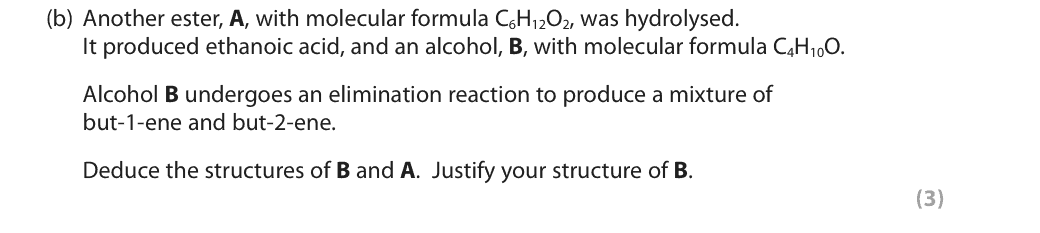
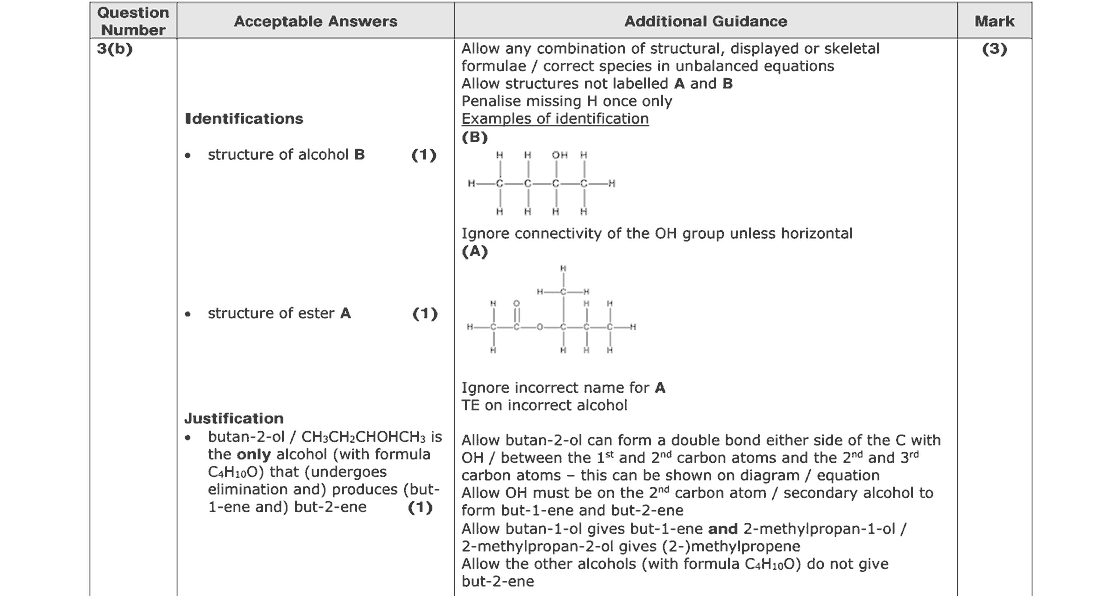
B is butan-2-ol, CH3CH2CH(OH)CH3
A is the ester of ethanoic acid and butan-2-ol, CH3COOCH(CH3)CH2CH3 (error carried forward from a wrong alcohol). Justification: butan-2-ol is the only C4H10O alcohol that eliminates to give but-2-ene as well as but-1-ene (the double bond can form on either side of the carbon carrying OH). Many identified B
fewer drew A correctly, often giving the straight-chain ester from butan-1-ol
H atoms were left off structures
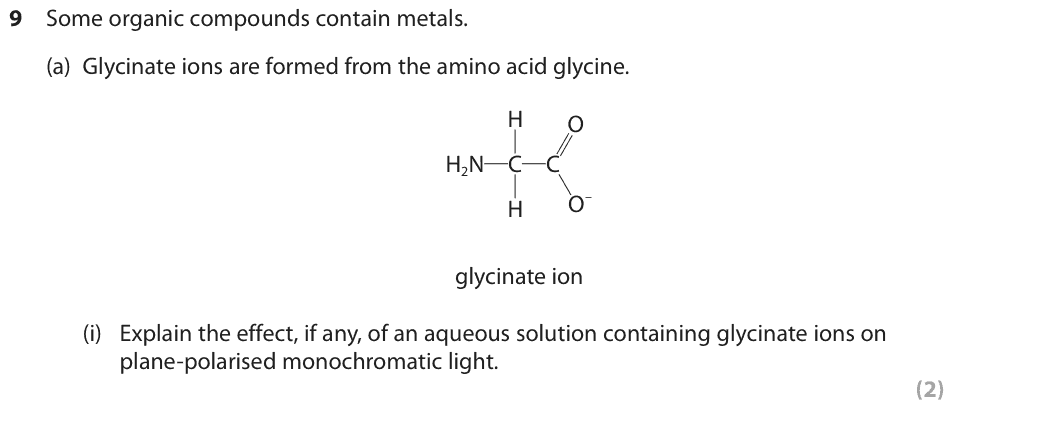
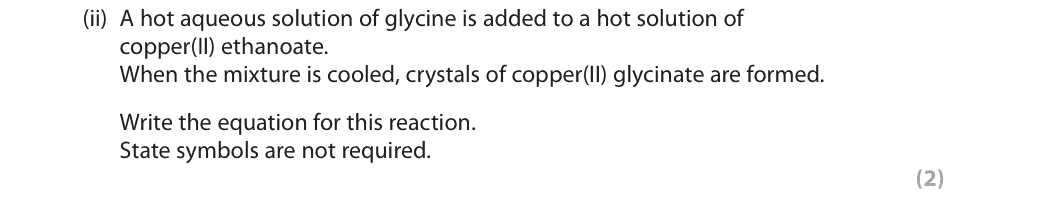
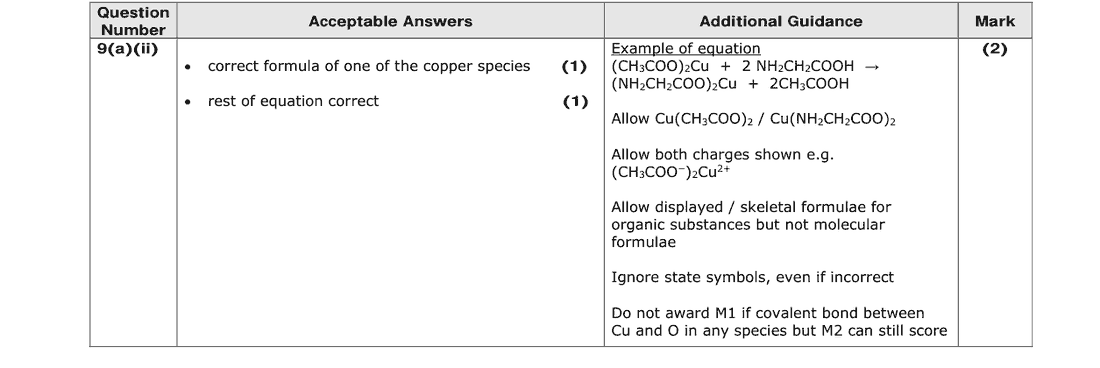
June 2019 · Paper 3 · Q9(a)(ii)2 marksEquation writingHard
Earlier part of question 9 that this part uses
Mark scheme
Examiner's comment
It was disappointing to see that only a minority of candidates could write the correct formula for copper(II) ethanoate or copper(II) glycinate. Most candidates did not realise that as copper has a 2+ charge and the carboxylate ion has a - charge, two carboxylate ions will be needed to balance the charge. Some candidates included the charges and that was acceptable provided both charges were given. A significant minority of candidates showed a covalent bond between the copper and oxygen. Candidates would benefit with more practice in writing the formulae of salts of carboxylic acids.
Notes from the mark scheme and report
(CH3COO)2Cu + 2NH2CH2COOH → (NH2CH2COO)2Cu + 2CH3COOH. One mark for a correct formula of either copper compound, one for the rest. Charges allowed if both are shown
a covalent Cu–O bond loses M1. Most did not see that Cu2+ needs two carboxylate ions
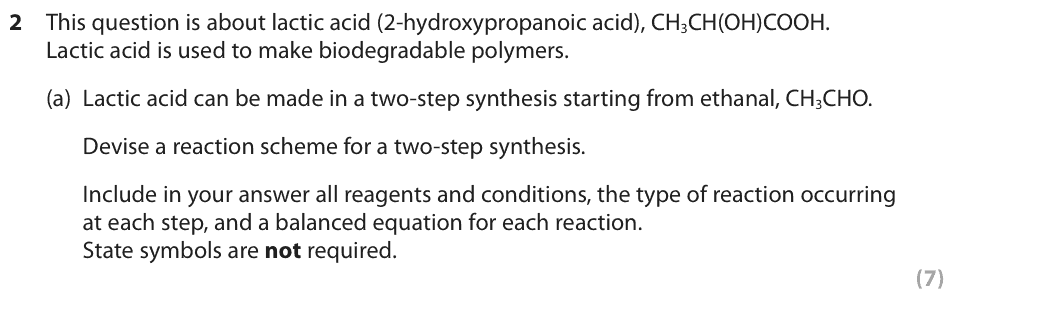
June 2018 · Paper 3 · Q2(a)7 marksShort answer
Mark scheme
Examiner's comment
Nearly all students attempted to outline a synthetic route. However weaker responses got into difficulty at the first stage, either because they tried to synthesise a Grignard reagent from ethanal or they oxidised the ethanal into ethanoic acid. Those who recognised the need to extend the carbon chain via the formation of a hydroxynitrile often went on to successfully suggest how to form lactic acid. Otherwise good answers tended to lose credit by omission of the reaction type. Use of reaction schemes often made it difficult to award the balanced equation marks. The best answers used reaction schemes to highlight reagents and conditions, but then subsequently wrote separate balanced equations for the two reactions.
Notes from the mark scheme and report
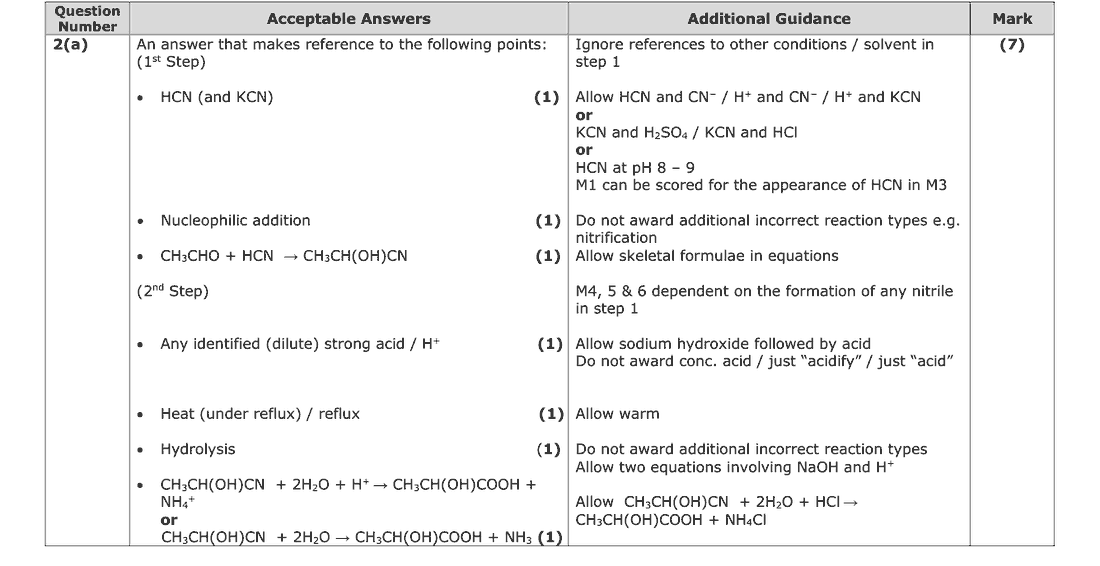
Step 1: HCN (and KCN)
nucleophilic addition
CH3CHO + HCN → CH3CH(OH)CN. Step 2 (marks depend on a nitrile from step 1): a named dilute strong acid or H+ (not concentrated, not just 'acid' or 'acidify')
heat under reflux
hydrolysis
CH3CH(OH)CN + 2H2O + H+ → CH3CH(OH)COOH + NH4+ (or + HCl giving NH4Cl). NaOH followed by acid allowed. Weaker answers tried a Grignard reagent from ethanal or oxidised ethanal to ethanoic acid
reaction types were often left out
reaction schemes made the balanced-equation marks hard to award
June 2018 · Paper 3 · Q2(b)(i)1 markShort answer
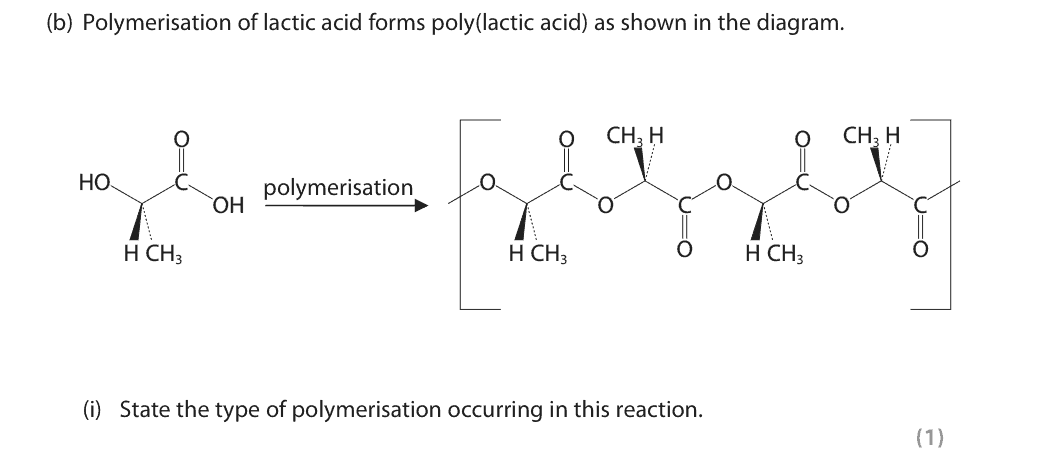
Earlier part of question 2 that this part uses
Mark scheme
Examiner's comment
The majority of candidates realised the type of polymerisation was condensation, though a significant minority suggested addition. Other candidates clouded their answers with additional information, possibly wasting time in the process.
Notes from the mark scheme and report
Answer: condensation (polymerisation). Esterification and addition-elimination are ignored
addition is not awarded and was the usual wrong answer
June 2018 · Paper 3 · Q2(b)(ii)1 markDiagram or structure
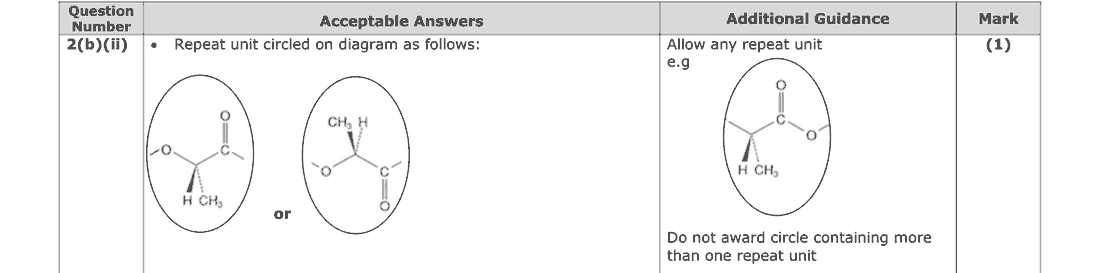
Earlier parts of question 2 that this part uses
Mark scheme
Examiner's comment
Over 60% of candidates could circle a repeat unit of the polymer. Those who did not score generally included three oxygen atoms in their responses. Others circled a section of the polymer covering more than one repeat unit.
Notes from the mark scheme and report
Circle around one repeat unit, –O–CH(CH3)–CO– (any single repeat unit along the chain is allowed). Not a circle holding more than one repeat unit. Common errors: including three oxygen atoms
circling more than one repeat unit
June 2018 · Paper 3 · Q6(d)(i)2 marksEquation writing
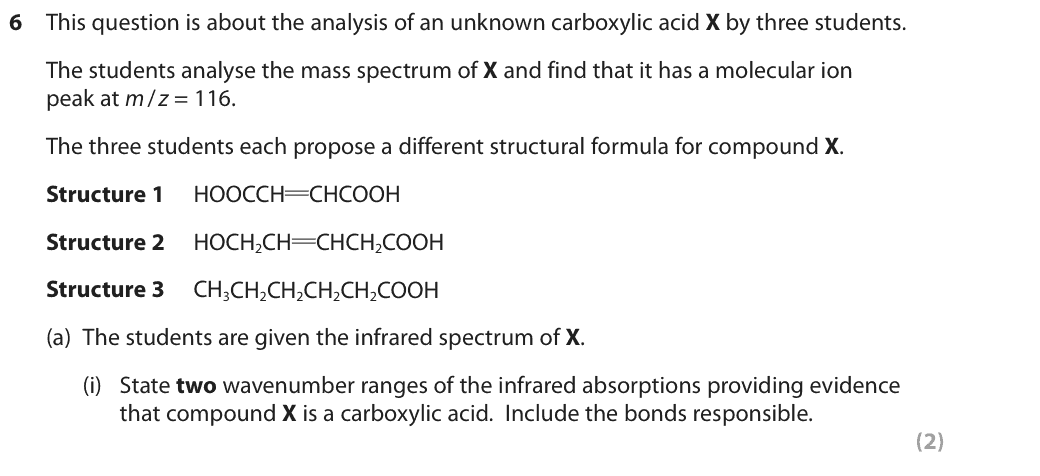
Earlier part of question 6 that this part uses
Mark scheme
Examiner's comment
An equation for a simple acid-base reaction proved quite challenging for around 50% of candidates. A common error was to fail to transcribe the formula of structure 1 correctly from the question, normally by omitting a carbon atom. Other mistakes included treating the acid as monoprotic, and in some cases not realising the products would simply be a salt and water.
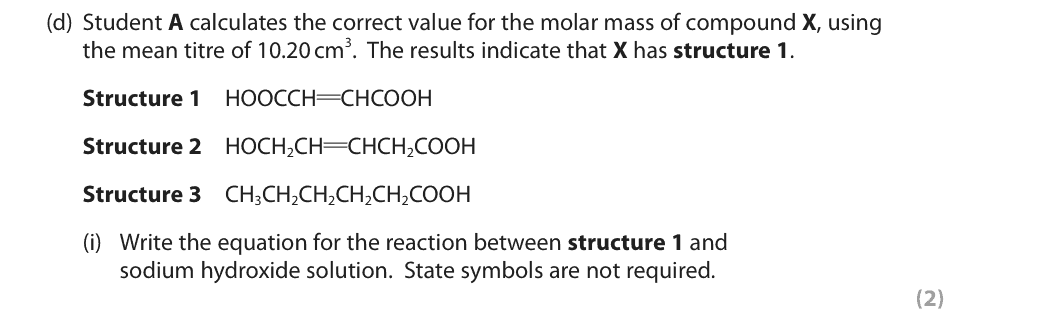
Notes from the mark scheme and report
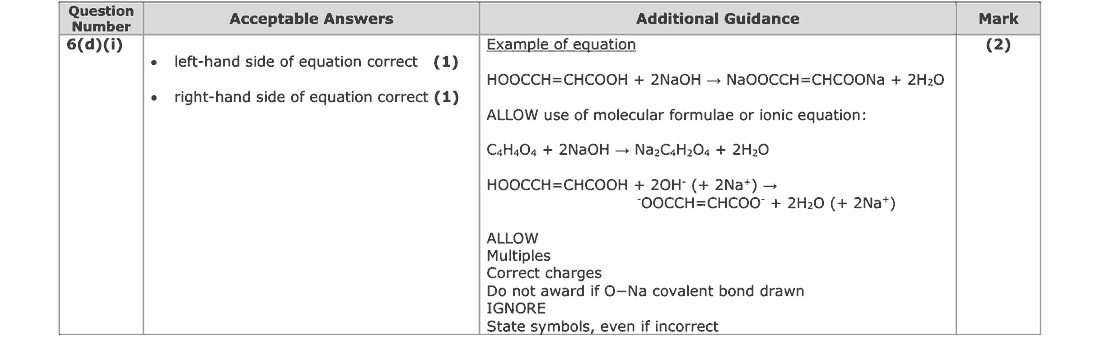
HOOCCH=CHCOOH + 2NaOH → NaOOCCH=CHCOONa + 2H2O
one mark for each side. Molecular formulae or the ionic equation allowed
no covalent O–Na bond. Common errors: miscopying the formula (a carbon left out)
treating the acid as monoprotic
products other than a salt and water
June 2018 · Paper 3 · Q6(d)(ii)2 marksShort answer
Earlier parts of question 6 that this part uses
Mark scheme
Examiner's comment
Over 50% of candidates realised that the reaction with structure 2 would only involve 1 carboxyl group, but less than 20% realised this would double the titre. By far the most common value suggested was 5.1 cm3. This suggests, as in part (c)(i), that a number believed the acid to be in the conical flask, with the sodium hydroxide solution in the burette. A smaller number stated that the volume would be unchanged, either because both structures had the same molar mass, or because they believed that the hydroxyl group in structure 2 would behave in the same way as the carboxyl group.
Notes from the mark scheme and report
Answer: 20.40 cm3 (double the original titre). Structure 2 has one COOH group so reacts 1:1 with NaOH. Marked independently. By far the most common wrong value was 5.1 cm3 (as if the acid were in the flask)
some said the titre was unchanged because the molar mass is the same or the OH group also reacts
Skills: MS0.2 Use ratios, fractions and percentages
June 2018 · Paper 3 · Q8(a)1 markShort answer
Mark scheme
Examiner's comment
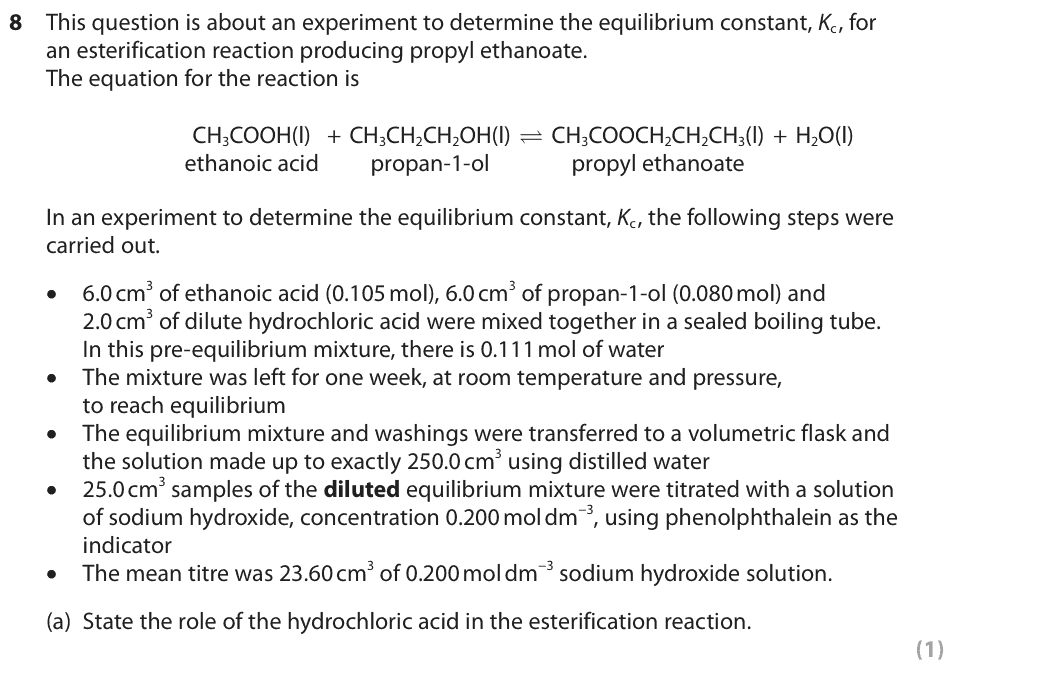
Over 70% of candidates appreciated the catalytic role of the acid in the esterification reaction. Those who didn’t score nearly always stated its presence was solely to make the mixture acidic.
Notes from the mark scheme and report
Catalyst (speeds up the reaction or the attainment of equilibrium
lowers the activation energy). Those who missed the mark nearly always said it was only there to make the mixture acidic
June 2017 · Paper 3 · Q3(b)3 marksDiagram or structure
Earlier part of question 3 that this part uses
Mark scheme
Examiner's comment
This question differentiated reasonably effectively. In weaker responses, candidates could often draw the correct structure in alkaline conditions, but could not draw the ester. However, the protonation of both amine groups was often absent in the second structure, even for stronger candidates. This did not seem to be because they did not appreciate the possible reaction, as often one of the amine groups was protonated.
Notes from the mark scheme and report
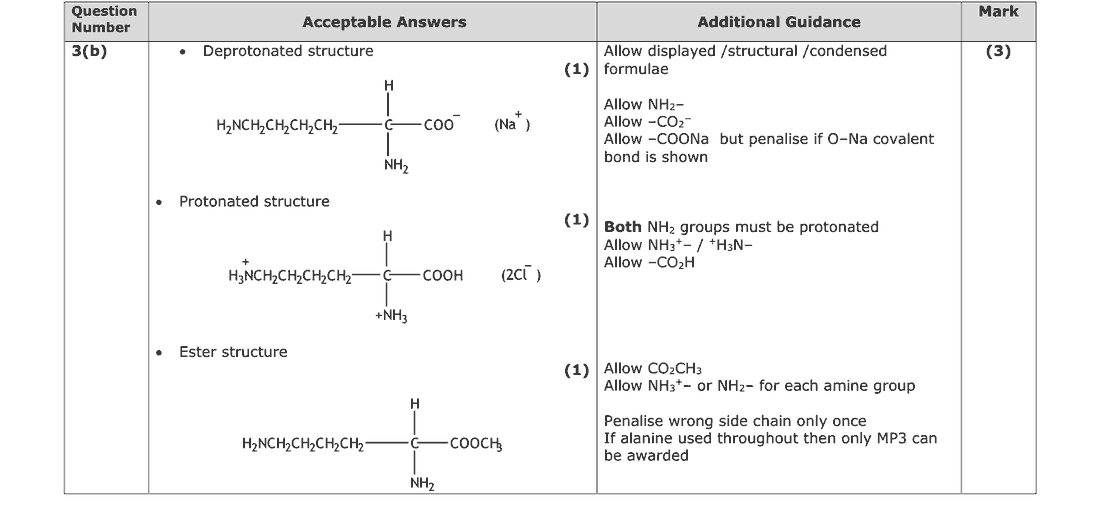
NaOH(aq): H2N(CH2)4CH(NH2)COO– (Na+)
–COONa allowed but not a covalent O–Na bond. Excess HCl(aq): +H3N(CH2)4CH(NH3+)COOH, both amine groups protonated. Methanol / concentrated H2SO4: the methyl ester H2N(CH2)4CH(NH2)COOCH3 (amine groups may be NH2 or NH3+). Wrong side chain penalised once
if alanine is used throughout only the ester mark is available. The carboxylate was the easiest
protonating both amine groups was often missed, even by stronger candidates
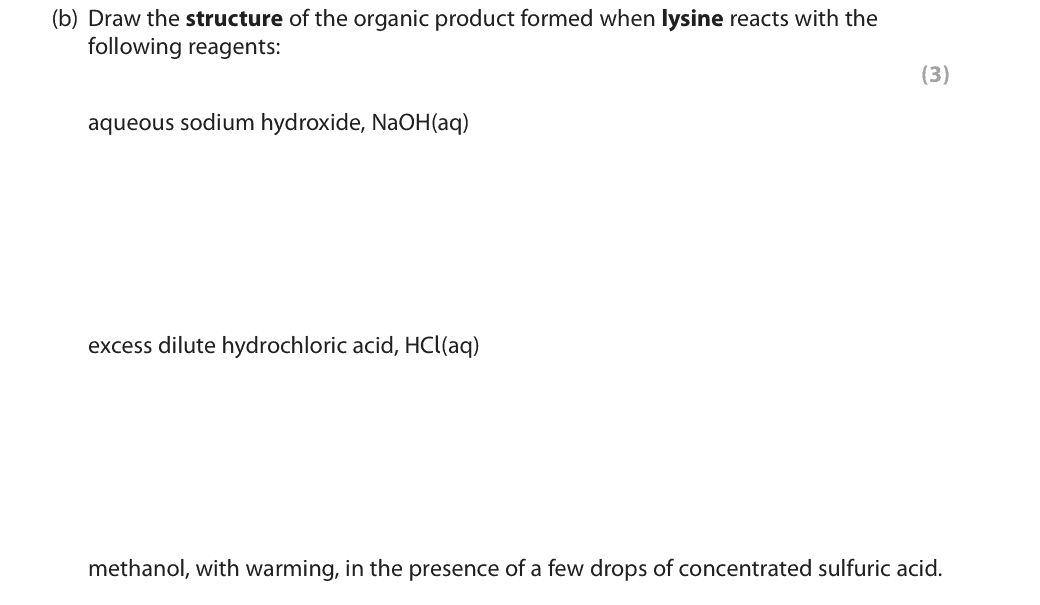
weaker answers could not draw the ester
June 2017 · Paper 3 · Q8(b)3 marksMechanismHard
Earlier part of question 8 that this part uses
Mark scheme
Examiner's comment
Candidates struggled to apply their knowledge of nucleophilic addition in this question, and most who gained some credit did so by attempting to use a nucleophilic substation mechanism as in part (a).
Notes from the mark scheme and report
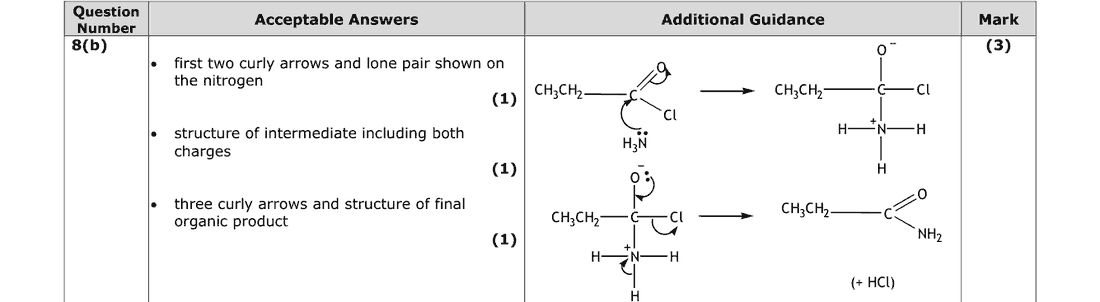
Addition–elimination. M1 curly arrow from the lone pair on N to the carbonyl carbon and from the C=O bond to O
M2 intermediate with O– and N+ (both charges)
M3 three curly arrows (lone pair on O– re-forming C=O, C–Cl bond to Cl, N–H bond to N+) and the product CH3CH2CONH2 (+ HCl). Most credit came from attempts modelled on the substitution in (a)
Work with an A-level chemistry tutor
Dropping marks on calculations, mechanisms or the core practicals? Book a trial session with an A-level chemistry tutor.