Notes and key-term cards for this topic are being written by our tutors. The past-paper questions below are ready now.
Specification statements
Show the 7 statements from the specification
18.1 understand that the bonding in benzene has been represented using the Kekulé and the delocalised model, the latter in terms of overlap of p-orbitals to form π-bonds
18.2 understand that evidence for the delocalised model of the bonding in benzene is provided by data from enthalpy changes of hydrogenation and carbon-carbon bond lengths [Students may represent the structure of benzene as: or as appropriate in equations and mechanisms.]
18.3 understand why benzene is resistant to bromination, compared with alkenes, in terms of delocalisation of π-bonds in benzene and the localised electron density of the π-bond in alkenes
18.4 understand the reactions of benzene with: • i oxygen in air (combustion with a smoky flame) • ii bromine, in the presence of a catalyst • iii a mixture of concentrated nitric and sulfuric acids • iv halogenoalkanes and acyl chlorides with aluminium chloride as catalyst (Friedel-Crafts reaction)
18.5 understand the mechanism of the electrophilic substitution reactions of benzene (halogenation, nitration and Friedel-Crafts reactions), including the generation of the electrophile
18.6 understand the reaction of phenol with bromine water
18.7 understand reasons for the relative ease of bromination of phenol, compared to benzene
Six-mark extended response questions on this topic
Tap a question to zoom it. Where a part needs a figure, table or structure from earlier in the question, that part folds out above it; the mark scheme and examiner's comment open underneath. Have Edexcel's Data Booklet beside you; the Periodic Table is on the back page of every paper.
June 2025 · Paper 2 · Q8(e)(i)3 marksExplanationHard
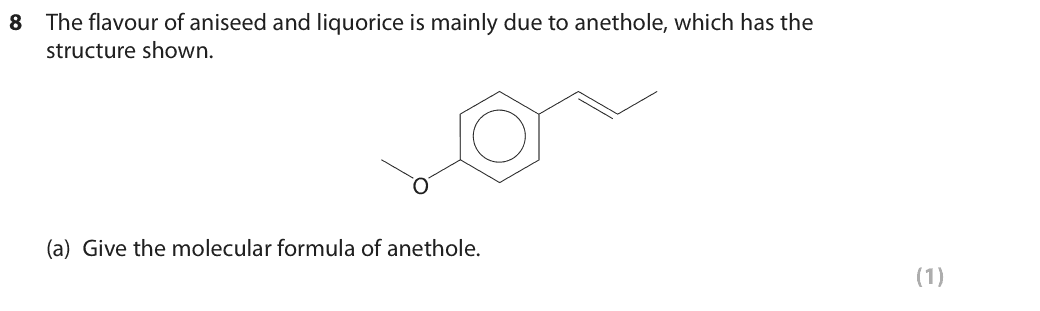
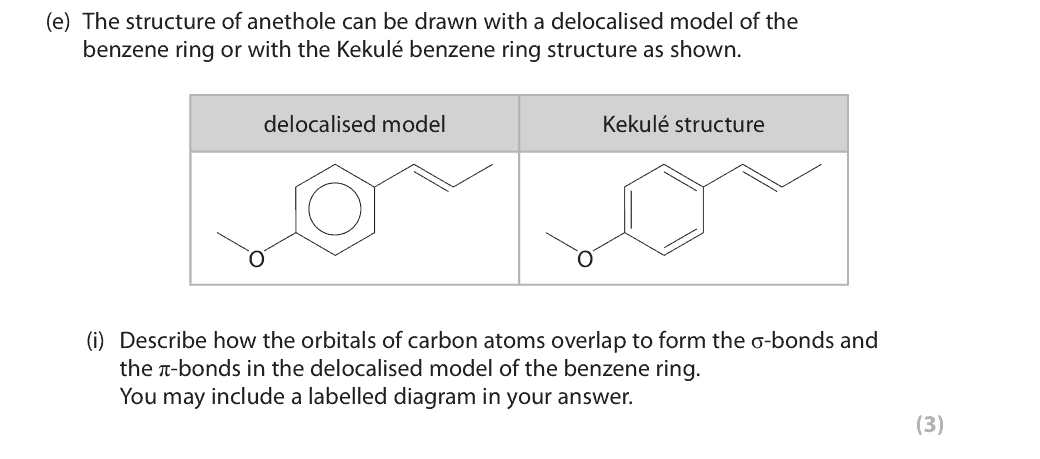
Earlier part of question 8 that this part uses
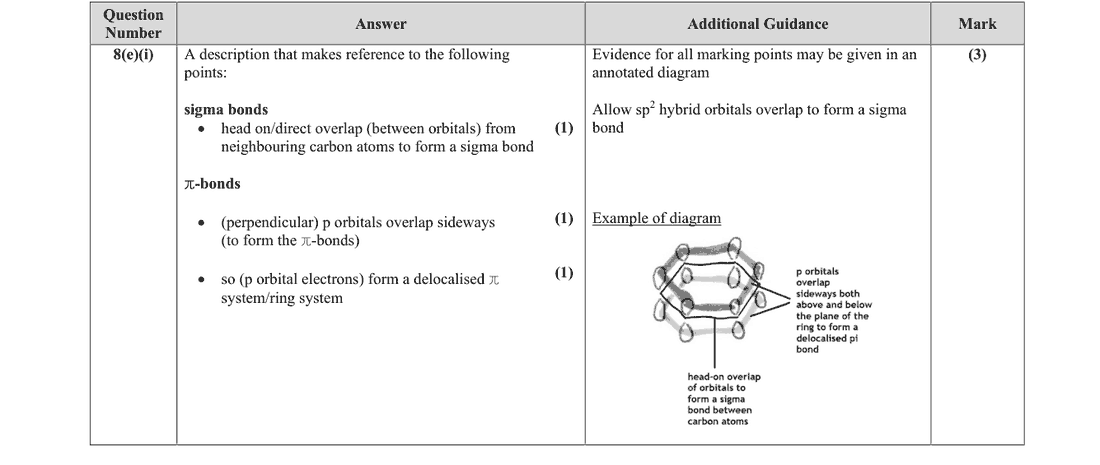
Mark scheme
Examiner's comment
Candidates found this question to be very challenging, with very few fully correct responses seen.
The best responses discussed how the orbitals overlap in the context of sigma and pi bonds and supported their explanations with a relevant diagram.
Commonly, candidates referred to sigma bonds overlapping rather than orbitals, or similarly were confused between Pi orbitals overlapping instead of P orbitals overlapping sideways.
Notes from the mark scheme and report
σ-bonds: head-on (direct) overlap of orbitals from neighbouring carbon atoms (sp2 hybrid orbitals allowed)
π-bonds: the p orbitals (perpendicular to the ring) overlap sideways
so the p-orbital electrons form a delocalised π system / ring above and below the plane. An annotated diagram can score all three. Common errors: 'sigma bonds overlap' rather than orbitals
'pi orbitals' overlapping instead of p orbitals overlapping sideways
June 2025 · Paper 2 · Q8(e)(ii)4 marksExplanationHard
Earlier parts of question 8 that this part uses
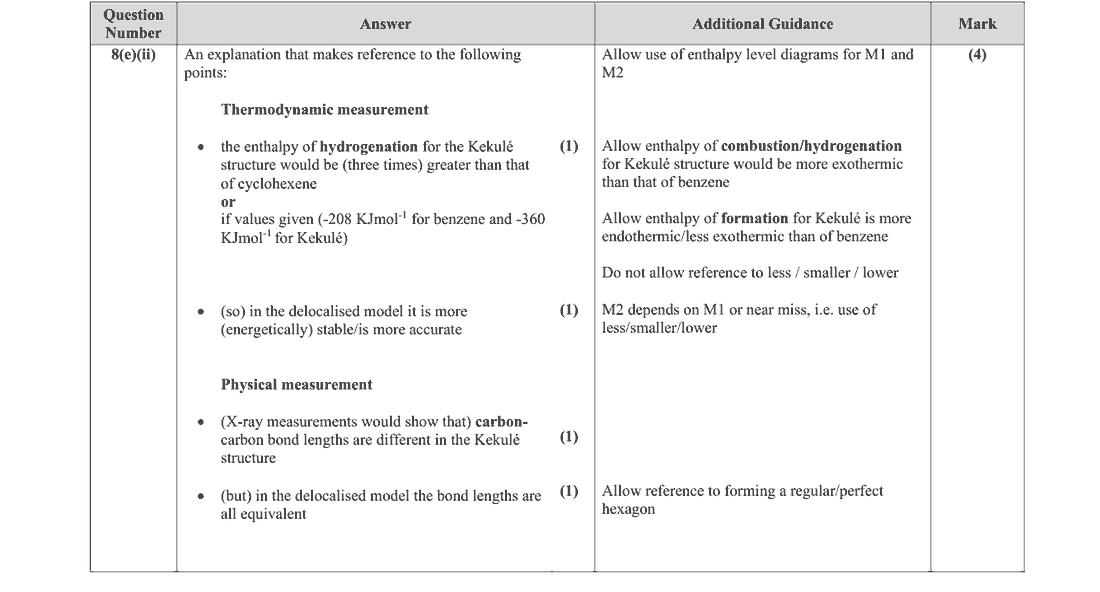
Mark scheme
Examiner's comment
Candidates found this question to be one of the most challenging on the paper.
For the thermodynamic measurements many lost both marks through vaguely referring to energy changes or bond energies, without referring to enthalpy changes of hydrogenation.
Some candidates did not score M1 as they stated that the enthalpy of hydrogenation is lower or less for the delocalised model. Centres and their candidates are reminded that when exothermic enthalpy changes are being considered that a description of the value being less/smaller/lower does not score. These terms are ambiguous when dealing with negative numbers.
For the physical measurements, a good number of candidates referred to 'the bond lengths in benzene' all being the same, without stipulating that they were referring to the carbon-carbon bond lengths.
Commonly candidates discussed chemical evidence such as resistance to bromination or lack of the 1,2-dibromo isomers which was not asked for in the question.
Notes from the mark scheme and report
Thermodynamic: the enthalpy of hydrogenation of the Kekulé structure would be three times that of cyclohexene / more exothermic than the value for benzene (–360 against –208 kJ mol–1)
so the delocalised structure is more (energetically) stable. Physical: (X-ray data) the Kekulé structure would have carbon–carbon bonds of different lengths
in the delocalised model all the carbon–carbon bond lengths are the same (regular hexagon). 'Less / smaller / lower' not accepted for exothermic values. Common errors: vague 'energy' or bond energies instead of enthalpy of hydrogenation
'bond lengths' without saying carbon–carbon
chemical evidence (bromination), which was not asked for
June 2025 · Paper 3 · Q9(a)3 marksMechanism
Mark scheme
Examiner's comment
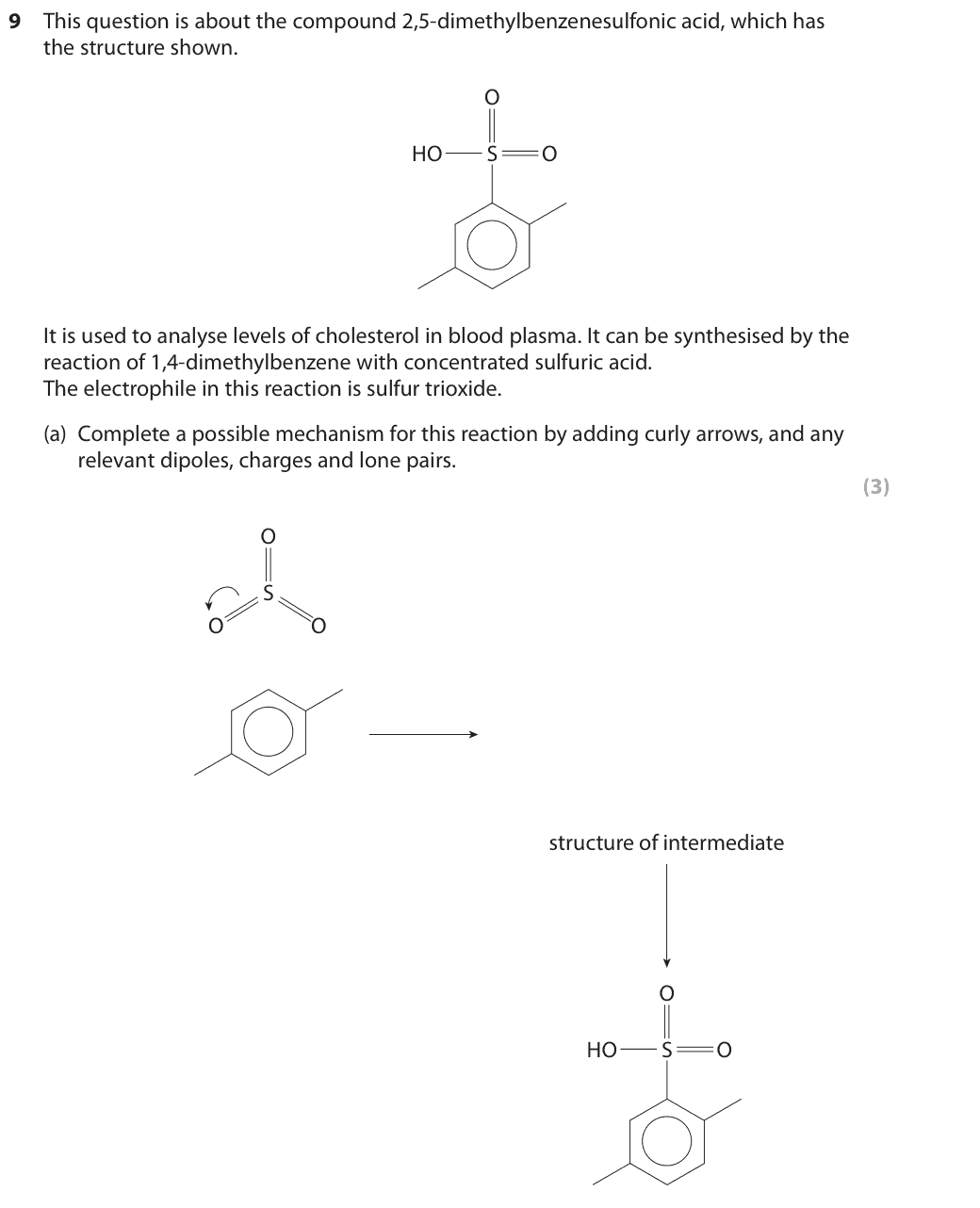
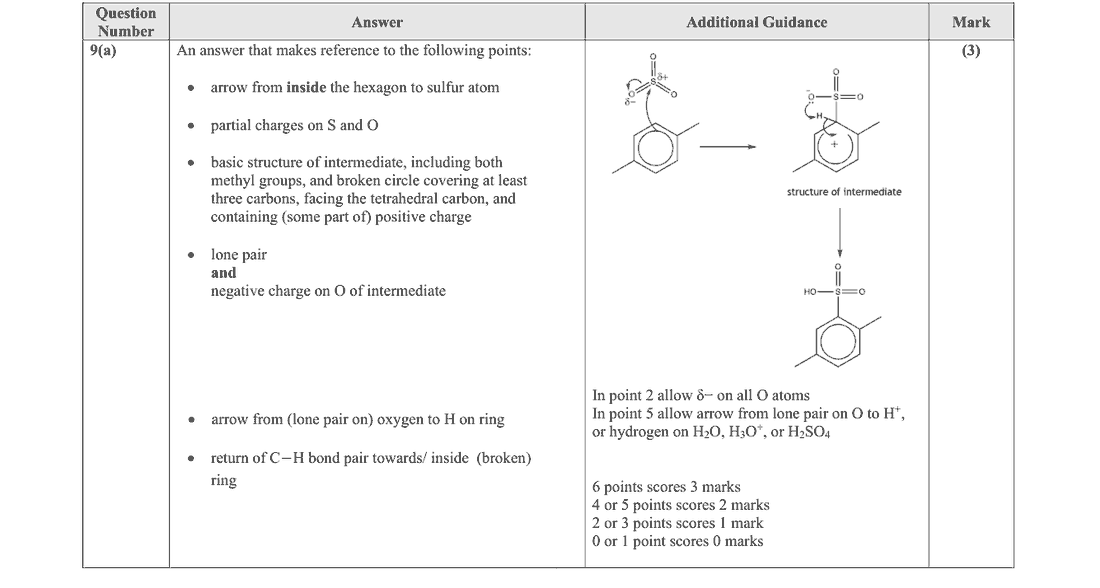
This question required candidates to draw the reaction mechanism for the electrophilic substitution of 1,4-dimethylbenzene to form 2,5-dimethylbenzenesulfonic acid. Many candidates scored at least two points for the correct first steps (the arrow from inside the hexagon to the sulfur atom, and the partial charges on the S and O). Some candidates omitted the methyl groups on the intermediate which cost them a point, but many added the correct lone pair and negative charge to the oxygen. Occasionally the arrow to form the lone pair of the oxytem to the hydrogen was missing, but the final arrow showing the return of the C - H bond pair towards the ring was often shown.
Notes from the mark scheme and report
Six points: curly arrow from inside the ring to the sulfur atom
partial charges on S (δ+) and O (δ–)
intermediate with both methyl groups, a broken ring covering at least three carbons facing the tetrahedral carbon and a positive charge
lone pair and negative charge on an oxygen of the SO3 group in the intermediate
curly arrow from that oxygen (lone pair) to the ring hydrogen
curly arrow from the C–H bond back into the ring. Six points score 3, four or five score 2, two or three score 1. Most got the first two points
methyl groups were sometimes left off the intermediate
June 2024 · Paper 3 · Q56 marks6-mark extended responseEasy
Mark scheme, with the indicative content and the marks for reasoning
Examiner's comment
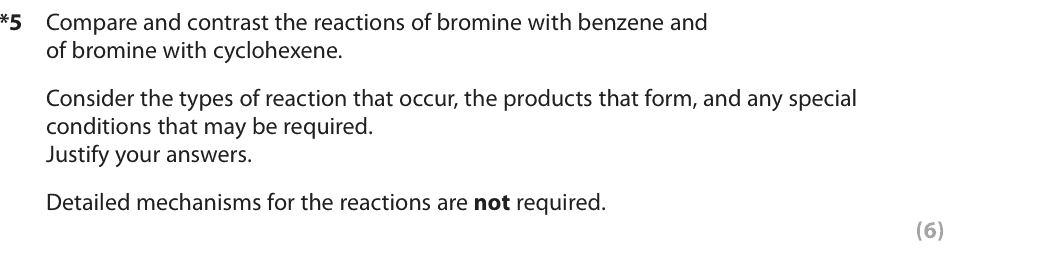
This extended open response was answered very well with the vast majority of candidates scoring high marks. The most common indicative point missed was the comparison of the products of bromination. Frequently the name of the product of the bromination of cyclohexane was wrong, either losing the ‘cyclo’ or missing the ‘di’ before the bromo. Equations were accepted as means for gaining credit but oftentimes incorrect products such as hydrogen were given. Alternatively hydrogen bromide was missing as a product from the bromination of benzene. Another common error was to state that heat was required for both reactions but cyclohexene will react at room temperature. It was insufficient to state that benzene requires a halogen carrier but cyclohexene does not.
It was also not usual to see a response which stated that benzene has a delocalised pi system but candidates must remember that this is a delocalised “electron” system and it is essential to mention this in this context. There was also a small number of candidates that confused phenol with either cyclohexene or benzene and referred to a product with three bromine atoms. Despite the question stem stating that details of reaction mechanisms were not required, it was not unusual to see considerable time spent on this matter and this was true of even those scoring high marks. Candidates would be better served if they stopped to think a while and plan out their answers in response to the key points raised in the question.
Notes from the mark scheme and report
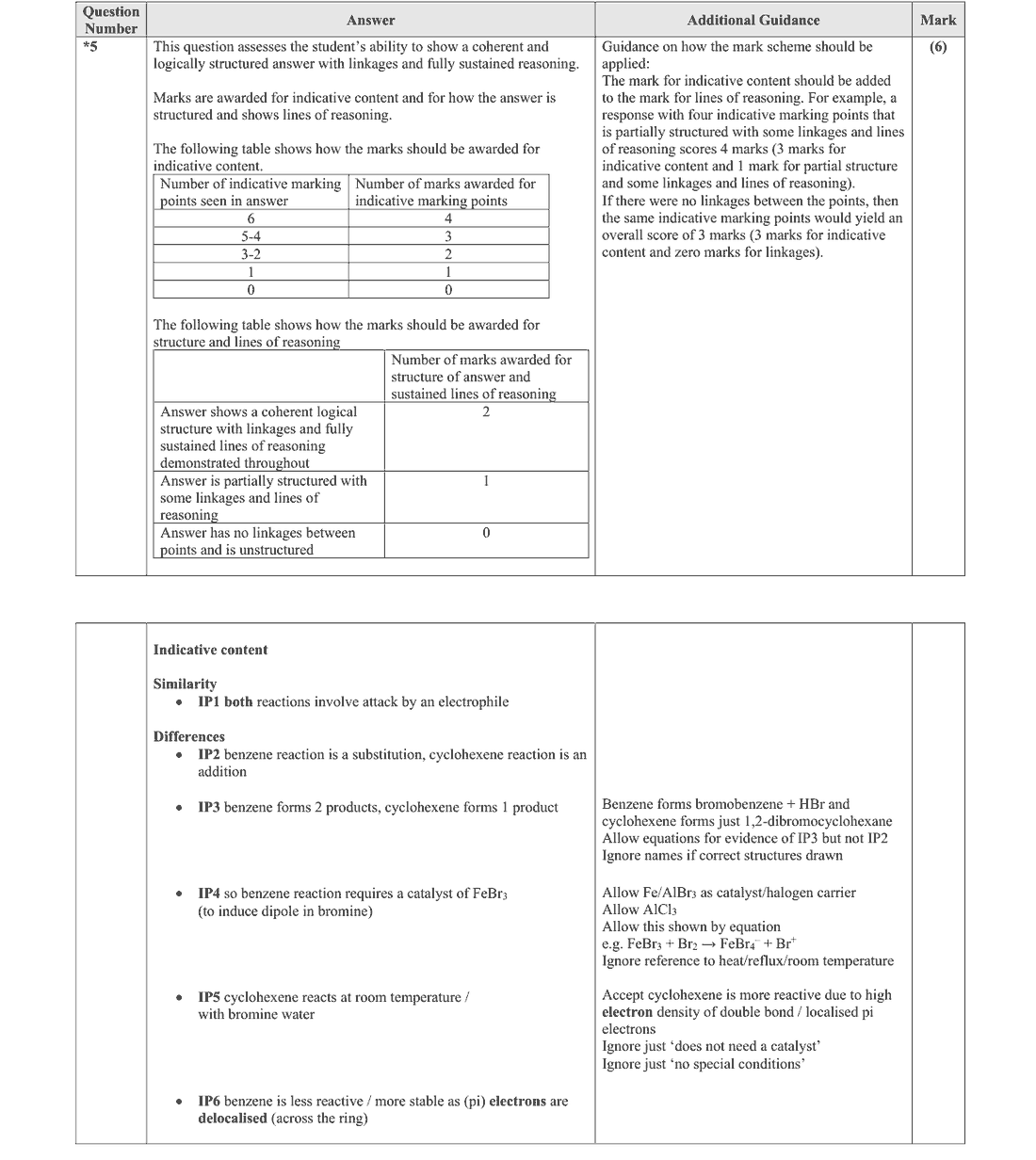
Six indicative points plus two marks for reasoning. IP1 both reactions involve attack by an electrophile
IP2 benzene reacts by substitution, cyclohexene by addition
IP3 benzene gives two products (bromobenzene and HBr), cyclohexene one (1,2-dibromocyclohexane)
IP4 the benzene reaction needs a catalyst / halogen carrier (FeBr3, Fe or AlBr3)
IP5 cyclohexene reacts at room temperature / with bromine water (high electron density of the localised pi bond)
IP6 benzene is less reactive / more stable because its pi electrons are delocalised. Just 'does not need a catalyst' is ignored for IP5. Most often missed: comparing the products. Other errors: product named without 'cyclo' or 'di'
hydrogen given as a product, or HBr missing
heat needed for both
'delocalised pi system' with no mention of electrons
time spent on mechanisms that were not asked for
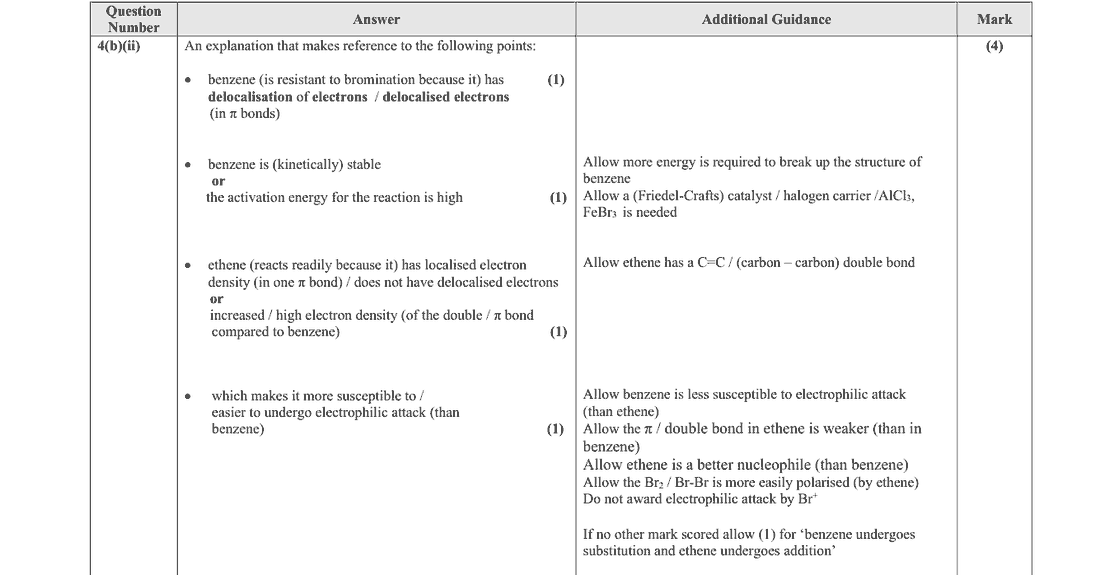
June 2023 · Paper 2 · Q4(b)(ii)4 marksExplanation
Earlier part of question 4 that this part uses
Mark scheme
Examiner's comment
This question comparing the reactivity of benzene or ethene with bromine gave some interesting answers.
Many candidates found it difficult to express their ideas clearly and ended up repeating the stem of the question. However, some good responses were seen which linked the delocalised electrons in benzene to its stability and the high electron density in the double bond of ethene to its susceptibility to electrophilic attack.
Notes from the mark scheme and report
M1 benzene has delocalised (pi) electrons
M2 so benzene is stable / the activation energy is high (allow a halogen carrier catalyst is needed)
M3 ethene has localised electron density in its pi bond / higher electron density (allow has a C=C)
M4 which makes ethene more susceptible to electrophilic attack (allow polarises Br2 more easily). Not attack by Br+. If nothing else scores, 1 for 'benzene substitutes, ethene adds'. Many found it hard to express and repeated the stem
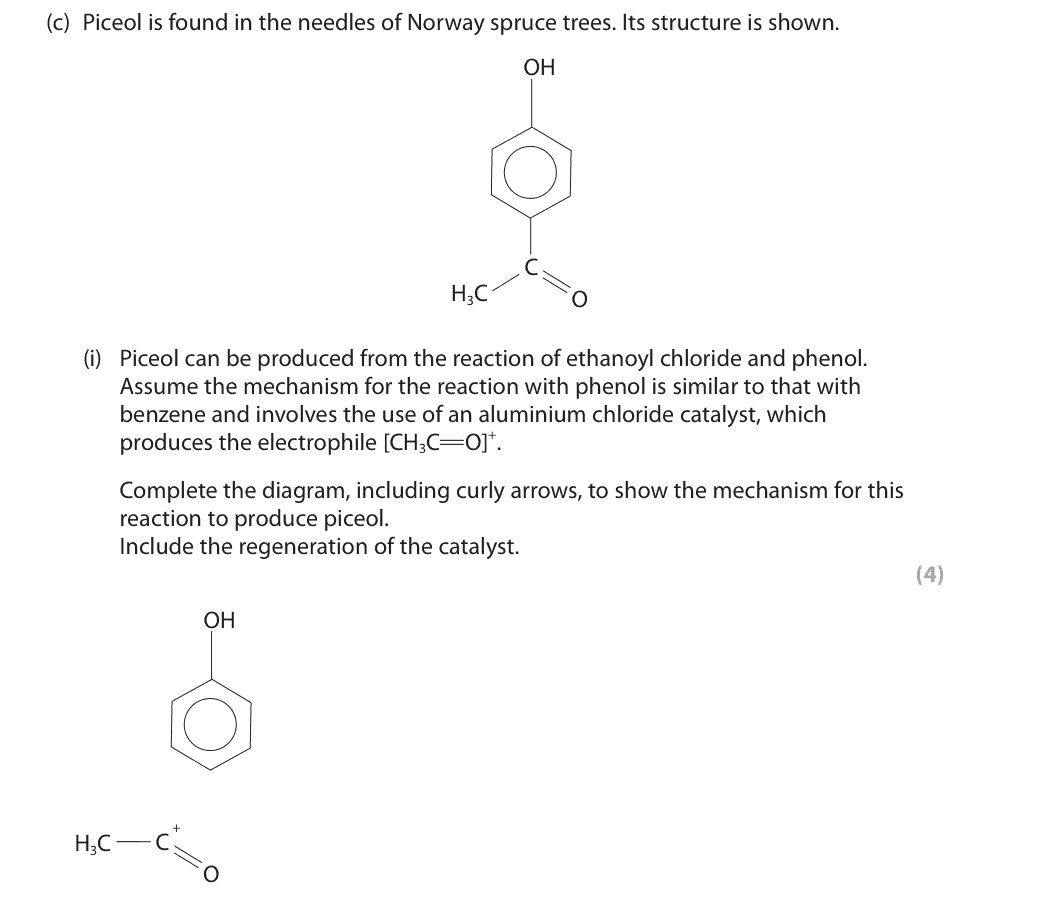
June 2023 · Paper 3 · Q9(c)(i)4 marksMechanism
Earlier part of question 9 that this part uses
Mark scheme
Examiner's comment
Centres and their candidates are to be commended for the vast improvement in the drawing of electrophilic substitution reaction mechanisms. There were many completely correct mechanisms and a reduction in the careless placement of arrows and such.
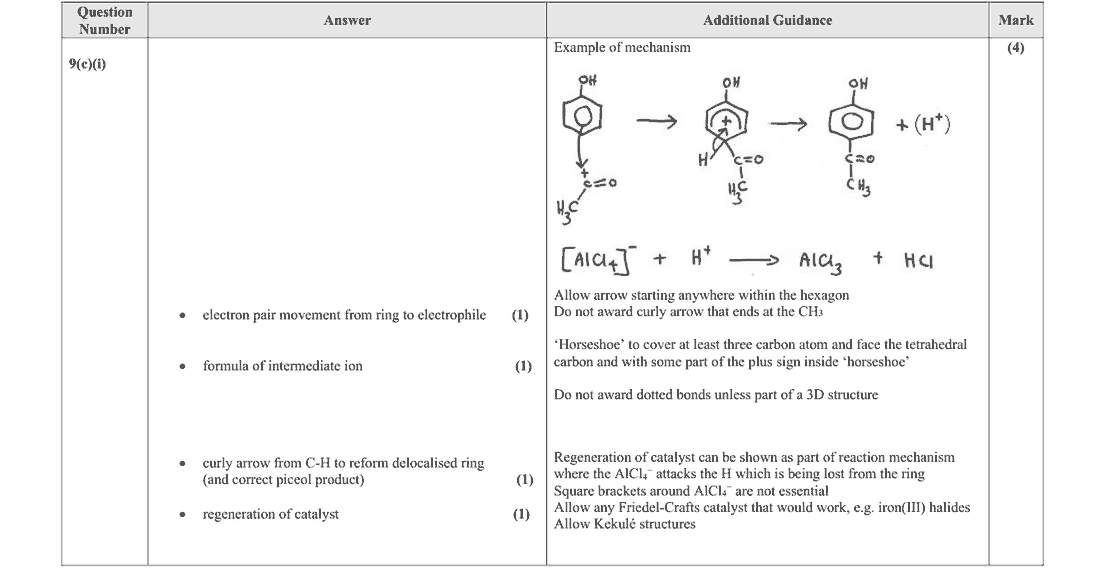
Notes from the mark scheme and report
M1 curly arrow from the ring to the C+ of the electrophile (not to the CH3), at the position opposite the OH. M2 intermediate with the horseshoe over at least three carbons, facing the tetrahedral carbon, with the + charge partly inside. M3 curly arrow from the C–H bond back into the ring, giving piceol. M4 regeneration of the catalyst: [AlCl4]– + H+ → AlCl3 + HCl. Kekulé structures allowed. The report praised a marked improvement in these mechanisms
June 2022 · Paper 3 · Q56 marks6-mark extended response
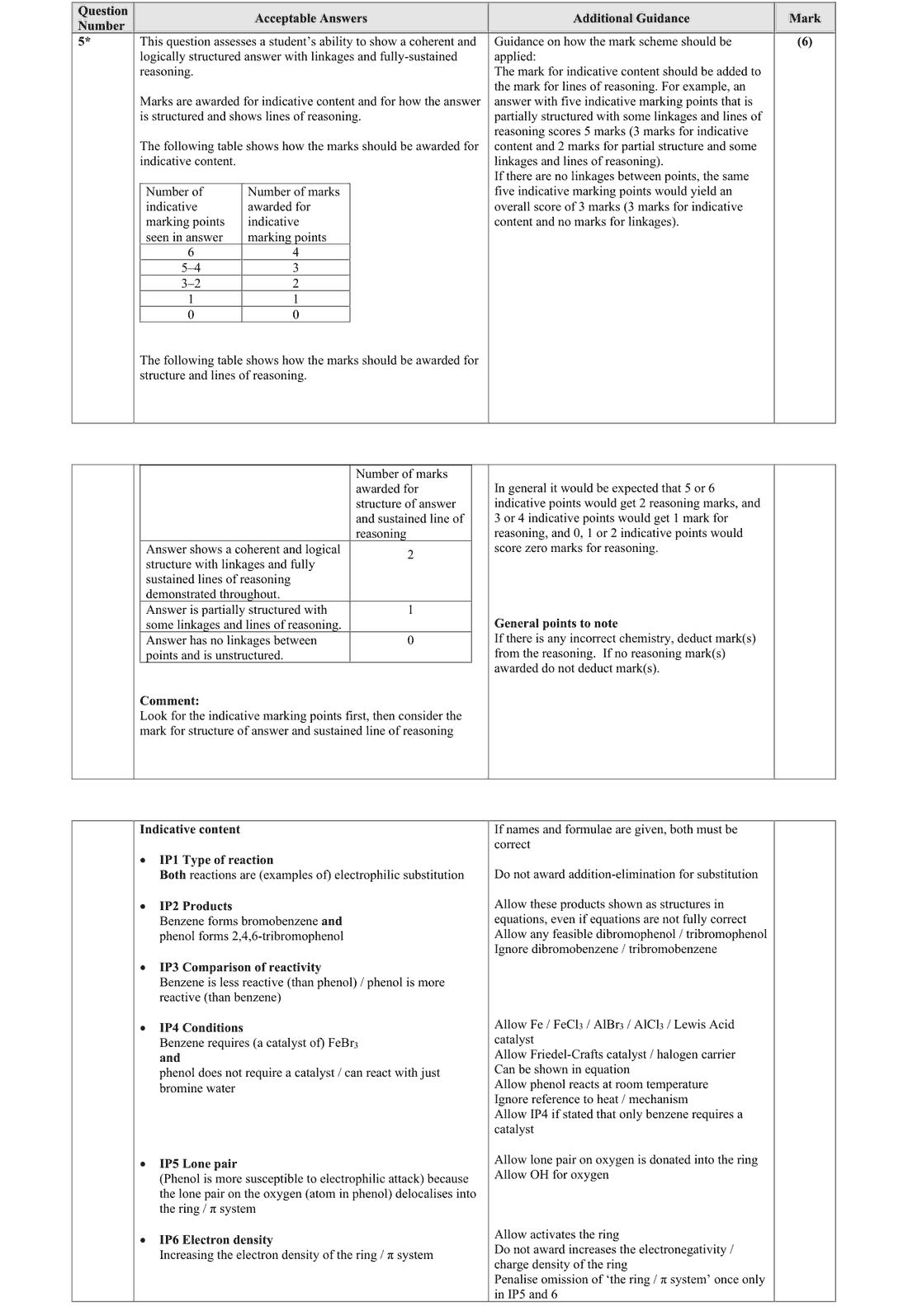
Mark scheme, with the indicative content and the marks for reasoning
Examiner's comment
This extended open response was straightforward for the candidates who had revised the reactions of bromine with benzene and with phenol, but the full range of marks were seen. Some candidates did not look carefully enough at the statement telling them to include the type of reaction, the products that form and any conditions required so some of these were often missing. The explanation of why phenol is more reactive than benzene in terms of the lone pair of electrons on oxygen being delocalised into the ring system so increasing its electron density, was often well-known. Many candidates did not know that both reactions are electrophilic substitution and many addition reactions were seen, along with nucleophiles. This type of question is best dealt with as a comparison for each of the points but many candidates just wrote two separate paragraphs and did not link them. Candidates would benefit from planning out a structure to their answer before writing it out in full.
Notes from the mark scheme and report
Six indicative points plus two marks for reasoning. IP1 both reactions are electrophilic substitution
IP2 benzene gives bromobenzene and phenol gives 2,4,6-tribromophenol
IP3 benzene is less reactive than phenol
IP4 benzene needs a catalyst (FeBr3
Fe, AlBr3, AlCl3 or 'halogen carrier' allowed) while phenol needs none and reacts with bromine water
IP5 the lone pair on the oxygen of phenol is delocalised into the ring
IP6 this increases the electron density of the ring. Not 'addition-elimination'
not 'increases the electronegativity of the ring'. Common errors: addition reactions or nucleophiles
type of reaction, products or conditions left out
two separate paragraphs with no comparison
November 2021 · Paper 3 · Q3(b)(iii)4 marksMechanism
Earlier part of question 3 that this part uses
Mark scheme
Examiner's comment
The vast majority of candidates completed the electronic configuration of an aluminium atom,
with just a small number including electrons in d orbitals. The dot-and-cross diagram for
aluminium chloride was shown clearly by many candidates, although some included a lone
pair of electrons on the aluminium atom and others showed ions. The shape and bond angle
of aluminium chloride were correct in many responses, but some candidates did not use their
dot-and-cross diagram to help and others suggested shapes with a different number of
atoms, e.g. tetrahedral which would show the presence of four chlorine atoms. The
mechanism for the alkylation of benzene was answered well by many candidates, with slips
such as not starting and ending curly arrows in the correct places or poorly drawn
intermediate. Some candidates would benefit with much more practise at drawing organic
mechanisms accurately. Many candidates seemed unfamiliar with how two aluminium
chloride molecules join together to form a dimer and many bonds between aluminium atoms
were seen. Some candidates knew that dative covalent bonding was involved but some
showed the lone pair of electrons donated from an aluminium atom to a chlorine atom.
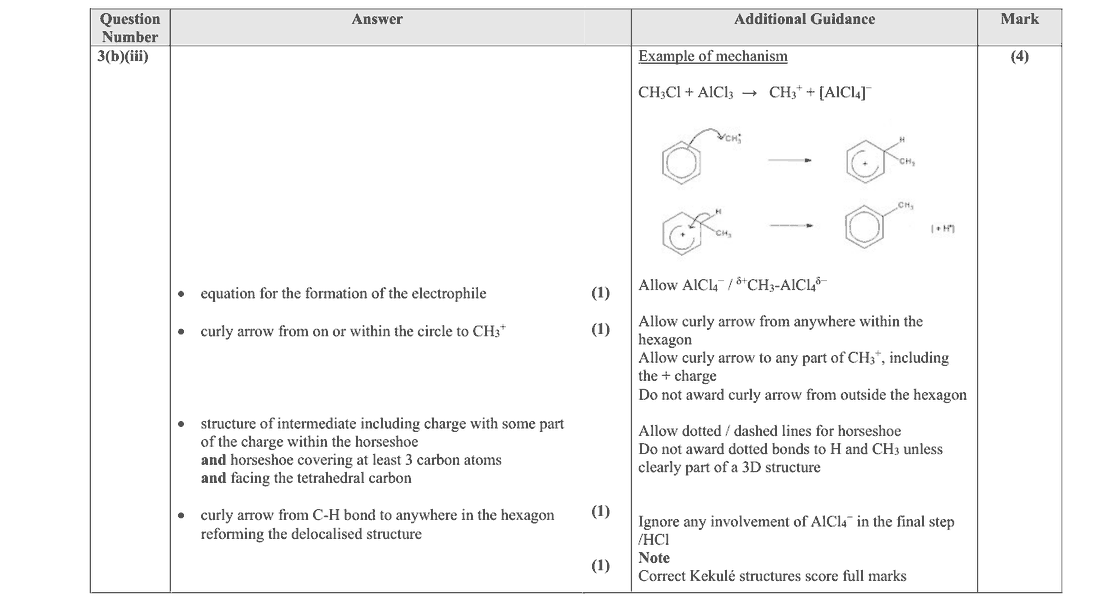
Notes from the mark scheme and report
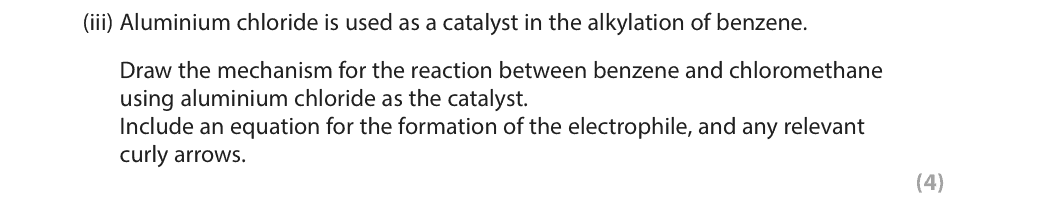
M1 CH3Cl + AlCl3 → CH3+ + [AlCl4]–. M2 curly arrow from on or inside the ring to CH3+. M3 intermediate with the horseshoe covering at least three carbons, facing the tetrahedral carbon, with part of the + charge inside it. M4 curly arrow from the C–H bond back into the ring. Kekulé structures score fully. Slips: arrows not starting or ending in the right place
poorly drawn intermediate
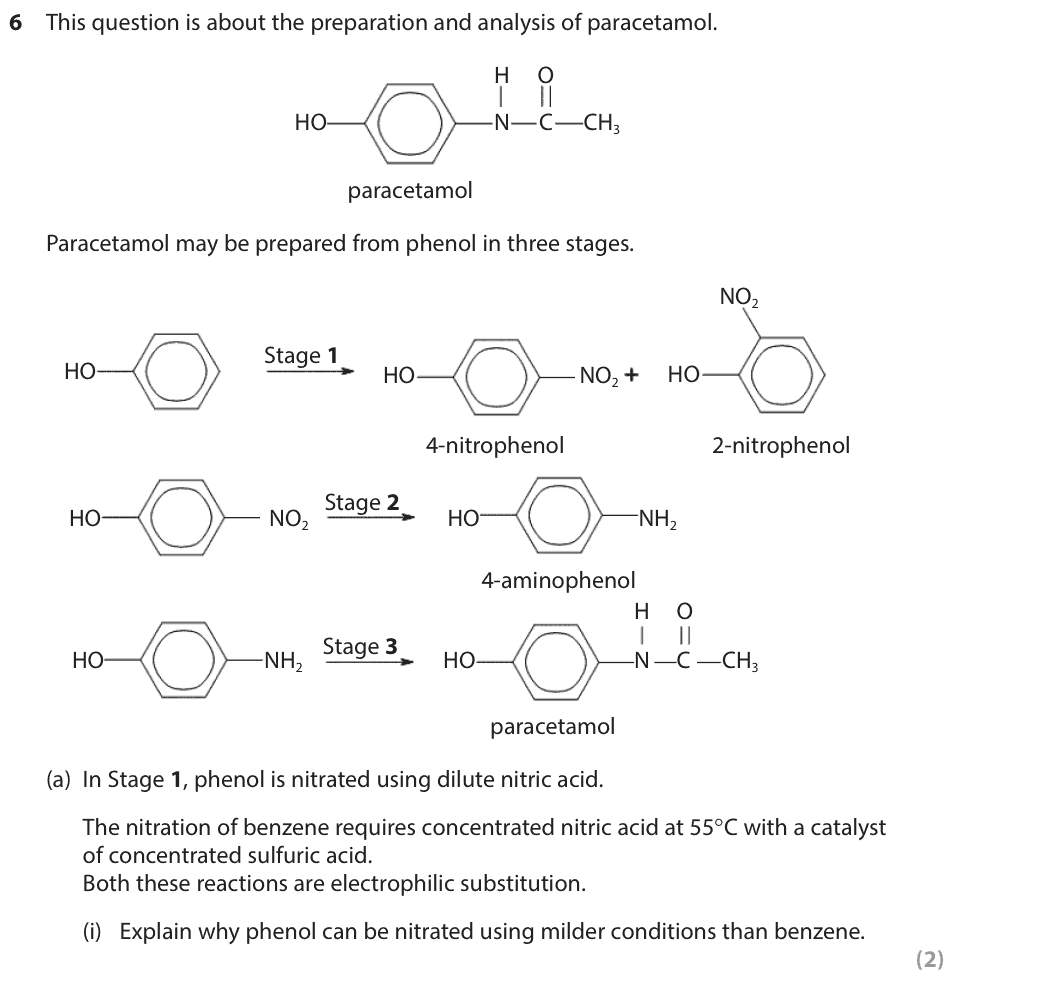
November 2021 · Paper 3 · Q6(a)(i)2 marksExplanation
Mark scheme
Examiner's comment
Some candidates gave clear and concise explanations for why phenol can be nitrated using
milder conditions than benzene while others seemed unfamiliar with this concept or gave
partial answers. Some referred to the lone pair of electrons on the OH group rather than the
oxygen atom. Many candidates struggled to explain the difference in boiling temperatures of
the two isomers and did not refer to intermolecular forces as requested in the question.
Many answers did not mention hydrogen bonding. Many candidates knew that a reducing
agent is needed to convert 4-nitrophenol into 4-aminophenol, although some did not read the
question and gave a specific reagent rather than the type of reagent. There were many poor
diagrams drawn for filtration under reduced pressure, with folded filter paper and no
perforations in the Buchner funnel. Most candidates would benefit from more practise in
drawing clear labelled diagrams of the common practical techniques in the specification. A
few candidates gave clear descriptions of the recrystallisation procedure, but most put steps
in the wrong order, missed out steps such as hot filtration and were generally confused. A
common error in producing dry crystals was to suggest adding an anhydrous salt as a drying
agent. Although this works well for drying liquids as it is easy to separate the substances, it
does not work for drying crystals unless the drying agent is specified as being in a desiccator.
Many candidates knew that impurities lower the melting temperature of a substance and it
will melt over a range of temperatures rather than having a sharp melting point, but many
omitted one of these from their answer. Many candidates were able to work out the
molecular formula of paracetamol but quite a lot had an incorrect number of hydrogen atoms
and some candidates were not aware of the meaning of molecular formula. The calculation in
(d)(ii) was carried out correctly by many candidates. Some omitted to use the mole ratio and
others omitted the use of a 100.0 cm3 volumetric flask. Some candidates calculated a mass
higher than the original 0.500 g of paracetamol and reversed the percentage calculation to
obtain a value less than 100%. These candidates should be advised to check their working to
see where they have made an error instead of doing this.
Notes from the mark scheme and report
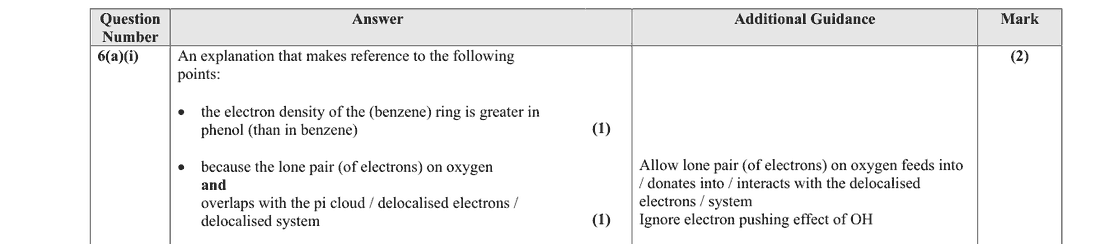
The electron density of the ring is greater in phenol than in benzene
because the lone pair of electrons on the oxygen overlaps with (is donated into) the delocalised pi system. Some referred to the lone pair on 'the OH group' rather than on the oxygen atom
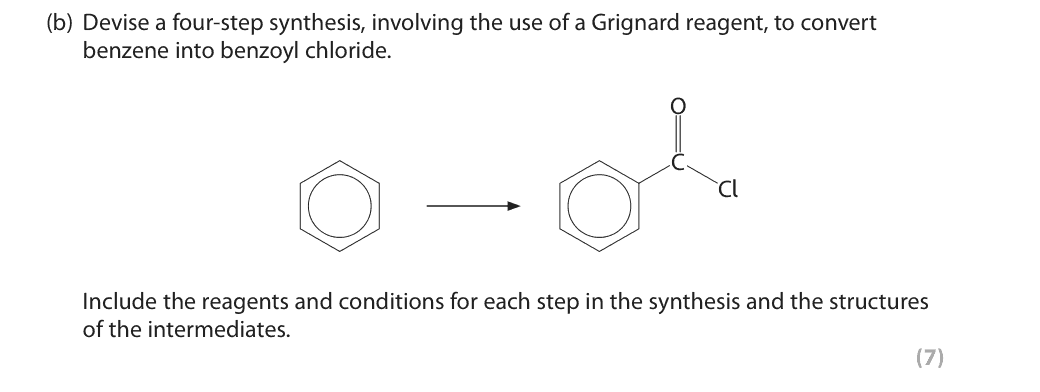
October 2020 · Paper 2 · Q7(b)7 marksShort answer
Mark scheme
Examiner's comment
Many candidates realised that hydride ions would be repelled by the high electron density of
the double bond in an alkene or knew that alkenes react by electrophilic addition and hydride
ions are nucleophiles. There were many correct answers giving a suitable reagent and
condition, but some candidates had not learnt the basic reagents and conditions for the
organic chemistry reactions in the specification. Only a minority of candidates knew that
potassium cyanide in ethanol react with halogenoalkanes to form nitriles. Unfortunately a few
candidates lost this mark as they did not give a specific halogenoalkane, for example, 1-
bromobutane. The majority of candidates knew that an acid needs to be added to the salt to
form pentanoic acid. There were many excellent answers to the synthetic route in (b) showing
those students had practised this style of question and they knew the organic chemistry
reactions. Candidates should realise that they need to make a Grignard reagent from a
halogenocompound so should start by forming bromobenzene. Some candidates knew that
they needed benzoic acid to react with phosphorus(V) chloride to form benzoyl chloride and
they received credit for this.
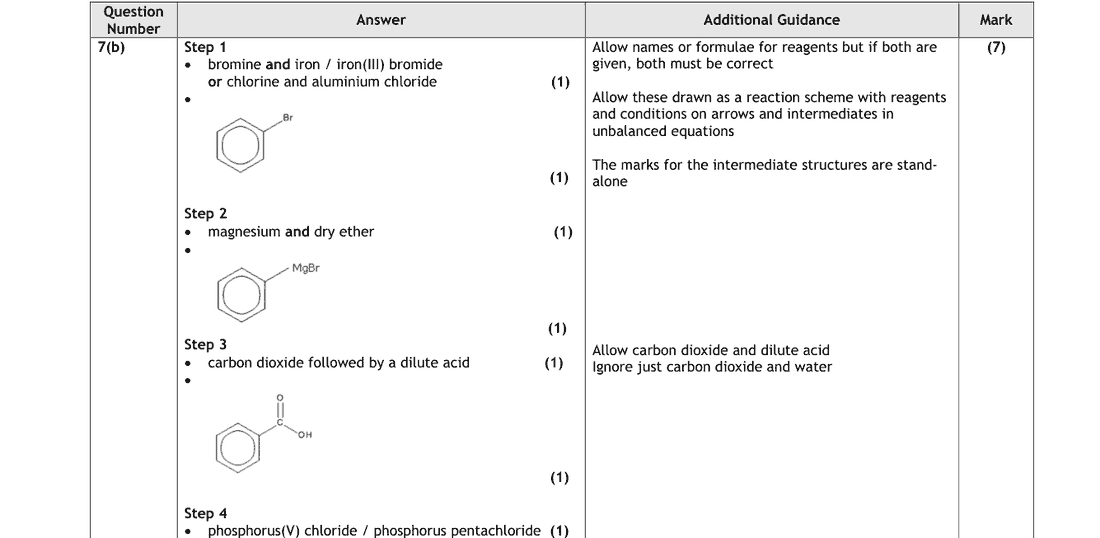
Notes from the mark scheme and report
Step 1 bromine with iron / iron(III) bromide (or chlorine with aluminium chloride)
bromobenzene. Step 2 magnesium in dry ether
phenylmagnesium bromide, C6H5MgBr. Step 3 carbon dioxide then dilute acid
benzoic acid. Step 4 phosphorus(V) chloride. One mark for each reagent set and one for each of the three intermediate structures (stand-alone). Just 'carbon dioxide and water' not enough for Step 3. Candidates need to see that a Grignard reagent is made from a halogeno compound, so start by making bromobenzene
some got credit just for benzoic acid with PCl5
October 2020 · Paper 3 · Q6(b)(ii)1 markShort answer
Earlier parts of question 6 that this part uses
Mark scheme
Examiner's comment
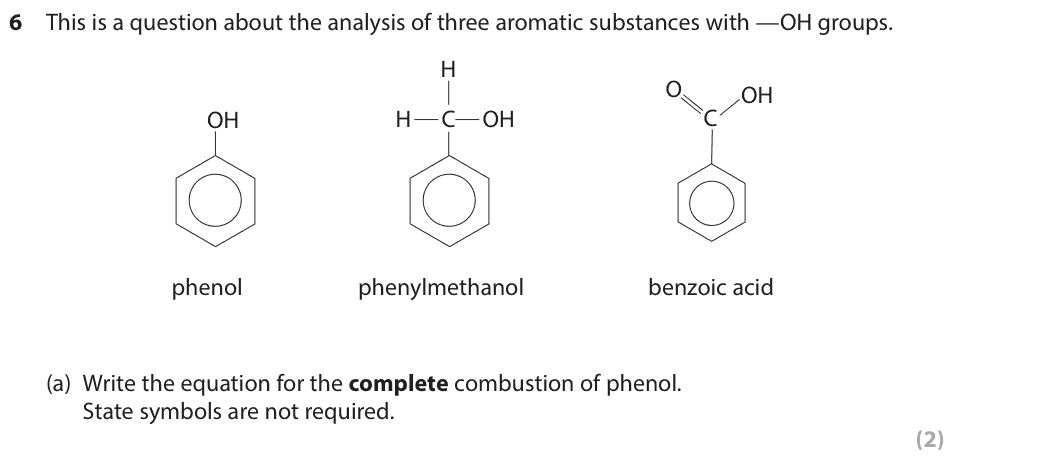
An appreciable number of candidates in (a) simply copied the skeletal formula of phenol from
the question above but this did not help with the balancing of the combustion equation; nor
of the calculation to follow. Nevertheless the majority were able to score at least one mark for
the correct species in the equation.
Candidates who find skeletal formulae challenging are advised to write out the formula in
displayed form which was relatively easy in to with the formulae given at the top of the paper.
It was evident in (b)(i) from the incorrect molar masses quoted that this would have helped a
considerable number of candidates to avoid mistakes.
Parts (b)(ii) and (iii) were often answered correctly but some candidates did not read the
question in (iii) properly and suggested either specific molecules rather than ‘types’.
Part (b)(iv) was a novel question and aimed to differentiate the very best candidates which it
was successful at.
Part (c)(i) was also an effective discriminator. Despite clear instructions in the question to
include reference to ‘bonds’ and ‘wavenumber ranges’ there were still responses which did
not refer to bonds or quoted single wavenumber values.
It was surprising that the answers on the C-13 NMR spectrum in (c)(ii) were rather poor.
Candidates often quoted more wavenumber ranges than were correct and so these negated
correct answers. It was also evident that a significant number of candidates are misreading
the Data Booklet. For example it was not uncommon for the C-OH peak wavenumber range to
go to 80 ppm but the ‘lozenge’ in the Data Booklet does not go anywhere near the 80 ppm
mark.
The most common mass spectrum fragment ion seen in (c)(iii) was COOH+ which was awarded
the mark. Common errors included adding a bond before the fragment ion or either omitting
the charge or even adding a negative charge. The question also asked for the m/z value which
some of the lower ability candidates missed.
Notes from the mark scheme and report
Black smoke (allow soot, black fumes, smoky flame). Not carbon monoxide
not just a yellow flame
October 2020 · Paper 3 · Q6(b)(iii)1 markShort answer
Earlier parts of question 6 that this part uses
Mark scheme
Examiner's comment
An appreciable number of candidates in (a) simply copied the skeletal formula of phenol from
the question above but this did not help with the balancing of the combustion equation; nor
of the calculation to follow. Nevertheless the majority were able to score at least one mark for
the correct species in the equation.
Candidates who find skeletal formulae challenging are advised to write out the formula in
displayed form which was relatively easy in to with the formulae given at the top of the paper.
It was evident in (b)(i) from the incorrect molar masses quoted that this would have helped a
considerable number of candidates to avoid mistakes.
Parts (b)(ii) and (iii) were often answered correctly but some candidates did not read the
question in (iii) properly and suggested either specific molecules rather than ‘types’.
Part (b)(iv) was a novel question and aimed to differentiate the very best candidates which it
was successful at.
Part (c)(i) was also an effective discriminator. Despite clear instructions in the question to
include reference to ‘bonds’ and ‘wavenumber ranges’ there were still responses which did
not refer to bonds or quoted single wavenumber values.
It was surprising that the answers on the C-13 NMR spectrum in (c)(ii) were rather poor.
Candidates often quoted more wavenumber ranges than were correct and so these negated
correct answers. It was also evident that a significant number of candidates are misreading
the Data Booklet. For example it was not uncommon for the C-OH peak wavenumber range to
go to 80 ppm but the ‘lozenge’ in the Data Booklet does not go anywhere near the 80 ppm
mark.
The most common mass spectrum fragment ion seen in (c)(iii) was COOH+ which was awarded
the mark. Common errors included adding a bond before the fragment ion or either omitting
the charge or even adding a negative charge. The question also asked for the m/z value which
some of the lower ability candidates missed.
Notes from the mark scheme and report
Alkenes (allow cycloalkenes, cycloalkanes, alkynes, compounds with C=C). Named examples such as ethene are ignored
benzene / arenes not credited. Some gave a specific molecule rather than a type of compound
June 2019 · Paper 2 · Q5(a)(i)1 markDiagram or structureEasy
Mark scheme
Examiner's comment
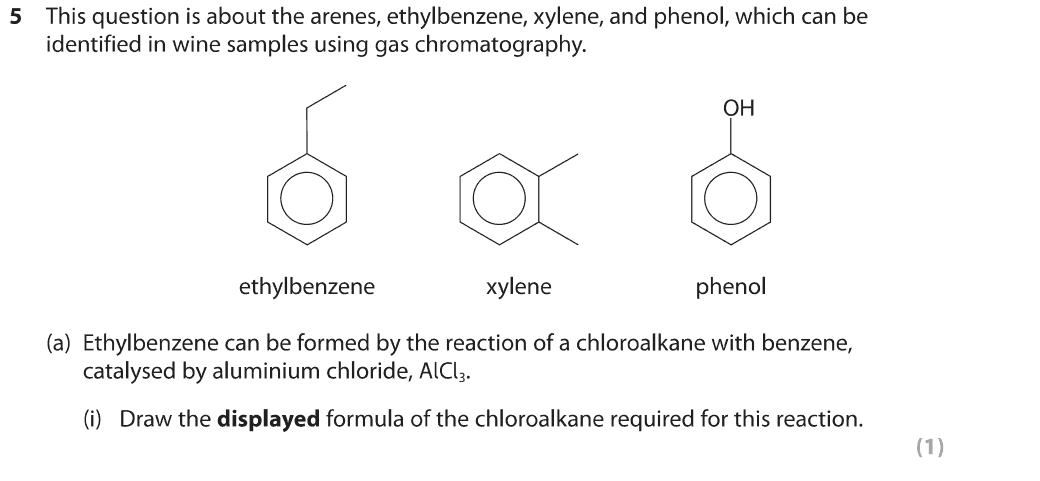
As with Q4(c)(i), examiners in the main were pleased to note that the basics of the electrophilic substitution mechanism is well taught and understood. The displayed formula in Q5(a)(i) was almost universally correct. Most candidates understood the basics of the mechanism, so picked up credit. The most frequent errors were:
+ in the reaction with the benzene, leading to a lack of clarity as to which carbon was involved in the step.
Use of C2H5
Showing the CH3 group, rather than the CH2 group attached directly to the ring.
The central positive charge shown outside of the ‘horseshoe’.
The open part of the ‘horseshoe’ not face the carbon in the ring to which the ethyl group was attached.
Omission of an equation to show the reformation of the catalyst.
Notes from the mark scheme and report
Answer: chloroethane drawn as a displayed formula, with every bond shown. Skeletal or structural formulae are not accepted
June 2019 · Paper 2 · Q5(a)(ii)5 marksMechanism
Earlier part of question 5 that this part uses
Mark scheme
Examiner's comment
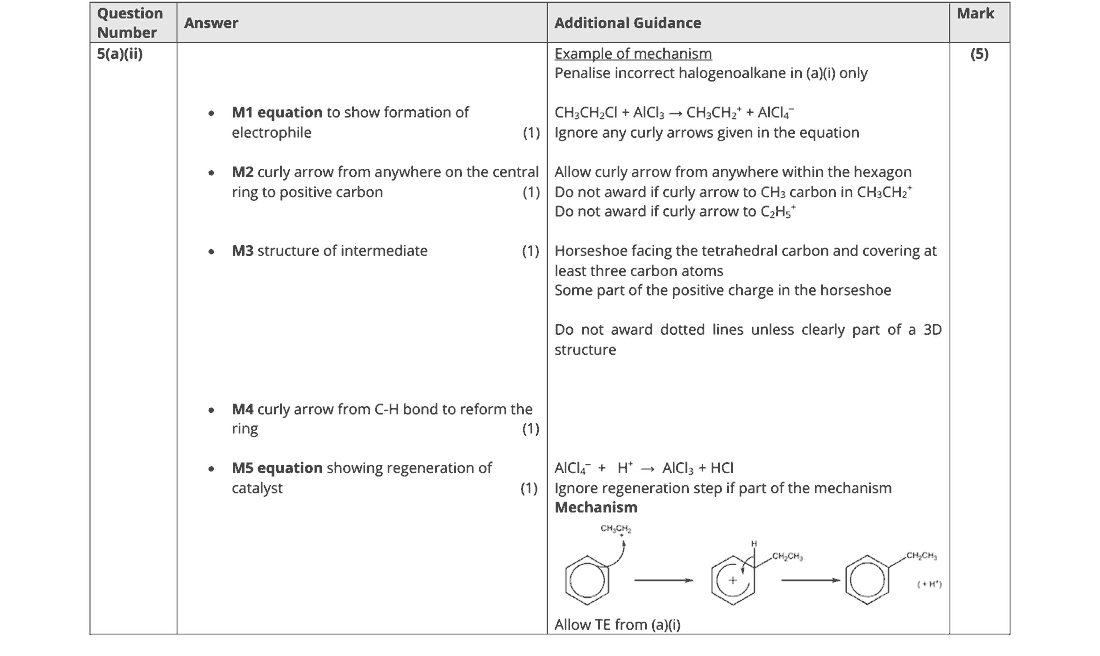
As with Q4(c)(i), examiners in the main were pleased to note that the basics of the electrophilic substitution mechanism is well taught and understood. The displayed formula in Q5(a)(i) was almost universally correct. Most candidates understood the basics of the mechanism, so picked up credit. The most frequent errors were:
+ in the reaction with the benzene, leading to a lack of clarity as to which carbon was involved in the step.
Use of C2H5
Showing the CH3 group, rather than the CH2 group attached directly to the ring.
The central positive charge shown outside of the ‘horseshoe’.
The open part of the ‘horseshoe’ not face the carbon in the ring to which the ethyl group was attached.
Omission of an equation to show the reformation of the catalyst.
Notes from the mark scheme and report
M1 CH3CH2Cl + AlCl3 → CH3CH2+ + AlCl4–
M2 curly arrow from the ring to the positive carbon (not to the CH3 carbon, not to 'C2H5+')
M3 intermediate with the horseshoe facing the tetrahedral carbon, covering at least three carbons, with the + inside
M4 curly arrow from the C–H bond back to the ring
M5 AlCl4– + H+ → AlCl3 + HCl. Error carried forward from (a)(i). Most picked up credit
errors were C2H5+ with the charge position unclear, the CH3 rather than the CH2 joined to the ring, the + outside the horseshoe, the horseshoe facing the wrong carbon, and no equation for regenerating the catalyst
June 2019 · Paper 2 · Q5(a)(iii)3 marksExplanation
Earlier part of question 5 that this part uses
Mark scheme
Notes from the mark scheme and report
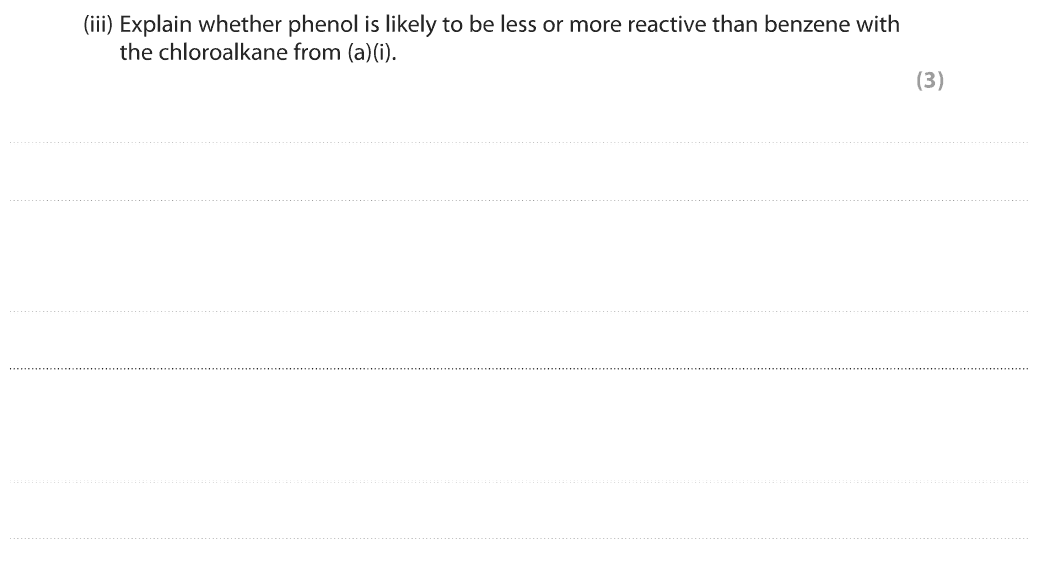
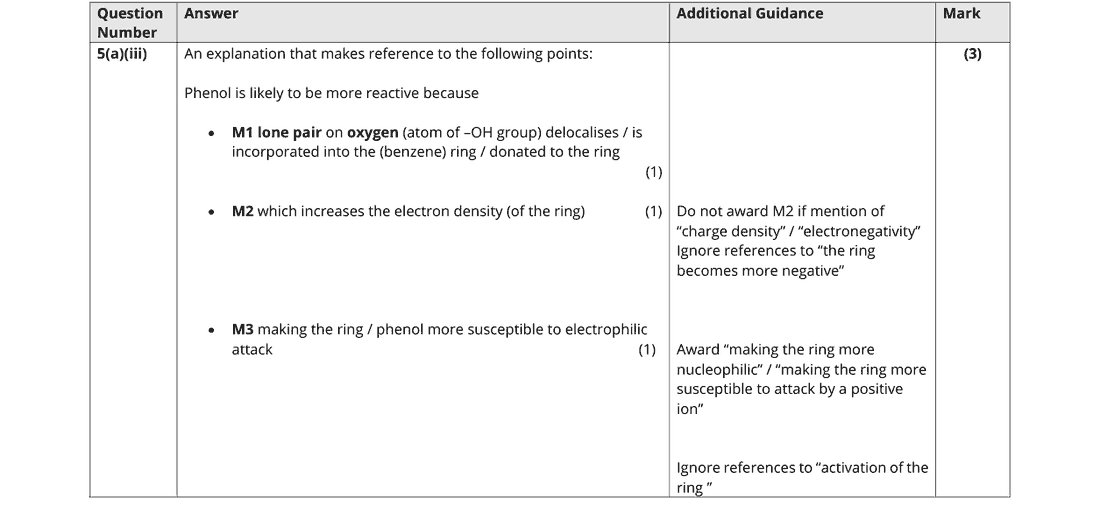
Phenol is more reactive: M1 a lone pair on the oxygen is delocalised into / donated to the ring
M2 which increases the electron density of the ring (not 'charge density' or electronegativity)
M3 making the ring more susceptible to electrophilic attack (allow more nucleophilic). 'Activates the ring' is ignored
June 2018 · Paper 2 · Q7(a)5 marksShort answer
Mark scheme
Examiner's comment
Another question with discriminated across the ability range and thus produced a wide spread of marks. The decision was made to make the mark scheme strictly adhering to correct chemistry, so simply stating a suitable reagent did not score if it was given in an incorrect chemical context. This served to distinguish between candidates who were guessing from the table of reagents provided and those who deduced more carefully the appropriate reagent for the respective conversion.
Additionally the responses served to emphasise the need for double-checking of work once completed because some otherwise excellent reaction pathways were spoiled by structural errors such as missing hydrogen atoms or pentavalent carbon atoms.
Notes from the mark scheme and report
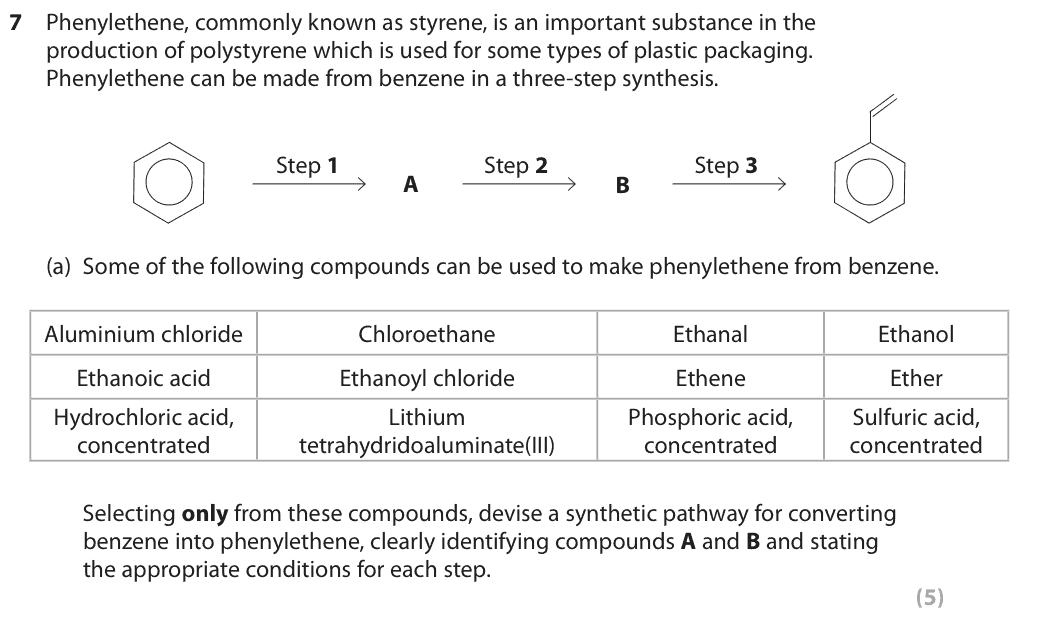
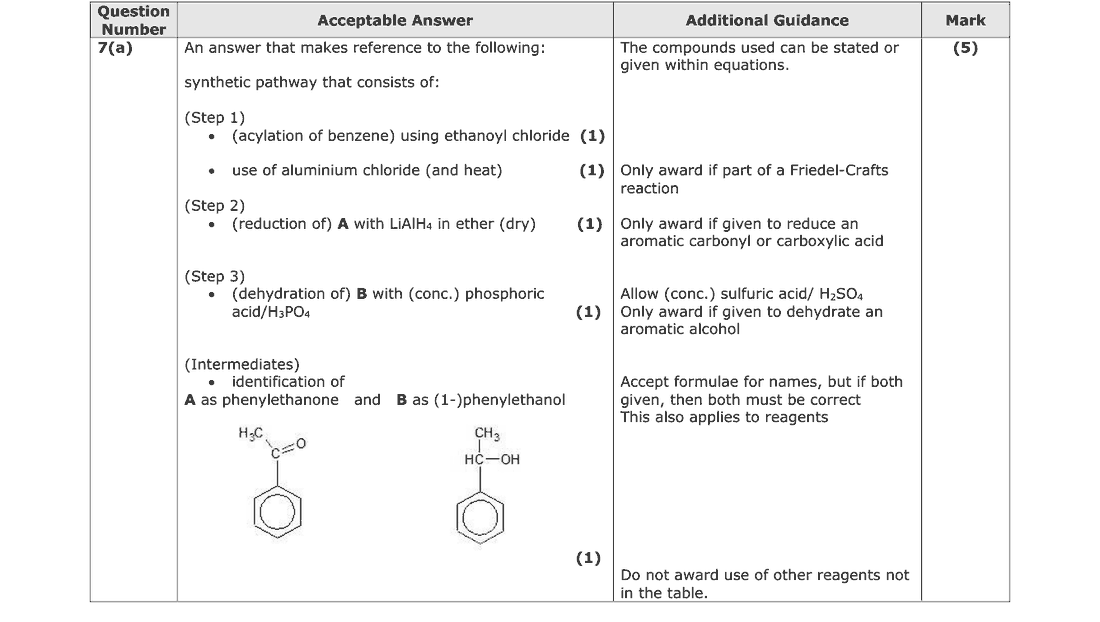
Step 1: ethanoyl chloride
with aluminium chloride (and heat) (Friedel–Crafts acylation). Step 2: reduce A with lithium tetrahydridoaluminate(III) in (dry) ether. Step 3: dehydrate B with concentrated phosphoric acid (concentrated sulfuric acid allowed). A is phenylethanone and B is 1-phenylethanol. A reagent only scores in the correct chemical context, and only reagents from the table. Good routes were often spoiled by structures with missing hydrogens or five-bonded carbons
June 2018 · Paper 2 · Q8(a)(i)2 marksEquation writing
Mark scheme
Examiner's comment
Substitution of a benzene ring is a good test of candidates' appreciation that there are hydrogen atoms on each of the carbon atoms in the ring, although they are rarely drawn. The responses to this question revealed those candidates who were aware of this because only they could gain the second mark for balancing the equation.
Notes from the mark scheme and report
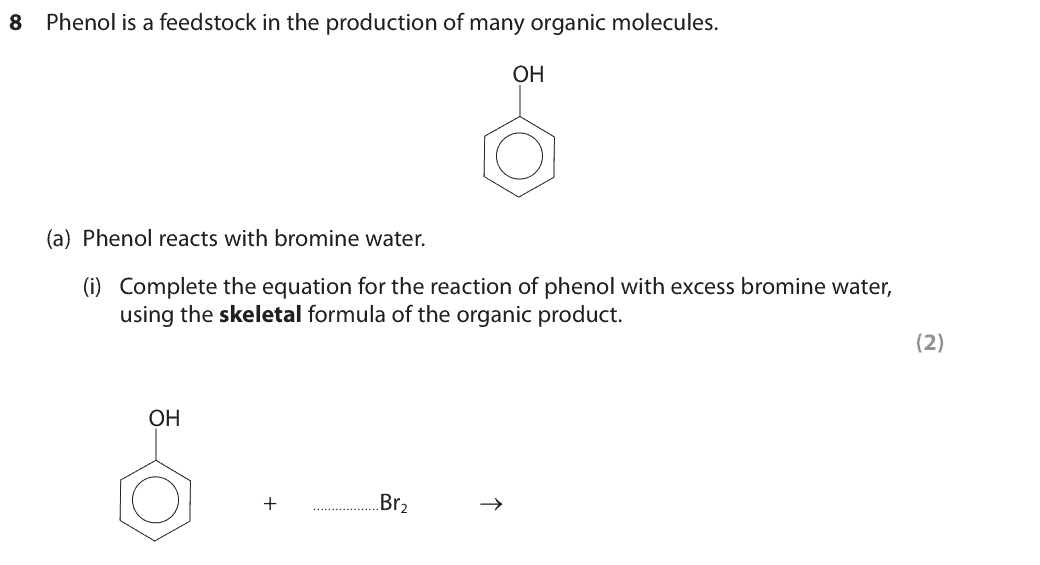
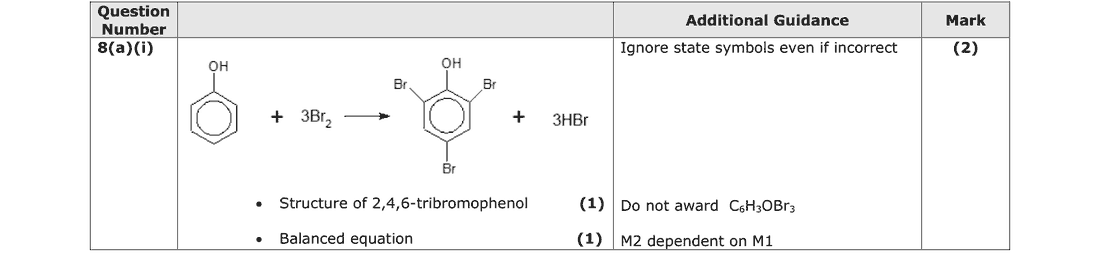
Phenol + 3Br2 → 2,4,6-tribromophenol (skeletal) + 3HBr. One mark for the structure, one for balancing (depends on the structure). C6H3OBr3 not accepted. Only those who remembered the hydrogen atoms on the ring carbons balanced it with 3HBr
June 2018 · Paper 2 · Q8(a)(ii)3 marksExplanation
Earlier part of question 8 that this part uses
Mark scheme
Examiner's comment
A 'compare and contrast' question will always require one or more differences and one or more similarities. In this question candidates frequently wrote about the differences and only the better candidates spared a thought for the similarity. Furthermore some candidates lost a possible mark for the use of incorrect terminology, for example stating that phenol has three bromine atoms "added" compared to benzene only having one "added".
Notes from the mark scheme and report
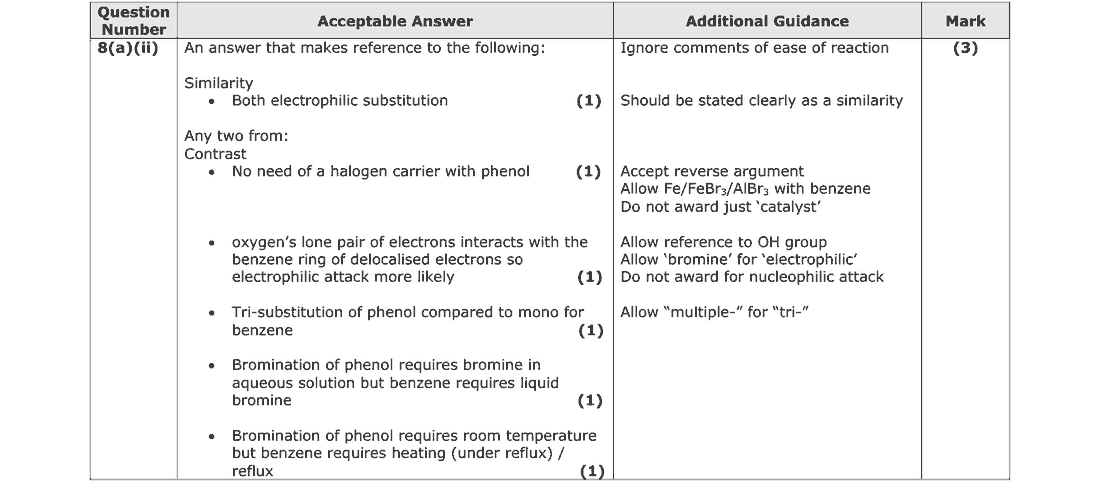
Similarity: both are electrophilic substitution (must be stated as a similarity). Any two contrasts: phenol needs no halogen carrier (Fe / FeBr3 / AlBr3 for benzene
not just 'catalyst')
the lone pair on the oxygen is delocalised into the ring, so electrophilic attack is more likely
phenol is tri-substituted and benzene mono-substituted
phenol uses aqueous bromine and benzene liquid bromine
phenol reacts at room temperature and benzene needs heating. Many gave only differences
bromine atoms being 'added' was not accepted
June 2018 · Paper 2 · Q8(b)(i)3 marksMechanism
Earlier part of question 8 that this part uses
Mark scheme
Examiner's comment
The mechanism was mostly well-understood with marks lost by careless placements of arrows/charges/atoms or by omissions.
It is worth reminding candidates that the hydroxide ion is usually drawn OH- but it is clearly understood that the negative charge is really on the oxygen and not on the hydrogen. Likewise in a nitronium ion that is written as NO2
+ the charge is on the nitrogen and not on the oxygen which means that the curly arrow should go to the nitrogen. Furthermore candidates should appreciate that the curly arrow is showing the movement of two electrons in the formation of a covalent bond and so should be between the two atoms that will be joined in that bond. Hence a curly arrow that went from the ring to the oxygen or to the positive charge did not score.
It was surprising to see a significant minority of candidates draw their curly arrow to a lone pair of electrons which had been added to the nitrogen atom. This was not awarded the first mark. Candidates need to remember that the curly arrow represents the movement of electrons and so would not go towards a lone pair of electrons as there would be repulsion.
The structures seen of the intermediate ion were generally correct and it was pleasing to see few drawings with the positive charge on the tetravalent carbon or the broken delocalised ring facing the wrong carbon. However there remain a small number of candidates that are still drawing the second curly arrow for the reformation of the delocalised ring from the hydrogen atom instead of from the carbon-hydrogen bond.
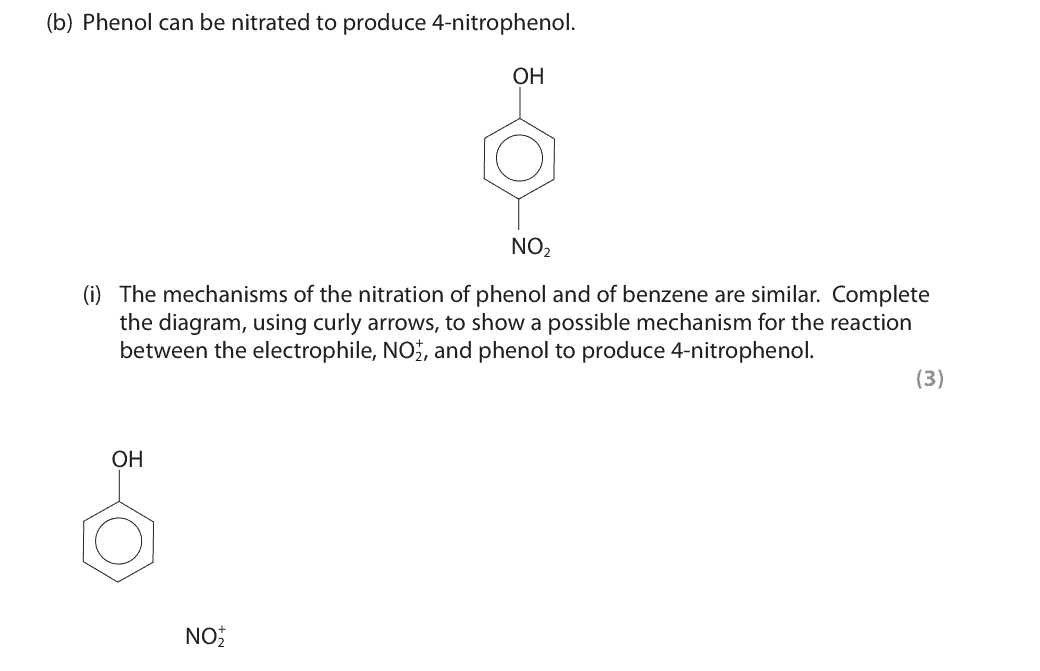
Notes from the mark scheme and report
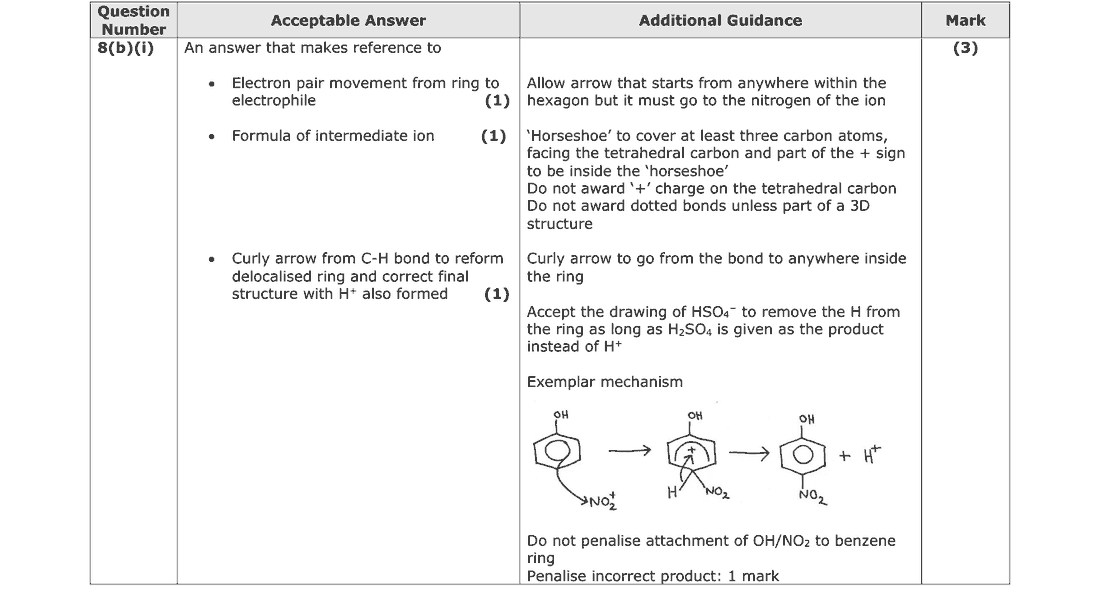
Curly arrow from the ring (anywhere inside the hexagon) to the N of NO2+
intermediate with the 'horseshoe' covering at least three carbons, open towards the tetrahedral carbon, with the + inside it (not on the tetrahedral carbon)
curly arrow from the C–H bond back into the ring, giving 4-nitrophenol and H+. A wrong product is penalised 1 mark. Common errors: arrow going to an oxygen or to the + sign, or to a lone pair drawn on nitrogen
second arrow starting from the H atom instead of the C–H bond
June 2017 · Paper 2 · Q7(a)5 marksShort answer
Mark scheme
Examiner's comment
In this question, all the scores from 0 to 5 inclusive were awarded to at least 10% of candidates, with a score of 4 being the most common at about 27%. There was a lot of good chemistry demonstrated, with the three steps and their reagents largely understood. It was the finer detail such as whether to use dilute or concentrated HCl, or whether heat under reflux was required that proved to be the differentiating factors. In addition, some candidates used additional reagents, including ones that were not in the list provided, which would have prevented the correct product from being formed and so this did not score. Hence this type of question is a very useful means of testing candidates' knowledge and understanding of organic chemistry and is an extremely worthy exercise for centres and their students to practise.
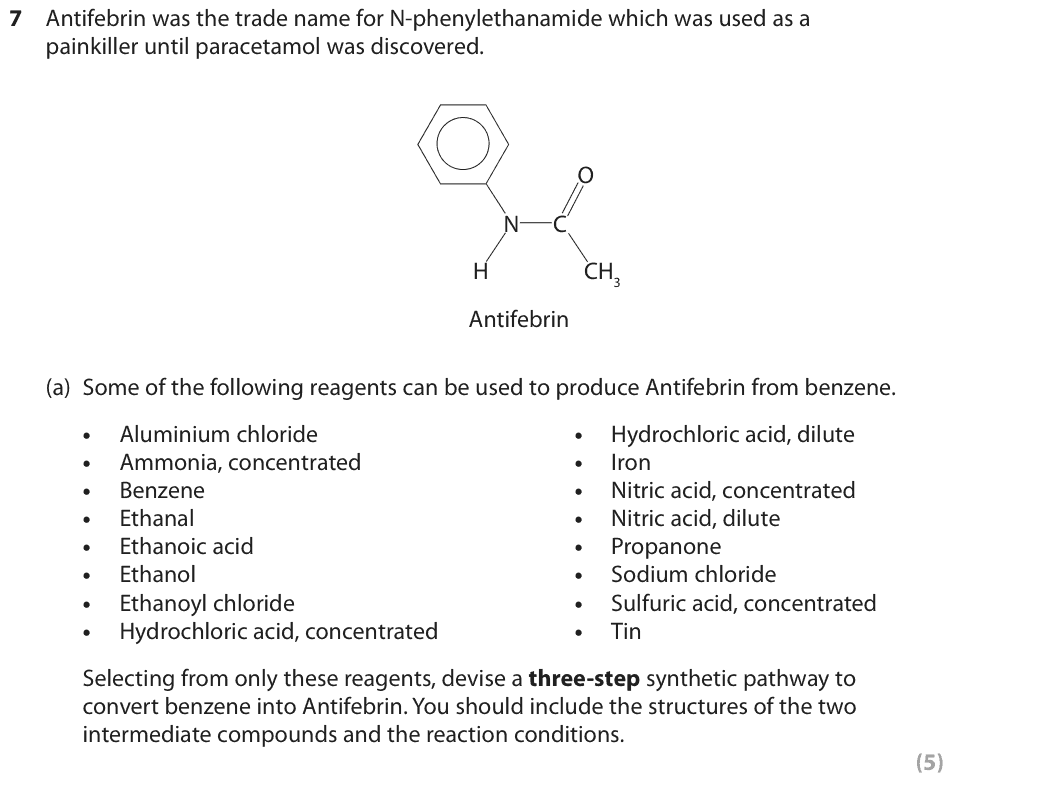
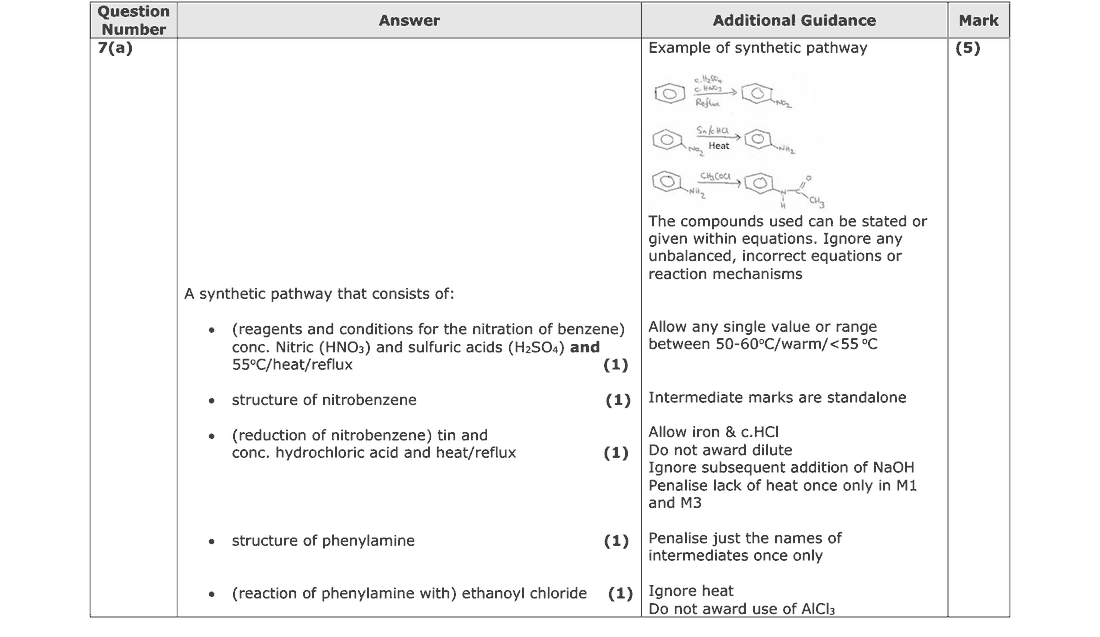
Notes from the mark scheme and report
M1 concentrated nitric and sulfuric acids with heat (55 °C, or 50–60 °C, warm, reflux)
M2 structure of nitrobenzene
M3 tin (allow iron) and concentrated hydrochloric acid, heat / reflux (not dilute)
M4 structure of phenylamine
M5 ethanoyl chloride (not with AlCl3
ignore heat). Intermediate marks stand alone
lack of heat penalised once
names only for the intermediates penalised once. Marks were spread from 0 to 5, 4 being most common
marks were lost on dilute or concentrated HCl, heating, and adding extra reagents
June 2017 · Paper 2 · Q7(c)2 marksExplanation
Earlier part of question 7 that this part uses
Mark scheme
Examiner's comment
In this question roughly 30% of candidates scored 0 or 1 mark and thus only the more detailed responses scored full marks. It was essential to indicate specifically where the electron density came from to make the aromatic ring in phenol more reactive for the first mark. As an alternative to being 'more susceptible to electrophilic attack' for the second mark it was acceptable to state that the ring was 'more nucleophilic' which is correctly considering the reaction from the opposite direction to the norm, but nonetheless correct chemistry.
Notes from the mark scheme and report
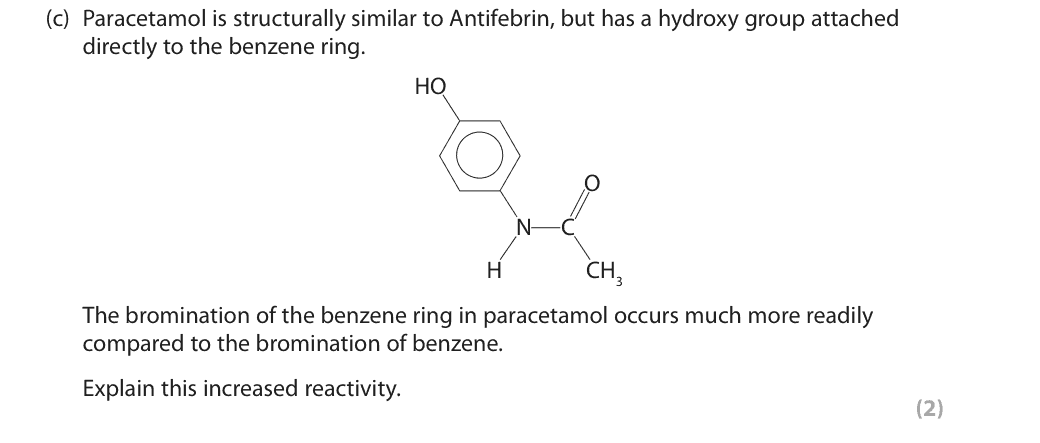
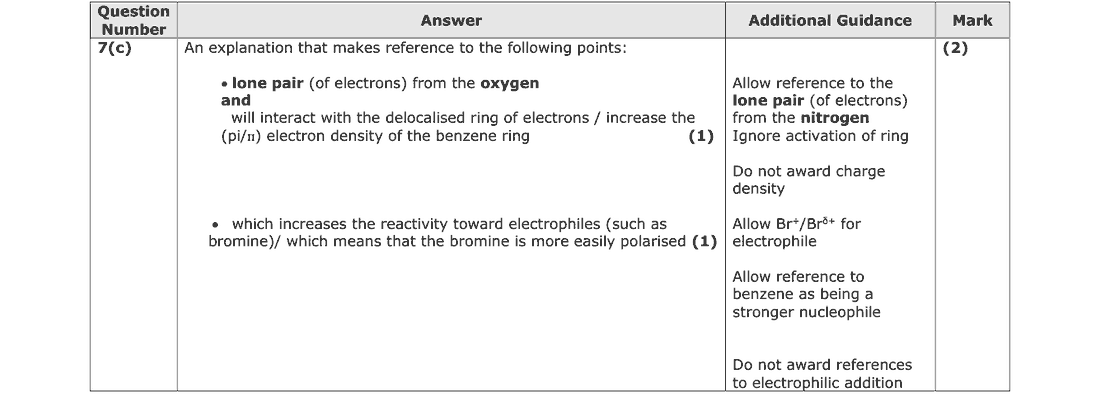
A lone pair on the oxygen (allow on the nitrogen) interacts with the delocalised ring / increases the electron density of the ring (not charge density)
so the ring is more reactive towards electrophiles / polarises bromine more easily (allow 'better nucleophile'
not electrophilic addition). The source of the extra electron density had to be stated for the first mark
June 2017 · Paper 2 · Q8(a)(i)1 markEquation writingEasy
Mark scheme
Examiner's comment
This was a relatively straightforward question and over 80% of candidates could correctly write the equation. It nicely set the scene for the following question on the mechanism of electrophilic substitution. The most common error was the omission of charge on one or both of the product species. Occasionally candidates used A or even Ag as a symbol for aluminium.
Notes from the mark scheme and report
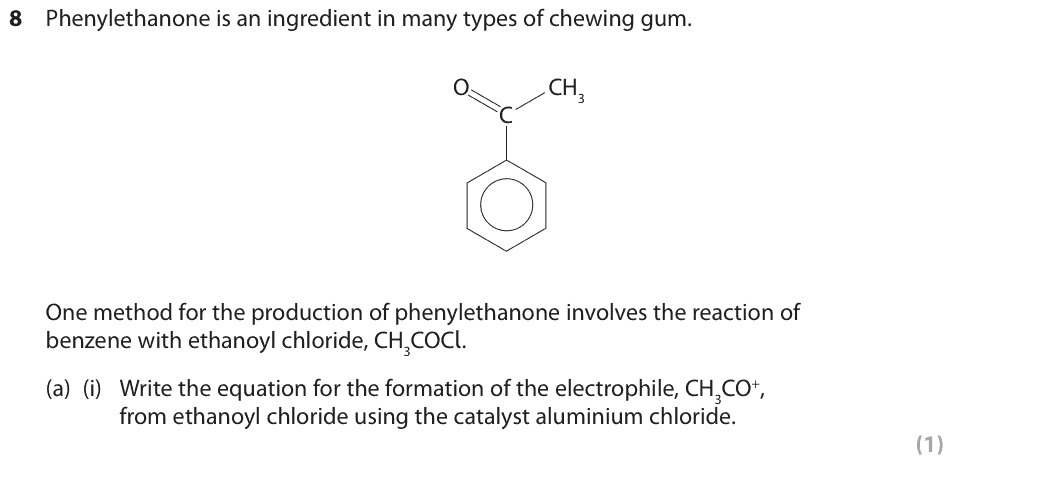
Answer: CH3COCl + AlCl3 → CH3CO+ + AlCl4–. Not C2H3OCl
state symbols ignored. Commonest error was a missing charge on one or both products
June 2017 · Paper 2 · Q8(a)(ii)4 marksMechanism
Earlier part of question 8 that this part uses
Mark scheme
Examiner's comment
Just over 50% of candidates were able to draw the electrophilic substitution mechanism correctly and gain all four marks. The errors seen were the usual ones of curly arrows drawn in the wrong direction, curly arrows going from and to the wrong places, the 'horseshoe' facing the wrong carbon atom of the ring, the positive charge drawn outside of the 'horseshoe' and omission of the regeneration of the catalyst. The candidates that had clearly practised drawing this type of mechanism generally avoided these errors and such an activity is well-advised.
Notes from the mark scheme and report
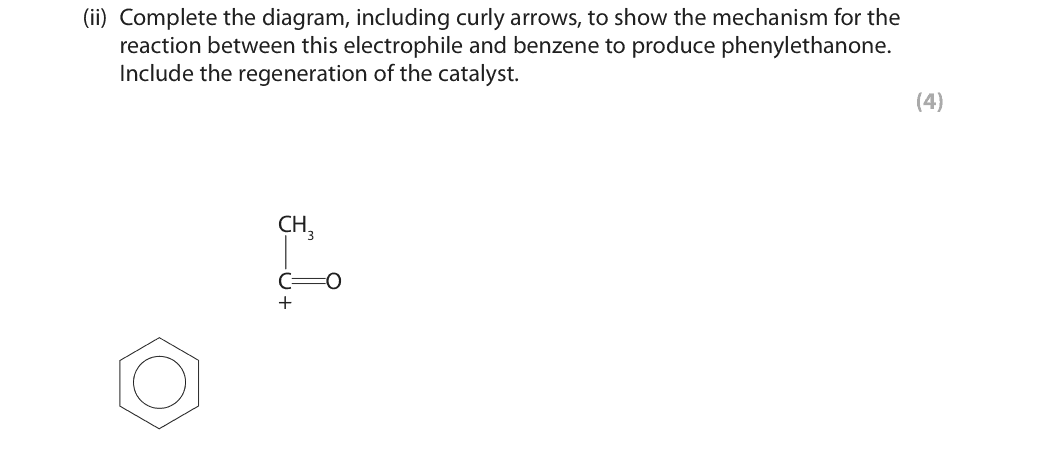
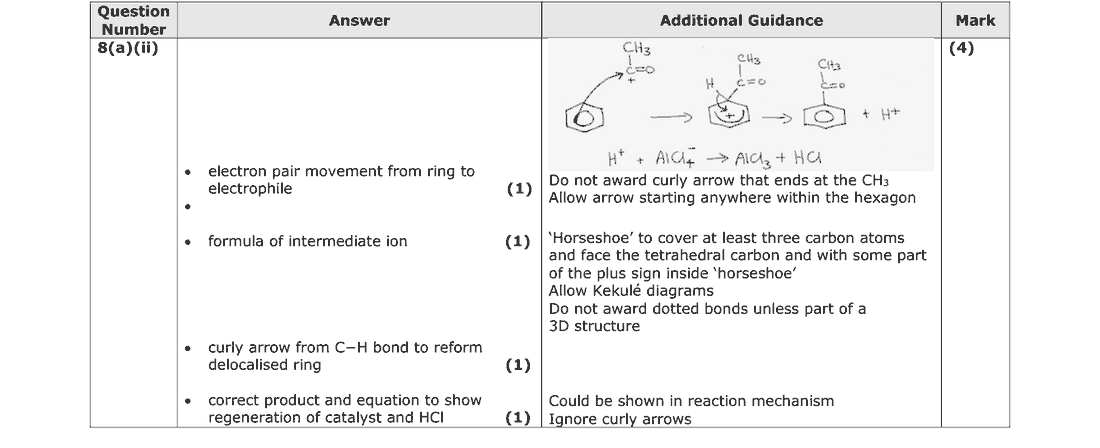
M1 curly arrow from the ring (anywhere inside the hexagon) to the C+ of the electrophile, not to CH3
M2 intermediate with a 'horseshoe' over at least three carbons, facing the tetrahedral carbon, with the + inside
M3 curly arrow from the C–H bond back into the ring
M4 phenylethanone and H+ + AlCl4– → AlCl3 + HCl. Kekulé structures allowed. Just over half scored 4
errors were arrows the wrong way, the horseshoe facing the wrong carbon, the charge outside it, and no catalyst regeneration
Work with an A-level chemistry tutor
Dropping marks on calculations, mechanisms or the core practicals? Book a trial session with an A-level chemistry tutor.