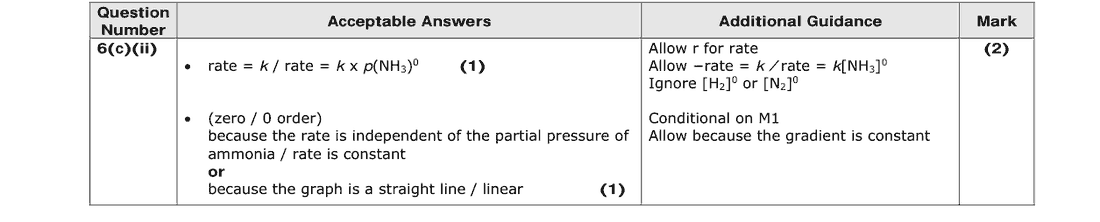
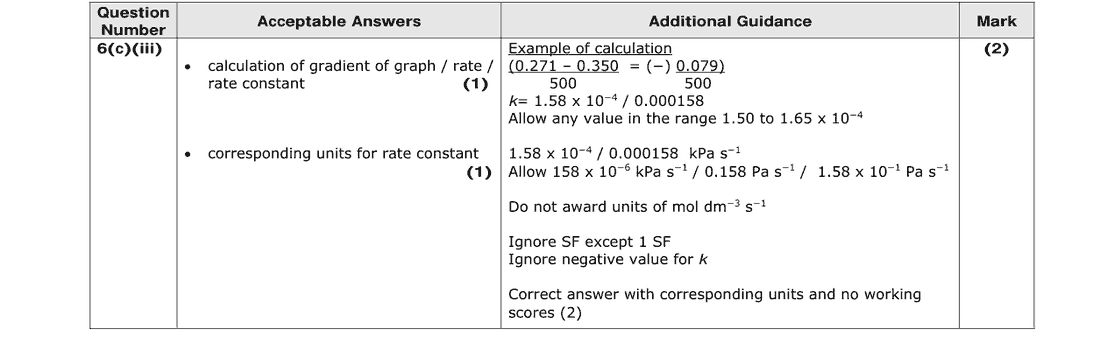
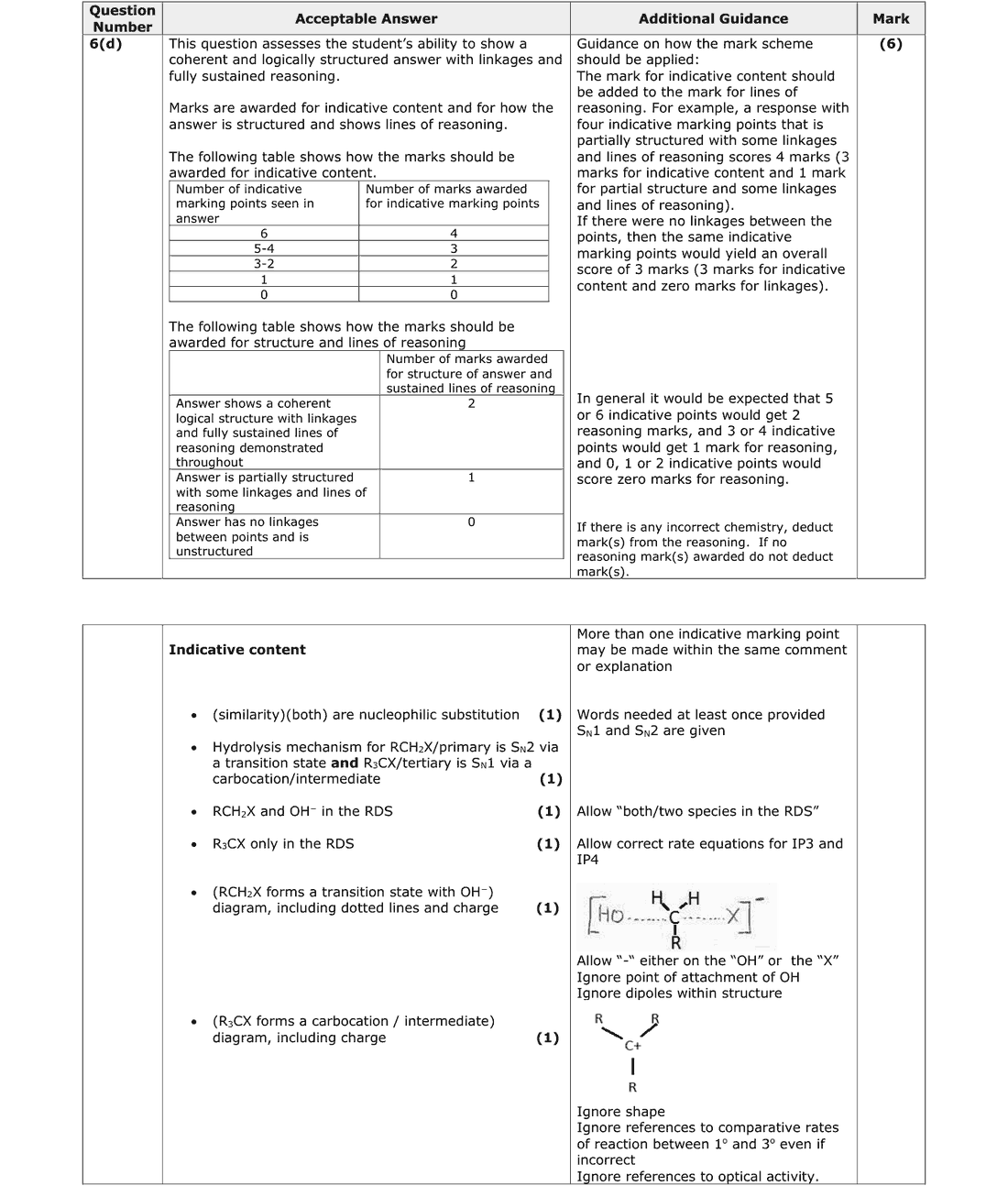
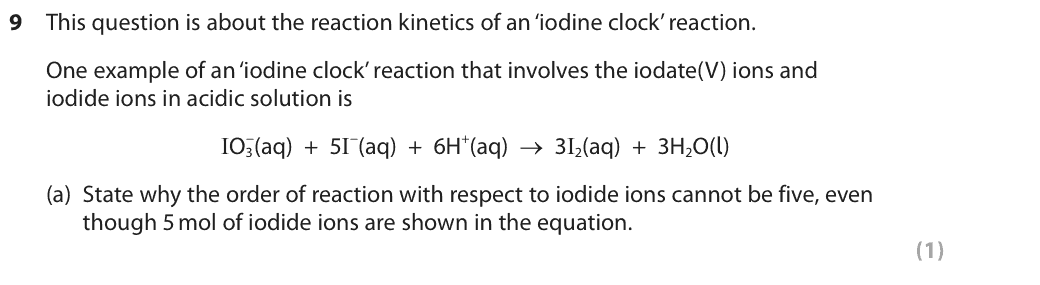
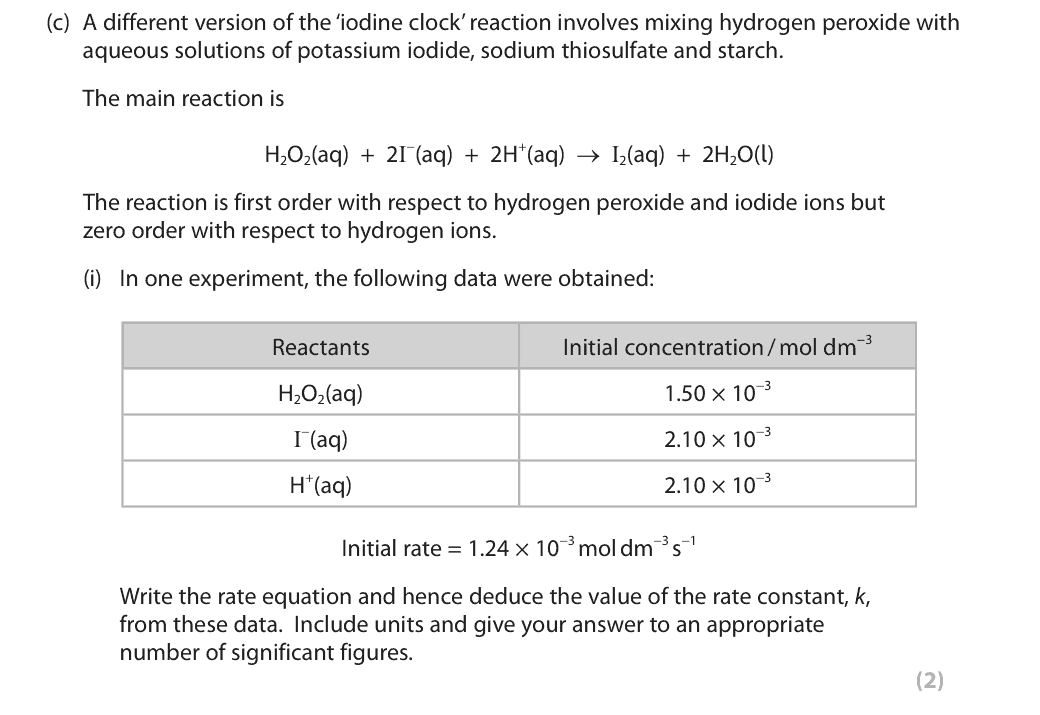
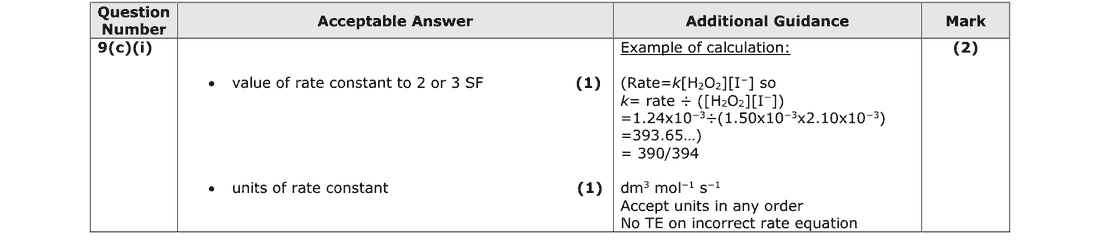
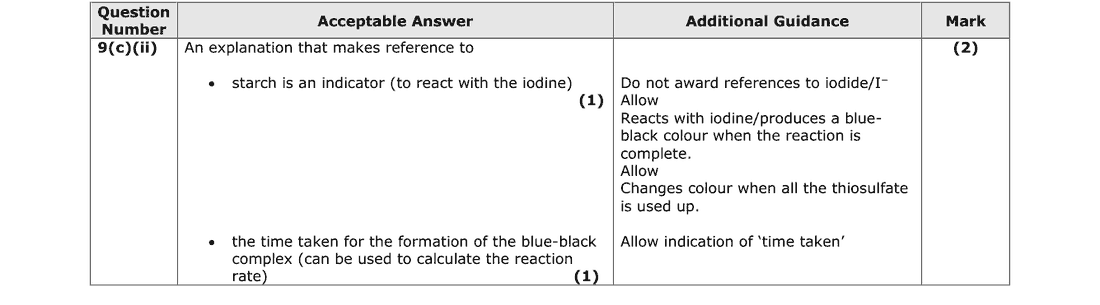
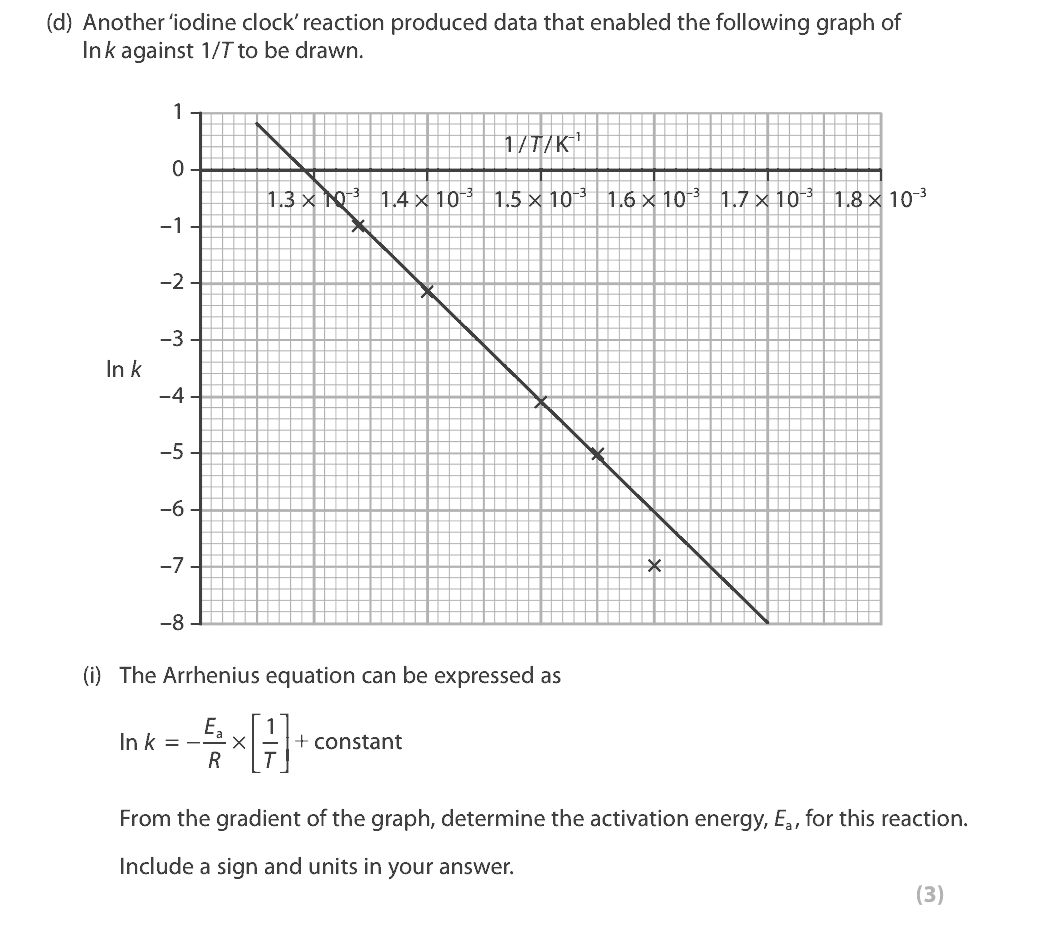
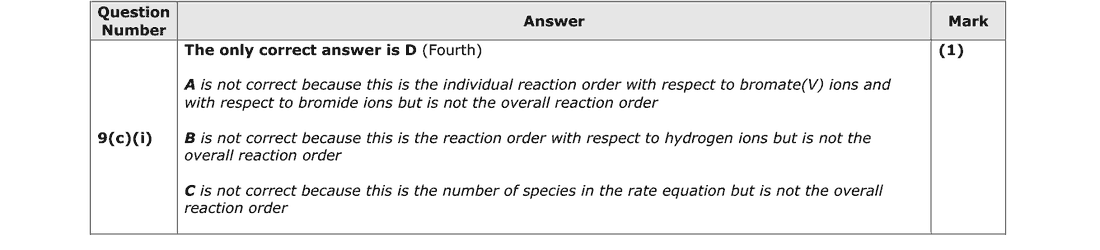
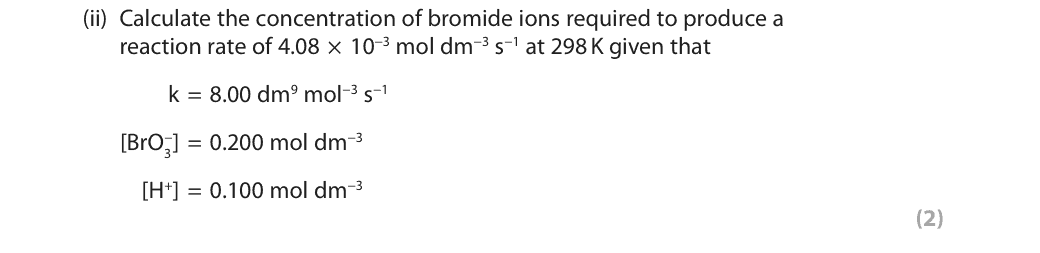
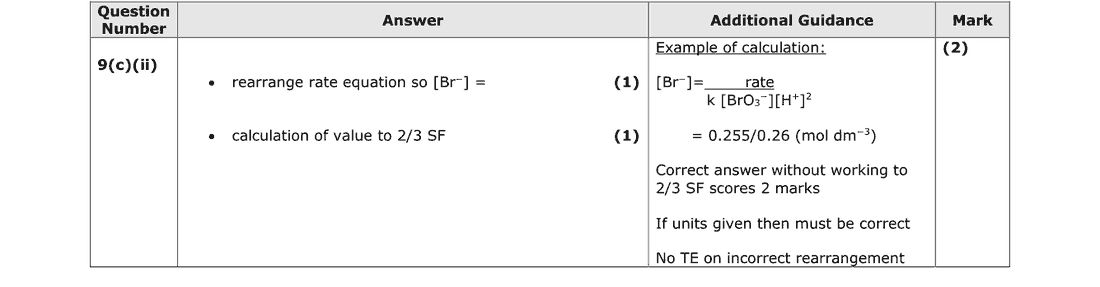
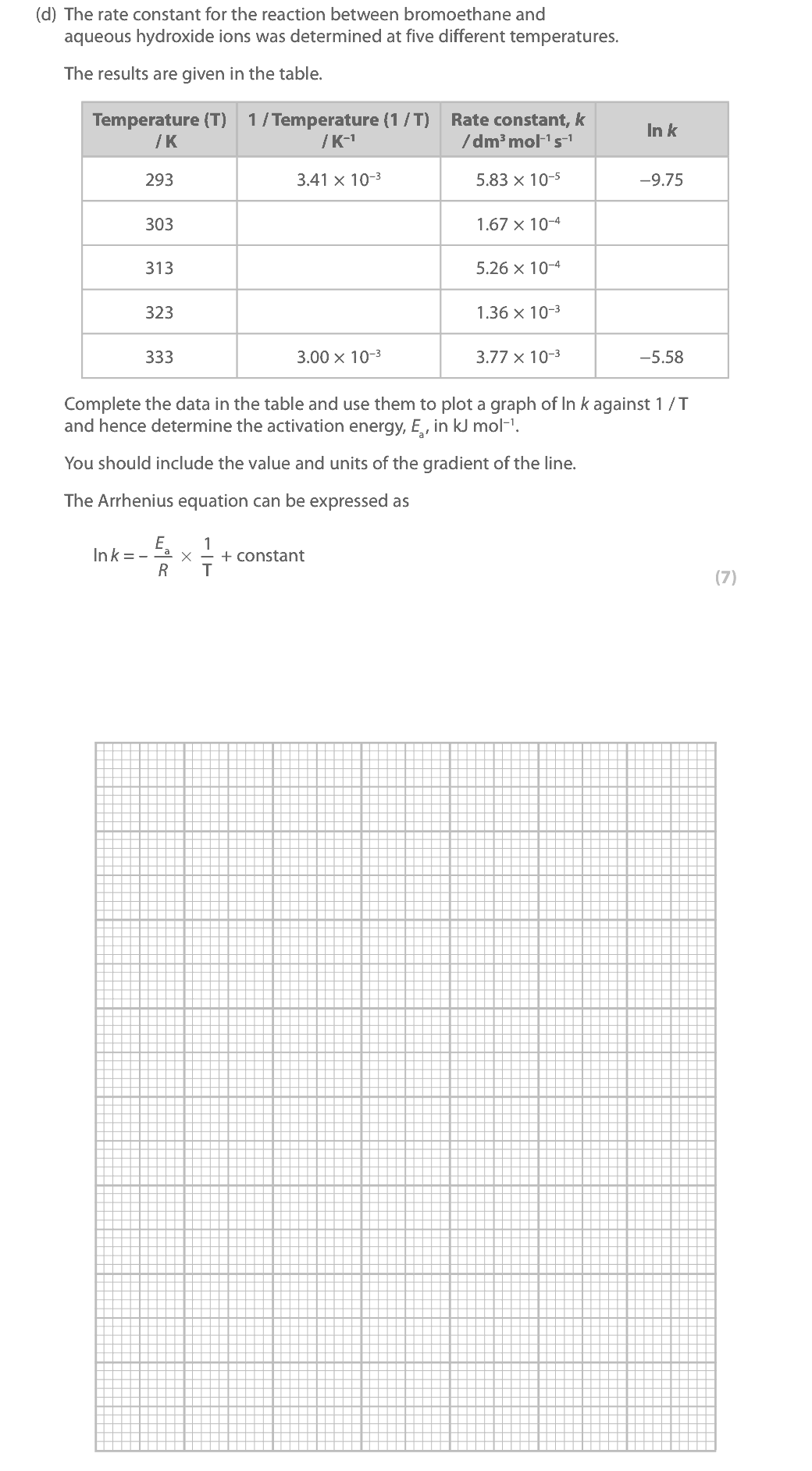
Notes and key-term cards for this topic are being written by our tutors. The past-paper questions below are ready now.
Specification statements
Show the 12 statements from the specification
16.1 understand the terms: • i rate of reaction • ii rate equation • iii order with respect to a substance in a rate equation • iv overall order of reaction • v rate constant • vi half-life • vii rate-determining step • viii activation energy • ix heterogeneous and homogenous catalyst
16.2 be able to determine and use rate equations of the form: rate = k[A]^m[B]^n, where m and n are 0, 1 or 2
16.3 be able to select and justify a suitable experimental technique to obtain rate data for a given reaction, including: • i titration • ii colorimetry • iii mass change • iv volume of gas evolved • v other suitable technique(s) for a given reaction
16.4 understand experiments that can be used to investigate reaction rates by: • i an initial-rate method, carrying out separate experiments where different initial concentrations of one reagent are used • ii a continuous monitoring method to generate data to enable concentration- time or volume-time graphs to be plotted [A ‘clock reaction’ is an acceptable approximation of this method]
16.5 be able to calculate the rate of reaction and the half-life of a first-order reaction using data from a concentration-time or a volume-time graph
16.6 be able to deduce the order (0, 1 or 2) with respect to a substance in a rate equation using data from: • i a concentration-time graph • ii a rate-concentration graph
16.7 be able to deduce the order (0, 1 or 2) with respect to a substance in a rate equation using data from an initial-rate method
16.8 understand how to: • i obtain data to calculate the order with respect to the reactants (and the hydrogen ion) in the acid-catalysed iodination of propanone • ii use these data to make predictions about species involved in the rate-determining step • iii deduce a possible mechanism for the reaction
16.9 be able to deduce a rate-determining step from a rate equation and vice versa
16.10 be able to deduce a reaction mechanism, using knowledge from a rate equation and the stoichiometric equation for a reaction
16.11 understand that knowledge of the rate equations for the hydrolysis of halogenoalkanes can be used to provide evidence for SN1 or SN2 mechanisms for tertiary and primary halogenoalkane hydrolysis
16.12 be able to use graphical methods to find the activation energy for a reaction from experimental data [The Arrhenius equation will be given if needed.]
Six-mark extended response questions on this topic
Tap a question to zoom it. Where a part needs a figure, table or structure from earlier in the question, that part folds out above it; the mark scheme and examiner's comment open underneath. Have Edexcel's Data Booklet beside you; the Periodic Table is on the back page of every paper.
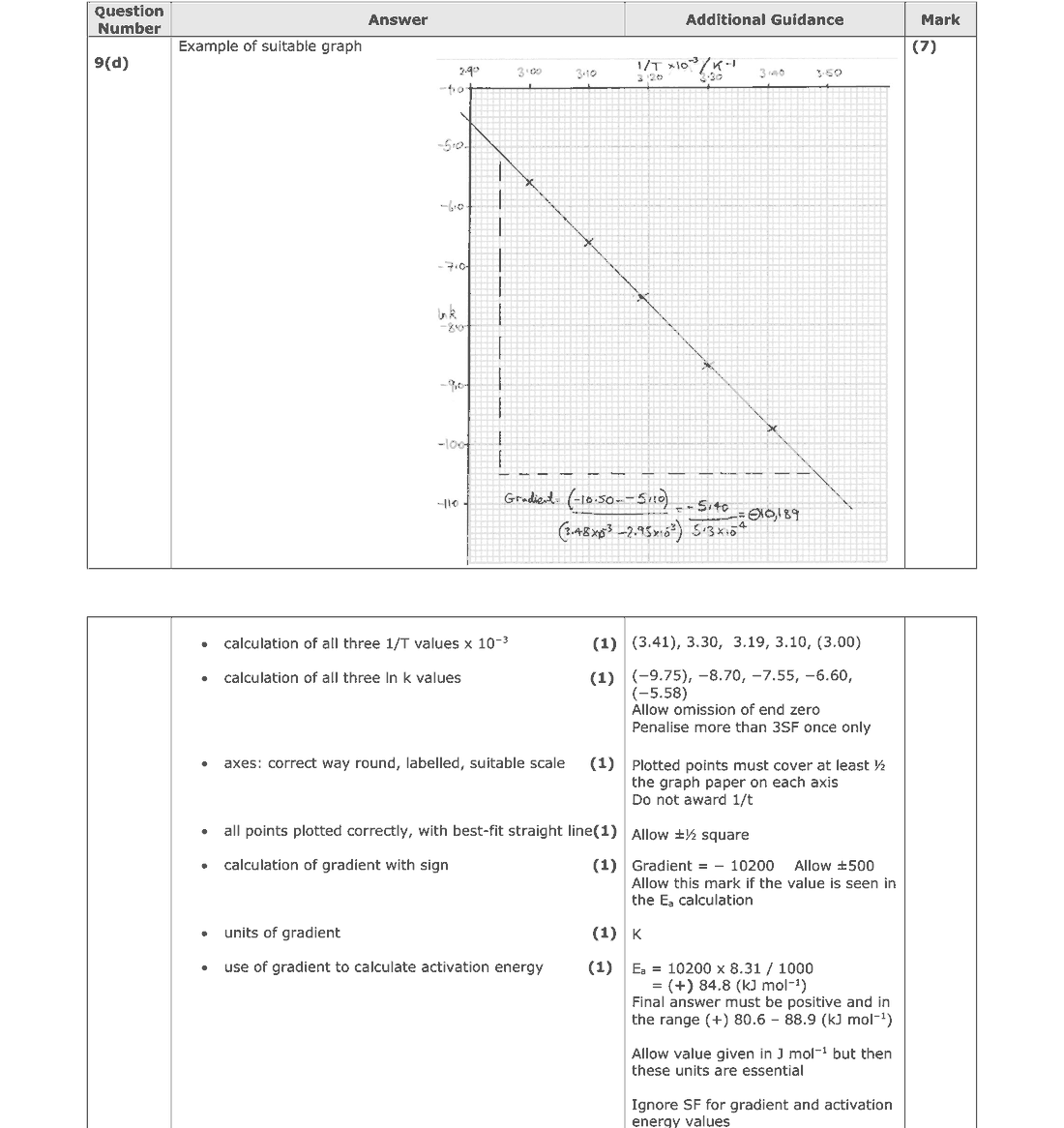
June 2025 · Paper 2 · Q9(a)(i)2 marksCalculation
Mark scheme
Examiner's comment
Most candidates scored two marks for Q09(a)(i).
This type of calculation based on graph plotting has been seen before in previous papers, so many candidates knew what to do.
It was disappointing to see a number of candidates who were unable to make the best use of the graph paper and failed to ensure that plotted points covered at least half of the graph paper, which lost M2. Also, there were still further candidates who plotted negative values becoming decreasingly negative down the page and those who plotted lnk on the x-axis and 1/T on the y- axis, so losing M2.
Gradients were often determined correctly, scoring M3. Despite clear instructions given in the question, often the units were lacking for the gradient which lost M4.
It was pleasing to see very few occurences of negative activation energies.
Notes from the mark scheme and report
Answer: T = 304 K (1 ÷ 3.29 × 10^–3) and k = 2.25 × 10^–4 (e^–8.4). Values not to 3 SF penalised once, so 303.95 and 2.2487 × 10^–4 scores 1
Skills: MS0.1 Recognise and use expressions in decimal and ordinary form; MS0.4 Use calculators to find and use power, exponential and logarithmic functions; MS1.1 Use an appropriate number of significant figures; CP14 Core practical 14: Finding the activation energy of a reaction
June 2025 · Paper 2 · Q9(a)(ii)5 marksCalculation
Earlier part of question 9 that this part uses
Mark scheme
Examiner's comment
Most candidates scored two marks for Q09(a)(i).
This type of calculation based on graph plotting has been seen before in previous papers, so many candidates knew what to do.
It was disappointing to see a number of candidates who were unable to make the best use of the graph paper and failed to ensure that plotted points covered at least half of the graph paper, which lost M2. Also, there were still further candidates who plotted negative values becoming decreasingly negative down the page and those who plotted lnk on the x-axis and 1/T on the y- axis, so losing M2.
Gradients were often determined correctly, scoring M3. Despite clear instructions given in the question, often the units were lacking for the gradient which lost M4.
It was pleasing to see very few occurences of negative activation energies.
Notes from the mark scheme and report
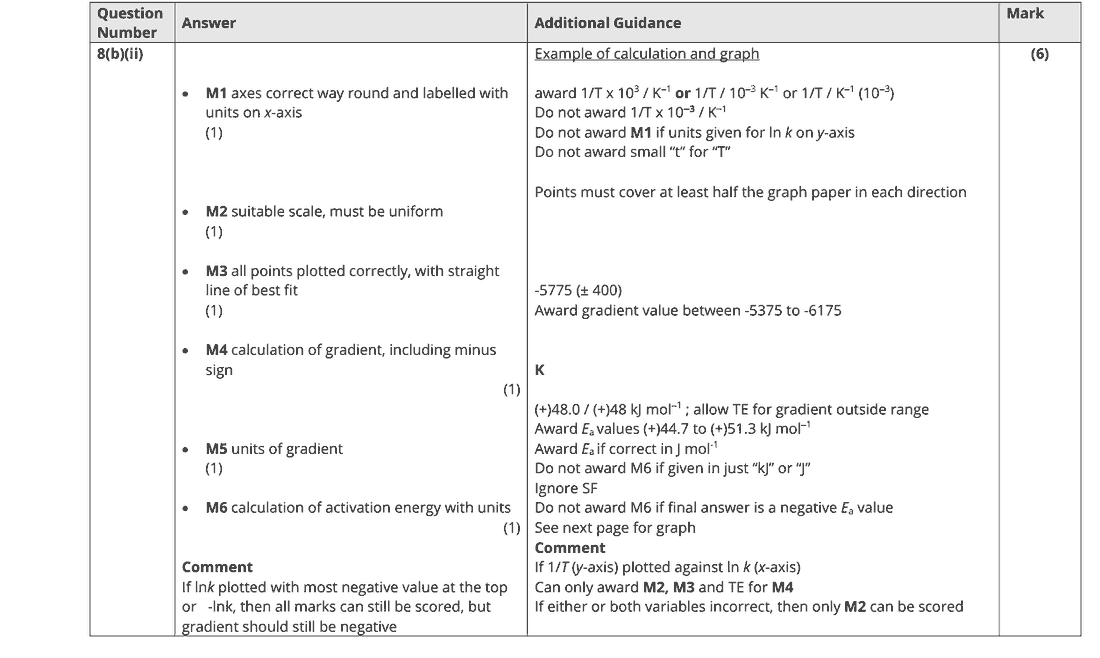
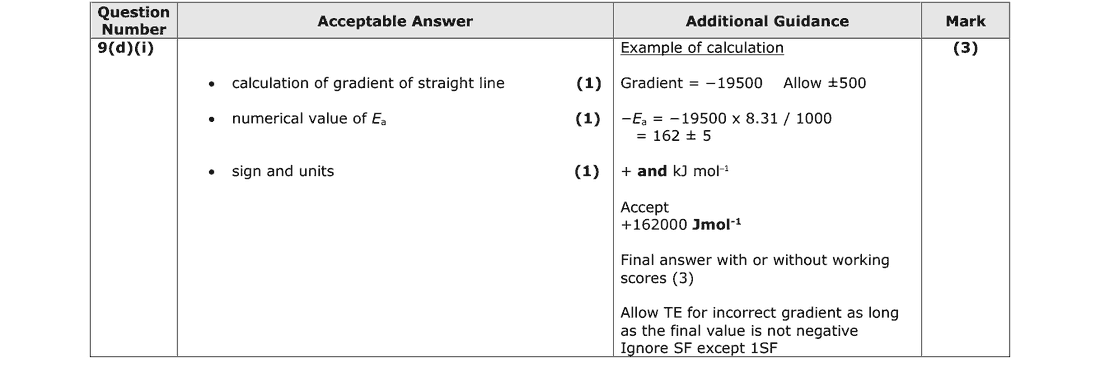
Answer: gradient = –7353 K (± 400)
Ea = +61.1 kJ mol–1 (± 4). Marks: axes the right way round and in the right direction, labelled with units (1/T, not 1/t)
points plotted (± half a square) with a best-fit line on a scale covering at least half the grid on each axis
gradient calculated
sign and unit of the gradient (– and K, stand-alone)
Ea = –(gradient × 8.31) ÷ 1000. A negative Ea is not accepted. Common errors: points not covering half the grid
negative values running the wrong way
axes swapped
no units on the gradient
Skills: MS0.0 Recognise and make use of appropriate units in calculation; MS2.3 Substitute numerical values into algebraic equations using appropriate units for physical quantities; MS3.2 Plot two variables from experimental or other data; MS3.3 Determine the slope and intercept of a linear graph; CP14 Core practical 14: Finding the activation energy of a reaction
June 2025 · Paper 2 · Q9(a)(iii)2 marksExplanationHard
Earlier part of question 9 that this part uses
Mark scheme
Examiner's comment
This proved to be a challenging question for candidates, with a number of responses left blank.
Many candidates were able to work out the answer but often provided wordy or difficult-to-follow explanations, sometimes omitting units or reasons.
Most of the candidates scoring full marks did so by assuming a rate equation with order 2, substituting units and then cancelling until they obtained the correct answer. Others used the given units of rate constant to deduce that two concentrations were involved, hence second order.
which is the unit of concentration squared, so second order overall. Or: assume rate = k[conc]^2 and show that rate ÷ (mol dm–3)^2 gives the units of k. Many left it blank or gave wordy explanations without units
Skills: MS0.0 Recognise and make use of appropriate units in calculation
June 2025 · Paper 2 · Q9(b)(i)3 marksMechanism
Mark scheme
Examiner's comment
This question was generally well answered.
Q09(b)(i) - A sizeable minority gave a mechanism for SN2 despite the clear instructions given in the question.
For those correctly drawing the SN1 mechanism, many scored at least two marks but common incorrect responses were omitting the bromide ion or the negative charge or the lone pair of electron on the hydroxide ion, so losing a mark.
Q09(b)(ii) - Many stated that the rate determining step did not involve hydroxide ions without stating that the rate determining step was the first step.
Notes from the mark scheme and report
Step 1: dipole on the C–Br bond (Cδ+, Brδ–) and curly arrow from the bond to Br
tertiary carbocation (CH3)3C+ and Br–. Step 2: curly arrow from a lone pair on the O of OH– to the C+. If SN2 is drawn, only M1 is available. A sizeable minority drew SN2
others left out the bromide ion, or the charge or lone pair on the hydroxide ion
June 2025 · Paper 2 · Q9(b)(ii)1 markShort answer
Earlier parts of question 9 that this part uses
Mark scheme
Examiner's comment
This question was generally well answered.
Q09(b)(i) - A sizeable minority gave a mechanism for SN2 despite the clear instructions given in the question.
For those correctly drawing the SN1 mechanism, many scored at least two marks but common incorrect responses were omitting the bromide ion or the negative charge or the lone pair of electron on the hydroxide ion, so losing a mark.
Q09(b)(ii) - Many stated that the rate determining step did not involve hydroxide ions without stating that the rate determining step was the first step.
Notes from the mark scheme and report
Step 1 is the rate-determining (slow) step and hydroxide ions do not take part in step 1. Marked with the mechanism in (b)(i). Many said hydroxide is not in the rate-determining step without saying that this is the first step
June 2025 · Paper 3 · Q4(a)2 marksPractical and data analysis
Mark scheme
Examiner's comment
This was a straightforward question relating to a practical procedure. Many candidates suggested just rinsing the pipette with distilled water, however it is good practice to rinse out a pipette with the solution to be used, and this was required in the answer. Fewer candidates were able to justify their answers in terms of preventing dilution of the acid.
Notes from the mark scheme and report
Rinse the pipette with the 2.00 mol dm–3 sulfuric acid (allow distilled water followed by the sulfuric acid)
to avoid diluting the acid / keep its concentration the same (allow: the unknown solution might react). M2 depends on M1. Many just rinsed with distilled water, which is not enough
fewer could justify in terms of dilution
Skills: PT4 use laboratory apparatus for a variety of experimental techniques, including: titration, using burette and pipette; distillation and heating under reflux, including setting up glassware using retort stand and clamps; qualitative tests for ions and organic functional groups; filtration, including use of fluted filter paper, or filtration under reduced pressure; CP13 Core practical 13: Rates of reaction Following the rate of the iodine-propanone reaction by a titrimetric method and investigating a ‘clock reaction’ (Harcourt-Esson, iodine clock)
June 2025 · Paper 3 · Q4(b)(i)2 marksPractical and data analysis
Earlier part of question 4 that this part uses
Mark scheme
Examiner's comment
Many candidates were familiar with the idea of 'quenching' to stop a reaction. They found it more difficult to express clearly why the reaction would need to be quenched, with many vague answers about allowing time for the actual titration to be carried out. The explanation needed to relate to there being no change in concentration before the titration was completed.
Notes from the mark scheme and report
Quenching stops (or greatly slows) the reaction
so the concentration (of iodine) does not change further before or during the titration. 'To make the titration accurate' and 'time to carry out the titration' are too vague
references to equilibrium ignored
Skills: PT12 measure rates of reaction by at least two different methods, for example: an initial rate method such as a clock reaction; a continuous monitoring method; CP13 Core practical 13: Rates of reaction Following the rate of the iodine-propanone reaction by a titrimetric method and investigating a ‘clock reaction’ (Harcourt-Esson, iodine clock)
June 2025 · Paper 3 · Q4(b)(ii)2 marksPractical and data analysis
Earlier parts of question 4 that this part uses
Mark scheme
Examiner's comment
There were many correct answers to the first part of this question, with many candidates selecting a suitable quenching agent. However, the accompanying equation proved more of a challenge.
The list of incorrect quenching agents included calcium chloride (which is a dehydrating agent), sodium thiosulfate (which would be used in the titration later) and potassium permanganate (oxidising agent).
sodium or potassium carbonate accepted), which removes the acid catalyst. Equation to match, e.g. NaHCO3 + H+ → Na+ + CO2 + H2O, HCO3– + H+ → CO2 + H2O, 2NaHCO3 + H2SO4 → Na2SO4 + 2CO2 + 2H2O, or CO3 2– + 2H+ → CO2 + H2O. Name and formula must agree if both given. The compound was often right but the equation was harder. Wrong choices: calcium chloride, sodium thiosulfate, potassium manganate(VII)
Skills: CP13 Core practical 13: Rates of reaction Following the rate of the iodine-propanone reaction by a titrimetric method and investigating a ‘clock reaction’ (Harcourt-Esson, iodine clock)
June 2025 · Paper 3 · Q4(d)4 marksCalculation
Earlier part of question 4 that this part uses
Mark scheme
Examiner's comment
Many candidates were able to calculate the concentration of the iodine and the propanone correctly. Some went on to describe that the iodine would be a limiting factor and scored three of the marks. For the fourth mark, candidates were required to state that the propanone would be in a great excess and hence the change in its concentration would be negligible. This mark was more difficult to score.
Notes from the mark scheme and report
Moles I2 = 0.0500 × 0.0200 = 1.00 × 10^–3
moles propanone = 0.0250 × 2.00 = 0.0500
propanone is in great excess (0.0500 is much greater than 1.00 × 10^–3) so its concentration changes negligibly (just 'in excess' is not enough)
so the change in rate is due only to the changing concentration of iodine (allow iodine is the limiting factor). The sulfuric acid is ignored. The two mole calculations were usually right
the negligible-change mark was the hardest
Skills: MS0.1 Recognise and use expressions in decimal and ordinary form; MS2.1 Understand and use the symbols: =, <, <<, >>, >, ∝, ~, equilibrium sign; CP13 Core practical 13: Rates of reaction Following the rate of the iodine-propanone reaction by a titrimetric method and investigating a ‘clock reaction’ (Harcourt-Esson, iodine clock)
June 2025 · Paper 3 · Q4(e)(i)2 marksDiagram or structure
Earlier part of question 4 that this part uses
Mark scheme
Examiner's comment
Q04(e)(i): The graph was generally clearly drawn with the axes labelled and the points plotted correctly, with a straight line of best fit added. The main error was in choosing a correct scale for the graph, as many did not cover half of the graph paper in both directions.
Q04(e)(ii): Many candidates made the correct link that the volume of sodium thiosulfate used would be proportional to the concentration of iodine.
Q04(e)(iii): While many candidates scored the mark for the correct order '0', there were a significant number who stated that the order would be '1', presumably confusing the graph with a 'rate-concentration' graph (although the gradient would be a straight line from the origin for this). Those who stated that the order was '0' usually went on to give a correct explanation.
Notes from the mark scheme and report
M1: axes labelled with units (time / min, titre / cm3) and a scale on which the points cover at least half the grid in both directions. M2: points plotted to within one square and a straight line of best fit. Plotting was generally good
the main error was a scale that did not use half the grid
Skills: MS3.2 Plot two variables from experimental or other data; CP13 Core practical 13: Rates of reaction Following the rate of the iodine-propanone reaction by a titrimetric method and investigating a ‘clock reaction’ (Harcourt-Esson, iodine clock)
June 2025 · Paper 3 · Q4(e)(ii)1 markShort answer
Earlier parts of question 4 that this part uses
Mark scheme
Examiner's comment
Q04(e)(i): The graph was generally clearly drawn with the axes labelled and the points plotted correctly, with a straight line of best fit added. The main error was in choosing a correct scale for the graph, as many did not cover half of the graph paper in both directions.
Q04(e)(ii): Many candidates made the correct link that the volume of sodium thiosulfate used would be proportional to the concentration of iodine.
Q04(e)(iii): While many candidates scored the mark for the correct order '0', there were a significant number who stated that the order would be '1', presumably confusing the graph with a 'rate-concentration' graph (although the gradient would be a straight line from the origin for this). Those who stated that the order was '0' usually went on to give a correct explanation.
Notes from the mark scheme and report
The titre (volume of sodium thiosulfate) is directly proportional to the concentration of iodine. Many made this link
Skills: CP13 Core practical 13: Rates of reaction Following the rate of the iodine-propanone reaction by a titrimetric method and investigating a ‘clock reaction’ (Harcourt-Esson, iodine clock)
June 2025 · Paper 3 · Q4(e)(iii)2 marksShort answer
Earlier parts of question 4 that this part uses
Mark scheme
Examiner's comment
Q04(e)(i): The graph was generally clearly drawn with the axes labelled and the points plotted correctly, with a straight line of best fit added. The main error was in choosing a correct scale for the graph, as many did not cover half of the graph paper in both directions.
Q04(e)(ii): Many candidates made the correct link that the volume of sodium thiosulfate used would be proportional to the concentration of iodine.
Q04(e)(iii): While many candidates scored the mark for the correct order '0', there were a significant number who stated that the order would be '1', presumably confusing the graph with a 'rate-concentration' graph (although the gradient would be a straight line from the origin for this). Those who stated that the order was '0' usually went on to give a correct explanation.
Notes from the mark scheme and report
Answer: zero order with respect to iodine
the titre–time graph is a straight line, so the gradient (rate) is constant / independent of the iodine concentration. M2 depends on M1. A significant number said first order, confusing it with a rate–concentration graph
Skills: MS3.1 Translate information between graphical, numerical and algebraic forms; MS3.3 Determine the slope and intercept of a linear graph; CP13 Core practical 13: Rates of reaction Following the rate of the iodine-propanone reaction by a titrimetric method and investigating a ‘clock reaction’ (Harcourt-Esson, iodine clock)
June 2024 · Paper 2 · Q3(c)(i)2 marksShort answer
Earlier part of question 3 that this part uses
Mark scheme
Examiner's comment
Candidates seemed well prepared for this type of question and for many, both orders were deduced correctly, even though both variables changed when considering experiments 2 and 3 from the table. Occasional slips were seen in (c)(ii), notably omission of the rate constant, k. The data in (c)(iii) was nearly always processed correctly to calculate k, sometimes the marks being awarded via a transferred error from the rate equation. The mean mark for the item overall was 4, and the area for candidates to consider in future series, is ensuring they can deduce the correct units for k as the omission of the units was probably the most common error.
Notes from the mark scheme and report
Answer: first order with respect to hydrogen peroxide and first order with respect to iodide ions. Experiments 1 and 2: [H2O2] × 4 gives rate × 4. Experiments 2 and 3: [H2O2] halves and [I–] doubles with the rate unchanged, so the doubling of [I–] must double the rate. Many got both although two concentrations change between Experiments 2 and 3
Skills: MS0.2 Use ratios, fractions and percentages
June 2024 · Paper 2 · Q3(c)(ii)1 markShort answer
Earlier parts of question 3 that this part uses
Mark scheme
Examiner's comment
Candidates seemed well prepared for this type of question and for many, both orders were deduced correctly, even though both variables changed when considering experiments 2 and 3 from the table. Occasional slips were seen in (c)(ii), notably omission of the rate constant, k. The data in (c)(iii) was nearly always processed correctly to calculate k, sometimes the marks being awarded via a transferred error from the rate equation. The mean mark for the item overall was 4, and the area for candidates to consider in future series, is ensuring they can deduce the correct units for k as the omission of the units was probably the most common error.
Notes from the mark scheme and report
Answer: rate = k[H2O2][I–]. Must match the orders from (c)(i) (error carried forward). 'Rate =' and square brackets are required
names allowed. Occasional slip: leaving out k
June 2024 · Paper 2 · Q3(c)(iii)2 marksCalculation
Earlier parts of question 3 that this part uses
Mark scheme
Examiner's comment
Candidates seemed well prepared for this type of question and for many, both orders were deduced correctly, even though both variables changed when considering experiments 2 and 3 from the table. Occasional slips were seen in (c)(ii), notably omission of the rate constant, k. The data in (c)(iii) was nearly always processed correctly to calculate k, sometimes the marks being awarded via a transferred error from the rate equation. The mean mark for the item overall was 4, and the area for candidates to consider in future series, is ensuring they can deduce the correct units for k as the omission of the units was probably the most common error.
Notes from the mark scheme and report
Answer: 1.78 × 10^–4 dm3 mol–1 s–1. k = rate ÷ ([H2O2][I–]) = 3.56 × 10^–6 ÷ (0.200 × 0.100). One mark for the value and one for the units (any order). Error carried forward from the rate equation in (c)(ii)
data from Experiment 1 or 2 also allowed
1 s.f. not accepted. The value was nearly always right
missing units were the commonest error
Skills: MS0.0 Recognise and make use of appropriate units in calculation; MS2.2 Change the subject of an equation; MS2.3 Substitute numerical values into algebraic equations using appropriate units for physical quantities
June 2024 · Paper 2 · Q3(e)(i)3 marksCalculation
Earlier part of question 3 that this part uses
Mark scheme
Examiner's comment
Candidates were familiar with the processes required here and it was rare to see a response unable to score some credit. However, many answers showed errors and despite the candidates clearly knowing what to do, they missed at least one mark. Taking care when reading values from the axes is key, and as the question made clear, working to deduce these values had to be clearly shown on the graph. This could be as simple as extrapolation lines to the x and y axes. A small number of candidates didn’t appreciate that the gradient had a negative value. The most common error concerned the units for the gradient. The units tended to be omitted completely or involved spurious units from the logarithmic scale. Most candidates were able to calculate a value for activation energy in (e)(ii), though a small
number used incongruent units, eg using kJ mol – 1 without converting their value appropriately.
Notes from the mark scheme and report
Answer: about –9090 K (accepted range –8500 to –9500). M1 a triangle or marked points on the line showing the changes in x and y
M3 units K. Error carried forward from misread values. Commonest error was the unit (left out, or carrying units from the log scale)
a few gave a positive gradient
many lost a mark through careless reading of the axes
Skills: MS0.0 Recognise and make use of appropriate units in calculation; MS3.1 Translate information between graphical, numerical and algebraic forms; MS3.3 Determine the slope and intercept of a linear graph; CP14 Core practical 14: Finding the activation energy of a reaction
June 2024 · Paper 2 · Q3(e)(ii)1 markCalculation
Earlier parts of question 3 that this part uses
Mark scheme
Examiner's comment
Candidates were familiar with the processes required here and it was rare to see a response unable to score some credit. However, many answers showed errors and despite the candidates clearly knowing what to do, they missed at least one mark. Taking care when reading values from the axes is key, and as the question made clear, working to deduce these values had to be clearly shown on the graph. This could be as simple as extrapolation lines to the x and y axes. A small number of candidates didn’t appreciate that the gradient had a negative value. The most common error concerned the units for the gradient. The units tended to be omitted completely or involved spurious units from the logarithmic scale. Most candidates were able to calculate a value for activation energy in (e)(ii), though a small
number used incongruent units, eg using kJ mol – 1 without converting their value appropriately.
Notes from the mark scheme and report
Answer: (+)75.5 kJ mol–1. Gradient = –Ea ÷ R, so Ea = 9090.9 × 8.31 = 75 545 J mol–1 = 75.5 kJ mol–1. Error carried forward from (e)(i). A negative activation energy is not credited
an answer in J mol–1 must show the unit. A few mixed J and kJ
Skills: MS0.0 Recognise and make use of appropriate units in calculation; MS2.2 Change the subject of an equation; MS2.3 Substitute numerical values into algebraic equations using appropriate units for physical quantities; CP14 Core practical 14: Finding the activation energy of a reaction
June 2024 · Paper 2 · Q3(f)2 marksCalculation
Earlier part of question 3 that this part uses
Mark scheme
Examiner's comment
Although the equation was unfamiliar many candidates could take into account both the rearrangement and use of ‘e’ in order to calculate a value for A. Even those candidates who struggled with the rearrangement could often gain some credit for transposing values correctly into the exponential expression.
A = k ÷ e^(–Ea/RT) = 1.60 × 10^–3 ÷ 8.1164 × 10^–8 = 1.9713 × 10^4 (M2). Significant figures and units ignored
rounded intermediate values accepted
correct answer alone scores 2. Many managed the rearrangement
others still scored M1 for the exponential term
Skills: MS0.4 Use calculators to find and use power, exponential and logarithmic functions; MS2.2 Change the subject of an equation; MS2.3 Substitute numerical values into algebraic equations using appropriate units for physical quantities
June 2024 · Paper 3 · Q10(a)(i)2 marksPractical and data analysis
Mark scheme
Examiner's comment
It was not unusual to see a response for part (a)(i) which correctly deduced that the crushed ice was used to quench or to stop the reaction but then to fail to explain the reason for doing this. It is a reminder to candidates to always seek an explanation for why procedural steps are taken. In this instance there needed to be time for the titration to be carried out without the concentrations changing. Whilst it is true that the reaction is technically slowed rather than stopped, it is important for candidates to understand the principle. Likewise in part (a)(ii) many correct references to the reaction reaching equilibrium or the hydrolysis going to completion were seen for one mark but not the reason for doing so. A notable minority have ‘heated under reflux’ always linked with oxidation but this was not the case here.
For the most part the practicing of graph drawing by candidates paid off and full marks were awarded in part (b)(i). It was pleasing to see that the vast majority of axes were correctly labelled with units. The explanation of the plotting values was not well answered in part (b)(ii). Some of the more able candidates spotted that if the concentration of sodium hydroxide was plotted then because this does not change, the graph would be a straight line. The determination of half-lives as seen in part (b)(iii) continues to show the misunderstanding by candidates when answers such as 12 and 24 minutes are given. The first half life is correct but the second should be 24 – 12 = 12 and this error was commonly seen. In part (b)(iv) it was often the case that candidates having quoted 12 and 24 minutes, still wrote that the half lifes were constant and so the order of reaction is first order. It is unclear if this is what these candidates have just learnt by rote when calculating half lifes or whether they had done the subtraction in their heads and simply not written the value down. This would be something that candidates and their centres would find useful to practice. This is a long and exhausting paper and so it was pleasing to see that candidates maintained their efforts right to the end. The majority of candidates understood the significance of the slow, rate-determining step and correctly gave the rate equation for one mark. As this was the end of the paper, it was insufficent to simply identify Step 1 as the rate determining step for the second mark. It is the molar ratio of the species in this step that determines their reaction order and only the more able candidates explained that.
Notes from the mark scheme and report
To stop / quench the reaction (1)
so that the concentrations do not change while the titration is carried out (the concentration at that time can be found) (1). Just cooling, or just slowing the reaction, is ignored. Many gave the quenching but not the reason for it
Skills: PT12 measure rates of reaction by at least two different methods, for example: an initial rate method such as a clock reaction; a continuous monitoring method; CP13 Core practical 13: Rates of reaction Following the rate of the iodine-propanone reaction by a titrimetric method and investigating a ‘clock reaction’ (Harcourt-Esson, iodine clock)
June 2024 · Paper 3 · Q10(a)(ii)2 marksPractical and data analysis
Earlier part of question 10 that this part uses
Mark scheme
Examiner's comment
It was not unusual to see a response for part (a)(i) which correctly deduced that the crushed ice was used to quench or to stop the reaction but then to fail to explain the reason for doing this. It is a reminder to candidates to always seek an explanation for why procedural steps are taken. In this instance there needed to be time for the titration to be carried out without the concentrations changing. Whilst it is true that the reaction is technically slowed rather than stopped, it is important for candidates to understand the principle. Likewise in part (a)(ii) many correct references to the reaction reaching equilibrium or the hydrolysis going to completion were seen for one mark but not the reason for doing so. A notable minority have ‘heated under reflux’ always linked with oxidation but this was not the case here.
For the most part the practicing of graph drawing by candidates paid off and full marks were awarded in part (b)(i). It was pleasing to see that the vast majority of axes were correctly labelled with units. The explanation of the plotting values was not well answered in part (b)(ii). Some of the more able candidates spotted that if the concentration of sodium hydroxide was plotted then because this does not change, the graph would be a straight line. The determination of half-lives as seen in part (b)(iii) continues to show the misunderstanding by candidates when answers such as 12 and 24 minutes are given. The first half life is correct but the second should be 24 – 12 = 12 and this error was commonly seen. In part (b)(iv) it was often the case that candidates having quoted 12 and 24 minutes, still wrote that the half lifes were constant and so the order of reaction is first order. It is unclear if this is what these candidates have just learnt by rote when calculating half lifes or whether they had done the subtraction in their heads and simply not written the value down. This would be something that candidates and their centres would find useful to practice. This is a long and exhausting paper and so it was pleasing to see that candidates maintained their efforts right to the end. The majority of candidates understood the significance of the slow, rate-determining step and correctly gave the rate equation for one mark. As this was the end of the paper, it was insufficent to simply identify Step 1 as the rate determining step for the second mark. It is the molar ratio of the species in this step that determines their reaction order and only the more able candidates explained that.
Notes from the mark scheme and report
To make sure the hydrolysis reaches equilibrium / goes to completion (1)
so that the maximum (final) amount of acid formed can be found, giving Vfinal (1). Not oxidation, which a notable minority linked with heating under reflux. Many gave the first point without the reason
Skills: PT12 measure rates of reaction by at least two different methods, for example: an initial rate method such as a clock reaction; a continuous monitoring method; CP13 Core practical 13: Rates of reaction Following the rate of the iodine-propanone reaction by a titrimetric method and investigating a ‘clock reaction’ (Harcourt-Esson, iodine clock)
June 2024 · Paper 3 · Q10(b)(i)3 marksDiagram or structure
Earlier part of question 10 that this part uses
Mark scheme
Examiner's comment
It was not unusual to see a response for part (a)(i) which correctly deduced that the crushed ice was used to quench or to stop the reaction but then to fail to explain the reason for doing this. It is a reminder to candidates to always seek an explanation for why procedural steps are taken. In this instance there needed to be time for the titration to be carried out without the concentrations changing. Whilst it is true that the reaction is technically slowed rather than stopped, it is important for candidates to understand the principle. Likewise in part (a)(ii) many correct references to the reaction reaching equilibrium or the hydrolysis going to completion were seen for one mark but not the reason for doing so. A notable minority have ‘heated under reflux’ always linked with oxidation but this was not the case here.
For the most part the practicing of graph drawing by candidates paid off and full marks were awarded in part (b)(i). It was pleasing to see that the vast majority of axes were correctly labelled with units. The explanation of the plotting values was not well answered in part (b)(ii). Some of the more able candidates spotted that if the concentration of sodium hydroxide was plotted then because this does not change, the graph would be a straight line. The determination of half-lives as seen in part (b)(iii) continues to show the misunderstanding by candidates when answers such as 12 and 24 minutes are given. The first half life is correct but the second should be 24 – 12 = 12 and this error was commonly seen. In part (b)(iv) it was often the case that candidates having quoted 12 and 24 minutes, still wrote that the half lifes were constant and so the order of reaction is first order. It is unclear if this is what these candidates have just learnt by rote when calculating half lifes or whether they had done the subtraction in their heads and simply not written the value down. This would be something that candidates and their centres would find useful to practice. This is a long and exhausting paper and so it was pleasing to see that candidates maintained their efforts right to the end. The majority of candidates understood the significance of the slow, rate-determining step and correctly gave the rate equation for one mark. As this was the end of the paper, it was insufficent to simply identify Step 1 as the rate determining step for the second mark. It is the molar ratio of the species in this step that determines their reaction order and only the more able candidates explained that.
Notes from the mark scheme and report
Both axes labelled with units, time on the horizontal axis (1)
scale on which the points cover at least half the grid each way (1)
all points plotted correctly with a smooth curve of best fit (within two small squares of the points
the line must not rise after 60 minutes) (1). Mostly full marks, with axes labelled and units given
Skills: MS3.2 Plot two variables from experimental or other data; CP13 Core practical 13: Rates of reaction Following the rate of the iodine-propanone reaction by a titrimetric method and investigating a ‘clock reaction’ (Harcourt-Esson, iodine clock)
June 2024 · Paper 3 · Q10(b)(ii)2 marksExplanationHard
Earlier parts of question 10 that this part uses
Mark scheme
Examiner's comment
It was not unusual to see a response for part (a)(i) which correctly deduced that the crushed ice was used to quench or to stop the reaction but then to fail to explain the reason for doing this. It is a reminder to candidates to always seek an explanation for why procedural steps are taken. In this instance there needed to be time for the titration to be carried out without the concentrations changing. Whilst it is true that the reaction is technically slowed rather than stopped, it is important for candidates to understand the principle. Likewise in part (a)(ii) many correct references to the reaction reaching equilibrium or the hydrolysis going to completion were seen for one mark but not the reason for doing so. A notable minority have ‘heated under reflux’ always linked with oxidation but this was not the case here.
For the most part the practicing of graph drawing by candidates paid off and full marks were awarded in part (b)(i). It was pleasing to see that the vast majority of axes were correctly labelled with units. The explanation of the plotting values was not well answered in part (b)(ii). Some of the more able candidates spotted that if the concentration of sodium hydroxide was plotted then because this does not change, the graph would be a straight line. The determination of half-lives as seen in part (b)(iii) continues to show the misunderstanding by candidates when answers such as 12 and 24 minutes are given. The first half life is correct but the second should be 24 – 12 = 12 and this error was commonly seen. In part (b)(iv) it was often the case that candidates having quoted 12 and 24 minutes, still wrote that the half lifes were constant and so the order of reaction is first order. It is unclear if this is what these candidates have just learnt by rote when calculating half lifes or whether they had done the subtraction in their heads and simply not written the value down. This would be something that candidates and their centres would find useful to practice. This is a long and exhausting paper and so it was pleasing to see that candidates maintained their efforts right to the end. The majority of candidates understood the significance of the slow, rate-determining step and correctly gave the rate equation for one mark. As this was the end of the paper, it was insufficent to simply identify Step 1 as the rate determining step for the second mark. It is the molar ratio of the species in this step that determines their reaction order and only the more able candidates explained that.
Notes from the mark scheme and report
Any two of: Vfinal is proportional to the initial amount of ester plus the acid catalyst
Vfinal – Vt is proportional to the concentration / amount of ester remaining at time t
the concentration of the sodium hydroxide does not change, so plotting it would give a straight line. Some of the more able saw the point about the sodium hydroxide concentration
Skills: CP13 Core practical 13: Rates of reaction Following the rate of the iodine-propanone reaction by a titrimetric method and investigating a ‘clock reaction’ (Harcourt-Esson, iodine clock)
June 2024 · Paper 3 · Q10(b)(iii)2 marksShort answer
Earlier parts of question 10 that this part uses
Mark scheme
Examiner's comment
It was not unusual to see a response for part (a)(i) which correctly deduced that the crushed ice was used to quench or to stop the reaction but then to fail to explain the reason for doing this. It is a reminder to candidates to always seek an explanation for why procedural steps are taken. In this instance there needed to be time for the titration to be carried out without the concentrations changing. Whilst it is true that the reaction is technically slowed rather than stopped, it is important for candidates to understand the principle. Likewise in part (a)(ii) many correct references to the reaction reaching equilibrium or the hydrolysis going to completion were seen for one mark but not the reason for doing so. A notable minority have ‘heated under reflux’ always linked with oxidation but this was not the case here.
For the most part the practicing of graph drawing by candidates paid off and full marks were awarded in part (b)(i). It was pleasing to see that the vast majority of axes were correctly labelled with units. The explanation of the plotting values was not well answered in part (b)(ii). Some of the more able candidates spotted that if the concentration of sodium hydroxide was plotted then because this does not change, the graph would be a straight line. The determination of half-lives as seen in part (b)(iii) continues to show the misunderstanding by candidates when answers such as 12 and 24 minutes are given. The first half life is correct but the second should be 24 – 12 = 12 and this error was commonly seen. In part (b)(iv) it was often the case that candidates having quoted 12 and 24 minutes, still wrote that the half lifes were constant and so the order of reaction is first order. It is unclear if this is what these candidates have just learnt by rote when calculating half lifes or whether they had done the subtraction in their heads and simply not written the value down. This would be something that candidates and their centres would find useful to practice. This is a long and exhausting paper and so it was pleasing to see that candidates maintained their efforts right to the end. The majority of candidates understood the significance of the slow, rate-determining step and correctly gave the rate equation for one mark. As this was the end of the paper, it was insufficent to simply identify Step 1 as the rate determining step for the second mark. It is the molar ratio of the species in this step that determines their reaction order and only the more able candidates explained that.
Notes from the mark scheme and report
Answer: two half-lives of about 12 minutes each (11 to 13 allowed), e.g. 11.6 to 5.8 and 5.8 to 2.9 cm3, with construction lines on the graph. One mark for each half-life shown and read
missing working on the graph is penalised once. Common error: quoting 12 and 24 minutes, when the second half-life is 24 – 12 = 12
Skills: MS3.1 Translate information between graphical, numerical and algebraic forms; CP13 Core practical 13: Rates of reaction Following the rate of the iodine-propanone reaction by a titrimetric method and investigating a ‘clock reaction’ (Harcourt-Esson, iodine clock)
June 2024 · Paper 3 · Q10(b)(iv)1 markShort answer
Earlier parts of question 10 that this part uses
Mark scheme
Examiner's comment
It was not unusual to see a response for part (a)(i) which correctly deduced that the crushed ice was used to quench or to stop the reaction but then to fail to explain the reason for doing this. It is a reminder to candidates to always seek an explanation for why procedural steps are taken. In this instance there needed to be time for the titration to be carried out without the concentrations changing. Whilst it is true that the reaction is technically slowed rather than stopped, it is important for candidates to understand the principle. Likewise in part (a)(ii) many correct references to the reaction reaching equilibrium or the hydrolysis going to completion were seen for one mark but not the reason for doing so. A notable minority have ‘heated under reflux’ always linked with oxidation but this was not the case here.
For the most part the practicing of graph drawing by candidates paid off and full marks were awarded in part (b)(i). It was pleasing to see that the vast majority of axes were correctly labelled with units. The explanation of the plotting values was not well answered in part (b)(ii). Some of the more able candidates spotted that if the concentration of sodium hydroxide was plotted then because this does not change, the graph would be a straight line. The determination of half-lives as seen in part (b)(iii) continues to show the misunderstanding by candidates when answers such as 12 and 24 minutes are given. The first half life is correct but the second should be 24 – 12 = 12 and this error was commonly seen. In part (b)(iv) it was often the case that candidates having quoted 12 and 24 minutes, still wrote that the half lifes were constant and so the order of reaction is first order. It is unclear if this is what these candidates have just learnt by rote when calculating half lifes or whether they had done the subtraction in their heads and simply not written the value down. This would be something that candidates and their centres would find useful to practice. This is a long and exhausting paper and so it was pleasing to see that candidates maintained their efforts right to the end. The majority of candidates understood the significance of the slow, rate-determining step and correctly gave the rate equation for one mark. As this was the end of the paper, it was insufficent to simply identify Step 1 as the rate determining step for the second mark. It is the molar ratio of the species in this step that determines their reaction order and only the more able candidates explained that.
Notes from the mark scheme and report
Answer: first order, because the half-lives are constant. Stand-alone mark, with no error carried forward from the half-life values. Many who had quoted 12 and 24 minutes still wrote that the half-lives were constant
Skills: CP13 Core practical 13: Rates of reaction Following the rate of the iodine-propanone reaction by a titrimetric method and investigating a ‘clock reaction’ (Harcourt-Esson, iodine clock)
June 2024 · Paper 3 · Q10(c)2 marksShort answer
Earlier part of question 10 that this part uses
Mark scheme
Examiner's comment
It was not unusual to see a response for part (a)(i) which correctly deduced that the crushed ice was used to quench or to stop the reaction but then to fail to explain the reason for doing this. It is a reminder to candidates to always seek an explanation for why procedural steps are taken. In this instance there needed to be time for the titration to be carried out without the concentrations changing. Whilst it is true that the reaction is technically slowed rather than stopped, it is important for candidates to understand the principle. Likewise in part (a)(ii) many correct references to the reaction reaching equilibrium or the hydrolysis going to completion were seen for one mark but not the reason for doing so. A notable minority have ‘heated under reflux’ always linked with oxidation but this was not the case here.
For the most part the practicing of graph drawing by candidates paid off and full marks were awarded in part (b)(i). It was pleasing to see that the vast majority of axes were correctly labelled with units. The explanation of the plotting values was not well answered in part (b)(ii). Some of the more able candidates spotted that if the concentration of sodium hydroxide was plotted then because this does not change, the graph would be a straight line. The determination of half-lives as seen in part (b)(iii) continues to show the misunderstanding by candidates when answers such as 12 and 24 minutes are given. The first half life is correct but the second should be 24 – 12 = 12 and this error was commonly seen. In part (b)(iv) it was often the case that candidates having quoted 12 and 24 minutes, still wrote that the half lifes were constant and so the order of reaction is first order. It is unclear if this is what these candidates have just learnt by rote when calculating half lifes or whether they had done the subtraction in their heads and simply not written the value down. This would be something that candidates and their centres would find useful to practice. This is a long and exhausting paper and so it was pleasing to see that candidates maintained their efforts right to the end. The majority of candidates understood the significance of the slow, rate-determining step and correctly gave the rate equation for one mark. As this was the end of the paper, it was insufficent to simply identify Step 1 as the rate determining step for the second mark. It is the molar ratio of the species in this step that determines their reaction order and only the more able candidates explained that.
Notes from the mark scheme and report
Rate = k[CH3COOCH2CH3][OH–] (1)
because the slow (rate-determining) step involves one (mole of) ethyl ethanoate and one hydroxide ion (1). Just saying Step 1 is rate-determining, or that both are first order, is ignored
the second mark depends on the first. Most gave the rate equation
only the more able explained it from the numbers of each species in the slow step
June 2023 · Paper 2 · Q5(a)(i)1 markShort answer
Mark scheme
Examiner's comment
The reaction in the question has three moles of gas on the reactants side and two on the products and many candidates realised that this would mean that there would be a change in overall pressure as the reaction progressed.
Some candidates just said that measuring the pressure would be a suitable method because all of the substances were gases, but this would not be a valid reason in itself.
Notes from the mark scheme and report
The number of gas molecules / moles changes (decreases, 3 to 2) as the reaction proceeds, so the total pressure changes. Numbers must be right if given. 'All the substances are gases' is not a reason
June 2023 · Paper 2 · Q5(a)(ii)1 markShort answer
Earlier part of question 5 that this part uses
Mark scheme
Examiner's comment
Many candidates identified temperature as a control variable with fewer stating that the volume should also be kept constant. There were some references to pH, catalysts and surface area but the most common incorrect answer was pressure. Candidates should read the question carefully as in part a(ii) it was stated that the change in the total gas pressure would be measured, and therefore keeping the pressure constant would not make sense.
Notes from the mark scheme and report
Answer: temperature and volume (of the container). Not pressure, not 'heat', not volume of reactants
no mark if more than two factors are given. Temperature was common, volume less so
pressure was the commonest wrong answer
June 2023 · Paper 2 · Q5(b)(i)1 markMultiple choice
Earlier part of question 5 that this part uses
Answer
D
Mark scheme
Notes from the mark scheme and report
Answer: D (line S). The concentration of NO falls with time along a curve that levels off. P, Q and R do not fall
Skills: MS3.1 Translate information between graphical, numerical and algebraic forms
June 2023 · Paper 2 · Q5(b)(ii)1 markMultiple choice
Earlier parts of question 5 that this part uses
Answer
B
Mark scheme
Notes from the mark scheme and report
Answer: B (line Q). The rate is directly proportional to [O2] (first order), so a straight line through the origin
Skills: MS3.1 Translate information between graphical, numerical and algebraic forms
June 2023 · Paper 2 · Q5(c)1 markMultiple choice
Earlier part of question 5 that this part uses
Answer
C
Mark scheme
Notes from the mark scheme and report
Answer: C (2z). rate = k[NO]^2[O2], so doubling [NO] gives × 4 and halving [O2] gives × ½. D doubles NO only
A halves O2 only
B treats NO as first order
Skills: MS0.2 Use ratios, fractions and percentages
June 2023 · Paper 2 · Q6(a)(i)1 markPractical and data analysis
Mark scheme
Examiner's comment
The question required the candidates to consider the design of an experiment in order to obtain valid results. In this case it was to investigate the kinetics of a reaction between iodine and propanone in acidic conditions and the purpose was to find out the order of the reaction with respect to iodine. Some candidates realised that to keep the concentration of a reagent constant you need a large excess so that small changes in concentration do not make a lot of difference. There were a variety of incorrect answers including using a pH meter, stirring and keeping the volume the same. It would help candidates to ensure that they pay attention to understanding the methods associated with each core practical.
Notes from the mark scheme and report
Use a much higher concentration (a large excess) of propanone and acid than of iodine. A higher volume is ignored. Wrong answers included using a pH meter, stirring and keeping the volume the same
Skills: PT12 measure rates of reaction by at least two different methods, for example: an initial rate method such as a clock reaction; a continuous monitoring method; CP13 Core practical 13: Rates of reaction Following the rate of the iodine-propanone reaction by a titrimetric method and investigating a ‘clock reaction’ (Harcourt-Esson, iodine clock)
June 2023 · Paper 2 · Q6(a)(ii)2 marksPractical and data analysis
Earlier part of question 6 that this part uses
Mark scheme
Examiner's comment
A good proportion of the candidates scored at least one mark by referring either to the neutralisation of the catalyst or to the reaction being stopped. When candidates scored the second mark, they often went on to explain that the reaction needed to be quenched so that the titration would be representative of that time point. Incorrect answers referred to the sodium hydrogencarbonate being used as a drying agent or to remove impurities.
Notes from the mark scheme and report
It neutralises / removes the acid (catalyst)
so the reaction is stopped / quenched ('slows down' is ignored). Many scored at least one. Wrong answers called it a drying agent or said it removes impurities
Skills: PT12 measure rates of reaction by at least two different methods, for example: an initial rate method such as a clock reaction; a continuous monitoring method; CP13 Core practical 13: Rates of reaction Following the rate of the iodine-propanone reaction by a titrimetric method and investigating a ‘clock reaction’ (Harcourt-Esson, iodine clock)
June 2023 · Paper 2 · Q6(b)(i)1 markPractical and data analysis
Earlier part of question 6 that this part uses
Mark scheme
Examiner's comment
A number of fully correct concise answers were seen with a correct statement that the concentration of iodine is directly proportional to the volume of thiosulfate. Some candidates used vague terms such as 'links', 'reflects' or 'is related to'. Common incorrect answers centred around knowing that in the reaction mixture that volume is proportional to concentration and giving that as the answer without qualification. Some stated that as the reaction was zero order with respect to iodine, that the concentration of iodine was not important.
Notes from the mark scheme and report
The concentration of iodine is (directly) proportional to the volume of thiosulfate (allow: they react in a fixed ratio). Not 'equal to', not inversely proportional, not iodide ions. Vague words such as 'linked' or 'related' did not score
some said volume is proportional to concentration with no qualification
Skills: MS2.1 Understand and use the symbols: =, <, <<, >>, >, ∝, ~, equilibrium sign; CP13 Core practical 13: Rates of reaction Following the rate of the iodine-propanone reaction by a titrimetric method and investigating a ‘clock reaction’ (Harcourt-Esson, iodine clock)
June 2023 · Paper 2 · Q6(b)(ii)2 marksDiagram or structure
Earlier parts of question 6 that this part uses
Mark scheme
Examiner's comment
Many correct graphs were seen, with some slips in labelling of the axes. Some scales did not allow the points to cover at least half the axes in both directions, and some points were not plotted correctly. It would have been clear that the graph was a straight line and so this would have given candidates an opportunity to check that all of their points were plotted correctly. The second part of this question was generally well-answered, although a few candidates restated the question and just wrote 'iodine is zero order'.
Notes from the mark scheme and report
M1 time on the x-axis, both axes labelled with units, and a scale on which the points cover at least half of each axis (x may start at 5)
M2 points plotted to within half a square and a straight line through them (allowed even if the axes are the wrong way round). Slips were in axis labels, cramped scales and misplotted points
Skills: MS3.2 Plot two variables from experimental or other data; CP13 Core practical 13: Rates of reaction Following the rate of the iodine-propanone reaction by a titrimetric method and investigating a ‘clock reaction’ (Harcourt-Esson, iodine clock)
June 2023 · Paper 2 · Q6(b)(iii)1 markShort answer
Earlier parts of question 6 that this part uses
Mark scheme
Examiner's comment
Many correct graphs were seen, with some slips in labelling of the axes. Some scales did not allow the points to cover at least half the axes in both directions, and some points were not plotted correctly. It would have been clear that the graph was a straight line and so this would have given candidates an opportunity to check that all of their points were plotted correctly. The second part of this question was generally well-answered, although a few candidates restated the question and just wrote 'iodine is zero order'.
Notes from the mark scheme and report
The graph is a straight line / has a constant gradient, so the rate is constant. Depends on their graph being a sloping straight line (no mark for a horizontal line)
'through the origin' is ignored. Generally well answered
a few only restated 'iodine is zero order'
Skills: MS3.1 Translate information between graphical, numerical and algebraic forms; CP13 Core practical 13: Rates of reaction Following the rate of the iodine-propanone reaction by a titrimetric method and investigating a ‘clock reaction’ (Harcourt-Esson, iodine clock)
June 2023 · Paper 2 · Q6(c)(i)2 marksEquation writing
Earlier part of question 6 that this part uses
Mark scheme
Examiner's comment
Candidates found this question challenging. It was more common to see correct reactants than the correct product as some candidates correctly linked their answer to the species in the rate equation. Where a product was suggested, this was often missing the positive charge or was incorrect and H2 was given as an additional product. Iodine was often included in the
reactants or the products despite candidates being aware that iodine was not in the rate equation.
Notes from the mark scheme and report
M1 an equation with only CH3COCH3 and H+ on the left
M2 correct product, CH3C(O+H)CH3 or CH3C+(OH)CH3 (allow C3H7O+
not CH3COCH4+). Found challenging: the reactants were right more often than the product, which often lacked the positive charge or came with H2
iodine was often included
June 2023 · Paper 2 · Q6(c)(ii)1 markMultiple choice
Earlier parts of question 6 that this part uses
Answer
A
Mark scheme
Notes from the mark scheme and report
Answer: A (2.24 × 10^–5). Rate depends on [CH3COCH3][H+] only: 3.36 × 10^–5 × (4.0 ÷ 3.0) × (0.2 ÷ 0.4). The other options include iodine or leave out one of the reactants
Skills: MS0.2 Use ratios, fractions and percentages
June 2023 · Paper 2 · Q6(c)(iii)2 marksExplanation
Earlier parts of question 6 that this part uses
Mark scheme
Examiner's comment
This question proved interesting. Many candidates responded with arguments about the relative reactivity or electronegativity of bromine compared of iodine. This is where careful reading of the question would have helped enormously, as the candidates had already been made aware that the order of reaction with respect to iodine was 0. A few realised this and made the correct deduction that the rate of reaction of bromination and iodination would be the same as neither bromine nor iodine would be in the rate determining step as they are not in the rate equation.
Notes from the mark scheme and report
The rate will be the same (not 'constant')
because the rate equation contains only propanone and acid / the halogen is zero order and is not in the rate-determining step. Second mark depends on the first. Many argued from the reactivity or electronegativity of bromine and iodine instead
June 2023 · Paper 3 · Q8(a)(i)2 marksPractical and data analysisHard
Mark scheme
Examiner's comment
This was another of the questions categorised as 'hard' by the statistics which was rather surprising and could have been relatively simply corrected by candidates. Many, many candidates referred to titration in their answer which is ok up to a point, but when determining data for reaction rate then the mixture needs to be quenched to prevent further reaction which would change the results. This reference to quenching was rarely seen. In addition, the 'bald' reference to titration without stating what with is also insufficient.
It may be helpful for centres and their candidates to reflect on the point that pH is a logarithmic scale and so, in this context, it is not an appropriate technique for measuring changes in the rate of reaction.
A sizeable number of candidates appreciated that there would be a colour change due to the production of iodine, but the question asked for experimental techniques that could be used to monitor this. Hence reference to colour change alone did not score. There had to be a mention of use of a colorimeter and this was seen occasionally. There was even mention of a spectrophotometer which was, of course, fine.
Notes from the mark scheme and report
Any two: colorimetry (not just 'colour change'
not calorimetry)
electrical conductivity
quenching (or cooling) samples then titrating with thiosulfate
quenching with excess carbonate then titrating with acid
clock method, a fixed amount of thiosulfate plus starch and the time to blue-black. pH is ignored. 'Titration' alone, without quenching or without naming the titrant, did not score
quenching was rarely mentioned
Skills: PT12 measure rates of reaction by at least two different methods, for example: an initial rate method such as a clock reaction; a continuous monitoring method; CP13 Core practical 13: Rates of reaction Following the rate of the iodine-propanone reaction by a titrimetric method and investigating a ‘clock reaction’ (Harcourt-Esson, iodine clock)
June 2023 · Paper 3 · Q8(a)(ii)1 markShort answer
Earlier part of question 8 that this part uses
Mark scheme
Examiner's comment
Just over half of the candidates realised that because both ions are negatively charged that there would be repulsion between them and so this would be the reason for this being the slowest step in the reaction mechanism.
Notes from the mark scheme and report
Negative ions repel each other
or four species are unlikely to collide simultaneously. Just over half saw the repulsion between the two anions
June 2023 · Paper 3 · Q8(a)(iii)1 markShort answer
Earlier part of question 8 that this part uses
Mark scheme
Examiner's comment
Occasionally some Kc expressions were seen but most candidates did give some type of rate
equation. Common errors were to omit the H+ or its power of 2 or to write [2H+]. There were also rare responses where the charges on the ions were missing due to careless transposition.
Notes from the mark scheme and report
rate = k[ClO3–][H+]^2[I–]. 'rate =' and the charges are essential. Errors: leaving out H+ or its power
writing [2H+]
Kc expressions
charges dropped
June 2023 · Paper 3 · Q8(c)(i)3 marksCalculation
Earlier part of question 8 that this part uses
Mark scheme
Examiner's comment
The calculation of activation energy has been asked many times before and candidates are becoming quite familiar with the process. There remains the issue of giving the activation energy a negative sign which a candidate would quickly check if the definition of activation energy was recalled.
There was also a sizeable number of candidates who calculated a gradient significantly outside the acceptable range and so further practise at determining gradients is recommended.
Notes from the mark scheme and report
Answer: Ea = +277 kJ mol–1 (allow 270 to 284). Gradient = Δy ÷ Δx = (–8 – –2) ÷ (1.31 × 10^–3 – 1.13 × 10^–3) = –33 333 K (range –32 475 to –34 159)
Ea = –gradient × 8.31 = 277 000 J mol–1. No third mark for a negative Ea. Errors: negative activation energy
gradients well outside the range
Skills: MS0.0 Recognise and make use of appropriate units in calculation; MS3.3 Determine the slope and intercept of a linear graph; MS3.4 Calculate rate of change from a graph showing a linear relationship; CP14 Core practical 14: Finding the activation energy of a reaction
June 2022 · Paper 2 · Q9(a)1 markShort answer
Mark scheme
Examiner's comment
This introduction of kinetics was well-answered which was expected given the familiar task and the inclusion of this topic on the Advance Notice.
This introduction of kinetics was well-answered which was expected given the familiar task and the inclusion of this topic on the Advance Notice.
Notes from the mark scheme and report
Answer: dm3 mol–1 s–1 (any order). No transferred error from a wrong rate equation in (a)
Skills: MS0.0 Recognise and make use of appropriate units in calculation
June 2022 · Paper 2 · Q9(c)2 marksCalculation
Earlier part of question 9 that this part uses
Mark scheme
Examiner's comment
In part (c) many candidates could correctly calculate the reaction rates given the data but then gave their final answers to an unjustifiable number of significant figures.
In part (d) many answers concentrated on explaining why this reaction is second order rather than answering the question and explaining why it isn’t zero or first order. There were some excellent answers however.
420 to 1260 s: 2.1 × 10^–4 (or 2 × 10^–4) mol dm–3 s–1, from (0.36 – 0.18) ÷ 840. Must be to 1 or 2 SF (penalised once)
units and a negative sign ignored. Many gave too many significant figures
Skills: MS0.1 Recognise and use expressions in decimal and ordinary form; MS1.1 Use an appropriate number of significant figures
June 2022 · Paper 2 · Q9(d)2 marksExplanation
Earlier parts of question 9 that this part uses
Mark scheme
Examiner's comment
In part (c) many candidates could correctly calculate the reaction rates given the data but then gave their final answers to an unjustifiable number of significant figures.
In part (d) many answers concentrated on explaining why this reaction is second order rather than answering the question and explaining why it isn’t zero or first order. There were some excellent answers however.
Notes from the mark scheme and report
Not zero order because the rate is not constant (the two rates in (c) differ)
not first order because the half-life is not constant (420 s then 840 s), or because the rate is not directly proportional to the concentration (the concentration halves but the rate falls to a quarter). If nothing else scores, 1 mark for justifying second order. Many explained why it is second order instead of answering the question
June 2022 · Paper 2 · Q9(e)7 marksCalculation
Earlier parts of question 9 that this part uses
Mark scheme
Examiner's comment
This type of calculation based on graph plotting has been seen before in previous papers, so many candidates knew exactly what to do. In addition the inclusion of this topic area on the Advance Notice may have helped some candidates with their exam preparation for this type of task.
It was disappointing to see a number of students who were unable to make the best use of the grid supplied, which lost M3. Also there were still further candidates who plotted negative values becoming decreasingly negative down the page and those who plotted 1n k on the x- axis and 1/T on the y-axis.
Gradients were often determined but, despite clear instructions given in the question, often the units were lacking which lost one mark.
It was pleasing that no negative activation energies were seen.
Notes from the mark scheme and report
Answer: Ea about +177 kJ mol–1 (mark scheme exemplar: gradient = –4.25 ÷ 2.00 × 10^–4 = –21 250 K
Ea = 21 250 × 8.31 = 176 588 J mol–1). Missing table values: 1/T = 1.27 × 10^–3 K–1 and ln k = –1.07 at 790 K. Plot ln k (y-axis) against 1/T, best-fit straight line, gradient with its unit (K), then Ea = –gradient × R. The mark scheme crop shows only the exemplar graph, not the seven marking points. Common errors: poor use of the grid
negative values plotted the wrong way up
axes swapped
no units for the gradient
Skills: MS0.4 Use calculators to find and use power, exponential and logarithmic functions; MS2.3 Substitute numerical values into algebraic equations using appropriate units for physical quantities; MS3.2 Plot two variables from experimental or other data; MS3.3 Determine the slope and intercept of a linear graph; CP14 Core practical 14: Finding the activation energy of a reaction
June 2022 · Paper 3 · Q10(a)(i)2 marksPractical and data analysis
Mark scheme
Examiner's comment
The majority of candidates knew that sodium hydrogencarbonate was added to quench the reaction but many of them did not go on to say that it does this by neutralising the sulfuric acid.
Notes from the mark scheme and report
To stop (quench) the reaction in the sample
by neutralising the acid (the H+ catalyst). 'Slows the reaction' alone is ignored. Most knew it quenches the reaction but many did not say it neutralises the acid
Skills: PT12 measure rates of reaction by at least two different methods, for example: an initial rate method such as a clock reaction; a continuous monitoring method; CP13 Core practical 13: Rates of reaction Following the rate of the iodine-propanone reaction by a titrimetric method and investigating a ‘clock reaction’ (Harcourt-Esson, iodine clock)
June 2022 · Paper 3 · Q10(b)(i)2 marksDiagram or structure
Earlier part of question 10 that this part uses
Mark scheme
Examiner's comment
It was disappointing that many candidates did not score 2 marks for plotting the graph. The points at 6.5 and 10.5 min were often plotted incorrectly. Candidates who chose a difficult scale for volume, invariably plotted at least one point incorrectly. Just a few candidates plotted time on the y axis or did not chose a suitable scale so the points cover at least half the available space.
Many candidates skipped the link between volume of sodium thiosulfate and concentration of iodine and just wrote what they knew about zero order reactions rather than apply their knowledge to this particular experiment and graph. Most candidates scored a mark for mentioning that the graph is a straight line. Many candidates were confused with first order reactions and wrote about half lives.
Notes from the mark scheme and report
Volume / cm3 on the y axis and time / min on the x axis with a scale that uses at least half the grid
all six points plotted to within half a small square and a straight line of best fit. Not time in seconds. The points at 6.5 and 10.5 min were often misplotted
awkward volume scales caused errors
a few put time on the y axis
Skills: MS3.2 Plot two variables from experimental or other data; CP13 Core practical 13: Rates of reaction Following the rate of the iodine-propanone reaction by a titrimetric method and investigating a ‘clock reaction’ (Harcourt-Esson, iodine clock)
June 2022 · Paper 3 · Q10(b)(ii)3 marksExplanation
Earlier parts of question 10 that this part uses
Mark scheme
Examiner's comment
It was disappointing that many candidates did not score 2 marks for plotting the graph. The points at 6.5 and 10.5 min were often plotted incorrectly. Candidates who chose a difficult scale for volume, invariably plotted at least one point incorrectly. Just a few candidates plotted time on the y axis or did not chose a suitable scale so the points cover at least half the available space.
Many candidates skipped the link between volume of sodium thiosulfate and concentration of iodine and just wrote what they knew about zero order reactions rather than apply their knowledge to this particular experiment and graph. Most candidates scored a mark for mentioning that the graph is a straight line. Many candidates were confused with first order reactions and wrote about half lives.
Notes from the mark scheme and report
The concentration of iodine is proportional to the volume of thiosulfate
the graph is a straight line (constant gradient)
so the rate does not change as [I2] falls, the rate is independent of [I2]. Half-life ignored. Most scored for the straight line
the link between volume and [I2] was usually skipped
some confused this with first order and half-lives
Skills: MS3.1 Translate information between graphical, numerical and algebraic forms; MS3.4 Calculate rate of change from a graph showing a linear relationship; CP13 Core practical 13: Rates of reaction Following the rate of the iodine-propanone reaction by a titrimetric method and investigating a ‘clock reaction’ (Harcourt-Esson, iodine clock)
June 2022 · Paper 3 · Q10(c)(i)2 marksShort answer
Earlier part of question 10 that this part uses
Mark scheme
Examiner's comment
Many candidates could predict the rate-determining step and explain this using the rate equation.
Notes from the mark scheme and report
Step 1 is the rate-determining step
because it involves one propanone and one hydrogen ion, the species in the rate equation (iodine, which is zero order, is not involved until Step 2). The second mark depends on the first
June 2022 · Paper 3 · Q10(c)(ii)2 marksExplanation
Earlier parts of question 10 that this part uses
Mark scheme
Examiner's comment
Some candidates were not clear about how to answer this question. Many scored a mark for the idea that a hydrogen ion is used up in Step 1 but is regenerated later so it is a catalyst. Fewer candidates worked out that another hydrogen ion is a product of the reaction.
Notes from the mark scheme and report
Not valid: one hydrogen ion is regenerated, so H+ is acting as a catalyst
the other hydrogen ion comes from the propanone when H is replaced by iodine, so it is a product of the reaction (with I–, forming HI). No first mark if the statement is said to be valid. Many scored for regeneration
fewer saw that the second H+ is a product
November 2021 · Paper 2 · Q6(c)(i)1 markCalculation
Earlier part of question 6 that this part uses
Mark scheme
Examiner's comment
The unfamiliar ‘dot and cross’ diagram in (a) was interesting in the sense that there didn’t
seem to be a correlation between ability on the rest of the paper, and gaining credit here. It
was common to see a double bond between the carbon and the oxygen, with candidates then
either leaving the carbon atom electron deficient or incorrectly introducing additional
electrons.
The very familiar atom economy calculation in (b) was accessible to the majority, perhaps not
surprising as it also forms part of the GCSE specification. The manipulation of data to find an
activation energy was more challenging in (c). The best candidates processed the data
successfully, nearly always using the simple method of finding the difference in ln rate and
the difference in 1/T. However, a significant number simply inputted a set of data into the
expression, but then did not realise how to deal with the constant, c. A small number of
candidates, with high levels of numeracy, were able to put both sets of data into the Arrhenius
equation, cancel out the constant and hence derive the activation energy. In (d) many
candidates could deduce the order with respect to haemoglobin in (i). The increased demand
of having to process a change in two variables to find the order with respect to carbon
monoxide led to many candidates ignoring the change in haemoglobin concentration. Hence,
the mark for the justification of first order tended to discriminate effectively at the higher
boundaries. The allowance of transferred error marks in (iii) and (iv) allowed resilient
candidates to gain credit, though surprisingly some candidates struggled to rearrange their
equation to find k.
Notes from the mark scheme and report
Answer: ln rate = –4.53 (at 700 K) and 1/T = 1.18 × 10^–3 K–1 (at 850 K). Both needed, to at least 3 significant figures
Skills: MS0.4 Use calculators to find and use power, exponential and logarithmic functions; MS2.5 Use logarithms in relation to quantities that range over several orders of magnitude
November 2021 · Paper 2 · Q6(c)(ii)3 marksCalculation
Earlier parts of question 6 that this part uses
Mark scheme
Examiner's comment
The unfamiliar ‘dot and cross’ diagram in (a) was interesting in the sense that there didn’t
seem to be a correlation between ability on the rest of the paper, and gaining credit here. It
was common to see a double bond between the carbon and the oxygen, with candidates then
either leaving the carbon atom electron deficient or incorrectly introducing additional
electrons.
The very familiar atom economy calculation in (b) was accessible to the majority, perhaps not
surprising as it also forms part of the GCSE specification. The manipulation of data to find an
activation energy was more challenging in (c). The best candidates processed the data
successfully, nearly always using the simple method of finding the difference in ln rate and
the difference in 1/T. However, a significant number simply inputted a set of data into the
expression, but then did not realise how to deal with the constant, c. A small number of
candidates, with high levels of numeracy, were able to put both sets of data into the Arrhenius
equation, cancel out the constant and hence derive the activation energy. In (d) many
candidates could deduce the order with respect to haemoglobin in (i). The increased demand
of having to process a change in two variables to find the order with respect to carbon
monoxide led to many candidates ignoring the change in haemoglobin concentration. Hence,
the mark for the justification of first order tended to discriminate effectively at the higher
boundaries. The allowance of transferred error marks in (iii) and (iv) allowed resilient
candidates to gain credit, though surprisingly some candidates struggled to rearrange their
equation to find k.
Notes from the mark scheme and report
Answer: (+)203 kJ mol–1 (200 to 204 accepted
203 000 J mol–1). (Difference in ln rate) ÷ (difference in 1/T) = –Ea / R: –6.12 ÷ (2.5 × 10^–4) = –24 480 K
Ea = 24 480 × 8.31. Found more challenging: many put one set of data into the expression and could not deal with the constant
Skills: MS0.0 Recognise and make use of appropriate units in calculation; MS2.2 Change the subject of an equation; MS2.3 Substitute numerical values into algebraic equations using appropriate units for physical quantities; MS3.1 Translate information between graphical, numerical and algebraic forms
November 2021 · Paper 2 · Q6(d)(i)1 markShort answer
Earlier part of question 6 that this part uses
Mark scheme
Examiner's comment
The unfamiliar ‘dot and cross’ diagram in (a) was interesting in the sense that there didn’t
seem to be a correlation between ability on the rest of the paper, and gaining credit here. It
was common to see a double bond between the carbon and the oxygen, with candidates then
either leaving the carbon atom electron deficient or incorrectly introducing additional
electrons.
The very familiar atom economy calculation in (b) was accessible to the majority, perhaps not
surprising as it also forms part of the GCSE specification. The manipulation of data to find an
activation energy was more challenging in (c). The best candidates processed the data
successfully, nearly always using the simple method of finding the difference in ln rate and
the difference in 1/T. However, a significant number simply inputted a set of data into the
expression, but then did not realise how to deal with the constant, c. A small number of
candidates, with high levels of numeracy, were able to put both sets of data into the Arrhenius
equation, cancel out the constant and hence derive the activation energy. In (d) many
candidates could deduce the order with respect to haemoglobin in (i). The increased demand
of having to process a change in two variables to find the order with respect to carbon
monoxide led to many candidates ignoring the change in haemoglobin concentration. Hence,
the mark for the justification of first order tended to discriminate effectively at the higher
boundaries. The allowance of transferred error marks in (iii) and (iv) allowed resilient
candidates to gain credit, though surprisingly some candidates struggled to rearrange their
equation to find k.
Notes from the mark scheme and report
Answer: first order. In experiments 1 and 2 [Hb] doubles at constant [CO] and the rate doubles
November 2021 · Paper 2 · Q6(d)(ii)2 marksShort answer
Earlier parts of question 6 that this part uses
Mark scheme
Examiner's comment
The unfamiliar ‘dot and cross’ diagram in (a) was interesting in the sense that there didn’t
seem to be a correlation between ability on the rest of the paper, and gaining credit here. It
was common to see a double bond between the carbon and the oxygen, with candidates then
either leaving the carbon atom electron deficient or incorrectly introducing additional
electrons.
The very familiar atom economy calculation in (b) was accessible to the majority, perhaps not
surprising as it also forms part of the GCSE specification. The manipulation of data to find an
activation energy was more challenging in (c). The best candidates processed the data
successfully, nearly always using the simple method of finding the difference in ln rate and
the difference in 1/T. However, a significant number simply inputted a set of data into the
expression, but then did not realise how to deal with the constant, c. A small number of
candidates, with high levels of numeracy, were able to put both sets of data into the Arrhenius
equation, cancel out the constant and hence derive the activation energy. In (d) many
candidates could deduce the order with respect to haemoglobin in (i). The increased demand
of having to process a change in two variables to find the order with respect to carbon
monoxide led to many candidates ignoring the change in haemoglobin concentration. Hence,
the mark for the justification of first order tended to discriminate effectively at the higher
boundaries. The allowance of transferred error marks in (iii) and (iv) allowed resilient
candidates to gain credit, though surprisingly some candidates struggled to rearrange their
equation to find k.
Notes from the mark scheme and report
Answer: first order (stands alone). Justification, either: experiments 1 and 3, [Hb] × 1.56 and [CO] × 2 give rate × 3.12
or experiments 2 and 3, [Hb] × 0.78 but rate × 1.56, so doubling [CO] doubles the rate. Many ignored the change in [Hb], so the justification mark discriminated at the top
Skills: MS0.2 Use ratios, fractions and percentages
November 2021 · Paper 2 · Q6(d)(iii)1 markShort answer
Earlier parts of question 6 that this part uses
Mark scheme
Examiner's comment
The unfamiliar ‘dot and cross’ diagram in (a) was interesting in the sense that there didn’t
seem to be a correlation between ability on the rest of the paper, and gaining credit here. It
was common to see a double bond between the carbon and the oxygen, with candidates then
either leaving the carbon atom electron deficient or incorrectly introducing additional
electrons.
The very familiar atom economy calculation in (b) was accessible to the majority, perhaps not
surprising as it also forms part of the GCSE specification. The manipulation of data to find an
activation energy was more challenging in (c). The best candidates processed the data
successfully, nearly always using the simple method of finding the difference in ln rate and
the difference in 1/T. However, a significant number simply inputted a set of data into the
expression, but then did not realise how to deal with the constant, c. A small number of
candidates, with high levels of numeracy, were able to put both sets of data into the Arrhenius
equation, cancel out the constant and hence derive the activation energy. In (d) many
candidates could deduce the order with respect to haemoglobin in (i). The increased demand
of having to process a change in two variables to find the order with respect to carbon
monoxide led to many candidates ignoring the change in haemoglobin concentration. Hence,
the mark for the justification of first order tended to discriminate effectively at the higher
boundaries. The allowance of transferred error marks in (iii) and (iv) allowed resilient
candidates to gain credit, though surprisingly some candidates struggled to rearrange their
equation to find k.
Notes from the mark scheme and report
Answer: rate = k[Hb][CO]. Must be consistent with the orders given in (d)(i) and (d)(ii) (error carried forward)
November 2021 · Paper 2 · Q6(d)(iv)3 marksCalculation
Earlier parts of question 6 that this part uses
Mark scheme
Examiner's comment
The unfamiliar ‘dot and cross’ diagram in (a) was interesting in the sense that there didn’t
seem to be a correlation between ability on the rest of the paper, and gaining credit here. It
was common to see a double bond between the carbon and the oxygen, with candidates then
either leaving the carbon atom electron deficient or incorrectly introducing additional
electrons.
The very familiar atom economy calculation in (b) was accessible to the majority, perhaps not
surprising as it also forms part of the GCSE specification. The manipulation of data to find an
activation energy was more challenging in (c). The best candidates processed the data
successfully, nearly always using the simple method of finding the difference in ln rate and
the difference in 1/T. However, a significant number simply inputted a set of data into the
expression, but then did not realise how to deal with the constant, c. A small number of
candidates, with high levels of numeracy, were able to put both sets of data into the Arrhenius
equation, cancel out the constant and hence derive the activation energy. In (d) many
candidates could deduce the order with respect to haemoglobin in (i). The increased demand
of having to process a change in two variables to find the order with respect to carbon
monoxide led to many candidates ignoring the change in haemoglobin concentration. Hence,
the mark for the justification of first order tended to discriminate effectively at the higher
boundaries. The allowance of transferred error marks in (iii) and (iv) allowed resilient
candidates to gain credit, though surprisingly some candidates struggled to rearrange their
equation to find k.
units in any order. Error carried forward from the rate equation in (d)(iii), but not from a rearrangement slip. Some struggled to rearrange for k
Skills: MS0.0 Recognise and make use of appropriate units in calculation; MS2.2 Change the subject of an equation; MS2.3 Substitute numerical values into algebraic equations using appropriate units for physical quantities
November 2021 · Paper 2 · Q11(a)2 marksDiagram or structure
Mark scheme
Examiner's comment
Most candidates could plot the graph accurately in (a), but for some candidates this was the
extent of credit achieved. Interpreting the graph in (b) proved a challenge for many, with a
significant number suggesting first order, perhaps confusing this graph with a rate against time
graph. Of those who suggested 0 order most of the justifications said little more than ‘the graph
is a straight line’ without linking their statement to the variables on each axis.
Transferred error marks were available in (c) and (d) and it was pleasing to see some candidates
work logically through these items, despite getting the wrong order in (b). However, others
didn’t make the link to the type of nucleophilic substitution and classification of
halogenoalkane, so did not score.
Notes from the mark scheme and report
M1 axes labelled with units, uniform scale, points covering at least half the grid both ways (either variable on either axis)
M2 the five points plotted correctly with a best-fit straight line. Most plotted it accurately
Skills: MS3.2 Plot two variables from experimental or other data
November 2021 · Paper 2 · Q11(b)2 marksShort answer
Earlier part of question 11 that this part uses
Mark scheme
Examiner's comment
Most candidates could plot the graph accurately in (a), but for some candidates this was the
extent of credit achieved. Interpreting the graph in (b) proved a challenge for many, with a
significant number suggesting first order, perhaps confusing this graph with a rate against time
graph. Of those who suggested 0 order most of the justifications said little more than ‘the graph
is a straight line’ without linking their statement to the variables on each axis.
Transferred error marks were available in (c) and (d) and it was pleasing to see some candidates
work logically through these items, despite getting the wrong order in (b). However, others
didn’t make the link to the type of nucleophilic substitution and classification of
halogenoalkane, so did not score.
Notes from the mark scheme and report
Zero order with respect to hydroxide ions
because the concentration–time graph is a straight line, so the rate does not depend on [OH–] (second mark needs the first). Many said first order
'it is a straight line' alone, without linking to the variables, was not enough
Skills: MS3.1 Translate information between graphical, numerical and algebraic forms
November 2021 · Paper 2 · Q11(c)2 marksShort answer
Earlier part of question 11 that this part uses
Mark scheme
Examiner's comment
Most candidates could plot the graph accurately in (a), but for some candidates this was the
extent of credit achieved. Interpreting the graph in (b) proved a challenge for many, with a
significant number suggesting first order, perhaps confusing this graph with a rate against time
graph. Of those who suggested 0 order most of the justifications said little more than ‘the graph
is a straight line’ without linking their statement to the variables on each axis.
Transferred error marks were available in (c) and (d) and it was pleasing to see some candidates
work logically through these items, despite getting the wrong order in (b). However, others
didn’t make the link to the type of nucleophilic substitution and classification of
halogenoalkane, so did not score.
Notes from the mark scheme and report
SN1
because only one reactant (the chloroalkane) is in the rate-determining step / hydroxide ions do not affect the rate. Marked consequentially: SN2 allowed after first order in (b)
November 2021 · Paper 2 · Q11(d)1 markShort answer
Earlier part of question 11 that this part uses
Mark scheme
Examiner's comment
Most candidates could plot the graph accurately in (a), but for some candidates this was the
extent of credit achieved. Interpreting the graph in (b) proved a challenge for many, with a
significant number suggesting first order, perhaps confusing this graph with a rate against time
graph. Of those who suggested 0 order most of the justifications said little more than ‘the graph
is a straight line’ without linking their statement to the variables on each axis.
Transferred error marks were available in (c) and (d) and it was pleasing to see some candidates
work logically through these items, despite getting the wrong order in (b). However, others
didn’t make the link to the type of nucleophilic substitution and classification of
halogenoalkane, so did not score.
Notes from the mark scheme and report
Answer: tertiary. Primary allowed as an error carried forward from first order in (b) or SN2 in (c). Some did not link the mechanism to the class of halogenoalkane
November 2021 · Paper 3 · Q4(c)4 marksPractical and data analysisHard
Earlier part of question 4 that this part uses
Mark scheme
Examiner's comment
Many candidates could draw the curves on the graph for Experiments 2, 3 and 4, with 4 being
the least well done as many did not realise that doubling the concentration would increase
the rate as well as double the amount of gas lost. A number of candidates lost a mark in (b)
as they did not draw a tangent to the curve to calculate the initial rate or drew it in the wrong
place. Many candidates struggled to describe an alternative way of carrying out the
experiment that involved collecting the gas produced. Candidates were expected to be
familiar with the use of a gas syringe or collecting the gas over water in an upturned
measuring cylinder to measure the volume of gas collected at regular time intervals. Many
candidates lost marks by careless diagrams showing apparatus that would not work or by
omitting important details such as replacing the bung on the flask as soon as the reactants
were mixed.
Notes from the mark scheme and report
Diagram of a (conical) flask connected to a gas syringe, or a delivery tube to an inverted measuring cylinder over water (not a test tube or beaker
no condenser)
add the acid and stopper the flask immediately
record the volume of gas
at regular time intervals. Diagrams were often careless (apparatus that would not work) and the immediate replacement of the bung was left out
Skills: PT1 use appropriate apparatus to record a range of measurements (to include mass, time, volume of liquids and gases, temperature); PT12 measure rates of reaction by at least two different methods, for example: an initial rate method such as a clock reaction; a continuous monitoring method
October 2020 · Paper 2 · Q3(a)(ii)1 markMultiple choice
Earlier part of question 3 that this part uses
Answer
D
Mark scheme
Examiner's comment
The vast majority of candidates gave the correct oxidation numbers of bromine in the three
species. However, many of them stated the reaction was disproportionation, showing that
they did not understand the meaning of this term. Disproportionation takes place when an
element in a single species is simultaneously oxidised and reduced. In the reaction given, two
different species of bromine are oxidised and reduced. The majority of candidates calculated
the volume of oxygen in (b) correctly. Some used the mole ratio the wrong way around and
some did not use it at all. A few tried to use the ideal gas equation, which was not needed
here as the molar volume of gas was given and there was no change in temperature or
pressure. It was disappointing to see some candidates dividing the number of moles of
oxygen by the molar gas volume instead of multiplying them.
Notes from the mark scheme and report
Answer: D. The overall order can only be found by experiment, not from the equation. A counts the three reactant species, B the bromate and bromide ions, C all twelve reactant particles
October 2020 · Paper 2 · Q6(b)3 marksDiagram or structureEasy
Earlier part of question 6 that this part uses
Mark scheme
Examiner's comment
It was surprising that only a minority of candidates knew that ethanolic sodium hydroxide
reacts with halogenoalkanes to produce an alkene in an elimination reaction. The vast
majority of candidates could plot a correct graph in (b), with just a few omitting to label the
axes or plotting time on the y axis. Many candidates were confused about the half-life of a
reaction and they would benefit from more experience in working these out from graphs of
first order reactions. The vast majority deduced that the reaction was zero order with respect
to hydroxide ions in (d)(i) but many were unable to use this to give the SN1 mechanism for the
reaction between RBr and hydroxide ions. Many candidates showed the SN2 mechanism even
though the kinetics showed that hydroxide ions are not involved in the rate determining step.
Some candidates showed a hybrid of SN1 and SN2 and many omitted to show the bromide
ions formed. It was pleasing to see many candidates giving a clear explanation why the
product of the reaction is not optically active. The most common cause of a mark loss was not
stating that the intermediate is planar around the positive carbon.
Notes from the mark scheme and report
Both axes labelled with units ([RBr] / mol dm–3, with the square brackets or the word concentration, and time / s)
sensible scales with the points covering at least half the grid in both directions
points plotted to within half a square with a smooth curve through them (no point-to-point straight lines). A few left out axis labels or put time on the y-axis
Skills: MS3.2 Plot two variables from experimental or other data
October 2020 · Paper 2 · Q6(c)2 marksExplanation
Earlier part of question 6 that this part uses
Mark scheme
Examiner's comment
It was surprising that only a minority of candidates knew that ethanolic sodium hydroxide
reacts with halogenoalkanes to produce an alkene in an elimination reaction. The vast
majority of candidates could plot a correct graph in (b), with just a few omitting to label the
axes or plotting time on the y axis. Many candidates were confused about the half-life of a
reaction and they would benefit from more experience in working these out from graphs of
first order reactions. The vast majority deduced that the reaction was zero order with respect
to hydroxide ions in (d)(i) but many were unable to use this to give the SN1 mechanism for the
reaction between RBr and hydroxide ions. Many candidates showed the SN2 mechanism even
though the kinetics showed that hydroxide ions are not involved in the rate determining step.
Some candidates showed a hybrid of SN1 and SN2 and many omitted to show the bromide
ions formed. It was pleasing to see many candidates giving a clear explanation why the
product of the reaction is not optically active. The most common cause of a mark loss was not
stating that the intermediate is planar around the positive carbon.
Notes from the mark scheme and report
Answer: both half-lives 50 s (± 6 s), with the working shown on the graph
first order because the half-lives are (almost) the same / constant. No M1 without working on the graph. Many were confused about half-life and need practice in reading it from first-order graphs
Skills: MS3.1 Translate information between graphical, numerical and algebraic forms
October 2020 · Paper 2 · Q6(d)(i)1 markShort answerEasy
Earlier part of question 6 that this part uses
Mark scheme
Examiner's comment
It was surprising that only a minority of candidates knew that ethanolic sodium hydroxide
reacts with halogenoalkanes to produce an alkene in an elimination reaction. The vast
majority of candidates could plot a correct graph in (b), with just a few omitting to label the
axes or plotting time on the y axis. Many candidates were confused about the half-life of a
reaction and they would benefit from more experience in working these out from graphs of
first order reactions. The vast majority deduced that the reaction was zero order with respect
to hydroxide ions in (d)(i) but many were unable to use this to give the SN1 mechanism for the
reaction between RBr and hydroxide ions. Many candidates showed the SN2 mechanism even
though the kinetics showed that hydroxide ions are not involved in the rate determining step.
Some candidates showed a hybrid of SN1 and SN2 and many omitted to show the bromide
ions formed. It was pleasing to see many candidates giving a clear explanation why the
product of the reaction is not optically active. The most common cause of a mark loss was not
stating that the intermediate is planar around the positive carbon.
Notes from the mark scheme and report
Answer: x = 0 (zero order: the rate does not change as [OH–] changes)
Skills: MS3.1 Translate information between graphical, numerical and algebraic forms
October 2020 · Paper 2 · Q6(d)(ii)3 marksMechanism
Earlier parts of question 6 that this part uses
Mark scheme
Examiner's comment
It was surprising that only a minority of candidates knew that ethanolic sodium hydroxide
reacts with halogenoalkanes to produce an alkene in an elimination reaction. The vast
majority of candidates could plot a correct graph in (b), with just a few omitting to label the
axes or plotting time on the y axis. Many candidates were confused about the half-life of a
reaction and they would benefit from more experience in working these out from graphs of
first order reactions. The vast majority deduced that the reaction was zero order with respect
to hydroxide ions in (d)(i) but many were unable to use this to give the SN1 mechanism for the
reaction between RBr and hydroxide ions. Many candidates showed the SN2 mechanism even
though the kinetics showed that hydroxide ions are not involved in the rate determining step.
Some candidates showed a hybrid of SN1 and SN2 and many omitted to show the bromide
ions formed. It was pleasing to see many candidates giving a clear explanation why the
product of the reaction is not optically active. The most common cause of a mark loss was not
stating that the intermediate is planar around the positive carbon.
Notes from the mark scheme and report
SN1: curly arrow from the R–Br bond to (or just beyond) Br
R+ and Br– shown
lone pair on the O of OH– with a curly arrow from it to R+. Uses the zero order from (d)(i). Many drew SN2 although hydroxide is not in the rate-determining step
some drew a hybrid of the two
many left out the bromide ion
October 2020 · Paper 2 · Q9(b)5 marksCalculation
Earlier part of question 9 that this part uses
Mark scheme
Examiner's comment
Most candidates knew the label for the vertical axis in the Maxwell-Boltzmann distribution.
Many could draw a second curve to show the same gas at a lower temperature, although
some showed it curving up at the end or crossing the x axis or the curve for T1. Many knew
that the molecules would have a lower kinetic energy at a lower temperature but not all
related this to a lower proportion of molecules having less energy than the activation energy.
The majority were able to label a suitable value for the activation energy with a catalyst on the
diagram. Many candidates were able to substitute the values correctly into the expression,
rearrange it, evaluate it to find the activation energy and give their answer to an appropriate
number of significant figures with correct units. Some candidates did not read the table of
data correctly and mixed up the values for temperature and the rate constant. Some
candidates were unable to calculate ln(k2/k1) and / or (1/T2 – 1/T1) and some were unable to
rearrange the equation. Some candidates carried out the calculation correctly but lost the
final mark as they gave 4 or more significant figures in their answer (even though the data
was all given to 2 significant figures) or they gave incorrect or incomplete units, such as just kJ
instead of kJ mol−1.
answer to 2 or 3 SF with matching units. A negative value is not accepted. Common errors: mixing up the temperature and rate constant values
unable to rearrange
4 or more SF
kJ instead of kJ mol–1
Skills: MS0.0 Recognise and make use of appropriate units in calculation; MS0.4 Use calculators to find and use power, exponential and logarithmic functions; MS1.1 Use an appropriate number of significant figures; MS2.2 Change the subject of an equation; MS2.3 Substitute numerical values into algebraic equations using appropriate units for physical quantities
June 2019 · Paper 2 · Q7(b)(i)2 marksCalculation
Earlier part of question 7 that this part uses
Mark scheme
Examiner's comment
Looking at the evidence seen in scripts most candidates attempted to answer Q7(b)(i) by comparing the experimental data. Most were able to deduce the concentration of NO in experiment 1. The concentration of Cl2 in experiment 3 proved more challenging and sometimes those who successfully processed the experimental data quoted their value to 4 significant figures, which was not allowed. A small number of candidates thought carefully about their approach, and checked their answers using their calculated value for k.As a result, they tended to score both marks.
Calculations in Q7 (b)(ii) were of a high standard, though some candidates found it difficult to deduce the correct units even though examiners could see they had attempted to work out their answer, rather than rely on memory.
Notes from the mark scheme and report
Answer: [NO] in experiment 2 = 0.244 mol dm–3
[Cl2] in experiment 3 = 0.121 mol dm–3. Experiment 2: the rate is × 8 and [Cl2] is × 2, so [NO]^2 is × 4 and [NO] is × 2. Experiment 3: [NO] × 3 gives rate × 9, so [Cl2] is scaled by (4.91 ÷ 1.09) ÷ 9. Both to 3 significant figures
0.1205 not accepted. The Cl2 value was the harder one, and some gave it to 4 significant figures
Skills: MS0.2 Use ratios, fractions and percentages; MS1.1 Use an appropriate number of significant figures
June 2019 · Paper 2 · Q7(b)(ii)3 marksCalculation
Earlier parts of question 7 that this part uses
Mark scheme
Examiner's comment
Looking at the evidence seen in scripts most candidates attempted to answer Q7(b)(i) by comparing the experimental data. Most were able to deduce the concentration of NO in experiment 1. The concentration of Cl2 in experiment 3 proved more challenging and sometimes those who successfully processed the experimental data quoted their value to 4 significant figures, which was not allowed. A small number of candidates thought carefully about their approach, and checked their answers using their calculated value for k.As a result, they tended to score both marks.
Calculations in Q7 (b)(ii) were of a high standard, though some candidates found it difficult to deduce the correct units even though examiners could see they had attempted to work out their answer, rather than rely on memory.
the units mark stands alone and units may be in any order. Calculations were of a high standard
the units were the usual loss
Skills: MS0.0 Recognise and make use of appropriate units in calculation; MS2.2 Change the subject of an equation; MS2.3 Substitute numerical values into algebraic equations using appropriate units for physical quantities
June 2019 · Paper 2 · Q8(b)(i)1 markCalculation
Earlier part of question 8 that this part uses
Mark scheme
Examiner's comment
This question was very similar in structure to examples on previous papers, and some examiners felt there was a resultant improvement in the quality of response seen, in particular with regard to low demand skills such as labelling axes. However, a significant minority did not know what data to plot, so scoring was limited in Q8 (b)(ii). The size of the graph paper given was designed to provide a level of challenge regarding the scale and a number of candidates were not aware of, or ignored the requirement to ensure that points plotted cover at least half the available space.
The units for the gradient were often absent, despite being asked for in the 2017 paper. Gradients in the correct range were often seen and nearly always shown with a negative sign. Most candidates who calculated a correct gradient went on to determine the numerical value for the activation but sometimes missed the mark due to confusion between J mol – 1 and kJ mol – 1 .
Notes from the mark scheme and report
Answer: 1/T = 3.43 × 10^–3 K–1 (for 291.5 K) and ln k = –5.64 (for 3.55 × 10^–3). Both needed for the mark
significant figures ignored
Skills: MS0.4 Use calculators to find and use power, exponential and logarithmic functions; MS2.5 Use logarithms in relation to quantities that range over several orders of magnitude; CP14 Core practical 14: Finding the activation energy of a reaction
June 2019 · Paper 2 · Q8(b)(ii)6 marksCalculation
Earlier parts of question 8 that this part uses
Mark scheme
Examiner's comment
This question was very similar in structure to examples on previous papers, and some examiners felt there was a resultant improvement in the quality of response seen, in particular with regard to low demand skills such as labelling axes. However, a significant minority did not know what data to plot, so scoring was limited in Q8 (b)(ii). The size of the graph paper given was designed to provide a level of challenge regarding the scale and a number of candidates were not aware of, or ignored the requirement to ensure that points plotted cover at least half the available space.
The units for the gradient were often absent, despite being asked for in the 2017 paper. Gradients in the correct range were often seen and nearly always shown with a negative sign. Most candidates who calculated a correct gradient went on to determine the numerical value for the activation but sometimes missed the mark due to confusion between J mol – 1 and kJ mol – 1 .
Notes from the mark scheme and report
Answer: Ea = (+)48.0 kJ mol–1 (allowed range 44.7 to 51.3). M1 ln k on the y-axis against 1/T on the x-axis, labelled, with units on the x-axis only (not 1/T × 10^–3 / K–1, not small t)
M2 uniform scale with the points covering at least half the grid each way
M3 points plotted and best-fit straight line
M4 gradient –5775 (± 400) with the minus sign
M5 gradient unit K
M6 Ea = gradient × 8.31, positive, with units (J mol–1 allowed
not just kJ or J). Common errors: not knowing what to plot
points covering less than half the grid
no units for the gradient
confusing J mol–1 and kJ mol–1
Skills: MS0.0 Recognise and make use of appropriate units in calculation; MS3.2 Plot two variables from experimental or other data; MS3.3 Determine the slope and intercept of a linear graph; CP14 Core practical 14: Finding the activation energy of a reaction
June 2019 · Paper 3 · Q6(c)(i)2 marksDiagram or structure
Earlier part of question 6 that this part uses
Mark scheme
Examiner's comment
Many candidates could draw an acceptable graph for 2 marks in (i), although some omitted units from the axis labels and some started the pressure axis at 0 so their points did not cover at least half of the graph paper. A few candidates reversed the axes and some chose complicated scales that usually meant they plotted one or more points incorrectly.
In (ii), some candidates realised that the graph is a straight line so the rate equation is just rate = k. However, some thought the straight line meant that it was first order as they confused a pressure / time graph with a rate / time graph. A few candidates gave the expression for the equilibrium constant.
Many candidates were able to calculate the gradient of the graph in (iii) and give the corresponding units, although a significant number used mol dm-3 s-1 as they did not use the units given in the question.
Notes from the mark scheme and report
Time on the x-axis, both axes labelled with units, and a scale that uses at least half the grid (so the pressure axis must not start at 0)
all points plotted to within half a square and a best-fit straight line. M2 available if the axes are reversed. Errors: units missing
pressure axis from 0
awkward scales leading to misplots
Skills: MS3.2 Plot two variables from experimental or other data
June 2019 · Paper 3 · Q6(c)(ii)2 marksShort answer
Earlier parts of question 6 that this part uses
Mark scheme
Examiner's comment
Many candidates could draw an acceptable graph for 2 marks in (i), although some omitted units from the axis labels and some started the pressure axis at 0 so their points did not cover at least half of the graph paper. A few candidates reversed the axes and some chose complicated scales that usually meant they plotted one or more points incorrectly.
In (ii), some candidates realised that the graph is a straight line so the rate equation is just rate = k. However, some thought the straight line meant that it was first order as they confused a pressure / time graph with a rate / time graph. A few candidates gave the expression for the equilibrium constant.
Many candidates were able to calculate the gradient of the graph in (iii) and give the corresponding units, although a significant number used mol dm-3 s-1 as they did not use the units given in the question.
Notes from the mark scheme and report
rate = k (or k × p(NH3)^0)
zero order because the graph is a straight line / the gradient (rate) is constant, independent of the partial pressure of ammonia. M2 depends on M1. Some read the straight line as first order, confusing a pressure–time graph with a rate–concentration graph
a few gave an equilibrium expression
Skills: MS3.1 Translate information between graphical, numerical and algebraic forms
June 2019 · Paper 3 · Q6(c)(iii)2 marksCalculation
Earlier parts of question 6 that this part uses
Mark scheme
Examiner's comment
Many candidates could draw an acceptable graph for 2 marks in (i), although some omitted units from the axis labels and some started the pressure axis at 0 so their points did not cover at least half of the graph paper. A few candidates reversed the axes and some chose complicated scales that usually meant they plotted one or more points incorrectly.
In (ii), some candidates realised that the graph is a straight line so the rate equation is just rate = k. However, some thought the straight line meant that it was first order as they confused a pressure / time graph with a rate / time graph. A few candidates gave the expression for the equilibrium constant.
Many candidates were able to calculate the gradient of the graph in (iii) and give the corresponding units, although a significant number used mol dm-3 s-1 as they did not use the units given in the question.
the sign is ignored. Second mark for units matching the data: not mol dm–3 s–1, which a significant number gave
Skills: MS0.0 Recognise and make use of appropriate units in calculation; MS3.3 Determine the slope and intercept of a linear graph; MS3.4 Calculate rate of change from a graph showing a linear relationship
June 2018 · Paper 2 · Q6(d)6 marks6-mark extended response
Mark scheme, with the indicative content and the marks for reasoning
Examiner's comment
If there was any evidence of structuring this response or some type of planning then invariably the response scored highly. This is something that candidates would be well-advised to do when answering the 6 mark extended open response type of question. This activity is more typical of the better candidates and the performance of the candidates on this question in general was likewise commensurate with their overall ability.
Attention to detail and care with terminology is always important and failure to do so resulted in frequent loss of marks. For example, many responses drew the transition state for the SN2 primary halogenalkane mechanism but omitted the overall negative charge or the partial bonding between the incoming OH and outgoing Br. A further mark was often lost by incorrectly referring to the transition state as an intermediate or reference to the carbocation as a transition state. Another terminology error was to say that in the SN2 mechanism there are two 'molecules' in the rate- determining step but one of the species is the hydroxide ion and so this was not credited. Likewise, when referring to the SN1 mechanism it was not uncommon to see the response stating that only one reactant is in the rate-determining step but this is not the same as stating that only one species is in this step. One reactant could be the only one in the rate determining step but be second order.
Many candidates spent some time and effort discussing the difference in optical activity of the products of each type of reaction mechanism. Unfortunately this did not gain any credit because the example of the tertiary halogenoalkane given in the question was R3X and so all of the R groups could have been identical and so no optical activity would have been observed. It is worth reminding candidates that not all tertiary halogenoalkanes exhibit optical activity, only those with four different atoms/groups attached to the central carbon.
Notes from the mark scheme and report
Six indicative points plus two marks for reasoning. IP1 both are nucleophilic substitution
IP2 primary RCH2X is SN2 via a transition state and tertiary R3CX is SN1 via a carbocation intermediate
IP3 RCH2X and OH– are both in the rate-determining step
IP4 only R3CX is in the rate-determining step (rate equations allowed for IP3 and IP4)
IP5 diagram of the transition state with dotted (partial) bonds and the negative charge
IP6 diagram of the carbocation with its charge. Optical activity and relative rates ignored. Common errors: transition state drawn without the charge or partial bonds
calling the transition state an intermediate (or the carbocation a transition state)
two 'molecules' in the SN2 step
'one reactant' rather than one species for SN1
June 2018 · Paper 2 · Q9(a)1 markShort answerHard
Mark scheme
Examiner's comment
This was a question aimed at the grade A/A* candidate and so it proved to be with only the top 5% of candidates scoring the mark by appreciating how unlikely it would be for five iodide ions to collide simultaneously.
A worrying common response was to state that the reaction order can only be 0,1 or 2. This appears to reflect a misunderstanding of the specification. Topic 16 refers to reaction orders 0, 1 or 2 so that this complex area of chemistry is simplified to these few reaction orders but it does not mean that these are the only reaction orders.
It was frustrating to see the occasional correct reference to how unlikely it was for five iodides to collide, ruined by stating that the iodides were "molecules".
Notes from the mark scheme and report
The chance of five (or more) ions colliding at the same time in the rate-determining step is negligible. Common wrong answer: orders can only be 0, 1 or 2. Calling the iodide ions 'molecules' lost the mark
June 2018 · Paper 2 · Q9(b)(i)1 markPractical and data analysisHard
Earlier part of question 9 that this part uses
Mark scheme
Examiner's comment
This was another very challenging question with just under 10% of candidates gaining the mark. The point required was the fact that the volume is kept the same so that volume is proportional to concentration. Only the better candidates were able to clearly make this point.
Notes from the mark scheme and report
So that the volume of iodate(V) solution is proportional to its concentration (the volume can then be plotted in place of concentration). 'Fair test' ignored
Skills: PT12 measure rates of reaction by at least two different methods, for example: an initial rate method such as a clock reaction; a continuous monitoring method; CP13 Core practical 13: Rates of reaction Following the rate of the iodine-propanone reaction by a titrimetric method and investigating a ‘clock reaction’ (Harcourt-Esson, iodine clock)
June 2018 · Paper 2 · Q9(b)(ii)4 marksDiagram or structure
Earlier parts of question 9 that this part uses
Mark scheme
Examiner's comment
The full spectrum of marks was awarded, although most of the candidates scored either 4, 5 or 6 for both parts (i) and (ii).
It was pleasing to see very few incorrect plotting of points and scales used were normally suitable. The common errors were axes written the wrong way round, omission of units, use of 'T' (which is temperature) instead of 't' and failure to extend the straight line through the origin.
In part (ii) most candidates correctly deduced that the order with respect to iodate (V) ions was 'first'. However the justification was less well-answered with a simple statement that the line was a straight one being insufficient. A horizontal line is a straight one but obviously true of a zero order reactant.
Notes from the mark scheme and report
Table: 3.85, 2.80 and 1.65 (not 2.8, and not more than 3 SF). Axes the right way round (1000/t on the y-axis), labelled with units (t, not T)
a scale on which the points cover at least half the grid on each axis
points plotted within half a square with a best-fit straight line through the origin. Experiment 6 ignored. Common errors: axes reversed
units left out
T for t
line not taken through the origin
Skills: MS1.1 Use an appropriate number of significant figures; MS3.2 Plot two variables from experimental or other data; CP13 Core practical 13: Rates of reaction Following the rate of the iodine-propanone reaction by a titrimetric method and investigating a ‘clock reaction’ (Harcourt-Esson, iodine clock)
June 2018 · Paper 2 · Q9(b)(iii)2 marksShort answer
Earlier parts of question 9 that this part uses
Mark scheme
Examiner's comment
The full spectrum of marks was awarded, although most of the candidates scored either 4, 5 or 6 for both parts (i) and (ii).
It was pleasing to see very few incorrect plotting of points and scales used were normally suitable. The common errors were axes written the wrong way round, omission of units, use of 'T' (which is temperature) instead of 't' and failure to extend the straight line through the origin.
In part (ii) most candidates correctly deduced that the order with respect to iodate (V) ions was 'first'. However the justification was less well-answered with a simple statement that the line was a straight one being insufficient. A horizontal line is a straight one but obviously true of a zero order reactant.
Notes from the mark scheme and report
First order
because the graph is a straight line through the origin / rate is directly proportional to concentration (volume). Marked independently
not proportional to time. Most deduced first order, but 'it is a straight line' alone is not enough (a horizontal line is straight but zero order)
Skills: MS3.1 Translate information between graphical, numerical and algebraic forms; CP13 Core practical 13: Rates of reaction Following the rate of the iodine-propanone reaction by a titrimetric method and investigating a ‘clock reaction’ (Harcourt-Esson, iodine clock)
June 2018 · Paper 2 · Q9(c)(i)2 marksCalculation
Earlier part of question 9 that this part uses
Mark scheme
Examiner's comment
Only 45% of candidates scored both marks for a suitable value and units. A very common error was to give a value to excessive number of significant figures. Candidates would be well-advised to consider carefully the number of significant figures given in the table for the calculation.
k = 1.24 × 10^–3 ÷ (1.50 × 10^–3 × 2.10 × 10^–3) = 393.65, given to 2 or 3 SF. One mark for the value, one for the units
no transferred error from a wrong rate equation. Only 45% scored both
too many significant figures was very common
Skills: MS0.0 Recognise and make use of appropriate units in calculation; MS0.1 Recognise and use expressions in decimal and ordinary form; MS1.1 Use an appropriate number of significant figures; MS2.2 Change the subject of an equation; MS2.3 Substitute numerical values into algebraic equations using appropriate units for physical quantities
June 2018 · Paper 2 · Q9(c)(ii)2 marksPractical and data analysis
Earlier parts of question 9 that this part uses
Mark scheme
Examiner's comment
Two-thirds of candidates scored one mark for reference to either starch being an indicator or a description thereof. Occasionally the mark was negated either by reference to the complex being produced by the wrong species, such as iodide, or by the wrong colour change stated. Only the better candidates went on to explain that it would be the timing of the appearance of the blue- black complex that could be used to calculate reaction rate.
Notes from the mark scheme and report
Starch is an indicator for iodine (gives a blue-black colour when the thiosulfate is used up
not with iodide)
the time taken for the blue-black colour to appear is measured and used to find the rate. Two-thirds scored the indicator mark
only the better candidates linked the timing to the rate
Skills: PT12 measure rates of reaction by at least two different methods, for example: an initial rate method such as a clock reaction; a continuous monitoring method; CP13 Core practical 13: Rates of reaction Following the rate of the iodine-propanone reaction by a titrimetric method and investigating a ‘clock reaction’ (Harcourt-Esson, iodine clock)
June 2018 · Paper 2 · Q9(d)(i)3 marksCalculation
Earlier part of question 9 that this part uses
Mark scheme
Examiner's comment
At least 20% of candidates scored each of the different marks possible for this question and so it was a very effective discriminator. The majority of candidates knew how to determine the gradient from the graph and could go on to process the value to determine the activation energy. The most common score was 2 marks which was frequently due to one mark lost because of a missing '+' sign or incomplete units.
Notes from the mark scheme and report
Answer: Ea = +162 kJ mol–1 (allow ± 5
+162 000 J mol–1). Gradient = –19 500 (± 500) K
Ea = –gradient × R = 19 500 × 8.31 ÷ 1000. Third mark needs both the + sign and the units. Transferred error from a wrong gradient if the final value is not negative. Most common score was 2, losing the mark for a missing + sign or incomplete units
Skills: MS0.0 Recognise and make use of appropriate units in calculation; MS2.3 Substitute numerical values into algebraic equations using appropriate units for physical quantities; MS3.3 Determine the slope and intercept of a linear graph; CP14 Core practical 14: Finding the activation energy of a reaction
June 2018 · Paper 2 · Q9(d)(ii)1 markShort answerEasy
Earlier parts of question 9 that this part uses
Mark scheme
Examiner's comment
About 90% of candidates scored the mark for their answer to this question. The spelling of 'anomaly' was very varied but fortunately it couldn't be confused with a contradictory term and so most were accepted.
Notes from the mark scheme and report
It is an anomalous point (outlier), or a description of this
Skills: MS3.1 Translate information between graphical, numerical and algebraic forms; CP14 Core practical 14: Finding the activation energy of a reaction
June 2017 · Paper 2 · Q9(a)1 markCalculationEasy
Mark scheme
Examiner's comment
This was a somewhat novel question but successfully answered by the vast majority of candidates. However it did confuse some: perhaps it appeared too easy and too little thought was given to it. If this was the case then it serves as a useful reminder to take care with even the most straightforward of tasks set.
Notes from the mark scheme and report
Answer: 56 minutes. 600 → 300 → 150 → 75 → 37.5 g is four half-lives
4 × 14. Wrong units (e.g. 'm') penalised
Skills: MS0.2 Use ratios, fractions and percentages
June 2017 · Paper 2 · Q9(b)(i)3 marksShort answerEasy
Earlier part of question 9 that this part uses
Mark scheme
Examiner's comment
This was a high-scoring question with just under 75% of candidates scoring six or seven marks. The application of transferred error was especially beneficial to many candidates. It was clear that candidates were well prepared for this type of question and it was pleasing to see the understanding and knowledge shown. Only a very small minority of candidates omitted the rate constant from the rate equation.
Notes from the mark scheme and report
Answer: X first order, Y second order, Z zero order. Runs 2 and 3: halving [X] halves the rate
runs 1 and 2: doubling [Y] quadruples the rate
runs 1 and 4: [X] × 3 gives rate × 3 although [Z] is halved, so Z has no effect. 'None' allowed for zero
Skills: MS0.2 Use ratios, fractions and percentages
June 2017 · Paper 2 · Q9(b)(ii)4 marksCalculationEasy
Earlier parts of question 9 that this part uses
Mark scheme
Examiner's comment
This was a high-scoring question with just under 75% of candidates scoring six or seven marks. The application of transferred error was especially beneficial to many candidates. It was clear that candidates were well prepared for this type of question and it was pleasing to see the understanding and knowledge shown. Only a very small minority of candidates omitted the rate constant from the rate equation.
Notes from the mark scheme and report
Answer: rate = k[X][Y]^2 ([Z]^0 optional)
k = 241 (or 240) dm6 mol–2 s–1. k = rate / ([X][Y]^2) = 2.17 × 10^–6 / (0.00100 × 0.00300^2) = 241.11, to 2 or 3 significant figures
any run may be used. Errors carried forward from (b)(i) for all four marks, but not from a wrong rearrangement. A very few left k out of the rate equation
Skills: MS0.0 Recognise and make use of appropriate units in calculation; MS1.1 Use an appropriate number of significant figures; MS2.2 Change the subject of an equation; MS2.3 Substitute numerical values into algebraic equations using appropriate units for physical quantities
June 2017 · Paper 2 · Q9(c)(i)1 markMultiple choice
Earlier part of question 9 that this part uses
Answer
D
Mark scheme
Notes from the mark scheme and report
Answer: D (fourth). The orders add up: 1 + 1 + 2 = 4. C is the number of species in the rate equation
June 2017 · Paper 2 · Q9(c)(ii)2 marksCalculationEasy
Earlier parts of question 9 that this part uses
Mark scheme
Examiner's comment
It was pleasing that the vast majority of candidates scored full marks on this question. The ability to rearrange formulae and to use powers in calculations is clearly very strong in most candidates.
Notes from the mark scheme and report
Answer: 0.255 (or 0.26) mol dm–3. [Br–] = rate / (k[BrO3–][H+]^2) = 4.08 × 10^–3 / (8.00 × 0.200 × 0.100^2), to 2 or 3 significant figures. Units, if given, must be right
no error carried forward from a wrong rearrangement
Skills: MS2.2 Change the subject of an equation; MS2.3 Substitute numerical values into algebraic equations using appropriate units for physical quantities
June 2017 · Paper 2 · Q9(d)7 marksCalculation
Earlier part of question 9 that this part uses
Mark scheme
Examiner's comment
It was good to see such a strong performance by candidates on the last question of the paper. This showed that candidates were managing their time effectively and/or they had sufficient time to complete the exam paper. The full spectrum of marks was seen showing that all candidates could demonstrate their knowledge and ability. The common errors were: incorrect number of significant figures and incorrect calculated figures in the table, the y axis plotted upside down and to a scale such that less than half of the graph paper was covered, omission of units on the x axis, incorrectly plotted points, the gradient value not clearly identified and its units omitted, and finally a negative activation energy. It is worth noting that significant figures were not addressed on this question.
Notes from the mark scheme and report
Answer: Ea = (+)84.8 kJ mol–1 (allowed range 80.6 to 88.9). 1/T values 3.30, 3.19, 3.10 (× 10^–3 K–1)
ln k values –8.70, –7.55, –6.60 (more than 3 significant figures penalised once)
axes the right way round, labelled, with the points covering at least half the grid (not 1/t)
points plotted to half a square with a best-fit straight line
gradient –10 200 (± 500) with sign
gradient unit K
Ea = 10 200 × 8.31 ÷ 1000, positive (J mol–1 allowed if the unit is given). Common errors: wrong figures in the table
y-axis upside down or a cramped scale
no units on the x-axis
misplotted points
gradient not identified or without units
negative Ea
Skills: MS0.0 Recognise and make use of appropriate units in calculation; MS0.4 Use calculators to find and use power, exponential and logarithmic functions; MS2.5 Use logarithms in relation to quantities that range over several orders of magnitude; MS3.2 Plot two variables from experimental or other data; MS3.3 Determine the slope and intercept of a linear graph; CP14 Core practical 14: Finding the activation energy of a reaction
Work with an A-level chemistry tutor
Dropping marks on calculations, mechanisms or the core practicals? Book a trial session with an A-level chemistry tutor.
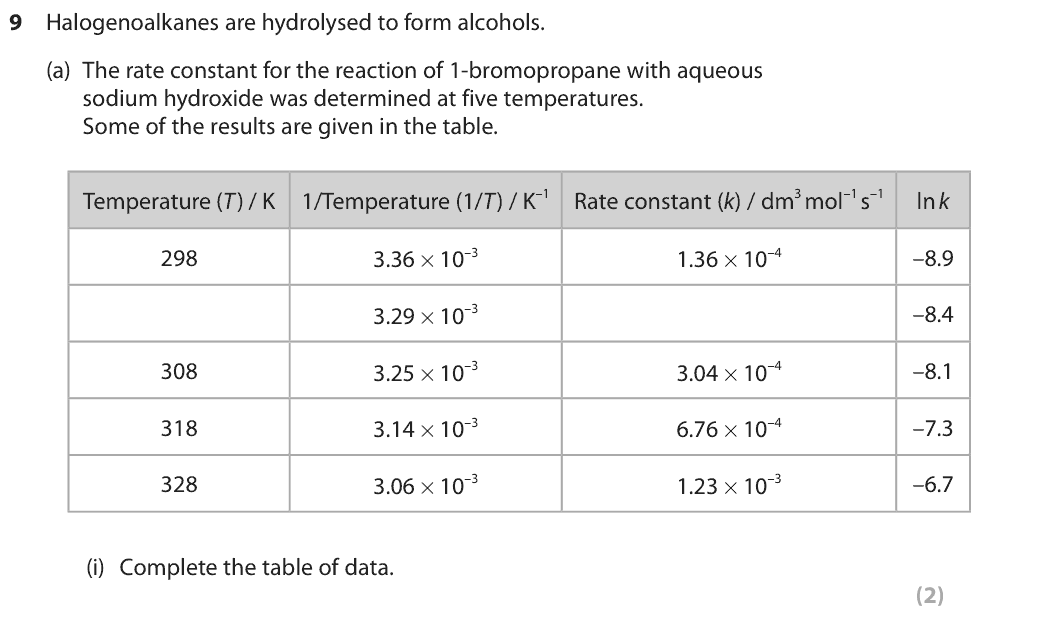

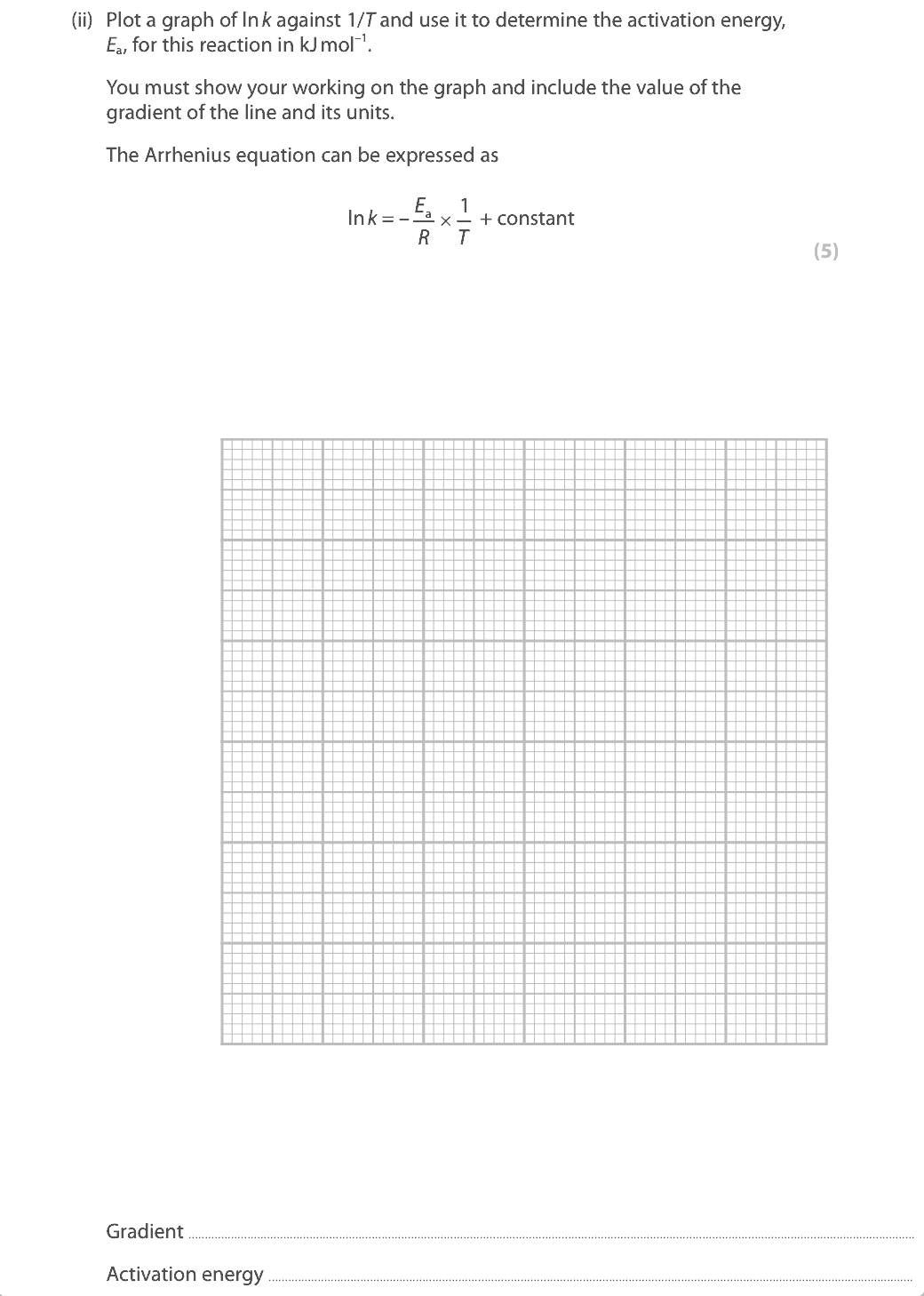
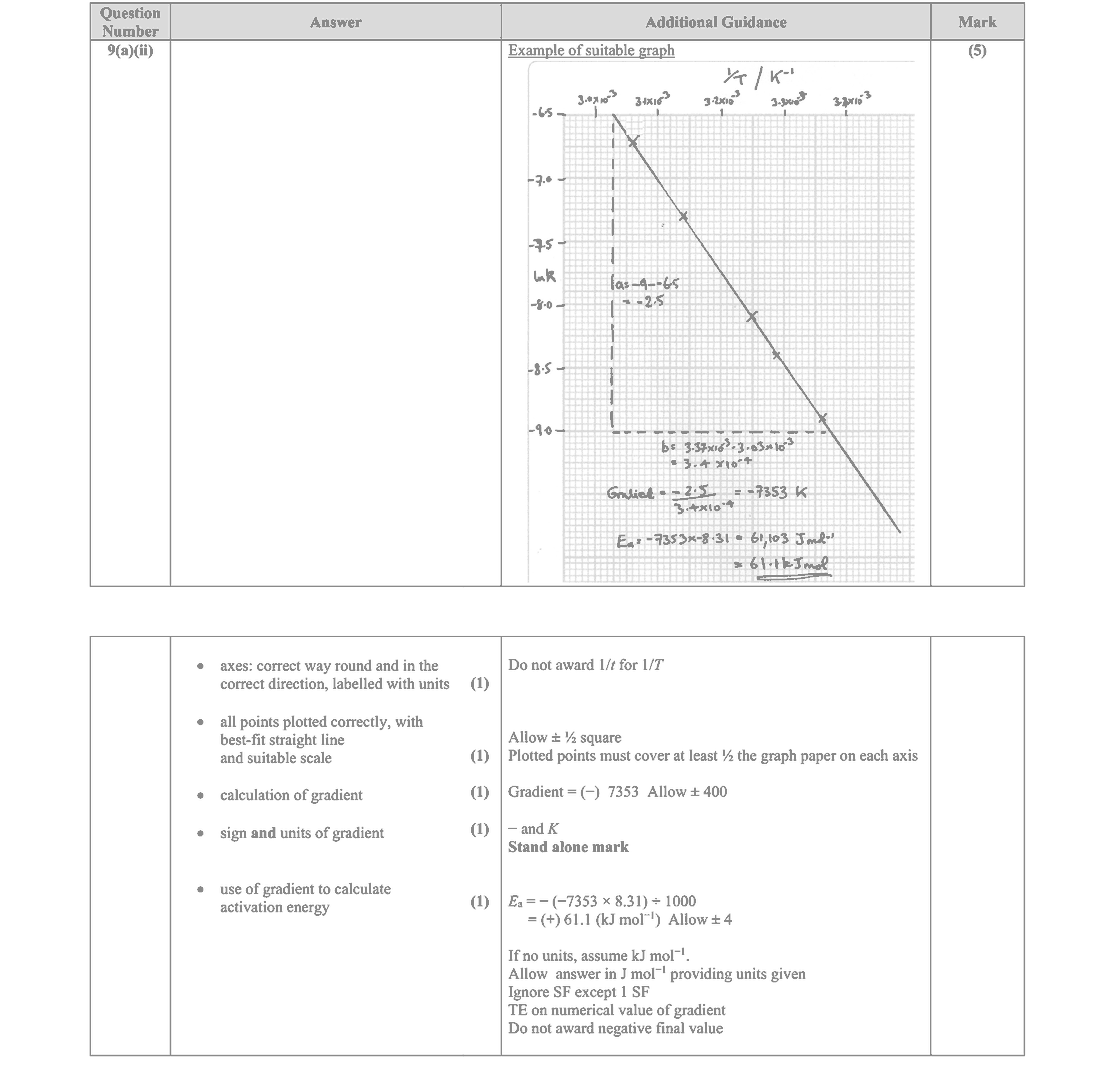

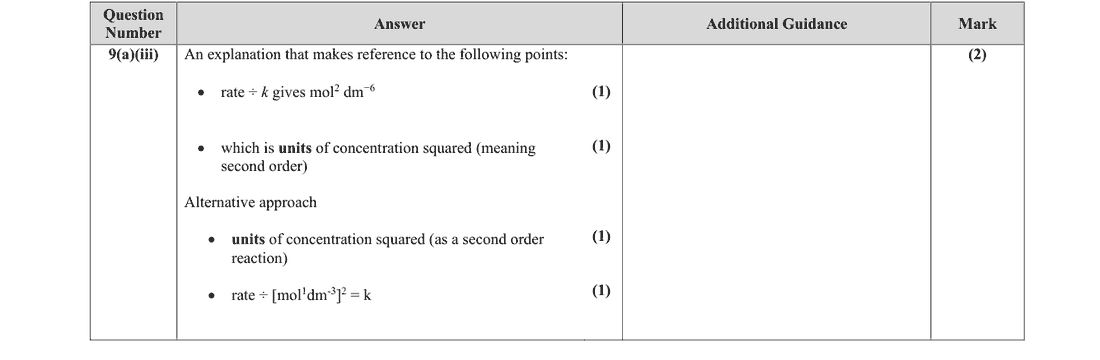

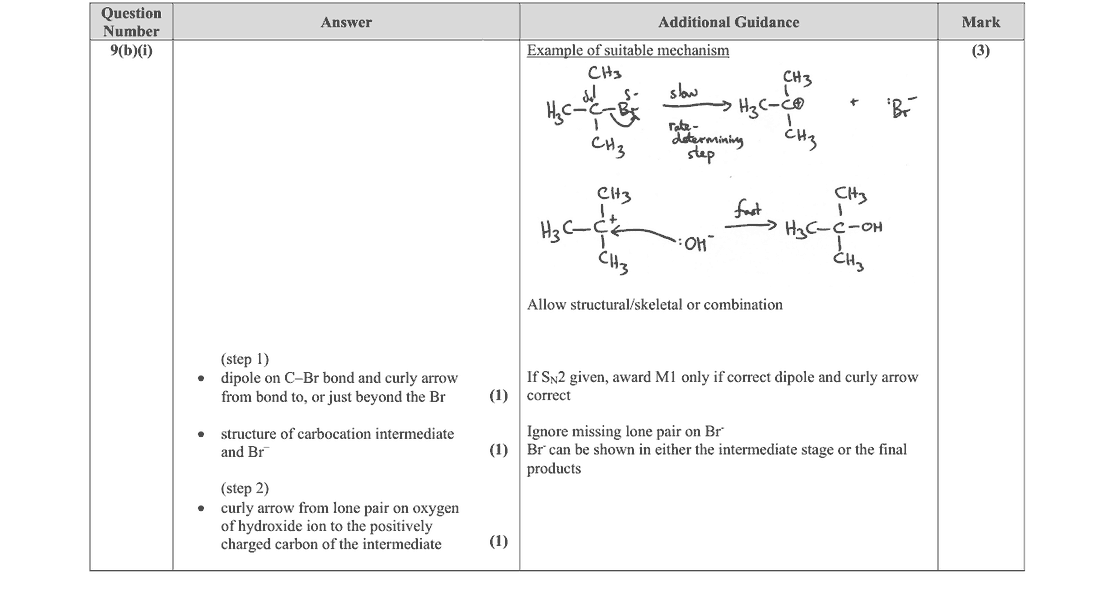


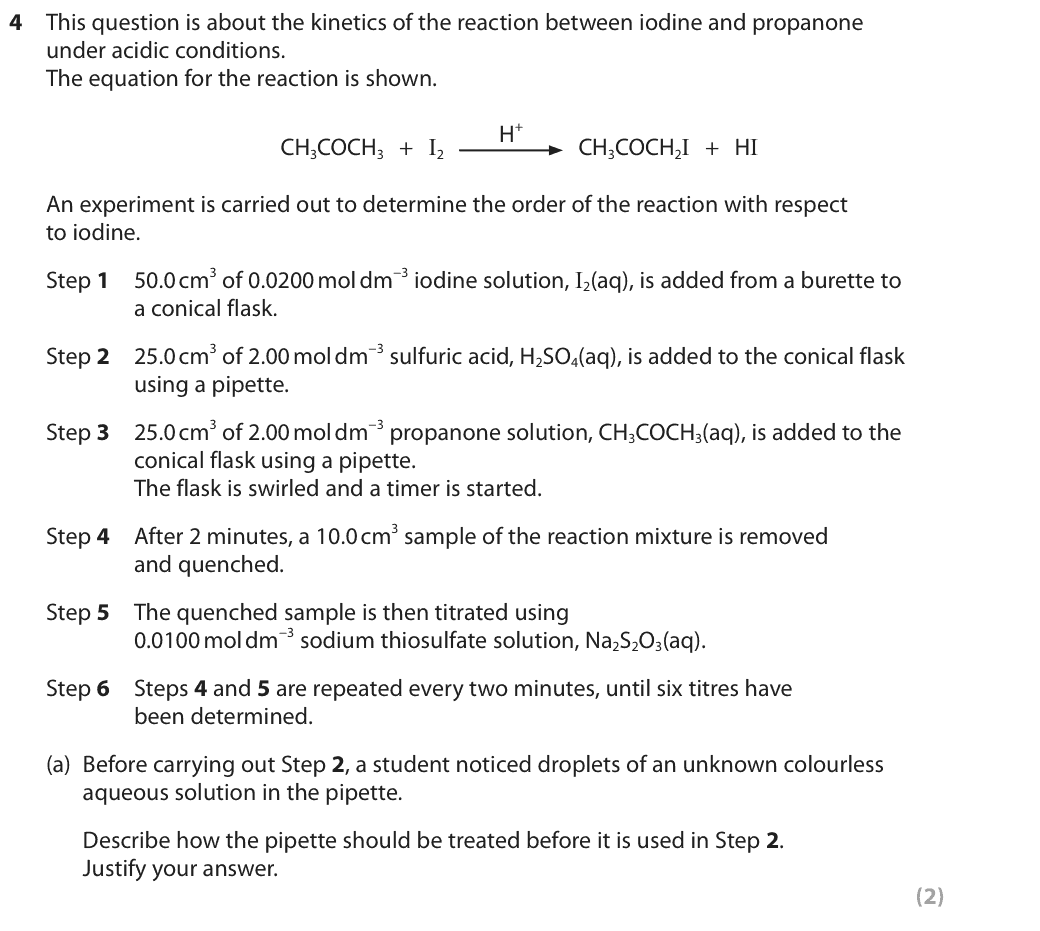
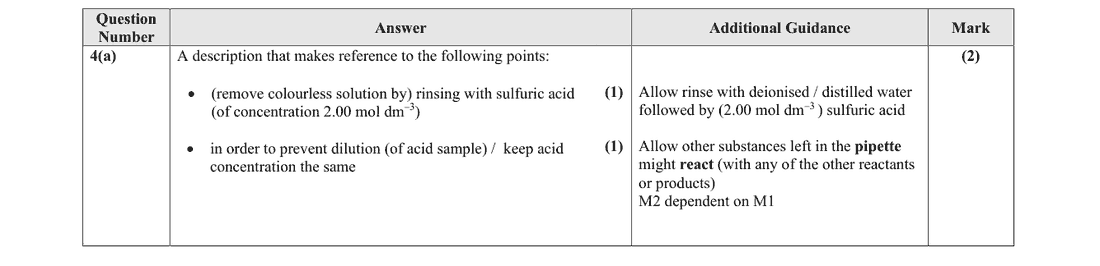

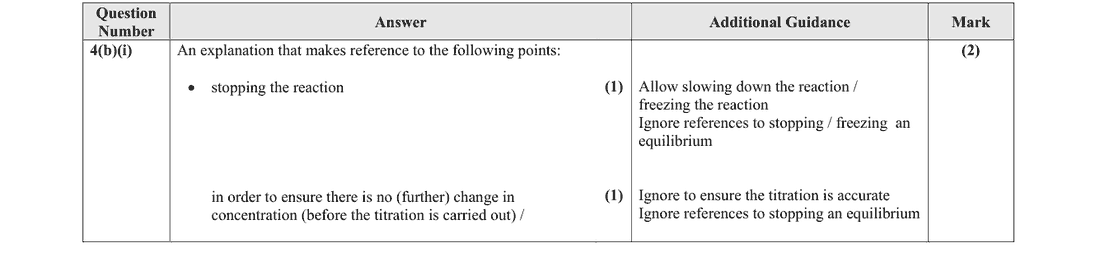
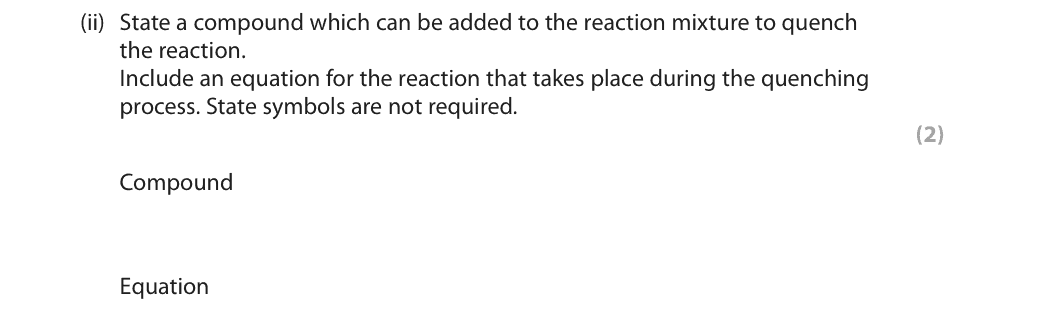
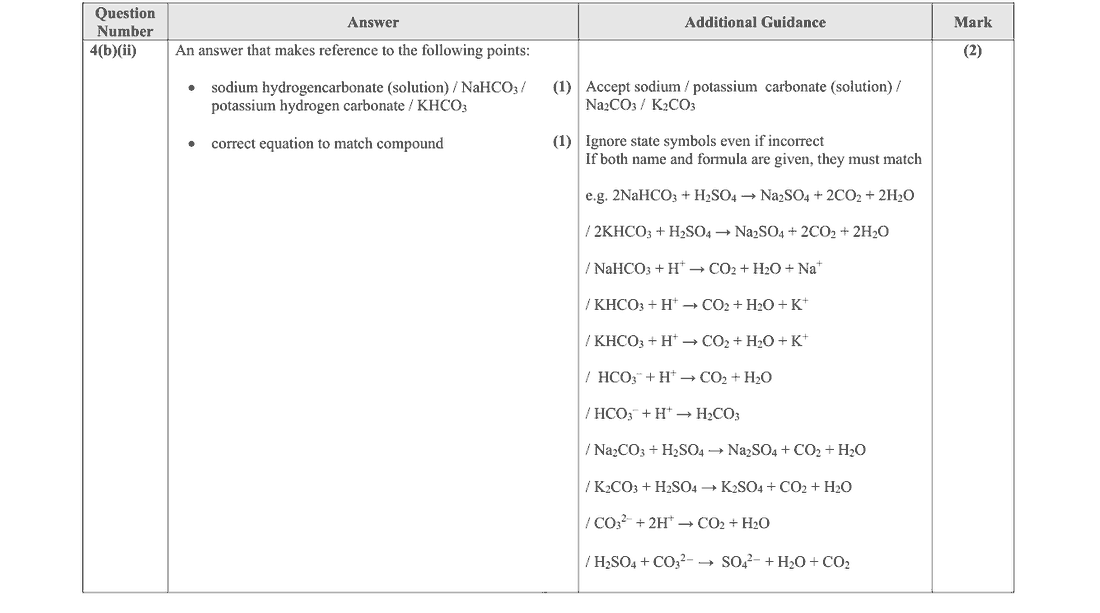

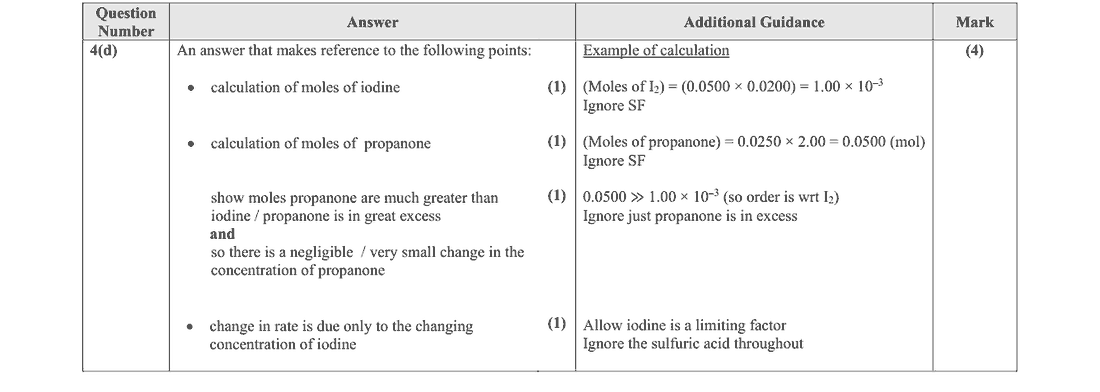
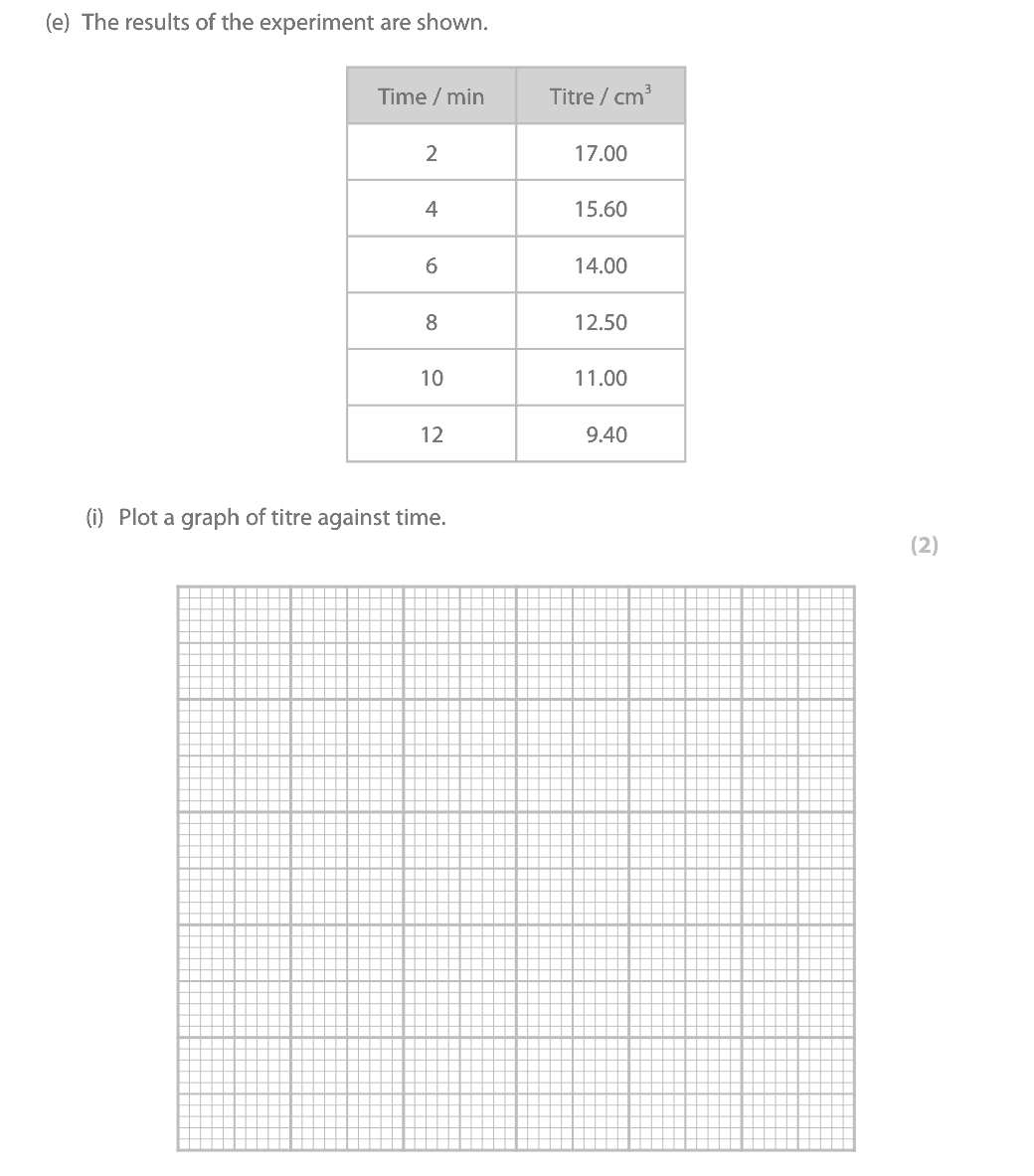
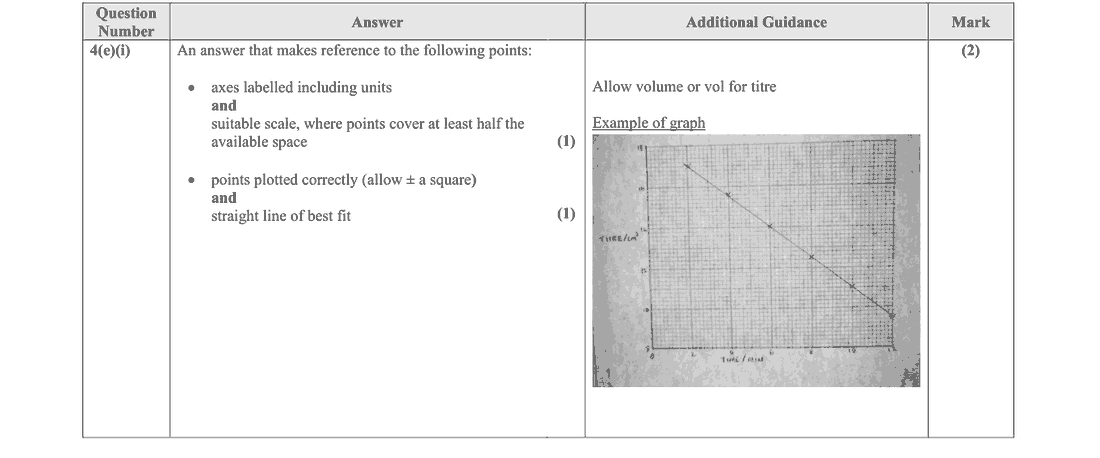





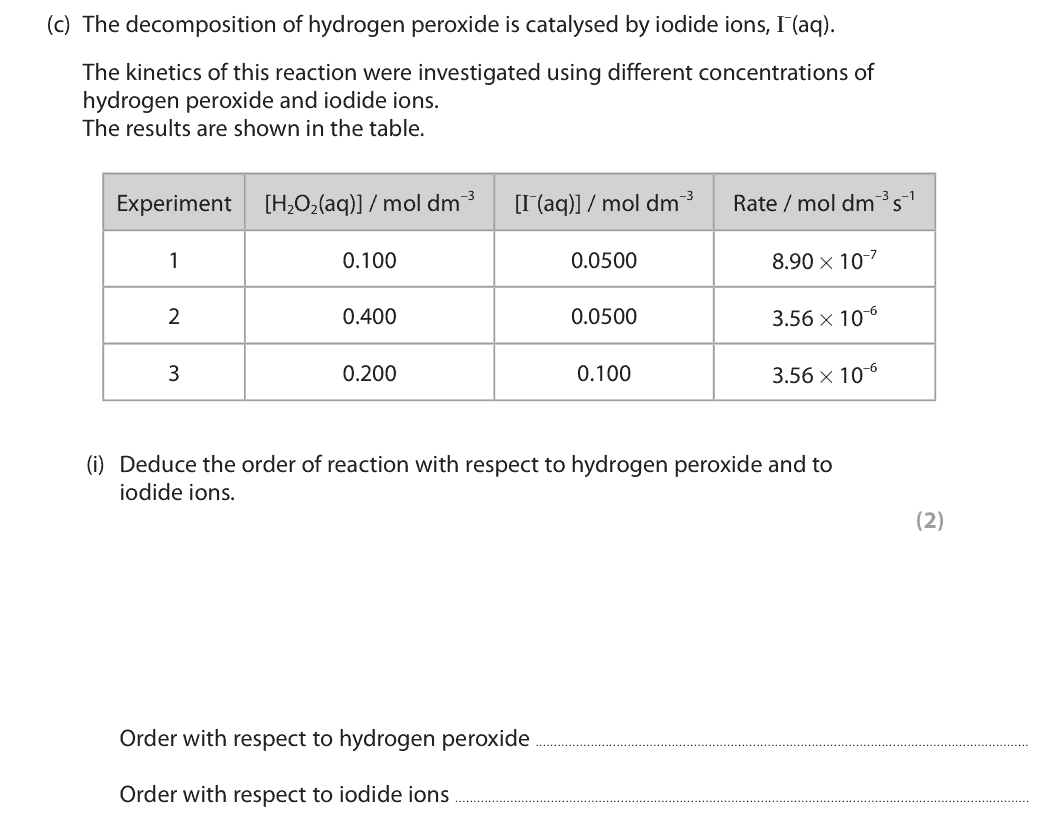




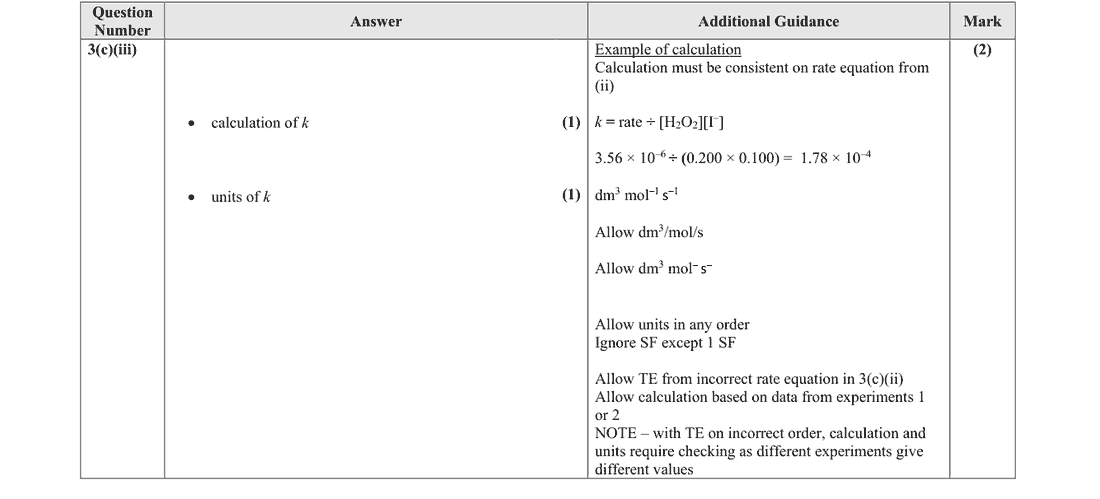
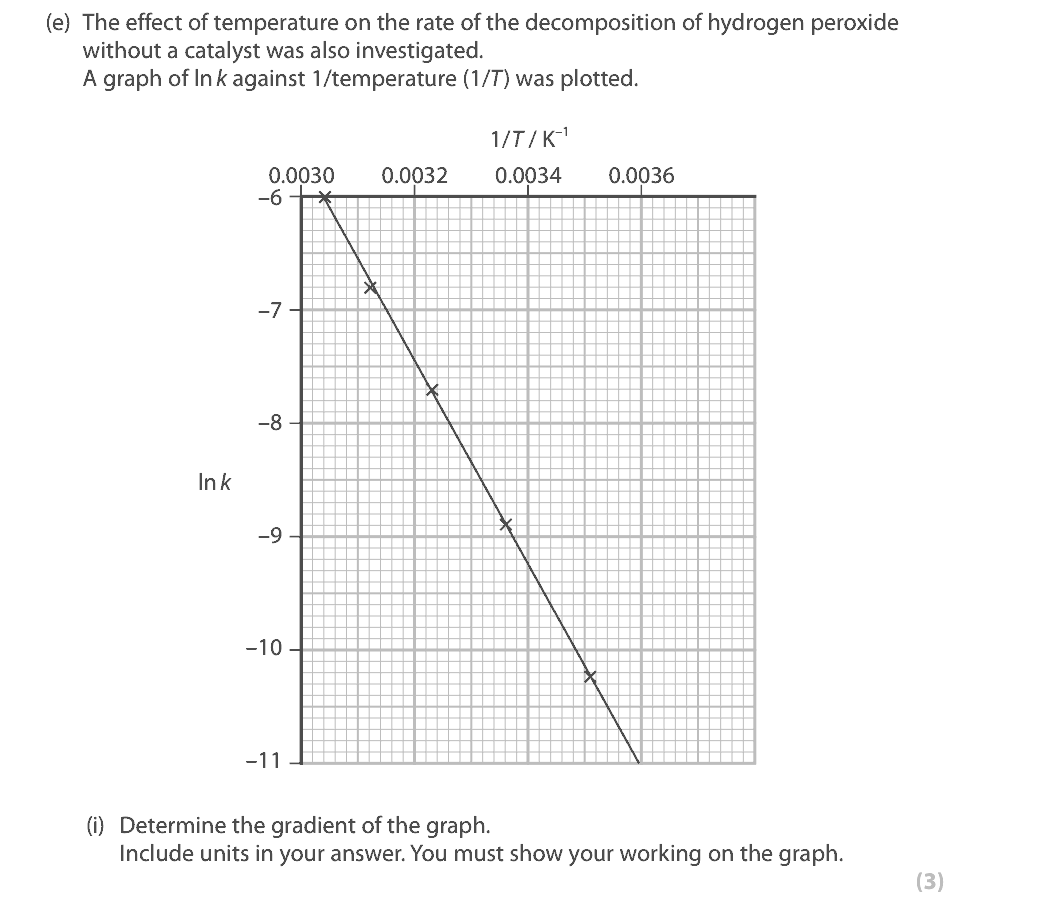
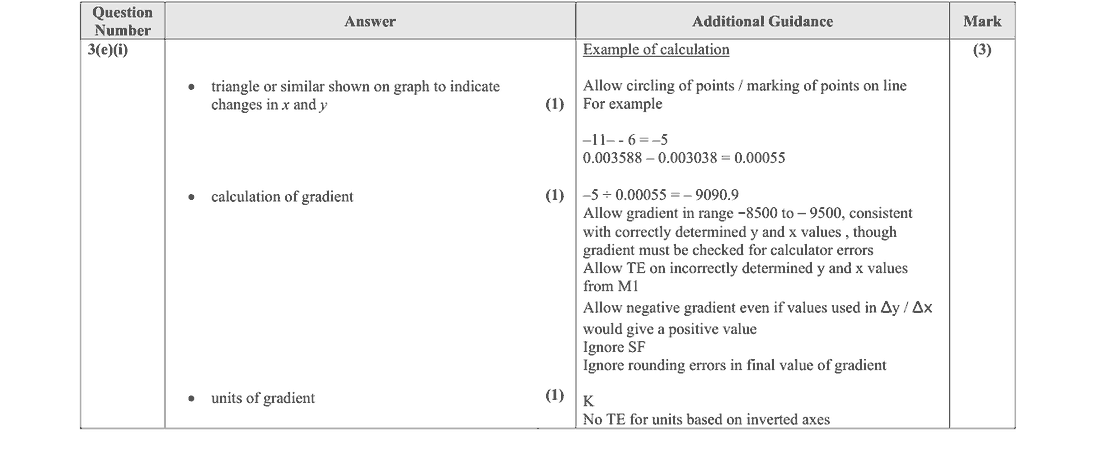
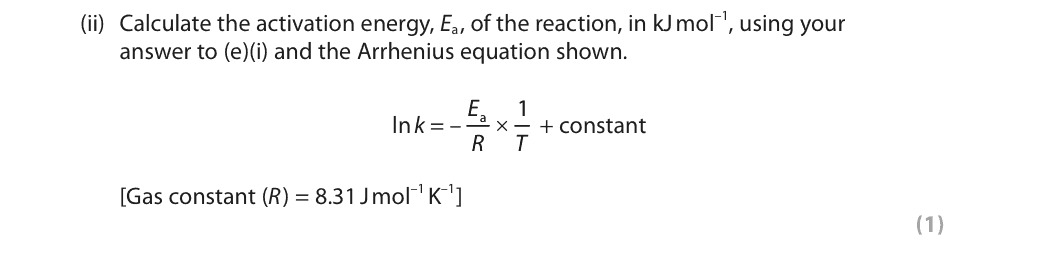
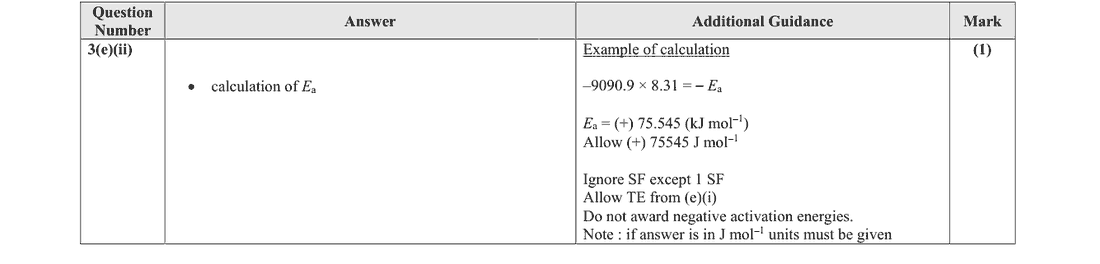
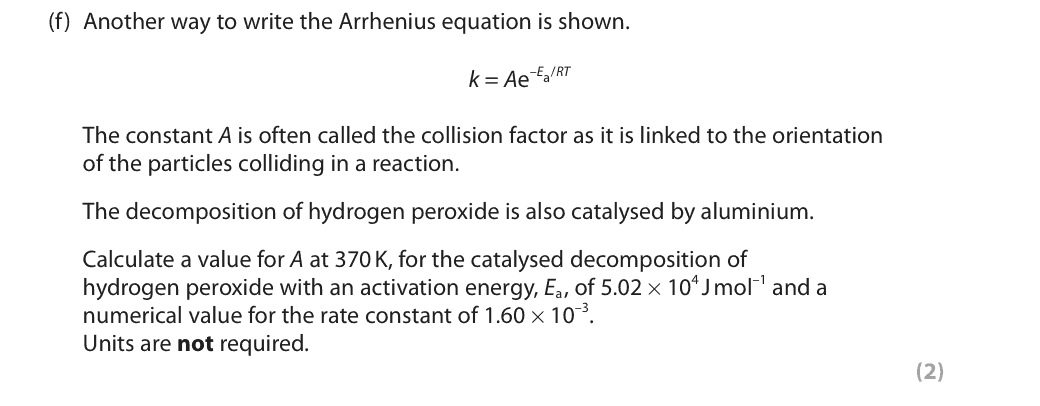
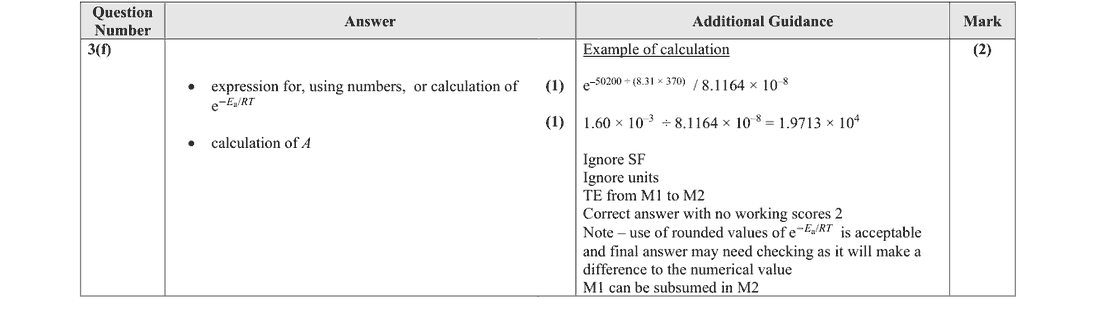
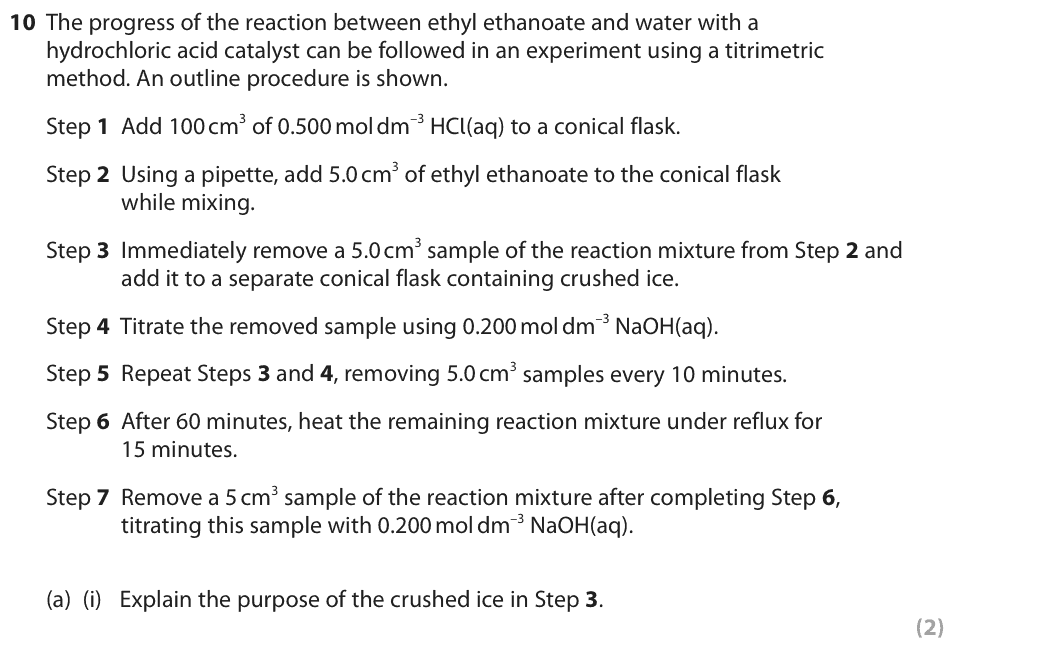
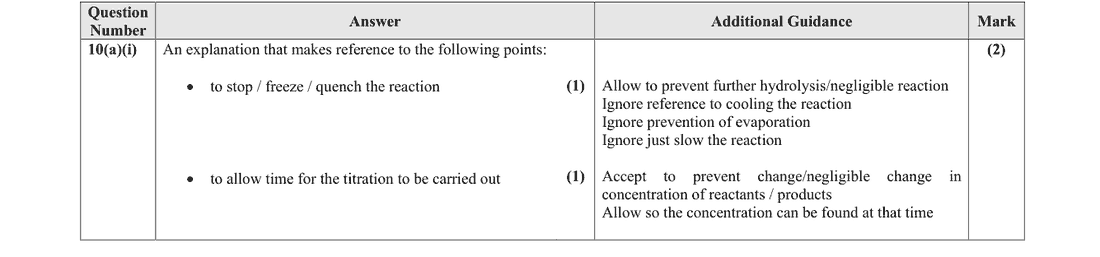


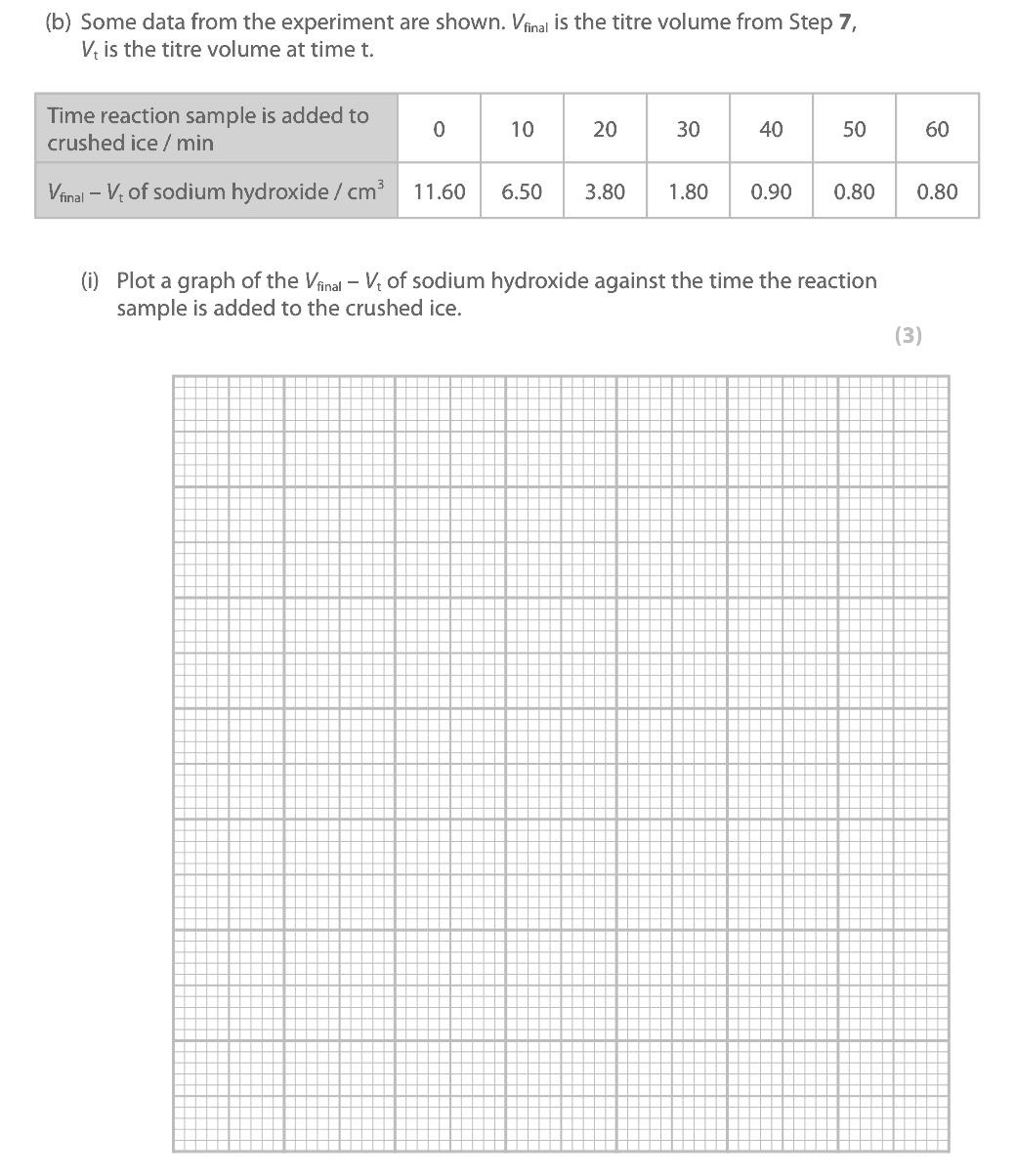
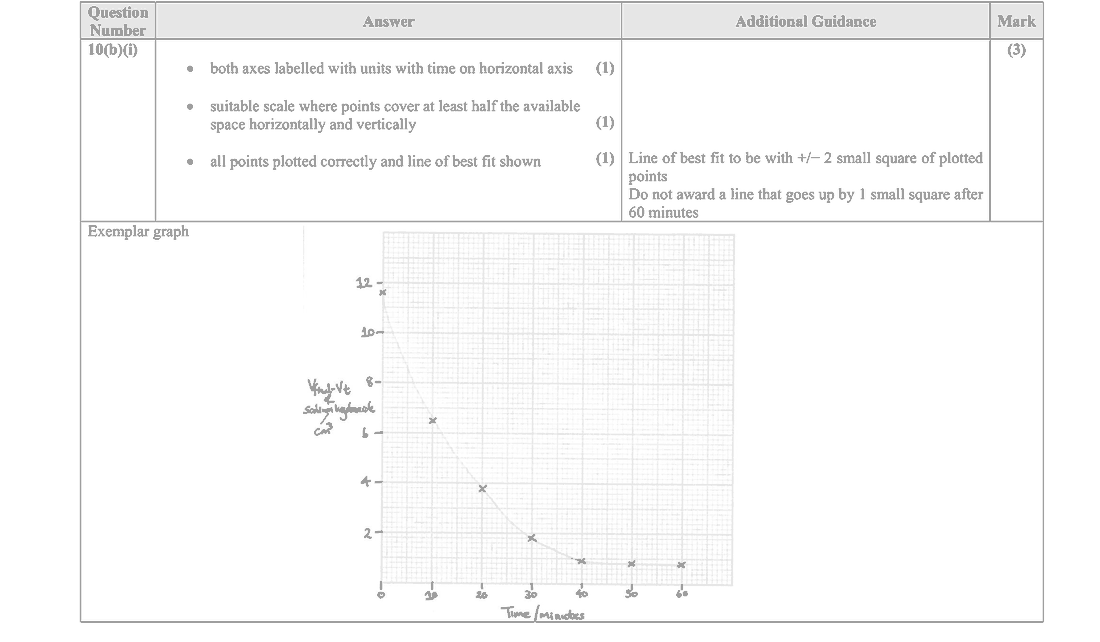

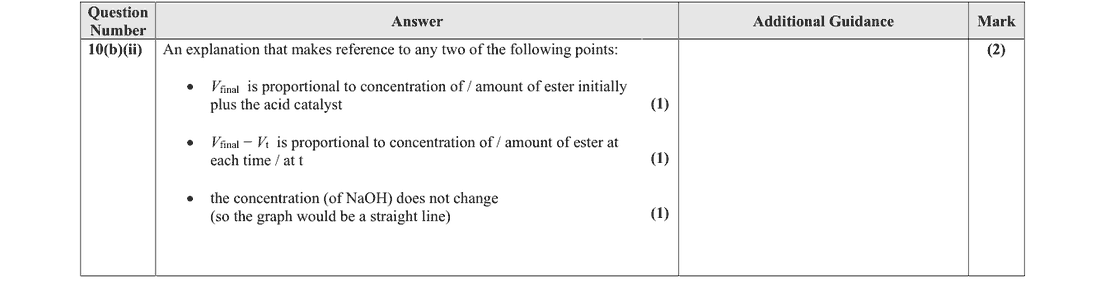

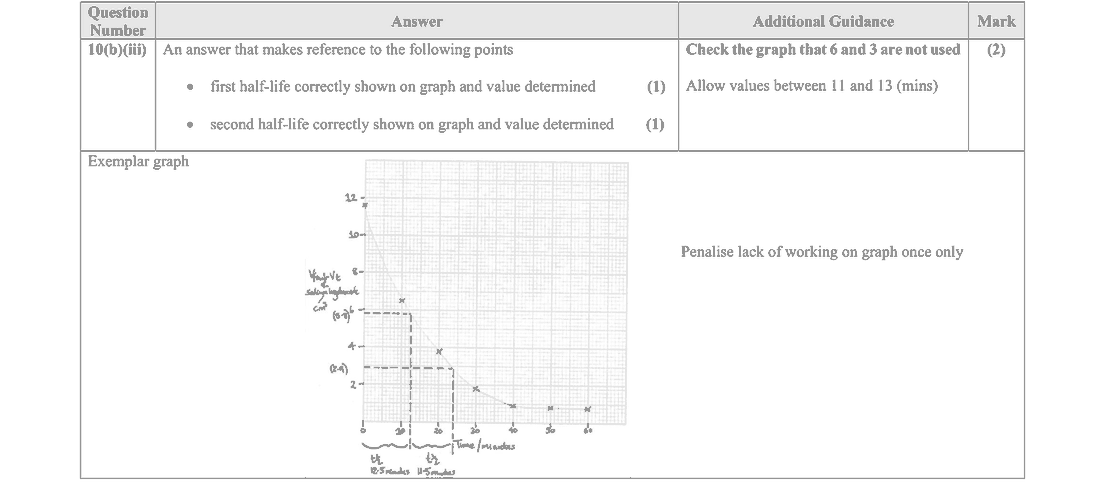


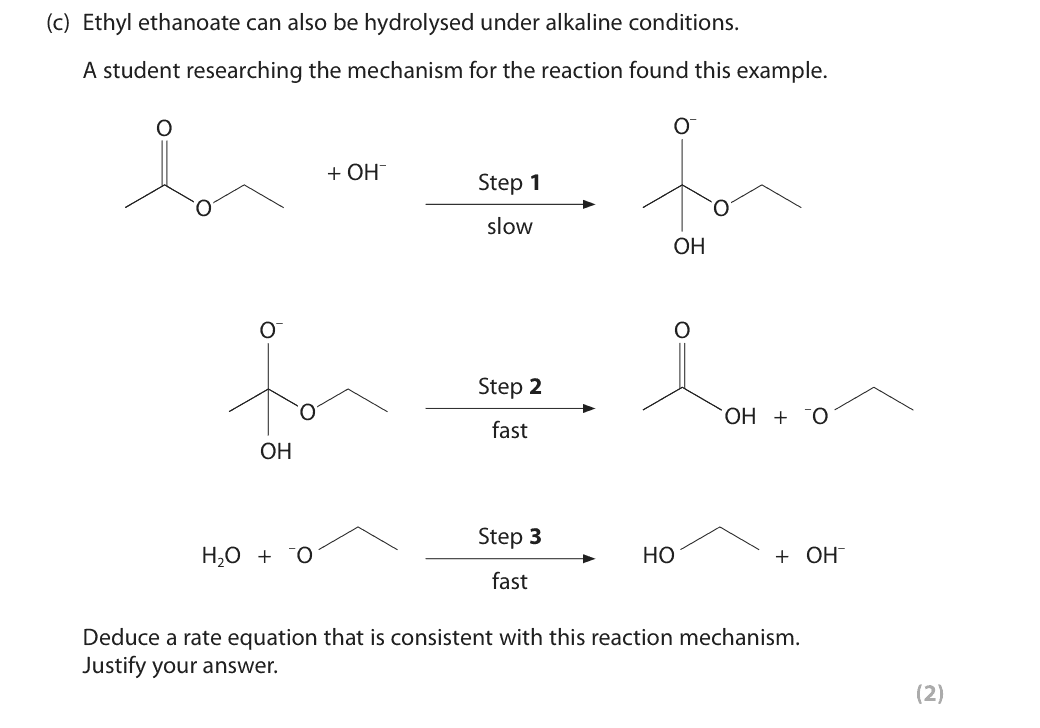
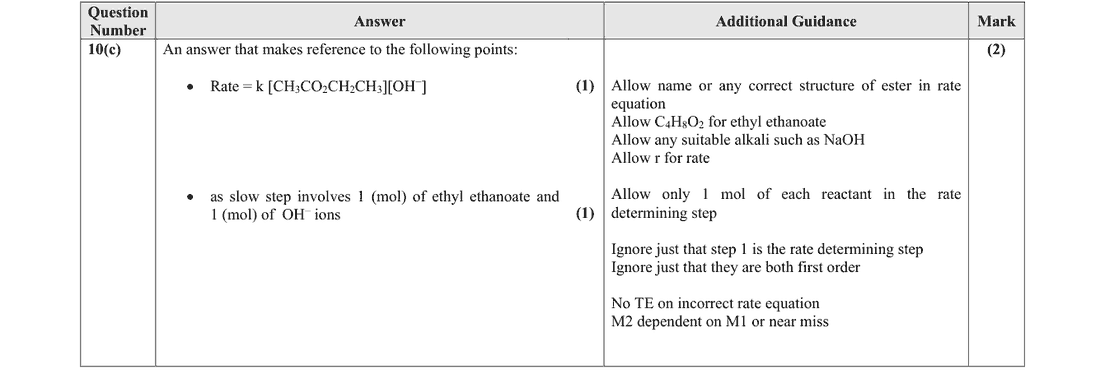
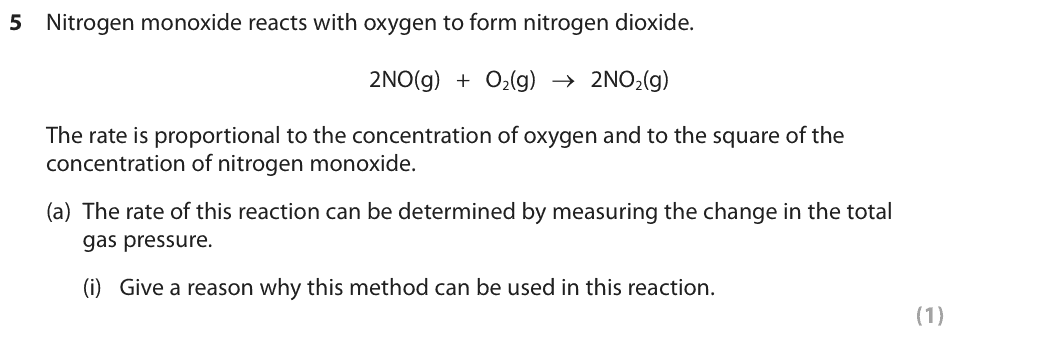



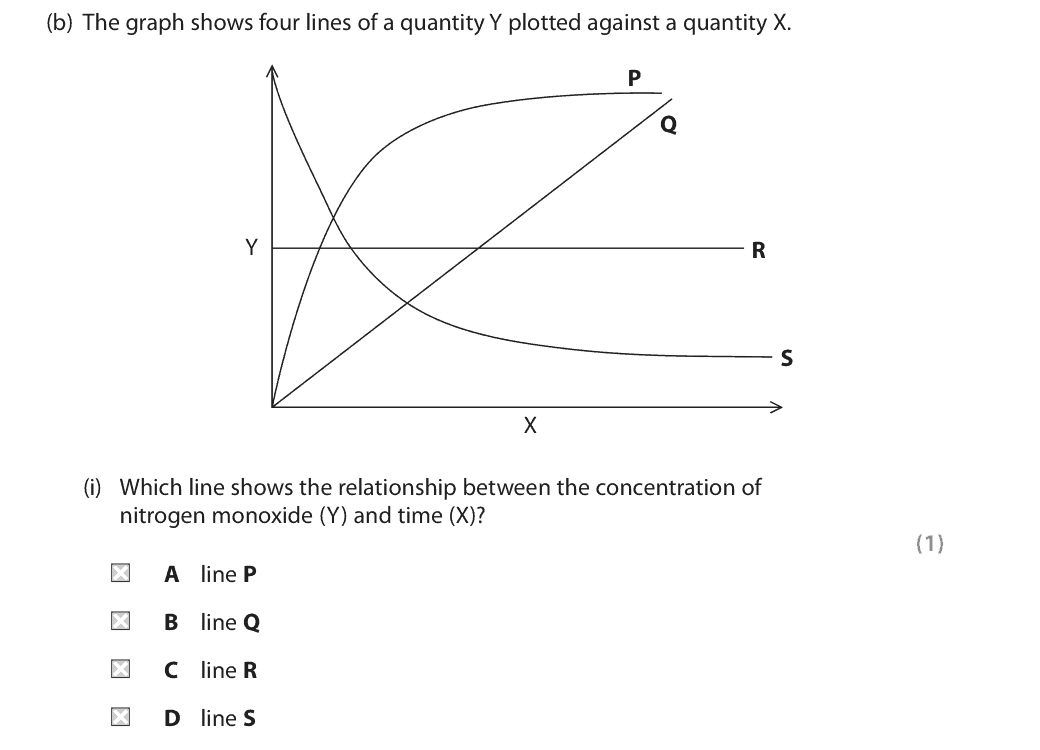

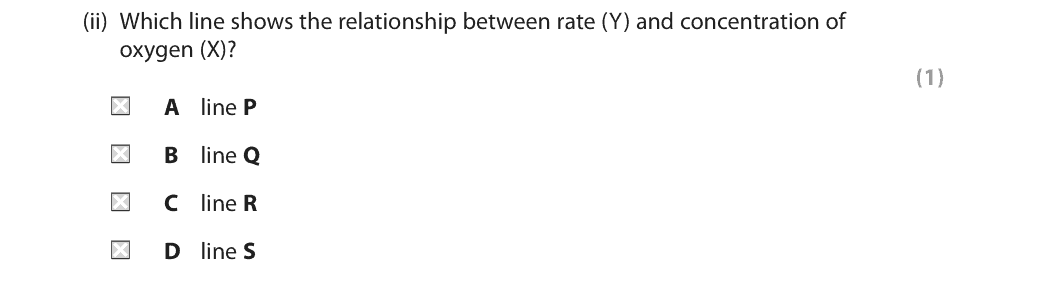

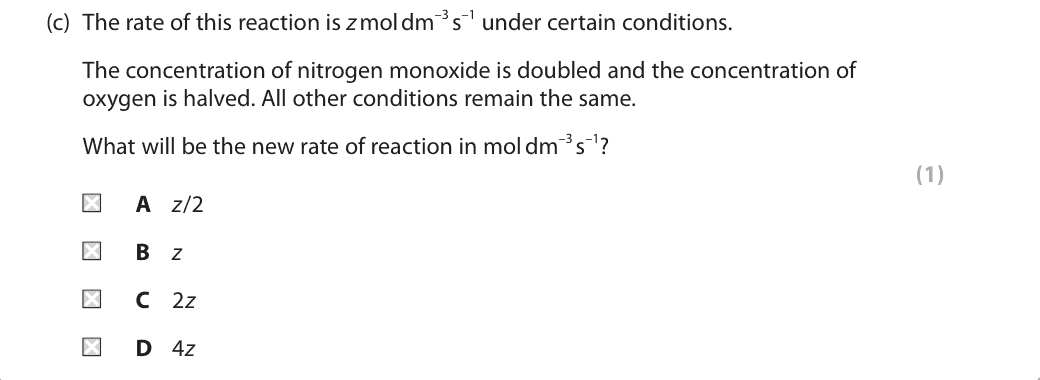
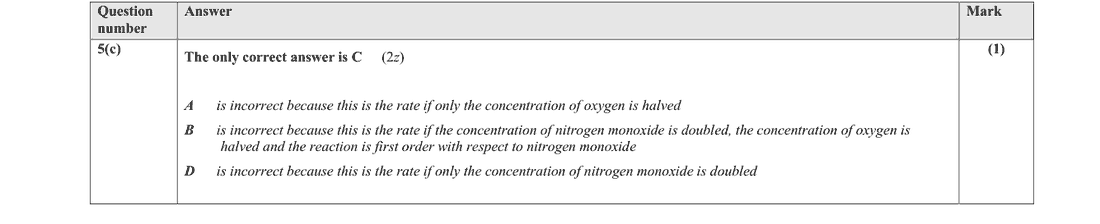
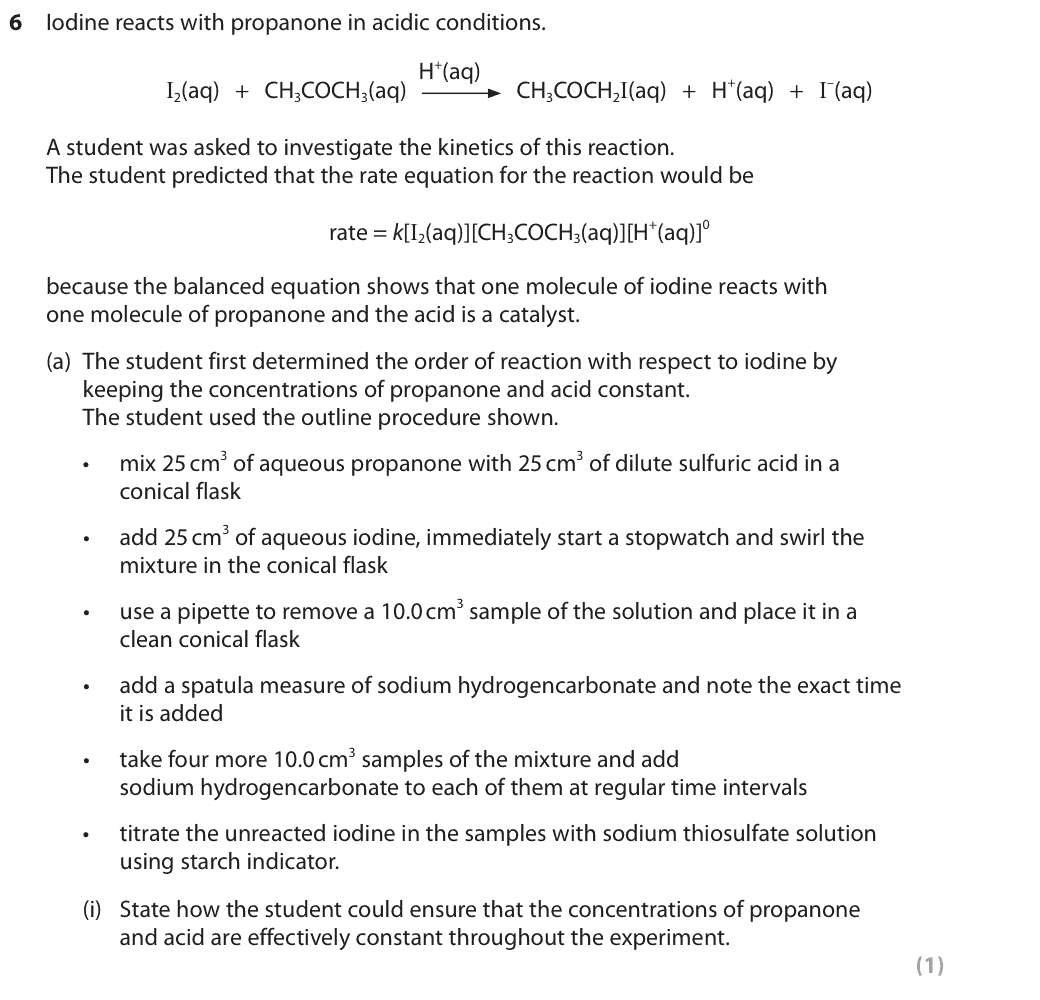



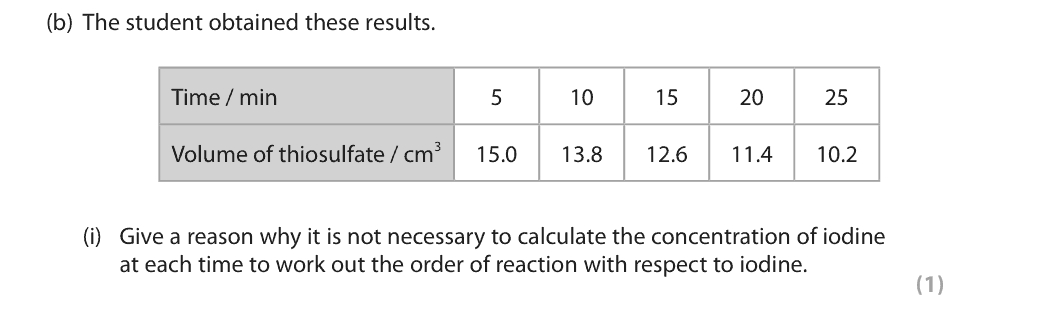

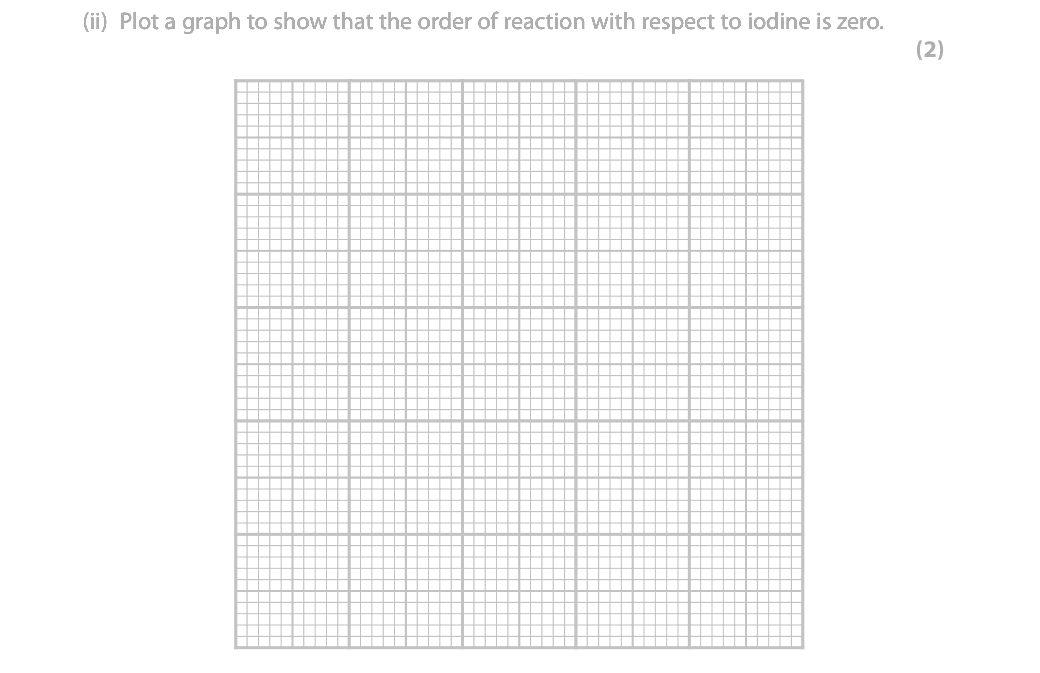
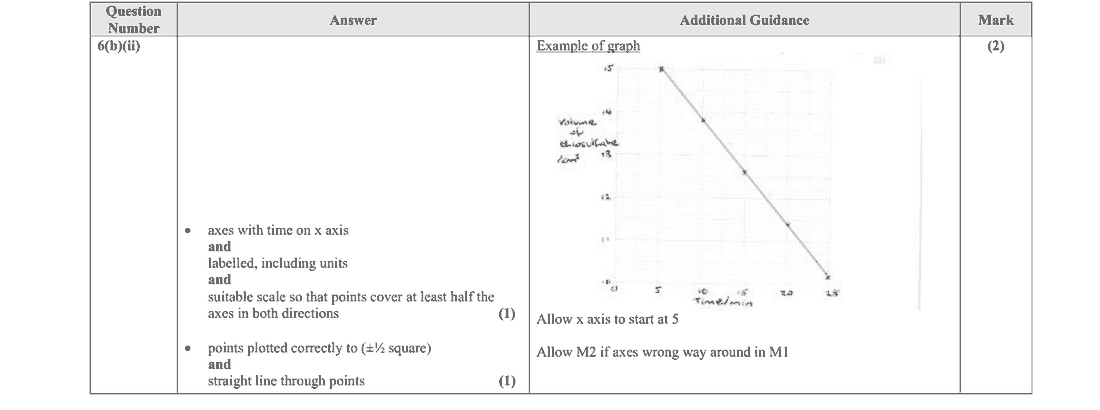



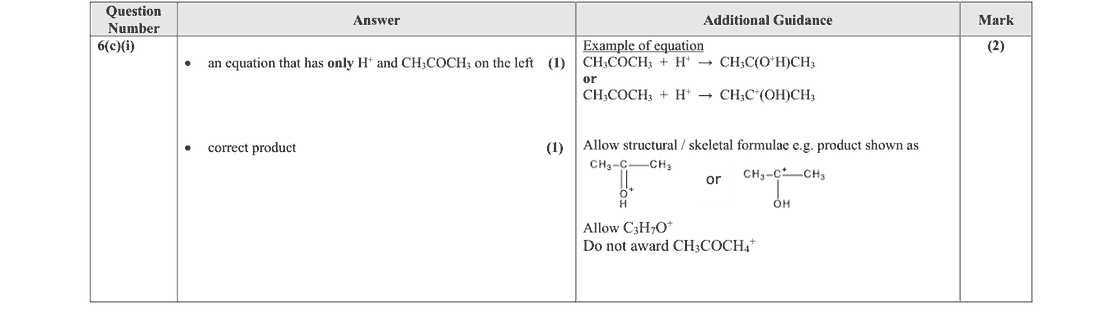
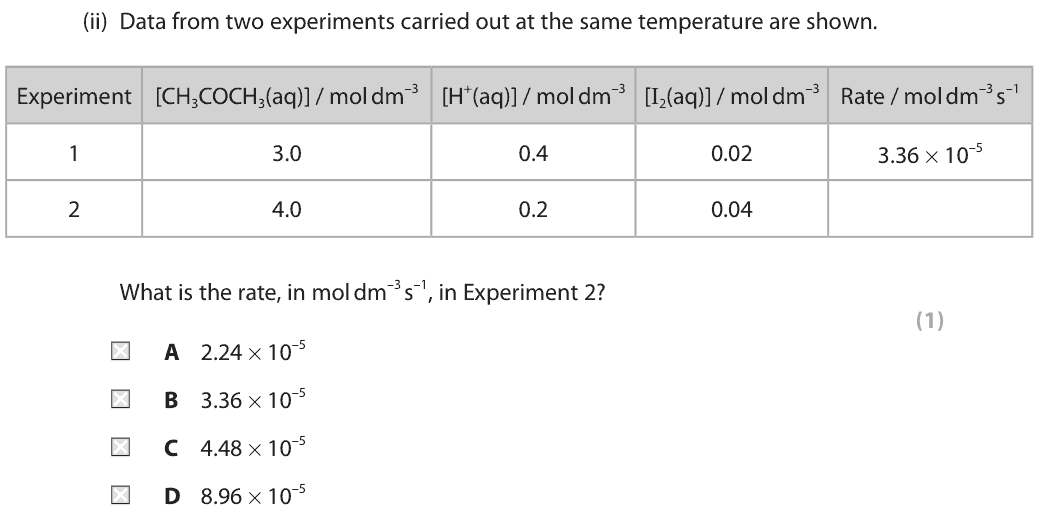
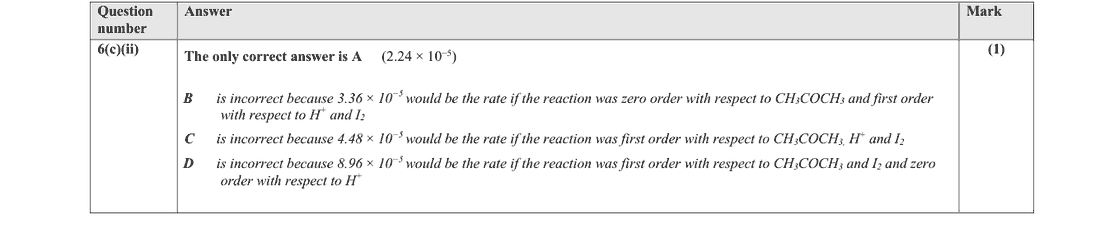
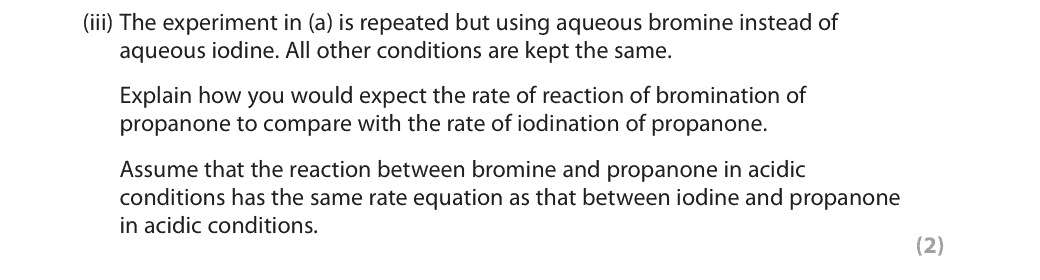

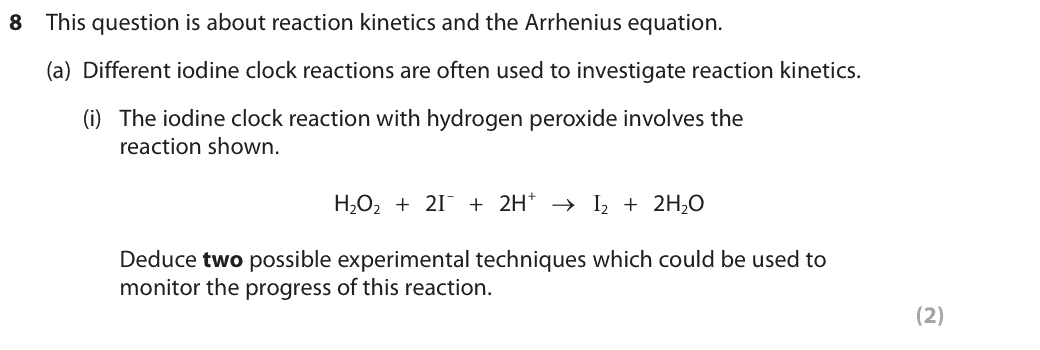
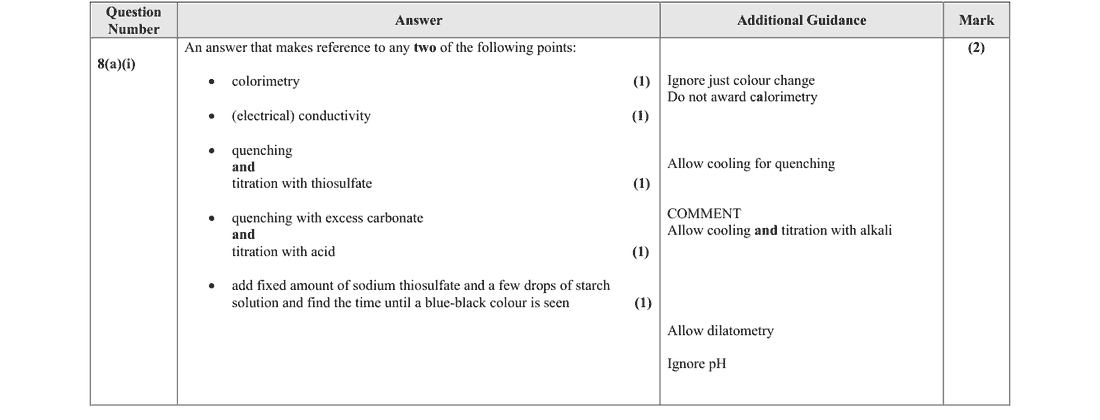



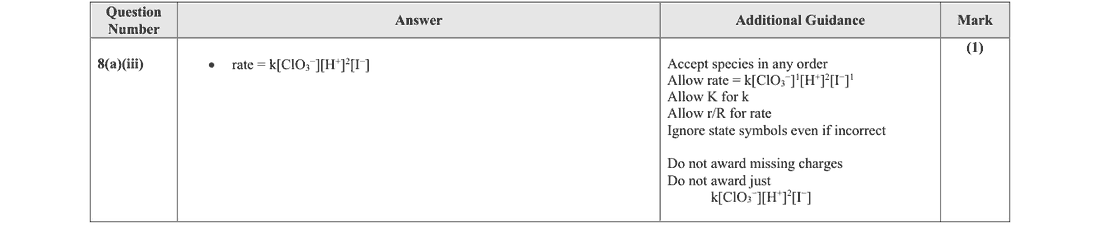
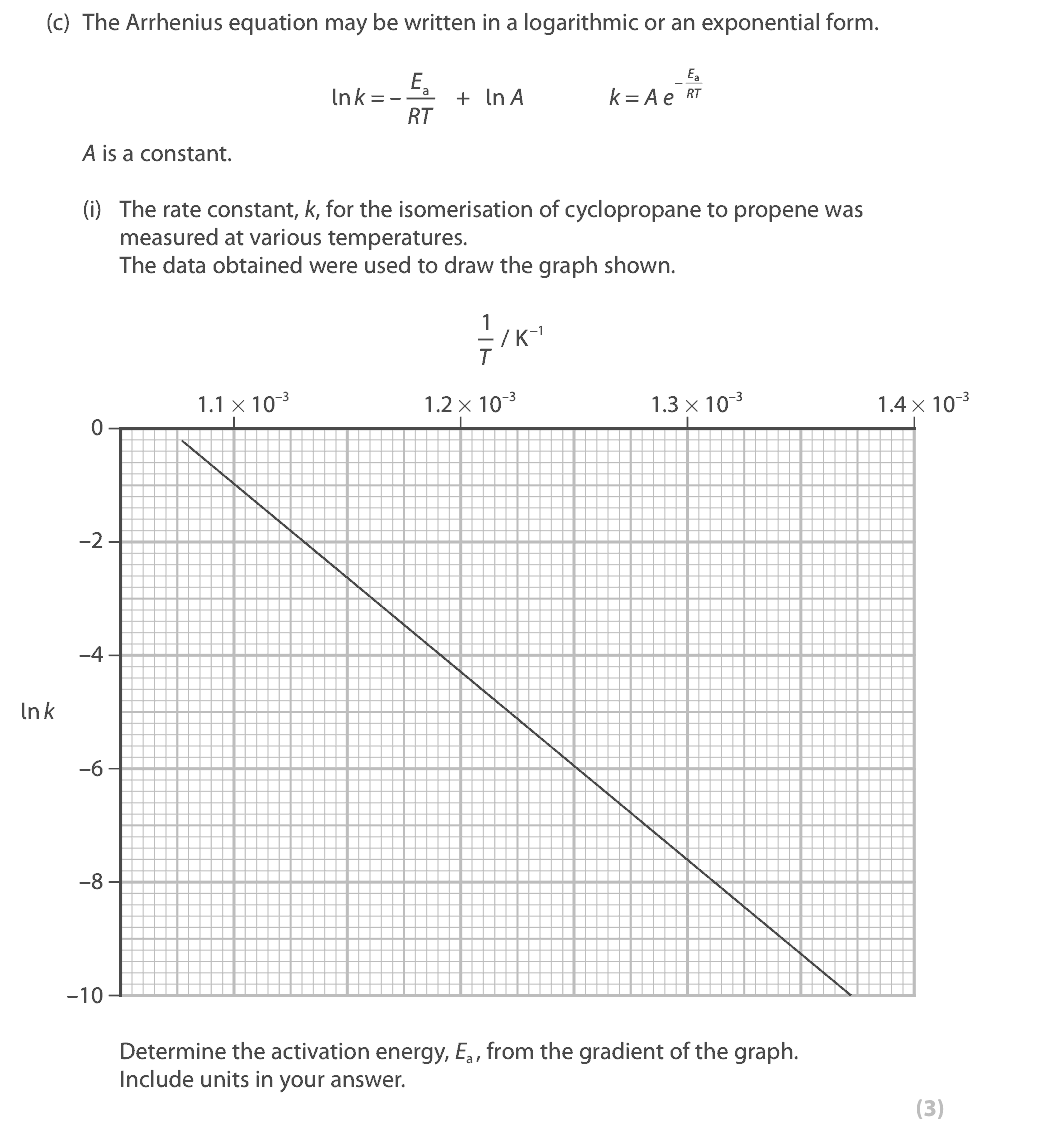
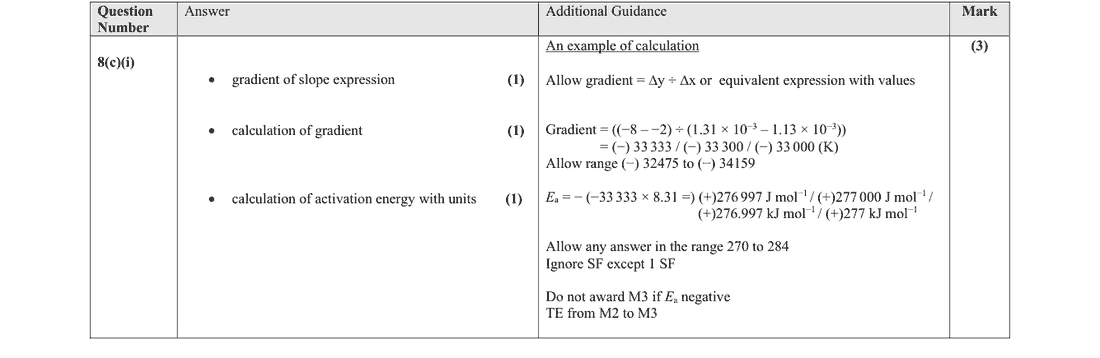
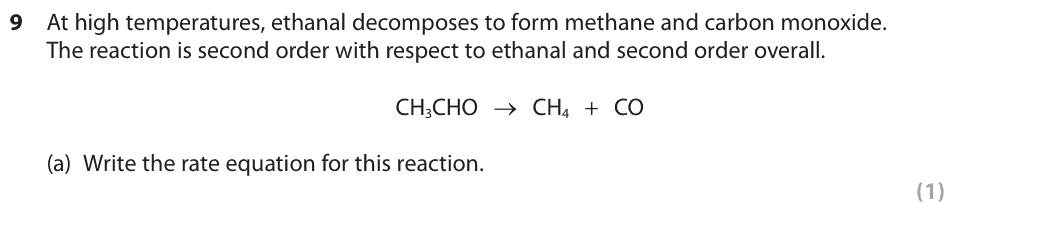
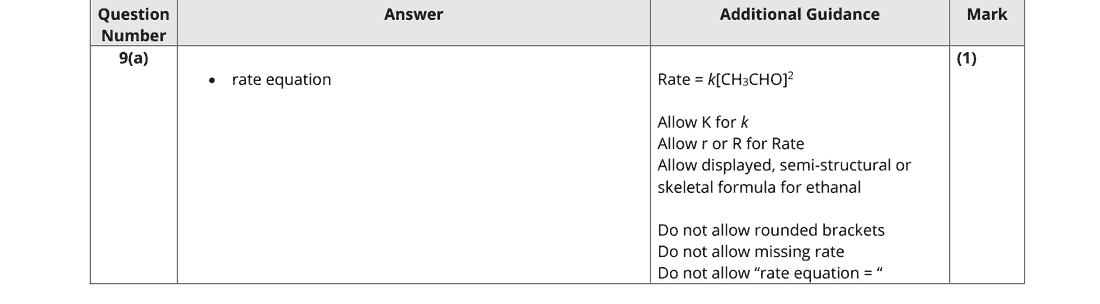


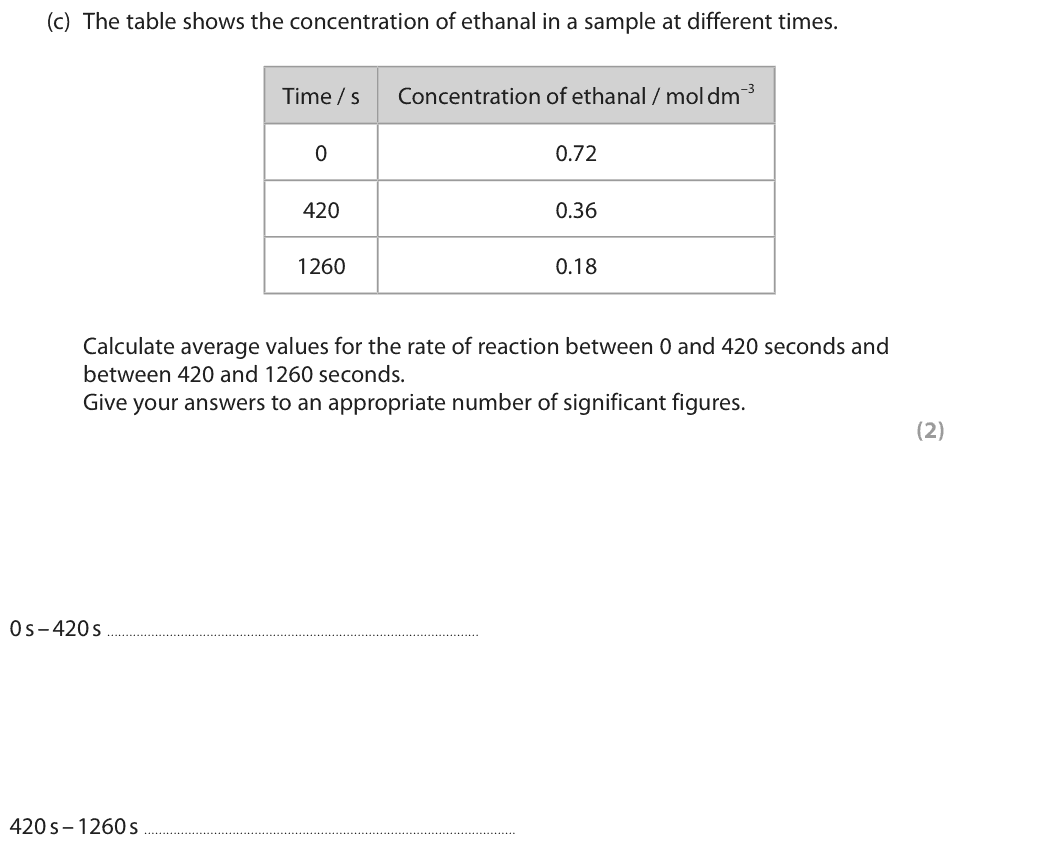
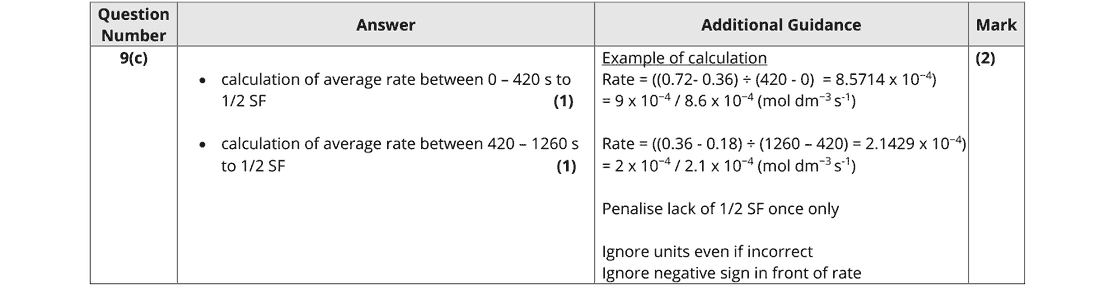

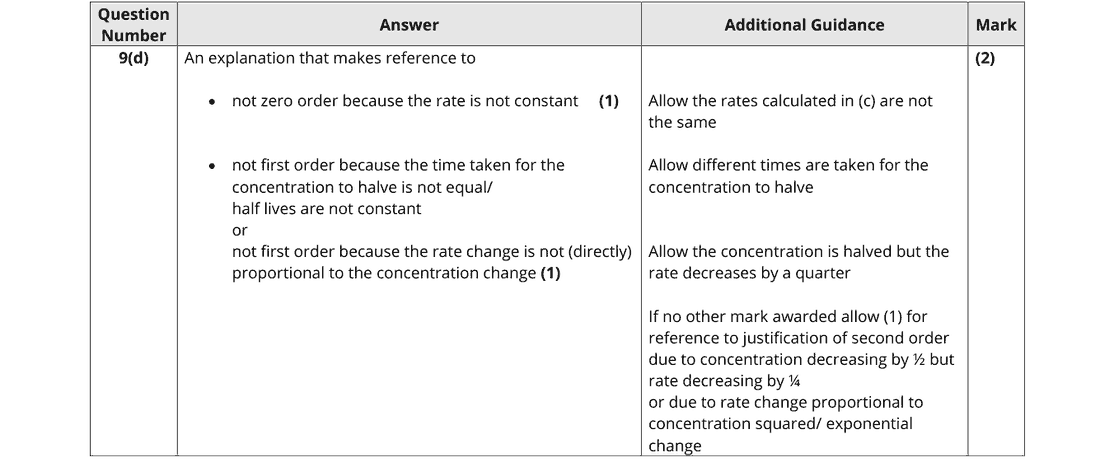
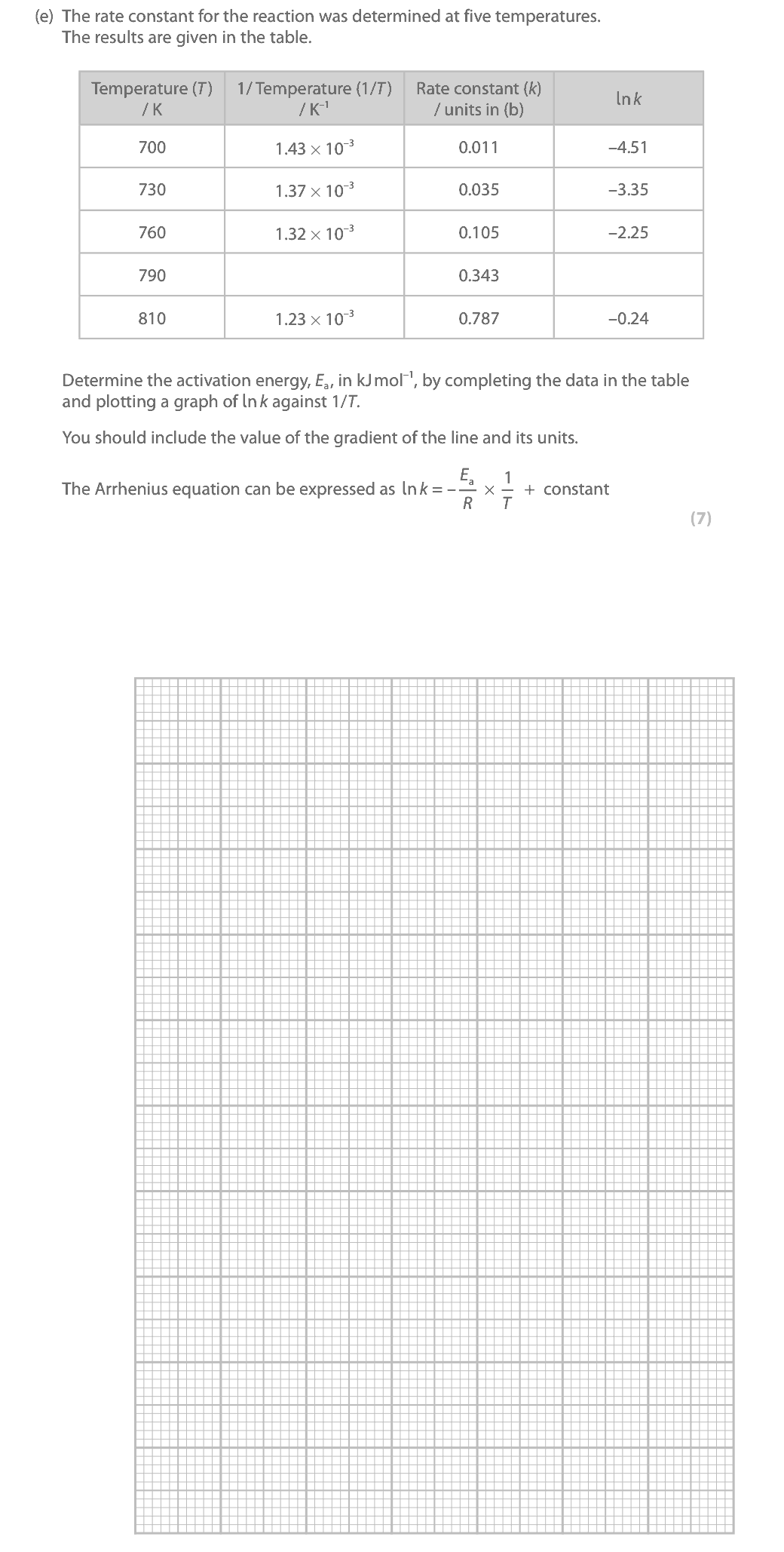
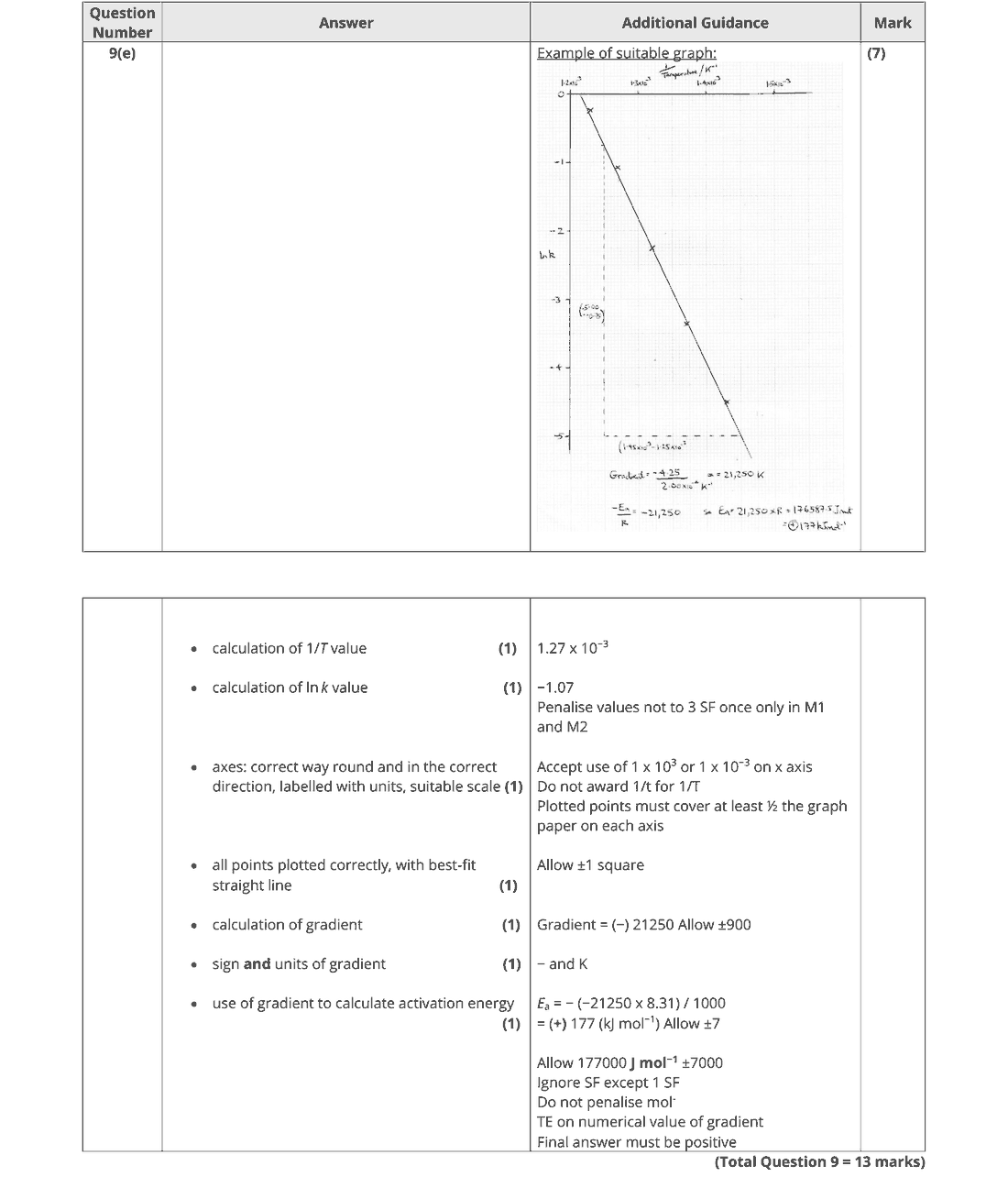
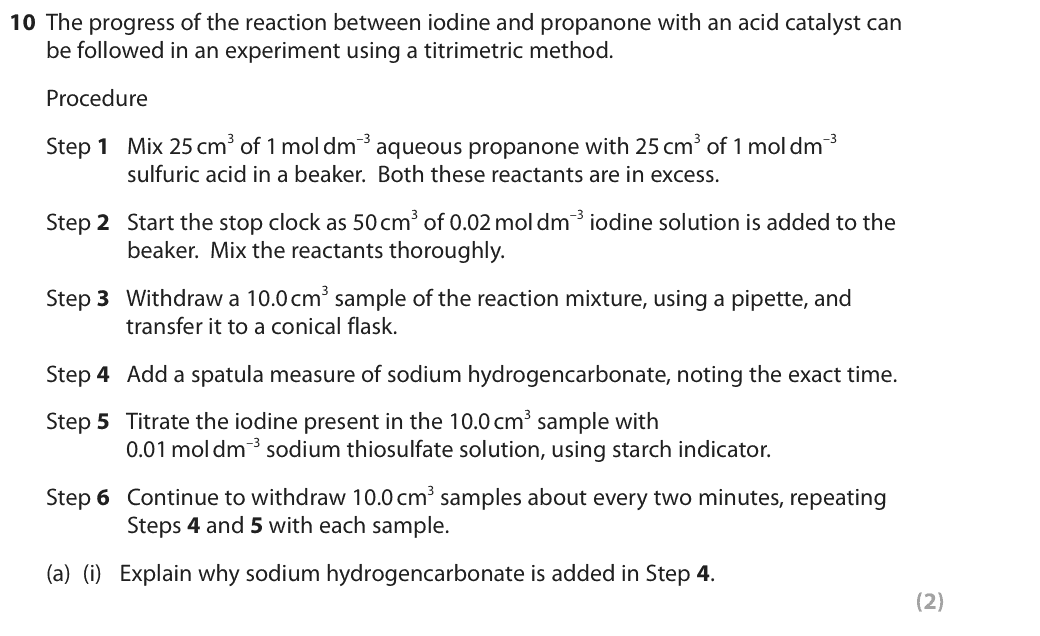
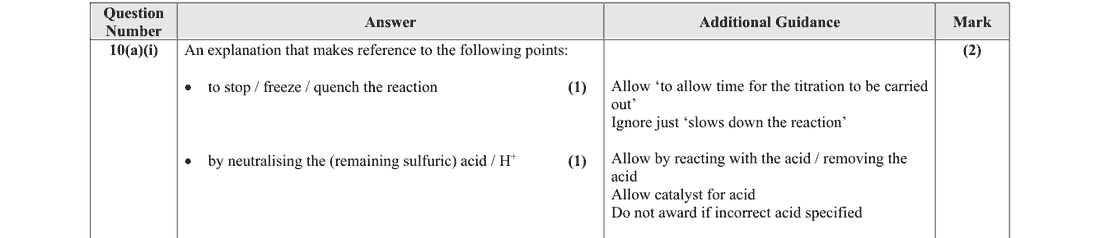
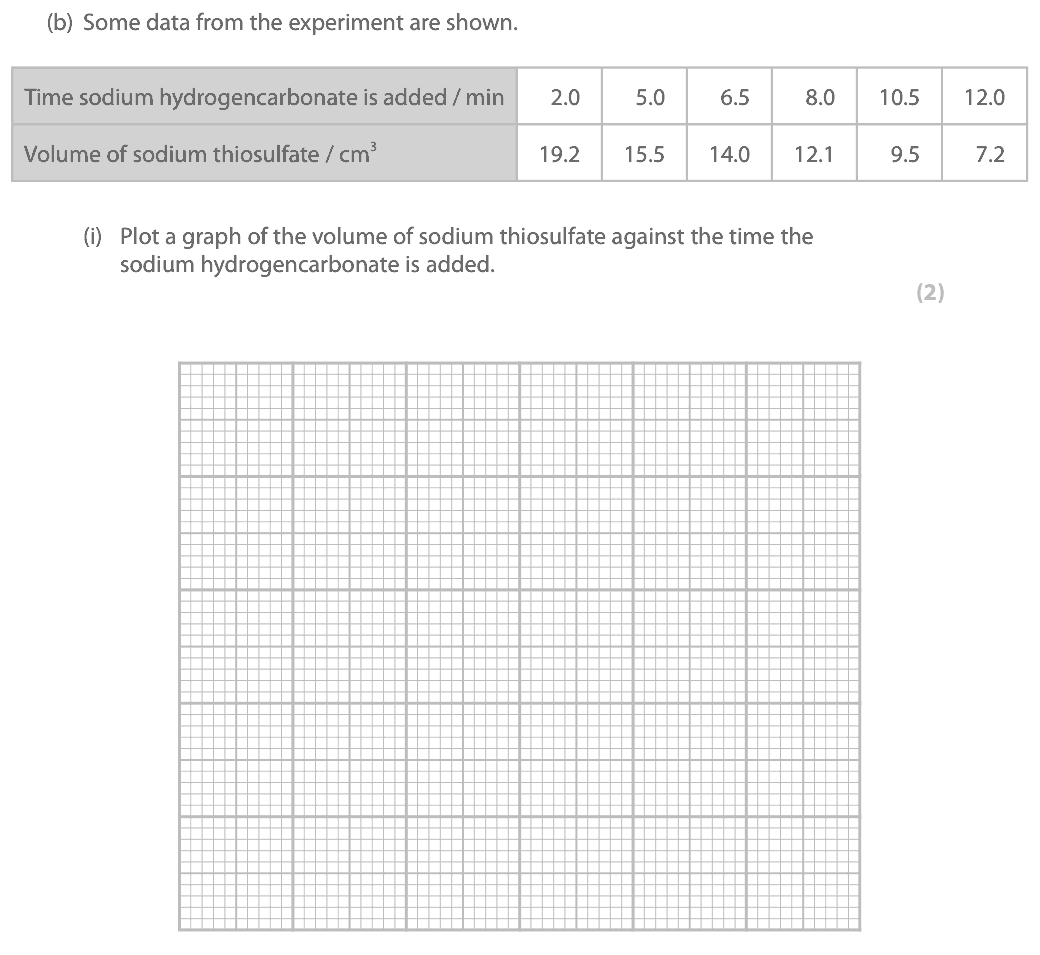
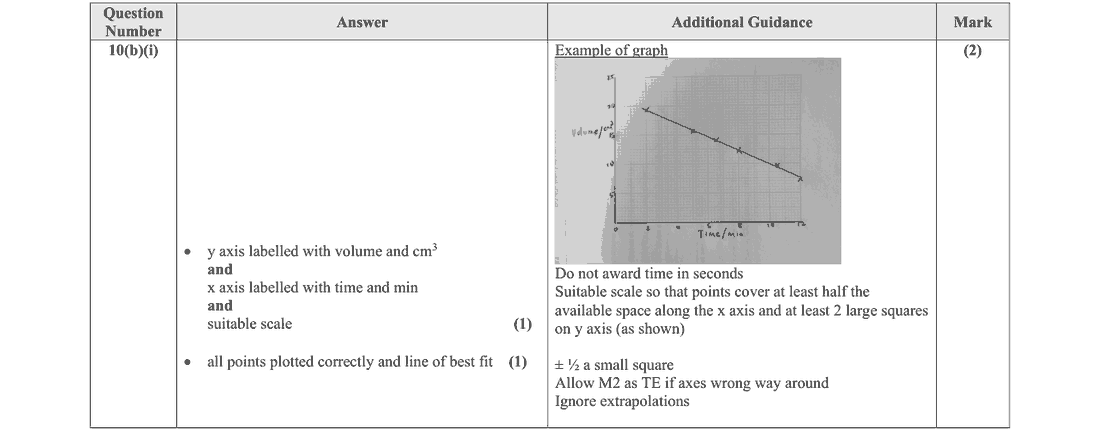

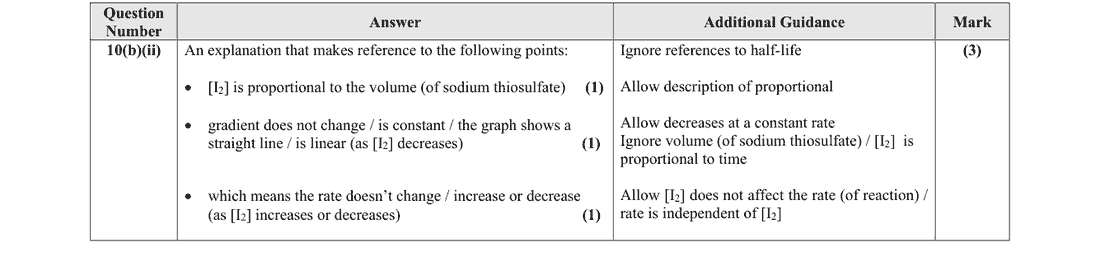
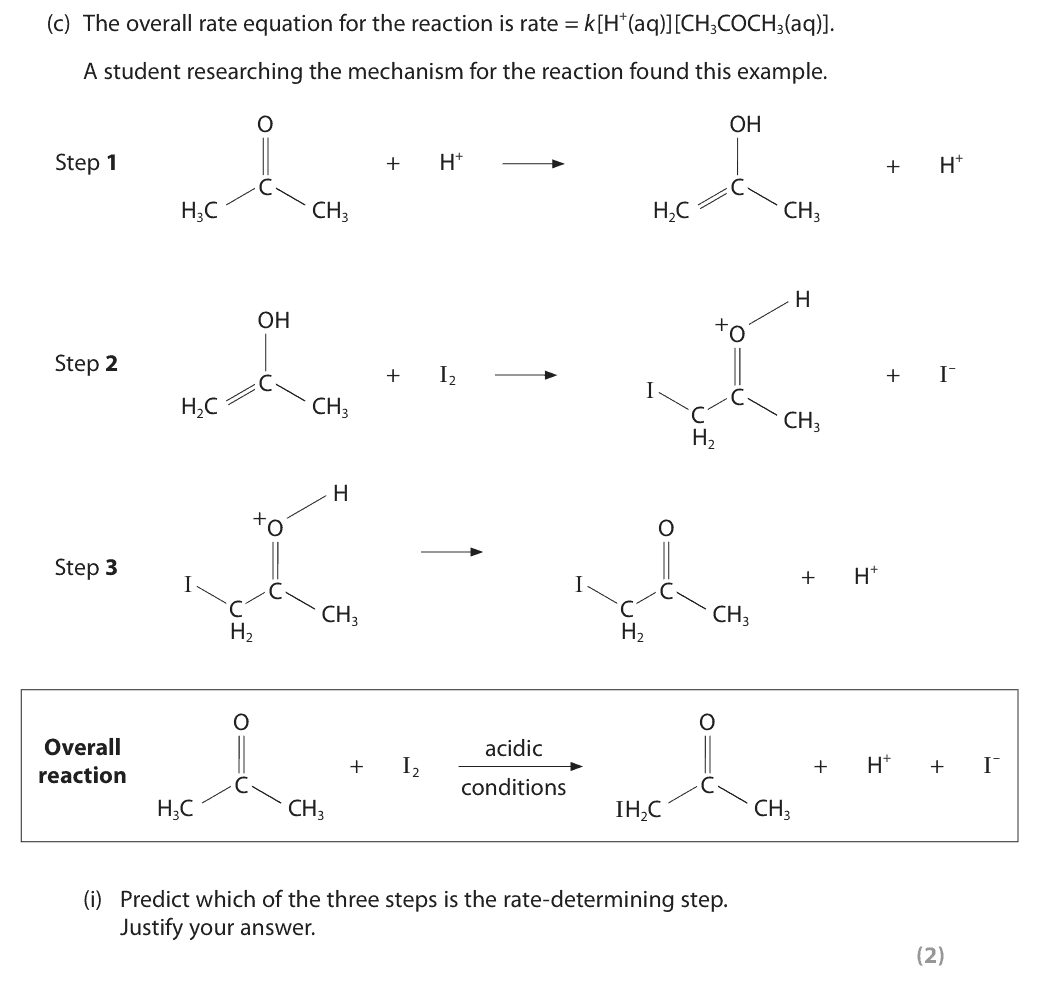
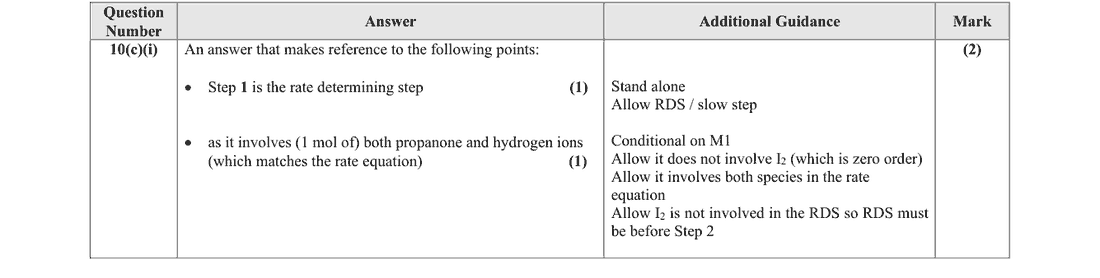
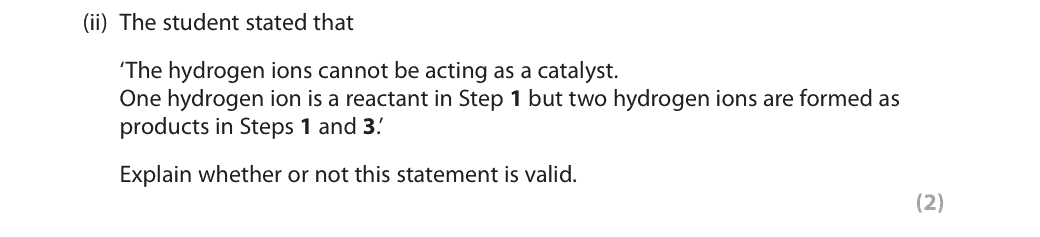
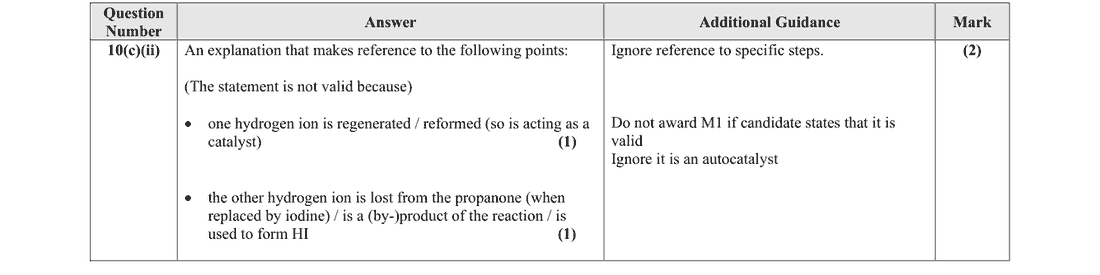
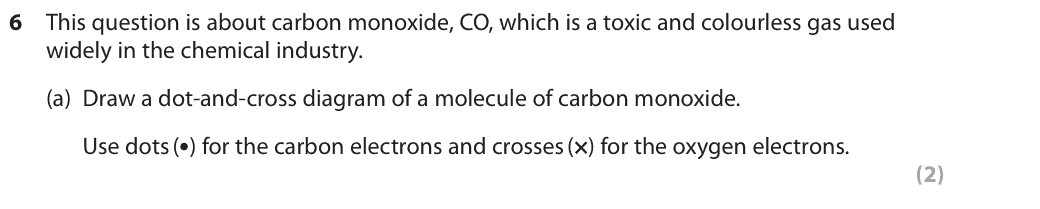
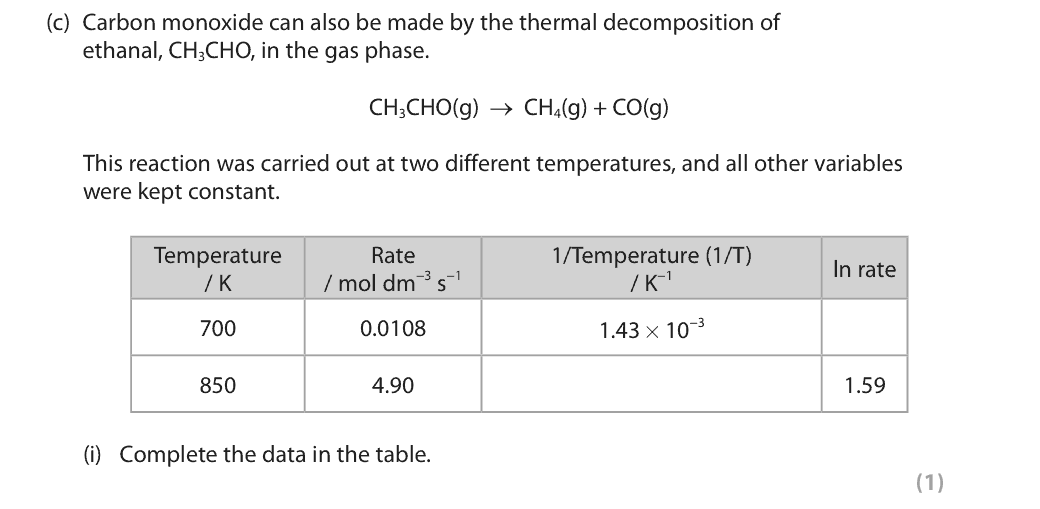
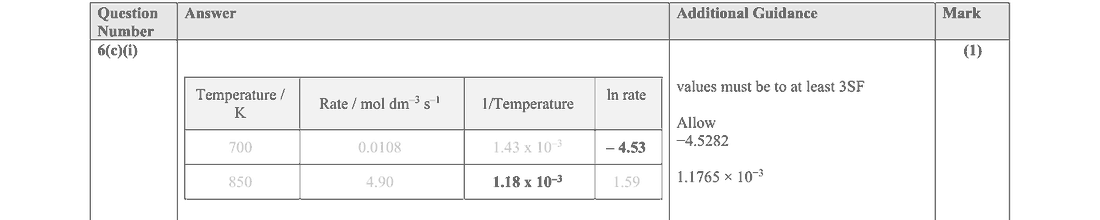
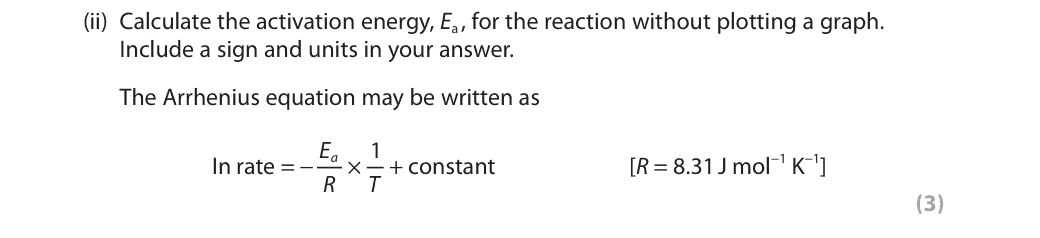
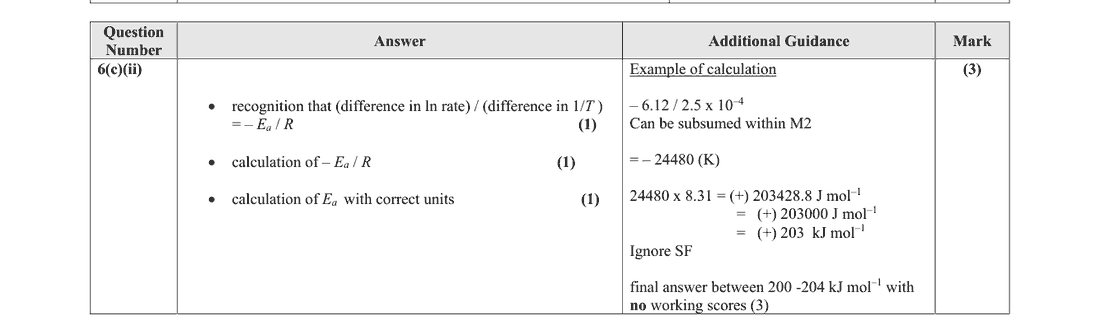
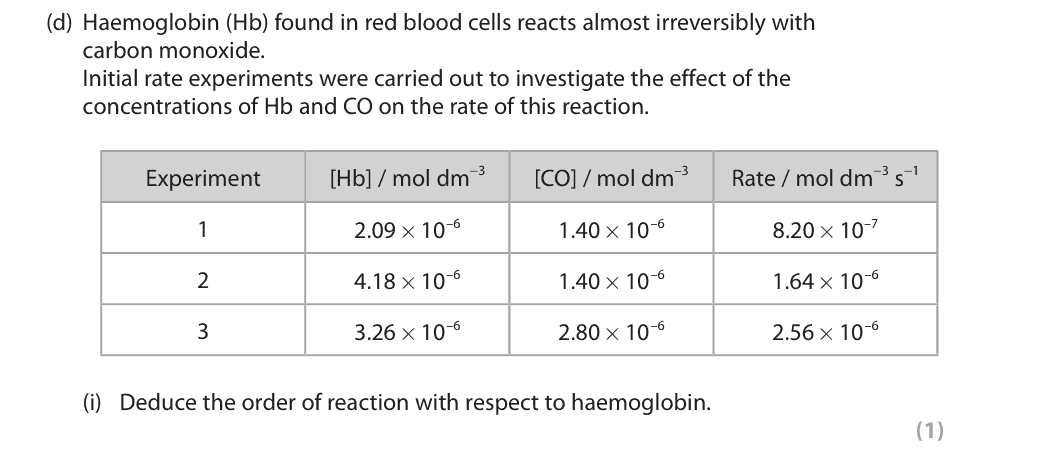


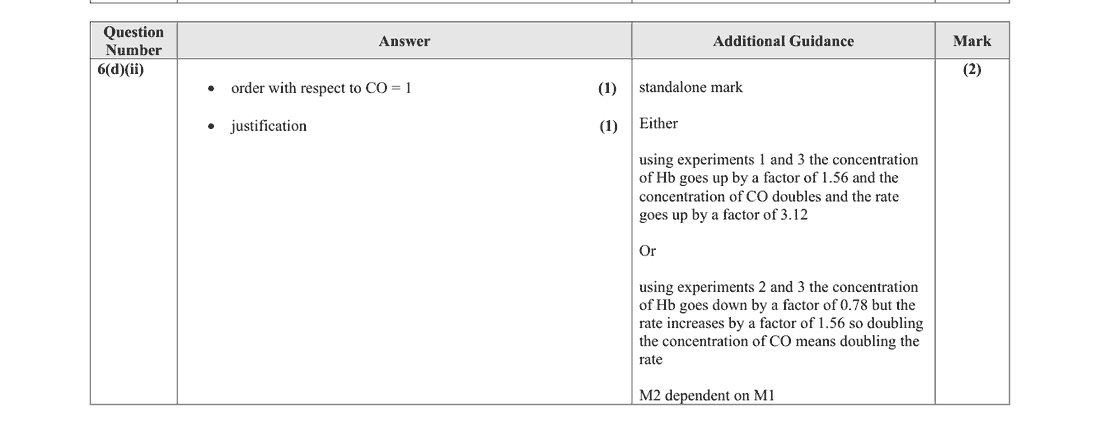

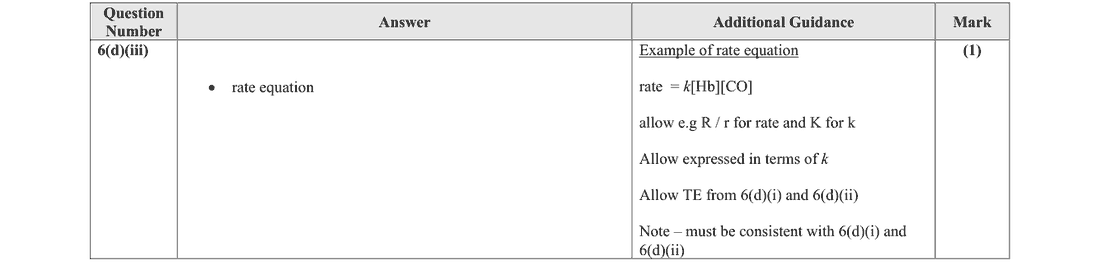

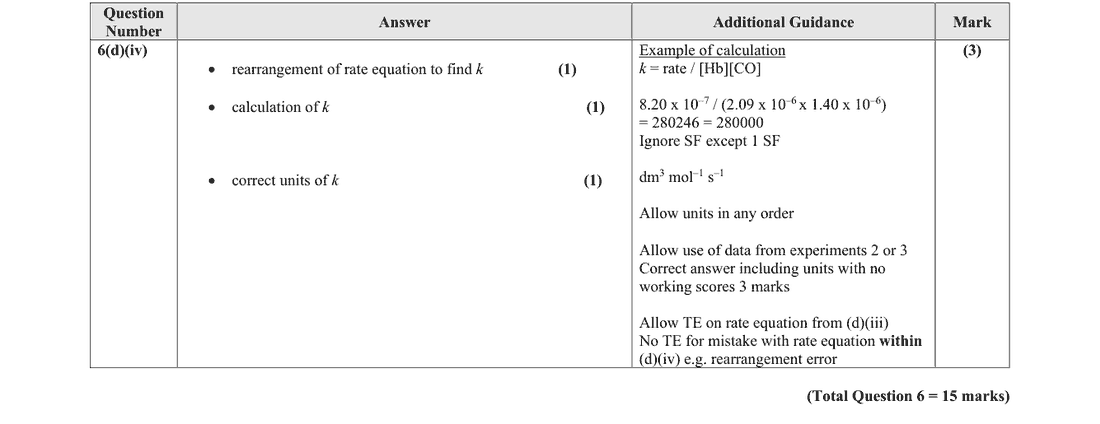
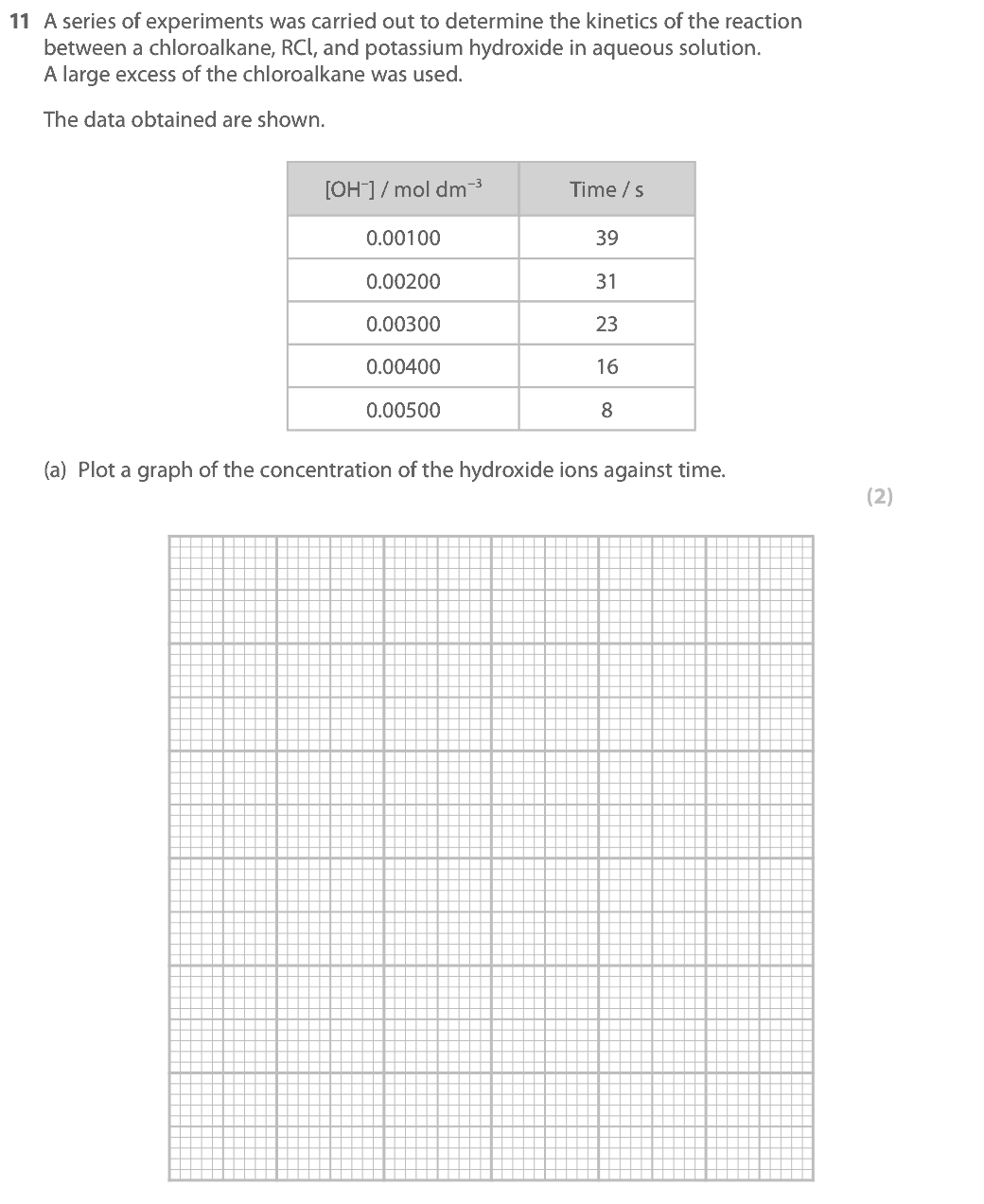
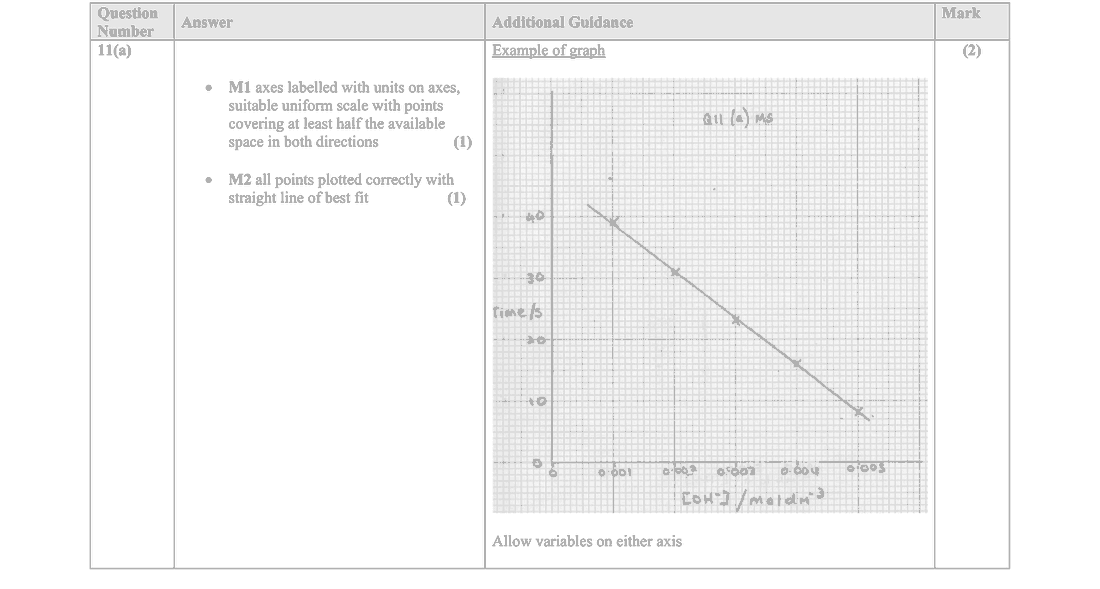






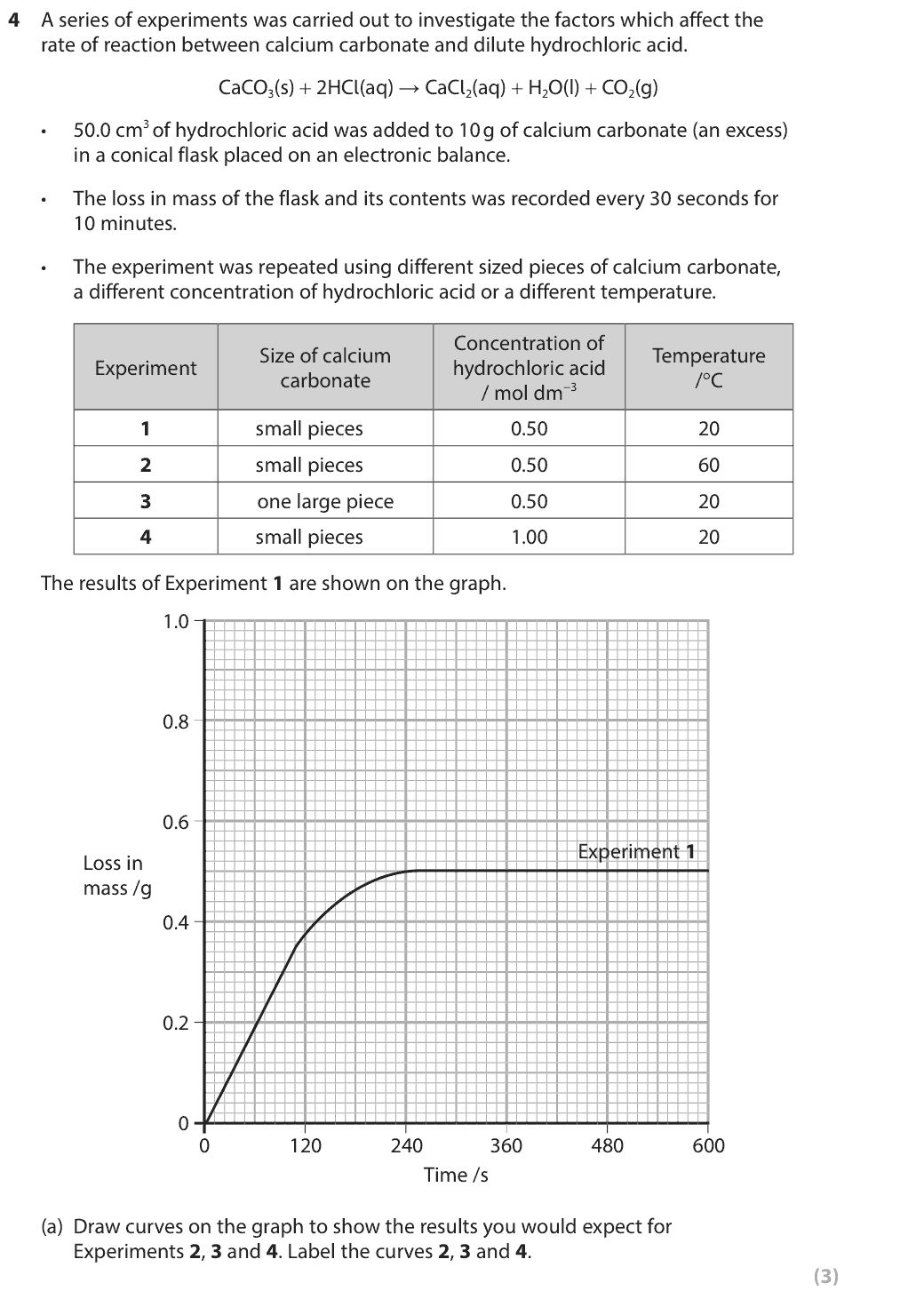

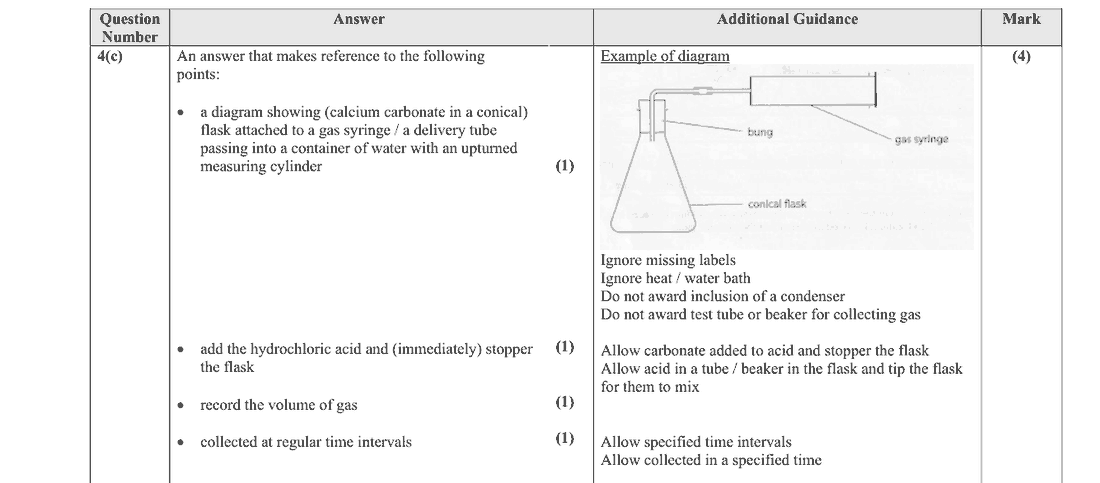
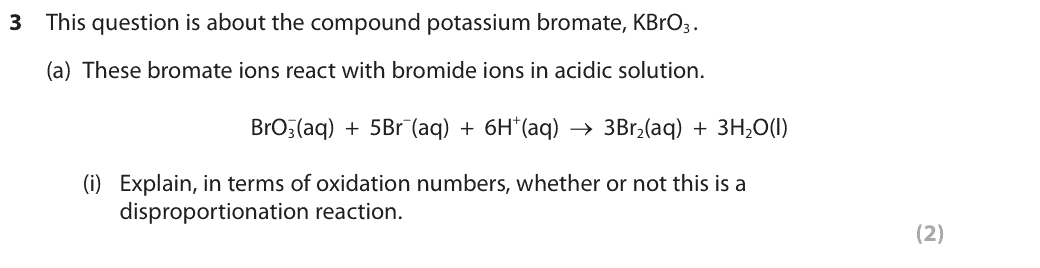
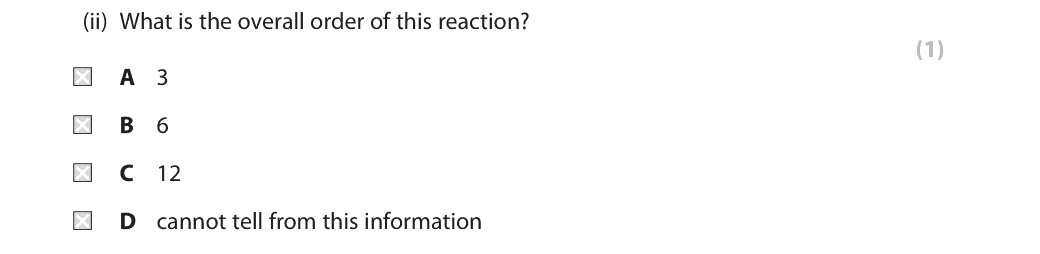

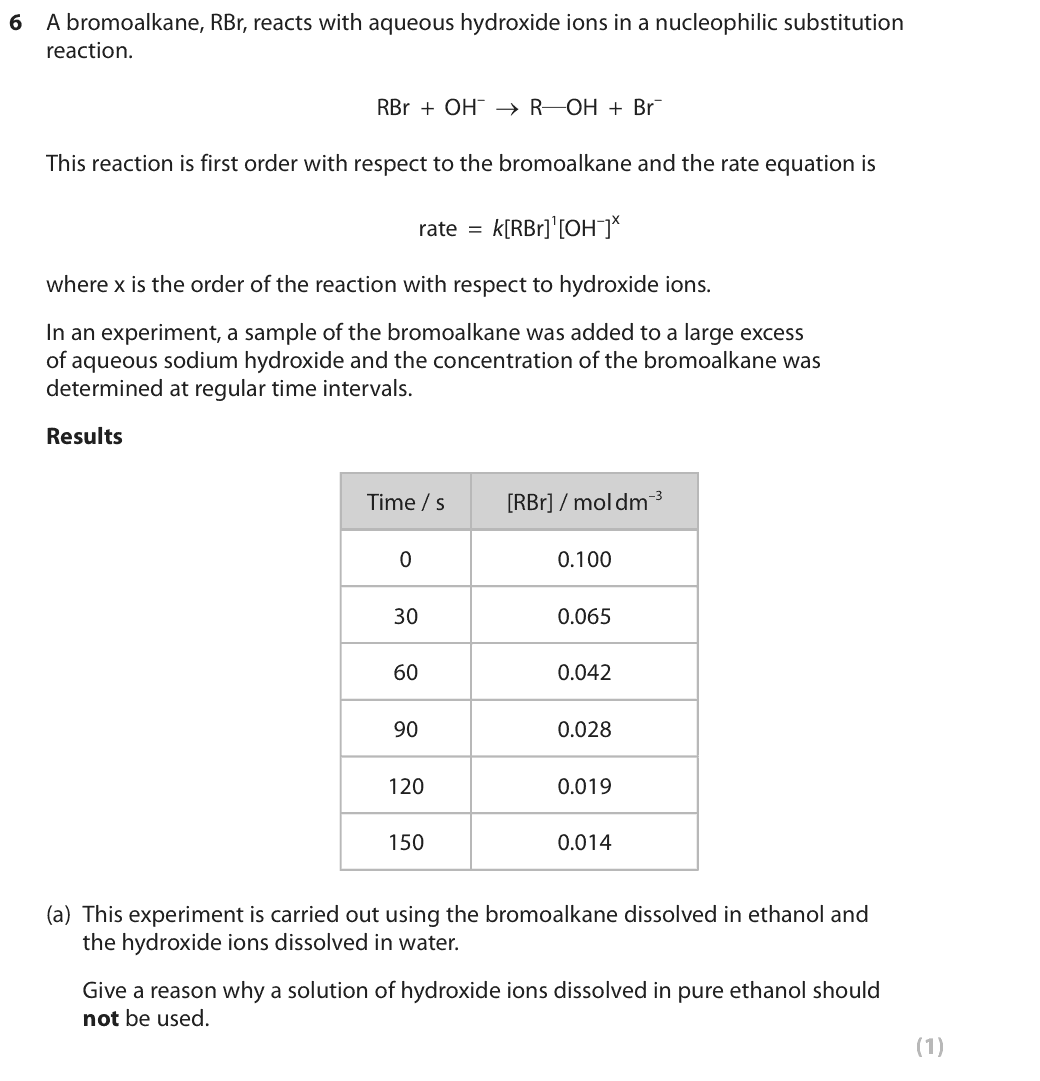
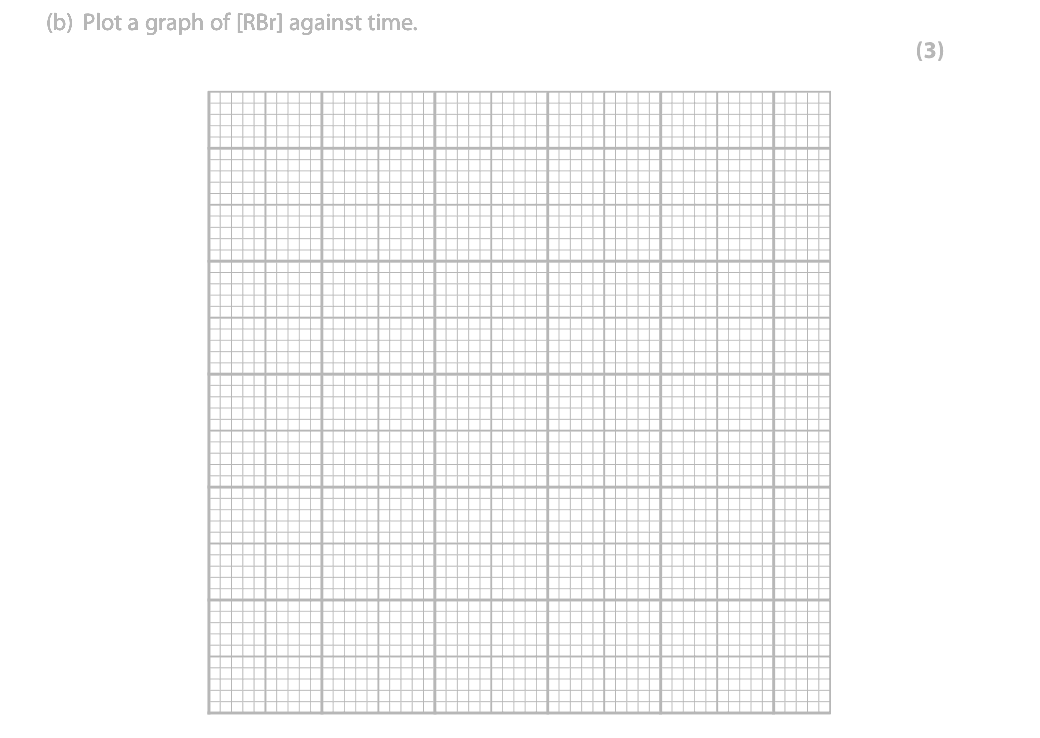
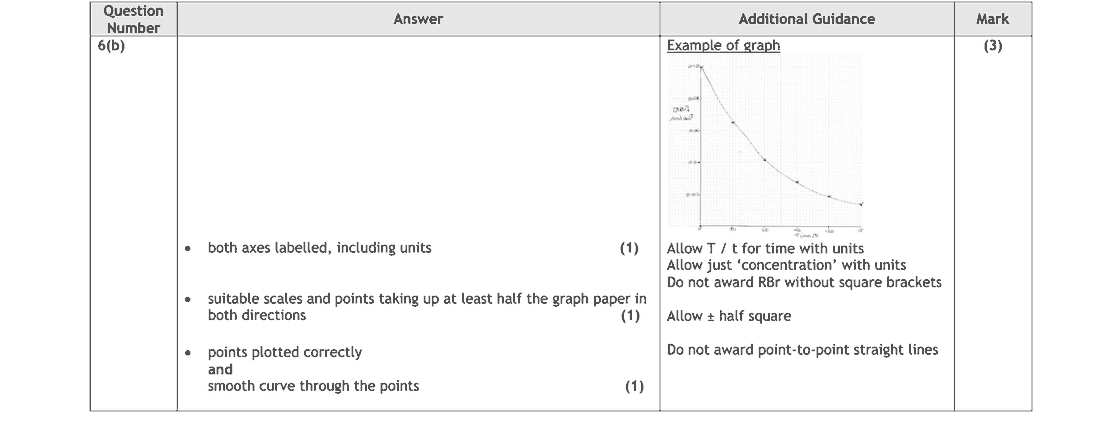

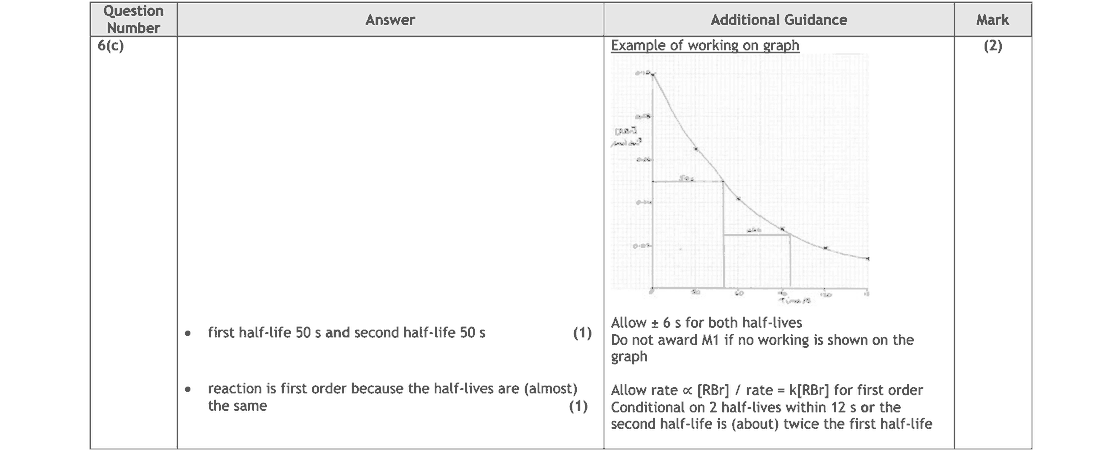
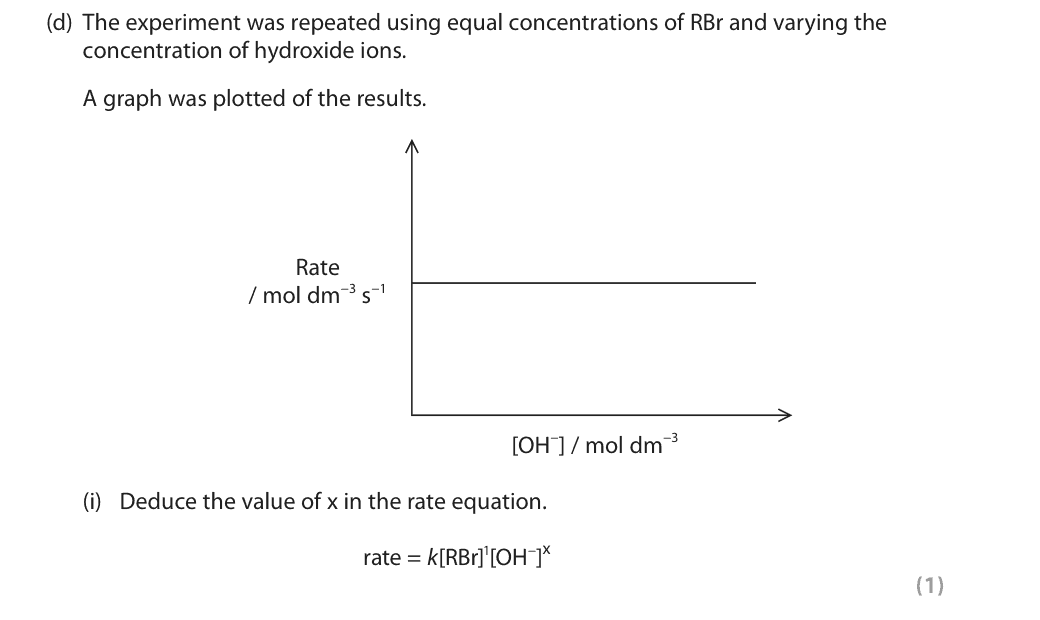


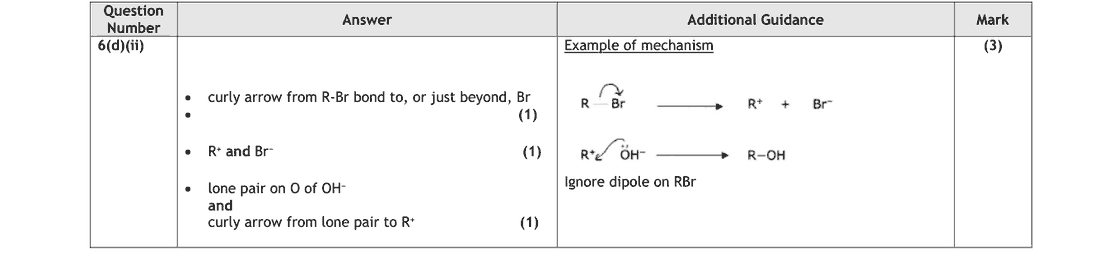
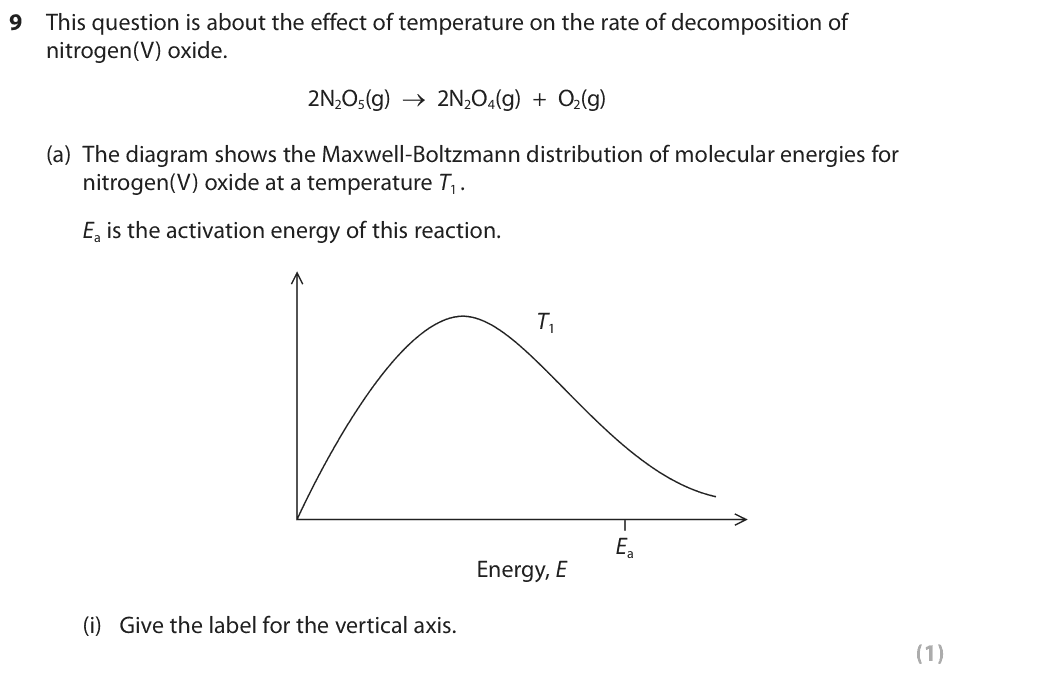
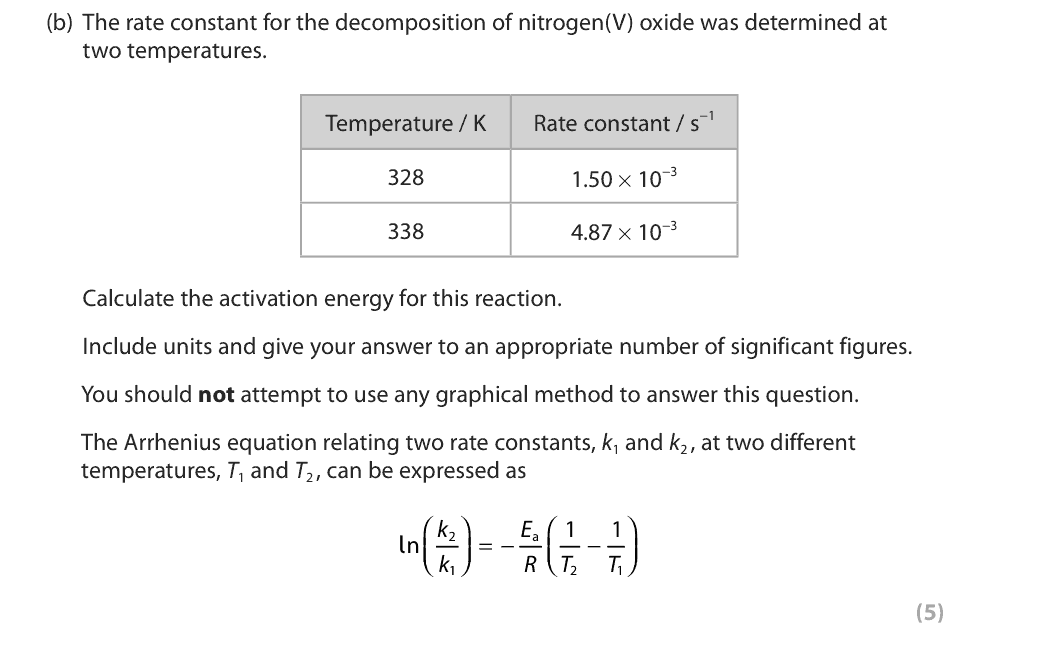
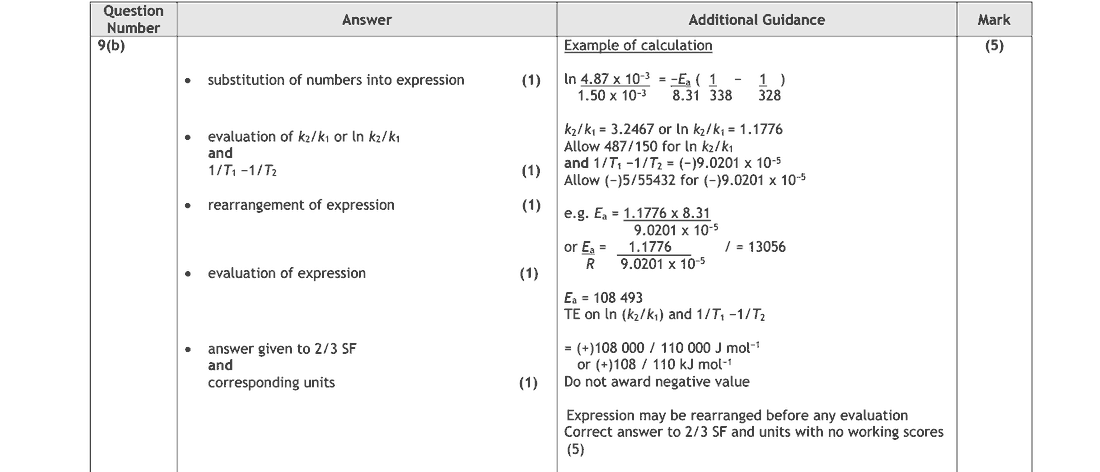
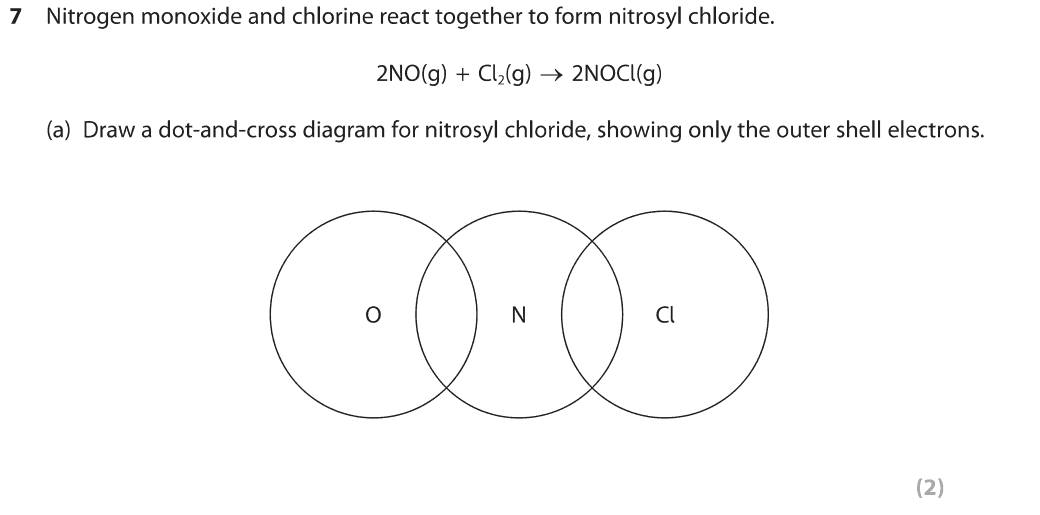
![The rate equation for the formation of nitrosyl chloride is
Rate = k[NOJ’[Cl,]
Complete the table by adding the missing values.](/img/JUN19_9CH02/JUN19_9CH02_7-b-i_qp.webp)
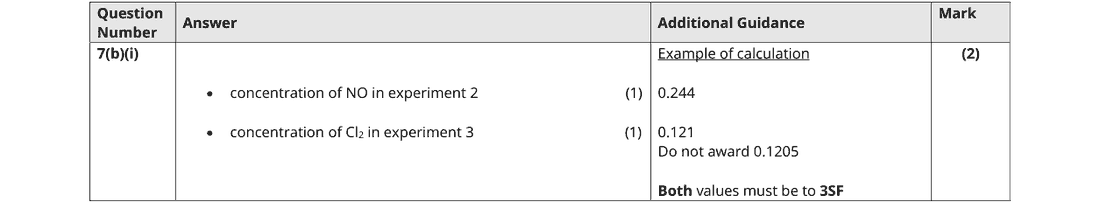

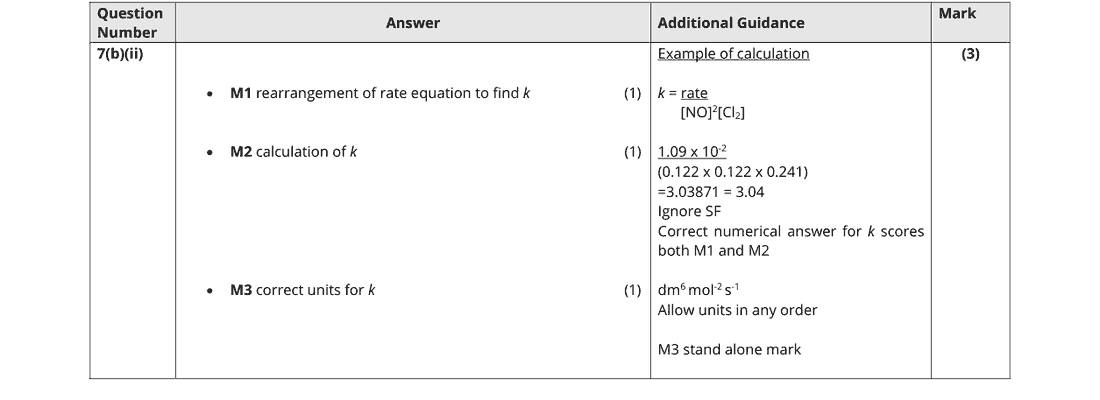
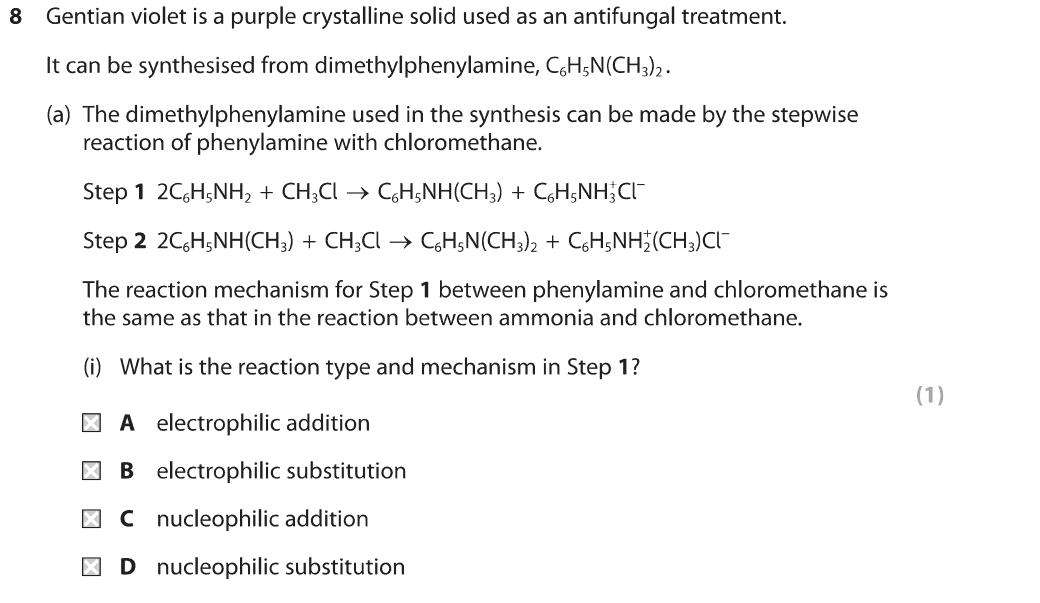
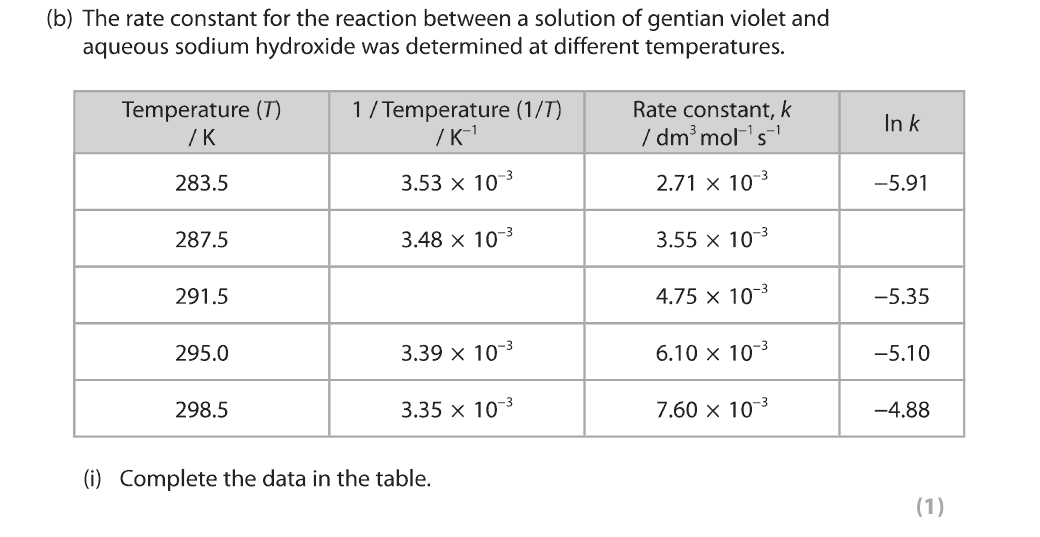
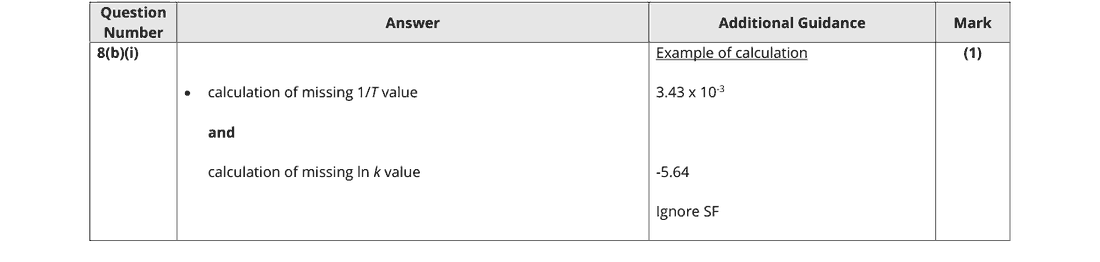
![Plot a graph and use it to determine the activation energy for the reaction in kJ mol".
You should include the value and units of the gradient of the line.
The Arrhenius equation can be shown as
Ink |
= -—* x — + constant
R T
ee pes=Hit Gre iste
Bd
a
He=ttitt: HCE
BEE ue BEE
Het eae
ELH CEH
TF
HE FEEFEEEtreFEE
ELEY EHH ECE eH
EEEA
CHEHt0 EEEita7. HE
isetteis
HH HH
sat teattCEEAH rE
HCEFEE
cr
FE-
CHEFE FE
He erieECEHHHCE
FECEEcit
mopoeCEEHEECEEEttHE IE neeHHCEEtteHC teEteseitire
Et
iat
ae
tsLE
tHEtetECE
CEEHEEEt CEEFE
oo
tieFEECEEBitmo ——
HH
sieHH EE
a
aete
EteHtpsEt CHE
oS
EEE HEae FEE ESECEEet
ECE
ae
HCE FE
aes
ECE HH
Ht ae
ECECHEHHHE HE Ete
ECEHeHEE
a HiieitaHECEEtt HEEEEEtttHt
ae co
sit HEHE HCEFt
ae
LEH
iste
ae
EH
ce
oe
Hue
at
teHEtttise HE ite
rE
oo ae
iteFEECEEtreiancrite
ECE
Le --
ae
a:
EE
are
ee
7 HCE
fieoe HEEEte Htae CEEFEE
te
ee He 3 bie H
sss
ae
ae
ae
a
ae
HH
To Ete
ai iia
eea
ee
LEa ae
HE HCE
ae
ae= ee HCE
eea EteceHCE ane te HH a ELE EEE
ECEiiECE
He= Le
HEE isisHHHtEte —=
te te
ans
ECEcE EH
“FHa
Bee
HH
He 3
ae as
ELE a"ae HEE
HEE HCE—Ete Hh a
aosHtceaa
HeceCEEFEE ee Hate
ae
rae
ee
HE
iris
ie
He i:
IE
po
He
rTae ane
oS ae ae Htee
HaHE
ee ate
He
Bat
ae
ae
ate rte
as
HEE H
aeae
He
TEE—
fet rae
osne Hoea To
e/- Ee ita os =
He Be co
te eine
aE eine a
EH EH
cH cH
G r ° di i m
- ve ” con oe ses “ os se ” ~ ~ “ ~
bee . . ve ~ . ~ a ae
cti u va ton n e er
g y
: vo - os ~ i ” ” ~ a ~
i . i so ve . _ “ ”
os
—
otal f
S =]
P
‘AP
90 M ARKSs](/img/JUN19_9CH02/JUN19_9CH02_8-b-ii_qp.webp)