Notes and key-term cards for this topic are being written by our tutors. The past-paper questions below are ready now.
Specification statements
Show the 10 statements from the specification
6.8 know the general formula for alkanes
6.9 know that alkanes and cycloalkanes are saturated hydrocarbons
6.10 understand that alkane fuels are obtained from the fractional distillation, cracking and reforming of crude oil [Reforming is described as the processing of straight-chain hydrocarbons into branched-chain alkanes and cyclic hydrocarbons for efficient combustion.]
6.11 know that pollutants, including carbon monoxide, oxides of nitrogen and sulfur, carbon particulates and unburned hydrocarbons, are formed during the combustion of alkane fuels
6.12 understand the problems arising from pollutants from the combustion of fuels, limited to the toxicity of carbon monoxide and the acidity of oxides of nitrogen and sulfur
6.13 understand how the use of a catalytic converter solves some problems caused by pollutants
6.14 understand the use of alternative fuels, including biodiesel and alcohols derived from renewable sources such as plants, in terms of a comparison with non-renewable fossil fuels
6.15 know that a radical: • i is a species with an unpaired electron and is represented in mechanisms by a single dot • ii is formed by homolytic fission of a covalent bond and results in the formation of radicals
6.16 understand the reactions of alkanes with: • i oxygen in air (combustion) • ii halogens, in terms of the mechanism of radical substitution through initiation, propagation and termination steps [The use of curly half-arrows is not expected in this mechanism.]
6.17 understand the limitations of the use of radical substitution reactions in the synthesis of organic molecules, in terms of further substitution reactions and the formation of a mixture of products
Tap a question to zoom it. Where a part needs a figure, table or structure from earlier in the question, that part folds out above it; the mark scheme and examiner's comment open underneath. Have Edexcel's Data Booklet beside you; the Periodic Table is on the back page of every paper.
June 2025 · Paper 2 · Q4(a)(ii)2 marksShort answer
Earlier part of question 4 that this part uses
Mark scheme
Examiner's comment
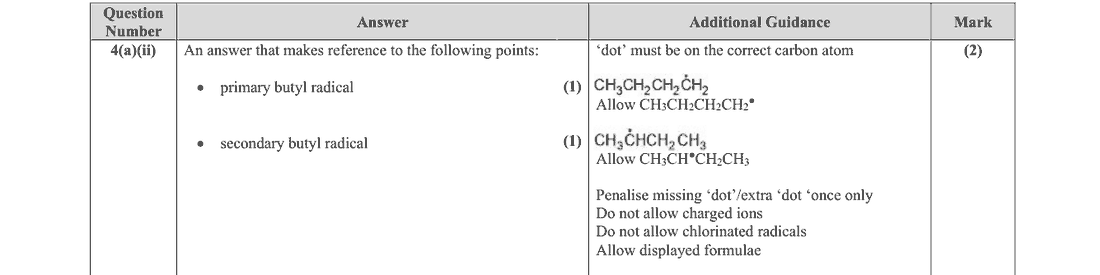
Most candidates knew the structure of the primary butyl radical but the second answer given was more challenging.
•CH2CH3. Some candidates gave a response involving equations rather than the structures that the question asked for.
Common errors include giving a chlorinated species and commonly CH3CH2
Notes from the mark scheme and report
CH3CH2CH2CH2• (primary) and CH3CH•CH2CH3 (secondary), with the dot on the correct carbon. Missing or extra dot penalised once
not ions
not chlorinated radicals. The primary radical was usually right, the second was harder
some wrote equations
chlorinated species and the ethyl radical were common errors
June 2025 · Paper 2 · Q4(a)(iii)2 marksExplanationHard
Earlier part of question 4 that this part uses
Mark scheme
Examiner's comment
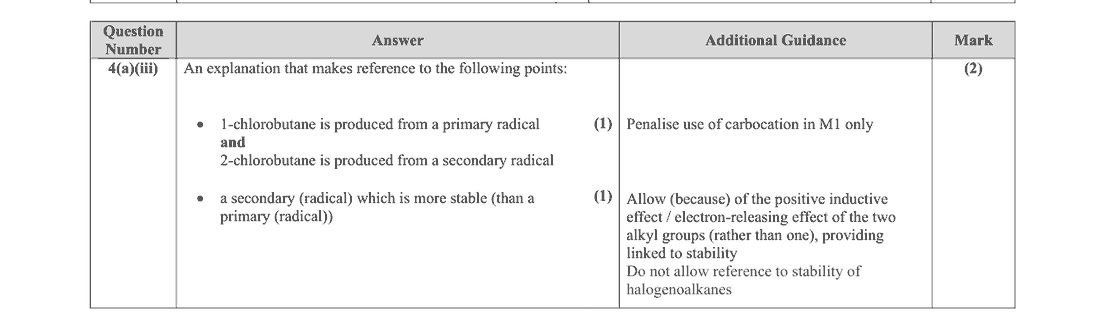
This proved to be a challenging question and most candidates frequently lost the first mark by stating that the 1-chlorobutane is formed from a primary carbocation, and the 2-chlorobutane forms from a secondary carbocation, rather than from the respective radical.
Most candidates were able to score the second mark for stating the relative stability of the intermediates with 1 being the mode for this question.
Notes from the mark scheme and report
1-chlorobutane forms from a primary radical and 2-chlorobutane from a secondary radical
the secondary radical is more stable (two electron-releasing alkyl groups rather than one), as with carbocations. 'Carbocation' is penalised in the first mark only
not the stability of the halogenoalkanes. Most lost the first mark by writing about primary and secondary carbocations
the mode was 1
June 2025 · AS Paper 2 · Q8(b)(iii)3 marksShort answerEasy
Earlier part of question 8 that this part uses
Mark scheme
Examiner's comment
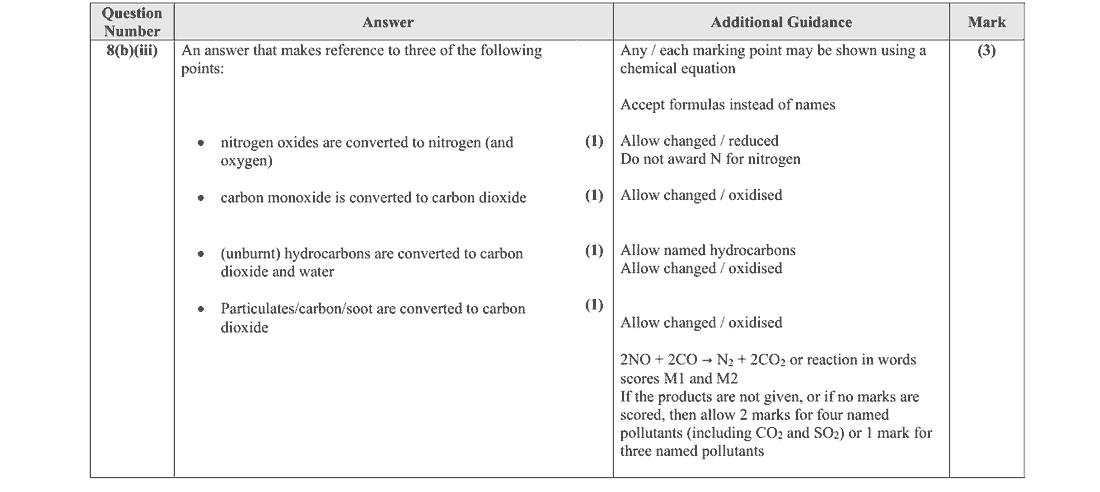
This question is about the use of catalysts in vehicle exhaust systems. (a) The expression for the equilibrium constant was well understood and 90% of the candidates answered correctly. The subsequent calculation was more challenging but still well scored. (bi) The concept of heterogeneous catalysis was widely known. However, some candidates confused it with heterogeneous equilibria, referring to reactants and products being in different phases without mentioning the phase of the catalyst. Others mentioned that the catalyst was in a “different phase” but failed to specify that this was in comparison to the reactants, which is essential for a complete explanation. (bii) Adsorption onto the catalyst surface was generally well understood with most then going on to explain the consequent lowering of Ea. Weaker candidates often just gave a generalised statement without linking it to heterogeneous catalysis, or just described adsorption or desorption but did not explain why this increases the rate of reaction. (biii) The vast majority scored at least two marks – typically referring to CO and NOx. Many also suggested SO2. However, some misunderstood the question and listed pollutants produced by the engine rather than the products formed after catalytic conversion. A surprising number incorrectly stated that CO produces carbon and oxygen, or that SO2 decomposes into sulfur and oxygen. The “rescue” mark for 3 named pollutants was widely awarded.
Notes from the mark scheme and report
Any three: nitrogen oxides are converted to nitrogen (and oxygen)
carbon monoxide to carbon dioxide
unburnt hydrocarbons to carbon dioxide and water
particulates / carbon / soot to carbon dioxide. Equations allowed: 2NO + 2CO → N2 + 2CO2 scores two. If the products are missing or nothing else scores, 2 marks for four named pollutants (CO2 and SO2 may be counted) or 1 for three. Common errors: listing pollutants without products
CO giving carbon and oxygen
SO2 decomposing to sulfur and oxygen
June 2024 · Paper 2 · Q5(a)1 markShort answer
Mark scheme
Examiner's comment
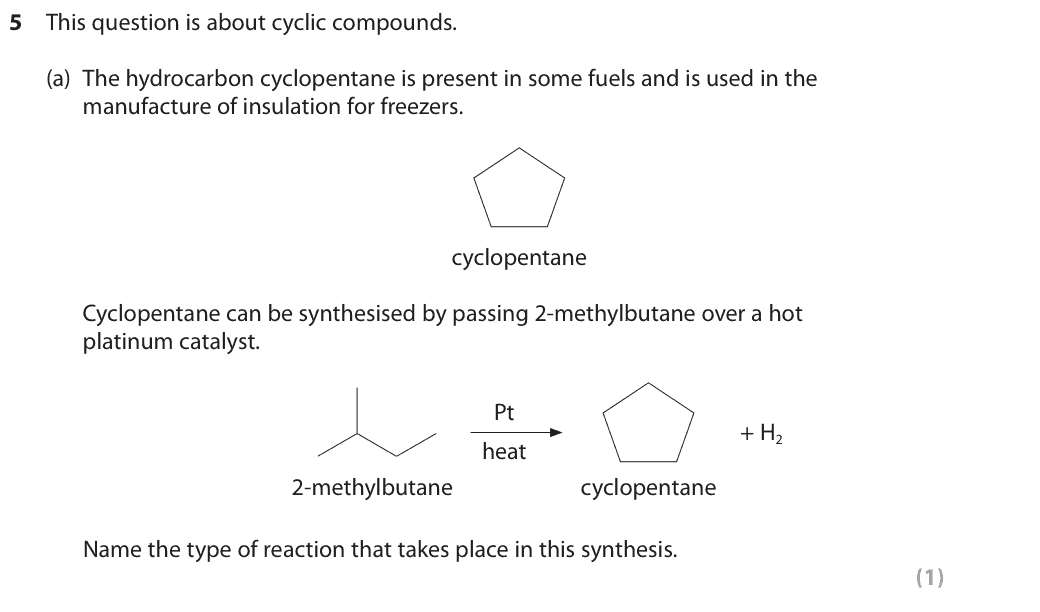
Over two-thirds of the cohort could recall this reaction, though a minority confused the process with other features of crude oil chemistry, such as cracking and fractional distillation.
Notes from the mark scheme and report
Answer: reforming (allow dehydrogenation or cyclisation). Not cracking or dehydration
'oxidation' and 'catalytic' ignored. Over two-thirds were right
others gave cracking or fractional distillation
June 2024 · Paper 2 · Q5(c)(i)1 markShort answer
Mark scheme
Examiner's comment
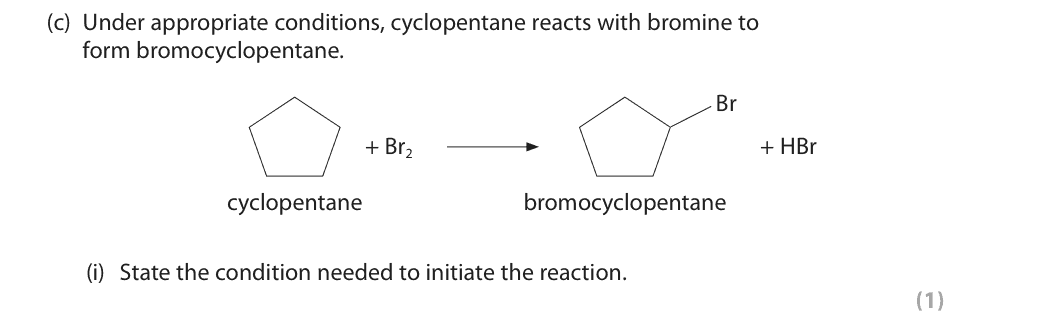
This was straightforward recall for most candidates. The most common incorrect answers were heat under reflux, and use of a halogen carrier such as iron((III) bromide. In the case of the latter answer, it seems as though some candidates misinterpreted the cyclic alkane as an arene.
Notes from the mark scheme and report
Answer: ultraviolet light (allow sunlight, or a temperature over 250 °C). Heat under reflux ignored
high pressure not credited. Wrong answers included a halogen carrier such as iron(III) bromide, treating the cycloalkane as an arene
June 2024 · Paper 2 · Q5(c)(ii)3 marksEquation writing
Earlier parts of question 5 that this part uses
Mark scheme
Examiner's comment
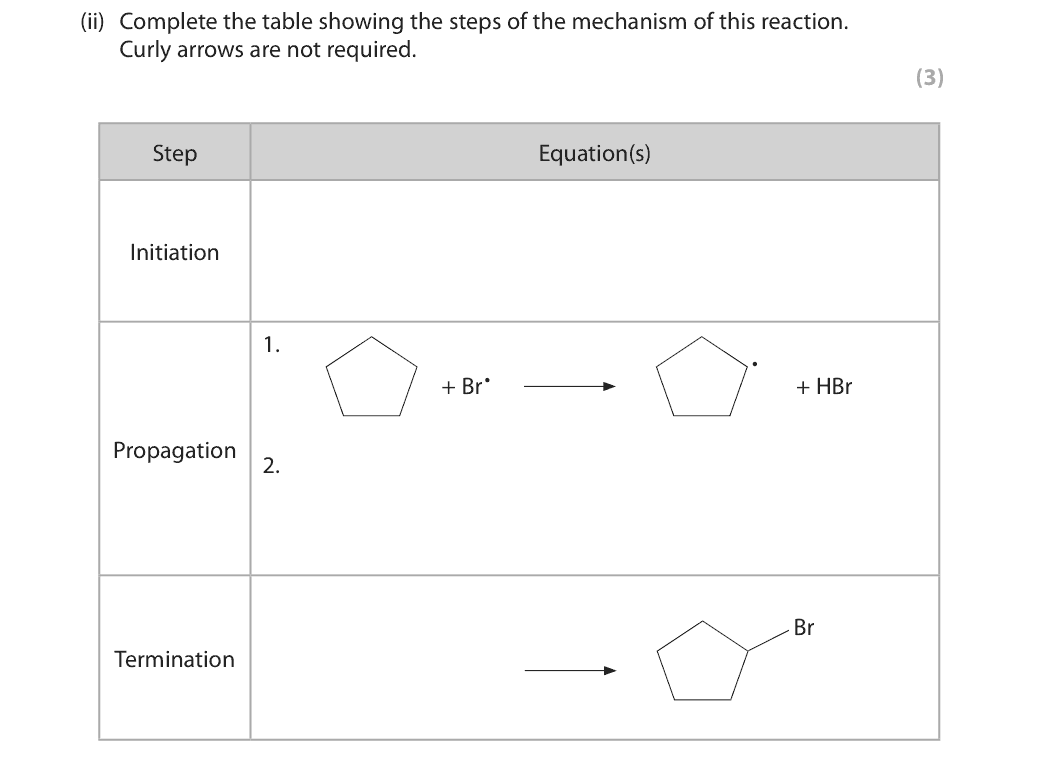
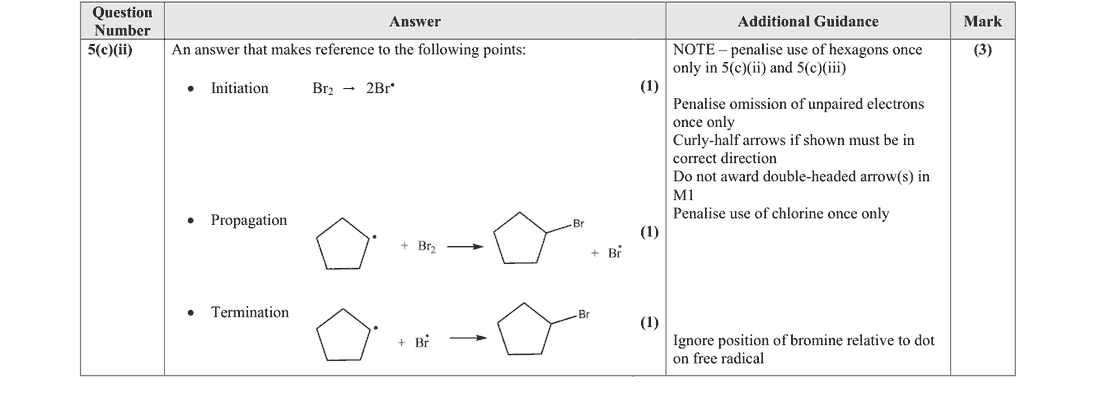
This question was an example of familiar chemistry in an unfamiliar context and as such it discriminated effectively. The initiation step was well known by nearly all candidates, though a few tried to extend their answer and included incorrect two-headed curly arrows. The propagation step was more challenging, with a significant minority of candidates failing to regenerate a bromine free radical. Part (c)(iii) differentiated constructively. In order to improve, many candidates need to be able to show a bond between two cyclic structures in skeletal format, as many candidates simply fused the two rings together via a single carbon atom.
Notes from the mark scheme and report
Initiation: Br2 → 2Br• (no double-headed arrows). Propagation step 2: cyclopentyl radical + Br2 → bromocyclopentane + Br•. Termination: cyclopentyl radical + Br• → bromocyclopentane. Missing radical dots, hexagons and use of chlorine are each penalised once only. Initiation was known by nearly all
a significant minority did not regenerate Br• in the propagation step
June 2024 · Paper 2 · Q5(c)(iii)1 markDiagram or structure
Earlier parts of question 5 that this part uses
Mark scheme
Examiner's comment
This question was an example of familiar chemistry in an unfamiliar context and as such it discriminated effectively. The initiation step was well known by nearly all candidates, though a few tried to extend their answer and included incorrect two-headed curly arrows. The propagation step was more challenging, with a significant minority of candidates failing to regenerate a bromine free radical. Part (c)(iii) differentiated constructively. In order to improve, many candidates need to be able to show a bond between two cyclic structures in skeletal format, as many candidates simply fused the two rings together via a single carbon atom.
Notes from the mark scheme and report
Two cyclopentane rings joined by a single C–C bond (cyclopentylcyclopentane)
displayed formula allowed. Not two rings fused through one shared carbon atom, which was the common error
June 2023 · Paper 2 · Q1(c)2 marksShort answer
Mark scheme
Examiner's comment
This question required the candidates to consider some of the problems in using free radical substitution as a synthetic route. Whilst many candidates realised that it would be difficult to produce the correct product as you would generally obtain of mixture of products, fewer explained that it would make it difficult to separate the products or named a correct unwanted product. Some candidates named hydrogen as an unwanted product. This would not be produced by free radical substitution and so would not be awarded the second mark.
Notes from the mark scheme and report
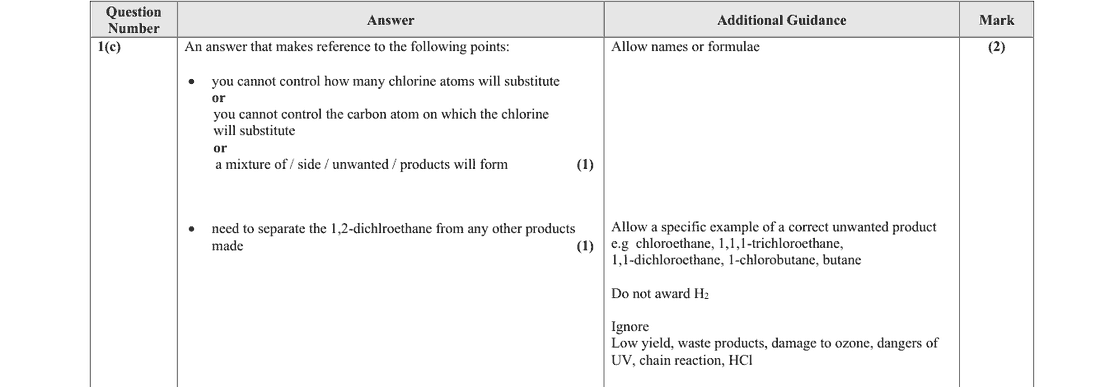
M1 the number of chlorine atoms substituted, or the carbon they go on, cannot be controlled / a mixture of products forms
M2 the 1,2-dichloroethane then has to be separated from the other products, or a named correct unwanted product (e.g. chloroethane, 1,1-dichloroethane, butane). Not H2. Low yield, HCl, ozone damage and dangers of UV are ignored. Most gave the mixture of products
fewer gave separation or a correct by-product
June 2023 · AS Paper 2 · Q2(a)2 marksShort answer
Mark scheme
Examiner's comment
Generally, this question answered well. However, some candidates did display a misunderstanding or struggle with the calculation sections.
The most common error in Q02c was omission of the x12 (MP2) for 12CO2.
Notes from the mark scheme and report
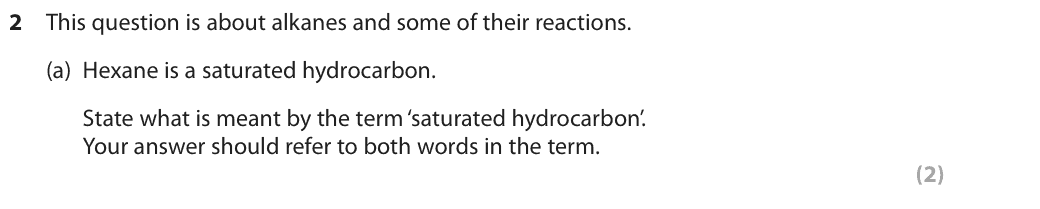
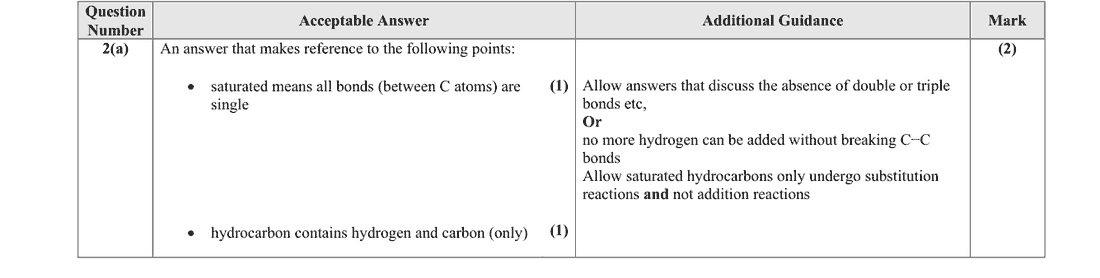
Saturated: all the bonds between carbon atoms are single (no double or triple bonds
no more hydrogen can be added
substitution but not addition reactions). Hydrocarbon: contains hydrogen and carbon only
June 2023 · Paper 2 · Q2(a)1 markMultiple choice
Answer
B
Mark scheme
Notes from the mark scheme and report
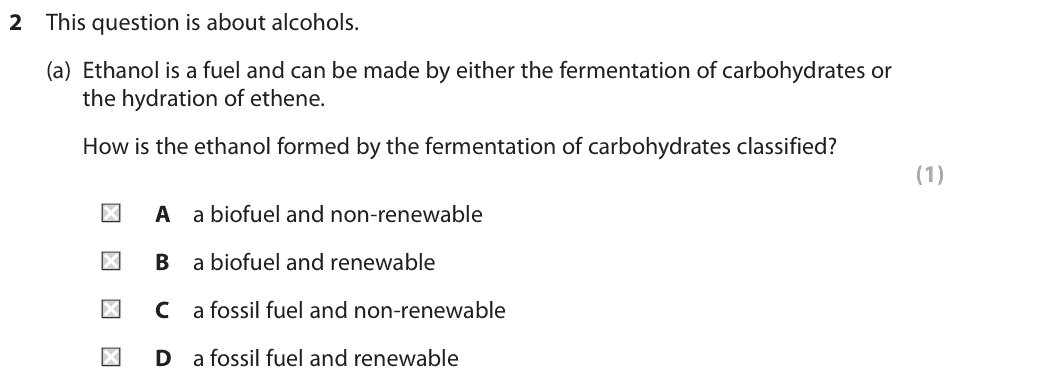
Answer: B. Ethanol from fermentation comes from plants, so it is a biofuel and renewable
June 2023 · AS Paper 2 · Q2(b)(i)1 markEquation writing
Earlier part of question 2 that this part uses
Mark scheme
Examiner's comment
Generally, this question answered well. However, some candidates did display a misunderstanding or struggle with the calculation sections.
The most common error in Q02c was omission of the x12 (MP2) for 12CO2.
Notes from the mark scheme and report
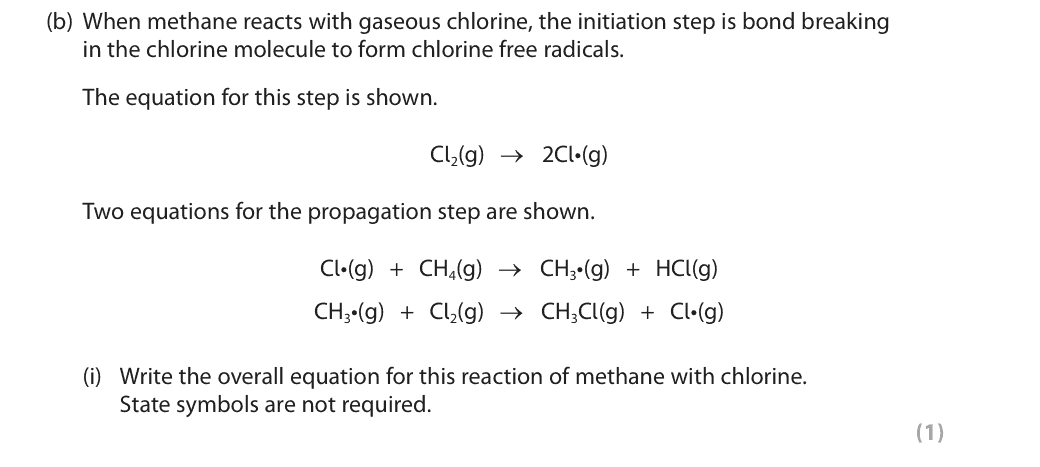
CH4 + Cl2 → CH3Cl + HCl. State symbols ignored
June 2023 · AS Paper 2 · Q2(b)(iii)1 markEquation writing
Earlier parts of question 2 that this part uses
Mark scheme
Examiner's comment
Generally, this question answered well. However, some candidates did display a misunderstanding or struggle with the calculation sections.
The most common error in Q02c was omission of the x12 (MP2) for 12CO2.
Notes from the mark scheme and report
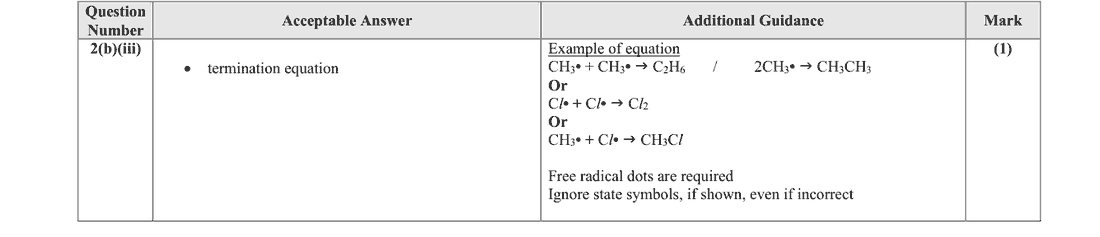
Any one of: CH3• + CH3• → C2H6
Cl• + Cl• → Cl2
CH3• + Cl• → CH3Cl. The radical dots are required
state symbols ignored
June 2023 · AS Paper 2 · Q2(c)(ii)1 markShort answer
Earlier part of question 2 that this part uses
Mark scheme
Examiner's comment
Generally, this question answered well. However, some candidates did display a misunderstanding or struggle with the calculation sections.
The most common error in Q02c was omission of the x12 (MP2) for 12CO2.
Notes from the mark scheme and report
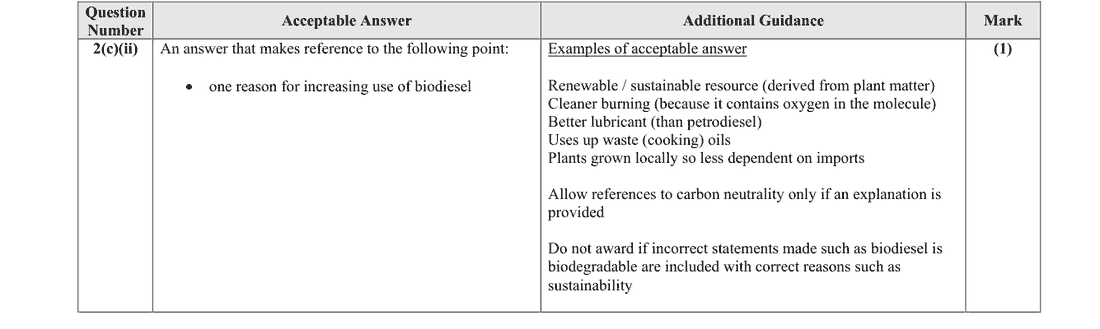
One reason, e.g. it is a renewable / sustainable resource (from plants)
burns more cleanly
better lubricant
uses up waste cooking oil
plants can be grown locally so less dependence on imports. Carbon neutrality only with an explanation. A wrong statement (e.g. that biodiesel is biodegradable) alongside a correct reason loses the mark
June 2023 · AS Paper 2 · Q3(a)3 marksExplanation
Mark scheme
Examiner's comment
This question was answered fairly well, and candidates generally performed as expected.
Notes from the mark scheme and report
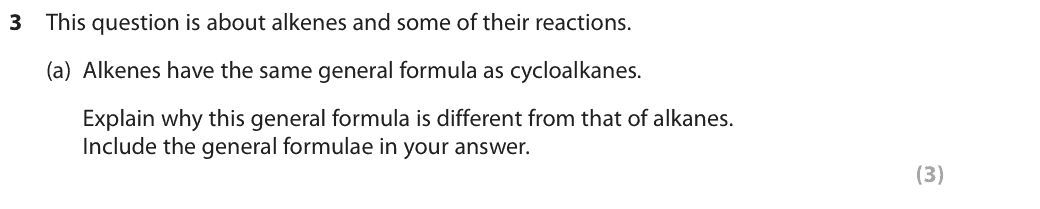
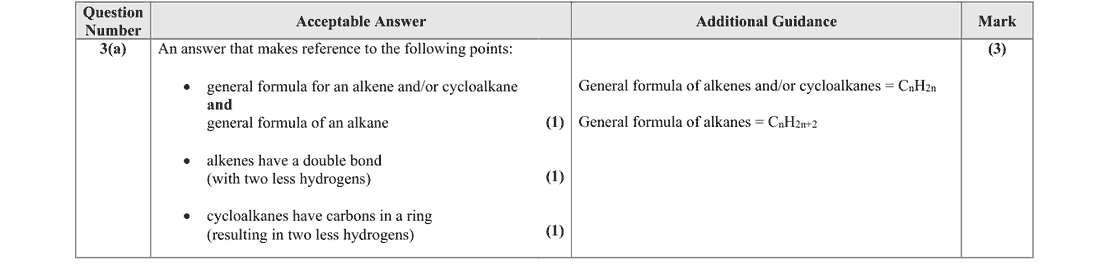
Alkenes and cycloalkanes are CnH2n and alkanes are CnH2n+2
alkenes have a double bond, so two fewer hydrogens
cycloalkanes have their carbons in a ring, so two fewer hydrogens
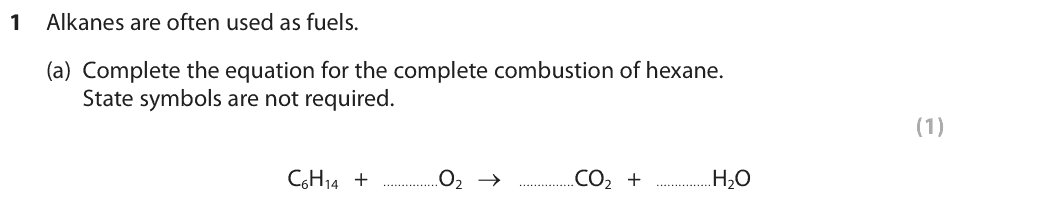
June 2023 · Paper 3 · Q1(a)1 markEquation writing
Mark scheme
Examiner's comment
The majority of candidates correctly balanced the combustion equation. It was acceptable to use decimals, fractions and improper fractions. Occasionally a candidate doubled the numbers to avoid the need for fractions or decimals and this was allowed.
June 2023 · Paper 3 · Q1(b)2 marksShort answerEasy
Mark scheme
Examiner's comment
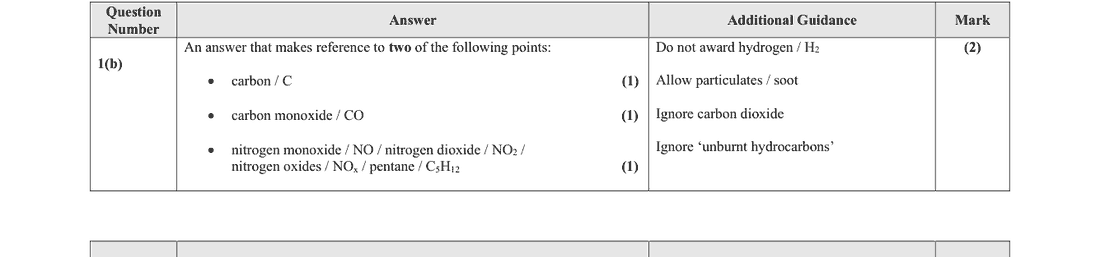
Well-answered with most scoring 2 marks, usually with carbon monoxide and carbon or soot. Other acceptable answers such as nitrogen oxides and the unburnt pentane were seen, but rarely. Since carbon dioxide is a product of complete combustion, this was ignored.
Notes from the mark scheme and report
Any two of: carbon / soot (particulates)
carbon monoxide
an oxide of nitrogen (NO, NO2, NOx) or unburned pentane. Not hydrogen
carbon dioxide is ignored (it is a product of complete combustion). Usual pair was carbon monoxide and carbon
June 2023 · Paper 3 · Q1(c)2 marksExplanation
Mark scheme
Examiner's comment
Most candidates correctly identified the issue and many good explanations of the cause were seen.
Sulfur oxides are not greenhouse gases and so do not contribute to global warming which was occasionally seen. Responses which referred to the formation of sulfuric acid were allowed because this is the chemical responsible for the acidity of the rain from sulfur oxides.
Notes from the mark scheme and report
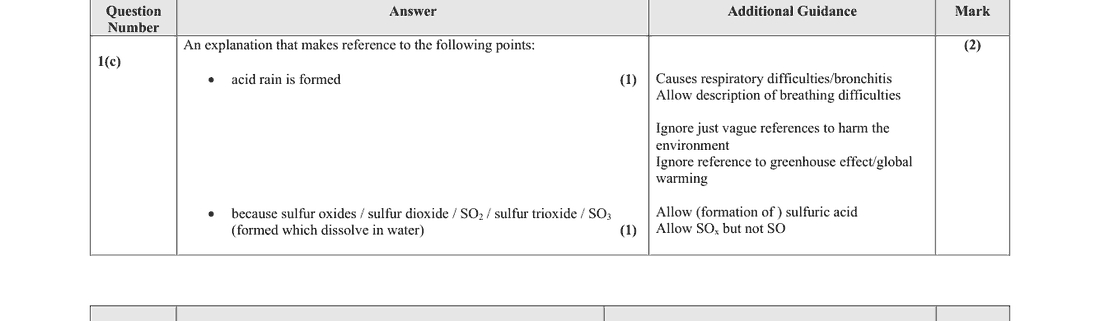
Acid rain is formed (allow respiratory / breathing difficulties)
because sulfur oxides (SO2 or SO3
SOx allowed, not SO) form and dissolve in water (formation of sulfuric acid allowed). Greenhouse effect and global warming are ignored: sulfur oxides are not greenhouse gases
vague 'harms the environment' ignored
June 2023 · Paper 3 · Q1(d)2 marksEquation writing
Mark scheme
Examiner's comment
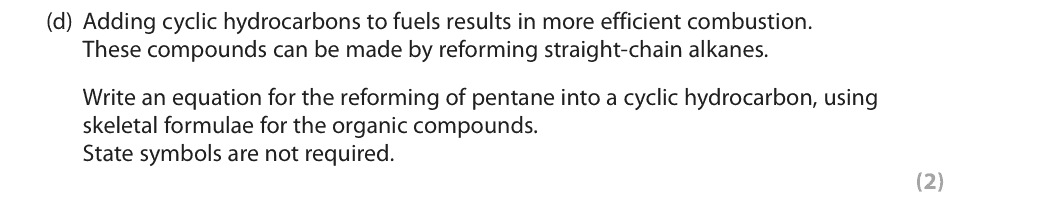
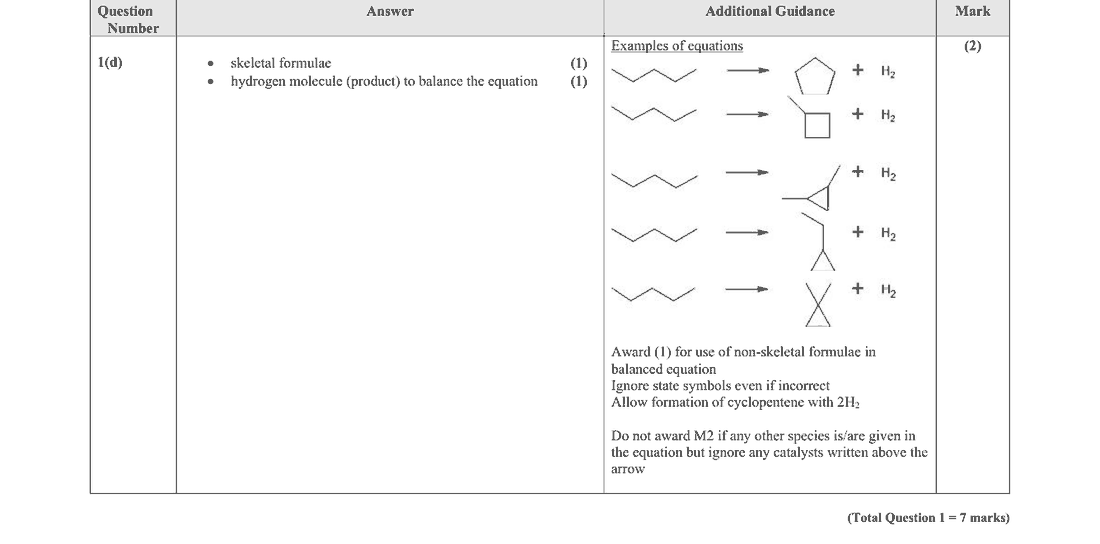
The mark scheme has many possible cyclic possibilities added but cyclopentane was by far the most frequently seen. This equation was given 2 marks because the use of skeletal formulae in the equation needed to be balanced by a hydrogen molecule as a product. Hence this proved an effective discriminator.
Occasionally the pentane reactant was given an extra carbon to form cyclohexane and so there is a real need to check the number of carbon atoms when drawing skeletal formulae.
cyclopentene + 2H2 allowed). One mark for skeletal formulae, one for H2 as the only other product. A balanced equation in non-skeletal formulae scores 1. Some drew six carbons and made cyclohexane: count the carbons
June 2022 · AS Paper 2 · Q3(b)(i)1 markMultiple choice
Earlier part of question 3 that this part uses
Answer
C
Mark scheme
Examiner's comment
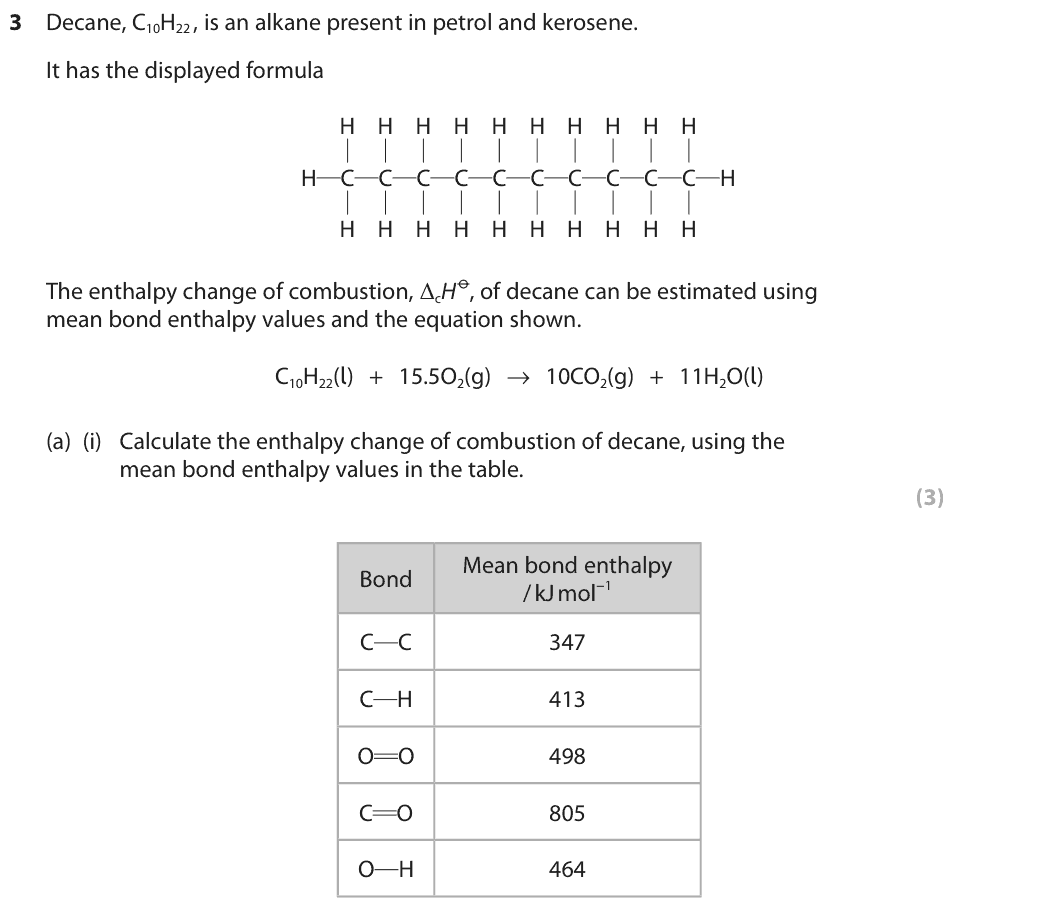
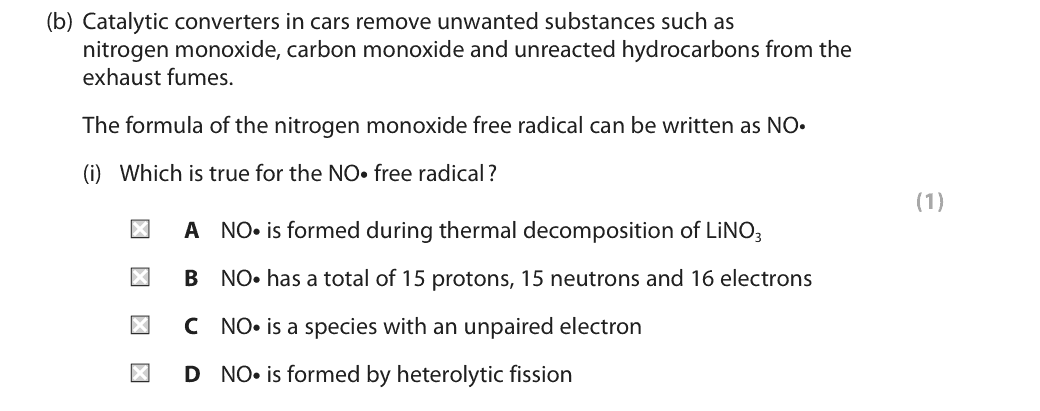
(a)(i) was the first significant calculation, and this proved a reliable source of marks for most candidates, with three marks out of three being the most commonly scored mark on the item. (a)(ii) was more tricky as candidates answers lacked detail giving answers such as the mean bond enthalpy is an average without explaining what it was an average of. Some candidates gave excellent answers but too many were penalised by the lack of detail. (b)(i) was scored by very nearly 80% of candidates. (b)(ii) was also well answered with only about 10% not getting some credit. This equation was not the easiest to balance, but any candidate starting by balancing the number of carbons, then the number of hydrogens, the number of oxygen atoms required and finally number of nitrogen molecules was able to score 2. 1 mark was often scored for the correct substances or balancing correctly an equation giving monatomic nitrogen as a product. (b)(iii) had a number of possible answers, but was generally not answered particularly well, with too few focussing on the equation and thinking more about combustion in general.
Notes from the mark scheme and report
Answer: C (a species with an unpaired electron). A: lithium nitrate gives NO2 on heating
B describes NO– (the radical has 15 electrons)
D: radicals form by homolytic fission. Nearly 80% chose correctly
June 2022 · AS Paper 2 · Q3(b)(iii)1 markShort answer
Earlier parts of question 3 that this part uses
Mark scheme
Examiner's comment
(a)(i) was the first significant calculation, and this proved a reliable source of marks for most candidates, with three marks out of three being the most commonly scored mark on the item. (a)(ii) was more tricky as candidates answers lacked detail giving answers such as the mean bond enthalpy is an average without explaining what it was an average of. Some candidates gave excellent answers but too many were penalised by the lack of detail. (b)(i) was scored by very nearly 80% of candidates. (b)(ii) was also well answered with only about 10% not getting some credit. This equation was not the easiest to balance, but any candidate starting by balancing the number of carbons, then the number of hydrogens, the number of oxygen atoms required and finally number of nitrogen molecules was able to score 2. 1 mark was often scored for the correct substances or balancing correctly an equation giving monatomic nitrogen as a product. (b)(iii) had a number of possible answers, but was generally not answered particularly well, with too few focussing on the equation and thinking more about combustion in general.
Notes from the mark scheme and report
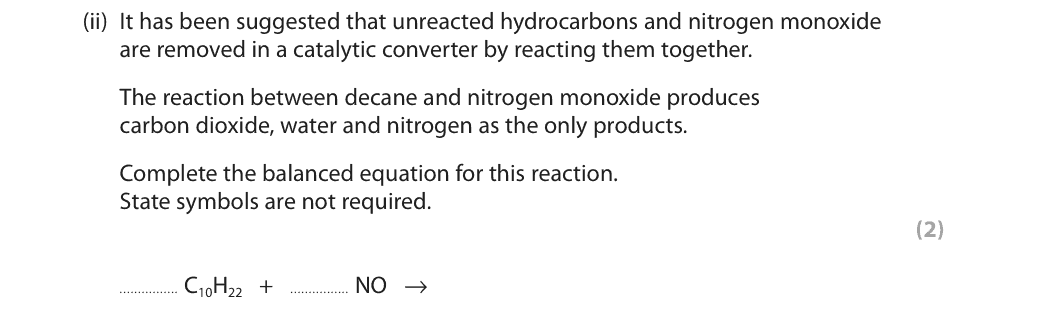
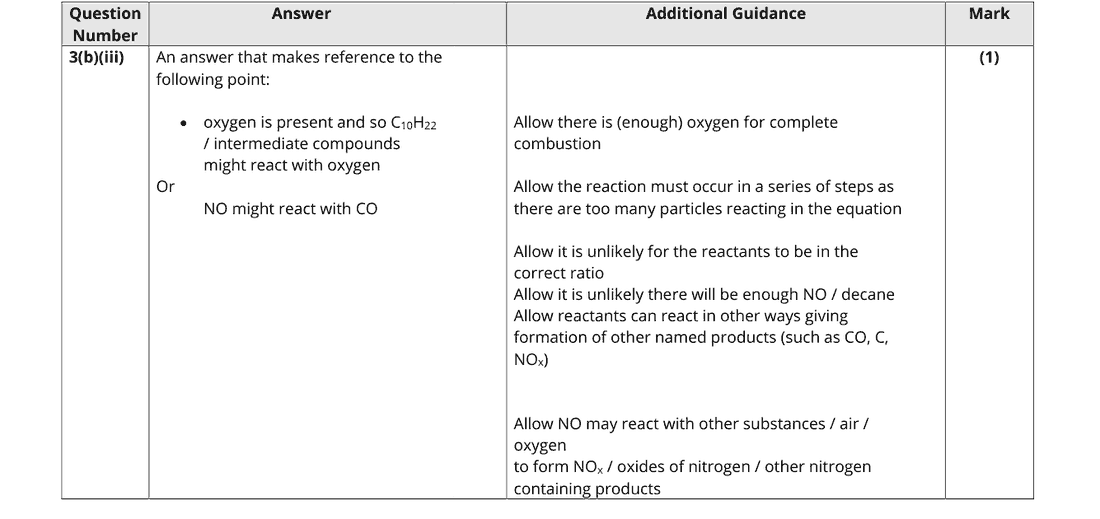
Oxygen is present, so decane (or intermediates) may react with oxygen instead
or NO may react with CO or with other substances to give other nitrogen compounds. Also allowed: too many particles for a single step, so it must go in several steps
reactants unlikely to be present in the right ratio
other products such as CO or C may form. Generally not answered well: too few looked at the equation itself
June 2022 · AS Paper 2 · Q5(b)(i)1 markShort answer
Mark scheme
Examiner's comment
(a), the electrophilic addition reaction, proved rather more accessible than the later free-radical substitution items. In (a)(i) hydrogen chloride was commonly given, though chlorine was also suggested. The mechanism in (a)(ii) was generally well done, with only a few of the usual errors in arrow direction, dipoles and charges seen. (b) was less well understood, with a variety of reagents and conditions given in (b)(i), though over 60% of candidates identified the reaction was a free radical substitution in (b)(ii). For those who gave the wrong reagent and conditions, it was possible to score some marks in (b)(iii) by giving and naming the two product structures. Those with the correct reagents still struggled in (b)(iii) with full marks rarely seen. (b)(iv), (b)(v) and (b)(vi) all needed an understanding of the isotopes of chlorine, or were easier if this was understood. Those candidates who recognised this as the key factor scored well, while those that didn’t struggled to pick up any marks.
Notes from the mark scheme and report
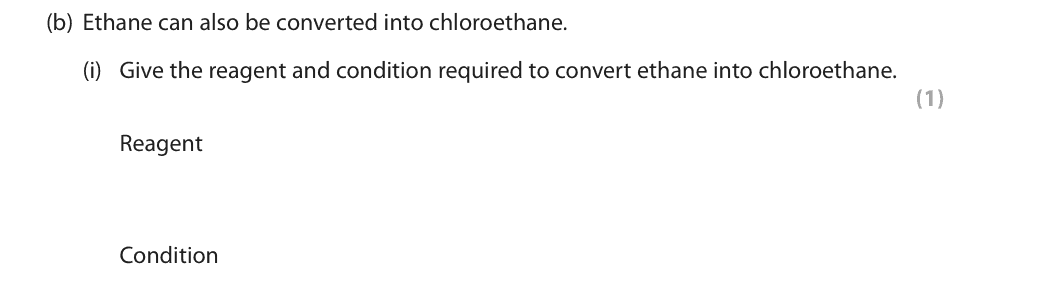
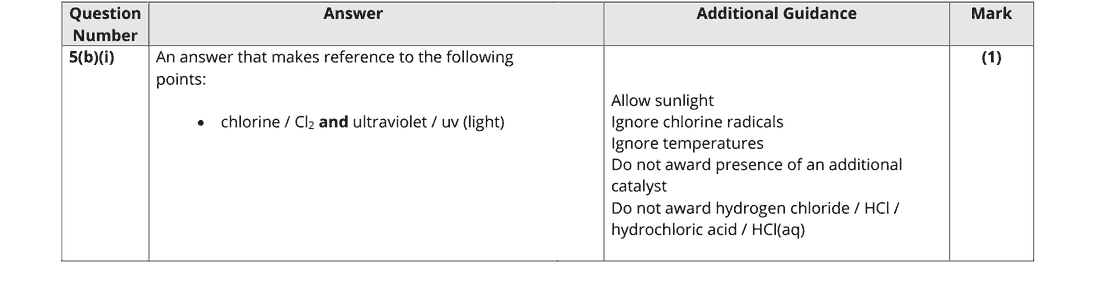
Answer: chlorine and ultraviolet light (sunlight allowed)
both needed for the mark. Not hydrogen chloride or hydrochloric acid
no additional catalyst. A variety of wrong reagents and conditions was given
June 2022 · AS Paper 2 · Q5(b)(ii)1 markMultiple choice
Earlier part of question 5 that this part uses
Answer
C
Mark scheme
Examiner's comment
(a), the electrophilic addition reaction, proved rather more accessible than the later free-radical substitution items. In (a)(i) hydrogen chloride was commonly given, though chlorine was also suggested. The mechanism in (a)(ii) was generally well done, with only a few of the usual errors in arrow direction, dipoles and charges seen. (b) was less well understood, with a variety of reagents and conditions given in (b)(i), though over 60% of candidates identified the reaction was a free radical substitution in (b)(ii). For those who gave the wrong reagent and conditions, it was possible to score some marks in (b)(iii) by giving and naming the two product structures. Those with the correct reagents still struggled in (b)(iii) with full marks rarely seen. (b)(iv), (b)(v) and (b)(vi) all needed an understanding of the isotopes of chlorine, or were easier if this was understood. Those candidates who recognised this as the key factor scored well, while those that didn’t struggled to pick up any marks.
Notes from the mark scheme and report
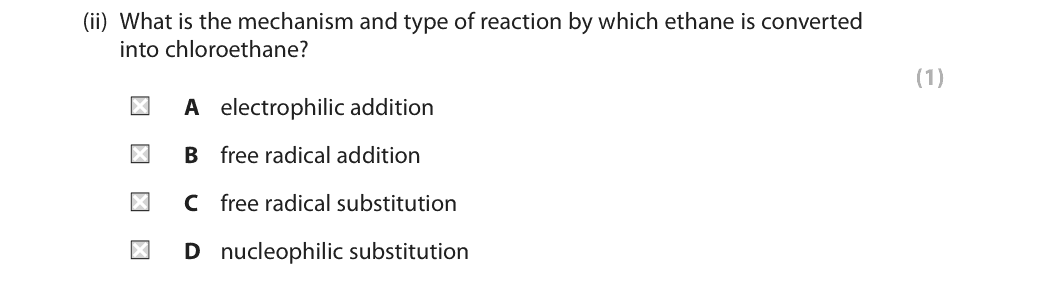
Answer: C (free radical substitution). Ethane is saturated so it cannot be addition, and it has no polar bond for a nucleophile to attack. Over 60% chose correctly
June 2022 · AS Paper 2 · Q5(b)(iii)3 marksEquation writingHard
Earlier part of question 5 that this part uses
Mark scheme
Examiner's comment
(a), the electrophilic addition reaction, proved rather more accessible than the later free-radical substitution items. In (a)(i) hydrogen chloride was commonly given, though chlorine was also suggested. The mechanism in (a)(ii) was generally well done, with only a few of the usual errors in arrow direction, dipoles and charges seen. (b) was less well understood, with a variety of reagents and conditions given in (b)(i), though over 60% of candidates identified the reaction was a free radical substitution in (b)(ii). For those who gave the wrong reagent and conditions, it was possible to score some marks in (b)(iii) by giving and naming the two product structures. Those with the correct reagents still struggled in (b)(iii) with full marks rarely seen. (b)(iv), (b)(v) and (b)(vi) all needed an understanding of the isotopes of chlorine, or were easier if this was understood. Those candidates who recognised this as the key factor scored well, while those that didn’t struggled to pick up any marks.
Notes from the mark scheme and report
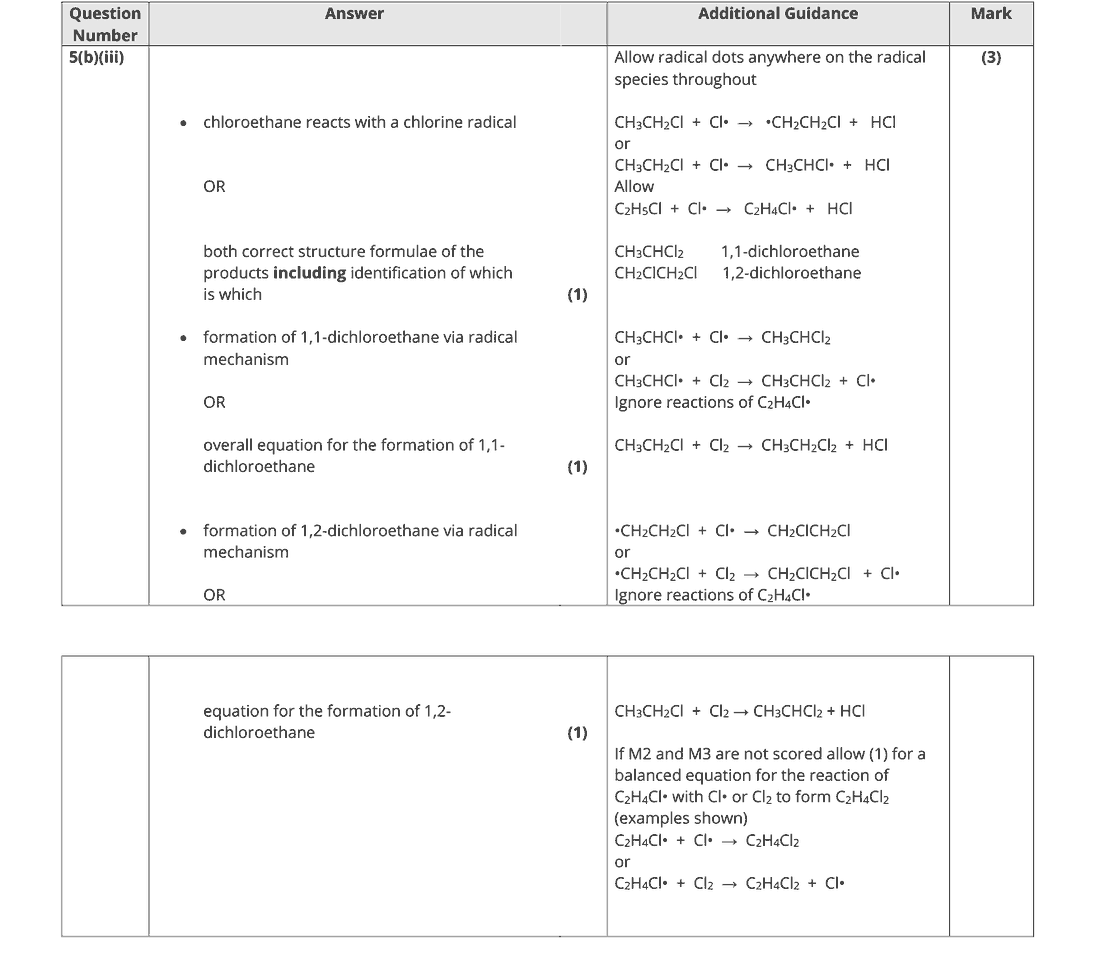
M1: chloroethane reacting with a chlorine radical, CH3CH2Cl + Cl• → •CH2CH2Cl + HCl or → CH3CHCl• + HCl (or the two product structures, CH3CHCl2 and CH2ClCH2Cl, correctly identified). M2: formation of 1,1-dichloroethane, CH3CHCl• + Cl2 → CH3CHCl2 + Cl• (or + Cl• →), or the overall equation CH3CH2Cl + Cl2 → CH3CHCl2 + HCl. M3: formation of 1,2-dichloroethane, •CH2CH2Cl + Cl2 → CH2ClCH2Cl + Cl• (or + Cl• →), or the overall equation. Radical dots may be anywhere on the species. If M2 and M3 are not scored, one mark for a balanced step with C2H4Cl• giving C2H4Cl2
November 2021 · AS Paper 2 · Q5(a)2 marksEquation writing
Mark scheme
Examiner's comment
The chemistry in this question, concerning the combustion of fossil fuels, was quite basic.
(a) This should have been an easy question at this level, requiring recall of the formulae of
methane, carbon monoxide and water.
(b)(i) This was a question involving application of basic chemical principles to an unfamiliar
situation, the combustion of fossil fuels
(b)(ii) This question also supplied candidates with information that they were required to apply to
an unfamiliar situation. In this instance they were asked to interpret two (given) equations that are
relevant in flue gas desulfurisation
(c) It was expected that the dot and cross diagram of sulfur dioxide would provide a challenge for
candidates. It was, however, answered well and many candidates were successful in scoring the
mark.
Notes from the mark scheme and report
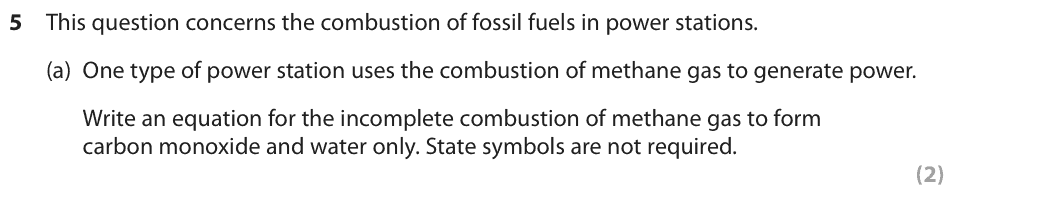
Answer: 2CH4 + 3O2 → 2CO + 4H2O (or CH4 + 1½O2 → CO + 2H2O). One mark for the correct species, one for balancing
state symbols ignored
November 2021 · AS Paper 2 · Q5(b)(i)2 marksExplanation
Mark scheme
Examiner's comment
The chemistry in this question, concerning the combustion of fossil fuels, was quite basic.
(a) This should have been an easy question at this level, requiring recall of the formulae of
methane, carbon monoxide and water.
(b)(i) This was a question involving application of basic chemical principles to an unfamiliar
situation, the combustion of fossil fuels
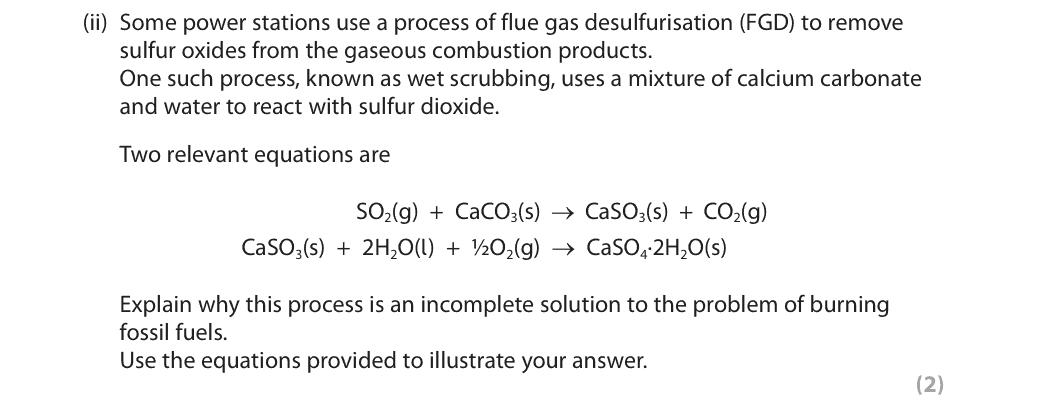
(b)(ii) This question also supplied candidates with information that they were required to apply to
an unfamiliar situation. In this instance they were asked to interpret two (given) equations that are
relevant in flue gas desulfurisation
(c) It was expected that the dot and cross diagram of sulfur dioxide would provide a challenge for
candidates. It was, however, answered well and many candidates were successful in scoring the
mark.
Notes from the mark scheme and report
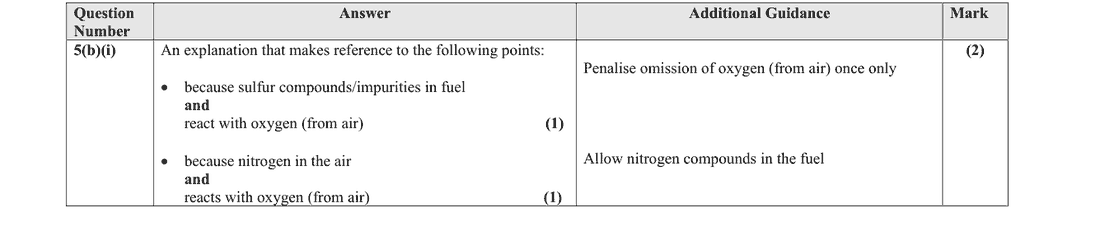
Sulfur compounds / impurities in the fuel react with oxygen (from the air)
nitrogen in the air reacts with oxygen (allow nitrogen compounds in the fuel). Leaving out the oxygen is penalised once only
November 2021 · AS Paper 2 · Q5(b)(ii)2 marksExplanation
Earlier parts of question 5 that this part uses
Mark scheme
Examiner's comment
The chemistry in this question, concerning the combustion of fossil fuels, was quite basic.
(a) This should have been an easy question at this level, requiring recall of the formulae of
methane, carbon monoxide and water.
(b)(i) This was a question involving application of basic chemical principles to an unfamiliar
situation, the combustion of fossil fuels
(b)(ii) This question also supplied candidates with information that they were required to apply to
an unfamiliar situation. In this instance they were asked to interpret two (given) equations that are
relevant in flue gas desulfurisation
(c) It was expected that the dot and cross diagram of sulfur dioxide would provide a challenge for
candidates. It was, however, answered well and many candidates were successful in scoring the
mark.
Notes from the mark scheme and report
Although the sulfur dioxide is removed, carbon dioxide is produced (first equation)
carbon dioxide is a greenhouse gas / adds to global warming. Not 'more fuel is burned to heat the reaction'
November 2021 · Paper 2 · Q5(c)(i)1 markMultiple choice
Earlier part of question 5 that this part uses
Answer
C
Mark scheme
Examiner's comment
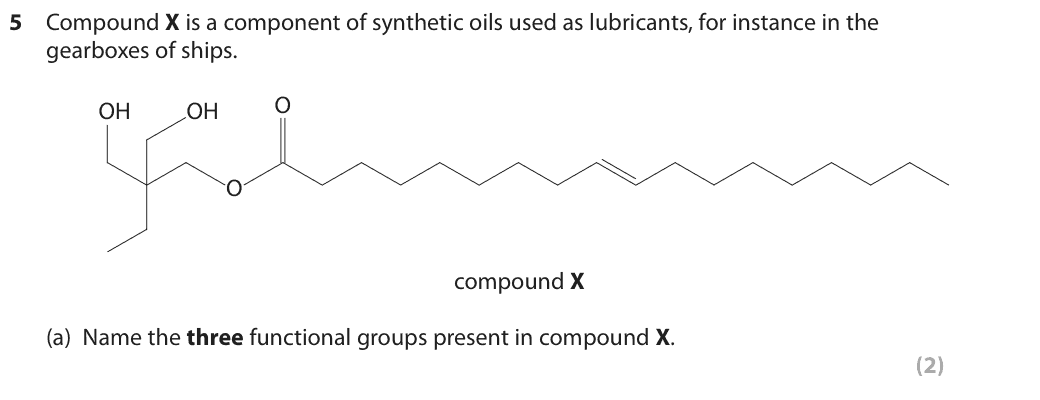
In (a) many candidates mistook the ester group for a carbonyl / ketone group, so could only
score a maximum of one mark. Others focused on the left of the structure and omitted the
alkene group. In (b) the hint of ‘a chemical reaction’ seemed to be missed by many, who
framed there response exclusively around the idea of hydrogen bonds with water. Those
candidates who realised a hydrolysis reaction could occur, not all linked it to the ester
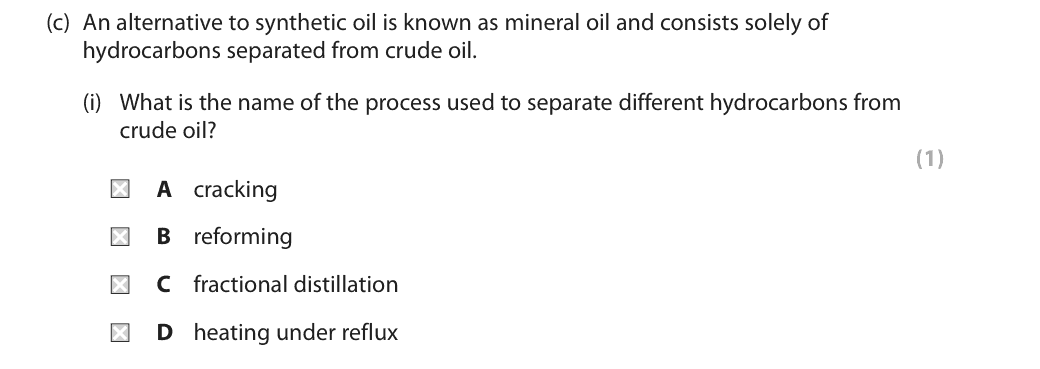
functional group. In (c)(i) fractional distillation was correctly suggested by nearly all
candidates. In (b) the majority recognised that X had the ability to form hydrogen bonds, but
some missed out on the first mark as they didn’t link this statement to a structural feature on
compound X. Others, however, made a comparison to the London forces in a similar
hydrocarbon, so were able to access both marks. Despite the stem making it clear the
hydrocarbon had a similar mass and shape to compound X, it was fairly common to see
answers trying make the point that compound X had greater London forces.
Notes from the mark scheme and report
Answer: C. Fractional distillation separates the hydrocarbons in crude oil. Cracking makes smaller molecules, reforming makes branched and cyclic ones, and reflux is for heating reaction mixtures
October 2020 · AS Paper 2 · Q1(c)(i)1 markEquation writing
Mark scheme
Examiner's comment
In this question the earlier, more familiar parts of the question were answered well with
knowledge demonstrated of organic compounds containing chlorine and fluorine. High marks
were particularly scored on the empirical formula calculation. As the question developed the
more contextual idea of the reaction between fluorine and difluoromethane which required
application of more familiar knowledge was less understood.
Notes from the mark scheme and report
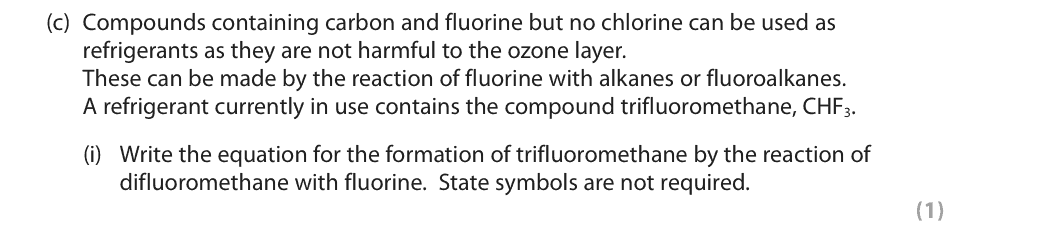
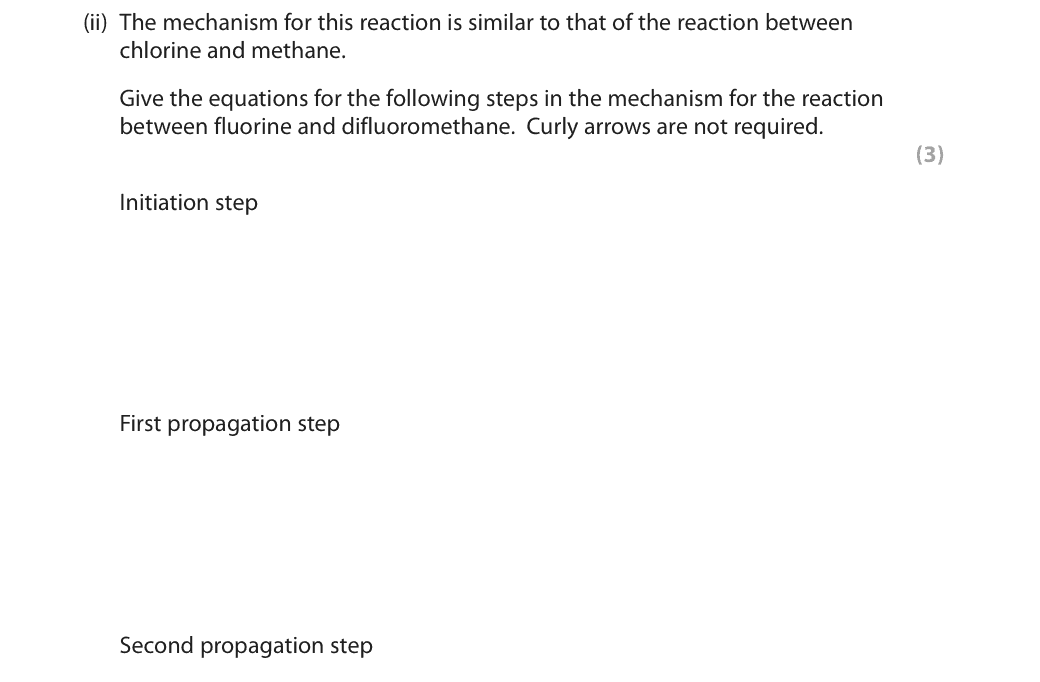
CH2F2 + F2 → CHF3 + HF. State symbols ignored. A balanced equation with hydrogen as a product is not accepted. The report says applying familiar ideas to this reaction was less well understood than the earlier parts
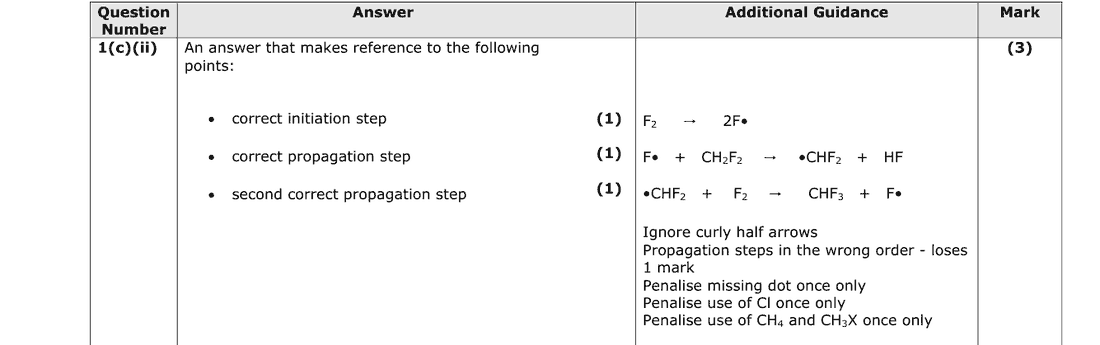
October 2020 · AS Paper 2 · Q1(c)(ii)3 marksEquation writing
Earlier part of question 1 that this part uses
Mark scheme
Examiner's comment
In this question the earlier, more familiar parts of the question were answered well with
knowledge demonstrated of organic compounds containing chlorine and fluorine. High marks
were particularly scored on the empirical formula calculation. As the question developed the
more contextual idea of the reaction between fluorine and difluoromethane which required
application of more familiar knowledge was less understood.
Notes from the mark scheme and report
Initiation: F2 → 2F•. Propagation: F• + CH2F2 → •CHF2 + HF, then •CHF2 + F2 → CHF3 + F•. Propagation steps in the wrong order lose 1 mark. A missing dot, use of Cl, and use of CH4 / CH3X are each penalised once only
October 2020 · Paper 2 · Q5(a)1 markMultiple choice
Answer
D
Mark scheme
Examiner's comment
Candidates found (d)(ii) to be a challenging question. This type of calculation was unfamiliar to
the majority of candidates and many struggled to start it as they did not realise that the
carbon dioxide would be removed by aqueous sodium hydroxide so the volume of carbon
dioxide was 125 cm3 and the value of x was 5. The unfamiliar mechanism in (e) was clearly
drawn by the majority of candidates. Common errors included: showing the formation of the
minor product instead of the major product, giving an incorrect dipole on ICl and not starting
a curly arrow from a bond or a lone pair of electrons. The vast majority of candidates scored a
mark for calculating the number of moles of bromine used in (f). Some candidates did not
realise that 2 mol of bromine are needed to react with 1 mol limonene as there are two
double covalent bonds, some candidates were unable to calculate the correct molar mass of
limonene. Candidates were able to score a transferred error mark for the final percentage,
provided the answer was less than 100 %. However, some candidates calculated a mass of
limonene that was greater than 0.500 g so reversed the fraction to give a percentage that was
less than 100 % and this was not given credit. Candidates who calculate a percentage greater
than 100 should go back and check their working to see where they have made an error.
Notes from the mark scheme and report
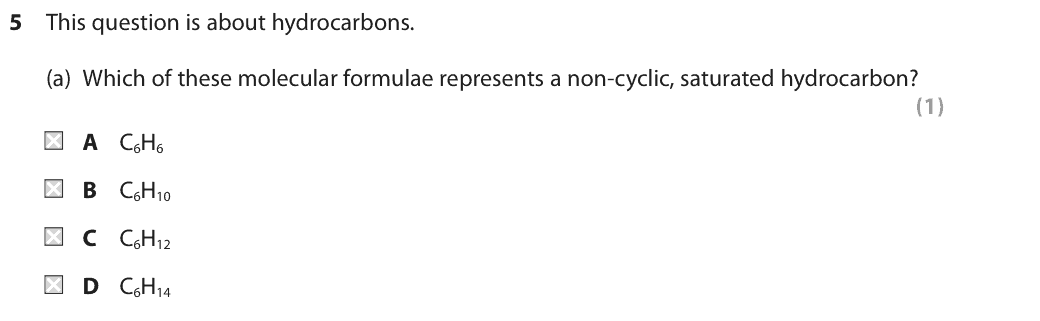
Answer: D (C6H14). Non-cyclic saturated hydrocarbons have the general formula CnH2n+2. A is CnHn, B is CnH2n–2 and C is CnH2n
June 2019 · AS Paper 2 · Q1(b)3 marksExplanation
Earlier part of question 1 that this part uses
Mark scheme
Examiner's comment
This question about fuels began with a nomenclature question which the majority of candidates were able to answer correctly. The main error was to give the molecular formula for the answer rather that a structural formula or name. The molecular formula does not show that the molecule is an unbranched chain. Most learners recognised that the next item required an understanding of intermolecular forces, but some believed that bonds were broken in the molecules and that branches of the chain resulted in weaker bonds. The common misconception that boiling involves bond breaking rather that the separation of molecules by the breaking of intermolecular forces is one which would benefit from further work for many learners. The advantages of cracking were reasonably well known with the idea that smaller molecules were of more use commonly seen, but the formation of alkenes and therefore the possiblity of carrying out reactions of these to produce new and more useful products such as plastics was less common. The first multiple choice question proved challenging with more incorrect answers than correct ones.
Notes from the mark scheme and report
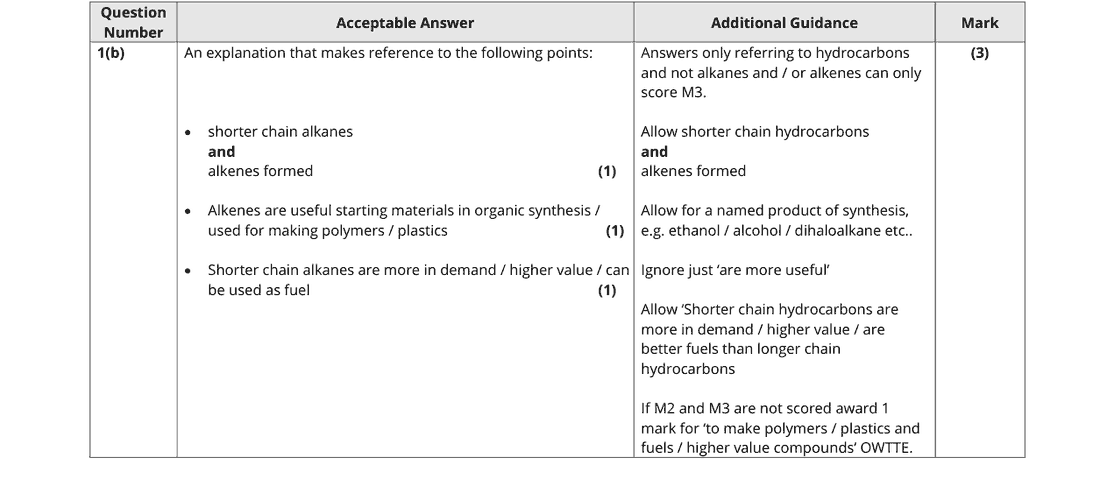
Cracking gives shorter-chain alkanes and alkenes
the alkenes are useful starting materials for organic synthesis / used to make polymers
the shorter-chain alkanes are in greater demand / of higher value / used as fuels. Answers about 'hydrocarbons' only, without alkanes or alkenes, can score just the third mark
'more useful' alone is ignored. The demand for smaller molecules was well known
the formation of alkenes and their use to make products such as plastics was seen less often
June 2019 · AS Paper 2 · Q1(c)1 markMultiple choice
Earlier part of question 1 that this part uses
Answer
D
Mark scheme
Examiner's comment
This question about fuels began with a nomenclature question which the majority of candidates were able to answer correctly. The main error was to give the molecular formula for the answer rather that a structural formula or name. The molecular formula does not show that the molecule is an unbranched chain. Most learners recognised that the next item required an understanding of intermolecular forces, but some believed that bonds were broken in the molecules and that branches of the chain resulted in weaker bonds. The common misconception that boiling involves bond breaking rather that the separation of molecules by the breaking of intermolecular forces is one which would benefit from further work for many learners. The advantages of cracking were reasonably well known with the idea that smaller molecules were of more use commonly seen, but the formation of alkenes and therefore the possiblity of carrying out reactions of these to produce new and more useful products such as plastics was less common. The first multiple choice question proved challenging with more incorrect answers than correct ones.
Notes from the mark scheme and report
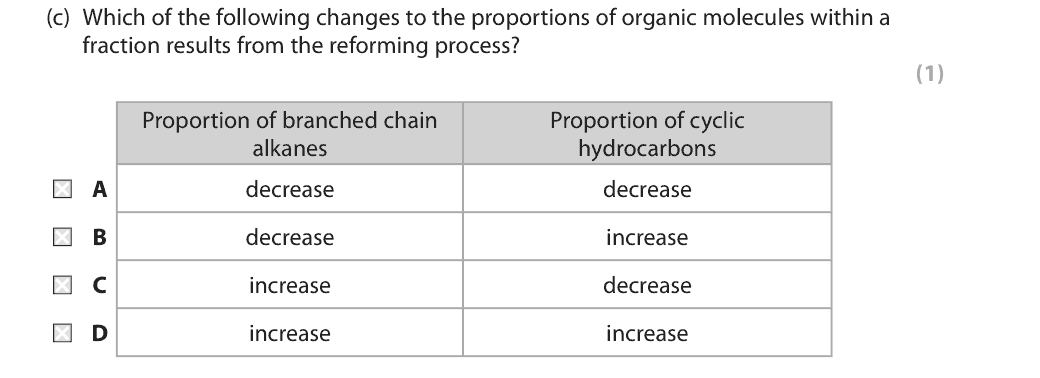
Answer: D (increase / increase). Reforming converts straight-chain alkanes into branched-chain alkanes and cyclic hydrocarbons, so both proportions rise. The report says there were more incorrect answers than correct ones
June 2019 · Paper 2 · Q2(b)1 markMultiple choice
Answer
D
Mark scheme
Notes from the mark scheme and report
Answer: D. Cracking breaks decane into shorter molecules such as propane. Reforming gives branched or cyclic alkanes
fractional distillation only separates a mixture
June 2019 · Paper 2 · Q2(c)(i)1 markMultiple choice
Answer
C
Mark scheme
Notes from the mark scheme and report
Answer: C. The initiation step is homolytic fission of the Br–Br bond, forming free radicals. Heterolytic fission would give ions
June 2019 · Paper 2 · Q2(c)(iii)1 markMultiple choice
Earlier parts of question 2 that this part uses
Answer
D
Mark scheme
Notes from the mark scheme and report
Answer: D. Radical substitution gives a mixture of organic products (further substitution and other isomers), so the yield of 1-bromopropane is low. Bromine is reactive (A), gases do not always give low yields (B), and rate does not decide yield (C)
June 2018 · Paper 2 · Q1(b)1 markMultiple choice
Answer
A
Mark scheme
Notes from the mark scheme and report
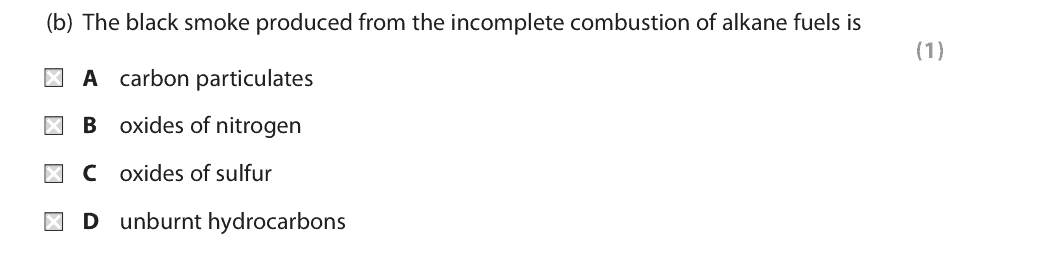
Answer: A. Carbon particulates are the black solid (soot). Oxides of nitrogen and of sulfur are not black and unburnt hydrocarbons are not black solids
June 2018 · Paper 2 · Q1(c)1 markMultiple choice
Earlier part of question 1 that this part uses
Answer
D
Mark scheme
Notes from the mark scheme and report
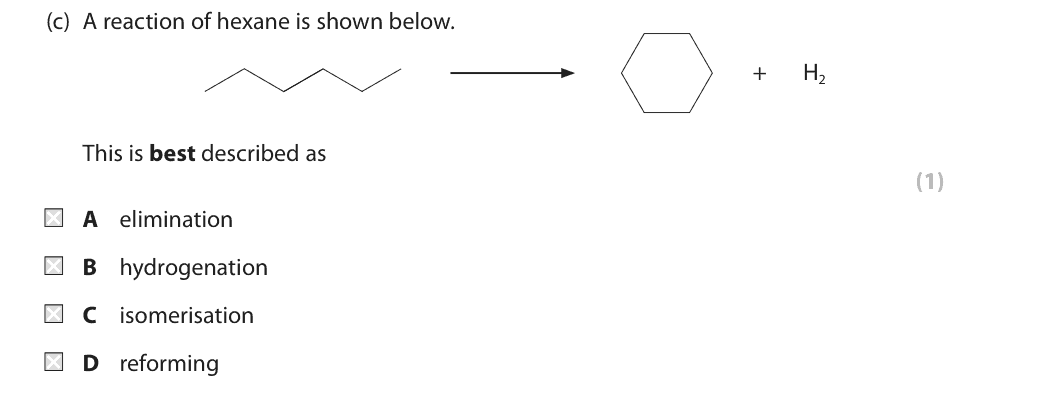
Answer: D. A straight-chain alkane is converted into a cyclic hydrocarbon (plus hydrogen), which is reforming. Not elimination (no alkene is made)
not hydrogenation (hydrogen is formed, not added)
not isomerisation (the molecular formulae differ)
June 2018 · Paper 2 · Q2(b)2 marksExplanation
Mark scheme
Examiner's comment
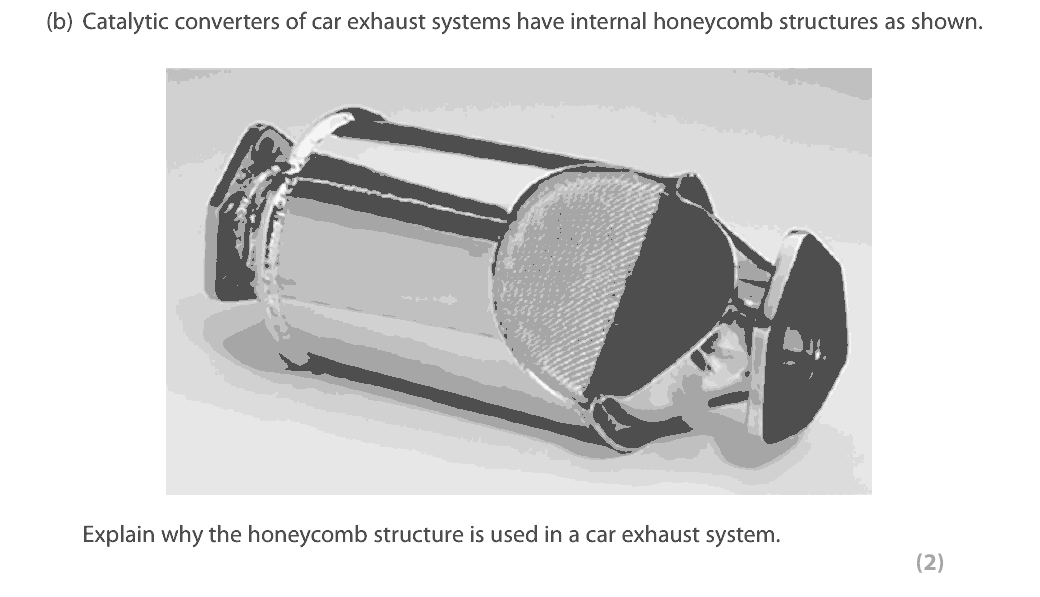
Over 80% of candidates scored one mark for the reference to the large surface area of a honeycomb structure but only a very small minority of candidates appreciated that the structure also allowed the gases to flow freely through.
Notes from the mark scheme and report
The honeycomb gives a large surface area / more active sites
and it lets the gases flow through the exhaust. Not aBsorption
no flow mark if the structure is described as a filter. Over 80% scored the surface area mark but only a very small minority saw that the gases can flow freely through
June 2017 · Paper 2 · Q1(a)1 markMultiple choice
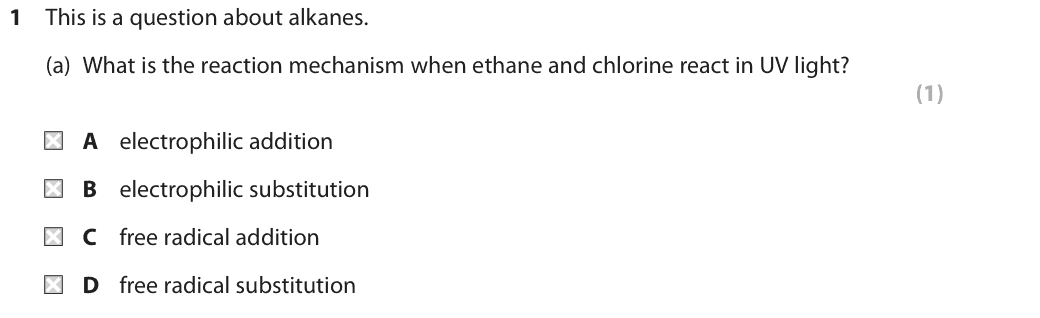
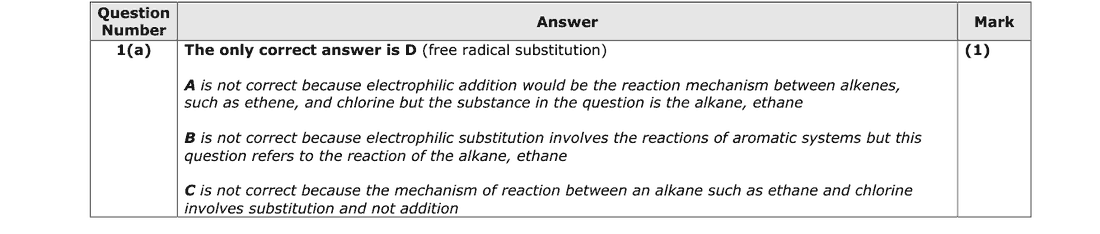
Answer
D
Mark scheme
Notes from the mark scheme and report
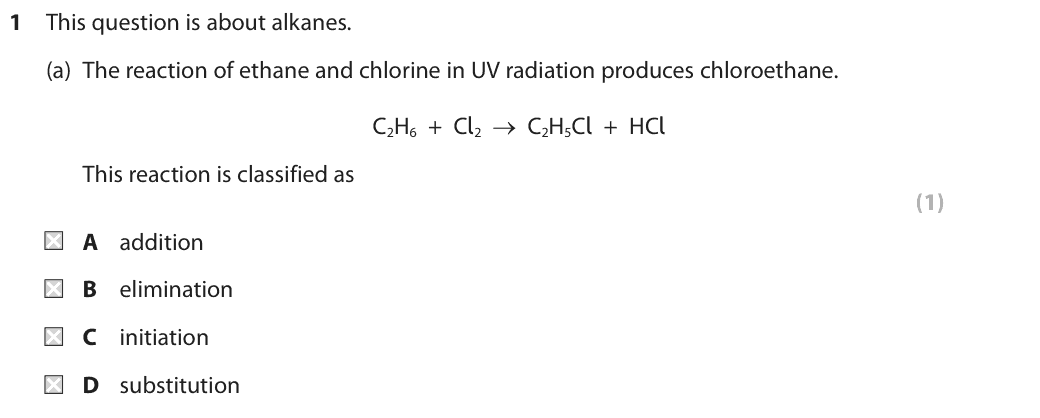
Answer: D. Ethane and chlorine in UV light react by free radical substitution. Electrophilic addition is for alkenes, electrophilic substitution for arenes, and an alkane substitutes rather than adds
June 2017 · Paper 2 · Q1(c)(i)2 marksExplanation
Mark scheme
Examiner's comment
Reference to the differing boiling temperatures of alkanes without an explanation was often given in weaker responses, while in stronger responses candidates added a justification which drew attention to the carbon chain length and/or the strength of the London forces. On rare occasions there was an incorrect reference to hydrogen bonding as being the intermolecular forces between alkanes. This lost marks and serves to emphasise the need to use the right chemical terms when giving an explanation.
Notes from the mark scheme and report
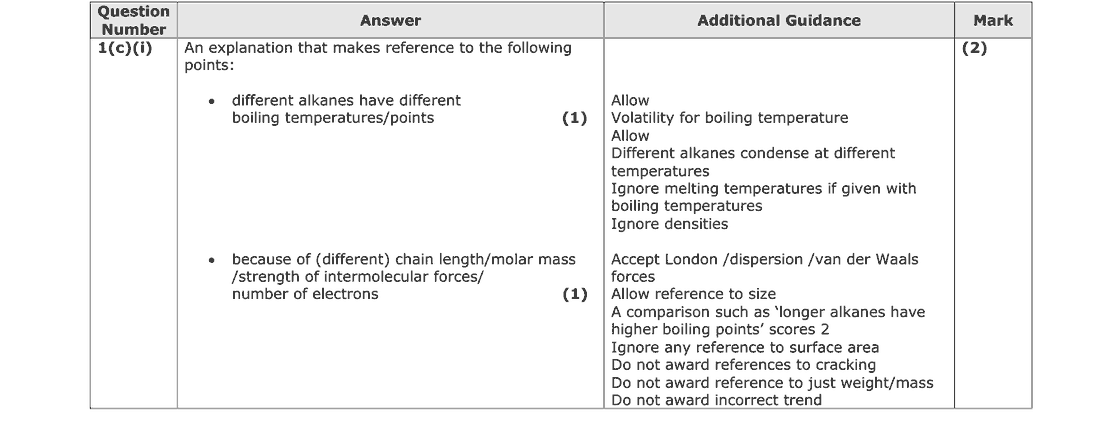
Different alkanes have different boiling temperatures (allow volatility, or condense at different temperatures)
because of different chain length / molar mass / number of electrons / strength of London forces. 'Longer alkanes have higher boiling points' scores 2. Not just weight or mass, not cracking, not a wrong trend
ignore densities and surface area. Weaker answers gave boiling temperature with no reason
a few wrote hydrogen bonding
June 2017 · Paper 2 · Q1(c)(ii)1 markEquation writingEasy
Earlier part of question 1 that this part uses
Mark scheme
Examiner's comment
A very well-answered question with the vast majority of candidates gaining the mark.
Notes from the mark scheme and report
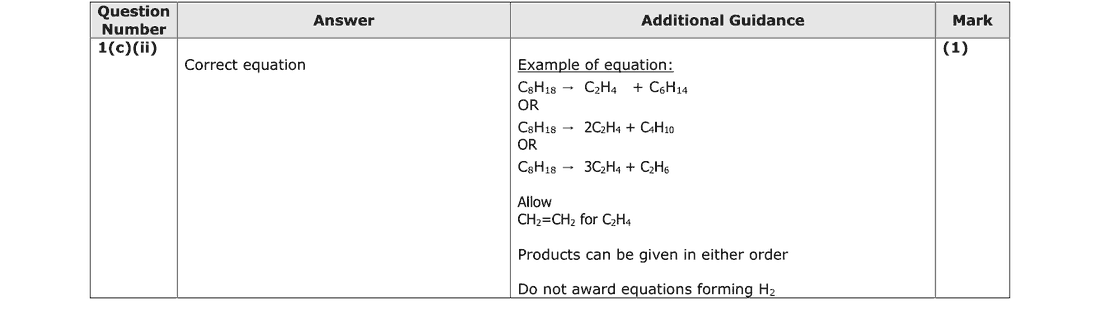
Answer: C8H18 → C2H4 + C6H14 (or 2C2H4 + C4H10, or 3C2H4 + C2H6). Products in either order
CH2=CH2 allowed. No equation that forms H2
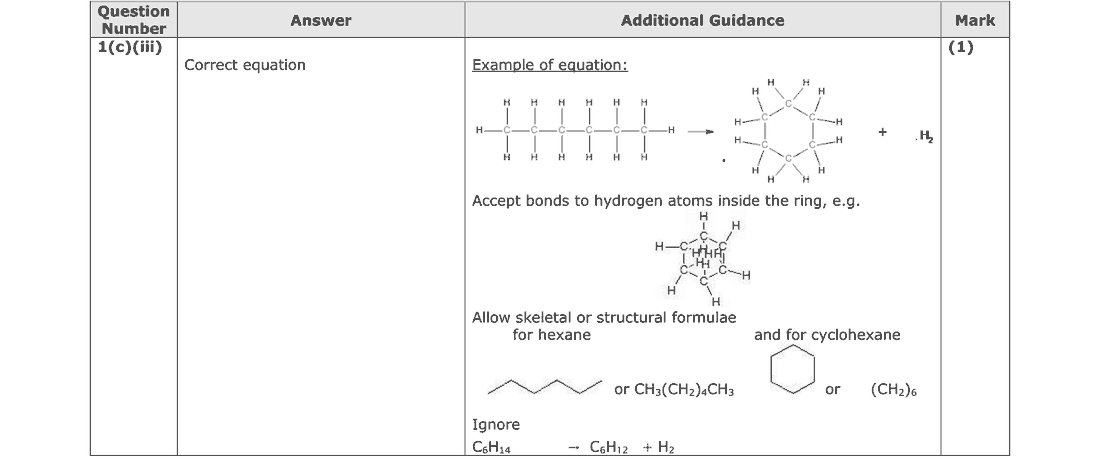
June 2017 · Paper 2 · Q1(c)(iii)1 markEquation writing
Earlier part of question 1 that this part uses
Mark scheme
Examiner's comment
The most common error made by candidates was the omission of the hydrogen product which is in addition to the cyclohexane. The question instructed candidates to use "displayed formulae" because then the difference of two hydrogens should have been more apparent. However a significant number of candidates gave correct skeletal formulae, which was credited, but this did not help them in answering the question. In addition some responses had 'semi-skeletal' formulae, where the carbon atoms were not shown but the hydrogen atoms were. Centres are advised to get their candidates to practise writing the different types of formulae so that they are comfortable and confident in their use in different settings.
molecular formulae alone (C6H14 → C6H12 + H2) are ignored. The usual error was leaving out the hydrogen
some drew 'semi-skeletal' formulae
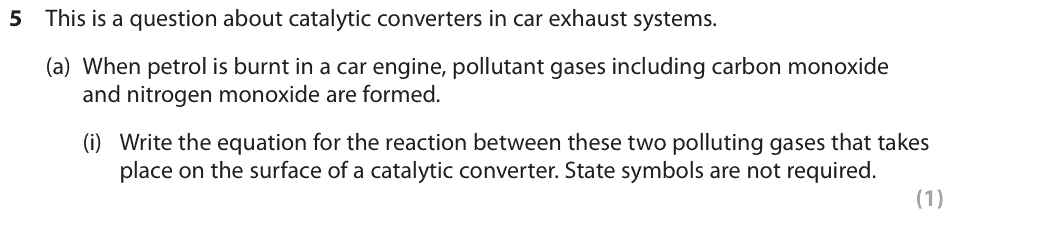
June 2017 · Paper 2 · Q5(a)(i)1 markEquation writing
Mark scheme
Examiner's comment
The equation required for part (i) was often correctly drawn but there was the common error of nitrogen atoms given as a product rather than nitrogen gas. On a limited number of occasions candidates included oxygen in the equation which reflected a failure to read the question carefully.
Full marks were frequently awarded for answers to part (ii) as the mechanism of a heterogenous catalyst was well-understood. On occasion there was a lack of reference to the catalytic surface which lost credit but it was pleasing to see very few spellings of the incorrect "absorption" and the vast majority of candidates correctly used "adsorption".
Notes from the mark scheme and report
Answer: 2NO + 2CO → N2 + 2CO2 (multiples accepted). Common errors: nitrogen atoms (N) instead of N2 as product
adding oxygen to the equation
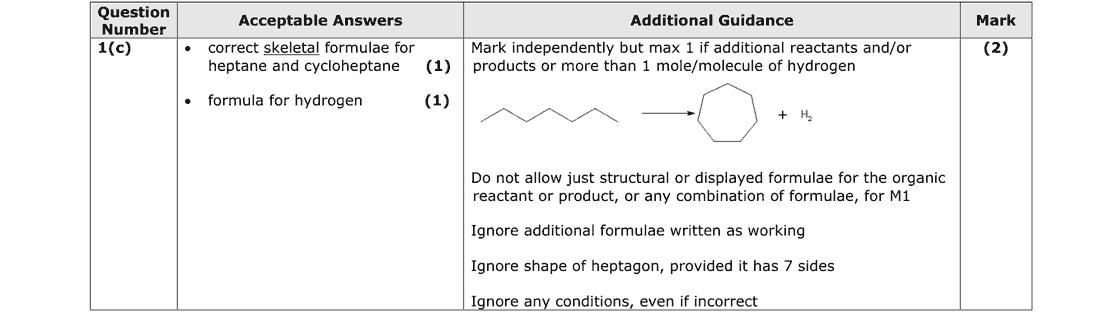
June 2016 · AS Paper 2 · Q1(c)2 marksEquation writing
Mark scheme
Examiner's comment
Many candidates found this a challenging item to answer. Although the majority of candidates could draw the skeletal formula for heptane, they found drawing a heptagon for cycloheptane more difficult. However, examiners allowed any cyclic shape with 7 sides. Many candidates did not complete the balanced equation by adding H2. A few candidates incorrectly showed a double bond in the cyclic product.
Notes from the mark scheme and report
Skeletal formula of heptane → skeletal formula of cycloheptane (a seven-sided ring) + H2. One mark for the two skeletal formulae and one for H2
max 1 if extra reactants or products or more than one H2. Structural or displayed formulae do not score the first mark
the shape of the heptagon and any conditions are ignored. Common errors: leaving out the H2
not managing a seven-sided ring
a double bond in the ring
June 2016 · AS Paper 2 · Q1(d)(i)1 markMultiple choice
Earlier part of question 1 that this part uses
Answer
D
Mark scheme
Notes from the mark scheme and report
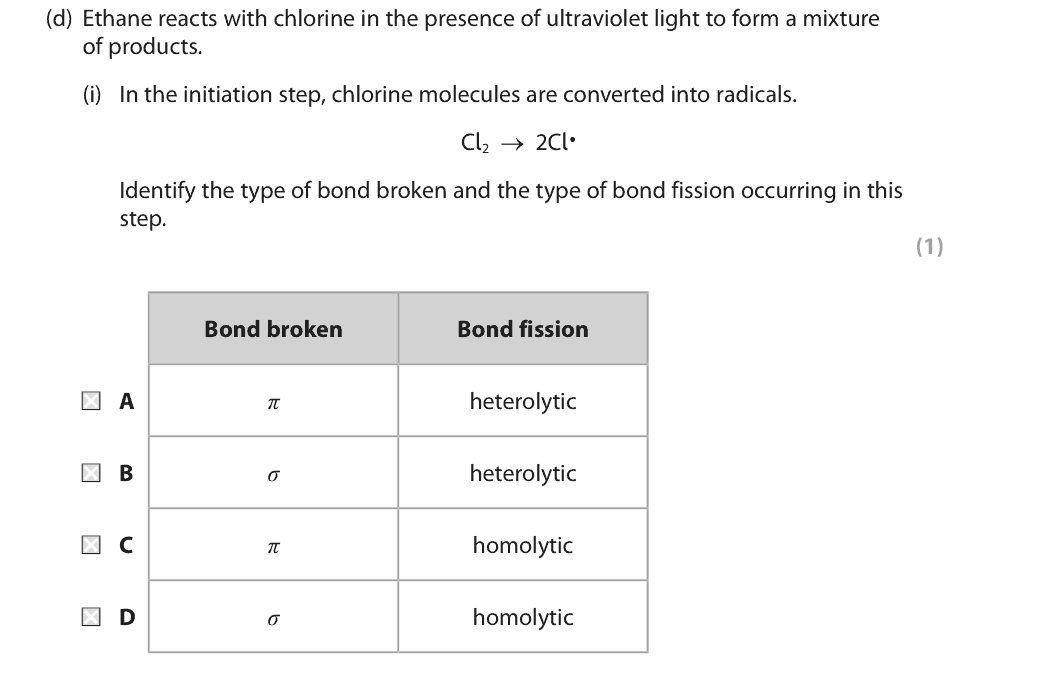
Answer: D. The Cl–Cl single bond is a σ bond and it breaks homolytically, one electron going to each atom to give two radicals
June 2016 · AS Paper 2 · Q1(d)(ii)2 marksEquation writing
Earlier part of question 1 that this part uses
Mark scheme
Examiner's comment
The majority of candidates could write the two propagation steps for the formation of chloroethane. Common errors included omitting the dots to show the radicals and writing termination steps instead of propagation steps.
Notes from the mark scheme and report
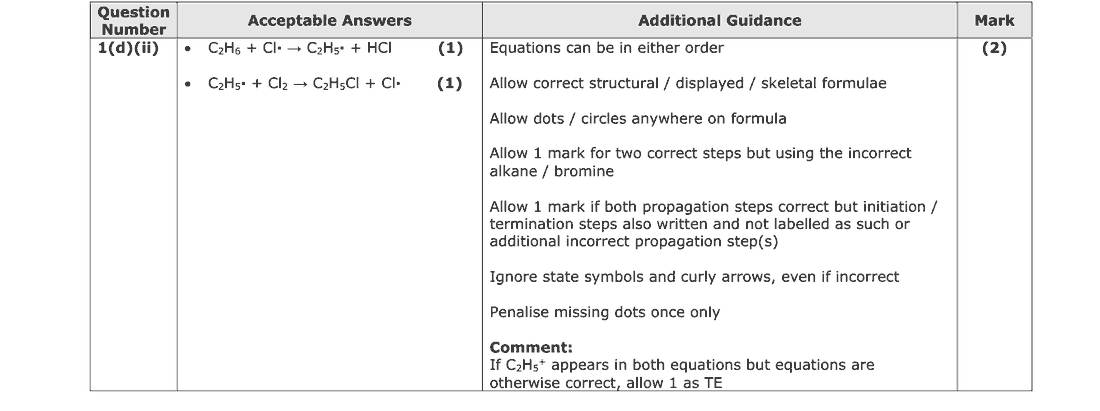
C2H6 + Cl• → C2H5• + HCl and C2H5• + Cl2 → C2H5Cl + Cl•, in either order. Missing dots penalised once
one mark if both steps are right but for the wrong alkane or with bromine, or if unlabelled initiation / termination steps are added. Common errors: no radical dots
termination steps written instead
June 2016 · AS Paper 2 · Q1(d)(iii)1 markShort answer
Earlier part of question 1 that this part uses
Mark scheme
Examiner's comment
The majority of candidates realised that two ethyl radicals react together to form butane. Common incorrect answers included: the use of ethyl molecules, ethane radicals and the production of hydrogen radicals. Candidates should use the correct terminology for different types of particles. Some candidates attempted to show the mechanism of the reaction using half arrows but that is not needed in this specification. Some candidates did not read the question and they gave one propagation step and one termination step.
Notes from the mark scheme and report
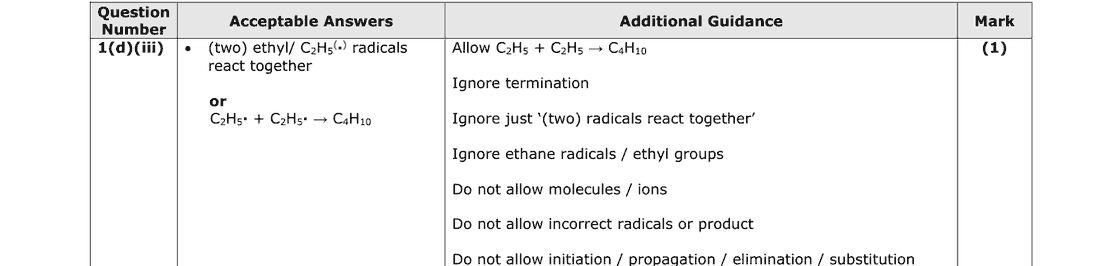
Two ethyl radicals react together: C2H5• + C2H5• → C4H10. Just 'two radicals react together' is not enough
ethane radicals and ethyl groups are ignored
not molecules or ions
not 'propagation'. Common errors: ethyl molecules, ethane radicals, hydrogen radicals
giving one propagation and one termination step
Work with an A-level chemistry tutor
Dropping marks on calculations, mechanisms or the core practicals? Book a trial session with an A-level chemistry tutor.





























![What is the name of the process that could be used to produce propane, C3H,,
from decane, C,H?
[1 A. substitution
1 Bs reforming
[1 C_ fractional distillation
[1] D cracking](/img/JUN19_9CH02/JUN19_9CH02_2-b_qp.webp)

![A student researched the reaction of propane with bromine and found that the
reaction could be used to make 1-bromopropane.
C3H3(g) + Br2(l) > C3H,Br(l) + HBr(g)
The first step of the reaction involves
L] A_heterolytic bond fission to form free radicals
[] B_heterolytic bond fission to form ions
L] ©€ homolytic bond fission to form free radicals
L] D homolytic bond fission to form ions](/img/JUN19_9CH02/JUN19_9CH02_2-c-i_qp.webp)


![A source from the internet gave the percentage yield for this reaction as 31.0%.
The best explanation for the low percentage yield of 1-bromopropane in this
reaction is
L] A_ bromine is very unreactive
[] B_ agaseous reactant always gives a low yield
L] C_ the reaction is very slow
L] D the reaction produces a mixture of organic products](/img/JUN19_9CH02/JUN19_9CH02_2-c-iii_qp.webp)