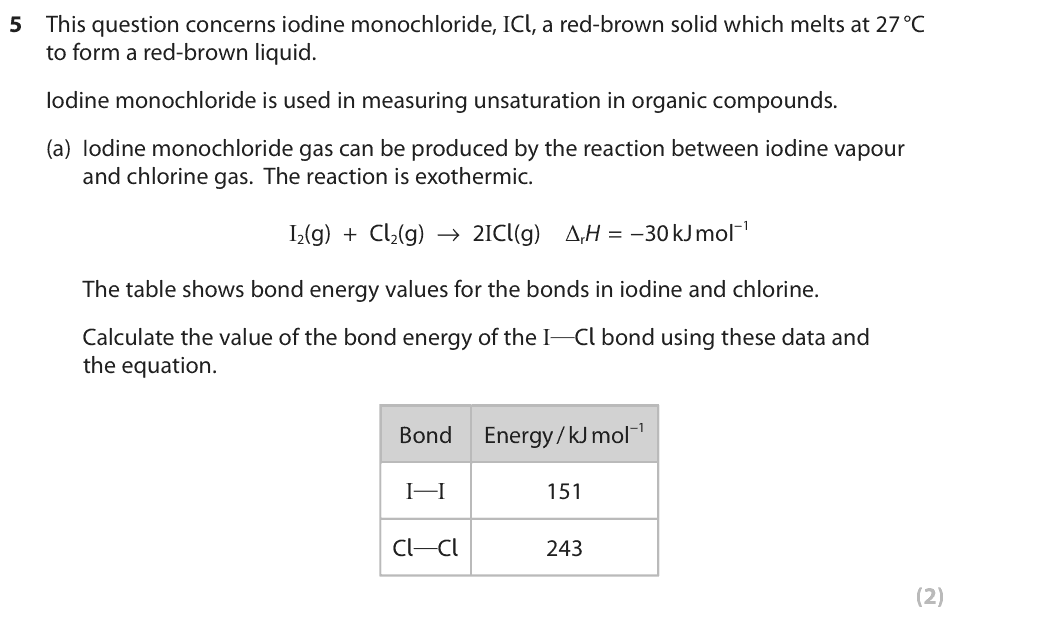
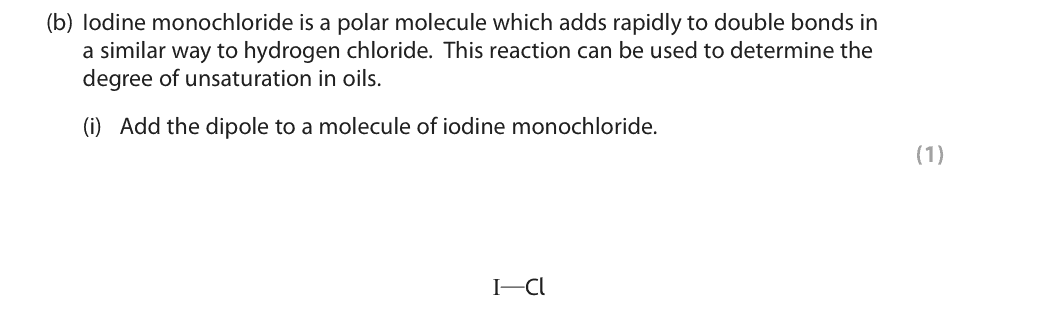
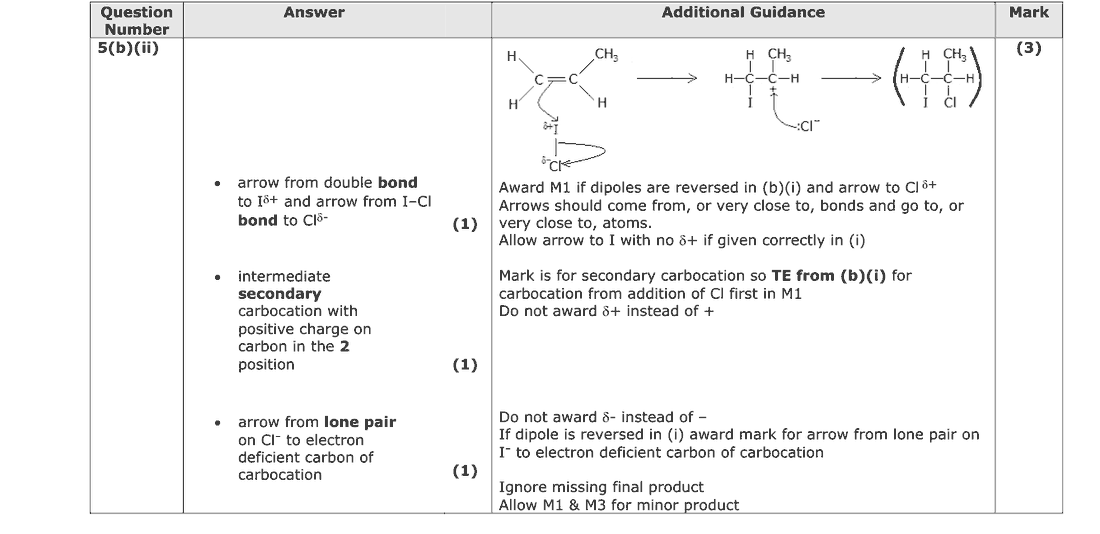
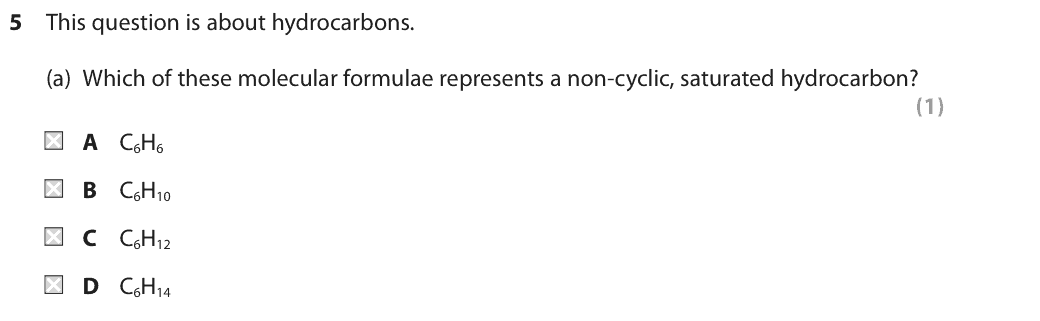
Notes and key-term cards for this topic are being written by our tutors. The past-paper questions below are ready now.
Specification statements
Show the 12 statements from the specification
6.18 know the general formula for alkenes
6.19 know that alkenes and cycloalkenes are unsaturated hydrocarbons
6.20 understand the bonding in alkenes in terms of σ- and π- bonds
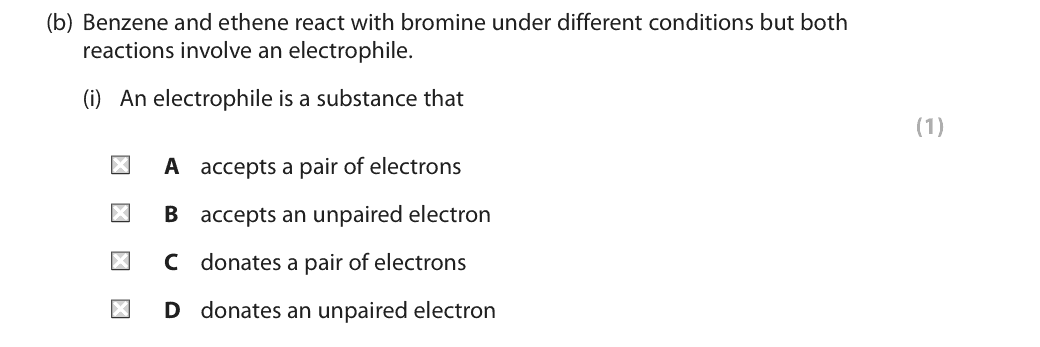
6.21 know what is meant by the term ‘electrophile’
6.22 understand the addition reactions of alkenes with: • i hydrogen, in the presence of a nickel catalyst, to form an alkane • ii halogens to produce dihalogenoalkanes • iii hydrogen halides to produce halogenoalkanes • iv steam, in the presence of an acid catalyst, to produce alcohols • v potassium manganate(VII), in acid conditions, to oxidise the double bond and produce a diol [Knowledge of the application of this reaction to the manufacture of margarine by catalytic hydrogenation of unsaturated vegetable oils is expected.]
6.23 understand that heterolytic bond fission of a covalent bond results in the formation of ions
6.24 understand the mechanism of the electrophilic addition reactions between alkenes and: • i halogens • ii hydrogen halides, including addition to unsymmetrical alkenes • iii other given binary compounds [Use of the curly arrow notation is expected − curly arrows should start from either a bond or from a lone pair of electrons. Knowledge of the relative stability of primary, secondary and tertiary carbocation intermediates is expected.]
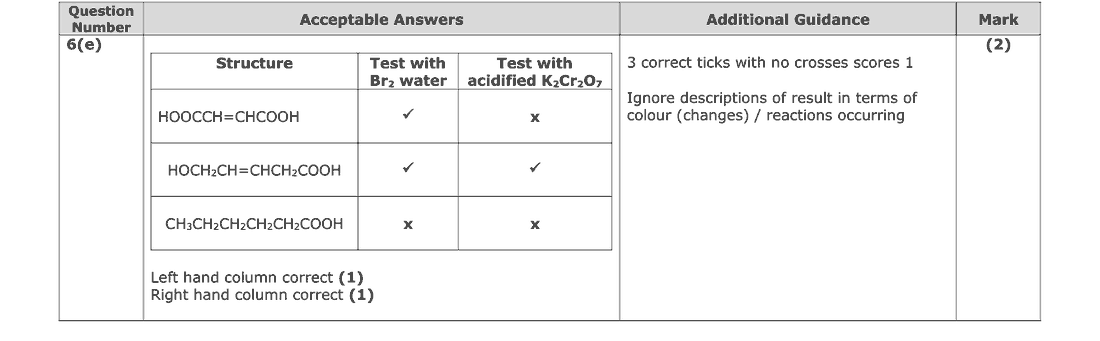
6.25 know the qualitative test for a C=C double bond using bromine or bromine water
6.26 know that alkenes form polymers through addition polymerisation [Be able to identify the repeat unit of an addition polymer given the monomer, and vice versa.]
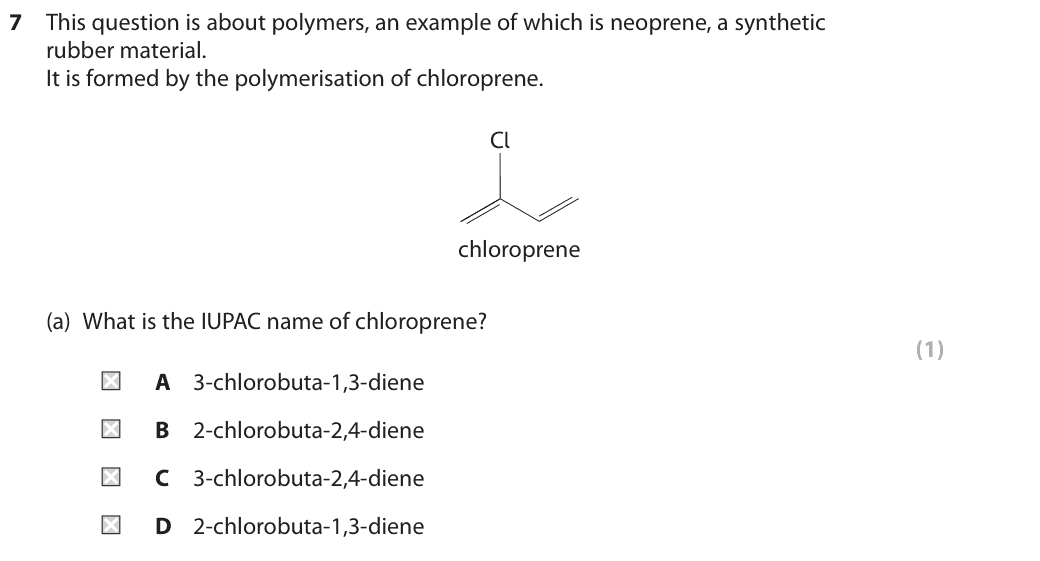
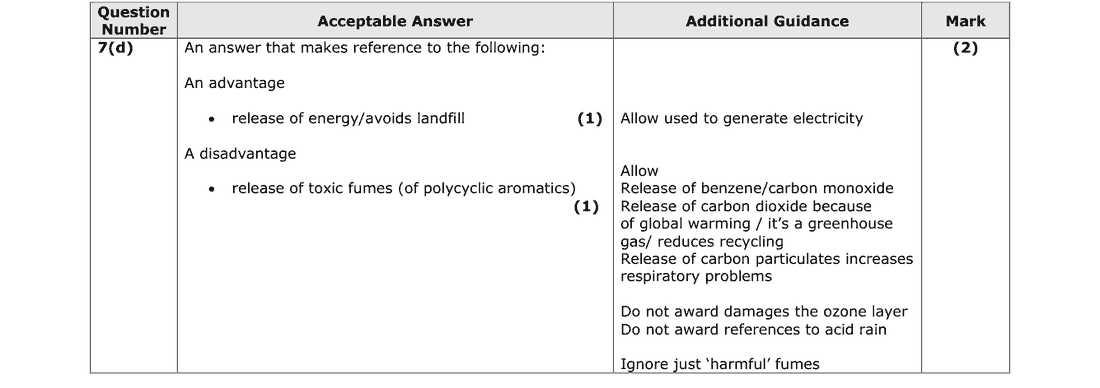
6.27 know that waste polymers can be separated into specific types of polymer for: • i recycling • ii incineration to release energy • iii use as a feedstock for cracking
6.28 understand, in terms of the use of energy and resources over the life cycle of polymer products, that chemists can contribute to the more sustainable use of materials
6.29 understand how chemists limit the problems caused by polymer disposal by: • i developing biodegradable polymers • ii removing toxic waste gases caused by incineration of plastics
Six-mark extended response questions on this topic
Tap a question to zoom it. Where a part needs a figure, table or structure from earlier in the question, that part folds out above it; the mark scheme and examiner's comment open underneath. Have Edexcel's Data Booklet beside you; the Periodic Table is on the back page of every paper.
June 2025 · AS Paper 2 · Q1(b)1 markMultiple choice
Earlier part of question 1 that this part uses
Answer
B
Mark scheme
Notes from the mark scheme and report
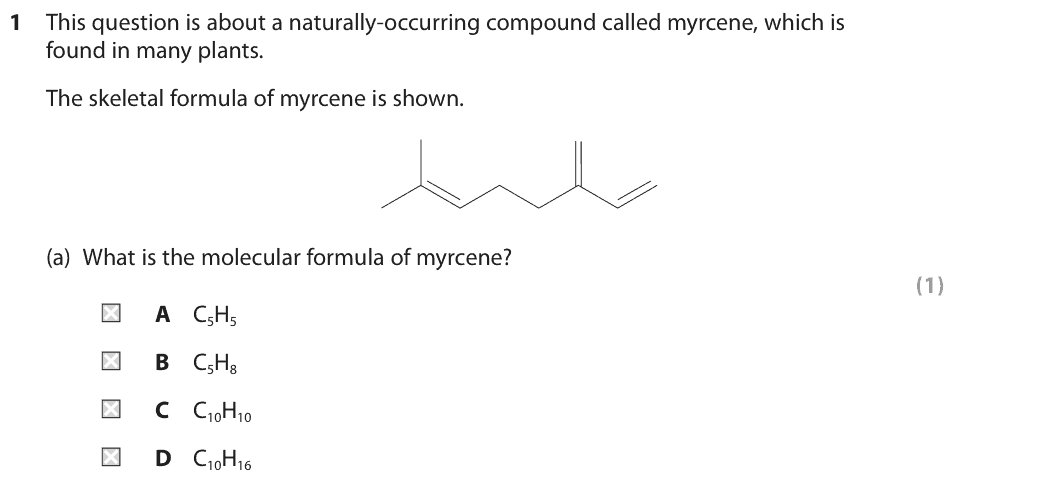
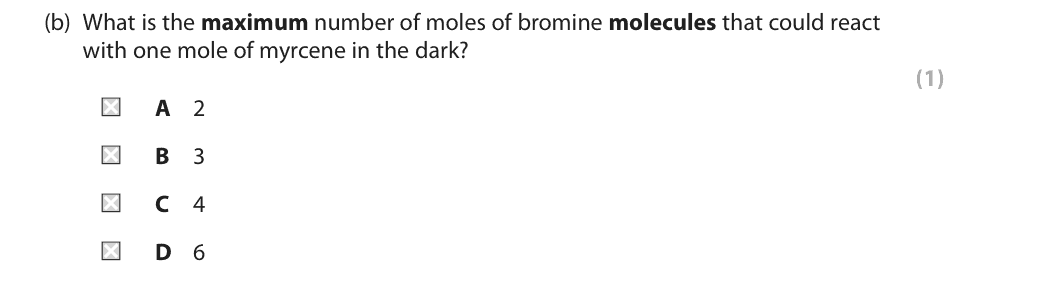
Answer: B (3). Myrcene has three C=C bonds and each adds one Br2 molecule. D (6) is the number of bromine atoms added
Skills: MS0.2 Use ratios, fractions and percentages
June 2025 · AS Paper 2 · Q1(d)1 markMultiple choice
Earlier part of question 1 that this part uses
Answer
C
Mark scheme
Notes from the mark scheme and report
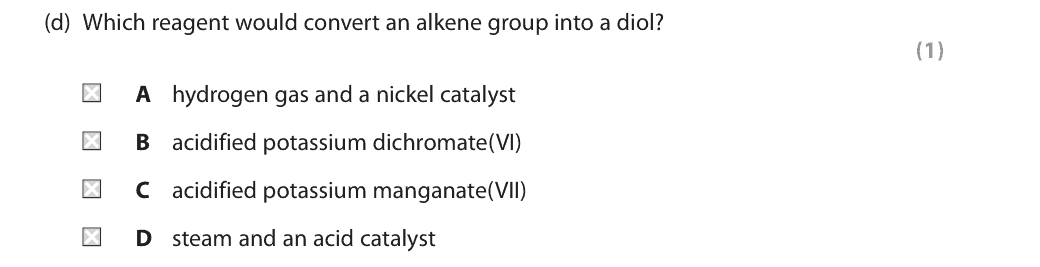
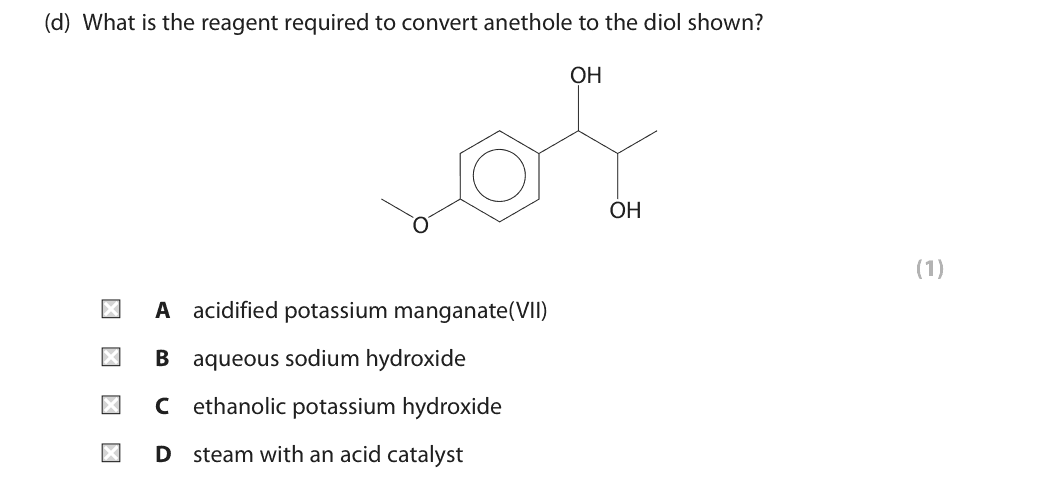
Answer: C (acidified potassium manganate(VII)). Hydrogen with nickel gives an alkane, steam with an acid catalyst gives an alcohol, and acidified dichromate(VI) does not react with the alkene
June 2025 · Paper 2 · Q4(c)1 markMultiple choice
Answer
A
Mark scheme
Notes from the mark scheme and report
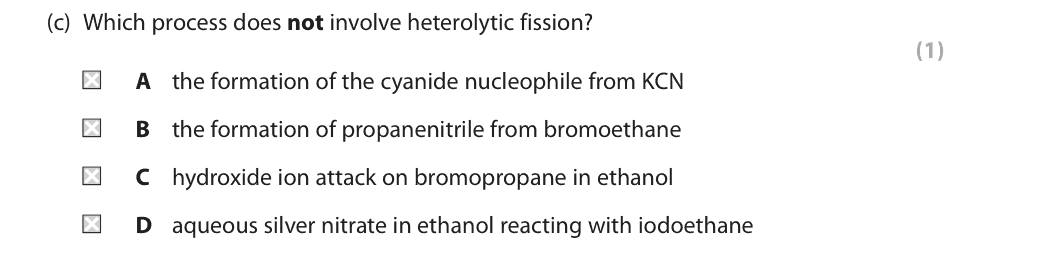
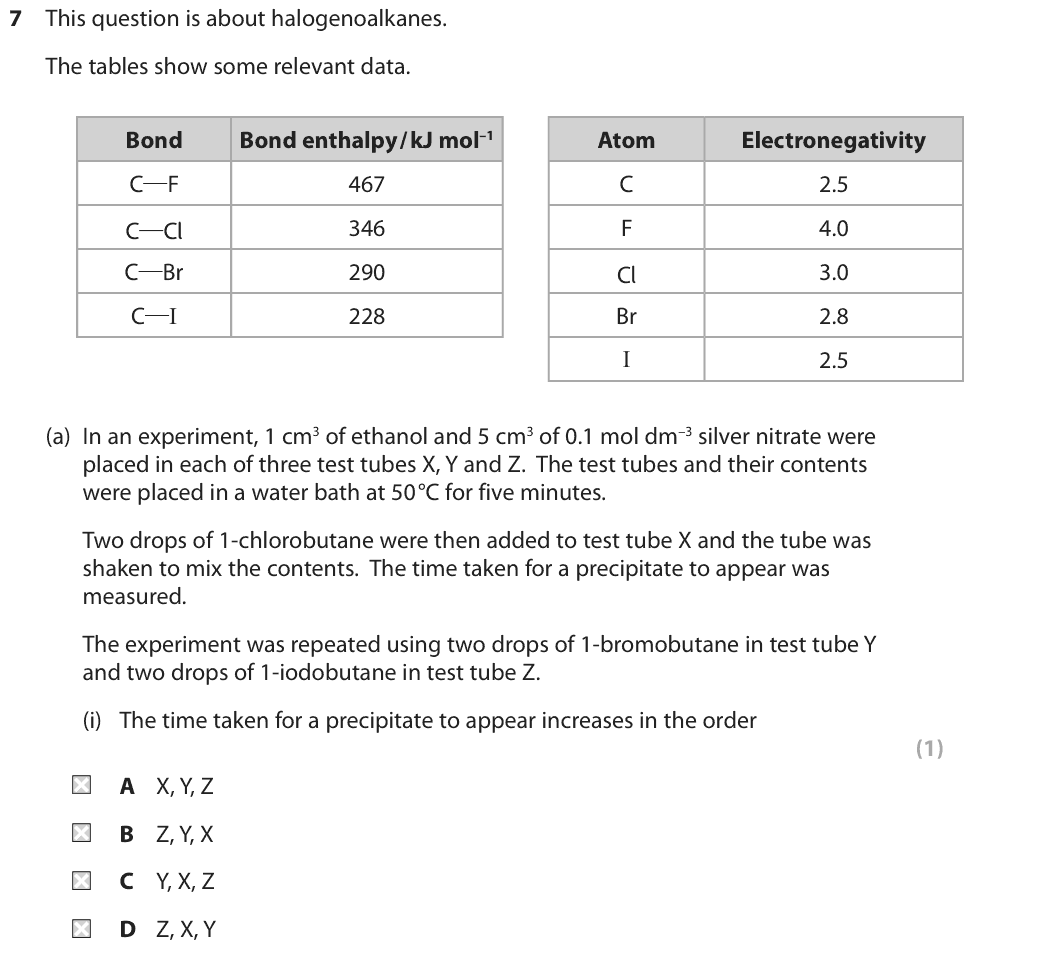
Answer: A. KCN is ionic, so forming the cyanide ion breaks no covalent bond. B, C and D all involve heterolytic fission of the carbon–halogen bond
June 2025 · Paper 2 · Q8(d)1 markMultiple choice
Earlier part of question 8 that this part uses
Answer
A
Mark scheme
Notes from the mark scheme and report
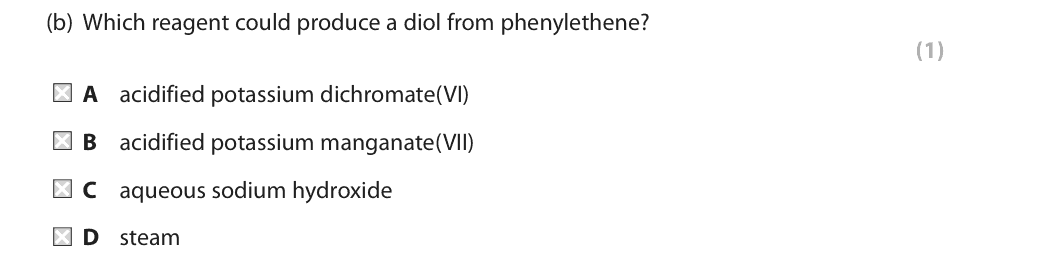
Answer: A (acidified potassium manganate(VII)) oxidises the C=C to a diol. Hydroxide ions (aqueous or ethanolic) are nucleophiles and are repelled by the C=C
steam with an acid catalyst gives an alcohol, not a diol
June 2025 · Paper 3 · Q2(a)(i)2 marksPractical and data analysis
Mark scheme
Examiner's comment
This proved to be a straightforward question for many candidates. The most common test described was bromine water turning colourless. There were a few incorrect starting colours given and some candidates described the colourless solution as 'clear' which was not awarded. The test using acidified potassium permanganate was seen less frequently. Candidates who described it were generally correct in the expected result that they gave.
Notes from the mark scheme and report
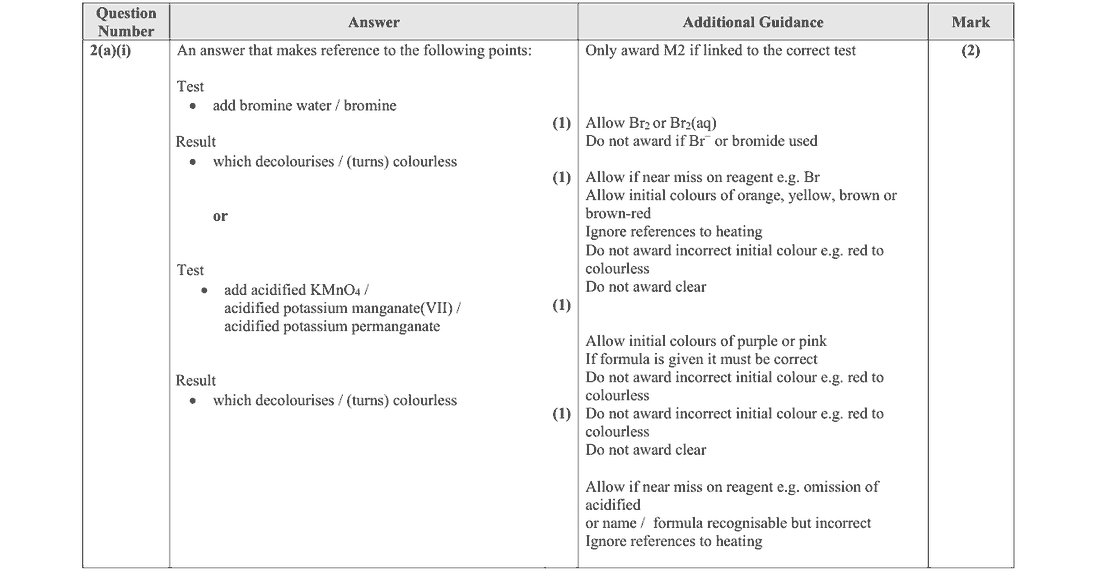
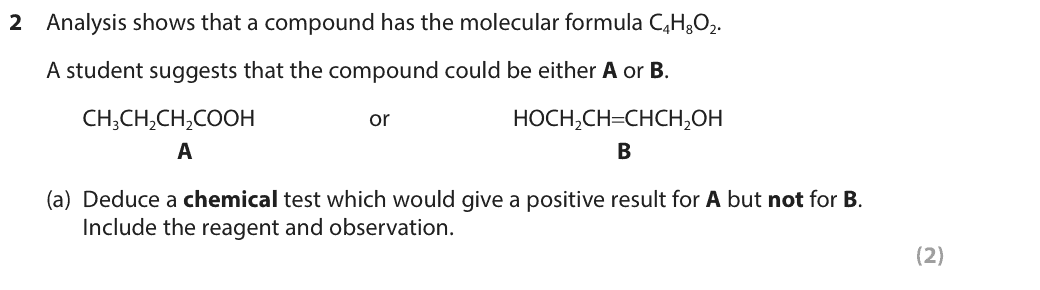
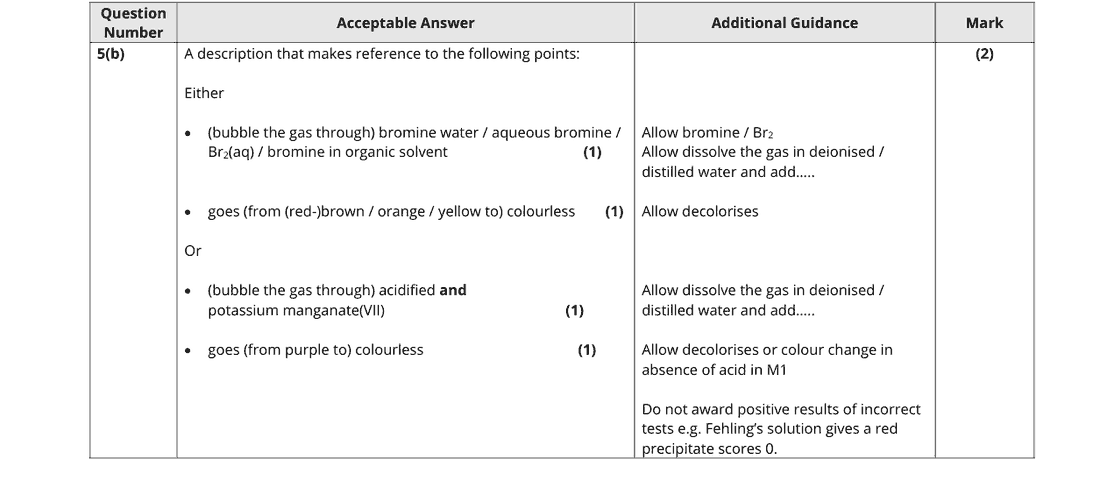
Add bromine water / bromine: it is decolourised / turns colourless (from orange, yellow or brown). Or add acidified potassium manganate(VII): it turns colourless (from purple). 'Clear' is not credited
a wrong starting colour (red) loses the result mark
bromide not allowed. The result mark needs the correct test
Skills: PT4 use laboratory apparatus for a variety of experimental techniques, including: titration, using burette and pipette; distillation and heating under reflux, including setting up glassware using retort stand and clamps; qualitative tests for ions and organic functional groups; filtration, including use of fluted filter paper, or filtration under reduced pressure; CP7 Core practical 7: Analysis of some inorganic and organic unknowns
June 2025 · Paper 3 · Q2(a)(ii)3 marksMechanism
Earlier part of question 2 that this part uses
Mark scheme
Examiner's comment
Many candidates demonstrated familiarity with the mechanism for this reaction. However, it was the 'minor' product of the reaction that was asked for, and some candidates lost marks by drawing the incorrect carbocation intermediate.
Notes from the mark scheme and report
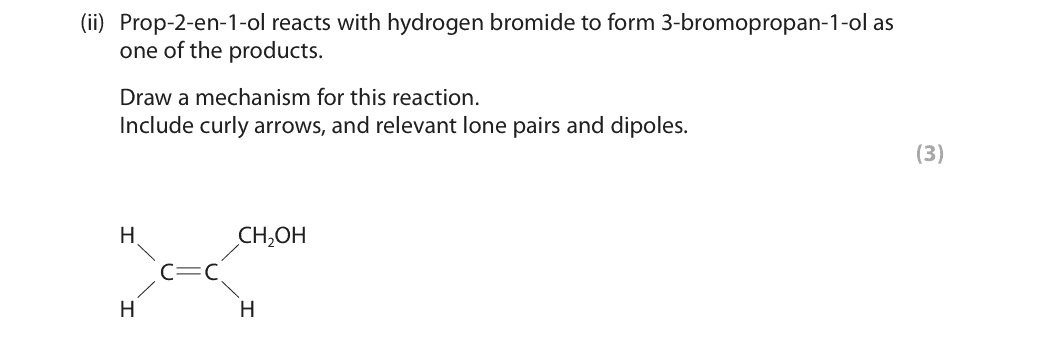
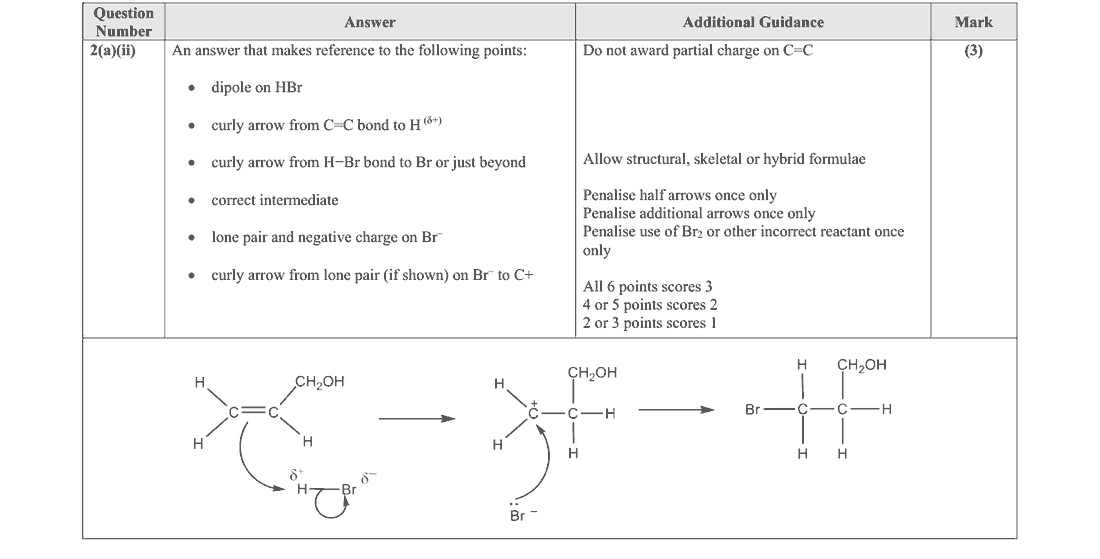
Six points: dipole on H–Br
curly arrow from the C=C bond to H(δ+)
curly arrow from the H–Br bond to Br
the correct carbocation (primary, + on the end CH2, as the stated product is 3-bromopropan-1-ol)
lone pair and negative charge on Br–
curly arrow from the lone pair on Br– to C+. Six points score 3, four or five score 2, two or three score 1. Half arrows and extra arrows penalised once. Common error: drawing the secondary carbocation that leads to the major product
June 2025 · Paper 3 · Q2(b)2 marksEquation writing
Earlier part of question 2 that this part uses
Mark scheme
Examiner's comment
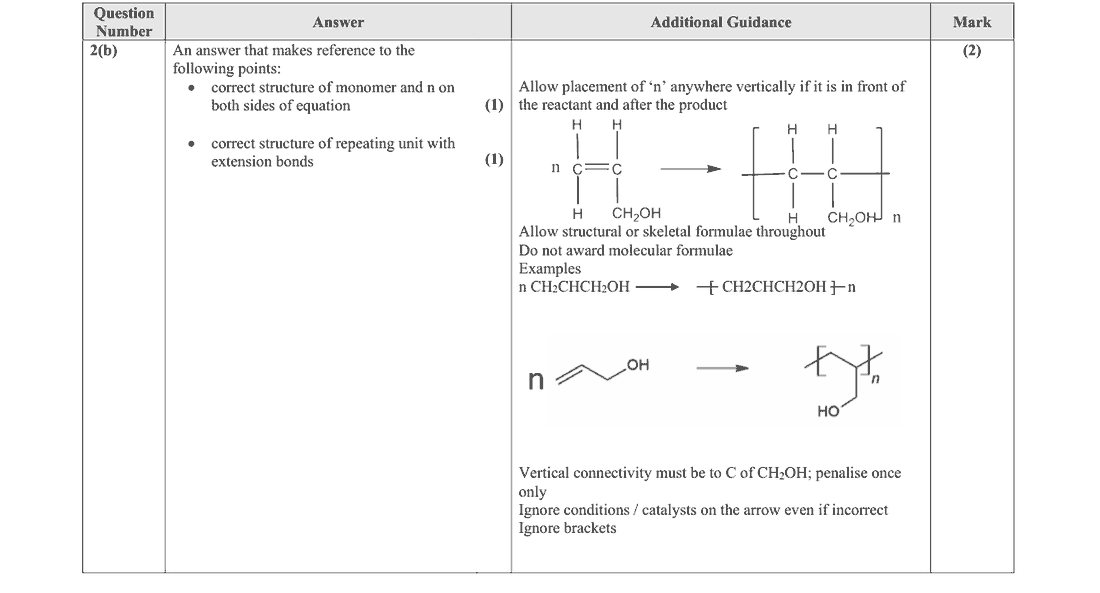
Candidates found it easier to draw the monomer, than the polymer unit correctly. There were a few missing the 'n’s, or 'n’s in the wrong place, being added after the monomer and /or before the polymer unit. The polymer unit was seen on occasion with double bonds still present.
Notes from the mark scheme and report
n CH2=CHCH2OH → –[CH2–CH(CH2OH)]–n. M1: correct monomer with n on both sides (in front of the monomer, after the repeat unit). M2: correct repeat unit with extension bonds. Structural or skeletal formulae allowed, molecular formulae not
the side group must be joined through the carbon of CH2OH. The monomer was easier than the repeat unit
n missing or misplaced, and repeat units still containing C=C, were seen
June 2025 · Paper 3 · Q2(c)2 marksExplanationHard
Earlier part of question 2 that this part uses
Mark scheme
Examiner's comment
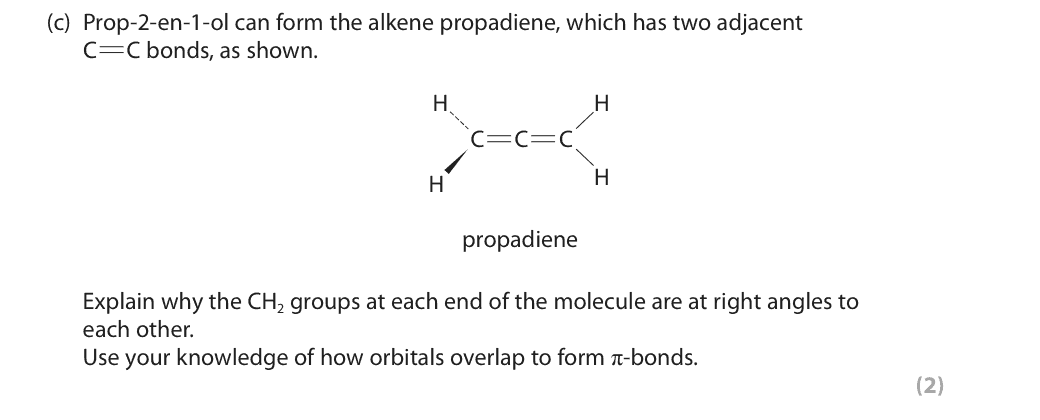
This question proved challenging for many candidates. Marks were awarded for describing pi bonds as forming from sideways overlap of p orbitals, and that was the most frequent way that candidates gained a mark. Only a few candidates scored both marks as many found it difficult to visualise the reason for the groups being at right angles to each other. Candidates often referenced electron pair repulsion theory in their answers which is not relevant here.
Notes from the mark scheme and report
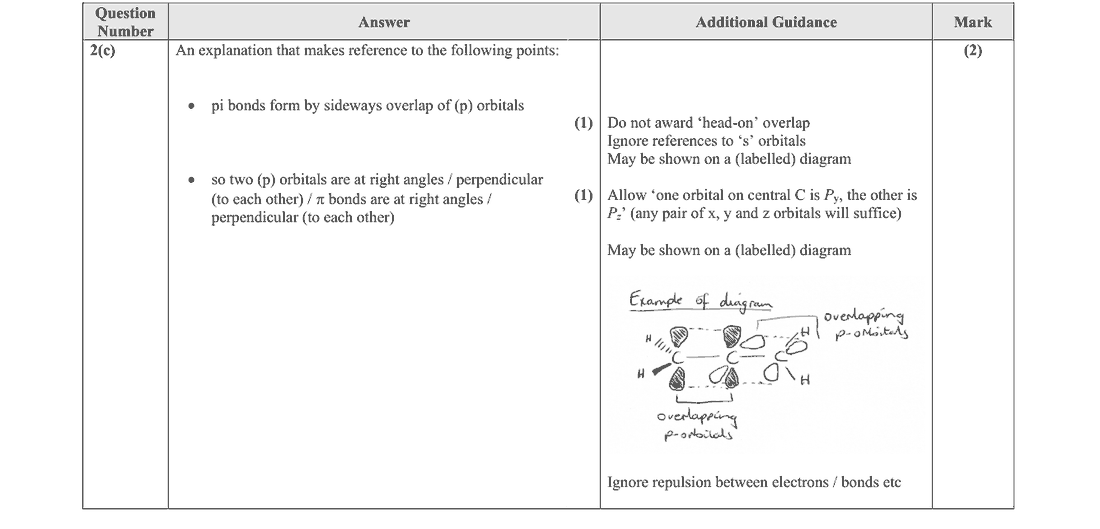
π bonds form by sideways overlap of p orbitals (not head-on)
the two p orbitals on the central carbon (e.g. py and pz) are at right angles, so the two π bonds, and hence the two CH2 groups, are perpendicular. May be shown on a labelled diagram. Electron pair repulsion arguments are ignored and were a common irrelevant answer
the sideways overlap mark was the one usually gained
Skills: MS4.2 Visualise and represent 2D and 3D forms including two- dimensional representations of 3D objects
June 2024 · AS Paper 2 · Q3(b)(i)1 markMultiple choice
Earlier part of question 3 that this part uses
Answer
A
Mark scheme
Examiner's comment
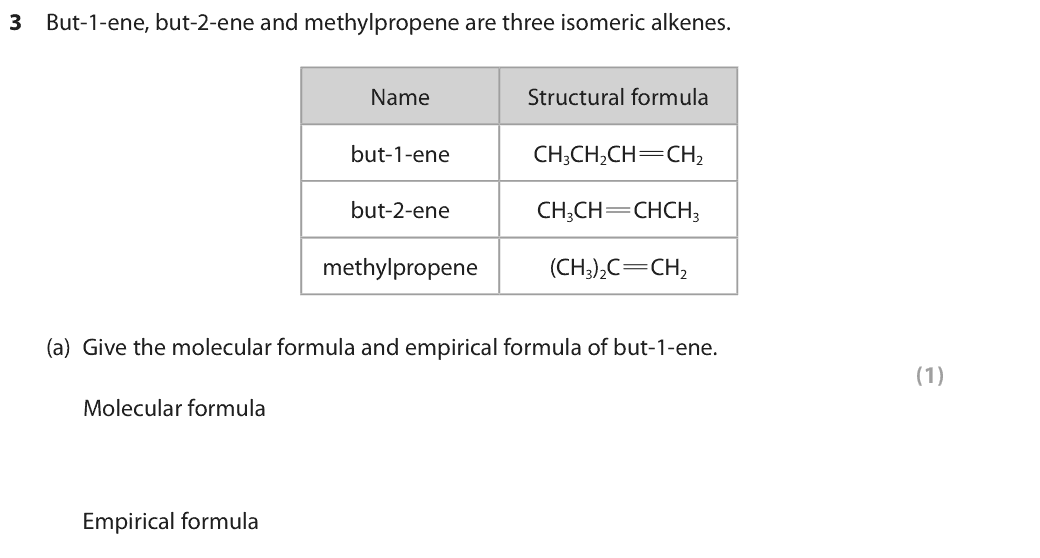
The chemistry of alkenes was tested in Q3. (a) tested candidate’s knowledge and understanding of molecular and empirical formulae. Over 80% of candidates scored this mark. The addition of hydrogen bromide was tested in (b), with (b)(i) being the name and type of this reaction. Again, over 80% knew this was an electrophilic addition reaction. The mechanism of the reaction, in (b)(ii) was extremely well answered. There are a large number of things to consider in this mechanism, but candidates seemed well drilled with 44% scoring full marks. Four marks was the most common score achieved here. The minor product in (b)(iii) proved a little more challenging. Candidates found difficulty expressing themselves with sufficient accuracy to secure full marks, often referring to the stability of halogenoalkanes rather that the carbocation intermediates. Descriptions in (b)(iv) also lacked sufficient detail to score the mark. It was quite common to see that the arrow represented the movement of an electron, or electrons rather than the pair of electrons which was required for the mark. In (c)(i) most candidates recognised the structures of the two isomers and were able to name them, but some needed more care when drawing these structures out. The attachment of methyl groups was often seen via a hydrogen rather than the carbon and this did not score the mark in this question. A fully displayed structure almost invariably scored the mark here as this type of attachment does not occur in these types of structures. The need for two different groups attached to the carbon as well as restricted rotation was not often seen in (c)(ii). The conversion of alkenes to alcohols and subsequent oxidation was examined in (d), and three quarters of candidates recognised the tertiary alcohol in (d)(i) The relative stability of tertiary alcohols to oxidation was not well understood. Those candidates who knew that the carbon with the oxygen attached required a hydrogen attached as well to allow oxidation often scored two marks.
Notes from the mark scheme and report
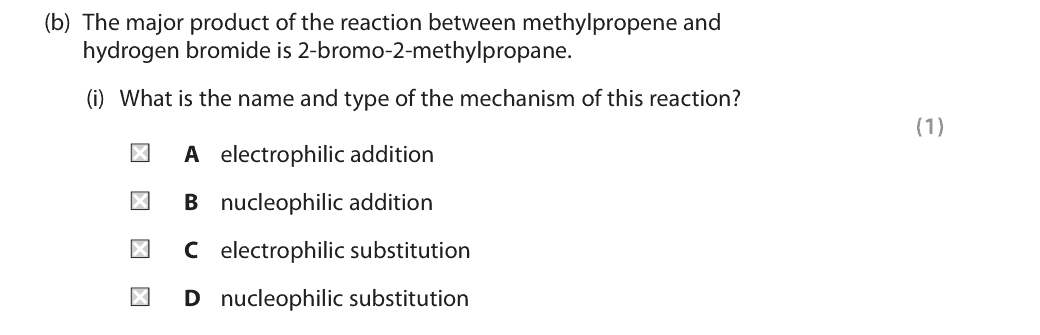
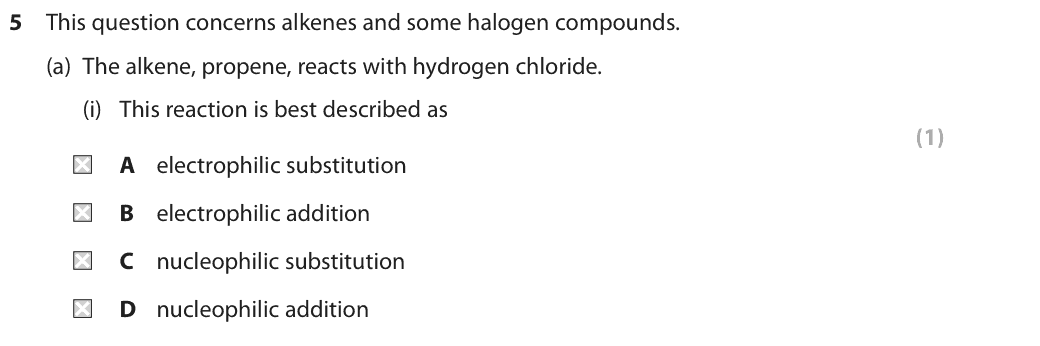
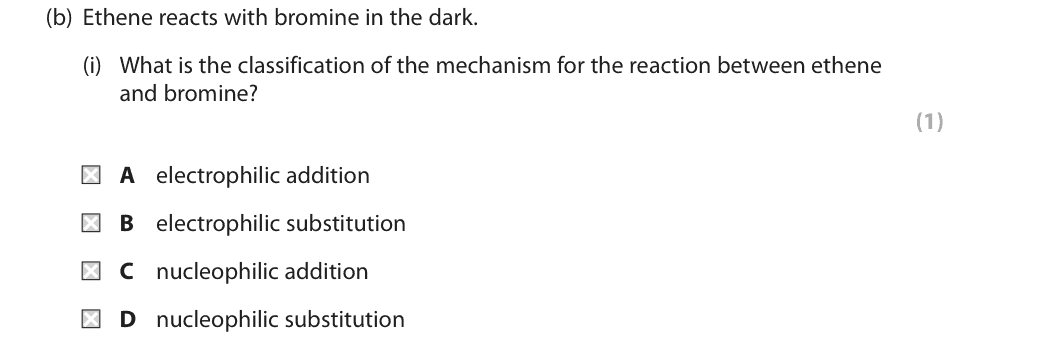
Answer: A (electrophilic addition). The alkene is attacked by an electrophile, not a nucleophile (B, D), and HBr adds rather than substitutes (C, D)
June 2024 · AS Paper 2 · Q3(b)(ii)4 marksMechanismEasy
Earlier parts of question 3 that this part uses
Mark scheme
Examiner's comment
The chemistry of alkenes was tested in Q3. (a) tested candidate’s knowledge and understanding of molecular and empirical formulae. Over 80% of candidates scored this mark. The addition of hydrogen bromide was tested in (b), with (b)(i) being the name and type of this reaction. Again, over 80% knew this was an electrophilic addition reaction. The mechanism of the reaction, in (b)(ii) was extremely well answered. There are a large number of things to consider in this mechanism, but candidates seemed well drilled with 44% scoring full marks. Four marks was the most common score achieved here. The minor product in (b)(iii) proved a little more challenging. Candidates found difficulty expressing themselves with sufficient accuracy to secure full marks, often referring to the stability of halogenoalkanes rather that the carbocation intermediates. Descriptions in (b)(iv) also lacked sufficient detail to score the mark. It was quite common to see that the arrow represented the movement of an electron, or electrons rather than the pair of electrons which was required for the mark. In (c)(i) most candidates recognised the structures of the two isomers and were able to name them, but some needed more care when drawing these structures out. The attachment of methyl groups was often seen via a hydrogen rather than the carbon and this did not score the mark in this question. A fully displayed structure almost invariably scored the mark here as this type of attachment does not occur in these types of structures. The need for two different groups attached to the carbon as well as restricted rotation was not often seen in (c)(ii). The conversion of alkenes to alcohols and subsequent oxidation was examined in (d), and three quarters of candidates recognised the tertiary alcohol in (d)(i) The relative stability of tertiary alcohols to oxidation was not well understood. Those candidates who knew that the carbon with the oxygen attached required a hydrogen attached as well to allow oxidation often scored two marks.
Notes from the mark scheme and report
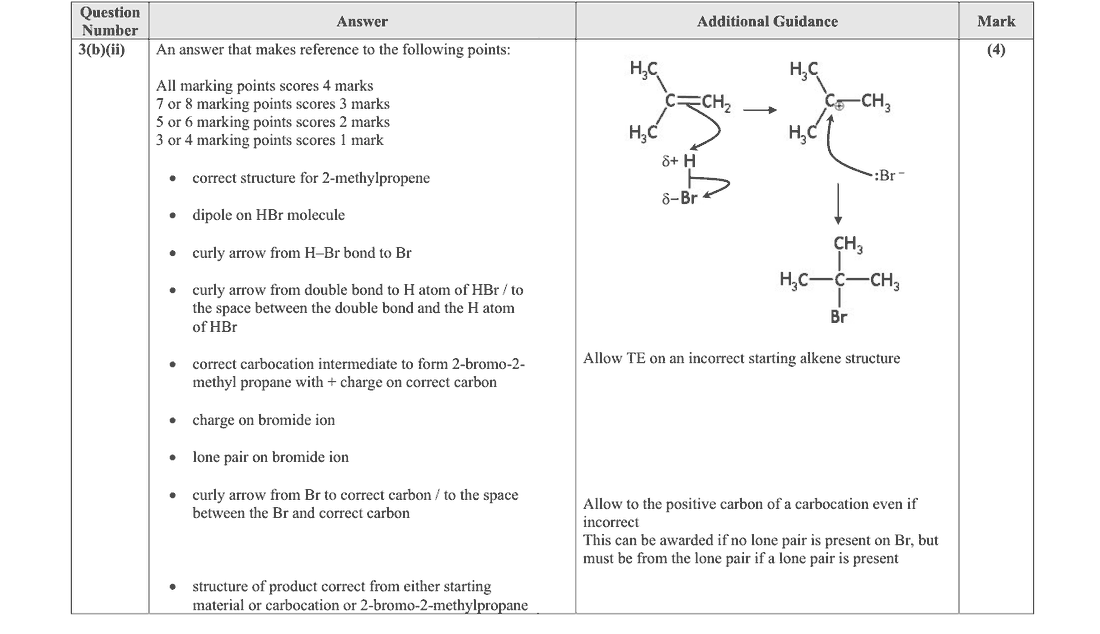
Nine points: all 9 score 4, 7–8 score 3, 5–6 score 2, 3–4 score 1. Correct structure of 2-methylpropene
dipole on HBr
curly arrow from the H–Br bond to Br
curly arrow from the C=C to the H of HBr
tertiary carbocation with + on the correct carbon
charge on the bromide ion
lone pair on the bromide ion
curly arrow from Br– (from the lone pair if one is drawn) to the C+
correct product structure. Four marks was the most common score
June 2024 · AS Paper 2 · Q3(b)(iii)3 marksExplanation
Earlier parts of question 3 that this part uses
Mark scheme
Examiner's comment
The chemistry of alkenes was tested in Q3. (a) tested candidate’s knowledge and understanding of molecular and empirical formulae. Over 80% of candidates scored this mark. The addition of hydrogen bromide was tested in (b), with (b)(i) being the name and type of this reaction. Again, over 80% knew this was an electrophilic addition reaction. The mechanism of the reaction, in (b)(ii) was extremely well answered. There are a large number of things to consider in this mechanism, but candidates seemed well drilled with 44% scoring full marks. Four marks was the most common score achieved here. The minor product in (b)(iii) proved a little more challenging. Candidates found difficulty expressing themselves with sufficient accuracy to secure full marks, often referring to the stability of halogenoalkanes rather that the carbocation intermediates. Descriptions in (b)(iv) also lacked sufficient detail to score the mark. It was quite common to see that the arrow represented the movement of an electron, or electrons rather than the pair of electrons which was required for the mark. In (c)(i) most candidates recognised the structures of the two isomers and were able to name them, but some needed more care when drawing these structures out. The attachment of methyl groups was often seen via a hydrogen rather than the carbon and this did not score the mark in this question. A fully displayed structure almost invariably scored the mark here as this type of attachment does not occur in these types of structures. The need for two different groups attached to the carbon as well as restricted rotation was not often seen in (c)(ii). The conversion of alkenes to alcohols and subsequent oxidation was examined in (d), and three quarters of candidates recognised the tertiary alcohol in (d)(i) The relative stability of tertiary alcohols to oxidation was not well understood. Those candidates who knew that the carbon with the oxygen attached required a hydrogen attached as well to allow oxidation often scored two marks.
Notes from the mark scheme and report
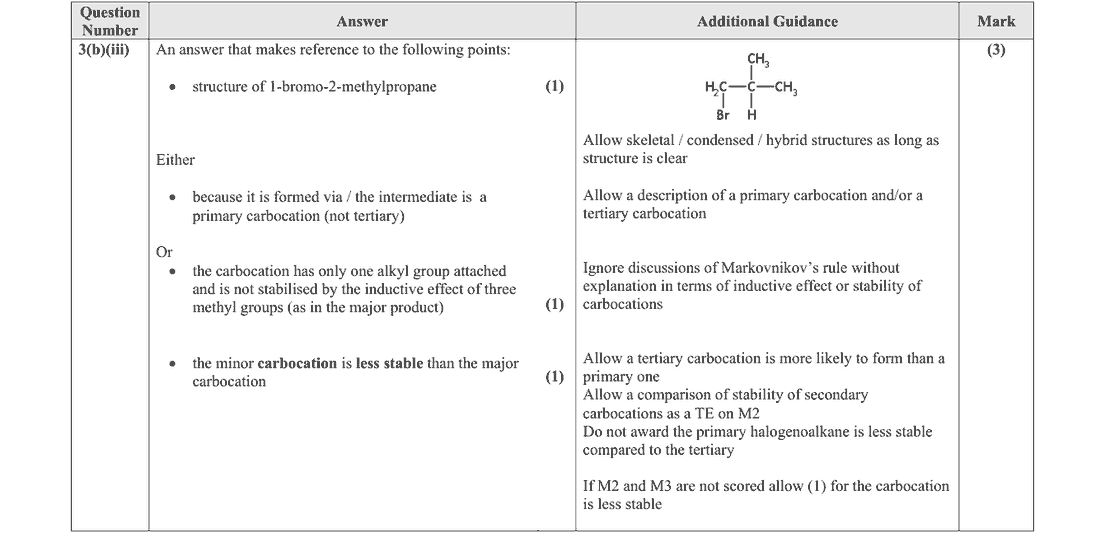
Structure of 1-bromo-2-methylpropane, (CH3)2CHCH2Br
it forms through a primary carbocation (only one alkyl group, so not stabilised by the inductive effect of three methyl groups)
which is less stable than the tertiary carbocation that gives the major product. Markovnikov's rule quoted without an explanation is ignored. Common error: comparing the stability of the halogenoalkanes instead of the carbocation intermediates
June 2024 · AS Paper 2 · Q3(b)(iv)1 markShort answer
Earlier parts of question 3 that this part uses
Mark scheme
Examiner's comment
The chemistry of alkenes was tested in Q3. (a) tested candidate’s knowledge and understanding of molecular and empirical formulae. Over 80% of candidates scored this mark. The addition of hydrogen bromide was tested in (b), with (b)(i) being the name and type of this reaction. Again, over 80% knew this was an electrophilic addition reaction. The mechanism of the reaction, in (b)(ii) was extremely well answered. There are a large number of things to consider in this mechanism, but candidates seemed well drilled with 44% scoring full marks. Four marks was the most common score achieved here. The minor product in (b)(iii) proved a little more challenging. Candidates found difficulty expressing themselves with sufficient accuracy to secure full marks, often referring to the stability of halogenoalkanes rather that the carbocation intermediates. Descriptions in (b)(iv) also lacked sufficient detail to score the mark. It was quite common to see that the arrow represented the movement of an electron, or electrons rather than the pair of electrons which was required for the mark. In (c)(i) most candidates recognised the structures of the two isomers and were able to name them, but some needed more care when drawing these structures out. The attachment of methyl groups was often seen via a hydrogen rather than the carbon and this did not score the mark in this question. A fully displayed structure almost invariably scored the mark here as this type of attachment does not occur in these types of structures. The need for two different groups attached to the carbon as well as restricted rotation was not often seen in (c)(ii). The conversion of alkenes to alcohols and subsequent oxidation was examined in (d), and three quarters of candidates recognised the tertiary alcohol in (d)(i) The relative stability of tertiary alcohols to oxidation was not well understood. Those candidates who knew that the carbon with the oxygen attached required a hydrogen attached as well to allow oxidation often scored two marks.
Notes from the mark scheme and report
Answer: the movement of a pair of electrons (two electrons). 'Movement of an electron' or just 'electrons' did not score, and was a common answer
June 2024 · AS Paper 2 · Q3(d)(i)1 markMultiple choice
Earlier part of question 3 that this part uses
Answer
B
Mark scheme
Examiner's comment
The chemistry of alkenes was tested in Q3. (a) tested candidate’s knowledge and understanding of molecular and empirical formulae. Over 80% of candidates scored this mark. The addition of hydrogen bromide was tested in (b), with (b)(i) being the name and type of this reaction. Again, over 80% knew this was an electrophilic addition reaction. The mechanism of the reaction, in (b)(ii) was extremely well answered. There are a large number of things to consider in this mechanism, but candidates seemed well drilled with 44% scoring full marks. Four marks was the most common score achieved here. The minor product in (b)(iii) proved a little more challenging. Candidates found difficulty expressing themselves with sufficient accuracy to secure full marks, often referring to the stability of halogenoalkanes rather that the carbocation intermediates. Descriptions in (b)(iv) also lacked sufficient detail to score the mark. It was quite common to see that the arrow represented the movement of an electron, or electrons rather than the pair of electrons which was required for the mark. In (c)(i) most candidates recognised the structures of the two isomers and were able to name them, but some needed more care when drawing these structures out. The attachment of methyl groups was often seen via a hydrogen rather than the carbon and this did not score the mark in this question. A fully displayed structure almost invariably scored the mark here as this type of attachment does not occur in these types of structures. The need for two different groups attached to the carbon as well as restricted rotation was not often seen in (c)(ii). The conversion of alkenes to alcohols and subsequent oxidation was examined in (d), and three quarters of candidates recognised the tertiary alcohol in (d)(i) The relative stability of tertiary alcohols to oxidation was not well understood. Those candidates who knew that the carbon with the oxygen attached required a hydrogen attached as well to allow oxidation often scored two marks.
Notes from the mark scheme and report
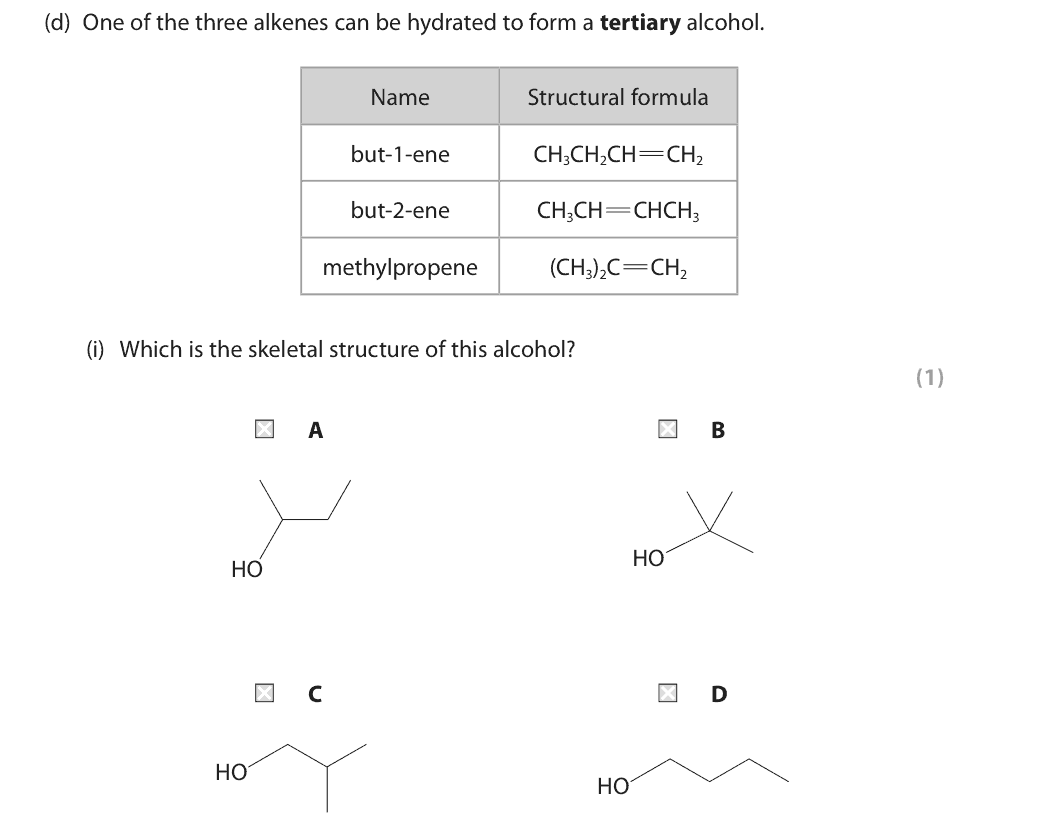
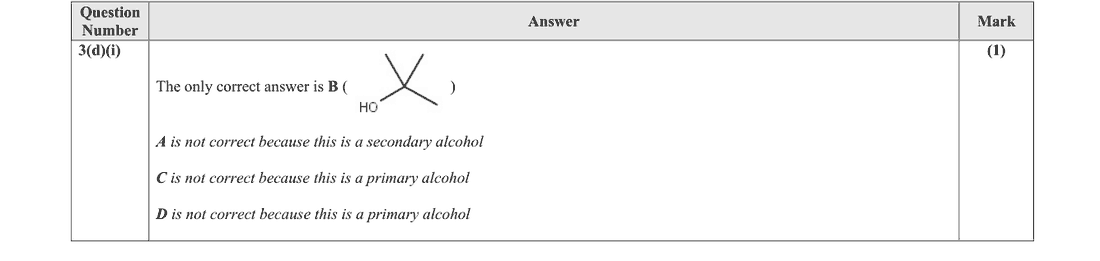
Answer: B (2-methylpropan-2-ol, from methylpropene). A is a secondary alcohol
C and D are primary alcohols. Three quarters of candidates chose correctly
June 2024 · Paper 2 · Q46 marks6-mark extended response
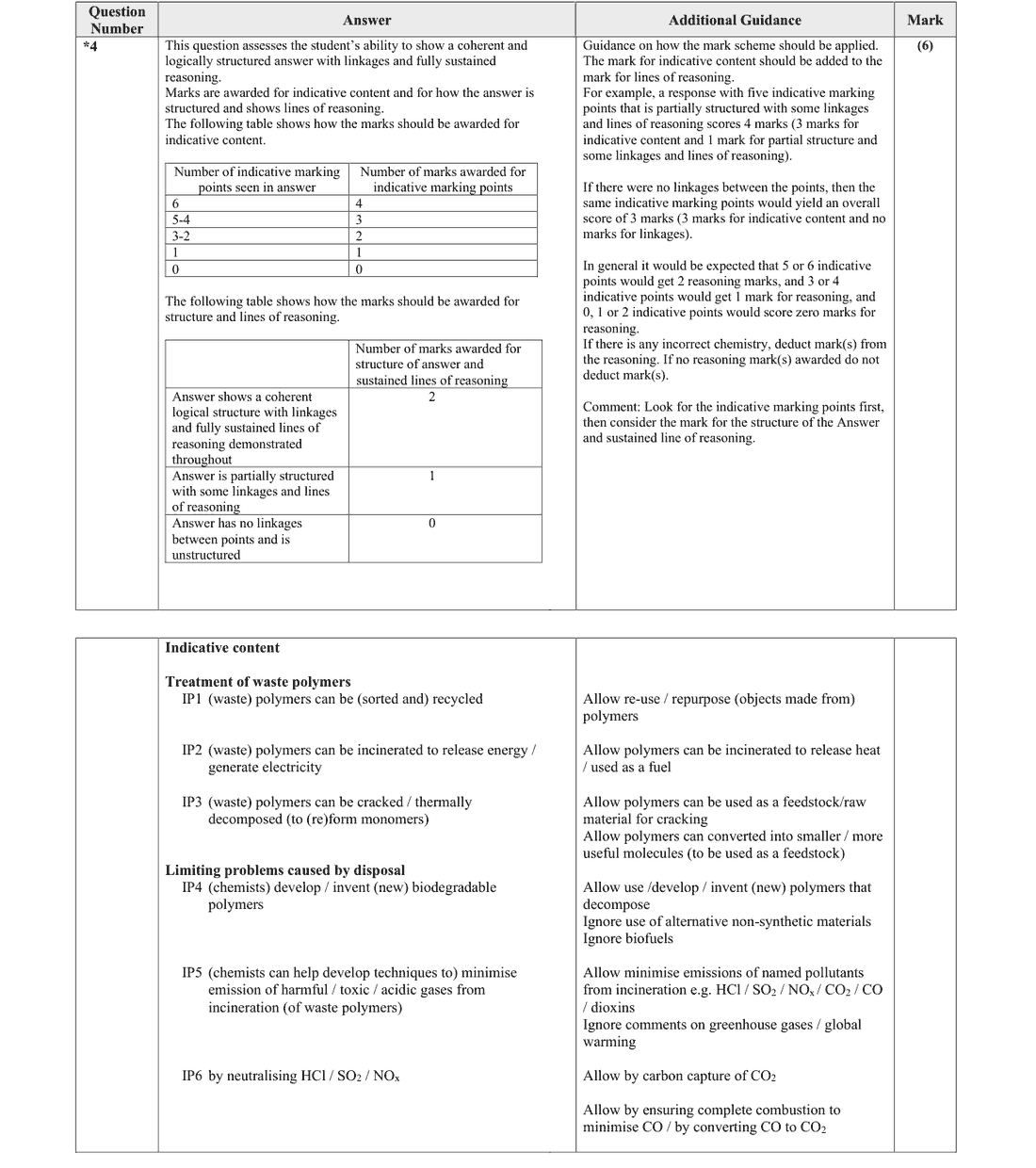
Mark scheme, with the indicative content and the marks for reasoning
Examiner's comment
This question attracted the full range of marks, with many candidates able to say something relevant to the way we can make polymer use more sustainable. A large number of candidates had used the specification effectively in their learning so were able to focus on recycling, incineration for energy and cracking for feedstock as the backbone of their response. Many candidates also realised that biodegradable polymers could be beneficial, though a minority focused on the use of plant materials in polymer production, rather than the ease of breakdown after use.
Although candidates tended to appreciate that incineration could lead to the production of toxic or harmful pollutants, far fewer went on to discuss the need to reduce the levels of these pollutants, which is key for a more sustainable use. It was common to see responses spend a lot of time discussing the negative impact of polymers related to landfill. Whilst true, this line of argument wasn’t relevant to improvements in sustainability on its own and perhaps cost some candidates valuable time.
Notes from the mark scheme and report
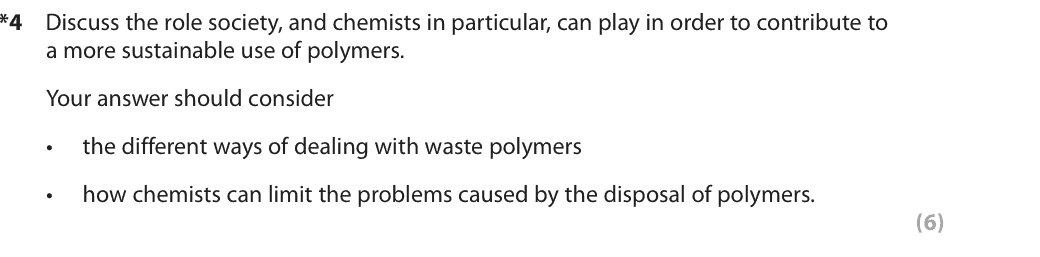
Six indicative points plus two marks for reasoning. Dealing with waste: IP1 polymers can be (sorted and) recycled (allow re-use)
IP2 incinerated to release energy / generate electricity
IP3 cracked or thermally decomposed, i.e. used as a feedstock for cracking. Limiting disposal problems: IP4 chemists develop biodegradable polymers (plant-based materials and biofuels are ignored)
IP5 minimise emission of harmful / toxic / acidic gases from incineration (named pollutants such as HCl, SO2, NOx, CO allowed
greenhouse effect ignored)
IP6 by neutralising HCl / SO2 / NOx (allow carbon capture, or complete combustion to limit CO). The full range of marks was seen. Many covered IP1 to IP4
far fewer went on to removing the pollutants from incineration, and long accounts of landfill earned nothing
June 2024 · Paper 2 · Q7(c)(i)2 marksExplanation
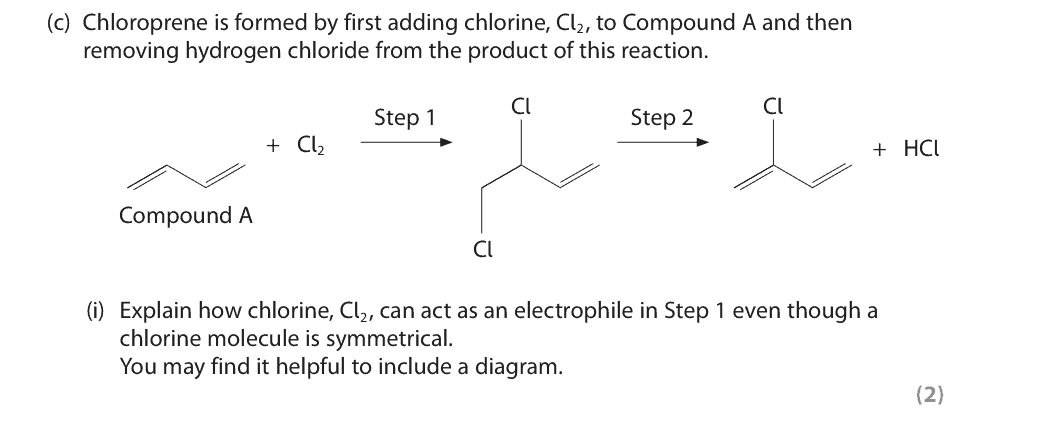
Earlier part of question 7 that this part uses
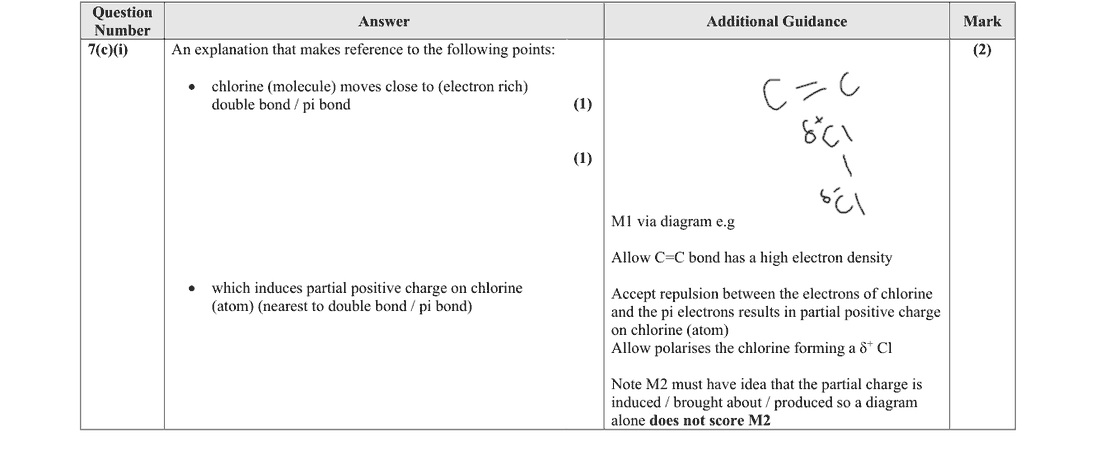
Mark scheme
Examiner's comment
Parts (c)(i) and (c)(ii) showed a discrepancy between the ability of candidates to explain what happens in an organic reaction versus the recall of the mechanism using curly arrows. As a result part (c)(i) was less successful for most candidates. In many cases the assumption was made that the chlorine molecule was polar or answers were based on an instantaneous dipole model, rather like that used to explain London forces. The most successful candidates tended to describe or show a chlorine molecule very close to the carbon-carbon double bond and link this to the induction of a dipole in the molecule. The mechanism in (c)(ii) was answered perfectly by many candidates, with perhaps fewer of the predictable errors evident (such as partial charges on ions, absence of lone pairs) than in previous series.
Notes from the mark scheme and report
M1 the chlorine molecule comes close to the electron-rich double bond / pi bond (a diagram can show this). M2 which induces a partial positive charge on the nearer chlorine atom (repulsion between the pi electrons and the electrons of the chlorine molecule polarises it). The dipole must be described as induced: a diagram alone does not score M2. Many said the molecule is already polar, or described an instantaneous dipole as for London forces
June 2024 · Paper 2 · Q7(c)(ii)3 marksMechanism
Earlier parts of question 7 that this part uses
Mark scheme
Examiner's comment
Parts (c)(i) and (c)(ii) showed a discrepancy between the ability of candidates to explain what happens in an organic reaction versus the recall of the mechanism using curly arrows. As a result part (c)(i) was less successful for most candidates. In many cases the assumption was made that the chlorine molecule was polar or answers were based on an instantaneous dipole model, rather like that used to explain London forces. The most successful candidates tended to describe or show a chlorine molecule very close to the carbon-carbon double bond and link this to the induction of a dipole in the molecule. The mechanism in (c)(ii) was answered perfectly by many candidates, with perhaps fewer of the predictable errors evident (such as partial charges on ions, absence of lone pairs) than in previous series.
Notes from the mark scheme and report
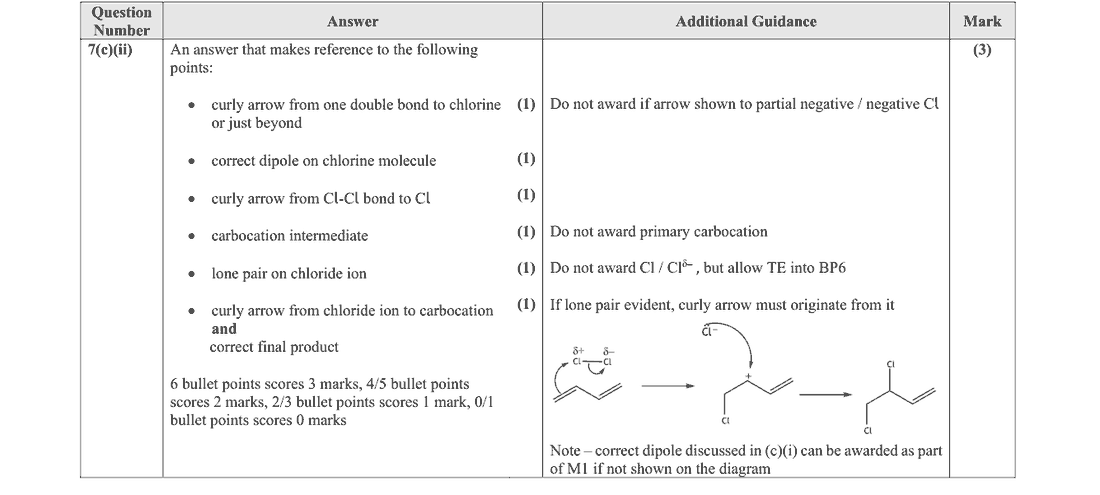
Six points: curly arrow from one C=C to the nearer Cl
correct dipole on Cl–Cl
curly arrow from the Cl–Cl bond to Cl
carbocation intermediate (not a primary carbocation)
lone pair on the chloride ion
curly arrow from that lone pair to C+ with the correct product (3,4-dichlorobut-1-ene). Six points score 3, four or five score 2, two or three score 1. A dipole described in (c)(i) can count. Answered perfectly by many
June 2024 · Paper 2 · Q7(c)(iii)1 markShort answer
Earlier parts of question 7 that this part uses
Mark scheme
Examiner's comment
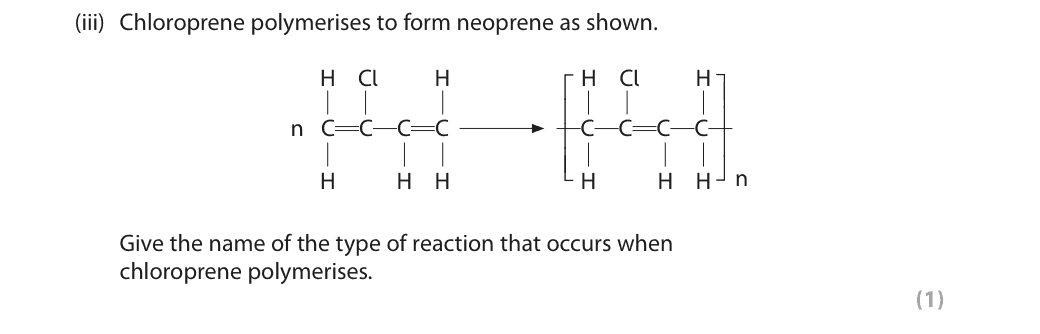
The majority of candidates correctly suggested addition but use of extra incorrect information, for example, electrophilic, sometimes lost them the mark.
Notes from the mark scheme and report
Answer: addition (polymerisation). Not condensation. Extra wrong detail such as 'electrophilic' lost the mark
June 2024 · Paper 3 · Q56 marks6-mark extended responseEasy
Mark scheme, with the indicative content and the marks for reasoning
Examiner's comment
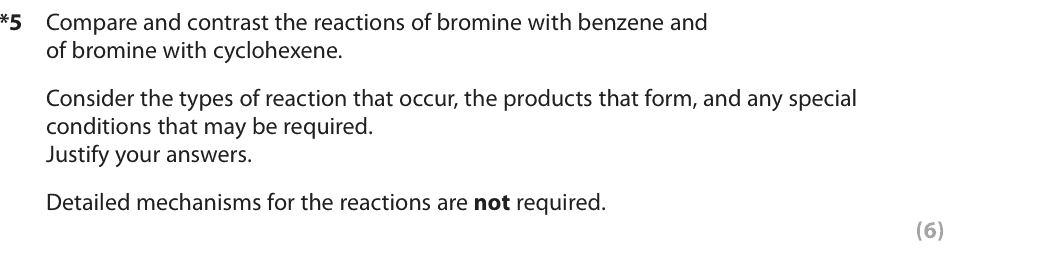
This extended open response was answered very well with the vast majority of candidates scoring high marks. The most common indicative point missed was the comparison of the products of bromination. Frequently the name of the product of the bromination of cyclohexane was wrong, either losing the ‘cyclo’ or missing the ‘di’ before the bromo. Equations were accepted as means for gaining credit but oftentimes incorrect products such as hydrogen were given. Alternatively hydrogen bromide was missing as a product from the bromination of benzene. Another common error was to state that heat was required for both reactions but cyclohexene will react at room temperature. It was insufficient to state that benzene requires a halogen carrier but cyclohexene does not.
It was also not usual to see a response which stated that benzene has a delocalised pi system but candidates must remember that this is a delocalised “electron” system and it is essential to mention this in this context. There was also a small number of candidates that confused phenol with either cyclohexene or benzene and referred to a product with three bromine atoms. Despite the question stem stating that details of reaction mechanisms were not required, it was not unusual to see considerable time spent on this matter and this was true of even those scoring high marks. Candidates would be better served if they stopped to think a while and plan out their answers in response to the key points raised in the question.
Notes from the mark scheme and report
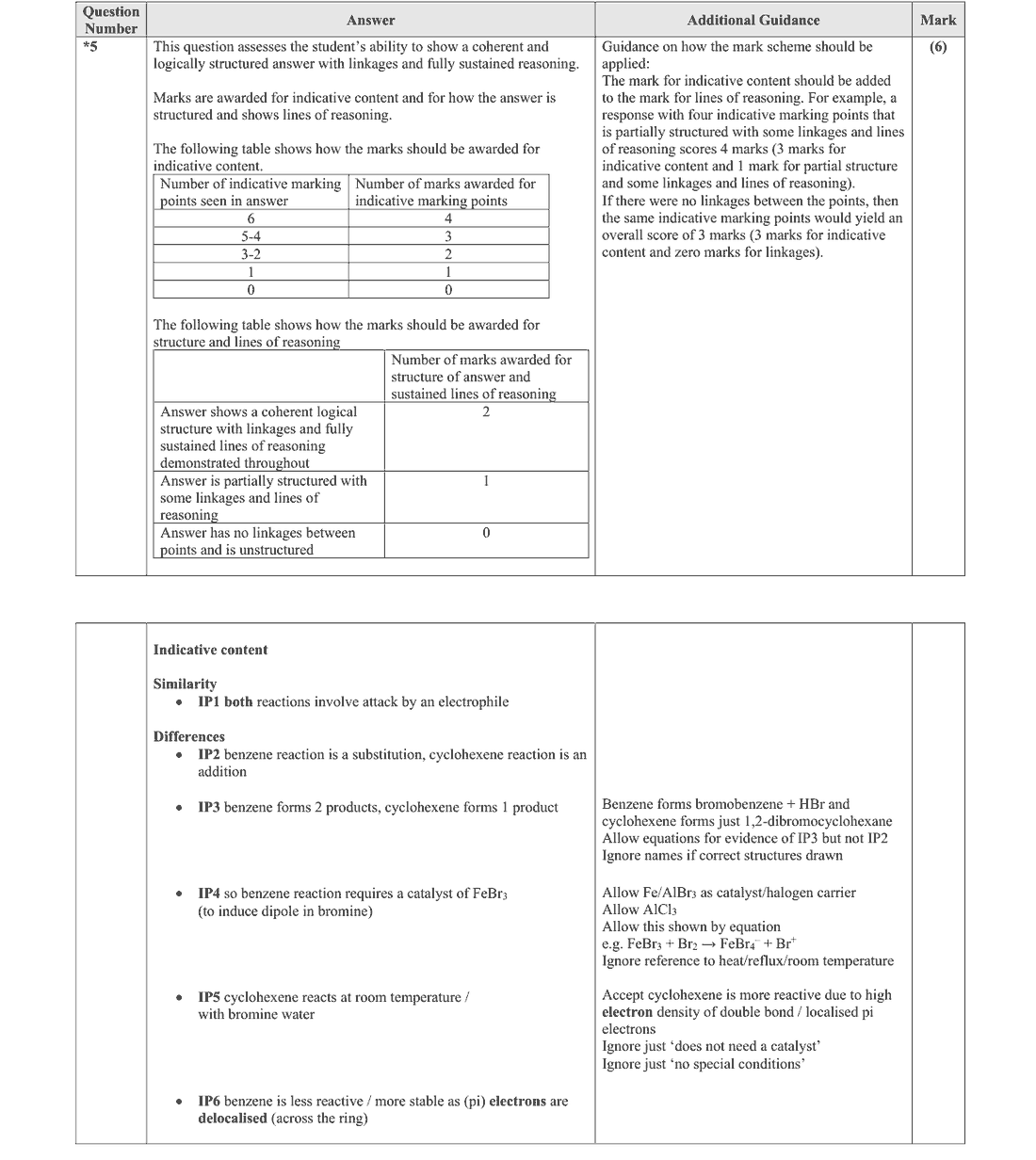
Six indicative points plus two marks for reasoning. IP1 both reactions involve attack by an electrophile
IP2 benzene reacts by substitution, cyclohexene by addition
IP3 benzene gives two products (bromobenzene and HBr), cyclohexene one (1,2-dibromocyclohexane)
IP4 the benzene reaction needs a catalyst / halogen carrier (FeBr3, Fe or AlBr3)
IP5 cyclohexene reacts at room temperature / with bromine water (high electron density of the localised pi bond)
IP6 benzene is less reactive / more stable because its pi electrons are delocalised. Just 'does not need a catalyst' is ignored for IP5. Most often missed: comparing the products. Other errors: product named without 'cyclo' or 'di'
hydrogen given as a product, or HBr missing
heat needed for both
'delocalised pi system' with no mention of electrons
time spent on mechanisms that were not asked for
June 2024 · Paper 3 · Q7(a)4 marksMechanism
Mark scheme
Examiner's comment
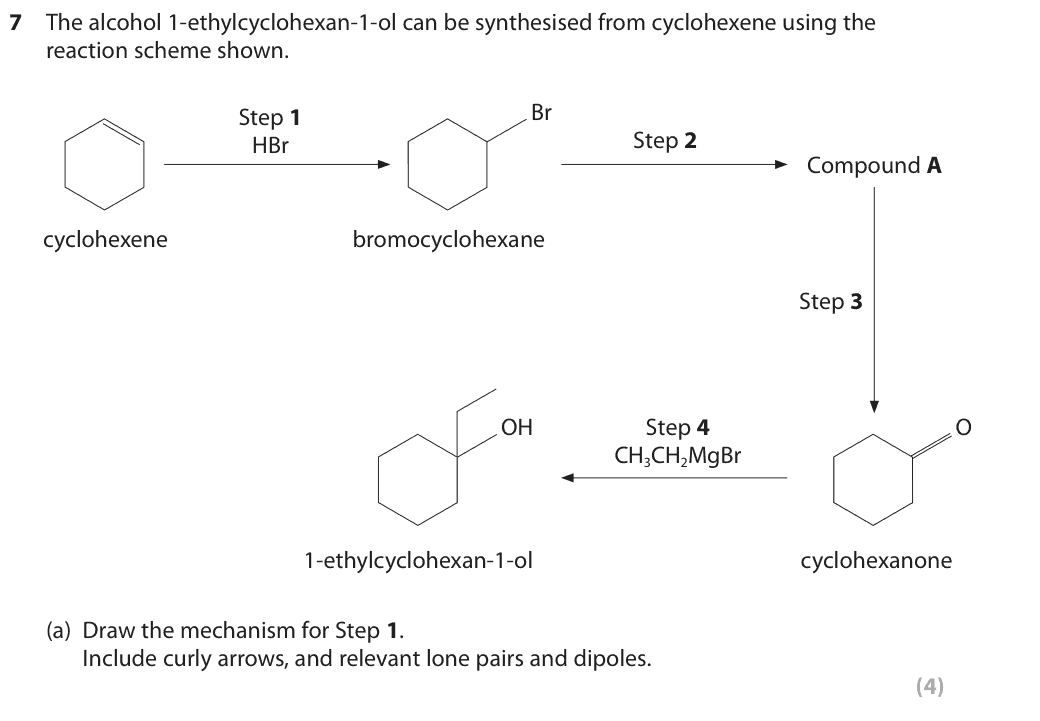
The drawing of a reaction mechanism with curly arrows has improved over recent years and many responses scoring full marks were seen to part (a). It is possible that the use of skeletal formulae benefitted candidates because the inclusion or omission of the additional hydrogen on the carbocation intermediate was ignored. A small minority of candidates appeared to think that cyclohexene was aromatic and tried to draw an electrophilc substitution reaction mechanism. The organic synthetic pathway required in part (b) was also an improvement on previous years. There were less instances of inappropriate reagent pairings such as the use of sodium hydroxide for Step 1 but quoted with sulfuric acid. This question well illustrates the need for candidates to check their answer after re-reading the question because marks were lost due to missing conditions and reaction types. Furthermore, some candidates quoted both the name and the chemical formula but if so then both must be correct to score the mark. Unfortunatley some candidates gave the wrong formula for potassium/sodium dichromate(VI). A reminder that there is often some leeway with the spelling of a chemical name such a too many ‘t’s in potassium but there is no such leeway for a chemical formula.
It was good to see that the answers to part (c)(i) were all names as per the question rubric. It was surprising at times to see solid compounds rather than liquids suggested for the Grignard reagent solvent. In part (c)(ii) the vast majority of candidates knew that anhydrous calcium chloride is a drying agent but oftentimes incorrectly referred to the absoprtion of water from the reaction or from the solvent. The diagram of the apparatus on the facing page clearly shows ‘Tube X’ a long way away from the flask with the solvent at the top of the condenser and with an open top. It should have been clear to candidates that it was to prevent water vapour from getting into the apparatus. Nonetheless it was good to see that many candidates understood the need to keep the Grignard reagent away from water to avoid hydrolysis to the alkane. Likewise many candidates in part (c)(iii) knew that the corrrect water flow in the condenser from the bottom up means that it will avoid air bubbles and be filled with water for efficient condensation. The colour of the precipitate in part (d)(i) was almost universally given correctly and the completion of the simplified mechanism in part (d)(ii) allowed candidates of all abilities to gain credit. It is pleasing to see that candidates seem to be getting better at drawing curly arrows for a novel organic mechanism. The descriptions given for the recystallistion process in part (d)(iii) varied significantly. There were some excellent, logical descriptions with additional details of a ‘hot filtration’ to remove insoluble impurities which showed that these candidates were very well prepared. However there were many other responses which unfortunatley made little practical sense. For example, it was not unusual to see the response begin with the dissolving of the impure precipitate and then this being immediately filtered, washed and patted dry without there being any mention of cooling to form a purified precipitate. These responses were not given credit for statements that were impractical.
Notes from the mark scheme and report
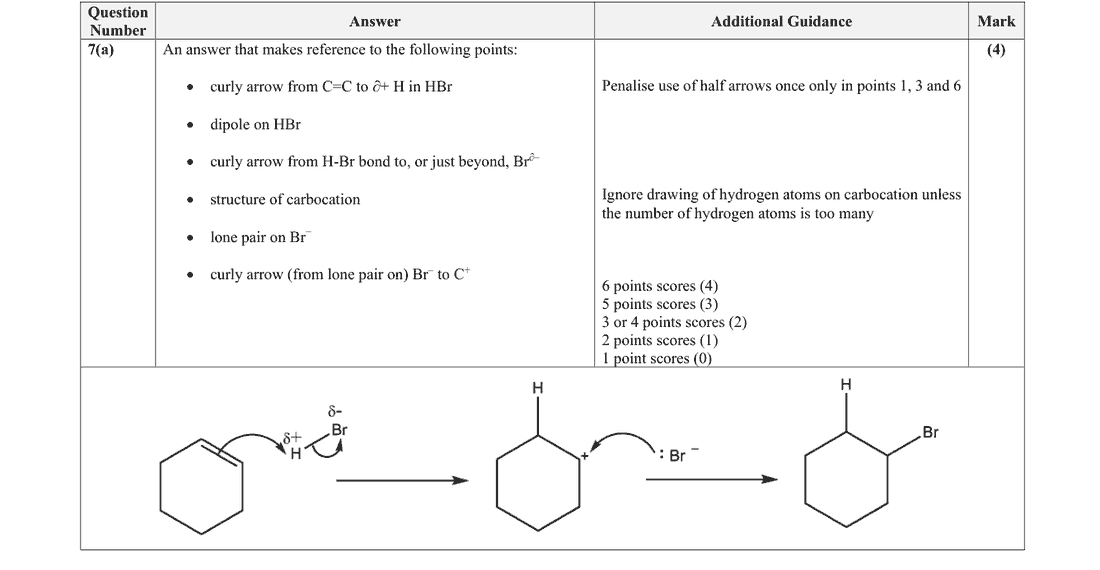
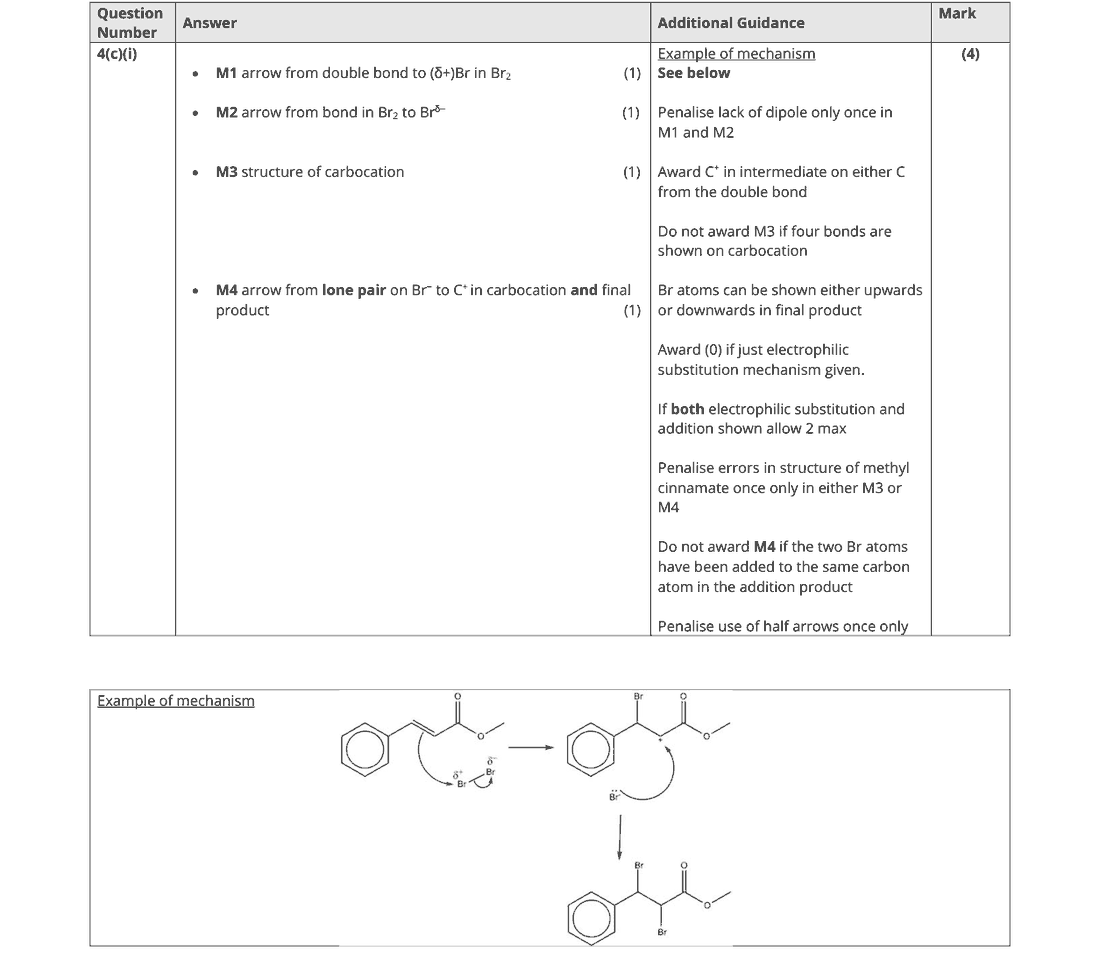
Six points: curly arrow from the C=C bond to the δ+ H of HBr
dipole on H–Br
curly arrow from the H–Br bond to Br
structure of the carbocation
lone pair on Br–
curly arrow from the lone pair on Br– to C+. Six points score 4, five score 3, three or four score 2, two score 1. Half-arrows penalised once. Many full-mark answers
a small minority treated cyclohexene as aromatic and drew electrophilic substitution
June 2023 · Paper 2 · Q1(b)1 markMultiple choice
Answer
A
Mark scheme
Notes from the mark scheme and report
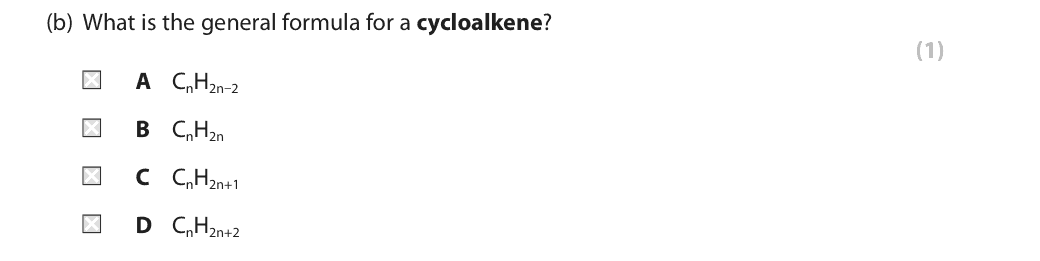
Answer: A (CnH2n–2). A ring and a C=C each remove two hydrogens from CnH2n+2. CnH2n is an alkene or a cycloalkane
CnH2n+1 is an alkyl group
CnH2n+2 is an alkane
June 2023 · AS Paper 2 · Q3(a)3 marksExplanation
Mark scheme
Examiner's comment
This question was answered fairly well, and candidates generally performed as expected.
Notes from the mark scheme and report
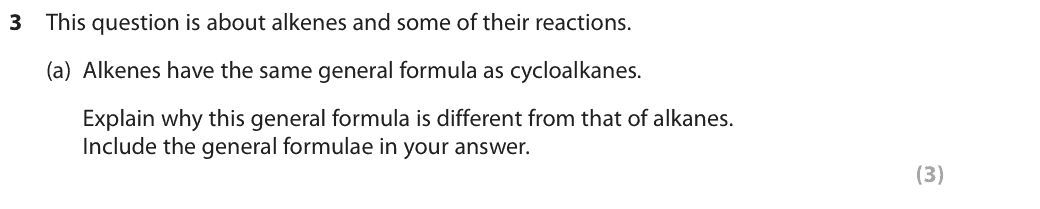
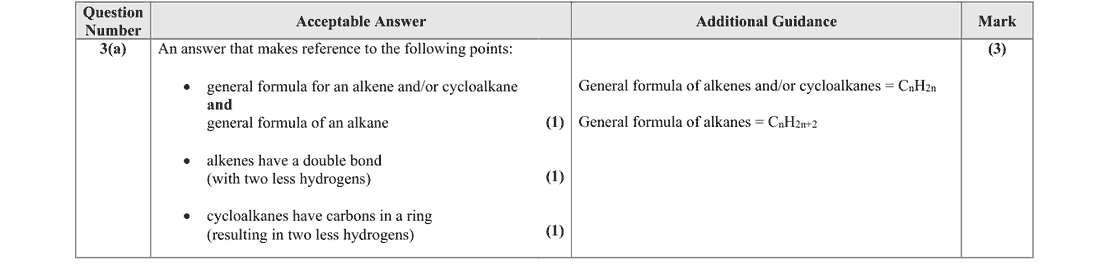
Alkenes and cycloalkanes are CnH2n and alkanes are CnH2n+2
alkenes have a double bond, so two fewer hydrogens
cycloalkanes have their carbons in a ring, so two fewer hydrogens
June 2023 · AS Paper 2 · Q3(c)3 marksDiagram or structure
Mark scheme
Examiner's comment
Candidates found this quite difficult, which may be due to this type of question not being as frequent as others.
Notes from the mark scheme and report
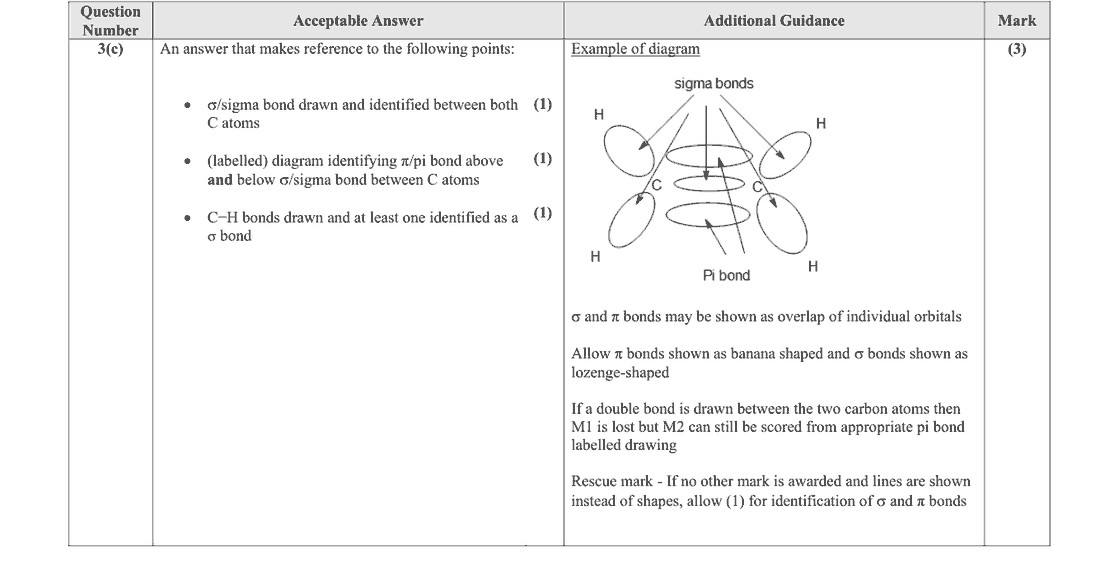
A σ (sigma) bond drawn and labelled between the two carbon atoms
a π (pi) bond shown and labelled above and below the C–C σ bond
the C–H bonds drawn with at least one labelled as a σ bond. Bonds may be shown as overlapping orbitals. Drawing C=C as a double line loses M1. One rescue mark for lines instead of shapes with σ and π identified. Candidates found this quite difficult
Skills: MS4.2 Visualise and represent 2D and 3D forms including two- dimensional representations of 3D objects
June 2023 · AS Paper 2 · Q3(d)(i)1 markDiagram or structure
Earlier part of question 3 that this part uses
Mark scheme
Examiner's comment
Candidates generally performed well on this question.
Notes from the mark scheme and report
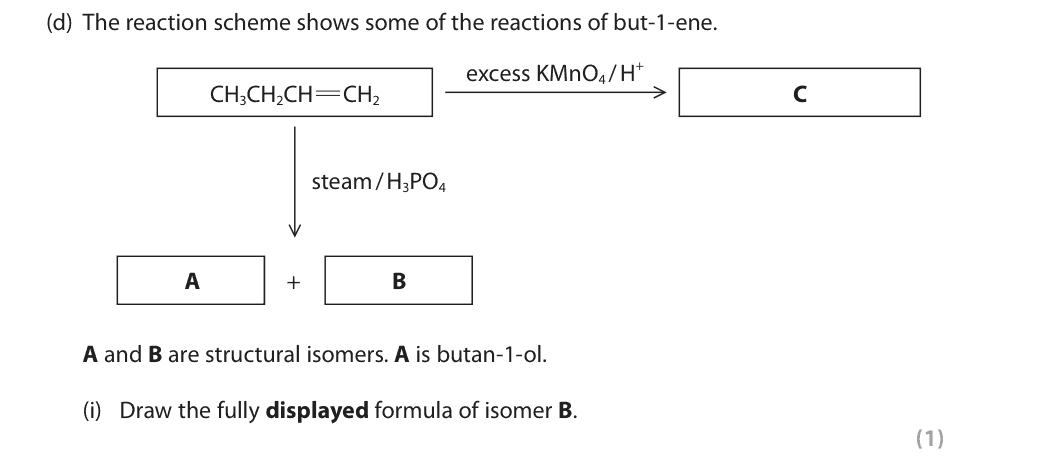
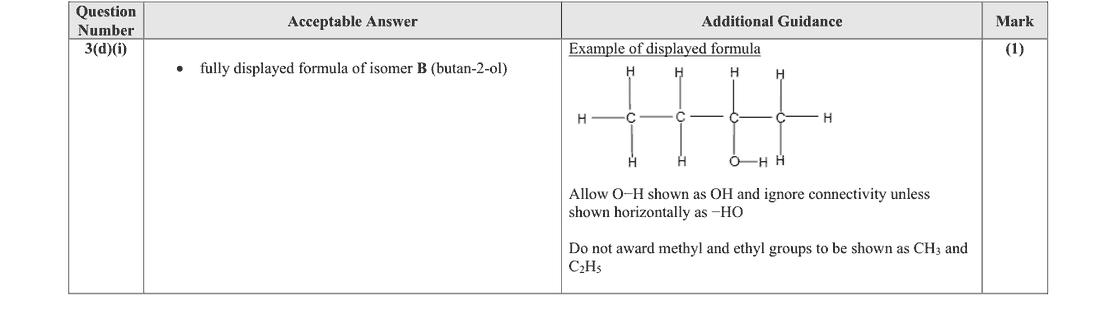
Fully displayed formula of butan-2-ol. O–H may be shown as OH (but not attached as –HO)
CH3 and C2H5 groups must be drawn out in full
June 2023 · AS Paper 2 · Q3(d)(ii)1 markDiagram or structureHard
Earlier part of question 3 that this part uses
Mark scheme
Examiner's comment
This question was quite challenging, with very few candidates answering correctly and scoring marks.
Notes from the mark scheme and report
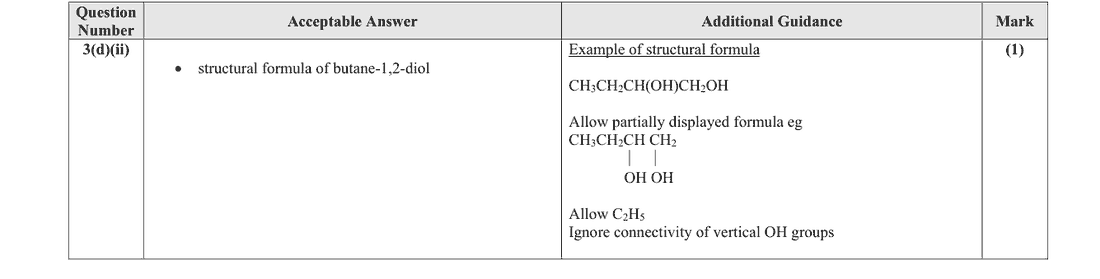
Answer: CH3CH2CH(OH)CH2OH (butane-1,2-diol). A partially displayed formula and C2H5 are allowed
June 2023 · AS Paper 2 · Q3(e)1 markMultiple choice
Answer
B
Mark scheme
Notes from the mark scheme and report
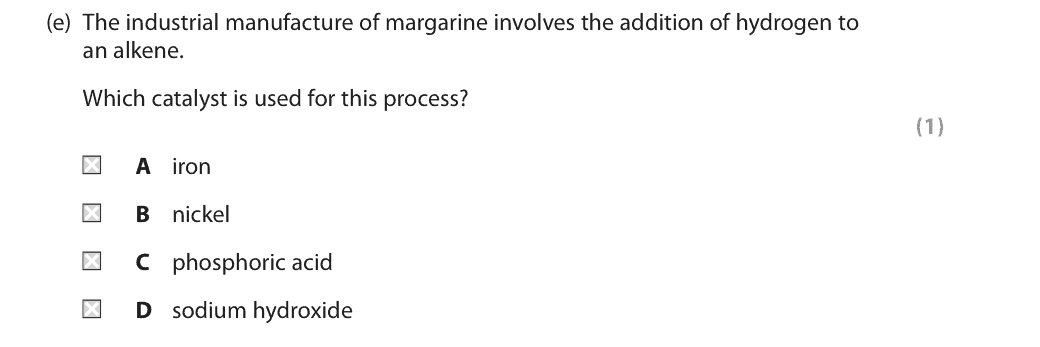
Answer: B (nickel). Iron is the Haber process catalyst
phosphoric acid and sodium hydroxide are not the heterogeneous catalyst this reaction needs
June 2023 · AS Paper 2 · Q3(f)1 markDiagram or structureHard
Mark scheme
Examiner's comment
This question was not answered well. Many candidates put the side group and/or the C=C in the backbone.
Notes from the mark scheme and report
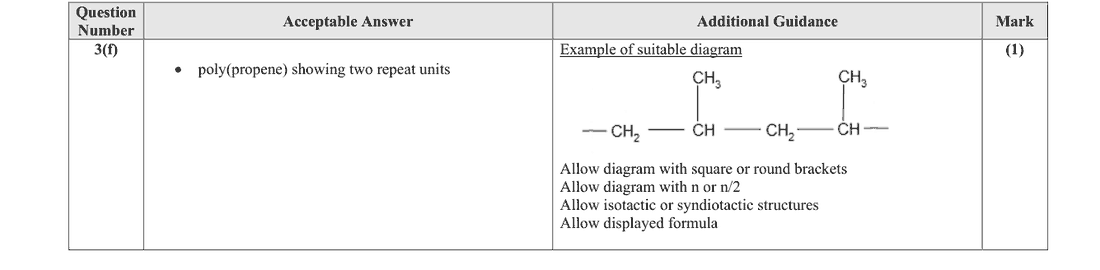
–CH2–CH(CH3)–CH2–CH(CH3)– with bonds extending at both ends. Brackets, n or n/2, displayed formulae, isotactic or syndiotactic arrangements all allowed. Many put the CH3 side group or a C=C in the backbone
June 2023 · AS Paper 2 · Q3(g)(i)4 marksMechanismEasy
Earlier part of question 3 that this part uses
Mark scheme
Examiner's comment
This question was answered extremely well, with only a very small number of candidates not understanding the question and therefore not scoring any marks. It was clear candidates had been well prepared for this.
Notes from the mark scheme and report
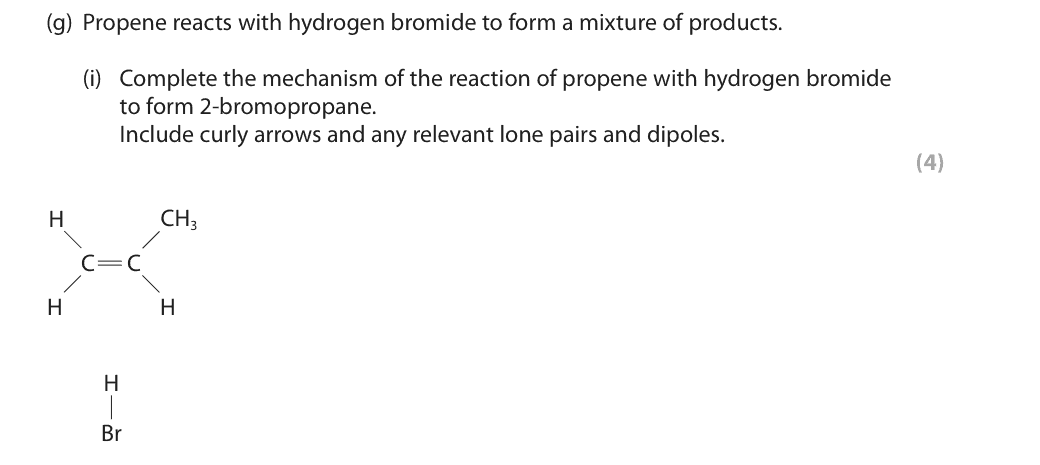
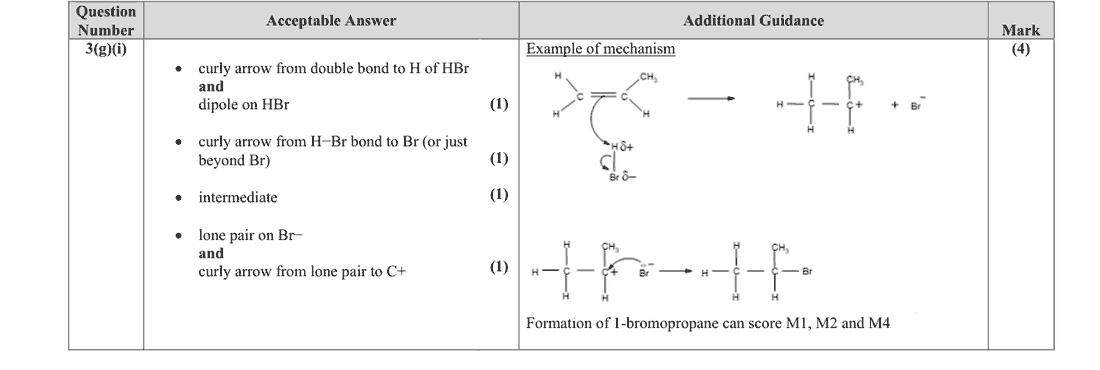
Curly arrow from the C=C bond to the H of HBr, with the δ+ H and δ– Br dipole
curly arrow from the H–Br bond to Br
the secondary carbocation intermediate CH3C+HCH3
a lone pair on Br– with a curly arrow from it to C+. A mechanism giving 1-bromopropane can score M1, M2 and M4
June 2023 · AS Paper 2 · Q3(g)(ii)1 markMultiple choice
Earlier part of question 3 that this part uses
Answer
A
Mark scheme
Notes from the mark scheme and report
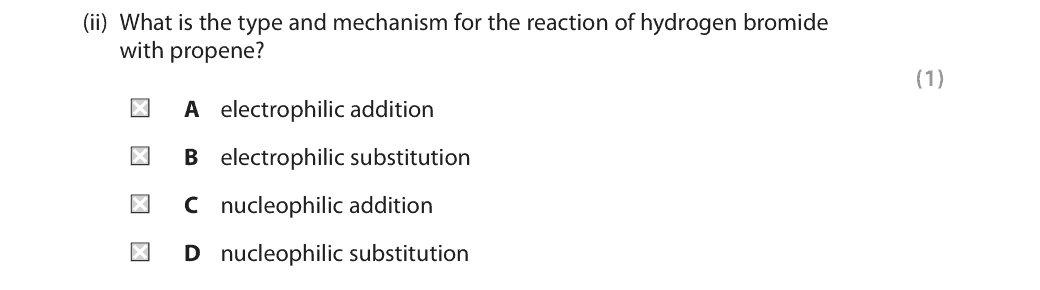
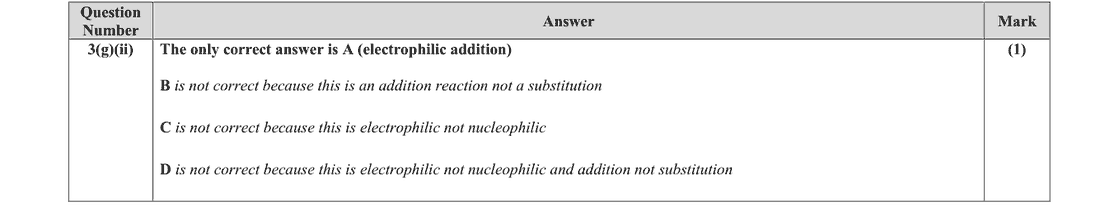
Answer: A (electrophilic addition). HBr adds across the double bond, so it is not substitution, and the attacking species is an electrophile, not a nucleophile
June 2023 · AS Paper 2 · Q3(h)(i)1 markShort answer
Mark scheme
Examiner's comment
Many answers referred to scrubbing but the answers were generally unconvincing. It was clear some candidates did not understand the meaning of the key terms.
Notes from the mark scheme and report
Scrub the gases with an alkali: pass them through an alkaline solution such as NaOH(aq) or over a solid base such as CaO. 'Neutralise' with no alkali named and dissolving in water are ignored. Many mentioned scrubbing but the answers were generally unconvincing
June 2023 · AS Paper 2 · Q3(h)(ii)1 markShort answer
Earlier part of question 3 that this part uses
Mark scheme
Examiner's comment
Many answers referred to scrubbing but the answers were generally unconvincing. It was clear some candidates did not understand the meaning of the key terms.
Notes from the mark scheme and report
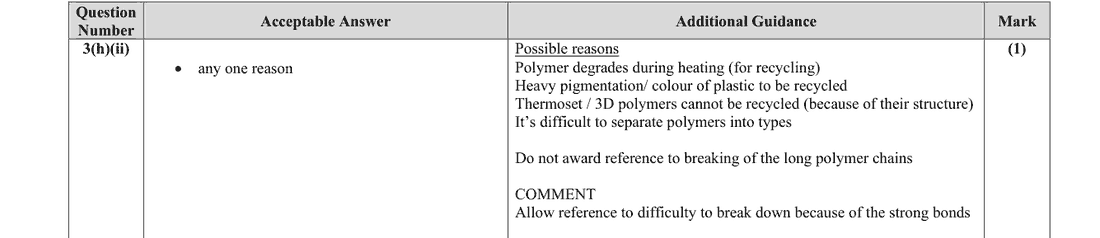
One reason, e.g. the polymer degrades when heated for recycling
heavy pigmentation / colour
thermosetting (3D) polymers cannot be remoulded
it is difficult to separate polymers into types. Not credited: the long polymer chains being broken
June 2023 · Paper 2 · Q4(b)(i)1 markMultiple choice
Answer
A
Mark scheme
Notes from the mark scheme and report
Answer: A. An electrophile accepts a pair of electrons. Nucleophiles donate a pair
unpaired electrons belong to radicals
June 2023 · Paper 2 · Q8(b)3 marksMechanism
Mark scheme
Notes from the mark scheme and report
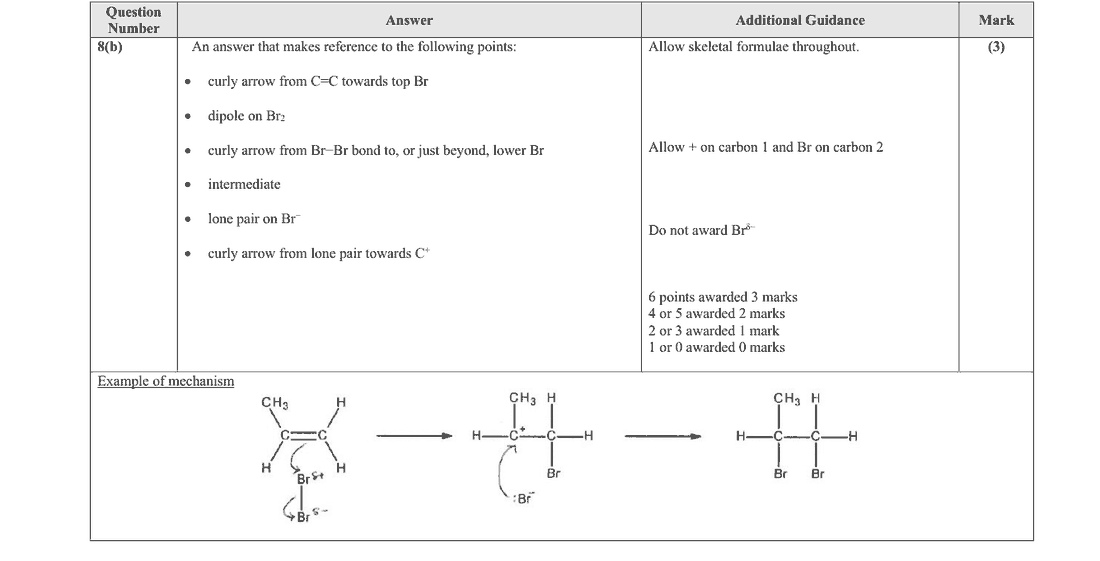
Six points for 3 marks (4 or 5 score 2
2 or 3 score 1): curly arrow from C=C to the nearer Br
dipole on Br2
curly arrow from the Br–Br bond to the far Br
carbocation intermediate (+ on either carbon)
lone pair on Br– (not Br δ–)
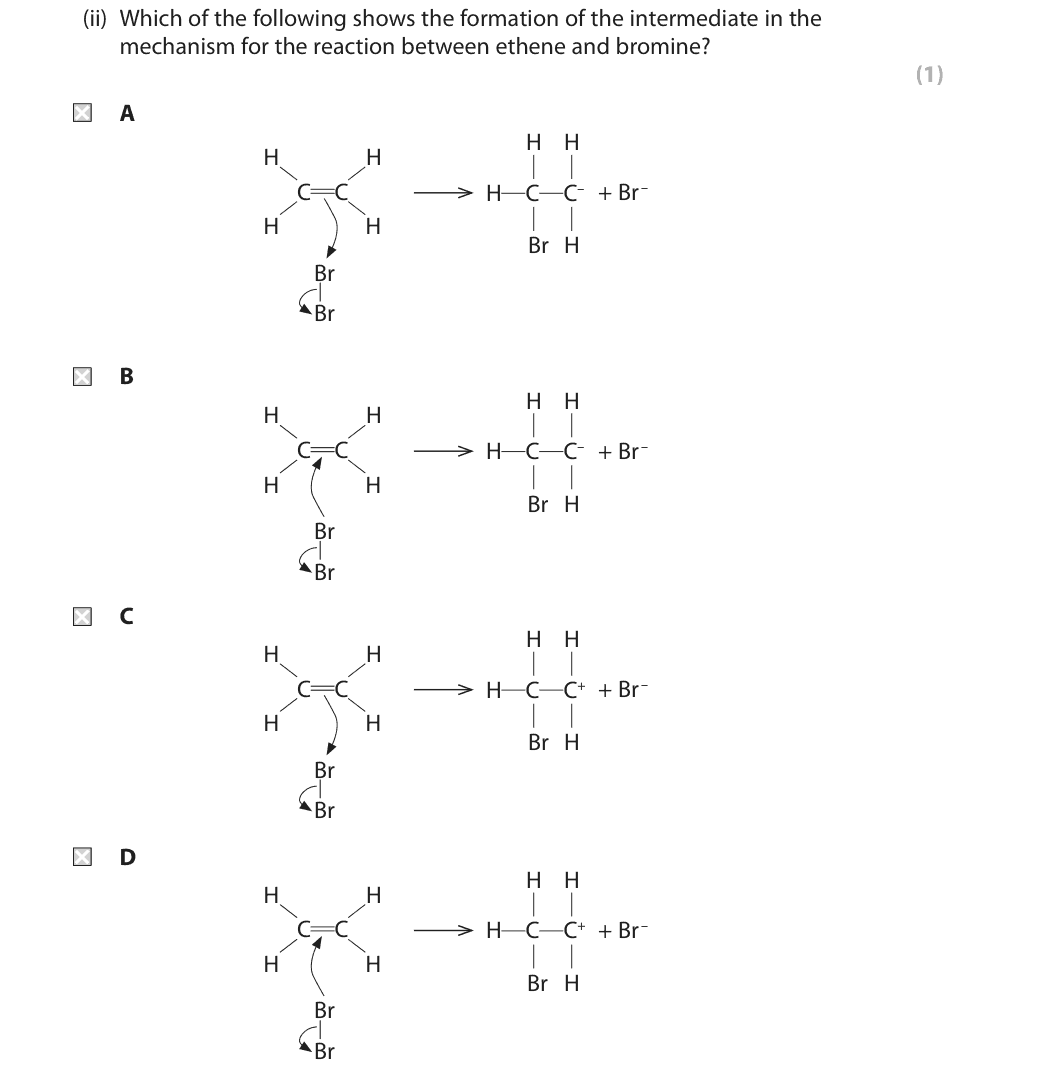
curly arrow from the lone pair to C+. Skeletal formulae allowed. The report (in its comment on 8(c)) says most found this straightforward
June 2023 · Paper 2 · Q8(c)(i)2 marksExplanation
Earlier parts of question 8 that this part uses
Mark scheme
Notes from the mark scheme and report
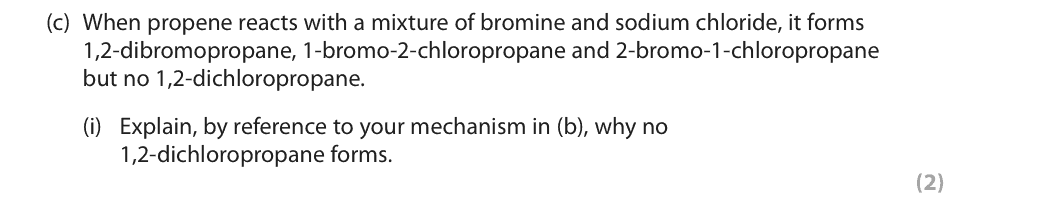
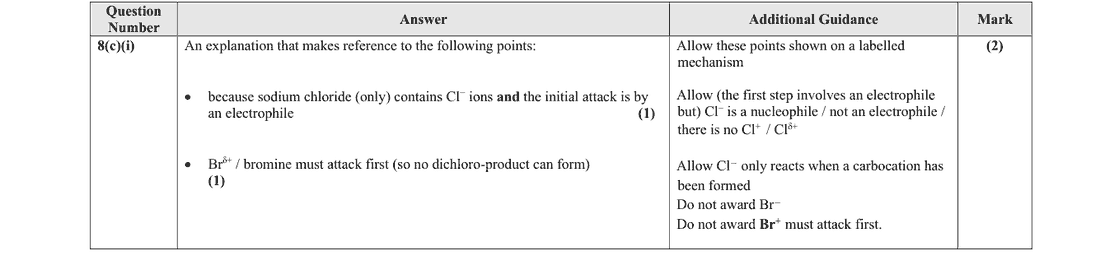
M1 sodium chloride contains only Cl– ions and the first attack on the alkene is by an electrophile (Cl– is a nucleophile
there is no Cl δ+)
M2 so Br δ+ / bromine must attack first, and Cl– can only react once the carbocation has formed. Not 'Br+ attacks first'. Many compared bond strengths or electronegativities of bromine and chlorine instead
June 2023 · Paper 2 · Q8(c)(ii)2 marksExplanation
Earlier part of question 8 that this part uses
Mark scheme
Examiner's comment
Most candidates found the first part of this question (8b) straightforward and drew a correct mechanism for electrophilic addition.
The second part (8ci-ii) was more complex and candidates found these questions more challenging. For 8(c)(i), they needed to consider the mechanism that they had drawn in 8(b) in
the light of the new information given and made the connection that Cl- ions would not be able to attack first as they would not act as an electrophile. Very few candidates did this, with lots of answers comparing the covalent bond strength in bromine with that of chlorine, or making comments about the relative electronegativities of the elements.
Part (c)(ii) was more accessible and required recognition that the preferential formation of 1-bromo-2 chloropropane would be due to relative stability of a secondary carbocation compared to a primary carbocation during the reaction.
Notes from the mark scheme and report
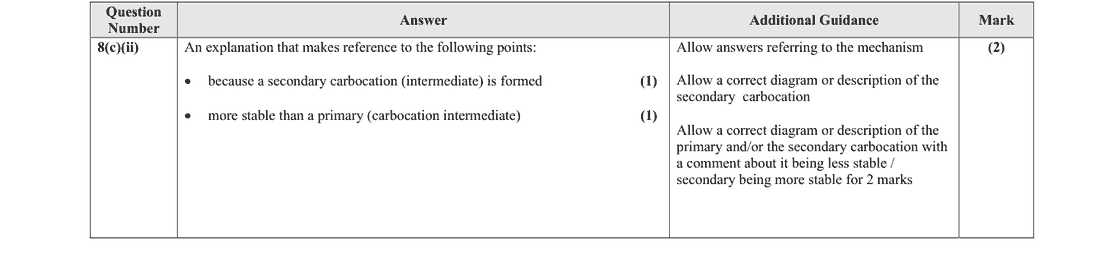
1-bromo-2-chloropropane forms via a secondary carbocation
which is more stable than the primary carbocation that leads to the other product. Diagrams of the carbocations with a comment on stability can score both. More accessible than (c)(i)
June 2023 · Paper 3 · Q3(d)(v)1 markPractical and data analysisEasy
Earlier parts of question 3 that this part uses
Mark scheme
Examiner's comment
The vast majority of candidates could clearly give the bromine test for alkenes which decolourise the halogen.
Notes from the mark scheme and report
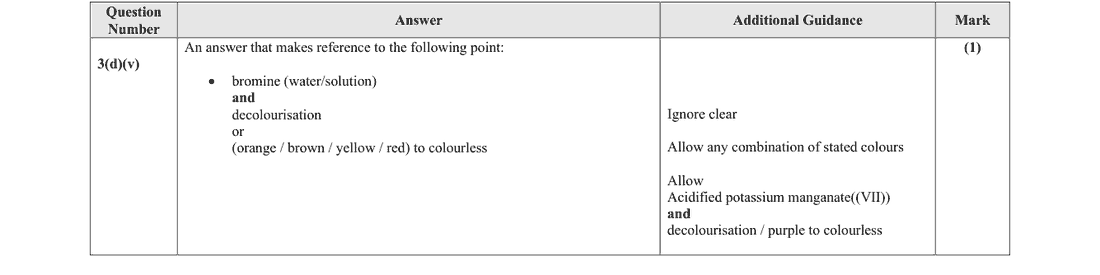
Bromine water is decolourised (orange / brown / yellow to colourless
'clear' is ignored). Acidified potassium manganate(VII), purple to colourless, also allowed
Skills: PT4 use laboratory apparatus for a variety of experimental techniques, including: titration, using burette and pipette; distillation and heating under reflux, including setting up glassware using retort stand and clamps; qualitative tests for ions and organic functional groups; filtration, including use of fluted filter paper, or filtration under reduced pressure; CP7 Core practical 7: Analysis of some inorganic and organic unknowns
June 2022 · Paper 2 · Q1(a)1 markMultiple choice
Answer
A
Mark scheme
Notes from the mark scheme and report
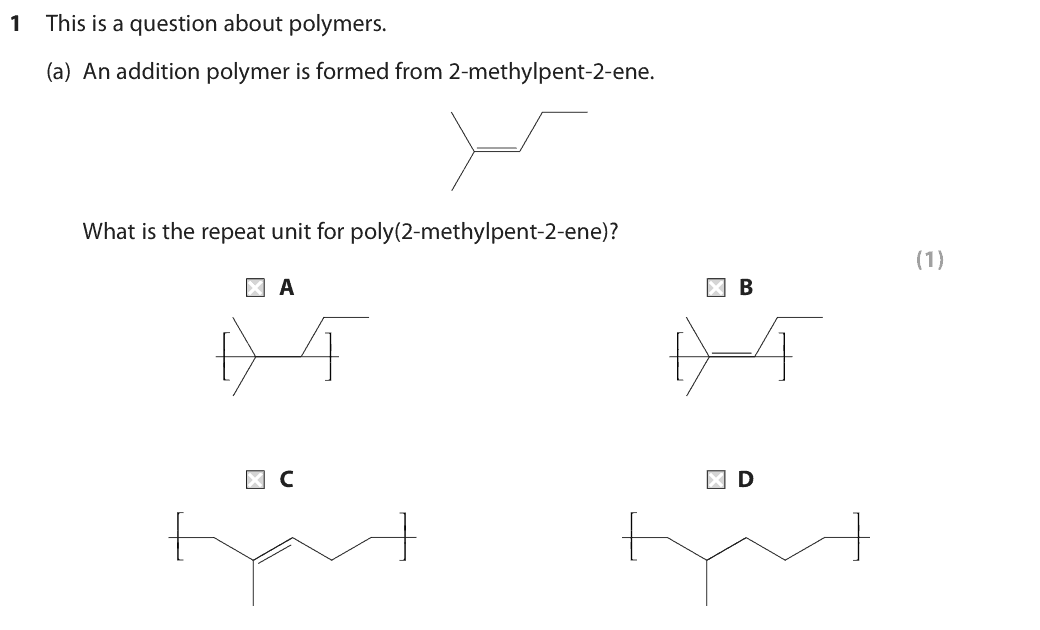
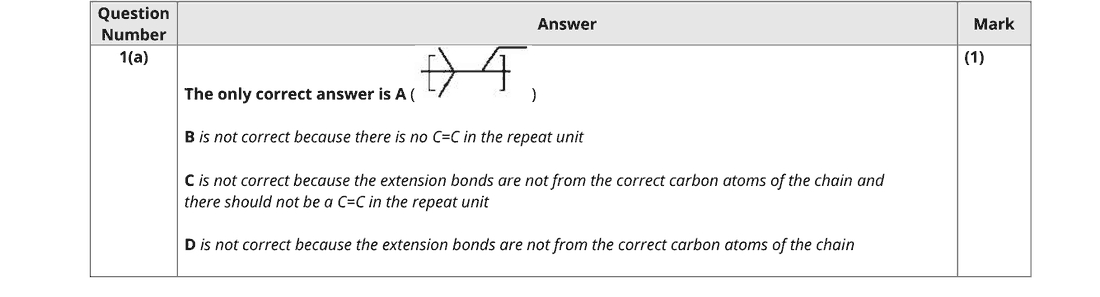
Answer: A. The repeat unit is the two carbons of the former C=C, now singly bonded, with the extension bonds from those two carbons and the methyl and ethyl groups as side chains. B and C still contain C=C
in C and D the extension bonds come from the wrong carbon atoms
June 2022 · Paper 2 · Q1(b)1 markMultiple choice
Answer
B
Mark scheme
Notes from the mark scheme and report
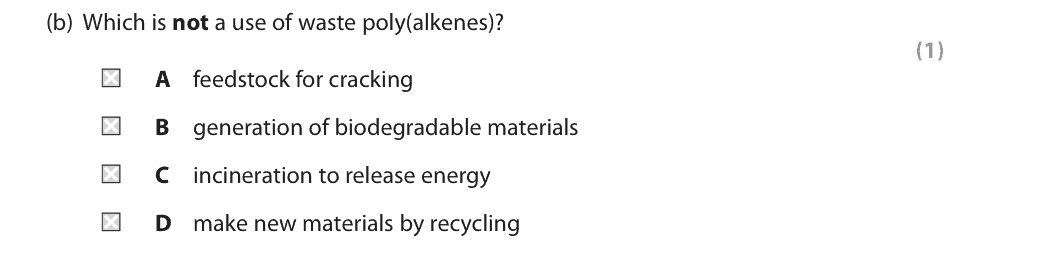
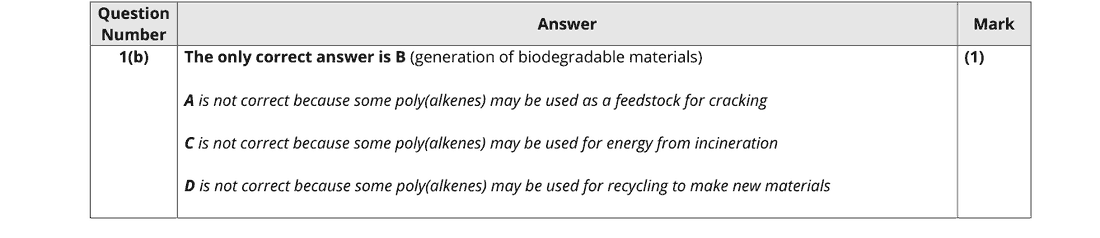
Answer: B. Waste poly(alkenes) can be recycled, incinerated to release energy or used as a feedstock for cracking
they are not used to generate biodegradable materials
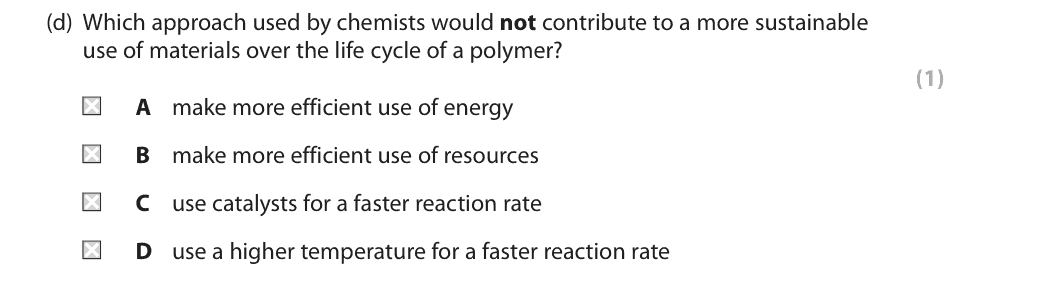
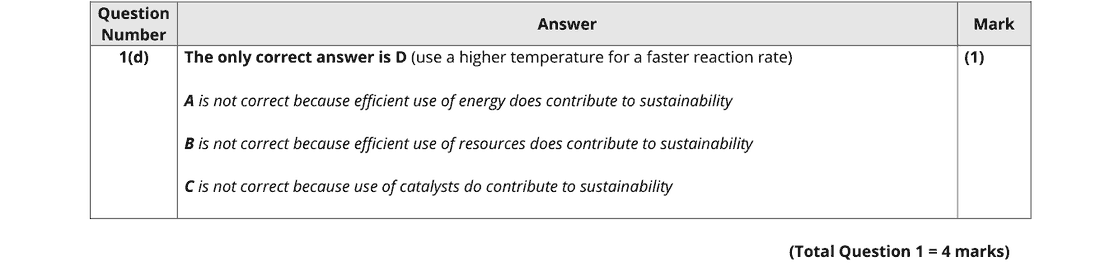
June 2022 · Paper 2 · Q1(d)1 markMultiple choice
Answer
D
Mark scheme
Notes from the mark scheme and report
Answer: D. Using a higher temperature uses more energy. More efficient use of energy and of resources, and catalysts, all contribute to sustainability
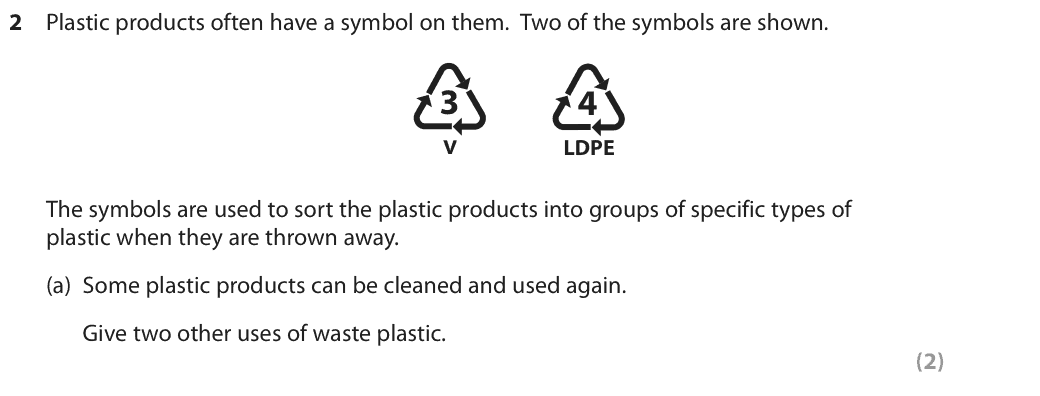
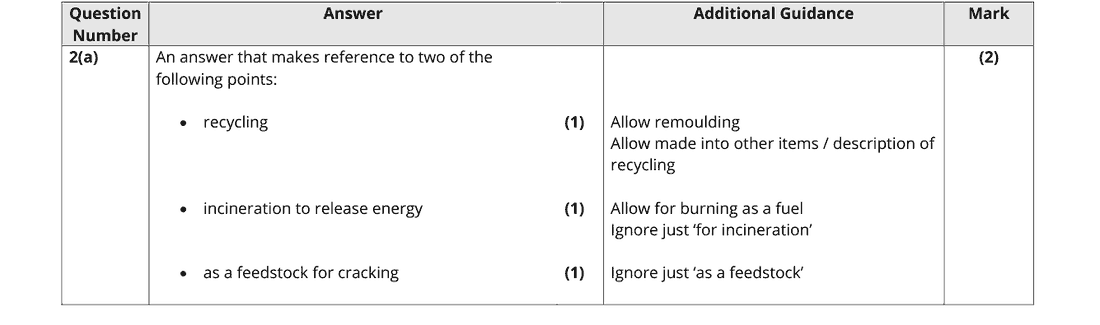
June 2022 · AS Paper 2 · Q2(a)2 marksShort answer
Mark scheme
Examiner's comment
(a) required candidates to respond with two uses of waste plastics other than the one given. The specification lists a further three. Most were able to get one mark, usually for recycling. The second mark, for use a feedstock in cracking reactions or for incineration for energy generation, proved harder to score. (b) this item proved very high scoring as candidates were able to demonstrate an understanding of polymer and monomer, a skill they have practiced since GCSE. (c) was well answered, with just over 60% scoring the mark here.
Notes from the mark scheme and report
Any two: recycling (remoulding, made into other items)
incineration to release energy (burning as a fuel)
feedstock for cracking. Just 'incineration' or just 'feedstock' is ignored. Most scored one mark, usually for recycling
the second was harder
June 2022 · AS Paper 2 · Q2(b)1 markShort answer
Earlier part of question 2 that this part uses
Mark scheme
Examiner's comment
(a) required candidates to respond with two uses of waste plastics other than the one given. The specification lists a further three. Most were able to get one mark, usually for recycling. The second mark, for use a feedstock in cracking reactions or for incineration for energy generation, proved harder to score. (b) this item proved very high scoring as candidates were able to demonstrate an understanding of polymer and monomer, a skill they have practiced since GCSE. (c) was well answered, with just over 60% scoring the mark here.
Notes from the mark scheme and report
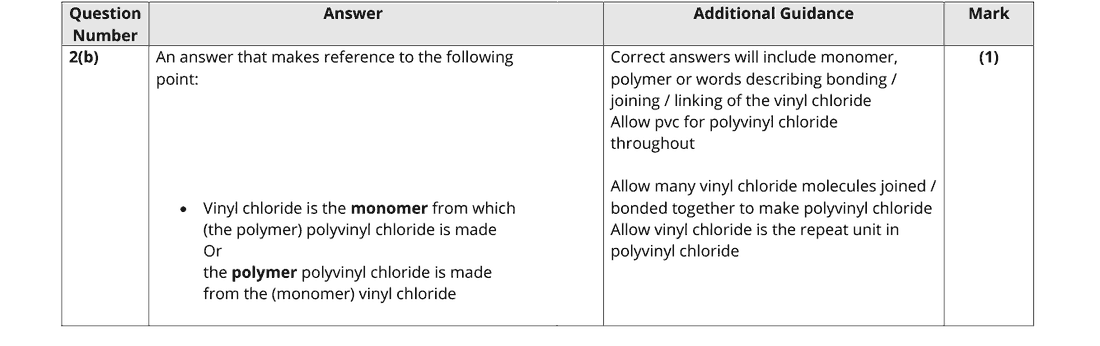
Vinyl chloride is the monomer from which the polymer polyvinyl chloride is made (many vinyl chloride molecules join together
allow 'repeat unit'). Very high scoring
June 2022 · AS Paper 2 · Q2(c)1 markMultiple choice
Earlier part of question 2 that this part uses
Answer
C
Mark scheme
Examiner's comment
(a) required candidates to respond with two uses of waste plastics other than the one given. The specification lists a further three. Most were able to get one mark, usually for recycling. The second mark, for use a feedstock in cracking reactions or for incineration for energy generation, proved harder to score. (b) this item proved very high scoring as candidates were able to demonstrate an understanding of polymer and monomer, a skill they have practiced since GCSE. (c) was well answered, with just over 60% scoring the mark here.
Notes from the mark scheme and report
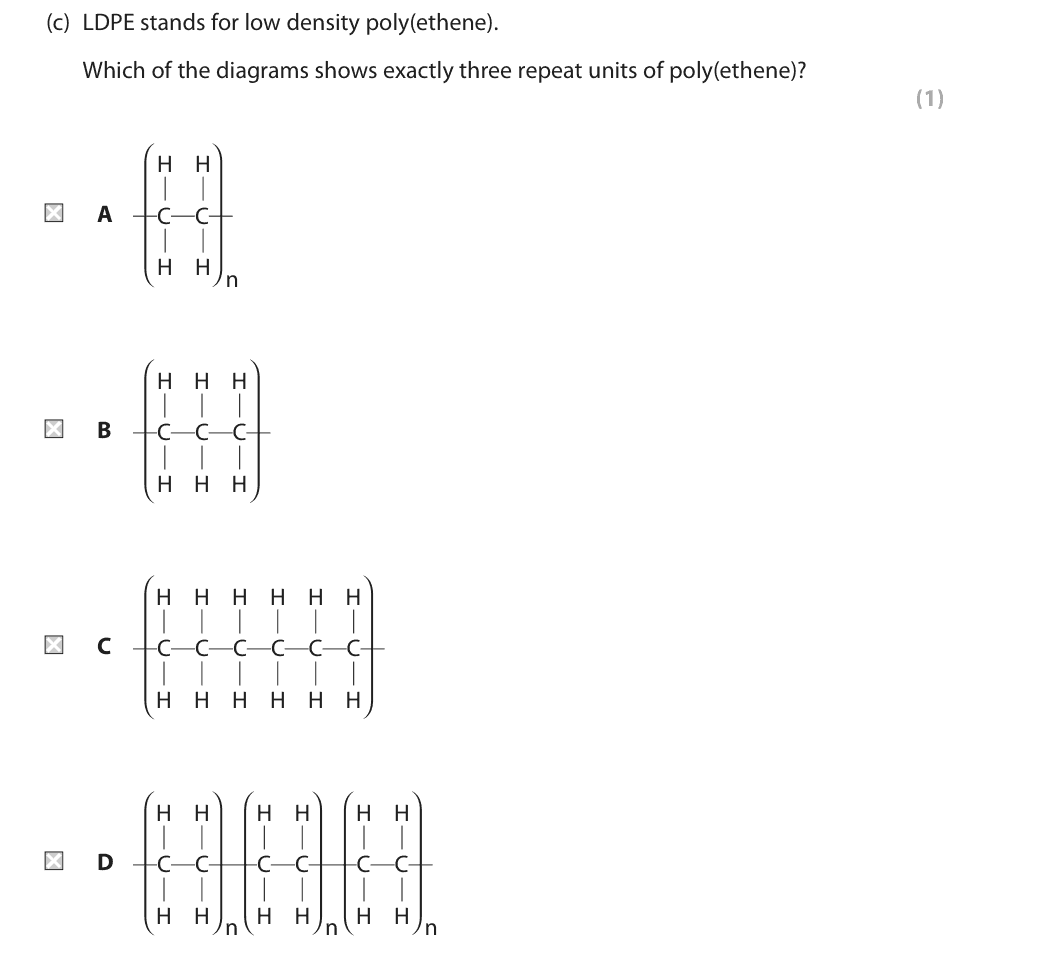
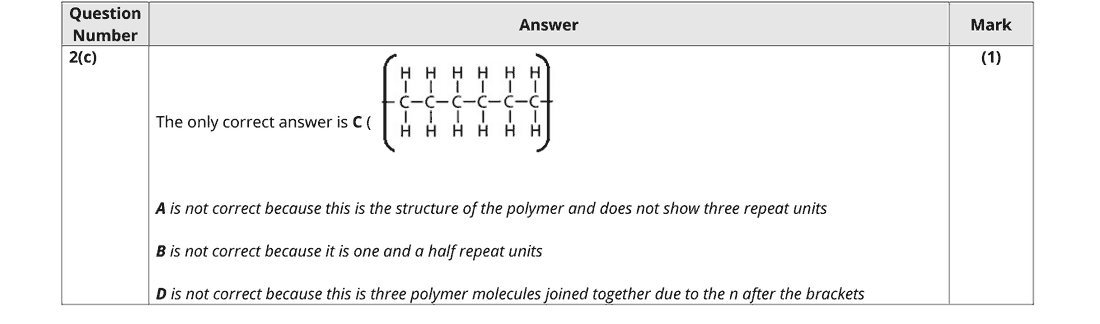
Answer: C. Six CH2 carbons in a chain with bonds through the brackets and no n: three –CH2–CH2– repeat units. A is the general formula of the polymer
B is one and a half repeat units
D has n after each bracket. Just over 60% chose correctly
June 2022 · Paper 2 · Q2(c)1 markMultiple choice
Answer
D
Mark scheme
Notes from the mark scheme and report
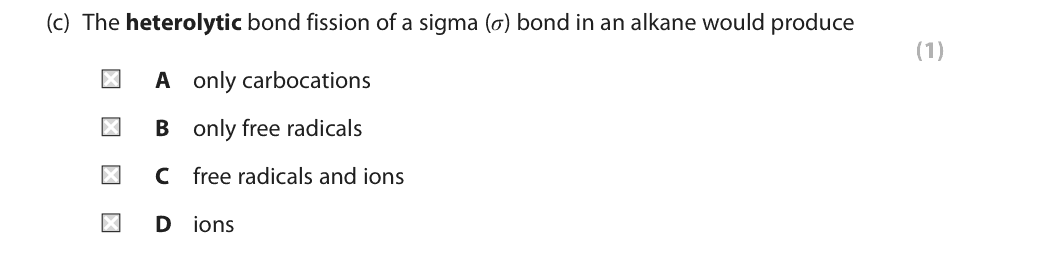
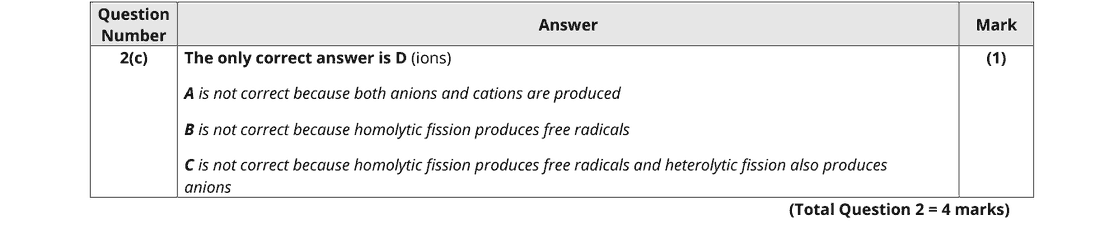
Answer: D. Heterolytic fission gives a cation and an anion, so ions. Not only carbocations (an anion forms too)
free radicals come from homolytic fission
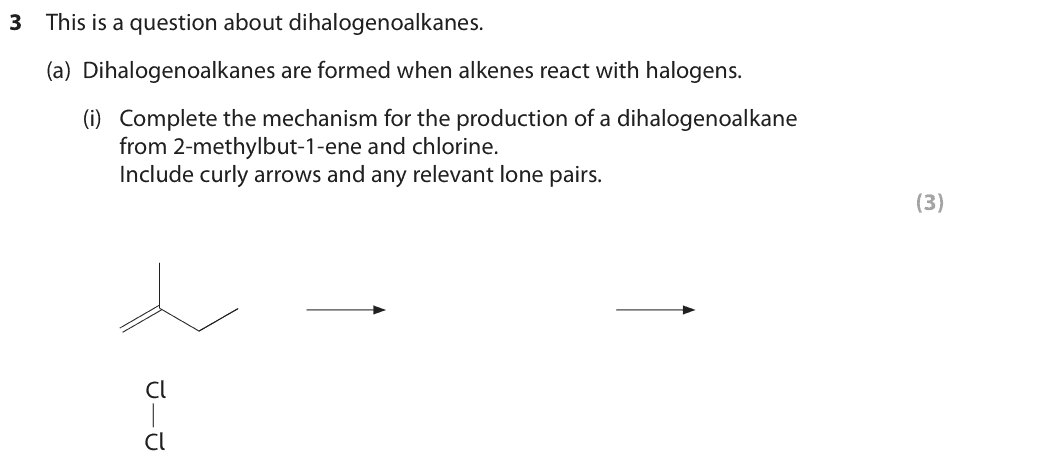
June 2022 · Paper 2 · Q3(a)(i)3 marksMechanism
Mark scheme
Examiner's comment
(i) Understanding of mechanism is improving with a number of completely correct responses here. Some candidates still do not have a basic understanding of curly arrows as seen by their drawing them originating from atoms or terminating at bonds. Further skeletal formulae proved too challenging for some candidates with a disappearing carbon atom being seen on a number of occasions.
(ii) The most common mistake was to give the name as 2-methyl-1,2-dichlorobutane but this is incorrect. Candidates need to understand that the prefixes are given in alphabetical order.
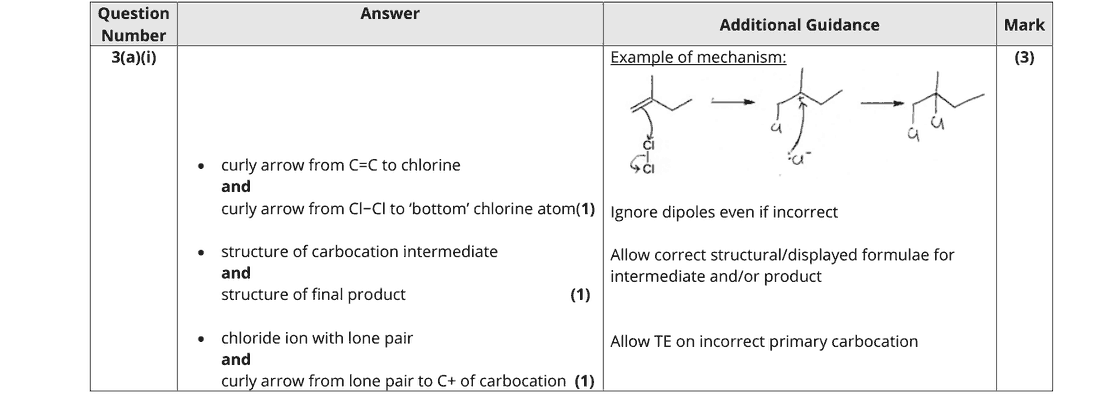
Notes from the mark scheme and report
M1 curly arrow from the C=C to the nearer chlorine and curly arrow from the Cl–Cl bond to the other chlorine
M2 tertiary carbocation intermediate (Cl on the end carbon) and the final product
M3 chloride ion with a lone pair and curly arrow from the lone pair to C+. Dipoles ignored
transferred error on a primary carbocation. Errors: curly arrows starting from atoms or ending on bonds
a carbon atom lost from the skeletal formula
June 2022 · AS Paper 2 · Q5(a)(i)1 markShort answer
Mark scheme
Examiner's comment
(a), the electrophilic addition reaction, proved rather more accessible than the later free-radical substitution items. In (a)(i) hydrogen chloride was commonly given, though chlorine was also suggested. The mechanism in (a)(ii) was generally well done, with only a few of the usual errors in arrow direction, dipoles and charges seen. (b) was less well understood, with a variety of reagents and conditions given in (b)(i), though over 60% of candidates identified the reaction was a free radical substitution in (b)(ii). For those who gave the wrong reagent and conditions, it was possible to score some marks in (b)(iii) by giving and naming the two product structures. Those with the correct reagents still struggled in (b)(iii) with full marks rarely seen. (b)(iv), (b)(v) and (b)(vi) all needed an understanding of the isotopes of chlorine, or were easier if this was understood. Those candidates who recognised this as the key factor scored well, while those that didn’t struggled to pick up any marks.
Notes from the mark scheme and report
Answer: hydrogen chloride, HCl(g). Not hydrochloric acid / HCl(aq)
not chlorine. If a name and a formula are given both must be right. Chlorine was the common wrong answer
June 2022 · AS Paper 2 · Q5(a)(ii)4 marksMechanism
Earlier part of question 5 that this part uses
Mark scheme
Examiner's comment
(a), the electrophilic addition reaction, proved rather more accessible than the later free-radical substitution items. In (a)(i) hydrogen chloride was commonly given, though chlorine was also suggested. The mechanism in (a)(ii) was generally well done, with only a few of the usual errors in arrow direction, dipoles and charges seen. (b) was less well understood, with a variety of reagents and conditions given in (b)(i), though over 60% of candidates identified the reaction was a free radical substitution in (b)(ii). For those who gave the wrong reagent and conditions, it was possible to score some marks in (b)(iii) by giving and naming the two product structures. Those with the correct reagents still struggled in (b)(iii) with full marks rarely seen. (b)(iv), (b)(v) and (b)(vi) all needed an understanding of the isotopes of chlorine, or were easier if this was understood. Those candidates who recognised this as the key factor scored well, while those that didn’t struggled to pick up any marks.
Notes from the mark scheme and report
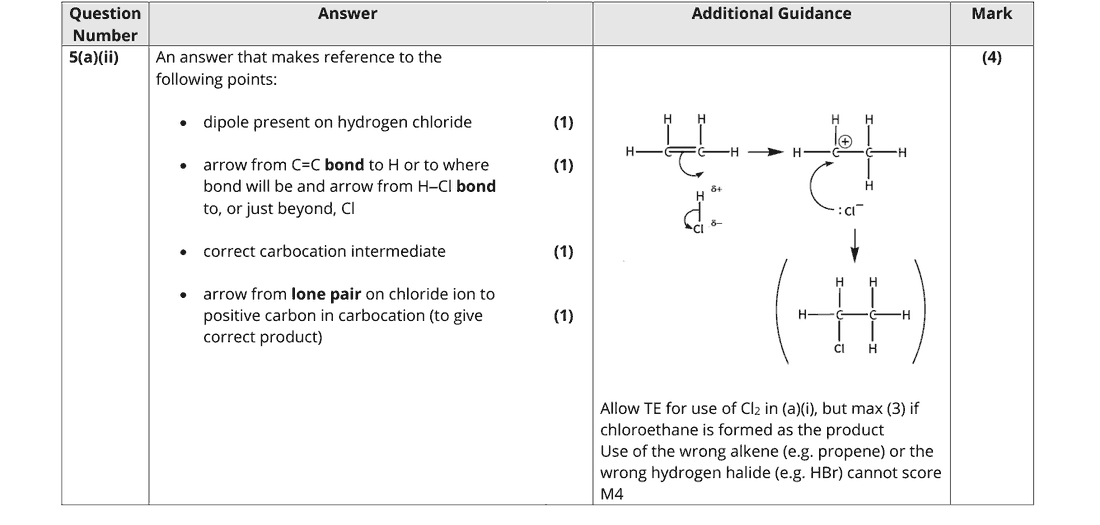
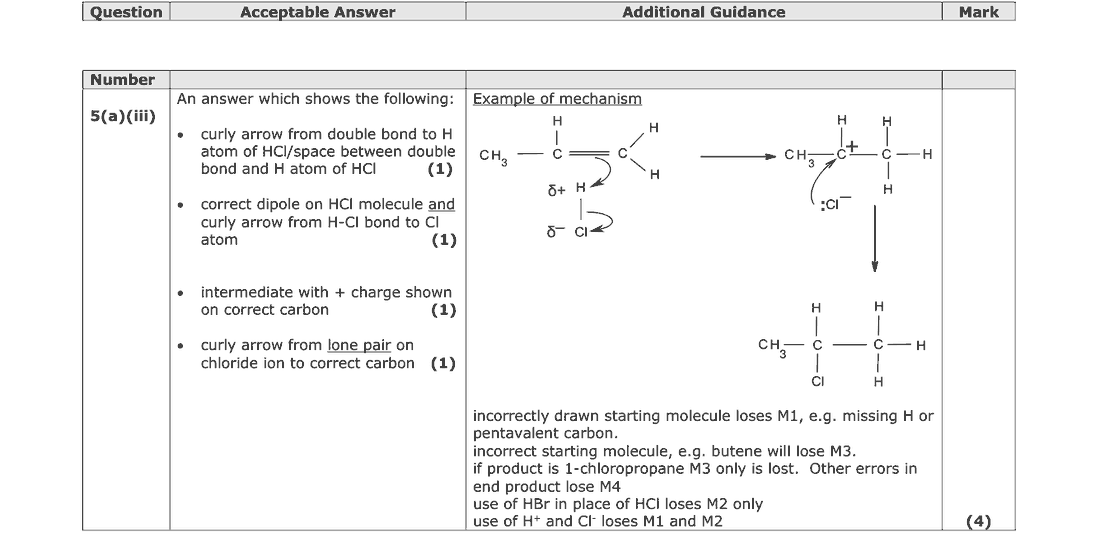
Dipole on H–Cl (Hδ+, Clδ–)
curly arrow from the C=C bond to the H and from the H–Cl bond to the Cl
the correct carbocation CH3CH2+
curly arrow from a lone pair on Cl– to the C+, giving chloroethane. If Cl2 was used in (a)(i), max 3 if chloroethane is shown as the product
the wrong alkene or hydrogen halide cannot score the last mark. Generally well done, with a few of the usual errors in arrow direction, dipoles and charges
June 2022 · Paper 3 · Q7(a)(iii)2 marksEquation writing
Earlier part of question 7 that this part uses
Mark scheme
Examiner's comment
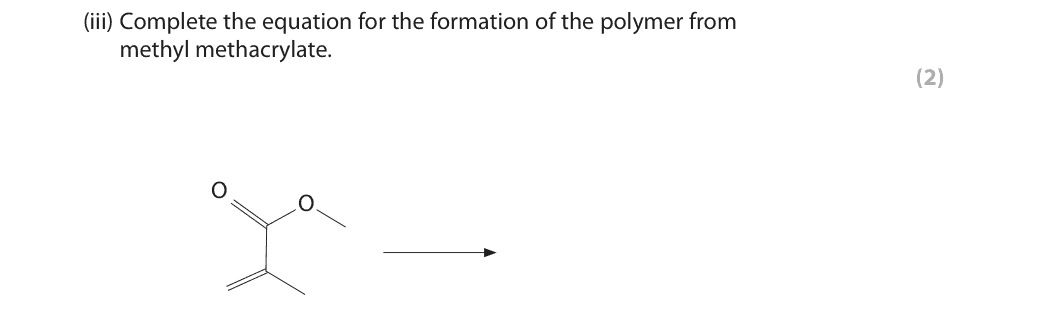
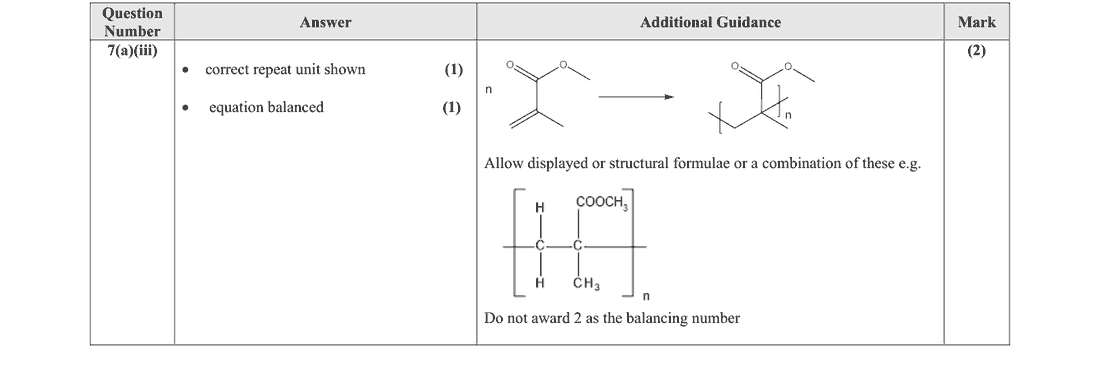
Many candidates did not understand the skeletal formula of methyl methacrylate so they were unable to complete the equation for the formation of the polymer. The most successful candidates redrew the structure as a displayed formula and they almost all scored 2 marks, although a few omitted the hydrogen atoms on the CH2 group. Some candidates tried to
write an equation with 2s instead of ns.
Notes from the mark scheme and report
n monomers on the left
on the right the repeat unit –CH2–C(CH3)(COOCH3)– in brackets with n. One mark for the repeat unit, one for balancing with n (not 2). Many could not read the skeletal formula
those who redrew it as a displayed formula nearly always scored both, though a few left the hydrogens off the CH2
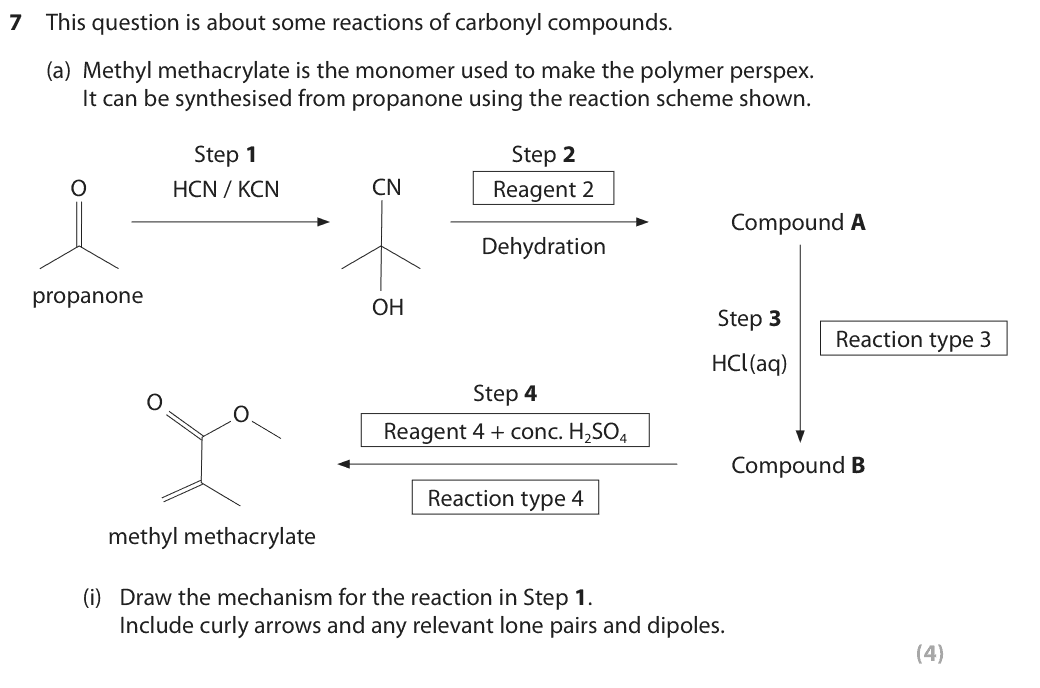
November 2021 · Paper 2 · Q4(c)4 marksMechanism
Earlier part of question 4 that this part uses
Mark scheme
Examiner's comment
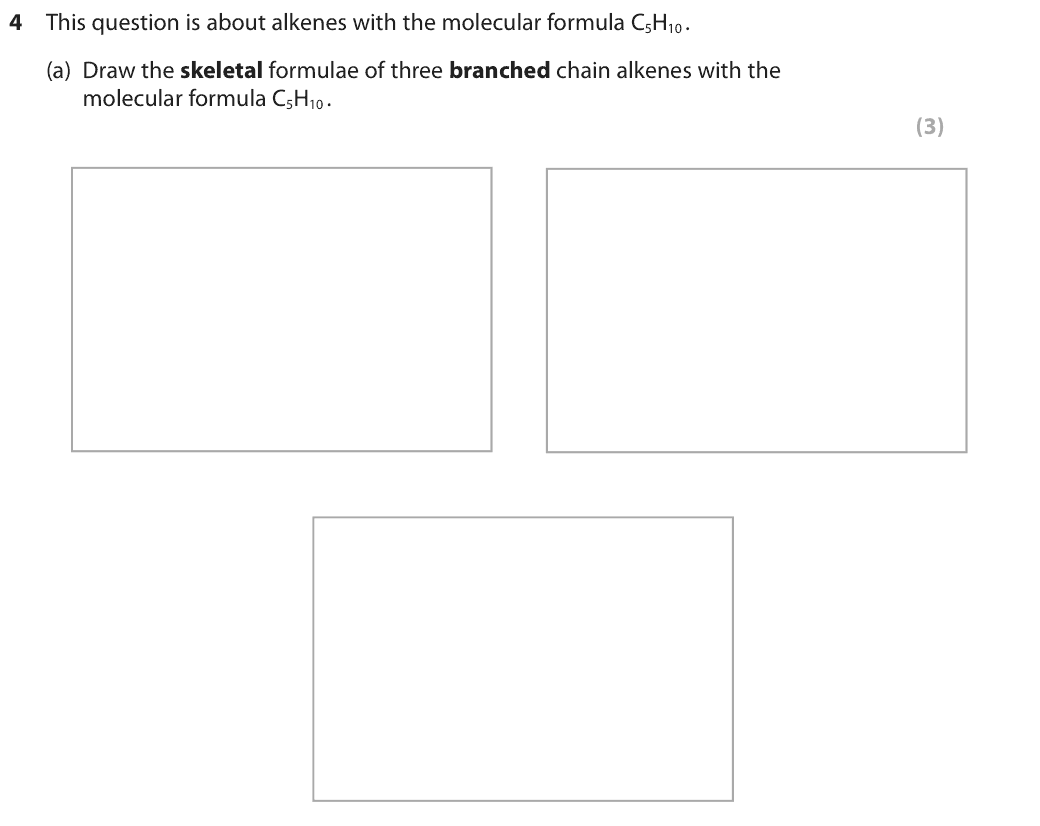
Again, the text in bold seemed to be ignored by many, as a number of candidates produced
isomers based on a linear five-carbon chain, with no branches. It was common to see two
pent-1-ene structures proposed, though drawn differently. For instance, the C=C bond would
be shown on the far left in the first answer, then on the far right in the second. Others simply
angled their second attempt up or down the page, but did not spot that it was still a five-
carbon chain.
Other candidates could draw a correct structure, but as described above, drew it again in a
different orientation, thinking this was a new isomer. A majority of candidates could identify
which alcohol would form pent-2-ene in (b) and the mechanism in (c) was confidently handled
by many. The most common issues were ones of detail, with the omission of key features
such as the dipole on the H-Br molecule, and a lone pair on the bromide ion. A frustrating
minority ignored the instruction in the question and showed 3-bromopentane as the product.
The calculation in (d) showed most candidates have a secure understanding of the Ideal Gas
Equation. However, minor slips meant some candidates did not access all four marks. These
included:
using an incorrect relative molecular mass of pent-1-ene to determine n
incorrect conversion of temperature to K and/or volume to m3
incorrect number of significant figures and / or units
A small number of candidates converted the volume to dm3. Sometimes this seemed to be a
deliberate strategy, with the candidate realising that this results in a pressure measure in kPa.
Others, however, may have confused the units with those required in titration problems, and
hence made errors in the final units for pressure. Candidates need to be careful that their
rationale is clear if they adopt this route, and the best way is to ensure all steps of the
calculation are clearly labelled and presented in a clearly defined order.
Notes from the mark scheme and report
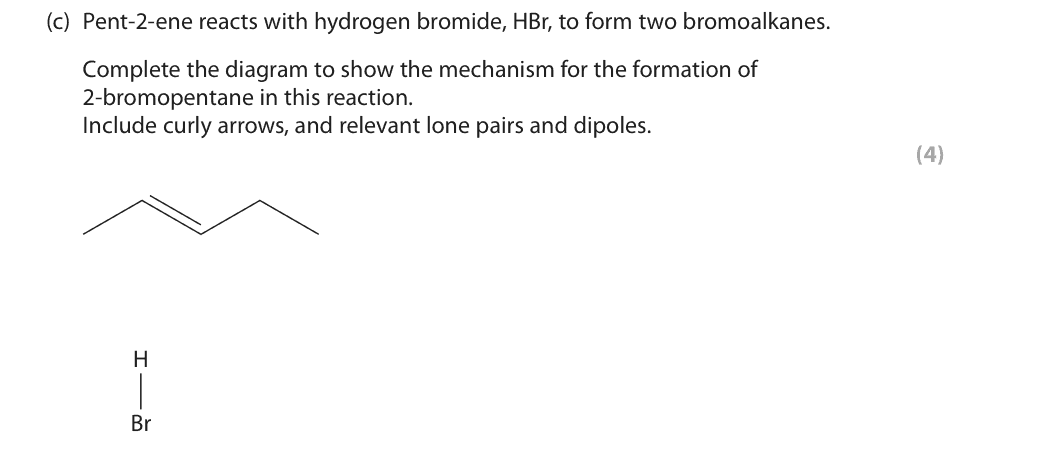
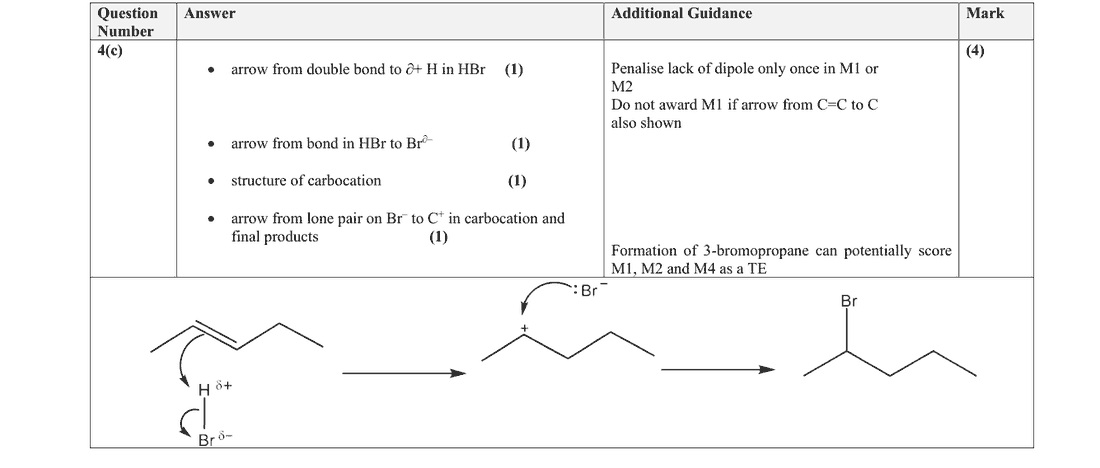
M1 curly arrow from the C=C to the δ+ H of HBr
M2 curly arrow from the H–Br bond to Br δ– (missing dipole penalised once)
M3 secondary carbocation with + on carbon 2
M4 curly arrow from a lone pair on Br– to C+ and the product 2-bromopentane. Forming 3-bromopentane can score M1, M2 and M4. Confidently handled by many
marks were lost for no dipole on HBr, no lone pair on the bromide ion, or giving 3-bromopentane
November 2021 · AS Paper 2 · Q6(d)(ii)1 markDiagram or structure
Earlier parts of question 6 that this part uses
Mark scheme
Examiner's comment
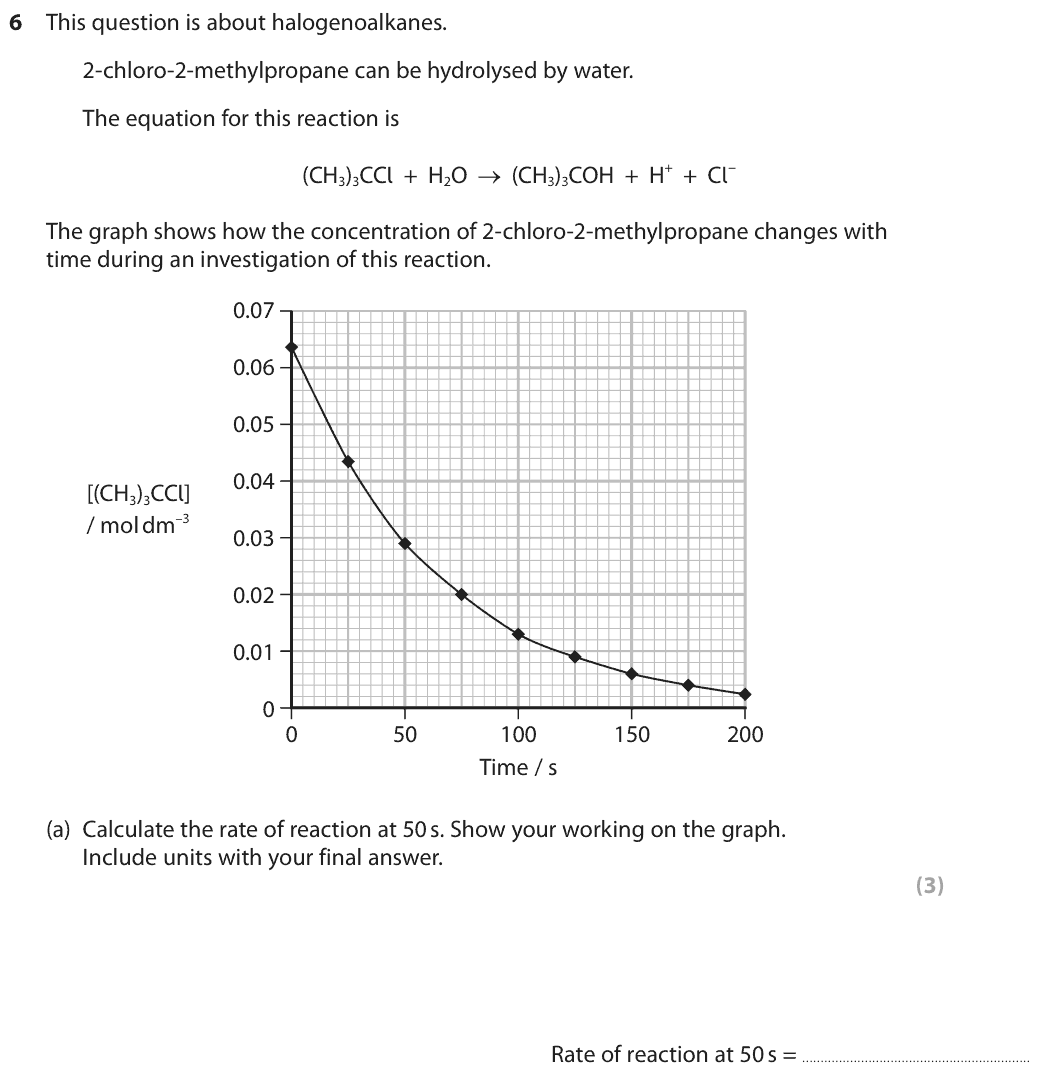
(a) This question involved the use of a tangent to a curve as a means of measuring reaction rate at
a given time. This question has been presented in this format several times in recent years. Most
candidates were familiar with the procedure although the manipulation of the numerical data was
less successful.
(b) This multiple-choice question addressed the classification of a hydrolysis mechanism. Most
candidates were successful in scoring the mark.
(c) Parts (i) and (ii) of this question related to the rates of, and conditions for, the hydrolysis of
halogenoalkanes. Both of these questions have appeared frequently in past papers and should
have been familiar to candidates.
(d) This question involved the conversion of a halogenoalkane to an alkene. (d)(i) was a simple
recall of reaction conditions. Most candidates did not achieve marks. In (d)(ii) candidates struggled
with the repeat unit of a polymer. Common errors included the retention of a C=C in the backbone
of the polymer, and the inclusion of one or both side groups in the backbone. This is relatively easy
chemistry but it does require practice in writing the repeat unit. The errors seen are common with
questions relating to repeat units. Part (iii) was a more challenging question and there was
considerable success by many candidates. Candidates are becoming familiar with the requirement
for a mechanism, and it would seem to be a specification topic that has been well taught.
Notes from the mark scheme and report
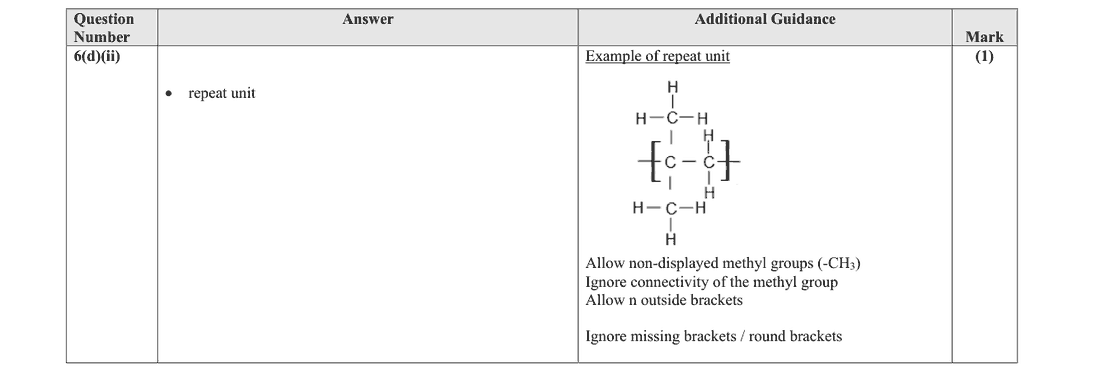
Repeat unit –C(CH3)2–CH2– : a two-carbon backbone with both methyl groups on one carbon and two H on the other, with open bonds at each end. Methyl groups need not be displayed
brackets and n not required. Common errors: keeping a C=C in the backbone
putting one or both methyl carbons in the backbone
November 2021 · AS Paper 2 · Q6(d)(iii)4 marksMechanism
Earlier parts of question 6 that this part uses
Mark scheme
Examiner's comment
(a) This question involved the use of a tangent to a curve as a means of measuring reaction rate at
a given time. This question has been presented in this format several times in recent years. Most
candidates were familiar with the procedure although the manipulation of the numerical data was
less successful.
(b) This multiple-choice question addressed the classification of a hydrolysis mechanism. Most
candidates were successful in scoring the mark.
(c) Parts (i) and (ii) of this question related to the rates of, and conditions for, the hydrolysis of
halogenoalkanes. Both of these questions have appeared frequently in past papers and should
have been familiar to candidates.
(d) This question involved the conversion of a halogenoalkane to an alkene. (d)(i) was a simple
recall of reaction conditions. Most candidates did not achieve marks. In (d)(ii) candidates struggled
with the repeat unit of a polymer. Common errors included the retention of a C=C in the backbone
of the polymer, and the inclusion of one or both side groups in the backbone. This is relatively easy
chemistry but it does require practice in writing the repeat unit. The errors seen are common with
questions relating to repeat units. Part (iii) was a more challenging question and there was
considerable success by many candidates. Candidates are becoming familiar with the requirement
for a mechanism, and it would seem to be a specification topic that has been well taught.
Notes from the mark scheme and report
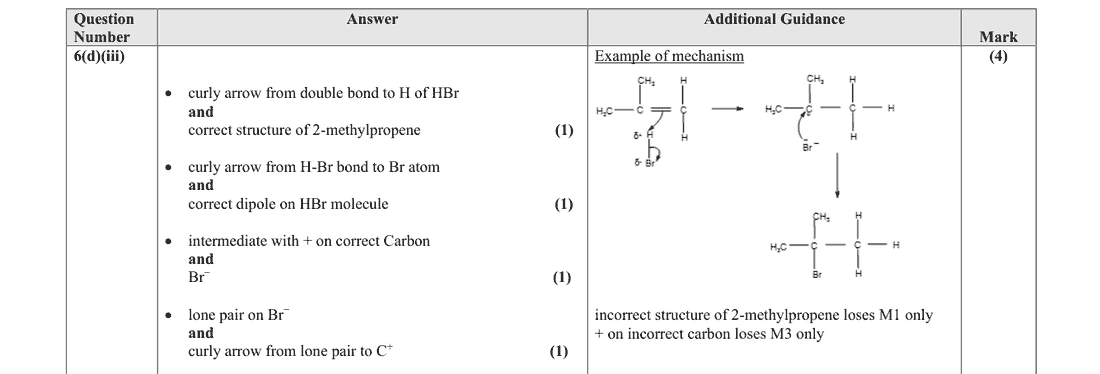
M1 curly arrow from the C=C to the H of HBr, with a correct structure of 2-methylpropene
M2 curly arrow from the H–Br bond to Br and the dipole (δ+ on H, δ– on Br)
M3 tertiary carbocation with + on the correct carbon, and Br–
M4 lone pair on Br– and curly arrow from it to the C+. A wrong alkene structure loses M1 only
+ on the wrong carbon loses M3 only. The report says many candidates had considerable success
November 2021 · Paper 2 · Q7(a)6 marks6-mark extended response
Mark scheme, with the indicative content and the marks for reasoning
Examiner's comment
Although the monomers may have been unfamiliar to many, the chemistry involved in the
polymerisation reactions in (a) is relatively simple, and consistent with the GCSE specification.
Hence it was disappointing to see many low scores. The most accessible marks were for
linking the monomers to the type of polymerisation. Despite guidance in the stem of the
question, few were able to construct equations for each reaction, though some were able to
give the formulae of the repeat units. The most common error was showing the extension
bonds on poly(cyclohexene) emanating from positions 1 and 4 on the carbon ring. Whilst
many recognised the production of water in the condensation reaction, only a few, as
demanded by the command word, contrasted this with the addition reaction. Most
candidates were able to score at least a mark in (b), nearly always for the idea of recycling
/reusing the polymers. A number framed their answer in the context of how chemists can
limit the problems caused by polymer disposal, rather than the more sustainable use of the
materials, demanded by the question.
Notes from the mark scheme and report
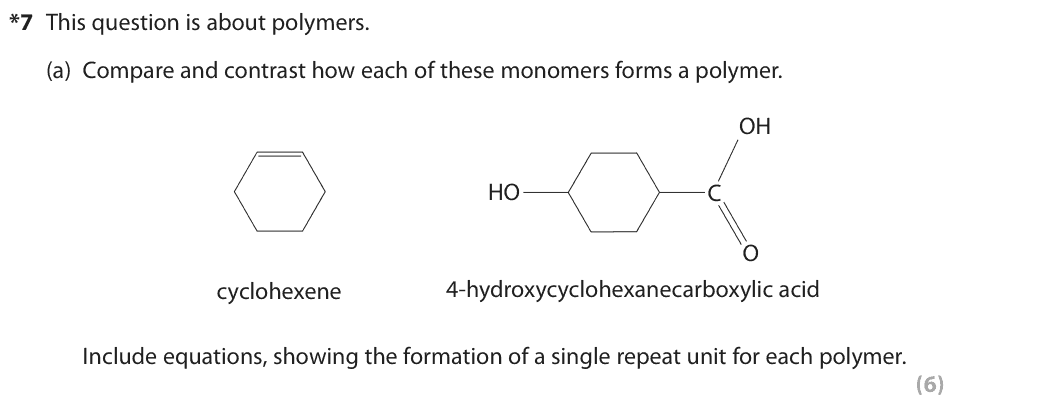
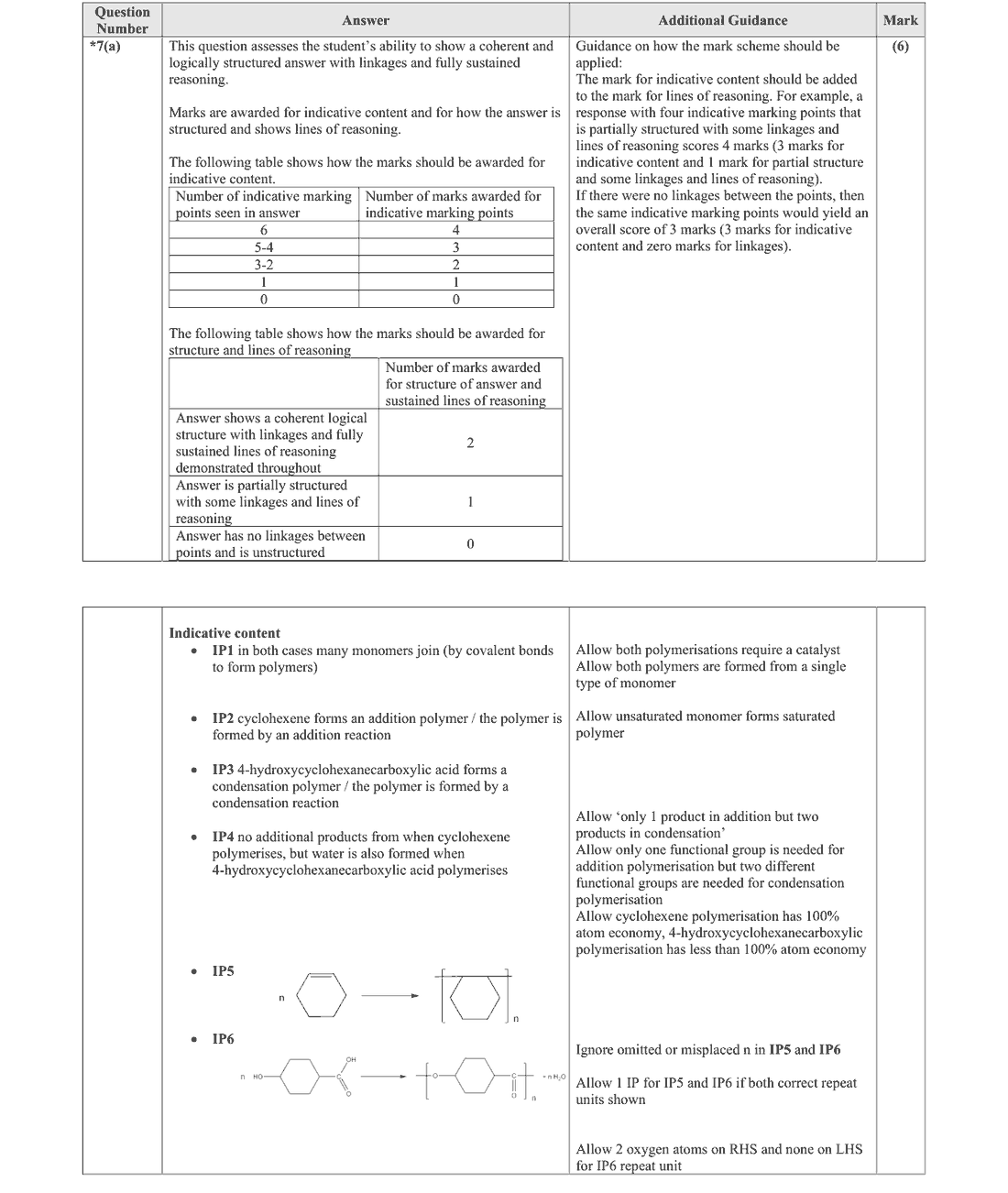
Six indicative points plus two marks for reasoning. IP1 in both, many monomers join to form the polymer
IP2 cyclohexene forms an addition polymer
IP3 4-hydroxycyclohexanecarboxylic acid forms a condensation polymer (polyester)
IP4 no other product from cyclohexene, but water also forms from the hydroxy acid (or one functional group against two different ones
or 100% atom economy against less)
IP5 equation giving the poly(cyclohexene) repeat unit, bonds from adjacent ring carbons
IP6 equation giving the polyester repeat unit –O–C6H10–CO– and water. n is ignored
two correct repeat units without equations score one point. Many low scores: few wrote equations
extension bonds were drawn from ring positions 1 and 4
water was noted but seldom contrasted with addition
November 2021 · Paper 2 · Q7(b)3 marksShort answer
Mark scheme
Examiner's comment
Although the monomers may have been unfamiliar to many, the chemistry involved in the
polymerisation reactions in (a) is relatively simple, and consistent with the GCSE specification.
Hence it was disappointing to see many low scores. The most accessible marks were for
linking the monomers to the type of polymerisation. Despite guidance in the stem of the
question, few were able to construct equations for each reaction, though some were able to
give the formulae of the repeat units. The most common error was showing the extension
bonds on poly(cyclohexene) emanating from positions 1 and 4 on the carbon ring. Whilst
many recognised the production of water in the condensation reaction, only a few, as
demanded by the command word, contrasted this with the addition reaction. Most
candidates were able to score at least a mark in (b), nearly always for the idea of recycling
/reusing the polymers. A number framed their answer in the context of how chemists can
limit the problems caused by polymer disposal, rather than the more sustainable use of the
materials, demanded by the question.
Notes from the mark scheme and report
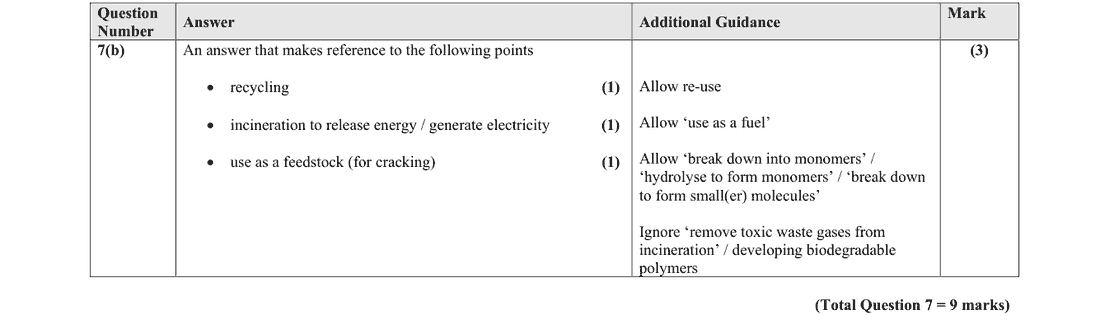
Recycling (allow re-use)
incineration to release energy / generate electricity (allow use as a fuel)
use as a feedstock for cracking (allow break down into monomers or smaller molecules). Removing toxic gases and developing biodegradable polymers are ignored. Most scored at least one, nearly always recycling
November 2021 · Paper 3 · Q2(b)2 marksPractical and data analysis
Earlier part of question 2 that this part uses
Mark scheme
Examiner's comment
A low number of candidates knew a chemical test for a carboxylic acid. Some suggested the
use of phosphorus(V) chloride but that would also give a positive result for the OH group in
substance B. The use of an indicator is not classed as a chemical test so was not given full
credit. A larger number of candidates knew how to test for an alkene using bromine water.
The majority of candidates could select the correct wave number ranges from the Data
Booklet for (c). However, some did not read the question carefully and wrote ranges outside
of the 1800-1600 cm−1 range specified.
Notes from the mark scheme and report
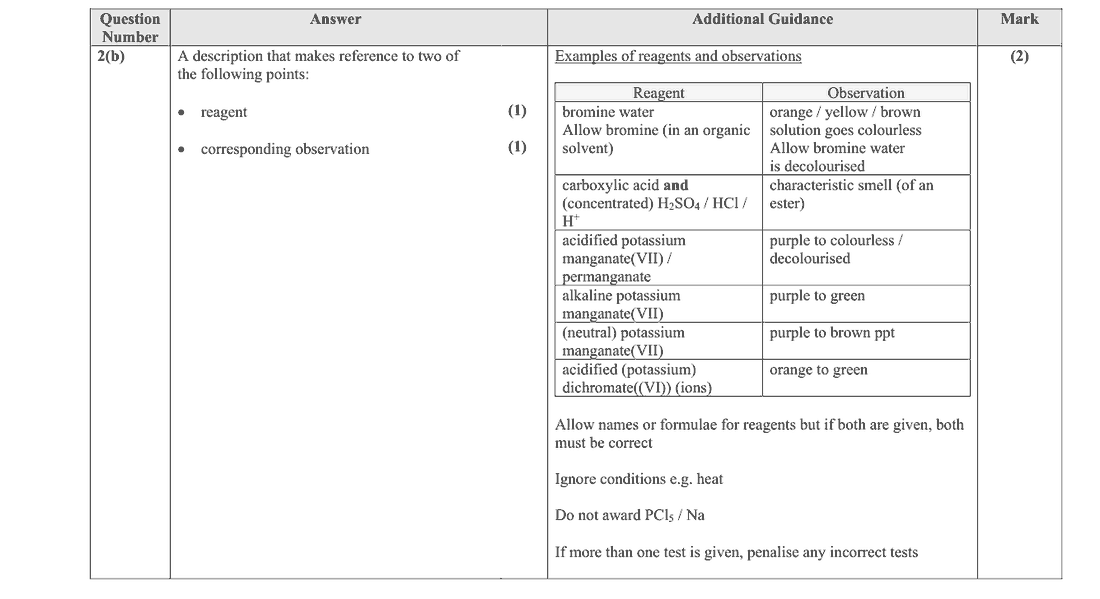
Bromine water: orange / yellow / brown to colourless (decolourised). Also accepted: acidified potassium manganate(VII), purple to colourless
alkaline manganate(VII), purple to green
neutral manganate(VII), purple to brown precipitate
acidified potassium dichromate(VI), orange to green
a carboxylic acid with concentrated H2SO4, ester smell. Not PCl5 or sodium. More candidates knew the bromine water test than knew a test for the acid
Skills: PT4 use laboratory apparatus for a variety of experimental techniques, including: titration, using burette and pipette; distillation and heating under reflux, including setting up glassware using retort stand and clamps; qualitative tests for ions and organic functional groups; filtration, including use of fluted filter paper, or filtration under reduced pressure; CP7 Core practical 7: Analysis of some inorganic and organic unknowns
October 2020 · Paper 1 · Q6(a)(i)2 marksExplanation
Mark scheme
Examiner's comment
Although many candidates realised that a double bond consists of a pi and sigma bond, far
fewer were able to use this effectively to justify why the student was incorrect in (a)(i), with
most answers simply stating that the double bond was stronger or shorter than the single
bond.
Nearly all candidates knew how to approach the calculation in (ii) and fully correct answers
were seen by a range of candidates. Common errors included omission of the value for
breaking bonds in the oxygen molecules, reversing the values to give an endothermic answer,
and transcription errors with numerical values. Transferred errors meant award of some
credit was possible in most of these cases. In (a)(iii) most answers gave a generic discussion
of entropy, and tended to only score 1 mark for the justification of an entropy increase.
Only a few answers made an effective distinction between ΔStotal, ΔSsystem, and ΔSsurroundings.
Even those who chose to base their answer on ΔG = ΔH - T ΔSsystem, often omitted to mention
ΔSsystem.
The calculation in (b) was often well laid out, with a clear route through the problem shown by
many. A few candidates were inconsistent with units for entropy, and others missed out on
the final mark as they didn’t comment on the feasibility of the reaction in light of their answer.
Some candidates spent time doing additional unrequired work, by also calculating ΔG, but
more problematic was the small number who ignored the instruction to find ΔStotal and tried
to base their response solely on ΔG, often making errors in the process.
Notes from the mark scheme and report
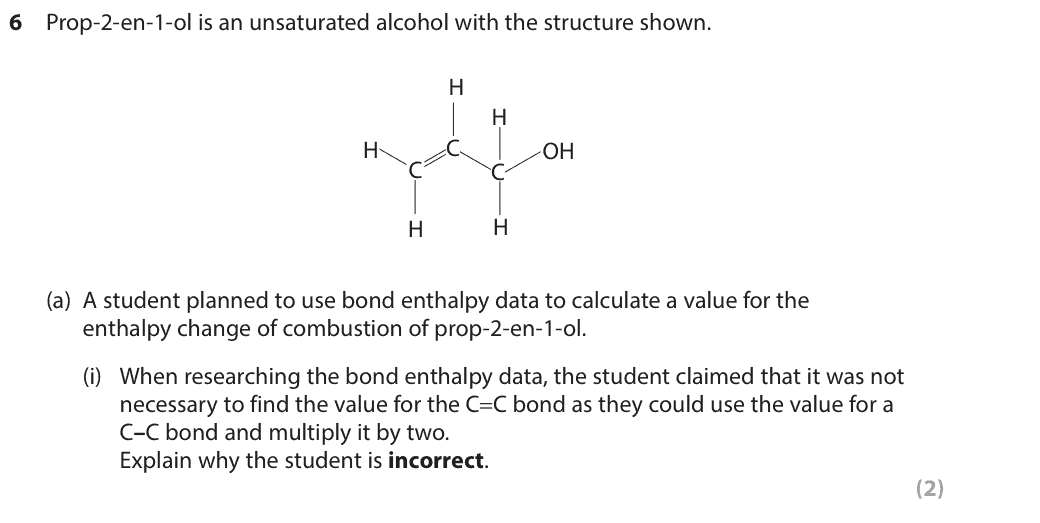
A C=C bond is weaker than two C–C bonds (1)
because it is made of a sigma bond and a pi bond, not two sigma bonds (1). Many knew the double bond is a sigma and a pi bond but did not use it
most just said the double bond is stronger or shorter than a single bond
October 2020 · Paper 2 · Q2(c)3 marksShort answer
Earlier part of question 2 that this part uses
Mark scheme
Examiner's comment
The majority of candidates knew that bromoethane is produced when ethene reacts with
hydrogen bromide, although a few showed 1,2-dibromoethane. Many candidates did know
that steam and an acid catalyst are needed to convert ethene into ethanol, however a
significant number of candidates had not learnt this reaction. The structure of the polymer
formed from but-1-ene was generally well-answered, with just a few candidates including a
double bond, not showing the extension bonds or not showing two repeat units. The majority
of candidates could calculate the number of molecules in 70.0 g of but-1-ene, with the most
common errors being an incorrect molar mass’ not converting mass into number of moles
and dividing the number of moles by the Avogadro Constant.
Notes from the mark scheme and report
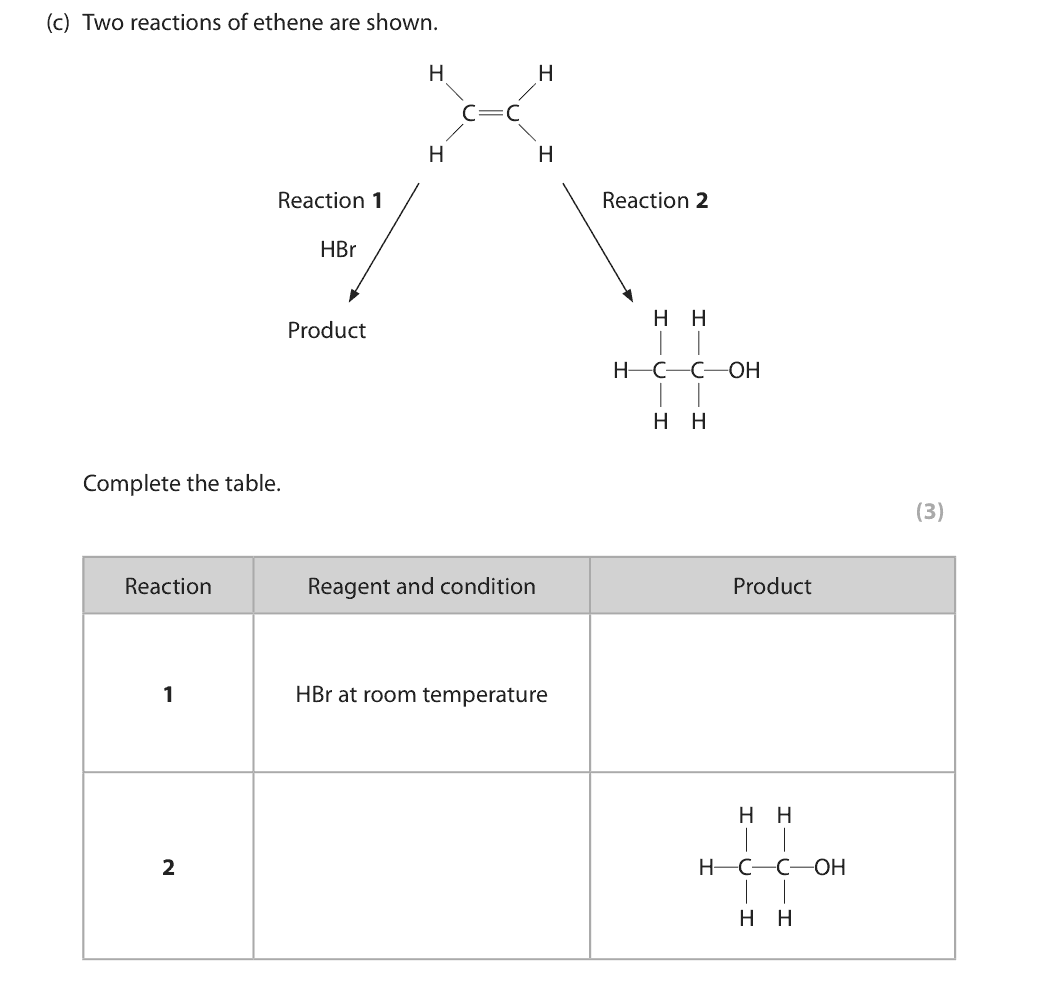
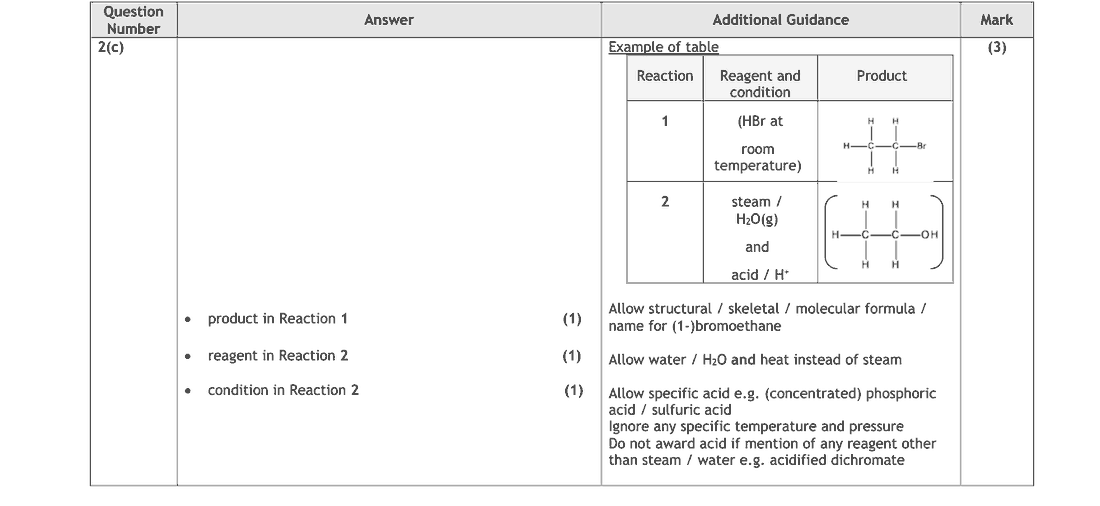
Reaction 1 product: bromoethane (any type of formula or the name). Reaction 2 reagent: steam / H2O(g) (allow water and heat)
condition: acid (catalyst) / H+, e.g. phosphoric acid. No acid mark if any reagent other than steam or water is given, e.g. acidified dichromate. A few gave 1,2-dibromoethane
a significant number had not learnt the hydration reaction
October 2020 · Paper 2 · Q2(d)(i)1 markDiagram or structure
Earlier part of question 2 that this part uses
Mark scheme
Examiner's comment
The majority of candidates knew that bromoethane is produced when ethene reacts with
hydrogen bromide, although a few showed 1,2-dibromoethane. Many candidates did know
that steam and an acid catalyst are needed to convert ethene into ethanol, however a
significant number of candidates had not learnt this reaction. The structure of the polymer
formed from but-1-ene was generally well-answered, with just a few candidates including a
double bond, not showing the extension bonds or not showing two repeat units. The majority
of candidates could calculate the number of molecules in 70.0 g of but-1-ene, with the most
common errors being an incorrect molar mass’ not converting mass into number of moles
and dividing the number of moles by the Avogadro Constant.
Notes from the mark scheme and report
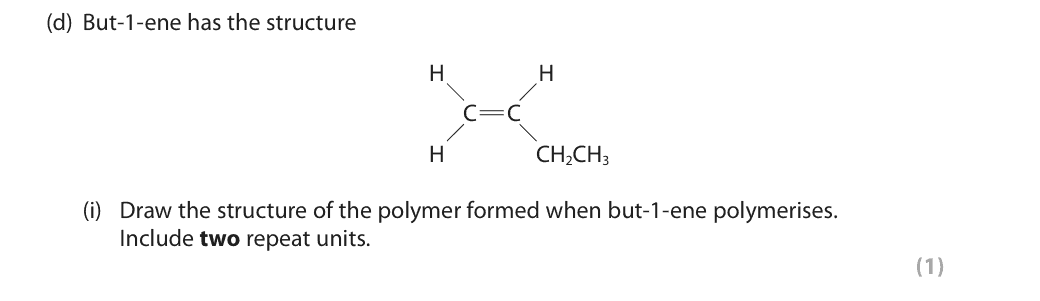
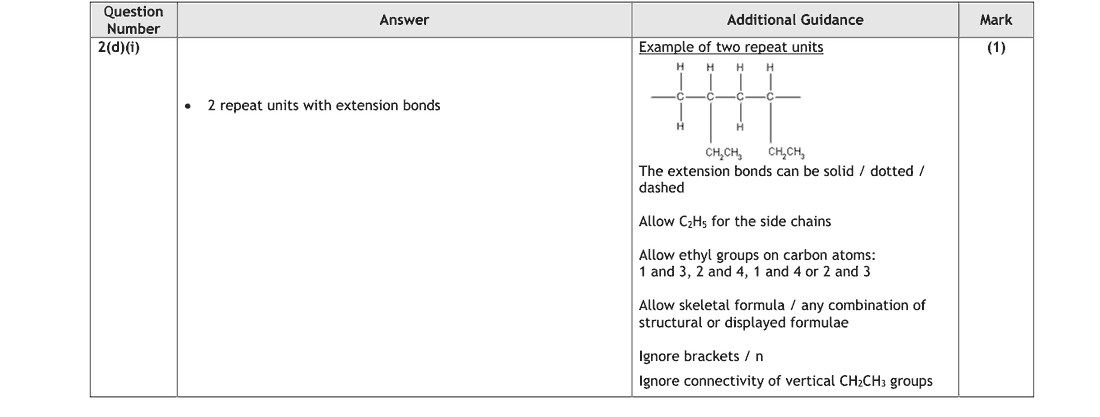
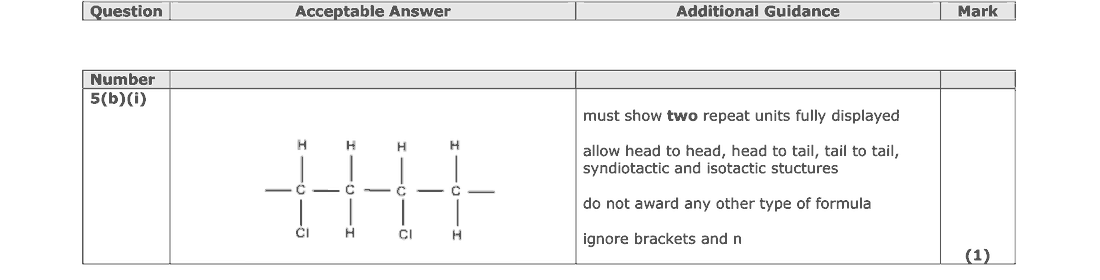
Four-carbon chain, two repeat units, with an ethyl group on alternate carbons (–CH2–CH(C2H5)–CH2–CH(C2H5)–) and extension bonds at both ends. Brackets and n ignored. Errors: a double bond left in
no extension bonds
not two repeat units
October 2020 · AS Paper 2 · Q5(b)(ii)3 marksMechanism
Earlier parts of question 5 that this part uses
Mark scheme
Examiner's comment
This question had an unusual context with candidates having to apply their knowledge of
reaction mechanisms to an unusual electrophile in iodine monochloride. Where the learners
understood how to do this their answers were clear and diagrams well-constructed. The initial
part of the calculation that followed was more traditional but the second again required the
candidates to apply their knowledge. This final part of the question proved quite challenging.
Notes from the mark scheme and report
Curly arrow from the C=C bond to the δ+ iodine and from the I–Cl bond to chlorine
a secondary carbocation intermediate with the + charge on carbon 2 (iodine on carbon 1)
curly arrow from a lone pair on Cl– to the positive carbon. Not δ+ for + on the carbocation or δ– for – on the chloride. Error carried forward if the dipole was reversed in (b)(i)
M1 and M3 are available for the minor product
a missing final product is ignored. The report says those who saw how to apply the mechanism to ICl drew clear, well-constructed diagrams
October 2020 · Paper 2 · Q5(c)1 markMultiple choice
Earlier part of question 5 that this part uses
Answer
D
Mark scheme
Examiner's comment
Candidates found (d)(ii) to be a challenging question. This type of calculation was unfamiliar to
the majority of candidates and many struggled to start it as they did not realise that the
carbon dioxide would be removed by aqueous sodium hydroxide so the volume of carbon
dioxide was 125 cm3 and the value of x was 5. The unfamiliar mechanism in (e) was clearly
drawn by the majority of candidates. Common errors included: showing the formation of the
minor product instead of the major product, giving an incorrect dipole on ICl and not starting
a curly arrow from a bond or a lone pair of electrons. The vast majority of candidates scored a
mark for calculating the number of moles of bromine used in (f). Some candidates did not
realise that 2 mol of bromine are needed to react with 1 mol limonene as there are two
double covalent bonds, some candidates were unable to calculate the correct molar mass of
limonene. Candidates were able to score a transferred error mark for the final percentage,
provided the answer was less than 100 %. However, some candidates calculated a mass of
limonene that was greater than 0.500 g so reversed the fraction to give a percentage that was
less than 100 % and this was not given credit. Candidates who calculate a percentage greater
than 100 should go back and check their working to see where they have made an error.
Notes from the mark scheme and report
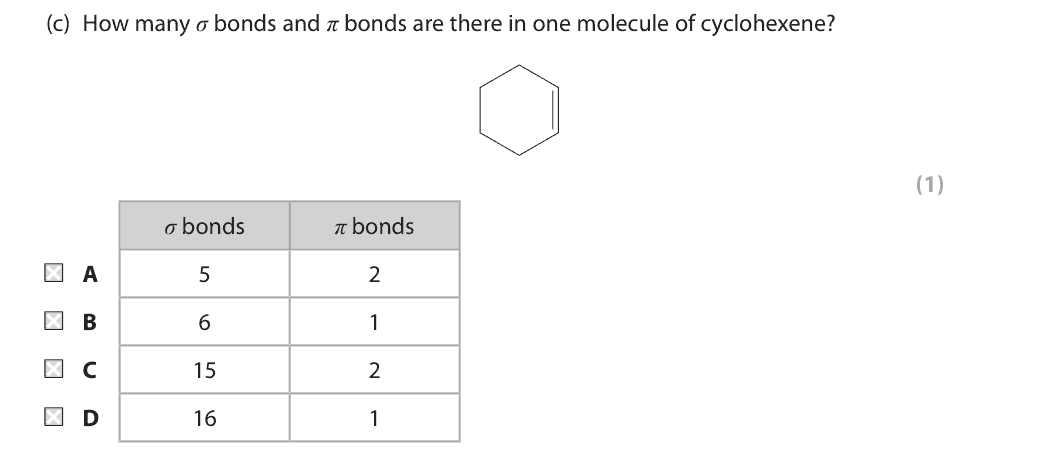
Answer: D. Ten C–H σ bonds and six C–C σ bonds give 16 σ bonds, with one π bond in the C=C
October 2020 · AS Paper 2 · Q5(c)(iii)1 markShort answer
Earlier parts of question 5 that this part uses
Mark scheme
Examiner's comment
This question had an unusual context with candidates having to apply their knowledge of
reaction mechanisms to an unusual electrophile in iodine monochloride. Where the learners
understood how to do this their answers were clear and diagrams well-constructed. The initial
part of the calculation that followed was more traditional but the second again required the
candidates to apply their knowledge. This final part of the question proved quite challenging.
Notes from the mark scheme and report
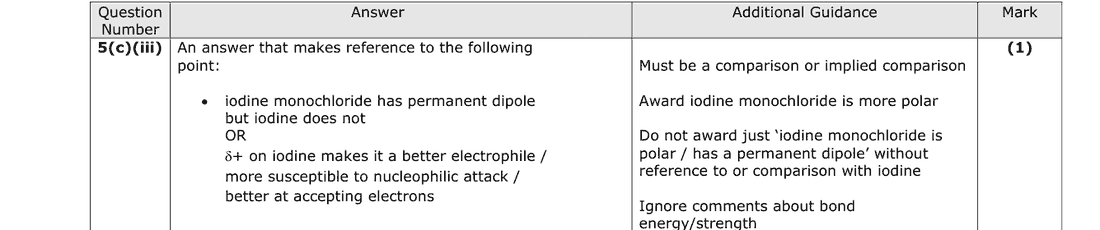
Iodine monochloride has a permanent dipole but iodine does not (ICl is more polar)
or the δ+ iodine makes it a better electrophile. It must be a comparison: just 'ICl is polar' is not enough. Bond strength arguments are ignored
October 2020 · Paper 2 · Q5(e)4 marksMechanism
Mark scheme
Examiner's comment
Candidates found (d)(ii) to be a challenging question. This type of calculation was unfamiliar to
the majority of candidates and many struggled to start it as they did not realise that the
carbon dioxide would be removed by aqueous sodium hydroxide so the volume of carbon
dioxide was 125 cm3 and the value of x was 5. The unfamiliar mechanism in (e) was clearly
drawn by the majority of candidates. Common errors included: showing the formation of the
minor product instead of the major product, giving an incorrect dipole on ICl and not starting
a curly arrow from a bond or a lone pair of electrons. The vast majority of candidates scored a
mark for calculating the number of moles of bromine used in (f). Some candidates did not
realise that 2 mol of bromine are needed to react with 1 mol limonene as there are two
double covalent bonds, some candidates were unable to calculate the correct molar mass of
limonene. Candidates were able to score a transferred error mark for the final percentage,
provided the answer was less than 100 %. However, some candidates calculated a mass of
limonene that was greater than 0.500 g so reversed the fraction to give a percentage that was
less than 100 % and this was not given credit. Candidates who calculate a percentage greater
than 100 should go back and check their working to see where they have made an error.
Notes from the mark scheme and report
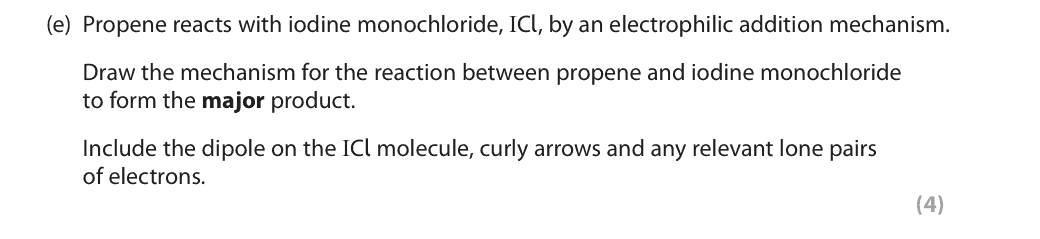
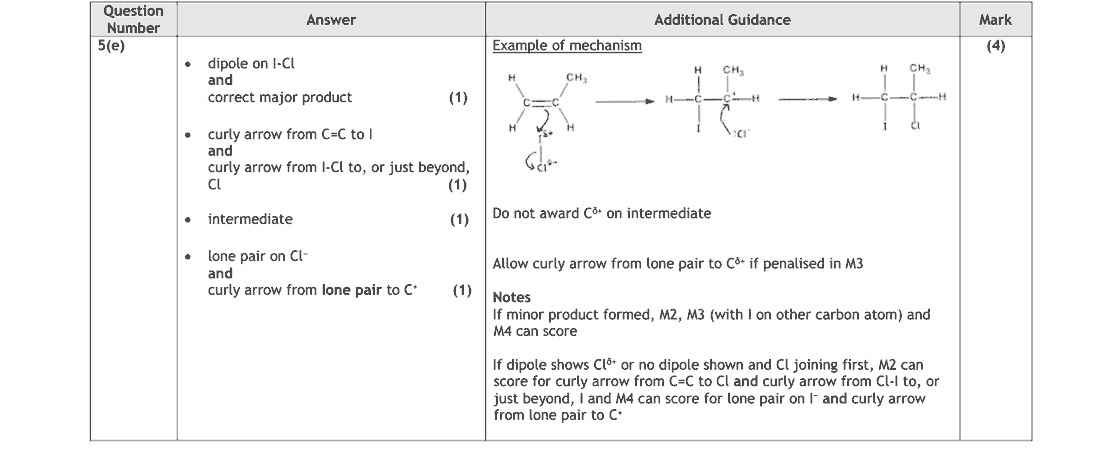
M1 dipole Iδ+–Clδ– and the major product, 2-chloro-1-iodopropane
M2 curly arrow from the C=C to I and from the I–Cl bond to (or just beyond) Cl
M3 secondary carbocation intermediate with I on the end carbon (not Cδ+)
M4 lone pair on Cl– and curly arrow from it to C+. If the minor product is formed, M2, M3 and M4 can still score. Common errors: minor product
dipole the wrong way round
curly arrows not starting from a bond or a lone pair
October 2020 · Paper 2 · Q7(a)(ii)2 marksShort answer
Earlier part of question 7 that this part uses
Mark scheme
Examiner's comment
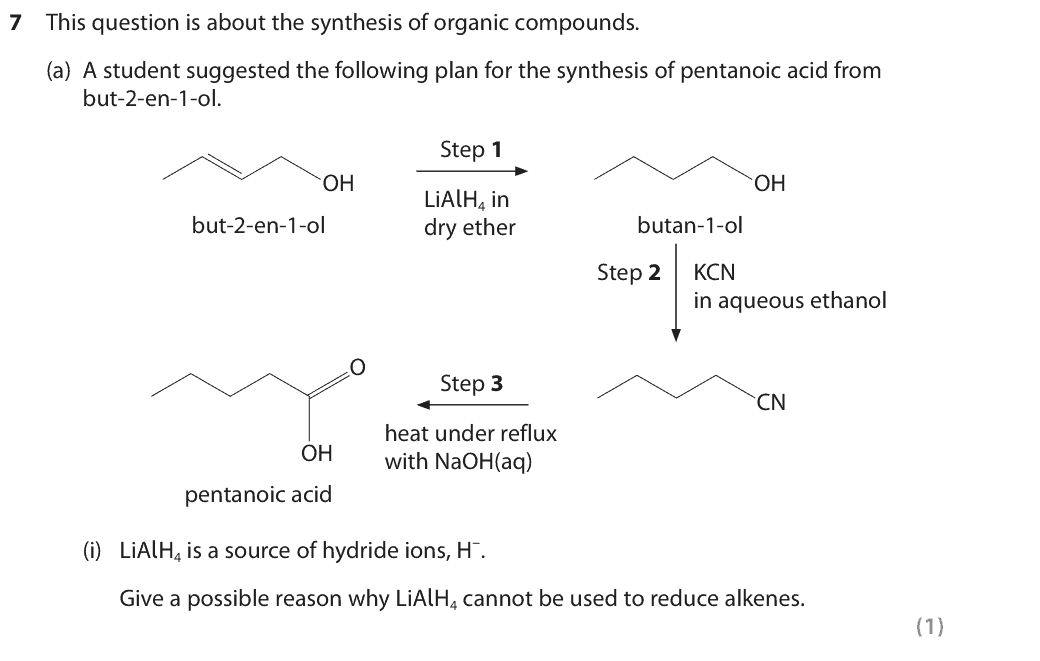
Many candidates realised that hydride ions would be repelled by the high electron density of
the double bond in an alkene or knew that alkenes react by electrophilic addition and hydride
ions are nucleophiles. There were many correct answers giving a suitable reagent and
condition, but some candidates had not learnt the basic reagents and conditions for the
organic chemistry reactions in the specification. Only a minority of candidates knew that
potassium cyanide in ethanol react with halogenoalkanes to form nitriles. Unfortunately a few
candidates lost this mark as they did not give a specific halogenoalkane, for example, 1-
bromobutane. The majority of candidates knew that an acid needs to be added to the salt to
form pentanoic acid. There were many excellent answers to the synthetic route in (b) showing
those students had practised this style of question and they knew the organic chemistry
reactions. Candidates should realise that they need to make a Grignard reagent from a
halogenocompound so should start by forming bromobenzene. Some candidates knew that
they needed benzoic acid to react with phosphorus(V) chloride to form benzoyl chloride and
they received credit for this.
Notes from the mark scheme and report
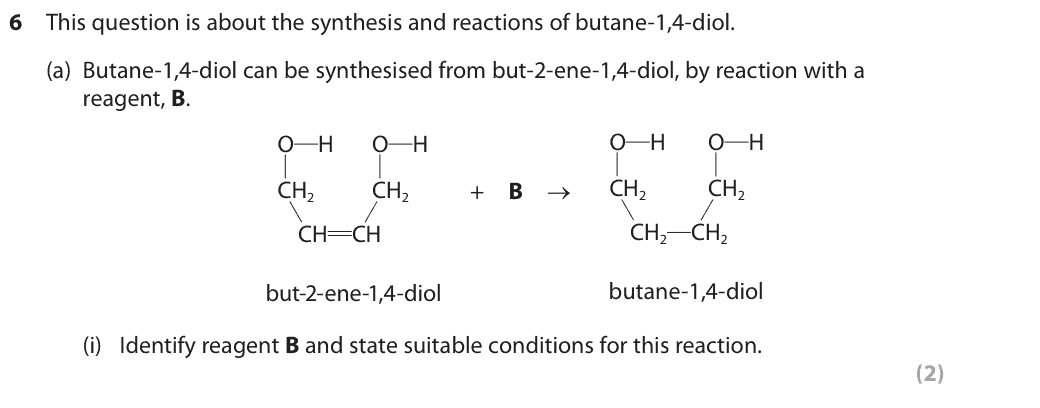
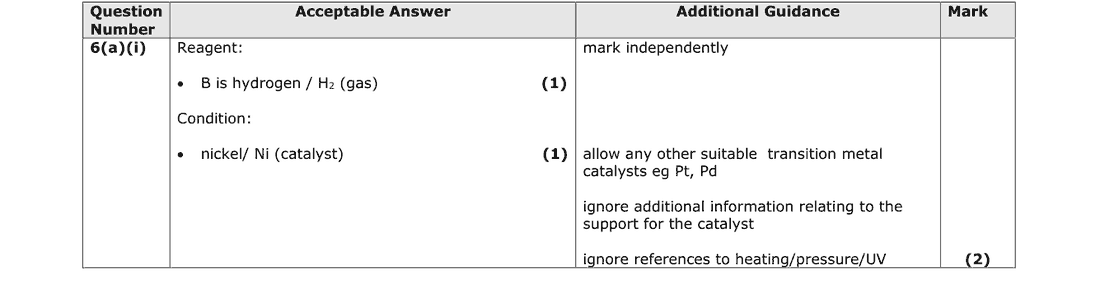
Hydrogen
nickel (or platinum or palladium) catalyst. Marked independently
temperature ignored. Some had not learnt the basic reagents and conditions
June 2019 · AS Paper 2 · Q2(b)(i)1 markShort answer
Mark scheme
Examiner's comment
The first six items of this question were well answered by most candidates. Some learners mentioned both the fact that a homologous series contained molecules with the same functional group and had the same chemical reactivity. Since the latter comes as a result of the former, these were considered to be the same marking point and so only one mark was scored unless a further characteristic was supplied. Most knew that propene was an alkene and that hydrogen chloride was the reagent in (b)(i). Hydrochloric acid would not work here and a minority of candidates did not score the mark because of this. Many knew that the reaction was an electrophilic addition. In (c), most learners knew or worked out that potassium cyanide was the correct reagent and most also scored 2 for their understanding of the term ‘structural isomer’. The structure and name for the isomer in (c)(iii) proved much more
challenging. Most candidates drew all the bonds including bonds between the C and the N of the functional group, though not all knew that this was a triple bond. A significant minority drew the structure of butanenitrile, for which the structural formula had been given in (c)(i), suggesting that the question in (c)(iii) had not been read with sufficient care. It is good practice to read each question twice to ensure that the correct question is answered. Where the correct structure was given the name was often incorrect. Both marks in this part were usually only scored by candidates who would go on to achieve an A grade.
Notes from the mark scheme and report
Answer: hydrogen chloride, HCl(g). Not hydrochloric acid or HCl(aq), which cost a minority the mark
June 2019 · AS Paper 2 · Q2(b)(ii)1 markMultiple choice
Earlier parts of question 2 that this part uses
Answer
A
Mark scheme
Examiner's comment
The first six items of this question were well answered by most candidates. Some learners mentioned both the fact that a homologous series contained molecules with the same functional group and had the same chemical reactivity. Since the latter comes as a result of the former, these were considered to be the same marking point and so only one mark was scored unless a further characteristic was supplied. Most knew that propene was an alkene and that hydrogen chloride was the reagent in (b)(i). Hydrochloric acid would not work here and a minority of candidates did not score the mark because of this. Many knew that the reaction was an electrophilic addition. In (c), most learners knew or worked out that potassium cyanide was the correct reagent and most also scored 2 for their understanding of the term ‘structural isomer’. The structure and name for the isomer in (c)(iii) proved much more
challenging. Most candidates drew all the bonds including bonds between the C and the N of the functional group, though not all knew that this was a triple bond. A significant minority drew the structure of butanenitrile, for which the structural formula had been given in (c)(i), suggesting that the question in (c)(iii) had not been read with sufficient care. It is good practice to read each question twice to ensure that the correct question is answered. Where the correct structure was given the name was often incorrect. Both marks in this part were usually only scored by candidates who would go on to achieve an A grade.
Notes from the mark scheme and report
Answer: A (electrophilic addition). HCl adds across the C=C bond and the attacking species is an electrophile, so not nucleophilic and not substitution
June 2019 · Paper 2 · Q4(c)(i)4 marksMechanism
Earlier part of question 4 that this part uses
Mark scheme
Examiner's comment
The electrophilic mechanism seemed to pose few problems for many candidates, even with the unusual context and skeletal format. Clearly this is well understood from year one of the course. The imprecise use of arrows and omission of diploes or lone pairs were inevitably seen, but the examination team felt such slips were less frequent than in previous series. A small number of candidates, generally those that found the paper as a whole challenging, attempted to show a substitution reaction of the ring. A minority understood the reaction resulted in the loss of the C=C bond, but mistakenly added both bromine atoms to the same carbon.
Notes from the mark scheme and report
M1 curly arrow from the C=C to the δ+ Br of Br2
M2 curly arrow from the Br–Br bond to the δ– Br (missing dipole penalised once)
M3 carbocation (the + on either carbon of the former double bond)
M4 curly arrow from a lone pair on Br– to C+ and the dibromo product with Br on adjacent carbons. A substitution mechanism on the ring scores 0. Few problems for most
weaker candidates brominated the ring, and a minority put both Br atoms on one carbon
June 2019 · AS Paper 2 · Q5(b)2 marksPractical and data analysis
Earlier part of question 5 that this part uses
Mark scheme
Examiner's comment
A lack of precision in (a) resulted in the loss of the mark for some. Many answers described condensing products back in the the reaction mixture. This is true for butan-1-ol but not for the but-1-ene which is collected in the gas syringe. The use of bromine water as a test for unsaturation was well known. In (c) the percentage yield calculation was very well understood by higher ability candidates, however lower scoring learners seemed unsure where to begin and failed to score. The unusual calculation in 5(d) proved challenging for all. Some candidates clearly understood what to do, showing working indicating they understood that the number of moles and pressure were constant so the volume depended only on the temperature before correctly completing the calculation. Some candidates made an assumption that the pressure was standard pressure (either 100 or 101 kPa) and then did two pV = nRT calculations to find an answer which was close to the correct one. These candidates were awarded one of the two marks. In (e) those who knew the mechanism of the reaction often scored all 5 marks. The answer to (e)(i), substitution, was often accompanied by nucleophilic, which was correct but not required, or electrophilic which was incorrect and lost the mark. The type of reaction is substitution and it is a nucleophilic mechanism. The test for the –OH group in the alcohol and the expected observation were well known. The mechanism scored well for some learners, with careful positioned arrows and all the relevant lone pairs and dipoles included. Marks were lost through the lack of the dipole on OH‒ or the lack of its charge. Dipoles in the 1-bromobutane were not always included. Some did not include the product bromide ion. As a result a range of marks were scored. Some candidates were clearly unsure where to start and so scored 0. The final part of this question was challenging as many learners did not appreciate that, as well as but-1-ene, but-2-ene would be formed. This compound exists as both cis- and trans- isomers and so the number of isomeric alkene products was, in fact, three.
Notes from the mark scheme and report
Bubble the gas through bromine water (bromine allowed)
it goes from orange / brown / yellow to colourless (decolorises). Or acidified potassium manganate(VII), purple to colourless. A positive result for a wrong test scores 0. Well known
Skills: PT4 use laboratory apparatus for a variety of experimental techniques, including: titration, using burette and pipette; distillation and heating under reflux, including setting up glassware using retort stand and clamps; qualitative tests for ions and organic functional groups; filtration, including use of fluted filter paper, or filtration under reduced pressure; CP7 Core practical 7: Analysis of some inorganic and organic unknowns
June 2018 · AS Paper 2 · Q5(a)(i)1 markMultiple choice
Answer
B
Mark scheme
Notes from the mark scheme and report
Answer: B. HCl adds across the C=C and the alkene is attacked by an electrophile. A and C are wrong because it is not substitution
C and D because it is not nucleophilic
June 2018 · AS Paper 2 · Q5(a)(iii)4 marksMechanism
Earlier part of question 5 that this part uses
Mark scheme
Examiner's comment
There were frequent casual errors in the response to this question. Missing H atoms and 5-bonded carbon atoms were all too frequent.
Occasionally, HBr was used in place of HCl and, in some instances, the halogen changed part-way through the mechanism.
The mechanism requested is for the production of 2-chloropropane. There is no credit for including the mechanism for 1-chloropropane as well.
Notes from the mark scheme and report
M1 curly arrow from the C=C to the H of HCl
M2 dipole (δ+ on H, δ– on Cl) and curly arrow from the H–Cl bond to Cl
M3 carbocation with + on the middle carbon (secondary)
M4 curly arrow from a lone pair on Cl– to the C+. A wrongly drawn propene (missing H, five-bonded carbon) loses M1
a product of 1-chloropropane loses M3 only
HBr used loses M2 only
starting from H+ and Cl– loses M1 and M2. Common errors: missing H atoms, pentavalent carbons, HBr used or the halogen changing part-way
no credit for also giving the route to 1-chloropropane
June 2018 · AS Paper 2 · Q5(b)(i)1 markDiagram or structure
Mark scheme
Examiner's comment
The diagram must show two repeat units and be fully displayed.
The question asked for two repeat units. It is therefore important to show how the two units are connected, and how they would connect to more units.
Notes from the mark scheme and report
Four-carbon chain –CH2–CHCl–CH2–CHCl– with every bond shown and open bonds at both ends. Head-to-tail, head-to-head or tail-to-tail allowed
brackets and n ignored
no other type of formula. It must be two repeat units, shown joined and able to join to more
June 2018 · AS Paper 2 · Q5(b)(ii)2 marksExplanation
Earlier part of question 5 that this part uses
Mark scheme
Examiner's comment
The question was specifically related to PVC. It was not sufficient to give answers that related to the incineration of polymers in general.
M2 was dependent on M1. Thus broad generalisations about acid rain or the effect on the ozone layer did not gain a mark unless connected to chlorinated products.
which are toxic / corrosive / cause acid rain (allow damage to the ozone layer). M2 depends on M1
carbon dioxide and its effects ignored. General answers about incinerating any polymer did not score
June 2018 · AS Paper 2 · Q6(a)(i)2 marksShort answer
Mark scheme
Examiner's comment
The two marks for this response were awarded independently.
Simple inspection of the organic reactant and the product showed that hydrogen had been added, so M1 should have been easily obtainable.
Notes from the mark scheme and report
Reagent B: hydrogen / H2
condition: nickel catalyst (allow Pt or Pd). Marked independently
heat, pressure and UV ignored
June 2018 · AS Paper 2 · Q6(a)(iii)1 markShort answer
Earlier part of question 6 that this part uses
Mark scheme
Notes from the mark scheme and report
Answer: margarine (allow butter substitute, liquid coal). Not just 'butter'
June 2018 · Paper 2 · Q7(b)1 markMultiple choice
Earlier part of question 7 that this part uses
Answer
B
Mark scheme
Notes from the mark scheme and report
Answer: B. Acidified potassium manganate(VII) oxidises the C=C bond to a diol. Dichromate(VI) oxidises alcohols, not alkenes
sodium hydroxide does not react
steam gives an alcohol only
June 2018 · Paper 2 · Q7(c)1 markDiagram or structureHard
Earlier part of question 7 that this part uses
Mark scheme
Examiner's comment
Polymerisation and the drawing of repeat units continues to prove challenging for candidates with only about a third scoring the mark for this question. The use of skeletal formulae was an issue for many candidates because often the two repeat units drawn were either missing CH2 units or had too many. The weaker candidates drew the benzene ring as part of the main carbon chain. In all instances further practise would be beneficial for candidates.
Notes from the mark scheme and report
A four-carbon chain with a phenyl group on alternate carbons (–CH2–CH(C6H5)–CH2–CH(C6H5)–) with continuation bonds
any type of formula
brackets and n ignored. Common errors: CH2 units missing or too many in skeletal formulae
the benzene ring drawn as part of the main chain
June 2018 · Paper 2 · Q7(d)2 marksShort answer
Earlier part of question 7 that this part uses
Mark scheme
Examiner's comment
Vague responses such as stating that the products of incineration are 'harmful' are always unlikely to gain credit and the better candidates referred to reasons for their stated advantages. There remains some confusion in some candidates' minds between the global warming and the ozone layer so this may be an area for centres to spend some time on in order to clarify the topic in their candidates' minds.
It was surprising to see some candidates refer to a disadvantage of acid rain due to the production of sulfur oxides or that toxic products containing chlorine would be made when neither sulfur nor chlorine is present in phenylethene. A reminder then to perhaps re-read the question and to appreciate the context rather than write a 'stock' answer.
just 'harmful fumes' ignored. Stock answers about sulfur oxides or chlorine compounds did not fit polystyrene
June 2018 · Paper 3 · Q6(e)2 marksPractical and data analysis
Earlier part of question 6 that this part uses
Mark scheme
Examiner's comment
This was a clear-cut test of the ability to apply knowledge of organic qualitative tests and nearly 70% of responses were fully correct. The bromine test for the C=C double bond was especially well known. The test for the alcohol group was slightly more challenging, with a number thinking that the -OH group in the -COOH group would also react.
Notes from the mark scheme and report
Bromine water: structure 1 tick, structure 2 tick, structure 3 cross. Acidified potassium dichromate(VI): structure 1 cross, structure 2 tick, structure 3 cross. One mark per column
three correct ticks with no crosses scores 1. The bromine test was well known
some thought the OH of the COOH group would be oxidised
Skills: PT4 use laboratory apparatus for a variety of experimental techniques, including: titration, using burette and pipette; distillation and heating under reflux, including setting up glassware using retort stand and clamps; qualitative tests for ions and organic functional groups; filtration, including use of fluted filter paper, or filtration under reduced pressure; CP7 Core practical 7: Analysis of some inorganic and organic unknowns
June 2017 · AS Paper 2 · Q4(d)4 marksPractical and data analysis
Earlier parts of question 4 that this part uses
Mark scheme
Examiner's comment
This question linked with the response in Question 4(c). Candidates were expected to provide a test and the expected result for each of the (correct) functional groups identified in Question 4(c). No TE was permitted for incorrect functional groups identified in Question 4(c); a candidate who recalled a correct test/result for an aldehyde, for example, could not get credit in Question 4(d) for a non-existent functional group listed in Question 4(c).
Notes from the mark scheme and report
Alkene: bromine water (or acidified potassium manganate(VII)), decolorised / orange, yellow or brown to colourless (purple to colourless). Alcohol: PCl5, misty / steamy white fumes
also allowed are warming with acidified dichromate(VI), orange to green or blue, or sodium, effervescence. Each result mark depends on a correct test. No credit for testing groups wrongly identified in (c), or alkanes
Skills: PT4 use laboratory apparatus for a variety of experimental techniques, including: titration, using burette and pipette; distillation and heating under reflux, including setting up glassware using retort stand and clamps; qualitative tests for ions and organic functional groups; filtration, including use of fluted filter paper, or filtration under reduced pressure; CP7 Core practical 7: Analysis of some inorganic and organic unknowns
June 2017 · AS Paper 2 · Q4(f)4 marksDiagram or structure
Mark scheme
Examiner's comment
The question asked for the formulae of four isomers produced when excess HBr reacts with the diene. Displayed, structural and skeletal formulae were all acceptable.
Enantiomers are also possible products in this reaction but none were seen. Enantiomers are beyond the spec of this course but correct enantiomers would have been rewarded.
Many candidates ignored the hint given by the word excess which was emboldened in the question, and restricted themselves to the monobromo products. Some credit was given for correct monobromo isomers.
Some attempts at substitution reactions were seen where addition reactions were clearly required.
Notes from the mark scheme and report
The four dibromo products of adding HBr across both C=C bonds: 2,3-dibromo-2-methylbutane, 1,3-dibromo-3-methylbutane (2,4-dibromo-2-methylbutane), 1,4-dibromo-2-methylbutane and 1,3-dibromo-2-methylbutane, one mark each in any type of formula. Four correct monobromo isomers score 2, two or three score 1. Deduct one mark for using HCl and one for missing hydrogens. Many ignored 'excess' and gave only monobromo products
some attempted substitution
June 2017 · Paper 2 · Q6(a)2 marksDiagram or structure
Mark scheme
Examiner's comment
The drawing of polymer repeat units continues to prove problematic for candidates and thus perhaps emphasises the need for more time to be spent on this topic. Only one third of all candidates could successfully complete the drawing of the repeat units for both molecules. A significant number of responses still had the carbon-carbon double bond in the repeat unit.
Notes from the mark scheme and report
Poly(but-1-ene): –CH2–CH(C2H5)–CH2–CH(C2H5)– with end bonds
poly(cyclohexene): two cyclohexane rings joined ring to ring, each with a continuation bond on the next ring carbon. Brackets and n not needed
missing end bonds penalised once
one repeat unit for each scores 1 only. Only a third scored both
many left C=C in the repeat unit
June 2017 · Paper 2 · Q6(d)(iii)1 markShort answer
Earlier part of question 6 that this part uses
Mark scheme
Examiner's comment
The question was rather open-ended and thus provided an opportunity for a wide range of acceptable responses. There did need to be some appropriate justification for the advantage given and it was this that discriminated between candidates. For example, it was insufficient to simply state that there would be less pollution without some rationale being given.
Notes from the mark scheme and report
The polymer does not accumulate in the environment / does not take up landfill
also accept the benefit of avoiding other disposal such as incineration or toxic chemicals. Ignore just less harm to the environment or animals, less pollution, or less energy to break down
June 2017 · AS Paper 2 · Q7(a)(iv)2 marksExplanation
Earlier part of question 7 that this part uses
Mark scheme
Examiner's comment
The first mark was awarded for recognition that the halogenoalkane is hydrolysed by water. A common error was to identify the hydroxide ion as the nucleophile.
The second mark was for the breakage of the C-Hal bond. Some answers referred to covalent bond breakage but did not specify that the C-Hal bond breaks. A few good answers also commented on the heterolytic nature of the bond breakage (although this was not required for the mark).
Notes from the mark scheme and report
The halogenoalkane is hydrolysed by (reacts with) water
the C–halogen bond breaks (heterolytically), giving halide ions. Reaction with OH– is not credited and was a common error. It must be clear that it is the carbon–halogen bond that breaks, not just 'a covalent bond'
Skills: CP4 Core practical 4: Investigation of the rates of hydrolysis of some halogenoalkanes
June 2016 · AS Paper 2 · Q2(b)(i)1 markMultiple choice
Answer
A
Mark scheme
Notes from the mark scheme and report
Answer: A (electrophilic addition)
June 2016 · AS Paper 2 · Q2(b)(ii)1 markMultiple choice
Earlier parts of question 2 that this part uses
Answer
C
Mark scheme
Notes from the mark scheme and report
Answer: C. The curly arrow goes from the C=C bond to the nearer bromine atom and a second arrow from the Br–Br bond to the further bromine, giving a carbocation (C+) and Br–. A and B show a carbanion
in B and D the first arrow points from bromine to the double bond
June 2016 · AS Paper 2 · Q5(f)2 marksMechanism
Earlier part of question 5 that this part uses
Mark scheme
Examiner's comment
This question involved a mechanism that is not in the specification but the candidates were expected to apply their knowledge of other mechanisms to this new situation. It tested whether they knew that a curly arrow must start from a covalent bond or a lone pair of electrons and where it ends. A far greater proportion of candidates could draw the curly arrow starting at the lone pair of electrons on the chloride ion. The accuracy of the starting and finishing points of the curly arrow from the C-O bond was much poorer, with it starting from an atom, a space or even the wrong atom.
Notes from the mark scheme and report
Stage 2: curly arrow from the C–O bond to the O (of the –OH2+ group). Stage 3: curly arrow from the lone pair on Cl– to the C+. No single-headed arrows
no extra incorrect arrows. The mechanism is not on the specification: it tests where curly arrows start and finish. The arrow from the chloride lone pair was done far better
the C–O arrow often started from an atom, a space or the wrong atom
Skills: CP6 Core practical 6: Chlorination of 2-methylpropan-2-ol using concentrated hydrochloric acid
Work with an A-level chemistry tutor
Dropping marks on calculations, mechanisms or the core practicals? Book a trial session with an A-level chemistry tutor.