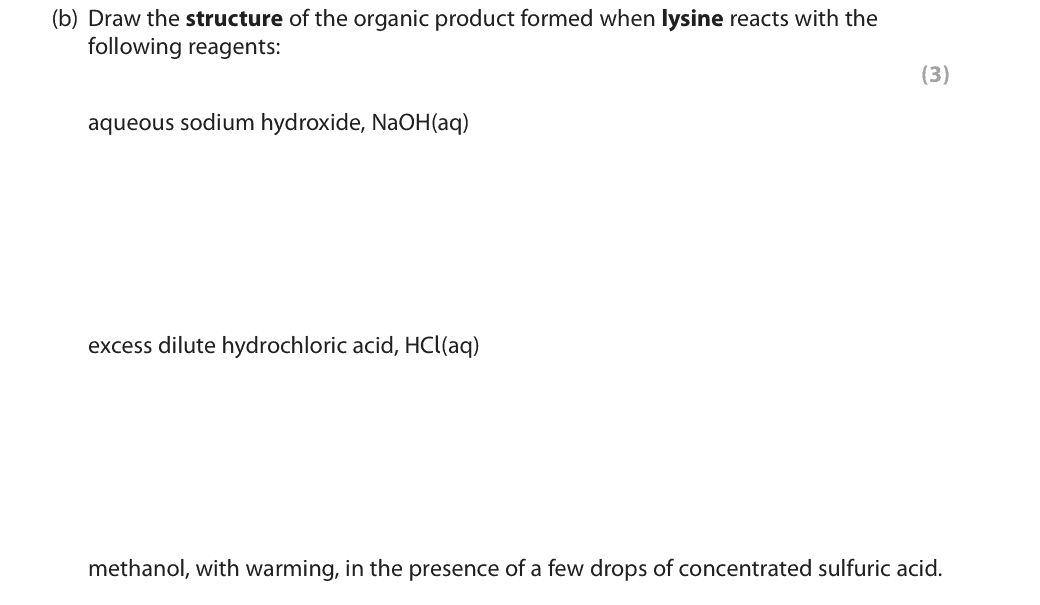
Notes and key-term cards for this topic are being written by our tutors. The past-paper questions below are ready now.
Specification statements
Show the 10 statements from the specification
18.8 be able to identify: • i the amine and amide functional groups • ii molecules that are amino acids
18.9 understand the reactions of primary aliphatic amines, using butylamine as an example, with: • i water to form an alkaline solution • ii acids to form salts • iii ethanoyl chloride • iv halogenoalkanes • v copper(II) ions to form complex ions
18.10 understand reasons for the difference in basicity of ammonia, primary aliphatic and primary aromatic amines given suitable data
18.11 understand, in terms of reagents and general reaction conditions, the preparation of primary aliphatic amines: • i from halogenoalkanes • ii by the reduction of nitriles
18.12 know that aromatic nitro-compounds can be reduced, using tin and concentrated hydrochloric acid, to form amines
18.13 understand that amides can be prepared from acyl chlorides
18.14 know that the formation of a polyamide is a condensation polymerisation reaction
18.15 be able to draw the structural formulae of the repeat units of condensation polymers formed by reactions between: • i dicarboxylic acids and diols • ii dicarboxylic acids and diamines • iii amino acids
18.16 understand the properties of 2-amino acids, including: • i acidity and basicity in solution, as a result of the formation of zwitterions • ii effect of aqueous solutions on plane-polarised monochromatic light
18.17 understand that the peptide bond in proteins: • i is formed when amino acids combine, by condensation polymerisation • ii can be hydrolysed to form the constituent amino acids, which can be separated by chromatography
Six-mark extended response questions on this topic
Tap a question to zoom it. Where a part needs a figure, table or structure from earlier in the question, that part folds out above it; the mark scheme and examiner's comment open underneath. Have Edexcel's Data Booklet beside you; the Periodic Table is on the back page of every paper.
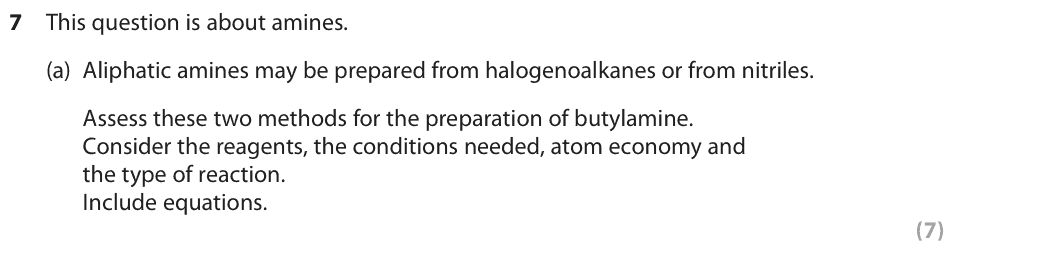
June 2025 · Paper 2 · Q7(a)7 marksExplanation
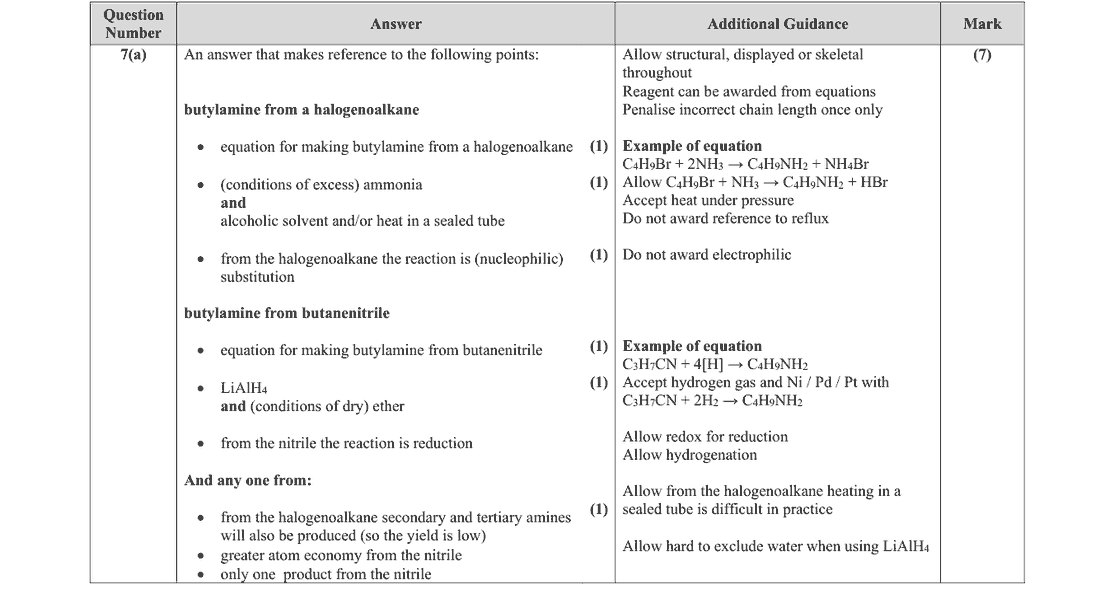
Mark scheme
Examiner's comment
This question attracted the full range of marks with many candidates scoring at least five marks out of the available seven.
Most were able to identify the (nucleophilic) substitution for producing the amine from the halogenoalkane and also for the reduction of the nitrile.
A large proportion were also able to identify the reduction of the nitrile having a higher atom economy.
Candidates generally struggled with the balanced equation and included the reactants above the arrow. Reactants always appear on the left and products on the right hand side, leaving the arrow for conditions and catalysts.
Notes from the mark scheme and report
From a halogenoalkane: C4H9Br + 2NH3 → C4H9NH2 + NH4Br (or + NH3 → amine + HBr)
(excess) ammonia in an alcoholic solvent and/or heated in a sealed tube (under pressure
not reflux)
(nucleophilic) substitution. From butanenitrile: C3H7CN + 4[H] → C4H9NH2
LiAlH4 in dry ether (or hydrogen with Ni / Pt / Pd, + 2H2)
reduction. Plus one of: secondary and tertiary amines also form from the halogenoalkane (lower yield)
the nitrile route has the higher atom economy
only one product from the nitrile. Wrong chain length penalised once. Many scored at least five
equations were the weak point, with reactants written above the arrow
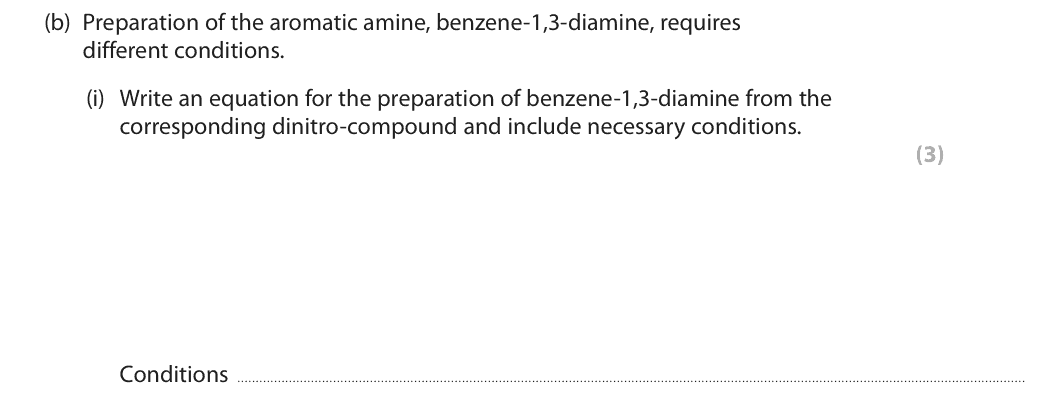
June 2025 · Paper 2 · Q7(b)(i)3 marksEquation writingHard
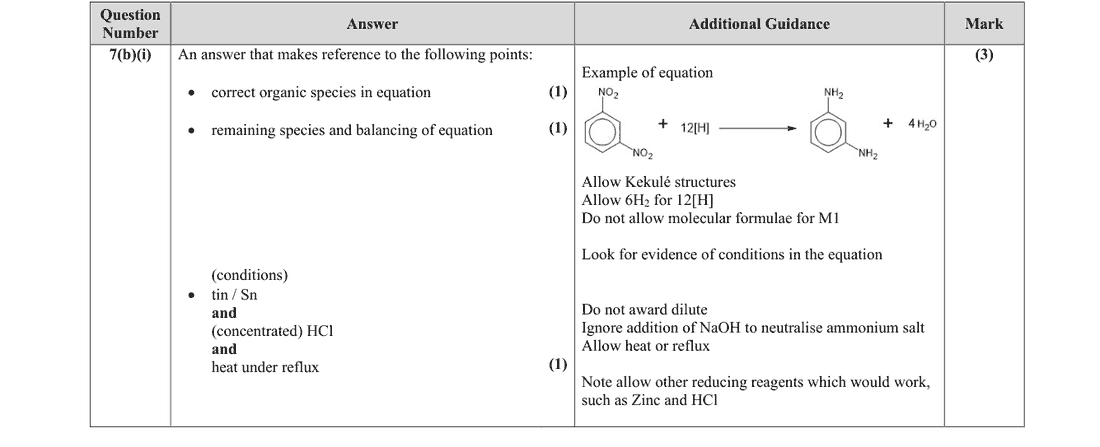
Mark scheme
Examiner's comment
This proved to be a challenging question for many, with very few candidates securing full marks.
Most were able to give the correct organic species in the equation, although correctly balancing the equation was more rarely seen.
Often candidates missed the reaction conditions and only gave reagents, so not scoring M3.
structures needed, not molecular formulae): one mark for the organic species, one for the rest and balancing. Conditions: tin and concentrated hydrochloric acid, heat (under reflux)
not dilute acid. Balancing was rarely right, and many gave reagents without the conditions
June 2025 · Paper 2 · Q7(b)(ii)4 marksExplanationHard
Earlier parts of question 7 that this part uses
Mark scheme
Examiner's comment
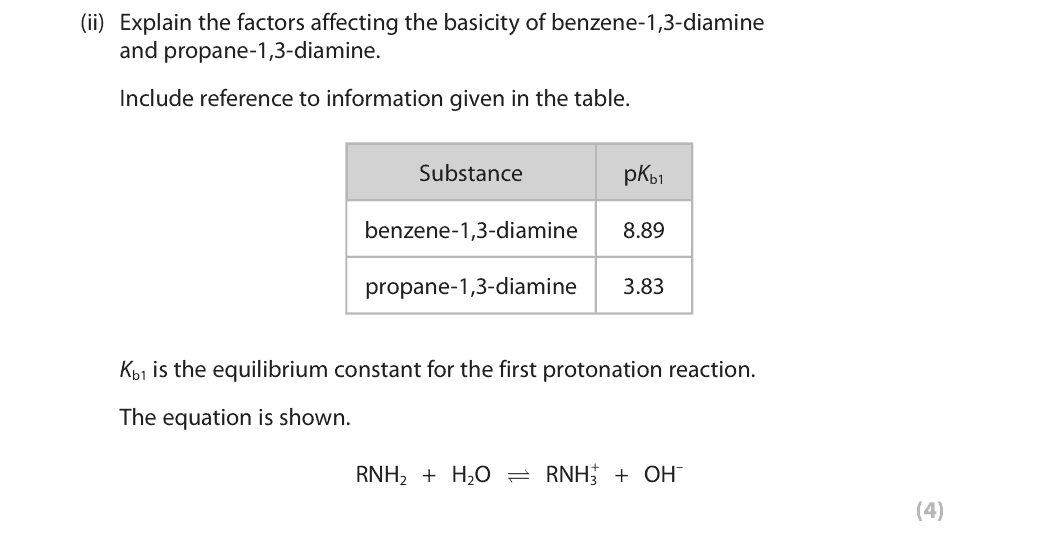
This was one of the most challenging questions on this paper and candidates struggled with the reasoning behind the difference in basicity.
Very few used the pKb data as requested and for those who did, many thought that a higher pKb meant a stronger base.
There were some excellent answers scoring all available marks which was pleasing to see.
Notes from the mark scheme and report
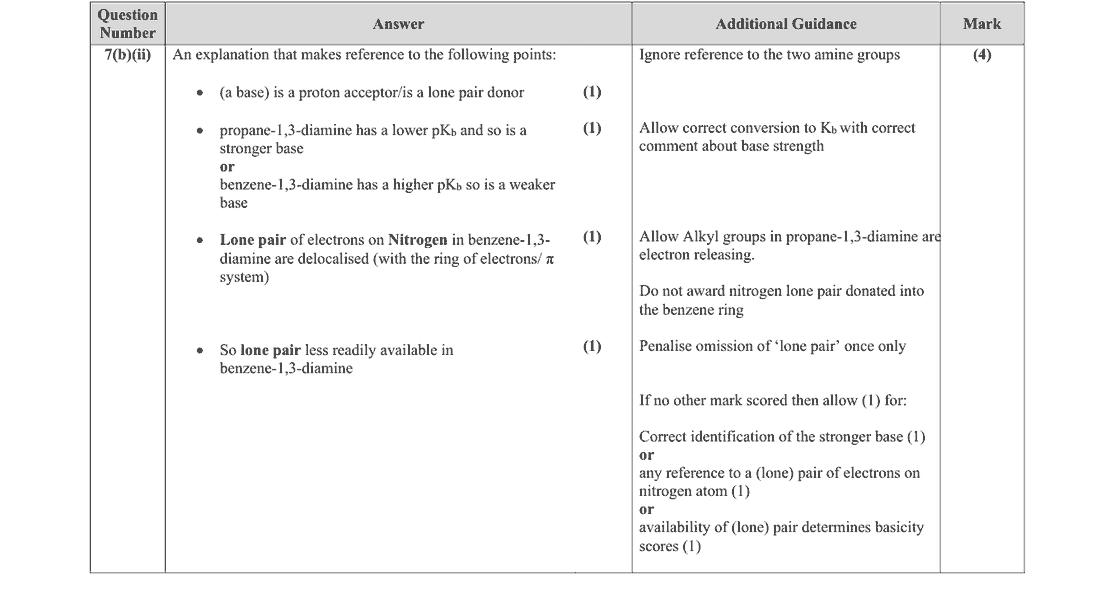
A base is a proton acceptor / lone pair donor
propane-1,3-diamine has the lower pKb so is the stronger base (or the reverse for benzene-1,3-diamine)
in benzene-1,3-diamine the lone pair on the nitrogen is delocalised into the ring π system (allow: alkyl groups in the propane compound are electron-releasing)
so the lone pair is less available to accept a proton. Not 'lone pair donated into the ring'
omitting 'lone pair' penalised once. Very few used the pKb data, and many of those thought a higher pKb means a stronger base
June 2025 · Paper 2 · Q7(c)3 marksMechanism
Earlier part of question 7 that this part uses
Mark scheme
Examiner's comment
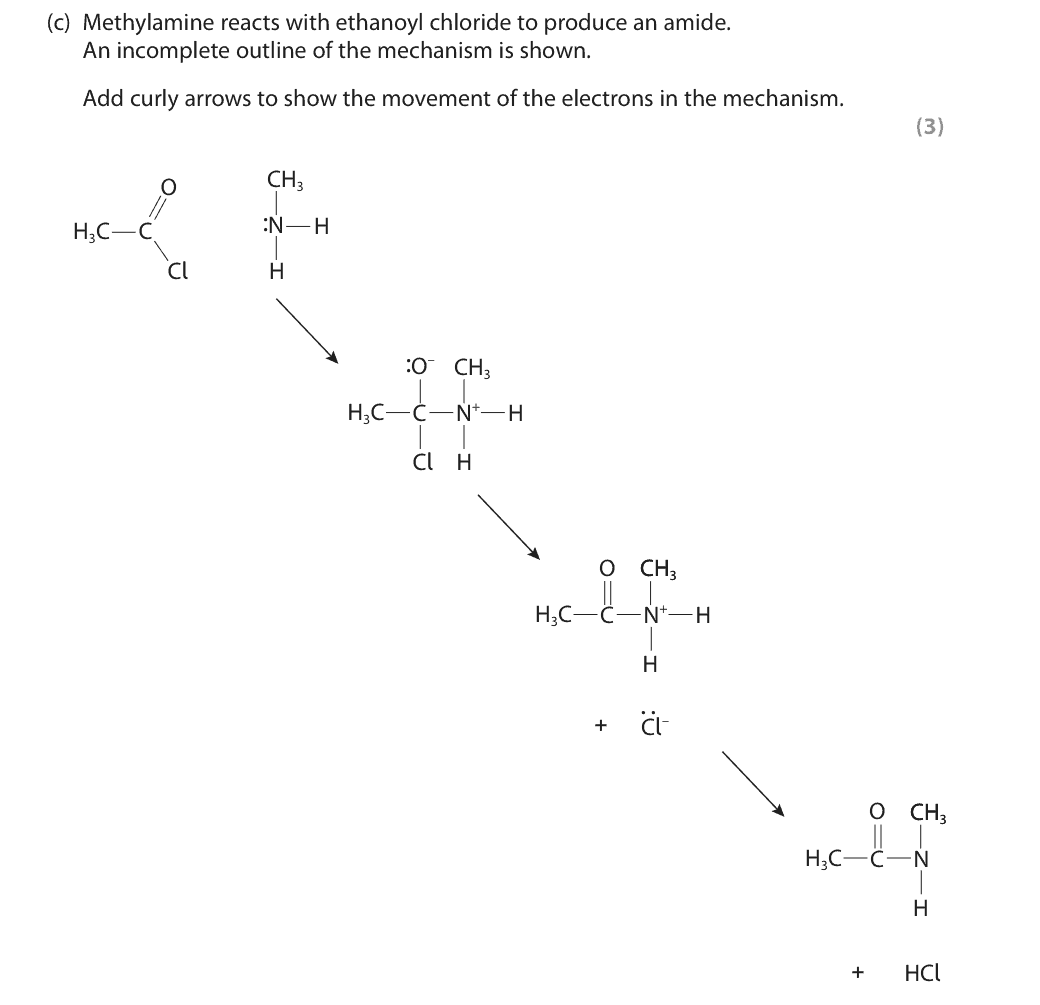
This question was generally well answered showing a good understanding of curly arrows in mechanisms.
Common errors included arrows not clearly originating from a lone pair of electrons or going to an ambiguous area.
Notes from the mark scheme and report
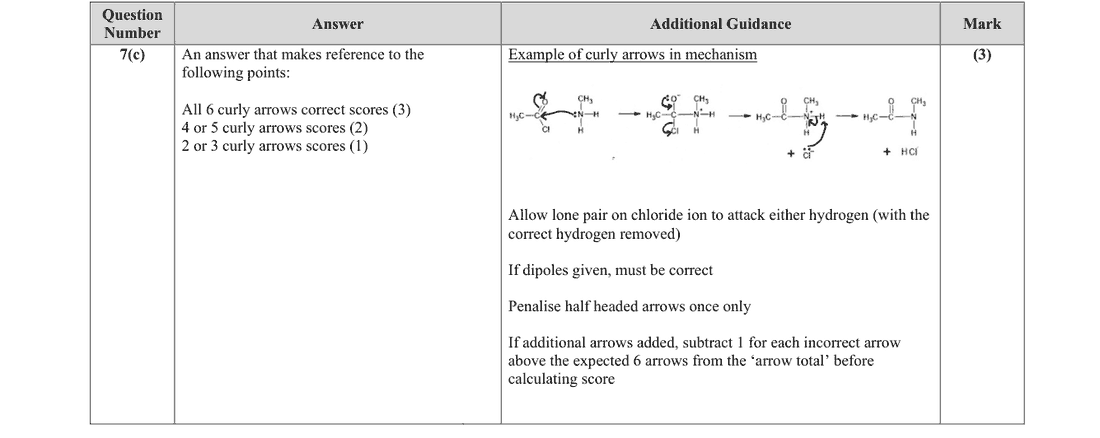
Six curly arrows: N lone pair to the carbonyl carbon and C=O bond to O
O– lone pair back to re-form C=O and C–Cl bond to Cl
Cl– lone pair to H and N–H bond to N+. All six score 3
four or five score 2
two or three score 1. Each extra wrong arrow is subtracted from the total
half-headed arrows penalised once. Common errors: arrows not clearly starting at a lone pair, or ending in an ambiguous place
June 2024 · Paper 2 · Q1(b)1 markMultiple choice
Earlier part of question 1 that this part uses
Answer
C
Mark scheme
Notes from the mark scheme and report
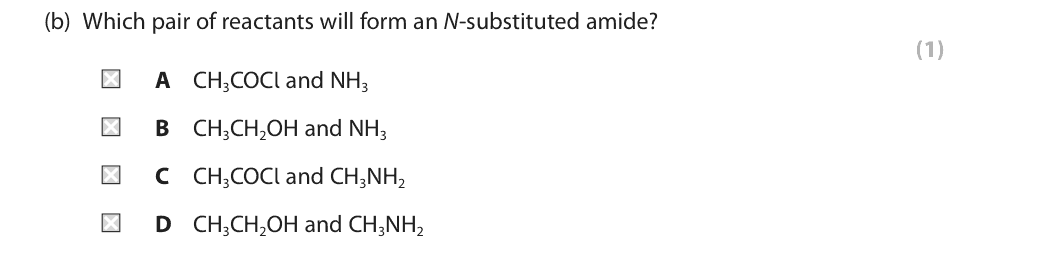
Answer: C. An acyl chloride with a primary amine (CH3COCl and CH3NH2) gives an N-substituted amide. A gives a primary amide
the alcohol in B and D does not react
June 2024 · Paper 2 · Q1(c)(ii)1 markMultiple choice
Earlier parts of question 1 that this part uses
Answer
A
Mark scheme
Notes from the mark scheme and report
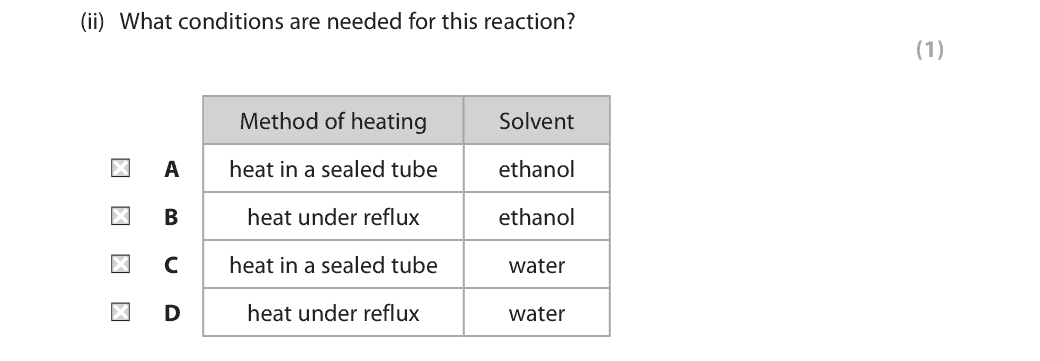
Answer: A. Heat in a sealed tube with ethanol as the solvent: the system must be closed, so not reflux (B, D), and bromoethane is not soluble in water (C, D)
June 2024 · Paper 2 · Q6(c)(i)1 markShort answer
Mark scheme
Examiner's comment
This was a difficult question for many candidates, with a significant proportion attempting to use carbon atoms joined to the carbon attached to the nitrogen atom as opposed to the number of carbon atoms linked to the nitrogen atom itself. It seemed like such answers had mixed up secondary amines with secondary alcohols. Several answers referred to the number of carbon atoms joined to the amine rather than focusing specifically on the nitrogen atom.
Notes from the mark scheme and report
The nitrogen atom is bonded to two carbon atoms / two alkyl groups (allow contains an N–H group). 'The amine group is attached to two carbons' is ignored. Many confused it with the secondary alcohol idea, counting carbons on the carbon next to the nitrogen
June 2024 · Paper 2 · Q8(b)2 marksDiagram or structure
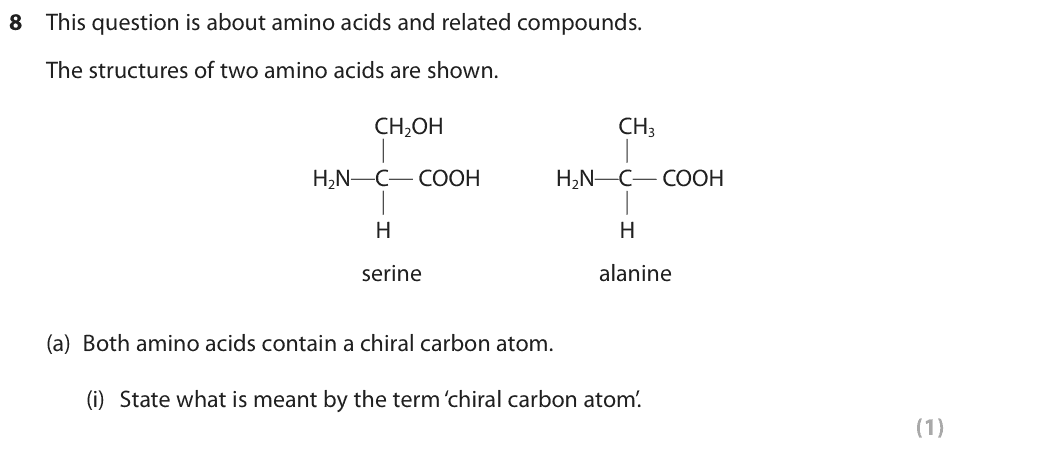
Earlier part of question 8 that this part uses
Mark scheme
Examiner's comment
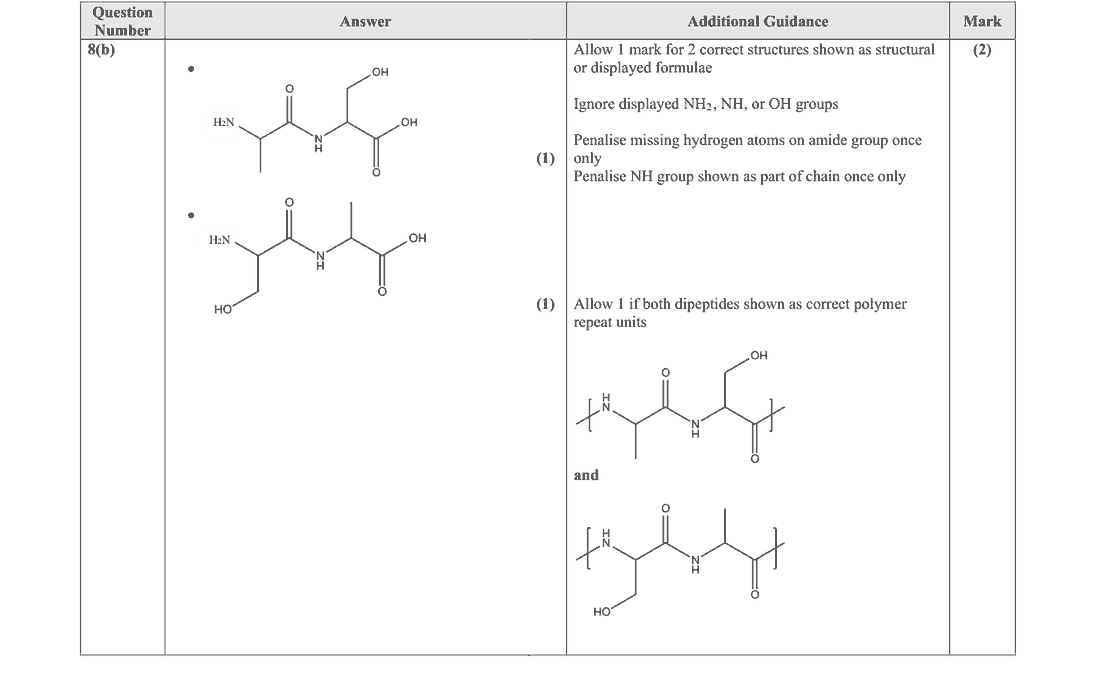
This question demanded evidence of two skills, the ability to deduce the structure of dipeptides and to draw them in a skeletal format. The first of these attributes proved difficult enough, with some candidates unable to link together the two amino acids, introducing ester groups between them, influenced by the alcohol group in serine. Other candidates could recognise the products but omitted all hydrogen atoms from their skeletal structures, including those on the amide and carboxylic acid functional groups.
Notes from the mark scheme and report
Skeletal formulae of H2N–CH(CH3)–CO–NH–CH(CH2OH)–COOH and H2N–CH(CH2OH)–CO–NH–CH(CH3)–COOH, one mark each. Both correct but as structural or displayed formulae scores 1
both shown as polymer repeat units scores 1. A missing H on the amide N is penalised once. Errors: joining the amino acids through an ester link using the OH of serine
leaving all hydrogens off N and O in the skeletal formulae
June 2024 · Paper 2 · Q8(c)1 markMultiple choice
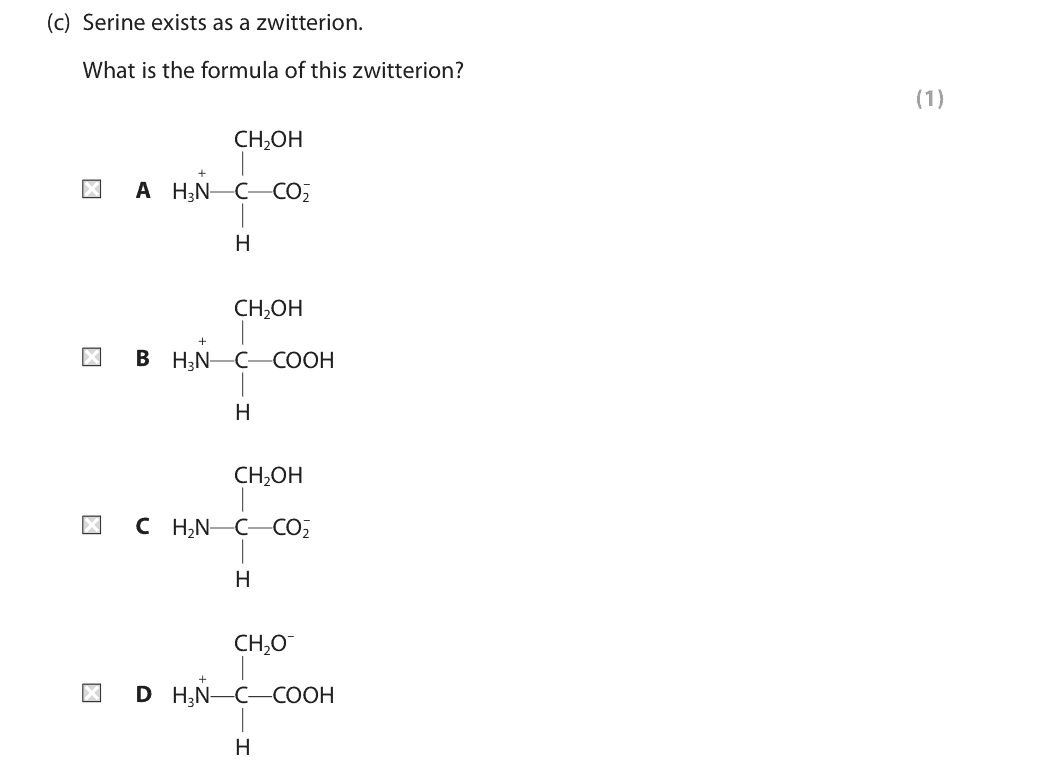
Earlier part of question 8 that this part uses
Answer
A
Mark scheme
Notes from the mark scheme and report
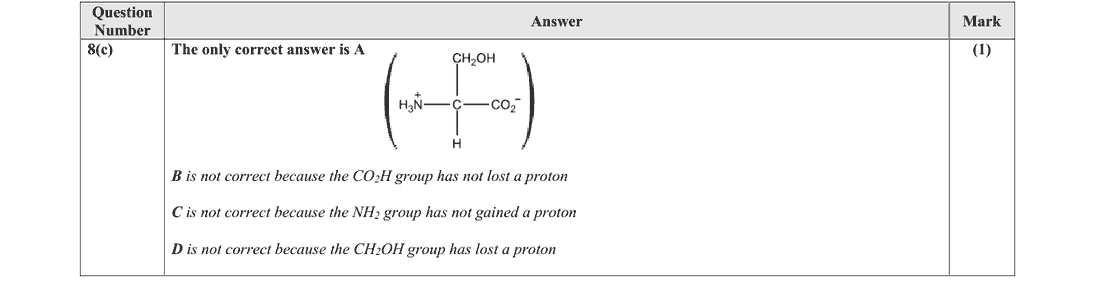
Answer: A, +H3N–CH(CH2OH)–CO2–. The COOH group has lost a proton and the NH2 group has gained one. In B the acid group has not lost a proton, in C the amine has not gained one, in D the CH2OH group has lost the proton
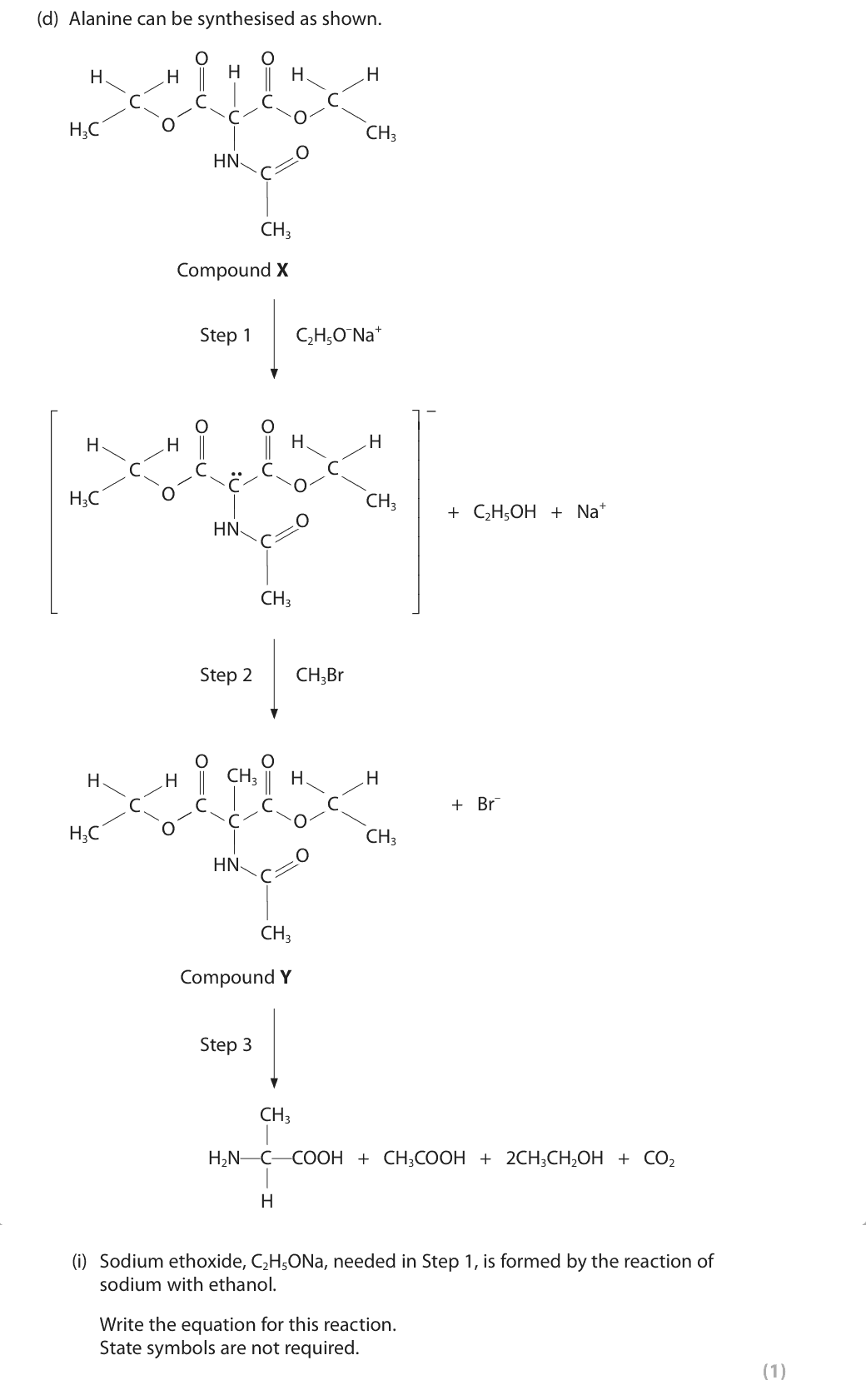
June 2024 · Paper 2 · Q8(d)(ii)2 marksShort answer
Earlier parts of question 8 that this part uses
Mark scheme
Examiner's comment
Compound Y was unfamiliar, and some candidates found it difficult to unpick the detail of the structure and name the functional groups. As a result a significant proportion of candidates discussed ketones or aldehydes, drawn by the carbonyl bond, but not taking note of the neighbouring atoms.
Notes from the mark scheme and report
Answer: ester and (N-substituted) amide, one mark each. Three answers with two correct scores 1
four or more answers scores 0. Many were drawn by the C=O groups to ketone or aldehyde
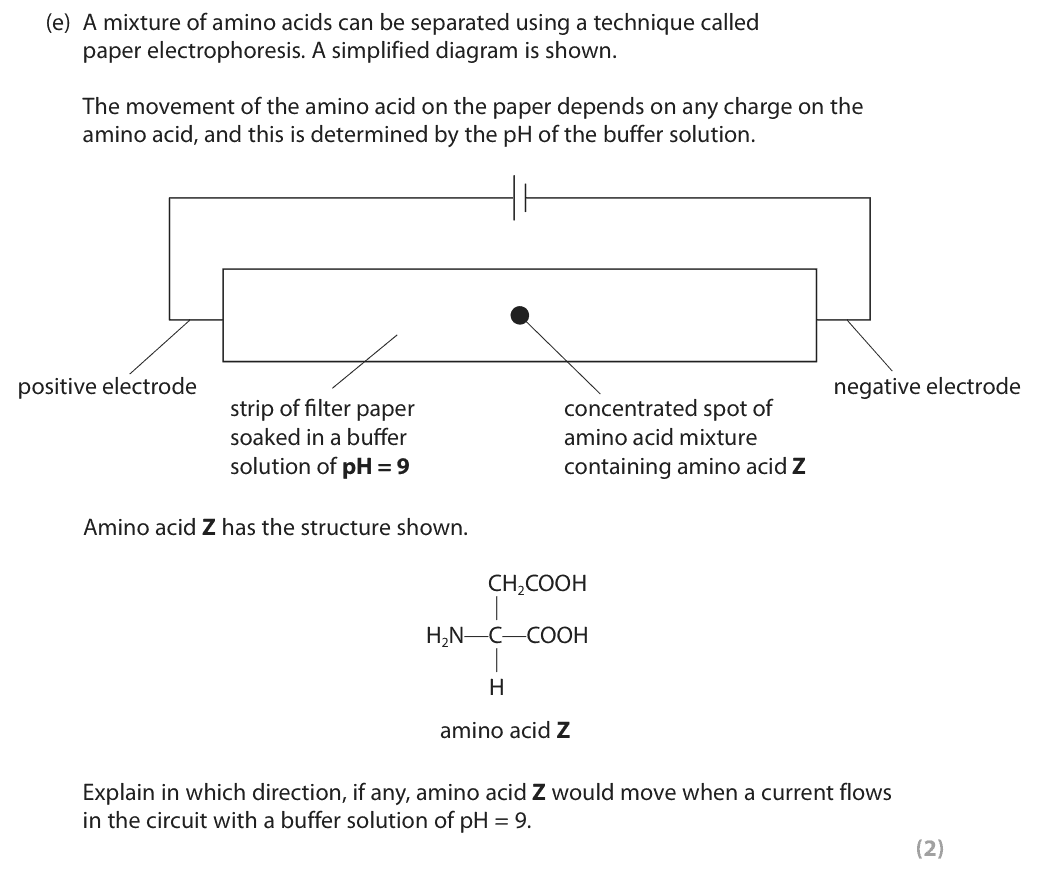
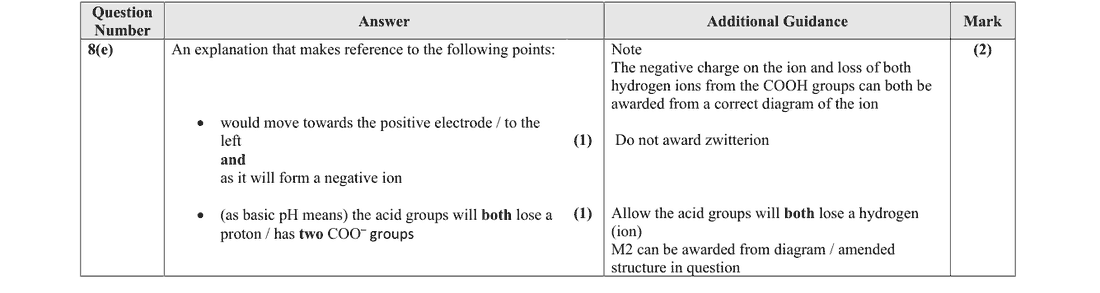
June 2024 · Paper 2 · Q8(e)2 marksExplanation
Earlier part of question 8 that this part uses
Mark scheme
Examiner's comment
A majority of candidates knew that Z would move towards the positive electrode and that this was because the amino acid would be in the form of a negative ion, under basic conditions. Fewer candidates appreciated that this was because of the presence of two carboxylate ions. A small number of candidates incorrectly referred to the ion formed as a zwitterion, not realising that this would mean an equal number of negative and positive charges.
Notes from the mark scheme and report
M1 Z moves towards the positive electrode (to the left) because it forms a negative ion. M2 at pH 9 (alkaline) both COOH groups lose a proton, giving two COO– groups
can be shown on a diagram. Calling the ion a zwitterion is not credited. Most scored M1
fewer mentioned both carboxylate groups
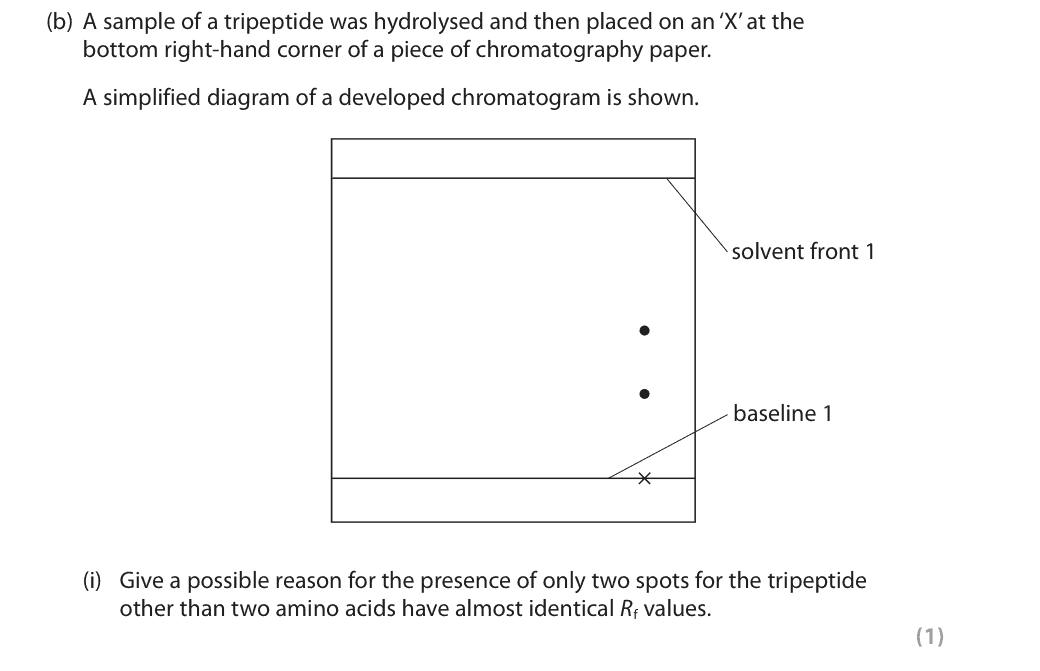
June 2023 · Paper 3 · Q6(b)(i)1 markShort answer
Earlier part of question 6 that this part uses
Mark scheme
Examiner's comment
A sizeable number of candidates missed key points given in the information in this question. There is no spot on the baseline of the chromatogram and so comments about the lack of movement of an amino acid due to poor solubility were not accepted. Also, the question clearly stated that answers "other than ....almost identical Rf values" were required and so it
was disappointing that many responses gave this as an answer.
Notes from the mark scheme and report
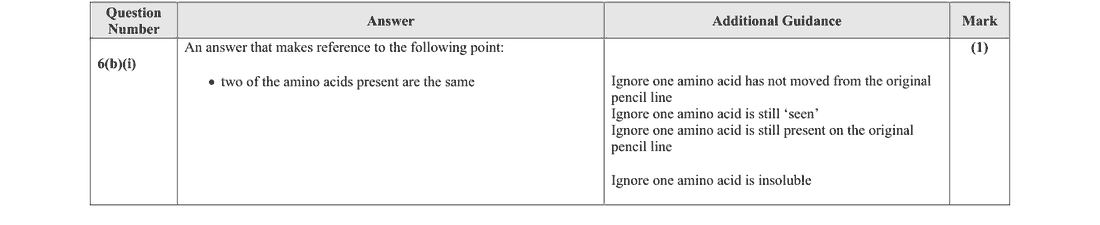
Two of the three amino acids in the tripeptide are the same. Answers about an amino acid not moving from the baseline or being insoluble are ignored (there is no spot on the baseline), and similar Rf values were excluded by the question
Skills: PT9 use thin-layer or paper chromatography
June 2023 · Paper 3 · Q6(b)(iii)1 markShort answer
Earlier part of question 6 that this part uses
Mark scheme
Examiner's comment
Approximately half of the candidates scored the mark for ninhydrin. Other locating agents were allowed but not seen. A wide range of incorrect chemicals were suggested and it is hard to understand why some of them were chosen.
Notes from the mark scheme and report
Answer: ninhydrin (other locating agents allowed). About half scored
Skills: PT9 use thin-layer or paper chromatography
June 2022 · Paper 2 · Q1(c)1 markMultiple choice
Answer
B
Mark scheme
Notes from the mark scheme and report
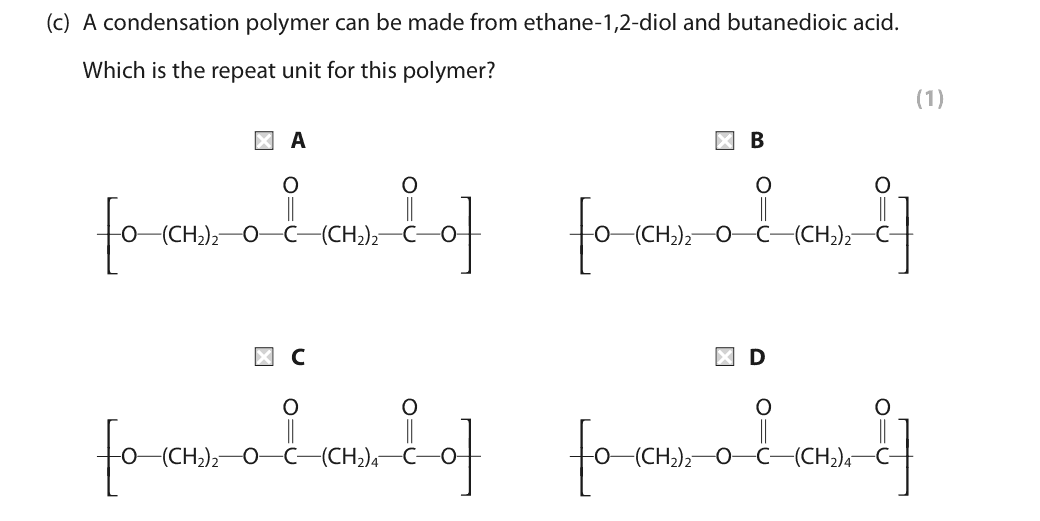
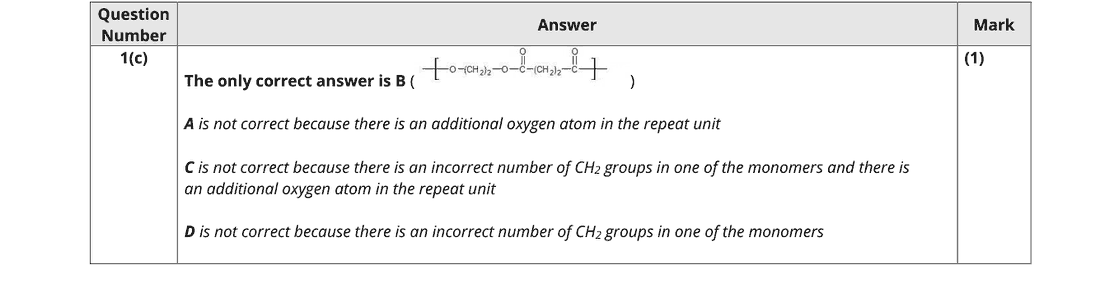
Answer: B, –O–(CH2)2–O–CO–(CH2)2–CO–. A and C have an extra oxygen atom
C and D have (CH2)4, which is the wrong number of CH2 groups for butanedioic acid
June 2022 · Paper 2 · Q4(d)4 marksExplanationHard
Earlier part of question 4 that this part uses
Mark scheme
Examiner's comment
This proved to be one of the more challenging questions on the paper. The definition of a Bronsted-Lowry base was frequently the mark gained but a large number of candidates lost this mark by stating the acyl chloride was an acid and donated the proton.
It was also disappointing that so few candidates gave a clear definition of a nucleophile and also thought that it attacked a carbocation. Candidates were expected to know that there is no carbocation in the mechanism but rather that the nucleophile attacks the delta positive carbon of the C=O bond.
Very few candidates referred to the production of HCl which would immediately react with the excess ethylamine.
Notes from the mark scheme and report
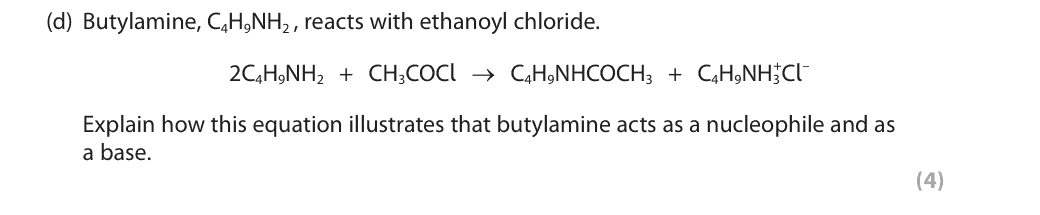
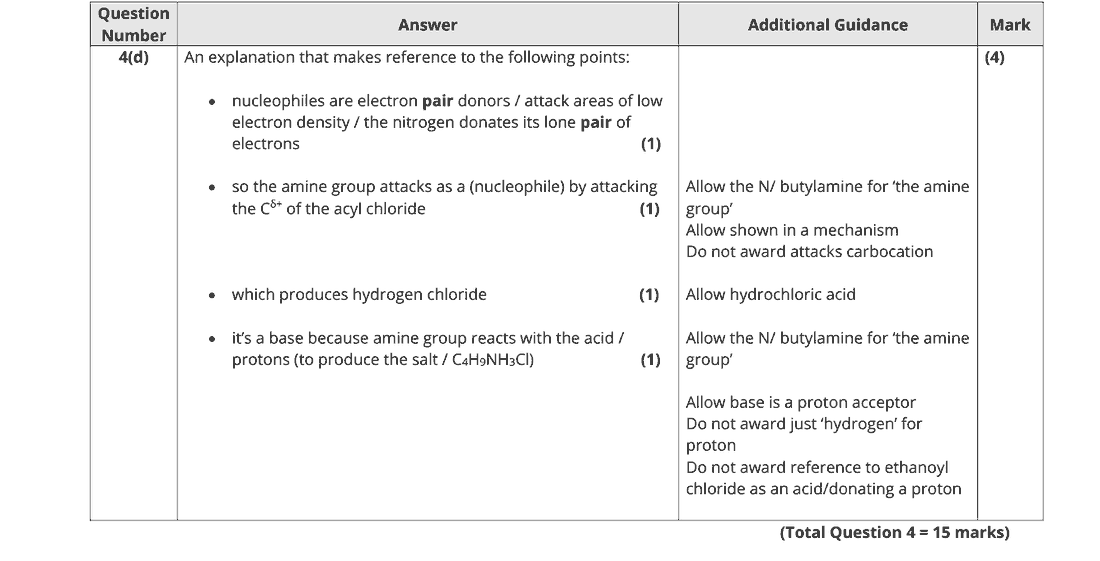
Nucleophile: the nitrogen donates its lone pair of electrons (electron pair donor)
it attacks the Cδ+ of the acyl chloride (not a carbocation)
this produces hydrogen chloride
base: a second butylamine reacts with the acid / accepts a proton to give the salt C4H9NH3Cl. Not 'hydrogen' for proton
not ethanoyl chloride as the acid donating a proton. The base definition was the mark most often gained
few defined a nucleophile clearly
very few mentioned HCl
June 2022 · Paper 2 · Q7(a)(i)2 marksShort answer
Mark scheme
Examiner's comment
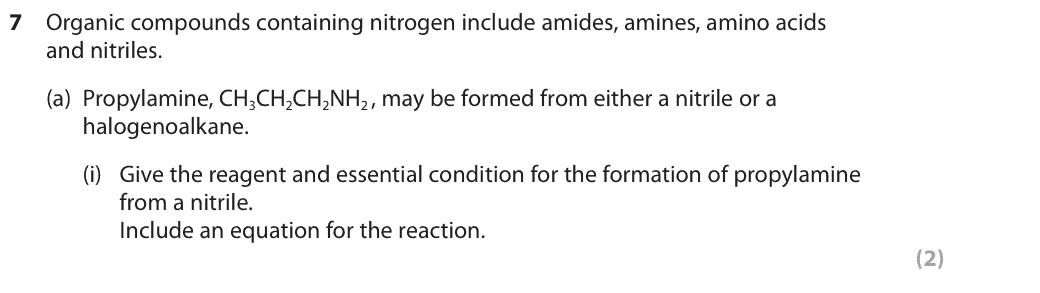
In part (i) candidates needed to realise that they had to start from propanenitrile, with some starting from butanenitrile. The reagent was usually known – and the solvent – but the equation was often not balanced correctly with [H] rather than 4[H] or H2 rather than 2H2.
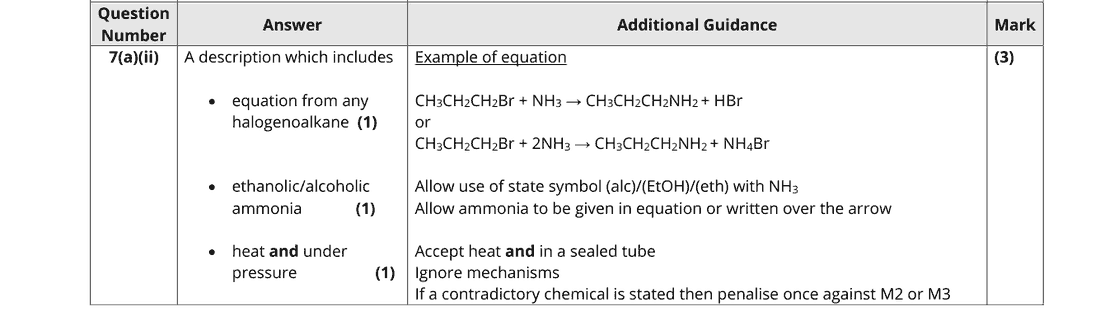
In part (ii) the equation was often correct as was the reagent, but reference to the 'ethanolic' solvent was often omitted, as was the need for an elevated pressure. The stock answer 'heat under reflux' was also seen but this will not work because the ammonia gas would not condense and escape out of the top of the condenser.
Notes from the mark scheme and report
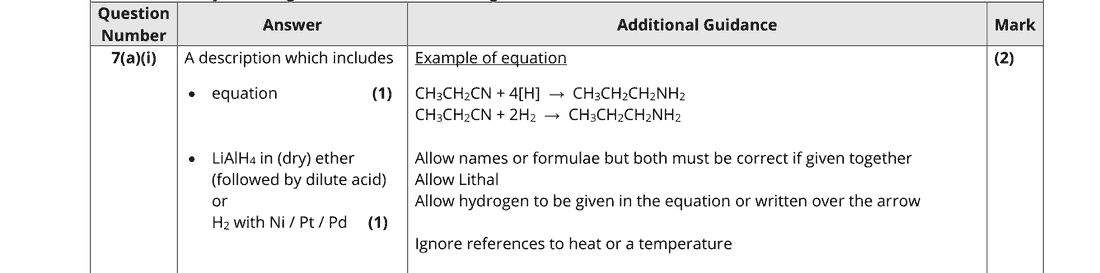
CH3CH2CN + 4[H] → CH3CH2CH2NH2 (or + 2H2)
reagent LiAlH4 in dry ether, or hydrogen with a nickel (platinum, palladium) catalyst. Must start from propanenitrile: some used butanenitrile. The reagent was usually known but the equation was often unbalanced ([H] for 4[H], or H2 for 2H2)
June 2022 · Paper 2 · Q7(a)(ii)3 marksShort answer
Earlier part of question 7 that this part uses
Mark scheme
Examiner's comment
In part (i) candidates needed to realise that they had to start from propanenitrile, with some starting from butanenitrile. The reagent was usually known – and the solvent – but the equation was often not balanced correctly with [H] rather than 4[H] or H2 rather than 2H2.
In part (ii) the equation was often correct as was the reagent, but reference to the 'ethanolic' solvent was often omitted, as was the need for an elevated pressure. The stock answer 'heat under reflux' was also seen but this will not work because the ammonia gas would not condense and escape out of the top of the condenser.
heat under pressure (in a sealed tube). 'Ethanolic' and the pressure were often left out
'heat under reflux' does not work because the ammonia gas would escape
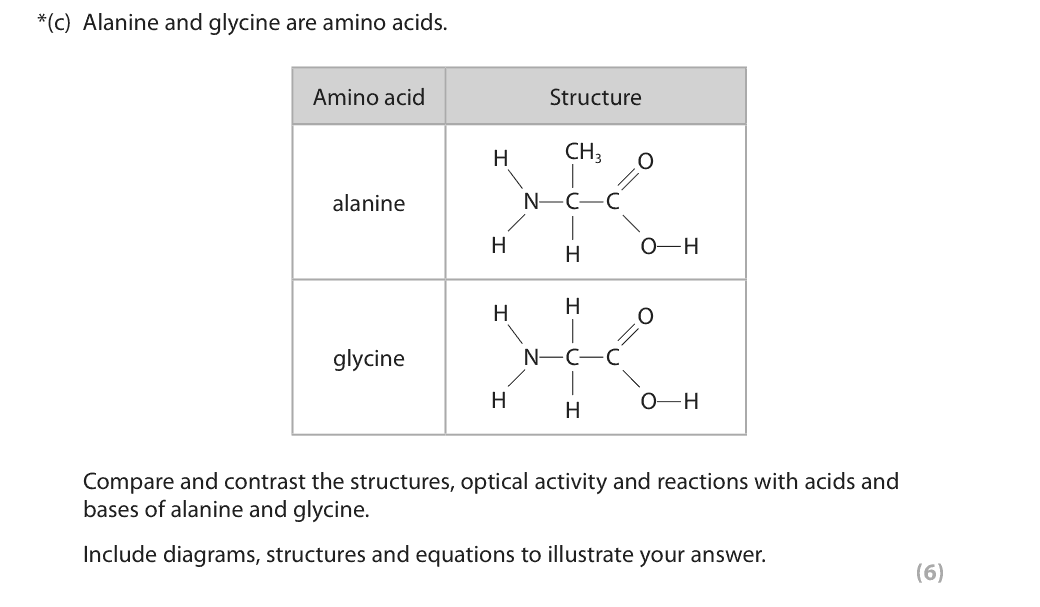
June 2022 · Paper 2 · Q7(c)6 marks6-mark extended response
Earlier part of question 7 that this part uses
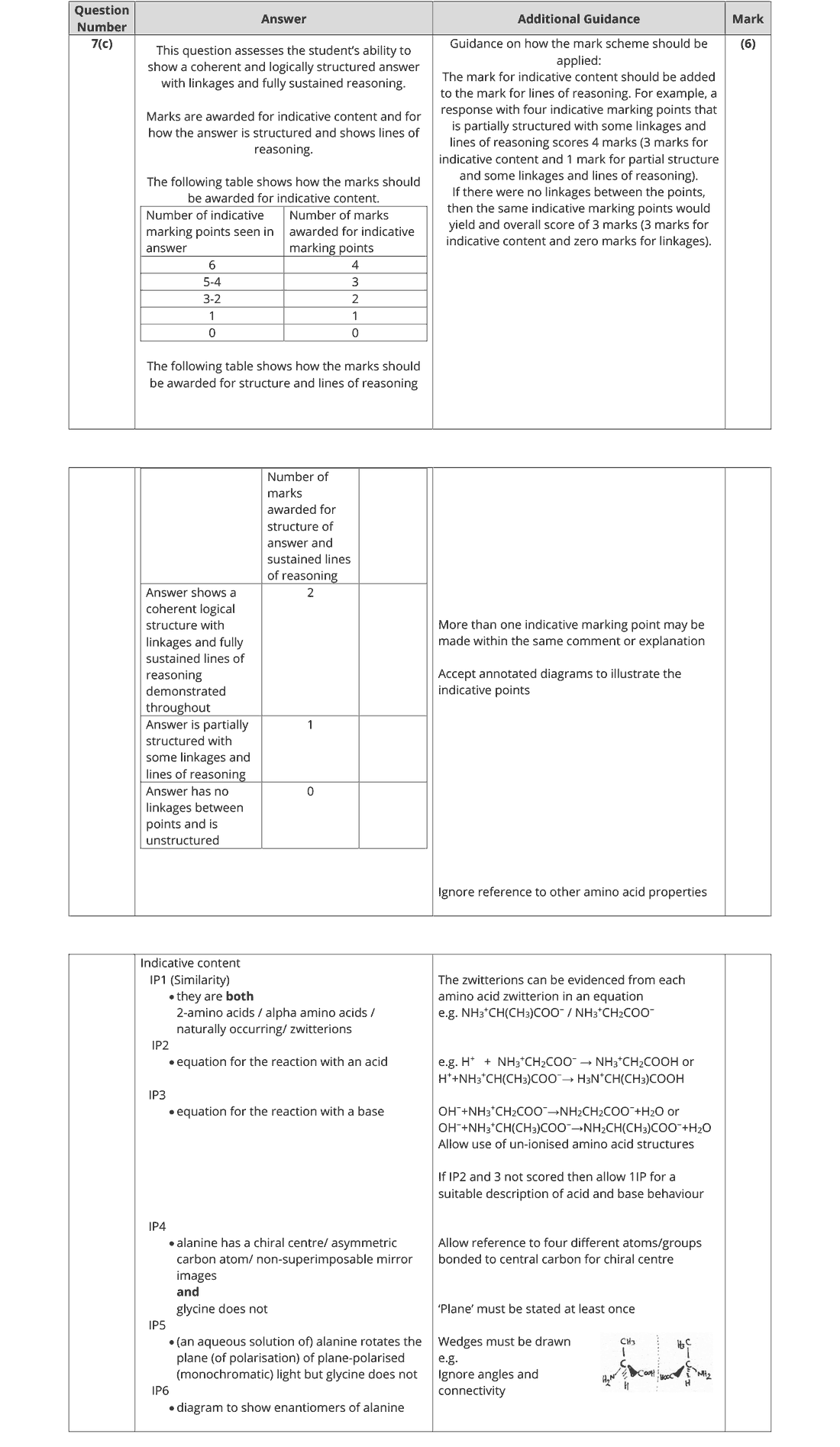
Mark scheme, with the indicative content and the marks for reasoning
Examiner's comment
On the whole this 6-mark question was answered rather well which may be a reflection of the fact that amino acids are included in the first topic on the Advance Notice.
It was disappointing that IP3 and 4 often couldn’t be given because of the absence of any equations despite the clear instruction in the question that these were required. In addition, it was not uncommon to see one or more of the equations being balanced incorrectly, often with H2O missing as a product. However, the MS had a rescue mark for a suitable description
of amino acid behaviour with an acid and a base which helped many score a mark here.
Chirality and the ability to rotate the plane of plane polarised light were often given, but many failed to show mirror images of alanine’s enantiomers.
It would seem that many had obviously noted on the Advance Notice information that amino acids were the first topic listed and so had revised their chemistry of amino acids. There were a sizeable number of excellent responses achieving full credit.
Notes from the mark scheme and report
Six indicative points plus two marks for reasoning. IP1 similarity: both are 2-amino acids / form zwitterions
IP2 equation for reaction with an acid, e.g. H+ + H3N+CH2COO– → H3N+CH2COOH
IP3 equation for reaction with a base, e.g. OH– + H3N+CH2COO– → H2NCH2COO– + H2O (un-ionised structures allowed
one point for a description of acid and base behaviour if neither equation scores)
IP4 alanine has a chiral centre (four different groups on the central carbon) and glycine does not
IP5 alanine rotates the plane of plane-polarised light and glycine does not ('plane' needed)
IP6 wedge-and-dash diagram of the two enantiomers of alanine. Common errors: no equations despite the instruction
equations unbalanced, often with H2O missing
no mirror-image diagrams
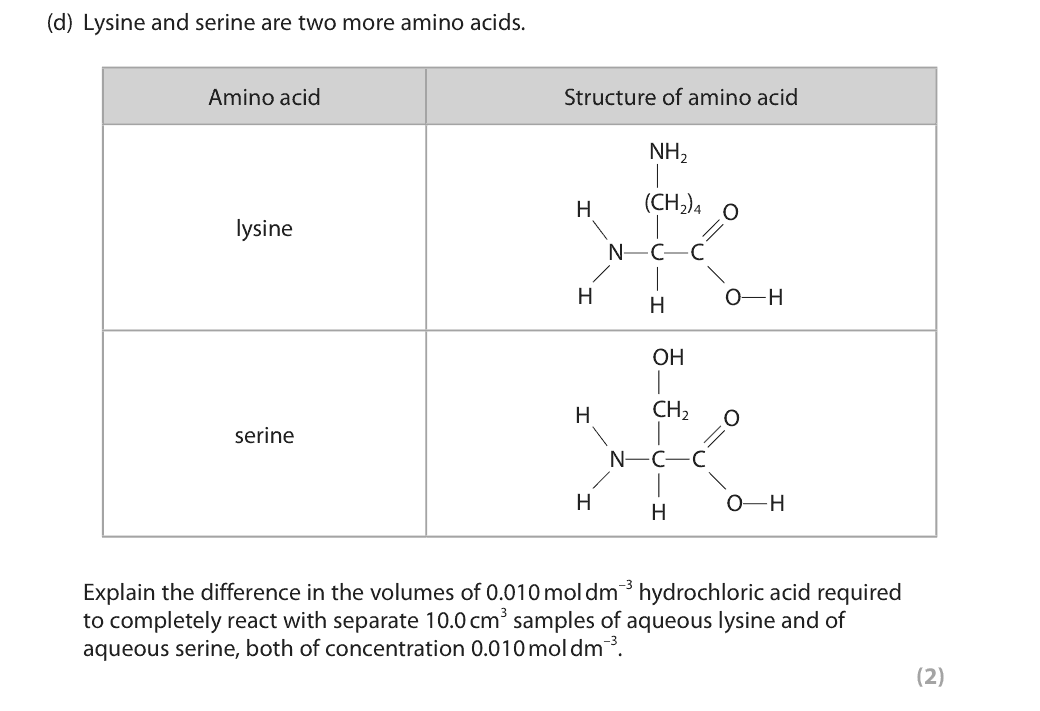
June 2022 · Paper 2 · Q7(d)2 marksExplanation
Earlier part of question 7 that this part uses
Mark scheme
Examiner's comment
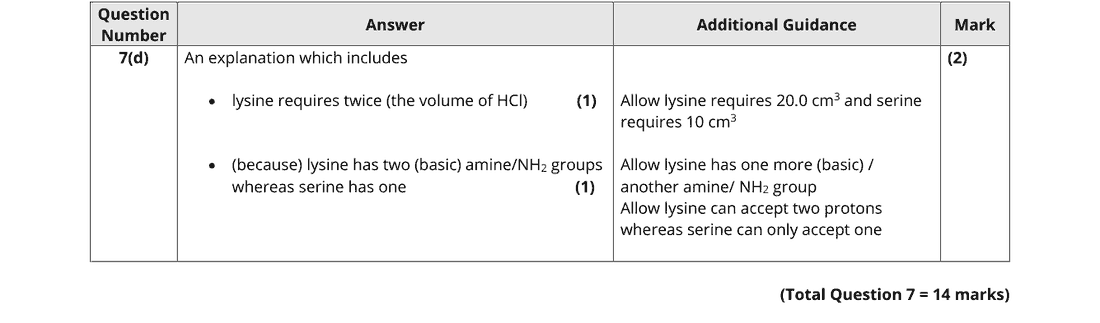
Despite the presence of several numbers in the question candidates often only answered qualitatively regarding the volumes of acid required and the number of amino groups present. Some candidates incorrectly thought the alcohol group was acidic.
Notes from the mark scheme and report
Lysine needs twice the volume of acid (20.0 cm3 against 10.0 cm3 for serine)
because lysine has two (basic) amine groups and serine has one (lysine can accept two protons). Many answered only qualitatively despite the numbers
some thought the alcohol group was acidic
November 2021 · Paper 2 · Q9(c)(iii)1 markMultiple choice
Earlier parts of question 9 that this part uses
Answer
B
Mark scheme
Examiner's comment
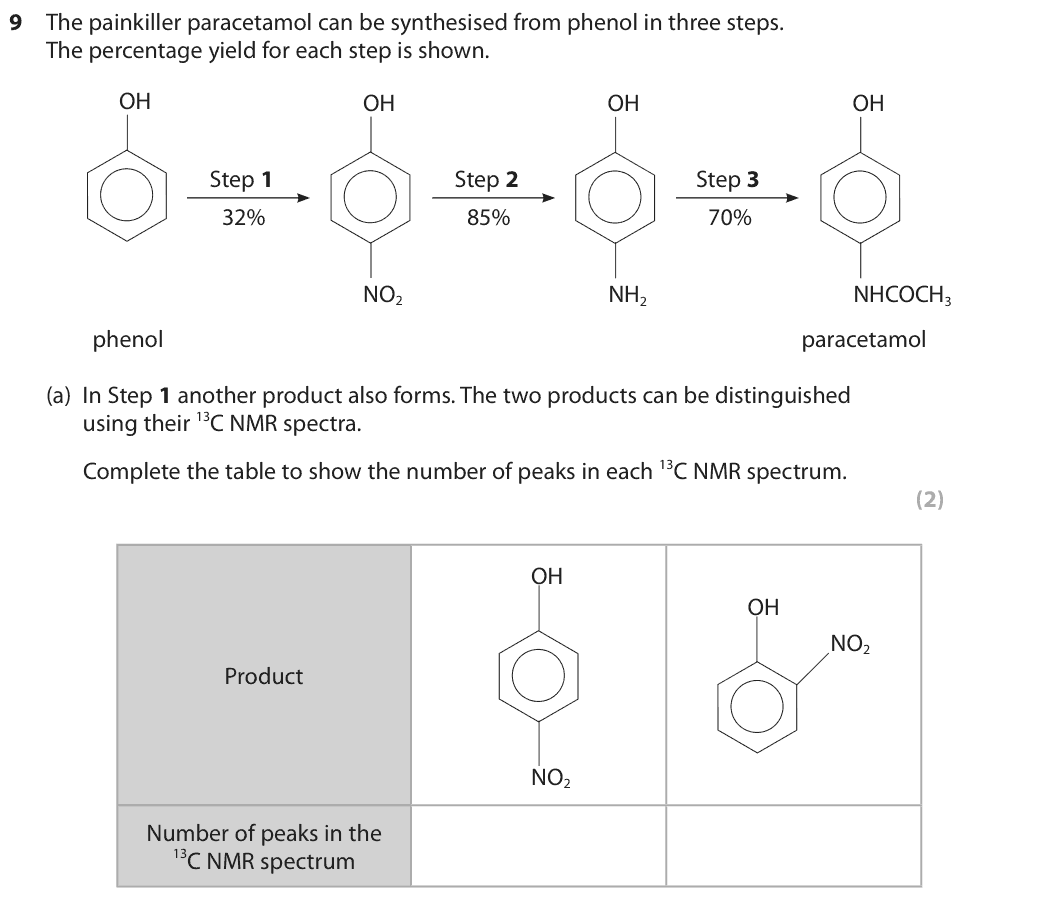
Completion of the table in (a) was attempted by nearly all candidates, though only a minority
scored both marks. The calculation in (b) yielded marks for many, though not taking into
account the overall yield of the process meant an answer of 622.5 g was common. Whilst many
candidates could identify chiral carbon atoms in (c)(ii) a number seemed unable to work with
skeletal formulae, circling whole sections of the molecule, covering several carbon atoms. Most
candidates in (d) assigned the crystalline structure solely to hydrogen bonds rather than the
formation of zwitterions.
Notes from the mark scheme and report
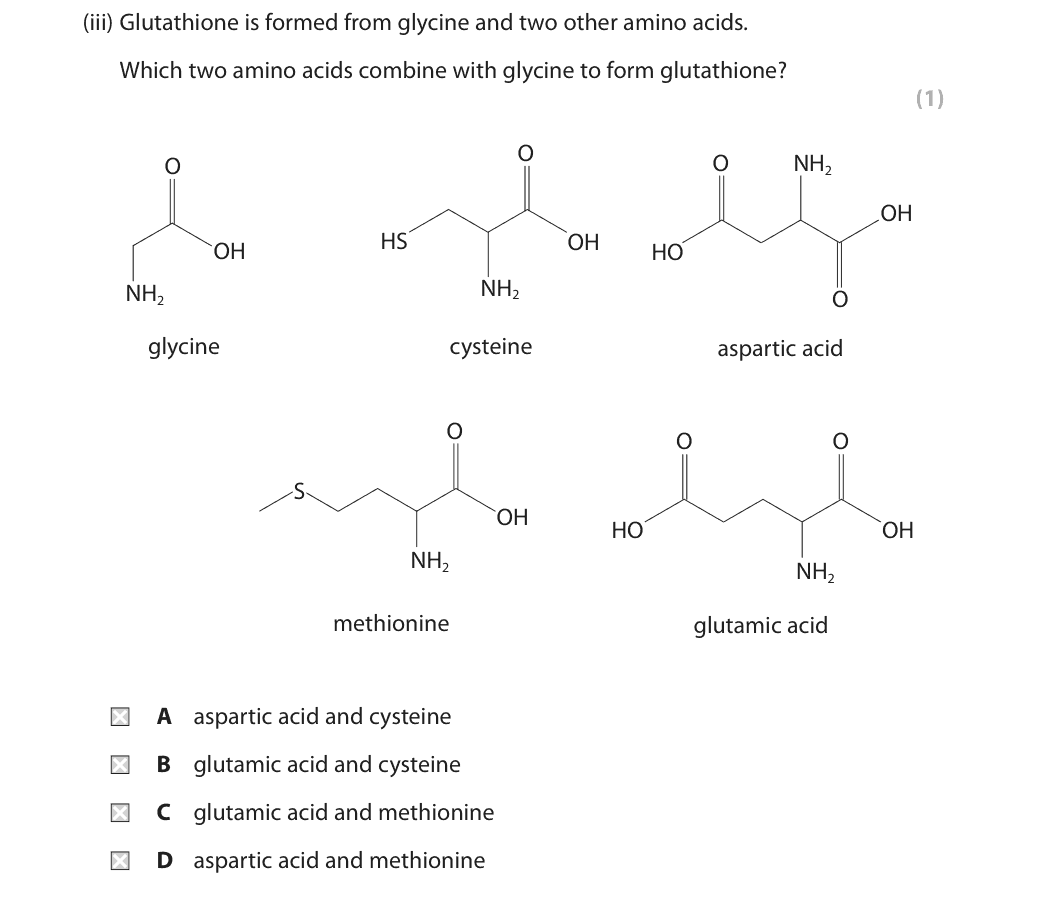
Answer: B. Hydrolysing the two peptide bonds gives glycine, cysteine (the CH2SH side chain) and glutamic acid (five carbons). Aspartic acid has only four carbons
the sulfur in methionine carries a methyl group
November 2021 · Paper 2 · Q9(d)2 marksExplanation
Earlier part of question 9 that this part uses
Mark scheme
Examiner's comment
Completion of the table in (a) was attempted by nearly all candidates, though only a minority
scored both marks. The calculation in (b) yielded marks for many, though not taking into
account the overall yield of the process meant an answer of 622.5 g was common. Whilst many
candidates could identify chiral carbon atoms in (c)(ii) a number seemed unable to work with
skeletal formulae, circling whole sections of the molecule, covering several carbon atoms. Most
candidates in (d) assigned the crystalline structure solely to hydrogen bonds rather than the
formation of zwitterions.
Notes from the mark scheme and report
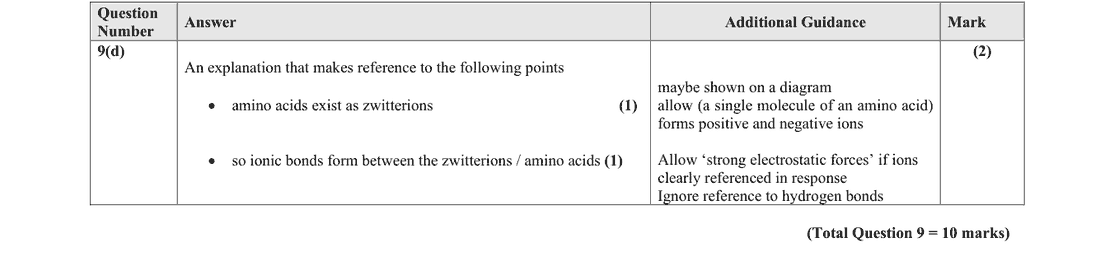
Amino acids exist as zwitterions (allow: one molecule forms both a positive and a negative ion)
so there are ionic bonds / strong electrostatic forces between the zwitterions. Hydrogen bonding is ignored. Most gave hydrogen bonding only
November 2021 · Paper 2 · Q10(a)(i)1 markEquation writing
Mark scheme
Examiner's comment
Many were able to construct the equation in (a)(i) correctly, but a number showed
C4H9NH3+OH– as a single product. In previous series, the majority of candidates have been
able to use ideas based around the electron density of an arene ring to explain differences in
reactivity between phenol and benzene. In (a)(ii), use of a similar model could be used to
explain the difference in basicity, and those who used this approach often scored two or three
marks. The reagent in (b) was well known, though some candidates only scored one mark, by
either using propanoic acid or by using an acyl chloride with an incorrect number of carbons.
Whilst many recognised the reaction as nucleophilic substitution in (d)(ii), far fewer could
construct the mechanism. Whilst some excellent answers were seen, others revealed little
understanding of curly arrows, with contradictions such as arrows pointing to lone pairs or
bonds evident.
Notes from the mark scheme and report
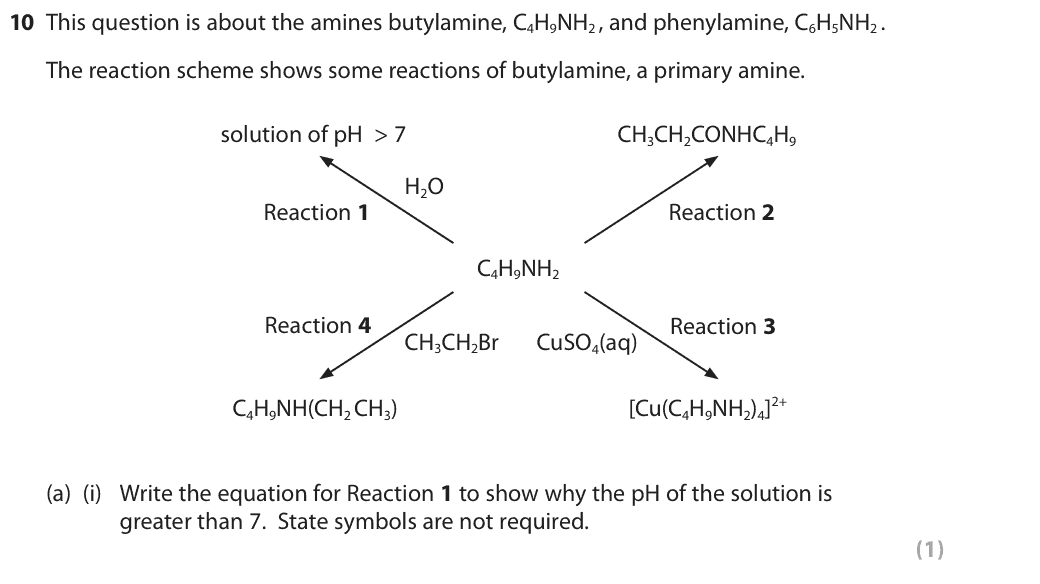
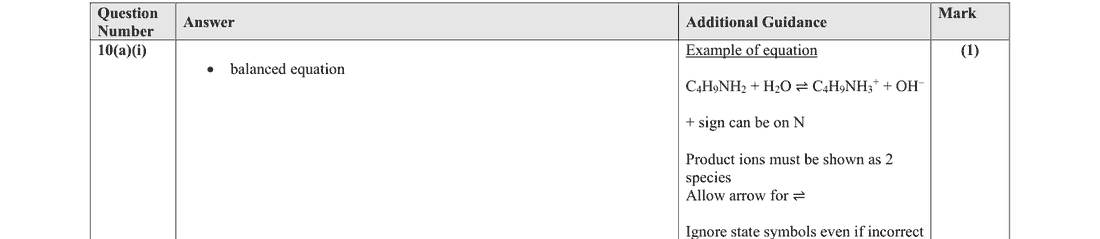
Answer: C4H9NH2 + H2O ⇌ C4H9NH3+ + OH– (a single arrow allowed). The two product ions must be shown as separate species
a number wrote C4H9NH3+OH– as one product
November 2021 · Paper 2 · Q10(a)(ii)3 marksExplanation
Earlier part of question 10 that this part uses
Mark scheme
Examiner's comment
Many were able to construct the equation in (a)(i) correctly, but a number showed
C4H9NH3+OH– as a single product. In previous series, the majority of candidates have been
able to use ideas based around the electron density of an arene ring to explain differences in
reactivity between phenol and benzene. In (a)(ii), use of a similar model could be used to
explain the difference in basicity, and those who used this approach often scored two or three
marks. The reagent in (b) was well known, though some candidates only scored one mark, by
either using propanoic acid or by using an acyl chloride with an incorrect number of carbons.
Whilst many recognised the reaction as nucleophilic substitution in (d)(ii), far fewer could
construct the mechanism. Whilst some excellent answers were seen, others revealed little
understanding of curly arrows, with contradictions such as arrows pointing to lone pairs or
bonds evident.
Notes from the mark scheme and report
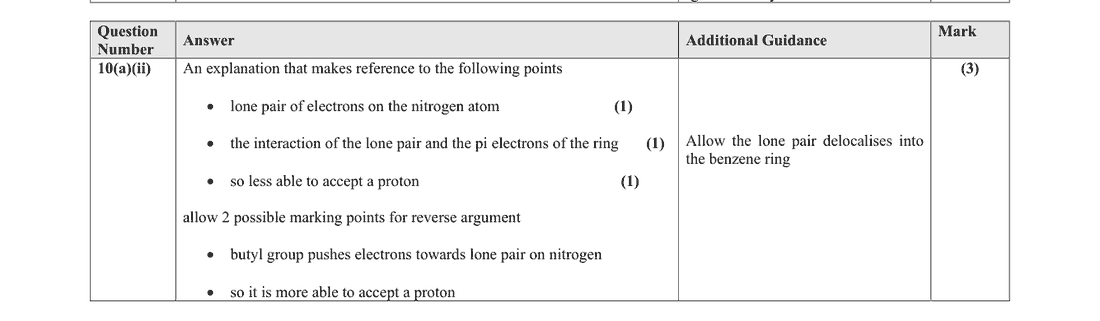
The lone pair of electrons on the nitrogen atom
interacts with the pi electrons of the ring / is delocalised into the benzene ring
so it is less able to accept a proton. Two of the marks can come from the reverse argument: the butyl group pushes electrons towards the lone pair on N, so it accepts a proton more readily. Those who used ring electron density ideas often scored 2 or 3
November 2021 · Paper 2 · Q10(b)2 marksShort answer
Earlier part of question 10 that this part uses
Mark scheme
Examiner's comment
Many were able to construct the equation in (a)(i) correctly, but a number showed
C4H9NH3+OH– as a single product. In previous series, the majority of candidates have been
able to use ideas based around the electron density of an arene ring to explain differences in
reactivity between phenol and benzene. In (a)(ii), use of a similar model could be used to
explain the difference in basicity, and those who used this approach often scored two or three
marks. The reagent in (b) was well known, though some candidates only scored one mark, by
either using propanoic acid or by using an acyl chloride with an incorrect number of carbons.
Whilst many recognised the reaction as nucleophilic substitution in (d)(ii), far fewer could
construct the mechanism. Whilst some excellent answers were seen, others revealed little
understanding of curly arrows, with contradictions such as arrows pointing to lone pairs or
bonds evident.
Notes from the mark scheme and report
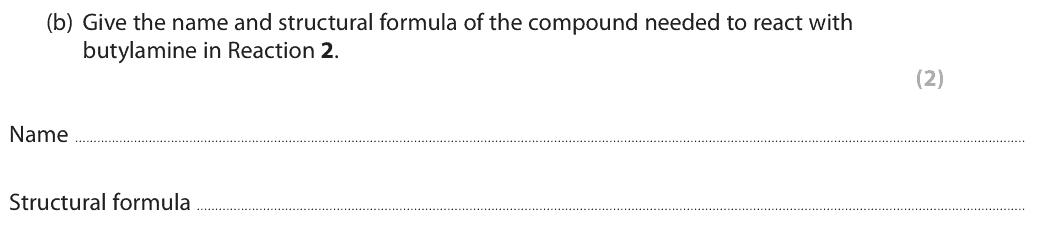
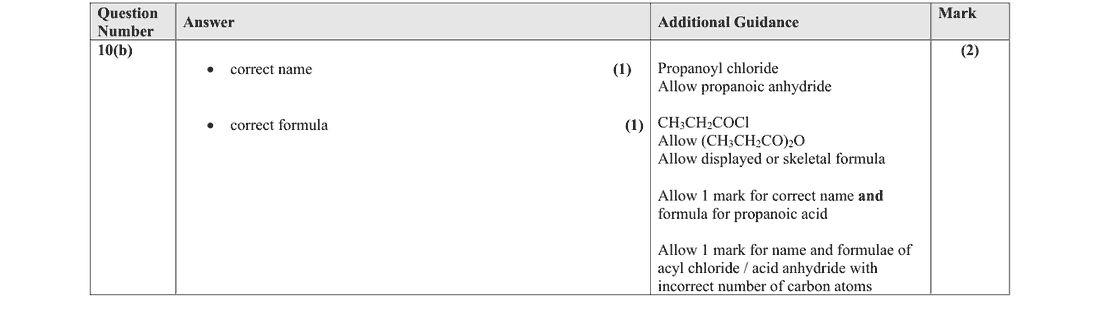
Answer: propanoyl chloride, CH3CH2COCl (allow propanoic anhydride, (CH3CH2CO)2O). One mark for the name and formula of propanoic acid, or for an acyl chloride with the wrong number of carbons
these were the usual ways of scoring only 1
November 2021 · Paper 2 · Q10(c)1 markMultiple choice
Earlier part of question 10 that this part uses
Answer
A
Mark scheme
Examiner's comment
Many were able to construct the equation in (a)(i) correctly, but a number showed
C4H9NH3+OH– as a single product. In previous series, the majority of candidates have been
able to use ideas based around the electron density of an arene ring to explain differences in
reactivity between phenol and benzene. In (a)(ii), use of a similar model could be used to
explain the difference in basicity, and those who used this approach often scored two or three
marks. The reagent in (b) was well known, though some candidates only scored one mark, by
either using propanoic acid or by using an acyl chloride with an incorrect number of carbons.
Whilst many recognised the reaction as nucleophilic substitution in (d)(ii), far fewer could
construct the mechanism. Whilst some excellent answers were seen, others revealed little
understanding of curly arrows, with contradictions such as arrows pointing to lone pairs or
bonds evident.
Notes from the mark scheme and report
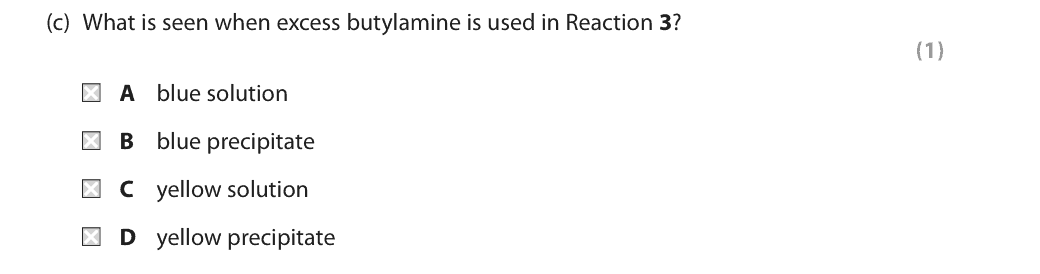
Answer: A. Excess butylamine forms the complex ion [Cu(C4H9NH2)4]2+, seen as a (deep) blue solution, not a precipitate
November 2021 · Paper 2 · Q10(d)(i)1 markMultiple choice
Earlier part of question 10 that this part uses
Answer
D
Mark scheme
Examiner's comment
Many were able to construct the equation in (a)(i) correctly, but a number showed
C4H9NH3+OH– as a single product. In previous series, the majority of candidates have been
able to use ideas based around the electron density of an arene ring to explain differences in
reactivity between phenol and benzene. In (a)(ii), use of a similar model could be used to
explain the difference in basicity, and those who used this approach often scored two or three
marks. The reagent in (b) was well known, though some candidates only scored one mark, by
either using propanoic acid or by using an acyl chloride with an incorrect number of carbons.
Whilst many recognised the reaction as nucleophilic substitution in (d)(ii), far fewer could
construct the mechanism. Whilst some excellent answers were seen, others revealed little
understanding of curly arrows, with contradictions such as arrows pointing to lone pairs or
bonds evident.
Notes from the mark scheme and report
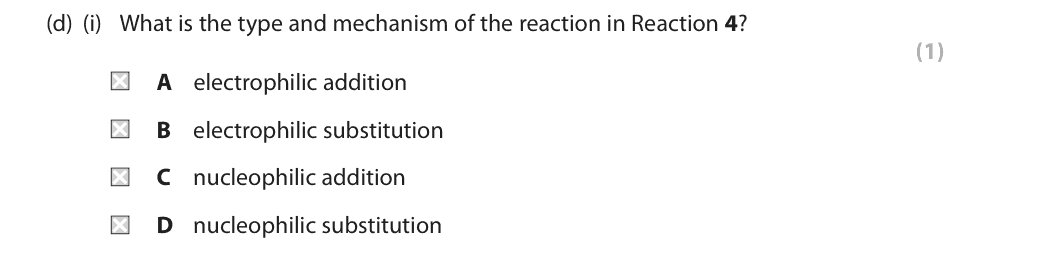
Answer: D. The amine is a nucleophile (lone pair on N) and replaces Br in bromoethane: nucleophilic substitution
November 2021 · Paper 3 · Q6(b)1 markShort answer
Earlier part of question 6 that this part uses
Mark scheme
Examiner's comment
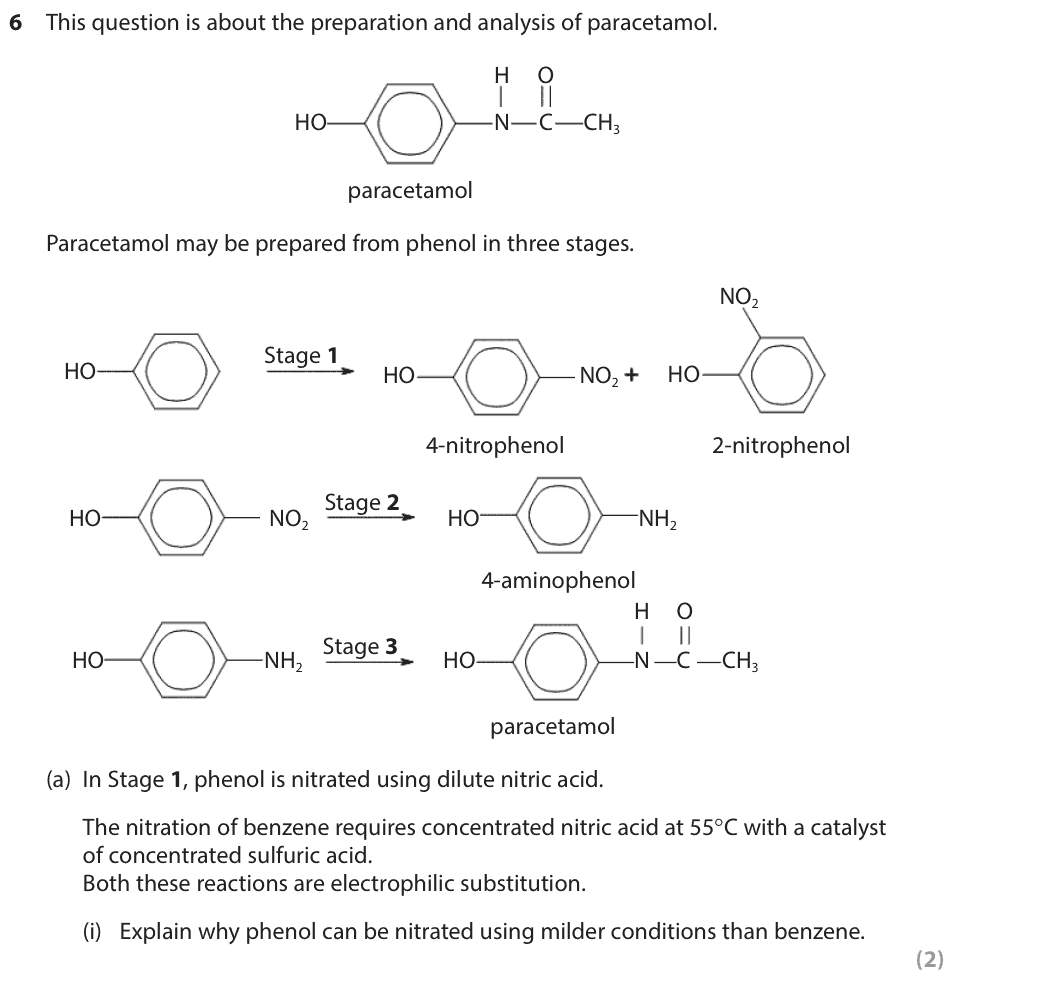
Some candidates gave clear and concise explanations for why phenol can be nitrated using
milder conditions than benzene while others seemed unfamiliar with this concept or gave
partial answers. Some referred to the lone pair of electrons on the OH group rather than the
oxygen atom. Many candidates struggled to explain the difference in boiling temperatures of
the two isomers and did not refer to intermolecular forces as requested in the question.
Many answers did not mention hydrogen bonding. Many candidates knew that a reducing
agent is needed to convert 4-nitrophenol into 4-aminophenol, although some did not read the
question and gave a specific reagent rather than the type of reagent. There were many poor
diagrams drawn for filtration under reduced pressure, with folded filter paper and no
perforations in the Buchner funnel. Most candidates would benefit from more practise in
drawing clear labelled diagrams of the common practical techniques in the specification. A
few candidates gave clear descriptions of the recrystallisation procedure, but most put steps
in the wrong order, missed out steps such as hot filtration and were generally confused. A
common error in producing dry crystals was to suggest adding an anhydrous salt as a drying
agent. Although this works well for drying liquids as it is easy to separate the substances, it
does not work for drying crystals unless the drying agent is specified as being in a desiccator.
Many candidates knew that impurities lower the melting temperature of a substance and it
will melt over a range of temperatures rather than having a sharp melting point, but many
omitted one of these from their answer. Many candidates were able to work out the
molecular formula of paracetamol but quite a lot had an incorrect number of hydrogen atoms
and some candidates were not aware of the meaning of molecular formula. The calculation in
(d)(ii) was carried out correctly by many candidates. Some omitted to use the mole ratio and
others omitted the use of a 100.0 cm3 volumetric flask. Some candidates calculated a mass
higher than the original 0.500 g of paracetamol and reversed the percentage calculation to
obtain a value less than 100%. These candidates should be advised to check their working to
see where they have made an error instead of doing this.
Notes from the mark scheme and report
Answer: reducing agent. The TYPE of reagent is asked for: tin and concentrated hydrochloric acid is ignored, and any other named reducing agent loses the mark
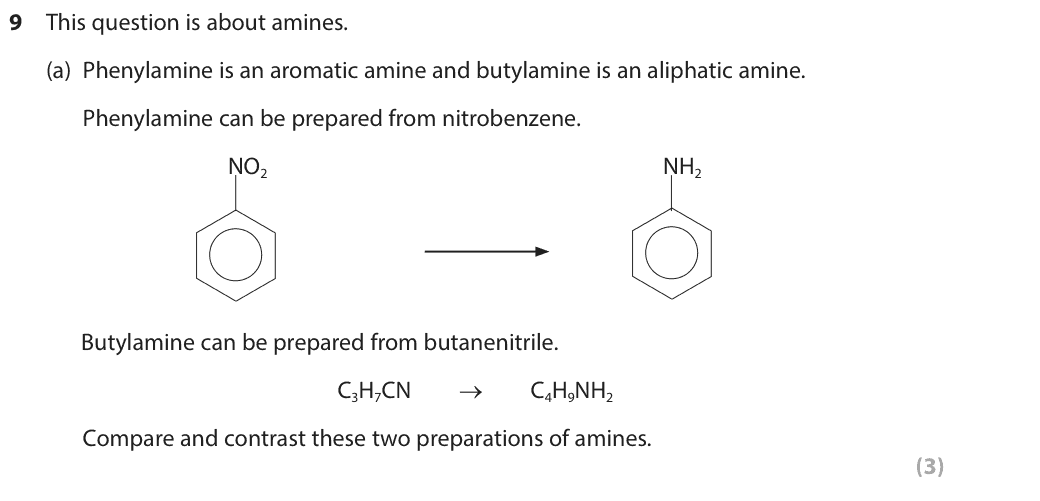
October 2020 · Paper 3 · Q9(a)3 marksShort answerHard
Mark scheme
Examiner's comment
The few correct answers to (a) on the preparation of amines suggests that this is a topic area
not well-studied or understood. Candidates need to remember that ‘compare and contrast’
question need at least one similarity and one difference. The similarity of both reactions being
that of reduction was rarely given and instead vague or feeble answers such as both require
heat were seen.
The comparison of the basicity of the two amines in (b) was answered much better. However
it is worth highlighting that candidates would be well-advised to ensure that when answering
questions of this type that terms such as ‘base’ are clearly stated. The lone pair of electrons on
the nitrogen is the key aspect of this subject and how it is able to form a coordinate bond with
a proton and thus act as a base. Only the better candidates made this clear. It was not
uncommon to see a response where the proton was not mentioned at all.
It is worth reiterating that questions further along in the paper get more demanding. This was
clearly evident in part (c). The equation for the reaction warranted only one mark. Common
errors were the use of molecular formulae and the omission of the product HCl. The name of
the amide was also problematic for all but the more able.
Polymers continue to be challenging for candidates and centres would be helpful to provide
even more practice. The name of the amine monomer given was not always the systematic
name but credit was attempted to be given where it was unambiguous.
Notes from the mark scheme and report
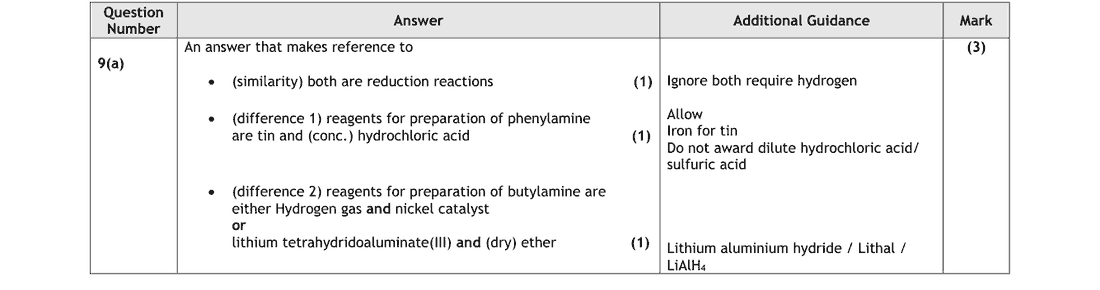
Similarity: both are reductions. Phenylamine: tin (allow iron) and concentrated hydrochloric acid (not dilute, not sulfuric). Butylamine: hydrogen with a nickel catalyst, or lithium tetrahydridoaluminate (LiAlH4) in dry ether. The similarity was rarely given (vague answers such as 'both need heat')
October 2020 · Paper 3 · Q9(b)3 marksExplanation
Mark scheme
Examiner's comment
The few correct answers to (a) on the preparation of amines suggests that this is a topic area
not well-studied or understood. Candidates need to remember that ‘compare and contrast’
question need at least one similarity and one difference. The similarity of both reactions being
that of reduction was rarely given and instead vague or feeble answers such as both require
heat were seen.
The comparison of the basicity of the two amines in (b) was answered much better. However
it is worth highlighting that candidates would be well-advised to ensure that when answering
questions of this type that terms such as ‘base’ are clearly stated. The lone pair of electrons on
the nitrogen is the key aspect of this subject and how it is able to form a coordinate bond with
a proton and thus act as a base. Only the better candidates made this clear. It was not
uncommon to see a response where the proton was not mentioned at all.
It is worth reiterating that questions further along in the paper get more demanding. This was
clearly evident in part (c). The equation for the reaction warranted only one mark. Common
errors were the use of molecular formulae and the omission of the product HCl. The name of
the amide was also problematic for all but the more able.
Polymers continue to be challenging for candidates and centres would be helpful to provide
even more practice. The name of the amine monomer given was not always the systematic
name but credit was attempted to be given where it was unambiguous.
Notes from the mark scheme and report
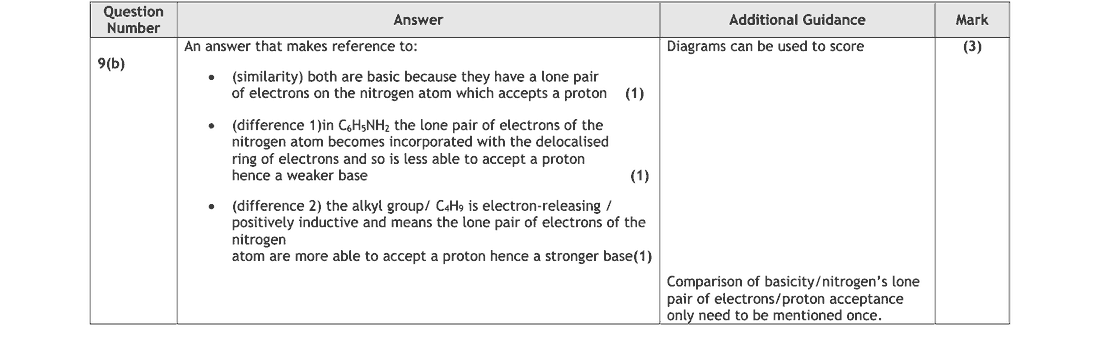
Similarity: both are bases because the lone pair on the nitrogen atom accepts a proton. Phenylamine: the lone pair is drawn into the delocalised ring so is less able to accept a proton, a weaker base. Butylamine: the alkyl group is electron-releasing so the lone pair is more available, a stronger base. Diagrams can score. Answered much better than (a), but the proton was often not mentioned at all
October 2020 · Paper 3 · Q9(c)2 marksEquation writing
Mark scheme
Examiner's comment
The few correct answers to (a) on the preparation of amines suggests that this is a topic area
not well-studied or understood. Candidates need to remember that ‘compare and contrast’
question need at least one similarity and one difference. The similarity of both reactions being
that of reduction was rarely given and instead vague or feeble answers such as both require
heat were seen.
The comparison of the basicity of the two amines in (b) was answered much better. However
it is worth highlighting that candidates would be well-advised to ensure that when answering
questions of this type that terms such as ‘base’ are clearly stated. The lone pair of electrons on
the nitrogen is the key aspect of this subject and how it is able to form a coordinate bond with
a proton and thus act as a base. Only the better candidates made this clear. It was not
uncommon to see a response where the proton was not mentioned at all.
It is worth reiterating that questions further along in the paper get more demanding. This was
clearly evident in part (c). The equation for the reaction warranted only one mark. Common
errors were the use of molecular formulae and the omission of the product HCl. The name of
the amide was also problematic for all but the more able.
Polymers continue to be challenging for candidates and centres would be helpful to provide
even more practice. The name of the amine monomer given was not always the systematic
name but credit was attempted to be given where it was unambiguous.
Notes from the mark scheme and report
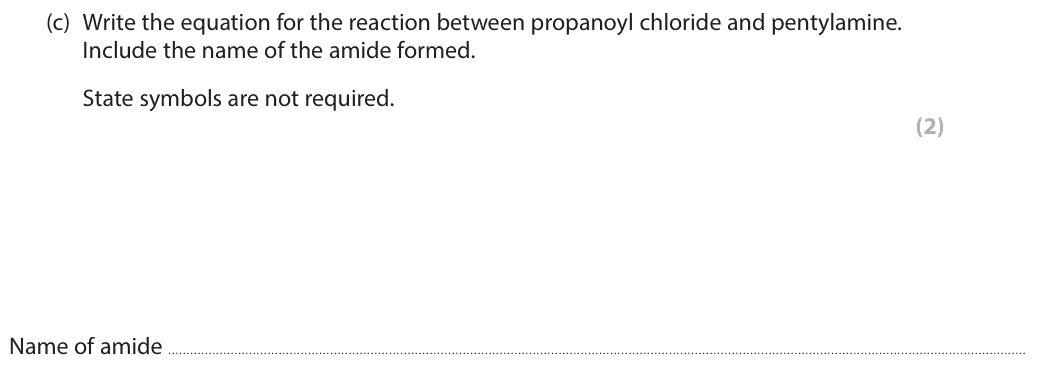
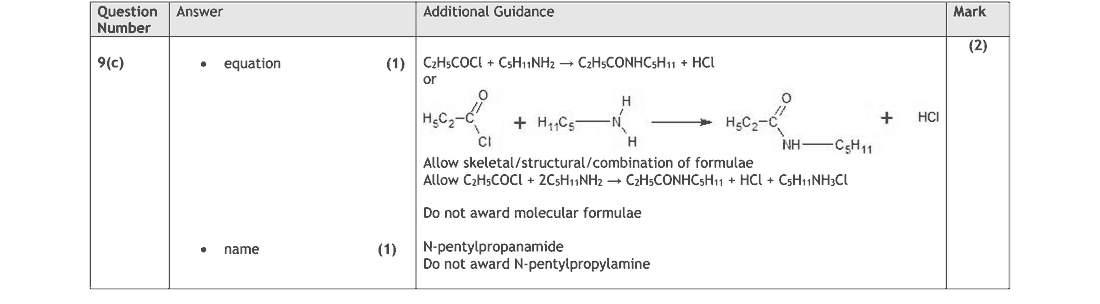
C2H5COCl + C5H11NH2 → C2H5CONHC5H11 + HCl (the version with 2C5H11NH2 giving C5H11NH3Cl is allowed)
name N-pentylpropanamide. Structural or skeletal formulae allowed, molecular formulae not. Common errors: molecular formulae
HCl left out
the name was hard for all but the more able
October 2020 · Paper 3 · Q9(d)1 markShort answer
Earlier part of question 9 that this part uses
Mark scheme
Examiner's comment
The few correct answers to (a) on the preparation of amines suggests that this is a topic area
not well-studied or understood. Candidates need to remember that ‘compare and contrast’
question need at least one similarity and one difference. The similarity of both reactions being
that of reduction was rarely given and instead vague or feeble answers such as both require
heat were seen.
The comparison of the basicity of the two amines in (b) was answered much better. However
it is worth highlighting that candidates would be well-advised to ensure that when answering
questions of this type that terms such as ‘base’ are clearly stated. The lone pair of electrons on
the nitrogen is the key aspect of this subject and how it is able to form a coordinate bond with
a proton and thus act as a base. Only the better candidates made this clear. It was not
uncommon to see a response where the proton was not mentioned at all.
It is worth reiterating that questions further along in the paper get more demanding. This was
clearly evident in part (c). The equation for the reaction warranted only one mark. Common
errors were the use of molecular formulae and the omission of the product HCl. The name of
the amide was also problematic for all but the more able.
Polymers continue to be challenging for candidates and centres would be helpful to provide
even more practice. The name of the amine monomer given was not always the systematic
name but credit was attempted to be given where it was unambiguous.
Notes from the mark scheme and report
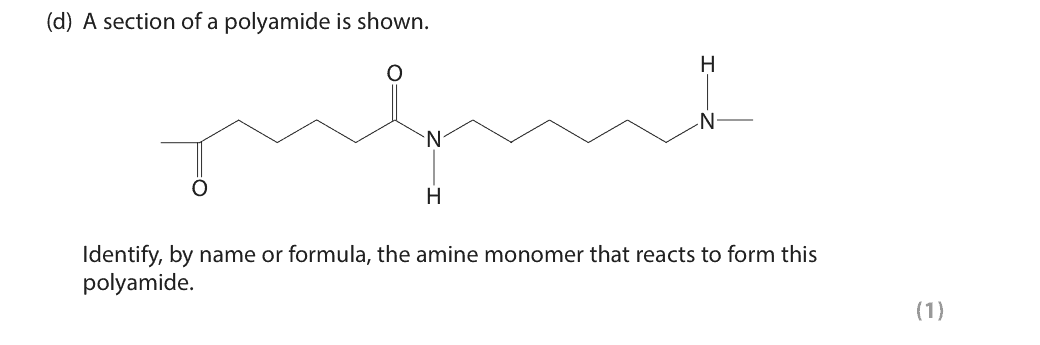
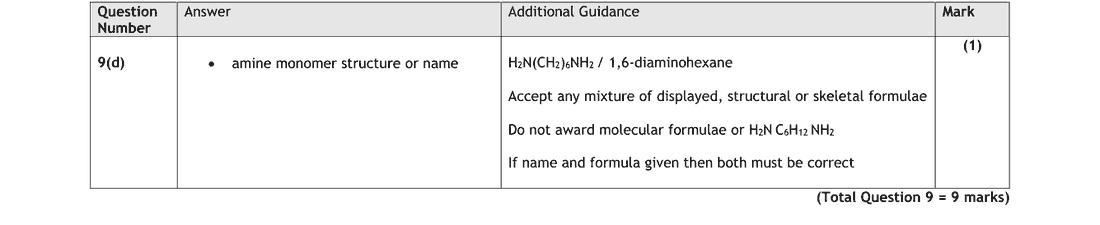
Answer: H2N(CH2)6NH2 / 1,6-diaminohexane (hexane-1,6-diamine). Not a molecular formula or H2NC6H12NH2
if both name and formula are given both must be correct
June 2019 · Paper 2 · Q8(a)(i)1 markMultiple choice
Answer
D
Mark scheme
Notes from the mark scheme and report
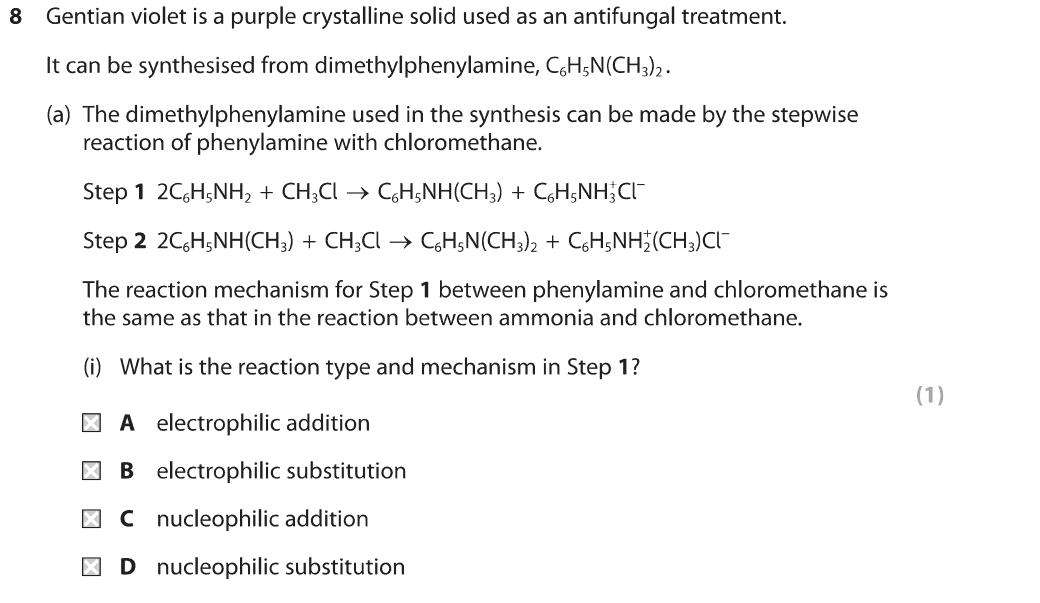
Answer: D. Phenylamine acts as a nucleophile (lone pair on N) and replaces the chlorine of chloromethane: nucleophilic substitution, as with ammonia
June 2019 · Paper 3 · Q9(a)(i)2 marksExplanation
Mark scheme
Examiner's comment
The majority of candidates scored 2 marks for this question. Some candidates thought that the glycinate ion would be chiral and some thought that a racemic mixture would form.
Notes from the mark scheme and report
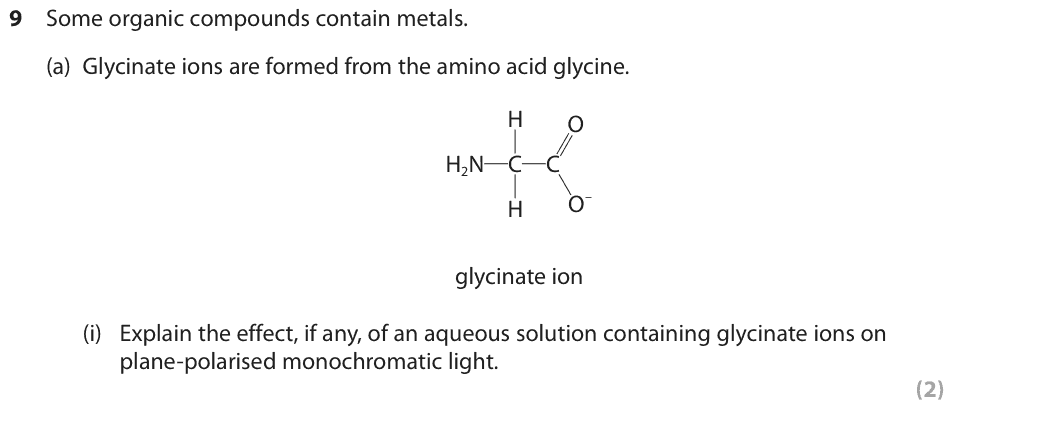
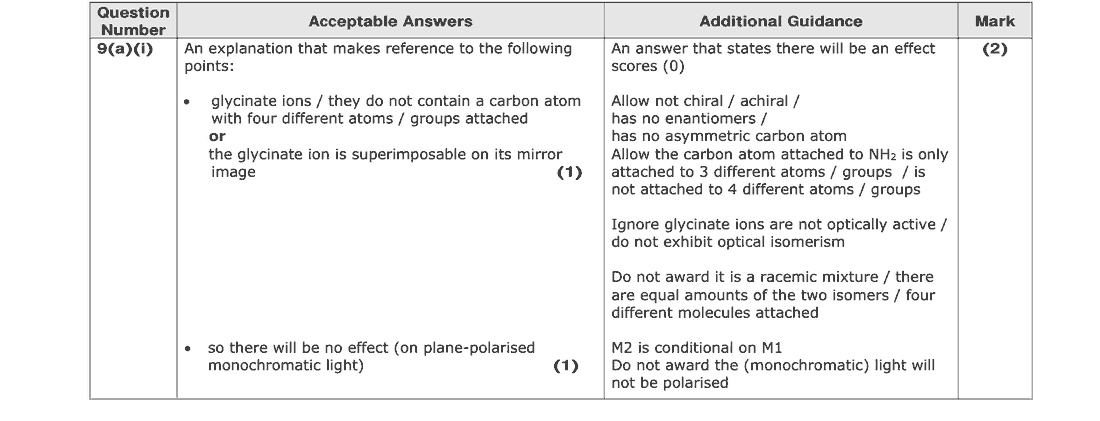
The glycinate ion has no carbon atom with four different groups attached (it is not chiral: the carbon bonded to NH2 carries two H atoms)
so it has no effect on plane-polarised light (depends on M1). Saying there is an effect scores zero. Not 'racemic mixture'
'not optically active' alone is ignored
June 2018 · Paper 2 · Q3(a)(ii)3 marksShort answer
Earlier part of question 3 that this part uses
Mark scheme
Examiner's comment
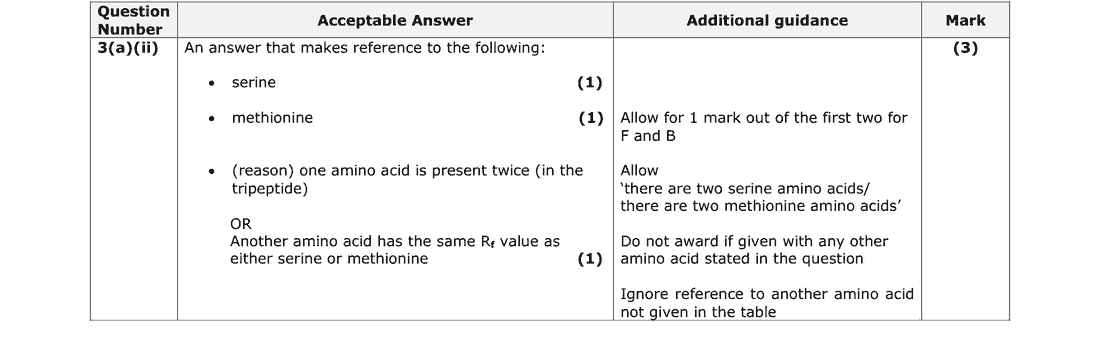
Just over 50% of candidates were able to correctly identify the two amino-acids in the sample. The better candidates were able to deduce that the absence of a third spot was due to one of the two amino-acids being present twice and so this question proved to be an effective discriminator.
On a few occasions the expression used by the candidates 'let them down'. For example, the statement that the lack of a third spot was due to 'two serines and two methionines' is incorrect because this would be true of a tetrapeptide and not a tripeptide as stated in the question.
Notes from the mark scheme and report
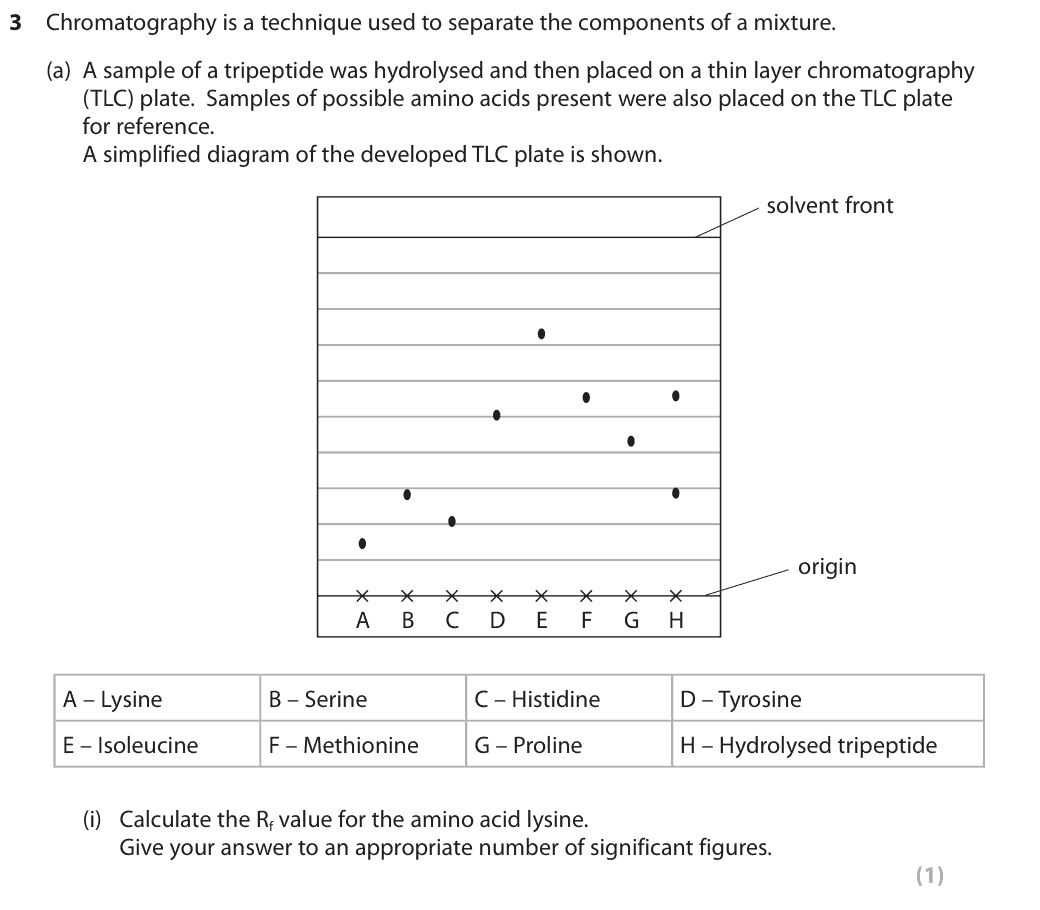
Answer: serine and methionine (B and F scores 1 of the 2). Reason: one of the amino acids is present twice in the tripeptide, or another amino acid has the same Rf as serine or methionine (not one of the other amino acids in the table). Just over half named both
'two serines and two methionines' is wrong because that would be a tetrapeptide
Skills: PT9 use thin-layer or paper chromatography
June 2018 · Paper 2 · Q3(a)(iv)1 markMultiple choice
Earlier part of question 3 that this part uses
Answer
C
Mark scheme
Notes from the mark scheme and report
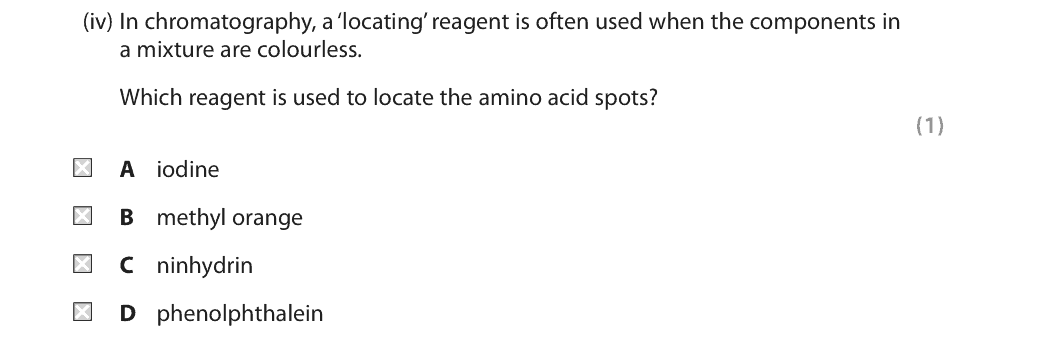
Answer: C (ninhydrin). Iodine is a test for starch
methyl orange and phenolphthalein are acid-base indicators
Skills: PT9 use thin-layer or paper chromatography
June 2018 · Paper 3 · Q2(b)(ii)1 markDiagram or structure
Earlier parts of question 2 that this part uses
Mark scheme
Examiner's comment
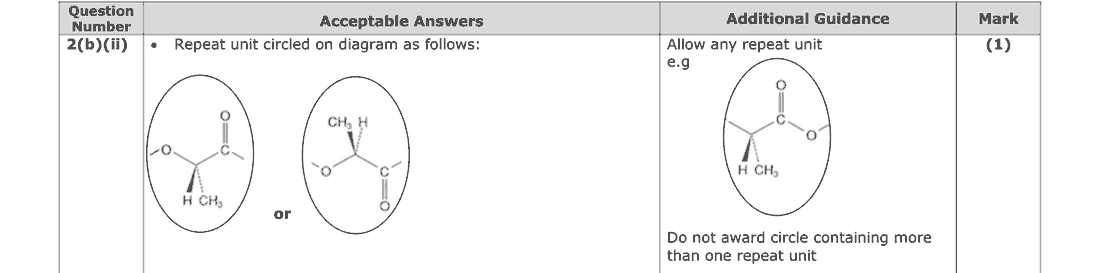
Over 60% of candidates could circle a repeat unit of the polymer. Those who did not score generally included three oxygen atoms in their responses. Others circled a section of the polymer covering more than one repeat unit.
Notes from the mark scheme and report
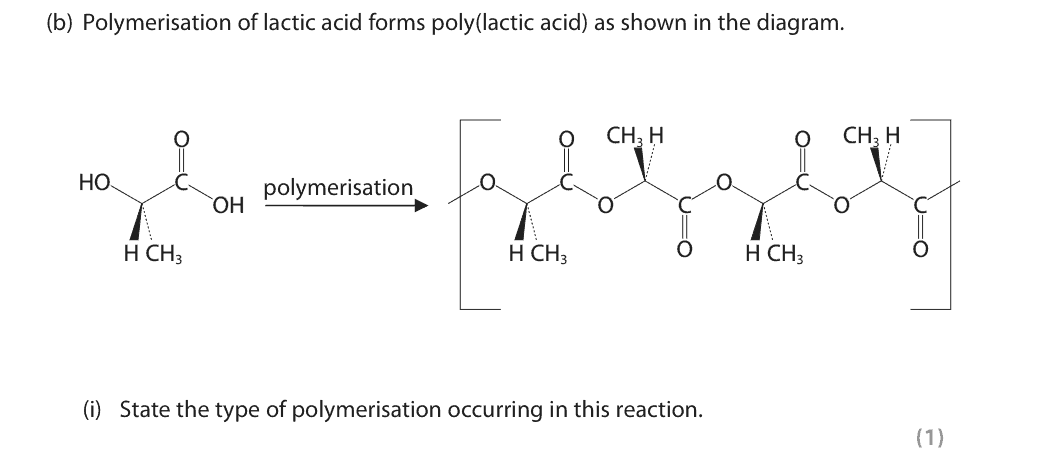
Circle around one repeat unit, –O–CH(CH3)–CO– (any single repeat unit along the chain is allowed). Not a circle holding more than one repeat unit. Common errors: including three oxygen atoms
circling more than one repeat unit
June 2017 · Paper 2 · Q6(b)2 marksShort answer
Earlier part of question 6 that this part uses
Mark scheme
Examiner's comment
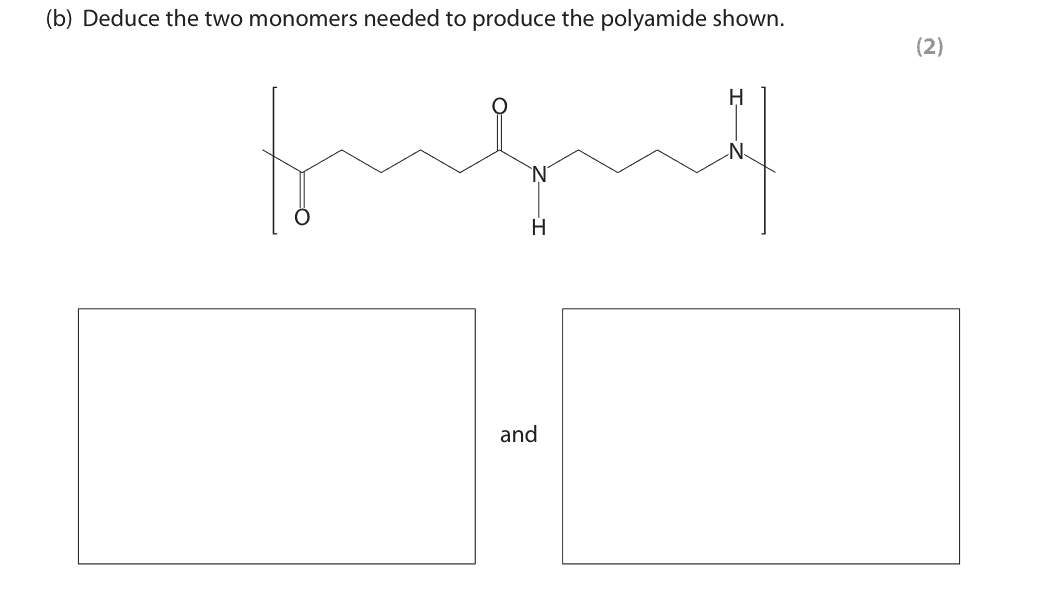
Skeletal formulae were not compulsory and many correct displayed formulae were seen. This proved to be a much more successful question for candidates with just under 70% gaining full marks. Monomer structures with monofunctionality was the most common error.
Notes from the mark scheme and report
Answer: HOOC(CH2)4COOH (or ClOC(CH2)4COCl) and H2N(CH2)4NH2, either order, any type of formula. C4H8 and missing hydrogens each penalised once
a monomer with only one functional group does not score (the commonest error). Just under 70% scored both
June 2017 · Paper 2 · Q6(c)1 markShort answer
Earlier part of question 6 that this part uses
Mark scheme
Examiner's comment
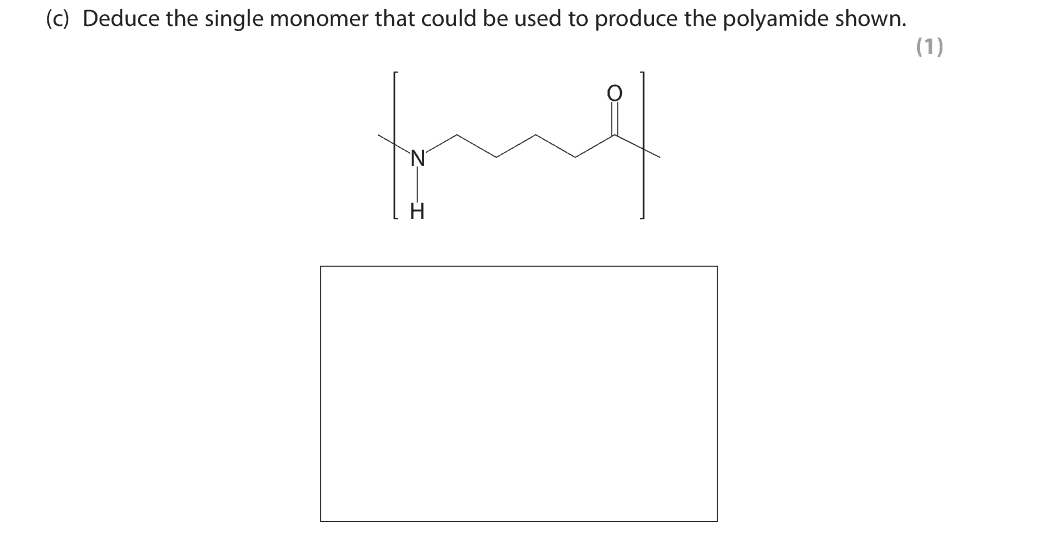
This question tested similar skills to the previous one. It was pleasing to see that the change to a single monomer with two different functional groups presented no major difficulty for most candidates.
Notes from the mark scheme and report
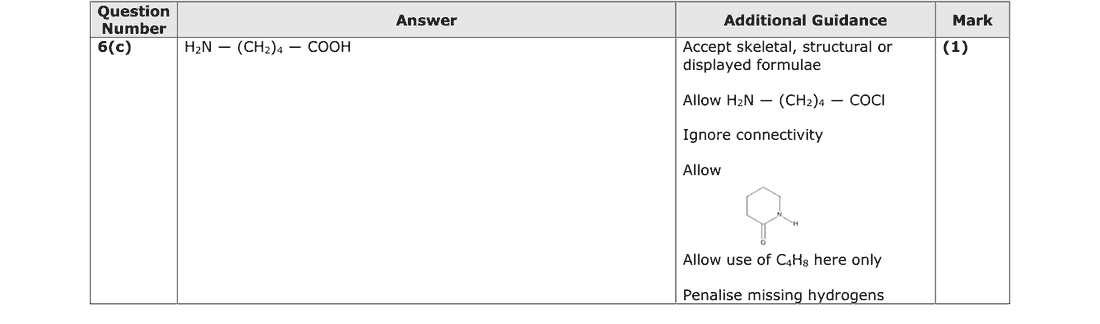
Answer: H2N(CH2)4COOH (allow H2N(CH2)4COCl or the cyclic amide with a six-membered ring). C4H8 allowed here
missing hydrogens penalised. Most managed the change to one monomer with two different groups
June 2017 · Paper 2 · Q7(a)5 marksShort answer
Mark scheme
Examiner's comment
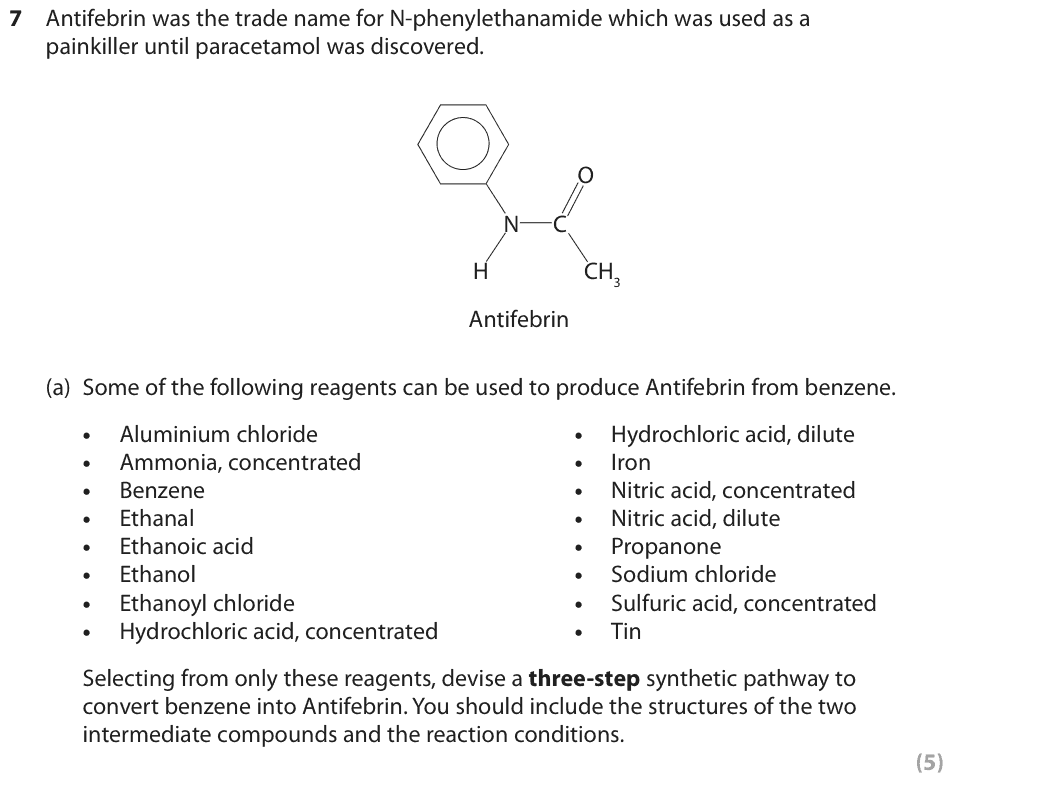
In this question, all the scores from 0 to 5 inclusive were awarded to at least 10% of candidates, with a score of 4 being the most common at about 27%. There was a lot of good chemistry demonstrated, with the three steps and their reagents largely understood. It was the finer detail such as whether to use dilute or concentrated HCl, or whether heat under reflux was required that proved to be the differentiating factors. In addition, some candidates used additional reagents, including ones that were not in the list provided, which would have prevented the correct product from being formed and so this did not score. Hence this type of question is a very useful means of testing candidates' knowledge and understanding of organic chemistry and is an extremely worthy exercise for centres and their students to practise.
Notes from the mark scheme and report
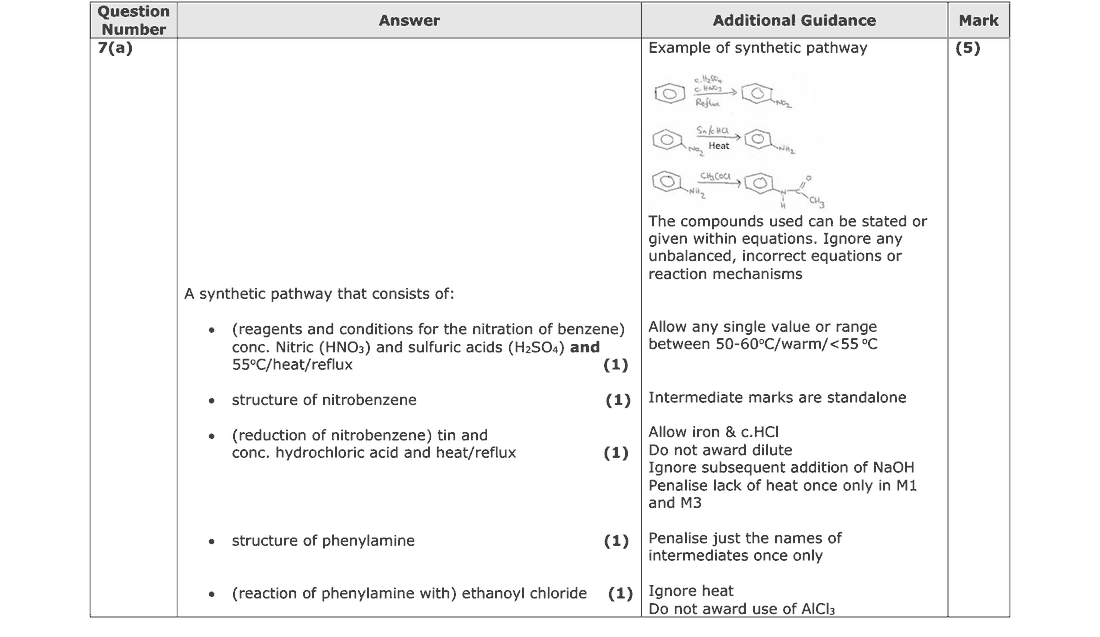
M1 concentrated nitric and sulfuric acids with heat (55 °C, or 50–60 °C, warm, reflux)
M2 structure of nitrobenzene
M3 tin (allow iron) and concentrated hydrochloric acid, heat / reflux (not dilute)
M4 structure of phenylamine
M5 ethanoyl chloride (not with AlCl3
ignore heat). Intermediate marks stand alone
lack of heat penalised once
names only for the intermediates penalised once. Marks were spread from 0 to 5, 4 being most common
marks were lost on dilute or concentrated HCl, heating, and adding extra reagents
June 2017 · Paper 3 · Q3(b)3 marksDiagram or structure
Earlier part of question 3 that this part uses
Mark scheme
Examiner's comment
This question differentiated reasonably effectively. In weaker responses, candidates could often draw the correct structure in alkaline conditions, but could not draw the ester. However, the protonation of both amine groups was often absent in the second structure, even for stronger candidates. This did not seem to be because they did not appreciate the possible reaction, as often one of the amine groups was protonated.
Notes from the mark scheme and report
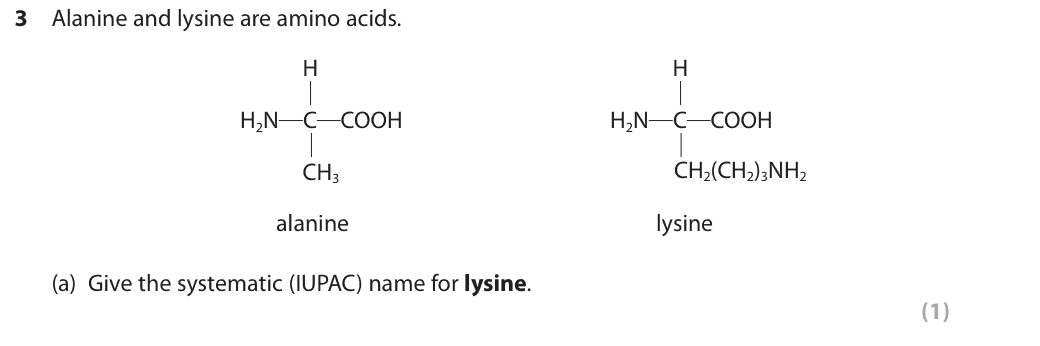
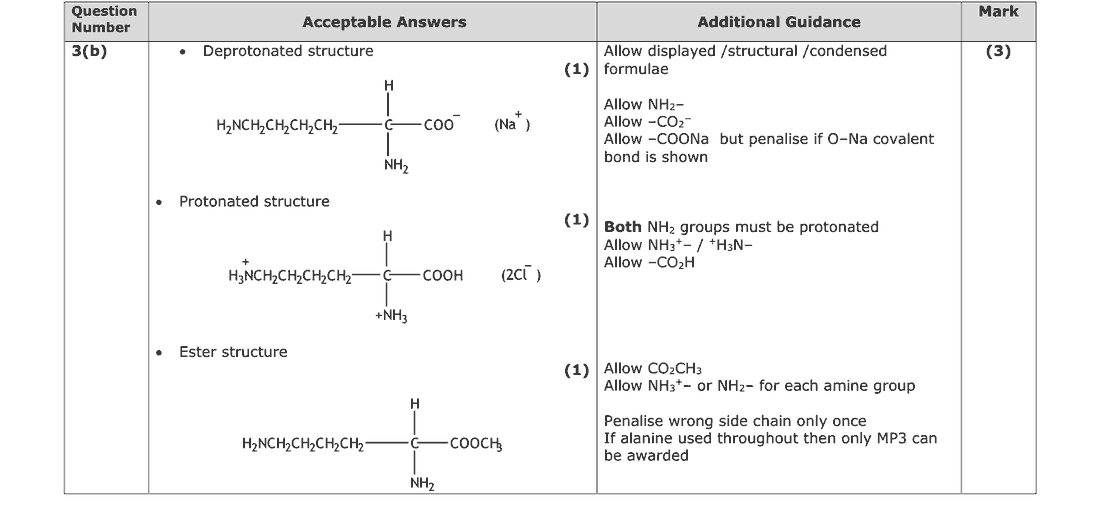
NaOH(aq): H2N(CH2)4CH(NH2)COO– (Na+)
–COONa allowed but not a covalent O–Na bond. Excess HCl(aq): +H3N(CH2)4CH(NH3+)COOH, both amine groups protonated. Methanol / concentrated H2SO4: the methyl ester H2N(CH2)4CH(NH2)COOCH3 (amine groups may be NH2 or NH3+). Wrong side chain penalised once
if alanine is used throughout only the ester mark is available. The carboxylate was the easiest
protonating both amine groups was often missed, even by stronger candidates
weaker answers could not draw the ester
June 2017 · Paper 3 · Q3(c)1 markDiagram or structure
Earlier part of question 3 that this part uses
Mark scheme
Examiner's comment
Many candidates could demonstrate the understanding of the peptide link and so answered this question successfully. Those who failed to score generally did so because they either introduced an additional oxygen atom into the link, or drew a section of a polypeptide/ protein consisting of the two units.
Notes from the mark scheme and report
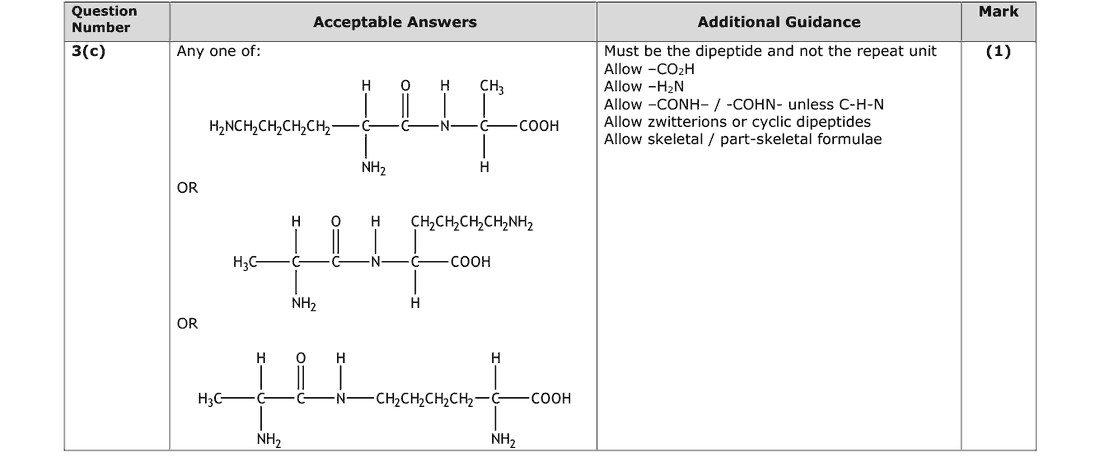
Any one dipeptide: lysine joined through its COOH to the NH2 of alanine, or alanine joined through its COOH to either the 2-amino or the 6-amino group of lysine, with a –CONH– link. Must be the dipeptide, not a repeat unit
zwitterions, cyclic dipeptides and skeletal formulae allowed. Errors: an extra oxygen atom in the link
drawing a section of polypeptide
June 2017 · Paper 3 · Q3(d)2 marksExplanation
Earlier parts of question 3 that this part uses
Mark scheme
Examiner's comment
In better responses, candidates took notice of the emboldened phrase ‘acidic conditions,’ and were able to justify the greater attraction of lysine to the stationary phase in terms of its greater positive charge. The majority of other responses did score the ‘attraction’ mark, but tried to justify it with generally vague statements related to intermolecular forces or polarity. Disappointingly, a number of candidates seemed not to have developed an understanding of chromatography beyond the idea that ‘heavier molecules will take longer to move through the column’.
Notes from the mark scheme and report
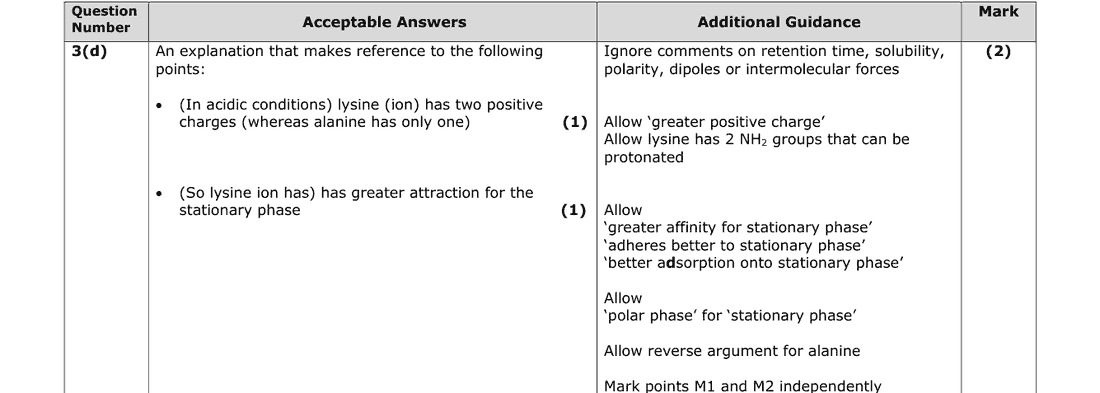
In acidic conditions the lysine ion has two positive charges (both NH2 groups can be protonated) and alanine only one
so lysine is attracted more strongly to (adsorbs better on) the polar stationary phase. Marks independent
retention time, solubility, polarity and intermolecular forces ignored. Most scored the attraction mark but justified it vaguely with polarity or intermolecular forces
some argued only that heavier molecules move more slowly
Work with an A-level chemistry tutor
Dropping marks on calculations, mechanisms or the core practicals? Book a trial session with an A-level chemistry tutor.