Notes and key-term cards for this topic are being written by our tutors. The past-paper questions below are ready now.
Specification statements
Show the 16 statements from the specification
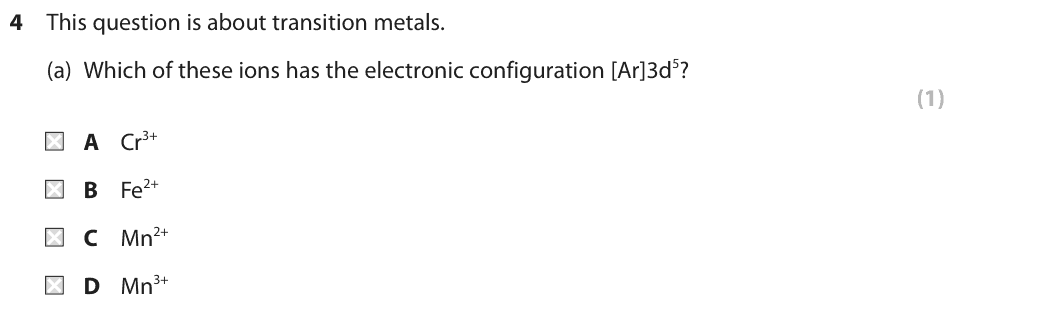
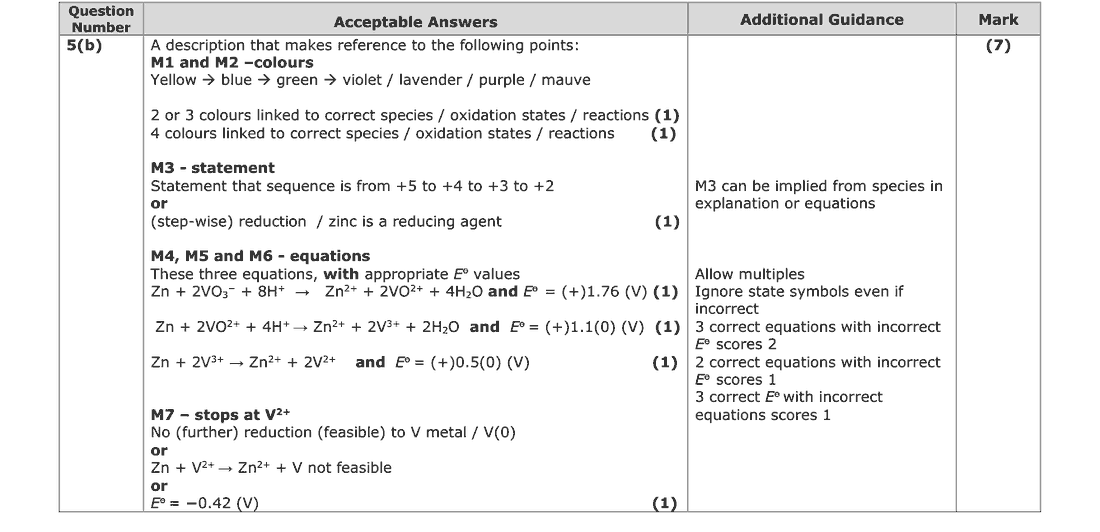
15.20 know the colours of the oxidation states of vanadium (+5, +4, +3 and +2) in its compounds
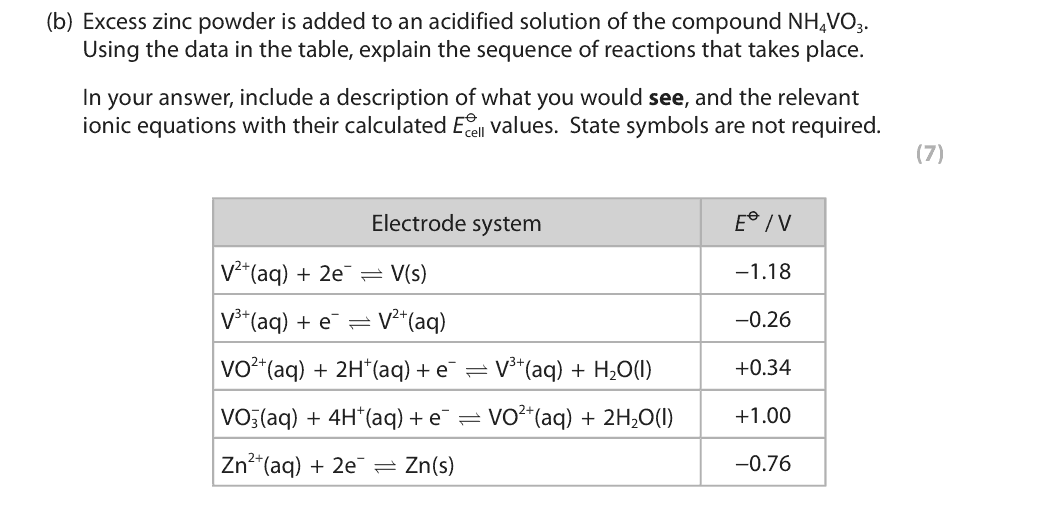
15.21 understand redox reactions for the interconversion of the oxidation states of vanadium (+5, +4, +3 and +2), in terms of the relevant E^o values
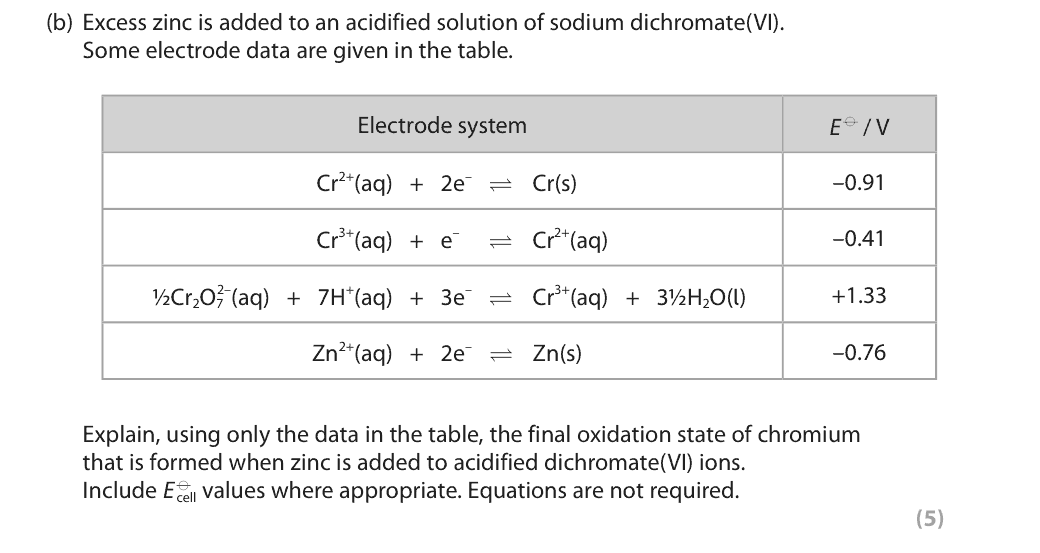
15.22 understand, in terms of the relevant E^o values, that the dichromate(VI) ion, Cr2O7^2−: • i can be reduced to Cr^3+ and Cr^2+ ions using zinc in acidic conditions • ii can be produced by the oxidation of Cr^3+ ions using hydrogen peroxide in alkaline conditions (followed by acidification)
15.23 know that the dichromate(VI) ion, Cr2O7^2−, can be converted into chromate(VI) ions as a result of the equilibrium 2CrO4^2−+ 2H^+ ⇌ Cr2O7^2−+ H2O
15.24 be able to record observations and write suitable equations for the reactions of Cr^3+(aq), Fe^2+(aq), Fe^3+(aq), Co^2+(aq) and Cu^2+(aq) with aqueous sodium hydroxide and aqueous ammonia, including in excess
15.25 be able to write ionic equations to show the difference between ligand exchange and amphoteric behaviour for the reactions in (24) above
15.26 understand that ligand exchange, and an accompanying colour change, occurs in the formation of: • i [Cu(ΝΗ3)4(Η2Ο)2]^2+ from [Cu(Η2Ο)6]^2+ via Cu(OH)2(Η2Ο)4 • ii [CuCl4]^2− from [Cu(Η2Ο)6]^2+ • iii [CoCl4]^2− from [Co(Η2Ο)6]^2+
15.27 understand that the substitution of small, uncharged ligands (such as H2O) by larger, charged ligands (such as Cl^−) can lead to a change in coordination number
15.28 understand, in terms of the large positive increase in ΔSsystem, that the substitution of a monodentate ligand by a bidentate or multidentate ligand leads to a more stable complex ion
15.29 know that transition metals and their compounds can act as heterogeneous and homogeneous catalysts
15.30 know that a heterogeneous catalyst is in a different phase from the reactants and that the reaction occurs at the surface of the catalyst
15.31 understand, in terms of oxidation number, how V2O5 acts as a catalyst in the contact process
15.32 understand how a catalytic converter decreases carbon monoxide and nitrogen monoxide emissions from internal combustion engines by: • i adsorption of CO and NO molecules onto the surface of the catalyst • ii weakening of bonds and chemical reaction • iii desorption of CO2 and N2 product molecules from the surface of the catalyst
15.33 know that a homogeneous catalyst is in the same phase as the reactants and appreciate that the catalysed reaction will proceed via an intermediate species
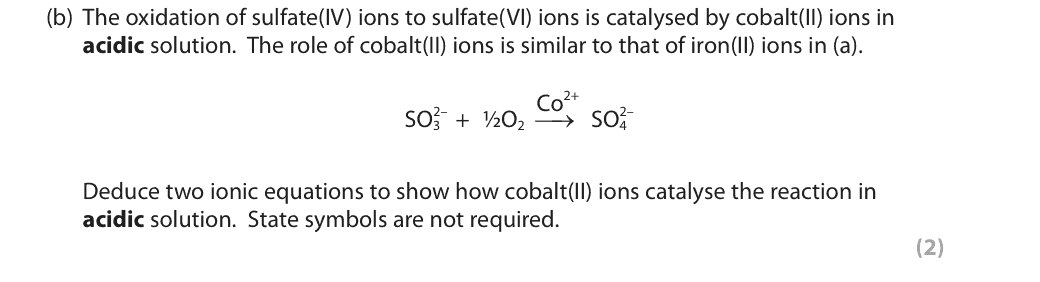
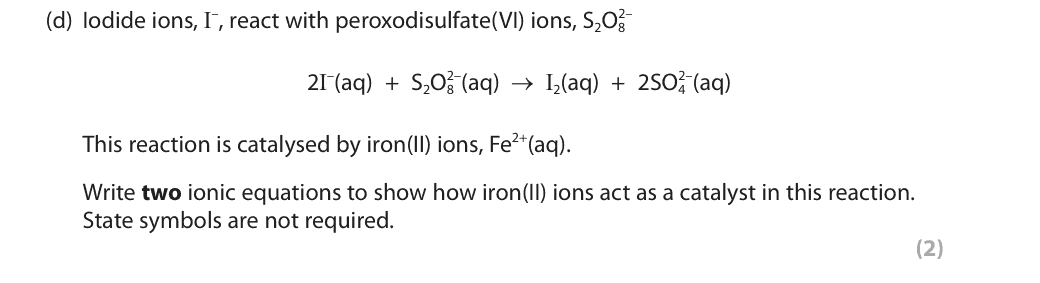
15.34 understand the role of Fe^2+ ions in catalysing the reaction between I^− and S2O8^2− ions
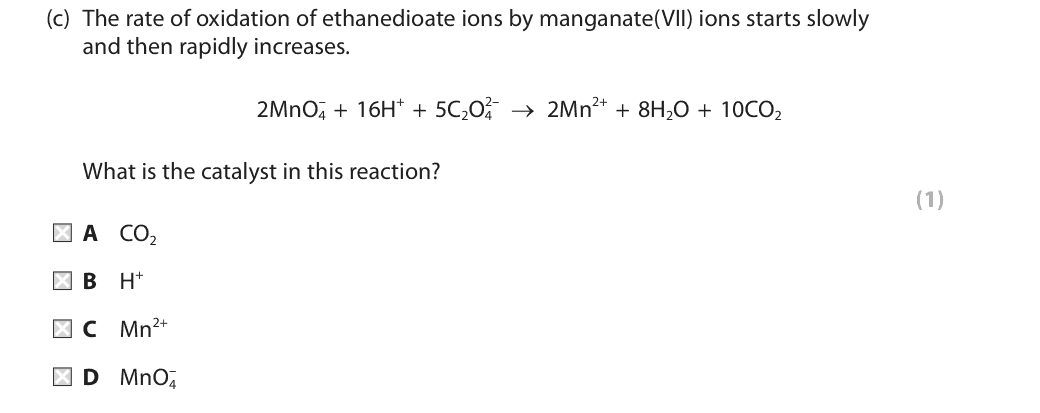
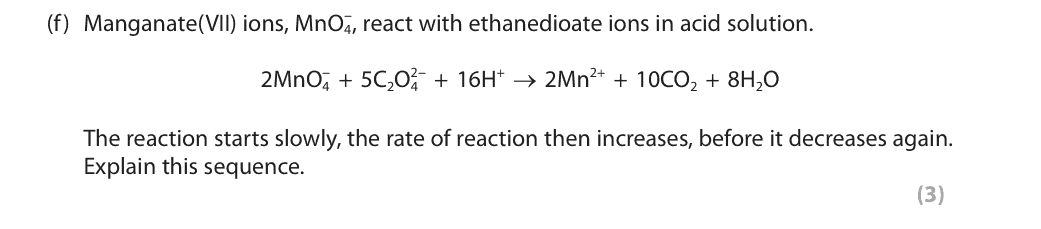
15.35 know the role of Mn^2+ ions in autocatalysing the reaction between MnO4^− and C2O4^2− ions
Six-mark extended response questions on this topic
Tap a question to zoom it. Where a part needs a figure, table or structure from earlier in the question, that part folds out above it; the mark scheme and examiner's comment open underneath. Have Edexcel's Data Booklet beside you; the Periodic Table is on the back page of every paper.
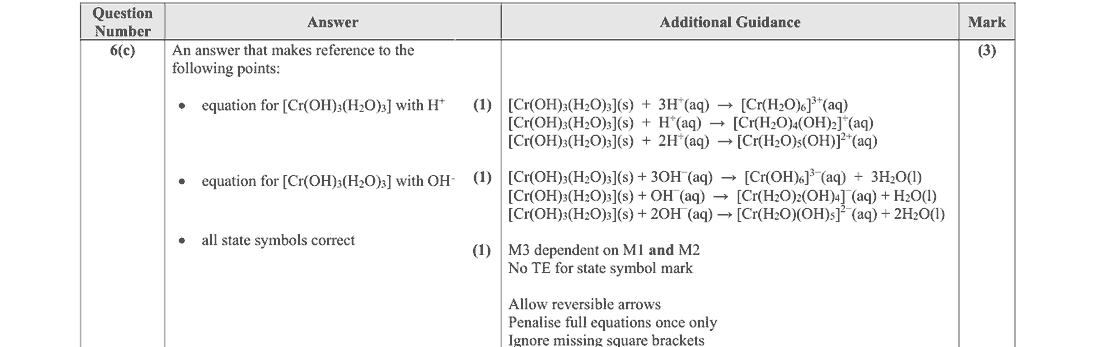
June 2025 · Paper 1 · Q6(c)3 marksEquation writing
Mark scheme
Examiner's comment
This was a challenging question for a large number of the candidates. It required them to write equations to show the amphoteric nature of the Chromium (III) hydroxide ion. This would involve writing two equations one adding OH- and one adding H+, they were also required to include the state symbols.
Notes from the mark scheme and report
With acid: [Cr(OH)3(H2O)3](s) + 3H+(aq) → [Cr(H2O)6]3+(aq) (reaction with one or two H+ also allowed). With alkali: [Cr(OH)3(H2O)3](s) + 3OH–(aq) → [Cr(OH)6]3–(aq) + 3H2O(l) (one or two OH– also allowed). Third mark for all state symbols correct, only if both equations are right. Full (non-ionic) equations are penalised once. This was challenging for a large number of candidates
June 2025 · Paper 1 · Q6(d)1 markShort answer
Mark scheme
Examiner's comment
This question was asking for the type of reaction that occurs when aqueous ammonia is added to the Chromium (III) hydroxide.
Notes from the mark scheme and report
Answer: ligand exchange (ligand substitution or ligand replacement allowed)
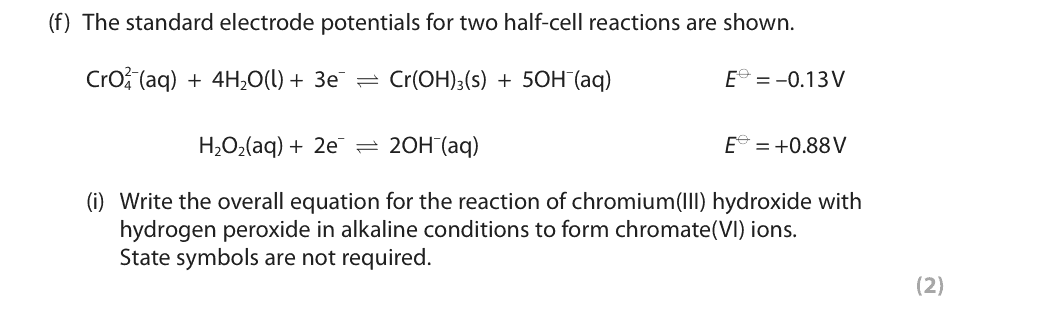
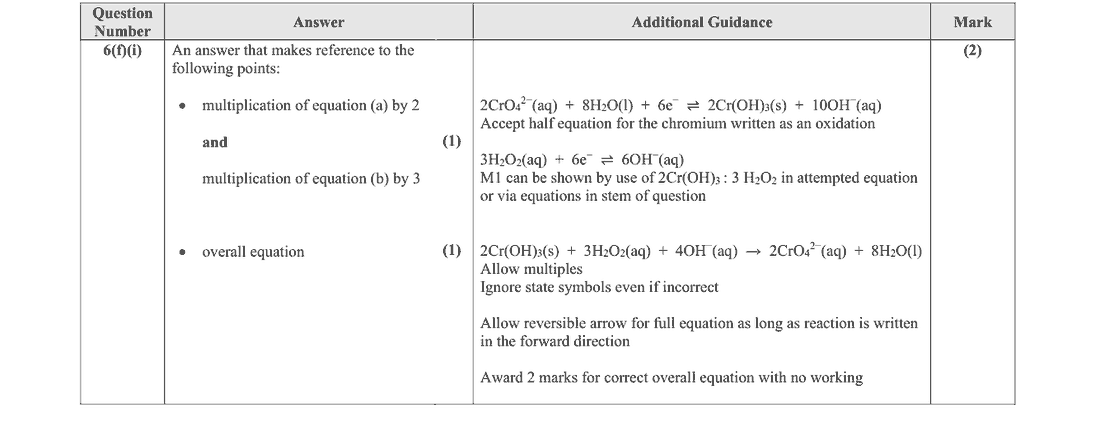
June 2025 · Paper 1 · Q6(f)(i)2 marksEquation writing
Earlier part of question 6 that this part uses
Mark scheme
Examiner's comment
This question was about the feasibility of a reaction with respect to the Eθ
cell calculation.
They had to combine two half equations together and then calculate the Eθ
cell. Most had a good attempt at combining the equations but slipped up on small things like cancelling the OH- on both sides of the equation.
The calculation of Eθ
cell was generally done well.
Notes from the mark scheme and report
2Cr(OH)3 + 3H2O2 + 4OH– → 2CrO4 2– + 8H2O. First mark for multiplying the chromium half-equation by 2 and the peroxide one by 3 (a 2 : 3 ratio in an attempted equation shows this)
multiples allowed. Usual slip: not cancelling the OH– that appears on both sides
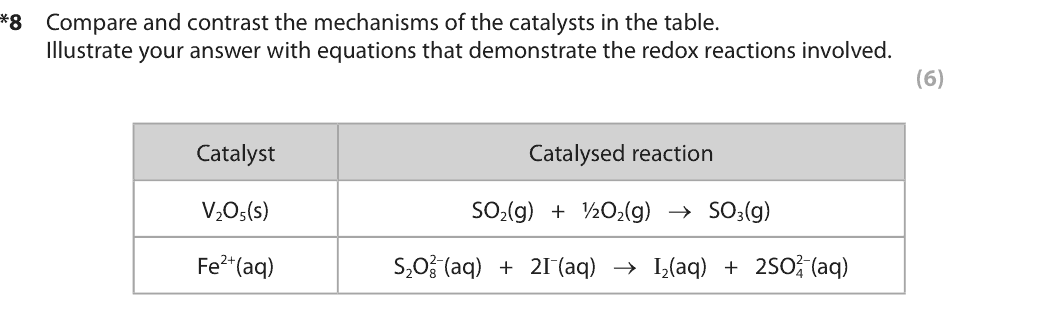
June 2025 · Paper 1 · Q86 marks6-mark extended response
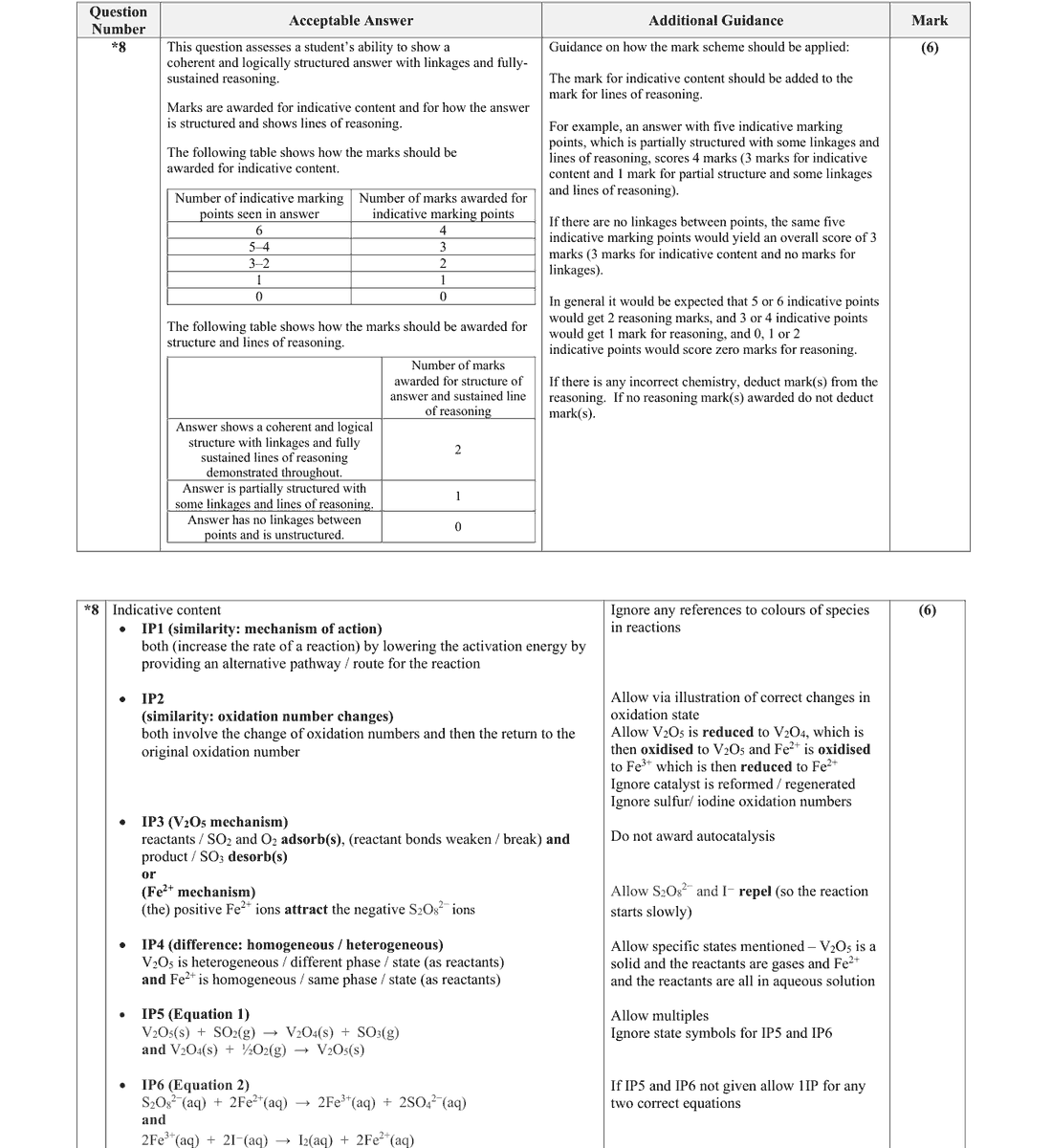
Mark scheme, with the indicative content and the marks for reasoning
Examiner's comment
This question asked the candidates to compare the action of two catalysts. They were required to look at both similarities and differences. They were also required to give the equations for the reaction of both with sulfur compounds.
Many candidates understood that one catalyst was heterogeneous and one homogeneous (although we did see some other terms here). Many could describe the mechanisms although some referred to autocatalysis which was not the case for either. Equations were generally done well. However an area the candidates barely approached was the variable oxidation states which enable the catalysts to work.
Notes from the mark scheme and report
Six indicative points plus two marks for reasoning. IP1 both lower the activation energy by providing an alternative route
IP2 both change oxidation number and then return to the original one (V2O5 reduced to V2O4 then reoxidised
Fe2+ oxidised to Fe3+ then reduced back)
IP3 for V2O5 the reactants adsorb, bonds weaken and SO3 desorbs, or for Fe2+ the positive ion attracts the negative S2O8 2– ion (S2O8 2– and I– repel)
IP4 V2O5 is heterogeneous (different phase from the reactants) and Fe2+ is homogeneous (same phase)
IP5 V2O5 + SO2 → V2O4 + SO3 and V2O4 + ½O2 → V2O5
IP6 S2O8 2– + 2Fe2+ → 2Fe3+ + 2SO4 2– and 2Fe3+ + 2I– → I2 + 2Fe2+. Autocatalysis is not credited. Heterogeneous / homogeneous and the equations were usually given
the changing oxidation states were barely addressed
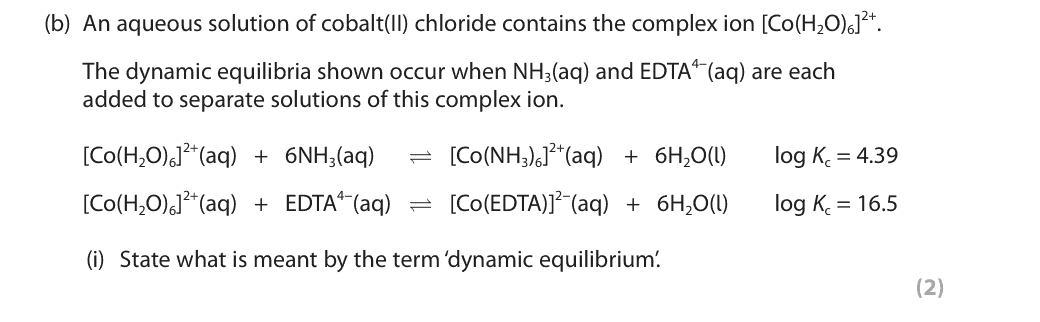
June 2025 · Paper 3 · Q5(b)(ii)3 marksExplanation
Earlier parts of question 5 that this part uses
Mark scheme
Examiner's comment
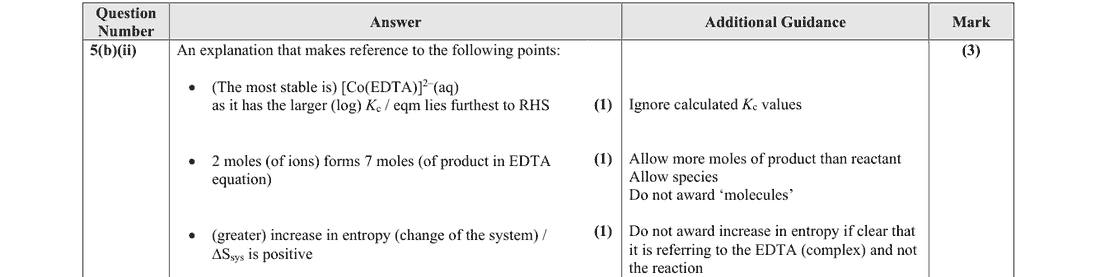
The question required candidates to deduce which of three complex ions would be more stable based on their equilibria and entropy. Many candidates stated that the [Co(EDTA)] 2-(aq) complex would be the most stable and related this either to the larger Kc or to an increased entropy in the equation to form it. Candidates who commented on the number of moles on either side of the equation to form [Co(EDTA] 2- (aq) often gave the correct number of species, although some lost marks by referring to 'molecules' instead of moles.
Notes from the mark scheme and report
[Co(EDTA)]2– is the most stable because it has the larger (log) Kc / its equilibrium lies furthest to the right
in the EDTA equation 2 moles of ions form 7 moles of products (species allowed, 'molecules' not)
so there is a (greater) increase in the entropy of the system. The entropy increase must refer to the reaction, not to the EDTA complex
June 2024 · Paper 1 · Q7(b)2 marksEquation writing
Earlier part of question 7 that this part uses
Mark scheme
Examiner's comment
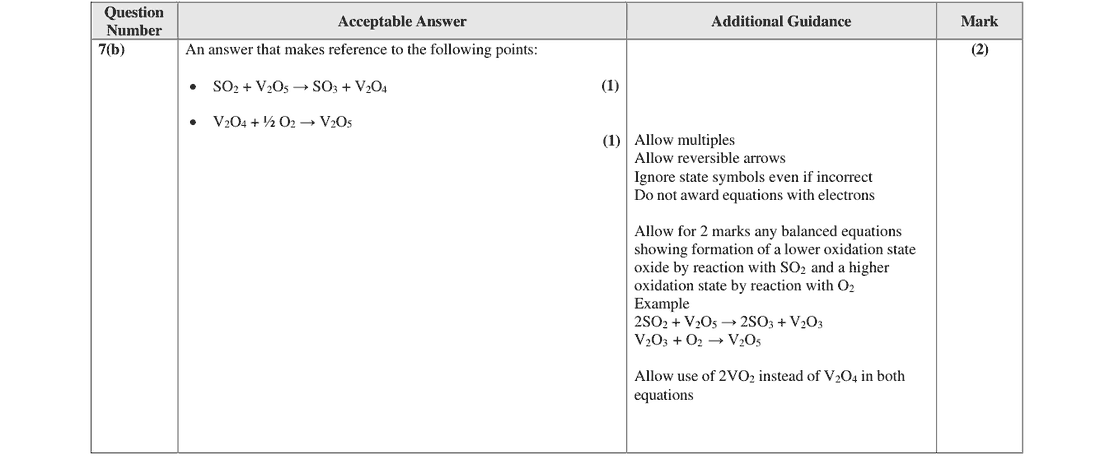
This question required candidates to write two equations to show the catalytic activity of vanadium pentoxide (V2O5).
Some correct answers were seen, but also many unbalanced equations and some equations which did not include any vanadium compounds.
Notes from the mark scheme and report
SO2 + V2O5 → SO3 + V2O4 then V2O4 + ½O2 → V2O5 (2VO2 allowed for V2O4
multiples allowed). No electrons in the equations. Common errors: unbalanced equations
equations with no vanadium compound
June 2024 · Paper 1 · Q7(c)1 markMultiple choice
Earlier part of question 7 that this part uses
Answer
C
Mark scheme
Notes from the mark scheme and report
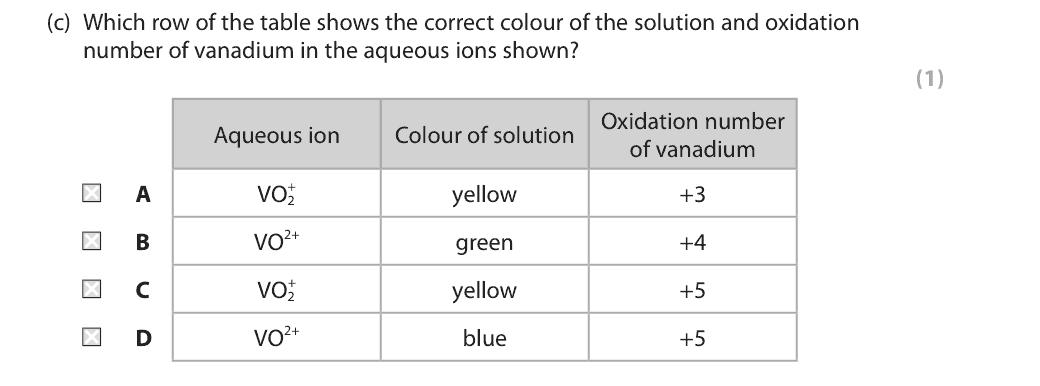
Answer: C. VO2+ (dioxovanadium(V)) is yellow with vanadium +5
VO2+ (oxovanadium(IV)) is blue, +4
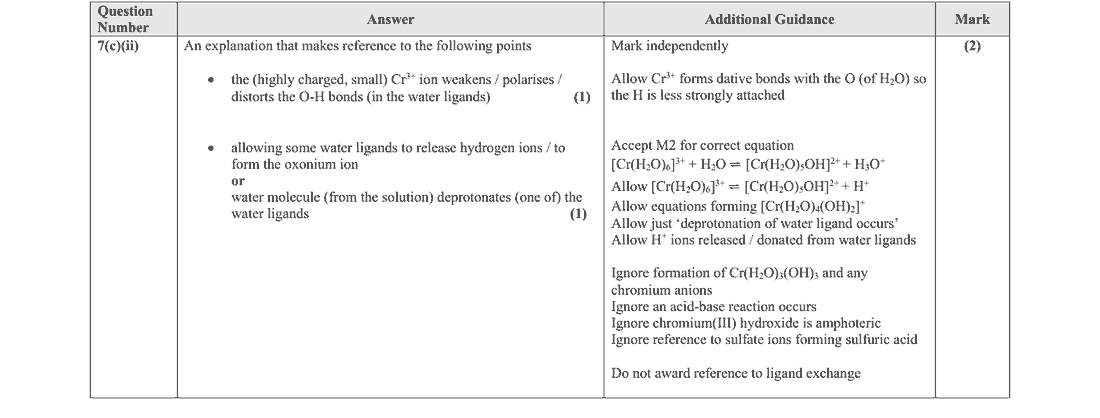
June 2023 · Paper 1 · Q7(c)(ii)2 marksExplanation
Earlier parts of question 7 that this part uses
Mark scheme
Examiner's comment
The majority of candidates scored a mark for realising that the water ligands release H+ ions that make the solution acidic. Very few candidates realised that it is the small, highly charged
Cr3+ ion that weakens the O-H bonds in the water ligands that allows this to happen. Some
candidates thought that OH- ions deprotonated the water ligands. A few candidates thought that a precipitate of chromium(III) hydroxide would form and some referred to ligand exchange.
Notes from the mark scheme and report
M1: the small, highly charged Cr3+ ion polarises / weakens the O–H bonds in the water ligands. M2: so a water ligand loses H+ (to a solvent water molecule, forming H3O+), e.g. [Cr(H2O)6]3+ + H2O ⇌ [Cr(H2O)5OH]2+ + H3O+
a correct equation scores M2. Marked independently. Not ligand exchange
ignore amphoteric behaviour, Cr(H2O)3(OH)3 and sulfate forming sulfuric acid. The majority scored the H+ release mark
very few gave the weakening of the O–H bonds by Cr3+
some had OH– ions deprotonating the ligands
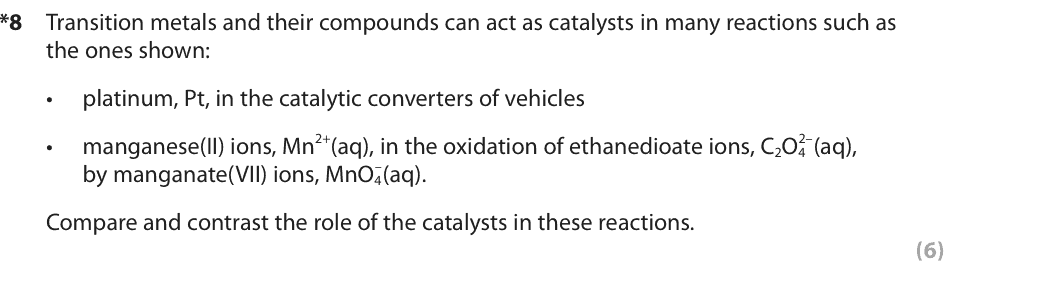
June 2023 · Paper 1 · Q86 marks6-mark extended response
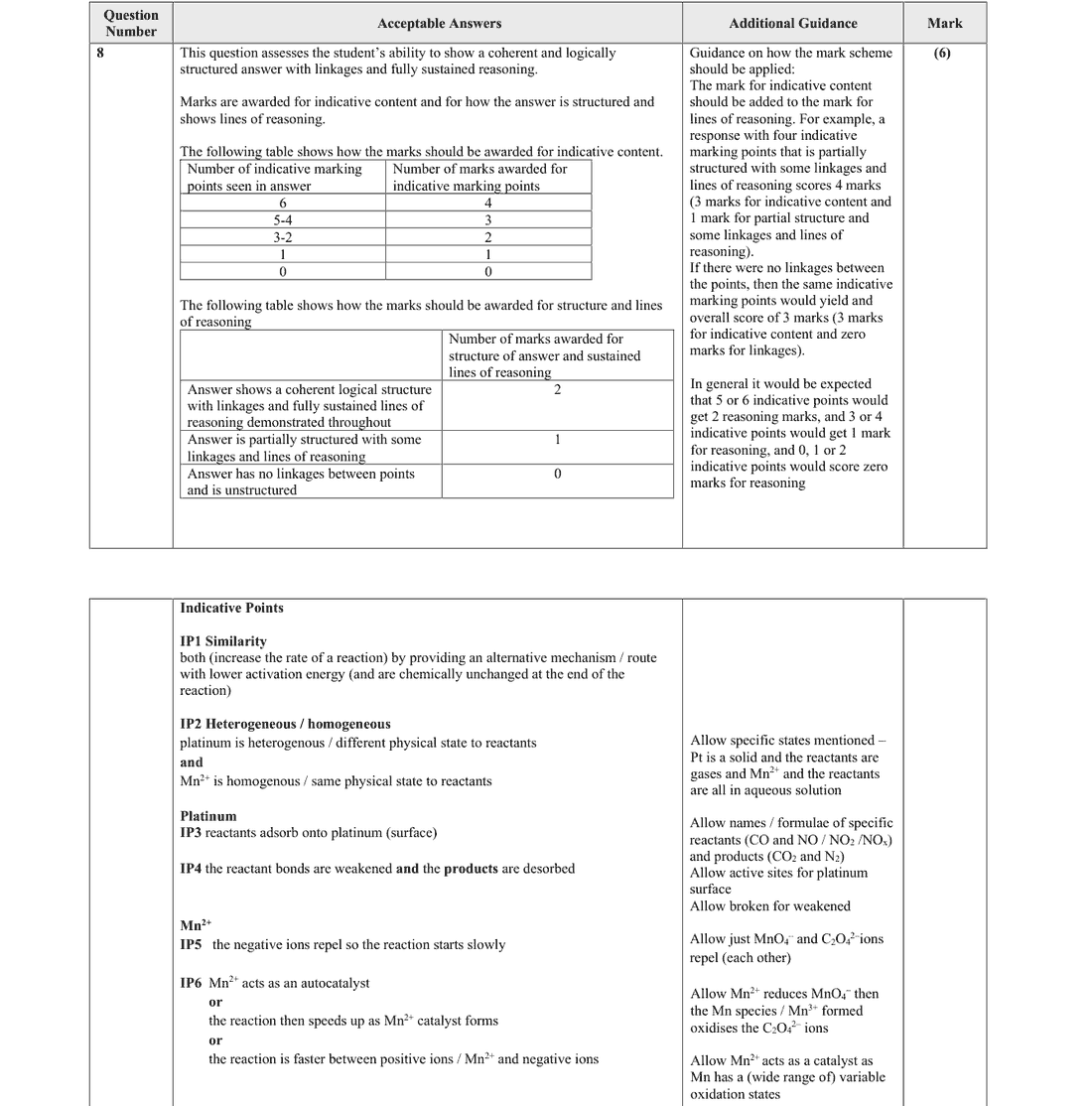
Mark scheme, with the indicative content and the marks for reasoning
Examiner's comment
Candidates who knew about different catalysts scored high marks on this question. The indicative point that was most frequently missing was reference to both catalysts providing an alternative mechanism with a lower activation energy. Some candidates were not so familiar with this topic and they used incorrect terminology, such as referring to homolytic and heterolytic catalysts instead of homogeneous and heterogeneous and absorption instead of adsorption. Some candidates did not explain that the reaction between ethanedioate ions and manganate(VII) ions starts slowly as both ions are negatively charged to repel each other.
Notes from the mark scheme and report
Six indicative points plus two marks for reasoning. IP1 (similarity) both provide an alternative route of lower activation energy (and are unchanged at the end)
IP2 platinum is heterogeneous (a solid with gaseous reactants) and Mn2+ is homogeneous (all in aqueous solution)
IP3 the reactant gases (CO and NO) are adsorbed onto the platinum surface
IP4 bonds in the reactants are weakened and the products (CO2 and N2) are desorbed
IP5 MnO4– and C2O4 2– are both negative so they repel and the reaction starts slowly
IP6 Mn2+ is an autocatalyst: the reaction speeds up as Mn2+ forms (positive Mn2+ reacts faster with the negative ions
Mn has variable oxidation states). IP1 was the point most often missing. Errors: 'homolytic and heterolytic' for homogeneous and heterogeneous
absorption for adsorption
not explaining the slow start
June 2023 · Paper 3 · Q5(b)5 marksExplanation
Earlier part of question 5 that this part uses
Mark scheme
Examiner's comment
This proved to be a high-scoring question with many candidates scoring all five marks. The only real issue was when a candidate hadn't read the question properly and didn't determine the Ecell values, but simply answered in terms of the difference in electrode potentials.
Notes from the mark scheme and report
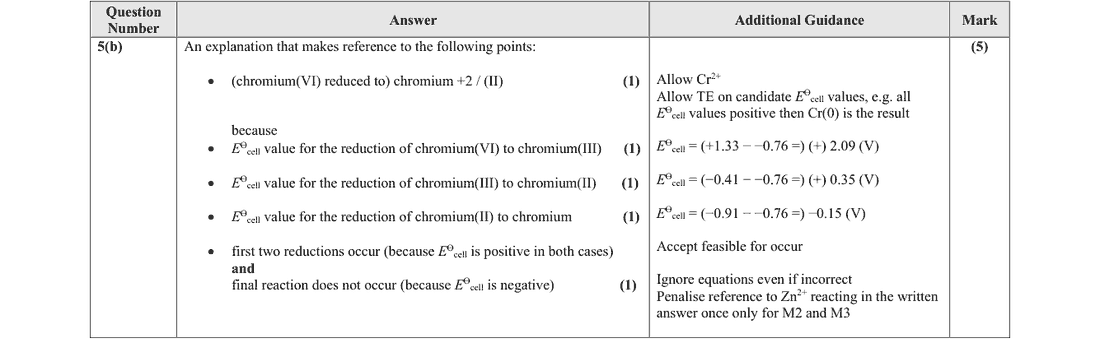
Answer: chromium(II), Cr2+. Ecell for Cr(VI) to Cr(III) = +1.33 – (–0.76) = +2.09 V
for Cr(III) to Cr(II) = –0.41 – (–0.76) = +0.35 V
for Cr(II) to Cr = –0.91 – (–0.76) = –0.15 V
the first two are positive so feasible, the last is negative so does not happen. Marks were lost only by comparing electrode potentials without working out Ecell values
Skills: MS2.3 Substitute numerical values into algebraic equations using appropriate units for physical quantities
June 2022 · Paper 1 · Q7(c)(i)2 marksEquation writing
Earlier part of question 7 that this part uses
Mark scheme
Examiner's comment
This question concerned the reaction of zinc with acidified potassium dichromate (VI). Many candidates derived the equation correctly, although some careless omission of charges occasionally resulted in loss of marks. The electrochemical cell potential was also well answered. The third part of the question scored the best when +0.35 had been calculated as those who tried to explain it in terms of more positive/less negative electrode potentials sometimes got them the wrong way round.
Notes from the mark scheme and report
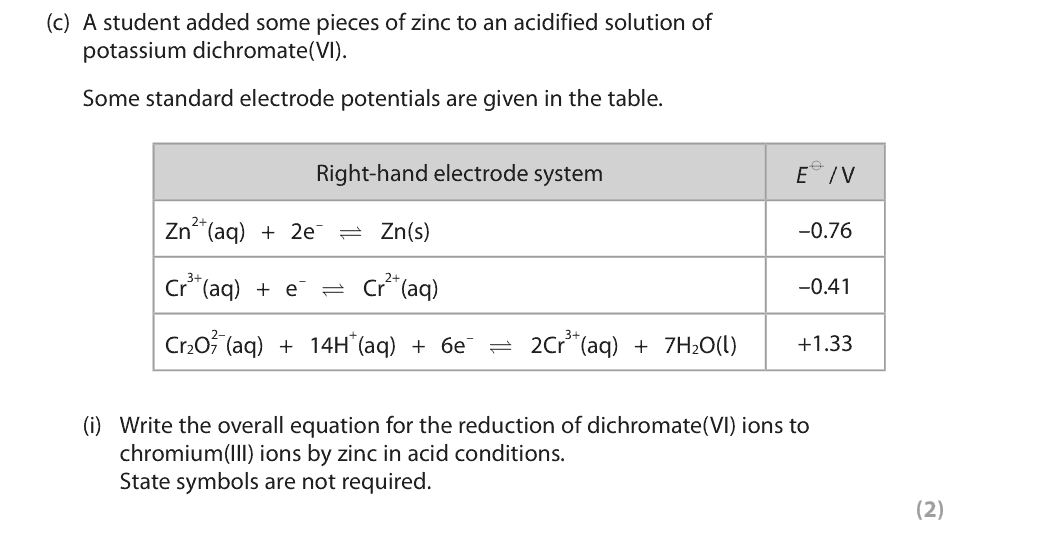
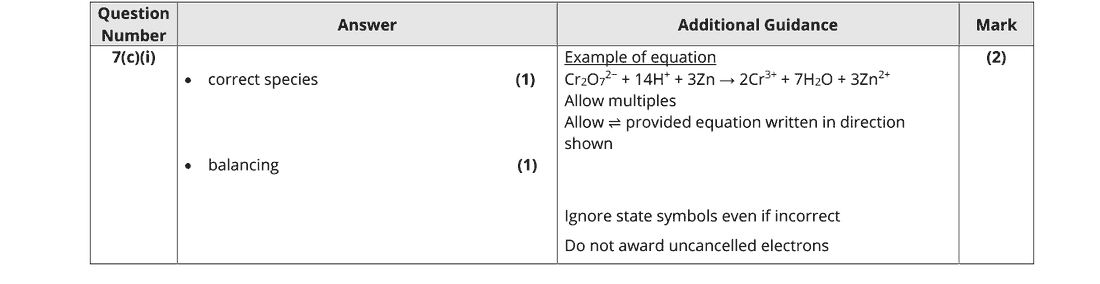
Answer: Cr2O7 2– + 14H+ + 3Zn → 2Cr3+ + 7H2O + 3Zn2+. One mark for the species, one for balancing. No uncancelled electrons
state symbols ignored. Marks were lost through missing charges
June 2022 · Paper 1 · Q7(c)(iii)1 markShort answer
Earlier parts of question 7 that this part uses
Mark scheme
Examiner's comment
This question concerned the reaction of zinc with acidified potassium dichromate (VI). Many candidates derived the equation correctly, although some careless omission of charges occasionally resulted in loss of marks. The electrochemical cell potential was also well answered. The third part of the question scored the best when +0.35 had been calculated as those who tried to explain it in terms of more positive/less negative electrode potentials sometimes got them the wrong way round.
Notes from the mark scheme and report
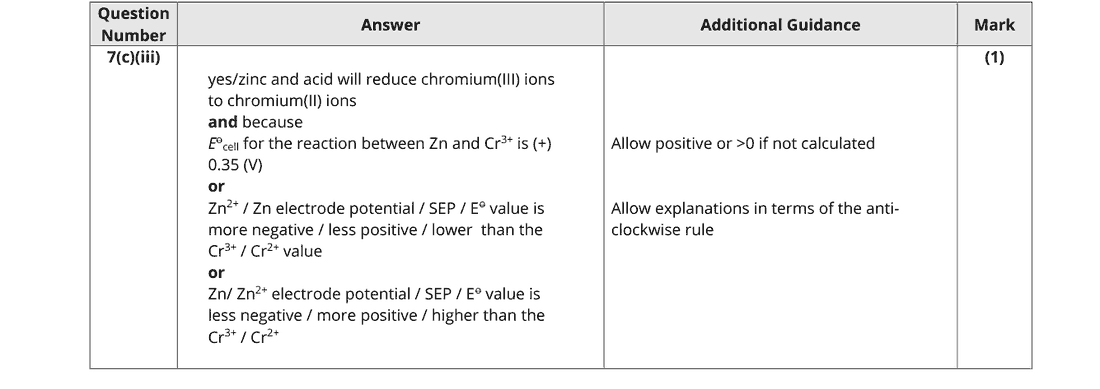
Yes, zinc will reduce Cr3+ to Cr2+, because E cell for zinc with Cr3+ is +0.35 V (positive), or because the Zn2+/Zn electrode potential is more negative than the Cr3+/Cr2+ value. Answers that calculated +0.35 V scored best
those arguing from more positive / less negative values sometimes had them the wrong way round
November 2021 · Paper 1 · Q3(b)3 marksShort answer
Mark scheme
Examiner's comment
The description of metallic bonding in part (a) proved to be an opportunity for most candidates
to score at least one mark with about half of all resposnes referring to the electrostatic
attraction between the metal cations and the delocalised ‘sea’ of electrons. One mistake seen
was the reference to the attraction between the positively-charged nuclei and the electrons
which reflected a misunderstanding of the situation. Another mistake was the omission of the
“electrostatic atttraction” between the cations and electrons which could have been more of a
lack of understanding of the question demand rather than the situation. A significant number
of candidates gave a drawing of metallic bonding which was acceptable. A point worthy of note
is that there should be an approximately equal number of electrons to that of the positive
charges on the metal ions. Occasionally an excessive number of either electrons or cations was
seen.
It was evident that the three stages of the heterogenous catalyst required in (b) had been
taught effectively as they were generally well-described. It was pleasing to see very few
references to ‘absorption’. The most noteworthy error was reference to incorrect gases being
formed by the catalytic converter. Nitrogen dioxide was frequently seen and often stated to be
a harmless gas which is incorrect.
Notes from the mark scheme and report
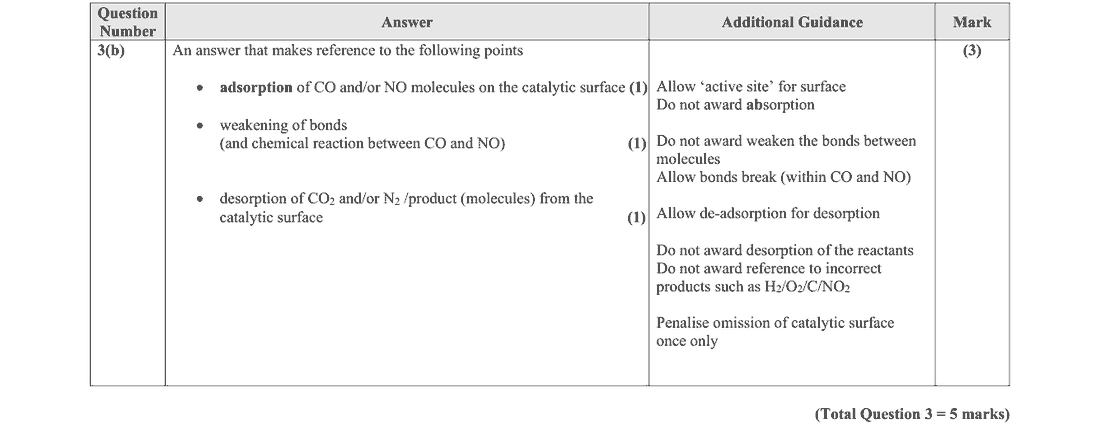
M1: adsorption of CO and/or NO molecules onto the surface of the catalyst (active site allowed
not absorption). M2: the bonds within the molecules are weakened (and they react). M3: desorption of the products CO2 and/or N2 from the surface. Not bonds between molecules
not desorption of reactants
no wrong products such as NO2, O2, H2 or C
leaving out the surface is penalised once. Generally well described
the main error was naming wrong products, often NO2 described as harmless
November 2021 · Paper 1 · Q8(c)4 marksExplanationHard
Earlier part of question 8 that this part uses
Mark scheme
Examiner's comment
In part (a) there was a question on the origin of complex ion colour which proved to be an
effective discriminator as it has in the past. Candidates still need to take care with the terms
used, for example when referring to the splitting of the d subshell and not a single d orbital or
the reflection and not emission of light from the complex. Occasional confusion with the
electronic transitions of flame tests was also seen.
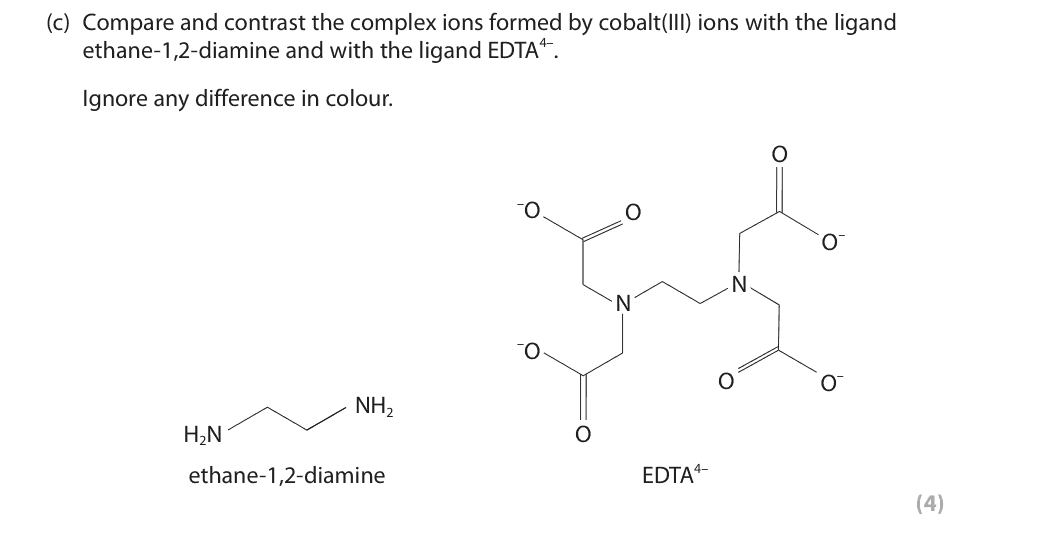
The command or instruction for part (c) was “Compare and contrast” and so this should have
elicited some similiarities and some differences. However responses which scored 3 or 4 marks
tended to be rare. Consolidation of this area of complex ions is needed.
The correct formula of the complex in part (d) was not often seen and hence the justification
even less so. Candidates appreciated that there was a 1:2 molar ratio but failed to appreciate
that the two moles of chloride ions able to react with the silver nitrate are not those in the
complex.
Notes from the mark scheme and report
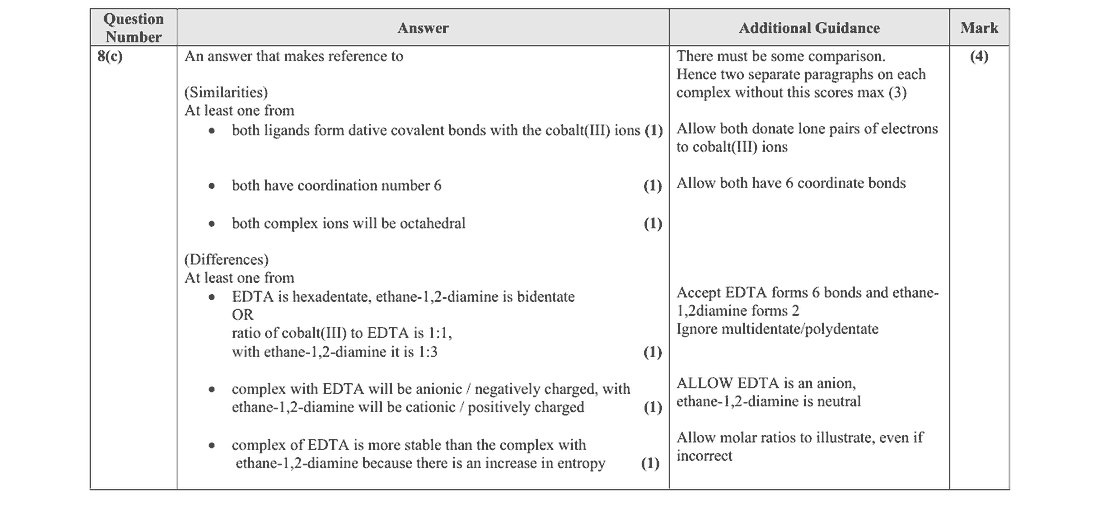
Similarities (at least one needed): both ligands form dative covalent bonds to the cobalt(III) ion
both complexes have coordination number 6
both are octahedral. Differences (at least one needed): EDTA is hexadentate and ethane-1,2-diamine is bidentate / the Co : ligand ratio is 1:1 for EDTA and 1:3 for ethane-1,2-diamine
the EDTA complex is negatively charged and the ethane-1,2-diamine complex positively charged
the EDTA complex is the more stable because of the larger increase in entropy. Maximum 3 if no comparison is made (two separate descriptions). Ignore multidentate / polydentate
November 2021 · Paper 3 · Q5(a)(i)2 marksPractical and data analysis
Mark scheme
Examiner's comment
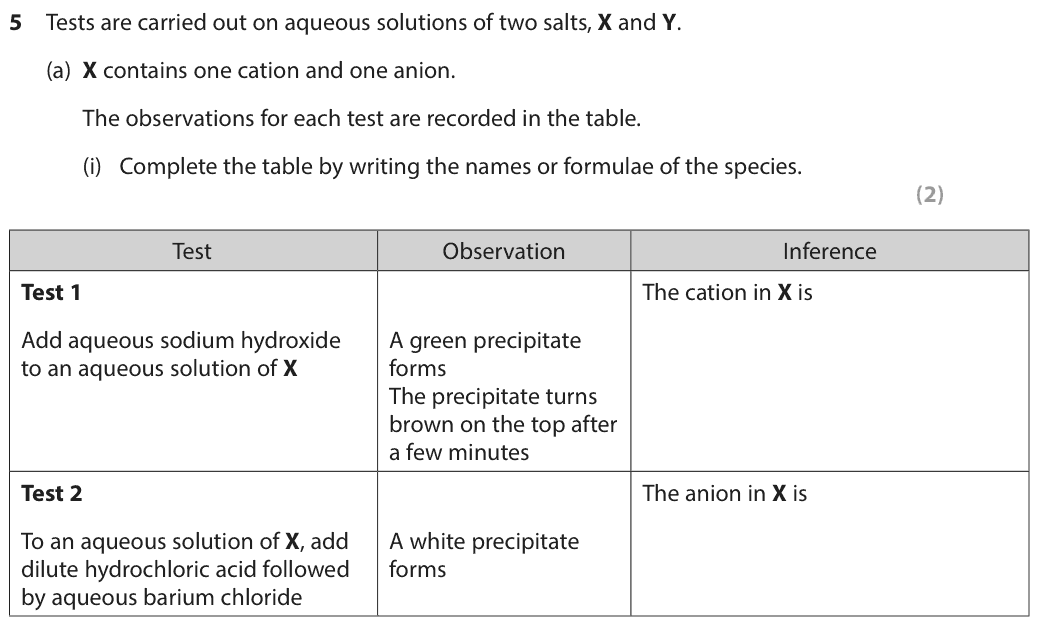
Some candidates were familiar with the tests for ions listed in the specification so answered
this question very well. Others would benefit from much more practise at this style of
experiment and question. Many candidates recognised the test for a sulfate ion in X but far
fewer identified the iron(II) cation. The ionic equation for the reaction between the cation and
aqueous sodium hydroxide was poorly answered. Many candidates did know that the
precipitate would be oxidised by air, even if they didn’t know what the precipitate was. Many
knew that hydrochloric acid was added in Test 2 to remove any carbonate ions to ensure they
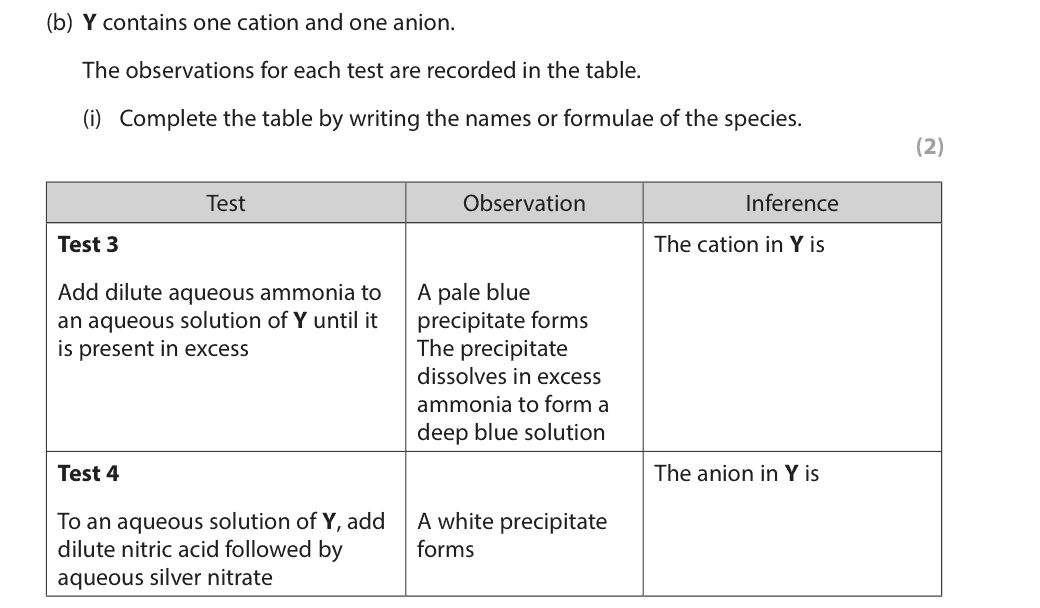
did not give a precipitate with aqueous barium chloride. The tests for copper(II) ions and
chloride ions were often known, although there was some confusion with chromium, cobalt
or nickel ions. The formula of the complex ion in the deep blue solution was rarely done
correctly, with many not even including ammonia ligands. Many candidates did know how to
confirm the presence of chloride ions.
Notes from the mark scheme and report
Answer: cation Fe2+ / iron(II)
anion SO4 2– / sulfate (not sulfite). Many recognised the sulfate test but far fewer identified iron(II)
Skills: PT4 use laboratory apparatus for a variety of experimental techniques, including: titration, using burette and pipette; distillation and heating under reflux, including setting up glassware using retort stand and clamps; qualitative tests for ions and organic functional groups; filtration, including use of fluted filter paper, or filtration under reduced pressure; CP15 Core practical 15: Analysis of some inorganic and organic unknowns
November 2021 · Paper 3 · Q5(a)(ii)2 marksEquation writingHard
Earlier part of question 5 that this part uses
Mark scheme
Examiner's comment
Some candidates were familiar with the tests for ions listed in the specification so answered
this question very well. Others would benefit from much more practise at this style of
experiment and question. Many candidates recognised the test for a sulfate ion in X but far
fewer identified the iron(II) cation. The ionic equation for the reaction between the cation and
aqueous sodium hydroxide was poorly answered. Many candidates did know that the
precipitate would be oxidised by air, even if they didn’t know what the precipitate was. Many
knew that hydrochloric acid was added in Test 2 to remove any carbonate ions to ensure they
did not give a precipitate with aqueous barium chloride. The tests for copper(II) ions and
chloride ions were often known, although there was some confusion with chromium, cobalt
or nickel ions. The formula of the complex ion in the deep blue solution was rarely done
correctly, with many not even including ammonia ligands. Many candidates did know how to
confirm the presence of chloride ions.
Notes from the mark scheme and report
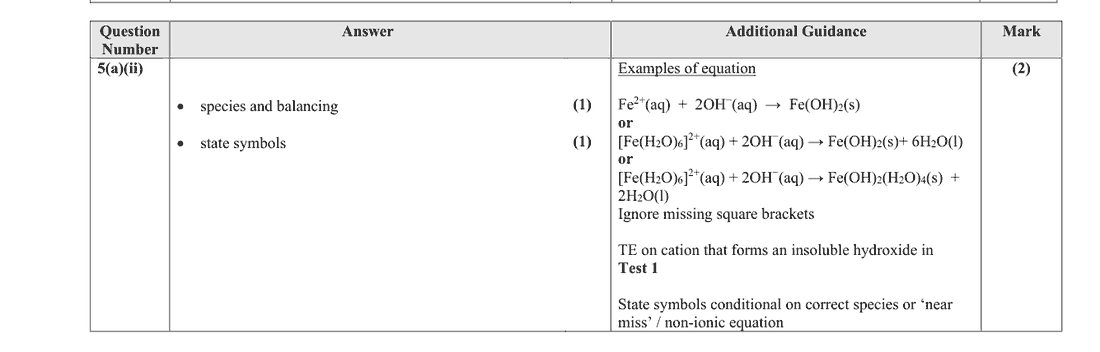
Fe2+(aq) + 2OH–(aq) → Fe(OH)2(s)
or [Fe(H2O)6]2+(aq) + 2OH–(aq) → Fe(OH)2(H2O)4(s) + 2H2O(l). One mark for species and balancing, one for state symbols (needs correct species or a near miss). Error carried forward from a cation in (i) that gives an insoluble hydroxide
Skills: CP15 Core practical 15: Analysis of some inorganic and organic unknowns
November 2021 · Paper 3 · Q5(b)(i)2 marksPractical and data analysis
Earlier part of question 5 that this part uses
Mark scheme
Examiner's comment
Some candidates were familiar with the tests for ions listed in the specification so answered
this question very well. Others would benefit from much more practise at this style of
experiment and question. Many candidates recognised the test for a sulfate ion in X but far
fewer identified the iron(II) cation. The ionic equation for the reaction between the cation and
aqueous sodium hydroxide was poorly answered. Many candidates did know that the
precipitate would be oxidised by air, even if they didn’t know what the precipitate was. Many
knew that hydrochloric acid was added in Test 2 to remove any carbonate ions to ensure they
did not give a precipitate with aqueous barium chloride. The tests for copper(II) ions and
chloride ions were often known, although there was some confusion with chromium, cobalt
or nickel ions. The formula of the complex ion in the deep blue solution was rarely done
correctly, with many not even including ammonia ligands. Many candidates did know how to
confirm the presence of chloride ions.
Notes from the mark scheme and report
Answer: cation Cu2+ / copper(II) (not just copper or Cu)
anion Cl– / chloride (not chlorine or Cl). Often known, with some confusion with chromium, cobalt or nickel ions
Skills: PT4 use laboratory apparatus for a variety of experimental techniques, including: titration, using burette and pipette; distillation and heating under reflux, including setting up glassware using retort stand and clamps; qualitative tests for ions and organic functional groups; filtration, including use of fluted filter paper, or filtration under reduced pressure; CP15 Core practical 15: Analysis of some inorganic and organic unknowns
November 2021 · Paper 3 · Q5(b)(ii)1 markShort answerHard
Earlier parts of question 5 that this part uses
Mark scheme
Examiner's comment
Some candidates were familiar with the tests for ions listed in the specification so answered
this question very well. Others would benefit from much more practise at this style of
experiment and question. Many candidates recognised the test for a sulfate ion in X but far
fewer identified the iron(II) cation. The ionic equation for the reaction between the cation and
aqueous sodium hydroxide was poorly answered. Many candidates did know that the
precipitate would be oxidised by air, even if they didn’t know what the precipitate was. Many
knew that hydrochloric acid was added in Test 2 to remove any carbonate ions to ensure they
did not give a precipitate with aqueous barium chloride. The tests for copper(II) ions and
chloride ions were often known, although there was some confusion with chromium, cobalt
or nickel ions. The formula of the complex ion in the deep blue solution was rarely done
correctly, with many not even including ammonia ligands. Many candidates did know how to
confirm the presence of chloride ions.
Notes from the mark scheme and report
Answer: [Cu(NH3)4(H2O)2]2+ (allow [Cu(NH3)4]2+
[Co(NH3)6]2+ if Co2+ was given in (i)). Many answers did not even include ammonia ligands
Skills: CP15 Core practical 15: Analysis of some inorganic and organic unknowns
October 2020 · Paper 1 · Q3(c)3 marksExplanation
Earlier part of question 3 that this part uses
Mark scheme
Examiner's comment
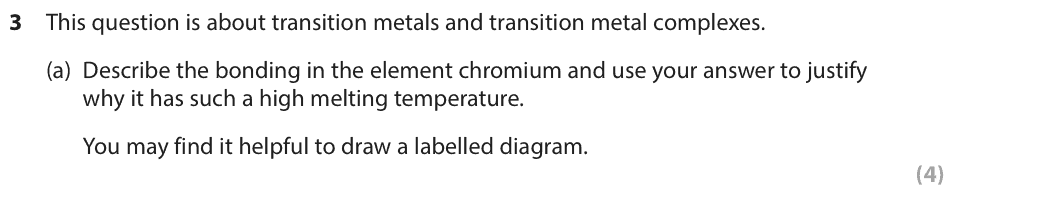
Most candidates had some knowledge of metallic structure, and the candidates with an eye
for written detail and who took care with any diagrams where able to score full marks.
Probably the most common issue with diagrams was inconsistencies with the number of
electrons shown. For instance the ion would be shown as Cr3+, but too few electrons where
then evident in the diagram. Written answers did not always refer to the regular arrangement
/ lattice of ions, hence without a diagram to support the comments, the first mark could not
be awarded. Some confusion persists with the electrostatic attraction in the model. Many
referred to an attraction between the nucleus and the outer electrons hence it was not always
clear whether the discussion was based around ionisation of metallic bonding.
A small number of candidates needed to take care when reading the question as they
described bonding in chromium complexes and tried to justify a high melting temperature in
this context.
In (b) most candidates could describe the shape of the context, but once again some did not
read the question and gave its formula. In (ii) most candidates realised that the d-orbitals /
subshell splits in a complex ion. A number were imprecise with language though and did not
score the first mark as they described a singular ‘d-orbital’ as splitting. Many understood the
colour was linked to electron promotion, though disappointingly many linked this to the
return of the electron to the ground state and subsequent emission of light, as in a flame test.
Most candidates recognised the increases in entropy in (c), linking it to the increases in the
number of moles of particles, though far fewer appreciated that the value of the equilibrium
constant meant the complex was stable or the equilibrium position was far to the right.
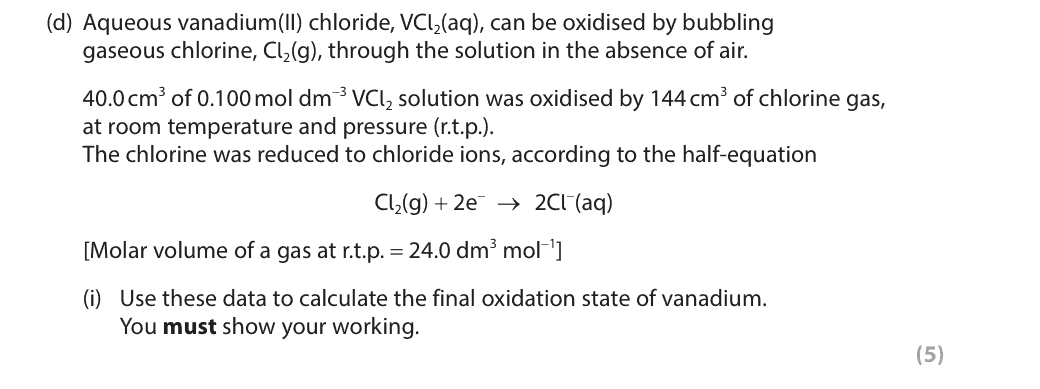
The calculation in (d) allowed nearly all candidates to access some credit, with the first
2 marks often awarded. Although the molar volume of a gas was given in the question, a
number of candidates attempted to find the moles of chlorine using the ideal gas equation,
making life more difficult for themselves. The ability to link the transfer of electrons to the
ratio was discriminating, and such candidates often went on to score full marks in (i) and (ii).
Some answers found in difficult to process the idea that this was an oxidation from +2 to +5,
and focused on the more usual reduction from +5 to +2, giving the colours the wrong way
round.
Notes from the mark scheme and report
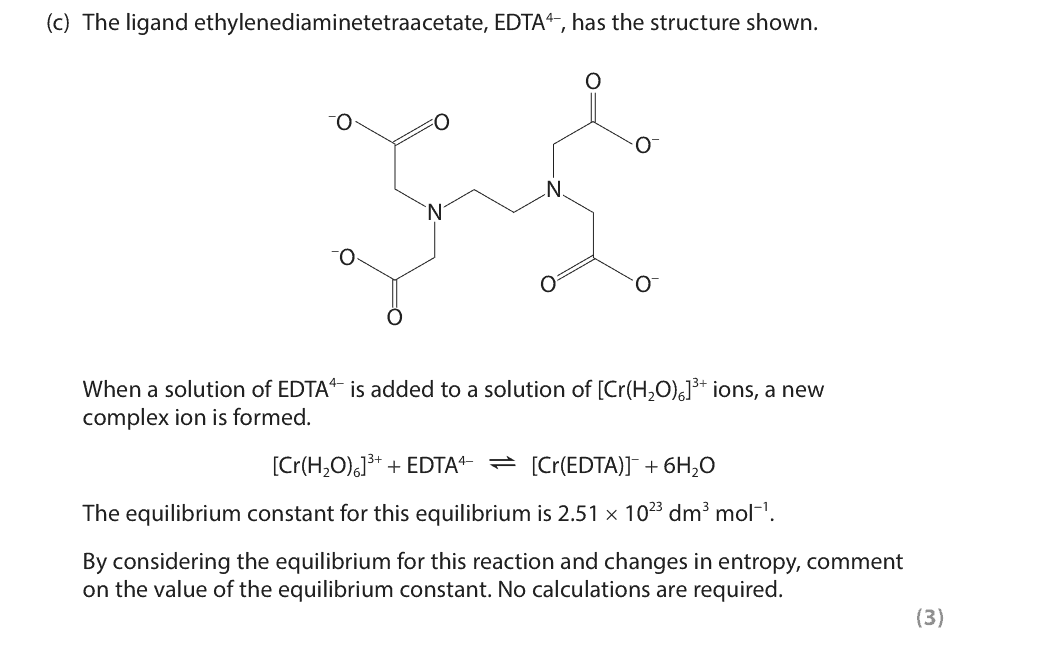
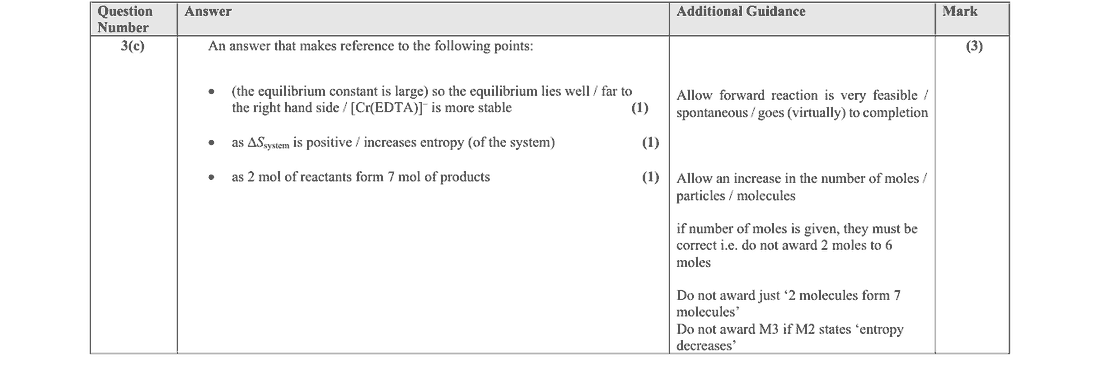
The equilibrium constant is very large, so the equilibrium lies far to the right / [Cr(EDTA)]– is more stable (1)
ΔSsystem is positive (1)
because 2 mol of reactants form 7 mol of products (1). If numbers of moles are given they must be right
'2 molecules form 7 molecules' is not enough. Most gave the entropy increase and the increase in moles
far fewer linked the size of the constant to the stability of the complex or the position of equilibrium
October 2020 · Paper 1 · Q3(d)(ii)2 marksShort answer
Earlier parts of question 3 that this part uses
Mark scheme
Examiner's comment
Most candidates had some knowledge of metallic structure, and the candidates with an eye
for written detail and who took care with any diagrams where able to score full marks.
Probably the most common issue with diagrams was inconsistencies with the number of
electrons shown. For instance the ion would be shown as Cr3+, but too few electrons where
then evident in the diagram. Written answers did not always refer to the regular arrangement
/ lattice of ions, hence without a diagram to support the comments, the first mark could not
be awarded. Some confusion persists with the electrostatic attraction in the model. Many
referred to an attraction between the nucleus and the outer electrons hence it was not always
clear whether the discussion was based around ionisation of metallic bonding.
A small number of candidates needed to take care when reading the question as they
described bonding in chromium complexes and tried to justify a high melting temperature in
this context.
In (b) most candidates could describe the shape of the context, but once again some did not
read the question and gave its formula. In (ii) most candidates realised that the d-orbitals /
subshell splits in a complex ion. A number were imprecise with language though and did not
score the first mark as they described a singular ‘d-orbital’ as splitting. Many understood the
colour was linked to electron promotion, though disappointingly many linked this to the
return of the electron to the ground state and subsequent emission of light, as in a flame test.
Most candidates recognised the increases in entropy in (c), linking it to the increases in the
number of moles of particles, though far fewer appreciated that the value of the equilibrium
constant meant the complex was stable or the equilibrium position was far to the right.
The calculation in (d) allowed nearly all candidates to access some credit, with the first
2 marks often awarded. Although the molar volume of a gas was given in the question, a
number of candidates attempted to find the moles of chlorine using the ideal gas equation,
making life more difficult for themselves. The ability to link the transfer of electrons to the
ratio was discriminating, and such candidates often went on to score full marks in (i) and (ii).
Some answers found in difficult to process the idea that this was an oxidation from +2 to +5,
and focused on the more usual reduction from +5 to +2, giving the colours the wrong way
round.
Notes from the mark scheme and report
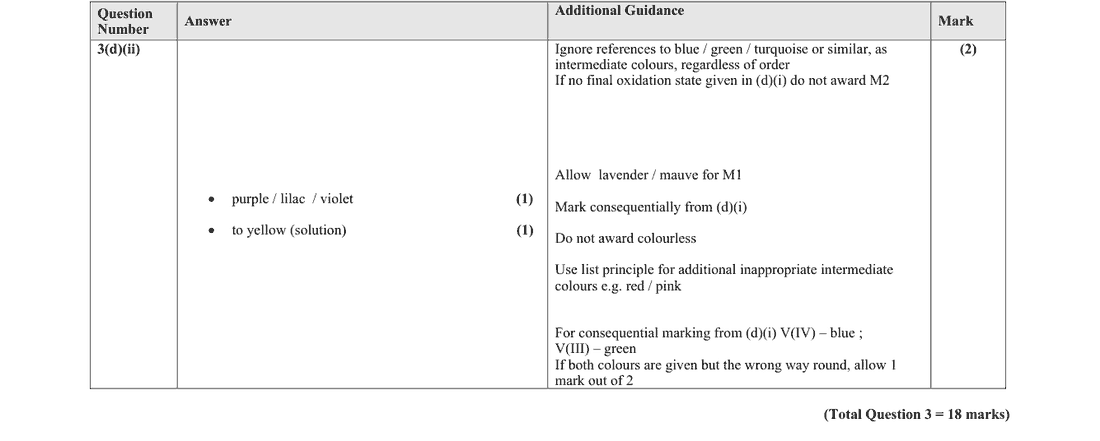
Answer: purple (lilac / violet) to yellow. Marked consequentially on (d)(i): V(IV) blue, V(III) green
no mark for the final colour if no oxidation state was given in (d)(i). Intermediate blue / green ignored
not colourless. Both colours the wrong way round scores 1. Common error: treating it as the usual reduction from +5 to +2, so reversing the colours
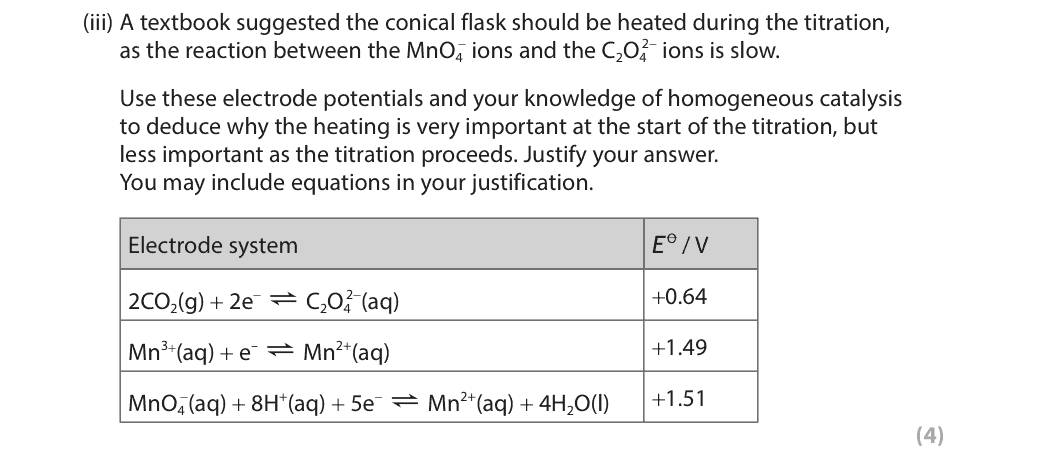
October 2020 · Paper 1 · Q8(e)(iii)4 marksExplanation
Earlier parts of question 8 that this part uses
Mark scheme
Examiner's comment
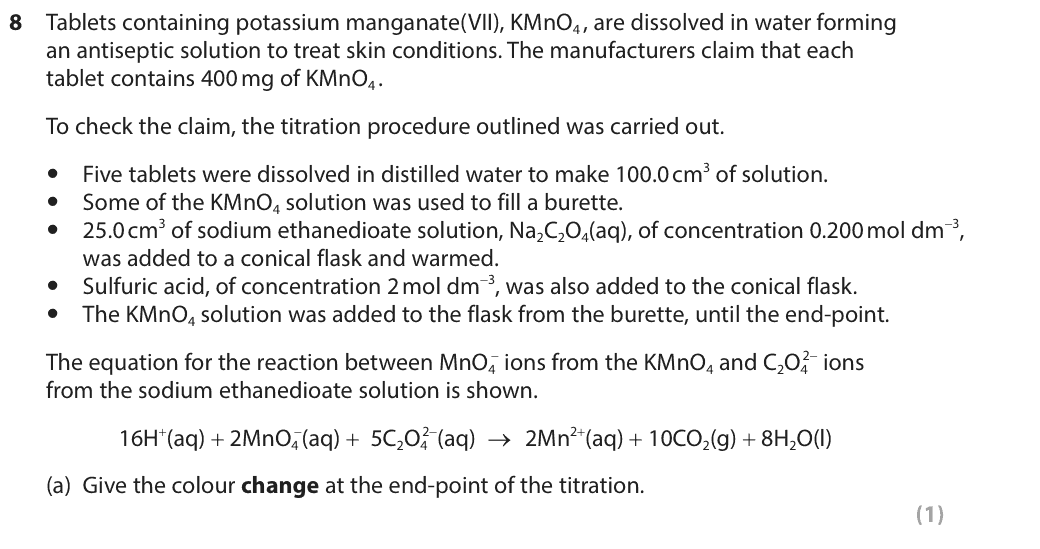
The colour change in (a) proved to be more challenging than imagined with a number only
giving one colour or giving the reverse answer. A few didn’t appreciate that at the end-point
only a very small amount of potassium manganate(VII) will be in excess and hence thought
the reaction mixture would be purple, rather than pale pink.
In (b) the covalent dot-and-cross diagram was found difficult by many. Some seemed to have
recalled the displayed formula of the ion and translated the bonds accordingly. However,
some others simply added lines to the diagram, without showing electron pairs. Others didn’t
manage to deduce the correct number of electrons, forgetting the two extra electrons or
simply not adding correctly. Perhaps the most frustrating 1 mark answers showed all the
bonding electrons correctly but omitted the non-bonding electrons.
In (c), despite the equation in the stem, many thought the sulfuric acid was a catalyst.
The cell diagram in (d) was presented correctly by a small number of candidates. Some
confused the idea of a cell diagram with a diagram of the apparatus needed to set up the cell,
whereas others mixed up the use of solid lines, showing several in their diagram, rather than
the two needed to separate the platinum electrodes from the rest of the cell diagram.
The R-O-O-R convention was not always implemented and the majority of answers did not
include key cell reactants such as H+ ions and H2O.
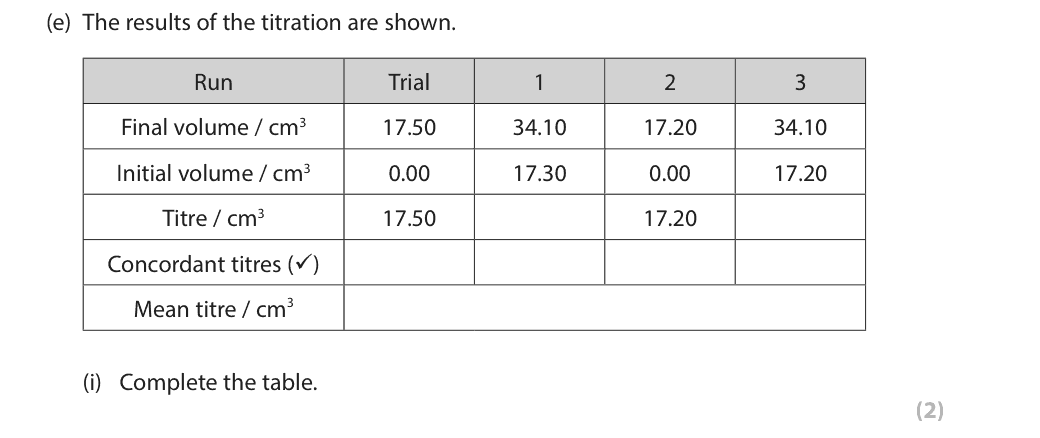
In (e), a disappointing number of unforced errors were seen in the table. Most common was
the use of 1 decimal place for titration data, whilst other candidates did not recognise
concordant results, so calculated the mean of Runs 1, 2 and 3. Once again nearly all
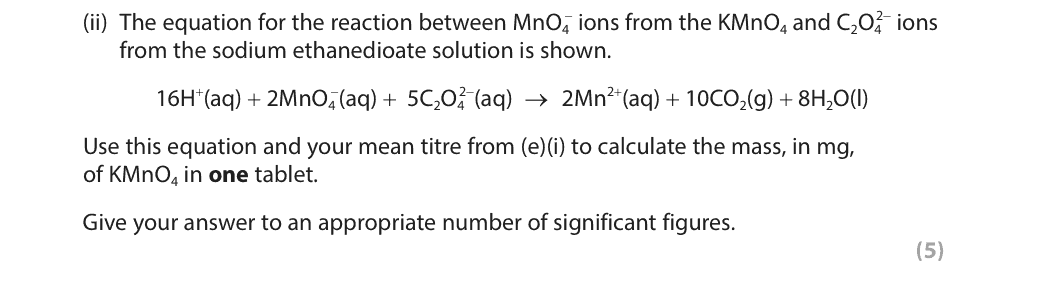
candidates gained some credit for the calculation in (ii), though sometimes the ratio for the
second mark was inverted. Several candidates calculated the concentration of the KMnO4, an
unnecessary step which then confused many of this cohort. Stronger candidates were able to
get back on track, by calculation the moles in 100 cm3, whilst the best candidates didn’t
calculation the concentration, but simply scaled from 10cm3 to 100 cm3. Some otherwise
good answers missed out on credit in marks 4 and 5, either by missing potassium when
determining the relative formula mass of potassium manganate(VII) or by not converting their
answer to mg. In (iii) most answers recognised the role of Mn2+ as an autocatalyst, and many
linked the slow initial reaction to the repulsion of two negative ions or the resultant high
activation energy. The most effective way to score marks 3 and 4 was to write equations for
the appropriate reactions using the half cell data. Those who tried to justify in prose often
gave answers that lacked clarity, with descriptions that confused the key reactions, for
instance describing Mn2+ as oxidizing the MnO4− ions. Ecell was also used ineffectively, either
because candidates simply calculated a value of + 0.87 V for the overall reaction, or because
they did not relate + 0.85 V or + 0.02 V to the appropriate reaction. A small but noticeable
number tried to link Ecell values to rate, confusing thermodynamic and kinetic stability.
Notes from the mark scheme and report
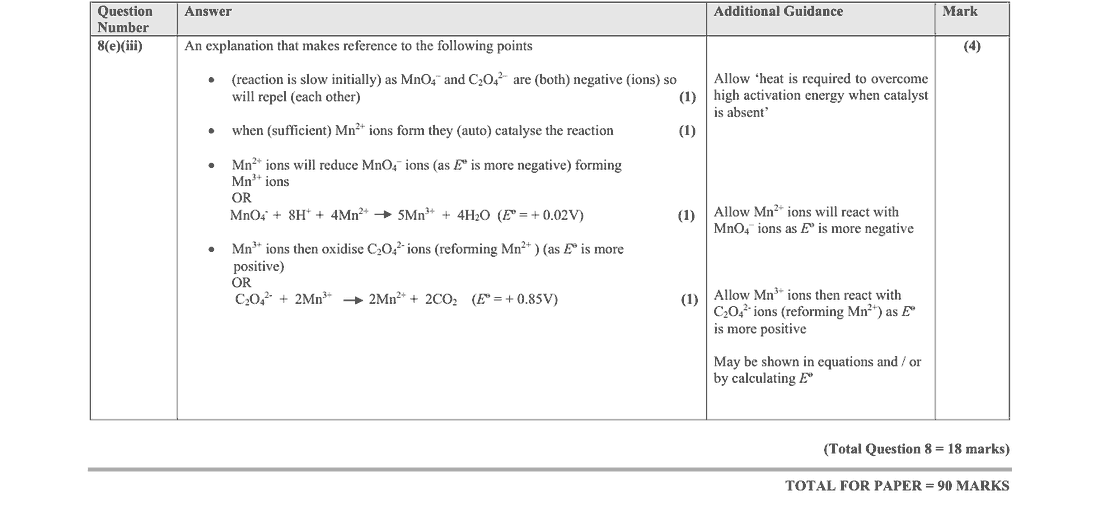
Slow at first because MnO4– and C2O4 2– are both negative ions and repel (high activation energy with no catalyst), so heat is needed (1)
once Mn2+ ions form they catalyse the reaction (autocatalysis) (1)
Mn2+ reduces MnO4– to Mn3+: MnO4– + 8H+ + 4Mn2+ → 5Mn3+ + 4H2O, E = +0.02 V (1)
Mn3+ then oxidises C2O4 2–, re-forming Mn2+: C2O4 2– + 2Mn3+ → 2Mn2+ + 2CO2, E = +0.85 V (1). The last two marks were best earned with equations
prose answers muddled which species oxidises which
some only calculated +0.87 V for the overall reaction, or tried to link E cell values to rate
October 2020 · Paper 3 · Q8(a)2 marksPractical and data analysis
Mark scheme
Examiner's comment
Candidates should always be remined that some transition metal complex ion colour changes
just have to be learnt and recalled. In (a) those candidates who has studied this topic well
scored both marks but others gave a wide range of colours and experimental observations.
The need for principles to be clearly understood was emphasised in (b)(i). Despite the request
for an oxidation half-equation, responses frequently gave equations without the inclusion of
electrons. This was aimed at the more able candidates and those capable of working things
out were able to deduce the correct answer.
The equation for part (b)(ii) is explicitly stated in the specification and so should have been
recall. Nonetheless it should be possible for the candidates to deduce from first principles and
so the more able were able to score the mark as well as those whom had simply learnt it.
Part (b)(iii) is a classic example to remind candidates of the need to read the question carefully
and to answer accordingly. It specifically states that the oxidation and reduction half
equations were required but oftentimes no labelling of the half equations were given. The cell
diagram notation was a new addition to the specification but this is several years past now
and so should be more familiar. However some responses led examiners to speculate that
this is still a rarely considered part of the topic area. However the more able candidates could
demonstrate their understanding and scored the marks.
The modal mark for the labelled diagram of the electrochemical cell apparatus was five. The
majority of candidates included the voltmeter, salt bridge with chemical, platinum electrode
for the chromium electrode and the need for 1.0 mol dm˗3 concentrations. At times
candidates were careless with their diagrams and did not have their salt bridge in their
solutions and so lost one mark for this. The two marks which were not awarded very often
were for the formulae of the compounds required which was despite the word ‘formulae’
being emboldened. Candidates need to be observant and to notice this type of font as
indicating exactly what is required in their answer.
Notes from the mark scheme and report
Green precipitate (allow grey-green
not blue-green)
the precipitate dissolves in excess sodium hydroxide to give a green solution. The second mark depends on the first or a near miss. Those who had not learnt the colours gave a wide range of observations
October 2020 · Paper 3 · Q8(b)(i)2 marksEquation writing
Earlier part of question 8 that this part uses
Mark scheme
Examiner's comment
Candidates should always be remined that some transition metal complex ion colour changes
just have to be learnt and recalled. In (a) those candidates who has studied this topic well
scored both marks but others gave a wide range of colours and experimental observations.
The need for principles to be clearly understood was emphasised in (b)(i). Despite the request
for an oxidation half-equation, responses frequently gave equations without the inclusion of
electrons. This was aimed at the more able candidates and those capable of working things
out were able to deduce the correct answer.
The equation for part (b)(ii) is explicitly stated in the specification and so should have been
recall. Nonetheless it should be possible for the candidates to deduce from first principles and
so the more able were able to score the mark as well as those whom had simply learnt it.
Part (b)(iii) is a classic example to remind candidates of the need to read the question carefully
and to answer accordingly. It specifically states that the oxidation and reduction half
equations were required but oftentimes no labelling of the half equations were given. The cell
diagram notation was a new addition to the specification but this is several years past now
and so should be more familiar. However some responses led examiners to speculate that
this is still a rarely considered part of the topic area. However the more able candidates could
demonstrate their understanding and scored the marks.
The modal mark for the labelled diagram of the electrochemical cell apparatus was five. The
majority of candidates included the voltmeter, salt bridge with chemical, platinum electrode
for the chromium electrode and the need for 1.0 mol dm˗3 concentrations. At times
candidates were careless with their diagrams and did not have their salt bridge in their
solutions and so lost one mark for this. The two marks which were not awarded very often
were for the formulae of the compounds required which was despite the word ‘formulae’
being emboldened. Candidates need to be observant and to notice this type of font as
indicating exactly what is required in their answer.
Notes from the mark scheme and report
[Cr(OH)6]3– + 2OH– → CrO4 2– + 4H2O + 3e–. One mark for the four species, one for balancing with the correct number of electrons. Many gave equations with no electrons
October 2020 · Paper 3 · Q8(b)(ii)1 markEquation writing
Earlier part of question 8 that this part uses
Mark scheme
Examiner's comment
Candidates should always be remined that some transition metal complex ion colour changes
just have to be learnt and recalled. In (a) those candidates who has studied this topic well
scored both marks but others gave a wide range of colours and experimental observations.
The need for principles to be clearly understood was emphasised in (b)(i). Despite the request
for an oxidation half-equation, responses frequently gave equations without the inclusion of
electrons. This was aimed at the more able candidates and those capable of working things
out were able to deduce the correct answer.
The equation for part (b)(ii) is explicitly stated in the specification and so should have been
recall. Nonetheless it should be possible for the candidates to deduce from first principles and
so the more able were able to score the mark as well as those whom had simply learnt it.
Part (b)(iii) is a classic example to remind candidates of the need to read the question carefully
and to answer accordingly. It specifically states that the oxidation and reduction half
equations were required but oftentimes no labelling of the half equations were given. The cell
diagram notation was a new addition to the specification but this is several years past now
and so should be more familiar. However some responses led examiners to speculate that
this is still a rarely considered part of the topic area. However the more able candidates could
demonstrate their understanding and scored the marks.
The modal mark for the labelled diagram of the electrochemical cell apparatus was five. The
majority of candidates included the voltmeter, salt bridge with chemical, platinum electrode
for the chromium electrode and the need for 1.0 mol dm˗3 concentrations. At times
candidates were careless with their diagrams and did not have their salt bridge in their
solutions and so lost one mark for this. The two marks which were not awarded very often
were for the formulae of the compounds required which was despite the word ‘formulae’
being emboldened. Candidates need to be observant and to notice this type of font as
indicating exactly what is required in their answer.
Notes from the mark scheme and report
2CrO4 2– + 2H+ → Cr2O7 2– + H2O. Reversible arrow and multiples accepted. The equation is in the specification, so it could be recalled or worked out
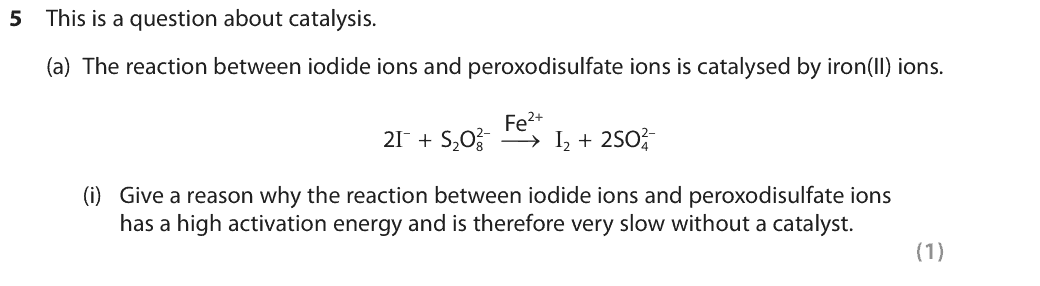
June 2019 · Paper 1 · Q5(a)(i)1 markShort answer
Mark scheme
Examiner's comment
This was another question where two parts of the answer were both required for the mark. The first part was the straightforward identification of the negative charge on both species. The second part was in response to the question requiring a reason for the very slow reaction, namely that the two species would repel each other. This two-part level of demand served to differentiate well and highlights the high demand of A Level.
Notes from the mark scheme and report
Both ions are negatively charged, so they repel each other: charge and repulsion are both needed for the mark. Many gave only one of the two ideas
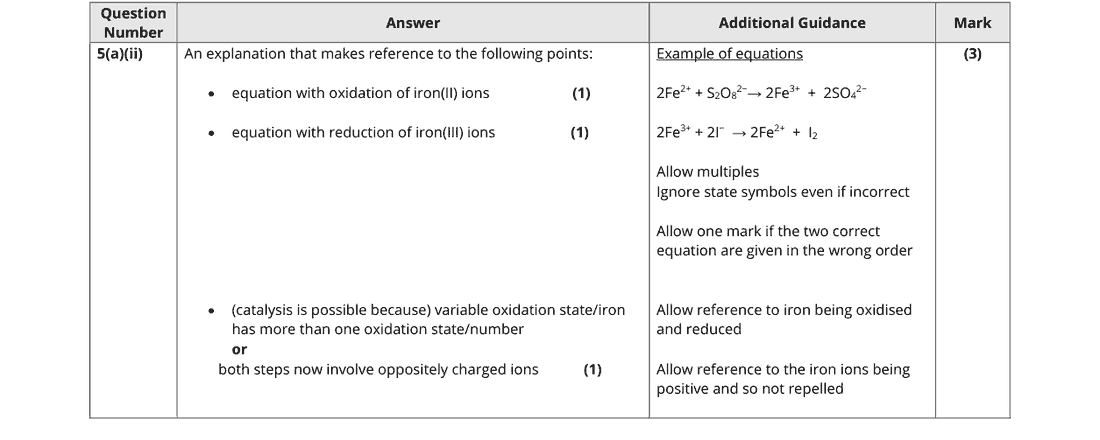
June 2019 · Paper 1 · Q5(a)(ii)3 marksEquation writingHard
Earlier part of question 5 that this part uses
Mark scheme
Examiner's comment
This question proved to be another effective discriminator by producing the full range of marks. Almost half of all candidates scored zero, which suggests that homogenous catalysis would be a useful area for consolidation by centres and candidates.
Many candidates got the stoichiometry wrong, again highlighting the need to practice balancing equations. A significant number of candidates gave the equations in the wrong order. The question specifically stated that iron(II) ions were the catalyst and so these should have been used to start the process. However, one mark out of the first two was awarded if this was the approach.
A reasonable number of candidates correctly followed on from the question in (i), where the slow reaction was due to the same charges repelling and wrote an explanation for the catalysis by iron (II) ions due to their opposite charge to the reacting species. This was pleasing to see and showed initiative by those candidates. An alternative approach was to refer to the typical property of transition elements of variable oxidation state which was also acceptable.
third mark: iron has variable oxidation states, or both steps now involve oppositely charged ions so there is no repulsion. One mark only for the two correct equations in the wrong order (Fe3+ first). Common errors: wrong stoichiometry
equations in the wrong order
June 2019 · Paper 1 · Q5(b)2 marksEquation writingHard
Earlier parts of question 5 that this part uses
Mark scheme
Examiner's comment
This question proved to be the most challenging on the whole paper. It was designed to be a follow- on from the previous question and provide another example of where the variable oxidation states of transition elements often enables catalytic activity. Many candidates used the space provided to try and work out the answer but often has missed the reference in the question, which had been highlighted in bold, that the reaction took place in "acidic" conditions. This was the key to obtaining correct equations and is a useful reminder of the emphasis that candidates need to note from words given in bold text.
Notes from the mark scheme and report
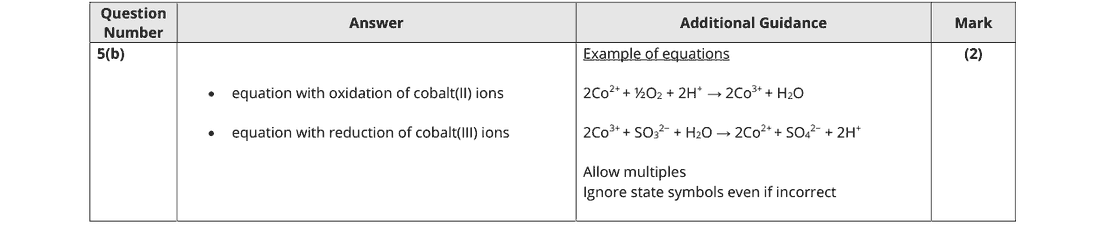
2Co2+ + ½O2 + 2H+ → 2Co3+ + H2O then 2Co3+ + SO3 2– + H2O → 2Co2+ + SO4 2– + 2H+. Multiples allowed. The key is that the solution is acidic, so H+ and H2O are needed to balance
many missed this
June 2019 · Paper 1 · Q5(c)1 markMultiple choice
Answer
C
Mark scheme
Notes from the mark scheme and report
Answer: C (Mn2+). The reaction is autocatalysed by the Mn2+ ions it produces, which is why it starts slowly and then speeds up
June 2019 · Paper 1 · Q5(d)1 markShort answer
Earlier part of question 5 that this part uses
Mark scheme
Examiner's comment
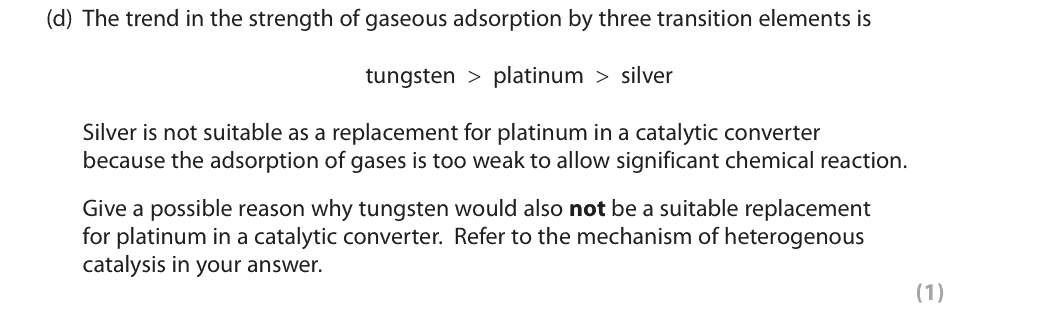
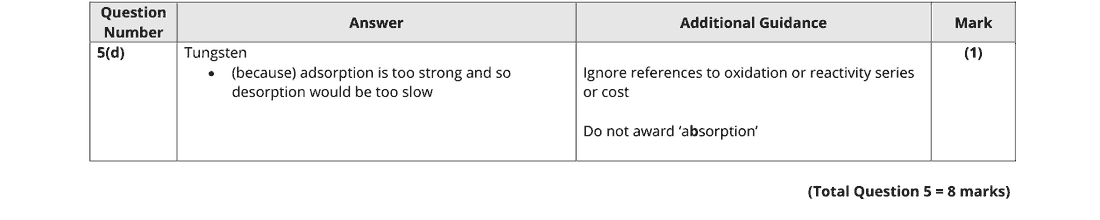
This question specifically states that reference to the mechanism of heterogeneous catalysis be provided in the answer and so mention was required of adsorption and desorption. It was pleasing to see very few references to 'absorption' and so centres and candidates are to be commended for this. However, it was not uncommon for candidates to refer to just one stage of catalysis without giving a reason for the fact that tungsten would not be a suitable catalyst.
Notes from the mark scheme and report
With tungsten the adsorption is too strong, so desorption (of the products) would be too slow. Not 'absorption'
ignore cost, oxidation and the reactivity series. Some named only one stage of the catalysis without giving the reason
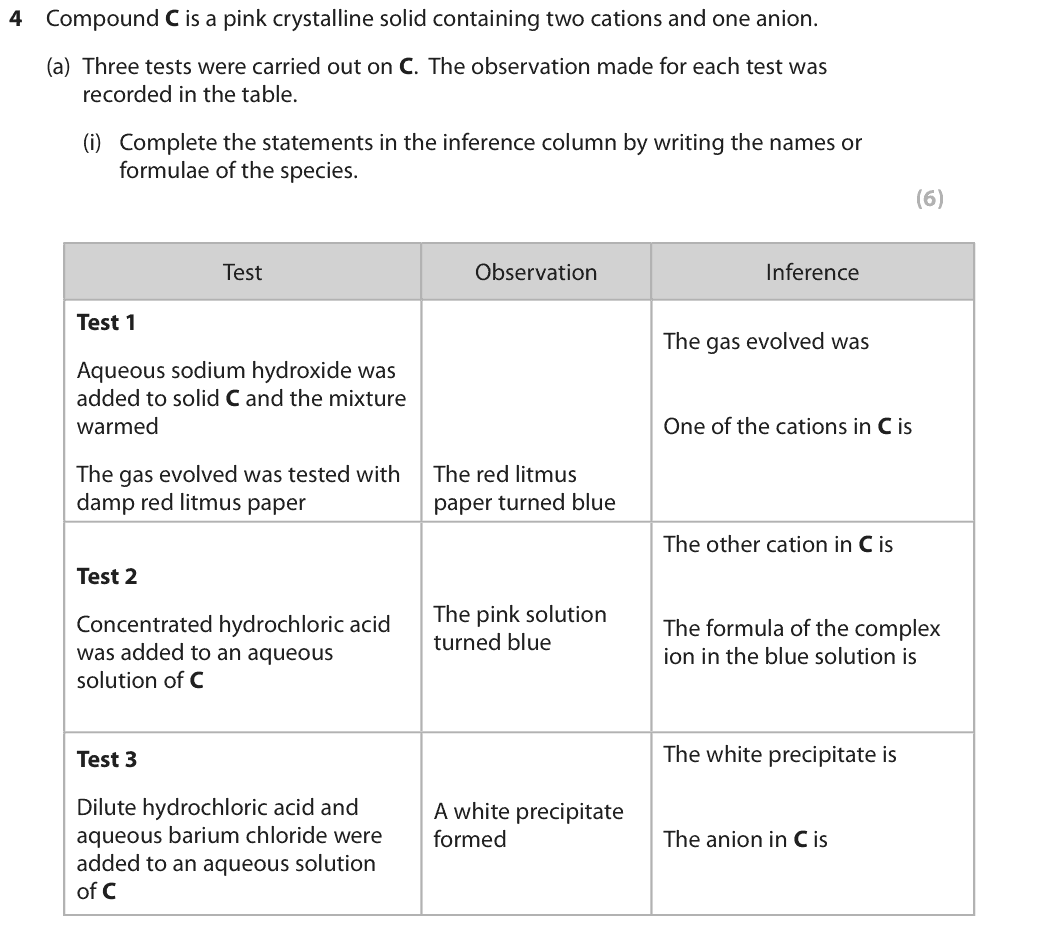
June 2019 · Paper 3 · Q4(a)(i)6 marksPractical and data analysis
Mark scheme
Examiner's comment
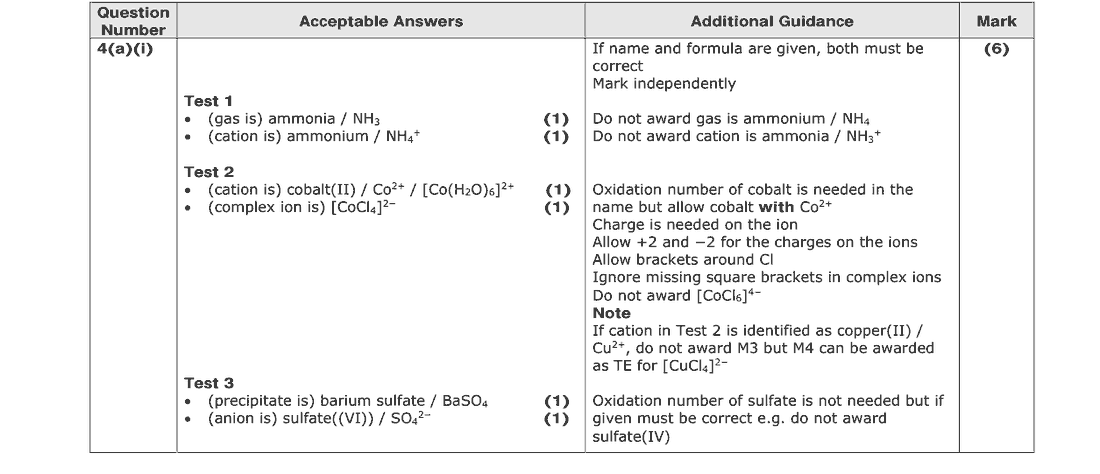
Candidates who have carried out tests to identify inorganic substances found this question straightforward. In part (a)(i) the most common error was to omit the oxidation state of cobalt. When a metal ion can have more than one oxidation state, it is important to give the name and oxidation state or the symbol with the charge ie cobalt(II) or Co2+. A number of candidates thought that copper(II) salts changed from pink to blue when concentrated hydrochloric acid is added. This is incorrect, but they were awarded marks for the correct tetrchloro complex of copper(II) and a consequential formula of C in (ii). Some candidates were unfamiliar with the tetrachloro complex ion of cobalt(II). Candidates found it much more challenging to combine the formulae of the three ions to give an overall neutral species. They would benefit from more practice in using formulae of double salts.
Notes from the mark scheme and report
Test 1: gas is ammonia, NH3
cation is ammonium, NH4+. Test 2: cation is cobalt(II) / Co2+ (oxidation number needed in the name)
complex is [CoCl4]2– (charge needed
not [CoCl6]4–). Test 3: precipitate is barium sulfate, BaSO4
anion is sulfate, SO4 2–. Marked independently. If copper(II) is given in Test 2, [CuCl4]2– earns the complex mark only. Commonest error: no oxidation state for cobalt
some chose copper(II)
some did not know the tetrachloro complex
Skills: PT4 use laboratory apparatus for a variety of experimental techniques, including: titration, using burette and pipette; distillation and heating under reflux, including setting up glassware using retort stand and clamps; qualitative tests for ions and organic functional groups; filtration, including use of fluted filter paper, or filtration under reduced pressure; CP15 Core practical 15: Analysis of some inorganic and organic unknowns
June 2019 · Paper 3 · Q4(c)1 markShort answer
Earlier part of question 4 that this part uses
Mark scheme
Examiner's comment
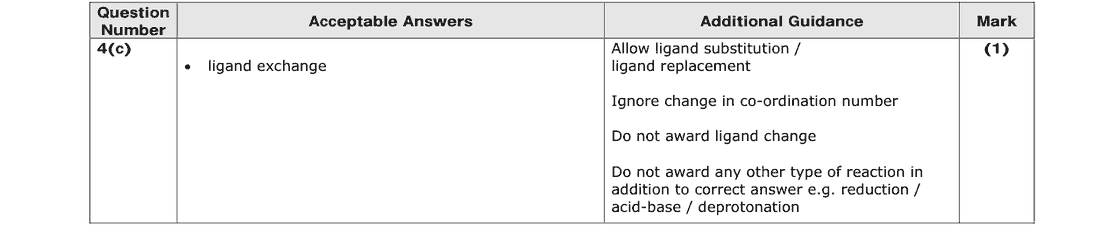
The majority of candidates identified the reaction as ligand exchange or ligand substitution.
Notes from the mark scheme and report
Answer: ligand exchange (allow ligand substitution or replacement
not 'ligand change'). Any other reaction type added (reduction, acid–base, deprotonation) loses the mark
June 2019 · Paper 3 · Q6(b)3 marksShort answer
Mark scheme
Examiner's comment
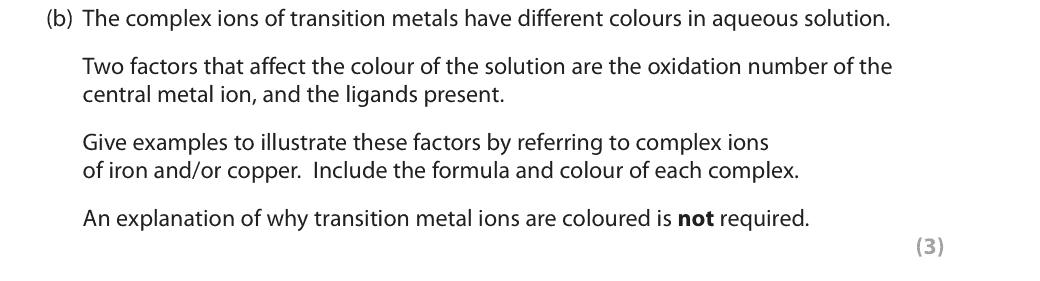
Candidates who were familiar with the complex ions of iron(II), iron(III) and copper(II) and their colours, found this a straightforward question. Some candidates did not read the question and wrote about the colours of the hydroxide precipitates formed by those metals instead of the complex ions asked for in the question. The question asked for the effect of oxidation number and ligands on the colour and a significant number of candidates only answered one of these points. Common errors included: giving incorrect formulae of the complex ions eg [Cu(NH3)6]2+, incorrect colours eg [CuCl4]2- as green instead of yellow or giving incorrect complex ions eg [Fe(NH3)6]2+. Candidates would benefit from carrying out test tube experiments involving the complex ions in the specification and then recording the colours and formulae of these complex ions. A few candidates ignored the instruction to not give an explanation of why transition metal ions are coloured.
Notes from the mark scheme and report
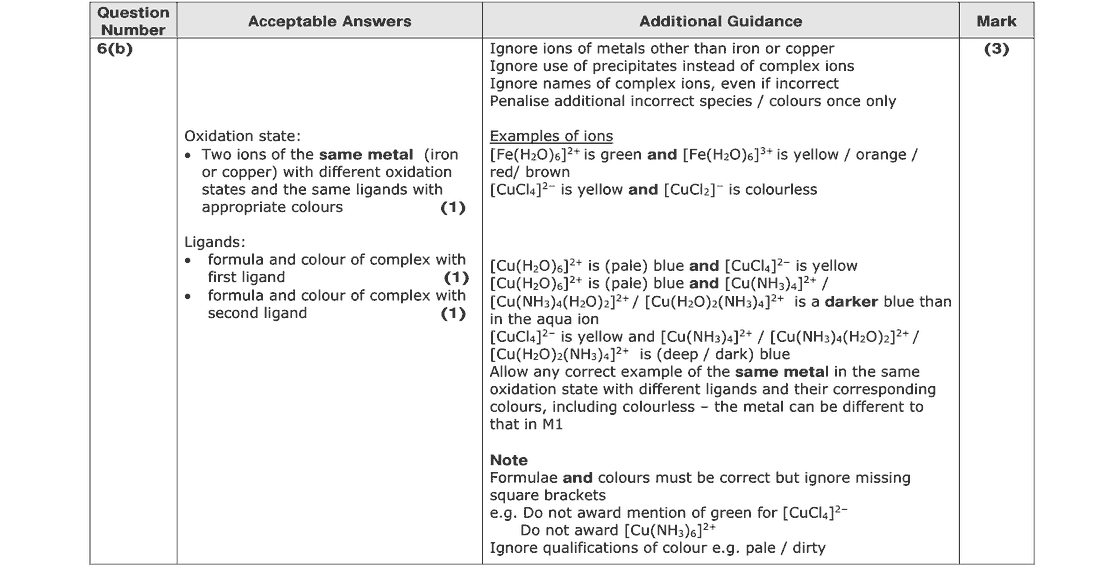
Oxidation number: two ions of the same metal with the same ligands and their colours, e.g. [Fe(H2O)6]2+ green and [Fe(H2O)6]3+ yellow / orange / brown. Ligand: formula and colour of two complexes of one metal in the same oxidation state, e.g. [Cu(H2O)6]2+ blue and [CuCl4]2– yellow, or [Cu(NH3)4(H2O)2]2+ dark blue (one mark each). Formula and colour must both be right
not green for [CuCl4]2–
not [Cu(NH3)6]2+. Precipitates are ignored. Many answered only one factor or described hydroxide precipitates
June 2019 · Paper 3 · Q6(c)(iv)3 marksShort answer
Earlier part of question 6 that this part uses
Mark scheme
Examiner's comment
The majority of candidates were able to make a good attempt at this question, with many scoring full marks. Some candidates lost a mark by just stating that the ammonia molecules are adsorbed and did not mention the surface of the tungsten and a few thought that ammonia would be desorbed from the catalyst, rather than the products. A few candidates confused heterogeneous and homogeneous catalysts and wrote about the change in oxidation number of tungsten and a few wrote generally about catalysts providing an alternative route with a lower activation energy, but that was not needed here.
Notes from the mark scheme and report
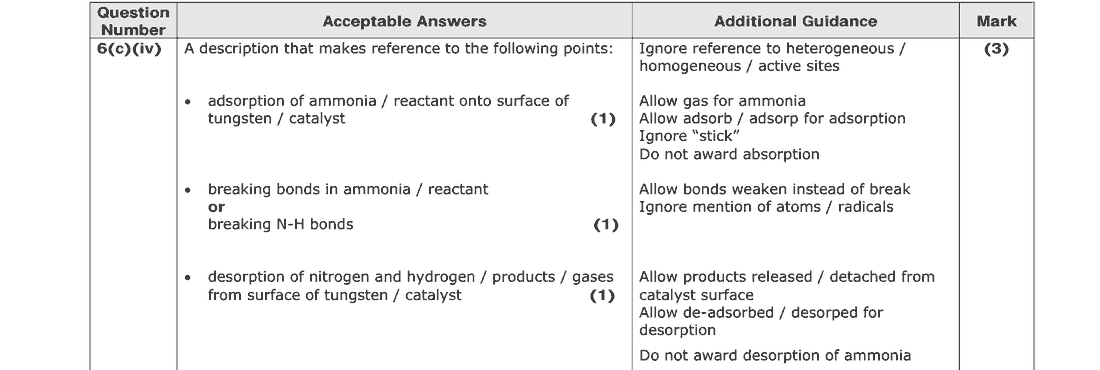
Ammonia is adsorbed onto the surface of the tungsten (not absorbed)
N–H bonds in ammonia weaken / break
nitrogen and hydrogen are desorbed from the surface. Errors: no mention of the surface
ammonia said to be desorbed
changes in oxidation number of tungsten (homogeneous catalysis)
June 2018 · Paper 1 · Q4(f)3 marksExplanation
Earlier part of question 4 that this part uses
Mark scheme
Examiner's comment
Many candidates could explain the sequence of changes in rate of reaction and there were some very good descriptions of autocatalysis. Some candidates omitted to explain why the reaction starts slowly or stated there would be little catalyst present, instead of no catalyst. Some candidates seemed unfamiliar with this reaction and the concept of autocatalysis and they just wrote generally about rate of reaction. A few candidates thought that the reaction slows down at the end as the Mn2+ ions are used up, showing they had little understanding of catalysis.
Notes from the mark scheme and report
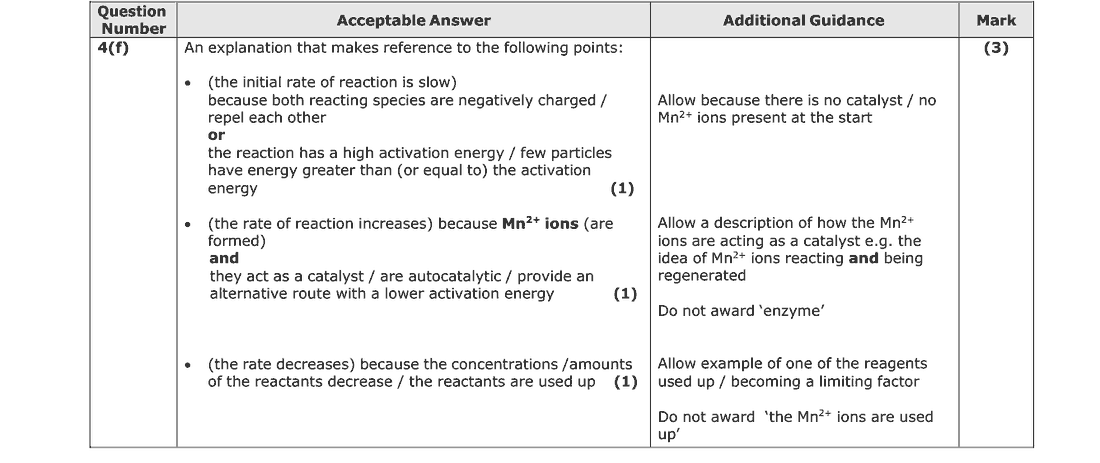
Slow at first because both reacting ions are negative and repel (or high activation energy
allow no catalyst / no Mn2+ at the start)
rate rises because Mn2+ ions are formed and act as a catalyst (autocatalysis)
rate falls as the reactant concentrations decrease. Not 'enzyme'
not 'the Mn2+ ions are used up'. Common errors: no reason for the slow start, or 'little' rather than no catalyst
general rate answers with no autocatalysis
June 2018 · Paper 3 · Q5(b)7 marksExplanation
Earlier part of question 5 that this part uses
Mark scheme
Examiner's comment
This extended response-style question also discriminated well, with the marks spread evenly across the range. Many candidates gave detailed and logical accounts of the changes, with correct equations and Ecell values.
However weaker responses, although recognising the four colours involved, confused the order of the colour changes.Others struggled to determine the direction of the reaction, or even if they realised that reactions involved zinc as a reducing agent, could not construct an overall equation. A second level of discrimination was evident due to ‘unforced errors’ in equations. The most common of these was a failure to balance water and/or hydrogen ions or confusion between the ions VO2+
+
and VO2
Notes from the mark scheme and report
Colours yellow → blue → green → violet (2 marks for all four linked to the right species, 1 mark for two or three)
stepwise reduction +5 → +4 → +3 → +2 (zinc is the reducing agent)
no further reduction to vanadium metal (Ecell = –0.42 V, not feasible). Common errors: colours in the wrong order
wrong direction of reaction
water or H+ not balanced
confusing the two oxovanadium ions
Skills: MS2.3 Substitute numerical values into algebraic equations using appropriate units for physical quantities
June 2018 · Paper 3 · Q5(c)2 marksExplanation
Earlier part of question 5 that this part uses
Mark scheme
Examiner's comment
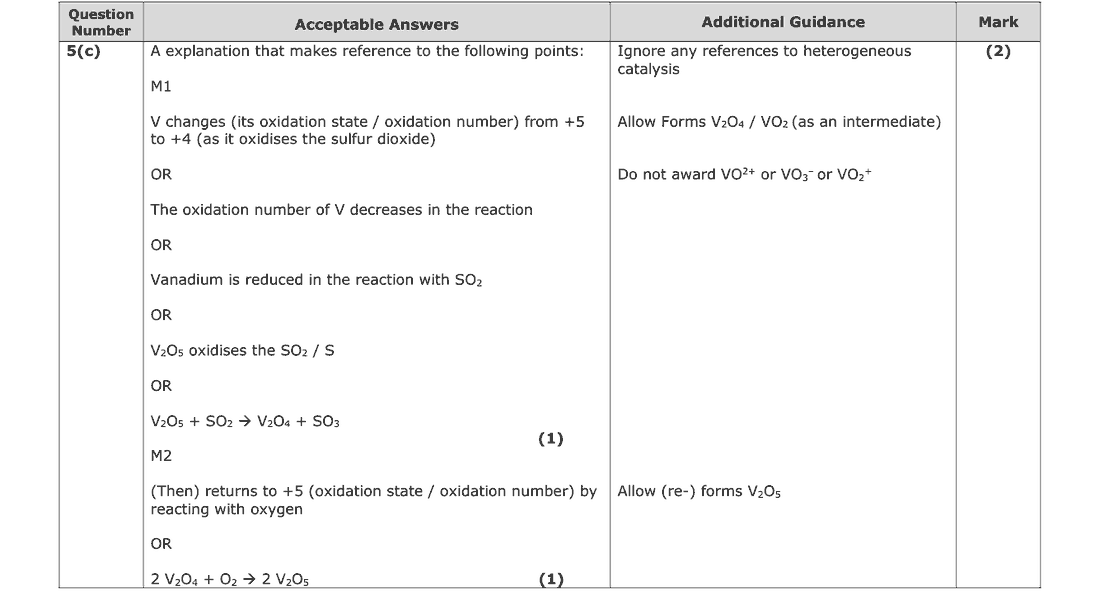
A large number of responses gave generic answers that were either based on alternative mechanisms of lower activation energy, or absorption onto a solid surface. Even those which attempted to discuss the specific role of vanadium(V) oxide, tended to discuss weakening of the sulfur dioxide bonds rather than consider the changes in oxidation number. The best answers were often the straightforward ones, that used equations to illustrate the role of the catalyst in the reaction.
Notes from the mark scheme and report
Vanadium changes from +5 to +4 as V2O5 oxidises the sulfur dioxide (V2O5 + SO2 → V2O4 + SO3)
it then returns to +5 by reacting with oxygen (2V2O4 + O2 → 2V2O5). Not the ions VO2+, VO3– or VO2+. Heterogeneous catalysis ignored. Many gave generic answers (lower activation energy, adsorption on a surface, weakening of bonds) instead of the oxidation-number changes
the best answers used the two equations
June 2018 · Paper 3 · Q5(d)6 marks6-mark extended response
Earlier part of question 5 that this part uses
Mark scheme, with the indicative content and the marks for reasoning
Examiner's comment
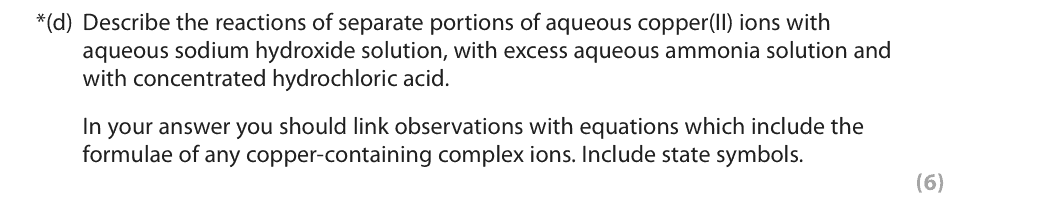
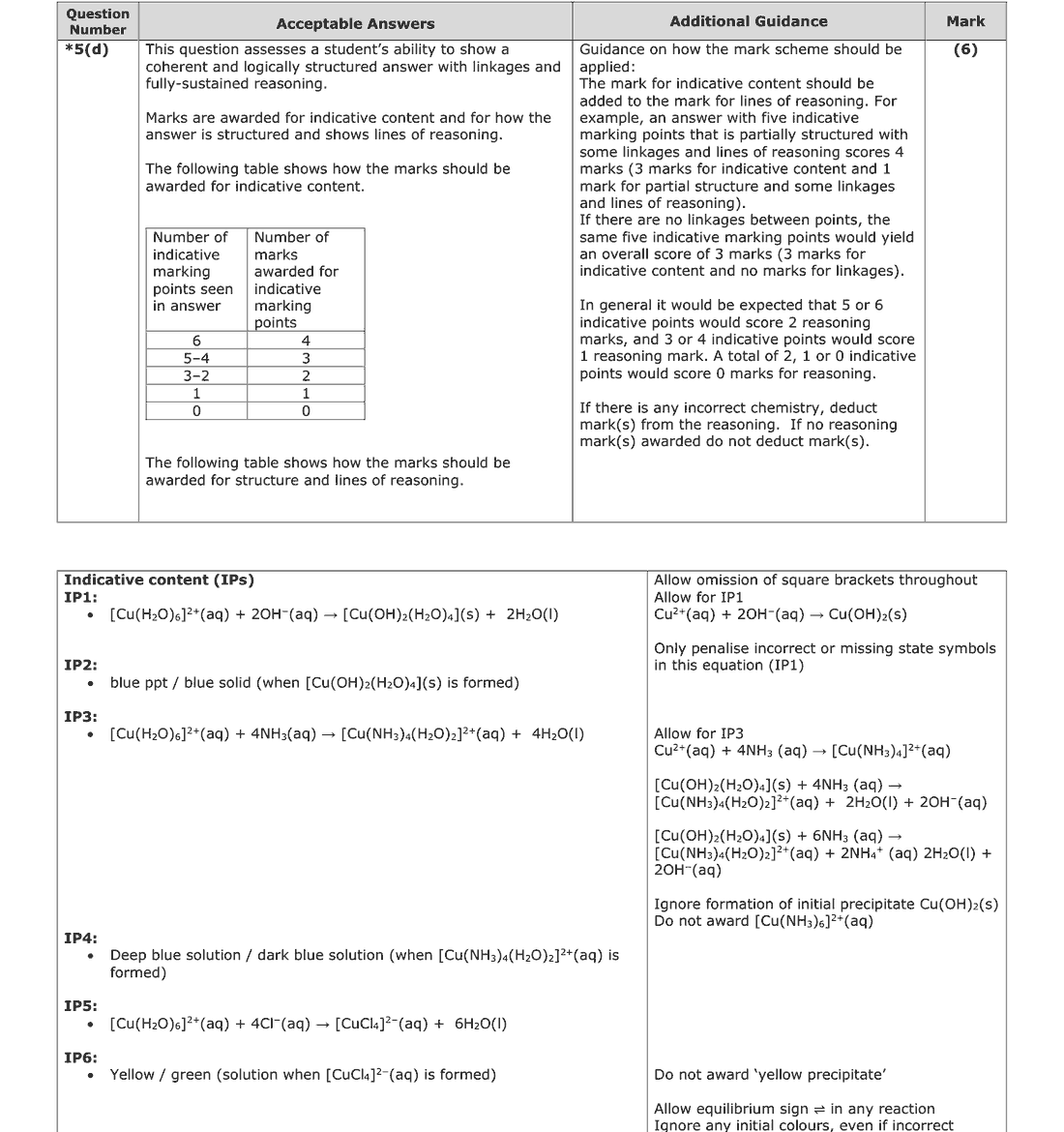
The examination team found that the responses to this question showed that many candidates had seen and done these reactions. Certainly, the ability to describe and write equations for these reaction of copper complexes was an improvement on questions involving similar reactions using chromium complexes in 2017. The full range of marks was seen, with some or all the descriptions proving most accessible. Often candidates provided additional information, especially regarding the dropwise addition of ammonia. Pleasingly, this was often correct. Errors though were often unforced. These commonly included incorrect or missing state symbols in the reaction with sodium hydroxide solution, or unbalanced equations. A very small number of candidates lost marks because they insisted on describing the reaction types but made mistakes, for instance stating that the reaction with sodium hydroxide solution was a ligand exchange.
Notes from the mark scheme and report
Six indicative points plus two marks for reasoning. IP1 [Cu(H2O)6]2+(aq) + 2OH–(aq) → [Cu(OH)2(H2O)4](s) + 2H2O(l) (allow Cu2+(aq) + 2OH–(aq) → Cu(OH)2(s))
IP6 yellow / green solution (not a yellow precipitate). State symbols are penalised only in IP1. Common errors: wrong or missing state symbols in the hydroxide equation
unbalanced equations
calling the hydroxide reaction ligand exchange
June 2017 · Paper 1 · Q4(c)(ii)2 marksExplanation
Earlier parts of question 4 that this part uses
Mark scheme
Examiner's comment
This question was answered well by the majority of candidates: they correctly identified the increased number of particles on the right-hand side so there would be an increase in entropy. Some candidates used incorrect terminology and referred to the particles as molecules while others wrote about disorder but did not mention entropy. Just stating that 'entropy is positive' was not sufficient for the second mark.
Notes from the mark scheme and report
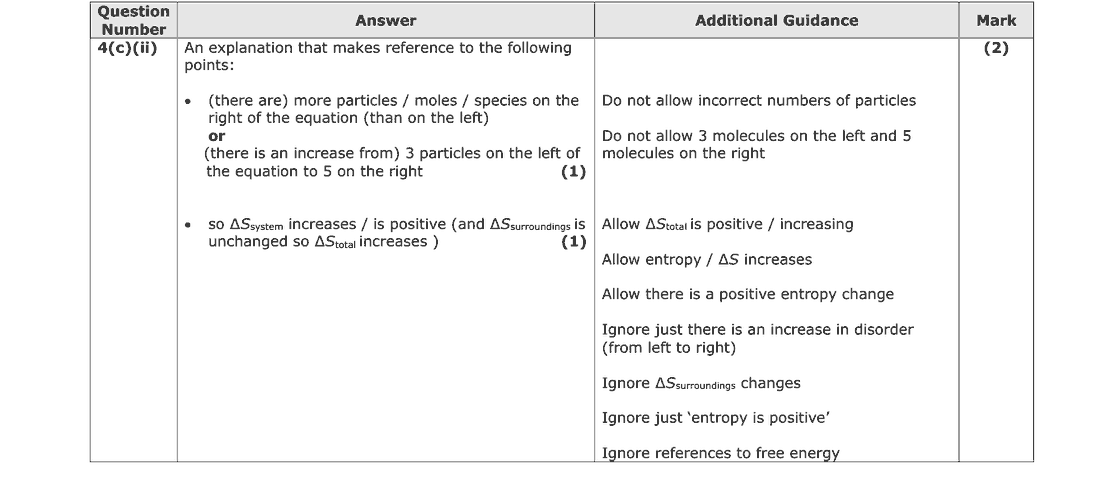
M1: there are more particles / moles on the right (3 on the left, 5 on the right). M2: so ΔSsystem (or ΔStotal) is positive / entropy increases. Not '3 molecules to 5 molecules'
'more disorder' alone or just 'entropy is positive' is not enough. Common errors: calling the particles molecules
describing disorder with no mention of entropy
June 2017 · Paper 1 · Q4(d)2 marksEquation writing
Earlier part of question 4 that this part uses
Mark scheme
Examiner's comment
Many correct equations were seen: however, it was clear that a significant minority of candidates did not understand that they should start and end with Fe2+ ions. A common error was not balancing the equations in terms of charges. Some candidates attempted to write equations in which both reactants were oxidised or both were reduced, while others introduced Fe, Fe+ and other complexes involving Fe, S, O and I.
Notes from the mark scheme and report
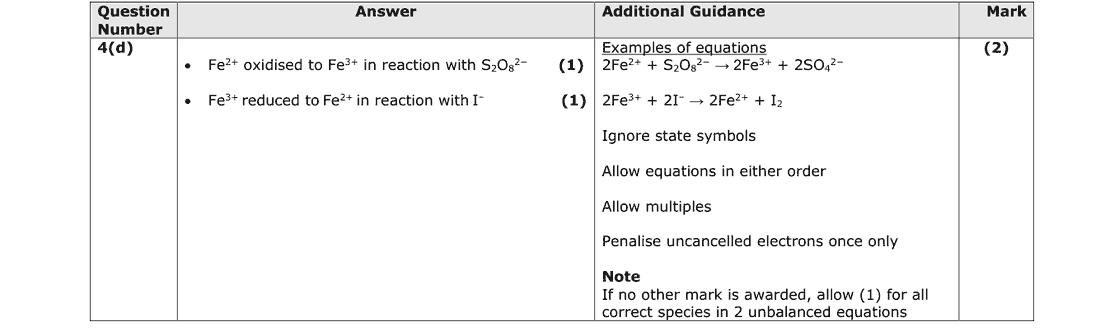
2Fe2+ + S2O8 2– → 2Fe3+ + 2SO4 2– then 2Fe3+ + 2I– → 2Fe2+ + I2. Either order
multiples allowed
uncancelled electrons penalised once
one mark for all correct species in two unbalanced equations. Common errors: charges not balanced
not starting and finishing with Fe2+
both reactants oxidised or both reduced
species such as Fe and Fe+
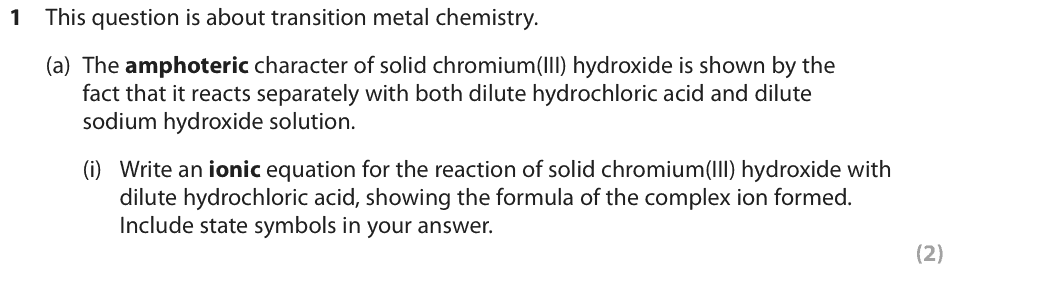
June 2017 · Paper 3 · Q1(a)(i)2 marksEquation writing
Mark scheme
Examiner's comment
In general, the chemistry of the transition metals was not well known, and the answers to this question illustrated that. Many ignored or did not appreciate the phrase ‘amphoteric’ or the fact the hydrochloric acid was dilute and assumed this reaction was a ligand substitution involving chloride ions. Even those who realised it was a reaction with H+ ions found it difficult to balance the equation correctly. In one sense, this type of question is not particularly demanding but it does show the importance of making sure the breadth of the course is appreciated as well as the depth.
Notes from the mark scheme and report
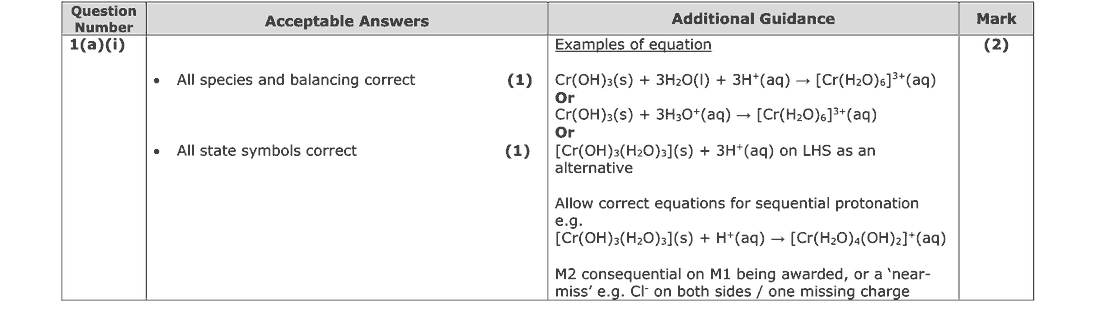
Cr(OH)3(s) + 3H2O(l) + 3H+(aq) → [Cr(H2O)6]3+(aq)
or with 3H3O+(aq)
[Cr(OH)3(H2O)3](s) + 3H+(aq) allowed as the left-hand side, and correct equations for stepwise protonation. One mark for species and balancing, one for all state symbols (needs M1 or a near miss, e.g. Cl– on both sides or one missing charge). Many overlooked 'amphoteric' and 'dilute' and wrote a ligand substitution with chloride ions
those using H+ often could not balance
June 2017 · Paper 3 · Q1(a)(ii)2 marksPractical and data analysis
Earlier part of question 1 that this part uses
Mark scheme
Examiner's comment
Most students appreciated the colours of the species involved in the reaction but lost marks by not using terms such as ‘solution’ and ‘precipitate’.
Notes from the mark scheme and report
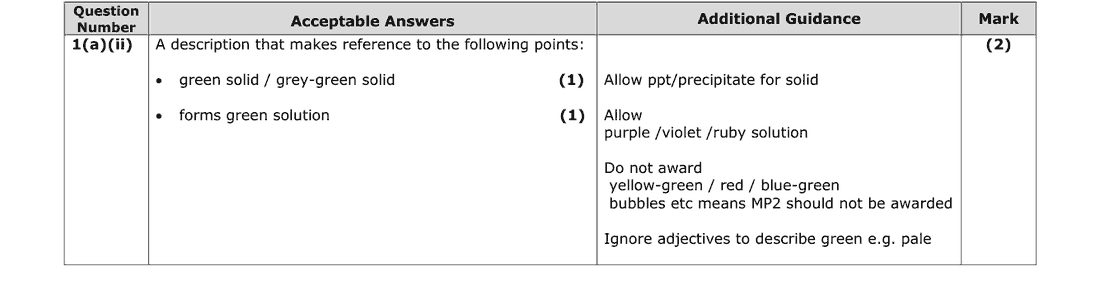
Green (or grey-green) solid / precipitate
forms a green solution (allow purple, violet or ruby). Not yellow-green, red or blue-green
mention of bubbles loses the second mark. Shade qualifiers such as 'pale' are ignored
June 2017 · Paper 3 · Q1(a)(iii)2 marksEquation writing
Earlier parts of question 1 that this part uses
Mark scheme
Examiner's comment
Candidates seemed to find this equation a bit more straightforward than the reaction in Q1(a)(i), though missing state symbols were again common. Other common errors included missing charges on the complex ion, and use of NaOH, rather than OH- in the question. Those who started with [Cr(OH)3(H2O)3](s) often failed to balance the equation correctly.
Notes from the mark scheme and report
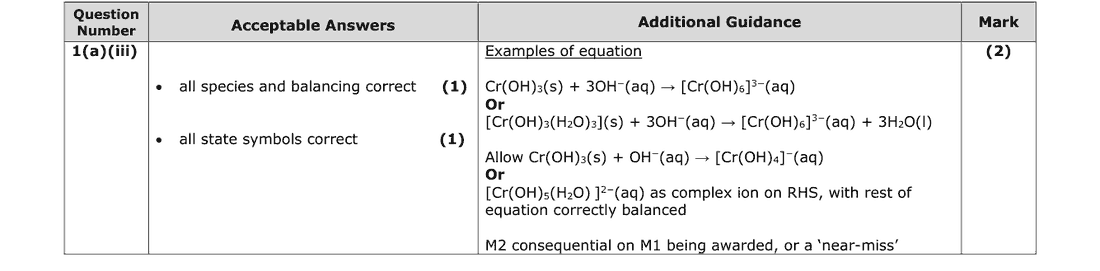
Cr(OH)3(s) + 3OH–(aq) → [Cr(OH)6]3–(aq)
or [Cr(OH)3(H2O)3](s) + 3OH–(aq) → [Cr(OH)6]3–(aq) + 3H2O(l). [Cr(OH)4]–(aq) or [Cr(OH)5(H2O)]2–(aq) allowed if balanced. One mark for species and balancing, one for state symbols. Found easier than (a)(i), but state symbols and the charge on the complex were often missing, NaOH was used instead of OH–, and equations starting from [Cr(OH)3(H2O)3] were often unbalanced
June 2017 · Paper 3 · Q1(a)(iv)1 markPractical and data analysis
Earlier parts of question 1 that this part uses
Mark scheme
Examiner's comment
This question was often correct, though a minority simply stated ‘green’ and so missed the mark.
Notes from the mark scheme and report
Answer: green solution. Both 'green' and 'solution' needed
qualifiers such as dark or deep are ignored
June 2017 · Paper 3 · Q1(b)(i)2 marksPractical and data analysis
Mark scheme
Examiner's comment
The descriptions seen in this question were far better than those in (a), and candidates regularly used the terms ‘solution’ and ‘precipitate’ correctly.
In addition, most answers distinguished between the shades of blue observed, and so could score both marks.
Notes from the mark scheme and report
(Pale) blue precipitate forms first (allow solid
not blue crystals
not dark blue precipitate)
it then dissolves to give a dark / deep / royal blue solution. Better done than (a): most used 'precipitate' and 'solution' correctly and distinguished the shades of blue
June 2017 · Paper 3 · Q1(b)(ii)2 marksEquation writing
Earlier part of question 1 that this part uses
Mark scheme
Examiner's comment
Despite the success of many candidates in part (b)(i), which implied that most had carried out this reaction, far fewer could recall the species involved and so write a balanced equation. In weaker responses they simply tried to write an equation for the reaction of copper sulfate with ammonia, while others tried to replace the water molecules with six ammonia ligands.
Notes from the mark scheme and report
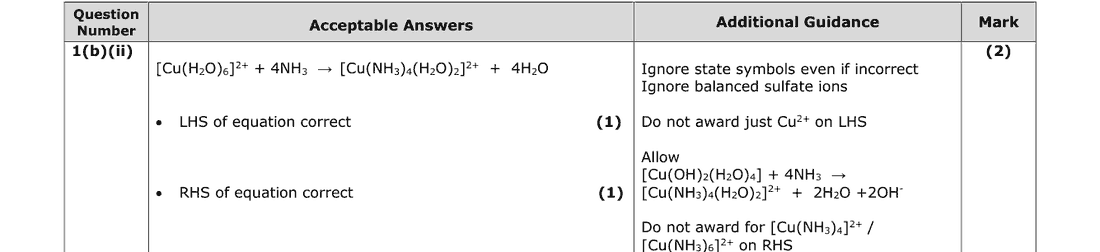
[Cu(H2O)6]2+ + 4NH3 → [Cu(NH3)4(H2O)2]2+ + 4H2O. One mark for each side. Allow [Cu(OH)2(H2O)4] + 4NH3 → [Cu(NH3)4(H2O)2]2+ + 2H2O + 2OH–. Not just Cu2+ on the left
not [Cu(NH3)4]2+ or [Cu(NH3)6]2+ on the right. State symbols and balanced sulfate ions ignored
Work with an A-level chemistry tutor
Dropping marks on calculations, mechanisms or the core practicals? Book a trial session with an A-level chemistry tutor.