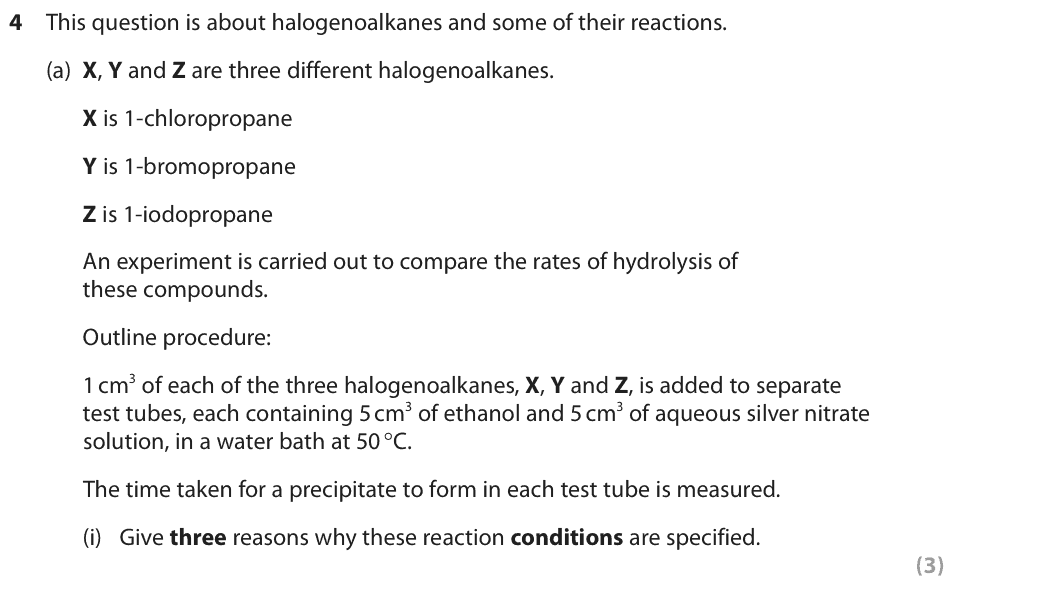
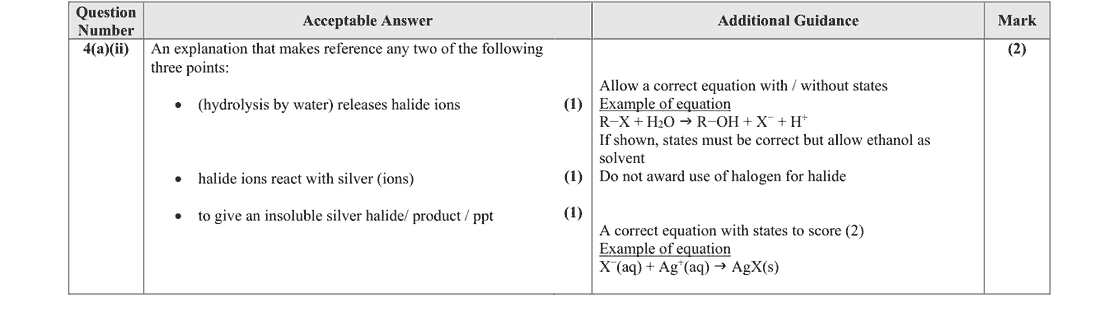
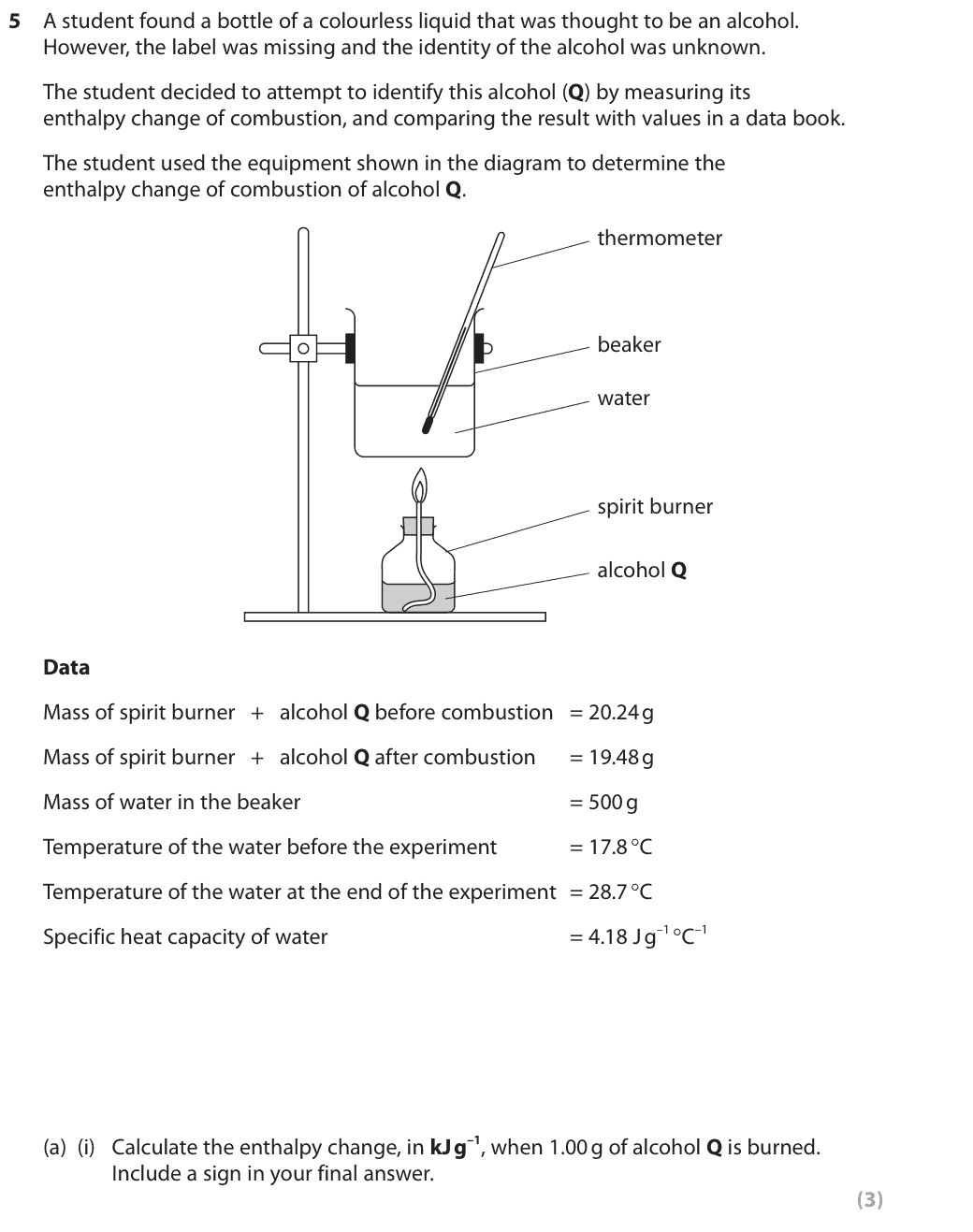
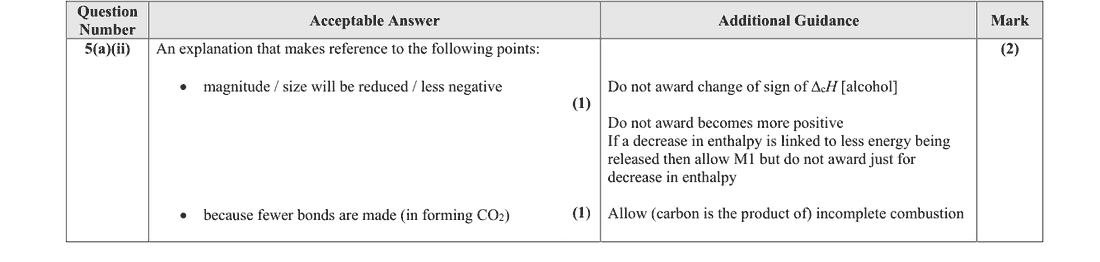
Explanation questions

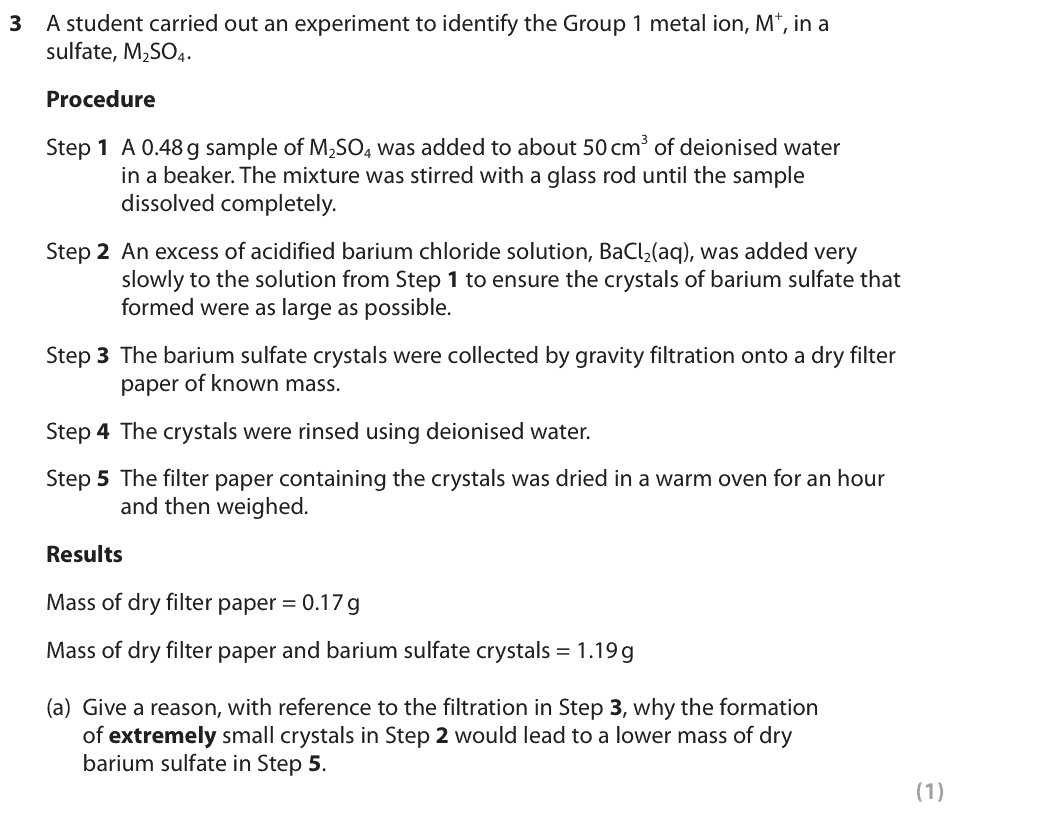
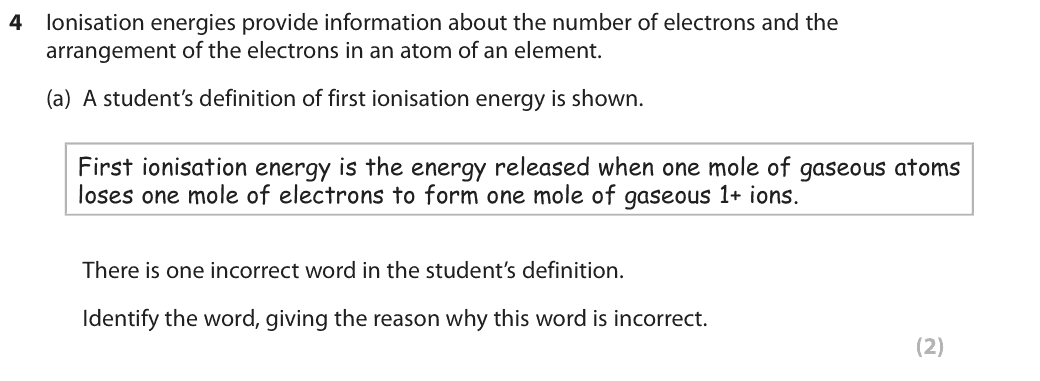
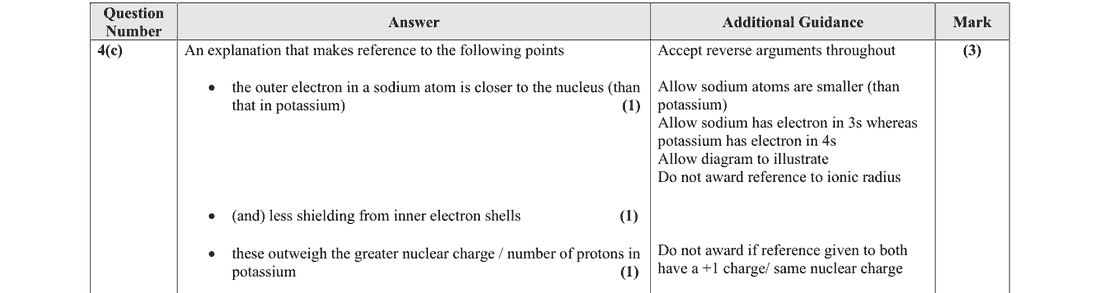
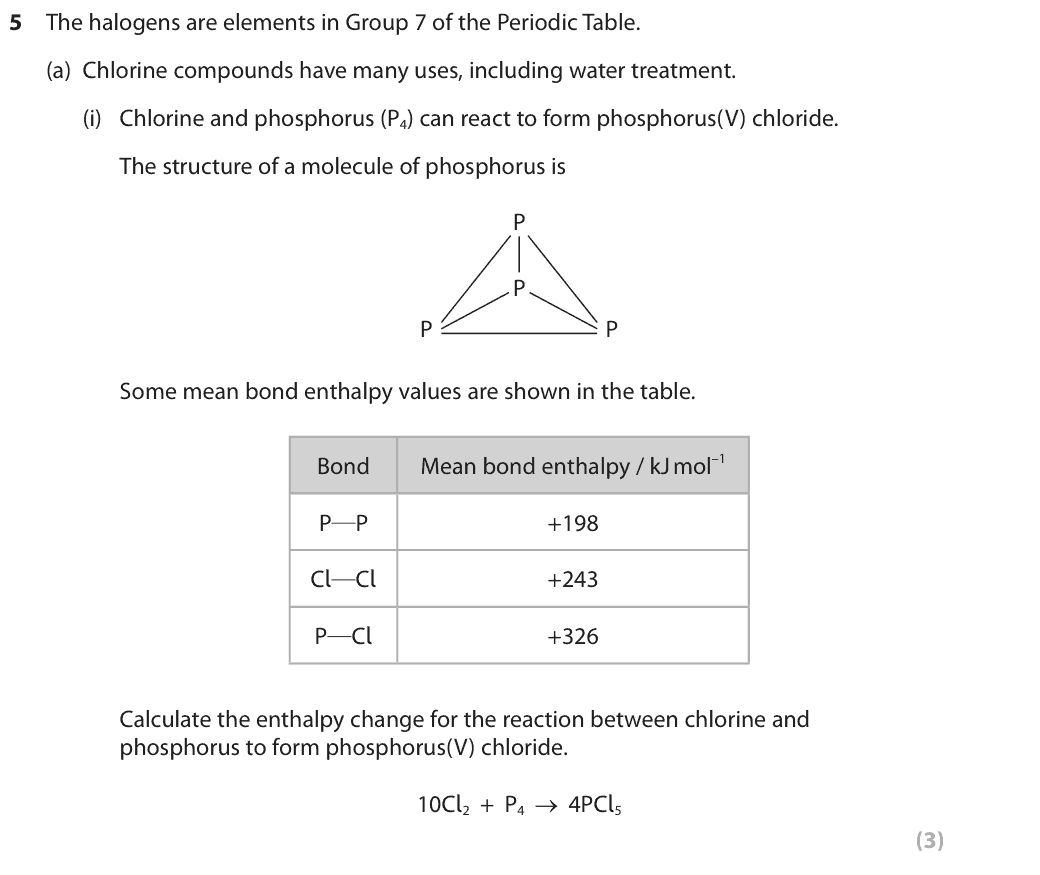
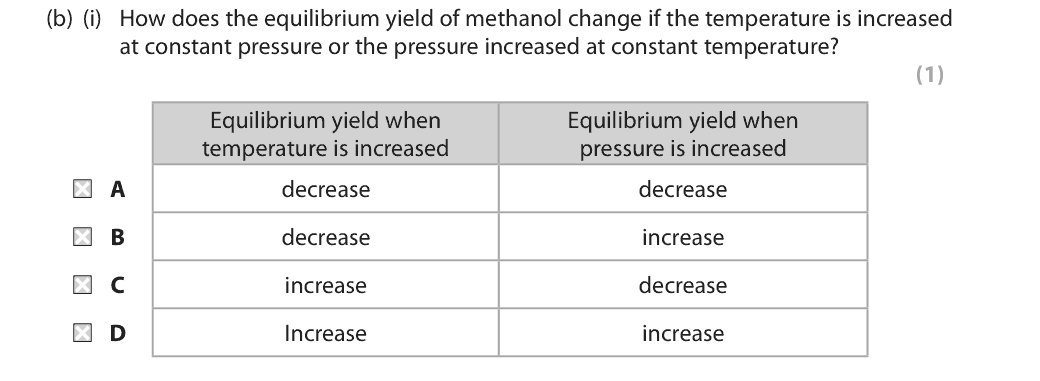
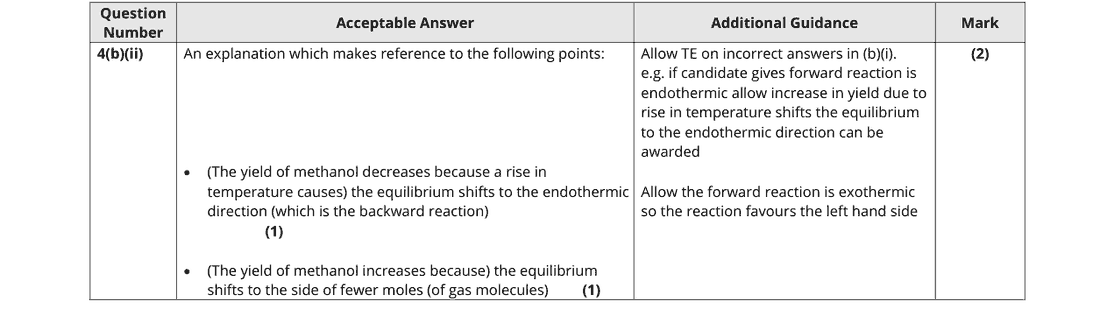
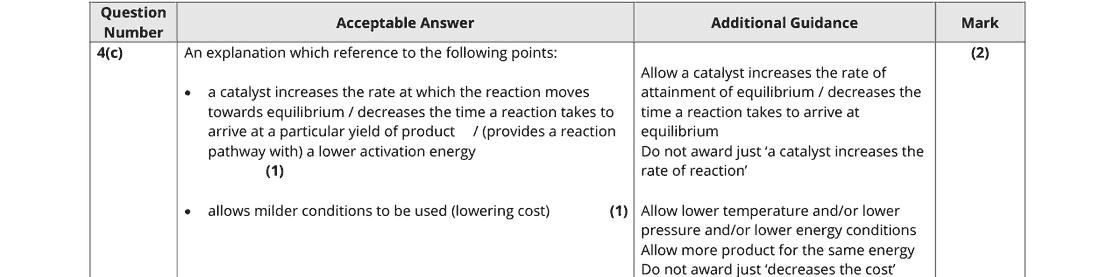
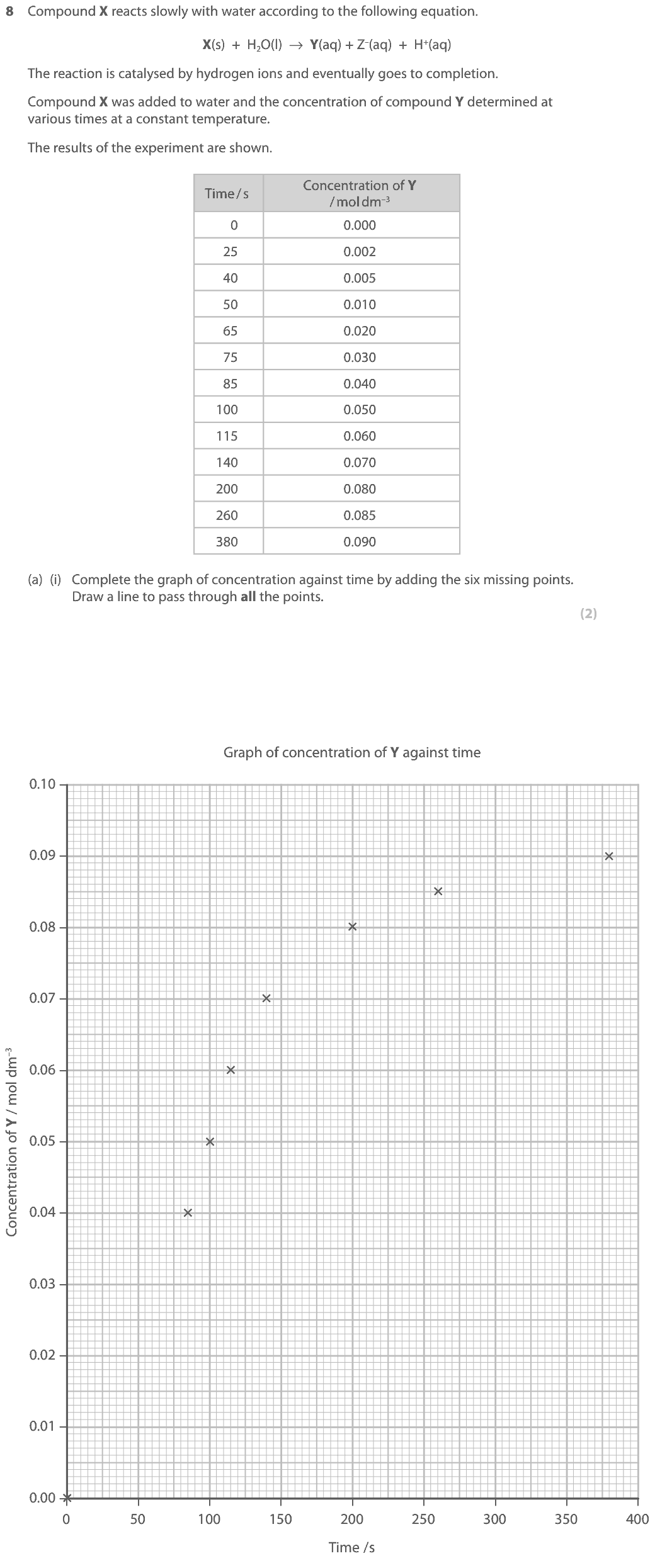
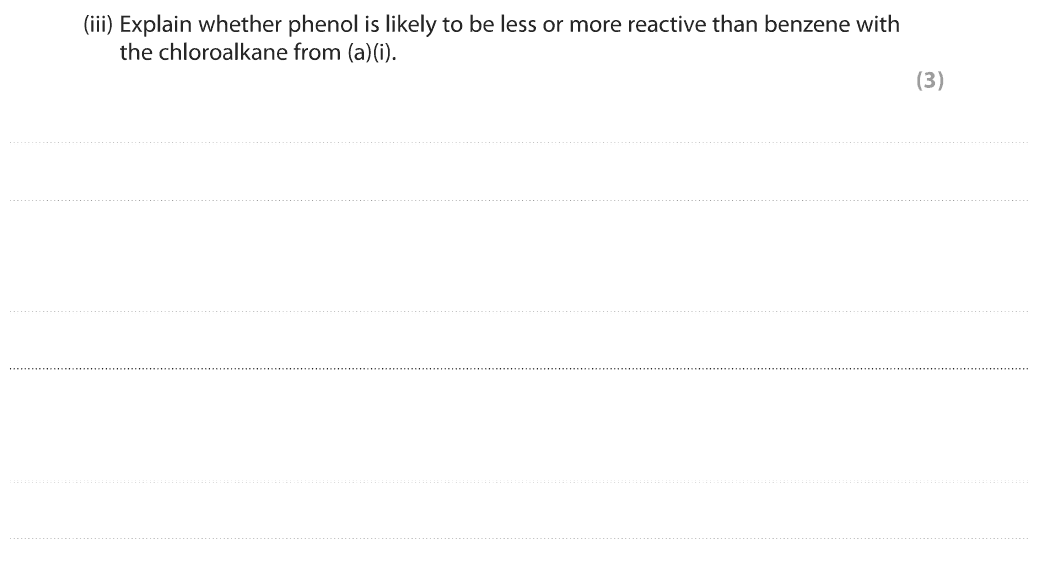
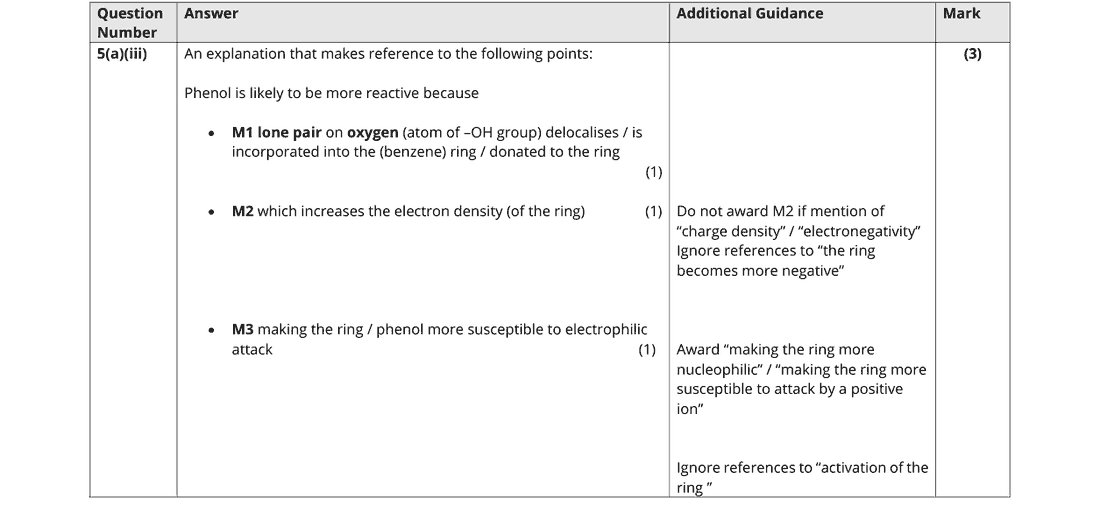
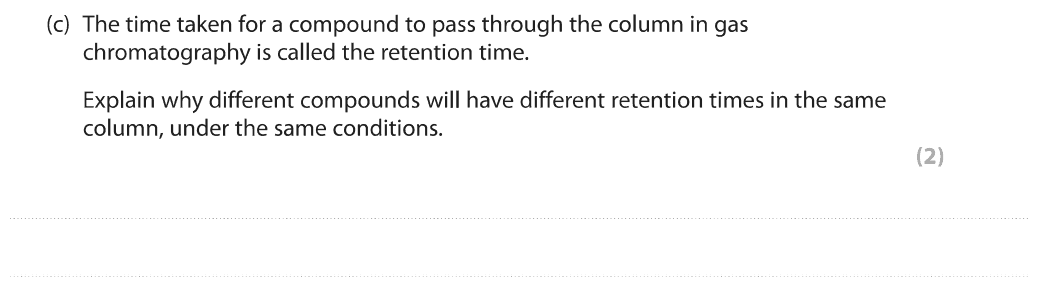
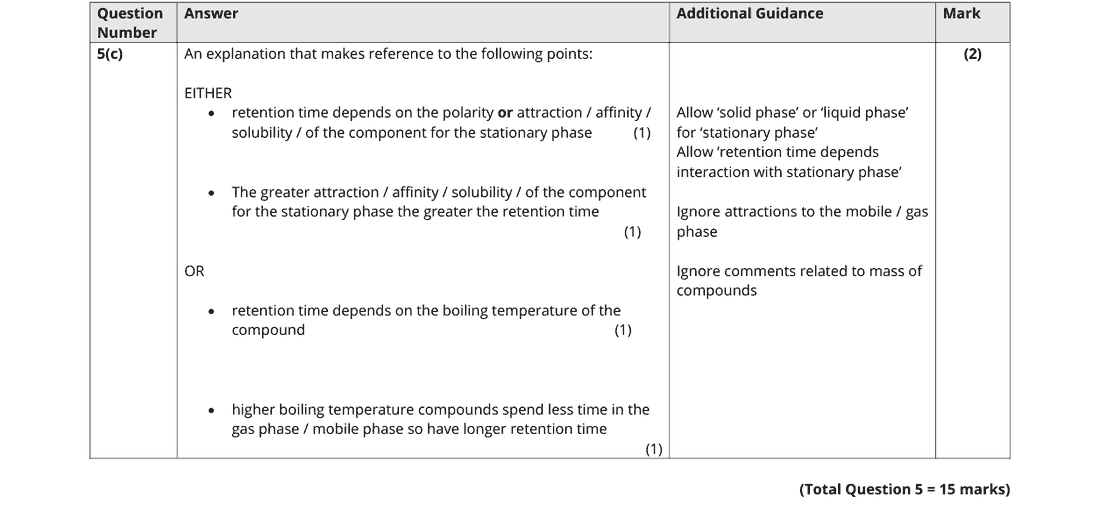
Explain questions worth two to four marks. Each mark is a separate point of chemistry, so plan one point per mark. 291 questions.

Other types: Multiple-choice questions · Calculation questions · Equation questions · Mechanism questions · Structure and diagram questions · Six-mark extended-response questions · Practical questions · Short-answer questions

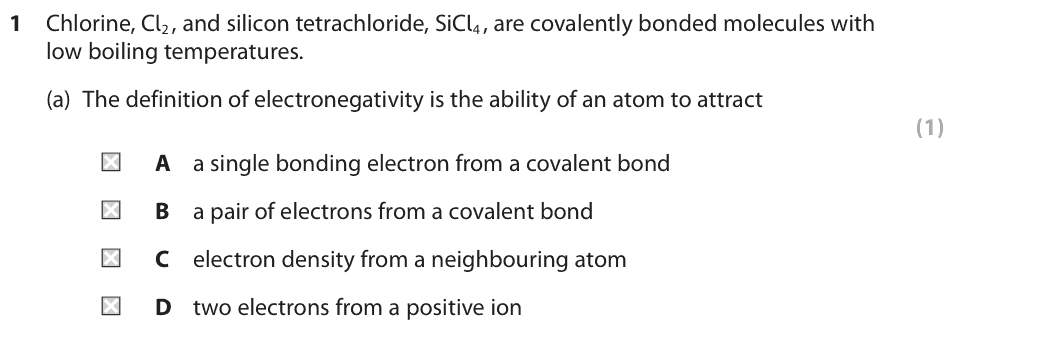
June 2025 · AS Paper 1 · Q1(c) 3 marks Explanation bonding
Earlier part of question 1 that this part usesEarlier part of June 2025 Paper 1 question 1
Explain, using electronegativity values, why both chlorine and
silicon tetrachloride are non-polar molecules.
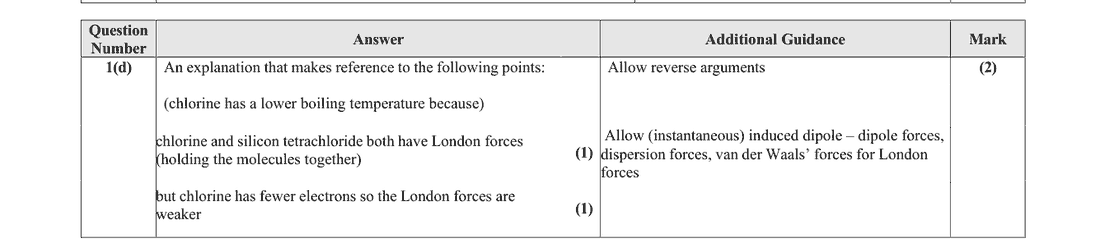
June 2025 · AS Paper 1 · Q1(d) 2 marks Explanation bondingstructure
Earlier part of question 1 that this part usesEarlier part of June 2025 Paper 1 question 1
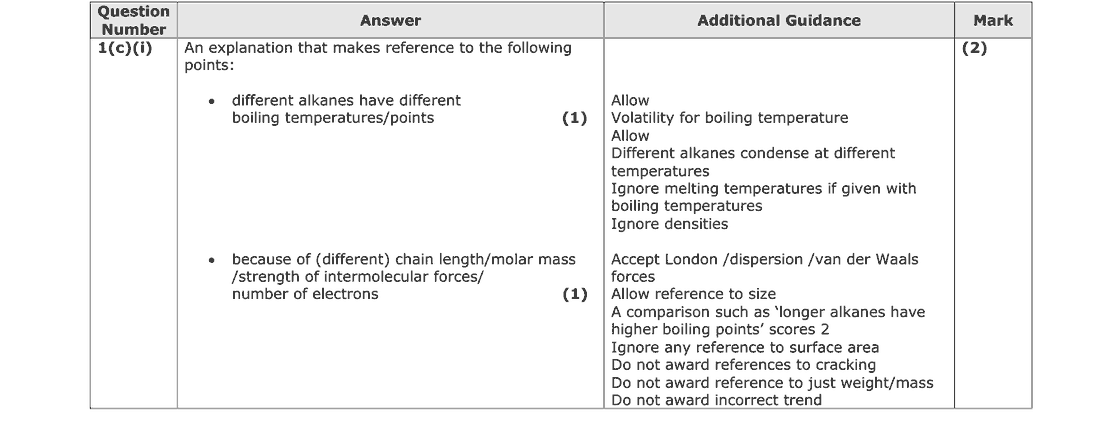
Explain why the boiling temperature of chlorine (−34 °C) is lower than that of
silicon tetrachloride (57 °C).
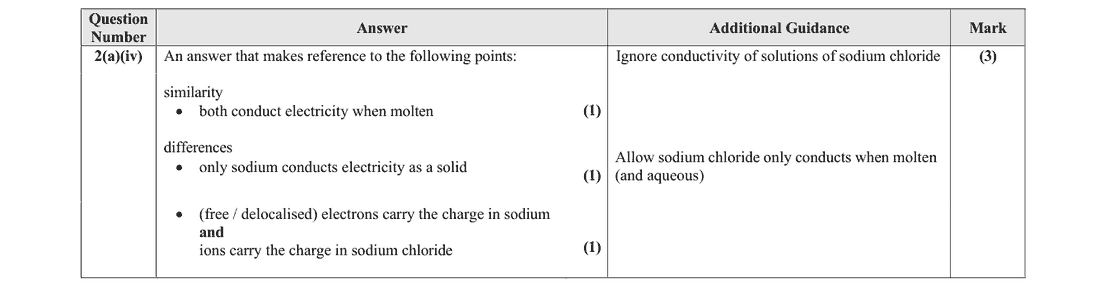
June 2025 · AS Paper 1 · Q2(a)(iv) 3 marks Explanation structurebonding
Earlier part of question 2 that this part usesEarlier part of June 2025 Paper 1 question 2
Compare and contrast the electrical conductivity of sodium metal with that of
sodium chloride, including how the charge is carried.
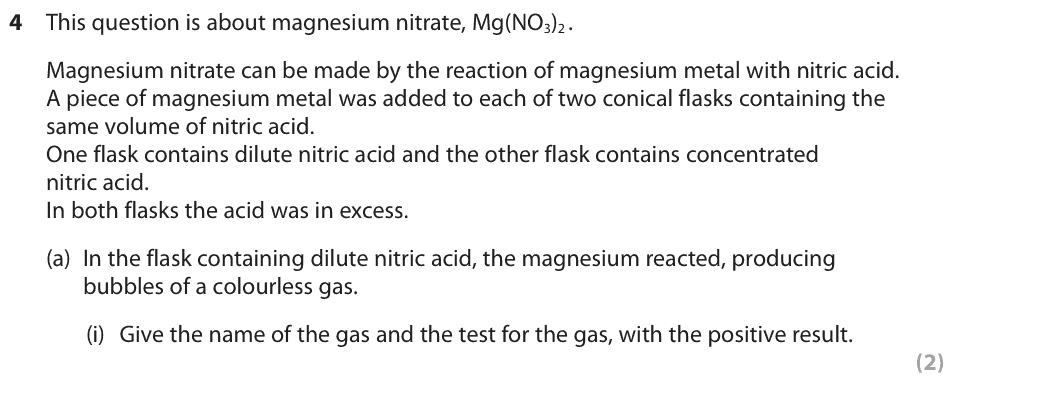
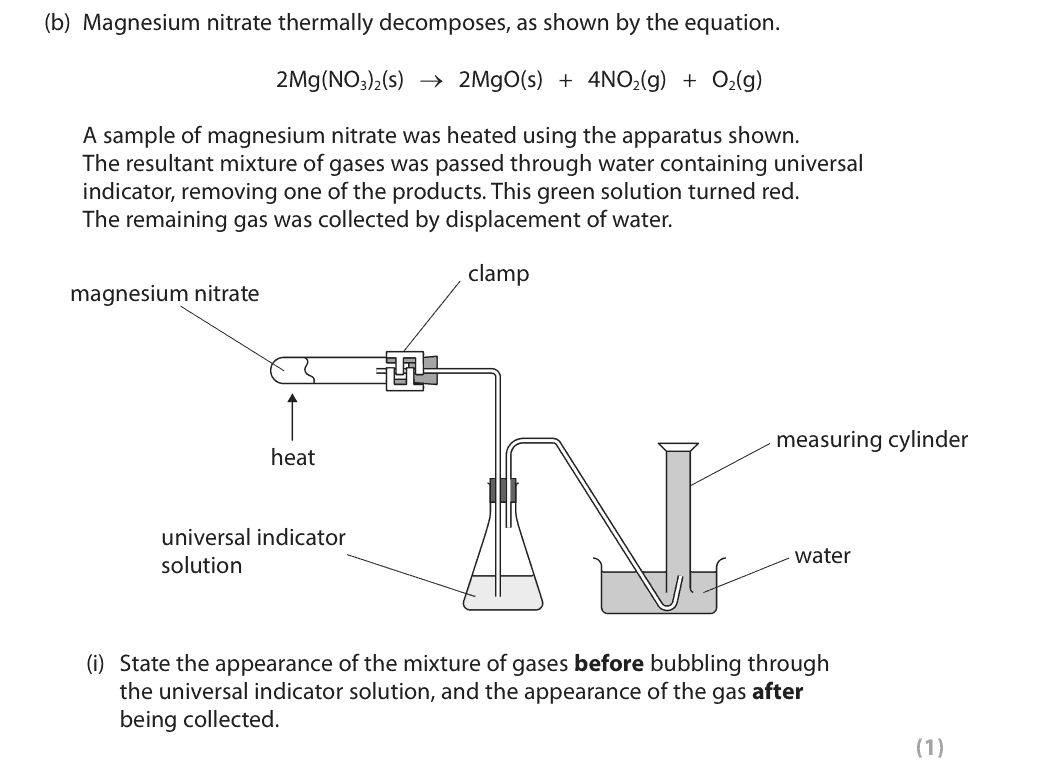
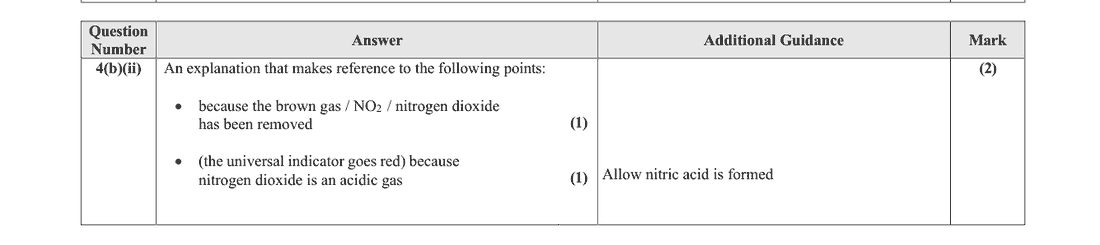
June 2025 · AS Paper 1 · Q4(b)(ii) 2 marks Explanation Hard groups 1 and 2
Earlier parts of question 4 that this part usesEarlier part of June 2025 Paper 1 question 4Earlier part of June 2025 Paper 1 question 4
Explain the change in appearance of the mixture of gases, and of the universal
indicator solution.
June 2025 · AS Paper 1 · Q4(b)(v) 2 marks Explanation Hard formulae equations and amounts of substance
Earlier parts of question 4 that this part usesEarlier part of June 2025 Paper 1 question 4Earlier part of June 2025 Paper 1 question 4
Explain why three significant figures is appropriate for the answer in
this calculation.
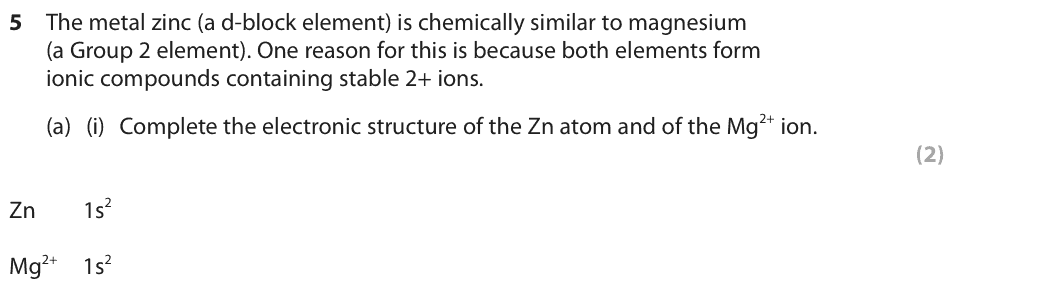
June 2025 · AS Paper 1 · Q5(a)(ii) 2 marks Explanation Hard atomic structure and the periodic table
Earlier part of question 5 that this part usesEarlier part of June 2025 Paper 1 question 5
Explain, in terms of ionisation energies, why zinc and magnesium both form
stable 2+ ions.
June 2025 · AS Paper 1 · Q6(d)(ii) 2 marks Explanation Hard group 7 the halogens
Earlier parts of question 6 that this part usesEarlier part of June 2025 Paper 1 question 6Earlier part of June 2025 Paper 1 question 6
Explain what this observation indicates about the relative strength of the
chloride ion and the iodide ion as reducing agents.
June 2025 · AS Paper 1 · Q7(a) 2 marks Explanation atomic structure and the periodic table
This question is about periodic properties of elements.
Explain why the atomic radius decreases across Period 3 from sodium to chlorine.
June 2025 · AS Paper 2 · Q3(c) 2 marks Explanation energetics i
Earlier part of question 3 that this part usesEarlier part of June 2025 Paper 2 question 3
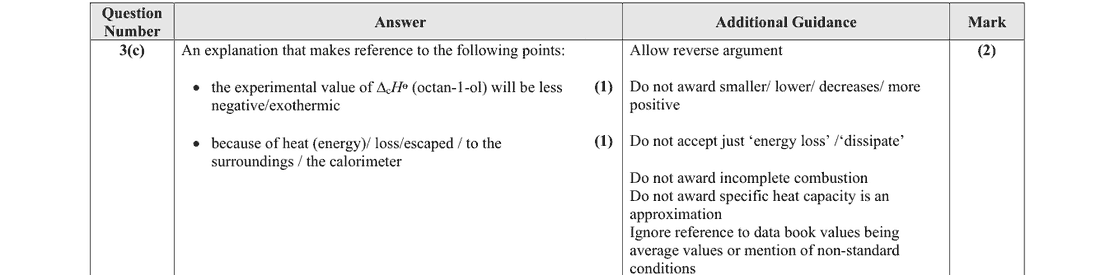
In the experiment, the calorimeter is not insulated.
Explain the difference between the enthalpy change of combustion of octan‑1‑ol
determined in this experiment and that quoted in a data book.
June 2025 · AS Paper 2 · Q3(d) 2 marks Explanation Hard energetics i
Earlier part of question 3 that this part usesEarlier part of June 2025 Paper 2 question 3
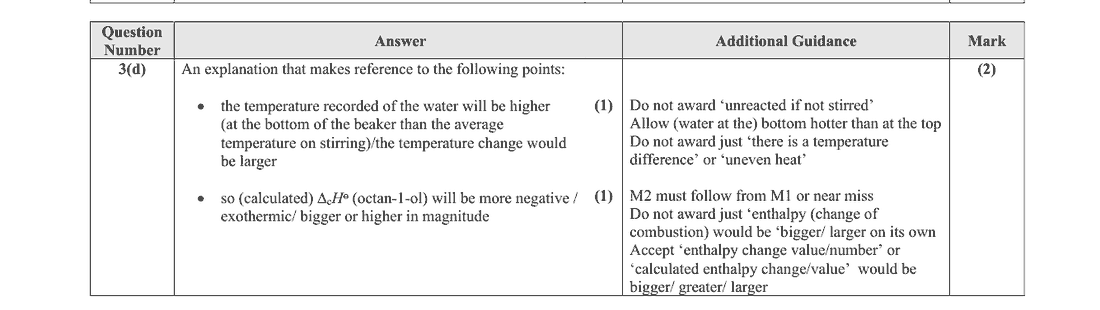
A student carried out this experiment leaving the thermometer at the bottom of
the calorimeter and not stirring.
Explain the effect this would have on the calculated enthalpy change of
combustion for octan‑1‑ol.
June 2025 · AS Paper 2 · Q4(c)(i) 2 marks Explanation bonding
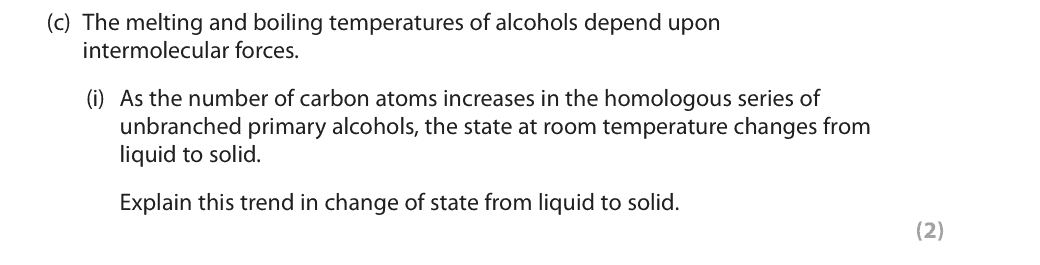
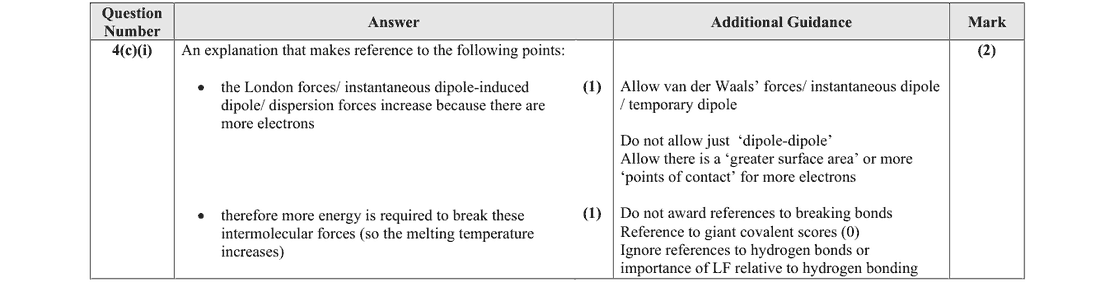
The melting and boiling temperatures of alcohols depend upon
intermolecular forces.
As the number of carbon atoms increases in the homologous series of
unbranched primary alcohols, the state at room temperature changes from
liquid to solid.
Explain this trend in change of state from liquid to solid.
June 2025 · AS Paper 2 · Q4(c)(ii) 2 marks Explanation bonding
Earlier parts of question 4 that this part usesEarlier part of June 2025 Paper 2 question 4Earlier part of June 2025 Paper 2 question 4
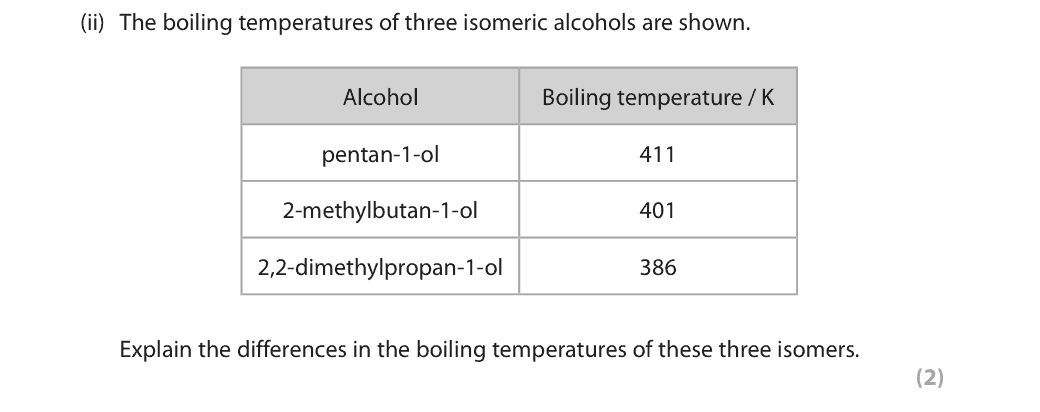
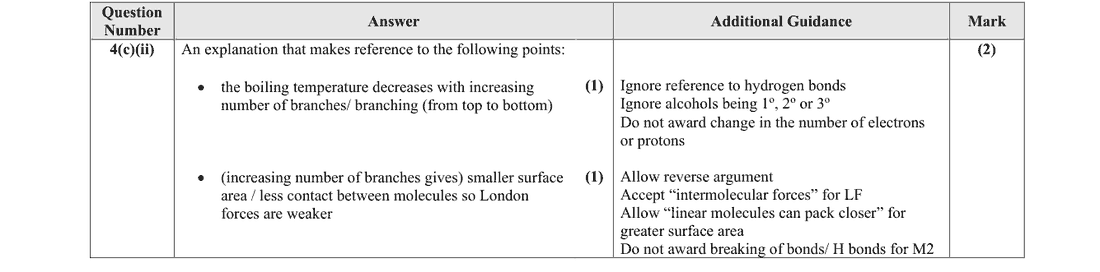
The boiling temperatures of three isomeric alcohols are shown.
Alcohol
Boiling temperature / K
pentan‑1‑ol
411
2‑methylbutan‑1‑ol
401
2,2‑dimethylpropan‑1‑ol
386
Explain the differences in the boiling temperatures of these three isomers.
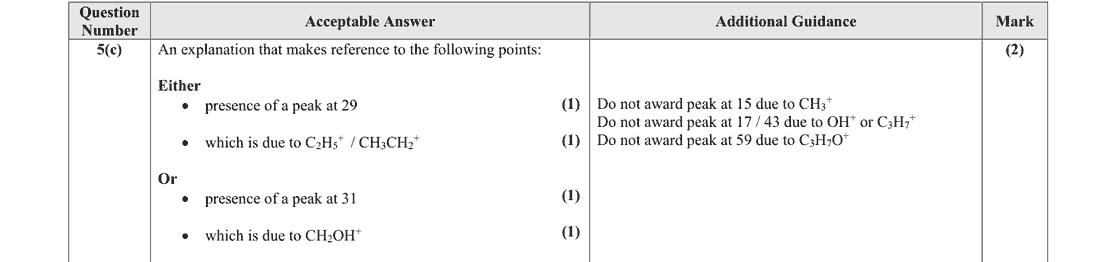
June 2025 · AS Paper 2 · Q5(b)(i) 2 marks Explanation mass spectrometry and infrared spectroscopy
Earlier part of question 5 that this part usesEarlier part of June 2025 Paper 2 question 5
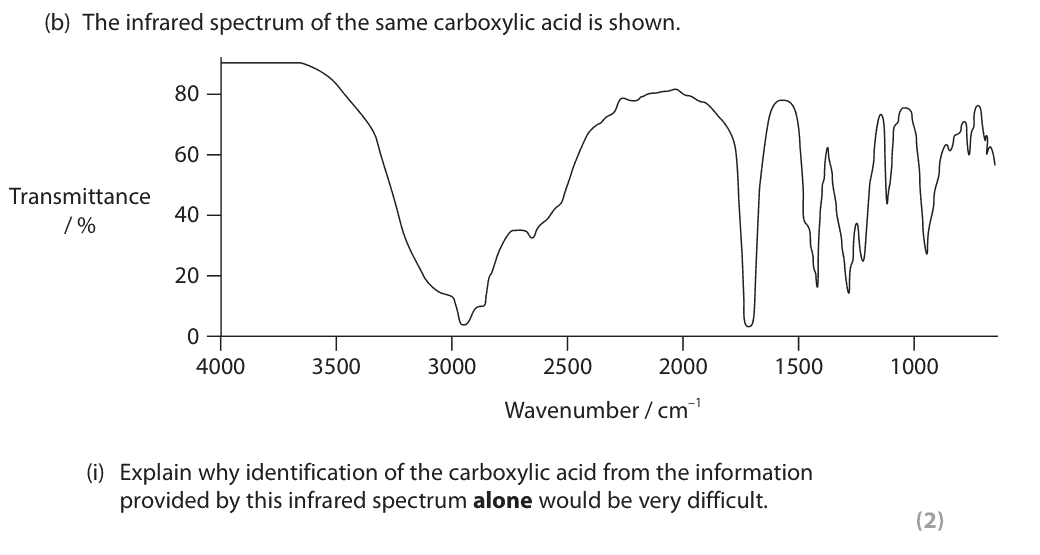
The infrared spectrum of the same carboxylic acid is shown.
80
60
Transmittance
40
/ %
20
0
4000
3500
3000
2500
2000
1500
1000
Wavenumber / cm–1
Explain why identification of the carboxylic acid from the information
provided by this infrared spectrum alone would be very difficult.
June 2025 · AS Paper 2 · Q5(b)(iii) 2 marks Explanation mass spectrometry and infrared spectroscopybonding
Earlier part of question 5 that this part usesEarlier part of June 2025 Paper 2 question 5
Give a possible explanation, with reference to the intermolecular forces
involved, why the peak in the range 3300–2500 cm–1 is broad.
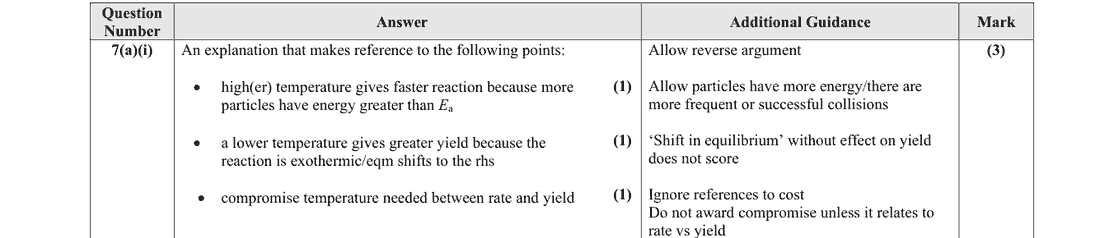
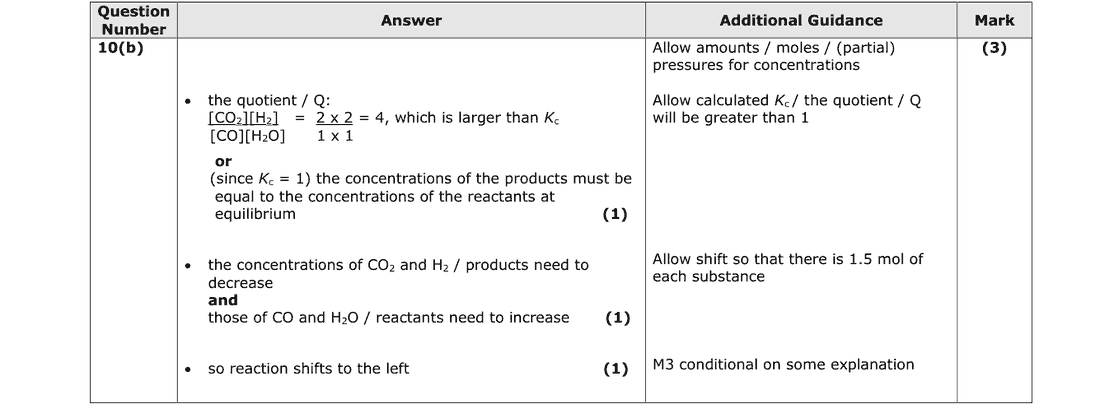
June 2025 · AS Paper 2 · Q7(a)(i) 3 marks Explanation equilibrium i
This question is about the industrial preparation of methanol.
The equation for the reaction of hydrogen with carbon dioxide to form methanol
is shown.
3H2(g)   +   CO2(g)      CH3OH(g)   +   H2O(g)               ΔH = –49 kJ mol–1
The reaction is carried out at a temperature of 700 K and a pressure of 90 atm in the
presence of a catalyst.
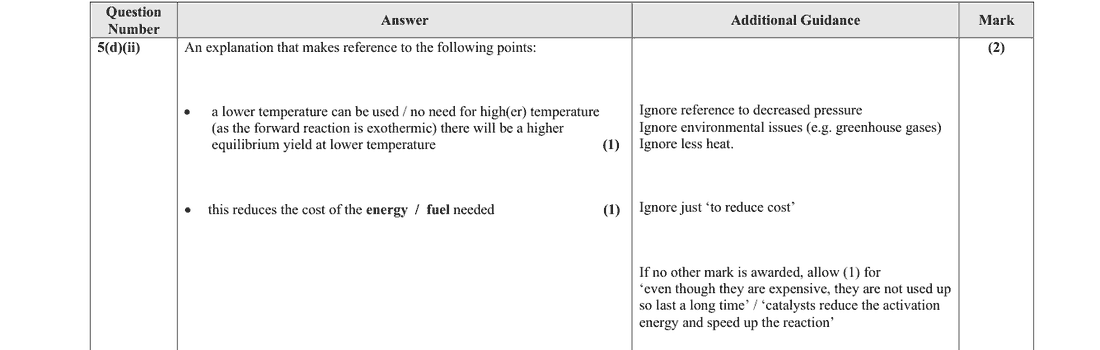
Explain why the reaction is carried out at a temperature of 700 K rather than
400 K or 1000 K.
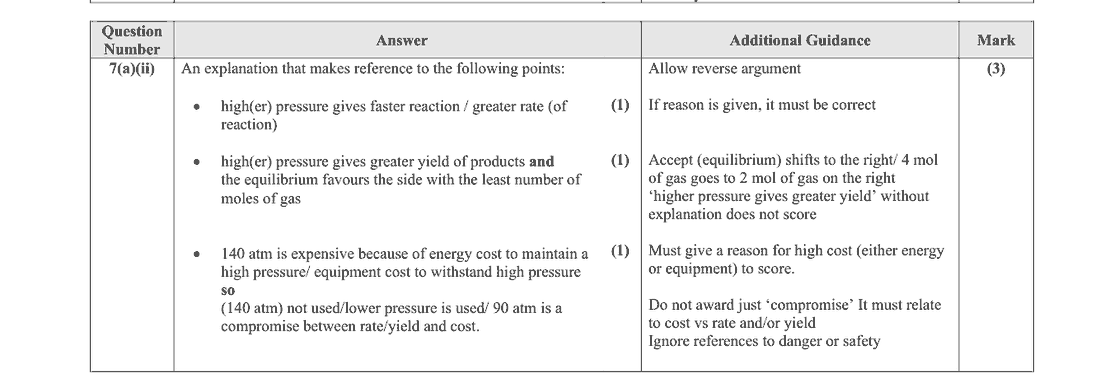
June 2025 · AS Paper 2 · Q7(a)(ii) 3 marks Explanation equilibrium i
Earlier part of question 7 that this part usesEarlier part of June 2025 Paper 2 question 7
Explain why the reaction is carried out at a pressure of 90 atm rather than
40 atm or 140 atm.
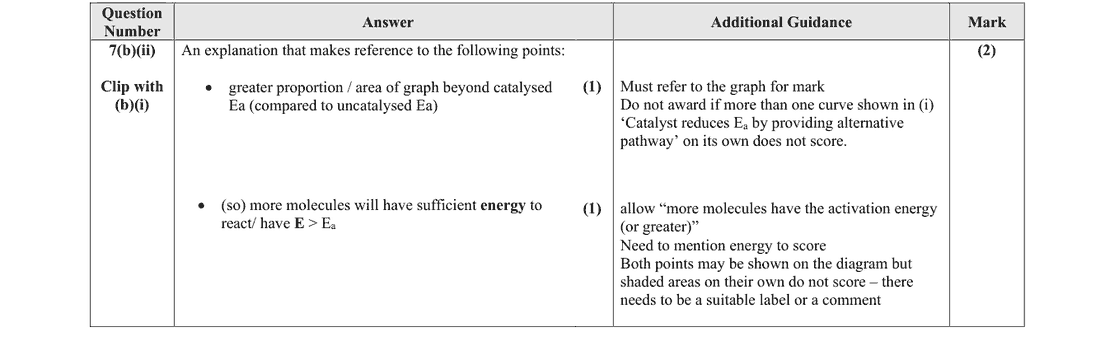
June 2025 · AS Paper 2 · Q7(b)(ii) 2 marks Explanation kinetics i
Earlier parts of question 7 that this part usesEarlier part of June 2025 Paper 2 question 7Earlier part of June 2025 Paper 2 question 7
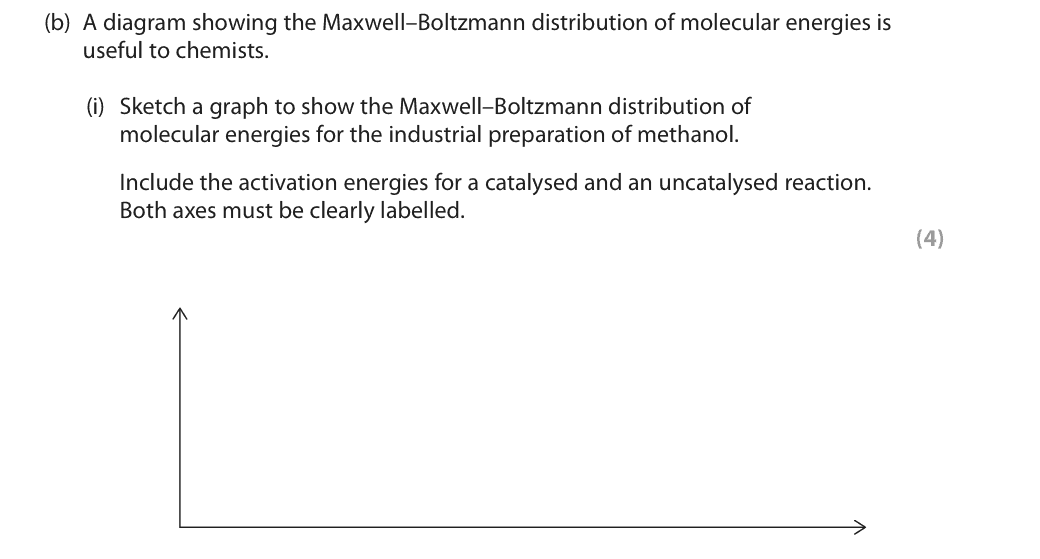
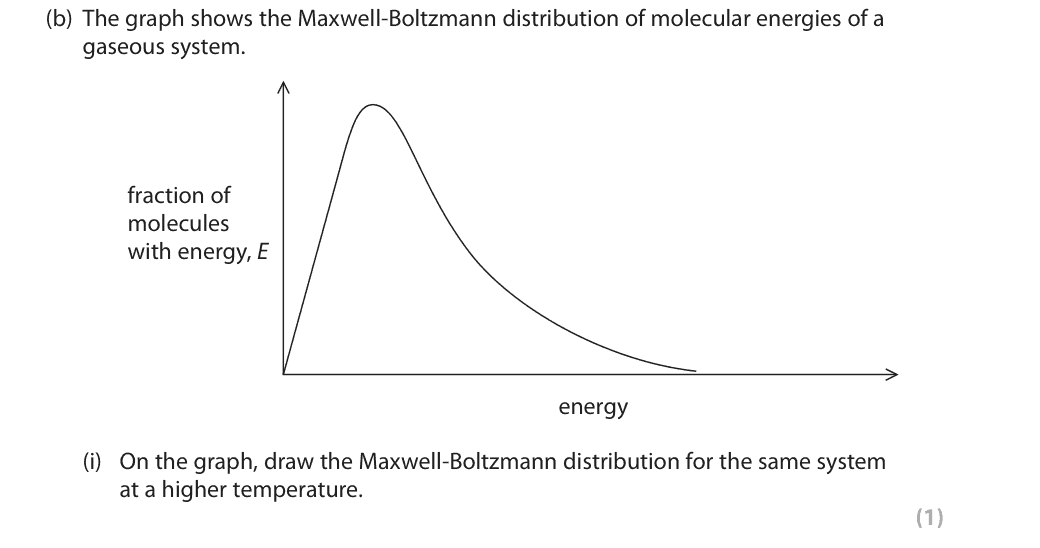
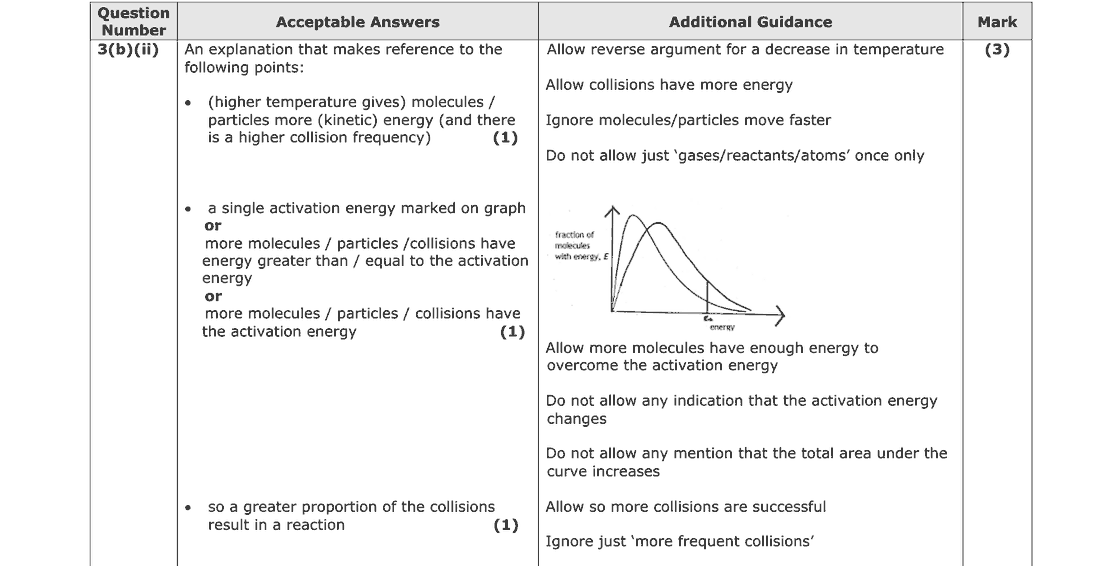
Explain how your Maxwell–Boltzmann graph shows the effect of a catalyst on
this reaction.
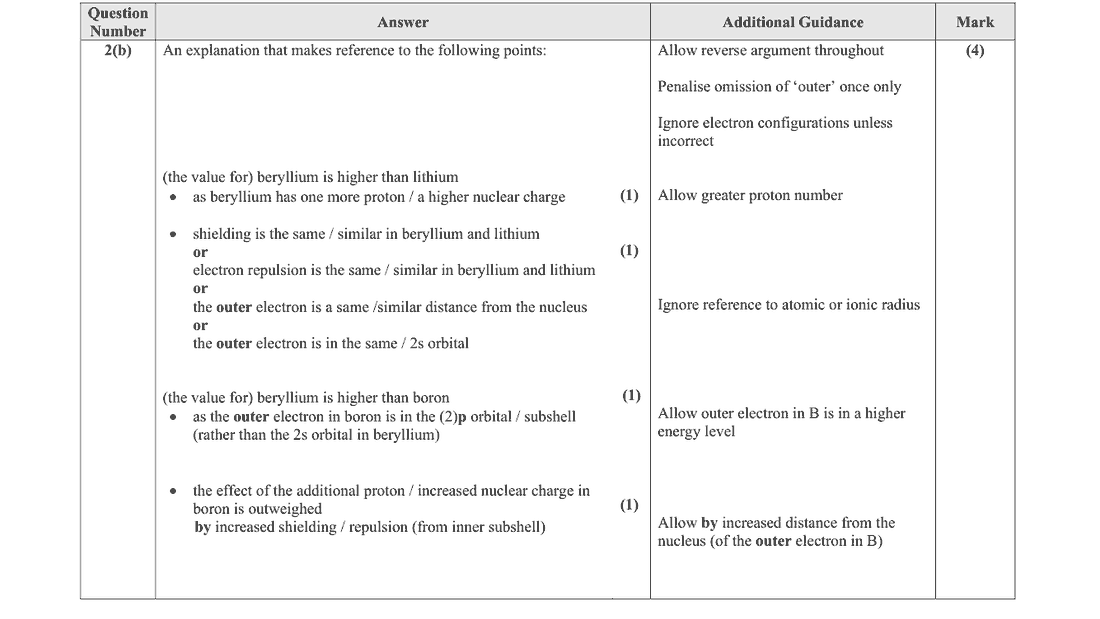
June 2025 · Paper 1 · Q2(b) 4 marks Explanation atomic structure and the periodic table
Explain why the first ionisation energy of beryllium is higher than the
first ionisation energy of both lithium and boron.
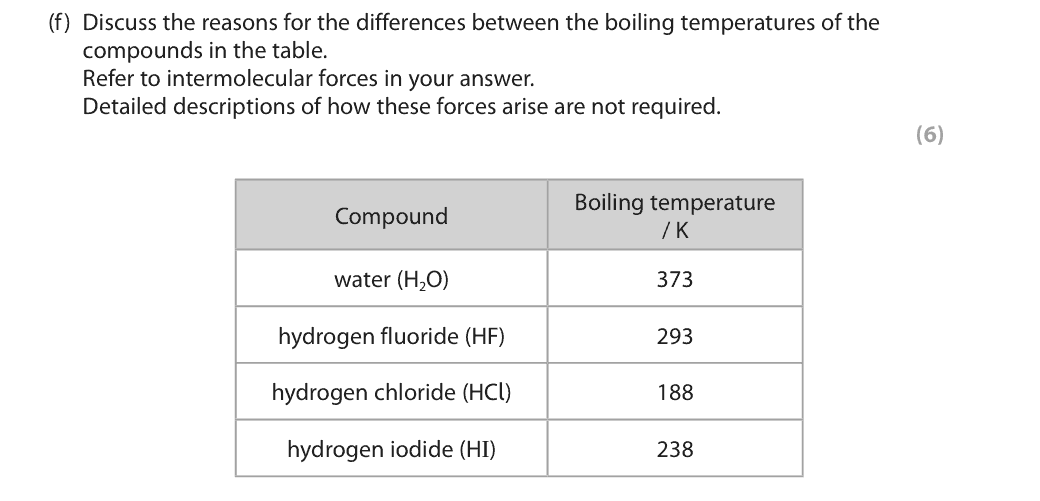
June 2025 · Paper 1 · Q2(f) 6 marks Explanation bonding
Earlier part of question 2 that this part usesEarlier part of June 2025 Paper 1 question 2
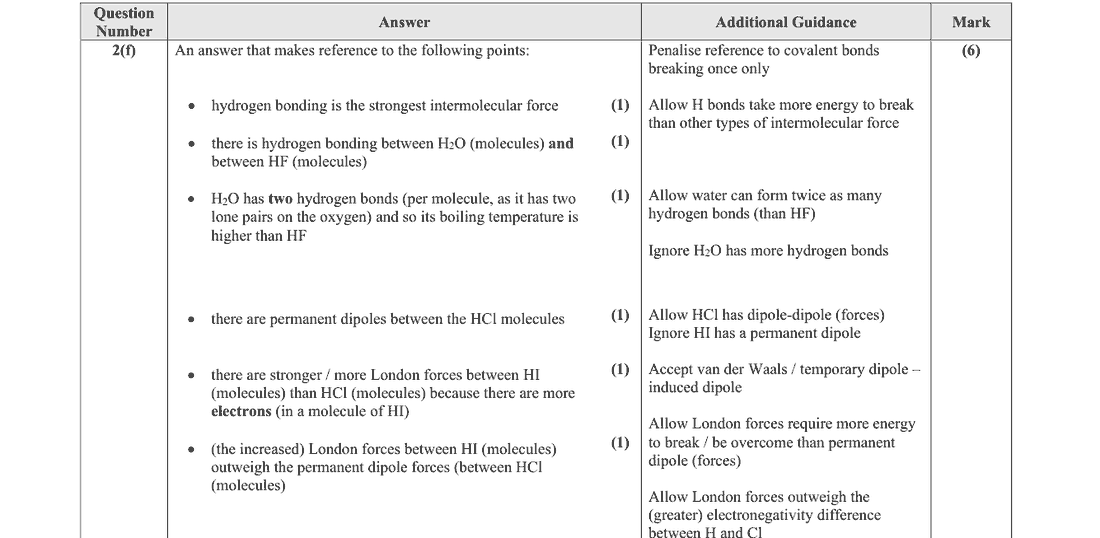
Discuss the reasons for the differences between the boiling temperatures of the
compounds in the table.
Refer to intermolecular forces in your answer.
Detailed descriptions of how these forces arise are not required.
Boiling temperature
Compound
/ K
water (H2O)
373
hydrogen fluoride (HF)
293
hydrogen chloride (HCl)
188
hydrogen iodide (HI)
238
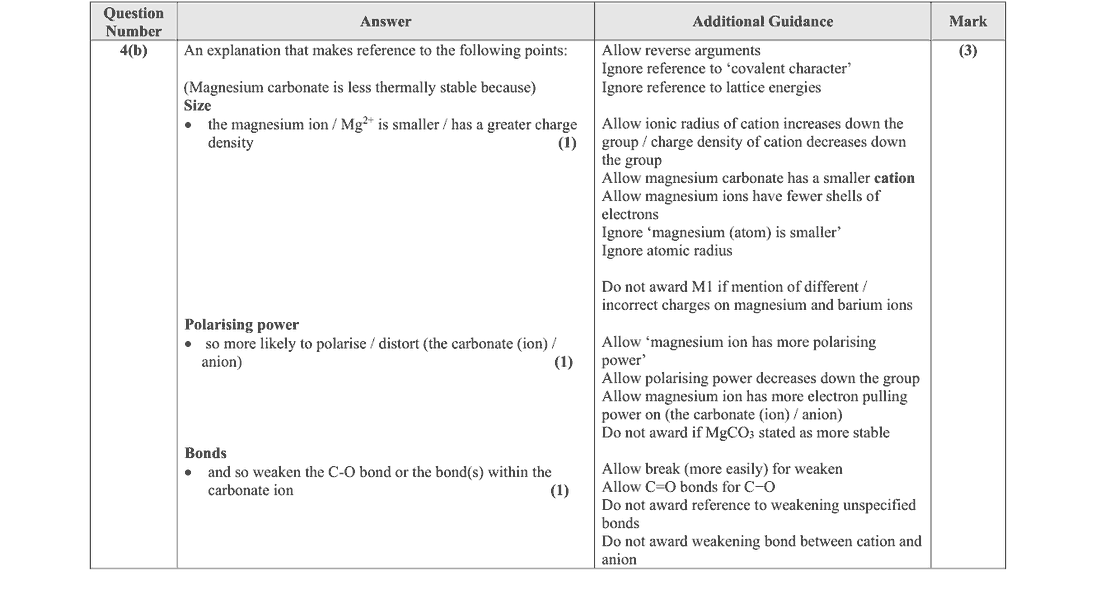
June 2025 · Paper 1 · Q3(d) 3 marks Explanation groups 1 and 2
Earlier part of question 3 that this part usesEarlier part of June 2025 Paper 1 question 3
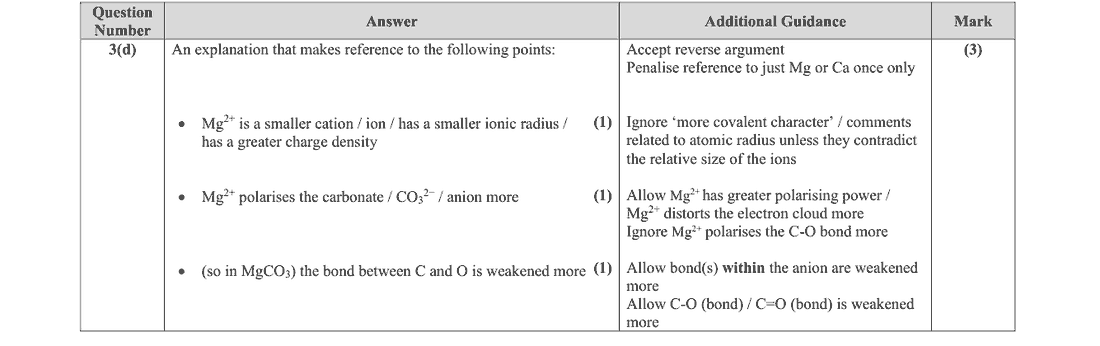
Explain why magnesium carbonate undergoes thermal decomposition at
a lower temperature than calcium carbonate.
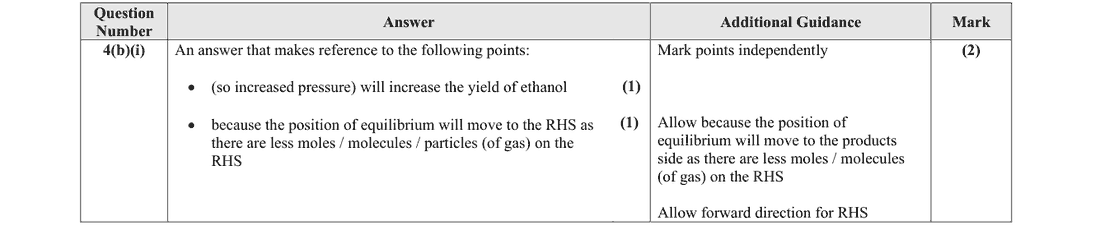
June 2025 · Paper 1 · Q4(b)(i) 2 marks Explanation equilibrium i
Earlier part of question 4 that this part usesEarlier part of June 2025 Paper 1 question 4
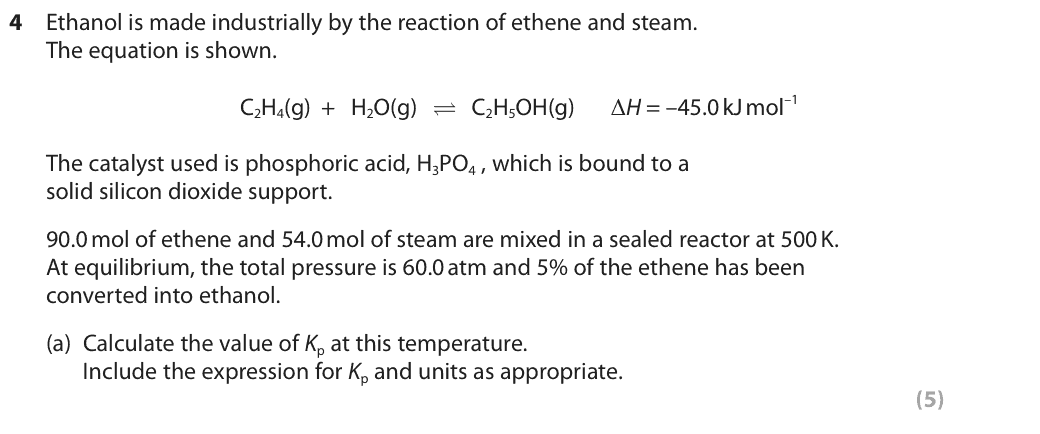
It is proposed to increase the pressure in the reactor to 70.0  atm.
Explain the effect this change would have on the yield of ethanol by referring
to the equilibrium.
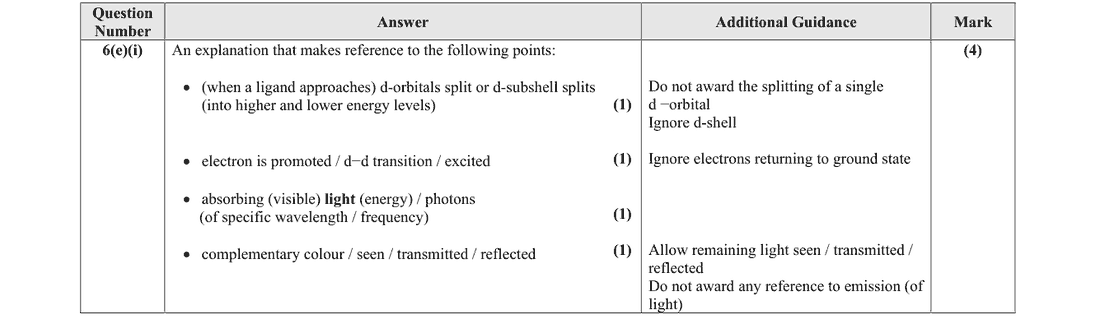
June 2025 · Paper 1 · Q6(e)(i) 4 marks Explanation transition metals principles
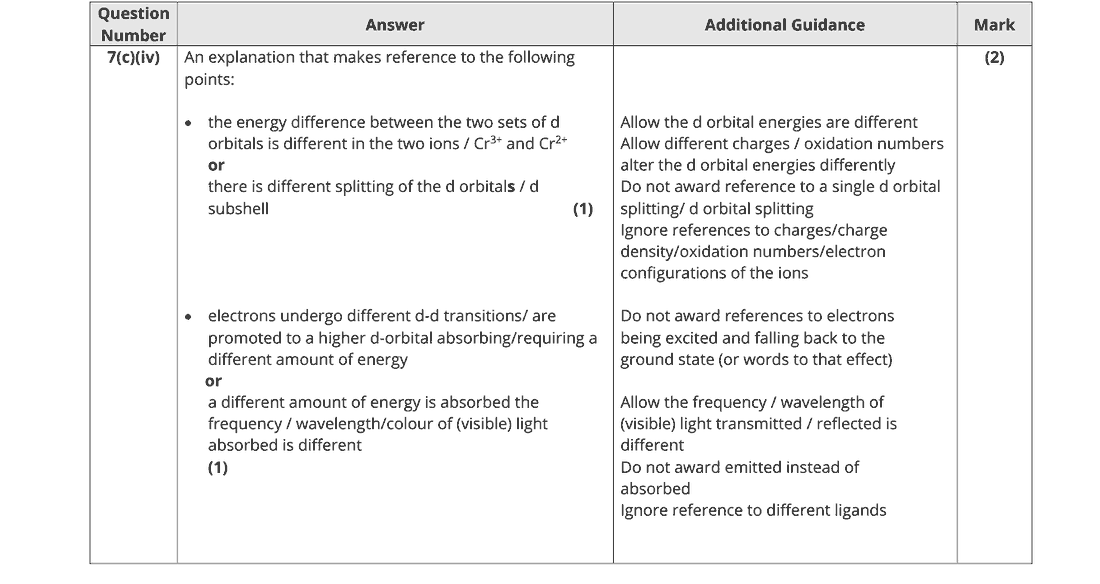
Explain why aqueous solutions of [Cr(H2O)6]3+ are coloured.
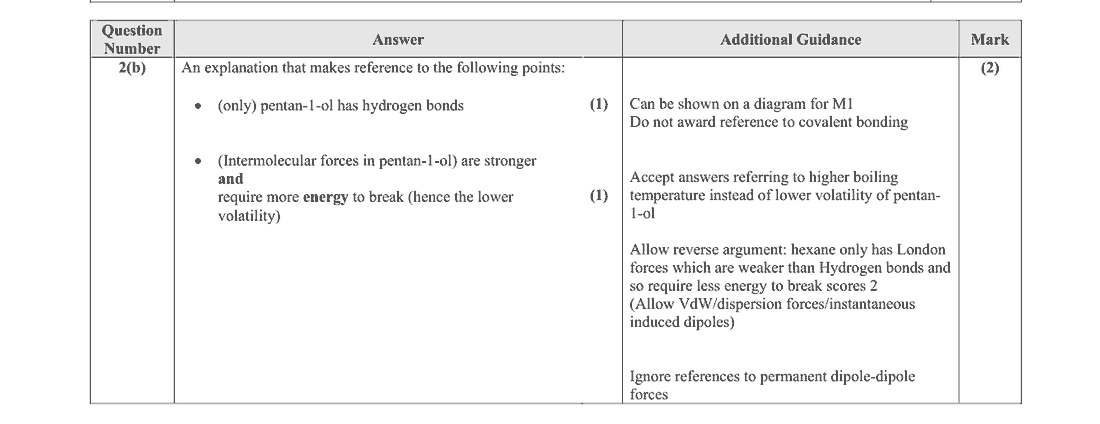
June 2025 · Paper 2 · Q2(b) 2 marks Explanation bonding
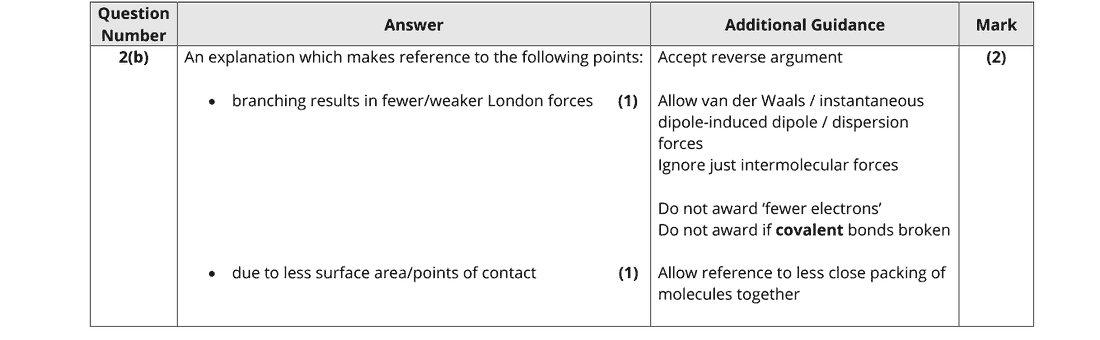
Pentan‑1‑ol and hexane have the same number of electrons but pentan‑1‑ol is
much less volatile than hexane.
Explain this difference in volatility.
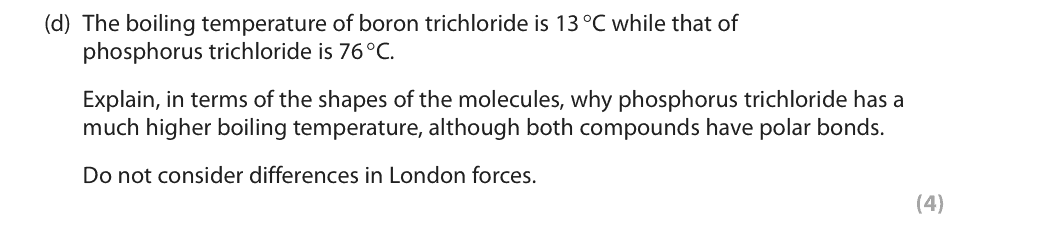
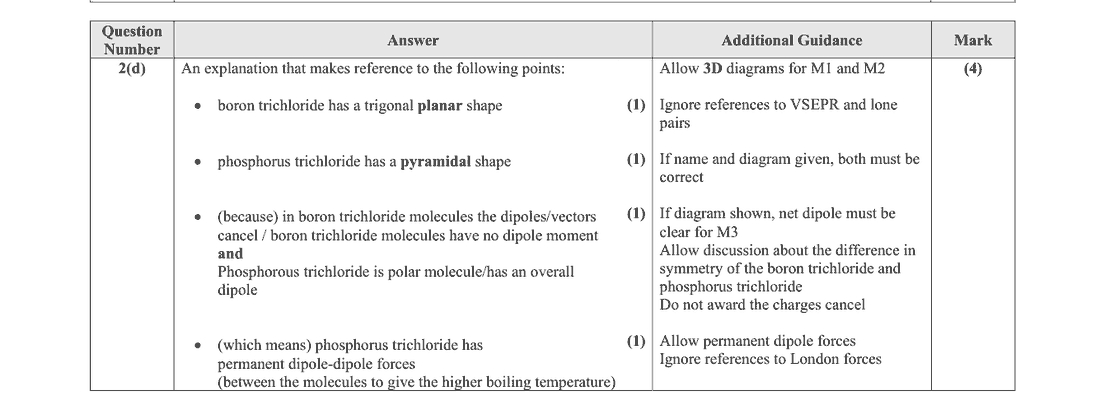
June 2025 · Paper 2 · Q2(d) 4 marks Explanation bonding
The boiling temperature of boron trichloride is 13 °C while that of
phosphorus trichloride is 76 °C.
Explain, in terms of the shapes of the molecules, why phosphorus trichloride has a
much higher boiling temperature, although both compounds have polar bonds.
Do not consider differences in London forces.
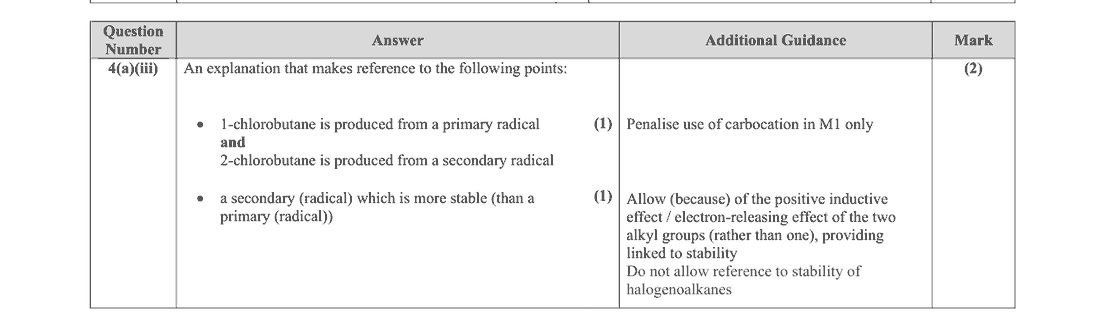
June 2025 · Paper 2 · Q4(a)(iii) 2 marks Explanation Hard alkanes
Earlier part of question 4 that this part usesEarlier part of June 2025 Paper 2 question 4
The reaction of chlorine with butane produces 2‑chlorobutane (72 %) and
1‑chlorobutane (28 %).
Explain, by application of your knowledge of the stability of carbocations, why
there is a higher yield of 2‑chlorobutane.
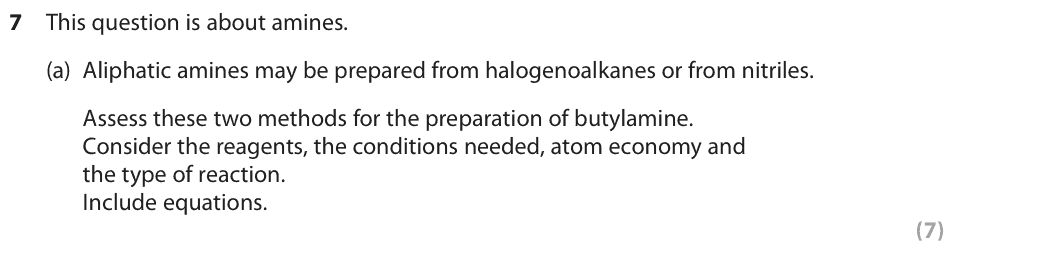
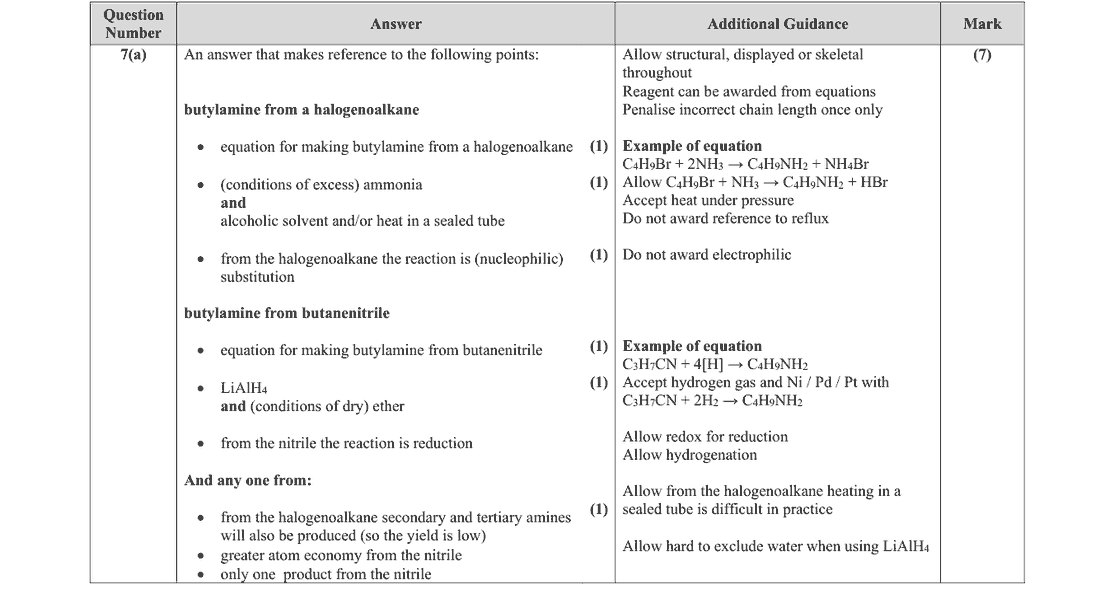
June 2025 · Paper 2 · Q7(a) 7 marks Explanation amines amides amino acids and proteinshalogenoalkanes
This question is about amines.
Aliphatic amines may be prepared from halogenoalkanes or from nitriles.
Assess these two methods for the preparation of butylamine.
Consider the reagents, the conditions needed, atom economy and
the type of reaction.
Include equations.
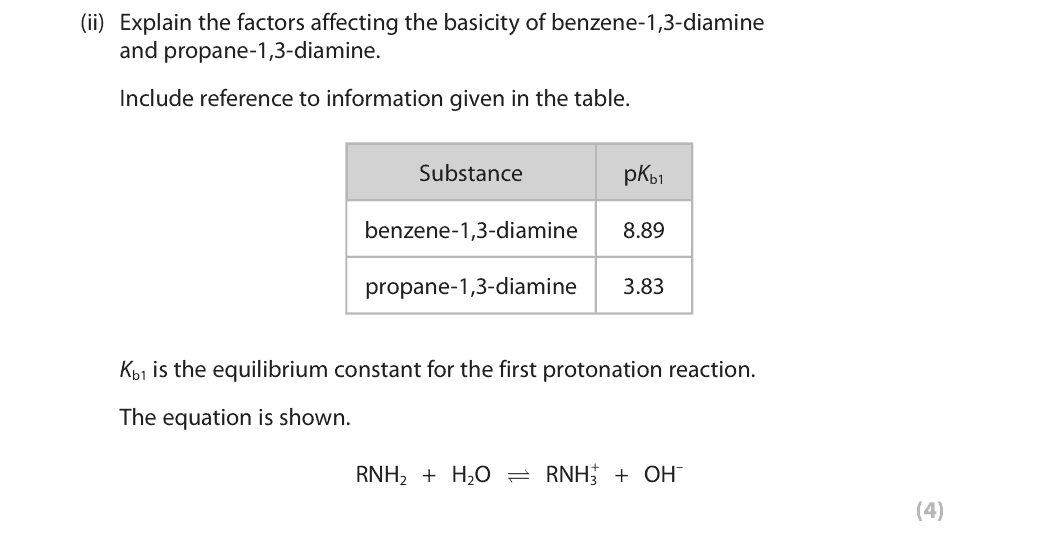
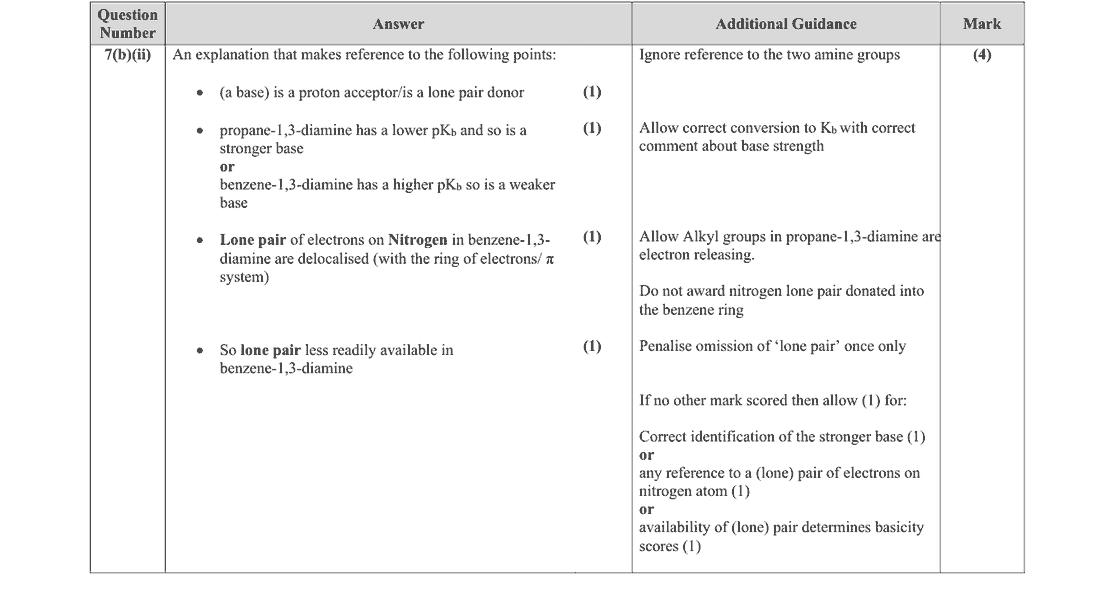
June 2025 · Paper 2 · Q7(b)(ii) 4 marks Explanation Hard amines amides amino acids and proteins
Earlier parts of question 7 that this part usesEarlier part of June 2025 Paper 2 question 7Earlier part of June 2025 Paper 2 question 7
Explain the factors affecting the basicity of benzene‑1,3‑diamine
and propane‑1,3‑diamine.
Include reference to information given in the table.
Substance
pKb1
benzene‑1,3‑diamine
8.89
propane‑1,3‑diamine
3.83
Kb1 is the equilibrium constant for the first protonation reaction.
The equation is shown.
RNH2   +   H2O      RNH3
+   +   OH–
June 2025 · Paper 2 · Q8(e)(i) 3 marks Explanation Hard arenes benzene
Earlier part of question 8 that this part usesEarlier part of June 2025 Paper 2 question 8
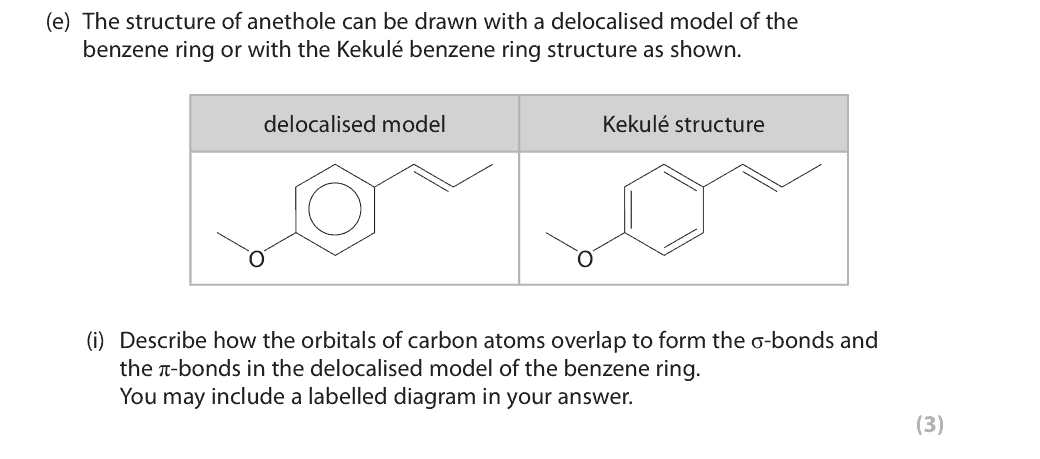
The structure of anethole can be drawn with a delocalised model of the
benzene ring or with the Kekulé benzene ring structure as shown.
delocalised model
Kekulé structure
O
O
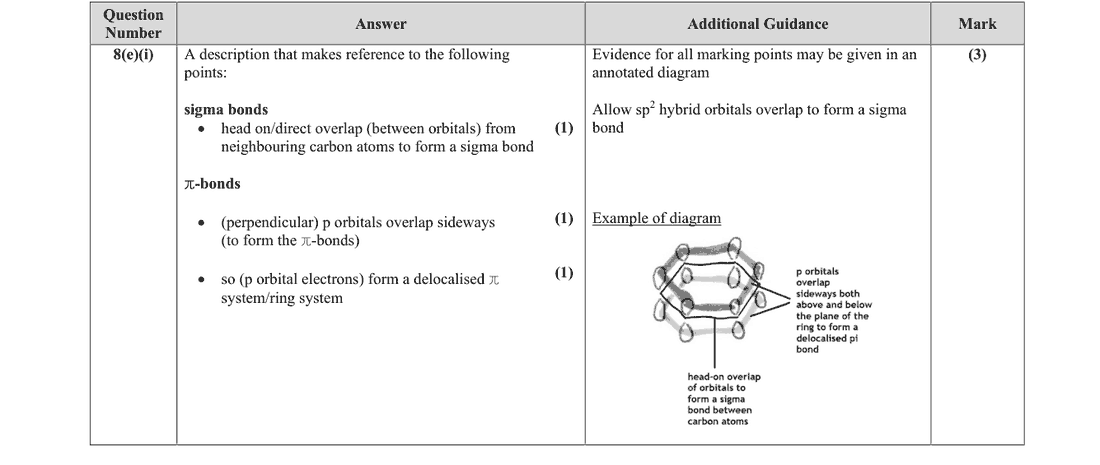
Describe how the orbitals of carbon atoms overlap to form the σ‑bonds and
the π‑bonds in the delocalised model of the benzene ring.
You may include a labelled diagram in your answer.
June 2025 · Paper 2 · Q8(e)(ii) 4 marks Explanation Hard arenes benzene
Earlier parts of question 8 that this part usesEarlier part of June 2025 Paper 2 question 8Earlier part of June 2025 Paper 2 question 8
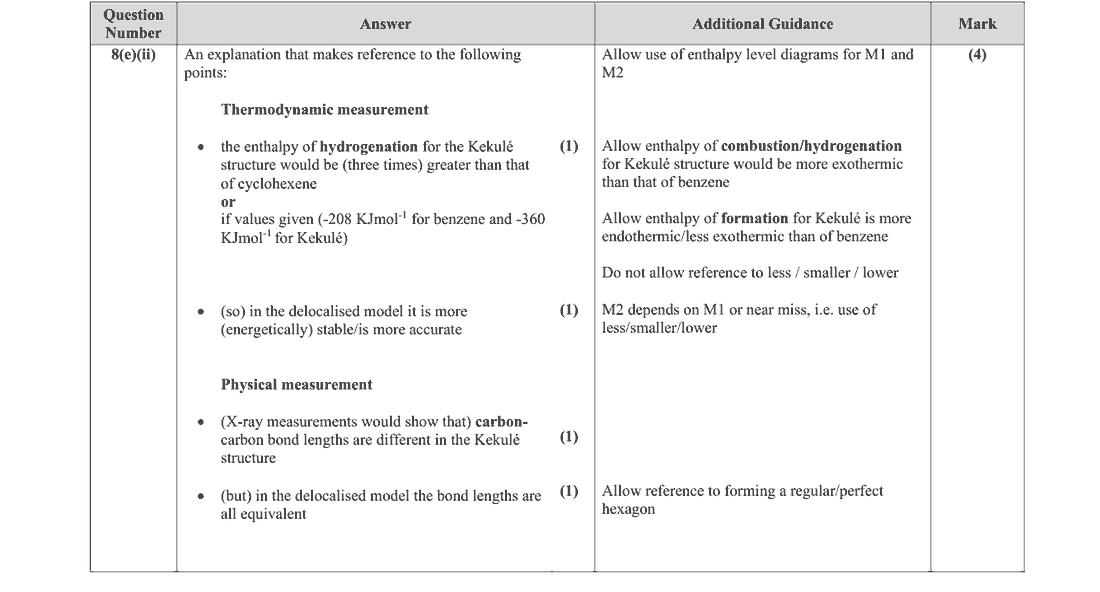
Explain why the delocalised model of the benzene ring is the preferred
representation rather than the Kekulé cyclic triene.
Refer to one physical and one thermodynamic measurement in your answer.
June 2025 · Paper 2 · Q8(f) 3 marks Explanation bonding
Earlier part of question 8 that this part usesEarlier part of June 2025 Paper 2 question 8
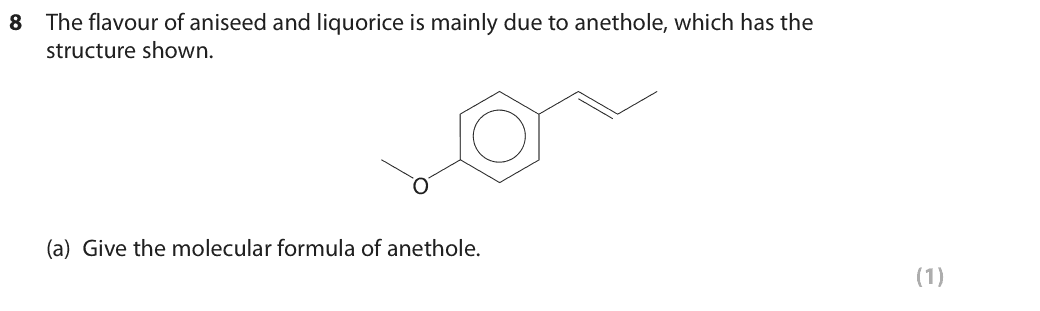
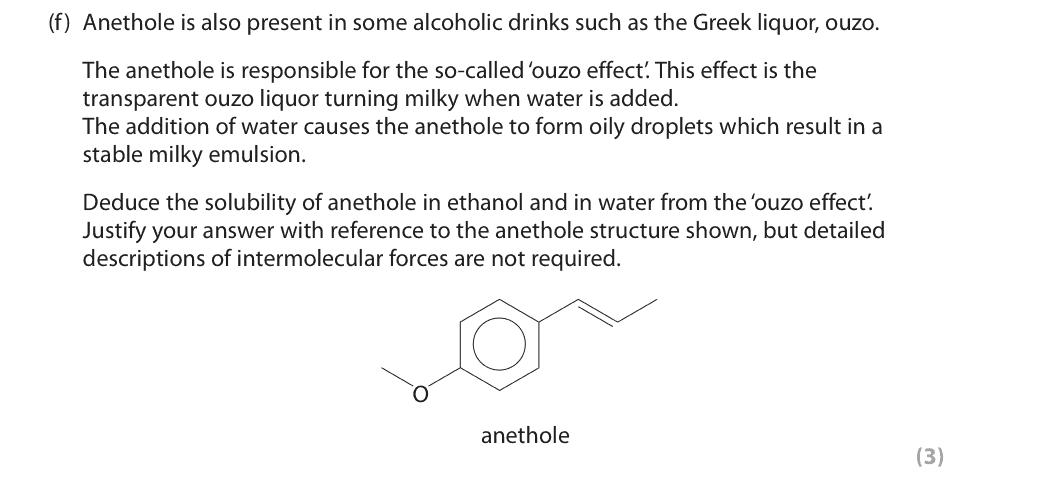
Anethole is also present in some alcoholic drinks such as the Greek liquor, ouzo.
The anethole is responsible for the so‑called ‘ouzo effect’. This effect is the
transparent ouzo liquor turning milky when water is added.
The addition of water causes the anethole to form oily droplets which result in a
stable milky emulsion.
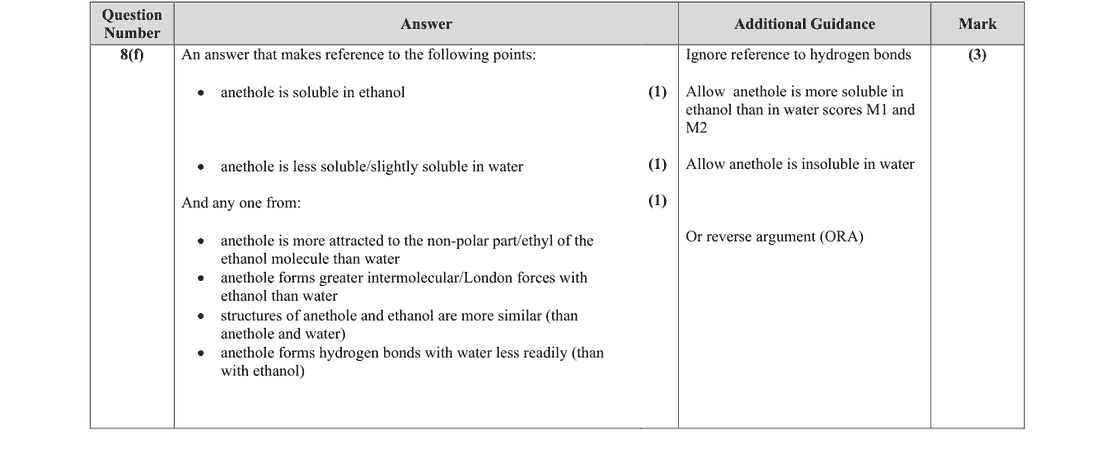
Deduce the solubility of anethole in ethanol and in water from the ‘ouzo effect’.
Justify your answer with reference to the anethole structure shown, but detailed
descriptions of intermolecular forces are not required.
O
anethole
June 2025 · Paper 2 · Q9(a)(iii) 2 marks Explanation Hard kinetics ii
Earlier part of question 9 that this part usesEarlier part of June 2025 Paper 2 question 9
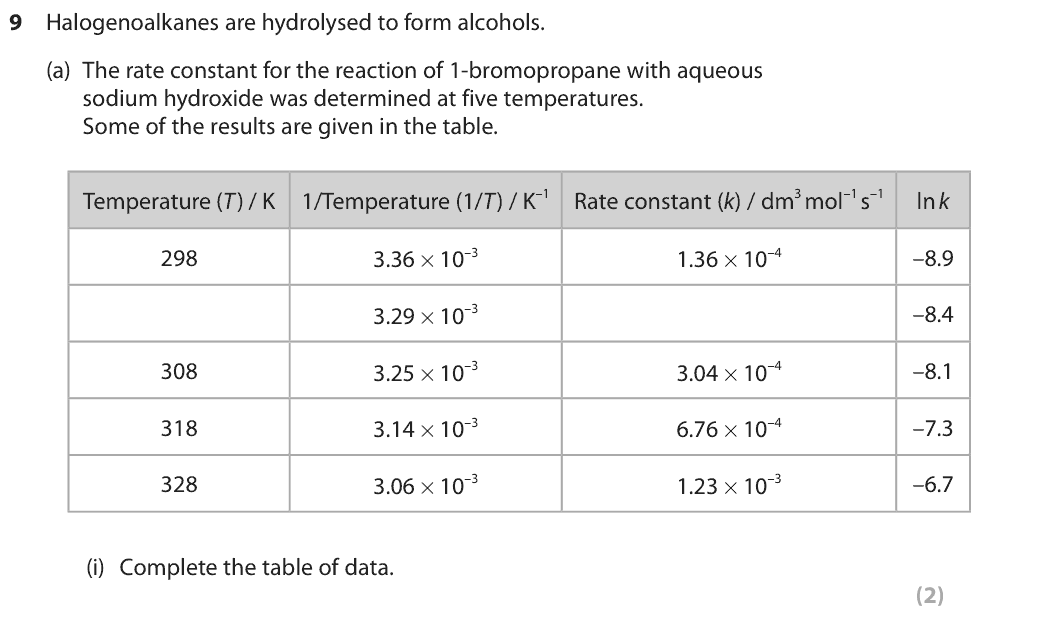
The rate constant for the reaction of 1‑bromopropane with aqueous
potassium hydroxide has the units of dm3 mol–1 s–1.
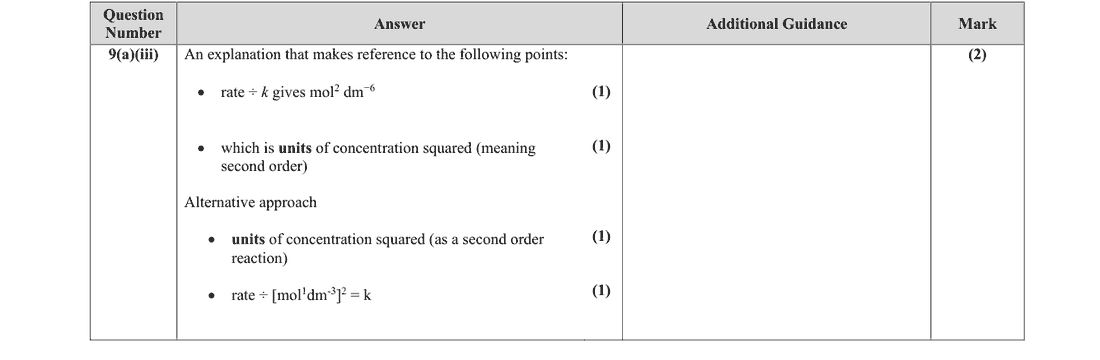
Explain why it can be deduced that the reaction is second order overall.
Assume that the units of the rate of reaction are mol dm–3 s–1.
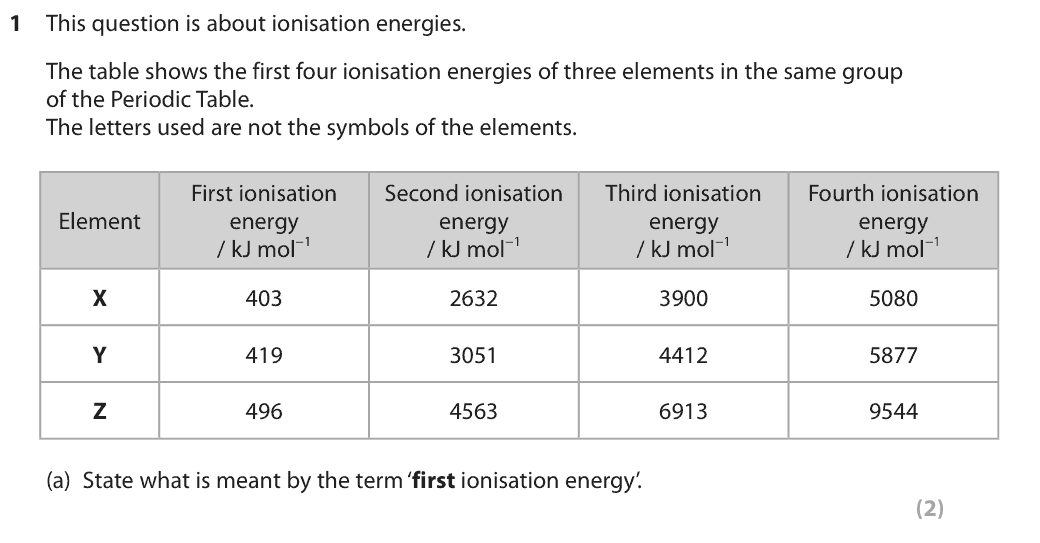
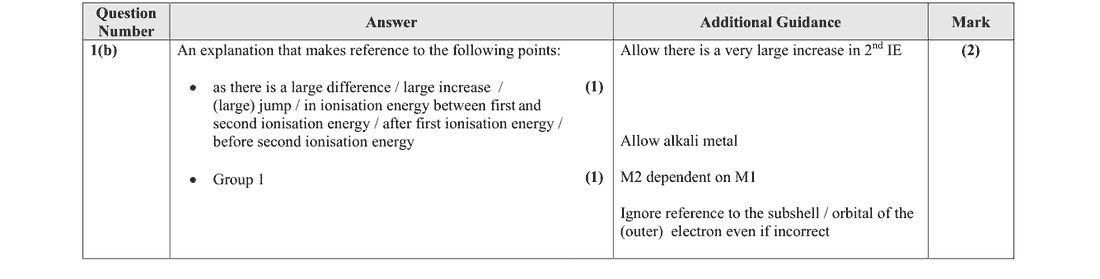
June 2025 · Paper 3 · Q1(b) 2 marks Explanation atomic structure and the periodic table
Earlier part of question 1 that this part usesEarlier part of June 2025 Paper 3 question 1
Explain to which group the elements X, Y and Z belong.
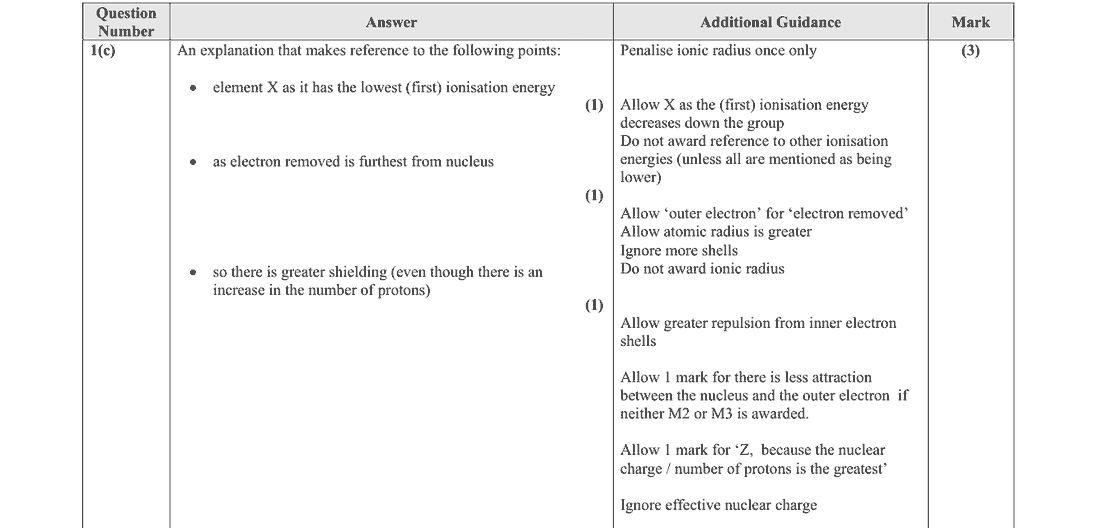
June 2025 · Paper 3 · Q1(c) 3 marks Explanation atomic structure and the periodic table
Earlier part of question 1 that this part usesEarlier part of June 2025 Paper 3 question 1
Explain which of the elements X, Y and Z has the highest atomic number.
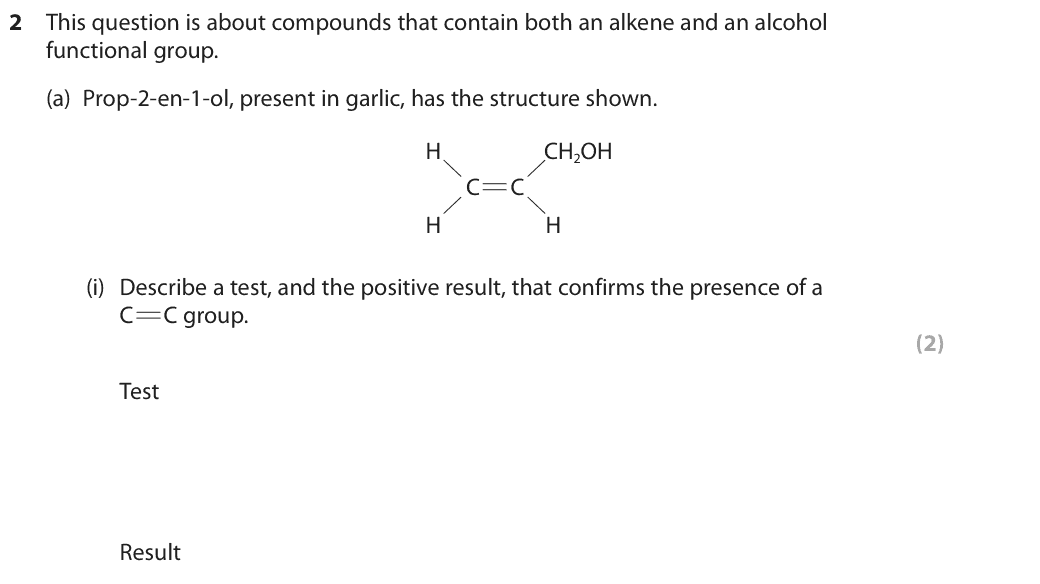
June 2025 · Paper 3 · Q2(c) 2 marks Explanation Hard alkenes
Earlier part of question 2 that this part usesEarlier part of June 2025 Paper 3 question 2
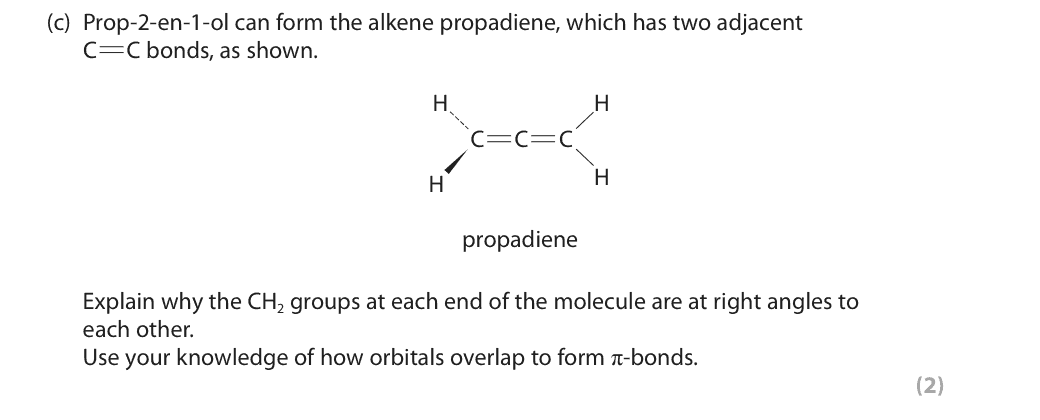
Prop-2-en-1-ol can form the alkene propadiene, which has two adjacent
C
C bonds, as shown.
H
H
C
C
C
H
H
propadiene
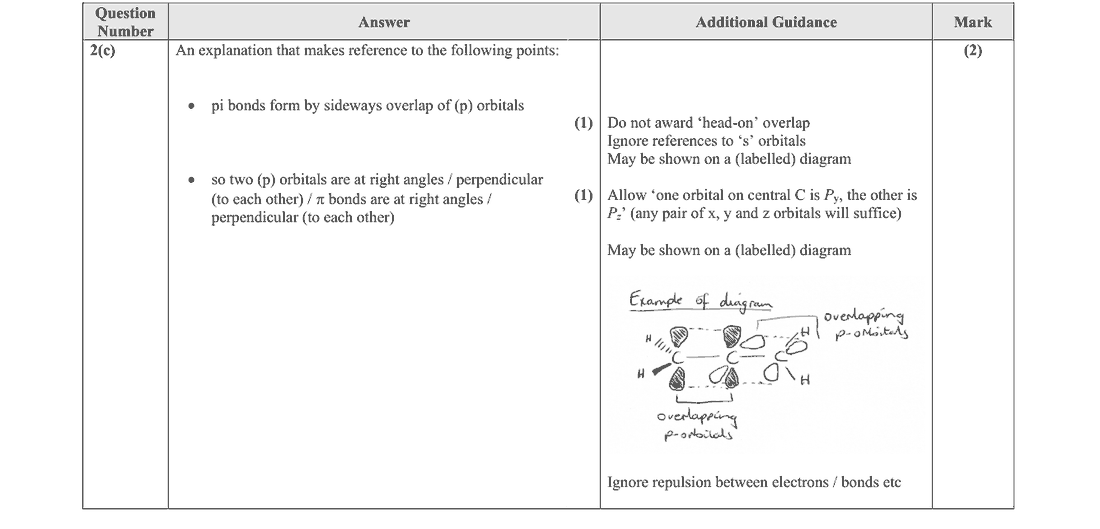
Explain why the CH2 groups at each end of the molecule are at right angles to
each other.
Use your knowledge of how orbitals overlap to form π-bonds.
June 2025 · Paper 3 · Q2(d)(iii) 3 marks Explanation bonding
Earlier parts of question 2 that this part usesEarlier part of June 2025 Paper 3 question 2Earlier part of June 2025 Paper 3 question 2
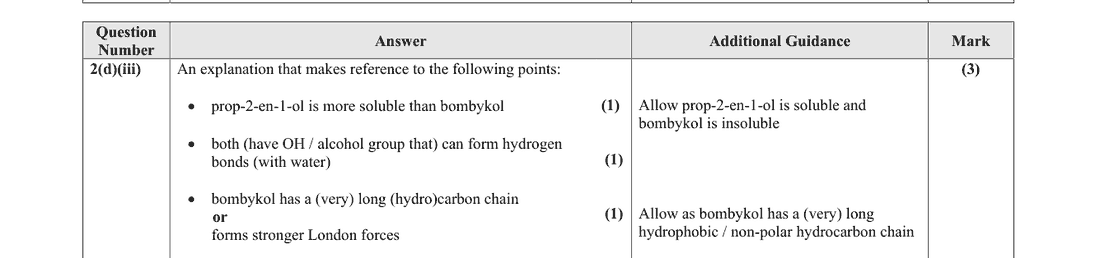
Explain the expected solubilities in water of bombykol and prop-2-en-1-ol.
June 2025 · Paper 3 · Q5(b)(ii) 3 marks Explanation transition metals reactions
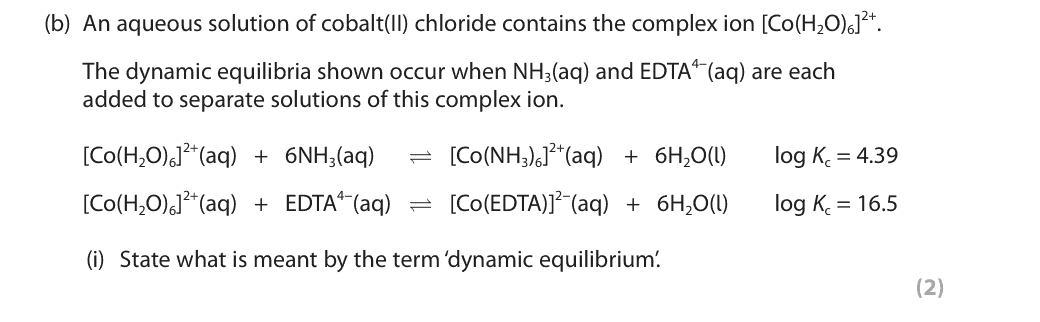
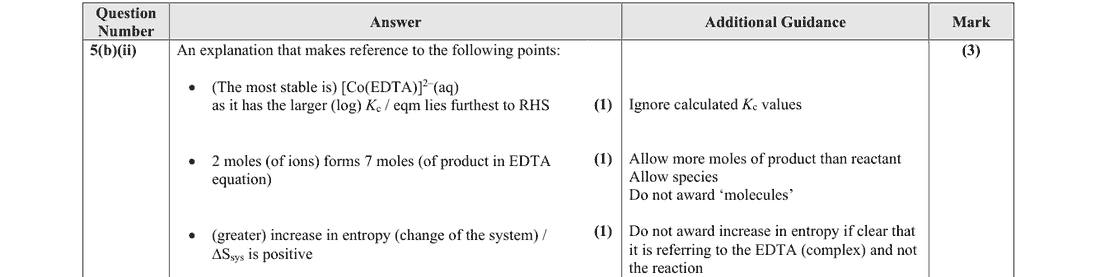
Earlier parts of question 5 that this part usesEarlier part of June 2025 Paper 3 question 5Earlier part of June 2025 Paper 3 question 5
Explain, in terms of equilibria and entropy, which of the three complex ions is
the most stable.
June 2025 · Paper 3 · Q8(d)(ii) 3 marks Explanation acid base equilibria
Earlier parts of question 8 that this part usesEarlier part of June 2025 Paper 3 question 8Earlier part of June 2025 Paper 3 question 8
Explain why there is no significant change in pH when a small amount of
hydrochloric acid, HCl(aq), is added to this buffer.
June 2024 · AS Paper 1 · Q5(e)(ii) 3 marks Explanation bonding
Earlier parts of question 5 that this part usesEarlier part of June 2024 Paper 1 question 5Earlier part of June 2024 Paper 1 question 5
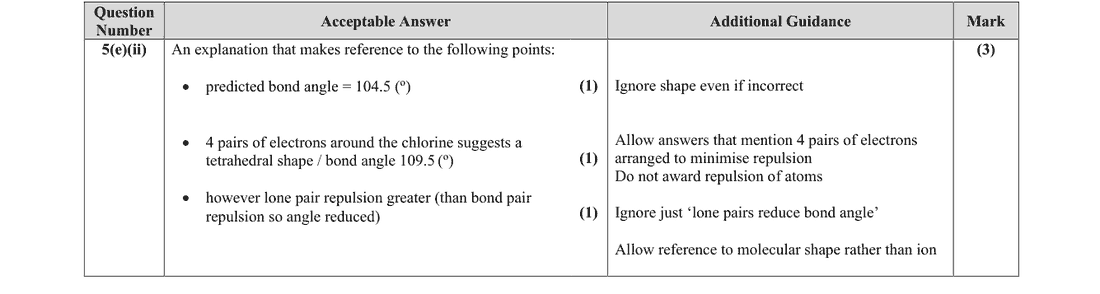
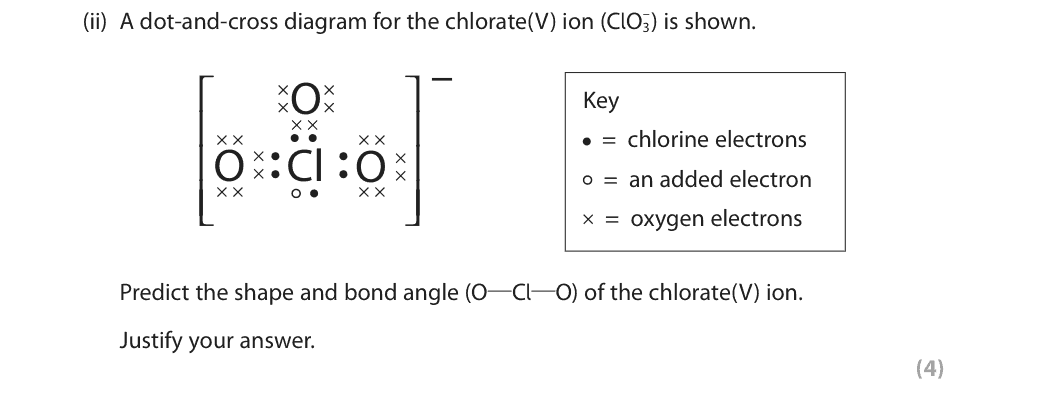
Predict the bond angle in this ion. Justify your answer.
June 2024 · AS Paper 1 · Q7(d) 4 marks Explanation structure
Earlier part of question 7 that this part usesEarlier part of June 2024 Paper 1 question 7
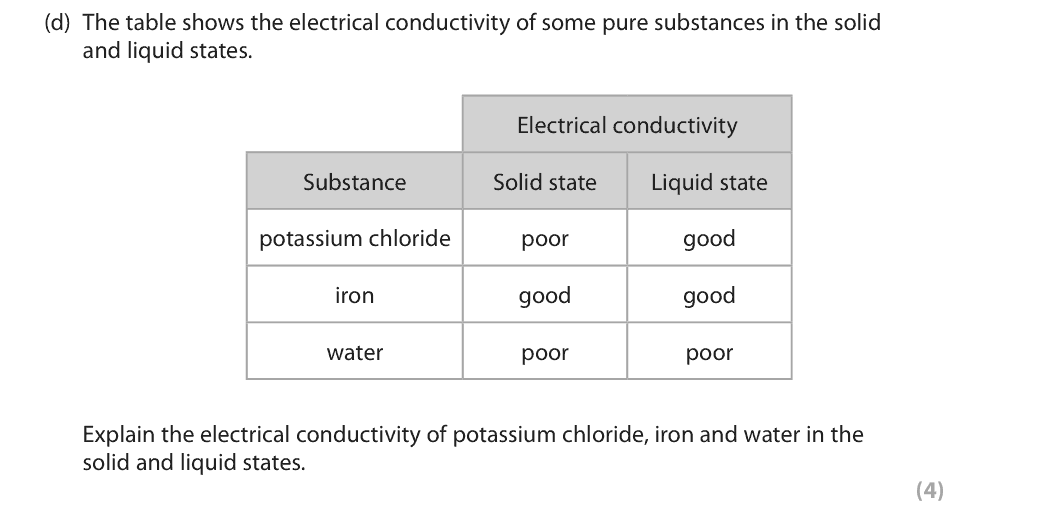
The table shows the electrical conductivity of some pure substances in the solid
and liquid states.
Electrical conductivity
Substance
Solid state
Liquid state
potassium chloride
poor
good
iron
good
good
water
poor
poor
Explain the electrical conductivity of potassium chloride, iron and water in the
solid and liquid states.
June 2024 · AS Paper 1 · Q8(b)(i) 3 marks Explanation bonding
Earlier part of question 8 that this part usesEarlier part of June 2024 Paper 1 question 8
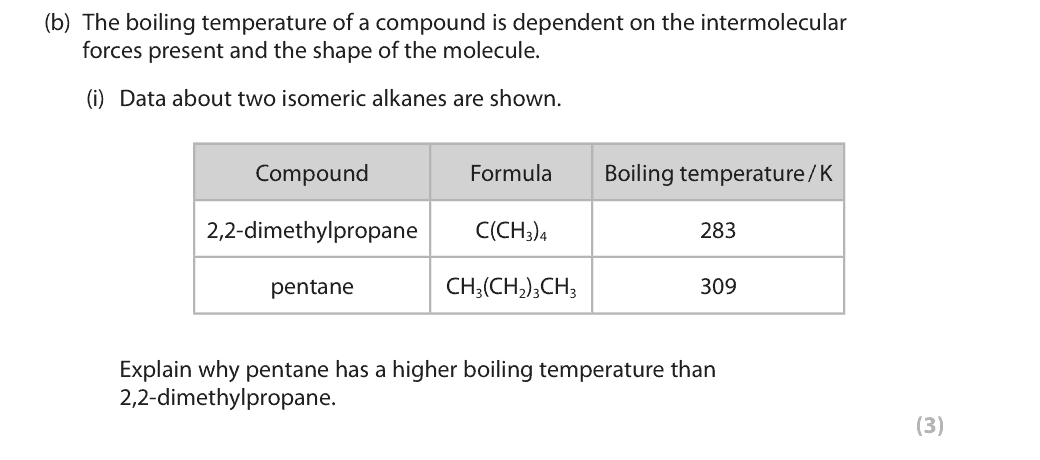
The boiling temperature of a compound is dependent on the intermolecular
forces present and the shape of the molecule.
Data about two isomeric alkanes are shown.
Compound
Formula
Boiling temperature / K
2,2‑dimethylpropane
C(CH3)4
283
pentane
CH3(CH2)3CH3
309
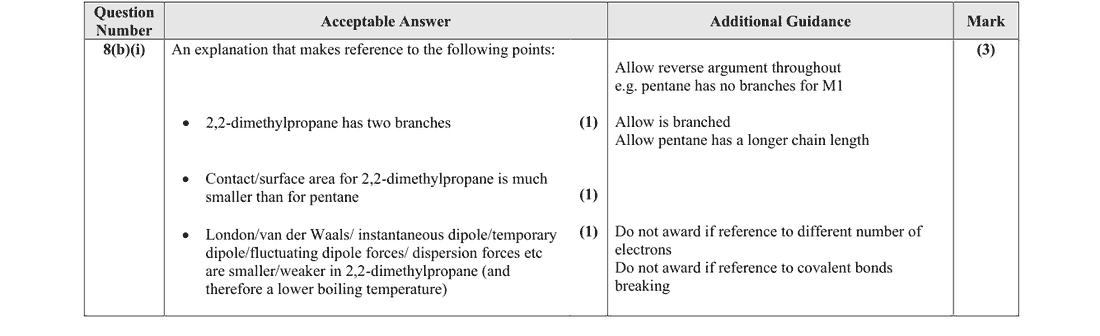
Explain why pentane has a higher boiling temperature than
2,2‑dimethylpropane.
June 2024 · AS Paper 1 · Q8(b)(ii) 4 marks Explanation structure
Earlier parts of question 8 that this part usesEarlier part of June 2024 Paper 1 question 8Earlier part of June 2024 Paper 1 question 8
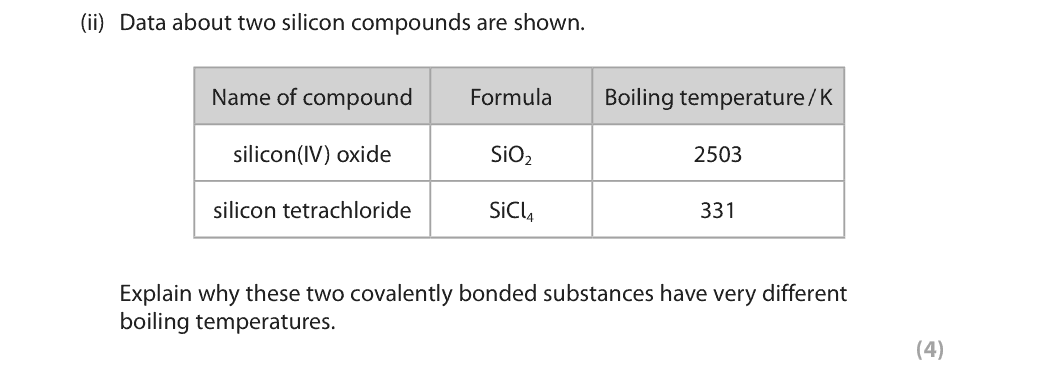
Data about two silicon compounds are shown.
Name of compound
Formula
Boiling temperature / K
silicon(IV) oxide
SiO2
2503
silicon tetrachloride
SiCl4
331
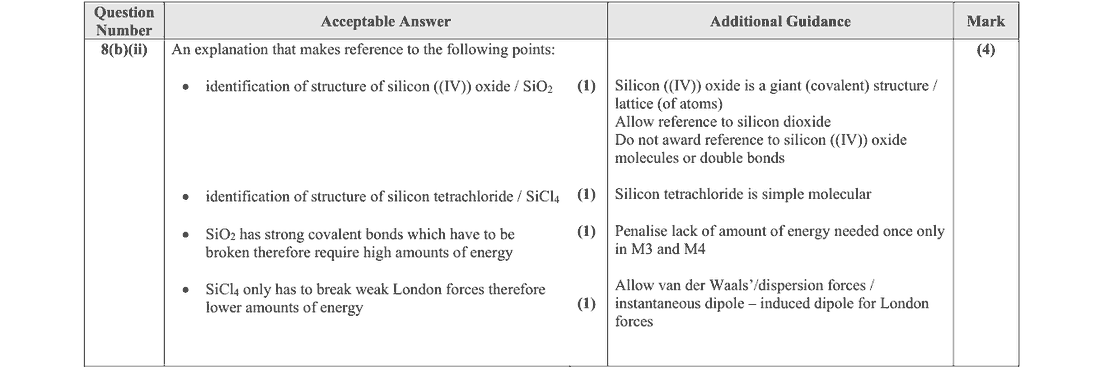
Explain why these two covalently bonded substances have very different
boiling temperatures.
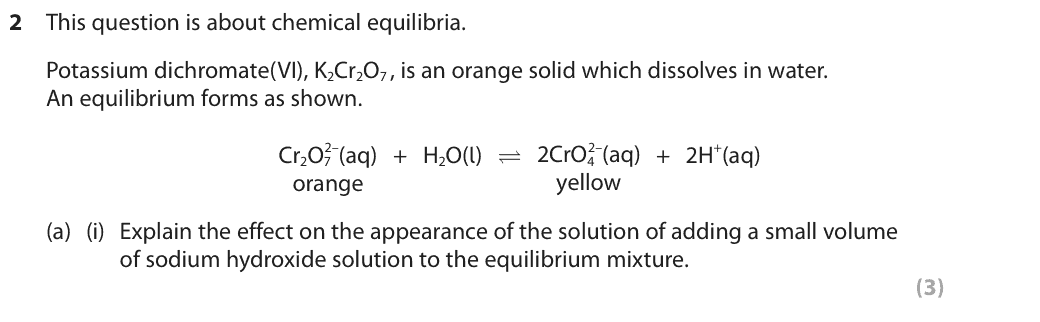
June 2024 · AS Paper 2 · Q2(a)(i) 3 marks Explanation Hard equilibrium i
This question is about chemical equilibria.
Potassium dichromate(VI), K2Cr2O7 , is an orange solid which dissolves in water.
An equilibrium forms as shown.
Cr2O7
2–(aq)
+   H2O(l)      2CrO4
2–(aq)
+   2H+(aq)
orange
yellow
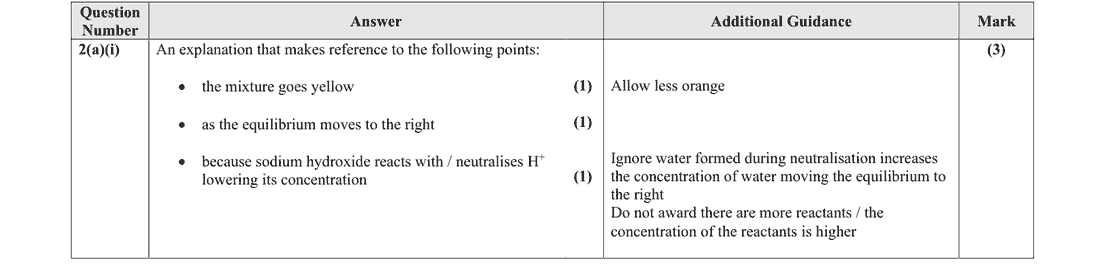
Explain the effect on the appearance of the solution of adding a small volume
of sodium hydroxide solution to the equilibrium mixture.
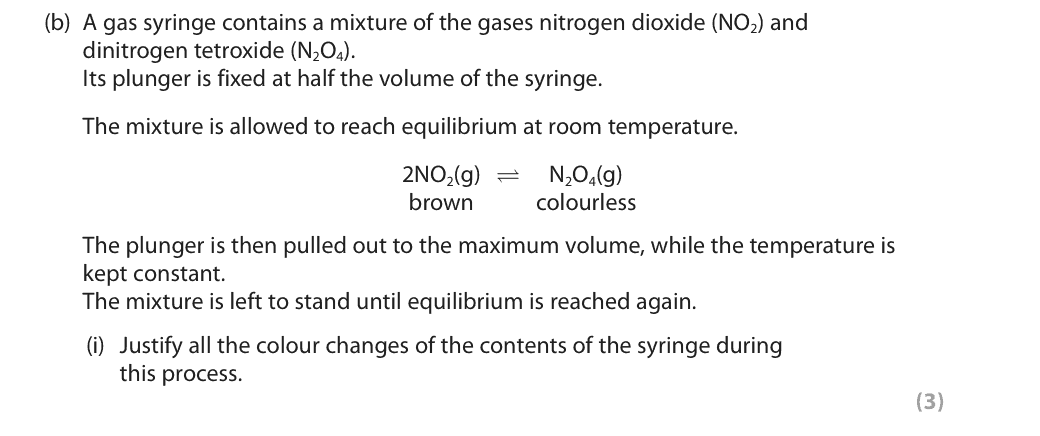
June 2024 · AS Paper 2 · Q2(b)(i) 3 marks Explanation equilibrium i
Earlier part of question 2 that this part usesEarlier part of June 2024 Paper 2 question 2
A gas syringe contains a mixture of the gases nitrogen dioxide (NO2) and
dinitrogen tetroxide (N2O4).
Its plunger is fixed at half the volume of the syringe.
The mixture is allowed to reach equilibrium at room temperature.
2NO2(g)
   N2O4(g)
brown
colourless
The plunger is then pulled out to the maximum volume, while the temperature is
kept constant.
The mixture is left to stand until equilibrium is reached again.
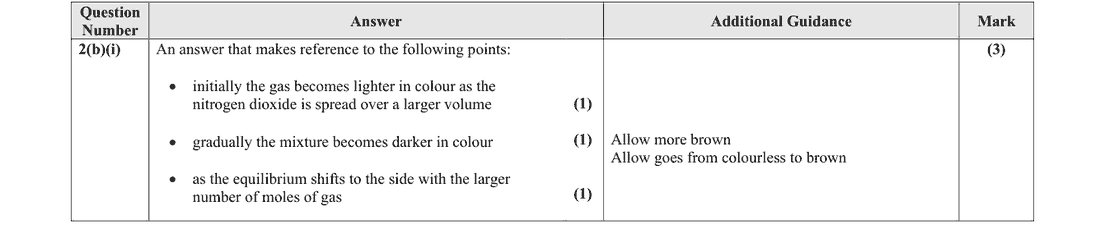
Justify all the colour changes of the contents of the syringe during
this process.
June 2024 · AS Paper 2 · Q2(b)(ii) 2 marks Explanation equilibrium i
Earlier parts of question 2 that this part usesEarlier part of June 2024 Paper 2 question 2Earlier part of June 2024 Paper 2 question 2
The syringe is placed into hot water.
The contents of the syringe become a darker brown.
Explain what can be deduced about the reaction from this change.
June 2024 · AS Paper 2 · Q3(b)(iii) 3 marks Explanation alkenes
Earlier parts of question 3 that this part usesEarlier part of June 2024 Paper 2 question 3Earlier part of June 2024 Paper 2 question 3Earlier part of June 2024 Paper 2 question 3
A minor organic product is also formed in this reaction.
Justify why this minor product is formed in smaller amounts.
Include the structure of the minor organic product.
June 2024 · AS Paper 2 · Q3(c)(ii) 2 marks Explanation introduction to organic chemistry
Earlier parts of question 3 that this part usesEarlier part of June 2024 Paper 2 question 3Earlier part of June 2024 Paper 2 question 3
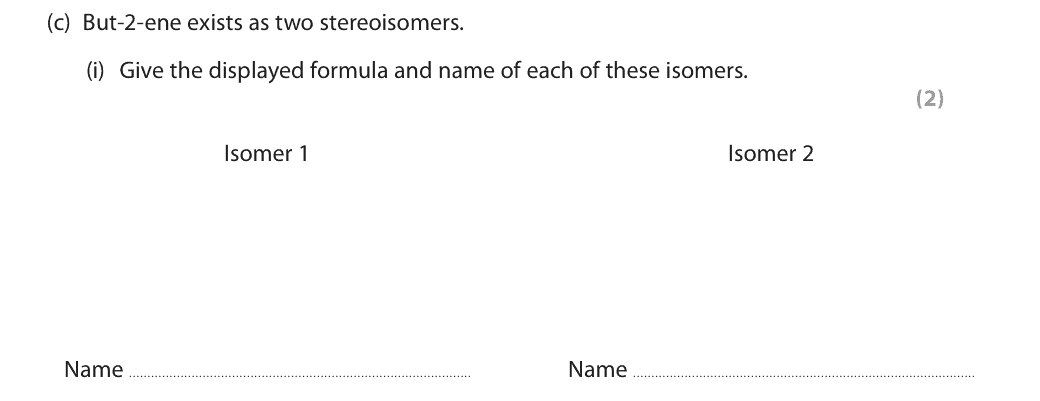
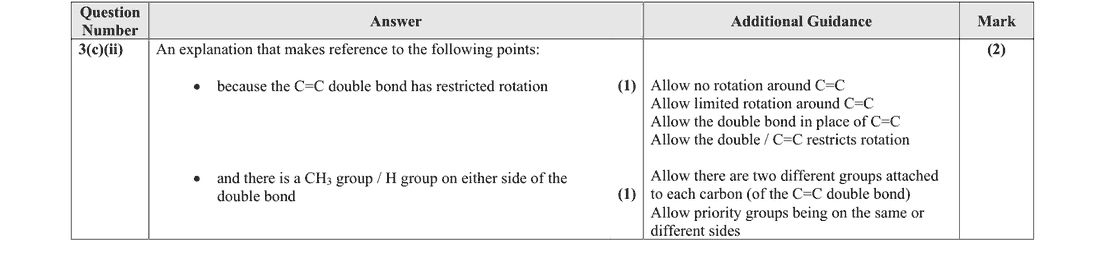
Explain how the presence of the double bond in but‑2‑ene results in these
two isomers.
June 2024 · AS Paper 2 · Q3(d)(ii) 2 marks Explanation alcohols
Earlier parts of question 3 that this part usesEarlier part of June 2024 Paper 2 question 3Earlier part of June 2024 Paper 2 question 3
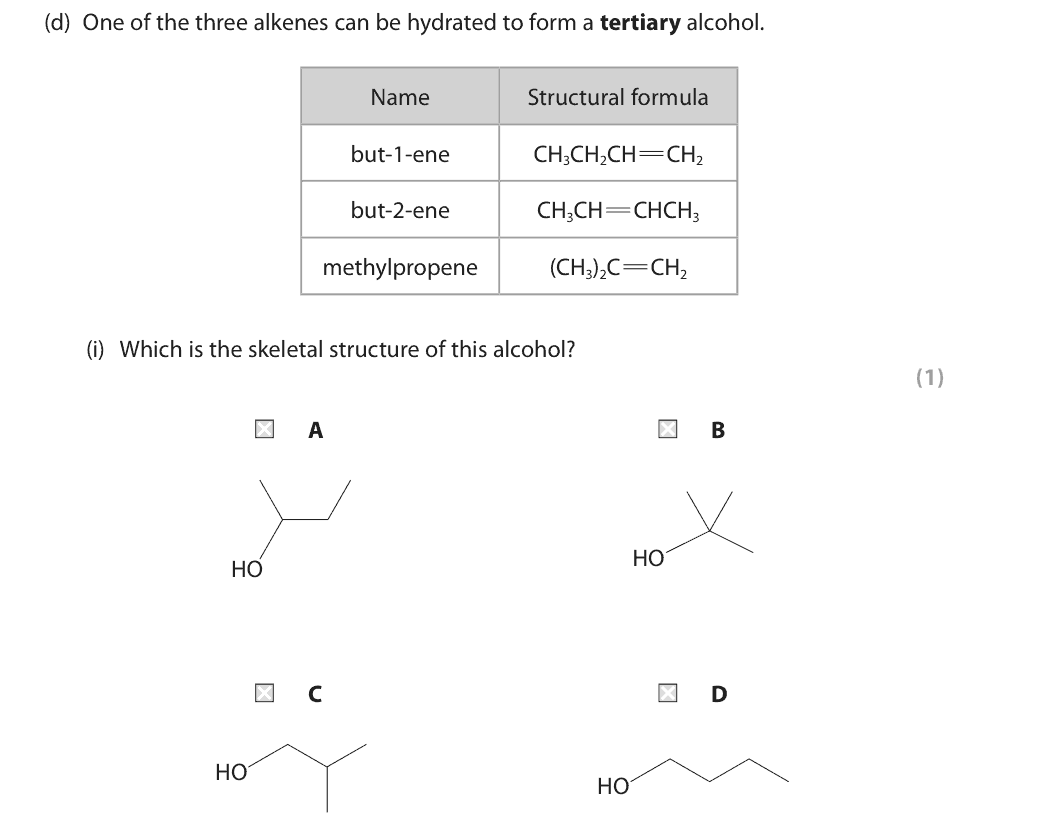
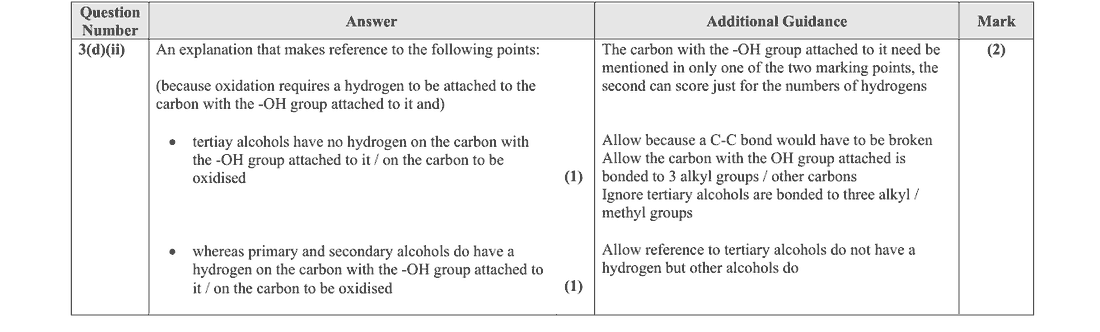
Explain why tertiary alcohols resist oxidation, but primary or secondary
alcohols are readily oxidised.
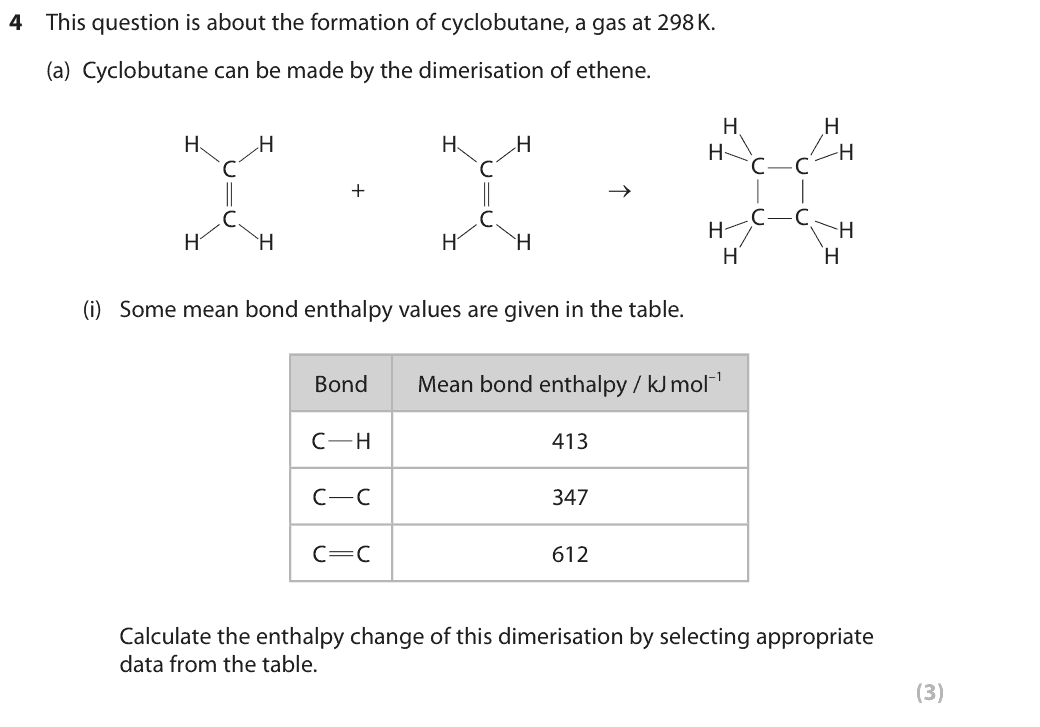
June 2024 · AS Paper 2 · Q4(a)(ii) 2 marks Explanation energetics i
Earlier part of question 4 that this part usesEarlier part of June 2024 Paper 2 question 4
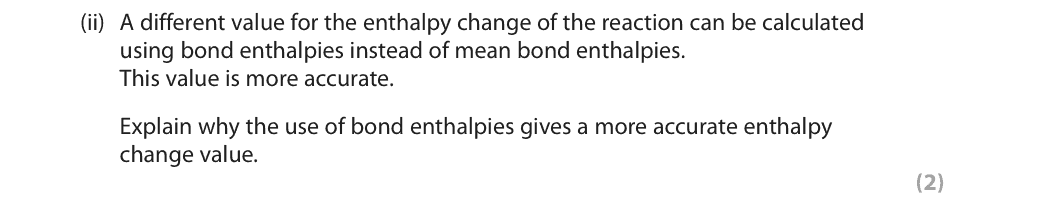
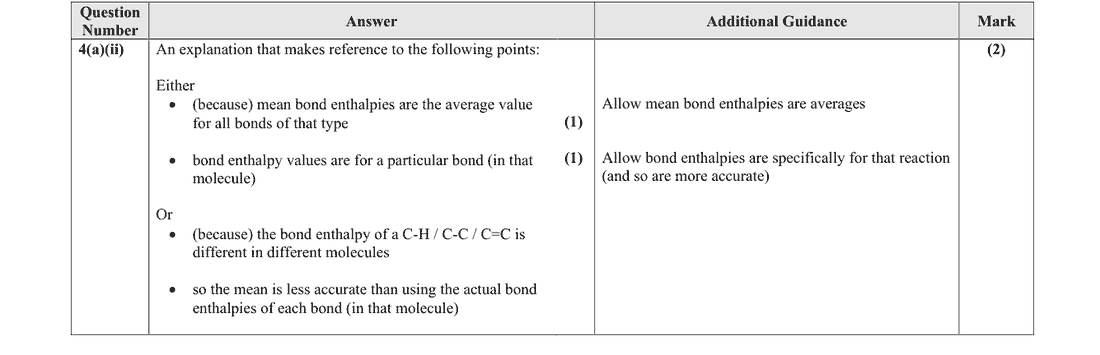
A different value for the enthalpy change of the reaction can be calculated
using bond enthalpies instead of mean bond enthalpies.
This value is more accurate.
Explain why the use of bond enthalpies gives a more accurate enthalpy
change value.
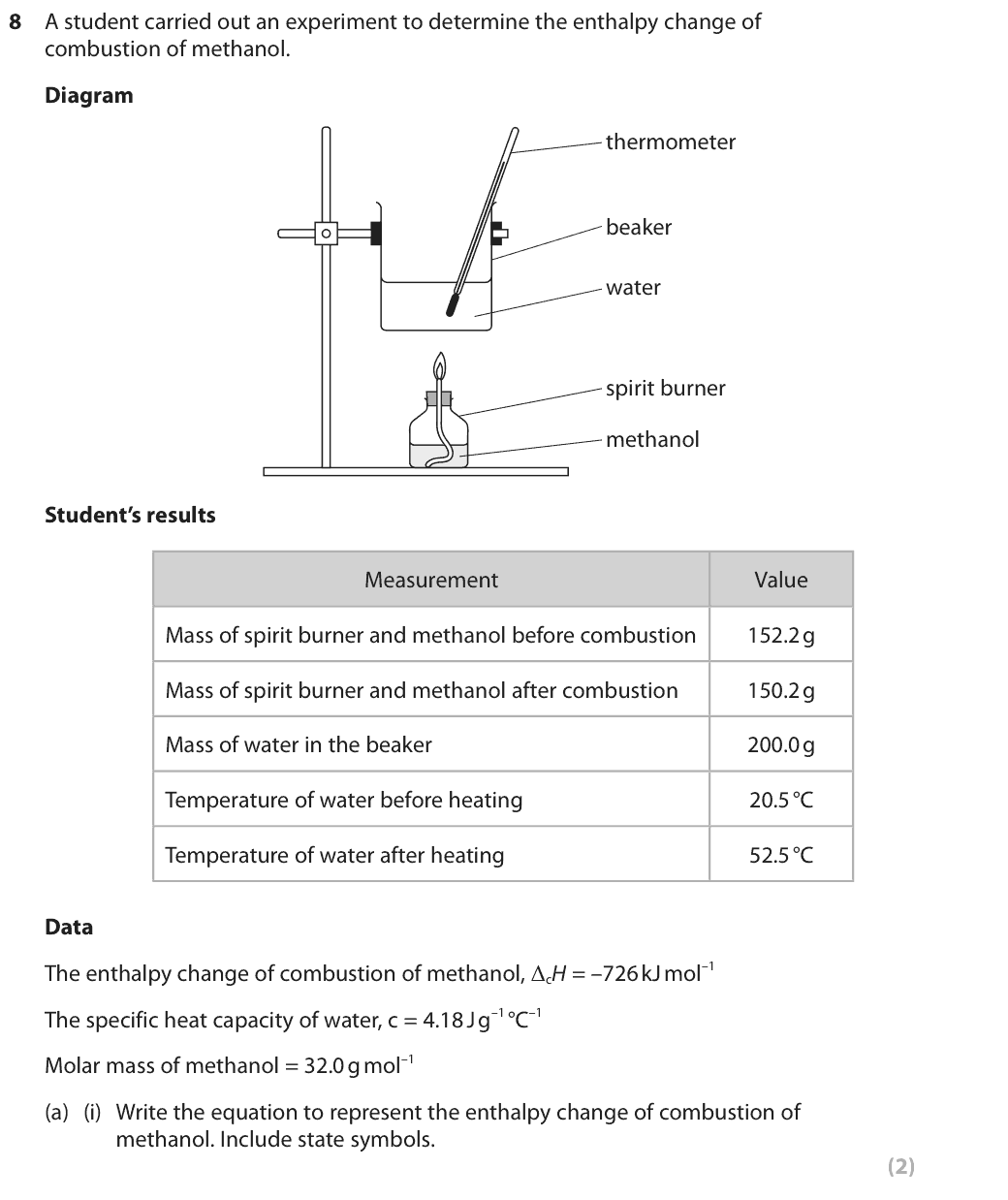
June 2024 · AS Paper 2 · Q8(b) 2 marks Explanation energetics iformulae equations and amounts of substance
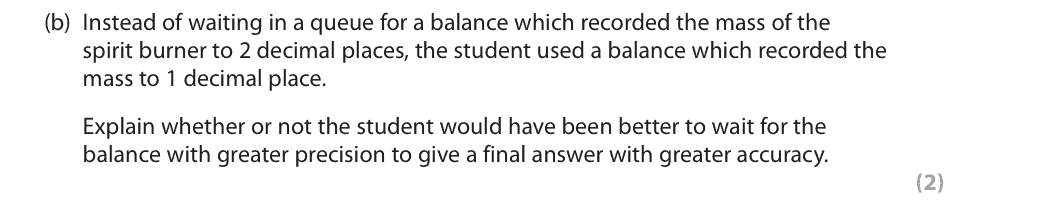
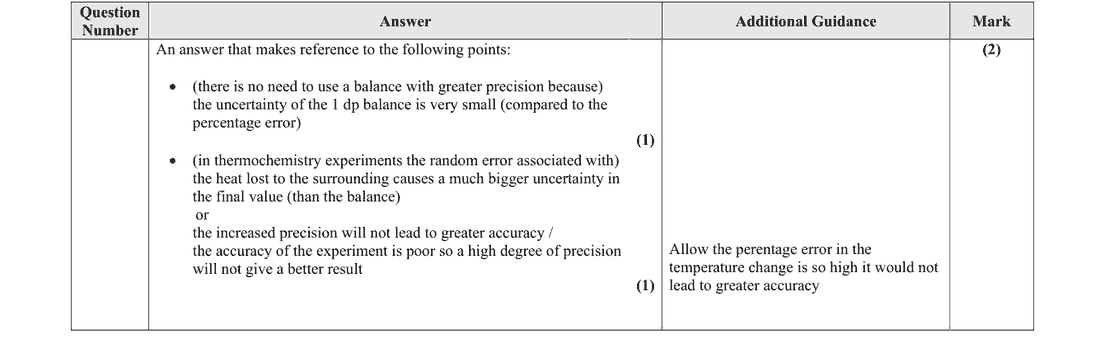
Earlier part of question 8 that this part usesEarlier part of June 2024 Paper 2 question 8
Instead of waiting in a queue for a balance which recorded the mass of the
spirit burner to 2 decimal places, the student used a balance which recorded the
mass to 1 decimal place.
Explain whether or not the student would have been better to wait for the
balance with greater precision to give a final answer with greater accuracy.
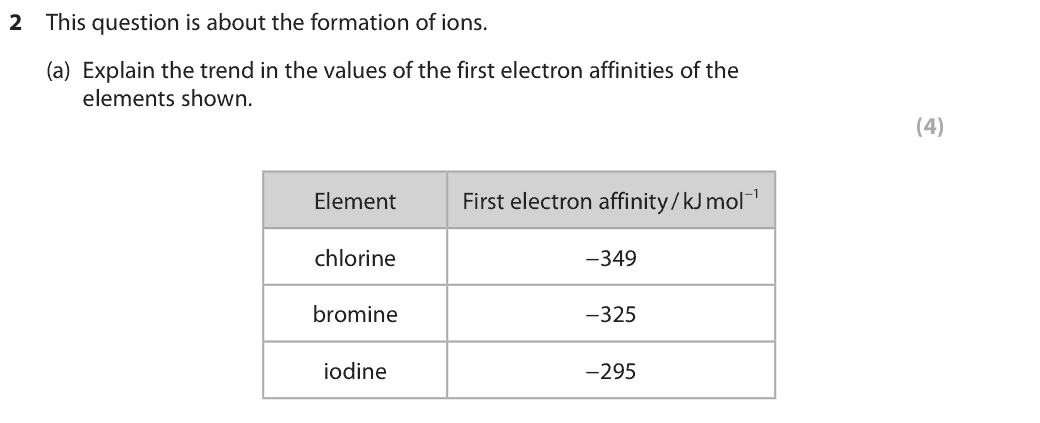
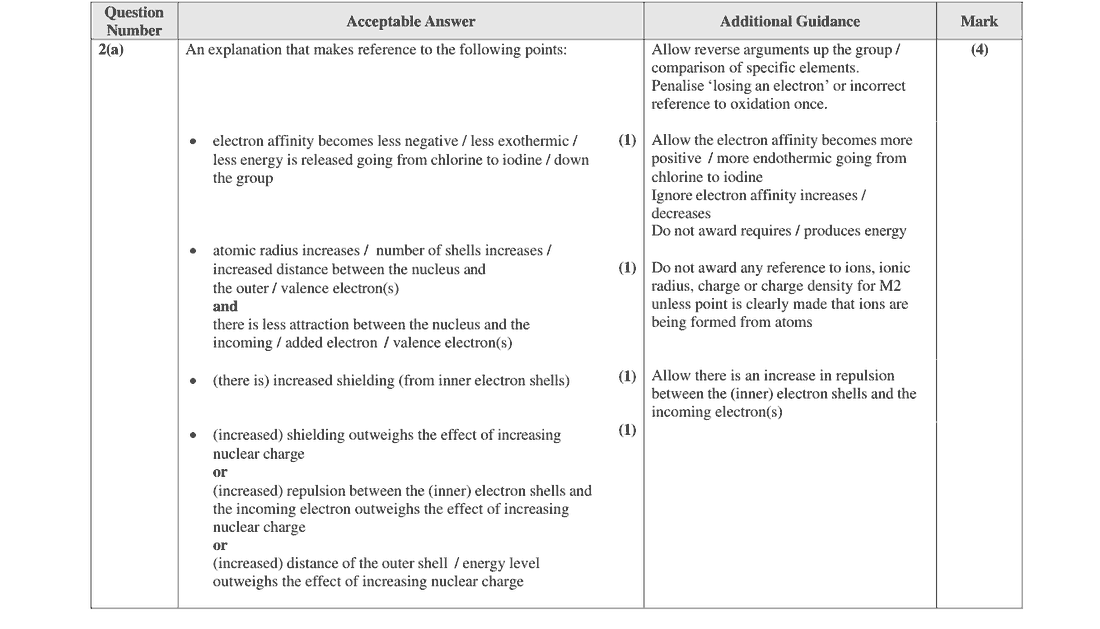
June 2024 · Paper 1 · Q2(a) 4 marks Explanation lattice energyatomic structure and the periodic table
This question is about the formation of ions.
Explain the trend in the values of the first electron affinities of the
elements shown.
Element
First electron affinity / kJ mol−1
chlorine
−349
bromine
−325
iodine
−295
June 2024 · Paper 1 · Q4(c) 4 marks Explanation acid base equilibria
Earlier part of question 4 that this part usesEarlier part of June 2024 Paper 1 question 4
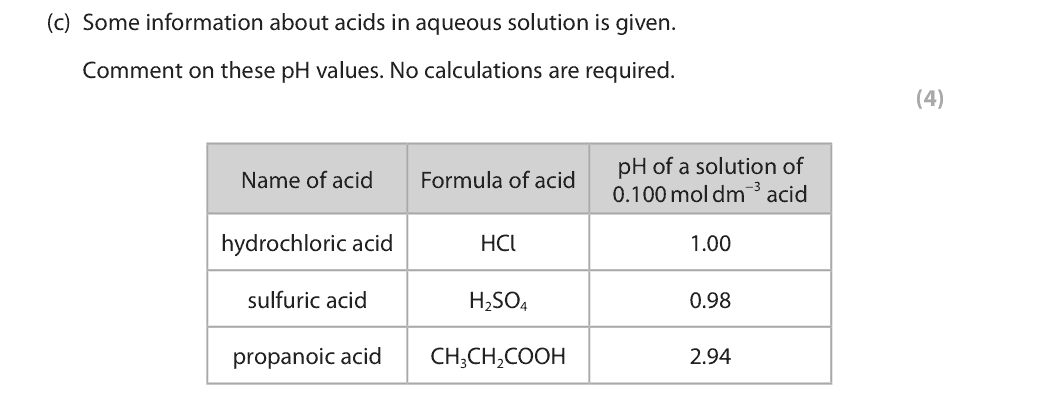
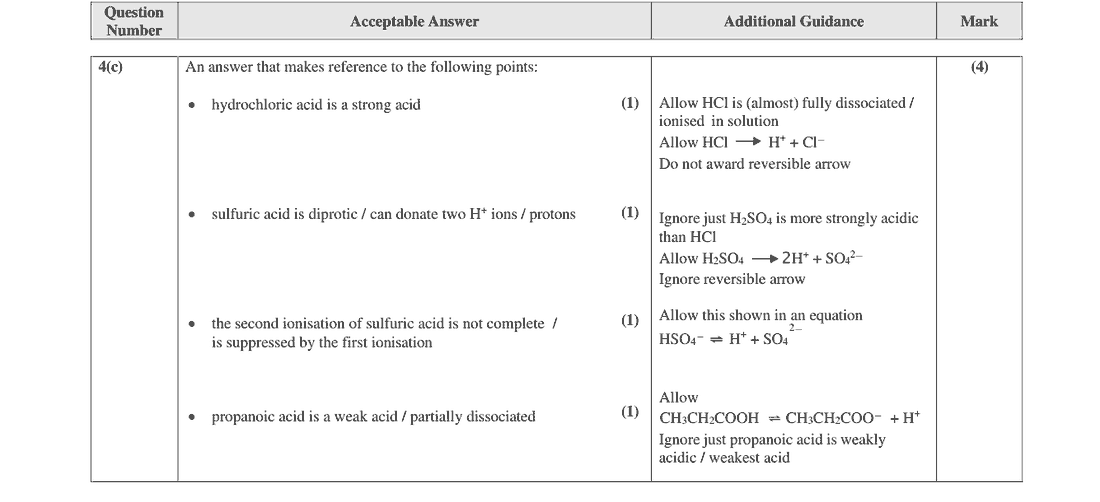
Some information about acids in aqueous solution is given.
Comment on these pH values. No calculations are required.
pH of a solution of
Name of acid
Formula of acid
0.100 mol dm−3 acid
hydrochloric acid
HCl
1.00
sulfuric acid
H2SO4
0.98
propanoic acid
CH3CH2COOH
2.94
June 2024 · Paper 1 · Q4(e)(i) 2 marks Explanation acid base equilibriaequilibrium i
Earlier part of question 4 that this part usesEarlier part of June 2024 Paper 1 question 4
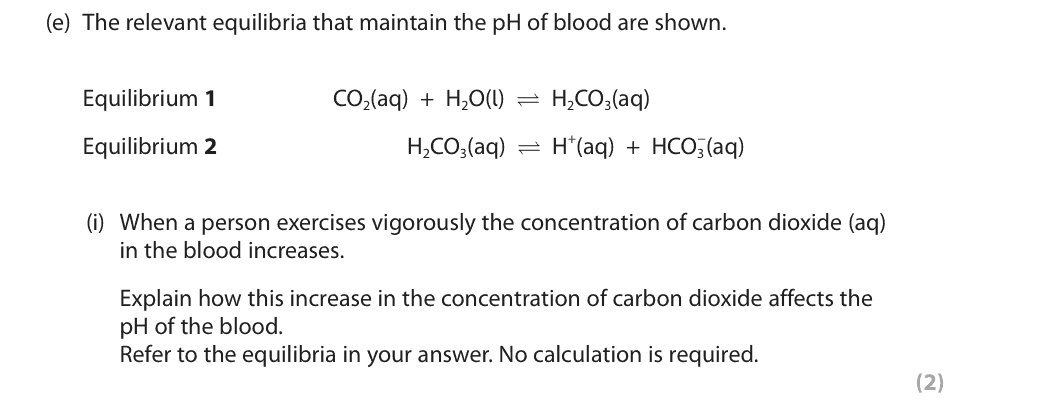
The relevant equilibria that maintain the pH of blood are shown.
Equilibrium 1
CO2(aq)  +  H2O(l)    H2CO3(aq)
H2CO3(aq)    H+(aq)  +  HCO3
−(aq)
Equilibrium 2
When a person exercises vigorously the concentration of carbon dioxide (aq)
in the blood increases.
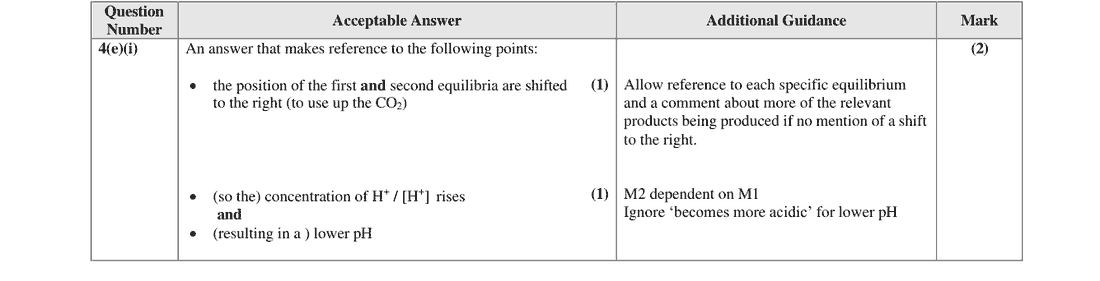
Explain how this increase in the concentration of carbon dioxide affects the
pH of the blood.
Refer to the equilibria in your answer. No calculation is required.
June 2024 · Paper 1 · Q4(e)(ii) 2 marks Explanation acid base equilibria
Earlier parts of question 4 that this part usesEarlier part of June 2024 Paper 1 question 4Earlier part of June 2024 Paper 1 question 4
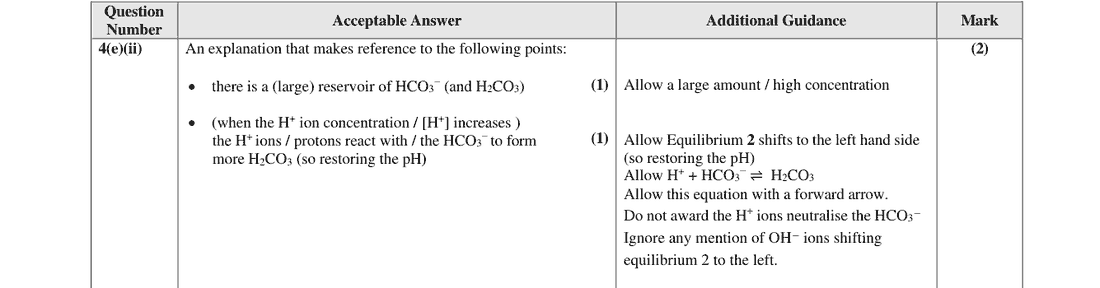
Explain how the carbonic acid–hydrogencarbonate buffer system in
Equilibrium 2 acts to restore the pH of the blood after a person has exercised.
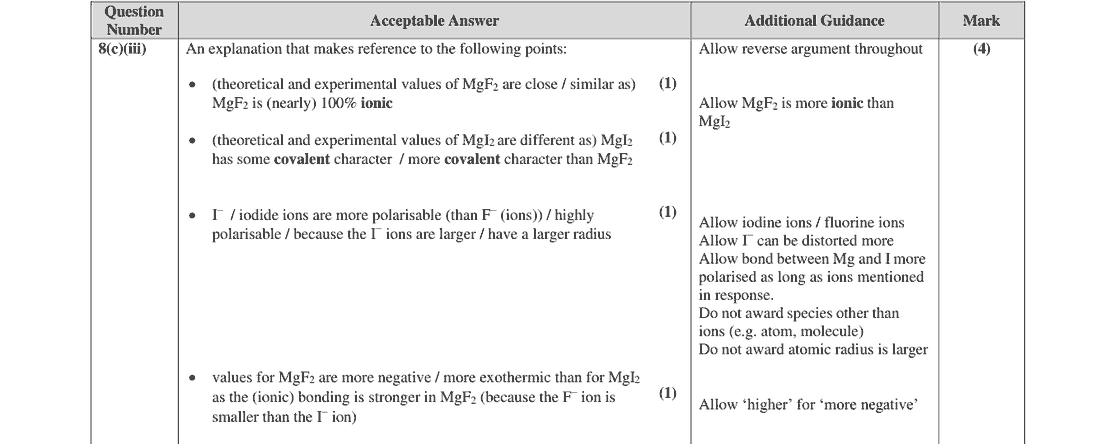
June 2024 · Paper 1 · Q8(c)(iii) 4 marks Explanation lattice energy
Earlier parts of question 8 that this part usesEarlier part of June 2024 Paper 1 question 8Earlier part of June 2024 Paper 1 question 8Earlier part of June 2024 Paper 1 question 8
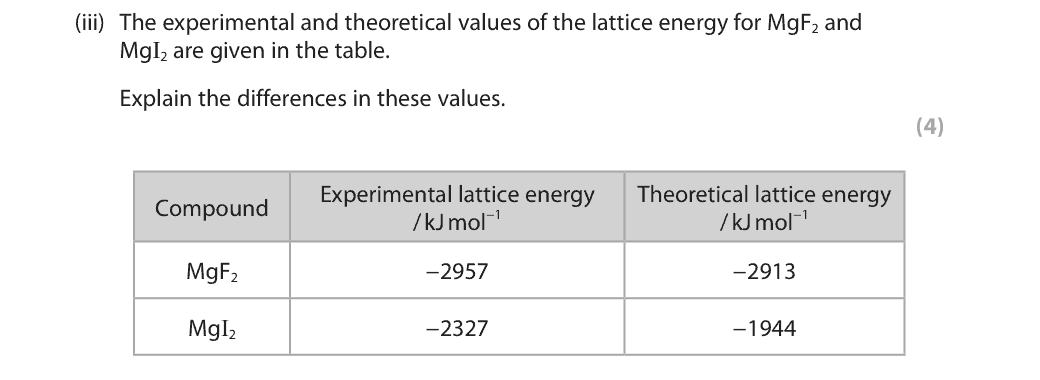
The experimental and theoretical values of the lattice energy for MgF2 and
MgI2 are given in the table.
Explain the differences in these values.
Experimental lattice energy
Theoretical lattice energy
Compound
/ kJ mol−1
/ kJ mol−1
MgF2
−2957
−2913
MgI2
−2327
−1944
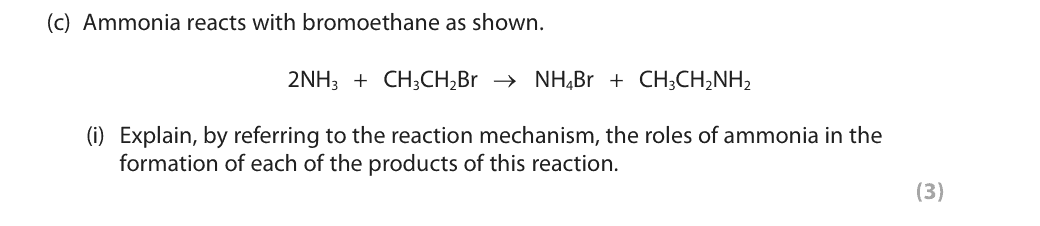
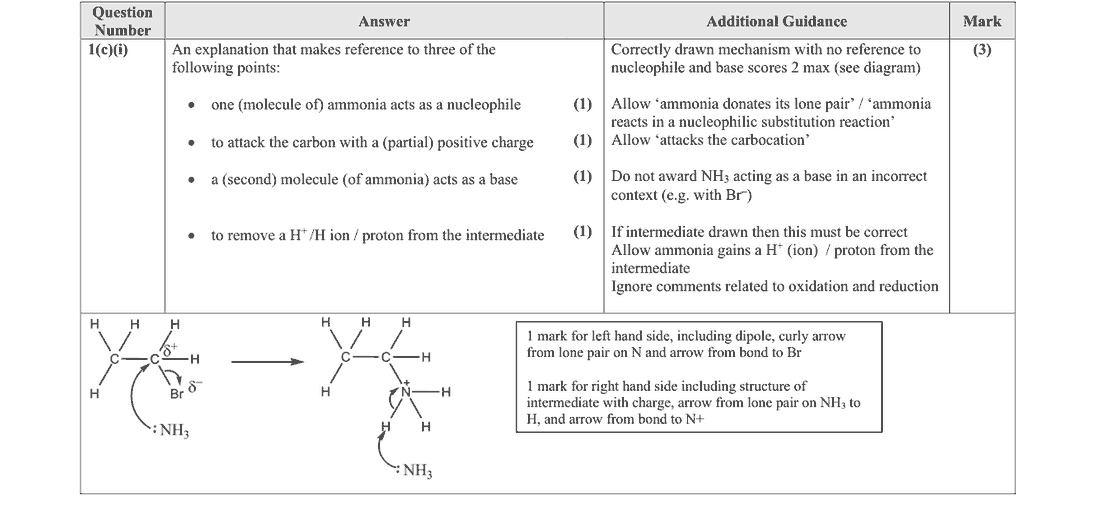
June 2024 · Paper 2 · Q1(c)(i) 3 marks Explanation halogenoalkanes
Earlier part of question 1 that this part usesEarlier part of June 2024 Paper 2 question 1
Ammonia reacts with bromoethane as shown.
2NH3   +   CH3CH2Br   →   NH4Br   +   CH3CH2NH2
Explain, by referring to the reaction mechanism, the roles of ammonia in the
formation of each of the products of this reaction.
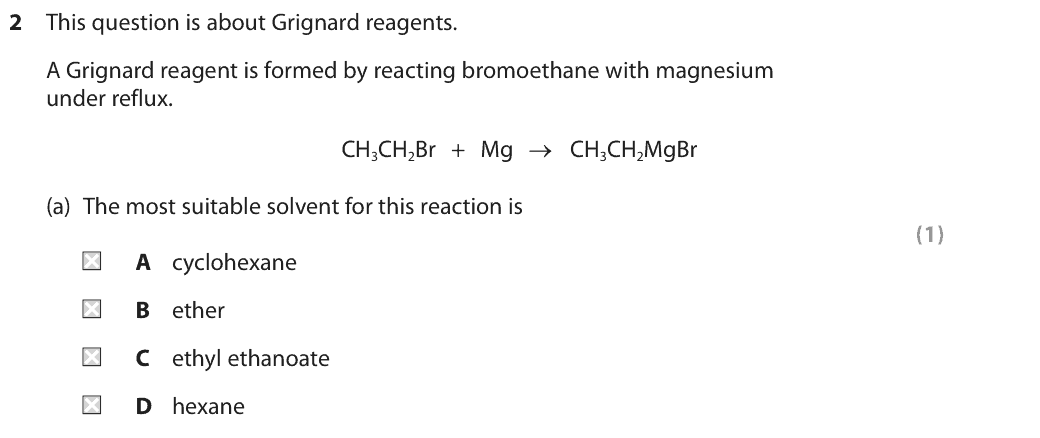
June 2024 · Paper 2 · Q2(d) 2 marks Explanation organic synthesis
Earlier part of question 2 that this part usesEarlier part of June 2024 Paper 2 question 2
Grignard reagents must be kept dry.
Predict the organic product that forms when CH3CH2MgBr reacts with water.
Justify your answer by considering the polarity of both CH3CH2MgBr and water.
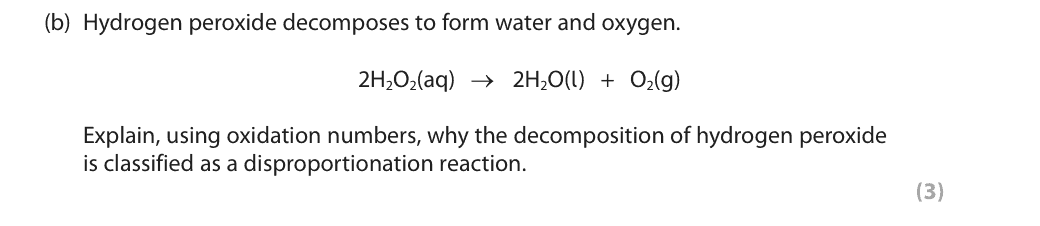
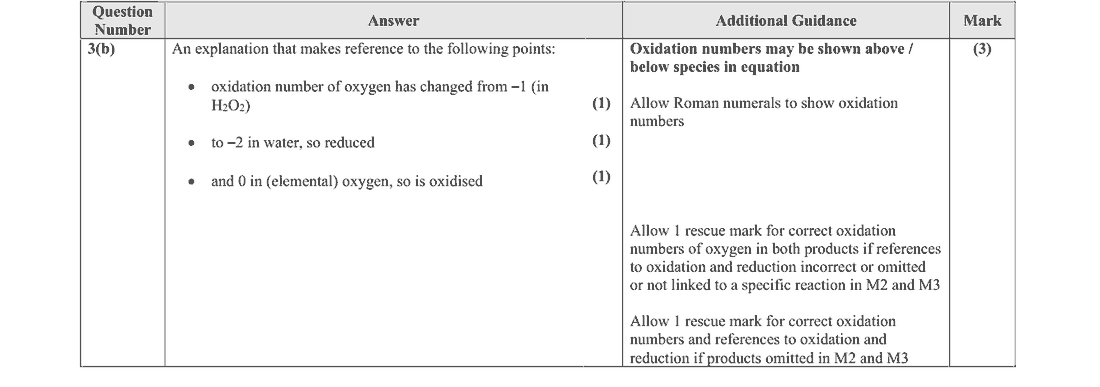
June 2024 · Paper 2 · Q3(b) 3 marks Explanation redox i
Earlier part of question 3 that this part usesEarlier part of June 2024 Paper 2 question 3
Hydrogen peroxide decomposes to form water and oxygen.
2H2O2(aq)   →   2H2O(l)   +   O2(g)
Explain, using oxidation numbers, why the decomposition of hydrogen peroxide
is classified as a disproportionation reaction.
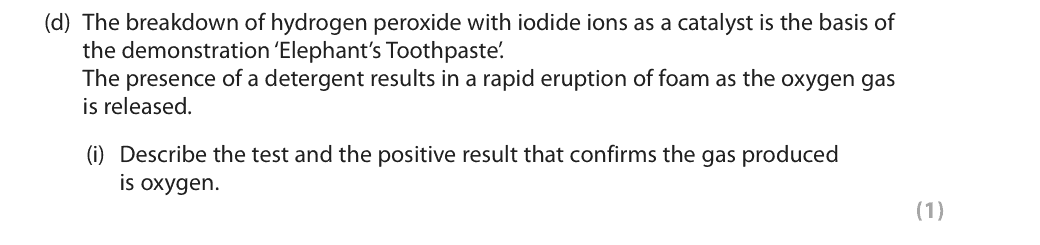
June 2024 · Paper 2 · Q3(d)(ii) 2 marks Explanation redox i
Earlier parts of question 3 that this part usesEarlier part of June 2024 Paper 2 question 3Earlier part of June 2024 Paper 2 question 3
The foam produced often has a slight yellow / brown colour.
Explain what causes this colour, which is not caused by the detergent.
June 2024 · Paper 2 · Q5(d)(i) 2 marks Explanation halogenoalkanesalcohols
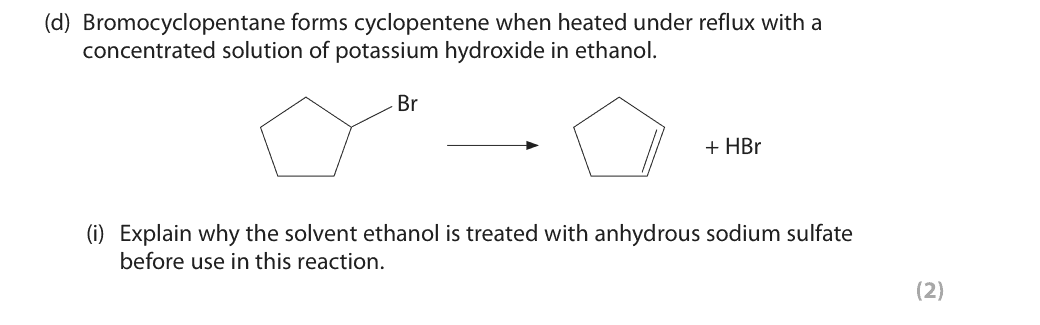
Bromocyclopentane forms cyclopentene when heated under reflux with a
concentrated solution of potassium hydroxide in ethanol.
Br
+ HBr
Explain why the solvent ethanol is treated with anhydrous sodium sulfate
before use in this reaction.
June 2024 · Paper 2 · Q6(b) 2 marks Explanation nmr mass spectrometry and chromatography
Explain why tetramethylsilane, TMS, is used in NMR spectroscopy.
June 2024 · Paper 2 · Q7(c)(i) 2 marks Explanation alkenes
Earlier part of question 7 that this part usesEarlier part of June 2024 Paper 2 question 7
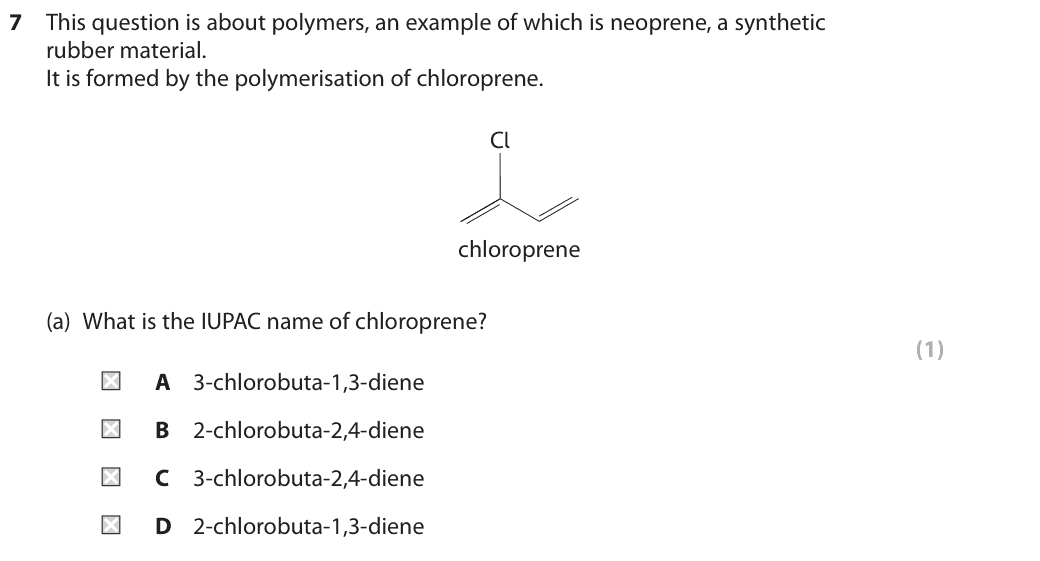
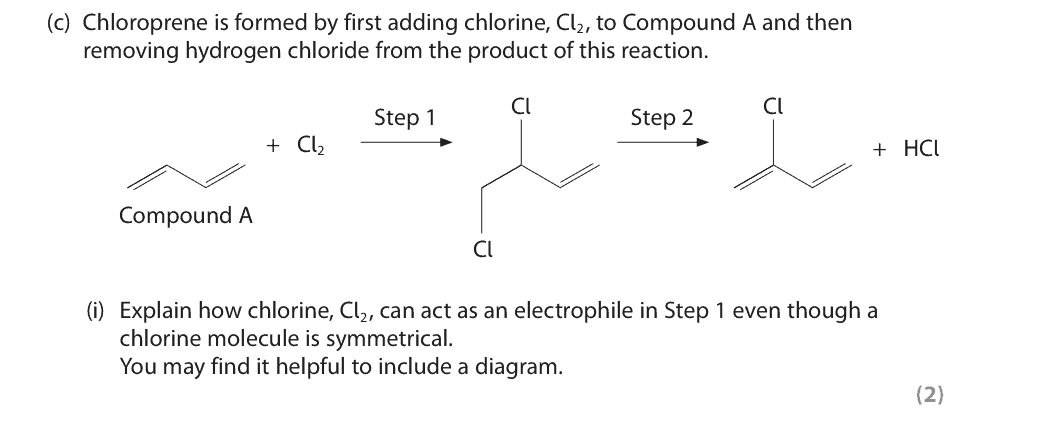
Chloroprene is formed by first adding chlorine, Cl2, to Compound A and then
removing hydrogen chloride from the product of this reaction.
Cl
Cl
Step 1
Step 2
+   Cl2
+   HCl
Compound A
Cl
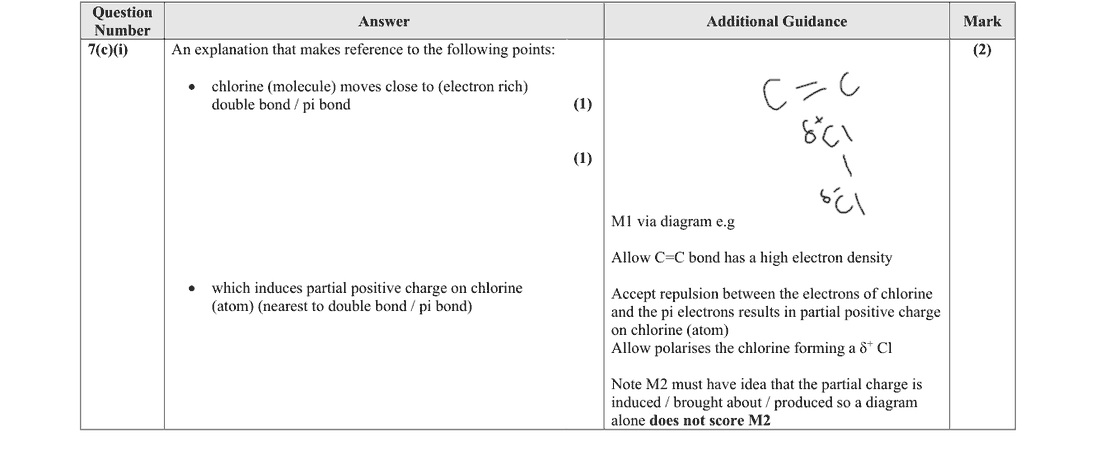
Explain how chlorine, Cl2, can act as an electrophile in Step 1 even though a
chlorine molecule is symmetrical.
You may find it helpful to include a diagram.
June 2024 · Paper 2 · Q7(d)(i) 2 marks Explanation bonding
Earlier part of question 7 that this part usesEarlier part of June 2024 Paper 2 question 7
Flexible and water‑resistant materials can be made by combining neoprene with
polyester fabric.
A polyester may be made by the reaction of benzene‑1,4‑dicarboxylic acid with
ethane‑1,2‑diol.
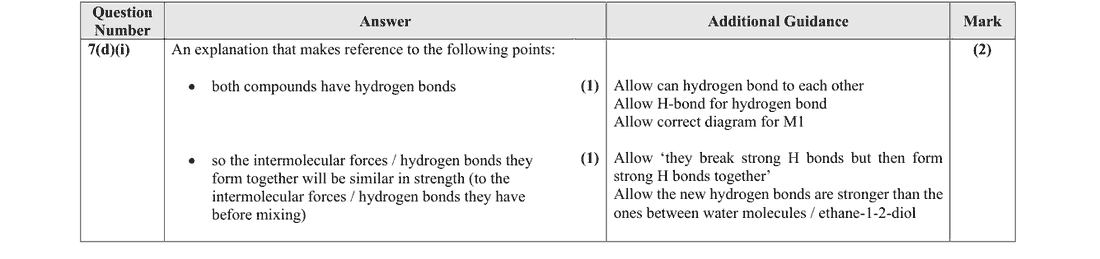
Explain why ethane‑1,2‑diol is soluble in water.
A detailed description of the forces involved is not required.
June 2024 · Paper 2 · Q8(e) 2 marks Explanation amines amides amino acids and proteins
Earlier part of question 8 that this part usesEarlier part of June 2024 Paper 2 question 8
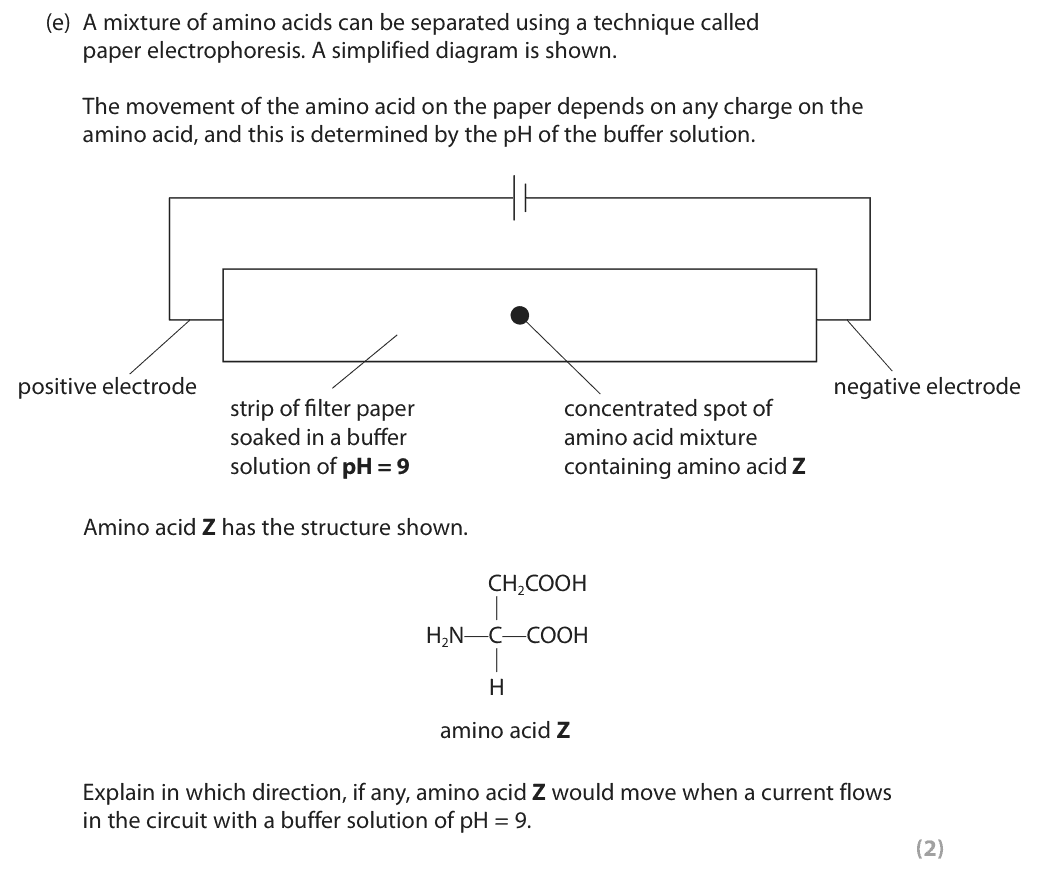
A mixture of amino acids can be separated using a technique called
paper electrophoresis. A simplified diagram is shown.
The movement of the amino acid on the paper depends on any charge on the
amino acid, and this is determined by the pH of the buffer solution.
positive electrode
negative electrode
strip of filter paper
concentrated spot of
soaked in a buffer
amino acid mixture
solution of pH = 9
containing amino acid Z
Amino acid Z has the structure shown.
CH2COOH
H2N
C
COOH
H
amino acid Z
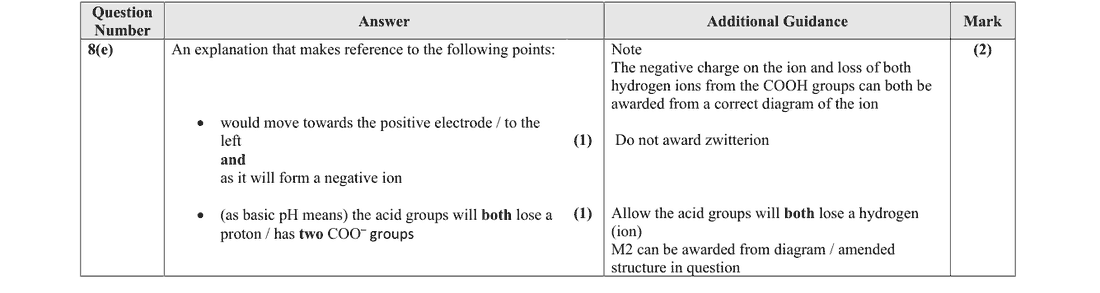
Explain in which direction, if any, amino acid Z would move when a current flows
in the circuit with a buffer solution of pH = 9.
June 2024 · Paper 3 · Q2(a) 3 marks Explanation bonding
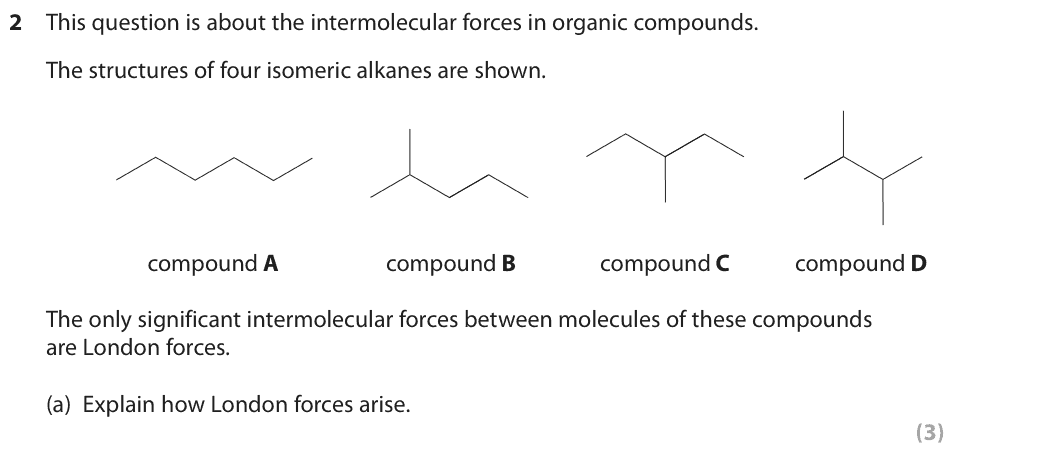
This question is about the intermolecular forces in organic compounds.
The structures of four isomeric alkanes are shown.
compound A
compound B
compound C
compound D
The only significant intermolecular forces between molecules of these compounds
are London forces.
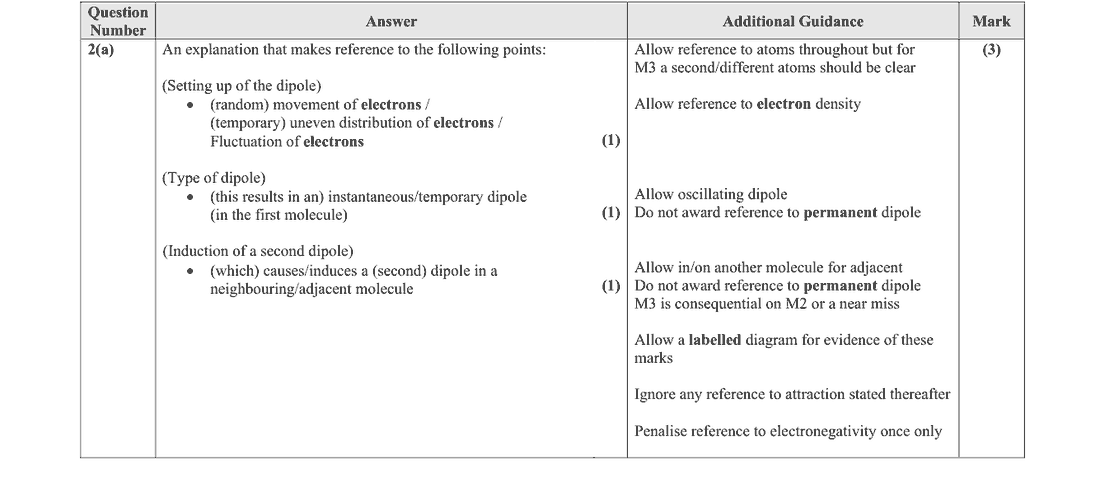
Explain how London forces arise.
June 2024 · Paper 3 · Q2(b) 2 marks Explanation bonding
Earlier part of question 2 that this part usesEarlier part of June 2024 Paper 3 question 2
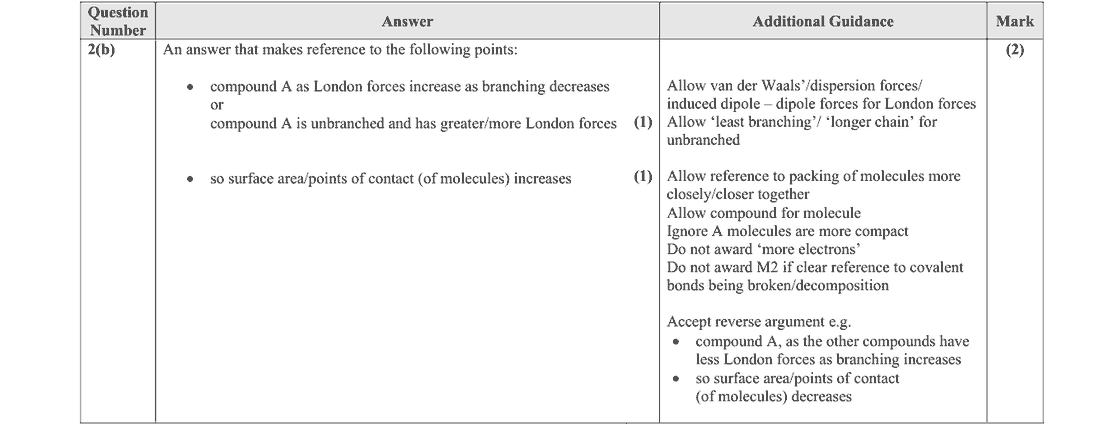
Explain which of the compounds A–D will have the highest boiling temperature.
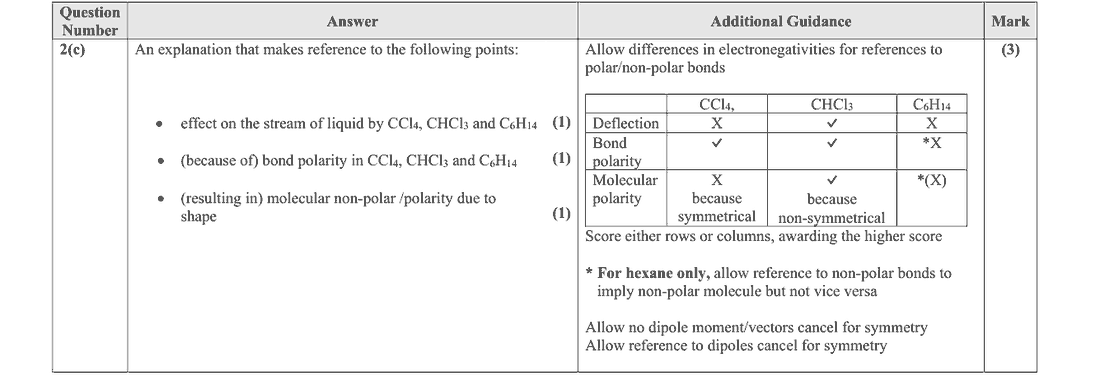
June 2024 · Paper 3 · Q2(c) 3 marks Explanation bonding
Earlier part of question 2 that this part usesEarlier part of June 2024 Paper 3 question 2
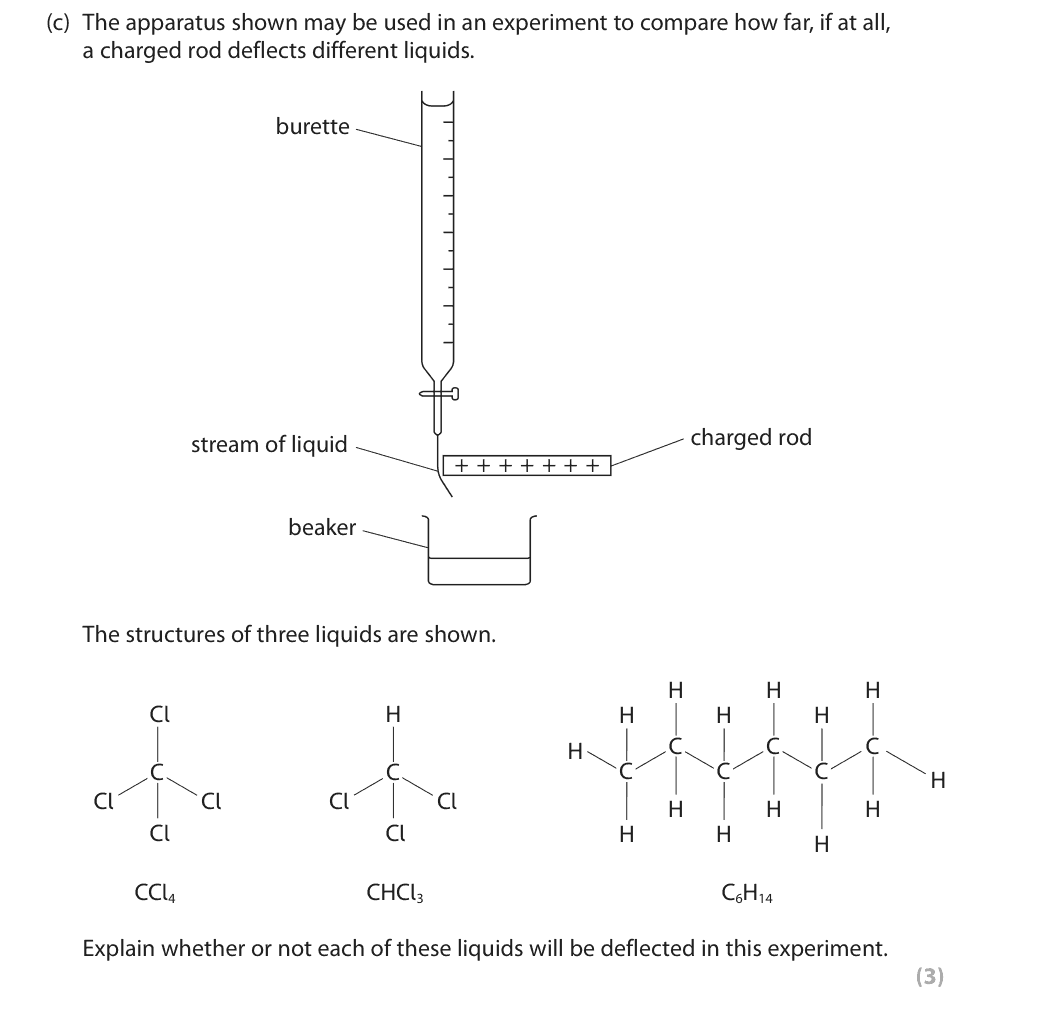
The apparatus shown may be used in an experiment to compare how far, if at all,
a charged rod deflects different liquids.
burette
charged rod
stream of liquid
+
+
+
+
+
+
+
beaker
The structures of three liquids are shown.
H
H
H
Cl
H
H
H
H
C
C
C
H
C
C
C
C
C
H
Cl
Cl
Cl
Cl
H
H
H
Cl
Cl
H
H
H
CCl4
CHCl3
C6H14
Explain whether or not each of these liquids will be deflected in this experiment.
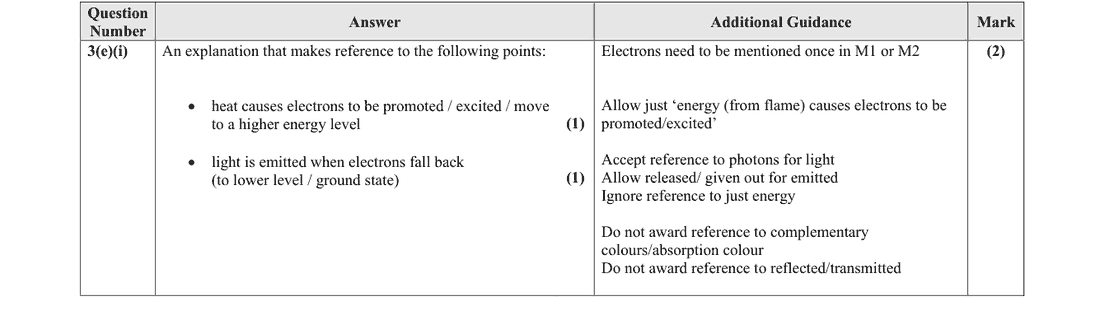
June 2024 · Paper 3 · Q3(e)(i) 2 marks Explanation groups 1 and 2
Earlier part of question 3 that this part usesEarlier part of June 2024 Paper 3 question 3
Another way to identify a metal ion is a flame test.
Explain what causes the flame colour in such a test.
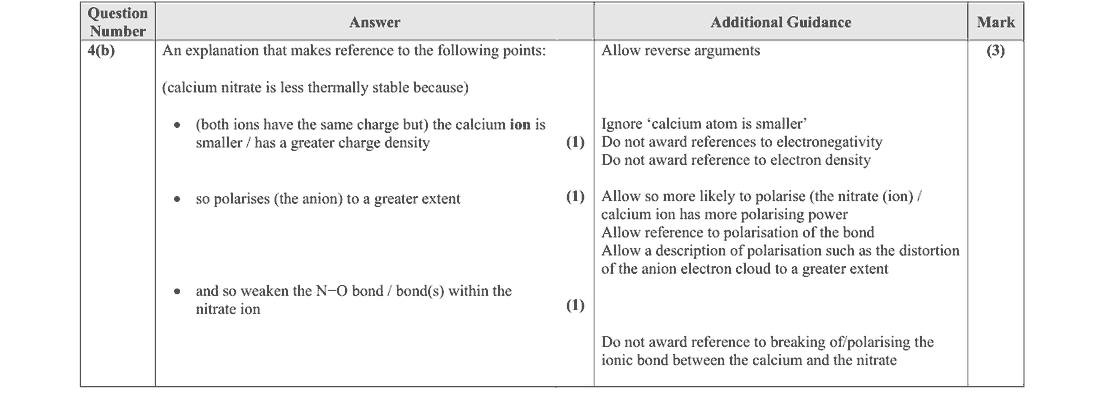
June 2024 · Paper 3 · Q4(b) 3 marks Explanation groups 1 and 2
Explain why calcium nitrate is less thermally stable than barium nitrate.
June 2024 · Paper 3 · Q6(b)(i) 2 marks Explanation nmr mass spectrometry and chromatography
Earlier part of question 6 that this part usesEarlier part of June 2024 Paper 3 question 6
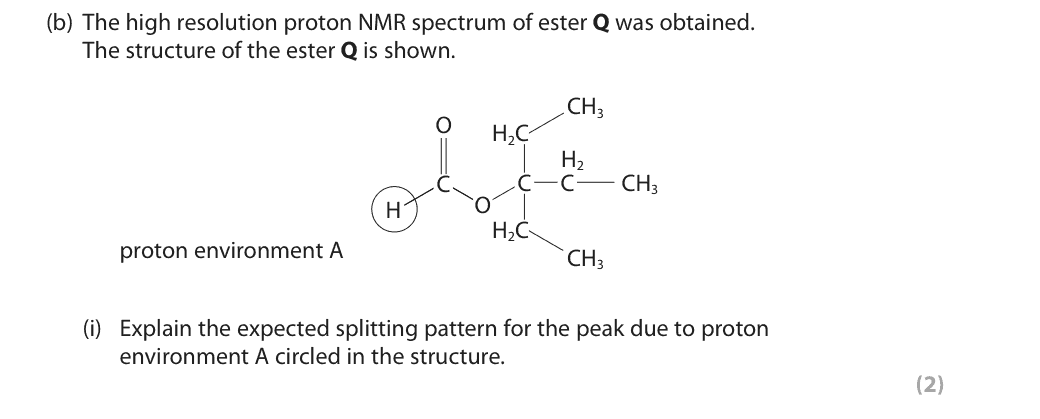
The high resolution proton NMR spectrum of ester Q was obtained.
The structure of the ester Q is shown.
CH3
O
H2C
H2
C
C
C
CH3
H
O
H2C
proton environment A
CH3
Explain the expected splitting pattern for the peak due to proton
environment A circled in the structure.
June 2024 · Paper 3 · Q10(b)(ii) 2 marks Explanation Hard kinetics ii
Earlier parts of question 10 that this part usesEarlier part of June 2024 Paper 3 question 10Earlier part of June 2024 Paper 3 question 10
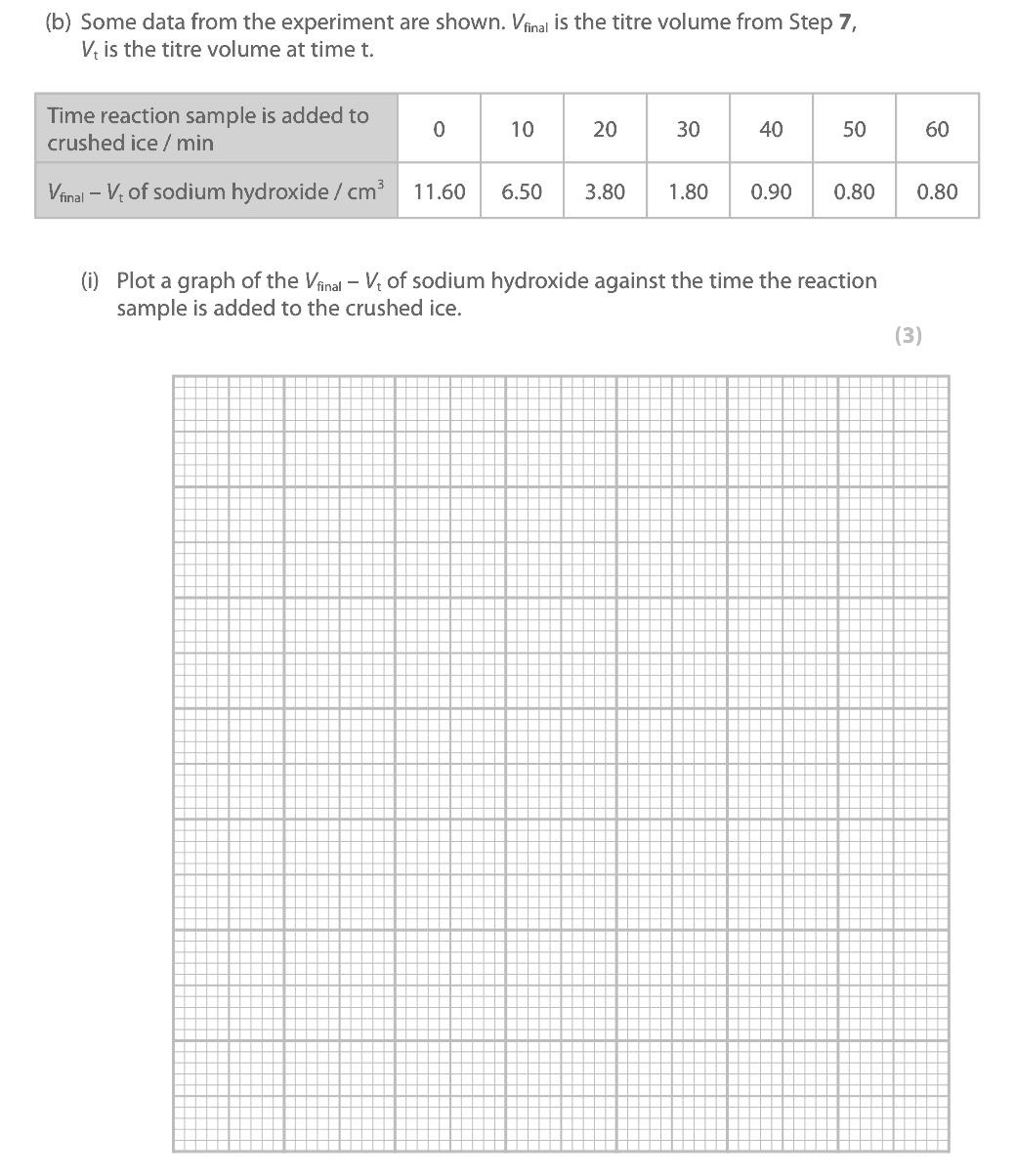
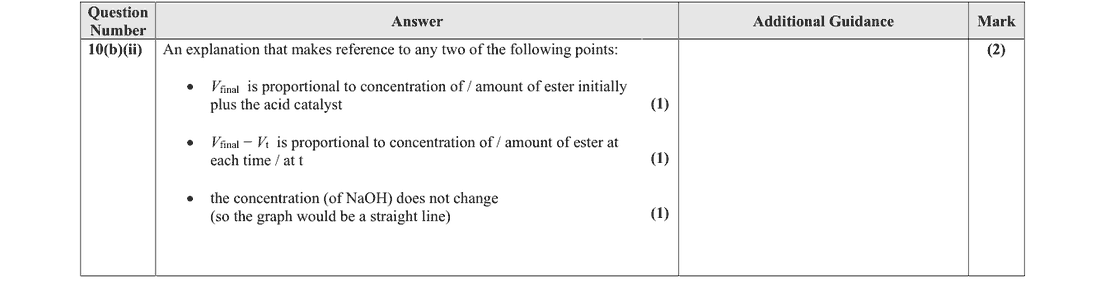
Explain why Vfinal – Vt is plotted rather than the concentration of
sodium hydroxide solution for each titre.
June 2023 · AS Paper 1 · Q3(b)(i) 2 marks Explanation bonding
Earlier part of question 3 that this part usesEarlier part of June 2023 Paper 1 question 3
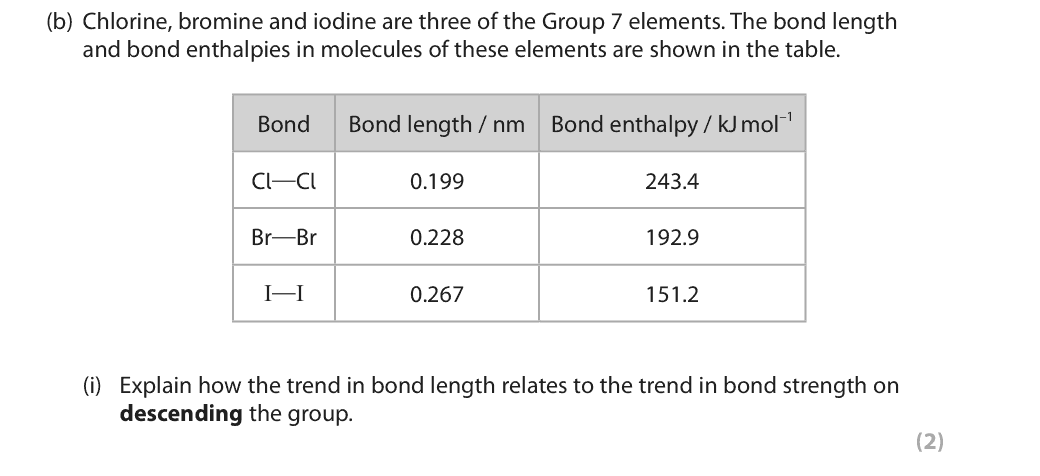
Chlorine, bromine and iodine are three of the Group 7 elements. The bond length
and bond enthalpies in molecules of these elements are shown in the table.
Bond
Bond length / nm
Bond enthalpy / kJ mol–1
Cl
Cl
0.199
243.4
Br
Br
0.228
192.9
I
I
0.267
151.2
Explain how the trend in bond length relates to the trend in bond strength on
descending the group.
June 2023 · AS Paper 1 · Q4(a) 2 marks Explanation bondingstructure
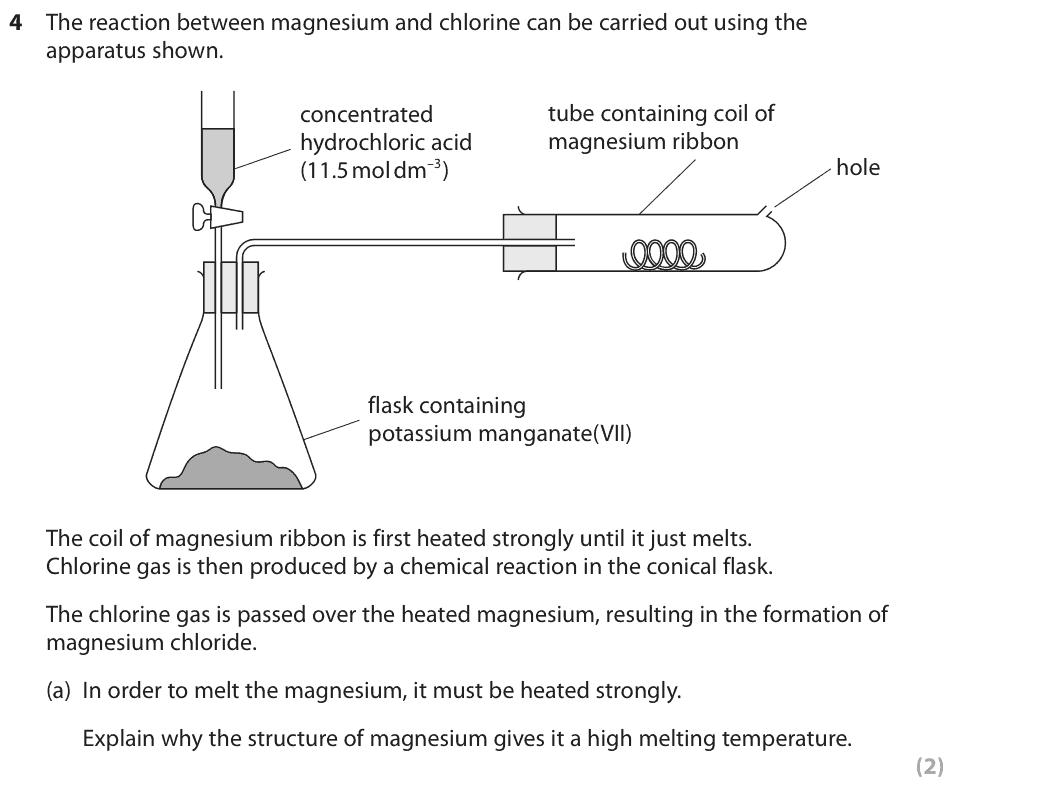
The reaction between magnesium and chlorine can be carried out using the
apparatus shown.
concentrated
tube containing coil of
hydrochloric acid
magnesium ribbon
hole
(11.5 mol dm–3)
flask containing
potassium manganate(VII)
The coil of magnesium ribbon is first heated strongly until it just melts.
Chlorine gas is then produced by a chemical reaction in the conical flask.
The chlorine gas is passed over the heated magnesium, resulting in the formation of
magnesium chloride.
In order to melt the magnesium, it must be heated strongly.
Explain why the structure of magnesium gives it a high melting temperature.
June 2023 · AS Paper 1 · Q5(b) 3 marks Explanation group 7 the halogens
Explain the trend in electronegativity for the Group 7 elements.
June 2023 · AS Paper 1 · Q5(d) 3 marks Explanation Hard structurebonding
Earlier part of question 5 that this part usesEarlier part of June 2023 Paper 1 question 5
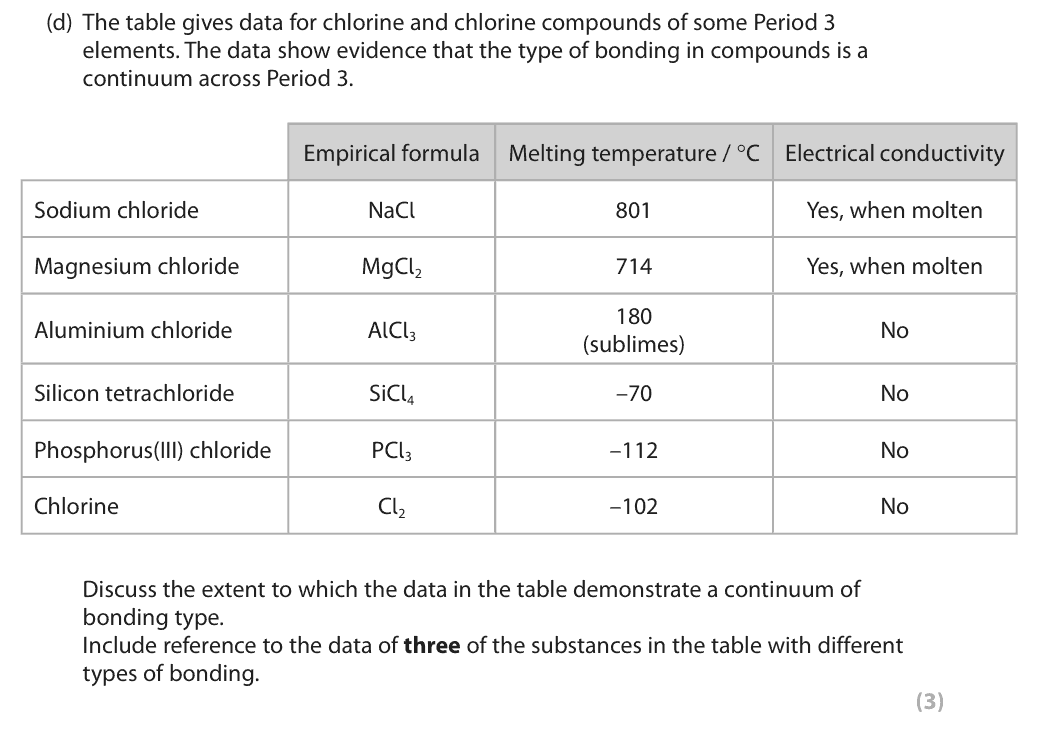
The table gives data for chlorine and chlorine compounds of some Period 3
elements. The data show evidence that the type of bonding in compounds is a
continuum across Period 3.
Empirical formula
Melting temperature / °C
Electrical conductivity
Sodium chloride
NaCl
801
Yes, when molten
Magnesium chloride
MgCl2
714
Yes, when molten
180
Aluminium chloride
AlCl3
No
(sublimes)
Silicon tetrachloride
SiCl4
–70
No
Phosphorus(III) chloride
PCl3
–112
No
Chlorine
Cl2
–102
No
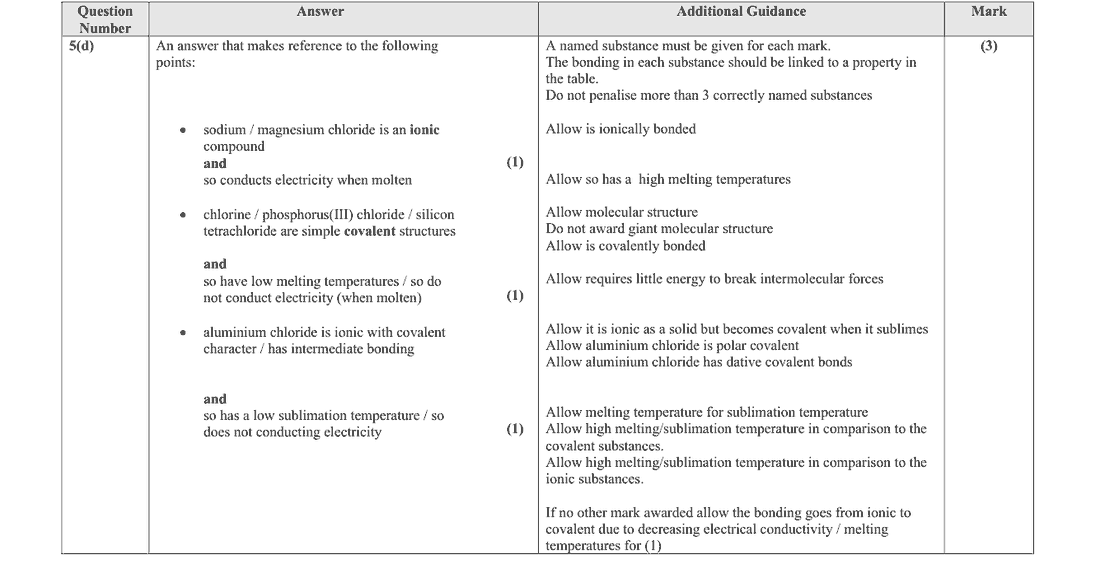
Discuss the extent to which the data in the table demonstrate a continuum of
bonding type.
Include reference to the data of three of the substances in the table with different
types of bonding.
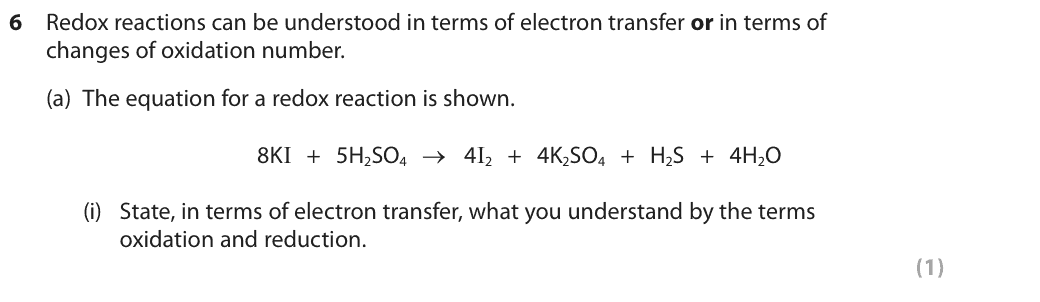
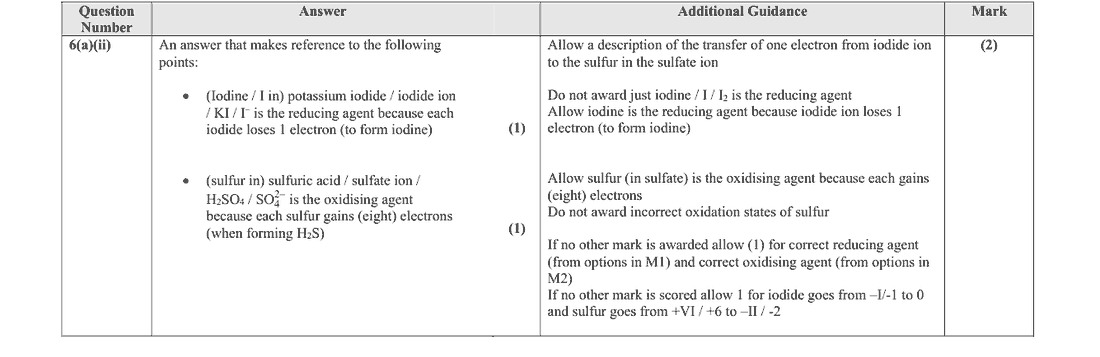
June 2023 · AS Paper 1 · Q6(a)(ii) 2 marks Explanation redox i
Earlier part of question 6 that this part usesEarlier part of June 2023 Paper 1 question 6
Explain, in terms of electron transfer, which of the species is the oxidising
agent and which is the reducing agent.
June 2023 · AS Paper 1 · Q7(b) 4 marks Explanation bonding
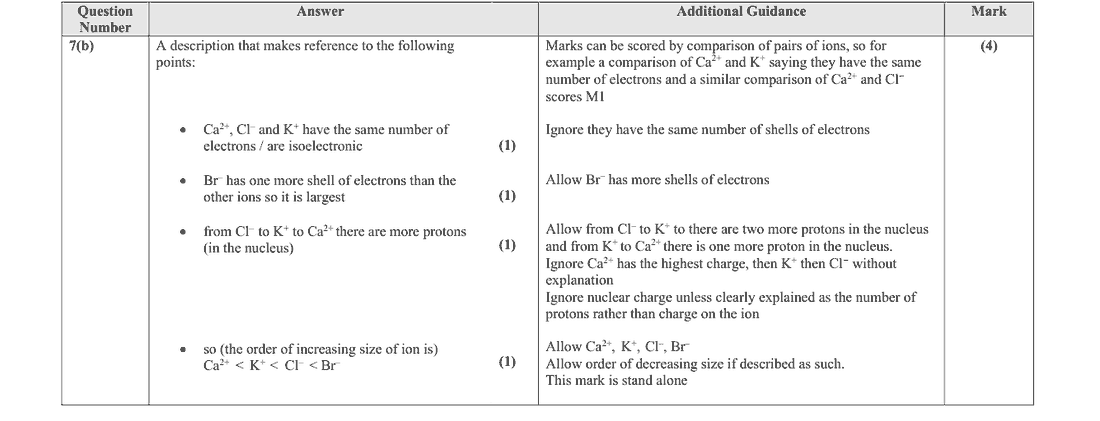
Deduce the order of increasing size of the ions:
Br–, Ca2+, Cl–, K+
Justify your answer.
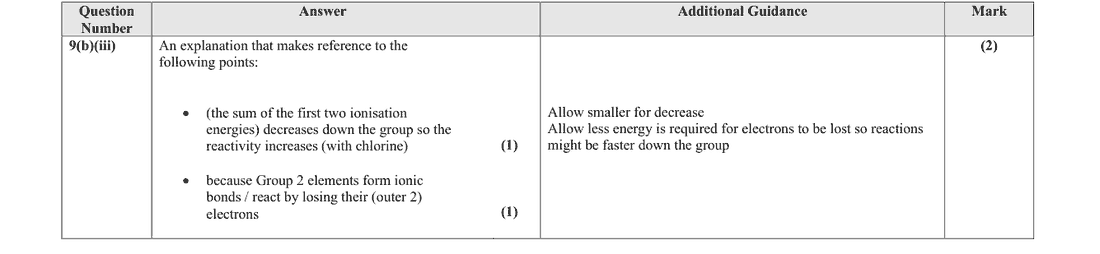
June 2023 · AS Paper 1 · Q9(b)(iii) 2 marks Explanation groups 1 and 2
Earlier part of question 9 that this part usesEarlier part of June 2023 Paper 1 question 9
The value of the sum of the first and second ionisation energies changes on
descending Group 2.
Explain how this changing value might contribute to the relative reactivity of
the elements with chlorine.
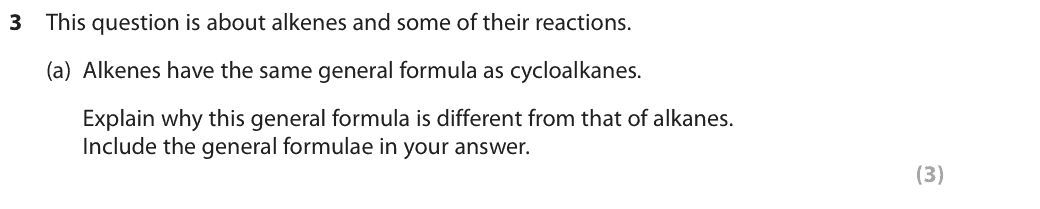
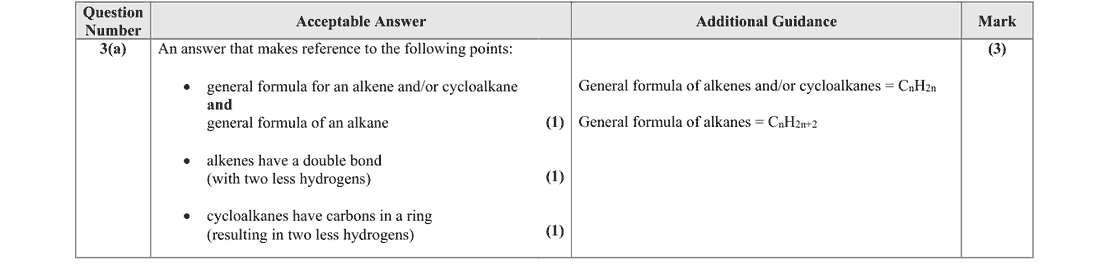
June 2023 · AS Paper 2 · Q3(a) 3 marks Explanation alkenesalkanes
This question is about alkenes and some of their reactions.
Alkenes have the same general formula as cycloalkanes.
Explain why this general formula is different from that of alkanes.
Include the general formulae in your answer.
June 2023 · AS Paper 2 · Q4(a)(ii) 2 marks Explanation halogenoalkanesformulae equations and amounts of substance
Earlier part of question 4 that this part usesEarlier part of June 2023 Paper 2 question 4
Explain why a precipitate forms.
June 2023 · AS Paper 2 · Q5(a)(ii) 2 marks Explanation energetics i
Earlier part of question 5 that this part usesEarlier part of June 2023 Paper 2 question 5
At the end of the experiment there was a black deposit of carbon on the
bottom of the beaker.
Explain the effect of formation of the carbon deposit on your answer to (a)(i).
June 2023 · AS Paper 2 · Q5(c) 2 marks Explanation mass spectrometry and infrared spectroscopy
Earlier part of question 5 that this part usesEarlier part of June 2023 Paper 2 question 5
The student concluded that alcohol Q was either propan‑1‑ol or propan‑2‑ol
because the mass spectrum had the molecular ion peak at m / z = 60.
Explain one peak that you would expect to be present in the mass spectrum of
propan‑1‑ol but not in the mass spectrum of propan‑2‑ol.
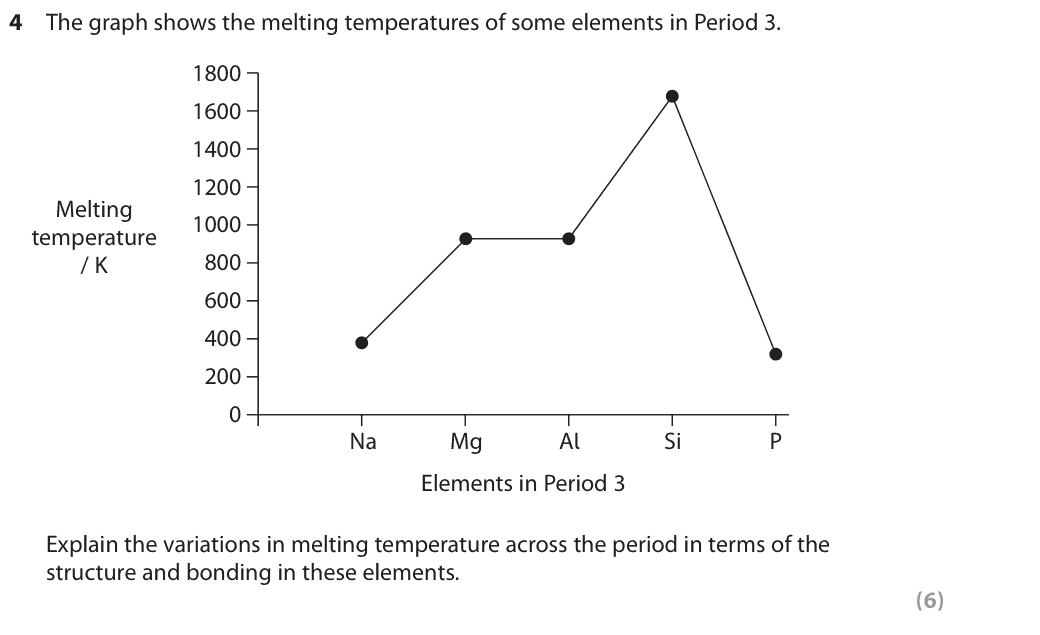
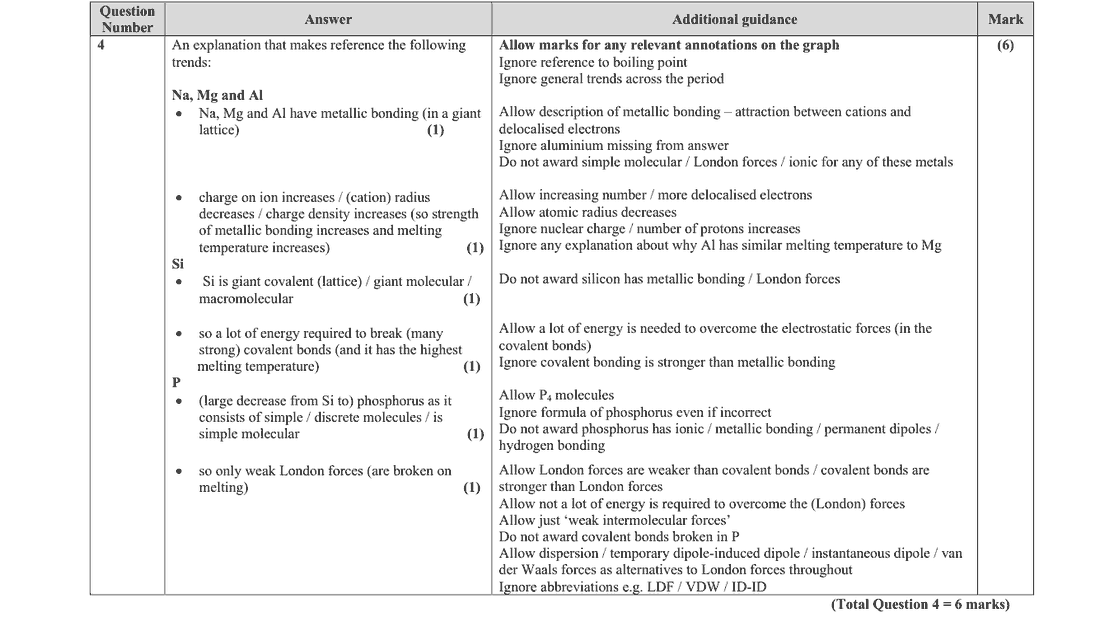
June 2023 · Paper 1 · Q4 6 marks Explanation atomic structure and the periodic tablestructurebonding
The graph shows the melting temperatures of some elements in Period 3.
1800
1600
1400
1200
Melting
1000
temperature
/ K
800
600
400
200
0
Na
Mg
Al
Si
P
Elements in Period 3
Explain the variations in melting temperature across the period in terms of the
structure and bonding in these elements.
June 2023 · Paper 1 · Q6(b) 2 marks Explanation Hard bonding
Earlier part of question 6 that this part usesEarlier part of June 2023 Paper 1 question 6
The ionic salts sodium benzoate and potassium benzoate are both used as
food preservatives.
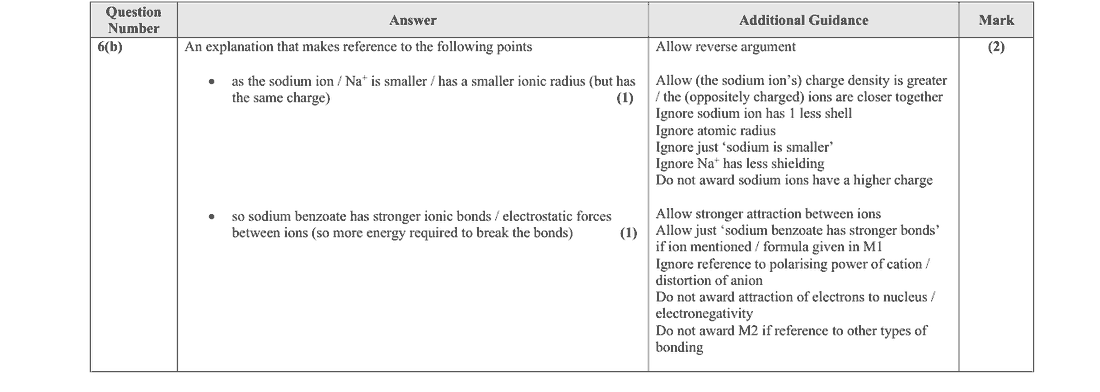
Explain why the melting temperature of sodium benzoate is higher than the
melting temperature of potassium benzoate.
June 2023 · Paper 1 · Q6(d)(iii) 2 marks Explanation acid base equilibria
Earlier parts of question 6 that this part usesEarlier part of June 2023 Paper 1 question 6Earlier part of June 2023 Paper 1 question 6
The standard enthalpy change of neutralisation of the weak acid HCN
by sodium hydroxide is –11.7 kJ mol–1 while that of the strong acid HCl
is –57.9 kJ mol–1.
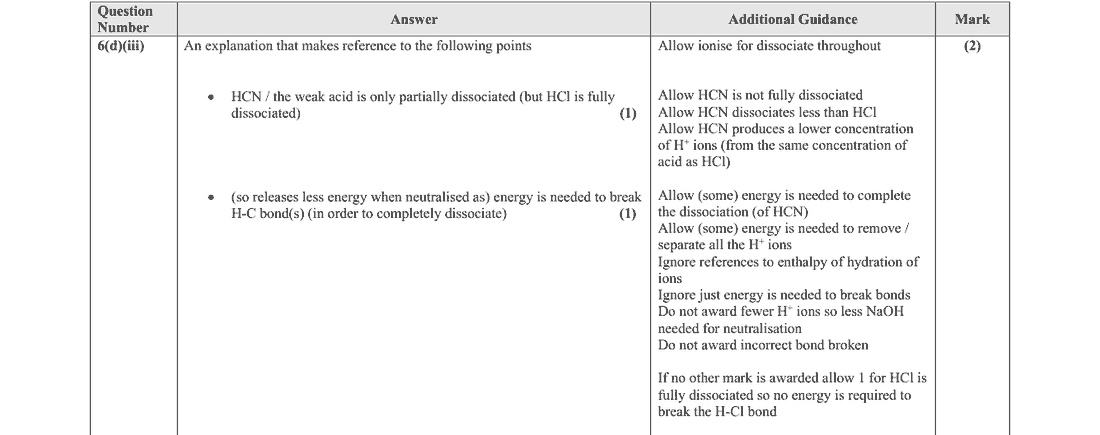
Explain the difference between these values.
June 2023 · Paper 1 · Q7(b)(ii) 3 marks Explanation atomic structure and the periodic table
Earlier parts of question 7 that this part usesEarlier part of June 2023 Paper 1 question 7Earlier part of June 2023 Paper 1 question 7
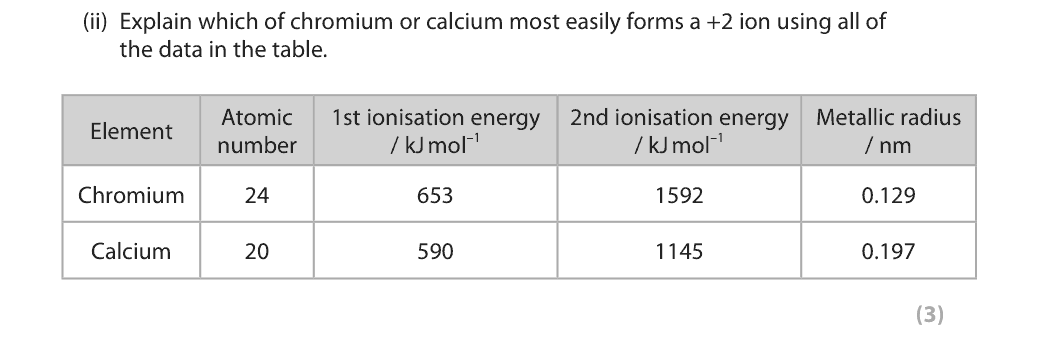
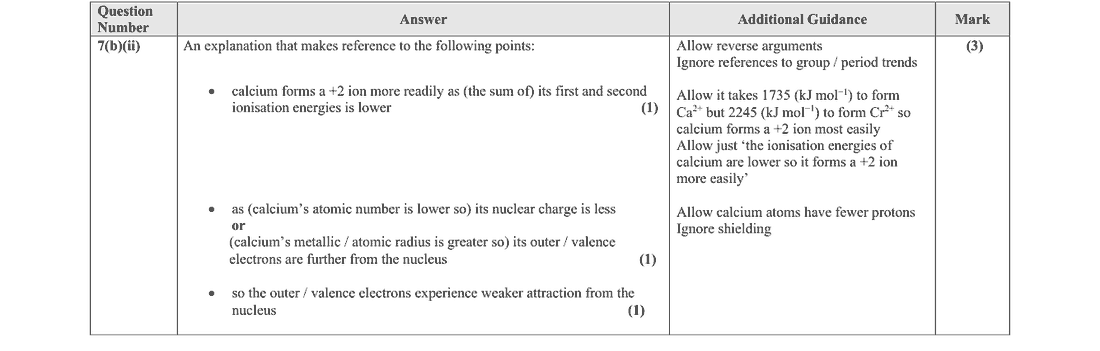
Explain which of chromium or calcium most easily forms a +2 ion using all of
the data in the table.
Atomic
1st ionisation energy
2nd ionisation energy
Metallic radius
Element
number
/ kJ mol–1
/ kJ mol–1
/ nm
Chromium
24
653
1592
0.129
Calcium
20
590
1145
0.197
June 2023 · Paper 1 · Q7(c)(ii) 2 marks Explanation transition metals reactionslattice energy
Earlier parts of question 7 that this part usesEarlier part of June 2023 Paper 1 question 7Earlier part of June 2023 Paper 1 question 7
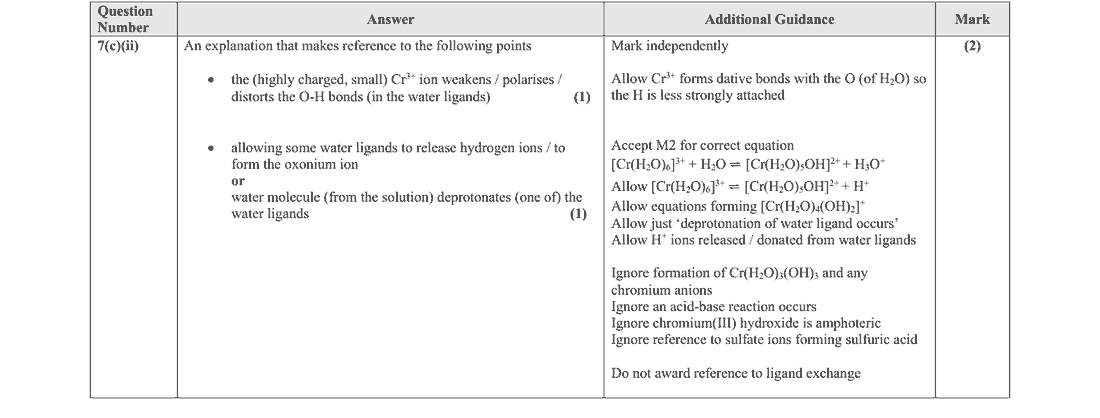
Explain why the aqueous solution of this complex ion has an acidic pH by
considering the interaction between the metal ion and the ligands.
June 2023 · Paper 1 · Q7(d) 4 marks Explanation redox ii
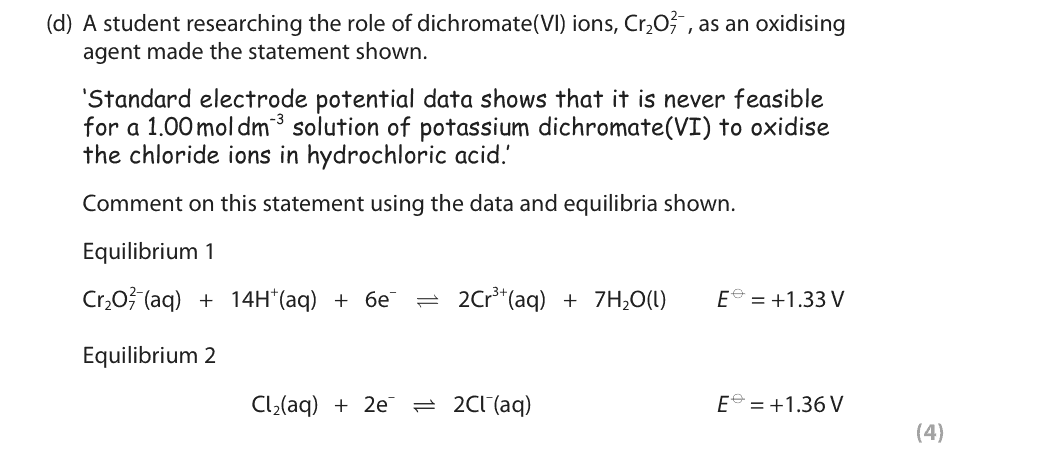
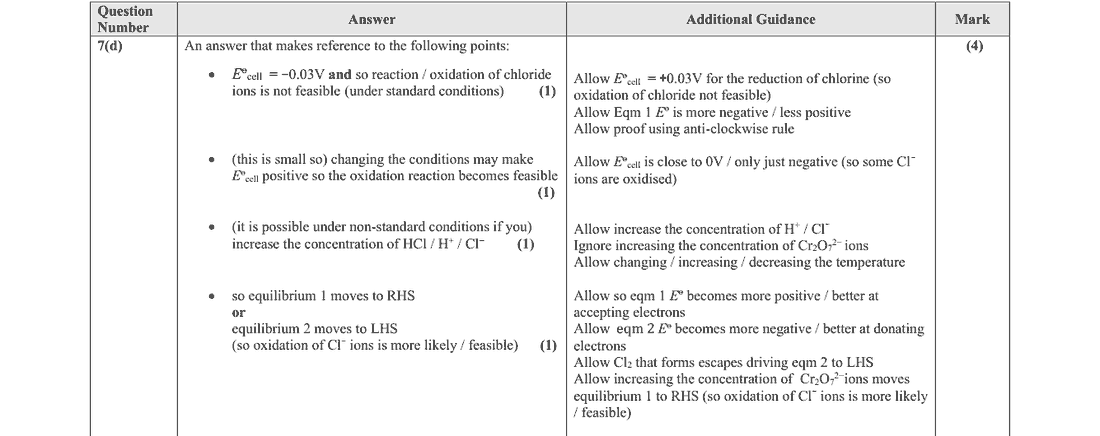
Earlier part of question 7 that this part usesEarlier part of June 2023 Paper 1 question 7
A student researching the role of dichromate(VI) ions, Cr2O7
2– , as an oxidising
agent made the statement shown.
‘Standard electrode potential data shows that it is never feasible
for a 1.00 mol dm–3 solution of potassium dichromate(VI) to oxidise
the chloride ions in hydrochloric acid.’
Comment on this statement using the data and equilibria shown.
Equilibrium 1
Cr2O7
2–(aq)   +   14H+(aq)   +   6e–      2Cr3+(aq)   +   7H2O(l)         E d = +1.33 V
Equilibrium 2
Cl2(aq)   +   2e–      2Cl–(aq)
E d = +1.36 V
June 2023 · Paper 1 · Q9(a)(ii) 3 marks Explanation lattice energy
Earlier part of question 9 that this part usesEarlier part of June 2023 Paper 1 question 9
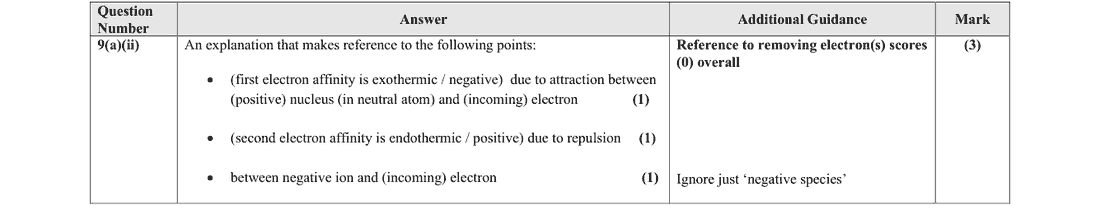
Explain why the value for the first electron affinity of oxygen is negative and
the value for the second electron affinity is positive.
June 2023 · Paper 1 · Q9(b)(ii) 3 marks Explanation lattice energy
Earlier parts of question 9 that this part usesEarlier part of June 2023 Paper 1 question 9Earlier part of June 2023 Paper 1 question 9
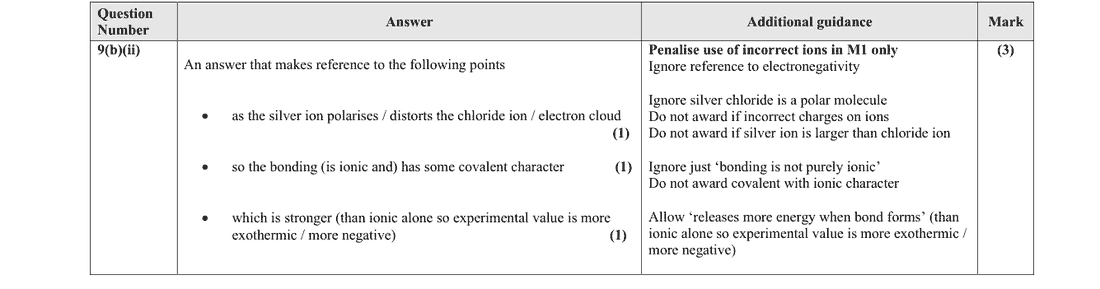
Explain the difference in the two values for the lattice energy of silver chloride
by considering the possible bonding models.
June 2023 · Paper 1 · Q10(b) 4 marks Explanation bonding
Earlier part of question 10 that this part usesEarlier part of June 2023 Paper 1 question 10
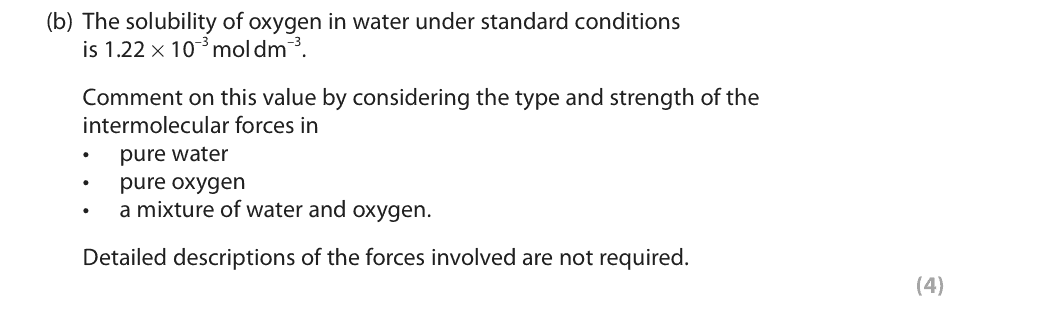
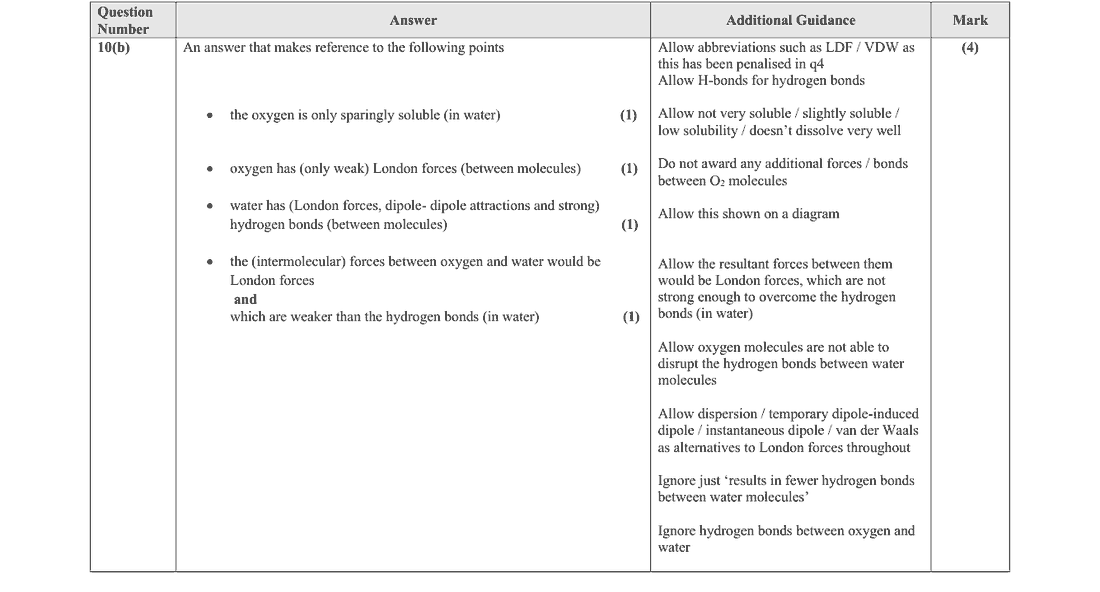
The solubility of oxygen in water under standard conditions
is 1.22 × 10–3 mol dm–3.
Comment on this value by considering the type and strength of the
intermolecular forces in
•
pure water
•
pure oxygen
•
a mixture of water and oxygen.
Detailed descriptions of the forces involved are not required.
June 2023 · Paper 1 · Q10(d) 4 marks Explanation redox ii
Earlier part of question 10 that this part usesEarlier part of June 2023 Paper 1 question 10
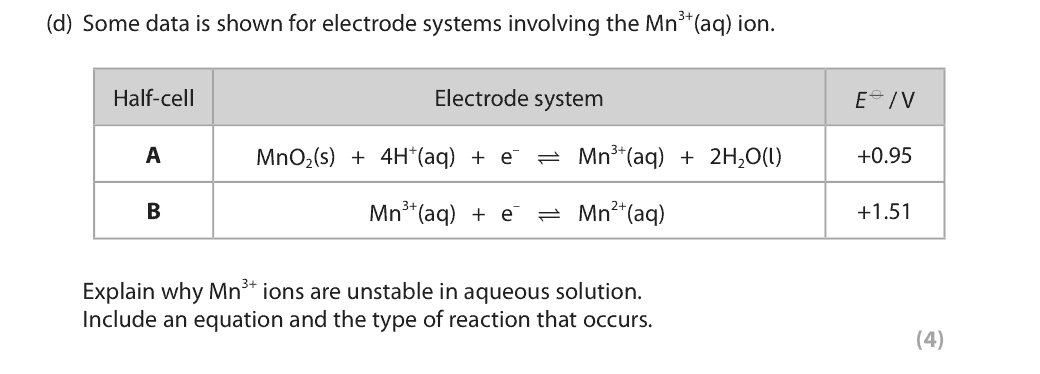
Some data is shown for electrode systems involving the Mn3+(aq) ion.
Half‑cell
Electrode system
E d / V
A
MnO2(s)   +   4H+(aq)   +   e–      Mn3+(aq)   +   2H2O(l)
+0.95
B
+1.51
Mn3+(aq)   +   e–      Mn2+(aq)
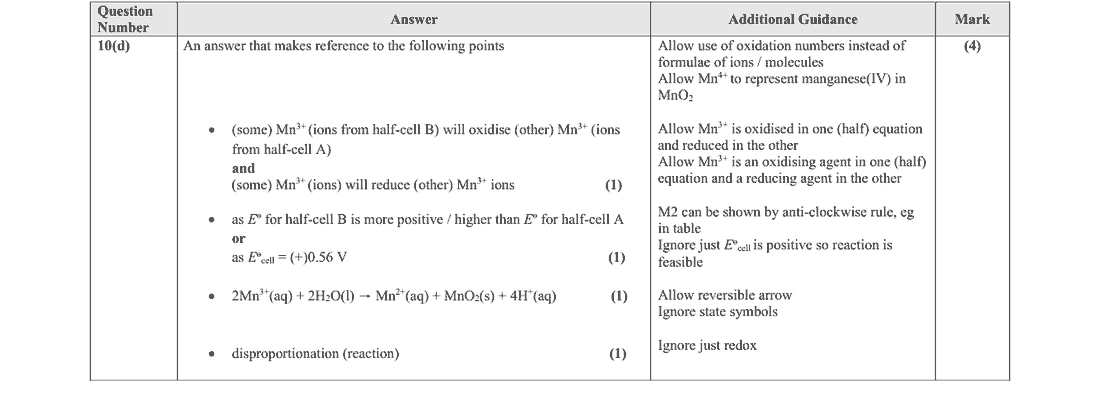
Explain why Mn3+ ions are unstable in aqueous solution.
Include an equation and the type of reaction that occurs.
June 2023 · Paper 2 · Q4(b)(ii) 4 marks Explanation arenes benzene
Earlier part of question 4 that this part usesEarlier part of June 2023 Paper 2 question 4
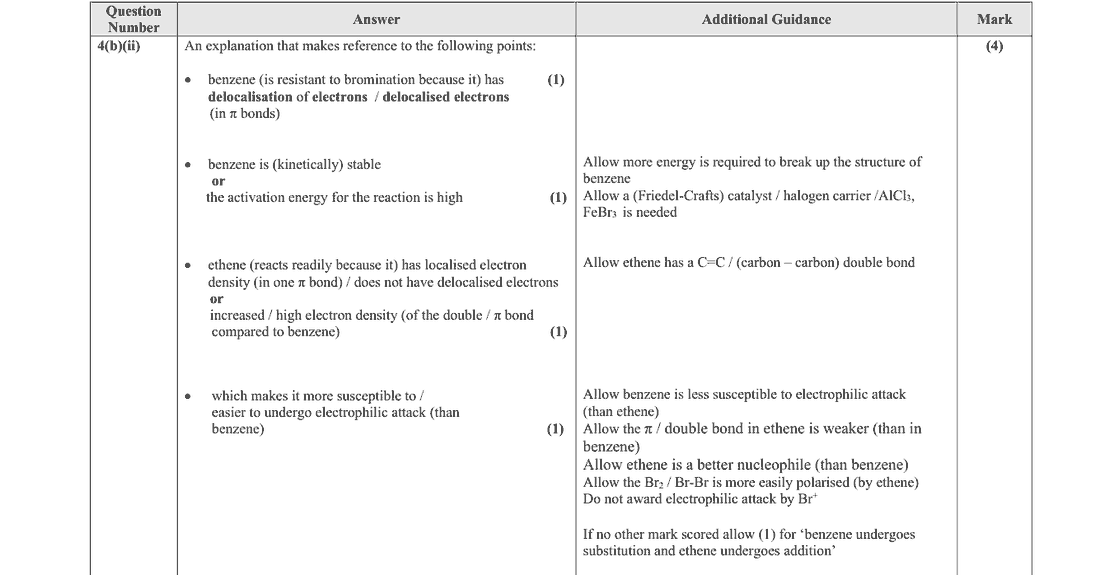
Explain why benzene is resistant to bromination but ethene reacts readily
with bromine at room temperature.
June 2023 · Paper 2 · Q5(d)(ii) 2 marks Explanation kinetics i
Earlier parts of question 5 that this part usesEarlier part of June 2023 Paper 2 question 5Earlier part of June 2023 Paper 2 question 5
Catalysts, such as platinum, are very expensive.
Explain an economic benefit of using a catalyst in an industrial process.
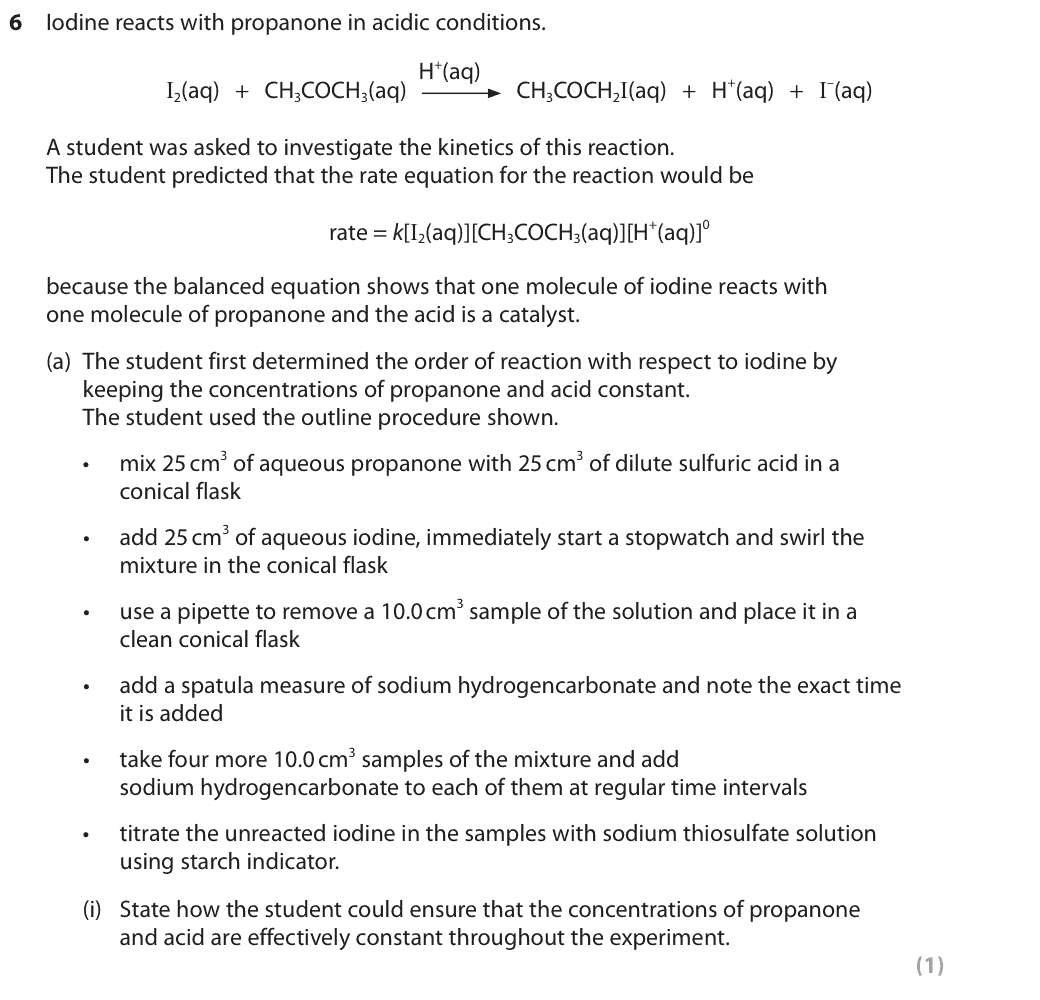
June 2023 · Paper 2 · Q6(c)(iii) 2 marks Explanation kinetics ii
Earlier parts of question 6 that this part usesEarlier part of June 2023 Paper 2 question 6Earlier part of June 2023 Paper 2 question 6Earlier part of June 2023 Paper 2 question 6
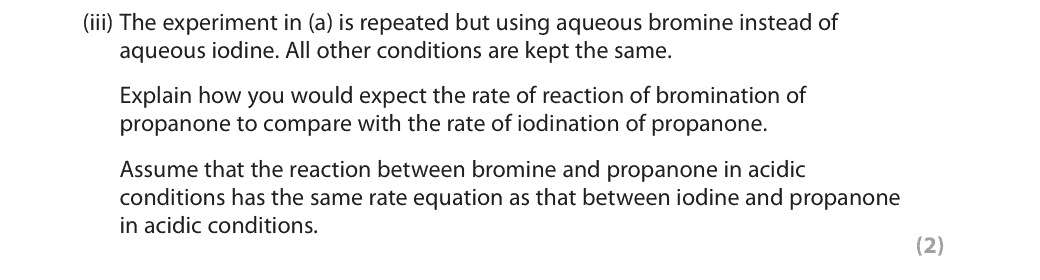
The experiment in (a) is repeated but using aqueous bromine instead of
aqueous iodine. All other conditions are kept the same.
Explain how you would expect the rate of reaction of bromination of
propanone to compare with the rate of iodination of propanone.
Assume that the reaction between bromine and propanone in acidic
conditions has the same rate equation as that between iodine and propanone
in acidic conditions.
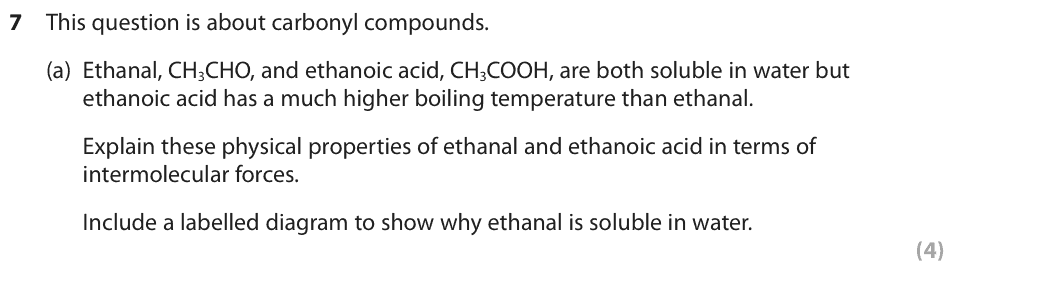
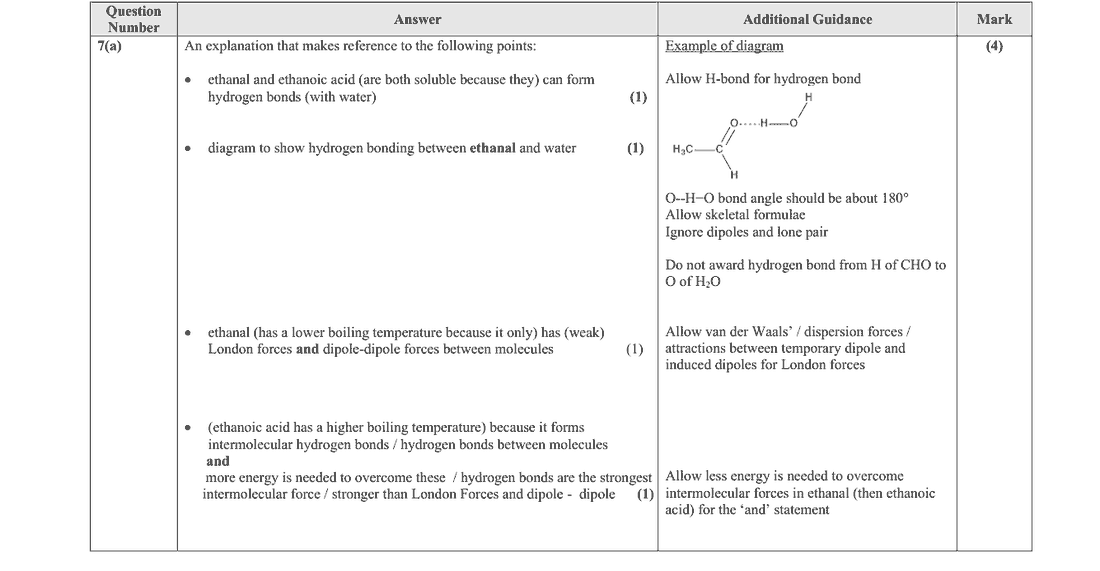
June 2023 · Paper 2 · Q7(a) 4 marks Explanation carbonyl compoundscarboxylic acids
This question is about carbonyl compounds.
Ethanal, CH3CHO, and ethanoic acid, CH3COOH, are both soluble in water but
ethanoic acid has a much higher boiling temperature than ethanal.
Explain these physical properties of ethanal and ethanoic acid in terms of
intermolecular forces.
Include a labelled diagram to show why ethanal is soluble in water.
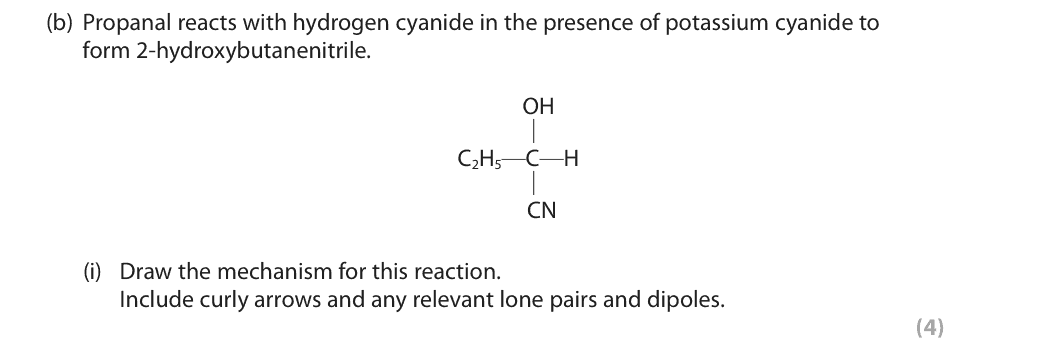
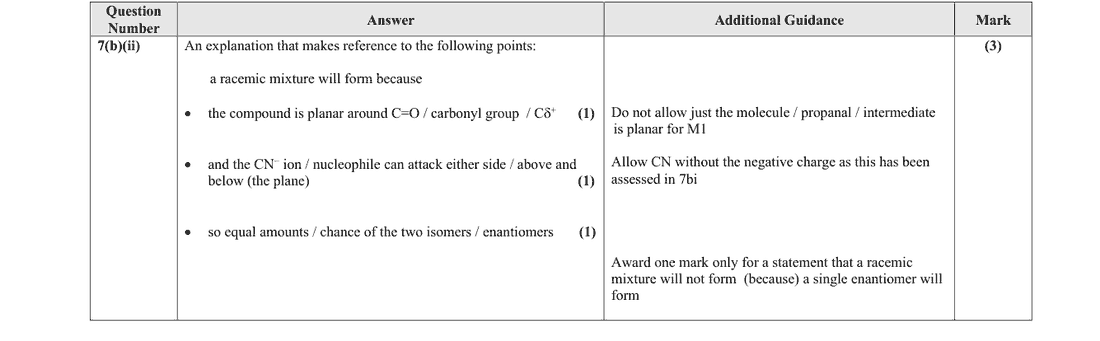
June 2023 · Paper 2 · Q7(b)(ii) 3 marks Explanation carbonyl compoundschirality
Earlier part of question 7 that this part usesEarlier part of June 2023 Paper 2 question 7
Explain whether or not the 2‑hydroxybutanenitrile formed will be a
racemic mixture.
June 2023 · Paper 2 · Q8(c)(i) 2 marks Explanation alkenes
Earlier parts of question 8 that this part usesEarlier part of June 2023 Paper 2 question 8Earlier part of June 2023 Paper 2 question 8
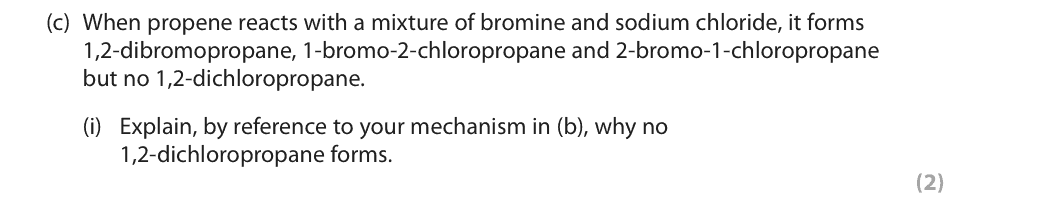
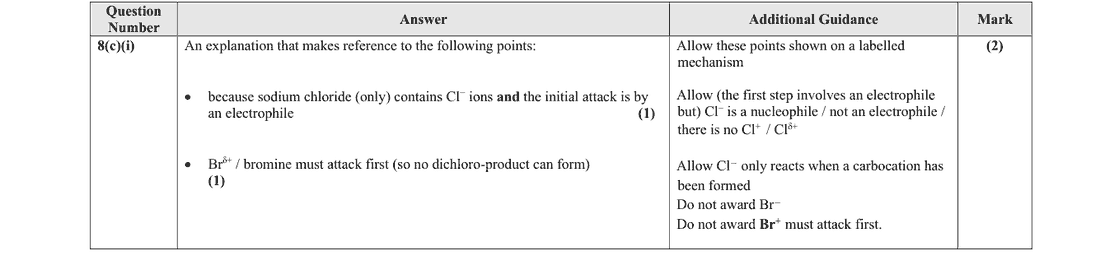
When propene reacts with a mixture of bromine and sodium chloride, it forms
1,2‑dibromopropane, 1‑bromo‑2‑chloropropane and 2‑bromo‑1‑chloropropane
but no 1,2‑dichloropropane.
Explain, by reference to your mechanism in (b), why no
1,2‑dichloropropane forms.
June 2023 · Paper 2 · Q8(c)(ii) 2 marks Explanation alkenes
Earlier part of question 8 that this part usesEarlier part of June 2023 Paper 2 question 8
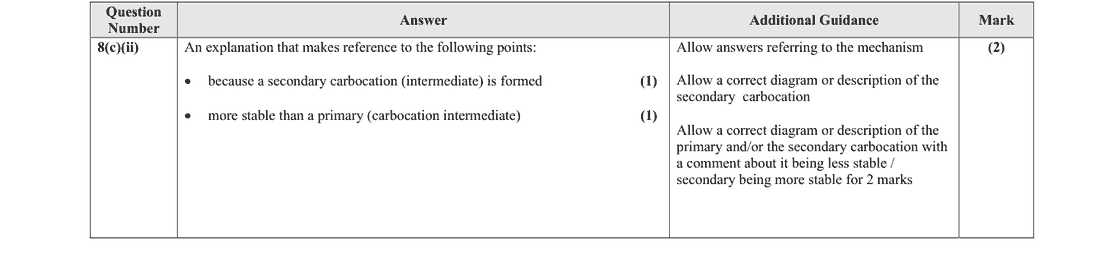
Explain why far more 1‑bromo‑2‑chloropropane forms than
2‑bromo‑1‑chloropropane.
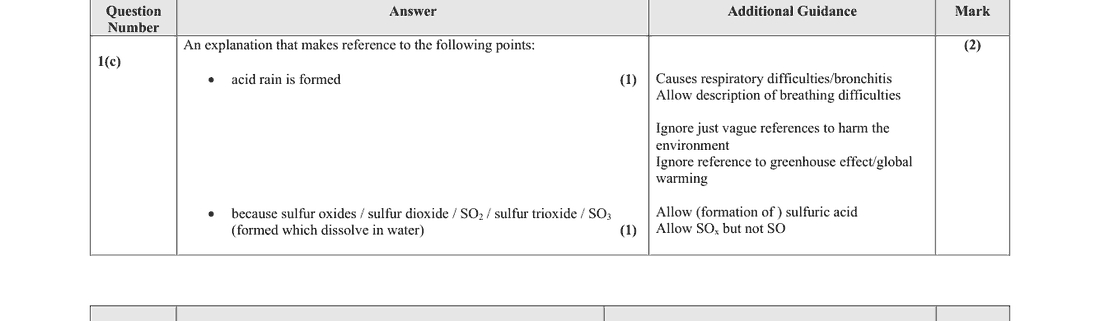
June 2023 · Paper 3 · Q1(c) 2 marks Explanation alkanes
Explain the problem which results from sulfur impurities in fuels.
June 2023 · Paper 3 · Q2(a)(ii) 3 marks Explanation groups 1 and 2
Earlier part of question 2 that this part usesEarlier part of June 2023 Paper 3 question 2
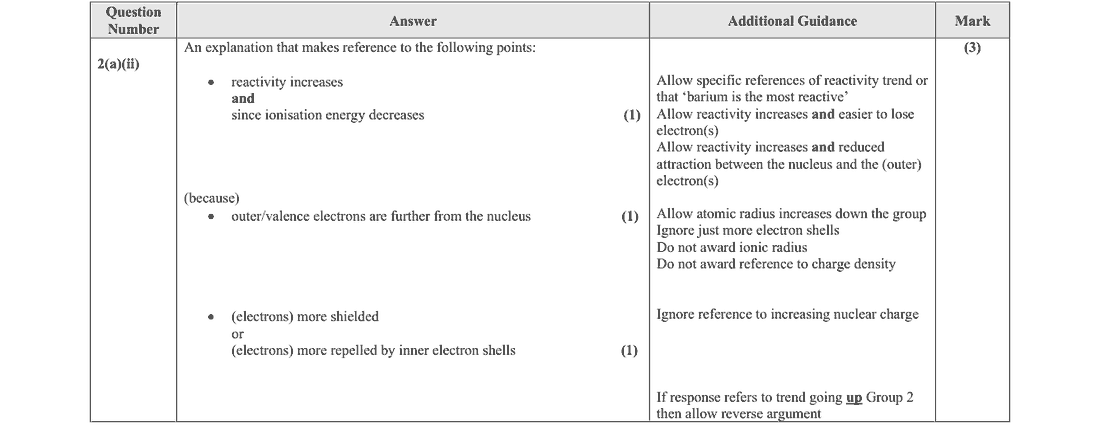
Explain the trend in reactivity of the elements down Group 2.
June 2023 · Paper 3 · Q2(b)(ii) 2 marks Explanation Hard groups 1 and 2
Earlier parts of question 2 that this part usesEarlier part of June 2023 Paper 3 question 2Earlier part of June 2023 Paper 3 question 2
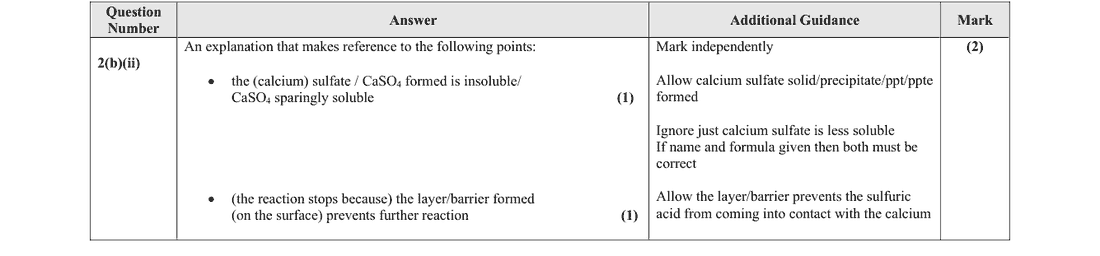
Explain why the reaction between calcium and excess sulfuric acid stops
before all of the metal has reacted.
June 2023 · Paper 3 · Q4(c) 2 marks Explanation lattice energy
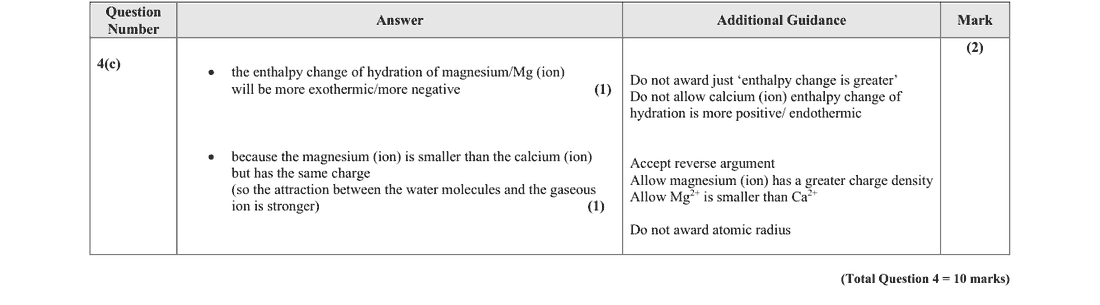
Explain how the enthalpy change of hydration of magnesium ions in
magnesium sulfate is different from the enthalpy change of hydration of
calcium ions in calcium sulfate.
June 2023 · Paper 3 · Q5(b) 5 marks Explanation transition metals reactionsredox ii
Earlier part of question 5 that this part usesEarlier part of June 2023 Paper 3 question 5
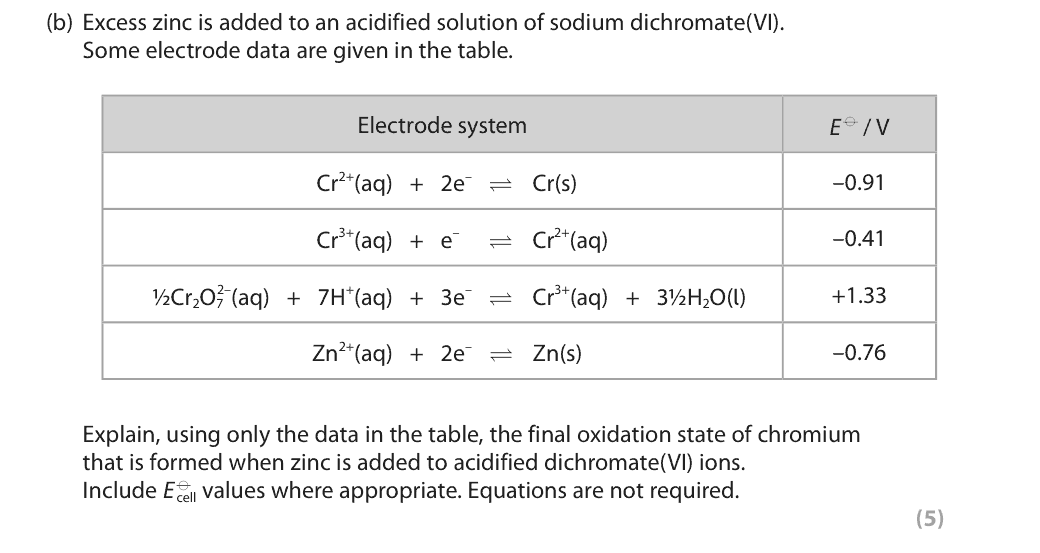
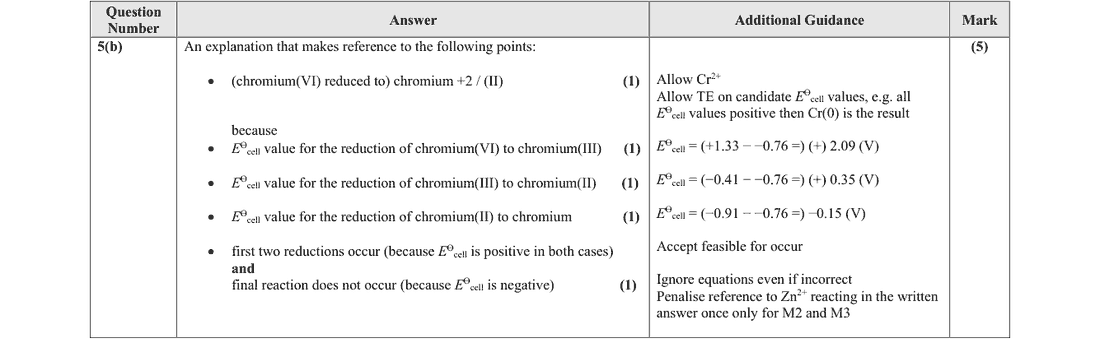
Excess zinc is added to an acidified solution of sodium dichromate(VI).
Some electrode data are given in the table.
Electrode system
E d / V
Cr2+(aq)   +   2e–      Cr(s)
–0.91
Cr3+(aq)   +   e–        Cr2+(aq)
–0.41
½Cr2O7
2–(aq)   +   7H+(aq)   +   3e–      Cr3+(aq)   +   3½H2O(l)
+1.33
Zn2+(aq)   +   2e–      Zn(s)
–0.76
Explain, using only the data in the table, the final oxidation state of chromium
that is formed when zinc is added to acidified dichromate(VI) ions.
Include E d
cell values where appropriate. Equations are not required.
June 2023 · Paper 3 · Q5(d) 2 marks Explanation redox ii
Earlier part of question 5 that this part usesEarlier part of June 2023 Paper 3 question 5
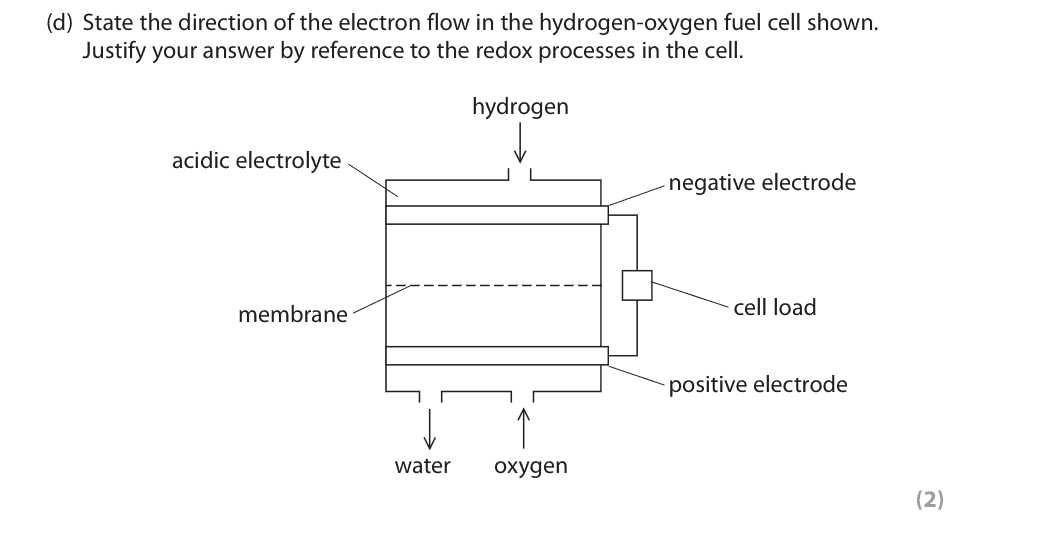
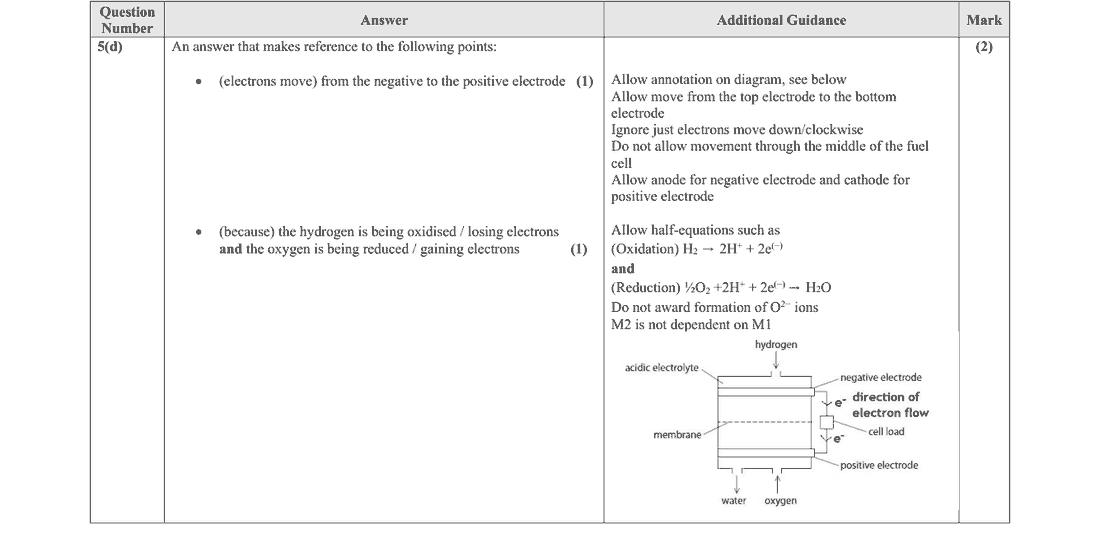
State the direction of the electron flow in the hydrogen‑oxygen fuel cell shown.
Justify your answer by reference to the redox processes in the cell.
hydrogen
acidic electrolyte
negative electrode
cell load
membrane
positive electrode
water
oxygen
June 2023 · Paper 3 · Q8(b)(ii) 2 marks Explanation kinetics i
Earlier parts of question 8 that this part usesEarlier part of June 2023 Paper 3 question 8Earlier part of June 2023 Paper 3 question 8
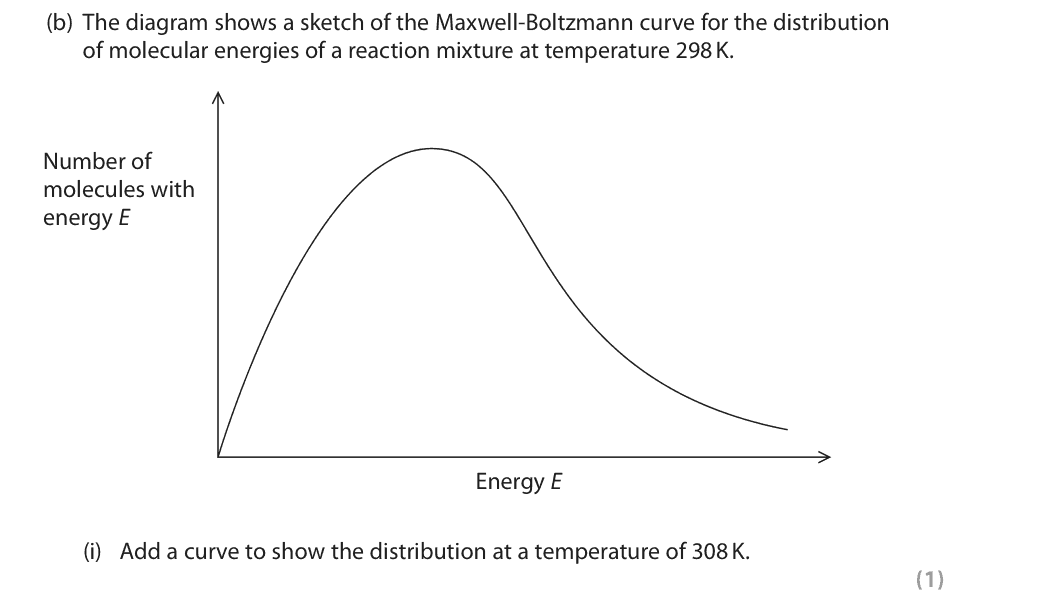
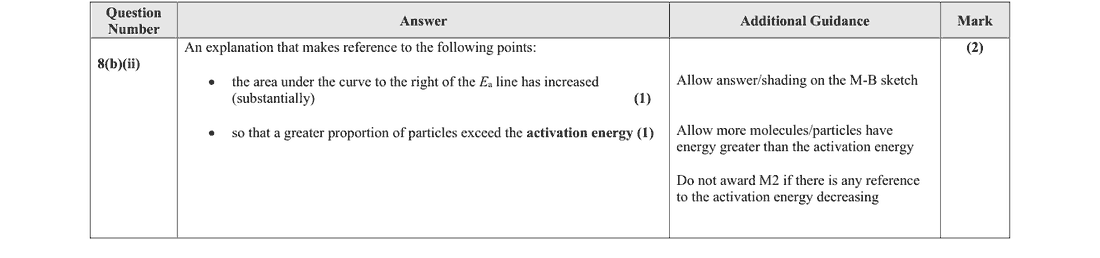
Explain why a temperature rise from 298 K to 308 K results in a large increase
in the rate of reaction.
Refer to the Maxwell‑Boltzmann distribution in your answer.
June 2023 · Paper 3 · Q9(b) 7 marks Explanation organic synthesisnmr mass spectrometry and chromatography
Earlier part of question 9 that this part usesEarlier part of June 2023 Paper 3 question 9
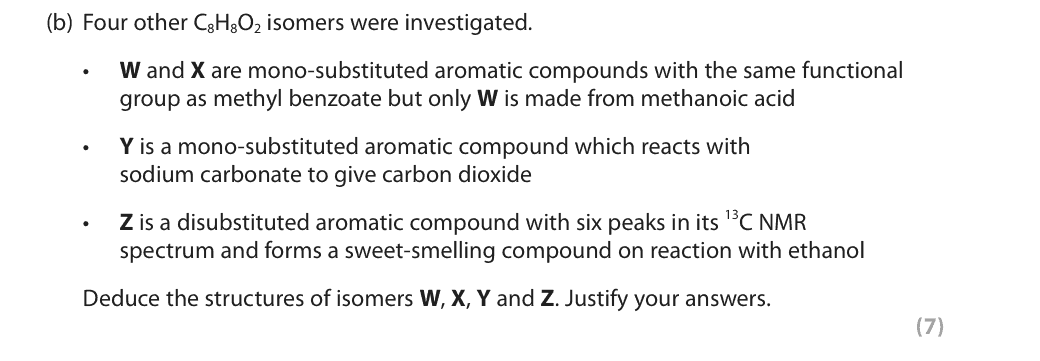
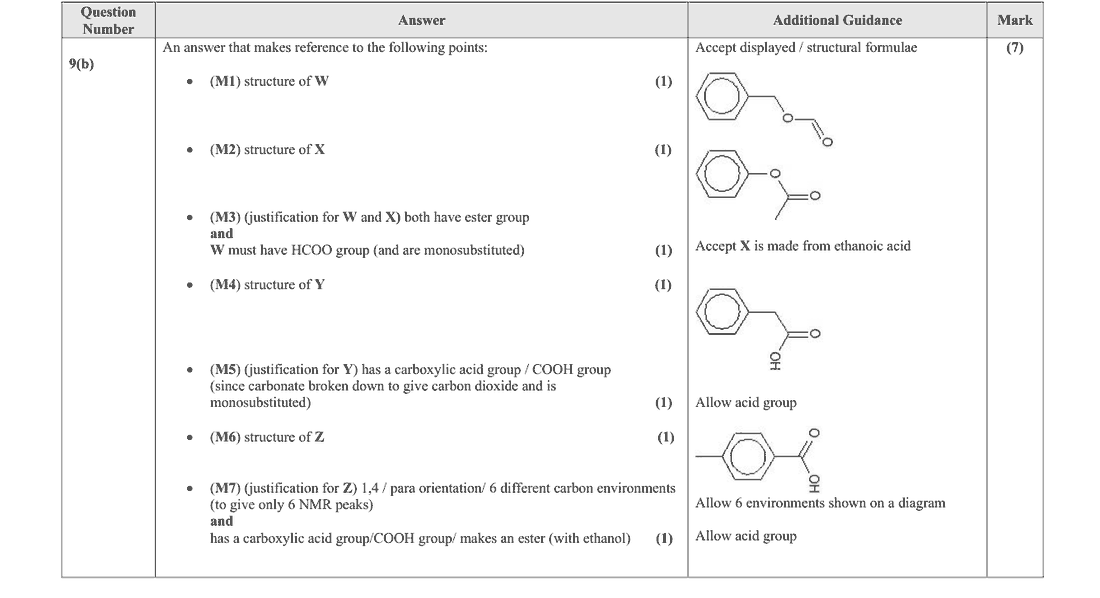
Four other C8H8O2 isomers were investigated.
•
W and X are mono‑substituted aromatic compounds with the same functional
group as methyl benzoate but only W is made from methanoic acid
Y is a mono‑substituted aromatic compound which reacts with
•
sodium carbonate to give carbon dioxide
•
Z is a disubstituted aromatic compound with six peaks in its 13C NMR
spectrum and forms a sweet‑smelling compound on reaction with ethanol
Deduce the structures of isomers W, X, Y and Z. Justify your answers.
June 2023 · Paper 3 · Q10(c) 2 marks Explanation Hard entropy
Earlier part of question 10 that this part usesEarlier part of June 2023 Paper 3 question 10
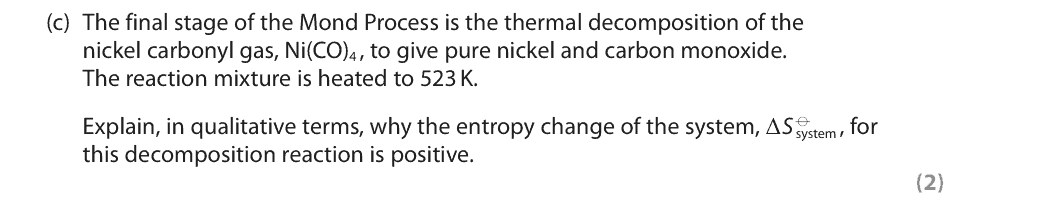
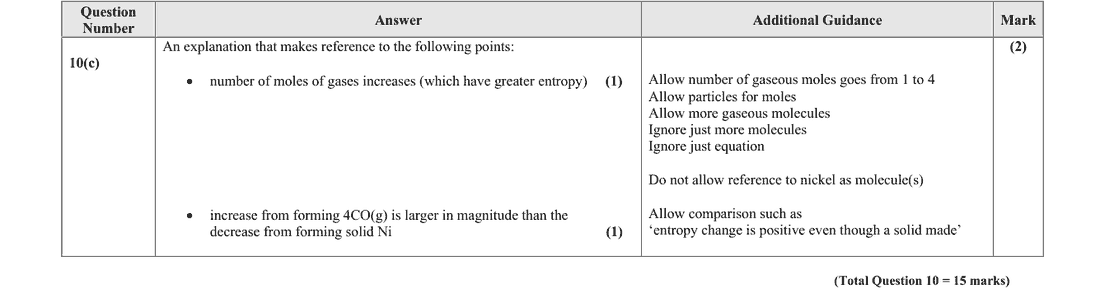
The final stage of the Mond Process is the thermal decomposition of the
nickel carbonyl gas, Ni(CO)4 , to give pure nickel and carbon monoxide.
The reaction mixture is heated to 523 K.
Explain, in qualitative terms, why the entropy change of the system, ΔS d
system , for
this decomposition reaction is positive.
June 2022 · AS Paper 1 · Q6(b) 3 marks Explanation structure
Earlier part of question 6 that this part usesEarlier part of June 2022 Paper 1 question 6
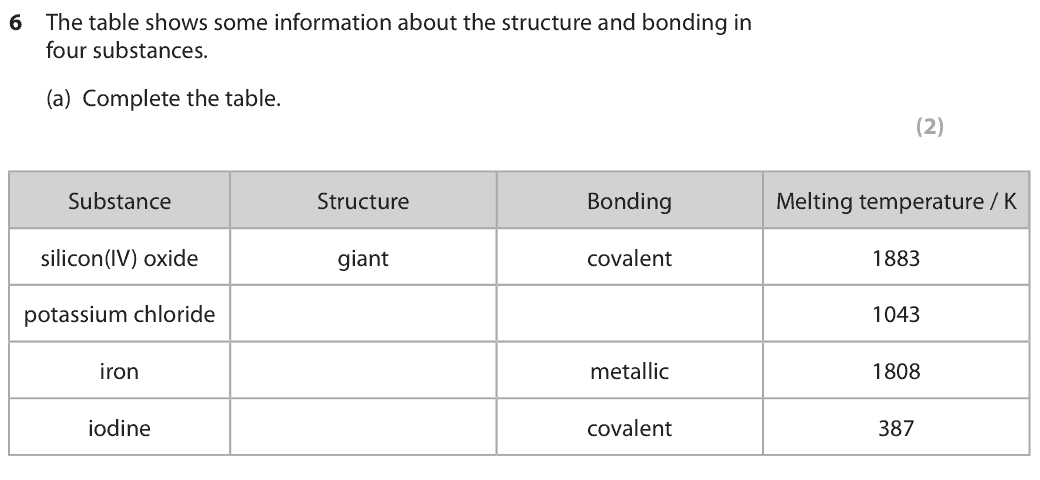
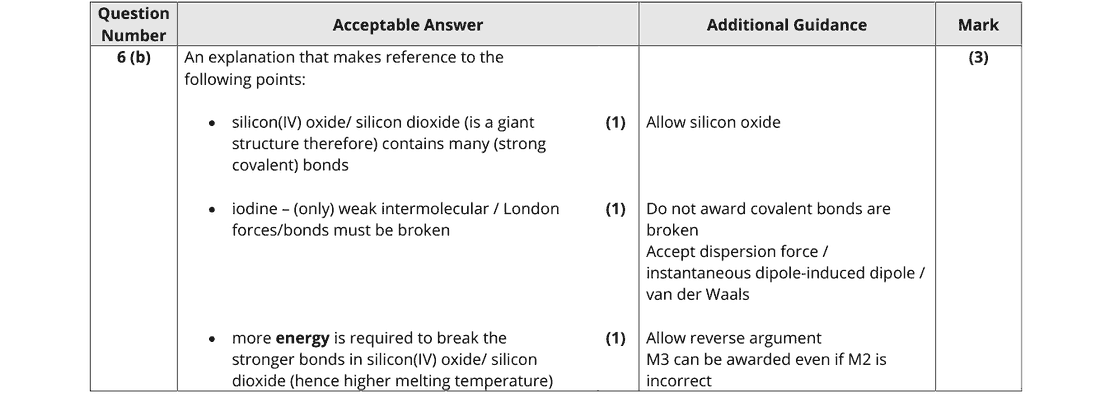
Explain why the melting temperature of silicon(IV) oxide is much higher than that
of iodine, even though the bonding in both is covalent.
June 2022 · AS Paper 1 · Q6(c) 3 marks Explanation structure
Earlier part of question 6 that this part usesEarlier part of June 2022 Paper 1 question 6
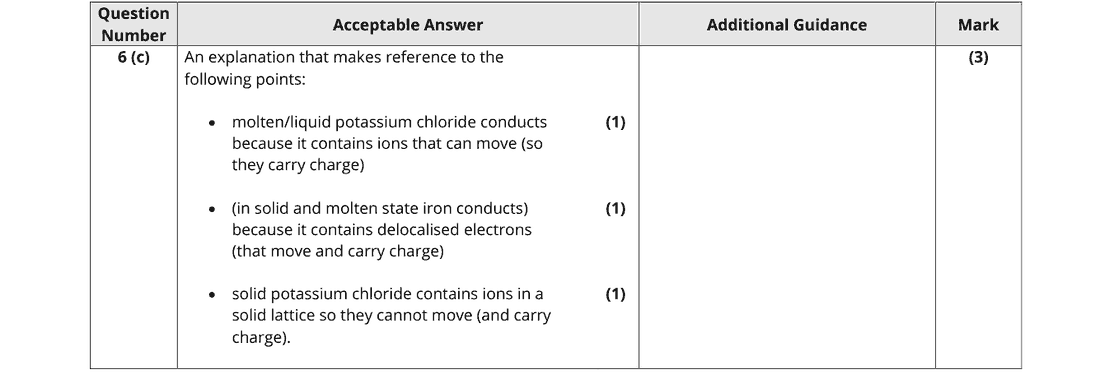
Iron and potassium chloride both conduct electricity when molten. However, only
iron conducts electricity when solid.
Explain these observations.
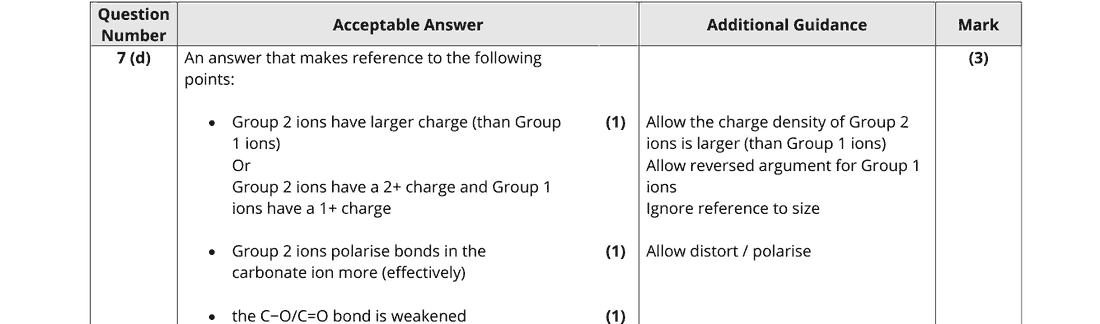
June 2022 · AS Paper 1 · Q7(d) 3 marks Explanation groups 1 and 2
A textbook states, ‘The thermal stability of Group 1 carbonates is generally higher
than the thermal stability of Group 2 carbonates in the same period’.
Explain why Group 1 carbonates are more thermally stable than
Group 2 carbonates.
June 2022 · AS Paper 1 · Q8(d)(i) 2 marks Explanation redox i
Earlier part of question 8 that this part usesEarlier part of June 2022 Paper 1 question 8
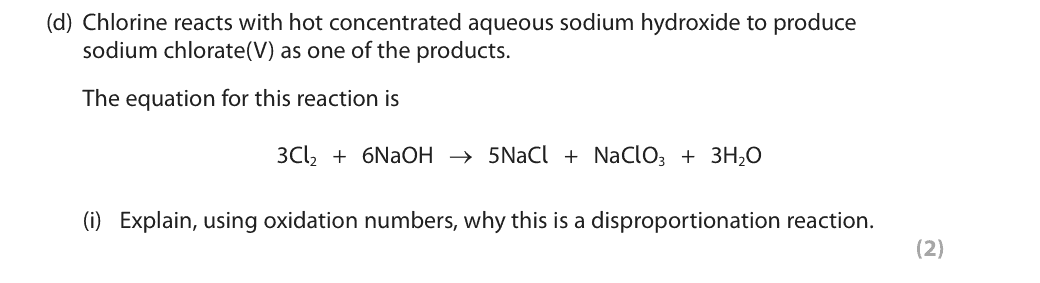
Chlorine reacts with hot concentrated aqueous sodium hydroxide to produce
sodium chlorate(V) as one of the products.
The equation for this reaction is
3Cl2   +   6NaOH   →   5NaCl   +   NaClO3   +   3H2O
Explain, using oxidation numbers, why this is a disproportionation reaction.
June 2022 · AS Paper 2 · Q1(a)(ii) 2 marks Explanation kinetics i
Earlier part of question 1 that this part usesEarlier part of June 2022 Paper 2 question 1
Explain, with reference to the gaseous particles, the differences in the
two distributions.
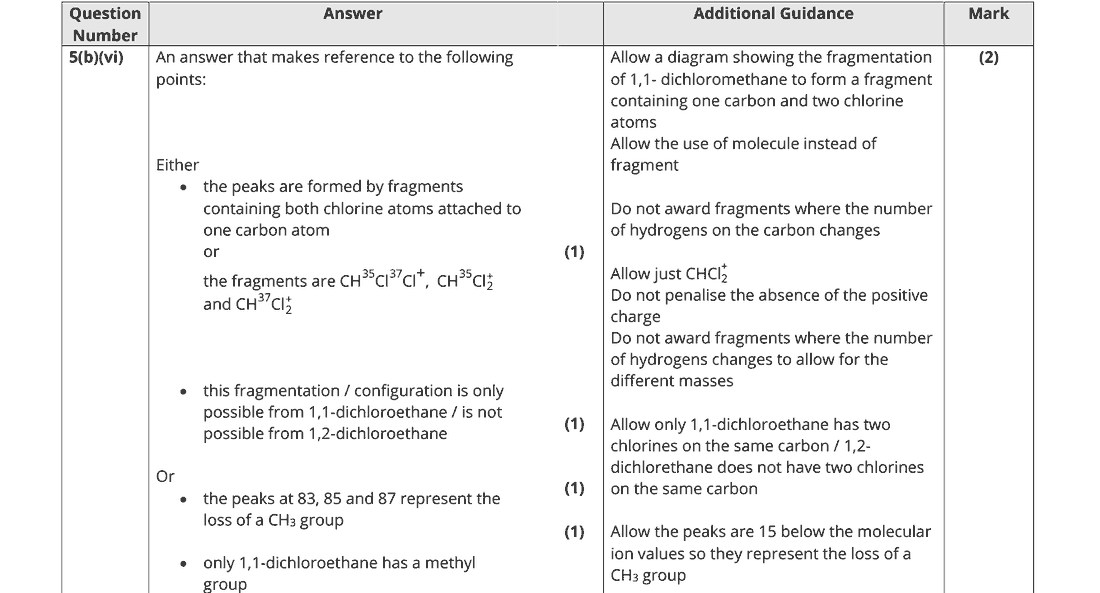
June 2022 · AS Paper 2 · Q5(b)(vi) 2 marks Explanation mass spectrometry and infrared spectroscopy
Earlier parts of question 5 that this part usesEarlier part of June 2022 Paper 2 question 5Earlier part of June 2022 Paper 2 question 5
Explain how the presence of the peaks at 83, 85 and 87 in Spectrum B allows
the identification of the isomer responsible for this spectrum.
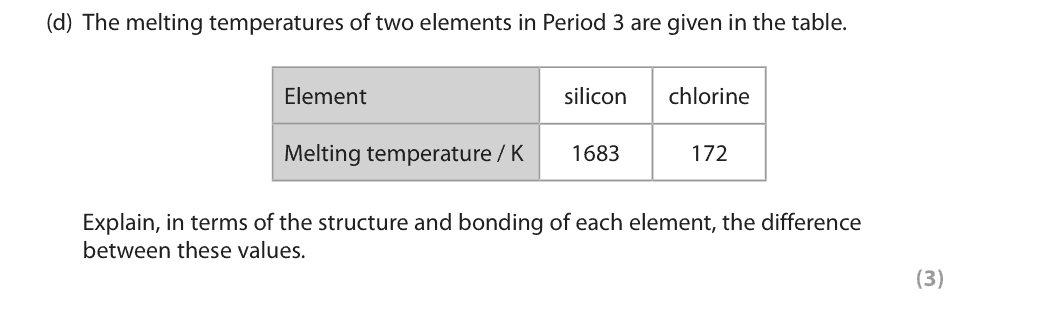
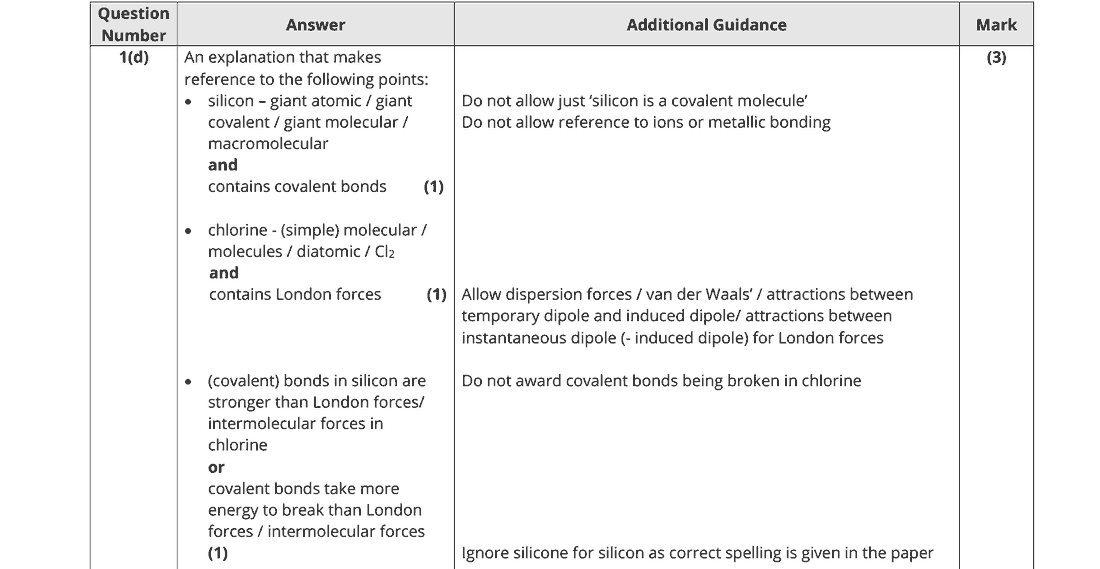
June 2022 · Paper 1 · Q1(d) 3 marks Explanation atomic structure and the periodic tablestructure
Earlier part of question 1 that this part usesEarlier part of June 2022 Paper 1 question 1
The melting temperatures of two elements in Period 3 are given in the table.
Element
silicon
chlorine
Melting temperature / K
1683
172
Explain, in terms of the structure and bonding of each element, the difference
between these values.
June 2022 · Paper 1 · Q2(b) 3 marks Explanation groups 1 and 2
Explain how the trend in the reactivity of the Group 2 elements is determined by
their electronic configurations.
June 2022 · Paper 1 · Q2(c) 2 marks Explanation redox i
Calcium reacts with chlorine.
Ca(s)   +   Cl2(g)   →   CaCl2(s)
Explain, in terms of electrons, why this is a redox reaction.
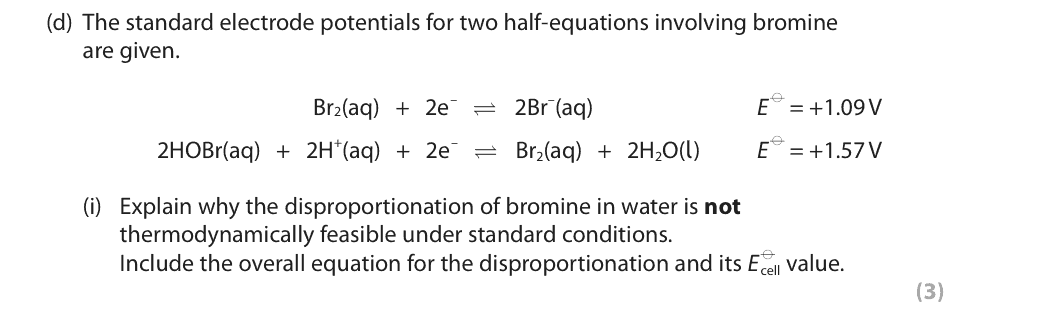
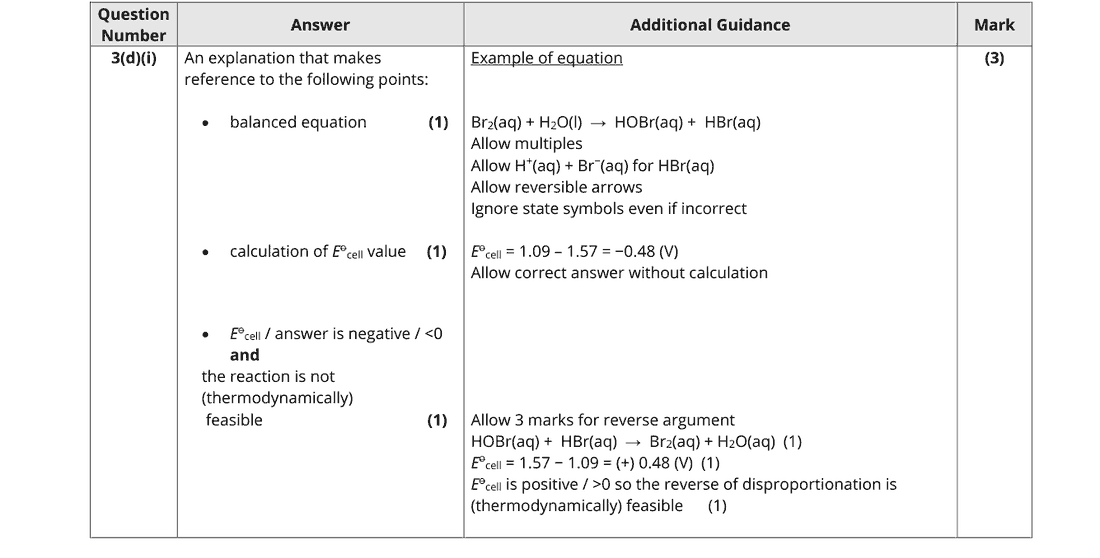
June 2022 · Paper 1 · Q3(d)(i) 3 marks Explanation redox ii
Earlier part of question 3 that this part usesEarlier part of June 2022 Paper 1 question 3
The standard electrode potentials for two half‑equations involving bromine
are given.
d = +1.09 V
Br2(aq)   +   2e–      2Br–(aq)
E
2HOBr(aq)   +   2H+(aq)   +   2e–      Br2(aq)   +   2H2O(l)
E
d = +1.57 V
Explain why the disproportionation of bromine in water is not
thermodynamically feasible under standard conditions.
Include the overall equation for the disproportionation and its E
cell value.
d
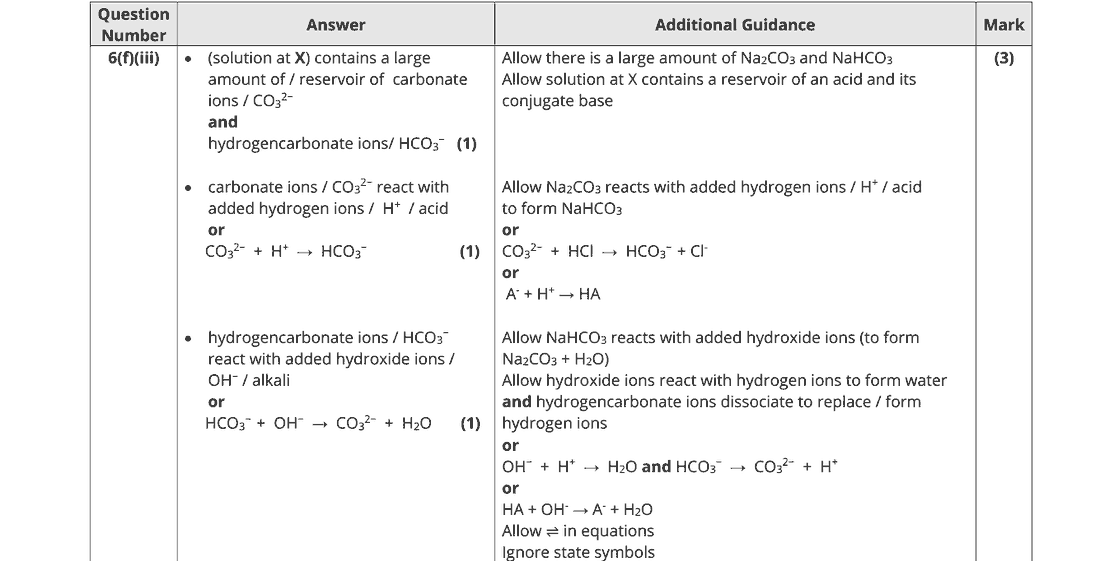
June 2022 · Paper 1 · Q6(f)(iii) 3 marks Explanation acid base equilibria
Earlier parts of question 6 that this part usesEarlier part of June 2022 Paper 1 question 6Earlier part of June 2022 Paper 1 question 6Earlier part of June 2022 Paper 1 question 6
Explain how the solution at point X on the graph can act as a buffer solution.
June 2022 · Paper 1 · Q7(c)(iv) 2 marks Explanation transition metals principles
Earlier part of question 7 that this part usesEarlier part of June 2022 Paper 1 question 7
Aqueous solutions containing chromium(III) ions and chromium(II) ions have
different colours.
Explain why these solutions differ in colour.
An explanation of the origin of the colours is not required.
June 2022 · Paper 2 · Q2(b) 2 marks Explanation bonding
Explain why 2,2‑dimethylpropane has a much lower boiling temperature than its
isomer pentane.
Detailed descriptions of the forces involved are not required.
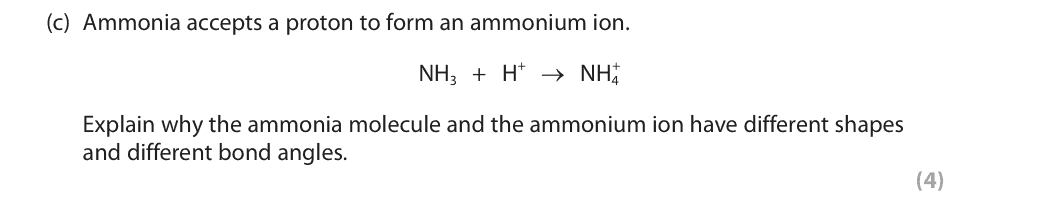
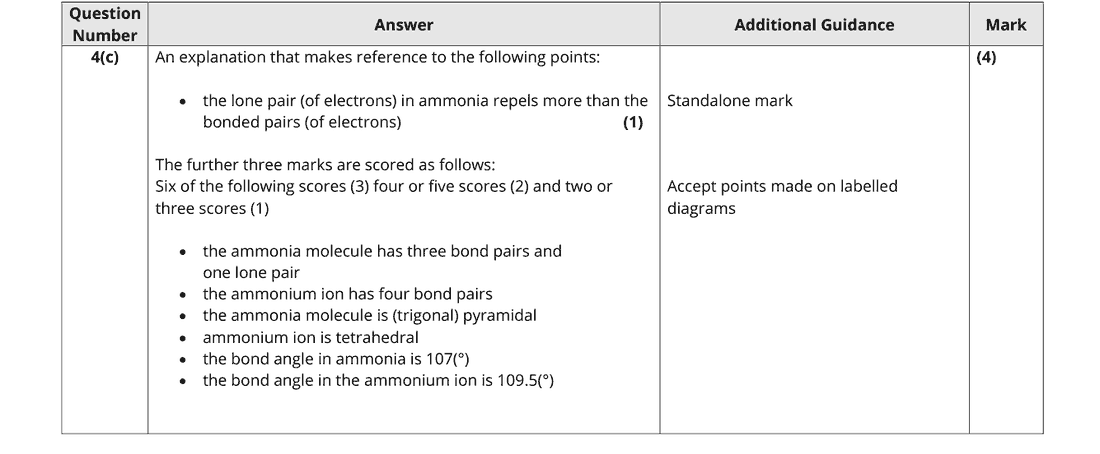
June 2022 · Paper 2 · Q4(c) 4 marks Explanation bonding
Ammonia accepts a proton to form an ammonium ion.
NH3   +   H+   →   NH4
+
Explain why the ammonia molecule and the ammonium ion have different shapes
and different bond angles.
June 2022 · Paper 2 · Q4(d) 4 marks Explanation Hard amines amides amino acids and proteinshalogenoalkanes
Earlier part of question 4 that this part usesEarlier part of June 2022 Paper 2 question 4
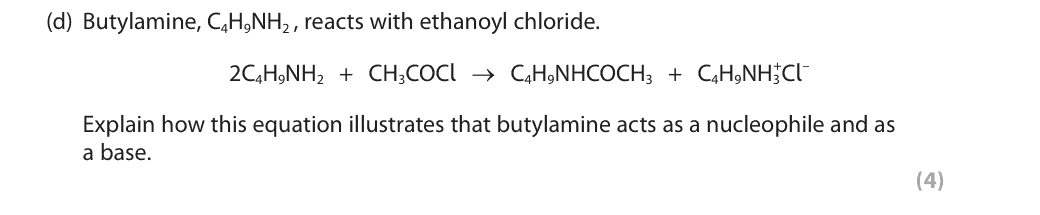
Butylamine, C4H9NH2 , reacts with ethanoyl chloride.
2C4H9NH2   +   CH3COCl   →   C4H9NHCOCH3   +   C4H9NH3
+Cl–
Explain how this equation illustrates that butylamine acts as a nucleophile and as
a base.
June 2022 · Paper 2 · Q6(c)(i) 2 marks Explanation alcohols
Earlier part of question 6 that this part usesEarlier part of June 2022 Paper 2 question 6
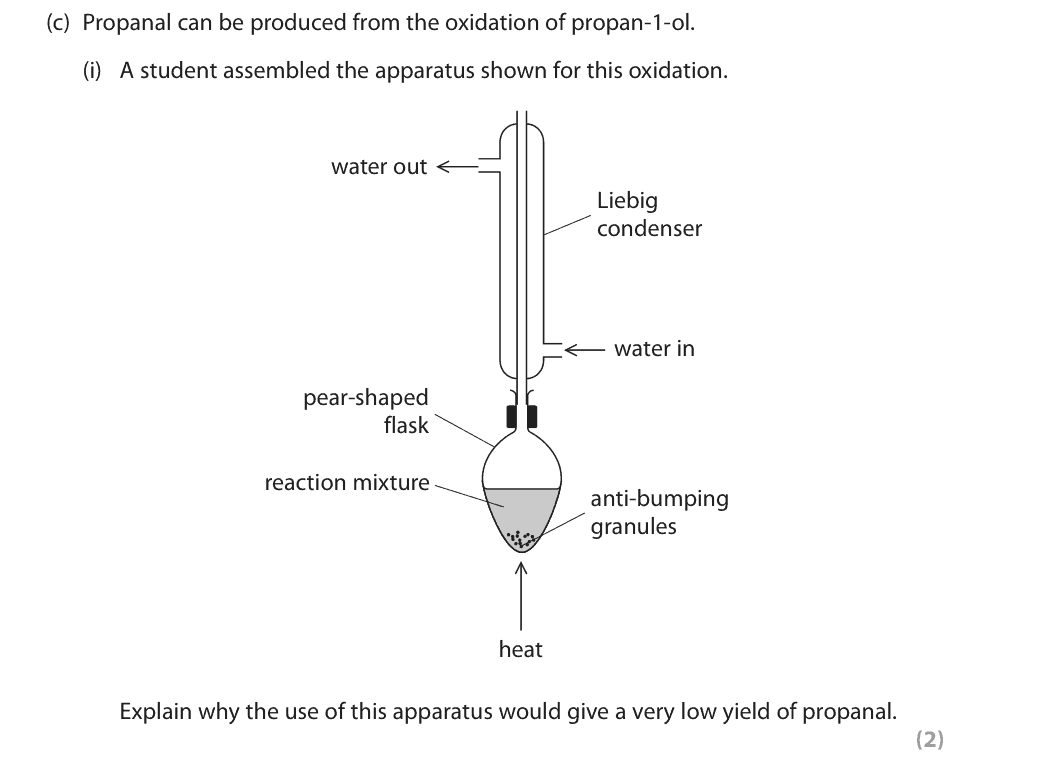
Propanal can be produced from the oxidation of propan‑1‑ol.
A student assembled the apparatus shown for this oxidation.
water out
Liebig
condenser
water in
pear-shaped
flask
reaction mixture
anti-bumping
granules
heat
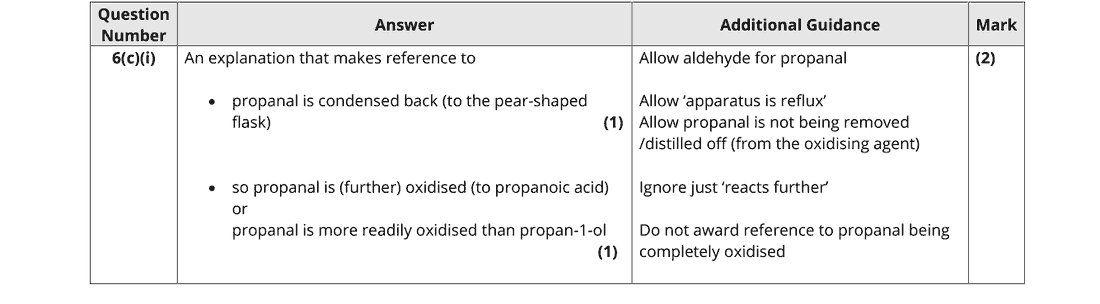
Explain why the use of this apparatus would give a very low yield of propanal.
June 2022 · Paper 2 · Q6(d)(i) 4 marks Explanation carbonyl compoundscarboxylic acids
Earlier part of question 6 that this part usesEarlier part of June 2022 Paper 2 question 6
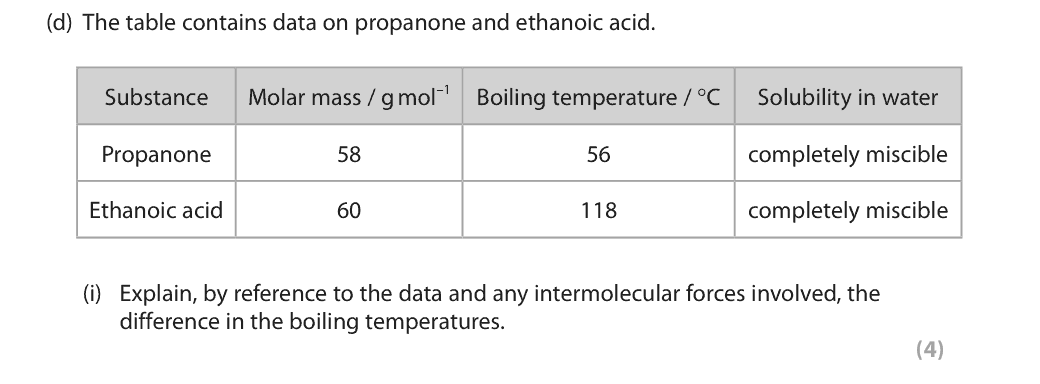
The table contains data on propanone and ethanoic acid.
Molar mass / g mol–1
Boiling temperature / °C
Substance
Solubility in water
Propanone
58
56
completely miscible
Ethanoic acid
60
118
completely miscible
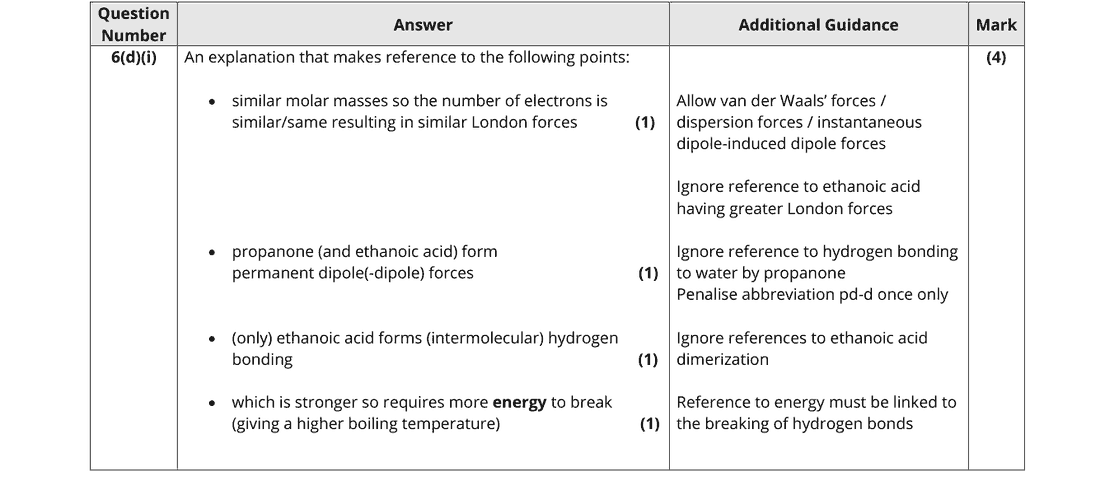
Explain, by reference to the data and any intermolecular forces involved, the
difference in the boiling temperatures.
June 2022 · Paper 2 · Q6(d)(ii) 2 marks Explanation carbonyl compounds
Earlier part of question 6 that this part usesEarlier part of June 2022 Paper 2 question 6
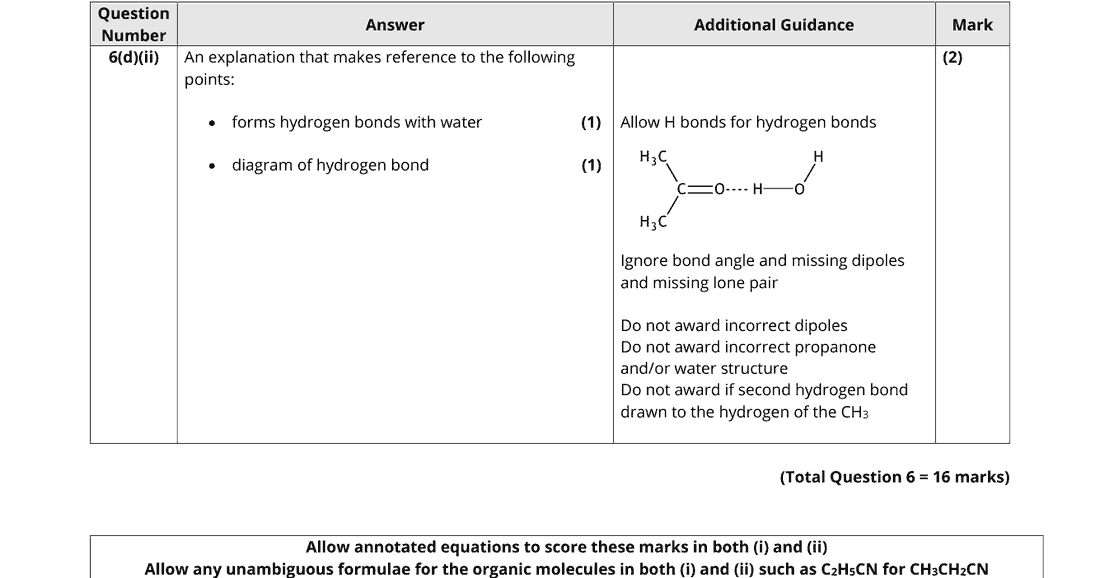
Explain, with the aid of a diagram, why propanone is completely miscible
with water.
June 2022 · Paper 2 · Q7(d) 2 marks Explanation amines amides amino acids and proteins
Earlier part of question 7 that this part usesEarlier part of June 2022 Paper 2 question 7
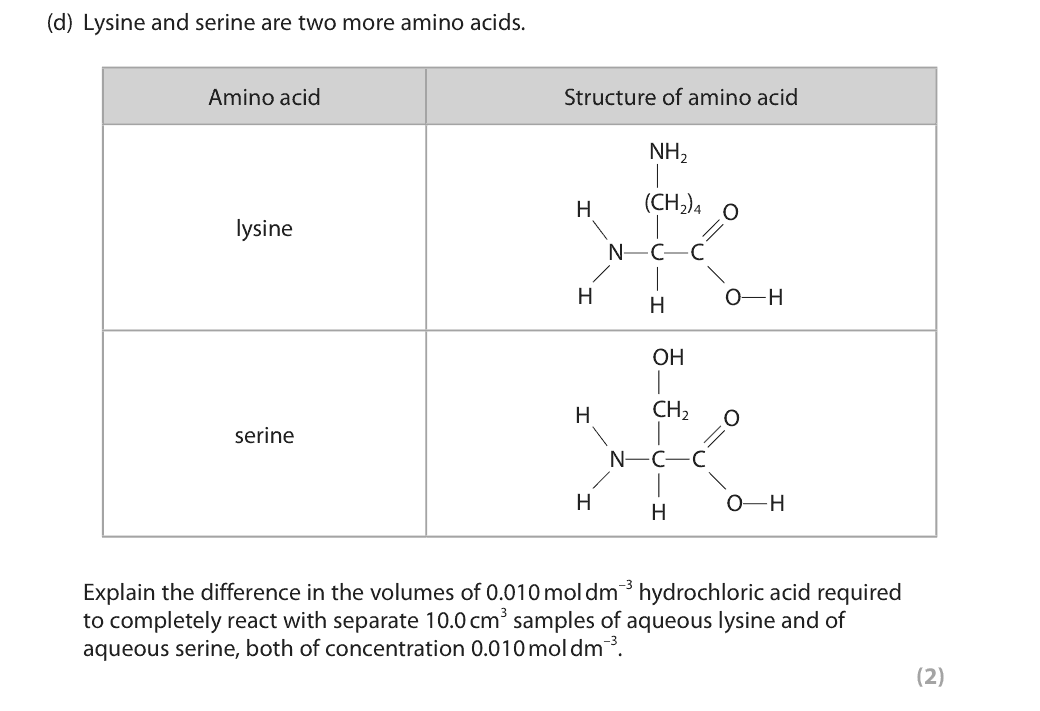
Lysine and serine are two more amino acids.
Amino acid
Structure of amino acid
NH2
(CH2)4
H
O
lysine
N
C
C
H
O
H
H
OH
CH2
H
O
serine
N
C
C
H
O
H
H
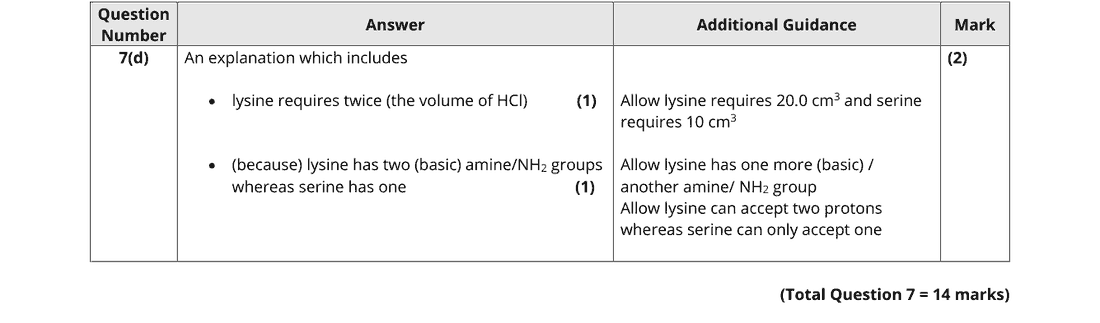
Explain the difference in the volumes of 0.010 mol dm–3 hydrochloric acid required
to completely react with separate 10.0 cm3 samples of aqueous lysine and of
aqueous serine, both of concentration 0.010 mol dm–3.
June 2022 · Paper 2 · Q8(g) 4 marks Explanation carboxylic acids
Earlier part of question 8 that this part usesEarlier part of June 2022 Paper 2 question 8
Esters can be hydrolysed by heating under reflux with aqueous acid or alkali.
Compare and contrast these two methods of hydrolysis for amyl acetate.
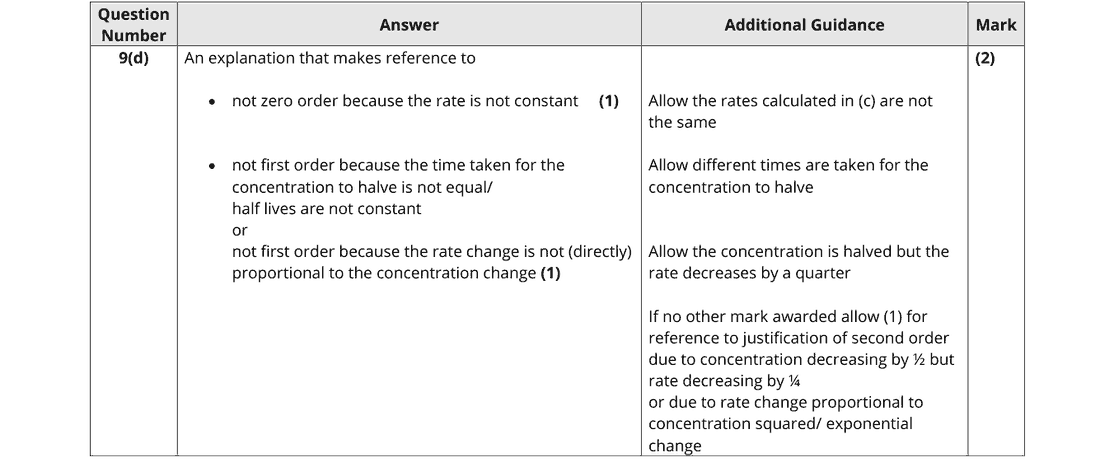
June 2022 · Paper 2 · Q9(d) 2 marks Explanation kinetics ii
Earlier parts of question 9 that this part usesEarlier part of June 2022 Paper 2 question 9Earlier part of June 2022 Paper 2 question 9
Explain why the data given and your answers in (c) show that the reaction is
neither zero order nor first order.
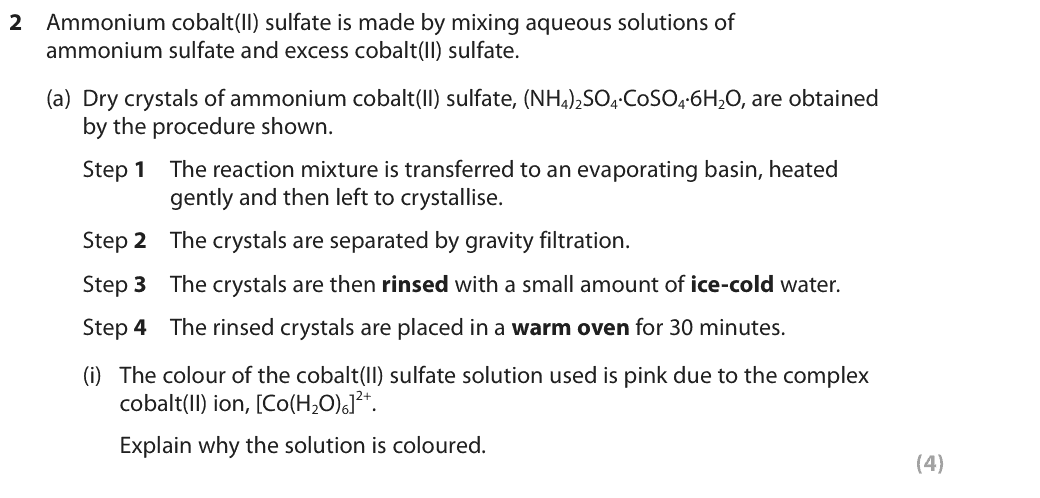
June 2022 · Paper 3 · Q2(a)(i) 4 marks Explanation transition metals principles
Ammonium cobalt(II) sulfate is made by mixing aqueous solutions of
ammonium sulfate and excess cobalt(II) sulfate.
Dry crystals of ammonium cobalt(II) sulfate, (NH4)2SO4·CoSO4·6H2O, are obtained
by the procedure shown.
Step 1    The reaction mixture is transferred to an evaporating basin, heated
gently and then left to crystallise.
Step 2    The crystals are separated by gravity filtration.
Step 3    The crystals are then rinsed with a small amount of ice‑cold water.
Step 4    The rinsed crystals are placed in a warm oven for 30 minutes.
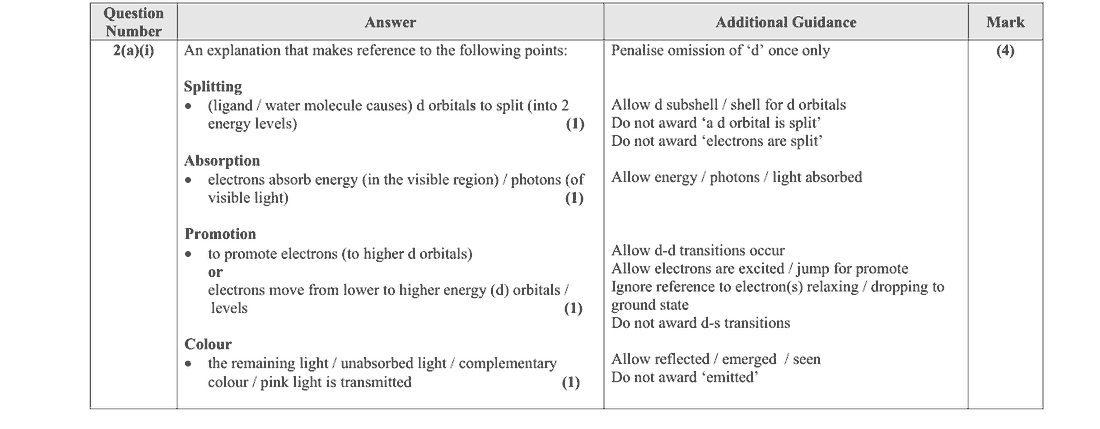
The colour of the cobalt(II) sulfate solution used is pink due to the complex
cobalt(II) ion, [Co(H2O)6]2+.
Explain why the solution is coloured.
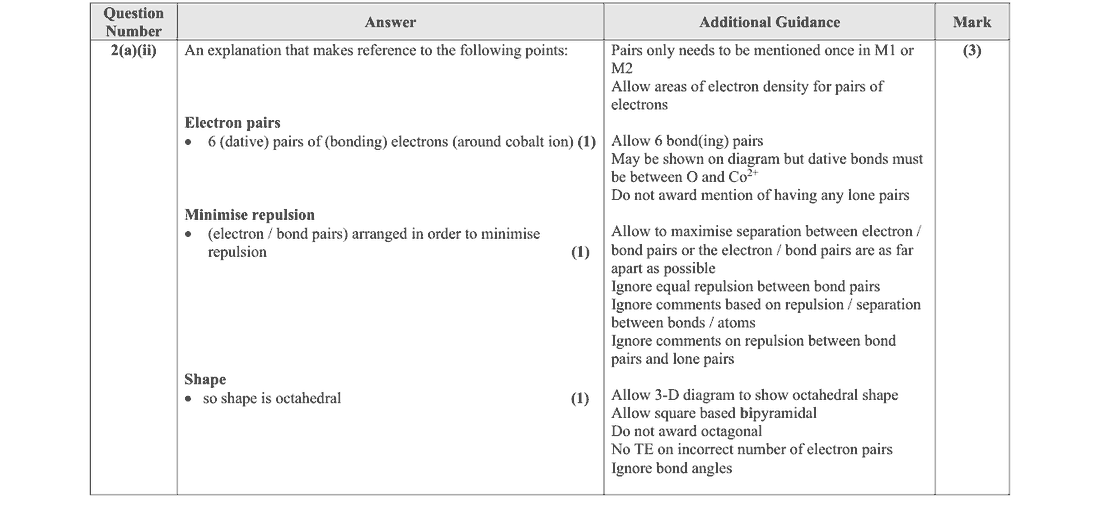
June 2022 · Paper 3 · Q2(a)(ii) 3 marks Explanation transition metals principlesbonding
Earlier part of question 2 that this part usesEarlier part of June 2022 Paper 3 question 2
Explain the shape of the cobalt(II) ion, [Co(H2O)6]2+ , using electron‑pair repulsion theory.
June 2022 · Paper 3 · Q4(b) 3 marks Explanation groups 1 and 2
Explain whether magnesium carbonate is more or less thermally stable than
barium carbonate.
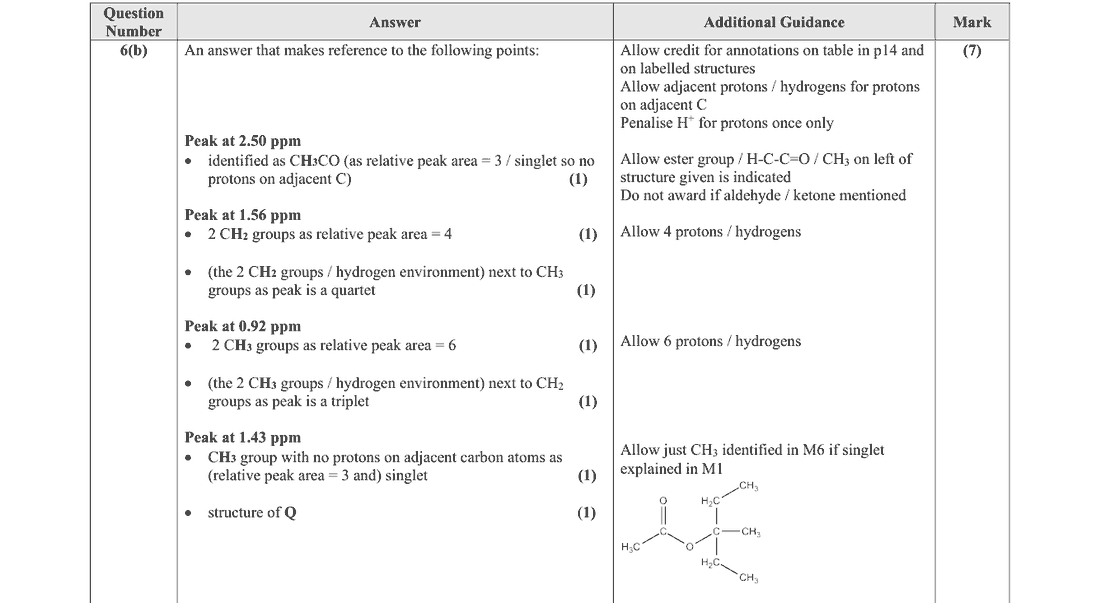
June 2022 · Paper 3 · Q6(b) 7 marks Explanation nmr mass spectrometry and chromatographyorganic synthesis
Earlier part of question 6 that this part usesEarlier part of June 2022 Paper 3 question 6
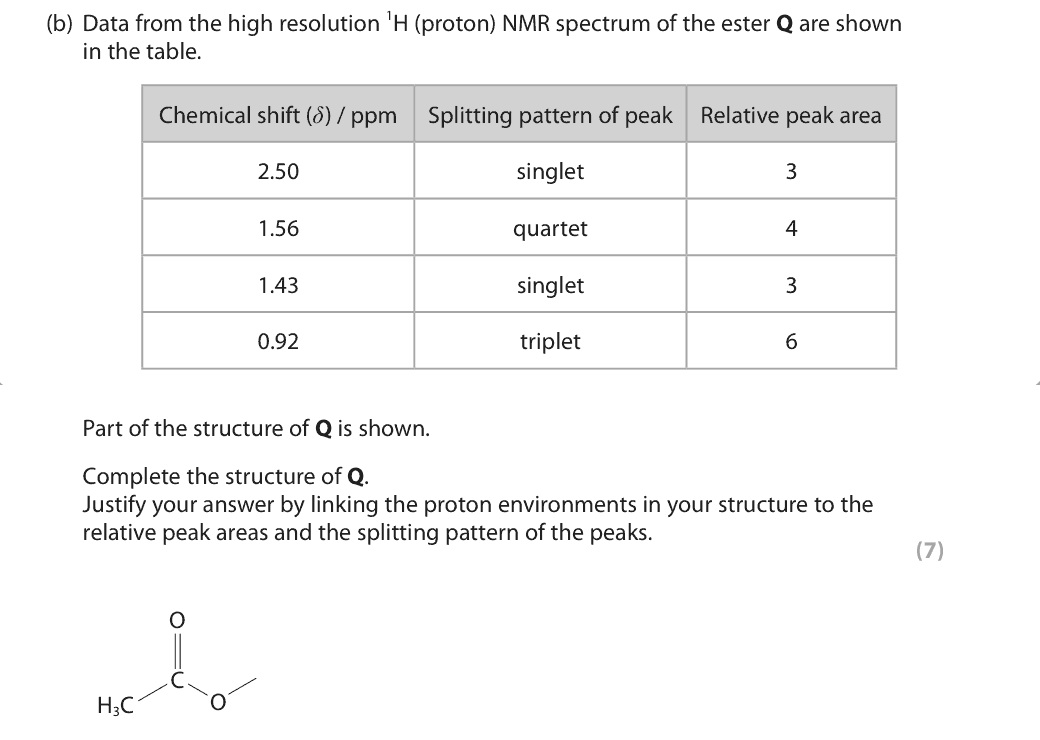
Data from the high resolution 1H (proton) NMR spectrum of the ester Q are shown
in the table.
Chemical shift (δ) / ppm
Splitting pattern of peak
Relative peak area
2.50
singlet
3
1.56
quartet
4
1.43
singlet
3
0.92
triplet
6
Part of the structure of Q is shown.
Complete the structure of Q.
Justify your answer by linking the proton environments in your structure to the
relative peak areas and the splitting pattern of the peaks.
O
C
H3C
O
June 2022 · Paper 3 · Q9(c) 3 marks Explanation carboxylic acids
Earlier parts of question 9 that this part usesEarlier part of June 2022 Paper 3 question 9Earlier part of June 2022 Paper 3 question 9
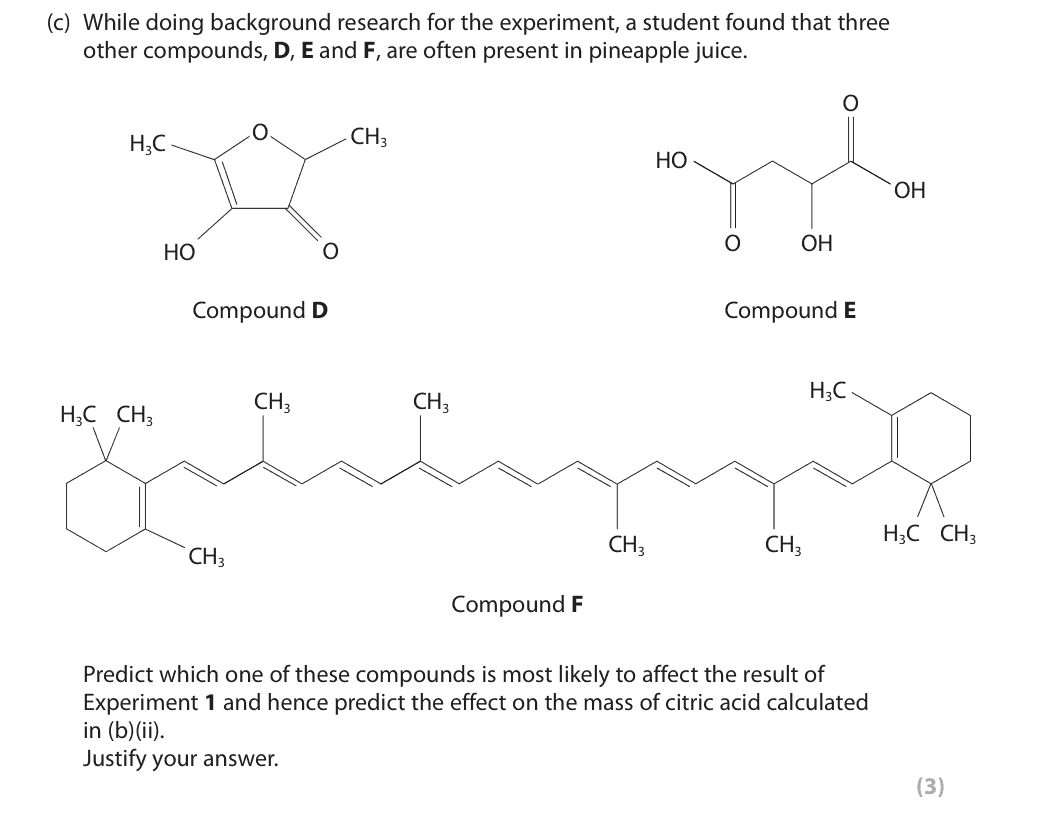
While doing background research for the experiment, a student found that three
other compounds, D, E and F, are often present in pineapple juice.
O
O
CH3
H3C
HO
OH
O
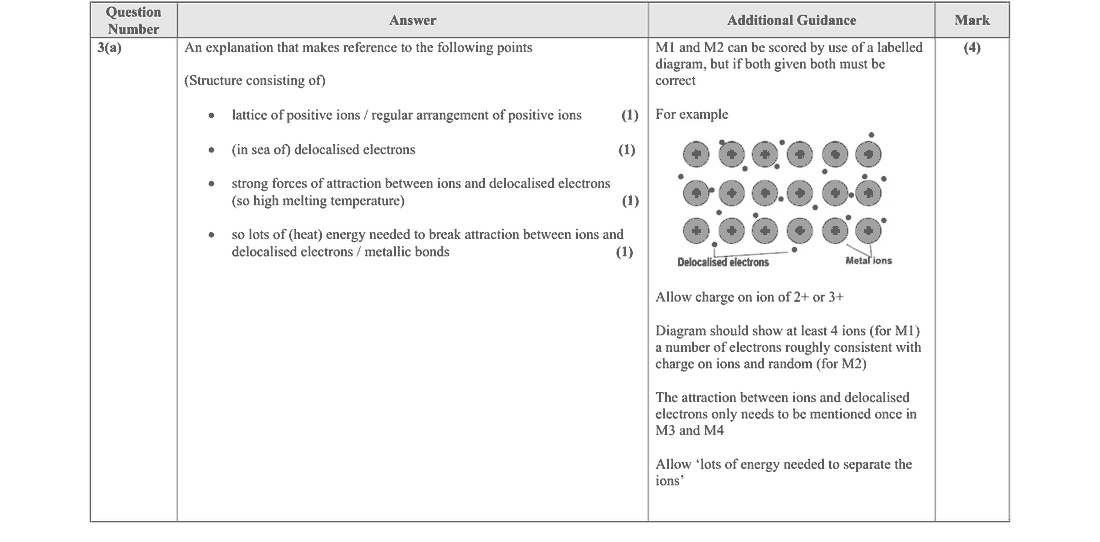
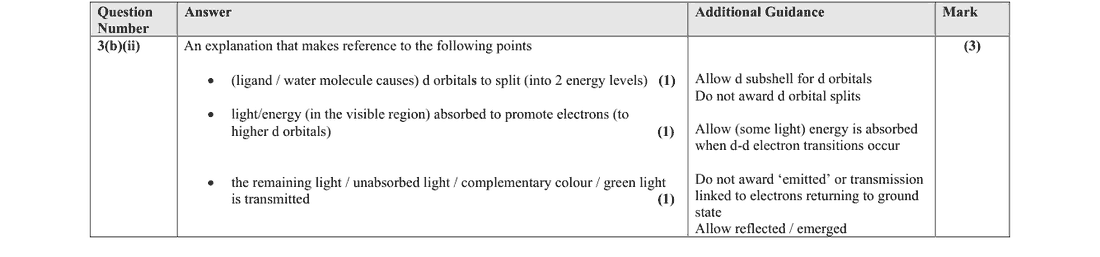
OH
HO
O
Compound D
Compound E
H3C
CH3
CH3
H3C
CH3
H3C
CH3
CH3
CH3
CH3
Compound F
Predict which one of these compounds is most likely to affect the result of
Experiment 1 and hence predict the effect on the mass of citric acid calculated
in (b)(ii).
Justify your answer.
June 2022 · Paper 3 · Q10(b)(ii) 3 marks Explanation kinetics ii
Earlier parts of question 10 that this part usesEarlier part of June 2022 Paper 3 question 10Earlier part of June 2022 Paper 3 question 10
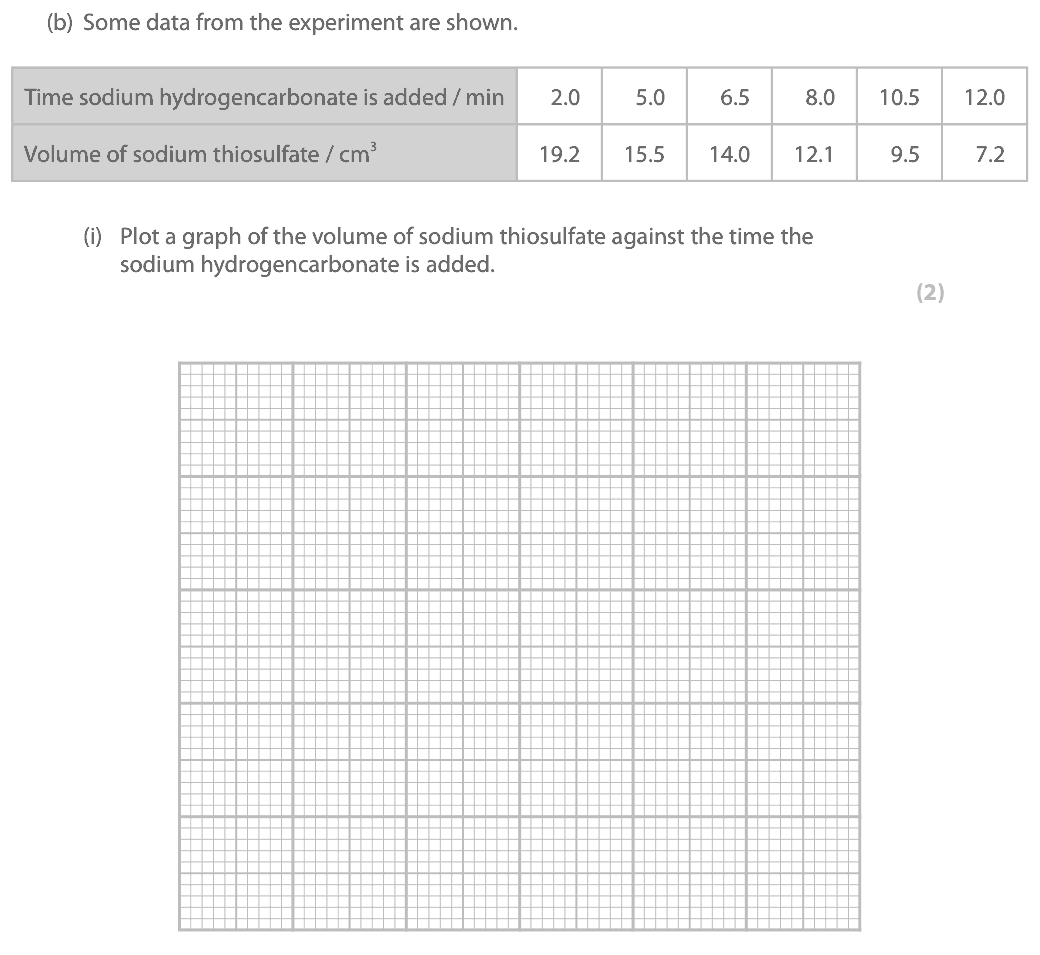
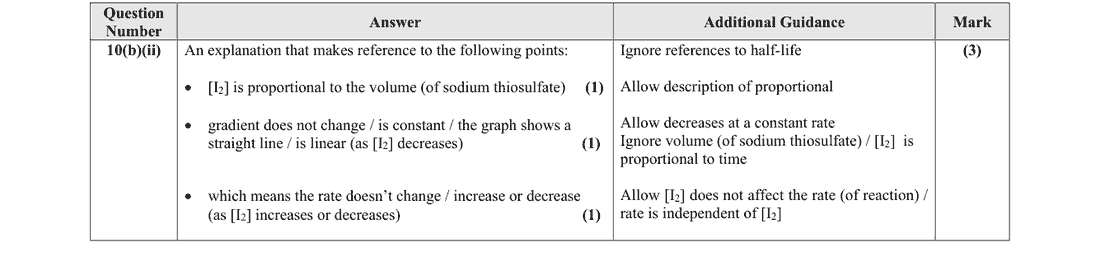
Explain how the graph of volume of thiosulfate against time confirms the
reaction is zero order with respect to iodine, I2.
June 2022 · Paper 3 · Q10(c)(ii) 2 marks Explanation kinetics ii
Earlier parts of question 10 that this part usesEarlier part of June 2022 Paper 3 question 10Earlier part of June 2022 Paper 3 question 10
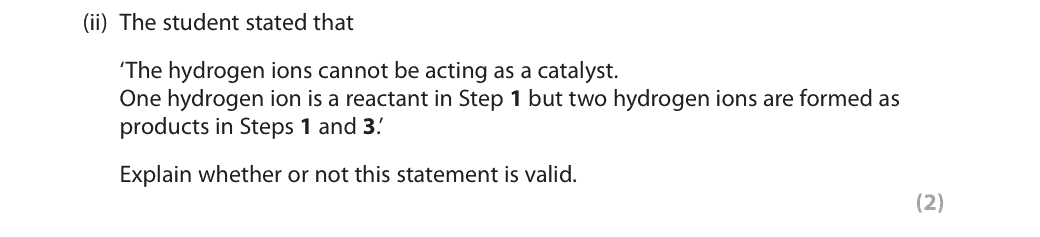
The student stated that
‘The hydrogen ions cannot be acting as a catalyst.
One hydrogen ion is a reactant in Step 1 but two hydrogen ions are formed as
products in Steps 1 and 3.’
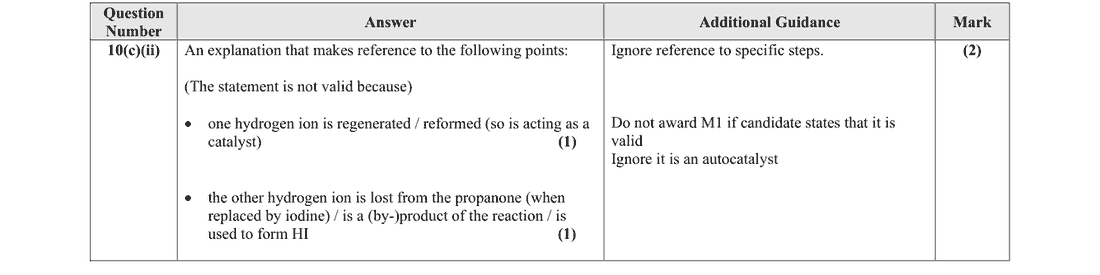
Explain whether or not this statement is valid.
November 2021 · AS Paper 1 · Q3(a)(iv) 2 marks Explanation bonding
Earlier part of question 3 that this part usesEarlier part of November 2021 Paper 1 question 3
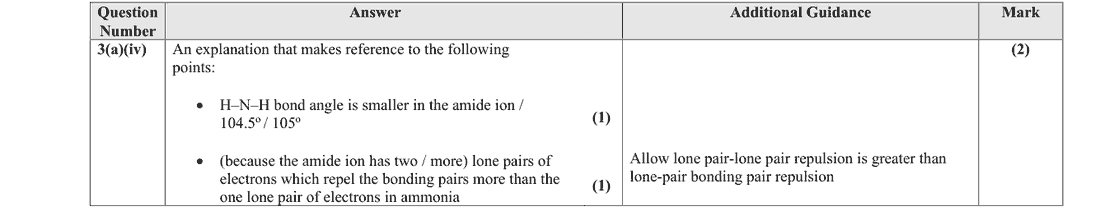
Explain the difference between the H–N–H bond angle in ammonia and in
the amide ion.
November 2021 · AS Paper 1 · Q4(a)(ii) 3 marks Explanation atomic structure and the periodic table
Earlier part of question 4 that this part usesEarlier part of November 2021 Paper 1 question 4
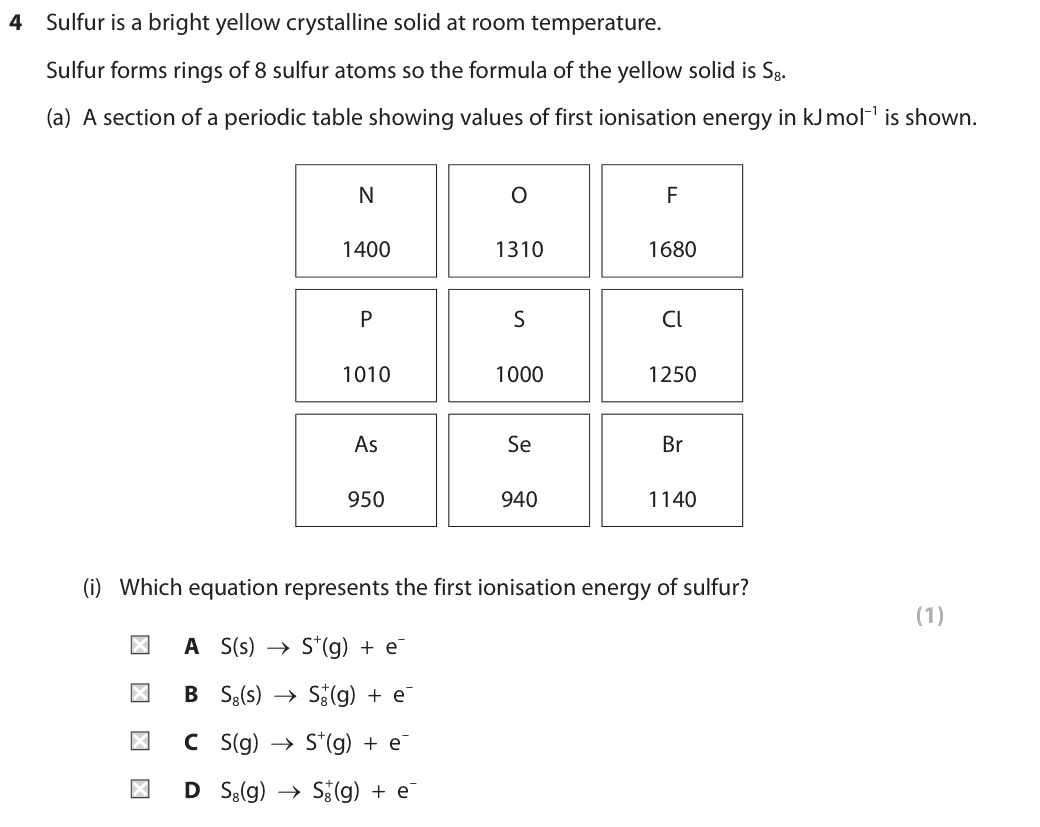
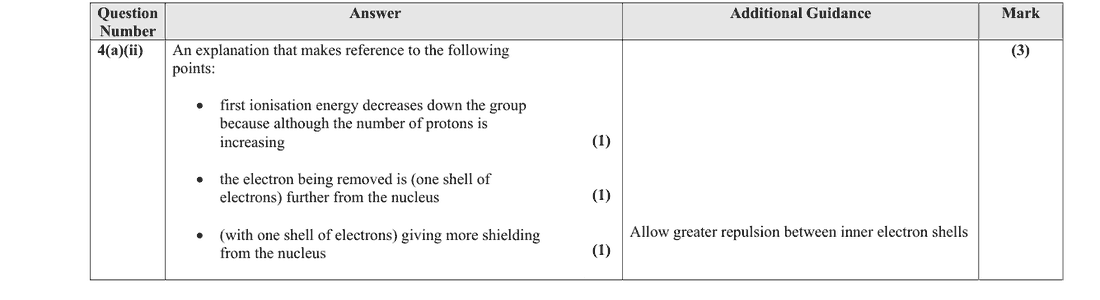
Explain the trend in the values of the first ionisation energies for the group
containing sulfur.
November 2021 · AS Paper 1 · Q4(a)(iii) 2 marks Explanation atomic structure and the periodic table
Earlier part of question 4 that this part usesEarlier part of November 2021 Paper 1 question 4
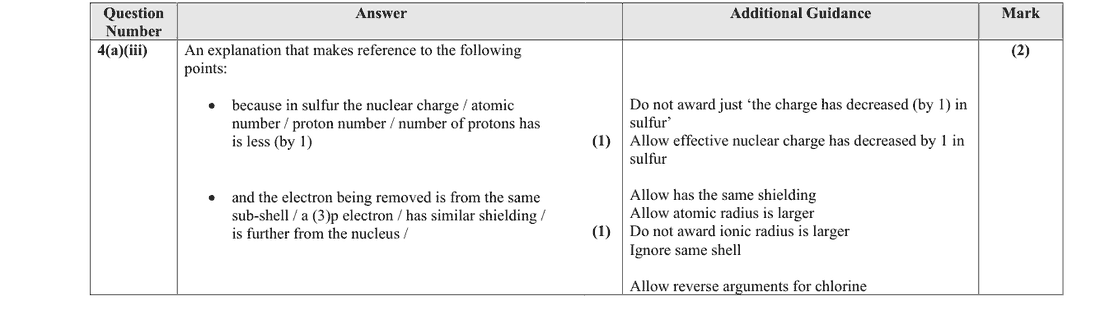
Explain why the first ionisation energy of sulfur is lower than that of chlorine.
November 2021 · AS Paper 1 · Q4(a)(iv) 2 marks Explanation atomic structure and the periodic table
Earlier part of question 4 that this part usesEarlier part of November 2021 Paper 1 question 4
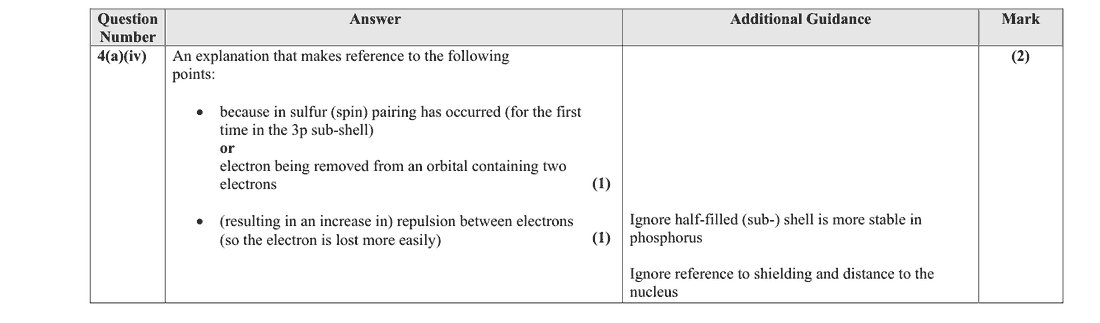
Explain why the first ionisation energy of sulfur is lower than that of phosphorus.
November 2021 · AS Paper 1 · Q5(a) 5 marks Explanation structure
This question is about crystalline solids.
Iodine and diamond are crystalline solids at room temperature.
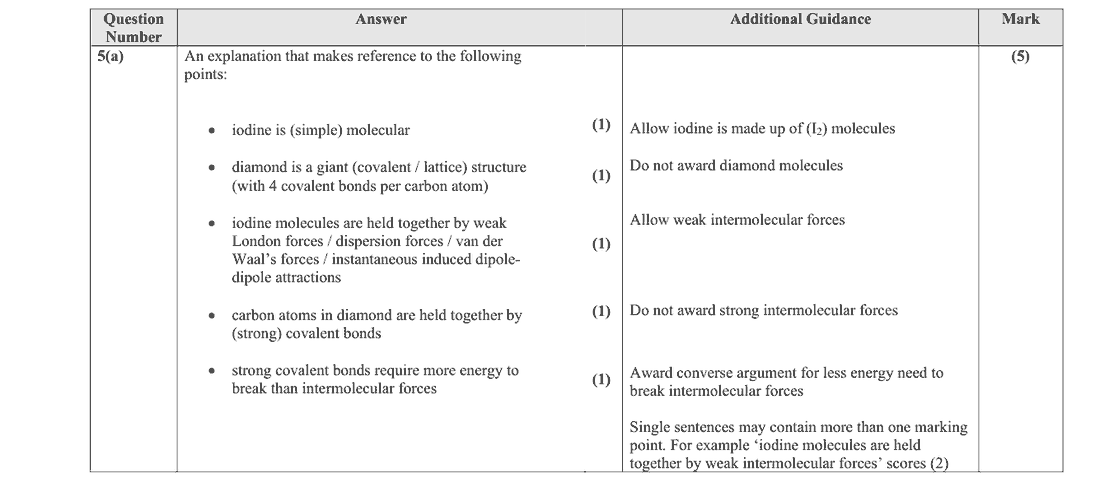
Explain why diamond has a much higher melting temperature than iodine.
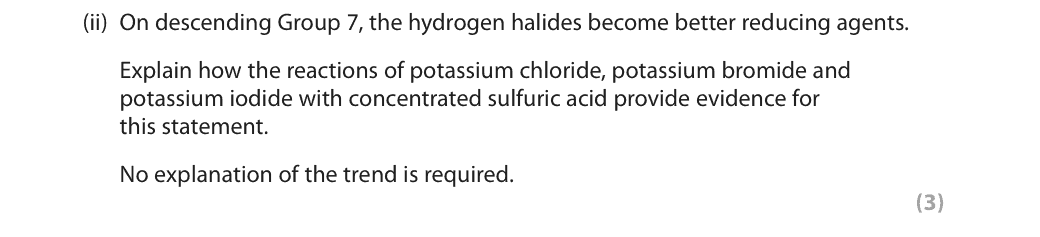
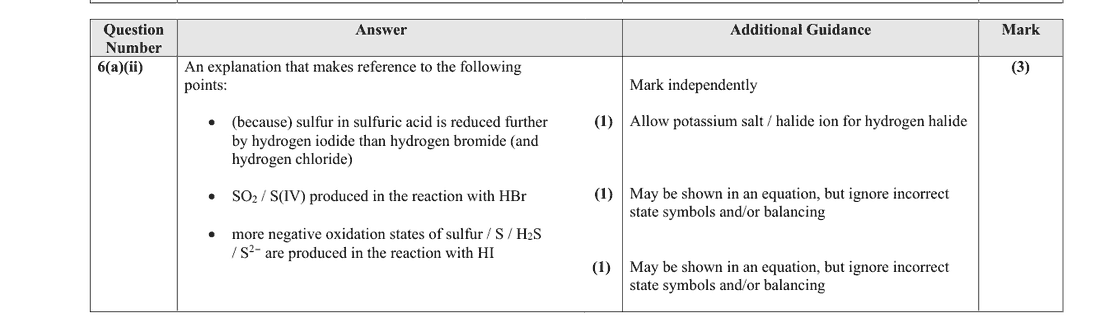
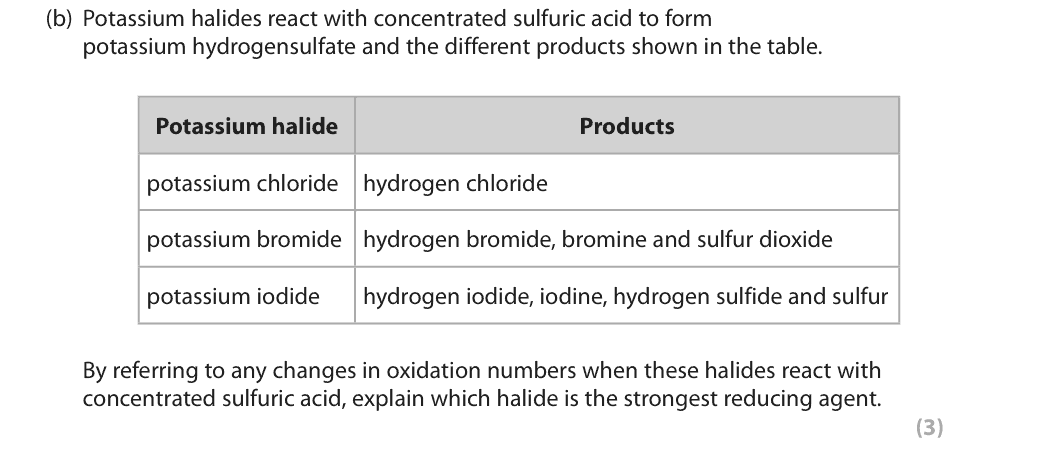
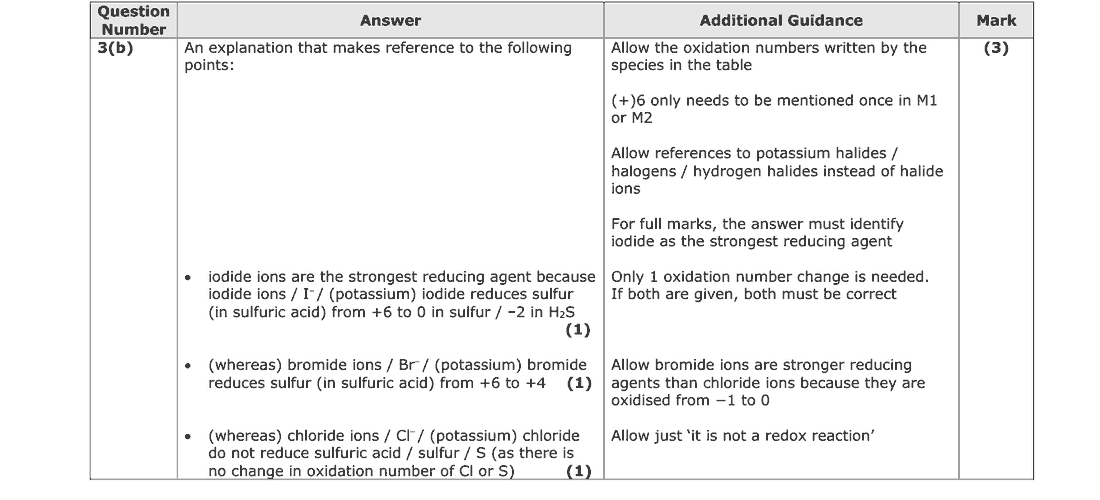
November 2021 · AS Paper 1 · Q6(a)(ii) 3 marks Explanation group 7 the halogens
Earlier part of question 6 that this part usesEarlier part of November 2021 Paper 1 question 6
On descending Group 7, the hydrogen halides become better reducing agents.
Explain how the reactions of potassium chloride, potassium bromide and
potassium iodide with concentrated sulfuric acid provide evidence for
this statement.
No explanation of the trend is required.
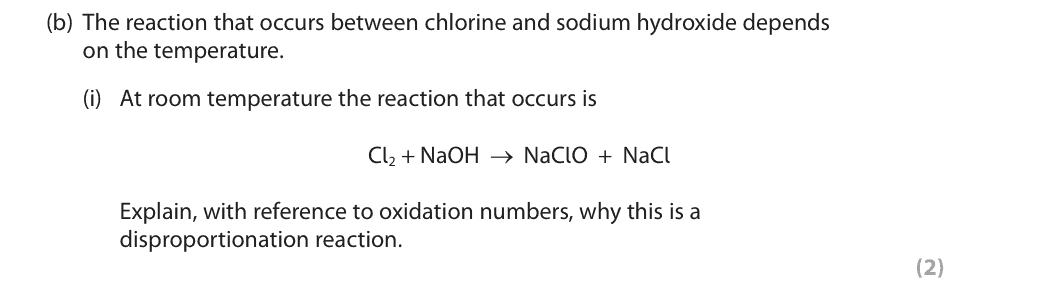
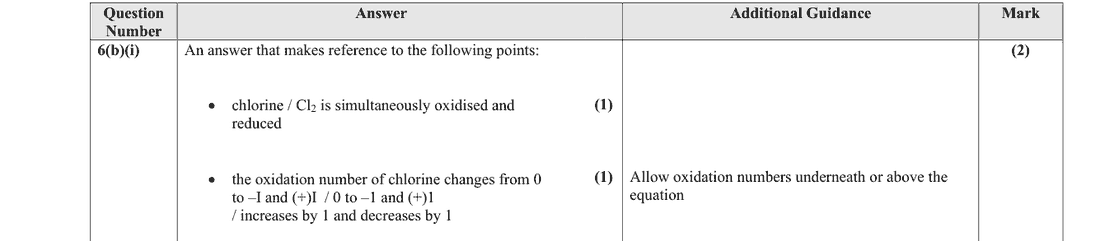
November 2021 · AS Paper 1 · Q6(b)(i) 2 marks Explanation redox igroup 7 the halogens
Earlier part of question 6 that this part usesEarlier part of November 2021 Paper 1 question 6
The reaction that occurs between chlorine and sodium hydroxide depends
on the temperature.
At room temperature the reaction that occurs is
Cl2 + NaOH  →  NaClO  +  NaCl
Explain, with reference to oxidation numbers, why this is a
disproportionation reaction.
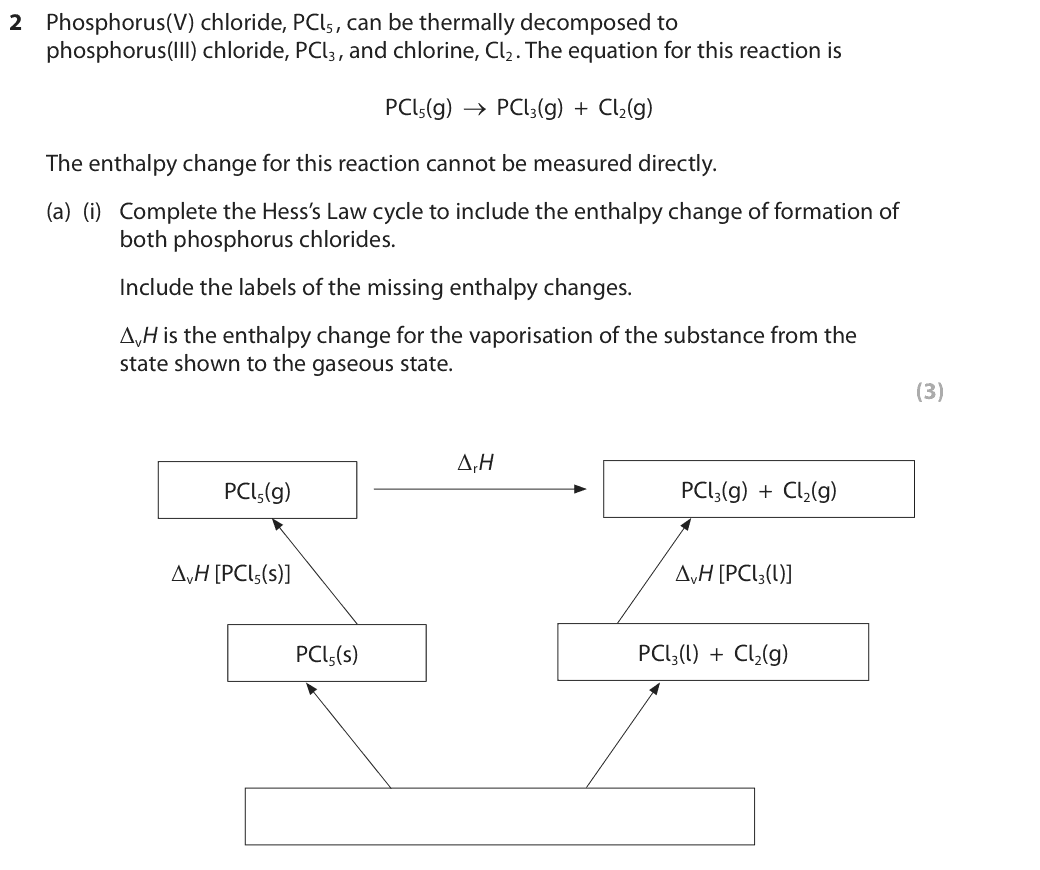
November 2021 · AS Paper 2 · Q2(b) 2 marks Explanation equilibrium i
Earlier part of question 2 that this part usesEarlier part of November 2021 Paper 2 question 2
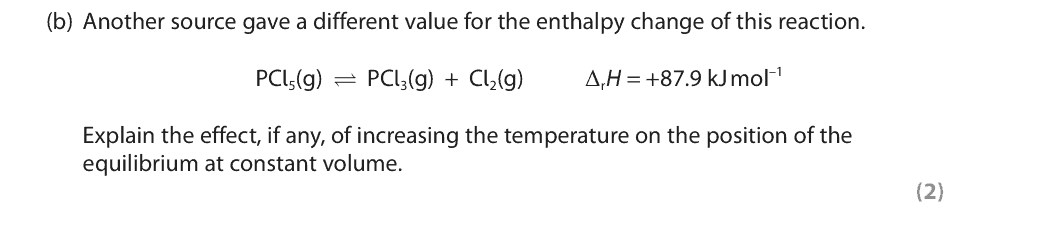
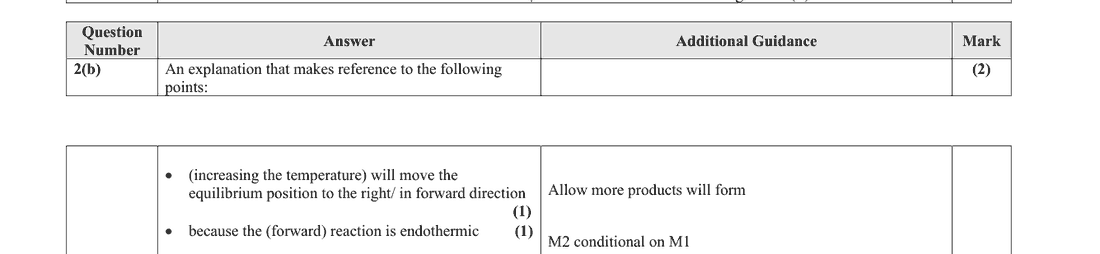
Another source gave a different value for the enthalpy change of this reaction.
PCl5(g)    PCl3(g)  +  Cl2(g)            ΔrH = +87.9 kJ mol–1
Explain the effect, if any, of increasing the temperature on the position of the
equilibrium at constant volume.
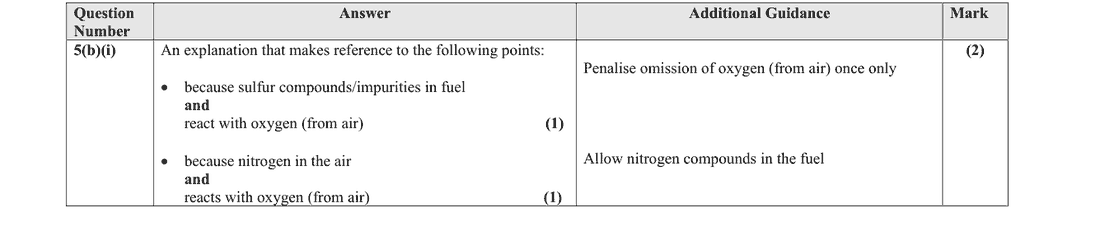
November 2021 · AS Paper 2 · Q5(b)(i) 2 marks Explanation alkanes
One of the problems associated with the combustion of some fossil fuels is the
production of acidic gases, including the oxides of nitrogen and sulfur.
Explain how oxides of sulfur and nitrogen can be formed from the combustion
of fossil fuels.
November 2021 · AS Paper 2 · Q5(b)(ii) 2 marks Explanation alkanes
Earlier parts of question 5 that this part usesEarlier part of November 2021 Paper 2 question 5Earlier part of November 2021 Paper 2 question 5
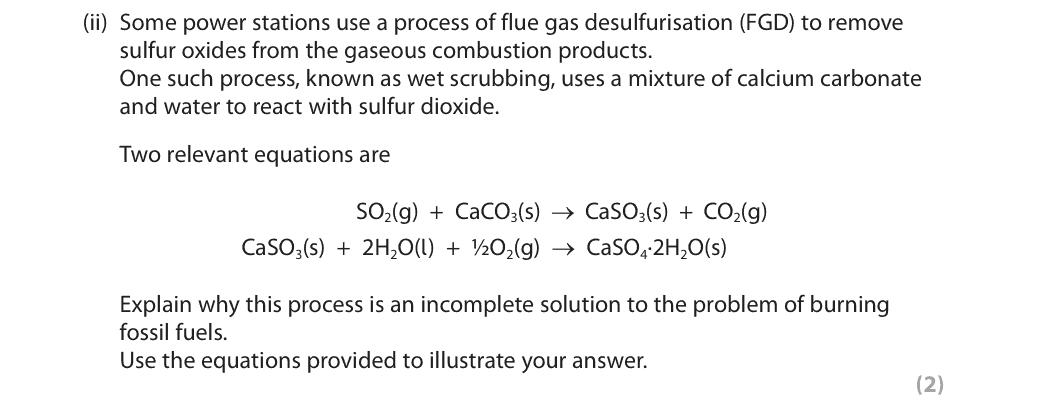
Some power stations use a process of flue gas desulfurisation (FGD) to remove
sulfur oxides from the gaseous combustion products.
One such process, known as wet scrubbing, uses a mixture of calcium carbonate
and water to react with sulfur dioxide.
Two relevant equations are
SO2(g)  +  CaCO3(s)  →  CaSO3(s)  +  CO2(g)
CaSO3(s)  +  2H2O(l)  +  ½O2(g)  →  CaSO4·2H2O(s)
Explain why this process is an incomplete solution to the problem of burning
fossil fuels.
Use the equations provided to illustrate your answer.
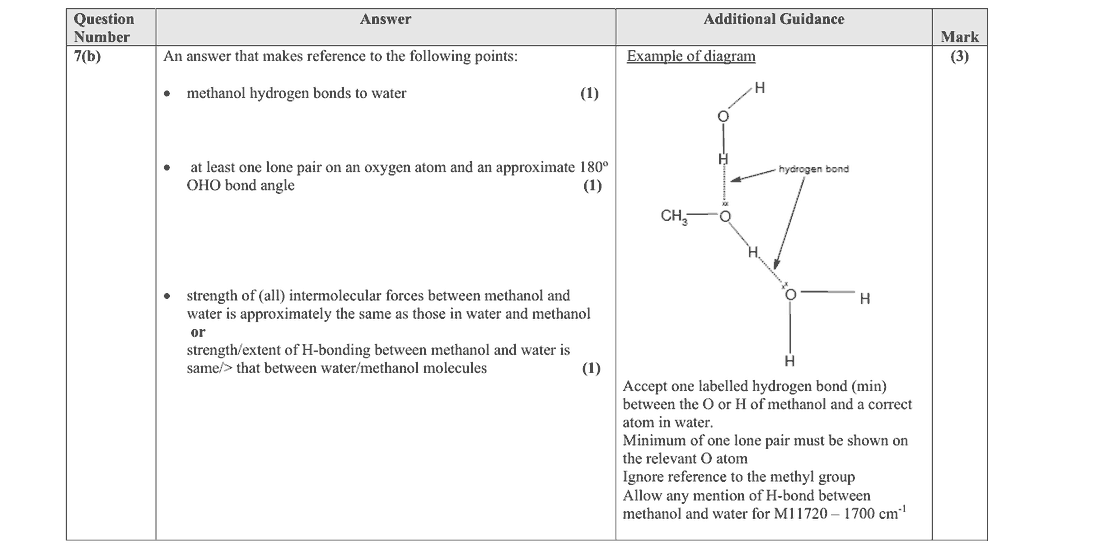
November 2021 · AS Paper 2 · Q7(b) 3 marks Explanation bonding
Earlier part of question 7 that this part usesEarlier part of November 2021 Paper 2 question 7
Explain why methanol and water are ‘soluble in all proportions’.
You must include a diagram in your answer.
November 2021 · Paper 1 · Q4(c) 3 marks Explanation atomic structure and the periodic table
Earlier part of question 4 that this part usesEarlier part of November 2021 Paper 1 question 4
A sodium atom has 11 protons whereas a potassium atom has 19 protons.
Explain why the first ionisation energy of sodium is greater than that of potassium.
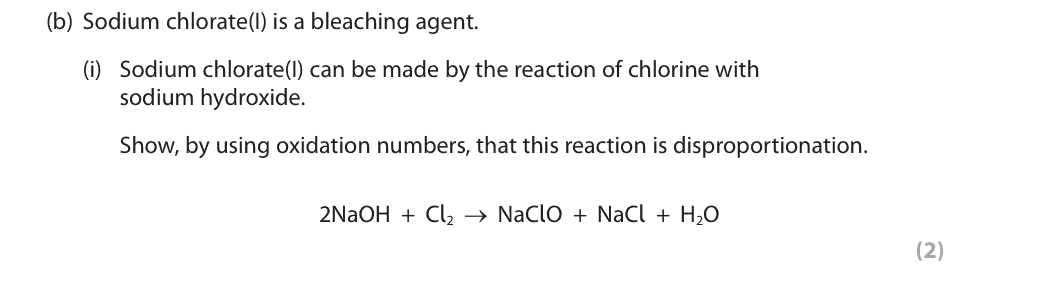
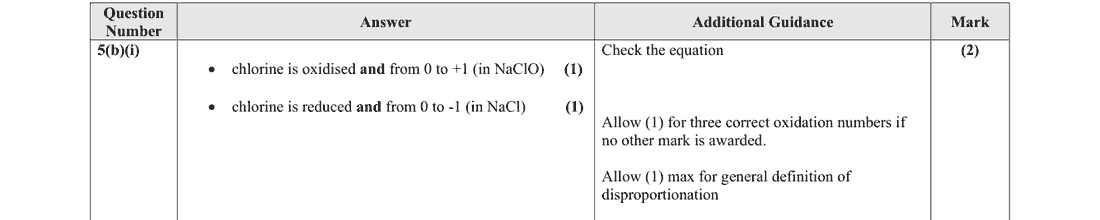
November 2021 · Paper 1 · Q5(b)(i) 2 marks Explanation Easy redox i
Earlier part of question 5 that this part usesEarlier part of November 2021 Paper 1 question 5
Sodium chlorate(I) is a bleaching agent.
Sodium chlorate(I) can be made by the reaction of chlorine with
sodium hydroxide.
Show, by using oxidation numbers, that this reaction is disproportionation.
2NaOH  +  Cl2  →  NaClO  +  NaCl  +  H2O
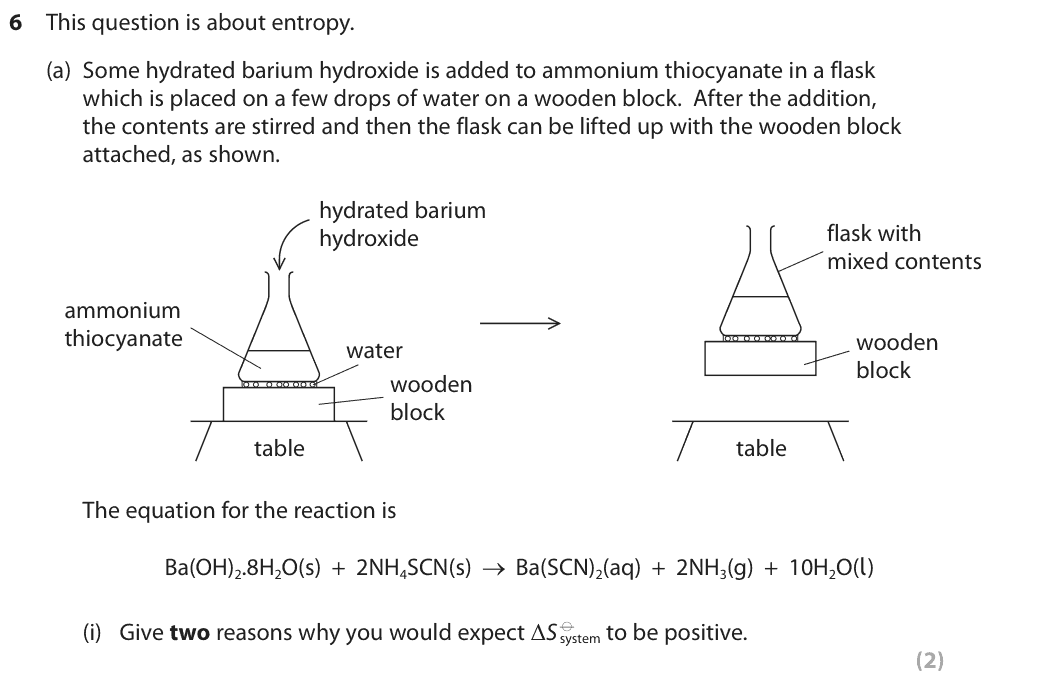
November 2021 · Paper 1 · Q6(a)(ii) 2 marks Explanation entropy
Earlier part of question 6 that this part usesEarlier part of November 2021 Paper 1 question 6
Explain why the wooden block is lifted up by the flask.
November 2021 · Paper 1 · Q7(e)(ii) 2 marks Explanation Hard acid base equilibria
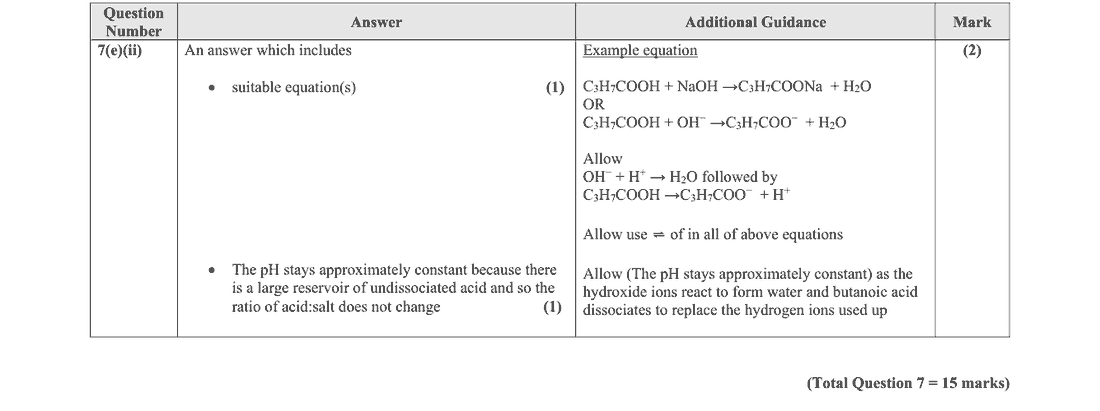
Earlier parts of question 7 that this part usesEarlier part of November 2021 Paper 1 question 7Earlier part of November 2021 Paper 1 question 7
Explain why the pH of the buffer solution hardly changes when a few drops of
sodium hydroxide solution are added to it.
Include an equation or equations in your answer.
Use C3H7COOH as the formula for butanoic acid.
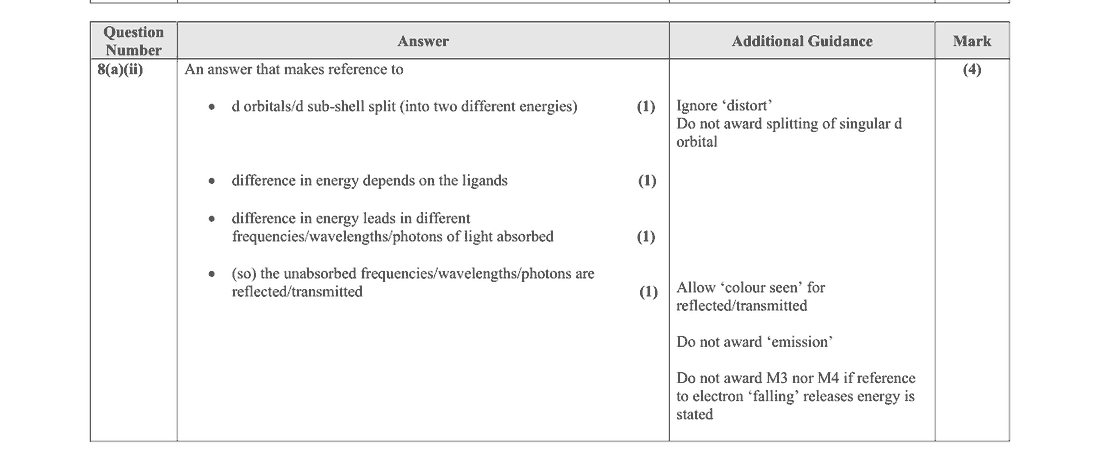
November 2021 · Paper 1 · Q8(a)(ii) 4 marks Explanation transition metals principles
Earlier part of question 8 that this part usesEarlier part of November 2021 Paper 1 question 8
Explain why the complex ions [Co(NH3)6]2+ and [Co(H2O)6]2+ are coloured and
have different colours.
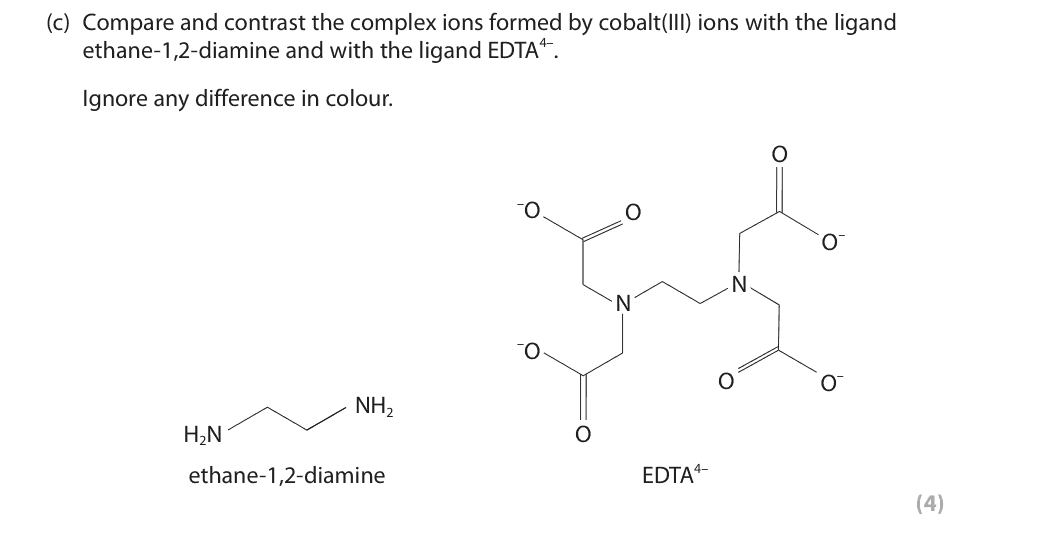
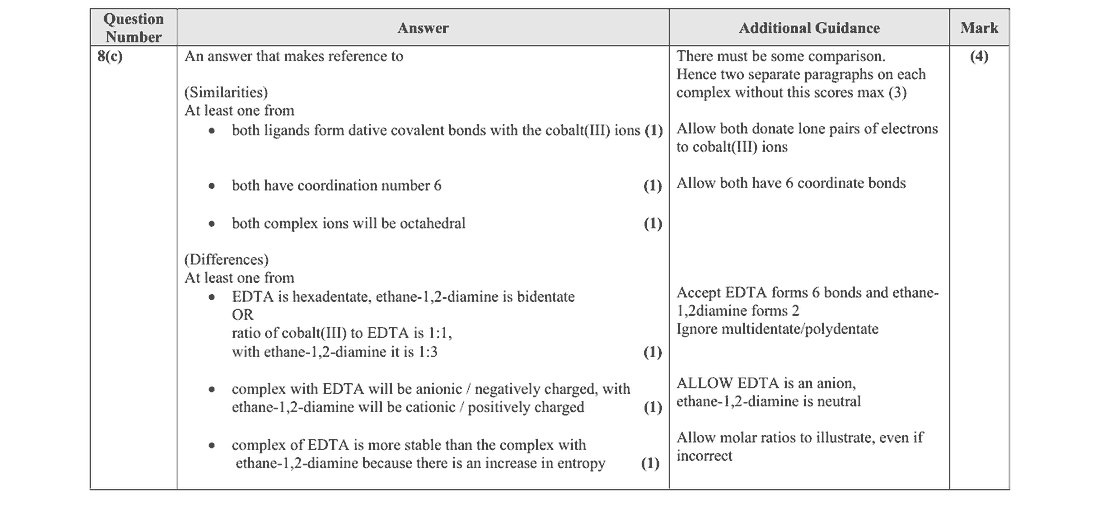
November 2021 · Paper 1 · Q8(c) 4 marks Explanation Hard transition metals principlestransition metals reactions
Earlier part of question 8 that this part usesEarlier part of November 2021 Paper 1 question 8
Compare and contrast the complex ions formed by cobalt(III) ions with the ligand
ethane‑1,2‑diamine and with the ligand EDTA4–.
Ignore any difference in colour.
O
–O
O
O–
N
N
–O
O
O–
NH2
H2N
O
EDTA4–
ethane‑1,2‑diamine
November 2021 · Paper 1 · Q9(a)(ii) 4 marks Explanation lattice energy
Earlier part of question 9 that this part usesEarlier part of November 2021 Paper 1 question 9
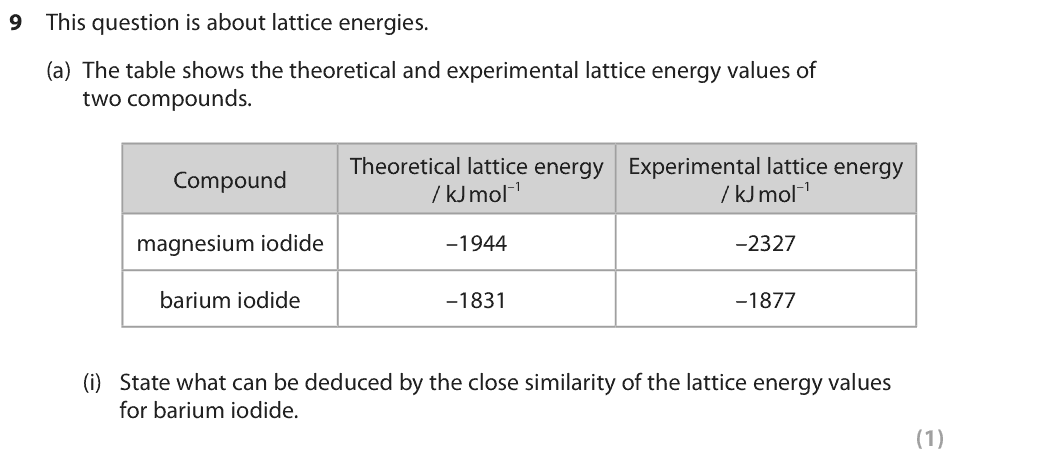
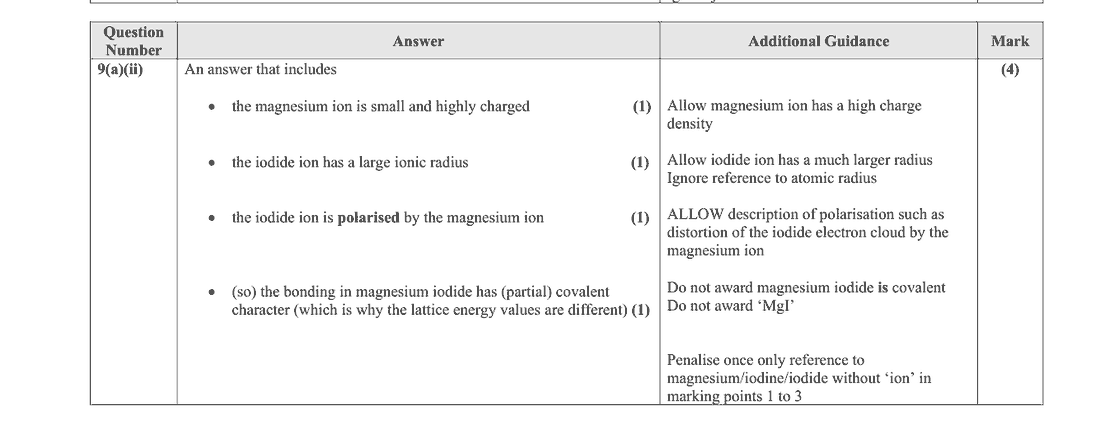
Explain why there is a significant difference in the lattice energy values for
magnesium iodide.
November 2021 · Paper 2 · Q5(c)(ii) 2 marks Explanation bonding
Earlier parts of question 5 that this part usesEarlier part of November 2021 Paper 2 question 5Earlier part of November 2021 Paper 2 question 5
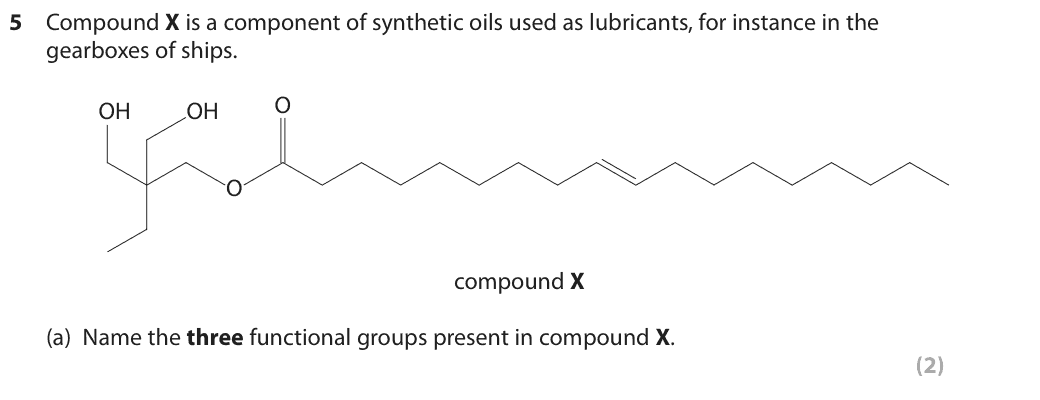
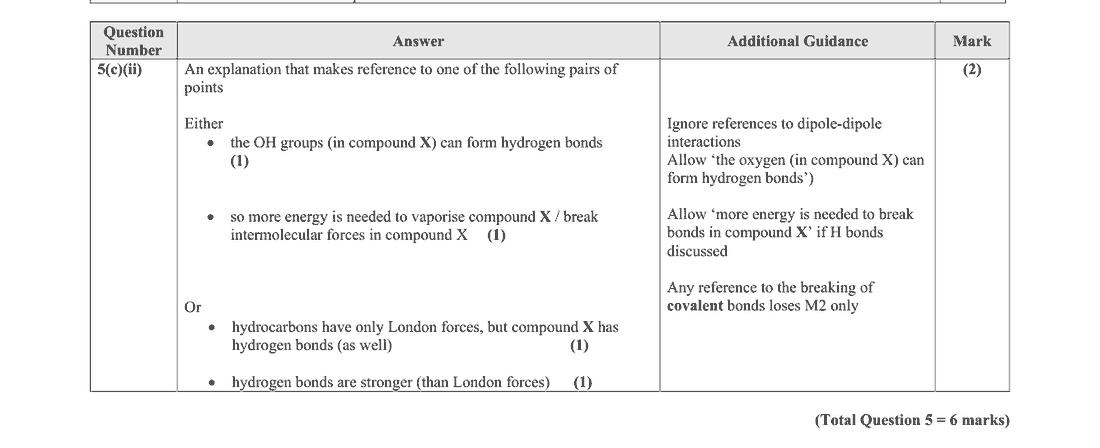
Explain why compound X is likely to have a higher boiling temperature than
hydrocarbons of a similar molecular mass and shape.
A detailed description of how the intermolecular forces arise is not required.
November 2021 · Paper 2 · Q9(d) 2 marks Explanation amines amides amino acids and proteins
Earlier part of question 9 that this part usesEarlier part of November 2021 Paper 2 question 9
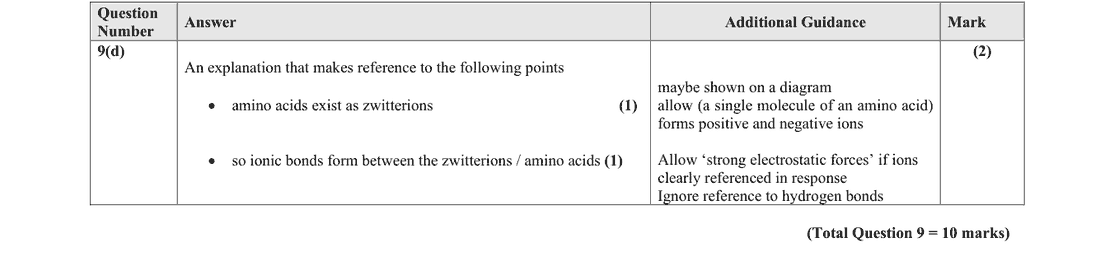
Explain why amino acids such as glycine are crystalline solids at room temperature.
November 2021 · Paper 2 · Q10(a)(ii) 3 marks Explanation amines amides amino acids and proteins
Earlier part of question 10 that this part usesEarlier part of November 2021 Paper 2 question 10
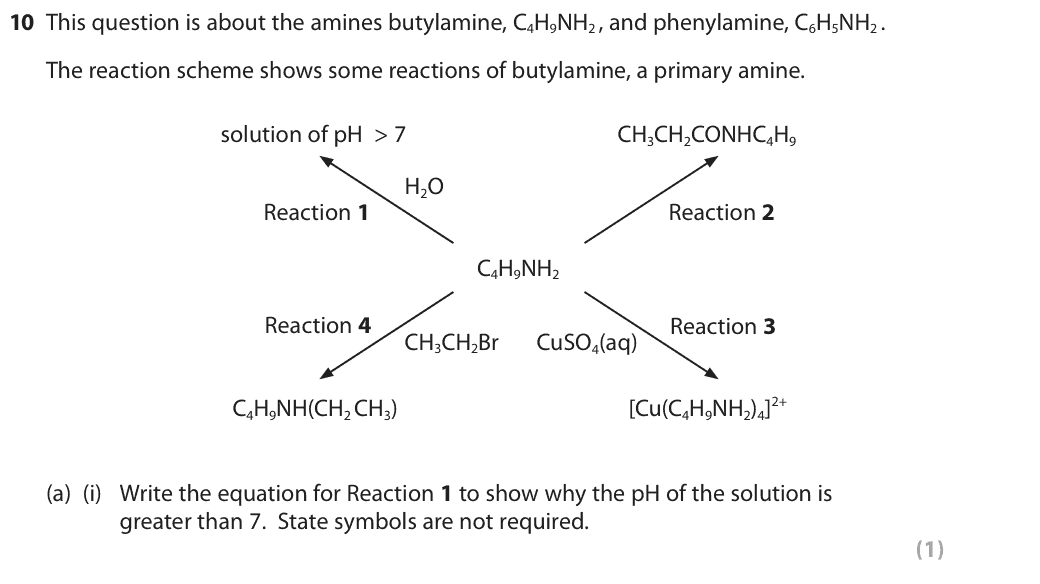
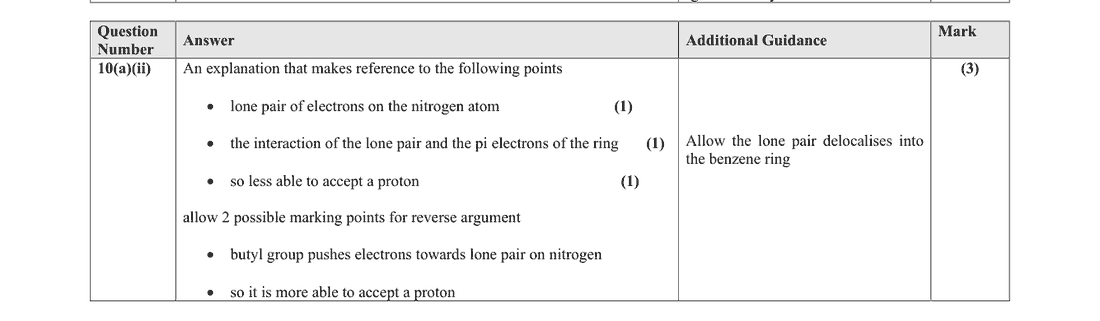
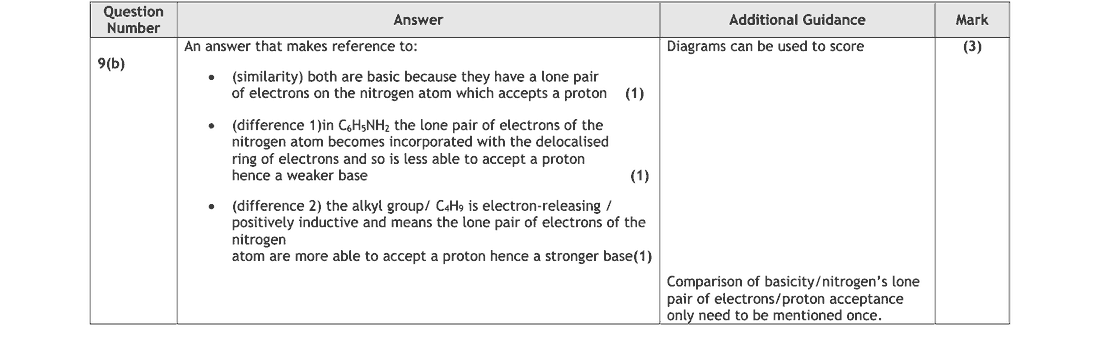
Explain why phenylamine is a weaker base than butylamine.
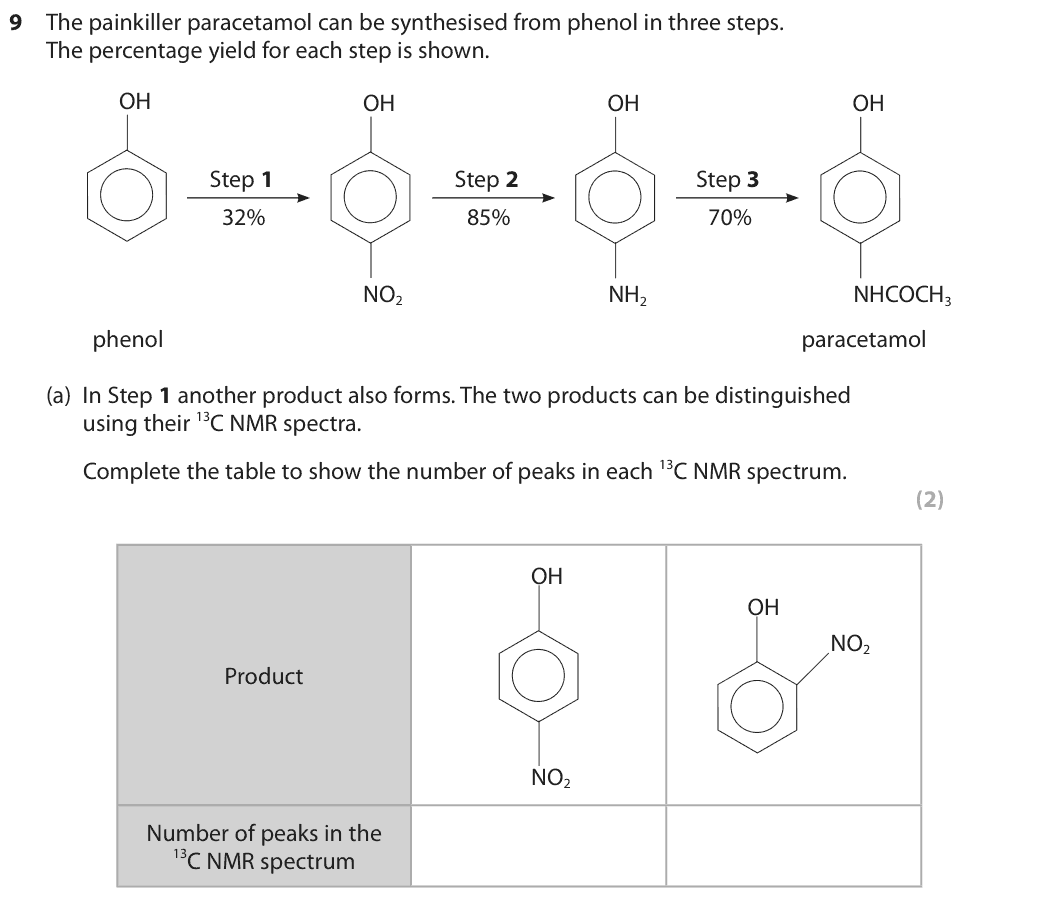
November 2021 · Paper 3 · Q6(a)(i) 2 marks Explanation arenes benzene
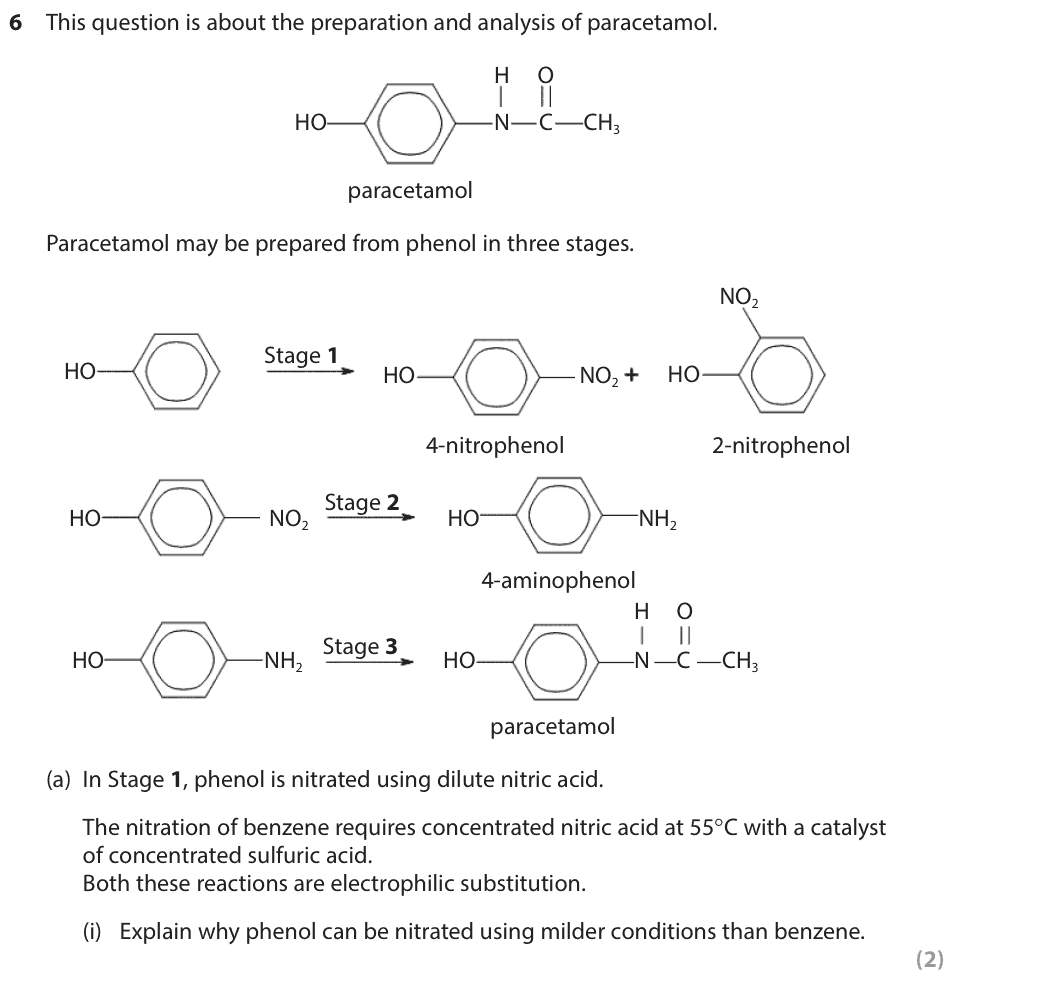
This question is about the preparation and analysis of paracetamol.
H
O
HO
N
C
CH3
paracetamol
Paracetamol may be prepared from phenol in three stages.
NO2
Stage 1
HO
HO
NO2
HO
4-nitrophenol
2-nitrophenol
Stage 2
HO
NO2
HO
NH2
4-aminophenol
H
O
Stage 3
HO
NH2
HO
N
C
CH3
paracetamol
In Stage 1, phenol is nitrated using dilute nitric acid.
The nitration of benzene requires concentrated nitric acid at 55°C with a catalyst
of concentrated sulfuric acid.
Both these reactions are electrophilic substitution.
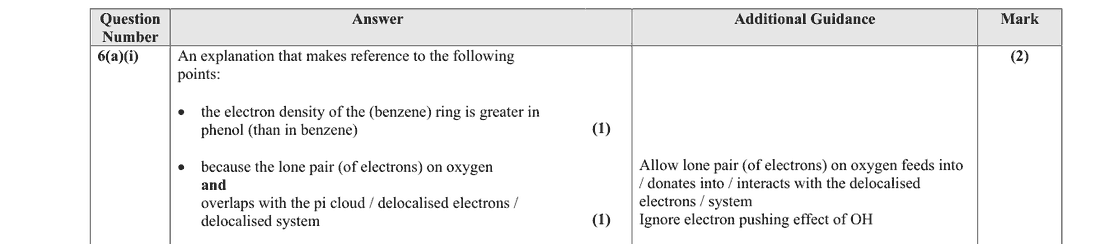
Explain why phenol can be nitrated using milder conditions than benzene.
November 2021 · Paper 3 · Q6(a)(ii) 2 marks Explanation Hard bondingstructure
Earlier part of question 6 that this part usesEarlier part of November 2021 Paper 3 question 6
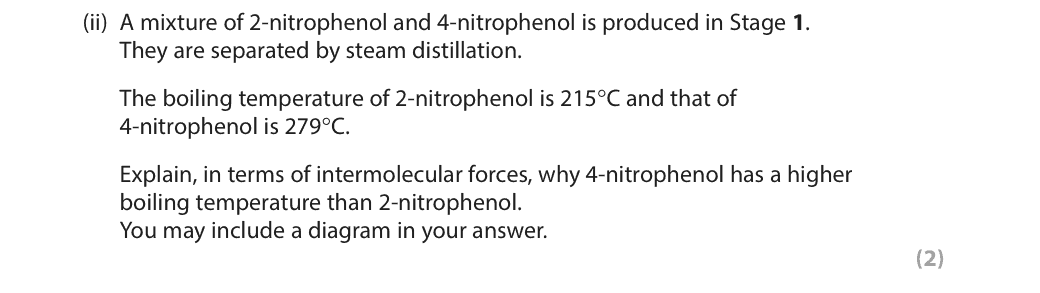
A mixture of 2-nitrophenol and 4-nitrophenol is produced in Stage 1.
They are separated by steam distillation.
The boiling temperature of 2-nitrophenol is 215°C and that of
4-nitrophenol is 279°C.
Explain, in terms of intermolecular forces, why 4-nitrophenol has a higher
boiling temperature than 2-nitrophenol.
You may include a diagram in your answer.
November 2021 · Paper 3 · Q8(b)(ii) 2 marks Explanation chiralitycarbonyl compounds
Earlier part of question 8 that this part usesEarlier part of November 2021 Paper 3 question 8
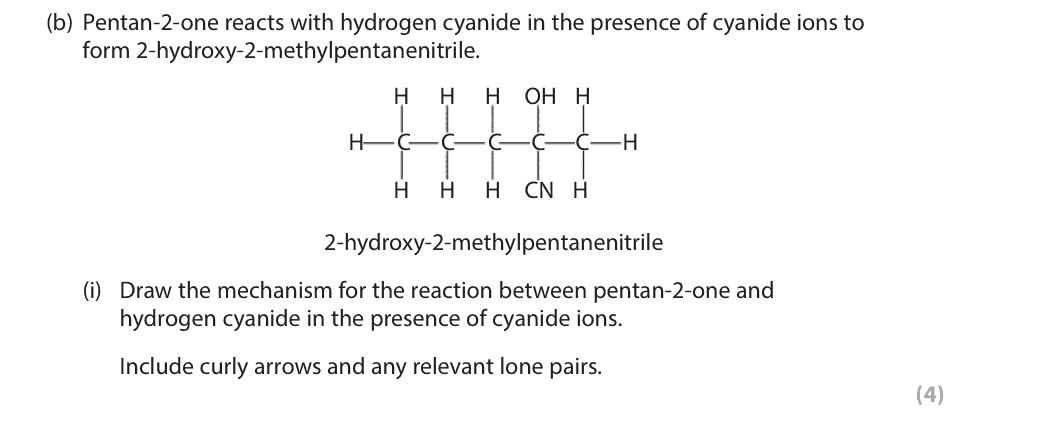
The product of this reaction, 2-hydroxy-2-methylpentanenitrile, has a
chiral centre.
Explain why a racemic mixture of 2-hydroxy-2-methylpentanenitrile is formed
in this reaction.
November 2021 · Paper 3 · Q8(c) 4 marks Explanation nmr mass spectrometry and chromatographyorganic synthesis
Earlier part of question 8 that this part usesEarlier part of November 2021 Paper 3 question 8
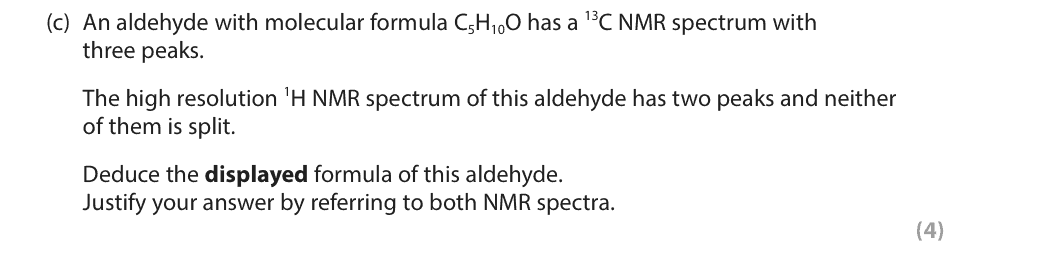
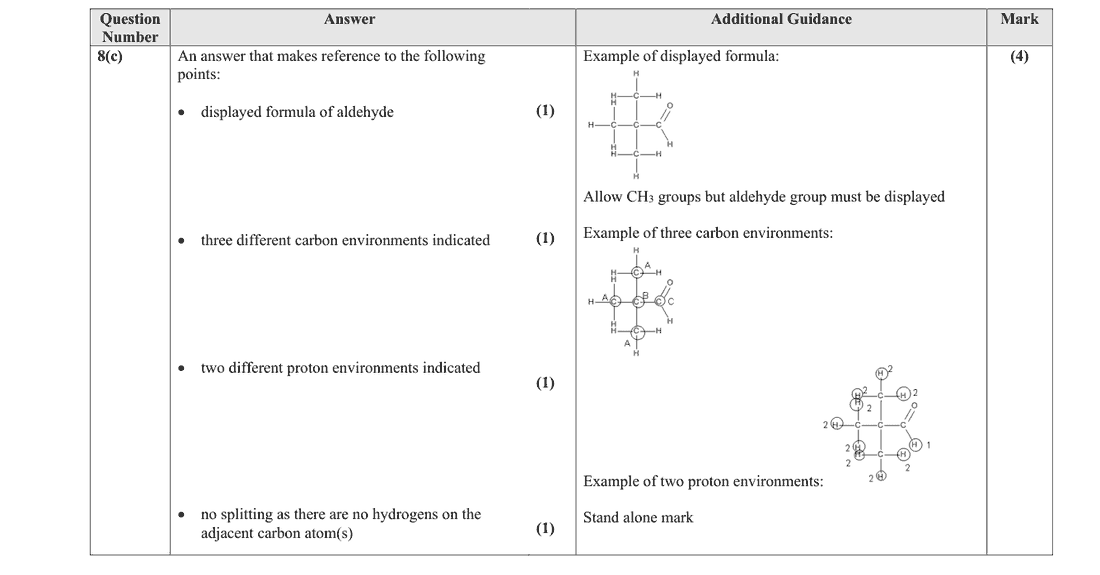
An aldehyde with molecular formula C5H10O has a 13C NMR spectrum with
three peaks.
The high resolution 1H NMR spectrum of this aldehyde has two peaks and neither
of them is split.
Deduce the displayed formula of this aldehyde.
Justify your answer by referring to both NMR spectra.
November 2021 · Paper 3 · Q9(a) 2 marks Explanation equilibrium i
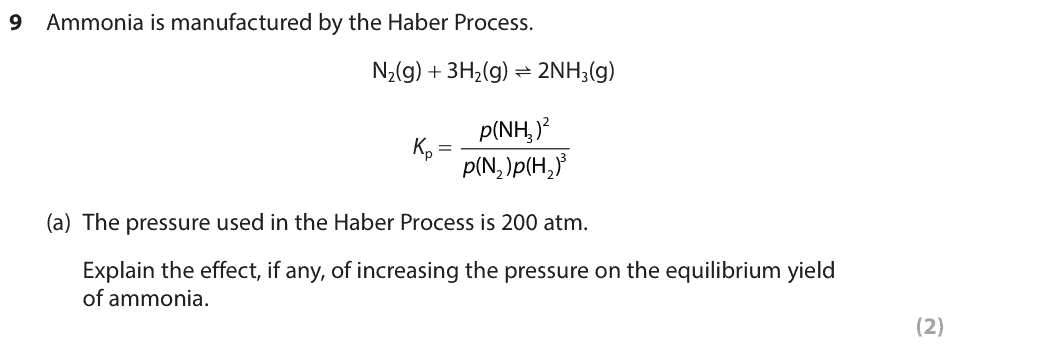
Ammonia is manufactured by the Haber Process.
N2(g) + 3H2(g) ⇌ 2NH3(g)
p
(
NH
)
2
Kp =
3
p
(
N
) (
p
H
)
3
2
2
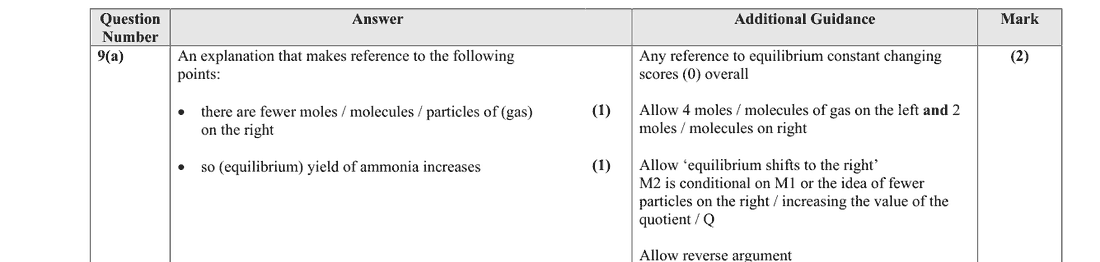
The pressure used in the Haber Process is 200 atm.
Explain the effect, if any, of increasing the pressure on the equilibrium yield
of ammonia.
October 2020 · AS Paper 1 · Q4(b)(ii) 3 marks Explanation Hard atomic structure and the periodic table
Earlier parts of question 4 that this part usesEarlier part of October 2020 Paper 1 question 4Earlier part of October 2020 Paper 1 question 4
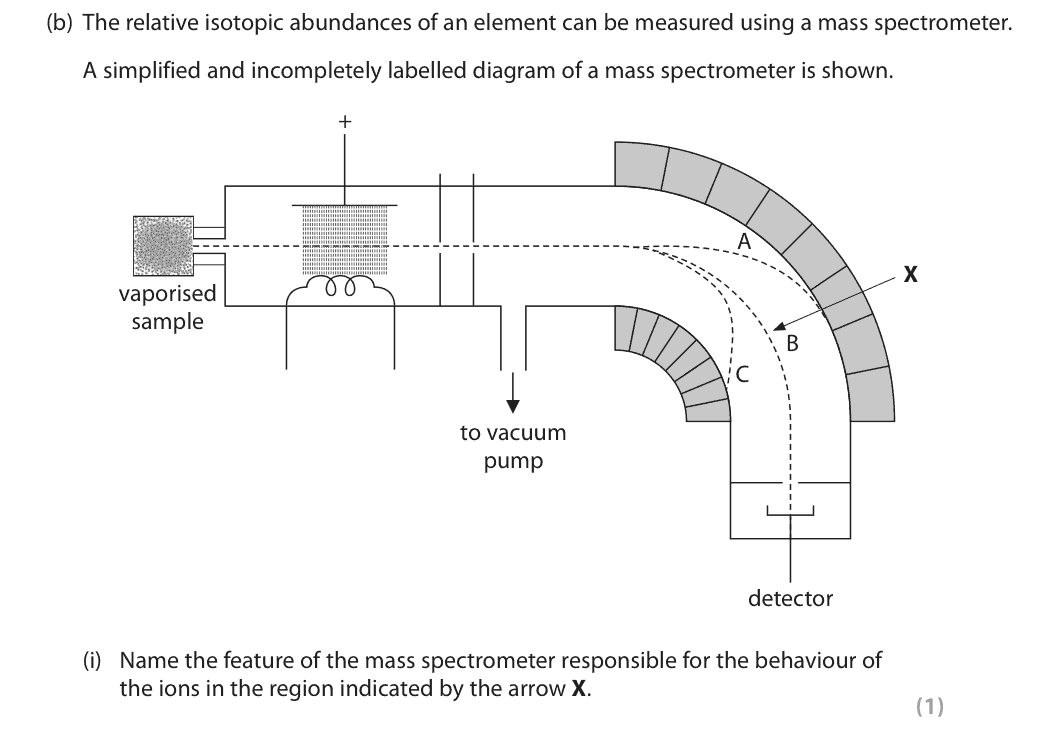
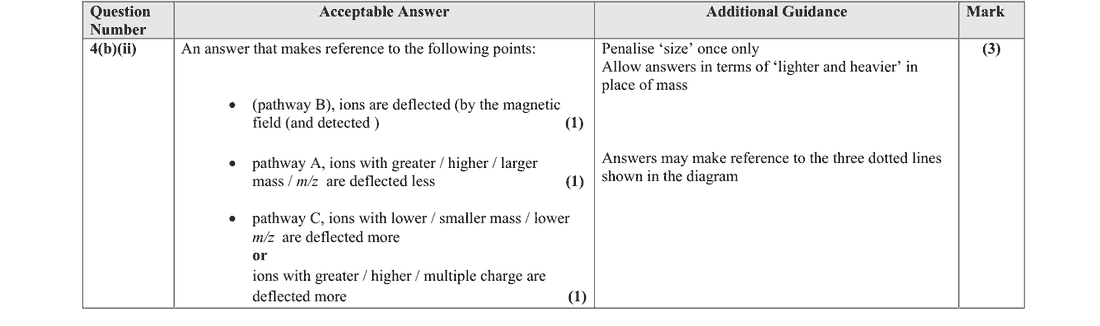
Explain the three ion pathways, A, B and C, shown in the region indicated by
the arrow X.
October 2020 · AS Paper 1 · Q6(c)(ii) 4 marks Explanation groups 1 and 2
Earlier parts of question 6 that this part usesEarlier part of October 2020 Paper 1 question 6Earlier part of October 2020 Paper 1 question 6
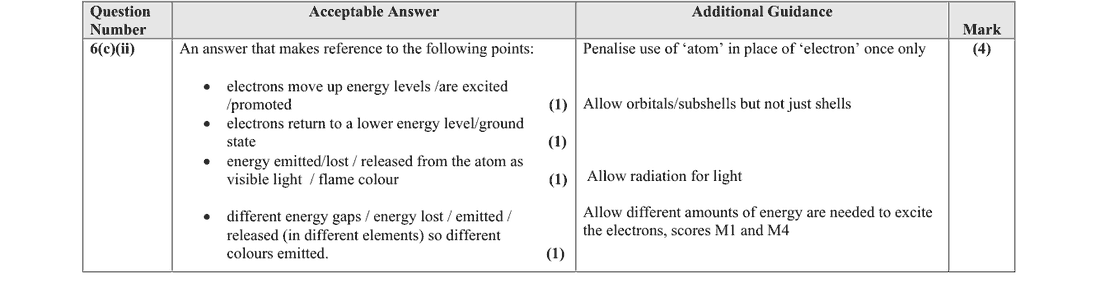
When the atoms of some elements are heated, they produce a characteristic
flame colour.  For example, the copper in malachite gives a blue-green colour.
Explain how atoms of different elements can produce different characteristic
flame colours when heated.
October 2020 · AS Paper 1 · Q8(b) 3 marks Explanation Hard groups 1 and 2
Earlier part of question 8 that this part usesEarlier part of October 2020 Paper 1 question 8
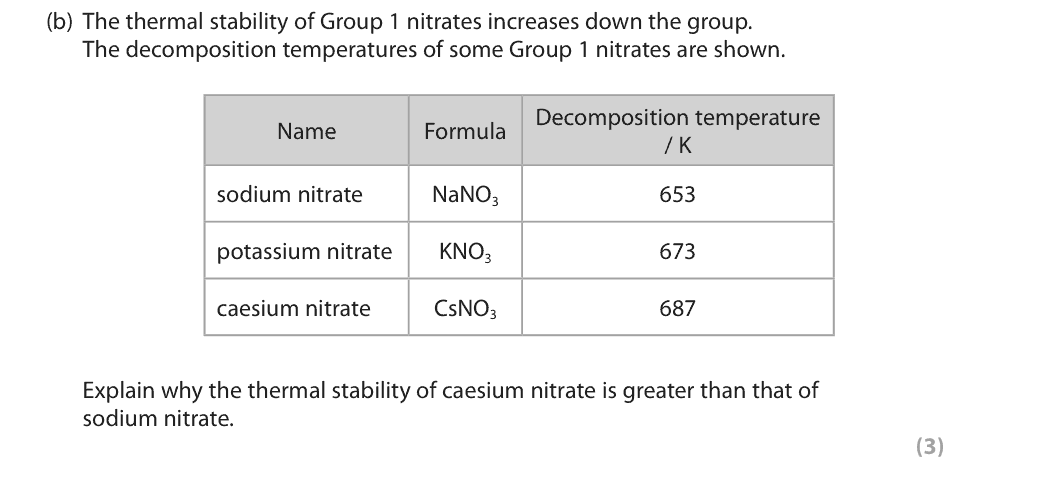
The thermal stability of Group 1 nitrates increases down the group.
The decomposition temperatures of some Group 1 nitrates are shown.
Decomposition temperature
Name
Formula
/ K
sodium nitrate
NaNO3
653
potassium nitrate
KNO3
673
caesium nitrate
CsNO3
687
Explain why the thermal stability of caesium nitrate is greater than that of
sodium nitrate.
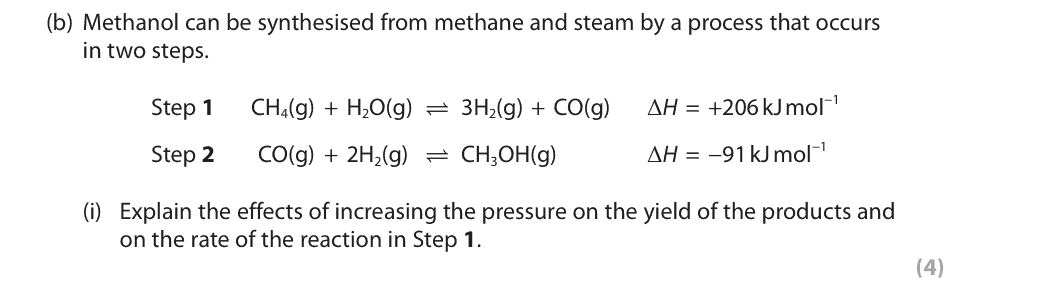
October 2020 · AS Paper 2 · Q4(b)(i) 4 marks Explanation equilibrium ikinetics i
Earlier part of question 4 that this part usesEarlier part of October 2020 Paper 2 question 4
Methanol can be synthesised from methane and steam by a process that occurs
in two steps.
Step 1
CH4(g)  + H2O(g)    3H2(g) + CO(g)
ΔH = +206 kJ mol−1
Step 2
CO(g)  + 2H2(g)    CH3OH(g)
ΔH = −91 kJ mol−1
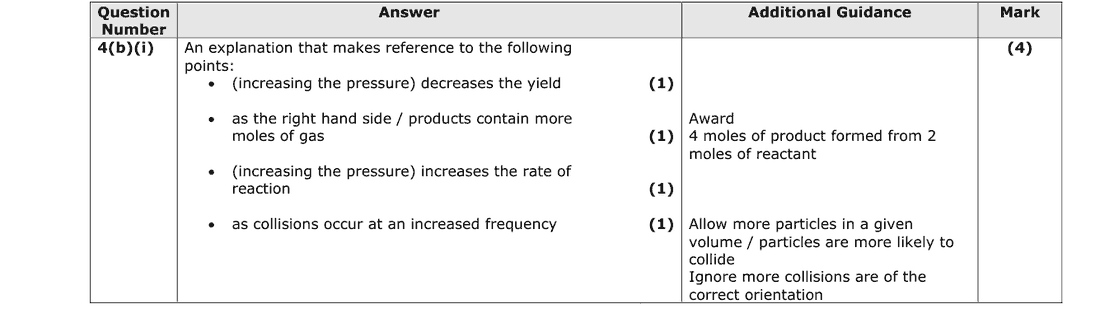
Explain the effects of increasing the pressure on the yield of the products and
on the rate of the reaction in Step 1.
October 2020 · AS Paper 2 · Q4(b)(ii) 3 marks Explanation equilibrium i
Earlier parts of question 4 that this part usesEarlier part of October 2020 Paper 2 question 4Earlier part of October 2020 Paper 2 question 4
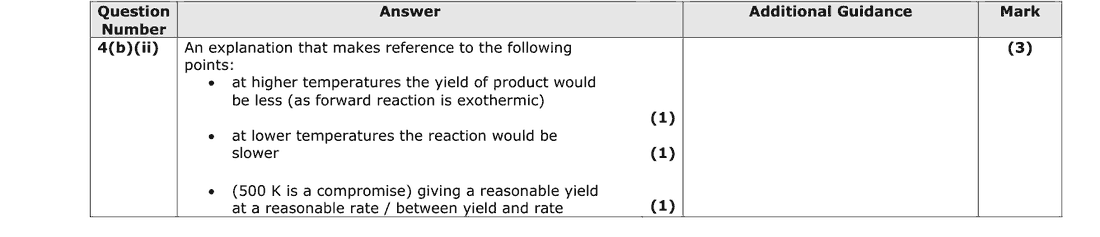
Step 2 is carried out at a compromise temperature of 500 K.
Explain why 500 K is considered to be a compromise for Step 2 by considering
what would happen at higher and lower temperatures.
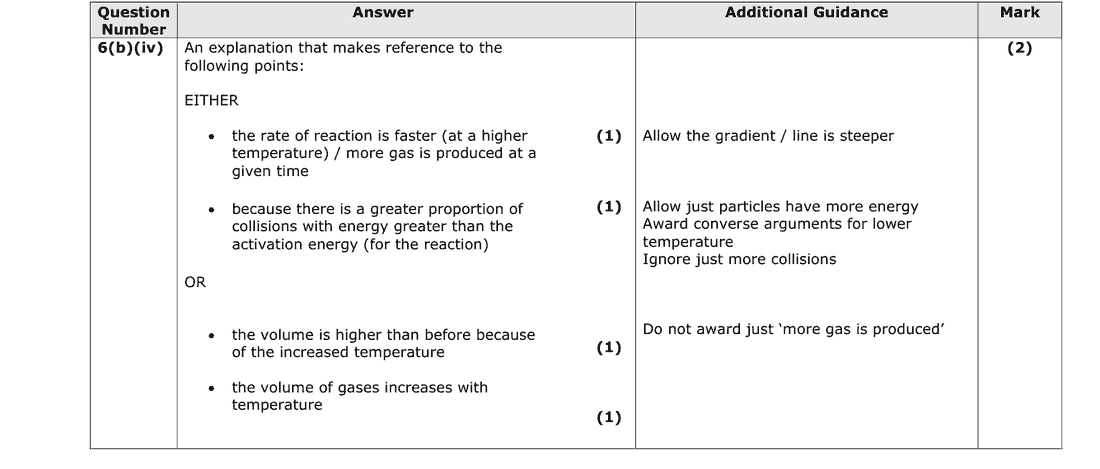
October 2020 · AS Paper 2 · Q6(b)(iv) 2 marks Explanation kinetics i
Earlier parts of question 6 that this part usesEarlier part of October 2020 Paper 2 question 6Earlier part of October 2020 Paper 2 question 6
Explain, using collision theory, any differences between the line you have
drawn and the original line of best fit.
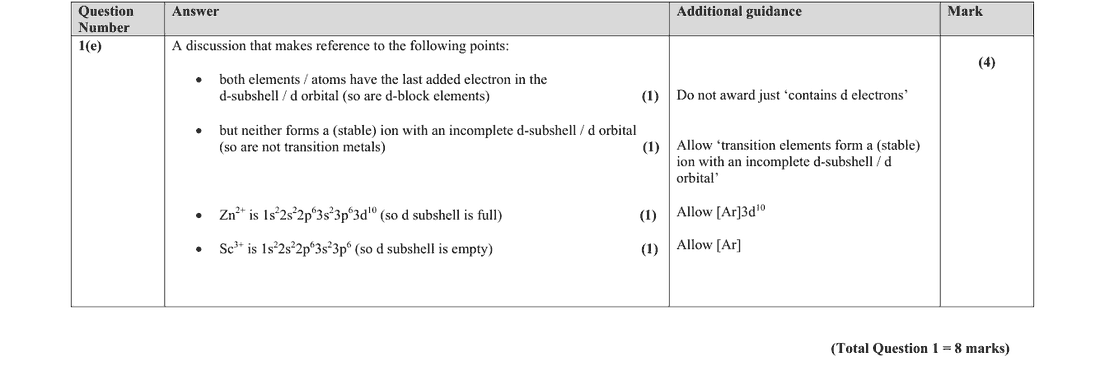
October 2020 · Paper 1 · Q1(e) 4 marks Explanation transition metals principlesatomic structure and the periodic table
A student stated that ‘the elements scandium and zinc are d-block elements but
are not transition metals’.
Discuss this statement, using appropriate electronic configurations to support
your answer.
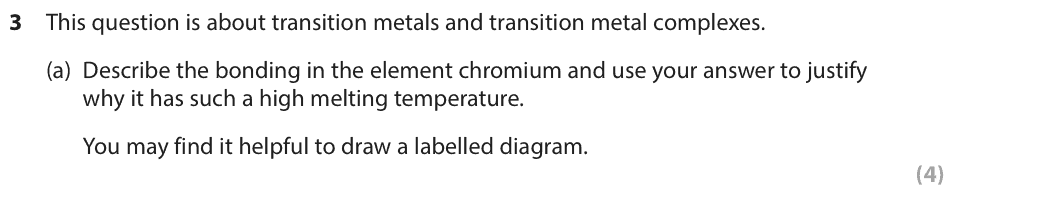
October 2020 · Paper 1 · Q3(a) 4 marks Explanation bondingstructure
This question is about transition metals and transition metal complexes.
Describe the bonding in the element chromium and use your answer to justify
why it has such a high melting temperature.
You may find it helpful to draw a labelled diagram.
October 2020 · Paper 1 · Q3(b)(ii) 3 marks Explanation transition metals principles
Earlier part of question 3 that this part usesEarlier part of October 2020 Paper 1 question 3
Explain why the chromium complex ion is coloured.
October 2020 · Paper 1 · Q3(c) 3 marks Explanation transition metals reactions
Earlier part of question 3 that this part usesEarlier part of October 2020 Paper 1 question 3
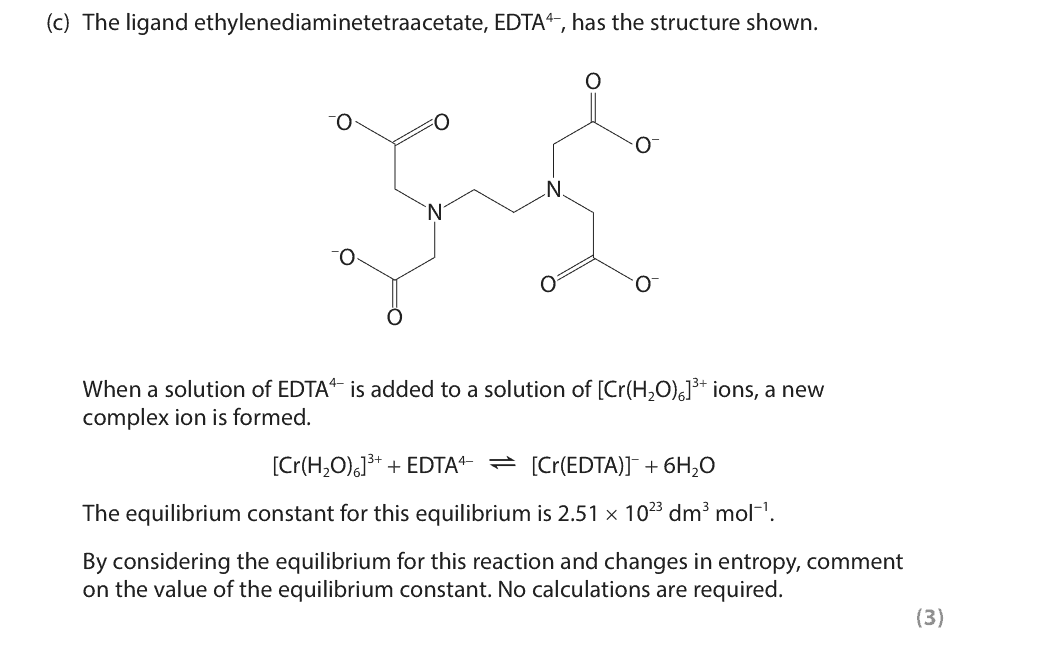
The ligand ethylenediaminetetraacetate, EDTA4−, has the structure shown.
O
−O
O
O−
N
N
−O
O−
O
O
When a solution of EDTA4− is added to a solution of [Cr(H2O)6]3+ ions, a new
complex ion is formed.
[Cr(H2O)6]3+ + EDTA4−  ⇌  [Cr(EDTA)]− + 6H2O
The equilibrium constant for this equilibrium is 2.51 × 10²³ dm3 mol−1.
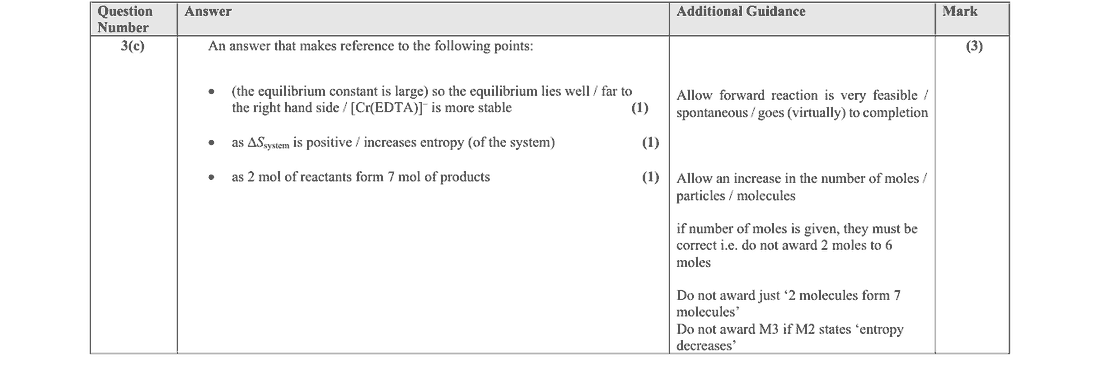
By considering the equilibrium for this reaction and changes in entropy, comment
on the value of the equilibrium constant. No calculations are required.
October 2020 · Paper 1 · Q5(a)(ii) 3 marks Explanation groups 1 and 2
Earlier part of question 5 that this part usesEarlier part of October 2020 Paper 1 question 5
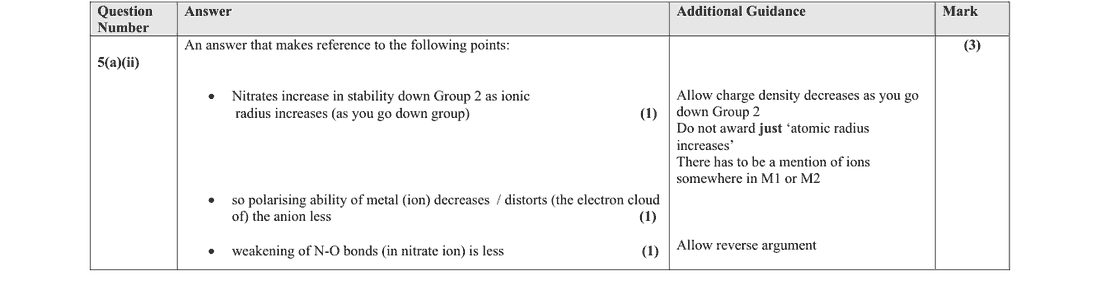
Explain the trend in thermal stability of Group 2 nitrates.
October 2020 · Paper 1 · Q6(a)(i) 2 marks Explanation alkenes
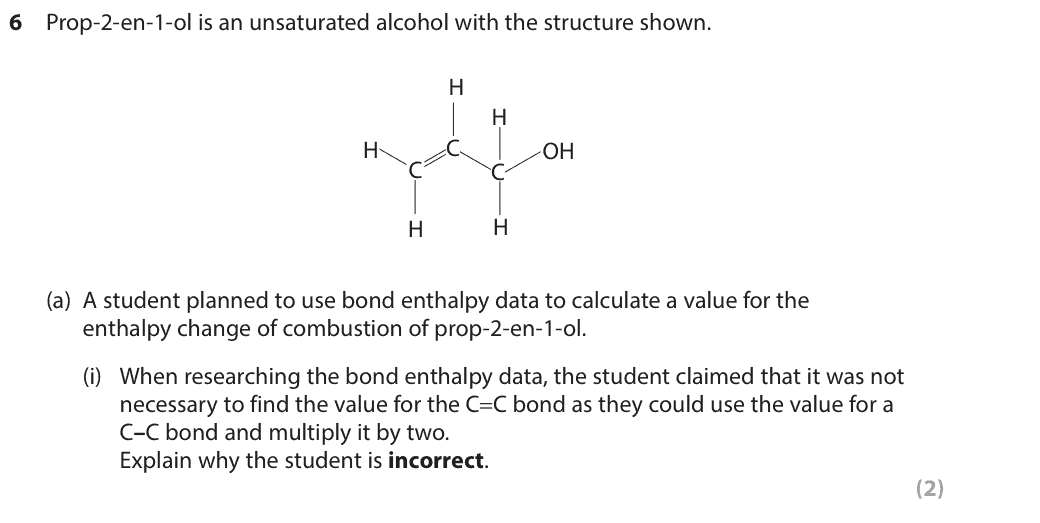
Prop-2-en-1-ol is an unsaturated alcohol with the structure shown.
H
H
H
C
OH
C
C
H
H
A student planned to use bond enthalpy data to calculate a value for the
enthalpy change of combustion of prop-2-en-1-ol.
When researching the bond enthalpy data, the student claimed that it was not
necessary to find the value for the C=C bond as they could use the value for a
C–C bond and multiply it by two.
Explain why the student is incorrect.
October 2020 · Paper 1 · Q6(a)(iii) 2 marks Explanation entropy
Earlier part of question 6 that this part usesEarlier part of October 2020 Paper 1 question 6
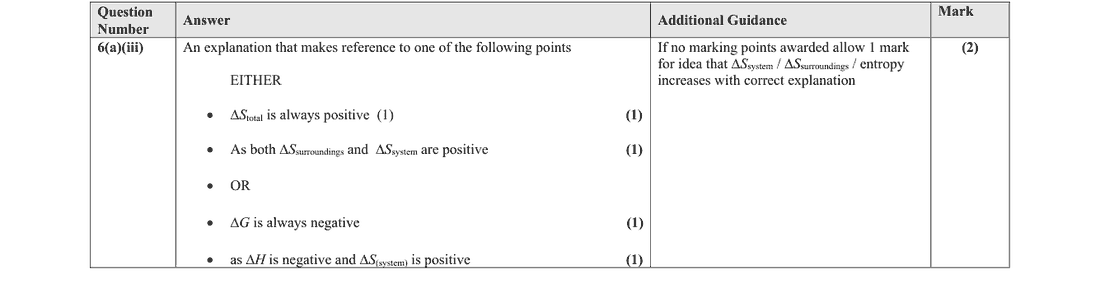
Explain, in terms of entropy, why the combustion of prop-2-en-1-ol is always
feasible in the gaseous state.
October 2020 · Paper 1 · Q7(b)(iii) 2 marks Explanation equilibrium ii
Earlier parts of question 7 that this part usesEarlier part of October 2020 Paper 1 question 7Earlier part of October 2020 Paper 1 question 7Earlier part of October 2020 Paper 1 question 7
Describe what effect, if any, increasing the pressure would have on the
equilibrium constant, Kp. Justify your answer.
October 2020 · Paper 1 · Q8(e)(iii) 4 marks Explanation transition metals reactionsredox ii
Earlier parts of question 8 that this part usesEarlier part of October 2020 Paper 1 question 8Earlier part of October 2020 Paper 1 question 8Earlier part of October 2020 Paper 1 question 8
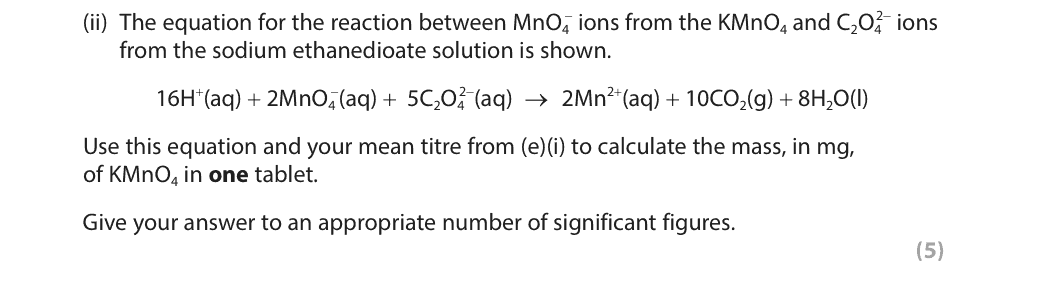
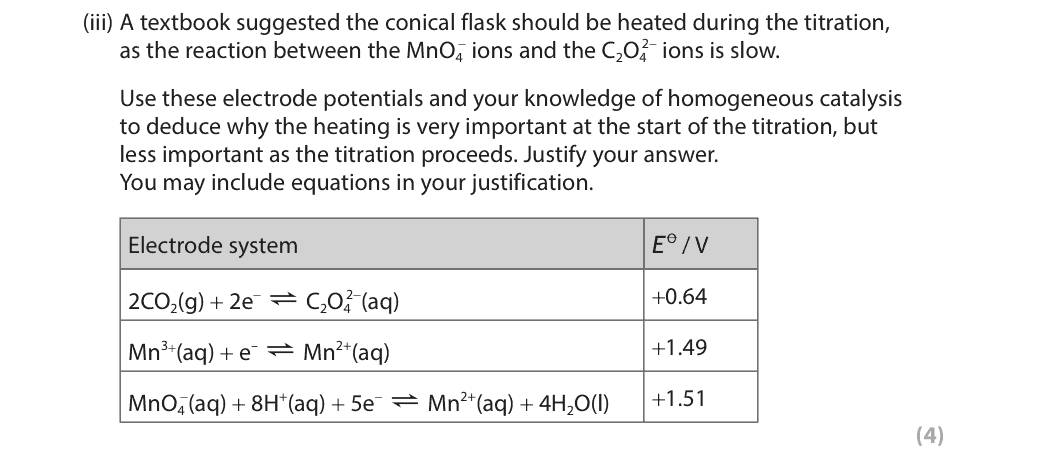
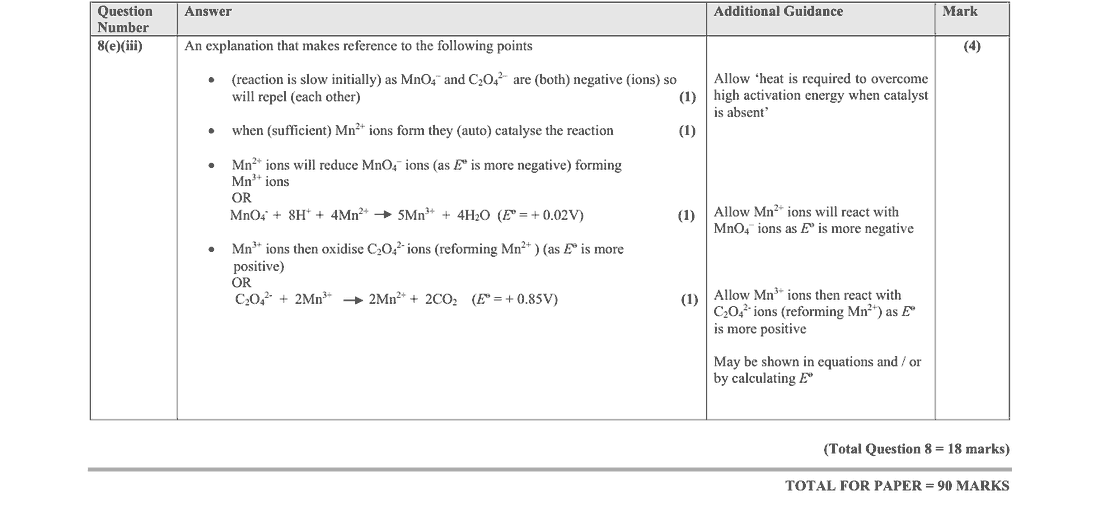
A textbook suggested the conical flask should be heated during the titration,
− ions and the C2O4
2− ions is slow.
as the reaction between the MnO4
Use these electrode potentials and your knowledge of homogeneous catalysis
to deduce why the heating is very important at the start of the titration, but
less important as the titration proceeds. Justify your answer.
You may include equations in your justification.
Electrode system
E O / V
2CO2(g) + 2e− ⇌ C2O4
+0.64
2−(aq)
Mn3+(aq) + e– ⇌ Mn2+(aq)
+1.49
−(aq) + 8H+(aq) + 5e− ⇌ Mn2+(aq) + 4H2O(l)
+1.51
MnO4
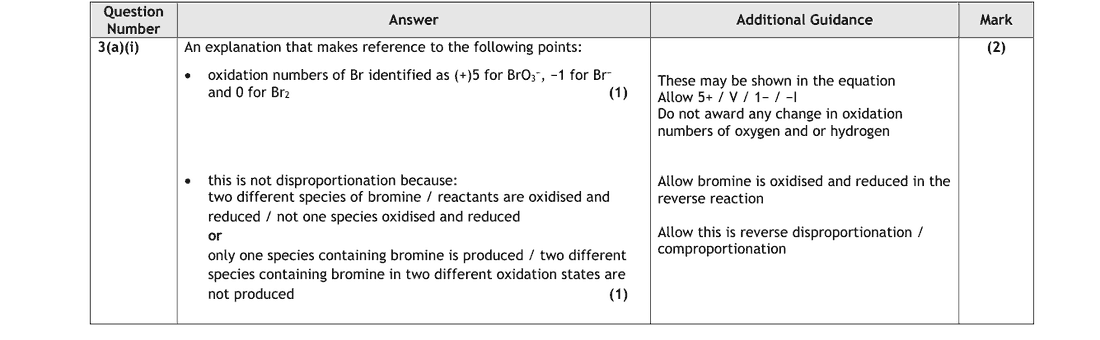
October 2020 · Paper 2 · Q3(a)(i) 2 marks Explanation redox i
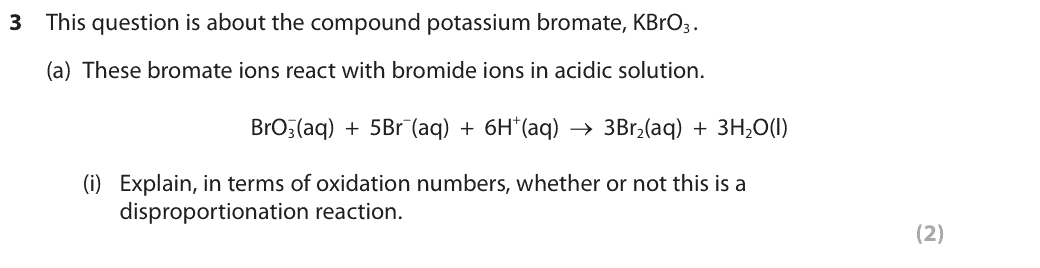
This question is about the compound potassium bromate, KBrO3 .
These bromate ions react with bromide ions in acidic solution.
BrO3
−(aq)  +  5Br−(aq)  +  6H+(aq)  →  3Br2(aq)  +  3H2O(l)
Explain, in terms of oxidation numbers, whether or not this is a
disproportionation reaction.
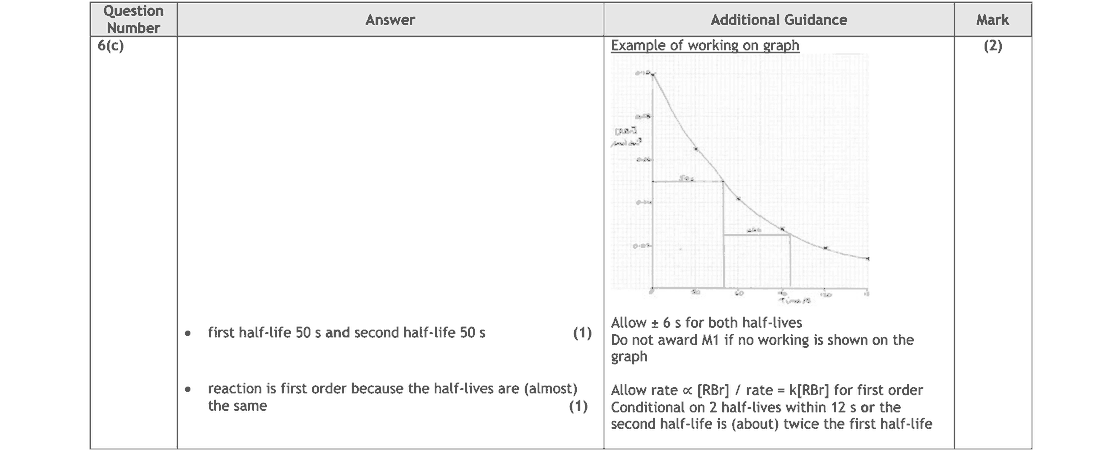
October 2020 · Paper 2 · Q6(c) 2 marks Explanation kinetics ii
Earlier part of question 6 that this part usesEarlier part of October 2020 Paper 2 question 6
Explain how the graph shows that the reaction is first order with respect to RBr.
Include the values of two consecutive half-lives.
You must show your working for the half-lives on the graph.
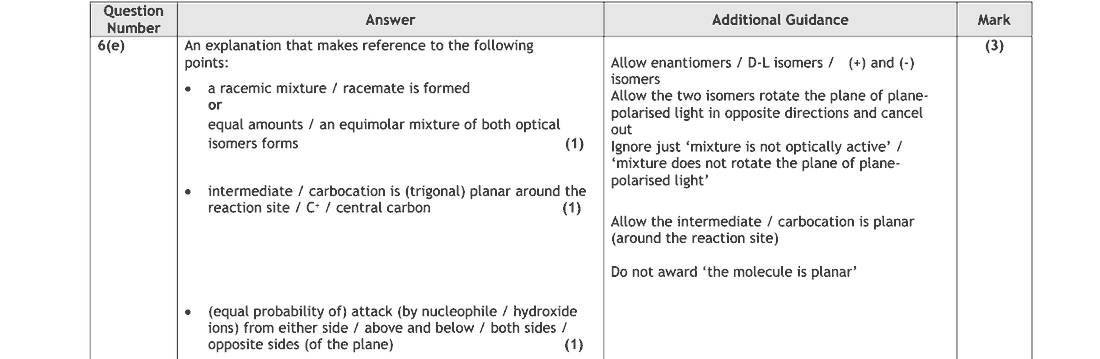
October 2020 · Paper 2 · Q6(e) 3 marks Explanation chirality
Earlier part of question 6 that this part usesEarlier part of October 2020 Paper 2 question 6
2-bromobutane can react with aqueous hydroxide ions by an SN1 mechanism.
Explain why the butan-2-ol produced from a single optical isomer of
2-bromobutane, using this mechanism, is not optically active.
October 2020 · Paper 2 · Q9(a)(iii) 2 marks Explanation kinetics i
Earlier part of question 9 that this part usesEarlier part of October 2020 Paper 2 question 9
Explain, in terms of collisions and energy, why lowering the temperature
decreases the rate of reaction.
October 2020 · Paper 3 · Q2(c) 3 marks Explanation Easy groups 1 and 2
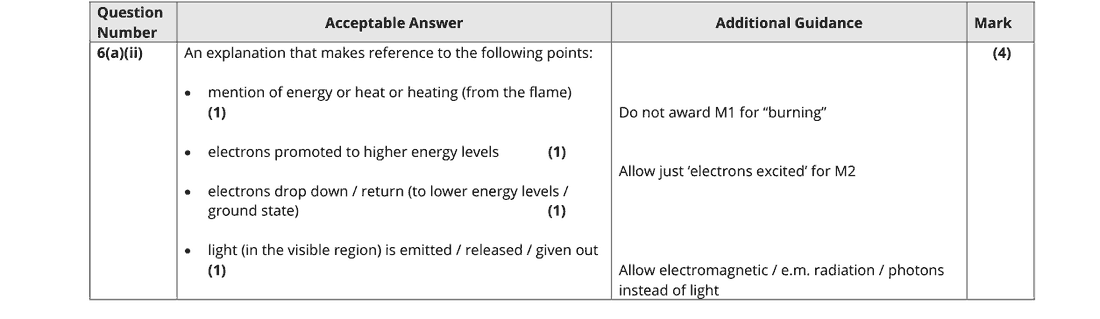
Explain, with reference to electron transitions, the formation of the colour in a
flame test.
October 2020 · Paper 3 · Q3(c)(i) 4 marks Explanation acid base equilibria
Earlier part of question 3 that this part usesEarlier part of October 2020 Paper 3 question 3
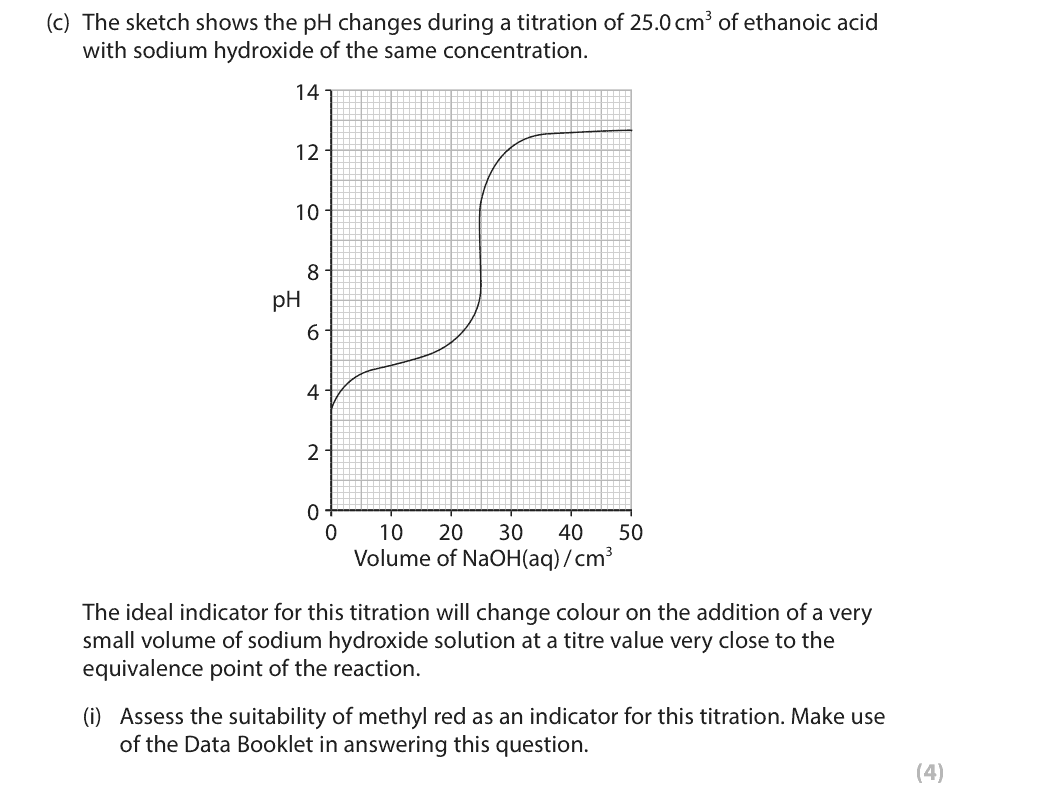
The sketch shows the pH changes during a titration of 25.0 cm3 of ethanoic acid
with sodium hydroxide of the same concentration.
14
12
10
8
pH
6
4
2
0
0
10
20
30
40
50
Volume of NaOH(aq) / cm3
The ideal indicator for this titration will change colour on the addition of a very
small volume of sodium hydroxide solution at a titre value very close to the
equivalence point of the reaction.
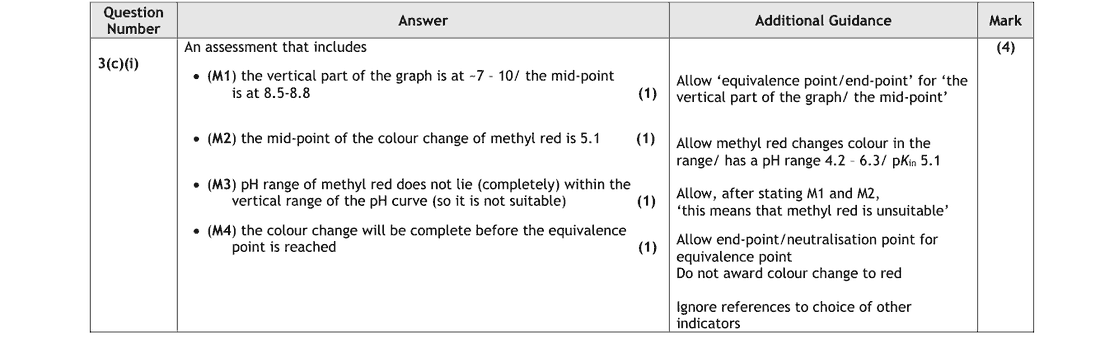
Assess the suitability of methyl red as an indicator for this titration. Make use
of the Data Booklet in answering this question.
October 2020 · Paper 3 · Q5(e) 2 marks Explanation carboxylic acids
Earlier part of question 5 that this part usesEarlier part of October 2020 Paper 3 question 5
Explain why the addition of hydrochloric acid in Step 6 results in the precipitation
of benzoic acid.
October 2020 · Paper 3 · Q6(c)(i) 5 marks Explanation mass spectrometry and infrared spectroscopy
Earlier part of question 6 that this part usesEarlier part of October 2020 Paper 3 question 6
Spectroscopy is an effective means of distinguishing between molecules.
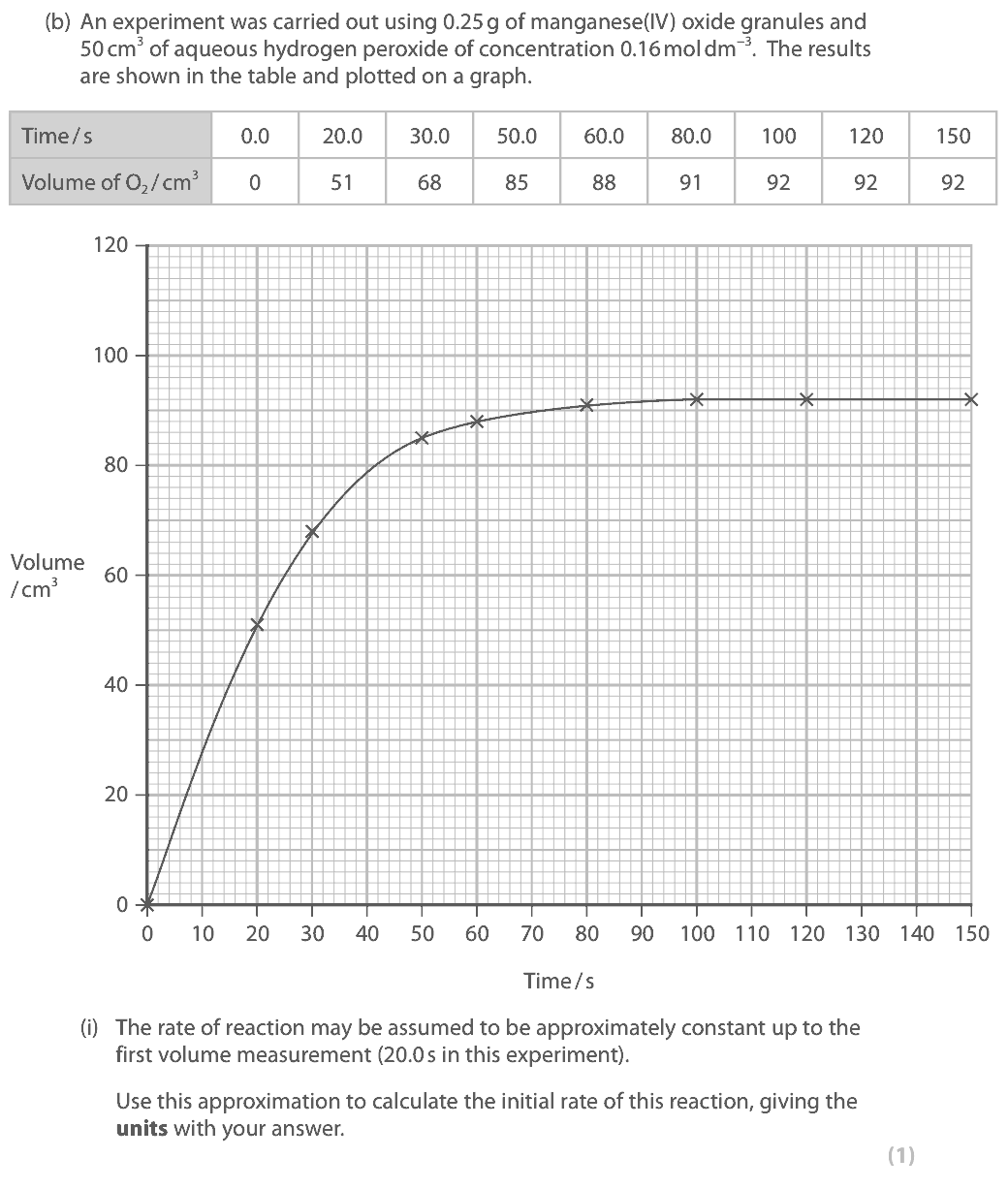
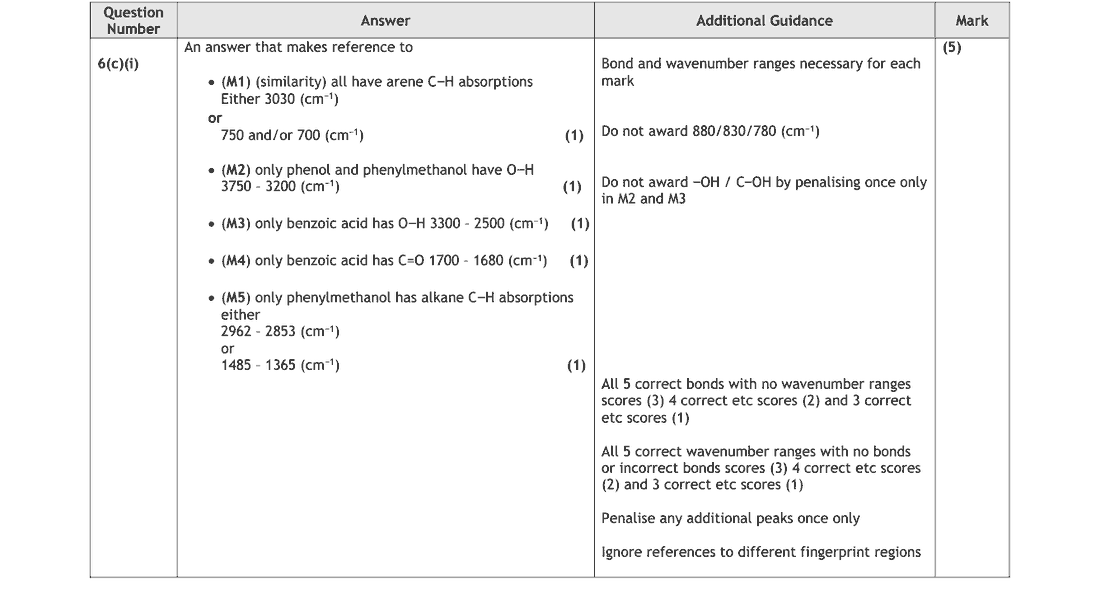
Compare and contrast the infrared spectra of phenol, phenylmethanol and
benzoic acid.
Include relevant bonds and their wavenumber ranges using the Data Booklet.
October 2020 · Paper 3 · Q9(b) 3 marks Explanation amines amides amino acids and proteins
Compare and contrast the basicity of phenylamine and butylamine.
June 2019 · AS Paper 1 · Q6(a)(ii) 4 marks Explanation Easy groups 1 and 2
Earlier part of question 6 that this part usesEarlier part of June 2019 Paper 1 question 6
Explain the origin of flame test colours.
June 2019 · AS Paper 1 · Q8(a) 3 marks Explanation bonding
The table shows some information about a selection of elements and compounds.
Magnesium
Potassium
Graphene
Graphite
Diamond
Iron
oxide
bromide
Melting
temperature
> 4000
3950
3820
3125
1007
1808
/ K
Density
not
2.2 to 2.8
3.51
3.58
2.75
7.86
/ g cm−3
measured
Compressive
not
2.3 and
strength
443
152
15
170
measured
15.3
/ GPa
Explain the difference in the melting temperatures of magnesium oxide and
potassium bromide.
June 2019 · AS Paper 1 · Q8(b) 2 marks Explanation bondingstructure
Earlier part of question 8 that this part usesEarlier part of June 2019 Paper 1 question 8
Explain why the electrical conductivity of solid potassium bromide is poor but an
aqueous solution of potassium bromide is a good electrical conductor.
June 2019 · AS Paper 1 · Q9(a)(ii) 4 marks Explanation bonding
Earlier part of question 9 that this part usesEarlier part of June 2019 Paper 1 question 9
A dot-and-cross diagram for the chlorate(V) ion (ClO3
–) is shown.
–
⎡
O
Key
⎢
=  chlorine electrons
O
Cl
O
⎢
=  an added electron
⎢
⎣
=  oxygen electrons
Cl
Predict the shape and bond angle (O
O) of the chlorate(V) ion.
Justify your answer.
June 2019 · AS Paper 1 · Q9(d) 4 marks Explanation Hard group 7 the halogens
Earlier part of question 9 that this part usesEarlier part of June 2019 Paper 1 question 9
When chlorine gas is dissolved in water, it reacts according to the equation
Cl2  +  H2O  →  HCl  +  HClO
The chloric(I) acid (HClO) produced is much more effective as a disinfectant than
dissolved chlorine.
Chloric(I) acid is a weak acid and has little effect on the pH of the water.
Swimming pools usually have a chlorine content of 1 – 3 ppm.
Use the equation to explain one disadvantage of a chlorine content that is
much lower than 1 ppm and one disadvantage of a chlorine content that is much
higher than 3 ppm.
June 2019 · AS Paper 1 · Q9(e)(ii) 2 marks Explanation bonding
Earlier parts of question 9 that this part usesEarlier part of June 2019 Paper 1 question 9Earlier part of June 2019 Paper 1 question 9
The displayed formulae of ethanol and chloroethane are shown.
H
H
H
H
H
C
C
Cl
H
C
C
O
H
H
H
H
H
ethanol
chloroethane
Ethanol is very soluble in water whereas chloroethane is almost insoluble in water.
Explain this observation by comparing the types of intermolecular forces
formed by each of these molecules with water.
June 2019 · AS Paper 2 · Q1(a)(ii) 3 marks Explanation bonding
Earlier part of question 1 that this part usesEarlier part of June 2019 Paper 2 question 1
Explain why isomers of the alkane in (a)(i) have lower boiling temperatures
and so are found in the petrol fraction.
June 2019 · AS Paper 2 · Q1(b) 3 marks Explanation alkanes
Earlier part of question 1 that this part usesEarlier part of June 2019 Paper 2 question 1
During cracking, carbon to carbon bonds are broken.
Explain the two major reasons for cracking hydrocarbons.
June 2019 · AS Paper 2 · Q4(b)(ii) 2 marks Explanation equilibrium i
Earlier parts of question 4 that this part usesEarlier part of June 2019 Paper 2 question 4Earlier part of June 2019 Paper 2 question 4
Explain your answer to (b)(i).
June 2019 · AS Paper 2 · Q4(c) 2 marks Explanation kinetics i
Earlier part of question 4 that this part usesEarlier part of June 2019 Paper 2 question 4
Explain why, in the industrial process involving this reaction, a catalyst is used.
June 2019 · AS Paper 2 · Q8(b) 2 marks Explanation kinetics i
Earlier part of question 8 that this part usesEarlier part of June 2019 Paper 2 question 8
For many reactions, the values of the initial rate and the maximum rate are the same.
Explain why the values of the two reaction rates obtained in this experiment are
different from each other.
June 2019 · Paper 1 · Q2(a)(ii) 3 marks Explanation group 7 the halogens
Earlier part of question 2 that this part usesEarlier part of June 2019 Paper 1 question 2
Silver nitrate solution was added to the mixture in (a) and excess
dilute ammonia solution was then added to the precipitate formed.
Only some of the precipitate dissolved.
Deduce why only some of the precipitate dissolved.
June 2019 · Paper 1 · Q2(b)(ii) 2 marks Explanation redox i
Earlier parts of question 2 that this part usesEarlier part of June 2019 Paper 1 question 2Earlier part of June 2019 Paper 1 question 2
Explain, in terms of oxidation numbers, why this is a disproportionation reaction.
June 2019 · Paper 1 · Q3(b)(ii) 2 marks Explanation acid base equilibria
Earlier parts of question 3 that this part usesEarlier part of June 2019 Paper 1 question 3Earlier part of June 2019 Paper 1 question 3
Explain why the data book value for the standard enthalpy change of
neutralisation of ethanoic acid with sodium hydroxide is –55.2 kJ mol–1 but the
value for hydrochloric acid is –57.1 kJ mol–1.
June 2019 · Paper 1 · Q4(b) 3 marks Explanation groups 1 and 2
Explain why magnesium carbonate decomposes much more readily on heating
than barium carbonate.
June 2019 · Paper 1 · Q6(a) 4 marks Explanation bonding
This is a question about water.
Water might be expected to have a lower boiling temperature than hydrogen sulfide
but it actually has a higher boiling temperature.
Comment on this statement by referring to the intermolecular forces in both these substances.
A detailed description of how the intermolecular forces arise is not required.
June 2019 · Paper 1 · Q6(b) 4 marks Explanation Hard bonding
Explain why both water and carbon dioxide molecules have polar bonds but only
water is a polar molecule.
June 2019 · Paper 1 · Q9(c) 3 marks Explanation Hard acid base equilibria
Earlier part of question 9 that this part usesEarlier part of June 2019 Paper 1 question 9
One of the systems controlling the pH of blood is the
carbonic acid-hydrogencarbonate buffer system.
` H+ + HCO3
–
H2CO3 _
Explain how this buffer system helps to control the pH of blood when extra
carbon dioxide is present due to strenuous exercise.
June 2019 · Paper 1 · Q10(a)(iii) 2 marks Explanation equilibrium ii
Earlier part of question 10 that this part usesEarlier part of June 2019 Paper 1 question 10
Deduce, by referring to Kp , how the number of sulfur dioxide molecules will
change if more oxygen is added to the equilibrium mixture.
June 2019 · Paper 1 · Q10(b) 2 marks Explanation equilibrium i
Earlier part of question 10 that this part usesEarlier part of June 2019 Paper 1 question 10
An equilibrium exists in aqueous solution between the chromate(VI) ions and the
dichromate(VI) ions.
2–(aq) + 2H+(aq) _
` Cr2O7
2–(aq) + H2O(l)
2CrO4
Explain any change in the position of equilibrium if a few drops of
sodium hydroxide solution are added to this equilibrium system.
June 2019 · Paper 2 · Q3(a)(i) 3 marks Explanation bonding
This question is about compounds of Group 5 elements.
Phosphorus forms two chlorides with the formulae PCl; and PCI.
Explain the shape of the PCl; molecule. The bond angle is not required.
June 2019 · Paper 2 · Q3(a)(iii) 2 marks Explanation Hard atomic structure and the periodic table
Earlier part of question 3 that this part usesEarlier part of June 2019 Paper 2 question 3
Explain why phosphorus forms PCI, but nitrogen does not form NCL.
June 2019 · Paper 2 · Q3(b) 5 marks Explanation bonding
Earlier part of question 3 that this part usesEarlier part of June 2019 Paper 2 question 3
Nitrogen trichloride, NCl;, has a boiling temperature of 344K, and
nitrogen trifluoride, NF;, has a boiling temperature of 144K.
Explain this difference in boiling temperatures, by referring to all the
intermolecular forces present.
June 2019 · Paper 2 · Q5(a)(iii) 3 marks Explanation arenes benzene
Earlier part of question 5 that this part usesEarlier part of June 2019 Paper 2 question 5
Explain whether phenol is likely to be less or more reactive than benzene with
the chloroalkane from (a)(i).
June 2019 · Paper 2 · Q5(c) 2 marks Explanation nmr mass spectrometry and chromatography
Earlier part of question 5 that this part usesEarlier part of June 2019 Paper 2 question 5
The time taken for a compound to pass through the column in gas
chromatography is called the retention time.
Explain why different compounds will have different retention times in the same
column, under the same conditions.
Peeeereee eSORCOeCSUSSO OCeCC SECSO eeeerect eeeeeer rere eeerercereereree reer eeereeeeererecrecrer rere erere sree creer eererrerec rectereercreer errr reree recrerrere steererreese ererrec rere erereer ester ere ereerereerecrereeree rere etree reerrere rr eres restererr ere errr erretre reer creer ester t resi rs
June 2019 · Paper 2 · Q7(b)(iii) 2 marks Explanation kinetics i
Earlier parts of question 7 that this part usesEarlier part of June 2019 Paper 2 question 7Earlier part of June 2019 Paper 2 question 7
Explain how usinga catalyst increases the rate constant, k.
uininnnnnninninisnnnnnininninnninninniunnnsnniinnninninnisnnninnnninnninnnnnnene
June 2019 · Paper 2 · Q7(b)(iv) 3 marks Explanation kinetics i
Earlier parts of question 7 that this part usesEarlier part of June 2019 Paper 2 question 7Earlier part of June 2019 Paper 2 question 7Earlier part of June 2019 Paper 2 question 7Earlier part of June 2019 Paper 2 question 7
The heterogeneous catalyst palladium was suggested for use in this reaction.
Explain how impurities in the gaseous reactants could make the catalyst
less effective.
ee
June 2019 · Paper 3 · Q1(e) 2 marks Explanation acid base equilibria
Earlier part of question 1 that this part usesEarlier part of June 2019 Paper 3 question 1
Explain why the pH of a 1 × 10⁻⁸ mol dm–3 solution of nitric acid, HNO3 , is not 8.
[Ionic product of water, Kw = 1.00 × 10⁻¹⁴ mol2 dm–6]
June 2019 · Paper 3 · Q7(a)(ii) 2 marks Explanation redox ii
Earlier part of question 7 that this part usesEarlier part of June 2019 Paper 3 question 7
Explain why this student should use a mean titre of 23.15 cm3 and not
23.43 cm3 in the calculation.
June 2019 · Paper 3 · Q7(b)(ii) 5 marks Explanation formulae equations and amounts of substance
Earlier parts of question 7 that this part usesEarlier part of June 2019 Paper 3 question 7Earlier part of June 2019 Paper 3 question 7
A third student carried out Experiment 2 and calculated a value of z that was
lower than expected.
This student evaluated the experiment and gave two suggestions for z being lower.
Suggestion 1
“Some of the crystals jumped out of the crucible while it was being heated.”
Suggestion 2
“It was difficult to tell when all the water of crystallisation had been lost.”
Evaluate these two suggestions to decide whether they could account for the
lower value of z obtained from the experimental results.
Include an explanation of the effect each suggestion would have on the calculated
value of z and how the method could be improved to prevent these errors.
June 2019 · Paper 3 · Q8(a)(iii) 2 marks Explanation group 7 the halogens
Earlier part of question 8 that this part usesEarlier part of June 2019 Paper 3 question 8
The student corrected the errors.
While the mixture was heating under reflux, the student noticed a small
amount of a brown vapour was formed.
Explain why the brown vapour forms.
June 2019 · Paper 3 · Q9(a)(i) 2 marks Explanation amines amides amino acids and proteinschirality
Some organic compounds contain metals.
Glycinate ions are formed from the amino acid glycine.
H
O
H2N
C
C
O–
H
glycinate ion
Explain the effect, if any, of an aqueous solution containing glycinate ions on
plane-polarised monochromatic light.
June 2019 · Paper 3 · Q9(a)(iii) 4 marks Explanation formulae equations and amounts of substance
Earlier part of question 9 that this part usesEarlier part of June 2019 Paper 3 question 9
In an experiment, the crystals are filtered, weighed and the percentage yield calculated.
Student 1 obtained a yield of 102.6%.
Student 2 obtained a yield of 56.4%.
The expected yield is 82% and the students carried out the calculation correctly.
Discuss possible reasons for the yields obtained by these students.
June 2019 · Paper 3 · Q9(b) 2 marks Explanation transition metals principles
Earlier part of question 9 that this part usesEarlier part of June 2019 Paper 3 question 9
Haemoglobin is an iron(II) complex.  It carries oxygen around the body.
Part of the structure of haemoglobin is shown.
O2
N
N
Fe2+
N
N
globin
The four nitrogen atoms are part of a multidentate ligand in the haem group.
Explain why inhaling carbon monoxide can be fatal.
June 2019 · Paper 3 · Q10(a)(i) 3 marks Explanation organic synthesis
Organic compound D contains the elements carbon, hydrogen, oxygen and nitrogen only.
A sample of D was burned completely in the apparatus shown.
Solid X absorbed the water formed in the combustion.
Solid Y absorbed the carbon dioxide.
compound D
dry oxygen
suction
heat
solid X
solid Y
The masses of solids X and Y increased during the experiment.
Explain the effect, if any, on the changes in mass of X and Y if the oxygen gas
was not dry.
June 2018 · AS Paper 1 · Q1(d)(i) 2 marks Explanation bonding
Earlier part of question 1 that this part usesEarlier part of June 2018 Paper 1 question 1
Ammonia and boron trifluoride react to form a compound NH3BF3 which
contains a dative covalent bond.  Each of the molecules, NH3 and BF3, has a
different feature of its electronic structure that allows this to happen.
Use these two different features to explain how a dative covalent bond is formed.
June 2018 · AS Paper 1 · Q2(a)(ii) 2 marks Explanation Easy atomic structure and the periodic table
Earlier part of question 2 that this part usesEarlier part of June 2018 Paper 1 question 2
Use the data in the table to explain the term isotopes.
June 2018 · AS Paper 1 · Q2(c)(ii) 4 marks Explanation atomic structure and the periodic table
Earlier part of question 2 that this part usesEarlier part of June 2018 Paper 1 question 2
The sequence of the first three elements in the Periodic Table is hydrogen,
helium and then lithium.
Explain why the first ionisation energy of hydrogen is less than that of helium,
but greater than that of lithium.
June 2018 · AS Paper 1 · Q5(c)(i) 2 marks Explanation groups 1 and 2atomic structure and the periodic table
Earlier parts of question 5 that this part usesEarlier part of June 2018 Paper 1 question 5Earlier part of June 2018 Paper 1 question 5
The student was surprised by the white colour of the crystals of JCl2.6H2O in Step 6.
This did not agree with the possible identity for J from the calculation in (b).
The student decided to perform a flame test on the crystals.
Explain why the student was surprised and decided to carry out a flame test.
June 2018 · AS Paper 1 · Q6(a)(ii) 2 marks Explanation atomic structure and the periodic table
Earlier part of question 6 that this part usesEarlier part of June 2018 Paper 1 question 6
Explain why iodine and chlorine have many similar chemical reactions.
June 2018 · AS Paper 1 · Q8(a)(iv) 2 marks Explanation bonding
Earlier parts of question 8 that this part usesEarlier part of June 2018 Paper 1 question 8Earlier part of June 2018 Paper 1 question 8Earlier part of June 2018 Paper 1 question 8
Explain your answer to (a)(iii) in terms of the structure of the ions.
June 2018 · AS Paper 1 · Q8(b) 2 marks Explanation bonding
Earlier part of question 8 that this part usesEarlier part of June 2018 Paper 1 question 8
The strength of ionic bonding in different compounds can be compared by using
the amount of energy required to separate the ions.  Some values for this energy
are given in the table.
Amount of energy required to separate the ions
Compound
/ kJ mol−1
LiF
1031
KF
817
CaF2
2957
Using the data provided, explain how changes in the cation affect the bond
strength in an ionic compound.
June 2018 · AS Paper 2 · Q3(c)(i) 2 marks Explanation equilibrium i
Earlier part of question 3 that this part usesEarlier part of June 2018 Paper 2 question 3
In fact, this oxidation to form nitrogen(II) oxide is an equilibrium reaction.
Explain the effect, if any, of increasing pressure on the equilibrium yield of NO
in this reaction.
4NH3(g) + 5O2(g)  4NO(g) + 6H2O(g)
June 2018 · AS Paper 2 · Q3(c)(ii) 2 marks Explanation kinetics i
Earlier parts of question 3 that this part usesEarlier part of June 2018 Paper 2 question 3Earlier part of June 2018 Paper 2 question 3
Explain the effect, if any, of an increase in pressure on the rate of this reaction.
June 2018 · AS Paper 2 · Q4(a)(iii) 2 marks Explanation halogenoalkaneskinetics i
Earlier part of question 4 that this part usesEarlier part of June 2018 Paper 2 question 4
Explain why, in Reaction 3, the reactants are heated in a sealed container.
June 2018 · AS Paper 2 · Q5(b)(ii) 2 marks Explanation alkenes
Earlier part of question 5 that this part usesEarlier part of June 2018 Paper 2 question 5
Some polymers are disposed of by incineration.  Ignoring any economic
considerations, explain why incineration is not a suitable method for the
disposal of poly(chloroethene).
June 2018 · AS Paper 2 · Q8(c)(ii) 2 marks Explanation energetics i
Earlier part of question 8 that this part usesEarlier part of June 2018 Paper 2 question 8
2-methylpropan-2-ol burns in air with a smoky flame.  Explain how burning
with a smoky flame affects the value of the experimentally determined
enthalpy change of combustion.
June 2018 · Paper 1 · Q4(f) 3 marks Explanation transition metals reactionskinetics i
Earlier part of question 4 that this part usesEarlier part of June 2018 Paper 1 question 4
Manganate(VII) ions, MnO4
−, react with ethanedioate ions in acid solution.
− + 5C2O4
2− + 16H+ → 2Mn2+ + 10CO2 + 8H2O
2MnO4
The reaction starts slowly, the rate of reaction then increases, before it decreases again.
Explain this sequence.
June 2018 · Paper 1 · Q6(b)(v) 4 marks Explanation equilibrium i
Earlier parts of question 6 that this part usesEarlier part of June 2018 Paper 1 question 6Earlier part of June 2018 Paper 1 question 6
Predict the effect, if any, of adding each of the following to a saturated
solution of magnesium hydroxide in contact with solid magnesium hydroxide.
Justify your answers in terms of the effect on the equilibrium.
 Mg2+(aq) + 2OH−(aq)
Mg(OH)2(s) 
Magnesium sulfate solution
Dilute hydrochloric acid
June 2018 · Paper 1 · Q8(a)(iii) 2 marks Explanation atomic structure and the periodic table
Earlier part of question 8 that this part usesEarlier part of June 2018 Paper 1 question 8
Explain why the difference between the second and third ionisation energies
of calcium is much larger than the difference between the first and second
ionisation energies.
June 2018 · Paper 1 · Q9(c)(iv) 2 marks Explanation equilibrium i
Earlier part of question 9 that this part usesEarlier part of June 2018 Paper 1 question 9
The equilibrium constant has a larger value at 298 K than at 700 K.
Explain why the reaction is carried out at 700 K and not at 298 K.
June 2018 · Paper 2 · Q2(b) 2 marks Explanation kinetics ialkanes
Catalytic converters of car exhaust systems have internal honeycomb structures as shown.
Explain why the honeycomb structure is used in a car exhaust system.
June 2018 · Paper 2 · Q4(c) 3 marks Explanation Hard formulae equations and amounts of substance
Earlier part of question 4 that this part usesEarlier part of June 2018 Paper 2 question 4
The third reaction in the airbag is between the metal oxides and silicon dioxide.
State the type of reaction taking place and justify why this reaction is necessary.
June 2018 · Paper 2 · Q5(d) 2 marks Explanation alcohols
Using the apparatus for distillation instead of reflux is not an efficient way to
produce ethanoic acid from ethanol.  Explain why.
June 2018 · Paper 2 · Q6(b) 2 marks Explanation halogenoalkanes
Explain the trend in the rates of hydrolysis of 1-chlorobutane, 1-bromobutane and
1-iodobutane.
June 2018 · Paper 2 · Q8(a)(ii) 3 marks Explanation arenes benzene
Earlier part of question 8 that this part usesEarlier part of June 2018 Paper 2 question 8
Compare and contrast the bromination of phenol with the bromination of benzene.
June 2018 · Paper 3 · Q1(a)(ii) 2 marks Explanation group 7 the halogensbonding
Earlier part of question 1 that this part usesEarlier part of June 2018 Paper 3 question 1
The boiling temperatures of chlorine and bromine are shown in the table.
Halogen
Boiling temperature / °C
chlorine
−34
bromine
59
Explain why bromine has a higher boiling temperature than chlorine.
June 2018 · Paper 3 · Q3(d)(iii) 2 marks Explanation kinetics iformulae equations and amounts of substance
Earlier parts of question 3 that this part usesEarlier part of June 2018 Paper 3 question 3Earlier part of June 2018 Paper 3 question 3
The teacher noticed that Student 2 had used the Group 2 carbonate in
powdered form rather than in lumps.
Explain how, if at all, this would affect the rate of reaction and the final volume
of gas produced in the reaction.
June 2018 · Paper 3 · Q4(b)(ii) 5 marks Explanation nmr mass spectrometry and chromatography
Earlier parts of question 4 that this part usesEarlier part of June 2018 Paper 3 question 4Earlier part of June 2018 Paper 3 question 4
The high resolution proton NMR spectrum of another isomer of C6H12O2 is shown.
5
4
3
2
1
0
δ / ppm
The ratios of the number of protons for the five sets peaks in the spectrum are
given in the table.
δ / ppm
3.8
3.5
2.6
2.2
1.2
Ratio of the
2
2
2
3
3
number of protons
Show that all these data are consistent with the displayed formula shown.
Refer to the five chemical shifts and explain two of the splitting patterns.
H
H
H
H
O
H
H
C
C
O
C
C
C
C
H
H
H
H
H
H
June 2018 · Paper 3 · Q5(b) 7 marks Explanation transition metals reactionsredox ii
Earlier part of question 5 that this part usesEarlier part of June 2018 Paper 3 question 5
Excess zinc powder is added to an acidified solution of the compound NH4VO3.
Using the data in the table, explain the sequence of reactions that takes place.
In your answer, include a description of what you would see, and the relevant
ionic equations with their calculated E cell values.  State symbols are not required.
Electrode system
E  / V
V2+(aq) + 2e−  V(s)
−1.18
V3+(aq) + e−  V2+(aq)
−0.26
VO2+(aq) + 2H+(aq) + e−  V3+(aq) + H2O(l)
+0.34
VO3
−(aq) + 4H+(aq) + e−  VO2+(aq) + 2H2O(l)
+1.00
Zn2+(aq) + 2e−  Zn(s)
−0.76
June 2018 · Paper 3 · Q5(c) 2 marks Explanation transition metals reactions
Earlier part of question 5 that this part usesEarlier part of June 2018 Paper 3 question 5
Explain how vanadium(V) oxide acts as a catalyst in one step of the contact
process.  The equation for this step is
2SO2(g) + O2(g)  2SO3(g)
June 2018 · Paper 3 · Q6(a)(ii) 3 marks Explanation mass spectrometry and infrared spectroscopy
Earlier part of question 6 that this part usesEarlier part of June 2018 Paper 3 question 6
One of the students suggests that this infrared spectrum and the data in the
Data Booklet alone could be used to identify which of the three proposed
structures is X.
Show that this student’s suggestion is correct. Include relevant infrared data in
your answer.
June 2018 · Paper 3 · Q7(b)(ii) 2 marks Explanation acid base equilibria
Earlier parts of question 7 that this part usesEarlier part of June 2018 Paper 3 question 7Earlier part of June 2018 Paper 3 question 7
Explain how you would use the graph in (b)(i) to obtain the value of the acid
dissociation constant, Ka , for propanoic acid.
You are not expected to calculate this value.
June 2018 · Paper 3 · Q8(d)(ii) 2 marks Explanation equilibrium iiequilibrium i
Earlier parts of question 8 that this part usesEarlier part of June 2018 Paper 3 question 8Earlier part of June 2018 Paper 3 question 8
Explain why it is possible, in this case, to calculate Kc using equilibrium
amounts in moles, rather than equilibrium concentrations.
June 2018 · Paper 3 · Q8(e) 2 marks Explanation equilibrium i
Earlier part of question 8 that this part usesEarlier part of June 2018 Paper 3 question 8
The pink colour of the phenolphthalein fades after the end-point of the titration
has been reached.
Give a possible explanation for this observation.
June 2017 · AS Paper 1 · Q2(a)(iii) 2 marks Explanation bonding
Earlier part of question 2 that this part usesEarlier part of June 2017 Paper 1 question 2
Explain why hydrogen bonding causes ice to be less dense than liquid water.
June 2017 · AS Paper 1 · Q3(c)(ii) 2 marks Explanation atomic structure and the periodic table
Earlier parts of question 3 that this part usesEarlier part of June 2017 Paper 1 question 3Earlier part of June 2017 Paper 1 question 3
Explain why the value of the first ionisation energy for D is greater than for C.
June 2017 · AS Paper 1 · Q3(c)(iii) 2 marks Explanation atomic structure and the periodic table
Earlier parts of question 3 that this part usesEarlier part of June 2017 Paper 1 question 3Earlier part of June 2017 Paper 1 question 3
Explain why the value of the first ionisation energy of E is less than for D.
June 2017 · AS Paper 1 · Q4(a)(iv) 2 marks Explanation redox i
Earlier parts of question 4 that this part usesEarlier part of June 2017 Paper 1 question 4Earlier part of June 2017 Paper 1 question 4Earlier part of June 2017 Paper 1 question 4
Use your answer to (a)(iii) to explain why the reaction is described as a
disproportionation reaction.
June 2017 · AS Paper 1 · Q6(a)(iii) 2 marks Explanation bonding
Earlier part of question 6 that this part usesEarlier part of June 2017 Paper 1 question 6
Use your diagram to explain why BCl3 has a trigonal planar shape with
bond angles of 120q.
June 2017 · AS Paper 2 · Q7(a)(iv) 2 marks Explanation halogenoalkanesalkenes
Earlier part of question 7 that this part usesEarlier part of June 2017 Paper 2 question 7
The precipitates form as a result of reactions between aqueous silver ions and
aqueous halide ions.
Explain why halide ions are present in the mixture containing a
halogenoalkane which has only covalent bonds.
June 2017 · Paper 1 · Q1(b)(i) 2 marks Explanation bonding
Phosphorus(III) chloride molecules are pyramidal with a bond angle less than 109.5°.
P
Cl
Cl
Cl
Explain why a phosphorus(III) chloride molecule has this shape and bond angle.
June 2017 · Paper 1 · Q2(a) 3 marks Explanation redox i
Magnesium nitrate decomposes on heating as shown by the equation.
2Mg(NO3)2 r 2MgO + 4NO2 + O2
Explain, in terms of all the relevant oxidation numbers, why this is a redox reaction.
June 2017 · Paper 1 · Q2(b) 3 marks Explanation groups 1 and 2
Earlier part of question 2 that this part usesEarlier part of June 2017 Paper 1 question 2
Calcium nitrate decomposes in a similar way to magnesium nitrate, but requires a
higher temperature for decomposition.
Explain this observation in terms of the charge and size of the cations.
June 2017 · Paper 1 · Q3(a) 2 marks Explanation group 7 the halogensbonding
This question is about halogens and redox reactions.
The boiling temperatures of three halogens are shown in the table.
Boiling temperature
Halogen
/ °C
chlorine
–35
bromine
59
iodine
184
Explain why the boiling temperatures increase from chlorine to iodine.
June 2017 · Paper 1 · Q3(b) 3 marks Explanation group 7 the halogensredox i
Earlier part of question 3 that this part usesEarlier part of June 2017 Paper 1 question 3
Potassium halides react with concentrated sulfuric acid to form
potassium hydrogensulfate and the different products shown in the table.
Potassium halide
Products
potassium chloride
hydrogen chloride
potassium bromide
hydrogen bromide, bromine and sulfur dioxide
potassium iodide
hydrogen iodide, iodine, hydrogen sulfide and sulfur
By referring to any changes in oxidation numbers when these halides react with
concentrated sulfuric acid, explain which halide is the strongest reducing agent.
June 2017 · Paper 1 · Q4(b) 2 marks Explanation transition metals principles
Iron(II) ions, [Fe(H2O)6]2+, form a pale green solution but zinc ions, [Zn(H2O)6]2+,
form a colourless solution.
Explain why zinc ions are colourless.
June 2017 · Paper 1 · Q4(c)(ii) 2 marks Explanation transition metals reactionsentropy
Earlier parts of question 4 that this part usesEarlier part of June 2017 Paper 1 question 4Earlier part of June 2017 Paper 1 question 4
Explain, in terms of entropy, why this reaction is feasible.
June 2017 · Paper 1 · Q6(c)(i) 3 marks Explanation atomic structure and the periodic table
The first ionisation energy of sodium is 496 kJ mol–1.
Explain why the first ionisation energy of magnesium is higher than that of sodium.
June 2017 · Paper 1 · Q8(d)(i) 2 marks Explanation Hard acid base equilibria
Earlier part of question 8 that this part usesEarlier part of June 2017 Paper 1 question 8
Glycolic acid has an acid dissociation constant of 1.5 × 10⁻⁴ mol dm–3 compared
with a value of 1.7 × 10⁻⁵ mol dm–3 for ethanoic acid.
Give a possible explanation as to why the value of Ka for glycolic acid is
approximately ten times larger than that of ethanoic acid.
June 2017 · Paper 1 · Q10(a)(ii) 2 marks Explanation Easy equilibrium i
Earlier part of question 10 that this part usesEarlier part of June 2017 Paper 1 question 10
Explain the effect of an increase in pressure on the equilibrium position of this reaction.
June 2017 · Paper 1 · Q10(a)(iii) 2 marks Explanation equilibrium ii
Earlier parts of question 10 that this part usesEarlier part of June 2017 Paper 1 question 10Earlier part of June 2017 Paper 1 question 10
Explain, by reference to any change in the value of Kp , the effect of an increase
in temperature on the equilibrium position of this reaction.
June 2017 · Paper 1 · Q10(b) 3 marks Explanation equilibrium iiequilibrium i
Earlier part of question 10 that this part usesEarlier part of June 2017 Paper 1 question 10
Carbon monoxide reacts with steam.
CO(g) + H2O(g) U CO2(g) + H2(g)
At 1100 K, Kc = 1.00
In an experiment, 1 mol of carbon monoxide was mixed with 1 mol of steam,
2 mol of carbon dioxide and 2 mol of hydrogen.
Deduce, with reasons, the direction in which the reaction will shift to reach equilibrium.
June 2017 · Paper 2 · Q1(c)(i) 2 marks Explanation alkanesbonding
Alkanes are obtained by processing crude oil.
Explain why different alkanes in crude oil can be separated by fractional distillation.
June 2017 · Paper 2 · Q3(a) 2 marks Explanation halogenoalkanes
This is a question about halogenoalkanes and related compounds.
Explain the trend in reactivity of the primary chloro-, bromo- and iodoalkanes
with aqueous hydroxide ions.
June 2017 · Paper 2 · Q3(d) 3 marks Explanation bonding
Explain why ethene has a boiling temperature of −104 °C, whereas ethanol has a
boiling temperature of 78 °C.
June 2017 · Paper 2 · Q4(b) 2 marks Explanation atomic structure and the periodic table
Earlier part of question 4 that this part usesEarlier part of June 2017 Paper 2 question 4
One reason for the use of nitrogen gas in car tyres is that less gas is lost from the
tyres during use because nitrogen molecules are larger than oxygen molecules.
A suggested explanation for this is that nitrogen atoms are larger than oxygen atoms.
Explain why a nitrogen atom is larger than an oxygen atom.
June 2017 · Paper 2 · Q7(c) 2 marks Explanation arenes benzene
Earlier part of question 7 that this part usesEarlier part of June 2017 Paper 2 question 7
Paracetamol is structurally similar to Antifebrin, but has a hydroxy group attached
directly to the benzene ring.
HO
O
N
C
H
CH3
The bromination of the benzene ring in paracetamol occurs much more readily
compared to the bromination of benzene.
Explain this increased reactivity.
June 2017 · Paper 3 · Q2(d)(ii) 2 marks Explanation mass spectrometry and infrared spectroscopy
Earlier parts of question 2 that this part usesEarlier part of June 2017 Paper 3 question 2Earlier part of June 2017 Paper 3 question 2
From the infrared spectrum, the student concludes that the mixture contains
another organic compound.
The mixture is redistilled and the fraction that boils in the range 93–95°C is collected.
The boiling temperature of 3-methylbutan-2-one is 94°C.
Predict any change(s) you would see in the infrared spectrum after redistillation,
justifying your answer.
June 2017 · Paper 3 · Q3(d) 2 marks Explanation nmr mass spectrometry and chromatographyamines amides amino acids and proteins
Earlier parts of question 3 that this part usesEarlier part of June 2017 Paper 3 question 3Earlier part of June 2017 Paper 3 question 3
The dipeptide formed in part (c) is hydrolysed under acidic conditions and the resulting
mixture is analysed by column chromatography.  The column uses a polar stationary phase.
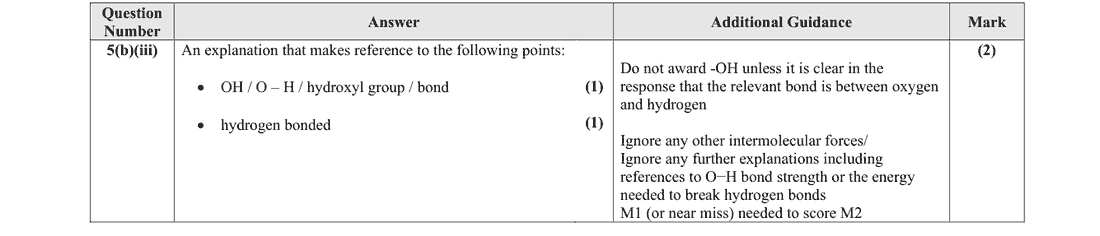
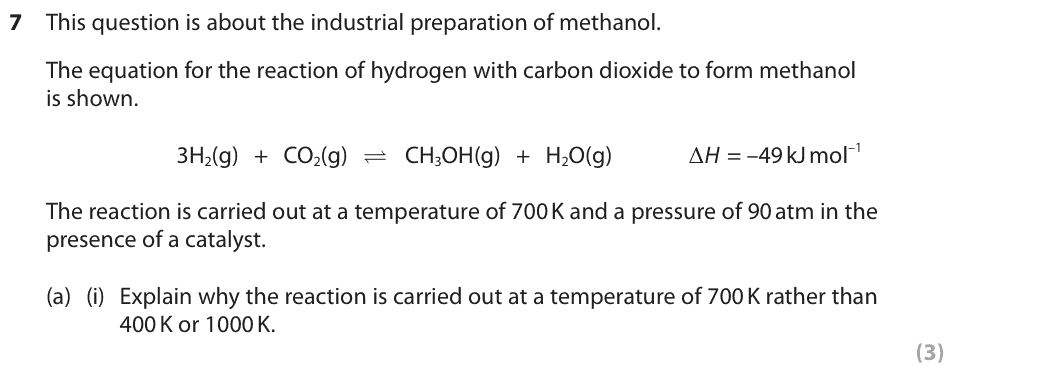
Explain why lysine leaves the chromatography column after alanine.
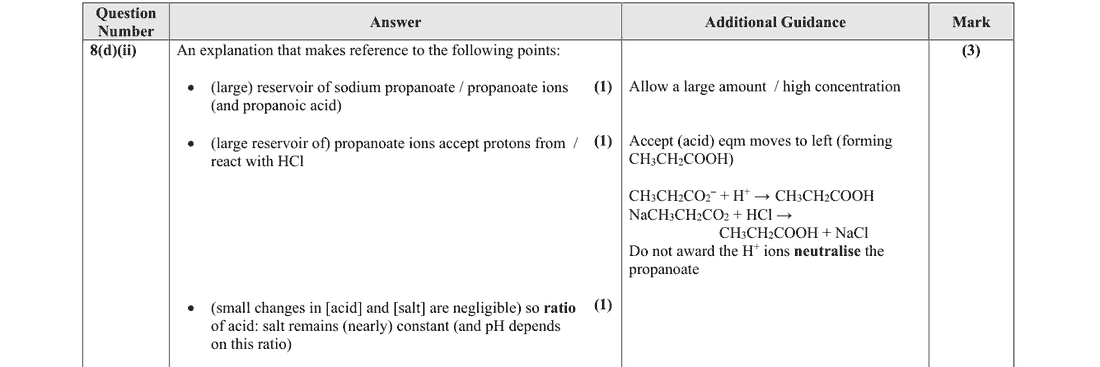
June 2017 · Paper 3 · Q4(d)(ii) 3 marks Explanation formulae equations and amounts of substance
Earlier parts of question 4 that this part usesEarlier part of June 2017 Paper 3 question 4Earlier part of June 2017 Paper 3 question 4
Compare and contrast the use of a 250 cm3 measuring cylinder to measure out the
150 cm3 distilled water with the use of a 25 cm3 measuring cylinder (uncertainty
±0.2 cm3 for each volume measurement) six times to measure the same volume.
June 2017 · Paper 3 · Q4(e) 2 marks Explanation energetics i
Earlier part of question 4 that this part usesEarlier part of June 2017 Paper 3 question 4
Student 1 decided to repeat the experiment.
Student 1 used the copper calorimeter and water from the first experiment and
recorded the initial temperature as 60.0°C.
Student 1 burned exactly the same mass of methanol as in the first experiment.
Explain, with a reason, how the value for the enthalpy change of combustion of
methanol from this experiment would differ, if at all, from the value obtained in the first
experiment.
June 2017 · Paper 3 · Q4(f) 2 marks Explanation energetics i
Earlier part of question 4 that this part usesEarlier part of June 2017 Paper 3 question 4
Student 2 followed the original instructions provided, but extinguished the flame
after four minutes rather than after three minutes.
Explain how the value calculated by Student 2 for the enthalpy change of combustion of
methanol compared with that obtained in Student 1’s first experiment.
June 2017 · Paper 3 · Q4(g) 2 marks Explanation Easy energetics i
Earlier part of question 4 that this part usesEarlier part of June 2017 Paper 3 question 4
Another student, Student 3, used the results from Student 1’s first experiment to
find the enthalpy change of combustion of methanol.  Student 3 incorrectly used
a value of 46.0 g mol–1 for the molar mass of methanol.
State and justify how this mistake would affect the calculated value for the
enthalpy change of combustion of methanol.
June 2017 · Paper 3 · Q6(e) 2 marks Explanation formulae equations and amounts of substance
Earlier part of question 6 that this part usesEarlier part of June 2017 Paper 3 question 6
Explain how, if at all, the very slight solubility of magnesium carbonate in water
would affect the value calculated for x.
June 2017 · Paper 3 · Q9(e)(i) 2 marks Explanation equilibrium ii
Earlier part of question 9 that this part usesEarlier part of June 2017 Paper 3 question 9
The equation for the reaction between hydrogen and iodine is
H2(g)  +  I2(g)   U  2HI(g)     ǻH = –9.6 kJ mol−1
Explain the effect, if any, on the value of Kc when the temperature is increased.
June 2016 · AS Paper 1 · Q1(d) 3 marks Explanation bonding
State what is meant by the term electronegativity and hence explain the polarity,
if any, of the bonds in chlorine trifluoride, ClF3.
June 2016 · AS Paper 1 · Q2(d) 2 marks Explanation Hard atomic structure and the periodic table
Earlier part of question 2 that this part usesEarlier part of June 2016 Paper 1 question 2
A mass spectrometer was used to analyse a sample of bromine, Br2, with only the
79Br and 81Br isotopes present.
Explain why a very small peak occurs at m/z = 80.
June 2016 · AS Paper 1 · Q6(a) 2 marks Explanation bonding
The diagram shows bond angles in ammonia and water.
N
O
107°
104.5°
H
H
H
H
H
Explain why the bond angle in water is less than the bond angle in ammonia.
June 2016 · AS Paper 1 · Q6(b) 3 marks Explanation Hard bonding
Earlier part of question 6 that this part usesEarlier part of June 2016 Paper 1 question 6
Explain why the O–H and S–H bond lengths are different.
S
O
133.6 pm
95.7 pm
H
H
H
H
June 2016 · AS Paper 1 · Q7(c) 4 marks Explanation groups 1 and 2
Explain why magnesium nitrate, Mg(NO3)2 decomposes more readily on heating
than potassium nitrate, KNO3.
June 2016 · AS Paper 1 · Q8(b)(iii) 3 marks Explanation redox i
Earlier parts of question 8 that this part usesEarlier part of June 2016 Paper 1 question 8Earlier part of June 2016 Paper 1 question 8
Explain, by using the oxidation numbers of all the atoms, whether or not this
is a redox reaction.
June 2016 · AS Paper 1 · Q8(c) 4 marks Explanation Easy structurebonding
Earlier part of question 8 that this part usesEarlier part of June 2016 Paper 1 question 8
Element X has the typical appearance of a metal.
Predict two other distinct physical properties that element X would exhibit if it is
a metal.  Explain your choices in terms of structure and bonding.
June 2016 · AS Paper 2 · Q3(b)(ii) 3 marks Explanation kinetics i
Earlier parts of question 3 that this part usesEarlier part of June 2016 Paper 2 question 3Earlier part of June 2016 Paper 2 question 3
Use the graph to explain why a small increase in temperature results in a large
increase in the rate of a gaseous reaction.
June 2016 · AS Paper 2 · Q6(c) 2 marks Explanation energetics i
Earlier part of question 6 that this part usesEarlier part of June 2016 Paper 2 question 6
Hydrated sodium carbonate slowly loses some water of crystallisation when left in air.
Explain how the enthalpy change in the second experiment would compare with
the data book value if an old sample of hydrated sodium carbonate had been
used.
June 2016 · AS Paper 2 · Q8(b)(iv) 2 marks Explanation formulae equations and amounts of substance
Earlier parts of question 8 that this part usesEarlier part of June 2016 Paper 2 question 8Earlier part of June 2016 Paper 2 question 8
The student thought that the ethanedioic acid crystals used may have been
slightly damp.
Explain the effect of using damp crystals on the titre and on the value of n.

Work with an A-level chemistry tutor

Dropping marks on calculations, mechanisms or the core practicals? Book a trial session with an A-level chemistry tutor.

Prefer email? Send an enquiry

If you are under 18, please include a parent's contact details. Enquiries go to enquiries@chemistryaleveltutor.com and are deleted once handled. All tutoring is online.